/
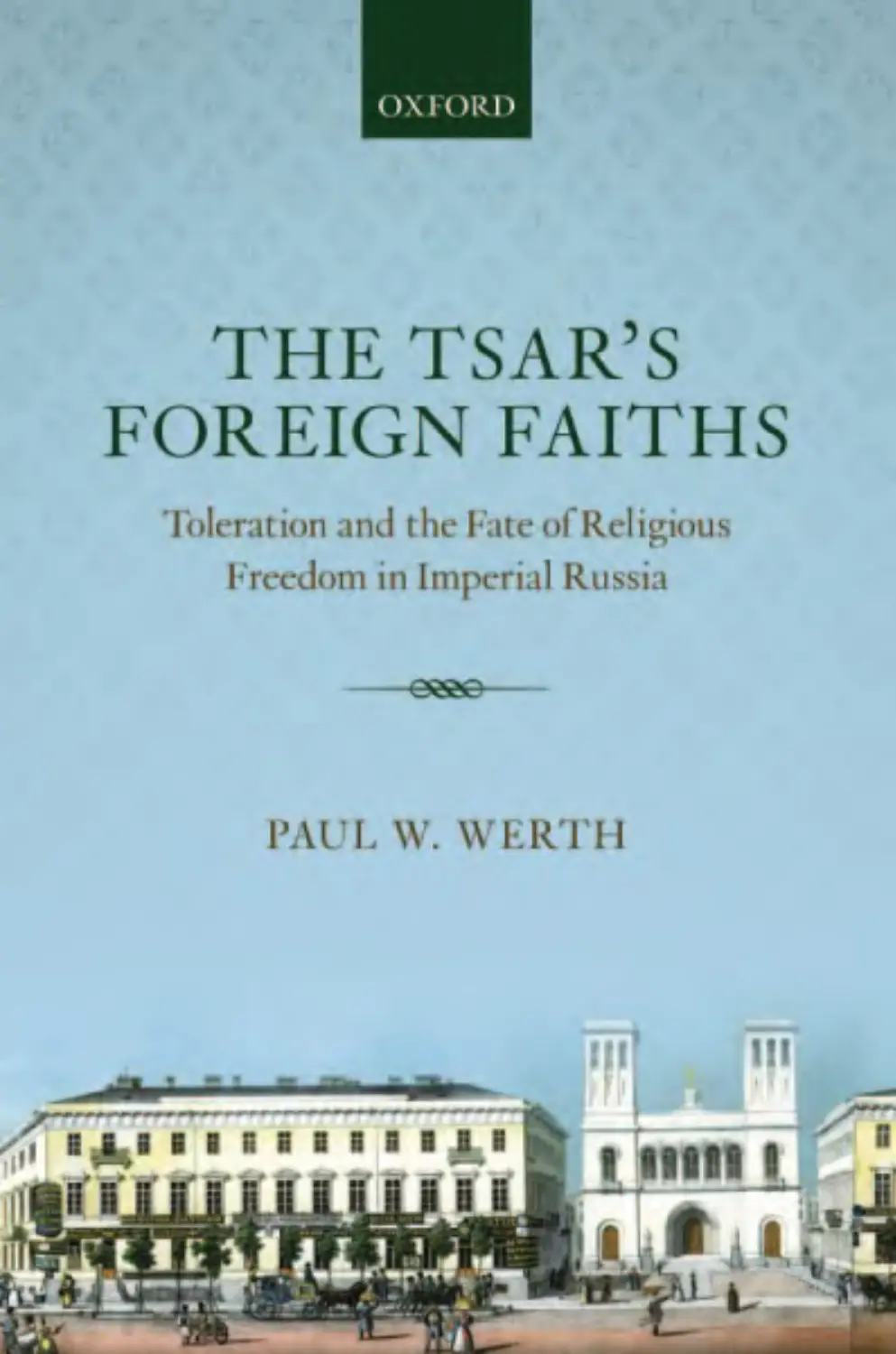


Автор: Werth P.W.
Теги: history of russia russian empire state and religion religious policy
ISBN: 978-0-19-959177-0
Год: 2014


Текст
OX F O R D S T U D I E S
I N M O D E R N E U RO P E A N H I S TO RY
General Editors
SIMON DIXON, M A RK MAZOWER,
and
JA M ES RETA LL ACK
The Tsar’s Foreign Faiths
Toleration and the Fate of Religious Freedom in
Imperial Russia
PAU L W. W E RT H
1
3
Great Clarendon Street, Oxford, OX2 6DP,
United Kingdom
Oxford University Press is a department of the University of Oxford.
It furthers the University’s objective of excellence in research, scholarship,
and education by publishing worldwide. Oxford is a registered trade mark of
Oxford University Press in the UK and in certain other countries
© Paul W. Werth 2014
The moral rights of the author have been asserted
First Edition published in 2014
Impression: 1
All rights reserved. No part of this publication may be reproduced, stored in
a retrieval system, or transmitted, in any form or by any means, without the
prior permission in writing of Oxford University Press, or as expressly permitted
by law, by licence or under terms agreed with the appropriate reprographics
rights organization. Enquiries concerning reproduction outside the scope of the
above should be sent to the Rights Department, Oxford University Press, at the
address above
You must not circulate this work in any other form
and you must impose this same condition on any acquirer
Published in the United States of America by Oxford University Press
198 Madison Avenue, New York, NY 10016, United States of America
British Library Cataloguing in Publication Data
Data available
Library of Congress Control Number: 2013947892
ISBN 978–0–19–959177–0
As printed and bound by
CPI Group (UK) Ltd, Croydon, CR0 4YY
Links to third party websites are provided by Oxford in good faith and
for information only. Oxford disclaims any responsibility for the materials
contained in any third party website referenced in this work.
To the memory of two fathers:
William Fredrick Werth, 1933–2008
Vladimir Kapitonovich Zuev, 1947–2013
Acknowledgements
So many people have aided my work on this book that any effort to name them
all is certain to be incomplete. I shall make the attempt nonetheless. For their
willingness to help, read, share, and listen, I thank Kristīne Ante, Aleksandr
Bendin, Lilya Berezhnaya, Juliette Cadiot, Heather Coleman, Simon Dixon,
Mikhail Dolbilov, Aleksandra Dorskaia, Allen Frank, Victoria Frede, Aleksandr
Gavrilin, Carol Harter, Peter Holquist, Richard Hovannisian, Andreas Kappeler,
Valerie Kivelson, Vladimir Levin, Theo van Lint, Colin Loader, Alexander Martin,
Virginia Martin, Kimitaka Matsuzato, David McDonald, Marta Meana, Aleksei
Miller, Alexander Morrison, Claire Mouradian, Benjamin Nathans, Norihiro
Naganawa, Kelly O’Neill, Aleksandr Polunov, Randall Poole, Aleksandr Safonov,
David Schimmelpenninck van der Oye, Martin Schulze Wessel, Vera Shevzov, Barbara Skinner, Darius Staliūnas, Erki Tammiksaar, Michelle Tusan, James Urry,
Diliara Usmanova, Tomohiko Uyama, Elena Vishlenkova, William Wagner, Daniel Werra, Martina Winkler, several anonymous readers for Oxford, and Joe Lenkart at the Slavic Reference Service at the University of Illinois. My work would
have been more difficult, and the results impoverished, without their expertise and
collegiality. I beg the forgiveness of any whom I have forgotten.
This book was made possible by support from the following institutions, to
which I extend my sincere thanks: the National Endowment for the Humanities,
the National Humanities Center, the International Research and Exchanges Board,
the National Council for East European and Eurasian Research, the Slavic Research
Center of the University of Hokkaido (Sapporo), the Kennan Institute for
Advanced Russian Studies, the Center for the Study of Russian, Caucasian, and
Central European Worlds (Paris), the Center for Advanced Studies at LudwigMaximilian University (Munich), and the University of Nevada, Las Vegas (including the Department of History, the Office of the Dean of the College of Liberal
Arts, the Sabbatical and Leave Committee, and the Black Mountain Institute). The
views, findings, and conclusions expressed in this book do not necessarily represent
those of any of these organizations.
Small portions of previously published articles appear in this book in substantially revised form, and I thank the original publishers for the right to use that
material here. Those articles are “Schism Once Removed: Sects, State Authority,
and the Meanings of Religious Toleration in Imperial Russia,” in Alexei Miller and
Alfred Rieber, eds., Imperial Rule (Budapest: Central European University Press,
2004), 85–108; “The Russian Empire and the Armenian Catholicos at Home and
Abroad,” in Osamu Ieda and Tomohiko Uyama, eds., Reconstruction and Interaction of Slavic Eurasia and Its Neighboring Worlds (Sapporo: Slavic Research Center,
2006), 203–35; “Arbiters of the Free Conscience: State, Religion, and the Problem
of Confessional Transfer after 1905,” in Heather Coleman and Mark Steinberg,
eds., Sacred Stories: Religion and Spirituality in Modern Russia (Bloomington:
viii
Acknowledgements
Indiana University Press, 2007), 179–99; “The Institutionalization of Confessional Difference: ‘Foreign Confessions’ in Imperial Russia, 1810–1857,” in
Michael Branch, ed., Defining Self: Essays on Emergent Identities in Russia, Seventeenth to Nineteenth Centuries (Helsinki: Finnish Literature Society, 2009), 152–
72; and “The Emergence of ‘Freedom of Conscience’ in Imperial Russia,” Kritika,
13.3 (2012): 585–610.
I finally thank Elizaveta for her love and toleration, Daniel simply for being, and
the Sierras and Great Basin for nourishing my soul. I dedicate the book to the
memory of two fathers, one biological, the other by marriage. Life is not the same
without them.
Contents
List of Tables
List of Maps
List of Figures
Abbreviations and Citations
Note to the Reader
Introduction
x
xi
xii
xiii
xv
1
1. Early Modern Bequests
30
2. The Multiconfessional Establishment
46
3. Matters of Integrity
74
4. The Rhetoric and Content of “Religious Toleration”
105
5. Prospects of Reform
128
6. Depoliticizing Piety, Russifying Faith
149
7. Towards Expanded Religious Freedom
179
8. Freedom of Conscience as Legislative Project
207
9. The Foreign Confessions in the Empire’s Twilight
240
Conclusion: Between Toleration and Freedom of Conscience
Select Bibliography
Index
257
267
275
List of Tables
1.
2.
3.
4.
5.
6.
7.
8.
9.
Population of the Russian Empire by Religious Confession (1897)
4
Population and Distribution by Confession, European Russia (1867)
18
Population and Distribution by Confession, Kingdom of Poland (1867)
20
Population and Distribution by Confession, Central Asia and Siberia (1865–70) 21
Population and Distribution by Confession, Caucasus Region (1886–90)
22
Population of the Empire by Confession, Select Revisions and the 1897 Census 37
Religious Institutions and Statutes in Russia (1721–1896)
50
Mass Conversions to Orthodoxy (1700–1900)
77
Formal Conversions from Orthodoxy to the Foreign Confessions and
“Sectarianism” after 1905
210
10. Confessional Affiliation of Duma Deputies
225
List of Maps
Map 1.
Map 2.
Map 3.
Map 4.
The Russian Empire
European Russia
The Caucasus Region
Expansion of the Russian Empire
15
16
17
36
List of Figures
1. Lutheran Church of St Peter, St Petersburg, by Vasilii Semenovich Sadovnikov.
Reproduced from Panorama Nevskogo prospekta: Litografii, vypolnennye
I. A. Ivanovym i P. S. Ivanovym po akvareliam V. S. Sadovnikova v 1830–1835
godakh. St Petersburg: “Kriga,” 2003. © State Museum of the History of
St Petersburg, St Petersburg.
2
2. Orthodox Churches in the Moscow Kremlin, from Alfred Rambaud, A Popular
History of Russia from the Earliest Times to 1880, vol. 1, trans. L. B. Lang
(Boston, 1879), facing p. 95.
13
3. Church of the Holy Cross in Warsaw, from Alfred Rambaud, A Popular History
of Russia from the Earliest Times to 1882, vol. 3, trans. L. B. Lang (Boston,
1882), facing p. 235.
23
4. Revel, from Alfred Rambaud, A Popular History of Russia from the Earliest
Times to 1880, vol. 1, trans. L. B. Lang (Boston, 1879), facing p. 145.
25
5. Echmiadzin, from M. Chopin, Russie, vol. 2 (Paris 1838), in the series
L’Univers: Histoire et Description de Tous les Peuples, between
pp. 128 and 129.
26
6. Mosque in Vladikavkaz, between 1905 and 1915. Courtesy of the
Library of Congress, Prokudin-Gorskii Collection, LC-DIG-prok-11640
<http://www.loc.gov/pictures/item/prk2000001192/>.27
7. Mullahs at a mosque in Aziziia, Batum region, between 1905 and 1915.
Courtesy of the Library of Congress, Prokudin-Gorskii Collection,
LC-DIG-prok-11504 <http://www.loc.gov/pictures/item/prk2000000995/>
27
8. Onanskii datsan (Buddhist monastery) in the Transbaikal region,
between 1885 and 1886. Courtesy of the Library of Congress,
LOT 13251–5 <http://www.loc.gov/pictures/item/99615491/>
28
Abbreviations and Citations
AVSFIV
EAA
GAKO
GARF
GASamO
GASO
GDSO
GDODKO
Katolicheskaia tserkov’
LVIA
LVVA
NART
ORRNB
PSZ
RGIA
RGADA
RNB
Sbornik materialov
SSTsSA
TsGIARB
SZRI
ZhMVD
Arkhiv Vostokovedov Sankt-Peterburgskogo Filiala Instituta
Vostokovedeniia Rossiiskoi Akademii Nauk (St Petersburg)
Eesti Ajalooarhiiv (Tartu, Estonia)
Gosudarstvennyi Arkhiv Kirovskoi Oblasti (Kirov, Russia)
Gosudarstvennyi Arkhiv Rossiiskoi Federatsii (Moscow, Russia)
Gosudarstvennyi Arkhiv Samarskoi Oblasti (Samara, Russia)
Gosudarstvennyi Arkhiv Saratovskoi Oblasti (Saratov, Russia)
Gosudarstvennaia Duma. Stenograficheskie otchety, 1909 g. Tretii
sozyv, sessiia vtoraia, chast’ IV, zasedaniia 101–126 (St Petersburg,
1909).
Gosudarstvennaia Duma. Obzor deiatel’nosti komissii i otdelov,
tretii sozyv (St Petersburg, 1908).
Marian Radvan, ed., Katolicheskaia tserkov’ nakanune revoliutsii
1917 goda: Sbornik dokumentov (Lublin, 2003).
Lietuvos Valstybės Istorijos Archyvas (Vilnius, Lithuania)
Latvijas Valsts Vēstures Arhīvs (Riga, Latvia)
Natsional’nyi Arkhiv Respubliki Tatarstan (Kazan, Russia)
Otdel rukopisei, Russkaia Natsional’naia Biblioteka
(St Petersburg, Russia)
Polnoe Sobranie Zakonov Rossiiskoi Imperii
Rossiiskii Gosudarstvennyi Istoricheskii Arkhiv (St Petersburg,
Russia)
Rossiiskii Gosudarstvennyi Arkhiv Drevnikh Aktov (Moscow,
Russia)
Russkaia Natsional’naia Biblioteka (St Petersburg, Russia)
Sbornik materialov po voprosam o smeshannykh brakakh i o
veroispovedanii detei, ot sikh brakov proiskhodiashchikh
(St Petersburg, 1906).
Sakartvelos Saistorio Tsentraluri Sakhelmtsipo Arkivi (Tbilisi,
Georgia)
Tsentral’nyi Gosudarstvennyi Arkhiv Respubliki Bashkortostan
(Ufa, Russia)
Svod zakonov Rossiiskoi Imperii
Zhurnal Ministerstva vnutrennikh del
xiv
ap.
apr.
b.
exp.
d.
f.
g.
l.
lt.
nim.
op.
ob.
s.
Abbreviations and Citations
aprašas (inventory)
apraksts (inventory)
byla (file)
ekspeditsiia (department)
delo (file)
fond/fonds/fondas (collection)
god (year)
list (folio)
lieta (file)
nimistu (inventory)
opis’ (inventory)
oborot (obverse)
säilik (file)
Unless otherwise noted, all emphasis in cited passages is in the original. All references to
LVIA’s collection 378 are to the “general section” [bendrasis skyrius]. As concerns GDSO,
number references are to columns, not pages. In citing SZRI, I refer to article numbers
rather than pages. For PSZ, I adopt the following citation form:
PSZ-II-6-4355 (14.2.1831): 160 = Polnoe sobranie zakonov Rossiiskoi Imperii, second series,
volume 6, number 4355, 14 February 1831, page 160.
Note to the Reader
As of 1810, all of the non-Orthodox faiths and denominations were glossed as the
“foreign confessions” [inostrannyia ispovedaniia]. I follow this usage despite the
facts that the faiths in question were fully indigenous to their own adherents, and
the term “confession” is strictly applicable only to Christian denominations. I pray
that indulgent readers will perceive inverted commas around this expression each
time it appears. Likewise, although the term “heterodoxy” [inoverie] applies properly only to the non-Christian religions, my sources frequently use it to refer also to
any non-Orthodox faith or denomination, and I shall do so as well. Recognizing
the tendentious character of the term “paganism,” I nonetheless deploy it as a
descriptor for those traditions other than the major world religions of Christianity,
Islam, Judaism, and Buddhism.
I use the term “Russian” to refer at times to ethnic Russians but sometimes also
to designate Russian subjects of whatever ethnicity or to institutions pertaining to
the entire country. Context should make the usage clear in each case. I use the term
“Ruthenia(n)” to designate those lands, now roughly Ukraine and Belarus, and
their people, that passed from Polish to Russian and Austrian rule in the partitions
of 1772–95. Unless otherwise noted, “Armenian” refers to people or institutions of
the eastern Apostolic, or “Gregorian,” confession. The “Russian Empire” is most
often used to describe the entire country under Romanov rule, including all of its
component parts. However, at times official sources construe the Kingdom of
Poland as distinct from the rest of the empire. I therefore sometimes juxtapose “the
kingdom” to “the empire” or “the empire proper” with this distinction in mind.
None of this usage is designed to have any normative implications.
On the matter of statistics, I recognize that these are often incomplete and at
times tendentious, but their critical assessment is not a central concern of this
book. I therefore present such data as rough approximations of the historical reality
they purport to represent and as a foundation upon which tsarist statesmen governed the country.
Introduction
There cannot be greater religious toleration towards heterodox believers than
what they enjoy here [in Russia].
Professor Mikhail Krasnozhen (1903)1
[Russia is] the sole country debarred from liberty of conscience.
Pastor Hermann Dalton (1890)2
Voltaire was among the first to draw attention to a curious feature of St Petersburg’s architectural landscape: the capital of Orthodox Russia was graced by a significant number of non-Orthodox houses of worship. As he wrote in his history of
Peter the Great (1763), thirty-five large churches adorned the city, “and among
these churches there are five for foreigners, either Roman Catholic, Reformed, or
Lutheran: These are five temples erected to toleration and, as such, are examples
to other nations”3 (see Figure 1). Others later echoed Voltaire’s assessment. One
Russian account emphasized, “On one of the best streets of the capital—Nevskii
Prospect—from the Moika [canal] to the Fontanka and at the shortest distance
(from the Prospect) there are only two Orthodox temples, while there are almost
four times as many heterodox ones.”4 With the same configuration of diverse
churches in mind, a foreigner concurred, “The main thoroughfare of the capital
well deserves the surname of ‘Tolerance Street.” ’5 Even non-Christian temples
eventually found their place in this architectural ensemble. By 1893 the Choral
Synagogue had opened, and in 1907 Nicholas II approved a prominent construction site for what became the largest mosque in Europe. Not without controversy,
even a Buddhist temple was constructed beginning in 1909.6
1
Mikhail Krasnozhen, Inovertsy na Rusi: K voprosu o svobode very i o veroterpimosti, vol. 1, 3rd edn.
(Iur’ev, 1903), 10.
2
Hermann Dalton, Open Letter to the Head of the Russian Synod, Privy Councillor Constantine
Pobiedonosieff (Leipzig and London, 1890), 67.
3
Voltaire, Historie de l’empire de Russie sous Pierre-le-Grand, vol. 1 (Paris, 1831), 33–4.
4
P. Kalinkov, “Okrainy,” in L. Z. Slonimskii, ed., Politicheskaia Entsiklopediia, vol. 2 (St Petersburg,
1908), 1177.
5
Anatole Leroy-Beaulieu, The Empire of the Tsar and Russians, vol. 3 (New York, 1896), 509.
6
V. V. Antonov and A. V. Kobak, Sviatyni Sankt-Peterburga: Istoriko-tserkovnaia entsiklopediia,
vol. 3 (St Petersburg, 1996), 221–3, 245–55, 275–6; V. Orlov, “Armianskaia tserkov’ v Peterburge,”
in Mnogonatsional’nyi Peterburg: Istoriia, Religii, Narody (St Petersburg, 2002), 226–33; Benjamin
Nathans, Beyond the Pale: The Jewish Encounter with Late Imperial Russia (Berkeley, 2002), 155–64;
A. I. Andreev, Buddiiskaia sviatynia Petrograda (Ulan-Ude, 1992); Il’dus Zagidullin, Islamskie instituty
v Rossiiskoi imperii: Mecheti v evropeiskoi chasti Rossii i Sibiri (Kazan, 2007), 346–66.
2
Introduction
Fig. 1. Lutheran Church of St Peter, St Petersburg, by Vasilii Semenovich Sadovnikov. Reproduced from Panorama Nevskogo prospekta: Litografii,
vypolnennye I. A. Ivanovym i P. S. Ivanovym po akvareliam V. S. Sadovnikova v 1830–1835 godakh. St Petersburg: “Kriga,” 2003. © State Museum of
the History of St Petersburg, St Petersburg.
Introduction
3
Yet whatever the configuration of temples in St Petersburg, not everyone praised
Russia for the religious freedom that it granted to its subjects. Max Lilienthal, a
German Jew who advised the Russian government on Jewish reform in the 1840s,
later recounted that Nicholas I, motivated by religious “bigotry,” did everything
possible to promote the “apostacy” of his heterodox subjects; “and the whole western part of the empire is full of subjects who groan under the horrible yoke of
hierarchical fanaticism.”7 In the early twentieth century, Catholic metropolitan
Jerzy Józef Elizeusz Szembek submitted a lengthy list of complaints to the imperial
government designed to illustrate that the “factual conditions” of Catholics’ religious life in Russia “contradict the basic principle of religious toleration” articulated in the empire’s own law codes.8 In light of such diverse appraisals, how should
we assess the scope and character of religious freedom in imperial Russia? What
role did the concepts of toleration and religious liberty play in shaping the relations
between Russia’s predominant Orthodox faith and its other religious traditions,
such as Catholicism, Islam, and Judaism? How did these concepts frame practices
of imperial rule and the character of Russian politics?
This book explores these questions by examining the historical experience of the
tsar’s “foreign” faiths—the non-Orthodox confessions that occupied a prominent
place in the religious landscape of the Russian Empire. Addressing the years from
the partitions of Poland to the eve of the First World War, it examines discourses
of religious toleration and the role of confessional institutions in the construction
of a civil order for the culturally diverse peoples of Russia. It recounts how an
autocratic regime with investments in religiously constituted forms of morality
and authority sought to enlist the foreign faiths in the exercise of imperial rule and
the projection of imperial power. Revealing the contradictory status of those faiths
as both established and “foreign,” the book probes the limits of the religious freedom provided by Russia’s confessional order and relates them to developments in
other European states. It traces the emergence of newer conceptions of religious
liberty in Russia—as well as the obstacles to their actualization—and demonstrates
that religious toleration was a principle both central to the regime’s self-identity
and susceptible to diverse interpretations and political manipulation by various
historical actors.
Russia’s religious diversity was undoubtedly one of its most striking features.
Having already incorporated many Muslims after the conquest of Kazan in 1552
and Lutherans following the capitulations of the Baltic region in 1710, the Russian
autocracy entered a fundamentally new phase with the annexation of lands populated by Catholics, Uniates, and Jews in the first partition of Poland in 1772. The
resulting transformation of the imperial polity generated new imperatives for
ordering the religious lives of Russia’s non-Orthodox subjects and for clarifying the
contours of religious freedom in a predominantly Orthodox and Christian state.
The empire’s subsequent territorial acquisitions—Finland, Congress Poland, the
David Philipson, Max Lilienthal, American Rabbi: Life and Writings (New York, 1915), 181.
“Memorandum Mogilevskogo mitropolita Georgiia Edvarda Shembeka,” in Katolicheskaia
tserkov’, 53.
7
8
4
Introduction
Table 1. Population of the Russian Empire by Religious Confession (1897)
Faith
Population
% of Total
Orthodox Christians
Muslims
Roman Catholics
Jews
Protestants
Old Believers
Armenians
Buddhists
Karaites
Other non-Christians
Other Christians
87,123,604
13,906,972
11,506,809
5,215,805
3,762,756
2,204,596
1,179,266
433,863
12,894
285,321
8135
69.3
11.1
9.2
4.2
3.0
1.8
0.9
<0.5
<0.5
<0.5
<0.5
Source: Based on the all-imperial census of 1897, as reported in Pavel Luppov, “Statisticheskiia dannyia o naselenii
Rossiiskoi Imperii (po perepisi 1897 goda),” Pribavleniia k Tserkovnym vedomostiam, 12 (1905): 511–12. The data
here cover 89 provinces and regions, but include only the Russian population of Finland, Bukhara, and Khiva.
Caucasus region, and Central Asia—merely increased the numbers of non-
Orthodox believers in Russia. By the census of 1897 adherents to the “foreign
confessions” constituted roughly 30 percent of the emperor’s subjects, and their
concentration in geopolitically sensitive border regions rendered their effective
governance critical for state security and relations with neighboring states (see
Table 1).
At the foundation of my inquiry is the establishment of the foreign confessions
that the state undertook in the century or so from the reign of Catherine II (1762–
96) through that of Nicholas I (1825–55).9 In those years the autocracy created or
recognized religious institutions and produced legal statutes for the regulation of
non-Orthodox spiritual affairs, resulting in what I call Russia’s “multiconfessional
establishment.” Through this codification of the rights and duties of non-Orthodox clergies and believers, the state and representatives of the foreign confessions
constructed a religious order that would frame the exercise of faith and define the
scope of spiritual freedom until the end of the old regime. Orthodoxy remained
explicitly the “predominant” faith of the empire and non-Orthodox religions
endured certain restrictions, but this system granted a series of significant collective rights to recognized religious groups and rendered the foreign confessions state
religions entitled to certain forms of government patronage and protection. NonOrthodox communities were thus integrated into the broader imperial order
through the establishment of confessional institutions as a crucial mediator between
individual subjects and the state.
Yet even as the construction of this system was being completed in the midnineteenth century, two forces began more actively to undermine some of its
9
By “establishment” I mean the ordering, regulating, and upholding of the ordinances of a religion
recognized by state power, as defined by the Oxford English Dictionary.
Introduction
5
central principles. On the one hand, by mid-century more modern conceptions of
religious affiliation, which emphasized individual belief over communal and hereditary religious identity, began to make their appearance in Russia. These newer
conceptions, encapsulated in the expression “freedom of conscience,” implied a
greater degree of religious liberty and were at best only partially compatible with
Russia’s multiconfessional establishment. On the other hand, the rise of nationalism offered new ways of conceptualizing human collectivities and complicated the
functioning of a system that classified people in religious terms. Most notably in
the case of Catholicism, but in time also with regard to other faiths, religious institutions became resources in emerging nationalist projects, not least among Russians themselves. Increasingly, state officials regarded the activities and outlooks of
non-Orthodox clergies as disturbing “political” manifestations that challenged the
autocratic order or the integrity of the empire. Still committed to promoting religiosity for all of the empire’s subjects, the autocracy now became more inclined to
perceive “politics” rather than spirituality in some expressions of non-Orthodox
piety. A highly contradictory situation thus emerged: While newer conceptions of
religious belief implied liberalization of Russia’s religious order, the fear of politicized religion suggested precisely the opposite—greater restrictions on the foreign
confessions. Compelled by the revolution of 1905 to initiate substantial religious
reform, the autocracy attempted in its last decade to manage the complex transition from an older, communal conception of “religious toleration” to a more modern, individualistic ideal of “freedom of conscience,” while also contemplating the
implications of this change for the empire’s integrity. This transition remained
incomplete under the old regime, leaving numerous contradictions in Russia’s confessional politics on the eve of the Great War.
The account here thus emphasizes the tensions rooted in Russia’s character as a
multiconfessional Orthodox state—that is, a polity that established several religions while constituting only one of them as dominant. It examines a number
of concrete problems that permit an assessment of the extent and character of
religious freedom in Russia over the long nineteenth century. These include institution-building and legal enactments, the policing of the boundaries and integrity
of non-Orthodox religions, the rhetorical invocations of “religious toleration” and
“freedom of conscience,” and the politicization of religion by both national elites
and the regime itself. Exploration of these and other closely related problems allows
us to identify both the sources of religious freedom in Russian history and the
impediments to its full realization.
Religious freedom is indeed at the center of my inquiry. I seek to show that a
series of indigenous Muscovite assumptions and practical considerations converged
to foster a tradition of toleration in the early modern period. This tradition was
altered in two significant ways as Russia approached and entered the nineteenth
century. First, whereas early modern toleration had entailed relatively little state
interference in non-Orthodox religious affairs, the modern bureaucratic state set
about regimenting various aspects of the religious lives of its subjects, whatever
their faith. The degree of penetration varied, but by the nineteenth century the
situation in Russia involved greater intrusions than did, for example, its Ottoman
6
Introduction
counterpart, which might otherwise be regarded as comparable.10 More apt in this
connection is the comparison with Josephinism in Austria, which embraced government activism in religious affairs as a way of fostering enlightenment and constructing a well-regulated state.11 Second, whereas the early modern practice of
toleration had comparatively little moral or philosophical grounding, by the midnineteenth century more principled conceptions of religious freedom had begun to
appear. Later chapters of this book accordingly analyze the ways in which an
emerging discourse that posited religious liberty as a moral good and an individual
entitlement began to shape both the regime’s actions and the expectations of the
empire’s citizens. This is not to say, however, that this discourse became hegemonic, and indeed the merely partial character of its success, and thus the obstacles
to its triumph, constitute central aspects of the story to follow. It bears emphasis
that because the concepts used to designate religious freedom varied depending on
time and circumstance, and moreover could apply either to individuals or entire
communities with rather different implications, I posit no overarching or singular
definition here.12
Although decidedly a history of empire, The Tsar’s Foreign Faiths nonetheless
shifts focus away from the question of ethnicity and “nationalities policy” in favor
of religion and spiritual institutions. Despite the growing salience of nationality in
political and administrative discourse in the late tsarist years, well into the twentieth century the state’s management of the empire’s diversity continued to rely substantially on confessional institutions and categories, just as religious modes of
self-identification remained central to many of the empire’s subjects. Attempts to
locate a “tsarist nationalities policy” therefore get us off on the wrong foot with an
ahistorical view of how societies only on the cusp of modernity conceptualized
difference.13 This is not to say that distinctions between ethnicities or peoples were
irrelevant before the modern age. But it does suggest that we should resist the field
of gravity exerted by both the collapse of the USSR and analyses of the Soviet
period, which pull scholars inexorably towards “nationality” as a privileged category
10
Although the nature of Ottoman practice itself remains a matter of debate. See Benjamin Braude
and Bernard Lewis, eds., Christians and Jews in the Ottoman Empire, 2 vols. (New York, 1982); Maria
Todorova, “The Ottoman Legacy in the Balkans,” in L. Carl Brown, ed., Imperial Legacy: The Ottoman
Imprint on the Balkans and the Middle East (New York, 1996), 41–73; Karen Barkey, Empire of
Difference: The Ottomans in Comparative Perspective (Cambridge, 2008), 109–53.
11
See the recent account in Derek Beales, Joseph II, vol. 2: Against the World (Cambridge, 2009).
Martin Schulze Wessel also makes the case for the Austrian comparison over the Ottoman in his book
review, “Confessional Politics and Religious Loyalties in the Russian-Polish Borderlands,” Kritika,
15.1 (2014), 182–94.
12
Indeed, my emphasis is on historically contingent meanings, and in this respect my account
converges with the Begriffsgeschichte provided by Klaus Schreiner and Gerhard Besier, “Toleranz,” in
Otto Bruner et al., eds., Geschichtliche Grundbegriffe: Historisches Lexikon zur politisch-sozialen Sprache
in Deutschland, vol. 6 (Stuttgart, 1990), 446–605.
13
The most recent effort along these lines can discern nothing coherent until after the January
Insurrection of 1863, when the idea of Russification [obrusenie] began to have some application.
Theodore Weeks, “Managing Empire: Tsarist Nationalities Policy,” in Dominic Lieven, ed., The Cambridge History of Russia, vol. 2 (Cambridge, 2006), 27–44. Weeks himself stresses the importance of
religion, yet he says little about clergies, churches, and other religious institutions that were central to
the policies and practices that did, actually, exist.
Introduction
7
of analysis.14 Doing so allows us to recognize that religious confession represented
a critical foundation for what people before the late nineteenth century understood to be politically salient difference—that is, difference meriting institutional
forms for its regulation and manipulation. And this in turn empowers us to focus
on the practices that did exist rather than on the “nationalities policy” that did not.
That said, this study recognizes that the national idea grew in significance over the
course of the nineteenth century, and that to a growing degree the imperatives of
nationalism shaped the actions and perspectives of both tsarist administrators and
the empire’s subjects. Indeed, one of its themes concerns the encroachment of the
national idea onto the empire’s confessional order and the resulting emergence of
new tensions and imperatives for various historical actors as the twentieth century
approached.15
By framing its object in terms of religious difference, this book undoubtedly
runs the risk of “reduc[ing] the uneven heterogeneity of imperial experience to a
more manageable, one-dimensional diversity.”16 To select precisely this axis of difference for analysis is in some sense an arbitrary act. But for a study with the
chronological and geographical scope of this one, I regard such delimitation as a
critical precondition for both coherent analysis and comparison with other countries. From this perspective religion represents one, but of course not the only, basis
for imperial history. Likewise, there is much to be said for “beginning with territory” in the study of empire “rather than with people and their presumed kinds of
allegiances.” Such an approach indeed “permits an understanding of when and
where and if national or religious difference became an issue.”17 By no means do
I propose that religious distinctions were equally salient in all places (and at all
times), just as I aspire to take adequate stock of regional variations and peculiarities. Indeed, one of my goals is to explore the intersection of geography and confession. Yet this book also proceeds from a basic assumption that religion—understood
here as the service and adoration of a supernatural entity (or entities) and the
accompanying practices, institutions, and servitors—had some significance for a
14
It is noteworthy that Andreas Kappeler’s remarkable history of the Russian Empire as a multinational state, which clearly favors ethnicity over religion, was motivated explicitly by the goal of placing
the disintegration of the USSR in a larger historical context. See Rußland als Vielvölkerreich: Entstehung, Geschichte, Zerfall (Munich, 1992), 9. In 1992, this made eminent sense, but by now we may
wish to be guided by other considerations.
15
In this regard my work connects to a larger literature on the intersection of religion and nationality in modern European history: Keith Hitchins, Orthodoxy and Nationality: Andreiu Şaguna and the
Rumanians of Transylvania (Cambridge, Mass., 1977); John-Paul Himka, Religion and Nationality: The
Greek Catholic Church and the Ruthenian National Movement in Galicia (Montreal, 1999); Helmut
Walser Smith, German Nationalism and Religious Conflict: Culture, Ideology, Politics, 1870–1914 (Princeton, 1995); Paul Hanebrink, In Defense of Christian Hungary: Religion, Nationalism, and Antisemitism,
1890–1914 (Ithaca, 2006); and Brian Porter-Szűcs, Faith and Fatherland: Catholicism, Modernity, and
Poland (Oxford, 2011).
16
Ilya Gerasimov, et al., “New Imperial History and the Challenges of Empire,” in Ilya Gerasimov,
Jan Kusber, and Alexander Semyonov, eds., Empire Speaks Out: Languages of Rationalization and SelfDescription in the Russian Empire (Leiden, 2009), 24.
17
Jane Burbank and Mark von Hagen, “Coming into the Territory: Uncertainty and Empire,” in
Jane Burbank, Mark von Hagen, and Anatolyi Remnev, eds., Russian Empire: Space, People, and Power,
1700–1930 (Bloomington, 2007), 21–2.
8
Introduction
majority of people in imperial Russia, whether as a route to eternal salvation, a
source of morality, a basis for communal belonging, a revered historical tradition,
an instrument of rule, a way to make a living, or a false consciousness to be
subverted.
A comprehensive historical account of religious freedom in Russia would
encompass all the country’s faiths, including not just the foreign confessions, but
also Orthodoxy itself and its numerous sectarian traditions.18 These alternative
versions of Russian Christianity make their appearance in the text to follow—at
points they are critical to my story—and I contend that the experiences of both
Orthodoxy and the foreign confessions in the tsarist order are fundamentally
entangled. But limitations of space and competence compel me to address the
question of religious freedom with reference principally to the foreign confessions. As a history of empire, this book is concerned sooner with Russia’s historical experience as an expansive multiconfessional polity than with the history of
Orthodoxy or the religious life of the Russian people. Similarly, I greatly admire
the newer histories of toleration in western and central Europe that focus on
ordinary folk and the social practices that produced accommodations among
diverse religious groups sometimes well in advance of the articulation of formal
ideas about toleration.19 But the present study nonetheless focuses on the state,
official discourse, and governmental elites. While traditional European histories
feature a Whiggish narrative positing the inexorable “rise of toleration,” Russia
lacks even such a complacent tale worthy of critical deconstruction. Indeed,
I posit that whereas pieces of the story I tell may be familiar to specialists, no
existing work attempts to narrate the development of religious freedom in Russia
across a century-and-a-half even at the level of the state and its institutions. Thus
while ordinary believers make their appearance in the pages of this book, as do
non-Orthodox clerics and hierarchs, they do so primarily in relation to the state
itself. I can only hope that others will explore the social history of religious freedom in Russia, and that the present study might provide a useful framework for
that inquiry.
This book relies on archival and published sources, the works of pre-revolutionary
scholars, and a remarkable wave of new work on various dimensions of religious
18
Recent works in this regard that relate to the problem of religious freedom include Roy Robson,
The Old Believers in Modern Russia (DeKalb, 1995); Laura Engelstein, Castration and the Heavenly
Kingdom (Ithaca, 1999); Aleksandr Lavrov, Koldovstvo i religiia v Rossii, 1700–1740 gg. (Moscow,
2000); I. B. Smilianskaia, Volshebniki, bogokhul’niki, eretiki: Narodnaia religioznost’ i “dukhovnye prestupleniia” v Rossii XVIII v. (Moscow, 2003); Irina Paert, Old Believers, Religious Dissent, and Gender in
Russia, 1760–1850 (Manchester, 2003); Nicholas Breyfogle, Heretics and Colonizers: Forging Russia’s
Empire in the South Caucasus (Ithaca, 2005).
19
See for example Joachim Whaley, Religious Toleration and Social Change in Hamburg, 1529–1819
(Cambridge, 1985); Ole Peter Grell and Roy Porter, eds., Toleration in Enlightenment Europe
(Cambridge, 2006); Benjamin Kaplan, Divided by Faith: Religious Conflict and the Practice of Toleration in Early Modern Europe (Cambridge, Mass., 2007); Stuart Schwartz, All Can Be Saved: Religious
Toleration and Salvation in the Iberian Atlantic World (New Haven, 2009). An excellent overview is
provided by Jeffrey R. Collins, “Redeeming the Enlightenment: New Histories of Religious Toleration,” Journal of Modern History, 81 (2009): 607–36.
Introduction
9
experience in Russia.20 Two recent studies have proved particularly influential for
my own approach. In a seminal monograph, Robert Crews analyzes the state’s
efforts to forge cooperative links with pious Muslims and clerics in the name of
“true religion” and proposes, in a highly suggestive comparative article, that similar
processes were afoot with regard to Russia’s other non-Orthodox religions. The
empire, Crews writes, was a “confessional state” that created “a religion-centered
framework for its subjects to engage with the autocracy.” Russia’s various faiths
became the “building blocks of the empire,” and religious authority in each community became “an instrument of imperial rule.”21 By investigating the links
between non-Orthodox religions and the state, Crews provides a valuable corrective to an older historiography obsessed with opposition, conflict, and repression.
With force and clarity, he reveals the regime’s efforts to enlist non-Orthodox religious institutions in the moral governance of the empire, and thus identifies a
crucial and neglected dimension of the tsarist state’s imperial management. Many
of his assertions find confirmation in the present book. Yet for all this, Crews exaggerates the state’s commitment to the religious orthodoxy of the foreign confessions and surely goes beyond what his own (and probably any) evidence will bear
when he writes that “the tsarist state lay at the heart of Islam for most communities
of the empire,” or that Muslims regarded the tsarist regime “as a guardian of the
divine law” in their domestic lives.22 Crews also projects his findings pertaining to
the Volga-Ural region in the first half of the nineteenth century too readily into the
second half of the century and onto regions where the situation differed more than
he allows. He therefore neglects an Islamophobia that formed an important aspect
of the religious politics of late imperial Russia. Nor, finally, does he contemplate
the extent to which Islam may have been more malleable than, for example, Roman
Catholicism, which had a clearly articulated set of doctrines and a well-defined
hierarchy headed by a spiritual leader residing beyond the empire’s borders. In
short, his account is incisive and thought provoking, but also impolitic in its
overstatement.23
More recently, Mikhail Dolbilov has provided a remarkable analysis of confessional politics in Belarus and Lithuania in the mid-nineteenth century, with implications that extend significantly beyond that time and place. Seeking to refine
Crews’s model of the confessional state, he constructs a detailed analysis around
20
Rather than cite extensively here, I refer to the relevant literature in its appropriate place. I also
identify many of the major works of the last decade in my review essay, “Lived Orthodoxy and Confessional Diversity: The Last Decade on Religion in Modern Russia,” Kritika, 12.4 (2011): 849–65.
21
Robert Crews, For Prophet and Tsar: Islam and Empire in Russia and Central Asia (Cambridge,
Mass., 2006) (citations at 2); and Crews, “Empire and the Confessional State: Islam and Religious
Politics in Nineteenth-Century Russia,” American Historical Review, 108.1 (2003): 50–83.
22
Crews, For Prophet and Tsar, 349 and 358.
23
Historians of Central Asia have been particularly unhappy with this approach. See for example
Adeeb Khalid, “Tolerating Islam,” London Review of Books, 29.10 (24.5.2007): 15–16; and the review
by Alexander Morrison in Slavonic and East European Review, 86.3 (2008): 553–7. For criticism not
limited to Central Asia, see James Meyer, “Turkic Worlds: Community Representation and Collective
Identity in the Russian and Ottoman Empires” (Ph.D. diss., Brown University, 2007). Michael Kemper offers a more positive review, though not without critical remarks, in Central Eurasian Reader, vol. 1
(Berlin, 2008), 157–60.
10
Introduction
two conflicting orientations in the state’s religious policy: “disciplining” and
“discrediting.” The first he presents as a tendency with its roots in the state’s relations with Orthodoxy from the time of Peter the Great and in forms of the bureaucratic regulation of religion pursued most systematically by Joseph II in Austria. In
line with Crews’s argument, this approach presumed that all of the country’s recognized faiths, when properly “disciplined” by state power, had an important role
to play in maintaining the stability of the tsarist regime. Thus the principle of
“disciplining” simultaneously authorized state intervention in the affairs of all of
Russia’s religions and established limits on the repression of non-Orthodox faiths.
The other tendency, “discrediting,” involved a process whereby statesmen denied
full legitimacy—and thus some of the basic protections of religious toleration—to
the foreign confessions. Immoderate forms of “discrediting” in turn produced their
own corrective reaction, thus drawing statesmen back to the model of “disciplining.” Dolbilov accordingly posits a mutual dependence between these two paradigms, and he structures his narrative in terms of the dynamic between them.24 By
insisting on the persistence of the “discrediting” paradigm, he indeed refines
Crews’s approach, and his study goes further in analyzing in detail two different
foreign confessions—Roman Catholicism and Judaism. Whether the tensions that
he describes actually produced a self-regulating system of toleration is a more problematic assertion, and his argument’s viability depends in part on the conceptual
level at which one posits causality. Nor is it entirely clear to what extent the dynamic
he presents is applicable across the entire empire and for the long(er) durée. Like
Crews’s work, Dolbilov’s has drawn criticism, principally for his preoccupation
with Russian phobias and the repressive dimensions of imperial policy, although
some of the censure seems more ideological than scholarly.25
The present study builds on these valuable contributions, but departs from them
as well. I share with Crews and Dolbilov an abiding interest in the tsarist regime’s
instrumentalization of non-Orthodox religions and in the nature of the toleration
that resulted. But I part with them by focusing also on the problem of religious
freedom and the implications of the ideal of freedom of conscience for the tsarist
religious order. My study also extends its analysis beyond a particular faith or
region to include all of the non-Orthodox faiths over the century-and-a-half when
Russia’s imperial character was most pronounced. In undertaking this task, I have
attempted to discern common patterns in the state’s management of confessional
diversity, but also the distinct fashion in which specific religions were treated in
particular circumstances. This approach reveals that each of the foreign confessions
was both typical (in some respects) and exceptional (in others). I have furthermore
tried to identify both continuities and discontinuities across the long nineteenth
century. Indeed, notable over this span are the ways in which new patterns and
24
Mikhail Dolbilov, Russkii krai, chuzhaia vera: Etnoreligioznaia politika v Litve i Belorusii pri Aleksandre II (Moscow, 2010).
25
See the forum of reviews devoted to Dolbilov’s monograph: Igor’ Khristoforov, ed., “Imperiia,
natsiia i konfessional’naia politika v epokhu reform,” Rossiiskaia Istoriia, 4 (2012): 47–93, which
includes positive evaluations as well.
Introduction
11
discourses did not so much replace older ones as overlay them, particularly since
institutional arrangements and many core legal provisions forged in the first third
of the nineteenth century proved remarkably durable.
In treating numerous diverse religions over such a long period, I have had to
make difficult choices in delimiting the scope of my study, and informed readers
will undoubtedly detect gaps in my analysis. For reasons having to do with the
institutional and legal particularities of Central Asia, the Grand Duchy of Finland,
and the Kingdom of Poland, I have analyzed those regions more superficially than
I would have liked. Likewise, with the partial exception of the Buddhist population along the border from Mongolia, I have devoted little attention to the indigenous non-Russian populations of Siberia. I have limited my focus only to the
religious dimensions of the “Jewish question,” with full consciousness that this
sometimes entails making artificial distinctions and leaves significant aspects of
Jewish experience unaddressed. Nor have I addressed systematically religious issues
in the context of war, which undoubtedly merits analysis. My study is furthermore
less concerned with the subjective religious experience of non-Orthodox communities themselves, especially in particular locales, than with the discernment of
broader trends and patterns of interaction between those communities and agents
of state power. My sources tend, therefore, to be in Russian and to reflect (often
diverse) state perspectives more than they do those of non-Orthodox believers.
While seeking some data from regional repositories, I rely to a substantial degree
on the holdings of central archives, and in particular the materials of the Department
for the Religious Affairs of Foreign Confessions—I refer to it throughout as “the
department of foreign confessions”—which had jurisdiction over almost all of the
empire’s non-Orthodox religions and confessions. I am painfully aware of the limitations that these decisions have imposed on my study, but I console myself with the
recognition that I had at my disposal only sixteen years and 135,000 words.
The chapters that follow combine elements of thematic and chronological
organization, as some issues are best understood diachronically while others relate
to a distinct phase in the historical process. The first part of the book analyzes the
construction and functioning of Russia’s multiconfessional establishment. Thus
Chapter 1 focuses on the legacies of the Muscovite and early imperial periods, and
their incorporation into the bureaucratic and legal structures of the nineteenthcentury modernizing autocracy. It locates the origins of imperial religious toleration in a combination of Muscovite practices, utilitarian state imperatives, and
intellectual shifts across the eighteenth century into the early nineteenth. Chapter 2 examines the institutional and legal architecture for the administration of
non-Orthodox faiths from the 1760s to the codification of statutes on the foreign
confessions in the 1857 edition of the Law Digest. It considers the regime’s use of
law as an instrument of ordering religious life and the contributions of non-Orthodox religious elites to the formation of these legal statutes and practices. Chapter 3
assesses the state’s commitments to the integrity of non-Orthodox religions by
analyzing the strength and character of the Orthodox missionary impulse in
Russia, the regulation of conversion, and the problem of dissent within the foreign
confessions. At stake here are the meanings of religious establishment for Russia’s
12
Introduction
heterodox faiths. Chapter 4 explores the content and rhetorical uses of “religious
toleration,” which was the declared basis for imperial Russian confessional administration for almost the entire period considered in this study. By briefly recounting
European developments in the evolution of religious freedom, it also establishes
the background for Chapter 5, which recounts the largely unsuccessful reform
of the foreign confessions that was undertaken in the 1860s. The chapter shows
that these reform efforts had different implications for Christian and nonChristian religions.
The second part of the book focuses more closely on forces that began to erode
the arrangements described in the first part, whether by promoting the expansion
of religious freedom or by encouraging further restrictions on the foreign confessions. Chapter 6 identifies an important set of limits to imperial Russian religious
toleration. Deeply concerned with promoting spirituality and upholding religious
forms of authority, the imperial state proved hostile to manifestations of religiosity
that it regarded as being “political.” Given the close relationship in Russia between
confession and ethnicity, drawing such distinctions proved difficult in an age of
nationalism. Chapter 7 identifies a series of factors that gradually pushed the
regime towards the proclamation of “freedom of conscience.” It accordingly examines various forms of spiritual innovation among imperial subjects, the emergence
of more principled ideas about religious freedom, and the moral and practical
dilemmas caused by the chronic problem of “apostasy.” Chapter 8 investigates the
aftermath of the October Manifesto, when “freedom of conscience” became the
touchstone for intense consideration of religious issues in bureaucratic circles, in
the press, and in Russia’s first parliament—the State Duma. It seeks to explain the
regime’s failure to fulfill the promise of “freedom of conscience” in a legislative
program and reveals the passions that this question released in a new age of parliamentary politics. Chapter 9 looks beyond the legislative process to other dimensions of the empire’s religious life on the eve of the First World War. It documents
non-legislative efforts to expand religious freedom, provisional attempts by the
state to forge alliances with religious conservatives, and a significant turn away
from accommodation with the foreign confessions around 1910. The government’s
position on the non-Orthodox religions as the war approached thus remained
ambiguous and beset by contradiction.
T H E R E L I G I O U S L A N D S C A P E O F I M P E R I A L RU S S I A
From the formal “baptism of Rus’ ” under prince Vladimir in 988 until the collapse
of the Romanov regime in 1917, Orthodoxy was a core attribute of Russian politics, society, and culture. Initially under Byzantine tutelage, the Russian church
gradually attained greater autonomy, and became factually autocephalous even
before the creation of its own patriarchate in 1589. Christianization was slow, but
eventually almost all eastern Slavs were brought into the Orthodox fold, and this
process extended also to many of the Finnic tribes under Muscovite rule. Even
after extensive imperial expansion into non-Orthodox regions in the sixteenth to
Introduction
13
nineteenth centuries, a commanding majority of Russia’s population were Orthodox Christians (see Figure 2). Given both this numerical predominance and the
church’s historical role in the consolidation of the tsarist autocracy, the Law Digest’s
formal definition of Orthodoxy as the “ruling and predominant faith” of the empire
in 1832 merely gave explicit formulation to what had long been the case.
The adherence of so many of the tsar’s subjects to a single faith undoubtedly
served to unify the expansive territories of the Muscovite and imperial state. Yet
Orthodoxy was also beset by significant internal cleavages that are relevant to the
story herein. By the late medieval period the Orthodox ecumene of Kievan Rus’ had
been divided between a Muscovite east and a Polish-Lithuanian west, with the two
sets of communities developing along somewhat different trajectories. The church
in Muscovy evolved in comparative isolation from broader European trends and
was accordingly concerned above all with defining authentic Orthodox belief and
practice with reference to indigenous heresy and dissent. For the church in PolandLithuania, in contrast, the struggle against Catholicism became the central fact of
life and left a particular stamp on Orthodoxy in its Ukrainian and Belarusian forms.
The tsarist regime’s political reunion of these two Orthodox worlds by the end
of the eighteenth century could scarcely erase the effects of the previous half-
millennium. Within Muscovy itself, reformers’ aspirations in the mid-seventeenth
Fig. 2. Orthodox Churches in the Moscow Kremlin, from Alfred Rambaud, A Popular
History of Russia From the Earliest Times to 1880, vol. 1, trans. L. B. Lang (Boston, 1879),
facing p. 95.
14
Introduction
century to ensure greater consistency in the celebration of the liturgy and to assert
more centralized ecclesiastical control over local church life produced a profound
schism in the Orthodox community. The determined defenders of traditional and
local practices, eventually labeled “Old Believers,” refused to accept the official
church’s innovations, in some cases resorting to mass suicide or resettlement to
remote corners of the realm.26 Finally, there were many non-Slavs in Russia who
confessed Orthodoxy, both those with historical attachments to that faith dating
from before their incorporation into Russia—above all, Georgians and the Romanian-speaking population of Bessarabia—and those who appeared in missionary
contexts—in the Volga region, Siberia, Alaska, and the Baltic provinces.27 In the
broad sense of the term, then, Orthodoxy encompassed significant regional, ethnic,
and doctrinal (or at least ritual) variations (see Map 1–3 and Tables 2–5).
If the majority in the empire confessed Orthodoxy, then a substantial number
adhered to the “foreign confessions,” a term that encompassed both Christian and
non-Christian faiths. The largest group of non-Orthodox Christians in Russia by
the early nineteenth century were Catholics, who in turn need to be separated
into three distinct rites: Roman, Greek, and Armenian. Roman Catholics were
concentrated above all in the Kingdom of Poland (created in 1815), where they
constituted an outright majority, but were also prominent (almost 28 percent of
the population) in the empire’s so-called western provinces—the eastern regions
[kresy] of pre-partition Poland (see Figure 3). In the two ethnically Lithuanian
provinces of Kovno and Vil’na, Catholics made up a majority. Most of the elite in
the western provinces were Catholic and Polish, so that their comparatively small
numbers mask their power and influence. The western provinces also included
Belarusian Catholics, who created serious conceptual challenges for an official
ideology that equated Orthodoxy and Russianness. Smaller communities of
Roman Catholics could also be found among German colonists on the Volga and
among Polish political exiles in Siberia.28 From its medieval predecessor, imperial
Russia inherited a set of strongly anti-Catholic outlooks that were rooted in
hostility to papal pretensions and fears of aggressive Latin proselytism. Those
antagonisms were nourished by Muscovite-Polish struggles over the lands of the
26
Robert Crummey provides a useful overview of the Muscovite and Ruthenian churches in the
early modern period in “Eastern Orthodoxy in Russia and Ukraine in the Age of the Counter-Reformation,” in Michael Angold, ed., Cambridge History of Christianity, vol. 5 (Cambridge, 2006),
302–24.
27
Avksentii Stadnitskii, Gavriil Banulesko-Bodoni, Ekzarkh Moldovo-Vlakhiiskii (Kishinev, 1894);
Anton Rybakov, “V ‘oblasti kesaria’: Problema statusa i struktury Gruzinskoi pravoslavnoi tserkvi
posle otmeny avtokefalii,” Ab Imperio, 3 (2010): 113–51; Andreas Kappeler, Rußlands erste Nationalitäten: Das Zarenreich und die Völker der Mittleren Wolga vom 16. bis 19. Jahrhundert (Cologne, 1982);
Andrei Znamenski, Shamanism and Christianity: Native Encounters with Russian Orthodox Missions in
Siberia and Alaska, 1820–1917 (Greenwood, 1999); Aleksandr Gavrilin, Ocherki istorii Rizhskoi eprarkhii XIX veka (Riga, 1999).
28
For broad treatments, see Dmitrii Tolstoi, Rimskii Katolitsizm v Rossii, 2 vols. (St Petersburg,
1876–7); K. Bogoslovskii, Gosudarstvennoe polozhenie rimsko-katolicheskoi tserkvi v Rossii ot Ekateriny
Velikoi do nastoiashchego vremeni (Khar’kov’, 1898); Ol’ga Litsenberger, Rimsko-katolicheskaia tserkov’
v Rossii: Istoriia i pravovoe polozhenie (Saratov, 2001).
Stockholm
ARCTIC OCEAN
Baltic Sea
Vienna
Arkhangel'sk
prov.
Bucharest
Vologda
Black
Iakutsk obl.
Enisei prov.
Perm'
Tobol'sk prov.
Sea of Okhotsk
Sea
Caspian
Sea
Ural'sk
obl.
Ust'Urt
95 –100% Orthodox
50 – 80% Orthodox
10 – 50% Orthodox
0 –10% Orthodox
Semipalatinsk
obl.
Semirech'e
obl.
80 –95% Orthodox
Primorsk
obl.
Irkutsk prov.
Amur obl.
Akmolinsk
obl.
Syr-Daria
obl.
Teheran
Tomsk prov.
Turgai
obl.
Zabaikal obl.
Urga
CHINA
Kokand
Map 1. The Russian Empire (showing proportions of non-Orthodox populations for each province or territory)
JAPAN
Arkhangel'sk
95 –100% Orthodox
80– 95% Orthodox
Grand Duchy of Finland
50– 80% Orthodox
Olonetsk
SWEDEN
10 – 50% Orthodox
0 –10% Orthodox
Baltic Sea
Estland
Kingdom of Poland
Livland
Courland
Suwałki
GERMANY
(PRUSSIA)
Kingdom
of Poland
Saint
Petersburg
Perm'
Novgorod
laroslavl'
Pskov
Kovno
GERMANY
(PRUSSIA)
Vologda
Lake
Ladogo
Tver'
Vitebsk
Vil'na
Smolensk
Moscow
Mogilev
Minsk
Vladimir
Łomza
Tula
Chernigov
Volyn
Russian
Empire
AUSTRIA-HUNGARY
Simbirsk
Samara
Tambov
Saratov
Kursk
Podol'sk
Kiev
Poltava
Khar'kov'
Siedlce
Ekaterinoslav
Don Host
Astrakhan'
Kherson
Piotrków
Radom
ROMANIA
Lublin
Bessarabia
Black Sea
Kielce
Ufa
Voronez
Warsaw
Kalisz
Kazan'
Penza
Orel
Płock
Nizhnii
Novgorod
Riazan'
Kaluga
Grodno
Viatkia
Kostroma
Tauride
Sea of
Azov
Kuban'obl.
Stavropol'
Caspian Sea
AUSTRIA-HUNGARY
Map 2. European Russia (showing proportions of non-Orthodox populations for each province or territory)
Orenburg
Introduction
17
Sea of Azov
Kuban’ obl.
Stavropol’ prov.
Chernomorsk prov.
Terek obl.
Caspian Sea
Kutais prov.
Black Sea
Dagestan obl.
Tiflis prov.
Kars obl.
95 –100% Orthodox
80 – 95% Orthodox
OTTOMAN
EMPIRE
Elizavetpol’ prov.
Baku prov.
Erivan prov.
50 – 80% Orthodox
10 – 50% Orthodox
0 –10% Orthodox
PERSIA (IRAN)
Map 3. The Caucasus Region (showing proportions of non-Orthodox populations for
each province or territory)
Lithuanian Grand Duchy and, in the Time of Troubles, even over the religious
future of Muscovy itself.
In two cases Catholics in Russia continued to embrace the eastern rite despite
their union with Rome. Numbering some three million souls at the time of the
Polish partitions, Greek Catholics—or Uniates—were Ruthenians residing primarily in the lands of Belarus and, to a lesser extent, Ukraine and the Kingdom
of Poland. Their confession was rooted in a series of compromises with Rome,
codified in the Union of Brest in 1596, which allowed Uniates to retain the
eastern rite and married clergy in exchange for subordination to the pope and
the acceptance of Catholic doctrine.29 By the eighteenth century and especially
after the Council of Zamość in 1720, the Uniate confession had experienced
considerable Latinization, which brought it closer to Roman Catholic norms
and rendered it more distinct from Orthodoxy. Under the tsars, Greek Catholics experienced a series of “reunions” with Orthodoxy over the course of the
long nineteenth century, first in the south (the 1790s), then in Belarus (1839),
29
On the Union of Brest, see most recently Borys Gudziak, Crisis and Reform: The Kyivan Metroplitanate, the Patriarchate of Constantinople, and the Genesis of the Union of Brest (Cambridge, Mass.,
1998).
Table 2. Population and Distribution (%) by Confession, European Russia (1867)
Province or
oblast’
Total
population
Orthodox
“schismatics”
Armenians
Roman Catholics
Protestants
Jews
Muslims
Pagansa
Arkhangel’sk
Astrakhan’
Bessarabia
Don Host
Chernigov
Courland
Ekaterinoslav
Estland
Grodno
Iaroslavl’
Kazan
Kaluga
Kiev
Khar’kov’
Kherson
Kostroma
Kovno
Kuban’
Kursk
Livland
Minsk
Mogilev
Moscow
Nizhnii
Novgorod
Novgorod
Olonetsk
Orenburg
275,779
573,954
1,052,013
1,010,135
1,560,378
597,288
1,281,482
322,668
958,852
999,383
1,670,337
984,255
2,144,276
1,681,486
1,497,995
1,101,099
1,131,248
599,969
1,866,859
990,784
1,135,588
908,858
1,678,784
1,262,913
96.7
47.1
86.4
89.5
93.1
2.5
92.7
3.7
58.5
99.2
71.3
97.3
83.8
99.5
83.9
99.0
2.2
85.0
98.8
16.4
75.0
78.3
94.5
93.7
2.4
1.0
0.9
8.0
3.4
0.7
0.5
0.1
—
0.7
0.8
2.4
0.3
0.2
1.1
1.0
1.7
0.9
1.1
1.3
0.4
1.6
4.9
3.5
—
0.9
0.2
—
—
—
1.7
—
—
—
—
—
—
—
0.2
—
—
0.7
—
—
—
—
—
0.2
—
0.4
—
0.2
9.3
0.7
0.2
27.9
0.1
—
0.1
3.3
0.1
2.9
—
81.6
—
—
0.5
12.4
3.7
0.2
—
0.3
—
3.1å
—
0.1
81.5
2.1
95.8
1.0
—
—
—
0.1
0.1
3.3
—
4.3
0.3
—
81.0
0.2
—
0.2
0.1
—
0.1
8.9
—
3.2
6.0
2.3
—
12.5
—
—
—
12.4
0.1
8.6
—
12.3
0.1
—
0.7
11.8
16.7
0.1
—
—
29.7
—
—
—
—
—
—
—
—
27.0
—
—
—
—
—
—
13.0
—
—
0.3
—
—
2.6
—
21.0
—
2.4
1,016,414
302,490
840,704
98.2
98.2
67.9
1.1
1.1
2.0
—
—
—
0.2
0.2
0.1
0.3
0.3
—
0.1
0.1
—
—
—
29.8
—
—
—
—
—
—
—
—
0.8
—
—
—
—
—
—
—
—
—
—
—
—
—
Province or
oblast’
Total
population
Orthodox
“schismatics”
Armenians
Roman Catholics
Protestants
Jews
Muslims
Pagansa
Orel
Penza
Perm’
Podol’sk
Poltava
Pskov
Riazan’
St. Petersburg
Samara
Saratov
Simbirsk
Smolensk
Stavropol’
Tambov
Tauride
Tver’
Tula
Ufa
Viatka
Vil’na
Vitebsk
Vladimir
Vologda
Volhynia
Voronezh
1,578,013
1,197,393
2,173,501
1,946,761
2,002,118
717,816
1,438,292
1,160,930
1,743,422
1,725,478
1,192,510
1,163,594
371,422
2,055,778
658,549
1,521,577
1,154,292
1,297,577
2,347,796
973,574
838,046
1,239,051
974,585
1,643,270
2,068,998
99.4
94.4
92.2
76.4
97.6
96.8
98.9
82.5
77.4
87.3
91.1
96.1
72.2
98.6
68.1
99.0
99.6
38.7
93.4
25.8
55.5
99.2
99.4
77.4
99.2
0.4
1.2
3.0
0.6
—
2.4
0.7
0.9
3.7
1.9
0.7
1.3
0.4
0.6
0.9
0.7
0.2
1.0
2.1
1.5
6.0
0.7
0.5
0.3
0.7
—
—
—
—
—
—
—
—
—
—
—
—
2.9
—
0.6
—
—
—
—
—
—
—
—
—
—
0.1
—
0.1
12.1
0.1
0.2
0.1
2.1
2.1
1.4
—
0.1
1.1
0.1
2.1
0.1
0.1
0.1
—
60.1
27.2
—
0.1
9.7
0.1
—
—
—
0.1
—
0.5
—
14.1
5.1
5.8
—
—
0.6
—
8.0
—
—
—
—
0.3
1.6
—
—
0.8
0.1
—
—
—
10.9
2.2
0.2
—
0.3
—
—
—
0.1
—
—
2.7
0.1
—
—
—
11.1
9.6
—
—
11.8
—
—
4.3
4.1
—
—
—
0.3
0.2
5.5
3.6
8.1
—
21.2
0.6
17.6
—
—
54.8
4.0
0.3
—
—
—
—
—
—
—
0.6
—
—
—
—
—
—
—
—
—
1.8
—
—
—
—
5.3
0.4
—
—
—
—
—
—
a
Includes Buddhists.
Source: Statisticheskii vremennik Rossiiskoi Imperii, series 2, part 1 (St Petersburg, 1871), 38–41.
20
Introduction
Table 3. Population and Distribution (%) by Confession, Kingdom of Poland (1867)
Province
Total
population
Orthodox
Uniates
Roman
Catholics
Protestants
Jews
Kalisz
Kielce
Łomża
Lublin
Piotrków
Płock
Radom
Suwałki
Siedlce
Warsaw
601,029
470,300
456,429
659,483
635,473
442,626
498,852
511,170
504,606
925,639
0.3
0.3
0.5
0.9
0.1
1.7
0.3
0.2
0.2
0.7
—
—
0.1
16.9
—
—
—
1.8
21.4
—
80.5
87.6
83.3
67.4
74.4
78.5
83.8
73.3
61.8
73.6
10.2
4.8
1.9
0.9
14.0
8.8
1.6
6.8
1.7
7.9
9.0
11.6
14.2
14.0
11.5
10.6
14.2
17.0
14.8
17.7
Source: Statisticheskii vremennik Rossiiskoi Imperii, series 2, part 1 (St Petersburg, 1871), 42–3.
and finally in the Kingdom of Poland (1875).30 Thus by the middle of the
century there were formally no Uniates in the empire proper, and with the
“reunion” in the kingdom the confession ceased to exist officially in Russia altogether. Analogous to the Uniates was the small Armenian Catholic community
in the South Caucasus, numbering close to 60,000 adherents in the early twentieth century. They, too, had retained the eastern (in this case Armenian) rite in
exchange for recognizing the pope, although they lacked even a single bishop of
their own in Russia.31
Inhabiting much of the same territory as Roman and Greek Catholics were
Jews, although they tended to be concentrated in the cities and towns. Jewish communities in Russia were divided internally into the followers of the Hasidic
schism,32 which arose in the southwestern provinces in the mid-eighteenth century, and their opponents, the mitnagdim. Both adhered to the same basic tenets
of Judaism, but they embraced different modes of worship and teaching. Although
a source of antagonism between the two groups, these differences were substantially mitigated by a shared opposition to the proponents of Jewish Enlightenment
(the maskilim), who were open to non-Jewish thought and advocated reform of
Jewish life along “European” lines. The imperial government was generally aware
of these distinctions, but still classified all as Jews and restricted them—though not
30
Barbara Skinner, The Western Front of the Eastern Church: Uniate and Orthodox Conflict in Eighteenth-Century Poland, Ukraine, Belarus, and Russia (DeKalb, 2009); Larry Wolff, “The Uniate Church
and the Partitions of Poland: Religious Survival in an Age of Enlightened Absolutism,” Harvard
Ukrainian Studies, 16.1–4 (2002–3): 153–244. On the “reunions,” see Chapter 3.
31
For basic background, see Rita Tolomeo, “Russko-Vatikanskie otnosheniia i armiane-katoliki
Kavkaza,” in E. S. Tokareva and A. V. Iudin, eds. Rossiia i Vatikan v kontse XIX—pervoi treti XX veka
(St Petersburg, 2003), 115–47.
32
On Hasidism, see Gershon David Hundert, ed., Essential Papers on Hasidism: Origins to Present
(New York, 1991); Moshe Rosman, Founder of Hasidism: A Quest for the Historical Baal Shem Tov
(Berkeley, 1996); and Yohanan Petrovsky-Shtern, “Hasidism, Havurot, and the Jewish Street,” Jewish
Social Studies, 10.2 (2004): 20–54.
Table 4. Population and Distribution (%) by Confession, Central Asia and Siberia (1865–70)
Province or oblast’
Akmolinsk
Amur
Enisei
Iakutsk
Irkutsk
Primorskaia
Semipalatinsk
Semirech’e
Syr-Dar’ia
Tobol’sk
Tomsk
Turgai
Ural’sk
Zabaikal
a
Total population
226,788
22,207
350,848
228,363
372,833
43,320
208,994
186,937
865,461
1,105,855
784,268
338,802
499,264
419,843
Orthodox
9.1
91.5
94.0
99.4
73.1
76.8
24.1
10.7
n.a.
91.8
92.6
n.a.
8.1
59.9
“schismatics”
Roman Catholics
Protestants
Jews
Muslims
Pagansa
—
7.8
0.9
0.1
0.2
—
—
—
n.a.
2.4
1.3
n.a.
8.5
5.1
—
0.7
1.6
0.1
0.8
0.8
0.2
—
n.a.
0.6
0.9
n.a.
—
0.5
—
0.2
0.5
—
—
0.3
—
—
n.a.
0.3
—
n.a.
—
—
—
—
0.6
—
0.2
0.8
0.1
—
n.a.
0.2
0.3
n.a.
—
0.9
90.8
—
0.3
—
0.7
0.4
75.6
89.3
n.a.
4.1
1.3
n.a.
83.1
0.3
—
—
2.3
—
25.1
21.1
—
—
n.a.
0.7
3.4
n.a.
0.2
33.1
Includes Buddhists.
Source: Statisticheskii vremennik Rossiiskoi Imperii, series 2, part 1 (St Petersburg, 1871), 102–5.
Table 5. Population and Distribution (%) by Confession, Caucasus Region (1886–90)
Province or
region
Total
population
Orthodox
“sectarians”
Armenians
Protestants
Roman
Catholics
Armenian
Catholics
Muslims
(Sunni)
Baku
Chernomor
Dagestan
Elisavetpol
Erivan
Kars
Kuban
Kutais
Stavropol’
Terek
Tiflis
Zakatal’ia
626,700
18,200
584,400
724,900
642,500
165,400
1,408,600
921,000
683,700
897,100
809,100
100,000
3.9
78.6
1.0
0.2
0.5
15.0
88.9
87.0
90.1
42.7
61.3
5.4
2.9
—
—
0.9
0.5
6.0
1.2
—
1.0
3.7
1.5
—
8.8
5.5
0.2
36.5
57.5
21.8
0.8
0.8
0.7
2.0
22.2
0.7
—
2.7
—
0.3
—
0.5
0.6
0.1
0.8
0.9
0.6
—
0.2
5.5
—
—
—
0.3
0.5
0.1
0.1
0.2
0.6
—
—
—
—
—
0.9
—
—
1.0
—
—
2.0
—
37.6
7.7
97.2
25.3
0.5
47.9
7.6
10.5
6.4
49.8
8.4
93.9
Source: Artur Tsutsiev, Atlas etnopoliticheskoi istorii Kavkaza, 1774–2004 (Moscow, 2007), 42.
Muslims
(Shia)
46.4
—
0.2
36.5
38.4
7.3
—
0.1
—
—
2.4
—
Jews
0.3
—
—
—
—
0.1
0.4
1.1
0.1
0.8
0.9
—
Introduction
23
Fig. 3. Church of the Holy Cross in Warsaw, from Alfred Rambaud, A Popular History of Russia from the Earliest Times to 1882, vol. 3, trans. L. B. Lang (Boston, 1882), facing
p. 235.
absolutely—to the Pale of Settlement, which encompassed roughly the annexed
lands of Poland, as well as a few other territories in the south (Bessarabia, Crimea,
and New Russia).33 Jews represented about 13 percent of the population in the
Kingdom of Poland and roughly 11 percent in the western provinces, constituting
large minorities or even majorities in some towns and cities of the Pale. In Poland
a system of collective self-government had rendered Judaism not just a religion but
also a social order, and despite provisions for the integration of new Jewish subjects
into the urban estates of Russia’s social structure, Jewish corporative autonomy
continued to exist well into the nineteenth century.34 Over time, Jews faced a
growing number of restrictive provisions, though beginning in the 1840s a policy
of “selective integration” allowed for the dispersion of certain categories of “useful”
Jews into Russia’s hierarchy of social estates.35
33
Nathans, Beyond the Pale, esp. 5–6, 23–79; ChaeRan Freeze, Jewish Marriage and Divorce in
Imperial Russia (Waltham, 2002), 41–4; Michael Stanislawski, Tsar Nicholas I and the Jews: The Transformation of Jewish Society in Russia, 1825–1855 (Philadelphia, 1983), 49–96.
34
Benjamin Nathans, “The Jews,” in Dominic Lieven, ed., Cambridge History of Russia, vol. 2
(Cambridge, 2006), 184–201; and John Doyle Klier, Russia Gathers Her Jews: The Origins of the “Jewish
Question” in Russia, 1772–1825 (DeKalb, 1986).
35
The term “selective integration” belongs to Nathans, as elaborated in Beyond the Pale, esp. 45–79.
For a general overview of Jewish religious life in the long nineteenth century, see Antony Polonsky, The
Jews in Poland and Russia, vol. 2 (Oxford, 2010), 275–335.
24
Introduction
The smallest recognized religion in Russia was a variant of Judaism known as
Karaism. Initially classified as sectarians within Judaism for their rejection of the
Talmud, Karaites increasingly insisted on their distinctiveness from Jews in order
to retain or acquire rights and privileges denied to the latter group. In 1795 Karaites succeeded in attaining exemptions from restrictive laws on Jews and later from
military conscription, when that duty was imposed on Jews for the first time in
1827. In 1837 the imperial government recognized Karaism as a religion separate
from rabbinical Judaism, and in 1863 recognized Karaites as a people entirely distinct from Jews. Numbering only some 2,200 souls in the 1840s, Karaites were
settled primarily in Crimea, with small communities in the South Caucasus and
the western provinces.36
The vast majority of Protestants in Russia were Lutherans, concentrated primarily in the three Baltic provinces (annexed from Sweden and Poland in 1710 and
1795) and in Finland (incorporated in 1809). Most Lutherans in the Baltic region
were Estonian and Latvian, with a small but powerful German ruling class, from
which disproportionate numbers of the country’s imperial elite were drawn (see
Figure 4).37 There were also Lutheran communities in St Petersburg and among
the German colonists of the Volga region and southern Russia, the latter group
joined by Mennonites and smaller Protestant groups in the late eighteenth and
early nineteenth century. A small community of Calvinists (numbering some
14,000 or so in the mid-nineteenth century) represented the remnants of the Reformation in the Polish-Lithuanian lands, and in 1879 the government recognized
Baptists as long as they had not previously been Orthodox.38
Residing primarily in the south Caucasus—but also in small diasporas in different
parts of the empire—were Armenians. They confessed their own variant of eastern
Christianity known as the Apostolic (or Gregorian) confession.39 Theologically, this
confession differed from Orthodoxy only in a few points—especially concerning the
nature of Christ—and these differences may have involved misunderstanding rather
36
“Evrei-Karaimy,” ZhMVD, part 1 (1843): 263–84; Tapani Harviainen, “The Karaites in Eastern
Europe and the Crimea,” in Meira Polliack, ed., Karaite Judaism: A Guide to its History and Literary
Sources (Leiden, 2003), 633–55; and Philip E. Miller, Karaite Separatism in Nineteenth-Century Russia:
Joseph Soloman Lutski’s “Epistle of Israel’s Deliverance” (Cincinnati, 1993).
37
Reinhard Wittram, ed., Baltische Kirchegeschichte: Beiträge zur Geschichte der Missionerun und der
Reformation, der evangelisch-lutherischen Landeskirchen und des Volkskirchentums in den baltischen
Landen (Göttingen, 1956); Erik Amburger, Geschichte des Protestantismus in Russland (Stuttgart,
1961); Gregory Freeze, “Lutheranism in Russia,” in Hans Medick and Peer Schmidt, eds., Luther
zwischen den Kulturen (Göttingen, 2004), 297–317.
38
S. D. Bondar’, Sekta mennonitov v Rossii (Petrograd, 1916); James Urry, None But Saints: The
Transformation of Mennonite Life in Russia, 1789–1889 (Winnipeg, 1989); Abraham Friesen, In
Defense of Privilege: Russian Mennonites and the State before and during World War I (Winnipeg, 2006).
On Russian Baptists, legalized only in 1905, see Heather Jean Coleman, Russian Baptists and Spiritual
Revolution (Bloomington, 2005).
39
Russian authorities referred consistently to the “Gregorian” confession, named after Gregory
the Illuminator, the fourth-century converter of the Armenian people. By some accounts this
designation was designed to deny fully apostolic status to the Armenian Church. On this issue, see
L. M. Melikset-Bekov, Iuridicheskoe polozhenie verkhovnogo Patriarkha Armianskogo (Odessa,
1911), 3; and Tiran Nersoyan, “Laity in the Administration of the Armenian Church,” Kanon:
Jahrbuch der Gesellschaft fur das Recht der Ostkirchen, 3 (1977), 106.
Introduction
25
Fig. 4. Revel, from Alfred Rambaud, A Popular History of Russia from the Earliest Times to
1880, vol. 1, trans. L. B. Lang (Boston, 1879), facing p. 145.
than fundamental disagreement. The Armenian Church in Russia (and elsewhere)
was a quintessentially national religion in the sense that virtually all of its adherents
were ethnic Armenians and it made few efforts to increase its numbers through the
conversion of others. At most it sought to reclaim those Armenians who had become
Catholics or—increasingly in the nineteenth century—Protestants. The Armenian
Church was unique also in that the spiritual authority of its supreme patriarch, or
catholicos, extended beyond the borders of the Russian Empire into Turkey, Persia,
and beyond. The imperial government’s aspiration to exploit this circumstance, once
the patriarch’s seat at Echmiadzin had come under tsarist rule in 1828, framed its
dealings with that church in fundamental ways (see Figure 5).40
Among non-Christians, Muslims represented by far the largest group, and after
the annexations of the South Caucasus and Central Asia they surpassed Catholics
as the country’s largest non-Orthodox community, with well over fifteen million
adherents by the early twentieth century. The vast majority were Sunnis, concentrated in a series of regions including the North Caucasus, Crimea, the Volga-Ural
40
Paul W. Werth, “Glava tserkvi, poddannyi imperatora: Armianskii Katolikos na perekrestke
vnutrennei i vneshnei politiki Rossiiskoi Imperii, 1828–1914,” Ab Imperio, 3 (2006): 99–138; Valerii
Tunian, “Polozhenie” Armianskoi Tserkvi, 1836–1875 (Erevan, 2001); Tunian, Echmiadzinskii prestol,
XIX—nachalo XX vv. (Erevan, 2001); and Tunian, Poslednii period patriarshestva M. Khrimiana,
1904–1907 gg. (Erevan, 2003).
26
Introduction
Fig. 5. Echmiadzin, from M. Chopin, Russie, vol. 2 (Paris 1838), in the series L’Univers:
Histoire et Description de Tous les Peuples, between pp. 128 and 129.
area, Central Asia, and the steppe extending from the North Caucasus toward
Orenburg and beyond. There were also smaller communities spread between these
regions, as well as a few thousand Polish-speaking Muslims in the western borderlands. A significant Shia population could be found only in Azerbaijan, near the
border with Persia. Aside from some communities in Central Asia and the North
Caucasus, the vast majority of Muslims in Russia spoke Turkic languages, with
Tatar serving as an important lingua franca for the Volga-Ural region, western
Siberia, and parts of the steppe. Yet the cultural heterogeneity and dispersed settlement of Muslims in Russia were pronounced, and it is noteworthy that Muslims
were among both the first non-Orthodox people to come under tsarist rule (after
the conquest of Kazan in 1552) and the last (following the annexation of Central
Asia in the later nineteenth century) (see Figures 6 and 7).41
Finally, “paganism” was a category used to encompass a series of orientations
and practices distinct from the three Abrahamic religions. At times, Buddhists—
often described as “lamaists” in official sources—were included in the category of
“pagans,” a practice against which they successfully protested in the early twentieth
century (see Figure 8). There were two substantial groups of Buddhists in Russia,
41
The literature on Islam is especially large, but for broad treatments, see Crews, For Prophet and
Tsar; Dmitrii Arapov, Sistema gosudarstvennogo regulirovaniia Islama v Rossiiskoi Imperii (Moscow,
2004); and Vladimir Bobrovnikov, “Islam in the Russian Empire,” in Lieven, ed., Cambridge History,
vol. 2, 202–23.
Fig. 6. Mosque in Vladikavkaz, between 1905 and 1915.
Fig. 7. Mullahs at a mosque in Aziziia, Batum region, between 1905 and 1915.
28
Introduction
Fig. 8. Onanskii datsan (Buddhist monastery) in the Transbaikal region, between 1885
and 1886.
both speaking Mongolic languages: the Kalmyks in the steppes between the lower
Volga and the Caucasus, who had resettled from Jungaria in the seventeenth
century; and the Buriats of Eastern Siberia, who had been separated from their
Buddhist counterparts in Mongolia by the emerging Sino-Russian border in the
eighteenth century. Even so, shamanism remained an important feature for some
Buriat communities, especially those to the west of Lake Baikal.42 Otherwise,
“paganism” described the various shamanist and animist practices of indigenous
groups across the country’s north and east. While natives in Siberia were administered under a special statute as of 1822,43 pagans of European Russia—centered in
Orenburg (later Ufa) province and numbering close to 100,000 by the end of
nineteenth century—had no enactments of their own. As pagans had no recognized clergy, established doctrine, or codified rites, the state intervened in their
religious affairs only to a limited degree. Indeed, pagans were arguably the freest
Russian subjects in a religious sense.
Although the imperial government treated these various religions as discrete
entities—it was not possible, legally, to belong to two religions at once—in practice many subjects of the empire had complex religious allegiances. Some, for
42
Dittmar Schorkowitz, Staat und Nationalitäten in Russland: Der Integrationasprozess der Burjaten
und Kalmücken (Stuttgart, 2001), 43–69; Vladislav Vashkevich, Lamaity v Vostochnoi Sibiri (St Petersburg, 1885), esp. 10–35; G. P. Galdanova, ed., Lamaizm v Buriatii, XVIII—nachala XX vela (Novosibirsk, 1983); G. S. Dorzhieva, Buddizm i khristianstvo v Kalmykii (Elista, 1995).
43
Marc Raeff, Siberia and the Reforms of 1822 (Seattle, 1956), 104–28; and Yuri Slezkine, Arctic
Mirrors: Russia and the Small Peoples of the North (Ithaca, 1994).
Introduction
29
example, had been converted to Orthodoxy but maintained strong attachments to
their previous religions. Others found themselves at the meeting points of confessional communities and developed affiliations with more than one of them. Some,
eventually, had no confessional allegiances at all, despite their formal ascription to
one religion or another. In some cases even the official religious status of certain
individuals was in dispute, for example in the western provinces, when both Roman
Catholic and Uniate (later Orthodox) clergy claimed the same parishioners as their
own. In short, many of the challenges of confessional administration in Russia
derived from the empire’s complex religious geography. These begin to become
apparent when we explore the outlooks and practices inherited from the early
modern past, which represent the subject of Chapter 1.
1
Early Modern Bequests
May our sovereigns never allow any Orthodox Christians in their realm to
entertain any close friendly relations with heretics and dissenters—with Latins,
Lutherans, Calvinists and godless Tatars (whom our Lord abominates and the
church of God damns for their God-abhorred guile); but let them be avoided
as enemies of God and defamers of the Church.
Orthodox Patriarch Joachim (1690)1
Religious toleration constituted one of the glorious foundations of the empire
founded by Peter I.
Alexander Herzen (1854)2
Among the more important developments in recent scholarship on European
religious history has been the elaboration of a more nuanced account of the rise of
toleration. To be sure, some work continues to cast religious toleration as a positive
individual right and to regard its appearance as a function of intellectual history,
whether in the Reformation or the Enlightenment.3 But the general tendency is
now to insist that the idea of toleration—as a matter of forbearance or restrained
hostility rather than a principled stance or celebrated virtue—actually existed in
medieval European discourse, despite the persistent stereotypes about that age.4
More significantly, historians have turned away from tracing a purely intellectual
genealogy in favor of considering broader discourse and the social and political
circumstances that produced the practice of toleration, in many cases well ahead of
its philosophical justification. To a somewhat lesser degree, they have also begun to
recognize the critical role of centralized political authority—the state—in establishing the scope of religious freedom and even promoting an individualist privatized religious culture as a way of restricting the influence of corporate religion as
a rival to its own authority. The result has been to construe religious toleration in
Europe “as a contingent accommodation, rather than a heroic civilizational achieveCited in Lindsey Hughes, Russia in the Age of Peter the Great (New Haven, 1997), 13.
A. I. Gertsen, “Staryi mir i Rossiia,” Sobranie sochinenii v 30 tomakh, vol. 12 (Moscow, 1957), 196.
3
Perez Zagorin, How the Idea of Religious Toleration Came to the West (Princeton, 2003); and
Jonathan Israel, Enlightenment Contested: Philosophy, Modernity, and the Emancipation of Man,
1670–1752 (Oxford, 2006), esp. 135–63, although the latter is more attentive to the broader sociopolitical context.
4
István Bejczy, “Tolerantia: A Medieval Concept,” Journal of the History of Ideas, 58.3 (1997):
365–84; John Christian Laursen and Cary J. Nederman, eds., Beyond the Persecuting Society: Religious
Toleration before the Enlightenment (Philadelphia, 1998).
1
2
Early Modern Bequests
31
ment,” one that relied more on “specific politico-religious contexts” than it did on
the moral constructions of philosophers.5
The militant atheism of the Soviet period and restrictions on religious freedom
in the post-Soviet era render it impossible to cast the history of toleration in Russia
in terms of a Whiggish, triumphalist narrative.6 Indeed, Russian formal thought
on the matter was rather limited, especially before the nineteenth century.7 But the
newer scholarship outlined above offers important points of convergence between
European history and the early modern experience in Russia. In particular, the
tendency to regard toleration as ad hoc and contingent rather than principled, and
as a matter of forbearance and collective experience rather than a positive individual right, seems entirely applicable to Muscovy and the early empire. This early
modern experience had important legacies for the experience of non-Orthodox
communities and believers throughout the nineteenth century.
The goal of this chapter is twofold. It first considers the historical foundations
for toleration in the nineteenth century by examining Russia’s early modern experience, roughly from the mid-seventeenth century to the early nineteenth. The
discussion focuses on two concrete factors—state attempts to enlist foreign expertise and imperial expansion into non-Orthodox territories—as being critical to
shaping the practice of toleration and to producing, eventually, more explicit and
principled articulations on its behalf. The second section focuses specifically on the
intellectual and philosophical systems of thought—cameralism, the Enlightenment, religious “mysticism,” and romantic nationalism—that also shaped the
conceptualization and governance of religious diversity in Russia.
H I S TO R I C A L F O U N D AT I O N S O F RU S S I A N TO L E R AT I O N
Intolerance was undoubtedly an important aspect of medieval and early modern
religious outlooks in Russia. Muscovites were certain that their version of Christianity was correct, to say nothing of the Islam of the “godless Tatars.” The fall of
Constantinople to the Ottomans in 1453—leaving Russia as the only independent
Orthodox country until the establishment of the Balkan national states in the
nineteenth century—served only to intensify the sense of responsibility among
Muscovites for preserving the purity of their faith.8 The Orthodox thus shunned
contact with the heterodox and gravely feared the contamination of their holy
5
Jeffrey R. Collins, “Redeeming the Enlightenment: New Histories of Religious Toleration,”
Journal of Modern History, 81 (2009): 614; and Joris van Eijnatten, Liberty and Concord in the
United Provinces: Religious Toleration and the Public in the Eighteenth-Century Netherlands (Leiden,
2003), 12.
6
This was the central trope of the twentieth-century writing on the history of European toleration,
as recounted by Collins, “Redeeming,” 609–10.
7
G. M. Hamburg, “Religious Toleration in Russian Thought, 1520–1825,” Kritika, 13.3 (2012):
515–59.
8
Mitropolit Makarii (Bulgakov), Istoriia Russkoi tserkvi, book 4, part 2 (Moscow, 1996 [original:
1883]), 169, 180–99; Stella Rock, “Russian Piety and Orthodox Culture,” in Michael Angold, ed.,
The Cambridge History of Christianity, vol. 5 (Cambridge, 2006), 272–3.
32
Early Modern Bequests
spaces and rituals by the mere presence of non-Orthodox believers. Muscovites did
not allow the heterodox into their churches, and deep suspicions hovered even over
Orthodox people living in non-Orthodox countries. Marriages with the heterodox
remained impossible unless the latter converted, and indeed the oath taken by
Muscovite bishops included a pledge not to conclude marriages “with Latins and
Armenians.”9 The heterodox could not be buried in Orthodox graveyards, and in
1620 the Muscovite Church ruled that only Orthodox baptism by triple immersion was valid, thus requiring that foreigners and even Orthodox believers coming
from Poland receive rebaptism, and not just ritual anointment, to be accepted into
the church. (This provision was lifted for Catholics only in 1667, and for Protestants and Armenians it continued into the eighteenth century.)10 Even as the young
Tsar Peter began his reign, a Protestant mystic was burned on Red Square together
with his works in 1689, and an Orthodox monk accused of propagating a Catholic
view of transubstantiation was defrocked and beheaded two years later. Although
in some sense representing a “last gasp” of Old Russia, Patriarch Joachim nonetheless expressed the views of an influential old guard when he denounced “close
friendly relations with heretics and dissenters,” who should instead be “avoided as
enemies of God and defamers of the Church.”11
Yet the religious situation was more complex than all of this would suggest, and
toleration—at least in the sense of patience and endurance—also became a feature of Muscovite life. The non-Christian peoples of the Volga region and Siberia
faced comparatively few pressures to convert, at least until the eighteenth century.
They instead became subjects of the tsar as Muslims, pagans, and Buddhists.12
And for all the xenophobia for which Muscovy was notable, foreigners occupied
an ever more important place among the tsar’s servitors as the seventeenth century
progressed. The country expelled Jesuits in 1689, but also offered sanction to
Protestant exiles from France at about the same time.13 In short, conditions in
early modern Russia generated both tolerance and intolerance, and the main analytical task involves identifying the basic principles that explain the dialectics
between the two.
For one, Muscovites tended to regard faith as being a central attribute of belonging to one or another ethnic community. While of course cognizant of Orthodox
communities elsewhere, they nonetheless viewed their own religion as the “Russian
faith,” while Islam, for example, represented the “Tatar faith” and Lutheranism the
“German faith.” At times peoples were referred to rather than faiths—for example,
Kalmyks rather than Buddhists—just as the collective term for “foreigners”
9
Ol’ga Ageeva, “Velichaishchii i slavneishchii bolee vsekh gradov v svete . . .” —grad sviatogo Petra
(St Petersburg, 2001), 304–7.
10
Robert Crummey, “Eastern Orthodoxy in Russia and Ukraine in the Age of the Counter-Reformation,” in Angold, ed., Cambridge History, 307; Hans-Heinrich Nolte, Religiöse Toleranz in Rußland,
1600–1725 (Göttingen, 1969), 94–5; Andrei Bobylev, “Istoriia i pravovoe polozhenie Liuteranskoi
tserkvi v Rossii do 1917 g.” Nasha tserkov’, 3–5 (1996), 45.
11
Hughes, Russia in the Age, 11–14 (citation at 13).
12
Matthew Romaniello, The Elusive Empire: Kazan and the Creation of Russia, 1552–1671
(Madison, 2012), esp. 167–9.
13
Lindsey Hughes, Sophia, Regent of Russia, 1657–1704 (New Haven, 1990), 132.
Early Modern Bequests
33
[inozemtsy] was sometimes used in contradistinction to “Orthodox Christians.”14
The result was that to a substantial degree religious variety was accepted in Muscovy
as an intrinsic attribute of human diversity and at times even provided compelling
testimony to the might of the tsar and the Christian significance of Muscovite
expansion.15 This equation of confessional communities with ethnic groups would
carry into the modern period, thus reinforcing religious freedoms for recognized
groups, but also inhibiting many individuals—Russians, in particular—from being
able to choose their own faith.
At the same time, early modern Russia was more tolerant of the existence of
non-Orthodox religions on its soil than it was of their spread. A characteristic
decree of Peter the Great in 1724 explicitly prohibited several Catholic clerics from
calling themselves “missionaries,” since they were sent to Baltic cities only to minister to the existing Catholic populations there, “and not for any new preaching.”16
Proselytism could be dealt with severely. The famous Law Code (Ulozhenie) of
1649 prescribed burning at the stake of those guilty of “enticing” Christians to
Islam [busurmanskaia vera], and in 1738 a Polish Jew suffered this punishment for
allegedly converting a Russian to Judaism.17 True, in time the state proved reluctant to impose such severe penalties. Empress Elizabeth (r. 1741–62) suspended
the death penalty in Russia in 1744, and by a decree of 1750 those found guilty of
converting others to non-Orthodox confessions were pardoned entirely as long as
they promised to refrain from such activity in the future.18 But that decree and
others nonetheless upheld the illegality of non-Orthodox proselytism,19 and with a
few curious exceptions this principle was maintained throughout the entire period
of tsarist rule. Indeed, we shall see that concerns about proselytism and “enticement” [sovrashchenie] of Orthodox believers to other faiths were consistently
among the most prominent justifications for limitations on the non-Orthodox
faiths, even in the twentieth century.
Along the same lines, both state and Orthodox Church were more concerned
about “heresy” infecting their own ranks than about the religious beliefs of others.
Thus at one and the same time the regency of Sophia (1682–9) engaged in ferocious persecution of dissenters [raskol’niki] and exhibited “a positive, even lenient
attitude to non-Orthodox foreigners.” Orthodox fears of other religions were arguably directed less against believers themselves than against the danger of heresy and
14
Hans-Heinrich Nolte, “Verständnis und Bedeutung der religiösen toleranz in Rußland,”
Jahrbücher für Geschichte Osteuropas, 17 (1969): 503.
15
Valerie Kivelson, Cartographies of Tsardom: The Land and Its Meanings in Seventeenth-Century
Russia (Ithaca, 2006), esp. 168–9, 190–1.
16
Polnoe sobranie postanovlenii i rasporiazhenii po vedomstvu pravoslavnago ispovedaniia, series 2,
vol. 3 (St Petersburg, 1912), no. 1207. This point was repeated in a statute on Catholics in 1769:
PSZ-I-18-13252 (12.2.1796): 834–5.
17
Dmitrii Arapov, ed., Islam v Rossiiskoi Imperii: Zakonodatel’nye akty, opisaniia, statistika (Moscow,
2001), 41–2; John Klier, Russia Gathers Her Jews: The Origins of the “Jewish Question” in Russia,
1772–1825 (DeKalb, 1986), 28.
18
PSZ-I-13-9722 (23.3.1750): 209–15; Evfimii Malov, O Novokreshchenskoi kontore (Kazan,
1878), 121–4.
19
For a similar decree of 1735, see PSZ-I-9-6693 (22.2.1735): 482.
34
Early Modern Bequests
contamination,20 which helps to explain the hostile attitude towards confessions
that were theologically or ritually kindred to Orthodoxy. Antagonism towards the
Armenian Church in the early modern period was fueled principally by the perception that it embraced Monophysitism and was thus “a heresy, and indeed the vilest
of all heresies.”21 Muscovy was similarly intolerant of Uniates in light of their
acceptance of Catholic doctrine and papal supremacy, and even Peter the Great
displayed “blunt hatred” toward this group.22 By one account, the anti-Protestant
polemical texts prominent in the early eighteenth century had more to do with
fears of heresy within Orthodoxy itself—i.e., “domestic Luthers and Calvins”—
than with Protestantism as such.23 In a theological sense, then, it was precisely the
proximity of a divergent teaching that agitated Orthodox sensibilities. Such concerns would become less pronounced in the modern period, as fears of heresy
abated, although this did not lead inexorably to greater acceptance of the faiths in
question. As the liberal Boris Chicherin remarked with irony in 1857, “While
pagans are allowed to bow to their idols without interference, those sects closest to
Orthodoxy are persecuted in every way.”24
For a number of reasons, Muscovites were more negatively disposed towards
Catholicism than Protestantism and indeed most other faiths.25 Adam Olearius, a
seventeenth-century diplomat and scholar from the Duchy of Holstein, remarked
that whereas “the Russians have nothing against divine worship by the Lutherans
and Calvinists who dwell in the country,” Catholics “meet with little favor among
them,” and both they and their religion “have been a kind of abomination in the
Russians’ eyes.”26 True, seventeenth-century treaties between Muscovy and PolandLithuania justified toleration of Catholics in broader terms than was the case for
Protestants, who acquired concessions on a case-by-case basis.27 The Orthodox
Church in Russia was also quicker to recognize Catholic baptism than Protestant
as genuine, and in 1757 the Synod ruled that Catholics need not go through
20
Hughes, Sophia, 120–33 (citation at 121). See also the very different attitudes of Archbishop
Afanasii of Kholmogory toward foreigners and native dissenters at about the same time: Georg
Michels, “Rescuing the Orthodox: The Church Policies of Archbishop Afanasii of Kholmogory,” in
Michael Khodarkovsky and Robert Geraci, eds., Of Religion and Empire: Missions, Conversion, and
Tolerance in Tsarist Russia (Ithaca, 2001), 19–37.
21
Amfian Lebedev, Veroispovednoe polozhenie Armian v Rossii do vremeni Ekateriny II (Moscow,
1909), 4–5. On the anomalous position of the Armenian confession, compared even to other Christian confessions, see Nolte, Religiöse Toleranz, 92–5.
22
Barbara Skinner, The Western Front of the Eastern Church: Uniate and Orthodox Conflict in Eighteenth-Century Poland, Ukraine, Belarus, and Russia (DeKalb, 2009), 97; Nolte, “Verständnis,”
509–10.
23
Aleksandr Andreev, “Pravoslavno-protestantskie otnosheniia v Rossii v XVIII v.,” Voprosy istorii,
8 (2012): 86–7; Elena Smilianskaia, Volshebniki, bogokhul’niki, eretiki: Narodnaia religioznost’ i
“dukhovnye prestupleniia” v Rossii XVIII v. (Moscow, 2003), 246–7. For the “Luthers” and “Calvins” in
question, see Smilianskaia, Volshebniki, bogokhul’niki, eretiki, 265–326.
24
Boris Chicherin, “Contemporary Tasks of Russian Life,” in Gary Hamburg, ed., Liberty, Equality, and the Market: Essays by B. N. Chicherin (New Haven, 1998), 135.
25
This is an important theme for Andreev, “Pravoslavno-protestantskie otnosheniia.” See also
F. Ternovskii, Imperator Petr Pervyi v ego otnosheniiakh k katolichestvu i protestanstvu (Kiev, 1869).
26
The Travels of Olearius in Seventeenth-Century Russia, trans. and ed. Samuel H. Baron (Stanford,
1967), 282.
27
Nolte, “Verständnis,” 512.
Early Modern Bequests
35
anointment as part of their conversion given the Apostolic succession of their
priesthood.28 But in Russian minds Catholicism invoked the long political struggle
with Polish-Lithuania over Ruthenia, and Catholics were presumed to possess an
insatiable inclination towards proselytism. These associations never disappeared,
though as we shall see Russian anti-Catholicism in the modern period converged
in certain respects with secularist critiques of that faith characteristic of liberal
Europe.
Two circumstances proved decisive, however, for entrenching toleration more
deeply in Muscovy and the early empire. The first involved the state’s efforts to
enlist the expertise—and thus the immigration—of foreigners in order to promote
Russia’s technical modernization and agricultural improvement. Most candidates
for such a move, whether educated specialists or skilled agriculturalists, required
some guarantee for their religious beliefs before they would contemplate residence
in Russia. Although not without resistance from Orthodox hierarchs fearful of
heretical contamination, tsars ultimately proved willing to oblige, and some of the
earliest and clearest official statements of toleration derive from precisely this
context.29 Thus the Foreign Quarter in Muscovy, though segregated from Russian
society, had provisions for maintaining churches and clergy for its inhabitants from
its creation in the 1650s. More decisively, in 1702 Peter the Great issued a call for
foreign expertise that included robust provisions guaranteeing the religious freedom of those who signed on: “By the power given to Us by the Almighty, We have
no desire to compel the human conscience, and We readily grant to each Christian
the responsibility of caring for his soul’s bliss.”30 Hans-Heinrich Nolte calls 1702
an “epochal year” in the history of Russian toleration: The manifesto not only
adopted “the newest and most revolutionary formulations” in addressing the issue
of religious freedom, but also represented a major break from Muscovite practice
by invoking the principle of individual belief rather than simply making a grant or
concession.31 Invitations later in the eighteenth century to agricultural settlers, for
example in 1763 and again in the 1780s, included similar statements guaranteeing
“free exercise” of religion without “hindrance or molestation.”32 The aspiration to
enlist foreign expertise also stood behind one of the most important changes to
Russia’s marital laws, by which non-Orthodox Christians became eligible to marry
Orthodox subjects without conversion.33
28
M. Krasnozhen, Inovertsy na Rusi: K voprosu o svobode very i o veroterpimosti, vol. 1: Polozhenie
nepravoslavnykh khristian v Rossii, 3rd edn. (Iur’ev, 1903), 100–14; PSZ-I-5-3225 (31.8.1718): 586.
29
A good survey of these developments is provided by Nolte in Religiöse Toleranz. On connections
between naturalization and conversion, see Eric Lohr, Russian Citizenship: From Empire to Soviet
Union (Cambridge, Mass., 2012), 13–19.
30
A. A. Preobrazhenskii, ed., Zakonodatel’stvo Petra I (Moscow, 1997), 536 (PSZ-I-4-1910
[16.4.1702]).
31
Nolte, “Verständnis,” 513–15 (citation at 513). Peter’s formulation does indeed seem broadly
consistent with John Locke’s, produced just a decade earlier. See Israel, Enlightenment Contested,
138–43.
32
James Urry, None but Saints: The Transformation of Mennonite Life in Russia, 1789–1889 (Winnipeg,
1989), 282–4.
33
Preobrazhenskii, ed., Zakonodatel’stvo Petra, 535–7 (PSZ-I-6-3814 [18.08.1721]).
36
Early Modern Bequests
The second circumstance promoting toleration involved Russia’s imperial
e xperience: Moscow and St Petersburg in some cases acquired sovereignty quite
suddenly over large territories and extensive populations about which they sometimes knew little (see Map 4 and Table 6). Guaranteeing the immunity of local
religions was an excellent way to smooth the transition to tsarist rule and to secure
the loyalties of the new population. Thus the 1721 Nystad treaty ending the
Northern War confirmed existing ecclesiastical arrangements in the newly incorporated Baltic region and declared that “no kind of coercion of the conscience shall
SWEDEN
GERMANY
N
Warsaw
Baltic Sea
Arctic Ocean
1809
1743
1710
1815
AUSTRIAHUNGARY
Vil’na
St. Petersburg
1772–1795
1812
Moscow
Kiev
Dniepr River
1783
Don River
Kazan'
Black
Sea
Ufa
Volga
1864
Kama River
Orenburg
1783
1859
1878
1780–
1829
Aral Sea
Caspian
sea
Russia c.1700
Eighteenth-Century
Expansion
Early NineteenthCentury Expansion
Late Nineteenth
Century Expansion
Amu-Dar'ia
River
1731–1854
Syr-Dar'ia River
Lake Balkhash
1854–1885
PE
RS
IA
Tashkent
(IR
AN
)
Bukhara
Map 4. Expansion of the Russian Empire
Table 6. Population of the Empire by Confession, Select Revisions and the 1897 Census
Year
Orthodox &
Old Believers
Revision I (1719)
13,705,000
84.5%
20,053,500
86.1%
30,864,200
72.0%
35,754,500
72.3%
50,340,300
69.9%
55,095,400
72.6%
89,377,000
69.4%
Revision III (1762)
Revision V (1795)
Revision VII (1816)
Revision VIII (1834)
Revision X (1858)
Census (1897)c
Roman Catholics
900
210,400
0.9%
4,410,600
10.6%
5,343,000
10.8%
6,451,600
9.3%
6,420,400
8.5%
11,468,600
9.0%
Uniates
Protestants
—
671,400
4.1%
819,500
3.5%
2,347,400
5.5%
2,580,600
5.3%
3,664,900
5.2%
4,099,300
5.4%
6,390,800
5.0%
425,500
1.8%
1,572,800
3.7%
1,119,600
2.2%
241,300 b
2.9%
218,300
—
Armeniansa
Jews
Muslims
Pagans
5600
—
3600
66,100
31,500
962,900
2.3%
1,121,600
2.2%
1,889,500
2.5%
2,040,800
2.7%
5,228,700
4.1%
1,054,200
6.5%
1,427,900
6.1%
2,140,900
5.0%
2,984,900
6.0%
6,555,400
9.0%
6,989,800
9.2%
13,907,000
10.8%
785,300
4.9%
296,400
1.3%
369,200
0.8%
449,100
0.9%
472,300
0.7%
507,000
0.7%
719,900
0.7%
166,100
432,200
0.5%
535,800
0.7%
Not listed
0.9%
Includes 19,800 Armenian Catholics for Revision VIII.
These data seem already to count Uniates in the empire proper as Orthodox, even though the “reunion” occurred only in 1839. But the percentage seems correct as the pre-reunion
number.
c
Excludes Grand Duchy of Finland (but includes Vyborg province) and Transcaucasia [Zakavkaz’e].
a
b
Source: V. M. Kabuzan, Rasprostranenie pravoslaviia i drugikh konfessii v Rossii v XVIII-nachale XIX, 1719–1917 gg. (Moscow, 2008), 51–67, 83–130, 196–202, 209–13, 251–4. Includes
all territories of the Russian Empire aside from the exceptions noted in table footnote c. Missing percentages signify less than ½%. As revisions were designed merely to identify the adult
male tax-paying population, the data here may be treated only as rough approximations.
38
Early Modern Bequests
be introduced.”34 The first Polish partition was likewise accompanied by a proclamation guaranteeing to new Christian subjects “absolute and completely unlimited freedom for public exercise of their faith,” with similar privileges extending to
Jews.35 A similar statement promising to “preserve and defend” the “native faith” of
the empire’s new subjects accompanied the manifesto of 1783 proclaiming the
annexation of Crimea.36 And the prospect of enlisting Armenians as allies for the
empire’s further expansion southward was undoubtedly at the base of St Petersburg’s growing accommodation of their church.37 To be sure, things did not always
work out so well in practice. For example, the implication of religious issues in the
Polish partitions of the 1790s made for a rough entry of Uniates into the empire,
involving the coercive incorporation of many parishes into Orthodoxy. And nonOrthodox communities long under tsarist rule sometimes were deprived of the
protections granted to newer subjects. In the 1740s, non-Christians in the Volga
region, by then subjects of the tsar for almost two centuries, found themselves the
objects of a violent missionary onslaught that inducted most of the region’s pagans
and some of its Muslims into Orthodoxy and inflicted substantial destruction on
Islamic institutions.38 Yet this wave also passed, and in the longer term the prospect
of further imperial expansion created strong incentives for the state to minimize
encroachments on the religions of its subjects. It was, perhaps appropriately, Catherine II who most clearly expressed the imperial logic of her regime’s toleration
when she remarked, “In such a great state, which extends its sovereignty over so
many diverse peoples, to forbid or not to allow their various faiths would be a very
harmful mistake for the peace and security of its citizens.”39 In his famous History
of the Russian State, Nikolai Karamzin echoed this sentiment when he labeled
toleration “an advantage for Russia that has made easier our conquests and our
successes in domestic politics, which required us to entice the non-Orthodox to
join us, to be aids to our great cause.”40 In a more recent assessment, the historian
Robert Crews concurs: “Toleration was a structure for integrating non-Orthodox
Christian subjects, whose numbers continuously increased as the empire expanded.”41
In short, toleration was good for empire.
34
Cited in “O Evangelichesko-Liuteranskoi tserkvi v Rossiiskoi imperii,” ZhMVD, 19 (1856), 46.
See also Vladislav Vashkevich, Istoricheskii obzor zakonodatel’stva ob ustroistve Evangelichesko-Liuteranskoi
tserkvi (St Petersburg, 1890), 36 and 40. Similar promises had been made already in capitulation
agreements of 1710: Preobrazhenskii, ed., Zakonodatel’stvo Petra, 49, 507.
35
PSZ-I-19-13859 (16.08.1772): 555.
36
Dmitrii Arapov, ed., Imperatorskaia Rossiia i musul’manskii mir (Moscow, 2006), 25. On the
annexation see also Kelly O’Neill, “Between Subversion and Submission: The Integration of the
Crimean Khanate into the Russian Empire, 1783–1853” (Ph.D. diss., Harvard University, 2006).
37
On this process, see G. A. Ezov, “Nachalo snoshenii Echmiadzinskogo patriarshego prestola s
russkim pravitel’stvom,” appendix to Kavkazskii vestnik, no. 10 (1901): 1–53; and P. Iudin, “Katolikos
Iosif, Kniaz’ Argutinskii-Dolgorukii,” Russkii arkhiv, 9 (1914): 58–96.
38
Both the Uniate case and these conversions in the Volga region are addressed more substantively
in Chapter 3.
39
Cited in Guzel’ Ibneeva, Imperskaia politika Ekateriny II v zerkale ventsenosnykh puteshestvii
(Moscow, 2009), 165.
40
Cited in Hamburg, “Religion Toleration,” 522.
41
Robert D. Crews, For Prophet and Tsar: Islam and Empire in Russia and Central Asia (Cambridge,
Mass., 2006), 10.
Early Modern Bequests
39
These circumstances and the associated enactments established a certain tradition
of toleration, a set of specific expectations on the part of non-Orthodox subjects,
and—eventually—an indigenous Russian discourse of religious freedom. Its culmination was arguably a famous decree of 1773, by which Catherine II explicitly
granted toleration to “all faiths, languages, and confessions,” a proclamation made
in the specific context of eliminating Orthodox interference in the construction of
mosques.42 While by definition such enactments could not bind autocrats, they
nonetheless represented promises that rulers were generally inclined to uphold,
absent compelling reasons to do otherwise. These developments also ensured that
important figures in the imperial government, including those making decisions
on religious affairs, were themselves not Orthodox or perhaps only one generation
removed from attachment to a foreign confession. They, too, restrained intolerant
tendencies.
I N T E L L E C T U A L A N D I D E O L O G I C A L F O U N D AT I O N S
If the imperial context and the need for foreign expertise served as the most significant practical foundations for toleration, there were also developments in statecraft
and philosophy that provided an intellectual grounding. The first of these concerned cameralism, which underlay the ideal of the “well-ordered police state”
(Polizeistaat). This ideal entailed moving the practice of government from a largely
passive and preservationist mode to an active search for untapped spiritual, human,
and material resources that could promote greater productivity and progress. This
task involved organizing social activity with a view further into the future than had
previously been the case, as a result of which states became more directly involved
in various aspects of their subjects’ lives.43 For religion there were three implications of the Polizeistaat model. First, because this new science of government
involved the people’s reeducation and the eradication of prejudice and superstition, there was obviously a need to draw the clergy—preferably in a reformed
condition—into this process as teachers and models. Second, because the state
apparatus in most countries remained rudimentary, rulers were compelled to rely
significantly on existing institutions in order to guide public life in new ways.
Among these institutions were churches, with their pervasive network of parishes
already extending throughout the realm. Third, given that Russia had substantial
non-Christian populations, cameralist imperatives also produced a missionary
impulse. By subordinating non-Christians to the moral authority of Orthodox
42
PSZ-I-19-13996 (17.6.1773): 775–6; Robert D. Crews, “Empire and the Confessional State:
Islam and Religious Politics in Nineteenth-Century Russia,” American Historical Review, 108.1 (2003):
57; Il’dus Zagidullin, Islamskie instituty v Rossiiskoi imperii: Mecheti v evropeiskoi chasti Rossii i Sibiri
(Kazan, 2007), 70–1.
43
Marc Raeff, The Well-Ordered Police State: Social and Institutional Change through Law in the
Germanies and Russia (New Haven, 1983), 181–250, although Raeff argues that Russia’s primitive
social structure at the time, which lacked coherent corporate bodies and estates, prevented the realization of the Polizeistaat model.
40
Early Modern Bequests
clergy and inscribing them in parish registers, conversion to Orthodoxy would
deepen their integration into the state’s emerging bureaucratic structure and render
them more accessible to efforts at mobilization along cameralist lines. From the
standpoint of the well-ordered police state, then, the emphasis was on the utility of
religion—for regulating the behavior of subjects, promoting their tendency to
virtue, and ensuring their loyalty to established authorities.44
Arguably, Muscovy had already begun to move in this direction by the midseventeenth century. The law code of 1649 was notable for its activist and controlling orientation, which presaged a tremendous expansion of the Muscovite
bureaucracy into local life.45 Meanwhile the Moscow Patriarchate in the mid-
seventeenth century embarked on an unprecedented campaign of expansion into
local and personal religious autonomies, while the first major material incentives
for conversion appeared in 1681.46 Cameralist ideals were more fully embraced by
Peter the Great and his successors. Indeed, these ideals represented one of the principal foundations for both Peter’s reform of the Orthodox Church—encompassing
ecclesiastical institutions and the content of piety alike—and the aggressive missionary campaigns that beset Siberia and the Volga region under his reign and
those of his successors.47 The Polizeistaat concept was also at the foundation of the
“domestication” of the foreign confessions (see Chapter 2), whereby the state oversaw the establishment of non-Orthodox religions and made itself their patron, at
least to a degree. The consequences of cameralism for religious toleration were thus
contradictory. On the one hand, it engendered missionary impulses that were
intolerant and even destructive of non-Orthodox religious life. On the other hand,
it authorized a form of toleration that combined recognition of non-dominant
religions with interference in their affairs as a way of ensuring their utility to the
government. In the context of relentless imperial expansion in the eighteenth
century, the latter tendency was of greater long-term significance.
A second intellectual trend was the Enlightenment, although we need to
distinguish an earlier, more moderate Enlightenment from its later, radical and
44
On the application of the Polizeistaat model to religion in Russia (though without the missionary
dimension), see Robert Crews, “Empire and the Confessional State,” 57–60; Crews, For Prophet and
Tsar, 40–2.
45
Edward Keenan, “Limitations of the Model,” Slavic Review, 41.4 (1982): 621; Valerie Kivelson,
Autocracy in the Provinces: The Muscovite Gentry and Political Culture in the Seventeenth Century (Stanford, 1996), esp. 227–40. Simon Dixon also stresses the contrast between the “activist language” of the
Law Code and the “passivity” of governance in the previous period: The Modernisation of Russia,
1676–1825 (Cambridge, 1999), 8. In contrast, James Cracraft argues that the Russian attempt to
copy the Polizeistaat model came only in the second half of the eighteenth century. See his “Nuts and
Bolts,” Slavic Review, 41.4 (1982): 629–33.
46
On this expansion as the source of the famous Muscovite church “schism,” see Georg Michels,
At War with the Church: Religious Dissent in Seventeenth-Century Russia (Stanford, 1999). On incentives: Apollon Mozharovskii, “Po istorii prosveshcheniia nizhegorodskoi mordvy,” Nizhegorodskiia
eparkhial’nyia vedomosti, 16 (1890): 664.
47
On reform of Orthodoxy, see Viktor Zhivov, Iz tserkovnoi istorii vremen Petra Velikogo: Issledovaniia i materialy (Moscow, 2004); Aleksandr Lavrov, Koldovstvo i religiia, 1700–1740 gg. (Moscow,
2000), esp. 408–23, 447–8; Gregory L. Freeze, “Institutionalizing Piety: The Church and Popular
Religion, 1750–1850,” in Jane Burbank and David Ransel, eds., Imperial Russia: New Histories for the
Empire (Bloomington, 1998), 210–49.
Early Modern Bequests
41
secularizing counterpart. At a most basic level, the Enlightenment gave Russia new
concepts with which to contemplate religious matters and their relation to the
needs of society. Thus if the idea of “enlightenment” itself [ prosveshchenie], as a
project of moral self-improvement, was already central to Orthodoxy,48 then the
very term “religion toleration” [veroterpimost’ ] was an Enlightenment artefact that
entered the Russian language around the end of the eighteenth century (see
Chapter 4). The same was true “fanaticism” [ fanatizm] as a condemnation of irrational and uncompromising zealotry (although this term seems to have gained
broader currency in Russia only in the nineteenth century). At a deeper level,
Enlightenment thought induced rulers to contemplate the practical benefits of
toleration as a basis for state policy. Montesquieu’s Spirit of the Laws (1748), which
proved particularly influential for Catherine II, encouraged its readers to approach
religion as “politicians” rather than “divines,” and to recognize that even “false
religions” could contribute to the welfare of society.49 Indeed, Montesquieu’s
oeuvre served as a foundation for Catherine’s famous Instruction of 1767, which
made explicit reference to the benefits of a “prudent toleration.”50 Intrepid thinkers such as Nikolai Novikov and Aleksandr Radishchev took Enlightenment
thought further and came closer to endorsing what Gary Hamburg calls “a general writ of toleration,” although they were silenced by arrest and/or exile.51 The
Enlightenment’s influence was especially strong in the first half of Alexander I’s
reign (r. 1801–25), given the regime’s general promotion of happiness, its refusal
to sanction persecution for purely religious reasons, the religious “indifference”
of its principal servitors (including Alexander himself ), and its enthusiasm for
those religious groups—especially Protestants, but also the Jesuits—that had
strong educational traditions and could contribute to the country’s intellectual
advancement.52
To be sure, there were limits to the Enlightenment’s impact. Gary Hamburg
stresses both the restricted purchase of the Enlightenment on ideas about toleration and Russians’ prevailing emphasis on the practical advantages of indulgence
rather than on theoretical, abstract, or moral justifications. He concludes that Russian thinking on toleration “did not constitute a national discourse or sustained,
diachronic dialogue on the subject.”53 It is also easy to view official invocations of
toleration cynically—for example, as a way for Catherine II to curry favor with the
likes of Voltaire or to intervene in Polish affairs by invoking the religious rights of
48
On this basis Elise Kimerling Wirtschafter stresses the basic compatibility of Orthodoxy and
Enlightenment, at least before the nineteenth century. See her “Thoughts on the Enlightenment and
Enlightenment in Russia,” Journal of Modern Russian History and Historiography, 2 (2009): 1–26.
49
Baron de Montesquieu, Spirit of the Laws, vol. 2, trans. Thomas Nugent (New York, 1949),
27–57 (citations at 36 and 51).
50
Isabel de Madariaga, Russia in the Age of Catherine the Great (New Haven, 1981), 503. On Montesquieu’s influence on Catherine (but also its limits), see de Madariaga, Russia in the Age of Catherine
the Great, 152–5, 158–9.
51
Hamburg, “Religious Toleration,” 544–6 (citation at 556).
52
A. Vasil’ev, “Veroterpimost’ v zakonodatel’stve i zhizni v tsarstvovanie imperatora Aleksandra I,”
Nabliudatel’, 6 (1896): 36–56.
53
Hamburg, “Religious Toleration,” 556.
42
Early Modern Bequests
“dissidents” there.54 But as long as we understand the Enlightenment in its m
oderate
and religious incarnation—as opposed to searching for the democracy, individual
liberation, and skepticism characteristic of its radical counterpart—then it becomes
possible to see the Enlightenment as a significant intellectual foundation for toleration in the nineteenth century.
A third intellectual trend featured a strongly ecumenical “mysticism.” Traceable
to developments of the 1780s, this tendency became dominant for a relatively
short period from 1812 to 1824 or so.55 The central figure in the associated drama
was Aleksandr Golitsyn, who was appointed chief procurator of the Orthodox
Synod as a self-proclaimed non-believer in 1803. Gradually drawn to the faith that
he supervised, Golitsyn in turn began to influence his sovereign,56 while the Napoleonic invasion and the Moscow fire of 1812 intensified the emperor’s religious
inclinations. Yet for complex reasons, it was a Christian “mysticism”—perhaps
more accurately, a form of Evangelical Protestantism57—that attracted the emperor
and his circle, rather than the institutional Orthodoxy of which he was formally
the custodian. Proponents of mysticism rejected the excessive rationalism of the
eighteenth century, but did so independently of established ecclesiastical authorities. This was in part because they recognized elements of genuine revelation in all
religions and strove to achieve the mutual reconciliation of at least the Christian
confessions and perhaps even their eventual union into a single Christian community. In Russia, the central organ of this mysticism was the journal Messenger of
Zion, edited by Aleksandr Labzin, which enthusiastically promoted the ideal of
toleration and posited that in some sense all confessions—and here no exception
was made even for Orthodoxy—constituted sects. The internal merits of each
were equal to those of the others, and intolerance was accordingly the most
objectionable vice.
For a time, these ideas proved extraordinarily influential, taking institutional
form in the Dual Ministry and the Russian Bible Society (see Chapter 2). But they
had substantive implications for the character of religious toleration in Russia as
well. The emperor exhibited considerable benevolence towards small sects like the
Hernhutters and Quakers. He also opposed all religious polemics, seeing in them
a violation of “the union of love that unites all Christians in a single spirit.”58
Alexander came out against conversion among the Christian confessions, since this
emphasized external distinctions at the expense of internal unity. In permitting
Lutherans to celebrate the 300th anniversary of the Reformation in 1817, an
54
See Skinner, Western Front, 115–18, 125–8; B. V. Nosov, “Russkaia politika v dissidentskom
voprose v Pol’she,” in Nosov, ed., Pol’sha i Evropa v XVIII veke (Moscow, 1999), 20–101.
55
For mystical antecedents somewhat earlier in Alexander’s reign, especially connected with
masonry, see Elena Vishlenkova, Zabotias’ o dushakh poddannykh: Religioznaia politika v Rossii v pervoi
chetverti XIX veka (Saratov, 2002), 105–13.
56
On Golitsyn’s unbelief and subsequent transition, see N. Stelletskii, “Kniaz’ A. H. Golitsyn i ego
tserkovno-gosudarstvennaia deiatel’nost’,” Trudy Kievskoi dukhovnoi akademii, 10 (1899): 207–11.
57
Judith Cohen Zacek notes this in “The Russian Bible Society, 1812–1825” (Ph.D. diss.,
Columbia University, 1964), iv. Following her, I retain the term “mysticism,” since this is what both
contemporary sources and many subsequent analyses use to describe this phenomenon.
58
Cited from the censorship statute of the time in Stelletskii, “Golitsyn,” 6 (1901): 187.
Early Modern Bequests
43
imperial decree instructed them to do so “without addressing disputes about the
superiority of one Christian church over another,” adding in a striking fashion that
the government “protects all confessions equally.”59 The Bible Society’s principal
task—the distribution of Holy Scripture without commentary or interpretation—
was likewise designed to promote interdenominational unity, even as it reflected a
distinctly Protestant spirituality. Even the famous cathedral of Christ the Savior in
Moscow—today a monument to an emphatically national Russian Orthodoxy—
was intended originally as an ecumenical temple for all Christian confessions.
To be sure, the ecumenism of the era concerned primarily the Christian confessions, but the mystics saw partial revelation in non-Christian religions, and the
Bible Society even included some non-Christians in its local branches.60
As noted, this ideological climate was short-lived, and the situation was changing fundamentally by the early 1820s. Catholics in Russia were unenthused by all
the ecumenical talk, and the pope criticized bible societies severely.61 But more
important was the traditionalist party that sought to uphold the historical place of
Orthodoxy in Russia’s religious order. In the view of Orthodox traditionalists such
as archimandrite Fotii (Spaskii), mysticism exhibited anti-Orthodox tendencies,
all the more troubling in that they could not be criticized in light of the censorship
statutes. To many, the equalization of Orthodoxy with other confessions represented an unacceptable innovation. Aleksandr Sturdza, an advisor to the tsar in the
foreign ministry, castigated the “religious anarchists” behind Messenger of Zion and
declared that the Bible Society revealed “an insidious aspiration to destroy every
ceremony and element of order in the Orthodox Church,” and “was leading each
and everyone by a straight path towards Protestantism.”62 Aleksandr Shishkov, who
replaced Golitsyn as the minister responsible for administering the non-Orthodox
faiths, declared in a note to the emperor in 1824 that it was “strange” and “even
amusing” to see Orthodox metropolitans and bishops convening in Bible Societies
“with the heterodox of all kinds.” He continued: “With their grey heads and their
cassocks and klobuks, they sit together with laymen of all nations, and to them
someone in a tail-coat preaches the Word of God.”63 By the early 1820s the emperor
59
PSZ-I-34-27044 (1.9.1817): 762. The emperor also enthusiastically approved their request that
the Protestant confessions now be called “the Evangelical Church.” PSZ-I-35-27217 (1.1.1818): 54.
60
My account on this mystical period is based on a combination of Vishlenkova, Zabotias’ o dushakh, esp. 133–52, 245–308; Zacek, “Russian Bible Society”; Vasil’ev, “Veroterpimost’,” serialized in
Nabliudatel’, 6–8 (1896): 35–56, 257–96, 98–113; Stelletskii, “Kniaz’ A. H. Golitsyn,” Trudy Kievskoi
dukhovnoi akademii, 10 (1899): 193–211; 3, 7, 10 (1900): 488–535, 353–414, 250–304; 4, 6, 8, 9
(1901): 571–600, 179–210, 425–62, 3–36; Walter W. Sawatsky, “Prince Alexander N. Golitsyn
(1773–1844): Tsarist Minister of Piety” (Ph.D. diss., University of Minnesota, 1976); Alexander Martin,
Romantics, Reformers, Reactionaries: Russian Conservative Thought and Politics in the Reign of Alexander I
(DeKalb, 1997), 143–202; I. E. Kondakov, Dukhovno-religioznaia politika Aleksandra I i russkaia pravoslavnaia oppozitsiia (St Petersburg, 1998).
61
Vishlenkova, Zabotias’ o dushakh, 118, 123–5; Martin, Romantics, 146–7; Judith Cohen Zacek,
“The Russian Bible Society and the Catholic Church,” Canadian Slavic Studies, 5.1 (1971): 35–50,
esp. 42–5.
62
A. S. Sturdza, “O sud’be pravoslavnoi tserkvi russkoi,” Russkaia starina, 15 (1876): 266–88
(citations at 269 and 272).
63
“Zapiski Admirala A. S. Shishkova,” Chteniia v Imperatorskom obshchestve istorii i drevnostei
rossiiskikh pri Moskovskom universitete, 3 (1868): 1–142 (citation at 71–2).
44
Early Modern Bequests
began to have doubts about his project of Holy Alliance in the international arena,
as events—unrest in German universities, revolution in southern Europe, and
revolt in one of his own guards regiments—seemed to be pointing Europe and
Russia towards upheaval. By 1824, the Orthodox opposition had concocted a
scandal to engineer the downfall of Golitsyn and the destruction of the Dual
Ministry.64 And yet this repudiation of the Dual Ministry experiment did not
entail a rejection of toleration. True, the predominant status of Orthodoxy was
forcefully reasserted, and the state became more suspicious of virtually all forms of
sectarianism. But this itself implied a certain commitment to all of the faiths that
the state recognized as legitimate. As one Russian scholar concludes, the government now saw religion “as the buttress of the state order and therefore took upon
itself the task of ‘defending’ and ‘protecting’ above all the ruling [Orthodox]
church, and then all the [other] religions recognized by the state.”65
This observation points to a final ideological trend that merits our attention
here—the romantic nationalism contained in the famous triad “Orthodoxy–
Autocracy–Nationality” of minister of education Sergei Uvarov in 1832. A conservative who recognized the need for cautious change in response to the political
and social challenges of the nineteenth century, Uvarov sought above all to identify
the “solid foundations” that would spare Russia from the “social storm” that had
engulfed much of Europe in the early 1830s. That he emphasized Orthodoxy as
such a foundation might seem inconsistent with any strong commitment to toleration. But Andrei Zorin has emphasized that despite the ostensible prominence of
Orthodoxy in this formulation, Uvarov in fact exhibited an “obvious confessional
indifference” and was ultimately concerned with religion not in terms of its dogmatic truth, “but in light of its traditional character.” As Zorin concludes, “It is
clear that for Uvarov it was all the same which church and faith were under discussion, as long as they were implanted in the history of the people and the political
structure of the state.”66 His invocation of Orthodoxy was arguably directed less
against other established religions than it was against the “dreamy specters”—that
is, the mysticism—of the previous reign.67 In short, even as Uvarov was undoubtedly concerned with the things that made Russia distinct from the rest of Europe,
his vision could safely accommodate the empire’s religious diversity.68 Chapter 2
shows how this occurred.
64
On these developments, see the sources cited for the previous paragraph. The fullest account is
provided in the two works by Kondakov: Dukhovno-religioznaia politika, 139–77; and Arkhimandrit
Fotii (1792–1838) i ego vremia (St Petersburg, 2000), 182–227.
65
Vasil’ev, “Veroterpimost’,” 8: 98–113 (citation at 109).
66
Andrei Zorin, Kormia dvuglavogo orla: Literatura i gosudarstvennaia ideologiia v Rossii v poslednei
treti XVIII—pervoi treti XIX veka (Moscow, 2001), 360; Michael Stanislawski concurs, portraying
Uvarov as a proponent of a “statist, nonpartisan Christianity.” See Tsar Nicholas I and the Jews: The
Transformation of Jewish Society in Russia, 1825–1855 (Philadelphia, 1983), 62.
67
Citation from Uvarov’s memorandum of 1843, Desiatiletie Ministerstva narodnago prosveshcheniia, 1833–1843 (St Petersburg, 1864), 107.
68
Other interpretations that have shaped my understanding of Uvarov include Cynthia H. Whittaker, The Origins of Modern Russian Education: An Intellectual Biography of Count Sergei Uvarov,
1786–1855 (DeKalb, 1984), 94–110; Alexei Miller, The Romanov Empire and Nationalism (Budapest,
2008), 139–59.
Early Modern Bequests
45
C O N C LU S I O N
By the early nineteenth century, then, imperial Russia had an established tradition
of toleration that was based on the imperatives of empire-building, the main
tenance of social stability, and the promotion of the country’s modernization.
It involved acceptance of non-Orthodox religions in Russia, but great hostility
towards heterodox proselytism. It took a much dimmer view of religious dissidence
within Orthodoxy than of faiths with no direct relation to it. This tradition was
rooted in a basic Muscovite acceptance of diversity, whereby each people had its
own “natural faith” [prirodnaia vera]. This did not preclude attempts at conversion,
as stark examples from the early modern period attest. It is notable that even Catherine II invoked toleration precisely as the only way “to bring these wandering
sheep back to the true flock of the faithful,”69 thus implying that religious uniformity was the ultimate goal. But if a missionary impulse continued to characterize
Russian spiritual culture and was occasionally mobilized to produce dramatic
religious change (see Chapter 3), most often it was kept in check by other
imperatives.
At the same time, the form of toleration that had emerged by the early nineteenth century represented neither full religious freedom nor the equality of the
country’s different faiths. Aside from a brief period under the Dual Ministry
(1817–24), the acceptance of religious diversity never placed the privileged position of Orthodoxy in doubt. Even a Decembrist as radical as Pavel Pestel’ insisted
on that church’s predominant status in his draft constitution of the early 1820s.70
Moreover, the very conception of “natural faiths” implied that the freedom allocated under this conception of toleration was to be enjoyed by communities and
churches, rather than by individuals. Indeed, the cameralist vision implied the
subordination of subjects to recognized religious authorities rather than freedom
for individuals to determine their religious allegiances as they themselves saw fit.
But perhaps most importantly, the ethical foundations of this early modern toleration remained weak, while utilitarian arguments predominated. In this regard
tsarist statesmen were excellent students of Montesquieu, who insisted, “That it is
not so much the Truth or Falsity of a Doctrine which renders it useful or pernicious to Men in civil Government, as the Use or Abuse of it.”71 The result was that
even as toleration gradually gained purchase as a philosophical principle in its own
right, for tsarist servitors it retained a strongly instrumental character—toleration
was, after all, “prudent”—which ultimately made its application contingent. This
circumstance, among others, would shape the actions of the imperial government
as it embarked on the construction of what I call Russia’s multiconfessional establishment, the subject of Chapter 2.
Cited in Ibneeva, Imperskaia politika, 165.
Natal’ia Denisova, Natsional’nyi vopros v konstitutsionnom proekte P. I. Pestelia (Moscow, 2004),
238, 245. On Pestel’ and other Decembrists, see also Hamburg, “Religious Toleration,” 551–4.
71
Montesquieu, Spirit of the Laws, 2: 38.
69
70
2
The Multiconfessional Establishment
In reality there exists no religion in Russia that is genuinely foreign to the
country . . . [All of its incorporated populations] have brought their various
confessions with them, and they profess those faiths not on the basis of
toleration, but by legal right [non pas à titre de tolérance, mais à titre de droit].
Marie Joseph d’Horrer (1842)1
If, with the subjugation of each new people, existing law also incorporates into
the Russian state organism new confessions in the form of recognized tolerated
religions, it does this not for the sake of putting into practice the principles of
freedom of conscience and religious confession, but by pure political necessity:
to bind new ethnic groups to the structure of the immense Empire and to
seize their national religions into the framework of the state administration.
This is akin to a transfer of various national religions into the pantheon of
Russian state religions.
Draft law of the interior ministry (1907)2
Towards the end of 1913, thirty-nine members of the State Duma submitted a
proposal for the creation of a religious administration for Muslims in the North
Caucasus. In contrast to the adherents of most other religions and even many
Muslims elsewhere in Russia, Muslims of the North Caucasus lacked a directorate
and an organized religious hierarchy that could bring “order” to the region’s spiritual affairs and coordinate the activities of its Muslim clerics. The Duma deputies
remarked that this circumstance left those Muslims “in primitive, chaotic conditions” and condemned them “to further vegetation in the darkness of ignorance
and religious fanaticism.” Given the low economic and cultural level of their mullahs, they had “mastered Islam only in its external form” and remained “completely
alien to the spirit and moral truths of the teaching of the prophet Mohammed.”3
Whatever such characterizations reveal about the assumptions of modern political
1
Marie Joseph d’Horrer, Persécution et suffrances de l’église catholique en Russie (Paris, 1842),
28–30.
2
Draft law of the interior ministry, “Ob inoslavnykh i inovernykh religioznykh obshchestvakh,”
(23.2.1907), in Katolicheskaia tserkov’, 239–40. The draft was drawing almost directly on the language
of the legal scholar Mikhail Reisner, Gosudarstvo i veruiushchaia lichnost’ (St Petersburg, 1905), 160.
See Chapter 6.
3
RGIA, f. 1276, op. 9, d. 849, ll. 1–3, 10ob. (citations at ll. 2–2ob.); and A. Tsalikov, Kavkaz i
Povolzh’e (Moscow, 1913), 147–56. The proposal has been republished by Anastasiia Ganich as
“Zakonodatel’noe predpolozhenie ob uchrezhdenii osobogo dukhovnogo upravleniia (muftiata) dlia
musul’man severnogo Kavkaza,” Ab Imperio, 4 (2011): 279–84.
The Multiconfessional Establishment
47
elites, it is noteworthy that the initiative for Islam’s official establishment in the
North Caucasus proceeded at least partly from Muslims themselves. Among the
deputies who filed the Duma’s proposal were three Muslims, including one from
the Caucasus. In 1906–8 Muslim representatives from the Kuban and Terek regions
had also insisted on the need for such a religious directorate, and Chechen representatives submitted a similar request to the viceroy of the Caucasus in November
of 1913. Other Muslims lacking official religious institutions, for example Kazakhs
in the steppe, filed similar requests beginning in the 1880s and especially after the
revolution of 1905.4
With its call for the creation of official institutions for Islam in the North
Caucasus, the Duma proposal expressed the aspirations of at least some Muslims
for full inclusion in imperial Russia’s multiconfessional establishment of religion.
It is of course true that Orthodoxy represented the “ruling and predominant” faith
of the Russian Empire and therefore occupied an elevated place in the country’s
hierarchy of religions. The state gave the Orthodox Church exclusive privileges and
material support in recognition of its particular role in constructing and maintaining Russia’s social and political order. But recognizing the preeminence of one faith
did not preclude the establishment of others, and in due course most of Russia’s
non-Orthodox religions became state institutions to one degree or another. By the
mid-nineteenth century the majority of Russian subjects were under the authority
of religious bodies that had been created or legitimized by state power and were
regulated by imperial statute. Some heterodox servitors even received salaries from
the state. This chapter recounts the construction of this multiconfessional establishment, from the creation of a Holy Synod for Orthodoxy in 1721 until the
amalgamation of a series of enactments on Russia’s heterodox faiths in the empire’s
Law Digest in 1857. It was in these years that the tsarist government created the
principal institutional and statutory forms through which it would relate to
the empire’s culturally diverse population until the end of the old regime. Given
the non-Orthodox religions’ designation as the “foreign confessions,” the process
described here in effect represented their (attempted) “domestication.”
The broad outlines of this system have been sketched by Robert Crews, who
underscores state commitments to the orthodoxy of recognized religions and thus
substantial interdependence between religious and state authorities.5 But the process of this order’s construction—in particular the legislative dimension—and many
of the central principles implicated in it have been addressed only superficially. The
pages that follow highlight how the particularities of each religious tradition shaped
this process of establishment, even as the state sought to invest the entire religious
order with unity and coherence. There was accordingly a substantial tension
between the inherited attributes of Russia’s diverse religions—their canons, rules,
and existing forms of organizations, which were malleable only up to a point—and
4
S. G. Rybakov, Ustroistvo i nuzhdy upravleniia dukhovnymi delami musul’man v Rossii (Petrograd,
1917), 43–55; Anastasiia Ganich, “Mutfiiat, kotorogo ne bylo,” Ab Imperio, 4 (2011): 261–78.
5
Robert Crews, “Empire and the Confessional State: Islam and Religious Politics in NineteenthCentury Russia,” American Historical Review, 108.1 (2003): 50–83. On the Catherinian age specifically, see the useful account by A. S. Riazhev, “Prosveshchennoe dukhovenstvo pri Ekaterine II,”
Voprosy istorii, 9 (2004): 43–57.
48
The Multiconfessional Establishment
the standardizing aspirations of a modernizing (if ideologically conservative) state.
I furthermore stress that while the creation of this multiconfessional establishment
was a process encompassing all of imperial Russia’s recognized religions, the institutional and statutory arrangement that emerged upheld a clear distinction
between a “ruling” Orthodoxy and the subordinate foreign confessions.
INSTITUTIONS
For analytical purposes, we may divide the construction of Russia’s multiconfessional establishment into two distinct but related processes: institution-building
and legislating. The model for both lay in the state’s management of Russia’s “predominant” faith itself—Orthodoxy. In 1721 the Petrine government produced a
new Spiritual Regulation that terminated the Orthodox patriarchate in Russia and
replaced it with a Spiritual College, known subsequently as the Most Holy Governing Synod. Later decades saw the creation of consistories, collegial bodies comparable to the Synod at the diocesan level, as well as other measures designed to
improve and standardize church administration. This new ecclesiastical bureaucracy permitted stricter and more centralized church control over local religious life,
even though a coherent legal basis for its efficient functioning on the diocesan level
appeared only with a statute on consistories in 1841.6 Historians differ about the
degree of independence that the Orthodox Church was able to maintain in this
process of bureaucratization. It seems fair to conclude that the church acquired
substantial authority over a distinct “spiritual domain,” while the Synod nonetheless evolved into a kind of government ministry for the Orthodox religion by the
nineteenth century.7
This evolving system provided a model for the state’s subsequent efforts to institutionalize Russia’s non-Orthodox religions. And yet until the last third of the
eighteenth century little was done even in terms of incorporating Russia’s largest
non-Orthodox religions into the state apparatus. The local administration in the
Volga-Ural region began to forge ties with the Muslim scholarly elite (the ulema)
as early as the 1730s, but these efforts remained provisional and were eclipsed by
the mass conversions described in Chapter 3.8 Lutherans, meanwhile, had been
permitted to retain their existing religious order, based on the Swedish Lutheran
6
James Cracraft, The Church Reform of Peter the Great (New York, 1971); Gregory L. Freeze, The
Russian Levites: Parish Clergy in the Eighteenth Century (Cambridge, Mass., 1977), 46–77; Aleksandr
Lavrov, Koldovstvo i religiia v Rossii, 1700–1740 gg. (Moscow, 2000); Viktor Zhivov, Iz tserkovnoi
istorii vremen Petra Velikogo: Issledovaniia i materialy (Moscow, 2004).
7
Gregory L. Freeze, “Institutionalizing Piety: The Church and Popular Religion,” in Jane Burbank
and David Ransel, eds., Imperial Russia: New Histories for the Empire (Bloomington, 1998), 210–49;
Elena Vishlenkova, Zabotias’ o dushakh poddannykh: Religioznaia politika v Rossii v pervoi chetverti XIX
veka (Saratov, 2002), 169–81 (esp. 174 and 181); Aleksandr Polunov, “Ober-Prokuror sviateishego
sinoda: Osnovnye etapy stanovleniia i razvitiia,” in Petr Andreevich Zaionchkovskii: Sbornik statei i
vospominanii k stoletiiu istorika (Moscow, 2008), 231–60.
8
Allen J. Frank, Islamic Historiography and “Bulghar” Identity among the Tatars and Bashkirs of
Russia (Leiden, 1998), 26–31; Danil’ Azamatov, Orenburgskoe magometanskoe dukhovnoe sobranie v
kontse XVIII–XIX vv. (Ufa, 1999), 16–20.
The Multiconfessional Establishment
49
statute of 1686, upon their incorporation into the Russian empire in the early
eighteenth century.9
Several factors combined in the later eighteenth century to foster the state’s
institution-building for the non-Orthodox religions. For one, the acquisition of
new territories from Poland beginning in 1772 rendered imperative the assertion
of some state control over the affairs of Roman and Greek Catholics. For several
years before the first partition, Catherine II had used the issue of the so-called
religious “dissidents” in Poland (Lutherans and Orthodox) as a basis for interfering
in the internal affairs of that country. This experience attuned the empress to the
potential dangers that religious diversity posed for her own country and in particular made her eager to minimize papal pretensions over her new subjects.10 Further
eastward, uprisings in 1755 and 1773–5, partly in response to Orthodox missionary campaigns of the 1740s, convinced imperial officials that an accommodation
with Islam was essential. This was all the more desirable after the treaty of Küçük
Kanarcı of 1774, which recognized some spiritual authority for the Sultan beyond
the borders of the Ottoman Empire, most directly over Muslims in Crimea.11
Finally, guided by Polizeistaat models of statecraft and moderate Enlightenment
conceptions of religious toleration, Catherine’s government came to recognize the
utility of non-Orthodox religions as sources of order and stability. In this context
it was logical for the state to replicate, with appropriate modifications, the institutional and legal arrangement that had been set in place for Orthodoxy earlier in the
century (see Table 7).
Thus after the first Polish partition, Catherine established a bishopric for Russia’s new Catholic subjects in 1773, elevating its head to the status of archbishop
with jurisdiction over all Catholics in Russia a decade later.12 In 1797 a special
department for Catholicism was established, and in 1801 this became the Roman
Catholic Spiritual College, clearly intended as an analogue to the Orthodox Holy
Synod.13 Innovations were simultaneously being introduced for Islam, especially
after the annexation of Crimea and Catherine’s unilateral repudiation of the s ultan’s
claims of authority over Muslims in Russia. Between 1783 and 1794, the imperial
9
“O Evangelichesko-Liuteranskoi tserkvi,” ZhMVD, part 19, section 2 (1856): 45–53 (citation at
46); Vladislav Vashkevich, Istoricheskii obzor zakonodatel’stva ob ustroistve Evangelichesko-Liuteranskoi
tserkvi v Pribaltiiskom krae (St Petersburg, 1890), 34–7. Similar promises were made to the residents
of Courland, which was annexed only in 1795 (Vashkevich, Istoricheskii, 40).
10
B. V. Nosov, “Russkaia politika v dissidentskom voprose v Pol’she,” in Nosov, ed., Pol’sha i Evropa
v XVIII veke (Moscow, 1999), 20–101; Larry Wolff, The Vatican and Poland in the Age of the Partitions:
Diplomatic and Cultural Encounters at the Warsaw Nunciature (Boulder, 1988); Barbara Skinner, The
Western Front of the Eastern Church: Uniate and Orthodox Conflict in Eighteenth-Century Poland,
Ukraine, Belarus, and Russia (DeKalb, 2009), 112–68.
11
Dmitrii Arapov, Sistema gosudarstvennogo regulirovaniia Islama v Rossiiskoi Imperii (Moscow,
2004), 45; Robert Crews, For Prophet and Tsar: Islam and Empire in Russia and Central Asia (Cambridge,
Mass., 2006), 39–45.
12
Isabel de Madariaga, Russia in the Age of Catherine the Great (New Haven, 1981), 510–15;
D. A. Tolstoi, Rimskii katolitsizm v Rossii (St Petersburg, 1877), esp. vol. 2; K. Bogoslovskii, Gosudarstvennoe polozhenie Rimsko-katolicheskoi tserkvi v Rossii (Khar’kov, 1898); Marian Radvan, “Vvedenie,”
in Katolicheskaia tserkov’, 22–7.
13
PSZ-I-26-20053 (13.1.1801); RGIA, f. 821, op. 125, d. 41 (historical sketch of Roman Catholic
Spiritual College by A. Mamantov, early 1880s), ll. 14ob., 39.
Table 7. Religious Institutions and Statutes in Russia, 1721–1896
Confession
Major Statute (revision)a
Religious Institution (date of founding)
Spiritual Head
Orthodoxy
Roman Catholicism
1721–22 (1841)
1769 (1801, 1847, 1893)
Holy Synod (1721)
Roman Catholic Spiritual College (1801)
Greek Catholicism
Armenian Catholicism
Lutheranism
Calvinism
Armenian Apostolic
Jews (Rabbinic)
Karaites
Islam (Volga-Ural)
Islam (Crimea and western provinces)
Islam (South Caucasus—Sunnis)
Islam (South Caucasus—Shia)
Islam (North Caucasus & Central Asia)
Buddhism (Kalmyks)
Buddhism (Eastern Siberia)
Pagans
—
1893
1832e
—
1836
1804, 1835
1837 (1863)
—
1831
1872
1872
—
1834 (1847)h
1853
—
Greco-Uniate Spiritual College (1805)c
Spiritual Directorate (1893)
Evangelical-Lutheran General Consistory (1832)
Reformed College (1831)f
Echmiadzin Synod (1802)
Rabbinical Commission (1847)g
Tauride Karaite Spiritual Directorate (1837)
Orenburg Muslim Spiritual Assembly (1788)
Tauride Muslim Spiritual Directorate (1794)
Sunni Spiritual Directorate (1872)
Shia Spiritual Directorate (1872)
—
Lamaist Spiritual Directorate (1834–47)
—
—
—
Pope (Rome); Metropolitan of All
Catholics (Russia)b
Pope; Uniate Metropolitan (Russia)d
Pope; Metropolitan of all Catholics
—
—
Catholicos (Supreme Patriarch)
—
Hakham
Mufti
Mufti
Mufti
Sheikh ul’-Islam
—
Lama
Bandido-Khambo-Lama
—
a
The term “statute” here is used to describe a discrete and coherent set of legal provisions pertaining specifically to the confession in question. “Revision” refers either to a new statute
(whether supplement or replacement) or substantial modification to an existing one.
b
One metropolitan (initially archbishop) in Russia from 1783; separate metropolitan in Kingdom of Poland from 1817 to 1867.
c
Originally created as second department of the Roman Catholic College; became separate spiritual college for Uniates in 1828; became Belorussian College (Orthodox) after “reunion”
of 1839; eliminated in 1843.
d
Position eliminated in 1796, but then reestablished in a new configuration in 1806.
e
Separate statutes for Lutherans in the Kingdom of Poland (1849) and Finland (1869).
f
Apparently established in Vil’na in 1775, but recognized by state only in 1831.
g
First convened in St Petersburg in 1852.
h
Statutes of 1834 and 1847 are not specifically religious statutes, but instead regulate Kalmyk rights, duties, and privileges generally.
The Multiconfessional Establishment
51
government recognized or established a mufti and a spiritual directorate in each of
the two regions with a substantial Muslim population—Crimea and the VolgaUral region.14 In eastern Siberia regional authorities invested ever-greater power
over Buddhist lamas in a single figure, eventually conferring supreme religious
authority on a Bandido-Khambo-Lama in 1764.15 The Uniate experience was more
volatile, but after an aggressive state campaign to “reunite” Greek Catholics with
Orthodoxy in the 1790s (see Chapter 3), the imperial government established a
department in the Catholic College for their affairs in 1805 and a new Uniate
metropolitanate a year later.16 Catherine’s decision to recognize the religious
authority of Armenian Catholicos Simeon, then a subject of Persia, over Armenians within Russia, served as the basis for subsequent Russian involvement in the
selection of Simeon’s successors.17 For Protestants and Jews, comparable institutions came a bit later. The autocracy recognized an existing Reformed College in
Vil’na for Calvinists in 1831, and the state’s effort to create a General Consistory
for Lutherans, initiated in 1819, was finally successful in 1832. A centralized Rabbinical Commission for Judaism did not appear until 1848, and even then it lacked
the status and permanence of these other institutions.18 Nonetheless, by the early
nineteenth century, most of the non-Orthodox confessions had been endowed
with religious institutions formally recognized by the state.
Catherine II was clearly the central figure in these developments, but it remains
difficult to determine the extent to which these diverse processes were part of a
single coordinated policy. There was, for example, no government agency specifically charged with overseeing the affairs of the non-Orthodox religions—the
Orthodox Holy Synod managed them essentially by default—and in many
cases the state seems to have acted in response to specific exigencies or opportunities rather than executing a well-conceptualized plan.19 Institutionalization of
Catholicism and Islam was clearly precipitated by the acquisition of new subjects
14
Arapov, Sistema gosudarstvennogo regulirovaniia, 44–55; Crews, For Prophet and Tsar, 51–5;
Azamatov, Orenburgskoe magometanskoe, 20–35; I. Aleksandrov, “K istorii uchrezhdeniia Tavricheskago magometanskago dukhovnago pravleniia,” in Izvestiia Tavricheskoi uchenoi arkhivnoi komissii, 54
(1918): 316–59; and Kelly O’Neill, “Between Subversion and Submission: The Integration of the
Crimean Khanate into the Russian Empire, 1783–1853” (Ph.D. diss., Harvard University, 2006), esp.
63–78.
15
Vladislav Vashkevich, Lamaity v Vostochnoi Sibiri (St Petersburg, 1885); D. G. Chimitdorzhin,
Pandito Khambo Lamy, 1764–2010 (Ulan-Ude, 2010), 20–9.
16
Ustroistvo Rimsko-Katolicheskoi Tserkvi v Rossii [memorandum composed by the interior ministry] (St Petersburg, 1867), 30; Larry Wolff, “The Uniate Church and the Partitions of Poland: Religious Survival in an Age of Enlightened Absolutism,” Harvard Ukrainian Studies, 26.1–2 (2002–3):
160–4, 186–92.
17
G. A. Ezov, “Nachalo snoshenii Echmiadzinskago patriarshago prestola s russkim pravitel’stvom,”
appendix to Kavkazskii vestnik, no. 10 (1901): 5–7.
18
Nikolai Varadinov, Istoriia Ministerstva vnutrennikh del, part 3, book 1 (St Petersburg, 1862),
231–2; RGIA, f. 821, op. 150, d. 616 (on the establishment of the Reformed College of Vil’na,
1830–2); SZRI, vol. 11, part 1 (1857): 790–4; PSZ-II-6-4674 (24.6.1831): 498–9; ChaeRan Freeze,
Jewish Marriage and Divorce in Imperial Russia (Waltham, Mass., 2002), 83–7.
19
Olga Tsapina, “Secularization and Opposition in the Time of Catherine the Great,” in James
Bradley and Dale Van Kley, eds., Religion and Politics in Enlightenment Europe (Notre Dame, 2001), 341;
Svetlana Alekseeva, Sviateishii Synod v sisteme vysshikh gosudarstvennykh uchrezhdenii, 1856–1904 gg.
52
The Multiconfessional Establishment
belonging to those faiths, though in the Volga-Ural region it drew also on patterns
of interaction dating to the 1730s. The impetus for the creation of the Lutheran
General Consistory came, in part, from disputes within that community between
pietist and rationalistic tendencies.20 Catherine’s recognition of the Armenian
Catholicos was rooted in the expectation that this would facilitate Russia’s advances
against Muslim powers to the south. But discernible in all of this are patterns
reflecting the state’s aspirations to enlist cooperative non-Orthodox religious elites
in the governance of the empire; to exploit the moral authority of diverse religions
for the country’s order and stability; to break religious ties between Russian subjects and co-religionists abroad; and to replicate the basic forms of state control
over religion already under development for Orthodoxy.21
As Russia entered the nineteenth century, changes in the general structure of the
state apparatus created new possibilities for the centralized management of religion. In 1808–11 the reformist statesman Mikhail Speranskii initiated an extensive
rationalization of the autocracy’s administration that included the creation of “a
separate Department” for religious affairs, which otherwise did not logically fit
into any of the spheres of governmental competence that he had identified for
existing ministries.22 His thinking seems to have been inspired by the Napoleonic
order, which offered a compelling model of confessional administration that one
historian has called “the quadrilateral establishment of religion.”23 After the revolution and an intense struggle to impose the Civil Constitution of the Clergy of
1790 on Catholic servitors, the French government concluded a Concordat with
Rome in 1801, established Catholicism and France’s two major Protestant confessions as state religions in 1802, and extended this status to Judaism in 1808.
A Ministry of Creeds, under the direction of J. E. M. Portalis, was created to
oversee this arrangement.24 But if Speranskii’s proposed order resembled the Napoleonic system, there was a crucial difference between the two. Under Napoleon,
Portalis insisted that France’s liberty of conscience proscribed “the idea of a dominant religion,” and he pointed precisely to the example of “the Greek religion in
Russia” (and also to Catholicism in Poland) as the kind of arrangement that was
(St Petersburg, 2003), 205. The Justice College for Livland, Estland, and Finland Affairs did exercise
some oversight over certain Christian confessions in Russia’s west. For details: RGADA, f. 1274, op.
1, d. 698 (memorandum of Bludov on legislative work for the Protestant Church, 1827), ll. 1ob.–2;
Vishlenkova, Zabotias’ o dushakh, 194.
20
Erik Amburger, Geschichte des Protestantismus in Russland (Stuttgart, 1961), 62–78; Otto
Webermann, “Pietismus und Brüdergemeinde,” and Mark Nerling, “Die Herrnhuterfrage in Livland
im 19. Jahrhundert,” both in Reinhard Wittram, ed., Baltische Kirchengeschichte, 149–77.
21
Several of these themes are cogently addressed in Crews, “Empire and the Confessional State.”
22
ORRNB, f. 731, op. 1, d. 55 (Speranskii, Projet d’organisation generelle de l’Empire, 1809), l.
81ob.; Marc Raeff, Michael Speransky: Statesman of Imperial Russia, 1772–1839 (The Hague, 1957),
105–17.
23
C. T. McIntire, “Changing Religious Establishments and Religious Liberty in France,” in Richard Helmstadter, ed., Freedom and Religion in the Nineteenth Century (Stanford, 1997), 233–72.
24
On this history, see McIntire, “Changing Religious Establishments,” 254–60; Simon Delacroix,
La Réorganisation de l’Église de France après la Révolution, 1801–1809, vol. 1 (Paris, 1962), esp. 74–98;
and Jean-Michel Leniaud, L’Administration des cultes pendant la période concordataire (Paris, 1988);
Jean-Luc Chartier, Portalis, le père du Code civil (Paris, 2004).
The Multiconfessional Establishment
53
unacceptable in his own country. Even as Catholics represented some 98 percent
of France’s population, the Ministry of Creeds incorporated all of France’s major
religions and offered protection without making any one of them “dominant.”25
It is possible that Speranskii initially envisioned a single department of religion
along Napoleonic lines, but unlike Catholicism in France, Orthodoxy had not
been the object of an aggressive campaign of dechristianization and had retained
its dominant status. The tsarist state was therefore compelled to proceed with
greater circumspection. As a contemporary recalled, the creation of a ministry of
religious affairs was possible for “the tolerated Christian and non-Christian faiths,”
but in the case of Orthodoxy, “that would have meant subordinating religious
authority to secular too explicitly.”26 Thus the Synod was retained for the administration of Orthodoxy, while the religious affairs “of the various other confessions”
were concentrated in a new entity called the Central Directorate for the Spiritual
Affairs of Foreign Confessions.27 This became Russia’s ministry of creeds, only
without jurisdiction over Orthodoxy.
The strict institutional separation between Orthodoxy and the foreign confessions was effectively breached only once, and this deviation ultimately served to
solidify Orthodox institutional segregation. For a brief period, inspired by a combination of mystical pietism and Christian ecumenism (see Chapter 1), the government of Alexander I began to construct a ministry of religion encompassing all
of Russia’s confessions. The man appointed to head the new Central Directorate in
1810, Aleksandr Golitsyn, was already chief procurator of the Orthodox Synod,
and in 1812 he also became head of the new, ecumenical Russian Bible Society.
The Bible Society in turn became part of the directorate two years later, and a
number of officials held positions in both entities. By 1814 virtually all religious
affairs in Russia were in fact under the oversight of one person—Golitsyn.28 By
1817, moreover, the Russian system came even closer to approximating its French
counterpart. Under the influence of intense mysticism and ecumenism after the
war with Napoleon, Alexander I ordered the incorporation of all educational matters and the affairs of “all confessions”—Orthodoxy included—into a single entity,
the so-called Dual Ministry, “so that Christian piety may always be the foundation
for true enlightenment.”29 To one historian, the Dual Ministry signified “the
complete equality of all Christian confessions, not excepting the Orthodox.”
25
J. E. M. Portalis, “Discours, Prononcé par le C-en. PORTALIS, orateur de G-ment, dans la
séance du Corps législatif du 15 Germinal an 10, sur l’Organisation des Cultes,” in Organisation des
cultes: loi, qui ordonne de promulguer et exécuter comme Lois de la République (Paris, 1802), 27 and 57
(citation at 57).
26
This was Fillip Vigel’, who worked in the administration of the foreign confessions, as quoted in
Vishlenkova, Zabotias’ o dushakh, 216.
27
PSZ-I-31-24307 (25.4.1810): 279–80.
28
Vishlenkova, Zabotias’ o dushakh, 214–23; Walter W. Sawatsky, “Prince Alexander N. Golitsyn
(1773–1844): Tsarist Minister of Piety” (Ph.D. diss., University of Minnesota, 1976), 1–229; Nikolai
Stelletskii, “Kniaz’ A. N. Golitsyn i ego tserkovno-gosudarstvennaia deiatel’nost’,” Trudy Kievskoi
dukhovnoi akademii, no. 10 (1899); nos. 3, 7, and 10 (1900); nos. 4, 6, 8, and 9 (1901); and Judith
Cohen Zacek, “The Russian Bible Society, 1812–1825” (Ph.D. diss., Columbia University, 1964).
29
PSZ-I-34-27106 (24.10.1817): 814. The Dual Ministry was formally titled the Ministry of
Spiritual Affairs and Popular Enlightenment.
54
The Multiconfessional Establishment
Another concludes that “the predominance of the Orthodox church was factually
abolished.”30 Precisely for this reason, however, the arrangement proved unsustainable. The equalization of Orthodoxy with Russia’s other religions soon generated a
conservative Orthodox backlash that destroyed the Dual Ministry and the Bible
Society. As the conservative Dmitrii Runich later recalled, “The union of Orthodox administration with the administration of schismatic churches and with
Mohammedan and idolatrous beliefs was regarded as a monstrosity offensive to the
dignity of the ruling church.”31 Aleksandr Sturdza, a prominent servitor, agreed
that “the crudest mistake” of that period was to have combined the affairs of the
Orthodox Synod with those of the tolerated religions, “even Mohammedanism
and paganism,” in the same department.32 In 1824 the Synod was separated from
the Dual Ministry, Golitsyn relieved of most of his official duties, and the Bible
Society terminated in everything but name.33 This was a crucial moment in Russia’s
religious history, for the Orthodox Church managed to secure explicit institutional
form for its predominant status and to remain formally outside of the state’s ministerial structures.
For the moment, the Central Directorate of the Foreign Confessions remained
institutionally combined with the ministry of education, and in this sense a modified dual ministry regulating both piety and public enlightenment continued to
exist after 1824.34 But the atmosphere in that agency was now quite different. If
Golitsyn and his collaborators had played down confessional differences in favor of
an “inner church” and had given refuge to sects of various kinds,35 then A. S.
Shishkov, the new minister of education, insisted on the importance of those
differences and came out in strong opposition to sects and schism—among the
foreign confessions as well as Orthodoxy.36 Nor did even this modified dual ministry last long. In 1826 Dmitrii Bludov was appointed assistant minister to Shishkov,
with responsibility for religious affairs, and in 1828 he formally became head of the
Central Directorate, now once again an independent ministry.37 It was probably
Bludov’s desire to retain control over the important initiatives begun in the 1820s
30
Stelletskii, “Kniaz’ Golitsyn,” no. 6 (1901): 194; I. E. Kondakov, Dukhovno-religioznaia politika
Aleksandra I i russkaia pravoslavnaia oppozitsiia (St Petersburg, 1998), 78. See also A. Vasil’ev, “Veroterpimost’ v zakonodatel’stve i zhizni v tsarstvovanie imperatora Aleksandra I,” Nabliudatel’, 6–8
(1896): 35–56, 257–96, 98–113; Alexander Martin, Romantics, Reformers, Reactionaries: Russian
Conservative Thought and Politics in the Reign of Alexander I (DeKalb, 1997), esp. 185–7.
31
Cited in Kondakov, Dukhovno-religioznaia politika, 78.
32
A. S. Sturdza, “O sud’be pravoslavnoi tserkvi russkoi,” Russkaia starina, 15 (1876): 281.
33
Vishlenkova, Zabotias’ o dushakh, 147–67; Sawatsky, “Prince Golitsyn,” 404–41; Stelletskii,
“Kniaz’ Golitsyn,” no. 18 (1901): 426–59; Zacek, “Russian Bible Society,” 249–316; Kondakov,
Dukhovno-religioznaia politika, esp. 71–138; Martin, Romantics, 199–200. The Bible Society was formally closed in 1826.
34
Vishlenkova, Zabotias’ o dushakh, 240; PSZ-I-40-30197 (20.1.1825): 34–5.
35
Stelletskii, “Kniaz’ Golitsyn,” no. 10 (1900): 291, no. 6 (1901): 186; Kondakov, Dukhovnoreligioznaia politika, 49.
36
Kondakov, Dukhovno-religioznaia politika, 192; Sawatsky, “Prince Golitsyn,” 453; Varadinov,
Istoriia MVD, part 3, book 1, 114; Vasil’ev, “Veroterpimost’,” 8: 103–9. But on the issue of sects and
schisms, see Chapter 3.
37
RGADA, f. 1274, op. 1, d. 60 and d. 524 (on Bludov’s appointments to these positions, 1826
and 1828).
The Multiconfessional Establishment
55
that best explains the directorate’s incorporation into the interior ministry when he
was appointed to head that unit in 1832.38 Thus after a turbulent and confusing
initial period, the Central Directorate—now the department of foreign confessions—
finally found a permanent home within the interior ministry.39
In its first two decades, the directorate was concerned above all with regulating
Christianity. The very designation “confessions” [ispovedaniia] was strictly applicable only to the Christian creeds, and the inclusion of Islam, Judaism, and paganism
under this rubric reveals their marginal position in the new agency. In 1829 Bludov’s principal assistant, Fillip Vigel’, reported that three-quarters of the director
ate’s work concerned the affairs of Uniates, Catholics, and Armenians. In light of
land disputes between the Catholic clergy and landowners, the creation of a separate Uniate Spiritual College in 1828, and the annexation of eastern Armenia the
same year, he projected that increases in workload would appear precisely with
respect to these confessions. In contrast, Vigel’ foresaw comparatively little work
from Muslims and Jews, not least because their religious servitors did not constitute a clerical estate.40 This balance of work was partly the result of the directorate’s
institutional origins in the Justice College of Livland, Estland and Finland Affairs,
which had previously overseen some of the affairs of Catholics and Protestants. The
directorate’s staff was thus familiar with those confessions—indeed, some were
themselves Catholics and Protestants—while the government had few if any officials with comparable knowledge of Judaism and Islam.41 Furthermore, because
the ecumenism of the Dual Ministry years was an essentially Christian affair, the
“heterodox and Asiatic confessions” remained largely peripheral to the directorate’s
core functions.42 In 1867 the department’s director, Emmanuil Sievers, remarked
that in earlier years “attention was focused exclusively on the Roman Catholic
confession,” whereas now the affairs of other religions, “especially Armenian and
Mohammedan affairs,” had acquired much greater significance.43 Thus while the
department did take a greater interest in non-Christians in later decades, the affairs
of the Christian confessions occupied the bulk of its energies throughout its
history.
38
Both changes occurred in February of 1832. The law authorizing the transfer of the directorate
to the interior ministry provided no indication as to its reasons. PSZ-II-7-5126 (2.2.1832): 53.
39
For a brief time in 1880–1 the department once again became an independent institution. See
Sergei A. Adrianov, Ministerstvo vnutrennikh del: Istoricheskii ocherk (St Petersburg, 1901), 111, 170.
40
RGADA, f. 1274, op. 1, d. 528 (memorandum of F. F. Vigel’, 12.5.1829), ll. 2–7. On the estate
status of non-Orthodox clerical servitors, see my article, “Soslovie and the ‘Foreign’ Clergies in Imperial Russia,” Cahiers du monde russe, 51.2/3 (2010): 419–40.
41
Vishlenkova, Zabotias’ o dushkakh, 181–213, 230. Only somewhat later, for example, did the
autocracy create the institution of “expert Jews.” See Vasily Shchedrin, “Jewish Bureaucracy in Late
Imperial Russia: The Phenomenon of Expert Jews, 1850–1917” (Ph.D. diss., Brandeis University,
2010).
42
The cited phrase was in the directorate’s draft statute in GARF, f. 1094, op. 2, d. 15 (around
1810), l. 6. On this peripheral character, see also Vishlenkova, Zabotias’ o dushakh, 230; and Sawatsky,
“Golitsyn,” 361–4.
43
RGIA, f. 821, op. 10, d. 59 (Sievers to department of general affairs of interior ministry,
24.5.1867), l. 76.
56
The Multiconfessional Establishment
Even by the time of its inclusion in the interior ministry in 1832, the Central
Directorate could not claim to manage the affairs of all non-Orthodox communities under the Romanov scepter. Its jurisdiction did not yet extend to the
Kingdom of Poland—that would occur only in 1871—and would never formally encompass Finland and Central Asia. In 1856 the department even lost
direct authority over the religious affairs in the Caucasus to the viceroy there.
Furthermore, Buddhists came under the department’s purview only in 1834 (for
Kalmyks) and 1841 (for Eastern Siberia).44 Yet for all these caveats, by 1810 the
imperial government had conceptualized Russia’s diverse and far-flung nonOrthodox confessions as a coherent collectivity meriting unified administrative
oversight.
One fundamental question nonetheless remains: Why were the non-Orthodox
confessions designated “foreign”? A few commentators, both inside and outside
Russia, criticized this label as being “false” and “completely inappropriate,” since
the religions in question were indigenous to specific parts of the country, and those
confessing them were Russian subjects. The French Catholic Marie Joseph d’Horrer
furthermore protested against the homogenizing character of this “artifice of language,” because it falsely posited that these religions shared “a common mode of
existence.”45 Possibly, this designation was a holdover from an earlier age, when
Russia had not yet expanded far beyond its Orthodox core, and when many nonOrthodox believers in Russia—especially Christian ones—were indeed foreigners.
In the earliest years of the directorate, there seems even to have been some discomfort with the designation “foreign.” The decree creating the new administration
initially labeled it the Central Directorate for Spiritual Affairs of Various Confessions [raznykh ispovedanii].46 Another official in the Directorate, avoiding the term
“foreign,” referred to it as the “Ministry of Religious Affairs” and even the “Ministry of Heterodox Affairs” [Ministerstvo Inovercheskikh Del].47 Other strange formulations appeared outside of the government.48 In the end we may posit that if
indeed the French model for Speranskii’s plan was decisive, then the designation
“foreign” may have been adopted primarily to block claims to the equal treatment
of non-Orthodox confessions that the French model otherwise implied. In any
event, the term was soon broadly accepted, and in 1868 the interior ministry even
referred to Russia’s established non-Orthodox confessions—in contrast to newer
“sects” like the Baptists—as “indigenous foreign Christian confessions” [korennyia
44
RGIA, f. 821, op. 150, d. 104 (historical memorandum of department of foreign confessions on
religious affairs in the Kingdom of Poland, 1880); PSZ-II-31-30838 (10.8.1856): 682–3; Vashkevich,
Lamaity v Vostochnoi Sibiri, 37, 61; RGIA, f. 821, op. 8, d. 1221 (on the creation of Lamaist spiritual
directorate in Astrakhan’, 1836–7).
45
d’Horrer, Persécution, 28–30 (citation at 28); S. V. Poznyshev, Religioznyia prestupleniia s tochki
zreniia religioznoi svobody (Moscow, 1906), 218.
46
PSZ-I-31-24307 (25.7.1810): 279 (emphasis added).
47
RGADA, f. 1274, op. 1, d. 528 (remarks of G. I. Kartashevskii on the Central Directorate,
1829), ll. 8–9, 11–11ob. Kartashevskii was the Directorate’s director from 1824 to 1829.
48
The radical Decembrist Pavel Pestel’ used the expression inozemnoe ispovedanie as yet another
variant of “foreign confession.” See Natal’ia Denisova, Natsional’nyi vopros v konstitutsionnom proekte
P. I. Pestelia (Moscow, 2004), 242–3.
The Multiconfessional Establishment
57
inostrannyia khristianskiia ispovedaniia],49 a seemingly oxymoronic formulation
that pointed to the possibility of “foreign” confessions becoming “indigenous.”
S TAT U T E S
Speranskii’s plan for the reform of state administration of 1808–11 rested on the
observation that the competence and internal structure of the eight ministries
created in 1802 lacked clear definition. Before his exile to Siberia in 1812, Speranskii had only begun to produce a statute for each ministry, and it appears that for
the Central Directorate nothing more than a draft ordinance was ever produced.50
But Speranskii’s central idea—that institutions could function properly only if
their authority and structure were clearly defined in law—served as a guiding principle for the directorate as its staff sought to forge functional relationships with
Russia’s diverse religions. It was above all in the late 1820s and the 1830s that the
directorate, with input from non-Orthodox religious figures, produced a series of
statutes that would in most cases regulate the foreign confessions until the end of
the old regime.
The initial steps in this process actually began a good deal earlier. The first enactment appeared for Catholics in 1769 and was occasioned by complaints of parishioners in St Petersburg, who sought more control over both the appointment of
clergymen and the management of the parish’s financial affairs. Although the
degree of Catholic participation in the formulation of the statute is unclear, the
resulting enactment was clearly guided by parishioners’ concerns, since it regulated
the selection of clergy and established rules for the participation of lay elders in
parish governance. It furthermore identified a state institution—the Justice College of Livland, Estland, and Finland Affairs—as an appeal instance for disputes
between parishioners and their clergy, while insisting that the state had no jurisdiction over issues concerning “the dogmas of faith itself of the Roman confession.”
As if to signal its correspondence to the Orthodox Spiritual Regulation of 1721,
the empress designated the enactment a “Regulation” [Reglament]. The statute was
formally granted to the Catholic Church only in the capital, but its inclusion of
provisions for the regulation of Catholic affairs in Moscow and in the colonies of
the Russian south made it relatively easy to extend its jurisdiction to the territories
annexed from Poland a few years later (1772).51 Indeed, there are reasons to suppose that the statute was devised with the impending partition in mind, as its
49
RGIA, f. 821, op. 5, d. 980 (memorandum of the interior ministry on Baptists, 1868),
l. 283ob.
50
V. V. Ivanovskii, Russkoe gosudarstvennoe pravo, vol. 1, part 1 (Kazan, 1896), 277–332 (esp.
291–305); A. N. Filippov, “Istoricheskii ocherk obrazovaniia ministerstv v Rossii,” Zhurnal Ministerstva Iustitsii, 10 (1902): 22. An incomplete version of the statute for the Central Directorate, without
an indicated author, is in GARF, f. 1094, op. 1, d. 15 (c.1810). It seems probable that the author was
either Speranskii or Golitsyn.
51
PSZ-I-18-13252 (12.2.1769), citation at 839; Marian Radvan, “Vvedenie,” Katolicheskaia
tserkov’, 23; Bogoslovskii, Gosudarstvennoe polozhenie, 6–11; de Madariaga, Russia in the Age, 511;
Skinner, Western Front, 149–50.
58
The Multiconfessional Establishment
appearance was almost surely related to the tumultuous religious situation inside
the Commonwealth in the late 1760s.52
At the same time, this enactment of 1769 proved far from definitive in the
longer term. New provisions designed to establish clear lines of episcopal authority
over both parish priests and monastic clergy appeared in 1798.53 A statute three
years later created the Roman Catholic College, which was originally designed to
serve as a “Central Spiritual Consistory” for Catholics, but in fact went on as the
principal appeals instance for Catholics.54 However, to judge by the very large
number of individual laws devised to regulate particular aspects of Catholicism in
Russia, the state’s approach to this confession was a good deal less systematic than
it was in the case of other religions. Indeed, the procurator of the college complained in 1840 that “the vagueness of principles and the lack of a code of provisions on the administration of the Roman Catholic clergy” were creating serious
discrepancies between Catholic canon and government statutes.55 A degree of codification was attained when St Petersburg concluded a concordat with Rome in
1847 and then synthesized those provisions with other existing laws to produce a
distinct section on Catholicism in the 1857 edition of the Law Digest.56 The concordat was also one of the few enactments that extended across the internal border
between the empire proper and the Kingdom of Poland, where Catholic affairs
were otherwise regulated on the basis of a separate decree of 1817.57 But because
St Petersburg repudiated the concordat after the Polish insurrection of 1863 and
issued a series of new, more restrictive decrees over the next several years (see
Chapter 6), legal provisions regulating Catholicism remained poorly systematized
until another codification was finally completed in 1893.58 This arrangement—a
series of partial, overlapping, and poorly integrated statutes, supplemented by
extensive legislation on particular issues—made Catholicism somewhat exceptional in Russia’s legal order.59
For most confessions, the late 1820s proved to be a watershed on the legislative
front. True, there had been some production of draft statutes under Alexander I,
For details see Skinner, Western Front, 112–43.
The enhancement of bishops’ authority had also been a prominent feature of Orthodox ecclesiastical reform in the previous decades. See Freeze, The Russian Levites, 52–7.
54
PSZ-I-25-18734 (3.11.1798): 436–8; PSZ-I-26-20053 (13.11.1801): 823–9 (citation at 827);
RGIA, f. 821, op. 125, d. 41 (historical sketch of Roman Catholic Spiritual College), ll. 10ob. On the
creation of diocese-level consistories for Catholicism and other foreign confessions, see PSZI-21-15356 (28.2.1782): 418–19.
55
RGADA, f. 1274, op. 1, d. 595 (secret report of procurator of the Roman Catholic College,
A. Glagolev, to the interior minister, December 1840), l. 4.
56
Ustroistvo Rimsko-Katolicheskoi Tserkvi, esp. 12, 43–53. See also the relevant articles of SZRI,
vol. 11, part 1 (1857): 11–133.
57
RGIA, f. 821, op. 150, d. 104 (historical memorandum on the Roman Catholic College, early
1880s), ll. 1ob.–2, 9; Solomon Starynkevich, “Istoricheskoe obozrenie Pravitel’stvennykh deistvii i
postanovlenii po delam Rimsko-katolicheskoi tserkvi v Tsarstve Pol’skom” (March 1865) in the
Russian National Library (18.133.1.157), 1–10. The 1817 decree itself is on pp. 69–76.
58
RGIA, f. 821, op. 150, d. 104, ll. 9ob.–16ob.; RGIA, f. 821, op. 150, d. 81 (memorandum of
department of foreign confessions on the Catholic Church, 1867).
59
For assessments, see Varadinov, Istoriia MVD, part 3, book 1, 111–12.
52
53
The Multiconfessional Establishment
59
but the Napoleonic wars and other distractions prevented their realization.60 The
dismantling of the Dual Ministry in 1824 and the accession to the throne of
Nicholas I a year later gave a new impetus to this legislative production. The process seems to have begun under Shishkov, but it was primarily under Bludov, first as
head of the Central Directorate (1826–32) and then as interior minister (1832–9),
that an extraordinary wave of legislation on the foreign confessions was undertaken. Thus in the late 1820s the directorate gathered all the material previously
produced on Muslim affairs in Crimea and devised a new draft statute that was
approved by the emperor in 1831.61 Work on a Lutheran statute, which had stalled
in the years of the Dual Ministry, was reactivated in the late 1820s and completed
in 1832.62 Efforts to organize the religious affairs of Armenians began in Tiflis just
after eastern Armenia was annexed in 1828, and a statute was published in 1836.63
In 1835 a corresponding enactment was completed for the religious affairs of Jews,
which supplemented an earlier statute of 1804 that focused primarily on Jews’
social and legal status.64 A statute for Karaites in Crimea and Odessa was published
in 1837 and extended to the western provinces in 1850.65 In 1834 a new statute on
Kalmyks, which included a separate section on Buddhist affairs, was published,
though this was superseded by a subsequent enactment in 1847.66 Work also began
in the early 1830s on statutes for Shia Muslims in the South Caucasus and for
Buddhists in Eastern Siberia, although those were completed only considerably
later.67 Thus by the time Bludov left the interior ministry in 1839, most confessions were outfitted with comprehensive legal enactments.
If Bludov’s input was crucial for this legislative production, then so too was the
participation of non-Orthodox representatives. In some cases substantial initiative
60
For example on Muslims (in Crimea) and Protestants: Aleksandrov, “K istorii uchrezhdeniia,”
321–35; and RGADA, f. 1274, op. 1, d. 522 and d. 698 (memoranda of Bludov on the legislative
work for the Protestant Church, both in 1827). A draft statute for Catholics was produced in 1805
without its subsequent enactment: RGIA, f. 1261, op. 10, d. 358 (collection of Catholic Ecclesiastical
Rules, 1805).
61
Varadinov, Istoriia MVD, part 3 book 1, 404–5; Aleksandrov, “K istorii uchrezhdeniia,” 336–7.
The statute itself is published on pp. 342–51.
62
RGADA, f. 1274, op. 1, d. 698 (memorandum of Bludov, 1827), ll. 15–15ob.; Varadinov,
Istoriia MVD, part 3, book 1, 114.
63
RGIA, f. 821, op. 7, d. 1 (Bludov’s submission of Armenian statute to State Council, 31.12.1835),
ll. 309–22: RGADA, f. 1274, op. 1, d. 723 (memorandum by Bludov on new statute, 1836), V. G.
Tunian, “Polozhenie” Armianskoi tserkvi, 1836–1875 (Erevan, 2001), 19–32; and V. G. Vartanian,
Armiansko-grigorianskaia tserkov’ v politike Imperatora Nikolaia I (Rostov-na-Donu, 1999).
64
Varadinov, Istoriia MVD, part 3, book 1, 115–16, 555; Michael Stanislawski, Nicholas I and the
Jews: The Transformation of Jewish Society in Russia, 1825–1855 (Philadelphia, 1983), 35–42. On the
1804 statute on Jews see John Klier, Russia Gathers Her Jews: The Origins of the “Jewish Question” in
Russia, 1772–1825 (DeKalb, 1986), 116–43; S. Bershadskii, “Polozhenie o evreiakh 1804 goda,”
Voskhod, 15 (January 1895): 82–104, (March 1895): 69–94, (April 1895): 86–109, (June 1895):
33–63.
65
PSZ-II-12-9991 (3.3.1837); Varadinov, Istoriia MVD, part 3, book 2, 255; Philip Miller, Karaite
Separatism in Nineteenth-Century Russia: Joseph Soloman Lutski’s “Epistle of Israel’s Deliverance” (Cincinnati,
1993), xv–xvi, 41–9; PSZ-II-25-24634 (13.11.1850): 204.
66
PSZ-II-22-21144 (23.4.1847): 364–7.
67
Varadinov, Istoriia MVD, part 3, book 1, 558–9; RGIA, f. 821, op. 8, d. 599 (report of Caucasus
civil administration, 1896), l. 87. The Buddhist statute is in T. V. Ermakova, Buddiiskii mir glazami
rossiiskikh issledovatelei XIX—pervoi treti XX veka (St Petersburg, 1998), 57–65.
60
The Multiconfessional Establishment
seems to have come from non-Orthodox believers and/or elites themselves. We
have seen how Catholic parishioners in St Petersburg provided Catherine II with
the occasion to publish the first non-Orthodox statute in 1769. It was a Protestant in state service, Pavian Pezarovius, who proposed the idea of a “State Evangelical Consistory” in 1818, and two pastors asked the emperor to provide the
Evangelical Church in Russia with “solid organization” in 1827.68 Calvinists
meanwhile requested state recognition for a Reformed College that could serve
as a permanent body between annual meetings of the Lithuanian Synod.69 The
creation of the statute for Crimean Muslims was in large measure initiated in
1801 by Mufti Seit Megmet, who wrote to Alexander I seeking greater control
over the Muslim clergy and an end to interference of civil authorities in “the
Mohammedan religion.”70 The Karaite statute of 1837 was also provided in
response to a request emanating from that community.71 These appeals show that
there was a strong desire within some non-Orthodox communities for institutionalization and codification.
Non-Orthodox participation was even more pronounced at the stage of producing draft statutes. The committee that produced the 1801 statute for the Roman
Catholic College was composed of Catholic clergymen and two Catholic senators.72 At least some possibility for input was given to Jews—both prominent ones
in St Petersburg and representatives from local kahals—in the production of the
statute of 1804 on Jews.73 Lutherans, both pastors and laymen, were participants
at various stages of deliberation leading to the statute of 1832.74 In 1830, the Tauride Muslim Spiritual Directorate formally commented on the draft of the statute
regulating its affairs, and the Islamic “higher clergy” in the South Caucasus were
members of the draft commission that produced the statues of 1872.75 In the
Armenian case, a committee including three Armenians was constituted in Tiflis in
1829 and composed the initial draft of the statute for the Apostolic Church.76 Yet
it should be stressed that such participation did not guarantee enthusiastic reception of a statute. According to one account, when Catholicos Hovhannes received
the final version of the Armenian church statute, “he began to complain bitterly
and said that had he known this [i.e., how the statute would turn out] he would
68
RGADA, f. 1274, op. 1, d. 698 (memorandum of Bludov, 1827), ll. 2–2ob., 15ob.; GARF, f.
1094, op. 2, d. 8 (undated memorandum of Aleksandr Turgenev on draft statute for Protestants), l. 3.
69
RGIA, f. 821, op. 150, d. 616 (report of Lithuanian Reformed Synod to head of Central Directorate Bludov, 31.7.1830), esp. ll. 1–6.
70
Aleksandrov, “K istorii uchrezhdeniia,” 319–20 (citations), 336.
71
Adrianov, Ministerstvo, 91.
72
PSZ-I-26-20053; A. N. Popov, “Snosheniia Rossii s Rimom s 1845 po 1850 god,” Zhurnal
Ministerstva narodnago prosveshcheniia, part 148 (1870), 110.
73
Klier, Russia Gathers Her Jews, 124–7.
74
RGADA, f. 1274, op. 1, d. 522 and d. 698 (memoranda by Bludov on legislative work for Protestantism, 1827); Amburger, Geschichte des Protestantismus, 72–7.
75
Aleksandrov, “K istorii uchrezhdeniia,” 337; Varadinov, Istoriia MVD, part 3, book 1 (St Petersburg, 1862), 404–5; RGIA, f. 821, op. 8, d. 599 (report of Caucasus civil administration, 1896), l.
91ob.
76
Vartanian, Armiansko-grigorianskaia tserkov’; Tunian, “Polozhenie”; A. Simeon’iants, “Iz istorii
Armianskoi tserkvi,” Armianskii Sbornik, 2nd edn. (Moscow, 1915), esp. pp. 111–13.
The Multiconfessional Establishment
61
not have agreed to become catholicos.”77 The historian Erik Amburger likewise
argues that the Protestant statute required “extraordinarily great sacrifice” from the
Lutheran Church in the Baltic region, and a contemporary account relates that
only “the strongest pressure” exerted by Bludov compelled Baltic Lutherans to
accept, by a slim majority, the establishment of a general consistory for all Protestant churches in Russia.78
In a number of cases this process of legislative production required the resolution
of significant disagreements within a given non-Orthodox community. Protestants,
for example, were gripped by a struggle between pietist and rationalist tendencies that
confounded work on a statute in the 1810s and 1820s. Thus while Herrnhuters and
other pietists had made considerable inroads among Protestants from the late eighteenth century and in the years of the Bible Society had even gained supporters in the
court, many Lutherans, and especially the pastorate, strenuously resisted their innovations to church practice and accused the pietists of promoting “religious enthusiasm”
over “positive dogmatic knowledge.”79 Protestants were also divided between those
favoring a centralized model of church administration, and those, above all Lutherans
in the Baltic region, eager to maintain local traditions and practices. Thus some Protestants saw in the creation of an “Evangelical bishopric” in 1819 an effort to introduce
an alien hierarchical organization, which compelled the government to limit the bishop’s jurisdiction to the St Petersburg consistorial district.80 Together with certain pastors, Bludov identified a return to Lutheran roots as an antidote to the twin dangers
of the “religious delusions” caused by pietist enthusiasm and the “unbelief” that
resulted from excessive rationalism. Moreover, while respecting local practices and
institutions, the Central Directorate under Bludov nonetheless promoted “unity” in
the administration of Lutheranism and therefore insisted on a centralized consistory
properly subordinated to the Central Directorate.81
The production of the Armenian statute likewise reveals an effort to reconcile
diverse perspectives. One of the most striking features of the “secret” committee
convened in Tiflis to compose its first draft were the Catholic orientations of its
four members. The principal author of the draft, Jacques Chahan de Cirbied, was
a native of Ottoman Armenia who had entered Catholic orders in Rome in 1789,
became a specialist of Armenian literature in Napoleonic France, and came to
Russia in 1826 to help found an Armenian publishing house.82 Apparently sensing
77
AVSFIV, f. 58, op. 1, d. 141, l. 3ob. This account from c.1865 was likely authored by G. Ezov,
and Armenian in imperial service. See also Vartanian, Armiano-grigorianskaia tserkov’, 10–11. Tunian
(“Polozhenie,” 9) notes that future Catholicos Hovhannes did participate in producing a draft of the
statute, at least in an informal capacity.
78
Amburger, Geschichte des Protestantismus, 77; Aleksandr Koshelev, Zapiski, 1806–1883 (Berlin,
1884), 26.
79
RGADA, f. 1274, op. 1, d. 522 (memorandum of Bludov on legislative work for the Protestant
Church, 1827), l. 3ob. (citation); Sawatsky, “Prince Golitsyn,” 337–61.
80
GARF, f. 1094, op. 2, d. 8 (undated memorandum of Aleksandr Turgenev on draft statute for
Protestants), l. 9; RGADA, f. 1274, op. 1, d. 698, ll. 7ob.–8ob., 13.
81
RGADA, f. 1274, op. 1, d. 522, 6ob.; RGADA, f. 1274, op. 1, d. 698, ll. 16ob.–18. Both texts
are memoranda by Bludov on legislative work for Protestant Church (1827).
82
On the strange composition of the committee, see Simeoniants, “Iz istorii Armianskoi tserkvi,”
111–13; Tunian, “Polozhenie,” 8–9; Vartanian, Armiano-grigorianskaia tserkov’, 10–11.
62
The Multiconfessional Establishment
the inadequacy of the draft produced by this strange assemblage, Bludov sought
out other knowledgeable Armenians, who could provide more information unofficially about the legal provisions of their church.83 The resulting input provided by
Khristofor Lazarev, a prominent merchant and founder of an institute for “eastern”
languages in Moscow, and Aleksandr Khudobashev, a translator in the foreign
ministry, seems to have been important in inducing the government to recognize
the religious authority of the Catholicos as ecumenical.84 Although many details
are lacking, it is clear that the imperial government had to make distinct choices
about which perspectives on the church corresponded best to its interests and (its
perception of ) the traditions of the Armenian confession.
It is worth emphasizing the extent to which the imperial government sought to
root each statute in the teachings, traditions, and the canons of the confession in
question. Thus Nicholas I instructed that the statute for the Armenian Church be
based “on its own ancient ordinances” and then be “brought into conformity with
the legal provisions of the Russian Empire.”85 Bludov accordingly prepared a list of
some eighty-five specific questions about the Armenian Church for the Tiflis committee, and his subordinates gathered “a rather enormous quantity of excerpts”
from sundry government papers and “from various more or less well-known
compositions from Armenia.” Bludov supplemented this, as we have seen, with
information from other Armenians through confidential channels. In presenting
the final draft to the State Council, Bludov remarked that “ancient laws, customs,
and traditions” served as crucial sources for its completion in St Petersburg.86 This
tendency was even more pronounced in the case of Protestantism. Shishkov had
insisted that “only true Lutheran rules and institutions” could restore order in that
church, and Bludov concurred that assessments needed to be free “from all opinions, instilled by the passions and prejudices of [different] parties.” Based on this
view, and taking the Swedish church statute of 1686 as the basic standard, the
emperor instructed consistories in the Baltic provinces to collect “the truest and
most thorough information” about all deviations from that statute that had
occurred over time due to local custom. He added that the committee producing
the final draft should make every effort to ensure that all new provisions “are precisely in accord with the fundamental laws of the Protestant Evangelical church,
not only with respect to the dogmas of the faith in all their integrity and inviolability, but also in the most important principles of ecclesiastical administration, and
in the very rules defining the most important rituals of the church service.”87
83
RGADA, f. 1274, op. 1, d. 535 (Bludov to head of Third Division Aleksandr Benkendorf, May
1830), ll. 1–3.
84
The role of Lazarev and Khudobashev, largely obscured by Bludov’s insistence on “unofficial and
secret means” for Armenian participation at that stage of the deliberations, emerges clearly in the
account provided by Tunian, “Polozhenie,” 13, 25–6, 49–50.
85
RGADA, f. 1274, op. 1, d. 723 (memorandum by Bludov on Armenian statute, 1836), l. 1ob.;
LVVA, f. 1, apr. 12, lt. 769 (Senate decree on formation of committee to create Protestant statute,
28.5.1828), ll. 6–7ob. See also Varadinov, Istoriia MVD, part 3, book 1, 287, 660.
86
RGIA, f. 821, op. 7, d. 1 (Bludov’s submission of Armenian statute to State Council, 31.12.1835),
ll. 317ob.–319ob. (citation at l. 317ob.).
87
RGADA, f. 1274, op. 1, d. 527 (Emperor Nicholas I to Bludov, 22.5.1828), l. 9. See also Varadinov, Istoriia MVD, part 3, book 1, 231–3.
The Multiconfessional Establishment
63
Even in the case of Catholicism, the government’s desire to maximize the scope of
the Catholic canon—within the parameters established by imperial law—is
discernible. Thus foreign minister Karl Nesselrode wrote with satisfaction to the
ambassador in Rome that almost all of the members of the committee preparing
for negotiations with the papacy in 1846–7 “recognized the necessity of altering
existing [imperial] statutes in order to bring them into agreement with canonical laws.”88
How are we to understand this concern for respecting—and even compiling—
the provisions of “foreign confessions” in Russia? Part of the answer should be
sought in the main ideological trends of the first decade of Nikolaevan Russia, and
in particular in education minister Sergei Uvarov’s famous triad Orthodoxy–
Autocracy–Nationality. We saw in Chapter 1 that Uvarov was concerned less with
the dogmas of a specific church than with the idea that faith be “implanted in the
history of the people and the political structure of the state.”89 There could be little
doubt that the foreign confessions were “implanted in the history” of their respective peoples, as in most cases those populations had been practicing those religions
for centuries prior to their incorporation into the empire. The burst of institutionbuilding and legislation in the 1820s and 1830s should therefore be regarded as an
effort to “implant” the foreign confessions in the structure of the state as well. To
the extent that the tsarist regime sought to ground imperial authority in religion
and thus to become a patron of “orthodoxy” for each recognized religious community, as Robert Crews has argued, such a program of promoting religious conformity could be based only on some concrete notion of what this “orthodoxy”
actually entailed in each specific case.90
We must also take note of new political meanings that were being ascribed at this
time to the act of legal compilation. Tat’iana Borisova has shown that in the 1810s
and 20s Russians began to make a basic distinction between two kinds of codification: one kind (ulozhenie) implied reformist and pro-European tendencies, while
another (svod ) implied a national and conservative orientation accentuating the
indigenous (samobytnyi) character of the legislation in question. Thus while ulozhenie
came to imply foreign models and importation, svod signified a rationalization of
one’s own existing enactments, or what Borisova calls “a new, national approach to
codification.”91 The effort to collect the “ancient laws, customs, and traditions” of the
Protestant and Armenian confessions should be understood in this light and indeed
constituted a component of Speranskii’s svod-making that led to the first edition of
the Law Digest in 1832. It seems hardly coincidental that Bludov insisted in 1827 on
the necessity of “a svod of Protestant Church laws” prior to the creation of the statute
88
Cited in Popov, “Snosheniia,” part 149 (May 1870): 1. Nesselrode singled out Bludov for particular praise in attaining this result.
89
Andrei Zorin, Kormia dvuglavogo orla: Literatura i gosudarstvennaia ideologiia v Rossii v poslednei
treti XVIII—pervoi chetverti XIX veka (Moscow, 2001), 360.
90
Crews, “Empire and the Confessional State.” But on the scope of state commitments to
“orthodoxy” in practice, see Chapter 3.
91
Tat’iana Borisova, “Bor’ba za russkoe ‘natsional’snoe’ pravo v pervoi chetverti XIX veka:
Izobretenie novykh smyslov starykh slov,” in Istoricheskie poniatiia i politicheskie idei v Rossii XVI–XX
veka (St Petersburg, 2006): 123–51 (citation at 128).
64
The Multiconfessional Establishment
for that confession.92 This process admittedly involved the use of foreign models—
most notably Swedish church enactments of the seventeenth century and the 1828
edition of the Prussian church statute—but this was entirely logical in terms of the
historical trajectory of Russia’s Protestant communities.93 Most had, after all, been
under Swedish rule in the seventeenth century, and there simply were no indigenous Russian legal traditions on which to construct a comprehensive ecclesiastical
administration for them.94 Though Bludov did not use the word svod to describe
his investigations on behalf of the Armenian Church, his efforts to rationalize its
existing enactments and traditions were clearly guided by this same spirit.
Such efforts were more modest in the case of the other confessions. The “ancient
laws, customs, and traditions” of the Catholic Church were maintained by Rome,
and the corresponding effort to “implant” that confession in the structure of the
Russian state took the form of a diplomatic agreement with the Holy See—the
concordat of 1847. No compilation was undertaken for Greek Catholicism for this
same reason, and also because by 1828 the government already had resolved to
promote the “reunion” of Uniates with Orthodoxy (see Chapter 3). As concerns the
non-Christian religions, the relative want of compilation was a consequence of both
the absence of religious hierarchy and codified doctrine, on the one hand, and probably the simple lack of expertise in the imperial government, on the other. Even this,
however, did not prevent the government from eventually publishing statutes for
Muslims in Crimea, Karaites, Jews, and Buddhists. In 1857 Bludov incorporated
(almost) all of the statutes discussed here into a single volume of the Law Digest,
thus completing the main work of codification for the foreign confessions.95 Notably, this compilation solidified the division of Russia’s spiritual domain into Orthodox and non-Orthodox components, for neither the 1721 Spiritual Regulation nor
the 1841 statute on Orthodox consistories was included in the Digest. Orthodoxy
therefore remained distinct in statutory, as well as institutional terms.
P RO B L E M S A N D C H A L L E N G E S
By 1857, then, most of the foreign confessions had been outfitted with institutions
created and/or legitimized by the imperial state, and their religious provisions had
92
RGADA, f. 1274, op. 1, d. 522 (memorandum of Bludov on legislative work for Protestant
Church, 1827), l. 6ob.
93
Varadinov, Istoriia MVD, part 3, book 1, 114; RGADA, f. 1274, op. 1, d. 698, l. 15–15ob.;
RGADA, f. 1274, op. 1, d. 522, l. 6ob.; RGADA, f. 1274, op. 1, d. 527 (report of Bludov to the
emperor, 8.5.1828), l. 5ob. A Prussian representative was invited to aid in the preparation of the
Russian statute. The 1853 statute on Buddhism also drew on a Chinese counterpart published in
1817. See Vashkevich, Lamaity v Vostochnoi Sibiri, 69–70.
94
The Swedish statute was also notable for the authority that it granted to royal power—something
that pastors had resisted—and the autocracy presumably found this principle attractive. See Vashkevich,
Istoricheskii obzor, 27.
95
ORRNB, f. 637, op. 1, d. 230 (memorandum of Budov to emperor, 19.4.1856), l. 2. The 1842
edition included provisions regulating the status of non-Orthodox Christian clergies (vol. 9, arts.
321–457), but only the 1857 edition contained a discrete volume entitled “Statutes of the Religious
Affairs of the Foreign Confessions” (volume 11, part 1).
The Multiconfessional Establishment
65
been brought into conformity with the state’s interests through the publication of
discrete statutes. Similarly, a single state entity, founded as the Central Directorate
in 1810, had been granted the power to “direct” the clergies of all the foreign confessions and “to designate the necessary boundaries of freedom in each person’s
exercise of his faith.”96 In finalizing this order, the imperial government sought to
give proper place to “ancient laws, customs, and traditions,” while asserting the
precedence of imperial law and autocratic privilege. It granted elements of autonomy to each clergy, while also asserting the prerogative to “oversee” their affairs.
Finally, it favored centralization, while also making allowances for ethnic, geographical, and sectarian distinctions. Though still discursively “foreign” and
demonstrably segregated from Orthodoxy, the foreign confessions had nonetheless
been domesticated in an institutional sense.
For all this, numerous difficulties emerged in applying this system to the actually existing religious life of Russia’s diverse population. In some cases, new institutions or statutes failed to acquire the legitimacy needed to function effectively.
Problems seem to have been greatest in the case of religions with strong hierarchical structures. If Catholicos Hovhannes was merely disappointed by the statute of
1836, then his successor Nerses (1843–57) ignored it almost entirely, as well as the
Echmiadzin Synod that was designed to contain his power. Efforts to secure full
compliance with the statute enjoyed only spotty success for the rest of the century,
in part because any effort to restrict the power of the catholicos within Russia was
likely to diminish his authority in the eyes of Armenians abroad.97 The Roman
Catholic College similarly failed to play its intended role as a Catholic Synod. Jesuits quickly attained dominance in the college, and already in 1803 the government
backed away from the collegial principle and sought to subordinate bishops more
directly to the metropolitan. Nor was Rome ever willing to recognize the college as
a legitimate intermediary between itself and bishops.98 Writing in 1836, the
Russian procurator of the college remarked that his Catholic predecessors had
audaciously disregarded the directives of the interior minister and even the Senate,
“with contempt for its rights and powers.” By his own account, he fought a constant battle to prevent his colleagues from privileging canon over state law, from
granting bishops excessive freedom, and from making improper demands of their
superiors at the interior ministry. In some cases his colleagues even invoked canon
as a basis for defying injunctions of the sovereign himself.99 In 1871, the director
96
Such were the functions of the directorate identified by an anonymous reviewer of the Protestant
statute in the early 1830s: RGADA, f. 1274, op. 1, d. 527, l. 54ob.
97
AVSFIV, f. 58, op. 1, d. 141 (on misunderstandings between the government and Armenian
Church over the administration of the latter, undated); AVSFIV, f. 58, op. 1, d. 81 (on the disorders
permitted by Patriarch Nerses in the administration of the Armenian Church, 1855–6), esp. ll.
25–35ob. Paul Werth, “Glava tserkvi, poddannyi imperatora: Armianskii Katolikos na perekrestke
vnutrennei i vneshnei politiki Rossiiskoi Imperii, 1828–1914,” Ab Imperio 3 (2006): 99–138.
98
RGIA, f. 821, op. 125, d. 41 (historical sketch of Roman Catholic Spiritual College), esp. ll.
58–65ob. The pope finally acknowledged that institution, grudgingly, only when it had been deprived
of virtually all of its genuine spiritual authority.
99
RGADA, f. 1274, op. 1, d. 595 (secret report of procurator of the Roman Catholic College to interior
minister, December of 1840), ll. 3–12 (citation at l. 3). The procurator was A. Glagolev, who had declined
the position several times before accepting it, knowing full well the difficulties that it would entail.
66
The Multiconfessional Establishment
of religious affairs in the Kingdom of Poland captured the essential dilemma
presented by this institution: “A spiritual college with broad rights can easily be
harmful and dangerous to the government; deprived of significance, as now, it is
completely useless.”100
Similar problems beset other religious institutions. In Ufa the first mufti,
Mukhamedjan Khuseinov, simply ignored a Senate ruling of 1802 requiring him
to render rulings with the participation of the assembly’s other members; instead,
reported Golitsyn, he took all matters “into his own hands personally, without the
participation of the Mohammedan Assembly.”101 Opposition to the assembly likewise appeared at various points, especially in its early years but also later when the
Muslim sect known as the Vaisovites criticized that institution.102 According to
historian Danil’ Azamatov, the prestige of muftis waned after mid-century, because
the government, fearful of politicized communal leaders, proved reluctant to
appoint genuinely authoritative figures to that position.103 Some Muslims eventually concluded that other entities, for example notable families, might be better
suited to represent their interests to the state. As others began to speak for Islam
and the Muslim community, a competitive Tatar press scrutinized and questioned
the religious authority of the assembly.104 The Muslim directorates in the South
Caucasus and the clerics who had gained official positions under their statutes also
struggled to gain acceptance. A report of the Caucasus administration in 1896
lamented “how little favor the Mohammedan clergy appointed by the government
enjoys among parishioners” and thus how little they were able to influence the
population “in the spirit of the government’s needs.”105 A similar situation developed among Jews, whereby rabbis appointed by the state enjoyed comparatively
little authority in comparison to so-called “spiritual rabbis.” The result was “an
ambiguous and highly conflictive dyadic structure of religious authority that
invited manipulation from below.”106 Meanwhile leadership over the Karaite
faith—the position of hakham—was monopolized for some eighty years by just
four men from a single family: first Simhah ben Soloman Babovich, then his
brother, and then two of their nephews, each in turn.107 For their part Kalmyks
ignored their statute of 1847, and their lamas found ways to increase the numbers
of both servitors and temples despite statutory limitations.108
RGIA, f. 1261, op. 3, d. 28b., ll. 33–35ob. (citation at 35ob.).
Cited in Azamatov, Orenburgskoe magometanskoe, 42; see also pp. 71–3.
James Meyer, “Turkic Worlds: Community Representation and Collective Identity in the
Russian and Ottoman Empires” (Ph.D. diss., Brown University, 2007), 28–36, 42–5.
103
Azamatov, Orenburgskoe magometanskoe, 69.
104
Meyer, “Turkic Worlds,” 57–96; Norihiro Naganawa, “Holidays in Kazan: The Public
Sphere and the Politics of Religious Authority among Tatars in 1914,” Slavic Review, 71.1 (2012):
25–48.
105
RGIA, f. 821, op. 8, d. 599 (report of Caucasus civil administration, 1896), ll. 94–6; Firouzeh
Mostashari, On the Religious Frontier: Tsarist Russia and Islam in the Caucasus (London, 2006), 90.
106
Freeze, Jewish Marriage, 95–130 (citation at 109).
107
Miller, Karaite Separatism, 46. Whether this arrangement was consistent with the government’s
wishes is not clear.
108
ORRNB, f. 590, op. 1, d. 146 (memorandum of orientalist Aleksei Pozdneev to the interior
ministry, 1910).
100
101
102
The Multiconfessional Establishment
67
Nor did the state enjoy complete success in establishing autocephaly within
Russia for its foreign confessions. New centers of Islamic, Buddhist, Protestant,
and Karaite religious authority minimized cross-border connections, though these
were by no means eliminated entirely.109 The South Caucasus presented particular
problems in this regard. Only a mujtahid—a Muslim jurist qualified to engage in
independent interpretation, or ijtihad—could command sufficient prestige within
Russia to prevent Shias there from looking abroad for spiritual guidance. Yet only
study with a mujtahid in Persia would allow a Russian subject to acquire sufficient
knowledge to merit such a status—an arrangement that would leave Russia dependent on Persian clergy. Therefore the civil administration in the Caucasus lamented
that because it was “politically impossible” to establish a mujtahid for Russia, the
only option was to establish “the office of sheikh-ul’-Islam, which lacks influence.”
As a result, “we apparently have no way of attaining for the clergy within our borders an authority equal to that of foreign clergy.”110 In the case of Catholicism,
although the government tried to create an administration of Catholic affairs
“without the influence of any alien power,”111 it simply could not get by without
the participation of Rome. Thus even after the government repudiated the concordat in 1866, growing numbers of episcopal vacancies eventually drove it to seek
accommodation with the Holy See once again in the 1870s and 80s, as there
simply was no alternative way to consecrate legitimate Catholic bishops in R
ussia.112
State authorities also continued to fret about the influence over Siberian Buddhists
of religious figures beyond Russia’s borders, for example when “secret” (i.e. unofficial)
lamas made trips to Mongolia for religious purposes under the guise of trade.113
Despite the many statutes that had been produced, uncertainty remained
concerning the precise competence of the institutions created for the foreign
confessions. Officials were eager to emphasize their “non-interference” in “purely
spiritual affairs” and the “immunity” of each faith’s dogmas and teaching. In a
characteristic statement, the first Catholic statute of 1769 declared that the empire’s
Justice College, while having appellate authority in disputes between parishioners
and clergy, “should under no circumstances interfere in the dogmas of the faith
itself of the Roman confession in resolving disputes about ecclesiastical administration.”114 A draft statute for the Central Directorate likewise declared that the
administration “does not in the least interfere in the actual dogmas of the various
109
In some cases the state was even eager to exploit cross-border religious ties for its own benefit.
See Eileen M. Kane, “Pilgrims, Holy Places, and the Multi-Confessional Empire” (Ph.D. diss.,
Princeton University, 2005).
110
RGIA, f. 821, op. 8, d. 599 (report of Caucasus civil administration, 1896), ll. 87ob.–88,
96–96ob. (citations at 96ob.).
111
Such was the formulation in a statute of 1801: PSZ-I-26-20053 (13.11.1801): 823.
112
On this problem see PSZ-II-1-593 (21.9.1826): 1001–2; RGIA, f. 1261, op. 3, d. 28b. (secret
memorandum by head of religious affairs in Kingdom of Poland on Catholic Church, 1871), ll.
36–41. Nor did the government act on a curious proposal in 1866 for the creation of Catholic
hierarchy in Russia independent of Rome. On the proposal, see GARF, f. 109 (secret archive),
op. 2, d. 712.
113
Vashkevich, Lamaity v Vostochnoi Sibiri, 96, 100–4.
114
PSZ-I-18-13252 (12.4.1769): 839.
68
The Multiconfessional Establishment
faiths,” but instead “maintains their integrity and inviolability.”115 But because
many “religious” affairs also had a significant civil component, determining what
constituted “purely spiritual affairs” proved difficult.116 In many cases the “spiritual” and the “civil” seemed almost hopelessly intertwined. In the late 1840s the
author of a draft statute for Shias in the South Caucasus commented that properly defining the scope of the authority of proposed sharia courts was extraordinarily difficult, “because closely connected with the resolution of this question is
the demarcation of two statutes that are alien to one another—ours and the
Islamic.”117 His colleagues agreed. An attempt in the 1840s and 50s to produce a
digest of “Muslim laws” for the South Caucasus foundered, in part, on the virtual impossibility of separating the “civil” and “spiritual” dimensions of Islamic
provisions. The resulting danger was that any attempt to organize and codify
Islamic rules with a civil dimension would draw the state into making judgments
about religion itself, which in turn would convince Muslims that the government was intruding into the strictly religious sphere and seeking to alter their
faith.118
Confusion thus appeared frequently in the institutions we have described. The
procurator of the Catholic College complained in 1840 about the “spirit of fanaticism” he encountered among his colleagues there: “It was strange for me to encounter references to canon law in documents concerning the most ordinary affairs; the
canonists tried to extend it not only to affairs of all kinds, but even to the very
order of investigation and legal proceedings.”119 Officials were equally perturbed by
the insistence of Armenian patriarchs on the exclusive application of canon law to
marital affairs of that community. Thus Catholicos Mkrtich instructed the Echmiadzin Synod to produce its resolutions on marital affairs “in a form established for
matters of a purely spiritual character,” even though they had not previously been
considered “purely spiritual.” Mkrtich meanwhile refused to authorize his clergy to
perform the oath for court witnesses in the Russian language, as instructed by the
government, claiming that the oath “should be considered not state acts, but
115
GARF, f. 1094, op. 2, d. 15 (draft statute for Central Directorate, c.1810), l. 3. For similar
statements pertaining to various religions, see PSZ-II-5-3796 (15.7.1830): 730 (Calvinism); Dmitrii
Arapov, ed., Imperatorskaia Rossiia i musul’manskii mir (Moscow, 2006); and Aleksandrov, “K istorii
uchrezhdeniia,” 323 (Islam); RGIA, f. 821, op. 8, d. 599, l. 90 (Islam). On non-interference as a core
principle of confessional policy generally, see Mikhail Krasnozhen, Inoversty na Rusi: K voprosu o
svobode very i o veroterpimosti, vol. 1: Polozhenie nepravoslavnykh khristian v Rossii, 3rd edn. (Iur’ev,
1903), 10.
116
Drawing on the language of the time, Mikhail Dolbilov remarks that at issue was a subtle distinction between “purely spiritual affairs” [chisto dukhovnye dela] and “spiritual-administrative” ones
[dukhovno-administrativnye]. See his Russkii krai, chuzhaia vera: Etnokonfessional’naia politika imperii
v Litve i Belorussii pri Aleksandre II (Moscow, 2010), esp. 136–48.
117
This report of 1849 by N. V. Khanykov is in I. P. Petrushevskii, ed., Kolonial’naia politika rossiiskogo tsarizma v Azerbaidzhane, vol. 2 (Moscow, 1937), 381.
118
RGIA, f. 1261, op. 1, g. 1846, d. 13b. (memorandum of orientalist Demezon on Muslim law,
3.8.1845), ll. 9–9ob. (report of Bludov to emperor, 24.1.1846), ll. 31–2 (response of Sheikh
Mukhammed Tantavu to Demezon’s report, 27.2.1848), 156ob.–157 (report of state official Khanykov,
27.4.1846), 269–269ob.
119
RGADA, f. 1274, op. 1, d. 595 (secret report of procurator of Roman Catholic College to
interior minister, 1840), l. 4.
The Multiconfessional Establishment
69
religious ones, whose execution in canonical old-Armenian constitutes a holy
obligation of the Armeno-Gregorian clergy.”120
The state’s reluctance to leave spiritual affairs entirely in the hands of clergy is
reflected in its insistence on an appeals process. This issue was crucial in the preparation of the Protestant statute of 1832, and several drafts were severely criticized
by state officials for not including mechanisms to reverse the rulings of the General Consistory.121 By most of the statutes produced thereafter, complaints against
the rulings of established religious institutions could be directed through a local
governor to some higher instance, whether the Senate, the department of foreign
confessions, or the emperor. In some cases believers could also appeal the ruling of
local clergy on certain matters—for example, property—by bringing cases to regular civil courts.122 The government continued to insist on the importance of appeal
even in the twentieth century. In 1905, when some Muslims requested that decisions of the Orenburg Assembly be considered final, a government specialist in
St Petersburg rejected this request for “the absence of appeal” [bezapelliatsionnost’ ].
It was permissible for “affairs of faith” (matters of religious services, rites, and rituals) to remain without appeal, but “other affairs, touching on affairs of faith but
not originating from it—marital, family and property [matters]—must be subject
to the right of appeal by those who remain dissatisfied with the decisions of M
uslim
institutions.” Otherwise Muslims in Russia “will remain defenseless,” and the state
“will be deprived of the possibility of ensuring the precise execution of the laws of
Islam by Muslim institutions.”123 Intuitively, perhaps, “purely spiritual affairs” were
those having to do only with dogma, doctrine, and religious services, and it is
probably fair to say that state intrusions into these realms remained relatively
rare—although they did occur. But nowhere did the autocracy ever define which
affairs were “purely spiritual” and what precisely made them so. In part, this was a
function of the intrinsic difficulty of making such determinations in a confessional
state that relied so heavily on religious institutions. But it also had to do, presumably, with the autocracy’s reluctance to tie its own hands by defining with any
precision the matters to which it did not lay claim. For in an autocracy, given the
right circumstances, any matter might conceivably become an appropriate object
for the government’s concern.
One last inadequacy of the multiconfessional establishment was that it was neither complete nor all-encompassing. The government had no arrangements for its
substantial pagan population, which numbered some 100,000 in European Russia
120
Such was Mkrtich’s position as recounted in a historical memorandum of the department of
foreign confessions in 1900, in RGIA, f. 821, op. 150, d. 474, ll. 47–8.
121
RGADA, f. 1274, op. 1, d. 527 (anonymous review of the Protestant statute), l. 54; GARF,
f. 1094, op. 2, d. 8 (undated memorandum of Aleksandr Turgenev on draft statute for Protestants),
ll. 6ob.–7.
122
See for example the statute for Muslims of Crimea in Aleksandrov, “K istorii uchrezhdeniia,”
342 (articles 2–3, 5) and SZRI, vol. 11, part 1 (1857): 1132–3, 1239.
123
Vladimir Cherevanskii, “Zapiska po delam very musul’man-sunnitov” (1906), in RGIA, f. 1276,
op. 2, d. 593, ll. 136ob.–137. Admittedly, the appeals process for religions with strong hierarchical
organization—for example Catholicism and the Armenian confession—seems to have been much
weaker, with decisive and final authority invested in Rome or Echmiadzin.
70
The Multiconfessional Establishment
alone by the late nineteenth century. Armenian Catholics received only a modicum
of formal institutionalization in 1893, and their persistent requests for their own
bishop within Russia were rejected, leaving them subject to faraway Saratov.124 The
Anglican Church and its clergy in Russia enjoyed “complete independence” from
the state—a condition that officials labeled “extremely abnormal” once Russian
subjects began to convert to that confession.125 But the most striking gap in the
system undoubtedly concerned Islam. If Muslims in Crimea received an institutional order defined by a discrete statute in 1831, much larger Muslim populations
elsewhere in the empire received nothing comparable until much later, if at all.
Only in 1872 did Shias and Sunnis in the South Caucasus finally acquire statutes
and institutions. Even the situation in the Volga-Ural region was more provisional
than the early creation of the Orenburg Assembly would suggest: The rules for that
body, writes one historian, “were not a systematic body of laws but were [instead]
based on enactments issued at various times.”126 In 1905, Muslims from Simbirsk
province themselves drew attention to the “inadequacies, gaps, and imperfections”
of the law for that region, noting that it consisted of a mere twenty-eight articles.127
No religious institution or statute was ever implemented for Central Asia or the
North Caucasus.128 This situation is all the more striking in light of the numerous
proposals of the imperial bureaucracy over the course of a century to regulate
Muslim affairs in those regions where such an apparatus was lacking.129 Why did
nothing come of these initiatives?
Partly the issue involves jurisdictional disputes. An established form of Islam,
including a statute and a muftiate, would be subject to the interior ministry,
whereas the war ministry, responsible for large portions of the North Caucasus and
Central Asia, aimed to prevent encroachment on its exclusive prerogatives. Indeed,
the Orenburg Assembly, backed by the interior ministry, sought for a decade after
the conquest of Central Asia to project its authority over Muslim religious life
there. Konstantin von Kaufman, the governor-general of Turkestan, successfully
resisted these efforts and finally compelled the interior ministry in 1880 to prohibit the assembly from further interference. Interministerial rivalry over this issue
continued in subsequent decades, although the war ministry proved successful in
124
For rejections of those requests: GARF, f. 109 (secret archive), op. 3, d. 1557; GARF, f. 109
(secret archive), op. 3, d. 1558; RGIA, f. 821, op. 10, d. 113. The basic rules for Armenian Catholics
are in PSZ-III-13-9615 (24.5.1893): 336–7.
125
SZRI, vol. 11, part 1 (1896): 238–51; RGIA, f. 821, op. 10, d. 113, ll. 4–7; RGIA, f. 821, op.
5, d. 935, ll. 111–24 (citations at l. 118).
126
Elena Campbell, “The Autocracy and the Muslim Clergy in the Russian Empire, 1850s–1917,”
Russian Studies in History, 44.2 (2005): 8–29 (citation at 9). The rules regulating Islam in Crimea were
much more comprehensive than those pertaining to Islam in the Volga-Ural region.
127
RGIA, f. 821, op. 10, d. 21 (petition of 234 Muslim heads of household from Bol’shoi Tsil’ninsk,
Simbirsk province, 1905), l. 22.
128
On Central Asia, see Daniel Brower, Turkestan and the Fate of the Russian Empire (London,
2003), 88–125. On the North Caucasus, see Vladimir Bobrovnikov and I. L. Babich, eds., Severnyi
Kavkaz v sostave Rossiiskoi Imperii (Moscow, 2007), 250–62; Timothy K. Blauvelt, “Military-Civil
Administration in the North Caucasus, 1858–1883,” Kritika, 11.2 (2010): 221–55.
129
These are described at various points by Arapov in Sistema gosudarstvennogo regulirovaniia.
The Multiconfessional Establishment
71
blocking the creation of an Islamic establishment in Turkestan.130 But there were
also more principled objections to Islam’s institutionalization by the state. Administrators in Central Asia were convinced that such recognition would artificially
prop up a religion that was otherwise destined to yield to Orthodoxy and Russian
civilization. From this standpoint, state practice in the Volga-Ural region represented a mistake that should not be repeated in the more recently conquered
Turkestan.131
Similar concerns emerged in the government’s response to the 1913 proposal of
the Duma deputies presented at the start of this chapter. Acknowledging that the
situation in the North Caucasus “naturally may not be regarded as normal,” the
interior ministry nonetheless argued against the proposal. It first of all refused to
assume the expense of such a religious administration, citing the undesirable precedent that such commitments would set for other religions. More importantly, the
ministry contended that executing the deputies’ proposal would strengthen and
enhance Islam in that region. The people in areas heretofore lacking a religious
administration would inevitably interpret the creation of a mufti and a directorate
“as the government’s recognition of the special significance of Islam in the given
locale.” Establishing the foreign confessions had made sense at a certain stage in
the past. But the models constructed in Crimea and the Volga-Ural region had
appeared “in completely different historical conditions” and were thus of only limited relevance to more modern times.132
C O N C LU S I O N
In the end, we may propose that state initiative in “organizing” non-Orthodox
faiths and legislating on their behalf was characteristic of a specific historical age,
extending roughly from the last third of the eighteenth century to the middle of
the nineteenth. In this era, Russian rulers applied to the country’s religious affairs
first the regulatory model of the central European Polizeistaat, then French-style
administrative rationalization, and finally the romantic project of rooting contemporary authority in “ancient laws, customs, and traditions.” This was a time when
the state apparatus was sufficiently skeletal that the enlistment of religious servitors
in the task of governance was deeply attractive to state elites. And it was a time
when the implications of the national idea were not yet apparent, and when there
was correspondingly little concern that the integration of dispersed populations
through religious institutions might facilitate challenges to the empire’s unity.
130
P. P. Litvinov, Gosudarstvo i islam v Russkom Turkestane, 1865–1917 (Elets, 1998), 66–71; A. A.
Kokoshin, ed., Rossiia–Sredniaia Aziia, vol. 1: Politika i islam v kontse XVIII–nachale XX vv. (Moscow,
2010), 126–9. On the war ministry’s jealousy of its authority in Turkestan more generally, see Brower,
Turkestan and the Fate.
131
Litvinov, Gosudarstvo, 58–60; Kokoshin, ed., Rossiia–Sredniaia Aziia, 126–7.
132
RGIA, f. 1276, op. 9, d. 849 (response of interior ministry to Council of Ministers on proposal
of Duma delegates, 5.1.1914), ll. 8–16 (citations at ll. 12ob.1–3). The ministry referred also to its own
rejection of a similar proposal on similar grounds in 1890.
72
The Multiconfessional Establishment
Many of these suppositions would be questioned after the mid-nineteenth century,
but it is a testament to the utility of this religious order—or at least to the autocracy’s
inability to generate a viable alternative—that these institutions and statutes continued to function with only minor modification until the end of the old regime.
But what did these institutions and statutes mean for religious freedom in
Russia? In an illuminating article on the “quadrilateral establishment” that emerged
in Napoleonic France, C. T. McIntire points to the paradox that religions acquired
freedom through establishment. The French religious order imposed substantial
economic, political, and ecclesiastical controls even on Catholicism, but these
“ensured a high degree of religious liberty for the Catholic Church” in comparison
to the dechristianization campaign in the 1790s. By submitting to a similar arrangement, Protestants also achieved the freedom to exercise their religion as never
before. And when Jews learned of this arrangement, they too petitioned the French
government for similar treatment and as a result received “more religious liberty
than ever before in French history.”133
To what extent was Russia’s multiconfessional establishment a comparable
source of religious freedom for non-Orthodox faiths and believers? The creation of
the Holy Synod and the Spiritual Regulation in the 1720s arguably entailed Orthodoxy’s establishment (in the sense that McIntire describes), but that process can
hardly be seen as one of liberation. On the contrary, many historians regard those
developments as a critical step in the church’s subordination to the state, without
much by way of new freedom for either the church itself or its flock.134 Although
the Catholic Church in Russia, and especially in the Kingdom of Poland, was
spared some of the more aggressive forms of Josephinism, here too it would be difficult to regard establishment as representing a source of freedom as such. Indeed,
Roman Catholicism went from being the predominant faith of Poland to a merely
tolerated one in Russia.135 For Protestants, a similar dynamic obtained: Although
they had secured toleration in Russia, the multiconfessional establishment brought
governmental intrusion without any particular expansion of religious freedom.
Likewise, for Armenians the statute of 1836 offered imperial patronage to their
church but was intrusive and dismissive of many of its traditional rights. To the
extent that the Buddhist statute of 1853 imposed significant restrictions on the
numbers of lamas and datsans, establishment scarcely enhanced religious freedom
in this case, either.
Establishment probably had the most positive effects for religious freedom in
the case of Jews and some Muslims. True, establishment for Jews was in some ways
McIntire, “Changing Religious Establishments,” 254–60 (citations at 256 and 258).
A revisionist interpretation that has gained some currency is provided by Gregory L. Freeze,
“Handmaiden of the State? The Church in Imperial Russia Reconsidered,” Journal of Ecclesiastical
History, 36.1 (1985): 82–102. My own view is that even if the church in Russia gained extensive powers in certain realms of life, as Freeze asserts, it remained to a substantial degree the prerogative of the
autocracy to determine what those realms would be.
135
Admittedly, state encroachments on the Catholic Church in the Commonwealth on the eve of
the partitions complicates this picture somewhat. See Richard Butterwick, The Polish Revolution and
the Catholic Church, 1788–1792: A Political History (Oxford, 2012).
133
134
The Multiconfessional Establishment
73
too rudimentary to permit definitive conclusions, but at the very least it secured a
basic freedom of confession and confirmed Jews’ right to reside within Russia, in
marked contrast to their expulsion from the country in 1742.136 Given the
missionary assault on non-Christians in the Volga region in the 1740s–50s (see
Chapter 3), Muslims there were arguably the principal beneficiaries of establishment. Indeed, as was the case in France, it was precisely groups that had experienced the greatest intolerance that had the most to gain from establishment. Given
the calamity of dechristianization directed primarily against French Catholicism in
1793–4, the precarious position of Protestants in France ever since the revocation
of the Edict of Nantes in 1685, and the restrictions and humiliations that Jews had
endured historically, virtually all of France’s religions at the end of the eighteenth
century had just recently experienced significant intolerance. It was for this reason
that establishment became a source of religious liberty. In Russia, by contrast, such
intolerance affected only select minorities, and it was for them, primarily, that the
multiconfessional establishment enhanced religious freedom. For all religions in
Russia, establishment secured recognition and confirmed certain rights, but also
authorized limitations on religious life and disciplining in the spirit of the
Polizeistaat. By promoting believers’ subordination to recognized spiritual elites,
establishment neither encouraged nor empowered subjects to engage in spiritual
inquiry or to seek religious truth of their own accord. This, however, did not stop
some of them from doing so, as Chapter 3 will show.
136
That expulsion had of course occurred before the partitions of Poland brought large numbers of
Jews under tsarist rule.
3
Matters of Integrity
We have seen with satisfaction that the residents of many villages of the
Bratslav province who are in union with the Roman Church have expressed
their desire to the Civil Government to unite with the Greek Orthodox
Church, from which they had been forcefully detached. To expedite this good
intention of Our subjects in those lands and towards the most suitable
eradication of the Uniate faith, We have ordered the Synod to promulgate a
pastoral decree in the name of the Archbishop [of Minsk], with the approval
and exhortation of the residents of his Eparchy to return to Orthodoxy.
Catherine II to Governor-General T. I. Tutolmin (1794)1
If the Monarch, in his capacity as the head of the ruling church, is obligated
to belong to the Orthodox Church and, ‘as a Christian sovereign,’ is the
custodian of its dogmas and decorum, then nothing obligates [him] in the
administration of the other confessions to preserve their dogmas and
decorum.
Professor Mikhail Reisner (1900)2
In large measure, Russia’s multiconfessional establishment rested on a supposition
of static religious belonging: Subjects born into the faith of their parents and ancestors would remain true to those religious traditions. But the actual situation in
Russia was more dynamic. Aside from the fact that the state itself promoted conversion to Orthodoxy in various ways, tsarist subjects sometimes transferred from
one foreign confession to another. And just as Orthodoxy had its own dissidents
and sectarians—from Old Believers to “self-castrators”—sects and schisms developed within the foreign confessions as well. In light of the establishment of the
foreign confessions (see Chapter 2), how exactly was the tsarist regime to react to
such phenomena? How eagerly, and with what means precisely, was it to promote
the empire’s “ruling” faith? What, moreover, did these issues mean for religious
freedom in Russia?
The present chapter addresses these questions as a way of assessing state commitments to the integrity of the foreign confessions. It begins by considering the
1
Cited in Barbara Skinner, The Western Front of the Eastern Church: Uniate and Orthodox Conflict
in Eighteenth-Century Poland, Ukraine, Belarus, and Russia (DeKalb, 2009), 203–4. For the Russian,
see M. O. Koialovich, Istoriia vozsoedineniia zapadnorusskikh uniatov starykh vremen (St Petersburg,
1873; repr. Minsk, 1999), 344–5.
2
Mikhail Reisner, Gosudarstvo i veruiushchaia lichnost’ (St Petersburg, 1905), 184. The cited phrase
“as a Christian sovereign” was taken from the Fundamental Laws: SZRI, vol. 1 (1857): 42.
Matters of Integrity
75
missionary impulse in Russia—that is, the degree to which the state promoted
Orthodoxy among its heterodox subjects. I focus particular attention on cases of
mass conversion, since it was here that the integrity—to an extent even the existence—of particular confessions in Russia was threatened in the most direct sense.
The analysis shows that the state neither upheld the inviolability of the foreign
faiths (despite its claims on the matter), nor exhibited a singular and consistent
drive towards religious uniformity. The chapter then turns to a broader consideration of the state’s regulation of conversion in its various permutations. Here, too,
a complex picture emerges, involving a curious combination of encouragements
and prohibitions, even when the matter did not involve Orthodoxy. Finally, the
chapter examines the problem of schism—the emergence of dissident religious
teachings—within the foreign confessions. Here the state had to reconcile its disinclination to allow the proliferation of alternative teaching and sites of authority,
on the one hand, with the inferiority of the foreign confessions to Orthodoxy in
the state’s hierarchy of religions, on the other. The section considers the conditions in which tsarist administrators proved willing to recognize and even institutionalize groups initially characterized as “sects.” In contrast to Robert Crews,
who emphasizes the state’s commitments “to backing the construction and implementation of ‘orthodoxy’ within each recognized religious community,”3 I insist
here on the decidedly conditional character of the state’s willingness to police the
foreign confessions.
The implications of schism and (mass) conversion for the question of religious
freedom were also ambiguous. For individual believers the matter concerned the
right to choose a religion or even to create a new one of their own. At least within
certain parameters, the regime proved reasonably accommodating, at times exhibiting a surprising deference to the religious convictions of its subjects. Yet cases of
mass conversion typically involved engineering the religious allegiances of large
numbers of people—something hardly compatible with a robust conception of
religious freedom. What emerges is a highly ambiguous picture, featuring the
state’s willingness to countenance a significant dose of religious liberty, but in ways
that continued to be conditioned substantially by the dictates of state utility.
T H E M I S S I O N A RY I M P U L S E — A N D I T S L I M I T S
The traditional view of Russia is that state and church aspired consistently to establish religious uniformity. There is undoubtedly an element of truth to this assertion. To the extent that statesmen regarded Russia as an “Orthodox state,” the
promotion of Orthodoxy among its heterodox subjects represented one of the
empire’s tasks. In some measure, this tendency grew naturally out of the spread of
3
Robert Crews, “Empire and the Confessional State: Islam and Religious Politics in NineteenthCentury Russia,” American Historical Review, 108.1 (2003), 52. For more elaboration of that thesis,
see Crews, For Prophet and Tsar: Islam and Empire in Russia and Central Asia (Cambridge, Mass.,
2006), esp. 8–9.
76
Matters of Integrity
Christianity among Slavic and Finnic tribes in the diverse principalities of medieval Rus’. A new impulse arrived in the late seventeenth and early eighteenth centuries together with the many Ukrainian hierarchs trained in Orthodox institutions
of the Polish Commonwealth, which had been shaped by the Catholic CounterReformation, including its enthusiasm for proselytism.4 Beginning in the late
seventeenth century, the government generated a whole series of incentives—tax
breaks, exemptions from military service, subsidies for resettlement, etc.—designed
to induce non-Christians to the baptismal font. A coercive element was sometimes
also present, for example when Peter the Great compelled Muslim elites to convert
to Christianity in order to retain their status, or when heterodox subjects were
threatened with resettlement if they did not convert.5 At various points the church,
usually with the state’s approval and sometimes at its instigation, established religious missions to draw Siberian natives, Kalmyks, and other non-Christian populations to the baptismal font.6 Moreover, some fifteen or twenty thousand Jewish
cantonists, drafted at unusually tender ages, were baptized into Orthodoxy in the
army of Nicholas I.7 By the mid-nineteenth century, clerics were associating Orthodoxy with both European civilization (in the country’s east) and Russification
(throughout the empire), thus creating another ideological basis for missionary
work. Subsequent decades saw new missionary societies and periodicals that sought
to generate support for missionary efforts among the Russian public.8
Several cases of mass conversion confirm the image of a strong missionary
impulse in Russia. On different occasions agents of the state, with varying degrees
of clerical involvement, aggressively promoted conversion to Orthodoxy on a mass
scale, in certain instances transferring tens or hundreds of thousands of subjects—
even over a million—from other faiths. In a striking case in the Volga region in the
eighteenth century, virtually entire peoples—Chuvash, Maris, Mordvins, and
Udmurts—as well as many Tatars were baptized from paganism or Islam into
Orthodoxy through a potent combination of material incentives and coercion. In
1740, the government of empress Anna Ivanovna created an “Office for the Affairs
4
Stephen Horak, “The Kievan Academy: A Bridge to Europe in the Seventeenth Century,” East
European Quarterly, 2.2 (1968): 117–38; K. V. Kharlampovich, Malorossiiskoe vliianie na velikorusskuiu tserkovnuiu zhizn’, vol. 1 (Kazan, 1914), esp. 847–56.
5
Paul Werth, At the Margins of Orthodoxy: Mission, Governance, and Confessional Politics in Russia’s
Volga-Kama Region, 1827–1905 (Ithaca, 2002), 80–1.
6
Yuri Slezkine, Arctic Mirrors: Russia and the Small Peoples of the North (Ithaca, 1994); Andrei
Znamenski, Shamanism and Christianity: Native Encounters with Russian Orthodox Missions in Siberia
and Alaska, 1820–1917 (Westport, 1999); Michael Khodarkovsky and Robert Geraci, eds., Of Religion and Empire: Missions, Conversion, and Tolerance in Tsarist Russia (Ithaca, 2001); Austin Jersild,
Orientalism and Empire: North Caucasus Mountain Peoples and the Georgian Frontier, 1845–1917
(Montreal, 2002), 38–58; K. V. Orlova, Istoriia khristianizatsii kalmykov, seredina XVII–nachalo XX v.
(Moscow, 2006); Ellie Schainker, “Imperial Hybrids: Russian-Jewish Converts in the Nineteenth
Century” (Ph.D. diss., University of Pennsylvania, 2010), 123–6, 129–48.
7
Michael Stanislawski, Tsar Nicholas I and the Jews: The Transformation of Jewish Society in Russia,
1825–1855 (Philadelphia, 1983), 13–34; Iokhanan Petrovsky-Shtern, Evrei v russkoi armii, 1 827–1914
(Moscow, 2003), esp. 113–72; Olga Litvak, Conscription and the Search for Modern Russian Jewry
(Bloomington, 2006), esp. 24–9; John Klier, “State Policies and the Conversion of Jews in Imperial
Russia,” in Khodarkovsky and Geraci, eds., Of Religion and Empire, esp. 102–3, 112.
8
Werth, At the Margins, 133–45.
Matters of Integrity
77
Table 8. Mass Conversions to Orthodoxy (1700–1900)
Years
Region
Converted from
1740–55
1794–6
1839
1845–8
1863–7
1875
Volga-Kama region
Western provinces
Western provinces
Livland province
Northwestern region
Kingdom of Poland
Paganism, Islam
Greek Catholicism
Greek Catholicism
Lutheranism
Roman Catholicism
Greek Catholicism
Approximate Numbers
430,000
1,600,000
1,500,000
110,000
75,000
250,000
Sources: Evfimii Malov, O Novokreshchenskoi kontore (Kazan, 1878), 203; Barbara Skinner, The Western Front of the
Eastern Church: Uniate and Orthodox Conflict in 18th-century Poland, Ukraine, Belarus, and Russia (DeKalb, 2009),
219; G. Shavel’skii, Poslednee vozsoedinenie s pravoslavnoiu tserkov’iu uniatov Belorusskoi eparkhii (St Petersburg,
1910), 378; A. V. Gavrilin, Ocherki istorii Rizhskoi eparkhii XIX veka (Riga, 1999), 180; Darius Staliūnas, Making
Russians: Meaning and Practice of Russification in Lithuania and Belarus after 1863 (Amsterdam, 2007), 133;
Aleksandr Polunov, “Dukhovnoe vedomstvo i uniatskii vopros,” in Larissa Zakharova, ed., P. A. Zaionchkovskii,
1904–1983 gg.: Stat’i, publikatsii i vospominaniia o nem (Moscow, 1998), 256.
of New Converts” as part of a program to effectuate “the expansion of the Christian law and the greater affirmation of the newly baptized heterodox in the faith.”9
Headquartered at the Bogoroditskii monastery near Kazan, the office was staffed
with monks who were aided by secular authorities of the state. Based on a decree
of the empress, they offered cash and goods to potential converts “as a reward for
accepting holy baptism” and presided over a stunning increase in the numbers of
conversions.10 Intimidation and violence also played a role. A Chuvash petition of
1745 recounted how various Orthodox clergymen, “coming at night to Chuvash
homes, and catching them, Chuvash, with their wives and children, mercilessly
beat them and baptize them against their will, and likewise on the roads they catch
Chuvash and subject those Chuvash to violent conversion.”11 The campaign also
included a highly destructive assault on mosques that was designed to quarantine
new converts from heterodox influences. Hundreds of mosques were accordingly
destroyed.12 By the time the campaign ebbed in the 1750s, over 400,000 pagans
and Muslims had formally been inducted into Orthodoxy, thus fundamentally
altering the religious landscape of the Volga region (see Table 8).13
A half-century later the state deployed similar forms of coercion in compelling
Uniates, new Russian subjects after the second partition of Poland, to abandon
Greek Catholicism in favor of Orthodoxy. Of critical significance in this case was
the tendency of tsarist elites to perceive an alignment of religious affiliation and
political loyalty in the final decades of the Commonwealth, which drove the R
ussian
government to suspect its new Uniate subjects of harboring sympathies for Poland.
Such was the goal of the Office as stated in PSZ-I-11-8236 (11.9.1740): 248.
Evfimii Malov, O Novokreshchenskoi kontore (Kazan, 1878), 36.
11
Cited in N. V. Nikol’skii, “Rasprostranenie khristianstva sredi nizhegorodskikh chuvash do
1764 g.,” Zhivaia starina, 24.1 (1915), 127–8.
12
Il’dus Zagidullin, Islamskie instituty v Rossiiskoi imperii: Mecheti v evropeiskoi chasti Rossii i Sibiri
(Kazan, 2007), 54–62.
13
My own analysis of this campaign is in “Coercion and Conversion: Violence and the Mass Baptism of the Volga Peoples,” in Kritika, 4.3 (2003): 543–69.
9
10
78
Matters of Integrity
Such anxieties became particularly pronounced with the outbreak in 1794 of a
rebellion under Tadeusz Kościuszko, directed in part against the “Muscovite yoke.”
The result was a coordinated campaign under Catherine II designed to effectuate
“the most suitable eradication of the Uniate faith” and thus to encourage “unanimity and tranquility” among her subjects. A network of Orthodox clergymen joined
by secular officials and often police forces fanned out into Uniate settlements and
promulgated the Russian Church’s pastoral invitation to embrace Orthodoxy—or,
as the emerging ideology expressed it, to “return” to the faith of their ancestors (see
the epigraph to this chapter). Russian imperial historians generally downplayed the
degree of coercion involved in this “reunion,” but a recent investigation by Barbara
Skinner suggests that the substantial deployment of military force in the campaign
was critical to its phenomenal results: the formal transfer to Orthodoxy of some
1.6 million people, or roughly half the Uniates acquired in the partitions of
1772–95.14
The turn of the other half came in 1839. By the late 1820s, the government of
Nicholas I had decided to embark on a second “reunion,” although identifying the
precise origins of this initiative is difficult. In one sense it represented the continuation of the first “reunion,” though this does little to explain its timing. More
immediately important were the inclinations of the emperor, who according to one
account began to contemplate “reunion” after personally encountering Uniate
priests in Lithuania.15 Developments within the Uniate Church itself were also
significant. There seems to have been a struggle between a “Latin” orientation,
designed to move the church closer to its Roman counterpart, and an eastern one,
directed towards the revival of Byzantine elements.16 Most accounts of the “reunion” emphasize the critical role of Uniate bishop Iosif Semashko, who in a memorandum to the sovereign in late 1827 openly advocated the eastern orientation and
expressed the wish to see his flock “if not united then at least brought closer” to
Orthodox Russians, “their older brothers.” Interior minister Dmitrii Bludov immediately recognized the possibility of using Semashko “for a great and holy matter,”
and set about laying the groundwork for the “reunion.” Semashko’s timing was
fortuitous, for his memorandum coincided with a critical phase in the construction of the multiconfessional establishment (see Chapter 2). This coincidence
placed the regime at a fork in the road: it could either initiate the process of “reunion” or establish the Uniate Church fully like any other foreign confession. The
autocracy chose the first option and embarked on “reunion.”17
14
Skinner, Western Front, 196–225 (citation from an imperial of 22.4.1794 at 203). For a Russian
imperial view, see Koialovich, Istoriia vozsoedineniia, 340–85.
15
F. F. Vigel’, Zapiksi, vol. 2 (Moscow, 2003), 1335.
16
A Russian populist history of 1890 associates these two trends with an aristocratic “Polish” faction peopled by the Basilian monastic elite and the eastern Slavic white (parish) clergy, more closely
aligned with “the people.” P. O. Bobrovskii, Russkaia greko-uniatskaia tserkov’ v tsarstvovanie Aleksandra
I: Istoricheskoe issledovanie po arkhivnym dokumentam (St Petersburg, 1890).
17
In my interpretation here, the November Rebellion of 1830, rather than being the main impetus
behind “reunion,” merely reinforced prevailing tendencies. Theodore Weeks emphasizes the rebellion
in his account: “Between Rome and Tsargrad: The Uniate Church in Imperial Russia,” in Khodarkovsky and Geraci, Of Religion and Empire, 70–91.
Matters of Integrity
79
Yet it did so with great circumspection, deliberately hiding its intentions and
thus seeking to engineer a process that would look and feel organic. In 1832,
Bludov wrote to Nicholas that “the intention to convert the Uniates” to Orthodoxy should remain “as little evident as possible” [kak mozhno menee iavno].18
Two years later he confirmed, “Up to this point the government has not revealed
its desire to convert the Uniates; it has moved toward this goal in an indirect
fashion.”19 Indeed, so cautious was the autocracy in preparing the mass conversion that it created not just one “secret committee” on the matter, but also a
second one that was secret from the first! The regime tipped its hand, however,
when it sent Valerii Skripitsyn, a subordinate of the Orthodox chief procurator,
into the field to assess the situation in 1838. Skripitsyn concluded that the population was ready for conversion—more accurately, that they lived their lives “only
mechanically under the influence of external suggestion”—but he also let on a
bit too much about the government’s plans. Apparently in reaction to his indiscretions, a group of 111 Uniate priests formally protested against the impending
destruction of their church, and the autocracy sensed that this protest might
impede the “reunion” if allowed to develop further. St Petersburg thus decided in
late 1838 to propagate openly the emperor’s support for Uniate conversion.
Governors-general were given extraordinary powers to neutralize obstacles—
resistant Uniate clergy, local landowners, and Catholic officials—and the solemn
declaration of “reunion” was made in the late spring of 1839. Thus the remaining
Uniate population of the empire proper—1.5 million souls—became formally
Orthodox.20 Assessing the precise role of threats and intimidation in all of this
remains difficult, but it is hard to disagree with Mikhail Koialovich’s conclusion
that the “reunion” was effectuated “in a purely administrative manner, ignoring
the moral reeducation of the Uniates.”21
And yet not every case of mass conversion depended on tsarist authorities’ active
promotion, as a remarkable series of events in the Baltic region in the 1840s demonstrates. These began in 1841, when agricultural crisis drove Latvian peasants to
seek aid from officialdom in Riga in response to their plight. Initially expressing
material aspirations—above all the desire to resettle to other parts of the empire—
these Lutherans began to request conversion when they found that Orthodox
vicariate bishop Irinarkh was one of the few to relate to them with sympathy.
Indeed, Irinarkh quickly grasped the potential implications of the situation. Writing to the Orthodox chief procurator, he declared, “If the government chooses to
make use of this occasion, it can easily multiply the number of Orthodox here . . . and
18
RGADA, f. 1274, op. 1, d. 547 (24.1.1832), l. 1ob. Filipp Vigel’, director of the department of
foreign confessions in the 1830s, also wrote of Bludov’s “secret proposals” on the Uniate Church in the
late 1820s. See Vigel’, Zapiski, 1337.
19
Cited in Georgii Shavel’skii, Poslednee vozsoedinenie s pravoslavnoiu tserkov’iu uniatov Belorusskoi
eparkhii (St Petersburg, 1910), 168.
20
My account here depends on the remarkable study by Shavel’skii, Poslednee vozsoedinenie (citation at 276). A single Uniate diocese remained in the Kingdom of Poland. Its “reunion” in 1875 is
addressed in Chapter 6, along with one other case of mass conversion.
21
RGADA, f. 1274, op. 1, d. 569 (memorandum on the “reunion,” undated), ll. 45–52 (citation
at l. 51).
80
Matters of Integrity
lay a solid foundation for the rapid transformation of the region here in a religious
sense.”22 His subordinate clergy in Riga meanwhile encouraged the idea that
conversion represented a route to resettlement to better lands in the Caucasus.
St Petersburg proved unwilling to follow Irinakh’s lead, however. Convinced that
Orthodox clerics were destabilizing the Baltic countryside with their actions,
Nicholas I forbade Irinakh from accepting any peasant petitions, and the Holy
Synod reprimanded him sternly for his interference in peasants’ socio-economic
affairs. Most remarkably, the Synod prohibited “any conversion of heterodox people in Livland” until further notice.23
But when the movement reignited in 1845 after another crop failure, St Petersburg took a different position. The agricultural crisis drove Latvian and Estonian
peasants to invest irrepressible hope in the idea that conversion to “the Tsar’s
faith” would alleviate their plight, and they continued to seek permission to convert even when told explicitly that this was not the case. By then the Synod had
devised a formal procedure for accepting Lutheran peasants into Orthodoxy,
designed to ensure that religious conviction rather than material aspirations constituted the principal impulse. More importantly, the emperor’s attitude had
changed. Initially concerned about the disruptive consequences of conversion,
by the end of 1841 he moved closer to the position of his interior minister Lev
Perovskii, a strong opponent of Baltic German interests.24 By 1843 he even wondered whether Lutheranism had a future in Russia. “Who knows,” he wrote to
education minister Sergei Uvarov, “perhaps inscrutable Providence is invisibly
guiding that church towards destruction, and then no power will be able to stop the
people’s aspirations for Orthodoxy.”25
This situation created a serious dilemma for the regime. On the one hand, hindering conversion was completely inconsistent with Orthodoxy’s “predominant”
status. As governor-general Evgenii Golovin remarked, the “ruling” status of
Orthodoxy and the right of the heterodox to convert to it “constitute a fundamental state law [which] cannot be limited in any way by local privileges.”26 The
emperor concurred: “To deny [people] the possibility of joining our church, when
such a desire is freely expressed, runs counter to our own statutes.” Even a local
Lutheran servitor posited that if the Latvians’ impulse to convert was “purely religious,” then local authorities—presumably including his Lutheran compatriots—
should provide “the most zealous and dispassionate assistance” to them in realizing
22
Irinakh on 10.7.1841, cited in Aleksandr Gavrilin, Ocherki istorii Rizhskoi eparkhii XIX veka
(Riga, 1999), 85.
23
Chief procurator to the emperor (8.10.1841), as cited in Gavrilin, Ocherki, 94.
24
My account of 1841 and its immediate aftermath is based on Gavrilin, Ocherki, 73–108; Hans
Kruus, Talurahva Käärimine Louna-Eestis XIX Sajandi 40-ndail Aastail (Tartu, 1930), which has a
summary in German, 416–28; and Daniel Cavender Ryan, “The Tsar’s Faith: Conversion, Religious
Politics, and Peasant Protest in Imperial Russia’s Baltic Periphery” (Ph.D. diss., UCLA, 2008),
115–24.
25
Cited in “Pravoslavnye latyshi: Period vtoroi,” in Sochineniia Iu. F. Samarina, vol. 10 (Moscow,
1896), 435; Gavrilin, Ocherk, 102. See also Uvarov’s comment on “the fall of Protestantism” in Leonid
E. Gorizontov, Paradoksy imperskoi politiki: Poliaki v Rossii i Russkie v Pol’she (Moscow, 1999), 81.
26
Cited in Gavrilin, Ocherki, 134.
Matters of Integrity
81
their aspirations.27 In short, it seemed perverse for an Orthodox state to impede the
conversion of its heterodox subjects to Orthodoxy. On the other hand, there were
good reasons for caution. Numerous indicators suggested that Lutheran peasants
were indeed motivated by material aspirations, despite all efforts to convince them
that conversion would bestow no worldly benefits. What would happen, some
asked, when they received nothing and were blocked from returning to Lutheranism by the empire’s laws prohibiting “apostasy”? No less significant were the social
disruptions. Peasants were streaming to Riga seeking conversion, leaving estates
unattended and in disarray. How long could St Petersburg acquiesce in such a situation? Nor could the autocracy afford to ignore the apprehensions of the Baltic
German elite, a valuable ally and a major source of its administrative talent. Pastors
represented key figures in the region’s social order, and the transfer of peasants’
spiritual allegiances to an alien clergy would undermine a crucial element of
German landlords’ domination. In a private letter to the interior minister, Golovin
declared in June of 1845, “The entire German population of the Baltic region,
above all in Livland province, is excessively alarmed by apprehensions concerning
the inviolability of their Lutheran confession.” A special official on the ground
underscored that the government would be unable to protect converted peasants
from the retribution of their lords, and that it was “difficult to envision the extremes
to which the government will be driven if pastors decide to resist Orthodox proselytism by fanaticizing their Lutheran parishioners.”28
Initially, the government downplayed these dangers. The emperor stated outright that Lutheran fears were exaggerated and in marginal comments to a report
of November 1845 dismissed them as merely “ruses of Lutheran fanaticism.”29
Likewise, on several occasions Perovskii’s interior ministry dismissed Lutheran
complaints and unceremoniously instructed pastors to mind their own business.
But in due course the German elite impressed upon St Petersburg the dangers of
continuing social unrest, a case that became even easier to make once revolution
engulfed Europe in 1848. Initially blocking conversions during times of heavy
fieldwork, the government then introduced a six-month waiting period between
requests for conversion and their fulfillment. Converts meanwhile suffered retribution from their lords, which the state indeed proved unable to prevent. In 1848,
St Petersburg transferred the Orthodox bishop, now Filaret (Gumilevskii), to
another diocese, and the pro-German A. A. Suvorov became governor-general in
Riga. Nonetheless, by the time that the conversion movement had ended, approximately 110,000 Lutherans—17 percent of Livland’s peasant population—had
become Orthodox.30
27
RGIA, f. 821, op. 5, d. 181 (emperor’s words as recounted by head of third division to interior
minister, 13.3.1845), l. 9ob. (report of special official Shtakel’berg to interior minister, 30.3.1845),
l. 20ob.
28
RGIA, f. 821, op. 5, d. 181 (Golovin to interior minister, 26.6.1845), l. 44ob. (report of special
official Khanykov to interior ministry, 22.6.1845), 94ob.
29
RGIA, f. 821, op. 5, d. 182 (undated, c. early 1846), l. 55.
30
My account is based on Kruus, Talurahva, 429–49; Gavrili, Ocherki, 109–82; and Ryan, “The
Tsar’s Faith,” 124–43.
82
Matters of Integrity
The mass conversions recounted here brought upwards of four million heterodox souls—pagans, Muslims, Uniates, and Lutherans—into Orthodoxy, and
altered the religious landscape of important regions of the empire. They cannot,
however, be taken as evidence for the state’s consistent and universal aspiration
towards religious uniformity in Russia. True, the Volga conversions suggest such
an impulse, as their proponents sought (and managed) to expand the country’s
Orthodox community dramatically. Yet this campaign pertained only to this one
region for a discrete period of time, and only to non-Christians. Moreover, as its
destabilizing effects became apparent—for example when it helped to precipitate
an uprising in the Bashkir lands in 1755—the government first abandoned its
missionary campaign and then shifted to a different approach: formal declarations of toleration accompanied by the construction of the multiconfessional
establishment.31 In the case of the first Uniate “reunion,” the political conjuncture was critical: The French Revolution had just openly challenged the principle
of monarchy, and Catherine regarded both the Polish constitution of 1791 and
the fierce resistance to Russian influence under the Kościuszko rebellion of 1794
as a dangerous expansion of “Jacobinism” towards the empire. From this standpoint, the Uniates’ conversion offered Catherine a way to eradicate Polish influence over their religious life and thus to secure their loyalty to their new sovereign.
Moreover, in both the first “reunion” and the second, St Petersburg claimed not
that it was bringing Orthodoxy to heterodox souls for this first time, but rather
that it was returning Uniates to the Orthodox faith of their ancestors. In short,
these were acts of cultural reclamation—the reversal of supposedly insidious
processes under the Commonwealth in preceding centuries—as the very expression “reunion” suggests. Such a “restoration” reflected an aspiration for religious
unity only in a limited sense—i.e. with regard to the Ruthenian population,
which by the ruling ideology of the day was (already) Russian.32 Such limits
become clear in the Baltic case, where the government proved indecisive in the
face of an opportunity to transform the confessional landscape of an entire
region. To be sure, fear of unrest and the dangers of antagonizing the Baltic elite
were the main factors in restraining the regime from exploiting the crisis to
render Livland Orthodox. But the fact remains that in 1841 it prohibited conversion to its own “ruling” faith and subsequently imposed cumbersome procedures
that restricted such transfers.33 Thus the regime’s promotion of Orthodoxy on a
mass scale, far from being consistent and robust, instead depended on an alignment of factors and circumstances that appeared only rarely. It was, in short, a
matter of contingency.
Similar caveats apply to the state’s promotion of Orthodoxy more generally, as
there were in fact significant factors restraining the regime’s missionary enthusiasms.
Werth, “Coercion and Conversion,” 565–9.
Skinner, Western Front, 197–201, 231; Piatidesiatiletie (1839–1889) vozsoedineniia s pravoslavnoiu tserkov’iu zapadno-russkikh uniatov (St Petersburg, 1889).
33
The especially cumbersome order in Livland is described in LVVA, f. 1, apr. 12, lt. 793 (Orthodox chief procurator A. P. Tolstoi to Baltic governor-general Aleksandr Suvorov, 11.3.1857), ll.
78ob.–79ob.
31
32
Matters of Integrity
83
For one, officials and churchmen developed a distinct dislike for conversions not
based on religious conviction. They recognized the corrosive effects of apostasy,
which was more likely to arise when coercion and material incentives had been
instrumental in promoting religious change.34 Statesmen were also well aware that
Orthodox missionary activity might agitate heterodox populations and destabilize
sensitive regions of the empire. St Petersburg therefore terminated or prohibited
missions in certain instances, for example in Central Asia after its conquest in the
1860s.35 At a more basic level, tsarist servitors continued to adhere to the proposition that religion was, in effect, a matter of birth. This in turn implied that each
person should ideally remain in the faith of his or her ancestors. Aleksandr G
olitsyn,
effectively Alexander I’s minister of religion, enjoined people to remain in the confessional church into which they had been born, and his Dual Ministry expressed
disapproval of conversions, including even those to Orthodoxy.36 Later in the century, Alexander II remarked to a delegation of the Evangelical Alliance in Stuttgart,
“I do not like that people change religion. If one grows up in a church, then one
should not forsake it.”37 Even the Fundamental Laws of 1906, produced after “freedom of conscience” had been granted to Russia’s subjects in the October Manifesto,
retained the long-standing normative assertion that “all peoples” in Russia glorified
God “using various languages and in accordance with the law and confession of their
forefathers,” which implied an almost genetic link between individuals and their
historic religions.38
Over time, the state introduced various formalities designed to ensure that conversions be the product of “deliberation” [obdumannost’ ] and thus to minimize the
number of annoying complaints from subjects claiming that they had been baptized against their will. This was in fact a recurring problem that had produced
several attempts at resolution. Complaints from non-Russians about coercion during the mass conversions of the 1740s induced the Holy Synod to introduce safeguards in 1750, including written “voluntary” petitions from those desiring
baptism and explicit confirmation that candidates had been adequately instructed
in the essentials of Christianity. Potential Baltic converts were made to sign statements
acknowledging that they would not receive material benefit for conversion.39 More
robust provisions along these lines were introduced in 1861, in order to ensure that
baptisms occurred only “voluntarily and with the requisite understanding” of
Orthodox fundamentals. These included limitations on the conversion of minors;
protections to ensure the proper consciousness of converts in states of life-
threatening illness; and public performance of the baptism ritual in a church in the
presence of witnesses or local officials who could confirm the voluntary character
Werth, At the Margins, 144–5.
A. S. Morrison, Russian Rule in Samarkand, 1868–1910: A Comparison with British India
(Oxford, 2008), 56–8.
36
Walter W. Sawatsky, “Prince Alexander N. Golitsyn (1773–1844): Tsarist Minister of Piety”
(Ph.D. diss., University of Minnesota, 1976), 191; N. Stelletskii, “Kniaz’ A. H. Golitsyn i ego tserkovnogosudarstvennaia deiatel’nost’,” Trudy Kievskoi dukhovnoi akademii, 6 (1901): 188.
37
Protocol of the meeting of 23.6.1870, cited in ORRNB, f. 16, op. 1, d. 38, l. 11.]
38
SZRI, vol. 1 (1906): 67 (emphasis added).
39
Ryan, “The Tsar’s Faith,” 137, 141; Gavrilin, Ocherki, 149, 157; Kruus, Talurahva, 429.
34
35
84
Matters of Integrity
of the act.40 Various measures were introduced at times to prevent the disingenuous
conversion of Jews to Christianity, while many of the material incentives introduced in the eighteenth century were gradually eliminated in order to reduce the
number of non-spiritual inducements to convert.41 To be sure, formalities could be
overridden, especially on the local level, and in some instances—for example, with
regard to Jews in the army—local clerics had the authority to baptize without
obtaining the approval of superiors.42 But by the mid-nineteenth century there
were a number of safeguards in place that, if followed scrupulously, made it more
than a simple feat to accept Orthodoxy.43
In time, the regulation of Jewish conversion to Christianity became a matter of
particular concern. Two interlocking factors were central. First, for Jews more than for
any other group, it was not clear that conversion actually terminated their affiliation
with their previous community. The Talmud construed Jewish apostasy as a matter of
sinning rather than completely abjuring oneself of Judaism. On the whole, writes Elie
Schainker, “medieval and early modern jurists affirmed the Talmudic dictum that Jewish status is inborn and immutable,” even as Jewish literary sources often renounced
the apostate as a soul forever cut off from the nation of Israel. Within Jewish communities in Russia, this tension remained unresolved, but it presumably added to
official doubts about the meaning of Jewish conversion.44 In time, conceptions of
immutable and even racial Jewish difference among tsarist statesmen and the Russian
public reinforced such doubts. Second, the growing number of legal restrictions on
Jews, combined with increased opportunities provided by a modernizing economy,
made (formal) conversion all the more attractive to Russia’s Jewish population. Baptism entitled Jews to leave the Pale of Settlement, to work in the profession of their
choice, and to evade other limitations. By the late nineteenth century, this circumstance produced deep suspicions among officials and churchmen about the sincerity
of Jewish conversion. The result of all this was a profoundly ambiguous situation. On
the one hand, conversion remained for Jews “the surest means to escape all legal disabilities” throughout the tsarist period.45 Though it entertained certain misgivings
about Jewish converts, the Orthodox Church nonetheless regarded the sacrament of
baptism as rendering the convert completely, unquestionably, and—until 1905, at
least—irreversibly Christian. On the other hand, as the transformative power ascribed
to baptism was cast in greater doubt, Jewishness came to be understood less in terms
40
PSZ-I-13-9825 (24.12.1750): 392–5; Werth, At the Margins, 79–80; PSZ-II-36-37709
(4.12.1861): 591–2. The interior ministry had wanted to introduce even more stringent requirements
for conversion, but the Holy Synod successfully resisted this (RGIA, f. 821, op. 10, d. 253, ll. 8–17,
citations on ll. 15–16).
41
On Jews, for example, PSZ-II-6-4355 (14.2.1831): 160–3; Klier, “State Policies,” 97–8; Werth,
At the Margins, 81.
42
That was by an imperial command of July 1829, referred to in PSZ-II-6-4355 (14.2.1831), 161.
See also Litvak, Conscription, 27–8. Such “fast track” authority was often implicated in problematic
conversions more generally.
43
Note the broad similarities of procedure and concern for bureaucratic regularity in the Ottoman
Empire at the same time, as described by Selim Deringil in Conversion and Apostasy in the Late Ottoman Empire (Cambridge, 2012), 28–66.
44
Schainker, “Imperial Hybrids,” 81–4 (citation at 82). 45 Klier, “State Policies,” 93.
Matters of Integrity
85
of adherence to Judaism and more as an attribute of nationality. In due course, the
state insisted on marking Jewish converts so as to identify them even after conversion,
for example by requiring them to retain their Jewish surnames or including the remark
“of Jewish origin” [iz evreev] in their personal documents. In general, then, while the
interior ministry declared in 1858 “that the government should encourage conversion
to Orthodoxy of people of the Jewish law,” ambivalence on this score mounted significantly in the empire’s last half-century.46
To summarize, then, if the promotion of Orthodoxy occupied a place in the
regime’s dealings with Russia’s heterodox population, it would nonetheless be an
oversimplification to reduce those dealings to this one imperative. The state’s wish
to see the spread of Orthodoxy was tempered by other concerns, including the
maintenance of social stability, its desire to foster heterodox loyalty, its determination to control its Jewish population, and its own inclination to construe faith as a
matter of birth and ancestry. The very aspiration to regulate conversion so thoroughly implies that, for church and state alike, conversion to Orthodoxy was genuinely desirable only in certain circumstances.
C O N V E R S I O N S B E YO N D O RT H O D OX Y
Given Orthodoxy’s “ruling” status, most analyses of conversion in Russia have
focused on the transfer of heterodox subjects to that confession, or on the efforts
of converts to Orthodoxy to reject that faith and to return to their pre-conversion
communities. While the state encouraged the first, it resolutely proscribed the latter. Indeed, until 1905 transfer from Orthodoxy to any other religion was strictly
prohibited as “apostasy” [otstupnichestvo], as was conversion from Christianity to
any non-Christian faith. But at the same time the state recognized that an individual’s religious convictions could change, and imperial law therefore explicitly
permitted most conversions that did not violate those strictures. In short, the state’s
privileging of Orthodoxy did not prevent the conversion of Russian subjects from
one foreign confession to another.
At certain points, in fact, tsarist Russia relied on non-Orthodox proselytizers to
do the work of conversion. Catherine II was famous—and later criticized—for promoting Islam among Kazakhs, who were perceived to be weakly Islamicized and
thus more unruly than settled Muslims further west.47 For similar reasons the government facilitated the spread of Buddhism among shamanistic Buriats in the eighteenth century.48 The Christian ecumenism of Alexander I created opportunities for
46
Schainker, “Imperial Hybrids,” 104–5. My discussion here is based on Schainker, “Imperial
Hybrids,” esp. 92–8, 127–8, 114–53; Klier, “State Policies,” 97–8; Orshanskii, Russkoe zakonodatel’stvo
o evreiakh: Ocherki i issledovaniia (St Petersburg, 1877); and Eugene M. Avrutin, Jews and the Imperial
State: Identification Politics in Tsarist Russia (Ithaca, 2010), esp. 118–27, 153–9.
47
See for example Gul’mira Sultangalieva, “‘Tatarskaia’ diaspora v konfessional’nykh sviazakh
kazakhskoi stepi,” Vestnik Evrazii, 4 (2000): 20–36.
48
Dittmar Schorkowitz, “The Orthodox Church, Lamaism, and Shamanism among the Buriats
and Kalmyks, 1825–1925,” in Khodarkovsky and Geraci, Of Religion and Empire, 203.
86
Matters of Integrity
cooperation between the imperial government and non-Orthodox foreign missionaries, who commanded considerable experience and more advanced technology—
for example, presses able to print eastern scripts. A colony of Scots from the
Edinburgh Missionary Society conducted missionary work in the North Caucasus
beginning in 1802, and another group from the missionary institute in Basel, Switzerland, received similar privileges two decades later for work in the South Caucasus. Members of the London Missionary Society established a settlement among
Buriats near the frontier with Mongolia beginning in 1818, though in 1833 they
were denied the right to baptize converts and were instead instructed to present
candidates to Orthodox clerics for that sacrament by the eastern rite.49 Although
these enterprises were all terminated between 1835 and 1840 for various reasons,
the model of foreign missionaries converting non-Christians in the empire did not
end entirely. Missionaries from London maintained a presence in the Kingdom of
Poland for work among Jews from 1821 until the Crimean War, and then again
beginning in 1875.50
While generally permitting conversion from one foreign confession to another,
statesmen nonetheless insisted on their right to regulate such transfers. They had
two closely related concerns in doing so. The first, as the interior ministry explained
in 1852, was to secure “the protection of the distinct churches from mutual
encroachment.”51 Thus the law declared that clerics of non-Orthodox confessions
“are most sternly obligated not to touch the conviction of conscience [ne prikasat’sia
k ubezhdeniiu sovesti] of those not belonging to their religion.” Protestant pastors
were explicitly instructed to refuse the requests of adherents to other faiths for any
instruction in the Lutheran faith.52 Nor were these empty words, as in some
instances clerics were disciplined for such interference. In 1820–2, for example, a
series of Uniate priests in Courland province were punished—and one lost his
parish—for having ministered to Lutherans. Aleksandr Golitsyn, head of the directorate of foreign confessions, instructed the Uniate leadership “that it not dare
convert Evangelical parishioners to its faith and not trespass against the rights of
the priests of other confessions.”53 Likewise, in 1837, after a Lutheran peasant had
requested a Catholic priest to bless some structures on his property, interior minister Dmitrii Bludov instructed the Catholic College to subject the priest to a
“stern reprimand” for his intrusion into the affairs “of an alien faith” and to remind
49
On these non-Orthodox missions, see D. S. M. Williams, “The ‘Mongolian Mission’ of the
London Missionary Society,” Slavonic and East European Review, 56.3 (1978): 329–45; C. R. Bawden,
Shamans, Lamas, and Evangelicals: The English Missionaries in Siberia (London, 1985); M. V. Jones,
“The Sad and Curious Story of Karass,” Oxford Slavonic Papers, 8 (1975): 53–81; and Hakan Kırımlı,
“Crimean Tatars, Nogays, and Scottish Missionaries,” Cahiers du monde russe, 45 (2004): 61–108.
50
RGIA, f. 821, op. 5, d. 935 (memorandum of department of foreign confessions on Anglican
Church in Russia, c.1886), ll. 124ob.–142ob.; Schainker, “Imperial Hybrids,” 149–53; W. T. Gidney,
The History of the London Society for Promoting Christianity Amongst the Jews (London, 1908), 89–100,
284–6, 441–2.
51
RGIA, f. 821, op. 7, d. 66 (interior minister Lev Perovskii to Armenian patriarch Nerses,
18.1.1852), l. 2.
52
SZRI, vol. 11, part 1 (1857): 4; SZRI, vol. 14, fascicle 3 (1857): 109.
53
RGIA, f. 824, op. 1, d. 38 (Golitsyn to second department of Roman Catholic College,
20.9.1820), l. 1ob.
Matters of Integrity
87
all Catholic clergymen “to restrain themselves by all possible means from any violation of the rights of other confessions.”54 Professor Il’ia Berdnikov captured the
essence of Russia’s conversion regime in 1913 when he wrote, “All the tolerated
confessions in Russia are fenced off from one another by a solid wall that a person
may penetrate in one direction or another only with external aid—that of a state
official.”55
The second (very much related) concern was to secure for the Orthodox Church
the exclusive privilege of proselytism. Thus non-Orthodox clerics could become
involved in the process of conversion only after the convert had made the decision
to change religious affiliation—that is, when he or she had reached a new consciousness independently, without the instigation of external agents. Accordingly,
those wishing to convert were instructed to file a formal request to the interior
ministry “without any participation of the clergy of the confession to which they
wish to convert.”56 Efforts to promote non-Orthodox religions were accordingly
characterized by government officials and Orthodox churchmen as “propaganda,”
while the criminal code included sanctions designed to prevent the “apostasy” and
“enticement” [sovrashchenie] of Orthodox believers from their faith.57 In 1863, the
interior ministry affirmed that the elimination of a government role in conversion
would constitute tacit permission for non-Orthodox clerics to promote their faiths
openly, something that remained entirely unacceptable.58
How, then, did people in Russia go about converting in those cases where it was
permitted? Until 1904, Russian subjects and even resident foreigners wishing to
convert to a faith other than Orthodoxy were required to file a request to that effect
with the interior ministry.59 Several things made for a successful petition. First, the
petitioner had to pay for stamp paper, without which the bureaucracy would not
process the request.60 Although this fee applied to most petitions, in the given
context it arguably amounted to a tax on conversion. Second, the petitioner had to
present copies of her birth certificate and (where relevant) baptism, or the sworn
testimony of two witnesses that she had never been Orthodox. Petitions were held
EAA, f. 291, nim. 1, s. 6491 (10.9.1837), ll. 56–56ob.
Il’ia Berdnikov, Nashi zakony i zakonoproekty o svobode sovesti (Moscow, 1914), 12.
SZRI, vol. 11, part 1 (1857): 11; RGIA, f. 796, op. 122, d. 1047, ll. 2–2ob. For earlier enactments prohibiting non-Orthodox proselytism, see PSZ-I-9-6693 (22.2.1735): 482; PSZ-I-13-9722
(23.3.1750): 209–15.
57
SZRI, vol. 14, Ustav o preduprezhdenii i presechenii prestuplenii (1857): 47–59. For critical
discussions of some of these provisions, see S. V. Poznyshev, Religioznyia prestupleniia s tochki zreniia
religioznoi svobody (Moscow, 1906), 264–76; and V. N. Shiriaev, Religioznye prestupleniia: Istorikodogmaticheskie ocherki (Iaroslavl’, 1909), 327–80.
58
RGIA, f. 821, op. 10, d. 253 (memorandum of department of foreign confessions on conversion,
c.1863), ll. 55–7 (citation at l. 57). But see Chapter 5.
59
After 1904, local governors were empowered to render decisions. RGIA, f. 821, op. 133, d. 540
(department circular of 5.6.1904), ll. 1–1ob. Foreigners were fairly prominent, for example, among
those seeking conversion from Roman Catholicism to Calvinism: RGIA, f. 821, op. 10, d. 363. The
Holy Synod handled requests for conversion to Orthodoxy.
60
SZRI, vol. 5, Ustav Gerbovoi (1903): 77. In 1909 the Duma tried to extend the exemption that
existed for conversion to Orthodoxy to all cases of conversion. See P. V. Kamenskii, Veroispovednyia i
tserkovnyia voprosy v Gosudarstvennoi Dume III sozyva i otnoshenie k nim Soiuza 17 Oktiabria (Moscow,
1909), 96.
54
55
56
88
Matters of Integrity
up when these documents were not provided.61 In some instances this requirement
gave clergymen the opportunity to delay conversions by withholding documentation. Finally, the petition had to make clear that the desire to convert reflected the
convert’s own conscience, unsullied by external instigation. Some petitioners went
out of their way to make the point. In 1898 a Catholic woman explained that she
was seeking conversion to the Anglican Church “not by anyone’s incantation, but
by personal conviction.”62 A Lutheran petitioner in 1862 similarly explained that
she wished to become Catholic “by the conviction of my conscience.”63 Yet in most
cases it was quite sufficient to refer to “my own internal conviction” or even just to
a “desire” to convert. Indeed, petitioners were often strikingly laconic in their
requests, noting simply that they found one religion preferable to another.64 The
government eventually produced standardized forms even for relatively obscure
cases of conversion—e.g. from Roman Catholicism to Calvinism. Yet even if the
process seems not to have been terribly onerous, there is evidence that some found
it demeaning. Arguing for the simplification of conversion in 1905, Calvinist
superintendent V. Meshkovskii related that many who might otherwise contemplate conversion to the Reformed confession “regard having to request permission
of the civil authorities to act in accordance with their conscience and the dictates
of their soul to be offensive and restrictive for them, so that they prefer to remain
in their previous faith.”65
While the state generally permitted conversion from one confession to another,
there were particular permutations that it chose to facilitate, hinder, or prohibit
outright. For example, the autocracy accommodated the efforts of the Armenian
clergy to reclaim Armenians who had been lost to Catholic proselytism in the South
Caucasus. In 1851, the Armenian Patriarch Nerses complained to viceroy Mikhail
Vorontsov that Catholic clergy “from long ago have been secretly sending proselytizers for the enticement of Armenians” and “alienate them from their original church
[praroditel’skaia tserkov’ ].”66 Arguing that Catholicism was an artificial implant
among the inhabitants of the South Caucasus, Nerses requested that his clergy be
permitted to defend its flock and to have complete freedom to convert its lost sheep
back to their original church, without having to seek the government’s permission
in each case. The interior ministry proved sympathetic to this request, noting that
“with respect to the Armenian Gregorian church, Armenian Catholics occupy an
exceptional position, because they are merely the lost progeny of that ancient
61
For example: GASamO, f. 3, op. 68, d. 61, l. 1–1ob.; RGIA, f. 821, op. 10, d. 376, l. 7; RGIA,
f. 821, op. 1, d. 820, ll. 2–2ob.
62
RGIA, f. 821, op. 10, d. 373 (petition of Mariia Sokolovskaia, 1898), l. 24.
63
RGIA, f. 821, op. 1, d. 820 (petition of Vil’gel’mina Boreisha, 17.10.1862), l. 20.
64
Examples include RGIA, f. 821, op. 5, d. 248, ll. 2, 3; RGIA, f. 821, op. 5, d. 249, l. 4; RGIA,
f. 821, op. 10, d. 363, l. 33.
65
RGIA, f. 821, op. 5, d. 6 (Meshkovskii to chairman of the Committee of Ministers, 8.4.1905),
21ob.
66
RGIA, f. 821, op. 7, d. 7 (Nerses to Vorontsov, 3.8.1851), ll. 6–7. Still, data (presumably provided by the patriarch) indicating that the persistent efforts of Catholic clergy over more than a halfcentury (1787–1846) had resulted in the “enticement” of just 26 men and 21 women scarcely suggests
a crisis (RGIA, f. 821, op. 7, d. 7, l. 14).
Matters of Integrity
89
church.” The emperor declared that the approval of the Patriarch, rather than the
interior ministry, was sufficient to authorize the “voluntary return” of Armenian
Catholics to “their original Armenian Gregorian confession.” Armenian Catholic
protests that the resulting actions of the Gregorian clergy were “demeaning and
offensive to Armenian Catholics” seem to have had little effect on this resolution.67
From the mid-nineteenth century until 1905, in contrast, the government
placed obstacles in the path of pagans wishing to convert to Islam. Having learned
that many pagans in Orenburg province “prefer Mohammedanism” to Orthodoxy,
in 1854 Nicholas I directed administrators in the region to take measures “for the
protection of these pagans from enticement” to Islam. Although the concept of
“protection” was never defined, and although the interior ministry made some
exceptions for those whose Islamization could be regarded as an “already completed fact,” the autocracy frequently invoked the emperor’s instruction to thwart
such conversions and thus to counter Muslim “propaganda.” The larger goal was to
contain Orthodoxy’s strongest competitor in the region and to keep Russia’s pagan
population safe for future Orthodox missionary work. As war minister Dmitrii
Miliutin explained, “There remains hope to make a Christian out of an idolater,
but a Mohammedan has already yielded irrevocably to the influence of Muslim
fanaticism and will hardly go over to Christianity.” The emperor’s directive also
served as the basis for an outright prohibition of marriages between Muslims and
pagans, which remained in force until 1905.68
In two instances, drawing partly on rulings of non-Orthodox clerical authorities
themselves, the autocracy factually prohibited conversion between two kindred
faiths. In the first, Greek Catholics were barred from adopting the confession of
their Roman counterparts. This approach was rooted partly in the efforts of Uniate
hierarchs in the eighteenth century to secure unqualified papal support for their
church in the face of Latin claims to precedence. In 1774, after more than a century
of papal hesitation, they had managed to extract from Rome a hard and fast prohibition on transfer from Greek to Roman Catholicism.69 The tsarist government
could thus claim, with some justification, that it was merely upholding papal bulls
when it repeatedly prohibited transfer over the next decades. But the fact remains
that in 1798 the government effectively locked the empire’s Catholic adherents in
their respective eastern and Latin rites.70 The second instance pertained to Jews and
67
RGIA, f. 821, op. 7, d. 7 (Nerses to Vorontsov, 3.8.1851), ll. 6–7, (report of interior ministry to
emperor, approved 13.1.1852), 16–16ob.; RGIA, f. 821, op. 7, d. 66 (Tiraspol’ Roman Catholic
bishop to interior minister Petr Valuev, 22.3.1862), ll. 1–9 (citation at l. 1ob.).
68
Citations at RGIA, f. 821, op. 133, d. 432 (correspondence between interior ministry and war
ministry, 1872), ll. 4, 7, 12ob.; RGIA, f. 821, op. 8, d. 1232 (memorandum of department of foreign
confessions, undated), ll. 28–30. For details see my essay, “Tsarist Categories, Orthodox Intervention,
and Islamic Conversion in a Pagan Village,” in Anke von Kügelgen, et al., eds., Muslim Culture in
Russia and Central Asia from the 18th to the Early 20th Centuries, vol. 2 (Berlin, 1998), 385–415.
69
On these developments, see the illuminating analysis by Larry Wolff, “The Uniate Church and
the Partitions of Poland: Religious Survival in an Age of Enlightened Absolutism,” Harvard Ukrainian
Studies, 26.1–2 (2002–3), 197–203.
70
PSZ-I-27-20837 (4.7.1803): 722–3; RGIA, f. 824, op. 1, g. 1814, d. 29 (decree of second
department of Roman Catholic College, 10.8.1814), ll. 2–2ob.; RGIA, f. 824, op. 1, g. 1814, d. 14
(minutes of Roman Catholic College, 11.7.1827), l. 149ob.
90
Matters of Integrity
Karaites. The one religion to which rabbinical Jews could not convert was itself a
branch of Judaism—the Karaite faith. Having cultivated a strong sense of distinctiveness from rabbinical Jews that was recognized in a series of special privileges,
Karaites were determined to maintain the insularity of their community. Thus when
a Jew requested such conversion in 1884, the Tauride Karaite Spiritual Directorate
responded by reminding the government of a 1795 decree prohibiting Karaites’
acceptance of rabbinical Jews and requesting that this be made a permanent
principle.71 The department of foreign confessions eventually concluded that by
law dissatisfied Jews could always form a new sect within Judaism, with their own
synagogues and schools, but they should not be considered Karaites. The Karaite
leadership reiterated its aversion to accepting Jews in 1911, adding that most
requests for conversions were not guided by religious sentiment. The Karaite faith,
the directorate’s head concluded, “is not in the least interested in filling its ranks
with unbelieving adherents who regard religion as a means of attaining their
material aspirations and who, of course, will be bad Karaites.”72
In light of the circumstances recounted here, what broad conclusions may we
draw about conversion in Russia? On the one hand, tsarist subjects were not
entirely free to convert as they wished. Some choices were prohibited, whether on
a legal or an administrative basis. Strikingly, Orthodox subjects—members of the
“ruling church”—had the least freedom of all in this regard, since they were denied
any possibility of conversion until 1905. The conservative newspaper Moskovskie
vedomosti thus had a point when it declared in 1871, “Here in Russia the heterodox enjoy more freedom of conscience than do the Orthodox: the former, based
on their conviction, can either remain in their faith or accept a different one.”
Orthodox subjects, in contrast, had no such choice.73 On the other hand, many
subjects did indeed enjoy a basic right to convert, if not always to the religion of
their choice. The state was of course determined to eliminate any possibility of
non-Orthodox “propaganda” and “enticement,” and it expressed growing suspicions about the motivations of Jewish converts. But for the most part, however
annoying the bureaucratic procedure may have been to individuals, the state did
not make a general point of blocking conversions and accepted most of them without demur. In light of subjects’ declared religious aspirations, it permitted conversion even to the Anglican confession, although this meant placing the religious
affairs of Russian subjects under the jurisdiction of institutions located beyond
Russia’s borders.74 Likewise, though St Petersburg was eager to appear as a patron
of the established Armenian Church and therefore sought to dissuade its members
71
Because the provisions of the 1795 decree had not been fully incorporated into the Law Digest,
the department of foreign confessions initially approved the petitioner’s request, pending acceptance
by the Karaite directorate. RGIA, f. 821, op. 10, d. 492 (correspondence between interior ministry
and Tauride governor, 1884–6), ll. 1–1ob., 17, 20–20ob.
72
RGIA, f. 821, op. 133, d. 802 (directorate head Tantulov to department of foreign confessions,
28.12.1911), ll. 6–6ob.
73
Moskovskie vedomosti, no. 160 (24.7.1871).
74
For cases of conversion to Anglicanism: LVVA, f. 1, apr. 2, lt. 2814, ll. 2–2ob.; RGIA, f. 821,
op. 10, d. 373; RGIA, f. 821, op. 5, d. 935, ll. 69–72ob.
Matters of Integrity
91
from converting to Protestantism, if it received confirmation “of the sincerity of
their convictions and the consciousness of their desire” to convert, the government saw
no grounds to reject their request.75
Furthermore, while the state generally promoted conversion to Orthodoxy in
various ways, it also preferred that this occur as a result of conscious deliberation,
rather than haste, coercion, or material motivations. Partly this attitude reflected
bitter experience, whereby subjects became Orthodox in doubtful circumstances
and state authorities (as well as Orthodox ones) were stuck dealing with the
fallout—complaints, resistance, and damaged relations with regional elites. But
there seems also to have been a growing consciousness among statesmen that
spiritual convictions of the individual merited respect as the basis for religious
self-definition. In the 1870s the interior ministry thus commented that in the
matter of determining a person’s confessional belonging, “it is impossible to
exclude the person’s individuality [nevozmozhno ustraniat’ lichnosti cheloveka]; on
the contrary in the resolution of doubtful cases the question of religious confession is perhaps most suitably resolved by the attestation of the interested parties
themselves.”76 That this view was still not shared universally among officialdom
and did not trump other considerations helps to explain the fact of mass conversions as late as the 1870s (see Chapter 6) and the refusal to liberalize laws on
conversion until 1905.
SECTS AND SCHISM
If conversion involved the transfer of believers from one recognized religion to
another, schism featured the emergence of dissident teaching within a particular
religion itself. The state’s hostility was of course directed primarily against religious
dissent within Orthodoxy. Sectarians of various stripes historically faced numerous
forms of discrimination and persecution, from double-taxation to resettlement
and exile, and even as the state made some accommodation with such dissidents—
for example, by recognizing Old Believer marriages in 1874—it resolutely refused
to legitimate them fully in Russia’s religious order. This was in part because of the
social “harm” that certain groups represented to state authorities, and also because
groups like the Old Believers claimed to represent genuine Orthodoxy, which
undermined the official church’s claim to the same.77 But what about dissent within
the foreign confessions, which had no real implications for Orthodoxy? Did the
existence of the multiconfessional establishment suggest that the state should
repress heterodox schisms?
75
RGIA, f. 821, op. 7, d. 65 (department of foreign confessions head Emmanuil Sievers to viceroy
of the Caucasus Grand Duke Mikhail, 25.2.1864), l. 39ob.
76
RGIA, f. 821, op. 10, d. 256 (historical memorandum by A. V. Petrov in department of foreign
confessions, 1896), ll. 123–123ob.
77
Laura Engelstein, Castration and the Heavenly Kingdom: A Russian Folktale (Ithaca, 1999);
Nicholas Breyfogle, Heretics and Colonizers: Forging Russia’s Empire in the South Caucasus (Ithaca,
2005). On Old Believer marriage, see I. G. Orshanskii, “O brake u raskol’nikov,” Zhurnal grazhdanskago i ugolovnago prava, 1 (1877): 155–239.
92
Matters of Integrity
In official circles there was undoubtedly a broadly negative attitude towards the
idea of schism and sects. In 1803 Mikhail Speranskii approvingly noted that in
“well-ordered states” police institutions performed a range of useful functions,
including “the safeguarding of the rites of religion and the curbing of schisms.”78
A. S. Shishkov, who headed the Central Directorate in 1824–6, likewise saw the
defense of the foreign confessions from sects and heresies as an important task of
government.79 Prejudices against sects and schism found expression in legal enactments, too. Law codes contemplated little possibility for the emergence of alternative sites of religious authority, in some cases explicitly equating the appearance
of “any kind of new sect” with violations “of good order,” or assuming that any
new teachings would be “harmful and intolerable to the government.”80 Practical
considerations also militated against recognizing sects. Of particular import were
metrical books—records of births, marriages and deaths that were usually maintained by clergy and were crucial for determining the age and legitimacy of children, inheritance rights, eligibility for exemptions from the military draft, and so
on. The recognition of a sect implied that a new agent would have to keep these
records, since sectarians’ ties with their previous clergy had now been severed. But
entrusting the task to unknown and possibly transient sectarian leaders seemed
unwise and premature, given the numerous difficulties the state had already
encountered even with recognized foreign clergies.81 In general, sects were not
quite what the government had in mind when it referred to “religion.” Accustomed to dealing with institutionally coherent, hierarchically structured, and
theologically stable confessions, sects confronted the state with seemingly inchoate religious groupings lacking the appurtenances of organized religion. A government commission charged with managing German colonists of the Russian south
stated the matter explicitly: “It is much more convenient for the government to
administer the colonists when they recognize a fixed confession than when they
interpret the faith arbitrarily, endlessly alter their teaching and do not submit to
the demands and directives of the authorities, claiming that this violates their
conscience.”82
78
M. M. Speranskii, Proekty i zapiski (Moscow, 1961), 94. Crews draws attention to this assertion
in “Empire and the Confessional State,” 58.
79
Cited in I. E. Kondakov, Dukhovno-religioznaia politika Aleksandra I i russkaia pravoslavnaia
oppozitsiia (St Petersburg, 1998), 192; Sawatsky, “Prince Alexander N. Golitsyn,” 452–3, 510;
N. Varadinov, Istoriia Ministerstva vnutrennikh del, part 3, book 1 (St Petersburg, 1862), 113–14;
“Zapiski Admirala A. S. Shishkova,” Chteniia v Imperatorskom obshchestve istorii i drevnostei rossiiskikh
pri Moskovskom universitete, 3 (1868), 63.
80
Provisions on Kalmyk Buddhists and Shia Muslims in the South Caucasus, in SZRI, vol. 11, part
1 (1857): 1274; SZRI vol. 11, part 1 (1896): 1487. See also the discussion in Katolicheskaia tserkov’,
241–2.
81
See the consideration of this issue in a draft law of the interior ministry in 1907: “Ob inoslavnykh i inovernykh religioznykh obshchestvakh,” in Katolicheskaia tserkov’, 240, 264–5. On these
books, see Avrutin, Jews and the Imperial State, 53–85; Charles Steinwedel, “Making Social Groups,
One Person at a Time,” in Jane Caplan and John Torpey, eds., Documenting Individual Identity: The
Development of State Practices since the French Revolution (Princeton, 2001), 67–82; and Paul W.
Werth, “In the State’s Embrace? Civil Acts in an Imperial Order,” Kritika, 7.3 (2006): 433–58.
82
S. Smirnov, “Nemetskie sektanty za Kavkazom,” Russkii vestnik, 57 (1865): 241–2. The date of
this remark is not given, but probably relates to the late 1820s or early 1830s.
Matters of Integrity
93
And yet it would be misleading to assert that the state exhibited a consistent
commitment to the “orthodoxy” of the foreign confessions. To begin with, some
officials were uncomfortable with the state being identified explicitly as a patron of
non-Orthodox religions. Thus while the statute of 1836 spoke of the sovereign’s
“most gracious patronage” of the Armenian Church,83 a decade later interior minister Lev Perovskii resisted the inclusion of such a formulation for Muslims of the
South Caucasus, considering it necessary “to soften” any declarations “of defense,
patronage and even support of the government for the Mohammedan religion.”84
The governor-general of Orenburg province likewise complained in 1870 about
the Orenburg Assembly’s sense of entitlement to the support of the civilian administration in matters of faith: “From this derives the abnormal phenomenon that the
police becomes a kind of defender of the interests of an alien religion.”85 Furthermore, whereas the Law Digest contained a distinct cluster of provisions designed
to forestall “the spread of schisms and heresies among the Orthodox,” there was no
comparable section for the foreign confessions.86 Unsure about how to handle such
cases, the governor of Simbirsk province remarked in 1884, “The law makes no
provision for cases of spreading schism among Mohammedans.”87
In the case of at least one religion in Russia—Judaism—the appearance of new
sects was in fact legally authorized. At least indirectly, the law acknowledged the
schism between Hasidism and the mitnagdim, which required some kind of recognition in order for Jewish spiritual life to function. At the end of the eighteenth
century, conflict between the two groups, especially over their relation to the levers
of communal power in the kahal, necessitated the state’s intervention into Jewish
religious affairs. Compelled by a mitnagdim denunciation to investigate the Hasidic
movement, the government ultimately found nothing either “harmful,” “depraved,”
or “inimical to the general peace.” In 1800 emperor Paul declared explicitly that
the “sect” should be “tolerated.”88 To be sure, some regarded Hasidism as a departure from Jewish “orthodoxy,” and the Hasidim as Jews’ “schismatics, their sectarians [who have separated] from their ancient traditions through certain new
distinguishing rituals.” From this perspective, it was desirable to establish the
essence of Jews’ “true faith” and “to uproot all sects and superstition, and strictly to
prohibit the introduction of innovations.”89 Others asserted that the Hasidic “sect”
had a “murderous influence” on its followers, or that its members were particularly
contemptuous of Christians and took a perverse pride “in any violation of the
Article 1 of the 1836 Polozhenie, included in SZRI, vol. 11, part 1 (1857): 905.
I. P. Petrushevskii, ed., Kolonial’naia politika rossiiskogo tsarizma v Azerbaidzhane, part 2 (Moscow,
1937), 389. The final statutes of 1872 for both branches of Islam in the South Caucasus eschewed
such language as well. See SZRI, vol. 11, part 1 (1896): 1443–669.
85
RGIA, f. 821, op. 8, d. 611 (governor-general to interior ministry, November 1870), l. 33.
86
SZRI, vol. 14, Ustav o preduprezhdenii i presechenii prestuplenii (1857): 60–91.
87
Governor to interior minister, 17.1.1884, as cited in Diliara Usmanova, Musul’manskoe “sektanstvo” v Rossiiskoi imperii: Vaisovskii Bozhii polk staroverov-musul’man, 1862–1916 gg. (Kazan, 2009),
208.
88
Iulii Gessen, Evrei v Rossii: Ocherki obshchestvennoi, pravovoi i ekonomicheskoi zhizni russkikh
evreev (St Petersburg, 1906), citations at 162 and 169.
89
Gavriil Derzhavin and I. G. Frizel’ as cited in Gessen, Evrei v Rossii, 178, 449.
83
84
94
Matters of Integrity
government’s laws, any deceit and perjury.”90 But for many officials, the distinction
between the Hasidim and their opponents was too subtle to warrant much a ttention—
they were all equally “ignorant” and “fanatical”—and in concrete instances the
government simply acknowledged the mutual hostility of “the two Jewish sects”
without investigating which of them more accurately reflected “authentic” Judaism.91 The critical issue was whether Hasidism represented a political threat, and
once it was ascertained that Hasidic Jews were obedient subjects who did not
destabilize the general order, the government could establish conditions in the
statute of 1804 for their continued existence. These were confirmed in the statute
on Jews of 1835, which stated explicitly that in the case of “a division into sects,”
a dissenting group of Jews could receive permission to establish its own synagogue
or school after the interior ministry had ascertained how its interpretation differed
“from the usual teaching of the Jewish faith” and had certified that the group was
harmless “for morality and public tranquility.”92 In short, the regime exhibited no
love for Hasidic Jews, but neither did it insist that they departed from a Jewish
“orthodoxy” and should therefore be repressed.
Judaism was exceptional in that the law explicitly authorized the existence of
sects. But the complexities of religious life in Russia compelled the government to
make accommodations with other dissidents as well. This was true above all for
Protestantism, which authorized the direct engagement of laypeople with scripture
and thus proved especially fissiparous. For much of the nineteenth century, Baltic
religious life was inflected by pietistic elements dissenting from the mainline
Lutheran Church, and in time some of these teachings expanded beyond the
Lutheran population itself. In the first half of the century various mystics, pietists,
and “separatists” found an unusually inviting atmosphere in the ecumenism of
Alexander I, who, for example, granted extensive privileges to the pietist group
know as the Herrnhuters as an expression of “Our special and Most Gracious protection.”93 But the proliferation of new teachings continued even after Alexander’s
experiments in ecumenism had ended. In some cases new groups arrived in Russia
having already broken with mainline confessions—for example, the “Separatists”
from Württemberg, who disagreed with Lutherans over liturgical issues and eventually settled in the Caucasus. In the 1860s Baptists appeared in the Baltic region and
rapidly gained adherents, disrupting religious life in Lutheran communities there.
Not long thereafter, the government received a series of petitions from a small but
insistent Protestant group calling itself “the Catholic-Apostolic community” (also
90
“Evreiskiia religioznyia sekty,” ZhMVD, part 16 (1846), 576; former head of Belarusian p
rovinces
Igant’ev to interior ministry (15.6.1957), cited in Genrikh Deich, ed., Tsarskoe pravitel’stvo i khasidskoe dvizhenie v Rossii: Arkhivnye dokumenty (New York, 1994), 30.
91
Stanislawski, Tsar Nicholas, 41; and the materials in Deich, Tsarskoe pravitel’stvo.
92
SZRI, vol. 11, part 1 (1857): 1063. The foundation for this provision was already included in the
1804 statute (Gessen, Evrei v Rossii, 190).
93
PSZ-I-24-27113 (27.10.1827): 844. See also A. Vasil’ev, A. “Veroterpimost’ v zakonodatel’stve i
zhizni v tsarstvovanie imperatora Aleksandra I,” Nabliudatel’, 7 (1896), 272–4; Elena Vishlenkova,
Dukhovnaia shkola v Rossii pervoi chetverti XIX veka (Kazan, 1998), 115. On the Herrnhuters, see Otto
Webermann, “Pietismus und Brüdergemeinde,” and Mark Nerling, “Die Herrnhuterfrage in Livland
im 19. Jahrhundert,” both in Reinhard Wittram, ed., Baltische Kirchengeschichte, 149–77.
Matters of Integrity
95
known as the Irvingites), while sects also became a problem in the German colonies
of southern Russia at mid-century.94 Contemplating Protestantism’s tendency
towards fragmentation, the interior ministry wrote in 1877, “The freedom of religious investigation that was proclaimed in the epoch of the Reformation has already
called forth, and in all likelihood will call forth again, the appearance of new sects
among the Protestants.”95
In this context it sometimes proved difficult even to determine whether or not a
new group actually constituted a “sect” or threatened an established church with
“schism.” In some cases, established religious authorities altered their view based
on changing circumstances. Thus in the 1820s and 1830s, Lutheran authorities
used the language of “sects” and “schism” in reference to the Herrnhuters. They
warned of the dangers of “Herrnhuterism and sectarianism [sekterizm],” the prospect of “a complete schism in the Church” caused by “sectarianism,” and the threat
that the Baltic provinces, “already infected to a high degree by the spirit of sectarianism,” would become “a field of internal discord and disorders.”96 Yet by the
1840s, when the conversion of Baltic peasants to Orthodoxy had emerged as a
more immediate threat, local elites downplayed the Herrnhuters’ sectarian dimensions. Writing in 1843, the marshal of the nobility in Livland province, A. Tagemeister, discerned in the region “a hearty religious spirit” that promoted “still
greater love for and faith in the Common Church.” The Herrnhuters, he concluded, “in no regard constitute a distinct sect, but on the contrary hold to one and
the same church with their Lutheran fellow believers.”97 The situation in the case
of the Catholic-Apostolic community proved no less confusing. Its members
expressed dissatisfaction with Lutheran services and ecclesiastical arrangements,
but they rejected the idea of conversion and insisted that they “continue to enjoy
the grace of spiritual communion with the members of that confession, with which
they are most closely connected by Divine Providence.” The General Consistory, in
contrast, concluded that the group’s teachings differed “fundamentally from the
enactments of the Evangelical Lutheran Church,” and that it therefore constituted
a confession “that is distinct and independent and may not be lumped together
with the Lutheran faith.”98 In the case of Mennonites—already considered a
“sect”—it was even less clear what to do in the case of dissension, as there was
essentially no basis for deciding “which of the two parties should be considered a
94
On these developments, see Smirnov, “Nemetskie sektanty,” esp. 242–4; Erik Amburger, Geschichte des Protestantismus in Russland (Stuttgart, 1961), 88–98, 144–6; Kristīne Ante, “Poiavlenie
baptizma na territorii Latvii,” in E. N. Mel’nikova and M. I. Odintsev, eds., Svoboda sovesti v Rossii:
Istoricheskii i sovremennyi aspekty (Moscow, 2007), 143–55; Ante, “Eine unbekannte Seite der
baltischen Geschichte: Die religiöse Bewegung der Irvingianer im späten 19. Jahrhundert,” Forschungen zur Baltischen Geschichte, 6 (2011): 84–100.
95
RGIA, f. 821, op. 5, d. 998 (interior ministry to second division of emperor’s chancery,
13.9.1877), l. 160ob.
96
GARF, f. 109, exp. 1, op. 11, d. 301 (chairman of Evangelical-Lutheran General Consistory
Count Paul Tiesenhausen to interior minister Dmitrii Bludov, 31.7.1833 and 30.12.1833), ll. 16–17,
21ob.–22.
97
GARF, f. 109, exp. 1, op. 18, d. 83 (memorandum by Tagemeister, 23.3.1843), ll. 24ob.–25.
98
RGIA, f. 821, op. 5, d. 998 (petition and regulations of the Irvingites, 1871), ll. 1, 6, (General
Consistory to department of foreign confessions, 5.2.1873), 27–9.
96
Matters of Integrity
‘sect’ that had deviated from ‘pure’ Mennonitism.”99 On what basis could the state
possibly distinguish “real” Mennonites from their dissidents?
The root of the problem was the absence of a singular Protestant orthodoxy.
Undoubtedly, one of the principal goals of the 1832 statute, with its extensive regimentation of Lutheran religious life, was to establish “unity” in Protestant affairs.
Yet before long, some officials began to wonder whether the very nature of Protestantism did not preclude a meaningful distinction between “orthodoxy” and
“schism.” Education minister Sergei Uvarov remarked that whereas for most
churches a “firm structure” made it relatively easy to define “schism,” the situation
in Protestantism was entirely different: “There, the church does not contain Protestant orthodoxy within itself, for the central Protestant principle—‘that each
judges articles of his faith by his own conscience’—places the church in a kind of
eternal ferment.” He drew the stark conclusion: “Protestant orthodoxy, in truth,
does not exist anywhere. The government’s obligation to defend a ruling church
can be made operative only where that church defends itself.”100 In short, the state
would be hard pressed to defend Protestant orthodoxy when it could not even
convince itself that such a thing existed.
Not surprisingly, then, state authorities showed little enthusiasm for battling
schism within Protestantism, preferring instead to institutionalize dissident groups
once it was clear that they would not go away. The Baptists provide a notable
example. While several tsarist officials acknowledged that Baptist teaching constituted “schism” from Lutheranism, and detected a disturbing tendency towards
proselytism and even “fanaticism” in that group, what is striking is the degree to
which prominent statesmen sought to accommodate these dissidents and to prevent their oppression. Baltic Governor-General P. A. Shuvalov dismissed the arrest
of some Baptists as “persecution” that was “not justified by any state interest.” This
was not Prussia, Shuvalov argued, “where the Lutheran church, as the predominant one, naturally desires the destruction of the Baptist sect.” On the contrary,
“The spread of Baptists who recognize the civil authorities is in no contradiction
with the state interests of the empire.” He therefore opposed measures that might
“offend” the Baptists unnecessarily or that might constrain “those wishing to leave
their previous confession.” For its part, the department of foreign confessions saw
in the clear definition of Baptists’ status not only a way of asserting control over
their affairs, but also a manner of eliminating “all constraints on conscience and
persecution of the sectarians in a religious sense.” True, by the late 1860s the interior ministry had come to see “the spread of the Baptist sect” as being “not at all in
the interests of the government,” and therefore sought to make more difficult for
Lutherans to embrace it.101 But while the government tried to figure out what to
99
131.
Such was the characterization of Semen Bondar’, Sekta mennonitov v Rossii (Petrograd, 1916),
Sergei Uvarov, Desiatiletie Ministerstva narodnago prosveshcheniia, 1833–1843 (St Petersburg,
1864), 53–4 (composed in 1843).
101
RGIA, f. 821, op. 5, d. 980 (reports of Shuvalov to interior ministry, 31.10.1865 and 6.1.1866),
ll. 52ob., 88ob., 92 (undated marginal note of interior minister Aleksandr Timashev on report of
department of foreign confessions), 283ob.
100
Matters of Integrity
97
do about the Baptists over the course of the 1870s, the group was able to exist and
function, and official rules that were finally created for them in 1879 neither denied
their right to confess their faith within certain parameters nor placed any great
obstacles in the way of Lutherans wishing to join them.102
In adjudicating such complicated cases, officials sometimes declared in more
general terms that guaranteeing the integrity of the foreign confessions was simply
not their job. Setting a significant precedent for the rest of the century was a remark
of Nicholas I in 1843 concerning the “Separatists” in the Caucasus region: “As long
as the sectarians unconditionally fulfill all their civil obligations, leave them without any persecution.”103 This statement was periodically invoked in subsequent
cases and eventually became the basis for a more general policy that assessed sects
only in terms of their relation to state interests, and not those of the foreign confessions. The department thus declared with reference to “purely religious sects”—i.e.,
ones that were not “harmful” and did not have any kind of “political” orientation—
“Their teaching, although it is based on false interpretation, cannot serve as a sufficient grounds for persecution and oppression of the sectarians by the government,
which affords full toleration to all religious confessions.”104 The state thus acknowledged the possibility that a “sect” arising within one of the foreign confessions
could be recognized as “tolerated” as long as its teaching did not threaten either
“state order” or “morality.” In 1875 the department, addressing the issue of Protestant sectarianism in the German colonies of Saratov province, expressed its
position in generalized and abstract terms: “Our laws do not impose upon the
government the obligation of guarding the purity of the religious teachings of
the tolerated confessions, and thus the protection of the foreign confessions from
the appearance of schisms does not constitute a task of the government.”105 Nor
did such statements pertain only to Protestant sects. In defining the competence of
the Rabbinical Commission in 1847, for example, the government instructed it
not to broach “the rules of various Jewish sects in light of the fact that the state is
not obligated to support the independence of the Jewish religion.”106 Although the
government never developed a standard approach to this problem, the interior
ministry concluded in 1906 that it had “always adhered to the view that the unconditional prohibition of the prayer gatherings of sectarians is not warranted by the
circumstances and would merely have the character of religious persecution.”107 In
short, persecution of heterodox schism needed to be justified by something more
than just the “orthodoxy” of the foreign confessions.
RGIA, f. 821, op. 5, d. 780 (rules on Baptists, 1879), ll. 53–5.
Cited in RGIA, f. 821, op. 5, d. 980, l. 315, and RGIA, f. 821, op. 5, d. 989, ll. 15–15ob.
RGIA, f. 821, op. 5, d. 975 (undated memorandum of department of foreign confessions on
Protestant sectarians in southern Russia), l. 114–114ob.
105
GASO, f. 1, op. 1, d. 2429 (department of foreign confessions to governor of Saratov province,
21.4.1875), ll. 4–4ob. The discussion concerned “the New Brothers and Sisters,” who eventually
claimed to be Mennonites and sought exemptions from military service on that basis.
106
Cited in ChaeRan Freeze, Jewish Marriage and Divorce in Imperial Russia (Waltham, Mass.,
2002), 84.
107
“Ob inoslavnykh i inovernykh religioznykh obshchestvakh” (draft law of the interior ministry,
1907), in Katolicheskaia tserkov’, 241. On efforts to deal with this problem after 1905, see Chapter 7.
102
103
104
98
Matters of Integrity
Curiously, state commitments to established forms of Islam appear somewhat
more robust. Crews provides a series of examples to this effect—although these
are generally more ambiguous than he allows108—and the historian Marsel’
Farkhshatov similarly asserts that in its last decades the government exhibited
stronger commitments to an “official” Islam emanating from the Orenburg
Assembly as a way of blocking “any attempts at religious and cultural renewal of
Muslim communities.”109 Farkhshatov provides detailed material on the case of
the Sufi sheikh Zainulla Rasulev in the 1870s to demonstrate this assertion. A
follower of the Naqshbandi Sufi order in Orenburg province, Rasulev was initially
accused by other Muslims of changing “our orthodox [pravovernyi] faith into
some kind of sect” featuring excessive “noise, yelling, and jumping.” Others
referred to Rasulev’s spreading of “some kind of illegal interpretation or sect” not
only at odds with “the teaching of Mohammed,” but also “clearly harmful to the
existing order and a violation of the laws.” For its part the Orenburg Assembly
accused Rasulev of promoting “a new teaching of the Mohammedan religion.”110
Soon tsarist officials were echoing these accusations and calling for repression.
The governor of Ufa province declared that Rasulev was “inciting” Muslims “to
fanaticism and religious rebirth.” Orenburg governor-general N. A. Kryzhanovskii
labeled Rasulev “a dangerous person” propagating “a particular teaching having
the goal of placing Muslims in a very hostile relationship to the Russian population.” He therefore advocated Rasulev’s exile to an interior Russian province, and
the interior ministry agreed to this proposal in October of 1872. Despite Rasulev’s
protests that he had done nothing illegal, he was packed off to Vologda province,
from which he returned only in 1880.111
In important respects, Rasulev’s case confirms Crews’s thesis: an unofficial and
novel interpretation of Islam was suppressed by the state. The language of “innovation,” “sect,” and “false teaching” undoubtedly created powerful prejudices against
the unfortunate Rasulev. At points, it does indeed appear that tsarist statesmen
were concerned with Islamic purity, for example when the vice-governor of Orenburg province instructed the Assembly to ensure Rasulev’s “correct execution of the
rituals of the Mohammedan religion.”112 But the issue is surely more complicated
than this. Several of the officials most actively pushing for his exile—in particular
Kryzhanovskii—were unabashed Islamophobes, and it is hard to imagine that they
were much concerned for Islam’s integrity. In a revealing report in which he first
recounted the Rasulev affair to St Petersburg, Kryzhanovskii wrote that if the new
sect “turns out to be of a purely religious character, propagating merely some kind
of new interpretation of the laws of Mohammed and not having any other goals,
then I, of course, will leave the matter without attention.” He regarded “the most
energetic measures” as being relevant only if there turned out to be a “political”
These appear at points throughout For Prophet and Tsar.
Marsel’ Farkhshatov, “Delo” sheikha Zainully Rasuleva: Vlast’ i sufizm v poreformennoi Bashkirii
(Ufa, 2009), 12.
110
Farkhshatov, “Delo,” citations at 90, 96–7, and 109.
111
Farkhshatov, “Delo,” citations at 109, 111, 116, and 143. 112 Farkhshatov, “Delo,” 136.
108
109
Matters of Integrity
99
dimension to Rasulev’s activities.113 Indeed, the evidence makes clear that most
officials involved in the process were concerned sooner with Rasulev’s “political”
implications and with the danger of social and economic dislocation. Kryzhanovskii made much of the idea that Rasulev was fostering Muslims’ hostility to
Russians, which merely confirmed his existing prejudices. In short, even in this
seemingly clear case, the evidence is too ambiguous for us to speak of tsarist commitments to Islamic orthodoxy without caveat.
Somewhat closer to Crews’s model is the fate of a curious Muslim sect of selfproclaimed “Old-Believing Muslims” led by Bagatdin Vaisov, also inspired by the
Naqshbandi Sufi tradition. Claiming descent from both the Prophet himself and
the khans of the medieval Volga Bulgar state, Vaisov rejected the authority of the
Orenburg Assembly and its officially recognized clerisy in favor of a supposedly
true form of Islam from which those clerics had deviated. While remaining strongly
loyal to the tsar, Vasiov’s followers questioned the authority of governors and other
administrative officials, while also offering their own interpretation of their tax
obligations and claiming that their prayers for the tsar should replace usual military service. Clearly, there were several grounds for tsarist statesmen to regard this
group with suspicion, especially after the Orenburg Assembly implicated Vasiov in
unilaterally appropriating “the authority of a spiritual figure in violation of existing
law,” and after some 400 Muslims in Kazan accused him of spreading “a sham
[mnimoe] Mohammedan teaching.”114 Governors in Simbirsk and Kazan provinces
were uncertain about how to proceed, precisely because the law was silent on the
issue of schism within Islam. But Vaisov’s refusal to recognize the Assembly and the
latter’s characterization of his teaching as “harmful” led the governor of Simbirsk
to conclude that Vaisov needed to be stopped. “Distorting the texts of the Koran,
[Vaisov] condemns the Mohammedan religion,” the governor wrote in 1884, and
it was impossible for authorities to ignore “purveyors of falsehood” [lzheuchiteli].
Although inclined to ascribe some of Vaisov’s behavior to mental illness, the governor of Kazan emphasized that the dissident Muslim was propagating a teaching
“that is not in accord with the spirit of the Mohammedan religion and in this way
produces discord among the Mohammedan population.” In line with the request
of Vaisov’s detractors, the governor proposed the leader’s exile from Kazan province
to a region without Muslims.115 In the absence of a clear signal from St Petersburg—
and probably based on the genuine conviction that Vaisov was mentally ill—local
authorities in Kazan consigned him to a hospital, where he eventually died in
1893. From the mid-1880s the movement went underground, and a number of
Vaisov’s followers were similarly diagnosed with “elementary insanity on religious
grounds.”116
Farkhshatov, “Delo,” 117 (emphasis added).
Usmanova, Musul’manskoe “sektanstvo,” 163 and 182.
115
Usmanova, Musul’manskoe “sektanstvo,” 180–1, 187, 206–7 (italicized text underlined by the
interior ministry).
116
Cited in Usmanova, Musul’manskoe “sektanstvo,” 97. My account here is based on Usmanova’s
monograph, which is accompanied by numerous archival documents.
113
114
100
Matters of Integrity
This case probably challenged the autocracy more than did Rasulev, because
Vaisov so clearly rejected the authority of the Orenburg Assembly. To accommodate the Vaisovites fully would have meant recognizing them as a confession fully
distinct from the official Islam of the Volga-Ural region. This is indeed essentially
what the Vaisovites requested after 1905, when the regime’s declaration of “freedom of conscience” brought them back out into the open. In this, too, they were
unsuccessful, and fourteen of them were instead brought to trial in 1910. Still, in
this instance the Vaisovites were accused not of any particular religious transgressions, but rather of illegitimately assuming functions reserved for the state—for
example by producing documents designed to replace government-issued passports and even defining their own estate status.117
The cases of Rasulev and Vaisov suggest that the autocracy had greater investments in established Islamic authority—at least in the Volga-Ural region—than
was the case for other foreign confessions. At the same time, it is exceedingly
difficult to separate the religious aspects of such dissidence from the political
threat that it represented in the eyes of tsarist authorities. Material from the
North Caucasus likewise suggests that if statesmen proved receptive to denunciations of Sufis and other dissidents by more established Muslim clerics, this was
not only—and perhaps not primarily—because they represented an unorthodox
form of Islam, but because they seemed more likely to generate armed resistance
to tsarist rule.118 Indeed, it is likely that Russia’s protracted conquest of the Caucasus, during which Sufis and their disciples led a “holy war” both to create an
Islamic state and to resist the Russian advance, left a distinct imprint on statesmen’s assessments of unorthodox Islam in comparison to dissidence within other
faiths. The war suggested to them that unorthodox forms of Islam were dangerous in a way and to a degree that dissidence originating in other religious traditions was not.
One last example of heterodox dissent—“the first schism in Polish Catholicism
since the Reformation”119—shows that the state was willing to preside over a separation in the case of Roman Catholicism. Inspired by the visions of a certain Feliksa
Kozlowska in the 1890s, this movement of dissent, known as the Mariavites, drew
growing numbers of adherents from the peasantry and the working class in the
Kingdom of Poland, eventually claiming seventy-four communities with some
160,000 adherents and thirty-two dissident priests. Although Mariavites had not
actually sought to break from the church and had even appealed directly to the
pope in 1903, the Vatican dismissed Kozlowska’s visions as hallucinations, and the
Polish episcopate condemned the dissident priests in early 1906. In an encyclical
that same year, the pope ordered the Mariavites to disband and to submit to the
117
Usmanova, Musul’manskoe “sektanstvo,” 122–3, 138–9 (citation at 119). Eleven of the accused
received prison sentences of 2–4 years.
118
This is my reading of the evidence offered by Timothy K. Blauvelt, “Military-Civil Administration in the North Caucasus, 1858–1883,” Kritika, 11.2 (2010): 244–50. Blauvelt remarks that administrators’ approach to Islam “seems to have been indelibly shaped by fear of what they saw as the
non-orthodox religion of Shamil’s ‘Muridism’” (244).
119
Robert E. Blobaum, Rewolucja: Russian Poland, 1904–1907 (Ithaca, 1995), 248.
Matters of Integrity
101
Polish hierarchy, and when they refused he excommunicated the group’s leaders.120
The Catholic hierarchy turned to the government for protection from the Mariavites,
arguing that renegade priests could join other faiths if they wished, but were not
entitled to consider themselves Catholics while inciting the population against the
episcopate.121
Although the government was initially reluctant to interfere in the dispute, violent conflict between Mariavites and loyalist Catholics over church property eventually compelled it to intervene. While seeking to accommodate both dissidents
and official church, the interior ministry initially revealed a preference for the latter. Though it was not obligated to defend the integrity of the Catholic Church,
the ministry nonetheless regarded as “incompatible with the dignity of the government to grant any kind of particular protection to a new religious movement with
the goal of inflicting harm on Catholicism.” As “a state institution” the official
Catholic Church “may obviously rely fully on the government’s defense of [its]
legal rights.” The ministry thus enacted a set of temporary rules for the Mariavites
that declared them a recognized sect with the right of free confession, while also
protecting the rights of the official Catholic clergy and the church’s property.122 But
this preference for the established church turned out to be temporary. As the movement’s growth caused mounting consternation in official Catholic circles, the government recognized that the Mariavites represented a useful weapon against the
Catholic clergy, who “expend on this embittered battle with the ‘internal enemy’
the energy that previously was enlisted for opposing Russian interests and the government.”123 The Mariavites were all the more attractive to the government since
their clergy scrupulously refrained from engaging in politics and condemned
nationalism as incompatible with universal Christian love.124 The Mariavites’ decision in 1909 to join forces with the “Old Catholic” movement in Europe, which
had broken with the pope over the declaration of infallibility in 1870, facilitated
their full recognition.125 By approving a statute for this group in 1909; by recognizing them as an “independent religious teaching” in 1912; and by establishing a
system for the appointment of Mariavite bishops with imperial confirmation, the
120
Blobaum, Rewolucja, 247–9; Nikolai Reinke, Mariavity (St Petersburg, 1910); Jerzy Peterkiewicz, The Third Adam (London, 1975), 7–34; and RGIA, f. 1276, op. 2, d. 601 (report of department
of foreign confessions to Council of Ministers, 12.10.1906), ll. 1–2.
121
RGIA, f. 1276, op. 2, d. 601, ll. 2ob.–4ob. On confrontations, see also Nikolai Reinke, Mariavity (St Petersburg, 1910), 15–16; Peterkiewicz, The Third Adam, 35.
122
RGIA, f. 1276, op. 2, d. 601, ll. 9–18. The Council of Ministers approved the ministry’s position with only a few minor revisions. Temporary rules for the Mariavites went into effect in November
of 1906 (using article 87 to bypass the Duma).
123
RGIA, f. 1276, op. 2, d. 601 (presentation of interior ministry to Council of Ministers,
10.5.1914), ll. 54ob.–56; and RGIA, f. 796, op. 442, d. 2128 (report of Bishop Evlogii on condition
of Kholm diocese in 1905), l. 21.
124
Cited in “Mariavity,” Golos Moskvy, 10 (14.1.1910). On Mariavites’ apolitical orientation, see
also “Pol’skaia natsional’naia tserkov’,” Vilenskii vestnik, 2049 (16.4.1910): 2; and “Mariavitizm v
Tsarstve Pol’skom,” Vilenskii vestnik, 2073 (15.5.1910): 1–2.
125
Reinke, Mariavity, 24; Peterkiewicz, Third Adam, 39–43; “Starokatoliki i mariavity,” Kolokol,
1051 (11.9.1909): 1. For the declaration on this issue by the Mariavite bishop Jan Kowalski, see
“Mariavity,” Golos Moskvy, 10 (14.1.1910).
102
Matters of Integrity
state created a full-fledged new confession in Russian Poland, institutionally independent of its mother church.126 In this case, too, the regime thought it better to
institutionalize a sect than to repress it.
In general, then, heterodox schism raised a set of fundamental dilemmas in the
minds of tsarist administrators. On the one hand, there were good reasons for state
authorities to relate to such dissent with trepidation. Orthodoxy’s own history of
sectarian dissent created prejudices that carried over to the foreign confessions.
Having itself created the multiconfessional establishment, the state obviously had
an interest in defending its institutions from challenge. New groups tended also to
engage in proselytism, and even if such activity remained within a heterodox community for the moment, there was always the danger that it would eventually cross
over into the Orthodox flock. Beyond this, heterodox sects frequently had disturbing foreign connections, rendering their adherents subject to religious leaders over
which the tsarist state had no control. And then there was the practical problem of
registration and metrical books: Could sectarian leaders, an unknown and unstable
bunch, be relied upon to maintain such records with the requisite accuracy? On
the other hand, there were also compelling reasons to accommodate heterodox
schism. Although they were constituent parts of the multiconfessional establishment, all of the foreign confessions remained subordinate to Orthodoxy, and there
was no legal corpus that sanctioned state protection for the “purity” of their teaching. Despite the aspirations of the authors of the Protestant statute of 1832 to
regulate all aspects of that community’s religious life, in the end prominent officials
could not locate a Protestant orthodoxy to defend. In the case of Judaism they
apparently did not even try. Moreover, some of the considerations that seemed to
militate against the recognition of sects also raised arguments in favor. Was it not
the case that some element of institutionalization within Russia would reduce
sects’ dependence on institutions and leaders abroad? And given that sectarians
were unlikely to participate in religious ceremonies that they no longer recognized,
would it not be preferable to grant them their own metrical books, for example by
entrusting the maintenance of such records to local police officials?127 Nor was it
impossible to ignore the political benefits of heterodox schism in certain cases. The
Mariavites, most notably, undermined the unity of Catholicism and distracted its
leaders from their struggle with Orthodoxy. From this perspective, were they not a
useful ally?
In the end, two considerations seem to have been central in securing state
acceptance of non-Orthodox sects where and when this occurred. The first was
numbers. The repression of large groups would clearly be difficult, and the fact
that the Baptists and Mariavites quickly attained significant followings surely
represented a major factor in their legalization. The same was probably true for
126
RGIA, f. 1276, op. 2, d. 601 (historical memorandum on Mariavites, interior ministry,
27.9.1912), ll. 91–7; Ralph Tuchtenhagen, Religion als minderer Status: Die Reform der Gesetzgebung
gegenuber religiösen Minderheiten in der verfassten Gesellschaft des Russischen Reiches, 1905–1917 (Frankfurt, 1995), 219–24.
127
This occurred for the Baptists in 1879, on the basis of similar provisions for Old Believers introduced five years earlier.
Matters of Integrity
103
Hasidism. In contrast, neither Rasulev nor Vaisov could claim even a remotely
comparable following, which in turn facilitated their repression.128 The second—
and more important—consideration concerned the degree to which each sect
threatened state order and morality with “harm.” Admittedly, the category of
“harm” was nebulous, and it left much to the discretion of the autocracy’s servitors. Given assumptions about the link between unorthodox Islam and armed
resistance in the Caucasus War, Islamic dissidence usually qualified as “harmful.”
But even a small Mennonite splinter group, such as the “Jerusalem Friends,”
could exhibit willfulness, fanaticism, and tendencies towards proselytism sufficient in the eyes of the interior ministry to find itself among the “harmful” sects,
“which cannot be tolerated and are subject to persecution and eradication
through all measures that the government recognizes as useful and effective.”129
Many other sects, in contrast, evaded that designation, usually because their dissidence was “purely religious.” Even Baptists, who were formally declared “most
harmful” by the Committee of Ministers in 1894, remained far less objectionable among Lutherans than among Russian Orthodox subjects. Indeed, state
authorities seem to have upheld a key distinction between shtundisty (Russian
Baptists) and baptisty (non-Russian ones) precisely so that they might condemn
the former while tolerating the latter.130 In any event, there is little evidence that
concerns for the purity of non-Orthodox religious teachings were central to
defining “harm.”
C O N C LU S I O N
Despite the creation of the multiconfessional establishment, then, state commitments to the integrity of foreign confessions remained at best conditional. At
points even the very existence of churches or faiths could not be taken for granted.
Although Peter the Great had declared his intention to respect the “conscience” of
Christian foreigners in the early eighteenth century, Islam and paganism found
themselves the objects of a missionary onslaught a few decades later. In light of the
historic relationship of their ancestors to Orthodoxy, Uniates also enjoyed few
long-term guarantees, and their confession was indeed eliminated incrementally
from imperial Russian soil. Although St Petersburg ultimately accommodated the
Baltic elite in the 1840s and ended the conversion movement among Latvian and
Estonian peasants, at least briefly the tsarist regime entertained the possibility that
The issue of numbers is also noted by Ante in “Eine unbekannte Seite,” esp. 99–100.
RGIA, f. 821, op. 5, d. 975 (undated memorandum of department of foreign confessions on
Protestant sectarians in southern Russia), l. 124ob. A small number of the group’s leaders was exiled
to the Caucasus: RGIA, f. 381, op. 8, d. 3707, ll. 100ob.–119.
130
Thus although shtundisty were accused of certain transgressions against the state, they appear to
have been objectionable principally because “their teaching undermines at their root the fundamental
principles of the Orthodox faith and the Russian nationality.” RGIA, f. 821, op. 5, d. 985 (circular of
interior ministry, 3.9.1894), l. 333ob.; Heather Coleman, Russian Baptists and Spiritual Revolution
(Bloomington, 2005), 13, 22.
128
129
104
Matters of Integrity
the end of Protestantism was nigh (at least in Russia) and that trying to save it was
futile. To be sure, the creation of the multiconfessional establishment, with its
extensive statutory provisions and its investments in the powers of recognized spiritual authorities, implied state commitments to heterodox “orthodoxy,” and at
times religious elites and even regular laypeople were indeed able to deploy the
police power of the state in its name. But on the whole, when it came to dealing
with dissenting elements within the foreign confessions, maintaining theological
purity and clerical authority were generally not high on the state’s list of priorities.
Conversion was permitted within certain parameters, and even some of the limitations discussed above—for example, the insistence that no external instigation be
involved in requests for confessional transfer—had to do as much with the protection of Orthodoxy, in this case its monopoly on proselytism, than with the defense
of foreign confessions. Much more important was an evaluation of the “harm” that
sects represented, precisely in terms of the well-being of the state itself.
Assessing the degree of religious freedom in light of all of this is more difficult.
Clearly that liberty remained limited in significant respects. Aside from the fact
that those ascribed to Orthodoxy had no possibility to determine their own confessional belonging before 1905, and that adherence to atheism remained legally
impossible until 1917, there were restrictions on conversion even when Orthodoxy
was not implicated. Likewise, the bureaucratic procedure for conversion could
itself constitute a barrier, if only because it cost money to file a request and could
also be regarded as demeaning. Even if some non-Orthodox sects eventually
received some form of recognition, this was sometimes a drawn-out process lasting
decades. But it would be misleading to ignore the possibilities for religious selfdefinition that did exist for the country’s non-Orthodox population. Many people
converted to new religions of their choice, and the regime sought to avoid persecuting non-Orthodox sects unless there was a good reason for doing so. This indeed
was a component part of the regime’s definition of “religious toleration,” whose
scope and contours are the subject of Chapter 4.
4
The Rhetoric and Content of
“Religious Toleration”
Before all others, Russia alone may boast of its religious toleration.
Academy of Sciences Dictionary (1806)1
Here, then, is the Greek Church busy making martyrs. What has become of
the toleration of which it boasts before men who are ignorant of the East?
The Marquis de Custine (1839)2
The idea of “religious toleration” [veroterpimost’ ] was a core attribute of the Russian
Empire’s identity. Invoked for a wide range of purposes—both in the state’s public
pronouncements and its internal correspondence—this idea served as the principal
way in which state elites understood their management of Russia’s confessional
diversity. Yet it is striking that for all of this expression’s rhetorical currency, the
imperial government offered little by way of definition, either treating the precise
meaning of the term as self-evident or intentionally leaving it undefined. The result
was that the specific nature of toleration—its scope and concrete implications—
typically emerged only in specific contexts.
Chapter 3 considered some of those contexts by examining conversion and nonOrthodox dissidence. The present chapter analyzes two other dimensions of toleration in nineteenth-century Russia. It first considers explicit statements about the
general nature of “religious toleration” by honing in on those moments when
statesmen and others sought to identify explicitly the boundaries and content of
this ideal. Second, the chapter explores the ways in which various historical actors
invoked “religious toleration” for the attainment of diverse goals: to legitimize the
regime, to cast Russia in a positive light vis-à-vis its foreign critics, to restrain local
officials from zealotry, and to make claims on the state. It bears emphasis: my supposition is not that Russia was religiously tolerant simply because government
officials or anyone else said it was, but rather that the idea of “religious toleration”
was a critical factor in shaping official attitudes about the appropriate limits of
both religious freedom for non-Orthodox subjects and state intervention in their
spiritual affairs. No doubt, invocations of “toleration” were at times disingenuous,
1
Slovar’ Akademii Rossiiskoi, po azbuchnomu poriadku raspolozhennyi, vol. 1 (St Petersburg,
1806), 1046.
2
Marquis de Custine, Empire of the Czar: A Journey through Eternal Russia (New York,
1989), 585.
106
The Rhetoric and Content of “Religious Toleration”
perhaps even cynical, but they also reflected deeply held convictions about the
character and legitimacy of the tsarist order.
R E L I G I O U S TO L E R AT I O N : I T S S C O P E
A N D L I M I TAT I O N S
Gary Hamburg has noted that the term terpenie, referring to “patience” and “forbearance,” was used as early as the fifteenth century as a rough equivalent of the
Latin tolerantia, although that idea seems to have been better developed in Russian-language texts produced in Poland-Lithuania, where Orthodoxy was a minority faith, than in Muscovy.3 Variants of this Russian term were used at several
points over the eighteenth century, and the more abstract terpimost’ appeared in
Russia’s first explanatory dictionary, produced by the Academy of Sciences in
1789–94. Thus, the dictionary related, “toleration” was “indulgence towards the
heterodox[;] not to prohibit them from conducting religious services by their rite.”4
By that dictionary’s second edition, beginning in 1806, the more precise term
veroterpimost’ [“religious toleration”] had made its first appearance. It was defined
as “permission, toleration [terpimost’] in the practice of any confession [or] faith.”
Especially interesting is the example of usage for the term: “Before all others, Russia alone may boast of its religious toleration” [veroterpimostiiu odna Rossiia pred
vsemi khvalit’sia mozhet].5 Thus by the early nineteenth century not only had the
concept “religious toleration” entered the Russian lexicon, but it was understood to
describe a distinguishing feature of the empire’s religious order.
Even so, that expression appeared only rarely in legal enactments. I have detected
it neither in the Fundamental Laws nor in the introductory articles to the statutes
on the foreign confessions, though it did appear in a statute on the “prevention and
suppression” of crime, as a way of encompassing an odd assortment of provisions
pertaining to non-Orthodox faiths.6 More prominent in legislation was the idiom
of “freedom.” Thus by the Fundamental Laws of 1832 all non-Orthodox residents
of the empire, subjects and foreigners alike, “enjoy each of them everywhere free
exercise of their Faith and of religious service by its rites.” Such “freedom of faith”
was explicitly extended to non-Christians, even pagans, as well.7 The idiom of
freedom was deployed by the Academy of Sciences in its dictionary of 1847, which
now defined veroterpimost’ as “freedom given to the heterodox in the practice of
their confession.”8 This very definition suggests that “freedom of faith” [svoboda
very] and “freedom of (religious) confession” [svoboda (vero)ispovedaniia] essentially
G. M. Hamburg, “Religious Toleration in Russian Thought, 1520–1825,” Kritika, 13.3 (2012): 521.
Slovar’ Akademii Rossiiskoi, vol. 6 (St Petersburg, 1794), 104.
5
Slovar’ Akademii Rossiiskoi, vol. 1 (1806), 1046.
6
The section was entitled “O preduprezhdenii i presechenii protivu pravil veroterpimosti,” SZRI,
vol. 14, fascicle 3 (1857): 92–122.
7
SZRI, vol. I (1832): 44–5 (repeated as SZRI, vol. 11, part 1 [1857]: 1–2).
8
Slovar’ tserkovno-slavianskago i russkago iazyka, sostavlennyi vtorym otdelom Imperatorskoi Akademii
Nauk, vol. 1 (St Petersburg, 1847), 248.
3
4
The Rhetoric and Content of “Religious Toleration”
107
constituted synonyms of “religious toleration.” All of these expressions, moreover,
should be distinguished from “freedom of conscience,”9 a considerably broader
grant of religious liberty whose intellectual trajectory in Russia is analyzed in
Chapter 7.
On the whole, deep and philosophical engagement with the content of
“religious toleration” in Russia was rare, at least before the late nineteenth century.
Partly for this reason, the concept was defined “vaguely and ambiguously,” as two
scholars have recently remarked.10 But at certain moments of crisis, transition, or
simply reflection, statesmen and others contemplated thoughtfully what “religious
toleration” actually signified. Several themes emerge from such deliberation. One
was that toleration rested on a set of mutual obligations between the state and the
foreign confessions. One of the earliest tracts on religious toleration, published in
1826 by a certain Andrei Leopol’dov, highlighted the benefits that many non-
Orthodox subjects brought to the country as the basis for their religious rights.
Thus he proposed that religious toleration entailed the condition whereby “the
government allows the free confession of their religion to all those who do not
belong to the predominant faith, but who contribute to the general welfare of
the fatherland either through their exploits in the field of civil or military service,
or their industry, or their knowledge, and [whereby] to the extent possible [the
government] equalizes their privileges with those of the predominant ethnic
group.”11
But contributions to the country’s welfare represented only one obligation of the
tolerated. Another enjoined non-Orthodox subjects to refrain from interfering in
the religious affairs of others. The Law Digest thus instructed non-Orthodox individuals and religious authorities “not to touch the conviction of conscience of the
adherents to other faiths” and declared this to be a corollary of “those same rules of
toleration that are maintained by the government.”12 Thus Russia expelled the
Catholic Capuchin order from the South Caucasus in 1845 when its members
engaged in “proselytism, which violates enactments on religious toleration.”13 In
the 1860s local officials in Vil’na likewise asserted that it was Catholicism’s “intolerance” and “hostility” to both the state and the Orthodox Church that compelled
the government to depart from its own tolerant inclinations.14 Similar accusations
9
On the distinction, in different contexts, see K. K. Arsen’ev, Svoboda sovesti i veroterpimost’
(St Petersburg, 1905), 1–47 (esp. 9–10, 15); Peter Waldron, “Religious Toleration in Late Imperial
Russia,” in Olga Crisp and Linda Edmondson, eds., Civil Rights in Imperial Russia (Oxford, 1989),
103–19; and Victoria Frede, “Freedom of Conscience, Freedom of Confession, and ‘Land and Freedom’ in the 1860s,” Kritika, 13.3 (2012): 561–84.
10
Michael Khodarkovsky and Robert Geraci, “Introduction,” Of Religion and Empire: Missions,
Conversion, and Tolerance in Tsarist Russia (Ithaca, 2001), 7.
11
A. L. [Andrei F. Leopol’dov], “O veroterpimosti v Rossii,” Vestnik Evropy, 12 (1826), 261.
12
SZRI, vol. 14, fascicle 3 (1857): 104. A foundation for this principle from 1803 pertaining to
Roman Catholics and Uniates is in PSZ-I-27-20837 (4.7.1803): 723.
13
RGIA, f. 1268, op. 1, d. 519, l. 31 (director of department of foreign confessions to war ministry,
10.2.1847).
14
LVIA, f. 378, ap. 1866, b. 1340 (draft memorandum of a special commission on the Roman
Catholic Church, 1866), ll. 62ob.–63.
108
The Rhetoric and Content of “Religious Toleration”
were lodged against Jews on the issue of conversion: while happy to make use of
the state’s toleration, “Jews permit themselves to use extreme oppression and torture for religious freedom,” especially towards those contemplating conversion to
Christianity.15 In another instance, interior minister Petr Valuev complained that
the crude efforts of the Armenian catholicos to compel Protestant Armenian converts back to their mother church reflected a “spirit of intolerance and religious
persecution [that is] so alien to the spirit of Christian teaching and our laws.”16 In
the early twentieth century one deputy in the Russian parliament, recounting the
efforts of mainline Catholics to mock the dissident Mariavite sect, asked rhetorically, “Would it make sense for the state to go into such a milieu preaching religious toleration, peace, and love?”17 In short, the heterodox could legitimately
expect to enjoy toleration only to the extent that they were tolerant themselves.
Likewise, they could expect toleration only if they refrained from any involvement in “politics.” In the view of many Russians, it was precisely this principle that
Catholic clerics violated in the January Insurrection of 1863. Ivan Aksakov, a
Slavophile otherwise strongly supportive of greater religious liberty, asserted in
1868 that at least in the empire’s northwestern region Catholicism was not entitled
to full freedom, because “that confession has moved beyond the religious realm
into the political realm and has become the symbol of a political idea that is hostile
to the vast majority” of the local population.18 A special government commission
in Vil’na on the affairs of the Catholic Church in the northwestern region elaborated by declaring in 1866 that the state’s grant of toleration and promise of inviolability were given “under the condition of the complete non-interference of
religion in the affairs of state” and its limiting of itself strictly “to the execution of
its spiritual mission and its non-intrusion into the world of secular policy and
authority.” Thus if “complete toleration and inviolability” were indeed the “generally recognized principle,” nonetheless “upon the interference of religion in the
affairs of state, the latter not only may, but must itself interfere in the affairs of the
church and indicate to [that church] its true purpose and limits.”19 Although in
one sense this represented a paradoxical idea of “intervention in the name of noninterference,”20 in another sense the principle was quite straightforward: manifestations of religion that ventured into “politics” did not merit toleration and would
incur repression as part of the reestablishment of a “normal” state of affairs.21
The proposition that confessions could transgress a boundary separating the
spiritual from the political required administrators to make judgments about which
15
Cited from Pravoslavnoe obozrenie (1866) in Ellie Schainker, “Imperial Hybrids: Russian-Jewish
Converts in the Nineteenth Century” (Ph.D. diss., University of Pennsylvania, 2010), 283.
16
RGIA, f. 821, op. 7, d. 65 (Valuev to viceroy of the Caucasus, 30.4.1862), l. 6.
17
Georgii Zamyslovskii in GDSO, 2013–14 (26.5.1909).
18
“O svobode sovesti i veroterpimosti s tochki zreniia gosudarstvennoi,” Polnoe sobranie sochinenii
I. S. Aksakova, vol. 4 (Moscow, 1886), 114 (originally published in Moskva, 9.8.1868).
19
LVIA, f. 378, ap. 1866, b. 1340 (draft memorandum of the special commission, 1866), ll.
63–63ob.
20
Such is Mikhail Dolbilov’s gloss in Russkii krai, chuzhaia vera: Etnoreligioznaia politika v Litve i
Belorusii pri Aleksandre II (Moscow, 2010), 41.
21
For a fuller consideration of the implications, see Chapter 6.
The Rhetoric and Content of “Religious Toleration”
109
manifestations of spirituality actually had “political” content. Thus V. F. Samarin,
an officer under the governor-general in Vil’na (and the younger brother of the
Slavophile Iurii Saramin), insisted that certain Catholic hymns had political significance and therefore were the legitimate objects of restriction. “This singing is
not purely religious and is not exempted from the influence of political circumstances.” Even though it was sanctioned by time and tradition, he concluded that
such singing was not protected if the government found it “harmful in a political
respect.” He went on: “If one were to broaden the principle of religious toleration
to the point of negating the government’s right of control over recognized religious
confessions, then this would mean condemning it to self-destruction.”22 Aksakov
added a geographical dimension to this assertion: A certain kind of Catholic religious procession might be “completely permissible” in Russia’s interior provinces,
even while it constituted “a revolutionary demonstration or a signal to mutiny” in
the empire’s northwest and could therefore be banned by the government “without
any contradiction of the principle of freedom of conscience.” Less clear, however,
was whether one could expect from state authorities the “perspicacity and prudence” that Aksakov identified as essential for defining the boundary between religion and politics, and whether such determinations might not appear frustratingly
arbitrary to ordinary believers.23 When the provincial Lutheran consistory in Livland speculated in 1872 that the government might one day grant “complete freedom of conscience,” the governor-general’s office tersely responded, “Political
questions do not fall under the consistory’s jurisdiction.”24
At points administrators contemplated what it meant specifically for a faith to
be “tolerated.” For the director of the foreign confessions in the Kingdom of
Poland, A. S. Mukhanov, the inequality of different churches before the state made
eminent sense. In 1871 he remarked, “The differential attitude of the state towards
a particular church depends above all on the greater or lesser commonality of their
interests and the convergence of the goals that they pursue.” Thus he remarked, the
Law Digest contained no special statute on the Orthodox Church, and the state,
rather than subjecting its canonical rules to review, provided its clergy with “complete freedom” in their application. “The existence of a tolerated faith is permitted
in completely different conditions.” The state had not merely the right, but also the
obligation to verify the extent to which the principles of a heterodox church correspond to the interests of the state as a whole. Turning to the main religion of the
kingdom, he concluded, “In light of the unlimited pretensions of Catholicism and
the intensifying incompatibility of its teachings with the principle of supreme
territorial power, it is obvious that there can be no talk of its equality of rights
with the predominant faith.”25 The empire’s police chief Aleksandr Benkendorff
22
Memorandum of V. F. Samarin (7.3.1866), in O vvedenii russkago iazyka v Rimsko-katolicheskoe
bogosluzhenie (St Petersburg, 1867), 3–4.
23
Aksakov, “O svobode sovesti,” 114.
24
EAA, f. 291, nim. 1, s. 16625 (Lutheran consistory to Baltic governor-general, 24.2.1872),
l. 278ob.
25
RGIA, f. 1261, op. 3, d. 28b. (secret memorandum by Mukhanov, early 1871), l. 8ob.
110
The Rhetoric and Content of “Religious Toleration”
articulated this same point in 1837, when he remarked, “The government patronizes all confessions, but in this regard applies various measures in accordance with
the particular spirit of each.”26
Statesmen and writers sometimes also contemplated what religious toleration
did not require. At times, for example, the proponents of Orthodoxy thought that
the state was too indulgent of the foreign confessions. Thus chief procurator
A. P. Tolstoi wrote to the metropolitan of Moscow in 1859 that the department’s
director, Emmanuil Sievers, “though himself Orthodox, is distinguished by his
infinite tolerance toward Protestant countrymen from the Baltic.” Tolstoi added
that “the entire [interior] ministry is extremely well-disposed to Catholics.”27
Others concurred that toleration should not entail active strengthening or promotion of any non-Orthodox religion. Criticizing the 1853 statute on Buddhists in
eastern Siberia in the late nineteenth century, one anonymous author advocated
“rational views on the so-called principles of religious toleration,” whereby “toleration in the matter of faith does not also require the necessity of patronizing an alien
religious teaching.”28 Aksakov agreed that there was no basis for the state “to concern itself with the internal well-being of a [given] confession, to manage, to keep
house within the religious realm itself.” He thus found misguided “any attempt to
manage catechisms, to keep watch over Roman Catholic, Jewish, or Muslim orthodoxy.”29 The word “tolerated” was often coupled with the term “merely” to signify
limits on state obligations to non-Orthodox religions.
Indeed, in certain cases designating a given church as “tolerated” represented a
demotion, if for example it had previously enjoyed a predominant status on a local
or regional basis. Such was the case in the Baltic region, where the German concept of Landeskirche implied a privileged position with which Orthodoxy could
claim only equality. Under Swedish rule, the Lutheran Church had enjoyed extensive prerogatives, and Catholicism had been only barely tolerated. The Nystad
treaty of 1721 noted only that Orthodoxy “henceforward may be practiced just as
freely and without any interference.”30 The local German elite took this to mean
that “the equality [ravonopravnost’] of the Protestant and Orthodox confessions is
recognized in our country”—that is, in the Baltic provinces.31 For them, the publication of the codified statues on the foreign confessions in 1857 (see Chapter 2) and
subsequent references to Lutheranism as a “merely tolerated” faith were a serious
shock. Writing in 1889, Pastor Hermann Dalton claimed that the digest’s 1857
edition, when combined with earlier enactments, produced a strange “anomaly,”
GARF, f. 109, exp. 1, op. 12, d. 23 (instruction of Benkendorff to subordinates, 29.1.1837), l. 2.
Cited in Gregory Freeze, The Parish Clergy in Nineteenth-Century Russia: Crisis, Reform, CounterReform (Princeton, 1983), 227.
28
O lamaistve v Zabaikal’skom krae (n.p., n.d.), 29.
29
Aksakov, “O svobode sovesti,” 114.
30
Vladislav Vashkevich, Istoricheskii obzor zakonodatel’stva ob ustroistve Evangelichesko-Liuteranskoi
tserkvi v Pribaltiiskom krae (St Petersburg, 1890), 36. The first Orthodox diocese in the region appeared
only in 1850.
31
EAA, f. 291, nim. 1, s. 16373 (marshal of Estland nobility Baron Pahlen to governor-general,
10.1.1865), 36ob.
26
27
The Rhetoric and Content of “Religious Toleration”
111
by which Lutheranism was simultaneously “a dominant and tolerated Church in one
and the same Christian country.”32 A similar situation pertained in the Kingdom
of Poland. True, as one survey in 1865 recounted, “never, by any document, was
the Roman Catholic faith recognized as the ruling faith” in the kingdom, but only
as the faith confessed by its majority and “an object of the government’s particular
care.”33 But this declaration of course pertained only to the Congress Kingdom
created in 1815. The Polish constitution of 1791, enacted on the eve of the second
and final partitions, declared the Roman Catholic faith to be “the dominant religion of the nation” and moreover banned conversion from it to any other confession.34 There are also reasons to suppose that in an informal sense, if only by the
demographic preponderance of its adherents, the Catholic Church in the kingdom
did in fact enjoy a predominant status, at least until the insurrection of 1863.
Indeed, the head of religious affairs in the kingdom, Mukhanov, acknowledged as
much in 1871 when he remarked, “The Latin religion, until recently the predominant one in the region, has been brought down to the level of only a tolerated,
dangerous confession.”35 In short, when applied to certain border regions where
indigenous churches had long enjoyed a factually predominant status, “toleration”
was a step down.
In part because “religious toleration” had no formal definition and only limited
philosophical foundation, statesmen could accommodate a remarkable range of
perspectives under that rubric, extending from the assertion of near equality for
the foreign confessions to a pronounced discomfort with the very fact of religious
diversity. Thus in one instance in 1874, an official in the governor-general’s office
in Vil’na proposed that “religious toleration in relation to all heterodox religions is
identical.”36 In some cases this sentiment could even entail a certain equalization of
foreign confessions with Orthodoxy. Thus in one instance, the governor-general
Aleksandr Suvorov of the Baltic region remarked that if the state prohibited
attempts to “entice” Orthodox people to other religions and also protected the
Lutheran Church from the “oppressive and coercive actions” of other confessions,
“then it would be appropriate to provide the same protection in full measure to the
32
Hermann Dalton, Open Letter to the Head of the Russian Synod, Privy Councillor Constantine
Pobiedonosieff (Leipzig and London, 1890), 47–50. Some accounts date this shift even to the 1832
statute on Protestantism. See for example Gert Kroeger, “Die evangelische-lutherische Landeskirche
und das griechisch-orthodoxe Staatskirchentum in den Ostseeprovinzen, 1840–1918,” in Reinhard
Wittram, ed., Baltische Kirchengeschichte: Beiträge zur Geschichte der Missionierung und der Reformation, der evangelisch-lutherischen Landeskirchen und des Volkskirchentums in den baltischen Landen
(Göttingen, 1956), 177–8.
33
Solomon Starynkevich, “Istoricheskoe obozrenie pravitel’stvennykh deistvii i postanovlenii po
delam Rimsko-katolicheskoi tserkvi v Tsarstve Pol’skom” (March 1865) in the Russian National
Library (18.133.1.157), 50. The last phrase was used in both the 1815 constitution and the Organic
Statute that replaced it in 1832.
34
Richard Butterwick, The Polish Revolution and the Catholic Church, 1788–1792: A Political History (Oxford, 2012), 251. The constitution did also promise “peace in faith” and guaranteed “the
freedom of all rites and religions in the Polish territories.”
35
RGIA, f. 1261, op. 3, d. 28b, l. 26.
36
LVIA, f. 378, ap. 1873, b. 1467 (head of governor-general office’s third division, Pogor’evskii,
12.1.1874), l. 31ob.
112
The Rhetoric and Content of “Religious Toleration”
rights of the Roman Catholic Church.”37 In contrast, some administrators articulated the concern that (too much) religious diversity was harmful or destabilizing
to effective rule. In 1866, the Orenburg governor-general pointed to the distinct
combination of Muslims, pagans, and Christian dissenters under his rule, and
concluded, “Undoubtedly such diversity of beliefs has a harmful influence on the
moral and political life of the people.” He therefore proposed that his administration should take various measures to lessen this diversity.38 A decade later, when
asked about allowing missionaries from London to work among Jews, the governor
of Tauride province invoked the already complicated religious composition of the
territory and remarked with apprehension that if one were to add the Anglican
confession, “then the confessional diversity would become even more complex.”39
Three points summarize the foregoing discussion. First, toleration in Russia was
predicated on the fulfillment of mutual obligations. The state could be tolerant to
the extent that non-Orthodox confessions themselves were tolerant, and to the
extent that their adherents contributed to the country’s welfare. Second, toleration
could apply only to those communities whose representatives did not engage in
“politics,” which remained the exclusive privilege of the autocracy. Non-Orthodox
forays into the “political” realm, in the view of tsarist statesmen and even some
publicists who supported greater religious freedom, fully legitimated the suspension of toleration for the purposes of reestablishing proper relations between state
and errant church. Finally, toleration was decidedly not equality, and for religions
with a historical tradition of predominance on a regional basis, the grant of toleration constituted a demotion.
R H E TO R I C A L I N VO C AT I O N S
The fact that principled consideration of the meaning of toleration occurred only
rarely did not stop statesmen, non-Orthodox clerics, and ordinary believers from
invoking this idea frequently for a wide range of purposes. The phrase served as an
instrument of propaganda and geopolitics, as well as a form of ideological legitimation for the tsarist regime. At the same time it gradually became a deeply held
aspect of the regime’s self-identity. While statesmen were certainly mindful of the
practical benefits of a policy of toleration, they were not simply cynical manipulators of that idea. They were convinced that their country offered non-Orthodox
subjects reasonable accommodation, and that in terms of minimizing violence
Russia’s religious policy had proved superior to that in the west. For their part,
non-Orthodox clerics and believers sought to exploit these sentiments and therefore actively appealed to “toleration” in their dealings with the state.
37
LVVA, f. 1, apr. 10, lt. 1683 (resolution on report of governor of Courland province, c. April
1856), l. 1ob.
38
RGIA, f. 821, op. 8, d. 594 (report of governor-general N. A. Kryzhanovskii, c.1866), l. 28ob.
39
RGIA, f. 821, op. 5, d. 982 (governor to interior ministry, 11.2.1877), ll. 115–115ob.
The Rhetoric and Content of “Religious Toleration”
113
Many commentators and statesmen began from the proposition that toleration
had deep roots in Russian history. As Leopol’dov remarked in 1826, “Russia has
always distinguished itself before all states by its sensible and prudent religious
toleration.” The freedom of the heterodox, he added, “has always been inviolable,”
and over the course of nine centuries of its existence the Russian state had never
exhibited “a consistent spirit of hostility to heterodoxy.”40 “Russia has always been
inclined to religious toleration,” confirmed one of the regime’s Armenian servitors
in 1858, hoping to prevent a plan to promote union of the Armenian Church with
Orthodoxy.41 In a polemical article published in England, the Russian journalist
Ol’ga Novikova declared that in Russia “religious toleration was established earlier
than in many of her civilized neighbors.”42 The State Council likewise declared in
1911 that Russia’s legislation “has been imbued with the principle of religious
toleration from time immemorial.”43 This assertion that toleration was deeply
embedded in Russia’s history constituted a central article of faith for tsarist servitors and friends of the regime.
Those who sought the sources of Russia’s tolerant spirit usually located it in both
the Orthodox Church and the Russian people. The Eastern Church, wrote
Leopol’dov, had always reflected a spirit of peace, love, and meekness.44 An imperial decree of 1864 likewise insisted that “the immutable principles of religious
toleration” at the foundation of the empire’s legislation “are indissolubly connected
to the native historical traditions of the Orthodox Church and the Russian
people.”45 Westerners sometimes agreed with this assessment. Robert Pinkerton, a
Scottish missionary of the British and Foreign Bible Society who had traveled in
Russia, remarked in 1833, “One of the most remarkable distinctions betwixt the
Eastern and Western Churches is the tolerant spirit of the former.”46 And pastor
Dalton, in an open letter to Orthodoxy’s chief procurator that was otherwise critical of Russia’s lack of religious liberty, acknowledged, “There is a strongly developed trait of tolerance towards other creeds in the Russian character”—one that he
found all the more “noble” in that “it does not spring from indifference, but from
heartfelt piety.”47
Indeed, Russian scholars and commentators often pointed to the frightful religious violence that had plagued early modern Europe, comparing it favorably to
Russia’s experience in the same period. In 1763 Voltaire remarked that Russia was
“the only large Christian state where religion had not provoked civil wars but only
40
Leopol’dov, “O veroterpimosti,” 260 and 263. See also Hamburg on Karamzin in “Religious
Toleration,” 522.
41
AVSFIV, f. 58, op. 1, d. 204 (memorandum, probably by G. Ezov, 19.5.1858), l. 5.
42
Cited in Arsen’ev, Svoboda sovesti, 14.
43
RGIA, f. 1276, op. 7, d. 607 (journal of special commission of State Council, 1911), l. 9ob.
44
Leopol’dov, “O veroterpimosti,” 264.
45
Decree as quoted in RGIA, f. 821, op. 150, d. 104 (historical memorandum of department on
the foreign confessions in the Kingdom of Poland, 1880), l. 20.
46
Robert Pinkerton, Russia: or Miscellaneous Observations on the Past and Present State of That Country (London, 1833), 188.
47
Dalton, Open Letter, 46.
114
The Rhetoric and Content of “Religious Toleration”
minor tumults.”48 Leopol’dov likewise contrasted Russia’s toleration with the
“superstition and recklessness” and “frightful and bloody disgraces” that had
claimed so many victims in the West.49 Especially in the early twentieth century,
both opponents and proponents of greater religious liberty emphasized that Russia
had never experienced a St Bartholomew’s Day massacre,50 and if only in this
regard the country’s historical practices had stood it in good stead. Thus Orthodox
bishop Mitrofan declared in parliament in 1909, “Our history does not know
the bloody fratricidal wars that were conducted in the west for religious reasons.”
The same day the Octobrist Dmitrii Leonov drew a similar contrast between the
“tortures and death” that were regarded as “completely natural” in sixteenth-
century western Europe and the possibility for the famous medieval saint Nil
Sorskii to defend heretics and call on Tsar Ivan III to be merciful towards them.51
To an extent, of course, such commentators conveniently ignored the substantial
violence and persecution that followed the appearance of the schism within
Orthodoxy in Russia in the seventeenth century. But then again, historically there
were few claims on the part of the autocracy and its supporters that the principle
of religious toleration had actually applied to that group in the past. And even as
St Petersburg was complicit in stoking religious conflict with its Polish neighbor in
the late eighteenth century,52 it is difficult to identify within Russia itself religious
warfare of the scope and intensity that beset Europe in its early modern period.
Many observers carried this argument well into the nineteenth century, suggesting that the rights of Orthodoxy in foreign states were often considerably more
limited than those of the foreign confessions in Russia. Thus an anonymous text
on the Uniate question, apparently composed at about the time of the “reunion”
of 1839, contended that if “from our side there is not persecution of conscience
and violation of the so prudent and indispensable law of religious toleration,” then
the measures of the Austrian government “are in essence direct persecution of faith
and contrary even to the dignity of an independent state.”53 Likewise, some were
inclined to highlight examples of toleration that placed Russia well ahead of its
European rivals. The newspaper Moskovskie vedomosti remarked in 1871, as foreign
Protestants criticized the treatment of their co-religionists in the Baltic region, “In
our country full religious toleration has long predominated, while there [in Protestant countries] overt persecution on the basis of religion was still occurring.”54 In
the parliament in 1909, the Octobrist Petr Kamenskii recounted that the English
king had visited a Catholic temple for the first time only two years earlier in order
to attend a requiem for the king of Portugal. By contrast, in 1829 Nicholas I
Cited in Hamburg, “Religious Toleration,” 529.
Leopol’dov, “O veroterpimosti,” 260 and 264.
50
This event was also Voltaire’s favorite example of religious fanaticism. See Graham Gargett,
Voltaire and Protestantism (Oxford, 1980), 17.
51
GDSO, 1780 and 1787 (22.5.1909).
52
Barbara Skinner, The Western Front of the Eastern Church: Uniate and Orthodox Conflict in
Eighteenth-Century Poland, Ukraine, Belarus, and Russia (DeKalb, 2009), esp. 112–43.
53
RGADA, f. 1274, op. 1, d. 569 (anonymous, undated), ll. 39–39ob.
54
Moskovskie vedomosti, 160 (24.7.1871). The reference was presumably to the Kulturkampf.
48
49
The Rhetoric and Content of “Religious Toleration”
115
“ performed the coronation at the royal palace in Warsaw and then departed for a
Catholic temple,” where the primate performed a solemn public service by Catholic rite. “Here you have a tsar’s example of a noble, broad, and—I would say—
genuinely Christian manifestation of religious toleration.”55 Tsarist statesmen
sometimes sought to impress this distinction between Russia and the West directly
on non-Orthodox groups themselves. In trying to cultivate a stronger relationship
with the Armenian community in Constantinople, a Russian official in the embassy
there highlighted to them that when Armenians “had sought refuge in Europe,
only in Russia did they find religious toleration and even received special privileges,” whereas in France and Italy they had been subjected to “the strongest
persecution.”56
Also prominent was the supposition that toleration was thoroughly embedded
in the empire’s legislation. For Leopol’dov in 1826, toleration was “an important
and memorable phenomenon in our legal statutes on spiritual affairs.”57 Lawmakers accordingly appealed to “religious toleration” as a standard by which they
should evaluate new enactments for the foreign confessions. Thus an imperial
decree enacting the statute for Muslims in Crimea declared that it adequately protected both the general order and also “the general rules of religious toleration in
our state.”58 Likewise, in endorsing the Armenian statute of 1836, the State Council’s department of laws declared with approval that the proposed rules “in general
correspond to the religious toleration that constitutes the foundation of our legislation” on the foreign confessions.59 Of course, there was sometimes disagreement
about the limits that “toleration” imposed on legislation. Thus when a draft of
statutes for the South Caucasus proposed that Muslims be subject to imperial
criminal courts in cases of adultery, the department of foreign confessions concluded that abrogation of existing Muslim practice on this issue would contradict
“our existing religious toleration” and would thus “violate the religious beliefs of
Muslims and would often place them at odds with their conscience.” However,
authorities in the Caucasus concluded that the particular character of sharia and
the “basic provisions of religious toleration” that characterized Russia’s legislation
were not enough to warrant exceptions that were enjoyed by neither non-Orthodox
Christians nor Muslims elsewhere in the empire.60
In specific instances, concerns about toleration seem genuinely to have framed
officials’ approach to a given problem. Interior minister Dmitrii Bludov had this in
mind as he began to prepare the Uniate “reunion”: “We must act carefully with
regard to everything that concerns conscience and faith, in light of our general
religious toleration.” On the same issue he likewise acknowledged “the difficulty
GDSO, 2078 (26.5.1909).
GARF, f. 730, op. 1, d. 1177 (embassy official Ivanov to the foreign ministry, 31.5.1865), l. 6.
57
Leopol’dov, “O veroterpimosti,” 260–1.
58
Cited in Ivan Aleksandrov, “K istorii uchrezhdeniia Tavricheskago magometanskago dukhovnago
pravleniia,” Izvestiia Tavricheskoi uchenoi arkhivnoi komissii, 54 (1918), 337.
59
RGIA, f. 821, op. 7, d. 1 (resolution of the department of laws, 17.2.1836), l. 325ob.
60
RGIA, f. 1261, op. 2, g. 1870, d. 28a (draft statute), l. 103ob. (opinion of the main administration of civilian affairs in the Caucasus, 11.2.1871), 111ob.–112.
55
56
116
The Rhetoric and Content of “Religious Toleration”
and touchiness of all matters pertaining to freedom of conscience.”61 In 1856,
when the governor of Tauride province proposed trying to limit the ability of
Crimean Tatars to perform the hajj for economic reasons, the ministry of state
properties objected by noting that this pilgrimage represented “one of the most
important religious rituals” for Muslims and that “any limitation in this regard
would not be in accord with the spirit of religious toleration, by which the Russian
government has always distinguished itself.”62 Addressing the problem of Baptists
in the Kingdom of Poland in 1870, the viceroy there instructed subordinates to
refrain from “restrictive measures that do not accord with the principle of religious
toleration” until the legal status of Baptists could be clarified.63 Even when they
actually proposed more restrictive measures, statesmen sought to convince at least
themselves that this did not represent an encroachment on toleration. Thus the
procurator of the Roman Catholic College prefaced one of his suggestions in 1841
by declaring, “I am far from the idea of the slightest limitation on freedom of religious toleration, but . . .”64 Even an Islamophobe like Orenburg governor-general
N. A. Kryzhanovskii was careful to acknowledge in 1866 that his proposed attempt
“to dissuade the Mohammedan clergy from opposing the government” should
occur “without violating the principle of toleration.”65
Along these lines, tsarist statesmen often highlighted the wisdom of toleration
in response to churchmen eager to promote the interests of Orthodoxy in ways
likely to disturb adherents to other faiths. In 1848 Mikhail Vorontsov, viceroy of
the Caucasus, replied to a plan of the Orthodox archbishop of Kherson to establish
a suffragan bishop in Crimea by warning that this might create the fear among the
peninsula’s Muslims that the state was preparing their conversion. “The Crimean
people,” Vorontsov proposed, were a calm and loyal people among whom “fanaticism” was rare, “and perhaps this is because, in our rule from the time and by the
will of Catherine the Great they have seen complete religious toleration.”66 When missionaries in the Volga region sought to destroy sites of veneration in areas of mixed
pagan and Orthodox settlement in order to fortify nearby converts to Orthodoxy,
the interior ministry remarked that attempts to restrict the religious practice of
61
F. F. Vigel’, Zapiksi, vol. 2 (Moscow, 2003), 1335; RGADA, f. 1274, op. 1, d. 547 (report of
Bludov to the emperor, 24.1.1832), l. 1ob. Bludov seems to have envisioned a less bureaucratic process
than the one that actually unfolded.
62
RGIA, f. 383, op. 19, d. 24874 (minister of state properties V. A. Sheremet’ev to interior ministry, 7.11.1856), l. 5. On the hajj as an appropriate object of toleration and even of potential benefit to
the empire, see Daniel Brower, Turkestan and the Fate of the Russian Empire (London, 2003), 114–25;
Eileen Kane, “Pilgrims, Holy Places, and the Multi-Confessional Empire” (Ph.D. diss., Princeton
University, 2005), 68–76.
63
RGIA, f. 821, op. 5, d. 980 (viceroy to interior ministry, 27.1.1870), l. 332.
64
RGADA, f. 1274, op. 1, d. 595 (procurator A. Glagolev to head of emperor’s second division
Dmitrii Bludov, 18.11.1841), l. 15ob.
65
RGIA, f. 821, op. 8, d. 611 (Kryzhanovskii’s position, as reported by department of foreign
confessions to interior minister, 14.5.1870), l. 9ob.
66
ORRNB, f. 313, op. 1, d. 42 (Vorontsov to Archbishop Innokentii, 12.7.1848), l. 230. Mara
Kozelsky likewise cites Vorontsov as referring Innokentii to “the government’s eternal devotion to the
system of religious toleration.” See Kozelsky, Christianizing Crimea: Shaping Sacred Space in the Russian Empire and Beyond (DeKalb, 2009), 29. More generally see Kozelsky, Christianizing Crimea,
27–33.
The Rhetoric and Content of “Religious Toleration”
117
those who remained officially pagan was “in some measure inconsistent with our
rules on religious toleration.”67
When circumstances were likely to cause anxiety among the heterodox, officials
sometimes sought to convey their firm intention of upholding religious toleration.
Thus when an Orthodox mission was established in Simbirsk diocese in 1836, the
department of foreign confessions instructed the governor there to announce to
Muslims, in the name of the emperor, “that in accord with the rules of religious
toleration adopted by the government, their freedom of conscience will never be
violated.”68 Likewise in Orenburg province: The commander of the Bashkir host
acquiesced in Orthodox missionary work only among pagans, with the caveat that
Muslims be told explicitly that missionaries had no concern for them, “because the
Mohammedan religion is tolerated by the government.”69 Of course such assurances were not always effective. After an edict of 1845 imposed certain restrictions
on Jewish dress, the government’s Jewish Commission spent much time contemplating whether this violated Jewish religious practices. But while it concluded that
the government “only wants to minimize differences in clothing styles, and not to
constrain or violate Jewish religious practices,” rabbis reported that Jewish masses
saw these policies precisely as a violation of their beliefs and obligations. Said one
rabbi, “I am sure that the decrees are specifically intended to damage and violate
the law of our holy Torah, to cause desertion of the Jewish faith.”70
Officials also ascribed importance to the principle of toleration within Russia
for the country’s interest beyond its borders. On the one hand, they were mindful
of foreign criticisms of Russia’s religious policies and their unfortunate effects for
the country’s image abroad. Thus interior minister Petr Valuev advised the emperor
in April of 1863 that a declaration of the government’s intention to expand religious freedom would have “certain advantages,” not only in terms of pacifying the
Catholic population of the western provinces, but also “with respect to the general
impression that such a declaration would produce in Europe.”71 On the other
hand, as the custodians of an expanding empire, statesmen were attentive to the
attitudes of populations in adjacent territories that might be annexed in the near
future. Thus the governor of Kazan province remarked in 1848 that the printing of
the Koran and other books in eastern languages within Russia “will spread among
neighboring Muslim peoples trust in Russia’s protection and religious toleration.”72
Noting the growing implication of “the Muslim East” in European great-power
politics, finance minister Sergei Witte concluded in 1900 that it would be imprudent
67
GAKO, f. 237, op. 151, d. 2064, l. 34 (interior ministry as recounted by local bishop, undated
memorandum, c.1849); Paul Werth, At the Margins of Orthodoxy: Mission, Governance, and Confessional Politics in Russia’s Volga-Kama Region, 1827–1905 (Ithaca, 2002), 116–18.
68
RGIA, f. 821, op. 11, d. 11 (report of the department of foreign confessions to the emperor,
22.2.1836), ll. 108–108ob. For the broader circumstances, see Werth, At the Margins, 75–9.
69
TsGIARB, f. I-11, op. 1, d. 560 (commander of Bashkir host to Orenburg civil governor,
18.9.1862), l. 129.
70
Eugene M. Avrutin, Jews and the Imperial State: Identification Politics in Tsarist Russia (Ithaca,
2010), 38–50 (citations at 44 and 46).
71
“‘Konstitutsionnye’ proekty tsarstvovaniia Aleksandra II,” Vestnik prava, 9 (1905): 232.
72
NART, f. 1, op. 2, d. 483 (governor to interior ministry, 1848), l. 47.
118
The Rhetoric and Content of “Religious Toleration”
“to apply to Russian-subject Muslims such measures that could give occasion to
accuse Russia of intolerance towards Islam and would promote a hostile attitude
toward her in the entire Muslim world.”73 In 1892, the governor-general of the
Amur region concluded that because the Buddhist Hutagt in Urga no longer had
secular power, the ties of Russia’s Buddhists with that figure could actually be beneficial, “since our pilgrims who set out for Urga spread praise for Russia throughout Mongolia and in this way, so to speak, popularize [Russia] among our neighbors,
which in a political respect is very advantageous to us.”74 In still other cases, the fact
of toleration could aid Russia’s diplomacy. This was most evident in dealings with
the Holy See. As it prepared for the next round of difficult negotiations with Rome,
a special government conference on Catholic affairs concluded in 1878 that “a
spirit of broad religious toleration in matters of faith” was “essential precisely at the
present time, when our relations with the head of the Roman Catholic Church are
strained to the highest degree.”75
To be sure, some statesmen and allies of the “predominant” church were eager to
underscore the limited character of the grant provided by “religious toleration.” In
1891 the bishop of Viatka diocese, Sergii, objected to the “false conception of religious
toleration” that had convinced the baptized adherents of the pagan sect Kugu-Sorta of
their right to reject Orthodoxy.76 Complaining that foreign religious groups were
exploiting “the complete chaos here in religious affairs” after 1905, and were openly
engaging in “propaganda” under the guise of “public lectures,” Moscow missionary
Ivan Aivazov insisted that non-Orthodox faiths did not have this right, since the state’s
relation to them “is based only on religious toleration”—i.e., not on a broader grant of
religious freedom.77 The regime’s proponents also remarked that some of the measures
invoked by its critics as violations of heterodox freedoms had in fact been applied to
Orthodoxy first. The Russian procurator of the Roman Catholic College thus tried to
impress upon the College’s Catholic members that the government closed down not
just “excess” Catholic temples in the western provinces, but also superfluous Orthodox
ones on the empire’s interior.78 Statesmen also sought to invoke toleration as a basis for
intruding into the affairs of the foreign confessions. In 1893, D. M. Miliutin drew
attention to a movement within Catholicism to end obligatory clerical celibacy. Noting
that celibacy rested on neither dogma nor canon, he asserted, “Our traditional religious
toleration towards non-Orthodox confessions evidently demands that married priests
enjoy the rights of citizenship and be defended by us from their strong opponents.”79
In this reading, “toleration” could authorize a state effort to alter Catholic teaching.
73
“Zapiska S. Iu. Vitte po ‘Musul’manskomu voprosu’, 1900 g.” (25.10.1900), in Dmitrii Arapov,
ed., Imperatorskaia Rossiia i musul’manskii mir (Moscow, 2006), 254.
74
RGIA, f. 821, op. 150, d. 423 (governor-general Baron Korf, 1892), l. 28ob.
75
GARF, f. 109 (secret archive), op. 3, d. 1556 (23.2.1878), l. 67.
76
RGIA, f. 796, op. 172, d. 2686 (memorandum on Kugu-Sorta, 14.8.1891), l. 34.
77
RGIA, f. 796, op. 190, division 6, desk 3, d. 167 (Aivazov to Moscow metropolitan, 28.1.1909),
l. 3.
78
RGADA, f. 1274, op. 1, d. 595 (procurator Glagolev to Bludov, 30.12.1840), ll. 6–6ob.
79
D. M. Miliutin, O bezbrachii (tselibate) rimsko-katolicheskago dukhovenstva v Pol’she (Warsaw,
1897), 16. This was not the war minister D. A. Miliutin.
The Rhetoric and Content of “Religious Toleration”
119
In a few instances—and usually with the benefit of hindsight—authorities
admitted at least indirectly that the state had violated the principle of toleration.
In assessing the contentious process of distinguishing former Uniates from Roman
Catholics after the “reunion” of 1839, the interior ministry acknowledged in the
early 1870s: “The constraints on the individual that were permitted at that time,
in a matter as delicate as religious conviction, could not fail to alarm the conscience
of Roman Catholics, who were accustomed to the idea that our government subscribes to the principle of prudent toleration and indulgence of heterodox
believers.”80 Foreign minister Aleksandr Gorchakov expressed consternation at the
turn that relations with Rome had taken by the early 1870s and declared that his
principal goal was to ensure “the observance of Russia’s dignity and justice with
regard to her Roman Catholic subjects and her deliverance from reproach for
intolerance.”81 Not surprisingly, non-Orthodox figures were more apt to be the
ones pointing out such lapses. Thus in 1840 the Catholic bishop of Vil’na Andrzej
Benedykt Kłagiewicz complained about delays on the part of civil authorities in
approving candidates for clerical posts, adding that “the religious toleration of the
Roman Catholic confession and its clergy might thus be constrained,” as parishioners were left without baptism, confession, and other rites.82 Two decades later,
Catholic metropolitan Wacław Żyliński protested against restrictive rules in the
matter of mixed marriages, remarking, “Catholics could regard [those rules] as a
constraint on their conscience and a violation of religious toleration.”83 Exiled
to Siberia for “apostasy” from Orthodoxy, four adherents to the pagan sect
Kugu-Sorta explained in a petition of 1894 that their ancestors had been baptized
by force or deceit at the start of the century, and thus concluded, “The religious
toleration permitted by Your laws and those of your ancestors, Great Sovereign, is
quite often paralyzed by artificial and completely accidental circumstances.”84 And
in 1905 Catholicos Mkrtich wrote to Witte, then chairman of the Committee of
Ministers, that the confiscation of Armenian church property two years earlier “has
restricted the religious life of Armenians, introduced a shock into the ancient parish order, and is therefore not in accord with the proclaimed principle of broad
religious toleration and with the patronage granted to that church by the
Monarch.”85 By all indications it was precisely the recognition that toleration constituted such a cherished attribute of the regime’s self-identity that inclined heterodox believers and servitors to invoke it in this way.
In some instances, non-Orthodox people actually praised the degree of religious
freedom in Russia. Thus Catholic archbishop Stanislaus Siestrzeńcewicz-Bohusz,
80
RGIA, f. 821, op. 10, d. 256 (interior ministry as cited in historical memorandum of department
official A. V. Petrov, 1896), 122–122ob.
81
Cited in O. V. Serova, “Vzgliad iz Peterburga na otnosheniia so Sviatym Prestolom,” in E. S.
Tokareva and A. V. Iudin, eds., Rossiia i Vatikan v kontse XIX—pervoi treti XX veka (St Petersburg
2003), 52.
82
LVIA, f. 378, ap. 1840, b. 942 (Bishop Kłagiewicz to governor-general in Vil’na, 29.3.1840),
ll. 9–9ob.
83
RGIA, f. 821, op. 10, d. 604 (Żyliński to the interior ministry, 14.10.1862), l. 156.
84
RGIA, f. 796, op. 172, d. 2686 (16.3.1894), l. 135.
85
RGIA, f. 821, op. 10, d. 18 (14.2.1905), l. 3ob.
120
The Rhetoric and Content of “Religious Toleration”
Catherine II’s carefully selected choice to head Catholic affairs in Russia, at one
point gushed, “We [Catholics] confess our faith in Russia without the least constraint and the same freedom as if it were the predominant faith.”86 In a less sycophantic vein, in 1822 Warsaw archbishop Szczepan Hołowczyc compared Russia
favorably to “the Austrian domination” (Josephinism) and the situation in Prussia
in a letter to the pope, which declared that the Russian emperor “guarantees special
protection to the Roman Catholic religion” in the kingdom.87 Referring to the
Kulturkampf, the Lutheran synod of Estland remarked in the mid-1870s, “In comparison to Germany, we live in utter religious tranquility [in tiefen kirchlichen
Frieden].”88 Such declarations took stock of the fact that religious life in other parts
of Europe was far from ideal, and that the situation in Russia provided certain
advantages.
Most often, however, such invocations were closely linked to efforts to secure
specific benefits for a non-Orthodox faith. Thus in seeking the emperor’s agreement to prohibit the publication of compositions offensive to the Armenian
Church in 1841, Catholicos Hovhannes praised the emperor’s “Sublime Protection” for the heterodox in Russia and “the spirit of religious toleration in the empire
under YOUR rule.”89 In 1865 Baron Pahlen, the marshal of the nobility in Estland,
promoted a revision on the empire’s strict laws on mixed marriage by remarking
that “the question of religious toleration” was one “whose resolution is close to the
heart of all residents in the Baltic region.” He likewise proposed that his addressee,
the region’s governor-general (and an Orthodox Christian), “cannot remain partial, having taken upon yourself the defense of the great principle of religious
toleration.”90 In seeking to secure continued exemption from military service for
their group, two dissident Mennonites wrote to the governor of Saratov province,
“We dare to think that Your Excellency, as a representative of our enlightened age,
will stand up for the idea of religious toleration.”91 In a similar fashion, in 1875 a
certain Major-General Edberg, claiming to be the “bishop” of a Baltic Protestant
splinter group (the “Irvingites”) wrote the department’s director that by eliminating prohibitions on their religious gatherings, “you will aid in the execution of the
will and desire of our beloved Monarch to grant each one of his subjects freedom
of conscience by means of full religious toleration.”92
Imperial subjects sometimes emphasized that the emperor graciously accepted
religious diversity and was not fundamentally concerned with the specific religion
to which they belonged. A common declaration in the Volga region was that the
tsar had seventy-seven faiths in his realm. Thus one baptized Tatar apostate declared,
Cited in M. Krasnozhen, Inovertsy na Rusi, vol. 1, 3rd edn. (Iur’ev, 1903), 85.
Cited in Starynkevich, “Istoricheskoe obozrenie,” 56–8.
88
Cited in Kroeger, “Die evangelische-lutherische Landeskirche,” 199.
89
RGIA, f. 797, op. 11, d. 28251 (petition of Hovhannes, 1841), l. 3ob.
90
EAA, f. 291, nim. 1, s. 16373 (Pahlen to governor-general Suvorov, 10.1.1865), ll. 36–36ob. On
the fate of this question, see Chapter 6.
91
GASO, f. 1, op. 1, d. 2429 (petitions of Wilhelm Weber and Johannes Permlauer, 7.2.1878),
ll. 73–73ob.
92
RGIA, f. 821, op. 5, d. 998 (Edberg to head of department of foreign confessions Emmanuil
Sievers, 8.12.1875), l. 79ob.
86
87
The Rhetoric and Content of “Religious Toleration”
121
“Our Sovereign is gracious: he allows seventy-seven religions in his state, and it is
not possible that he has not allowed us to practice the Mohammedan faith.”93
Although probably part of a campaign orchestrated by Lutheran elites, Estonian
petitioners seeking recognition as Lutherans in 1864 declared that for the sovereign “it should make no difference [ne mozhet byt’ vo vred] in which confession a
person’s heart resides, as long as he fulfills laws and directives in all respects.”94
In many cases imperial subjects took their cues from state policies on other religions and other issues entirely in making their claims. A group of Tatar apostates
from Orthodoxy in the 1860s referred both to the serf emancipation and new
provisions on Orthodox dissidents to assert that permission for them to be Muslims would constitute a logical corollary. As they wrote in a petition, the emperor
“gave freedom to the serfs from slavery and the schismatics the freedom to live by
their old faith. Condescend to us as well, whose fathers were baptized not by their
will, and give us the freedom to live according to the Mohammedan faith.”95 In
1866 the ministry of state domains recounted the petition of a group of dissenters
from the mainline Mennonite community as declaring that their convictions
should not be hampered “in light of the religious toleration that is provided in
Russia [even] to Jews, Muslims, and pagans.”96 To many, the principle of religious
toleration implied a basic equality at least among the foreign confessions. Thus the
Lutheran General Consistory asserted that state laws secured “the complete equality of the rights of all the foreign confessions,”97 and the governor-general in Vil’na
concurred that the law granted “the equality of confessions, religious toleration”—
almost as if the two were the same.98 The orientalist Aleksandr Kazembek, who
advised the department of foreign confessions on Islamic matters, likewise remarked
that “the principle of religious toleration” should entail identical and equal rights
and privileges to Muslims under the muftis of Tauride and Orenburg (which was
not then the case).99
The principle of religious toleration, then, was a crucial aspect of the tsarist
regime’s identity and of the dialogue that occurred between the state and representatives of the foreign confessions. Seeing in this principle the main guarantee of
their religious life, adherents to the foreign confessions—whether highly placed
clerics or ordinary believers—appealed to “religious toleration” in the knowledge
that the regime would be loath to violate the principle brazenly. It could thus be
93
RGIA, f. 821, op. 8, d. 759, l. 233; Werth, At the Margins, 166–7. This idea of 77 faiths also
appeared in the western provinces. See Dolbilov, Russkii krai, 429, 883; Darius Staliūnas, Making Russians: Meaning and Practice of Russification in Lithuania and Belarus after 1863 (Amsterdam, 2007),
156.
94
LVVA, f. 1, apr. 11, lt. 797 (petition to the emperor, 1864), l. 74ob.
95
RGIA, f. 821, op. 8, d. 759, l. 19; Werth, At the Margins, 167–8.
96
RGIA, f. 381 op. 8, d. 3707 (opinion of the ministry of state properties, 20.9.1866),
ll. 51–51ob.
97
EAA, f. 291, nim. 1, s. 6491 (department of foreign confessions to governor-general of Riga,
18.10.1836), l. 3.
98
LVIA, f. 378, ap. 1908, b. 377 (governor-general’s comment on draft law on church property,
3.7.1908), l. 19.
99
RGIA, f. 821, op. 8, d. 1026 (26.2.1867), ll. 33ob.–34.
122
The Rhetoric and Content of “Religious Toleration”
used to request greater rights or at least to secure existing privileges against the
encroachments of other confessions. Many statesmen were likewise acutely conscious of the principle of religious toleration as they adjudicated complex issues of
administration, and as they contemplated foreign policy and imperial expansion.
Although perhaps at times the regime’s invocations of toleration were disingenuous or even cynical, on balance the idea represented a genuine preoccupation for
tsarist servitors. Two conclusions flow from this observation. First, it suggests that
over the decades “religious toleration” gradually became more than merely an
instrumental proposition, but also a principle worthy of respect and defense. But
secondly, it implied that many statesmen were convinced that Russia already made
a generous grant of toleration, and that the further expansion of religious freedom
was therefore unnecessary. This, presumably, was one of the reasons why the proposed reform of Russia’s religious order at mid-century bore such meager fruit (see
Chapter 5).
T H E W I D E R E U RO P E A N F I E L D
As the discussion here suggests, assessments of religious toleration in Russia existed
in a wider field that encompassed historical and contemporaneous developments
in Europe. The continent’s early modern religious wars presented Russia in a comparatively favorable light, at least subjectively, and it is worth recalling the various
restrictions on religious life and sometimes hostile attitudes towards religious freedom that continued to characterize European societies well into the nineteenth
century. Most specialists are inclined now to admit that the degree of religious
strife in Europe’s “age of Enlightenment” was in fact “far from negligible,” and that
the first major toleration acts of the eighteenth century, issued only on the eve of
the French Revolution, were strikingly limited in scope. England’s Catholic Relief
Act of 1778 allowed Catholics to purchase land, but permitted them neither to
vote, to hold office, nor to take university degrees. It also precipitated popular
furor on the part of those still hostile to Catholics, for example the Gordon Riots
in London in 1780.100 In Austria, Joseph II’s Edict of Toleration of 1781, while
condemning “the harmfulness of all coercion of conscience” and invoking “the
great usefulness of true Christian tolerance to both religion and state,” still upheld
certain forms of discrimination in favor of Catholics and confirmed a Catholic
monopoly on public worship and proselytism.101 Likewise, the 1785 decree of toleration in Hamburg, by maintaining a fundamentally Lutheran constitution and
by excluding Jews and Mennonites from its writ, “was in every sense a concession
100
Benjamin Kaplan, Divided by Faith: Religious Conflict and the Practice of Toleration in Early
Modern Europe (Cambridge, Mass., 2007), 333–58 (citation at 335).
101
Charles O’Brien, “Ideas of Religious Toleration at the Time of Joseph II: A Study of the Enlightenment among Catholics in Austria,” Transactions of the American Philosophical Society, 59.7 (1969):
1–80, esp. 22–30; Gerhard Besier and Klaus Schreiner, “Toleranz,” in Otto Bruner, et al., eds., Geschichtliche Grundbegriffe: Historisches Lexikon zur politisch-sozialen Sprache in Deutschland, vol. 6
(Stuttgart, 1990), 506–7 (citation at 507).
The Rhetoric and Content of “Religious Toleration”
123
rather than a declaration of freedom.”102 The French royal edict of 1787 granted
Huguenots some civil rights but did not legalize Protestant worship, and even the
revolution did not immediately place Protestantism on an equal footing with
enjamin
Catholicism in France.103 For most eighteenth-century Europeans, writes B
Kaplan, toleration remained “a pragmatic arrangement for the limited accommodation of regrettable realities,” and even among elites the so-called “rise of
toleration” “came later, more suddenly, and was more limited than usually
suggested.”104
Progress in the nineteenth century was also far from inexorable. Beginning in
1817, the Prussian state aggressively imposed religious union on the Lutheran and
Calvinist confessions, and countered resistance from “Old Lutherans” in the 1830s
with increasingly coercive measures of enforcement.105 Having declared in 1830
that Islam “will remain free” and “will be under no attack,” French authorities
nonetheless destroyed over half the mosques in Algeria, confiscated all Muslim
income-producing properties, closed most of the Islamic schools, and restricted
annual pilgrimages to Mecca.106 Although Spanish liberalism forced significant
changes on the Catholic Church, even in the midst of liberal revolution the Cortes
decreed in 1821 that anyone seeking to establish a religion other than Roman
Catholicism “will be persecuted as a traitor and will suffer the death penalty.” The
country’s concordat with Rome in 1851 affirmed that Catholicism remained “the
only religion of the Spanish nation.”107 Orthodox Romanians in Transylvania, their
church barely tolerated by the Catholic monarchy initially, struggled with only
gradual success over the nineteenth century to achieve some kind of parity with
their Uniate counterparts.108 After the Ausgleich of 1867, the efforts of Hungarian
liberals to secure equality for the country’s diverse religions secured only a discriminatory three-tiered system of faiths that preserved discretionary power for the
102
Joachim Whaley, Religious Toleration and Social Change in Hamburg, 1529–1819 (Cambridge,
1985), 145–68 (citation at 148).
103
André Encrevé, “French Protestants,” in Rainer Liedtke and Stephan Wendehorst, eds., The
Emancipation of Catholics, Jews and Protestants: Minorities and the Nation-State in Nineteenth-Century
Europe (Manchester, 1999), 56–82; C. T. McIntire, “Changing Religious Establishments and Religious Liberty in France,” in Richard Helmstadter, ed., Freedom and Religion in the Nineteenth Century
(Stanford, 1997), 245–8.
104
Kaplan, Divided by Faith, 336 and 356. For more on the limited character of toleration see also
Besier and Schreiner, “Toleranz,” 506–10; and Ole Peter Grell and Roy Porter, eds., Toleration in
Enlightenment Europe (Cambridge, 2006).
105
Christopher Clark, “Confessional Policy and the Limits of State Action: Frederick William III
and the Prussian Church Union, 1817–1840,” Historical Journal, 39.4 (1996): 985–1004.
106
McIntire, “Changing Religious Establishments,” 261–2 (citation at 262). Almost from the start,
the state regarded Algeria not as a colony but as a continuation of metropolitan France (McIntire,
“Changing Religious Establishments,” 244).
107
William J. Callahan, Church, Politics, and Society in Spain, 1750–1874 (Cambridge, Mass.,
1984), 199, 241–2, 252, 256 (citation at 132); Callahan, The Catholic Church in Spain, 1875–1998
(Washington, 2000), 1–31 (citation at 8); Owen Chadwick, A History of the Popes, 1830–1914
(Oxford, 1998), 436–52.
108
Keith Hitchins, Orthodoxy and Nationality: Andreiu Şaguna and the Rumanians of Transylvania,
1846–1873 (Cambridge, Mass., 1977), esp. 3–4, 27–8, 194–5, 224–47.
124
The Rhetoric and Content of “Religious Toleration”
g overnment rather a clear enactment of liberty of conscience.109 In the early twentieth century, in direct violation of legal provisions permitting conversion, Hungarian authorities used coercive methods to prevent Uniate Rusyns in Subcarpathia
from accepting Orthodoxy, and even put nineteen of them on trial for political
reasons.110 Meanwhile anti-Catholic intolerance became integral to German liberalism from mid-century, while the Kulturkampf beginning in the 1870s entailed
numerous restrictions on religious life, the illiberal expulsion of Jesuits, and the
dissolution of many religious orders. By the late 1870s half of the Prussian Catholic episcopate was in jail or exile, a quarter of parishes had no priests, and thousands of laypeople had been tried and incarcerated for assisting priests in evading
punitive laws.111 Even in the United States—the country widely recognized as having the broadest grant of freedom—guarantees of religious liberty applied to Mormons only partly and to Native American religions almost not at all.112 Viewed
against this background, Russia’s religious order does not stand out quite as much
as her critics would have us believe.
And yet despite these setbacks, new European legal enactments gradually
expanded religious freedom and removed discrimination on a religious basis. The
1815 Act of Confederation for the German states declared that “confessional differences among Christians” could not justify limitations on civil and political
rights.113 In 1828–9 Britain substantially extended civil rights to Protestant Dissenters and Catholics, allowing them to sit in parliament. Public office was opened
to Jews over the next several decades, including formal admission to parliament in
1858. The University Test Acts, directed against Catholics and Jews, were finally
eliminated in 1871.114 Although it pursued conservative political goals, the Prussian constitution of 1850 incorporated central elements of the religious liberty
proclaimed during the unsuccessful revolution of 1848–9 and thus offered comparatively wide-ranging freedoms to the Catholic Church.115 Austria permitted
109
Péter Lászlo, “Hungarian Liberals and Church-State Relations (1867–1900),” in György Ránki,
ed., Hungary and European Civilization (Budapest, 1989), 76–138.
110
Maria Mayer, The Rusyns of Hungary: Political and Social Developments, 1860–1910, trans. János
Boris (Boulder, 1997), 124–52.
111
Michal B. Gross, The War against Catholicism: Liberalism and the Anti-Catholic Imagination in
Nineteenth-Century Germany (Ann Arbor, 2005); Ronald J. Ross, “The Kulturkampf: Restrictions
and Controls on the Practice of Religion in Bismarck’s Germany,” in Helmstadter, ed., Freedom and
Religion, 172–95; Lech Trzeciakowski, The Kulturkampf in Prussian Poland, trans. Katarzyna
Kretkowska (New York, 1990), esp. 37–114.
112
Sarah Barringer Gordon, The Mormon Question: Polygamy and Constitutional Conflict in
Nineteenth-Century America (Chapel Hill, 2002), esp. 13–14, 71–3, 85–91, 127–33; Steve Talbot,
“Spiritual Genocide: The Denial of American Indian Religious Freedom, from Conquest to 1934,”
Wicazo Sa Review, 21.2 (Fall 2006): 7–39.
113
Anthony J. Steinhoff, “Christianity and the Creation of Germany,” in Sheridan Gilley and Brian
Stanley, eds., The Cambridge History of Christianity, vol. 8 (Cambridge, 2006), 284. This of course still
permitted discrimination against Jews.
114
Ursula Heinriques, Religious Toleration in England, 1787–1833 (London, 1961); Ian Machin,
“British Catholics” and David Cesarini, “British Jews,” both in Liedtke and Wendehorst, eds., Emancipation, 11–32 and 33–55.
115
Steinhoff, “Christianity,” 288–9; Simon Hyde, “Roman Catholicism and the Prussian State in
the Early 1850s,” Central European History, 24.2–3 (1991): 95–121 (esp. 105, 112–15).
The Rhetoric and Content of “Religious Toleration”
125
unrestricted practice of Protestant religions in 1861, and its constitution of 1867
granted full confessional equality, including Jewish emancipation.116 Although the
restoration of 1874 reversed its attainments at least partially, Spain’s “Glorious
Revolution” of 1868 introduced religious liberty in the constitution of 1869—the
first public Protestant service in Spain was held in January of that year—and even
began discussion of the separation of church and state.117 Even the Ottoman
Empire—hardly a paragon of liberty in European eyes—significantly altered its
religious order in the Tanzimat era, by indirectly proclaiming the equality of all
subjects regardless of religion (1839), introducing a ban on the execution of apostates from Islam (1844), and declaring that “all forms of religion are free and shall
be freely professed” in the sultan’s dominions (1856).118 Nowhere was the process
complete, and rarely was it irreversible. Prejudice persisted, as did residual assumptions about the confessional character of the state and the nation. But for all that,
almost everywhere in Europe by the 1860s religious freedom had expanded and
discrimination was being dismantled. The former French statesman (and Protestant) François Guizot grasped the general trend when he declared in 1864, “Religious liberty—that is, the freedom to believe, to believe differently, or to not
believe—is as yet imperfectly accepted and guaranteed in various states; but it is
evident that to a growing degree it is becoming a general fact and that it will hereafter become a universal right in the civilized world.”119
These developments were accompanied by subtle discursive shifts, whereby the
concept “toleration” yielded gradually to “liberty of conscience” (la liberté de conscience, Gewissensfreiheit, etc.). To be sure, the latter expression had been deployed
already in the Edict of Nantes in 1598 and sometimes referred in a very limited
sense only to a freedom of belief, without reference to the religious practice by
which such belief was expressed. Likewise, historically “toleration” could signify
permissiveness worthy of censure, or “charitable hatred” designed to secure civil
peace when religious uniformity was unattainable, as well as virtuous practice
reflecting a genuinely Christian or enlightened sensibility. Given the diverse and
sometimes overlapping meanings ascribed to these two terms, tracing lexical evolutions is hazardous. Still, it seems possible to posit a trajectory whereby the concept
of “toleration” retreated from being at the forefront of European thought to representing something of a historical artefact, while “liberty of conscience” became the
leading standard by which to judge the scope of religious freedom in one or another
country. Accordingly, the meaning of “liberty of conscience” itself also shifted
116
Laurence Cole, “The Counter-Reformation’s Last Stand: Austria,” in Christopher Clark and
Wolfram Kaiser, eds., Culture Wars: Secular–Catholic Conflict in Nineteenth-Century Europe (Cambridge, 2003), 289.
117
Callahan, Church, Politics, and Society, 241–2, 256–7; Callahan, Catholic Church, 14–26; Chadwick, A History of the Popes, 450–2.
118
Selim Deringil, Conversion and Apostasy in the Late Ottoman Empire (Cambridge, 2012), 28–83
(citation at 76); Roderic Davison, “Turkish Attitudes Concerning Christian-Muslim Equality in the
Nineteenth Century,” American Historical Review, 59.4 (1954): 844–64 (esp. 847–54); and Caroline
Finkel, Osman’s Dream: The History of the Ottoman Empire (New York, 2005), 447–71.
119
François Guizot, Méditations sur l’essence de la religion chrétienne (Paris, 1864), iii–iv.
126
The Rhetoric and Content of “Religious Toleration”
s ubtly but crucially, from an idea essentially aligned with “toleration” (and arguably expressing it in other words) to one denoting a higher degree of religious freedom resting on a different foundation. As Klaus Schreiner and Gerhard Besier
remark with regard to German-language materials, whereas in the early modern
period Gewissensfreiheit “amounted to an individual privilege granted by the government,” at the start of the nineteenth century it became “a natural foundational
human right that precedes the state.” In the latter conception, the state became not
the source of a privilege, but rather the guarantor of a right, and religious freedom
became not something that the state could bestow (or alienate), but rather something that it was obligated to respect and uphold.120
This shift began already in the late eighteenth century. During debates in the
French National Assembly on the framing of the Declaration of the Rights of Man
and Citizen, Mirabeau declared, “The most unlimited liberty of religion is in my
eyes a right so sacred that the word tolerance, which aspires to express it, appears
to me in some degree tyrannical itself, since the existence of an authority which has
the power to tolerate circumscribes the liberty of thought, even that which it tolerates, and as well as that which it is not able to tolerate.”121 Thomas Paine articulated
the same idea in a more succinct form a few years later in Rights of Man, when he
observed that both “toleration” and “intolerance” were “despotisms. The one
assumes to itself the right of withholding Liberty of Conscience and the other of
granting it.”122 The French constitution of 1791 proclaimed “the liberty of every
man . . . to exercise the religious worship to which he is attached.”123 The Prussian
General Code of 1794 proposed that subjects’ faith could not be “the object of
coercive laws” and declared: “Every inhabitant of the state must be provided with
complete freedom of faith and conscience.” This principle imposed real, though
not absolute, limits on state action in religious affairs in the nineteenth century.124
Various constitutional enactments of the German states in 1818–31 likewise
explicitly granted Gewissensfreiheit that was characterized as “full,” “complete,” or
“undisturbed” [völlige, vollkommene, or ungestörte]. A German dictionary of 1830
explained that “freedom of faith or conscience is an inalienable human right” [ein
unveräußerliches Recht des Menschen], with regard to which no one should be
restricted or coerced.125 By the early 1830s some French Catholics, most notably
the followers of priest Felicité de Lamennais, embraced freedom of conscience as a
120
My account here is based on Besier and Schreiner, “Toleranz,” 446–50, 506–12, 565–8 (citations at 565 and 566). The expression “charitable hatred” is from Alexandra Walsham, Charitable
Hatred: Tolerance and Intolerance in England, 1500–1700 (Manchester, 2006).
121
Cited in Besier and Schreiner, “Toleranz,” 509 (in French); and Martin Fitzpatrick, “Toleration
and the Enlightenment Movement,” in Grell and Porter, Toleration, 64 (in English).
122
Thomas Paine, Rights of Man (Garden City, 1973), 324.
123
McIntire, “Changing Religious Establishments,” 248–50 (citation, with ellipse, at 250); JacquesOlivier Boudon, Religion et politique en France depuis 1789 (Paris, 2007), 9–10.
124
Cited in Besier and Schreiner, “Toleranz,” 508; Clark, “Confessional Policy,” esp. 996, 1002–3;
Clark, “The Limits of the Confessional State: Conversions to Judaism in Prussia, 1814–1843,” Past
and Present, 147 (1995): 159–79 esp. 163, 176–7.
125
Cited in Besier and Schreiner, “Toleranz,” 511 and 567.
The Rhetoric and Content of “Religious Toleration”
127
tool for combating religious indifference and rechristianizing society.126 Englishmen published brochures making the case for liberty of conscience, and speeches
and texts on liberté de conscience appeared in French as well.127 To be sure, this ideal
was not universally accepted in Europe. Rome, for example, rejected “liberty of
conscience.” Responding to the movement led by Lammenais, Pope Gregory XVI
condemned this principle in 1832 as “an absurd and erroneous opinion, or rather
delirium” that sprang from “the most foul well of indifferentism.” For good measure, his successor Pius IX confirmed that condemnation and included it on the
Syllabus of Errors in 1864.128 But “freedom of conscience” undoubtedly became
part of the European lexicon and in due course exerted a more powerful influence
on thinking about confessional diversity.
As “freedom of conscience” and its variants became more firmly rooted in European law and discourse, Russia’s regime of “religious toleration” began to appear
more out of step to people both within the country and beyond its borders. To be
sure, as this chapter has suggested, many continued to praise Russia for its religious
toleration and to regard the country’s order as providing a generous allocation of
religious freedom. Others emphasized Russia’s particularities, thus raising substantive questions about whether European standards were appropriate for Russia. But
as we shall see in Chapter 7, growing numbers of articulate Russians (and not all
of them liberals) would embrace the ideal of “freedom of conscience.” Already by
mid-century a few tsarist statesmen were coming to this conviction and attempted,
cautiously, to undertake a reform of Russia’s confessional order. As Chapter 5
shows, that task was to prove difficult, contradictory, and largely unsuccessful.
126
Boudon, Religion et politique, 57–8; Chadwick, A History of the Popes, 12–31. On Catholic
engagement with religious liberty more generally, see Raymond Grew, “Liberty and the Catholic
Church in Nineteenth-Century Europe,” in Helmstadter, Freedom and Religion, 201–3.
127
John Brownlow, Liberty of Conscience, or a Dialogue between a Catholic Priest and His Separated
Brethren, to Explain the Nature and Make Known the Worth of Religious Liberty (London, 1826); Jules
Simon, La Liberté de conscience (Paris, 1857).
128
Quoted in Walsham, Charitable Hatred, 5. See also Besier and Schreiner, “Toleranz,” 514.
5
Prospects of Reform
Is there much sincerity, is there much Christian truth in [our] most recent
actions in matters of faith, in measures for reuniting sectarians [with
Orthodoxy] and in relation to the heterodox Christian confessions? Is it really
the case that the concise principles of the Gospel’s teaching have lost their
divine force? Is it really the case that religious toleration is the same thing as
unbelief?
Petr Valuev (1855)1
At the present time, in light of the newly arising civil changes in our fatherland
and even partly of political calculations, forceful measures in matters of faith
and conscience are being abandoned.
Evfimii Malov (1865)2
As European states began to transition, however gradually and provisionally,
towards greater religious liberty, to some people in Russia their country’s religious
order began to appear outdated, especially after the death of Nicholas I in 1855. It
was, after all, at this time that Russia embarked on a series of transformations,
known as the Great Reforms, which significantly altered the country’s social and
institutional order. Indeed, although famous above all for the serf emancipation of
1861, the Great Reforms also had a religious dimension. Many educated Russians
were certain that Orthodoxy had to be part of the country’s renewal, and church
reform therefore appeared on the state’s agenda by the late 1850s. Simultaneously
non-Orthodox clerics and believers made use of the more open society after
Nicholas’s death to articulate their own aspirations for changes to Russia’s religious
order, while developments in the Ottoman Empire made Russian statesmen more
attentive to the complaints of Armenians both within Russia and beyond its borders. The figure who united these different reform efforts—Orthodox and nonOrthodox alike—was Petr Valuev, a statesman with a venerable service record in
the empire’s western borderlands and a determination to bring truth and dignity to
Russia’s governance. His appointment as interior minister in 1861 gave him a powerful position from which to institute a program of religious reform. Conservative
opposition, bureaucratic inertia, and a major uprising in the lands of historic
Poland in 1863 undermined his reformist efforts, however, and left Russia with
P. A. Valuev, “Duma russkago (vo vtoroi polovine 1855 goda),” Russkaia starina, 5 (1891): 356.
Evfimii Malov, “Prikhody starokreshchenykh i novokreshchenykh tatar v Kazanskoi eparkhii,”
Pravoslavnoe obozrenie, 17 (1865): 451.
1
2
Prospects of Reform
129
only a marginally modified religious order in the later decades of the nineteenth
century.
REFORM, FREEDOM, AND THE
CHRISTIAN CONFESSIONS
Even as some tsarist statesmen remained convinced throughout the nineteenth
century that Russia’s grant of religious freedom was adequate to the spiritual
requirements of its population, others sensed the need for changes to the country’s confessional order. The most promising moment came in the early 1860s,
just as other basic elements of the tsarist system became objects of reform.
A number of factors were at play in this reassessment. The death of Nicholas
I generated strong hopes for a modification of the tutelary police-state model that
had so characterized his reign. The liberal Boris Chicherin recalled, “The general
mood of those first days of the new reign was joyful and full of hopes. Everyone
felt that one could breathe more freely.” In 1857, Chicherin himself advocated a
series of freedoms, including “freedom of conscience,” which he designated “the
first and most sacred right of a citizen.”3 The autocracy itself, albeit cautiously,
began to engage in a series of reforms designed to modernize the existing order.
Most fundamentally, in the late 1850s it embarked on the elimination of the most
basic affront to freedom in its order: serfdom. True, there was no talk of limiting
the autocracy, but there were nonetheless steps towards a revised political order,
for example the creation of organs of self-government, or zemstvos, at the provincial and district level. There was even consideration of a national consultative
organ that would permit greater communication between the autocracy and the
country’s leading elements.
Pressures for religious reform were also coming from non-Orthodox groups.
Lutherans in the Baltic region had been shaken by the mass conversions on the
1840s, which to them represented a significant Orthodox intrusion and a threat to
Lutheranism. Whatever the reasons for their acceptance of Orthodoxy in the
1840s, many of the converts clearly wished to return to Lutheranism now. Already
on the eve of Nicholas I’s death, the Lutheran Consistory in Livland began to question the religious status of some of those whom the Orthodox Church regarded as
its flock, and soon afterwards rumors appeared that converts would be permitted
to return to Lutheranism. Unable to secure a comprehensive review of the converts’ status,4 Lutherans were also dismayed by the manner in which the newest
edition of the Law Digest, published in 1857, seemed to signify a demotion of
their confession from equality with Orthodoxy in the Baltic region to the status of
3
S. L. Chernov, ed. Vospominaniia B. N. Chicherina (Moscow, 1991), 113–15 (citation at 113);
Boris Chicherin, “Contemporary Tasks of Russian Life,” in Gary Hamburg, ed., Liberty, Equality, and
the Market: Essays by B. N. Chicherin (New Haven, 1998), 135–6.
4
The developments are treated in LVVA, f. 1, apr. 12, lt. 793.
130
Prospects of Reform
a merely “tolerated” church.5 This combination of hope for modification of the
status of the converts and trepidations concerning the legal status of Lutheranism
in the region placed Baltic elites and many of the peasant converts in the camp of
religious reform. Eventually recognizing that the regime would not allow apostasy
from Orthodoxy, the elite held out hope that at least the converts’ children might
be baptized and raised in Lutheranism. This required changes to the empire’s laws
on mixed marriages, whose application had become considerably more severe since
1832.6 By the late 1850s, Baltic Germans had accordingly begun to agitate on behalf
of such changes. Central to their approach was the presentation of the conversions
of 1840s and their aftermath as “deceit and violence against conscience.”7 In 1865
representatives from Livland and Courland requested the elimination, at least with
regard to the Baltic region, of seventy-eight articles of the volume of the Digest on
civil law (having to do mostly with marriage) and of the introductory articles to the
volume on the foreign confessions (which outlined privileges of the Orthodox
Church).8 By the early 1860s, then, the question of mixed marriage became symbolic of the status of the Lutheran Church in Russia, which in turn represented a
core element of the dear cause of regional autonomy for the Baltic German elite.9
The problem of mixed marriage also produced pressure for religious change
in regions inhabited by Catholics. According to the Catholic bishop of Lutsk and
Zhitomir Kaspar Borowski, no religious quarrel had caused “such deep offense” for
Catholic believers, and in 1862 he proposed that “each person be granted freedom
of conscience and responsibility before God alone for his convictions concerning
faith and the raising of his children.”10 This assessment dovetailed with more general calls among Catholics for greater religious liberty and with hopes for a new
status for the Catholic Church in Russia.11 In February of 1861 Catholic bishops
in Warsaw composed a “memorial” against “the oppression of conscience.” They
called for the return of freedoms and independence that the church had enjoyed
under Polish kings, including the right of unrestricted correspondence with
Rome.12 In 1861–2 noble assemblies in Grodno and Minsk provinces requested
5
EAA, f. 291, nim. 1, s. 16373 (Baron Pahlen, marshal of the nobility of Estland, to governorgeneral in Riga, 10.1.1865), l. 36ob.; Sbornik materialov (governor-general Aleksandr Suvorov to the
emperor, 23.3.1861), 122.
6
In that year Nicholas I had indicated that he would no longer make exceptions to the rule requiring that all children of mixed marriages be baptized and raised in Orthodoxy. Sbornik materialov,
86–7.
7
This was a formulation that appeared frequently with minor variations. For details, see various
documents in Sbornik materialov, esp. 106–46, 201–60, as well as Chapter 7.
8
This, at least, was chief procurator Konstantin Pobedonostsev’s account to the emperor in 1885
in Sbornik materialov, 212–15, 251–2.
9
I discuss these connections in more detail in “Empire, Religious Freedom, and the Legal Regulation of ‘Mixed’ Marriage in Imperial Russia,” Journal of Modern History, 80.2 (2008): 308–16.
10
RGIA, f. 821, op. 10, d. 604 (Borowski to the interior ministry, 1862), ll. 147ob., 148ob. As in
the Baltic region, provisions on mixed marriage became stronger in upholding Orthodoxy’s privilege
in areas with Catholics in 1832.
11
On hopes, see Eduard Vinter, Papstvo i tsarizm (Moscow, 1964), 296.
12
Dnevnik P. A. Valueva, Ministra vnutrennikh del, vol. 1, ed. P. A. Zaionchkovskii, (Moscow, 1961),
111; E. Kryzhanovskii, Kniaz’ V. A. Cherkasskii i kholmskie greko-uniaty, vol. 1 (Warsaw, 1879), 9.
Prospects of Reform
131
“full liberty of conscience” [pleine liberté de conscience] and even the equality of all
confessions.13
Pressures were building in the south as well. Armenians—including those outside Russia—had expressed dissatisfaction with their church statute of 1836, and
officials in St Petersburg and Tiflis were aware that such criticisms could undermine the authority of the catholicos among Armenians abroad. In 1839–40,
Armenians from Madras and Calcutta complained, among other things, about the
authority that the statute had invested in the Echmiadzin Synod, writing, “Such a
supreme privilege given to a small number of members of the new Synod . . . is
extremely harmful for our nation and should be considered invalid.”14 In 1865 the
Armenian community in Constantinople asserted that the statute had been created
“without the participation and consultation of the nation, by only a few persons
who probably did not know the laws and traditions of the holy and Orthodox
Armenian Church.” Accordingly, the statute contained “certain provisions that are
not in accord with the ancient core provisions of the holy national church and with
the independence of the Patriarch.”15 Catholicos Mateos summarized: “With feelings of regret and sadness the Armenian people looks at the condition of its church
and the catholicos, whose power has been shaken at its foundations by the statute
of 1836.”16 Developments in the Ottoman Empire made the situation more urgent.
As part of reform efforts there after the Crimean War, Ottoman Armenians had
been granted the opportunity to produce their own statute—they themselves called
it a “constitution” [sakhmanatrutiun]—which went into effect in 1863. This new
arrangement created a strong inducement for St Petersburg to make some kind of
concession to its own Armenian subjects in order to counteract the Ottoman
reform. As the department of foreign confessions concluded in 1862, the impending publication of the new Armenian statute in Turkey “will inevitably produce a
strong impression on the Armenians of all countries in favor of the Porte.”17 These
developments also seemed to suggest that Armenians in Constantinople were
intent on establishing their own patriarch with spiritual authority independent of
Echmiadzin.18 Citing the Ottoman Armenian newspaper Megu (The Bee), which
caustically cast Russia as “our alleged benefactors” complicit in the promotion of
13
D. Shpoper, “Politicheskie initsiativy pol’skoi shliahkty v zapadnykh guberniiakh,” Otechestvennaia istoriia, 3 (2006): 98. On the surrounding circumstances, see Mikhail Dolbilov and Aleksei
Miller, eds., Zapadnye okrainy Rossiiskoi Imperii (Moscow, 2006), 161–72 (esp. 162–4).
14
SSTsSA, f. 7, op. 1, d. 889 (petition of communities in Calcutta [14.12.1839], and Madras
[27.01.1840]), ll. 21–31 (citation at ll. 26ob.–27).
15
SSTsSA, f. 7, op. 1, d. 889 (appeal of Armenian national assembly to Armenian Patriarch of
Constantinople Pogos, 20.3.1867), l. 32.
16
SSTsSA, f. 7, op. 1, d. 889 (Mateos, as quoted in a secret memorandum by administration of the
Caucasus, 8.6.1864), l. 41ob.
17
RGIA, f. 821, op. 7, d. 1 (undated memorandum signed by department director E. K. Sievers,
between November 1862 and June 1864), l. 75. Cited passage underlined by reader, possibly interior
minister Valuev.
18
On these processes, see Vartan Artinian, The Armenian Constitutional System in the Ottoman
Empire (Istanbul, 1988), esp. 51–91; Roderic Davison, Reform in the Ottoman Empire, 1856–1876,
2nd edn. (New York, 1973), 60–2, 114–35.
132
Prospects of Reform
“our ruin,” the department concluded that only a modification of the 1836 statute
could regain Armenian trust.19
And then, of course, there was Orthodoxy itself, which in the view of many
statesmen desperately required fundamental reform. This was true especially in the
western provinces, where the Catholic presence was so strong and many Orthodox
parishes had been Uniate only twenty years earlier. The publication in 1858 of a
sensational exposé of the church’s manifold problems, written by a parish priest,
triggered extensive debate in the press on a “clerical question,” which in turn
engendered soaring expectations of reform. Much of the discussion revolved
around improving the moral and material condition of the parish clergy so that it
might better perform its spiritual functions. Increasingly, criticism emerged from
various quarters about the clergy’s caste-like character: Publicists and bureaucrats
agreed that the estate not only produced far too many candidates for clerical vacancies, but also favored family claims over merit in appointment, channeled sons into
the priesthood without regard for commitment and zeal, and produced a peculiar
culture that segregated the clergy excessively from other groups. Breaking up the
clerical estate thus became a central object of reform. Meanwhile the parish clergy
itself began to agitate for the state to provide more direct material support, for
example in the form of salaries.20 At the same time, at least some observers—
especially those with Slavophile inclinations—construed the task of reform in
terms of liberating the church from bureaucratic interference. As Iurii Samarin wrote,
“Let the government return freedom of thought, freedom of preaching, and freedom of internal structure to the Church.”21 In short, calls for religious reform in the
late 1850s and early 1860s extended across various faiths, confessions, and churches.
The central figure in addressing these complex concerns was Petr Valuev, who
became interior minister in April of 1861, and thus assumed direct responsibility
for the empire’s foreign confessions; he also quickly became the “father” of Orthodox reform.22 In fact, these two areas of religious reform—the Orthodox and the
“foreign”—were fundamentally linked. The crisis of Orthodoxy always appeared
most dire in the western provinces, and the state’s interest in church reform was
rooted in anxieties about precisely this region. Valuev was especially well attuned
to this dynamic in light of his own origins and service. The son of a Baltic German
mother, he was himself the product of a mixed marriage, and his detractors sometimes emphasized the predominance in him of the German element over the Russian, despite his Orthodox faith. In 1843 he spent six months in Warsaw in service
to the Senate, and beginning in 1845 he held a series of posts in the Baltic region
that allowed him to observe many of the circumstances surrounding the mass conversions there. For several critical years (1853–58) he served as the governor of
RGIA, f. 821, op. 7, d. 1 (see note 17), ll. 74–74ob.
The initiation of Orthodox reform is analyzed in Gregory Freeze, The Parish Clergy in NineteenthCentury Russia: Crisis, Reform, Counter-Reform (Princeton, 1983), 194–247; and S. V. Rimskii, Rossiiskaia tserkov’ v epokhu velikikh reform (Moscow, 1999), 190–278.
21
Cited in Rimskii, Rossiiskaia tserkov’, 199–200.
22
“Father” is Rimskii’s term. On Valuev’s reform plans, see Rimskii, Rossiiskaia tserkov’, 229–54;
and Freeze, Parish Clergy, 238–52.
19
20
Prospects of Reform
133
Courland, the southernmost Baltic province, and in 1858–60 he spent more time
in the western provinces and the Baltic region on special assignments.23 In these
contexts he had overseen relations among Orthodox, Catholics, Lutherans, and
sectarians, and this experience seems to have profoundly shaped his outlook on
religious questions in the empire. He was convinced, for example, that the Orthodox clergy was inferior to Catholic priests and Protestant pastors in terms of status,
education, economic condition, and effectiveness.24 He concluded moreover that
coercion was illegitimate in matters of faith, and that the Orthodox Church needed
to rely more on “the strength of eternal truths” and less on “the assistance of secular
police forces.”25 For Valuev, then, the causes of religious toleration for the foreign
confessions and reform for Orthodoxy represented two sides of the same coin: the
revitalization of the Orthodox Church would allow the state to remove restrictions
on the foreign confessions, while enhanced freedom for the heterodox would promote the strength and dignity of Orthodoxy.
In a broader sense Valuev was alarmed by the moral corrosion that he saw undermining the autocracy and considered the blatantly political use of religion to be
one of its vices. He perceived a “ubiquitous lack of truth” in the state’s administration and “the government’s mistrust in its own instruments of rule.”26 As he asked
rhetorically in a famous anonymous memorandum of 1855, “Is it really permissible that we regard religious beliefs as a political tool and arbitrarily use them, or try
to use them, for the attainment of political goals?”27 And in his diary in 1866 he
remarked with frustration, “Respect for freedom of conscience, for personal freedom, for property rights, for a sense of propriety is completely alien to us. We
merely preach the moral themes that we find useful but do not hesitate to deviate
from them in actual affairs, as soon as we recognize this to be advantageous.” By all
indications, he was committed to the idea of religious freedom and believed that
resolving these religious tensions was essential to the empire’s welfare. Indeed, one
of Valuev’s more striking attributes was his early and enthusiastic espousal of the
idea of “freedom of conscience,” which implied a substantially greater dose of religious liberty than did mere “religious toleration.” Whereas Baltic elites frequently
appealed to specific enactments concerning the Baltic region—principally the
capitulations of 1710 and the Treaty of Nystad in 1721—Valuev cast the matter in
much more principled and abstract terms: “the inalienable rights of humanity” and
“liberty of belief.” Writing in his diary in March of 1865, Valuev declared that
since he had become interior minister in 1861, “I have been fighting for freedom
of conscience.”28 In a more critical vein, the Holy Synod’s chief procurator Konstantin
Pobedonostsev later wrote that Valuev “zealously followed the execution of every
Iurii Zel’dich, Petr Aleksandrovich Valuev i ego vremia (Moscow, 2006), 59–78, 213–15, 229.
Freeze, Parish Clergy, 240–1. 25 Cited in Zel’dich, Petr Aleksandrovich Valuev, 93.
Cited in Zel’dich, Petr Aleksandrovich Valuev, 92. 27 “Duma russkago,” 356.
28
The cited passages are in Dnevnik Valueva, vol. 1, 88–9 (16.3.1861), vol. 2, 26 (9.3.1865), 155
(10.10.1866). For more elaboration of these outlooks, see Dnevnik Valueva, vol. 1, 329; and Valuev’s
report to the emperor on the relationship between the Orthodox and other Christian churches in early
1862 in Sbornik materialov, 106–21.
23
24
26
134
Prospects of Reform
measure designed to benefit Orthodoxy, carefully defending the interests, as he saw
it, of civilization and freedom of conscience.”29
Valuev was well aware that there were limits to how much religious reform the
autocracy could promote at any one moment. Perhaps as a result of his Baltic connections, he decided to initiate reform of legislation on the foreign confessions
precisely with the issue of mixed marriage. The parameters of his larger vision for
reform therefore remain unclear. Valuev apparently hoped in this same, initial
phase also to address undue restrictions on non-Orthodox houses of worship. But
even his discussion of the marriage question was cast in broad, principled terms
that created considerable space for the expansion of religious freedom. In a report
to the emperor in 1861, the interior minister boldly declared that there was really
only one legitimate basis for inhibiting the religious life of the foreign confessions—the prevention of heterodox proselytism: “Any further constraint on the
freedom of religious confession, which does not constitute an unavoidable consequence of the accepted principle of prohibiting the foreign confessions’ proselytism, must be considered incompatible not only with the spirit of the times, but
also with the principle of religious toleration, which is accepted as the foundation
for our legislation.”30
Even limited reform encountered two obstacles, however. First of all, there were
elements within the autocracy deeply opposed to change. Valuev’s own account
registers intense opposition to modification of the law on the part of several officials in the Council of Ministers when the issue came up for discussion there in
December of 1861. Indeed, Valuev recounted that several figures, “and in particular Bludov[,] passionately rose up against any changes in the legislation concerning
the foreign confessions.”31 Bludov’s opposition should scarcely surprise us: not only
was he the principal architect of the system that Valuev was now challenging; he
had also served as the main Russian negotiator of the concordat with Rome in the
1840s and had been adamant about excluding any revision of Russia’s laws on
mixed marriages from those deliberations, despite the insistence of the Holy See.32
Still, Valuev remained optimistic. He noted support from other members of the
council and even concluded, despite the emperor’s vacillation, that “in essence the
matter has been won.”33
Perhaps the opposition was indeed in the process of being overcome. But then a
second obstacle intervened. The tense state of “Polish affairs” in the early 1860s
had already driven the Council of Ministers to postpone resolution of the reform
issue, and the full-blown January Insurrection of 1863 in the Kingdom of Poland
Pobedonostsev to the emperor in 1885, in Sbornik materialov, 208.
Sbornik materialov (6.1.1862), 115–16 (the emperor wrote at the end of this document: “I completely approve of these thoughts” [121]). Sbornik materialov dates this report to January of 1861
(before Valuev was interior minister), but there are strong reasons to conclude that this is a typographical error and that the text dates to 1862, as I propose here.
31
Dnevnik Valueva, vol. 1, 136 (27.12.1861).
32
For an account of those negotiations, in which Bludov figures prominently, see A. N. Popov,
“Snosheniia Rossii s Rimom s 1845 po 1850 god,” serialized in Zhurnal Ministerstva narodnago prosveshcheniia, 147–50 (1870).
33
Dnevnik Valueva, vol. 1, 136–7 (27.12.1861).
29
30
Prospects of Reform
135
and the western provinces substantially reordered the autocracy’s priorities towards
strengthening ties between borderland and center. Deeply concerned with manifestations of “separatism,” the Russian press after the insurrection now drew attention to the Baltic region, where a nationally distinct social elite was energetically
defending a particularistic order. It was also possible to see the concurrent process
of German unification as leading the new Germany eventually to claim the Baltic
provinces as a constituent part of the new state. Concessions to Baltic particularity
therefore became more controversial, and many in Russia began to regard the
extension of imperial institutions and reforms to borderland provinces as essential
to the state’s unity and integrity.34
It was in this context that Valuev, probably sensing the impossibility of attaining
concessions to Catholicism, signaled his willingness to limit reform of the mixed
marriage question to “the Protestant confession” alone. For the time being he
shelved his plans for more extensive religious reform—including the right of
“pseudo-Orthodox” peasants to return to Lutheranism—but he insisted that making a concession on mixed marriage was crucial to keeping the Baltic provinces
attached to Russia. Writing to the minister of justice, he opined, “Without providing broad scope for freedom of conscience,” it would be impossible to guarantee
tranquility in the region, “and instead of rapprochement and merging with Russia,
[the region] will become more and more alienated.” To the chief procurator of the
Holy Synod he argued that the further spread of Orthodoxy would be possible
only by defusing the tense situation, in which the region’s Protestant population,
or at least its elite, “has now been brought almost completely to the point of religious fanaticism.” At a government conference on Baltic affairs at the end of 1864,
he insisted “that if we are not willing bravely [i.e. explicitly] to recognize freedom
of conscience, then at least we should allow it in practice.”35
Forces were working both for and against Valuev’s modified proposal. On the
one hand, an official report of April 1864 on the religious situation in the Baltic
region offered a strong indictment of government policy that cast serious doubt on
the motivations behind the conversions of the 1840s. Most strikingly, its author,
Count V. A. Bobrinskii, expressed deep consternation about the fact that “this
violence against conscience and this official deceit, known to everyone, is indissolubly linked with the idea of Russia and Orthodoxy.” The emperor was shaken
by this report, and rural unrest in the region merely reinforced the need to make
some kind of accommodation with the unhappy converts.36 On the other hand,
34
On these developments, see A. V. Gavrilin, Ocherki istorii Rizhskoi eparkhii XIX veka (Riga,
1999), 234–6, 251; S. G. Isakov, Ostzeiskii vopros v russkoi pechati (Tartu, 1961), 27–9, 32–3; Michael
Haltzel, “The Baltic Germans,” in Edward Thaden, ed., Russification in the Baltic Provinces and Finland,
1855–1914 (Princeton, 1981), 124–33.
35
Sbornik materialov (confidential letter of Valuev to minister of justice, 29.4.1864; and to chief
procurator of the Holy Synod, 4.3.1865), 129 and 134; Dnevnik Valueva, vol. 1, 305 (14.12.1864).
36
The report is published as “Graf V. A. Bobrinskii: Ego poezdka v Baltiiskii krai,” Russkaia starina, 12
(1898): 583–92 (citation at 588). See also Haltzel, “Baltic Germans,” 146–7; and Edward Thaden, “The
Russian Government,” in Thaden, ed., Russification in the Baltic Provinces, 44. For the interpretation that
Bobrinskii was predisposed to see a violation of conscience and was thus susceptible to the Lutherans’
efforts to orchestrate his visit to their advantage, see Pobedonostsev in Sbornik materialov, 224–5.
136
Prospects of Reform
the Orthodox Church registered the fear that removing the government’s administrative directives in support of Orthodoxy would decimate the flock of the Riga
archdiocese. Chief procurator A. P. Akhmatov declared his unequivocal opposition
to anything beyond having the emperor permit exceptions to the law on mixed
marriage in individual cases.37
Faced with these divergent pressures, Valuev was compelled to settle for a halfmeasure. Baltic Germans, themselves probably sensing the reduced possibility for
reform after 1863, suggested that “softening the enactments” on mixed marriage
would not require their actual alternation: Baron Pahlen, marshal of the nobility in
Estland province, proposed, “The rule may exist, but the mercy of the Monarch
may allow an exception to those who explain in most humble petitions that their
conscience will greatly suffer from the execution of the named enactments.”38 This
solution offered a way forward. Without actually modifying the law or even specifying the reason for the change, Valuev proposed simply not requiring the prenuptial promises specified in the law from those entering mixed marriages in the three
Baltic provinces. This would indirectly allow parents in mixed marriages, where
one was a recent convert to Orthodoxy, to raise their children as Lutherans.
Alexander II agreed to this measure in an imperial decree, authored by Valuev, in
March of 1865. Chief procurator Akhmatov accepted this measure only in light of
the emperor’s insistence and filed his resignation immediately thereafter. As a result
of this decree, the Orthodox clergy in the Baltic region was now instructed to
disregard a significant provision in existing law, while Lutheran pastors were eventually assured that they would not be prosecuted under the criminal code for baptizing children of mixed marriages. Over the next few months, in response to the
Orthodox clergy’s efforts to hinder the implementation of the new order, the interior ministry wrested the authority to execute the decree from the Orthodox
Church, and sought thereafter to expand its scope to the benefit of Lutheranism
through administrative rulings. Valuev contended, for example, that “silent apostasy” from Orthodoxy—i.e., failure to attend church or to bring infants for b aptism
by Orthodox rite—could be left without persecution, making “indulgence” the
rule and “severity” the exception.39
This was no small change. The return to Lutheranism of converts of the
1840s—or at least their children—had been permitted in everything but name.
Yet it should be emphasized that this solution fell far short of Valuev’s original
aspirations. It applied exclusively to the Baltic region, and it failed to produce
any principled statement or assertion on the expansion of religious freedom in
Russia. Indeed, the minister of justice had opposed the proclamation “of any
kind of public or general measure in this regard, even if only for the Baltic
region,” since this would merely agitate Catholics as well as Protestants elsewhere
As recounted by Pobedonostsev (with citations) in Sbornik materialov, 227–31.
EAA, f. 291, nim. 1, s. 16373 (Pahlen to governor-general, 10.1.1865), l. 38ob.
39
Sbornik materialov, 135, 141–4, 233–43 (citation at 238); EAA, f. 291, nim., 1, s. 11871
(governor-general Suvorov to Valuev, 22.10.1865), ll. 23–34ob. See also Dnevnik Valueva, vol. 1,
274–5 (14 and 20.3.1864), 305 (14.12.1864); vol. 2, 23 (17.2.1865), 26–8 (9, 13, and 15.3.1865);
Gavrilin, Ocherki, 222–4.
37
38
Prospects of Reform
137
in Russia.40 The nature of the compromise—an official injunction to ignore the
law—was hardly inspiring and also made it vulnerable to reversal, as indeed
occurred in 1885. Akhmatov was meanwhile replaced as Orthodox chief procurator by Dmitrii Tolstoi, a firm opponent of Catholicism and, based in part on
service in the department of foreign confessions, the author of a substantial historical work defending the autocracy’s efforts to control the Catholic Church.41
This, along with the insurrection of 1863, ensured that no concessions were
made to Catholicism. On the contrary, Russia saw a new birth of anti-Catholicism that we shall consider in Chapter 6. In short, if Valuev had been able to
attain one modification on mixed marriages for the Baltic region, his larger program of religious reform had stalled by the 1860s.
Nor was reform more successful with regard to the Armenian Church. Responding to the changing circumstances among foreign Armenians and dissatisfaction
with the statute of 1836, in the early 1860s the department of foreign confessions—
also under Valuev’s oversight—had laid out the case not only for “a reconsideration
of the entire statute,” but also for the participation of “persons elected by our
[Russian], Turkish, Persian, and, if possible, Indian Armenians” in a special commission for this task. This was in effect a bold proposal to convene an ecumenical
Armenian council under Russian auspices. Admittedly, this initiative had less to do
with promoting religious freedom as such than with serving Russia’s geopolitical
interests. Even so, the department cast the issue in part as one of responding to the
impending loss of Russian Armenians’ supposed monopoly on “well-being and
freedom of conscience” as a result of the Armenian “constitution” in the Ottoman
Empire.42 Upon reflection, however, the autocracy began to think better of overhauling the statute with Armenian participation. Baron L. P. Nikolai, head of the
civil administration in the Caucasus, was particularly skeptical of the department’s
proposal. Probably minimizing the degree of foreign discontent with the statute,
he contended that foreign Armenians had contested only certain articles and that
there was no need to review the entire enactment. More significantly, Nikolai
astutely noted that if legislative involvement of foreign Armenians had the potential to strengthen their ties with Russia, as the department was suggesting, the
opposite might also occur. He predicted that the summoned delegates, under the
influence of the catholicos, “will seek to grant their church an excessively independent position with respect to the government, one inconsistent with the general system established by our legislation for relations between the government and
other foreign confessions in Russia.” The autocracy would accordingly have to
reject the new statute, thereby providing Russia’s enemies with new opportunities
to promote the final defection of foreign Armenians from Echmiadzin.43 In light
Sbornik materialov (justice minister V. N. Panin to Valuev, 5.6.1864), 132.
This was Le Catholicisme romain en Russie: études historiques (Paris, 1863–4), with English and
Russian editions appearing in the 1870s. Tolstoi had served in the department of foreign confessions
from 1847 to 1853, among other things with the task of writing a history of those religions in Russia.
42
RGIA, f. 821, op. 7, d. 1 (internal memorandum of the department, between November 1862
and June 1864), ll. 74ob., 76–76ob.
43
SSTsSA, f. 7, op. 1, d. 889 (undated department memorandum [see note 17]), l. 40ob.
40
41
138
Prospects of Reform
of these arguments, the government decided that for the time being it should limit
its modification of the statute to two articles concerned with monastic inheritance,
one major object of complaint on the part of Armenians in India. The foreign
ministry, eager to count foreign Armenians among its allies, expressed disappointment at this outcome, and partially for this reason the idea of the statute’s substantial revision continued to circulate for several more years. In the end, however, only
two articles of the statute—those on monastic inheritance—were formally altered
in 1871, almost thirty years after the original complaint had been registered.44
This may hardly be regarded as significant reform.
Reform in the case of Orthodoxy went somewhat further, although a detailed
study of the process concludes that it ultimately proved “abortive.” By the mid1860s, Valuev’s program of enlisting society rather than the state to solve the “clerical question” had foundered on the deep and almost universal indifference of
parishioners, who, with a comparatively narrow liturgical conception of Orthodoxy,
were disinclined to provide the material foundations for priests to become more
effective pastors. Even Valuev himself recognized that the state would have to assert
more energetic and even coercive influence over the process of reform. Tolstoi, who
became chief procurator in 1865 and soon displaced Valuev as the architect of
Orthodox reform, quickly began to function in precisely this spirit and successfully
promulgated a series of fundamental changes in the late 1860s. These ultimately
favored the Church as an institution over the clergy as a social formation. Indeed,
determined to convert the priesthood into an open social body, state officials introduced crucial changes to the clerical estate. In 1867 the Synod abrogated family
claims to clerical positions, and two years later—in immediate response to a desperate need for educated (secular) manpower in Russia’s western provinces—the state
conferred secular status on priests’ children, thereby eliminating the central legal
impediment to their exit from the clerical estate. Many clerical sons left the estate
for other endeavors, especially as the reform also offered special tuition exemptions
in state schools, above all in the western provinces. Significant reforms to seminaries
and academies were also introduced. Yet despite these substantial legislative attainments, implementation of the reform proved difficult. The changes had important
consequences for the character and constitution of the Russian intelligentsia, in
which clerical sons (more rarely daughters) played an increasingly important part.
The reforms also contributed to the emergence of a priestly liberalism (see Chapter 7).
But they did little to solve the economic problems of the parish, to create more
effective schools, and to reshape servitors into a new class of pastors—that is, to
achieve the goals for which they had been undertaken.45
44
On this process and its results: AVSFIV, f. 58, op. 1, d. 90, d. 118, d. 122, and d. 132; SSTsSA,
f. 7, op. 1, d. 889, esp. ll. 53–6; GARF, f. 730, op. 1, d. 1177; RGIA, f. 821, op. 7, d. 1, ll. 127–301ob.
For more on the general background see my “Glava tserkvi, poddannyi imperatora: Armianskii Katolikos na perekrestke vnutrennei i vneshnei politiki Rossiiskoi Imperii, 1828–1914,” Ab Imperio, 3
(2006): 118–21.
45
Freeze, Parish Clergy, 248–397 (esp. 308–15); Boris Mironov, Sotsial’naia istoriia Rossii, vol. 1
(St Petersburg, 1999), 106–7; Laurie Manchester, Holy Fathers, Secular Sons: Clergy, Intelligentsia, and
the Modern Self in Revolutionary Russia (DeKalb, 2008).
Prospects of Reform
139
THE SPECIFICITIES OF NON- CHRISTIAN REFORM
The trajectory of reform differed in the case of Russia’s non-Christian religions.
Here the idiom of freedom and even toleration was less prominent, and the role of
the Great Reforms was more ambiguous. Thus the government’s attempt to reform
Judaism predated the 1860s by some two decades, while the task of implementing
the Great Reforms in Russia’s eastern provinces generated apprehensions about
Islam rather than a desire to expand its freedom. It is possible that Valuev envisioned a broadening of religious reform to non-Christian religions, but if so the
modest results in his initial efforts on Catholicism and Protestantism undermined
movement in this direction. This left considerable space for phobias and prejudices
to shape policy on non-Christian religions.
Analyzing reform efforts for Judaism requires us to go back to the 1840s. Of
central significance was a program associated with minister of state properties Pavel
Kiselev, based on the work of a committee of senior statesmen formed in 1840 to
effectuate a “fundamental transformation” of the empire’s Jewish population by
fostering their integration into the empire’s “general civil order.” The committee
identified several obstacles to this integration, including the kahal (the executive
agency of each self-governing Jewish community), particularistic forms of taxation, and distinctive Jewish dress. But the central target of the reform was Jewish
religion itself, which was accused of promoting Jewish exclusivity and scorn for
other peoples. With such pernicious effects in mind, Kiselev’s memorandum of
1841 concluded, “Within the faith of the Jews are all the foundations of their
unusual character,” which represented “the main source” of the harm they inflicted
on both themselves and others. These senior statesmen associated Jews’ harmful
“religious delusions” primarily with the Talmud, which implied that a Judaism
stripped of its teachings could potentially serve as a beneficial force. The state, therefore, should set about cleansing Judaism of its more disagreeable attributes, which
would then allow Russia to follow the example of Austria, Prussia, and France, which
“have used religion as an instrument for ordering the Jews.” The centerpiece of the
resulting project was the creation of new state-sponsored schools for Jews and two
rabbinical seminaries, in Vil’na and Zhitomir. These institutions, created in 1847,
would train a new generation of Jews, including the next crop of rabbis. Implicit in
the reform was substantial intervention in Jewish religious life: The schools’ curriculum would include the Hebrew Bible but not the Talmud, and rabbis would produce
“a brief catechism or instruction” in such a way as to render Judaism consistent with
“general civil establishments about obligations to the sovereign and the fatherland.”46
46
Kiselev’s report (“On the Ordering of the Jewish People in Russia”) was published as
“Podgotovitel’nyia raboty po istorii russkikh evreev,” Voskhod, 4 (1901): 25–40 (citations at 29 and 31);
and 5 (1901): 3–21 (citations at 4). For the larger context and analysis, see Michael Stanislawski, Tsar
Nicholas I and the Jews: The Transformation of Jewish Society in Russia, 1825–1855 (Philadelphia, 1983),
43–8; Benjamin Nathans, Beyond the Pale: The Jewish Encounter with Late Imperial Russia (Berkeley,
2002), 31–6; Antony Polonsky, The Jews in Russia and Poland, vol 1: 1350–1881 (Oxford, 2010),
363–9. A detailed account of the schools is provided by Verena Dohrn, Jüdische Eliten in Russischen
Reich: Aufklärung und Integration im 19. Jahrhundert (Cologne, 2008), esp. 124–64, 243–322.
140
Prospects of Reform
This project amounted to an attempted “purification” [ochishchenie] of Judaism
and “broke with the government’s normal policy of noninterference in religious
education” beyond Orthodoxy.47
To be sure, there was a good deal of resistance to the reforms from traditionalist
Jews, who complained both that the government’s information on Judaism was
incorrect and that the ministry of education had no legitimate jurisdiction over
Jewish law and custom. The new schools were even regarded as “heretical” by
some Jews.48 Yet the regime found allies for its project in the Jewish reformers
known as the maskilim, and though the number of pupils in the schools was modest, their graduates went on to constitute the intellectual and political elite of
Russia’s Jewry through the 1870s. In some places, moreover, the state’s maskilim
allies initiated reforms in Jewish ritual—for example the introduction of choirs
and the insistence on silence during prayers.49 Administrators’ concerns for “purifying” Judaism as a means of promoting Jews’ integration remained in place for
most of the 1860s. Even a Judeaophobe such as Petr Bessonov, director of the
rabbinical seminary in Vil’na, could remark in 1865 that by combining “Jewish”
and “general” topics in Jewish schools, “Jewish religiosity is not violated, it does
not disappear: [rather] it is purified, ennobled, and elevated.”50 Thus with a few
adaptations, the ideal of Jewish integration through education remained prominent well into the 1860s. Indeed, the integrationist approach was reinforced when
the government, in response to petitions from prominent Jewish merchants,
began to grant enhanced rights to certain categories of “useful” Jews, including
the right of permanent settlement beyond the Pale—a policy that has been labeled
“selective integration.”51
By the late 1860s, however, doubts about this integrationist course became more
prominent. On the one hand, the notorious Iakov Brafman, a convert to Orthodoxy who became an “expert” on Judaism for the government, began to assert that
“Talmudism” infected all Jewish institutions and topics of study. The implication
was that the government’s effort to create a “purified” Judaism was a chimera. By
their very existence, Brafman claimed, special Jewish schools promoted separatism
and “Talmudic propaganda.” Brafman’s infamous Book of the Kahal (1869) likewise
asserted that the kahal, though formally abolished in 1844, in fact remained indestructible and omnipotent, while also allowing for the continued preponderance of
a “Talmudic aristocracy.”52 On the other hand, traditionalist Jews became more
vocal in their opposition to the Jewish schools. They claimed that graduates—
especially those who became rabbis officially—were ignorant of Jewish law (halakhah) and in general were dangerous, godless types. Administrators accordingly
began to regard separate Jewish schools as a source for Jews’ continued isolation
47
Mikhail Dolbilov emphasizes purification in Russkii krai, chuzhaia vera: Etnoreligioznaia politika
v Litve i Belorusii pri Aleksandre II (Moscow, 2010), esp. 543. The second cited passage is from Nathans, Beyond the Pale, 36.
48
Stanislawski, Tsar Nicholas, esp. 72–82, 106. Nathans emphasizes the small impact of the schools
(36–7).
49
Stanislawski, Tsar Nicholas, 138–49. 50 Cited in Dolbilov, Russkii krai, 563.
51
This is Benjamin Nathans in Beyond the Pale.
52
I draw here principally on Dolbilov, Russkii krai, 577–80 (citations at 577 and 579).
Prospects of Reform
141
from the Christian world around them rather than a conduit for integration.
Indeed, in the view of some—for example Bessonov’s successor as head of the rabbinical seminary, N. I. Sobchakov—the schools were fortifying “a particularistic
and independent Jewish nationality,” of which Jews had previously been unaware.53
Although the system’s demise took several years, and although the maskilim in
Vil’na tried to save it, the schools were finally abandoned in 1873. According to
historian Mikhail Dolbilov, this dismantling entailed a rejection of the program of
“purifying” Judaism and indeed of any substantive intervention in Jewish spiritual
affairs; from this point tsarist statesmen instead based their policy on the expectation that Judaism’s intrinsic deficiencies would gradually undermine that faith in
the eyes of its adherents, thus precipitating its internal decay. Although a larger
shift in attitudes towards Jews came only after the assassination of Alexander II in
1881, nonetheless the dismantling of the reforms of the 1840s represented an
important step in the state’s reorientation away from integrationist approaches in
favor of segregationist ones.54 The core provisions of Jews’ “selective integration”
were never entirely abandoned, but under the influence of critics like Brafman
state elites were now inclined to regard Judaism itself as a harmful force that “purification” could not repair.
Highly negative assessments of the Talmud also occupied a prominent place in
another dimension of reform: the separation of Russia’s small Karaite community
from the broader mass of the empire’s Jews. Earlier, Karaites had secured a series of
privileges—including exemption from military service—that distinguished them
from rabbinical Jews. Yet those privileges had not been fully codified, and community leaders concluded that Karaites’ formal classification as “Jews-Karaites”
impaired the enjoyment of those perquisites.55 Thus Karaites, as Jews, found themselves blocked from entering state service, and in 1851 authorities in Volhynia
tried to draft Karaites into the military, despite their collective exemption. In a
concerted effort to solidify their privileges, Karaites thus embarked on a campaign
to distinguish themselves more decisively from rabbinical Jews and to secure a new
name for their community. A central figure in this campaign was Avraam Firkovich, who spent several decades collecting manuscripts on Karaites both within
Russia and further afield, in the Holy Land and Constantinople. These efforts allowed
Karaites to construct a narrative according to which the Talmud had exerted no
historical influence on their moral and spiritual development. As Firkovich wrote
in an appeal to the government in 1859, Karaites based their teaching exclusively
on the Old Testament and “unconditionally” rejected all the interpretations and
additions of the Talmud, which, by its “multitude of petty external customs,”
drove the people “to forget the deeper meaning of the law” and corrupted “pure
Dolbilov, Russkii krai, 586–97, 723. Dolbilov denies that this was actually occurring (724).
Dolbilov, Russkii krai, esp. 742–7. For Dolbilov this represented a shift from a paradigm of
“disciplining” to one of “discrediting.”
55
“Jews-Karaites” was the official designation of the group in the Law Digest, and their religious
statute of 1837 was included in book four of SZRI, vol. 11, part 1 (1857), “On the administration of
religious affairs of Jews” (arts. 1097–133). The code elsewhere stated merely that Karaites had certain
rights “by special deed” not included in the Digest. See SZRI, vol. 9 (1842): 1301.
53
54
142
Prospects of Reform
religious feeling.”56 The implication of course was that Karaites were not Jews in
the conventional sense of that term. As Firkovich and his son-in-law Gavril wrote
to the governor of Vil’na in 1856, “Not belonging to the Jewish population and
not sharing its Talmudic delusions, [Karaites] follow the pure teaching of the Old
Testament.” They therefore lobbied not only for the confirmation of their privileges—indeed for the granting of new ones—but also for an end to Karaites being
labeled “Jews.” They proposed different alternatives at various points: “IsraeliteKaraites,” “Russian Karaites,” or, more awkwardly, “Russian Karaites of the OldTestament confession.”57 Lawmakers in St Petersburg settled on the simpler
“Karaites,” but the result was the same: the community was no longer legally
regarded as “Jews” in any sense, and the first article of their revised statute of 1863
declared explicitly that Karaites “enjoy all the rights given to Russian subjects
depending on the estate to which they belong.”58 Statutes governing their religious
affairs were also formally separated from those pertaining to rabbinical Jews.59 This
segregation of Jews and Karaites generated polemics between the two groups, as
well as accusations that Firkovich had falsified some manuscripts in order to exalt
his own community at the expense of rabbinical Jews.60 But in any event the status
of Karaites as non-Jews was now legally entrenched.
Attempts at the reform of Islam took a rather different form and were concerned
neither with extending religious freedom nor with “purifying” Islam from objectionable accretions. Critical in this case was an emerging Islamophobia, which in
some respects mirrored anxieties about Catholicism that are a central theme in
Chapter 6. There was, indeed, a structural similarity between Islam and Catholicism in the Russian Empire. While the sheer numbers of Roman Catholics and
Muslims guaranteed the predominance of the respective faiths at the empire’s outer
edges—the Kingdom of Poland and the newly conquered Turkestan—regions
closer to the Russian center became the objects of intense cultural contestation. If
the western provinces featured a contest between Catholicism and Orthodoxy over
the Belarusian population, then in the Volga region and steppe a comparable struggle appeared between Orthodoxy and Islam over Finnic peoples, who were historically animist, and Kazakhs, whom authorities regarded as only superficially
Islamicized. In analogy with the west, Islam was increasingly regarded as a faith
both naturally inclined to “propaganda” and intrinsically hostile to Russian culture. And as in the west, this contest was understood to a growing degree in national
terms, with Islam representing a crucial resource of Tatar nationalist pretensions
just as Catholicism was for Polish ones. Finally, although no event in the east was
56
O proiskhozhdenii sekty karaimov; o darovannykh im v raznyia vremena i raznymi pravitel’stvami
preimushchestvakh, i l’gotakh nyne imi isprashivaemykh (St Petersburg, 1859), 2–3. On the activities of
Firkovich, see V. L. Vikhnovich, Karaim Avraam Firkovich: Evreiskie rukopisi, istoriia, puteshestvie
(St Petersburg, 1997).
57
LVIA, f. 378, ap. 1847, b. 436, ll. 43ob., 53ob., 73, 87.
58
I cite here from SZRI, vol. 11, part 1 (1896): 1261.
59
Karaites thus earned a separate book in the 1896 Law Digest, distinct from—and ahead of—
rabbinical Jews. See SZRI, vol. 11, part 1 (1896): 1261–98.
60
On polemics, see for example Noveishii otzyv evreia o karamiakh (s poiasneniiami karaima)
(Odessa, 1872). On falsification, see Vikhnovich, Karaim Avraam Firkovich, 6, 183–9.
Prospects of Reform
143
comparable to the January insurrection of 1863,61 the Volga region experienced a
mass movement of apostasy in the mid-1860s, in which thousands of Tatars previously baptized into Orthodoxy now rejected that faith decisively and sought return
to Islam. As this movement encompassed Finnic peoples and Chuvash, either
pagan or weakly Christianized, anxious officials began to sense that Islam was winning the struggle for smaller peoples in Russia’s east, who otherwise were the
appropriate objects of Russian assimilatory efforts. This situation was all the more
distressing in that growing numbers of Russians viewed the assimilation of eastern
peoples as both a duty and an entitlement in light of the presumed superiority of
the European civilization that they claimed to represent.62
Beginning in the 1850s, various statesmen responsible for Muslim communities, joined in time by a vibrant public press, registered growing dissatisfaction
with Islam’s inclusion in the country’s multiconfessional establishment. The process began when the governor of Orenburg province proposed changes to the selection of mullahs in order to assert more state control over that process, to reduce
their numbers in relation to the Muslim population, and to limit the “fanaticism”
of that group.63 Imperial statesmen in the center, faced with varying legal provisions in different parts of the empire (or in some cases none at all) desired more
“uniformity” in the administration of Islam.64 Legal provisions regulating Islamic
affairs were in some cases so rudimentary, especially in the Volga-Ural region, that
even fundamental questions—such as the precise function of the Orenburg
Assembly—remained unclear. For his part, Orenburg mufti Selim-Girei Tevkelev
also pushed for reform after his appointment in 1865, by submitting a proposal for
the improvement of the Assembly consistent with its original purpose, as he saw it,
of effectively examining candidates for positions as mullahs in their knowledge of
the faith.65 The conquest of Central Asia and the end of the Caucasus war, both in
the mid-1860s, created still other imperatives to clarify the state’s relationship
with Islam.
61
A partial exception was the Andijan uprising of 1898, which did call into question the policy
of “neglecting” Islam in Turkestan. However, the uprising had only limited impact beyond Central
Asia and did not fundamentally alter the state’s policy on Islam. On the uprising and its impact, see
A. A. Kokoshin, ed., Rossiia–Sredniaia Aziia, vol. 1: Politika i islam v kontse XVIII–nachale XX vv.
(Moscow, 2010), 130–3, 359–74; and Alexander Morrison, “Sufism, Pan-Islamism and Information
Panic: Nil Sergeevich Lykoshin and the Aftermath of the Andijan Uprising,” Past and Present, 214
(2012): 255–304. Relevant documents are in Dmitrii I. Arapov, ed., Imperatorskaia Rossiia i
musul’manskii mir (konets XVIII—nachalo XX v.): Sbornik materialov (Moscow, 2006), 138–261.
62
On this problem of assimilation, see especially Robert P. Geraci, Window on the East: National
and Imperial Identities in Late Tsarist Russia (Ithaca, 2001).
63
RGIA, f. 821, op. 8, d. 594 (report of Orenburg governor to interior ministry, 3.10.1862),
ll. 1–20, also summarized in Diliara Usmanova, Musul’manskie predstaviteli v Rossiiskom parlamente,
1905–1916 (Kazan, 2005), 104–5.
64
This, for example, was the central principle of a reform proposal by Aleksandr Kazem-bek in
1862, which aspired to standardize all such matters at least for the jurisdictions of the assemblies in
Orenburg and Tauride. Details are in RGIA, f. 821, op. 8, d. 594, ll. 57–57ob., 99ob.; RGIA, f. 821,
op. 8, d. 611, ll. 7ob.–8ob.; Danil’ Azamatov, Orenburgskoe magometanskoe dukhovnoe sobranie v
kontse XVIII–XIX vv.(Ufa, 1999), 57.
65
RGIA, f. 821, op. 8, d. 611 (undated proposal of Tevkelev, c.1870), ll. 82–91ob. Kazem-bek
praised this proposal as an excellent foundation for further deliberations (RGIA, f. 821, op. 8, d. 594,
ll. 99–101).
144
Prospects of Reform
Especially for officials at the local and regional level, Islamophobia occupied a
central place in the calls for reform. Drawing in part on general European tropes and
Orthodox missionary views, and mindful of the complex changes they were charged
with implementing among a culturally diverse population in the era of the Great
Reforms, these regional administrators emphasized the “ignorance” and “secluded”
character of the Muslim world; the hostility of Islam and its servitors to Orthodoxy,
Russian civilization, and the state’s interests; the large numbers of mullahs and
mosques that far exceeded Muslims’ actual needs; and the “fanatical” character of the
Muslim masses, which was cultivated by a self-serving clerical class incapable of communicating to Muslim subjects the good intentions behind the state’s various reform
efforts. Among other things, by the early 1870s such administrators were calling for
the elimination of the Orenburg Assembly as an institution that was at best “useless”
and more likely harmful, in that its very existence—to quote the governor of Ufa
province—“strengthens consciousness of [Muslims’] ethnic and religious unity,
secures the inviolability and vitality of their religious delusions and ethnic customs,
and thus promotes solidity in the outlooks, spirit, and social forms of the Mohammedan population.”66 As the Assembly had no genuine roots in either religious conceptions or popular tradition, but was instead “an artificial creation of the government”
itself, there could be no real obstacle to its elimination.67 Implicit in all of this was the
idea that for decades or longer the imperial government had been negligent if not
fundamentally mistaken in its approach to Islam.68
By 1870 the department of foreign confessions had recognized the need for “a
general review of provisions on the administration of Muslims’ religious affairs,”
and it is clear that (for a time at least) this was to involve “the composition of a
general statute on the Muslim clergy of the empire.”69 Yet there were several obstacles to the realization of this vision. For one, consideration was initially delayed by
the implementation of other major reforms in regions with Muslim populations—
serf emancipation, reform of the Bashkirs and state peasants, the creation of a new
Ufa province in 1865, and the question of whether to introduce zemstvos into
these ethnically mixed regions.70 But at a deeper level there was not really a greement
over what reform of Islamic administration was designed to achieve. Officials in
the center desired primarily greater uniformity and coherence in this administration
66
RGIA, f. 821, op. 8, d. 611 (memorandum of Ufa governor, received by department of foreign
confessions 13.7.1872), l. 143ob.–144.
67
RGIA, f. 821, op. 8, d. 611 (Orenburg governor-general to department of foreign confessions,
13.6.1872), l. 155ob.
68
The sentiments described here can be found throughout RGIA, f. 821, op. 8, d. 594; and RGIA,
f. 821, op. 8, d. 611. For broader interpretations, see Dmitrii Arapov, Sistema gosudarstvennogo regulirovaniia islama v Rossiiskoi imperii (Moscow, 2004), 113–27; Usmanova, Musul’manskie predstaviteli,
101–10; Charles Steinwedel, “Invisible Threads of Empire: State, Religion, and Ethnicity in Tsarist
Bashkiria” (Ph.D. diss., Columbia University, 1999), 114–28.
69
RGIA, f. 821, op. 8, d. 611 (department of foreign confessions to interior minister, 14.5.1870),
l. 2; RGIA, f. 1261, op. 2, g. 1870, d. 28a (department of foreign confessions to second division of
emperor’s chancery, 7.11.1871), l. 116.
70
RGIA, f. 821, op. 8, d. 594 (Orenburg governor-general to interior ministry, 9.2.1868), l. 24,
102ob.–104ob., For an overview of these reforms, and their significance, see Steinwedel, “Invisible
Threads,” 85–101.
Prospects of Reform
145
across the empire, and wanted to rectify the “incompleteness” [nepolnota] of existing statutes; they had little interest in destabilizing the situation with reckless
assaults on Muslims’ religious sensibilities. Regional officials, as we have seen, were
more inclined towards confrontation with Islam and advocated a break with previous policy. Thus if both were inclined to see Muslims as “fanatical,” for regional
officials this was a problem to be confronted, while central officials saw it as an
argument for circumspection.
There was also disagreement among regional administrations themselves. Orenburg was inclined to favor the monocratic principle—the investment of extensive
powers in a single religious leader—over the collegial. In contrast, the governor of
Tauride province regarded collegial rule as an essential guarantee against arbitrariness. In a similar fashion, while the administration in the Caucasus advocated
Islam’s establishment along the lines of Russia’s existing arrangements, the administration in Russia’s east sought to dismantle this order (in the Volga-Ural region)
or to prevent its introduction (Turkestan). Beyond this, the Islamophobes, if consistent in their apprehensions about Islam, were much less so in terms of specific
recommendations. Thus in 1867 Orenburg governor-general N. A. Kryzhanovskii
proposed that reform should begin with the improvement of the Orenburg Assembly, yet just a few years later he was calling for that body’s elimination. Naturally
inclined towards caution and confused about the signals it was receiving from
officials in the country’s Muslim regions, the interior ministry argued in 1875
against any major changes: considering that “any general measure may be interpreted by the [Muslim] population as an encroachment on their religion and [thus]
agitate their minds,” and given “the instability and uncertainty of the views of the
local administrations,” interior minister Aleksandr Timashev found it “essential
not to undertake any kind of general reforms in Mohammedan spiritual institutions.” He instead proposed merely minor modifications allowing greater supervision of clerics by the Orenburg Assembly, improving the process by which clerics
were elected to the assembly, and other such comparative tinkering.71
Still, the tenor of the discussion indicates the extent to which some officials were
convinced now that Islam had been artificially elevated, and Muslims themselves
artificially united, by the policies and institutions of the autocracy itself over the
course of the previous century or so. Indeed, in the 1860s–80s many concluded that
the autocracy’s policy on Islam since the age of Catherine II had been fundamentally misguided. In 1891, Orthodox chief procurator Konstantin Pobedonostsev
made this case in general terms, criticizing the government for having created “spiritual authorities” for heterodox faiths and having “invested them with the authority
of state power.” This official juridical fortification of the foreign faiths in Russia was
“one of the saddest mistakes of our government.”72 Implicit in such views was a call
for the partial dismantling of the multiconfessional establishment.
71
RGIA, f. 821, op. 8, d. 616 (presentation of interior ministry to Committee of Ministers,
13.5.1875), ll. 39–48 (citations at ll. 46ob.–47).
72
Pobedonostsev to the future Nicholas II, as cited in Aleksandr Polunov, K. P. Pobedonostsev v
obshchestvenno-politcheskoi i dukhovnoi zhizni Rossii (Moscow, 2010), 267–8.
146
Prospects of Reform
This sense of error was perhaps nowhere stronger than in the case of the Kazakh
steppe. Whereas the government had relied on Tatar intermediaries to extend its
authority into the steppe in the late eighteenth century and had used Islam as an
instrument for asserting control over the nomads there, this practice was now criticized as a grave mistake that, in the words of one, “would fanaticize the Kazakhs,
attract them to Tatarness and draw them away from Russian civilization.”73 Doubts
had appeared among administrators about the degree to which Kazakhs were actually Muslims, based in part on the development of ethnography and the appearance of Russian-educated Kazakhs—most notably Chokan Valikhanov—which
cast the steppe in a new light.74 These doubts drove administrators to reject the
establishment of Islam characteristic of the Volga-Ural region and to favor customary law over sharia.75 This reorientation was codified in the (temporary) steppe
statute of 1868, which formally terminated the Orenburg Assembly’s jurisdiction
over the steppe and allowed only one mullah—always ethnically Kazakh—for each
massive canton, or volost’. Those clerics were now subordinated directly to the local
civil administration.76 The permanent statute of 1891, which replaced its “temporary” predecessor, reduced the state regulation of Islam even further, “practically to
a minimum.”77 Of course, ties between the sedentary regions and the steppe were
not completely broken. The Assembly maintained jurisdiction over Tatars in the
steppe, and the expansion of the Russian economy into the region had an Islamic
dimension.78 Robert Crews proposes that some elements of state supervision of
Islam reappeared in the steppe through administrative orders. But this seems always
to have taken negative forms (surveillance, arrest, etc.), and although he argues for
73
Dmitrii Tolstoi in “Arkhiv grafa Igel’stroma,” Russkii arkhiv, 24.3 (1886), 342. On the role of
Tatars, see Gul’mira Sultangalieva, “ ‘Tatarskaia’ diaspora v konfessional’nykh sviazakh kazakhskoi
stepi,” Vestnik Evrazii, 4 (2000): 20–36; and Gul’mira Sultangalieva, “The Russian Empire and the
Intermediary Role of Tatars in Kazakhstan,” in Tomohiko Uyama, ed., Asiatic Russia: Imperial Power
in Regional and International Contexts (New York, 2012), 52–79.
74
On this assessment and the role of figures like Valikhanov, see Robert Crews, For Prophet and
Tsar: Islam and Empire in Russia and Central Asia (Cambridge, Mass., 2006), 210–23; Peter Rottier,
“Creating the Kazakh Nation: The Intelligentsia’s Quest for Acceptance in the Russian Empire” (Ph.D.
diss., University of Wisconsin, 2005), 77–9; and Anatolii Remnev, “Rossiiskaia imperiia i islam v
kazakhskoi stepi,” in Rasy i narody: Sovremennye etnicheskie i rasovye problemy, 32 (2006): 253–6.
75
On the state’s promotion—and even invention—of customary law, see the analysis of Virginia
Martin, Law and Custom in the Steppe: The Kazakhs of the Middle Horde and Russian Colonialism in the
Nineteenth Century (London, 2001). A similar preference for custom over sharia framed policy in the
North Caucasus. See Austin Jersild, Orientalism and Empire: North Caucasus Mountain Peoples and the
Georgian Frontier, 1845–1917 (Montreal, 2002), 84–109; and Timothy K. Blauvelt, “Military-Civil
Administration in the North Caucasus, 1858–1883,” Kritika, 11.2 (2010): 221–55. On the complexities of codifying custom, see Michael Kemper, “’Adat against Shari’a: Russian Approaches toward
Daghestani ‘Customary Law’ in the 19th Century,” Ab Imperio, 3 (2005): 147–72.
76
Those provisions are in sections 251–61 of the statute, reproduced in M. G. Masevich, ed.,
Materialy po istorii politicheskogo stroia Kazakhstana, vol. 1 (Alma-Ata, 1960), 339–40.
77
Sergei Abashin et al., eds., Tsentral’naia Aziia v sostave Rossiiskoi Imperii (Moscow, 2008), 24–41.
The permanent statute now also extended to the Semirech’e region, which had been transferred to the
jurisdiction of the Steppe Governor-General nine years earlier. See P. P. Litvinov, Gosudarstvo i islam v
Russkom Turkestane, 1865–1917 (Elets, 1998), 60–2.
78
Arapov, Sistema, 167; Allen Frank, “Islamic Transformation on the Kazakh Steppe, 1742–1917:
Toward an Islamic History of Kazakhstan under Russian Rule,” in Hayashi Tadayuki, ed., The
Construction and Deconstruction of National Histories in Slavic Eurasia (Sapporo, 2003), 261–89.
Prospects of Reform
147
broad similarities in the interactions between Muslims and the state throughout
the empire, even Crews treats this case explicitly as exceptional.79
And yet even as the regime exempted the steppe from the confessional order of
the interior provinces and likewise refused to establish Islam in the newly conquered regions of Turkestan in favor of “neglecting” it,80 authorities finally created
“organization” [ustroistvo] for Muslims in the South Caucasus. In fact efforts along
these lines had been under way since the 1830s, with a long series of plans and
proposals, all of them put on the proverbial shelf while the Caucasus War continued. But when that struggle finally ended in 1864, authorities in Tiflis moved
purposefully to reassess earlier drafts and to produce two separate statutes for Shias
and Sunnis in 1872.81 Even so, the statutes bore the mark of their time and reflected
both growing Islamophobia and the tendency to regard religion in political terms.
In part, the concern was to deny Islam establishment to any areas under military
administration, such as the North Caucasus, where resistance to Russian rule had
been especially intense.82 But those preparing the statutes were also inclined to
emphasize the “hostility” towards Russia that Islam promoted. Thus the viceroy
remarked that a central goal of the statutes was to secure for the government supervision over persons “whose religious convictions frequently place them in a hostile
relationship to it [the government].” Aspiring to a delicate balance, the statutes
should thus seek “to limit, as much as possible, the clergy’s scope of activity among
the Muslim population, but without encroaching on its religious convictions.”
This accordingly meant organizing and elevating Muslim clerics no more than
absolutely necessary so as to prevent both a “superfluous increase” in their numbers
and a distinctly undesirable “consolidation beyond what has already occurred into
a single corporate body, connected in one centralized node.” Though the statutes
created a single “head” for each branch—a mufti for Sunnis and a sheikh-ul’-Islam
for Shias—the collegial principle should predominate, and the new spiritual directorates should be granted no administrative power of their own.83 In short, authorities sought to walk a fine line between creating enough “organization” of the clergy
in the Caucasus for the state to be able to exercise “supervision” (on the one hand)
and limiting the numbers of clergymen and preventing their unification into a
centralized corporate body (on the other). The urgency of striking this balance was
in large measure a function of anxieties that officials had by then elaborated about
Islam as a religion. Likewise, the fact that the state would almost simultaneously
79
Crews, For Prophet and Tsar, 227–38. On this reorientation, see also Sultangalieva, “ ‘Tatarskaia’
diaspora,” 29–34.
80
On the “neglect” or “ignoring” of Islam [ignorirovanie], see Litvinov, Gosudarstvo, 55–60; Kokoshin, ed., Rossiia–Sredniaia Aziia,123–34; and Daniel Brower, Turkestan and the Fate of the Russian
Empire (London, 2003), 88–125. Crews is inclined to see more state involvement in Islam behind a
façade of “neglect,” but this thesis seems not to have convinced historians of Central Asia.
81
On the process, see RGIA, f. 1261, op. 2, g. 1870, d. 28a; RGIA, f. 821, op. 8, d. 599; Arapov,
Sistema, 90–8, 127–35; Firouzeh Mostashari, On the Religious Frontier: Tsarist Russia and Islam in the
Caucasus (London, 2006), 86–90.
82
For arrangements there, see Blauvelt, “Military-Civil Administration”; and Vladimir Bobrovnikov
and I. L. Babich, eds., Severnyi Kavkaz v sostave Rossiiskoi Imperii (Moscow, 2007), 250–62.
83
RGIA, f. 1261, op. 2, g. 1870, d. 28a (report of viceroy to the Caucasus committee, 15.1.1869),
l. 4ob. (undated memorandum by Caucasus administration on proposed statutes), l. 37.
148
Prospects of Reform
extend the multiconfessional establishment to the South Caucasus and eliminate
its jurisdiction from the steppe is clear testament to the deep ambivalence characterizing official attitudes towards Islam by the reform era and after.
C O N C LU S I O N
In the end, then, religious reform in the 1860s–70s was limited. True, the question
of mixed marriage had been temporarily resolved in favor of Lutherans, and for all
intents and purposes a de facto recognition of the Baltic converts of the 1840s
as Lutherans had occurred. Moreover, many administrative measures against Old
Believers were terminated in the early 1860s, and from 1874 Old-Believer marriages
were recognized as legal. As late as 1883, Alexander III approved a law removing still
more restrictions on the religious life of Old Believers and sectarians, who could now
occupy public positions and obtain passports, and were permitted to conduct public
religious services and to build and repair houses of worship within certain parameters.84 “Useful” Jews gained the possibility of integration into imperial Russia society,
while Karaites succeeded in separating themselves entirely from the general mass of
the empire’s Jewish population. But overall, the changes in religious policy on the
foreign confessions were limited. Thus Russia’s religious order before the Great
Reforms—the intrusive disciplining of the Polizeistaat, as well as the state’s continued, but at times stifling embrace of the Orthodox Church—remained essentially in
place afterwards as well. Perhaps more importantly, the factors that had impeded
reform created new forces that fostered an increasingly negative attitude toward the
foreign confessions, as Chapter 6 demonstrates.
The principle of religious freedom meanwhile occupied a nebulous place in
these various reform discussions. In the case of non-Christian faiths, the autocracy was mindful of the need not to “agitate” heterodox subjects with imprudent
violations of their religious convictions. But the aspiration to “purify” Judaism
and to impose uniformity on the administration of Islam had little to do with
religious freedom as such. Likewise, with regard to Armenians the government’s
main concern was to sustain the influence of Echmiadzin abroad in the face of
challenges rooted in the changing situation in the Ottoman Empire. Religious
freedom was important only in relation to that goal. The situation with regard to
Catholicism and Lutheranism was somewhat different. The Baltic elite relied
heavily on the idea of “freedom of conscience” (and its violation) in making its
case on behalf of the converts of the 1840s (see also Chapter 7). Certain tsarist
statesmen accepted such assertions and found the fate of the converts and their
families to warrant accommodation of some kind. Valuev, in particular, made the
expansion of religious freedom a principled part of his reform program. The modest results of his efforts, however, show that numerous impediments—political,
philosophical, and practical—continued to thwart the expansion of religious liberty
in Russia.
84
K. K. Arsen’ev, Svoboda sovesti i veroterpimost’: Sbornik statei (St Petersburg, 1905), 61–85.
6
Depoliticizing Piety, Russifying Faith
You are instituting a school in the church, you are converting the people into
pupils and priests into teachers of the Russian language under the pretext that
the principle of nationality requires this. You desire that conscience,
convictions, faith, and even nature bow down before this idol, that the
servitors of the altar of Jesus Christ serve the interests of liberalism, which
recognizes neither the authority of God nor the authority derived from him.
Catholic Bishop Kaspar Borowski to Mikhail Katkov (1870)1
A national church cannot but have a political character, and in the present
case one cannot deny that this political character is not entirely compatible
with the obligations of Russian subjecthood.
Mikhail Katkov on the Armenian Church, Moscow News (1866)2
Chapter 4 showed that the concept of “religious toleration” excluded all manifestations of spirituality that could be glossed as “political.” The present chapter
extends this analysis, with particular attention to the decades after the January
Insurrection of 1863. Imperial statesmen of course recognized the utility of religious institutions for imperial governance, and in this sense they themselves put
religion to political use—though few would have stated the matter in those terms.
A corresponding political deployment of religion by the adherents of the foreign
confessions was, from the state’s perspective, utterly impermissible: aside from
representing a blasphemous perversion of spiritual values, it also constituted a
challenge to the monopolistic claim to politics characteristic of the autocratic
state. The regime therefore felt fully justified in limiting forms of piety in which
it perceived a “political” component, as well as efforts of clerics and laypeople
alike to deploy religious institutions for “political” purposes. Making such determinations was difficult, however, and it was not least in this context that the
autocracy gained its reputation for being arbitrary and repressive in religious
matters.
Part of the problem was that as Russia entered the age of nationalism, the early
modern tradition of regarding religious affiliation as an attribute of ethnic belonging was virtually bound to draw religious affairs into the realm of “politics.” In fact,
with the notable exception of Poles, the national demands of non-Russian groups
1
Cited in Mikahil Dolbilov, Russkii krai, chuzhaia vera: Etnokonfessional’naia politika imperii v
Litve i Belorussii pri Aleksandre II (Moscow, 2010), 628.
2
M. N. Katkov, Sobranie peredovykh statei Moskovskikh vedomostei, 1866 god (Moscow, 1897), 449.
150
Depoliticizing Piety, Russifying Faith
for greater autonomy, let alone independence, remained limited, especially before
the twentieth century. But the regime itself put growing stock in increasing the
administrative and cultural unity of its far-flung empire, which in turn drove it to
encroach on existing local, regional, and confessional autonomies. In particular
after the January Insurrection of 1863—a substantial challenge to imperial Russian
hegemony in the western borderlands—the specter of “separatism” drove imperial
officials to assess the character of the foreign confessions in new ways. Such anxieties only intensified with the unification of Germany, which had disturbing implications for Russia’s German-dominated Baltic provinces, and the rise of a nationalist
movement among Ottoman Armenians, which eventually inspired Russian Armenians as well. Given the traditional association between faith and ethnicity in
Russian Eurasia, it was impossible for opinions about the function of spiritual
institutions and the appropriate degree of religious freedom to remain unaffected
by these developments.
This chapter explores the results. After a brief consideration of the intrusion of
nationality into religious life and its political implications, it turns to the burst of
anti-Catholicism in official and publicist circles after the January Insurrection. The
result was a significant reorientation in the state’s relation to the Catholic Church
that tested the limits of any reasonable conception of religious toleration. The
chapter then considers a confrontation between St Petersburg and Echmiadzin,
caused by political mobilization among Ottoman Armenians and the autocracy’s
resulting inclination to reinterpret the ecumenical status of the catholicos. After
registering new forms of official anticlericalism directed at all the foreign confessions, the chapter ends by considering both an emerging proclivity among some
contemporaries to sever faith from ethnicity and the ways in which their entanglement continued to inform discussions of toleration and religious freedom. On the
whole, the analysis shows that if the regime ultimately proved too cautious to
dismantle the multiconfessional establishment, the perceived dangers of politicized
religion in the age of nationalism nonetheless impeded the expansion of religious
freedom in Russia.
R E L I G I O N , N AT I O N A L I T Y, P O L I T I C S
The reform atmosphere that engulfed Russia after the Crimean War had a number
of contradictory dimensions. On the one hand, the liberalization of tsarist institutions implied that the religious order should be modified as well. This, indeed, was
an important source of Valuev’s reform efforts addressed in Chapter 5. On the
other hand, the defeat in Crimea and the initiation of the Great Reforms lent a
new urgency to discussions about nationhood in Russia—that is, the attempt to
define a Russian nation within the larger empire. Emancipation itself had nationalist overtones, as a large majority of serfs were in fact Russian (or at least East
Slavic), mostly populating the core provinces of European Russia. Liberated from
servile dependence, they could now be construed as part of a national community
that would gain wider participation in political life. From this perspective, the
Depoliticizing Piety, Russifying Faith
151
famous act of 19 February 1861 represented not only the emancipation of individual serfs, but also the liberation of the Russian people, who in nationalist
thinking were becoming the country’s “ruling nationality.” Emancipation, in
short, became a stimulant to nation-building. The successes of nationalism
in Europe, especially in Italy and Germany, meanwhile made the political project
of forging national cohesion all the more imperative.
The implications of this turn toward nationalist thinking were several. In one
sense, it demoted religion to a less significant place, after language and other secular attributes of culture, in efforts to envision Russia’s future. As Olga Maiorova
remarks, “The growing vision of the nation as a political construct left less room
for defining it through religion.”3 Thus just as language and the idea of “Russification” [obrusenie] became increasingly prominent in the projects of diverse actors in
the second half of the nineteenth century, so too religious affiliation became, to a
substantial degree, a marker of ethnic or national belonging. Of course a strong
association between ethnicity and religious status was hardly new at this point, but
there were at least two novel dimensions to this connection now. The first is that
nationality increasingly was presumed to reflect a deeper reality than religion. A
person’s religious convictions could change, after all, whereas national belonging
was perceived to be less mutable and more accurately reflective of his or her disposition and essence. Religion, in effect, became an expression of national affiliation
sooner than a determinant of it. The second novelty is that in the context of both
Russia’s renewal in the reform period and nationalist successes in Europe, national
differences were increasingly invested with political significance. To a greater degree
than previously, religion reflected not just ethnic belonging, but also abiding political loyalties and other allegiances. From this point forward, religious questions
involving the foreign confessions could never entirely defy the field of gravity produced by the politics of secular nationality.4
And yet these shifts occurred only gradually, sometimes proceeding in spurts as
particular events crystallized previously inchoate tendencies, but in general proceeding incrementally, with all the attendant tensions and contradictions. After
all, Sergei Uvarov had recognized the importance of nationalism for the empire’s
future already in the early 1830s, while also construing Orthodoxy—or “national
religion”—as an anchor that could stabilize Russia in the face of “social storms”
buffeting Europe (see Chapter 1). Likewise, if Orthodoxy remained the empire’s
“ruling and predominant” faith in a formal legal sense until 1917, then “the Russian
3
Olga Maiorova, From the Shadow of Empire: Defining the Russian Nation through Cultural Mythology (Madison, 2010), 93.
4
My discussion of these issues is informed by Maiorova, From the Shadow, esp. 3–20; Geoffrey
Hosking, Russia: People and Empire, 1552–1917 (Cambridge, Mass., 1997), esp. 267–76; Charles
Steinwedel, “ ‘To Make a Difference’: The Category of Ethnicity in Late Imperial Russian Politics,” in
David Hoffmann and Yanni Kotsonis, eds., Russian Modernity: Politics, Knowledge, Practices (New
York, 2000), 67–86. Robert P. Geraci, Window on the East: National and Imperial Identities in Late
Tsarist Russia (Ithaca, 2001); Mikhail Dolbilov, “Polonofobiia i politika russifikatsiii v severo-zapadnom krae imperii v 1860-gg.,” in A. Biriukov, ed., Obraz vraga (Moscow, 2005), esp. 133–49; Aleksei
Miller, The Romanov Empire and Nationalism (Budapest, 2008); and Juliette Cadiot, Le Laboratoire
impérial: Russie-URSS, 1860–1940 (Paris, 2007).
152
Depoliticizing Piety, Russifying Faith
people” or “the Russian nationality” never achieved a similar juridical status
(although some publicists and even statesmen made claims along these lines). Moreover, different historical actors embraced the national perspective to varying degrees.
Intellectuals like Mikhail Katkov, who were not actually responsible for governing a
massive empire, espoused the nationalist orientation enthusiastically and thus
helped to create a politics of nationality. Statesmen were by nature a more cautious
bunch, better attuned to the state’s potentials and limitations, and, on balance,
more likely to favor imperial preservation over the promotion of Russian nationalist
goals. And in any event, even as the regime spoke of Russification with greater
urgency, the state was still left with an institutional order constructed on the basis
of religion rather than nationality. Thus official modes of categorization allowed for
the unambiguous identification of individual subjects only by legal estate [soslovie]
and religion, but not by ethnicity or nationality. And policies ostensibly constructed
on the basis of nationality—for example, limitations on the rights of people “of
Polish origin” to acquire land in the western provinces—often fell back on the confessional marker in the absence of any real alternative. The converse was also true:
Even as confessional policy continued to reflect the specificities of religion, to a
degree at least religious institutions became the instruments and the objects of the
autocracy’s efforts to manage and manipulate national differences.5
This entanglement of religion and nationality indeed became an occasion for
criticism by the regime’s detractors. The legal scholar Mikhail Reisner condemned
the government for its subordination of religion to national concerns, proposing
that historically the state had promoted Orthodoxy not as the one true religion in
a theological sense, but rather as the “national, Russian church.” Juxtaposing
Orthodoxy, as “the fundamental element of the Russian nationality” to the other
confessions, as “alien” and “foreign” ones, the law “naturally equates the propagation of faith with the propaganda of one or another national and nationalistic
aspirations; the law confuses the preaching of Orthodoxy with Russification; the
preaching of Catholicism with Polonization, the preaching of Protestantism with
Germanization,” and so on. Valerian Shiriaev, writing in 1909, concurred, adding
that religious toleration in Russia “is deeply penetrated by considerations of nationality policy.”6 Even the interior ministry itself, writing in 1907, admitted that in
the country’s borderlands “religious questions are to a large extent inseparably connected to national and political interests,” and that it was precisely this circumstance that had made non-Orthodox proselytism unacceptable.7
5
For sensitive treatments of these issues, see Dolbilov, Russkii krai; Witold Rodkiewicz, Russian
Nationality Policy in the Western Provinces of the Empire, 1863–1905 (Lublin, 1998); Leonid Gorizontov, Paradoksy imperskoi politiki: Poliaki v Rossii i russkie v Pol’she (Moscow, 1999); Aleksei Miller,
“Ukrainskii vopros” v politike vlastei i russkom obshchestvennom mnenii (St Petersburg, 2000); Anna
Komzolova, Politika samoderzhaviia v Severo-zapadnom krae v epokhu Velikikh reform (Moscow, 2005);
Darius Staliūnas, Making Russians: Meaning and Practice of Russification in Lithuania and Belarus after
1863 (Amsterdam, 2007).
6
Mikhail Reisner, Gosudarstvo i veruiushchaia lichnost’ (St Petersburg, 1905), 193; V. N. Shiriaev,
Religioznye prestupleniia: Istoriko-dogmaticheskie ocherki (Iaroslavl’, 1909), 331.
7
This was in a draft law on the relation of the state to different confessions (20.2.1907) in Katolicheskaia tserkov’, 179. For other criticism along these lines see Pavel Miliukov in the Duma (GDSO,
1902); and Sergei P. Mel’gunov, Tserkov’ i gosudarstvo v Rossii, vol. 1 (St Petersburg, 1907), 86.
Depoliticizing Piety, Russifying Faith
153
Thus in the half-century between the death of Nicholas I and the revolution of
1905 a complex situation emerged: the imperatives of nationalism drove the autocracy to deploy religion as an instrument in its own national politics, which in turn
made it ever more sensitive to efforts by non-Russian groups to do the same from
their side. Committed to the religiosity of its subjects, the autocracy was at the
same time determined to ensure that piety not be tainted in any way by “politics”
not of its own making.
A N E W B I RT H O F A N T I - C AT H O L I C I S M
Given both the importance of the January Insurrection in blocking religious reform
and its character as a largely Polish protest, it should come as no surprise that the
autocracy’s inclination to see “political” manifestations of religion was most developed—indeed, paradigmatic—in the case of Catholicism. Such suppositions were
hardly new in 1863. Officialdom had long discerned in the Catholic clergy not
only a strong tendency towards proselytism but also disturbing inclinations towards
politics, especially concerning the fate of Poland. Thus the Law Digest had long
prohibited Catholic clerics “sternly” from addressing “political subjects, even in
general expressions,” in their sermons or from publishing any compositions “about
political matters and especially those concerning internal state administration.”8
Yet for all this, the insurrection clearly represented a watershed and cast a long
shadow on the empire’s dealings with the Catholic faith. Writing after the revolution of 1917, Sergei Sazonov, who served as Russian minister to the Holy See in
1906–9, complained about “the rigid narrow-mindedness of our administration,
which could not be induced to regard Russo-Polish relations from any angle but
that of the revolutionary events of 1863.”9 The thesis that Catholicism represented
“politicized” religion was a key attribute of this outlook.
The degree of clerical involvement in the insurrection seems actually to have
been limited. The hierarchy was principally inclined to promote the legitimacy of
established authority and to preach political docility, while only a small percentage
of rank-and-file priests directly engaged in rebellion (even if some sympathized
with the insurrection and provided pastoral service to the rebels).10 Nonetheless,
tsarist authorities quickly convinced themselves that clerical involvement was substantial. An inspection commission in Vil’na concluded not only that Catholic
clergy were involved in the insurrection, but even that it had played “the most
important role in that uprising.” It added later that Catholicism in its local form
“has long ago overstepped its limits as a religion.”11 In a notable declaration, the
SZRI, vol. 11, part 1 (1857): 54.
Serge Sazonov, Fateful Years, 1909–1916: The Reminiscences of Serge Sazonov (London, 1928),
11–12.
10
Brian Porter-Szűcs emphasizes the limited and conditional involvement of Catholic clergy in the
uprising in Faith and Fatherland: Catholicism, Modernity, and Poland (Oxford, 2011), 9, 158, 161,
165–6, 208.
11
LVIA, f. 378, ap. 1866, b. 1340 (draft memorandum of the commission, c.1866), ll. 1,
61ob.–62, 64.
8
9
154
Depoliticizing Piety, Russifying Faith
governor-general of the empire’s northwestern region, M. N. Murav’ev, declared in
1865 that the Catholic faith there “is not a faith but a political heresy; Roman Catholic bishops, priests and monks constitute not a clergy, but political emissaries.”12
Even poets joined in this conclusion: when Fedor Tiutchev wrote of “A den of
thieves in a house of prayer” in a poem of 1863, he expressed the widespread view
that Catholic clergy had been instigators and leaders of the insurrection.13 This
alleged participation quickly became a major source of indignation for the autocracy. Already in May of 1863 the tsar drew the attention of Pope Pius IX “to the
reprehensible behavior and even crimes of a significant number of Roman Catholic
clergy in the Kingdom of Poland,” concluding that “this union of the servitors of
religion with the instigators of disorders, a threat to society, is among the most
scandalous facts of our time.”14
Some thirty priests were hanged or shot after the insurrection, with hundreds
more sentenced to hard labor and exile.15 The autocracy also effectuated a substantial reorientation of its relations with Catholicism after 1863. The break was perhaps greatest in the kingdom, where comparatively little had changed since the
creation of the post-Napoleonic order in 1817 (see Chapter 2). In October of
1864, the state initiated a major assault on Catholic monasticism, closing numerous monasteries and fully authorizing the existence of only 35 such institutions.
Presenting the act as consistent with general European trends, the state was concerned principally with punishing monasteries for the refuge they had provided to
insurrectionists.16 It went still further a year later, in December of 1865, when it
confiscated ecclesiastical property and placed all of the Catholic clergy on state
salaries. For the relatively autonomous church in Poland these measures represented a major new intrusion. They also called forth the profound dissatisfaction
of Pius IX, who issued an allocution criticizing St Petersburg in October of 1866.
The autocracy meanwhile sensed the pope’s “obvious sympathy” for the uprising,
and contended that in contrast to its authoritative condemnation of the November
uprising of 1830–1,17 the Holy See, while ostensibly censuring the clergy for its
12
A. I. Milovidov, ed., Rasporiazheniia i perepiska gr. M. N. Murav’eva otnositel’no rimsko-
katolicheskago dukhovenstva v Severo-zapadnom krae (Vil’na, 1910), 6.
13
Maiorova, From the Shadow, 132.
14
GARF, f. 109 (secret archive), op. 2, d. 572 (letter of Emperor Alexander II to Pope Pius IX,
11.5.1863), l. 1. A month earlier, the pope had written to the tsar to condemn any revolutionary agitation by Catholics, but he also criticized Russian policy on Catholicism. See Eduard Vinter, Papstvo i
tsarizm (Moscow, 1964), 311–12; Owen Chadwick, A History of the Popes, 1830–1914 (Oxford,
1998), 427.
15
Jerzy Kloczowski, A History of Polish Christianity (Cambridge, 2000), 221; Porter- Szűcs, Faith
and Fatherland, 165.
16
Vinter, Papstvo, 315; Sbornik postanovlenii inostrannykh pravitel’stv po delam rimsko-katolicheskoi
tserkvi, 2 vols. (St Petersburg, 1864); O znachenii monastyrskoi reformy v Tsarstve Pol’skom (St Petersburg, 1864), citations at 4 and 23. For more on the secularization, see Beloe rimsko-katolicheskoe
dukhovenstvo (St Petersburg, 1866), 4–6; and historical memoranda in RGIA, f. 821, op. 150, d. 104,
ll. 12–14; RGIA, f. 821, op. 150, d. 474, ll. 35–37ob.
17
Porter- Szűcs, Faith and Fatherland, 8–9, 160; Chadwick, History, 410. By one account the
encyclical Cum Primum (1832) “may be considered the most severe pronouncement of the papacy
directed against Poland” (Kloczowski, History, 219). Pope Gregory XVI demanded that the Polish
Depoliticizing Piety, Russifying Faith
155
armed participation in the more recent insurrection, “indirectly assisted in upholding the mutinous spirit in the entire region, blessing its struggle for the liberation
of the church from the oppression of a heterodox government.”18 The result was
that St Petersburg broke off relations with the papacy in November of 1866 and
declared itself no longer obligated to uphold the Concordat. The government next
eliminated Podlasie diocese in 1867, in light of its perceived role in conducting
“propaganda” among Uniates and Orthodox. All the while St Petersburg worked to
integrate the kingdom more thoroughly with the empire proper, eventually transferring administration of Poland’s non-Orthodox faiths to the department of
foreign confessions in St Petersburg and placing its Catholic dioceses under the
jurisdiction of the Roman Catholic College.19
The government’s reaction to the insurrection was also dramatic in the empire
proper, although secularization of Catholic properties had already occurred there
in 1841.20 Here, aside from the closing of two Catholic dioceses (Kamenets and
Minsk in 1866 and 1869 respectively), there were several fundamental intrusions
into Catholic religious life. The first involved the extensive powers granted to governors in April of 1866 to close Catholic churches and chapels, and in some cases
to transfer them to Orthodoxy. This was a consequence, partly, of the “conversion”
of tens of thousands of Catholics to Orthodoxy in 1863–8 (to be addressed
momentarily), but transfer from Catholic to Orthodox ownership could occur if as
few as one-quarter of a parish’s members accepted Orthodoxy, leaving the rest
without a parish church. Other justifications for closure included the absence of
documentation confirming the temples’ legal existence; accusations of “anti-
government” activities by Catholic priests; and claims about the detrimental influence of temples on the nearby Orthodox population. The transfer or closure of well
over 300 churches, chapels, and monasteries arguably constituted “an attack on
Catholicism” in the northwestern region.21 The second intrusion involved state
interference into Catholic religious practices with the goal of containing their spectacular character. Frequently this entailed outright prohibitions, usually initiated
from the governor-general’s office in Vil’na and undertaken with the dubious
proposition that the state was merely enforcing Catholicism’s own canonical rules.
Question never be mentioned in his presence, and for several years he refused to grant audiences to
Polish émigrés (Porter-Szűcs, Faith and Fatherland, 211).
18
Such was the view, in 1871, of A. S. Mukhanov, who headed the kingdom’s administration of
foreign confessions: RGIA, f. 1261, op. 3, d. 28b, ll. 20ob.–21. Eduard Vinter contends that Pius IX
was more opposed to the insurrection than he seemed, if only because national liberation in an Italian
key had distinctly negative implications for the Holy See (see Papstvo, 306, 311–12).
19
My account of these measures in the kingdom is based on internal memoranda of the department
of foreign confessions in 1867 and 1880 (RGIA, f. 821, op. 150, d. 81 and RGIA, f. 821, op. 150,
d. 104); O znachenii monastyrskoi reformy; Beloe rimsko-katolicheskoe dukhovenstvo, 21–7; and
A. H. Kostrykin, “Formirovanie novoi konfessional’noi politiki v Rossii v Tsarstve Pol’skom,” Vestnik
Moskovskogo Universiteta, series 8, no. 4 (1995): 57–69.
20
On the earlier secularization, see PSZ-II-16-15153 (25.12.1841): 139–40; A. L. Zinchenko,
“Reforma gosudarstvennoi derevni i sekuliarizatsiia tserkovnogo zemlevladeniia v zapadnykh guberniakh Rossiiskoi imperii,” Istoricheskie zapiski, 112 (1985): 98–125.
21
Dolbilov, Russkii krai, 391 (citation); Staliūnas, Making Russians, 150.
156
Depoliticizing Piety, Russifying Faith
On this basis authorities prohibited most Catholic cross processions as excessively
visible and solemn; forbade the open carrying of the Eucharist as a violation of a
papal bull; and eliminated the right of Catholics to hold the so-called forty-hours
devotion as a recent innovation, despite its much earlier roots. Authorities also
considered prohibitions on church singing, as an activity directed against Orthodoxy and Russian rule, and on Catholic brotherhoods, as a manifestation of “Polish
intrigue”—but in both cases thought better of the idea.22 Catholic subjects
expressed bitter disappointment about these restrictions, and Catholic bishops
tried to get them overturned. Most, however, remained in effect until the early
twentieth century, even though the vast majority were administrative measures
having no solid foundation in law.
But it was the coercive transfer to Orthodoxy of large contingents of Catholic
subjects that constituted the most dramatic manifestation of anti-Catholicism. In
the empire proper, though all Uniates had been “reunited” with Orthodoxy in
1839, there still remained as many as 450,000 Belarusian Roman Catholics who
were presumed to have historical connections with the eastern church. These now
became the objects of a determined conversion effort at the local level, which
ended with the transfer to Orthodoxy of some 75,000 souls over a five-year period
(1863–7).23 Spiritual considerations and the Orthodox clergy occupied only marginal places in this process. In some cases material incentives were offered in
exchange for conversion, but threats and coercion constituted the principal
method, and civil authorities stood at the forefront of their application. This
involved locking Catholics who resisted conversion into cold confinement and
depriving them of food until they submitted. It also at times involved outright
violence, so that, as one account remarked with irony, “new recruits join the Orthodox Church with swollen and bloodied faces, as undoubted proof of their voluntary conversion.”24 Officials from the interior ministry sent to investigate in 1867
were compelled to admit that “civilian authorities have deployed physical force to
impinge on religious freedom of conscience.”25 Even as interior minister Valuev
sought to end these blatant violations of religious conscience and lamented the
moral vacuum that made them possible,26 other highly placed figures supported
the campaign, and the region’s governors-general maintained enough operational
autonomy to ensure their continuation. Local officials even justified their resort to
coercion by remarking that in light of all the “torture and oppression” to which
Dolbilov, Russkii krai, 308–31.
Statistics by year and province are provided in Staliūnas, Making Russians, 133. See also Susanna
Sambuk, Politika tsarizma v Belorussii vo vtoroi polovine XIX veka (Minsk, 1980), 41.
24
A letter of local landlord in 1866 to the newspaper Vest’, as cited in Staliūnas, Making Russians,
147.
25
Sambuk, Politika, 145–6. See also the explicit rejection of the idea that conversions after 1865
were voluntary in an anonymous memorandum of 1866, in Mikhail Dolbilov and Darius Staliūnas,
Obratnaia Uniia: Iz istorii otnoshenii mezhdu katolitsizmom i pravoslaviem (Vilnius, 2010), 197–215.
26
He for example secured the removal of governor-general Konstantin Kaufman, a strong proponent of the conversions, in 1866, although Kaufman’s successor, Eduard Baranov, pursued them with
almost equal enthusiasm. On moral concerns, see Dnevnik P. A. Valueva, Ministra vnutrennikh del,
vol. 2, ed. P. A. Zaionchkovskii (Moscow, 1961), 155.
22
23
Depoliticizing Piety, Russifying Faith
157
Orthodox people had been subjected under Polish rule, the use of “drastic measures”
to return “Catholicized people” to Orthodoxy “should not trouble the conscience of
the most moderate of people.”27 Both as a consequence of mass conversion and as a
stimulant to them, hundreds of Catholic churches, monasteries, and chapels were
closed or transferred to the Orthodox confession. An anonymous account of 1866
from the region reported that many remaining Catholic peasants were now deprived
of access to religion, and that official discourse had become dangerously unrestrained
in its stigmatization of Catholicism.28 The conversion campaign, concludes one historian, represented “the apogee of the Catholic Church’s persecution.”29
Even so, the urge to convert had not been entirely expended when the campaign
ended in the late 1860s, as a similar attack on Catholicism had already begun to
unfold in the Kingdom of Poland. This time it involved Russia’s last remaining
Uniates, who as inhabitants of the kingdom had escaped “reunion” of 1839 in the
empire proper. With a single diocese at Kholm, these Uniates numbered perhaps a
quarter-million souls.30 Shortly after the insurrection the autocracy began more
energetically to separate the Greek Catholic confession in the kingdom from its
Roman counterpart. Drawing in part on a segment of the Uniate clergy that was
eager to strengthen the eastern rite (versus the Latin) and the Ruthenian nationality (against the Polish), the government recruited churchmen from Austrian
Galicia, where anti-Polish sentiment was strong, and began to close the five Basilian monasteries, the main source of pro-Polish Uniate clergy. The head of Kholm
diocese tried to resist these efforts, precipitating his arrest and exile to the Russian
interior in 1866. The efforts of the Holy See to fortify its Greek Catholics in the
kingdom by canonizing an early modern Uniate martyr in 1867 also failed to stop
the reform efforts. By the early 1870s, the diocese was headed by a strongly
pro-Orthodox administrator, Markell Popiel, who embarked on a more extensive
project of “purifying” the Uniate rite of Latin accretions, even as a papal encyclical
condemned this initiative.31 By all indications both Popiel and St Petersburg envisioned an eventual merging of Uniates with Orthodoxy, but they also were inclined
to proceed with circumspection, recognizing the need to prepare the ground
diligently among Uniate parishioners. In contrast, local secular officials, in particular governor Stepan Gromeka of Siedlce province, sensed a unique opportunity to
force through the “reunion.” When parishioners’ resistance to “purification”
necessitated force to secure their submission, Gromeka used the occasion to
27
Aleksei Storozhenko in 1867, as cited in Dolbilov, Russkii krai, 445; and Staliūnas, Making
Russians, 148.
28
Dolbilov and Staliūnas, Obratnaia Uniia, 206; see also 175, 200–1, 209.
29
Dolbilov, Russkii krai, 458. For an interesting comparison of these conversions with those in the
Baltic region in the 1840s (Chapter 3), see Darius Staliūnas, “Imperial Government and Mass Confessional Change in the Western Borderlands of the Russian Empire,” in Andzrej Nowak, ed., Imperial
Visions: Empires as Victims, 44 Views (Cracow, 2010), 227–37.
30
One estimate is as high as 400,000, provided in I. N. Livchak, K istorii vozsoedineniia uniatov
Kholmskoi eparkhii (Vil’na, 1910), 23.
31
Portions of the encyclical, Omnem sollicitudinem are cited in “Politicheskoe znachenie religioznoi
unii,” Litovskiia eparkhial’nyia vedomosti, 1 (5.1.1875): 9. The full encyclical in French and Russian is
in RGIA, f. 821, op. 4, d. 1586, ll. 5–19.
158
Depoliticizing Piety, Russifying Faith
e ngineer declarations by parishioners that they wished to confess Orthodoxy. The
result was the final elimination of the Uniate Church in Russia in May of 1875.32
In two operations, then, well over 300,000 Catholics, both Roman and Greek, had
been made formally Orthodox.
These anti-Catholic measures were rooted in the long conflict between eastern
and western Christianity in the borderlands between Russia and Poland, as well as
in the specific conjuncture produced by the insurrection of 1863. But they also
need to be viewed in the framework of pan-European apprehensions about a revitalized Catholicism in the mid-nineteenth century. The “New Catholicism” of
mid-century Europe was marked by a potent convergence of clerical activism with
revitalized popular piety, a rhetorical vehemence, and a resourceful use of new
media such as the periodic press. In relation to its eighteenth-century predecessor,
it was more uniform, more centralized, and more “Roman,” featuring a powerful
allegiance among many European Catholics to the person of the pontiff.33 These
developments generated a series of phobias concerning the irrationality of popular
Catholic piety, the church’s resistance to modernity and progress, the triumph of
ultramontanism over allegiances to the state, the incompatibility of the church’s
authoritarian tendencies with the ideal of the rational autonomous individual, and
the pervasive and pernicious influence of Jesuits over various aspects of life. For
many, the Syllabus of Errors (1864) and the doctrine of papal infallibility (1870)
served merely as final proof that the Catholic Church remained fundamentally
unenlightened in both structure and doctrine. While these images were perhaps
most characteristic of secular European liberals and freethinkers, anticlericalism
was in fact a politically heterogeneous phenomenon that attracted some believers,
whether religious minorities, Protestants, or even liberal Catholics. It was also a
strikingly pan-European phenomenon. Particular episodes resonated across the
continent, and iconography and strategies were shared across national and political
boundaries, thus creating a common fund of anticlerical culture.34 The result was
that a wide range of images and phobias were readily available to Russian publicists
and statesmen, just as the “culture wars” of other countries offered them food for
thought—most notably Germany’s Kulturkampf.35 From this perspective, then,
anti-Catholic measures in Russia represented a variation on a European theme.
32
My account of the “reunion” is based on Livchak, K istorii vozsoedineniia; Evfimii M. Kryzhanovskii,
Kniaz’ V. A. Cherkasskii i kholmskie greko-uniaty, 2 vols. (Warsaw, 1879 and 1882); Edmund Przekop,
“Verlauf der Auflösung der kirlichen Union in der Diözese Chełm,” Ostkirlichen Studien, 31 (1982):
160–75; John-Paul Himka, Religion and Nationality in Western Ukraine: The Greek Catholic Church and
the Ruthenian National Movement in Galicia (Montreal, 1999), 28–41, 57–64; and Theodore Weeks,
“The ‘End’ of the Uniate Church in Russia,” Jahrbücher für Geschichte Osteuropas, 44.1 (1996): 28–39.
33
My description here is based on Christopher Clark, “The New Catholicism and the European
Culture Wars,” in Clark and Wolfram Kaiser, eds., Culture Wars: Secular–Catholic Conflict in Nineteenth-Century Europe (Cambridge, 2003), 11–46.
34
Wolfram Kaiser, “ ‘Clericalism—That is Our Enemy!’ European Anticlericalism and the Culture
Wars,” in Clark and Kaiser, Culture Wars, 47–76; Michael Gross, The War against Catholicism: Liberalism and the Anti-Catholic Imagination in Nineteenth-Century Germany (Ann Arbor, 2005). On the
Syllabus and papal infallibility, see Chadwick, History, 168–214.
35
See the various essays in Clark and Kaiser, Culture Wars. For a comparison of the Kulturkampf
and anti-Catholicism in Russia, see Dolbilov, Russkii krai, 229–39, 659–63.
Depoliticizing Piety, Russifying Faith
159
T H E A R M E N I A N C H U RC H A S P O L I T I C I Z E D
N AT I O N A L FA I T H
For tsarist statesmen, the “political” character of Catholicism resided primarily in
that church’s alliance with Polish nationalism, and, as we shall see shortly, its “depoliticization” therefore implied its depolonization as well, at least in the empire
proper. But whereas such an approach was at least theoretically possible for
Catholicism—the confession and the nation were not coterminous, however much
they overlapped—it was not viable in the case of the Armenian Church, which was
a national institution by its very nature. True, some Armenians confessed Catholicism and a few Protestantism, but the vast majority adhered to the Gregorian
confession, and virtually all of the church’s adherents were ethnically Armenian.
The regime’s own aspirations to exploit the authority of the catholicos on Armenians abroad rested on explicit recognition of the patriarch at Echmiadzin as “the
Supreme Catholicos of the people of Haik”—i.e. Armenians.36 The result was that
in this case tsarist apprehensions about politicized faith became manifest in changing attitudes towards the patriarchal throne, which periodically required elections
to fill vacancies. From the 1880s or so, the ecumenical status of the catholicos
gradually became a liability to St Petersburg rather than an asset.
As early as the 1860s, voices calling attention to the potentially harmful “political” implications of the church’s national character had begun to appear. At the
forefront of this reconsideration was the publicist Mikhail Katkov, who concluded
in 1866 that Russia’s interests should not allow “the presence within Russia of a
Russian subject who simultaneously considers himself to be a kind of international force”—i.e. the catholicos. On this basis Katkov questioned even the desirability of having the seat of the catholicos within Russia’s borders, contending
that this was “a double-edged sword.”37 The thesis that Echmiadzin offered potential benefits for Russian foreign policy never disappeared entirely from the government’s calculus, but two trends nonetheless undermined the autocracy’s earlier
tendency towards indulgence. On the one hand, upholding the international
prestige of the catholicos compelled the government to acquiesce in ever greater
degrees of arbitrariness in the catholicos’s rule. In particular Catholicos Nerses
(1843–57) ran the church with an “unlimited despotism” that even servants of an
autocracy found astonishing. In time St Petersburg began to doubt that the foreign-policy benefits of its patronage actually outweighed the costs of its indulgence.38 On the other hand, given the rise of nationalism among Ottoman
Armenians, some now argued that the catholicos, rather than serving as an instrument for the exertion of Russian influence abroad, had become a conduit for the
SZRI, vol. 11, part 1 (1857): art. 914 (art. 10 of the statute of 1836).
Katkov, Sobranie peredovykh statei [1866], 449–51.
38
RGIA, f. 821, op. 7, d. 31 (report of interior minister Sergei Lanskoi to the emperor, 28.9.1856),
l. 27ob. See also AVSFIV, f. 58, op. 1, d. 81 and d. 223; and my “Glava tserkvi, poddannyi imperatora:
Armianskii Katolikos na perekrestke vnutrennei i vneshnei politiki Rossiiskoi Imperii, 1828–1914,”
Ab Imperio, 3 (2006): 99–138 (esp. 118–26).
36
37
160
Depoliticizing Piety, Russifying Faith
transmission of dangerous ideas of Armenian independence—or “separatism”—
from the Ottoman empire into Russia.39
Although tsarist statesmen had begun to perceive such dangers from the mid1860s, even through the next decade St Petersburg’s attitude towards the
catholicos remained ambivalent. The foreign ministry continued to agitate for
indulgence towards Catholicos Kevork, originally an Ottoman subject. Still, an
important shift occurred after Kevork’s death in 1882. In the two previous
patriarchal elections, the autocracy had sought to ensure the selection of an
Ottoman subject for the patriarchal throne in order to strengthen ties between
Echmiadzin and communities abroad. The frustrations of dealing with two such
patriarchs in succession (Mateos, 1857–65; and Kevork, 1866–82) had now
taken their toll. Even the Russian embassy in Constantinople opined that
appointment of an Ottoman candidate would make Echmiadzin a breedingground of political “intrigues.” These considerations induced the tsar to confirm Makarii (Ter Petrosian), a Russian subject, as catholicos in 1885, despite
the fact that another candidate had received more votes in the election at
Echmiadzin.40
Yet Makarii’s tenure failed to resolve the growing discord between state and
Armenian Church. One of the principal reasons the autocracy had insisted on a
Russian subject was to install a figure who would unquestionably submit to imperial law. Yet it was precisely observance of the statute of 1836 that compromised
Makarii’s standing in the eyes of Armenians abroad, in light of both the unpopularity of that enactment and the circumstances of his confirmation. Makarii
accordingly requested concessions in administering the church, and the government, conscious of his weak position, acquiesced, for example by granting exemptions from measures otherwise designed to assert state control over Armenian
schools. And yet even so there was no improvement in the administration of
Armenian religious affairs. On the contrary, concluded a later government report,
“having obtained privileges from the government, the catholicos related to its
justified demands with great equivocation, not infrequently rejecting them even
in an insolent fashion and complicating the work of the civil authorities to
an extreme.” Moreover, when judicial instances in the Caucasus instructed Armenian clergy to administer the oath to witnesses and recruits in Russian, Makarii
expressly prohibited them from doing so, insisting on the use of “canonical”
Old Armenian.41 Meanwhile, vague concerns about “separatism” now coalesced
into a conviction that a segment of the Armenian intelligentsia was seeking the
39
On the nationalist movement itself, see Louise Nalbandian, The Armenian Revolutionary Movement: The Development of Armenian Political Parties through the Nineteenth Century (Berkeley, 1963).
40
This process is recounted in historical memoranda in RGIA, f. 821, op. 150, d. 474, l. 42; RGIA,
f. 821, op. 7, d. 175, ll. 77ob.–79; “Materialy, izvlechennye iz del MVD,” RGIA, printed materials,
folder 2715, 22; L. M. Melikset-Bekov, Iuridicheskoe polozhenie Verkhovniago Patriarkha Armianskago
(Odessa, 1911), 16.
41
RGIA, f. 821, op. 150, d. 474, ll. 42–43ob. (citation at l. 42ob.); RGIA, “Materialy, izvlechennye iz del MVD,” printed materials, folder 2715, 22–3; Valerii Tunian, Echmiadzinskii vopros v politike
Rossii (Erevan, 2002), 150–1.
Depoliticizing Piety, Russifying Faith
161
resurrection of the Armenian Kingdom and that the church had been subordinated to this nationalist program.42 The government now became insistent on the
matter of state control of Armenian schools, though year after year its efforts met
with stiff resistance.
For the tsarist autocracy, Makarii’s position on oaths and the struggle over
schools were clear indications that the Armenian Church had become politicized.
The result was a reorientation of the state’s position on Echmiadzin. Just before
Makarii’s death in 1891, an interministerial conference in St Petersburg concluded
that changing circumstances had undermined the foundations of imperial policy
on the catholicos. If in the first half of the century the catholicos had enjoyed
“absolutely unique influence” among Armenians, then the appearance of an Armenian national assembly in Constantinople had created an alternative political
center, which undermined “the previous charm of the Echmiadzin patriarchal
throne.” As the unique status of the catholicos had been “irretrievably lost,” the
government should now demand strict observance of the law, insist on the complete subordination of Armenian schools to the ministry of education, and refuse
to take any active part in Echmiadzin’s relations with Armenians abroad.43 If anything, the tenure of the next catholicos, Mkrtich (1893–1907), merely reinforced
the autocracy’s reorientation, as confrontation between St Petersburg and Echmiadzin reached its climax. Mkrtich followed his predecessors in defying the statute
of 1836 and refusing to revoke Makarii’s ruling on oaths. He openly violated provisions calling for the collegial resolution of Armenians’ marital affairs, and he
marginalized the one remaining member of the Echmiadzin Synod on whom St
Petersburg felt it could rely. The interior ministry soon became convinced that
Mkrtich was aspiring to “the establishment of complete independence of ecclesiastical authority from secular [authority].”44
It was in large measure a growing sense of impotence that drove the autocracy to
embark on a disastrous attempt to secularize Armenian ecclesiastical properties in
1903. High commissioner in the Caucasus, Prince Grigorii Golitsyn argued in 1899
that by rendering the Armenian clergy materially dependent on the government, the
proposed secularization would deprive the former “of the political significance that it
currently has as an instrument of Armenian revolutionaries.”45 This was an extremely
controversial proposal, and some in the government viewed it as an intolerable violation of property rights that would stir up mass dissatisfaction among Armenians
and have unpredictable financial implications for the state. Yet although a clear
majority of twelve versus five came out against the measure in the Committee of
Ministers, Nicholas II accepted the minority’s position, and the confiscation of
42
On the rise of conspiratorial images of Armenians and on nationalist elements in the emergent
Armenian parties, see Ronald Suny, Looking toward Ararat: Armenia in Modern History (Bloomington,
1993), 42–51, 68–78.
43
Minutes of a special conference on Armenian affairs (12.2.1891), in RGIA, printed material,
folder 2715, 19–25. The conference’s position is also recounted in RGIA, f. 821, op. 150, d. 474, ll.
43ob.–44ob.
44
RGIA, f. 821, op. 150, d. 474, ll. 45–8 (citation at l. 48).
45
RGIA, f. 821, op. 150, d. 474, ll. 1–6ob., 14ob.–17 (citation at l. 17).
162
Depoliticizing Piety, Russifying Faith
Armenian ecclesiastical property began later in 1903.46 It met with the determined
resistance of the Armenian people under the guidance of the Armenian Revolutionary Federation (the Dashnaks).47 Executors of the act encountered violent
crowds—for example in Elisavetpol’ in August of 1903—that were motivated by
the rumor that the state was seeking to destroy the Armenian faith and convert
them all to Orthodoxy. In its turn the government resorted to armed force to
implement the secularization. The catholicos, meanwhile, made a special plea to
the emperor and instructed his subordinates to reject any participation in the
property’s inventory and transfer. Few people were willing to rent former church
property from the government, and local authorities had to bully many Armenians
to honor the contracts that they had concluded with the church earlier for the
rental of vineyards.48 In short, the confiscation turned out to be a disaster, and in
1905 the autocracy was compelled to reverse itself by returning the confiscated
property to the church.
It was in the Catholic and Armenian cases that religious institutions became
most politicized and thus created the greatest confrontation between clerics and
state power. It was, for example, only these two confessions that experienced
state attempts at full-scale secularization of ecclesiastical properties as a response
to political subversion. It was likewise in these two cases that churches themselves were explicitly associated with revolution in tsarist minds. (Jews, by contrast, were frequently associated with revolutions, but this was rarely true of
their rabbis and other religious institutions.) Yet there remained a difference,
too, in that aside perhaps for a few years around the turn of the century
St Petersburg never entirely abandoned its hopes of exploiting the catholicos for
its foreign-policy goals. With the pope well beyond Russia’s borders and defiant
to the point of declaring infallibility, the Catholic Church offered no comparable advantages, even potentially. Likewise, the Armenian Church, in contrast to
the Catholic, had no universal pretensions and thus little missionary impulse. It
sought at most to prevent its adherents’ conversion to Catholicism and Protestantism, and to reclaim them when this had already occurred. But in any event,
whether real or merely perceived, the two churches’ politicization legitimized
state actions that were otherwise inconsistent with the ideal of “religious
toleration.”
46
The majority was led by finance minister Sergei Witte. Expressions of doubt or opposition to the
measure are in RGIA, f. 821, op. 150, d. 474, ll. 8–14ob.; and journal of Committee of Ministers,
RGIA, printed material, folder 745, 14–22. On the final results: RGIA, printed material, folder 745
(imperially approved resolution of the Committee of Ministers, 12.6.1903); PSZ-III-23-23156
(12.6.1903); Tunian, Echmiadzinskii vopros, 119.
47
Indeed, if the Armenian revolutionary federation (the Dashnaks) had previously been ambivalent about the church, then the confiscation served to unite these two forces. See Suny, Looking
toward Ararat, 48–9; Anahide Ter Minassian, “Nationalism and Socialism in the Armenian Revolutionary Movement,” in Ronald Suny, ed., Transcaucasia, Nationalism, and Social Change, 2nd
edn. (Ann Arbor, 1996), 166–8; and Gerard J. Libaridian, “Revolution and Liberation in the 1892
and 1907 Programs of the Dashnaktsutiun,” in Suny, Transcaucasia, Nationalism, and Social
Change, 194–6.
48
GARF, f. 124, op. 12, g. 1903, d. 1831; GARF, f. 124, op. 12, g. 1903, d. 1844.
Depoliticizing Piety, Russifying Faith
163
A N T I C L E R I C A L I S M A N D S T I G M AT I Z AT I O N
If the autocracy’s efforts at “depoliticizing” piety were most pronounced in the
cases of the Catholic and Armenian Churches, two related tendencies had a much
broader impact: a semi-official anticlericalism and efforts to stigmatize the foreign
confessions. Non-Orthodox religious servitors were increasingly cast in negative
terms that emphasized their ignorance and fanaticism, their selfish exploitation of
parishioners, and their political unreliability if not outright criminality. Meanwhile
the foreign confessions themselves were castigated as intrinsically at odds with the
interests of the state and the Russian people—a process that the historian Mikhail
Dolbilov labels “discrediting.”49 Both tendencies sat poorly with the principles of
the multiconfessional establishment.
Perhaps the most dramatic form of anticlericalism involved trial, exile, and even
execution. Catholic priests were most visible in this regard given their alleged involvement in the January Insurrection, and in some cases execution occurred even without
priests’ prior defrocking. One event, involving the execution of three priests by firing
squad in 1863, made a particular impression, and not only because the condemned
were shot “like bandits and rebels.” A Russian official at the time recalled, “Poles did
not want to believe that our government was really going to go through with the
execution, and supposedly they assured Ishora [a priest] that the execution would
only be symbolic. But when the salvo rang out, the horror was universal.”50 In several
cases prominent Catholic clerics—for example the Roman Catholic bishop of Vil’na
Adam Stanisław Krasiński (1863), and the Uniate bishop nominate Jan Kalynsky
(1866)—were exiled to the Russian interior for their resistance to government policies.51 Lutheran pastors rarely faced exile, let alone execution, but they did become
objects of systematic legal prosecution after 1885, when the regime reinstated the
legal requirements on mixed marriages that had been suspended twenty years earlier
(see Chapter 5). This also entailed enforcing prohibitions on pastors’ ministering to
subjects who had been recognized as Lutherans in all but name but remained Orthodox in a strictly legal sense.52 By conscience and oath, these pastors could not abandon people whom they regarded as their parishioners, yet the state now began
prosecutions against them. Strikingly, by the early 1890s almost all Lutheran pastors
in Livland found themselves under criminal prosecution.53 Although sentences were
usually less harsh than the allowable maximum, and no pastor was imprisoned,
nonetheless the spectacle of the vast majority of pastors in a given province being
under criminal prosecution contains more than a whiff of official anticlericalism.
Indeed, this trope is a central feature of his monograph, Russkii krai.
Mikhail Dolbilov, “Konstrurirovanie obrazov miatezha: Politika M. N. Murav’eva v LitovskoBelorusskom krae,” in A. I. Filiushkin, ed., Actio Nova 2000 (Moscow, 2000), 350–1; Dolbilov, Russkii
krai, 249–50; A. N. Mosolov, Vilenskie ocherki, 1863–1865 gg. (St Petersburg, 1898), 29.
51
Mosolov, Vilenskie ocherki, 34–6; Dolbilov, Russkii krai, 360; Himka, Religion and Nationality, 35.
52
Such prosecutions had been suspended in 1874. For details, see EAA, f. 291, nim. 1, s. 16625,
esp. ll. 263–303ob.
53
Edward Thaden, “The Russian Government,” in Thaden, ed., Russification in the Baltic Provinces
and Finland (Princeton, 1981), 68 (citation); Michael Haltzel, “The Baltic Germans,” in Thaden,
Russification in the Baltic Provinces and Finland, 165–6.
49
50
164
Depoliticizing Piety, Russifying Faith
But it was in the rhetorical realm that anticlericalism emerged most p
rominently.
Principally this was a matter of Orthodox critiques of non-Orthodox servitors
seeping into the discourse of state officials, thereby producing several recurring
propositions. The first highlighted the ignorance and fanaticism of priests, pastors,
mullahs, and lamas. The image of “fanatical” mullahs was of course a general
European colonial trope that many tsarist administrators embraced to explain the
failure of European civilization to penetrate the masses of the empire’s Muslims.
A corollary was that Islam itself was intrinsically hostile to Orthodoxy and Russian
culture and thus constituted a central obstacle to the country’s progress. A second
proposition held that servitors were selfishly exploiting the members of their communities in an economic sense. Muslim clerics thus acquired their positions
through “machinations and intrigue,” after which they “fanaticize their community for their personal gain.” By neglecting the moral aspects of Islam, Muslim
clerics supposedly focused on that religion’s ritual dimension, which by itself
“renders the person an unconscious entity, devoted to trifles to the point of fanaticism and prepared to make the greatest sacrifices for their defense.”54 A related
proposition was that such servitors multiplied unnecessarily, almost always exceeding the legitimate needs of local believers. Summarizing many of these assertions as
they pertained to Buddhism, one author concluded, “In general, the history of the
non-Russians beyond Lake Baikal for the last 200 years is nothing other than a tale
about the cupidity, despotism, deceit, and extortion of the extensive Lamaist
hierarchy.”55 The implication of these assertions was not only that the interests of
the state and foreign confessions did not always align, but that they were fundamentally at odds. Thus an inspection commission in Vil’na declared in 1868 that
the government had no need to uphold the authority of the Catholic clergy over
parishioners. “Given the opposition between the government’s interests and those
of Catholic priests, the demoralization of the priest is in no way harmful and is not
dangerous.”56 Likewise, although it refrained from any radical reorganization of
Buddhist affairs in Siberia, by 1890 or so the interior ministry could declare, “The
attitude of the government towards lamas should be negative.”57
At points this anticlericalism was striking for its secular character. One could
easily imagine these sentiments in the mouths of Catholicism’s secular detractors
in nineteenth-century Europe, or even in the speeches of anti-religious activists in
the Soviet era. Indeed, to the extent that officials were increasingly inclined to see
non-Orthodox piety as “fanaticism” and to link those religions to nationalist programs and other unacceptable forms of “politics,” it should not surprise us that
state actions designed to contain those religions sometimes had secularizing effects,
to a degree even by design. The issue was not only that the closing of temples and
54
RGIA, f. 821, op. 8, d. 594 (Orenburg governor-general N. A. Kryzhanovskii in 1867/8),
l. 39ob., 110.
55
O lamaistve v Zabaikal’skom krae (n.p., before 1900).
56
LVIA, f. 378, ap. 1866, b. 1340 (draft memorandum of inspection commission on Catholicism,
Vil’na, c.1866), l. 49.
57
RGIA, f. 821, op. 15, d. 423 (memorandum of department of foreign confessions on Lamaism,
c.1890), ll. 17–20b. (citation at l. 20).
Depoliticizing Piety, Russifying Faith
165
forcible conversion left some believers without access to religion. In certain cases
officials seem to have openly accepted that the despiritualization of subjects—their
disengagement from religious life—was actually preferable to their continued
attachment to a foreign confession. Dolbilov describes such a mentality in the
context of the mass conversions of Belarusian Catholics to Orthodoxy in the 1860s.
Skeptical of the capacity of local Orthodoxy to replace the religiosity of Catholic
villagers, those promoting the conversions were in effect compelled to promote the
“religious indifference” of the people—that is, to decatholicize them without really
offering a viable Orthodox substitute.58 Even in less dramatic contexts, statesmen
could at times exhibit a strikingly positive view of areligious or indifferent subjects.
The Islamophobe governor-general of Orenburg, N. A. Kryzhanovskii, thus
remarked with seeming approval that Kazakhs were “for a long time indifferent to
faith of every sort,” and that their contact with Tatar and Bashkir clergymen was
“harmful” from precisely this perspective. At another point he proposed, approvingly, that as a result of paying taxes more directly for the upkeep of religious servitors, Muslims “would become more indifferent to their mullahs.”59 Nor did these
attitudes go unnoticed by Muslims themselves. In 1868 Orenburg Muftii Tevkelev
complained to the interior ministry about “such coldness on the part of the
higher administration towards the affairs connected to the most vital interests of
Muslims,” and expressed particular concern about Kryzhanovskii’s hostility.60 No
doubt, most tsarist administrators, when faced with the prospect of indifference
and atheism, were inclined to support religion, whatever the faith or confession.
But in certain culturally contested borderland regions, when confronted with religions whose vitality seemed demonstrably superior to that of Orthodoxy, some
could be tempted to favor secularization.
Official contempt for the foreign confessions could in some cases cross over into
wishes for their destruction, or at least their gradual “decay.” After initially seeking
to “purify” Judaism in the first half of the 1860s (see Chapter 5), by the end of that
decade local officials were contemplating how they might create the conditions in
which that religion would slowly decay and eventually disappear.61 This mentality
appeared in other cases, too. Among the reasons for “neglecting” Islam in Central
Asia was precisely the utopian proposition that, deprived of state support, that
religion would gradually wither away in the face of a superior European culture.62
Buddhism encountered these attitudes as well. In making the case for terminating
“any care of the government for the religious side of Lamaists’ way of life,” the
58
Dolbilov, Russkii krai, esp. 367, 377, 391, 452–4; Staliūnas, Making Russians, 137. The “Orthodoxy” of the northwest region, one might recall, was in fact the former Uniate confession, “reunited”
with the ruling church in 1839. The result was not only that it still exhibited certain particularities
rooted in the Uniate past, but also that the process of “reunion” itself had produced a certain religious
apathy among parishioners.
59
RGIA, f. 821, op. 8, d. 594 (reports from 1866 and 1867), ll. 31ob., 45.
60
RGIA, f. 821, op. 8, d. 594 (mufti Tevkelev to interior ministry, 8.10.1870), ll. 115ob., 157–8.
61
This is an important theme for Dolbilov in Russkii krai, 530–601, 709–47.
62
P. P. Litvinov, Gosudarstvo i islam v Russkom Turkestane, 1865–1917 (Elets, 1998), 56–7;
A. A. Kokoshin, ed., Rossiia–Sredniaia Aziia, vol. 1: Politika i islam v kontse XVIII–nachale XX vv.
(Moscow, 2010), 126–8.
166
Depoliticizing Piety, Russifying Faith
governor-general of the Amur region predicted that the number of datsans would
increase and each of them would therefore become poorer. Without a leader,
religious servitors would struggle for predominance and fall into discord. The unity
of the entire religious community would be shaken and “schisms” would appear.
With approval, the governor-general cited the fears of Buddhists in Irkutsk province,
expressed in a petition of 1891, that without access to the Bandido-Khambo-Lama
they could no longer maintain their religion: “In such circumstances, our religious
foundations must gradually die of their own accord.”63 To be sure, in many cases
the advocates of such policies believed that this “decay” would lead the affected
communities to accept Orthodoxy, and thus it would be misleading to state that
they sought the destruction of religion. But the fact remains that the representatives of a “confessional state” in some cases fostered the gradual destruction of
religions that were part of its multiconfessional establishment. Such nihilism
offered little in the way of religious freedom.
FA I T H A N D N AT I O N A L I T Y D E C O U P L E D ?
Chapter 1 described how the idea of “natural faiths”—the intimate association of
each ethnic group with a specific religious tradition—was a core attribute of early
modern thinking that carried well into the modern period. By the mid-nineteenth
century, however, a certain decoupling of religion and nationality was also in train.
In part, the issue was simply that more people saw nationality as representing a
truer or deeper reality than religious affiliation. The mid-nineteenth century
saw the birth of a new “science of nationality”—or ethnography—that ascribed
objective significance to ethnic difference.64 Growing national consciousness
invested this difference with political salience, at least potentially. Implicit in this
reorientation was the proposition that religion and nationality were not necessarily
mutually dependent. This decoupling became evident, for example, in missionary
contexts. The famous lay missionary Nikolai Il’minskii concluded that the use of
native languages (and native cadres) was essential to instilling a deeper Christian
consciousness among non-Russian converts to Orthodoxy and protecting them
from Islamization. He and his acolytes developed an ethnophilia for the inorodtsy
of the Russian east that presumed a strong and conscious profession of Orthodoxy
to be fully compatible with the maintenance of non-Russian particularity.65 In
light of the Baltic conversions to Orthodoxy in the 1840s, the church also began
to perform services in Estonian and Latvian, translated and printed an Orthodox
catechism and prayer book, and ordained local residents as deacons and priests.
63
RGIA, f. 821, op. 150, d. 423 (memorandum of governor-general Baron Korf, c.1892),
l. 32ob.
64
Nathaniel Knight, “Constructing the Science of Nationality: Ethnography in Mid-Nineteenth
Century Russia” (Ph.D. diss., Columbia University, 1994).
65
See especially Geraci, Window on the East, 47–85, 223–63; and Paul Werth, “Inorodtsy on
Obrusenie: Religious Conversion, Indigenous Clergy, and Negotiated Assimilation in Late-Imperial
Russia,” Ab Imperio, 2 (2000): 105–34.
Depoliticizing Piety, Russifying Faith
167
According to Aleksandr Gavrilin, by mid-century one could discern “the development
of Latvian and Estonian variants of Orthodox culture.”66 In 1905, the Orthodox
liturgy was even performed in German for the benefit of Riga’s Orthodox parishioners, and one of the Germans present wrote to the presiding Orthodox priest to
commend the performance as an effective means of combating the “evil” of confusing religion and nationality.67 In short, the proposition that the acceptance of
Orthodoxy made one Russian had been disrupted, and non-Russian Orthodoxies
became a novel feature in several parts of the empire.
Along the same lines, there were those after 1863 who began more deliberately
to draw a distinction between Catholicism, as a religion, and Polishness, as a
nationality. Here again, Katkov played a central role, as he energetically promoted
the idea—long a source of cognitive dissonance among officials—that a Russian
could be Catholic (i.e. that one need not be Orthodox to be Russian). Indeed, he
characterized as a significant error that authorities had historically equated Catholicism and Polish nationalism. By the end of the 1860s, some had begun to ponder
the possibility of Russifying Catholicism in the region. A special committee in St
Petersburg concluded in 1869 that it was desirable for the region’s population “to
be made conscious of the fact that it [is] possible to be a Catholic and a Russian.”68
Proponents of this view regarded “Polonism”—or Polish nationalism—as their
principal foe and Russian Catholicism as a potential weapon against it. An inspection commission in Vil’na thus declared that it was “the Polish language” that
made Catholicism “the bearer and the propagandist of Polish pretensions” and that
transformed it “from a religion that is by itself not dangerous and not hostile to the
Russian state into an agent of harmful revolutionary principles.”69 Seeking “the
dissociation of Polonism and Catholicism” [razobshchenie mezhdu pol’shchiniznoiu
i katolitsizmom],70 they proposed the introduction of the Russian language into
so-called supplementary church services—that is, portions other than the liturgy
itself, which used Latin. The emperor authorized this approach in December of
1869. Thus just as Orthodoxy was being made available in a non-Russian form in
the Volga and Baltic regions, so too foreign confessions—Calvinism as well as
ussian. The idea that religion was—
Catholicism71—were to be made accessible in R
or at least could be—distinct from nationality was thus taking a concrete form.
Promoting Russian in Catholic services proved difficult, however. In order not
to violate the ideal of religious toleration, the government explicitly made the use
of Russian voluntary—a principle that extended to Calvinist and Lutheran services
as well as Catholic. In the ideal, initiative would come from parishioners and their
clergy and would then be coordinated by the state administration and the Catholic
66
Aleksandr Gavrilin, Ocherki istorii Rizhskoi eparkhii XIX veka (Riga, 1999), 118–19, 140–3, 159
(citation at 182).
67
“Bozhestvennaia liturgiia na nemetskom iazyke v kafedral’nom sobore,” Rizhskiia eparkhial’nyia
vedomosti, 6–7 (1905): 238–45 (citation at 240).
68
Staliūnas, Making Russians, 166–7 (citation at 175); Dolbilov, Russkii krai, 460–7.
69
LVIA, f. 378, ap. 1866, b. 1340 (draft memorandum of the commission, c.1866), ll. 45ob.–46.
70
“O vvedenii russkago iazyka v katolicheskoe bogosluzhenie,” Russkii arkhiv, 5 (1874): 1262.
71
On Calvinism: LVIA, f. 378, ap. 1868, b. 1747; RGIA, f. 821, op. 5, d. 1594.
168
Depoliticizing Piety, Russifying Faith
hierarchy. This presumed parishioners’ active enthusiasm for the Russification of
their religious life, which was otherwise dominated by Polish. Yet significant
obstacles were not long in appearing. Aside from the fact that landlords in the
western provinces—most of them Polish—proved hostile to the measure, Catholic
clergymen also either opposed the initiative or proved uncertain about how to
proceed. When a Catholic breviary was produced in Russian translation and distributed to parishes in 1870, some priests destroyed their copies, and one in Vil’na
publicly declared it “schismatic and worthy of burning” before torching it.72
In 1871 a Catholic proponent of Russian-language services, seminary rector
Edward Tupalski, was murdered in a brutal fashion, thus generating fear among
those otherwise inclined to support Russian. Other clerics maintained that such a
change to services was impossible without Rome’s approval. For its part the Holy
See encouraged resistance almost from the beginning, and in 1877 it issued a categorical declaration against the replacement of Polish by Russian. Efforts to reestablish relations between St Petersburg and Rome foundered on this score in the
1870s, while episcopal resistance from hierarchs in Vil’na and Zhitomir dioceses
restricted any hopes for success to Minsk province alone.73 Petersburg clearly hoped
that the appointment of Aleksander Dziewałtowski-Gintowt as Catholic metropolitan in 1883 would reinvigorate the project, but the new hierarch continued to
insist on the need for Rome’s approval and furthermore declared that encouraging
initiative from the parish clergy below meant “to demand from them something antireligious, to demand that they, just like socialists and nihilists, have nothing holy, and
that everything be considered possible and permissible.” Hopes for initiative from
Catholic parishioners also proved misplaced. At the parish level rumors soon appeared
that using Russian in services signified acceptance of “the Muscovite faith”—an
understandable interpretation given the aggressive promotion of Orthodoxy just a
few years earlier—and many regarded it simply as an unwelcome innovation to local
traditions. A dearth of translated prayers and hymns seems genuinely to have impoverished the service in Russian both aesthetically and substantively. The result was that
priests using Russian lost authority with their parishioners, who simply began to
boycott the services and rites provided by such clerics. Women were identified as
being particularly resistant to these linguistic innovations.74
In these conditions, elements of coercion gradually emerged, and the voluntary
introduction of Russian subtly became obligatory (where the experiment proceeded at all). In effect, bureaucrats and their few Catholic allies declared that
opponents of Russian had managed to paralyze parishioners’ expression of their
free will, and that the government would actually fulfill their desires by making
this change mandatory. Nor, argued interior minister Aleksandr Timashev, would
it be a violation of “toleration” to introduce Russian “in those places where it
72
Aleksandr I. Bendin, Problemy veroterpimosti v Severo-zapadnom krae Rossiiskoi imperii,
1863–1914 gg. (Minsk, 2010), 85; Dolbilov, Russkii krai, 625. That cleric, Stanislaw Piotrowicz, was
quickly exiled to Arkhangel’sk province.
73
Dolbilov, Russkii krai, 629–31, 676; Bendin, Problemy veroterpimosti, 100–1.
74
Bendin, Problemy veroterpimosti, 74–128 (citations at 88, 101, 105); Dolbilov, Russkii krai,
629–31, 639–42, 644–5, 655, 693.
Depoliticizing Piety, Russifying Faith
169
constitutes the native language of the population.”75 Working through pliable
Catholic hierarchs, such as Bishop Piotr Żyliński, authorities began to discipline
and punish recalcitrant priests, for example by making the use of Russian effectively a condition for appointment to clerical vacancies.76 Something similar
appeared with regard to Calvinism. Having commissioned a poet to translate the
most important Calvinist prayers and hymns from Polish into Russian, the government proved willing at points to use a heavy hand to ensure their usage. It thus
instructed the Reformed College in Vil’na to compel a resistant pastor in Slutsk to
begin using Russian in his sermons, even though neither he nor his parishioners
knew that language well.77 Still, such coercion had its limits. When officials in
Vil’na began to call more openly for forceful measures to Russify the churches in
the mid-1880s—for example, by prohibiting the use of Polish outright—the interior ministry drew the line: In 1886, minister Dmitrii Tolstoi, hardly a liberal,
rejected any descent into coercion and opposed the obligatory imposition of Russian as an idea “not consistent with the principles of religious toleration, which is
at the foundation of our legislation.” The Committee of Ministers agreed in 1887
that such an approach would “do more harm than good.”78 This refusal to resort to
compulsion in effect rendered the project inert. The results were generally unimpressive, and even the partial success in Minsk province was soon largely reversed.
By 1897 St Petersburg concluded that in some locales Latin should be used rather
than Russian to replace Polish—an approach that was approved by Rome and was
perceived by Catholics as a victory for their side.79
The practical difficulties of constructing a Russian Catholicism reinforced official doubts that faith and nationality were actually separable. Indeed, it bears
emphasizing that the conceptual disentanglement of the two was only beginning.
If some officials could begin to see “Polonism” as the central foe, then others continued to contemplate the issue in primarily religious terms, seeing Catholicism
itself as the principal threat. Some, for example, continued to insist on a straight
equivalence between the two, often without even acknowledging the existence of
Lithuanians and other non-Polish Catholics. By one account, in March of 1866,
the emperor embraced and kissed one of those involved in promoting the mass
conversions and declared, “I am now completely convinced that Polonism and
Catholicism are the same thing.”80 The scholar Mikhail Koialovich, himself a native
of the western provinces, went further, speculating that “another hundred years
will pass before it will be possible to contemplate separating nationality from faith
in Western Russia.”81 Darius Staliūnas concludes that even some of those supporting the use of Russian in Catholic services did so because they saw this as the best
way to effectuate the conversion of Belarusian Catholics to Orthodoxy.82 In this
75
76
77
78
79
80
82
Cited in Dolbilov, Russkii krai, 668.
Bendin, Problemy veroterpimosti, 97–111; Dolbilov, Russkii krai, 645–9.
RGIA, f. 821, op. 5, d. 1594, ll. 93–176ob.; LVIA, f. 378, ap. 1868, b. 1747.
Cited in Bendin, Problemy veroterpimosti, 80 (see also 113–14).
My account here is based on Bendin, Problemy veroterpimosti, esp. 89, 92–3, 110, 119, 127.
Cited in Dolbilov, Russkii krai, 391. 81 Cited in Staliūnas, Making Russians, 170.
Staliūnas, Making Russians, 179.
170
Depoliticizing Piety, Russifying Faith
sense they were still thinking in terms of the irreducible essence of religion, a view
that was expressed in other contexts as well. Commenting on the South Caucasus,
the reformist statesman (and Armenian) Mikhail Loris-Melikov asserted that any
convert to Catholicism lost his nationality. Whatever the ethnic origin of such
converts, “Together with the entire Catholic world they all cultivate hatred towards
members of the eastern church without distinguishing an Armenian from a Greek
or a Russian.” Thus religious confession determined “national consciousness” and
“political convictions.”83 Many indeed presumed that such allegiances transcended
borders. Russians who embraced Protestantism, especially “shtundism” or similar
“rationalistic” sects, not only became German, but also agents of Protestant Germany.84 The governor of Minsk province remarked in 1876 that if missionaries
from London were allowed to promote the Anglican faith among Jews within the
empire, then the resulting converts “will be closer to England by spirit than to Russia” and would likely become “raging Anglomanes” and “spies for England.” His
colleague in Tauride province concurred that in time English missionaries would
inevitably “make all Jews Anglicans in a political respect.”85
There were also many who simply did not accept the decoupling of Russianness
and Orthodoxy. In the country’s east, for example, some continued to insist that
native peoples became Russian through religious conversion, and thus expressed
unease with Il’minskii’s project of promoting non-Russian forms of Orthodoxy.
Even Il’minskii was therefore compelled to present his system as the most effective
mechanism for the Russification of smaller non-Russian peoples, at times emphasizing linguistic assimilation even over spiritual transformation. In general, the
regime of Alexander III invoked Orthodoxy with particular energy as a legitimizing principle. Identifying increasingly with the Russian nation and people, the tsar
looked back to early modern Muscovy for his model of an ethnically and religiously united people, ruled by an Orthodox tsar.86 The fact that the bond between
tsar and people in this “popular autocracy” depended on spiritual unity made it
imperative to uphold the crucial connection between Russianness and Orthodoxy.
Thus Russian Baptists were condemned in 1894 as a “most harmful” sect in large
measure, because “their teaching undermines at their root the fundamental principles of the Orthodox faith and the Russian nationality.”87 Alexander’s successor,
Nicholas II, upheld the same basic idea, for example when he noted, “Poles honor
the Lord God by the Latin rite without prohibition; and Russians from time
immemorial have been and will be Orthodox.”88
83
GARF, f. 109 (secret archive), op. 3, d. 1558 (Loris-Melikov to the emperor, 2.1.1881), ll.
22–22ob.
84
This was the view of Pobedonostsev, as recounted in Aleksandr Polunov, K. P. Pobedonostsev v
obshchestvenno-politicheskoi i dukhonoi zhizni Rossii (Moscow, 2010), 254–7.
85
RGIA, f. 821, op. 5, d. 982, ll. 93ob., 115.
86
Richard Wortman, Scenarios of Power: Myth and Ceremony in Russian Monarchy, vol. 2: From
Alexander II to the Abdication of Nicholas II (Princeton, 2000), 196–7, 219, 235–56.
87
RGIA, f. 821, op. 5, d. 985 (interior ministry circular, 3.9.1894), l. 333ob.; Heather Coleman,
Russian Baptists and Spiritual Revolution (Bloomington, 2005), 13, 22.
88
“Ukaz Ego Imperatorskago Velichestva Preosviashchennomu Ieronimu, Arkhiepiskopu Kholmskomu i Varshavskomu” (27.7.1898), Kholmsko-varshavskii eparkhial’nyi vestnik, 26 (1898): 317.
Depoliticizing Piety, Russifying Faith
171
Others regarded projects such as the creation of a Russian Catholicism with
deep apprehension. On the one hand they saw in this the danger of much more
effective Catholic “propaganda” among the empire’s Russian population. It was
presumably for this reason that in 1867 the Orthodox Holy Synod published the
views of the members of the inspection commission in Vil’na who were opposed
to the introduction of Russian.89 On the other hand, some also perceived the
danger that a Russified Catholicism might cease to be a “foreign” confession and
could thus begin to claim equality with Orthodoxy. The introduction of Russian
into Catholic services, concluded one group of officials in the inspection commission, “will remove from Latinism the character of a foreign and merely tolerated confession and will, in effect, equalize it with the ruling Orthodox faith.”90
By this view it was precisely the alien character of the foreign confessions that
legitimized the privileging of Orthodoxy. Catholicism had always been a “foreign” confession in Russia and should always remain one. Only Orthodoxy was
the “Russian national faith” [russkaia narodnaia vera], and “any other faith can
only be tolerated as a foreign one, and its confession should occur only in a
foreign language.”91
Conceptions about Jews likewise reveal confusion of religion and nationality.
The ultimate basis for Jews’ otherness was long presumed to reside in religious difference, but by mid-century and especially the 1880s Jews were understood to a
growing degree as a distinct ethnic group or nationality characterized by a series of
largely negative attributes such as cosmopolitanism (rootlessness), capitalism, revolutionary radicalism, and associations with a hostile west. The regime itself was less
inclined over time to construe limitations on Jews as a matter of religious discrimination than as an appropriate response to those attributes. By the turn of the
twentieth century converted Jews were legally identified by ethnoracial origins in
official documents, which conveyed not only suspicions about the sincerity of their
conversion but also newer assumptions that nationality reflected a deeper reality
than did religious affiliation.92 This shift received explicit articulation after 1905,
when the government addressed the ramifications of the newly declared principle
of “freedom of conscience” for Jews. The interior ministry remarked at the time
that whereas this new freedom concerned principally “the individual spiritual
interests of each distinct person,” particularistic legislation on Jews was based “not
just on the confessional principle, but on their national particularities, which distinguish them as a non-Russian [inorodcheskaia] group in special conditions and
do not depend on religion as such.” From this standpoint it was not Judaism, but
rather “political considerations” flowing from Jews’ national characteristics that
This was O vvedenii russkago iazyka v Rimsko-katolicheskoe bogosluzhenie (St Petersburg, 1867).
LVIA, f. 378, ap. 1866, b. 1340 (draft memorandum of the inspection commission, c.1866), ll.
46–46ob. For an expression of fear about Russian Catholicism dating to the 1890s, see I. Kornilov,
Stoit li vvodit’ russkii iazyk v kostely zapadnykh gubernii? (St Petersburg, 1897), 3, 5.
91
V. F. Samarin in “O vvedenii russkago iazyka,” 10.
92
Eugene M. Avrutin, Jews and the Imperial State: Identification Politics in Tsarist Russia (Ithaca,
2010), 94; Ellie Schainker, “Imperial Hybrids: Russian-Jewish Converts in the Nineteenth Century”
(Ph.D. diss., University of Pennsylvania, 2010), 241–2.
89
90
172
Depoliticizing Piety, Russifying Faith
legitimized discriminatory provisions.93 And yet for all this, all the way down to
1917, it was still conversion to Christianity, in contrast to any other act, that liberated a Jew from all of the restrictions that otherwise pertained. Whatever the anxieties about disingenuous conversion, and whether it was atavism, a genuine belief
in the transformative power of baptism, or simply the absence of any other viable
way of determining who was a Jew, the regime continued to rely on the religious
marker. Still, the fact that bureaucratic practice could liberate Jews from restrictions through conversion yet insist on the retention of markers of Jewishness (such
as Jewish surnames and the remark “of Jewish origin” [iz evreev]) in official documents even after that act demonstrates how confused the situation had become.
Seemingly contradictory notions of Jewishness—religious, national and cultural,
eventually even racial—thus existed simultaneously, sometimes in the mind of a
single historical actor.94
In brief, the entangled character of religion and nationality remained profound,
and if some could begin to conceive of nationality as existing independently of religion, assumptions about the constitutive character of faith continued to seep back
even into those views. This entanglement had substantial implications for religious
freedom, since any increase in religious liberty would have consequences for Russian
national interests as well. A Belarusian convert to Catholicism, a Chuvash who
adopted Islam, a Ukrainian who embraced the Baptist faith—all of these represented
not just a (potential) loss for Orthodoxy, but also for the Russian nationality itself.
Thus if the principle of toleration and the emerging ideal of freedom of conscience
enjoined the state to refrain from trespassing into the realm of religious conviction,
the government could adopt such a course only by becoming indifferent towards the
fate of the Russian nationality. In 1881, sensing an approaching establishment of
“freedom of conscience” in Russia and asserting the paramount significance of the
language used in religious services for the national orientation of parishioners, Aleksei Vladimirov, a major proponent of Russian language in Catholic services, articulated the essence of the matter when he wrote: “The state cannot grant freedom of
conscience—that is, the right of each person to transfer by his own will from one
church to another, and the right of each church to engage in propaganda, to acquire
for itself as many new members as it can—in such a place where millions of subjects
are alienated from their nationality by an alien liturgical language and where, consequently, each new member acquired by that church will be a direct loss for the state’s
core nationality.”95 In short, even as growing secularization might in principle render
confessional differences less consequential, where and when those distinctions
Katolicheskaia tserkov’, 392. See also Spravka o svobode sovesti (St Petersburg, 1906), 36.
My account here is based on John Doyle Klier, Imperial Russia’s Jewish Question, 1855–1881
(Cambridge, 1995); Eugene M. Avrutin, “Racial Categories and the Politics of (Jewish) Difference in
Late Imperial Russia,” Kritika, 8.1 (2007): 13–40; Semen Gol’din, “Evrei kak poniatie v istorii imperskoi Rossii,” in A. Miller, D. Sdvizhkov, and I. Shirle, eds., “Poniatiia o Rossii”: K istoricheskoi semantike
imperskogo perioda, vol. 2 (Moscow, 2012), 340–91 (esp. 366–8, 378–80).
95
A. Vladimirov, “O vvedenii russkago iazyka v bogosluzhenie katolicheskoi i protestantskoi tserkvi
v severo-zapadnom krae,” Vestnik Evropy, 3 (1881): 371–2. On this see also Rodkiewicz, Russian
Nationality Policy, 260–2.
93
94
Depoliticizing Piety, Russifying Faith
173
remained organically linked to nationality, the ideal of religious freedom would
almost inevitably be compromised. Here we should add that in light of its limited
resources, the state had at its disposal relatively few instruments for promoting cultural assimilation; and for the most part it failed to use effectively even those that it
did actually possess. This meant not only that the government’s own measures tended
frequently towards restriction and discrimination rather than positive action,96 but
also that the expansion of religious freedom would deprive it of crucial resources for
managing the difficult transition to an age of nationalism. From a nationalist standpoint—and few among officialdom could entirely resist its gravitational pull—
greater religious liberty was a luxury that Russia could not afford.
T H E RU S S I A N L A N G U A G E I N
N O N - O RT H O D OX R E L I G I O U S L I F E
The nationalist perspective also implied a greater role for Russian in the religious
life of all of the tsar’s subjects. Thus the state sought to enhance the role of Russian
in the administration of the foreign confessions. The goal was partly to render
administration more efficient, but also to raise the status of Russian as the single
state language by displacing other languages that historically had enjoyed regional
predominance. Thus in 1893 the state obligated Catholic institutions even in the
Kingdom of Poland—where Russians were few—to conduct all correspondence in
Russian except for those that required Latin on a canonical basis.97 The promotion
of Russian was also designed to prevent other languages from becoming instruments for the assimilation of non-Russian peoples to cultures other than Russian.
In 1895 the imperial Senate found that ordinances instructing the Lutheran General Consistory to correspond with its lower instances in German were based on
the equation of Protestantism with “Germanism” [germanizm], even though Estonian, Latvian, and Finnish Protestants significantly outnumbered their German
counterparts.98 From 1885 Lutheran synods had to submit their minutes to the
interior ministry in Russian translation, and in 1891 pastors were required to
maintain their metrical books in that language rather than in German. As the Senate’s chief procurator remarked in 1886, given that ethnic Germans constituted
only a minority of Lutherans in Russia, the use of their language for registers
would be “not at all justified with respect to the significant majority of Russian
subjects of the Lutheran confession,” and would be permissible “only as a consequence of recognizing the German language in the [Baltic] region as a state l anguage
equal to Russian”—something that the law did not authorize.99
On this see Miller, “Ukrainskii vopros,” 234–5; and Rodkiwicz, Russian Nationality Policy, 274–5.
RGIA, f. 821, op. 10, d. 92 (presentation of department of foreign confessions to Council of
Ministers, 25.10.1906), l. 89. Catholic bishops protested against this requirement in 1905–6.
98
RGIA, f. 821, op. 10, d. 92 (memorandum of department of foreign confessions, c.1905), ll.
82–82ob.
99
RGIA, f. 821, op. 10, d. 773 (Senate memorandum, November 1885), l. 111; Haltzel, “Baltic
Germans,” 162–3.
96
97
174
Depoliticizing Piety, Russifying Faith
These efforts were often derailed, however, when non-Orthodox clerics did not
know Russian. Obligatory study of Russian at Dorpat University—the only institution in Russia to train Protestant clergy—had been introduced in 1832, and the
Lutheran statute published that same year required pastors to know Russian on a
basic level. Yet even half a century later it does not appear that pastors knew Russian
well enough to keep metrical books in that language.100 The situation was no better
in the case of Islamic servitors. As early as 1827 authorities in Orenburg had
attempted to require elementary knowledge of Russian from Muslim clerics, but the
Orenburg Assembly successfully lobbied the central government to postpone this
requirement until Russian gained greater currency among Muslims.101 For decades
the government remained cautious on this score. It considered requiring knowledge
of Russian in 1877, but the State Council shied away from the idea for fear of stirring up Muslim dissatisfaction, especially in the midst of war with the Ottoman
Empire.102 In the more repressive atmosphere of Alexander III’s reign, however, this
requirement was finally introduced in 1888. The result was a wave of protest by
Muslims in the form of hundreds of petitions contesting the new law as a threat to
Islam and even a veiled attempt to engineer their conversion to Christianity.103 Both
clerics and believers thus proved skeptical about the benefits of learning Russian and
anxious about the potential implications of this for their faiths.
But it was in the realm of public education that the intrusion of the Russian
language into the affairs of the foreign confessions had the greatest import. Even as
it became more secular over the course of the nineteenth century, education
remained intimately connected with particular faiths and confessions for all of the
empire’s subjects, and religious hierarchies were in most cases determined to retain
institutional and ideological control over instruction. The result was that any state
attempt to assert control over non-Russian schooling—to define curricula or even
just to claim jurisdiction—was likely to be contested by non-Orthodox communities as intrusions into their spiritual sphere. For the first part of the nineteenth
century the government had been largely content to leave schooling in the hands
of religious hierarchies, although already in 1842 the ministry of education claimed
jurisdiction over Jewish heders and yeshivas.104 But by the second half of the century statesmen concluded that the government needed more actively to direct the
enlightenment of all subjects and to cultivate their active allegiance to the empire.105
RGIA, f. 821, op. 10, d. 773, ll. 108–9; 177–77ob.
The process is recounted in GASO, f. 2, op. 1, d. 1190.
102
RGIA, f. 821, op. 10, d. 775 (department of foreign confessions to governor of Riazan’,
18.2.1885), l. 147ob.
103
Charles Steinwedel, “Invisible Threads of Empire: State, Religion, and Ethnicity in Tsarist
Bashkiria” (Ph.D. diss., Columbia University, 1999), 190–1; James Meyer, “Turkic Worlds: Community Representation and Collective Identity in the Russian and Ottoman Empires” (Ph.D. diss.,
Brown University, 2007), 83–6, 91.
104
Michael Stanislawski, Tsar Nicholas I and the Jews: The Transformation of Jewish Society in Russia,
1825–1855 (Philadelphia, 1983), 76.
105
These issues have been addressed in the greatest detail for the empire’s eastern provinces: Geraci,
Window on the East, esp. 116–57; Wayne Dowler, Classroom and Empire: The Politics of Schooling
Russia’s Eastern Nationalities, 1860–1917 (Montreal, 2001).
100
101
Depoliticizing Piety, Russifying Faith
175
The promotion of the Russian language was a critical dimension of more energetic
state intrusion into non-Orthodox confessional schools. Islamic maktabs, Lutheran
parish schools, and others would now be expected to teach Russian as a subject and
even to use that language eventually for instruction itself. The shift was most dramatic in the western provinces, where shortly after the January Insurrection Polish
was eliminated completely from schooling, both as a subject and a language of
instruction.106 The transfer of confessional schools to the ministry of education
signified not only a more active, interventionist course, but also a recognition that,
especially for those groups whose conversion to Orthodoxy was unlikely, cultural
assimilation would have to proceed along primarily secular and linguistic lines
rather than spiritual ones.
Opposition to these initiatives was rooted in both the population’s aversion to
assimilation and religious hierarchies’ determination to retain control over education. Thus a rabbi on the state commission designed to create a system of Jewish
education under government oversight declared categorically in 1843, “The Ministry of Culture [sic] has no authority over Jewish law and customs.”107 Such traditionalist opposition constituted a serious obstacle to state-sponsored Jewish schools
(see Chapter 5). Muslim clerics likewise tended to reject so-called “Russian-Tatar
schools” as a violation of Islamic law and a challenge to their own authority in
Tatar society. Ordinary Muslims meanwhile interpreted each new regulation as
either a violation of Islam or as part of a plan to Christianize them outright.108 In
1892, schools associated with Catholic parish churches were transferred to the
ministry of education, which factually deprived Catholics of schooling and left
some parents with no alternative but to send their children to Orthodox schools—
an arrangement that Catholic clergy regarded as a flagrant attempt to convert their
flock to Orthodoxy.109 The Catholic bishop of Vil’na, Stefan Zwierowicz, complained in 1898 that children studying in official schools knew neither their “everyday prayers” nor “the main truths” of their faith, nor even how to make the sign
of the cross by Catholic rules. In 1902 he accordingly instructed parish clergy that
“any participation of Catholics” in the development of those schools and their
attendance by Catholic children “is tantamount to betrayal and apostasy from the
Roman Catholic faith and Church.” This declaration had a dramatic effect on
Catholic attendance at Orthodox parish schools, and also earned Zwierowicz
transfer to another diocese. Catholic parents meanwhile called for Catholic schools
with the teaching of Polish and religious instruction in that language.110 Conflict
over Armenian schools was also central to growing confrontation between St Petersburg and Echmiadzin, as described previously. As the state began to claim authority over Armenian schools in the 1870s, the religious hierarchy resisted at every
step, claiming that the church statute of 1836 clearly placed authority over schools
in the hands of the church. While the government saw such schools as emerging
hotbeds of Armenian nationalist ideas, Catholicos Makarii insisted in a letter to
106
108
110
Bendin, Problemy veroterpimosti, 133. 107 Cited in Stanislawski, Tsar Nicholas I, 81.
Geraci, Window on the East, 140–2. 109 Bendin, Problemy veroterpimosti, 151.
Bendin, Problemy veroterpimosti, 129–66 (citations at 142, 151).
176
Depoliticizing Piety, Russifying Faith
the emperor that he sought no “political influence” over his flock, but also that “the
Supreme Catholicos of the Armenian people has obligations whose execution has
constituted the prerogative of the Holy Throne of Echmiadzin for fifteen centuries.”111 Even after 1905 the interior ministry continued to complain that Armenians
based their claim for autonomy of what essentially were secular schools on the
mendacious claim they were “ecclesiastical.”112
The result was that policies of linguistic Russification in non-Russian schools
attained only marginal success, and state efforts to control confessional education
probably had the effect of politicizing nationality and thus complicating the
empire’s management in its final decades.113 More immediately, by embarking on
a project of cultural assimilation that was designed to bypass substantive engagement with faith, the state was nonetheless compelled to intrude into a sphere
closely related to religion, one in which clerics and hierarchies constituted
entrenched interests. Such intrusions of course did little to secure recognition for
Russia as a religiously tolerant state.
C O N C LU S I O N
In important ways, the January Insurrection of 1863 cast a long shadow and continued to structure the state’s relations with Catholicism into the twentieth century.
Aleksandr Mosolov, a future head of the department of foreign confessions, predicted
in 1866 that the Catholic clergy “will for a long time remain the strongest, most
active, and most dangerous enemy of Russia within its own borders.”114 Reacting to
precisely such sentiments, the Catholic journal Przegląd Katolicki remarked in 1894,
“The entire clergy today is supposed to be responsible for the fact that many years
ago a few priests took part in the uprising, even though we do not sympathize with
the movement of those days, but decisively condemn it, . . . even though our clergy
carries out its duties in the most peaceful manner, even though [the Church] is the
best force for peace and social order.”115 Together with broader imperatives of
the reform era, the insurrection crystallized emerging conceptions of nationality as
distinct from religion and a disdain for the foreign confessions that raised doubts
about the wisdom of Russia’s multiconfessional establishment.
Yet even by the early 1870s a certain “normalization” had occurred with respect
to Catholicism, despite the still-impending destruction of the Uniate church in the
111
Letter of 28.9.1888, cited in Tunian, Echmiadzinskii vopros, 69. Tunian addresses these issues
throughout Echmiadzinskii vopros, but see also Suny, Looking toward Ararat, 44–9; and Sirakan Tigranian, “Vopros ob armianskikh tserkovnykh shkolakh v Rossii,” Kavkazskii vestnik, 3 (1905): 58–82;
RGIA, f. 821, op. 150, d. 474, ll. 48ob.–51.
112
The sorry history is recounted in a memorandum of the department of foreign confessions:
Zapiska ob Armianskikh shkolakh (St Petersburg, 1911), esp. 97–101.
113
On the last point, see John Slocum, “The Boundaries of National Identity: Religion, Language,
and Nationality Politics in Late Imperial Russia” (Ph.D. diss., University of Chicago, 1993).
114
Mosolov, Vilenskie ocherki, 118. These recollections date to 1866, but seem also to have characterized Mosolov’s views thereafter.
115
Cited in Porter- Szűcs, Faith and Fatherland, 164.
Depoliticizing Piety, Russifying Faith
177
Kingdom of Poland. In the western provinces, the appointment in 1868 of Aleksandr Potapov as governor-general in Vil’na signaled a rejection of the conversion
campaign, and administrators even made some concessions in matters of religious
practice (though not official status) to those who contested their ascription to
Orthodoxy.116 In a lengthy report in 1871, the head of religious affairs in the kingdom, A. S. Mukhanov, claimed that by seeking to extract the government from
involvement in purely religious affairs and by not imputing “political” motivations
to every act of the clergy, he could claim to have stabilized the situation after four
years in his position.117 An official historical memorandum of 1880 confirmed that
while upholding the decrees of 1864–5, the government had established “as a solid
rule” not to expand existing restrictions and to ensure that they neither burden the
population unnecessarily nor limit “the free confession of their religious teaching.”118
In the same year, the interior ministry identified a “defensive position” with regard
to the Holy See and a “conciliatory mode of action” within Russia itself as the two
basic principles of its policy on Catholicism.119 In short, after the dramatic events
of the 1860s–70s—e.g. the mass conversions and the promotion of Russian
Catholicism—the autocracy sought to stabilize the situation.
Nor, despite significant rhetorical shifts, were the changes in the case of other
religions so very dramatic. True, the autocracy effectively abandoned its patronage
of the Armenian catholicos by the 1880s and embarked on the confiscation of the
church’s property in 1903. Stigmatization of the foreign confessions became more
pronounced (especially at the discursive level), while the imperatives of Russification loomed larger in the state’s dealings with those religions. But even so, the
substantive changes remained limited for most religious groups, and as we saw in
Chapter 5 the regime even extended its multiconfessional establishment to Muslims in the South Caucasus in 1872. How then should we explain the limited
character of the changes in light of what seems to have been such a substantial
reorientation in ideological and intellectual terms?
Part of the answer involves the intrinsic conservatism of the regime and the
inertia that this imposed on any effort to modify the multiconfessional establishment. Faced with implementing other complex reforms in the 1860s, the autocracy was inclined to hesitate on the confessional front—it was always easier to do
nothing than to initiate extensive reform. But perhaps the central obstacle for
change was that imperatives for reform were essentially pulling in two opposite
directions. Chapter 5 showed that Valuev’s vision involved the extension of religious freedom and a loosening of restrictions on the foreign confessions. No doubt,
non-Orthodox clergies and regional elites would have liked to go even further in
the same direction. Yet after the January Insurrection the government’s inclination
116
To use Dolbilov’s own terminology, the late 1860s signified a shift from the paradigm of “discrediting” to that of “disciplining.” See Russkii krai, esp. 456–9. Bendin, Problemy veroterpimosti, 51.
117
RGIA, f. 1261, op. 3, d. 28b, ll. 3–7 (citations at 4ob.).
118
RGIA, f. 821, op. 150, d. 104 (historical memorandum of department of foreign confessions on
religious affairs in the Kingdom of Poland, 1880), ll. 19ob.–20.
119
GARF, f. 109 (secret archive), op. 3, d. 1556 (minutes to a special conference on Catholic
affairs, 23.2.1878), l. 48.
178
Depoliticizing Piety, Russifying Faith
was to emphasize the inadequacy of its control over non-Orthodox affairs and the
need for greater regulation and restriction. The result was that any attempt to effectuate reform in ways desirable to the bureaucracy itself was likely to raise hopes
among non-Orthodox constituents and then cause disappointment and anger
when reform entailed precisely the opposite of what they had expected. In effect,
this created a certain paralysis, whereby the regime could neither liberalize its religious order (for fear of losing control over its foreign clergies) nor fundamentally
intensify its bureaucratic control (and thus antagonize its non-Orthodox subjects
further). Using administrative provisions, the state in the 1880s–90s tended to the
latter course, but could do so only cautiously, as any major break might precipitate
a crisis. Ultimately, the fact that after 1863 reform meant fundamentally different
things to the bureaucracy and to the country’s non-Orthodox subjects blocked
change. There were, however, other developments pushing matters towards an
expansion of religious freedom, as Chapter 7 will show.
7
Towards Expanded Religious Freedom
Victory can come to Christian truth only when the defenders of that truth are
completely faithful to it and defend it with the only instrument that
corresponds to its dignity, and when they satisfy themselves that only in
freedom of judgment, in freedom of conscience, and only having deployed the full
plentitude of their own freedom, can they acquire the strength required for
victory over the might of falsehood and gloom, for overcoming their numerous
and clever foes.
Ivan Aksakov (1864)1
If you do not give reasonable freedoms in time, they will carve out paths of
their own. Russia is a country in which all reforms aiming to establish rational
freedom and citizenship have been tardy, and every contemporary malady
follows from this fundamental cause.
Sergei Witte (1905)2
Chapter 6 observed that the regime’s perception of “politicized” religion blocked
movement toward greater religious freedom in Russia. Yet there were also forces
pushing in the opposite direction. Three stand out. The first involves increasing
engagement on the part of laypeople in shaping religious life in Russia. As the
nineteenth century progressed many believers became more deeply interested in
spiritual affairs and participated in various forms of religious innovation. Others
began to embrace atheism as an intellectually viable response to spiritual inquiry,
while less categorical forms of irreligion—doubt and “indifference”—became more
prominent as well. Important questions followed from these innovations: Could
these aspirations be met within Russia’s highly custodial religious order? And was
not atheism a greater danger to the regime than any non-Orthodox form of religiosity? Second, new ideas about religious freedom—above all the ideal of “freedom
of conscience”—gradually gained greater purchase among articulate segments of
Russian society and rendered them more critical of the restrictive dimensions of
Russia’s confessional order. Although the regime proved resistant to change, it
could not remain entirely immune to these intellectual developments. Finally, the
chronic problem of “apostasy”—the aspiration of large groups of converts to
1
“Sovremennoe sostoianie i zadachi Khristianstva,” Polnoe sobranie sochinenii I. S. Aksakova, vol. 4
(Moscow, 1886), 32 (originally published in Den’, 15.8.1864).
2
Quoted in Francis Wcislo, Tales of Imperial Russia: The Life and Times of Sergei Witte, 1849–1915
(Oxford, 2011), 224–5.
180
Towards Expanded Religious Freedom
Orthodoxy to return to their original religions—also exerted a growing influence
on tsarist administrators. Not only were apostates restricted in their access to spiritual edification and thus in growing danger of succumbing to irreligion; they also
created insoluble difficulties for Russia’s civil order, since they factually confessed
one faith while being ascribed formally to another. Their situation thus became
both morally objectionable and administratively irksome to an ever greater degree.
But if these processes represented the preconditions for an expansion of religious freedom, it nonetheless took a major political crisis in the early twentieth
century to compel the autocracy to embark on a new course. This occurred when
the population’s growing dissatisfaction with the country’s existing social and
political order, coupled with the military’s disastrous performance in the war
with Japan, drove the autocracy in late 1904 to embark on a reform program
featuring a renewed commitment to the ideal of “religious toleration.” By the fall
of 1905, the crisis had deepened to the point that Nicholas II granted the famous
October Manifesto, which expanded the scope of religious liberty in Russia by
proclaiming “freedom of conscience” as a core principle of a new order. This
chapter thus ends with the political developments leading to that momentous
proclamation.
I N D E P E N D E N T R E L I G I O U S I N N OVAT I O N :
TSARIST SUBJECTS AS RELIGIOUS AGENTS
Among the more notable tendencies within the Orthodox laity by the late nineteenth century was an intensification of belief and a growing engagement with
spirituality and parish life. An investigation of Voronezh province posits the
appearance of “new peasants” who were increasingly literate and brought “an
unprecedented grass-roots religious activism” to parish life. Another study finds a
similarly changing laity in Vladimir diocese, whose members “became increasingly
assertive inside, not merely against, the Church.”3 For some Orthodox believers,
the intensification of religious searching could lead them out of Orthodoxy altogether, to newer religions like the Baptist faith.4 It is thus possible to speak of a
“process of religious diversification among ordinary Russians” and “the pluralization
and differentiation of belief systems within Orthodoxy as well as at its margins.”5
The indications are that in the context of a modernizing society many Orthodox
Russians sought to become more active agents in securing their own salvation. This
3
Chris Chulos, Converging Worlds: Religion and Community in Peasant Russia, 1861–1917 (DeKalb,
2003), 54; Gregory Freeze, “A Pious Folk? Religious Observance in Vladimir Diocese, 1900–1914,”
Jahrbücher für Geschichte Osteuropas, 52 (2004): 324–40 (citation at 324).
4
Edmund Heier, Religious Schism in the Russian Aristocracy: 1860–1900. Radstockism and Pashkovism (The Hague, 1970); Heather Coleman, Russian Baptists and Spiritual Revolution (Bloomington,
2005); Sergei Zhuk, Russia’s Lost Reformation: Peasants, Millennialism, and Radical Sects in Southern
Russia and Ukraine, 1830–1917 (Washington, 2004).
5
Vera Shevzov, Russian Orthodoxy on the Eve of Revolution (Oxford, 2004), 5; Dietrich Beyrau,
“Religion und Gesellschaft im Rußland vor der Revolution,” Jahrbücher für Geschichte Osteuropas, 52
(2004), 321.
Towards Expanded Religious Freedom
181
aspiration could of course intensify their spiritual engagement within an existing
Orthodox framework, but it could also entail experimentation and even outright
rejection of established religious practice. The mentality of the Orthodox clergy
itself was also changing, partly as a consequence of the reforms of the 1860s.
Discernible especially among younger priests was a “clerical liberalism,” which initially focused on clerical interests but increasingly called for democratization of the
church and emphasized the priesthood’s pastoral duties over its liturgical functions. This new sense of mission entailed greater priestly engagement with society
in the form of charity, education, temperance, and—eventually for some priests—
politics. By the early twentieth century its more radical adherents demanded
fundamental reform to benefit the white clergy and laity, while some even began to
formulate a Christian socialism.6
Similar kinds of religious innovation appeared among non-Orthodox believers.
To be sure, just as Orthodoxy had a long history of sectarianism prior to the nineteenth century, the existence of groups like the Herrnhuters suggest that religious
innovation was not new to the foreign confessions either. And yet such spiritual
searching seems to have become more common by the second half of the nineteenth century. Indeed, especially within Protestantism, various new teachings
appeared with growing frequency from around mid-century: Baptists, Evangelical
Christians, the “Jerusalem Friends,” Seventh-Day Adventists, the Irvingites, the
New Brothers and Sisters, Malevantsy, the “Free Confession,” the Busch Brothers,
the Free Church of Christ, and even a “Syrio-Nestorian Evangelical Church.”7 By
the 1880s the south of Russia experienced a curious phenomenon of “JewishChristian sects” that featured recognition of Jesus as the Messiah, but without the
acceptance of Christianity as a body of teaching or basis for clerical authority.
Operating within the confessional boundaries of Judaism, these groups introduced
greater religious choice, destabilized the ideal of inherited religion, and also
intruded onto Christian evangelical turf.8 They defied categorization even in terms
of the most basic distinction between Christianity and heterodoxy. Chapter 3
showed how new teachings also emerged within Islam and Roman Catholicism
(the Vaisovites and Mariavites).
6
Gregory Freeze, The Parish Clergy in Nineteenth Century Russia: Crisis, Reform, Counter-Reform
(Princeton, 1983), 389–97, 468–72; Jennifer Hedda, His Kingdom Come: Orthodox Pastorship and
Social Activism in Revolutionary Russia (DeKalb, 2008); Simon Dixon, “Archimandrite Mikhail
(Semenov) and Russian Christian Socialism,” Historical Journal, 51.3 (2008): 689–718; Martin
Schulze Wessel, Revolution und religiöser Dissens: Der römisch-katholische und der russisch-orthodoxe
Klerus als Träger religiösen Wandels in den böhmischen Ländern und in Russland, 1848–1922 (Munich,
2011), 81–107.
7
On these groups, see “Liuteranskiia sekty v Estliandskoi gubernii” (Revel, 1893), in RGIA, f. 821,
op. 5, d. 1020, ll. 1–33ob.; I. Lindenberg, “Protestantskiia sekty v Pribaltiiskom krae,” Rizhskiia
eparkhial’nyia vedomosti, 10–15 (1891); Iulii Osterblom, Noveishiia religioznyia dvizheniia v Estliandii
(St Petersburg, 1885); S. D. Bondar’, Adventizm 7-go dnia (St Petersburg, 1911); Bondar’, Sovremennoe sostoianie russkogo baptizma (St Petersburg, 1911); Iz istorii tserkvi adventistov sed’mogo dnia v Rossii
(Kaliningrad, 1993).
8
Steven Zipperstein, “Heresy, Apostasy, and the Transformation of Joseph Rabinovich,” in Todd
Endelman, ed., Jewish Apostasy in the Modern World (New York, 1987), 206–31; Ellie Schainker,
“Imperial Hybrids: Russian-Jewish Converts in the Nineteenth Century” (Ph.D. diss., University of
Pennsylvania, 2010), 189–200.
182
Towards Expanded Religious Freedom
Even among pagans there was substantial religious innovation. In response to
missionary pressures and socio-economic change, Maris in Viatka province
launched a pagan reformation that became known as the Kugu-Sorta, or “Big
Candle,” sect in the 1890s. Articulating a more coherent pagan theology, the
group’s adherents sought to purify the “ancient pure Mari faith” and to systematize
its teaching.9 At about the same time, a revitalized shamanism known as “Burkhanism” appeared in the Altai region in response to a similar spiritual crisis. Representing a curious synthesis of shamanism, Buddhism, and Christianity, this
teaching declared that a new supreme deity of native Kalmyk nomads, Burkhan,
sent the legendary Oirat Khan as a messiah to help them retain their ways of life
and their “clean white faith,” which involved shunning shamans as outcasts and
defenders of the evil “black faith.”10 By 1915, a specialist in the department of
foreign confessions was preparing a new study on “the sectarian movement within
paganism,” which, he proposed, combined an “aspiration for renewal” with a tendency “towards religious distinctiveness” from Christianity.11 Although assessing
the longer-term viability of such reformed paganisms is difficult, in a more immediate sense they demonstrate that spiritual innovation was characteristic even of
Russia’s ostensibly most “primitive” religious communities.
Although these diverse groups engaged with Russian society and state authorities to varying degrees, they regarded themselves as being fully compatible with
Russia’s political and social order, and with the requirements of Russian subjecthood. They thus emphasized their loyalty to the monarchy, their diligence and
sobriety, and other attributes that were likely to appeal to official sensibilities. In
this respect they raised serious questions about whether the regime should not seek
to accommodate their religious aspirations. In many cases they invoked the regime’s
own discourse about toleration and religious freedom. Because many of them had
no historical connections to Orthodoxy that would automatically block satisfaction of their requests, this discourse gained some purchase, as we saw in Chapter 3.
As early as the 1870s, the interior ministry had realized that it needed to make
some kind of arrangement at least for the recognition of new Protestant sects. Why
should this accommodation not extend to other cases as well?
The national question also arose more frequently in ecclesiastical affairs, as previously subordinate ethnic groups began to assert greater rights for themselves
within their confession. Ethnic conflict seems to have been greatest in the Baltic
region, where Latvian and Estonian peasants and pastors came out against German
domination of the Lutheran Church. They agitated for more extensive use of “the
popular language” [narodnyi iazyk] and also its incorporation into instruction at
9
I have analyzed this group in “Big Candles and ‘Internal Conversion’: The Mari Pagan Reformation and the Emergence of Faith,” in Michael Khodarkovsky and Robert Geraci, eds., Of Religion and
Empire: Missions, Conversion, and Tolerance in Tsarist Russia (Ithaca, 2001), 144–72.
10
Andrei Znamenski, Shamanism and Christianity: Native Encounters with Russian Orthodox Missions
in Siberia and Alaska, 1820–1917 (Westport, 1999), 228–38; RGIA, f. 821, op. 133, d. 430 (governor
of Tomsk province to interior ministry, 11.12.1909), ll. 8–9.; RGIA, f. 821, op. 133, d. 483.
11
The proofs of Sergei G. Rybakov’s book, “Novyia techeniia v russkom iazychestve. Sekty v iazychestve cheremis, votiakov i chuvash: vera ‘Kugu-Sorta’ i drugiia” (1915) is in RGIA, f. 821, op. 133,
d. 643. To my knowledge the text was never published.
Towards Expanded Religious Freedom
183
Iur’ev (Dorpat) University’s department of theology. Some also argued for national
consistories for Latvians and Estonians, adding that disregard for the rights of
parishioners was “a characteristic trait” of existing church authorities.12 Conflict
also emerged within Catholicism, as ethnic Lithuanians became increasingly vocal
about their rights within the church and about the restoration of their language
“where it has already been banished by Polonizing clergy.”13 While this conflict
offered the government a new ally against Polish Catholicism, it also threatened to
destabilize the situation in an important borderland region. Meanwhile circumstances revealed that among Armenian Catholics there were several thousand ethnic Georgians who in 1870 began to agitate for the elimination of the Armenian
rite from their church services and the use of Georgian and Latin instead. Although
the state backed existing church leadership and prohibited the use of Georgian in
services in 1886, these Georgian Catholics continued to protest against the leadership’s determination to count as its flock “people who are rejecting the Armenian
nationality with howls.”14 Georgian nationalist aspirations were also brewing within
Orthodoxy itself: In 1905 Georgian clergymen initiated a campaign to restore an
autocephalous Georgian Church with its own catholicos in a revolt against both the
heavy hand of the Synodal regime and its promotion of Russification.15
Conversion was another realm in which individual subjects, and sometimes
groups, became more active agents in securing their own salvation. In Chapter 4
we noted a group of Armenian subjects who, after developing “an internal aversion” to the Gregorian Church, sought to appease their “conscience” and “conviction” by becoming Protestants. Having been recognized as Lutherans in 1866, they
subsequently asserted a more strongly evangelical character, and by the 1880s these
self-proclaimed “Armeno-Evangelicals” were seeking recognition as a distinct
church of their own.16 This group created significant difficulties for the state, first by
forcing it to effectuate their divorce from the Gregorian Church—at great expense,
the foreign ministry contended, to Russia’s image abroad as its protector—and then
by compelling it to accommodate “sectarian false teachings” linked to western missionaries operating in the Ottoman empire.17 In a broader sense, the event signaled
12
RGIA, f. 821, op. 5, d. 6 (petition of parishioners in Courland province, 17.10.1905), ll.
34–35ob. Other petitions in this file contain similar requests. See also Chapter 8.
13
Ustav soiuza dlia vozstanovleniia prav litovskogo iazyka v rimsko-katolicheskoi tserkvi v Litve (Vil’na,
1907); RGIA, f. 821, op. 150, d. 155 (memorandum of Union’s chairman, A. Pashkevich, 1913). See
also Algimantas Katilius, “Konflikty polsko-litewskie o język nabożeństw,” in Katarzyna Korzeniewska
and Vladas Sirutavičius, eds., Pozostawione Historii (Cracow, 1999), 110–20. Duma deputies on the
right also brought attention to this conflict in the Duma as a mark of Catholicism’s intrinsic fanaticism. See GDSO, 2014–15.
14
A. Khakhanov, Est’-li gruzino-katoliki? (Kutais, 1900), 35 (citation); RGIA, f. 821, op. 125,
d. 529 (materials on Georgian Catholics); GASO, f. 365, op. 1, d. 1005 (brief summary of Mikhail
Tamarashvili, Histoire du catholicisme en Georgie avec les documents justificatifs du XIII au XIX siècle).
15
I address this movement in “Georgian Autocephaly and the Ethnic Fragmentation of Orthodoxy,” Acta Slavica Iaponica, 23 (2006): 74–100.
16
RGIA, f. 821, op. 7, p. 65, ll. 189–194ob., 205–208ob. (citations from ll. 2ob., 189ob.).
17
For details see Paul Werth, “Schism Once Removed: Sects, State Authority, and the Meanings of
Religious Toleration in Imperial Russia,” in Alexei Miller and Alfred Rieber, eds., Imperial Rule
(Budapest, 2004), 90–3.
184
Towards Expanded Religious Freedom
that traditional confessional allegiances in the South Caucasus could no longer be
taken for granted.
Although a fire at the archive of the interior ministry in 1862 complicates efforts
to trace trends across the entire century, it appears that conversion became a more
frequent occurrence in the post-emancipation period. Certainly we have more
petitions from the later period, and these reflect a growing search on the part of
some imperial subjects for spiritual satisfaction. True, many petitioners remained
laconic in describing motivations for their conversion, but others elaborated on the
emergence of their new religious consciousness, often describing in detail the
evolution of their convictions and the spiritual struggles they faced. One Catholic
nobleman, for example, explained in 1880 that a recent encyclical of Pope Leo
XIII violated his conscience and thus put him in an impossible situation, since the
church administered the sacraments “only under the condition of unquestioning
subordination of one’s conscience to it.” This now left him without any real communion with the church. “Feeling the entire burden of such alienation and no
longer having the strength to withstand the internal contradiction between my
conscience and my duty as a son of the Catholic Church,” the petitioner requested
permission to join the Reformed confession, “whose teaching I find consistent
with my own religious outlooks.”18 One Jew related in detail a set of dreams that
instructed him to accept the Roman Catholic faith and that deprived him of the
use of his right arm until he made a solemn promise to convert. “Suddenly my arm
was freed of all pain, and from that time, secretly and hiding this from my wife and
other Jews,” the petitioner zealously studied all prayers and the catechism, and was
now declaring “that with a true heart I wish to be a Catholic.”19 In explaining his
desire to become an Anglican in 1884, a Catholic officer in the Odessa infantry
regiment explained, “Having become acquainted with the truths of the EpiscopalReformed religion, I found in them answers in complete accord with my convictions, which I did not encounter in the Roman Catholic religion.”20 Although each
of these was an isolated case, these petitions nonetheless suggest a growing spiritual
restlessness among some of the empire’s subjects.
Some petitioners also contested existing prohibitions on conversion—and not
just those involving Orthodoxy. One rabbinical Jew, Mordechai Shofer, criticized
the ruling that he could not become a Karaite, arguing that his “religious convictions” should determine his confessional status. Enactments prohibiting the acceptance of rabbinical Jews into the Karaite community were not relevant in his case,
he argued, because “I do not recognize the teachings of the rabbinical Jews and
I even completely renounce them.” Claiming that the department had itself earlier
declared “that Karaites differ from Jews by their religion, and not by origin or
status,” Shofer insisted that there was no current law actually prohibiting Jewish
conversion to Karaism. His protest ultimately went to the Senate, which concluded
that the interior ministry had no power to compel the Karaite religious leadership
18
19
20
RGIA, f. 821, op. 10, d. 363 (petition of nobleman Aleksandr Kraevskii, 1880), ll. 17–18.
RGIA, f. 821, op. 10, d. 818 (petition of Movsha Sperling, 1862), ll. 128–30.
RGIA, f. 821, op. 10, d. 373 (petition of Fab’an Khrutskii, 1883), ll. 1–1ob.
Towards Expanded Religious Freedom
185
to accept anyone into that religion and that Shofer could therefore not become a
Karaite.21 While unsuccessful, this protest is notable for its assertion that the
spiritual interests of the individual should outweigh the institutional interests of
established religious authorities.
There were also efforts by individuals and groups to move beyond existing confessional categories in response to changes in their religious consciousness. One
petitioner, Karl August Kaswigkeit from Riga, made a remarkable request that he
be excluded from Lutheranism without ascription to another faith. “Believing that
the word of God is the only criterion of faith and the truest master concerning how
one should live in this world,” Kaswigkeit declared his refusal to belong to a religion “that has any particular name” and thus requested that the space next to
“religious confession” in his passport be left blank. Although his request was
rejected, Kaswigkeit had reached a new religious consciousness that simply did not
correspond to any of the existing categories of confessional belonging.22 A number
of Latvian petitioners from the Baltic city of Libava and its environs exhibited a
similarly independent spiritual agency. Writing to the interior minister in 1903,
they expressed deep interest in religious questions and an eagerness to combat the
slide toward “unbelief ” that they detected among their youth. They had read the
New Testament closely and had come to the conclusion that the “currently existing
organization, teaching, and rituals of the Lutheran Church” were “not in accord
with Holy Scripture.” Taking certain teachings from Orthodoxy (for example the
rejection of the filioque) and seeking to add a third sacrament of their own devising
to the two already posited by Lutheranism, the petitioners signaled their refusal
any longer to be regarded as Lutherans and requested recognition as a separately
existing “Libava Latvian Evangelical parish” directly under the interior ministry
rather than the local Lutheran consistory. Significantly, they were emphatic in
denying any connection “with foreign sects, such as the Baptists, Methodists,
Irvingites, and the so-called Apostolic parishes,” insisting that they subscribed
“exclusively to the teaching of the Holy Gospel.” All “independent and adult
[people], from 26 to 70 years of age,” these previously Lutheran parishioners had
developed novel religious ideas based on their own contemplation of scripture and
emphatically could not be placed in any pre-existing confessional box—not even a
“sectarian” one.23 In the context of growing literacy, increasing urbanization, and
greater contact with a wider range of religious ideas, such innovation—attempts by
ordinary believers independently to define their attitude to religious questions and
established spiritual authority—was likely only to increase.
Adherents to non-Orthodox faiths also elaborated new orientations in response
to modernity. Chapter 5 noted the proponents of Jewish reform, the maskilim,
who drew on ideas originating in eighteenth-century Germany that encouraged
21
RGIA, f. 821, op. 10, d. 492 (Shofer’s several petitions, 1884, 1900, 1901), 21ob.–23,
29–30ob.
22
RGIA, f. 821, op. 5, d. 1020 (Kaswigkeit’s petition, 20.12.1902), ll. 120–120ob. (and the
department’s rejection, 8.6.1903), ll. 129–129ob.
23
RGIA, f. 821, op. 5, d. 174 (two petitions, 1.12.1903 and 18.5.1904), ll. 1, 3, 6.
186
Towards Expanded Religious Freedom
their co-religionists to engage with secular learning and modern western culture.
Broadly similar were the Muslim reformers known as jadids, who began to appear
around mid-century but became more visible to outsiders in the 1880s, thanks
primarily to the Crimean reformist Ismail bey-Gasprinskii. Representing a response
to the challenge of Russian and European colonialism, jadids focused primarily on
modernizing the culture of Russia’s Muslims rather than on altering Islam as a religious or theological system. Education was their central preoccupation—indeed,
the term “jadidism” derived precisely from the educational method (usul-i jadid)
that they espoused for teaching the Arabic alphabet. By the twentieth century the
movement could claim at least some adherents among virtually all of Russia’s Muslim communities. To the extent that these reformers embraced modern European
knowledge and rationalism and did not contest Russian imperial rule, one might
have expected that that they would earn sympathy from Russian officials and public. Yet the response to them was ambivalent, since they disrupted essentialist stereotypes about Muslim “ignorance” and “fanaticism” to which Russians had become
accustomed.24 Thus efforts of both Jews and Muslims to accommodate their faith
to modernity raised significant new questions for the state’s management of their
religious affairs.
One final form of religious innovation merits particular attention: the emergence of atheism. Just as some tsarist subjects sought deeper engagement with the
religion of their birth, and others sought spiritual fulfillment in new teachings and
practices, still others experienced growing doubt and religious indifference, with a
few eventually rejecting the existence of God altogether. Admittedly eighteenthcentury western European deism found little resonance in Russia, and it was really
only in the mid-nineteenth century that atheism began to gain identifiable adherents. Whereas in the 1820s–40s some Russians of noble origin began to embrace
doubt as an appropriate intellectual stance, it was up to Russians of lower station
to crown their revolt against authority with the outright rejection of God in the
late 1840s. The sons of priests, most notably Nikolai Chernyshevskii and Nikolai
Dobroliubov, became the first to make such assertions in print in the late 1850s
and early 1860s, although they notably embraced the language of religion in drawing out the implications of this stance.25 The routes to irreligion were various, but
among the more important factors was the autocracy’s growing ambition from the
1820s to shape the minds and lives of its subjects, even though the nobility had
grown accustomed over the previous half-century to choosing its own reading matter. Thus in Russia atheism was arguably “less a statement about the status of God
24
See the relevant chapters by Edward Lazzerini and Rafik Mukhametshin in Il’dus Zagidullin, ed.,
Istoriia tatar, vol. 6 (Kazan, 2013), 711–24; and Adeeb Khalid, The Politics of Muslim Cultural Reform:
Jadidism in Central Asia (Berkeley, 1998).
25
Victoria Frede, Doubt, Atheism, and the Nineteenth-Century Russian Intelligentsia (Madison,
2011). Spiritual values continued to serve as foundations for various attributes of ostensibly secular
society, for example the culture of the secular intelligentsia, and spiritual images and tropes occupied
a prominent place in the imagination of many Marxist worker-poets. See Mark Steinberg, Proletarian
Imagination: Self, Modernity, and the Sacred in Russia, 1910–1925 (Ithaca, 2002); Laurie Manchester,
Holy Fathers, Secular Sons: Clergy, Intelligentsia, and the Modern Self in Revolutionary Russia (DeKalb,
2008).
Towards Expanded Religious Freedom
187
than it was a commentary on the status of educated people in an authoritarian state
that sought ever more forcefully to regulate the opinions and beliefs of its subjects.”26 Increasingly, various forms of spiritual alienation affected not just the
intelligentsia but also lower classes, especially in urban settings. To be sure, the
process was not straightforward—some workers, for example, reaffirmed their faith
after a period of doubt—and in any event the scope of irreligion is fiendishly hard
to measure.27 It may be enough simply to recognize that atheism had become a
specter haunting governmental elites, with important implications for how the
state approached the problem of religious freedom.
As the phenomenon of irreligion became more visible, tsarist authorities were
forced to contemplate the role of state policies themselves in contributing to its
growth. In seeking to uphold the privileges of Orthodoxy, was the state not inadvertently promoting the religious indifference of those belonging to other faiths?
Some non-Orthodox people had been making this case for some time. Estland
marshal of the nobility Baron Pahlen declared in 1865 that by factually preventing
parents from exerting “religious influence on their children,” the state’s policy on
mixed marriage was promoting precisely the “indifference” that should properly be
the “first enemy” of all Christian confessions, “however different they may be in
their teachings.”28 Confirming this assertion, Estonian petitioners seeking return
to Lutheranism in 1864 declared ruefully, “We were once baptized people, but
now we must live among others as unbaptized.”29 In 1905, the superintendent of
the Calvinist Synod in Vil’na noted ominously that “religious indifference is
increasing progressively” within his community and explained that those lacking
solid moral convictions “will stand on a shaky foundation their entire lives and
therefore cannot be reliable servants of the Throne and Fatherland.”30
In short, Russia’s religious landscape was growing in complexity. Many of course
continued to cultivate affinities for the faiths of their ancestors, although even here
piety might exhibit excessive enthusiasm or be channeled by charismatic figures
into forms unacceptable to established religious authorities.31 Beginning with the
proliferation of Protestant sects, the interior ministry gradually came to the conclusion that some kind of accommodation would have to be made with at least
some of these new forms of religious life. The question, of course, was how much
accommodation? And on what terms precisely? Important intellectual developments of the post-reform period provided some answers.
26
Frede, Doubt, Atheism, 15. For a similar conclusion from the early twentieth century, see
I. Skobel’tsyna, Svoboda sovesti (St Petersburg, 1906), 6.
27
On these processes, see Reginald Zelnik, ed., A Radical Worker in Tsarist Russia: The Autobiography of Semën Ivanovich Kanatchikov (Stanford, 1986), esp. xxii–xxiv, 27–36; and Page Herrlinger,
Working Souls: Russian Orthodoxy and Factory Labor in St. Petersburg, 1881–1917 (Bloomington,
2007), esp. 115–52.
28
EAA, f. 291, nim. 1, s. 16373 (marshal of Estland nobility Baron Pahlen to governor-general,
10.1.1865), ll. 39–39ob.
29
LVVA, f. 1, apr. 11, lt. 797 (petition to the emperor, 1864), l. 74.
30
RGIA, f. 821, op. 5, d. 6 (Pastor V. Meshkovskii to chairman of the Committee of Ministers
Sergei Witte, 8.4.1905), 20ob.
31
Consider the case of John of Kronstadt, as recounted by Nadieszda Kizenko in A Prodigal Saint:
Father John of Kronstadt and the Russian People (University Park, 2000), esp. 197–232.
188
Towards Expanded Religious Freedom
T H E E M E RG E N C E O F “ F R E E D O M O F C O N S C I E N C E ”
Chapter 1 underscored the predominance of a utilitarian conception of toleration
in Russia over a moral one: Toleration was granted less as a matter of principle than
as one of expediency. By the mid-nineteenth century, however, a more robust and
ethically grounded conception of religious freedom was emerging in Russia.
Although a variety of expressions were deployed to designate this fuller, broader,
ethically based conception of religious freedom, the most prominent was “freedom
of conscience” [svoboda sovesti]. For example in 1857 the Russian liberal Boris
Chicherin dramatically declared freedom of conscience to be the “first and most
sacred right.”32 As we shall see, it was around this expression that the struggle over
the future of Russia’s religious order in the last tsarist decade was to be waged.
What, then, were the principal sources of this newer conception of religious freedom, and by what path did it come to occupy such a prominent place in Russian
discourse?
To an extent this development should be located in Orthodox intellectual traditions themselves. In a well-informed account, Patrick Michelson highlights a
patristic revival that began in Orthodoxy’s spiritual academies in the 1820s, as well
as Slavophile thought about the centrality of religious consciousness for moral and
historical progress. He demonstrates that the translation of church fathers—for
example, the Cappodocian fathers of the fourth century—into vernacular Russian
in the 1830s promoted the idea that humans could attain moral assimilation to the
Creator only if allowed to commune with God in a free church without fear of
punishment. Slavophiles embraced this “theocentric humanism” and argued that
only in the context of religious freedom could people cultivate the spiritual consciousness necessary to access these elevated spiritual ideas.33 In a memorandum to
the new emperor Alexander II in 1855, Konstantin Aksakov asserted that the Russian people took no interest in politics because they had “set their feet on another
path—the path to inner freedom, to spiritual life, to the Kingdom of Christ.” They
were therefore entitled to “spiritual freedom” as opposed to a government that
dismissed their conscience as immaterial.34 To be sure, these ideas were not entirely
indigenous to Russia, in the sense that they appeared partly in response to European thought. Moreover, Slavophiles such as Ivan Aksakov, a vocal proponent of
“freedom of conscience” in the 1860s, focused primarily on religious freedom for
Orthodoxy itself from state tutelage: “The demand for freedom of conscience is a
demand for freedom for the church itself,” he wrote. In this regard, “the Russian
32
Boris Chicherin, “Contemporary Tasks of Russian Life,” in Gary Hamburg, ed., Liberty, Equality,
and the Market: Essays by B. N. Chicherin (New Haven, 1998), 135–6; S. L. Chernov, ed. Vospominaniia
B. N. Chicherina (Moscow, 1991), 115; Gary Hamburg, Boris Chicherin and Early Russian Liberalism,
1828–1866 (Stanford, 1992), 135–6.
33
Patrick Lally Michelson, “ ‘The First and Most Sacred Right’: Religious Freedom and the Liberation of the Russian Nation” (Ph.D. diss., University of Wisconsin, 2007), 29–154 (citation at 90);
Randall Poole, “Religious Toleration, Freedom of Conscience, and Russian Liberalism,” Kritika, 13.3
(2012), 619–20.
34
Konstantin Sergeevich Aksakov, “On the Internal State of Russia,” in Marc Raeff, ed., Russian
Intellectual History: An Anthology (New York, 1966), 234.
Towards Expanded Religious Freedom
189
conscience” or “the conscience of the Russian person” was to be the principal
beneficiary of this freedom. Freedom for the heterodox, though a corollary of his
assertions, was not his principal concern, and he endorsed restrictions on those
confessions that strayed into “politics.”35 But for all that, some Slavophiles—these
proponents of “conservative utopia” who insisted on Russia’s distinctiveness from
the West—became vocal proponents of greater religious freedom. And even if this
Slavophile vision was distinct from the liberal conception of freedom of conscience
as an individual right guaranteed by law, it nonetheless contributed to the rise of
such a conception.36
The controversy over the Baltic conversions of the 1840s represented another
conduit for the ideal of “freedom of conscience.” Luther’s explicit engagement with
Christian freedom enjoined his followers to posit an inner world of conscience and
faith, and thus empowered them to resist any political attempt to coerce their
belief.37 It was in their effort to reverse the conversions of the 1840s that Lutherans
appealed to “freedom of conscience” most emphatically. Baltic Germans protested
against the whole conversion affair as “deceit and violence against conscience.”38
Thus in a petition to the emperor in 1864 the nobility of Livland sought to
intercede on behalf of the local population, “which is suffering under the yoke of
coercion of conscience.” By their account, thousands of prayers were being raised
to the sovereign daily requesting delivery “from tormenting constraints on [their]
conscience.”39 Tsarist statesmen sympathetic to this cause reproduced much of the
same language in promoting their case. In 1861 Baltic governor-general Aleksandr
Suvorov declared that the “glory” Russia had gained as a result of its religious
toleration could be maintained only by eliminating all grounds for justified complaints against “constraints on the freedom of conscience among the residents of
the Baltic provinces.” He furthermore contended that “true religious feeling”—
something that the tsarist regime was surely desirous of cultivating—could flourish
“only under the condition of free self-consciousness based on freedom of
conscience.”40 Meanwhile count V. A. Bobrinskii, sent by the emperor to investigate the religious situation in the Baltic region in 1864, expressed deep consternation about the fact that “this violence against conscience and this official deceit,
known to everyone, is indissolubly linked with the idea of Russia and Orthodoxy.”41
35
See the articles from the newspaper Moskva in 1868, republished in Sochineniia I. S. Aksakova,
1860–1886, vol. 4 (Moscow, 1886), 25–34, 79–127 (citations at 82, 84, and 97).
36
Poole, “Religious Toleration,” 620. See also Sergey Horujy, “Slavophiles, Westernizers, and Birth
of Russian Philosophical Humanism,” in G. M. Hamburg and Randall A. Poole, eds., A History of
Russian Philosophy, 1830–1930: Faith, Reason, and the Defense of Human Dignity (Cambridge, 2010),
27–51.
37
Steven Ozment, “Martin Luther on Religious Liberty,” in Noel B. Reynolds and W. Cole
Durham, eds., Religious Liberty in Western Thought (Atlanta, 1996), 75–82.
38
This was a formulation that appeared frequently with minor variations.
39
Sbornik materialov (as cited in report of chief procurator of the Holy Synod Konstantin Pobedonostsev to the emperor, 1885), 229.
40
Sbornik materialov (governor-general to emperor, 23.3.1861), 122–3.
41
The report is published as “Graf V. A. Bobrinskii: Ego poezdka v Baltiiskii krai, 1864,” Russkii
arkhiv, 12 (1898): 583–92 (citation at 588).
190
Towards Expanded Religious Freedom
The emperor, shaken by this report, repeated several times in a conversation with
interior minister Petr Valuev “that the coercion of conscience is improper and
unjust and does not correspond to the dignity of the [Orthodox] Church.”42 As for
Valuev himself, in 1864 he asserted to the minister of justice that “without offering
a broad scope of freedom of conscience one cannot guarantee the long-term maintenance of social tranquility in the [Baltic] region.” He later claimed that during
his tenure as minister he had promoted “the granting to all Russian subjects of full
freedom of conscience.”43
The experience of western and central Europe also shaped developments in
Russia more directly. Chapter 4 showed that beginning in the late eighteenth century “freedom of conscience” became more prominent in European discourse and
expressed a growing conviction that religious liberty would soon become “a universal right in the civilized world.”44 Actual progress was uneven, but European states
nonetheless saw real advancements in religious freedom. In this light, Russia’s religious order began to appear more archaic and backward to many contemporaries
in Russia itself. In the 1860s Ivan Aksakov ruefully acknowledged that Russia failed
to provide at home the religious freedom that Orthodox believers and others
enjoyed in western states, where freedom of conscience had become “the cornerstone of civil legislation.”45 By the turn of the century, K. K. Arsen’ev declared that
whatever one thought about Europe’s religious life, “one may scarcely deny that the
principal states of western Europe have, both de facto and de jure, not only f reedom
of religious confession, as we do here [in Russia], but also freedom of conscience.”46
Accordingly, Russian scholars and publicists drew to an ever greater degree on
western works that engaged with religious freedom—and with the ideal of “freedom of conscience” in particular. Works by scholars such as Johann Casper Bluntschli and Francesco Ruffini were cited with frequency in Russia, and in some cases
were eventually translated into Russian.47 In this way “freedom of conscience”
became prominent in scholarly works, religious philosophy, and more broadly in
the press. Slavophiles continued to engage with this idea, in some cases documenting the failure of both Catholicism and Protestantism to realize this freedom
in western Europe.48 The religious philosopher Vladimir Solov’ev combined Slavophile and liberal elements in his thought, asserting that people needed to be able
to elaborate a more adequate conception of God through intellectual trial and
42
Such at least is the account provided in Dnevnik P. A. Valueva, Ministra vnutrennikh del, vol. 1,
ed. P. A. Zaionchkovskii (Moscow, 1961), 280.
43
Sbornik materialov (confidential letter to minister of justice, 29.4.1864), 129; Dnevnik Valueva,
vol. 1, 330. On Valuev and freedom of conscience, see also Chapter 5.
44
François Guizot, Méditations sur l’essence de la religion chrétienne (Paris, 1864), iv.
45
Sochineniia Aksakova, 4: 79–81 (citation at 80).
46
K. K. Arsen’ev, Svoboda sovesti i veroterpimost’ (St Petersburg, 1905), 11.
47
Johann Caspar Bluntschli, Geschichte des Rechts der religiösen Bekenntnissfreiheit (Elberfeld, 1867);
Fridrikh Maasen, Deviat’ glav o svobodnoi tserki i o svobode sovesti, trans. N. Suvorov (Iaroslavl’, 1882);
and Franchesko Ruffini, Religioznaia svoboda: Istoriia idei, part 1 (St Petersburg, 1914).
48
Such was the major goal of N. P. Aksakov’s lengthy article, “Vopros o svobode sovesti,” Beseda,
2 (February 1871): 137–97 and 9 (September 1871): 104–93.
Towards Expanded Religious Freedom
191
error, which was impossible without freedom of conscience.49 He also criticized the
persecution of the heterodox in Russia, for example denouncing “the tyrannical
destruction” of the Uniate Church in 1875 as a great sin.50 Concern for religious
freedom also informed a growing corpus of scholarly works on law and church
history.51
Particularly in the 1860s, the tsarist regime itself referred to “freedom of conscience” with some frequency—and not merely or even primarily to contest it. In
May of 1863 Russia’s representative in Rome was instructed to relay to the Holy
See that “the principle of freedom of conscience is deeply stamped upon the convictions of our Most August Monarch,” though not in the way that the papacy
understood the idea—as unlimited freedom for the Catholic faith at the expense
of others—but rather “in a pure form” [v chistom vide].52 Commenting on Armenians who wished to become Protestants, the head of the administration of the
Caucasus remarked in 1871 that freedom of conscience “is the right of every
Russian subject”53—a truly remarkable statement, given that there was no law or
official statement at the time declaring this to be the case. Official invocations of
the ideal become less frequent in the 1870s, yet striking declarations still occurred.
In 1877 a memorandum apparently produced within the ministry of education
criticized a proposal requiring Muslims to be literate in Russian in order to hold
public office by remarking that such a measure, “obviously directed against religious faith,” represented “a completely new phenomenon and, one must say, a very
regrettable phenomenon in an age when freedom of conscience is recognized
everywhere as a natural right of humankind.”54
In this same era, the state candidly expressed consternation about violations of the
religious conscience of its subjects. For Valuev, one of the goals of defining the legal
status of Baptists more clearly in the 1860s was “to eliminate any and all constraints
on [their] conscience and persecution of the sectarians in religious sense.” The governor-general in Riga similarly opposed the idea of taxing Baptists to cover the expense
of maintaining their civil acts “in order to eliminate any constraint—even an apparent one—in matters of conviction and conscience.”55 Commenting on Armenians
trying to convert to Protestantism in the 1860s, the viceroy of the Caucasus sought
49
Randall Poole, “Human Dignity, Freedom of Conscience, and Liberalism in Russian Philosophy of
the Silver Age (Vladimir Solov’ev)” (unpublished paper presented at the University of California, Berkeley, April 2007). The phrase “conservative utopia” belongs to Andrzej Walicki, The Slavophile Controversy:
History of a Conservative Utopia in Nineteenth-Century Russian Thought (Notre Dame, 1989).
50
Greg Gaut, “Can a Christian Be a Nationalist? Vladimir Solov’ev’s Critique of Nationalism,”
Slavic Review, 57.1 (1998): 77–94 (citation at 90).
51
V. Kiparisov, O svobode sovesti. Opyt kriticheskogo issledovaniia voprosa, part 1 (Moscow, 1883);
A. Lebedev, “O svobode sovesti v drevnei vselenskoi tserkvi,” Beseda, 3 (March 1871): 125–33; L. S.
Belogrits-Kotliarevskii, Prestupleniia protiv religii v vazhneishikh gosudarstvakh Zapada (Iaroslav’, 1886).
52
Cited in O. V. Serova, “Vzgliad iz Peterburga na otnosheniia so Sviatym Prestolom,” in E. S.
Tokareva and A. V. Iudin, eds., Rossiia i Vatikan v kontse XIX—pervoi treti XX veka (St Petersburg
2003), 44.
53
RGIA, f. 821, op. 7, d. 138 (head of Caucasus administration to department of foreign confessions, 1871), l. 12ob.
54
NART, f. 92, op. 1, d. 13545 (anonymous memorandum, c.1877), ll. 2–3.
55
RGIA, f. 821, op. 5, d. 980 (Valuev to governor-general in Riga, 26.12.1865), ll. 85ob.–86 (position of governor-general P. A. Shuvalov as recounted by interior minister Valuev, 7.6.1866), l. 152.
192
Towards Expanded Religious Freedom
to remove any basis for “justified complaints” about “constraining and coercing their
freedom of conscience.”56 In its efforts to rationalize the process of conversion to
Christianity, the interior ministry pointed to cases of under-aged Jews from poor or
broken families seeking shelter among Catholic clergymen and noted that those
accepting Christianity in this way—i.e. “not at all for religious motives”—“may naturally come later to regard such a change of faith as a crime against [their] conscience.”57 Perhaps most strikingly, in the early 1870s foreign minister Aleksandr
Gorchakov ruefully declared that Russia “has set against itself Roman Catholics of
the entire world. We in effect have renounced the glorious traditions of our own history, our characteristic toleration, and respect for freedom of conscience.”58
Official invocations of “freedom of conscience” waned over the course of the
1870s and largely disappeared thereafter. This was in part because this principle
generated a good deal of opposition. Some for example contended that Germans’
insistence on “freedom of conscience” for themselves constituted a violation of
Orthodoxy’s freedom. Thus Petr Al’bedinskii, governor-general in the Baltic region,
wrote in a draft letter to the Emperor that by altering provisions on mixed marriage in 1865, civil authorities “intruded into the realm of Orthodox ecclesiastical
legislation. The previously existing conditions were an expression of the convictions of the Church, of its conscience, and the civil authorities infringed on the
freedom of that conscience in the name of the freedom of Lutheran conscience.”59
A similar line of analysis, positing a zero-sum-game, was adopted by the publicist
Mikhail Pogodin. In a polemical response to Baltic German Carl von Schirren’s
defense of “the great privileges of law, of freedom of conscience, [and] of human
worth” for the three Baltic provinces, Pogodin averred, “Freedom of conscience—
enjoy it as much as you wish. Remain Protestants, Calvinists, Herrnhuters; bow
down to Mohammed, Isis, or Krishna—we have never hindered you, do not do so
now, and will not hinder you in the future.” But if “your slaves” wish to convert to
Orthodoxy, he continued, “then do not hinder them either, and grant them the
same freedom of conscience that you yourselves enjoy.”60
Among the most thorough critics of “freedom of conscience” was the Orthodox
Synod’s chief procurator Konstantin Pobedonostsev. He disdainfully remarked
that in response to the Baltic conversions of the 1840s and the publication of the
1857 edition of the Law Digest, “the howls began—in the [Baltic] region, in the
foreign press, and in Petersburg spheres—about the persecution of conscience.”
With the approaching serf emancipation, “the most audacious pretensions and
expectations appeared in the name of freedom. ‘Freedom of conscience,’ ‘freedom
RGIA, f. 821, op. 7, d. 65 (on conversion of Armenians to Protestantism, 1.10.1863), l. 24.
RGIA, f. 821, op. 10, d. 253 (memorandum of interior ministry on conversion, 1863), ll.
40–76ob. (citation at l. 61).
58
Cited in Serova, “Vzgliad iz Peterburga,” 51.
59
ORRNB, f. 16, op. 1, d. 38 (undated; probably second half of 1870), ll. 1–5ob. (citations at 4ob.
and 5ob.).
60
Michael Haltzel, “The Baltic Germans,” in Edward C. Thaden, ed., Russification in the Baltic
Provinces and Finland, 1855–1914 (Princeton, 1981), 131; Ostzeiskii vopros: Pis’mo M. P. Pogodina k
professoru Shirrenu (Moscow, 1869), citation at 69–70. For more on this famous polemic between the
two, see Haltzel, “Baltic Germans,” 126–33.
56
57
Towards Expanded Religious Freedom
193
of sprit,’ ‘freedom of opinion and doubt’ seemed to the educated throng to represent the most elevated and legitimate demands.” These “howls” about freedom of
conscience were in truth designed to secure the material and spiritual domination
of the German population in the Baltic over Estonians, Latvians, and Russian
settlers. In both the Baltic region and the lands of partitioned Poland, Pobedonostsev concluded, “freedom of conscience was being requested solely for the benefit of
one’s own religion, to the extent that [this religion] served national passions, and
for the suppression of the conscience of the adherents to other confessions, primarily the Orthodox [conscience].” In the midst of such agitation and passion, the
chief procurator added, “no freedom of conscience is conceivable.”61
Others joined in the critique of “freedom of conscience” as well. In 1864 the
rector of St Petersburg’s Orthodox Spiritual Academy and later bishop of Smolensk, Ioann (Sokolov), deployed core Christian sources—the Gospel, Apostolic
canons, and the Ecumenical Councils—to contest the liberal proposition that religion “is a matter of conscience, and that in his conscience a person is responsible
to God and to no one else.” On the contrary, he found little to suggest that human
thought and reason should be invested with freedom. The author perceived a fundamental contradiction between the idea of allowing a person to base his religion
on his own convictions and recognizing that religion should include a positive
teaching entailing specific demands of its adherents. At stake was also the distinction between “true” and “false” religion: “to make truth and falsehood equal with
respect to freedom means to constrain the former and intentionally to strengthen
the latter.”62 Another commentator, the rector of St Petersburg’s Spiritual Academy,
remarked, “Conscience cannot be free because it represents the consciousness of
[one’s] dependence on an internal moral law.”63 Others looked to the USA and
found that even there “freedom of religious conscience” was not absolute and
depended on historical circumstances specific to the history of the North American continent.64 To all this Pobedonostsev added that freedom of conscience could
not be regarded exclusively as a religious matter, since the western confessions “are
not free from secular aspirations, from encroachment on the power and even integrity of Russia.”65 Thus on several grounds—theological, historical, and political—
opponents of unbridled religious liberty cast doubt on the viability of “freedom of
conscience.”
And yet others in Russia continued to appeal to “freedom of conscience,” sometimes to resounding effect. One such instance was precipitated in 1876 by Fedor
Sbornik materialov (Pobedonostsev to emperor, 1885), 201–59 (citations at 213 and 219).
Ioann (Sokolov), “O svobode sovesti: Religioznyia osnovaniia i istoricheskiia nachala etoi svobody,” serialized in Khristianskoe chtenie, 1864–5 (citation from part 3 [September 1864], 39–40, 45).
63
Father Ianyshev, as cited in “Vnutrennee obozrenie,” Vestnik Evropy, 6 (1876): 815.
64
Aleksandr Lopukhin, Religiia v Amerike (St Petersburg, 1882), 122–214. But on invocations of
the USA as a positive argument for the extension of religious freedom, see Michelson, “ ‘First and
Most Scared Right’,” 242–4, 254–9, 314–16; and Randall Poole, “Editor’s introduction,” Problems of
Idealism: Essays in Russian Special Philosophy (New Haven, 2003), 20.
65
RGIA, f. 1574, op. 2, d. 281, ll. 23–5 (citations at ll. 24ob.–25). For critiques of Pobedonostsev,
see Hermann Dalton, Open Letter to the Head of the Russian Synod, Privy Councillor Constantine Pobiedonosieff (Leipzig and London, 1890), esp. 4–8; and Arsen’ev, Svoboda sovesti, 6–9.
61
62
194
Towards Expanded Religious Freedom
Terner, a state official who worked primarily in the field of trade policy and
tariffs and also became involved in evangelistic meetings in the salons of St Petersburg led by the English preacher Granville Waldegrave, Lord Radstock.66 In
April of 1876 he publicly proposed the legal recognition of freedom of conscience at a meeting of the Society of the Lovers of Spiritual Enlightenment in St
Petersburg. Terner argued that although Orthodoxy, in contrast to Protestantism
and Catholicism, had established an ideal balance between freedom and unity,
Russia had yet to realize that potential in light of the state’s heavy regulation of
religious life and the Orthodox Church’s acceptance of external coercive methods in matters of faith. He illustrated these propositions through a critical survey
of the empire’s legal statutes, which, he proposed, had deviated from Orthodox
teaching.67 Terner’s propositions were scarcely new, but perhaps because of the
popularity of “Radstockism” among St Petersburg high society at that moment
they produced a wave of responses in the press.68 By one account, his speech was
met “with loud and lengthy applause,”69 which offers one measure of the purchase that the ideal of “freedom of conscience” had by now secured. The authors
of a new criminal code in the 1890s would also draw directly on Terner’s l anguage
(see below).
A second moment—one with greater consequence—occurred right around the
turn of the century. Questions about religious freedom had become especially
timely in light of the Orthodox Church’s condemnation of Lev Tolstoy in February
of 1901.70 It was partly for this reason that Mikhail Stakhovich, the marshal of the
nobility in Orel province and an acquaintance of Tolstoy, dramatically called for
the recognition of “freedom of conscience” at a provincial missionary congress later
in 1901. Appealing to the thought of Slavophiles (especially Ivan Aksakov) and
Solov’ev, Stakhovich explicitly advocated even the legalization of non-Orthodox
proselytism and of the “enticement” of Orthodox believers to other faiths.71 Many
in Russian society—both supporters and opponents of his proposal—felt dutybound to respond. The decision of Petr Struve and his colleagues in the Moscow
Psychological Society to organize a symposium defending freedom of conscience
was at least partly inspired by Stakhovich’s intervention. This initiative led to the
publication of the famous collection Problems of Idealism in 1902.72 The journal
On that movement, see Heier, Religious Schism.
F. G. Terner, Svoboda sovesti i otnosheniia gosudarstva k tserkvi (St Petersburg, 1877); also published in Sbornik gosudarstvennykh znanii, vol. 3 (St Petersburg, 1877), 1–57.
68
See Tserkovnyi vestnik, 17 (1876); Vestnik Evropy, 6 (1876); the newspaper Golos, nos. 186 and
194 (1876); Tserkovno-obshchestvennyi vestnik, 68 (1876); A. Gusev, “Zhurnal’nye i gazetnye razsuzhdeniia o svobode sovesti,” Pravoslavnoe obozrenie (September 1876): 95–127, (October 1876):
271–99.
69
“Vnutrennee obozrenie,” Vestnik Evropy, 6 (1876): 818.
70
See V. M. Skvortsov, ed., Po povodu otpadeniia ot pravoslavnoi tserkvi grafa L’va Nikolaevicha
Tolstogo, 2nd edn. (St Petersburg, 1904); Pål Kolstø, “A Mass for a Heretic?” Slavic Review, 60.1
(2001), esp. 81–5; Georgii Orekhanov, Russkaia pravoslavnaia tserkov’ i L. N. Tolstoi (Moscow, 2010).
71
Stakhovich’s speech is published as “Doklad M. A. Stakhovicha,” Missionerskoe obozrenie, 11–12
(1901): 528–40.
72
Freedom of conscience was somewhat less central to the published volume than the original idea
suggested. See Randall Poole’s introduction to the English edition, Problems of Idealism, 18–25.
66
67
Towards Expanded Religious Freedom
195
Missionary Review meanwhile published a series of essays critical of Stakhovich,
which focused on the general danger that unbridled freedom represented to believers’ conscience and to religious truth.73 Not long thereafter, a series of discussions
in St Petersburg known as the Religious-Philosophical Gatherings, designed to
bring representatives of the intelligentsia and the church into dialogue, devoted
three sessions to the problem of freedom of conscience. These focused on the
nature of conscience, the proper role (if any) of coercion in religious affairs, and
the implications of expanded religious freedom for non-Orthodox proselytism.74
The effects of the “storm” unleashed by Stakhovich’s speech also percolated down
to lower orders. Thus an Orthodox superintendent in Minsk province in 1904
noted “the penetration into the people of the Russian intelligentsia’s demand for
freedom of conscience and religious confession.”75
It was also around this time that one of the most scathing and detailed critiques of
the tsarist religious order appeared. In an expansive article published in 1900, Professor Mikhail Reisner of Tomsk University systematically revealed all the elements of
Russian law “that we still have in inheritance from the eighteenth century and the
police state.” Drawing Reisner’s particular ire were the Law Digest’s inclination to
legislate morality, giving governors unaccountable authority over virtually all aspects
of moral life; the denial of religious freedom to the individual in favor of whole communities, often defined as “tribes” or “peoples” rather than confessional communities
as such; and the fact that non-Orthodox faiths paid for the freedoms they received by
accepting their submission to the state, ultimately to their detriment. Reisner scornfully concluded that tsarist law “takes absolutely no interest in the sincerity of the
religious convictions of each particular individual in his freedom.” This was in no
small measure because for tsarist law “religion ceases to be a divine matter but represents merely one manifestation of national particularity.” For Reisner, the country’s
confessional order was essentially a nationalities policy in disguise, whereby the proselytism of particular faiths was equated with assimilation to one or another ethnic
group. And it was this that made the country’s religious order intolerably “political.”
In effect, Reisner attacked precisely the practical expediency of the empire’s toleration and its lack of principle. As he declared at one point, if the autocracy drew each
newly conquered people into the state organism as a tolerated religion, “then it does
this not for reasons of a moral nature and not as a consequence of a cultured legal
73
Essays were provided by I. Fudel’, V. A. Ternavtsev, Bishop Nikanor, Savva Potekhin, and Ivan
Aivazov in Missionerskoe obozrenie, 11–12 (1901): 497–528, 540–55, 722–45.
74
“Zapiski religiozno-filosofskikh sobranii,” published as appendix to Novyi put’, 3 (1903): 113–
55; and 4 (1903): 159–216. See also N. Minskii, “O svobode religioznoi sovesti,” Novyi put’, 1 (1903):
10–27. For more on these gatherings: Sergei Firsov, Russkaia tserkov’ nakanune peremen, konets
1890-kh—1918 gg. (St Petersburg, 2002), 99–125.
75
Cited in Aleksandr I. Bendin, Problemy veroterpimosti v Severo-zapadnom krae Rossiiskoi imperii,
1863–1914 gg. (Minsk, 2010), 191. The characterization “storm” belongs to S. M. Volkonskii,
“K kharakteristike obshchestvennykh mnenii po voprosu o svobode sovesti,” part of “Zapiski,” Novyi
put’, 3 (1903): 114. On reactions to the speech, see also Arsen’ev, Svoboda sovesti, 28–32; and John
Basil, Church and State in Late Imperial Russia (Minneapolis, 2005), 76–7. For the ideas of other
proponents of religious freedom not discussed here, see Michelson, “ ‘The First and Most Sacred
Right’,” 234–69.
196
Towards Expanded Religious Freedom
consciousness, but for reasons of purely political necessity.”76 Strikingly, Reisner’s
ideas and even his prose were adopted by the department of foreign confessions as it
prepared new religious legislation in 1905–7.77
Thus while the regime itself continued to subscribe only to the ideal of “religious
toleration,” with the police and custodial implications identified so forcefully by
Reisner, educated society embraced the ideal of “freedom of conscience” with ever
greater intensity. This meant that there was growing pressure on the autocracy to
modify its stance, but also a fount of knowledge and thought upon which state
officials could draw once they had decided to accept religious reform. Even so, the
mere presence of these ideas was still not enough to sway the regime. But there was
yet another factor pushing it toward granting greater freedom to non-Orthodox
believers: the chronic problem of “apostasy.”
C H RO N I C “A P O S TA S Y ”
Three groups of apostates became the cause of particular concern in the last decades of the nineteenth century: the many Tatars who had been baptized into
Orthodoxy over the decades through coercion or material incentives; former Uniates who had been bureaucratically “reunited” with Orthodoxy, especially those in
the Kingdom of Poland; and the Baltic converts of the 1840s, whose plight had
been at the center of the state’s conflict with the German elite. Albeit with doubt
and hesitation, the autocracy gradually moved towards accommodation with these
unhappy subjects.
Some of the challenges that “apostates” and “recalcitrants” presented were largely
practical and derived from their occupation of an increasingly nebulous legal space
between Orthodoxy and other faiths. Tatar apostates could not hold any local
office, since they were unwilling to take the Christian oath that their religious
status required. Children of apostates could not legally marry Muslims, just as
mullahs were not permitted to perform marriages and keep registers for apostates.
Petitioners increasingly complained that they could not conclude a legal marriage
and that their children, as illegitimate, were excluded from inheritance and could
not prove their age and social status.78 For their part, former Uniates, refusing to
marry by Orthodox rite, instead went across the border to Cracow to perform the
ritual there; when authorities in Russia denied the validity of these “Cracow
weddings,” the affected subjects appealed to the Senate for redress.79 Unable to
76
Mikhail Reisner, Gosudarstvo i veruiushchaia lichnost’ (St Petersburg, 1905), 141–267 (citations
at 142, 160, 166, and 186). The article was originally published as “Moral’, pravo i religiia po russkomu
zakonu” in Vestnik prava, 3, 4–5, 8, and 10 (1900). For a brief exegesis, see also Laura Engelstein,
Slavophile Empire: Imperial Russia’s Illiberal Path (Ithaca, 2009), 93–5.
77
See for example the epigraph to Chapter 2.
78
Examples are in RGIA, f. 821, op. 8, d. 788; and RGIA, f. 821, op. 10, d. 252, ll. 103–4.
79
Svetlana Alekseeva, Sviateishii Sinod v sisteme vysshikh gosudarstvennykh uchrezhdenii poreformennoi Rossii, 1856–194 gg. (St Petersburg, 2003), 217; Sbornik materialov (memorandum from office of
chief procurator of Holy Synod, c.1895), 327, 332.
Towards Expanded Religious Freedom
197
determine age, social status, or religious affiliation, officials charged with executing
the military draft often found themselves in an impossible position. The governor
of Minsk province remarked in 1902 that the designation of the offspring of former
Uniates as “recalcitrants in Catholicism” “invokes the entirely justified bewilderment of the military authorities concerning even the question of how to administer
the oath to them.”80 Even names proved problematic: Tatar apostates had no Russian names—younger ones had never been baptized—while official use of Turkic
or Arabic names would imply their recognition as Muslims. Meanwhile, any
attempt to collect information about apostates aroused their hope that their aspirations were finally about to be fulfilled. As Prince Aleksandr Imeretinskii, the governorgeneral in Warsaw, declared in the late 1890s, the bizarre situation that had developed
“cannot be allowed to continue indefinitely. It must be brought to an end.”81
With the passage of time the people in question were increasingly the children
and even grandchildren of previous apostates; they had never been baptized and
“belonged” to the Orthodox Church only because the state regarded Orthodox
status as hereditary and unalterable.82 They therefore rejected the proposition that
they were apostates and asserted that they should not be treated as such. Noting
that several generations had passed since the apostasy from which they descended,
one group of petitioners wrote, “Judging by this, what are we guilty of? If indeed
our ancestors apostatized from the Orthodox faith to the Mohammedan, we were
not yet even on the face of the earth.”83
Meanwhile, apostates and recalcitrants interpreted many events having nothing to do with the apostasy issue precisely through that prism. During the war
with the Ottoman Empire in 1877–8, rumors circulated that the sultan had
declared war at the pope’s request in order to secure former Uniates the right to
be Catholics.84 Serious problems developed during the execution of the first allimperial census in 1897, as various groups sought inscription in the religion that
they actually confessed. Thus in the Kingdom of Poland the census generated “a
series of disorders” whose repression in some cases required “special measures of
suppression.” Tatar apostates likewise resisted their inclusion in census lists as
Christians.85 At times these groups besieged the government with petitions. Thus
in the Volga region as in the west, masses of petitions appeared in 1894–6, in the
apparent hope that apostates might earn satisfaction in connection with Nicholas
II’s upcoming coronation.86
RGIA, f. 821, op. 10, d. 252, ll. 109ob.–110.
Sbornik materialov (explanatory memorandum to proposed temporary rules on former Uniates,
c.1897), 313.
82
This theme emerges in RGIA, f. 796, op. 172, d. 2667, ll. 20–3, 129–32.
83
RGIA, f. 796, op. 172, d. 2667 (petition from peasants in Staro-tatarskii Adam, Kazan province,
1890), l. 2ob.
84
Sbornik materialov (undated memorandum on Uniate affairs, chancery of Orthodox chief procurator), 325–6.
85
Sbornik materialov (memorandum on Uniate affairs, c.1898), 311; Il’dus Zagidullin, Perepis’
1897 goda i tatary Kazanskoi gubernii (Kazan, 2000), 180–1.
86
Aleksandr Polunov, “Dukhovnoe vedomstvo i uniatskii vopros,” in Larissa Zakharova, ed., P. A.
Zaionchkovskii, 1904–1983 gg.: Stat’i, publikatsii i vospominaniia o nem (Moscow, 1998), 261–3;
RGIA, f. 796, op. 172, d. 2667 (minutes of Holy Synod, 8.5.1896), l. 112.
80
81
198
Towards Expanded Religious Freedom
Some “apostate” groups gained defenders abroad, which damaged Russia’s international reputation. In the past the papacy had sought to mobilize Catholic Europe
on behalf of Uniates, and foreign pressure also appeared in favor of the Baltic
converts. Indeed, the press in Germany had taken an interest in this issue as early
as the 1860s. As the religious controversy in the Baltic region intensified, foreign
groups began to agitate for “freedom of conscience” on behalf of unfortunate
Estonians and Latvians. International groups such as the Evangelical Alliance,
based in Switzerland, sought audiences with Alexander II—for example when he
visited Stuttgart in 1870—and with other imperial officials, such as foreign minister Aleksandr Gorchakov in Friedrichshafen in 1871.87 Responding to the revision
of rules on mixed marriages in 1885, the Evangelical Alliance formally addressed
Alexander III in 1888. It requested that “each person in your Empire be able to
worship God freely, following his conscience and the orders that He gives us in
Holy Scripture.”88 The Protestant Hermann Dalton continued the polemic in an
open letter to Pobedonostsev, accusing him of waging “combat” against religious
freedom and labeling Russia “the sole country debarred from liberty of conscience.”89 Given the Danish origins of Alexander III’s wife, Maria Fedorovna,
Protestants appealed to alter the state’s policy through the empress as well.90 All of
this compelled Pobedonostsev to occupy himself penning responses that emphasized the wide scope of Russia’s existing grant of religious freedom, the narrow
political and social interests of the Baltic elite, and the imperial government’s aspiration “to liberate religious conscience in the Baltic region from the oppression of
Lutheran exclusivity.”91
Even as petitions were almost universally rejected, these difficulties gradually
began to erode administrators’ resistance. This erosion was partly a function of
practical concerns. In 1882 the governor of Kazan province, eager “to be rid of ”
the problem of apostasy, held out the idea of recognizing those who had apostatized before a certain date as Muslims—“although not openly.”92 In 1895, a special
editorial committee for a new criminal code, contending that laws depriving apostates of rights created excessive confusion, proposed the deletion of the article
criminalizing apostasy.93 In the same year, the governor of Samara province
Both cases are addressed briefly in ORRNB, f. 16, op. 1, d. 38, esp. ll. 2–3ob., 21.
RGIA, f. 1574, op. 2, d. 281, ll. 1–6. The Alliance singled out the Baltic region, where the more
severe laws that pertained before 1865 had been reactivated in 1885. But they requested the same
possibilities “in all parts of that vast Empire.” See also Skrytoe pis’mo k Konstantinu Petrovichu Pobedonostsevu (Leipzig, 1887).
89
Dalton, Open Letter, esp. 66–9 (citations at 67 and 81). Basil notes that Dalton eventually met
with Pobedonostsev, which shows “that the imperial government was uneasy with charges of abuse in
religious affairs.” Basil, Church and State, 76.
90
Aleksandr Polunov, K. P. Pobedonostsev v obshchestvenno-politicheskoi i dukhonoi zhizni Rossii
(Moscow, 2010), 274.
91
Skrytoe pis’mo (response of Pobedonostsev), 23; RGIA, f. 1574, op. 2, d. 281, ll. 22–5; Arsen’ev,
Svoboda sovesti, 2–9.
92
“Zapiska N. I. Il’minskago po voprosu ob otpadeniiakh kreshchenykh tatar Kazanskoi gubernii
v 1881 g.,” Pravoslavnyi sobesednik, 2 (1895): 262.
93
Ugolovnoe Ulozhenie: Proekt Redaktsionnoi komissii i ob’iasneniia k nemu, vol. 4 (St Petersburg,
1895), 100–4.
87
88
Towards Expanded Religious Freedom
199
expressed his willingness to recognize one set of petitioners as Muslims, since they
were not listed in parish registers and did not have even grandparents who had
officially been considered Christian.94 Yet there was also a moral dimension to this
nascent capitulation. The “reunification” of Uniates in 1875 had been especially
brutal, so that even Pobedonostsev—among those most adamant about upholding
the Orthodox Church’s prerogatives—conceded, “The population was forced to
endure a great deal. Deprivation of freedom, exile, corporal punishment, and the
disruption of economic life produced in them such bitterness that the people were
prepared to accept any faith whatsoever, so long as their suffering would end.”95
He made a similar admission with regard to the government’s harsh policy of prosecuting Lutheran pastors for administering rites to subjects who were (or should
have been) Orthodox: “From a moral perspective,” he admitted the “extreme
inconvenience” of leaving unsatisfied the religious and civil needs of a person who
was condemned to remain “in the empty space between the Orthodox Church,
which he does not attend, and the Lutheran pastor, to whom he does not dare go
and who by law cannot receive him.”96 Others agreed that non-Orthodox clerics,
in violating the law in such instances, were guided exclusively by a “love for their
fellow man,” and their actions should therefore not be criminalized.97 Authorities
in Warsaw conceded in 1897 that many former Uniates were “deprived of the possibility of fulfilling their spiritual needs” and were thus living “without the consolation of faith.”98 Writing on the c.9,500 “recalcitrants” of Minsk province in
1903, the governor there admitted that “the position of these people is extremely
difficult” as they remained, in effect, without access to religion. “This life beyond
the church and even beyond Christianity,” he wrote, “presents itself as frightening
from a moral perspective” and made it impossible to vouch for the future: “The
young generation is growing up in an atmosphere without religious dogma
[bezdogmatnaia atmosfera], are deprived of any spiritual nourishment, and become
accustomed to life without the church, and this creates a convenient foundation
for complete unbelief and dissipation.”99
Most Orthodox ecclesiastical figures continued to maintain that even the grandchildren of apostates should not be separated from the church, adding that the
recognition of some as Muslims would produce a massive exodus of non-Russians
from Orthodoxy. As Pobedonostsev wrote in 1898, based on reports from local
bishops, granting apostates the right to become Muslims would constitute “a victory for the bitterest opponents of Christianity” and would strengthen their “fanaticism and propaganda,” to the detriment of “all those who are weak and unsteady
in the faith.”100 Even as he recognized one group of petitioners as “Mohammedans
RGIA, f. 821, op. 8, d. 790 (governor to interior ministry, 23.9.1895), l. 164ob.
Quoted in Polunov, “Dukhovnoe vedomstvo,” 257. See also Sbornik materialov, 325.
96
Cited in Polunov, Pobedonostsev, 276–7.
97
Baron Uexküll von Hildebrandt in a special commission on the draft of a new criminal code in
1903, in RGIA, f. 1405, op. 77, d. 8043, l. 16.
98
Sbornik materialov, 312.
99
RGIA, f. 821, op. 10, d. 252 (governor’s survey of Minsk province for 1902), ll. 109ob.–110.
100
RGIA, f. 821, op. 8, d. 788 (Pobedonostsev to interior minister, 12.8.1898), ll. 113ob.–114.
94
95
200
Towards Expanded Religious Freedom
in the full sense of the word,” the archbishop of Kazan nonetheless argued in 1895
that granting them Muslim status would constitute “a great loss for the Orthodox
Church.”101 Yet even among clerics there were doubts about remaining intransigent. In 1895, the bishop of Samara diocese remarked that members of two families had Muslim names and were not entered into Orthodox parish registers; their
apostasy could therefore be considered “completed” [sovershivshimsia] and their
children should be released from Christianity. Most remarkably, having received
such opinions from local bishops, even Pobedonostsev was prepared to satisfy the
requests of certain petitioners, though he remained resolutely opposed to more
general reform of the apostasy issue.102
As a result there were limited but concrete steps taken in the decade or so
before 1905 to accommodate at least some of the apostates. Petitioners from
three Tatar villages received satisfaction in 1894–5 because of their extremely
tenuous connection to Orthodoxy.103 A would-be Lutheran petitioner, who had
lived an entirely Lutheran life despite his father’s conversion to Orthodoxy three
years before his birth, likewise earned the emperor’s condescension in 1899.104
Most notably, a partial accommodation was made to a segment of the “recalcitrants” in the Kingdom of Poland in 1898, whereby those born of Uniate parents
but baptized by the Latin rite prior to the “reunion” of 1875, as well as those
born of certain mixed marriages involving a Catholic and Uniate spouse, could
now be considered C
atholic. Even Pobedonostsev allowed that rules designed to
claim for Orthodoxy virtually everyone who had ever had a historical connection
to the Uniate faith constituted “excessive severity, calling forth justified censure.”
But the supposition, clearly, was that this compromise in 1898 was as far as the
autocracy would go, as indeed the emperor’s remark on the rules suggested:
“I hope that these rules will satisfy all just demands and will avert any and all
discord spread among the people by the enemies of Russia and Orthodoxy.”105
Thus even as interior minister Viacheslav von Pleve recognized that the situation
described by the governor of Minsk province in 1902 was observable “in almost
all parts of Russia’s western borderland,” he asserted that any concession to the
relatively small numbers of recalcitrants in the empire proper would produce
“ferment” there and provoke a new “flash” of propaganda in the Kingdom of
Poland. In April of 1904, on the eve of revolutionary convulsions, the emperor
accordingly declared that taking any further measures with regard to the recalcitrants was “not timely.”106 In short, the problem of apostasy generated significant
101
RGIA, f. 821, op. 8, d. 790 (as reported by Pobedonostsev to the interior ministry, 30.12.1895),
l. 57ob.
102
RGIA, f. 821, op. 8, d. 790, ll. 33ob.–34, 59, 94, 168.
103
Paul W. Werth, At the Margins of Orthodoxy: Mission, Governance, and Confessional Politics in
Russia’s Volga-Kama Region, 1827–1905 (Ithaca, 2002), 244.
104
RGIA, f. 821, op. 10, d. 252 (undated petition of Iakov Rutkis and the emperor’s decision,
March 1899), ll. 103–5.
105
The rules and the emperor’s remarks are in Sbornik materialov, 350–2.
106
RGIA, f. 821, op. 10, d. 252 (Pleve’s report of 21.4.1904 and emperor’s resolution on 22.4.1904),
ll. 111–13. On this gradual but limited accommodation with “recalcitrants,” see also Bendin, P
roblemy
veroterpimosti, 68–73.
Towards Expanded Religious Freedom
201
incentives for religious reform but remained insufficient by itself to induce the
regime to embrace “freedom of conscience.”
TOWA R D S T H E O C TO B E R M A N I F E S TO
By the turn of the century “freedom of conscience” had begun to reappear even in
government circles and among the autocracy’s supporters. Drawing directly on key
passages from Terner’s earlier discourse, the authors of a draft for a new criminal
code in the 1890s noted the issue of freedom of conscience as an intellectual trend
in Europe and furthermore acknowledged—though not without qualification—
that “religion is a matter of conscience, a matter of the internal person.”107 By the
early twentieth century, “freedom of conscience” had entered the lexicon of the
autocracy’s closest allies. Prince Vladimir Meshcherskii, the editor of the newspaper Grazhdanin who had developed close ties to Nicholas II, proposed using the
phrase “freedom of word and conscience” in the first draft of a manifesto that was
eventually published in 1903. The final version promised merely that the authorities would observe “the behests of religious toleration,” but the initial draft shows
that some of the regime’s collaborators actually found the concept compatible with
autocracy.108
Further developments were closely linked to the broader crisis of authority gripping the country by 1904. Heavy-handed bureaucratic Russification and the exasperating arbitrariness of autocratic rule had attained their zenith by the first years
of the twentieth century. On the religious front the autocracy had admittedly
retreated somewhat from its more extreme positions in the 1880s. After a bloody
confrontation with Catholic parishioners determined to prevent the demolition of
a revered church in Krozhe (Kovno province) in 1891, the government factually
ended its practice of closing Catholic churches.109 In 1896, the interior minister
declared—with the emperor’s approval—that the systematic transfer of Catholic
churches to Orthodoxy “does not correspond to the interests of the government
and does not follow from the true situation in the western region.”110 Yet it was
perhaps indicative of the regime’s arbitrariness that less than four months after
invoking “the behests of religious toleration” in its manifesto of 1903 it initiated
the aggressive secularization of Armenian ecclesiastical properties (see Chapter 6).
As the regime moved towards a disastrous war with Japan in its foreign affairs, a
new wave of terrorist violence began to engulf the country, claiming two interior
ministers in succession. The second of these, von Plehve, had personified the
107
Ugolovnoe Ulozhenie, 4: 13, 105. On the caution of the draft’s authors, though, see Engelstein,
Slavophile Empire, 92–3.
108
Boris Anan’ich and Rafail Ganelin, Vlast’ i reformy: Ot samoderzhavnoi k sovetskoi Rossii (St
Petersburg, 1996), 445. Since 1902 Meshcherskii had been developing the theme of harmony between
freedom and autocracy in the pages of his newspaper. See I. B. Solov’eva, “K istorii proiskhozhdeniia
manifesta 26 fevralia 1903 g.,” Vspomogatel’nye istoricheskie distsipliny, 11 (1979), 192–205.
109
Bendin, Problemy veroterpimosti, 169–71.
110
Interior minister Ivan Goremykin to the emperor (20.3.1896), in Katolicheskaia tserkov’, 111.
202
Towards Expanded Religious Freedom
a utocracy’s capriciousness and intransigence, and the public’s apathetic response to
his assassination starkly illustrated the absence of popular support for the regime.
After some dithering, Nicholas II recognized the need for conciliation and
appointed the reformist Prince Petr Sviatopolk-Mirskii, who had previously served
two years as the head of Russia’s northwest region and had advocated a policy of
concessions designed to end certain restrictions on Jews, to permit the use of Latin
letters in Lithuanian publishing (prohibited since 1865), and to break the equation
of Catholicism and “Polonism” in part by permitting Catholic religious practices
restricted since the 1860s. Mirskii’s survey report for 1902–3, in which he laid out
these ideas, was of such import that it was printed and distributed in government
circles for further consideration. It was presumably central to his promotion to
higher office.111
In a critical report to the emperor in November of 1904, Prince Mirskii laid out
the case for a reform program carefully cast in conservative terms. His principal
concern was to create some form of popular representation without establishing a
constitutional order, and his engagement with religious issues was correspondingly
limited. Aside from some consideration of “the Jewish question”—which he interpreted almost entirely in non-religious terms—he made only a passing reference to
the foreign confessions, primarily in order to justify the expansion of religious
rights for Old Believers, the “most solid core of the Russian nationality.” His references to “a broad religious toleration” were rather typical, as they presumed merely
“the right to confess the faith of [one’s] fathers without hindrance” rather than an
explicit grant of broader religious freedom. Mirskii also explicitly construed “freedom of conscience and word” as hallmarks of a constitutional order that he rejected
as reflecting the aspirations of only a “small circle” of Russian society. But for all
this Mirskii set a remarkable tone with his unusual attention to the individual.
No one could doubt, he argued, that “the individual, developed and established
through independent activity, represents the fundamental [and] genuine source of
strength of every state, whatever its form of governance.” The individual’s development, in turn, “is obviously impossible without granting a certain space for action
and self-definition,” while “the principles of religious toleration” were important
precisely for “the proper moral development of the person.”112 When the Committee of Ministers discussed his report in early December, as civil disorder was increasing markedly, the question of popular representation occupied center stage, and
the emperor’s rejection of this idea ensured that the resulting declaration of
12 December 1904 announcing the autocracy’s program of reform—I shall call it
111
Bendin, Problemy veroterpimosti, 172–80, 193–4; Theodore Weeks, Nation and State in Late
Imperial Russia: Nationalism and Russification on the Western Frontier, 1863–1914 (DeKalb, 1996),
50–4; Witold Rodkiewicz, Russian Nationality Policy in the Western Provinces of the Empire (Lublin,
1998), 223–33; Abraham Ascher, The Revolution of 1905: Russia in Disarray (Stanford, 1988), 53–5.
112
“Vsepoddanneishii doklad ministra vnutrennikh del P. D. Sviatopolk-Mirskogo,” in S. G.
Blinov et al., eds., Reka vremen, kniga 5: Gosudar’, gosudarstvo i gosudarstvennaia sluzhba (Moscow,
1996), citations at 216–62, 226–9, 242. Concerning the focus on the individual person [lichnost’ ] as
part of a philosophical turn towards idealism and its implications for religious freedom, see Michelson, “ ‘The First and Most Sacred Right’,” 271–336.
Towards Expanded Religious Freedom
203
“the December decree”—failed to stem the rising revolutionary tide. But it did
articulate a renewed commitment to the principle of “religious toleration” and
instructed the government immediately to eliminate “any constraint on religious
life not directly established by law” and to initiate a more comprehensive review of
existing legislation on the rights of non-Orthodox groups.113
That review was initiated in short order by the Committee of Ministers, whose
chairman, Sergei Witte, had authored the December decree and had factually
become the government’s leading statesman, shunting Mirskii aside in the process.114
He was also among the most supportive of the rights of non-Orthodox groups
among the tsar’s servitors. In 1900, as finance minister, he had energetically
opposed the efforts of the governor-general of Turkestan to construe Islam as a
force intrinsically hostile to Russia and its culture, arguing instead that Muslims
had historically been loyal subjects and that a departure from the historical policy
of toleration would be detrimental to Russia’s internal and foreign policy alike.115
Witte also emerged as a vocal opponent of the secularization of Armenian properties in 1903, arguing that this act would violate the legitimate property rights of a
church characterized by neither proselytism nor hostility to Orthodoxy.116 Alerted
to the fact that the Committee of Ministers was initiating a review of legislation,
subjects from across the empire began to submit petitions, requests, and memoranda to Witte and a few other figures in the hopes that their religious needs might
finally be addressed (see Chapter 8).
In the meantime, in four sessions extending from January to March of 1905, the
Committee of Ministers discussed the implementation of the December decree,
while also instructing other government entities to move quickly in eliminating
administrative restrictions on religious life.117 In some ways the committee tried to
downplay the scope of the changes that it was proposing. It was careful to articulate its “decisive conviction” that any changes to the country’s religious order should
“not at all” shake the position of Orthodoxy as the “predominant and ruling” faith
of the empire, and that the main markers of the church’s privilege should remain
in place. The committee also continued to speak in terms of “wide toleration” as
the operative standard for religious life in Russia, and in presenting its conclusions
referred merely to “the preservation of toleration,” thus signaling an almost conservative goal.118 Yet at points the committee indicated that much more significant
113
PSZ-III-24-3-25495 (12.12.1904): 1197. The background to the decree is presented expertly
by Boris Anan’ich and Rafail Ganelin in Sergei Iul’evich Vitte i ego vremia (St Petersburg, 1999),
138–44. For the emphasis on law over administrative rulings, see Bendin, Problemy veroterpimosti,
206 and 214.
114
Anan’ich and Ganelin, Sergei Iul’evich Vitte, 138–9.
115
“Zapiska S. Iu. Vitte po ‘musul’manskomu voprosu’,” in Dmitrii Arapov, ed., Imperatorskaia
Rossiia i musul’manskii mir (Moscow, 2006), 244–57.
116
Decision of Committee of Ministers, 12.6.1903 in RGIA, printed material, folder 745, 15–16.
117
PSZ-III-25-25812 (11.2.1905): 113. Numerous administrative restrictions on Catholic religious life were eliminated already in February. See Bendin, Problemy veroterpimosti, 204–6.
118
“Osobyi zhurnal Komiteta ministrov 25 ianvaria, 1 i 8 fevralia i 15 marta 1905 g.,” in Za pervyi
god veroispovednoi svobody (St Petersburg, 1907), 9, 31, 35, 47, and 79. The journal is also published
in N. P. Solov’ev, ed., Polnyi krug dukhovnykh zakonov (Moscow, 1907), 7–44.
204
Towards Expanded Religious Freedom
change was afoot, even implying that “freedom of conscience” was in the offing.
It remarked, for example, that the present moment entailed “the recognition in our
law of the principle of freedom of conscience,” and it interpreted the emperor’s will
as providing “that from now on freedom of conscience no longer be constrained.”119
The committee’s aspirations for reform were facilitated by the fact that the two
representatives of Orthodoxy invited to join in the deliberations—the metropolitan of St Petersburg Antonii (Vadkovskii) and the deputy of the Synod’s chief
procurator Vladimir Sabler—proved much more willing than chief procurator
Pobedonostsev himself to countenance substantive change.120 For example, in contrast to the church’s traditional insistence on maintaining the formal Orthodox
status of anyone who had been (or should have been) baptized into that faith,
Antonii declared that the church, though always concerned about apostates spiritually, “at the same time cannot desire their coercive retention” and thus “does not
envision any obstacles to the abolition of the law prohibiting apostasy.” Presumably
pleased to have this major hindrance removed from its path, the committee received
Antonii’s opinion “with a genuine feeling of gratification.”121
This question of apostasy indeed occupied a central place in the committee’s
discussion. In preparation for its deliberations, the department of foreign confessions had prepared a detailed memorandum on this issue, identifying former Uniates, Baltic peasants, and baptized Tatars as the groups most likely to abandon
Orthodoxy in large numbers given the opportunity to do so. Surveying the sorry
history of the question, the department documented the inability of state and
church to break the resistance of those three groups. Concluding that few of the
conversions had been based on spiritual conviction, the department remarked that
apostasy “depends directly on those abnormal circumstances in which Orthodoxy
has been accepted by non-Orthodox people in Russia.” The church gained “no
advantages whatsoever from the artificial ascription to itself of these zealots of
other confessions.” Permitting their return would represent a great statement of
religious toleration, yet another step forward on a historical path, “each deviation
from which so greatly agitates the conscience of Russian society.”122 The committee
of ministers itself concurred that “in matters of faith no coercion should be permitted” and that the “forced retention” of anyone in a confession against his or her will
“cannot be considered a normal phenomenon.” Apostates had been cut off from
access to faith, even though “there can scarcely be a less desirable element in the
country than subjects without religion.” Apostates could not form proper families,
which damaged relations between parents and children and thus undermined “the
sternly moral upbringing of the next generation.” When Sabler pointed to
“waverers”—a subset of former Uniates still vacillating between Orthodoxy and
119
“Osobyi zhurnal,” 35, 42. At this stage (the winter of 1905) there was not yet any legal enactment recognizing “freedom of conscience.”
120
Indeed, Pobedonostsev felt decidedly betrayed by Sabler, his colleague for many years. See
Polunov, Pobedonostsev, 331–2.
121
“Osobyi zhurnal,” 14.
122
Vice-director of the department of foreign confessions M. E. Iachevskii, “Zapiska ob otpavshikh
iz pravoslaviia v inoverie” (after 12.12.1904), citations at 8, 134.
Towards Expanded Religious Freedom
205
Catholicism whose “freedom of conscience” merited protection from “fanatically
oriented Catholic priests” and “Cracow Jesuits”—the committee dismissed this
attempt to complicate the matter and to deny one particular group the freedom to
choose its confession.123
The committee addressed several other issues, including the problem of mixed
marriages, the implications of the proposed changes to a recently completed criminal code, and especially the status of Old Believers and Orthodox sectarians.124
Among the more interesting declarations in this context was the idea that sectarians could be granted “religious freedom” and that “convictions rooted in the
conscience of each person are not subject to control by the state unless they express
themselves in unlawful acts.” The notable exception, the committee concluded in
a somewhat circular fashion, were the “fanatical [izuvernye] sects, to which belonging itself is punishable by law.”125 The committee concluded that even as it could
outline certain broad principles, many questions should be addressed by a special
commission to be convened subsequently (see Chapter 8). The result of all of this
was a famous decree of 17 April 1905, which legalized conversion from Orthodoxy to other Christian confessions; raised Old Belief and Orthodox sectarianism
to the status of “foreign confessions” in most respects; ordered the reopening of
temples that had been closed administratively; permitted the use of native languages in religious instruction; authorized a review of “legal provisions concerning the most important aspects of the religious life of Muslims”; and forbade the
official use of the offensive terms “idolaters” and “pagans” with reference to the
empire’s Buddhists.126
Several dimensions of this “April decree” (as I shall call it) are addressed in Chapter 8. For the moment, two points merit emphasis. First, tension between the older
standard of “religious toleration” and a more extensive grant of “freedom of conscience” beset this decree, just as it had the foregoing discussion. On the one hand
the decree was entitled “On the Strengthening of the Principles of Religious Toleration,” which implied merely the greater fulfillment of an already existing norm.
On the other hand, while not explicitly granting “freedom of conscience,” the
decree nonetheless asserted the sovereign’s “heartfelt aspiration to guarantee each
subject freedom of belief and prayer by the dictates of his conscience.”127 This
ambiguity was characteristic of the autocracy’s actions in a broader sense. Awkwardly combining repression with limited concessions (almost always offered too
late), the autocracy—indeed, the autocrat himself—seemed often to be pursuing
more than one course simultaneously. The government’s disarray was increasingly
“Osobyi zhurnal,” 15, 24–7.
Many of the specific issues are addressed in Peter Waldron, “Religious Reform after 1905: Old
Believers and the Orthodox Church,” Oxford Slavonic Papers, 20 (1987): 110–39; and Paul Werth,
“Empire, Religious Freedom, and the Legal Regulation of ‘Mixed’ Marriage in Imperial Russia,” Journal of Modern History, 80.2 (2008): 296–331.
125
“Osobyi zhurnal,” 45. See also summary resolution of the committee, approved by the emperor:
PSZ-III-25-26126 (17.4.1905): 258–62.
126
PSZ-III-25-26125 (17.4.1905): 257–8. Reproduced in Solov’ev, Polnyi krug, 64–7.
127
Solov’ev, Polnyi krug, 64–5. Though admittedly the decree also contended that the emperor had
“always” had this aspiration. On this tension, see also Bendin, Problemy veroterpimosti, 214.
123
124
206
Towards Expanded Religious Freedom
palpable. Against this background—and this is the second point—it must be
acknowledged that the religious sphere was one of the few, at that stage, in
which the government made genuine and substantive concessions to the growing opposition.128 Indeed, the government went further along this path in June
by commuting sentences for a series of “religious crimes,” thus allowing even
adherents to “fanatical sects” to return to European Russia from Siberian exile
under certain conditions.129 In most other respects, popular aspirations remained
almost completely unsatisfied.
But as the autocracy’s authority collapsed—as the war with Japan went from bad
to worse, as strikes and rural unrest rocked the cities and countryside, and as the
government floundered in response—the calls for change became more intense.
The culmination was a general strike in October, which compelled the autocracy,
finally, to establish an authentically representative institution—the State Duma—
with real legislative powers. The decree making that concession, the October
Manifesto, also granted a broad range of civil rights to the empire’s population.
Among them was “freedom of conscience,” and it is to the ultimate fate of that
freedom in the years of the Duma that we now turn.
128
On the crisis of autocracy and the limited nature of its concessions, see Ascher, Revolution of
1905, 102–23.
129
Solov’ev, Polnyi krug, 69–72; Laura Engelstein, Castration and the Heavenly Kingdom (Ithaca,
1999), 54, 88, 128–32, 190.
8
Freedom of Conscience as Legislative Project
We are filled with the greatest gratitude to God, who in his providence has
INCLINED the heart of YOUR IMPERIAL MAJESTY to grant long-desired
freedom of conscience to all Christian religious confessions, for which we
warmly thank YOUR IMPERIAL MAJESTY, in complete certainty that its
blessings will be granted to us as well.
Address of Seventh-Day Adventists to Emperor Nicholas II (1906)1
Gentlemen, our task consists not in adapting Orthodoxy to the abstract theory
of freedom of conscience, but in lighting a candle of confessional freedom of
conscience within the borders of our Russian Orthodox state. . . . Remember
that [this] confessional law will apply to a Russian state, and that the one to
approve it is the Russian Tsar, who for more than one hundred million people
was, is, and shall remain an Orthodox Tsar.
Petr Stolypin before the State Duma (May, 1909)2
On 23 May 1909, after some four hours of discussion, a scandal broke out on the
floor of the State Duma, Russia’s parliament. The last speaker to take the podium
that day, Orthodox archbishop Evlogii (Georgievskii), had been called to order by
the Duma’s acting chairman, Baron Alexander Meyendorff, for castigating the
position of more liberal delegates as “disgraceful Pharisaism, brazen hypocrisy, and
mockery of the truth.” Meyendorff’s intervention was met with a burst of applause
from the left side of the chamber and a torrent of indignation from the right, as the
enraged archbishop donned his klobuk and exited the hall. In the ensuing melee,
stenographers managed only to describe “loud protests against the acting chairman’s reprimand, articulated in threatening and abusive expressions and in disorder; general agitation.” A newspaper reported that the right delegates waved their
arms, yelling at Meyendroff, “Shame! You can’t do that, get out of here, away with
you, you alien [inorodets]!” Another account recorded a similar “hail of abusive
words” directed at Meyendorff, during which the right delegates “threatened the
chairman with their fists, beat the desks and carried on” until the chairman had no
choice but to abandon the rostrum. The right countered that their concerns had
endured almost two days of “completely unprecedented outrages” in the Duma
during which Evlogii and others had exhibited admirable restraint.3
RGIA, f. 821, op. 5, d. 1035, ll. 23–23ob. 2 GDSO, 1764.
My account here is based on GDSO, 1926; “Gosudarstvennaia Duma,” Russkiia vedomosti, 117
(24.5.1909); “Gosudarstvennaia Duma,” Novoe vremia, 11924 (25.5.1909): 1.
1
3
208
Freedom of Conscience as Legislative Project
This scandal in the Duma dramatically revealed the intense passions generated
by the question of religious freedom in the first decade of the twentieth century.
The revolution of 1905 had reconfigured Russia’s religious order in profound ways.
The December decree of 1904 initiated a comprehensive review of existing legislation on the rights of non-Orthodox groups, and the April decree of 1905 had fully
legalized conversion from one Christian faith to another, while also offering substantial concessions to Old Believers and Orthodox sectarians (see Chapter 7). By
the fall of that year the autocracy’s crisis had deepened to the point that Nicholas
II granted “freedom of conscience” in the October Manifesto, which also invested
a new parliament with real legislative power. Diverse constituencies—legislators,
churches and clergies, ordinary believers, and the autocracy itself—scrambled
either to make use of the new freedoms or to define the final contours of the new
religious order in other ways. It remained unclear throughout the decade after
1905 whether and how the October Manifesto’s proclamation of a broad but
poorly defined “freedom of conscience” actually superseded the more modest grants
of earlier enactments.
The struggle over Russia’s post-1905 religious order occurred in three distinct
but overlapping domains. The first encompassed the immediate impact of the
April decree, as numerous Russian subjects rapidly abandoned Orthodoxy in favor
of other faiths. Although this was expected, in the western provinces especially the
process generated profound anxieties for Orthodox clerics and their allies that were
to have major implications thereafter. A second domain pertained to efforts within
the autocracy to assess existing legislation in response to the December decree of
1904. Non-Orthodox communities and clerics reacted energetically to the prospect of reform, sending numerous petitions and requests to the government with
criticisms and proposals. The second part of this chapter assesses this crucial stage
of legislative review and reveals the distance still separating the tsar’s subjects from
his servitors. Finally, with the creation of the Duma, the legislative process moved
to that forum and became a public endeavor. Faced with a range of pressing issues,
the autocracy submitted a series of legislative proposals on “freedom of conscience”
to the Duma only in early 1907, while subsequent crises prevented their discussion
until 1909. In May of that year, however, the question of religious freedom emerged
on center stage, producing the scandalous excesses we have noted. The third section of the chapter recounts the resulting contention, and shows how these issues
raised a much broader consideration of the nature of religion, the fate of Orthodoxy, and the character of the Russian state. The chapter’s last section accounts for
the failure of the legislative program that was designed to implement freedom of
conscience.
T H E A P R I L D E C R E E A N D L E G A L I Z E D “A P O S TA S Y ”
The April decree produced varying degrees of anxiety among Orthodox churchmen in different parts of the empire. Its consequences seem to have been least
worrisome in the Volga region, at least immediately. While unwilling to legalize
Freedom of Conscience as Legislative Project
209
“apostasy” from Orthodoxy to non-Orthodox faiths as a general principle, the
Committee of Ministers had made an exception for baptized Tatars,4 and by all
indications the vast majority of those who wished to abandon Orthodoxy in favor
of Islam were able to do so. Muslims in Kazan paid for the distribution of copies
of relevant sections of the new law and pre-printed petitions in which apostates
needed only to fill in their names and villages.5 Although in some cases Orthodox
clerics sought to hinder transfer locally, they seem not to have been very effective.6
Orthodox bishops in the region, though dismayed to witness such a mass rejection
of Orthodoxy, for the most part accepted the change with equanimity. In his survey report for 1906, for example, the bishop of Ufa acknowledged that all the
petitioners had long been “true adherents to Mohammedanism factually,” and
their petitioning therefore “does not represent anything remarkable.”7 The archbishop of Kazan likewise noted in 1906 that the majority of the “numerous petitions” were receiving satisfaction “in accordance with the new statutes.”8 Later, the
interior ministry would take a more negative view of printed petitions, seeing them
potentially as proscribed forms of “propaganda,” although even then it acknowledged that investigation of such cases required “particular tact and care,” so as not
to limit the freedom granted by the monarch.9 (See Table 9.)
In the Baltic region the decree appeared as more of a retreat for Orthodoxy. As
Orthodox archbishop Agafangel reported in surveying the year 1905 in Riga
diocese, the April decree was received with great joy in Lutheran circles. It was
printed in three languages and placed on windows in virtually all Lutheran
homes. “The enemies of Orthodoxy” loudly declared that Lutheranism was now
the region’s “ruling” religion, “and that now everyone will go over to Lutheranism and the Orthodox churches will go empty.” While the Orthodox population
was supposedly unprepared for the decree, pastors quickly took advantage of the
situation, offering various arguments in favor of conversion, and many laypeople
similarly became missionaries for Lutheranism. “In a word, after the proclamation of freedom of confession, Lutheran fanaticism was revealed in all its power.”
But, the archbishop added, the tendency towards conversion quickly waned, as
economic and national issues became more prominent.10 Indeed, the revolution
of 1905 proved to be particularly violent in the Baltic region, and in subsequent
years conflict within the Lutheran community—between the German elites and
4
PSZ-III-24-26125 (17.4.1905): 257; PSZ-III-24-26126 (17.4.1905), 259. For the Committee’s
deliberations, see N. P. Solov’ev, ed., Polnyi krug dukhovnykh zakonov (Moscow, 1907), 8–14.
5
S. Bagin, O propagande Islama putem pechati (Kazan, 1909), 9. The numerous copies of these
petitions are in several files in NART, f. 2, op. 2, dd. 12720, 12721, 12722, 12723, 12724, 12732,
12733, and 12736.
6
On accusations of the clergy’s alleged hindrance to conversion, which the governor of Ufa concluded were unfounded, see TsGIARB, f. I-9, op. 1, d. 831 (correspondence between Ufa governor
and department of foreign confessions, November 1909), ll. 21–22ob.
7
RGIA, f. 796, op. 442, d. 2124, l. 20; also TsGIARB, f. I-9, op. 1, d. 831, ll. 14–15. For more
on the implementation of the new order in Ufa province, see Charles Steinwedel, “Invisible Threads
of Empire: State, Religion, and Ethnicity in Tsarist Bashkiria,” (Ph.D. diss., Columbia University,
1999), 281–98.
8
RGIA, f. 796, op. 442, d. 2148, l. 17. 9 TsGIARB, f. I-9, op. 1, d. 714, ll. 34–5.
10
RGIA, f. 796, op. 442, d. 2110, ll. 27–8.
210
Freedom of Conscience as Legislative Project
Table 9. Formal Conversions from Orthodoxy to the Foreign Confessions and
“Sectarianism” after 1905
Conversion to
1905–6
1907–11a
1912–15
TOTALb
Roman Catholicism
Islam
Lutheranism
Old Belief
Buddhism
Judaism
Armenian faith
Paganism
“Sectarianism”
Baptist faith
Evang. Christians (Pashkovites)
Adventists
Other “sects”
TOTALc
214,949
37,546
9,535
8,512
313
n.a.
n.a.
n.a.
n.a.
4,401
1,799
132
264
277,451
25,061
13,063
6,179
19,088
3155
409
407
150
n.a.
16,739
7,376
1322
2612
95,561
12,561
147
4,402
9,699
343
n.a.
n.a.
n.a.
25,430
n.a.
n.a.
n.a.
n.a.
52,582
252,571
50,756
20,116
37,299
3811
409
407
150
60,075
>21,140
>9,175
>1,454
>2,876
425,594
For Judaism, the Armenian faith, and paganism, these numbers are for the period from 1905 to the end of 1908.
Totals for select years where full data are not available. Total for “sectarianism” represents the sum of totals for
individual religious groups in 1905–11 and of the broad category “sectarianism” in 1912–15.
c
Given the incomplete character of the data, the totals here are partial.
Source: RGIA, f. 821, op. 10, d. 252, ll. 230–42; RGIA, f. 821, op. 150, d. 13, ll. 1–10; Statisticheskiia svedeniia
o sektantakh, k 1-omu ianvariu 1912 g. (St Petersburg, 1914), 12–13.
a
b
subordinate Latvians and Estonians—became more important than collisions
between that faith and Orthodoxy.
Most contentious was the situation in the western provinces. This was partly
because Orthodox clerics were far more reluctant to relinquish former Uniates,
whom they regarded as Russian, than they were Latvians, Estonians, and Tatars.
The office of the Synod’s chief procurator warned about Catholic intimidation of
the former Uniates that it labeled “waverers” [kolebliushchiesia] and asked rhetorically, “What kind of freedom of conscience can there be in such conditions for
intimidated and confused people?”11 The vicariate bishop of Kholm—the same
Evlogii whom we have already met—concurred that former Uniates had been in
“hard bondage for three centuries,” as a result of which they “have long ago lost
their spiritual freedom.” In these conditions, allowing them to be Catholics “will
not at all constitute granting them ‘freedom of conscience,’ but will merely be the
final step in consolidating that coercion over them.”12 The issue also concerned the
degree to which different clergies were prepared for the April decree. In his memoirs, Evlogii claimed, “Neither the Archbishop of Warsaw nor I was given advanced
11
“Osobyi zhurnal Komiteta Ministrov 25 ianvaria,” in Za pervyi god veroispovednoi svobody (St
Petersburg, 1907), 25.
12
“Zapiska Evlogiia ob Uniatskom voprose,” RGIA, printed materials, folder 743, 6–7. Evlogii was
of course ignoring the fact that the Uniate confession was in fact Catholicism.
Freedom of Conscience as Legislative Project
211
warning about the decree, and it took us by surprise.” Clergymen from Kiev diocese concurred that the new law “appeared too unexpectedly,” which left them
unprepared “for the struggle with Catholic propaganda.” In contrast, as one official
explained in 1911, Catholic clergymen “were obviously fully informed of the act
that was then being prepared and were entirely ready to receive it.”13 Indeed, Catholic bishop of Vil’na, Eduard von der Ropp, was in St Petersburg on 17 April 1905
and, it seems, even before that had received information about the impending
decree from an informant in the Committee of Ministers.14 Some Catholics apparently sensed the impending change intuitively. In February of 1905 a Catholic
priest in Grodno province was reported by the police as having preached to his
parishioners, “The hour of freedom is upon us; we have been strangled by gendarmes and constables. Everything is ready; another month and all of it will end.”15
He merely had to wait two months rather than one.
The contrast between Catholic and Orthodox reception of the April decree was
also stark. Just a few days after the decree’s promulgation, Bishop Ropp sent a telegram to the emperor expressing “unlimited gratitude” for the “freedom of conscience that has been granted.” For their part, Catholic parish clergy described the
celebratory services that they performed for parishioners. One priest reported that
when the decree was read to his flock, “An indescribable joy appeared in the eyes
of many parishioners.” During the evening mass, “all were just sobbing on their
knees, some prostrated themselves and lay thus, praying and pouring out tears of
joy at the end of the service.”16 By contrast, the decree produced significant tremors
in the Orthodox population. One female Orthodox landowner wrote to the governor-general in Vil’na that she had found Orthodox believers in one locale “in
great agitation and in such low spirits” that they asked her to intercede on their
behalf. She continued, “They all spoke with full certainty that everyone would
soon be Poles, and there was no way that I could shake that conviction of theirs.”
Evlogii painted a similar picture: “Scarcely had the new law been published when
all of the villages were showered with leaflets and brochures calling on people to go
over to Catholicism.” The countryside, he continued, experienced “not merely
confusion, but genuine panic.” In some instances family life was disrupted, which
had significant implications for public order. One Orthodox resident, for example,
appealed to his co-religionists by declaring, “The Catholics inject discord into our
families, and therefore we, the Orthodox, should initiate a pogrom for the Catholics, like the one the Yids got.” After this a fight broke out at the village bazaar.17
13
Mitropolit Evlogii, Put’ moei zhizni: Vospominaniia Mitropolita Evlogiia (Moscow, 1994), 140–7
(citation at 140); Katolicheskaia propaganda v Kievskoi eparkhii (Kiev, 1908), 14; LVIA, f. 378, ap.
1905, b. 403 (memorandum by special official in governor-general’s office, 2.7.1911), l. 152ob. See
also the report of Evlogii in RGIA, f. 796, op. 442, d. 2128, l. 10.
14
The bishop himself wrote about this to the governor-general in Vil’na: LVIA, f. 378, ap. 1905,
b. 403 (20.4.1906), l. 53.
15
Cited in Aleksandr I. Bendin, Problemy veroterpimosti v Severo-zapadnom krae Rossiiskoi imperii,
1863–1914 gg. (Minsk, 2010), 183.
16
Bendin, Problemy veroterpimosti, 221–3 (citations at 221–2).
17
LVIA, f. 378, ap. 1905, b. 404, ll. 7, 41; Evlogii, Put’ moei zhizni, 140–1; also LVIA, f. 378, ap.
1905, b. 175 (governor-general of Vil’na to Prime Minister Petr Stolypin, (9.3.1909), ll. 1–2ob.
212
Freedom of Conscience as Legislative Project
Orthodox calls for protection from Catholics’ “false interpretations” of the April
decree and from various forms of “persecution,” “coercion,” and “mockery” began
to issue forth.18 “We cannot remain silent,” wrote one group of petitioners, “when
our conscience is coerced.” Some Orthodox people felt entirely abandoned by the
state. Perceiving a Catholic threat to burn down their village church, the Orthodox
clergy of Rodominskii parish declared to the governor-general of Vil’na, “We are
not in a position to do anything to protect ourselves and the church from the plotters; neither the police nor village authorities are taking any measures to protect
public order.”19 In the words of Evlogii, “From having been the ruling faith, Orthodoxy became literally persecuted and oppressed.”20
A similarly process unfolded in the case of conversions to the Baptist faith. No
longer classified as a “most harmful sect,” Baptists made rapid use of the new freedom to organize their religious life and soon attracted a growing number of converts. Indeed, whereas transfers to Catholicism and Islam mostly occurred quickly
with numbers dropping significantly thereafter, the numbers of Baptist conversions
continued to rise. No less disconcerting to state authorities and the official church
were Baptists’ active forms of proselytism, which proved so effective that Orthodox
missionaries soon found themselves advocating their emulation. Conversions to the
Baptist faith also promoted conflict in villages comparable to Catholic cases. Baptist
activity often violated established parish and village structures, while also disrupting
family life and traditional cultural norms. Orthodox villagers sometimes lashed out
in anger, asserting that the law of the village had precedence over decrees issued in
St Petersburg. Baptists, for their part, appealed sometimes to the government itself
for protection, but also to the left-leaning press in order to cultivate sympathy with
a broader public. These clashes invited the conclusion that the Orthodoxy in the
village needed protection from Baptist encroachment, and that the Russian peasant
was not yet ready for freedom of conscience.21
The April decree thus produced an ambiguous effect. On the one hand, it generated joy and heartfelt gratitude towards the sovereign for finally permitting “recalcitrants” and “apostates” to belong officially to the faith that they actually confessed.
In this sense, it offered a new basis for the regime’s legitimacy and the opportunity
for the government to redirect resources from the religious struggle into other,
18
Bendin, Problemy veroterpimosti, 278. Interestingly, Bishop Ropp instructed his subordinates to
ensure that with the appearance of the decree Catholics avoid “mockery, boasting, and arrogance, but
instead exhibit tact, restraint, and an easy disposition with persons of other confessions” (cited in
Bendin, Problemy veroterpimosti, 223).
19
LVIA, f. 378, ap. 1905, b. 404, ll. 62ob., 168ob.
20
Cited in Leonid Gorizontov, Paradoksy imperskoi politiki: Poliaki v Rossii i russkie v Pol’she
(Moscow, 1999), 94. Similar accounts are in: LVIA, f. 378, ap. 1905, b. 403 (governor-general to
interior ministry, 9.11.1905), ll. 24–25ob.; RGIA, f. 796, op. 442, d. 2128 (Evlogii’s survey of Kholm
diocese for 1905), l. 11. Aleksandr Bendin provides a detailed account of this conflict, though he
uncritically accepts accounts of Catholic “fanaticism” (Bendin, Problemy veroterpimosti, 273–320).
Less one-sided, but also less detailed, is Robert Blobaum, “Toleration and Ethno-Religious Strife:
The Struggle between Catholic and Orthodox Christians in the Chełm Region of Russian Poland,
1904–1906,” Polish Review, 35.2 (1990): 111–24.
21
Heather Coleman, Russian Baptists and Spiritual Revolution (Bloomington, 2005), 67–91;
Tat’iana Nikol’skaia, Russkii protestantizm i gosudarstvennaia vlast’ (St Petersburg, 2009), 25–43.
Freedom of Conscience as Legislative Project
213
more pressing matters. On the other hand, the decree opened the door to the conversion of Orthodox subjects who had no historical connections to other faiths. Vil’na
governor-general Aleksandr Freze thus remarked that with the publication of the April
decree, the “recalcitrants” and the “waverers” all “surged back to Catholicism as an
impetuous wave and by their very movement carried with them contiguous Orthodox
people.”22 Catholics and Baptists, in particular, were clearly eager to use the granted
freedom to acquire new converts and to expand their communities. The decree also
tarnished Orthodoxy’s prestige on the local level and left Orthodox believers feeling
vulnerable and isolated. Reacting to Orthodox complaints in his region, the marshal
of the nobility for Novoaleksandrovsk district in Kovno province, a certain Petkevich
(a Catholic?), declared with urgency in July of 1905, “Whatever it takes, we must raise
the prestige [of Orthodoxy] in the region and give the Orthodox population such
support that they will feel solid ground under their feet.”23 Anxieties about heterodox
proselytism—still illegal after 1905—and Orthodox vulnerability were to play a critical role in shaping attitudes towards religious freedom after 1905.
A L I TA N Y O F D I S C O N T E N T
Aside from leading to the new law of April 1905, the December decree of 1904 also
authorized a review of existing legislation on religion. In May of 1905, a “special
commission” was established for this purpose under count Aleksei P. Ignat’ev, earlier
governor-general of Kiev. Even before that commission had formed, representatives
of the various foreign confessions—whether communal gatherings or religious hierarchs—began to articulate their aspirations for religious reform to the chairman of
the Committee of Ministers Sergei Witte, the interior ministry, or eventually the
Igant’ev commission itself. Thus, for example, Armenian Catholicos Mkrtich wrote
in a memorandum to Witte in February of 1905 that the secularization of church
properties in 1903 “has hampered Armenians’ religious life [and] destabilized the
ancient structure of the parish,” and was thus “inconsistent with the proclamation
of the principle of religious toleration and with the patronage granted to that church
by the Monarch.”24 The Catholic metropolitan Jerzy Józef Elizeusz Szembek meanwhile provided a lengthy inventory of circumstances designed to show “the extent
to which the factual conditions of the religious life of Catholics, residents of the
empire, contradict the basic principle of toleration.”25 For their part Russian Baptists offered a “Short Memorandum” cataloging the persecution they had faced,
remarking, “Evangelical Christians have been placed in conditions worse than those
for Jews, Muslims, and pagans in our empire.”26 Ignat’ev reported that his commission had received over 500 petitions from M
uslim communities, and even dissident
LVIA, f. 378, ap. 1905, b. 403 (governor-general to interior ministry, 9.11.1905), ll. 24ob.–25.
LVIA, f. 378, ap. 1905, b. 404, l. 65.
24
RGIA, f. 821, op. 10, d. 18, ll. 3–3ob.
25
“Memorandum Mogilevskogo Mitropolita Georgiia Edvarda Shembeka,” in Katolicheskaia
tserkov’, 52–98 (citation at 53).
26
Nikol’skaia, Russkii protestantizm, 24–6 (citation at 24).
22
23
214
Freedom of Conscience as Legislative Project
Muslim Vaisovites (see Chapter 3) filed a lengthy report cataloging their desires.27
In short, by publishing the December decree the government “itself called forth a
wave of public activism” in the empire’s borderlands.28
These appeals addressed a wide range of issues. Laws on mixed marriage remained
a source of dissatisfaction to several communities. Metropolitan Szembek found
highly objectionable the fact that Orthodox consistories could declare invalid marriages that had been concluded in full accordance with Catholic rules.29 The issue
was even more prominent in the complaints of Baltic elites. Lutheran Bishop
Konrad Freifeldt declared that the obligation to raise children in Orthodoxy (see
Chapter 5) “significantly hinders parents in the religious education of their own
children” and “fundamentally contradicts the spirit of true religious toleration,
which does not allow any coercion in matters of faith.” The marshal of nobility in
Estland concurred that this was the most important issue still at odds with the
spirit of the April decree, adding that for a true believer the requirement that she
or he raise children in an alien faith “is the equivalent of a repudiation of any participation in this most important aspect of moral influence on his or her children.”
A group of Latvian pastors likewise complained about this, while Calvinists agreed
that this was an obvious limitation on “freedom of conscience.”30
Various appeals to St Petersburg proposed either changes to the structure of
religious authority or a return to principles abandoned earlier. Catholic hierarchs
criticized the elements of collegiality that contradicted Catholic hierarchical principles but had nonetheless been introduced based on the Orthodox model. Insisting on the principle of the direct subordination of each Catholic bishop to Rome,
Metropolitan Szembek insisted that no intermediary had “even the smallest right
of interference in the internal affairs of any diocese.” Szembek likewise condemned
provisions that made consistories equal or even superior to bishops, who in matters
of marriage and discipline remained “the only judge.”31 Meanwhile, non-Christians generally desired greater centralization of religious authority, in contrast to
the state’s inclinations since mid-century. In 1889, the government had excluded
the Buddhists of Irkutsk province from the jurisdiction of the Bandido-KhamboLama, and Buriats now requested the reversal of this decision, in order to ensure
proper services and religious life for Buddhists to the west of Lake Baikal.32
27
RGIA, f. 1276, op. 2, d. 593 (Ignat’ev to emperor, 22.5.1906), l. 8ob.; Diliara Usmanova,
Musul’manskoe “sektanstvo” v Rossiiskoi imperii: Vaisovskii Bozhii polk staroverov-musul’man, 1862–1916
gg. (Kazan, 2009), 301–10. See also Hakan Kırımlı, National Movements and National Identity among
the Crimean Tatars, 1905–1916 (Leiden, 1996), 60–2.
28
M. A. Volkhonskii, “Natsional’nyi vopros vo vnutrennei politike pravitel’stva v gody pervoi
russkoi revoliutsii,” Otechestvennaia istoriia, 5 (2005): 50.
29
“Memorandum Mogilevskogo Mitropolita,” 61–2.
30
Various petitions and requests in RGIA, f. 821, op. 5, d. 6, ll. 6, 9a–11, 16, 22ob., 87ob.
31
“Memorandum Mogilevskogo Mitropolita,” 92–6 (citations at 93 and 95).
32
I. S., “Dukhovnyia nuzhdy buriat,” Sibirskie voprosy, 12 (1907): 25–6; RGIA, f. 821, op. 10, d.
16 (memorandum of three Buddhists to Witte, 7.2.1905), l. 2; RGIA, f. 821, op. 10, d. 16 (congress
of Irkutsk Buriats, 1905), l. 30. For the 1889 decision, see my “The Kazakh Steppe and Islamic
Administrative Exceptionalism: A Comparison with Buddhism among Buriats,” in Niccolò Pianciola
and Paolo Sartori, eds., Islam, State and Society across the Qazaq Steppe, 18th–early 20th Centuries
(Vienna, 2013), 119–42.
Freedom of Conscience as Legislative Project
215
uslims from Penza and Tambov province meanwhile referred specifically to the
M
need for “centralization” of Muslim religious affairs.33
Believers also argued for the right to maintain more robust connections with
co-religionists and institutions abroad. Metropolitan Szembek complained bitterly
about restrictions on Catholic access to the pope. Catholic priests, he argued,
“must have complete freedom to contact the Holy See directly on exclusively spiritual matters,” and yet “such relations are sternly prohibited by the law,” as Catholics were compelled to conduct all correspondence with Rome only through “civil
authorities,” with especially unfortunate consequences for time-sensitive matters.34
For their part, Lutherans complained about limitations on their rights to contribute to the activity of foreign missionary societies for work among the world’s heathens.35 Buddhists requested freer access to various materials—books, statues, and
Tibetan medicine—from abroad and criticized the cumbersome censorship regime
that required sending materials to St Petersburg for evaluation.36 Calvinist preachers, faced with a growing sectarian threat to their small confession, sought the right
to subscribe to foreign religious material bypassing the censorship apparatus.37
Muslims, for their part, requested that tsarist subjects who had been educated
abroad be eligible for clerical positions in Russia.38
Many came out in opposition to various forms of religious discrimination. The
Calvinist superintendent remarked that because Calvinists—presumably as “persons of Polish origin”—could not enter state service in the northwestern region,
they were compelled to do so elsewhere, which diluted and impoverished Reformed
parishes in their homeland.39 Buriats also requested that Buddhists and shamanists
now become fully eligible for state service without hindrance.40 Most agitated on
this score were Muslims. A delegation in the Caucasus complained that since the
mid-nineteenth century Muslims had not been treated as full-fledged Russian subjects, but rather as “pariahs” and “alien” elements.41 Muslims in the Volga-Ural
region similarly requested full civil and political equality, adding that “the principle
of the equality of everyone in the country” meant that Muslim religious servitors
should enjoy the same rights and privileges as their Christian counterparts. Emphasizing that “submission” [Islam] and strict monotheism were the core dogmas of
RGIA, f. 821, op. 10, d. 21, l. 54. 34 “Memorandum Mogilevskogo Mitropolita,” 83.
RGIA, f. 821, op. 5, d. 6 (undated memorandum of Bishop Freifeldt), ll. 4–4ob. Such collections could occur only with the governor’s permission and could be sent only to the Leipzig or Danish
missionary societies.
36
I. S., “Dukhovnyia nuzhdy,” 27; “Protokol zasedaniia s”ezda buriat zabaikal’skoi oblasti,” Sibirskie voprosy, 24 (1907): 33–4; RGIA, f. 821, op. 10, d. 16, l. 2. Some Muslims shared this basic concern: RGIA, f. 821, op. 10, d. 21, l. 9ob.
37
RGIA, f. 821, op. 5, d. 6 (memorandum of chairman of Vil’na Reformed Synod V. Meshkovskii
to Witte, 8.4.1905), l. 21ob.
38
RGIA, f. 821, op. 10, d. 21 (memorandum of Muslims of Kuznetsk district, Saratov province,
May 1905), ll. 8–8ob.
39
RGIA, f. 821, op. 5, d. 6 (Meshkovskii to Witte), ll. 22–22ob.
40
RGIA, f. 821, op. 10, d. 16 (protocol of Buriat congress in Irkutsk province, c. August 1905), l. 30.
41
“Musul’manskaia delegatsiia u namestnika,” Tiflisskii listok, 132 (5.7.1905): 2. On this issue see
also Édith Ybert-Chabrier, “La Pétition des musulmans du Caucase en réponse à l’oukase du 18 février
1905,” Cahiers du monde russe, 48.2/3 (2007): 243–58.
33
35
216
Freedom of Conscience as Legislative Project
“the religion of Mohammed,” and that these principles “protect us from being
attracted towards liberalism and even now keep us in a state of complete obedience
to the authorities and laws,” Muslims from Penza province declared: “It would
seem that such unshakeable virtues of our religion should exclude any thought of
limiting Muslims’ civil rights” and thus should give them “complete equality” with
the empire’s Orthodox population.42
Closely related to this was the strong desire of many to ensure the dignity of
their religions. Here again Muslims were prominent. They objected to the government’s efforts to censor even language from the Koran itself.43 But no less important was the fact that Muslims lacked the possibility of responding openly to
Orthodox missionary critiques of Islam. The “forced silence” that Muslims had to
maintain as their convictions were subjected “to ridicule, blasphemy, and false
judgments” produced “very sad results,” including “distrust of Christian culture
and undesirable fanaticism on the part of our fellow believers.” The obvious solution was to permit “freedom of objection” [sbovoda vozrazheniia] and more generally freedom of word and press.44 In several cases the concern for dignity extended
to nomenclature itself. Buriats complained that in geography textbooks and missionary tracts “we Buddhists are called pagans,” which not only “offends our religious sensibility,” but also creates “a false understanding” among Russians that
Buriats were “idolaters.”45 Other Buriat gatherings protested against being called
“Lamaists” rather than “Buddhists,” insisting that the former designation was fundamentally incorrect.46 Kazakhs in the Turgai region, meanwhile, experienced
“strong emotional agitation” when they learned that some of the initial materials
being produced by the Ignat’ev commission denied that they were really Muslims
and instead presented them as practitioners of shamanism. They accordingly asked
Witte to “repudiate such slander against the religion of the Kirgiz [Kazakh]
people.”47
In the Baltic region, national conflict had significant implications for the “feudal
order” known as patronat, which Latvians and Estonians now bitterly criticized.
Patronat was a kind of ecclesiastical serfdom that continued to grant local nobles
the right to select pastors, often, it was claimed, without regard for the wishes of
the parish. Desiring “truly spiritual pastors” rather than exploitative masters,
Lutheran petitioners complained that they were placed “lower than sectarians,
Jews, and Tatars,” who at least had the right to choose their own servitors and
administer church property. Clearly, this was in part a matter of social protest—
peasant parishioners lined up against landowning church patrons—but it was also
a national struggle. Protesters thus directed their critique against “German barons”
RGIA, f. 821, op. 10, d. 21, ll. 2ob.–3ob., 32–32ob., 49–49ob. (citation).
RGIA, f. 821, op. 10, d. 21, ll. 2, 9, 23.
44
RGIA, f. 821, op. 10, d. 21, ll. 35, 49–49ob., 53ob. (citations).
45
RGIA, f. 821, op. 10, d. 16 (Buddhist memorandum to Witte), ll. 1–1ob.
46
RGIA, f. 821, op. 10, d. 16 (report of Zabaikal military governor, 14.6.1905), l. 32; “Protokol
zasedaniia s”ezda buriat,” 32. The government thereafter prohibited the label of “idolaters and pagans”
for those confessing the “Lamaist faith,” thus revealing that at least one of those requests was met.
PSZ-III-25-26126 (17.4.1905): 262.
47
RGIA, f. 1276, op. 2, d. 589 (telegram from Kazakhs to Witte, 10.3.1906), l. 4.
42
43
Freedom of Conscience as Legislative Project
217
and the narrow “estate and national interests” that were preached as the Gospel.
Seeking to align their own aspirations with the concerns of the autocracy, they
remarked, “it cannot be in the interests of the government that the Lutheran
Church is misused as a political instrument among Latvians and Estonians—that
is, for their Germanization.”48 Germans and their proponents of course contested
these claims, noting not only that patrons deserved particular rights in light of
their material contributions to the church, but also that in the selection of pastors
the interests of the Latvian majority had frequently been privileged over those of
the German minority. In any event, German pastors “are the spiritual fathers of the
Latvian people; it was they who worked out the language, grammar, and history of
that people, laid the foundation for their literature, and brought them into the
ranks of the cultured nations.”49 Long concerned about the Germanization of the
Baltic region, but also devoted to elite interests and grateful to the Lutheran clergy
for its aid in quelling unrest in the region, the regime was faced with a complex
dilemma, whose resolution would entail wading into the thicket of traditional
practices that constituted patronat. Indeed, sorting through all of the claims
recounted here was to prove difficult.
L E G I S L AT I V E R E V I E W: F RO M T H E I G N AT ’ E V
C O M M I S S I O N TO T H E S TAT E D U M A
When the Ignat’ev commission finally convened for the first time in November of
1905, the situation in the country had changed fundamentally since the decree
authorizing legislative review a year earlier. The war with Japan had been lost. The
April decree had legalized “apostasy” from Orthodoxy. The country had experienced
a general strike that compelled the emperor to grant civil rights and a legislative
assembly in the October Manifesto. In December the government faced a workers’
insurrection in Moscow. The country was thus still in disarray as the commission
did its work in the half-year between November of 1905 and May of 1906. Expectations for reform were high, but the autocracy gradually began to regain its balance,
beginning with the suppression of the Moscow insurrection. The pacification of the
countryside and borderlands would take more time and required concessions as well
as coercion. But even the partial restoration of authority gave the regime enhanced
possibilities for shaping the post-1905 religious order.
In fact, by early 1906 elements in the autocracy had already begun to retreat
from promises in the October Manifesto. In February a decree transformed the
State Council, an advisory body to the emperor originally established in 1810, into
a legislative chamber with powers equal to those of the Duma. Now any legislative
proposal would require the approval of not only the popularly elected assembly,
48
RGIA, f. 821, op. 5, d. 6, ll. 16–17, 34–35ob., 38–9, 48–50, 57–57ob., 74–75ob., 80–5,
121–121ob., 123–131ob. (citations at 35, 35ob., 38, 38ob., 80ob., 82ob.).
49
Such was the opinion of the governor of Courland, presumably representing German interests:
LVVA, f. 412, apr. 2, lt. 1170 (Courland governor to interior ministry, November 1913), ll. 14–18
(citation at 17ob.).
218
Freedom of Conscience as Legislative Project
but also of this conservative chamber and the sovereign, who furthermore retained
the authority to dissolve the Duma at his discretion. These provisions were incorporated into a new version of the empire’s Fundamental Laws, which now acquired
a constitutional character. Enacted on 23 April 1906, the Laws were striking for
the fact that they made no reference to “freedom of conscience,” one of the major
civil rights granted by the October Manifesto. Indeed, the first version of the laws
apparently made no reference at all to any form of religious freedom. A second
version, produced after revisions by the Council of Ministers, included an article
granting “freedom of worship according to one’s conscience.” Yet at a later stage of
editing those words were also deleted, while language explicitly acknowledging the
right of conversion was removed as well. The source of these last-minute changes is
unclear, though Sergei Witte ascribed them to “the influence of certain [Orthodox]
hierarchs” working through the empress.50 In any event, the final formulation of
the Laws declared: “Russian subjects enjoy freedom of faith [svoboda very]. The
conditions for availing themselves of this freedom are determined by law.”51 Stated
in these terms, the Laws offered little that was new.
As the legislative center of gravity shifted towards the Duma, the Ignat’ev commission altered its task from composing concrete legislative proposals to engaging
in “the collection of materials” and the articulation of “guiding principles” that
could serve legislative work elsewhere.52 Even by this standard its efforts were rather
odd, and it articulated “guiding principles” only in certain concrete instances. The
commission gathered enough historical materials for a massive documentary volume on mixed marriages, thus confirming the centrality of that question for some
confessions and regions of the country.53 Yet commission members did not discuss
that material or consider any of its implications for the task of constituting freedom of conscience. The commission otherwise addressed only a handful of specific
questions concerning Catholicism, and virtually none at all regarding Lutheranism
and the Armenian Church. If we leave aside Old Believers and Orthodox
sectarians,54 it was to Islam and Buddhism that the commission devoted most of
its attention. The reasons for this focus are not clear, although they may have had
simply to do with the fact that the most active participant in the commission,
Vladimir Cherevanskii, wrote extensive memoranda on precisely these religions.
No less striking is the commission’s general indifference to the proclamation of
Sergei Iu. Vitte [Witte], Vospominaniia, vol. 3 (Moscow, 1960), 306.
SZRI, vol. 1 (1906): 81; Marc Szeftel, The Russian Constitution of April 23, 1906 (Brussels,
1976), esp. 59, 73, and 149; Abraham Ascher, The Revolution of 1905: Authority Restored (Stanford,
1992), 58–71.
52
RGIA, f. 1276, op. 2, d. 593 (Ignat’ev to emperor, 22.5.1906), l. 6. A more detailed account of
the commission’s work is provided by Iurii Belov, “Pravitel’stvennaia politika po otnosheniiu k nepravoslavnym veroispovedaniiam v Rossii v 1905–1917 gg.” (Cand. diss., Russian Institute of History, St
Petersburg, 1999), esp. 124–52.
53
RGIA, f. 1276, op. 2, d. 593, ll. 186–455. The volume was published as Sbornik materialov po
voprosam o smeshannykh brakakh i o veroispovedanii detei, ot sikh brakov proiskhodiashchikh (St Petersburg, 1906).
54
The religious issues of those groups after 1905 have been addressed elsewhere: Belov,
“Pravitel’stvennaia politika,” 177–234; Peter Waldron, “Religious Reform after 1905: Old Believers
and the Orthodox Church,” Oxford Slavonic Papers, 20 (1987): 110–39.
50
51
Freedom of Conscience as Legislative Project
219
“freedom of conscience.” For the most part ignoring this critical shift in Russia’s
political life, the commission saw its task, still, as involving merely the elimination
of unjustified “constraints” on religious life, almost as if the October Manifesto
had never appeared.
This orientation emerged quite clearly in the commission’s deliberations on
Islam. The basis of discussion was a memorandum on the religious affairs of Sunnis
composed by Cherevanskii, a senator and member of the State Council. Having
served some two decades in Turkestan, he had authored a series of “deeply dilettantish” orientalist works, including a hefty Islamophobic tome in 1901.55 To be
sure, his memorandum offered real concessions to Muslims. For example, he proposed eliminating the involvement of Orthodox hierarchs from deliberations on
construction of mosques; permitting purely religious schools to function without
state interference; and allowing more open election of parish-level Muslim servitors, with neither examination, service oath, or educational requirements (including knowledge of Russian). Yet for the most part Cherevanskii refused to interpret
earlier state practices as “constraints” on Muslim religious life, instead seeing in
them legitimate if not always successful efforts on the part of the state to secure its
interests. In standard orientalist fashion, he faulted the religious teachings of Islam
itself—in particular its supposed promotion of cultural isolation and intellectual
stagnation—for many of the problems afflicting its adherents. Nor did Cherevanskii concede that the numerous petitions received by the commission actually
expressed the aspirations of ordinary Muslims, arguing instead that most reflected
merely unconscious submission to the admonitions of a self-designated but illegitimate Muslim elite.56
At the center of the commission’s deliberations on Cherevanskii’s proposal was
the idea of the Orenburg Assembly’s “dismemberment” into a series of local spiritual directorates as a way of thwarting the potentially dangerous unification of
Russia’s otherwise diverse Muslim population around the Tatar people. Placing
himself in direct opposition to proposals from the Orenburg mufti for greater
centralization of Muslim affairs, Cherevanskii declared it a mistake to allow Ufa
to become “a Muslim Rome.” The commission as a whole agreed with Cherevanskii on the critical importance of resisting Muslims’ aspirations “to unite on the
basis of religious interests,” and concurred that a number of new Muslim spiritual boards should be created in order to decentralize religious administration.57
Having got wind of the commission’s discussions, a delegation of Muslims visited Witte in January of 1906 to express concern about Cherevanskii’s role in
framing the commission’s discussion of Islam. A telegram from Orenburg reiterated Muslims’ anxieties: “The proposal made by Cherevanskii on the affairs of
Muslims is at odds with the genuine needs of Muslims.” Other Muslims insisted
55
That was Mir islama i ego probuzhdenie (St Petersburg, 1901). The cited phrase belongs to Dmitrii
Arapov, Sistema gosudarstvennogo regulirovaniia islama v Rossiiskoi imperii (Moscow, 2004), 174.
56
Cherevanskii’s memorandum is in RGIA, f. 1276, op. 2, d. 593, ll. 94–141.
57
RGIA, f. 1276, op. 2, d. 593, ll. 94–141 (citation 114); commission’s own statement at RGIA,
f. 1276, op. 2, d. 593, l. 59ob.
220
Freedom of Conscience as Legislative Project
that no proposal should become law without consideration in the Duma, where
they at least had representation.58
A detailed memorandum composed by Cherevanskii likewise provided the foundation for the discussion on Buddhism. In this case, too, Cherevanskii considered it
possible to make a number of concessions to Buddhists, for example concerning the
import of religious books and Tibetan medicine from abroad. But on the whole he
found the government’s previous actions to be justified in light of Russian Buddhism’s essential characteristics. Reinforcing the anticlerical views discussed in
Chapter 6, Cherevanskii deemed it critical to distinguish “the true interests of the
religion from the interests—at times Pharisaical ones—of its servitors.” Part of the
problem, he contended, was that Russian Buddhists had deviated from the teaching
of Buddha in favor of a “fanatical” form of “popular superstition” only marginally
superior to paganism. But most corrosive in his view was the inordinate multiplication of religious servitors. Aside from promoting a “parasitism” that sapped the
economic potential of the people, such “clericalism” was leading Buriats and
Kalmyks “directly into a condition of eternal and perpetual darkness.” In this context, even the state’s strict supervision of Buddhist servitors could not be regarded as
a “constraint” on the faith, because the government’s goal was in part to contain the
perversion of Buddhism that had already occurred. “From this perspective,” Cherevanskii declared, “it is essential to endure the struggle with [this] harmful wave of
Buddhism, which is in direct contradiction with its own canonical propositions.”59
Obviously, the principle of religious freedom had little place in such a discussion.
The commission itself made a few concessions to Buddhist aspirations, but on
the whole the discussion reflected these persistent government suspicions. The
commission met only halfway believers’ desire to be called “Buddhists” rather than
“Lamaists,” proposing the hyphenated “Buddhists-Lamaists.” The commission
found no basis for either restoring the Bandido-Khambo-Lama’s authority over
Buddhists to the west of Baikal or extending it to Kalmyk regions, and it even
proposed stripping that figure’s successors of the designation “Bandido” (or
“scholar”). Strongly resisting the temptation to regard datsans as the equivalents of
parish churches and lamas as a clergy administering religious rites to laypeople, the
commission regarded unlimited construction of Buddhist temples as “an instrument of proselytism” and applied the same conclusion to Buddhism’s insistence on
providing medical aid to the sick. Even as the Bandido-Khambo-Lama testified
that this was a basic teaching of Buddha, one member even declared that medical
treatment was not really part of “the Lamaist cult.” In the end, even as the commission made a few concessions to Buddhists, its discussion was guided less by a desire
to expand religious freedom than by suspicions about “proselytism.”60
58
RGIA, f. 1276, op. 2, d. 589 (citation from telegram of 29.3.1906 from Orenburg at l. 16);
Belov, “Pravitel’stvennaia politika,” 298–300; Diliara Usmanova, Musul’manskie predstaviteli v Rossiiskom parlamente, 1905–1916 (Kazan, 2005), 138–40.
59
Vladimir Cherevanskii, Zapiska po delam very buddisto-buriat i kalmykov (St Petersburg, 1905),
citations at 10, 24, 36 (also in RGIA, f. 1276, op. 2, d. 593, ll. 67–93).
60
RGIA, f. 1276, op. 2, d. 593 (minutes of the commission, 4.3, 15.3, and 14.4.1906), ll. 31–43ob.
(citations at 33, 36ob.–37, 38ob.)
Freedom of Conscience as Legislative Project
221
Given the Ignat’ev commission’s general orientation, it was probably a good
thing for non-Orthodox subjects that little came of its work. As the new Fundamental Laws invested legislative initiative in the government, the task of preparing
bills on “freedom of conscience” fell to the interior ministry, more specifically to its
department of foreign confessions under Vsevolod Vladimirov. The precise links
between the Ignat’ev commission and the department are not clear. On the one
hand, Vladimirov was involved in some of the commission’s deliberations, and his
department was presumably well aware of its positions. He notably resisted the
commission on several key issues, for example opposing measures that would gratuitously produce “a feeling of offense” among Russian Buddhists (and thus orient
them once again towards Mongolia and Tibet) or “would be the equivalent of
hindering them in the free profession of their faith.”61 On the other hand, there is
little evidence that the department made much direct use of the commission’s
materials. True, the commission’s massive volume on mixed marriages clearly
informed a draft law produced by the department and submitted to the Duma in
1907.62 But whereas the Ignat’ev commission addressed the concerns of particular
faiths and confessions individually, the department approached religious reform in
more generalized terms, in bills that were not usually directed to any one particular
confession. And whereas the commission had focused most of its attention on
Islam and Buddhism, the department took up issues that affected primarily the
Christian confessions.
Yet perhaps the clearest break with the commission involved the department’s
serious engagement with the idea of “freedom of conscience.” Indeed, the department took this concept as the starting point for its own legislative review, beginning that process in 1906 with an internal memorandum on the meaning of
“freedom of conscience” based on recent scholarship and foreign legislation.63 The
department in fact offered a remarkably expansive, liberal, and individualistic definition of this concept: “the right of every person possessing a sufficiently mature
self-consciousness to declare or proclaim his faith, or even the absence of such,
without hindrance and without any legal detriment.” The only limitations that the
department identified for such freedom concerned “the requirements of state
order,” which prevented citizens from using their faith to justify violations of
the state’s criminal laws, social order, and morality, or to refuse obligations before
the state.64 In response to proposals emanating from the Duma, the department
remarked that its own proposals would be based on “the aspiration to establish
freedom of conscience in its full scope.”65 And when it finally submitted bills to the
RGIA, f. 821, op. 150, d. 425, ll. 2–12 (citations at ll. 11, 12).
Draft no. 1478, Katolicheskaia tserkov’, 336–89.
63
Typescript copies of Fedor Terner’s essay, “Svoboda sovesti i otnosheniia gosudarstva k tserkvi,”
and portions of Mikhail Reisner’s Gosudarstvo i veruiushchaia lichnost’ (St Petersburg, 1905) can be
found in at least one file of the department: RGIA, f. 821, op. 150, d. 8, ll. 61–97. On these texts, see
Chapter 6.
64
Spravka o svobode sovesti (St Petersburg, 1906), 3. See also RGIA, f. 821, op. 10, d. 39, l. 367.
65
RGIA, f. 821, op. 10, d. 39 (an expanded typescript version of Spravka o svobode sovesti),
ll. 57–59ob. (citation at 59ob.).
61
62
222
Freedom of Conscience as Legislative Project
Duma in February of 1907, the department declared that in composing them it
had sought “to elucidate how freedom of conscience is understood in scholarship
and in western legislation.”66 The department’s director Vladimirov also defended
the expression “freedom of conscience” in a Duma commission when delegates on
the right contested its appropriateness.67
If the ideal of “freedom of conscience” was one factor shaping the ministry’s legislative proposals, then the need to react to the Duma itself was another. Within a
month of the Duma’s first convocation in April of 1906, a group of forty-nine delegates had submitted a set of seven “core provisions” as a foundation for new legislation on freedom of conscience. Positing that implementation of the April decree
was being hampered by “bureaucratic traditions” and that the administration continued to regard control over conversion as an “extremely powerful” political
resource, the proposal eliminated all restrictions based on religious affiliation;
granted free conduct of services and the right of proselytism to all confessions; prohibited the government from compelling anyone to belong to a particular faith; laid
the groundwork for civil registration; and declared “the equality of all religious
confessions.”68 While contesting the accusation that local authorities were blocking
implementation of the April decree, the department nonetheless—and strikingly—
acknowledged the “unquestionable admissibility” of those core provisions. At the
same time, in light of the “extreme complexity” of the task before it, the department
approached the legislative task somewhat differently than did the Duma delegates,
proposing seven separate bills rather than a single one.69 As the ministry explained
in submitting the bills to the Duma in February of 1907, “The issue of freedom of
conscience touches on the most diverse kinds of legal relationships,” which rendered
“scarcely appropriate” any attempt to address them all in a single enactment.70
The seven bills accordingly addressed a series of distinct problems affecting religious life, in only one case—a bill on Catholic monasteries (bill no. 1477)—involving a single faith. They thus concerned conversion (no. 1473); the relation of
the state to individual confessions (1474); the guarantee of free conduct of religious services and the construction of temples (1475); the juridical status of
religious communities (1476); mixed marriage (1478); and the abolition of discriminatory measures based on religious affiliation (1479).71 Combining broad
66
“O zakonopolozheniiakh, napravlennykh k osuchshestvleniiu svobody sovesti,” in Katolicheskaia
tserkov’, 133–5; and RGIA, f. 821, op. 10, d. 39, ll. 376–7.
67
Mukhamet-Shakir Tukaev, Otchet chlena Komissii po veroispovednym voprosam Gosudarstvennoi
Dumy (Ufa, 1912), 9.
68
“Osnovnyia polozheniia zakonoproekta o svobode sovesti,” in Obzor deiatel’nosti komissii i otdelov Gosudarstvennoi Dumy vtorogo sozyva (St Petersburg, 1907), 548; and RGIA, f. 821, op. 10, d. 39, ll. 57ob.–58.
69
RGIA, f. 821, op. 10, d. 39 (expanded version of Spravka o svobode sovesti), ll. 57–59ob. (citation
at 59ob.).
70
“O zakonpolozheniiakh,” 133–4. See also Diliara Usmanova, Musul’manskaia fraktsiia i problemy
“svobody sovesti” v Gosudarstvennoi Dume Rossii, 1906-1917 (Kazan, 1999), 81–122; Aleksandra Dorskaia, Svoboda sovesti v Rossii: Sud’ba zakonoproektov nachala XX veka (St Petersburg, 2001), 75–119.
71
Several of the bills were published in Missionerskoe obozrenie in 1908: no. 1, 48–72; no. 2,
176–207; no. 5, 693–736; no. 6, 854–68. All seven appear in Katolicheskaia tserkov’ (133–415), and
it is from this publication that I cite. Other bills on religion submitted around this time were not
explicitly linked to “freedom of conscience.”
Freedom of Conscience as Legislative Project
223
philosophical propositions with detailed consideration of specific points of Russian
law, the bills represented the ministry’s attempt to reconcile Russia’s old religious
order with the new standards of religious freedom. But if the ministry acknowledged the “admissibility” of the Duma’s principles, it also made clear that it would
not go as far. The ministry insisted that “freedom of conscience” could not justify
either the state’s indifference to religion, the equalization of the country’s different
faiths, or indeed the separation of the state from the empire’s religious institutions.
As the ministry declared in one bill, “Russia is a rule-of-law state, but at the same
time a Christian state that recognizes, alongside a wide toleration and freedom of
conscience, the privileged and ruling character of the Orthodox Church.” As a
result, the Orthodox Church would continue to be privileged in the new order,
just as the country’s recognized religions would continue to enjoy the status of state
institutions.72 In short, the country’s multiconfessional establishment, with a privileged Orthodoxy at its head, was to remain in place.
At points the ministry’s argumentation in the bills became convoluted and even
self-contradictory, as it sought to reconcile principles that were almost irreconcilable. For example, the ministry triumphantly declared that the “extreme” principle
of ignoring canonical provisions, now characteristic of “the modern state,” was not
applicable to Russia; it thus signaled its determination to resist the introduction of
civil marriage. Yet in virtually the same breath the ministry remarked that “the
secular law is in no way called upon to protect canonical rules.” It thus proposed
that the government eliminate all canonical provisions from its own law, while at
the same time granting those same provisions exclusive jurisdiction over nuptial
matters.73 The question of the state’s obligations to the foreign confessions produced similar tensions. While the foreign confessions were not entitled to the
state’s protection “of the purity of [their] very teaching,” they nonetheless merited
defense “from purely external encroachments on their unity and their organization.” Thus if a group of believers offered a fundamentally new religious teaching,
the government should oversee its separation from the mother religion. But if a
group sought merely to liberate its members from an established hierarchy without
offering anything new in a doctrinal sense, then the state would be obligated to
compel their submission to established authorities. This of course would obligate
the government to determine whether a dissident group’s religious teaching “represents genuine differences from the dogmas of the confession from which the sect is
separating.”74 These gymnastics were in one sense merely reflections of the extraordinarily fine line that the ministry sought to walk. To many, however, it smacked
of inconsistency if not sophistry.
It was reflective of the ministry’s difficult balancing act that its efforts were criticized heartily from both left and right. Characteristic of the former was Sergei
Mel’gunov’s series of articles, which highlighted the ministry’s refusal to articulate
“general principles” in favor of seven detailed bills, and accused the government of
72
73
74
Draft no. 1478, Katolicheskaia tserkov’, 347.
Draft no. 1478, Katolicheskaia tserkov’, 347 and 349.
Draft no. 1476, Katolicheskaia tserkov’, 255–6.
224
Freedom of Conscience as Legislative Project
seeking inspiration from obsolete legislative acts in Europe rather than its progressive attainments. Mel’gunov was especially eager to expose the contradictions in
the bills, which he regarded as flowing from the disconnect between the ideal of
“freedom of conscience” and the ministry’s continued adherence to an instrumental view of religion. His conclusion was stark: “For those who wish to secure even
an elementary freedom of conscience in our country, the ministry’s bills are absolutely unacceptable.”75 In contrast, defenders of the Orthodox Church and others
on the right were convinced that the interior ministry had gone too far. Professor
Il’ia Berdnikov saw all the ministry’s talk of a “Christian state” and the privileged
position of Orthodoxy as mere words—indeed a “flourish” designed to mask its
true intentions. The bills, he wrote, “have descended into the most undignified
word games, in order to intrigue against the privileges of the Orthodox Church.”
Stressing the highly conditional character (as he saw it) of any grant of “freedom of
conscience,” and seeing that ideal as a product of the French Revolution with the
associated “revolutionary” implications, he asserted that “the full implementation
of freedom of conscience in the country inevitably takes the form of the complete
separation of the state from religion.” Reminding readers that the Fundamental
Laws of 1906 had granted only “freedom of faith,” he concluded that the application of “freedom of conscience” to the task of religious reform “is nothing other
than an act exceeding the granted authority and an intrusion into the prerogatives
of the Supreme Power”—i.e. the autocrat.76 This range of opinion is indicative of
the difficulties that the ministry’s bills would encounter in the next stage of the
legislative process.
T H E D U M A D E B AT E S
The Duma’s engagement with the question of religious freedom was shaped by its
difficult early years. The first Duma managed to do comparatively little in the six
weeks before the emperor dissolved it in June of 1906 as being too radical. The
second Duma lasted slightly longer, and a commission within it at least began to
review the government’s bills. But it, too, was dissolved in June of 1907 for essentially the same reasons as the first.77 By that time the autocracy had regained its
balance and was in a position to change the Duma’s electoral law in a “coup” perpetrated by the country’s prime minister, Petr Stolypin. The resulting third Duma—
the only one to last its entire five-year term—was more conservative, more Russian,
and more Orthodox than the previous two. Whole regions of the empire, for
example Turkestan and the steppe, were now deprived of representation, while
75
Sergei P. Mel’gunov, Tserkov’ i gosudarstvo v Rossii v perekhodnoe vremia, vol. 2 (Moscow, 1909),
12–35 (citation at 22).
76
Il’ia Berdnikov, Nashi zakony i zakonoproekty o svobode sovesti (Moscow, 1914), 71, 114–19, 132,
170, 199 (citations at 116, 119, 170).
77
Obzor deiatel’nosti komissii i otdelov, 111–22. On the activity of the first two Dumas on religious
matters, see Dorskaia, Svoboda sovesti, 75–91; Usmanova, Musul’manskie predstaviteli, 375–7; Rustem
Tsiunchuk, Dumskaia model’ parlamentarizma v Rossiiskoi Imperii (Kazan, 2004), 307–8, 324–8, 359.
Freedom of Conscience as Legislative Project
225
Table 10. Confessional Affiliation of Duma Deputies
Confession
First Duma
(1906)
Second Duma
(1907)
Third Duma
(1907–12)
Orthodox
Catholic
Muslim
Lutheran
Jewish
Armenian
Old Believer
Calvinist
Buddhist
Other
TOTAL
371
63
25
14
11
5
4
—
1
2
496
396
54
36
14
4
7
2
2
2
—
517
414
27
10
20
2
5
7
1
—
1
487
Fourth Duma
(1912–17)
389
20
7
12
4
4
2
3
—
3
444
Source: R. A. Tsiunchuk, Dumskaia model’ parlamenarizma v Rossiiskoi Imperii (Kazan, 2004), 413.
entities like the Kingdom of Poland and the Caucasus saw their numbers dramatically reduced. The quantity of non-Orthodox deputies dropped radically as well.
No less strikingly, some fifty Orthodox clerics—a third of them from the frontline
of confessional struggle in the western provinces—now constituted close to 12
percent of the parliament’s delegates.78 And yet for all this Stolypin himself
remained committed to reform based on the October Manifesto, including the
promotion of greater religious freedom. The presence of a center-right majority in
the Duma, based principally on the Octobrists, augured well for a productive relationship with Stolypin’s government.79 (See Table 10.)
By late 1907 a Duma commission had formed to discuss the ministry’s proposals submitted in February,80 with the Octobrist Petr Kamenskii eventually becoming
its chair. Of the commission’s thirty-five members, equal numbers—twelve—
were Orthodox clerics and non-Orthodox delegates.81 The commission began its
work at the end of 1907, but only in April of 1909 did it finally transfer a bill to
78
Abraham Ascher, P. A. Stolypin: The Search for Stability in Late Imperial Russia (Stanford, 2001),
210. By contrast the first and second Dumas had only six and thirteen Orthodox clerics respectively,
and these were considerably more liberal than their counterparts in the third. See Sergei Firsov, Russkaia
tserkov’ nakanune peremen, konets 1890-kh—1918 gg. (St Petersburg, 2002), 345–6, 355, 361–2. Ascher
counts 53 Orthodox clerics, while Firsov finds only 47. My own count yields 48.
79
Ascher, P. A. Stolypin, 200–60; Geoffrey Hosking, The Russian Constitutional Experiment: Government and Duma, 1907–1914 (Cambridge, 1973), 14–55; Boris Anan’ich and Rafail Ganelin, Vlast’
i reformy: Ot samoderzhavnoi k sovetskoi Rossii (St Petersburg, 1996), 549–86.
80
There were actually three Duma commissions on religious affairs: one on affairs of the Orthodox
Church; one on Old Believers; and one on matters pertaining to the foreign confessions. See P. V.
Kamenskii, Veroispovednye i tserkovnye voprosy v Gosudarstvennoi Dume i otnoshenie k nim Soiuza 17
Oktiabria (Moscow, 1909), 14–15. My focus here is on the last of these.
81
Firsov, Russkaia tserkov’, 362; Ne posiagaite na pravoslavie! (Vil’na, 1909), 10–11. Muslim delegates protested against the first chair, Bishop Evlogii, contending that an Orthodox hierarch should
not chair a commission focused on non-Orthodox affairs. Dorskaia, Svoboda sovesti, 95; Tukaev,
Otchet, 8.
226
Freedom of Conscience as Legislative Project
the floor of the Duma. This draft (no. 1473), which established the parameters for
conversion under “freedom of conscience,” was the first to be brought to the full
chamber, because, Kamenskii explained, it was “the least complex and least disputable” of the seven and could thus allow a progression in the parliament’s work
“from the simple to the more complicated.”82 It was a bad omen when even this bill
proved acrimonious.
To a degree the atmosphere in the Duma was already poisoned before the conversion bill arrived on the floor. Aside from the fact that deputies on the right
sought a certain revenge for humiliations suffered in the first two Dumas, just a
week earlier the Duma had finished disputatious sessions over the bill on Old
Believers, which the interior ministry had enacted in 1906 by emergency provision. Many issues in that bill were peculiar to Old Belief, and those had few implications for the foreign confessions. Thus whether Old-Believer clerics could
officially hold the titles of ordained clergy [sviashchennosluzhiteli] produced bitter
disagreement, since an affirmative answer implied the elevation of Old Belief to
parity with the official church and, in effect, recognition of two distinct official
Orthodox Christianities. Yet in some respects the discussion of Old Belief impinged
upon the question of “freedom of conscience” in a broader sense. Raising much
controversy was the question of mixed marriage, which the government had sought
to liberalize, extending its provisions to marriages between Old Believers and mainline Orthodox subjects. No less contentious were the provisions that legalized
proselytism by Old Believers and sectarians with roots in Orthodoxy. Debate on
this bill continued between 12 and 15 May 1909 with much incrimination and
anger. The Old Believer deputy Dionisii Gul’kin later recalled the attacks on his
faith, as a result of which “I became ill and ate nothing for three days.”83
In some ways, then, discussion of the conversion bill had begun even before it
was taken up explicitly on 22 May. Indeed, it was partly for this reason that questions about “propaganda” and “enticement,” which were not actually addressed in
the conversion bill, became major objects of discussion. For the defenders of
Orthodoxy, heterodox proselytism represented an almost existential threat. Orthodoxy’s monopoly on proselytism in fact represented one of its most concrete privileges as the empire’s “ruling and predominant” faith. Before the October Manifesto,
one writer commented that the insoluble link between a religious teaching and its
propagation constituted “the entire agonizing knot” in the question of freedom of
conscience.84 Appearing before the Duma in May 1909, the Orthodox bishop of
Mogilev, Mitrofan, concurred that proselytism was “the most central, the cardinal”
question, and that the right of “propaganda” represented “the main danger and the
82
Such was the assessment of Kamenskii, in Veroispovednye i tserkovnye voprosy, 6; and again in
GDSO, 2034.
83
GDSO, 2095. On the Old Believer bill, see Waldron, “Religious Reform”; Nikolai D.Kamenskii,
Veroispovednye i tserkovnye voprosy, 36–64; Kuznetsov, Zakon o staroobriadcheskikh obshchinakh (Sergiev
Posad, 1910), esp. 91–167.
84
N. Minskii, “O svobode religioznoi sovesti,” Novyi put’, 1 (January 1903): 10–27 (citation at
13). See also the remarks of Archimandrite Antonii in “Zapiski religiozno-filosofskikh sobranii,”
appendix to Novyi put’, 3 (1903), 139.
Freedom of Conscience as Legislative Project
227
central object of desire on the part of the heterodox and the non-Russians.”85 Even
before the interior ministry finally revealed its drafts to the Duma, it was clear that
there were many who believed that freedom of conscience emphatically did not
include the right of “propaganda” or “enticement.”
Others had been moving towards the view that proselytism represented a natural expression of religious conviction.86 Strikingly, in 1906 the interior ministry
accepted this view and acknowledged that freedom of conscience “obviously”
required the elimination of Orthodoxy’s exclusive right to proselytize. In its internal memorandum of 1906, the department of foreign confessions remarked that
“the aspiration to convert” represented “such a natural manifestation of religious
feeling” that “enticement,” by itself, should not be considered a criminal act.87 Nor
did the interior ministry retreat from this position when it produced a draft bill,
innocuously entitled “On the relation of the state to particular religious confessions” (no. 1474). In explaining its proposal to extend “the right of propagation”
[ pravo propovedi] to all recognized confessions in Russia—including even Old
Belief and sects with roots in Orthodoxy—the ministry explained that the existing
monopoly enjoyed by the Orthodox Church “represents a very significant limitation on freedom of conscience, since it is the natural desire of every true believer to
render other persons participants in his religious life, in his hopes and beliefs.”88
The ministry therefore argued for the complete exclusion from the law code of the
concept of “enticement,” which it acknowledged was difficult to reconcile with
“logical argumentation.” And yet, in another of the deep contradictions that beset
its draft legislation, the ministry insisted that the law “obviously cannot permit
actions designed to draw [believers] away from Orthodoxy.” Therefore the interior
ministry argued for retaining the existing prohibition on public forms of propagation or the distribution of texts and images designed to encourage the repudiation
of Orthodoxy.89
The question of proselytism produced deep divisions in the Duma commission,
which charged one of its members, a nobleman from Pskov province, Andrei
Tkachev, with the task of producing an initial report on bill 1474. The resulting
text contained two central arguments. First, Tkachev proposed that just as a person
could confess only one faith, so too the state could be the “genuine patron” of only
one religion. He thus argued for the “complete separation from the state and its
85
GDSO, 1788. See also “O bezuslovnoi svobode veroispovedaniia v Rossii,” Kholmsko-varshavskii
eparkhial’nyi vestnik, 19 (1905): 216.
86
For example, see Mikhail Stakhovich at the missionary congress in Orel in 1901: “Doklad
M. A. Stakhovicha,” Missionerskoe obozrenie, 11–12 (1901): 535. For similar views, see L. BelogritsKotliarevskii, Prestupleniia protiv religii v vazhneishikh gosudarstvakh Zapada (Iaroslav’, 1886), 293;
V. N. Shiriaev, Religioznye prestupleniia: Istoriko-dogmaticheskie ocherki (Iaroslavl’, 1909), 376–80.
87
Spravka o svobode sovesti, 22–3.
88
Draft no. 1474, Katolicheskaia tserkov’, 177. Some of the original language cited in this paragraph
came from the 1895 explanatory material for a proposed new criminal code: Ugolovnoe Ulozhenie:
Proekt redaktsionnoi komissii i ob’iasneniia k nemu, vol. 4 (St Petersburg, 1895), esp. 100–18.
89
Draft no. 1474, 177–84 (citations at 180). “Enticement” involving violence or prosecutable
threats would continue to be illegal, but the ministry acknowledged that it was the violence and
threats that warranted prosecution rather than the fact of “enticement” itself.
228
Freedom of Conscience as Legislative Project
tutelage” of all Russia’s religions save Orthodoxy—in other words the dismantling
of the multiconfessional establishment in favor of a singular one. Second, Tkachev
came out against granting the right of proselytism for non-Orthodox religions and
in favor of retaining prohibitions on “enticement.” He warned that giving the heterodox the right of propagation “everywhere, outside of their temples,” would resurrect the frightful days of the early Christian heresies and the “internecine wars of
the first days of the Reformation”—in other words, it would mean “stirring up, in
the name of freedom of conscience, all kinds of religious fanaticism, with street
fighting for one or another ritual or for one or another word.” In his view, to legalize “enticement” was moreover actually to violate freedom of conscience rather
than to constitute it. The “enticer,” he remarked, “seeks above all to disturb the
conscience of one who believes differently by sowing doubts about the truth and
holiness of his faith.” Since this usually involved the attack of “a mind strong in
knowledge and dialectical skill” on “a weak and innocent mind of pure faith,” the
former was usually successful.90 The commission’s reaction to Tkachev’s report
reflected deeply divergent conceptions of “freedom of conscience” and resulted in
opposing resolutions. A small minority wished to block any legalization of heterodox propagation, while those willing to accept legalization were divided over
whether such propagation could occur among Orthodox subjects or only other
heterodox ones. In light of its disagreements, the commission decided to present
two different reports to the full Duma.91
Tkachev’s report and the commission’s deliberations received considerable coverage in the press, with the result that in the spring of 1908 the interior ministry
began to receive appeals from various right-wing groups identifying heterodox
“propaganda” as a dangerous innovation to be resisted at all costs. One appeal
declared, “Freedom of propaganda for all kinds of religious teachings will serve as
a new and most certain instrument for a non-Russian revolutionary onslaught
[revoliutsionno-inorodcheskii natisk] on the Russian state and the Russian people.”
A telegram to the emperor contended that the Duma commission was overstepping its bounds “and is opening a wide expanse for heterodox and non-Orthodox
propaganda and insidious seduction from our fathers’ Holy faith of those offspring
of the Orthodox Church who are not firm in the faith.” The Russian ambassador
in Paris, Aleksandr Nelidov, even wrote to contend that in light of Jesuit “tricks,”
the “anti-governmental teachings” of American missionaries, and the “barbarity”
of many Russian sectarian propositions, “one becomes horrified at the thought of
the consequences that may result for the greatness and integrity of Russia from
freedom of propaganda, which has nothing in common with genuine freedom of
conscience.”92 Often connected with the Union of Russian People, such protest
was part of a broader campaign of reactionary groups and parties to orchestrate
public opposition to new rights for non-Orthodox religions.93
90
Tkachev’s report is in GDODKO, sessiia I: 25–9 (citations at 26–9); and RGIA, f. 821, op. 150,
d. 61, ll. 17–19.
91
GDODKO, 64–6; Tukaev, Otchet, 8–9.
92
RGIA, f. 821, op. 10, d. 39, ll. 216, 230, 232 (citations).
93
Waldron, “Religious Reform,” 130–1.
Freedom of Conscience as Legislative Project
229
Such reactions helped to set the tone for discussions in the full Duma in May of
1909. Notably, the bill that would have legalized heterodox proselytism (1474)
was not even brought to the full parliament, as the Duma commission had decided
to forward the bill on conversion first. But this did not prevent the delegates on the
right, in particular, from vociferously expressing opposition to the legalization of
heterodox “propaganda.” Indeed, more than one deputy on the right claimed that
bill 1474 really needed to be considered first, since the question of conversion
could be addressed only after resolution of the proselytism issue. In the words of
Father Nikolai Gepetskii, a Moldavian from Bessarabia, the authorization of “free
propaganda” and the decriminalization of “enticement” would reveal “all the
horror” of the conversion bill.94
In developing their attack on the legalization of heterodox proselytism, deputies
of the right emphasized the particularities of the western provinces and the embattled character of Orthodoxy there, especially after 1905. Orthodoxy was weak,
they contended, and its adherents were unable to deflect the heterodox onslaught,
given their not entirely conscious attachment to their faith and their social subordination to Catholics. Thus Father Ganzhulevich from Volhynia remarked to his
colleagues, “We are fearful in this matter not for the truth of Orthodoxy, but for
the dark and weak people. The freedom about which you speak here is akin to the
freedom when wolves are let loose on sheep.” Georgii Zamyslovskii from Vil’na
province noted that up until 1905 the struggle had been reasonably fair, because
while Catholicism enjoyed economic and cultural advantages, Orthodoxy had possessed legal privileges granted by the state. Now, by contrast, Orthodoxy’s advantages had been removed, “and thus the struggle becomes uneven.”95 Indeed,
deputies on the right—and especially clerics—insisted that Catholic priests could
deploy methods to which their Orthodox counterparts could not and would not
stoop. The issue was partly that Rome was located beyond Russia’s borders and “is
therefore not required to take account of the authority of our state” in the way that
other confessions were.96 More generally, predicted Zamyslovskii, the Catholic
Church “will make broad use of the rights granted to it by this bill, but will not
fulfill the responsibilities that flow from it.” Father Andrei Iurashkevich from
Minsk province declared that, unlike their Orthodox counterparts, Catholic priests
could use any and all means to attain their goal of reclaiming Christians for their
church. Father Ganzhulevich concurred: Orthodox clerics could prevail “in an
open, honest conflict, a conflict of words, deeds and convictions,” but they could
not use “those means that are characteristic of Catholicism and sectarianism.”
Whereas the Orthodox related to Catholics “with the greatest respect,” Catholics
“openly revile Orthodoxy, calling it nothing less than a boorish, peasant faith and
accursed schism” [veroi khamskoi, muzhitskoi psheklentoiu skhizmoi]. By way of
contrast, Father Gepetskii explained, “The Orthodox clergy will never descend to
that low ethical level at which the ends justify every vile means.”97
94
95
96
97
GDSO, 2023–7 (citation at 2026); see also Bishop Mitrofan at GDSO, 1788.
GDSO, 1837–46 (Iurashkevich), 1939 (Ganzhulevich), and 2015 (Zamyslovskii).
Iosif Pavlovich from Minsk province in GDSO, 1793.
GDSO, 2016 (Zamyslovskii), 1940 (Ganzhulevich), and 2031 (Gepetskii).
230
Freedom of Conscience as Legislative Project
Not surprisingly, Catholic deputies contested these claims. The single Catholic
priest in the third Duma, Stanislaw Maciewicz, at one point cried out from his
seat, “You should be ashamed.” Andrei Bulat, a Lithuanian, argued that it was not
Catholicism, but “their Orthodox faith” that could be maintained “only by prisons, arrests, whips, and bayonets.”98 But perhaps because they recognized that
“propaganda” was not addressed in the conversion bill, more liberal delegates for
the most part did not engage in this question. On numerous occasions, Kamenskii,
chair of the Duma commission on religious affairs, intervened to declare that the
bill under consideration scarcely warranted the discussion that it was generating.
Despite the howls of the right, it offered nothing new to Catholics beyond the
April decree. “This bill does not say a single word about enticement,” Kamenskii
declared at one point with evident exasperation.99
Beyond the issue of “propaganda,” the conversion bill raised the question
whether “freedom of conscience” included the right to confess no religion at all,
and whether the state was accordingly obligated to create an “extra-confessional
status” [vneispovednoe sostoianie] for its subjects. Once again, the interior ministry
had initially taken a remarkably liberal position, acknowledging that all western
states with freedom of conscience also permitted the existence of citizens without
religion, or confessionsfreie. In its internal memorandum in 1906, the department
included in its definition of “freedom of conscience” the right of citizens to declare
the absence of faith without legal consequence, and recognized that this would
compel the government to make concrete provisions for such a class of people by
introducing civil registration, non-confessional graveyards, non-religious oaths,
and civil marriage.100 Liberating Russian subjects from all religious ties proved too
radical a step, however. As it considered the drafts for submission to the Duma
early in 1907, the Council of Ministers insisted that the institutional infrastructure
for an “extra-confessional status” could not realistically be created without extensive work, including “a fundamental review of our civil laws.”101 The interior ministry accordingly retreated from its initial position and concluded that “full religious
freedom” was conceivable only in the context of the state’s complete indifference to
religion—a position that still remained unacceptable. “The moral rules taught by
religion serve as the foundation for the legal order,” the ministry declared. “There
is scarcely a less desirable element in a state than subjects without religion,” which
represented the “most effective restraint” on crime among a poorly educated peasantry. The principle of freedom of conscience, from this perspective, “can by no
means entail permission for the formation of a class of people outside of a
confession.”102
GDSO, 2018 (Maciewicz), 1804 (Bulat).
GDSO, 2034–35; 2073–5 (citation at 2035). See also Kamenskii, Veroispovednye i tserkovnye
voprosy, 68.
100
Spravka o svobode sovesti, 10–19.
101
RGIA, f. 821, op. 10, d. 39 (minutes of the Council of Ministers, 3.2.1907), ll. 372–372ob.
(citation at 372ob.).
102
Draft no. 1473, Katolicheskaia tserkov’, 145–6. Much of this was the language of the Committee
of Ministers from its deliberations leading to the April decree.
98
99
Freedom of Conscience as Legislative Project
231
Yet despite the ministry’s retreat, delegates on the right sounded the alarm
against atheism. Nikolai Markov, a deeply conservative deputy from Kursk
province, protested against the obfuscation of the expression “extra-confessional
status,” declaring that the Duma should attempt explicitly to legalize “godlessness”
[bezbozhie] “so that the entire Russian people can see the final goal intended by
those who composed this bill.”103 Moderate and leftist delegates were inclined to
regard a right to “confessionlessness” as a logical manifestation of freedom of conscience. Speaking for the Constitutional Democrats (Kadets), Pavel Miliukov
argued that a state could be said to possess “genuine freedom of conscience” only
if it authorized not merely choice among existing religions, but also “the creation
of one’s own religious outlook.”104 Social democrats meanwhile added that freedom of conscience was incomplete as long as “unbelief ” could be persecuted, and
a worker delegate from the capital declared that “advanced” workers stood for “the
rejection of any religious cult.”105 But even many of those who in principle supported a right to “confessionlessness” nonetheless concluded that the empire’s
strongly confessional system was not yet capable of accommodating people formally without religion. Writing for the Duma commission, the Lutheran Hans
Rosen concluded that while “freedom of conscience” undoubtedly included the
right not to confess a religion, the enjoyment of that right required civil registration and civil marriage, which did not exist and would be difficult to establish.
Therefore, he concluded, “the declaration of the right to confessionlessness in
Russia—that ultimate postulate, the final word of freedom of conscience—is premature.” Most deputies of the moderate left agreed with this conclusion.106 The
question demonstrates that civil and spiritual affairs in Russia were intertwined to
such an extent that even those philosophically inclined to establish “confessionlessness” as a civil right and a social category lacked the practical basis for doing so.
The question of Christians’ conversion to non-Christianity represented a final
source of acrimony in the Duma. The April decree had legalized conversion from
one Christian confession to another but had stopped short of allowing Christians
to adopt non-Christian faiths (baptized Tatars were treated explicitly as an exception). The interior ministry’s bill accordingly withheld legal recognition of conversion to non-Christianity in most cases. The Duma commission concluded, however,
that this represented an unwarranted restriction on “freedom of conscience.” Baron
Rosen laid out the case for the commission, arguing that the right to choose one’s
religion represented “one of the most important, if not the most important aspect
of religious freedom.” The government’s indecisive position—neither to recognize
nor to persecute converts to non-Christian faiths—was bound to produce confusion.
GDSO, 1957–8.
GDSO, 1906; Proekt zakona o svobode sovesti, sostavlennyi partiei narodnoi svobody dlia vneseniia
v Gosudarstvennuiu Dumu (St Petersburg, 1907), point 3. See also remarks of the delegate Terentii
Belousov in GDSO, 1817–23.
105
Za svobodu sovesti! (St Petersburg, 1908), 2; GDSO, 2097.
106
Rosen’s report is in GDODKO, appendix, 43, 46–7. GDSO, 1749, 1823–4; Kamenskii, Veroispovednye i tserkovnye voprosy, 78–81. See also Pavel Milukov’s remarks later in Political Memoirs,
1905–1917 (Ann Arbor, 1967), 208.
103
104
232
Freedom of Conscience as Legislative Project
The April decree had shown the way forward by legalizing “apostasy” from Orthodoxy, “and to stop on the first step along that path would scarcely correspond to
the spirit” of that decree. Rosen rejected the interior ministry’s argument that “a
Christian state” could not authorize the acceptance of non-Christian faith, just as
he remained unconvinced that such permission would damage Christianity in the
eyes of its own adherents. Nor was the rarity of such cases an acceptable argument
against legalizing them.107 The Duma commission accordingly approved Rosen’s
view and altered the ministry’s bill to allow the unrestricted right of conversion
from any one faith in Russia to another, Christian and non-Christian alike.108
Most agreed that in a practical sense this alteration had little significance. But
the symbolic importance was great, and many honed in on this issue as decisive for
determining whether Russia’s numerous religions would be equal and whether
Russia would still constitute “a Christian state.” For Muslims, this right of conversion was a fundamental marker of the equality of their faith with others. As an
appeal from the Caucasus in 1905 declared, “Demanding freedom of transfer from
Christianity to our religion, we do not seek a way to increase the numbers of our
co-religionists, but equality of religious rights [religioznaia ravnopravnost’ ] with
Christians and the appropriate respect for our religion.”109 But for others this
establishment of equality would constitute an official declaration of religious
“indifference” and the state’s rejection of its own “Christian” character.110 Both the
interior ministry and a minority in the Duma commission concluded that in the
name of freedom of conscience “a Christian state” could legitimately permit “silent
exit from Christianity” without imposing any punishment, but could not actually
legalize this act. “Such legalization will have an oppressive effect on truly believing
Christians,” predicted the ministry.111 Speaking with less restraint, Duma delegate
Markov declared: “I emphasize that the idea of equality of all subjects of the Russian Tsar regardless of religion and ethnicity is an immoral idea” that was “destructive” and “pernicious to the state.”112
Nonetheless, others contested this vision. Speaking for the Octobrists, Dmitrii
Leonov argued, apparently referring to provisions on baptized Tatars, that both the
April decree and the ministry’s own draft had accepted the possibility of transfer to
non-Christianity, and that the Duma version merely broadened that principle.
Kamenskii also dismissed as “mistaken” the proposition that permitting conversion to non-Christianity would introduce “the idea of equality.” The bill made no
reference to equality, which was entirely appropriate: “The secular legislator cannot
and should not address the quality of [different] religions in the civil code,” but
instead merely define rights and obligations.113 Others in the opposition insisted
Rosen’s report in GDODKO, 41–6 (citations at 41 and 44).
Kamenskii in GDSO, 1745–6; and Kamenskii, Veroispovednye i tserkovnye voprosy, 72. A minority
resisted this innovation.
109
Vozrozhdenie (Tiflis, 11.10.1905): 2. See also the remarks of Kutlugmukhamed Tevkelev in the
Duma: GDSO, 1798–1802.
110
See the remarks by bishops Evlogii and Mitrofan in GDSO, 1766 and 1786.
111
Cited in Kamenskii, Veroispovednye i tserkovnye voprosy, 72.
112
GDSO, 1949. 113 GDSO, 1778; Kamenskii, Veroispovednye i tserkovnye voprosy, 80–1.
107
108
Freedom of Conscience as Legislative Project
233
that on the issue of religious freedom the views of the majority could not be
decisive. As Vasilii Maklakov declared for the Kadets, “The question of conscience
is not decided by a majority of votes, and no Orthodox majority can compel
someone who has left Orthodoxy to remain Orthodox.” In the end, this was just
hypocrisy, signifying the government’s willingness to accept a principle in words
and then deviate from it in fact.114 Indeed, “hypocrisy” became a central target of
the opposition’s rhetoric. Thus Vasilii Karaulov declared, “We must tear hypocrisy
out of Russian life all at once.” Kamenskii, too, railed against “theories of legalized
hypocrisy,” while the Kadet Fedor Rodichev declared, “Enough hypocrisy . . . and
may equality and freedom reign in matters of conscience!”115
At various points throughout these deliberations, non-Orthodox deputies
expressed frustration at their situation in the Duma. Ibragim-bek Gaidarov from
Dagestan remarked that the ten Muslim delegates in the Duma represented an
“insignificant handful” representing a population of almost twenty million, adding
that almost half of Russia’s population were non-Russians or heterodox. The Octobrist Muftii-Zade from Crimea emphasized that Muslims deserved greater respect,
as they at least had God in their souls.116 On behalf of all heterodox religions, the
Lutheran Hamilkar von Fölkersahm took umbrage at Markov’s declaration that
the equality of all subjects was “immoral” and “destructive.”117 The Catholic priest
Maciewicz objected to “all the mud that has been dumped on the heads of Catholics” by earlier speakers, and insisted that because he and his fellow clergymen had
scarcely enough time to care for their own flocks, they lacked any opportunity to
conduct “propaganda,” especially among those with no historical connection to
Catholicism. In light of ruined churches and monastery, moreover, he concluded
that the western region constituted “one large Catholic cemetery.”118
Despite Kamenskii’s efforts to keep the discussion focused on the conversion
issue, the Duma sessions unleashed passions and anxieties that extended well
beyond the immediate question at hand. The left and even centrists used the occasion to criticize the regime’s “hypocrisy,” but their remarks at least stayed closer to
the conversion issue, and most of them proved willing to forgo the introduction of
“extra-confessional status” given the confessional character of the state. The right
was less restrained, but also felt more besieged. They in essence sought not only to
prevent the further liberalization of the country’s religious order, but also to reinstate some of the privileges that Orthodoxy had lost in the April decree. It was the
delegates from the western provinces who were the most vocal on this score, and in
light of the religious competition in those parts their hostility to Catholicism arguably superseded their anti-Semitism. To a substantial degree, the matter concerned
whether the nearly quarter of a million subjects who had adopted Catholicism
after 1905 should be regarded as having been Catholic all along or whether,
GDSO, 1780–86 (citation at 1784).
GDSO, 1884 (Karaulov); Kamenskii, Veroispovednye i tserkovnye voprosy, 81; GDSO, 1967
(Rodichev).
116
GDSO, 2019–22 (Gaidarov), 1837 (Muftii-Zade).
117
Markov at GDSO, 1949; Fölkersahm at GDSO, 1963.
118
GDSO, 2035–50 (citations at 2037 and 2044).
114
115
234
Freedom of Conscience as Legislative Project
a lternatively, these transfers constituted a brazen Catholic intrusion into a historically Orthodox community. Either way, the right did not believe that the state’s
withdrawal from religious affairs would result in freedom of conscience. On the
contrary, the weak, undeveloped spiritual consciousness of the Orthodox population required protection in light of Catholicism’s social and economic advantages
and the “Jesuitical methods” of its clerics.
Perhaps most disturbing for the prospects of “freedom of conscience” as a legislative project was the question: What would future sessions in the Duma hold if
this, a bill whose passage had “no decisive practical significance,”119 could generate
such passion? What would occur when the bills on proselytism and mixed marriage came forward? As we shall see now, this never occurred, and indeed none of
the seven bills submitted to the Duma in 1907 ever became law. Our final task in
this chapter is to account for this outcome.
T H E L E G I S L AT I V E FAT E O F
“FREEDOM OF CONSCIENCE”
Part of the explanation involves conservative and clerical opposition to the legislative program, which intensified at the end of 1907, when the Duma commission
initiated discussion of the government’s bills. The church itself was slow to mobilize against the government’s drafts, having apparently been consulted little during
their composition,120 so that when the bills were discussed by the Council of Ministers just prior to their submission to the Duma in early 1907, Orthodoxy’s chief
procurator Petr Izvol’skii protested that “such deep change in the relation of the
state to the Orthodox Church” could not be implemented before “the voice of the
Church” had been heard. He therefore refused to sign off on the council’s resolution.121 Perhaps the Synod had been preoccupied with the prospect of an Orthodox ecclesiastical council,122 but whatever the reason it got around to expressing its
opposition to the drafts—especially their authorization of “free propaganda” and
conversion to non-Christianity—only in December of 1907, after the Duma commission on religious affairs had already begun its work.123
Other clerical voices sounded the alarm over the course of 1908. Presumably in
order to reveal fully the impending danger, the Orthodox journal Missionary Review
Kamenskii, Veroispovednye i tserkovnye voprosy, 105.
Aleksandra Dorskaia claims that the interior ministry “consulted constantly” with the Holy
Synod in preparing its drafts (Dorskaia, Svoboda sovesti, 84), but I myself have encountered little evidence for this, while Peter Waldron remarks that in enacting the law on Old Believers the interior
ministry “largely ignored” the opposition of the chief procurator (Waldron, “Religious Reform,”
123).
121
Berdnikov, Nashi zakony, 22–3, 60; Dorskaia, Svoboda sovesti, 85; Waldron, “Religious Reform,”
128–9. On the issue of Orthodox canon, see esp. draft no. 1478, Katolicheskaia tserkov’, 374–5.
122
Firsov, Russkaia tserkov’, 216–50, 391–425; James Cunningham, A Vanquished Hope: The Movement for Church Renewal in Russia (Crestwood, 1981).
123
RGIA, f. 821, op. 10, d. 39 (Izvol’skii to Stolypin, 22.12.1907), ll. 198–200ob.; “Opredelenie
Sv. Sinoda o zakonoproektakh,” Missionerskoe obozrenie, 1 (1908): 38–46. See also N. Ragozina,
“Po povodu otveta sv. Sinoda na zakonoproekt o ‘svobode sovesti’,” Staraia Moskva, 5 (15.1.1908): 2.
119
120
Freedom of Conscience as Legislative Project
235
published several of the ministry’s bills in the first half of 1908. The author of an
accompanying critique, I. G. Aivazov, argued that in blurring the distinction
between Christianity and non-Christianity, the government had fully revealed its
“confessional indifference” [vnekonfessionalizm]: The ministry “to a large extent has
jettisoned the confessional element from our legislation,” and sought to realize its
“confessional liberalism, or more accurately socialism,” at Orthodoxy’s expense.
For atheism in Russia, Aivazov declared, “the ministerial-Duma springtime has
already arrived!”124 The founder of Missionary Review, Vasilii Skvortsov, in turn
played a critical role in convening the Fourth All-Russian Missionary Congress in
Kiev (July 1908), which became another venue for criticizing the ministry’s legislative program. The congress focused on the church’s Catholic and sectarian competitors for souls, and came out forcefully in favor of more stringent application of
canon law in cases of mixed marriages. Aside from directly opposing the ministry’s
bill, the congress called more generally for the removal of religious matters from
the Duma’s jurisdiction.125
Inspired by the missionary congress, some lower level clerics began to organize
opposition to the ministry’s program at the parish level. Thus the diocesan missionary Nikolai Kurchinskii distributed appeals to parishioners in Podolia, remarking that the Duma’s legislative activity “has inflicted a frightful offense on the
Orthodox Church.” The petition that he circulated for parishioners’ signature
expressed “deep sorrow” that the Duma had legalized conversion of Orthodox
people even to Judaism and paganism, and asserted that the heterodox in the western region, having “never” experienced limitations on their religious confession,
“have understood freedom of conscience as the right of unlimited propaganda of
their confession among the Orthodox.” Although it is difficult to assess the consciousness of those parishioners who assented to such a petition, the bishops of
Volhynia and Podolia could claim towards the end of 1909 that they had collected
tens and even hundreds of thousands of signatures. In reporting these results to the
chief procurator, Bishop Serafim of Podolia added, “For those of us who live in the
western region among a militant Catholicism and a frightfully demoralizing Jewry,
it is absolutely impossible to remain silent.”126 Meanwhile in Vil’na an Orthodox
brotherhood published a brochure entitled Don’t Encroach on Orthodoxy! which
reproduced speeches of conservative Duma delegates revealing “all the harm, all
the horror of what the Duma was preparing to do.” The discussion of the conversion bill, it added, had entailed “a systematic and completely unprecedented outrage against Orthodoxy.”127
Yet despite all the sound and fury, these protests seem not to have been decisive.
Into 1909, Stolypin could still count on a bloc of support from the center-right,
primarily the Octobrists, as the bill on Old Believers made its way onto the floor
124
I. Aivazov, “Novaia veroispovednaia sistema nashego gosudarstva,” Missionerskoe obozrenie, 7–8
(1908): 1032–50 (citations at 1042, 1047, 1048).
125
Heather Coleman, “Defining Heresy: The Fourth Missionary Congress,” Jahrbücher für
Geschichte Osteuropas, 52.1 (2004): 70–91.
126
RGIA, f. 797, op. 79, department 2, desk 3, d. 408, citations at ll. 4, 19, 50.
127
Ne posiagaite, 3–4.
236
Freedom of Conscience as Legislative Project
of the Duma. But at precisely this time a crucial shift in the political landscape was
occurring. The details of the “ministerial crisis” at its base need not detain us. We
need only note that conservatives sought to exploit discord over a naval bill to
undermine both Stolypin and the Duma, which they accused of encroaching on
the emperor’s prerogatives. Some on the right seem genuinely to have perceived
such an encroachment and considered it crucial to take a stand for autocracy.
Others, more cynically, saw in the crisis an opportunity to insert a wedge between
Stolypin’s government and the Octobrists, and to drive that party’s conservative
wing into a new majority including the Moderate Right and Nationalists. If this
was the plan, it succeeded: the party’s working alliance with Stolypin’s government
was disrupted, which in turn made the prime minister more sensitive to pressure
from the right, especially in order to secure the agrarian reform that was at the top
of his agenda. Although Stolypin did not cave in completely to more conservative
forces, this reorientation ensured that nationalist projects, rather than social and
political reform, became the basis for cooperation with the Duma. In light of the
strenuous opposition of the right even to the seemingly innocuous conversion bill,
this shift boded ill for the remaining pieces of draft legislation on religious
freedom.128
Signs of the reorientation were detectable when Stolypin appeared before the
Duma on 22 May 1909 on the conversion bill. True, the prime minister was essentially just defending the ministry’s original version of the draft, which, in contrast
to the Duma’s, refused to legalize the conversion of Christians to non-Christianity.
But now he proved more willing to appeal to nationalist sentiment. Thus he cited
the manifesto of 3 June 1907 to the effect that the Duma “must be Russian in
spirit,” and insisted that “freedom of conscience” must make concessions “to the
popular spirit and popular traditions” rather than the other way around. He also
insisted that “the people”—an expression that he and many others used to signify
ethnic Russians almost exclusively—would not be able to understand a law that
placed Judaism, Islam, and paganism on an equal footing with Orthodoxy. Stolypin ended his speech with the declaration that the law on religion would function
“in a Russian state” and would have to be approved by a “Russian Tsar” who was
emphatically Orthodox.129 Even so, Stolypin’s intervention could not secure the
desired result. After the extended debate described above, delegates on the right
tried first to reinstate the ministry’s original version, and then to prevent acceptance of the Duma version by postponing matters to a later date. When those tactics failed, Bishop Evlogii, speaking on behalf of his fellow Orthodox clerics,
refused further participation in the matter, and others on the right soon followed
suit.130 True, the bill on conversion passed the Duma and went forward to the State
Council. But the process revealed that the government’s program of religious
reform was likely to alienate many of Stolypin’s only viable allies.
128
My account here is based on Hosking, Russian Constitutional Experiment, 74–105; Ascher, Stolypin, 276–91. For an account that sees more intrinsic flaws in Stolypin’s system from the beginning, see
Anan’ich and Ganelin, Vlast’ i reformy, esp. 554–6.
129
GDSO, 1753–64 (citations at 1758, 1762, and 1764). See the epigraph to this chapter.
130
GDSO, 2081–4, 2090–1, 2103, 2997–8.
Freedom of Conscience as Legislative Project
237
It apparently took the summer for this realization to sink in completely. By
September, however, the interior ministry had requested the withdrawal of two of
its original drafts—the bills that would have legalized heterodox proselytism and
liberalized laws on mixed marriage (nos. 1474 and 1478) from the Duma’s consideration. In a letter to the Orthodox chief procurator (now Sergei Luk’ianov), Stolypin explained that these two bills were being withdrawn in order to bring them
into conformity “with the canonical law of the Orthodox Church and with the
Fundamental Laws, which guarantee [that Church] a ruling status in the country.”
Regarding the other bills—and responding to the complaints of the chief procurator registered almost two years earlier—Stolypin declared, “I have come to the
conviction that the majority of the Holy Synod’s remarks should undoubtedly
result in the emendation of the ministry’s drafts.” He also promised that non-
Orthodox religions would be denied the right to proselytize among the Orthodox
population. Perhaps most striking was Stolypin’s declaration that he found it “absolutely indispensable that in the area of confessional legislation, the rights and privileges of the ruling Church be protected in the appropriate fashion, and that in this
legislative area there be no disagreement between representatives of the state and
representatives of the Church.”131 Thus while Stolypin had paid comparatively little heed to the Church in constructing the program of religious reform in 1906–7,
he now sought fully to align his government with the Holy Synod. Once withdrawn, the bills on proselytism and mixed marriage were never reintroduced.
The demise of the bill on conversion took a different route. As noted, it went
forward to the legislature’s upper chamber, which in this case played its intended
role: The State Council refused to sanction the conversion of Christians to nonChristianity, and the bill accordingly went to a special committee for reconciliation of the two versions. Consisting of members from both the Duma and the
State Council, the committee met eight times from late 1909 to early 1911 and
ultimately came down primarily on the side of the Council. Asserting the “paramount importance” of the conversion question, the committee began by refusing
to extend the protections of “freedom of conscience” to unbelief: “The open legalization of atheism is not just alien to the religious character of life of the popular
masses, but also contradicts the foundations of the state, at whose head stands the
Emperor, as a Christian Sovereign.” A conception of religious freedom so broad
that it made no distinction among the religions from which and to which the
country’s subjects might convert, the committee opined, “is possible only from a
theoretical and abstract perspective. . . . A state that recognizes the absolute significance and value of the moral foundations of Christianity in all areas of popular life
cannot be indifferent to the religion of its subjects.” Proposing that legislation
might send subtle messages to the country’s subjects, the committee did not even
want to repeat explicitly that “apostasy” from Orthodoxy had been legalized, “as if
to remind Orthodox people of the possibility and freedom of apostasy from the
faith of their fathers.” The committee’s proposed redaction thus merely described
131
RGIA, f. 821, op. 10, d. 39 (Stolypin to Luk’ianov, 10.10.1909), 346–350ob. (citations at
346–346ob.)
238
Freedom of Conscience as Legislative Project
how confessional “transfer” should occur without any declarative statement that
could be construed as endorsement. Aside from a few minor alterations, then, the
committee’s final version simply confirmed the basic provisions of the April
decree.132 And yet even this innocuous version never made its way forward to the
emperor for signature and enactment. Instead it went back to the Duma for formal
passage, where it was still languishing as the country approached the Great War.
That still leaves four bills on “freedom of conscience” for which we must account.
These remained formally under consideration throughout the third Duma, but
little work on them was done. With the opening of the fourth Duma—already
more than year after Stolypin’s assassination in 1911—the government signaled
both its commitment to the implementation of the October Manifesto (now more
than seven years old) and its insistence on “the unity and indivisibility of the empire
[and] the precedence within it of the Russian nationality and the Orthodox faith.”
The latter was apparently stronger than the former, since in December of 1912 the
government withdrew from the Duma’s consideration the last four bills. In short,
by December of 1912 virtually nothing remained of the legislative program on
“freedom of conscience.”133
C O N C LU S I O N
Thus with a few particularistic exceptions, all the way down to 1914 the legislative
basis for the empire’s religious affairs consisted of laws enacted before 1905 supplemented by the April decree and the Fundamental Laws of 1906. None of these
referred to “freedom of conscience.” This legislative failure was largely a function of
the autocracy’s reestablishment of authority after the revolutionary crisis of 1904–7.
To be sure, the regime had made real compromises on several fronts. Conversion
from Orthodoxy to other Christian confessions had been legalized; baptized Tatars
also now had a real choice between Christianity and Islam; and many believers
who had been exiled to distant regions had now also been allowed to return
home.134 But it was clear by 1910 or so that the government planned to grant no
more, but on the contrary sought to claw back what it could.
Here, though we must be attentive to fissures within the autocracy, for its commitments were not consistent. The authors of the Fundamental Laws were seeking
to renege on promises—including freedom of conscience—already in 1906. At
about the same time, the Ignat’ev commission conducted its work as if the October
Manifesto had never been issued. Yet the interior ministry’s engagement with
“freedom of conscience” appears to have been serious and genuine. That its bills
contained deep contradictions was a reflection, primarily, of the ambiguous nature
of the revolution of 1905 itself. The ministry was seeking to reconcile a new
132
RGIA, f. 821, op. 10, d. 265 (report of special committee on meetings from November 1909 to
March 1911), ll. 90–104ob. (citations at 91ob., 96–7).
133
Dorskaia, Svoboda sovesti, 103–13.
134
PSZ-III-25-26480 (25.6.1905): 559–61; Nikol’skaia, Russkii protestantizm, 27; Laura Engelstein,
Castration and the Heavenly Kingdom (Ithaca, 1999), 54.
Freedom of Conscience as Legislative Project
239
hilosophical principle, freedom of conscience, with a corpus of law and an adminp
istrative culture constructed in a very different era. While many argued that freedom of conscience could not be attained without a separation of church(es) and
state, the ministry was seeking its enactment without such a break—in part because
this was ideologically unacceptable, and in part because the state still derived benefits from its multiconfessional establishment. But it was partly, also, because the
limited administrative capacity of the state made such a separation impossible.
That many in the opposition refrained from pushing for “extra-confessional status”
shows that even those outside the government recognized these limitations. At
least until 1909 Stolypin, in contrast to other elements within the autocracy,
sought genuinely to effectuate a decisive expansion of religious freedom. It was
above all the ministerial crisis in the spring of 1909 that forced his realignment
with more conservative and nationalist forces. This did not mean a complete abandonment of reform. But the prime minister could not hope to secure his priority—
agrarian reform—while ignoring the right on religious and national issues. In part
as a result of the shaky political system that he himself had introduced in June of
1907, Stolypin was compelled to acquiesce in the termination of freedom of conscience as a legislative project.
9
The Foreign Confessions in the
Empire’s Twilight
Freedom of conscience and the Russian interior ministry—these are two
mutually incompatible concepts.
Duma delegate Terentii Belousov (May, 1909)1
The final moment has come, when all conservative forces without distinction
must unite in order to channel the raging waves of the approaching social
revolution into public order and the fear of God.
Catholic Metropolitan Jerzy Szembek (1905)2
While the fate of “freedom of conscience” as a legislative project could be determined only in the Duma and State Council, the scope of religious freedom in the
empire’s last decade was shaped by other processes as well. By the Fundamental
Laws the emperor retained exclusive jurisdiction over foreign policy, and one of the
thorniest religious questions after 1905—the juridical status of the Armenian
catholicos—resided in this realm. The autocracy also charged itself with executing
those laws that had already been enacted, such as the April decree, and it furthermore retained the capacity to function in an extra-legal fashion through circulars
and administrative rulings. Nor was this extra-legal activity always a matter of
repression, as the regime, for example, used an emergency provision to legislate on
behalf of Old Believers in 1906. The picture that emerges is thus ambiguous, featuring not only official phobias and prejudices that restricted the religious life of
the empire’s subjects, but also at least some effort by the government to fulfill the
promise of religious freedom, as well as a search for conservative religious allies in
light of an uncertain future. For all that, by about 1910 the state seems to have
ruled out any significant accommodation with the foreign confessions, leaving
many non-Orthodox communities disappointed. In effect, the empire’s religious
policy had hit a dead end: significant concessions to non-Orthodox believers were
impossible without alienating the Orthodox Church, one in a dwindling number
of the autocracy’s remaining allies. And yet the government’s rejection of s ignificant
GDSO, 1816.
“Memorandum Mogilevskogo Mitropolita Georgiia Eduarda Shembeka” to interior minister
(1904/5), Katolicheskaia tserkov’, 98.
1
2
The Foreign Confessions in the Empire’s Twilight
241
reform for the Orthodox Church itself—above all, by refusing to convene a church
council—began to alienate this ally too.
A D M I N I S T R AT I V E L I B E R A L I S M ?
Chapter 8 showed that in light of political shifts in Russia in the spring of 1909,
Stolypin largely abandoned the legislative implementation of “freedom of conscience” in order to preserve other elements of his reform program. And yet discernible at points across the period of his premiership and even after are efforts on
the part of central authorities to minimize arbitrary restrictions on religious life
to the benefit of non-Orthodox believers. For one, Stolypin sought actively to
reduce the Orthodox Church’s interference in the process of “apostasy.” Thus when
the church declared its intention to do everything within its power to save the souls
of converted Buriats wishing to embrace Buddhism, Stolypin’s response was decisive: Such requests were entirely within the jurisdiction of the civil authorities and
did not depend on the judgment of any diocese.3 The interior ministry took certain steps to ensure that Orthodox “admonitions” not hinder legal conversion to
other religions. In 1908 the ministry instructed local governors to observe scrupulously a one-month period between the submission of a petition and the juridical
act of religious transfer, “even if in that time you still have not been informed by
the Orthodox diocesan authorities about the results of admonition.”4 Even after
Stolypin’s death in September 1911, the interior ministry refused to make any
concession to Orthodox clerics complaining that the one-month period was not
enough time to locate and admonish apostates.5 When clerics insisted that petitioners include the name of their Orthodox parish, so that they could be located
more quickly for admonitions, the interior ministry responded in 1912 that petitioners were required to indicate their place of residence only by its secular coordinates.6 These provisions limited the ability of Orthodox clerics to block apostasy.
In some cases, administrative rulings could also expand religious freedom and
combat arbitrariness by local authorities. In 1906 Stolypin noted that converts
frequently were not given any documentation from local authorities to prove that
their conversions had been recognized. He thus instructed that this should now
occur “for the purpose of eliminating any constraint in the matter of choosing a
faith.”7 Also in 1906, the interior ministry made a genuine effort to clarify why
3
Dittmar Schorkowitz, “The Orthodox Church, Lamaism, and Shamanism among the Buriats
and Kalmyks,” in Michael Khodarkovsky and Robert Geraci, eds., Of Religion and Empire: Missions,
Conversion, and Tolerance in Tsarist Russia (Ithaca, 2001), 220–1.
4
RGIA, f. 821, op. 10, d. 252, l. 215 (interior ministry circular no. 1934, 18.3.1908).
5
RGIA, f. 821, op. 10, d. 275, ll. 47–52, 58–9. In one case, for example, an Orthodox priest was
able to admonish a former parishioner only some three months after he had already been recognized
as Catholic (LVIA, f. 605, ap. 9, b. 1346).
6
RGIA, f. 821, op. 10, d. 275 (correspondence between chief procurator of Orthodox Holy Synod
and interior ministry, June 1912), ll. 60–2.
7
RGIA, f. 821, op. 150, d. 8 (interior ministry circular no. 3421, 8.6.1906), l. 49. This ruling had
to do with conversion from one non-Orthodox Christian faith to another.
242
The Foreign Confessions in the Empire’s Twilight
Buriat petitions for return to Buddhism were being held up in Irkutsk province.8
In 1907, when the question arose as to whether pagans had the right to convert to
Islam, the ministry concluded that in light of the April decree and the October
Manifesto, the law’s silence on this score “may not serve as the basis for the negation of this right,” and that pagans could legally become Muslims.9 In 1908 the
interior ministry reminded subordinates that qualified Muslim candidates could
not be denied teaching positions in schools based on their religion, except where
this was explicitly authorized by law.10
The interior ministry also rebuked local police officials who inhibited the satisfaction of non-Orthodox sectarians’ religious needs “without sufficient grounds,”
thereby generating “justified censure that government authorities are taking upon
themselves the protection of the purity of one or another non-Orthodox Christian
religious teaching.” Stolypin averred that only “state interests or the requirements
of morality” could serve as the basis for restricting such gatherings.11 By specifying
only those sects with roots in non-Orthodox faiths, the ministry was of course
upholding the privileged position of Orthodoxy and signaling its indifference to the
integrity of the foreign confessions. Yet at the same time the directive was concerned
also with securing for these sectarians “the satisfaction of their religious needs.”
It would be an exaggeration to propose that all of this constituted a strong commitment to the realization of religious freedom that could compensate for the
legislative failures described in Chapter 8. But it is nevertheless clear that the interior ministry sometimes used circulars to remove restrictions on religious life and,
at least incrementally and in some instances, to expand religious freedom. The
main problem was that much continued to depend on local governors, who often
had other priorities. For example in 1907 the Orthodox bishop of Ufa requested
that in verifying people’s requests for recognition as Muslims civil authorities
always consult local parish priests “as knowledgeable figures concerning the identity of the apostate from Orthodoxy” and his or her precise reasons for requesting
transfer. The governor obliged and sent a circular to this effect to all the districts of
Ufa province, and it was still in effect in 1912.12 This ruling represented a considerable expansion of clerical Orthodox involvement in this matter as opposed to the
ministry’s stated position. As the ministry’s own circulars attest, administrative
regulation of religious life on the local level continued to be arbitrary, and, as the
publicist Vasilii Rozanov remarked, because provincial governors factually retained
the power to permit or not permit transfer, they became entangled “in that subtle,
spiritual, and complicated matter of religious conscience,” which they were not
really competent to adjudicate.13
RGIA, f. 821, op. 133, d. 436 (correspondence from 1906–7), ll. 1–11.
TsGIARB, I9-1-714, l. 13. After their prohibition in 1854, marriages between pagans and
Muslims had been legalized in 1905: RGIA, f. 821, op. 133, d. 540 (interior ministry circular no.
2333, 12.4.1905), l. 2.
10
RGIA, f. 821, op. 133, d. 540 (interior ministry circular no. 1691, 10.3.1908), l. 9.
11
RGIA, f. 821, op. 133, d. 769 (interior ministry circular no. 242, 12.1.1909), l. 3.
12
TsGIARB, f. I–9, op. 1, d. 714, ll. 7–9, 46–46ob. (citation at 8ob.).
13
Vasilii Rozanov, “Zakon o veroterpimosti v ego osushchestvlenii,” in Rozanov, Russkaia gosudarstvennost’ i obshchestvo, ed. A. N. Nikoliukin (Moscow, 2003), 41–4 (citation at 43).
8
9
The Foreign Confessions in the Empire’s Twilight
243
F R E E D O M T H RO U G H C O N V E R S I O N ?
The issue of conversion after 1905 illustrates the many problems that persisted in
the absence of a law granting subjects an unrestricted right to choose their faith.
Expanded rights to conversion were, of course, among the principal attainments of
the April decree. And yet that law and accompanying circulars continued to deny
choice to certain subjects and in some cases erected bureaucratic obstacles even for
those otherwise entitled to convert as they saw fit. Moreover, the problem of Jewish
conversion produced new complications in the post-1905 order.
We have seen that the Duma proved unable to expand rights for Christians
wishing to adopt a non-Christian faith. This issue therefore continued to be regulated by a convoluted formulation contained in the April decree, which reflected,
on the one hand, the refusal of the Committee of Ministers to legalize conversion
to non-Christianity, but, on the other, its desire to treat baptized Tatars as an
exception to this rule.14 The interested parties had to demonstrate both that they
had “in reality” confessed the non-Christian faith in question before April 1905—
despite the fact that this would have been illegal at that time—and that they had a
connection to “ancestors” who had confessed the religion to which they now
sought ascription. For most baptized Tatars all of this was assumed to be the case,
but the efforts of others to return to heterodoxy met with greater difficulties.
Although some 3,500 people formally returned to Buddhism from Orthodoxy in
1905–8, a group of Buriats reported to their Duma deputy in 1907 that they had
received no response to their petition submitted on this score two years earlier.15
Similarly, requests from Maris in Viatka province, home of the Kugu-Sorta pagan
revival (see Chapter 7), were rejected because petitioners had fulfilled “Christian
obligations” before 1905 and therefore could not be regarded as having confessed
paganism “in reality” before then.16 Likewise, the requests of those baptized from
paganism or shamanism to convert to Islam or Buddhism were rejected, because the
decree authorized only return to one’s historic heterodox religion.17 In some cases
confusion appeared concerning how recently one’s “ancestors” had to have practiced
a given faith in order to justify transfer in the present. In 1907, the interior ministry
had proposed that “ancestors” should include only parents and grandparents—that
is, those whom the petitioner “could have encountered while he was still alive and
with whom it was possible to have had a more or less close moral connection.”18
Accordingly, in one of the very few cases in which Maris were permitted to return to
paganism, the ministry acknowledged that the two petitioners’ ancestors and relatives
14
PSZ-III-24-26126 (17.4.1905): 259. The decree thus granted the right of exclusion from Orthodoxy to “those people who are registered as Orthodox, but who in reality confess that non-Christian
faith to which they themselves or their ancestors belonged before their adherence to Orthodoxy.” For
the Committee’s deliberations, see N. P. Solov’ev, ed., Polnyi krug dukhovnykh zakonov (Moscow,
1907), 8–14.
15
I. S., “Dukhovnyia nuzhdy buriat,” Sibirskie voprosy, 12 (1907): 27.
16
An example: GAKO, f. 582, op. 150, d. 118, l. 3. On Kugu-Sorta, see Chapter 6.
17
For such rejections: RGIA, f. 821, op. 8, d. 796; RGIA, f. 821, op. 133, d. 284, ll. 1ob., 6; RGIA,
f. 821, op. 133, d. 572; and RGIA, f. 821, op. 8, d. 798.
18
Draft no. 1473 (on conversion), in Katolicheskaia tserkov’, 160.
244
The Foreign Confessions in the Empire’s Twilight
“were and remain pagans, and their father transferred to Orthodoxy only in 1865”
in order to receive material benefit, all of which suggested that their connection
with paganism had never been broken.19 In contrast, a few baptized Tatars had their
petitions rejected when they claimed that their ancestors had been converted shortly
after the conquest of Kazan in 1552.20 Here, the connection with Islam was simply
too distant temporally for the state to fulfill their request.
Unsuccessful petitioners frequently contested these resolutions, claiming that
the October Manifesto’s grant of freedom of conscience had superseded the more
limited provisions of the April decree. Indeed, they contended that by refusing to
register them in new faiths, local officials were openly violating the emperor’s will.
One group wrote that they had been petitioning for recognition as pagans for three
years, “but artificial impediments have been erected.” Having encountered “obstacles and red tape” in trying to resolve their issue, they concluded: “Instead of the
desired peace, tranquility, and happiness heralded from the heights of the throne,
smoldering irritation is growing and the gracious law is blatantly being violated.”
Yet another group of petitioners, complaining about the local clergy’s efforts to
block their recognition as members of Kugu-Sorta, asked rhetorically, “Should the
clergy [be able to] abolish the manifesto and the decrees of the Sovereign Emperor
and prevent us from praying to God as our conscience dictates, as the Sovereign
Emperor has allowed?”21 Petitioner Egor Kindulkin concluded that because of the
rejection of his petition, “I am left without conscience, and such a situation is,
I believe, desirable to neither the Sovereign Emperor nor the government.”22
It is true that even as they refused to recognize conversion to heterodoxy, state
authorities for the most part did not actively persecute such petitioners.23 In one
case the department of foreign confessions even noted that while a given petitioner
could not officially be given Kugu-Sorta status, at the same time he “cannot be
persecuted for belonging to it [Kugu Sorta], nor can he be compelled to fulfill any
obligations with respect to the Orthodox Church.”24 But it was clearly not enough
for many of those who sought recognition as non-Christians that they were spared
persecution. Aside from the fact that their marriages lacked legal force without
Orthodox sanction, they deemed that state recognition conferred legitimacy on
their choice of religion. The petitioner Kindulkin admitted that he and his associates were able to practice their faith without interference, but nonetheless complained that without governmental approval their religious teaching “is in effect
private and not legal [iavliaetsia kak by chastnym, nezakonnym], and on that basis
we cannot freely make use of all the religious rights that have been granted to us.”25
GAKO, f. 582, op. 148, d. 91 (decision of interior ministry, 31.10.1907), ll. 16–16ob.
RGIA, f. 821, op. 8, d. 796, l. 88ob. Muslim deputy Khas-Mamedov addressed this problem in
the Duma in GDSO, 2003–4.
21
RGIA, f. 821, op. 133, d. 430 (petitions from Iaransk district, Viatka province, 1910), ll. 5ob.,
10–10ob., 18.
22
RGIA, f. 821, op. 133, d. 515 (Kazan province, 5.12.1911), l. 60ob.
23
Exceptions involving the imposition of fines: RGIA, f. 821, op. 133, d. 515, ll. 2–2ob., 143.
24
RGIA, f. 821, op. 133, d. 430 (department to governor of Viatka province, 22.3.1910), ll.
39–39ob.
25
RGIA, f. 821, op. 133, d. 515 (petition of 31.12.1911), ll. 67ob.–68.
19
20
The Foreign Confessions in the Empire’s Twilight
245
For many, in short, freedom of conscience meant not only that the state would
refrain from inhibiting their religious practice but also that it would respect their
convictions enough to recognize their spiritual choices.
Jewish conversion represented a no less troublesome issue in the era after 1905,
as statistics reveal a new wave of conversion between 1907 and 1917.26 As with the
broader issue of freedom of conscience, legislative efforts to revise the status of Jews
stalled, and thus a large corpus of restrictions remained in place.27 Even as the state
and Russian society became less inclined to regard Jews primarily as a religious
group, instead focusing on their “national particularities,” it was still formal adherence to Judaism that determined Jewishness for legal purposes. Thus when some
Jewish converts to Orthodoxy sought to retain their privileges acquired through
baptism even as they returned to Judaism after the April decree, the government
rejected this aspiration categorically. The Senate concluded in 1907 that the April
decree merely abolished criminal prosecution for return to a non-Christian faith
but did not terminate restrictions against those confessing heterodoxy. Upon return
to Judaism those who had received the right to settle beyond the Pale based solely
on their conversion to Orthodoxy “are subject to exclusion from those communities to which they are ascribed and to expulsion to the Pale of settlement.”28 Nor
did Jewish conversion to any other heterodox faith (e.g. Islam) remove such restrictions,29 and now even certain forms of Christianity failed to liberate Jews from
discriminatory provisions. Of particular import after 1905 were the various forms
of Protestant sectarianism—e.g. the Baptist faith—that had now been legalized
after previous classification as “harmful.” The department of foreign confessions
reported in 1909 that the Christian sectarian movement in the Russian south, and
especially in Odessa, enjoyed “particular sympathy” among Jews.30 Concerned first
of all about Jewish “interference” in Christian sectarianism, authorities also feared
that Jews would exploit the “extremely primitive organization of sectarian communities” to become Christians only nominally. The government accordingly
began to construe “Christianity” more narrowly than it had before. A deputy interior minister wrote to the Senate that the law permitting emancipation of converted Jews had been written when the term “Christian confessions” referred to
“entirely defined religions,” whose dogmas and teachings were stable, generally
known, and fully recognized by the state. In contrast, the sects in question lacked
even recognized clergies, and “contemporary rationalistic sectarianism in all its
26
Ellie R. Schainker, “Imperial Hybrids: Russian-Jewish Converts in the Nineteenth Century”
(Ph.D. diss., University of Pennsylvania, 2010), 5.
27
On that failure, see Hans Rogger, Jewish Policies and Right-Wing Politics in Imperial Russia
(Berkeley, 1986), 83–101; Abraham Ascher, P. A. Stolypin: The Search for Stability in Late Imperial
Russia (Stanford, 2001), 164–72.
28
RGIA, f. 1284, op. 224, d. 125 (Senate minutes, 7.9.1907), l. 12. On return of Jews to Judaism:
RGIA, f. 821, op. 133, d. 754; and Eugene Avrutin, “Returning to Judaism after the 1905 Law on
Religious Freedom in Tsarist Russia,” Slavic Review, 65.1 (2006): 90–110.
29
TsGIARB, f. I-9, op. 1, d. 714, l. 20; RGIA, f. 821, op. 133, d. 540 (department circular no.
1213, 15.4.1909), ll. 11–11ob.
30
RGIA, f. 821, op. 133, d. 283 (department of foreign confessions to Odessa town governor,
8.10.1909), l. 11–11ob.
246
The Foreign Confessions in the Empire’s Twilight
innumerable branches does not represent anything definite and stable in either
dogmatic or canonical respects.” A Jew’s conversion to one of these sects should
therefore not be considered conversion to Christianity in a legal sense.31 The government did not prohibit such conversions—indeed, Jews continued to be barred
from converting only to the Karaite faith—but it did insist that only conversion to
a mainline Christian confession would liberate Jews from legal restrictions.
In time, the regime found itself trying to block other routes by which Jews could
evade restrictions. By 1910, the department of foreign confessions received word
from the Armenian consistory in Kishinev about “a large influx” of Jewish petitions
requesting conversion to the Armenian faith. Stolypin was convinced that most of
these requests were disingenuous. He thus reminded the Echmiadzin Synod that
the Armenian Church should shun false converts and instructed bishops “to exercise particular circumspection” and to permit conversion “only when genuinely
convinced of the sincerity” of the convert.32 In 1913 the department was informed
that Jews were traveling to Finland—beyond the jurisdiction of the interior
ministry—where they were quickly accepted into the Lutheran Church without
the appropriate rituals or any assessment of their dogmatic knowledge. In this case,
too, the actions were not formally illegal. But in response the department made
clear that without the interior ministry’s recognition, such baptisms would not
confer any privileges in the empire proper (as opposed to the Grand Duchy).33
But difficulties were once again greatest in the case of Catholicism. Here significant problems arose involving the mechanics of confessional transfer, because
the April decree failed to stipulate even provisionally how subjects were to go
about changing their confessional status. Denied affiliation with Catholicism for
decades, “recalcitrants” were not inclined to wait for a well-defined procedure to
appear, and Catholic hierarchs, lacking any guidance beyond the April decree
itself, established their own system for processing the transfers. By the time the
department of foreign confessions issued rules for this process in August of 1905
(circular 4628), tens of thousands of “recalcitrants” had been accepted into
Catholicism. Nor were Catholic hierarchs informed of this circular in a timely
fashion, so that in some cases they continued to employ their own system until
1908.34 By all indications, the Catholic episcopate, and especially bishop of Vil’na
Eduard von der Ropp, was determined to prevent any encumbrance on the rights
granted by the April decree. The Belarusian historian Aleksandr Bendin interprets
31
RGIA, f. 821, op. 10, d. 273 (report of interior ministry to Senate, 20.6.1910), ll. 10–12,
14–15.
32
Vardges Mikaelian, ed., Pochemu i kak rossiiskie evrei prinimali khristianstvo po armianskomu
obriadu (Erevan, 1999), 7 and 23.
33
RGIA, f. 821, op. 133, d. 769, ll. 23–23ob. The Senate upheld this ruling in 1915, requiring all
formalities of conversion by the Church Statute of Finland of 1869 for any such baptism to have validity. RGIA, f. 821, op. 10, d. 273 (interior ministry circular no. 14, 26.2.1915), ll. 30–30ob. On these
issues see also Eugene Avrutin, Jews and the Imperial State: Identification Politics in Tsarist Russia (Ithaca,
2010), 125–7.
34
Department circular no. 4628 (18.8.1905), in RGIA, f. 821, op. 133, d. 540, ll. 3–4. On the
improvisation by Catholic authorities: RGIA, f. 821, op. 10, d. 260, ll. 227–34; and LVIA, f. 378,
ap. 1905, b. 403.
The Foreign Confessions in the Empire’s Twilight
247
Ropp’s actions as a cynical promotion of his church’s “narrowly confessional and
proselytizing interests” and an aspiration to establish “dual power” at the expense
of legitimate secular authorities, all undergirded by a dangerous “legal nihilism.”35
To be sure, Ropp at times acted with striking defiance of the governor-general in
Vil’na, who admitted to lacking the instruments to secure the bishop’s compliance. Yet one may also interpret Ropp’s tenacity as a reasonable attempt to protect
the newly proclaimed freedoms from the kinds of administrative accretions that
he had learned to expect from a bureaucratic autocracy favoring Orthodoxy.
Other Catholic hierarchs acted similarly, allowing their own provisions to trump
circular 4628. The result was that Catholic consistories counted many more people as having accepted Catholicism than did the secular government.36 As a consequence, many people now belonged, in effect, to two confessions at once,
because they had been accepted into Catholicism but had not yet been officially
excluded from the ranks of the Orthodox. This bizarre situation complicated their
marriages, the baptism of their children, and their religious instruction in school.
Indeed, one deputy in the second Duma explained how the state’s non-recognition of his Catholic status made him legally a bachelor even though he had married by religious rite and had children.37 The Holy See rightly labeled this state of
affairs “an enormous mess” causing “insurmountable impediments and complications” for converts.38 Many Catholic priests meanwhile found themselves under
criminal prosecution for “knowingly administering Catholic rites to people of the
Orthodox faith.”39
The issue of exclusion from the ranks of the Orthodox faith was closely connected with the problem of waiting periods and admonition. Although the April
decree had declared the right of conversion in a straightforward fashion, circular
4628 established a waiting period of thirty days after a subject’s declaration of the
wish to convert “in order to give Orthodox clergy the opportunity to admonish the
apostate.”40 Synodal representatives in the Duma commission on religious affairs
later affirmed “the efficacy of admonition” as an antidote to “an insufficiently contemplated decision to change faith.”41 The Synod itself endeavored to extend the
period of “admonition” to forty days, with the added stipulation that this interval
begin only once clergy had actually initiated exhortation. Catholic deputies in the
Duma, among others, declared that this would factually abolish the right of
35
Aleksandr I. Bendin, Problemy veroterpimosti v Severo-zapadnom krae Rossiiskoi imperii,
1863–1914 gg. (Minsk, 2010), citations at 231 and 244.
36
An inspection of the Catholic consistory of Vil’na diocese revealed almost 54,000 conversions to
Catholicism in 1905–11 (Bendin, Problemy veroterpimosti, 269), perhaps 20,000 more than government statistics showed.
37
Rustem Tsiunchuk, Dumskaia model’ parlamentarizma v Rossiiskoi Imperii (Kazan, 2004), 359.
38
“Memorandum Sviateishego Prestola Russkomu Pravitel’stvu” (1913), Katolicheskaia tserkov’, 464.
39
RGIA, f. 821, op. 10, d. 260, ll. 218, 233ob., 231ob.; “Zapiksa chlenov Gosudarstvennago
Soveta Meishtovicha, Skirmunta, i Lopatinskago” (15.1.1915), in RGIA, printed materials, folder
743, 1–10 and appendices.
40
RGIA, f. 821, op. 133, d. 540, l. 3ob.; TsGIARB, f. I-9, op. 1, d. 714, ll. 1–2. This period would
also permit verification that conditions for transfer to non-Christian faiths had actually been met.
41
Cited in P. V. Kamenskii, Veroispovednye i tserkovnye voprosy v Gosudarstvennoi Dume i otnoshenie
k nim Soiuza 17 Oktiabria (Moscow, 1909), 97.
248
The Foreign Confessions in the Empire’s Twilight
c onversion, since any Orthodox priest could block transfer simply by not initiating
the admonition. The Duma’s version on the conversion bill accordingly refused to
authorize either “admonition” or a specific waiting period.42 Yet because circular
4628, with its reference to “admonition,” continued to regulate confessional transfer as the conversion bill died its slow legislative death, reports indicate that clerical
efforts to engage in exhortation sometimes served as a hindrance to the conversion
of individual subjects.
St Petersburg had foreseen a mass exodus of formally Orthodox people to
Catholicism after the April decree, and it did not intend for the registration process
to inhibit such transfers. Indeed, in its conversion bill of 1907 the interior ministry
declared that the role of administrative authorities in this process “does not have
the character of granting permission for transfer, but concerns only the registration
of this and its investing with legal form.”43 But because confessional affiliation
remained a crucial determinant of each subject’s civil status, the government could
not afford to relinquish control over transfers. For the most part, senior officials
sought to accommodate the transferees while ensuring such registration. Stolypin
and the department’s director, Aleksei Kharuzin, noted in 1909 that most of the
transferees had acted in good faith and that the government’s mode of action
“should exhibit particular care and deliberation.” The governor-general of Warsaw,
Georgii Skalon, likewise asserted that the converts should without question be
considered Catholic and that nowhere had the April decree made transfer dependent on prior exclusion from Orthodox registers. The governor of Vil’na province
added in 1909 that requiring the converts to go through the formalities of transfer
now—some four years after conversion—“could undoubtedly be interpreted as an
attempt once again to force them to return to Orthodoxy and as an arbitrary
measure.”44
Despite these good intentions, however, nothing concrete was done, and with
time—especially after Stolypin’s assassination in 1911—the state became less
accommodating. Most remarkably, in an appeals case in 1910, the Senate decided
that any person who remained Orthodox according to official records should be
regarded as “knowingly Orthodox” [zavedomo pravoslavnym] until those records
had been changed. Reports also suggest that governors began to assert that “permission” of the authorities was required for transfer, even though the interior ministry had made explicit that “registration” and not “permission” was the issue at
stake. Only when three Catholic members of the State Council lodged a protest
against the prevailing situation in January of 1915 did a final resolution appear.
Appealing primarily to a basic sense of justice, the councilors also made reference
to the Great War, noting that many of the people in question “are defending the
honor and dignity of their homeland with weapons in their hands and are risking
their lives each and every hour.” It was essential that they “be able calmly to regard
GDSO, 1806, 2049, 3007–8; Kamenskii, Veroispovednye i tserkovnye voprosy, 97–101.
Draft no. 1473 (on conversion), Katolicheskaia tserkov’, 138. Circular 4628 similarly declared
that granting or withholding permission “would contradict the spirit of the April decree.” RGIA, f.
821, op. 133, d. 540, l. 3ob.
44
RGIA, f. 821, op. 10, d. 260, ll. 218ob.–219, 222, l. 225ob.
42
43
The Foreign Confessions in the Empire’s Twilight
249
the future of their families, being sure that nothing threatens either their c onscience
or their religious views.”45 The government finally resolved that all those who had
left Orthodoxy before 1 November 1905, when circular 4628 should have been
known to everyone, could be regarded as already fully Catholic. All others would
be regarded as Orthodox until they went through the procedure outlined in
circular 4628. Thus ten years after the initial reform of April 1905, the government finally created an order covering all eventualities. And yet it was certainly
an irony that this resolution appeared in July 1915, when many of the transferees
already found themselves under German occupation and thus beyond its
purview.46
Thus if the April decree brought satisfaction in some cases, it brought frustration
in others. Even socialists and the Holy See could agree in criticizing the resulting
situation. After cataloging the various “clarifications” and “supplements” that had
followed the April decree, Russian social democrats remarked, “All the works of
our bureaucracy have always been monstrosities, and the decree of 17 April is no
exception.”47 Rome concurred with bitterness that such “directives and interpretations” of the interior ministry “have deprived [the decree] of the larger part of its
value.”48 The issue was not so much that central authorities actively sought to prevent subjects from using the rights granted in the April decree, although by 1910
this does seem increasingly to have been the case. Rather, the core role of confessional belonging in determining the civil status and political rights of Russia’s subjects made it impossible for the regime to treat the choice of religion as a purely
individual matter. Even Russia’s confessional system of civil registration placed distinct limits on freedom of conversion. As the justice ministry remarked already in
1905, in light of the central role of clergies in maintaining metrical books, “the
change of religion can under no circumstances be regarded exclusively as a matter
of the conscience of individual persons.”49 But this seemingly legitimate concern to
ensure that conversions take a proper legal form in order to uphold an archaic
system of differential rights created too many possibilities for arbitrary rulings on
the local level and thus for converting mere “registration” into “permission.” By
agreeing to a waiting period for “admonition” in circular 4628, the interior ministry also opened the door to more interference in the conversion process from the
Orthodox Church. On the whole, the conversion question after 1905 revealed that
the country’s confessional order placed both ideological and practical limitations
on the freedom to choose one’s religion and to have that choice respected by
the state.
“Zapiksa chlenov Gosudarstvennago Soveta,” 5, 7, 10, and 73.
RGIA, f. 821, op. 10, d. 260, ll. 219, 238–40. I have addressed the issue of transfer to Catholicism after 1905 in greater detail in “Trudnyi put’ k katolitsizmu: Veroispovednaia prinadlezhnost’ i
grazhdanskoe sostoianie posle 1905 g.” Metraštis: Lietuvių Katalikų Mokslo Akademija, 26 (2005):
447–74.
47
Za sbobody sovesti! (St Petersburg, 1908), 2. This was a publication of the Social Democratic
Workers’ Party.
48
“Memorandum Sviateishego Prestola,” Katolicheskaia tserkov’, 455.
49
RGIA, f. 821, op. 10, d. 260 (ministry of justice’s draft law on the regulation of conversion,
23.1.1906), l. 65ob.
45
46
250
The Foreign Confessions in the Empire’s Twilight
A QUEST FOR ALLIES?
In the face of growing challenges to the old order, one possible course of action was
for the state to strengthen its ties with all conservative religious forces in the country, whatever the faith or confession. This indeed was one of the reasons why the
regime sought accommodation with Old Believers in 1906. There was already a
tradition of treating Orthodox dissidents as allies in borderland regions,50 and in
due course state authorities began to recognize the benefits of the Old Believers for
the country as a whole. In enacting the bill on Old Believers by emergency procedure in October of 1906, the Council of Ministers called these dissidents a “true
support of Russia” and proponents “of order and the peaceful renewal of our state
structure.”51 These benefits, however, had to be weighed against the official church’s
view of them as “heretics” and its opposition to further concessions. Thus while the
autocracy moved toward treating Old Belief as a foreign confession akin to Catholicism or Lutheranism, the group’s dissident claims to represent genuine Orthodoxy
made it impossible to accommodate them fully. Still, in the case of the foreign
confessions, the question remained: should the regime seek to enlist them—and
especially their more conservative elements—as allies in the stabilization of tsarist
rule after the Revolution of 1905?
The Armenian Church represented a striking case of ambiguity and inter-
ministerial disagreement. Even after the most pressing immediate source of aggravation—the property issue—was resolved in Armenians’ favor in August of 1905,
St Petersburg still had to determine whether it wished to return to its traditional
policy of being a “patron” of the catholicos, wedded to his ecumenical status. Unrest
in the South Caucasus in 1905–7 and the increasingly unstable situation beyond
the border—political revolution in Persia and the Ottoman Empire, mounting
unrest in the Balkans, and the rise of German interests in the Near East—created
strong incentives to support the catholicos as a resource for stabilizing tsarist rule
and strengthening the autocracy’s hand in the case of Ottoman collapse. In this
context the new viceroy Ilarion Vorontsov-Dashkov and foreign minister Aleksandr
Izvol’skii became vocal proponents of such a course, praising the original statute
of 1836 for its wisdom in backing the catholicos and expressing optimism that
this approach would eventually bear fruit.52 Stolypin’s interior ministry, in
contrast, emphasized the sacrifices that the government had made in privileging
the
nebulous foreign-policy benefits of Echmiadzin over the imperatives of
50
Leonid Gorizontov, “Raskol’nichii klin: Pol’skii vopros i staroobriadtsy v imperskoi strategii,”
Slavianskii almanakh (1998): 140–67; and Nicholas Breyfogle, Heretics and Colonizers: Forging Russia’s
Empire in the South Caucasus (Ithaca, 2005).
51
Cited in Peter Waldron, “Religious Reform after 1905: Old Believers and the Orthodox Church,”
Oxford Slavonic Papers, 20 (1987): 123.
52
On the developments in question, see Richard Hovannisian, “The Armenian Question in the
Ottoman Empire,” in Hovannisian, ed., The Armenian People from Ancient to Modern Times, vol. 2
(London, 1997), 233–8; David McDonald, United Government and Foreign Policy in Russia (Cambridge, Mass., 1992), 101–11; Alan Bodger, “Russia and the End of the Ottoman Empire,” in Marian
Kent, ed., The Great Powers and the End of the Ottoman Empire (London, 1984), 76–110 (esp.
78–82).
The Foreign Confessions in the Empire’s Twilight
251
e ffective administration within the empire itself. When Catholicos Mkrtich died in
October 1907, the department of foreign confessions argued that the church’s “disorganization” had reached a critical state and that the patriarchal vacancy offered an
opportunity to revise the status of the catholicos. Stolypin accordingly resurrected a
proposal of Vorontsov-Dashkov’s predecessor, prince Grigorii Golitsyn, to reduce
the status of the catholicos to that of a “regular spiritual leader,” with his jurisdiction
confined to territories within the Russian empire exclusively. Non-recognition of
the catholicos’ “ecumenical significance” would deprive him of his “privileged position” and allow the government to relate to him properly as a subordinate.53 The
ambiguous conclusion of the Council of Ministers was to postpone any new measures and to place its hope in the careful selection of a new catholicos, who might
work with the viceroy to revise the statute of 1836 in due course. In the end, the
only concrete change that the council authorized was the introduction of secret ballot into the election process.54 But neither this election in October of 1908 nor the
next one in 1911 seems to have assuaged the interior ministry’s concerns about
“disorder” in Armenian religious affairs, and the “despotic” tendency of the catholicos undermined the autocracy’s inclination to regard that church as a partner.55 In
short, prospects for effective alliance remained limited.
For a time at least, tsarist statesmen made a substantive effort to enlist conservative forces in the case of Judaism. Given the overrepresentation of Jews in Russia’s
revolutionary movement, a conservative rabbinate became increasingly attractive
to officials as a counterweight to those tendencies. For their part, orthodox Jewish
leaders expressed similar concerns about the drift of Jewish youth away from religion and the dangers that Jewish revolutionaries represented for them as well. On
this basis, such leaders proposed an alliance with the tsarist government. A closer
relationship between the two sides thus developed, in “a 180-degree shift” in official attitudes toward a segment of the Jewish population that officials for decades
had disparaged for its “fanaticism.”56 In January of 1908, the interior ministry
announced the convocation of the Rabbinical Commission for the first time since
1893, while rabbis—even “spiritual” rabbis, not formally recognized as clerics by
the government—were authorized to convene meetings on the local level to formulate questions for the commission to address. The rabbis that gathered in
1908–9 emphasized their hostility to revolutionary and socialist ideas and highlighted their deep religiosity, which they construed as the basis for their political
loyalty. In response—and in contrast to previous practice—the interior ministry
appointed primarily “spiritual” rabbis rather than secular activists to the commission.
53
RGIA, f. 821, op. 7, d. 306 (Stolpyin’s position as recounted by foreign ministry, 16.12.1907),
l. 76. Generally: RGIA, f. 821, op. 7, d. 306, ll. 2–60ob.
54
RGIA, f. 1276, op. 4, d. 830 (draft minutes of Council of Ministers for 26.8.1908), ll. 2–9ob.
(citation at l. 8ob.); L. M. Melikset-Bekov, Iuridicheskoe polozhenie Verkhovniago Patriarkha Armianskago (Odessa, 1911), 13.
55
I analyze this process at greater length in “Glava tserkvi, poddannyi imperatora: Armianskii
Katolikos na perekrestke vnutrennei i vneshnei politiki Rossiiskoi Imperii, 1828–1914,” Ab Imperio,
3 (2006): 126–34.
56
ChaeRan Freeze, Jewish Marriage and Divorce in Imperial Russia (Waltham, Mass., 2002), 251–5
(citation at 255).
252
The Foreign Confessions in the Empire’s Twilight
There were high hopes among the Jewish participants that the government would
accept their recommendations and prepare a bill for the Duma on that basis. Yet
Stolypin’s cold reception of several Jewish delegates in March of 1910 revealed that
the ground was by that point already shifting. Concessions to even orthodox Jews
became incompatible with the government’s increasingly Russian nationalist line.
Stolypin promised no improvement in the Jewish situation, and the government
did nothing to implement the commission’s resolutions. Claims concerning the
links between Jewish religiosity and loyalty to the regime were not convincing to
those conservatives, ascendant even before Stolypin’s assassination in 1911, who
viewed Jews as a homogeneously harmful mass. The notorious Beilis affair
thoroughly reinforced the disillusionment of those rabbis who sought to ally with
the government, as this accusation of ritual murder effectively constituted an
indictment of Judaism itself.57
The attempt at alliance with conservatives was slightly more successful in the
case of Islam. As with Jews, the state’s primary concern was to counteract the
political mobilization of the Muslim population beginning in 1905, although if
in the first case authorities feared illegal revolutionary activity, then in the case
of Muslims the anxiety involved activities that were fully legal after the October
Manifesto—congresses, electoral politics, and the press.58 Not surprisingly,
jadids were especially prominent in this activity, and the oppositional character
of many of their demands began to convince officials and other Russians that
“parochial” and “ignorant” Muslims were far preferable to enlightened and
active citizens. This made conservative Muslim clerics, the kadimists, all the
more attractive, as they opposed the jadids within the Islamic community itself.
The state drew on the accusations of the kadimists to shut down new-method
schools for supposedly promoting pan-Islamist and other antigovernment ideas.
It also tried to manipulate local politics so as to ensure the victory of kadimist
candidates in elections to the fourth Duma in 1912. The autocracy’s appointment of the conservative imam of St Petersburg, Mukhammed-Safy Baiazitov,
as mufti in Orenburg in 1915 generated considerable protest among more progressive Muslims.59
And yet a new iteration of Islamophobia once again placed limits on this rapprochement. A convergence of internal and external factors made the specter of
“pan-Islam” a fundamental part of the discursive terrain in Russia by around 1910,
which in turn limited the prospects for the state’s accommodation with Muslims.
The political mobilization of Muslims beginning in 1905 had produced a deep
impression on state officials and observers, and if an inclination to support
kadimists constituted one response, then the tendency to see Muslim self-assertion
57
Vladimir Levin, “Orthodox Jewry and the Russian Government: An Attempt at Rapprochement,” East European Jewish Affairs, 39.2 (2009): 187–204; Rogger, Jewish Policies, 40–55.
58
On these activities, see Azade-Ayşe Rohrlich, The Volga Tatars: A Profile in National Resilience
(Stanford, 1986), 104–22; Diliara Usmanova, Musul’manskie predstaviteli v Rossiiskom parlamente
(Kazan, 2005), 125–45.
59
Robert P. Geraci, Window on the East: National and Imperial Identities in Late Tsarist Russia
(Ithaca, 2001), 292–3. On Baiazitov’s appointment: Usmanova, Musul’manskie predstaviteli, 401–6.
The Foreign Confessions in the Empire’s Twilight
253
as “pan-Islamism” and “pan-Turkism” was another.60 The latter charges gained
greater plausibility in light of political revolution encompassing Persia and especially the Ottoman Empire. The ties of Russian Muslims with the Ottoman
Empire—ones that had long existed—appeared in a different light after the sultan’s
overthrow, which coincided roughly with Stolypin’s growing accommodation of
the Russian right. Thus in 1910 the department of foreign confessions alerted
governors to the fact that “the leaders of the Young Turk movement” were promoting “the revival of Islam in other countries” and sought “to develop the pan-Islamic
and pan-Turkic idea in Russia.” The department underscored “the extreme seriousness” of this development and proposed that “any influence on our subjects of
political activists of a culturally hostile state, like Turkey, must be nipped in the
bud.”61 In 1911 the department instructed subordinates not to confirm as mullah
any person who had received his education “in one of those Muslim centers that
are known to represent the main hotbeds for the dissemination of pan-Islamic
tendencies.”62 It is difficult to determine the extent to which state authorities saw a
real threat in “pan-Islamism,” or whether this notion was merely invoked rhetorically in order to justify repressive policies. Most likely, there was a bit of both. But
in any event, the discourse of “pan-Islamism” made accommodation with Muslims
of any sort more difficult.
The tsarist regime might perhaps have found a conservative ally in the Catholic
Church. Metropolitan Jerzy Szembek had in effect proposed a union of sorts when
he remarked in late 1904 or early 1905 that “all conservative forces without distinction must unite in order to channel the raging waves of the approaching social
revolution into public order and the fear of God.”63 His successor, Wincenty
Kluczyński, emphasized a similar point in 1912—namely that in 1905–6 the
Catholic bishops and clergy “stood guard over the law” and, “striving with all their
power to prevent manifestations of disorder and excess,” had aided in the promotion of peace and tranquility.64 The idea of an alliance appealed to some tsarist
servitors as well. Russia’s representative to Rome, Sergei Sazonov, proposed that St
Petersburg could at least enlist the curia’s “more complete and genuine assistance
for restraining Polish-Lithuanian national desires.”65 But deep conflict continued
to divide the two sides. Orthodox anxieties were on plain display in the Duma, as
we saw in Chapter 8, and the difficulties involving conversion (discussed earlier in
this chapter) generated Catholic indignation both within Russia and in Rome.
Moreover, the problem of mixed marriage, a persistent source of dispute between
60
Geraci, Window on the East, 282; Elena Campbell, “The Muslim Question in Late Imperial
ussia,” in Jane Burbank, Mark von Hagen, and Anatolyi Remnev, eds., Russian Empire: Space, People,
R
Power, 1700–1930 (Bloomington, 2007), 328–37.
61
RGIA, f. 821, op. 133, d. 540 (interior ministry circular no. 9667, 7.10.1910), l. 16.
62
RGIA, f. 821, op. 133, d. 540 (interior ministry circular no. 11199, 12.12.1911), l. 27.
63
“Memorandum Shembeka,” Katolicheskaia tserkov’, 98.
64
“Memorandum Mogilevskogo Mitropolita Vikentiia Kliuchinskogo i katolicheskikh epsikopov”
(13.1.1912), Katolicheskaia tserkov’, 419.
65
Cited in Z. P. Iakhimovich, “Rossiia i Vatikan: Problemy diplomaticheskikh vzaimootnoshenii v
kontse XIX—nachale XX veka,” in E. S. Tokareva and A. V. Iudin, eds., Rossiia i Vatikan v kontse
XIX—pervoi treti XX veka (St Petersburg 2003), 75–6.
254
The Foreign Confessions in the Empire’s Twilight
St Petersburg and the Holy See, became even more contentious after Rome’s decree
Ne Temere of 1907, which definitively required that all mixed marriages involving
Catholics be concluded by Catholic rite. As Ne Temere starkly revealed the contradiction between the empire’s civil laws and Catholic rules, Rome and St Petersburg
engaged in a fruitless polemic over whether and in which respects this decree could
have application in Orthodox Russia.66 Further poisoning relations between the
two sides was the autocracy’s support for the dissident Mariavites (see Chapter 3).
With indignation Rome declared that St Petersburg was directing its subordinates
“to encourage the mutinous Mariavites to the detriment of the Catholic Church
that was their Mother.”67 The Russian government retorted that the Mariavites had
been recognized by proper legal means; there was nothing more to discuss.68 This
rancor over the Mariavites thus became yet one more obstacle to a conservative
alliance between St Petersburg and Rome.
In general, the year 1910 became the critical one in turning the regime decisively away from conciliation with the foreign confessions, let alone any project of
expanding religious freedom. It was in 1910 that Stolypin signaled his lack of
interest in any real alliance with even conservative Jews in combating revolutionary
Jewish youth. It was in 1910 that the interior ministry convened a special meeting
on combating “Islamism” in the Volga region, even as this also entailed some cooperation with conservative mullahs. It was also in that same year that the regime
imposed substantial new restrictions on sectarian congresses and prayer meetings,
accompanied by a concerted government campaign against sectarian propaganda,
especially that of Baptists.69 From this point forward, virtually all of the foreign
confessions and most sectarian groups encountered primarily new limitations and
new expressions of suspicion and even hostility. By 1912, Metropolitan Kluczyński
could remark that in contrast to the period 1864–1904, when Catholic bishops
had frequently found a “thoughtful and sympathetic” attitude in St Petersburg in
response to restrictions imposed by local authorities, “today the limitations, prohibitions, and punishments emanate from central institutions, through the Department of Spiritual Affairs, and are executed with unprecedented insistence and
severity.”70
And yet, for all this, the despondency of the foreign confessions needs to be
viewed against the background of deep disappointments experienced by the Orthodox as well. In the years leading up to 1905 there had been growing dissatisfaction
with the synodal system of church government, capped most dramatically by calls
for the restoration of the patriarchate.71 “Clerical liberals” meanwhile called for the
66
LVIA, f. 378, ap. 1910, b. 72, ll. 26–27ob., 31; “Ne Temere,” New Catholic Encyclopedia, vol. 10
(2003), 218–19; “Memorandum Sviateishego Prestola,” Katolicheskaia tserkov’, 461–2; “O soobshchennom ministrom inostrannykh del memorandume Rimskoi Kurii i predpolagaemoi otvete ei”
(3.12.1913), Katolicheskaia tserkov’, 505–6.
67
“Memorandum Sviateishego Prestola,” Katolicheskaia tserkov’, 462–4.
68
“O soobshchennom ministrom inostrannykh del memorandume,” Katolicheskaia tserkov’, 498.
69
Heather Coleman, Russian Baptists and Spiritual Revolution (Bloomington, 2005), 71–2.
70
“Memorandum Kliuchinskogo,” 419.
71
John D. Basil, Church and State in Late Imperial Russia: Critics of the Synodal System of Church
Government, 1861–1914 (Minneapolis, 2005).
The Foreign Confessions in the Empire’s Twilight
255
church’s democratization, and the changes since 1905 caused many Orthodox
hierarchs to fear that their church would be unable to compete if not itself l iberated
from state tutelage. These aspirations coalesced in calls for an Orthodox ecclesiastical council, which, in March of 1905, Nicholas II agreed to convene “at a suitable
time.” Thereafter, however, the autocracy dragged its feet and sought to postpone
the council’s convocation. True, Nicholas permitted the creation of a pre-council
commission to finalize an agenda for the full council, and some preparatory work
was done under those auspices. But the autocracy ultimately refused to permit the
council itself to meet. Once Nicholas understood the extent to which some Orthodox hierarchs aspired to disengage the church from the state’s embrace, and once
Stolypin recognized the passions likely to appear if the clergy were allowed to
assemble, the council died a slow death by non-convocation.72 The council’s failure
spelled disappointment not only for reformers in Russia proper, but also for the
Georgian clergy, whose campaign in 1905–8 to resurrect the autocephaly of their
national church had become dependent on the fate of the larger council. Thus the
hopes of many Orthodox believers and clergymen—in Russia and Georgia alike—
were frustrated almost as much as the hopes of those representing the foreign
confessions.73
C O N C LU S I O N
For a conservative regime facing the challenges of modernity there were arguably two
paths forward in light of the country’s religious diversity. The first was to recognize
the threat to the traditional order posed by secularization and atheism, and to enlist
the forces of all the country’s religions—preferably their more traditional wings—in
order to shore it up. This, in effect, was what Metropolitan Szembek was proposing
in the epigraph to this chapter. This, too, was the impetus behind the effort to find
common cause with Russia’s orthodox Jewry, as well as conservative Muslim clerics.
To a degree, this was a logical outgrowth of Russia’s character as a confessional state,
whereby the regime sought to deploy all religions as instruments of imperial rule. But
in the context of heightened expectations after 1905, this approach required a significant departure from previous practice. For in order to accommodate the foreign
confessions sufficiently to enlist them as allies after 1905, the regime would have to
erode the privileges of Orthodoxy still further. In other words, making a full-fledged
alliance with religion against irreligion required a demotion of the faith that still
represented the majority of the country’s population and had served as a crucial
partner in the maintenance of autocracy across a half-millennium.
72
James W. Cunningham, A Vanquished Hope: The Movement for Church Renewal in Russia
(Crestwood, 1981); Sergei Firsov, Russkaia tserkov’ nakanune peremen, konets 1890-kh—1918 gg.
(St Petersburg, 2002), 216–50, 391–425.
73
On the Georgian question, see Ralph Tuchtenhagen, Religion als minderer Status: die Reform der
Gesetzgebung gegenuber religiösen Minderheiten in der verfassten Gesellschaft des Russischen Reiches,
1905–1917 (Frankfurt, 1995), 238–47; and my article “Georgian Autocephaly and the Ethnic
Fragmentation of Orthodoxy,” Acta Slavica Iaponica, 23 (2006): 74–100.
256
The Foreign Confessions in the Empire’s Twilight
The second path—also rooted in Russia’s past—was to uphold the status of
Orthodoxy and even to restore partially some of the privileges that the church had
lost in 1905. This would entail the rejection of further compromise with the foreign confessions, so as not to encroach on Orthodoxy any further. It would also
involve tapping into fears and prejudices of the previous century—whether religious anti-Semitism, fear of Catholicism as politicized religion, or apprehensions
about Muslim “fanaticism”—which would now be magnified by the political situation both within Russia and abroad. Revolution in Persia and especially the Ottoman Empire rendered the specter of pan-Islam and pan-Turkism more believable
and frightening. The worsening diplomatic situation meanwhile cast greater doubts
on the loyalties of Jews, Lutherans, and Mennonites, who were presumed to have
ties—and often did—with the countries most likely to become Russia’s opponents
in war. By this view, the foreign confessions remained resolutely “foreign” and their
activities therefore warranted suspicion. But of course this path had the serious
disadvantage of completely alienating the foreign confessions, and of complicating
the religious lives of their adherents, thus further eroding the religiosity of the
empire’s population and destabilizing the country’s moral order still more. It was a
version of this approach that had contributed so significantly to the autocracy’s
crisis in the years leading up to 1905. Was there any rational basis for supposing
that it would prove more effective now?
If the regime opted for the first path in the years 1907–10, then it moved
increasingly—though never completely—towards the second thereafter. Because
both paths had roots in Russia’s past, it was difficult for an intrinsically conservative regime to reject either of them outright. Both of them also entailed risks, and
the regime itself—in contrast to certain right-wing factions—recognized those sufficiently not to embrace either path fully. The result was that the government’s
position on the foreign confessions as Russia approached the Great War remained
indecisive and beset by deep and perhaps insoluble contradiction.
Conclusion
Between Toleration and Freedom of Conscience
Toleration should really be merely a transitional disposition: It must lead to
recognition. To tolerate is to insult.
Johann Wolfgang von Goethe1
Freedom of conscience—that is a senseless expression.
Orthodox Archbishop Antonii Khrapovitskii (1906)2
Beginning with the conquest of Kazan in 1552 and especially after the Polish
partitions in the late eighteenth century, non-Orthodox faiths occupied a crucial
place in Russia’s religious landscape and played a critical role in defining the
contours of religious freedom in that country. Incorporated into a multiconfessional establishment, they became constituent parts of St Petersburg’s apparatus
of imperial rule, and their servitors emerged as important mediators between
individual subjects and the state. Granted, the autocracy’s commitments to the
integrity of the foreign confessions and the purity of their teachings remained
conditional. Moreover, Russia’s religious order had no specific mechanism for the
recognition of new sects or confessions, the presumption being that subjects
would generally remain in the faith of their ancestors. Yet the order remained
flexible enough to permit the recognition and even institutionalization of certain
new groups. It could also be extended, when this was deemed appropriate, to
recently incorporated parts of the empire, even if it never encompassed the entire
country. It proved able to accommodate even groups as numerically insignificant
as the Karaites, who claimed fewer than 13,000 adherents at the end of the nineteenth century. In essence, the incorporation of non-Orthodox faiths into the
multiconfessional establishment ensured their recognition and acceptance in
imperial Russia, thus making them beneficiaries of the state’s grant of “religious
toleration.” This process effectively domesticated the non-Orthodox religions,
while nonetheless leaving them discursively “foreign.”
In this regard, the multiconfessional establishment represented an important
aspect of imperial Russia’s politics of inclusion and exclusion—that is, its citizenship.
1
Goethes Werke: Hamburger Ausgabe in 14 Bänden, vol. 12 (Hamburg, 1953), 385. The year of this
statement is not provided.
2
Arkhiepiskop Antonii (Khrapovitskii), Polnoe sobranie sochinenii, vol. 3 (St Petersburg, 1911), 442.
258
Conclusion
Of course, if we understand citizenship to comprise a set of uniform, individual,
and equal rights, then none of Russia’s inhabitants were citizens. Conversely, if we
construe citizenship as formal membership in a state, then all of Russia’s inhabitants (save resident foreigners) would qualify.3 In neither case is the multiconfessional establishment of much relevance. But in relation to alternative conceptions
of citizenship, Russia’s religious order becomes more consequential. If we construe
citizenship in terms of what Jane Burbank calls an “imperial rights regime,”
whereby Russia’s subjects participated in governance through a set of variegated
provisions based on their diverse statuses, then the allocation of “differentiated,
alienable, but nonetheless legal and meaningful rights” constituted a significant
kind of civic inclusion.4 With its statutory provisions and religious institutions
having jurisdiction over some subjects but not others, the multiconfessional establishment played an important role in this system of inclusion. Still more pertinent
is yet another type of citizenship, one that drew boundaries of inclusion and exclusion in the spirit of colonialism. In the era of the Great Reforms, Russia introduced
a series of new institutions—zemstvos, trial by jury, universal military service, and
others—that presumed the active participation of a conscious citizenry. These
institutions made their way only slowly to the empire’s peripheries, in large measure because it was assumed that the populations there lacked the civic-mindedness
(or grazhdanstvennost’ ) necessary for inclusion.5 The multiconfessional establishment also reflected this colonial logic of exclusion. Based on stubborn assumptions
about the intrinsic “fanaticism” of Muslims, administrators refused to extend the
establishment to the North Caucasus and Central Asia, and did so for the South
Caucasus only in 1872. The efforts of some heterodox subjects excluded from the
establishment to be brought under its remit suggest that they themselves regarded
such inclusion as an important marker of their full membership in the imperial
Russian polity.
If inclusion in the multiconfessional establishment signified admittance to a
kind of imperial citizenship, the corresponding allocation of religious freedom
nonetheless remained partial. While France’s “quadrilateral establishment” represented a source of religious liberty after the upheavals of the 1790s,6 for most
heterodox subjects and faiths in Russia the multiconfessional establishment offered
recognition and a conduit of communication to the state, but not a major new
grant of freedom. Its principal purpose was disciplinary and custodial, and it
behooves us always to keep in mind the task of imperial governance for which it
3
For engagement with these different conceptions of citizenship, membership, and inclusion,
see Yanni Kotsonis, “‘Face-to-Face’: The State, the Individual, and the Citizen in Russian Taxation,
1853–1917,” Slavic Review, 63.2 (2004): 221–46; Eric Lohr, Russian Citizenship, From Empire to
Soviet Union (Cambridge, Mass., 2012).
4
Jane Burbank, “An Imperial Rights Regime: Law and Citizenship in the Russian Empire,” Kritika, 7.3 (2006): 397–431 (citation at 397–8).
5
On this conception of citizenship, see most recently Alexander Morrison, “Metropole, Colony,
and Imperial Citizenship in the Russian Empire,” Kritika, 13.2 (2012): 327–64.
6
C. T. McIntire, “Changing Religious Establishments and Religious Liberty in France,” in Richard
Helmstadter, ed., Freedom and Religion in the Nineteenth Century (Stanford, 1997), 233–72. See also
Chapter 2.
Conclusion
259
was devised.7 “Religious toleration” represented a provisional grant—a privilege for
collectivities rather than an inalienable right for the individual—and if in some
cases the autocracy drew attention to its patronage of the foreign confessions, in
others it preferred to emphasize that they were “merely tolerated.” To be sure, the
decision to establish the foreign confessions and the autocracy’s corresponding
investments in the religious authority of their clergies ensured that toleration
meant far more than just forbearance or restrained hostility. But the promise of
“freedom of conscience” remained unfulfilled as the empire entered its twilight,
and conservatives at that time not only offered alternative conceptions of “freedom
of conscience” very different from liberal versions, but in some cases proposed that
the very ideal was itself “senseless” from a religious viewpoint. By the early twentieth century Russia was still awkwardly in the process of transition from an early
modern conception of toleration as forbearance and “charitable hatred”8 to a modern idea of freedom of conscience, with its stress on individual conviction and the
deconfessionalization of the state and public institutions. In making this claim,
however, we should recall that the route to religious liberty elsewhere in Europe
and even the United States was neither straightforward nor rapid, but instead
encumbered by reversions to intolerance and the persistence of prejudice.
The partial character of toleration in Russia across the long nineteenth century
emerges with particular clarity when we ponder the groups and circumstances that
remained effectively beyond its remit. When the matter concerned Ruthenians,
whom statesmen regarded as Russians exhibiting merely regional particularities,
the protections of toleration might quickly lose their purchase. Thus if at moments
it seemed that the Uniate Church might be incorporated into the multiconfessional establishment,9 ultimately its adherents endured coercive “reunion” with
Orthodoxy. As Barbara Skinner writes of the 1790s, “Catherine’s policy of religious toleration within her empire did not include the Ruthenians because it did
not need to: they were deemed ‘Russian’ and therefore rightfully Orthodox.”10 The
same principle applied to Belarusian Roman Catholics seven decades later. Indeed,
even full inclusion in the multiconfessional establishment did not entirely preclude
the possibility of mass exile or violence. Upwards of 200,000 Muslim Tatars left
Crimea for the Ottoman Empire after the Crimean War, a process that significantly transformed the peninsula’s religious landscape in favor of Christianity. It is
not clear that St Petersburg intended to remove Tatars from the region forcibly, and
some of the migrations appear to have been voluntary. It is also hard to ascribe
these events directly to religious intolerance, given that at issue was primarily the
7
The Polizeistaat character of toleration in imperial Russia is central for Robert Crews, especially
in “Empire and the Confessional State: Islam and Religious Politics in Nineteenth-Century Russia,”
American Historical Review, 108.1 (2003): 50–83; and for Mikhail Dolbilov, Russkii krai, chuzhaia
vera: Etnoreligioznaia politika v Litve i Belorusii pri Aleksandre II (Moscow, 2010).
8
Alexandra Walsham, Charitable Hatred: Tolerance and Intolerance in England, 1500–1700 (Manchester, 2006).
9
Dolbilov notes this tendency in Russkii krai, 68–81 (esp. 71).
10
Barbara Skinner, The Western Front of the Eastern Church: Uniate and Orthodox Conflict in Eighteenth-Century Poland, Ukraine, Belarus, and Russia (DeKalb, 2009), 231.
260
Conclusion
question of Tatar loyalty in light of their alleged collaboration with the enemy.11
Still, Alexander II did declare that “it would be advantageous to rid the peninsula
of this harmful population,” and local officials seem to have converted this optative
declaration into an imperative. In a similar fashion, although there seems to have
been little doubt that Jews, as confessors of Judaism, warranted the basic protections of religious toleration, nonetheless the prejudicial view of Jews that the regime
conveyed to all of its subjects through extensive legal discrimination surely contributed to an atmosphere conducive to anti-Jewish violence.12
No less disturbing was the experience of religious groups that stood entirely
outside the multiconfessional establishment. True, the situation was not always
exclusively negative. Central Asia’s religious order featured the paradox of a relatively benign regime based on a profound Islamophobia. Given the assumption
that Islam, deprived of the state’s support, would decay and eventually yield to
Orthodoxy and “Russian civilization,” Muslim institutions endured comparatively
little intervention from state authorities. This was partly a function of the relative
absence of Islamic resistance to tsarist conquest and rule (the Andijan uprising of
1898 being a notable exception).13 A different picture appears in the North Caucasus, where conquest was protracted, and where Islamic networks provided the
practical and ideological basis for resistance to tsarist advances. The war and its
aftermath combined elements of aggressive counter-insurgency and the cleansing
of whole parts of the region of “hostile” elements. As the war came to an end in the
early 1860s, tsarist forces precipitated a mass emigration of hundreds of thousands
of Circassians (Adyga) and related tribes from the northwest Caucasus. Yet although
these operations were directed primarily against Muslims, it would be misleading
to ascribe them to “religious intolerance” or to reduce the war to religious struggle.
There was never a unified “Islamic resistance” to Russian power,14 and Circassians
11
Alan Fisher, “Emigration of Muslims from the Russian Empire in the Years after the Crimean
War,” Jahrbücher für Geschichte Osteuropas, 35.3 (1987): 356–71 (esp. 358–9); Hakan Kırımlı,
National Movements and National Identity among the Crimean Tatars, 1905–1916 (Leiden, 1996),
10–12; Mara Kozelsky, Christianizing Crimea: Shaping Sacred Space in the Russian Empire and Beyond
(DeKalb, 2009), 146–55 (citation at 149).
12
John Doyle Klier suggests such an interpretation in Russians, Jews, and the Pogroms of 1881–1882
(Cambridge, 2011), 76, 80, and 86. Still, it appears that anti-Jewish violence was a function of factors
other than religious intolerance in any narrow sense of that term. Klier posits that a “religious element”
was present in some anti-Jewish violence, but also that “religious considerations did not figure prominently as a trigger for pogroms” (Russians, Jews, and the Pogroms, 68). For a survey of several recent
works on pogroms (including Klier’s monograph), see Eugene M. Avrutin, “Pogroms in Russian History,” Kritika, 14.3 (2013): 585–98.
13
A. S. Morrison, Russian Rule in Samarkand, 1868–1910: A Comparison with British India
(Oxford, 2008), 55–79; and A. A. Kokoshin, ed., Rossiia–Sredniaia Aziia, vol. 1: Politika i islam v
kontse XVIII–nachale XX vv. (Moscow, 2010), 123–34. With some apparent overstatement, one
scholar even refers to authorities’ “positive neutrality” towards Islam that “recalls the principles of
freedom of conscience of the bourgeois countries of the West.” See P. P. Litvinov, Gosudarstvo i islam v
Russkom Turkestane, 1865–1917 (Elets, 1998), 57.
14
V. O. Bobrovnikov and I. L. Babich, eds., Severnyi Kavkaz v sostave Rossiiskoi imperii (Moscow,
2007), esp. 87–106; Charles King, The Ghost of Freedom: A History of the Caucasus (Oxford, 2008),
64–98. For indigenous Islamic arguments against the Imamate that led the resistance, see Michael Kemper, “The Daghestani Legal Discourse on the Imamate,” Central Asian Survey, 21.3 (2002): 265–78.
Conclusion
261
were targeted for expulsion less because they were Muslims than because they were
perceived to be inveterately hostile to tsarist rule. Even then, tsarist authorities did
not expect the mass emigration that actually unfolded: They aspired to integrate all
but the most noncompliant individuals into the post-war imperial order and thus
envisioned a scheme of “hierarchical inclusion” rather than exclusion through
forced exile.15 No doubt, the process was brutal, and perhaps it indeed constituted
“a watershed in [an] emerging imperial policy of demographic conquest.”16 But if
so, it construed populations in terms of ethnicity rather than religion, and thus
anticipated the ethnic cleansing of the future rather than an uninhibited religious
intolerance of the past. In short, protracted warfare imposed a particular logic on
the state’s relations with the heterodox, one that has only limited relevance for
understanding religious toleration (and intolerance) in the empire as a whole.
Taking that broader view of the empire, we may conclude that the state’s limitations on the freedom of the foreign confessions were rooted in two principal
imperatives: the defense of Orthodoxy from any diminution of its flock, and the
preclusion of all involvement of clergies and churches in “politics.” At their core,
the privileges enjoyed by Orthodoxy were intended above all to ensure the integrity and inviolability of the Orthodox community in Russia. It was for this reason
that the law prohibited exit from Orthodoxy to any other religion, thus not only
trapping “apostates” and “recalcitrants” in that confession until 1905, but also
denying a core religious freedom—the right to choose one’s religion—to the
Orthodox majority itself. Restrictions on mixed marriage, a frequent source of
acrimony in dealings with both Rome and the Baltic elite, were also designed to
prevent matrimony from becoming a conduit for either spouses or children to
evade Orthodoxy’s embrace. Limitations were placed on the construction of
mosques in large measure so that they would not constitute a source of “enticement”
for baptized non-Russians, still weakly integrated into the Orthodox faith. Even
the Orthodox monopoly on proselytism arguably had less to do with feeding an
Orthodox missionary impulse than with barring other religions from drawing
Orthodox souls into their camps. In short, protecting the Orthodox flock from
infringement was of critical importance in tsarist Russia, and the position of the
Orthodox Church—at least subjectively, in the minds of its servitors and its allies
in the state—was essentially a defensive one. It was precisely this circumstance that
made compromise with the foreign confessions so difficult.
If the prohibition on proselytism was designed to protect the Orthodox Church,
then the aspiration to quarantine religion from “politics” secured the rights of the
autocracy. The regime sought to define a realm of “purely spiritual affairs” that
would, in principle at least, remain inviolate from secular power. The converse of
this assertion was that the foreign confessions (and Orthodoxy, too) would remain
15
Dana Sherry, “Social Alchemy on the Black Sea Coast, 1860–65,” Kritika, 10.1 (2009): 7–30
(citation at 10).
16
Peter Holquist, “To Count, to Extract, and to Exterminate: Population Statistics and Population
Politics in Late Imperial and Soviet Russia,” in Ronald Grigor Suny and Terry Martin, eds., A State of
Nations: Empire and Nation-making in the Age of Lenin and Stalin (Oxford, 2001), 111–44, esp.
116–20 (citation at 117).
262
Conclusion
decisively outside of the arena of “politics.” The most repressive measures imposed
on the foreign confessions occurred in response to what statesmen perceived as
egregious intrusions of faith into this political realm. Thus Catholicism faced serious repression in light of the clergy’s purported involvement in the insurrection of
1863, and the assumption that Catholic clerics remained guilty of “political” sins
retreated only glacially. Likewise, the Armenian Church faced an aggressive policy
culminating in confiscation of its property in 1903 after tsarist servitors convinced
themselves that clergymen and Echmiadzin had made an unholy alliance with
nationalist radicalism. Given the regime’s desire after mid-century to strengthen
the country’s unity and to promote Russification among its non-Russian peoples,
even seemingly apolitical tendencies, such as resistance to these efforts, could be
construed as having “political” content. It goes without saying that the autocracy’s
own efforts to instrumentalize religion were themselves deeply political. But if few
tsarist servitors were willing to make such an admission openly—Petr Valuev was
a notable exception—this was precisely because they regarded “politics” as their
prerogative and viewed religion as a legitimate tool in its conduct. Ultimately,
because the autocracy claimed a monopoly on politics, it arrogated to itself the
right to determine when that monopoly had been violated. That such determinations might appear arbitrary to others was of little concern.
Extending this observation about the instrumentalization of religion, we may
also conclude that the utilitarian character of toleration in Russia remained strong,
but that a more principled acceptance of religious freedom also began to shape
policy and practice. The need for foreign expertise and the imperatives of imperial
expansion served as the foundations for early proclamations of toleration and
freedom. In an Enlightenment mode, probably drawing specifically on Montesquieu, Catherine II declared that toleration was “prudent,” and the resulting
formulation—“a prudent toleration”—appeared frequently over the course of the
next century. By the same token the practical benefits of toleration remained at the
forefront of administrators’ minds, whether the matter concerned further expansion into Muslim territories, the foreign-policy benefits of indulging the Armenian
catholicos, or soothing agitated Baltic German elites. But “religious toleration” also
became part of the regime’s identity, and many administrators convinced themselves that Russia allocated religious freedom in a way appropriate to the country’s
historical trajectory. They became sensitive to invocations of “religious toleration”
by non-Orthodox clerics and ordinary believers and were, on the whole, loath to
violate this principle crassly. The ideal of “religious toleration” thus imposed limits
on many statesmen who had no desire to create the basis for “justified complaints”
against their mode of action. As with “politics,” the autocracy appointed itself to
determine what “religious toleration” actually meant—especially in the absence of
any clear and explicit legal definition—but it would be wrong to suppose on this
basis that the concept had no real purchase.
Nor could the regime entirely ignore more robust and individualistic conceptions of religious freedom that were articulated with growing frequency and
urgency after the middle of the nineteenth century. At times, admittedly, the
autocracy seemed almost immune to these conceptions—for example, in the
Conclusion
263
1880s–90s. But by the early twentieth century even the regime’s allies were invoking “freedom of conscience.” Likewise, just as the fate of “apostates” and “recalcitrants” presented a range of annoying practical difficulties, many statesmen clearly
found something morally offensive in the lives that those unfortunate people were
forced to lead. Part of the danger was that the state’s intransigence would push
large numbers of people towards irreligion, thus fatally undermining one of the
country’s principal moral foundations. But clearly the very idea that people were
denied spiritual nourishment in moments of great hardship was something that
officials found objectionable. Meanwhile, the growing complexity of the country’s
religious landscape—the appearance of diverse new religious teachings and the
other forms of religious innovation described in Chapter 6—created other incentives, both practical and moral, to establish an order better able to accommodate
such phenomena. The very fact that the state was ambivalent in its commitments
to the purity of the foreign confessions and often directly denied its obligation to
uphold their integrity created a basis for the language of religious conviction to
gain traction in official discourse. Thus within certain parameters, the state was
perfectly willing to respect the religious declarations of its subjects and, though it
often proved complicated, sought sometimes to effectuate the break of new dissident groups from their “mother” faiths. In this context it was hard not to ask: if
religious conviction was so decisive in some cases, then why not in others?
The proclamation of “freedom of conscience” in 1905 thus emerges as the consequence of a combination of practical and principled considerations. Such a proclamation would surely not have been extracted from the autocracy without a
cataclysm on the scale of the revolution of 1905, just as political crisis was frequently responsible for the expansion of religious freedom in the rest of Europe
and the Ottoman Empire.17 Indeed, well into 1905 the government continued to
cast its program of religious reform as the resuscitation of a wrongfully discarded
tradition of “religious toleration,” rather than the initiation of a new course. But
the legalization of “apostasy” from Orthodoxy in April of that year in fact signaled
a fundamental departure from the past. And the engagement of the department of
foreign confessions with the ideal of “freedom of conscience”—perhaps in contrast
to other units within the autocracy—was substantial, serious, and informed by
perspectives, such as those of Fedor Terner and Mikhail Reisner, that had been
most critical of Russia’s old religious order. There are good reasons for concluding
that prime minister Petr Stolypin sought genuinely to expand religious freedom
after 1905, even if the draft laws produced by his ministry retreated somewhat
from a liberal position. If the ministry’s program in 1907–9 exhibited inconsistency and its drafts were “all woven through with contradictions,”18 then this was a
reflection, primarily, of the ambiguous nature of the revolution of 1905 itself. For
17
For example, the French Revolution, the revolutions of 1848–9, liberal revolutions in Spain, the
Crimean War, and the Austrian Ausgleich of 1867 all produced substantial (if not always permanent)
expansions of religious freedom.
18
Such was the view of Sergei P. Mel’gunov in Tserkov’ i gosudarstvo v Rossii v perekhodnoe vremia,
vol. 2 (Moscow, 1909).
264
Conclusion
a country that incongruously combined a sovereign having “supreme autocratic
power” with a parliament exercising real legislative authority, perhaps it was not so
strange to see efforts at reconciling the custodial model of the multiconfessional
establishment with the liberal conception of “freedom of conscience.” Those same
tensions and contradictions were also reflected in the coexistence of instrumental
and principled justifications for toleration and religious freedom.
From the mid-nineteenth century onwards, efforts to refashion Russia’s religious
order were hampered by the fact that the regime itself and non-Orthodox clerics
and believers imagined very different things when they contemplated reform. For
most tsarist statesmen, the multiconfessional establishment provided an appropriate grant of religious freedom to believers, but equipped the government itself with
inadequate instruments of control. The statutory basis for regulating Russia’s two
largest religious minorities—Catholics and Muslims—was actually quite rudimentary and fragmented. Meanwhile the Armenian statute of 1836 was frequently
ignored by patriarchs jealous of their power, thus producing the illusion of heavy
bureaucratic control with few of the associated advantages for the state. In important ways, the multiconfessional establishment had sanctioned arrangements that
some officials later began to regard as unfortunate “mistakes” rooted in the misconceptions of an earlier era. For most officials, then, reform would in the ideal bring
both greater coherence to confessional administration and enhanced state control
over non-Orthodox religious affairs. For their part, heterodox subjects and hierarchs were inclined to complain precisely about state intervention in their religious
lives and the numerous restrictions under which they and their faiths languished.
For them, accordingly, reform meant greater autonomy and less bureaucratic interference. The result was that to open any discussion of religious reform was to
expose this divergence in stark terms and to cause disappointment and frustration
when the government, inevitably, introduced alterations at odds with the expectations of the empire’s non-Orthodox subjects. It is little wonder that the autocracy
postponed such reform, remarking typically that it was still “premature.” The government’s hand was forced in 1905, but the ensuing controversy in the Duma
demonstrated how hard it would be to meet the aspirations of non-Orthodox clerics and subjects while securing its own interests. The political mobilization of the
right, shocked by the new religious order and profoundly anxious about the future
of an embattled Orthodoxy, made the task all the more difficult.
In the end, the political system that Stolypin constructed in June of 1907 to
facilitate productive work with the Duma also prevented the realization of “freedom of conscience” in legislation. Especially by the spring of 1909, Stolypin
needed to make compromises with conservative forces in the Duma—to which his
own system had given exaggerated representation—in order to secure other, more
pressing reforms. Stolypin made some effort to expand religious freedom administratively, and even his successors took a few steps in this regard as well. He also
sought, for a few years at least, to forge alliances with conservative non-Orthodox
religious forces. But in these respects, too, his difficult position compelled him to
abandon that course in favor of more resolute support for the Orthodox Church.
The last years before the war thus saw the regime returning to its restrictive and
Conclusion
265
custodial habits, although in light of the autocracy’s refusal to sanction an Orthodox council, even this orientation could not secure the unconditional support of
the “ruling” church when the regime faced its deepest moment of existential crisis
in February of 1917.19
The prominent place of the Orthodox Church in post-Soviet Russia suggests
that the tensions described in this book have not been entirely resolved even today.
Of course, the situation in Russia is very different now than it was in the nineteenth century. Whether in 1917–20 or in 1991, many of the regions where the
foreign confessions predominated became independent countries. Seven Soviet
decades, during which Marxism-Leninism represented the country’s ruling and
predominant faith, altered the religious situation in Russia fundamentally. Antireligious campaigns destroyed many of the conduits for the transmission of religious knowledge and drove religion from the public realm into a private sphere
ostensibly divorced from politics. Although Soviet policies arguably shifted the
objects and loci of religious expression as much as they eliminated belief, for many
Soviet citizens religion became synonymous with custom and tradition—a cultural
artefact and a marker of national belonging, but not a set of truth claims that could
inform answers to the burning questions of the day.20
Despite these transformations, “freedom of conscience” occupied and retained a
prominent place in Soviet declarations on religion, even as other imperatives
undermined its realization. The formal separation of church and state in 1918—an
enactment authored by none other than Mikhail Reisner—proscribed any law or
regulation “restricting or limiting freedom of conscience.”21 The expression “freedom of conscience” was likewise incorporated into the Stalinist constitution of
1936, acknowledged by the USSR in the Helsinki Accords of 1975, and confirmed
once again in the Brezhnev constitution of 1977.22 Given Soviet aspirations to
destroy religion as both social practice and private conviction, however, such guarantees were routinely and sometimes flagrantly violated. Most religions in the
USSR were, at best, “merely tolerated,” to use the nineteenth-century expression.
“Freedom of conscience” remains prominent as a declared ideal in post-Soviet
Russia as well. The constitution of 1993 granted extensive religious rights to Russian citizens, including license “[to] disseminate religious or other convictions,”
and declared that no religion could be instituted as state-sponsored or mandatory.
Yet if the late Soviet and early post-Soviet years featured a tendency towards the
19
Pavel G. Rozognyi, Tserkovnaia revoliutsiia 1917 goda: Vysshee dukhovenstvo Rossiiskoi Tserkvi v
bor’be za vlast’ v eparkhiakh posle Fevral’skoi revoliutsii (St Petersburg, 2008).
20
T. A. Chumachenko, Church and State in Soviet Russia: Russian Orthodoxy from World War II to
the Khrushchev Years, ed. and trans. by Edward Roslof (Armonk, 2002); Adeeb Khalid, Islam after
Communism: Religion and Politics in Central Asia (Berkeley, 2007); Catherine Wanner, Communities of
the Converted: Ukrainians and Global Evangelism (Ithaca, 2007); and Wanner, “Introduction,” in Wanner, ed., State Secularism and Lived Religion in Soviet Russia and Ukraine (Oxford, 2012), 1–26.
21
Cited in Zoe Knox, Russian Society and the Orthodox Church: Religion in Russia after Communism
(London, 2005), 203. On Reisner’s role, see Laura Engelstein, Slavophile Empire: Imperial Russia’s
Illiberal Path (Ithaca, 2009), 97–8.
22
On these issues, see Wanner, Communities, 91; Knox, Russian Society, esp. 47–52; Yaacov Ro’i,
Islam in the Soviet Union: From the Second World War to Gorbachev (London, 2000), 10–11.
266
Conclusion
expansion of freedom, a prominent law of 1997—“On Freedom of Conscience
and Religious Associations”—signaled a partial reversal of that course, based in
some measure on propositions that would have been familiar to both servitors and
non-Orthodox subjects of the empire. The Orthodox Patriarchate, alarmed by
both a large influx of foreign missionaries and the appearance of non-traditional
sects, sought “a moratorium on religious propaganda from outside.”23 Orthodox
leadership thus articulated an aversion to non-Orthodox proselytism and a defensive conception of Orthodoxy’s place consistent with outlooks of the tsarist era.
For their part, secular statesmen of the new Russia regarded Orthodoxy as a significant institutional ally and a powerful cultural symbol. The resulting order factually
privileged Orthodoxy over Russia’s other religions, given the law’s recognition of
“the special role of Orthodoxy in Russia’s history, in the formation and development of its spirituality and culture.” At the same time, the law recognized four
religions—Christianity, Islam, Buddhism, and Judaism—as constituting “an integral part of the historical heritage of the peoples of Russia.” The hierarchy of religions created by the 1997 law clearly differs from imperial Russia’s multiconfessional
establishment, not least because contemporary Russia construes itself explicitly as
a “secular state” rather than a Christian one.24 Yet it is noteworthy that by referring
to “special” roles and “historical heritage,” the law of 1997 in effect declared that
while some faiths are indigenous to the country, others—much like the heterodox
faiths of the Russian Empire—remain quintessentially and resolutely “foreign.”
23
Patriarch Aleksii II, as quoted in Knox, Russian Society, citations at 77. See also Russian Society,
84–90, 115–19, 172–7. For diverse considerations of the 1997 law shortly after its enactment, see
John Witte, Jr. and Michael Bordeaux, eds., Proselytism and Orthodoxy in Russia: The New War for Souls
(Maryknoll, 1999).
24
All quotations from the law’s preamble, as posted at <http://graph.document.kremlin.ru/page.
aspx?1153047> (last accessed 9 October 2013).
Select Bibliography
A RC H I VA L C O L L E C T I O N S 1
AVSFIV, Arkhiv Vostokovedov Sankt-Peterburgskogo Filiala Instituta Vostokovedeniia
Rossiiskoi Akademii Nauk (St Petersburg, Russia)
f. 58 Gerasim Artem’evich Ezov
EAA, Eesti Ajalooarhiiv (Tartu, Estonia)
f. 291 Kantseliariia Pribaltiiskogo General-Gubernatora
GAKO, Gosudarstvennyi Arkhiv Kirovskoi Oblasti (Kirov, Russia)
f. 237 Viatskaia Dukhovnaia Konsistoriia
f. 582 Kantseliariia Viatskogo Gubernatora
GARF, Gosudarstvennyi Arkhiv Rossiiskoi Federatsii (Moscow, Russia)
f. 109 Tret’e Otdelenie Sobstvennoi Ego Imperatorskogo Velichestva Kantseliarii
f. 124 Ugolovnoe Otdelenie Pervogo Departamenta Ministerstva Iustitsii
f. 730 Nikolai Pavlovich Ignat’ev
f. 1094 Aleksandr Ivanovich Turgenev
GASamO, Gosudarstvennyi Arkhiv Samarskoi Oblasti (Samara, Russia)
f. 3 Kantseliariia Samarskogo Gubernatora
GASO, Gosudarstvennyi Arkhiv Saratovskoi Oblasti (Saratov, Russia)
f. 1 Kantseliariia Saratovskogo Gubernatora
f. 2 Saratovskoe Gubernskoe Pravlenie
f. 365 Tiraspol’skaia Rimsko-Katolicheskaia Konsistoriia
LVIA, Liеtuvos Valstybės Istorijos Archyvas (Vilnius, Lithuania)
f. 378 Kantseliariia Vilenskogo General-Gubernatora
f. 605 Litovskaia Pravoslavnaia Dukhovnaia Konsistoriia
LVVA, Latvijas Valsts Vēstures Arhīvs (Riga, Latvia)
f. 1 Kantseliariia Pribaltiiskogo General-Gubernatora
f. 412 Kantselariia Kurliandskogo Gubernatora
NART, Natsional’nyi Arkhiv Respubliki Tatarstan (Kazan, Russia)
f. 1 Kantseliariia Kazanskogo Gubernatora
f. 92 Popechitel’ Kazanskogo Uchebnogo Okruga
ORRNB, Otdel rukopisei, Russkaia Natsional’naia Biblioteka (St Petersburg, Russia)
f. 16 Petr Pavlovich Al’bedinskii
f. 313 Arkhiepiskop Innokentii
f. 590 Aleksei Matveevich Pozdneev
f. 637 Koz’ma Grigor’evich Repinskii
f. 731 Mikhail Mikhailovich Speranskii
RGIA, Rossiiskii Gosudarstvennyi Istoricheskii Arkhiv (St Petersburg, Russia)
f. 381 Kantseliariia Ministerstva Zemledeliia
f. 383 Pervyi Departament Ministerstva Gosudarstvennykh Imushchestv
f. 796 Kantseliariia Sviateishego Sinoda
f. 797 Kantseliariia Ober-Prokurora Sviateishego Sinoda
f. 821 Departament Dukhovykh Del Inostrannykh Ispovedanii
f. 824 Belorussko-Litovskaia Dukhovnaia Kollegiia
1
For the sake of consistency, I provide the names of all archival collections in Russian.
268
Select Bibliography
f. 1268 Kavkazskii Komitet
f. 1261 Vtoroe Otdelenie Sobstvennoi Ego Imperatorskogo Velichestva Kantseliarii
f. 1276 Sovet Ministrov
f. 1284 Department Obshchikh Del Ministerstva Vnutrennikh Del
f. 1405 Ministerstvo Iustitsii
f. 1574 Konstantin Petrovich Pobedonostsev
Pechatnye zapiski [printed materials]
RGADA, Rossiiskii Gosudarstvennyi Arkhiv Drevnikh Aktov (Moscow, Russia)
f. 1274 Dmitrii Nikolaevich Bludov
SSTsSA, Sakartvelos Saistorio Tsentraluri Sakhelmtsipo Arkivi (Tbilisi, Georgia)
f. 7 Departament Glavnogo Upravleniia Glavnonachal’stvuiushchego Grazhdanskoi
Chast’iu na Kavkaze
TsGIARB, Tsentral’nyi Gosudarstvennyi Arkhiv Respubliki Bashkortostan (Ufa, Russia)
f. I-9 Ufimskoe Gubernskoe Pravlenie
f. I-11 Kantseliariia Ufimskogo Gubernatora
S O U RC E S 2
Adrianov, S. A. Ministerstvo vnutrennikh del: Istoricheskii ocherk. St Petersburg, 1901.
Aivazov, Ivan. “Neskol’ko kriticheskikh zamechanii na doklad g. Stakhovicha o ‘svobode
sovesti’,” Missionerskoe obozrenie, 11–12 (1901): 722–45.
Aivazov, Ivan. “Novaia veroispovednaia sistema nashego gosudarsta,” Missionerskoe obozrenie,
7–8 (1908): 1032–50.
Aksakov, I. S. Polnoe sobranie sochinenii I. S. Aksakova, 1860–1886, vol. 4. Moscow, 1886.
Aksakov, N. P. “Vopros o svobode sovesti,” Beseda, 2 (February 1871): 137–97; 9 (September 1871): 104–93.
Aleksandrov, Ivan. “K istorii uchrezhdeniia Tavricheskago magometanskago dukhovnago
pravleniia,” Izvestiia Tavricheskoi uchenoi arkhivnoi komissii, 54 (1918): 316–55.
Antonii, Arkhiepiskop (Khrapovitskii), Polnoe sobranie sochinenii, vol. 3. St Petersburg,
1911.
Arapov, Dmitrii Iu., ed. Islam v Rossiiskoi Imperii: Zakonodatel’nye akty, opisaniia, statistika.
Moscow, 2001.
Arapov, Dmitrii Iu. Imperatorskaia Rossiia i musul’manskii mir (konets XVIII—nachalo XX
v.): Sbornik materialow. Moscow, 2006.
Arsen’ev, K. K. Svoboda sovesti i veroterpimost’: Sbornik statei. St Petersburg, 1905.
Atlas narodonaseleniia zapadno-russkago kraia po ispovedaniiam, sostavlennyi pri MVD v
kantseliarii zaveduiushchago ustroistva Pravoslavnoi tserkvi v zapadnykh guberniiakh. St
Petersburg, 1864.
Bagin, S. O propagande Islama putem pechati. Kazan, 1909.
Beloe rimsko-katolicheskoe dukhovenstvo v Tsarstve Pol’skom. St Petersburg, 1886.
Belogrits-Kotliarevskii, L. Prestupleniia protiv religii v vazhneishikh gosudarstvakh Zapada.
Iaroslav’, 1886.
Berdnikov, Il’ia S. Nashi zakony i zakonoproekty o svobode sovesti. Moscow, 1914.
Bershadskii, Sergei. “Polozhenie o evreiakh 1804 goda,” Voskhod, 15 (January 1895):
82–104; (March 1895): 69–94; (April 1895): 86–109; (June 1895): 33–63.
2
Primary sources cited (excluding newspaper articles) and select pre-revolutionary works. A full
bibliography of all cited works may be found at <http://faculty.unlv.edu/pwerth/Bibliography-TsarsForeignFaiths.pdf>.
Select Bibliography
269
Bluntschli, Johann Caspar. Geschichte des Rechts der religiösen Bekenntnissfreiheit (Elberfeld,
1867).
Bobrovskii, P. O. Russkaia greko-uniatskaia tserkov’ v tsarstvovanie Aleksandra I: Istoricheskoe
issledovanie po arkhivnym dokumentam. St Petersburg, 1890.
Bogoslovskii, K. Gosudarstvennoe polozhenie rimsko-katolicheskoi tserkvi v Rossii ot Ekateriny
Velikoi do nastoiashchego vremeni. Khar’kov’, 1898.
Bondar’, S. D. Adventizm 7-go dnia. St Petersburg, 1911.
Bondar’, S. D. Sovremennoe sostoianie russkogo baptizma. St Petersburg, 1911.
Bondar’, S. D. Sekta mennonitov v Rossii (v sviazi s istoriei nemetskoi kolonizatsii na iuge Rossii). Petrograd, 1916.
“Bozhestvennaia liturgiia na nemetskom iazyke v kafedral’nom sobore.” Rizhskiia
eparkhial’nyia vedomosti, 6–7 (1905): 238–45.
Brownlow, John. Liberty of Conscience, or a Dialogue between a Catholic Priest and His Separated Brethern, to Explain the Nature and Make Known the Worth of Religious Liberty.
London, 1826.
Cherevanskii, Vladimir. Mir islama i ego probuzhdenie. St Petersburg, 1901.
Cherevanskii, Vladimir. Zapiska po delam very buddistov-buriat i kalmykov. St Petersburg,
1905.
Chernov, S. L., ed. Vospominaniia B. N. Chicherina. Moscow, 1991.
Chicherin, Boris. Liberty, Equality, and the Market: Essays by B. N. Chicherin, ed. Gary M.
Hamburg. New Haven, 1998.
Custine, Marquis de, Empire of the Czar: A Journey through Eternal Russia. New York, 1989.
Dalton, Hermann. Open Letter to the Head of the Russian Synod, Privy Councillor Constantine Pobiedonosieff. Leipzig and London, 1890.
Deich, Genrikh, ed. Tsarskoe pravitel’stvo i khasidskoe dvizhenie v Rossii: Arkhivnye dokumenty. New York, 1994.
Ermakova, T. V. Buddiiskii mir glazami rossiiskikh issledovatelei XIX—pervoi treti XX veka.
St Petersburg, 1998.
Evlogii, Mitropolit (Georgievskii). Put’ moei zhizni: Vospominaniia mitropolita Evlogiia.
Moscow, 1994.
“Evrei-Karaimy,” ZhMVD, part 1 (1843): 263–84.
“Evreiskiia religionyia sekty v Rossii,” ZhMVD, part 15 (1846): 3–49, 282–309, 211–73,
500–80.
Ezov, G. A. “Nachalo snoshenii Echmiadzinskago patriarshago prestola s russkim
pravitel’stvom,” appendix to Kavkazskii vestnik, no. 10 (1901): 5–7.
Farkhshatov, M. N. “Delo” sheikha Zainully Rasuleva: Vlast’ i sufizm v poreformennoi Bashkirii. Ufa, 2009.
Filippov, A. N. “Istoricheskii ocherk obrazovaniia ministerstv v Rossii,” Zhurnal Ministerstva Iustistii, 9 (1902): 39–73 and 10 (1902): 277–332.
Fudel’, I. “Missiia sredi intelligentsii,” Missionerskoe obozrenie, 11–12 (1901): 497–501.
Gertsen, Aleksandr I. “Staryi mir i Rossiia,” Sobranie sochinenii v 30 tomakh, vol. 12 (Moscow, 1956), 191–7.
Gessen, Iulii I. Evrei v Rossii: Ocherki obshchestvennoi, pravovoi i ekonomicheskoi zhizni
russkikh evreev. St Petersburg, 1906.
Gosudarstvennaia Duma. Obzor deiatel’nosti komissii i otdelov, tretii sozyv. St Petersburg, 1908.
Gosudarstvennaia Duma. Stenograficheskie otchety, 1909 g. Tretii sozyv, sessiia vtoraia, chast’
IV, zasedaniia 101–126. St Petersburg, 1909.
“Graf V. A. Bobrinskii: Ego poezdka v Baltiiskii krai, 1864,” Russkii arkhiv, 12 (1898):
583–92.
270
Select Bibliography
Guizot, François. Méditations sur l’essence de la religion chrétienne. Paris, 1864.
Gusev, A. “Zhurnal’nye i gazetnye razsuzhdeniia o svobode sovesti,” Pravoslavnoe obozrenie
(September 1876): 95–127; (October 1876): 271–99.
d’Horrer, Marie Joseph. Persécution et suffrances de l’église catholique en Russie. Paris, 1842.
Ioann (Sokolov). “O svobode sovesti: religioznyia osnovaniia i istoricheskiia nachala etoi
svobody,” Khristianskoe chtenie, 3 (1864): 39–103, 115–72, 227–72, 392–416; 1 (1865):
255–86; 2 (1865): 427–59, 459–502.
Ivanovskii, V. V. Russkoe gosudarstvennoe pravo, vol. 1, part 1. Kazan, 1896.
Kalinkov, P. “Okrainy,” in L. Z. Slominskii, ed., Politicheskaia entsiklopediia, vol. 2. St
Petersburg, 1908.
Kamenskii, P. V. Veroispovednye i tserkovnye voprosy v Gosudarstvennoi Dume III sozyva i
otnoshenie k nim Soiuza 17 Oktiabria. Moscow, 1909.
Katkov, M. N. Sobranie peredovykh statei Moskovskikh vedomostei, 1866 g. Moscow, 1897.
Katolicheskaia propaganda v Kievskoi eparkhii posle darovaniia svobody veroispovedaniia 17 a.
1905 goda. Kiev, 1908.
Khakhanov, A. Est’-li gruziny-katoliki? Kutais, 1900.
Kiparisov, V. O svobode sovesti: Opyt izsledovaniia voprosa v oblasti istorii tserkvi i gosudarstva
s I po IX v., part 1. Moscow, 1883.
Koialovich, M. O. Istoriia vozsoedineniia zapadnorusskikh uniatov starykh vremen. St Petersburg, 1873; repr. Minsk, 1999.
“Konstitutsionnye proekty tsarstvovaniia Aleksandra II,” Vestnik prava, 9 (1905): 223–91.
Kornilov, I. Stoit li vvodit’ russkii iazyk v kostely zapadnykh gubernii? St Petersburg, 1897.
Koshelev, Aleksandr. Zapiski, 1806–1883. Berlin, 1884.
Krasnozhen, M. Inovertsy na Rusi: K voprosu o svobode very i o veroterpimosti, vol. 1: Polozhenie nepravoslavnykh khristian v Rossii, 3rd edn. Iur’ev, 1903.
Krasnozhen, M. K voprosu o svobode sovesti, 3rd edn. Iur’ev, 1905.
Kryzhanovskii, Evfimii M. Kniaz’ V. A. Cherkasskii i kholmskie greko-uniaty. 2 vols. Warsaw,
1879 and 1882.
Kuznetsov, Nikolai D. Zakon o staroobriadcheskikh obshchinakh v sviazi s otnosheniem tserkvi
i gosudarstva. Sergiev Posad, 1910.
L., A. [Leopol’dov, Andrei]. “O veroterpimosti v Rossii,” Vestnik Evropy, part 147, no. 12
(1826): 260–8.
Lebedev, A. “O svobode sovesti v drevnei vselenskoi tserkvi,” Beseda, 3 (March 1871):
125–33.
Lebedev, Amfian. Veroispovednoe polozhenie Armian v Rossii do vremeni Ekateriny II. Moscow, 1909.
Leroy-Beaulieu, Anatole. The Empire of the Tsar and Russians, vol. 3. New York, 1896.
Lindenberg, I. “Protestantskiia sekty v Pribaltiiskom krae,” Rizhskiia eparkhial’nyia vedomosti, 10–15 (1891): 340–56, 376–82, 416–28, 455–7, 487–92, 507–12.
Livchak, I. N. K istorii vozsoedineniia uniatov Kholmskoi eparkhii: Zapiski i vospominaniia
Protoiereia Nikolaia Nikolaevicha Livchaka. Vil’na, 1910.
Lopukhin, Aleksandr Pavlovich. Religiia v Amerike. St Petersburg, 1882.
Luppov, P. N. “Statisticheskiia dannyia o naselenii Rossiiskoi Imperii (po perepisi 1897
goda),” Pribavleniia k Tserkovnym vedomostiam, no. 12 (19 March 1905): 511–12.
Maasen, Fridrikh. Deviat’ glav o svobodnoi tserkvi i svobode sovesti, trans. N. S. Suvorov.
Iaroslavl’, 1882.
Malov, Evfimii. “Prikhody starokreshchenykh i novokreshchenykh tatar v Kazanskoi
eparkhii,” Pravoslavnoe obozrenie, 17 (1865): 449–94; 18 (1865): 283–308, 499–513.
Malov, Evfimii. O Novokreshchenskoi kontore. Kazan, 1878.
Select Bibliography
271
Masevich, M. G., ed. Materialy po istorii politicheskogo stroia Kazakhstana, vol. 1. Alma-Ata,
1960.
Mel’gunov, Sergei P. Tserkov’ i gosudarstvo v Rossii: K voprosu o svobode sovesti. 2 vols. Moscow, 1907 and 1909.
Melikset-Bekov, L. M. Iuridicheskoe polozhenie Verkhovniago Patriarkha Armianskago.
Odessa, 1911.
Mikaelian, Vardges, ed. Pochemu i kak rossiiskie evrei prinimali khristianstvo po armianskomu
obriadu, 1910–1915 gg. Erevan, 1999.
Miliukov, Paul [Pavel]. Political Memoirs, 1905–1917, trans. Carl Goldberg, ed. Arthur
Mendel. Ann Arbor, 1967.
Miliutin, D. M. O bezbrachii (tselibate) rimsko-katolicheskago dukhovenstva v Pol’she. Warsaw, 1897.
Miller, Phillip E., ed. and trans. Karaite Separatism in Nineteenth-Century Russia: Joseph
Soloman Lutski’s “Epistle of Israel’s Deliverance.” Cincinnati, 1993.
Milovidov, A. I., ed. Rasporiazheniia i perepiska gr. M. N. Murav’eva otnositel’no rimskokatolicheskago dukhovenstva v Severo-zapadnom krae. Vil’na, 1910.
Minskii, N. “Eshche o svobode sovesti,” Novyi put’, 2 (1903): 249–52.
Minskii, N. “O svobode religioznoi sovesti,” Novyi put’, 1 (1903): 10–27.
Montesquieu, Baron de. Spirit of the Laws, vol. 2, trans. Thomas Nugent. New York,
1949.
Mosolov, A. N. Vilenskie ocherki, 1863–1865 gg. (Murav’evskoe vremia). St Petersburg,
1898.
Mozharovskii, Apollon. “Po istorii prosveshcheniia nizhegorodskoi mordvy,” Nizhegorodskiia eparkhial’nyia vedomosti, 16 (1890): 624–32.
Nalimov, T. A. “K sovremennym tolkam o religioznoi svobode,” Khristianskoe chtenie, 1
(1903): 32–55.
Ne posiagaite na pravoslavie! Vil’na, 1909.
Noveishii otzyv evreia o karamikakh (s poiasneniiami karaima). Odessa, 1872.
“O bezuslovnoi svobode veroispovedaniia v Rossii,” Kholmsko-varshavskii eparkhial’nyi vestnik, 19 (1905): 214–16.
“O Evangelichesko-liuteranskoi tserkvi v Rossiiskoi imperii,” ZhMVD, part 19 (section 2,
1856): 45–84.
O lamaistve v Zabaikal’skom krae. n.p., n.d.
O proiskhozhdenii sekty karaimov; o darovannykh im v raznyia vremena i raznymi pravitel’stvami
preimushchestvakh, i l’gotakh nyne imi isprashivaemykh. St Petersburg, 1859.
“O vvedenii russkago iazyka v katolicheskoe bogosluzhenie,” Russkii arkhiv, 5 (1874):
1262–70.
O vvedenii russkago iazyka v Rimsko-katolicheskoe bogosluzhenie. St Petersburg, 1867.
O znachenii monastyrskoi reformy v Tsarstve Pol’skom. St Petersburg, 1864.
“Opredelenie Sv. Sinoda o zakonoproektakh, kasaiushchikhsia osushchestvleniia svobody
sovesti,” Missionerskoe obozrenie, 1 (1908): 38–46.
Orshanskii, I. G. “O brake u raskol’nikov,” Zhurnal grazhdanskago i ugolovnago prava, book
1 (1877): 155–239.
Orshanskii, I. G. Russkoe zakonodatel’stvo o evreiakh: Ocherki i izsledovaniia. St Petersburg,
1877.
Osterblom, Iulii. Noveishiia religioznyia dvizheniia v Estliandii. St Petersburg, 1885.
Petrushevskii, I. P., ed. Kolonial’naia politika rossiiskogo tsarizma v Azerbaidzhane v 20–60kh gg. XIX v. vol. 2. Moscow, 1937.
Philipson, David, ed. Max Lilienthal, American Rabbi, Life and Writings. New York, 1915.
272
Select Bibliography
Piatidesiatiletie (1839–1889) vozsoedineniia s pravoslavnoiu tserkov’iu zapadno-russkikh
uniatov. St Petersburg, 1889.
Pinkerton, Robert. Russia: or Miscellaneous Observations on the Past and Present State of That
Country and its Inhabitants. London, 1833.
“Podgotovitel’nyia raboty po istorii russkikh evreev,” Voskhod 4 (1901): 25–40, and 5
(1901): 3–21.
Pogodin, M. P. Ostzeiskii Vopros: Pis’mo M. P. Pogodina k Professoru Shirrenu. Moscow, 1869.
“Politicheskoe znachenie religioznoi unii,” Litovskiia eparkhial’nyia vedomosti, 1 (5 January
1875): 5–9.
Polnoe sobranie postanovlenii i rasporiazhenii po vedomstvu pravoslavnago ispovedaniia, series
2, vol. 3. St Petersburg, 1912.
Polnoe Sobranie Zakonov Rossiiskoi Imperii, three series. St Petersburg, 1830–1913.
Popov, A. N. “Snosheniia Rossii s Rimom s 1845 po 1850 god,” Zhurnal Ministerstva narodnago prosveshcheniia, 147 (1870): 49–72, 302–44; 148 (1870): 94–126; 149 (1870):
1–43, 245–81; and 150 (1870): 1–38.
Portalis, J. E. M. “Discours, prononcé par le C-en. PORTALIS, orateur de G-ment, dans
la séance du Corps législatif du 15 Germinal an 10, sur l’Organisation des Cultes,” in
Organisation des cultes. Loi, qui ordonne de promulguer et exécuter comme Lois de la République (Paris, 1802).
Poznyshev, S. V. Religioznyia prestupleniia s tochki zreniia religioznoi svobody. Moscow,
1906.
Preobrazhenskii, A. A. ed., Zakonodatel’stvo Petra I. Moscow, 1997.
Proekt zakona o svobode sovesti, sostavlennyi partiei narodnoi svobody dlia vneseniia v Gosudarstvennuiu Dumu. St Petersburg, 1907.
Radvan, Marian, ed. Katolicheskaia tserkov’ nakanune revoliutsii 1917 goda: Sbornik dokumentov. Liublin, 2003.
Reinke, Nikolai. Mariavity. St Petersburg, 1910.
Reisner, M. A. Gosudarstvo i veruiushchaia lichnost’: Sbornik statei. St Petersburg, 1905.
Ruffini, Franchesko [Francesco]. Religioznaia svoboda: Istoriia idei, vol. 1. St Petersburg,
1914.
Rybakov, S. G. Ustroistvo i nuzhdy upravleniia dukhovnymi delami musul’man v Rossii. Petrograd, 1917.
S., I. “Dukhovnyia nuzhdy buriat.” Sibirskie voprosy, 12 (1907): 24–9.
Samarin, I. F. Sochineniia Iu. F. Samarina, vol. 10. Moscow, 1896.
Sazonov, Serge. Fateful Years, 1909–1916: The Reminiscences of Serge Sazonov (London,
1928).
Sbornik materialov po voprosam o smeshannykh brakakh i o veroispovedanii detei, ot sikh brakov proiskhodiashchikh. St Petersburg, 1906.
Sbornik postanovlenii inostrannykh pravitel’stv po delam rimsko-katolicheskoi tserkvi, 2 vols. St
Petersburg, 1864.
Shavel’skii, Georgii. Poslednee vozsoedinenie s pravoslavnoiu tserkov’iu uniatov Belorusskoi
eparkhii (1833–39 gg.). St Petersburg, 1910.
Shiriaev, V. N. Religioznye prestupleniia: Istoriko-dogmaticheskie ocherki. Iaroslavl’, 1909.
Shishkov, A. S. “Zapiski Admirala A. S. Shishkova,” Chteniia v Imperatorskom Obshchestve
istorii i drevnostei rossiiskikh pri Moskovskom universitete, book 3 (1868): 1–142.
Simeon’iants, A. “Iz istorii armianskoi tserkvi,” in Armianskii sbornik, 2nd edn. Moscow,
1915, 93–127.
Simon, Jules. La Liberté de conscience. Paris, 1857.
Skobel’tsyna, I. Svoboda sovesti. St Petersburg, 1906.
Select Bibliography
273
Skrytoe pis’mo k Konstantinu Petrovichu Pobedonostsevu, Ober-Prokuroru Sv. Sinoda. Leipzig,
1887.
Skvortsov, V. M., ed. Po povodu otpadeniia ot pravoslavnoi tserkvi grafa L’va Nikolaevicha
Tolstogo, 2nd edn. St Petersburg, 1904.
Slovar’ Akademii Rossiiskoi, vol. 6. St Petersburg, 1794.
Slovar’ Akademii Rossiiskoi, po azbuchnomu poriadku raspolozhennyi, vol. 1. St Petersburg,
1806.
Slovar’ tserkovno-slavianskago i russkago iazyka, sostavlennyi vtorym otdelom Imperatorskoi
Akademii Nauk, vol. 1. St Petersburg, 1847.
Smirnov, S. “Nemetskie sektanty za Kavkazom,” Russkii vestnik, 57 (1865): 230–57.
Solov’ev, N. P., ed. Polnyi krug dukhovnykh zakonov. Moscow, 1907.
Speranskii, M. M. Proekty i zapiski. Moscow, 1961.
Spravka o svobode sovesti. St Petersburg, 1906.
Stakhovich, M. A. “Doklad M. A. Stakhovicha, chitannyi na Orlovskom missionerskom
s’ezde,” Missionerskoe obozrenie, 11–12 (1901): 528–40.
Starynkevich, Solomon. “Istoricheskoe obozrenie pravitel’stvennykh deistvii i postanovlenii
po delam Rimsko-katolicheskoi tserkvi v Tsarstve Pol’skom,” Russian National Library
(18.133.1.157).
Statisticheskiia svedeniia o sektantakh k 1 ianvaria 1912 g. St Petersburg, 1914.
Statisticheskii vremennik Rossiiskoi Imperii, series 2, part 1. St Petersburg, 1871.
Stelletskii, N. “Kniaz’ A. H. Golitsyn i ego tserkovno-gosudarstvennaia deiatel’nost’,” Trudy
Kievskoi dukhovnoi akademii, 10 (1899): 193–211; 3 (1900): 488–535; 7 (1900):
353–414; 10 (1900): 250–304; 4 (1901): 571–600; 6 (1901): 179–210; 8 (1901):
425–62; 9 (1901): 3–36.
Sturdza, A. S. “O sud’be pravoslavnoi tservki russkoi v tsarstvovanie imperatora Aleksandra
I,” Russkaia starina, 15 (1876): 266–88.
Sviatopolk-Mirskii, Prince P. D. “Vsepoddanneishii doklad ministra vnutrennikh del P. D.
Sviatopolk-Mirskogo 24 noiabria 1904 g.,” in S. G. Blinov et al., eds., Reka vremen,
kniga 5: Gosudar’, gosudarstvo, gosudarstvennaia sluzhba. Moscow, 1996, 216–62.
Svod zakonov Rossiiskoi Imperii, numerous editions. St Petersburg, 1832–1912.
Ternavtsev, V. A. “Vopros o svobode sovesti na Orlovskom missionerskom s’ezde,” Missionerskoe obozrenie, 11–12 (1901): 513–28.
Terner, F. G. Svoboda sovesti i otnosheniia gosudarstva k tserkvi. St Petersburg, 1877.
Tigranian, Sirakan. “Vopros ob armianskikh tserkovnykh shkolakh v Rossii,” Kavkazskii
vestnik, 3 (November 1905): 58–82.
Tolstoi, Dmitrii A. Rimskii Katolitsizm v Rossii: Istoricheskoe issledovanie. 2 vols. St Petersburg, 1876–7.
Tolstoi, Dmitrii A. “Arkhiv grafa Igel’stroma,” Russkii arkhiv, 24 (1886): 341–71.
The Travels of Olearius in Seventeenth-Century Russia, trans. and ed. Samuel H. Baron.
Stanford, 1967.
Tsalikov, A. Kavkaz i Povolzh’e: Ocherki inorodcheskoi politiki i kul’turno-khoziaistvennago
byta. Moscow, 1913.
Tukaev, Mukhamet-Shakir. Otchet chlena Komissii po veroispovednym voprosam Gosudarstvennoi Dumy II i III sozyva. Ufa, 1912.
Ugolovnoe ulozhenie: Proekt Redaktsionnoi komissii i ob”iasneniia k nemu. vol. 4. St Petersburg, 1895.
“Ukaz Ego Imperatorskago Velichestva Preosviashchennomu Ieronimu, Arkhiepiskopu
Kholmskomu i Varshavskomu” (27.7.1898), Kholmsko-varshavskii eparkhial’nyi vestnik,
26 (1898): 317–18.
274
Select Bibliography
Usmanova, Diliara, ed. Musul’manskoe “sektanstvo” v Rossiiskoi imperii: Vaisovskii Bozhii polk
staroverov-musul’man, 1862–1916 gg. (Kazan, 2009).
Ustav soiuza dlia vozstanovleniia prav litovskago iazyka v rimsko-katolicheskoi tserkvi v Litve.
Vil’na, 1907.
Ustroistvo Rimsko-katolicheskoi tserkvi v Rossii. St Petersburg, 1867.
Uvarov, Sergei. Desiatiletie Ministerstva narodnago prosveshcheniia, 1833–1843. St Petersburg, 1864.
Valuev, P. A. “Duma russkago (vo vtoroi polovine 1855 goda),” Russkaia starina, 5 (1891):
349–60.
Valuev, P. A. Dnevnik P. A. Valueva, Ministra vnutrennikh del, 2 vols., ed. P. A. Zaionchkovskii. Moscow, 1961.
Varadinov, N. Istoriia Ministerstva vnutrennikh del. St Petersburg, 1858–62.
Vashkevich, Vladislav. Lamaity v vostochnoi Sibiri. St Petersburg, 1885.
Vashkevich, Vladislav. Istoricheskii obzor zakonodatel’stva ob ustroistve Evangelichesko-Liuteranskoi tserkvi v Pribaltiiskom krae. St Petersburg, 1890.
Vasil’ev, A. “Veroterpimost’ v zakonodatel’stve i zhizni v tsarstvovanie imperatora Aleksandra I,” Nabliudatel’, 6–8 (1896): 35–56, 257–96, 98–113.
Veniamin, Episkop (Blagonravov). O lamskom idolopoklonicheskom sueverii v vostochnoi
Sibiri. Irkutsk, 1882.
Vigel’, F. F. Zapiski, 2 vols., ed. Igor’ Zakharov. Moscow 2003.
Vitte [Witte], Sergei Iulevich. Vospominaniia, 3 vols. Moscow, 1960.
Vladimirov, A. “O vvedenii russkago iazyka v bogosluzhenie katolicheskoi i protestantskoi
tserkvi v severo-zapadnom krae,” Vestnik Evropy, 3 (1881): 366–75.
“Vnutrennee obozrenie,” Vestnik Evropy, 6 (1876): 815–18.
Volkonskii, S. M. “K kharakteristike obshchestvennykh mnenii po voprosu o svobode
sovesti,” appendix to Novyi put’, 3 (1903): 113–55.
Voltaire, Historie de l’empire de Russie sous Pierre-le-Grand. Paris, 1831.
Za pervyi god ispovednoi svobody v Rossii. St Petersburg, 1907.
Za svobodu sovesti! St Petersburg, 1908.
“Zapiski religiozno-filosofskikh sobranii,” appendix to Novyi put’, 3 (1903): 113–55; 4
(1903): 159–216.
Index
Academy of Sciences 105–6
Act of Confederation (German states) 124
administrative rulings 178, 203, 243, 247
in contrast to law 240–2
admonition 241, 247–9
Adventists, see Seventh-Day Adventists
Adyga, see Circassians
Agafangel (Preobrazhenskii), Orthodox
archbishop of Riga 209
Aivazov, Ivan Georgievich 118, 235
Akhmatov, Aleksei Petrovich 136–7
Aksakov, Ivan Sergeevich 108–10, 179,
188–90, 194
Aksakov, Konstantin Sergeevich 188
Al’bedinskii, Petr Pavlovich 192
Alexander I (r. 1801–25) 41, 42, 53–4, 58–9,
60, 85–6, 94
Alexander II (r. 1855–81) 135–6, 169, 190,
198, 260
Alexander III (r. 1881–94) 148, 170, 174, 198
Algeria 123
allocution, papal 154
Altai region 182
Amburger, Erik 61
Amur region 118, 166
Andijan uprising 143 n. 61, 260
Anglican Church, Anglicans 70, 88, 90, 112,
170, 184
animism 28; see also paganism
Anna Ivanovna, empress (r. 1730–40), 76–7
anti-Catholicism, see Catholicism
anti-Semitism 233, 256; see also Jews; Judaism
anticlericalism 158, 163–6
Antonii (Khrapovitskii), Orthodox
archbishop 257
Antonii (Vadkovskii), metropolitan of St
Petersburg 204
apostasy 3, 81, 85, 87, 210, 237, 243–9
of Baltic peasants 81, 130, 136–37, 148, 198
of baptized Tatars 143, 196–200, 208–9,
231–2, 238, 243–4
complications in the case of
Catholicism 246–9
of former Uniates 196–200, 263
legalization of 204–5, 208–13, 263
moral discomfort with 199, 263
practical difficulties of 198–9, 263
as reason for expanded religious freedom
12, 179–80
and religious conflict 211–12
and spiritual admonition 241, 247–9
see also conversion; April decree
appeal 67, 69
April decree (decree of 17 April 1905) 214,
217, 231–2, 233, 238, 240
its creation 205–6
its implementation 208–13, 222, 241–9
in relation to October Manifesto 208
Armenian Catholicism, see Catholicism,
Armenian
Armenian catholicos, see Catholicos, Armenian
Armenian Church and confession 24–5, 34,
90–1, 113, 120, 201, 203, 210, 246,
250–1
and Armenian Catholicism 88–9, 159
proposed church council for 137–8
conversion of Jews to 246
as “Gregorian” 24 n. 39
and the multiconfessional establishment
52, 59, 60–1, 61–2, 64, 72, 93
as national church 25, 149, 159
as politicized religion 149, 159–62
see also Catholicos; statutes
Armenians 20, 24–5, 32, 38, 88–9, 113, 119,
128, 148, 150, 159–62
abroad 65, 128, 131–2, 137–8
in Ottoman Empire 115, 131–2, 137–8,
150, 159–61
in Persia 137
in Madras and Calcutta 131–2, 137–8
Protestants 25, 108, 191–2
Catholics 20, 22, 70, 88–9, 183
as beneficiaries of toleration in Russia 115
conflict with them over schools 175–6
army, see military service
Arsen’ev, Konstantin Konstantinovich 190
assimilation 143, 170, 173, 175–6
atheism 31, 104, 165, 179, 186–7, 231, 237,
255; see also extra-confessional status;
irreligion
Ausgleich of 1867 123, 263 n. 17
Austria 6, 114, 122, 124–5, 139, 157, 263 n. 17
autocephaly 67, 255
autocracy 3, 129, 170, 201, 224
as political principle 69, 149, 264
and freedom 201 n. 108
Azamatov, Danil’ Damirovich 66
Azerbaijan 26
Babovich, Simhah ben Soloman 66
Baiazitov, Mukhammed-Safy 252
Balkans 31, 250
Baltic Germans 24, 110–11, 132, 182–3, 189,
192–3, 209–10, 214, 216–17, 261, 262
and conversions of 1840s 80–2, 129–30, 196
and P. A. Valuev in the 1860s 135–7
276
Index
Baltic region 24, 61, 94–7, 103, 129–30, 173,
189–90, 192–3
and April decree in 1905: 209–10
ethnic conflict in 182–3, 216–17
and Germany 150
incorporation into the Russian Empire 3, 36
special status of Lutheranism in 110–11,
129–30
mass conversion in 79–82, 103, 129, 166,
189–90, 198
and problem of mixed marriage 120, 134–7
non-Russian Orthodoxy in 14, 166–7
and religious reform 132–7
Bandido-Khambo-Lama 51, 166, 214, 220
baptism 32, 34–5, 76–7, 84–5, 172, 247
of Rus’ 12
see also conversion
Baptist faith 180–1
Baptists 24, 56, 94, 96–7, 102, 103, 116,
170, 191
as distinct from shtundisty 103
as active proselytizers 212, 213, 254
Baranov, Eduard Trofimovich 156 n. 26
Basel Missionary Institute 86
Bashkirs 82, 117, 144, 165
Basilian order, see monasticism
Batum region 27
Beilis affair 252
Belarus 9
Belarusians 14, 142
Roman Catholics 17, 142, 156–7, 165,
169, 259
Belousov, Terentii Osipovich 240
Bendin, Aleksandr Iur’evich 212 n. 20, 246–7
Benkendorff, Aleksandr Khristofovich 109–10
Berdnikov, Il’ia Stepanovich 87, 224
Besier, Gerhard 126
Bessarabia 14, 23, 229
Bessonov, Petr Alekseevich 140
Bible, Hebrew 139
Bludov, Dmitrii Nikolaevich 78–9, 86–7,
115–16, 134
his role in creating multiconfessional
establishment 54–5, 59, 61–4
Bluntschli, Johann Casper 190
Bobrinskii, Count V. A. 135, 189
Book of the Kahal 140
Borisova, Tat’iana 63
Borowski, Kaspar, Catholic bishop of Lutsk and
Zhitomir 130, 149
Brafman, Iakov 140–1
Britain 124, 127
British and Foreign Bible Society 113
brotherhoods 156
Buddhism 26–8, 64, 85, 118, 164–6, 182,
241–3, 266
and Ignat’ev commission 218, 220–1
Buddhists 21, 51, 56, 67, 72, 166
their complaints after 1905: 214–16
as “Lamaists” 26, 216, 220
labeled “pagans” and “idolaters” 26, 205, 216
Bulat, Andrei Andreevich (Andrius Bulota) 230
Burbank, Jane 258
Buriats 28, 85–6, 214, 215–26, 220, 241–3
Burkhanism 182
Byzantium 2
Calvinism 24, 51, 88, 123, 167, 169, 184, 215
Calvinist Synod in Vil’na 187
Calvinists (Reformed) 24, 30 184, 214,
215, 225
cameralism 31, 39–40, 45
canons (religious law) 68–9, 109, 160, 173,
220, 235
and Russian imperial law 47–8, 58, 62, 63,
65, 223
capitulations of 1710: 3, 38 n. 34, 133
Capuchin order 107
catechism 139, 166
Catherine II (the Great) 41, 74, 77–8, 82, 85,
120, 145
and the multiconfessional establishment
4, 49–52, 60
and toleration 38, 39, 41, 45, 116, 259, 262
Catholic Relief Act of 1778 (England) 122
Catholic-Apostolic community, see Irvingites
Catholicism, Armenian 20, 22, 70, 88–9,
159, 183
Catholicism, Greek, see Uniate Church; Uniates
Catholicism, Roman 3, 9, 10, 118–20,
136–7, 173, 191–2, 229–30, 246–9,
253–4, 261
in the multiconfessional establishment 49,
51–2, 57–8, 63–4, 65, 67–8, 72
in Poland-Lithuania 72 n. 135, 76, 111–12
and Orthodoxy 13, 32, 34–5, 132–3,
210–15, 229–30, 233–4
and Uniate Church 89, 119, 198, 204–5
and Mariavites 100–2
after January Insurrection 150, 153–9, 162,
176–7
and Polish national identity 5, 152–9,
167–72, 183, 202, 253
and Lithuanians 183, 253
and Georgians 183
in Russian form 167–71
as comparable to Islam in eastern parts of
Russia 142
denied toleration 107–9, 119
anti-Catholicism 34–5, 124, 137, 150,
153–8, 233, 256
and schools 175–6
in Europe 52–3, 72–3, 122–4, 158, 198
Catholics, Roman 3–4, 25, 30, 43, 55, 70,
88, 117–20, 165–70, 184, 201,
210–15, 235
and conversion to other religions 88, 184
landowners and other elites 14, 79
Index
and mixed marriage 130
participation in creating the
multiconfessional establishment 60, 61
and requests for more religious rights 130–1
see also clergy
Catholicos, Armenian 51–2, 68, 108, 119, 120,
177, 213, 240, 259, 262
confrontation with St. Petersburg 159–62,
175–6
ecumenical status of 25, 62, 65, 131–2,
137–8, 150, 159–62, 250–1
election of 159, 160, 251
Ottoman subjects as 160
and oaths 160
and statute of 1836: 60–1, 65, 131–2, 264
see also specific catholicoi by name
Caucasus region 24–6, 28, 56, 67–8, 70–1,
116, 137–8, 145, 147–8, 159–62, 215,
225, 232
North Caucuses 25–6, 46–7, 71, 86, 100,
148, 258, 260–1
South Caucuses 20, 24–6, 59, 60, 86, 88–9,
93, 107, 147–8, 170, 177, 183–4,
250–1, 258
celibacy 118
and married priests 17
census of 1897 197
Central Asia 11, 25–6, 56, 70–1, 143, 165,
258, 260; see also Turkestan
Central Directorate for the Spiritual Affairs of
Foreign Confessions 52–7, 65, 67;
see also Department of foreign confessions
Chahan de Cirbied, Jacques 61
Chechens 47
Cherevanskii, Vladimir Pavlovich 218–20
Chernyshevsky, Nikolai Gavrilovich 186
Chicherin, Boris Nikolaevich 34, 129, 188
chief procurator of Holy Synod, see procurator
children 83, 130, 136, 175, 187, 204, 214, 261
China 28, 64 n. 93
Christian socialism 181
churches 32, 35, 39, 43, 164–5, 205, 233
Calvinist 1
Catholic 1, 118, 155, 201
Orthodox 1
Chuvash 76–7, 143, 172
Circassians 260–1
circular 4628 (18 August 1905) 246–9
citizenship 256–8
civil affairs 67–8
Civil Constitution of the Clergy (France) 52
civil registration 222, 230
clergy 5, 8, 46–7, 60, 6–7, 92, 163–5
Armenian priests 161
Catholic priests 33, 52, 58, 60, 86–7, 119,
133, 153–7, 163–5, 168–9, 176, 192,
211, 229–30, 262
imams and mullahs 27, 143, 144, 146–7,
174, 196, 219
277
lamas 72, 164, 220
Lutheran pastors 60, 86, 133, 136, 163,
173–4, 199, 214, 216–17
Mariavite priests 101
mujtahid 67
muftis 51, 66, 71, 121, 143, 147,
219, 252
Orthodox priests 132–3, 138, 166–7, 181,
210–12, 225, 241–2, 247–8
rabbis 66, 117, 175, 251–2
sheikh-ul’-Islam 67, 147
ulema, see imams and mullahs; muftis
Uniate priests 17, 79, 86, 157
and their exploitation of parishioners
163–4, 220
clerical liberalism 181, 254
clerical question 132–3, 138
clothing 117, 139
codification 62–3
svod vs. ulozhenie 63
coercion 76–8, 83, 133, 168–9, 195, 199, 204;
see also conscience; violence
collegial principle 48, 66, 145, 147, 161, 214
colonialism 258
European 186
colonists 14, 24, 35, 92, 95, 97
Committee of Ministers 103, 161, 169
and the April decree of 1905: 202–5, 209,
211, 243
and complaints of the non-Orthodox
213–17
Concordat of 1847: 58, 63, 64, 67, 134, 155
“confessionlessness”, see extra-confessional status
confiscation of church property,
see secularization
Congress Poland, see Poland
conscience 35, 88, 188–9, 242
its coercion 92, 122, 130, 156–8, 189–90
its non-coercion 36, 96, 103, 126
see also freedom of conscience
consistories 48, 214, 246, 247; see also General
Evangelical Lutheran Consistory
Constantinople 31, 115, 141, 160, 161
constitution 122
in Austria 125
in France 52, 126; see also Civil Constitution
of the Clergy
in German states 126
in pre-partition Poland 111
in Prussia 124, 126
in Spain 125
Armenian [sakhmanatrutiun] 131, 137
Soviet and post-Soviet 265
Constitutional Democrats, see Kadets
conversion 74–91, 104, 170, 205, 208, 243–9
of Christians to non-Christianity 85, 231–4,
243–4
coercion and violence in 77, 156–8
as an issue in Duma 226, 231–4
278
Index
conversion (cont.)
among adherents of foreign
confessions 85–91
of Jews 84–5, 89–90, 171–2, 192, 245–6
large-scale 75–82, 156–8
and material incentives 40, 76–7, 84,
91, 156
of Orthodox believers to Catholicism after
1905: 210–12, 246–9
regulation of 11, 81, 83–91, 238
as spiritual searching 183–4
convictions, religious 75, 80, 83, 88, 90–1, 107
as subject to change 85
Council of Ministers 134, 218, 230, 234,
250–1
Counter-reformation 76
Courland 86, 130, 132–3
courts 69
Cracow 196
Crews, Robert D. 9–10, 38, 47, 63, 75, 98–9,
146–7
Crimea 23, 24, 38
Muslims there 25, 49–51, 59, 60, 64, 70–1,
116, 233, 259–60
Custine, Marquis de 105
customary law 146
Dalton, Hermann 1, 110, 113, 198
Dashnaks 162
datsans 1, 28, 72, 166, 220
December decree (decree of 12 December
1904) 202–3, 208, 213–14
Decembrists 45
Declaration of the Rights of Man and
Citizen 126
Department of foreign confessions (Department
of Spiritual Affairs of the Foreign
Confessions) 11, 55, 90, 96, 117,
131–2, 137, 144, 246, 248, 251,
253, 254
and the question of freedom of conscience
196, 204, 221–3, 230
see also Central Directorate; interior ministry
directorates 46, 49–51, 71, 145
absence in North Caucasus 46–7, 71
for Shias in South Caucasus 66
for Sunnis in South Caucasus 66
Tauride Karaite 90
Tauride Muslim 60
see also Central Directorate; Holy Synod;
multiconfessional establishment;
Orenburg Muslim Spiritual Assembly;
Roman Catholic Spiritual College;
Uniate Spiritual College
disciplining 10, 141 n. 54, 177 n. 116
discrediting 10, 163, 177 n. 116; see also
stigmatization
diversity, religious 7, 111–12, 120, 121
Dobroliubov, Nikolai Aleksandrovich 186
Dolbilov, Mikhail Dmitrievich 9–10, 141, 163,
165, 177 n. 116
Dorpat University 174, 182–3
Dorskaia, Aleksandra Andreevna 234 n. 120
doubt, see irreligion
draft, see military service
draft laws, see laws
Dual Ministry 42–5, 53–4, 59
Duma 12, 46–7, 71, 206, 217–18, 220,
221–39, 243, 247–8, 252, 264
Duma commission on religious affairs 222,
225–9, 231–4, 247
and debates on freedom of conscience
207–8, 224–34
and “ministerial crisis” of 1909: 236–7, 239
the right/conservatives in 207, 229–36
Dziewałtowski-Gintowt, Aleksander, Catholic
Metropolitan 168
Echmiadzin 25–6, 150, 159–62, 175–6, 262
its authority beyond Russia 25, 131–2,
137–8, 148, 250–1
Synod 65, 68, 131–2, 161, 246
ecumenical councils 193
ecumenism 42–4, 53, 55, 85–6, 94
Edberg, Major-General 120
Edict of Nantes 73
revocation of 125
Edict of Toleration in Austria 125
Edinburgh Missionary Society 86
education 41, 53–4, 186
and Russification 174–6
see also schools
Elisavetpol’ 162
Elizabeth (r. 1741–62) 33
emancipation of serfs 121, 128–9
as liberation of the Russian people 150–1
emperor of Russia 244
as Christian sovereign 74, 207, 236, 237
encyclical, papal 100
England 113, 122, 170
Enlightenment 30, 31, 40–2, 49, 122, 262
and Orthodoxy 41, n. 48
“enticement” 33, 87, 90, 194, 226–30
equality among confessions 45, 110, 121
establishment of religion, see multiconfessional
establishment
Estland 120 136, 198, 214; see also Baltic
region
Estonians 24, 121, 166–7, 173, 187, 193
conversion to Orthodoxy 80–2, 103,
129–30
conflict with Germans 182–3, 209–10,
216–17
ethnicity 150–3, 260–1
ethnography 146, 166
Eucharist 156
Europe 8, 13, 20, 30, 35, 44, 151, 154,
158, 188
Index
toleration and religious freedom there
30–1, 113–15, 117–18, 120, 122–7,
201, 259, 263
European civilization 76, 260
Evangelical Alliance 198
Evlogii (Georgievskii), Orthodox archbishop
207, 210–11, 236
execution 154, 163
exile 154, 163, 206
expansion of empire 31, 33, 117–18, 122
extra-confessional status 230–1, 233, 239
faith:
as communal attribute 5, 45
as natural attribute of ethnicity 32–3, 45, 46,
151–3, 265
and nationality 151–3, 166–73
as static and inherited 74, 85, 166, 181,
197, 257
“fanaticism” 3, 41, 46, 68, 103, 163–4, 220, 228
and Catholics 183 n. 13
and Jews 94
and Lutherans 81, 209
and Muslims 89, 143, 144–6, 186, 199,
256, 258
and sects 205–6
Farkhshatov, Marsel’ Nurullovich 98
Filaret (Gumilevskii), Orthodox bishop 81
filioque 185
Finland 4, 11, 56, 246
Finnic peoples 12, 76, 142–3; see also Maris;
Mordvins; Udmurts
Finns 173
Firkovich, Avraam Samuilovich 141–2
Firkovich, Gavril Semenovich 142
Fölkersahm, Hamilkar von 233
foreign confessions
aspirations for their dignity and equality with
Orthodoxy 216, 222, 232–3
as “foreign” 46, 56–7, 71, 257, 266
their connections with foreign countries 52,
67, 102, 215, 221, 256
state’s instrumentalization of 10, 49–64, 262
state commitments to integrity of 74–104,
257, 263
inviolability of 11, 67–8, 75, 108, 223
negative attitudes towards 141, 163–6
attempts at reform of 128–48
sects and schism within 91–103, 181–82,
242, 245, 257
foreign ministry 183, 250–51
foreigners 31, 32, 85–6, 103, 114, 228, 266
foreigners’ quarter in Moscow 35
among converts in Russia 87
Fotii (Spaskii), Orthodox archimandrite 43
France 52–3, 56, 61, 71–3, 122–4, 126–7,
139, 258, 263 n. 17
freedom of conscience 5, 10, 12, 100, 107,
148, 172, 177, 179–80, 207–8
279
emergence of in Russia 133–34, 188–96,
262–3
as foundational human right rather than
privilege 126, 129, 188, 191
as matter of the individual 221, 258, 263
as higher standard for religious liberty than
toleration 125–7, 188, 203–5
in legal enactments 201–6, 217–19, 221–39,
264
liberal conception of 189, 193, 221
Slavophile conception of 188–9
Orthodox critiques of 192–3, 256
papacy’s rejection of 127
and P. A. Valuev 133–4
as requiring protection for the
Orthodox 228–9, 233–4
proclamation of 12, 180, 206, 263
promoted by administrative rulings
241–2, 264
realized through conversion after
1905: 243–9
ignored by Ignat’ev commission 218–19
respected by department of foreign
confessions 221–2
debated in Duma 224–39
not realized after 1905: 234–9, 255–6, 259,
264
in the USSR and post-Soviet Russia 265–6
in Europe and USA 52–3, 124–7, 135, 193,
222, 224, 230
see also toleration
Freifeldt, Konrad, Lutheran bishop 214
French Revolution, see revolution
Freze, Aleksandr Aleksandrovich 213
Fundamental Laws, see law
Gaidarov, Ibragim-bek Isabbekovich 233
Galicia 157
Ganzhulevich, father Evgenii Iakovlevich 229
Gasprinskii, Ismail bey- 186
Gavrilin, Aleksandr Valentinovich 167
General Evangelical Lutheran Consistory 51–2,
60–1, 121, 173
Georgians 14, 183
Georgian Orthodox Church, see Orthodox
Church
Gepetskii, father Nikolai Emel’ianovich 229
Germanization 152, 173, 217
Germans 167, 170, 173; see also Baltic
Germans; colonists; Separatists
Germany 120, 135, 150, 151, 158, 170,
198, 250
Goethe, Johann Wolfgang von 257
Golitsyn, Aleksandr Nikolaevich 42–4, 53–4, 86
Golitsyn, Grigorii Sergeevich 161, 251
Golovin, Evgenii Aleksandrovich 80–1
Gorchakov, Aleksandr Mikhailovich 119,
192, 198
Gordon Riots in England 122
280
Index
Grazhdanin [Citizen] 201
Great Reforms 128–9, 139, 150, 258
as obstacle to religious reform 139, 144
Great War, see World War I
Gregory XVI, pope 127
Grodno province 130–1, 211
Gromeka, Stepan Stepanovich 157
Guizot, François 125
Gul’kin, Dionisii Petrovich 226
hajj 116
hakham 66
halakhah (Jewish law) 140
Hamburg 122
Hamburg, Gary 41, 106
harm 91–3, 97, 103–4, 170
Hasidim, see Jews
Heders, see schools
Helsinki Accords 265
heresy 33–4
Herrnhutters 42, 61, 94–5, 181
Herzen, Alexander 30
Heterodoxy, see non-Christian religions
Hołowczyc Szczepan, Catholci archibishop of
Warsaw 120
Holy Land 141
Holy Scripture 43, 185, 198
Holy See, see papacy
Holy Synod (Orthodox) 34–5, 42, 80, 83, 171,
234, 237, 247, 254
as part of multiconfessional
establishment 47, 48, 51, 72
Horrer, Marie Joseph d’ 46, 56
Hovhannes, Armenian Catholicos 60–1,
65, 120
Huguenots 123
Hungary 123–4; see also Austria
Hutagt 118
hymns 168; see also singing
hypocrisy 207, 233
Ignat’ev commission 213, 217–21
Ignat’ev, Aleksei Pavlovich 213
“ignorance” 46, 94, 144, 186;
see also fanaticism
Il’minskii, Nikolai Ivanovich 166, 170
imams, see clergy
Imeretinskii, Prince Aleksandr
Konstantinovich 197
imperial rule 3, 7–8, 9
indifference, see irreligion; state
individual 4
as agent and actor 202
belief of 5, 30–1 35, 75
inheritance 92, 196
inorodtsy 166
Instruction (Nakaz) of Catherine II 41
instrumentalization of religion, see foreign
confessions
integrity, see foreign confessions
intelligentsia, 138, 186 n. 25, 187
Armenian 160–1
interference, see state
interior ministry 65
as arbiter of conversion 86–9, 91, 184–5,
248–9
as author of draft laws on freedom of
conscience 46, 221–3, 224, 226,
227–9, 230, 231, 248
incorporation of department of foreign
confessions into 54–6
and scope of jurisdiction of 70–1
its withdrawal of bills on freedom on
conscience from Duma 237–8
as agent of religious freedom by
administrative ruling 241–2
see also department of foreign confessions
interministerial rivalry 70–1
international connections, see foreign
confessions
intolerance 31–2, 259–61
Ioann (Sokolov), Orthodox bishop of
Smolensk 193
Iosif (Semashko), Uniate bishop and Orthodox
metropolitan 78
Iran, see Persia
Irinarkh (Popov), Orthodox vicariate
bishop 79–80
Irkutsk province 166, 214, 242
irreligion 61, 165, 179–80, 186–7, 199,
230–1, 263; see also atheism
Irvingites (Catholic-Apostolic community)
94–5, 120, 181
Islam 9, 25–6, 31, 54, 55, 59, 66, 93, 123,
172, 174, 252–3, 259–61, 266
as comparable to Catholicism in western
parts of Russia 142
conversion to 33, 89, 208–10, 212,
242, 244
institutionalization of in Russia 49–50,
66–73, 93
Islamophobia 9, 98, 116, 142–8, 164–5,
203, 219, 252–3, 260
and the Ignat’ev commission 218–20
and Kazakhs 47, 85, 146–7
“neglect” and “decay” of 143 n. 61, 260
in North Caucasus 46–7, 103
attempts at reform 142–8
state commitments to 98–100
as element of Tatar national identity
32, 142–3
see also Muslims; pan-Islamism; propaganda;
Sharia
Italy 151, 155 n. 18
Iurashkevich, father Andrei Danilovich 229
Ivan III (r. 1462–1505) 114
Izvol’skii, Aleksandr Petrovich 250
Izvol’skii, Petr Petrovich 234
Index
281
Jacobinism 82
jadidism 186, 252
January Insurrection of 1863: 6 n. 13, 58, 128,
149–50, 153–5, 158, 175–7
participation of Catholic clergy in 108,
153–4
as disruptor of religious reform 134–35, 137
Jesuits 41, 65, 158, 228
Jewish law, see halakhah
Jewish Enlightenment 20
Jewish Question 11, 202
Jewish-Christian sects 181
Jews 3, 21, 23, 38, 60, 72–3, 86, 97, 108, 117,
185–6, 202, 256, 260
Hasidim 20, 93–4, 102–03
maskilim 20, 140–41, 185
mitnagdim 20, 93–4
and conversion to Christianity 76, 84–5, 86,
170–2, 184–5, 245–6
and conversion to the Karaite faith 89–90,
184–5, 246
as nationality 84–5, 141, 171–2, 245
segregation of 141
and selective integration 23, 140, 148
and reform 139–42
violence against 260
and attempted alliance with
government 251–2, 254, 255
in Europe 51–3, 72, 122, 124–5
see also Judaism; Pale of Jewish settlement;
statutes
Joachim, Orthodox patriarch 30, 32
Joseph II of Austria 122
and Josephinism 6, 72, 120
Judaism 10, 20, 23–4, 55, 235, 266
“decay” of 141
and Jewish conversion 84–5, 90, 171–2,
245–6
reform of 139–42, 148, 165
rabbinical as distinct from Karaite faith
89–90, 141–42
legal authorization of sects within 93–4, 97
state commitments to 97, 102
see also Karaite faith
Justice College of Livland, Estland, and Finland
Affairs 55, 57, 67
privileges associated with 24
prohibition of Jewish conversion to 89–90,
184–5, 246
Karaites 4, 90, 257
Karamzin, Nikolai Mikhailovich 38
Karaulov, Vasilii Andreevich 233
Kaswigkeit, Karl August 185
Katkov, Mikhail Nikiforovich 149, 152,
159, 167
Kaufman, Konstantin Petrovich von 70,
156 n. 26
Kazakhs 47, 142, 146–7, 165, 216
Kazan 3, 26, 77, 99, 200, 209, 257
Kazan province 99, 117, 198
Kazembek, Aleksandr L’vovich 121, 143 n. 64
Kevork, Armenian catholicos 160
Kharuzin, Aleksei Nikolaevich 248
Kherson 116
Kholm Uniate diocese 79 n. 20, 157–8
Khudobashev, Aleksandr Makarovich 62
Khuseinov, Mukhamedjan 66
Kiev 235
Kiev diocese 211
Kindulkin, Egor 244
Kingdom of Poland, see Poland
Kiselev, Pavel Dmitrievich 139–40
Kishinev 246
Kłagiewicz, Andrzej Benedykt, Catholic bishop
of Vil’na 119
Kluczyński, Wincenty, Catholic
metropolitan 253–4
Koialovich, Mikhail Opisovich 79, 169
Koran 99, 117, 216
Kościuszko, Tadeusz 78, 82
Kovno province 14, 201, 213
Kozlowska, Feliksa 100
Krasiński, Adam Stanisław, Roman Catholic
bishop of Vil’na 163
Krasnozhen, Mikhail Egorovich 1
Kryzhanovskii, Nikolai Andreevich 98, 116,
145, 165
Kuban region 47
Küçük Kanarcı, treaty of 49
Kugu-Sorta 118, 119, 182, 243–5
Kulturkampf 120, 124, 158
Kurchinskii, Nikolai 235
Kadets (Constitutional Democrats) 231, 233
kadimists 252–53, 255
kahal 60, 93, 139
Kalmyks 28, 32, 56, 76, 182, 220
Kalynsky, Jan, Uniate bishop nominate 163
Kamenets Catholic diocese 155
Kamenskii, Petr Valerievich 114–15, 225–6,
230, 232–3
Kaplan, Benjamin 123
Kappeler, Andreas 7 n. 14
Karaite faith 24, 59–60, 64, 66, 67, 141–2
as distinct from rabbinical Judaism 24
Labzin, Aleksandr Federovich 42
Lamaists, see Buddhists
Lamennais, Felicité de 126–7
landowners 14, 55, 168, 211, 216; see also
Baltic Germans
Latin language 167, 169, 173, 183
Latin letters 202
Latvians 24, 166–7, 185, 193, 198, 214
and conversion to Orthodoxy 79–82, 103,
129–30
and conflict with Germans 182–3, 209–10,
216–17
282
Index
law 5, 11, 58, 63, 92, 160, 195–96, 198,
201, 205
draft laws on freedom of conscience 12, 46,
221–39, 263
draft no. 1473: 222, 226–7, 231–4
draft no. 1474: 222, 227–9, 237
Fundamental Law 106–7, 218, 221, 224,
237, 238, 240
Law Code of 1649 (Ulozhenie) 33, 40
Law Digest (Svod zakonov) 11, 13, 47, 58,
63, 93, 107, 109, 110, 129–30, 153,
192, 195
review of legislation by December
decree 208, 213, 217–21
of 1997 on freedom of conscience 266
see also statutes and administrative rulings
laypeople 43, 57, 60, 103, 168, 179–87
Lazarev, Khristofor Ekimovich 62
Leo XIII, pope 184
Leonov, Dmitrii Alekseevich 114, 232
Leopol’dov, Andrei Filippovich 107, 113–15
Libava 85
liberty of conscience, see freedom of conscience
Lilienthal, Max 3
Lithuania 9, 17, 78; see also Poland
Lithuanian language 183, 202
Lithuanians 169, 183, 230
liturgy 14, 167
Litvinov, P. P. 260 n. 13
Livland 79–82, 95, 109, 129–30, 163, 189;
see also Baltic region
London Missionary Society 86
Loris-Melikov, Mikhail Tarielovich 170
Luk’ianov, Sergei Mikhailovich 237
Luther, Martin 189
Lutheranism 24, 167, 185, 198, 209–10,
215–17, 218, 246
consistory 109, 129
and conversions of 1840s 79–82, 129–30,
148, 187
ethnic conflict within 182–3, 209–10
associated with Germans 32, 173
as Landeskirche 110–11
Lutheran church statute of 1832: 59–61
religious dissent within 94–7
synod 120, 173
in Europe 123
see also General Evangelical Lutheran
Consistory
Lutherans 3, 24, 34, 42–3, 48–9, 60–1, 86,
121, 182–3
conversion to Catholicism 88
conversion to Orthodoxy in 1840s 79–82
return of converts to 135–7, 148, 209–10
religious experimentation among 94–7, 185
and Baptists 103
Maciewicz, Stanisław 230, 233
Maiorova, Olga 151
Makarii, Armenian catholicos 160–1, 175–6
Maklakov, Vasilii Alekseevich 233
maktabs, see schools
Malov, Evfimii Aleksandrovich 128
manifesto of 1702: 35
manifesto of 26 February 1903: 201
Maria Fedorovna, empress 198
Mariavites 100–2, 108, 181, 254
Maris 76–7, 182, 243–4
Markov, Nikolai Evgen’ievich 231, 232, 233
marriage 68, 89, 92, 196, 244, 247
mixed 32, 35, 200, 205, 218, 221, 223, 226,
235, 261
between Catholics and Orthodox 119,
214, 253–54
between Lutherans and Orthodox 130,
132, 134–7, 148, 163, 192, 198, 214
draft law on 222, 237
civil 223, 230
and Old Believers 91, 148
Marxism-Leninism 186 n. 25, 265
maskilim, see Jews
Mateos, Armenian catholicos 131, 160
McIntire, C. T. 72
Mecca 123
Megu [The Bee] 131
Mel’gunov, Sergei Petrovich 223–4
Mennonites 24, 95–6, 97 n. 105, 103, 120,
121, 122, 256
Meshcherskii, Prince Vladimir Petrovich 201
Meshkovskii, V. 88
Messenger of Zion 42–3
metrical books 92, 102, 173, 249
Meyendorff, Baron Alexander 207
Michelson, Patrick 188
military service 24, 76, 92, 141, 197, 258
Miliukov, Pavel Nikolaevich 231
Miliutin, D. M. 118
Miliutin, Dmitrii Aleksandrovich 89
ministries 57, 70–1
Ministry of Creeds (France) 52–3
Ministry of Education 54, 175, 191
Ministry of Foreign Affairs, see foreign ministry
Ministry of Internal Affairs, see interior ministry
Ministry of Justice 135–36, 249
Ministry of State Domains 121, 139
Minsk Catholic diocese 155
Minsk province 130–1, 168–9, 170, 195, 197,
199, 200, 229
Mirabeau 126
Mirskii, prince Petr, see Sviatopolk-Mirskii
mission 49, 117
missionaries 33, 116, 144, 166, 183,
212, 216,
foreign missionaries 85–6, 112, 170, 215,
228, 266
missionary impulse 11, 39–40, 45, 73,
75–85, 103, 162, 261
missionary congress in Kiev 235
Index
Missionary Review [Missionerskoe obozrenie] 195,
234–5
mitnagdim, see Jews
Mitrofan (Krasnopol’skii), Orthodox bishop of
Mogilev 14, 234–5
mixed marriage, see marriage
Mkrtich, Armenian catholicos 68–9, 119, 161,
213, 251
modernity 6, 186–7
modernization 35, 45, 48
monarch, see emperor
monasteries 155–6, 157
Mongolia 28, 67, 118, 221
Monophysitism 34
Montesquieu 41, 45, 262
morality 3, 9, 103, 195, 230, 237
Mordvins 76–7
Mormons 124
Moscow 42, 43, 217
Moscow Psychological Society 194
Moskovskie vedomosti [Moscow News]
90, 114, 149
Mosolov, Aleksandr Nikolaevich 176
mosques 1, 27, 77, 144, 219
mufti, see clergy
Muftii-Zade, Izmail Murza 233
mujtahid, see clergy
Mukhanov, A. S. 109, 11, 177
mullahs, see clergy
multiconfessional establishment 4–5, 78, 166,
257–61, 264, 266
and citizenship 257–9
creation of 11, 48–64, 82
dissatisfaction with 143, 145, 176, 227–8
problems with 64–71, 183
persistence of 150, 176–7, 223, 239
as a source of religious freedom 72–3,
257–8
and schism 102–4
Murav’ev, Mikhail Nikolaevich 154
Muscovy 5, 11, 12–15, 17, 30–40, 106
as model for Alexander III 170
Muslims 25–6, 32, 60–1, 209, 259–61, 262
attempted alliance of state with 252–3
their fears of forced conversion 117, 175
their complaints about Russia’s confessional
order 213–17
and officially recognized clergy 66–7, 69,
70–1
their aspirations for equality with
Christians 232
as partially excluded from
multiconfessional establishment
46–7, 70–1, 146–7
as objects of missionary activity 38,
76–7, 82
and hajj 116
hostility towards 142–4, 165
Shias 22, 26, 59, 67–8, 147
283
Sunnis 22, 25–6, 147, 219
see also Crimea; “fanaticism”; jadidism
mysticism 31, 42–4
Napoleon 52–3
Naqshbandi Sufi order 98–9
nationality 6–7, 147–78
and relation to faith 150–53, 166–73,
195–6
nationalism, national idea 5, 12, 31, 44, 71,
149–53, 182–3, 236
Mariavites’ rejection of 101
Native Americans 124
natural faith, see faith
Ne Temere 254
Nelidov, Aleksandr Ivanovich 228
Nerses, Armenian Catholicos 65, 88, 159
Nesselrode, Karl Robert 63
New Russia 23
Nicholas I (r. 1825–55) 3, 4, 59, 62, 76,
78–81, 89, 97, 114–15
Nicholas II (r. 1894–1917) 161, 170, 180,
197, 200–2, 207–8, 255
Nikolai, Baron Leontii Pavlovich 137–8
nobility 14; see also Baltic Germans;
landowners
Nolte, Hans-Heinrich 35
non-Christian religions 12, 64, 82, 139, 148,
181, 245
non-Christians 4, 32, 39, 55
North Caucasus, see Caucasus
Northern War 36
November Insurrection (1830–31)
78 n. 17, 154
Novikov, Nikolai Ivanovich 41
Novikova, Ol’ga 113
Nystad Treaty (1721) 36, 110, 133
oaths 32, 68–9, 160–1, 230
October Manifesto 206, 208, 217, 225, 238,
242, 244
and proclamation of freedom of
conscience 12, 180, 206, 263
ignored and/or eroded after 1905: 217–19,
238–9
Octobrists 225, 236–7
Odessa 245
Office for the Affairs of New Converts
76–7
Old Believers 14, 91, 148, 202
as alternative Orthodoxy 226, 250
as equals of foreign confessions 205
as objects of legislation 205, 208, 226, 227,
234 n. 120, 240, 250
Old Catholic movement 101
Old Testament 141–2
Olearius, Adam 34
Orenburg 26, 74, 219
Orenburg province 28, 89, 93, 98, 117, 143
284
Index
Orenburg Mohammedan Spiritual Assembly
66, 69–71, 98–100, 146, 174
creation of 49–51
attempts at reform of 143–5, 219–20
as source of Muslim unity 219–20
Orthodox believers 32, 49, 155, 157, 180–1,
190, 211–13, 225
as blocked from conversion to other faiths
90, 104, 261
as not fully conscious 233
as not ready for freedom of conscience 212
as objects of heterodox proselytism 102,
209–13
in Romania 123
Orthodox Church 40, 84, 109, 113, 190, 204
as ally of autocracy 148, 240–1
and dependence on state 72 n. 134
in Georgia 183, 255
as obstacle to freedom of conscience 240–1,
255, 264
proposed council for after 1905: 234, 240–1,
254–5, 265
and regime’s accommodation of after 1909:
237–8
since 1917: 265–6
Orthodoxy 8, 12–14, 41, 155, 192–3, 261
apostasy from 196–201, 205–6, 208–13,
243–9, 261
displaced from privileged position in period
of Dual Ministry 42
as distinct from the foreign confessions
53–5, 64, 111–12, 236
as a force for stability 44, 47
as merely equal to Lutheranism in Baltic
region 110
in non-Russian forms 13–14, 166–7,
183, 255
promoted among the heterodox 74–85, 91
as recently Uniate in western provinces
165 n. 58
and reform in 1860s 132–3, 138
as the “Russian faith” 32, 43, 152, 167,
170–1
as ruling and predominant faith 4, 13, 44,
47–8, 53–4, 74, 80–2, 85, 104, 151–2,
187, 203, 223–4, 227–8, 237–8, 242,
256, 265, 266
as source of ideas about religious
freedom 188
as vulnerable in western provinces 211–13,
229, 233–4
orthodoxy:
absence of in Protestantism 96
state commitments to in case of foreign
confessions 9, 47, 63, 75, 91–104,
110
Ottoman Empire 25, 183
and Armenians 61, 128, 131–2,
137–8, 148
conversion there as compared to in Russia
84 n. 43
religious order in 5–6, 125, 263
and Russia’s Muslims 49, 250–1, 253,
256, 259
paganism 26–7, 54, 55 , 210, 235, 243–5;
see also shamanism
pagans 32, 34, 38, 69–70, 106, 142, 182, 242
conversion to Orthodoxy 76–7, 82, 117
conversion to Islam 89, 242
Pahlen, Baron Alexander 120, 187
Paine, Thomas 126
Pale of Jewish settlement 23, 84, 245
pan-Islamism 252–3, 254, 256
pan-Turkism 253, 256
papacy 89, 100–1, 157, 158, 168, 249
correspondence of bishops on Russia with
130, 214–15
and mixed marriage (Ne Temere) 253–54
and Russian language in Catholic liturgy 168
and relations with St Petersburg 67, 118,
119, 134, 153–5, 177, 191, 261
and Europe 123, 127
parish registers, see metrical books
parishes 39, 138
pastors, see clergy
Patriarchate, Armenian, see Catholicos,
Armenian
Patriarchate, Orthodox (Moscow) 40, 266
patronat 216–17
Paul I (r. 1796–1801) 93
Penza province 215, 216
Perovskii, Lev Aleksandrovich 80–1, 93
Persia 25, 26, 51, 67, 250, 253, 256
Pestel’, Pavel Ivanovich 45
Peter I (the Great) 1, 10, 33, 34, 40, 76
as proponent of religious freedom 30, 35, 103
Pezarovius, Pavian 60
philosophy 31, 107
pietism 61
pilgrimage 123; see also hajj
Pinkerton, Robert 113
Pius IX, pope 127, 154, 155 n. 18
Pleve, Viacheslav Konstantinovich von 200, 201
Pobedonostsev, Konstantin Petrovich 133, 145,
192–3, 198–9, 204
Podlasie Catholic diocese 155
Podolia 235
Pogodin, Mikhail 192
Poland 3, 24, 41–2, 57–8, 82, 114, 134–5,
153–6, 193
Polish-Lithuanian Commonwealth 13–15,
34–5, 41–2, 49, 106
partition of 38, 49, 77–8, 257
Kingdom of 14, 20, 23, 58, 72, 86, 142,
173, 197, 200, 225
and Mariavites 100–2
status of Catholic Church in 111
Index
January Insurrection in 154–5
Uniates reunited with Orthodoxy in 157–58
Poles 149–50, 170
politics
intrusion of into spirituality 12, 97–100,
153–5, 159–62, 177, 181
Mariavites’ rejection of 101
regime’s manipulation of religion as form
of 102, 133, 149, 153, 195–6, 262
as monopoly of autocracy 261–62
and religion and loyalty 77–8, 151, 261–2
Polizeistaat 39–40, 49, 71–3, 148, 259 n. 7;
see also cameralism
pope 17, 100–1, 126, 154, 162, 184, 215
Popiel, Markell 157
Portalis, J. E. M. 52–3
Potapov, Aleksandr L’vovich 177
prayers 168, 175
press 66, 143, 212, 228
Problems of Idealism 194
processions 109, 156
procurator
of Orthodox Holy Synod 79, 110, 135–8,
192–93, 210, 234, 237
of Roman Catholic Spiritual College 58, 65,
68, 116, 118
propaganda 87, 89, 90, 140, 226–30, 233–5
Islamic 142, 199, 209
Catholic 171, 200, 211
property 69, 154, 161–2, 262
proselytism 33, 45, 102–3, 152, 211–13, 220, 266
as Orthodox monopoly 33, 87, 104, 134,
226, 227, 237–8, 261
Catholic 14, 35, 76, 88, 107, 122, 153,
211–12, 247
as component of freedom of conscience
194–95, 227
as object of deliberation in Duma 222,
226–30, 234
Protestantism 34, 42–3, 152, 173–4, 182, 190,
245
and Armenians 90–1, 162
and Russians 170
fissiparous character of 94–7, 104, 181
in Europe 52–3, 72, 114, 124–5, 158
Protestants 4, 24, 25, 41, 51, 198
Armenian 25, 108, 159, 183–4, 191–2
in Europe 72, 124–5
see also Calvinists; Lutherans
Prussia 120, 123–4, 126, 139
Prussian Lutheran Statute of 1828: 64
Przegląd Katolicki 176
Quakers 42
Rabbinical Commission 51, 97, 251
rabbis, see clergy
Radishchev, Aleksandr Nikolaevich 41
Radstock, Lord Granville Waldgrave 194
285
Rasulev, Zainulla 98–100, 103
rationalism 42, 61
“recalcitrants,” see apostasy; “reunion” of Uniates
reform 12, 150, 77–8, 180, 202–05, 236
divergent visions of 177–8, 264
of the foreign confessions 128–48
of Orthodox Church 40, 132, 138, 181
see also Great Reforms
Reformation 42, 95, 228
Reformed, see Calvinists
Reformed College (Calvinist) 51, 169
Reisner, Mikhail Andreevich 46 n. 2, 74, 195,
263, 265
religious dissent, see schism; sects; sectarians
religious toleration, see toleration
religious transfer, see conversion
Religious-Philosophical Gatherings 195
resettlement 76, 79–80, 91
restrictions 4, 5, 20, 23, 24, 84, 171–2, 173,
245–6, 264; see also Pale of Jewish
settlement
“reunion” of Uniates with Orthodoxy 17–18
in 1790s 38, 51, 74, 77–8
in 1839: 64, 78–9, 119, 156
in 1875: 157–58, 191, 198
“recalcitrants” as product of 196–201
revolution 263 n. 17
French 82, 122–3, 224
in Ottoman Empire and Persia 253, 256, 263
in Spain 125
of 1848: 81, 124
of 1905: 180, 200–6, 208–13, 238–9,
250, 263–4
of 1917: 265
revolutionaries 161–2, 251–2
Riga 79–81, 85
Riga Orthodox archdiocese 209–10
rights 4, 6, 73, 258
Rodichev, Fedor Izmailovich 233
Roman Catholic Spiritual College 49–50, 58,
65, 68, 86, 155
Roman Catholicism, see Catholicism, Roman
Romanians 123
Romanticism 31, 44, 71
Rome, see papacy
Ropp, Eduard von der, Catholic bishop of
Vil’na 211–12, 146–7
Rosen, Hans 231–2
Rozanov, Vasilii Vasil’evich 242
Ruffini, Francesco 190
Runich, Dmitrii Pavlovich 54
Rus’, Kievan or medieval 12, 76
Russian Bible Society 42–3, 53–4
Russian language 188, 219
in Catholic, Calvinist, and Lutheran church
services 167–9, 172
in administration of foreign confessions 149,
173–6
in confessional schools
286
Index
Russians 113, 170, 172, 193, 236
as ruling nationality 150–2
Russification 6 n. 13, 76, 151, 152, 167–71,
183, 201, 262
Rusyns 124
Ruthenia 35
Ruthenians 17, 82, 157, 259; see also Belarusians;
Ukrainians
Sabler, Vladimir Karlovich 204–05
St Bartholomew’s Day massacre 114
St Petersburg 1–2, 24, 57, 194–95
salaries 47, 132
Samara province and diocese 198
Samarin, V. F. 109
Saratov 70
Saratov province 97, 200
Sazonov, Sergei Dmitrievich 153, 253
Schainker, Elie 84–5
Schirren, Carl von 192
schism 54
in Orthodoxy 74
among foreign confessions 75, 91–104, 166
schismatics 18–19, 21–2, 121
schools:
Armenian 11, 175–6
Catholic 175, 247
Jewish (heders and yeshivas) 174–5
Lutheran 175
Muslim 175, 219, 252
Russian-Tatar 175
Schreiner, Klaus 126
Schulze Wessel, Martin 6 n. 11
Scots 86, 113
sectarians 8, 74, 205, 208, 218, 226, 227,
229, 235
sects 42, 54, 75, 91–104, 187, 205–6; see also
schism
secularization:
of church properties 154–5, 161–2, 201,
203, 262
as decline of religion 15, 172–3,
186 n. 25, 255
Seit Megmet, mufti 60
Semashko, Iosif, see Iosif
seminaries:
Orthodox 138
rabbinical 139–41
Senate 65, 66, 69, 173, 184–5, 245, 248
separatism 135, 150
Armenian 159–61
Jewish 140
see also nationality
Separatists 97
Serafim (Golubiatnikov), Orthodox bishop of
Podolia 235
Sergii (Serafimov), Orthodox bishop of Viatka
diocese 118
Seventh-Day Adventists 181, 207, 210
shamanism 28, 85
shamanists 215
Sharia 68, 115, 146
sheikh-ul’-Islam, see clergy
Shiriaev, Valerian Nikolaevich 152
Shishkov, Aleksandr Semenovich 43, 54, 59,
62, 92
Shofer, Mordechai 184–5
shtundisty 103, 170; see also Baptists
Shamil 100 n. 118
Shias, see Muslims
Shuvalov, Petr Andreevich 96
Siberia 14, 26, 32, 40, 51, 59, 76, 164, 206
Siedlce province 157
Siestrzeńcewicz-Bohusz, Stanislaus, Catholic
archbishop 119
Sievers, Emmanuil Karlovich 55, 110
Simbirsk province 93, 99, 117
Simeon, Armenian catholicos 51
singing 109, 156; see also hymns
Skalon, Georgii Antonovich 248
Skinner, Barbara 78, 259
Skripitsyn, Valerii Valerievich 79
Skvortsov, Vasilii Mikhailovich 235
Slavophiles 108, 132, 188–90, 194
Slavs 12, 76, 150
Slutsk 169
Sobchakov, N. I. 141
Social Democrats 231, 249
Society of the Lovers of Spiritual
Enlightenment 194
Solov’ev, Vladimir Sergeevich 190–1, 194
Sophia (regent, 1682–89) 33
Sorskii, Nil 114
South Caucasus, see Caucasus
Soviet Union, see USSR
Spain 123, 125, 263 n. 17
Speranskii, Mikhail Mikhailovich 52–3, 56, 57,
63, 92
Spirit of the Laws (1748) 41
Spiritual College, see Holy Synod; Roman
Catholic Spiritual College; Uniate
Spiritual College
spiritual rabbis, see clergy
Spiritual Regulation, see statutes
Stakhovich, Mikhail Aleksandrovich 194–5
Staliūnas, Darius 169
state 30
as Christian and Orthodox 5, 75, 207, 223,
232, 237–8
impossibility of its religious indifference 223,
230, 232, 235
its interference in religious affairs 5, 10, 40,
108, 118, 139–41, 264
separation from church(es) 223–4, 227–8,
265–6
brief alliance with non-Orthodox
conservative forces after 1905: 12, 240,
250–6, 264
Index
State Council 62, 113, 115, 174, 217, 219,
236, 237–8, 248
State Duma, see Duma
statutes 5, 47, 57–64, 101, 194, 264
on Armenian Church (1836) 59–62, 72, 93,
115, 131–2, 137–8, 160, 175, 250–1,
264
on Buddhists in Eastern Siberia (1853) 59,
64 n. 93, 72, 110
on Catholics 57, 67, 264; see also Concordat
of 1847
on Jews (1804 and 1835) 59, 94
on Kalmyks (1847) 59, 66
on Karaites (1837 and 1863) 59, 60,
141 n. 55, 142
on Muslims 59, 70, 115, 144–5, 264
on Protestant confessions (1832) 59, 60, 61,
69, 96, 102, 174
Spiritual Regulation on Orthodoxy
(1721) 48, 64, 72
Statute on Orthodox Consistories (1841)
48, 64
Steppe statutes of 1868 and 1891: 146
Swedish Lutheran Statute of 1686: 48–9,
62, 64
steppe 26, 146–48, 224
stigmatization 157, 163–6, 177
Stolypin, Petr Arkad’evich 207, 224–5, 246,
248, 263
his reorientation to the right 235–9, 264
and administrative rulings 241–2
and attempt at alliance with religious
conservatives 250–5
Struve, Petr 194
Sturdza, Aleksandr Skarlatovich 43, 54
Subcarpathia 124
sufis 98–100
sultan, Ottoman 49, 253
Sunnis, see Muslims
Suvorov, Aleksandr Arkad’evich 81, 111, 189
Sviatopolk-Mirskii, Prince Petr
Dmitrievich 202–3
svod, see codification
Sweden 24, 110
Syllabus of Errors 127, 158
synagogues 1, 94
Synod, see Calvinism; Echmiadzin; Holy Synod;
Lutheranism
Szembek, Jerzy Józef Elizeusz, Catholic
metropolitan 3, 213–15, 240, 253, 255
Tagemeister, A. 95
Talmud 24, 84, 139–42
Tambov province 215
Tamzimat era 125
Tatars 30, 76–7, 120–1, 146, 165, 219;
see also apostasy; and Muslims
Tauride province 170
taxation 87, 119, 139, 165
287
Terek region 47
Terner, Fedor 194, 201, 263
Tevkelev, Mufti Selim-Girei 143, 165
Tibet 221
Tibetan medicine 215, 220
Tiflis 60, 131
Timashev, Aleksandr Egorovich 145, 168
Time of Troubles 17
Tiutchev, Fedor Ivanovich 154
Tkachev, Andrei Nikitich 227–8
toleration 167–9
Muscovite origins of 5, 31–40, 45, 262
and imperial expansion 37–8, 117–18, 262
and attempts to attract foreigners 35, 262
appearance of in Russian discourse 106–7
vagueness of the expression 107
intellectual and philosophical foundations
for 39–44, 107, 111
as deeply rooted in Russian history 113
as forbearance and restrained hostility
30–1, 123, 125, 259
as source of state’s identity 3, 105–22, 189,
204, 262
as entailing mutual obligations 107–8, 112
as prudent and utilitarian 41, 45, 46, 116,
188, 224, 262
as a moral good 6, 122
as limited 118, 259
as basis for law 115
as a Christian attribute 115, 122, 125
as demotion for previously privileged
churches and groups 72, 110–11,
129–30
as equality among confessions 111–12
as superceded by liberty of conscience
125–7, 188, 203–5
rhetorical invocations of 112–22, 182, 262
claims of its violation 3, 117, 213–17
denied in the case of “politicized”
religion 108–9, 112, 150, 162
autocracy’s renewed commitment to in
1904–5: 202–5, 263
and Russia’s reputation abroad 117–18, 198
in Europe 30, 122–7
Tolstoi, Aleksandr Petrovich 110
Tolstoi, Dmitrii Andreevich 137, 138, 169
Tolstoy, Lev Nikolaevich 194
Torah 117
Transbaikal region 28, 164
Transvylvania 123
Tupalski, Edward 168
Turgai region 216
Turkestan 142, 143 n. 61, 145, 147, 203, 219,
224; see also Central Asia
Turkic languages 26
Tutolmin, Timofei Ivanovich 74
Udmurts 76–7
Ufa 209, 219
288
Index
Ufa province 28, 98, 144, 242
Ukrainians 76, 172; see also Ruthenians
ulema, see clergy
ulozhenie, see codification; law
unbelief, see irreligion
Uniate Church 17–18, 78–9, 114,
157–8, 191
its Latinization 17
Metropolitanate of 51
possibility of its establishment 51, 78, 159
purification of its rite 157–8
in Romania 123
struggle between Poles and east Slavs
within 78 n. 16
see also “reunion”
Uniate Spiritual College 55
Uniates 3–4, 17–18, 20, 34, 77–9, 82, 103,
155–8
former Uniates 119, 196–201, 204–5,
210, 263
outside Russia 123–4
see also apostasy; “reunion”
Union of Brest 17
Union of Russian People 228
United States of America 124, 193, 259
University Test Acts (England) 124
urbanization 85
Urga 118
USSR 6, 31, 265
Uvarov, Sergei Semenovich 44, 63, 80, 96, 151
Vaisov, Bagatdin 99, 103
Vaisovites 66, 99–100, 181, 213–14
Valikhanov, Chokan Chingisovich 146
Valuev, Petr Aleksandrovich 108, 117, 128,
132–9, 156, 177, 190, 262
Viatka province 118, 182, 143–4
Vigel’, Fillip Filippovich 55
Vil’na 121, 139–41, 153, 164, 168–9,
177, 235
Vil’na Catholic diocese 168
Vil’na province 14, 229, 248
violence, religious 101, 113–14, 156, 211–12,
228, 260; see also coercion
Vladimir Orthodox diocese 180
Vladikavkaz 27
Vladimirov, Aleksei 172
Vladimirov, Vsevolod 221–2
Volga-Ural region 14, 24, 28, 32, 116, 167
Muslims in 9, 25–26, 51, 70–1, 98–100,
142–5, 215, 254
conversions in 38, 40, 73, 76–7
effects of April decree in 208–9
Volhynia 141, 235
Voltaire 1, 41, 113, 114 n. 50
Voronezh province 180
Vorontsov-Dashkov, Ilarion Ivanovich 250–1
Vorontsov, Mikhail Semenovich 88, 116
Waldron 234 n. 120
Warsaw 23, 115, 130, 132, 199
Weeks, Theodore 6 n. 13, 78 n. 17
western provinces 59, 132, 135, 150–7, 168,
208, 210–12, 225, 229, 233, 235
Wirtschafter, Elise Kimerling 41 n. 48
Witte, Sergei 117–18, 119, 179, 203–4,
213–19
women 168
workers 187
World War I 248–9
yeshiva, see schools
Young Turks 253
Zamość, Council of 17
Zamyslovskii, Georgii Georgievich 229
zemstvos 129, 144, 258
Zhitomir 139
Zhitomir Catholic diocese 168
Zorin, Andrei 44
Zwierowicz, Stefan, Catholic bishop of
Vil’na 175
Żyliński, Wacław, Catholic metropolitan
119, 169