/
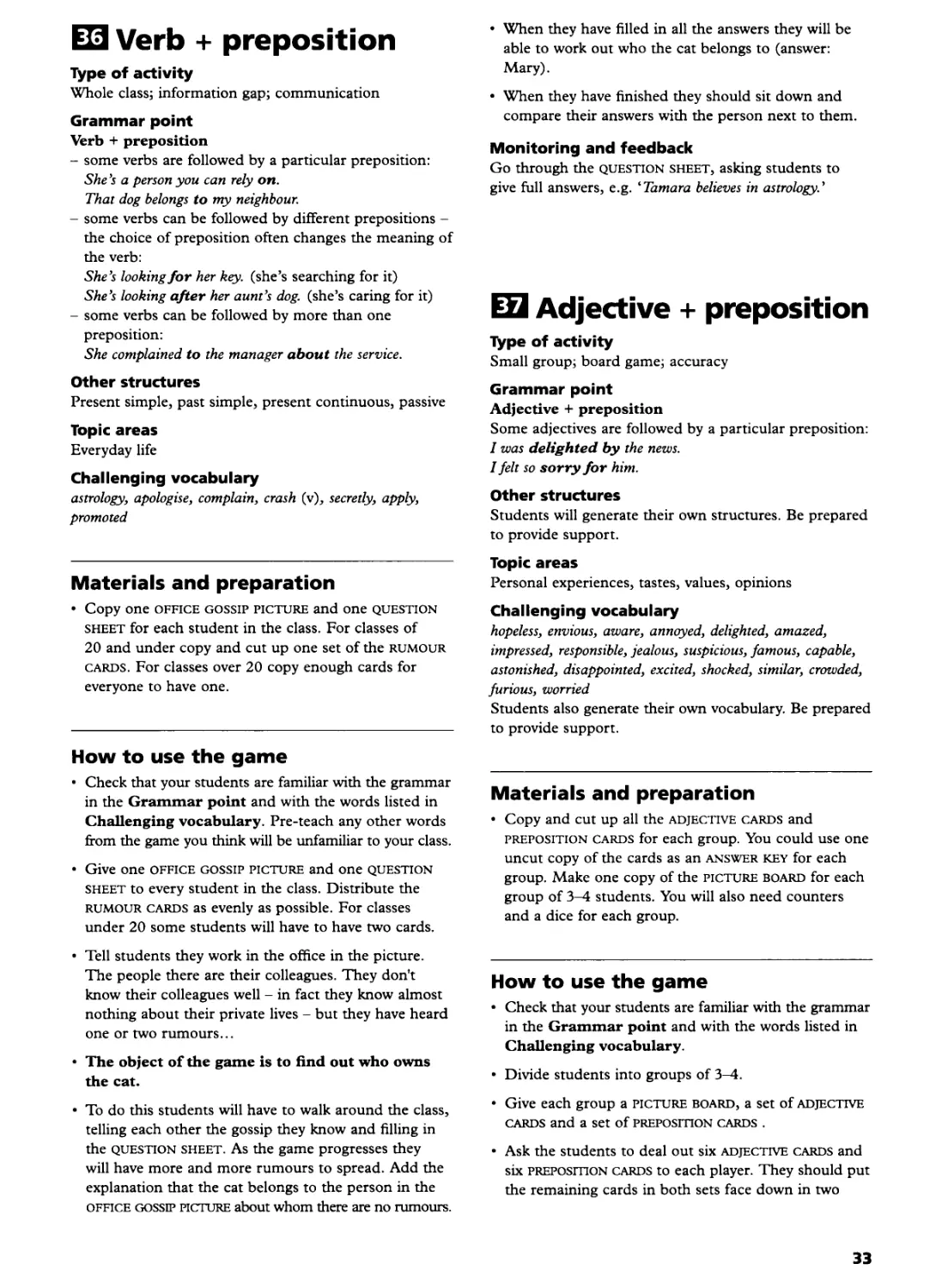
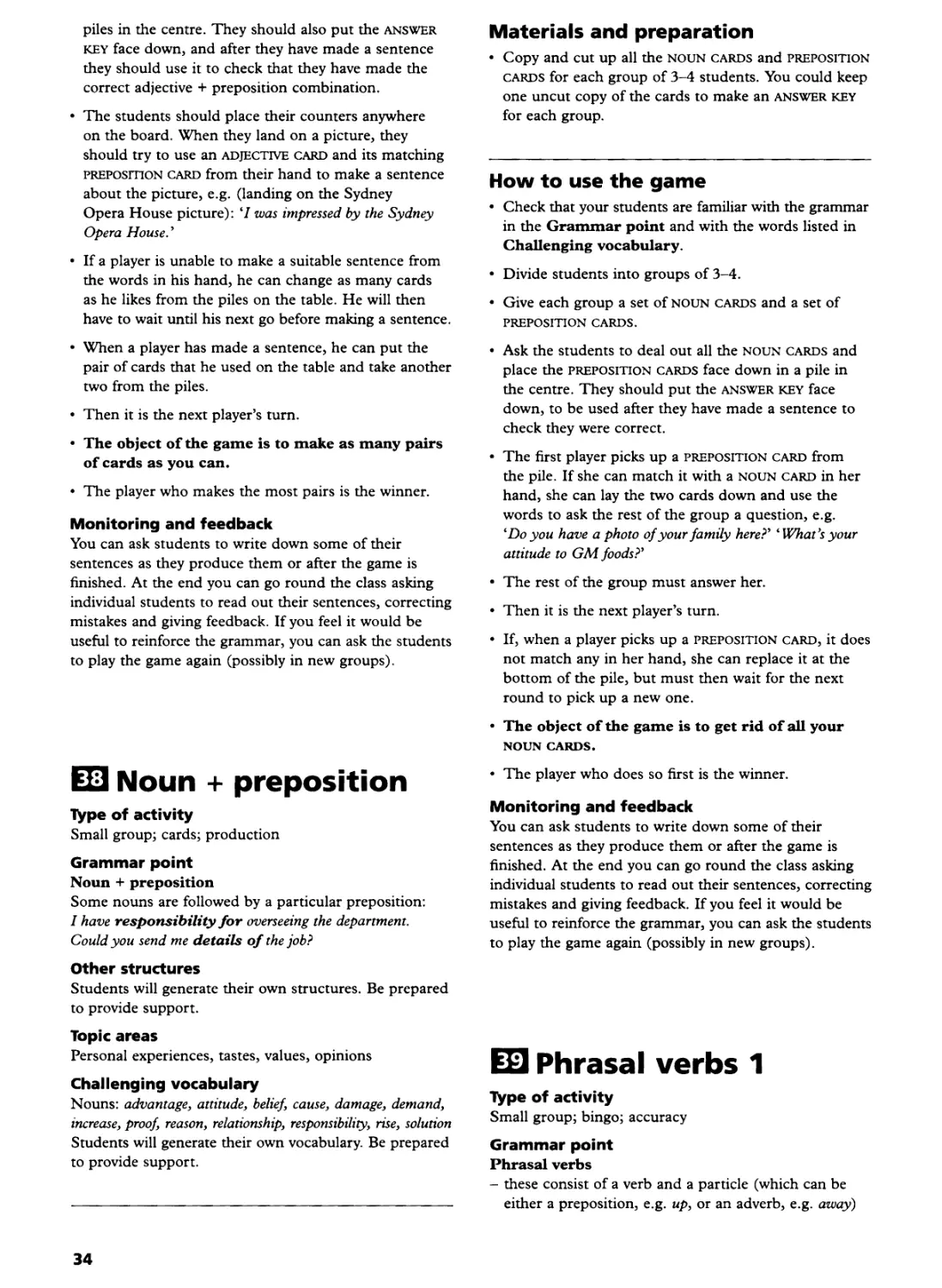
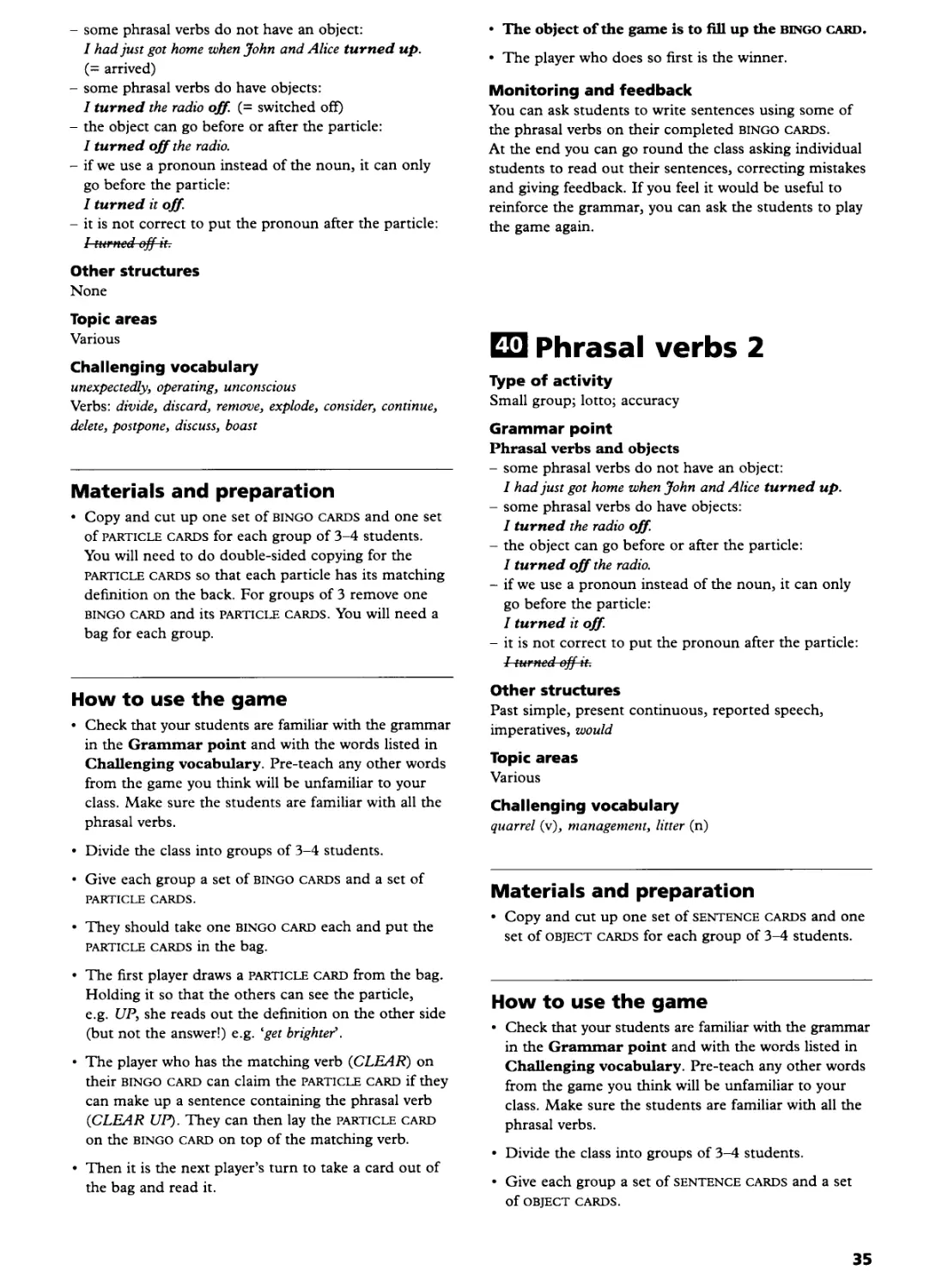

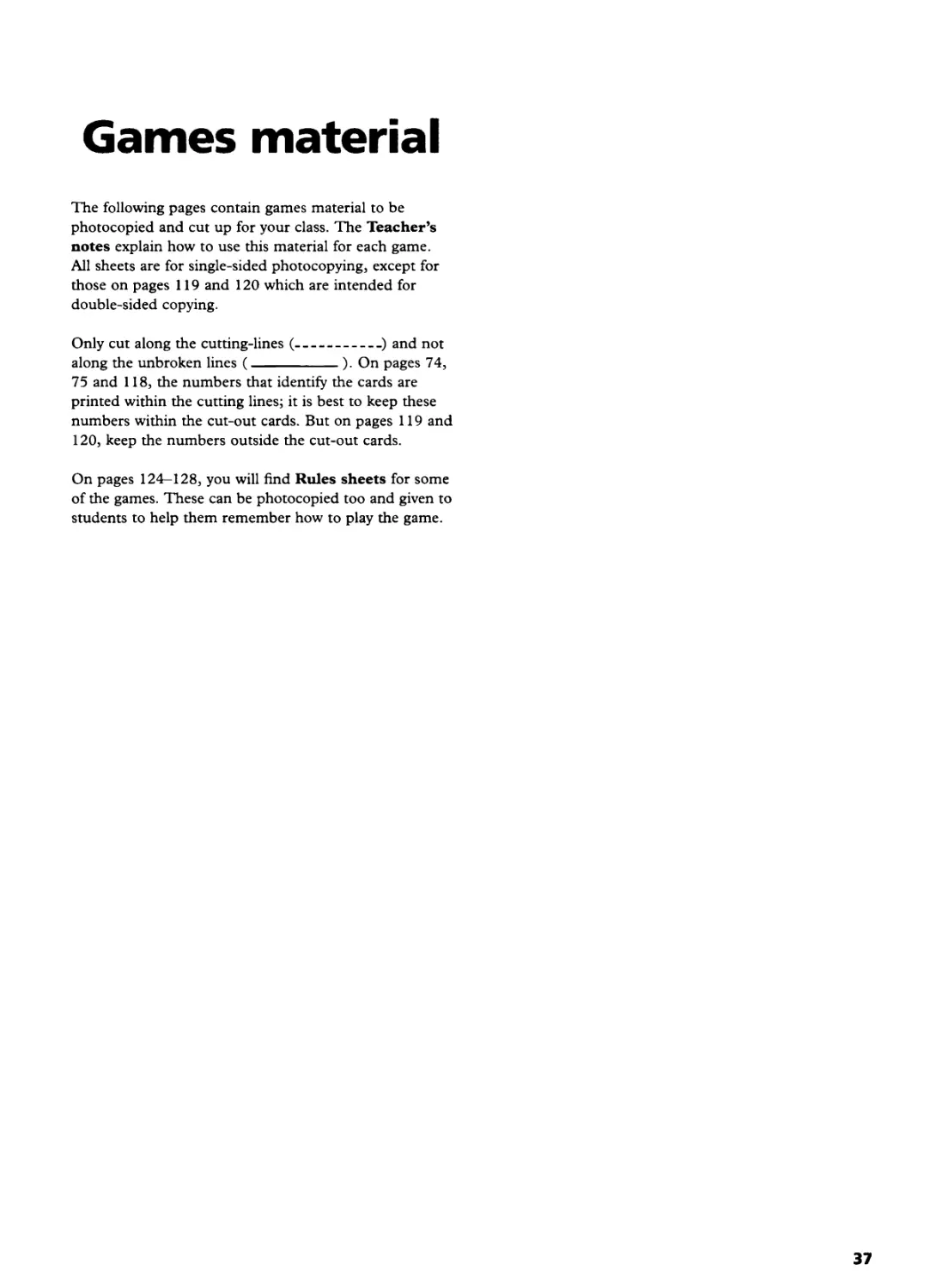
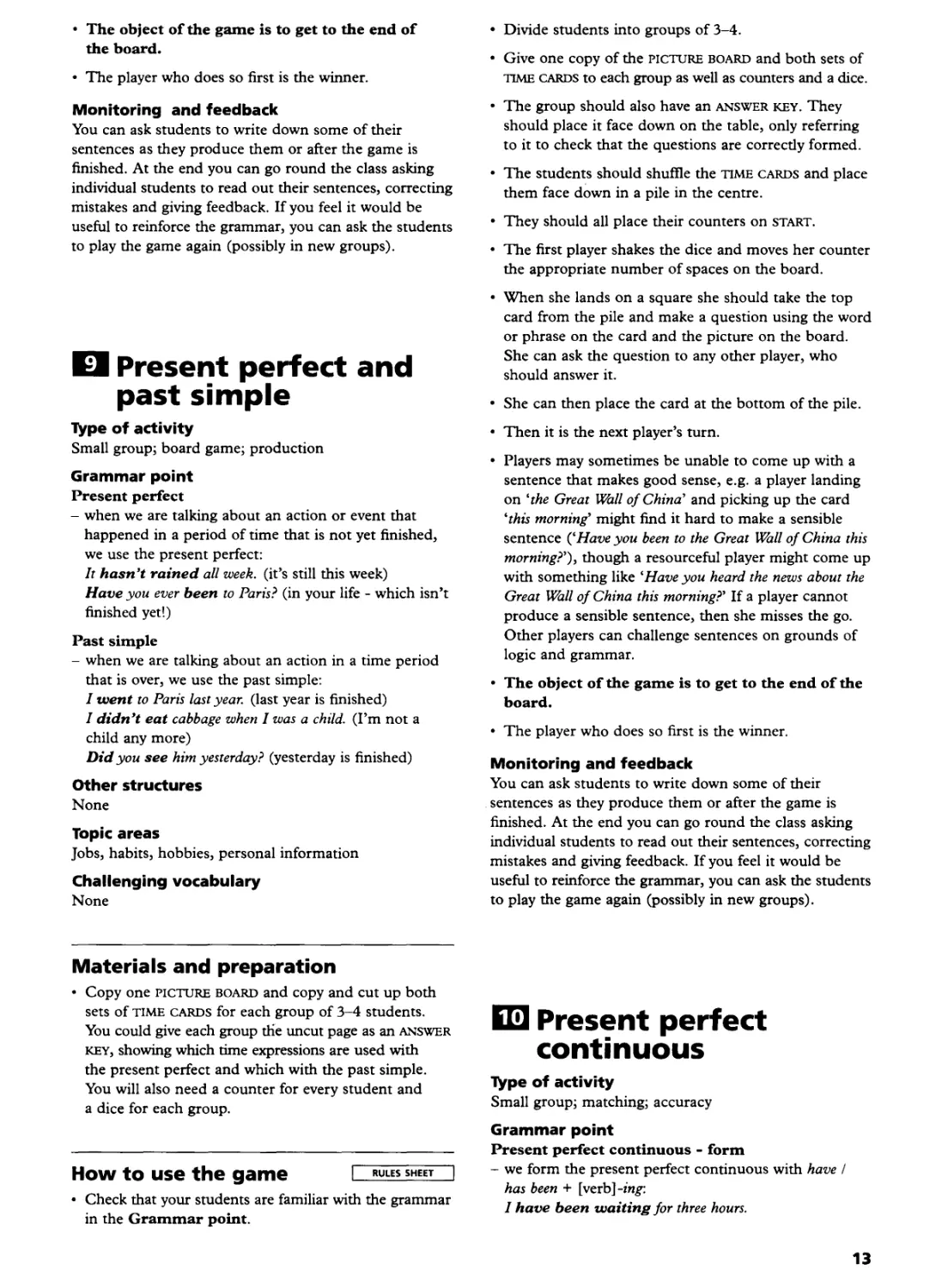







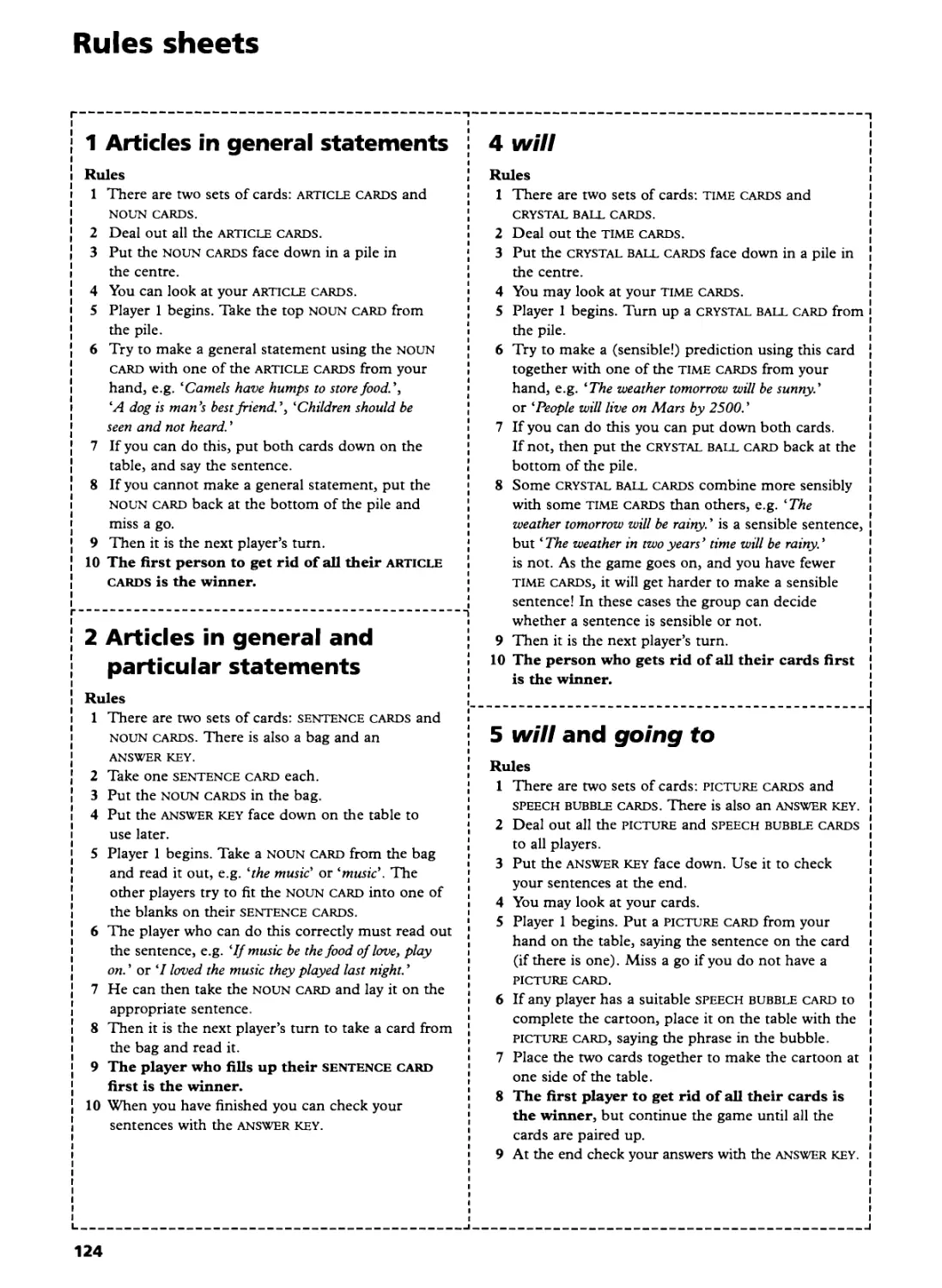
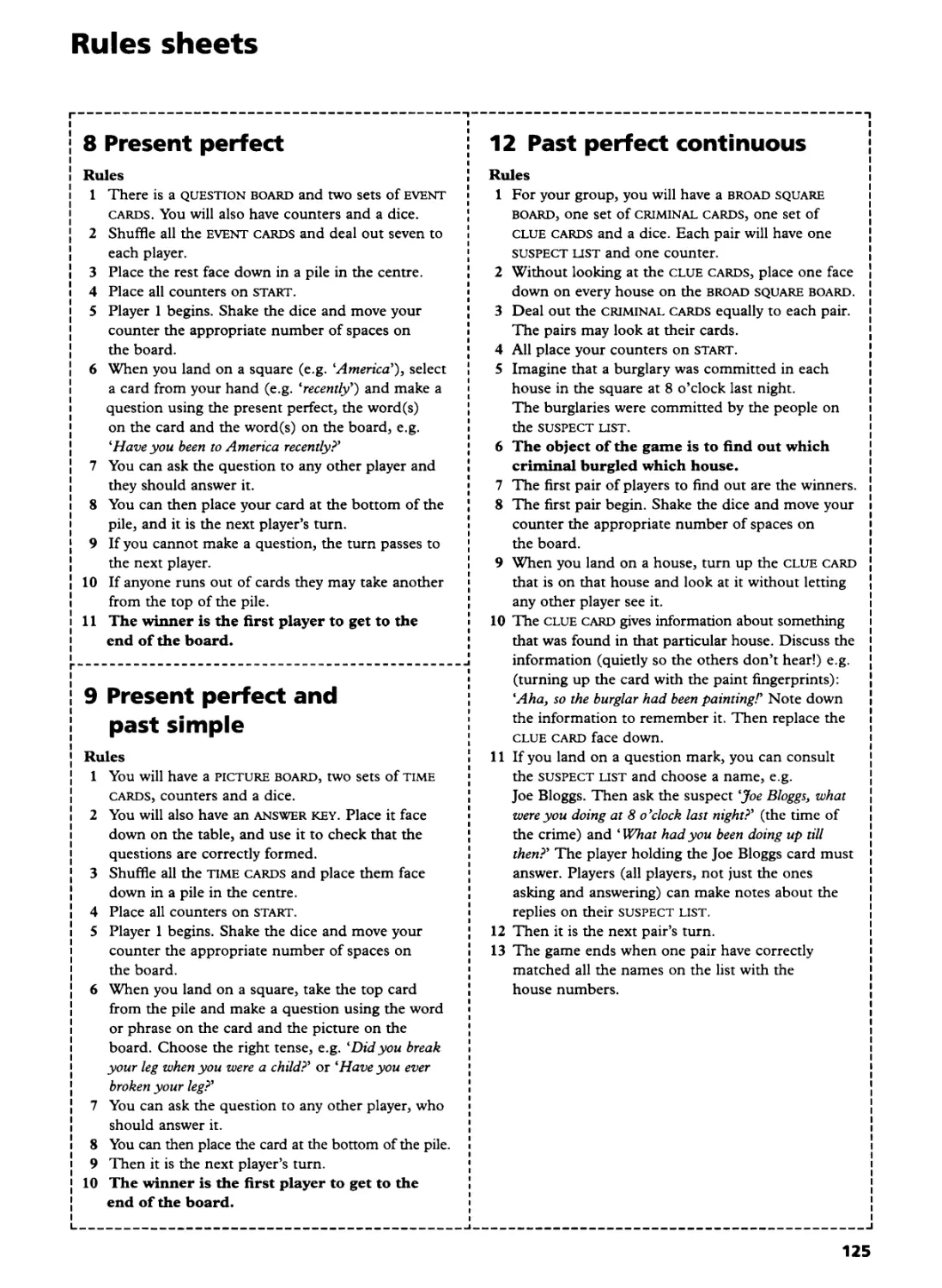
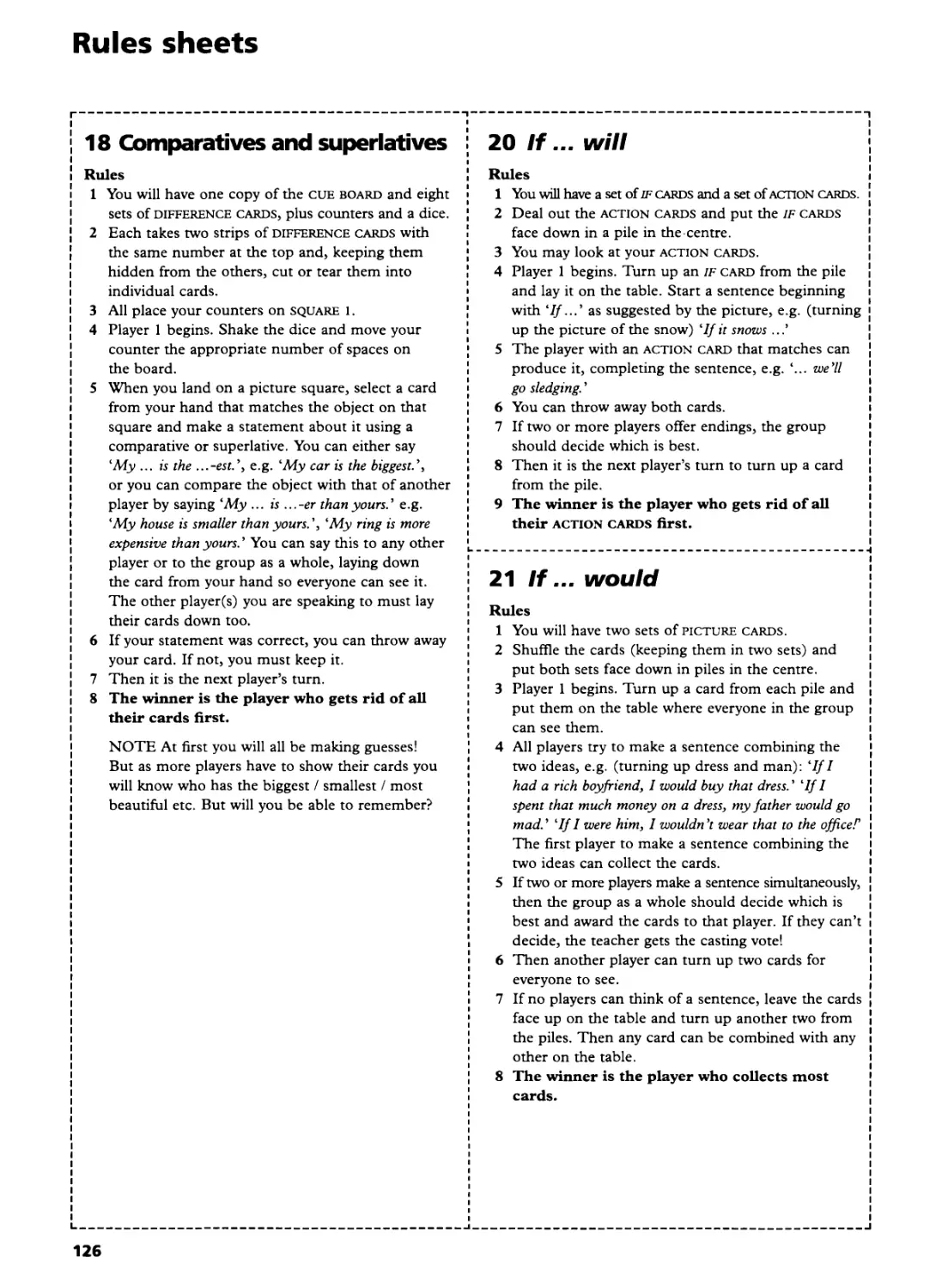
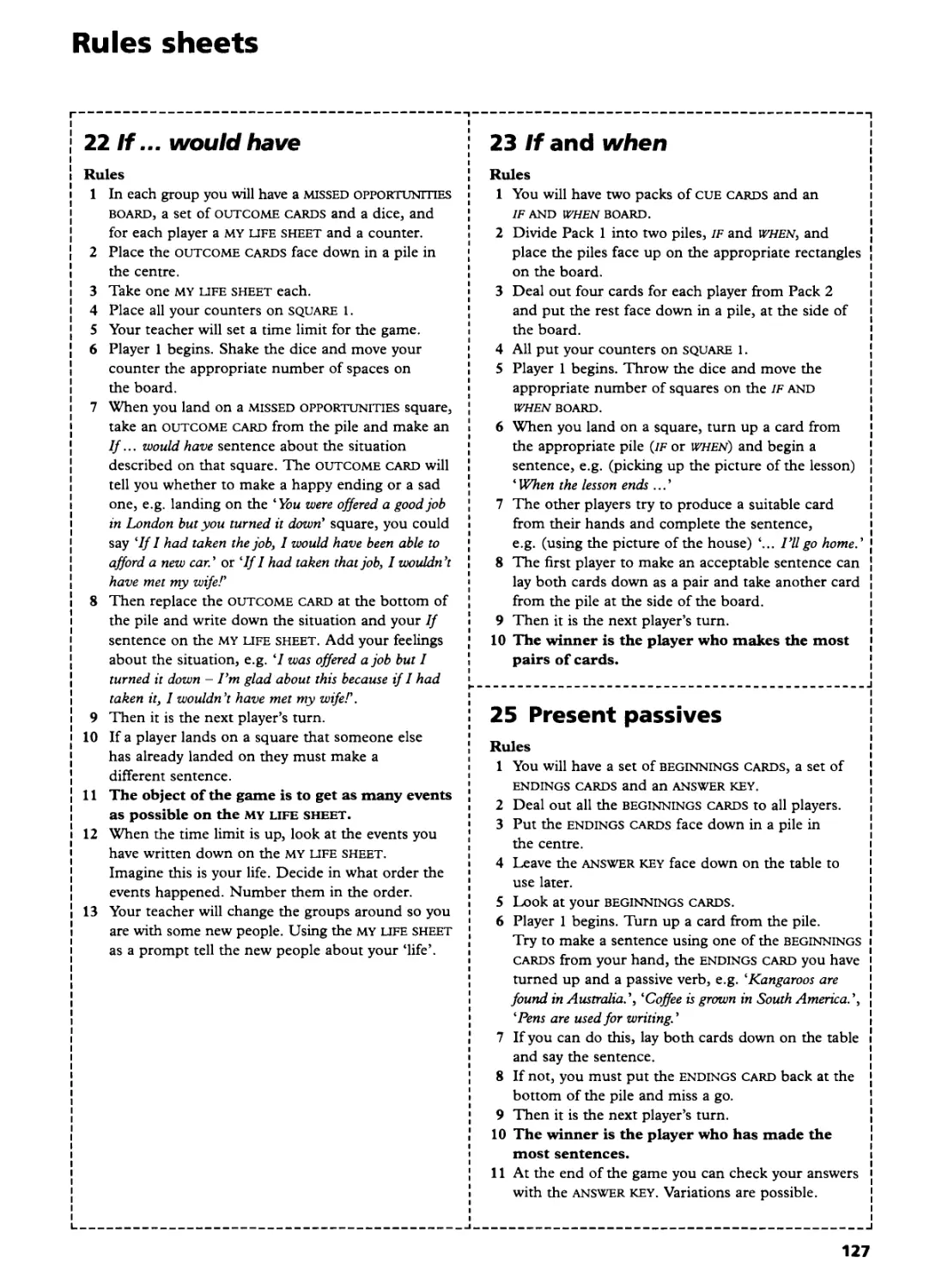


Текст
                    Longman
contains photocopiable material
www.longman.com

Intermediate
GRAMMAR
Games
A collection of grammar games and activities
for intermediate students of English
Jill Hadfield
photocopiable material

Pearson Education Limited
Edinburgh Gate
Harlow
Essex CM20 2JE
England
and Associated Companies throughout the world.
www.longman.com
© Jill Hadfield 2003
The right of Jill Hadfield to be identified as author of this Work has
been asserted by her in accordance with the Copyright, Designs and
Patents Act 1988
Permission to copy
The material in this book is copyright. However, the publisher grants
permission for copies of the pages in the sections from page 38 to 128
to be made without fees as follows: private purchasers may make
copies for their own use or for use by classes of which they are in
charge; school purchasers may make copies for use within and by the
staff and students of the school only. This permission to copy does not
extend to additional schools or branches of an institution, who should
purchase a separate master copy of the book for their own use.
For copying in any other circumstances prior permission in writing must
be obtained from Pearson Education Limited.
First published 2003
ISBN 0582 42964 1
Printed in Malaysia
Produced for the Publishers by Genevieve Talon
Designer: Trevor Sylvester, TSGD
Illustrated by: Gabrielle Morton (units 3, 9, 18, 21, 22, 24, 34, 36);
John Plumb (units 4, 8, 10, 12, 20, 23 [p 83], 29, 33, 35, 37);
Terry McKenna (units 5, 6, 11, 19, 23 [pp. 84-5], 31, 32)
With grateful thanks to David Lott, Liz Paren
and Genevieve Talon for their skilful and
patient editing of the various versions of
this book.
Jill Hadfield
In memory of
Gillian Porter Ladousse
inspiring writer, generous colleague, beloved friend

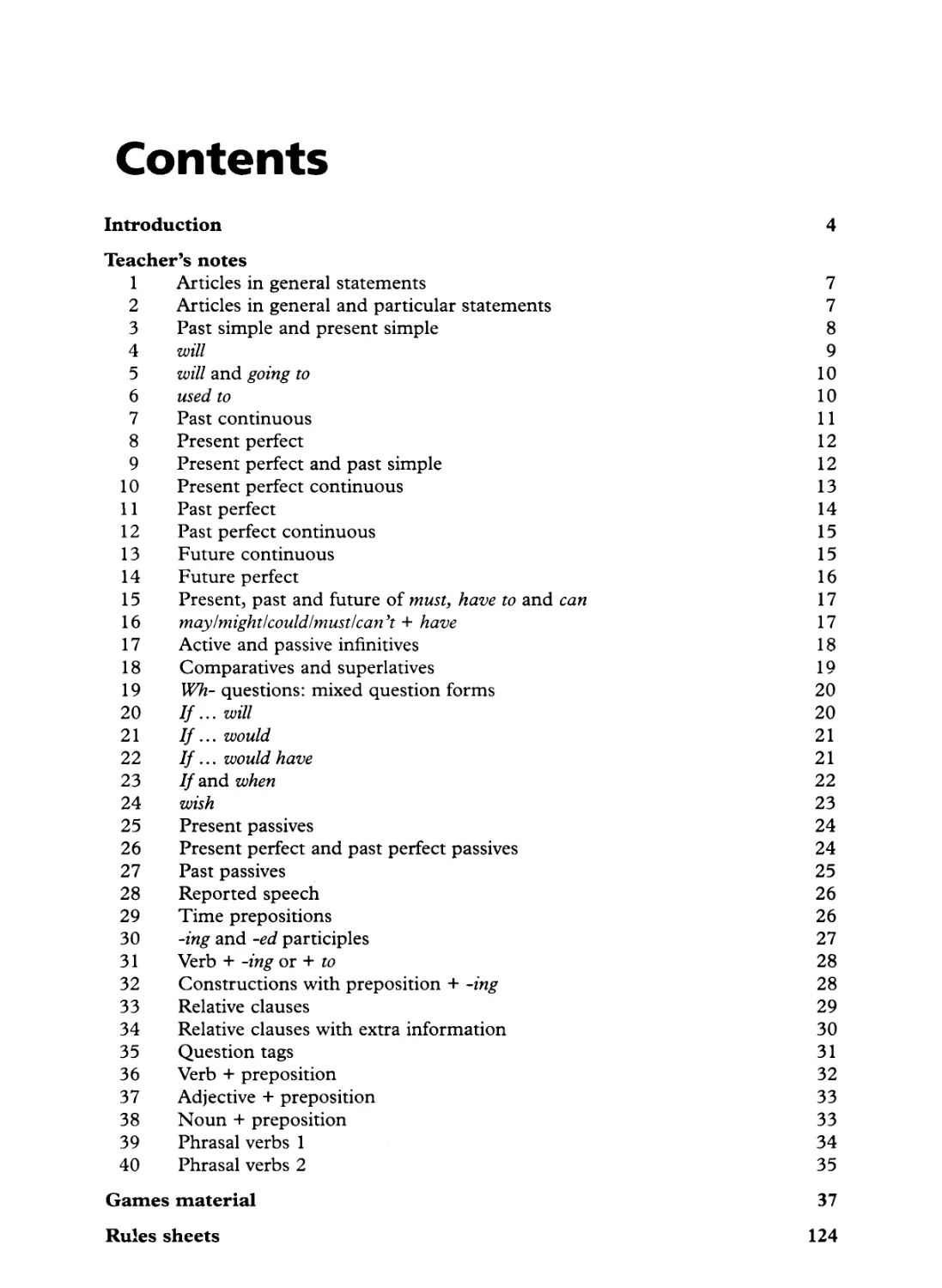
Contents
Introduction	4
Teacher’s notes
1	Articles in general statements	7
2	Articles in general and particular statements	7
3	Past simple and present simple	8
4	will	9
5	will and going to	10
6	used to	10
7	Past continuous	11
8	Present perfect	12
9	Present perfect and past simple	12
10	Present perfect continuous	13
11	Past perfect	14
12	Past perfect continuous	15
13	Future continuous	15
14	Future perfect	16
15	Present, past and future of must, have to and can	17
16	may/might/could/must/can’t + have	17
17	Active and passive infinitives	18
18	Comparatives and superlatives	19
19	Wh- questions: mixed question forms	20
20	If... will	20
21	If... would	21
22	If... would have	21
23	If and when	22
24	wish	23
25	Present passives	24
26	Present perfect and past perfect passives	24
27	Past passives	25
28	Reported speech	26
29	Time prepositions	26
30	-ing and -ed participles	27
31	Verb + -ing or + to	28
32	Constructions with preposition + -ing	28
33	Relative clauses	29
34	Relative clauses with extra information	30
35	Question tags	31
36	Verb + preposition	32
37	Adjective + preposition	33
38	Noun + preposition	33
39	Phrasal verbs 1	34
40	Phrasal verbs 2	35
Games material	37
Rules sheets	124

Introduction
1 About games
A game is an activity with rules, a goal and an element
of fun. There are two kinds of games: competitive games,
in which players or teams race to be the first to reach the
goal, and cooperative games, in which players or teams
work together towards a common goal.
Language games can be divided into two further
categories: linguistic games and communicative games.
In linguistic games, the goal of the game is linguistic
accuracy: in the case of these grammar games, using the
correct grammmatical forms. Communicative games have
a goal or aim that is not linguistic: successful completion
of the game will involve solving a puzzle or completing
a picture. However, in order to carry out this task it will
be necessary to use language and by careful construction
of the task it is possible to restrict the language to certain
grammatical structures and to ensure that these are
practised intensively.
In this book, there is a continuum between games
requiring strict linguistic accuracy at one end of the scale
and freer communicative games at the other. In what
1 have called accuracy games, there is only one right
answer, e.g. only one possible match for a pair of cards
or only one right word to fill a blank. In production games,
the players have more leeway to invent and create.
For example, there is more than one possible match for
pairs of cards, or players may be asked to complete
sentence frames in any way their experience or imagination
dictates. Communication games have a freer structure
where players may use a range of language, including
the target language, to reach their goal.
Games can be used at any stage of the lesson once the
target language has been introduced and explained.
They serve both as a memory aid and repetition drill
and as a chance to use language freely, as a means to
an end rather than an end in itself. They can also serve
as a diagnostic tool for the teacher, who can note areas
of difficulty and take appropriate remedial action.
2 About grammar
How do students acquire grammatical understanding and
accuracy? ‘With difficulty’ is a short answer, but it seems
to me that students adopt two main approaches (with,
of course, all sorts of variants and hybrids in between).
There are the analysts and the absorbers - those who like
to dissect language into little pieces to understand how
it is made, and those who swallow it whole in enormous
gulps without worrying too much about the recipe.
Different types of grammar practice exercises reflect
these two styles of learning. Some, like gap-filling, multiple
choice or word-order exercises, help students understand
and practise grammatical forms by getting them to segment
language and analyse its components. Other exercises, like
grammar drills, work by presenting students with grammatical
patterns to repeat and imitate, to help students absorb
the language without pausing for too long to analyse it.
Some of the games in this book function more like the
first type of practice exercise, some more like the second.
3 About this book
The games in this book have been designed to practise
grammar, not to introduce or explain it. This book assumes
that the class has already met each grammar point, and
that it has been explained in the textbook or course that
they are following. The games are to be used as practice
exercises to help students get used to and remember
grammatical rules and patterns. They are designed as fun
activities to help lighten the load of grammar learning.
It is up to you, the teacher, to decide when and how to
use them, but one suggestion is as light relief at the end
of a lesson which has focused on grammar or after a session
doing more traditional, perhaps written, grammar exercises.
Types of game
Some games in the book are what could be called ‘choice’
games. These tend to be more analytic, based on the
conscious application of a grammar rule. In them the
players have to choose the correct linguistic form, rather
as in traditional grammar exercise types such as gap-fill,
sentence completion, multiple choice, etc. The difference
is not only that they are in game format, which means they
are more fun and lighter-hearted, but also that in most
cases there is a context for the game, whereas most
grammar exercises are a collection of unrelated sentences.
The context is very often the students’ own experiences,
tastes and preferences since I believe that a personal
element gives emotional colour to an exercise and this is
a valuable memory aid - if you have invested something
of yourself in an exercise you are less likely to forget it.
(Besides which, it’s fun!)
These are the types of ‘choice’ games in the book:
matching: e.g. matching two words or phrases, matching
half-sentences or matching words and pictures
ordering: e.g. ordering words to make a sentence, or
ordering pictures and words to make as long a sentence
as possible
completing, completing incomplete sentences or questions
competitions: e.g. see how many sentences you can make,
how quickly you can unmuddle sentences
card games and other familiar game types: e.g. bingo,
Pelmanism, happy families, consequences, board games,
dominoes
memory games', e.g. seeing how many sentences players
can remember
4

Other games, which could be called ‘reinforcement’
games, work more like substitution drills or pattern
practice, getting students to internalise rules by repetition
of patterns. These games are designed to provide
intensive repetition of a grammatical structure or structures,
but within a meaningful context - and, since these are
games not drills, the repetition has a purpose: students
are working towards winning or completing the game.
These are the types of ‘reinforcement’ games in the book:
information gap games: one player has access to some
information not held by the other player or players,
who must acquire this information to complete a task
successfully. This type of game may be one-sided, or
reciprocal (where both players have information which
they must pool to solve a common problem). The games
may be played in pairs, or in small groups (where all
members of the group have some information).
guessing games: a familiar variant on this principle.
The player with the information deliberately withholds
it, while others guess what it might be.
searching games: another variant, involving the whole class.
In these games everyone in the class has one piece of
information. Players must obtain all or a large amount
of the information available to fill in a chart or picture or
to solve a problem. Each student is thus simultaneously
a giver and a collector of information.
matching games: these may also involve a transfer of
information. They involve matching corresponding pairs
of cards or pictures, and may be played as a whole-class
activity, where everyone must circulate until they find
a partner with a corresponding card or picture, or a
pairwork or small group activity, played as a card game
on the ‘snap’ principle.
memory games', players compete to remember as much
information or as many sentences as possible.
All the above activities may include elements of role-
play or of simulation. In role-play games, players are
given the name and some characteristics of a fictional
character. These are not role-plays in the true sense,
as the role-play element is always subordinate to the use
of language. The outcome of a game is ‘closed’: once
cards are distributed it develops in a certain predetermined
way, while role-play proper is open-ended and may develop
in any number of ways.
4 Practical considerations
Classroom management
There are three main types of activites in this book:
pairwork, involving two partners; small-group work,
involving groups of three or four or more; and whole-
class activities, where everyone moves freely around the
room. All these activities require some flexibility in the
constitution of groups and organisation of the classroom.
It is best to have the desks or tables in a U-shape if
possible. Students can then work with the person sitting
next to them for pairwork, and groups of threes and fours
can easily be formed by alternate pairs moving their chairs
to the inner side of the U, opposite another pair. Whole-
class activities, which involve all the students circulating
freely, can take place in the empty area in the centre of
the U-shape. If it is not possible to arrange desks in this
way, this need not deter you: the traditional arrangement
of front-facing desks can be easily adapted to pairwork,
with people at adjoining desks working together, while
small groups can be formed by two people turning their
chairs round to face the people behind them. Whole-class
activities present a little more of a problem, but often
there is a space big enough for the students to move
around in at the front of the class, or desks can be pushed
back to clear a space in the centre.
Sometimes an alternative small-group version of the
whole-class games in this book has been provided, so that
teachers who experience a great deal of difficulty with
the kind of games that require students to move around
can play these games in a more static format.
Games are best set up by demonstration rather than
by lengthy explanation. The teacher should explain briefly
what the game involves, hand out the photocopied cards,
make sure students have pen and paper if needed, give
them a little time to study the cards, and then demonstrate
the game with one of the students in front of the class.
It will be found that the idea of the game is probably
easier for students to grasp from seeing the cards than
from a verbal explanation, and that as they become more
familiar with the idea of the games and the techniques
used, any initial problems caused by unfamiliarity will
quickly disappear. Where more complicated card games
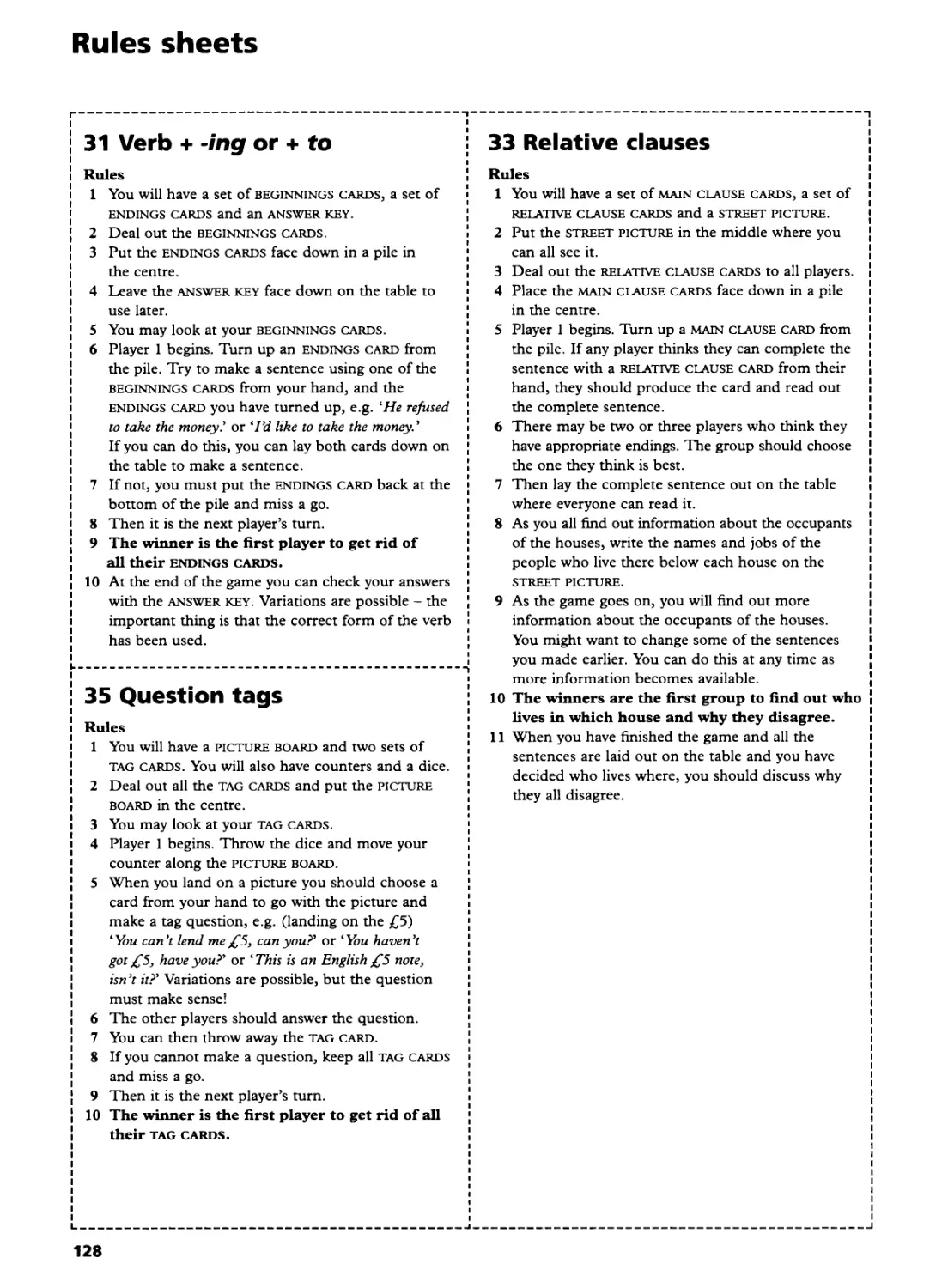
are played in small groups, a Rules sheet is provided and
it is suggested that teachers hand out a photocopy of
this to each group of students together with the cards.
These games are indicated in the Teacher’s notes with
the symbol | rules sheet |.
The teacher’s role in all these activities is that of
monitor and resource centre, moving from group to group,
listening, supplying any necessary language, noting errors,
but not interrupting or correcting as this impedes fluency
and spoils the atmosphere. It is a good idea to carry paper
and pen and to note any persistent errors or areas of
difficulty. These can then be dealt with in a feedback
session after the game. Various suggestions have been
given at the end of each game for monitoring accuracy
and giving feedback after the game. Some games are
self-checking and have an answer key. In some cases
students can be asked to give examples of things they
said during the game, in others they can be asked to
write down (some of) the sentences they produce and
read them out at the end. In many cases the game can
then be played again with different partners or, if
possible, with different cards. This is a particularly good
idea if there have been persistent errors.
The average length of time for the games in the book
is about 15 to 20 minutes.
Resource management
The resources required for each game fall into two
categories: reusable and disposable. Where a very small
number of photocopies are needed for a whole-class
game or where students may write on their cards, it is
best to treat these photocopies as disposable, and there
is no point in collecting up the photocopies in order to
use them with another class when the game is finished.
In contrast, some of the games require a larger number
of copies and an investment of the teacher’s time in accurate
5

copying, cutting up and sorting, so it is worthwhile
thinking of these materials as reusable resources and
investing some time in making the photocopies into a
permanent class set of materials. If you have the time
and resources, obviously printing or pasting the materials
onto card or laminating them would help preserve their
shelf-life. However, this isn’t absolutely necessary - I have
sets of games materials printed only onto paper that have
done their duty in workshops all over the world and aren’t
much the worse for wear after several years.
What is more important is providing a system to
prevent the materials getting lost and disorganised. If you
have a class set of ten packs of cards, for example, it is
worth putting each pack into an envelope clearly labelled
with the name of the game and the number of cards.
It is then the students’ responsibility to collect up all the
cards at the end of the game, check that they are all there,
put them back into the envelope and hand them back to
you. If two packs of cards are required for a game, keep
them in two smaller envelopes inside the big one, and
get the students to sort them back into their respective
envelopes at the end of the game.
Finally, if you have no access to copying facilities at
all, it is possible, though time-consuming, to make
home-made versions of the materials by getting the
students to work with you to draw and write the cards.
6

Teacher's notes
D Articles in general
statements
type of activity
Small group; matching; production
Grammar point
Articles in general statements
- we use a with a singular countable noun:
A spider has eight legs.
- we use no article with plural nouns:
Politicians like their own voices.
- we use no article with uncountable nouns (e.g. money,
love, music, intelligence, sorrow, anger, happiness, food, ice):
Money makes the world go round.
Other structures
Present simple
Topic areas
General truths and well-known facts
Challenging vocabulary
camel, politician, fool (n), desert (n), brain, intelligence,
excitement, spider
and one of the article cards from her hand, e.g.
‘Camels have humps to store food.’, ‘A dog is man’s best
friend’, ‘Children should be seen and not heard’, she can
discard both cards. If she makes a grammatically
incorrect sentence, the other students can query it
(e.g. ‘Rose is a beautiful flower.’ ~ 'Is that right?
Shouldn’t it be “A rose is a beautiful flower”?’).
• If she cannot make a general statement, she should
put the noun card back at the bottom of the pile and
must miss a go.
• Then it is the next player’s turn.
• The object of the game is to get rid of all your
ARTICLE CARDS.
• The first person to do so is the winner.
Monitoring and feedback
You can ask students to write down some of their
sentences as they produce them or after the game is
finished. At the end of the game you can go round the
class asking individual students to read out their sentences,
correcting mistakes and giving feedback. If you feel it
would be useful to reinforce the grammar, you can ask the
students to play the game again (possibly in new groups).
Materials and preparation
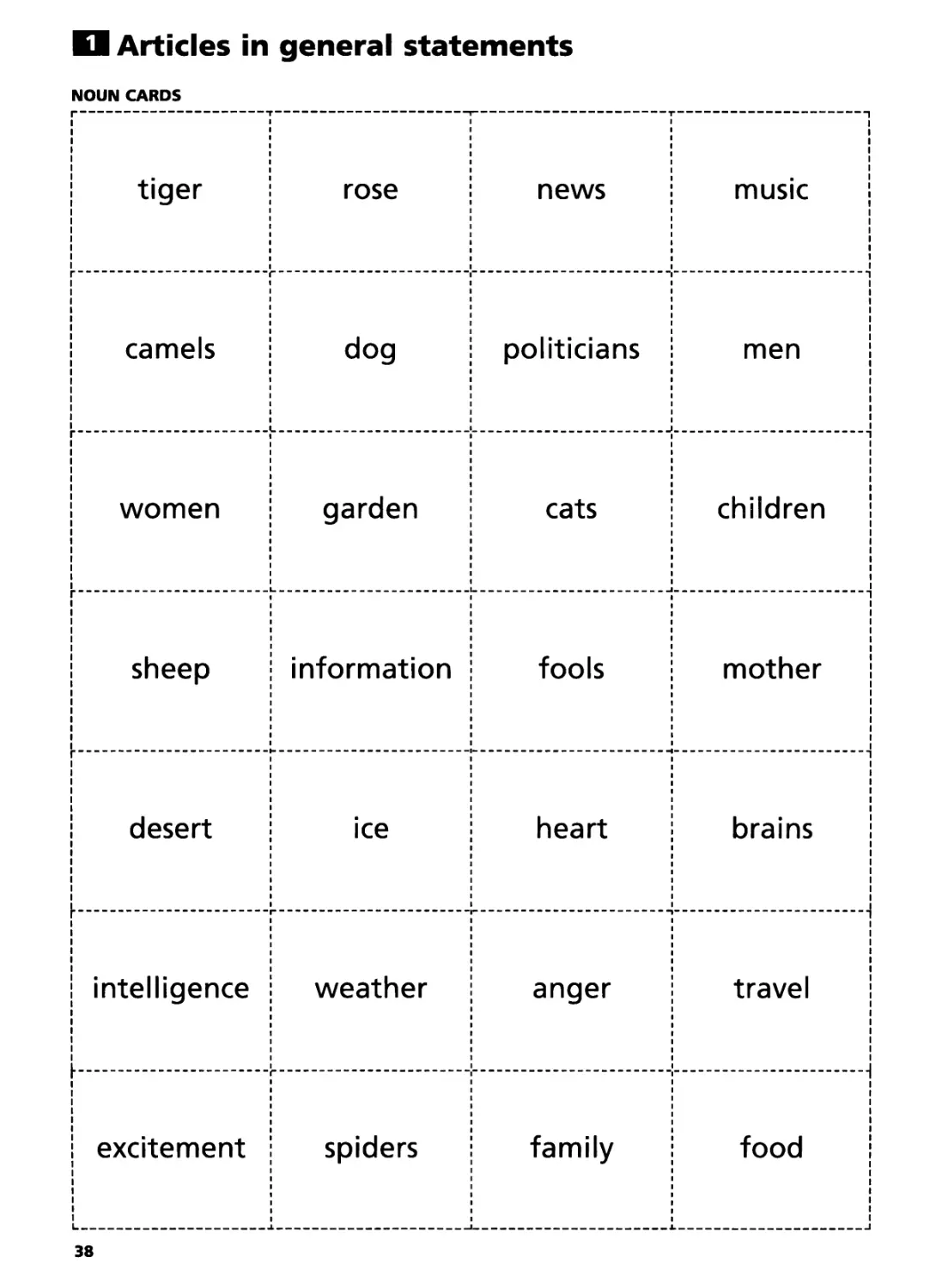
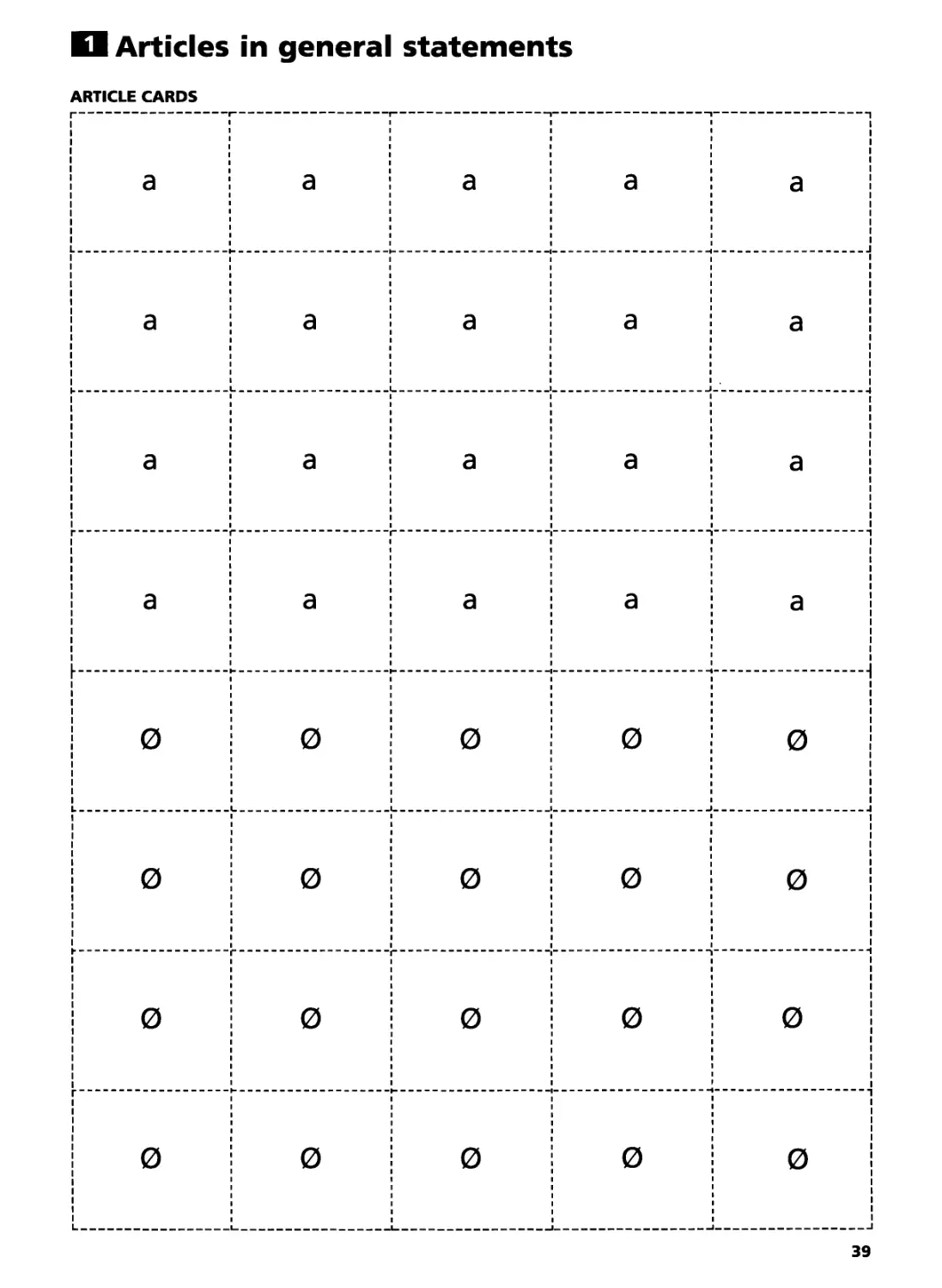
• Copy and cut up one set of noun cards and one set
of article cards for each group of 3-4 students.
Note that on the cards, ‘no article’ is shown by the
symbol 0.
How to use the game I rules sheet |
• Check that your students are familiar with the grammar
in the Grammar point and with the words listed in
Challenging vocabulary. Pre-teach any other words
from the game you think will be unfamiliar to your class.
• Divide the class into groups of 3-4 students.
• Give each group a set of article cards and a set of
NOUN CARDS.
• Ask them to deal out all the article cards among
the players.
• They should put the noun cards face down in a pile
in the centre.
• They may look at their article cards.
• The first player turns up a noun card from the pile.
If she can make a general statement using this card
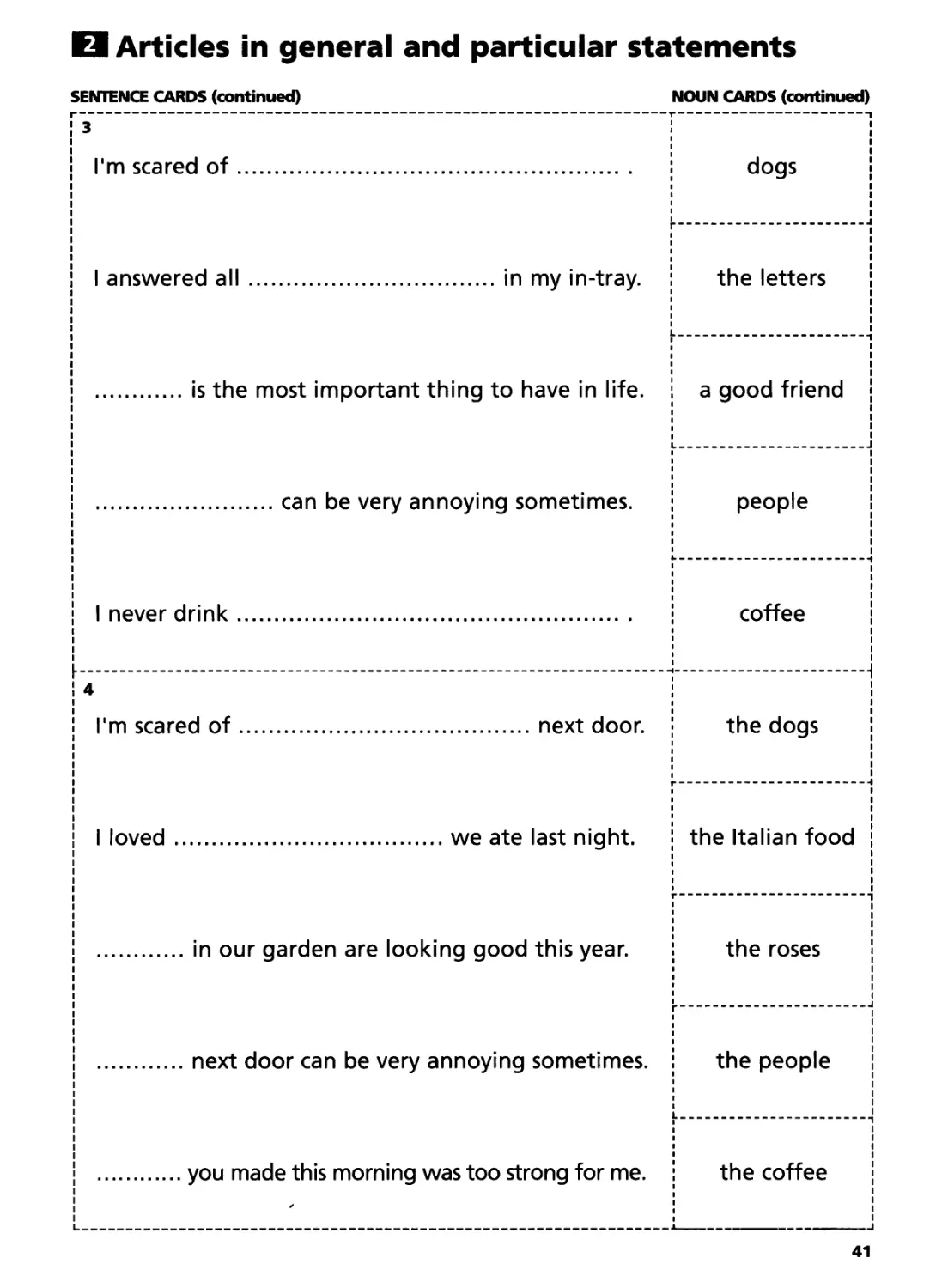
B Articles in general and
particular statements
type of activity
Small group; bingo; accuracy
Grammar point
Articles in general statements
- we use no article with plurals or uncountable nouns
when making general statements:
It’s important to have good friends.
I love music.
- we usually use a with singular countable nouns:
A dog is man’s best friend.
- we sometimes use the to give a general statement
a scientific tone:
The tiger is an endangered species.
Articles in particular statements
- we can use a or the when we talk about particular things
- we use the when we can make it clear which particular
thing or things we are talking about:
I loved the music they played last night.
7

- we use a when we cannot:
I saw a fox in the garden last night.
Other structures
Present simple, present continuous, past simple, past
continuous, superlatives, relative clauses (recognition only)
Topic areas
Various
Challenging vocabulary
endangered species
Materials and preparation
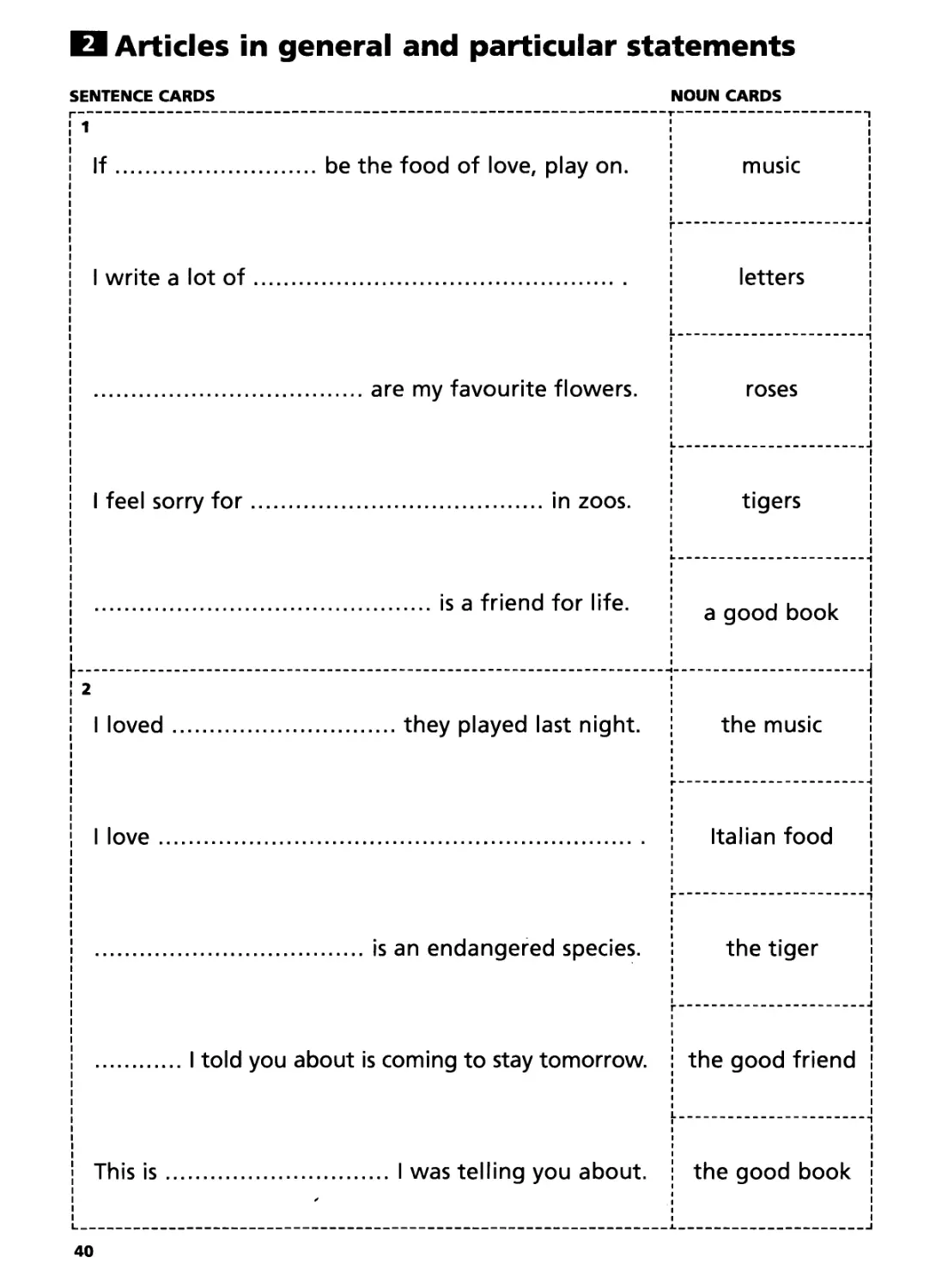
• Copy and cut up one set of sentence cards and one
set of noun cards for each group of 3-4 students.
(For groups of 3 students leave out the fourth card.)
You will need a bag for the noun cards. You might
like to make a copy of the uncut pages for each group
to act as an answer key.
How to use the game I rules sheet~|
• Check that your students are familiar with the grammar
in the Grammar point and with the words listed in
Challenging vocab\ilary. Pre-teach any other words
from the game you think will be unfamiliar to your class.
• Divide the class into groups of 3-4 students.
• Give each group a set of sentence cards, a set of
noun cards, a bag and an answer key.
• Ask the students to take one sentence card each.
• They should put the noun cards in the bag.
• They should put the answer key face down on the
table for later use.
• The first player draws a card from the bag and reads
it out, e.g. ‘the music' or ‘music'.
• The player who can fit the noun card into one of the
blanks on his sentence card can claim the noun
card by reading out the completed sentence, e.g.
‘ If music be the food of love, play on.' or ‘7 loved the
music they played last night.' He can then lay it on the
appropriate sentence. If the other students think
that the sentence is not correct, they can query it, and
the player can change his sentence (e.g. ‘If the music be
the food of love ...' ~ ‘Is that right? Shouldn't you say “If
music be the food of love ... ”? ' ~ ‘Yes. you're right.'). If
the issue is still in doubt, they can call the teacher to
decide.
• Then it is the next player’s turn to take a card from
the bag and read it.
• The object of the game is to fill up the sentence
card.
• The player who does so first is the winner.
• When the students have finished they can check their
sentences with the answer key.
Monitoring and feedback
At the end of the game you can go round the class asking
individual students to read out the sentences on the cards,
correcting any mismatched cards, and giving feedback.
Past simple and
present simple
Type of activity
Game 1: Small group; ordering; accuracy
Game 2: Small group; information gap; communication
Grammar point
Past simple and present simple
- we use the present simple for actions repeated every
day or sometimes:
I go to work at 8 every morning.
- we use the past simple for an action in the past:
I went to the interview at 10.
Other structures
None
Topic areas
Leisure activities, habits, appointments
Challenging vocabulary
None
Materials and preparation
Game 1
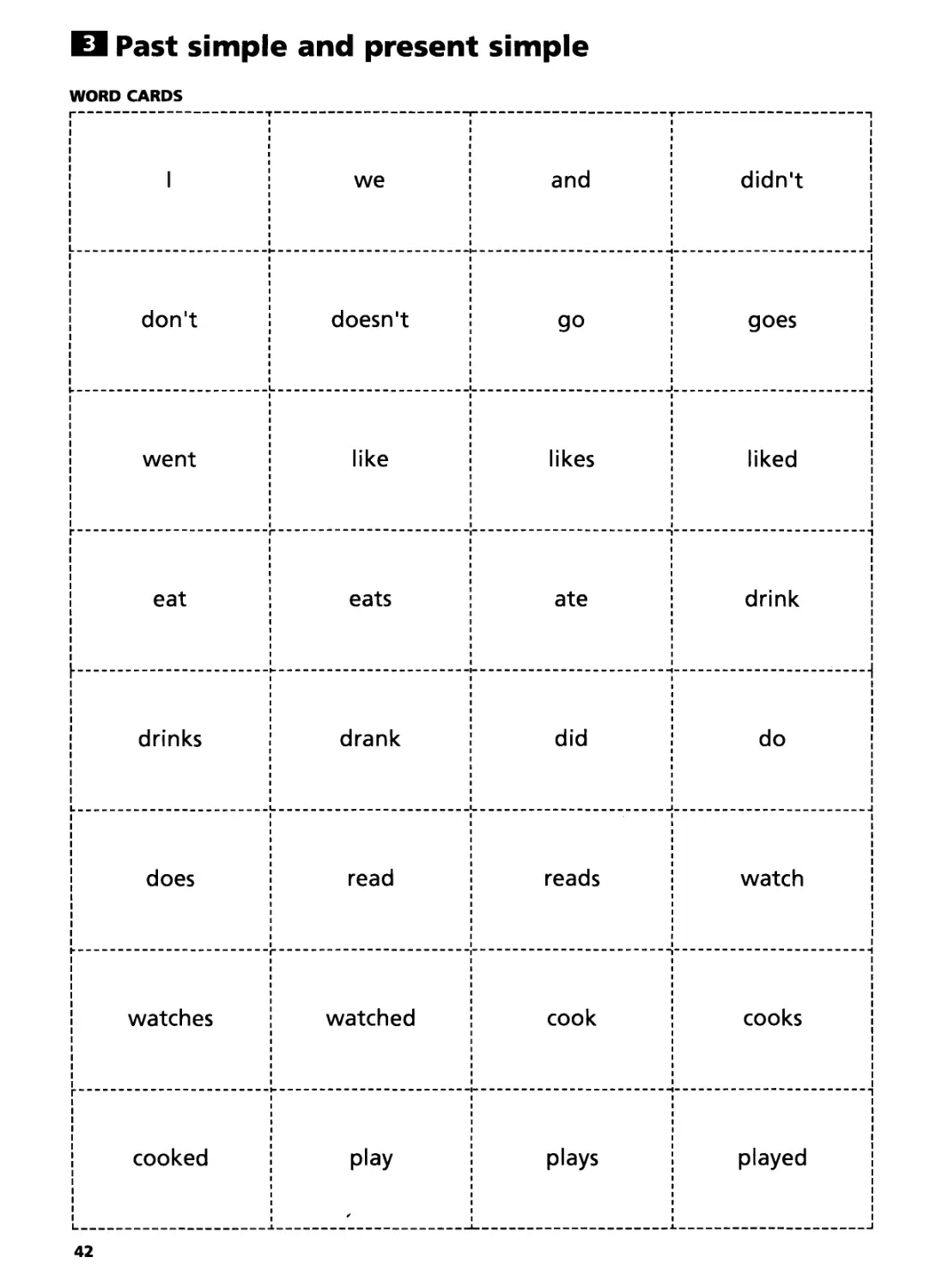
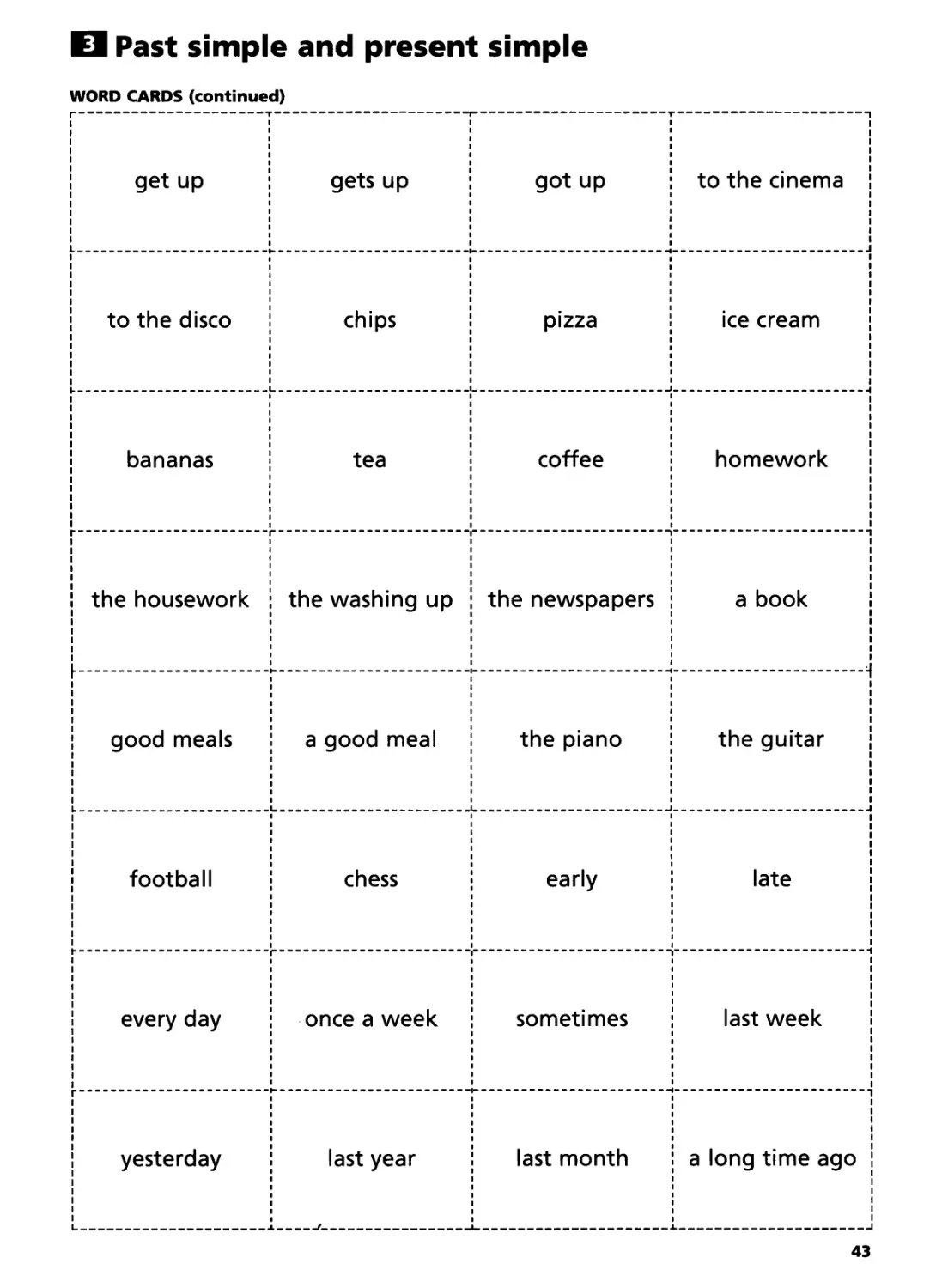
• Copy and cut up one set of word cards for each
group of 3-4 students. You will also need to cut out
one blank card for each student.
Game 2
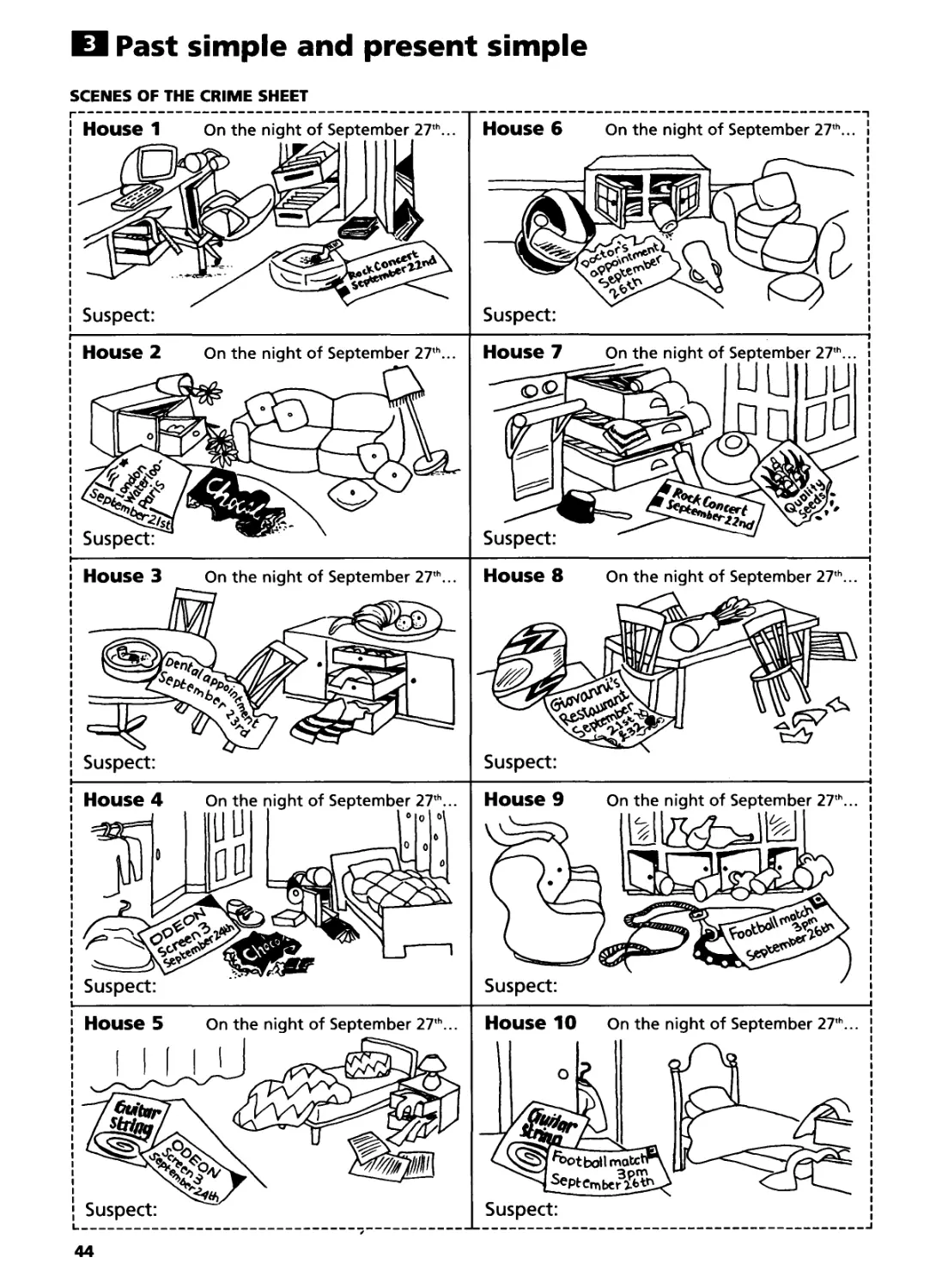
• Copy the scenes of the crime sheet and copy and
cut up one set of suspects cards for each group of
3-4 students.
How to use the games
Game 1
• Check that your students are familiar with the grammar
in the Grammar point. Pre-teach any words from
the game you think will be unfamiliar to your class.
• Divide the class into groups of 3—4 students.
• Give each group a set of word cards.
• Ask them each to write their name on one of the
blank cards.
• Ask them to spread all the cards out face up on
the table.
• The object of the game is to make as many
sentences as possible that are true for their group.
3
8

• Students may use word cards more than once.
They should write their sentences down as they
produce them.
• Give a time limit of say 5-10 minutes.
• At the end the group with the longest list of sentences
is the winner.
Game 2
• Divide the class into groups of 3-4.
• Give each group a copy of the scenes of the crime
sheet.
• Tell them that this shows houses that were burgled on
the night of September 27th. In each house the burglar
left in a hurry, leaving some objects behind. These clues
are illustrated on the rooms.
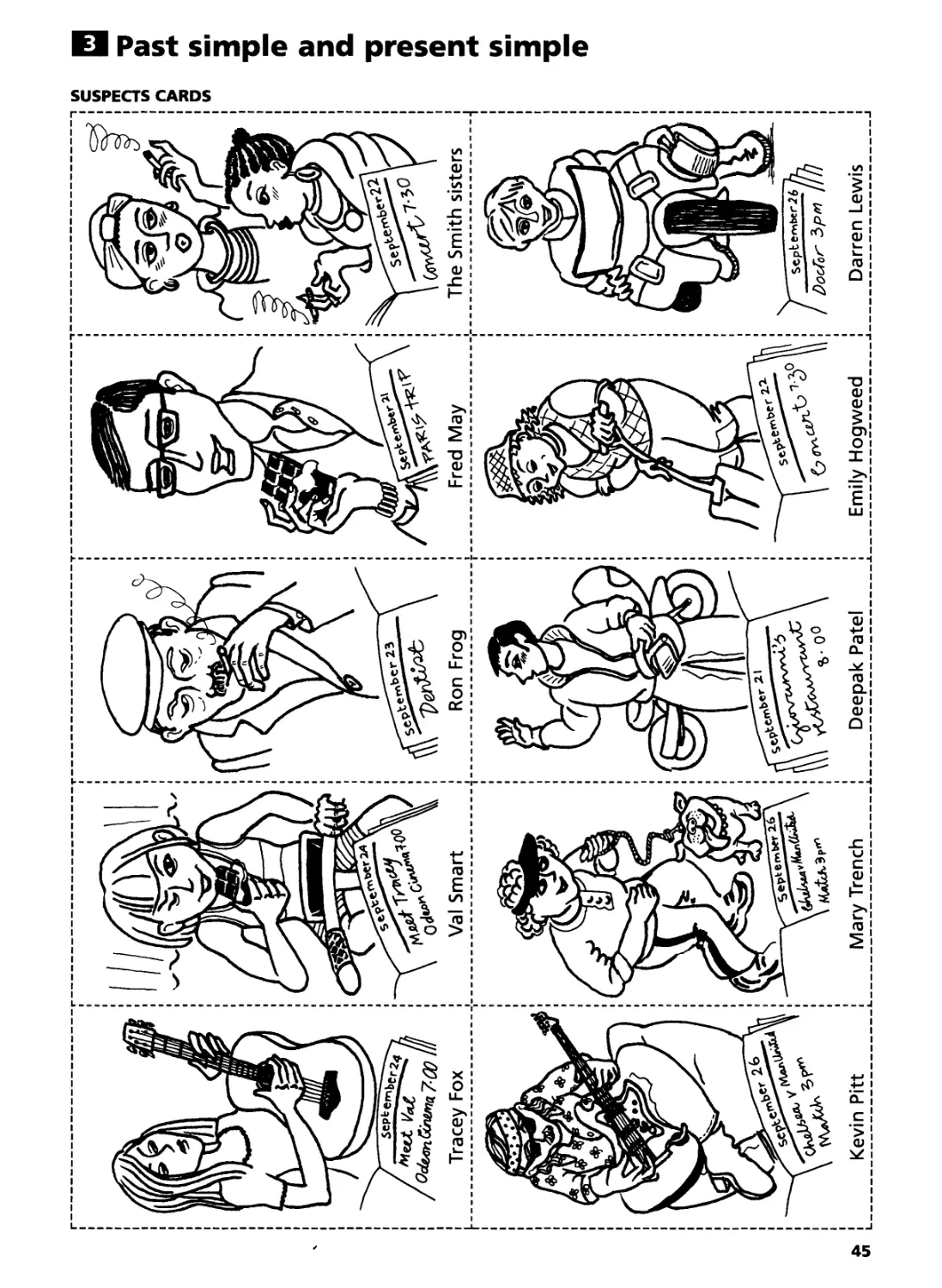
• Give each group a set of suspects cards.
• Ask them to put the suspects cards face down in a
pile on the table.
• The object of the game is to find out which suspect
committed each crime.
• The first player takes the top suspects card from
the pile.
• She should look at it but should not show it to the others.
She tells them the name(s) of the suspect(s).
• The others must ask questions based on the clues in
the SCENES OF THE crime sheet to find out more
about the suspect and to match the suspect with the
crime, e.g. ‘Does he smoke?’, ‘Did he go to a concert on
September 22nd?’
• The first player may only say ‘ Yes’ or 'No’.
• When the group have matched the suspect to the crime
they should fill in the name on the scenes of the
CRIME SHEET.
• Then it is the next player’s turn to take a card from
the pile.
• The group who are able to fill in all the names of the
suspects on the scenes of the crime sheet first are
the winners.
Monitoring and feedback
Game 1
At the end of the game you can go round the class asking
individual students to read out their sentences, correcting
mistakes and giving feedback. If you feel it would be
useful to reinforce the grammar, you can ask the students
to play the game again.
Game 2
Ask each group to report back on one suspect, e.g.
‘ We know the Smith sisters burgled house n° 1 because they
smoke and they went to a concert on September 22nd. ’
D will
type of activity
Small group; matching; production
Grammar point
Forming the future with will
- we can form one kind of future by using will and the
infinitive (without to)
- in the affirmative the form is Ilyoulhelshe/itlwelthey will
+ infinitive:
It will be cloudy tomorrow.
- in the negative the form is Ilyoulhelshelitlwelthey won’t
+ infinitive:
It won’t be cloudy tomorrow.
- in questions the form is will Ilyoulhelshelitlwelthey
+ infinitive:
Will it be cloudy tomorrow?
- the short form of will is 7/
- we can use shall and shan’t instead of will and won ’t
with I and we:
I shall see her tomorrow.
I shan’t see her tomorrow.
Other structures
None
Topic areas
The future, daily life, science, inventions
Challenging vocabulary
disease, communication, population
Materials and preparation
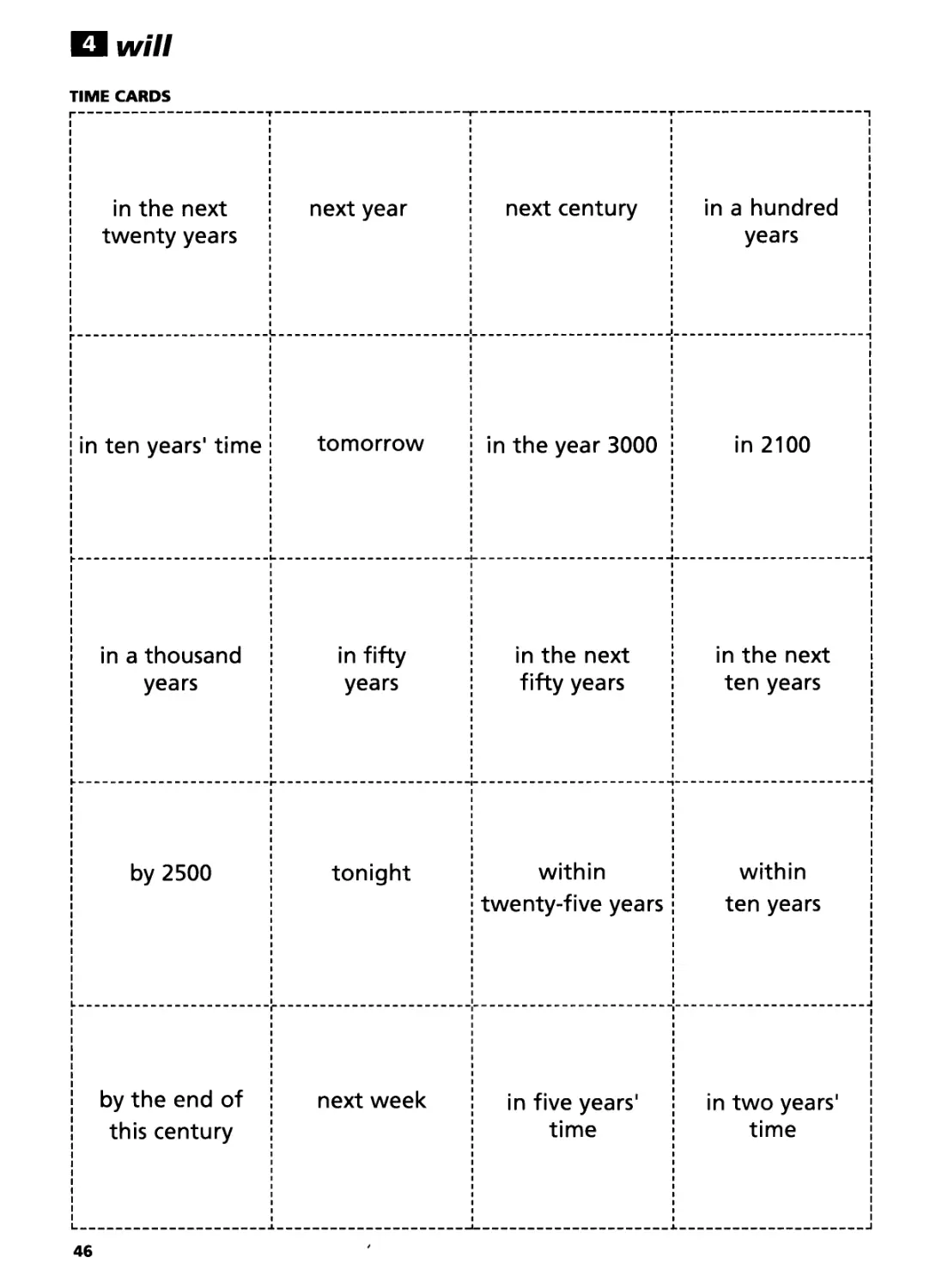
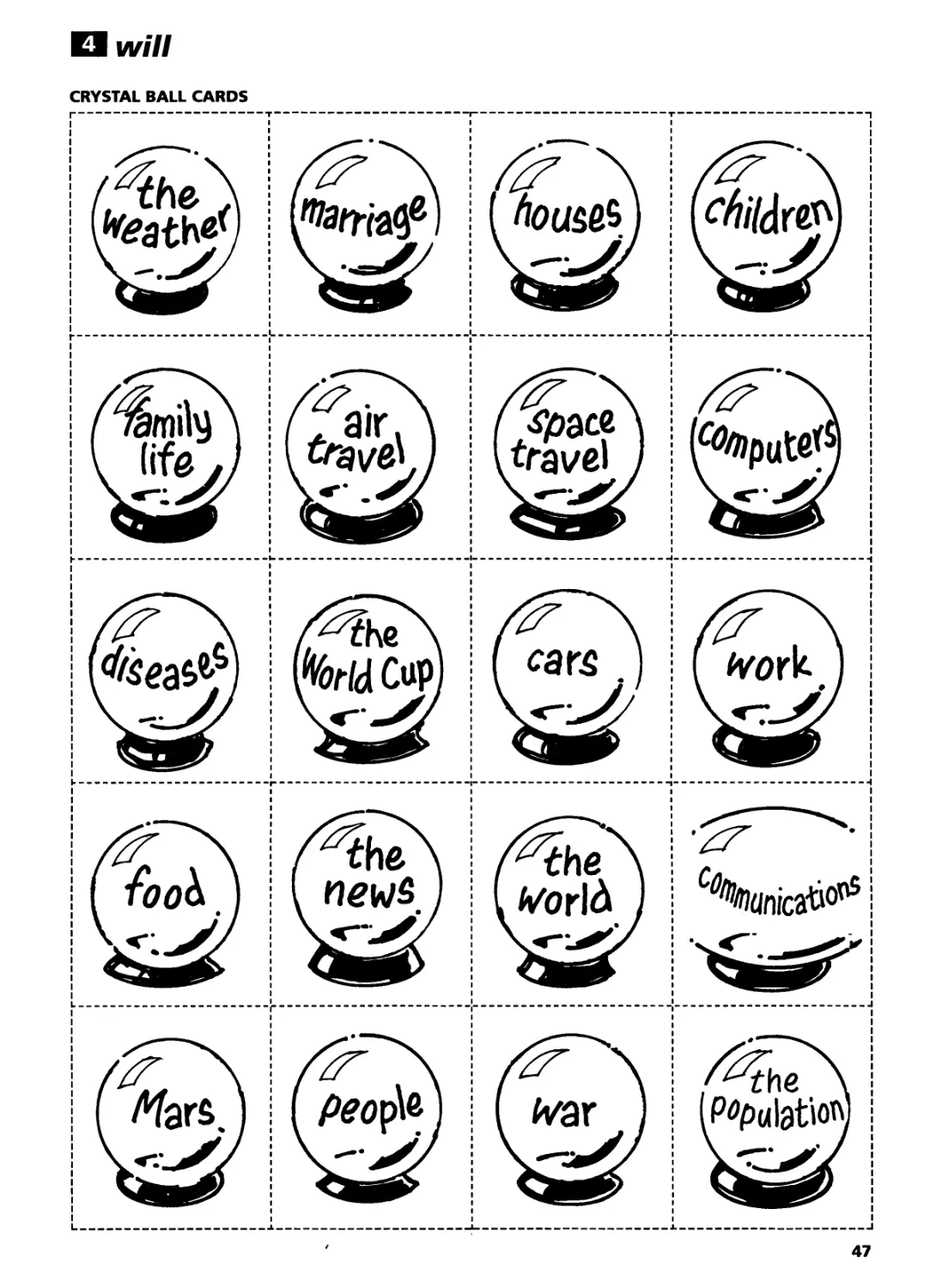
• Copy and cut up one set of time cards and one set of
crystal ball cards for each group of 3-4 students.
How to use the game i rules sheet-]
• Check that your students are familiar with the grammar
in the Grammar point and with the words listed in
Challenging vocabulary. Pre-teach any other words
from the game you think will be unfamiliar to your class.
• Divide the class into groups of 3-4 students.
• Give each group a set of time cards and a set of
CRYSTAL BALL CARDS.
• Ask them to deal out the time cards.
• They should put the crystal ball cards face down
in a pile in the centre.
• They may look at their time cards.
• The first player turns up a card from the pile. If she
can make a sensible prediction with will using one of
the time cards from her hand, e.g. ‘The weather
tomorrow will be sunny. ’ or ‘People will live on Mars by
2500.’, she can discard both cards.
• Some crystal ball cards combine more appropriately/
meaningfully with some time cards than others, e.g.
‘ The weather tomorrow will be rainy. ’ is appropriate but
9

‘The weather in two years’ time will be rainy.’ is not. It is
up to the players to select the most appropriate time
card from their hands. As the game goes on, and players
have fewer time cards, this will get harder. In these
cases the group can decide whether a sentence is a
sensible prediction or not.
• If a player cannot produce a prediction that the other
players think is sensible, then he should miss a go.
• The object of the game is to get rid of all your cards.
• The player who does this first is the winner.
Monitoring and feedback
You can ask students to write down some of their
sentences as they produce them or after the game is
finished. At the end you can go round the class asking
individual students to read out their sentences, correcting
mistakes and giving feedback. If you feel it would be
useful to reinforce the grammar, you can ask the students
to play the game again (possibly in new groups).
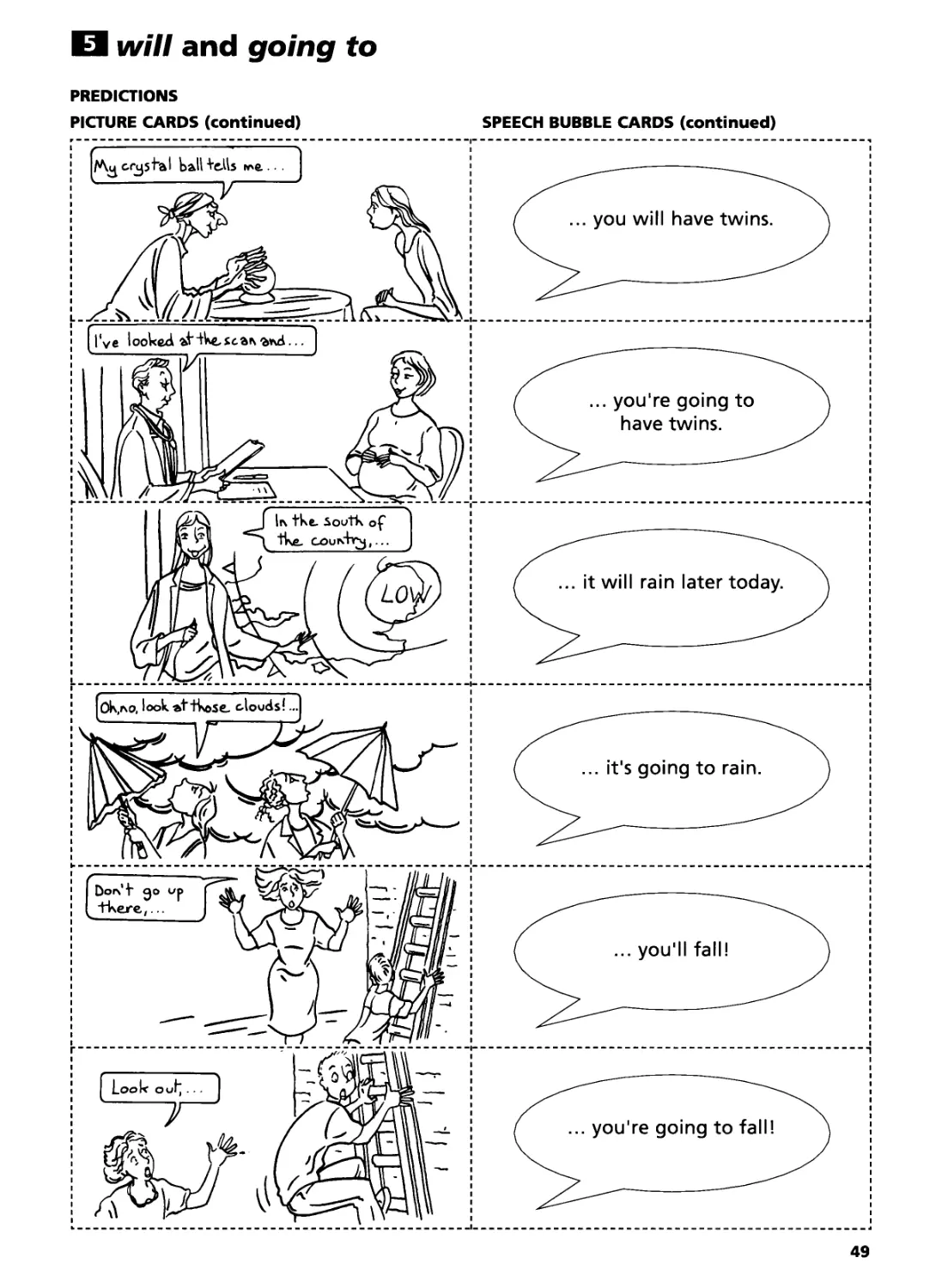
will and going to
Type of activity
Small group; matching; accuracy
Grammar point
Intentions and predictions with will and going to
- we can use will and going to for intentions and
predictions, but there are differences in their use
Intentions
- we use will for an intention that is formed at the
moment of speaking:
Let’s have a party! ~ Good idea. I’U phone everyone tonight.
- we use going to for an intention that has already been
formed:
I’m going to go to the party tonight. (I made my mind
up a while ago)
Predictions
- we use will for predictions that we think or believe to
be true:
Man will live on the moon in the next 100 years.
- we use going to for something that we think is about to
happen, usually when there is visible evidence:
Watch out! You ’re going to fall off that ladder!
Other structures
None
Topic areas
Plans, predictions
Materials and preparation
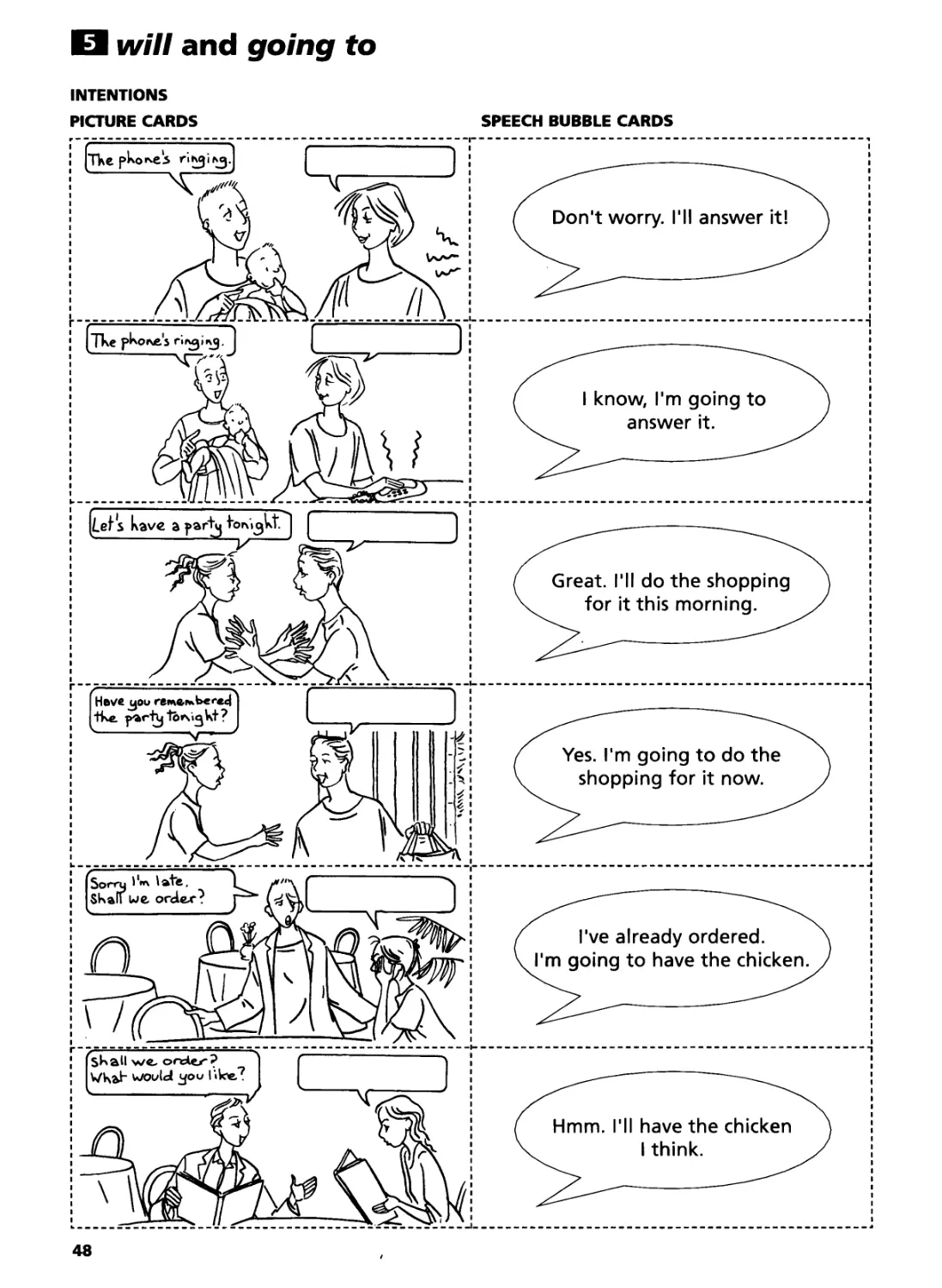
• Copy and cut up all the picture cards and all the
speech bubble cards for each group of 3-A students.
If you wish you can divide these into intentions and
predictions. You could use the intentions set to play
with first, before using the predictions set. Or you
could mix the two sets up and play with both together.
You might like to make an uncut copy of both sets of
cards for each group to serve as an answer key.
How to use the game 1 RULES sheet~|
• Check that your students are familiar with the grammar
in the Grammar point. Pre-teach any other words
from the game you think will be unfamiliar to your class.
• Divide the class into groups of 3-4 students.
• Give each group a set of picture cards, a set of
SPEECH BUBBLE CARDS and an ANSWER KEY.
• Ask the students to deal out all the cards.
• They should keep the answer key face down to check
their sentences at the end.
• They may look at their cards.
• The first player takes a picture card from his hand
and places it on the table where all can see it, saying
the sentence on the picture if there is one. If the player
does not have a picture card, the turn passes to the
next player.
• If any player has a suitable speech bubble card to
complete the cartoon, he or she should put it on the
table with the picture card, saying the phrase in the
bubble. The two cards may then be placed together
to make the cartoon at one side of the table.
• Then it is the next player’s turn to put down a card
from his hand.
• The object of the game is to get rid of all your
cards.
• The first player to do so is the winner, but the game
should continue until all the picture and speech
bubble cards are paired up.
• At the end, groups should look at the completed
cartoons and discuss whether the best speech bubbles
have been matched to the pictures. They may want to
make some changes. Then they can check their
answers with the key.
Monitoring and feedback
Check to see if any students do not understand why the
answer key is different from what they have produced.
In such cases, you can explain why the answer key is correct.
5
10

O used to
type of activity
Whole class; matching game; communication
Grammar point
Used to + infinitive
- we use used to with the infinitive to describe what
someone did in the past but does not do now:
He used to live in England but now he lives in
New Zealand.
- we form the negative by using never used to or didn't
use to:
He never used to smoke, (but now he does)
He didn't use to smoke.
- we form questions with did and use to:
Did he use to live in London?
Other structures
None
Topic areas
Jobs, habits, hobbies
Challenging vocabulary
politician, trapeze artist, pilot (n), sailor, journalist, vicar,
spy (n), farmer, policeman, gardener
Materials and preparation
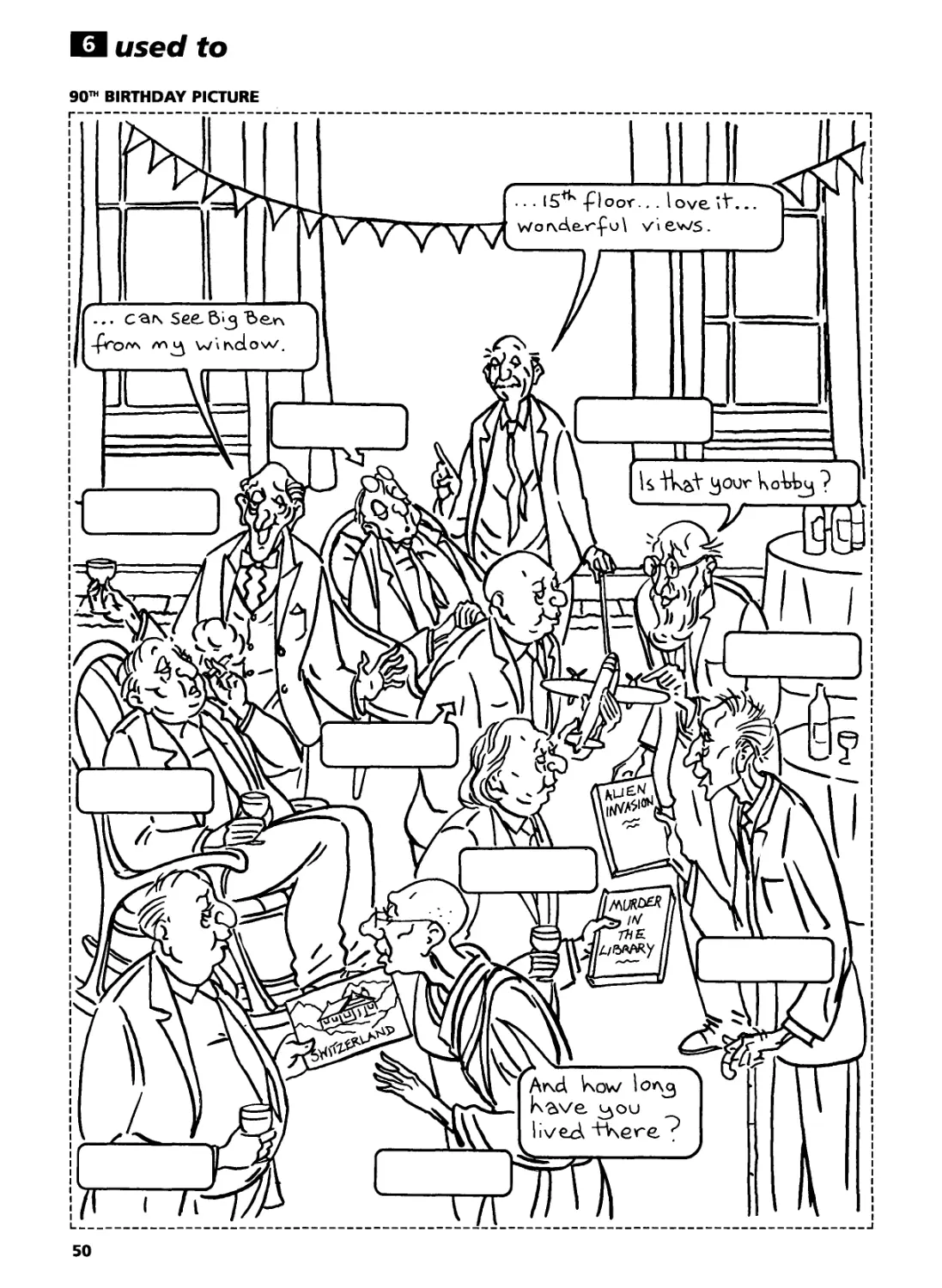
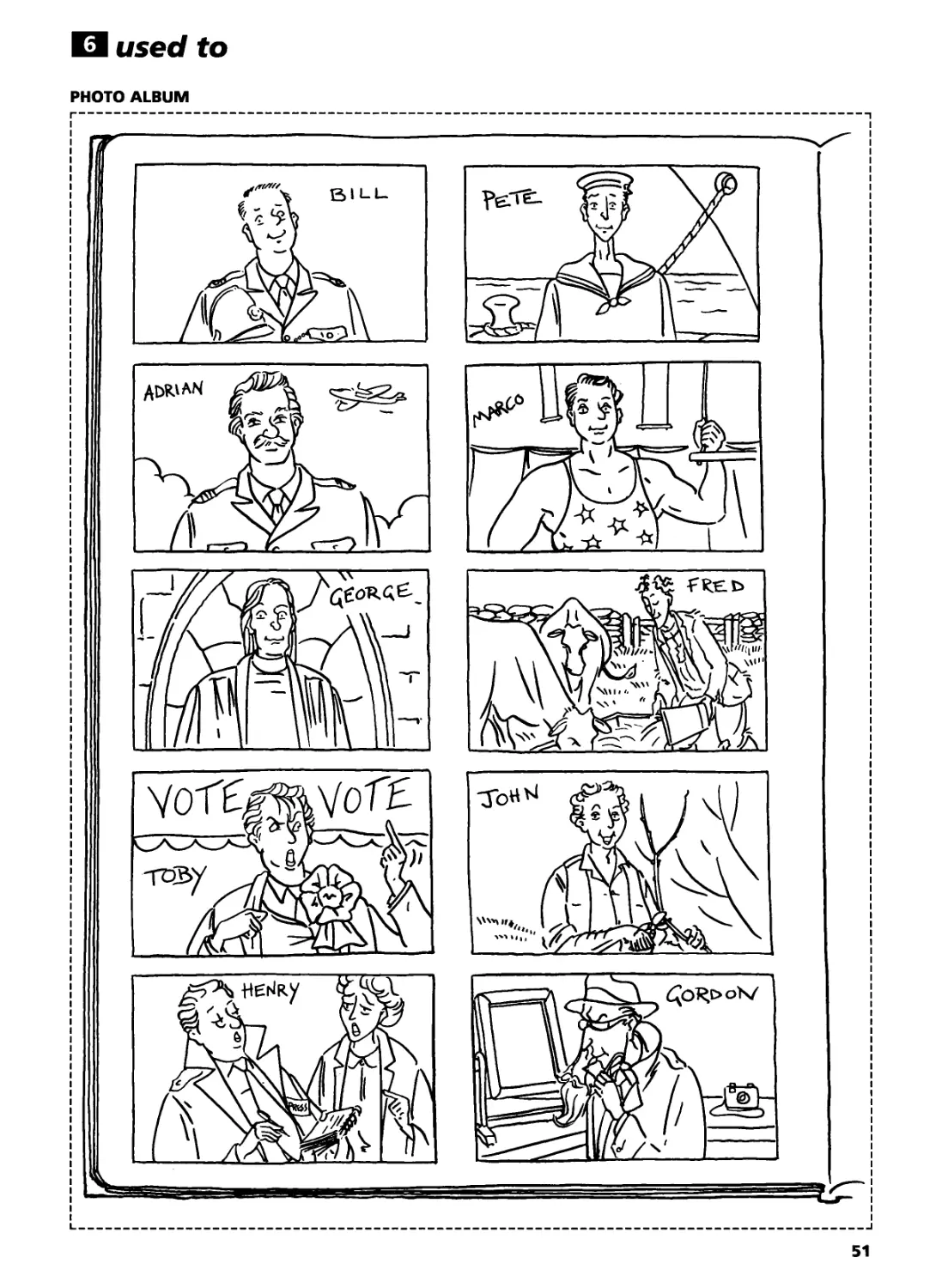
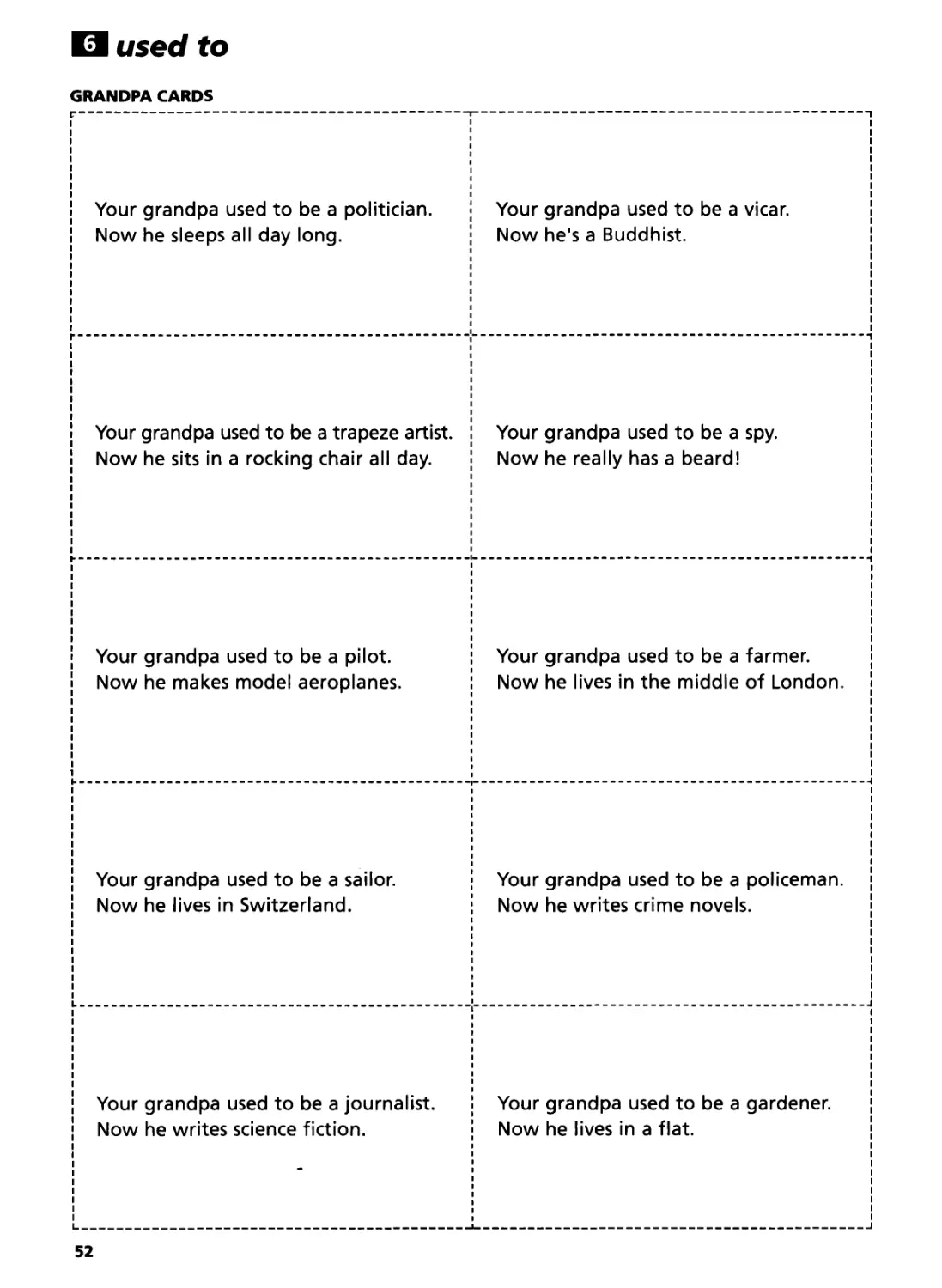
• Make a copy of the 90™ birthday picture and the
photo album for each student. Copy and cut up one
set of grandpa cards for each group of 10 students.
• If you have fewer than 10 students in your class, some
will have to have two grandpa cards. If you have
more than 10 students, play the game in two groups.
How to use the game
• Check that your students are familiar with the grammar
in the Grammar point and with the words listed in
Challenging vocabulary. Pre-teach any other words
from the game you think will be unfamiliar to your class.
• Give one copy of the 90™ birthday picture and one
photo album to every student.
• Give each student one grandpa card.
• If you have fewer than 10 students give some students
two grandpa cards.
• The object of the game is to match the grandpas
in the 90™ birthday picture with the photos of
their younger selves in the photo album and to
write their names on the 90™ birthday picture.
• To do this students will have to get up and move around
the group, exchanging information with other players.
• Each player is allowed to give one clue about their
‘own’ grandpa. Having worked out who their ‘own’
grandpa is on the 90™ birthday picture and in the
photo album, they say something he didn’t use to
do/have/be, e.g. ‘Afy grandpa didn't use to have a beard.'
• The player they are talking to may then ask up to
three questions, e.g. ‘Did he use to be a vicar?',
‘Did he use to have long hair?'
• If the second player still cannot guess after the clue
and the three questions, the first player can give
them direct information, e.g. ‘My grandpa used to
be a spy.'
• When players have matched all the grandpas with
their younger selves and written the names on the
90™ birthday picture, they can sit down.
• They should compare their answers with the person
sitting next to them.
Monitoring and feedback
Ask students to report back, describing what their
grandpa used or didn’t use to do.
D Past continuous
Type of activity
Whole class, then small group; memory; accuracy
Grammar point
Past continuous - form
- to form the past continuous we use:
Ilhelshelit was + [verb] -ing
You!we!they were + [verb]-iw£
Use
- the past continuous is used to describe an ongoing
action in the past, often one which is interrupted:
She was walking to the shops when she fell.
The students were talking about the dance when the
teacher came in.
Other structures
Past simple, imperatives
Topic areas
Everyday actions
Challenging vocabulary
pat (v), rub (v), stomach, scratch (v)
Materials and preparation
• Copy and cut up a set of activity cards so that each
student in the class has one card.
How to use the game
• Check that your students are familiar with the grammar
in the Grammar point and with the words listed in
Challenging vocabulary. Pre-teach any other words
from the game you think will be unfamiliar to your class.
• Ask one student to go out of the classroom.
11

• Distribute the activity cards so that each student
has one.
• Some activities are very simple (e.g. walk round the
room); some involve a little mime (e.g. drink very hot
tea). Give the mimes to the more extrovert students.
• Tell them that when you say ‘Go’ they should begin
miming or doing that action and continue till you
say ‘Stop’.
• Say 'Go’.
• When everyone is miming or doing their action, open
the door and ask the student outside to come in.
• Let the actions continue for a few more seconds then
say 'Stop’.
• Ask a few students what they were doing when the
student came in.
• Then put them in groups of four.
• Ask each group to try to remember what everyone
was doing, e.g.
'Alicia was singing. ’ ~ ‘ Yes, and Sonia and Keiko were
dancing. ’
'What was Manuel doing?’ ~ 'Sleeping.’ ~ 'No he wasn’t,
he was reading. ’
• The group should then write down what everyone
was doing.
• Go through all the sentences with the whole class.
• The object of the game is to write as many true
sentences as possible.
• The group with the most sentences at the end is
the winner.
Monitoring and feedback
When you go through the sentences with the whole class,
make a note of any errors and provide feedback on these
after the game is finished.
O Present perfect
Type of activity
Small group; board game; production
Grammar point
Present perfect - form
- to form the affirmative we use have and the past participle:
I/you/welthey have + past participle
He/she/it has + past participle
- to form the negative we use haven’t and the past participle:
I/youlwe/they haven’t + past participle
He/shefit hasn’t + past participle
- to form questions we use have and the past participle:
Have I/you/welthey + past participle?
Has helshelit + past participle?
Use
- the present perfect is used to talk about an action or
event that happened in a period of time that is not
yet finished, or that still has relevance to the present:
It hasn’t rained so far this week, (it’s still this week)
Have you ever been to Paris? (in your life - which
isn’t finished)
I’ve spent all my money, (and I still haven’t got any)
Other structures
None
Topic areas
Events
Challenging vocabulary
secret, lie (n), proposal, snail
Materials and preparation
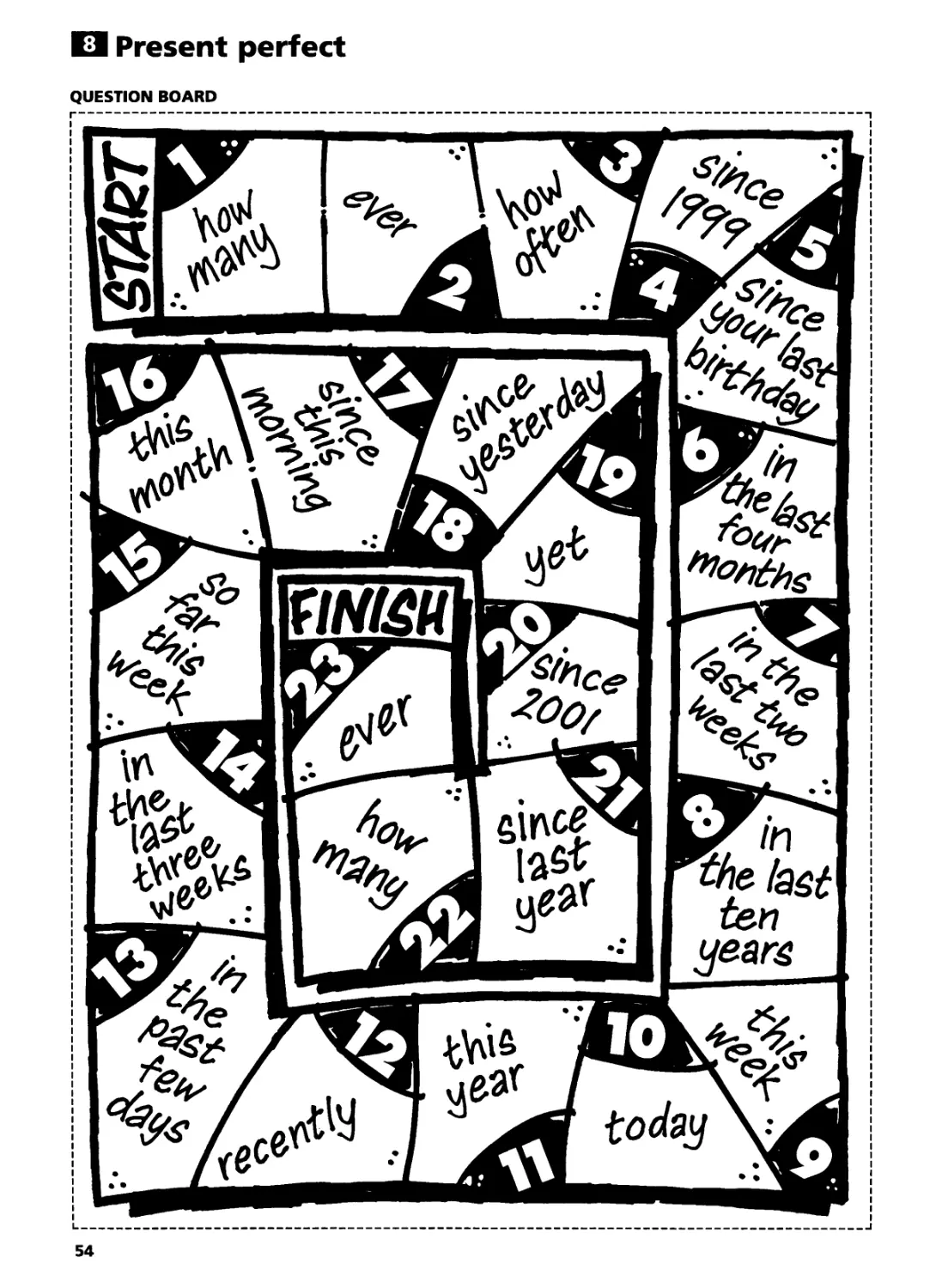
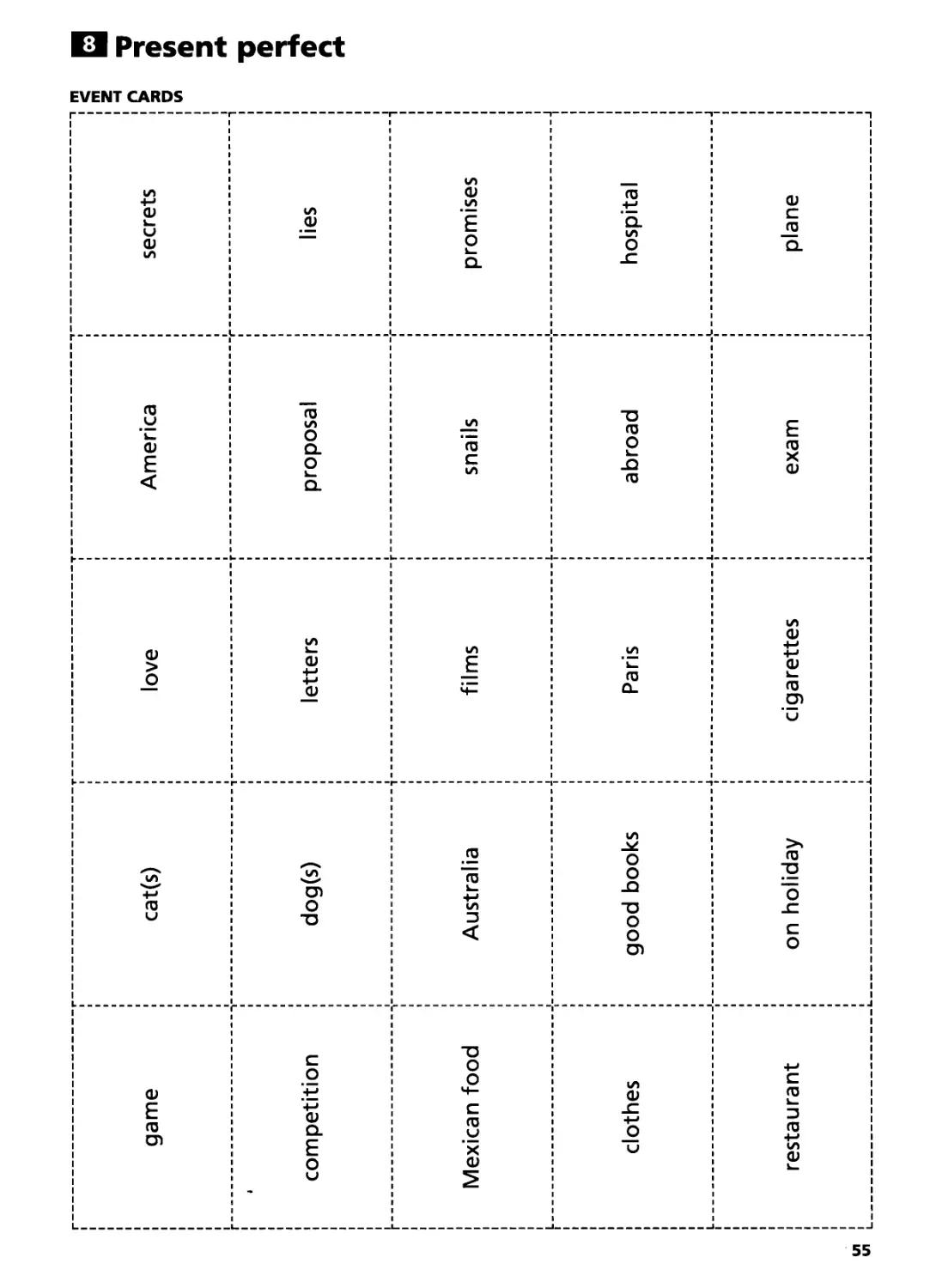
• Copy one question board and copy and cut up two
sets of event cards for each group of 3-4 students.
You will also need a counter for every student and a
dice for each group.
How to use the game	I	RULES sheet~|
• Check that your students are familiar with the grammar
in the Grammar point and with the words listed in
Challenging vocabulary. Pre-teach any other words
from the game you think will be unfamiliar to your class.
• Divide students into groups of 3-4.
• Give one copy of the question board and two sets
of event cards to each group in the class.
• Each group should also have counters and a dice.
• They should shuffle the event cards and deal out
seven to each player.
• They should place the rest face down in a pile in
the centre.
• They should all place their counters on start.
• The first player shakes the dice and moves his counter
the appropriate number of spaces on the board.
• When he lands on a square he should select a card
from his hand and make a question. He should use
the present perfect, the word(s) on the card (e.g. 'good
books’) and the phrase on the board (e.g. 'in the last
four months’). He can ask the question, e.g. 'Haveyou
read some good books in the last four months?’, to any
other player, who should answer it.
• He can then place his card at the bottom of the pile
and the turn passes to the next player.
• If he cannot make a question then the turn also passes
to the next player.
• If anyone runs out of cards they may take another
from the pile.
12

Use
- we use the present perfect continuous to talk about
situations which started in the past and are still going on:
Heys been talking on the phone for over an hour.
- we also use it for activities which have just finished
and which explain a present situation:
Your hands are all red. ~ I know, I've been painting
the living room.
Other structures
Present continuous, be, have
Topic areas
Family life
Challenging vocabulary
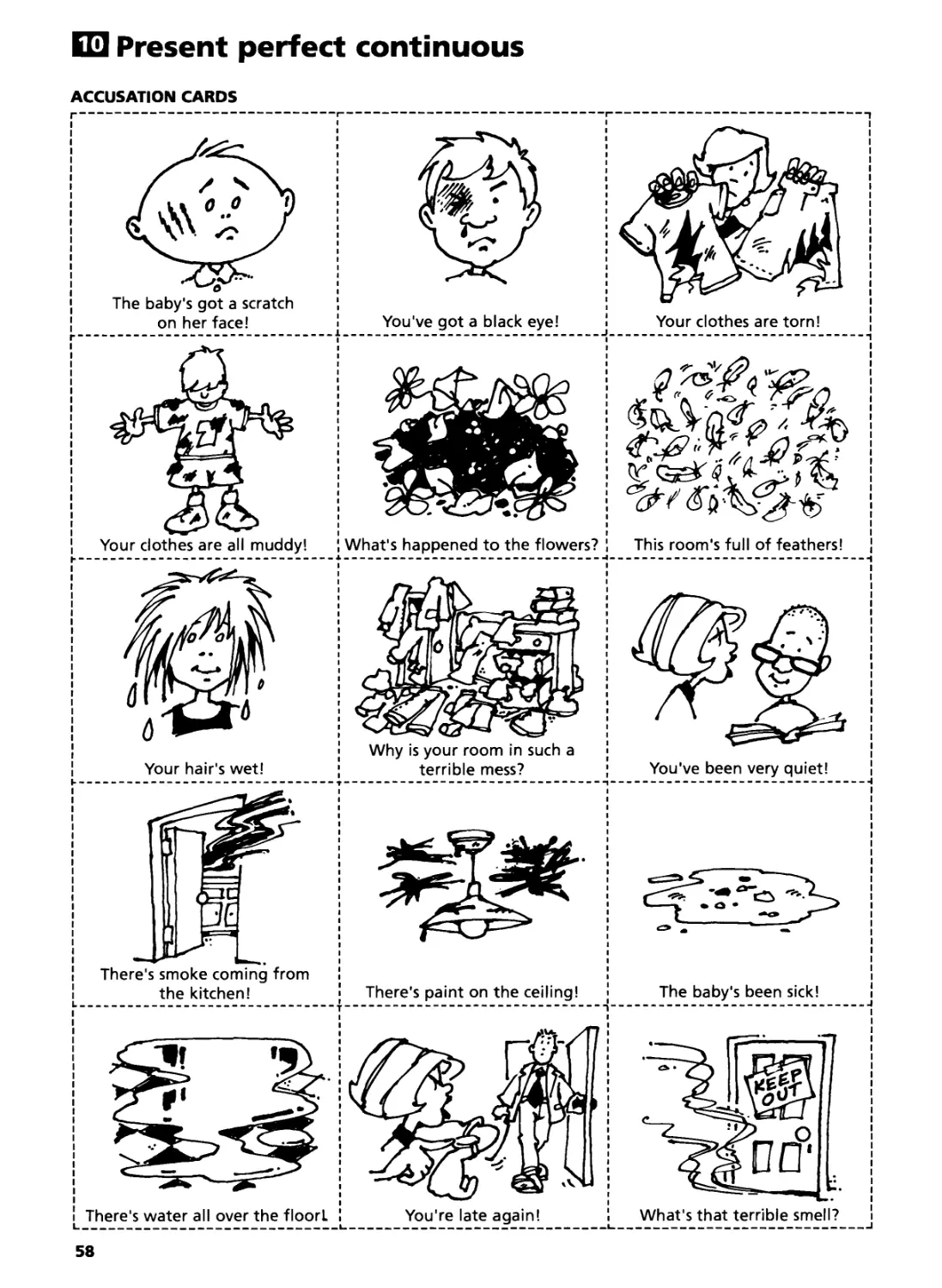
scratch (n), muddy, smoke (n), black eye, mess (n), feather
Materials and preparation
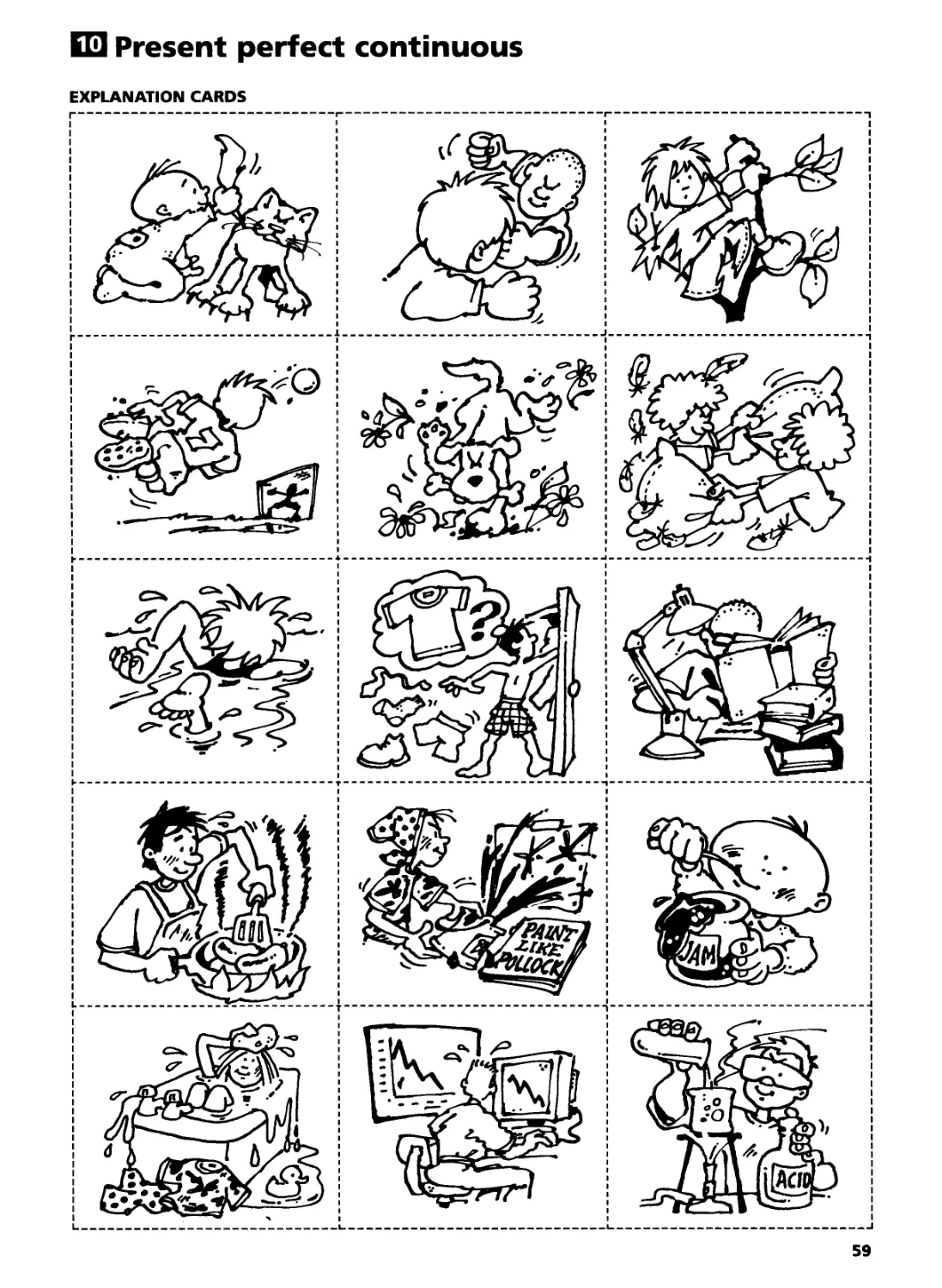
• Copy and cut up one set of accusation cards and
one set of explanation cards for each group of
3-4 students.
How to use the game
• Check that your students are familiar with the grammar
in the Grammar point and with the words listed in
Challenging vocabulary. Pre-teach any other words
from the game you think will be unfamiliar to your class.
• Divide the class into groups of 3-4 students.
• Give each group a set of accusation cards and a set
of explanation cards.
• Explain to the students that they are members of a
large family and are always getting into trouble.
• They should deal out the explanation cards and put
the accusation cards face down in a pile in the centre.
• They may look at their explanation cards.
• The first player turns up an accusation card from
the pile. Pretending to be the Mum or Dad he/she
reads out the caption e.g. ‘This room's full of feathers!'
and, showing everyone the card, asks ‘ What's been
going on?' The other players, pretending to be the
children, should look at their cards.
• The player with an explanation card that matches the
accusation can produce it, offering the explanation
e.g. ‘We've been having a pillow fight.'
• The first player can then discard the card.
• Then it is the next player’s turn to be Mum or Dad
and turn up an accusation card.
• The object of the game is to get rid of all your cards.
• The first person to do so is the winner.
Monitoring and feedback
You can ask students to write down some of the sentences
that they produce in the game. At the end you can go
round the class asking individual students to read out
their sentences, correcting mistakes and giving feedback.
ED Past perfect
Type of activity
Pairwork; information gap; communication
Grammar point
Past perfect - form
- to form the affirmative we use had and the past
participle:
Ilyoulhelshelitlwelthey had + past participle
- to form the negative we use hadn't and the past
participle:
Ilyoulhelshelitlwelthey hadn't + past participle
- to form a question we use had and the past participle:
Had Ilyoulhelshelitlwelthey + past participle?
Use
- we use the past perfect to talk about an action or event
that happened before another event in the past.
When I got to the station, the train had already left.
I was sure I'd seen her somewhere before.
We went to Paris last year. I hadn't been there before.
Had I seen him somewhere before? I wasn't sure.
Other structures
Past simple
Topic area
Everyday actions
Challenging vocabulary
rescued, parrot, propose
Materials and preparation
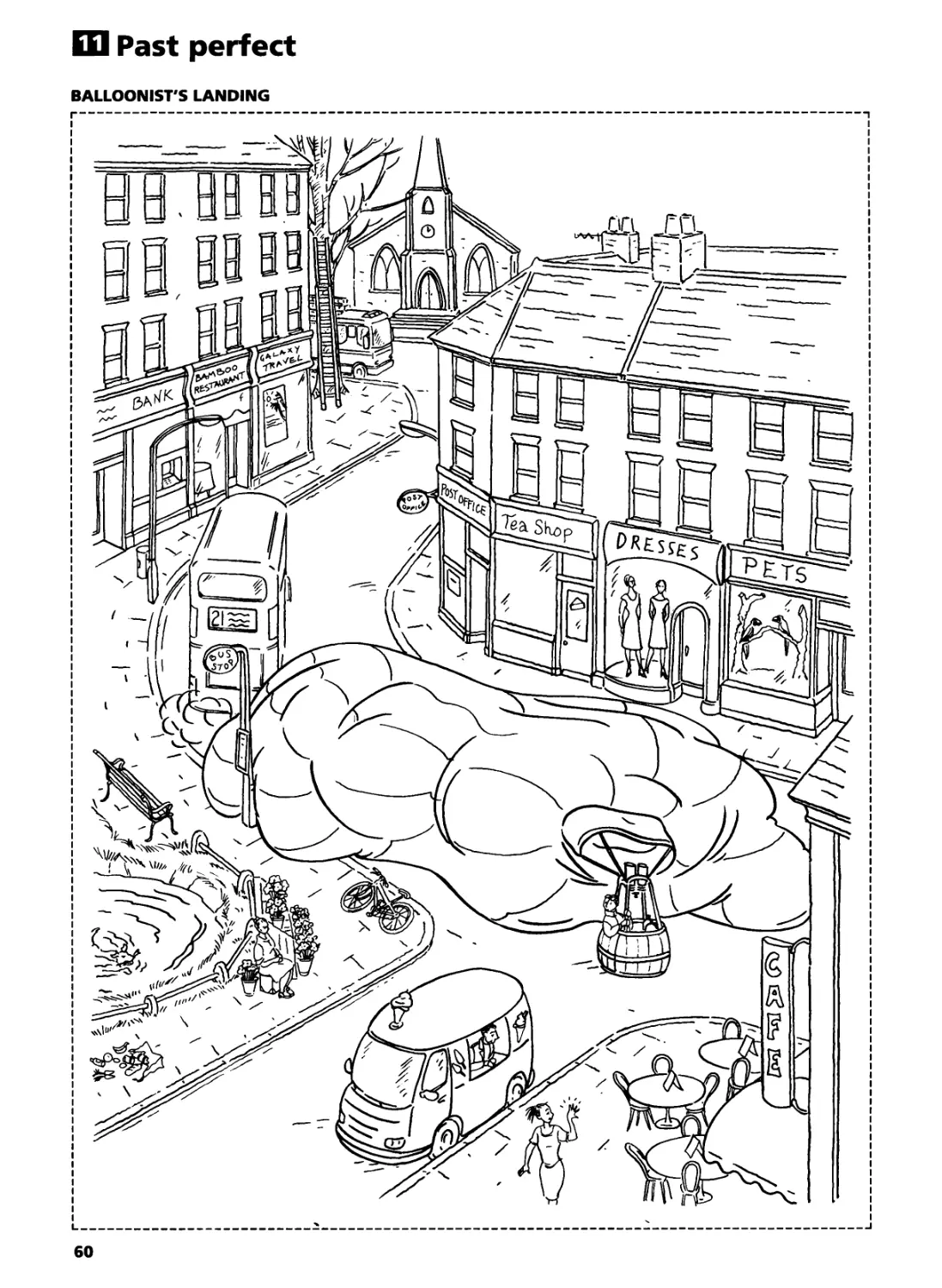
• Make two copies of the balloonist’s landing picture
and copy and cut up one set of event cards for each
pair of students.
How to use the game
• Check that your students are familiar with the grammar
in the Grammar point and with the words listed in
Challenging vocabulary. Pre-teach any other words
from the game you think will be unfamiliar to your class.
• Divide students into pairs.
• Give two copies of the balloonist’s landing picture
and one set of event cards to every pair.
• They should take one picture each.
• They should shuffle the event cards and place them
in a pile face down.
• Explain that several things had happened just before
the balloonist landed. The event cards show pictures
to explain what had happened.
• One student takes a card from the pile and describes
what had just happened to him when the balloonist
landed: ‘ When the balloonist landed, I had just fallen off
my bike.'
• The object of the game is to draw in all the people
in the right places on the picture.
14

• When the student with the card has described what
had just happened, both students should draw in the
person in the right place on their picture. They should
not show their pictures to each other.
• If students prefer not to draw, they can write in the
number of the event card in the appropriate place on
their picture, e.g. T* by the bicycle.
• Then it is the next player’s turn to take an event
card from the pile.
• At the end of the game, both players should compare
pictures - are they the same?
Monitoring and feedback
Ask each pair to say one thing about their picture, e.g.
‘ When the balloonist landed', a man had just fallen off his bike. ’
Past perfect continuous
type of activity
Small group; board game; communication
Grammar point
Past perfect continuous - form
- in the affirmative we say:
Ilyoulhelshelitlwelthey + had beenl’d been
+ [verb] -ing
- in the negative we say:
Ilyoulhelshelitlwelthey + had not been/hadn yt been
+ [verb] -ing
- to form questions we say:
Had + Ilyoulhelshelitlwelthey been + [verb] -ing?
Use
- we use the past perfect continuous to talk about a long
action that happened before another action in the past:
When the bus finally arrived I had been waiting for
nearly an hour.
Other structures
Past continuous
Topic areas
Leisure activities, crime
Challenging vocabulary
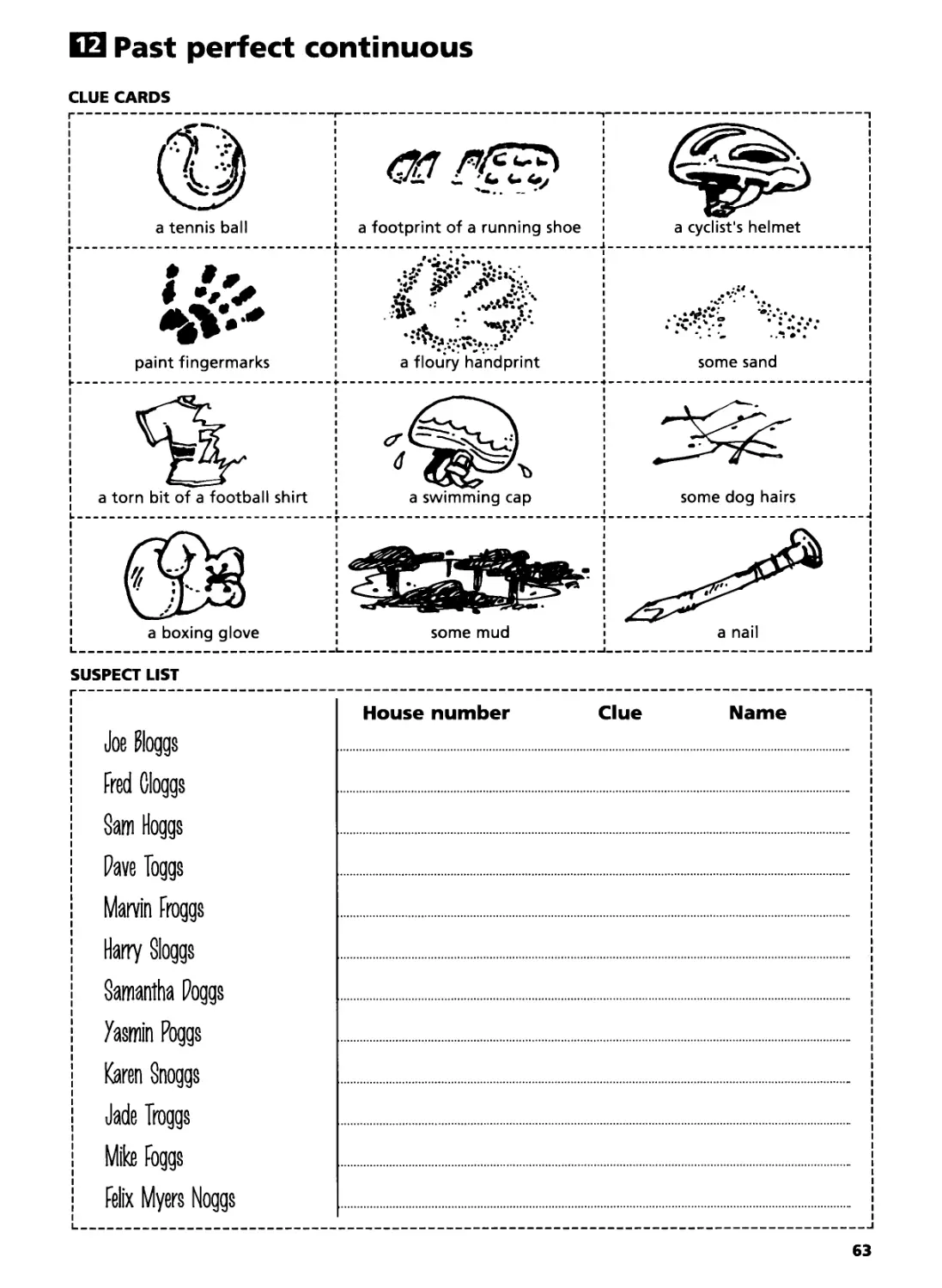
fingermark, footprint, handprint, helmet, nail, boxing,
putting up shelves
Materials and preparation
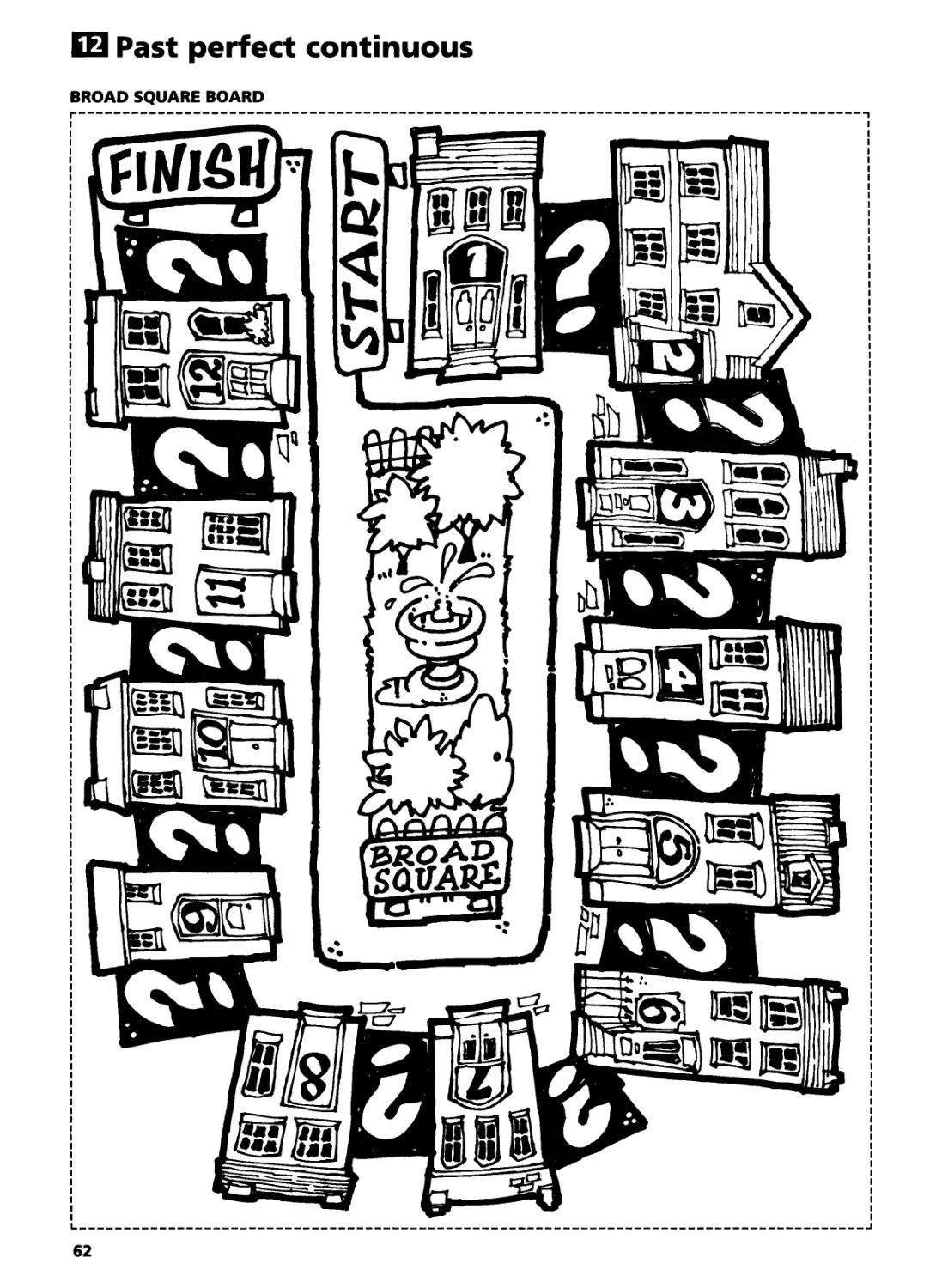
• Copy one broad square board for each group of 6-8
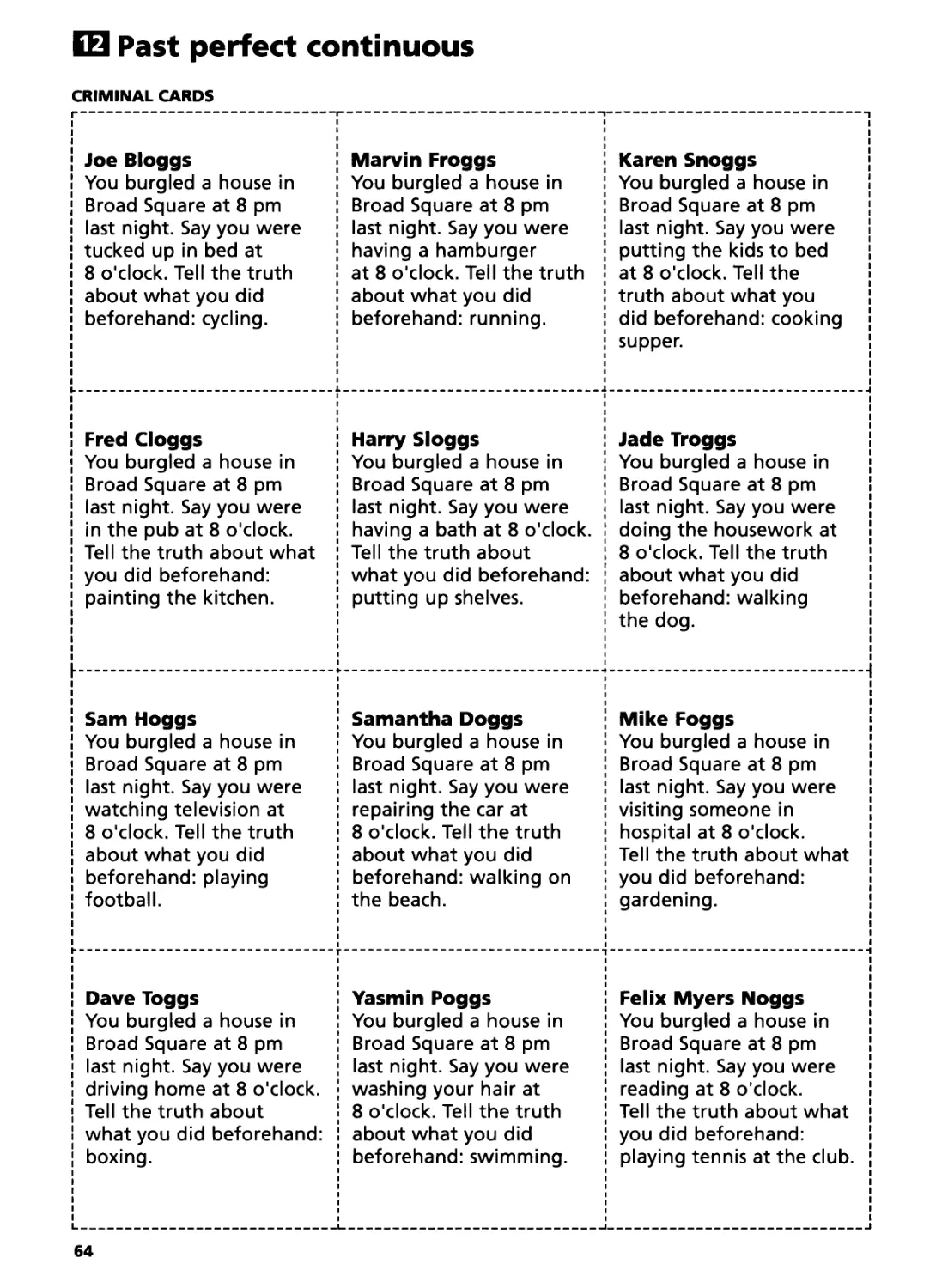
students. Copy and cut up one set of clue cards and
one set of criminal cards for each group. Copy one
suspect list for each pair of students. You will also
need a counter for every pair of students and a dice
for each group.
How to use the game I rulk sheeth
• Check that your students are familiar with the grammar
in the Grammar point and with the words listed in
Challenging vocabulary. Pre-teach any other words
from the game you think will be unfamiliar to your class.
• Divide students into groups of 6-8 and then divide
them into pairs within each group. With groups of 7
divide them into pairs and a threesome.
• Give one copy of the broad square board, one set of
criminal cards and one set of clue cards to every
group. Give one suspect list to each pair. Give out
counters and dice to each group.
• Without looking at the clue cards the students
should place one face down on every house on the
BROAD SQUARE BOARD.
• Ask the students to deal out the criminal cards
equally to each pair. The pair may look at their cards.
• They should all place their counters on start.
• Tell the class that a burglary was committed in each
house in the square at 8 o’clock last night. The
burglaries were committed by the people on the
suspect list.
• The object of the game is to find out which
criminal burgled which house.
• The first pair of players to find out are the winners.
• The first pair of players begin. They should shake the
dice and move their counter the appropriate number
of spaces on the board.
• When they land on a house they should turn up the
clue card that is on that square and look at it
without letting any other player see it.
• The clue card gives information about something that
was found in that particular house. The pair of players
with the card can discuss its implications (quietly so
the others don’t hear!) e.g. (turning up the card with
the paint fingermarks): 'Aha, so the burglar had been
painting/’ They should then replace the clue card face
down and note down the information on the suspect
list in order to remember it, e.g. house 4 - sand.
• If the players land on a question mark, they can consult
the suspect list and choose a name e.g. Joe Bloggs.
They first find out which of the other players is Joe
Bloggs and then ask the suspect ‘ What were you doing
at 8 o’clock last night?’ (the time of the crime) and
‘ What had you been doing up till then?’ The player
holding the Joe Bloggs card must answer. Players (all
players, not just the ones asking and answering) can
make notes about the replies on their suspect list.
• Then it is the next pair’s turn.
• The game ends when one pair have correctly matched
all the names on the list with the house numbers.
Monitoring and feedback
Ask each pair to say one thing, e.g. 'We know Fred Cloggs
burgled n° ... because he had been painting.’
12
15

Future continuous
Type of activity
Part 1: Individual then small group; guessing; production
Part 2: Small group; memory; production
Grammar point
Future continuous - form
- in the affirmative we say:
Ilyoulhelshelitlwelthey + will I'll be + [verb] -ing
- in the negative we say:
Ilyoulhelshelitlwelthey + will not/won't be + [verb]-m£
- to form questions we say:
Will Ilyoulhelshelitlwelthey + be + [verb] -ing?
Use
- we use the future continuous to describe an ongoing
action at some time (often precisely specified) in
the future:
At 5 o'clock on Saturday I will be driving to the airport.
Next summer I'll be travelling around Greece.
Other structures
None
Topic areas
Everyday actions
Challenging vocabulary
Students generate their own vocabulary. Be prepared to
provide support.
Materials and preparation
Part 1
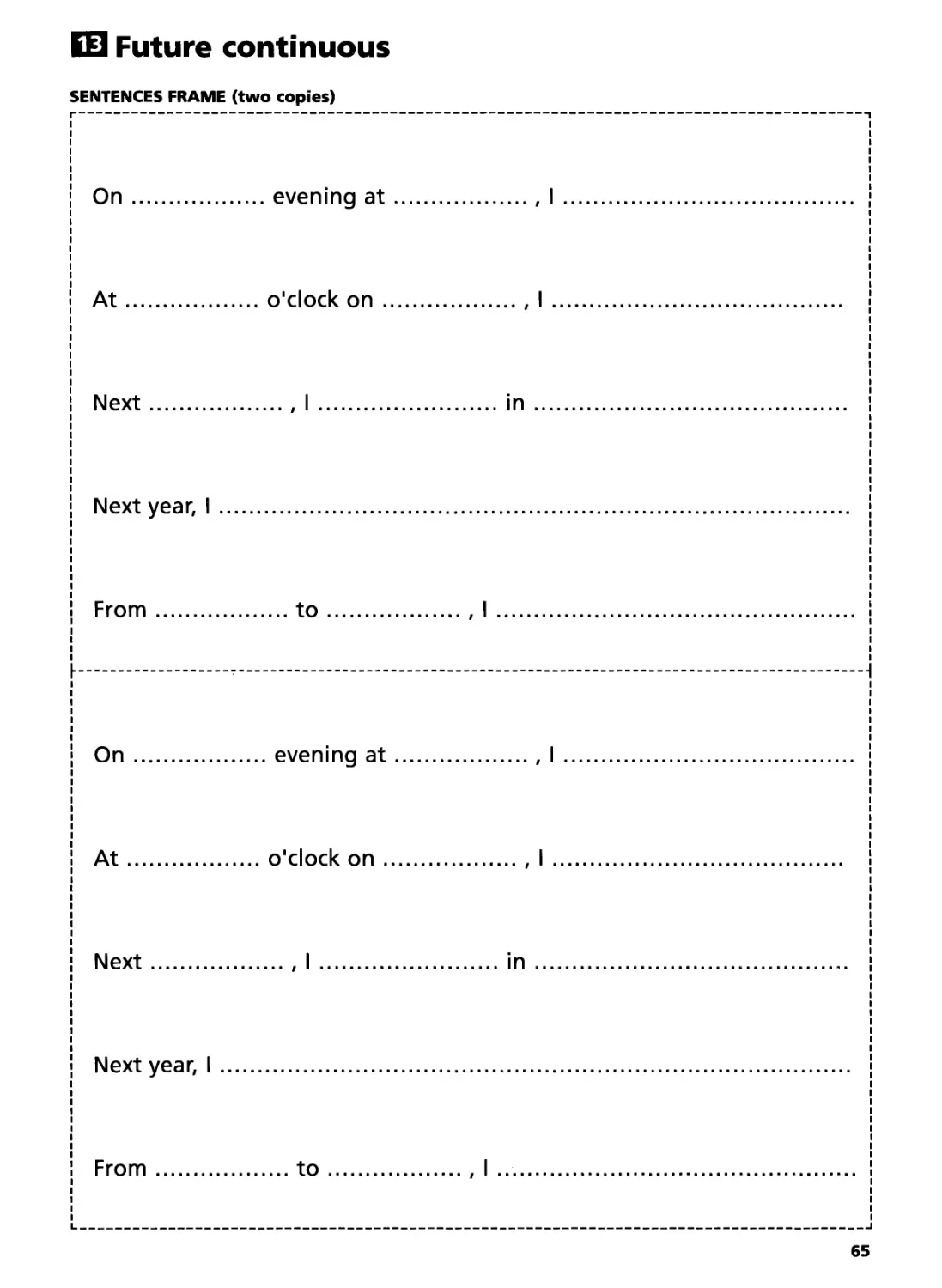
• Copy the sentences frame for every student in the class.
How to use the game
Part 1
• Check that your students are familiar with the grammar
in the Grammar point.
• Give one sentences frame to each student.
• Ask them to fill in the frame with sentences, using the
future continuous, that are true for them.
• They should not show their sentences to anyone else.
• Then group the students into threes and fours.
• The object of this part of the game is to guess
each other’s sentences.
• The first player begins by giving the first date on the
frame to the other players and telling them two things
he won’t be doing on that date e.g. ‘On Saturday evening
at 8 o 'clock, I won't be reading a book, and I won't be
sitting at home watching television. '
• The others must try to guess the sentence e.g. ‘Will
you be dancing?', ‘ Will you be eating dinner?'
• When they have guessed, it is the next player’s turn
and so on until all the players have guessed each
other’s sentences.
Part 2
• Divide the students into pairs within their groups
(or an individual and a pair in the case of threesomes).
Then regroup the students so that each pair of students
is with a new pair or individual from a different group.
• Ask the students to try to remember everyone’s
sentences from their first group, e.g. ‘Maria will be
driving to London on Friday evening.'
• The object of this part of the game is to
remember the most sentences.
• Hie group with the most sentences is the winner.
Monitoring and feedback
Part 2
You can ask students to write down some of their
sentences as they produce them or after the game is
finished. At the end you can go round the class asking
individual students to read out their sentences, correcting
mistakes and giving feedback. If you feel it would be
useful to reinforce the grammar, you can ask the students
to play Part 2 again, in new groups.
IQ Future perfect
Type of activity
Individual, then small group; guessing; production
Grammar point
Future perfect - form
- in the affirmative we say:
Ilyoulhelshelitlwelthey + wilH'll have + past participle
- in the negative we say:
Ilyoulhelshelitlwelthey + will not / vxm't have + past participle
- to form a question we say:
Will Ilyoulhelshelitlwelthey + have + past participle?
Use
- we use the future perfect to describe an action that
will be completed by a certain time in the future:
By this time tomorrow I will have finished my essay.
Other structures
None
Topic areas
Everyday actions
Challenging vocabulary
Students generate their own vocabulary. Be prepared to
provide support.
Materials and preparation
• Copy and cut up enough copies of the promises,
promises sheet for every student to have one.
13
16

How to use the game
• Check that your students are familiar with the grammar
in the Grammar point.
• Give one promises, promises sheet to each student.
• Ask them to imagine the future - this time next year.
Ask them to use the future perfect to complete the
three sentences with:
1 a fact (something they will definitely have done)
2 a promise (something they promise themselves
they will have achieved)
3 a wild dream (wish-fulfilment!)
• They should not show their sentences to anyone else.
• Group the students into groups of 3-4.
• The object of the game is to guess each other’s
sentences and to decide which are facts, which
are promises and which are dreams.
• The first player begins by giving the other players
three clues about the subject matter of her sentences,
e.g. exam, job, marriage. The order of the clues must
not match the order of the sentences.
• The others must try to guess the sentences: ‘ Will you
have got married?’ They must then try to decide which
is fact, which is a promise and which is a dream.
• Then it is the next player’s turn to give clues while the
others guess.
Monitoring and feedback
After the small group guessing game, you can if you
like extend the game into an activity where all students
stand up and move around, asking and answering
questions about each other’s facts, promises and dreams.
Set a time limit for this part of the activity, then ask
students to sit in groups of 4-6. They should take a
piece of paper and divide it into three columns with
the headings ‘Facts’, ‘Promises’ and 'Dreams’. Ask them
to put as many items as they can remember in each
column, e.g. 'Maria will have got married.’ 'Peter will
have found a new job. ’ 'Anya will have written a best-selling
novel. ’ The group with the longest list at the end is
the winner.
You can, if you like, collect in the papers and make a
wall-poster, like this, writing a list under each heading:
By this time next year we ... (class 5)
will definitely have ...
promise that we will have ...
fantasise that we will have ...
Grammar point
Compare the use of forms for talking about obligation,
prohibition, permission and ability
Expressing obligation
- present: I must go to the dentist.
- past: I had to go to the dentist last week.
- future: I will have to / must go to the dentist next month.
Expressing lack of obligation
- present: I don’t have to stay late today because the
meeting is cancelled.
- past: I didn’t have to stay late on Tuesday because the
meeting was cancelled.
- future: I won’t have to stay late tomorrow because the
meeting is cancelled.
Expressing prohibition
- present: You mustn’t smoke in the waiting room.
Mustn’t in this sense has no past or future equivalent
so another verb must be used:
- past: You weren’t allowed to smoke in the waiting room. I
You couldn’t smoke in the waiting room.
- future: You won’t be allowed to smoke in the waiting
room. I You won’t be able to smoke in the waiting room.
Expressing permission
- present: You can / may use your mobile phone here.
- past: You could / were allowed to / were able to use
your mobile phone here last week but they’ve banned it now.
- future: You will be able to / will be allowed to use
your mobile phone when you get there.
Expressing ability
- present: I can swim.
- past: I couldn’t drive when I was 18.
- future: I will be able to type when I have finished
this course.
Other structures
None
Topic areas
Everyday actions
Challenging vocabulary
Students generate their own vocabulary. Be prepared to
provide support.
Materials and preparation
• Make enough copies of the questionnaire for each
pair of students to have one.
EB Present, past and
future of must,
have to and can
type of activity
Pairs; completing and matching; production
How to use the game
• Check that your students are familiar with the grammar
in the Grammar point.
• Divide students into pairs.
• Give one questionnaire to each student.
• Ask them to fill in their questionnaires with as many
answers as possible that are the same for both of them.
17

• The object of the game is to find as many
similarities as possible.
• It may help to give a time limit for each of the three
sections, e.g. 5-10 minutes. When the time limit has
expired, ask them to go on to the next section.
Monitoring and feedback
Ask pairs to report back with one or two of their
sentences.
maylmightlcouldl
must/can't + have
lype of activity
Small group; information gap; communication
Grammar point
MayImightlcouldlmustlcan't + have - form
- we can use most modal verbs, e.g. may, might, could,
must, can't (but not can), with have + past participle:
may have done, might have gone, could have said
Use
- we can use these modals to indicate degrees of
certainty that something happened in the past
- we use could have to indicate the least degree of
certainty, a weak possibility:
I suppose he could have gone to London.
- we use may/might have to indicate that something
possibly happened:
He's not there - he might have gone out to lunch.
- we use can't/couldn't have to indicate a near certainty
that something did not happen:
He can't have done it - he's not that kind of person!
- we use must have to indicate a near certainty that
something did happen:
The light's not on - they must have gone out.
Other structures
Past simple, past continuous, past perfect
Topic areas
Rooms in a house, everyday activities
Challenging vocabulary
drawing room, trio, shriek (n), conservatory, violin,
pop in, verandah, billiards, (billiard) cue, scream (n),
soundproof, parlour
Materials and preparation
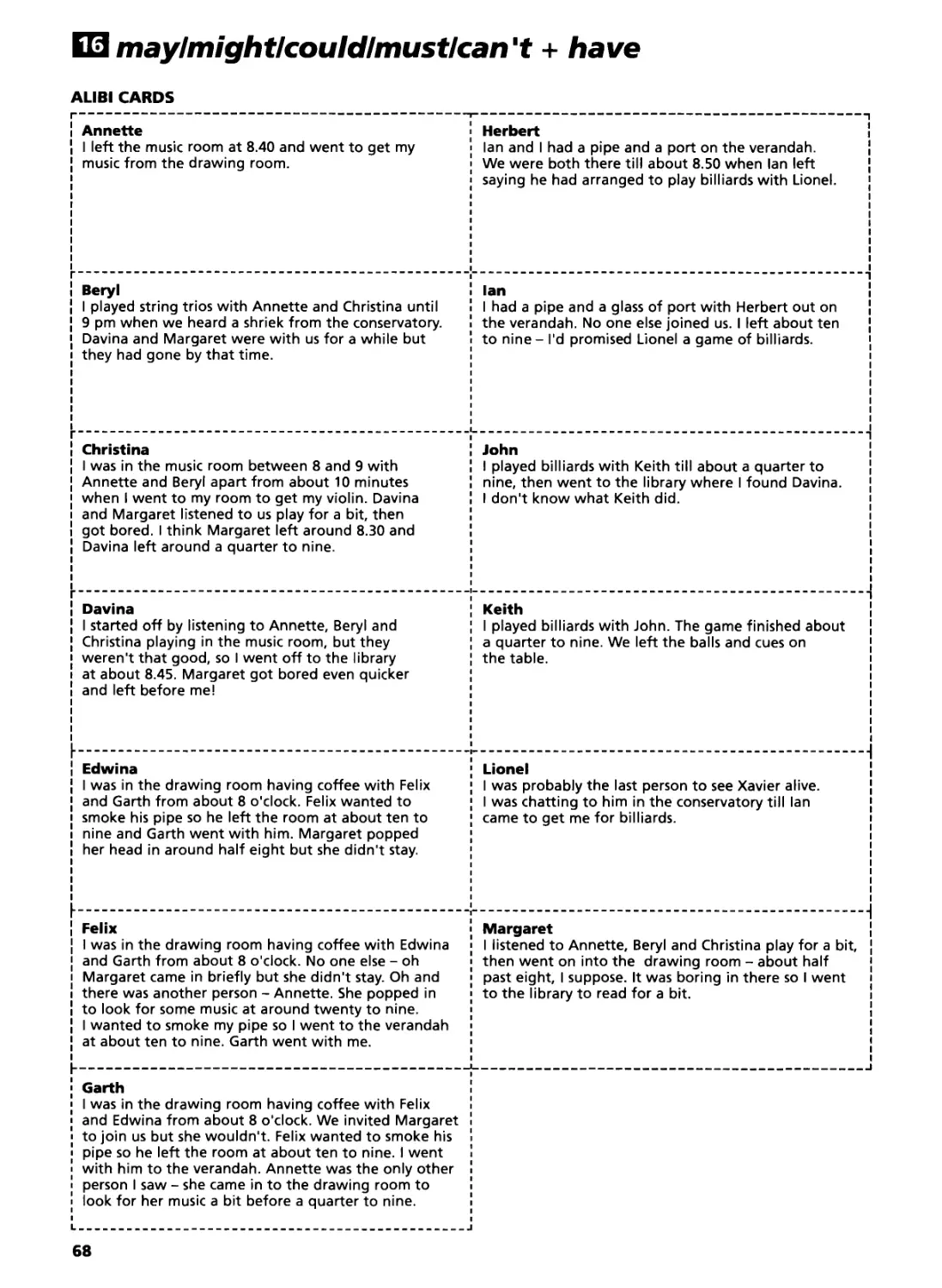
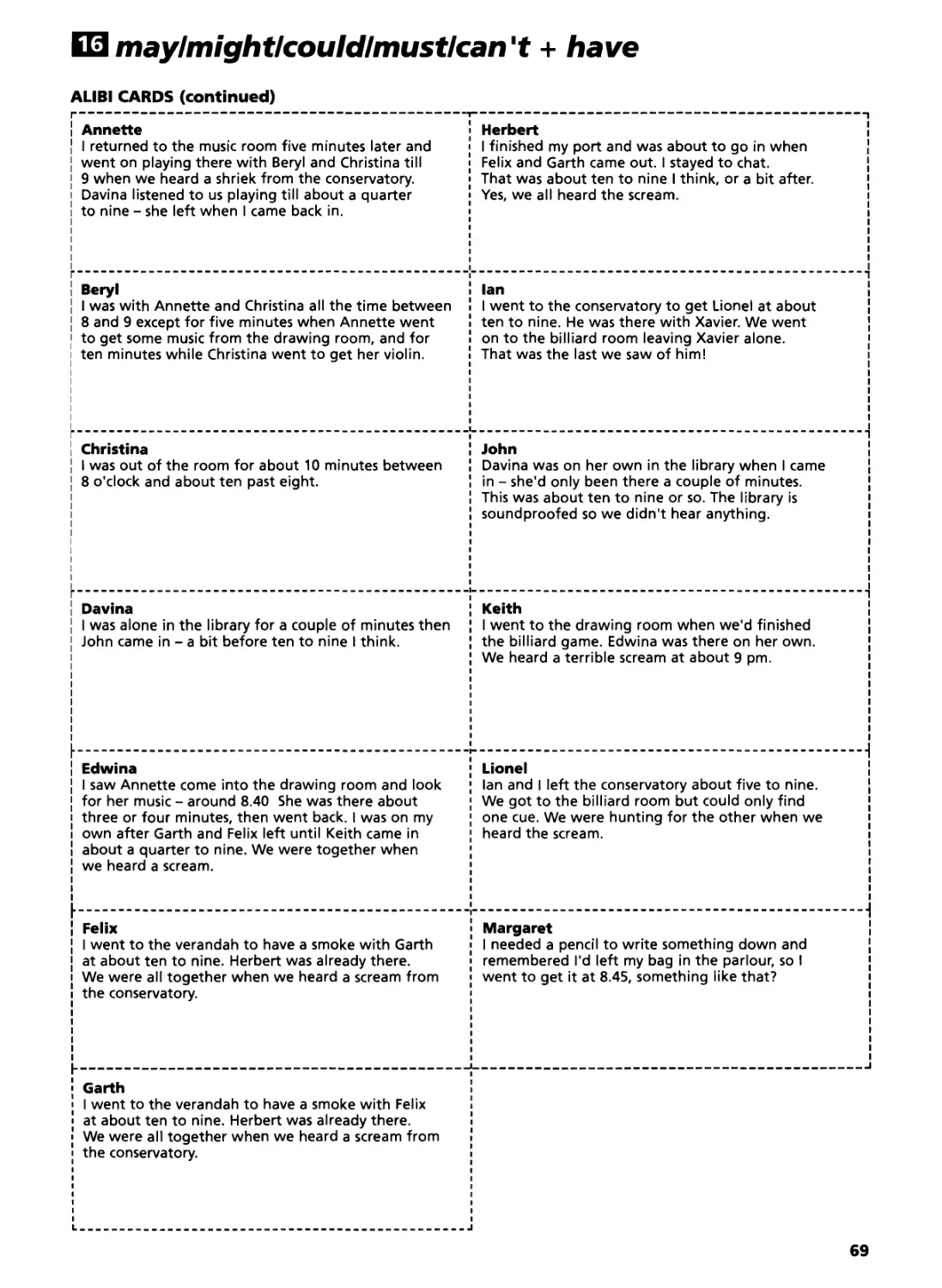
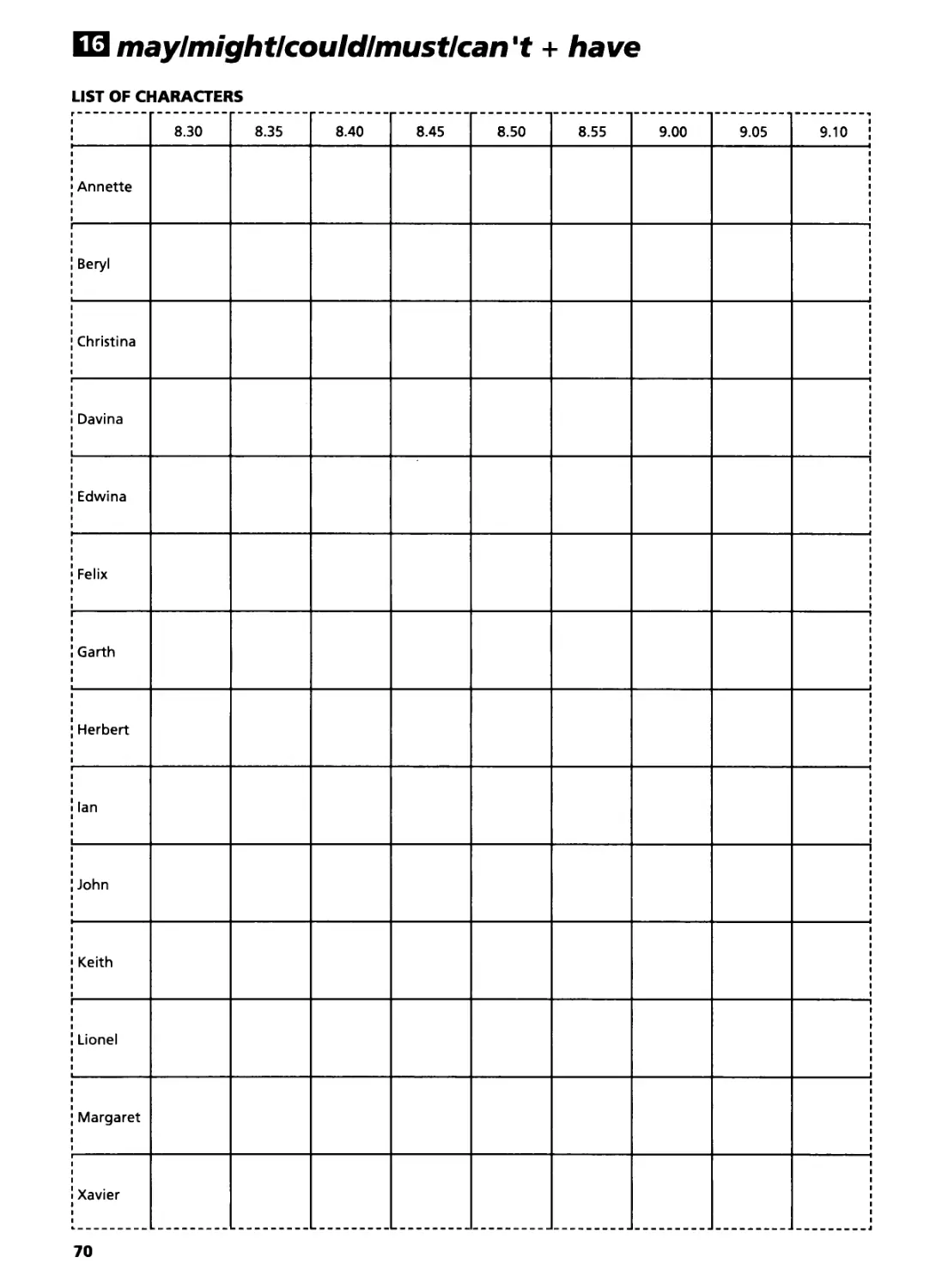
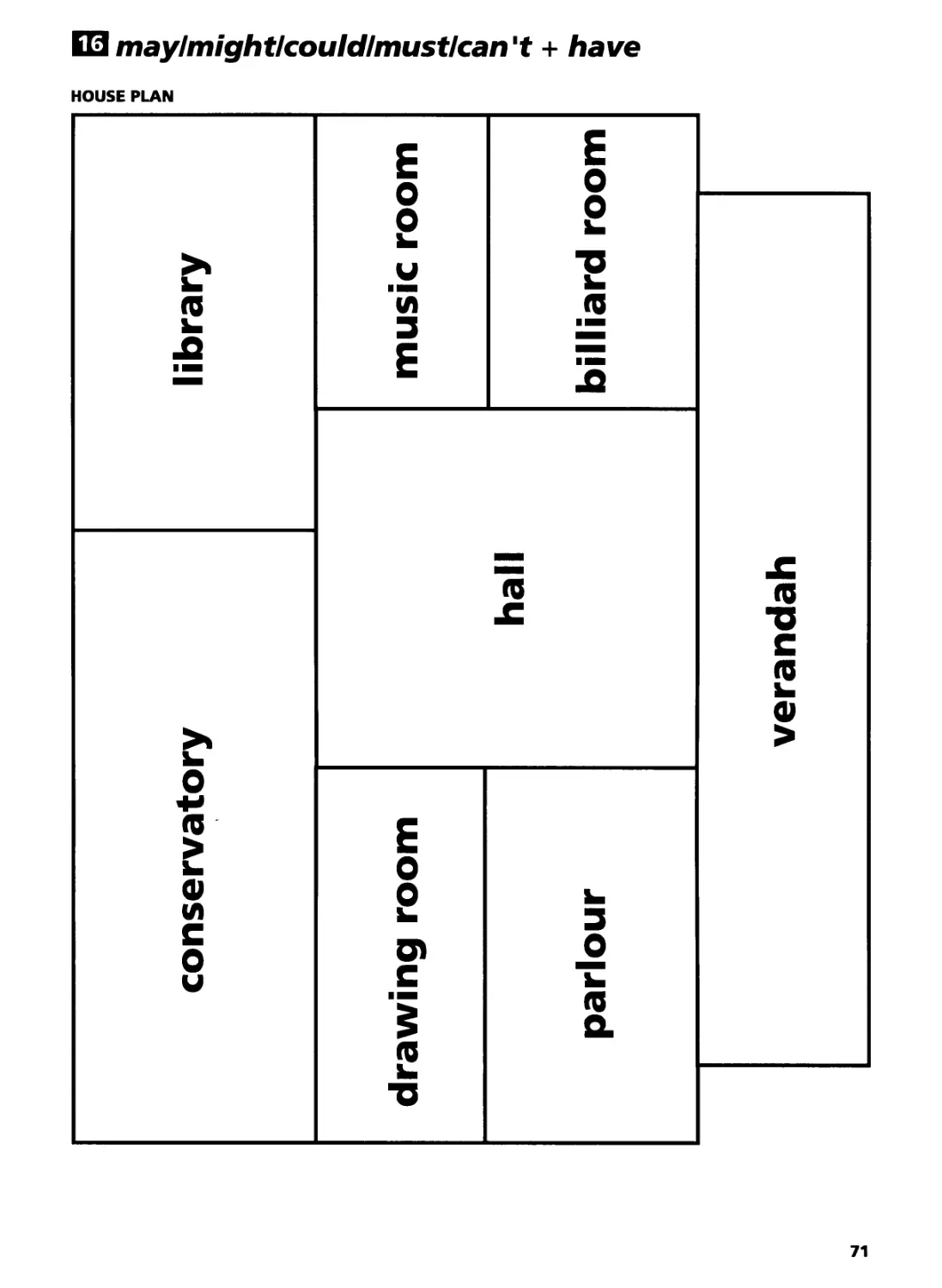
• Copy and cut up one set of alibi cards and one copy
of the house plan and list of characters for each
group of 3-4 students.
How to use the game
• Check that your students are familiar with the grammar
in the Grammar point and with the words listed in
Challenging vocabulary. Pre-teach any other words
from the game you think will be unfamiliar to your class.
• Divide the class into groups of 3-4 students.
• Give each group a set of alibi cards, a list of
characters and a house plan.
• They should put the alibi cards face down in a pile
in the centre.
• Explain that the house plan shows a country house in
which a murder has been committed. The dead man
is Xavier whose body was found in the conservatory.
He had been killed with a billiard cue. They should
study the house plan to familiarise themselves with
the layout of the house and the list of characters
to find out who was in the house at the time.
• The object of the game is to find ‘whodunit’.
• The group who does this first are the winners.
• The first player turns up an alibi card from the pile and
lays it face up where everyone in the group can see it.
• Players make deductions based on the statements on
the card, e.g. ‘So Annette might have done itP, ‘John can't
have done it because he was with Davina in the library
then', etc.
• The students can make notes on the list of characters
as they play the game. They may have to revise opinions
as further cards with more information are turned up
in the course of the game.
• The players will be able to find the murderer by a
process of elimination. When everyone else has an
alibi only one character will be left (Margaret).
Monitoring and feedback
Ask groups to report back on their ‘thought processes’:
‘At first we thought Annette could have done it
because ...’, etc.
Active and passive
infinitives
lype of activity
Pairwork; guessing; production
Grammar point
Active and passive infinitives
- active infinitive in the present, e.g. to love:
He promised to love her forever.
- active infinitive in the past, e.g. to have loved:
It is better to have loved and lost than never loved at all
- passive infinitive in the present, e.g. to be loved:
She wants to be loved for herself not for her money.
16
17
18

- passive infinitive in the past, e.g. to have been loved:
The most important thing in life is to have loved and to
have been loved.
Other structures
Present simple
Topic areas
Wishes and hopes
Challenging vocabulary
Students generate their own vocabulary. Be prepared to
provide support.
Materials and preparation
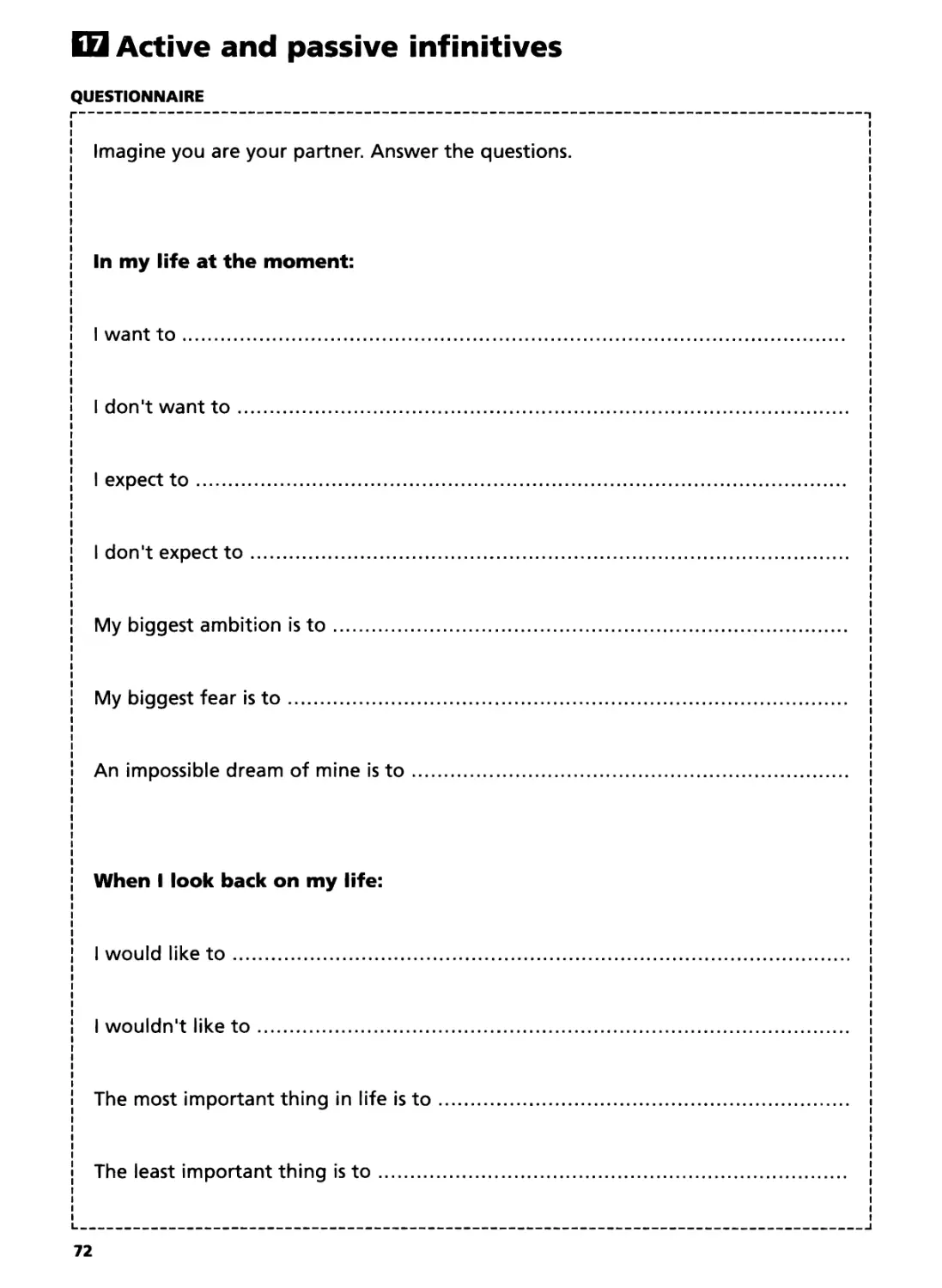
• Make enough copies of the questionnaire for each
student in the class to have one.
How to use the game
• Check that your students are familiar with the grammar
in the Grammar point.
• Divide students into pairs.
• Give one questionnaire to each student.
• Ask them to sit back to back.
• Ask each student in the pair to imagine they are
the other.
• Get them to fill in the questionnaire, imagining they
are the other person. (They should use both passive
and active infinitives.)
• When they have finished, get them to turn round and
discuss each sentence with their partner. How many
were right?
• The object of the game is to get as many correct
guesses as possible.
• The pair who get the most correct guesses are the
winners.
Monitoring and feedback
At the end of the game you can go round the class asking
individual students to read out the sentences they have
written down, correcting mistakes and giving feedback.
Comparatives and
superlatives
Type of activity
Small group; board game; production
Grammar point
Comparatives and superlatives
- we can use comparatives (with than) and superlatives
to compare things:
My car is faster than yours.
Jill’s car is the fastest.
- with most one-syllable adjectives and some two-syllable
adjectives we form the comparative by adding -er and
the superlative by adding -est: small - smaller - smallest
- when a short adjective ends in consonant + -y, we
form the comparative and superlative by changing the
-y to -i: pretty - prettier - prettiest
- when a short adjective ends in consonant + vowel +
consonant, we form the comparative and superlative
by doubling the final consonant: hot - hotter - hottest
- when a short adjective ends in -e> we form the
comparative by adding -r and the superlative by
adding -st: gentle - gentler - gentlest
- with adjectives of two syllables and more the
comparative and superlative are usually formed
using more and most: intelligent - more intelligent -
most intelligent
- exceptions are:
good - better - best
bad - worse - worst
far - further -furthest (or farther - farthest)
Other structures
None
Vocabulary area
Possessions, personal information
Challenging vocabulary
None
Materials and preparation
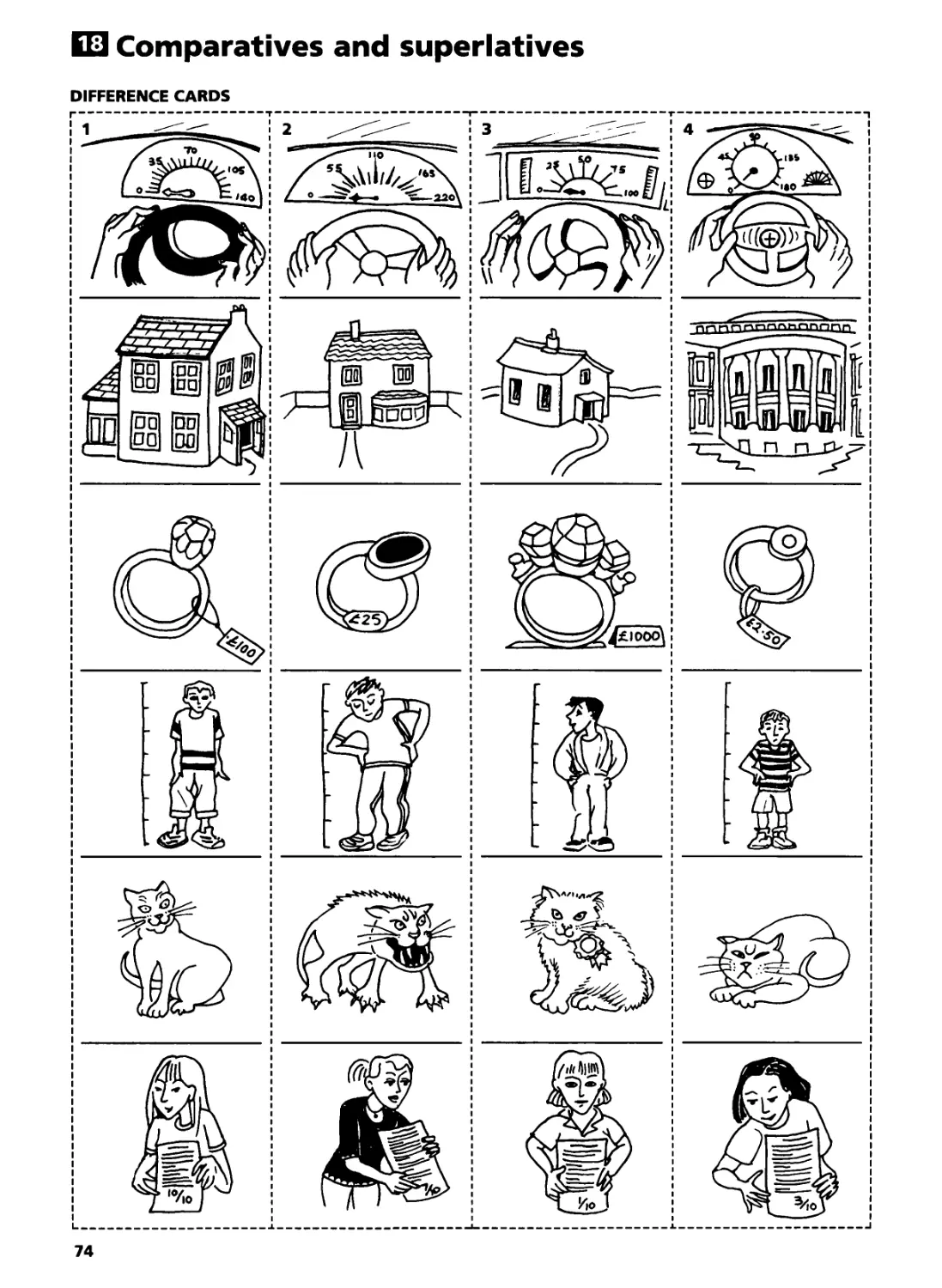
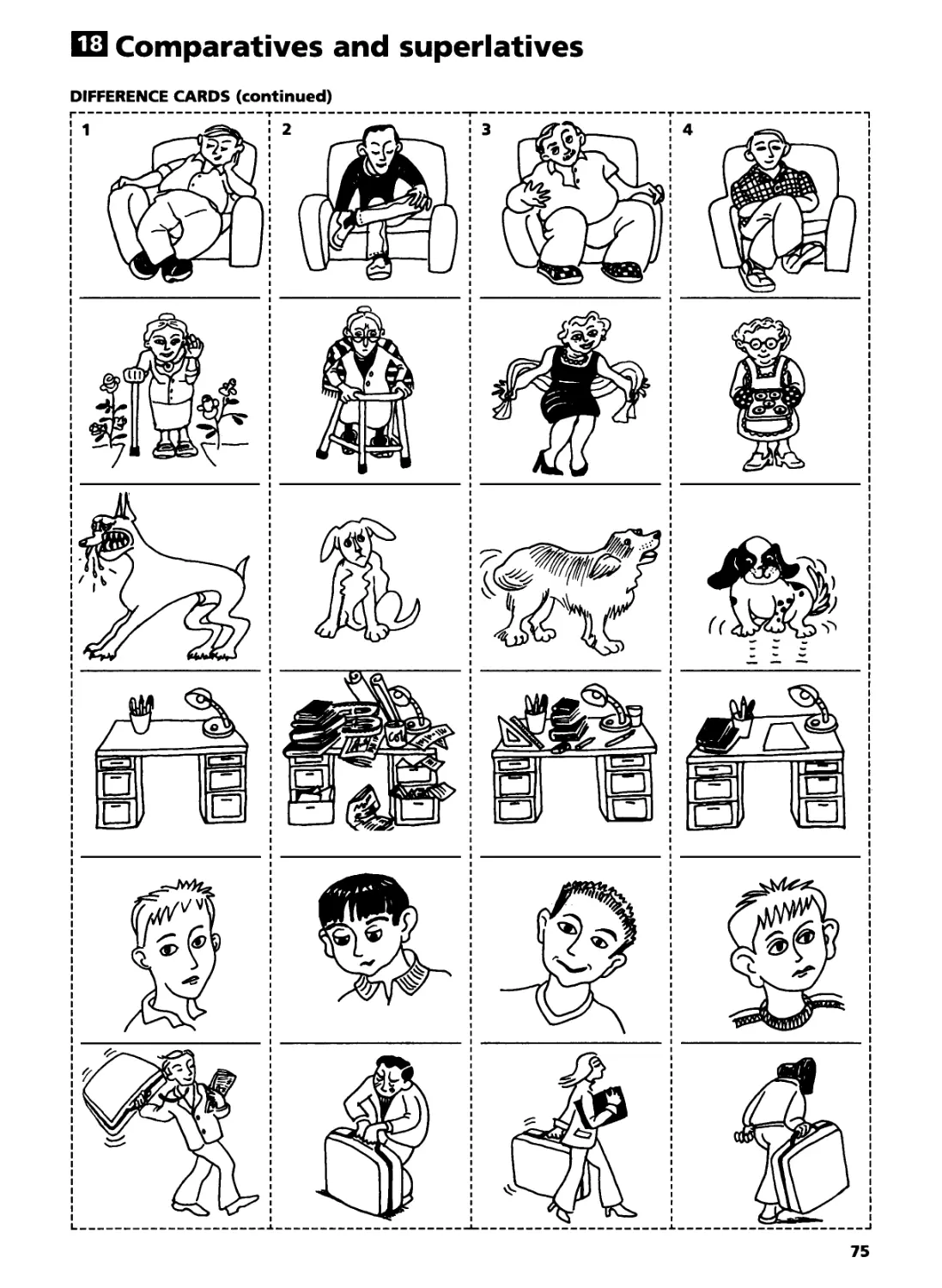
• Copy one cue board and all 48 difference cards
for each group of 3-4 students. Cut the difference
cards vertically into four sets for each group so that
each player will have two strips of different pictures,
both with the same number (1-4) at the top. Do not
cut them up into individual cards - the students will
do this. You will also need a counter for every student
and a dice for each group.
How to use the game i rules sheet ~|
• Check that your students are familiar with the grammar
in the Grammar point.
• Divide students into groups of 3-4.
• Give one copy of the cue board and eight sets of
difference cards to each group. For groups of 3
leave out two sets of cards. Give out counters and
dice to each group.
• The students should each take two strips of difference
cards with the same number at the top and, keeping
them hidden from the others, cut or tear them into
individual cards.
• They should all place their counters on square 1.
• The first player shakes the dice and moves his counter
the appropriate number of spaces on the board.
18
19

• When he lands on a picture square he should select a
card from his hand that matches the object on that square
and make a statement about it using a comparative
or superlative. He can either say 'My ... is the ...-est.’
e.g. 'My car is the fastest.9 or he can compare the object
with that of another player by saying 'My ... is ...-er
than yours, ’e.g. 'My house is smaller than yours. ’ or
'My ring is more expensive than yours. ’ He can address
the statement to any other player or to the group as a
whole, laying down the card from his hand so everyone
can see it. The other player or players who are addressed
must lay their cards down too.
• If the player’s statement was correct, he can throw
away his card. If not, he must keep it.
• Then it is the next player’s turn.
• The object of the game is to get rid of all your cards.
• The player who does so first is the winner.
NOTE At first the players will be making guesses. As
more players have to show their cards they will know
who has the biggest / smallest / most beautiful etc.
But will they be able to remember?
Monitoring and feedback
You can ask students to write down some of their
sentences as they produce them or after the game is
finished. At the end you can go round the class asking
individual students to read out their sentences, correcting
mistakes and giving feedback.
Wh- questions: mixed
question forms
type of activity
Small group; guessing; production
Grammar point
Who, why, which, where, what, when, how
- we begin a zvh- question with a question word like
who or why
- we usually put the subject after the auxiliary or after
main verb be in questions:
Where are you going?
What have you done?
Why is she angry?
- but we use normal statement word order when the
question word is the subject:
Who took my camera? ~ Sorry, I took it.
Other structures
A mix of tenses, depending on students’ choice of what
to say
Topic areas
Personal information: marital status, age, family, domicile,
feelings, preferences, favourite colours/sports, etc.
Challenging vocabulary
Students generate their own vocabulary. Be prepared to
provide support.
Materials and preparation
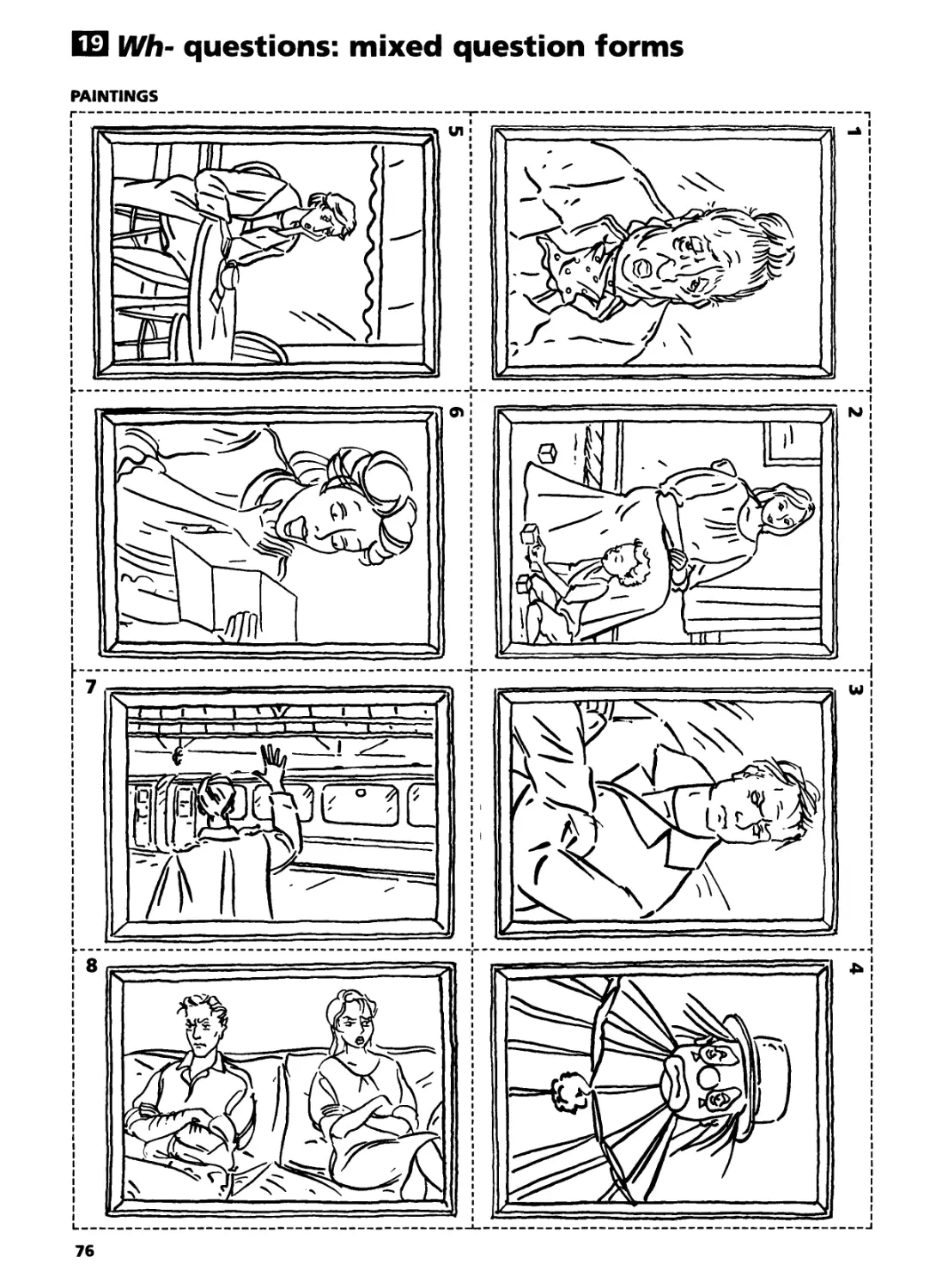
• Copy and cut up one set of paintings for each group of
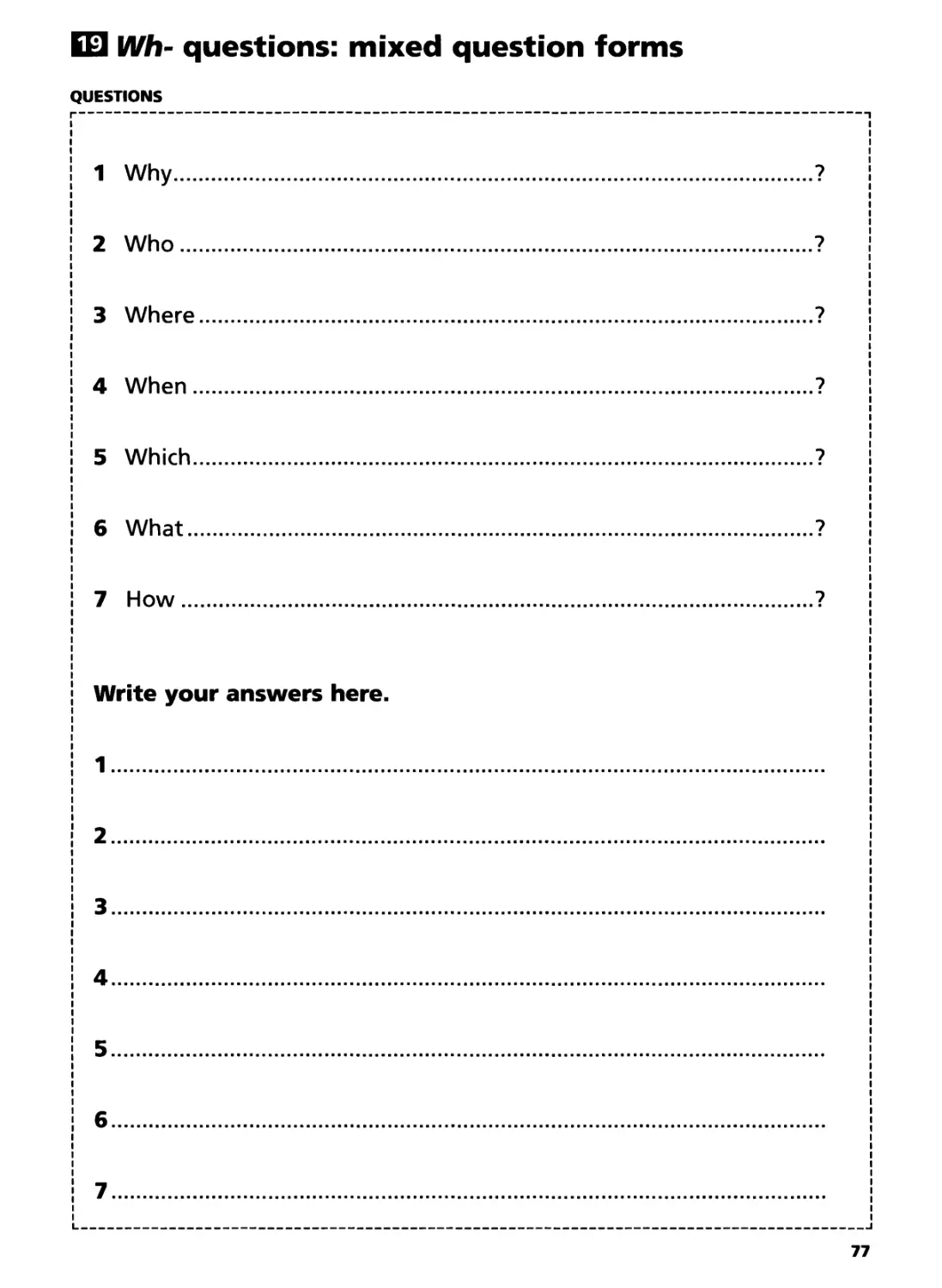
6-8 students and one set of questions for each student.
How to use the game
• Check that your students are familiar with the grammar
in the Grammar point.
• Divide the class into groups of 6-8.
• Give each group a set of paintings.
• Ask them to take one each.
• Each player should look at the painting and write down
seven questions (one for each question word) on the
questions sheet. These should be questions they would
like to ask the main character either about him or
herself or about the other characters or objects in the
painting, e.g. 'Why are you so unhappy?9
• They should then pass their painting and questions to
the person on their right, who should look at the
painting, imagine they are the central character and
write down answers to the questions in the answer
column, using full sentences, e.g. 'I’m unhappy because
my cat has run away. ’
• The players should then put all the paintings in the
middle of the table, where everyone can see them
• The first player begins by reading out his answers to
the questions he was given (but not the questions).
• The object of the game is to guess a) which painting
is ‘speaking’; b) what the questions were.
Monitoring and feedback
At the end of the game you can go round the class asking
individual students to read out the sentences they have
written down, correcting mistakes and giving feedback.
If... will
type of activity
Small group; matching; accuracy
Grammar point
If... will - the first conditional
- we use the present simple in the if clause and will in
the main clause when we talk about a future event
that is a definite possibility:
If I see her, I’ll tell her you rang. (= it’s possible I will
see her)
v it rains, I won’t go to the park. (= it’s possible it
will rain)
19
20
20

Other structures
Passive
Topic areas
Family life, leisure activities, weather
Challenging vocabulary
None
Materials and preparation
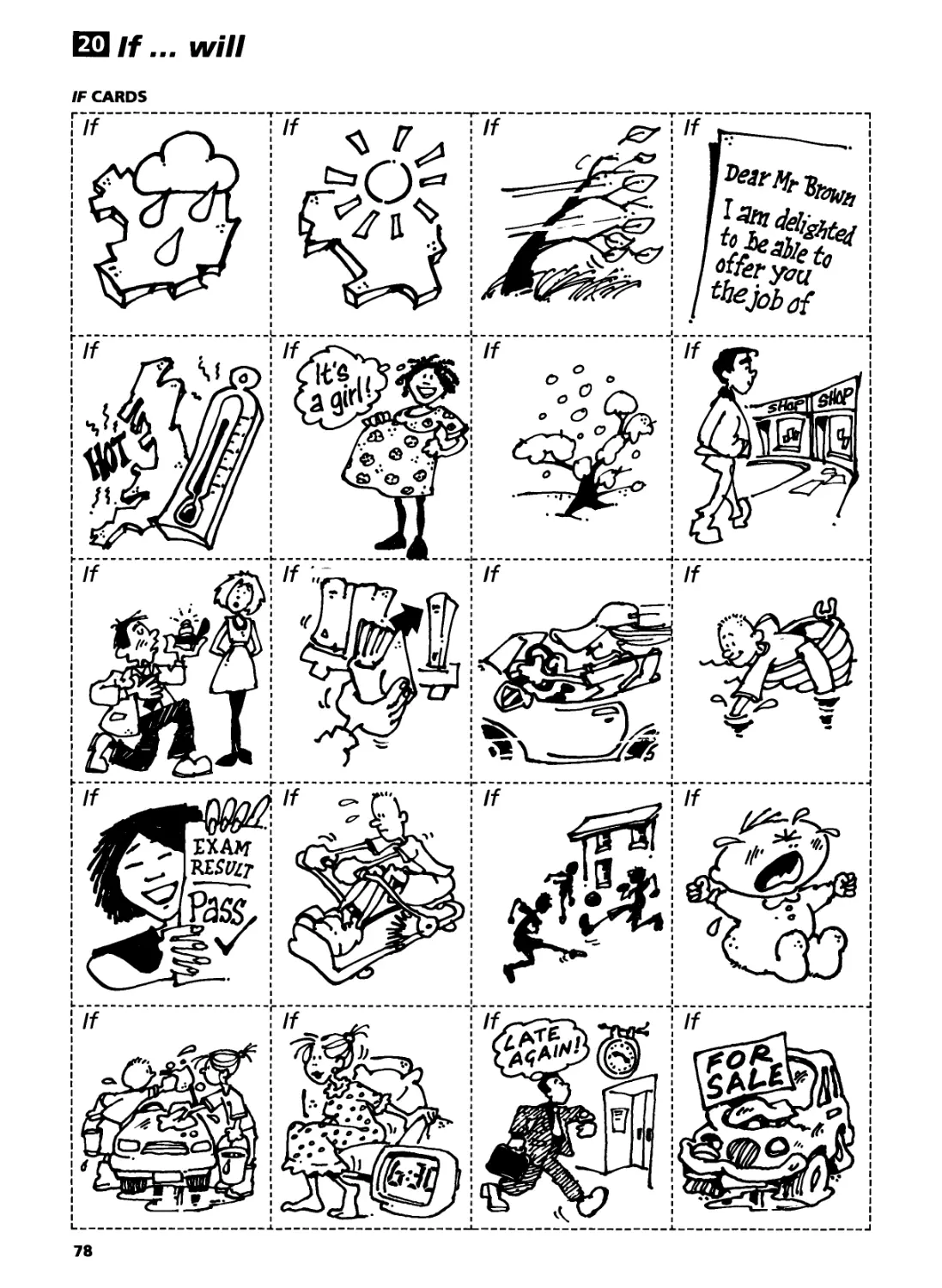
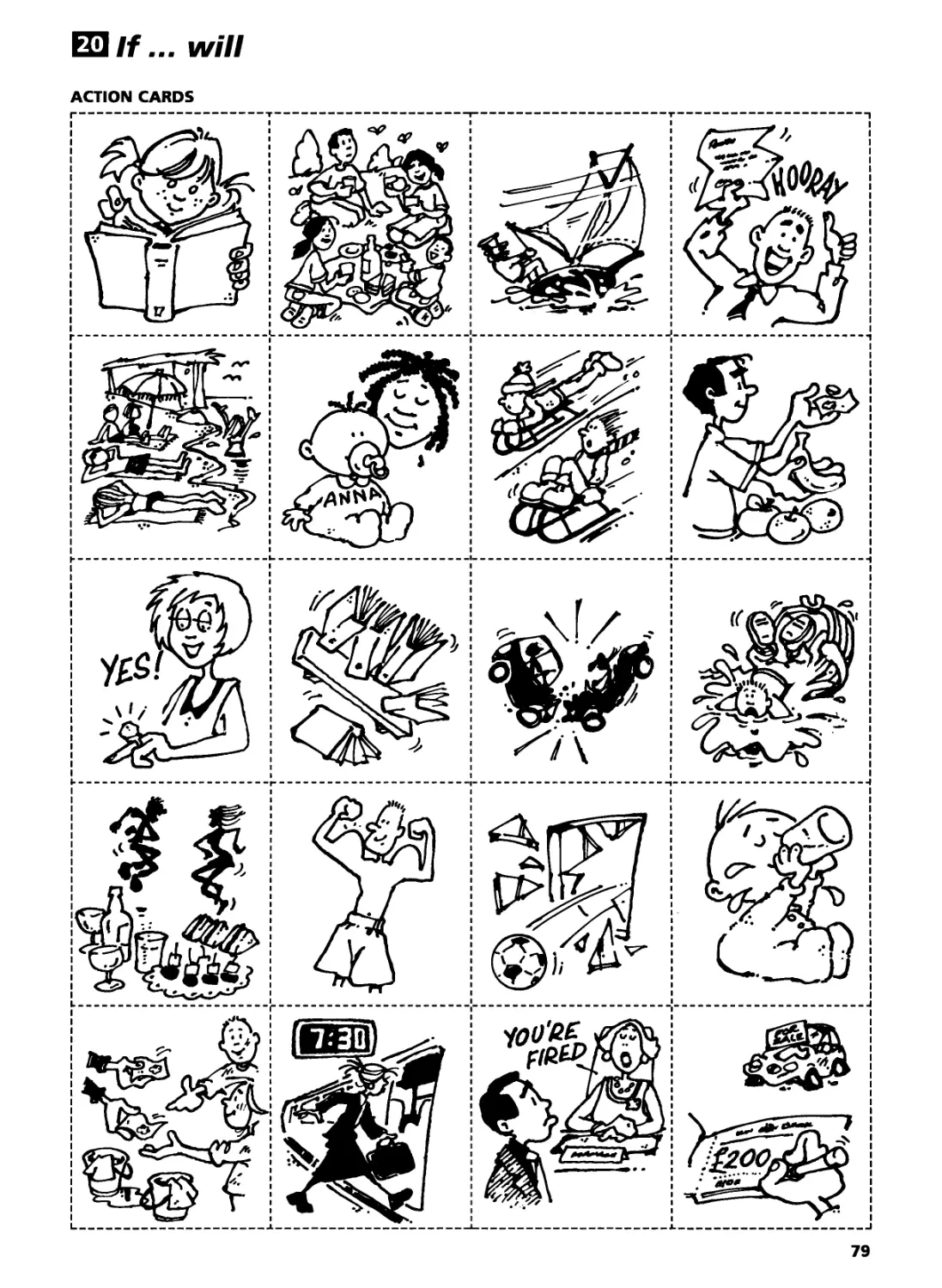
• Copy and cut up one set of the if cards and one set
of the action cards for each group of 3-4 students.
How to use the game 1 sheet ~~|
• Check that your students are familiar with the grammar
in the Grammar point.
• Divide the class into groups of 3-4 students.
• Give each group a set of IF cards and a set of
action cards.
• The students should deal out the action cards and
put the IF cards face down in a pile in the centre.
• They may look at their action cards.
• The first player turns up an if card from the pile and
lays it on the table, starting a sentence beginning with
‘If...' as suggested by the picture, e.g. (turning up the
picture of the snow) ‘If it snows ...'
• The player with an action card that matches can
produce it, completing the sentence, e.g. ‘... we'll
go sledging. ’
• If everyone agrees that this makes a good sentence,
the players can then discard both cards.
• If two or more players offer endings, the group should
decide which is the best.
• Then it is the next player’s turn to turn up a card
from the pile.
• The object of the game is to get rid of all your cards.
Monitoring and feedback
You can ask students to write down some of their
sentences as they produce them or after the game is
finished. At the end you can go round the class asking
individual students to read out their sentences, correcting
mistakes and giving feedback.
ED/f... would
Type of activity
Small group; matching; production
Grammar point
If... would - the second conditional
- we use the past simple in the if clause and would in
the main clause when talking about an imaginary
or hypothetical situation:
If I won a lot of money I would go on a world tour.
- in the if clause, were is used in preference to was:
If I were you, I would take the job.
Other structures
None
Topic areas
Plans and dreams
Challenging vocabulary
competition, scream (v), safari, snake
Students will also generate their own vocabulary.
Be prepared to provide support.
Materials and preparation
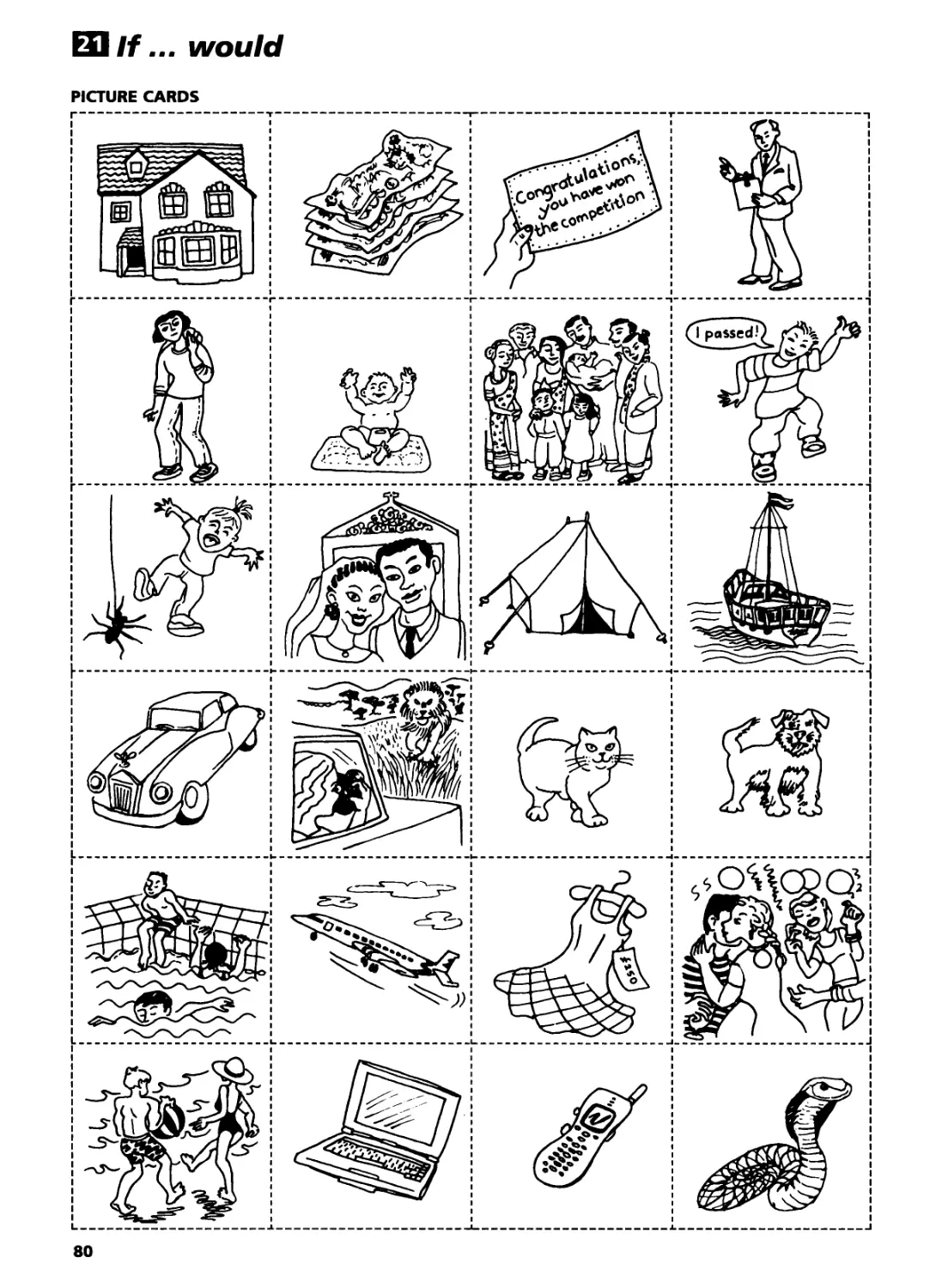
• Copy and cut up two sets of picture cards for each
group of 3-4 students.
How to use the game I sheet ~~|
• Check that your students are familiar with the grammar
in the Grammar point and with the words listed in
Challenging vocabulary.
• Divide the class into groups of 3-4 students.
• Give each group two sets of picture cards.
• Ask the students to shuffle the cards (keeping them in
two sets) and then to put both sets face down in piles
in the centre.
• One player should then turn up a card from each pile
and put them on the table where everyone in the
group can see them.
• The first player to make a sentence combining the two
ideas can collect the cards, e.g. (turning up dress and
man): ‘If I had a rich boyfriend, I would buy that dress.'
‘If I spent that much money on a dress, my father would go
mad.' ‘If I were him, I wouldn't wear that to the officeF
• The other players can query the sentence if they think
it is grammatically wrong. If necessary, they can ask
the teacher if it is wrong or not. If two or more players
make a sentence simultaneously, then the group as a
whole should decide which is best and award the cards
to that player. If they can’t decide, the teacher gets the
casting vote!
• Then another player can turn up two cards for
everyone to see.
• If the group cannot think of a sentence, the player
leaves the cards face up on the table and draws
another two from the piles. Then any card can be
combined with any other on the table.
• The object of the game is to collect the most cards.
• The player who does so is the winner.
21

Monitoring and feedback
You can ask students to write down some of their
sentences as they produce them or after the game is
finished. At the end you can go round the class asking
individual students to read out their sentences, correcting
mistakes and giving feedback. If you feel it would be
useful to reinforce the grammar, you can ask the students
to play the game again (possibly in new groups).
E9 If... would have
type of activity
Small group; board game; communication
Grammar point
//... would have - the third conditional
- we use the past perfect in the if clause and would have
+ past participle in the main clause when we talk
about an unreal situation in the past, i.e. a situation
that could have happened, but didn’t:
If I had worked harder, I would have done better
in school.
If 1 hadn’t gone to Australia, I wouldn’t have met
my wife.
Other structures
Past simple, past passives
Topic areas
Life experiences and opportunities
Challenging vocabulary
archaeology, rock climbing
Materials and preparation
• Copy one missed opportunities board and one set
of outcome cards for each group of 3-A students.
Copy one my life sheet for every student in the class.
You will also need a counter for every student and a
dice for each group.
How to use the game I sheet-]
• Check that your students are familiar with the grammar
in the Grammar point and with the words listed in
Challenging vocabulary. Pre-teach any other words
from the game you think will be unfamiliar to your class.
• Divide students into groups of 3-4.
• Give one copy of the missed opportunities board and
one set of outcome cards to every group. Give every
student a my life sheet. Give out counters and dice
to each group. Set a time limit for the game, say
15-20 minutes.
• Ask the students to place the outcome cards face down
in a pile in the centre.
• They should all place their counters on square l.
• The first player shakes the dice and moves his counter
the appropriate number of spaces on the board.
• When he lands on a missed opportunities square he
should take an outcome card from the pile and make
an If... would have sentence about the situation
described on that square. The outcome card will
tell him whether to make a happy ending or a sad one,
e.g. landing on the ‘You were offered a good job in
London but you turned it down. ’ square he might say
Tf I had taken the job, I would have been able to afford
a new car.’ or 'If I had taken that job, I wouldn’t have
met my wifeP
• He should replace the outcome card at the bottom
of the pile and write down both the situation and the
//"sentence and his feelings about them on the my life
sheet, e.g. T was offered a job but I turned it down - I’m
glad about this because if I had taken it, I wouldn’t have
met my wifeP
• Then it is the next player’s turn.
• If a player lands on a square that someone else has
already landed on they must make a different sentence.
• The object of the game is to get as many events
as possible on the my life sheet.
• When the time limit is up, ask students to look at the
events they have written down on the my life sheet.
Ask them to number them in the order they think
they happened.
• Now regroup students by swapping a pair from each
group with a pair from another group. Using the my
life sheet as a prompt, the pair should tell the new
pair about their ‘lives’.
Monitoring and feedback
Ask each student to say one thing about their life, using
their my life sheet.
E£j If and when
Type of activity
Small group; board game; accuracy
Grammar point
If and when
- we use the present simple to talk about future events
after if and when:
If I see Julia, I’ll tell her.
When I see Julia, I’ll tell her.
- in the example above with when the speaker is sure
that he will see Julia, but in the example with if the
speaker is not sure.
Other structures
Present simple, present continuous, present perfect
22

Topic areas
Everyday actions
Challenging vocabulary
None
Materials and preparation
• Make one copy of the if and when board and copy
and cut up both sets of cue cards (Packs 1 and 2) for
each group of 3—4 students. You will need a dice and
counters for each group.
How to use the game I RUl-E!i SHEET J
• Check that your students are familiar with the grammar
in the Grammar point.
• Divide the class into groups of 3-4 students.
• Give each group two packs of cue cards.
• Ask the players to divide Pack 1 into two piles, if and
when, and place the piles face up on the appropriate
rectangles on the board.
• They should deal out four cards each from Pack 2 and
put the rest face down in a pile, at the side of the board.
• They should all put their counters on square 1.
• The first player begins by throwing the dice and moving
the appropriate number of squares on the if and
when board.
• When she lands on a square, she should take up a card
from the appropriate pile {if or when) and begin a
sentence, e.g. (picking up the picture of the lesson)
‘ When the lesson ends...'
• Players should try to produce a suitable card from their
hands and complete the sentence, e.g. (using the
picture of the house) 1 ...I'Ugo home.' or (producing
the picture of the beach) ‘ ...I'U go to the beach.', etc.
• The first player to produce an acceptable sentence can
lay both cards down as a pair and take another card
from the pile at the side of the board.
• Then it is the next player’s turn.
• The object of the game is to make the most pairs
of cards.
• The player who does so is the winner.
Monitoring and feedback
At the end, players can lay out the matching pairs of cards
they collected and try to remember the sentences. You can
either go round the class asking for sample sentences
from each group (or each group’s best sentences) or ask
students to write up their sentences. If you like, you can
play the game again for reinforcement, perhaps in a
more challenging version by cutting off the if and when
labels on the cards and shuffling them together into one
pile. When a player lands on a square she takes a card
from the pack and decides whether she can use
it or not. Some cards (e.g. the weather cards) can only
be used with if, some (e.g. the 18th birthday party) only
with when, some can be used with either. The players must
decide which is appropriate and may query sentences:
7 don't think you can say “If the lesson ends" - it's definitely
going to endP
wish
Type of activity
Whole class; searching; communication
Grammar point
Different tenses are used after zuish, with different meanings.
Present wishes: dissatisfaction
- use the past simple or continuous if you wish that the
present situation were different:
I wish I was on holiday now.
I wish it wasn't raining.
- in this type of wish you can use were instead of was:
I wish I were on holiday now.
Past wishes: regrets
- use the past perfect if you regret that something
happened (or didn’t happen):
I wish I hadn't told her about John, (but I did tell her)
I wish I had worked harder at school, (but I didn’t
work hard)
Future wishes: complaints and hopes
- use would if you wish that something would happen or
someone would do something in the future or very soon:
I wish he would answer my emails.
- this type of wish is often a complaint:
I wish you wouldn't interrupt me all the time!
- although it can be a dream:
I wish he would kiss me!
- if you have a hope or a dream about yourself, use could
not would:
I wish I could go to Thailand.
Other structures
None
Topic areas
Past actions, (irritating) habits, regrets, hopes and dreams
Challenging vocabulary
interrupt, baby-sitting, colleague, musical instrument,
quarrel (v), scrape (v), turn down
Materials and preparation
• Copy and cut up the wish cards so that each student
can have one card from each set of complaints,
grumbles, regrets and hopes. Copy and cut up all the
sorted! cards so that each student can have four cards.
24
23

How to use the game
• Check that your students are familiar with the grammar
in the Grammar point and with the words listed in
Challenging vocabulary. Pre-teach any other words
from the game you think will be unfamiliar to your class.
• Give each student one complaint, one grumble,
one regret and one hope card.
• Mix up the sorted! cards and give four cards to
each student.
• The object of the game is to find the people who
can sort out all your dissatisfactions and make
your dreams come true.
• To do this, students will have to get up and walk
around the room telling each other their wishes
based on their wish cards, e.g. 'I wish I could swim.’
or ‘I wish I hadn’t scraped the car.’
• When they find the person with the appropriate
sorted! card, he then hands it to them saying
'Here, this might helpP or 'Your wish is grantedP
• When they have collected all four sorted! cards for
their wishes, they can sit down.
• They can compare wishes and solutions with the people
next to them until the rest have finished.
Monitoring and feedback
Ask each student to tell the class one of their wishes and
how it got sorted, e.g. 'I wished that I could swim and then
Anna gave me a voucher for swimming lessons. ’
Present passives
Type of activity
Small group; matching; accuracy
Grammar point
Present passive
- we use passives when the doer of the action is unknown
or not important and we want to focus on what
happens or where or how something happens
- present passives are formed using amlislare and the
past participle:
Tea is grown in China.
Keys are made of metal.
Other structures
None
Topic areas
Countries, materials, products
Challenging vocabulary
gold, paper clip, silk, pump (n), inflate, tyre, wheat, oil (n),
corkscrew, hammer (n), measure (v), temperature
Materials and preparation
• Copy and cut up the beginnings and endings cards
for each group of 3-4 students. You can make a copy
of the uncut sheet to act as an answer key for each
group. On the board, write the verbs they will need:
is/are made (of or in), is/are found (in), is/are grown (in),
is/are used (to or for).
How to use the game I rules sheeth
• Check that your students are familiar with the grammar
in the Grammar point and with the words listed in
Challenging vocabulary. Pre-teach any other words
from the game you think will be unfamiliar to your class.
• Divide the class into groups of 3-4 students.
• Give each group a set of beginnings cards, a set of
endings cards and an answer key.
• They should deal out the beginnings cards and put
the endings cards face down in a pile in the centre.
They should leave the answer key face down on
the table.
• They may look at their beginnings cards.
• The first player turns up an endings card from the
pile. If she can make a sentence using one of the
beginnings cards from her hand and one of the
passive verbs you have written on the board, e.g.
'Kangaroos are found in Australia.’, 'Coffee is grown in
South America.’, 'Pens are used for writing.’, she can lay
both cards down on the table to make a sentence.
• If not, she must put the endings card at the bottom
of the pile and miss a go.
• Then it is the next player’s turn.
• The object of the game is to make the most
sentences.
• At the end of the game the students can check their
answers with the answer key. Variations are possible.
Monitoring and feedback
You can ask students to write down some of their
sentences as they produce them or after the game is
finished. At the end you can go round the class asking
individual students to read out their sentences, correcting
mistakes and giving feedback. If you feel it would be
useful to reinforce the grammar, you can ask the students
to play the game again (possibly in new groups).
EH Present perfect and
past perfect passives
type of activity
Part 1: Small group; completing and guessing; production
Part 2: Small group; memory; production
25
24

Grammar point
Present perfect and past perfect passives
- we use perfect passives when the doer of the action
is unknown or not important and we want to focus
on what happened or didn’t happen, or where or
how something happened
- we form present perfect passives by using have/has
been and the past participle:
I have been asked to go to Spain for six months.
- we form past perfect passives by using had been
+ past participle:
I wish I had been allowed to have a puppy when
I was a child.
Other structures
None
Topic areas
Everyday actions
Challenging vocabulary
inspired, praised, encouraged, admired, employed,
appreciated, criticised, teased
• The students should tell each other the sentences,
e.g. ‘Maria wishes she hadn't been told off so much
when she was a child. ’ ‘Peter is glad he has been told
he is handsome by so many girlsP
• They should then write the sentences down.
• The group who can write the most sentences in 20
minutes is the winner.
Monitoring and feedback
Part 1
At the end of the game you can go round the class asking
individual students to read out some of the sentences they
have written down, correcting mistakes and giving feedback.
Part 2
At the end you can go round the class asking individual
students to read out their sentences, correcting mistakes
and giving feedback.
Materials and preparation
• Make enough copies of the sentences frame for
every student in the class.
How to use the game
Part 1
• Check that your students are familiar with the grammar
in the Grammar point.
• Give one sentences frame to each student.
• Ask them to fill in the frame with sentences that are true
for them. They must use perfect passives, e.g. 7 have
been criticised for talking too much. '
• The students should fill in the frame, using as many
different verbs as they can. They can use the verbs
provided or others of their own choice.
• They should not show their sentences to anyone else.
• Then group the students into threes and fours.
• The object of this part of the game is for the
students to guess each other’s sentences.
• To do this, they could use, for instance, ‘In number X,
I think Ysaid...': ‘In number 20, I think Sonia said
“I wish I hadn't been teased about my hair".'
Part 2
• When all players have guessed each other’s sentences,
divide the students into pairs within their groups
(or an individual and a pair in the case of threesomes).
Then regroup the students so that each pair of students
is with a new pair from a different group.
• The object of this part of the game is for the students
to remember as many sentences as possible from their
previous groups.
Past passives
Type of activity
Whole class; information gap; communication
Grammar point
Past passives
- past passives are used when we want to focus on the
object of a past action or on the action itself rather
than on the doer of the action
- we form past passives by using was!were + past participle:
He was last seen at the airport.
- we form past continuous passives by using waslwere
being + past participle:
He was being blackmailed.
- we form past perfect passives by using had been
+ past participle:
His passport had been taken.
Other structures
Active forms of the present perfect, past simple,
past perfect
Topic areas
Everyday actions
Challenging vocabulary
blackmail (v), underwear, spy (n)
Materials and preparation
• Make enough copies of the disappeared! cards and
where’s WALLACE? sheet for every student to have one
card and one sheet. If you have fewer than 11 students
in your class you will have to give some of them two
cards to ensure all the information gets distributed.
27
25

How to use the game
• Check that your students are familiar with the grammar
in the Grammar point and with the words listed in
Challenging vocabulary. Pre-teach any other words
from the game you think will be unfamiliar to your class.
• Explain to the students that their neighbour, a man
called Wallace, has disappeared from his London flat.
The disappeared! cards you will give out contain clues
as to where he has gone. They must talk to everyone
else and share their clues to find out where he has gone.
• Distribute the disappeared! cards and where’s
Wallace? sheets so that each student has one of each.
• Give them a little time to read their card and to fill
in any information they have on their where’s
WALLACE? SHEET.
• Then ask them to move around the class telling other
people what they know about Wallace, and collecting
information.
• They should write the answers on their where’s
WALLACE? SHEET.
• After a little while, put the students in groups of 3-4.
• Ask them to check their answers with each other and
to pool their information to fill in any blanks on their
WHERE’S WAULACE? SHEETS.
• Check the answers with the whole class. They should
have the following: Note, Seventh, Irene, Blackmail,
Underwear, Everything else, One thousand pounds,
Railway station, Airport, Evening, Spy.
• Then tell them that the initial letters of their answers
will give the name of the city where Wallace has gone.
They will have to rearrange them first. You can give
them the following blank-fill to help them if you like:
• The object of the game is to find out where Wallace
has gone. (The answer is BUENOS AIRES.)
• The group who does so first is the winner.
Monitoring and feedback
Go through the where’s Wallace? sheet, asking students
to give full answers, e.g. ‘A note was found on his bed.’
Ed Reported speech
type of activity
Small group; search; production
Grammar point
Reported speech - changes of tense
- when we report what someone said, we are talking
about the past, so the verbs in the reported speech
change to past tenses
- the simple present becomes simple past:
T work at City College. ’ - She said that she worked at
City College.
- the present continuous becomes the past continuous:
'I am working in Paris. ’ - He told me that he was
working in Paris.
- the present perfect becomes the past perfect:
T have been to India twice. ’ - She told me that she had
been to India twice.
- the past simple can remain unchanged or can change
to the past perfect:
T went to a concert last night. ’ - She said that she went
to a concert last night. or She said that she had gone to
a concert last night.
- will becomes would:
‘I’ll do the shopping. ’ - He said that he would do
the shopping.
Other structures
Present simple, present continuous, past simple,
past continuous, present perfect continuous,
present perfect, will, going to
Topic areas
Personal information
Challenging vocabulary
None
Materials and preparation
• Make one copy of the question sheet and one copy
of the answer sheet for each group of 3—4 students.
Each group will also need a paper bag.
How to use the game
• Check that your students are familiar with the grammar
in the Grammar point.
• Divide the class into groups of 3-4 students.
• Get each group to write the names of all the students in
the class who are not in their group on a sheet of paper,
and to cut or tear it into pieces so that there is one name
per piece. They should put the names in the bag.
• Give each group a question sheet and an answer sheet.
• They should dip into the bag and take out a name.
One person from the group should go to another
group to ask the person whose name they have drawn
the first question on the sheet. If the person whose
name they have drawn is absent (i.e. asking a question
himself) they should draw another name from the bag.
• They should return to their groups and ‘report’ the
answer to the question, for instance ‘Number 2: Maria
said that she was feeling happy today. ’ The group should
write the answer down on the answer sheet.
• When they have done that, it is the next person’s turn
to take a name from the bag and go to another group
to ask the second question on the question sheet.
• The object of the game is to fill in the answer sheet.
• The group that does so first are the winners.
26

Monitoring and feedback
At the end of the game you can go round the class asking
individual students to read out some of the sentences they
have written down, correcting mistakes and giving feedback.
Time prepositions
lype of activity
Whole class; information gap; communication
Grammar point
Time prepositions: before, after, during, since,
from ... to, at, in, on, until, by, for
- before, after, until, by, since, from ...to are used with points
in time, such as clock times, days, dates, months, seasons:
before Christmas, after 8 o'clock, until late afternoon,
by May 24th, since last year, from Monday to Saturday
- before, after and until can also be used as conjunctions
followed by a sentence:
I locked the back door before I went to bed.
- at is only used with clock times and festivals:
at 4.30, at New Year
- on is only used with a day or date:
on Monday, on February 15,h
- in and during are used to talk about specific events
that happen inside a longer time period, e.g. months,
seasons and times of the day:
in September, in the morning!afternoon!evening! night
- during can also be used with events:
during the meal, during my childhood
- for is used with durations of time:
for three hours, for 12 days
Other structures
Past tenses
Topic areas
Leisure activities
Challenging vocabulary
proposed
Materials and preparation
• Copy one Monday morning picture and one whose
who questionnaire for every student in the class. Copy
and cut up enough weekend cards for every student
in the class to have one card. If you have fewer than
10 students some students will have to act two
characters.
How to use the game
• Check that your students are familiar with the grammar
in the Grammar point and with the words listed in
Challenging vocabulary. Pre-teach any other words
from the game you think will be unfamiliar to your class.
• Give each student a monday morning picture, a
whose who questionnaire and one weekend card.
• Tell them to imagine they are the character whose
evening is described on the weekend card.
• The object of the game is to find out why the people
in the office on Monday morning all look so unhappy.
• To do this they first read their card and fill in their
own details on the whose who questionnaire.
• Then they will have to get up and go round the class
telling each other about their evenings, for example:
‘Hi, I'm Sam. I had a terrible evening yesterday. I
arranged to meet my girlfriend at Ferdy's Cinema. I got
there at 8 but she didn't come. She still wasn't there at 8.30
so I went home and watched TV I went to bed by 10.30.'
~ 7 had a bad evening too - I'm Will, by the way ...'
• When they finish each conversation, they should then
look at the whose who questionnaire and see if they
can fill in any answers.
• Warn them that some blanks will require two names.
• If you have a class larger than 10, you may like to tell
them that there are some duplicate roles, e.g. more
than one person may be Lucy. They only need to talk
to one of these Lucys!
• When they have each filled in the whose who
questionnaire they should sit down and compare
answers with the person next to them.
• Together they should work out a) who is dating whom
(or was until last night!) and b) why is everyone in the
monday morning picture looking so unhappy.
Answers:
Who went on a date with whom?
Lucy and Eliot
Sam and Punita
Will and Rosie
Ben and Jasmine
Jason and Poppy
What did everybody do?
1 Lucy and Eliot
13 Poppy
2 Punita
14 Jason
3 Will and Rosie
15 Ben
4 Jasmine and Ben
16 Rosie
5 Jason and Poppy
17 Sam
6 Sam and Poppy
18 Ben
7 Lucy and Eliot
19 Rosie
8 Jason and Poppy
20 Jasmine
9 Jasmine and Ben
21 Punita
10 Rosie
22 Lucy
11 Punita and Sam
23 Will
12 Lucy
24 Eliot
Monitoring and feedback
Go through the whose who questionnaire asking for full
answers, e.g. ‘Lucy and Eliot had a row during the party.'
29
27

-ing and -ed
participles
type of activity
Small group; matching; production
Grammar point
Participles ending in -ing and -ed
- these participles can act as adjectives:
His joke was not very amusing.
I’m fascinated by archaeology.
- there are many pairs of -ing and -ed adjectives, e.g.
interested, interesting; bored, boring
—ed participles describe a feeling:
I’m interested in history.
—ing participles describe someone or something that
gives you that feeling:
I find history interesting.
Other structures
Prepositions following verbs (e.g. interested in, bored by)
Topic areas
Various
Challenging vocabulary
worrying, disgusting, confusing, fascinating, annoying,
amusing, disappointing, shocking, embarrassing, depressing
worried, disgusted, confused, fascinated, annoyed, amused,
disappointed, shocked, embarrassed, depressed
Students will also generate their own vocabulary. Be
prepared to provide support.
Materials and preparation
• Copy and cut up one set of -ing cards and one set
of -ed cards for each group of 3-4 students.
How to use the game
• Check that your students are familiar with the grammar
in the Grammar point and with the words listed in
Challenging vocabulary. Pre-teach any other words
from the game you think will be unfamiliar to your class.
• Divide the class into groups of 3-4 students.
• Give each group a set of -ing cards and a set of
-ed cards.
• They should deal out the -ing cards and put the
-ed cards in a pile face down in the centre.
• The first player draws an -ed card from the pile and
lays it on the table face up.
• The player who has the matching -ing card can claim
it. She must then make a sentence about herself using
one of the words, e.g. T’m confused by English grammarP
and ask the group a question using the other word,
e.g. 'Do you think English grammar is confusing?’
• She can then discard both cards and it is the next
player’s turn.
• The group as a whole records its answers, e.g. 'Svetlana,
Pietro and Ali think English grammar is confusing but
Anna isn’t confusedP
• The object of the game is to match all the cards.
• When the groups have finished, put groups together
in pairs (i.e. 6-8 people) to share/compare their
information.
Monitoring and feedback
At the end of the game you can go round the class asking
individual students to read out some of the sentences they
have written down, correcting mistakes and giving feedback.
If you feel it would be useful to reinforce the grammar,
you can ask the students to play the game again
(possibly in new groups).
Verb + -ing or + to
type of activity
Small group; matching; accuracy
Grammar point
Verb + -ing or + to
- we follow some verbs, e.g. decide, with an infinitive:
We decided to go to Thailand.
- we follow some verbs, e.g. keep, with an -ing form:
He kept talking all through the film.
Other structures
None
Topic areas
Various
Challenging vocabulary
Verbs: admit, refuse, avoid, argue, postpone, offer, risk, dare,
put off, fail, imagine, miss
Materials and preparation
• Copy and cut up all the beginnings and endings cards
for each group of 3-A students. You can make a copy of
the uncut sheets to act as an answer key for each group.
How to use the game I RULES sheet-)
• Check that your students are familiar with the grammar
in the Grammar point and with the words listed in
Challenging vocabulary. Pre-teach any other words
from the game you think will be unfamiliar to your class.
• Divide the class into groups of 3-4 students.
• Give each group a set of beginnings cards, a set of
endings cards and an answer key.
• Ask the students to deal out the beginnings cards
and put the endings cards face down in a pile in
the centre. They should leave the answer key face
down on the table.
30
31
28

• They may look at their beginnings cards.
• The first player turns up an endings card from the
pile. If she can make a sentence using one of the
beginnings cards from her hand, e.g. ‘He refused to
take the money. ’ or ‘I'd like to take the money. ’, she can
lay both cards down on the table to make a sentence.
• If not, she must put the endings card at the bottom
of the pile and miss a go.
• Then it is the next player’s turn.
• The object of the game is to get rid of all your
BEGINNINGS CARDS.
Monitoring and feedback
At the end of the game the students can check their answers
with the answer key. Variations are possible of course -
the important thing to ensure is that the correct infinitive
or -ing form has been used after each verb. Check any
variations from the answer key and correct those that
are grammatically incorrect, providing feedback.
Constructions with
preposition + -ing
Type of activity
Game 1: Pairwork; matching; accuracy
Game 2: Group; completing and guessing; production
Grammar point
Constructions with preposition + -ing
- certain words and expressions can only be followed by
particular prepositions:
look forward to, be bad at, be excited about, be used to
- if a verb comes after a preposition (to, in, at, with,
about, of, for, on, etc.) the verb will be in the -ing form:
I'm looking forward to seeing you.
I have no intention of buying that car.
She's good at playing the piano.
Other structures
Present simple, past simple
Topic areas
Personal experiences, tastes, values, opinions
Challenging vocabulary
Game 1: Verbs: fed up with, apologise for, approve!
disapprove of, insist on, have no intention of, succeed in
Game 2: Students generate their own vocabulary.
Be prepared to provide support.
Materials and preparation
Game 1
• Copy and cut up all the verb cards and all the
preposition cards for each pair of students. Give each
pair also a copy of the uncut page as the answer key.
Game 2
• Make enough copies of the questionnaire so that
each student has one, and copy and cut up a set of
picture cards for each group of 4-6 students.
How to use the games
Game 1
• Check that your students are familiar with the grammar
in the Grammar point.
• Divide students into pairs.
• Give each pair a set of verb cards and a set of
PREPOSITION CARDS.
• They should put the verb cards face down in a pile in
the centre and spread the preposition cards face up
on the table. They should put the answer key face
down on the table.
• Players should take turns to turn up a verb card
from the pile.
• The object of the game is to match verbs and
prepositions correctly.
• Each player should try to be the first to match the
verb with a preposition by calling out the full phrase.
They can check their answer with the answer key.
• The player who matches them correctly must then
make a sentence about themselves using verb and
preposition. The partner must guess whether it is
true or false! They can then discard both cards.
Game 2
• Check that your students are familiar with the words
listed in Challenging vocabulary. Pre-teach any other
words from the game you think will be unfamiliar to
your class.
• Divide students into groups of 4-6.
• Give each group a set of questionnaires and a set
Of PICTURE CARDS.
• Ask the students to place the picture cards face down
so that no one can see them.
• They should each take one of the questionnaires and
one picture from the picture cards pile.
• They should look at the picture but keep it hidden from
the other students.
• Ask them to complete their questionnaires as if they
were the person in the picture imagining what his/her
answers would be.
• When they have done this, they should replace the
pictures face down in the pile and shuffle them, then
spread them out face up on the table.
• The group should choose one player to go first.
That player can tell them three things about their
character, e.g.
‘He is looking forward to sleeping after lunch.'
‘He is fed up with living alone. ’
‘He often thinks about being young again.'
32
29

• The others may ask one question each, e.g.
‘Does he dream of going away on holiday ?’
• The object of the game is for the group to guess
which picture the first player is talking about.
Monitoring and feedback
Game 1
Ask students to write down some of their sentences
either as they produce them or after the game is finished.
At the end of the game you can go round the class asking
individual students to read out their sentences, correcting
mistakes and giving feedback. If you feel it would be
useful to reinforce the grammar, you can ask the students
to play the game again (possibly in new pairs).
Game 2
Go round the class asking everybody to say one thing
about the character they described, using their completed
questionnaire, e.g. 'He is fed up with living alone.’
EB Relative clauses
Type of activity
Small group; matching; accuracy
Grammar point
Relative clauses
- whoy whom, whose, where and which are relative
pronouns used to connect two sentences by referring
back to a person, place or thing which has been
mentioned in the first sentence:
Tom is a postman. He lives in Bristol.
Tom is a postman who lives in Bristol.
main clause	relative	clause
- who is used for people:
Mrs Jenkins is the woman who lives next door.
- whom is used when the person referred to is the object
of the verb:
That’s the man whom I saw yesterday. (I saw him)
- whose is used to indicate possession:
That’s the woman whose dog barks all night (her dog barks)
- which is used for things:
She had an old car which was always breaking down.
- where is used for places:
That’s the house where I was born.
Other structures
Present simple, present continuous
Topic areas
Daily life, jobs, pets, likes and dislikes
Challenging vocabulary
None
Materials and preparation
• Copy and cut up all the main clause cards and all
the relative clause cards for each group of 3-4
students. Keep one uncut copy to make an answer
key. Each group should also have a street picture.
RULES SHEET
]
30
How to use the game
• Check that your students are familiar with the grammar
in the Grammar point.
• Divide the class into groups of 3-4 students.
• Give each group a set of main clause cards, a set of
RELATIVE CLAUSE CARDS and a STREET PICTURE.
• They should put the street picture in the middle
where they can all see it, then deal out the relative
clause cards and place the main clause cards
face down in a pile in the centre.
• They should take it in turns to turn up a main clause
card from the pile. If any player thinks they can
complete the sentence with a relative clause card
they hold in their hand, they should produce the card
and read out the complete sentence.
• There may be two or three players who think they have
appropriate endings. The group should choose the one
they think best. The complete sentence should be laid
out on the table where everyone can read it.
• As they find out information about the occupants of the
houses, they should write the names and jobs of the
people who live there below each house on the
STREET PICTURE.
• As the game progresses, they will find out more
information about the occupants of the houses,
and may want to rethink some of their earlier decisions
and substitute a different relative clause for one of the
ones on the table. This is possible at any time as more
information becomes available.
• The object of the game is to find out who lives in
which house and why they disagree.
• When they have finished the game and all the sentences
are laid out on the table and they have decided who
lives where, they should find out why they all disagree.
• The winners are the first group to find out who lives
where and why they all disagree.
• The answers below can be photocopied and handed
out as an answer key:
n° 27: Andrew Jones, postman, and his dog Trevor.
Andrew doesn’t like his neighbours because the
children fight and their tree blocks out his light.
n° 28: Peter and Mary Blake, journalists, and children
Ben and Daisy.
Their neighbours don’t like them because their
children fight and their large tree blocks out the
neighbours’ light.
Peter and Mary don’t like Andrew (n° 27)
because his dog barks and they don’t like Julie
(n° 29) because she has the TV on all the time
and they can hear it through the walls.

n° 29: Julie Simmonds, a nurse.
The neighbours don’t like her because she has
the TV on all the time and they can hear it
through the walls.
She doesn’t like the Blakes because their children
fight and she doesn’t like the Browns because
their teenagers have noisy parties.
n° 30: Sally and Bob Brown, teachers, and their teenage
children Felix and Jodie.
They don’t like Julie because her TV is on all the
time and they can hear it through the walls.
They don’t like Tammy because her baby cries
all night.
n° 31: Tammy Tomkins, waitress, and baby Olivia.
Tammy doesn’t like the Browns because their
children have loud parties. She doesn’t like Violet
because her cats are always in her garden.
The neighbours don’t like Tammy because her
baby cries all night.
n° 32: Violet Perkins, widow, and 14 cats.
She doesn’t like Tammy because the baby cries
all night.
Tammy doesn’t like her because the cats get into
her garden.
Monitoring and feedback
Go round the class asking groups to read out their
sentences until all have been read out.
Relative clauses with
extra information
Type of activity
Small group; ordering (dominoes); production
Grammar point
Relative clauses
- there are two types of relative clauses: defining clauses
and non-defining clauses
- in defining clauses, the relative clause identifies who or
what is referred to in the main clause:
That's the man who bought my car.
- with defining clauses, the main clause cannot stand
alone without the relative clause
- in non-defining clauses, the relative clause gives extra
information:
My cousin, who is a geologist, lives in Argentina.
- if the non-defining relative clause is left out, the
sentence will still make sense
- another difference between the two types of relative
clause is that we can use that instead of who or which
in a defining clause but not in a non-defining clause:
Is she the woman that you were talking about?
- we can leave out the relative pronoun in the defining
clause where it is the object of the verb in the first
clause:
Is that the man (who) you saw yesterday?
- we cannot leave out the relative pronoun in non¬
defining clauses
- non-defining clauses are separated from the main
clause by a comma or commas
Other structures
None
Topic areas
Everyday (and not so everyday) life
Challenging vocabulary
lighthouse, giraffe, pianist, lion-tamer
Materials and preparation
• Copy and cut up one set of the dominoes for each group
of 3—4 students. The dominoes comprise relative
PRONOUN CARDS and PICTURE cards. You can leave
the words on the bottom of each picture card, or for
a freer game, cut them off.
How to use the game
• Check that your students are familiar with the grammar
in the Grammar point and with the words listed in
Challenging vocabulary. Pre-teach any other words
from the game you think will be unfamiliar to your class.
• Divide the class into groups of 3-4 students.
• Give each group a set of picture cards and a set of
relative pronoun cards.
• Ask students to deal out four cards from each pile to
each player and to place the rest face down in two piles
in the centre.
• Players may look at their dominoes.
• The first player chooses a picture card and places it
on the table where everyone can see it.
• He begins the sentence either by saying the words on
the card, e.g. ‘My uncle ...’, or an introductory phrase
like ‘ This is the uncle ...'
• The next player must choose another domino and place
it next to the first. He can choose either a picture card
and complete the phrase, e.g. ‘works in Australia’, or a
relative pronoun card, e.g. ‘who'. (If he chooses a
relative pronoun card he will have to decide whether
the clause is to be a defining or non-defining clause
and choose an appropriate pronoun.)
• The next player must choose either a picture card
to complete the relative clause appropriately, e.g.
‘My uncle, who is a lion-tamer, ... ’ or a relative pronoun
to continue the sentence, e.g. ‘My uncle works in
Australia where ...’
• The next player must try to add a new domino to
continue the sentence.
• The object of the game is to make as long a
sentence as possible.
34
31

• Players should write the sentence down as they make
it, putting in commas where necessary, e.g. 'My uncle
Philip, who is a lion-tamer, works in Australia, where he
met a dentist, who owns a lighthouse, where she keeps a
giraffe, which she stole from the zoo, where my sister works. ’
• If a player cannot go at any time he may pick up a card
from either the picture pile or the pronoun pile and
the turn passes to the next player. Players also pick up
a card from the pile of their choice when they have
completed a turn until there are no dominoes left.
• The game will end when no-one can go and there are
no more dominoes to pick up.
• Groups should read out their sentences.
• The group with the longest (correct) sentence is
the winner.
Monitoring and feedback
When you go through the sentences with the whole class,
make a note of any errors and provide feedback on these
after the game is finished.
Question tags
Type of activity
Small group; board game; production
Grammar point
Question tags
- a question tag is a short question which is attached to
the end of a statement to make it into a question
- tags use a form of be or do or the auxiliary verb,
e.g. have, depending on the verb in the statement:
The party’s on Friday, isn’t it?
They like jazz, don’t they?
He went to France last week, didn’t he?
You haven’t seen my keys anywhere, have you?
He isn’t marrying her, is he?
- we usually use a negative question tag after a positive
statement:
You remembered to get the milk, didn’t you?
- we use a positive question tag after a negative
statement:
You won’t tell him I said that, will you?
Other structures
Present simple, present continuous, past simple, present
perfect, should, will, need, can, could
Topic areas
Home life
Materials and preparation
• Make one copy of the picture board and copy and cut
up two sets of tag cards for each group of 3-4 students.
Each group will also need counters and a dice.
How to use the game i rules sheet ~]
• Check that your students are familiar with the grammar
in the Grammar point.
• Divide the class into groups of 3-4 students.
• Give each group a picture board and two sets of tag
cards. They will also need counters and a dice.
• The students should deal out the tag cards and put
the picture board in the centre.
• They may look at their tag cards.
• The first player throws the dice and moves her counter
along the picture board, starting with square l.
• When she lands on a picture she should select a card
from her hand to go with the picture and make a tag
question, e.g. (landing on the £5) 'You can’t lend me
£5, can you?’ or ‘ You haven’t got £5, have you?’ or
'This is an English £5 note, isn’t it?’ Considerable
variations are possible, but the question must make
sense. The other players can query the question if
they think it does not make sense or is grammatically
incorrect. If necessary, they can ask the teacher if it is
wrong or not. If the question is not accepted, or she
cannot think of a sentence that makes sense, then the
player cannot discard her tag card and the turn passes
to the next player.
• If it is accepted, the other players should answer the
question. She can then discard her tag card.
• Then it is the next player’s turn.
• The object of the game is to get rid of your cards.
• The player who does so first is the winner.
Monitoring and feedback
You can ask students to write down some of their
sentences as they produce them or after the game is
finished. At the end you can go round the class asking
individual students to read out their sentences, correcting
mistakes and giving feedback. If you feel it would be
useful to reinforce the grammar, you can ask the students
to play the game again (possibly in new groups).
35
Challenging vocabulary
None
32

Verb + preposition
Type of activity
Whole class; information gap; communication
Grammar point
Verb + preposition
- some verbs are followed by a particular preposition:
She ys a person you can rely on.
That dog belongs to my neighbour.
- some verbs can be followed by different prepositions -
the choice of preposition often changes the meaning of
the verb:
She's looking for her key. (she’s searching for it)
She's looking after her aunt's dog. (she’s caring for it)
- some verbs can be followed by more than one
preposition:
She complained to the manager about the service.
Other structures
Present simple, past simple, present continuous, passive
Topic areas
Everyday life
Challenging vocabulary
astrology, apologise, complain, crash (v), secretly, apply,
promoted
Materials and preparation
• Copy one office gossip picture and one question
sheet for each student in the class. For classes of
20 and under copy and cut up one set of the rumour
cards. For classes over 20 copy enough cards for
everyone to have one.
How to use the game
• Check that your students are familiar with the grammar
in the Grammar point and with the words listed in
Challenging vocabulary. Pre-teach any other words
from the game you think will be unfamiliar to your class.
• Give one office gossip picture and one question
sheet to every student in the class. Distribute the
rumour cards as evenly as possible. For classes
under 20 some students will have to have two cards.
• Tell students they work in the office in the picture.
The people there are their colleagues. They don't
know their colleagues well - in fact they know almost
nothing about their private lives - but they have heard
one or two rumours...
• The object of the game is to find out who owns
the cat.
• To do this students will have to walk around the class,
telling each other the gossip they know and filling in
the question sheet. As the game progresses they
will have more and more rumours to spread. Add the
explanation that the cat belongs to the person in the
office gossip picture about whom there are no rumours.
• When they have filled in all the answers they will be
able to work out who the cat belongs to (answer:
Mary).
• When they have finished they should sit down and
compare their answers with the person next to them.
Monitoring and feedback
Go through the question sheet, asking students to
give full answers, e.g. ‘Tamara believes in astrology.’
Adjective + preposition
Type of activity
Small group; board game; accuracy
Grammar point
Adjective + preposition
Some adjectives are followed by a particular preposition:
I was delighted by the news.
I felt so sorry for him.
Other structures
Students will generate their own structures. Be prepared
to provide support.
Topic areas
Personal experiences, tastes, values, opinions
Challenging vocabulary
hopeless, envious, aware, annoyed, delighted, amazed,
impressed, responsible, jealous, suspicious, famous, capable,
astonished, disappointed, excited, shocked, similar, crowded,
furious, worried
Students also generate their own vocabulary. Be prepared
to provide support.
Materials and preparation
• Copy and cut up all the adjective cards and
preposition cards for each group. You could use one
uncut copy of the cards as an answer key for each
group. Make one copy of the picture board for each
group of 3—4 students. You will also need counters
and a dice for each group.
How to use the game
• Check that your students are familiar with the grammar
in the Grammar point and with the words listed in
Challenging vocabulary.
• Divide students into groups of 3—4.
• Give each group a picture board, a set of adjective
cards and a set of preposition cards .
• Ask the students to deal out six adjective cards and
six preposition cards to each player. They should put
the remaining cards in both sets face down in two
36
37
33

piles in the centre. They should also put the answer
key face down, and after they have made a sentence
they should use it to check that they have made the
correct adjective + preposition combination.
• The students should place their counters anywhere
on the board. When they land on a picture, they
should try to use an adjective card and its matching
preposition card from their hand to make a sentence
about the picture, e.g. (landing on the Sydney
Opera House picture): 7 was impressed by the Sydney
Opera House. ’
• If a player is unable to make a suitable sentence from
the words in his hand, he can change as many cards
as he likes from the piles on the table. He will then
have to wait until his next go before making a sentence.
• When a player has made a sentence, he can put the
pair of cards that he used on the table and take another
two from the piles.
• Then it is the next player’s turn.
• The object of the game is to make as many pairs
of cards as you can.
• The player who makes the most pairs is the winner.
Monitoring and feedback
You can ask students to write down some of their
sentences as they produce them or after the game is
finished. At the end you can go round the class asking
individual students to read out their sentences, correcting
mistakes and giving feedback. If you feel it would be
useful to reinforce the grammar, you can ask the students
to play the game again (possibly in new groups).
Noun + preposition
type of activity
Small group; cards; production
Grammar point
Noun + preposition
Some nouns are followed by a particular preposition:
I have responsibility for overseeing the department.
Could you send me details of the job?
Other structures
Students will generate their own structures. Be prepared
to provide support.
Topic areas
Personal experiences, tastes, values, opinions
Challenging vocabulary
Nouns: advantage, attitude, belief, cause, damage, demand,
increase, proof, reason, relationship, responsibility, rise, solution
Students will generate their own vocabulary. Be prepared
to provide support.
Materials and preparation
• Copy and cut up all the noun cards and preposition
cards for each group of 3-4 students. You could keep
one uncut copy of the cards to make an answer key
for each group.
How to use the game
• Check that your students are familiar with the grammar
in the Grammar point and with the words listed in
Challenging vocabulary.
• Divide students into groups of 3-4.
• Give each group a set of noun cards and a set of
preposition cards.
• Ask the students to deal out all the noun cards and
place the preposition cards face down in a pile in
the centre. They should put the answer key face
down, to be used after they have made a sentence to
check they were correct.
• The first player picks up a preposition card from
the pile. If she can match it with a noun card in her
hand, she can lay the two cards down and use the
words to ask the rest of the group a question, e.g.
'Do you have a photo of your family here?’ 'What’s your
attitude to GM foods?’
• The rest of the group must answer her.
• Then it is the next player’s turn.
• If, when a player picks up a preposition card, it does
not match any in her hand, she can replace it at the
bottom of the pile, but must then wait for the next
round to pick up a new one.
• The object of the game is to get rid of all your
NOUN CARDS.
• The player who does so first is the winner.
Monitoring and feedback
You can ask students to write down some of their
sentences as they produce them or after the game is
finished. At the end you can go round the class asking
individual students to read out their sentences, correcting
mistakes and giving feedback. If you feel it would be
useful to reinforce the grammar, you can ask the students
to play the game again (possibly in new groups).
EEj Phrasal verbs 1
type of activity
Small group; bingo; accuracy
Grammar point
Phrasal verbs
- these consist of a verb and a particle (which can be
either a preposition, e.g. up, or an adverb, e.g. away)
38
34

- some phrasal verbs do not have an object:
I had just got home when John and Alice turned up.
(= arrived)
- some phrasal verbs do have objects:
I turned the radio off. (= switched off)
- the object can go before or after the particle:
I turned off the radio.
- if we use a pronoun instead of the noun, it can only
go before the particle:
I turned it off.
- it is not correct to put the pronoun after the particle:
I turned off it.
Other structures
None
Topic areas
Various
Challenging vocabulary
unexpectedly, operating, unconscious
Verbs: divide, discard, remove, explode, consider, continue,
delete, postpone, discuss, boast
Materials and preparation
• Copy and cut up one set of bingo cards and one set
of particle cards for each group of 3-4 students.
You will need to do double-sided copying for the
particle cards so that each particle has its matching
definition on the back. For groups of 3 remove one
bingo card and its particle cards. You will need a
bag for each group.
How to use the game
• Check that your students are familiar with the grammar
in the Grammar point and with the words listed in
Challenging vocabulary. Pre-teach any other words
from the game you think will be unfamiliar to your
class. Make sure the students are familiar with all the
phrasal verbs.
• Divide the class into groups of 3-4 students.
• Give each group a set of bingo cards and a set of
particle cards.
• They should take one bingo card each and put the
particle cards in the bag.
• Hie first player draws a particle card from the bag.
Holding it so that the others can see the particle,
e.g. UP, she reads out the definition on the other side
(but not the answer!) e.g. ‘get brighter
• The player who has the matching verb {CLEAR) on
their bingo card can claim the particle card if they
can make up a sentence containing the phrasal verb
{CLEAR UP). They can then lay the particle card
on the bingo card on top of the matching verb.
• Then it is the next player’s turn to take a card out of
the bag and read it.
• The object of the game is to fill up the bingo card.
• The player who does so first is the winner.
Monitoring and feedback
You can ask students to write sentences using some of
the phrasal verbs on their completed bingo cards.
At the end you can go round the class asking individual
students to read out their sentences, correcting mistakes
and giving feedback. If you feel it would be useful to
reinforce the grammar, you can ask the students to play
the game again.
ED Phrasal verbs 2
Type of activity
Small group; lotto; accuracy
Grammar point
Phrasal verbs and objects
- some phrasal verbs do not have an object:
I had just got home when John and Alice turned up.
- some phrasal verbs do have objects:
I turned the radio off.
- the object can go before or after the particle:
I turned off the radio.
- if we use a pronoun instead of the noun, it can only
go before the particle:
I turned it off.
- it is not correct to put the pronoun after the particle:
I turned off it.
Other structures
Past simple, present continuous, reported speech,
imperatives, would
Topic areas
Various
Challenging vocabulary
quarrel (v), management, litter (n)
Materials and preparation
• Copy and cut up one set of sentence cards and one
set of object cards for each group of 3-4 students.
How to use the game
• Check that your students are familiar with the grammar
in the Grammar point and with the words listed in
Challenging vocabulary. Pre-teach any other words
from the game you think will be unfamiliar to your
class. Make sure the students are familiar with all the
phrasal verbs.
• Divide the class into groups of 3-4 students.
• Give each group a set of sentence cards and a set
of object cards.
35

• They should take one sentence card each and put
the object cards in the bag .
• The first player draws a card from the bag and reads
it out, e.g. ‘the radio9 or ‘it’.
• The player who can fit the object card into one of
the blanks on her sentence card can claim the
object card, by reading out the completed sentence.
• Some object cards will fit into more than one
sentence. For example ‘the radio9 will fit into either
7 turned ... off.9 or 7 turned off...9 but ‘it9 will only
fit the first sentence.
• If two players have appropriate sentences, it is the
first player to read out the complete sentence who
gains the card.
• Then it is the next player’s turn to take a card from
the bag and read it.
• The object of the game is to fill up the
SENTENCE CARD.
• The player who does so first is the winner.
Monitoring and feedback
At the end of the game you can go round the class asking
individual students to read out the sentences on the cards,
correcting any mismatched cards, and giving feedback.
36

Games material
The following pages contain games material to be
photocopied and cut up for your class. The Teacher’s
notes explain how to use this material for each game.
All sheets are for single-sided photocopying, except for
those on pages 119 and 120 which are intended for
double-sided copying.
Only cut along the cutting-lines (	)	and	not
along the unbroken lines (	).	On pages 74,
75 and 118, the numbers that identify the cards are
printed within the cutting lines; it is best to keep these
numbers within the cut-out cards. But on pages 119 and
120, keep the numbers outside the cut-out cards.
On pages 124-128, you will find Rules sheets for some
of the games. These can be photocopied too and given to
students to help them remember how to play the game.
37

* The object of the game is to get to the end of
the board.
• The player who does so first is the winner.
Monitoring and feedback
You can ask students to write down some of their
sentences as they produce them or after the game is
finished. At the end you can go round the class asking
individual students to read out their sentences, correcting
mistakes and giving feedback. If you feel it would be
useful to reinforce the grammar, you can ask the students
to play the game again (possibly in new groups).
El Present perfect and
past simple
type of activity
Small group; board game; production
Grammar point
Present perfect
- when we are talking about an action or event that
happened in a period of time that is not yet finished,
we use the present perfect:
It hasn’t rained all week, (it’s still this week)
Have you ever been to Paris? (in your life - which isn’t
finished yet!)
Past simple
- when we are talking about an action in a time period
that is over, we use the past simple:
I went to Paris last year, (last year is finished)
I didn’t eat cabbage when I was a child. (I’m not a
child any more)
Did you see him yesterday? (yesterday is finished)
Other structures
None
Topic areas
Jobs, habits, hobbies, personal information
Challenging vocabulary
None
• Divide students into groups of 3-4.
• Give one copy of the picture board and both sets of
time cards to each group as well as counters and a dice.
• The group should also have an answer key. They
should place it face down on the table, only referring
to it to check that the questions are correctly formed.
• The students should shuffle the time cards and place
them face down in a pile in the centre.
• They should all place their counters on start.
• The first player shakes the dice and moves her counter
the appropriate number of spaces on the board.
• When she lands on a square she should take the top
card from the pile and make a question using the word
or phrase on the card and the picture on the board.
She can ask the question to any other player, who
should answer it.
• She can then place the card at the bottom of the pile.
• Then it is the next player’s turn.
• Players may sometimes be unable to come up with a
sentence that makes good sense, e.g. a player landing
on 'the Great Wall of China9 and picking up the card
'this morning’ might find it hard to make a sensible
sentence ('Have you been to the Great Wall of China this
morning?9), though a resourceful player might come up
with something like 'Have you heard the news about the
Great Wall of China this morning?9 If a player cannot
produce a sensible sentence, then she misses the go.
Other players can challenge sentences on grounds of
logic and grammar.
• The object of the game is to get to the end of the
board.
• The player who does so first is the winner.
Monitoring and feedback
You can ask students to write down some of their
sentences as they produce them or after the game is
finished. At the end you can go round the class asking
individual students to read out their sentences, correcting
mistakes and giving feedback. If you feel it would be
useful to reinforce the grammar, you can ask the students
to play the game again (possibly in new groups).
Materials and preparation
• Copy one picture board and copy and cut up both
sets of time cards for each group of 3-4 students.
You could give each group the uncut page as an answer
key, showing which time expressions are used with
the present perfect and which with the past simple.
You will also need a counter for every student and
a dice for each group.
How to use the game I sheet ~|
• Check that your students are familiar with the grammar
in the Grammar point.
IEj Present perfect
continuous
type of activity
Small group; matching; accuracy
Grammar point
Present perfect continuous - form
- we form the present perfect continuous with have /
has been + [verb] -ing:
I have been waiting for three hours.
13

D Articles in general statements
NOUN CARDS
tiger
rose
news
music
--
camels

dog

politicians
			_		 j

men

women
garden
cats

children
sheep
information
fools
mother
desert
ice
heart
brains
intelligence
weather
anger
travel
i
excitement
	 	--
spiders
family
food
38

1 Articles in general statements
ARTICLE CARDS
r
a
a
a
a
	 —i
a
a
a
L
a

a
				j

a

a
a
a
a
—
a
-
— — —
a
	— —
a
—
a
a
a
0
0
L.
0
0
				j


0
				-j

0
0

0
0
0
"■ --------------
0
r
0

0
0
0
r
0
0
0
0
0
39

Articles in general and particular statements
SENTENCE CARDS
NOUN CARDS
If	be	the	food	of	love,	play	on.
write a lot of
are my favourite flowers.
I feel sorry for	in	zoos.
is a friend for life.
music
letters
roses
tigers
a good book
I loved	they	played	last	night.
I love
is an endangered species.
I told you about is coming to stay tomorrow.
the music
Italian food
the tiger
the good friend
This is	I	was	telling	you	about.
the good book
40

Articles in general and particular statements
SENTENCE CARDS (continued)
NOUN CARDS (continued)
I'm scared of
I answered all	in	my	in-tray.
is the most important thing to have in life.
can be very annoying sometimes.
I never drink
dogs
the letters
a good friend
people
coffee
I'm scared of	next	door.
the dogs
I loved	we	ate	last	night.
the Italian food
in our garden are looking good this year.
the roses
next door can be very annoying sometimes.
the people
you made this morning was too strong for me.
the coffee
41

O Past simple and present simple
WORD CARDS
3

1
we
and
didn't
don't
doesn't

go

goes

went
like

likes
---------
liked
eat
eats
ate
drink
drinks
drank
did
do

does

read
--------
reads

watch
" ---------------------
watches
r
watched
cook
cooks
cooked
play
plays
played
42

Past simple and present simple
WORD CARDS (continued)
	*1
get up
gets up
got up
		1
to the cinema
to the disco
chips
pizza

ice cream

bananas

tea

coffee

homework

the housework
the washing up
the newspapers
a book
	:
good meals
a good meal
the piano

the guitar

football
chess
early
late

every day

once a week

sometimes
last week

yesterday
last year
last month
a long time ago
43

H Past simple and present simple
SCENES OF THE CRIME SHEET
House 1 On the night of September 27
Suspect:
House 6 On the night of September 27th...
Suspect:
House 2 On the night of September 27”
On the night of September 27,h...
Suspect:
Suspect:
House 3 On the night of September 27”
House 8 On the night of September 27”
Suspect:
House 4 On the night of September 27,h...
House 9 On the night of September 27th.
Suspect:
Suspect:
House 5 On the night of September 27,h...
House 10 On the night of September 27th.
Suspect:
44

H Past simple and present simple
SUSPECTS CARDS
3
45

D will
TIME CARDS
in the next
twenty years
next year
next century

in a hundred
years

in ten years' time
tomorrow
in the year 3000
in 2100
in a thousand
years
in fifty
years
in the next
fifty years
in the next
ten years
by 2500
b
tonight
within
twenty-five years
within
ten years
“

by the end of
this century
I

next week
in five years'
time
in two years'
time
L	1
46

D will
CRYSTAL BALL CARDS
fthe,
y<?ath^
rtildm
t a,r\
«■• ->V
%qlq.
travel
N&pute^
r&* ,
%Hd Cap,
fool
^he
news
peofo
wax
Ss
■2r
^unic&'t6
the
Population)
47

5
will and going to
INTENTIONS
PICTURE CARDS
SPEECH BUBBLE CARDS
TKe plvor^els
I know, I'm going to
answer it.
Great. I'll do the shopping
for it this morning.
HbV£ j£0o remefeberecj
+ke pachj torGgkt?
Yes. I'm going to do the
shopping for it now.
Sorru I1"* late.
Skaff we order?
I’ve already ordered.
I'm going to have the chicken.
Skall wc ©rtier?
V/Kek would you UWe?
Hmm. I'll have the chicken
I think.
48

5
will and going to
PREDICTIONS
PICTURE CARDS (continued)
SPEECH BUBBLE CARDS (continued)
49

6
used to
90th birthday picture
50

6
used to
PHOTO ALBUM
51

6
used to
GRANDPA CARDS
Your grandpa used to be a politician.
Now he sleeps all day long.
Your grandpa used to be a vicar.
Now he's a Buddhist.
Your grandpa used to be a trapeze artist.
Now he sits in a rocking chair all day.
Your grandpa used to be a spy.
Now he really has a beard!
Your grandpa used to be a pilot.
Now he makes model aeroplanes.
Your grandpa used to be a farmer.
Now he lives in the middle of London.
Your grandpa used to be a sailor.
Now he lives in Switzerland.
Your grandpa used to be a policeman.
Now he writes crime novels.
Your grandpa used to be a journalist.
Now he writes science fiction.
Your grandpa used to be a gardener.
Now he lives in a flat.
52

Past continuous
ACTIVITY CARDS
i
U)
c
o
Ift
03
U)
C
In
i ?■*=
I u
. 03 ^
!
i ^ £
o !
03 o
o :
CD
-Q :
. _c ^
' bz
03 j
! 13 ^
“D !
! O O
03 J
>. >•
CD :
! -m -Q
OH ■
! 03 Zl
1 0. i-
1
		1.
! k_
! 13
! O
i ^“O
d !
x: 03
CD !
! U (U
_CD !
: £ -c
tn |
■ k_
! u
! tn
i/5 !
! "O
CD •
i c
o !
! 03
-M i
i >
l. !
D J
! 13 £
O
i H
> !
_c !
U I
! D
D .
!
.o :
1- j
kJ ;
CD >
! CD -
-M !
i -1
+->
— 1
! c “O
03 I
! 03 c
CD
CD !
— ^
-M !
: u >
'k- !
£ j
’1
	1.
i/i !
! CD
T3 ;
! -C "O
C 1
1 -M
03 !
! _ 03
_c ;
: £ o
! o _Q
k- J
D !
: ^
> u
1 03 03
o :
>1 !
j Q -Q
Q- :
03 ;
V j
_>s
S-
03
-C
u
-M
03
U
o
-M
(U
c ^
O ’oj
03
-M
LO
a;
c
o
CD
E
o
wo
CD
>
03
CD
_C
03
Q.
i/i
+-»
03
u
o
Q_ ■
3 *3
U CD
-M
cu 11
^ o
C -C
'k_
Q
<u
k_
+-»
U
'q.
03
£
03
k_
Q
CD
u
C
03
Q
CD
“D
C
D
o
k-
03
E
o
o
53

8
Present perfect
QUESTION BOARD
54

B Present perfect
EVENT CARDS
55

Present perfect and past simple
PICTURE BOARD
56

9
Present perfect and past simple
TIME CARDS
PRESENT PERFECT
Q)
>
<1)
TO C
i §
Q)
<U
5
C
<D
u
<u
c
o
E
! o
CD
! 5
CD
1 +J
CD
! +-»
■ i/i
• TO
CD
•
u
! CD
_C
JZ
*ui
1 +J
• c
TO
"O
O
TO
“O
5
<u
TO
Q.
OJ
.C
CD
c
*c
k_
o
E
»/>
TO
— >
k- TO
3 ~o
O _C
815
_c
to
TO %
TO
a;
a;
CL)
5
ro
s-
O
<D
PAST SIMPLE
TO
a;
>s
<d
k.
0)
D r=
o _c
> u
C TO
a;
_c
>*
TO
“O
to
oj
D
■M
c
0)
u
■H*
to
TO
>*
TO
[U
O
_C
<1>
_C
<1)
<1)
TO
“D
a;
>>
o
o
CM
a>
5 o
13
O
c
<D
-C
o
o
-C
o
CD
TO
V/)
<U
<u
c
o
E
“O
c
<D
aj
0)
o
o
o
CM
CD
O >,
3-3
-2 SC
^ Qj
E
k_
CD
57

Em Present perfect continuous
ACCUSATION CARDS
The baby's got a scratch
on her face!
You've got a black eye!
Your clothes are torn!
Your clothes are all muddy!
What's happened to the flowers?
This room's full of feathers!
Your hair's wet!
Why is your room in such a
terrible mess?
You've been very quiet!
There's smoke coming from
the kitchen!
There's paint on the ceiling!
The baby's been sick!
There's water all over the floorl
You're late again!
What's that terrible smell?
58

10
Present perfect continuous
59

ED Past perfect
BALLOONIST'S LANDING

ED Past perfect
EVENT CARDS
61

12
Past perfect continuous
BROAD SQUARE BOARD
r
62

Past perfect continuous
CLUE CARDS
i
a tennis ball
a footprint of a running shoe
a cyclist's helmet
paint fingermarks
J#
.& - .
a floury handprint
some sand
a torn bit of a football shirt
a swimming cap
a boxing glove
some mud
SUSPECT LIST
i
Joe Uloggs
Fred Gloggs
Sam Hoggs
Pave Toggs
Marvin Froggs
Harry Sloggs
Samantha Poggs
Xasmin Poggs
Karen Snoggs
Jade Troggs
Mike Foggs
Felix Myers Noggs
House number
Clue
Name
63

12
Past perfect continuous
CRIMINAL CARDS
I
Joe Bloggs
You burgled a house in
Broad Square at 8 pm
last night. Say you were
tucked up in bed at
8 o'clock. Tell the truth
about what you did
beforehand: cycling.
Marvin Froggs
You burgled a house in
Broad Square at 8 pm
last night. Say you were
having a hamburger
at 8 o'clock. Tell the truth
about what you did
beforehand: running.
		1
Karen Snoggs
You burgled a house in
Broad Square at 8 pm
last night. Say you were
putting the kids to bed
at 8 o'clock. Tell the
truth about what you
did beforehand: cooking
supper.
Fred Cloggs
You burgled a house in
Broad Square at 8 pm
last night. Say you were
in the pub at 8 o'clock.
Tell the truth about what
you did beforehand:
painting the kitchen.
Harry Sloggs
You burgled a house in
Broad Square at 8 pm
last night. Say you were
having a bath at 8 o'clock.
Tell the truth about
what you did beforehand:
putting up shelves.
Jade Troggs
You burgled a house in
Broad Square at 8 pm
last night. Say you were
doing the housework at
8 o'clock. Tell the truth
about what you did
beforehand: walking
the dog.
Sam Hoggs
You burgled a house in
Broad Square at 8 pm
last night. Say you were
watching television at
8 o'clock. Tell the truth
about what you did
beforehand: playing
football.
Samantha Doggs
You burgled a house in
Broad Square at 8 pm
last night. Say you were
repairing the car at
8 o'clock. Tell the truth
about what you did
beforehand: walking on
the beach.
Mike Foggs
You burgled a house in
Broad Square at 8 pm
last night. Say you were
visiting someone in
hospital at 8 o'clock.
Tell the truth about what
you did beforehand:
gardening.
Dave Toggs
You burgled a house in
Broad Square at 8 pm
last night. Say you were
driving home at 8 o'clock.
Tell the truth about
what you did beforehand:
boxing.
I	i
Yasmin Poggs
You burgled a house in
Broad Square at 8 pm
last night. Say you were
washing your hair at
8 o'clock. Tell the truth
about what you did
beforehand: swimming.
Felix Myers Noggs
You burgled a house in
Broad Square at 8 pm
last night. Say you were
reading at 8 o'clock.
Tell the truth about what
you did beforehand:
playing tennis at the club.
i	I
64

Dj Future continuous
SENTENCES FRAME (two copies)
On	evening	at
At	o'clock	on
Next	,	I	in
Next year,
From	to
On	evening	at	,	I
At	o'clock	on	,	I
Next	  I	in
Next year, I
From	to	,	I
	i
65

I□ Future perfect
PROMISES, PROMISES SHEET (two copies)
By this time next year:
1 I
2 I
3 I
By this time next year:
1 I
2 I
3 I
i
66
j

IB Present, past and future of must, have to and can
QUESTIONNAIRE
Work with a partner. Find as many similarities as possible.
• THEN - WHEN YOU WERE A CHILD:
Obligations
Things I had to do
Things I didn't have to do
Permission and prohibition
Things I could do / was allowed to do
Things I couldn't do / wasn't allowed to do
Ability
Things I could do
Things I couldn't do
• NOW - IN YOUR LIFE AT THE MOMENT:
Obligations
Things I have to do (that I didn't have to do when I was a child)
Things I don't have to do (that I did have to do when I was a child)
Permission and prohibition
Things I can do / am allowed to do (that I couldn't do when I was a child)
Things I can't do / am not allowed to do (that I could do when I was a child)
Ability
Things I can do / am able to do (that I couldn't do when I was a child)
Things I can't do / am not able to do (that I could do when I was a child)
• IN TWENTY YEARS' TIME:
Obligations
Things I will probably have to do
Things I won't have to do any more
Permission and prohibition
Things I will be able to do / will be allowed to do (that I can't do now)
Things I won't be able to do / won't be allowed to do (that I can do now)
Ability
Things I will be able to do (that I can't do now)
Things I won't be able to do (that I can do now)
67

maylmightlcouldlmustlcan't + have
ALIBI CARDS
Annette
1 left the music room at 8.40 and went to get my
music from the drawing room.
Herbert
Ian and I had a pipe and a port on the verandah.
We were both there till about 8.50 when Ian left
saying he had arranged to play billiards with Lionel.
Beryl
1 played string trios with Annette and Christina until
9 pm when we heard a shriek from the conservatory.
Davina and Margaret were with us for a while but
they had gone by that time.

Ian
I had a pipe and a glass of port with Herbert out on
the verandah. No one else joined us. I left about ten
to nine - I'd promised Lionel a game of billiards.


Christina
1 was in the music room between 8 and 9 with
Annette and Beryl apart from about 10 minutes
when I went to my room to get my violin. Davina
and Margaret listened to us play for a bit# then
got bored. I think Margaret left around 8.30 and
Davina left around a quarter to nine.
					„ _
John
I played billiards with Keith till about a quarter to
nine, then went to the library where I found Davina.
I don't know what Keith did.

Davina
I started off by listening to Annette, Beryl and
Christina playing in the music room, but they
weren't that good, so I went off to the library
at about 8.45. Margaret got bored even quicker
and left before me!
Keith
I played billiards with John. The game finished about
a quarter to nine. We left the balls and cues on
the table.

j.
Edwina
I was in the drawing room having coffee with Felix
and Garth from about 8 o'clock. Felix wanted to
smoke his pipe so he left the room at about ten to
nine and Garth went with him. Margaret popped
her head in around half eight but she didn't stay.

Lionel
I was probably the last person to see Xavier alive.
I was chatting to him in the conservatory till Ian
came to get me for billiards.
Felix
I was in the drawing room having coffee with Edwina
and Garth from about 8 o'clock. No one else - oh
Margaret came in briefly but she didn't stay. Oh and
there was another person - Annette. She popped in
to look for some music at around twenty to nine.
I wanted to smoke my pipe so I went to the verandah
at about ten to nine. Garth went with me.
L
Margaret
I listened to Annette, Beryl and Christina play for a bit,
then went on into the drawing room - about half
past eight, I suppose. It was boring in there so I went
to the library to read for a bit.
L_ 	 	 	 	J
Garth
I was in the drawing room having coffee with Felix
and Edwina from about 8 o'clock. We invited Margaret
to join us but she wouldn't. Felix wanted to smoke his
pipe so he left the room at about ten to nine. I went
with him to the verandah. Annette was the only other
person I saw - she came in to the drawing room to
look for her music a bit before a quarter to nine.
I
68

may/might/could/must/can't + have
ALIBI CARDS (continued)
Annette
I returned to the music room five minutes later and
went on playing there with Beryl and Christina till
9 when we heard a shriek from the conservatory.
Davina listened to us playing till about a quarter
to nine - she left when I came back in.
Herbert
I finished my port and was about to go in when
Felix and Garth came out. I stayed to chat.
That was about ten to nine I think, or a bit after.
Yes, we all heard the scream.
Beryl
I was with Annette and Christina all the time between
8 and 9 except for five minutes when Annette went
to get some music from the drawing room, and for
ten minutes while Christina went to get her violin.

Ian
I went to the conservatory to get Lionel at about
ten to nine. He was there with Xavier. We went
on to the billiard room leaving Xavier alone.
That was the last we saw of him!


Christina
I was out of the room for about 10 minutes between
8 o'clock and about ten past eight.
John
Davina was on her own in the library when I came
in - she'd only been there a couple of minutes.
This was about ten to nine or so. The library is
soundproofed so we didn't hear anything.
Davina
I was alone in the library for a couple of minutes then
John came in - a bit before ten to nine I think.
Keith
I went to the drawing room when we'd finished
the billiard game. Edwina was there on her own.
We heard a terrible scream at about 9 pm.
Edwina
I saw Annette come into the drawing room and look
for her music - around 8.40 She was there about
three or four minutes, then went back. I was on my
own after Garth and Felix left until Keith came in
about a quarter to nine. We were together when
we heard a scream.
Lionel
Ian and I left the conservatory about five to nine.
We got to the billiard room but could only find
one cue. We were hunting for the other when we
heard the scream.
Felix
I went to the verandah to have a smoke with Garth
at about ten to nine. Herbert was already there.
We were all together when we heard a scream from
the conservatory.
Margaret
I needed a pencil to write something down and
remembered I'd left my bag in the parlour, so I
went to get it at 8.45, something like that?
		i
r
Garth
I went to the verandah to have a smoke with Felix
at about ten to nine. Herbert was already there.
We were all together when we heard a scream from
the conservatory.
i
16
69

may/might/could/must/can't + have
LIST OF CHARACTERS
8.30
8.35
8.40
8.45
8.50
8.55
9.00
9.05
9.10
Annette
Beryl
Christina
Davina
Edwina
Felix
Garth
Herbert
Ian
John
Keith
Lionel
Margaret
Xavier
16
70

may/mightlcouldlmustlcan't + have
HOUSE PLAN
E
0
0
E
0
0
hi
k.
>1
u
■o
k.
Mmm
OJ
Vi
(0
3
■
.Q
E
■ mm
J3
-C
"75
£
"O
c
<0
k.
(D
>>
>
0
+-»
ro
>
E
k.
0
0>
o
k.
in
k.
3
C
0
u
0)
c
0
k.
ro
a
(0
■o
71

EH Active and passive infinitives
QUESTIONNAIRE
17
I	1
| Imagine you are your partner. Answer the questions.	j
In my life at the moment:
I want to
I don't want to
I expect to
I don't expect to
My biggest ambition is to
My biggest fear is to
An impossible dream of mine is to
;	When I look back on my life:
!	I would like to	 i
i	I wouldn't like to	 !
!	The most important thing in life is to	 I
j	The least important thing is to	 !
i	i
72

Da Comparatives and superlatives
CUE BOARD

ED Comparatives and superlatives
DIFFERENCE CARDS
mM
74

uJ Comparatives and superlatives
DIFFERENCE CARDS (continued)
75

EEI Wh- questions: mixed question forms
PAINTINGS
Ul
76

By Wh- questions: mixed question forms
QUESTIONS
1 Why
2 Who
3 Where
4 When
5 Which
6 What
7 How
Write your answers here.
1
2
 3
 4
 5
 6
7
77

20
If... will
If
?***»»
tileJobaf
if
if
if
If
If
78

20
If... will
ACTION CARDS
ioo'ee
79

21
If... would
PICTURE CARDS
(TpaSsedT^
80

22
If... would have
MISSED OPPORTUNITIES BOARD
81

22
/f... would have
OUTCOME CARDS
MY LIFE SHEET
i	1
i
82
j

If and when
IF AND WHEN BOARD
83

23
If and when
CUE CARDS PACK 1
84

23
If and when
CUE CARDS PACK 2
UaJiJ
R£S7XuHanT Hi Hi ^
•A
/
9
85

24
wish
WISH CARDS
COMPLAINTS
1 The people next door play loud music
late at night and it keeps you awake.
5 You are baby-sitting. The baby keeps
being sick.

2 The woman in the next street parks
her car in front of your driveway.
6 Your daughter bites her nails.
This annoys you.
3 Your friend always interrupts when
you are talking.

7 A colleague in your office has an
annoying cough.

4 Your son drives too fast.
You're worried.
8 Your boss gets very irritable.
This upsets you.
GRUMBLES
1 It's raining. You want it to be sunny.
5 You're really bad at maths. You want
to be good at maths.
2 It's Tuesday. You're in the office.
You want it to be the weekend.

6 You can't play a musical instrument.
You want to be able to do so.
3 You can't speak any foreign languages.
You want this to be different.

1
7 You have brown hair. You want
blonde hair.
	J

4 You can't swim. You want to be able
to swim.
8 You have three sons. You want
a daughter.
86

24
wish
WISH CARDS (continued)
REGRETS
1 Your boyfriend/girlfriend asked you
to marry him/her but you said no.
Now you regret it!
i		1
5 You scraped the side of the car.
There's a big scratch there now.

2 You painted the living room green.
It's a horrible colour!

6 You turned down a job in Peru.
Now you're sorry!

r
3 You didn't work very hard at school.
You failed your exams.
L
7 You ate too much at dinner.
Now you regret it!
4 You quarrelled with your best friend.
You want to be friends again.
I	 			i
8 You sold your bike. Now you're
sorry!
i	I
HOPES
1 You want your girlfriend/boyfriend
to say she/he'll marry you.
i	 		1
5 Your dog is ill. You want him to
get well.
2 You're on a skiing holiday. There
isn't enough snow. You want more.
	-j
6 You like someone very much.
You think he/she likes you too...
3 The sun has gone behind a cloud.
You want it to come out.

1
7 You have seen a holiday advertised
in Thailand. You'd love to go but
it's too expensive.

4 You've seen a beautiful necklace.
You'd love someone to give it to you.

8 You'd love to be able to dance well.
87

24
wish
SORTED! CARDS
88

24
wish
SORTED! CARDS (continued)
* *"01 a
"pt+. *&	/
Bike
-for S c\ I e
O	o
cO
9
Will ijou come
out with me
tomorrow?
'i°0, ,
'woo
f'0	.	nf	*
<e*rd
	i
89

25
Present passives
BEGINNINGS AND ENDINGS CARDS
B
coffee
E
South America
B
tea
E
China
B
kangaroos

E
Australia
B
pens
E
for writing
B
cars
E
metal
B
books
		j

E
paper

B
rice

E
India
B
wheat

E
North America


B
furniture
E
wood
L
B
oil


E
Kuwait
	.

B
gold
E
South Africa

B
keys
E
to open doors

r
B
paper clips
E
to hold pieces of
paper together
B
tigers


E
India
B
lions
L
E
Africa
B
sugar
E
the Caribbean
B
camels
E
North Africa
B
a corkscrew

E
for opening bottles
*■”“ - -- -------- - - -- -- -----
B
silk
L

E
China
..................
B
cotton
		i
E
India
	J
B
a can opener
E
to open tins
B
a hammer
E
to bang nails
into wood
I"
B
a pump
1	j
r
E
to inflate tyres

B
a thermometer
....................	-|
E
to measure
temperature
90

E£j Present perfect and past perfect passives
SENTENCES FRAME
26
In my life up till now
1
I have been
2
I have been
3
I have been
4
I have been
5
I'm proud that I have been
6
I'm proud that I have been
7
I'm proud that I have been
8
I'm proud that I have been
9
I’m glad I have been
10
I'm glad I have been
11
I'm glad I have been
12
I'm glad I have been
13
I wish I had been
14
I wish I had been
15
I wish I had been
16
I wish I had been
17
I wish I hadn't been
18
I wish I hadn't been
19
I wish I hadn't been
20
I wish I hadn't been
given told
told off for
inspired by employed as
criticised for
praised for appreciated for
allowed to
encouraged to asked to
loved by
admired for told that
teased about
91

27
Past passives
DISAPPEARED! CARDS
Wallace has disappeared! No-one knows
where he has gone. There was a note
in his room that said he was being
blackmailed.
Wallace has disappeared! No-one knows
where he has gone. He was last seen at
the airport by a taxi driver.
Wallace has disappeared! No-one knows
where he has gone. His underwear was
missing from his room.
Wallace has disappeared! No-one knows
where he has gone. A note was found
on his bed by Irene, his cleaner.
Wallace has disappeared! No-one knows
where he has gone. His underwear had
been taken but everything else had been
left behind.
Wallace has disappeared! No-one knows
where he has gone. He was seen at
3 pm at the railway station.
Wallace has disappeared! No-one knows
where he has gone. A note was found
on his bed but it didn't say where he
had gone.
Wallace has disappeared! No-one knows
where he has gone. He was last seen on
the evening of the 7th.
Wallace has disappeared! No-one knows
where he has gone. Rumours were
being spread that he was a spy.
Wallace has disappeared! No-one knows
where he has gone. There was a note
found on his bed, written on the 7th,
the day he disappeared.
Wallace has disappeared! No-one knows
where he has gone. One thousand
pounds had been taken out of his
bank account.
I
92

27
Past passives
WHERE'S WALLACE? SHEET
r
! What was found on his bed? ...A
i When was the note written? ...Onthe
j Who was the note found by? ..By.
i What was being done to him? ....He.wa&heing
| What had been taken from his room? ..His
! What had been left behind?
I How much money had been taken
| from his bank account?
! Where was he seen at 3 pm? ...At.the.
; Where was he last seen? ... At .the.
| What time of day was he last seen? ....Jn.tbe
i What rumours were being spread about him? ...T.bat.he.W3S.&
93

e£j Reported speech
QUESTION SHEET
28
1 What is the number of X's house?
2 Is X feeling happy today?
3 Does X like ice cream?
4 What did X do last night?
5 Where is X going for his/her holidays?
6	What is X doing tonight?
7	What is X going to do after the lesson?
8 Where will X be this time tomorrow?
9	What was X doing between 6 pm	and 8	pm	last	night?
10	What has X been doing in his/her	spare	time recently?
11 Has X ever been to Paris?
12 Has X ever stayed up all night?
13 Can X cook well?
14 Is X getting married soon?
15 Has X just bought a new car?
16 Is X going to see his/her friends this weekend?
— ^ —	— _ — — _ — — — — — « — ^ — ~ — _ — — _ — — —	— — — — — — — — — — — _ —	—	— — — —	— — _ — —
94

Bj Reported speech
ANSWER SHEET
28
1 	 said	that
2 	 said	that
3 	 said	that
4 	 said	that
5 	 said	that
6 	 said	that
7 	 said	that
8 	 said	that
9 	 said	that
10 	 said	that
11 	 said	that
12 	 said	that
13 	 said	that
14 	 said	that
15 	 said	that
16 	 said	that
95

29
Time prepositions
MONDAY MORNING PICTURE
96

29
Time prepositions
WEEKEND CARDS
ELIOT
You went to a party with your girlfriend at the
weekend. During the party you had a row.
She went home but you stayed at the party until
2 am. You didn't get to bed until 3!
(Your girlfriend's name is LUCY but you don't
want anyone else in the office to know.)
ROSIE
You went shopping in the afternoon and then
went for a meal with your boyfriend at 7.
But during the meal he asked you to marry
him! You felt confused and when you said 'No',
he got upset and left early. You went to a
friend's house and talked about it for a couple
of hours.
(Your boyfriend's name is WILL but you don't
want anyone else in the office to know.)
LUCY
You went to a party at the weekend. At the
party you had a row with your boyfriend.
You left the party alone and you were home by
9.30. You were in bed before 10.
(Your boyfriend's name is ELIOT but you don't
want anyone else in the office to know.)
BEN
You went to a club with a friend. You were there
from about 10 pm to 2 am. When you came out,
your car had been stolen! You had to go to the
police station. Your friend decided to get a taxi
home. You were at the police station for about
an hour. You didn't get to bed till about 4 am.
(Your girlfriend's name is JASMINE but you don't
want anyone else in the office to know.)
SAM
You were supposed to meet your girlfriend at
Ferdy's Cinema. The film began at 8.10. She still
wasn't there at 8.30 - and you had been waiting
since 8! You went home and watched TV for
a couple of hours. You were in bed by 10.30.
(Your girlfriend's name is PUNITA but you don't
want anyone else in the office to know.)
JASMINE
You went clubbing last night from about 10 till
2. When you came out, your friend's car had
been stolen. He went to the police station and
you got a taxi home.
(Your boyfriend's name is BEN but you don't
want anyone else in the office to know.)
PUNITA
You were supposed to meet your friend at Furby's
Cinema. The film began at 8.15. He still wasn't
there by 8.30. You had been waiting since 8 pm.
So you gave up and went clubbing. You didn't
get home till after 1 am.
(Your boyfriend's name is SAM but you don't
want anyone else in the office to know.)
JASON
You went to a football match on Sunday afternoon
and your girlfriend came too. What a mistake!
She talked all the way through. Then when you
went on to the pub afterwards she got very
bored and left after half an hour! You stayed on
till about 11 pm and then went home.
(Your girlfriend's name is POPPY but you don't
want anyone else in the office to know.)
WILL
You went for a meal with your girlfriend, last
night, May 23rd. You met her on May 23rd exactly
one year ago. So you ordered champagne and
proposed to her. The trouble was, she said 'No'.
So you went home early. You left at 8 and got
home at 8.30.
(Your girlfriend's name is ROSIE but you don't
want anyone else in the office to know.)
POPPY
You agreed to go to a football match with your
boyfriend. What a disaster! What a boring game!
After the match you went to the pub with his
friends. But they talked about the match all the
time. No one talked to you. You left after half
an hour, went home and watched TV for a
couple of hours and then went to bed.
(Your boyfriend's name is JASON but you don't
want anyone else in the office to know.)
97

E£J Time prepositions
WHOSE WHO QUESTIONNAIRE
29
Who went on a date with whom?
	and
	and
	and
	and
	and
Who ...
1
went to a party at the weekend?
2
had waited outside Furby's Cinema since 8?
3
went to a restaurant on 23rd May?
4
was at a club from 10 pm to 2 am?	 ...
5
went to a football match on Sunday afternoon?
6
watched TV for a couple of hours before
going to bed?
7
had a row during a party?
8
went to the pub after a football match?
9
went to a club for four hours?
10
went out for a meal after shopping?
11
was supposed to be meeting someone
outside a cinema at 8?
12
was at home by 9.30?
13
stayed in the pub for half an hour?
14
stayed in the pub until 11 pm?
15
found their car had been stolen during the evening?
16
went shopping in the afternoon?
17
had waited outside Ferdy's Cinema since 8?
18
was at the police station from 2 till 3?
19
refused a proposal and then went to
talk to a friend for a couple of hours?
20
got a taxi home and went to bed by 3?
21
went to a club and danced till 1 am?
22
was in bed before 10?
23
left a restaurant at 8 and went straight home?
24
didn't get to bed until 3?

98

EH] -ing and -ed participles
-ING CARDS	-ED	CARDS
30
r	 	n
interesting
		!
boring
!	,
interested
bored
surprising
disappointing
	q
surprised

disappointed


tiring
exciting
tired

excited
fascinating

shocking
fascinated
shocked
frightening
disgusting
				 j
frightened
disgusted

annoying
embarrassing

annoyed

embarrassed
worrying
	-j
confusing
r	1
worried
...............
confused
amusing

depressing


amused
L
depressed
L	 	1
99

ED Verb + -ing or + to
BEGINNINGS CARDS ENDINGS CARDS	BEGINNINGS	CARDS	ENDINGS	CARDS
I
C7\ I
vy / f
Of
He kept
\
VV ;	£
Of
talking
(<
1
v j Of)
Of
He agreed
going on holiday
He admitted
taking the money
He refused
to take the money
H
>■/%
I tried to avoid
OO
arguing with her
to argue with her
going out clubbing
tonight
to go out clubbing
tonight
PJ
I've finished
cooking the dinner
pj
to cook the dinner
100

Emm Verb + -ing or + to
BEGINNINGS CARDS ENDINGS CARDS	BEGINNINGS	CARDS	ENDINGS	CARDS
We postponed
holding the meeting
He promised
to hold a meeting
I hope
to go to London
next week
I can't face
going to London
next week
making a parachute
jump?
to make a
parachute jump?
"rM
We've put off
having the party
next week
to have the party
next week
APTQis/r^g^-rS
I failed
to see her
I missed
seeing her
101

32
Constructions with preposition + -ing
VERB AND PREPOSITION CARDS
VERB	PREPOSITION	VERB	PREPOSITION
be looking forward
	 	 n
i
i
to i be interested
i
i
i
	i
in
be bad
i
i
i
at J be good
i
i
L
at
	 	j

be fed up
1
1
1
with i be excited
i
i
i
i_	■
about
r
be used
i
i
i
to 1 have no intention
i
i
i
i

of
apologise

i
i
i
for | succeed
i
i
i
in
think
r	" " 				1		i
i
i
i
of i dream
i
i
i

of
r
approve
i
i
of | disapprove
i
i
i

of
insist
	1
i
i
i
on i decide
i
i
i
	 	 	L
to
102

ES Constructions with preposition + -ing
QUESTIONNAIRE
32
I am looking forward
I am interested
I am bad
I am good
At the moment I am fed up
I get excited
I am used
I have no intention
I often think
I sometimes dream
I approve
I disapprove
I always insist
Last week I decided
PICTURE CARDS

33
Relative clauses
STREET PICTURE
MAIN CLAUSE CARDS	RELATIVE	CLAUSE	CARDS
The man in n° 27 has a dog called Trevor
L
which barks a lot.
								 j
Mr Jones is the owner of the dog
whose name is Trevor.
Andrew is the first name of the man
	*_
who lives at n° 27.
	 _ J
Pete and Mary live next door to a house
where there is a big dog.
Andrew doesn't like the big tree next door
which blocks out his light.
r
Pete and Mary live in the house

which has a big tree in the garden.

Pete and Mary are journalists
whose children are always fighting.
Pete and Mary Blake and their two
children live at n° 28
I	 	 	 	 			i
	-I
where there is a big tree in the garden.
104

33
Relative clauses
MAIN CLAUSE CARDS (continued)	RELATIVE	CLAUSE	CARDS	(continued)
— —		,
Ben and Daisy are the children at n° 28
who are always fighting.
Pete and Mary get cross with the
postman's dog
which is always barking.
	— — — — — — — — — — — — — — — — — — — — — — — — — — — — — — — — —i
Pete and Mary get cross because of Julie's
television
which they can hear through the
thin walls.
Julie complains about the children
next door
who are always fighting.
Julie is annoyed with the teenagers
next door
who have noisy parties.
At n° 29 there is a woman called
Julie Simmonds
who lives on her own.
Julie lives in the only house in the street
which has a satellite dish.
The people next door to Julie have a
big tree
which blocks Julie's light.
Next door to Sally and Bob is a nurse
called Julie
who isn't married.
Sally and Bob are teachers
who have teenage children.

The Brown family live next door to
a baby
who cries a lot and wakes them up at
night.
	—
There are a couple of teachers at n° 30
I	 		i
whose children are always having
noisy parties.
105

33
Relative clauses
MAIN CLAUSE CARDS (continued)	RELATIVE	CLAUSE	CARDS	(continued)
Tammy and Julie live on either side of
a house
where there are often teenage parties.
Tammy gets cross with Felix and Jodie
who have very noisy parties.
Tammy Tomkins is a young mum
	-j
who has a small baby.
Tammy is the tired-looking woman
whose baby cries all night.
At n° 31 there is a hairdresser

who has a small baby.
Olivia's mum is the hairdresser
who does Julie's hair.

Tammy and Olivia live in the house
H 	 1
which has a sandpit in the garden.
Tammy does not like the cats next door
which are always in her garden.
Tammy has a neighbour

whom she doesn't like.
Violet Perkins is the old lady
who lives in the end house.

Mrs Perkins has a house

where there are 14 cats.
Mrs Perkins complains about the baby
next door
— 1
whose crying keeps her awake.
106

Relative clauses with extra information
DOMINOES - RELATIVE PRONOUN CARDS
who
who
who
who
who
who
which
which

which

which
which
which
where
where
where
where
where
where
whose
whose

whose
whose
whose
whose

that
that
that
that
34
107

34
Relative clauses with extra information
DOMINOES - PICTURE CARDS
I	T
sister
neighbour
brother
bank robber
M
Welcome to Bangkok
'//
Bangkok
Australia
prison
Africa
a
□
D
□
□
□
bank
car
cat
plane
baby
lion-tamer
cooking
sailing
dancing
108

Question tags
PICTURE BOARD
r
109

Question tags
TAG CARDS
can you?
have you?
isn't it?
haven't you?
isn't he?
do you?
doesn't it?
	n
doesn't he?
isn't she?
is it?
are you?

don't you?
aren't you?
shouldn't she?
could you?


won't you?
didn't we
can't you?
did he?

will you?

need I?
has he?
hasn't he?

couldn't you?
110
35

Verb + preposition
OFFICE GOSSIP PICTURE
r
111

ED Verb + preposition
QUESTION SHEET
Who ...
believes in astrology?
had to apologise to the boss for scraping his car?
complained to the company director about her boss's behaviour?
is looking after three dogs and a parrot while her aunt is away?
crashed into a tree last week and wrecked his car?
shouted at the waiter in a restaurant last night and was asked to leave?
isn’t speaking to her sister?
was thrown out of a night club last weekend?
is thinking about moving abroad?
writes fan letters to film stars?
is searching for a new house?
is paying for a trip round the world for her mother?
is looking for a husband?
is waiting for a place at university?
secretly dreams of being an actor?
is applying for a new job?
asked for a pay rise last week?
hasn't talked to his next-door neighbour for 20 years?
got promoted because he always laughs at the boss's jokes?
And WHO does the cat belong to?
i	1
112

Verb + preposition
RUMOUR CARDS
r^-
"O
k_
03
cd
03
C
"O
c
03
k.
CD
Ix
cn
03
X
O
_o
O
“O
JD
>*
CD
CD
X
03
<
L-
+-»
_l
O
C/1
+-*
k.
LU
z
LU
k.
CD
£
k.
03
Q.
+-*
C
3
U-
03
03
03
^	03
S:»
igl
3s £*
.M 12
2 ° 2 o
> QC O i-
03 i n O O
I —I (0 ro
_ cn
S.£
0)
CD
-C
ro
£
>Q
<D x
05 <
X OH
05
a>
u >%
05 +i
■7^ 1/1
05
a;
‘c
3
"O ^
CD £“</i
rv. +-1	^	^
-11-“
2 2 10 5
X q_ CD +-*
^ -e
O O a; ™
> 01 “5 ^
3fl
r-
“D
"O
CD
c
05
a;
05
Q.
e
o
3 ^
°§
> on
05 <
X Ql
CD
>,«C
c +-»
05 3
a o
E
C 03
o
u
CD
X
VJ
CD
3
O
'>
03
X
cd
X
1/1
cn
cn
O
“U X
r^-
X
k.
03
CD
X
c
o
k.
X -m
u
cd X
> CL
03 O
X ^
X
_3
u
■M
.
X
■O
03
C
’c
CD
-X
03
<D
S-
O
CD
+-»
+-»
D
cn
O
03
r^-
T3
k.
03
CD
X
3
O
>1
CD
>
03
X
03
C
I*
o
o
T5
"O
c
03
.X
cn
3
X
03
“O
CD
03
<
i/3
03
ji-
§ %
^X
CD UJ
03 LU
X Q_
O
0
X
1
+-»
X
CD
C
cn
.03 >,
CD O
C PM
CD
cn
*03
P--
0
"O
k_
03
O
X
c.
O
CD
03
M-
X
3
O
+-»
cn
cn
O
O
X
X
>
03
_c
O
CD
X
>
03
X
1-
O
+-»
03
U
cn
03
C
‘o.
03
k.
U
cn
"O
c-
03
CD
X
03
C
IX
03
(D
a
cn
13 —
>% LU
<U U
> <
03
X h-
CD
+-*
cn
’1/1
k.
<D
X
o
.= X -M
p..	>N+^	O
“o 2 “o E
k- x c
OJ ^ T i-
-C - P -C
3
0
^ o
2 2
a O
1 I
5 .9- o
«?
II
>*
03
r^-
a
"O
03
k.
m
03
k_
-X
CD
X
O
4-
CD
CD
3
*0
O
+-»
>%
cn
cn
(D
03
J5
>
LU
CD
03
X
cn
X
i/3
*k_
P*«
X
k.
03
CD
X
3
o
CD
>
03
X
cn
<D
>
CD
X) 03
< J2
cn o
< £
2 53
CD
X
■M
■M
r^-
03
X
k.
T3
03
CD
CD
+-»
X
3
O
3
X
O
cn
>
KD
CD
>
<
03
OH
X
U
c
<0
k. 1/1
3 03
03 ^
-S ai
Sf c >
E 03
03 ^ CD
.E X o
CD c "O
«M (D
‘5 tt -*
2 J5 £
o
r-
TJ OJ
*1 «
u sq
k. 3
03 O
8-c
£
CD
C
CD
X
3
o
>
CD
>
03
X X
03
03
C
“O
^ Q_ ■
03 q_ X
2 «.2,
o >- <u
c
22 2
" < o
X I— H—
03
p- O
"2 c
0) *"
CD “O
X CD
3 -£
o <0
^ t3
>S
03 O
X 00
T3
C
03 kT
V 03
o u
(L)
S'S
CD <D
S 5
C
^	03
P*- M—
■O on
m ^D
03
fi
o ly
cn
k_
cn
E
<0
03
ts
TJ - °
F -O tJ
E
|JJ >, (TJ
£ += C
X CD m
_ il 03
0
+-»
0 <u ?
cn
>. vt c
k_
CD
0)X Jj
+-»
> LLI -O
fO —1 u_
_0J
X < O
113

37
Adjective + preposition
ADJECTIVE CARDS PREPOSITION CARDS ADJECTIVE CARDS PREPOSITION CARDS
	T
hopeless
	1
at
i
jealous
r	1
of
	J
envious
r	i
of

suspicious
of

aware

i
of

bad
at
	_	j
good
at

excellent
at
angry
with
annoyed
with
annoyed
by
delighted


by
delighted
with
amazed
by

amazed
at
sorry
for
						j

impressed

by
famous
for

responsible

for
	i
interested
i
in
114

37
Adjective + preposition
ADJECTIVE CARDS PREPOSITION CARDS ADJECTIVE CARDS PREPOSITION CARDS
capable
	 	 	 n
1
1
of ■ fond
i
i
i
r— 	 	1
of
						1
full
						T"
1
1
of i tired
i
i
L

of
keen
1
1
on i astonished
i
i
	T
by
astonished
i
i
i
at i similar
i
i
i

to
different
i
i
i
from i crowded
i
i
i
with
disappointed
i "
i
i
by i disappointed
i
i
i
with
afraid
i
i
of i scared
i
i
i
of
f
surprised
——- - — —
i
by i furious
i
i
i

with


excited
r
1
by i worried
i
i
L					J					J
by

r
shocked
1
1
by i proud
i
i
	 	 	 J
of
L	 	 	J
115

Adjective + preposition
PICTURE BOARD
116

38
Noun + preposition
NOUN CARDS	PREPOSITION	CARDS	NOUN	CARDS	PREPOSITION	CARDS
the advantages
	 	1
I
of , an increase
i
							_j
in

your attitude
1
1
to [an interest
i
r				L
in
a belief
1
1
in ■ an invitation
i
i
	_i

to

the cause
i
i
of i a need
i
i

for
complaint
	_i_	-i
i
about i a photo
i
i
L 	 ,


of
congratulations
T
1
on | proof
i
i
of
damage
i
i
to [ reaction
i
				JL

to
a demand
1
1
for 1 a reason
i
i
	_i
for
details
i
i
of i a relationship
i
i

with
a dream


i
about i responsibility
i
i

for

an example
	 r
i
of | a rise
i
i
in
a fall
I	 		 j
r
1
in J the solution
i
	 		i
-—----------—
to
117

39
Phrasal verbs 1
BINGO CARDS
Card 1
Card 2
BREAK
PUT
BLOW
LOOK
WRITE
TALK
BREAK
TURN
CLEAR
SEND
THINK
CUT
CLOSE
SHOW
LOOK
GET
LOOK
SPEAK
CLEAN
PUT
PICK
LOOK
GET


MOVE
TURN
TURN
FILL
GROW
KNOCK
WAKE
TURN
THROW
EAT
TRY
CROSS
TAKE
TAKE
GET
GIVE
RING
Card 3
Card 4
118

Phrasal verbs 1
PARTICLE CARDS
r
DOWN
	!
1
1
OFF i UP
i
i
i
FOR
	j
DOWN
	T
1
1
OVER i OFF
i
i
UP
UP

f
i
BACK i OVER
i
i

...
UP


DOWN
i
i
OFF i INTO
i
i
i
UP
OUT
UP
i
i
UP i UP
1
1
1
1
1
UP i ON
i
i
i
ON
IN
DOWN
r i n
i
OFF i IN
i
i
i
UP

OUT
b
i
UP ! ON
i
i
i

AWAY


UP
		-
i
ON ! OUT
i
i
L	1
OFF
-----------------
r
OFF
1
1
ON ! UP
i
i
	I
UP
119

Phrasal verbs 1
PARTICLE CARDS (DEFINITIONS)
search
(LOOK FOR)
	1
1
explode - postpone
(BLOW UP) | (PUT OFF)
1
1
stop working
(BREAK DOWN)
	j
arrive unexpectedly
(TURN UP)
r	T
1
finish . discuss
(BREAK OFF) ( (TALK OVER)
1
L
put in writing
(WRITE DOWN)

divide into pieces
(CUT UP)
T
I
consider . return
(THINK OVER) f (SEND BACK)
1
L
	_

get brighter
(CLEAR UP)
get out of bed
(GET UP)
1
1
find out more about boast
(LOOK INTO) J (SHOW OFF)
1

stop operating
(CLOSE DOWN)
get into your clothes
(PUT ON)

start living in a new house
(MOVE IN)
1
1
get rid of mess speak more loudly
(CLEAN UP) ! (SPEAK UP)
1
1
1
1
continue doing J consult a dictionary
(GET ON) [ (LOOKUP)
1
1
be careful
(LOOK OUT)

collect
(PICK UP)
get older
(GROW UP)
1
1
complete stop working
(FILL IN) J (TURN OFF)
1
1
refuse
(TURN DOWN)
discard
(THROW AWAY)
r					— —
1
start something working 1 stop sleeping
(TURN ON) [ (WAKE UP)
1
1

make unconscious
(KNOCK OUT)
	j
remove
(TAKE OFF)
r	_
1
delete 1 see if clothes fit you
(CROSS OUT) J (TRY ON)
1
L	1
finish what you're eating
(EAT UP)
_ _ _
		- -
telephone
(RING UP)
1
1
stop doing something 1 manage, do
(GIVE UP) 1 (GET ON)
1
	1
			1
leave the ground
(TAKE OFF)
120

ED Phrasal verbs 2
SENTENCE CARDS
	1
1
2
They quarrelled a lot so they broke	off.
They quarrelled a lot so they broke off
The bomb blew up
He said he would think	over.
She cut
.... up into 10 pieces.
I cleaned up
He said he would think over
He wrote down ...
	on a scrap of paper.
I've decided to give	up.
He showed
	off to the neighbours.
She put
	on for the interview.
The management closed	down.
We agreed to talk	over.
Sit over there and fill in
I sent back
	as it didn't fit.
Can you turn on ..
	 please?
Take off
	and hang it up in there.
I turned
off.
I looked up ...
	in the telephone directory.
Cross out
... on the list.
I turned down
I turned
.. down.
Eat up
... now, it's getting late.
Eat	up now, it's getting late.
3
4
The bomb blew	up.
She cut up
	into 10 pieces.
I've decided to give up
She put on
	for the interview.
I cleaned
	up.
They put off
They put
	off.
We agreed to talk
	over.
He wrote
	down on a scrap of paper.
I sent
back, as it didn’t fit.
The management closed down
He showed off ....
	to the neighbours.
You can throw away
Sit over there and fill	in.
Can you turn ..
	on please?
You can throw ....
	away.
Take
. off and hang it up in there.
I turned off
I looked
	up in the telephone directory.
Cross	out on the list.
She picked
	up.
She picked up
I tried
... on but it didn't suit me.
I tried on
.... but it didn't suit me.
121

40
Phrasal verbs 2
OBJECT CARDS
the relationship
the relationship
the car
the car
the cake
the cake
the matter

the matter
sugar
sugar
a new dress
a new dress
the mess
the mess
the party

the party

the problem

the problem
her number

her number
the shirt
the shirt
his new car
his new car
it
it
it
it
it
it
it
it
it
it
it
it
L		 	J
122

Phrasal verbs 2
OBJECT CARDS (continued)
the old factory
the old factory
this form
this form
that old box
that old box
the radio
	n
the radio
the television
the television
your coat

your coat
her name
her name
L _
his number

his number

the litter
the litter

his offer


his offer
...................—““““
the hat
the hat
your food


your food
it
it
it

it
it
it
it

it

it
it
it
it
123

Rules sheets
1 Articles in general statements
Rules
1 There are two sets of cards: article cards and
NOUN CARDS.
2 Deal out all the article cards.
3 Put the noun cards face down in a pile in
the centre.
4 You can look at your article cards.
5 Player 1 begins. Take the top noun card from
the pile.
6 Try to make a general statement using the noun
card with one of the article cards from your
hand, e.g. ‘Camels have humps to store food.',
4A dog is man's best friend.', ‘Children should be
seen and not heard.’
7 If you can do this, put both cards down on the
table, and say the sentence.
8 If you cannot make a general statement, put the
noun card back at the bottom of the pile and
miss a go.
9 Then it is the next player’s turn.
10 The first person to get rid of all their article
CARDS is the winner.
2 Articles in general and
particular statements
Rules
1 There are two sets of cards: sentence cards and
noun cards. There is also a bag and an
ANSWER KEY.
2 Take one sentence card each.
3 Put the noun cards in the bag.
4 Put the answer key face down on the table to
use later.
5 Player 1 begins. Take a noun card from the bag
and read it out, e.g. ‘the music’ or ‘music'. The
other players try to fit the noun card into one of
the blanks on their sentence cards.
6 The player who can do this correctly must read out
the sentence, e.g. ‘If music be the food of love, play
on.’ or 7 loved the music they played last night.'
7 He can then take the noun card and lay it on the
appropriate sentence.
8 Then it is the next player’s turn to take a card from
the bag and read it.
9 The player who fills up their sentence card
first is the winner.
10 When you have finished you can check your
sentences with the answer key.
4 will
Rules
1 There are two sets of cards: time cards and
CRYSTAL BALL CARDS.
2 Deal out the time cards.
3 Put the crystal ball cards face down in a pile in
the centre.
4 You may look at your time cards.
5 Player 1 begins. Turn up a crystal ball card from
the pile.
6 Try to make a (sensible!) prediction using this card
together with one of the time cards from your
hand, e.g. ‘The weather tomorrow will be sunny.'
or ‘People will live on Mars by 2500.'
7 If you can do this you can put down both cards.
If not, then put the crystal ball card back at the
bottom of the pile.
8 Some crystal ball cards combine more sensibly
with some time cards than others, e.g. ‘The
weather tomorrow will be rainy. ’ is a sensible sentence,
but ‘ The weather in two years' time will be rainy.'
is not. As the game goes on, and you have fewer
time cards, it will get harder to make a sensible
sentence! In these cases the group can decide
whether a sentence is sensible or not.
9 Then it is the next player’s turn.
10 The person who gets rid of all their cards first
is the winner.
5 will and going to
Rules
1 There are two sets of cards: picture cards and
speech bubble cards. There is also an answer key.
2 Deal out all the picture and speech bubble cards
to all players.
3 Put the answer key face down. Use it to check
your sentences at the end.
4 You may look at your cards.
5 Player 1 begins. Put a picture card from your
hand on the table, saying the sentence on the card
(if there is one). Miss a go if you do not have a
picture card.
6 If any player has a suitable speech bubble card to
complete the cartoon, place it on the table with the
picture card, saying the phrase in the bubble.
7 Place the two cards together to make the cartoon at
one side of the table.
8 The first player to get rid of all their cards is
the winner, but continue the game until all the
cards are paired up.
9 At the end check your answers with the answer key.
124

Rules sheets
8 Present perfect
Rules
1 There is a question board and two sets of event
cards. You will also have counters and a dice.
2 Shuffle all the event cards and deal out seven to
each player.
3 Place the rest face down in a pile in the centre.
4 Place all counters on start.
5 Player 1 begins. Shake the dice and move your
counter the appropriate number of spaces on
the board.
6 When you land on a square (e.g. 'America9), select
a card from your hand (e.g. 'recently9) and make a
question using the present perfect, the word(s)
on the card and the word(s) on the board, e.g.
'Have you been to America recently?9
7 You can ask the question to any other player and
they should answer it.
8 You can then place your card at the bottom of the
pile, and it is the next player’s turn.
9 If you cannot make a question, the turn passes to
the next player.
10 If anyone runs out of cards they may take another
from the top of the pile.
11 The winner is the first player to get to the
end of the board.
9 Present perfect and
past simple
Rules
1 You will have a picture board, two sets of time
cards, counters and a dice.
2 You will also have an answer key. Place it face
down on the table, and use it to check that the
questions are correctly formed.
3 Shuffle all the time cards and place them face
down in a pile in the centre.
4 Place all counters on start.
5 Player 1 begins. Shake the dice and move your
counter the appropriate number of spaces on
the board.
6 When you land on a square, take the top card
from the pile and make a question using the word
or phrase on the card and the picture on the
board. Choose the right tense, e.g. 'Did you break
your leg when you were a child?9 or 'Have you ever
broken your leg?9
7 You can ask the question to any other player, who
should answer it.
8 You can then place the card at the bottom of the pile.
9 Then it is the next player’s turn.
10 The winner is the first player to get to the
end of the board.
12 Past perfect continuous
Rules
1 For your group, you will have a broad square
board, one set of criminal cards, one set of
clue cards and a dice. Each pair will have one
suspect list and one counter.
2 Without looking at the clue cards, place one face
down on every house on the broad square board.
3 Deal out the criminal cards equally to each pair.
The pairs may look at their cards.
4 All place your counters on start.
5 Imagine that a burglary was committed in each
house in the square at 8 o’clock last night.
The burglaries were committed by the people on
the suspect list.
6 The object of the game is to find out which
criminal burgled which house.
7 The first pair of players to find out are the winners.
8 The first pair begin. Shake the dice and move your
counter the appropriate number of spaces on
the board.
9 When you land on a house, turn up the clue card
that is on that house and look at it without letting
any other player see it.
10 The clue card gives information about something
that was found in that particular house. Discuss the
information (quietly so the others don’t hear!) e.g.
(turning up the card with the paint fingerprints):
'Aha, so the burglar had been paintingP Note down
the information to remember it. Then replace the
clue card face down.
11 If you land on a question mark, you can consult
the suspect list and choose a name, e.g.
Joe Bloggs. Then ask the suspect 'Joe Bloggs, what
were you doing at 8 o'clock last night?9 (the time of
the crime) and ‘ What had you been doing up till
then?9 The player holding the Joe Bloggs card must
answer. Players (all players, not just the ones
asking and answering) can make notes about the
replies on their suspect list.
12 Then it is the next pair’s turn.
13 The game ends when one pair have correctly
matched all the names on the list with the
house numbers.
L
	I
125

Rules sheets
18 Comparatives and superlatives
Rules
1 You will have one copy of the cue board and eight
sets of difference cards, plus counters and a dice.
2 Each takes two strips of difference cards with
the same number at the top and, keeping them
hidden from the others, cut or tear them into
individual cards.
3 All place your counters on square l.
4 Player 1 begins. Shake the dice and move your
counter the appropriate number of spaces on
the board.
5 When you land on a picture square, select a card
from your hand that matches the object on that
square and make a statement about it using a
comparative or superlative. You can either say
‘My ... is the ...-est.', e.g. ‘My car is the biggest.',
or you can compare the object with that of another
player by saying ‘My ... is ...-er than yours.' e.g.
‘My house is smaller than yours.', ‘My ring is more
expensive than yours.' You can say this to any other
player or to the group as a whole, laying down
the card from your hand so everyone can see it.
The other player(s) you are speaking to must lay
their cards down too.
6 If your statement was correct, you can throw away
your card. If not, you must keep it.
7 Then it is the next player’s turn.
8 The winner is the player who gets rid of all
their cards first.
NOTE At first you will all be making guesses!
But as more players have to show their cards you
will know who has the biggest / smallest / most
beautiful etc. But will you be able to remember?
20 If... will
Rules
1 You will have a set ofzp cards and a set of action cards.
2 Deal out the action cards and put the if cards
face down in a pile in the centre.
3 You may look at your action cards.
4 Player 1 begins. Turn up an if card from the pile
and lay it on the table. Start a sentence beginning
with ‘If...' as suggested by the picture, e.g. (turning
up the picture of the snow) ‘If it snows ..
5 The player with an action card that matches can
produce it, completing the sentence, e.g. ‘... we'll
go sledging.'
6 You can throw away both cards.
7 If two or more players offer endings, the group
should decide which is best.
8 Then it is the next player’s turn to turn up a card
from the pile.
9 The winner is the player who gets rid of all
their action cards first.
21 If... would
Rules
1 You will have two sets of picture cards.
2 Shuffle the cards (keeping them in two sets) and
put both sets face down in piles in the centre.
3 Player 1 begins. Turn up a card from each pile and
put them on the table where everyone in the group
can see them.
4 All players try to make a sentence combining the
two ideas, e.g. (turning up dress and man): ‘If I
had a rich boyfriend, I would buy that dress.' ‘If I
spent that much money on a dress, my father would go
mad.' ‘If I were him, I wouldn't wear that to the office!'
The first player to make a sentence combining the
two ideas can collect the cards.
5 If two or more players make a sentence simultaneously,
then the group as a whole should decide which is
best and award the cards to that player. If they can’t
decide, the teacher gets the casting vote!
6 Then another player can turn up two cards for
everyone to see.
7 If no players can think of a sentence, leave the cards
face up on the table and turn up another two from
the piles. Then any card can be combined with any
other on the table.
8 The winner is the player who collects most
cards.
i
126
j

Rules sheets
22 If... would have
Rules
1 In each group you will have a missed opportunities
board, a set of outcome cards and a dice, and
for each player a my life sheet and a counter.
2 Place the outcome cards face down in a pile in
the centre.
3 Take one my life sheet each.
4 Place all your counters on square 1.
5 Your teacher will set a time limit for the game.
6 Player 1 begins. Shake the dice and move your
counter the appropriate number of spaces on
the board.
7 When you land on a missed opportunities square,
take an outcome card from the pile and make an
If... would have sentence about the situation
described on that square. The outcome card will
tell you whether to make a happy ending or a sad
one, e.g. landing on the ‘You were offered a good job
in London but you turned it down9 square, you could
say 'If I had taken the job, I would have been able to
afford a new car.9 or 'If I had taken that job, I wouldn't
have met my wife!9
8 Then replace the outcome card at the bottom of
the pile and write down the situation and your If
sentence on the MY life sheet. Add your feelings
about the situation, e.g. 'I was offered a job but I
turned it down - I’m glad about this because if I had
taken it, I wouldn’t have met my wife!’.
9 Then it is the next player’s turn.
10 If a player lands on a square that someone else
has already landed on they must make a
different sentence.
11 The object of the game is to get as many events
as possible on the my life sheet.
12 When the time limit is up, look at the events you
have written down on the my life sheet.
Imagine this is your life. Decide in what order the
events happened. Number them in the order.
13 Your teacher will change the groups around so you
are with some new people. Using the my life sheet
as a prompt tell the new people about your ‘life’.
23 If and when
Rules
1 You will have two packs of cue cards and an
IF AND WHEN BOARD.
2 Divide Pack 1 into two piles, if and when, and
place the piles face up on the appropriate rectangles
on the board.
3 Deal out four cards for each player from Pack 2
and put the rest face down in a pile, at the side of
the board.
4 All put your counters on square 1.
5 Player 1 begins. Throw the dice and move the
appropriate number of squares on the if and
WHEN BOARD.
6 When you land on a square, turn up a card from
the appropriate pile (if or when) and begin a
sentence, e.g. (picking up the picture of the lesson)
‘ When the lesson ends ...’
1 The other players try to produce a suitable card
from their hands and complete the sentence,
e.g. (using the picture of the house) ‘... I’ll go home.’
8 The first player to make an acceptable sentence can
lay both cards down as a pair and take another card
from the pile at the side of the board.
9 Then it is the next player’s turn.
10 The winner is the player who makes the most
pairs of cards.
25 Present passives
Rules
1 You will have a set of beginnings cards, a set of
endings cards and an answer key.
2 Deal out all the beginnings cards to all players.
3 Put the endings cards face down in a pile in
the centre.
4 Leave the answer key face down on the table to
use later.
5 Look at your beginnings cards.
6 Player 1 begins. Turn up a card from the pile.
Try to make a sentence using one of the beginnings
cards from your hand, the endings card you have
turned up and a passive verb, e.g. 'Kangaroos are
found in Australia.’, 'Coffee is grown in South America.’,
'Pens are used for writing:’
7 If you can do this, lay both cards down on the table
and say the sentence.
8 If not, you must put the endings card back at the
bottom of the pile and miss a go.
9 Then it is the next player’s turn.
10 The winner is the player who has made the
most sentences.
11 At the end of the game you can check your answers
with the answer key. Variations are possible.
127

Rules sheets
31 Verb + -ing or + to
Rules
1 You will have a set of beginnings cards, a set of
endings cards and an answer key.
2 Deal out the beginnings cards.
3 Put the endings cards face down in a pile in
the centre.
4 Leave the answer key face down on the table to
use later.
5 You may look at your beginnings cards.
6 Player 1 begins. Turn up an endings card from
the pile. Try to make a sentence using one of the
beginnings CARDS from your hand, and the
endings card you have turned up, e.g. ‘He refused
to take the money.' or ‘I'd like to take the money.'
If you can do this, you can lay both cards down on
the table to make a sentence.
7 If not, you must put the endings card back at the
bottom of the pile and miss a go.
8 Then it is the next player’s turn.
9 The winner is the first player to get rid of
all their endings cards.
10 At the end of the game you can check your answers
with the answer key. Variations are possible - the
important thing is that the correct form of the verb
has been used.
35 Question tags
Rules
1 You will have a picture board and two sets of
tag cards. You will also have counters and a dice.
2 Deal out all the tag cards and put the picture
board in the centre.
3 You may look at your tag cards.
4 Player 1 begins. Throw the dice and move your
counter along the picture board.
5 When you land on a picture you should choose a
card from your hand to go with the picture and
make a tag question, e.g. (landing on the £5)
‘You can't lend me £5, can you?' or ‘You haven't
got £5, have you?' or 4 This is an English £5 note,
isn't it?' Variations are possible, but the question
must make sense!
6 The other players should answer the question.
7 You can then throw away the tag card.
8 If you cannot make a question, keep all tag cards
and miss a go.
9 Then it is the next player’s turn.
10 The winner is the first player to get rid of all
their tag cards.
33 Relative clauses
Rules
1 You will have a set of main clause cards, a set of
RELATIVE CLAUSE CARDS and a STREET PICTURE.
2 Put the street picture in the middle where you
can all see it.
3 Deal out the relative clause cards to all players.
4 Place the main clause cards face down in a pile
in the centre.
5 Player 1 begins. Turn up a main clause card from
the pile. If any player thinks they can complete the
sentence with a relative clause card from their
hand, they should produce the card and read out
the complete sentence.
6 There may be two or three players who think they
have appropriate endings. The group should choose
the one they think is best.
7 Then lay the complete sentence out on the table
where everyone can read it.
8 As you all find out information about the occupants
of the houses, write the names and jobs of the
people who live there below each house on the
STREET PICTURE.
9 As the game goes on, you will find out more
information about the occupants of the houses.
You might want to change some of the sentences
you made earlier. You can do this at any time as
more information becomes available.
10 The winners are the first group to find out who
lives in which house and why they disagree.
11 When you have finished the game and all the
sentences are laid out on the table and you have
decided who lives where, you should discuss why
they all disagree.
128

Intermediate GRAMMAR Games is a collection of grammar
practice games for mid-intermediate students of English. It offers
> a mix of accuracy games and language production activities
> pairwork, small group and whole class activities
> notes to the teacher on how to prepare and play each game
> photocopiable material for all the games
>- photocopiable rule sheets to guide students in a variety
of the games
Also by Jill Hadfield
Communication
Beginners' COMMUNICATION Games	0-582-31891-2
Elementary COMMUNICATION Games	0-17-555695-4
Intermediate COMMUNICATION Games	0-17-555872-8
Advanced COMMUNICATION Games	0-17-555693-8
Vocabulary
Elementary VOCABULARY Games	0-582-31270-1
Intermediate VOCABULARY Games	0-582-33930-8
Grammar
Elementary Grammar Games	0-582-42965-X
By Charles and Jill Hadfield
Skills
WRITING Games	0-17-555898-1
READING Games	0-17-556891-X
PEARSON
Longman