/


Теги: english english vocabulary english grammar english language cambridge english
ISBN: 0-521-75467-4
Год: 2003


Текст
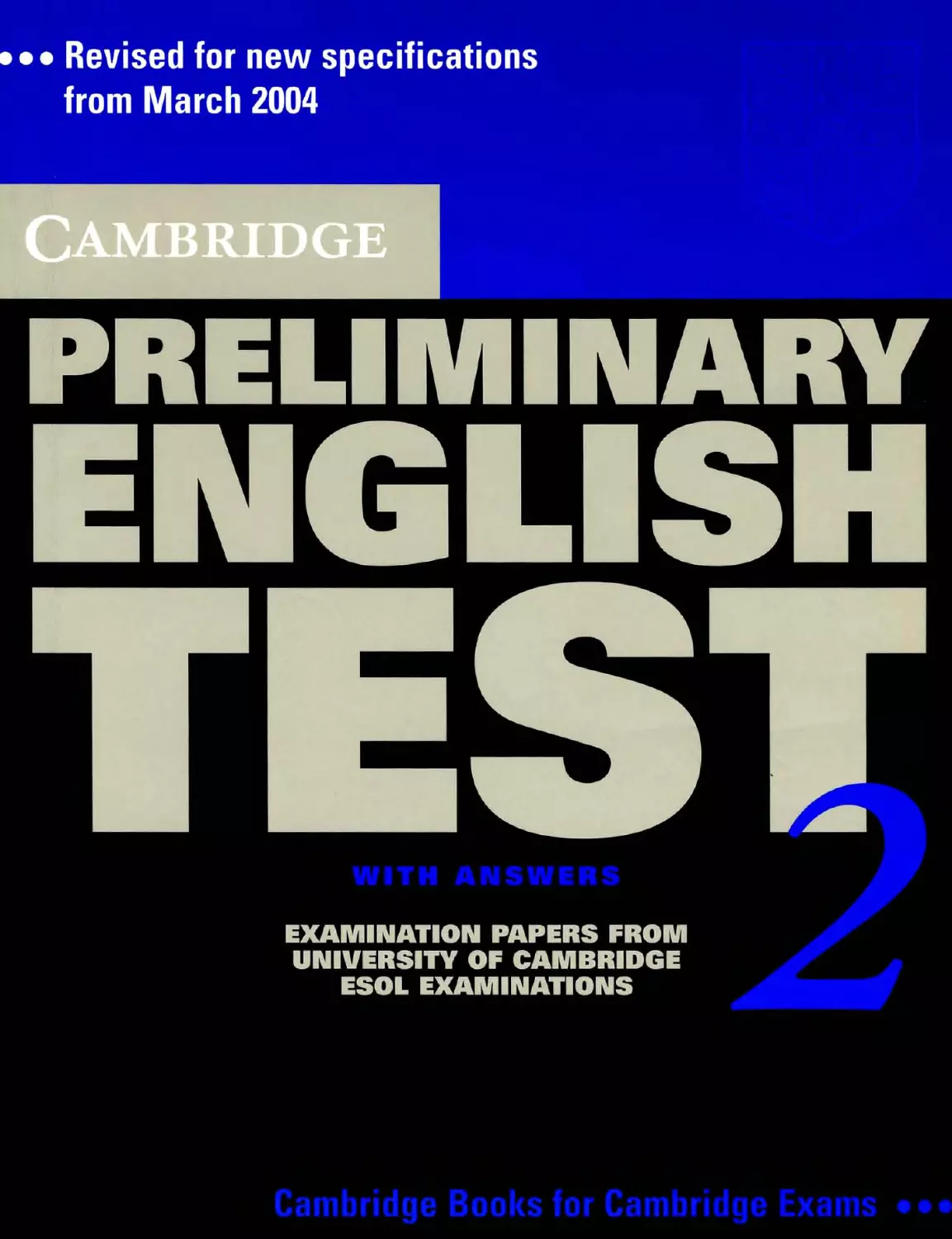
                    Revised for new specifications
from March 2004
Cambridge
PRELIMINARY
ENGLISH
TEST
EXAMINATION PAPERS FROM
UNIVERSITY OF CAMBRIDGE
ESOL EXAMINATIONS
Cambridge
Preliminary English Test
2
WITH ANSWERS
Examination papers from
University of Cambridge
ESOL Examinations:
English for Speakers of
Other Languages
Cambridge
UNIVERSITY PRESS
PUBLISHED BY THE PRESS SYNDICATE OF THE UNIVERSITY OF CAMBRIDGE
The Pitt Building, Trumpington Street, Cambridge, United Kingdom
CAMBRIDGE UNIVERSITY PRESS
The Edinburgh Building, Cambridge CB2 2RU, UK
40 West 20th Street, New York NY 10011-4211, USA
477 Williamstown Road, Port Melbourne, VIC 3207, Australia
Ruiz de Alarcon 13, 28014 Madrid, Spain
Dock House, The Waterfront, Cape Town 8001, South Africa
http://www.cambridge.org
© Cambridge University Press 2003
This book is in copyright, which normally means that
no reproduction of any part may take place without
the written permission of Cambridge University Press.
The copying of certain parts of it by individuals
for use within the classroom, however, is permitted
without such formality. Pages which are copiable
without further permission are identified by a
separate copyright notice:
© ucles k&j ешвипиш
First published 1997
New edition 2003
Printed in the United Kingdom at the University Press, Cambridge
Typeface Helvetica 10/13. System QuarkXPress® |OD6cI]
A catalogue record for this book is available from the British Library
ISBN 0 521 75467 4 Student’s Book with answers
ISBN 0 521 75466 6 Student’s Book
ISBN 0 521 75471 2 Self-study Pack
ISBN 0 521 75468 2 Teacher’s Book
ISBN 0 521 75469 0 Ser of 2 Cassettes
ISBN 0 521 75470 4 Set of 2 Audio CDs
Contents
To the student 4
Test 1	6
Test 2	26
Test 3	46
Test 4	66
Test 1 Key	86
Test 2 Key	102
Test 3 Key	118
Test 4 Key	135
Sample answer sheets
Acknowledgements
152
157
Visual material for the Speaking test
colour section I—VIII
To the student
This book is for candidates preparing for the University of Cambridge ESOL
Examinations Preliminary English Test (PET), and gives practice in all the written
and oral papers. It contains four complete tests based on recent PET papers.
PET tests Reading, Writing, Listening and Speaking.
PAPER 1	(1 hour and 30 minutes)
Reading
There are 35 questions in five Parts. You have to choose the right answer out of
three or four options, match questions to texts or show that you think a sentence
about a text is correct or incorrect.
Writing
There are three Parts: sentence transformations, a short message of 35-45
words and a letter or story of about 100 words.
PAPER 2 (about 35 minutes, including 6 minutes to transfer answers)
Listening
There are four Parts, and you will hear each of them twice. As you listen, you
write your answers on the question paper. At the end, you have 6 minutes to copy
your answers onto the answer sheet.
PAPER 3	(10-12 minutes for each pair of candidates)
Speaking
You take the Speaking test with another candidate. There are two examiners in
the room. One examiner talks to you. This examiner sometimes asks you
questions and sometimes asks you to talk to the other candidate. The other
examiner listens to you. Both examiners give you marks. During the test the
examiner gives you and your partner photographs and other pictures to look at
and to talk about.
Preparing for PET by yourself
Reading
Have a look at some English language magazines, and read some articles about
things that interest you. Look through some stories written in simplified English in
your library or bookshop. Choose the ones which are interesting and just a little
difficult for you, and guess the words you may not know before you look them up
in your dictionary.
4
Writing
It can be very helpful to keep a diary in English, so that you find and learn
the words that really mean something to you. You may also want to find an
English-speaking penfriend or e-pal, or to exchange letters or e-mails in English
with a friend who is learning with you. In those letters/e-mails you can describe
something interesting you have done, what you are doing at present or talk about
your plans. In that way everything you practise will be real for you and not just an
exercise.
Listening
Watch any interesting English language films at your cinema, or on TV or
video whenever you can. Watch or listen to any English language teaching
programmes on TV or radio. (A free list of such programmes is available from the
BBC, Programme Guides, Bush House, PO Box 76, London WC2B 4PH, United
Kingdom.) Listen to learning materials on cassette, so that you can hear many
different kinds of voices. You may also hear people speaking English in shops,
restaurants or hotels, or a tourist guide telling English-speaking visitors about
places of interest in your area.
Speaking
Practise talking English with a friend who is also learning, and arrange to spend
time doing this regularly. Ask each other questions, tell each other what you have
enjoyed doing, talk about your daily lives, your plans, your likes and dislikes - in
English. It really does get easier, once you start practising!
Further information
For more information about PET or any other Cambridge ESOL examination write
to:
University of Cambridge
ESOL Examinations
1 Hills Road
Cambridge
CB1 2EU
England
Telephone: +44 1223 553355
Fax: +44 1223 460278
e-mail: ESOLHelpdesk@ucles.org.uk
website: www.CambridgeESOL.org
In some areas this information can also be obtained from the British Council.
5
Test 1
PAPER 1 READING AND WRITING (1 hour 30 minutes)
READING
PART 1
Questions 1-5
•	Look at the text in each question.
•	What does it say?
•	Mark the letter next to the correct explanation - A, В or C - on your
answer sheet.
Example:
NO BICYCLES
AGAINST GLASS
PLEASE
A Do not leave your bicycle touching the
window.
В Do not ride your bicycle in this area.
C Broken glass may damage your bicycle
tyres.
Example answer:
Part 1
0	A В
Francesco! Problem -
Maria’s borrowed my history
textbook and she’s away.
Could you lend me yours?
Leave it with Ken when you
see him. Thanks, Natalie
Whose textbook does Natalie want to
borrow?
A Ken’s
В Maria’s
C Francesco’s
6
Test 1
3
THIS CAR PARK IS
LOCKED AFTER
BUSINESS HOURS
EACH DAY
A Users must lock the car park after
leaving.
В People can park here while they are at
work.
C This car park is for employees only.
P
PLAYERS WANTED
for Friday's basketball match
against Barton College - can
YOU help the team? Come to
the gym at 3 p.m. today,
whatever your level.
A The basketball team only wants to see
experienced players.
В There aren’t enough team members
available on Friday.
C The Barton College team will visit the
gym later today.
JAZZ ON A
SUMMER EVENING
NO TICKETS LEFT FOR
SUNDAY’S PERFORMANCE
A All Sunday evening tickets are already
sold.
В You must book tickets for Sunday in
advance.
C A ticket is not necessary for Sunday
evening.
A Giacomo will be able to see Charlotte
early tomorrow morning.
В Charlotte needs to arrive in time for
Giacomo’s meeting tomorrow.
C Giacomo can collect Charlotte from the
airport tomorrow afternoon.
7
Test 1
PART 2
Questions 6-10
•	The people below all want to go to the cinema.
•	On the opposite page there are descriptions of eight films.
•	Decide which film (letters A-H) would be the most suitable for each person
or people (numbers 6-10).
•	For each of these numbers mark the correct letter on your answer sheet.
Jo is studying art at university. She usually goes to the cinema on
Friday evenings. She enjoys films that are based on real life and from
which she can learn something.
Sheila has decided to take her mother to the cinema for her birthday.
They both like love stories that have happy endings.
Brian is a hard-working medical student. He doesn’t have very much
free time, but he likes going to the cinema to relax, and enjoys a good
laugh.
Adam wants to take his 8-year-old son Mark to the cinema at the
weekend. They want to see a film with plenty of excitement.
Harry and Joyce go to the cinema about twice a month. They
particularly like detective stories and do not pay much attention to
which actors are in the film.
8
Reading
A The Delivery
Jim Treace stars in this well-known
comedy about two workmen who
have to deliver a long piece of wood
to a house. But unfortunately the
performances are poor, and the film
is too long for such a simple joke.
В And Tomorrow We Find You
A fast-moving adult story about a San
Francisco policeman in danger. Based
on a real-life happening, it keeps you
guessing right until the last minute.
Although there are no big stars, there
are some fine performances.
C The Ends of the Earth
A story based on a real-life journey to
the South Pole. This film contains some
quite wonderful wildlife photography -
make sure you see it while you have the
chance, or you’ll be sorry.
D Island of Fire
You get spectacular scenery and lots of
thrills in this action-packed story, in
which a young sea-captain rescues
terrified villagers from a volcanic island
in the South Seas.
E Out of School
Here we live through a day in the life
of an American teenager who has
problems not only with his parents
and their boring friends but also with
his first girlfriend who just doesn’t
seem to understand him.
F A Time of Silence
Don't forget your handkerchief for this
story of a young college boy and girl who
manage to survive all the pressures of
modern life. And what an unforgettable
wedding scene!
G A Private Party
A wonderfully funny comedy, which
takes place in the 1940s. A reporter and
his very worried wife try to save a sheep
from the local butcher. The actors really
make the most of this clever script.
H Who Shot Malone?
It’s a surprise to see so many famous
names wasting their time in this dull
detective story. In the end you find
yourself asking, ‘Who cares?’
9
Test 1
PART 3
Questions 11-20
•	Look at the sentences below about a tour of Australia.
•	Read the text on the opposite page to decide if each sentence is correct or
incorrect.
•	If it is correct, mark A on your answer sheet.
•	If it is not correct, mark В on your answer sheet.
11	If you start your holiday on April 1st, you will return on April 19th.
12	Return flights are from Melbourne.
13	All travel between cities in Australia is by plane.
14	The cost covers accommodation and some meals.
15	You can make a reservation now for one of next year’s tours.
16	You have to pay the full price on the day you book.
17	You can only take this holiday in the spring or autumn.
18	If you want to go on a city sightseeing tour, you will have to pay extra.
19	The trip to Ayers Rock ends with a flight.
20	Booking is possible seven days a week.
10
Heading
GLOBEWISE
WE’ll SHOW YOU THE VERY BEST OF
AUSTRALIA
ON A FULLY GUIDED 22-DAY TOUR
for only
£1985
OUR PRICE INCLUDES
•	Scheduled flights by
Australia's national airline,
Quantas, from London or
Manchester to Perth,
returning from Melbourne.
•	After arriving in Perth, Air
Australia flights between
Perth/Alice Springs/Cairns/
Sydney.
•	Coach from Sydney to
Melbourne via Canberra
and Al bury.
•	All airport transfers in
Australia.
•	Nineteen nights'
accommodation in good
grade hotels with full
continental breakfast.
•	Day trip to Ayers Rock,
with a full day Barrier Reef
boat trip, a visit to an
Australian sheep station
and city sightseeing tours
in Perth, Alice Springs,
Sydney, Canberra and
Melbourne.
•	All state and local taxes.
•	Hotel baggage handling.
•	Experienced Globewise
Tour Manager at all stages
of the trip.
You can pay just
£90 now to be sure of
your place on this
successful and popular
touring holiday next
year.
There are departures
right through the year.
We make sure you see
the very best of
everything which
Australia has to offer.
PERTH
Wonderful long, golden beaches, superb
restaurants serving fabulous food in delightful
surroundings, lush green parks and the beautiful
Swan River. City sightseeing tour included.
ALICE SPRINGS
Fly over the outback to famous Alice Springs in
the heart of Aboriginal country. Full sightseeing
tour. See Flying Doctor base and ‘School of the
Air*.
AYERS ROCK
Drive to Yulara National Park. Visit the
mysterious Olgas and Ayers Rock with its caves
and Aboriginal rock paintings. Fly on to the lively
seaside town of Cairns and relax in the sun.
GREAT BARRIER REEF
We’ve included a full day’s boat trip on the
famous reef with the chance to see amazing,
brightly coloured fish and other sea creatures.
SYDNEY
You’ll love the excitement and beauty of
Australia’s biggest city - we’ve included a
sightseeing tour and a visit to the famous Opera
House. You can also book a day trip to the Blue
Mountains.
PHONE US ON
01303 692154
QUOTING
REFERENCE
GW/398 FOR
OUR
NEW FULL
COLOUR
BROCHURE
OUR OFFICES
ARE OPEN:
Monday to Friday
9 a.m. - 8 p.m.
Saturday
9 a.m. - 4 p.m.
BROCHURE
REQUESTS
ONLY:
Sunday
10 a.m. - 2 p.m.
SOLD OUT FOR THIS YEAR
BOOKING NOW
FOR NEXT YEAR
MELBOURNE
We’ve included a city sightseeing tour - or you can visit the Penguin
Parade.
We promise that by the end of the trip you’ll be wanting to return!
11
Test 1
PART 4
Questions 21-25
•	Read the text and questions below.
•	For each question, mark the letter next to the correct answer - А, В, C or D -
on your answer sheet.
A month ago I had no idea that on a Saturday afternoon in November I’d be
hanging 30 metres above the ground and enjoying it. Now I looked down at the
river far below me, and realised why people love rock-climbing.
My friend Matt and I had arrived at the Activity Centre on Friday evening. The
accommodation wasn’t wonderful, but we had everything we needed (beds,
blankets, food), and we were pleased to be out of the city and in the fresh air.
On Saturday morning we met the other ten members of our group. Cameron had
come along with two friends, Kevin and Simon, while sisters Carole and Lynn had
come with Amanda. We had come from various places and none of us knew the
area.
We knew we were going to spend the weekend outdoors, but none of us was sure
exactly how. Half of us spent the morning caving while the others went rock-
climbing and then we changed at lunchtime. Matt and I went to the caves first.
Climbing out was harder than going in, but after a good deal of pushing, we were
out at last - covered in mud but pleased and excited by what we’d done.
21 What is the writer trying to do in the text?
A	advertise the Activity Centre
В	describe some people she met
C explain how to do certain outdoor sports
D say how she spent some free time
22 What can the reader learn from the text?
A when to depend on other people at the Centre
В how to apply for a place at the Centre
C what sort of activities you can experience at the Centre
D which time of year is best to attend the Centre
12
Reading
23 How do you think the writer might describe her weekend?
A interesting
В relaxing
C frightening
D unpleasant
24 What do we learn about the group?
A Some of them had been there before.
В They had already chosen their preferred activities.
C Some of them already knew each other.
D They came from the same city.
25 Which of the following advertisements describes the Activity Centre?
ACTIVITY CENTRE
Set in beautiful countryside.
Accommodation and meals provided.
Make up your own timetable - choose
from a variety of activities (horse-
riding, fishing, hill-walking, sailing,
mountain-biking).
ACTIVITY CENTRE
Set in beautiful countryside. Enjoy the
luxury of our accommodation - each
room has its own bathroom. Work
with a group, or have individual
teaching.
В	ACTIVITY CENTRE Set in beautiful countryside. Accommodation provided. Work with a group - we show you a range of outdoor activities that you didn’t realise you could do!
D	ACTIVITY CENTRE Set in beautiful countryside. You can spend the day doing outdoor activities and we will find your accommodation with a local family.
13
Test 1
PART 5
Questions 26-35
•	Read the text below and choose the correct word for each space.
•	For each question, mark the letter next to the correct word - А, В, C or D - on
your answer sheet.
Example answer:
Part 5
0	D® D° Do
THE FIRST WOMAN SCIENTIST
Hypatia was (0)........in Alexandria, in Egypt, in 370 A.D. For many centuries she was
(26).......only woman scientist to have a place in the history books.
Hypatia’s father was director of Alexandria University, and he (27).....sure his
daughter had the best education available. This was unusual, as most women then had few
(28)	.... to study.
After studying in Athens and Rome, Hypatia returned to Alexandria (29).......she
began teaching mathematics. She soon became famous (30)..........her knowledge of new
ideas.
We have no copies of her books, (31).......we know that she wrote several important
mathematical works. Hypatia was also interested in technology and (32).......several
scientific tools to help with her work.
At the (33).......many rulers were afraid of science, and (34)......connected with it
was in danger. One day in March 415, Hypatia (35).........attacked in the street and killed.
0	A	born	В begun	C	developed	D grown
26	A	one	В the	C	a	D an
27	A	could	В made	c	said	D put
28	A	classes	В customs	c	opportunities	D teachers
29	A	where	В how	c	there	D which
30	A	from	В by	c	for	D in
31	A	because	В but	c	or	D as
32	A	did	В experimented	c	invented	D learnt
33	A	day	В period	c	year	D time
34	A	anyone	В nobody	c	all	D something
35	A	was	В had	c	has	D is
14
Writing
WRITING
PART 1
Questions 1-5
•	Here are some questions about a family.
•	For each question complete the second sentence so that it means the same as the first,
using no more than three words.
•	Write only the missing words on your answer sheet.
Example: My brother is older than me.
I am .younger •than my brother.
1	My parents prefer jazz to classical music.
My parents think jazz	....................than classical music.
2	My parents can only go swimming at the weekend.
On weekdays, my parents aren’t..................................go	swimming.
3	If I finish my homework, I can go out at the weekend.
I can’t go out at the weekend..............................finish my homework.
4	My sister watches more TV than me.
I don’t watch TV.................................my	sister does.
5	My parents suggested going out for a meal.
My parents said, ‘Why...............................we go out for a meal?’
15
Test 1
PART 2
Question 6
You have invited your English friend Jo to stay with you next month, but you now need to delay
this visit.
Write a card to send to Jo. In your card, you should
•	apologise to Jo
•	explain why the visit has to be delayed
•	suggest when it would be convenient for Jo to come.
Write 35-45 words on your answer sheet.
16
Writing
PART 3
Answer one of the following questions (7 or 8).
Question 7
•	Your English teacher has asked you to write a story.
•	Your story must begin with this sentence:
Carla looked at the car in surprise.
•	Write your story in about 100 words on your answer sheet.
Question 8
•	This is part of a letter you receive from an English friend.
I know you often go to the cinema. Tell me
about the last film you saw and whether
you enjoyed it.
•	Now write a letter to your friend.
•	Write your letter in about 100 words on your answer sheet.
17
Test 1
PAPER 2 LISTENING about 35 minutes
(including 6 minutes transfer time)
PART 1
Questions 1-7
•	There are seven questions in this part.
•	For each question there are three pictures and a short recording.
•	Choose the correct picture and put a tick (/) in the box below it.
Example: What’s the time?
A 0
В □
1 Where will the girls meet?
сП
2 Which chair does the man want?
18
Listening
Which picture shows what the girls need?
Which picture shows what happened?
5
What is Sarah’s mother doing?
В □
aQ
19
Test 1
6
What luggage is the man taking on holiday?
A □	В □	СП
Which photograph does the man like?
20
Listening
PART 2
Questions 8-13
• You will hear part of a radio programme about classical music.
♦ For each question, put a tick (/) in the correct box.
8 This week’s prize is
A | | a music cassette.
В Q] tw0 concert tickets.
C Q| a classical CD.
9 The person who wrote the music lived in
A Q] Italy.
В Q Spain.
C Q] France.
10 What else shares the title of this music?
A | | a garden
В Д э play
С Д э park
11 What did people do when they first
heard the music?
A Q| Some left before the end.
В Q| Only a few clapped.
C | | Some asked for their money back.
21
Test 1
12 This piece of music has been
A Qj played in the cinema.
В | | used in advertising.
C Q) usecl f°r a TV play.
13 If you know the competition answer you
should ring
0108 937 224.
В □ 0018 739 242.
C □ 0018 937 224.
22
Listening
PART 3
Questions 14-19
•	You will hear a radio programme in which young people from different parts of the country
are interviewed.
•	For each question, fill in the missing information in the numbered space.
Information sheet
Name:
Age: years
Favourite subject: (14)
Favourite sport: (15)
Usual transport: (16)
On Saturday: (17)
: Young Farmers’ Group
On (18)
Future job: (19)
23
Test 1
PART 4
Questions 20-25
•	Look at the six sentences for this part.
•	You will hear a conversation between a boy, Jim, and his mother.
•	Decide if each sentence is correct or incorrect.
•	If it is correct, put a tick (/) in the box under A for YES. If it is not correct, put a tick (/) in the
box under В for NO.
A
YES
В
NO
20	Jim's bicycle needs to be mended.
21	He’s keen to start saving money.
22	His mother thinks a mountain bike is suitable for their area.
23	She encourages Jim to manage his money better.
24	His mother offers to lend him some money.
25	Jim is disappointed by his mother’s suggestion.

24
Speaking
About the Speaking test
The Speaking test lasts about 10 to 12 minutes. You take the test with another
candidate. There are two examiners in the room. One examiner talks to you and
the other examiner listens to you. Both the examiners give you marks.
Part 1
The examiners introduce themselves and then one examiner asks you and your
partner to say your names and spell them. This examiner then asks you questions
about yourself, your daily life, interests, etc.
Part 2
The examiner asks you to talk about something together and gives you a drawing
to help you.
Part 3
You each have a chance to talk by yourselves. The examiner gives you a colour
photograph to look at and asks you to talk about it. When you have finished
talking, the examiner gives your partner a different photograph to look at and to
talk about.
Part 4
The examiner asks you and your partner to say more about the subject of the
photographs in Part 3. You may be asked to give your opinion or to talk about
something that has happened to you.
25
Test 2
PAPER 1 READING AND WRITING (1 hour 30 minutes)
READING
PART 1
Questions 1-5
•	Look at the text in each question.
•	What does it say?
•	Mark the letter next to the correct explanation - A, В or C - on your
answer sheet.
Example:
0
NO BICYCLES
AGAINST GLASS
PLEASE
LUGGAGE CANNOT
BE REMOVED
WITHOUT A RECEIPT
A Do not leave your bike touching the
window.
В Do not ride your bicycle in this area.
C Broken glass may damage your bicycle
tyres.
Example answer:
Part 1
0	ABC
A You must show a receipt if you want to
remove luggage.
В When you remove your luggage you are
given a receipt.
C You can leave your luggage here
without change.
26
Reading
2
IT Message
Anna,
Jeff rang: suggests taking a blanket
(cold there!) No need to bring
programme now. He’ll meet you at the
festival entrance with your ticket.
For the festival, Anna should bring
A her ticket.
В a blanket.
C the programme.
anyone seen my gold chain?
I took it off before athletics. It's a
present from my boyfriend - he
mustn't find out it's lost!
5ally
Assistants needed
because of new
opening hours -
apply inside
A Don’t turn the lights on until it’s
necessary.
В Switch the lights on when you’re in the
room.
C Don’t leave the lights on if the room is
empty.
4
A Sally has given a chain to someone as
a present.
В Sally’s boyfriend knows about the
missing chain.
C Sally lost her chain when she got
changed for sport.
This shop
A has just opened and jobs are available.
В is opening for longer and needs extra
staff.
C will open late because of job interviews.
27
Test 2
PART 2
Questions 6-10
•	The people below all want to buy a book on travel.
•	On the opposite page there are descriptions of eight books.
•	Decide which book (letters A-H) would be the most suitable for each person
or people (numbers 6-10).
•	For each of these numbers mark the correct letter on your answer sheet.
10
Robert is planning to travel round the world by train. He would like
a book with pictures and maps to take with him on his long
journeys.
Mrs Jones used to love visiting France, but now she is too old to
travel. She wants a book with lots of photographs which will help
her to remember everything she enjoyed.
The Harpers are planning to go on holiday round Europe. They
intend to drive their car and go for walks, so they need a book with
maps and pictures to guide them on their way.
Clive wants to buy a book as a present for his friend Tom. Tom
enjoys fishing and driving round England.
Peter has to write something for his history teacher about world
explorers. He wants to know about explorers from the past and
their travels to different parts of the world.
28
Heading
A Allan Jowett
Jowett’s Railway Centres: Volume I
Packed with information about 20 British
railway centres, this wonderful book is
handwritten and illustrated throughout with
clear hand-drawn maps - a true collector’s
piece for those who are interested in
railways.
В Alan Titchmarsh
The English River
Alan Titchmarsh explores 18 rivers,
telling their interesting stories with his
appreciation of them. A saying from a
past age introduces each chapter as his
exploration moves across the English
countryside.
C Robin Hanbury-Tenison
The Oxford Book of Exploration
This is a collection of the writing of
explorers through the centuries. It describes
the feelings and experiences of these brave
adventurers who changed the world through
their search for new lands.
D The Travel Club
Train Journeys of the World
First-hand accounts of 30 of the world’s
most beautiful and dramatic railway journeys
are found together with specially drawn
maps and wonderful photographs that show
the people and places on the route.
E Bruce Chatwin
Photographs and Notebooks
On all his travels, Bruce Chatwin took
thousands of photographs and kept daily
notebooks. Published here for the first time,
the photographs are excellent, the notebooks
both scholarly and funny. Will give great
pleasure.
F Automobile Association
Walks and Tours in France
Explore spectacular and pretty France with
61 expertly researched motor tours and
114 walks, complete with route directions,
super mapping, and descriptions and
pictures of places of interest for the
traveller.
G Shirley Pike
The Book of French Life
This beautiful volume contains forty
wonderful photographs that show the very
nature of French life - the perfect gift for
anyone who finds this country as wonderful
as Shirley Pike does.
H Ranulph Fiennes
Mind over Matter
The epic crossing of the Antarctic
continent
The amazing story of his recent crossing
of the Antarctic continent with another
explorer, in which both showed great
strength and courage.
29
Test 2
PART 3
Questions 11-20
•	Look at the sentences below about a river journey.
•	Read the text on the opposite page to decide if each sentence is correct or incorrect.
•	If it is correct, mark A on your answer sheet.
•	If it is not correct, mark В on your answer sheet.
11	Each cabin on the Lady Ivy May is for two people.
12	You can borrow books on board the ship.
13	On arrival at Oporto, guests find their own way to the ship.
14	You spend a day looking round Oporto.
15	It takes a day to travel from Oporto to Entre-os-Rios.
16	The museum at Lamego used to be a palace.
17	It is sometimes possible for the Lady Ivy May to sail to the Spanish border.
18	The trip includes some travel by train.
19	You arrive back in Oporto on the day before your return flight.
20	Voyages Jules Verne arrange your travel insurance.
30
Reading
A JOURNEY
ALONG THE
BEAUTIFUL
DOURO RIVER
7 nights from £1050
VOYAGES JULES VERNE
operate a ‘hotel ship’
along the Douro river in
Portugal. The MV Lady
Ivy May can take 160
guests in double cabins, all
of which face outside and
have a private shower and
WC. On board the ship,
which has air-conditioning,
you will find a sun-deck,
lounge, bar, dining room,
shop and library facilities.
Itinerary
Day 1 Depart in the early
evening from London
Heathrow to Oporto. Your
guide will meet you on
arrival and take you to the
Lady Ivy May, where you
will spend the night.
Day 2 After a morning’s
sightseeing in Oporto, you
will return to the ship and
depart for Entre-os-Rios.
This part of the journey up
the river takes four hours.
Day 3 You will continue
travelling up the river. In
the early evening, the ship
stops at Peso da Regua,
where port wine is
produced. At dinner you
will be able to try the
delicious food and drink
from this area.
Day 4 After breakfast
you will travel south by
bus to the ancient town
of Lamego and visit the
cathedral, several churches
and a museum. The
museum was formerly a
palace and now has an
excellent collection of
paintings, tapestries and
sculptures. You will then
return to the ship and sail
on to Tua.
Day 5 Ar this point the
Douro becomes very
narrow. Depending on the
depth of the river at the
time, you may be able to
continue by a smaller boat
to the Spanish frontier at
Barca d’Alva. The return
journey to Tua is by coach
and there is much to see
along the way.
Day 6 In the morning you
will drive to Sao Joao da
Pesqueira for one of the
most wonderful views in
the whole of the Douro
valley. You will return to
the ship for lunch and then
join the Douro river valley
railway for a beautiful ride
through the countryside to
Regua, where the Lady Ivy
May will be waiting for
you.
Day 7 There will be a trip
to Vila Real before
returning to the ship for
lunch and then setting off
down the river to Oporto.
You will sleep on board
the Lady Ivy May.
Day 8 You will arrive in
Oporto in plenty of time
for independent sightseeing
and last-minute shopping,
before you catch the flight
home to London
Heathrow.
Departure dates and
prices
(all prices are per person)
June 5,12,19,26	£1100
July 3,10,17,24,31	£1050
August 7,14,21,28	£1050
September 4,11,18,25	£1100
Prices include:
return flights, 7 nights’
accommodation on board the
Lady Ivy May with all meals,
excursions and guides.
Not included:
travel insurance, tips.
Voyages
Jules Verne
31
Test 2
PART 4
Questions 21-25
•	Read the text and questions below
•	For each question, mark the letter next to the correct answer - А, В, C or D -
on your answer sheet.
Winter Driving
Winter is dangerous because it’s so difficult to know what is going to happen and
accidents take place so easily. Fog can be waiting to meet you over the top of a
hill. Ice might be hiding beneath the melting snow, waiting to send you off the
road. The car coming towards you may suddenly slide across the road.
Rule Number One for driving on icy roads is to drive smoothly. Uneven
movements can make a car suddenly very difficult to control. So every time you
either turn the wheel, touch the brakes or increase your speed, you must be as
gentle and slow as possible. Imagine you are driving with a full cup of hot coffee
on the seat next to you. Drive so that you wouldn’t spill it.
Rule Number Two is to pay attention to what might happen. The more ice there is,
the further down the road you have to look. Test how long it takes to stop by
gently braking. Remember that you may be driving more quickly than you think.
In general, allow double your normal stopping distance when the road is wet, three
times this distance on snow, and even more on ice. Try to stay in control of your
car at all times and you will avoid trouble.
21 What is the writer trying to do in the text?
A complain about bad winter driving
В give information about winter weather
C warn people against driving in winter
D advise people about safe driving in winter
22 Why would somebody read this text?
A to find out about the weather
В for information on driving lessons
C to learn about better driving
D to decide when to travel
32
Reading
23 What does the writer think?
A People should avoid driving in the snow.
В Drivers should expect problems in winter.
C People drive too fast in winter.
D Winter drivers should use their brakes less.
24 Why does the writer talk about a cup of coffee?
A to explain the importance of smooth movements
В because he thinks refreshments are important for drivers
C because he wants drivers to be more relaxed
D to show how it can be spilled
25 Which traffic sign shows the main idea of the text?
33
Test 2
PART 5
Questions 26-35
•	Read the text below and choose the correct word for each space.
•	For each question, mark the letter next to the correct word - А, В, C or D -
on your answer sheet.
Example answer:
Part 5
0	А В C D
SAMUEL PEPYS
The most famous diary (0)..........English was written by Samuel Pepys. It gives a
detailed and interesting (26)......of everyday life in England (27)......... 1660
and 1669. Pepys writes about important news stories of the time, like disease, an
enemy navy (28).... ....	up the River Thames and the Great Fire of London.
He also writes about himself, even about his (29).........-	he often slept during
church or (30)........at the pretty girls. He describes his home life - a (31).......
with his wife and how they became friends again, his worry about her illness. As well
as books, he liked music, the theatre, card (32)......., and parties with good food
and (33)........of fun. Pepys was a busy man who had many important (34).............
- he was a Member of Parliament and President of the Royal Society. He is also
(35)...... .... for his work for the British Navy.
0	A in	В about	C	from	D of
26	A description	В letter	C	notice	D story
27	A between	В from	c	through	D to
28	A driving	В flying	c	running	D sailing
29	A accidents	В plans	c	dreams	D faults
30	A looked	В prayed	c	talked	D thought
31	A conversation	В discussion	c	quarrel	D talk
32	A battles	В games	c	matches	D plays
33	A amount	В plenty	c	much	D some
34	A acts	В hobbies	c	jobs	D studies
35	A reviewed	В remembered	c	reminded	D reported
34
Writing
WRITING
PART 1
Questions 1-5
•	Here are some sentences about going to the supermarket.
•	For each question, complete the second sentence so that it means the same as the first,
using no more than three words.
•	Write only the missing words on your answer sheet
Example: My mother lives a long way from the supermarket.
There isn’t .Д.supermarket, near my mother’s house.
1	When she has to walk to the supermarket she finds it tiring.
She gets ...................................when	she has to walk to the
supermarket.
2	She is often driven to the supermarket by her neighbour.
Her neighbour often..................................a	lift to the supermarket.
3	There are many types of coffee there.
You can buy a....................................types	of coffee there.
4	She asked an assistant how much the Colombian coffee cost.
She asked: ‘How....................................the	Colombian coffee cost?’
5	The Colombian coffee cost less than the Kenyan coffee.
The Colombian coffee wasn’t...................................as	the Kenyan
coffee.
35
Test 2
PART 2
Question 6
You have just had a wonderful holiday staying with some English-speaking friends in the
countryside.
Write an e-mail to your friends. In your e-mail, you should
•	thank them for your stay
•	say what you most enjoyed about the countryside
•	suggest where you could meet each other next time.
Write 35-45 words on your answer sheet.
36
Writing
PART 3
Answer one of the following questions (7 or 8).
Question 7
•	This is part of a letter you receive from your penfriend.
In your next letter, could you give me
some advice? Tell me how you keep fit
and healthy!
•	Now write a letter to your penfriend.
•	Write your letter in about 100 words on your answer sheet
Question 8
•	You have to write a story for your English homework.
•	Your story must have this title:
An exciting adventure
• Write your story in about 100 words on your answer sheet.
37
Test 2
PAPER 2 LISTENING about 35 minutes
(including 6 minutes transfer time)
PART 1
Questions 1-7
♦ There are seven questions in this part.
•	For each question there are three pictures and a short recording.
•	Choose the correct picture and put a tick (✓) in the box below it.
Example: What’s the time?
A 0
В □
сП
When and where are they meeting?
АП
С □
2 What will Chris get for his birthday?
A □	В □	СП
38
Listening
What does Mr Jones look like?
Where is he going to plant the tree?
В □
What is the man going to buy?
aD
39
Test 2
Which is Gary’s room?
В □
сП
Which is the best vehicle for the man?
40
Listening
PART 2
Questions 8-13
•	You will hear a recorded message about an arts festival.
•	For each question, put a tick (/) in the correct box.
8 The festival takes place from
A □ 12 to 18 May.
В □ 12 to 20 May.
C □ 12 to 28 May.
9 What is on at the Theatre Royal on 19 May?
А П jazz
В Q| opera
C QI classical music
10 During lunchtime jazz concerts at the
Corn Exchange they sell
A Q| soft drinks and sandwiches.
В Q| wine and sandwiches.
C Q soft drinks and light meals.
11 What is on at the cathedral?
A Q music
В Q poetry
C Q films
41
Test 2
12 What does the festival programme offer
at Ickworth?
13 You can’t use a credit card if you book
А Д э walk and a book reading
В □ a concert and a meal
C □ a walk and a concert
A Q| by post.
В Q by fax.
C Q| by telephone.
42
Listening
PART 3
Questions 14-19
•	You will hear someone talking on the radio about a Language Study Fair.
•	For each question, fill in the missing information in the numbered space.
The Language Study Fair
Dates:	17th to 19th (14).........................
Place:	National Education Centre
Fair includes: • stands with textbooks
•	(15).............by educational speakers
•	exhibition of furniture
•	demonstrations of latest (16)..........
Opening hours: 9.30 a.m.-5.00 p.m. Thursday and Friday
9.30 a.m.-4.00 p.m (17)._................
Tickets:	£5
or £3 for (18)...........................
Tickets can be booked by ringing the hotline on (19).....
43
Test 2
PART 4
Questions 20-25
•	Look at the six sentences for this part.
•	You will hear a conversation between a girl, Kate, and a boy, George.
•	Decide if each sentence is correct or incorrect.
•	If it is correct, put a tick (/) in the box under A for YES. If it is not correct, put a tick (/) in
the box under В for NO.
A В
YES NO
20	Kate has stopped taking her medicine.
21	George thinks Kate should stay away from class.
22	Kate had an accident on her bike last week.
23	George thinks Mr Gray is a lazy lecturer.
24	Kate will miss three lectures.
25	Kate wants to stay at home at the weekend.
44
Speaking
About the Speaking test
The Speaking test lasts about 10 to 12 minutes. You take the test with another
candidate. There are two examiners in the room. One examiner talks to you and
the other examiner listens to you. Both the examiners give you marks.
Part 1
The examiners introduce themselves and then one examiner asks you and your
partner to say your names and spell them. This examiner then asks you questions
about yourself, your daily life, interests, etc.
Part 2
The examiner asks you to talk about something together and gives you a drawing
to help you.
Part3
You each have a chance to talk by yourselves. The examiner gives you a colour
photograph to look at and asks you to talk about it. When you have finished
talking, the examiner gives your partner a different photograph to look at and to
talk about.
Part 4
The examiner asks you and your partner to say more about the subject of the
photographs in Part 3. You may be asked to give your opinion or to talk about
something that has happened to you.
45
Test 3
PAPER 1 READING AND WRITING (1 hour 30 minutes)
READING
PART 1
Questions 1-5
•	Look at the text in each question.
•	What does it say?
•	Mark the letter next to the correct explanation - A, В or C - on your
answer sheet.
Example:
0
NO BICYCLES
AGAINST GLASS
PLEASE
J To: All students
I From: College Secretary
I Monday 6 May
I Can 1 remind you that all essays
I are due this Friday. No late work
I will be accepted unless
I accompanied by a doctor’s letter.
.........
A Do not leave your bicycle touching the
window.
В Do not ride your bicycle in this area.
Broken glass may damage your bicycle
tyres.	_________________
Example answer:	Part 1
	0	□ OD □o
A The college secretary will post students
their essays on Friday.
В Students may hand in their essays after
Friday if they can prove illness.
C Unless your essay is due by Friday, you
do not need to reply.
46
Reading
TAKE ONE TABLET
THREE TIMES A DAT
AFTER MEALS.
FINISH THE
PRESCRIPTION.
A Take the tablets regularly until the bottle
is empty.
В Take one tablet every day until they are
finished.
C Take three tablets after meals until you
feel better.
3
/ Ben,
/ Why not bring your new game
round, tonight - we can use my
brother’s PC. I’m playing football
tilt 7.OO, so anytime after that.
Kim
P FREE SOFA! P
(Owner moving back
to New Zealand)
Must have transport -
collect from John any evening
this week. Phone 452611 to
arrange a suitable time.
Kim suggests
A meeting at the football match.
В going to Ben’s house later.
C playing on his brother’s computer.
A John can deliver the sofa if the time is
convenient.
В Anyone wanting this sofa must pick it up
this week.
C Call John with advice on how he can
transport his sofa.
5 R
BOAT HIRE
INSURANCE INCLUDED
FUEL EXTRA
NO HIDDEN CHARGES
The hire charge covers all the costs
A including fuel and insurance.
В except insurance.
C apart from fuel.
47
Test3
PART 2
Questions 6-10
•	The people below all want to come to Britain to study English.
•	On the opposite page there are descriptions of eight colleges.
•	Decide which college (letters A-H) would be the most suitable for each person
(numbers 6-10).
•	For each of these numbers mark the correct letter on your answer sheet.
Marta wants a course in Business Studies and English, starting in
September. She would prefer to be in a city, but wants a college
which will organise visits, so she can see something of Britain.
Jean wants to attend classes for a few hours a week in July, so
that he has plenty of free time to visit the countryside. He wants to
stay in a city, with a family.
Laura is looking for a full-time beginners’ course and can come to
Britain at any time. She is keen on sport and wants to stay with a
family.
9
Marek likes big cities. He hopes to find work during the day, so he
is looking for an evening class. He wants to live in a flat or house.
Birgit is going to spend August in Britain. She knows some English
already and wants a full-time course. She wants to meet people
through the college and live with a family.
48
Reading
A Lowton College
Situated in a pleasant area of the city close
to the river. Convenient for North Wales
and the English Lake District.
•	Courses in English run all year.
•	Part-time courses available in the
even ings/d ays.
•	We will arrange accommodation with an
English family.
В Bristow College
The college is in the centre of Bristow.
♦	Full-time courses at all levels, beginners to
advanced, from September to June.
♦	Visits arranged to places of interest.
♦	Excellent range of sports offered.
♦	Students arrange their own accommodation in
flats and houses.
C Shepton College
Shcpton College is in the centre of
London close to underground and buses.
D Frampton College
Situated in West London close to bus and
underground.
Д Classes are offered all through the year.
Daytime English courses up to ten
hours per week. Evening classes of four
hours per week.
>Y Extra classes offered in English for
Business.
>Y Students arrange their own
accommodation in flats and houses.
<	r Courses run from September to July (daytime
only).
Cr Special courses available, e.g. English for Business.
Cr Summer school in July and August.
Cr Accommodation arranged in student hostels.
E Daunston College	F
Daunston is a small town in the Midlands
near pleasant countryside.
	Part-time and full-time classes
available from September to June.
	Full-time summer school in August.
	Complete beginners part-time only.
	Trips and other social events arranged
regularly.
	Accommodation in the college or with
families.
Exford College
Exford is beside the sea and surrounded
by beautiful countryside.
>	Courses at all levels, September to
June (full-time).
>	Summer schools (mornings only)
during August.
>	Full social programme including sports
and hobby clubs provided by the
college.
>	Students live in college rooms or with
families.
G Chesford College	H
Situated in the centre of Chesford, a quiet
market town.
0 English courses offered from
September to June, daytime and
evenings.
0 Trips organised to Cambridge, Oxford
and London.
0 Accommodation is with local families.
Howe College
The college is in the city centre, but near the
North Yorkshire countryside and the sea.
•	Classes run from September to June.
•	Part-time and full-time courses from
beginners to advanced (daytime only).
•	Full-time courses in English with Business
Studies.
•	Trips arranged to places of interest.
•	Help given in finding a flat or room in the
area.
49
Test 3
PART 3
Questions 11-20
•	Look at the sentences below about an English city.
•	Read the text on the opposite page to decide if each sentence is correct or incorrect.
•	If it is correct, mark A on your answer sheet.
•	If it is not correct, mark В on your answer sheet
11	The River Wensum flows through East Anglia.
12	People have lived by the River Wensum for at least 2000 years.
13	In the 11th century, Norwich was a small village.
14	Norwich has been a city since its first cathedral was built.
15	Norwich has always been one of the smallest English cities.
16	There are more than 50 churches in Norwich.
17	The number of students in Norwich is increasing.
18	The Norwich City football team is called ‘The Canaries’ because of the colours the players
wear.
19	‘The Castle Mall’ took more than two years to build.
20	Norwich people still like using the old market as well as shopping in ‘The Castle Mall’.
50
Reading
Norwich Utefe
Norwich, the capital of the part of Britain
known as East Anglia, has existed as a
place to live for more than two thousand
years. It began as a small village beside the
River Wensum. At the time of the Norman
invasion in 1066 it had grown to become
one of the largest towns in England.
With two cathedrals and a mosque,
Norwich has long been a popular centre for
various religions. The first cathedral was
built in 1095 and has recently celebrated its
900th anniversary, while Norwich itself had
a year of celebration in 1994 to mark the
800th anniversary of the city receiving a
Royal Charter. This allowed it to be called a
city and to govern itself independently.
Today, in comparison with places like
London or Manchester, Norwich is quite
small, with a population of around 150,000,
but in the 16th century Norwich was the
second city of England. It continued to grow
for the next 300 years and got richer and
richer, becoming famous for having as
many churches as there are weeks in the
year and as many pubs as there are days in
the year.
Nowadays, there are far fewer churches
and pubs, but in 1964 the University of East
Anglia was built in Norwich. With its fast-
growing student population and its success
as a modern commercial centre (Norwich is
the biggest centre for insurance services
outside London), the city now has a wide
choice of entertainment: theatres, cinemas,
nightclubs, busy cafes, excellent restaurants,
and a number of arts and leisure centres.
There is also a football team, whose colours
are green and yellow. The team is known as
‘The Canaries’, though nobody can be sure
why.
Now the city’s attractions include another
important development, a modern shopping
centre called ‘The Castle Mall’. The people
of Norwich lived with a very large hole in
the middle of their city for over two years, as
builders dug up the main car park. Lorries
moved nearly a million tons of earth so that
the roof of the Mall could become a city
centre park, with attractive water pools and
hundreds of trees. But the local people are
really pleased that the old open market
remains, right in the heart of the city and
next to the new development. Both areas
continue to do good business, proving that
Norwich has managed to mix the best of the
old and the new.
51
Test3
PART 4
Questions 21-25
•	Read the text and questions below.
•	For each question, mark the letter next to the correct answer - А, В, C or D -
on your answer sheet.
When 1 opened the first ‘Body Shop’ in 1976 my only object was to earn enough
to feed my children. Today ‘The Body Shop’ is an international company rapidly
growing all around the world. In the years since we began I have learned a lot.
Much of what I have learned will be found in this book, for 1 believe that we, as a
company, have something worth saying about how to run a successful business
without giving up what we really believe in.
It’s not a normal business book, nor is it just about my life. The message is that to
succeed in business you have to be different. Business can be fun, a business can
be run with love and it can do good. In business, as in life, I need to enjoy myself,
to have a feeling of family and to feel excited by the unexpected. I have always
wanted the people who work for ‘The Body Shop’ to feel the same way.
Now this book sends these ideas of mine out into the world, makes them public.
I’d like to think there are no limits to our ‘family’, no limits to what can be done.
I find that an exciting thought. I hope you do, too.
21 What is the writer’s main purpose in writing this text?
A to tell the reader her life story
В to introduce her ideas to the reader
C to explain how international companies operate
D to tell the reader how she brought up a family
22 What would someone learn from this text?
A how to make a lot of money
В how to write a book about business
C what the writer’s family is like
D what the writer’s book is about
52
Reading
23 How does the writer feel about the business she runs?
A She doesn’t care about success if her children are fed.
В She just runs it for her own entertainment.
C It is not like any other company.
D It is likely to become even more successful.
24 What kind of workers does the writer like to employ?
A workers who can explain her ideas
В workers who get on well with the public
C workers who have the same attitudes as she does
D workers who have their own families
25 What kind of person does the writer seem to be?
A She seems to be someone with strong opinions.
В She doesn’t seem to be very confident.
C She is mainly interested in making money.
D She sees running a business as just a job.
53
Test 3
PART 5
Questions 26-35
•	Read the text below and choose the correct word for each space.
•	For each question, mark the letter next to the correct word - А, В, C or D -
on your answer sheet
Example answer:
Parts
0	A □ □
THE ROCKIES
The Rocky Mountains run almost the length (0)......North America.
They start in the North-west, but lie only a (26).hundred miles from the
centre in more southern areas. Although the Rockies are smaller (27)..the
Alps, they are no less wonderful.
There are many roads across the Rockies, (28)...the best way to see them is
to (29)......by train. You start from Vancouver, (30).....most attractive of
Canada’s big cities. Standing with its feet in the water and its head in the mountains,
this city (31).....its residents to ski on slopes just 15 minutes by car from the city
(32).........
Thirty passenger trains a day used to (33)..off from Vancouver on the cross-
continent railway. Now there are just three a week, but the ride is still a great
adventure. You sleep on board, (34).....is fun, but travel through some of the
best (35)......at night.
0	A	of	В down	C	in	D	through
26	A	many	В lot	C	few	D	couple
27	A	from	В to	c	as	D	than
28	A	but	В because	c	unless	D	since
29	A	drive	В travel	c	ride	D	pass
30	A	a	В one	c	the	D	its
31	A	lets	В allows	c	offers	D	gives
32	A	centre	В circle	c	middle	D	heart
33	A	leave	В get	c	take	D	set
34	A	when	В which	c	who	D	where
35	A	scenery	В view	c	site	D	beauty
54
Writing
WRITING
PART1
Questions 1-5
•	Here are some sentences about going to the cinema.
•	For each question complete the second sentence so that it means the same as the first,
using no more than three words.
•	Write only the missing words on your answer sheet.
Example: Dave and Jane have been to the cinema together.
Dave ..has. been.. to the cinema with Jane.
1	Nearly every seat was taken in the cinema.
There weren’t....................................in the cinema.
2	Jane had a worse seat than Dave.
Dave had.....................................than	Jane.
3	Jane couldn’t see the screen very well.
Jane found.....................................to	see the screen.
4	Dave said that he had seen the film before.
Dave said: ‘I..................................this film before.’
5	They spent two hours watching the film.
The film....................................for	two hours.
55
Test 3
PART 2
Question 6
You have recently moved to a town and have bought this postcard of the town to send to your
penfriend.
In your postcard to your penfriend, you should
•	explain why you have moved
•	tell your friend what facilities the town has
•	say what you dislike about living there.
Write 35-45 words on your answer sheet.
56
Writing
PART 3
Answer one of the following questions (7 or 8).
Question 7
•	Your English teacher has asked you to write a story.
•	Your story must begin with this sentence:
/t was a fantastic party.
•	Write your story in about 100 words on your answer sheet.
Question 8
•	This is part of a letter you receive from an English friend.
I want to find out about music in your country.
Are there many live concerts? What music do
you like listening to?
•	Now write a letter, answering your friend’s questions.
•	Write your letter in about 100 words on your answer sheet.
57
Test 3
PAPER 2 LISTENING about 35 minutes
(including 6 minutes transfer time)
PART 1
Questions 1-7
•	There are seven questions in this part.
•	For each question there are three pictures and a short recording.
•	Choose the correct picture and put a tick (/) in the box below it.
Example: What’s the time?
1 Where is the station?
2 Where did the woman put the calculator?
58
Listening
59
Test 3
Which picture does the woman decide to send?
ВП
C □
Which hotel has the man chosen?
aQ
в
60
Listening
PART 2
Questions 8-13
•	You will hear a radio interview with a man who works on an international camp.
•	For each question, put a tick (/) in the correct box.
8 If you want to apply for the Camp you must
9 Ina Camp tent you can expect to
A Q| be a student.
В ___] be at least twenty-four years old.
C Q| speak more than one language.
A Q| mix with other nationalities.
В Q| share with five other people.
C Q| know the other people.
10 The Camp want people who are
A Q| good at cooking.
В Q| good organisers.
C Q| able to mix well.
11 What do you have to take to the Camp?
A Q| a tent
В Q| a map
C Q| pictures
61
Test 3
12 As a Camp member you should
13 The Camp fees must be paid
A QI be a good singer.
В |~ ~| join in performances.
C Q| be good at acting.
A Q] in dollars.
В Q| by cheque.
C Q before the Camp starts.
62
Listening
PART 3
Questions 14-19
•	You will hear a young woman who has applied for an office job talking about her jobs abroad.
•	For each question, fill in the missing information in the numbered space.
INTERVIEW FORM
Name:	........Ylcky ^rpwn[ow................
Age:	........22years.......................
Position applied for:.Office Manager................
Two years’ experience abroad
First job - worked for (14).........................
-	length of time stayed (15)...............
Second job - worked as (16)................in	a hotel
Third job - worked for (17).................„.......
-	got up at (18)...........................
Bank International:
-	worked in (19)...........................
63
Test 3
PART 4
Questions 20-25
•	Look at the six sentences for this part.
•	You will hear a conversation between a father and his daughter, Sonia.
•	Decide if each sentence is correct or incorrect.
•	If it is correct, put a tick (/) in the box under A for YES. If it is not correct, put a tick (/) in
the box under В for NO.
A В
YES NO
20	Sonia would like a car for her birthday.
21	Sonia’s friend Maria has her own car.
22	Sonia has talked to Maria about learning to drive.
23	Sonia offers to get a job at weekends.
24	Sonia’s father understands how his daughter feels.
25	Sonia suggests cooking a meal on her birthday.
64
Visual material for the Speaking test
1A
Visual material for the Speaking test
II
Visual material for the Speaking test
III
Visual material for the Speaking test
2A
IV
Visual material for the Speaking test
V
Visual material for the Speaking test
2C
VI
Visual material for the Speaking test
3C
VII
Visual material for the Speaking test
VIII
Speaking
About the Speaking test
The Speaking test lasts about 10 to 12 minutes. You take the test with another
candidate. There are two examiners in the room. One examiner talks to you and
the other examiner listens to you. Both the examiners give you marks.
Part 1
The examiners introduce themselves and then one examiner asks you and your
partner to say your names and spell them. This examiner then asks you questions
about yourself, your daily life, interests, etc.
Part 2
The examiner asks you to talk about something together and gives you a drawing
to help you.
Part 3
You each have a chance to talk by yourselves. The examiner gives you a colour
photograph to look at and asks you to talk about it. When you have finished
talking, the examiner gives your partner a different photograph to look at and to
talk about.
Part 4
The examiner asks you and your partner to say more about the subject of the
photographs in Part 3. You may be asked to give your opinion or to talk about
something that has happened to you.
65
Test 4
PAPER 1 READING AND WRITING (1 hour 30 minutes)
READING
PART 1
Questions 1-5
•	Look at the text in each question.
•	What does it say?
•	Mark the letter next to the correct explanation - A, В or C - on your
answer sheet.
Example:
0
NO BICYCLES
AGAINST GLASS
PARKING IN THIS
SPACE FOR DOCTOR
ON DUTY ONLY
A Do not leave your bicycle touching the
window.
В Do not ride your bicycle in this area.
C Broken glass may damage your bicycle
tyres.
Example answer:
Part 1
0	Qcd □ °
A Tell the doctor if you need to park here.
В Only the doctor working today can park
here.
C Park in this space only in an
emergency.
66
Reading
A Heidi will start her new job in September.
В Ruth wants Heidi to help her find
employment.
C Ruth has offered to talk to Heidi’s boss
about her.
WARNING -
SECURITY CAMERAS
IN USE AROUND THIS
BUILDING
A Cameras cannot be used near this
building.
В You must look after your cameras here.
C This building is guarded by cameras.
IT Message
Helena
Ronan called from the theatre: the
cafe opposite is closing so everyone's
going down to the club early. Join them
there when you can.
Where should Helena meet the others?
A at the cafe
В at the theatre
C at the club
WE HAVE MANY
FLATS AVAILABLE
TO RENT IN THIS
AREA
A We offer a choice of flats to rent in this
area.
В This is the best area to find a flat.
C Flats in this area do not cost a lot.
67
Test 4
PART 2
Questions 6-10
•	The people below all want to go on a short trip.
•	On the opposite page there are descriptions of eight trips which a ferry company is offering.
•	Decide which place (letters A-H) would be the most suitable for each person or group of
people (numbers 6-10).
•	For each of these numbers mark the correct letter on your answer sheet.
Ray and three of his friends would like to spend a whole weekend
driving around in nice scenery and enjoying some of the local food.
Phil and Adam want to go on a comfortable trip which takes them
quickly to an interesting city. Then they want to enjoy at least two
days of sightseeing.
Mike, Kathy and their three children don’t have much money, but
they want a special day out this Saturday. They must be back
home by 9 p.m.
Kirsten is a Dutch student who is studying in Scotland. She doesn’t
drive, but wants a day trip to see some beautiful scenery and
spend a little time by the sea.
Clare and Robert want to enjoy some good food, but would also
like to give their two young children a day to remember. They don’t
mind if they spend a lot of money.
68
Heading
A Marine Life, France
The chance to experience the oceans
of the world. Children will love the
observatory, with water all around
them and enormous fish swimming
above their heads! Afterwards you eat
at a world-famous local restaurant
before boarding the ferry at 9 p.m.
Not cheap, but a great day out!
В Amsterdamer
Sail out in the evening and enjoy over 12
hours in the Netherlands, returning the
following night. After a good Dutch breakfast
you travel by train direct to the heart of the
wonderful city of Amsterdam. The sightseeing
and places to shop will make this a day to
remember. Weekends only.
C Ireland by Car
Once you arrive in Ireland you’re quickly
on beautiful country roads, with friendly
villages where you can stop for a
delicious bite to eat. The special price
allows you to take your car and up to five
people away for 48 hours, and two nights’
hotel accommodation can be arranged for
a little extra.
D French Hypermarket Day Trip
Whether you want to buy or just look,
you’ll love this tour. The enormous Darney
shopping centre is a shopper’s dream! You
will find a great number of local goods on
sale, and clothes and kitchen goods are
excellent value. Free children’s
entertainment all day. Leaves 10:00,
back at 19:00.
E Shop Till You Drop
For good value shopping, take our
newest cruise-ferry and you needn’t
even get off! Leaving at 11 a.m., our
duty-free shopping centre, more a
floating department store than an on-
board shop, opens at midday. We’re
back by 4 p.m. Sorry, only four people
per ticket.
F Belgium by Hydrofoil
A four-day trip. From England
you cross to Belgium in just 100
minutes by hydrofoil! You are
served food and drinks during the
crossing, then continue your
journey to Brussels, or another
beautiful city, on the fast Belgian
railway network.
G A Taste of the Good Life in France
After a relaxing voyage, you visit a
beautiful area which is famous for its
good things to eat. There you can enjoy
some sightseeing and choose from a
number of wonderful restaurants. Sail
back on the night crossing. Sorry, adults
only!
H Sea and Mountains in Northern Ireland
Explore the Northern Ireland countryside,
including the amazing Mountains of
Mourne and the small seaside holiday
town of Newcastle. The ferry leaves the
port in Scotland at 7:30 and arrives back
at 22:20. Transport in Northern Ireland is
by air-conditioned coach.
69
Test 4
PART 3
Questions 11-20
•	Look at the sentences below about Nene Valley Railway.
•	Read the text on the opposite page to decide if each sentence is correct or incorrect.
•	If it is correct, mark A on your answer sheet.
•	If it is not correct, mark В on your answer sheet.
11	Nene Valley Railway carries goods between distant cities.
12	One adult and three children can buy a Family Fare.
13	The Railway is the only attraction in Nene Park.
14	The biggest steam engine at Wansford is French.
15	You can see the German engine only at certain times of the year.
16	Passengers must pay extra to see the train collection at Wansford.
17	The Railway has appeared in at least one film.
18	Groups of school children can only visit the railway in May or June.
19	A group of fifty pupils pays more per child than a group of sixty.
20	You can book a train for a private party.
70
Heading
NENE VALLEY
RAILWAY
About the Railway
The twelve kilometre-long Nene Valley
Railway passes through the lovely Nene
Park, from an Eastern terminus at
Peterborough to the Railway’s
headquarters at Wansford (next to the A1
main road). A two-kilometre extension of
the Railway takes passengers through
Wansford Tunnel to the quiet beauty of
Yarwell, the present Western end of the
line.
Fares: adult £10.00, child £5.00, Family
Fare (up to 2 adults and 3 children)
£25.00. Special prices may apply on
public holidays.
Nene Park
With golf courses and a large Caravan
Club site, why not make it a complete day
out for the family by visiting Nene Park?
There are thousands of hectares of public
parkland with boating lakes, picnic areas
and a nature reserve, as well as a
miniature railway.
Wansford
Wansford Station is the home of a unique
collection of historic trains from many
parts of Europe. This includes such
famous types as the elegant De Glen
Compound locomotive from France, and
the German Class 52 Kriegslok (the
largest working steam engine in Britain)
as well as ‘92 Squadron’ and ‘Mayflower’
which were built in Britain. You can see
these engines all year round whether or
not the Nene Valley Railway is running.
The buffet, bar and souvenir shop,
however, are only open on days when the
train is running. A site entrance fee of
£2.00 for adults and £1.00 for children is
charged at Wansford.
A Famous Railway
Nene Valley Railway is a favourite with
film makers, due in particular to its ability
to take on the appearance of a railway in
any part of Europe. Octopussy, in the
series of James Bond movies, is a good
example of what can be done. Come and
see where it was filmed.
Services for Schools
The Railway runs special timetable
services from May to July to allow school
groups to visit the railway and for
teachers to set projects. The work can be
done while pupils are here or in the
classroom. A special educational pack is
available, price £1.50 plus postage. At
other times of the year, school parties can
hire the train (‘Teddy Bear’) with up to 3
carriages to travel along the Railway on
non-service days. One month’s prior
booking is requested. There are special
low fares for groups of 60 or more pupils.
Telephone 01780 784444 for further
information.
Private Hire of Trains
The Railway is a popular place for special
family occasions or a company visit. It
can provide the setting for a most
interesting afternoon or evening out.
Special programmes can be arranged to
meet your wishes to include buffet, bar,
entertainment, discos, etc. For further
information please contact the General
Manager at Wansford Station.
71
Test 4
PART 4
Questions 21-25
•	Read the text and questions below.
•	For each question, mark the letter next to the correct answer - А, В, C or D -
on your answer sheet.
Some people have complained about this year’s collection, New Writing 3,
although I cannot understand why. Surely 500 pages of original writing of this
quality, for £6.99, is pretty amazing?
Fiction — both parts of novels and complete short stories - makes up most of the
book. There are some enjoyable pieces by famous writers, such as Candia
McWilliam and Rose Tremain. It’s a strange fact that the less well-known people
seem to have written mainly about food. Take my advice about Jane Harris’s
Those Nails - this piece should definitely not be read just after meals. It contains
some very unpleasant scenes which could turn your stomach!
There is fine work from nineteen poets, including R. S. Thomas and John
Bumside. There are pieces from novels-in-progress by Jim Crace and Jane Rogers.
Finally, there is a little non-fiction, which includes a very funny article by Alan
Rusbridger on certain newspapers, and an extraordinary piece about herself from
Ursula Owen. This is an exceptional collection and I for one can’t wait to see what
next year’s choice will include.
21 What is the writer trying to do in the text?
A give her opinions about a new book
В give some information about new writers
C give some advice to writers
D give her opinion of newspaper journalists
22 Why would somebody read the text?
A to find out more details about something
В to learn what next year’s collection will contain
C to find out about Alan Rusbridger’s new novel
D to decide whether to complain about something
72
Reading
23 What does the writer think of New Writing 3?
A	It’s too long.
В	It’s very amusing.
C	It’s very good.
D	It’s too serious.
24 How might you feel after reading Jane Harris’s piece?
A hungry
В excited
C unhappy
D sick
25 Which of the following describes New Writing 3?
Great value:
two novels, poems and
articles for only £6.99
—
Great value:
poems by Tremain,	।
Harris and Burnside for	I
only £6.99	j
Great value:
newspapers for a whole
year for only £6.99
73
Test 4
PART 5
Questions 26-35
•	Read the text below and choose the correct word for each space.
•	For each question, mark the letter next to the correct word - А, В, C or D -
on your answer sheet.
Example answer:
Part5
0	0 CD Do Do
CARTOON FILMS
Cartoon films have very (0)......limits. If you can draw something, you can
(26)...... .... it move on the cinema screen. The use (27).new ideas and
advanced computer programs means that cartoons are becoming exciting again for
people of (28).......ages.
By the (29)........of the 1970s, the cinema world had decided that cartoons were
only for children.
But soon (30)......., one or two directors had some original new ideas. They
proved that it was possible to make films in which both adults and children could
(31)......the fun.
However, not (32)........cartoon film was successful. The Black Cauldron, for
example, failed, mainly because it was too (33)....for children and too childish
for adults. Directors learnt from this (34)...,	and the film companies began to
make large (35) ......of money again.
0	A	few	В any	C	little	D	much
26	A	get	В cause	C	wish	D	make
27	A	for	В of	c	with	D	by
28	A	more	В other	c	all	D	these
29	A	end	В finish	c	departure	D	back
30	A	afterwards	В later	c	next	D	then
31	A	divide	В add	c	mix	D	share
32	A	every	В both	c	any	D	each
33	A	nervous	В fearful	c	afraid	D	frightening
34	A	damage	В crime	c	mistake	D	fault
35	A	amounts	В accounts	c	numbers	D	totals
74
Writing
WRITING
PART 1
Questions 1-5
•	Here are some sentences about visiting a hospital.
•	For each question complete the second sentence so that it means the same as the first,
using no more than three words.
•	Write only the missing words on your answer sheet.
Example: The nurses’ home is behind the hospital.
The hospital is . in front of the nurses’ home.
1	My appointment with Dr Gibson is at ten o’clock.
At ten o’clock I am...............................an appointment with Dr Gibson.
2	The office is Dr Gibson’s.
This office...............................to	Dr Gibson.
3	Dr Gibson told me to take off my shoes and socks.
Dr Gibson said: ‘Please take................................and	socks off.’
4	‘It would be a good idea to take more exercise.’
‘You really...............................to	take more exercise.’
5	I was given some information about a local gym.
The hospital.................................some	information about a local gym.
75
Test 4
PART 2
Question 6
You have received some good news and want to tell your friend in Australia about it.
Write an e-mail to your friend. In your e-mail, you should
•	explain your good news
•	say how you feel about it
•	ask about your friend’s family.
Write 35-45 words on your answer sheet.
76
Writing
PART 3
Answer one of the following questions (7 or 8).
Question 7
•	This is part of a letter you receive from your penfriend.
I’m glad you like learning English. Your teacher
sounds really nice - and your friends do too!
Tell me all about your English classes.
•	Now write a letter to your penfriend.
•	Write your letter in about 100 words on your answer sheet.
Question 8
•	You have to write a story for your English teacher.
•	Your story must have this title:
A broken window
•	Write your story in about 100 words on your answer sheet.
77
Test 4
PAPER 2 LISTENING about 35 minutes
(including 6 minutes transfer time)
PART1
Questions 1-7
•	There are seven questions in this part.
•	For each question there are three pictures and a short recording.
•	Choose the correct picture and put a tick (/) in the box below it.
Example: What’s the time?
78
Listening
5
Where are the man and his grandma?
сП
79
Test 4
6
7
Which pianist are the two people talking about?
80
Listening
PART 2
Questions 8-13
•	You will hear a talk given to visitors to a fashion museum.
•	For each question, put a tick (/) in the correct box.
8 The speaker says that fashion now interests
А Q| rich people.
В J young people.
C most people.
9 Fashion clothes which were made before
the 1900s were
A □ individually made.
В Q copied from pictures.
C Q made of light material.
10 Coco Chanel
A Q| was born in 1908.
В □ changed people's ideas about fashion.
C Q| liked wearing tight-fitting clothes.
11 In the 1920s
A Q white skirts were fashionable.
В Q clothes started to cost less.
C Q women took up sports.
81
Test 4
12 Which of these was part of the ‘New Look’?
13 The speaker is introducing an exhibition of
A Q material with flowers
В | | very short skirts
C Q| longer skirts
A Q| clothes that are very old.
В Qj fashion for the future.
C Q pictures of today’s fashions.
82
Listening
PART 3
Questions 14-19
•	You will hear a man talking about Tanya Perry’s life.
•	For each question, fill in the missing information in the numbered space.
TANYA PERRY
Born in London in 1948.
In 1952 family moved to (14).........................................
At school with................, the famous (15)......................
Wrote some (16)....................................while	still at school.
During the early 1970s worked as a (17)..............................
The film called (18).................................won	a prize at a
French Film Festival.
Now has (19)............................................plays	in print.
83
Test 4
PART 4
Questions 20-25
•	Look at the six sentences for this part.
•	You will hear a conversation between a man and a woman at home.
•	Decide if each sentence is correct or incorrect.
•	If it is correct, put a tick (/) in the box under A for YES. If it is not correct, put a tick (/) in
the box under В for NO.
A В
YES NO
20	The man wants to spend the evening at home.
21	The woman suggests they hire a video.
22	They both want to see something light.
23	The woman only likes to see a film once.
24	In the end they decide to watch a video.
25	The man offers to prepare some food.
84
Speaking
About the Speaking test
The Speaking test lasts about 10 to 12 minutes. You take the test with another
candidate. There are two examiners in the room. One examiner talks to you and
the other examiner listens to you. Both the examiners give you marks.
Part 1
The examiners introduce themselves and then one examiner asks you and your
partner to say your names and spell them. This examiner then asks you questions
about yourself, your daily life, interests, etc.
Part 2
The examiner asks you to talk about something together and gives you a drawing
to help you.
Part3
You each have a chance to talk by yourselves. The examiner gives you a colour
photograph to look at and asks you to talk about it. When you have finished
talking, the examiner gives your partner a different photograph to look at and to
talk about.
Part 4
The examiner asks you and your partner to say more about the subject of the
photographs in Part 3. You may be asked to give your opinion or to talk about
something that has happened to you.
85
Key
Test 1
PAPER 1 READING AND WRITING
READING
Part 1
1 C	2 В	ЗВ	4A	50
Part 2
60	7F	8G	9D	10 В
Part3
11 В	12 A	13 В	14 A 15 A 16 В 17 В
18 В	19 A	20 В
Part 4
21 D	22	C	23	A	24	0	25	В
Part5
26 В	27	В	28	С	29	A	30	С	31 В 32 С
33 D	34	А	35	А
WRITING
Part 1
1 Му parents prefer jazz to classical music.
My parents think jazz	is better	than classical music.
2 My parents only go swimming at the weekend.
On weekdays, my parents aren’t	able to	go swimming.
3 If I finish my homework, I can go out at the weekend.
I can’t go out at the weekend	unless	1 finish my homework.
86
4 My sister watches more TV than me.
I don’t	watch	TV	as/so much/often as	my sister does.
5 My parents suggested going out for a meal.
My parents said, ‘Why	don’t	we go out for a meal?’
Part 2
Task-specific Mark scheme
The content elements that need to be covered are:
i an apology
ii an explanation for the delay
iii a suggestion for when Jo could come in the future.
The following sample answers can be used as a guide when marking.
sample A (Test 1, Question 6: Card to Jo)
Dear Jo
Ao you know, the other day I invited you next month.
I’m sorry but I have to delay it because there is may
friend’s wedding party that day.
Could you come here on 22th of October.
Yours sincerely
Kyoko
Examiner Comments
This is a very good answer. All three content elements are covered appropriately and
within the word limit. Language errors are present, but they are minor and do not affect
the message being clearly communicated to the reader.
Band:5
87
Key
sample в (Test 1, Question 6: Card to Jo)
Dear (Jo
First oft add, d apodoyise toyoa ftor deday to visit. d dove toyo to ddrary nextmontd,
deeaaSe d dare some, exams. So, dmast stady ftor мат at daytime, witd my edass mate,.
Fat in tde niydt time, d'ddde ftree ftor yoa,
/sayyest t/at yoa eome to my doase andstay witd me.
Uden woadd^<yoa de eonrenient to eome?
d'dddappy toyoa 're eomminy,
Seeyoa dater
Examiner Comments
In this script, all three content elements are attempted but the third one (suggest when
it would be convenient for Jo to come) has been inadequately dealt with - the
candidate does include a general comment that night-time is when he’ll be free, but
then asks Jo, rather than suggesting when it would be convenient. The message also
requires some effort by the reader, due to the language errors.
Band:3
88
Test 1
sample c (Test 1, Question 6: Card to Jo)
Hi Jo!
How are you? I hope you are -fine. I’m -fine, bub I
miss you so much. I think bf I see you again, I’ll be
much happy.
Next month I’m not working, and my parents going
to holiday. So I’ll be alone! I have lots о/ plan -for
next month, // you can come my house.
Before come, please send me your flyt delayes,
because I’ll collect to you at airport.
I’m waiting your repley.
I’m forward seeing you again.
Love, Gamze
Examiner Comments
This is a poor attempt, with little relevance to the task set. It appears that the initial
rubric has been disregarded or misunderstood, as the content is about Jo visiting next
month. Similarly, the first two bullet points have been ignored. The answer is also
much too long at around 90 words, failing to demonstrate the ability to write a short
message.
Band:1
89
Key
Part 3
The following sample answers can be used as a guide when marking.
sample D (Test 1, Question 7: ‘Carla looked at the car in surprise’)
6-arla lookod at tho oar in Surprise-. She, QiJ "<2h intj
&todl that oar к r/ondorfuT.
ttor fathor promkeJ hor a oar Uko that, but ho forgot
it, at loa$t фо told mo it.
Фаг! a к too young, to dri\/o a oar, I think -that hor
fathor should и/ait $omo yoar$ to giyo hor a oar, but
фо тако up hor mind and a^kod hor fathor ovory day
<cwhoro tho oar к, I irrant it\ you promkod for mo'\
Noh/ hor fathor r/ant that I try to ohango hor
mind, booau^o ho think к too dangoouQ for hor.
I Qaid I и/i/f try, but I don't promk that I r/ill bo ablo
to do it.
Examiner Comments
This answer is ambitious, but flawed by a number of mostly non-impeding errors in, for
example, tenses, subject-verb agreement, question formation and spelling. The story
is well organised and the range of structures and vocabulary used is more than
adequate. With fewer errors, the script would have been placed in Band 4.
Band:3
90
Test 1
sample E (Test 1, Question 7: ‘Carla looked at the car in surprise’)
CaAa looked atf fkc, саг [л surprise
Vx/kea fkc, ctiuer aokic^ ker, fk vJas so laffc, бке. vUoUl up a? kk&
doer's koUSe, in (wo or kkn££, kourS. бкй. ask£^ klAA vUkij кг. kajn к
called ал аллЬа1алс&, Ьик Soon ske, {иил^ ккг oaSvUct before, кг
e^plaines because ke, looks sojjouaj. бкг couW juess kkak кг kad
been driving vuifkouk ккг license*
Tk&j talked eack other about' ккйлл$гкг$. 1keij fell in IcMe, bj kk& kirwg.
ske, leases kis kous^ Tk&j made, a profwist t'o se£, ajaia before, SatjiAj
Examiner Comments
This is a good attempt, requiring only a little effort by the reader. The writing is
ambitious, and reasonably well organised, although would benefit from more linking of
sentences. There is evidence of a wide range of structures, including the past perfect
continuous tense and good use of pronouns. A range of vocabulary is attempted,
though spelling is not always accurate.
Band:4
91
Key
sample F (Test 1, Question 7: ‘Carla looked at the car in surprise’)
Carla looked at the car in surprise. Because there were
too many people. Almost 12 people was in the car. Carla
said that how they could do. And A few minute later, a
big man drived the car slow. And then he suddenly
stoped the car and shouted to people in the car that
whe we didn’t walk Because of his shouting, some
people walked and another people went by the car, at
last. All in the street laught.
Examiner Comments
The story requires some effort by the reader, mainly due to flawed sentence structure
and a number of errors, some of which impede communication, for example, Carla
said that how they could do. However, the range used is adequate to the task, so this
answer would be placed at the top of Band 2.
Band:2
92
Test 1
sample G (Test 1, Question 8: ‘The last film I saw’)
Examiner Comments
This is an adequate attempt at the task, despite the absence of opening and closing
letter formulae. The letter is reasonably well organised, with some linking of sentences.
The range of structures and vocabulary used is adequate and all errors are non-
impeding.
Band: 3
93
Key
sample н (Test 1, Question 8: ‘The last film I saw’)
Hi, made!!
How’s id going? ! was very busy this week. But. You
know that I Love -films. I saw the -film with the
name о/ 'Bend, it Like Beckham’ It's a very
interesting -film about -football. An Indian girl who
wanted to play -football was the main story. Her
parents don't Let her play. But she's a very good
-football player, she's better than a boy who doesn't
know how to play -football. Finally, she went to
America -for pro-ffesional League. Santa Barbara. I'm
not sure о/ the team name. Anyway, it's a happy
ending -for her and -for her -family.
I recomended the -film to Mike and Mike saw the
-film. He loved id. So I do recomend to you the -film
'Bend id like Beckham'.
l-f I were you, I'd go the cinema right now. Have a
good weekend. See you soon.
Bye.
Examiner Comments
This is a very good answer, showing confident and ambitious use of language. The
letter is well organised, with good linking of sentences. There is a wide range of
structures, including If I were you, I’d... and vocabulary, as well as appropriate
expressions, for example happy ending. Errors are minor and mainly due to ambition.
Band: 5
94
Test 1
sample I (Test 1, Question 8: ‘The last film I saw’)
bt&llo dear Maria,
In ijovr last letter iy>u ashed ine- to write to iy>u about
the last film whieh iVe ^ееи. It was „Oladiator1' Ifk a
Vertj intereSting,film with KuSSel Orow I lo\/e this
actor, i^ou hnew that. ftut is not onl^ beeause of him. I
ako love to wateh histori films.
Examiner Comments
This is an inadequate attempt at the task, due to its length (the answer appears
unfinished and is only 50 words long). There is some evidence of range in the
language used and the task has been addressed.
Band:2
95
Key
PAPER 2 LISTENING
Part 1
1 C 2 А ЗА 4 В 5 С 6A 7 С
Part 2
8 С 9 В 10 В 11 А 12 В 13 С
Part3
(Recognisable spelling accepted in all except number 18)
14	science
15	running
16	bicycle/bike
17	(he) helps (his uncle) to milk (fifty) cows
(he) helps (to) do the milking
(he) sometimes cleans (the) cowsheds
(he) milks (his uncle’s) cows
helps his uncle (on his farm)
works at/on (his) uncle’s farm
(he) helps to look after/looks after (his) uncle’s cows
18	Monday(s)
19	farmer/have (his) own farm
work in (the) countryside
Part 4
20 A 21 В 22 В 23 A 24 В 25 A
Test 1 transcript
This is the Cambridge Preliminary English Test number 1. There are four parts to
the test. You will hear each part twice.
For each part of the test, there will be time for you to look through the questions
and time for you to check your answers.
Write your answers on the question paper. You will have six minutes at the end
of the test to copy your answers on to the answer sheet.
The recording will now be stopped. Please ask any questions now because you
must not speak during the test.
[pause]
P A R T 1	Now open your question paper and look at Part 1.
There are seven questions in this part. For each question there are three pictures
and a short recording. Choose the correct picture and put a tick in the box
below it.
96
Test 1
Before we start, here is an example.
What’s the time?
Woman: Have you got the time?
Man:	Yes, it’s twenty past three.
[pause]
The first picture is correct so there is a tick in box A.
Look at the three pictures for question 1 now.
[pause]
Now we are ready to start. Listen carefully. You will hear each recording twice.
One. Where will the girls meet?
Girl 1: Will you meet me in the park?
Girl 2: OK. Where? By the entrance?
Girl 1: No, at the ice-cream kiosk. You know, the one by the lake.
Girl 2: OK.
[pause]
Now listen again.
[The recording is repeated.]
[pause]
Two. Which chair does the man want?
Man: Good afternoon. Can you show me your office chairs? I’m looking for
something with a high back and arms.
[pause]
Now listen again.
[The recording is repeated ]
[pause]
Three. Which picture shows what the girls need?
Girl 1: Now, have we got everything? Flour, butter, a lemon, milk ...
Girl 2: Don’t we need eggs?
Girl 1: Of course! Two eggs.
[pause]
Now listen again.
[The recording is repeated.]
[pause]
Four. Which picture shows what happened?
Woman: Look at that mirror - how did it get broken?
Boy:	We were playing ball and I missed it.
Woman: I’ve told you before you are not to play ball in the house. Well, you will
both have to buy a new mirror.
[pause]
97
Key
PART 2
Now listen again.
[The recording is repeated.]
[pause]
Five. What is Sarah’s mother doing?
Sarah: When can we go out, Mum?
Mother: In about half an hour, Sarah, when I’ve finished doing the
washing-up.
[pause]
Now listen again.
[The recording is repeated.]
[pause]
Six. What luggage is the man taking on holiday?
Woman: I thought you were only taking two suitcases on holiday with you?
Man:	Well, I was, but I decided to take my overnight bag as well. I couldn’t
get everything into two cases and there’s no way I could carry a third!
[pause]
Now listen again.
[The recording is repeated.]
[pause]
Seven. Which photograph does the man like?
Man: I’m really disappointed with my holiday photos. The only good one is the
one of us all standing together on the clifftop looking down at the beach.
[pause]
Now listen again.
[The recording is repeated.]
[pause]
That is the end of Part 1.
[pause]
Now turn to Part 2, questions 8-13.
You will hear part of a radio programme about classical music.
For each question, put a tick in the correct box. You now have 45 seconds to
look at the questions for Part 2.
[pause]
Now we are ready to start. Listen carefully. You will hear the recording twice.
Presenter: ... and now if you’re a regular listener to this programme, you’ll know
that it’s time for our weekly competition. Last week’s prize of two
theatre tickets was won by Bill Martins. Congratulations, Bill. I hope
you’ve received your tickets by now.
This week we’re offering a classical CD to the first listener who
98
Test 1
can name the piece of music and the person who wrote it. I’m going
to play the piece in a few minutes, but before I do, you need to get a
pencil and a piece of paper, as I’m going to give you some help
which should make your job a little easier. Are you ready? Right.
Now, listen carefully, as you might be this week’s lucky winner.
Although the person who wrote this piece of classical music was
born in Italy, his parents were French and he spent most of his life in
Spain. Have you got that? On to the second point: there is also a
famous play which has the same title as this music and which is
usually performed in the open air - in the summer. Any idea yet? I
should warn you that it’s not that easy.
Anyway forth© next point. When this piece of music was first
performed, many people in the audience got up and walked out. At
the end they say there was complete silence, which I’m sure wasn’t
very pleasant for the writer. People thought the music was terrible
and complained about wasting their money. It’s amazing really, when
you think how popular it is today.
And now for the last point. Part of this music has been used for an
advertisement which you can see on television. I’m sure when you
hear the music, you’ll know what the advertisement is for. I’m not
going to tell you what product it advertises, as that would almost
certainly give you the answer! You can also see the advert in a lot of
magazines and I think from next month this advert will also be on
your cinema screens.
So that’s four things to remember. And the phone number to ring if
you can give us the title of the music and the name of the man who
wrote it is 0018 937 224. And the piece of music is coming up now ...
[pause]
Now listen again.
[The recording is repeated.]
That is the end of Part 2.
[pause]
PART 3 Now turn to Part3, questions 14-19.
You will hear a radio programme in which young people from different parts of
the country are interviewed.
For each question, fill in the missing information in the numbered space.
You now have 20 seconds to look at Part 3.
[pause]
Now we are ready to start. Listen carefully. You will hear the recording twice.
Man: Hello and welcome to our series about young people living in different
parts of the country. Today you’ll hear Mike Davis, who lives in Hereford,
telling you something about his life.
Boy: Hello. I’m 13 years old and I go to Stanley School. I’m In Form 3, and I’m
really interested in science but I find maths and especially English a bit hard.
I’m good at running and I’ve run for the school team in the 800 metres.
99
Key
My dad sells farm machinery. We live in the country about four miles
from school, so I get to school by bicycle. My uncle has a farm and I spend
most of my free time helping out there. He’s got 50 cows and I like to help
him with them. I help to do the milking every Saturday and sometimes I
have to clean the cowshed. It’s hard work, but it’s good to see everything
looking clean. I painted it white last summer - I’m good at painting. My
uncle’s got a tractor and he says I can drive it when I’m 15. I’m looking
forward to that.
On Mondays I go to the Young Farmers’ Group which I’ve belonged to
since I was 10. It’s mostly fun but we also learn things, like how to look
after animals properly.
I definitely want to work in the countryside when I leave school. I
wouldn’t like to live in a town or sit in an office all day. My father thinks I
should work in his business, but I want to be like my uncle and have my
own farm one day. My mother says I’ll have to go to agricultural college
first, so I’m going to work hard to pass all my exams.
Man: Thank you, Mike, ...
[pause]
Now listen again.
[The recording is repeated.]
That is the end of Part 3.
[pause]
PART 4 Now turn to Part 4, questions 20-25.
Look at the six sentences for this part. You will hear a conversation between a
boy, Jim, and his mother.
Decide if each sentence is correct or incorrect, if it is correct, put a tick in the box
under A for YES. If it is not correct, put a tick in the box under В for NO.
You now have 20 seconds to look at the questions for Part 4.
[pause]
Now we are ready to start. Listen carefully. You will hear the recording twice.
Jim:	Mum, my old bicycle needs to be repaired again.
Mother: Well then, why don’t you think of buying a new one, Jim?
Jim:	You know, I’d really like to buy one of those mountain bikes.
Mother: Well, what’s stopping you?
Jim:	Do you know how much they cost? At least £300. Where can I find that
kind of money?
Mother: You could save the money. If you saved £5 a week, you would have the
money you need in, let me see ... just over a year.
Jim:	Just over a year! But I want a new bike now. It’s something I really
need. I mean, I use my bike to go to college every day.
Mother: But what’s so special about a mountain bike? Why do you have to have
one of those? There aren’t any mountains around here. Isn’t an ordinary
bike cheaper?
Jim:	Yes. But mountain bikes are stronger, and they’re better at going up
hills
100
Test 1
Mother:	We don’t even have any hills near us. How much does an ordinary bike cost?
Jim:	I don’t know ... Oh, I suppose you can get quite a good one for about £150.
Mother:	Well, that sounds more reasonable. If you save £5 a week, you’ll have enough money in about six months.
Jim:	That won’t help me get to college next term!
Mother:	I really think you should learn to save some money. I’ll tell you what I’ll do. If you manage to save £100, I’ll give you the rest. That way you’ll be riding a new bike in a few months. Go and get the old one repaired, and bring the bill to me.
Jim:	Thanks, Mum. I suppose I’ll just have to ride my old bike for a little longer. I must say I had hoped to be able to get a new one straight away. It’s going to take me ages to save up. I wish ...
[pause]
Now listen again.
[The recording is repeated.]
That is the end of Part 4.
[pause]
You now have six minutes to check and copy your answers on to the answer
sheet.
Note: Teacher, stop the tape here and time six minutes. Remind students when
there is one minute remaining.
[pause]
That is the end of the test.
101
Key
Test 2
PAPER 1 READING AND WRITING
READING
Part 1
1A	2 В	3 C	40	5 В
Part 2
6 D	7G	8F	9B	10 C
Part 3
11 A 12 A 13 В 14 В 15 В 16 A 17 В 18 A
19 В 20 В
Part 4
21 D	22 С	23 В	24 А	25 А
Part 5
26 А	27 А	28 D	29 D	30 А	31 С 32 В 33 В
34 С 35 В
WRITING
Part 1
1 When she has to walk to the supermarket she finds it tiring.
She gets	tired	when she has to walk to the supermarket.
2 She is often driven to the supermarket by her neighbour.
Her neighbour often	gives her	a lift to the supermarket.
3 There are many types of coffee there.
You can buy a	lot of/variety/range of	types of coffee there.
4 She asked an assistant how much the Colombian coffee cost.
She asked: ‘How	much does	the Colombian coffee cost?’
5 The Colombian coffee cost less than the Kenyan coffee.
The Colombian coffee wasn’t	as/so expensive/dear	as the Kenyan coffee.
102
Test 2
Part 2
Task-specific Mark scheme
The e-mail should incorporate the following points:
i expression of thanks for stay
ii what was most enjoyable about the countryside
iii suggestion for where to meet next time.
The following sample answers can be used as a guide when marking.
sample A (Test 2, Question 6: e-mail to friends)
tti,
Thant ^o\j for ni^-c- da^ и/ifh tjov. ( mo^i io
<£iviivi in 'the nioe- <£e-a. So if you hav^e- a 'f’iincy I’d lite- io
you again. Shall ive- go io i’ranoo neji fiivie-?
I^ox/o Torvioto
Examiner Comments
All three content elements are adequately dealt with, within the word limit. However,
the reference to swimming in the sea is not appropriate to the ‘countryside’ specified in
the rubric and second bullet point (though this may be a language error, for ‘lake’). On
the whole, the message is communicated successfully. It is not necessary for
candidates to include the format details of an e-mail.
Band:4
103
Key
sample в (Test 2, Question 6: e-mail to friends)
Hello*. HovU?s i? joi/vj? Глл fne» I coulJ Mjoij тЛлйл I vJuM' ?o
couA?njsiota vUi+й jou because, fkere, vue^e, a Io? of ла?иое» I couloU ? see.
Кчелл \л/кел I liVeol in Оарал. I fkoujk? I ^ал?ео< ?o jo ajaiA.
vSkall vUe Алее? azjaiA, if possible,? l\\ looCdAj forward ?o rweellAj jou.
vSeejjou1.1. Bije,’.*. vSkiA
Examiner Comments
In this script, only the second content element has been adequately dealt with.
Although the candidate sounds enthusiastic (‘I could enjoy’), this does not amount to
thanking the friends. With regard to the third point, the candidate suggests meeting
again, but doesn’t mention where. Two content elements are therefore unsuccessfully
dealt with.
Band:2
104
Test 2
sample c (Test 2, Question 6: e-mail to friends)
Pear Mary and Fred
Are you already missing me? I’m very well, the travel
back was good.
I really loved that peacefull place. I’m so thankfull for all
and I’d like to offer you a dinner in my home next
Saturday. What do you think?
See you
Leticia
Examiner Comments
This is a very good attempt, covering all content elements appropriately. Although
language errors are present, they do not affect the clarity of the message, which would
have a positive effect on Mary and Fred.
Band:5
105
Key
Part3
The following sample answers can be used as a guide when marking.
sample D (Test 2, Question 7: Letter to a penfriend)
Dear (John,
Fhe first andmost important issue, is not to reduce t/e fiodpoa eat dopdp. Jou can
chanpe the menu and the wap pou eat hat fipoa start a diet hp poursedfithe first thinp
poa dddose is poor headth,
Joa can findmanppoodppms andfipoa want / can send the names fir poa in another
defter, Joweu-er, poa don t neednecessaridp topo to a ppm to stop fit. Some smadd
chanpes to pour difi can do a hip dfifirenoe, For exampde, poa can start hp waddinp
some time dor inp the morninp or in the danch time.
f hopepoa donthare anp headthprohdem andit woaddhe nice poa went to a doctor
fir a eheed-ap he fire startinp anp exercise.
Fahio
Examiner Comments
This is a very good attempt, showing confident use of language in an appropriate letter
of advice. The range of structures and vocabulary used is wide and occasionally above
PET level. Errors are minor, due to ambition and all non-impeding, for example do а
big difference. The letter reads very naturally.
Band: 5
106
Test 2
sample E (Test 2, Question 7: Letter to a penfriend)
Hi, Lena,
I'm so happy receive Leiter from you.
You asked, me some advice? What can I ted you?
// you want io be healthy alt your Live, try avoid
tea., coffee, alcohol. Give up smoking, give up go to
right dabs every friday and Saturday. Take cold
shower every day, 2. times per day - it will be
better. Don't eat any sold and pepper food. Don't
forgot about sport. Swimming fl think) - it is the
best of all for your body and soul. If you don't
like water you can go to a. gim or choose for you
fitness-programme. Common, iry it.
But this are Just advices. A part of them ban
live happy. We need change our Life-silly for it.
Sometime it is very boring.
Good luck. Be strong girl and maybe by next year
I will have seen your result.
Miss you, my darting.
Examiner Comments
This answer is ambitious but flawed by a high number of errors, some of which are
quite basic, for example, Don’t forgot about sport. As a letter, it flows and contains
some excellent touches, for example the encouragement at the close, Be strong girl...
There is evidence of a range of vocabulary, for example, body and soul. It is also quite
well organised and would have been in a higher band, had the accuracy been better.
Band: 3
107
Key
sample F (Test 2, Question 7: Letter to a penfriend)
P&ar Pinma/
It4 an и/atj to fcc-e-p fit and healthy.
firstly, you must avoid all fat andjunk foods. I knoiv
you re-ally lifce Rouble- SdheeSe burger but it make- a lot
of bad effects to your health.
Secondly, you will try to eat fruits and Vegetables
beeauSe it's plenty of vitamins, the good Sources of good
health.
Thirdly, stop to Smolce now. I knoiv it's Very hard
for you to avoid it but I’m Sure that you can do anything,
you want.
Tinally, (pio out! Swimming.jogging.and going.to
TitneSS c-lub will help you Iceep in Shape. I’m absolutely
Sure that if you ean do everything.above you will have a
good heath and Shape too.
talce eare,
Mioou
Examiner Comments
This is a good attempt, showing fairly ambitious use of language and a more than
adequate range of vocabulary, including nouns and expressions relevant to the topic,
for example junk foods, vitamins, keep in shape. It is well organised and linked,
requiring no effort by the reader. There are, however, some non-impeding errors.
Band:4
108
Test 2
sample G (Test 2, Question 8: ‘An exciting adventure’)
Ckct ирол a klnAt a rwoakj liVt ол a bj kret лед/- a riJer. tie, v^as
a dt/f rv\onk£ij. ttt \Joa?s ко jo ол fkt ofkf sidt of nVer ко set
kovJ fkt ofker animals hvt fkert алск if fktj kaJt a bckker fjod.
fit diota V UaovJ io^J ко jtk io kkt okkf sidt of +kt rwer, exptual^
becaust in U\t nVcr \Jas a lok of avcodiles.
Оле, daij kt decided fka? kt vs/ill build a hoai of vUoodeA plakes.
ttt jtk a vUoodtA plakes алс( sorwt kkd of соНол vJool, So ttt rvxadt
a boak. ttt puk ik |’лко kkt vJaker, Ьик \лкл kt car^t ол kkt rvM’oHt
of fkt nVf kkt boai cro.sk ^О^л, ttt CAUSk ко SvOirvx ало( kkt
crocodilts v7as kktt» ttt s^ioA ол kkt okker siJt of nVf venj fxsk <v\J
crocodiles dioV\?k eak к[лл2 «Ьик ло\л/ kt vJasa'i ak колл^ kt vOas ол
kkt okker sidt of vOaker cv\d doA ?k кло^ kov^ ко jek back.1.
Examiner Comments
This is a good attempt at a story, but due to the erratic control shown is held in Band 2.
There are numerous errors, particularly in the use (or absence) of past tenses, as well
as problems with word order in sentences. Some effort is required by the reader.
Band:2
109
Key
SAMPLE H (Test 2, Question 8: ‘An exciting adventure’)
An exciting Adventure
Last January I travelled, with a friend, by car during
33 days in Brasil.
In this trip we visited a lot of places and we saw many
beatiful things
At the begining we had to drive more than 4.000 km to
get into the first beach. When we arrived we drank lots
of beers to celebrate the first part of our trip.
We were very tired because we had been driving for
42 hours.
After that we went to other beach. We ate fish with
vegetables and fruit juice right after we had drunk
20 beers!
To summarize our exciting trip, we spent one month
travelling, drinking beerand visiting the beachs of the
Brazilian coast.
Examiner Comments
This is a very good answer, showing confident and ambitious use of language. The
story, a first-person narrative, is appropriate to the title and is well organised. There is
a good range of accurately-produced tenses and some range of vocabulary. Errors are
minor, non-impeding and mainly in spelling, for example, begining...beachs.
Band:5
110
Test 2
SAMPLE I (Test 2, Question 8: ‘An exciting adventure’)
Examiner Comments
This is an adequate attempt, although the mis-copying in the title is an unfortunate
start. There are a number of mainly non-impeding errors and the range used is
adequate for the task set. There is some attempt at organisation, including a suitable
ending (even if inaccurately produced).
Band:3
111
Key
PAPER 2 LISTENING
Part 1
1 0	2 0	30	4 A 5 C 6A 7A
Part 2
8 0	9 В 10 В 11 A 12 C 13 A
Part3
(Recognisable spelling accepted in number 16)
14	(of) March
15	talk(s)
16	computer program(s)/programme(s)
17	Saturday
18	(full)(-)(time) student(s)
19 984 7711
Part 4
20 В 21 A 22 В 23 A 24 A 25 В
Test 2 transcript
This is the Cambridge Preliminary English Test number 2. There are four parts to
the test. You will hear each part twice.
For each part of the test, there will be time for you to look through the questions
and time for you to check your answers.
Write your answers on the question paper. You will have six minutes at the end
of the test to copy your answers on to the answer sheet.
The recording will now be stopped. Please ask any questions now because you
must not speak during the test.
[pause]
P A R T 1	Now open your question paper and look at Part 1.
There are seven questions in this part. For each question there are three pictures
and a short recording. Choose the correct picture and put a tick in the box
below it.
Before we start, here is an example.
What’s the time?
Woman: Have you got the time?
Man:	Yes, it’s twenty past three.
[pause]
The first picture is correct so there is a tick in box A.
112
Test 2
Look at the three pictures for question 1 now.
[pause]
Now we are ready to start. Listen carefully. You will hear each recording twice.
One. When and where are they meeting?
Woman: What time are we meeting Jane?
Man:	At half past seven outside the restaurant.
Woman: I told her to wait inside, at a table.
Man:	I know, but she said she’d prefer to meet us outside.
[pause]
Now listen again.
[The recording is repeated.]
[pause]
Two. What will Chris get for his birthday?
Girl: It’s Chris’s birthday on Friday. What shall we get him?
Boy: Mmm, it’s difficult. Tapes? CDs? But he’s already got a lot of those ...
Girl: We could get him something to wear. No, let’s get him a book on sport -
he’s really keen on that.
Boy: Why not?
[pause]
Now listen again.
[The recording is repeated.]
[pause]
Three. What does Mr Jones look like?
Man:	So, could you describe Mr Jones for me please, madam?
Woman: Well, he’s about 40 years old, bald, with a moustache. He’s got large
ears and he wears glasses.
[pause]
Now listen again.
[The recording is repeated.]
[pause]
Four. Where is he going to plant the tree?
Woman: Where are you going to plant the tree? By the front door?
Man:	No, that would be silly. It’ll grow too big. I’m going to put it at the back
of the garage. When it’s grown, it’ll give us some shade in the summer.
Woman: I thought it would be better right at the other end of the lawn.
Man:	Oh, no.
[pause]
Now listen again.
[The recording is repeated.]
113
Key
[pause]
Five. What is the man going to buy?
Man:	Shall I get some fruit for the picnic?
Woman: Yes, can you get some oranges and bananas?
Man:	I’m not very keen on oranges. How about grapes instead?
Woman: They’re so expensive at the moment. Just get the bananas.
[pause]
Now listen again.
[The recording is repeated.]
[pause]
Six. Which is Gary’s room?
Woman: Look, Gary’s sent us a postcard of his hotel, and he’s put a cross to
show us his window!
Man:	Ah, right in the middle.
Woman: Yes, he says he wanted a room on the top floor, but the only room
available was on the floor below that.
[pause]
Now listen again.
[The recording is repeated.]
[pause]
Seven. Which is the best vehicle for the man?
Woman: Good morning, sir, how can I help you?
Man:	Well, I’d like to hire a car, please. Something fast and comfortable, with
enough room for four adults and a child.
[pause]
Now listen again.
[The recording is repeated.]
[pause]
That is the end of Part 1.
[pause]
P A R T 2 Now turn to Part 2, questions 8-13.
You will hear a recorded message about an arts festival.
For each question, put a tick in the correct box. You now have 45 seconds to
look at the questions for Part 2.
[pause]
Now we are ready to start. Listen carefully. You will hear the recording twice.
Message: This is the Arts Festival Box Office. There is no one here to take your
call, but do not hang up, as further information follows.
114
Test 2
The Festival begins on the 12th of May and continues to the 28th.
There are things happening in several parts of the town itself, and
outside it.
At the Theatre Royal, there will be a series of concerts, starting
with jazz singer Elaine Delmar on the 12th of May. George Melly
brings his own special kind of jazz and fun to the theatre on the 13th
of May. On Thursday the 19th of May, there is the opera Faust. For
classical music fans, the Brodsky String Quartet appear on the 23rd
of May.
There are also concerts at the Corn Exchange. For people who
prefer dance music, we have the London All Stars Steel Band on
Sunday the 15th of May. On Thursday the 19th of May we welcome
back the Viennese Gala Orchestra, who are regular performers at the
Festival. Finally, also at the Corn Exchange, there will be a series of
jazz concerts each Friday at 1 o’clock. During these lunch-time
concerts a bar will be open for the sale of wine and we are offering
free soft drinks. Sandwiches will also be on sale. Light meals can be
bought in the restaurant afterwards.
There are various other musical performances in the cathedral,
and poetry readings in one of the town’s churches. The Film Society
has arranged to show a film of Mozart’s opera Don Giovanni at the
theatre. Our programme has full details.
Ickworth House, just outside the town, is joining in the Festival as
usual. There is a guided walk around Ickworth Park on Sunday the
15th, which will last about two and a half hours. Also, on the 19th of
May, we have a special concert of piano music, given by Oliver
Davies in the beautiful Ickworth Library. The price of tickets includes
coffee and biscuits and you are advised to book early, as this is
always especially popular.
For more information, send for our Festival programme or visit the
Box Office from 10.00 a.m. to 8 p.m. Mondays to Fridays, or 12.00 to
8 p.m. on Saturdays. Bookings can be made in person (cash, cheque
or credit card), by post (cheques only), or by telephone (credit cards
only). We also accept credit card bookings by fax, on 0284 706035.
For these bookings, you must use our booking form.
Thank you for calling.
[pause]
/Vow listen again.
That is the end of Part 2.
[pause]
PART 3 /Vow turn to Part 3, questions 14-19.
You will hear someone talkihg on the radio about a Language Study Fair.
For each question, fill in the missing information in the numbered space.
You now have 20 seconds to look at Part 3.
[pause]
115
Key
PART 4
Now we are ready to start. Listen carefully. You will hear the recording twice.
Organiser: If you’re studying English, the Language Study Fair that’s being held
this month will certainly interest you. The show is taking place
between the 17th and 19th of March at the National Education
Centre. It aims to answer all your questions about self-study (that’s
studying by yourself), whatever your level.
The Language Study Fair provides a perfect opportunity for you to
see, compare and get advice on everything that’s available to help
you improve the way you study. Over 350 leading producers of
educational materials will be present. Come along to this, and you
won’t waste your money in the future on materials that are out-of-
date, or books that you just don’t need.
We’ve got lots of different things for you to see and hear. There
will be stands showing different types of self-study textbooks and
talks by educational speakers on the best ways to study by yourself.
You’ll be able to see the latest furniture available for people who
study at home. We’re sure you’ll also enjoy watching people using
the latest computer programs, which can make studying English
alone so much easier.
This is your chance to make good decisions about what you buy.
You can attend the fair between nine-thirty and five on Thursday and
Friday, and from nine-thirty to four on Saturday.
Tickets cost £5 each, or £3 if you’re a full-time student. All tickets
can be booked by ringing the ticket hotline. The number is 984 7711.
Parking can be really difficult around the National Education Centre.
However, an all-day space can be booked for only £2.50 per vehicle.
So, we look forward to seeing you there!
[pause]
Now listen again.
[The recording is repeated.]
That is the end of Part 3.
[pause]
Now turn to Part 4, questions 20-25.
Look at the six sentences for this part. You will hear a conversation between a
girl, Kate, and a boy, George.
Decide if each sentence is correct or incorrect. If it is correct, put a tick in the box
under A for YES. If it is not correct, put a tick in the box under В for NO.
You now have 20 seconds to look at the questions for Part 4.
[pause]
Now we are ready to start. Listen carefully. You will hear the recording twice.
Kate:	I don’t remember much of that lecture. The doctor gave me this
medicine for my cough, but I don’t like it - it seems to make me awfully
sleepy and I can’t follow my lectures.
George: Well, if you don’t take it, none of us will be able to follow our lectures -
all we’ll hear is you coughing!
116
Test 2
Kate:	Oh dear, do you think I’ll annoy everybody?
George: Yes. You could study at home for a couple of days - you know, have
some time off until it gets better.
Kate:	Oh I couldn’t do that! I’d miss too much and I get really uncomfortable
when I have a lot of catching up to do. Last year I missed a whole week
when I fell off my bike and had that enormous bandage on my hand. It
took me ages to do all the work when I came back.
George: Oh, you worry too much. You can work at home. Just get Mr Gray to
tell you which parts of the coursebook we’ll be covering and read it
yourself at home. All he does is go through the book anyway - you
might as well do it yourself.
Kate:	Oh, that’s a bit unfair! I think Mr Gray’s really nice. He’s always willing
to stay behind after class if you don’t understand something.
George: Being ‘really nice’ and never in a hurry doesn’t make him a good
lecturer. Anyway I think you should look after your health first - and
ours! If we sit in that small, hot room with you for the next three days,
we’ll all have your cough by the end of it.
Kate:	Mmm, perhaps you’re right. I don’t care about myself, but I wouldn’t like
other people to blame me for their illnesses. I have got a bit of a
temperature now, too - so maybe I’ll go and see Mr Gray after lunch
and tell him I won’t be at this afternoon’s lecture.
George: Or the next two ... come on, you’ve got to get better.
Kate:	I suppose you’re right.
George: Then we can all go out as we planned at the weekend.
Kate:	OK then, I don’t want to miss that... and I do feel ill...
[pause]
Now listen again.
[The recording is repeated.]
That is the end of Part 4.
[pause]
You now have six minutes to check and copy your answers on to the answer
sheet.
Note: Teacher, stop the tape here and time six minutes. Remind students when
there is one minute remaining.
That is the end of the test.
117
Key
Test 3
PAPER 1 READING AND WRITING
READING
Part 1
1B	2 A	3 С	4B	5 C
Part 2
6H	7A	8F	9 C	10 E
Part3
11 A	12 A	13 В	14 В 15 В 16 В 17 А
18 В	19 А	20 А
Part 4
21 В	22	D	23 С	24	С	25	А
Part5
26 С	27	D	28 А	29	В	30	С	31 В 32 А
33 D	34	В	35 А
WRITING
Part 1
1 Nearly every seat was taken in the cinema.
There weren’t	many seats (left)	in the cinema.
2 Jane had a worse seat than Dave.
Dave had	a better seat	than Jane.
3 Jane couldn’t see the screen very well.
Jane found	it difficult/hard	to see the screen.
4 Dave said that he had seen the film before.
Dave said: ‘1	have/’ve	(already) seen	this film before.’
5 They spent two hours watching the film.
The film	lasted	for two hours.
118
Test3
Part 2
Task-specific Mark scheme
The postcard should incorporate the following points:
i why the student has moved
ii some information on the facilities the town has
iii something the student dislikes about the town
The following sample answers can be used as a guide when marking.
119
Key
sample A (Test 3, Question 6: Postcard to a penfriend)
Examiner Comments
One content element has been omitted (what the candidate dislikes about the town),
so the answer can receive a maximum mark of 3. The other two elements are
adequately dealt with, although language errors cause some effort to be required by
the reader.
Band:3
120
Test3
sample в (Test 3, Question 6: Postcard to a penfriend)
Examiner Comments
All content elements are covered appropriately. Although the answer exceeds the word
limit, the content is wholly relevant. Language errors are present, but don’t impede the
reading of the message.
Band:5
121
Key
sample c (Test 3, Question 6: Postcard to a penfriend)
Dear my friend,
I’m in a new town. I had an offer my old boss. It was a
good opportunity for me. So I decided to move that
country. It is a good place but I don’t like living here. I
have already missed my country. I think people who lives
here isn’t friendly and I don’t like the weather. During
the day some times it’s sunny and sometimes it’s
rainy.
Can you come here in December in your free time. We
can have a good time especially at the weekends. There
were lots of historical places here and we can go some
interesting places in the nights. We saw lots of places.
Examiner Comments
All three content elements are adequately dealt with, but the length of the answer and
the language errors affect the clarity of the message slightly, requiring occasional effort
by the reader.
Band: 4
122
Test3
Parts
The following sample answers can be used as a guide when marking.
sample D (Test 3, Question 7: ‘It was a fantastic party’)
Examiner Comments
This is a good attempt, showing confident and ambitious use of language, which, with
fewer errors, would have achieved Band 5. Errors are non-impending, though cause a
little effort to be rerquired by the reader. There is a good range of structures and
vocabulary and some natural expression, for example, ... one by one, we all slipped
out of the house ...
Band: 4
123
Key
sample E (Test 3, Question 7: ‘It was a fantastic party’)
It 4VO5 л fantastic party. Cm arrived at 9 o'clock
and met л so many people- from differents
countries, I spoke with a- Italian girt about her
country and- she told- me some difference with a
London, I told her about Colombian and the
differents places that she can know and the
differents cultures in the same country.
I danced with л lot of girls but one of them impact
me, she was dressing with a sexy clothes and she
looked beatifull shes from Sweden her name is
Solveie she was studing enginering. She gave me her
phone number but I lose it.
I went to home at 3 am, Cm tired and slept till 11 am.
Examiner Comments
This is an adequate attempt at a story, though contains a number of non-impeding
errors, particularly in tense formation, agreement and spelling. There is some attempt
at organisation, although sentence structure is unwieldy at times.
Band:3
124
Test 3
sample F (Test 3, Question 7: ‘It was a fantastic party’)
If waC a fantastic pa Игр To noiv I г>аи re>m^mbe-r r/he-n I
r/a<; eighteen years old, I tahe part in a t>ig_parf.
If iva<; for new cf/d^nf of university and hold by
university avfhoriftj. I wa<; very happ^ af that partly
because I had made a lof of friend in fhaf party. The-и
Some of them become му Ua^inafe-. We were dancing,
beer Song^ and drank- Th If4 a very fanfa^fk party.
We are talldng. about our future-. I didn't what time a
girl had joined uS. She- Said that She would Hhe become
a famous modal and designer. She's Very beatiful and
She- told She’s Very happy that night. Then we became a
good friend, espic-ally me. I always invite hime to climb
mountain visity place ... . Sefore long-time we in love
each other. I very love hi in, and he is too. \Me have
planed our future together. I -think HI got married Soon.
When I thought about fhaf party I alway Say that was a
fantastic party.
Examiner Comments
The story requires some effort by the reader, mainly due to the high number of errors.
The language is quite ambitious and there is some evidence of range, though this is
marred by errors, for example It was for new student of university and hold by
university authority.
Band:2
125
Key
sample G (Test 3, Question 8: Letter to a friend)
I сл lookiAj fur a jrea? coac£/?S bu? a? fke плоллйл? I coa V f’Aot
ke/t, oacj irtfMshAj place, fur Visf?? ЗоплеКпле^ I vJas 7ел^ bortd like,
jjau, bu? ai fke rv\orv\M? I coa saij fka? I UaovU vJkere, are, fke,
iA?eres?iAj places fur 7isi? and sor^effrvxes I jo a jrea? career? fka? pop
aausig,, for example, fkis vueekej I ?ll joirj ?o a spenai place vJkere, all
?irv\e <bJ<uv^bo(^ art, gAjoij алск aft, Soo fn'Mofly. 6o2 if JOU vJOA? ?o
сооле ке/г, согле? jus? cor^e fka??s i?.
Examiner Comments
This is a poor attempt, containing little information of relevance to the reader. It is
difficult to understand at times, due to the lack of basic control.
Band: 1
126
Test3
sample H (Test 3, Question 8: Letter to a friend)
Hello!!!
Do you know about music? Well, I will answer, firts, in my
country, there are a types of music very different,
depends If you stay in a cold city or a sunny city you
will meet differents styles, but I prefer the latin music,
because I love to dance!!! In my country, frewently do
many concerts, but, depends the styles, can be
romantic, pop music, latin music, salsa ... electronic
music, you can find and get your preferents. In my
personal opinion, I prefer to listen to pop music, I like
madonna, aerosmith, bonjovi and I like too Spanish
music, you know! I speak Spanish ...
And, I have a colection about the famous songs, I can
give you, and you can listen to ... and then, you’ll say
me, what as you prefer? or what kind of music would
you like? and why not, If you like latin music, If you want
to learn to dance, I can teach you!!! It’s very easy, you
only need to try!!! Well, I’ll send you my colection and I
hope your answer as soon as possible.
Kisses!!!
Examiner Comments
This is an informative letter, showing fairly ambitious use of language. The letter is well
organised, with some linking of sentences. There is a more than adequate range of
structures and vocabulary, as well as some appropriately chatty expressions. There
are, however, some non-impending errrors.
Band:4
127
Key
sample I (Test 3, Question 8: Letter to a friend)
Odpa,
/am cerp happp to receivepour detter Imoulddide to writepoa some information about
masic in Podand.
/It Summer there are a dot of concerts in the bippest cities of Podand, andpeopde add
daps sitting atpards anddisteninp to a dot ofdindof music. It is uerp interestinp wap
to spendfree time for euerpbodp who dide masic, dn mp countrp there is not speciad
dindof masic — it is simidar to another countries, hat it is v-erp pood.idea, because poa
can choose this masic concerts whatpoa dide.
/It Warsaw this moanth it widd.he heddsome pop masic concerts andifpoa dide
instromental\masic —poa can disten to it, too,
/ dide instrumental\music, and that is whp — fwrite poa about it.
In the end this mount it widdbe o-erp interestinp concert instrumental\masic in Pipad
Pard in Warsaw.
/woadddide to inritepoa — if poa want.
I am waitinp for poa answer.
Bap Peneta
Examiner Comments
This is a good attempt at the task, with ambitious use of language and some range of
relevant vocabulary. However, it is flawed by a number of errors, which are mainly
non-impeding, for example At Warsaw this mounth it will be held... The answer
requires some effort by the reader.
Band:3
128
Test3
PAPER 2 LISTENING
Part 1
1 В 2 С ЗА 4B 5 С 6A 7 C
Part2
8 C 9 A 10 C 11 C 12 В 13 C
Part 3
(Recognisable spelling accepted in numbers 16, 17 and 19)
14	(a) family
15	six/6 months
16	(a) receptionist
17	(a) bakery/baker’s
18	four/(0)4/4 o’clock/am/a.m./in the morning
19	foreign/Foreign/Department/department/Desk/desk
Part 4
20 В 21 В 22 A 23 A 24 A 25 В
Test 3 transcript
	This is the Cambridge Preliminary English Test number 3. There are four parts to the test. You will hear each part twice. For each part of the test, there will be time for you to look through the questions and time for you to check your answers. Write your answers on the question paper. You will have six minutes at the end of the test to copy your answers on to the answer sheet. The recording will now be stopped. Please ask any questions now because you must not speak during the test. [pause]
PART 1	Now open your question paper and look at Part 1. There are seven questions in this part. For each question there are three pictures and a short recording. Choose the correct picture and put a tick in the box below it. Before we start, here is an example. What’s the time? Woman: Have you got the time? Man:	Yes, it’s twenty past three. [pause] The first picture is correct so there is a tick in box A.
129
Key
Look at the three pictures for question 1 now.
[pause]
Now we are ready to start. Listen carefully. You will hear each recording twice.
One. Where is the station?
Woman: Excuse me, can you tell us the way to the station?
Man:	Take the second on the right and it’s at the end of that road.
[pause]
Now listen again.
[The recording is repeated.]
[pause]
Two. Where did the woman put the calculator?
Man:	Have you used my calculator?
Woman: Yes, can’t you find it? I put it back on the desk.
Man:	Where?
Woman: Next to the lamp, I think. No, wait a minute, it’s on that pile of books,
[pause]
No w listen again.
[The recording is repeated.]
[pause]
Three. Where is Helen?
Man:	Is Helen here?
Woman: Yes, she’s over there, next to the man in the shorts.
Man:	Who’s that with her?
Woman: Her brother, I think.
[pause]
Now listen again.
[The recording is repeated.]
[pause]
Four. Which building was hit by lightning?
Man 1: Did you hear the storm last night?
Man 2: Of course. It was right over our apartment and seemed to hit something
near the hotel.
Man 1: Yes, the factory near the church was hit by lightning. It’s lucky no one
was at work.
[pause]
Now listen again.
[The recording is repeated.]
[pause]
130
Test3
Five. What does the woman want to buy?
Woman: Now I’ve bought this skirt, I think I need some new shoes to go
with it.
Man:	Can’t you wear your boots?
Woman: No, they’re too old. I think it would look better with flat shoes.
Man:	Come on then, let’s try that shop over the road.
[pause]
Now listen again.
[The recording is repeated.]
[pause]
Six. Which picture does the woman decide to send?
Woman: My mother wants me to send her a photo of our new house. Which one
shall I send?
Man:	This one is nice, with the children playing in the back garden.
Woman: I prefer this one with you standing by the front door.
Man:	Well, send her that one then.
[pause]
Now listen again.
[The recording is repeated.]
[pause]
Seven. Which hotel has the man chosen?
Woman: Have you decided which hotel you’re going to stay in?
Man:	Oh yes. It’s the largest in the area, it’s got four floors and it’s right on
the seashore ... and there’s an outdoor pool as well. So we’ll be able to
swim every day.
[pause]
Now listen again.
[The recording is repeated.]
[pause]
That is the end of Part 1.
[pause]
131
Key
PART 2 Now turn to Part 2, questions 9-13.
You will hear a radio interview with a man who works on an international camp.
For each question, put a tick in the correct box. You now have 45 seconds to
look at the questions for Part 2.
[pause]
Now we are ready to start. Listen carefully. You will hear the recording twice.
Presenter: Hi there. On last week’s programme we interviewed the man behind
the idea of the International Camps. So I thought that this week you’d
be interested to hear more about one of the Camps which will be
held later this year. Over to you, Michael...
Michael: Thank you. Yes, the Camp is open to everyone between the ages of
18 to 23. You don’t have to be a student - you don’t even have to be
employed, but you must be able to speak one foreign language in
addition to your mother tongue.
Presenter: OK. And what about accommodation?
Michael: Well, the International Camp organisers supply tents which sleep up
to four people but you are unlikely to know the people who you’ll be
sharing a tent with. The nationalities are mixed, so you’ll be sharing
with people who may not even speak your language!
Presenter: Sounds interesting. Who does the cooking at the Camp?
Michael: Everybody is expected to help with the running of the Camp. That
means helping to prepare food, keeping the camp site clean and tidy,
and so on. The Camp organisers are looking for people who can get
along with others whatever happens.
Presenter: And is there anything you need to take?
Michael: Well as I’ve said, tents are provided but you’ll need to bring your own
pillow, knife, fork and spoon. If you get chosen, you’re also asked to
bring along photographs, postcards - anything that shows some of
the traditions and customs of your own country. Everything goes into
an exhibition at the start of the Camp, together with a huge map of
the world showing the different countries people come from.
Presenter: And is there any entertainment?
Michael: Yes, there is. Everyone helps to provide the Camp entertainment.
You are expected to sing, dance or play something musical - it
doesn’t matter how good or bad you are. There is a space on the
form to write down what you can do.
Presenter: Sounds great fun. And what does it all cost?
Michael: Well, you have to find your own way to the Camp, so it’s up to you
whether you fly, cycle, walk, hitch-hike or whatever. The charge for a
week’s Camp is 300 dollars, but you’ll have to change that into your
own currency to get a better idea of the cost. You have to pay the full
cost before you arrive, but you can pay in any currency you want or
you can use a credit card if you have one. Right. Now for the phone
number to ring ...
[pause]
132
Test3
Now listen again.
[The recording is repeated.]
That is the end of Part 2.
[pause]
PART 3 Now turn to Part 3, questions 14-19.
You will hear a young woman who has applied for an office job talking about her
jobs abroad.
For each question, fill in the missing information in the numbered space.
You now have 20 seconds to look at Part 3.
[pause]
Now we are ready to start. Listen carefully. You will hear the recording twice.
Interviewer: Hello, Miss Brownlow, come and sit down. Now, I’d like you to tell
me more about the two years you spent abroad after leaving school.
Woman:	Oh, right. Well, I decided to go abroad to see the world. I only
intended staying for six months but in the end I stayed two years.
First of all I worked for a family. I looked after their three children -
all under the age of ten so I was kept very busy! I really liked the
family, but after six months I was ready for a change although I
didn’t want to come home. Then I applied for a job in a hotel as a
receptionist. That way I could still practise my languages. And it was
really good because I had my own room in the hotel and I had all
my meals there as well. And then the hotel closed down! But the
manager offered me a job - in a bakery - it belonged to his brother
- and I worked there for almost a year. At the beginning it was really
hard because I had to get up so early in the morning - around four
o’clock every day. But once I got used to that, it was great, because
I’d finished work by two o’clock in the afternoon and the rest of the
time was my own. But my parents thought I ought to come home
and get a ‘proper job’. I suppose they were right. So that’s when I
applied for the job with the Bank International in their foreign
department and so I continued to use my languages.
Interviewer: You’ve had quite a lot of experience, haven’t you! Now, if I could
ask you ...
[pause]
Now listen again.
[The recording is repeated.]
That is the end of Part 3.
[pause]
133
Key
P A R T 4 Now turn to Part 4, questions 20-25.
Look at the six sentences for this part. You will hear a conversation between a
father and his daughter, Sonia.
Decide if each sentence is correct or incorrect. If it is correct, put a tick in the box
under A for YES. If it is not correct, put a tick in the box under В for NO.
You now have 20 seconds to look at the questions for Part 4.
[pause]
Now we are ready to start. Listen carefully. You will hear the recording twice.
Father: So - this time next week you’ll be eighteen!
Sonia: I can’t believe it.
Father: Neither can I - you don’t seem a day over ten!
Sonia: Thank you!
Father: Anyway, have you thought what you’d like for your birthday?
Sonia: Well, I wondered whether I could have driving lessons.
Father: But we don’t have a car!
Sonia: I know, but it would be useful to know how for when I have my own car.
Father: But you’re still at school. How could you afford a car?!
Sonia: But most people in my class are having driving lessons.
Father: Well maybe their parents can afford a car. There’s no point in having
lessons if you can’t practise.
Sonia: Maria says I can practise with her family’s car.
Father: Oh, so you’ve discussed it with Maria! And I wonder what her parents
would say if they knew. Do you know how much car insurance costs?
Sonia: Yes - it’s expensive. But I could get a job on Saturday or Sunday and
help pay for it. If I could drive I could probably get a job more easily -
you know, delivering things or taking people to places.
Father: Yes - why not - my daughter Sonia with her own taxi service! Where do
you think you’re going to get a car?
Sonia: I thought I would drive other people’s.
Father: Look, I know you want to be like your friends but it’s not sensible to think
of driving until you can afford your own car. Why don’t I pay for you to
have a lesson so that you can see what it’s like? And, if the day ever
comes when I’m rich, I’ll be happy to help you buy a car. Now - what
would you like for your birthday?
Sonia: OK, Dad - you win! But I’d still like to begin saving. Anyway, until then
what I’d really like would be to go out to dinner with you and Mum to
save Mum cooking.
Father: That’s a good idea and I’ll tell you what - we’ll go by taxi!
[pause]
Now listen again.
[The recording is repeated.]
That is the end of Part 4.
[pause]
You now have six minutes to check and copy your answers on to the answer sheet.
Note: Teacher, stop the tape here and time six minutes. Remind students when
there is one minute remaining.
That is the end of the test.
134
Test 4
Test 4
PAPER 1 READING AND WRITING
READING
Part 1
1 В	2 В	ЗС	4 С	5А
Part 2
6 С	7F	8D	9 Н	10 А
Part3
11 в	12 A	13	В	14 В	15 В	16 A	17 A
18 В	19 A	20	A
Part 4
21 A	22 A	23	C	24 D	25 В
Part5
26 D	27 В	28	C	29 A	30 A	31 D	32 A
33 D 34 С 35 А
WRITING
Part 1
1 Му appointment with Dr Gibson is at ten o’clock.
At ten o’clock I am	going to have	an appointment with Dr Gibson.
2 This office is Dr Gibson’s.
This office	belongs	to Dr Gibson.
3 Dr Gibson told me to take off my shoes and socks.
Dr Gibson said: ‘Please take	your shoes	and socks off.’
4 ‘It would be a good idea to take more exercise.’
‘You really	ought/need	to take more exercise.’
5 I was given some information about a local gym.
The hospital	gave me	some information about a local gym.
135
Key
Part 2
Task-specific Mark scheme
The e-mail should incorporate the following points:
i explanation of the good news
ii feelings about the news
iii enquiry about friend’s family.
The following sample answers can be used as a guide when marking.
sample A (Test 4, Question 6: e-mail to a friend)
Examiner Comments
This is a good answer, dealing with all three content elements almost within the word
limit. However, the line-by-line presentation of the sentences affects the readability of
the message slightly. The message also ends rather suddenly.
Band:4
136
Test 4
sample в (Test 4, Question 6: e-mail to a friend)
rvuj to vJodc part jab. алД alrtady ЬсюкдД toe,
Иске? бо I алл So ex-toJ toof. сдл плЩ' sooa.
Examiner Comments
In this script, the first two content elements are sucessfully dealt with, but the third
(asking about the reader’s family) has been omitted. The script can only receive 3,
therefore. Language errors are minor and do not affect the clarity of the message,
such as it is.
Band: 3
137
Key
sample c (Test 4, Question 6: e-mail to a friend)
Hi! How are you? Yesterday, I passed a examination, so
I can go the upper class. I’d been afraid that I didn’t
pass it, but I could. I can’t believe it. How about you? Is
anything special?
By the way, how are your parents? It is long time since I
met them. Please say hello to them.
I’ll write soon, bye bye.
Takako
Examiner Comments
This is an excellent attempt, covering all three content elements appropriately.
Although the writer has slightly exceeded the word limit, the content is relevant and
natural. The answer reads well and requires no effort by the reader.
Band: 5
138
Test 4
Part3
The following sample answers can be used as a guide when marking.
sample d (Test 4, Question 7: Letter to a penfriend)
Examiner Comments
This is a good attempt, showing fairly ambitious use of language and with evidence of
some range, for example cheerful character... passion to learn English. Sentence
structure is sound and there is some linking of sentences. The answer requires only a
little effort by the reader.
Band: 4
139
Key
sample e (Test 4, Question 7: Letter to a penfriend)
Dear Edwin,
I’m glad receive- news your,
I’m studying in Stanton School, mg class starts
about twelve o’clock, and it -finishes at three
o’clock. I have two teachers, the first one for first
two hours, and he teaches about grammar and the
second one is speaking teacher both are good
teacher and very kind.
There are about fifteen students, fourteen gils and
me, they are cheerfuiy, we usually go to pub the
fridays. The english classes are good I’ve Learned
a lot english, the classes are interesting and you
can discuss about you country and culture, and
you can know differents habits.
I hope that you will happy with my answer,
Bye.
Manuel
Examiner Comments
This is an adequate answer with some attempt at organisation, although the linking of
sentences isn’t always maintained and sentence structure isn’t totally sound. There are
a number of non-impeding errors within an adequate range of structures and
vocabulary.
Band:3
140
Test 4
sample f (Test 4, Question 7: Letter to a penfriend)
Hallo Pc-ar Ann|
Pm ^oin^.'Po School or^ryday from 12 — pin. iVe- gpf
te/o teaob^rC firSf one, for two hoiyrC — h&S teadnin^
vS gramma, r&ad'mg^ anol tee- Seo-ond he's tea<tein^.i/S
Speaking \/ooaMaru. ^v&rndan ic v/^ги in'f&re^fin^anol
<;pe-akin^ v'ooabvlartj. ^V&ri^da^ ic x/e-rtj i^&r&^i^
Pm fincl'in^oui' ^ome-fhin^ne-kv about lan^ya^ and
rom my
oulturo. Th&r& i^n'f in
o-ounfr^ Qo I oan <;pe^k all ihc -time-. After
ola^e^ mov'c got Social program, So we-W also mce-fin^.
af the &v&y\\v\^ and Cpe^kin^E^fl^lisk
Examiner Comments
This answer is slightly short at 77 words. The language used is a little simple at times
and there are a number of non-impeding errors, particularly in tenses and spelling.
There is some attempt at organising the letter, although there is no closing formula or
suitable final sentence.
Band: 2
141
Key
sample G (Test 4, Question 8: ‘A broken window’)
А Ьгокел vUiaolovU
sfraaje. kaJ карреле^ rW, jjesfe/idaij. If' vJaS offer rvuj
vUortc, f^<L aad rvMj fn’Mol vUe, vJesiL Siffia^ ал^ vUafckiaj 1V> if vUoS
Je/ij cjuief oufsiJe- 'Sjderalij Sor^efkiaj broke, rvuj vJyxdo^J oad I fouat/
if ол rv4j carpef. I саг^е, douser oaJ If vUaS sfoae» I douse, fo rvvj
vUiadovU aad I zf'daV so\*i лоЬогАл^ oufside- V^ii haJL ckticM fo cull
fke, police,, buf offer vJL vueaf ouf fke, kouse, and SovJ {vur алм uko
vJdfiL. <buiMia«| a kouS& лех-f fo ivuAk Tk&j explaiA^ +kaf if vJaS ал
auiiddA^ ол +ke, buiViag ал<^ fk&j So Somj алс^ prorAist fo fix- up fkfi,
vUia^vU fooAorruvU,, <buf I said vJkaf abouf fouijkf? iAj {пйло( offer
AAij ол& aijkf a^ ker place-
Examiner Comments
This is quite a good attempt at writing a story, showing some range and ambition, but it
is flawed by a number of non-impeding errors in tenses, use of articles, and spelling. It
requires some effort by the reader.
Band:3
142
Test 4
sample H (Test 4, Question 8: ‘A broken window’)
A broken window
I take a English class everyday. My school in the
oxford street that Central London and my teacher just
live near here.
one day when I arrived classroom, I found something
strange condition because the room looks too dack
even I turn on the light. Suddnly I heard my teacher’s
voice from out side. Just in that time I know the caturn
changed to dack blue colours, when.
Examiner Comments
At only 69 words, this answer is too short and is clearly unfinished. The story does not
actually refer to a broken window, although does appear to have some relevance to
the title. However, because of impeding errors, it is difficult to understand.
Band:1
143
Key
sample I (Test 4, Question 8: ‘A broken window’)
Examiner Comments
This is a good story, showing fairly ambitious use of language and some range of
structures and vocabulary, as well as some suitable expressions, for example lost her
temper... tidy up. The story is well organised and there is some linking of sentences.
Band:4
144
Test 4
PAPER 2 LISTENING
Part 1
1 A 2 С ЗА 40 5A 6 0	70
Part 2
8 0	9 A 10 В 11 В 12 С 13 В
Part3
(Recognisable spelling accepted in numbers 15 and 17)
14	(the) north(-)west/North(-)West
15	poet
16	(short) stories
17	waitress
18	OCity Life(’)
19	24/twenty(-)four
Part 4
20 В 21 A 22 В 23 A 24 A 25 A
Test 4 transcript
This is the Cambridge Preliminary English Test number 4. There are four parts to
the test. You will hear each part twice.
For each part of the test, there will be time for you to look through the questions
and time for you to check your answers.
Write your answers on the question paper. You will have six minutes at the end
of the test to copy your answers on to the answer sheet.
The recording will now be stopped. Please ask any questions now because you
must not speak during the test.
[pause]
P A R T 1	Now open your question paper and look at Part 1.
There are seven questions in this part. For each question there are three pictures
and a short recording. Choose the correct picture and put a tick in the box below
it.
Before we start, here is an example.
What’s the time?
Woman: Have you got the time?
Man:	Yes, it’s twenty past three.
[pause]
The first picture is correct so there is a tick in box A.
145
Key
Look at the three pictures for question 1 now.
[pause]
Now we are ready to start. Listen carefully. You will hear each recording twice.
One. Where are the woman’s glasses?
Woman: I can never find my glasses!
Man:	Where did you have them last?
Woman: I either had them when I was working, or I left them in the lounge when
I was watching television.
Man:	They’re not in either of those places, you know - you’re wearing them!
[pause]
Now listen again.
[The recording is repeated.]
[pause]
Two. What damage was done to the car?
Woman: I’m really annoyed. Someone’s damaged my car again.
Man:	Don’t tell me someone’s scratched the paint again!
Woman: No, not scratches this time. Someone’s put paint all over the side.
[pause]
Now listen again.
[The recording is repeated.]
[pause]
Three. What did she bring?
Man:	Did you remember to bring some toothpaste?
Woman: I think so. Wait a minute, I’ll look ... soap, towel, toothbrush. Er... no,
sorry, I forgot.
[pause]
Now listen again.
[The recording is repeated.]
[pause]
Four. What did Sally buy?
Woman: I see you’ve been shopping, Sally. What have you got in the bag?
Sally:	Well, I went into town to buy a new skirt, but I’ve come back with a
T-shirt and a pair of jeans.
Woman: I thought you wanted some new shoes too.
Sally:	Yes, I did. But I couldn’t find any I liked.
[pause]
Now listen again.
[The recording is repeated.]
[pause]
146
Test 4
Five. Where are the man and his grandma?
Man:	Hello, Grandma, can I carry your case?
Grandma: Oh, that’s nice of you. Thank you for coming to meet me. Travelling
Man:	always makes me so nervous! Don’t worry, we’ll be in the car soon, and it won’t take long to get home.
Grandma: Good, I’ll be glad to get away from this noisy station,
[pause]
Now listen again.
[The recording is repeated.]
[pause]
Six. What would John like to be?
Teacher:	What do you want to be when you leave school, John? You always wanted to be a professional footballer, didn’t you?
Boy:	Well, I did. I thought about being a doctor, too, but I don’t think I could pass all the exams.
Teacher:	What about being an engineer like your brother?
Boy:	It’s a nice idea - but I think I’d like to do what my dad does. He teaches maths.
[pause]
Now listen again.
[The recording is repeated.]
[pause]
Seven. Which pianist are the two people talking about?
Woman:	I thought the most interesting pianist in the whole competition was Gavin Willow.
Man:	Was he the tall one with long hair?
Woman:	Well he was tall, but he had short, dark hair and a beard.
Man:	Ah, yes, / know.
[pause]
Now listen again.
[The recording is repeated.]
[pause]
That is the end of Part 1.
[pause]
147
к&\/
PART 2
Now turn to Part 2, questions 8-13.
You will hear a talk given to visitors to a fashion museum.
For each question, put a tick in the correct box. You now have 45 seconds to
look at the questions for Part 2.
[pause]
Now we are ready to start. Listen carefully. You will hear the recording twice.
Guide: Welcome, ladies and gentlemen, to the Morecambe Museum of Fashion.
Before we go up to the fashion exhibition ‘Clothes of the Future’, I would
like to show you some slides on the screen, and say a few words about
the history of fashion. I will also mention some of the important people in
fashion. This will provide an introduction for you and will prepare you for
the clothes that we’re going to see in the exhibition.
As I’m sure you know, nowadays fashion is something that almost
everybody enjoys. People of all age groups and all incomes usually have
an interest in what they wear. But this has only recently happened, and I
will tell you why.
Until the beginning of this century, it was only the rich who could afford
to follow fashion. There were no factories to make many copies of the
same article, as there are today. Rich men and women wore trousers,
jackets and dresses which were made especially for them. This picture
here shows a young lady being measured for a dress that she will have
made by hand, exactly how she wants it to be. Ladies’ clothes in those
days were long and usually tight-fitting and made of heavy material.
However, the new century - the 1900s - brought new ideas. The
important person at this time was Coco Chanel, who started making
clothes in 1908, in Paris. Many people think she was the 20th century’s
most important influence on fashion. Chanel loved to wear loose-fitting
clothes and produced jackets and skirts which everyone admired. Here’s
a picture of one of her ladies’ suits. Even today people still wear styles
like this when they want to look smart. Young Paris designers all began
to produce simple clothes, and skirts started to get shorter.
The idea of special clothes for playing sports also became popular in
the early 1920s. Things like long shorts and tennis clothes started to
become fashionable. Soon factories produced these new styles more
cheaply, and then many more people were able to enjoy fashion.
In 1947, after the second world war, Christian Dior used all the new
materials available to produce a fashion which was known as the ‘New
Look’. As you can see in this picture, he made skirt lengths longer again.
Later, in the 60s, ‘flower power’ and student fashion were popular. In
London, Mary Quant introduced short skirts. These were worn with boots
that went up to the knee. Look at the white, shiny boots in this picture!
And now we come to today’s exhibition. Some of the clothes you will
see today will be very different from anything which you have seen
before. The exhibition aims to take a look at the sort of clothes that we
might wear in the next 50 years.
Let’s go inside and have a look at the exciting clothes that are waiting
for us ...
[pause]
148
Test 4
PART 3
Now listen again.
[The recording is repeated.]
That is the end of Part 2.
[pause]
Now turn to Part 3, questions 14-19.
You will hear a man talking about Tanya Perry’s life.
For each question, fill in the missing information in the numbered space.
You now have 20 seconds to look at Part 3.
[pause]
Now we are ready to start. Listen carefully. You will hear the recording twice.
Interviewer: Hello and welcome. We’re spending the first part of today’s
programme talking about Tanya Perry, and with me today is Ray
Potter, her friend and colleague for many years ...
Ray:	Yes, well, I’ve known Tanya for nearly 20 years. Not many people
know that she was born in London, in 1948. In 1952, her parents
moved with Tanya and her brother to the north west. They lived in
various places, before finally coming to Manchester in 1956.
Tanya spent a very happy period at school. In fact she was in the
same class as Jack Peters, the famous poet. David Thompson, the
artist, was also at the school - a couple of years below her, I think.
So it was an interesting time for Tanya, who actually began to write
short stories while she was at school. One of her stories appeared in
the school magazine - I have a copy here. It’s extraordinary, you
can see a lot of her ideas starting to grow. When Tanya left school,
she didn’t go to university, as Jack Peters did, but got a job
immediately. She was never interested in university life. What she
wanted was to be part of the real world, to meet different people and
get more experience of life. So in the early 1970s she became a
waitress, working in what was then one of the most popular cafes in
Manchester. She was writing at night and in 1975 she had her first
play performed, at the Edinburgh Festival.
She gave up her day job the following year, to be able to write
full-time. Several of her plays were performed, including one at the
Court Theatre in London. This was where she met film director
Robin Newgate, who she later married. Robin introduced her to the
film world and, in 1979, she wrote the story which later became the
film ‘City Life’, which Robin directed. It won the prize for best foreign
film at an important French Film Festival in 1984.
Tanya could have moved to Hollywood then, but she was still
married to the theatre - and to Robin - so she decided to stay here.
Now she has 24 plays in print, 18 in translation, which makes her
work very widely known all over the world.
[pause]
149
Key
PART 4
Now listen again.
[The recording Is repeated.]
That is the end of Part 3.
[pause]
Now turn to Part 4, questions 20-25.
Look at the six sentences for this part. You will hear a conversation between a
man and a woman at home.
Decide if each sentence is correct or incorrect. If it is correct, put a tick in the box
under A for YES. If it is not correct, put a tick in the box under В for NO.
You now have 20 seconds to look at the questions for Part 4.
[pause]
Now we are ready to start. Listen carefully. You will hear the recording twice.
Man:	What shall we do tonight? Shall we go out somewhere?
Woman: No, I’m tired. I’ve had a really hard day.
Man:	That’s a bit boring! Come on, let’s go to a cinema or see that new play
at the theatre.
Woman: Not tonight. Why don’t we rent a video and stay in?
Man:	Well, I’d rather go out... but if you’re tired ... OK. So what shall we
have? How about that new Italian film?
Woman: No, far too serious for me. I’d fall asleep! Why can’t we get something
funny - a film with Rik Moranis or someone like that.
Man:	A comedy? No thanks. I’m not wasting my money.
Woman: Well, I’ll pay, if you’re going to be difficult about it.
Man:	I’m not being difficult - I just don’t want to see a comedy.
Woman: Fine. What else do you suggest then?
Man:	How about a Robert de Niro?
Woman: We’ve seen them all.
Man:	Maybe, but they’re great films. Let’s watch one again.
Woman: Now you’re suggesting something that’s a real waste of money! And I
hate seeing films twice, you know that.
Man:	OK, OK. What, then?
Woman: Oh, forget it. We’re obviously not going to agree anyway!
Man:	No, I tell you what, you go down to the video shop and choose a film.
Whatever it is, I’ll watch it.
Woman: Really? And you won’t be difficult or make me feel guilty?
Man:	No - go on, off you go. I’ll make something to eat while you’re out.
Woman: Great. See you in a few minutes then.
Man:	Bye.
[pause]
150
Test 4
Now listen again.
[The recording is repeated.]
That is the end of Part 4.
[pause]
You now have six minutes to check and copy your answers on to the answer
sheet.
Note: Teacher, stop the tape here and time six minutes. Remind students when
there is one minute remaining.
That is the end of the test.
151
Sample answer sheets
Heading and Writing (Sheet 1)
И not already printed, write name
In CAPITALS and complete the
Cenilid»!» No grid Im pencil)
Candidate Signature	Candidate No.
Examination Title	Examination
Details
Centre
Supervisor:
If Ih© candidate is ABSENT or has WITHDRAWN shade here c=
PET Paper 1 Reading and Writing Candidate Answer Sheet 1
Instructions Use a PENCIL (B or HB). Rub out any answer you want to change with an eraser. For Reading: Mark ONE letter for each question. For example, if you think A is the right answer to the question, mark your answer sheet like this:	Fl

Part 1
1	А В C
2	ABC
3	ABC cm сс:сз m
4	ABC
5	ABC i—з гт~1 rm
Part 2
6	А В C D E F G H
7	А В C D E F G H
8	ABCDEFGH
9	ABCDEFGH
10	ABCDEFGH C=3 t=3 !=• C=1 cm			1 C	1
Part3
11	A В
12	A В
13	A В
14	A В
15	A В
16	A В CC-J CO
17	A В
18	A В
19	A В
20	A В
Part 4
21	А В C D
22	А В C D
23	А В C D a cm cm хс=г
24	А В C D
25	А В C D cm rm tm m
Part5
26	А В C D t=> =J t= (=□
27	А В C D cm cm am cm
28	А В C D
29	А В C D
30	А В C D t	1 m C	1 Cm
31	А В C D
32	А В C D cm cm a cm
33	А В C D
34	А В C D
35	А В C D a cm cm rm
Continue on the other side of this sheet —
152
© UCLES/K&J
Photocopiable
Reading and Writing (Sheet 1)
For Writing (Parts 1 and 2):
Write your answers clearly in the spaces provided.
© UCLES/K&J
Photocopiable
153
Reading and Writing (Sheet 2)
UNIVERSITY of CAM BRIDGE
ESOL Examinations
Candidate Name	Centre No.
it not slraady printed, writ® nnme
In CAPITALS and complete the
Candidate No. grid (In pencil»
Candidate Signature	Candidate No.
Examination Title	Examination
Details
Centre
Supervisor:
II the candidate is ABSENT or has WITHDRAWN sheer» here
PET Paper 1 Reading and Writing Candidate Answer Sheet 2
Candidate Instructions:
Write your answer to Writing Part 3
on the other side of this sheet.
Use a PENCIL (B orHB).
154
© UCLES/K&J
Photocopiable
Reading and Writing (Sheet 2)
Do not write below this line
© UCLES/K&J
Photocopiable
155
Listening
Candidate Name
If not already printed, write name
in CAPITALS and complete the
Candidate No. grid fin pencil)
Candidate Signature
Examination Title
Centre
Supervisor:
II the candidate is ABSENT or has WITHDRAWN shade here
Centre No.
Candidate No.
	A			A
Examination	tlal		rJL	ri.
Details	2	2,	X	r2,
	3	X	3	r3.
	4	X	X	гЛ
	X	X	X	.5,
	A	Lio		r6.
	r7,,		„7
	3	8	8	j.
	9	X	x	X

PET Paper 2 Listening
Candidate Answer Sheet
You must transfer all your answers from the Listening Question Paper to this answer sheet.
Instructions
Use a PENCIL (B or HB).
Rub out any answer you want to change with an eraser.
For Parts 1, 2 and 4:
Mark ONE letter for each question.
For example, if you think A is the right answer to the
question, mark your answer sheet like this:
For Part 3:
Write your answers clearly in the spaces next
to the numbers (14 to 19) like this:
Part 1			Part 2			Part3		Do not write here		Part 4
1	ABC		8	ABC		14		1 14 о C=3	K=		20	A В
2	ABC tz=3 схэ СГЭ		9	ABC C=2 C=3 C=3		15		1 15 0 m	cm		21	A В Cm C=J
3	ABC		10	А В C		16		1 16 o		22	A В CZZ3 СГ~а
4	ABC		11	A В £		17		1 17 o		23	A В
5	ABC		12	А В C		18		1 18 0		24	A В m г=
6 7	ABC А В C		13	ABC r~~; cm cm		19	—	J 19 0		25	A В rm rm
156
© UCLES/K&J
Photocopiable
Acknowledgements
The publishers are grateful to the following for permission to reproduce copyright
material. It has not been possible to identify the sources of all the material used and in
such cases the publishers would welcome information from copyright owners.
Voyages Jules Verne for the advertisement on p. 31; the extract on p. 52 is adapted from Body
and Soul by Anita Roddick, copyright © 1991 by Body Shop International, PLC & Russell Miller.
Used by permission of Crown Publishers, a division of Random House, Inc; Nene Valley
Railway for the extract on p. 71.
The publishers are grateful to the following for permission to reproduce copyright
photographs:
gettyimages/Taxi/TRAVELPIX for p. 11; Castle Mall, Norwich, for p. 51;
© Martin Bond/Photofusion for p. 56.
Colour section
ImageState for p. II (1B); gettyimages/lmageBank/Real Life for p. II (2B);
Powerstock/Zefa/DAMM for p. Ill (3B); Robert Harding Picture Library for p. Ill (4B) and p. VI
(1C); gettyimages/Taxi/Denis Boissavy for p. VI (2C); gettyimages/lmageBank/Larry Dale
Gordon for p. VII (3C); gettyimages/Stone/Penny Tweedie for p. VII (4C).
Picture research by Hilary Fletcher
Illustrations by Oxford Designers & Illustrators
Book design by Peter Ducker mstd
Cover design by Dunne & Scully
The cassettes/CDs which accompany this book were recorded at Studio AVP, London.
157
Revised for new specifications
from March 2004
MBRIDGE
PRELIMINARY ENGLISH TEST
Cambridge University Press is the only official publisher of PET exam
papers from Cambridge ESOL - an essential part of any PET preparation
course.
Do you want to approach the Cambridge Preliminary English Test (PET) with confidence?
Then you need to familiarise yourself thoroughly with its format and content - and you
need to practise examination techniques using material such as these PET exam
papers from Cambridge ESOL, revised for the updated March 2004 syllabus.
Cambridge Preliminary English Test 2 is the 2nd collection of practice tests published
by Cambridge University Press for this level. It contains:
•	a helpful overview of the PET exam
•	four exam papers from Cambridge ESOL
•	attractive visual material to stimulate discussion and help you practise for the paired
Speaking test (Paper 3)
•	photocopiable answer sheets so you can practise transferring your answers.
The Student's Book 'with answers' edition also contains a comprehensive section of
answer keys and tapescripts, making it ideal for self-study. The Teacher's Book provides
useful information about the format of the PET and a clear insight into marking and
grading illustrated by sample answers. It also contains tapescripts of the recorded
material and answer keys, making it a valuable, all-round teacher's resource.
The material consists of:
Student's Book	Set of 2 Cassettes
Student's Book with answers Set of 2 Audio CDs
Teacher's Book	Self-study P$ck
The Cambridge Preliminary English Test corresponds to
Council of Europe Level B1 (ALTE Level 2).
Cambridge
UNIVERSITY PRESS
www.cambridge.org