/


Текст
0 ' ' * $ * " - č ċ č ď ' " * 3 . " 3 , & 5 ƪ ( 6 * % &
F E B R UA RY/M A R C H 2 02 4
66 th ANNUAL HEARD MUSEUM GUILD
INDIAN FAIR & MARKET
2 0 2 4
O F F I C I A L
G U I D E
TAMMY GARCIA
SANTA CLARA PUEBLO
13.5” H
SANTA FE
130 LINCOLN AVE, STE D
SANTA FE . 480.440.3912
SCOTTSDALE
7077 EAST MAIN STREET
SCOTTSDALE . 480.481.0187
E X P E R I E N C E E X C E P T I O N A L A R T I N C L AY
RUSSELL SANCHEZ
SAN ILDEFONSO PUEBLO
CHARLES LOLOMA
480.755.8080
waddellgallery.com
Lone Mountain Fossil Turquoise
CHARLES SUPPLEE
ǸȵȵȐɑɴ<ɉȐȽȨȽȝ
7KXUVGD\)HEUXDU\
WK
SPWR
SP
)ULGD\WKUX6XQGD\
DPWRSP
The
Best
of
The
Best.
Lone Mountain Fossil Turquoise
Mary Marie Lincoln
(0DLQ6WUHHW
6FRWWVGDOH$=
International Artist Publishing
Since 1998
Letter from
the Publishers
FEBRUARY/MARCH 2024 (BIMONTHLY)
Your Market Guide
Welcome to the February/March issue of Native American Art! In this issue, you will find
152 pages of art, with more than 70 pages devoted to the Heard Museum Guild Indian
Fair & Market. This includes a map of the event marked with all of the advertising
artists in the magazine, as well as a QR code you can scan to download the map to your
phone. In addition, we now produce the entire list of artists and the complete map of
the event as a hand-out for anyone who attends the market. So come by our booth and
pick up both the magazine and our eight-page booth map and artist directory. You will
also be able to meet the artists, hear about their traditions and methods used to create
art, and take home a piece that will forever connect you to the artist.
As we work on this Heard issue, it’s always fun to reflect back on some of the past
Best of Show winners, including Jody Naranjo, Glendora Fragua, Don Johnston,
Jamie Okuma, Ephraim “Zefren M” Anderson, Arthur Holmes and jewelry artist
Raynard Scott, who won last year with his Navajo-themed Monopoly board. We look
forward to interviewing this year’s Best of Show winner and having their winning
piece in our report coverage in the June/July issue.
As a subscriber, you will enjoy our Guide to Market section, which includes two
pages on every classification at the market. This section appears in the printed
magazine, as well as in our digital version. Visit nativeamericanartmagazine.com to
sign up for a print or digital subscription to enjoy these features.
Be sure to stop by our market booth on March 2 and 3 in Phoenix. You can pick
up a free magazine and map, and also meet the people who make this magazine. On
behalf of our entire team, we are eager to meet you and hear your collecting stories!
ADOLFO CASTILLO
Publisher: Editorial/Creative
acastillo@nativeamericanartmagazine.com
WENDIE MARTIN
Publisher: Bussiness/Art Community Development
wmartin@nativeamericanartmagazine.com
VINCENT W. MILLER
Founder
EDITORIAL
MICHAEL CLAWSON
Executive Editor
mclawson@nativeamericanartmagazine.com
SARAH GIANELLI
Editor
ALYSSA M. TIDWELL
Assistant Editor
CHELSEA KORESSEL
Assistant Editor
JOHN O’HERN
Contributing Writer - Santa Fe
CASEY WOOLLARD
Editorial & Email Traffic Coordinator
cwoollard@nativeamericanartmagazine.com
FRANCIS SMITH
Contributing Photographer
ADVERTISING
(866) 619-0841
LISA REDWINE
Senior Account Executive
lredwine@nativeamericanartmagazine.com
ANITA WELDON
Wendie Martin & Adolfo Castillo
Publishers
P.S. We are working on something very special this year, the official T-shirt of the 66th
Heard Museum Guild Indian Fair & Market. Native American Art, in collaboration with
the Heard Museum Guild, is happy to bring back the official market T-shirt and all
that it represents with original Native American art. We hope you pick up a shirt to
support the Heard Museum and to take a memory back home with you.
Senior Account Executive
aweldon@nativeamericanartmagazine.com
CONSTANCE WARRINER
Senior Account Executive
cwarriner@nativeamericanartmagazine.com
MICHAEL BRIGHT
Senior Account Executive
mbright@nativeamericanartmagazine.com
JOHN MORETON
Senior Account Executive
jmoreton@americanartcollector.com
5SBò
D
JENNIFER NAVE
Traffic Manager
traffic@nativeamericanartmagazine.com
PRODUCTION
0OUIFDPWFS
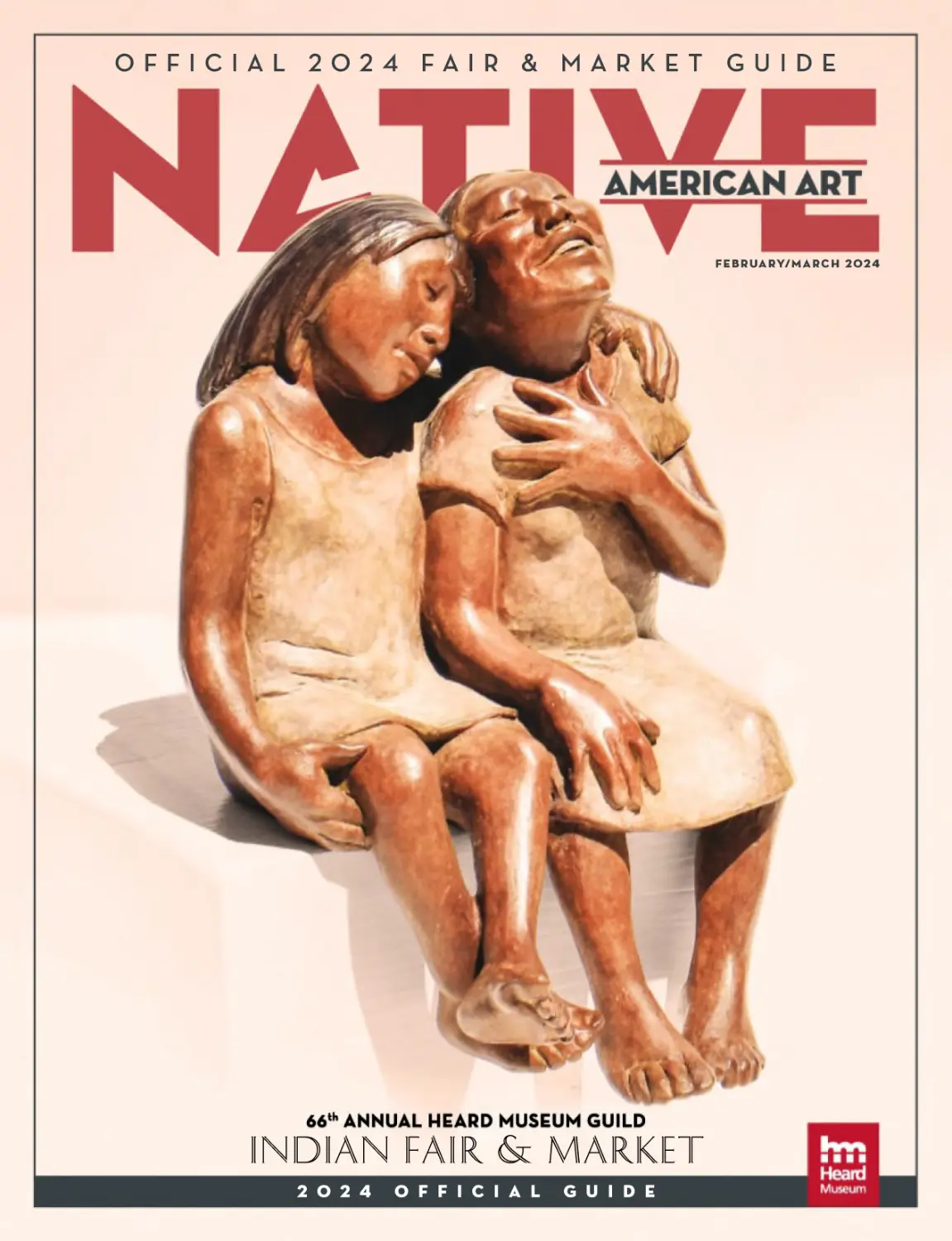
Roxanne Swentzell (Santa Clara Pueblo), Sister Love, bronze,
8 x 5½ x 6”. Photo by Phillip Karshis/KPhoto. Available at the
Heard Museum Guild Indian Fair & Market.
TONY NOLAN
Art Director
DANA LONG
Production Artist
LIZY BRAUTIGAM
04
Production Artist
66TH ANNUAL HEARD MUSEUM GUILD
INDIAN
FAIR +
MARKET
MAR
2-3
International Artist Publishing
Since 1998
Letter from the editor
The Artists are
Everything
We are very proud of the connections we have made since we started putting
this magazine out in 2016. We have worked with and know the top art dealers
and galleries from all corners of the market, auction specialists from all the best
auction houses, seasoned collectors who buy art at high levels and some of the best
museum curators in the world. Many of these people have not only been sources in
our coverage of the market, but they have contributed articles, allowed us to publish
excerpts from their new books, invited us into their homes to photograph their
collections, and worked closely with us as we produce new features and sections.
These are the best people to know when writing about Native American art.
But the artists are on another level entirely. The artists are the reasons we do
this. It’s their careers that fill our pages, it’s their work that we’re all so excited to
see, and it’s their voices that ring out as you look through this magazine. Nowhere
is this more clear than our issue dedicated to the Heard Museum Guild Indian Fair &
Market. We reach out to every artist included in this issue, and every one of them
devotes their time and resources to send us images of their work or studio, sit for
an interview or add context to their artwork. As is often the case, many of these
artists are also juggling full-time jobs, elderly family members in their care, young
children and busy lives. Time is at a premium, but they make time because they live
for their art.
Native American Art is excited to share so many artist stories in this special issue
for the Heard market. But this is just a drop in the bucket. There are so many more
out there. We hope this issue makes you want to seek out these artists—the ones
in these pages and not—so you can see the art they create and hear their stories.
It all comes back to the artists and their contributions. We couldn’t do it
without them.
Michael Clawson
Executive Editor | mclawson@nativeamericanartmagazine.com
FEBRUARY/MARCH 2024 BIMONTHLY
Marketing
ROBIN M. CASTILLO
Social Media Engagement Manager
social@nativeamericanartmagazine.com
SUBSCRIPTIONS
(877) 947-0792
EMILY YEE
Subscriptions Manager
service@nativeamericanartmagazine.com
APRIL STEWART
Accounts Receivable
astewart@nativeamericanartmagazine
BIANCA MARTOS
Administrative Assistant & Marketing Coordinator
bmartos@internationalartist.com
YOUR ALL-ACCESS PASS!
Scan this QR code to start listening to
The American Art Collective podcast!
Get Social!
Native
American Art
collectart
@artmags
nativeamericanarts
Copyright © 2024. All material appearing in Native American Art is
copyright. Reproduction in whole or part is not permitted without
permission in writing from the editor. Editorial contributions are
welcome and should be accompanied by a stamped self-addressed
envelope. All care will be taken with material supplied, but no
responsibility will be accepted for loss or damage. The views expressed
are not necessarily those of the editor or the publisher. The publisher
bears no responsibility and accepts no liability for the claims made, nor
for information provided by advertisers. Printed in the USA.
NATIVE AMERICAN ART
3260 N. Hayden Rd. Suites 201-203, Scottsdale, AZ 85251
Telephone (480) 425-0806. Fax (480) 425-0724 or write to
Native American Art, P.O. Box 2320, Scottsdale, AZ 85252-2320
Single copies $9.95. Subscription rate for one year is $40. To place
an order, change address or make a customer service query,
please email service@NativeAmericanArtMagazine.com or
write to P.O. Box 2320, Scottsdale, AZ 85252-2320.
POSTMASTER:
Send all address changes to Native American Art,
P.O. Box 2320, Scottsdale, AZ 85252-2320
Periodicals postage rates paid at Scottsdale, AZ 85251, and at
additional mailing offices.
PUBLISHERS WENDIE MARTIN AND ADOLFO CASTILLO
NATIVE AMERICAN ART
(ISSN 2469-6137) is published 6 times a year
by International Artist Publishing Inc.
06
www.NativeAmericanArtMagazine.com
SUN WEST
G : Michael Montoya
Sunwest Silver Co Inc
324 Lomas Blvd NW
Albuquerque NM 87102
1-800-771-3781 / 1-505-243-3781
info@sunwestsilver.com
Sunwest on the Plaza
56-58 Lincoln Ave
Santa Fe NM 87501
1-505-984-1364
info@sunwestontheplaza.com
OFFERS
Building Quality Collections for 45 Years
Tewa
Pueblos
Historic
Plainware
Pottery
221 Canyon Road, Santa Fe
www.adobegallery.com
505.955.0550
Successful Selling
with Hindman
Hindman’s Native American Art auctions offer a diverse
selection of quality textiles, jewelry, basketry, beadwork,
paintings, and sculpture. Seller’s benefit from our national
presence, client first approach, and favorable commissions.
We are now welcoming consignments for 2024 auctions.
Contact us to receive a complimentary auction valuation.
Danica Farnand | 513.666.4935
danicafarnand@hindmanauctions.com
HINDMANAUCTIONS.COM
Early Southern Plains Painted
Buffalo Hide Robe, Probably Comanche
Estimate: $15,000 - 25,000
To be offered April 19, 2024 in Native American Art
WORKSHOPS &
FESTIVAL WEEK
JUNE 2024 | IDYLLWILD, CA
Join us on our cool & beautiful mountaintop campus this summer!
WORKSHOPS JUNE 10 JUNE 28, 2024 | REGISTRATION NOW OPEN!
Navajo Weaving I, II, III
Barbara Teller Ornelas and Lynda Teller Pete
And the Bead Goes On: A Beading Circle Workshop
Jennifer Ben
Navajo Inlay Jewelry
Richard Tsosie
Cahuilla Basketry
Rose Ann Hamilton
Art of Fire: Introduction to Glassblowing
Ramson Lomatewama
Hopi Jewelry: Tufa Casting
Roy Talahaftewa
Cahuilla Style Pottery
Tony Soares
Yup’ik Mask Making, Drum Making and Dance
Aassanaaq “Ossie” Kairaiuak
Hopi Silver Overlay Jewelry
Ronald Wadsworth
Small Things Matter: Small Scale Bronze Casting
Holly Wilson
California Native Plants
Craig Torres and Abe Sanchez
Ho-Chunk Porcupine Quill Workshop
Melanie Tallmadge Sainz
Hopi-Tewa Pottery
Dorothy and Emerson Ami
FESTIVAL WEEK JUNE 16 JUNE 22, 2024
Exhibition | Lectures | Welcoming Home the Birds, A Bird Singing Event |
Film | Food | Music | Native Arts Market
Workshop scholarships are available for Native American adult and teen students!
Scan for more info and to register, or visit idyllwildarts.org/nativeamericanarts
Consign Today
Undeniable Results, From Classic to Contemporary
Oscar Howe, “Camte waste, no no wa” (“Good Heart Forever”)
Allan Houser, “Old Memories,” 1982
A Santa Clara Pueblo pottery olla
A Navajo Late Classic child’s blanket
Price Realized: $325,000 (Artist’s World-Auction Record)
Price Realized: $14,000
Price Realized: $31,250
Price Realized: $8,450
A family-owned auction house delivering both world-class service and results for 55 years.
Auctions
•
Private Sales
•
Appraisals
Auction & Consignment Inquiries: marandam@johnmoran.com
AUCTIONEERS & APPRAISERS
Est.
1969
55 Years
Learn
More
145 East Walnut Avenue, Monrovia, CA 91016 | www.johnmoran.com · info@johnmoran.com · (626) 793-1833
IN THIS ISSUE
FEBRUARY/MARCH 2024
66th ANNUAL HEARD MUSEUM GUILD
INDIAN FAIR & MARKET
SEE OUR
A hoop dancer at the 2023 market.
Gallery Previews
OFFICIAL GUIDE ON PG.
Museum Previews
43
Auctions
Previews of upcoming shows of historic and
contemporary Native American art at galleries
across the country.
Insights from top curators about the major
exhibitions of Native American art being
organized at key museums.
Major works coming up for sale at the most
important auction houses dealing in Native
American art, and results of recent auctions.
126 Shaped by Hand
136 Three Songs
142 Deep Lineage
King Galleries celebrates 28 years with a
show featuring 14 gallery artists.
Raven Chacon brings a multimedia exhibition
to the Harwood Museum of Art in Taos,
New Mexico.
Santa Fe Art Auction’s first sale of the year
offers more than 500 works of historic and
contemporary Native Art.
138 Native Voices and Visions
144 Art & Objects
134 Master Designers
The Eiteljorg Museum features a contemporary
exhibition of works by 2023 fellowship
recipients.
March in Montana brings 750 lots of Western
and Native American Art to Great Falls.
An annual exhibition of Native American
jewelry takes place at Waddell Gallery.
140 Western Inclusion
130 Tradition and Innovation
Blue Rain Gallery holds a Contemporary
Native Arts show.
A large lineup of Native American artists joins
the Masters of the American West exhibition.
150 Transformative Gift
The Saint Louis Art Museum celebrates a
massive donation from longtime collector
William P. Healey.
146 Timeless Beauty
Navajo weavings lead Heritage’s fall sale of
ethnographic art.
148 Enduring Appeal
Fritz Scholder dominates Hindman’s
$2.7 million fall sale of Western and
Contemporary Native American Art.
Native American Art magazine is proud to be the official magazine of the Heard Museum Guild Indian Fair & Market. This issue will provide you an insider’s look at the
upcoming virtual market, as well as information on many of this year’s exhibiting artists.
14
COEUR D’ALENE GALLERIES & THE COEUR D’ALENE ART AUCTION
PRESENT THE 37TH ANNUAL MARCH IN MONTANA AUCTION & DEALER SHOW
Please join us March 14-16, 2024 at the Great Falls Elks Lodge, #214
Featured: Exquisite Navajo Teec Nos Pos weaving, 9’4”x 6’1”. $20,000-30,000
Request information or a catalog: info@marchinmontana.com
Visit www.marchinmontana.com: Live, Internet, Phone & Absentee bidding available.
MARCH IN MONTANA | 213 E. SHERMAN AVE, COEUR D’ALENE, ID 83814 | 208-664-2091 | WWW.MARCHINMONTANA.COM
FEBRUARY 10, 2024 — JUNE 9, 2024
FEBRUARY 10, 2024 — JANUARY 11, 2025
0DVWHUJODVV
7KH&ROODERUDWLYH6SLULWRI7RQ\-RMROD
3DWKƓQGHU
<HDUVRI0DUFXV$PHUPDQ
View our new exhibitions!
Wheelwright Museum
Tue—Sat, 10 am—5 pm • wheelwright.org
704 Camino Lejo, Santa Fe NM 87505
Tony Jojola, 1958–2022 (Isleta Pueblo)
Untitled (Turquoise vessel with bears), 2001; Blown glass
Photography by Addison Doty
OF THE AMERICAN INDIAN
Marcus Amerman, b. 1959 (Choctaw Nation of Oklahoma)
Iron Horse Jacket (with Brook Shields), c. 1982; Leather, studs, and glass beads
Photography by Addison Doty
Invest in the Next Generation of
Contemporary Native Artists
Institute of American Indian Arts (IAIA) is the
birthplace of contemporary Native arts and the
only college in the world dedicated to the study of
Indigenous arts, cultures, and leadership.
IAIA graduates are leading the way in Native
representation in the arts worldwide.
Your support of IAIA provides
life-changing opportunities
for Indigenous students.
Discover more at
give.iaia.edu/foundation
or scan here.
Kathleen Wall, a renowned Jemez Pueblo potter and artist, is represented
in museum and private collections internationally and is the Museum of
Indian Arts and Culture’s 2020 Native Treasures Living Treasure. Kathleen
graduated from IAIA in 2014, was an IAIA Artist-in-Residence in 2021,
and is a current IAIA MFA Studio Arts student.
Photograph of Kathleen Wall (Jemez Pueblo) ’14 by Jason S. Ordaz.
Save the Date—August 14, 2024
La Fonda on the Plaza, Santa Fe, NM
www.iaia.edu/auction
ETHNOGRAPHIC ART: AMERICAN INDIAN,
PRE-COLUMBIAN AND TRIBAL
Signature® Auction | June 6
Now Accepting Consignments | Deadline: March 27
An Acoma Polychrome Jar
c. 1890
Sold for: $11,250 | November 2023
HA.com/EthnographicArt
Inquiries: 877-HERITAGE (437-4824)
Delia Sullivan | ext. 1343 | DeliaS@HA.com
74703
Calendar
Feb/March
ONGOING
SANTA FE, NM
Horizons: Weaving Between
the Lines with Diné Textiles
Museum of Indian Arts & Culture
(505) 476-1269
www.indianartsandculture.org
ONGOING
SANTA FE, NM
Here, Now and Always
Museum of Indian Arts & Culture
(505) 476-1269
www.indianartsandculture.org
ONGOING
PHOENIX, AZ
Grand Procession: Contemporary
Plains Indian Dolls from the
Charles and Valerie Diker
Collection
Heard Museum
(602) 252-8840
www.heard.org
THROUGH FEBRUARY 5
SANTA FE, NM
Nicholas Galanin:
Interference Patterns
SITE Santa Fe
(505) 989-1199
sitesantafe.org
ONGOING
DENVER, CO
Indigenous Arts of North
America Galleries
ONGOING
WATERVILLE, ME
Painted: Our Bodies,
Hearts, and Village
Denver Art Museum
(720) 865-5000
www.denverartmuseum.org
Colby College Museum of Art
(207) 859-5600
museum.colby.edu
FEBRUARY 7-8
SANTA FE, NM
Native Arts
FEBRUARY 10-MARCH 24
LOS ANGELES, CA
Masters of the American West
Santa Fe Art Auction
(505) 954-5858
www.santafeartauction.com
Autry Museum
(323) 667-2000
www.theautry.org
FEBRUARY 23-JULY 14
ST. LOUIS, MO
Native American Art of the 20th Century: The William P. Healey Collection
Saint Louis Art Museum, (314) 721-0072, www.slam.org
1
In every issue of Native American Art magazine, we publish the only reliable guide to all major upcoming fairs and shows nationwide. Contact our assistant editor
Chelsea Koressel to discuss how your event can be included in this calendar at (480) 374-2187 or ckoressel@nativeamericanartmagazine.com.
20
MARCH 14-16
GREAT FALLS, MT
March in Montana Auction
and Dealer Show House
2
Coeur d’Alene Art Auction
(208) 664-2091
www.marchinmontana.com
OPENS FEBRUARY 23
PHOENIX, AZ
Maria & Modernism
FEBRUARY 24-JULY 7
TAOS, NM
Raven Chacon: Three Songs
Heard Museum
(602) 252-8840
www.heard.org
Harwood Museum of Art
(575) 758-9826
www.harwoodmuseum.org
FEBRUARY 29-MARCH 3
SCOTTSDALE, AZ
Waddell Indian Market
Jewelry Show
THROUGH MARCH 4
LEWISTON, ME
Exploding Native Inevitable
Waddell Gallery
(480) 755-8080
www.waddellgallery.com
THROUGH MARCH 17
TUCSON, AZ
Enduring Legacies: The James T.
Bialac Indigenous Art Collection
Tucson Museum of Art
(520) 624-2333
www.tucsonmuseumofart.org
www.NativeAmericanArtMagazine.com
Bates College Museum of Art
(207) 786-6158
www.bates.edu/museum
THROUGH MARCH 23
KALISPELL, MT
In That Still Moment: DG House
Hockaday Museum
(406) 755-5268
www.hockadaymuseum.com
THROUGH FEBRUARY 25
INDIANAPOLIS, IN
UNSETTLE/Converge:
The Eiteljorg Contemporary
Art Fellowship 2023
Eiteljorg Museum
(317) 636-9378
www.eiteljorg.org
THROUGH MARCH 10
RENO, NV
Cannupa Hanska Luger:
Speechless
Nevada Museum of Art
(775) 329-3333
www.nevadaart.org
OPENS FEBRUARY 29
SCOTTSDALE, AZ
28 x 28
King Galleries
(480) 481-0187
www.kinggalleries.com
MARCH 15-29
SANTA FE, NM
Contemporary Native Art
Blue Rain Gallery
(505) 954-9902
www.blueraingallery.com
1. Awa Tsireh (San Ildefonso Pueblo, 1898–1955), Untitled (detail), 1930s,
watercolor, image: 10½ x 2½." The William P. Healey Collection of Native
American Art); © Estate of Awa Tsireh.
2. Allan Houser (Chiricahua Apache,1914-1994), Swift Messenger, bronze,
10 x 15 x 4" Estimate: $12,000/18,000
» Calendar
21
May 02-05, 2024
Santa Fe, New Mexico
INDIGENOUS
FASHION WEEK
D E TA I L S : swaianativefashion.org
Today, you can take part in SWAIA’s century-long
commitment to Indigenous artists and communities by
completing your purchase for a 2024 SWAIA Membership.
Partner with Purpose:
Your 2024 SWAIA Membership
Makes a Lasting Difference
SOUTHWESTERN ASSOCIATION for INDIAN ARTS
swaia.org | 505.983.5220
Current membership information can be found at
swaia.org/memberships or by contacting SWAIA’s office at
505.983.5220 or members@swaia.org.
Join us in preserving and advancing this extraordinary
journey, where every thread, including yours, plays a vital
role in supporting the journey of North American Native
artists and uplifting the communities they call home.
R
ed Berry Woman is a fashion line created
by Hidatsa designer Norma Baker-Flying
Horse, which transforms Native American
traditional garment styles into contemporary
ready-to-wear couture for women and men.
Baker-Flying Horse is an enrolled member of the
Hidatsa tribe and a member of the Dakota Sioux
and Assiniboine tribes, as well as an adopted
member of the Crow Nation.
“[In the past few years] my time has been
filled with some major events,” says BakerFlying Horse. She won Phoenix Fashion Week
Designer of the Year for 2022-2023 and was the
first Indigenous designer to receive a Cultural
Recognition in Visual Arts Grammy award. In
addition, she’s also dressed several prominent
figures for major events including Canadian
actress Tantoo Cardinal for the premiere of the
new Martin Scorcese film Killers of the Flower
Moon; Quannah ChasingHorse for the cover
of Native Max Magazine; Quannah Chasing
Horse for the film premiere of Walking Two
Worlds at the Tribeca Film Festival; and Janee’
Kassanavoid (the first Native American woman
to receive a medal at the World Track and Field
Championships) for the White House’s first
Native American Heritage Month celebration.
And that’s just scratching the surface.
Baker-Flying Horse also released her new
UNITY Dragonfly Collection and gave birth to a
daughter in November of 2022.
www.redberrywoman.com
@red_berry_woman
Red Berry Woman Grammy Shoot
Outfit: Upcycled gown, hand-crafted
and painted parfleche top with
matching cuffs.
Designer: Red Berry Woman
Model: Quannah Chasing Horse
MUA: Martha Phelan, Hidatsa/Arikara
Hair: Shylah Demaray, Arikara
Photographer: Joe Pekara
24
/redberrywoman
M]W\cacj]P]``U[YNcaamGcbhcmU$҄Ҍ҈҅ ҅҃҃Ҍ%JUghY`CaU[Y ?XX]Y<Ug\U=c``YWh]cb
ŊÊԡε|¶ÔÔ½Î|Êŋ
Ń¡ |Î|
N\Y?XX]Y<Ug\U=c``YWh]cbYbWcadUggYgcjYf҅҃҃҃d]YWYgcZQYghYfb;aYf]WUbUbXCbX][YbcigUfh]bW`iX]b[
dU]bh]b[ggWi`dhifYg_Uhg]bUgUbXacfYQYghYfbMd]f]h`cc_gZcfkUfXhcg\Uf]b[h\Y<Ug\U@Ua]`mXcbUh]cbk]h\
h\Ykcf`XZcfmYUfghcWcaY
LYWYbh`mVfYU_]b[[fcibXcbU҄҅҃҃҃geiUfYZcchYldUbg]cbZibXYXVmh\Y`Uf[Yghg]b[`Ydf]jUhYXcbUh]cbhcU
aigYia]b;f]ncbUVmFci]g$<inn%MUbXgCPQYghYfbMd]f]hWcbh]biYg]hgYZZcfhghcVc`X`m]aaYfgY[iYghg]bh\Y
ib]eiYghcfmcZh\YAfYUhYfQYghYfbfY[]cb]``ia]bUh]b[h\YdUghhcVYhhYfg\UdYcifZihifY
҆ҋ҆҃HGUfg\U``QUm*MWchhgXU`Y;T*QYghYfbMd]f]hcf[
Acquisition
The Saint Louis Art Museum has recently added three new
works of Native American art to its collection.
SAINT LOUIS ART MUSEUM
The Saint Louis Art Museum (SLAM) has
acquired works by Jaune Quick-to-See Smith
and Kay WalkingStick, deepening the museum’s
commitment to representing Native American
artists within its collection.
WalkingStick’s 1975 painting Personal Icon
features “a low, swelling arc against a gridded
frame of red encaustic” according to SLAM. State
Names Map: Cahokia, by Quick-to-See Smith,
was created using collage and gestural painting.
The piece “reconfigures the United States map,
using text with only those state names based on
Indigenous words,” the museum notes. In Quickto-See Smith’s other work, Trade Canoe: Osage
Orange, the artist created the frame of a canoe
using wood from an Osage Orange tree.
The acquisitions fill important spaces within
the Saint Louis Art Museum’s permanent
collection of artwork by contemporary Native
American artists. “We are in a moment of
heightened visibility for Native artists across
the country but especially in Saint Louis,” says
Min Jung Kim, the museum’s Barbara B. Taylor
director. “Adding these works to our collection is a
way to continue to shed light on these vital artists,
whose art speaks to both personal histories and
wider cultural concerns.”
1
1. Kay WalkingStick (Cherokee), Personal Icon, 1975, acrylic,
wax and ink on canvas, 42 x 48”. Saint Louis Art Museum.
© Kay WalkingStick.
2. Jaune Quick-to-See Smith (Enrolled Salish/Confederated
Salish/Kootenai Nation), State Names Map: Cahokia and
Trade Canoe: Osage Orange, 2023. Saint Louis Art Museum.
© Jaune Quick-To-See Smith. Courtesy the artist and Garth
Greenan Gallery, New York. Image courtesy Counterpublic.
Photo by Jon Gitchoff.
26
2
JOIN US DURING THE 66TH ANNUAL
HEARD INDIAN MARKET
EMERALD
TANNER
TRUNK
SHOW
HOSTED AT
DENNIS JUNE GALLERY
THURSDAY, FEB 29TH
TO
SUNDAY, MAR 3TH
10AM - 5:30PM
THURSDAY NIGHT ART WALK
5PM-9PM
7056 E. MAIN ST., SCOTTSDALE, AZ
BY APPOINTMENT
DOWNTOWN GALLUP
NEW MEXICO
FINE AMERICAN
INDIAN ART
SINCE 1872
505.863.6017 // tanneremerald@gmail.com // www.tannersindianarts.com // @tannersindianarts
On
The
Market
Historic material now available from galleries and dealers from coast to coast.
1
1. Territorial Indian Arts
2. Ancient Nations
Now available at Territorial Indian Arts in
Scottsdale, Arizona, is this stunning Zuni
Sun Face suite of jewelry by Morris and
Sadie Laahty. Included are a three-setting
cuff bracelet, ring, brooch/pendant and
clip-on earrings. The set was featured on
the cover of Rock & Gem magazine in June
1974. Engraved on the naja is April 10,
1971, and Morris and Sadie Laahty. Each
piece has its own Sun God signature.
The online gallery Ancient Nations has
a Fannie Nampeyo (Hopi) Thunderbird
Wedding Vase from around 1975. The
gallery notes: “Fannie Nampeyo was
arguably the most well-known of
all Nampeyo’s daughters and was
prolific in her production of the
‘migration’ pattern pottery that
had become synonymous with
Hopi pottery—and Nampeyo in
particular.” The work is now available
at Ancient Nations Indigenous Arts.
7100 E. Main Street, #3, Scottsdale,
AZ 85251 • (480) 945-5432 •
www.territorialindianarts.com
28
www.ancientnations.com
2
Bolo by Winston
415.519.7797 • Inquiries Welcome
Barbara Miles, San Francisco Bay Area
Miles@MilesNativeArts.com • www.MilesNativeArts.com
Is a proud Sponsor of the Cherokee Art Market.
$
SUBSCRIBE TODAY
TO START GETTING THIS ONE-OF-A-KIND PUBLICATION
Subscribe today to get the best Navtive American art magazine in
the country, and the only bi-monthly magazine that highlights the
top artists, galleries, museums, fairs and auctions throughout the
art market. Flipping through the pages of Native American Art
magazine you’ll find unique and engaging content including:
•
Previews of all the biggest markets,
shows and sales.
•
Special genre sections highlighting
unique categories of art such as pottery,
textiles and jewelry.
•
The leading coverage related to Santa Fe
Indian Market, the Heard Museum Indian
Guild Fair & Market and other top events.
•
Insight from renowned experts, authors
and curators.
FOR 6 ISSUES!
50%
off
NEWSSTANDS!
Find out what all the artists, dealers and
collectors are talking raving about by
subscribing to Native American Art magazine.
Get your subscription started today at
www.NativeAmericanArtMagazine.com.
SUBSCRIBE TODAY BY VISITING
www.NativeAmericanArtMagazine.com/subscribe
Save $10 for The Perfect Pairing
1 Year of Native American Art (6 Issues) +
1 Year of Western Art Collector (12 Issues)
Now
79
$
FOR ALL 18 ISSUES!
USE PROMO CODE SAVE10
Western Art Collector
www.WesternArtCollector.com
Don’t Miss Our
Other Titles
International Artist
Publishing also offers
these great titles
American Art Collector
www.AmericanArtCollector.com
American Fine Art Magazine
www.AmericanFineArtMagazine.com
International Artist
www.InternationalArtist.com
Mark Maggiori • Sheryl Susunkewa • Don Clapper • David Roche •
Russell Sanchez • Kim Peone • Jamie Schulze • The Bennett Prize
• Kevin Horace Quannie • Tom Browning • Brian Lebel • Calandra
Business For Sale
Continue the Legacy
Serious Inquiries
ONLY
“
No reason to shop
anywhere else. This
store has all kinds of
AUTHENTIC items
at every price point.
”
Major Distributor of Native American Arts and Crafts
Large Customer Base in US, Europe and Asia
Brick and mortar in beautiful Sedona, AZ
info@kachinahouse.com • www.kachinahouse.com • 800-304-3290
RENO TAHOE
INTERNATIONAL
Art Show
September 12 - 15, 2024
Reno-Sparks Convention Center
Destination Art Fair of the West Returns to Reno Tahoe
for a Third Edition
RTIA 2024: Bigger
and Better
Applications Now Open
rtiashow.com
140,000 sq ft
7,000+ Collectors,
Art Buyers, & Designers
Featuring:
200+ Independent Artists
First Nations Indigenous
Peoples Pavilion
18,000’ + Sculpture Walk
20+ Live Musical
Performances
rtiashow.com
• Prominent centralized location
• Special pricing for qualifying
FNIP exhibitors
bdolan@rtiashow.com | kokeefe@rtiashow.com
@rtiashow
&DUORQ3$PL,,
)HDWXUHGDW
FSDPLDUWVSDQFRP
&3$PLB$UWV
ɳɺ)HEUXDU\ɳɱɳɵ
ɸɲɱɱ(0DLQ6W67(ɵ
6FRWWVGDOH$=ɹɶɳɶɲ
GOOD ART MATTERS
KAY WALKINGSTICK
Cardinal Points Variation | Acrylic Paint, Bees Wax, 23K Gold Leaf | 2001 | 36" x 36" x 3¹/4"
SavvyCollector.com rehomes art by artists from diverse cultures.
Quality is our common denominator.
SavvyCollector.com
602 906 1633
ccainaz@gmail.com
Phoenix, Arizona
JESSE
ROBBINS
P R E S C O T T ,
A R I Z O N A
Curated Vintage
WEBSITE JESSEROBBINSJEWELRY.COM
JESSE ROBBINS JEWELRY
EMAIL JESSEROBBINSAZ@GMAIL.COM
INSTAGRAM@ROBBINSJESSE
I Am My Mother's Daughter - Oil on Board - 18x18
KAREN CLARKSON
Heard Museum Indian Market
Featured Artist - located inside the Museum Shop
March 1-3 - Friday, Saturday and Sunday
www.clarksonart.com
Contemporary Indigenous Origami
by Rain Scott (Acoma/Navajo)
REPRESENTED BY: KING GALLERIES - SCOTTSDALE & SANTA FE AND HOME AND AWAY GALLERY – MAINE
Minah’dee - Keeper of the Salt
Folded paper, deer sinew, blue and gold macaw
feathers, Kingman turquoise, Mother of Pearl
Private collection
To All My Relations
Folded paper, Mediterranean coral | Private collection
rainscott5@gmail.com
Micro-origami pot with lid
Folded paper
King Galleries - Scottsdale & Santa Fe
Micaceous-style olla with lid
Folded paper, Amazon macaw feathers,
Persian turquoise, sleeping beauty turquoise
Home and Away Gallery
Shooting star
Folded paper | Private collection
HEARD INDIAN FAIR & MARKET 2024 Booth # E-05
66th ANNUAL HEARD MUSEUM GUILD
INDIAN FAIR & MARKET
44
54
102
Welcome Letter
News
Heard Shop Artists
46
Learn about the Heard Museum and
opportunities with the guild.
Meet the artists who will be showing their
work at the Heard Museum Shop.
Market Map
Plan your market-day adventure with our
map of the Heard market, which includes
artists featured in this issue!
48
Heard Event Calendar
Organize your spring in Arizona at the
Heard Museum, which will not only
feature the annual market but also
exhibitions and other events prior to and
after market weekend.
Basketry by Sarah Sockbeson
(Penobscot)
www.NativeAmericanArtMagazine.com
56
107
In Memoriam
Guide to Market
58
Step into the eight classifications that are
represented during market weekend.
Juried Competition Judges
Meet the judges who choose the winners
prior to the market.
68
Market & Museum Features
Learn more about artists at the fair and
exhibitions at the museum in our in-depth
feature articles.
124
Youth Art Show & Sale
125
Fair Sponsors
43
HEARD MUSEUM GUILD INDIAN FAIR & MARKET 2024
SIGNATURE EVENT
The Heard Museum welcomes visitors back
to the 66th annual market.
W
elcome to the 66th annual Heard Museum Guild Indian Fair & Market, which
will be held at the Heard Museum on March 2 and 3, 2024. We are delighted
to report that last year’s 2023 market was a resounding success, with record
numbers of guests—more than 18,000—and record sales by participating artists! The
market is the signature annual event of the Heard Museum, and is led by the Heard
Museum Guild, a dynamic organization of volunteers dedicated to supporting the
museum’s mission of advancing American Indian art. Since 1959, the Heard Museum
Guild Indian Fair & Market has showcased the beauty and vitality of Indigenous creative
expression of artists not only from the Southwest but from across the country. We
are dedicated to making our 66th year even better and more exciting, highlighting the
work of more than 600 superlative artists!
Many artists will also compete in the juried competition for a coveted Heard
ribbon across numerous classifications. These ribbons carry with them cash awards
as well as enhanced recognition in their artistic fields. Thanks to many generous
donors, we have exceeded our goal by raising more than $115,000, securing more
support for the juried competition than ever in the fair’s 66-year history. This
includes the overall Best of Show award, which carries a $25,000 cash award! We
hope you will plan to join us on Friday evening, March 1, for the Best of Show
Reception, when the Best of Show winners will be announced in advance of the
market, and you will have the opportunity to meet and congratulate the artists.
An exciting component of the fair this year will once again be the Youth Artists
Show & Sale, held in the Monte Vista Room of the museum. American Indian
students in grades 7 through 12 are invited to submit their original artwork for
display and sale, and have their art judged by a professional panel with ribbons
and cash prizes totaling $10,000.
Speaking of youth, this year we are featuring a Family Fun Zone, with games
and fun activities for children! The Family Fun Zone will be adjacent to the Youth
Artists Show & Sale. So, by all means, bring the children to introduce them to the
amazing youth art and enjoy the Family Fun Zone! To make the show and Family
Fun Zone accessible to everyone, we have a special Sunday offer: all children 12
and under will be admitted free to the Indian Fair & Market on Sunday, March 3.
Please join us as we celebrate the 66th Annual Indian Fair & Market on the
beautiful Heard Museum campus. Visit the Heard Museum website for the
schedule of events. See you at the Fair!
Jane Sanford and Frank Vickory, Co-Chairs,
2024 Heard Museum Guild Indian Fair and Market
John Miller, President, Heard Museum Guild
David Roche, Dickey Family Director and CEO, Heard Museum
44
HEARD MUSEUM GUILD
2024 INDIAN FAIR & MARKET
COMMITTEE CHAIRS, VOLUNTEERS,
AND HEARD MUSEUM STAFF
Thank you to the volunteers of the Heard Museum Guild.
For more than 65 years, this group of men and women
have spent countless hours making the Indian Fair & Market
a reality. We are grateful for their generosity of time and
talent in making our market renowned for its hospitality
and presentation of exceptional Indigenous art. Special
thanks also to the Heard Museum staff for their partnership
in this signature event.
Indian Fair & Market Chairs:
Jane Sanford and Frank Vickory
Admissions Liaison: Susan Gross
Artist Exhibitors: Marcus Monenerkit
Artist Hospitality: Gina and Rick DeGraw
Ask Me: Linda Darrah
Best of Show (BOS) Reception:
Jackie Stubbs and Mary Endorf
BOS Security: Diane Leonte & Sheila Mehlem
Booth Monitors: Sandy and Gary Neilson
Booth Relief: Kathie and Sam Serrapede
Cultural Performances: Audrey Rada
Food and Beverage: Frank Vickory
Sponsorship: Jack Schwimmer
Juried Competition: Pat Kilburn with Sharon Weier asst
Marketing: Jane Przeslica
Nonprofits and Demonstrations: Carol Gunn
Raffle: Louise Wakem and Fran Dickman
Signage: Frank Vickory
Staging: Joel Muzzy and Dale Baker
Treasurer: Newton Linebaugh
Volunteer Placement: Chuck Starnes and Kellie Kelley
Youth Art Show & Sale: Gladys Matthews
HEARD MUSEUM GUILD
BOARD MEMBERS
OFFICERS
President: John Miller
President-Elect: Shelley Mowry
Secretary: Dale Baker
Treasurer: Newton Linebaugh
Nominating Chair: Anita Hicks
ATLARGE MEMBERS
Past President: Jane Przeslica
Indian Fair & Market: Jane Sanford and Frank Vickory
Parliamentarian: Jim Szabo
Guild Technology: Dan Dolan
Communications Chair: Diane Leonte
COORDINATORS
Student Art: Gladys Matthews
Guild Programs: Barbara Sparman
Membership: Carol Seidberg
Museum Education: Linda Hefter & Jackie Stubbs
Museum Services: Jane Sanford
COREY
STEIN
The NoBull Ones, Portrait of Suzanne and Robert Williams
37” x 30” x 3”
Seed beads hand sewn on felt, mounted in a custom tri-fold, gilded, wooden frame.
artcoreystein
studio@coreystein.com
CoreyStein.com
BOOTH #
A-03
HEARD MUSEUM GUILD INDIAN FAIR & MARKET 2024
ARTISTS
Scan here to download this map
for your convenience
in this
ISSUE!
As you make your way through the Heard
Museum Guild Indian Fair & Market, be sure
to stop by artists who appear in this issue.
A-03
Corey Stein (Tlingit)
A
E
E-06
Raynard Scott (Navajo (Diné))
A-30
Russell A. Sanchez (San Ildefonso Pueblo)
A-35
Juanita Growing Thunder Fogarty (Fort Peck Assiniboine/Sioux)
H
B-44
Charlene Laughing (Navajo (Diné))
I
C
K-03
Maria Samora (Taos Pueblo)
M
M-01
Wakeah Jhane (Comanche/Kiowa/Blackfeet/Cherokee)
Demo-06
ZefrenM (Navajo (Diné))
SHOP
46
D-46
Leon Misak Kinneeveauk (Inupiaq)
K-03
Greyshoes (Upton Ethelbah Jr.)
DEMO
D
K
M-12
Lynn Traylor (Navajo (Diné))
C-44
Ca’Win Jimmy Fred Calabaza (Santo Domingo Pueblo)
I-02
Kathleen Wall (Jemez Pueblo)
I-11
Nanibaa Beck (Navajo (Diné))
B-44
Mona Laughing (Navajo (Diné))
B-46
Hollis Chitto (Choctaw/Isleta and Laguna Pueblos)
H-21
Theresa Secord (Penobscot)
H-51
Pati Belgarde-Cornelius (Turtle Mountain Band of Chippewa)
B-34
Kevin Pourier (Oglala Lakota)
B
E-05
Rain Scott (Acoma Pueblo)
Heard Shop
Karen Clarkson (Choctaw/Cherokee)
HOOVER AVE.
8
7
10
11
6
5
4
15
16
G1 - 27
H
17
E 1-20
14
15
11
10
9
8
F 31 - 56
J 1-18
12
3
17
18
17 18 19 20
Emergency
Exit
7
16 15 14 12 11 10
Security
2
20
I 1-25
6
5
3 2
4
I
30 31 32 33 34 35 36 37 38 39
FIRST AID
Lost/Found
1
i
Booth
Monitors
1
Volunteer
Placement
ASK
ME
ATM
Admissions
12
Prepaid & Ticket Holders
Membership Sales
VIP Check-in
9
K
11 11 14
1210
62 63 64
1
i
i
2 3
11
L 1-8
4 5 6
7 8
49 50
ATM
11
48 47 46 45 44
C
Circles VIP
i
C26 - 42
C8 - 25
1
2 3
4 5
7
48 47 46 45 44
43
22 29
23 28
16 19
17 18
24 27
25 26
9
i
ASK
ME
8
i
5
2 3
4 5
7
48 47 46 45 44
43
i
Featured
Artists
A26 - 42
A 1-48
7
Collector’s
Room
SHOP
CD
Sales
B8 - 25
1
A
6
10
4 5
K 8-10
8
8
15 16
i
Steele
Auditorium
3
Student Art Native Art
Merchandise Raffle
B26 - 42
B 1-48
14 21
15 20
7 10
8 9
9
5 12
6 11
3
4
10
1
2
B
Fair Sponsors
K 11-17
DEMO
Demo Artists
1 - 10
14 12 11
17 16 15
American Indian Veterans
National Memorial
Color
Guard
21
12 14 15 16 17 18 19 20
9 10 11
i
Artist
Hospitality
19
18
M
Cultural
Performances
8
7
22
23
20
Area-M
1 - 29
Emergency
Exit Only
6
D
Booth
Relief
24
2
3
4
5
3 4
25
1
Lemonade
& Hot Dogs
Amphitheater
Stage
11
26
D 1-20
21
2
27
C 1-50
1
Fry Bread
& Beverage
K 1-4, 18-21
10
i
ATM
28
2
1
3
i
42 43 44 45 46 47 48 49 50 51
D 21-64
29
Artist
Services
Exit
Entrance
CENTRAL AVENUE
MARCH 2 & 3, 2024
5
4
3
2
1
19
21 22 23 24 25
Indian Fair & market
7
18
H28 - 53
2
1
HEARD MUSEUM GUILD
E
6
H1 - 27
16
2024
14 12
F 1 - 30
9
A8 - 25
1
2 3
ATM
i
Museum
Shop
4 5
7
ATM
6
ASK
ME
Café
LEGEND
East Entrance
Artist Areas A thru M + DEMO
11 . . . Kettle Corn
11 . . . Lemonade
11 . . . Shaved Ice
4 . . . Youth Art Show & Sale - YASS
5 . . . Museum Shop Featured Artists
6 . . . Food Pavilion
7 . . . U-Club Grill
8 . . . Heard Cafe Grab-n-Go
9 . . . Fry Bread
10 . . Beverage Booth
11 . . Gelato Place
i
11 . . Lemonade & Hot Dogs
12 . . . Sponsor- Magazines
14 . . . UPS Shipping
15 . . . Youth Art Merchandise
16 . . . Native Art Raffle
17 . . . Non-Profets
18 . . . Book Signing
19 . . . Family Fun Zone
ASK
. . . Information
ME
. . . Restrooms
. . . Tables & Seating
Coffee
Cantina
i
Books & More
7
Security
6
ENTRANCE
ATM
HEARD MUSEUM
9
17
Non-Profits
Artists Booth Area
Highlight
18
10
Food Pavilion & Seating
1 . . . FIRST AID
2 . . . Volunteer Placement
3 . . . Artist Services
4
YASS
Youth Art
Show & Sale
ADA
waiting
19 FAMILY FUN ZONE
10
i
Exit
Admissions
MONTE VISTA ROAD
www.NativeAmericanArtMagazine.com
One-way Traffic
Security
Ride Sharing / ADA Drop-off & Pick-up, Artist & Vendor Vehicles
47
HEARD MUSEUM GUILD INDIAN FAIR & MARKET 2024
Heard Museum entrance.
THE
HEARD MUSEUM
CALENDAR
A comprehensive calendar of events at
the Heard Museum, including the Heard
Museum Guild Indian Fair & Market.
Ongoing
The North Star Changes:
Works by Brenda Mallory
This exhibition features sculptures that Brenda Mallory
has made using reclaimed and found objects, some taking
the form of large-scale installations. Mallory describes
her process as bricolage—something constructed or
created from a diverse range of available things. Mallory
notes, “The idea that an object has more than one
use, more than one life in it, is what appeals to me.”
Heard Museum
www.heard.org
Ongoing
Heart of the Community: Baskets
from the Basha Family Collection
of American Indian Art
The exhibition title recognizes Eddie Basha’s dedication
to the good of his community and his appreciation
of American Indian communities of which art is an
integral part. Many of the baskets were woven in the
48
OFFICIAL MAGAZINE
Ongoing
Substance of Stars
The project is the culmination of a threeyear collaboration with four Indigenous
communities, thanks to a grant from Lilly
Endowment, which fosters the study of
world religions. The exhibition examines
the collection of the Heard Museum
from Indigenous perspectives, across a
wide variety of media and time periods.
It incorporates Indigenous languages,
sky knowledge, and spiritual values,
and includes elements of the origin
stories that form Native identities.
Heard Museum
www.heard.org
early decades of the 20th century in
Arizona. They come from a time when
weavers were fully exploring their art
form and recognizing change. The art
of Western Apache, Yavapai and Akimel
O’odham weavers will be featured.
Heard Museum
www.heard.org
Exhibition display for
Substance of Stars.
Jessa Rae Growing Thunder (Fort Peck
Assiniboine/Sioux (Nakoda/Dakota)).
Heard Museum
www.heard.org
Ongoing
Grand Procession:
Contemporary Plains Indian
Dolls from the Charles and
Valerie Diker Collection
Ongoing
Away From Home: American
Indian Boarding School Stories
This exhibition celebrates an exceptional
collection of dolls, also known as soft
sculptures, created by Jamie Okuma
(Luiseño/Shoshone-Bannock), Rhonda
Holy Bear (Cheyenne River Sioux/Lakota)
and three generations of Growing Thunder
family members: Joyce Growing Thunder,
Juanita Growing Thunder Fogarty and
Away From Home examines an important
and often unknown period of American
history. Beginning in the 1870s, the U.S.
government aimed to assimilate American
Indians into “civilized” society by placing
them in government-operated boarding
schools. Children were taken from families
and transported to faraway schools
where all signs of “Indian-ness” were
stripped away. Students were trained for
servitude, and many went for years without
familial contact—events that still have an
impact on Native communities today.
Heard Museum
www.heard.org
February 2, 5-9 p.m.
February First Friday
at the Heard
A free evening of Heard Museum
programming and exhibitions with
exciting guests, art activities and more.
Heard Museum
www.heard.org
HEARD MARKET SCHEDULE
Best of Show Reception
March 1, 5-8 p.m.
Heard Museum Guild
Indian Fair & Market
Heard Museum Shop
Featured Artists
Market Ticket Prices
Saturday, March 2, 2024
Hours: 9:30 a.m. to 5:00 p.m.
(Members Only Opening: 8:30 a.m.)
Ray Tracey (Navajo)
Victoria Adams
(Southern Cheyenne/Arapaho)
Karen Clarkson (Chocktaw)
Jackie Larson Bread (Blackfoot)
Tim Blueflint Ramel
(Bad River Chippewa/Comanche)
Roxanne Swentzell
(Santa Clara Pueblo)
Ivan Howard (Navajo)
Adults: $25
Seniors, Active Military: $22
Members: $20
Students, American Indians,
Children (6-17): $10
Children (5 and under): Free
EXCEPTION: All children
12 and under are free on Sunday
Best of Show Reception:
$100 (Members: $75)
www.NativeAmericanArtMagazine.com
Sunday, March 3, 2024
Hours: 9:30 a.m. to 4:00 p.m.
(Members Only Opening: 8:30 a.m.)
Heard Museum
2301 N. Central Avenue
Phoenix, AZ 85004
(602) 252-8840, www.heard.org
» Heard Museum Guild INDIAN FAIR & MARKET
49
HEARD MUSEUM GUILD INDIAN FAIR & MARKET 2024
PERFORMANCES
MASTER OF CEREMONIES
Dennis Bowen Sr. (Seneca)
DRUM GROUP
Thunder Springs Northern Drum Group,
led by Lamon Barehand (Hopi/Pima)
ARENA DIRECTOR
Eric Manuelito (Diné)
SOUND ENGINEER
William Eaton from Wisdom Tree Music
March 2 & 3, 2024
11 a.m.
Opening Ceremony
PRESENTATION OF COLORS
Ira Hayes, American Legion Post 84
NATIVE AMERICAN FLAG SONG
Thunder Springs Northern Drum Group
NATIONAL ANTHEM
Sung in Apache by Bo Goode (Great
San Carlos Apache Tribe)
PRAYER/BLESSING
Matthew Yatsayte (Zuni/Diné)
REMARKS
Jane Sanford & Frank Vickory (2024 Fair
Chairs), David Roche (Dickey Family
Director and CEO, Heard Museum)
12 p.m.
CHI CHINO SPIRIT DANCERS (Pima/Akimel O’odham)
1:00 p.m.
ED KABOTIE (Hopi)
2:00 p.m.
CHA’BII TU APACHE CROWN DANCERS
(White Mountain Apache)
3:00 p.m.
TONY DUNCAN AND FAMILY
(Apache-Mandan/Hidatsa/Arikara)
3:50 p.m.
CLOSING CEREMONY
Performer at the
2023 Indian Market.
50
Opening February 24
Maria & Modernism
This exhibition features Maria Martinez (18871980), the San Ildefonso Pueblo ceramicist
who became one of the most widely
celebrated artists of her time and whose work
continues to influence new generations of
artists. She has been conspicuously excluded
from the discourse on American modernism.
To correct this, Maria & Modernism will present
examples of her pottery that substantiate
the aesthetic and conceptual affinities of
her work with major artistic and creative
movements of her time, including decorative
and industrial design, and examine her
ongoing influence on 21st-century artists.
Heard Museum
www.heard.org
Ongoing
Indeterminate Beauty
Indeterminate Beauty presents a brief yet bold selection of works by influential Kiowa/
Caddo artist T.C. Cannon. His artistic motivations were ignited by the sociopolitical
atmosphere of America during the mid-20th century and illustrated by saturated colors
juxtaposed with subjects that examine identity. The exhibition features five woodcut
prints of Cannon’s oeuvre, acquired through a gift in memory of Gil Waldman.
Heard Museum www.heard.org
T.C. Cannon (Kiowa/Caddo,
1946-1978), Two Guns Arikara,
1977, woodcut print, ed. 56 of
200. Gift of Christy Vezolles in
memory of Gil Waldman.
March 2-3
66th Annual Heard Museum
Guild Indian Fair & Market
February 17-18, 9-5 p.m.
World Championship
Hoop Dance Contest
For three decades, the world’s
most talented hoop dancers have
come to the Heard Museum to
compete in this thrilling annual
competition to secure the title of
World Champion Hoop Dancer.
The art of hoop dance honors
cultural traditions shared by multiple
Indigenous communities. With
roots in healing ceremonies,
traditions and practices, today
hoop dance is shared as an
artistic expression to celebrate
and honor Indigenous traditions
throughout the United States
and Canada. For the 2024 event,
dancers will be judged on a slate
of five skills: precision, timing/
rhythm, showmanship, creativity
and speed. Contestants compete
in one of five divisions: Tiny Tots
(age 5 and younger), Youth (6-12),
Teen (13-17), Adult (18-39) and
Senior (40 and older). Cash prizes
totaling $25,000 are awarded
to winners in each division.
The Heard Museum Guild Indian
Fair & Market is one of the largest
American Indian art markets in the
world and draws nearly 15,000 visitors
and more than 600 of the nation’s
most preeminent American Indian
artists. Attendees can meet and
purchase art directly from multiple
generations of artists working in a
multitude of different art genres.
Heard Museum
www.heard.org/event/fair
Heard Museum
www.heard.org/event/
world-championshiphoop-dance-contest
Hoop dancers compete for the top title.
www.NativeAmericanArtMagazine.com
» Heard Museum Guild INDIAN FAIR & MARKET
51
JEMEZ ARTIST • WORKS IN CLAY AND BRONZE
STUDIO 505.362.3887 • KATHLEENWALL.COM
KATHLEEN WALL
HEARD INDIAN
MARKET
BOOTH #I-02
“CA’WIN”
Jimmy F Calabaza
cawinjewelry.com | (505) 490-5981 | cawin.calabaza@gmail.com
VISIT US AT THE HEARD INDIAN MARKET | BOOTH # C-44
66TH ANNUAL HEARD MUSEUM GUILD INDIAN FAIR & MARKET
HEARD MUSEUM, 2301 NORTH CENTRAL AVENUE, PHOENIX, AZ
MARCH 2 & 3, 2024
HEARD MUSEUM GUILD INDIAN FAIR & MARKET NEWS 2024
The Heard Museum in Phoenix.
About the Guild
T
he Heard Museum Guild is the volunteer arm of the Heard
Museum. All members of the museum are eligible to join
the guild, comprised of a large, dynamic and active group
of talented individuals of many different backgrounds who
volunteer countless hours annually to support the museum in its
mission as a premier, world-class showcase of American Indian art.
Visitors to the museum will encounter volunteers leading public,
private and school tours, working as sales associates in the museum
store and museum bookstore, greeting them as they enter the
museum and serving in numerous capacities at the annual Indian
Fair & Market. Additionally, volunteers work in the library, design
educational programs, plan and implement special events and
support Heard Museum internships through the sale of student
art merchandise. The guild provides members with an impressively
rich and full calendar of events including lectures, educational
opportunities, group tours of galleries and places of interest in the
local area, as well as multi-day tours to fascinating, far-away sites
outside the Phoenix Valley. Guild meetings are held on the third
Wednesday of most months and a guild newsletter, Happening Now,
is published bi-weekly. Volunteer roles and schedules are flexible
and can meet the demands of busy lives. To join the guild, visit
www.heardguild.org.
Fair History
T
he Heard Museum Guild Indian Fair and
Market was first held in May 1959. As is
today, the fair provided Native artists a
venue to display and sell their work and
interact directly with the public. Senator Barry
Goldwater served as master of ceremonies and the
artist roster included such distinguished names
as Lucy Lewis (Akimel O’odham), Charles Loloma
(Hopi), Lloyd Kiva New (Cherokee) and Bruce
Timeche (Hopi). Between 1968 and 1984, the AllIndian Arts & Crafts Exhibit was held in conjunction
with the fair. That event was the precursor to
today’s juried competitions. The museum is
thrilled that the 2024 juried competitions will
award more than $115,000 in prize money!
54
Performers and guests take part in an
opening ceremony at a past market.
OFFICIAL MAGAZINE
Family Fun Zone
F
or the first time, the 2024 Heard Museum
Guild Indian Fair & Market will feature a Family
Fun Zone, with games and fun activities for
children. The Family Fun Zone will be adjacent
to the Youth Art Show & Sale. Guests are invited to
bring children to introduce them to amazing youth
art and enjoy the Family Fun Zone. To make the Youth
Art Show & Sale and Family Fun Zone accessible to
everyone, the museum has a special Sunday offer: all
children 12 years of age and under will be admitted
free to the Indian Fair & Market on Sunday, March 3.
Museum Library Seeks Help
from Native American Artists
T
he Native American Artists Resource Collection
has been a cornerstone of the Billie Jane
Baguley Library and Archives for more than
40 years and contains files of more than a
quarter million Native American artists. The physical
and online collections are the largest of their kind
anywhere, offering biographical information on
Native American artists, writers and performers. The
material collected includes an extraordinarily wide
variety of sources, among them journal and newspaper
articles, photographs, gallery and exhibition catalogs,
interviews, resumes, correspondence and much more.
The Heard Museum wants to gratefully acknowledge
the generosity of its many donors and artists, as
well as the hard work and dedication of many guild
volunteers and Heard Museum staff, without which
this world-renowned, premier resource would not be
available. The museum welcomes visitors to search
this collection by visiting www.heard.org.
The Artists Resource Collection is continually
expanding with new information and new names.
Artists themselves are the best resource the museum
has to remain both up-to-date and accurate. To
ensure the continued growth and quality of this
vital resource, the Heard asks artists and their
galleries to include the library and archives on
their distribution and mailing lists. In addition, the
museum seeks resumes, photographs of artwork and
copies of printed materials concerning artists and
their work. Native American artists may download a
questionnaire from the website.
www.NativeAmericanArtMagazine.com
Heard Museum front entrance.
Photo courtesy Craig Smith.
Become a Heard Museum Guide
T
he Heard Museum houses some of the finest Native American art in the
world and endeavors to showcase not only the extraordinary creative
vision and talent of the artists, but also the deep connection of the
American Indians to their land, history and culture. If guests are excited
by what they see at the museum, they should consider becoming a member of
the guild’s Las Guias class, and become a guide for the public, private and school
tours offered by the museum. After graduation, volunteers will guide visitors
from around the world through the museum’s world-renowned collection.
The Las Guias guides represent an extraordinary group of individuals from
all walks of life, and a diversity of career and educational experiences. They all
have one thing in common, however: they invariably describe themselves as
life-long learners.
The new late-fall through early-winter Las Guias training program is
extremely flexible to accommodate the busy schedules of volunteers. Training
includes classes taught by the curator—which are recorded to allow students
to attend in person or watch at a more convenient time—and a variety of other
flexible opportunities both in the museum and online to delve deeply into the
art, history and culture of the American Indians of the Southwest. If you are
intrigued by this opportunity to learn more about the museum’s collection and
share it with others, please visit www.heardguild.org or contact the coordinator,
Jackie Stubbs, directly at jackiecstubbs@sbcglobal.net.
» Heard Museum Guild INDIAN FAIR & MARKET
55
HEARD MUSEUM GUILD INDIAN FAIR & MARKET 2024
OFFICIAL MAGAZINE
IN
MEMORIAM
DOMINIQUE TOYA
BAJE WHITETHORNE SR.
MARK SWAZO-HINDS
(JEMEZ, 1971-2023)
(NAVAJO (DINÉ), 1951-2023)
(TESUQUE PUEBLO, 1959-2023)
Jemez Pueblo
potter Dominique
Toya, who was a
strong advocate for
Native American
ar t and ar tists,
died in December
2023. In addition
to recently serving on the board at SWAIA,
the organization that organizes Santa Fe
Indian Market, Toya was also a talented and
well-respected potter whose works were
widely collected. “Dominique Toya, a fifthgeneration potter from Jemez Pueblo, leaves
a legacy of beauty and service. A leading
traditional potter, Toya received awards from
nearly everywhere she showed, including
the Heard Indian Market, the Eiteljorg Indian
Market and multiple times from the Santa
Fe Indian Market,” SWAIA said in an online
statement. “Toya learned pottery from her
mother, Maxine Toya, and was known for
her distinctive works of native clay with a
micaceous slip.”
Painter B a je
Whitethorne Sr.
died November
17 after a lengthy
illness. He was
73 years old. “His
art friends and
relatives say he
was one of the most transformative Diné
artists who highlighted Navajo land and
its life—such as livestock and water—in
his paintings, each with a small hogan
and a chair, a nod to his late mother, and
to indicate life,” wrote Krista Allen and
Boderra Joe for the Navajo Times. “He
showcased his work worldwide, including
at the Smithsonian’s National Museum
of American Indian, the Booth Western
Art Museum, the Heard Museum, and his
community’s Rock the Canyon Art and
Music Festival.” Whitethorne, who was
from Shonto, Arizona, was a regular at the
Heard market.
Award- winning
sculptor and
stone carver Mark
Swazo-Hinds
died December 9,
2023. He was 64
years old. The son
of painter Patrick
Swazo-Hinds, the Tesuque Pueblo sculptor
primarily worked in stone, but also painted.
He was formally trained at the Institute of
American Indian Arts in Santa Fe, New
Mexico, where he learned under Doug
Coffin (Potawatomi/Creek). His work was
shown at many of the major art shows and
is also in the permanent collection of the
National Museum of the American Indian
in Washington, D.C.; the Wheelwright
Museum of the American Indian and on
the grounds of the Santa Fe Opera, both
in Santa Fe, New Mexico; and in other
collections throughout the United States,
Europe and Japan.
PRESLEY LAFOUNTAIN (TURTLE MOUNTAIN BAND OF CHIPPEWA, 1956-2023)
Chippewa artist Presley LaFountain died on March 30, 2023, in Belcourt, North Dakota. He was 67 years old. “An
artist, a sculptor, a stone carver, a printmaker, an image maker; a father, brother, uncle and grandfather; a good and
loyal friend; a fierce protector and feared enemy; widely respected and loved; beloved by many in Indian Country,” his
family wrote in an obituary. “He traveled this country coast to coast by motorcycle, muscle car, vintage car and Indian
Car. He regaled people he met with tall and true tales, he made instant friends, he had lifelong friends and deeply felt
the passing of every close comrade who left this world before him.”
56
HEARD MUSEUM GUILD INDIAN FAIR & MARKET 2024
A blue ribbon hangs on an elktooth dress that won an award
during the 2023 market.
The
RIBBON COMMITTEE
Experts in many fields unite at the Heard Museum to
bestow awards and cash prizes to the top artists.
A
s the annual market returns to the Heard Museum, so do the museum’s distinguished guest
judges. They are tasked with evaluating all of the competition artwork for the market and
picking winners for the many categories, sub-categories and classifications. They also pick
the Best of Show award, which goes to the top piece of art entered into the competition.
These awards are not only highly desirable by the artists, but they also inform purchases made by
collectors. The awards are announced during the Best of Show Reception on March 1. For guests who
can’t attend the reception, look for the 2024 ribbons in the booths during the market.
58
OFFICIAL MAGAZINE
Classification I Jewelry and Lapidary Work
Jared Chavez (San Felipe Pueblo)
Nationally Recognized Jewelry Artist
Jared Chavez learned metalsmithing from his father, worldclass jeweler Richard Chavez. Together they run Chavez Studio.
Every piece created in Chavez Studio is made by either Jared or
his father, and the standards for quality are set exceedingly high.
Although Jared works independently and has developed a highly
exclusive style, the two artists look to each other for opinions and
suggestions. It is not surprising that much of Jared’s inspiration
comes from the bold lines, colors and patterns printmaking can
create. He has a degree from Georgetown University in studio arts
with a focus on digital art and printmaking. In addition to jewelry
and printmaking, he has also worked in woodblock, etching and
embossing techniques.
Henrietta Lidchi
Executive Director, Wheelwright
Museum of the American
Indian, Santa Fe, NM
Dr. Lidchi has held a series of
curatorial and leadership roles across
national institutions in the United
Kingdom and the Netherlands,
devising more than 20 permanent
and temporary exhibitions and most
recently a member of international working groups as regards
restitution. Her most recent exhibition, First Americans at the
Museum Volkenkunde in Leiden (2020-2023), was co-curated with
Joe Horse Capture (A’aninin).
She is a long-standing member of Native American Arts Studies
Association (NAASA), serving on its board and as its vice president
from 2016 to 2020. Her numerous publications include Surviving
Desires: Making and Selling Native Jewelry in the American Southwest
(British Museum; University of Oklahoma Press, 2015), Imaging the
Arctic (British Museum Press/Washington Press, 1998) and Visual
Currencies (National Museums Scotland Press, 2009).
Susan Esco Chandler
Trustee, Heard Museum, Phoenix, AZ
Susan Esco Chandler, B.A., MDiv.,
is an Episcopal priest, who was a
canonical resident in the Diocese of
Massachusetts. After retiring from
there as a rector in 2012, she has
been engaged with a wide variety of
www.NativeAmericanArtMagazine.com
philanthropic endeavors ranging from museums, opera companies,
foster care, and advisory boards for other non-profits with work
including strategic planning and capital campaigns. She has been
collecting Native American jewelry, both historic and contemporary,
created by both emerging artists and masters, for more than two
decades. In addition to being a trustee for the Heard Museum, she is
on the board of directors for the Santa Fe Opera, the Arizona Opera
and the W.A. Franke Honors College at the University of Arizona.
Classification II Pottery
Joseph Aguilar (San Ildefonso Pueblo)
Archaeologist, Bering Straits Native Corporation; Deputy Tribal
Historic Preservation Officer, San Ildefonso Pueblo, NM
Joseph Aguilar is a contributing author to the catalog that
accompanies the exhibition Grounded in Clay: The Spirit of Pueblo
Pottery (2022), organized by the School for Advanced Research
in Santa Fe, New Mexico. He holds a Ph.D. in anthropology from
the University of Pennsylvania. His research interests include: the
Pueblo Revolt, Borderlands studies, NAGPRA, post-colonialism and
historic preservation.
Victoria Sunnergren
Associate Curator, Shelburne
Museum, Shelburne, VT
Victoria Sunnergren is the associate
curator of Native American art at the
Shelburne Museum in Shelburne,
Vermont. She holds a doctorate
in art history from the University
of Delaware. Her dissertation was
titled Clay Kin: A Transhistorical
Study of Pueblo Pottery, which looked at the role of gender, material
agency and time in historic and contemporary pueblo pottery.
Her broader research interests focus on Indigenous art of North
America, material culture studies and digital humanities. She most
recently curated Built from the Earth: Pueblo Pottery from the Anthony
and Teressa Perry Collection at the Shelburne Museum, which was
on view in 2023. Her current projects include a collection catalog
and planning inaugural exhibitions for the Perry Center of Native
American Art.
» Heard Museum Guild INDIAN FAIR & MARKET
59
HEARD MUSEUM GUILD INDIAN FAIR & MARKET 2024
Brian Vallo (Acoma Pueblo)
Consultant
Brian Vallo is a member of the Pueblo
of Acoma in New Mexico where he
recently completed three terms as
governor of his tribe. He has dedicated
more than 30 years of his career
working in historic preservation,
sacred sites protection, repatriation
of ancestors, language revitalization,
cultural tourism and the arts. An independent consultant, Vallo works
with museums across the country and internationally to advance
collaborative work with source communities, promote responsible
and culturally relevant stewardship of Native American collections,
and ensure accountability and adherence to federal laws designed
to protect cultural heritage items. He also serves on several boards
including the Native Arts and Cultures Foundation, Native Lands
Institute and Conservation Lands Foundation and is a Trustee of the
National Museum of the American Indian.
Classification III Two-Dimensional Art
Miki Garcia
Director, Arizona State University
Art Museum, Tempe, AZ
Miki Garcia was appointed director
of the Arizona State University Art
Museum in 2017. Previously, she
was the executive director and has
also worked at the Public Art Fund,
New York; Museum of Contemporary
Art, San Diego, California; Blanton
Museum of Art at the University of Texas at Austin; and the
San Antonio Museum of Art, Texas. She sits on the board for the
Association of Art Museum Directors, the Vassar College Frances
Lehman Loeb Museum Leadership Council and the Exhibition
Committee for American Federation for the Arts. In 2022, she was
named one of the 48 most intriguing women of Arizona and is part
of ASU’s Women in Philanthropy. Originally from Brownsville, Texas,
Garcia holds a B.A. from Vassar College, Poughkeepsie, New York, and
an M.A. from the University of Texas at Austin.
Thomas “Breeze” Marcus (Tohono O’odham)
Painter, Mural painter
Thomas “Breeze” Marcus has been spray painting large-scale murals
throughout the city of Phoenix for nearly three decades. He is also a
studio painter and has done work for various museum collections and
60
exhibits throughout the country. His art is directly inspired by graffiti,
public art, contemporary Native issues and his Akimel and Tohono
O’odham heritage. This is exemplified by the recently created outdoor
wall mural entitled Legacy for the Śedav Váaki Museum (formerly
the Pueblo Grande Museum, renamed in 2023). Another smaller
work on canvas is currently displayed at the Heard Museum in the
exhibit Substance of Stars. The 2022 exhibit at the Pueblo Grande
Museum, When Rez Dogs Howl, featured a new body of work by Breeze.
It explored the duality of juxtaposing contemporary O’odham with
traditional narratives.
Julie Sasse
Chief Curator, Tucson Museum
of Art, Tucson, AZ
Dr. Julie Sasse is chief curator at the
Tucson Museum of Art where she has
served since 2000. She has organized
more than 100 group and solo
exhibitions and has written more than
45 publications about diverse subjects
and artists, including hybridity, the
environment, Indigenous art, LatinX art, contemporary art of the
Southwest and women artists. Sasse has organized more than 40 solo
and group exhibitions of Indigenous art. In 2004, she organized a
solo exhibition for Jaune Quick-to-See Smith. In 2022, she organized
a solo exhibition for Brad Kahlhamer, considered one of the top 11
influential Indigenous artists in the online magazine Artsy. Sasse
received a Clark Art Institute fellowship (2008); a Latino Museum
Studies Fellowship in Washington, D.C. (2007); a Louise Foucar
Marshall Foundation Graduate Fellowship (2013); and fellowships
in 2016 and 2017 at the Women’s International Study Center in
Santa Fe. In 2020, she released Southwest Rising: Contemporary Art
and the Legacy of Elaine Horwitch, published by Cattle Track Press and
TMA. Currently, she is authoring the centennial book for the Tucson
Museum of Art.
Classifications IV and V
Pueblo Carvings (IV) and Sculpture (V)
John C. Hill
Owner, John C. Hill Antique Indian
Art Gallery, Scottsdale, AZ
For 45 years, John C. Hill has been a
dealer in fine antique Hopi and Zuni
katsinam, Navajo weavings, early
jewelry, baskets, paintings and pottery
from the Southwest. His Antique
Indian Art Gallery has been open for
OFFICIAL MAGAZINE
Mural by Thomas “Breeze” Marcus
28 years in Old Town Scottsdale. As a member for 40 years, Hill is
always happy to support the Heard Museum.
Doug Hyde (Nez Perce/Assiniboine/Chippewa)
Award-winning sculpture artist of national and international acclaim
Doug Hyde is a graduate of the Institute of American Indian Arts
(IAIA) where he trained with sculptor Allan Houser. He has been
named both “Master of the Southwest” by the Phoenix Home & Garden
magazine and a fellow of the National Sculpture Society. Two of his
sculptures are at the Smithsonian Institution in Washington, D.C. His
bronze Tribute to Code Talkers is a Phoenix landmark. There are several
of his works in the Heard Museum collection, including Intertribal
Greeting, which depicts five women in their distinctive tribal dress.
Stewart B. Koyiyumptewa (Hopi Pueblo)
Director, Hopi Cultural Preservation Office
Stewart B. Koyiyumptewa is Honanwungwa/Poovolwungwa (Badger/
Butterfly Clan) from the Hopi Village of Hotevilla on Third Mesa
in Northern Arizona. He currently serves as director of the Hopi
Cultural Preservation Office. As an ethnohistorian advocate for
public education, he is actively involved in capturing oral histories,
conducting ethnographic research and collaborating with many
www.NativeAmericanArtMagazine.com
different organizations and agencies.Koyiyumptewa is co-author
of the book The Hopi People: Images of America, as well as an editor
and contributor of a two-volume publication titled Becoming Hopi:
A History, Vol. 1 Moquis, Spaniards, and the Truma of History 15401676 and Vol. 2 Moquis, Kastiilam 1680-1781. Aside from his work,
Koyiyumptewa is actively involved in the Hopi culture as a husband,
father and dry farmer.
Classification VI Weavings and Textiles
Laura J. Allen
Curator of Native American Art,
Montclair Art Museum, Montclair, NJ
Allen is an interdisciplinary curator,
scholar and writer with specialization
in Indigenous and intercultural
dress, fashion and textile history in
the Americas, particularly from the
Northwest Coast. She holds an M.A.
in decorative arts, design history
and material culture from Bard Graduate Center and served as the
curatorial associate for the Northwest Coast Hall renovation at the
» Heard Museum Guild INDIAN FAIR & MARKET
61
HEARD MUSEUM GUILD INDIAN FAIR & MARKET 2024
Artist Heather Johnston poses with her awardwinning piece from 2023. Awards are given out
by a distinguished group of judges.
American Museum of Natural History from 2017 to 2018. After
joining the Montclair Art Museum in 2021, she worked closely with
the Heard Museum staff to mount the textile exhibition Color Riot!
How Color Changed Navajo Textiles for its last tour venue. As curator,
she has organized and co-organized numerous exhibitions, gallery
activations and rotations, performing arts presentations, workshops
and public programs at Montclair Art Museum.
Clarenda Ann Begay (Diné)
Retired Curator of the Navajo Nation
Museum, Window Rock, AZ
Clarenda Begay is a former National
Park Service Museum Aide, Technician
and Curator (1982-1991) and the
former curator of the Navajo Nation
Museum (1991-2018). Through this
profession, she coordinated the Navajo
Nation Fair Arts Competition in Window
Rock, Arizona. She has experience judging at the Gallup Inter-Tribal
Indian Ceremonial and for the Natural History Museum of Utah. Begay
continues to advocate buying directly from Native American artisans
and small businesses. She continues to do consulting work and has a
tourism business, Hummingbird Tours. Begay’s passions and hobbies
include being a seamstress, designing Native contemporary clothing
and goods through her Annbah Creations brand.
62
Carol Ann Mackay
Collector and Heard Life Trustee
Carol Ann Mackay taught at the Minneapolis Institute of Arts and
the Walker Art Center for more than 30 years and served for 14 years
on the Minnesota State Arts Board. She is a noted scholar of Navajo
textiles and has amassed an important collection featured in two Heard
Museum exhibitions: Brilliant: An Exhibition of Navajo “Eye Dazzler”
Blankets and Rugs, and Picture This! Navajo Pictorial Textiles. More
recently she was co-curator of two Heard exhibitions: Beauty Speaks
for Us and Color Riot! How Color Changed Navajo Textiles, which featured
many weavings from her collection. Now she also has lent weavings to
the Heard Museum’s permanent exhibition, Substance of Stars.
Classification VII Diverse Arts
Jordan Poorman Cocker (Kiowa)
Curator of Indigenous Art, Crystal Bridges Museum, Bentonville, AR
Beadwork Artist
Jordan Poorman Cocker is an enrolled member of the Kiowa Tribe and
Tongan. As the new full-time curator of Indigenous art at the Crystal
Bridges Museum, she plays a key role in strengthening relationships with
Indigenous artists, expanding the collection of Indigenous art, providing
opportunities for reciprocity through collaboration and helping shape the
vision for the museum’s expansion. Prior to her current appointment,
Cocker held curatorial positions at various institutions, including the
Gilcrease Museum in Tulsa, Oklahoma. She serves as the 2021-2025
Terra Foundation Guest Co-Curator of Indigenous Art at the Block
Museum of Northwestern University, Evanston, Illinois.
OFFICIAL MAGAZINE
Alexander Brier Marr
Assistant Curator for Native
American Art, Saint Louis Art
Museum, Saint Louis, MO
Alex Marr recently organized the
exhibition Southwest Weavings:
800 Years of Artistic Exchange. He
is co-editor of Art of the North
American Indians: The Thaw Collection,
revised edition (2016). His writing
has appeared in Winterthur Portfolio, HALI and American Indian
Art Magazine, and he has received grants from the Center for the
Advanced Study in the Visual Arts, the American Philosophical
Society and the Missouri Humanities Council. Marr received his Ph.D.
in visual and cultural studies from the University of Rochester.
Ellen N. Taubman
Guest Curator and Private Curator
After leaving her position as vice president of American Indian,
African and Oceanic Art at Sotheby’s in New York, Ellen Taubman
organized and curated a landmark three-part exhibition series titled
Changing Hands: Art Without Reservation for the Museum of Arts and
Design in New York City. The series focused on current trends in
Native North American, First Nations and Inuit art, with each of the
three exhibitions on view in venues throughout the United States and
Canada. Her current affiliations include trustee, Brooklyn Museum,
New York City; Rock Foundation, New York; Vera List Center for Art
and Politics, The New School, New York City; member of Art Advisory
Committee, Hunter College, City University; exhibition committee,
American Federation of Arts; and a member and supporter of
numerous other arts-related organizations.
Classification VIII
American Indian boarding schools. The project includes a microwebsite, publication and a traveling exhibition supported by NEH.
In 2020, the exhibition received an award of excellence from the
American Association for State and Local History. Currently, she
is consulting as an interpretive planner for the Desert Caballeros
Western Museum in Wickenburg, Arizona, and a project at the Grand
Canyon.
Terry DeWald
Owner, DeWald American Indian Art, Tucson, AZ
As owner of DeWald American Indian Art in Tucson, Arizona, Terry
DeWald specializes in historic Southwest, Great Basin and California
basketry, as well as contemporary Tohono O’odham and Apache
basketry.
Shelby Tisdale
Retired, Director of the Center
of Southwest Studies, Fort
Lewis College, Durango, CO
Dr. Tisdale is the former director of the
Museum of Indian Arts and Culture/
Laboratory of Anthropology in Santa
Fe, New Mexico, and the Millicent
Rogers Museum in Taos, New Mexico.
She has also served as an administrator
and curator in other museums focusing on Native American art. Over
the past 45 years, she has curated numerous exhibitions on Native
American art, culture and history and is an award-winning author
publishing books and articles related to American Indian art. She
contributed to and directed the Oklahoma Book Award winner Woven
Worlds: Basketry from the Clark Field Collection, for the Philbrook
Museum of Art (2001). Her book, Fine Indian Jewelry of the Southwest:
The Millicent Rogers Museum Collection (Museum of New Mexico Press,
2006) received two book awards.
Baskets — Idyllwild Arts Association Award
and the Indian Arts & Crafts Award
Janet Cantley
Interpretive Planner and
Museum Consultant
Janet Cantley is a curator with
more than 35 years of experience in
museums working with collections
and developing exhibitions. During
much of her career, including 22 years
at the Heard Museum, she focused on
the interpretation of untold histories.
She managed the renovation of the Heard Museum exhibition on
www.NativeAmericanArtMagazine.com
Adrian Standing-Elk Pinnecoose with
his ribbon-winning piece from the
2023 market. Dozens of artists win
awards across many categories.
» Heard Museum Guild INDIAN FAIR & MARKET
63
Pati Belgarde- Cornelius
Bison Run 9x11x41/2"
The Mona: Stolen Sisters 9x11x8"
The Scream: The Arrival 9x11x41/2"
Arrowsbullets.com
Contemporary beaded story telling wool top hats done in the Iroquois raised beaded style on brain tanned hide.
1818 Jarvi Rd. Cloquet, MN, 55720
manager@arrowsbullets.com
P: 218.340.9982
waynecorneliusjr@outlook.com
9LVLWXVDWWKH+HDUG6KRZ
0DUFKQG UG
/RRNLQJIRUZDUGWRVHHLQJ\RXDWRXUQHZORFDWLRQ
%RRWK
.
Serving the Native Art Collector Since 2003
(50 5) 23 8-98 88
w ww. c a n ddg i f t s n m. co m
RIO RANCHO, NEW MEXICO
,:;
•••••••••
75$',1*&2
Navajo Rugs
•
086(80
Native American Jewelry and Pottery
•
•••••••••
Old Pawn Jewelry
NakalgmjljY\af_hgklYf\emk]meaf;gjl]r$gh]f.\YqkYo]]c&
FglY`%<af]`^]Ylmj]kl`]^af]klafFYlan]9e]ja[YfYjlkYf\[jY^lkafl`]>gmj;gjf]jk&
ooo&fglY`\af]`&[ge
+,-O&EYafKl& t;gjl]r$;G0)+*) t)&0((&,,,&*(*, t)&1/(&-.-&1.(/
SCAN TO SHOP
R U S S E L L SA NC H E Z
BOOTH #
A-30
544 South Guadalupe Street, Santa Fe, NM 87501 | 505.954.9902 | www.blueraingallery.com
934 Main Avenue, Unit B, Durango, CO 81301 | 970.232.2033
HEARD MUSEUM GUILD INDIAN FAIR & MARKET 2024
MASTER of DESIRE
2023 Best of Show winner Raynard Scott brings precision
to his award-winning jewelry. By John F. Heusler
A
s a second-generation artist, Raynard
J. Scott (Navajo (Diné)) knows how
important it is to pass on artistic
knowledge to the next generation. After
succeeding at the art of jewelry making—with high
sales, praise within the art community and last year’s
Best of Show award at the Heard market to show for
it—the artist is reflecting on his long career and how
he can share what he knows with new artists.
Raynard J. Scott was born September 3, 1965, in Los
Angeles while his father attended business school. His
father and mother, Raymond and Louise Elson, are
jewelry makers. They lived in Fort Defiance, Arizona,
when they started making jewelry. Scott’s father
pioneered the very popular overlay/chip inlay with
turquoise and coral in 1969 and 1970. In 1971, Scott
was introduced to making jewelry at the age of 6 years
old while he was in the first grade when he and his
The Healing Bracelet,
sterling silver with
cuttlebone cast overlay,
and coin-edge texture
on sides
68
OFFICIAL MAGAZINE
Dinetah-poly, the 2023 Best of Show at the
Heard Museum Guild Indian Fair & Market.
family lived on the reservation.
Being the oldest, Scott was expected to work in the
family business and his first task was stamp work and
lots of filing. He filed until his fingers hurt so much he
could hardly work any longer. Soon after, the jeweler’s
saw became part of his arsenal. This tool is used to
saw out the shapes the family used in their designs.
It can be a dangerous tool as it will slice right through
anything in its way. Larry Jay was one of the makers
the family hired to help them reproduce their line of
jewelry. “Larry was FAST! As fast as anyone I have ever
seen,” Scott says. “I tried to emulate his speed, but I
soon found that speed meant nothing if the quality
www.NativeAmericanArtMagazine.com
» Heard Museum Guild INDIAN FAIR & MARKET
69
HEARD MUSEUM GUILD INDIAN FAIR & MARKET 2024
suffered, so I concentrated on quality.” In a 1970s
Arizona Highways magazine, the young artist saw an
article on jewelry made by Charles Loloma and he
immediately knew he wanted to do unique works of art
like those shown in that issue. His work evolved over
the years to what we now know as Raynard J. Scott’s
artwork. (He was not the only one whose desire was
sparked into jewelry making by that issue. I confess
that I, too, became a jewelry maker after reading that
Arizona Highways article on Loloma 54 years ago.
I cannot say it strongly enough, Loloma’s work is offthe-charts amazing and Scott has certainly lived up to
his own aspirations.)
Precision was paramount to Scott and, after years
of practice, it’s the level of quality that is immediately
recognized in his art. Today, his forte is sawing,
piercing and stamping. His stamp work is unmatched.
“Bezels are my specialty,” he adds.
The first piece of jewelry he completed on his own
was at the age of 12 years old. It was a belt buckle, a
Close-up image showing Raynard
Scott’s 12-gauge bezels.
70
commission piece he sold for $150—quite a sum back
then for a new artist. “Sadly, I do not have any of my
first works at all,” Scott says. “Everything needed to be
sold just to stay alive. I have no regrets.”
Scott’s contemporary works are rooted in his love
of art and art history. Patterned off ancient Egyptian
art, his work has brought a certain flair into the
jewelry arena. What amazes him about the Egyptians
is how old their work dates back—4,000 years—and
how advanced their jewelry was. He has studied that
style closely and incorporated gemstones such as lapis
lazuli, jet, Mediterranean coral and ironwood, just to
name a few. All the gemstones used are cut with his
own hands. Stamping the designs with a tool similar
to and no wider than a sharpened screwdriver used like
a chisel. He then pounds away with a heavy ball-peen
hammer fashioning lines up to 8 inches long that are
uninterrupted. Each impression is exactly the same
depth, so precise that you would swear it is machine
cut. Masterful, gifted hands turn his jewelry into one-
OFFICIAL MAGAZINE
Bracelet, sterling silver with cuttlebone
cast overlay and turquoise
of-a-kind works of art.
While he used to build 12 or more pieces a month,
today Scott’s focus is on quality. Completing about two
pieces a month is not uncommon. “I just want to make
the very best pieces of jewelry as I can,” he says. As
I watch him work, you can see his dedication to building
the finest pieces of art that his hands can deliver. Each
piece is crafted directly from his heart. His artistry
flows from his hands onto the canvas of metals and
stones like the gentleness of a butterfly, yet with
the precise blows of Thor’s thundering hammer.
When asked if he has children, he beams
with delight. “Four children in all, and all were
or are artists today,” Scott says. His son Rain
Scott is an absolute master paper sculpture
artist and uses his own unique take on origami.
Scott worked hard to provide for his children
so they would not have to do without necessities
throughout their lives. He pushed education so if art
did not work out, they had something to fall back on.
www.NativeAmericanArtMagazine.com
Cuff bracelet, sterling silver
and large turquoise stone
» Heard Museum Guild INDIAN FAIR & MARKET
71
HEARD MUSEUM GUILD INDIAN FAIR & MARKET 2024
Raynard Scott heats up silver
until it’s a liquid prior to the
casting process.
Rain is making quite a name for himself with his own
achievements by winning top honors in some of the
most prestigious fine art shows in the country. The
other children are not making art as much, but “my
door is always open in my studio,” the father says.
“What is my crowning achievement? Best of Show
at the 2023 Heard Museum Guild Show with my board
game Dinétah-opoly. The Heard is the premier Native
American art show in the country,” he says. “Well,
maybe this was not my crowning achievement. Maybe
the crowning achievement was putting my kids through
school. No regrets about the decisions I have made.
I take more pride in helping my children become who
they are.” Dinétah-opoly was huge hit with collectors
and museum patrons, with its desert windblown
look of the actual board and hand-made game pieces.
Everyone was abuzz after it was announced that he had
72
Carved cuttlebone
ready for casting.
OFFICIAL MAGAZINE
Silver buckle with turquoise
over wings design
All images courtesy Raynard Scott.
among top collectors. “My work can be found through
personal social media outlets, the Heard Indian Market,
Santa Fe Indian Market, Eiteljorg Museum Native Art
Market and wherever else I can make a sale. I have sold
bolos right off my own neck at the airport before,” he
says. “Just in passing, people bump into me on the
streets asking what’s in the works.” He encourages
guests to stop in and see him at this year's Heard
Museum Guild Indian Fair & Market. You will make his
day, but I assure you it will make yours as well.
won. When asked how Scott feels about thinking so far
out of the box, he replies, “What box?”
Outside of being one of the top artists working
today, Scott is also a kind person and a compassionate
teacher. He is always willing to share his art with
anyone who asks. His pieces are also highly desirable
John F. Heusler has been making jewelry for more
than 54 years and sells his original designs as well as
gemstones at all the major gem and mineral shows. He
travels to teach classes and offers instruction at his studio
in Southern California. He has a Facebook group called
Heusler’s Lapidary and Jewelry. Follow him on Instagram
(@GemologistJohn).
Two sterling silver bracelets, stamped
design on 7-gauge rolled silver ingot
www.NativeAmericanArtMagazine.com
» Heard Museum Guild INDIAN FAIR & MARKET
73
HEARD MUSEUM GUILD INDIAN FAIR & MARKET 2024
Charlene Laughing works on
a weaving in her studio in
Crystal, New Mexico.
CRYSTAL
CLEAR B
Mona Laughing, left, with her daughter, Charlene Laughing. The weavers
will be showing work at the Heard Museum Indian Fair & Market.
Mother and daughter weavers,
Mona and Charlene Laughing, bring
their Crystal rugs back to Phoenix.
By Michael Clawson
74
etween the two of them, Mona and Charlene Laughing
have nearly 50 years of experience at the Heard Museum
Guild Indian Fair & Market. The mother-daughter pair will
be showing together in 2024, the way they prefer.
“We like showing together,” says Mona, who, along with her
daughter, Charlene, makes the trip to Phoenix from Crystal, New
Mexico. “My daughter and I prefer it that way. Weaving is all I know.
I get up every morning and weave, so to show my rugs with her is
always fun.”
Mona learned to weave from her mother when she was in her
early 20s. Mona’s mother lost her own mother at an early age,
so she learned a lot about life and art from her aunt. There are
at least four generations of weavers in the family, but Mona
suggests it could be as many as six because no records were
OFFICIAL MAGAZINE
Charlene Laughing (Navajo
(Diné)), Monument Valley
Landscape, 30 x 20”
kept from earlier than her own childhood. “At
first, I helped my mom with her weavings, then
I weaved on my own. All those years later and weaving
is still all I do. I like to read autobiographies and I used
to take care of the animals, but weaving is everything.”
The Laughing family lives on a ranch that is home to a
large variety of animals, including chickens, ducks, dogs
and cats. The real prize is in their 35 Rambouillet sheep
and 20 angora goats. Between the two sets of animals,
the Laughings have plenty of material for their weavings.
The Rambouillet sheep wool is similar to wool from
other sheep, including churro sheep found in Northern
Arizona, but the angora mohair is silkier and makes for
an exceptionally soft rug when combined with wool.
www.NativeAmericanArtMagazine.com
Asked if they still do the day-to-day care for the
sheep and goats, and the shearing that comes with
them, Charlene laughs. “Oh no. I’m 55 and my mom is
78. We hire people to do that,” she says.
Once the wool and mohair are sheared, a lot of it
ends up in their respective studios, where they process
it further—including carding the wool and spinning it
into thread—so it can go directly into their weavings.
They will also supplement their own stocks with wool
purchased from local trading posts.
All of the wool is naturally colored, often with
vegetal dyes. The deep browns of their weavings are
achieved with walnuts, the greens come from sage, the
oranges from tobacco or wild carrots, the yellows from
» Heard Museum Guild INDIAN FAIR & MARKET
75
HEARD MUSEUM GUILD INDIAN FAIR & MARKET 2024
Mona Laughing in her studio
in Crystal, New Mexico.
Mona Laughing (Navajo (Diné)), Blue Canyon Rug, 32 x 50”
76
OFFICIAL MAGAZINE
Charlene Laughing (Navajo (Diné)), Criss-Cross Rug, 24 x 24”
Mona Laughing (Navajo (Diné)), Vegetal Crystal Rug, 32 x 50”
Navajo teas or onion skins, and the pinks and purples
originate from red wines. The dying recipes read like
cookbooks, with directions that include crushing,
mashing, boiling, dicing and soaking.
For Charlene, she started weaving at 8 years old.
She sold her first rug—they refer to their weavings
as rugs, not blankets—in Crystal to Don Jensen, who
was operating the Crystal Trading Post. That was
1979, and the price that was given for the small rug
was $15. “From then on, I picked up weaving very
quickly,” Charlene says. “My mom was a big help. She
would always encourage me to keep my sides straight.
I practiced a lot and got better.”
Mona and Charlene both consider themselves
Crystal weavers because they have fully adopted,
www.NativeAmericanArtMagazine.com
and also adapted, the Crystal Trading Post regional
style. Known for its earthy tones and geometric
designs, the Crystal style was greatly influenced by
J.B. Moore, the founder of the Crystal Trading Post,
which opened in 1896. After establishing the post,
Moore would supply wool and dyes to his stable of
artists to produce Crystal-style weavings. The post
has long been closed, and Moore’s role in taking
advantage of Native American artists has been
called out by contemporary experts, but there is no
question that the Crystal style marked an important
period for Native American weaving in the early 20th
century. Over the decades, artists continued to adapt
the design, which created a fluid evolution to the
present day.
» Heard Museum Guild INDIAN FAIR & MARKET
77
HEARD MUSEUM GUILD INDIAN FAIR & MARKET 2024
Charlene Laughing (Navajo (Diné)), Crystal Rug with Germantown Colors, 15 x 52”
Mona Laughing
(Navajo (Diné)),
Koleidoscope,
36 x 60”
78
OFFICIAL MAGAZINE
“We’re from Crystal so we weave Crystal designs,”
Charlene says. “For a long time, I did nothing but
stripes, but then I also did other kinds of styles,
including Wide Ruins. There is a lot of history in that
area, although not many people are really weaving
Crystal rugs these days. My mom has 12 grandkids
and only three of them weave. It’s a dying art.”
Some of the weavings that the Laughings will be
bringing to the Heard market include their Crystal
rugs, but also pieces that show different styles,
from Two Grey Hills to Ganado to Wide Ruins and
beyond. Some of Mona’s work is quite complex with
twisted three-dimensional objects, while Charlene
does Crystal rugs alongside abstracted landscapes of
Monument Valley.
They look at weaving as the lifeblood of their
family. Weaving is their careers, their hobbies, their
livelihoods and so much more. “It’s something I’ve
grown up with, and it’s been all around me. I grew up
www.NativeAmericanArtMagazine.com
with no running water or electricity, but I had weaving.
My choices were limited: I could be a sheepherder, a
cook or a weaver. It was not a hard choice for me,”
Charlene says, adding that she did go to college in
Tucson, Arizona, before the birth of her first child.
“Since then I’ve always had money. It paid for tuition,
rent, piano lessons, basketball camps—it allowed our
life to happen. I’m grateful for it, which is why I enjoy
it so much even still today.”
Mona echoes those sentiments but also adds how
important it is that these regional styles, like Crystal
rugs, be made today by living weavers, and in the
future by weavers who are not yet at their looms. “I like
to think I’m preserving this style of weaving for later
generations,” she says. “Crystal rugs are an important
part of our history.”
Mona and Charlene Laughing will be showing their
work at Booth B-44 at the Heard Museum Guild Indian
Fair & Market.
» Heard Museum Guild INDIAN FAIR & MARKET
79
APR 6 – MAY 1 1
THE GALLERY AT CHEROKEE SPRINGS
PLAZA | TAHLEQUAH
Experience one of the country’s most
prestigious Native art shows, and support
Native artists in the heart of Cherokee Nation.
Best of Show, 52nd Annual
Trail of Tears Art Show
“ i S!i}
(Her Name is Wild Rose)”
Roy Boney Jr., Cherokee Nation
G REYSH O ES
THE SCULPTURE OF UPTON ETHELBAH JR.
HEARD MUSEUM GUILD INDIAN FAIR & MARKET 2024
•
BOOTH K-03
•
GREYSHOES.COM
www.buffalobarry.com • buffalobarry@charter.net • 508.631.2703
Three Hopi
ƂIWTGUYKVJ
MQRCVUQMKQT
VCDNKVCU
ETHNOGRAPHIC
ANTIQUE STORE
For more images and inquiries, please visit www.ethnographicantiquestore.com
HEARD MUSEUM GUILD INDIAN FAIR & MARKET 2024
A
MODERN
CONTEXT
A new Heard Museum exhibition explores
Maria Martinez’s work within the framework
of American modernism. By John O’Hern
82
Maria Martinez, 1976, with jar
made in 1942. Photograph by
Jerry Jacka, 1976.
OFFICIAL MAGAZINE
Maria Martinez (San Ildefonso,
1887-1980) and Julian Martinez
(San Ildefonso, 1879-1943), Black-onblack jar, ca. 1940, 17 x 22”. Philbrook
Museum of Art, Tulsa, Oklahoma.
Gift of Clark Field. 1946.46.1.
T
he San Ildefonso Pueblo ceramicist Maria
Martinez (1887-1980) became a legend in
her own lifetime. She attended four world’s
fairs, was invited to the White House
by presidents Hoover, Roosevelt, Eisenhower and
Johnson, and her pottery was collected by luminaries
around the world.
The photographer Ansel Adams related that he
and his wife Virginia “traveled all through Arizona
and ended up in Santa Fe, where we originally bought
eight Maria plates. My father lent me $48 to buy
them, in 1929.”
John D. Rockefeller Jr. and later, his son David, met
Maria and collected her work as did his other sons
Nelson and Laurence. The elder Rockefeller held her in
www.NativeAmericanArtMagazine.com
such high esteem that he invited her to participate in the
laying of the cornerstone of Rockefeller Center in 1933.
In 1952, the potter Shoji Hamada, a Japanese
national treasure, visited Maria at San Ildefonso
and performed a demonstration during his stay. A
photograph of the event shows Maria and, way in the
back, Georgia O’Keeffe.
Despite her innovations in pottery realized with
her husband, Julian, and their international fame, she
hasn’t been included in the scholarship of American
modernism. The Heard Museum in Phoenix will
unveil the exhibition Maria & Modernism, beginning
February 24. The museum explains that the exhibition
“will present examples of her pottery that substantiate
the aesthetic and conceptual affinities of her work
» Heard Museum Guild INDIAN FAIR & MARKET
83
HEARD MUSEUM GUILD INDIAN FAIR & MARKET 2024
with major artistic and creative movements of her
time, including decorative and industrial design, and
examine her ongoing influence on 21st-century artists.”
The museum’s chief curator, Diana Pardue, notes
that “in terms of innovation—the sleekness, shine,
shape and perfection of her pottery—it perfectly fit
American modernism. It could go into any home or
contemporary office. It fit the streamlined architecture
of the ’30s and ’40s. The Rockefellers were collecting
her work as early as 1926.”
The exhibition will include work from Maria’s
decades-long career as well as associated ephemera. It
will also be accompanied by a scholarly catalog.
Maria Poveka Montoya (1887-1980) and Julian
Martinez (1879-1943) were born at San Ildefonso
Pueblo and were instrumental in the revival of the
pueblo’s pottery-making tradition, revitalizing the
economies of their own and other pueblos.
Maria had learned pottery making from her aunt,
Nicolasa Peña Montoya (1880-1904), mastering the
art of making polychrome storage jars. She was about
17 when she married Julian in 1904. Since she had
been invited to demonstrate pottery making at the
St. Louis World’s Fair, she and Julian boarded a train
to Missouri on the afternoon of their wedding. Maria
demonstrated her skills and
Julian performed pueblo
dances with older men
from San Ildefonso.
Maria Martinez (San Ildefonso,
1887-1980) and Popovi Da (San
Ildefonso, 1922-1971), Gunmetal
finished jars, July 1963-December
1970, smallest: 2 x 2¾”, largest: 4 x 6”.
Collection of Nadine Basha.
84
In 1909, the archaeologist and anthropologist Edgar
Lee Hewett found a shard of highly polished black
pottery in a nearby dig in what is now Bandelier
National Monument. Julian was assisting in the dig.
Hewett sought out Maria to see if she could produce
a similar pot. She and Julian experimented with
different clays and different ways of firing until one
day they decided to smother the fire with manure
to keep the smoke in. The result was a shiny dense
black pot. Hewett had hoped they could reproduce the
ancient pot but they had come upon a new art form.
Maria hand-built the pots with coils of clay and Julian
painted matte black designs on their polished surface.
Traditional firing of San Ildefonso pots that
allows oxygen into the process produces a red result.
Smothering the fire, as Maria and Julian discovered,
depleted the oxygen and allowed the same clay to
turn black. Control of the firing is crucial in the
production of San Ildefonso blackware. Over-firing
sometimes resulted in a glossy gunmetal gray patina
that Maria and Julian’s son Popovi Da (1922-1971)
later deliberately perfected. A spectacular group of
OFFICIAL MAGAZINE
Maria Martinez (San Ildefonso,
1887-1980) and Popovi Da
(San Ildefonso, 1922-1971),
Black-on-black jar, 1964,
15¾ x 19½”. Private collection.
www.NativeAmericanArtMagazine.com
» Heard Museum Guild INDIAN FAIR & MARKET
85
HEARD MUSEUM GUILD INDIAN FAIR & MARKET 2024
Maria Martinez (San Ildefonso,
1887-1980) and Popovi Da (San
Ildefonso, 1922-1971), Black-onblack jar with gunmetal finish, 1968,
10½ x 9¾”. D. H. Waite Collection.
86
OFFICIAL MAGAZINE
Maria Martinez (San Ildefonso,
1887-1980) and Julian Martinez
(San Ildefonso, 1879-1943),
Black-on-black jar, ca. 1930,
9 x 10½”. Private collection.
gunmetal-finished jars made by Maria and Popovi Da
between 1963 and 1970 is on loan to the exhibition
from the Nadine Basha collection. Maria’s great
granddaughter, Barbara Gonzales, who worked with
Maria and Maria’s daughter-in-law Santana Martinez
(1909-2002), recalls that originally the gunmetal
patina was “a chance happening due to the firing. It
might be just one pot out of 20. Maria didn’t care for
the gunmetal effect. She liked the shiny black on black.”
The exquisite perfection of the work Maria made
over the years with Julian, Popovi Da and Santana
began with her making an offering of corn meal to the
Great Spirit before she gathered only the amount the
clay and sand she needed for her work. She cleaned,
sifted and blended the raw materials, adding the right
amount of water to allow it to bind and to be pliable
and not crumble or run. She then kneaded the air out
of the mixture. She built the pots using coils of clay
formed by hand into her elegant shapes. After the
vessel had air dried, she applied a slip of watered down
clay which she burnished with a smooth stone from the
www.NativeAmericanArtMagazine.com
creek bed. The designs were applied with brushes made
from the fibers of a yucca leaf. In a 1972 documentary
produced by the National Park Service, Popovi Da
remarked that his designs needed “to be in keeping
with the form of the pot.”
In 1934, the Illinois firm, Haeger Potteries, set
up a manufacturing facility at the Chicago World’s
Fair, Century of Progress. The firm invited Maria
and Julian to juxtapose their traditional methods
with their own modern manufacturing methods.
Haeger Potteries closed up shop in 2016. The ancient
methods of hand manufacture perfected by Maria
and Julian continue today.
OPENS FEBRUARY 24, 2024
Maria & Modernism
Heard Museum
2301 N. Central Avenue, Phoenix, AZ 85004
(602) 252-8840, www.heard.org
» Heard Museum Guild INDIAN FAIR & MARKET
87
HEARD MUSEUM GUILD INDIAN FAIR & MARKET 2024
Juanita Growing Thunder Fogarty
(Fort Peck Assiniboine/Sioux) and
Kevin Pourier (Oglala Lakota), Cante
Akisni (Healed Hearts), porcupinequilled horse mask with carved buffalo
horns. Courtesy Heard Museum. Photo
credit: Craig Smith, Heard Museum.
88
OFFICIAL MAGAZINE
SOULFUL
Kevin Pourier (Oglala
Lakota), Buffalo horn
pendant
CREATION
Native American artists bring raw emotion
into their work to express larger ideas
about their humanity and culture.
By Jessa Rae Growing Thunder, Ph.D. (Fort Peck Assiniboine/Sioux (Nakoda/Dakota))
I
n 2023, my Ina (Dakota, “mother”), Juanita
Growing Thunder Fogarty, collaborated with
longtime friend Kevin Pourier on a brilliant horse
mask that found its home with the remarkable
Heard Museum collection. Both are master Oceti
Sakowin (Seven Council Fires of the Sioux Nation)
artists working in traditional mediums and the two
had always talked about working together. I spent
time witnessing the collaborative process and felt
something magical occur—this work, titled Cante
Akisni (Dakota/Lakota, “Healed Hearts”), embodied
and invoked the powers of artistic sense.
Contemporary Native artists are engaging with
artistic sense in phenomenal ways and this article
explores a glimpse into the possibilities. Everyone
carries artistic sense but these artists have the deeper
skills as practitioners of their mediums. Those who
carry strong artistic sense are able to see the world
through the lens of their medium. They create through
www.NativeAmericanArtMagazine.com
the soul allowing their vision of the world around them
to travel from their eyes to their hands—the process
of soulful creation. They make their visions a reality.
My Ina often talks about this as being a vessel, a
person who allows the artistic traditions of an entire
community to flow through their hands. These people
are usually some of the most selfless people you’ll ever
have the privilege of meeting. Their work explores a
deeper understanding of empathy, emotions and the
needs of others.
Juanita Growing Thunder Fogarty (Fort Peck
Assiniboine/Sioux) has spent her life learning Dakota/
Nakoda beadwork and quillwork traditions from her
mother, Joyce Growing Thunder. As a dedicated
researcher and historian, she immerses her audience in
the aesthetics reflective of her family, community and
environment. The materials remain consistent with
brain-tanned buckskin, porcupine quills, silk ribbon,
brass adornments and micro-seed beads—all used
» Heard Museum Guild INDIAN FAIR & MARKET
89
HEARD MUSEUM GUILD INDIAN FAIR & MARKET 2024
Detail of in-progress
horse mask by Juanita
Growing Thunder
Fogarty (Fort Peck
Assiniboine/Sioux)
and Kevin Pourier
(Oglala Lakota).
to create intricate details. Her work can be found in
museum collections around the world and her work has
won numerous prestigious awards like the 2021 Best
of Show at the Heard Museum Guild Indian Market. She
continues to push the bounds of being a contemporary
traditional artist who continues to pay homage to the
seven generations before her, while simultaneously
proving to her children and grandchildren the full
potential of artistic expression.
Growing Thunder Fogarty will be the first to tell
you her artistic practice is about nurturing the project
she is creating, after all, to be an artist is to create.
When you ask her what she hopes people get from her
work, she firmly states, “I hope they get a sense of my
cultural identity and the true beauty of our culture.”
She continues to express, “I’m pouring my soul into my
work and the biggest compliment I can ever receive is
that my work speaks to someone else and that they’re
getting whatever they need at that time.” The same
can be said about the process of creating her work as
well. Cante Akisni, the masterful horse mask living at
the Heard, was created during a time when Growing
Thunder Fogarty and her friend Kevin Pourier needed
90
Kevin Pourier (Oglala
Lakota), Buffalo horn
hair comb, orange
sandstone and white
mother of pearl with
brass tacks
their art to heal. “Cante Akisni was about soulful
thoughts,” she says. “I was praying for my friend
[Kevin] every day and for my family.”
Kevin Pourier (Oglala Lakota) has paved a
tremendous path as a buffalo horn carver, perhaps
the most prolific artist to ever work with the medium.
This unique form spans traditional Indigenous artistic
practices of carving and contemporary ecological art
practices of resourcefulness. As an artist, this “buffalo
horn vibe” speaks to longstanding oral histories that
tie Oceti Sakowin peoples to the Buffalo Nation, but
Pourier will also remind you that “being an artist is
about being a human being.” He uses natural materials,
like the buffalo horn and minerals for inlay, to “speak
truth and convey the feelings human beings carry with
truth.” Meaning, every piece Pourier creates is marked
with the vulnerability of story, emotion and power.
Pourier began his journey as an artist in conjunction
with his life’s journey with ceremony and sobriety.
The butterfly, whether it be a swallowtail or monarch,
remains a constant in his work and serves as his
personal reminder of the good in this world. As a
2017 Wildlife Fund Monarch Hero, Pourier always
OFFICIAL MAGAZINE
acknowledges his art as a healing journey, a miracle
that continues to teach him gratitude for a “beautiful
life” that is only made better by the community of
artists who he calls his extended family.
In 2023, Pourier lost his father. During his
grief, Growing Thunder Fogarty, simultaneously
navigating heavy family circumstances, encouraged
a collaboration. She says it was about pouring all of the
good, despite the circumstances, into a piece that could
uplift their families. Pourier leaned into his connection
with the swallowtail with carved inlaid buffalo horns
that extend from the top corners of the mask. Growing
Thunder Fogarty focused her efforts on a one-of-akind applique design with seven different porcupine
quillwork stitching types, including a contemporary
flare of raised quillwork down the yellow center of
the mask. The result is a masterpiece that reminds
the artists of their connections to their families,
generations before and generations after, all linked
through a thread of DNA. Together, these artists
proved artistic sense by emulating the deep-rooted
connections of generational knowledges, and for the
2024 Heard Museum Guild Indian Market they’ll be
doing it again with another collaborative horse mask.
Theresa Secord is a traditional Penobscot
basketmaker, historian, advocate and all-around
powerhouse. As a founding director of the Maine
Indian Basketmakers Alliance (MIBA), a nonprofit
organization focused on preserving the art of
basketmaking among the four tribes of the Wabanaki
Confederacy, she has dedicated her life to the
perseveration of basketry. This includes her time
mentoring approximately a dozen apprentices and the
countless participants in the workshops she continues
Wakeah Jhane (Comanche/
Kiowa/Blackfeet/Cherokee)
with some of her artwork.
Photo by Tenille Campbell
(Dene).
www.NativeAmericanArtMagazine.com
» Heard Museum Guild INDIAN FAIR & MARKET
91
HEARD MUSEUM GUILD INDIAN FAIR & MARKET 2024
Wakeah Jhane
(Comanche/Kiowa/
Blackfeet/Cherokee),
She Provides, gouache
and watercolor, 1908
ledger paper
Wakeah Jhane
(Comanche/Kiowa/
Blackfeet/Cherokee),
Untitled, gouache
and watercolor with
traditional handmade
paper from Mexico
and red earth from
Oklahoma
to lead. Secord’s baskets reflect a deep love of the longstanding tradition and an even greater love of her
community and environment.
Secord says she finds herself in a “cultural
continuum” as a Penobscot woman dedicated to
ash and sweetgrass basketry. The evolution of her
work, her passion, began when she found herself
seeking to preserve the weaving styles around her
while simultaneously exploring the nature of artistic
growth. For example, the Wabanaki “fancy basket”
form predates the Victorian era, and while Secord has
mastered the form, she now finds herself exploring
how nature-based forms speak to climate change and
endangered species. Along with her advancement of
preserving basketry, she also remains committed to
the preservation of language; in many cultures, art
and language are tightly woven together to strengthen
cultural knowledge systems and Secord has always
recognized this relationship in her practice. You can
hear the power in this work when she says, “I’ve turned
to it for solace and something greater […] I turn to that
creativity.”
Secord’s art is a constant and beautiful display of
92
OFFICIAL MAGAZINE
Wakeah Jhane
(Comanche/
Kiowa/Blackfeet/
Cherokee), Sunshine
Will Always Come
Around, acrylic and
watercolor on ledger
paper from 1903
Photo by Tenille
Campbell (Dene).
grace, movement and flow. Her recent work, including
Pasokos (Sturgeon) Basket, which is living at Bowdoin
College Museum of Art, celebrates a sense of place.
Each twist, turn and rhythm of her material reflects
intentional design. Her work for the 2024 Heard
Museum Guild Indian Fair & Market will continue
reflecting on nature-based relationships, like the
Penabscot relationship with the Artic butterfly which
is only found in one place in the world, Mt. Katahdin,
located in Maine.
Leon Misak Kinneeveauk is an influential Inupiaq
carver from Point Hope, Alaska. As a traditional artist
his materials range from walrus ivory, bowhead whale
bone, soapstone, wood and other natural materials.
He stresses that, first, he is a carver, second to that
he is an Inupiaq man. His story is an inspirational
testimony of generational connections between Native
art and culture. When he talks about his work, he talks
about the interconnectedness of his home, family and
culture. “You have these people that tell these stories
www.NativeAmericanArtMagazine.com
with their artwork and it’s directly tied into the culture
and there’s no separation from that. Without the
artwork, there is no culture.”
He was 7 years old when his uncle taught him how
to carve a soapstone seal and he says “it just stuck with
me.” As a young Alaska Native man, he experienced
a brief derailment which included incarceration, but
Kinneeveauk continues to find himself through his
art and shares that purpose every day. Along with
his daily carving routine, he also leads Alaska Art
Alliance out of Anchorage, Alaska, which provides
free workspace to 23 carvers from around the state.
It offers a community away from homelands, where
many Alaskan Native men come with good intentions.
Kinneeveauk’s work tells the stories of his
community. Every piece is a reflection of Inupiaq
subsistence lifestyle, as if every carving is a manifested
snapshot of a memory. These detailed scenes depict
gatherings, hunting scenes and other beautiful
moments of Inupiaq lifestyles. He talks about his work
» Heard Museum Guild INDIAN FAIR & MARKET
93
HEARD MUSEUM GUILD INDIAN FAIR & MARKET 2024
Theresa Secord (Penobscot),
Wiphunakson naka Amakehs
(Milkweed and Butterfly), ash
wood, birch bark, sweetgrass
and commercial dyes,
11 x 7½ x 4½”
and the work of fellow carvers as the needed work of
a renaissance, to bring value to carving. Perhaps much
larger than that, “You know, it’s hard to explain when
you’re an artist doing an art form that’s thousands
of years old. You kind of have the responsibility to be
able to explain yourself and your artwork through your
art. You’re telling the story of your ancestors and your
people. What do you leave for the next generation?”
His masterful work expresses the ivory culture
in innovative and intricate design. For example, his
exploration of hunting scenes focus on the animal,
not the hunter. You can hear the excitement in his
voice when he talks about Inupiaq connections with
94
the animals; perhaps it is his other responsibility as
a hunter that enables him to capture the immense
beauty of the artic animals. After his 2023 Heard
Museum Guild Indian Market Best of Class award, he
spent the better part of year working on 28 walrus
head mounts and promises to showcase these intricate
skills for the 2024 market.
Wakeah Jhane (Comanche/Kiowa/Blackfeet/
Cherokee) is a feminist ledger artist who has grown
up immersed in the Native art scene. Historical ledger
books were once used to document the demise of
Native communities by taking inventory of rations
and bills owed, but now Jhane uses pages from these
OFFICIAL MAGAZINE
antique books to depict beautiful hand painted scenes
that celebrate Indigeneity past, present and future.
Jhane’s work is a contemporary exploration of positive
Indigenous families; meaning, she has dedicated
her practice to depicting the beauty found within
Native family homes and communities. Her figures
remain faceless so that the Native audience can find
themselves within her work, but it is the movement,
scenery and compassion that enables everyone to feel
her work.
When she speaks about her work, she speaks with
grace in relation to those around her, including her
two beautiful daughters. Always drawn to traditional
ledger art, it was the late George Flett (Spokane) who
told her she needed to explore her relationship with
the medium. Guided by phenomenal art teachers, it is
her innate feminine power as an aunt and mother that
has driven her one-of-a-kind aesthetic that reminds
everyone, “children are medicine” and remain at the
center of Native communities.
Her work first began as a critical and needed
exploration into Indigenous womanhood. “I wanted
to show Indigenous women are life givers and to
honor them in that way,” she says. Through her
artistic growth, she’s continued to express kinship,
love, strength and compassion. Jhane’s work radiates
love and vulnerability. As her career continues to grow
and thrive, she’s leaning into the vulnerability that
allows her to create “art that speaks.” The work she’ll
be bringing to the 2024 Heard Museum Guild Indian
Fair & Market offers a deep conversation about silent
battles that often go unspoken in society. Jhane says
the forthcoming series is a direct engagement—and
celebration—of the bravery behind silent battles.
Speaking of bravery, Jhane’s path is marked with
inspiration and promise. She embodies the process of
soulful creation. “I put my whole entire being into my
work [and] my art is my voice.”
The artists featured here will
be at the 2024 Heard Museum
Guild Indian Fair & Market:
• Juanita Growing Thunder Fogarty: A-35
• Wakeah Jhane: M-01
• Leon Misak Kinneeveauk: D-46
• Kevin Pourier: B-34
• Theresa Secord: H-21
Theresa Secord (Penobscot), Pasokos (Sturgeon) basket,
ash wood, sweetgrass and commercial dyes, 8½ x 4½ x 6”
www.NativeAmericanArtMagazine.com
» Heard Museum Guild INDIAN FAIR & MARKET
95
Classic Silver Jewerly
Handmade
Navajo Textiles, 2-D Art
& Silver Hollowware
Archaeological Recreations
Historic Clothing Revivals
Woven Dresses & Tunics
Past Threads Future Woven
BOOTH #
DEMO-06
505.320.1115 - zm@zefren-m.com -
Woven Blankets & Ponchos
zefren_m - www.zefren-m.com -
zefrenartist
Native American jewelry and arts marketplace
Open by Appointment
Wilton, Maine
207 423-8473
Wabanaki baskets, Maine
Kenny Keezer
Passamaquoddy
Sarah Sockbeson
Penobscot
Theresa Secord
Penobscot
Sculpture | Prints | Jewelry |
|Beadwork |
|Baskets
shop online: www.homeandawaygallery.com
HEARD MUSEUM GUILD INDIAN FAIR & MARKET 2024
HONORING
FAMILY
Hollis Chitto brings his
heritage alive with beaded
works that show his
remarkable skill as an artist.
By John O’Hern
N
apakanli um okla imma (Flowers for my
family), a contemporary beaded bandolier
bag by Hollis Chitto, will be a highlight
of his display at the Heard Museum Guild
Indian Fair & Market.
Chitto (Mississippi Choctaw, Laguna/Isleta Pueblos)
reflects “on all of the family that has gone on before
I got to talk to them and learn as much as I could.
I wanted to honor them and the culture that they have
passed down to me. This bag is a culmination of work
that I should have learned from my Choctaw family.
It is my way of bringing flowers for my family.” The
stunning piece won three awards at the 2023 Cherokee
Art Market in Catoosa, Oklahoma.
He started beading at 10 years old, studying photos
of beadwork and learning by trial and error, asking
himself, “What do I have to do to make it look like
this?” Later, Laguna Pueblo beadwork artist Carol
Gala taught him how to hold the needle properly and
what kind of base to use.
The color of glass beads first attracted him to the
medium. “I was amazed at the color you can achieve
in glass,” he explains. “Different finishes play with
98
Quilled Dance Bag,
porcupine quills, glass
seed beads, brass chain,
brass thimbles, Czech
glass beads, wool fabric,
silk habotai lining, brain
tanned Buffalo hide,
chainette fringe
OFFICIAL MAGAZINE
Napakanli um okla
imma (Flowers for my
family), contemporary
bandolier bag
Wool broad cloth,
glass seed beads,
brain tanned
buckskin, brass bells,
Czech glass seed
beads, cotton lining
the light. Blue beads, for instance, can be opaque or
transparent. I also remember seeing the texture of
a finished piece of beadwork. It wasn’t bumpy but
smooth like scales. I had to try to figure out how to get
the beads flat and to lay evenly.”
Today his skill allows him to create with relative
ease and to incorporate his own ideas into the
traditional medium.
Chitto professes to not being able to draw so he
draws a simple outline of the shapes he wants to use.
“Everything else is improvised as I go along. That keeps
it fresh for me. Each element informs the next and the
next. The process is so repetitive that I can zone out.
I don’t have to think, but I have to be present. If my
mind wanders, the threads get tangled.”
When he began working on a small flat bag in which
he wanted to use bold blocks of color, “it became
clear to me that I was inspired by Alexander Calder’s
mobiles” which had primary colors and were usually
shown in an all-white room. Artist study #1: Calder,
which will also be shown at the Heard, is the first of a
projected series of pieces inspired by other works of art.
www.NativeAmericanArtMagazine.com
» Heard Museum Guild INDIAN FAIR & MARKET
99
HEARD MUSEUM GUILD INDIAN FAIR & MARKET 2024
Artist study #1: Calder,
small flat bag, glass
seed beads, raw silk,
silk habotai, Czech
glass beads, Chinese
crystal, antique
sequins
100
Chata Anumpa in my
accent, contemporary
bandolier bag, glass
seed beads, wool
fabric, silk lining,
brass bells, brass
sequins, Handmade
glass beads, Chinese
crystal, brass beads
Bloodwork No. 2,
glass seed beads, silk
habotai, silk dupioni,
Czech glass beads,
lapis beads, Swarovski
Crystal
The white background of the abstracted design is made
up of circles and lines of beds that follow the contour
of the colored forms. His frequent use of circles is a
reminder that “there are spirits around us that we can’t
see,” he explains.
In a statement for his 2022 Ron and Susan Dubin
Fellowship at the School for Advanced Research
in Santa Fe, he wrote, “My role as a Two-Spirit is
traditionally to bring in spiritual teachings to the
physical world; I see the act of bringing beauty into
the world as a spiritual act. For me that is my life’s
purpose—to bring beauty into the world. Whenever
I finish a piece, I take time to appreciate the feeling of
creating something that has not yet been seen. In my
view, the act of creating my artwork is a gift that I do
not take for granted.”
He describes being Two-Spirit as more than being
queer, having a role in the community as Two-Spirit
individuals have for generations. “I grew up hoping
to provide,” he says. “If my brother or my dad needed
an Indian shirt or my mom needed an Indian dress,
I made them. I try to provide what they want or need
to better perform the spiritual aspect of themselves.
I want to give back.”
Chitto will be showing his work in Booth B-46.
www.NativeAmericanArtMagazine.com
» Heard Museum Guild INDIAN FAIR & MARKET 101
HEARD MUSEUM GUILD INDIAN FAIR & MARKET 2024
INSIDE LOOK
The Heard Museum Shop features the work
of seven superb artists during this year’s
Indian Fair & Market.
T
he magic of the market moves indoors at the
Heard Museum Shop, where seven talented
artists will showcase their wares for the
entire duration of the event. While the
shop artists don’t have booths in the regular market
areas outdoors, having one’s artwork featured in the
Heard Museum’s award-winning shop is an honor in
and of itself. Since 1958, the shop has been buying and
selling the highest quality, authentic works of Native
American craftsmanship and artwork.
Among the seven shop artists for the 2024 market
are Ray Tracey (Navajo), Victoria Adams (Southern
Cheyenne/Arapaho), Karen Clarkson (Chocktaw),
Jackie Larson Bread (Blackfeet), Tim Blueflint Ramel
(Bad River Chippewa/Comanche), Roxanne Swentzell
(Santa Clara Pueblo) and Ivan Howard (Navajo). These
artists capture a wide gamut of styles and modes of
creation, from the meticulously hand-crafted wooden
flutes and jewelry of Blueflint Ramel to the stunning
silverwork of Tracey and Howard.
Bread, a beadwork artist, considers her work both
Tim Blueflint Ramel (Bad
River Chippewa/Comanche),
a partial collection of assorted
sterling silver and gold jewelry
adorned with natural and gem
grade Black Web Gem, Carico
Lake, Apache Blue, #8 and
copper canyon turquoise and
petrified caddis fly larvae in
red jasper.
Roxanne Swentzell (Santa
Clara Pueblo), A Question of
Balance, bronze, ed. of 25,
23 x 4 x 5”
OFFICIAL MAGAZINE
Tim Blueflint Ramel (Bad River Band of Lake Superior Chippewa),
artisan flutes from curated exhibition grade Black Myrtlewood
Burl, African Blackwood, Honduran Rosewood Burl and zebrawood
adorned with sterling silver set with natural Pilot Mountain and
Sleeping Beauty Turquoise, sugilite and North American black jade.
Karen Clarkson (Choctaw),
I Am My Mother’s Daughter, oil
on board, 18 x 18”
Jackie Larson Bread
(Blackfeet), We Are Fierce,
2023, Blackfeet horse mask
beaded on wool with
buckskin, brass bells, beads
and Mother of Pearl discs,
approx. 20 x 22 x 10”
traditional and contemporary. “I bead traditional
Blackfeet floral and geometric designs to enhance
the primary image of each piece, [which] is usually
a contemporary styled photorealistic portrait,” she
says. While Bread was a painter for many years, her
www.NativeAmericanArtMagazine.com
art eventually transitioned exclusively into beadwork.
“I love to push the boundaries of this medium—it is
ultimately challenging.” Her Blackfeet Horse Collar is
beadwork on wool with buckskin, mother-of-pearl
shells, brass bells and beads. Another recent piece is a
Blackfeet beaded horse mask called We Are Fierce.
“My art is about storytelling by presenting Native
women as strong and resilient advocates of their
own future,” says Clarkson, who works in twodimensional art. “As a self-taught artist, I experiment
with many different mediums. This year you will see
new techniques and subject matter as well.” Clarkson
works with oils, graphite and more, creating traditional
portraits, ledger art and even paintings on animal hide.
One of her paintings featured in the Museum Shop
this year is an oil on canvas titled I Am My Mother’s
Daughter, a portrait of a contemporary young Diné
woman in traditional dress.
Swentzell will be bringing several sculptures to
the shop in March, including her bronze A Question
of Balance, depicting a woman balancing a jar on
her head. “Feet firm, she stands balanced,” says
Swentzell. “Centered within herself she holds a water
jar upon her head confidently. Life is strong when we
can align so well.” Other sculptures that Swentzell
is bringing include Something Precious and Things
are Looking Up, each depicting expressive figures in
seated positions.
The featured artists will be at the Heard Museum
Shop to meet and chat with visitors throughout the
market days.
» Heard Museum Guild INDIAN FAIR & MARKET 103
NATIVE AMERICAN
ART APPRAISALS, INC.
SINCE 1936
M A N C H E ST E R C E N T E R , V E R M O N T
Native American Art and Jewelry in New England since 1986
Folk art panels by Leland Holiday (Navajo). 36” by 9” each. We ship!
CALL
EMAIL
VISIT
(855) NAAA-INC
INFO@NAAAINC.COM
WWW.NAAAINC.COM
Long Ago and Far Away Gallery
PO Box 809, Manchester Center, Vermont 05255
802.362.3435
www.longagoandfaraway.com
BUY
June 1 - August 11, 2024
SELL
TRADE
ESTATE LIQUIDATIONS
Art Decorates Life
Flagstaff Mall • Suite G014 • 4650 N. Hwy 89 • Flagstaff, AZ 86004
928.526.0696 • jack@jacksantique.com • jacksantique.com
• Kachina by Keith Torres
• Painting on Sandstone by Richard Gorman
• Miniature Kachinas by Sam Pahona and
Merrill Avatchoya
Music Sounds Better With You by Ame Myles
Call to Native American Artists
SUBMISSION DEADLINE
May 10th 2024
The Heritage Center at Mahpiya Luta
.
.
WWW.REDCLOUDART.SHOW PINE RIDGE, SD 605.867.8257
• Miniature Hopi, Acoma, Santa Clara pottery
• 5VGTNKPIUKNXGTOCKFGPRKP<WPKDWVVGTƃ[TKPICPFVWTVNGTKPID[
BerraTawahongva
• Arrowhead points by Travis Frank
Excellent Values with a Museum Experience!
Navigating Narratives
The Corps of Discovery Expedition
February 8 - May 5
thrBrintonMuseum.org • 307-672-3173 • 239 Brinton Rd., Big Horn WY
JOHN C. HILL
ANTIQUE INDIAN
ART GALLERY
A lifetime collection of Southwestern Indian Baskets
N E W I N V E N T O RY !
Tasaf’katsina,
ca. 1900, 13”
Open Tues - Sat • 11 to 4
(480) 946-2910
6962 E. 1st Ave., Ste 104
Scottsdale, AZ 85251
www.johnhillgallery.com
w w w. a n t i q u e n a b a s k e t s . c o m
lauree@theantiqueattic.net
AUNTIE CREATIONS
NAVAJO BEADWORK
Elevate Your Wardrobe
BOOTH #
M-12
480-789-2827
auntiecreations.com
auntiecreations.lynn@gmail.com
@auntiecreations
GUIDE
MARKET
to
www.heard.org/event/fair
HEARD MUSEUM GUILD INDIAN FAIR & MARKET
Get the scoop on the market’s eight classifications in our annual Guide to Market section.
Each classification represented here has a set of subcategories unique to each classification. The artists
compete within each classification, but that does not mean they are bound to just one—some artists
are skilled across many disciplines. These eight classifications are a great place to start your art journey.
Each one is different, with its own set of skills, materials and nuances. It also goes much deeper, with each
art form changing slightly across region, tribe and culture. The artists also add their own spin, creating
limitless combinations of artwork. This diversity of material, theme, style and culture is what makes Native
American art so exciting, and not just within Native American art, but also within American art as a whole.
108
114
120
Jewelry & Lapidary
Pueblo Carvings
Diverse Arts
110
116
122
Pottery
Sculpture
112
118
Two-Dimensional
Basketry
Weavings & Textiles
www.NativeAmericanArtMagazine.com
Above: Pueblo carving by Mark Taho (Hopi/Diné)
107
HEARD MUSEUM GUILD INDIAN FAIR & MARKET GUIDE 2024
ARTISTS TO
JEWELRY & LAPIDARY
A
lthough Native Americans in the
Southwest only began selling jewelry
made from silver and turquoise to
tourists around 1900, it is now one of the
most highly collected styles of American-made
jewelry. Rich, boldly colored gemstones and
shells set in intricately hand-worked silver
are a few of the hallmarks of Native American
designs. Although the traditional metalwork
of the Southwest has long been recognized for
the ubiquitous turquoise and silver squashblossom necklaces and concho belts, tribes
from all parts of North America create their own
style of jewelry that reflects their individuality,
traditions, beliefs and environment. You will
find the whole spectrum represented at this
year’s Heard Museum Guild Indian Fair & Market,
where nearly 200 artists working in jewelry,
lapidary and metalwork will dazzle you with
their unique creations.
LOOK FOR
David Gaussoin
(Navajo (Diné)/
Picuris Pueblo)
Ronald Striegel
(Potawatami Nation)
Adrian Pinnecoose
(Navajo (Diné)/
Southern Ute)
Michael Na Na Ping
Garcia (Pascua Yaquit)
Darryl Dean Begay
(Navajo (Diné))
Piki Wadsworth
(Hopi)
Keri Ataumbi (Kiowa)
Dana Chavez
(Santo Domingo)
Fritz Casuse (Navajo)
Dina Huntinghorse
(Wichita)
Richard Chavez
(San Felipe)
Behind the Scenes
Veronica Bennally (Navajo (Diné))
Veronica Benally enjoys working with silver,
different stones and sea shells. “I believe each
artist has their own unique type of work, their
signature style—just like a thumbprint,” says
Bennally. “So, when you purchase any of our pieces
you take part of us as well.” Here, Bennally is in
the process of making a cuff bracelet and a link
bracelet with spiny oyster shells and Kingman
turquoise. “I use a trim saw to cut the shells into
smaller pieces and a grinding machine that has
water running through it to keep the dust down
and to prevent the shells from cracking or burning,” she explains.
108
OFFICIAL MAGAZINE
JEWELRY & LAPIDARY
Jeff DeMent (Navajo (Diné))
People often ask Jeff DeMent about the
significance of the Lightning Arrow in
many of his designs. “To me the Lightning
Arrow is a powerful symbol of strength and
overcoming adversity, never accepting defeat and
continuing to move forward,” says DeMent. “It is there
to remind me who I am, where I came from, and to live my
life with honor and integrity no matter the challenges
I face. I believe that together we can change the world.”
Nelda Schrupp (Pheasant Rump
Nakota First Nation)
Whether creating jewelry or ceremonial
rattles, where the bead size plays a
significant role in the sound it emits, the focal point
for Nelda Schrupp’s pieces is the metal, not the jewels
or stones. She says, “Right from the beginning I mixed
the past and future to create art with futuristic appeal,
thus creating abstract art with cultural influence.”
Melvin Platero (Navajo (Diné))
“It’s empowering to know that I’m able to
turn raw materials that the earth provides
into something beautiful and that brings
others joy,” says Melvin Platero. “I know
my grandparents, who raised me, would be proud of the
legacy I’m carrying on. They taught me a lot about living
in harmony. It’s said that your thoughts and emotions
you have while creating something become part of that
particular piece of work and I truly believe that.”
www.NativeAmericanArtMagazine.com
» Heard Museum Guild INDIAN FAIR & MARKET 109
HEARD MUSEUM GUILD INDIAN FAIR & MARKET GUIDE 2024
ARTISTS TO
POTTERY
F
rom intricate patterns and
designs with different colors and
slips, to unique sculptural pieces,
Native American pottery offers it all.
Some artists surprise many collectors
with imaginative ways in which to use
the coveted medium of clay. The 2024
market will see another year of these
thrilling pottery pieces, with many artists
LOOK FOR
Melissa Antonio (Pueblo of Acoma)
Aaron Cajero (Jemez Pueblo)
Melvin Cornshucker
(United Keetoowah Band of
Cherokee Indians)
combining traditional techniques and
stories with a contemporary spin. Each
artist highlighted within this section
takes pottery to a whole new level, while
paying homage to the ancestors of their
individual tribes. Continue reading to
learn about each artists’ process and
inspiration, and what has brought them
this far today.
Erik Fender (San Ildefonso Pueblo)
Laura Gachupin (Jemez)
Rowan Harrison
(Pueblo of Isleta/Navajo (Diné))
Rose Pecos-SunRhodes (Jemez)
Fawn Navasie (Hopi)
Will Riding In
(Pawnee/Santa Ana Pueblo)
Marcella Yepa
(Jemez Pueblo/Chickasaw)
Agnes Peynetsa (Zuni Pueblo)
Sharela Waquie (Jemez Pueblo)
Behind the Scenes
Jason Garcia (Santa Clara Pueblo)
Jason Garcia’s work documents the ever-changing cultural landscape of his home of K‘haPo Owingeh/Santa
Clara Pueblo, New Mexico. “My work uses traditional pueblo pottery materials and techniques with clay sourced from the
surrounding land,” he says. “My work is influenced by Tewa cultural ceremonies, traditions and stories, as well as 21st-century
popular culture, comic books and technology. My studio is located in K’haPo Owingeh/Santa Clara Pueblo, and I have been working
here since 2016...It was once my paternal grandparents’ home and was built of adobe and other natural materials sourced locally in
the late 1950s to the 1960s. I feel fortunate to be able to create in such an amazing and beautiful space in my own community.”
110
POTTERY
OFFICIAL MAGAZINE
Loren Wallowingbull
(Northern Arapaho/Jemez Pueblo)
“My inspiration and motivation in
making my pottery figures is allowing
myself to be creative in my own way,
connecting and identifying with where I come from...,”
shares Wallowingbull. “I create my eagle storytellers and
bird figurines such as owls, parrots and stellar jays. All the
figures are made from traditional clay and paint gathered
from the surrounding mountain of Jemez Pueblo.”
Sharela Waquie (Jemez Pueblo)
Waquie is the proud granddaughter
of the well-known Jemez potter,
Judy Toya-Waquie, and is the fourthgeneration potter in her family.
“I started working on pottery two years ago, when my
grandmother asked me to keep the tradition alive,”
says Waquie. “My focus is to create my own name in
the world as an artist. I strive to become a good potter
and to bring joy and happiness to people’s faces.”
Tama Roberts (Cherokee Nation)
Each of Tama Roberts pieces are original
and a direct representation of her
heritage...“Using the interconnection and
dependence of the four elements, I am
hoping that each piece is emblematic in the relatedness
and respect that we carry forth for Mother Earth and all
of her inhabitants,” says Roberts. “My design features
reflect contemporary characteristics that mirror the ‘art
of today,’ married with the connections from the past.”
www.NativeAmericanArtMagazine.com
» Heard Museum Guild INDIAN FAIR & MARKET
111
HEARD MUSEUM GUILD INDIAN FAIR & MARKET GUIDE 2024
ARTISTS TO
TWO-DIMENSIONAL ART
T
wo-Dimensional Art is one of the most
exciting and dynamic classifications
you will find at this year’s Heard
Museum Guild Indian Fair & Market, as emerging
artists find innovative ways to combine
aspects of contemporary Indigenous life with
traditional practices, symbolism and beliefs.
New digital technology has allowed for further
experimentation with some artists creating
paintings and photographs altered to look like
weavings or carving patterns. Other artists are
reinventing ledger art to address issues relevant
today and employing pop culture references as
a means to explain daily Indigenous life. As
you can see in our selection of featured artists,
women artists are coming to the forefront of
the genre, making powerful statements through
powerful art. Read on to learn about how
cultural heritage continues to inform today's
cutting edge contemporary art.
LOOK FOR
Brion Hattie, Jr.
(Zuni)
Randy Kemp
(Choctaw/
Mvskoke/Euchee)
Elroy Natachu, Jr.
(Zuni)
Heather Johnston
(Qagan Tayagungin)
Robert Martinez
(Northern Arapaho)
Zoe Urness (Tlingit)
Terran Last Gun
(Blackfeet)
Adrian Pinnecoose
(Hopi)
Rhiannon Nez
(Navajo (Diné))
Darryl
GrowingThunder
(Fort Peck Dakota/
Nakoda)
Behind
the Scenes
Marla Allison
(Laguna Pueblo) Booth: E-14
Marla Allison is a contemporary
painter from Laguna Pueblo, New
Mexico, now living in Healdsburg,
California. Inspired by ancestral
traditions, the human experience
and cultural landscapes, Allison
paints from the mind’s eye as
a free spirit exploring various
painting styles to capture the essence of place and
time—past and present. “A skilled hand with the
right tool can create magic,” says Allison. “In my
paintings I use exact lines, silver and gold leaf,
acrylic and oil paint, as well as designs of traditional
pottery (the ceramic vessel which carries our stories
and prayers). Inspiration is from watching life
around me and this is what I call my magic added
to canvas. It’s spirit. It’s understanding. It is art.”
112
OFFICIAL MAGAZINE
TWO-DIMENSIONAL ART
Skylar Blackbull (Navajo (Diné))
“Being a Navajo woman on the reservation, my
artistry is inspired by our vibrant color palettes and
traditional crafts,” says Skylar Blackbull. “I create
contemporary artwork that honors our cultural
roots while pushing artistic boundaries. By blending traditional
Navajo motifs with modern techniques, my aim is to capture our
tribal identity and express my personal journey as a Navajo woman
today. My art is a bridge between past and present, inviting viewers
to explore the beauty and resilience of Native American culture.”
Avis Charley (Spirit Lake Dakota/Navajo (Diné))
Avis Charley is a ledger artist and figurative
painter born and raised in Los Angeles. Her
artwork intertwines traditional values with
contemporary realities, reflecting the powerful
spirit of Indigenous women. Her goal is to chronicle the evolving
Native American identity from the pre-reservation period to
the present day, from ancestral homelands to the contemporary
urban context. “I document our cultural vibrancy through
my work on antique paper and oil paintings,” she says.
Jason D. Valencia (San Felipe Pueblo)
Jason D. Valencia is from the Pueblo of San
Felipe, New Mexico. A self-taught artist, he began
painting in 1998. “My work of art is authentic,
colorful and inspiring," he says. “I enjoy painting
and creating art, while still learning as I go. I would like to thank the
creator for blessing me with this talent of being an artist.” Valencia
had his debut at the Heard Indian Fair & Market in 2023 and is
excited to return. “The experience had a great outcome, especially
meeting new people and different intelligent artists,” he says.
www.NativeAmericanArtMagazine.com
» Heard Museum Guild INDIAN FAIR & MARKET 113
HEARD MUSEUM GUILD INDIAN FAIR & MARKET GUIDE 2024
ARTISTS TO
PUEBLO CARVINGS
A
lthoug h there are cer tainly
exceptions, almost all of the artists
from the pueblo carvings category
are Hopi or Diné, live in Northern Arizona
and work primarily with one material, the
cottonwood root. And yet the category is still
incredibly diverse in style and form, color,
LOOK FOR
pose and depictions of its katsina subjects.
The carving category is a fan favorite because
the artwork is simply exquisite, but also
because the artists infuse their works with
their humor, wit and creativity. That is on
full display here in our sampling of this
classification.
Randall Brokeshoulder
(Navajo (Diné)/Hopi/
Absentee Shawnee)
Manuel Chavarria (Hopi)
Darance Makwesa
Chimerica (Hopi)
Dominic East(Hopi)
Arthur Holmes (Hopi)
Ronald Honyouti (Hopi)
Wilmer Kaye (Hopi)
Horace Kayquoptewa (Hopi)
Justin Lomatewama (Hopi)
Adrian Nasafotie (Hopi)
Gerry Quotskuyva (Hopi)
Kevin Sekakuku (Hopi)
Donald Sockyma (Hopi)
Mark Taho (Hopi/Diné)
Behind
the Scenes
Robert Albert
(Hopi) Booth: H-10
With the exception
of paint and painting
supplies, carving
tools and sandpaper
are essentially all
that is used to create
artwork within the
studio of Hopi carver
Robert Albert. Some of his newest
works are meant to be humorous,
with mischievous clown and trickster
figures posing with cell phones, brokendown trucks and painting easels.
114
PUEBLO CARVINGS
OFFICIAL MAGAZINE
Kevin Horace-Quannie (Hopi)
Not only does Kevin Horace-Quannie
work in cottonwood, but he also will
occasionally cast his carvings into bronze
sculptures using the lost-wax casting
process. “I believe my choice to be an artist was an ethereal
choice in expressing my inner feelings through my art,” he
says. “What continues to inspire and motivate me as an
artisan is that my creations—whether it is a sculptured
katsina in different medium or an oil painting—will make
others proud to add my art to their own collections.”
Randy Dukepoo (Hopi)
“At a young age I used to watch my late
father, Anthony Dukepoo, carve katsina
dolls. He never had a shop. He would just
carve in the kitchen,” the artist says. “I would
pick up his knife and try and he never told me not to touch his
tools. Glad he didn’t. Today I carve katsina sculptures and fullfigure dolls using the root of the cottonwood tree. I’m more
modern in that I use a scroll saw, Dremel, belt sanders and
various carving knives along with stains. I really enjoy carving
and using my hands to bring out what is inside the wood.”
Mavasta Honyouti (Hopi)
One of the top carvers working today, whose work is
collected at a high level by those with a keen eye, is
Mavasta Honyouti. He will be showing his art with
his father, Ronald Honyouti, and his brother, Kevin
Honyouti. “I am looking forward to another great weekend at the
Heard. It is always one of the highlights of the year. I’m especially
excited about 2024 because I get to experience this market with my
brother and our father,” he says. “I’m continually inspired by the
talent, creativity and innovation. It’s a blessing to be a part of it all.”
» Heard Museum Guild INDIAN FAIR & MARKET 115
HEARD MUSEUM GUILD INDIAN FAIR & MARKET GUIDE 2024
ARTISTS TO
SCULPTURE
S
culptors take elements of the earth and
transmute them into works of art imbued
with meaning and life. One of the most
recognizable forms of sculpture within Native
American culture are that of Zuni fetishes, chiseled
primarily from stone but also materials like
shells and even fossils. These small fetishes hold
immense importance, often used for ceremonial
purposes. Within the sculpture classification, you’ll
also find large and stately formations (as well as
mid-sized pieces), wrought in stone, cast in bronze
or molded from clay. In the words of Navajo artist
Randall Beyale, “As a sculptor, I unveil what is
already there in the stone.”
LOOK FOR
Kathleen Wall
(Jemez Pueblo)
Adrian Wall
(Jemez Pueblo)
Troy Sice (Zuni)
Dee Edaakie
(Zuni Pueblo)
Cliff Fragua
(Jemez Pueblo)
Terry Wilson
(Navajo (Diné))
Upton “Greyshoes”
Ethelbah Jr. (Santa
Clara/White Mountain
Apache)
Andres Quandelacy
(Zuni Pueblo)
Lynn Quam
(Zuni Pueblo)
Behind the Scenes
Joe Cajero Jr. (Jemez Pueblo)
Booth: D-30
“My creative energy is often spiritual in nature,” says Joe Cajero Jr. Inspired by the wisdom of his elders,
nature and pueblo ceremonial life, Cajero uses realism and abstract art to represent the sacred. “I create my
clay originals to full completion in my studio, the final step being kiln firing,” he says. Clay pieces can be
seen on the center of the table in the photo above. Cajero continues, “And as for my bronzes,
I create the original sculpture in an oil-based clay down to every detail. In the photo, the blue foam is the beginning of
the enlargement process—a bronze sculpture titled Oneness. I will reshape the foam to what I consider a perfect shape,
then apply oil-based clay to it. Then I work with a bronze foundry where the lost-wax casting process begins.”
116
SCULPTURE
OFFICIAL MAGAZINE
Lance Yazzie (Navajo (Diné))
Larry Yazzie (Navajo (Diné))
“I use nature’s canvas to capture my
feelings of wonderment. These chisels are
in my back pocket, and the world is my
medium,” says Lance Yazzie. His modern
sculptures are tied to traditional teachings and highlight
cultural designs. Both light and shadow enhance the
textures in his sculptures from various carving techniques.
“Graceful and stark movements are married together,
[and] at times complicated detail is curtailed by flowing
or abstract lines,” Yazzie adds. “Multimedia of stones
come together in a kaleidoscope of colors and surfaces.”
The act of working with stone and creating
art helped Larry Yazzie reconnect with his
Navajo culture and ceremonies. “Making
sculptures was by accident,” he says. Initially,
the artist attended IAIA to pursue a career in painting but
eventually decided to take a sculpture class. “And the rest is
history,” he says. “I’ve been sculpting since 1985 and have
only known this way of life to support myself and my family.
I don’t use models or preliminary sketches, I let my creative
mind guide my hands. I’ve come to believe that art is very
spiritual and comes from way down deep inside your soul.”
Todd Westika (Zuni)
Fetish carving has been a part of Zuni artist Todd
Westika’s family for several generations. “My carving
career started in January of 1990 with a one-day
lesson that was given by an aunt, and the rest was
self-taught,” Westika reflects. “As a little boy I would come home with
pockets filled with rocks, and now I carve stones to help bring shape to
the spirit within.” He follows in the footsteps of his great grandfather,
whose philosophy was “to always have ‘good thoughts’ when working,
because those are imprinted onto the piece that you’re creating,
and then passed along to whoever it will eventually belong to.”
www.NativeAmericanArtMagazine.com
» Heard Museum Guild INDIAN FAIR & MARKET 117
HEARD MUSEUM GUILD INDIAN FAIR & MARKET GUIDE 2024
ARTISTS TO
WEAVINGS & TEXTILES
T
he 2024 Heard Museum Indian Market
is kicking off once again in honor and
celebration of Native American arts,
including the beloved category of weaving and
textiles. This decorative and utilitarian art form
often accompanies creation stories—like that of
Spider Woman in the Navajo heritage—and is a
coveted skill that’s passed down from generation
to generation. Today, we see textile artists
upholding these traditions while also making
way for their own voice and style. Featured in
this section, and also found at market, we hear
from several weaving and textile artists that
create an assortment of fascinating visions.
These works range from more traditional pieces
made on the loom, utilizing natural materials,
while others employ a fresh take on clothing
and regalia.
LOOK FOR
Nanabah Aragon
(Navajo [Diné])
Gloria Fain
(Navajo [Diné])
Laverine Greyeyes
(Navajo [Diné])
Carol Wilcox
(Navajo [Diné])
Jason Harvey
(Oglala Lakota)
Mona Laughing
(Navajo [Diné])
Norma Susunkewa (Hopi)
Florence Manygoats
(Navajo [Diné])
Michael Teller Ornelas
(Navajo [Diné])
Janyce Trask
(Oglala Lakota)
Timothy “Coyote” Smith
(Hopi/Laguna Pueblo)
Jonessa Reid (Navajo [Diné])
Behind the Scenes
Jaylee Lowe (Seminole Nation of Oklahoma)
Booth:
Jaylee Lowe looks to the remnants of her late maternal grandmother’s
traditional Seminole patchwork as a main source of inspiration in her
clothing designs. Her studio space reflects her process that involves
both these traditional influences, along with contemporary design.
Lowe shares, “When my studio was in its own area in a closed-off
room, I would find myself gravitating toward working on projects
at my kitchen table. At the beginning of a new project, it’s a blank space and over
the course it will become transformed by the accumulation of colorful materials. An
integral part of my process is working with geometry and drafting. I draft my patterns
by hand, so my essentials are a notebook, sewing gauge and rulers. Although the
patchwork patterns can be complicated, the tools needed to create them are simple.”
118
WEAVINGS & TEXTILES
OFFICIAL MAGAZINE
Leona Bia (Navajo (Diné))
“In the days of yore, my paternal grandfather utilized
the Yei design through ceremonial practice to restore
balance to an individual being,” explains weaving
artist Leona Bia. “Today, the Yei textile expressed
through my style of tapestry acknowledges a similar restoration
of healing and balance within myself. Each new piece continues
a legacy that was set in place by parents and grandparents, and
it is my hope that the design is continued on into the future.”
Marilou Schultz (Navajo (Diné))
“I have always experimented with dyeing
and weaving techniques, along with shape
and design,” says Marilou Schultz. “This
has me creating my own style while still
using the basic techniques of our ancestral grandmothers.
The natural landscape, sunrise and sunsets on our Native
homelands give me inspiration to use various color palettes
in my weavings. The technological world is intriguing,
and I use that as a challenge in creating rugs that combine
the traditional way of weaving with the present, which
our ancestors did with their own art and worldview.”
www.NativeAmericanArtMagazine.com
Roy Kady (Navajo (Diné))
Roy Kady passionately weaves and
creates with natural fibers to center
himself in the cosmos of the universe.
He shares of his process, “My designs
are inspired by my natural surroundings; whether it is
colors for my palette or stories that I have heard from
the past/present. I hand process most of the natural
fibers that I create with, and I grow several fibers to
include in my art as well. I also gather plants to vegetal
dye my fibers to create one-of-a-kind art pieces.”
» Heard Museum Guild INDIAN FAIR & MARKET 119
HEARD MUSEUM GUILD INDIAN FAIR & MARKET GUIDE 2024
ARTISTS TO
DIVERSE ARTS
T
he diverse arts classification is always
one of the most fascinating by its very
nature. The classification is exactly what
it says—a plethora of diverse and intriguing
items, too outside-the-box to fit neatly into
any of the other categories. And they don’t
need to fit neatly. In fact, the unrestrained,
creative ingenuity of these artists and the
stunning items they create is what makes this
classification so special. Within this category,
you’ll find expertly crafted musical instruments,
weapons, parfleche boxes, cradleboards, bags,
pipes and so much more. You’ll also find
wearable pieces, from traditional clothing to
contemporary fashion, and that’s really just
scratching the surface.
LOOK FOR
Candace Becenti
(Navajo (Diné))
Lisa Chavez-Thomas
(Isleta Pueblo)
Hollis Chitto (Mississippi
Choctaw, Laguna/
Isleta Pueblos)
Sean Rising Sun
Flanagan (Taos Pueblo)
Teri Greeves (Kiowa)
Joyce Growing
Thunder (Fort Peck
Assiniboine/Sioux)
JT Willie (Navajo)
Elias Not Afraid
(Apsaalooke (Crow))
Corey Stein (Tlingit)
Kelly Church (Grand
Traverse Band of Ottawa
& Chippewa Indians)
Amanda Wilson
(Comanche)
Behind the Scenes
Glenn Hill Jr. (Saint Regis Mohawk Tribe)
Glenn Hill Jr. is a luthier, a musician and a father. Hill’s primary focus is narrowed in on the older building
techniques used in traditional luthiery. Most of his hand builds are locally sourced from his northeastern territory in and
around Akwesasne near the U.S.-Canada border in New York. Many of the “old wood construction techniques” are laid out
in the construction of his instruments. “I like the local hardwoods close by,” Hill says of the lumber he sources. “Hundreds
of pounds of force will be on full display once the strings wake up the tone woods!” he says. Hill carefully crafts his “art
guitars” with durability and an impeccable sense of tone. “The pieces have to be able to withstand time.” He is working toward
establishing a small storefront away from his home and is currently taking commissions for 2024 instrument builds.
120
OFFICIAL MAGAZINE
DIVERSE ARTS
Jessa Rae Growing Thunder (Fort Peck Assiniboine/Sioux)
Third-generation beadwork/quillwork artist Jessa Rae
Growing Thunder comes from the Fort Peck Assiniboine
(Nakoda)/Sioux (Dakota) tribes of Northeastern
Montana. “I have spent my life learning from my mother,
Juanita, and my grandmother, Joyce,” she says. “It is an honor to be an
Oceti Sakowin (7 Council Fires of the Sioux Nation) artist committed
to the preservation of our artistic traditions. My beautiful daughters
inspire this work because one day these teachings will belong to them.”
Shaydee Snow Pretends Eagle (Spirit Lake Nation)
Shaydee Snow Pretends Eagle is a Lakota/Dakota artist
“creating modern artwork with traditional undertones.”
She works with everything from dentalium shells to
antique beads, parfleche and more. The artist says she
is inspired by her Lakota name, Wa Wa Yupi Ka Win, which translates to
“Artistic Woman.” “My grandmother gave me this name when I was just 4
years old,” she adds. “My mom always says how mindblown she is that
I lived up to my name. My grandma knew who I was before I did. My work
is a reflection of my ancestors; we are still here [in the] modern day.”
John Littlesun Murie (Chippewa/Cree/Pawnee)
John Littlesun Murie is an enrolled member of the
Chippewa-Cree tribe of the Rocky Boy Reservation in
northcentral Montana. His art reflects the environment
he grew up around, which can be seen in his dynamic
use of color and design. “We are still here thriving and creating, and
our voice is only getting stronger,” he says. Murie uses art as a way
to show how Indigenous people of North America are thriving and
relevant to modern art even through the lens of traditional arts. His art
reflects traditional stories and design as well as contemporary ideals.
www.NativeAmericanArtMagazine.com
» Heard Museum Guild INDIAN FAIR & MARKET 121
HEARD MUSEUM GUILD INDIAN FAIR & MARKET GUIDE 2024
ARTISTS TO
BASKETRY
K
nown for its robust usage of all
manner of plants—grasses, barks,
bushes, roots and shoots—basketry
is a popular and growing segment within
Native American art, where artists from coast
to coast are creating tremendous new works
that exemplify creative freedom, technical
expertise and quality materials. Expect to see
LOOK FOR
a wide variety of shapes and colors, with each
region, tribe and individual artist using what is
at their disposal to create bowls, plates, vases,
large woven jars and, of course, traditional
baskets. Although this is one of the smallest
categories—less than 25 artists are registered
for the classification—basketry is also one of
the most sought-after by top collectors.
Deborah Brooks
(Passamaquoddy)
Kelly Church
(Grand Traverse Band of
Ottawa & Chippewa Indians)
Carol Emarthle Douglas
(Northern Arapaho-Seminole
Nation of Oklahoma)
Jeremy Frey
(Passamaquoddy)
Iva Honyestewa
(Hopi/Navajo)
Don Johnston
(Qagan Tayagungin)
Wilmeta Kayquoptewa
(Hopi)
Jessica Lomatewama
(Hopi)
Leona Romero
(Tohono O’odham)
Theresa Secord
(Penobscot)
Sarah Sockbeson
(Penobscot)
Laura Wong-Whitebear
(Colville (Sinixt)
Behind
the Scenes
August Wood
(Salt River Pima) Booth: Demo-02
August Wood, who is a traditional
Akimel O’Odham (Pima) basket
maker from the Salt River Indian
Community, will be one of the
demonstration artists at this
year’s market. “I harvest, grow and
process all of my own materials
during different times of the year
from local plants, traditionally
used by the Pima to create coil
baskets,” Wood says. “Pima
basketry is currently in danger of becoming lost,
and that’s why I’m excited to be a part of the Heard
Market, to be able to show they’re still being made.”
122
BASKETRY
OFFICIAL MAGAZINE
Alicia Nelson (Navajo (Diné))
Returning to the Heard Market is Alicia Nelson, whose
work has been prized for its beautiful design and warm,
earthy colors. “I am a Navajo Indian from Red Mesa,
Arizona. I am Navajo basket weaver. I weave traditional
and contemporary baskets,” the artist says.
“I learned basketweaving from a master weaver, the late Mary H.
Black from Mexican Hat, Utah. I am always thankful she taught me
the art 26 years ago. In 2022, I placed second in the basket division at
the Heard Indian Market. I am excited to be participating this year.”
Carrie Hill (St. Regis Mohawk)
Loa Bilhamneex Ryan (Tsmsyen)
Producing art under the name Chill
Baskets, Carrie Hill was originally a
teacher in New York before committing
to her artwork professionally. She makes
baskets using black ash splints and sweetgrass, which
goes back many generations in her family.
“I am looking forward to attending the market again
and seeing familiar faces and meeting new ones,” Hill
says. “I’m very happy to bring my Haudenosaunne
black ash and sweetgrass artistry to the market.”
First Nations artist Loa Bilhamneex Ryan
is from Metlakatla, British Columbia,
Canada. She has a long and distinguished
history as a basket maker. “I am from the
house of Xpe Hanax, Gitlan Tribe, Raven Clan. I studied
basketry for many years, mainly the basics of weaving,” says
Ryan. “My goal was to gain as much knowledge that I could
from master weavers, museums, educational institutions
and media. Thankfully, the most valuable information
that I could conceivably obtain, was from my ancestors.”
www.NativeAmericanArtMagazine.com
» Heard Museum Guild INDIAN FAIR & MARKET 123
HEARD MUSEUM GUILD INDIAN FAIR & MARKET 2024
OFFICIAL MAGAZINE
STARTING YOUNG
Youth artists will be in competition at the Youth Art Show & Sale during the annual Heard market.
1
T
he Youth Art Show & Sale is a
must-see for all visitors to the
Heard Indian Fair & Market. Don’t
miss this rare opportunity to
immerse yourself in a breathtaking display
of creativity, where young Native American
artists showcase their exceptional talents
and unique perspectives.
The show is open to artists in grades seven
through 12 from across the United States.
They will have their work professionally
judged and compete for ribbons, as well
as more than $10,000 in prize money. All
1
artwork entered in the show is displayed and
available for sale.
The show is open on March 2 and 3, from
10 a.m. to 4 p.m. in the Monte Vista Room
of the Heard Museum. A special preview is
open on March 1 from 5:30 to 8 p.m. for
attendees of the Best of Show Reception.
“Be inspired by the creativity of
tomorrow’s Native artists at the Youth Art
Show & Sale,” the museum encourages.
“Discover remarkable pieces of art that you
can take home and cherish, while supporting
emerging artists on their artistic journey.”
1.
Award-winning artwork from a previous Youth
Art Show & Sale at the Heard Museum.
2.
Guests browse through the Youth Art Show & Sale.
MARCH 2-3, 2024
Youth Art Show & Sale
Heard Museum, Monte Vista Room
2301 N. Central Avenue, Phoenix,
AZ 85004, (602) 252-8840,
www.heardguild.org/youth-art-show-sale
YOUTH ART SHOW & SALE SUPPORTERS
Steve Chroniak
Catherine Meschter
Bill and Carol Smallwood
Rebecca Comstock
Tom and Laura Navin
Sue Snyder
Terry and Debbie Damron
Sheila and Kirk Ellis
In Memory of Phyllis Aaron-Noone
Ken and Mary
Jean Swanson
Gordon and Barbara Freitag
Ellie Pendleton
Lillian Vancel
April Beauboeuf
Pamela Haney-Taft
Susan J. Penner
Julie Ward
Cerelle Bolon
Karen C. Hodges
Valerie and Paul Piazza
Claire Warshaw
The Carters
Tom and Jan Lathrop
Mary Lou Pope
Millicent Wesley
Betty Van Denburgh,
Best of Show and Best of Division
Sponsor
Anonymous (2)
John and Christine
Augustine
124
HEARD MUSEUM GUILD INDIAN FAIR & MARKET 2024
OFFICIAL MAGAZINE
2024 FAIR SPONSORS
BEST OF SHOW RECOGNITIONS AND AWARDS
BEST OF SHOW
Howard R. and Joy M. Berlin
The Head Family
Sharron Lewis
Kristine and Leland W. Peterson
CONRAD HOUSE AWARD
Samuel J. Parker
IDYLLWILD ARTS
IMAGINATION AWARD
Idyllwild Arts Foundation – Native
American Arts Program & Festival
YOUTH ARTIST SHOW AND
SALE BEST OF SHOW AND
BEST OF DIVISION
Betty Van Denburgh
BEST OF SHOW RECEPTION
SPONSORS
Anonymous
Pamela Briggs
The Head Family
Ann Kaplan
Frank Vickory and Newton Linebaugh
BEST OF CLASSIFICATION
Jewelry & Lapidary:
The Head Family
Pottery: John Ninomiya
and Marjorie Walters
Two-Dimensional Art:
Deirdre and Jim Mercurio
Pueblo Carvings: Craig and
Barbara Barrett Foundation
Sculpture: Jane Barlow
and Associates, LLC.
Weaving and Textiles:
Shari and Bob Levitan
Diverse Art Forms + Beadwork
and Quillwork: Frances Burruel
Baskets: Sue Snyder
INNOVATION
Pottery: Carol McElroy
2-Dimensional Art:
Michele Cloonan and Sidney Berger
Pueblo Carvings:
Dr. Neil S. Berman, Ph.D.
Sculpture: Adrian and Carla Cohen
Weaving and Textiles:
Gurukirn K. Khalsa
Diverse Art Forms + Beadwork and
Quillwork: Valerie and Paul Piazza
1ST PLACE
Jewelry & Lapidary
Adrian and Carla Cohen
Dr. Casey and Mrs. Beth Huston
Deirdre and Jim Mercurio
In Honor of Judith Miles
Audrey Rada
Barbara Roberts-Poole
Merle and Steve Rosskam
Pottery
Cerelle Bolon
Mary and Mark Bonsall
Carol Cohen
Jeffrey L. Kleinman
Janis Lyon
John Ninomiya and Marjorie Walters
Audrey Rada
Merle and Steve Rosskam
Kathleen and Sam Serrapede
Two-Dimensional Art
In Honor of Joe H. Herrera (SeeRu)
and Tonita Pena (Quah-ah)
In honor of Stacy Leeds
Deirdre and Jim Mercurio
Merle and Steve Rosskam
Christy Vezolles
Pueblo Carvings
W. David Connell
Catherine Meschter
Sculpture
Denise Dowers
Barbara Roberts-Poole
Don and Dorothea Smith
Weavings & Textiles
Georgia Heller and Denis Duran
Carol Ann Mackay
Jane Przeslica
Thomas B. Stevenson
and Nadia Hlibka
Diverse Art Forms
Susan and Appy Chandler (3)
In Memory of Alan Scott
Ellen and William Taubman
Claire Warshaw
Baskets
John and Christine Augustine
Ann Ormiston
John Ward
2ND PLACE
Jewelry & Lapidary
Arlene and Giora Ben-Horin
Andrew and Coralee Brewer (2)
Mr. and Mrs. Clay Crossland
Spencer and Michael Gregg
Patricia and William Hagenah
Pottery
Dr. Neil S. Berman, PhD
Donnarae and Paul Freyermuth
Jane and Steve Marmon
Jan and Mike McAdams
Carol McElroy
J. Michael and Linda R. Powers
Jim and Joyce Smith
Ken and Mary Jean Swanson
Two-Dimensional Art
Roberta Buchanan
John & Colleen Lomax
Dennis & Patt O’Connell
Carol and Ken Seidberg
Jim and Joyce Smith
Sculpture
Helmut and Hilde Horchler
Dr. and Mrs. Thomas Hudak
Bill and Carol Smallwood
Gustavo Tabares
Weavings & Textiles
Dr. Sona Kalousdian and
Dr. Ira Lawrence
R.W. Mainger / G.W. Rosier
Carol McElroy
Patricia L. Mullins
Diverse Art Forms
Anonymous
Karen and Donald Abraham
Susan and Appy Chandler (2)
Baskets
Marilyn and Paul Harter
Daniel and Donna Winarski
JUDGES’ CHOICE
Anonymous
Gena L. Aslanian
Kay and Lou Benedict
Katie and Ben Blackstock
Landon and Dorcas Browning
Diane Carmichael
Rebecca Comstock
Norma Jean Coulter
Christine Ann Crawford and
Roberto N. Spinelli
Terry and Debbie Damron
Lura and Anthony Dymond
Glen Goodman
Linda Herold
Phyllis Manning
Brad Mason
Sallie McCutcheon
Mike Miller
Margaret Osterhus
Jeanette and Charles Salerno
Jackie Stubbs
David & Georgina Takemoto
2024 NON-PROFITS
Billie Jane Baguley Library and
Archives Heard Museum
Hopi Education Endowment Fund
HopitutuQuiki – The Hopi School
Idyllwild Art Foundation
Indian Arts and Crafts Board
Native Health
Packages From Home
Phoenix Indian Center
The Hopi Foundation
FAIR SPONSORS
Thank You Corporate Volunteers
Official Magazine and
Media Sponsor of the Heard
Museum Guild Indian Fair & Market
www.NativeAmericanArtMagazine.com
The Heard Museum Guild Indian Fair & Market is an endeavor that requires hundreds of volunteers. From artist booth relief,
artist hospitality, admissions assistance, concessions management and more, we rely on guild members and their friends and
family to staff up the market. In 2023, we were pleased to add corporate volunteers from several well-known Valley employers to
our volunteer roster. The guild extends its heartfelt thanks to the many Chase Bank and Bank of America employees who offer
their time and talent to help make the Heard Museum Guild Indian Fair & Market a success. Together, we make a great team!
» Heard Museum Guild INDIAN FAIR & MARKET 125
Gallery Preview: KING GALLERIES
Shaped by Hand
SCOTTSDALE, AZ
King Galleries is celebrating 28 years in business with a
special show timed with the opening of the 2024 Heard
Museum Guild Indian Fair & Market. Aptly titled 28 x 28,
the exhibition features 14 gallery artists who have each
been asked to make two pieces for the show, adding up
to a total of 28 pieces.
“Over the years we have worked with many of
today’s leading potters as well as watching younger
potters begin their careers,” says King Galleries owner
Charles S. King. “The artists who are participating
range from Al Qöyawayma, Les Namingha and Tammy
Garcia to Sergio Lugo, Jared Tso and Daniel Begay. It
should be an exciting moment to view the creativity of
the best in Native pottery!”
Garcia’s Dragonflies and Flowers was hand-built
using the traditional pueblo coil method. “Each coil
and where it’s placed will determine the shape,” she
says. The vase features a bold dragonfly with a floral
brooch, carved with a precision screwdriver into the
center of the vessel. “[My grandmother] showed me
where to find clay and how to process it…I think of
[her] often. It was her fearless courage that has shaped
1
126
1. Al Qöyawayma (Hopi), polychrome
box and serenity jar
2. Steve Lucas (Hopi-Tewa), Sikyati
Grasshoppers, native clay
3. Les Namingha (Hopi-Tewa/Zuni),
Reconstructed Jar, native clay
2
3
www.NativeAmericanArtMagazine.com
» Gallery Preview 127
Gallery Preview: KING GALLERIES
4
4. Chris Youngblood (Santa Clara) and Jennifer Tafoya (Santa Clara), Kreative Koi, native clay
5. Tammy Garcia (Santa Clara), Dragonflies and Flowers, canteen, native clay
6. Jared Tso (Diné), Water Jar, native clay
128
5
my perseverance with clay,” says Garcia.
“My Hopi heritage and clay allows me to form many
diverse inspiring shapes,” says Qöyawayma. “In turn,
the shapes help inspire appropriate polychrome images
based on our deep, ancient pre-history. So much history,
[and] very exciting!” Qöyawayma describes his process
for his lidded polychrome box, which will be in the
exhibition: “The triangular curves in this piece allowed
me to form a three sided piece [plus a lid], often referred
to as ‘The Box,’ a nickname often used as a reference—
I guess as in a jewelry box. There are no flat surfaces in
this piece, reflecting our beautiful, curved, weathered
sandstone canyons. I also used carved, curved designs
to complement the shape. A frontal view of the box
reminds one of the prow of a ship making waves. The
rear panel encompasses a newer personal architectural
style representing our early homes, replicating the
beautiful sandstone construction with rich, shadow
surfaces. Overall the natural Hopi clays provide the base
for the stone-polished polychrome surfaces.”
The latest group of pots Tso will be showcasing
further the artist’s exploration of the concept of lines.
“The lines I am considering are silhouette, the swirl
polish that is created from the stone and the decorative
coil work that creates the vessel’s necklace,” he says.
“All of the lines interact and intersect to influence the
volume and character of a pot. This is also present in my
corrugated work, which has different sections of the pot
where coils overlap and intersect. It is an opportunity
to continue to make great pots and finetune some of
the ideas I have been working on this past year.”
Other artists featured in the show include Chris
Youngblood, Jennifer Tafoya, Steve Lucas and more.
28 x 28 opens at King Galleries’ Scottsdale, Arizona,
location on Thursday, February 29, with a reception
from 5 to 9 p.m.
King Galleries
Opens February 29, 2024
7077 E. Main Street, Suite #20
Scottsdale, AZ 85251
(480) 481-0187
www.kinggalleries.com
6
www.NativeAmericanArtMagazine.com
» Gallery Preview 129
Gallery Preview: BLUE RAIN GALLERY
Tradition &
Innovation
SANTA FE, NM
Blue Rain Gallery in Santa Fe, New Mexico, encourages one and all to immerse
themselves in its Contemporary Native Art exhibition opening March 15—featuring
glass and bronze sculpture, painting, ceramics, jewelry and kachina dolls. Around
30 artworks will be on display by prominent artists from the gallery collection,
highlighting the unification of tradition and innovation.
“Blue Rain Gallery invites you to explore a meticulously curated fusion of artistic
genres, where the past and present converge seamlessly,” explains Leah Garcia,
director of marketing for the gallery. “With a 30-year history as
a premier destination gallery in the Southwest, owner Leroy
Garcia has been a guiding force in elevating contemporary
Native art. [He] brings together the exceptional talents of
1
2
130
3
today’s celebrated Native artists, showcasing their
multifaceted works that span the spectrum from the
contemporary and cutting-edge, to the traditional and
timeless.”
One such “exceptional talent” is Navajo painter
Hyrum Joe, the son of famous sculptor Oreland Joe.
“A dedicated chronicler of the daily life of the Navajo,
Hyrum Joe evinces a keen eye and a deft hand as
he lovingly depicts quotidian scenes that convey
the quiet dignity and humanity of his people,” says
Garcia. “Joe eschews the abstract symbolism that
characterizes much Native art, preferring instead to
marry impressionism with realism.”
Pulled from the Blue Rain collection is Joe’s
impressive portrait of a young Native American man
titled Pawnee War Paint. “Although I love the images
from rock art and other sources that inspire a lot of
contemporary Native work, I’m personally attracted to
www.NativeAmericanArtMagazine.com
1. Lisa Holt (Cochiti Pueblo)
and Harlan Reano (Santo
Domingo/Kewa Pueblo),
(left) Geometric Pot, natural
clay with acrylic paint,
9½ x 9”, and (right) Sea
Horse Dragon, natural clay
with pigments and acrylic
paint, 13½ x 15 x 8”
2. Dan Friday (Lummi
Nation), Owl Totem,
furnace sculpted glass,
18½ x 5 x 6”
3. Starr Hardridge
(Muscogee Creek Nation),
Friday Night Dance, acrylic
on canvas, 16 x 12”
4. Preston Singletary
(Tlingit), Fog Woman, cast
lead crystal, 35¼ x 11½ x 7”
4
the classical European style of figurative drawing and
painting,” Joe shares.
Attendees will also recognize the work of Tlingit
glass artist Preston Singletary in works like Fog Woman,
a gorgeous blue totem sculpture that was made from
a wood carving. “It was designed by me, carved with
traditional tools and rendered as a traditional totem
pole by David Franklin, an associate of mine,” the artist
says. “It was then sent to the Czech Republic and cast
in glass through a lost-wax process which is akin to
bronze casting.”
Singletary is known for his partnerships with other
Blue Rain artists, making for rare and exceptional
contemporary visions. “Collaborations are something
I like to do because I learn how other people interpret
their culture and I learn new forms,” says Singletary.
“My mission is to carve out a place for glass in the
contemporary Indigenous art market. Traditional
» Gallery Preview 131
Gallery Preview: BLUE RAIN GALLERY
5
132
5. Hyrum Joe (Navajo), Pawnee War Paint, oil on canvas,
14 x 11”
6. Stetson Honyumptewa (Hopi), Zuni Gods, carved
cottonwood root, 15 x 6½ x 8”
materials are increasingly rare, so more
contemporary artists are open to trying new
materials, and it’s interesting to see how ancient
symbolism can carry over into a new age.”
Yet another fascinating contemporary display
for the exhibition is the colorful geometric
piece Friday Night Dance by Starr Hardridge
(Muscogee Creek Nation). “I am a pointillist
painter who works primarily in acrylic,” says
Hardridge. “My paintings are influenced by
beadwork aesthetics and Eastern Woodland
themes. I hope that people appreciate the
intense complexity and commitment to the
innovative way that I approach painting, [along
with] the stories that I have to tell. It is hard
to maintain a sense of balance in the current
reality and state of the world—this is what
I strive to obtain in my art work.”
The exhibition, which runs through March
29, will also include works by Dan Friday, Jody
Naranjo, Russell Sanchez, Lisa Holt and Harlan
Reano, and Stetson Honyumptewa, among
many others.
Blue Rain Gallery
March 15-29, 2024
6
544 S. Guadalupe Street, Santa Fe, NM 87501
(505) 954-9902, www.blueraingallery.com
www.NativeAmericanArtMagazine.com
» Gallery Preview 133
Gallery Preview: WADDELL GALLERY
Master Designers
SCOTTSDALE, AZ
To coincide with the Heard Museum’s Indian Market,
Waddell Gallery based in Scottsdale, Arizona, hosts
its annual show of Native American jewelry to open
on February 29. Every year, owners Gene and Mike
Waddell pull together a thrilling collection of special
and unique Native American jewelry to celebrate
alongside the Heard celebration, with this year being
no different. “It is always such a pleasure to see and
visit with artist, friends and customers who travel
from all over the world to attend the Heard market,”
says the Waddell’s.
Gene continues, “Today’s Southwestern Native
Americans create some of the finest and most
innovative jewelry in the world, and [we] present
a wide range of work by the established masters
as well as gifted younger artists. In addition,
[we] commission pieces from the top artists
using gem quality materials and turquoise.”
The gallery website notes that “thanks to its long
association with turquoise mining and marketing, the
family has access to the finest stones. Gene is a leading
expert in the turquoise trade and has been an owner
of the Lone Mountain Turquoise Mine since 1979.”
Show attendees this year will find astonishing
1
jewelry pieces like a 14k gold bracelet by the famed
Hopi jeweler Charles Loloma (1921-1991). Charles was
a good friend of Gene’s and was a customer of “great
turquoise,” the Waddell’s explain. “The designs and
inspirations for his pieces came from his cultural Hopi
heritage.” The cuff bracelet has a mosaic inlay made
of Mediterranean coral, turquoise, lapis and sugilite.
The show will also feature spectacular necklace
pieces like a one-of-a-kind Charles Supplee (Hopi)
piece. “[The artist] hand-picked the deep red
Mediterranean coral and hand carved each bead and
bear pendant adding gold accents,” says Gene and
Mike. “Supplee had a brilliant mind and didn’t make
many pieces, but the ones he made were exquisite
and highly collectable. [He’s] noted for his innovative
2
134
1. Harvey Begay (Navajo,
1939-2009), hand-rolled,
high-grade Lone Mountain
bead necklace with a gold
Yei, the tubular pieces of
gold on the opposite side
represent the legendary
First Man and First Woman
3
contemporary jewelry with simplicity and elegance.”
In addition, find a Harvey Begay (Navajo, 19392009) necklace with hand rolled, high-grade Lone
Mountain Turquoise beads graced by a gold Yei. “The
gold tubular pieces on the opposite side represent the
legendary First Man and First Woman,” notes the
Waddell’s. “Harvey was also an amazing jeweler, and
like Supplee and Loloma, was a master of designs and
inspiration of his Navajo heritage. Harvey [was the]
son of renowned silversmith, Kenneth Begay, [and]
blended old and new to create contemporary designs
in his jewelry. Kenneth Begay, Harvey’s father, was
a teacher and a leader among Navajo silversmiths in
the early 1940s and 50s. He was noted for introducing
a new style that led away from the massive jewelry
of that era. This gave him the title of The Father of
Modern Navajo Jewelry.”
The show opening day, on Thursday, February 29,
will also have a reception from 5 to 9 p.m. All works
will remain on view for the Heard Indian Market
weekend through Sunday, March 3. Please visit the
gallery website for hours of operation.
www.NativeAmericanArtMagazine.com
2. Charles Loloma (Hopi,
1921-1991), 14k gold
bracelet featuring
fine mosaic inlay of
Mediterranean coral,
turquoise, lapis and sugilite
3. Charles Supplee (Hopi),
Mediterranean coral
necklace with bear
pendant and 14k gold
accents. The deep red
Mediterranean coral is
hand carved and perfectly
matched.
4. Charles Loloma (Hopi,
1921-1991), 14k gold bolo
inlaid with high-grade
Nevada Blue turquoise,
fossil ivory, ironwood and
Mediterranean coral
4
Waddell Gallery
February 29-March 3
7144 E. Main Street, Scottsdale, AZ 85249
(480) 755-8080, www.waddellgallery.com
» Gallery Preview 135
Museum Preview
Three Songs
Raven Chacon brings a multimedia exhibition to the
Harwood Museum of Art in Taos, New Mexico.
TAOS, NM
Raven Chacon, Pulitzer Prize-winning Diné composer
and performer, will present his Three Songs at the
Harwood Museum of Art in Taos, New Mexico,
February 24 through July 7. He honors Indigenous
women with sound, video and visuals. The three works
presented, “resound suppressed histories and presentday stories of Native resistance in the face of systemic
power,” according to the museum.
Its curator of exhibitions and collections, Nicole
Dial-Kay, who has known Chacon’s work for more than
a decade, notes that the Albuquerque-based artist is a
perfect fit for the Harwood’s dedication to featuring
New Mexico artists from different cultures. Presenting
art of the highest level is an inspiration for artists of
the region and the Taos Pueblo.
She explains that Silent Choir is a sound installation
of field recordings Chacon made during the No Dakota
Access Pipeline resistance near the Standing Rock
Reservation in 2016. Native women led a silent protest
against police and security forces. “The protesters stared
silently at the police,” Dial-Kay says. “The installation
is a small bench for one or two people placed beneath
1
2
136
a speaker emitting the sounds of hundreds of water
protectors shuffling and attempting to be silent.”
For Zitkála-Šá honors the Yankton Dakota musician,
writer and political activist who received national
recognition for her writings on Indigenous rights.
Chacon composed 13 movements dedicating each to
contemporary Indigenous, First Nations or Mestiz
1. For Carmina Escobar (For
Zitkála-Šá), 2017-2020.
Credit: Raven Chacon and
Crow’s Shadow Institute of
the Arts.
2. Silent Choir, 2017-2022.
Credit: Raven Chacon.
3
women working in music performance, composition
or sound art. Lithographs of the conceptual musical
score accompanied by instructions will be shown in
the installation.
For Three Songs, Chacon invited Native women to
sing at a site that had witnessed a battle, massacre,
displacement or relocation of their tribe. In the video
installation, Sage Bond (Diné), Jehnean Washington
(Yuchi) and Mary Ann Emarthle (Seminole) sing in
their own language about the land’s history, present
and future while playing a snare drum.
In addition to celebrating Indigenous women,
Chacon explores sound and silence.
He says, “Music for me is things lining up with other
things…beauty lining up with other beauty. I don’t
mean some general sense of beauty. I just mean my own
personal ideas of beauty—a bird flying through sky at the
same time it starts raining, or a gunshot happening at the
same time as me dropping my iced coffee—things lining
up with other things in a way that gets me outside of the
reality of the universe that I’m experiencing at the time.”
When asked about the role of silence in his work,
he replied, “I have some works that are amplified
silence. I wanted to consider the nonverbal, nonvisual
alignments two people could have—and how these
could be ways to organize not only musicians, but
become shared experiences for groups of listeners.
Other works intend to magnify the land, to hear
www.NativeAmericanArtMagazine.com
4
beyond our capabilities, not in a deep listening sense,
but at the expense of fidelity, to hear the land as no
human should comprehend.”
The exhibition will feature several performances
during its run: Kona Sunrise + Masa Rain Mirabal,
February 24; Autumn Chacon, April 6; Laura Ortman,
May 4; and Marisa DeMarco, June 7.
February 24-July 7, 2024
Raven Chacon: Three Songs
3. Three Songs, 2021, sung by
Sage Bond (Diné), Jehnean
Washington (Yuchi)
and Mary Ann Emarthle
(Seminole). Courtesy Raven
Chacon.
4. Three Songs, 2021, sung by
Sage Bond (Diné), Jehnean
Washington (Yuchi)
and Mary Ann Emarthle
(Seminole). Courtesy Raven
Chacon.
Harwood Museum of Art
238 Ledoux Street, Taos, NM 87571
(575) 758-9826, www.harwoodmuseum.org
» Museum Preview 137
Museum Preview
Native Voices and Visions
The Eiteljorg Museum features a contemporary exhibition
of works by 2023 fellowship recipients.
INDIANAPOLIS, IN
Since 1999, the Eiteljorg Museum has offered
innovative Native American artists exciting
opportunities as part of its biannual fellowship
initiative. 2023 marked a new fellowship year, giving
rise to a fascinating exhibition titled UNSETTLE/
Converge, featuring five U.S. and Canadian artists
presenting around 46 works in a variety of mediums.
Each artist celebrates and draws upon their Native
identity in contemporary artworks while also
confronting issues of colonialism—including
personal experiences and insights.
“Every fellowship round, an exhibition of five
new fellows’ work is created,” explains Dorene Red
Cloud, museum curator of Native American art. The
title, UNSETTLE/Converge, maintains the thought
process of the last two fellowship titles: the defining
2
1
138
parameters of contemporary Native art have blurred, shifted boundaries and are
now embarking on un-settling or Indigenizing these definitions to present Native
voices and visions foremost.”
For each fellowship cycle, four artists are carefully chosen with an advisory
committee selecting a fifth under the prestigious title of Invited Fellow, with this
cycle highlighting the multidisciplinary artist Ruth Cuthand (Plains Cree/Scottish/
Irish). Her recent body of work includes “beaded depictions of various mental health
conditions—as shown by brain scans—that embody the intergenerational trauma
experienced by many First Nations communities,” Red Cloud notes.
“The Invited Fellow is an artist recognized for their established exhibition history,
extensive body of work and distinguished contribution to the field,” continues Red
Cloud. The artists selected for the other remaining
slots are embodiments of contemporary Native art in
both the United States and Canada, and who represent
a diverse range of mediums. For 2023, this selection
includes Sean Chandler (Aaniiih [Gros Ventre]),
Natalie Ball (Klamath Tribes [Klamath/Modoc]) and
Mercedes Dorame (Gabrielino Tongva).
For Chandler, a mixed media artist who includes
personal narratives of his time growing up in eastern
Montana, he shares that his show work reflects his
interest in different styles of random layering, a theme
running through his body of work for some time. “I am
interested in the look of a piece feeling like more than
one person has contributed,” he says. “I think that’s
right within the overall meaning of what it means to be
defined as one thing or another. Just as Natives were
defined as one thing and then another by outsiders who
knew nothing about us. I also think it’s important to be
random but purposely genuine in the marks that I make
or ideas that I paint in order to depict the emotions that
I am trying to convey or release.”
For his conceptual show piece Son of St. Aloysius,
he explains, “This painting refers to how I have
experienced a life different, perhaps a bit easier, than
previous generations of mine, but I still carry some
1. Natalie Ball (Klamath
Tribes [Klamath/Modoc]),
Sheriff ’s Star, 2022, neon
glass, textiles, Billy Jack
hat, ribbon, paint, deer
hide. Loan from Gochman
Family Collection. Image
courtesy of the artist and
Bortolami Gallery, New
York. Photographer:
Guang Xu.
2. Ruth Cuthand (Plains
Cree/Scottish/Irish),
Anxiety, 2022, glass beads,
thread, backing. Museum
Purchase from the Eiteljorg
Contemporary Art
Fellowship.
3. Raven Halfmoon (Caddo
Nation/Choctaw/
Delaware), Four Doors of
Prayer, 2022, clay, glaze.
Museum Purchase from
the Eiteljorg Contemporary
Art Fellowship.
4. Sean Chandler (Aaniiih
[Gros Ventre]), Son of St.
Aloysius, 2023, oil, oil paint
stick, charcoal. Museum
Purchase from the Eiteljorg
Contemporary Art
Fellowship.
4
weight of theirs. Maybe a bit of the obstacles they faced or maybe a bit of the trauma
that they handed down. At the same time, I, too, have experienced similar challenges
as an Indigenous person living in mainstream society.”
He continues, “[This piece] also talks about identity in terms of a name. I created
a similar painting [titled] St. Aloysius. My great grandfather’s name was Istahook
or Good Strike in English. In the 1880s Fort Belknap Indian Reservation census
documents, he’s recorded as Good Strike, but then later in that decade, he’s listed
as Aloysius Chandler. The local Catholic Church renamed him a saint’s name, St.
Aloysius, which was one of the ways the church and federal government tried to
change our identity. Later on, when my father was born, my grandmother named
him after her father, Aloysius.”
Visit the Eiteljorg Museum in Indianapolis, Indiana, through February 25 to
view additional thought provoking contemporary Native American works. Please
view the museum website for information regarding public events surrounding
the exhibition.
Through February 25, 2024
UNSETTLE/Converge: The Eiteljorg
Contemporary Art Fellowship 2023
3
www.NativeAmericanArtMagazine.com
Eiteljorg Museum, 500 W. Washington Street, Indianapolis, IN 46204
(317) 636-9378, www.eiteljorg.org
» Museum Preview 139
Museum Preview
Western Inclusion
A large lineup of Native American artists joins the
Masters of the American West exhibition.
1
LOS ANGELES, CA
The annual Masters of the American West exhibition
and sale in Los Angeles has always had Native
American representation among its ranks of artists,
but this year’s sale is on a whole other level with 14
Indigenous artists among the 64 total artists. And
not only are Native American voices being added
to the show, but also their unique mediums as well,
including ledger art, pottery, stone sculpture and
glass blowing.
The exhibition opens February 10 at the Autry
Museum of the American West at the base of the iconic
Griffith Park that overlooks Los Angeles. It will kick
into high gear on February 23 and 24 when a weekend
celebration culminates into the by-draw sale.
“These [Native American] artists are really
important to us, especially here at the Autry,
which has one of the largest and most significant
collections of Native American arts and artifacts,”
says Stephen Aron, the museum’s Calvin and
Marilyn Gross Director and President and CEO.
“It’s appropriate that the Masters exhibition
reflects that part of the museum and the West.”
140
2
1. Preston Singletary (Tlingit), Raven and Killer Whale, blown and sand-carved glass, 15 x 22 x 4¼”
2. The miniature portion of the Masters of the American West exhibition. Courtesy of the Autry
Museum of the American West.
3. Terrance Guardipee (Blackfeet Nation), Running Eagle, Leader of the Crazy Dog Society, oilbased colored pencil on antique ledger paper and historical documents, 22 x 35”
4. One of the galleries at the Autry Museum of the American West. Courtesy of the Autry Museum
of the American West.
3
The Masters of the American West has long been an
important show in the Western art circuit of shows.
“I can’t speak to other museums, but for the Autry,
we put on these shows as a way for us to speak to our
mission statement, which is to bring people together
to tell stories, and then to connect the past and the
present to inspire our shared future,” says Aron.
“We feel that Masters exemplifies what our mission
statement is all about. We want to show art that
inspires. These are works of wonder.”
4
The participating Native American artists are Autumn Borts-Medlock, Tammy
Garcia, Doug Hyde, Greyshoes (Upton Ethelbah Jr.), Hyrum Joe, Oreland
Joe, Johnson Yazzie, Kevin Red Star, Mateo Romero, Preston Singletary,
Russell Sanchez, Shonto Begay, Terrance Guardipee and Tony Abeyta. Several
of them, including Romero, Medlock, Red Star, Garcia and Abeyta have
shown at the Autry before, but many are joining the show for the first time.
www.NativeAmericanArtMagazine.com
February 10-March 24, 2024
Masters of the American West
Autry Museum of the American West, 4700 Western
Heritage Way, Los Angeles, CA 90027
(323) 667-2000, www.theautry.org
» Museum Preview 141
Auction preview
Deep Lineage
4BOUB'F"SU"VDUJPOTmSTUTBMFPGUIFZFBS
PôFSTNPSFUIBOXPSLTPGIJTUPSJD
BOEDPOUFNQPSBSZ/BUJWF"SU
1
SANTA FE, NM
Santa Fe Art Auction kicks off the 2024 auction
season with its Native Arts sale on February 7 and
8. The annual sale features a diverse array of both
contemporary and historic pueblo and tribal artists,
offering an impressive collection of Native American
jewelry, sculpture, textiles, paintings and pottery. In
total, more than 500 lots of 20th- and 21st-century
artwork will hit the auction block, with works by
leading Native American artists like Tony Abeyta,
Fritz Scholder, Charles Loloma, Tony Da, Ramona
Sakiestewa and Robert Tenorio, to name just a few.
These offerings will be complemented by an
eclectic range of traditional pueblo pottery, basketry
and jewelry.
Among the highlights in the upcoming sale are a
pair of polychrome figures sculpted by Cochiti artist
Helen Cordero around 1985. The pair features what
appear to be Native American children, one of whom
142
2
1. Helen Cordero (Cochiti,
1915-1994), Pair of
Polychrome Figures, ca.
1985, fired clay, pigments,
11¼ x 6 x 4¾ (tallest)
Estimate: $8/12,000
2. Ben Nighthorse Campbell
(Cheyenne), Domed Side
Inlay Bracelet, jasper, moss
agate, turquoise, variscite,
Indian agate and sterling
silver, 3½"
Estimate: $800/1,500
3. Zuni Polychrome Jar
featuring heartline deer
design, ca. 1920, fired
clay, pigments, 9½ x 13¾"
Estimate: $3/5,000
4. Fritz Scholder (Luiseño,
1937-2005), Gallup Indian,
ca. 1970, red acrylic on
blue paper, 23½ x 17½"
Estimate: $4/8,000
3
holds a doll. Made from fired clay and various pigments,
the piece is expected to fetch between $8,000 and $12,000.
A Scholder painting from around 1970, Gallup Indian, has a
presale estimate of $4,000 to $8,000. The piece, painted
with red acrylic paint on blue paper, reveals a sharp contrast
between brushwork and surface color.
Additional lots to be on the lookout for include a Two Grey
Hills Rug (est. $3/6,000) by Ella Yazzie, a 1946 gouache on
paper by Gilbert Benjamin Atencio titled Portrait of Marie +
Julian Martinez (est. $2/3,000), and a 1920s Zuni polychrome
jar featuring a heartline deer design (est. $3/5,000). Cheyenne
artist Ben Nighthorse Campbell’s domed side inlay bracelet,
made with sterling silver and set with a menagerie of minerals,
has a presale estimate of $800 to $1,500.
“This auction invokes the deep lineage of Native arts,”
notes the auction house, “incorporating both historic and
contemporary works that reinforce the pertinence of traditional
themes and visual language within the present-day dialogue.”
February 7-8, 2024
Native Arts
4
Santa Fe Art Auction, 932 Railfan Road, Santa Fe, NM 87505
(505) 954-5858, www.santafeartauction.com
» Auction preview 143
Auction preview
Art & Objects
March in Montana brings 750 lots of Western and Native American art to Great Falls
GREAT FALLS, MT
March in Montana, one of the highlights of the annual
Western Art Week in Great Falls, Montana, returns to
the Big Sky State with an abundance of diverse art and
objects from collections around the country.
Native American offerings represent a significant 40
percent of the 750-lot sale with expanded selections of
art, beadwork, weavings and artifacts.
Last year, show presenters Coeur d’Alene Galleries
and Coeur d’Alene Art Auction saw collectors clamoring
over Native American textiles, so this year March in
Montana has increased its offerings of weavings to
more than 80 pieces, including exceptional examples
of early Navajo blankets and serapes.
“The weaving market has been on an upward
trend for the last couple of years,” says March in
Montana owner Ron Nicklas. “We have heard from
some of our good consignors that they are getting
harder and harder to find. Also,
the demand for the large, highquality weavings has increased
with the demographics of
2
144
1
the Western states.”
An equally impressive selection of Native
American beadwork will be on full display, including
rare pieces from the 19th century. Another highlight
in the show and sale is a Crow shirt owned by Chief
White Bull that was featured in a painting by
Thomas Mails and published in his book The Mystic
Warriors of the Plains. The shirt is anticipated to
garner quite a bit of interest.
Last year, March in Montana broke the world
record for works by Montana woodcarver John Louis
Clarke (1881-1970) and the 2024 event will have an
additional six works by the Blackfeet artist, most
acquired by a Massachusetts collector directly from
the Clarke family.
In recent years, March in Montana has featured
a growing section of items dedicated to Native
American visual artists past and present. The main
attraction is an oil by Jaune Quick-to-See Smith
(Citizen of Confederated Salish and Kootenai
Nation). “This is the first time we have offered
a Quick-to-See Smith for sale,” says Nicklas.
“In our opinion she is one of the most
significant contemporary artists in all genres.”
1. Navajo rug, ca. 1940s,
woven from all native
hand-shorn, hand-dyed,
hand-carded and
handspun Churro cross
sheep wools on a wool
warp, 9 x 16’
Estimate: $25,000-35,000
2. John L. Clarke (Blackfeet,
1881-1970), Bear Cub,
wood, 4 x 4 x 1½",
Estimate: $2/3,000
3. Jaune Quick-TooSee Smith (Citizen of
Confederated Salish and
Kootenai Nation), The
Environment: Carry a Red
Flag, mixed media,
29½ x 41½”
Estimate: $20/30,000
4. William Standing
(Assiniboine, 1904-1951),
Cabin in Winter, oil on
canvas, 19 x 30¾"
Estimate: $4/6,000
3
4
Also featured are several works by Assiniboine artist William Standing (1904-1951).
The auction house broke a world record for the artist in 2020, and this year’s piece
comes from the same collection in Standing’s hometown.
Also on offer are works by Spokane Tribe artist George Flett (1946-2013), Apache
artist Allan Houser and many more.
While there are two online platforms where collectors can bid on the array of art
www.NativeAmericanArtMagazine.com
and objects at March in Montana, Nicklas emphasizes
there is nothing quite like experiencing the show
and sale in person. “We are one of the only sales that
has put the live crowd effect above all else,” he says.
“It costs us much more to do the live event but we
feel it’s important to the consignors. Especially with
the weavings and beadwork, it is so much better for
collectors to be able to see and touch the items.
“With our auctioneer Troy Black, our sale is a highenergy, fast-paced auction that is also entertaining and
fun for collectors,” Nicklas adds. “Great Falls will be
buzzing again this year as several events are going on
in March.”
For a detailed schedule of events, visit
www.marchinmontana.com.
March 14-16, 2024
March in Montana
Great Falls Elks Lodge #214, 500 First Avenue South,
Great Falls, Montana 59401
(208) 664-2091, www.marchinmontana.com
» Auction preview 145
Auction Report
Timeless Beauty
Navajo weavings lead Heritage’s fall sale of ethnographic art.
DALLAS, TX
Five Navajo weavings were among the top 10 lots
during Heritage Auctions’ Ethnographic Art American
Indian, Pre-Columbian and Tribal Art Signature Auction
on November 9, 2023, a testament to the steady
demand for classic and late-classic Navajo textiles.
The offerings included chief’s blankets, serapes and
women’s wearing blankets, with the top lot going to
a Navajo serape from around 1865 with a diamond
pattern and stripes in warm hues of rose and beige. It
fetched $35,000.
“I’ve found that my clients will pay a premium
for rare, beautiful, intact items,” says Delia Sullivan,
Heritage’s director of ethnographic art, of her overall
impression of the 400-plus-lot sale.
Another sale highlight was a Kiowa/Comanche
bowcase and quiver, strike-a-light and awl Case
from around 1865, which sold well above its pre-sale
estimate when it achieved $16,250.
The lot also included a copy of a page from a family
ledger, which states: “Story of the Bow and Arrows:
Comanche Chief ’s outfit taken in a fight between
Indians and Texas Rangers between Weatherford and
Jacksboro (Texas), Dec. 1869.”
It was purchased a few days after the aforementioned
fight by the current owner’s great, great grandfather,
Dr. Carroll Marion Peak (1828-1885), who moved from
Kentucky to Fort Worth, Texas, in 1854.
“The provenance was quite special, and
I am quite sure this drove up the price
realized,” says Sullivan.
2
1. Tomahawk once belonging to Mohawk Chief Joseph Brant, ca. 1800, Ash wood, iron, silver
and gold, 21½”, engraved on blade: ‘Chief Joseph Brandt’.
Estimate: $25/35,000 SOLD: $21,250
2. A classic Navajo serape, ca. 1865, native handspun wool, indigo, vegetal and cochineal dyes,
64 x 49” Estimate: $40/60,000 SOLD: $35,000
3. Classic Navajo man’s wearing blanket, third phase chief’s pattern, ca. 1860-1865. Native
handspun wool, indigo, lac and cochineal, 54 x 71½” Estimate: $30/50,000 SOLD: $25,000
4. Classic Navajo woman’s wearing blanket, second phase chief’s pattern, ca. 1860, native
handspun wool, raveled bayeta and indigo, 59½ x 44½”
Estimate: $20/30,000. SOLD: $22,500
1
146
3
4
www.NativeAmericanArtMagazine.com
Perhaps the most significant lot in the sale was a
tomahawk dating back to approximately 1800 that
belonged to Mohawk Chief Joseph Brant, which went
to the highest bidder for $21,250.
Born in the early 1740s in what is now Ohio, Brant,
also known as Thanyendanega, was a Mohawk leader
and warrior who played a pivotal role in shaping the
course of history and was a complex and influential
figure on the American frontier.
“Its owner fought on the side of the British during
the American Revolution,” explains Sullivan. “As
well, it is adorned with silver and gold, which is quite
unusual, and beautifully engraved with Chief Joseph
Brant’s name.”
Also represented in the top 10 lots was a Yokuts
polychrome coiled basket, from around 1905, by
Louisa Francisco (Mrs. Dick Francisco) which sold
for $15,000.
» Auction Report 147
Auction Report
Enduring Appeal
Fritz Scholder dominates Hindman’s $2.7 million fall sale of
Western and Contemporary Native American Art.
DENVER, CO
Works by Fritz Scholder, Earl Biss and Allan Houser
were among the highlights in Hindman’s $2.7 million
Western & Contemporary Native American Art sale. The
November 1, 2023, auction saw 208 of its 220 lots sell,
with eight lots selling for six figures.
As has been the case for the last several years in
Hindman’s Western & Contemporary Native American
Art auctions, Fritz Scholder (Luiseño, 1937-2005) was
the star of the sale, claiming eight of the top 10 sales
prices of the day, including seven paintings selling
for more than $100,000. All 10 works by the artist in
the auction sold above their low estimates with eight
topping their high estimates.
“Fritz Scholder was a true pioneer, one of the first
Indigenous artists to utilize an aesthetic heavily
influenced by abstract impressionism, color field
and pop art to depict themes of modern Native
American life,” says Alexandria Dreas, Hindman’s
1. Fritz Scholder (Luiseño,
1937-2005), Sioux War
Party, 1972, acrylic on
canvas, 68 x 80”
Estimate: $100/200,000
SOLD: $264,600
2. John Nieto (1936-2018),
Rancho de Taos Church,
acrylic on canvas,
60 x 48”
Estimate: $15/20,000
SOLD: $34,650
3. Fritz Scholder (Luiseño,
1937-2005), Snake
Dancers and Shadows,
1977, acrylic on canvas,
68 x 80”
Estimate: $100/200,000
SOLD: $233,100
4. Allan Houser
(Chiricahua Apache,
1914-1994), Acorn
Harvest, ed. 4 of 10, 1980,
bronze, 35 x 27 x 18”
Estimate $15/$25,000
SOLD: $37,800
1
148
Western art specialist and head of sale. “At a time
when most depictions of Indigenous people were
heavily romanticized, Scholder chose to focus on the
emotional and spiritual elements of his subjects, rather
than the realism. His artwork does not shy away from
the difficult topics, but instead tackles challenging
subjects—such as oppression, cultural erasure and
mental health—using stunning colors and emotional
brushstrokes. Scholder, who influenced so many
Indigenous artists to follow, is exactly what collectors
are looking for.”
The top lot of the selection of Scholders was Sioux
War Party, 1972, which fetched $264,000 against an
estimated value between $100,000 and $200,000. The
piece saw lively bidding across all platforms.
“Sioux War Party is an iconic example from
Scholder’s most desirable period,” Dreas says. “It is
a visually stunning work that showcases Scholder’s
masterful use of color…Utilizing just three colors,
Scholder creates depth, shadow and narrative in a
space otherwise devoid of context. It is a truly eyecatching work of art.”
Other Scholder highlights above the $200,000 mark
include the artist’s 1977 piece, Snake Dancers and
Shadows, American Portrait with Onlooker from 1975,
and Indian with Heart, from around 1970.
Scholder was not the only contemporary artist
in demand throughout the auction. Earl Biss
2
www.NativeAmericanArtMagazine.com
3
(Apsáalooke, 1947-1998) realized a new auction record
with Autumn Pass which sold for $78,750, more than
doubling it presale high estimate of $30,000. A pair
of Allan Houser (Chiricahua Apache, 1914-1994)
bronzes were among the top 15 lots, with War Pony
achieving $44,100 and Acorn Harvest, $37,800.
John Nieto, the Mescalero Apache painter who
also created modern figurative works with intense
colors, saw two works beat estimates including
Rancho de Taos Church, which sold for $34,650.
“The contemporary Native American fine art
market is dynamic and thriving,” says Dreas.
“Every sale introduces us to new buyers
looking to start or expand their existing
collections. As collectors continue to shift
their gaze towards historically overlooked
artists—women, people of color, Indigenous
peoples, LGTBQ+ artists—a new reverence for
the talent, visual appeal and compelling stories
expressed in modern and contemporary Native
American art has led to a noticeable increase
in interest. Fritz Scholder certainly helped
pave the way for other artists of renown
to establish a strong secondary market
demand. Though Scholder’s market has
regulated over the past two years, the
enthusiasm for this category as a whole
is still palpable.”
4
» Auction Report 149
Museum Preview
Transformative Gift
The Saint Louis Art Museum celebrates a massive donation
from longtime collector William P. Healey.
ST. LOUIS, MO
Beginning February 23, the Saint Louis Museum of
Art will be highlighting a selection of material donated
to the Missouri museum by Wyoming-based collector
William P. Healey. The museum notes that the donation
represents a “transformative gift of outstanding works
by Native American artists active across the 20th century.”
Native American Art of the 20th Century: The William
P. Healey Collection will continue through July 14 to
celebrate the donation from the prominent collector.
“The promised gift of 100 works from Jackson,
Wyoming-based collector William P. Healey establishes
a critical junction between the museum’s deep collection
of historic Indigenous North American art and a growing
emphasis on the contemporary,” according to the
museum’s announcement of the exhibition. “Beginning
in the 1920s artists such as Fred Kabotie, Tonita Peña
and Carl Sweezy established professional careers as easel
painters in New Mexico and Oklahoma. The exhibition
features a rare mural panel by Peña, the sole woman in
this largely self-taught generation. Peña’s Eagle Dance
demonstrates key principles of modern pueblo painting.
The artist lovingly detailed the dress of dancers whom
she set against a groundless, unarticulated space. In the
1930s, instructors at the Santa Fe Indian School in New
Mexico and Bacone College in Oklahoma instilled these
conventions in Native students.”
Other artists in the exhibition include Fritz Scholder,
Linda Lomahaftewa and T.C. Cannon. The exhibition is
co-curated by artist Tony Abeyta and Alexander Brier
Marr, associate curator for Native American art.
Native American Art magazine will have complete
coverage of this gift and exhibition in the April/May
2024 issue.
1
1. Awa Tsireh (San
Ildefonso Pueblo,
1898-1955), Untitled,
1930s, watercolor,
17 x 23½”. The
William P. Healey
Collection of Native
American Art.
© Estate of Awa
Tsireh.
2. Acee Blue Eagle
(Muscogee,
1907-1959), Untitled,
mid-20th century,
gouache on paper,
12½ x 10½”. The
William P. Healey
Collection of Native
American Art.
© Estate of Acee
Blue Eagle.
February 23-July 14, 2024
Native American Art of the 20th
Century: The William P. Healey
Collection
Saint Louis Art Museum
One Fine Arts Drive, St. Louis, MO 63110
(314) 721-0072, www.slam.org
150
2
Index February/March 2024
Artists in this issue
Albert, Robert
114
Halfmoon, Raven
139
Reano, Harlan
130
Allison, Marla
112
Hardridge, Starr
131
Roberts, Tama
111
Hill, Carrie
123
Ryan, Loa Bilhamneex
123
Baker-Flying Horse, Norma
24
Ball, Natalie
138
Hill, Glenn Jr.
120
Scholder, Fritz
143, 148
Begay, Harvey
134
Holt, Lisa
130
Schrupp, Nelda
109
Bennally, Veronica
108
Honyouti, Mavasta
115
Schultz, Marilou
119
Bia, Leona
119
Honyumptewa, Stetson
133
Scott, Raynard
8
Blackbull, Skylar
113
Horace-Quannie, Kevin
115
Secord, Theresa
94
Blue Eagle, Acee
150
Houser, Allan
Bread, Jackie Larson
103
Jhane, Wakeah
Cajero, Joe Jr.
116
Joe, Hyrum
132
Snow Pretends Eagle, Shaydee
Campbell, Ben Nighthorse
142
Kady, Roy
119
Sockbeson, Sarah
43
Standing, William
145
Supplee, Charles
135
Swentzell, Roxanne
102
Cannon, T.C.
51
21, 149
92
Laahty, Morris and Sadie
28
Singletary, Preston
Smith, Jaune Quick-to-See
131, 140
26, 145
121
Chacon, Raven
136
Laughing, Charlene
74
Chandler, Sean
139
Laughing, Mona
74
Charley, Avis
113
Loloma, Charles
134
Chitto, Hollis
98
Lowe, Jaylee
118
Taho, Mark
107
Clarke, John L.
144
Lucas, Steve
127
Tsireh, Awa
20, 150
Clarkson, Karen
103
Marcus, Thomas “Breeze”
61
Tso, Jared
129
Cordero, Helen
142
Martinez, Julian
83
Valencia, Jason D.
113
Cuthand, Ruth
138
Martinez, Maria
83
WalkingStick, Kay
26
Da, Popovi
84
Murie, John Littlesun
121
127
Wallowingbull, Loren
111
Waquie, Sharela
111
Westika, Todd
117
Wood, August
122
Yazzie, Lance
117
126
Yazzie, Larry
117
102
Youngblood, Chris
128
DeMent, Jeff
109
Namingha, Les
Dukepoo, Randy
115
Nampeyo, Fannie
Friday, Dan
131
Nelson, Alicia
123
Garcia, Jason
110
Nieto, John
149
Garcia, Tammy
129
Platero, Melvin
109
88
Pourier, Kevin
88
Growing Thunder, Jessa Rae
121
Qöyawayma, Al
Guardipee, Terrance
141
Ramel, Tim Blueflint
Growing Thunder Fogarty, Juanita
www.NativeAmericanArtMagazine.com
28
» Index 151
Index February/March 2024
Advertisers in this issue
Adobe Gallery (Santa Fe, NM)
9
March in Montana (Coeur d’Alene, ID)
16
Ancient Nations: Indigenous Arts (Ogden, UT)
8
Miles & Miles Trading (Pacifica, CA)
29
Muscogee Creek Nation (Okmulgee, OK)
34
Antique Attic, The (Patagonia, AZ)
Archaeology Southwest (Tucson, AZ)
Beck, Nanibaa (Tucson, AZ)
Belgarde-Cornelius, Pati (Cloquet, MN)
Blue Rain Gallery (Santa Fe, NM)
Brinton Museum, The (Big Horn, WY)
105
23
106
64
C & D Gifts Native American Art, LLC (Rio Rancho, NM)
66
Ca’Win Jimmy Fred Calabaza (Santo Domingo Pueblo, NM)
53
Cherokee Nation Cultural Tourism (Tahlequah, Oklahoma)
80
Clarkson, Karen (Prescott, AZ)
41
Ethelbah, Upton “Greyshoes” (Albuquerque, NM)
80
Ethnographic Antique Store
81
First Peoples Fund (Rapid City, SD)
96
5
Cover 3
Heritage Auctions (Dallas, TX)
19
Hindman (Chicago, IL)
Home & Away (Kennebunkport, ME)
IAIA Museum of Contemporary Native Arts (Santa Fe, NM)
36
Notah Dineh Trading Company & Museum (Cortez, CO)
66
Reno Tahoe International Art Show (Reno, NV)
37
Samora, Maria (Taos, NM)
65
Sanchez, Russell A. (Santa Fe, NM)
67
SavvyCollector.com (Phoenix, AZ)
39
Scott, Rain (Chandler, AZ)
42
Stein, Corey (Sunland, CA)
45
Studio GL (Albuquerque, NM)
31
Sunwest Silver Co. Inc. (Albuquerque, NM)
7
SWAIA Santa Fe Indian Market (Santa Fe, NM)
22
Tanner’s Indian Art (Gallup, NM)
27
Territorial Indian Arts (Scottsdale, AZ)
10
104
97
Traylor, Lynn (Maricopa, AZ)
106
106
Tsun Ami, Carlon (Tsaile, AZ)
38
U.S. Department of the Interior Indian Arts And Crafts Board
(Washington, DC)
33
University of Wisconsin (Whitewater, WI)
96
Waddell Trading Co. (Scottsdale, AZ)
2-3
Wall, Kathleen (Jemez Pueblo, NM)
52
Institute of American Indian Arts (Santa Fe, NM)
18
John C. Hill Antique Indian Art (Scottsdale, AZ)
Navajo Arts & Crafts Enterprise (Windowrock, AZ)
11
12
Jesse Robbins Jewelry (Prescott, AZ)
57
The Heritage Center Red Cloud Indian Art Show and School
(Pine Ridge, SD)
Idyllwild Arts (Idyllwild, CA)
Jack’s Antique (Flagstaff, AZ)
Native Jewelers Society/Council for Indigenous Arts & Culture
(Albuquerque, NM)
105
81
Heard Museum Shop (Phoenix, AZ)
104
Cover 4
Buffalo Barry’s Indian Art (Holden, MA)
Heard Museum (Phoenix, AZ)
Native American Art Appraisals Inc. (Santa Fe, NM)
104
40
105
John Moran Auctioneers, Inc. (Monrovia, CA)
13
Western Spirit: Scottsdale’s Museum of the West
(Scottsdale, AZ)
25
Kachina House (Sedona, AZ)
35
Western Trading Post (Casa Grande, AZ)
15
Wheelwright Museum of the American Indian (Santa Fe, NM)
17
ZefrenM Textiles & Jewelry (Shiprock, NM)
97
King Galleries (Scottsdale, AZ)
Long Ago & Far Away (Manchester Center, VT)
152
Cover 2, 1
104
66TH ANNUAL HEARD MUSEUM GUILD
INDIAN FAIR + MARKET
The Heard Museum shop is pleased to present the following
distinguished artists in the shop during Indian Fair & Market:
Victoria Adams (Southern Cheyenne/Arapaho)
Tim Blueflint (Bad River Chippewa/Comanche)
Jackie Larson Bread (Blackfoot)
Karen Clarkson (Choctaw)
Ivan Howard (Navajo)
Roxanne Swentzell (Santa Clara)
Ray Tracey (Navajo)
Friday, March 1
5:30 P.M. – 8:00 P.M.
Saturday, March 2
9:00 A.M. – 5:00 P.M.
Sunday, March 3
9:00 A.M. – 4:00 P.M.
Thunderbird Bolo by
Ray Tracey (Navajo)
Authenticity
Guaranteed
Since
1958
HEARD MUSEUM SHOP
2301 N. Central Ave. Phoenix, AZ 85004
602.346.8190
heardmuseumshop.com
C H R I S P A P PA N
The Motion of Breathing, March 29 – April 13, 2024 — Santa Fe
Artist Reception: Friday, March 29th from 5 – 7 pm
544 South Guadalupe Street, Santa Fe, NM 87501 | 505.954.9902 | www.blueraingallery.com
934 Main Avenue, Unit B, Durango, CO 81301 | 970.232.2033