/






































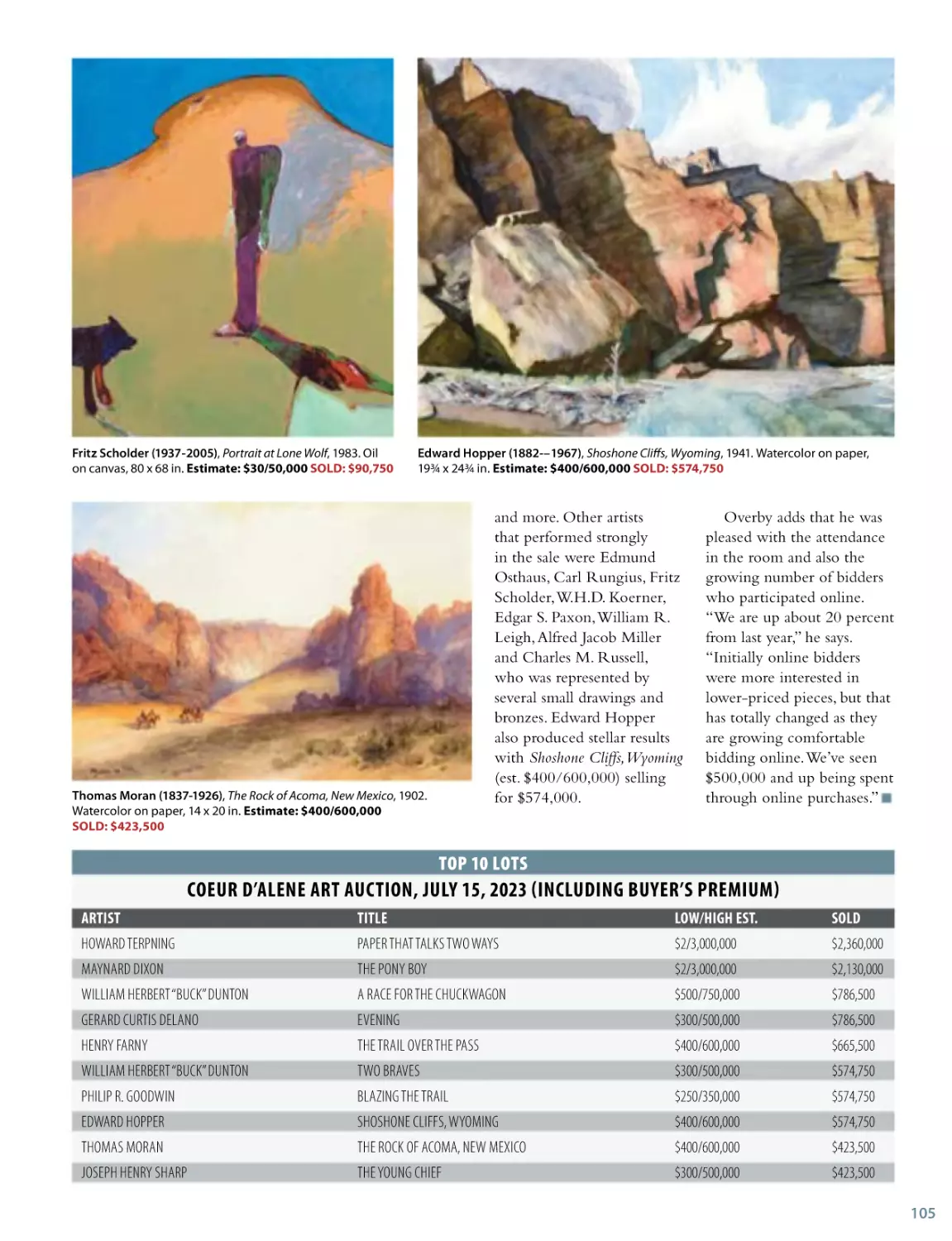


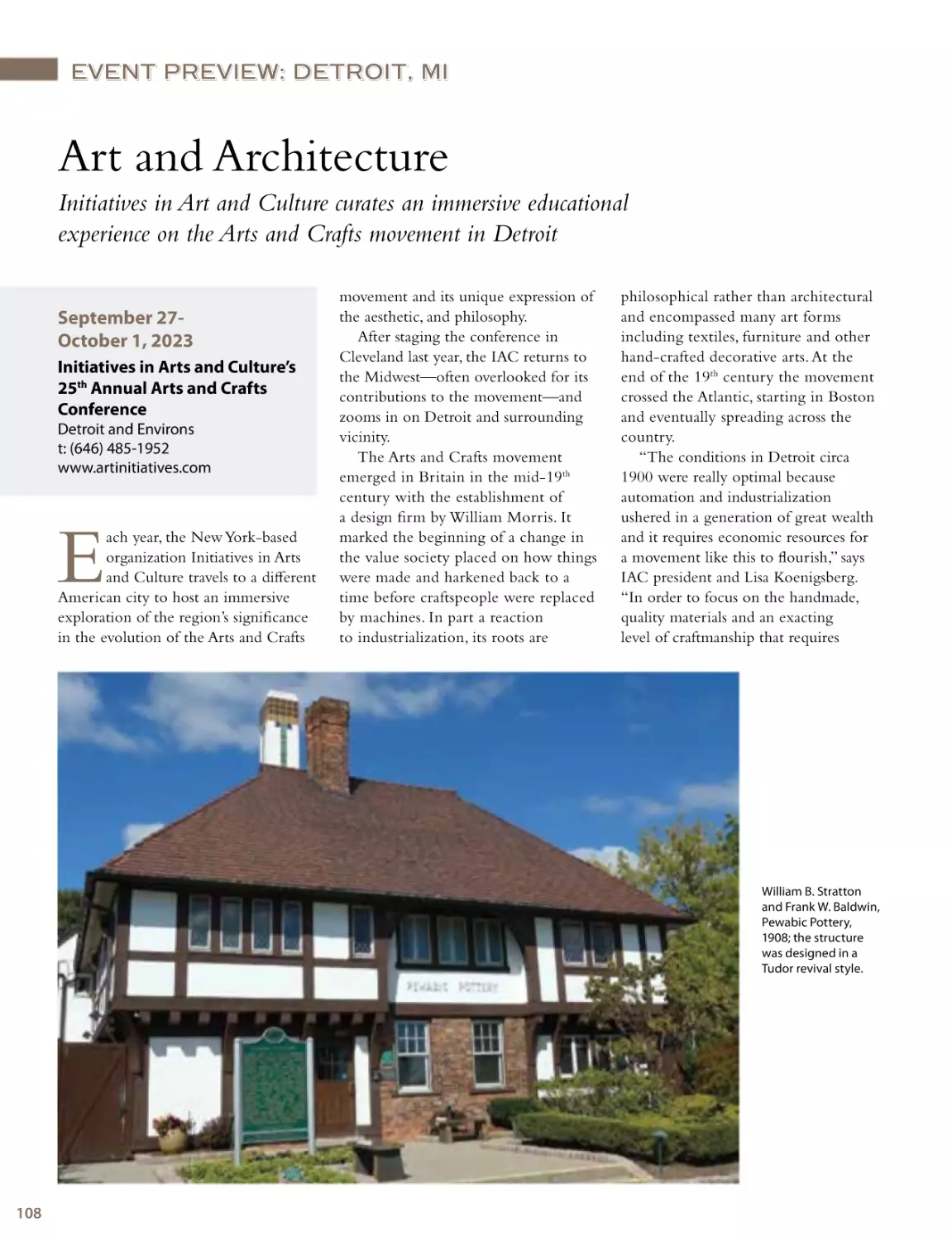
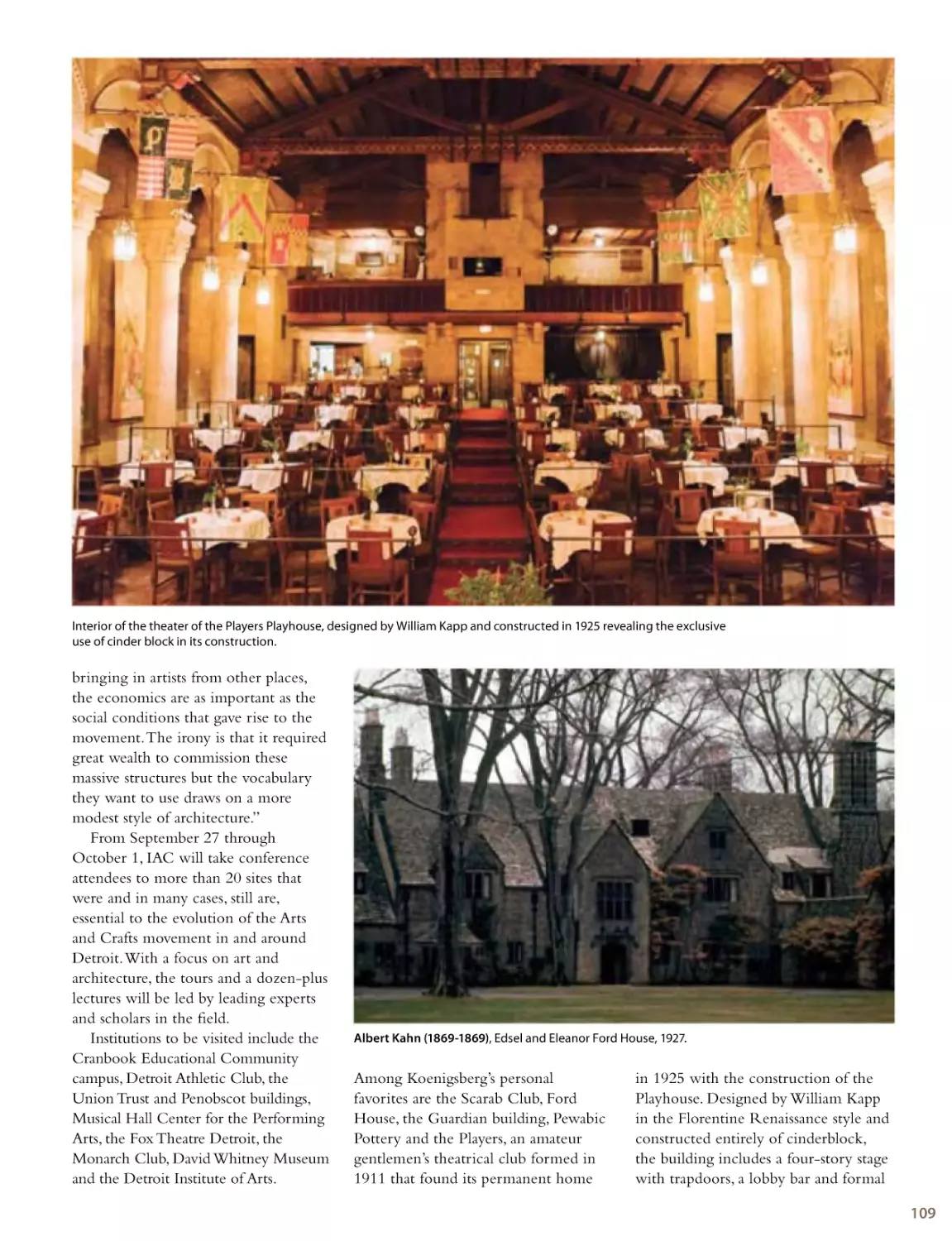
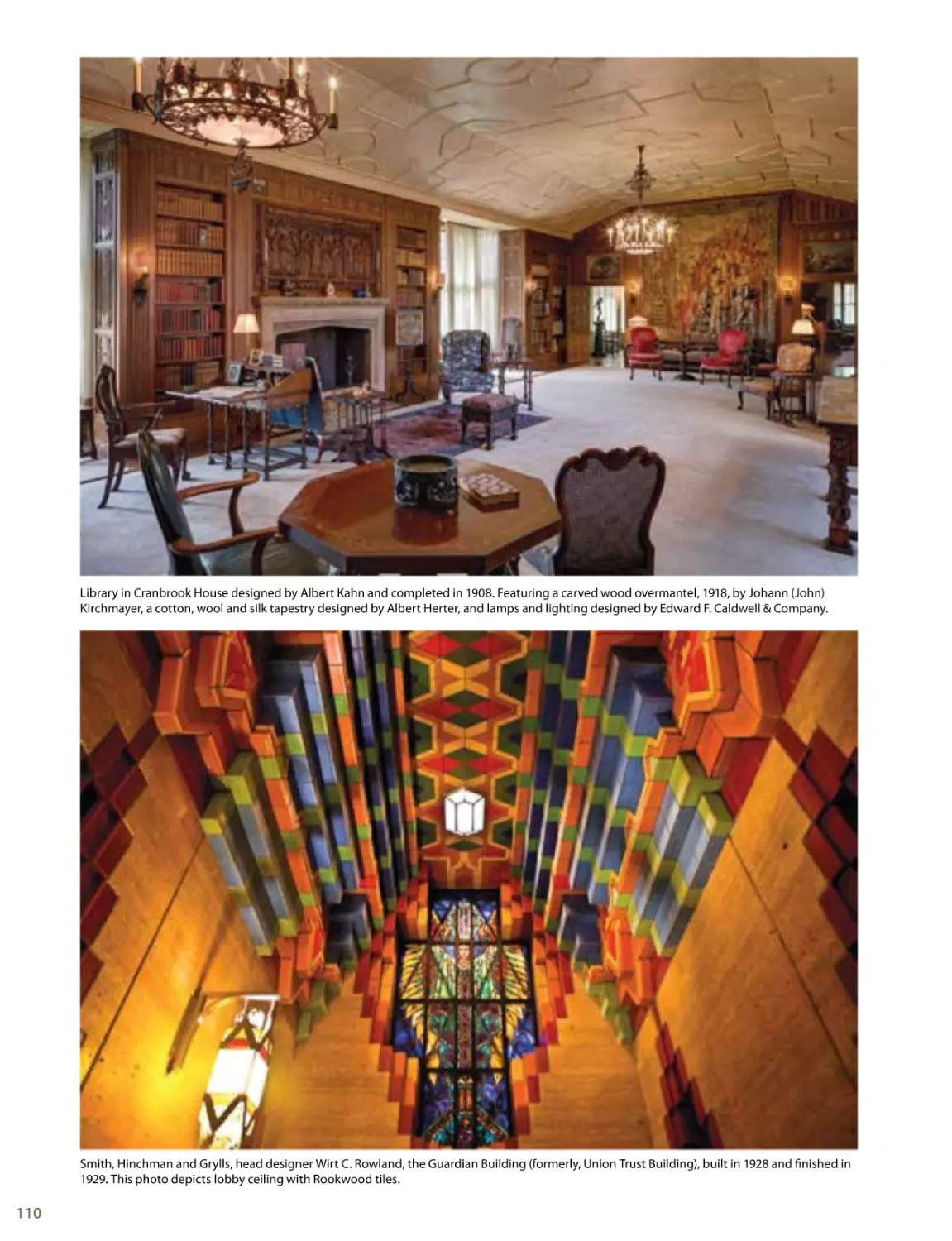


Текст
INSIDE: MUSEUMS AND EXHIBITIONS • FASHIONED BY SARGENT • LOUISE NEVELSON • THE DIJKSTRA COLLECTION
ISSUE 71
DISPLAY UNTIL 10/28/23
Sept/Oct 2023
Worthington Whittredge
(1820 - 1910)
Cold Springs, New York, From the Hudson
Oil on canvas, 16 ¾ x 29 ¼ inches, signed and dated lower left: W. Whittredge ⁄ 1862
“It was impossible for me to shut out from my eyes the works of the great landscape painters which I had so recently seen in Europe, while I knew well enough
that if I was to succeed, I must produce something new which might claim to be
inspired by home surroundings.”
- Worthington Whittredge
VOSE GALLERIES
238 Newbury Street
Boston MA 02116
617.536.6176
LLC
www.vosegalleries.com
CH A R LE S FR EDER IC R A MSEY
(1875‒1951)
Backyard, circa 1912, oil on canvas, 39⅜ × 29 inches
Debra Force
13 EAST 69TH STREET
SUITE 4F
NEW YORK 10021
F I N E A RT , I N C .
TEL 212.734.3636
WWW.DEBRAFORCE.COM
SINCE 1969
AUCTIONEERS & APPRAISERS
Consign Today
California & American Fine Art
11.14.2023
Edgar Alwin Payne (1883-1947)
Surf at Laguna
Oil on canvas, 28” H x 32” W
$30,000-50,000
Scan this code with your phone
to learn more about this sale
Consignment & Auction Inquiries: fineart@johnmoran.com
A family-owned auction house delivering both world-class service and results for over 50 years.
Auctions
•
Private Sales
•
Appraisals
145 East Walnut Avenue, Monrovia, CA 91016 | www.johnmoran.com · info@johnmoran.com · (626) 793-1833
LETTER
FROM THE
PUBLISHERS
Treasures on Display
W
elcome to the September/October issue of American Fine Art Magazine! In this
issue you will find prestigious auctions and exhibitions throughout the country
to help you discover your next treasured piece. The gallery previews combined with
commentary from industry experts help you track prices, and provide insight into
trends and changes in the market. In every issue we want you to acquire, enjoy and
learn about unique and important American fine art. The market is very strong right
now and it is a good time to be collecting historic art!
This issue is unique as we spotlight museums and upcoming exhibitions across the
country. These pieces are not traditionally for sale as they are displayed for the world to
see at the greatest museums in the country. As you move through these pages, you will
begin your museum tour on Page 56 followed by 30-plus pages of insider information
about must-see shows and their significance. Adolfo and I attend exhibitions across
the country and we often discover a new historic American artist whose talents speak
to the country’s perception of heritage, history and beauty. In other words, American
historic artists painted our story as it unfolded and that is what museums offer—our
collective story.
Managing editor Sarah Gianelli shares more about this special section in her letter
on the following page. She will be at several events in New York City this month,
including Art on Paper and The Armory Show, both of which will take place over the
weekend of September 8. Account executive Mike Bright will be in Detroit attending
Initiatives in Arts and Culture’s 25th Annual Arts & Crafts Conference where he will
be touring the city’s oldest clubs, arts organizations and architecture related to the
movement. If you would like to know more about the conference, which takes place
September 27 through October 1, visit www.artinitiatives.com. I have attended
one myself and the amount of collective historic knowledge among the speakers
is staggering. It was a tremendously enriching experience that I would encourage
any collector to add to their list. We hope you attend one or more of the museum
exhibitions featured in these pages—please let us know your thoughts if you do!
Best Regards,
Wendie Martin & Adolfo Castillo
Publishers
International Artist Publishing
September/October 2023 / Bimonthy
ADOLFO CASTILLO
Publisher: Editorial/Creative
acastillo@AmericanFineArtMagazine.com
WENDIE MARTIN
Publisher: Business/
Art Community Development
wmartin@AmericanFineArtMagazine.com
VINCENT W. MILLER / Founder
E D I TO R I A L
SARAH GIANELLI
Managing Editor
sgianelli@AmericanFineArtMagazine.com
MICHAEL CLAWSON
Editor
ALYSSA M. TIDWELL
Assistant Editor
CHELSEA KORESSEL
Assistant Editor
JOHN O’HERN
Santa Fe Editor
FRANCIS SMITH
Contributing Photographer
CASEY WOOLLARD
Editorial & Email Traffic Coordinator
cwoollard@AmericanFineArtMagazine.com
A D V E R T I S I N G ( 866 ) 61 9 - 08 41
LISA REDWINE
Senior Account Executive
lredwine@AmericanFineArtMagazine.com
ANITA WELDON
Senior Account Executive
aweldon@AmericanFineArtMagazine.com
CONSTANCE WARRINER
Senior Account Executive
cwarriner@AmericanFineArtMagazine.com
MICHAEL BRIGHT
Senior Account Executive
mbright@AmericanFineArtMagazine.com
SKYE FALLON
Sponsorships & Major Accounts
sfallon@americanfineartmagazine.com
TRAFFIC
JENNIFER Nave
Traffic Manager
traffic@AmericanFineArtMagazine.com
PRODUCTION
On the Cover
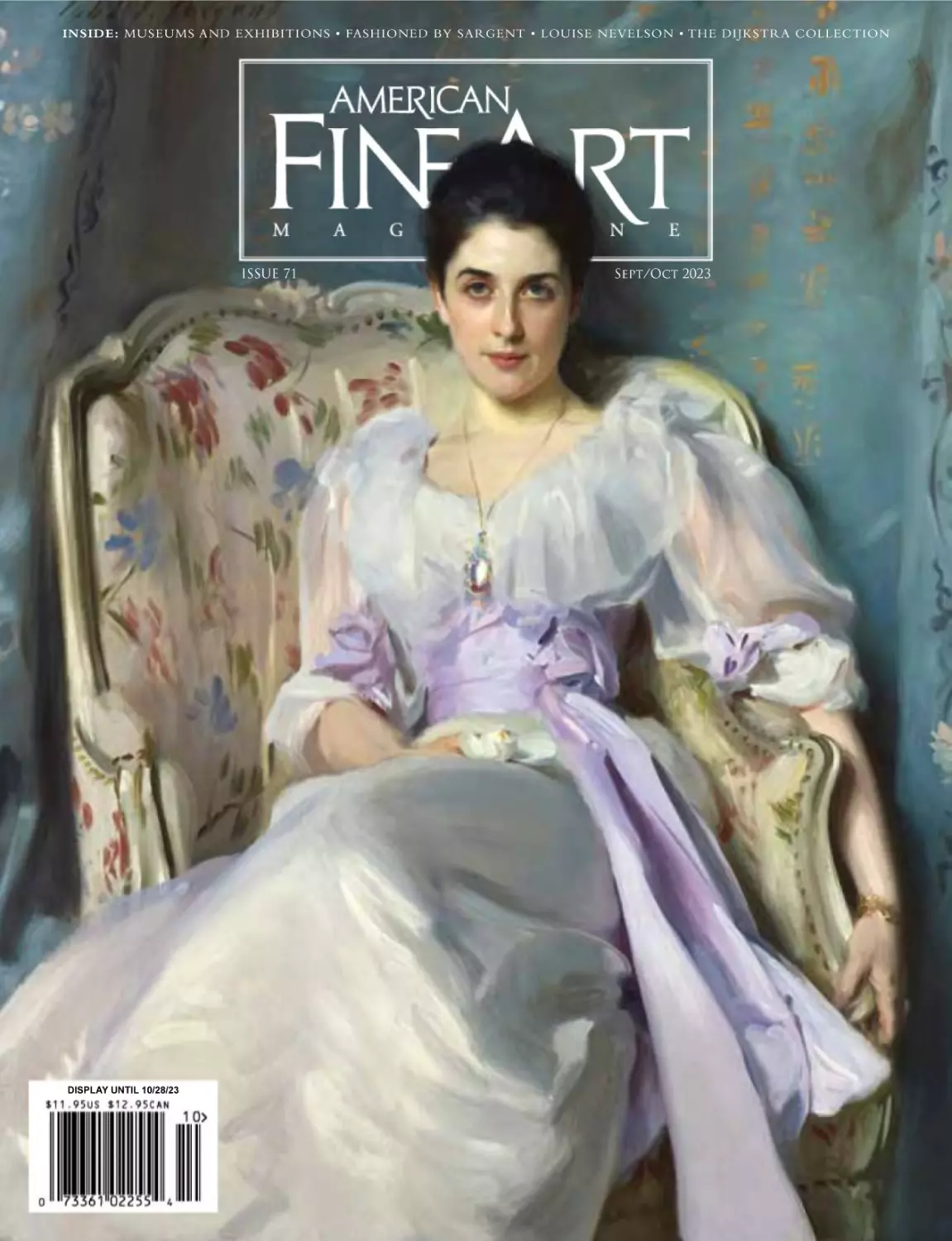
John Singer Sargent (1856–1925), Lady Agnew of Lochnaw (Gertrude
Vernon), 1892. Oil on canvas, 49 ½ x 39 ½ in. *National Gallery of
Scotland, purchased with the aid of the Cowan Smith Bequest Fund,
1925, NG 1656. *Courtesy, Museum of Fine Arts, Boston
4
Since 1998
TONY NOLAN
Art Director
DANA LONG
Production Artist
LIZY BRAUTIGAM
Production Artist
Fine Art from
The Estate of Angela Gross Folk
September 20 | 11 AM EDT
CONTACT
Adam Veil | 215.485.0704 | aveil@freemansauction.com
ILLUSTRATED
Charles Frederic Ramsey (1875-1951)
FROM LEFT TO RIGHT : XXXVI-2, Chatter, Cityscape
Estimates range from $10,000 to $18,000
International Artist Publishing
Since 1998
EDITOR’S LETTER
Doorways
into the Past
I
was studying art history in Florence, Italy, during my
junior year of college, when I realized that art could
be so much more than something to look at.
Art and literature were my passions, and I found
disciplines like history and political science, and
economics mind-numbingly dull. That is, until I realized that I could learn about
those topics through art.
The example I remember most clearly is learning about Renaissance-era politics
through studying portraits of the Medici family. Soon, I realized all works of art
contained clues and insight into life at the time it was created, and deciphering them
was a source of great satisfaction.
Maybe that sounds obvious, but to a 20-year-old me, it was like a magic wand
had been waved in front of my eyes and worlds upon worlds opened up for me. Art
became even more meaningful and suddenly I found history incredibly fascinating, I
couldn’t learn enough about the past—I had only needed an access point that made
it interesting to me.
When I was in Florence, we did not go to galleries or big art fairs. We spent our
days in museums and churches and wandering ruins—indeed, the whole city felt like
a museum, and in many ways it is.
I got to reminiscing about that experience because this issue contains our annual
guide to museums and exhibitions, and I have spent the last month thinking about
the value they—and the historic art they house—bring to our lives on a personal
level and collectively. In addition to our regular monthly content, this special issue is
a tribute to these institutions as well as your go-to resource for dozens of upcoming
exhibitions that we believe you shouldn’t miss. Turn to Page 35 to begin your
journey into the past.
Please let us know what you think of our choices after you attend the exhibitions
yourself! As always, we would love to hear from you.
Sarah Gianelli
Managing Editor
sgianelli@americanartcollector.com
September/October 2023 / Bimonthy
MARKETING
ROBIN M. CASTILLO
Social Media Engagement Manager
social@AmericanFineArtMagazine.com
S U B S C R I P T I O N S ( 877 ) 9 47 - 0 79 2
EMILY YEE
Office Manager
service@AmericanFineArtMagazine.com
APRIL STEWART
Accounts Receivable
astewart@AmericanFineArtMagazine.com
BIANCA MARTOS
Administrative Assistant & Marketing Coordinator
bmartos@internationalartist.com
The
Amer can
Art
Collective
P o d c a s t
YOUR ALL-ACCESS PASS!
Scan this QR code to start listening to The
American Art Collective podcast!
Get Social!
American Fine
Art Magazine
collectart
@artmags
AmericanFine
ArtMagazine
Copyright © 2023.All material appearing in American Fine Art Magazine
is copyright. Reproduction in whole or part is not permitted without
permission in writing from the editor. Editorial contributions are welcome
and should be accompanied by a stamped self-addressed envelope. All care will
be taken with material supplied, but no responsibility will be accepted for loss
or damage. The views expressed are not necessarily those of the editor or the
publisher.The publisher bears no responsibility and accepts no liability for the
claims made, nor for information provided by advertisers. Printed in the USA.
American Fine Art Magazine, 3260 N. Hayden Rd. Ste.201, Scottsdale,
AZ 85251. Telephone (480) 425-0806. Fax (480) 425-0724 or write to
American Fine Art Magazine, P.O. Box 2320, Scottsdale, AZ 852522320. Single copies 11.95. Subscription rate for one year is $45 U.S. To place
an order, change address or make a customer service query, please email
service@AmericanFineArtMagazine.com or write to P.O. Box 2320,
Scottsdale, AZ 85252-2320.
POSTMASTER: Send all address changes to
American Fine Art Magazine, PO Box 2320,Scottsdale, AZ 85252-2320
AMERICAN FINE ART MAGAZINE
(ISSN 2162-7827) is published 6 times a year
by International Artist Publishing Inc.
CANADA
American Fine Art Magazine
Publications Mail Agreement No. 42330013, Return Undeliverable
Canadian Addresses to Asendia, Inc.
P.O. Box 400 LCD 20, Thornhill, Ontario, Canada L3T QH2
Periodicals postage rates paid at Scottsdale, AZ 85251,
and at additional mailing offices.
6
www.AmericanFineArtMagazine.com
Alma Thomas, Transcendental, watercolor, 1966. Estimate $75,000 to $100,000.
African American Art
October 19
Nigel Freeman • nfreeman@swanngalleries.com
Download the App
104 E 25th Street, NYC • 212 254 4710 • SWANNGALLERIES.COM
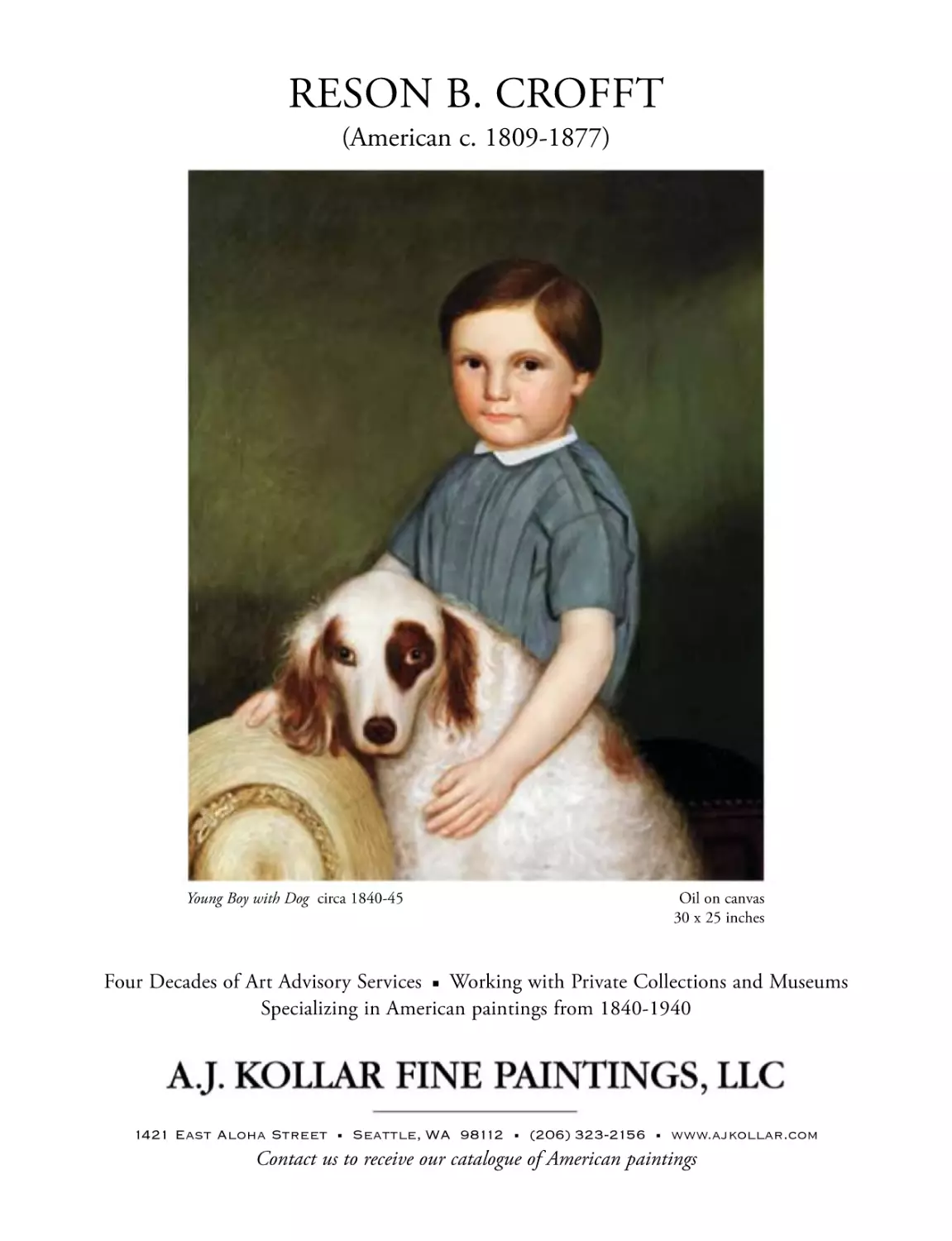
RESON B. CROFFT
(American c. 1809-1877)
Young Boy with Dog circa 1840-45
Oil on canvas
30 x 25 inches
Four Decades of Art Advisory Services Working with Private Collections and Museums
Specializing in American paintings from 1840-1940
Q
1421 East Aloha Street
Q
Seattle, WA 98112
Q
(206) 323-2156
Q
www.ajkollar.com
Contact us to receive our catalogue of American paintings
ANATOMY OF THE MAGAZINE
Editorial Coverage and Previews of Upcoming Events, Exhibitions and Auctions
American Fine Art Magazine is comprised of many different sections and features, all designed to
keep you informed on what’s happening in the market for historic American art.
UPCOMING
GALLERY SHOWS
Previews of upcoming shows of
historic American art at galleries
across the country.
UPCOMING
MUSEUM
EXHIBITIONS
Insight from top curators about
major exhibitions being staged at
key American museums.
EVENTS & FAIRS
Previews and reports of major
art fairs across the country for
you to attend.
AUCTIONS
Previews and Reports of major
works coming up for sale at the
most important auction houses
dealing in historic American Art.
IN ADDITION:
COLLEC TOR’S FOCUS
COLLEC TOR HOMES
MARKET REPORTS
EX LIBRIS
Find out everything the
discerning collector needs to
know about important and
timely segments of the
historic American art market.
In each issue you will
find a behind-the-scenes
look into a coveted
collector home.
Find out what’s happening
in galleries from New York
to California.
Read about the best books
recently published on
topics ranging from
Hudson River School to
modernism to folk art.
Specializing in American Art
Fine Art Auction | October 26, 2023
FREDERICK CARL FRIESEKE (American 1874-1939) | Lady Trying on a Hat, 1909 | oil on canvas | 64 x 51 inches
$250,000 – 350,000
Sandra Germain
info@shannons.com
203 877 1711
shannons.com
Personalized Service
Competitive Rates
Proven Results
In This Issue
Features
38 High Fashion
An innovative exhibit explores
the relationship between one
of history’s greatest portrait
artists and his sitters through
the dynamics of dress
By John O’Hern
44 What We Have
in Common
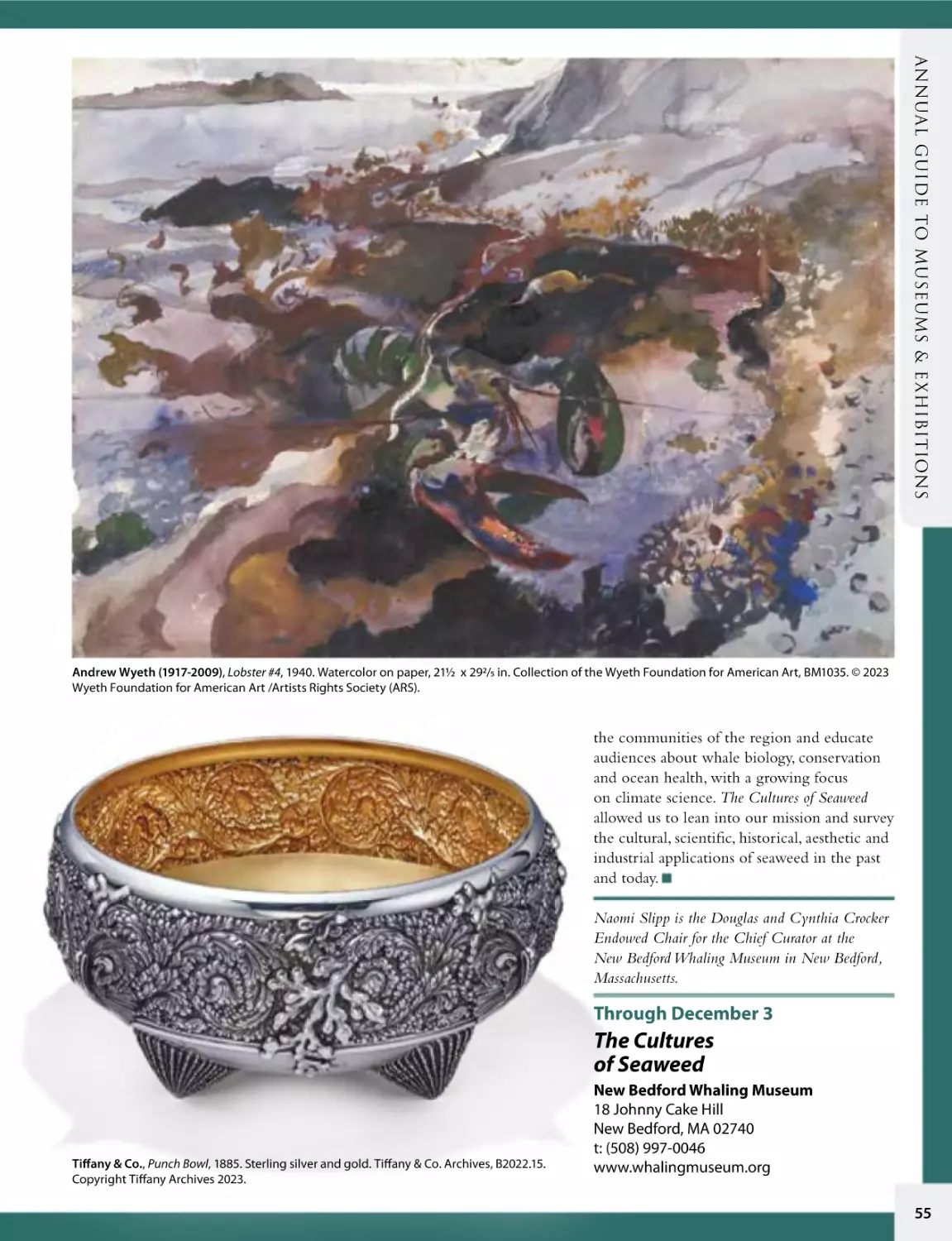
50 The Cultures
Of Seaweed
Art for the People: WPA-era
Paintings from the Dijkstra
Collection makes its last stop at
Oceanside Museum of Art
By James D. Balestrieri
New Bedford Whaling
Museum celebrates this
“singularly marine and
fabulous product”
By Naomi Slipp
ANNUAL GUIDE TO MUSEUMS & EXHIBITIONS
56 Collector’s Focus:
Museums & Exhibitions
Important exhibitions of historic American art at
key museums from coast to coast
78 Scenes of Yesteryear
Laguna Art Museum presents Joseph Kleitsch:
Abroad and At Home in Old Laguna
80 Extraordinary Gifts
The Rollins Museum of Art showcases 37
newly acquired American art works in their
distinguished collection
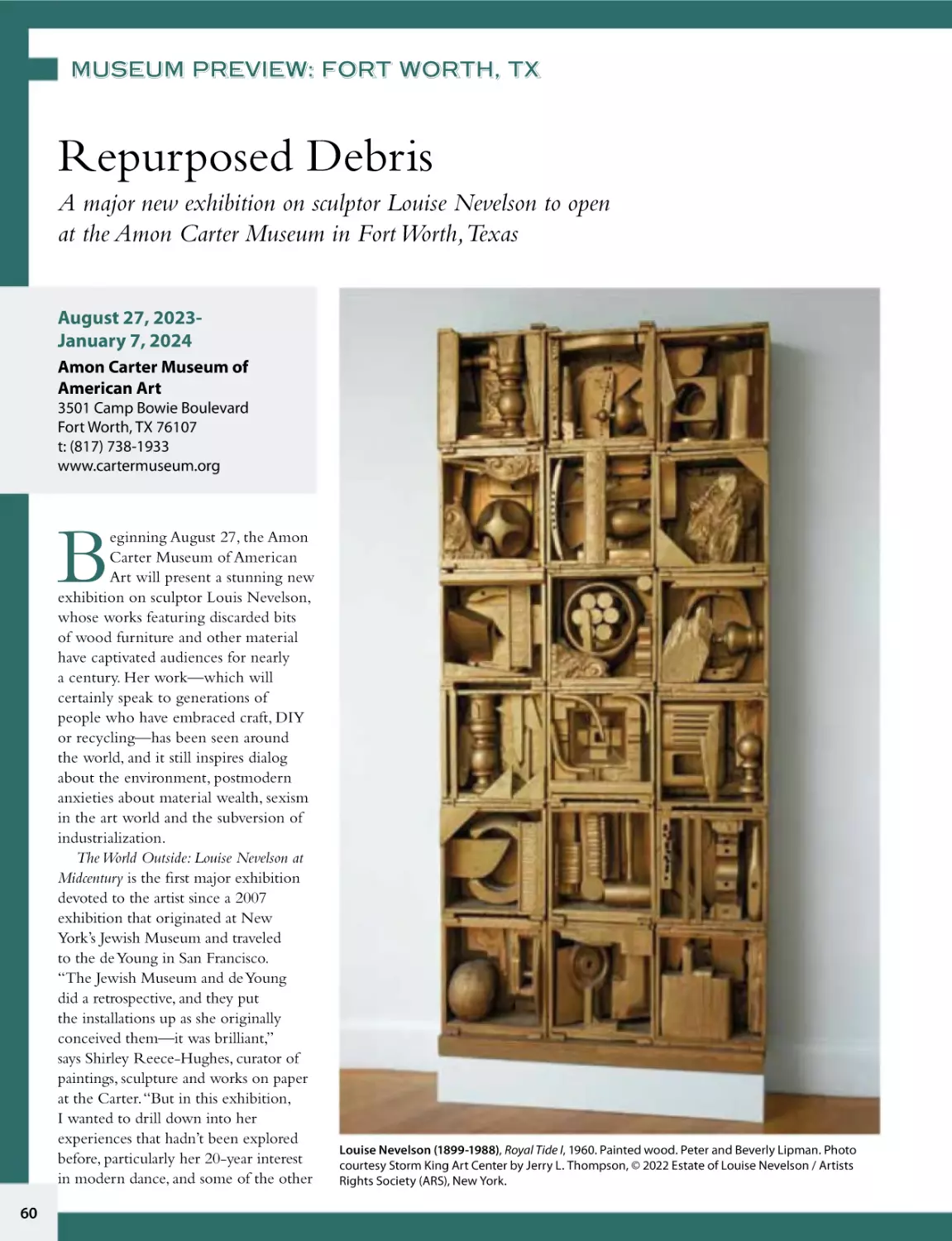
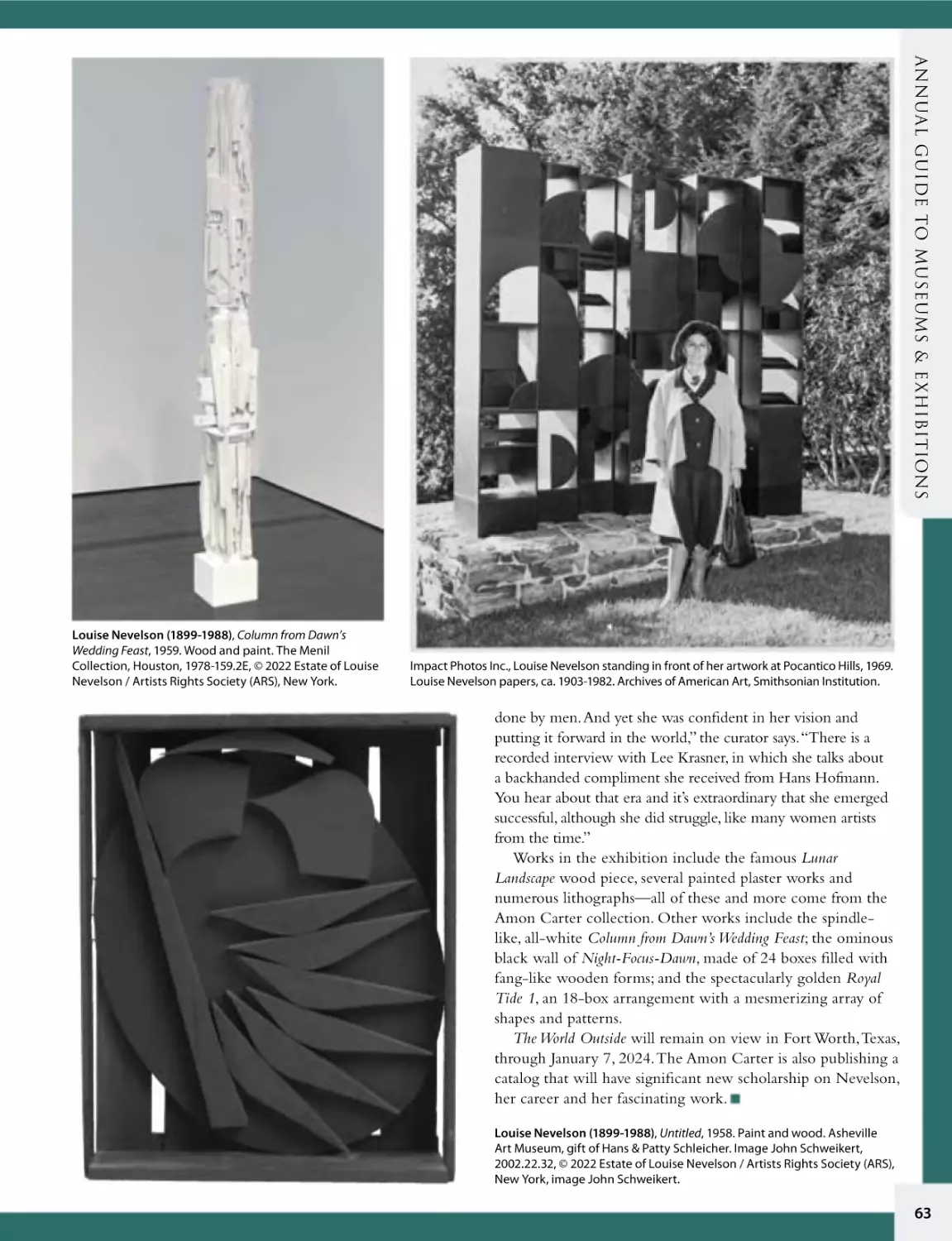
60 Repurposed Debris
A major new exhibition on sculptor Louise
Nevelson to open at the Amon Carter Museum
in Fort Worth, Texas
82 End of the Range
An exhibit at the Nevada Art Museum explores
the little-known works of Charlotte Skinner
64 Alvaro’s World
An exhibition examines one of Andrew Wyeth’s
favorite subjects from the perspective of the
keeper of the Olson farmhouse
84 A Landmark Gift
The Reading Museum receives a generation
donation of important 19th- and 20th-century
works from the estate of Dr. Luther Brady
68 A Vanishing Past
An exhibition of Whistler’s streetscapes reveals
a different side of the artist’s sensibilities
72 Textures of Nature
The Philbrook Museum hosts an exhibit of
three generations of one the country’s most
creative families
76 Intricate Connections
An exhibition at the Museum of Modern Art
explores the dialogue between the art of Jacob
Lawrence and Elizabeth Catlett
85 Featured Museums &
exhibitions in this
Issue
Departments
36
Curator Chat
37
New Acquisition
35
SEPTEMBER/OCTOBER 2023
American Fine Art Magazine is unique in its concept and presentation. Divided into four major categories, each
bimonthly issue will show you how to find your way around upcoming fine art shows, auctions and events so you
can stay fully informed about this fascinating market.
Gallery Shows
Previews of upcoming shows of historic American art at galleries across the country.
26 A Legacy Unfolded
Debra Force Fine Art exhibits 32 paintings from
Herman Maril’s illustrious career
30 A Family Affair
Hawthorne Fine Art presents an online exhibition
of works by daughter-father artists Anna Mary
Richards Brewster and William Trost Richards
Auctions
Previews and reports of sales at the most important auction houses dealing in historic American art.
Previews
88 Quintessential
Americana
Hindman’s American Art sale
92 Heavy Hitters
Swann Auction Galleries’ African American art
sale
94 American Classics
Shannon’s Fine Art Auctioneers’ Fine Art Sale
96 Classic & Compelling
Bonhams Skinner’s American art sale
98 The Great Outdoors
Jackson Hole Art Auction
100 Unique Perspectives
Swann Auction Galleries’ American Art sale
101 An Eclectic Collection
Freeman’s sale of works from the Angela Gross
Folk collection
Reports
102 Impactful Canvases
Freeman’s American Art and Pennsylvania
Impressionists sale
104 Jackpot in Reno
Coeur d’Alene Art Auction
106 Joint Auction Reports
Plymouth, Thomaston
Event Report
Departments
Coverage of all the major art fairs and events
taking place across the country.
Art Show Calendar
16
Market Report
20
Art Market Updates
22
Recent Arrivals
24
108 Art and Architecture
Initiatives in Arts and Culture’s 25th Annual
Arts and Crafts Conference
13
45
ONLY $
Stay Connected
to Historic American Art
FOR 6
ISSUES!
NEWSSTANDS!
50% OFF
Subscribe Today
to get the premier historic American fine art
magazine in the country, and the only bi-monthly
magazine that showcases the remarkable artwork
from this era, as well as the galleries, museums
and auction houses that support them in the art
market. Need proof? The proof is in your
hands. Flip through this stunning issue to find
the most thorough coverage of the historic
American Art genre through:
»
Previews of the most significant gallery
shows, museum exhibitions, fine art fairs
and auction sales.
»
Special genre sections to expand your
collecting power.
»
»
Insights from industry experts.
6 issues a year, each one presenting work
by the most notable artists of the 19th and
20th centuries and practical means to add
them to your collection.
Join our huge community of subscribers who
have chosen American Fine Art Magazine as their
go-to trusted source for everything they need
to know about the historic art market now.
SUBSCRIBE TODAY
BY VISITING
www.AmericanFineArtMagazine.com/subscribe
Don’t Miss Our Other Titles!
International Artist Publishing
also offers these great titles:
Western Art Collector
Native American Art
www.WestsernArtCollector.com
www.NativeAmericanArtMagazine.com
American Art Collector
International Artist
www.AmericanArtCollector.com
www.InternationalArtist.com
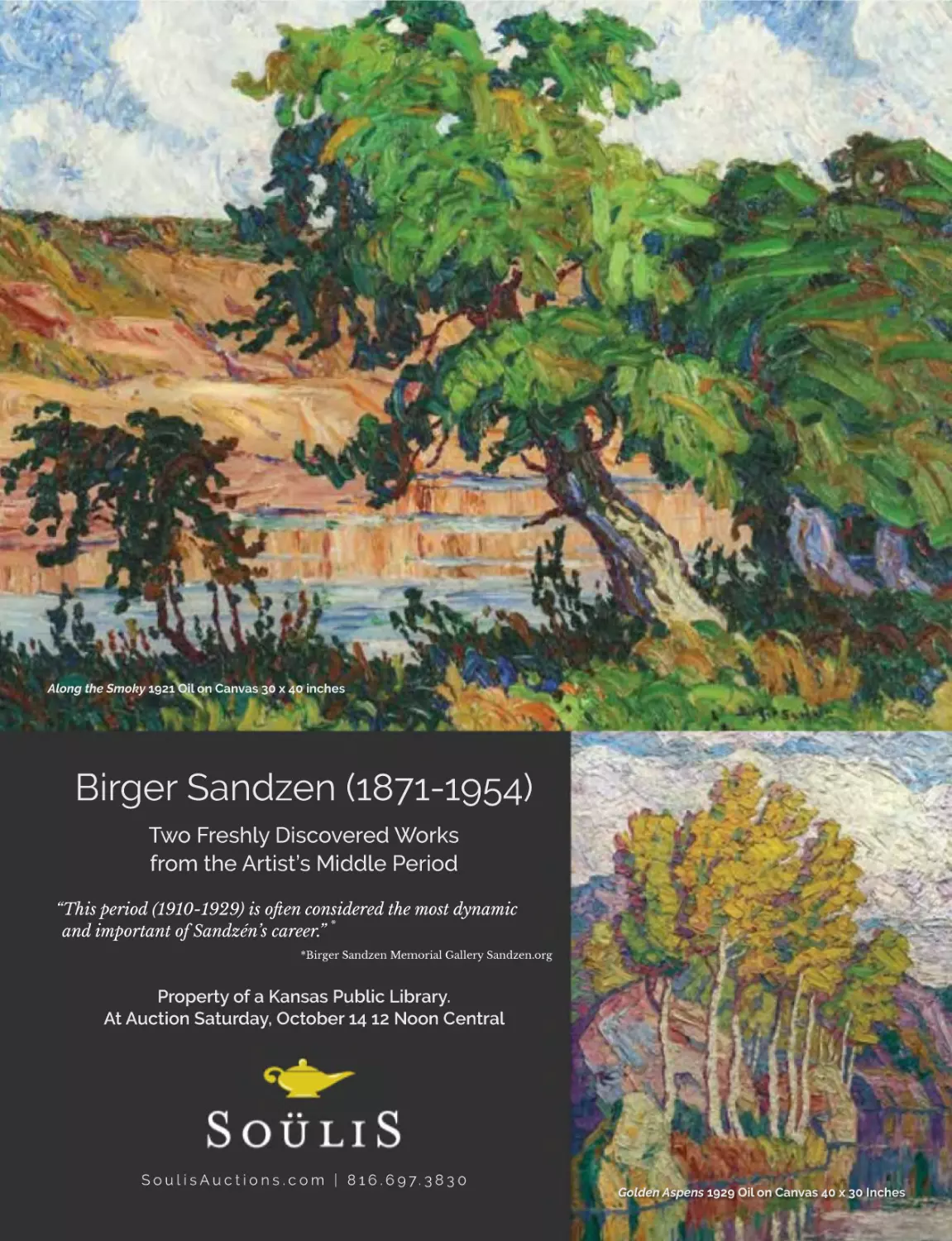
Along the Smoky 1921 Oil on Canvas 30 x 40 inches
Birger Sandzen (1871-1954)
Two Freshly Discovered Works
from the Artist’s Middle Period
“This period (1910-1929) is often considered the most dynamic
*
and important of Sandzén’s career.”
*Birger Sandzen Memorial Gallery Sandzen.org
Property of a Kansas Public Library.
At Auction Saturday, October 14 12 Noon Central
S o u l i s A u c t i o n s . c o m | 8 1 6 . 6 9 7. 3 8 3 0
Golden Aspens 1929 Oil on Canvas 40 x 30 Inches
the Best Fairs, exhibitions and Events Coast to Coast
ONGOING
Wyeths: Textures of Nature
Philbrook Museum of Art • Tulsa, OK
The Philbrook highlights 15 paintings by
three generations of the Wyeth family.
www.philbrook.org
ONGOING
Jacob Lawrence and
Elizabeth Catlett
Museum of Modern Art • New York, NY
Showcasing Lawrence’s and Catlett’s
series' for the first time ever at MoMA,
the exhibition highlights the importance
of the African American perspective.
www.moma.org
ONGOING
Estate of Dr. Luther W. Brady, Jr.
Reading Public Museum • Reading, PA
The museum exhibits a recent
acquisition of over 120 important
19th- and 20th-century works from
the estate of Dr. Luther Brady.
www.readingpublicmuseum.org
ONGOING
The World Outside: Louise
Nevelson at Midcentury
ONGOING
Surrealism and Modernism,
Highlights from the Collection
THROUGH SEPTEMBER 9
Indefinitely Wild: Preserving
California’s Natural Resources
Amon Carter Museum of
American Art • Fort Worth, TX
Amon Carter presents a new exhibition
on sculptor Louis Nevelson, whose works
featuring discarded bits of wood furniture
and other material have captivated
audiences for nearly a century.
www.cartermuseum.org
Wadsworth Museum of
Art • Hartford, CT
The museum highlights a new installation
that presents European and American
artworks in dialogue, allowing for new
juxtapositions and fresh insights.
www.thewadsworth.org
UCI Jack and Shanaz Langson
Intitute and Museum of
California Art • Irvine, CA
The exhibition explores how the early
history of environmental conservation
in California might have influenced
the state’s impressionist painters.
www.imca.uci.edu
ONGOING
The Cultures of Seaweed
New Bedford Whaling Museum
• New Bedford, MA
This exhibition features more than
125 works from over 30 lenders, is
inspired by Thoreau’s musings and
explores the allure of this oceanic
“produce” from about 1780 to today.
www.whalingmuseum.org
ONGOING
New York Art Worlds, 1870-1890
The Metropolitan Museum
of Art • New York, NY
Drawn from the museum’s collection,
a selection of some 50 works in varied
media reveals the vibrant modern
art world that emerged in New
York in the post-Civil War years.
www.metmuseum.org
SEPT. 9, 2023-JAN. 7, 2024
American Visions
The Rollins Museum of
Art • Winter Park, FL
The museum exhibits 37 newly acquired
American art works, ranging from
the late 18th- to early 20th-century.
www.rollins.edu/rma
SEPTEMBER 27-OCTOBER 1
Arts and Crafts Conference
Various Locations • Detroit, MI
The Initiatives in Arts and Culture hosts their 25th annual event, where attendees will
travel to 20 sites that are essential to the evolution of the arts and crafts movement in
and around Detroit.
www.artinitiatives.com
COURTESY WINTER ANTIQUES SHOW
Players Club Exterior, 1925. Players Club member William E. Kapp designed a building to permanently house
the club. Kapp was with the firm Smith, Hinchman & Grylls (now known as The Smith Group).
16
LY N N E D R E X L E R
Lynne Drexler (American, 1928-1999), Stumps, oil on canvas, 1968, 47.75 x 35.5 inches, provenance: Lynne Drexler Estate
JKFA
J. K E N N E T H
F I N E
A R T
Specializing in Post-war artists and estates with an emphasis
on the contributions of artists who had been traditionally overlooked.
Featuring: Lynne Drexler, Helen Gerardia, Paul Keene, Jacob Semiatin and Taro Yamamoto
ϲϲϴEWĂůŵĂŶLJŽŶƌŝǀĞ͕WĂůŵ^ƉƌŝŶŐƐ͕ϵϮϮϲϮͮϴϬϮͲϱϰϬͲϬϮϲϳͮǁǁǁ͘ũŬĞŶŶĞƚŚĮŶĞĂƌƚ͘ĐŽŵ
ART SHOW CALENDAR
THROUGH SEPTEMBER 10
Adaline Kent:
The Click of Authenticity
OCT. 14, 2023-MAY 4, 2024
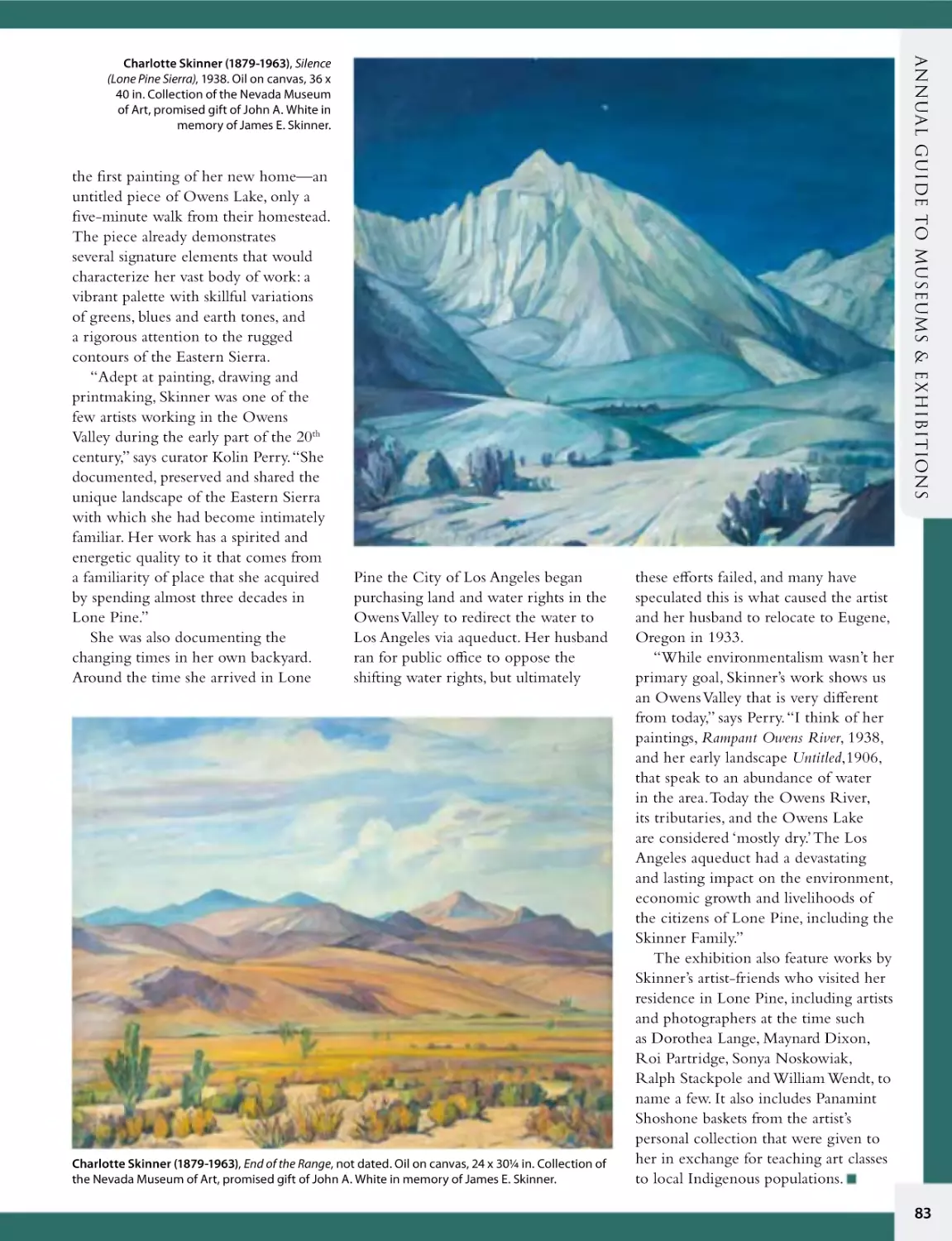
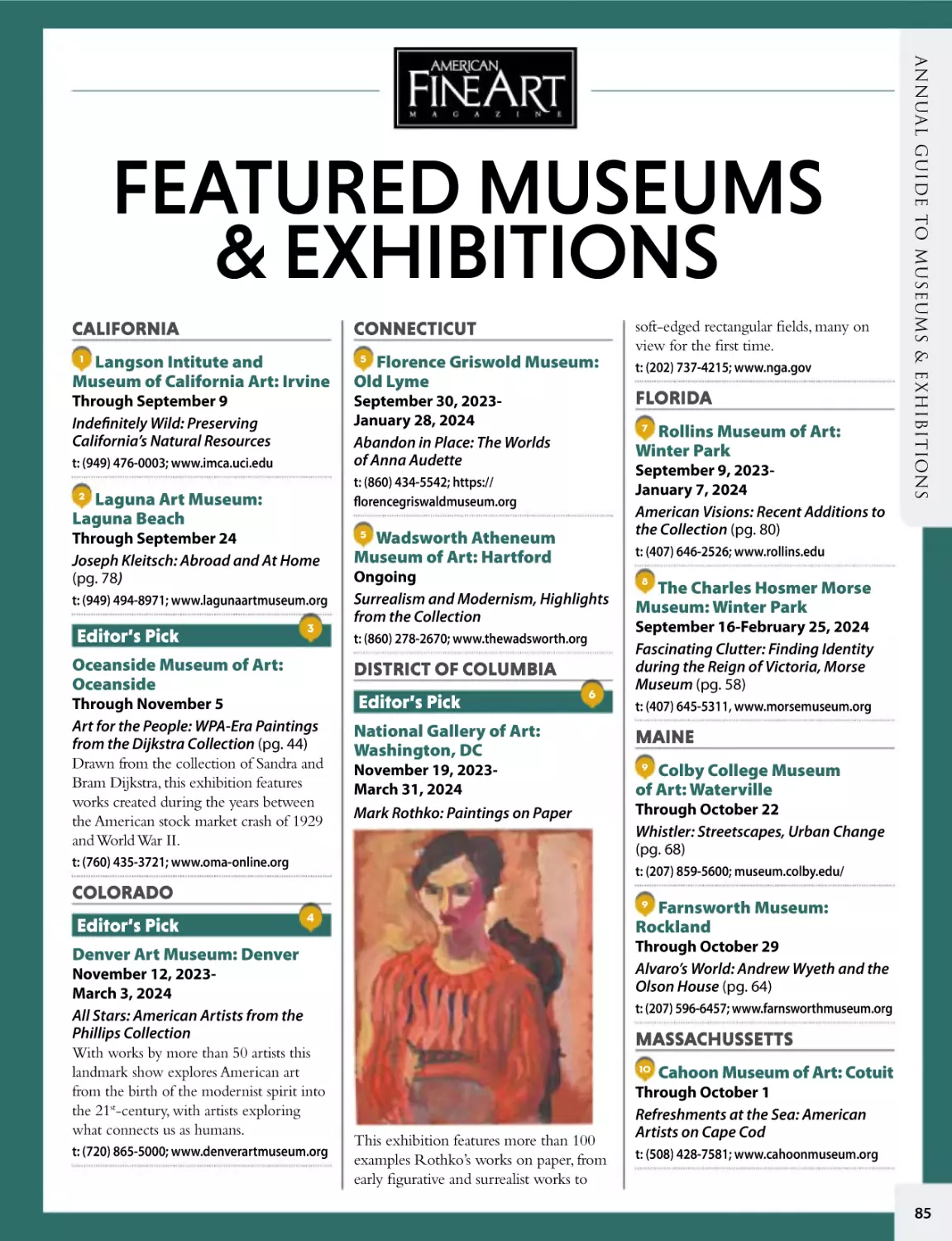
End of the Range: Charlotte
Skinner in the Eastern Sierra
The Nevada Museum of Art • Reno, NV
This is the first retrospective to occur
in 60 years of midcentury American
artist Adaline Kent, featuring 90
works in a diverse range of media.
www.nevadaart.org
Nevada Art Museum • Reno, NV
The exhibition features approximately
40 original paintings and drawings
that span Skinner’s lifelong career
as an artist and educator.
www.nevadaart.org
THROUGH SEPTEMBER 24
Joseph Kleitsch:
Abroad and At Home
THROUGH OCTOBER 22
Whistler: Streetscapes,
Urban Change
Laguna Art Museum • Laguna Beach, CA
The museum features more than 70
paintings by Joseph Kleitsch that capture the
energy and beauty of Southern California.
www.lagunaartmuseum.org
Colby College Museum of
Art • Waterville, ME
In 60 streetscapes, this exhibit focuses on
drawings and paintings of urban streets of
the fin de siècle by James McNeill Whistler.
museum.colby.edu
OCT. 8, 2023-JAN. 15, 2024
Fashioned by Sargent
Museum of Fine Arts, Boston • Boston, MA
Alongside approximately 50 of Sargent’s
paintings, over a dozen period garments
and accessories shed new light on the
relationship between fashion and this
beloved artist’s creative practice.
www.mfa.org
THROUGH OCTOBER 29
Alvaro’s World: Andrew
Wyeth and the Olson House
Farnsworth Art Museum • Rockland, ME
This exhibition examines one of
Andrew Wyeth’s favorite subjects
from the perspective of the keeper
of the Olson farmhouse.
www.farnsworthmuseum.org
Auctions
at a Glance
SEPTEMBER 16
Jackson Hole Art Auction
OCTOBER 17
American Art
Center for the Arts • Jackson, WY
www.jacksonholeartauction.com
Hindman Auctions • Chicago, IL
www.hindmanauctions.com
SEPTEMBER 19
American Art
OCTOBER 19
African American Fine Art
Bonhams Skinner • Marlborough, MA
www.bonhams.com
Swann Auction Galleries •
New York, NY
www.swanngalleries.com
SEPTEMBER 20
Estate of Angela Gross Folk
Freeman’s Auctions • Philadelphia, PA
www.freemansauction.com
SEPTEMBER 21
American Art
OCTOBER 26
Fine Art Auction
Shannon’s Fine Art Auctioneers •
Milford, CT
www.shannons.com
Swann Auction Galleries • New York, NY
www.swanngalleries.com
Palmer Schoppe (1912-1998), On the Beach, 1941. Oil on canvas, 30 x 40 in. From the collection of Sandra and Bram Dijkstra.
THROUGH OCTOBER 29
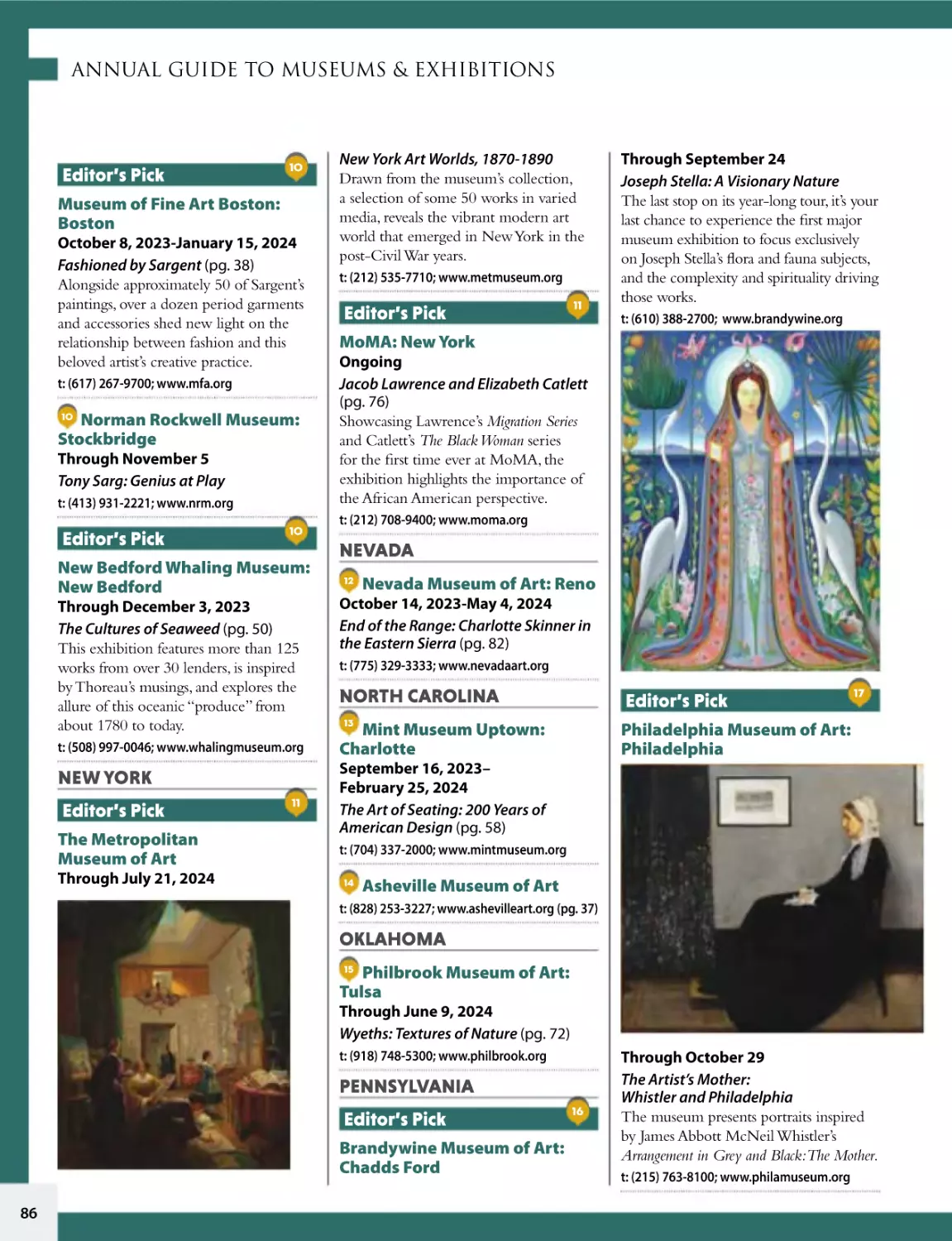
The Artist’s Mother: Whistler
and Philadelphia
The Philadelphia Museum
of Art • Philadelphia, PA
The museum presents portraits inspired
by James Abbott McNeil Whistler’s
Arrangement in Grey and Black: The Mother.
www.philamuseum.org
THROUGH NOVEMBER 5
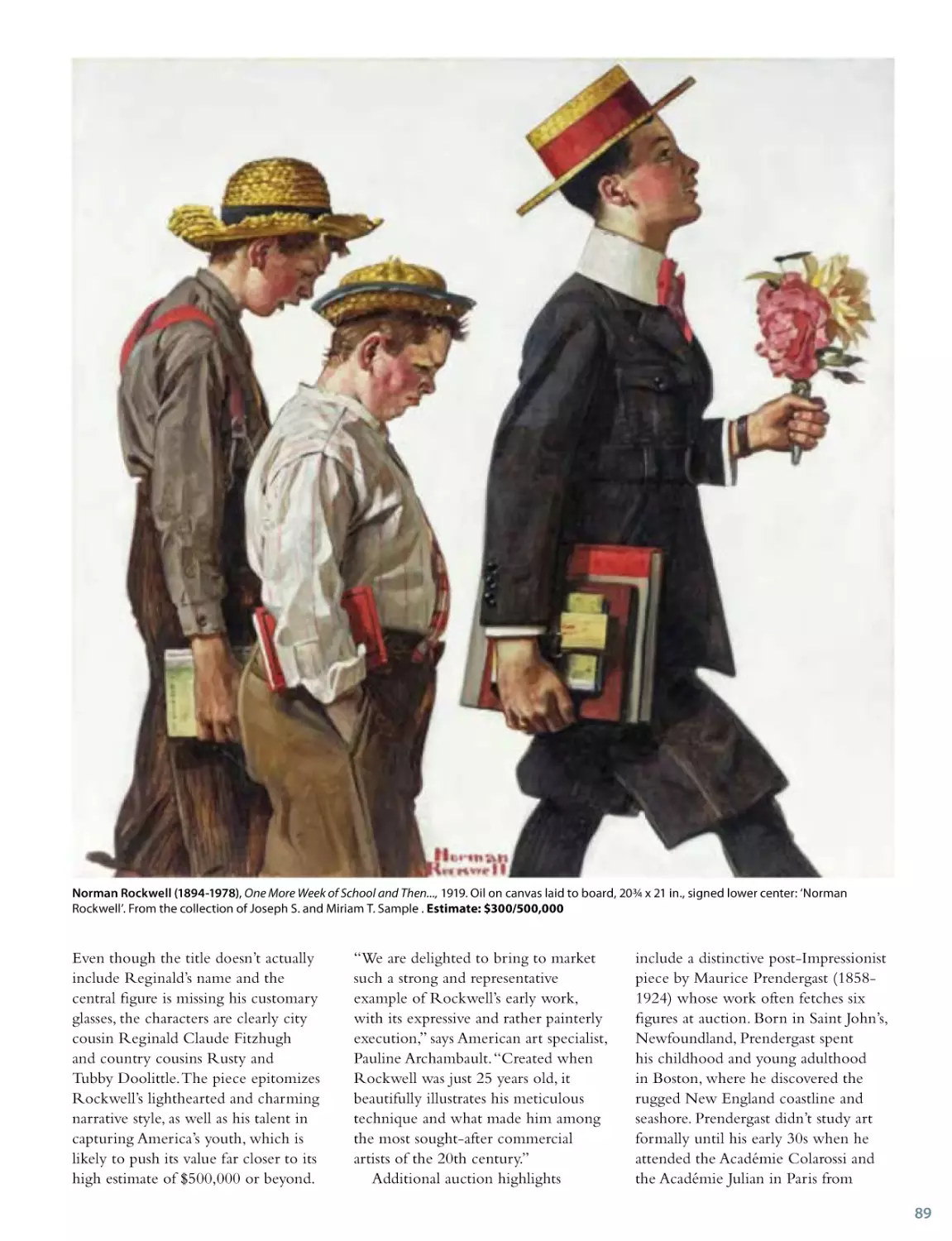
Tony Sarg: Genius at Play
THROUGH NOVEMBER 5
Art for the People: WPA-Era Paintings from the
Dijkstra Collection
Norman Rockwell
Museum • Stockbridge, MA
This new exhibition is the first
comprehensive exhibition exploring the
life, art and adventures of Tony Sarg—
the charismatic illustrator, animator,
puppeteer, designer and so much more.
www.nrm.org
Oceanside Museum of Art • Oceanside, CA
Drawn from the collection of Sandra and Bram Dijkstra, this exhibition features works
created during the years between the American stock market crash of 1929 and World War II.
www.oma-online.org
In every issue of American Fine Art Magazine, we publish the only reliable guide to all major upcoming fairs and shows
nationwide. Contact our assistant editor, Chelsea Koressel, at ckoressel@americanfineartmagazine.com, to
find out how your event can be included.
18
= Event
= Gallery
= Museum
= Sponsored by AFAM
Offering
Hudson River School Paintings by Women Artists
Julie Hart Beers
(1835–1913)
Summer Landscape, 1869
Oil on canvas, 12½ x 20¼ in.,
Signed and dated 1869, lower left
Manhattan Showroom, 575 Fifth Avenue, 14th Floor, NY, NY 10017 ( by a ppointment )
P.O. Box 140, Irvington, NY 10533 ( m a iling a ddress )
212.731.0550 * info@hawthornefineart.com * www.hawthornefineart.com
MARKET REPORT
WHAT WE’RE HEARING FROM GALLERIES AND
AUCTION HOUSES ACROSS THE COUNTRY.
ELI STERNGASS
Partner
Lincoln Glenn Gallery
Who says the art market
slows in the summer?
Throughout June, July and
August, we were busy at
our recently added gallery space on 67th
Street and Madison Avenue, hanging and
researching new inventory, meeting with
clients and shipping out sold works to new
homes. One of the primary reasons we
opened a second gallery was a return after
the pandemic of visiting collectors and
museum groups to Manhattan. Another
was the opportunity to split a gallery
space with Cameron Shay of Graham
Shay 1857, and the cross-pollination of
inventory has introduced each firm to
clients previously unknown. One of these
interactions resulted in a major institution
acquiring one of our Edward Mitchell
Bannister paintings.
The current art market has shown
diversity and depth in multiple genres
20
including impressionism,
social realism, the Park Ave
Cubists and surrealism. We
have especially taken notice
of an uptick of interest in the
Ashcan School, especially in
works by John Sloan, William
Glackens and Robert Henri.
We have met many new collectors through
online platforms, Madison Avenue art
walks and through our persistence in
organizing exhibitions with corresponding
catalogs. As always, our collectors tend
to prefer works that are fresh to market
with strong provenance and back stories.
A premium also continues to be placed
on female and minority artists, and we
are pleased to see rare and lesser-known
artists championed by curators, scholars
and dealers.
A highlight of our profession is finding,
contextualizing and touting works
by artists who have not yet received
their proper due in the market and the
American art canon. An example of one
of these artists is Sarah Miriam Peale,
the first professional female artist in the
United States, who fails to be recognized
in most books and museum collections.
Another example is Virginia Berresford,
one of only two female precisionists and
an independent gallerist in her own right.
We have also been working with the
estate of Gerome Kamrowski, a New York
and Michigan-based artist integral in the
popularization of surrealism, as well as
a collaborator with Jackson Pollock and
William Baziotes on the very first abstract
expressionist painting in the winter of
1939 to 40. The above trio exemplify
our program as eclectic artists from the
beginnings of American art through the
abstract expressionism of the mid-20thcentury.
LINCOLN GLENN GALLERY
17 East 67th Street, Suite 1A,
New York, NY 10065
126 Larchmont Avenue,
Larchmont, NY 10538
www.lincolnglenn.com
#AMERICANFINEARTMAGAZINE
We want to connect with
you on social media!
Share your art, upcoming
shows and more with us.
LIKE & FOLLOW
Stay connected - Be part of museum exhibits, upcoming fine
art, antique, and gallery shows. Find out about new art
acquisitions in the community. We keep you
connected to the art you want.
25k
Artwork: Courtesy Debra Force Fine Art
Milton Avery (1885-1965) Sketcher and Watcher, 1944,
gouache and pencil on paper, 22½ x 30½"
Available @debraforcefineart
Our Bodies, Hearts,
and Village
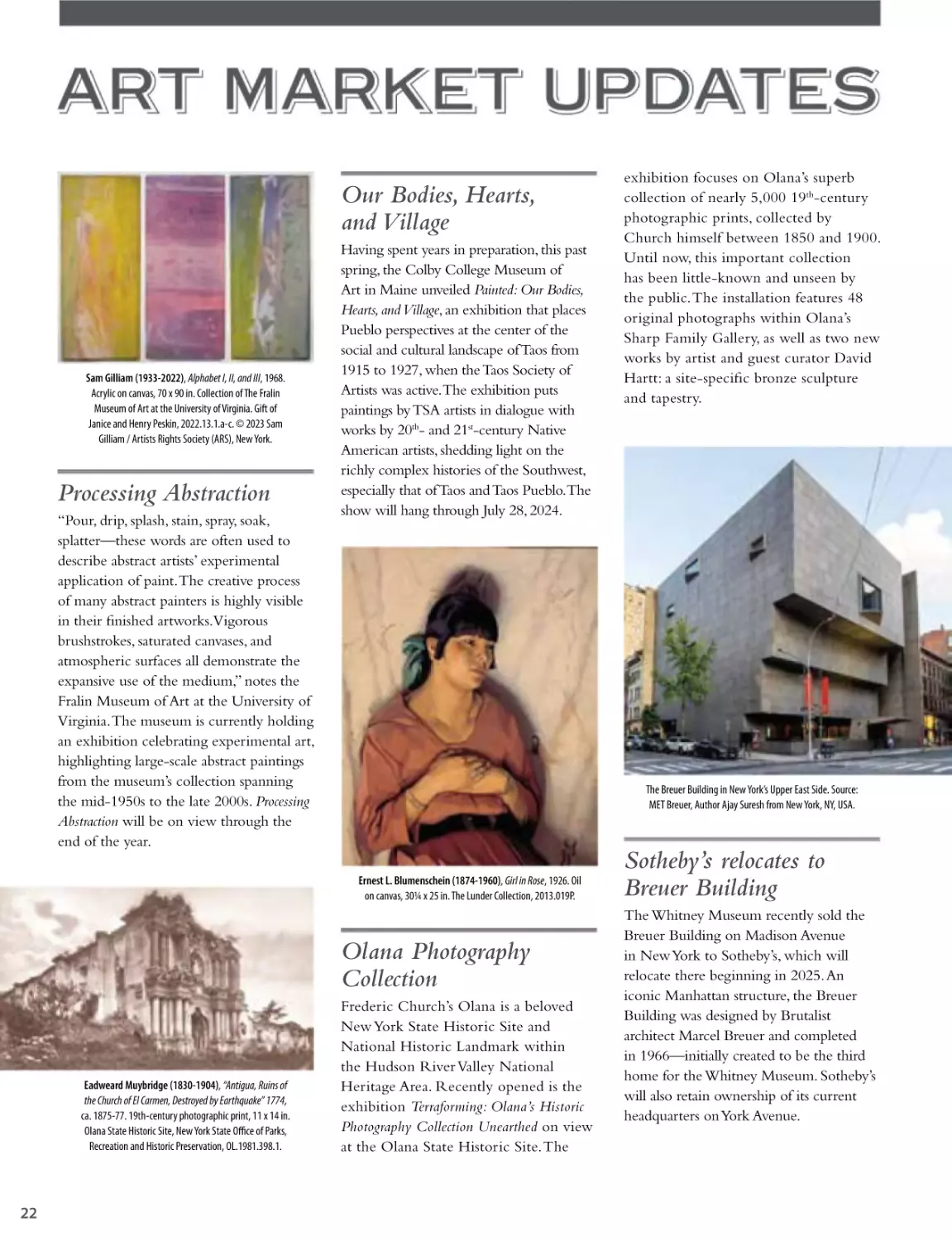
Sam Gilliam (1933-2022), Alphabet I, II, and III, 1968.
Acrylic on canvas, 70 x 90 in. Collection of The Fralin
Museum of Art at the University of Virginia. Gift of
Janice and Henry Peskin, 2022.13.1.a-c. © 2023 Sam
Gilliam / Artists Rights Society (ARS), New York.
Processing Abstraction
“Pour, drip, splash, stain, spray, soak,
splatter—these words are often used to
describe abstract artists’ experimental
application of paint. The creative process
of many abstract painters is highly visible
in their finished artworks.Vigorous
brushstrokes, saturated canvases, and
atmospheric surfaces all demonstrate the
expansive use of the medium,” notes the
Fralin Museum of Art at the University of
Virginia. The museum is currently holding
an exhibition celebrating experimental art,
highlighting large-scale abstract paintings
from the museum’s collection spanning
the mid-1950s to the late 2000s. Processing
Abstraction will be on view through the
end of the year.
Having spent years in preparation, this past
spring, the Colby College Museum of
Art in Maine unveiled Painted: Our Bodies,
Hearts, and Village, an exhibition that places
Pueblo perspectives at the center of the
social and cultural landscape of Taos from
1915 to 1927, when the Taos Society of
Artists was active.The exhibition puts
paintings by TSA artists in dialogue with
works by 20th- and 21st-century Native
American artists, shedding light on the
richly complex histories of the Southwest,
especially that of Taos and Taos Pueblo.The
show will hang through July 28, 2024.
The Breuer Building in New York’s Upper East Side. Source:
MET Breuer, Author Ajay Suresh from New York, NY, USA.
Ernest L. Blumenschein (1874-1960), Girl in Rose, 1926. Oil
on canvas, 30¼ x 25 in. The Lunder Collection, 2013.019P.
Olana Photography
Collection
Eadweard Muybridge (1830-1904), “Antigua, Ruins of
the Church of El Carmen, Destroyed by Earthquake” 1774,
ca. 1875-77. 19th-century photographic print, 11 x 14 in.
Olana State Historic Site, New York State Office of Parks,
Recreation and Historic Preservation, OL.1981.398.1.
22
exhibition focuses on Olana’s superb
collection of nearly 5,000 19th-century
photographic prints, collected by
Church himself between 1850 and 1900.
Until now, this important collection
has been little-known and unseen by
the public. The installation features 48
original photographs within Olana’s
Sharp Family Gallery, as well as two new
works by artist and guest curator David
Hartt: a site-specific bronze sculpture
and tapestry.
Frederic Church’s Olana is a beloved
New York State Historic Site and
National Historic Landmark within
the Hudson River Valley National
Heritage Area. Recently opened is the
exhibition Terraforming: Olana’s Historic
Photography Collection Unearthed on view
at the Olana State Historic Site. The
Sotheby’s relocates to
Breuer Building
The Whitney Museum recently sold the
Breuer Building on Madison Avenue
in New York to Sotheby’s, which will
relocate there beginning in 2025. An
iconic Manhattan structure, the Breuer
Building was designed by Brutalist
architect Marcel Breuer and completed
in 1966—initially created to be the third
home for the Whitney Museum. Sotheby’s
will also retain ownership of its current
headquarters on York Avenue.
Notre Dame’s
new museum
The former Snite Museum of Art at
the University of Notre Dame will be
transformed into the new Raclin Murphy
Museum of Art beginning November
30. The museum’s new location—a
70,000-square-foot building designed
by Robert A. M. Stern Architects
(RAMSA)—will serve as a gateway to
Notre Dame’s expanding arts district,
joining the Charles B. Hayes Family
Sculpture Park, DeBartolo Performing
Arts Center, Matthew and Joyce Walsh
Family Hall of Architecture and O’Neill
Hall of Music. November marks the
completion of the first phase of this twopart building project.
An aerial view of the new Raclin Murphy Museum of Art at Notre Dame.
Architect: Robert A. M. Stern Architects (RAMSA). Rendering: Courtesy RAMSA.
People
On July 3, Laura
L. Lott began her
tenure as the
National Gallery
of Art’s new
administrator,
leading the
operational,
architecture and sustainability strategy
of one of the largest and most visited art
museums in the world.
The Portland
Museum of Art in
Oregon recently
named Sayantan
Mukhopadhyay
the museum’s new
assistant curator
of modern and
& Places
contemporary art. Mukhopadhyay has a
an extensive background in contemporary
art research and education, having
recently worked as a lecturer in art history
at the University of California, Los Angeles,
where he also earned his MA and PhD in
art history.
Amanda M. Maples
joins the New Orleans
Museum of Art as its
new Françoise Billion
Richardson Curator
of African Art. In
this role, Maples will
oversee the museum’s
significant collection of historic African
art as well as create new installations
and interpretive strategies for NOMA’s
permanent collection.
The Nelson-Atkins
Museum of Art in
Kansas City has
announced that
Stephanie Fox Knappe
has been promoted
to Sanders Sosland
Senior Curator, Global
Modern and Contemporary Art and Head
within the American art department.
Knappe was formerly the Samuel Sosland
Senior Curator of American art.
The Andy Warhol Museum has appointed
Aaron Levi Garvey as its new chief
curator. He will assume his role this
summer, 2023.
23
Insights into historic American artwork newly available
from galleries and dealers around the country
Reginald Marsh
(1898-1954)
Eldorado:The Sorrow and
Futility of Man Before the
Beauty of Woman
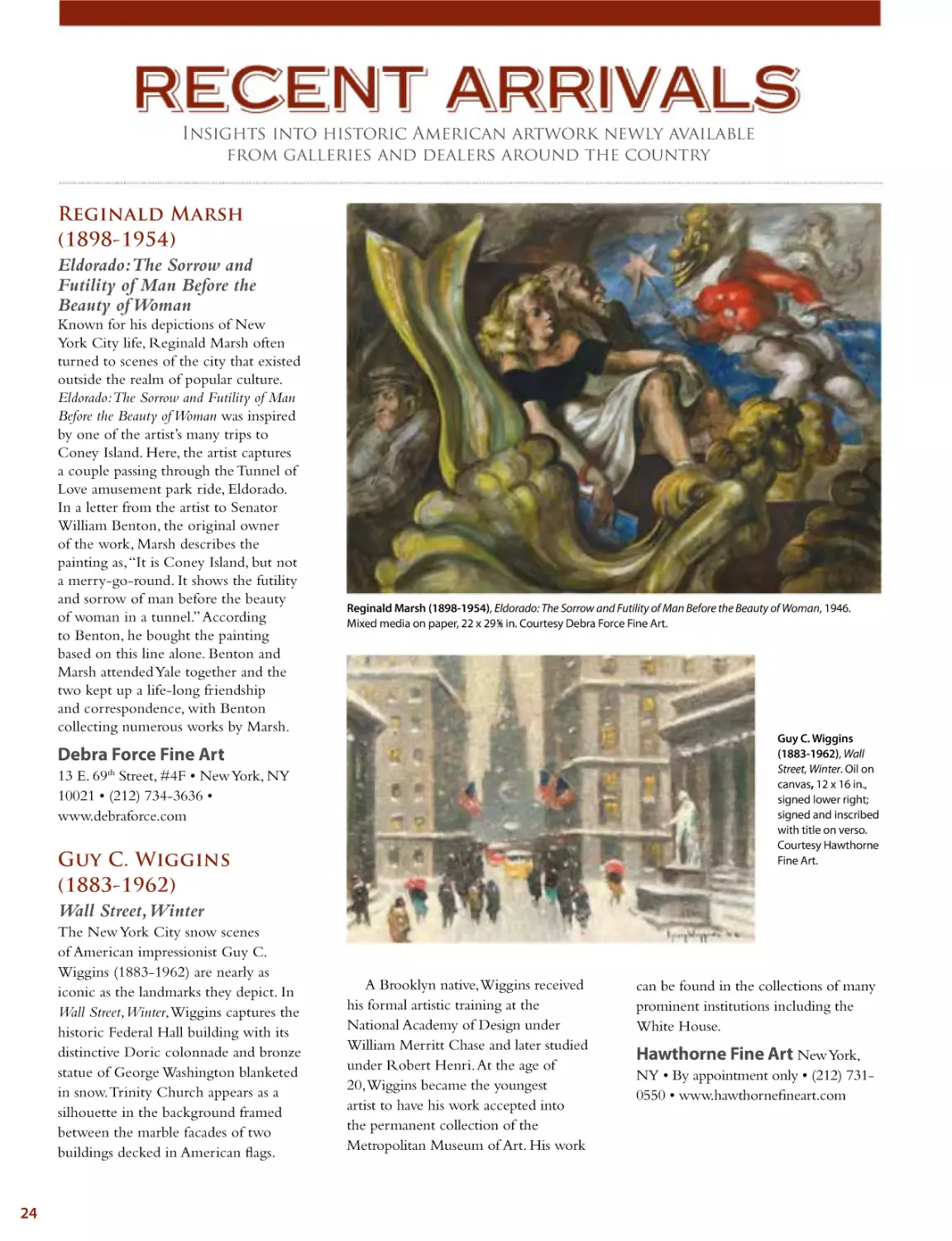
Known for his depictions of New
York City life, Reginald Marsh often
turned to scenes of the city that existed
outside the realm of popular culture.
Eldorado: The Sorrow and Futility of Man
Before the Beauty of Woman was inspired
by one of the artist’s many trips to
Coney Island. Here, the artist captures
a couple passing through the Tunnel of
Love amusement park ride, Eldorado.
In a letter from the artist to Senator
William Benton, the original owner
of the work, Marsh describes the
painting as, “It is Coney Island, but not
a merry-go-round. It shows the futility
and sorrow of man before the beauty
of woman in a tunnel.” According
to Benton, he bought the painting
based on this line alone. Benton and
Marsh attended Yale together and the
two kept up a life-long friendship
and correspondence, with Benton
collecting numerous works by Marsh.
Reginald Marsh (1898-1954), Eldorado: The Sorrow and Futility of Man Before the Beauty of Woman, 1946.
Mixed media on paper, 22 x 295⁄8 in. Courtesy Debra Force Fine Art.
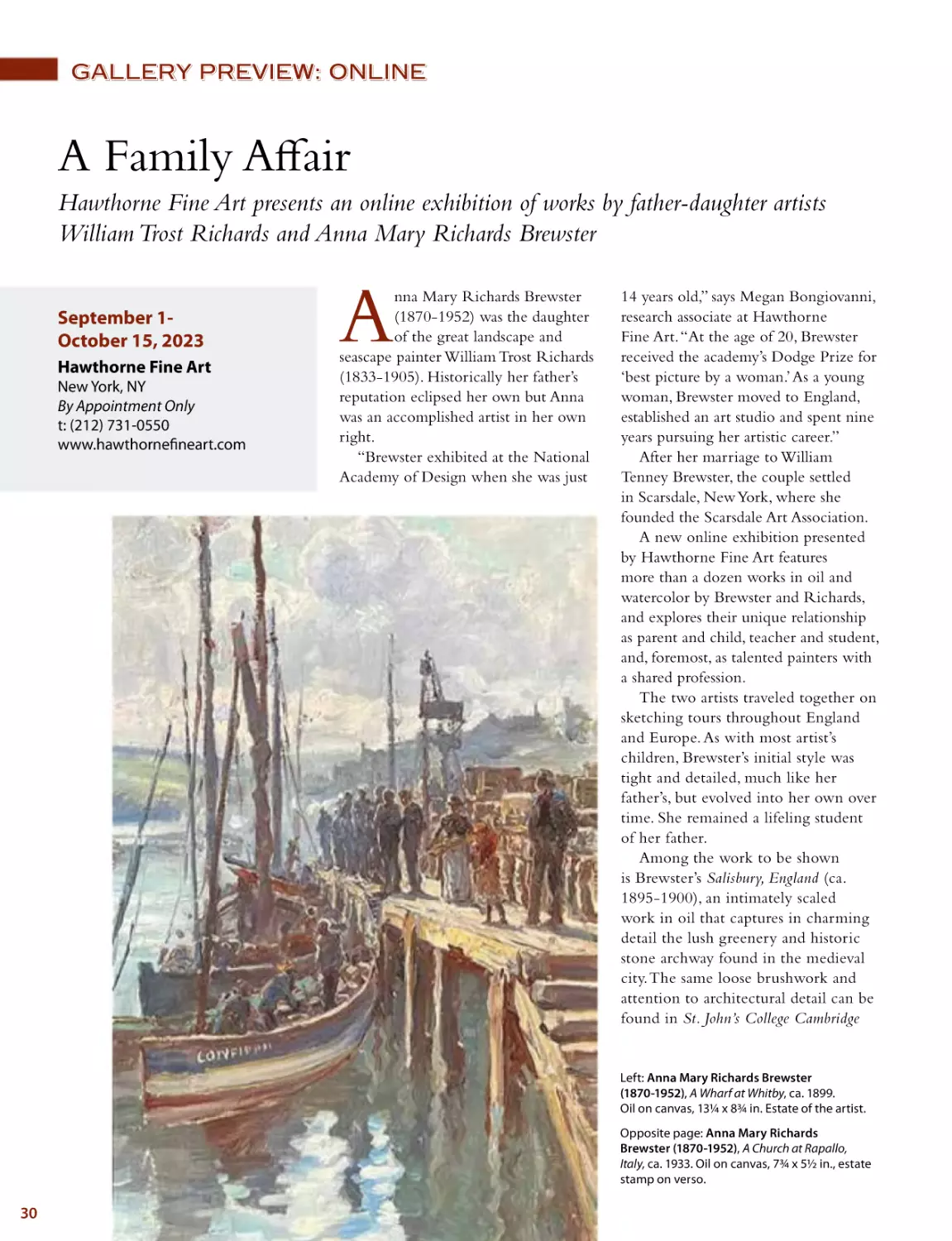
Guy C. Wiggins
(1883-1962), Wall
Street, Winter. Oil on
canvas, 12 x 16 in.,
signed lower right;
signed and inscribed
with title on verso.
Courtesy Hawthorne
Fine Art.
Debra Force Fine Art
13 E. 69th Street, #4F • New York, NY
10021 • (212) 734-3636 •
www.debraforce.com
Guy C. Wiggins
(1883-1962)
Wall Street,Winter
The New York City snow scenes
of American impressionist Guy C.
Wiggins (1883-1962) are nearly as
iconic as the landmarks they depict. In
Wall Street, Winter, Wiggins captures the
historic Federal Hall building with its
distinctive Doric colonnade and bronze
statue of George Washington blanketed
in snow. Trinity Church appears as a
silhouette in the background framed
between the marble facades of two
buildings decked in American flags.
24
A Brooklyn native, Wiggins received
his formal artistic training at the
National Academy of Design under
William Merritt Chase and later studied
under Robert Henri. At the age of
20, Wiggins became the youngest
artist to have his work accepted into
the permanent collection of the
Metropolitan Museum of Art. His work
can be found in the collections of many
prominent institutions including the
White House.
Hawthorne Fine Art New York,
NY • By appointment only • (212) 7310550 • www.hawthornefineart.com
Sarah Miriam Peale (1800-1885), Portrait of Mary Catherine Dail, ca. 1840-1845.
Oil on canvas, 29½ x 24½ in. Courtesy Lincoln Glenn Art Gallery.
Paul F. Keene (1920-2009), Untitled, 1959. Oil on panel, 30 x 20 in. Courtesy
J. Kenneth Fine Art.
Sarah Miriam Peale (1800-1885)
Portrait of Mary Catherine Dail
Paul F. Keene (1920-2009)
Untitled
Sarah Miriam Peale was the first professional female artist in
America and a member of the well-known Peale artist family.
Her career spanned nearly 60 years, and she supported herself
financially and successfully competed with male painters of
that time including John Wesley Jarvis, Thomas Sully and
Jacob Eichholtz. The painting’s provenance dates back to the
sitter’s father. Mary Catherine Dail (1826-1904) was born in
Cambridge, Maryland, and was the daughter of Daniel Dail
(1791-1863), a Baltimore architect and builder. In the portrait,
one of five commissioned works by Peale of members of the Dail
Family, the sitter is dressed in fashionable ermine. According to
John Mahey, after moving from Philadelphia, Peale painted more
than 100 portraits during her Baltimore years before relocating
to St. Louis, of which only 75 were identified by 1967, including
the present work.
Paul Farwell Keene, Jr. was a Philadelphia-area artist and
teacher whose work helped raise the visibility of Black
American artists. As a self-described “abstract realist,” his
story reflects both the accomplishments and the difficulties of
African American artists in the 20th century. With color being
central to his compositions, Keene explored the symbolism
of African American life and culture. He created new icons
of black urban life with his portraits of jazz musicians and
documentation of the movement and vitality present in city
life. In addition to window scenes and landscape studies, he
often utilized grid-based compositions juxtaposed against
concentric circles of radiating color that the artist saw as his
unconscious, personal symbol.
Lincoln Art Gallery
J. Kenneth Fine Art
668 N. Palm Canyon Drive • Palm Springs, CA 92262
(802) 540-0267 • www.jkennethfineart.com
17 E. 67th Street, Suite 1A • New York, New York 10065
126 Larchmont Avenue • Larchmont, NY 10538
(914) 315-6475 • www.lincolnglenn.com
25
GALLERY PREVIEW: NEW YORK, NY
A Legacy Unfolded
Debra Force Fine Art exhibits 32 paintings from Herman Maril’s illustrious career
September 7-October 6, 2023
Debra Force Fine Art
th
13 E. 69 Street, Ste. 4F
New York, Ny 10021
t: (212) 734-3636
www.debraforce.com
O
ver the years, Debra Force
Fine Art has exhibited the
works of famed Baltimore
painter Herman Maril (1929-1984),
focusing on different eras of his prolific
career. Opening September 7, the
gallery tackles yet another rendition of
Maril’s work with the new exhibition,
The Legacy of Herman Maril, centering
Herman Maril (1908-1986), At the Fairgrounds, 1946. Oil on board, 25 x 34 in.
26
around the artist’s career in stages from
1929 to 1984.
“The gallery’s first exhibition
of Maril’s work, Color and Space,
concentrated on paintings done from
the 1950s to the 1980s while the
following exhibition, The Provincetown
Paintings, was built around works done
in a particular locale,” explains gallery
27
Herman Maril (1908-1986), Interior with Pitcher, 1931. Oil on canvas, 25 x 18 in.
Herman Maril (1908-1986), Intide, 1958. Oil on canvas, 23½ x 40 in.
director Bethany Dobson. “With
this show, we wanted to look at the
beginning of his artistic career and
how his style developed from the 1920s
and 1930s, when he was influenced
by European artists including George
Braque and Paul Cezanne, to building
his own artistic language in the 1940s
and 1950s, and finally to the colorful,
more abstract paintings from the 1960s
to 1980s.”
Dobson notes that of the 32
paintings in the new exhibition, Maril’s
scenes of Baltimore and his summer
home in Provincetown make up most
of the works in the show. However,
attendees will also notice paintings
the artist completed in Maine, the
Berkshires and during his travels to the
Southwest. “There is a wide range of
subjects featured in the show as well,”
says Dobson, “[including] still lifes,
construction and industrial scenes,
rural landscapes, as well as seascapes
and coastal scenes.”
Starting with Maril’s earliest works
in the exhibition, Interior with Pitcher,
completed in 1931, we see one of
several tabletop still lifes. “[This piece]
28
reflects the simplified and abstracted
forms of cubism as well as the influence
of artists like Braque and Cezanne
on the young Maril,” Dobson shares.
“Beginning with this body of work,
Maril retained certain elements, like
simplified forms, as he developed
his own artistic style and his work
remained grounded in recognizable
scenes even as he incorporated
abstraction into his later paintings.”
Some of Maril’s early subjects
Herman Maril (1908-1986), Southwest, 1972. Oil on canvas, 30¼ x 40¼ in.
Left: Herman Maril (1908-1986),
Untitled (Hurricane), 1954. Oil on
canvas, 30 x 38 in. Below left:
Herman Maril (1908-1986), The Sea,
circa 1972. Tapestry, 47 x 35 in.
also incorporated his interest in civil
engineering and architecture, with
works focused on construction or
industrial themes. Maril returned to
these themes throughout his career, and
can be seen in works like the exhibition
piece At the Fairgrounds, 1946, depicting
the tents of a fairground and a pack
of dogs shown distinctly in sharp,
geometric shapes. “This painting
demonstrates the artist’s keen interest
in his surroundings.” Dobson says. “He
found inspiration in his daily life and
sought subject matter from the playful,
as seen here, to the industrial scenes...”
In paintings like Intide, 1958, and an
artist-designed tapestry, The Sea, circa
1972, we see Maril’s prevailing passion
exposed; his love of Provincetown
and the surrounding area. “Maril first
visited Cape Cod during the summer
of 1934, when Duncan Phillips visited
his Chatham studio and purchased
two of his paintings,” Dobson explains.
“The artist returned to the area in
1948, spending his honeymoon in
Provincetown. From that point on, he
and his family spent most summers
there until his death in 1986.”
Dobson continues, “[Intide] was done
in Provincetown and demonstrates the
artist’s love of painting the coastline of
the area. Here, the variations in blue
indicate the changing tides and depth
of the water around the Cape while
the dunes and rocks near the shore are
reduced to simplified forms. Overall,
Intide shows the artist’s bold, expressive
brushwork and focus on form and
color in his mature paintings.”
It’s the hope of Debra Force Fine
Art that visitors of the exhibition,
hanging through October 6, “can enjoy
the journey from his early work, as a
young artist starting to find his way,
to the serene views of his beloved
Provincetown in the 1970s and 1980s,
done after he had been observing and
painting the scenery for decades.”
GALLERY PREVIEW: NEW YORK, NY
29
GALLERY PREVIEW: ONLINE
A Family Affair
Hawthorne Fine Art presents an online exhibition of works by father-daughter artists
William Trost Richards and Anna Mary Richards Brewster
September 1October 15, 2023
Hawthorne Fine Art
New York, NY
By Appointment Only
t: (212) 731-0550
www.hawthornefineart.com
A
nna Mary Richards Brewster
(1870-1952) was the daughter
of the great landscape and
seascape painter William Trost Richards
(1833-1905). Historically her father’s
reputation eclipsed her own but Anna
was an accomplished artist in her own
right.
“Brewster exhibited at the National
Academy of Design when she was just
14 years old,” says Megan Bongiovanni,
research associate at Hawthorne
Fine Art. “At the age of 20, Brewster
received the academy’s Dodge Prize for
‘best picture by a woman.’ As a young
woman, Brewster moved to England,
established an art studio and spent nine
years pursuing her artistic career.”
After her marriage to William
Tenney Brewster, the couple settled
in Scarsdale, New York, where she
founded the Scarsdale Art Association.
A new online exhibition presented
by Hawthorne Fine Art features
more than a dozen works in oil and
watercolor by Brewster and Richards,
and explores their unique relationship
as parent and child, teacher and student,
and, foremost, as talented painters with
a shared profession.
The two artists traveled together on
sketching tours throughout England
and Europe. As with most artist’s
children, Brewster’s initial style was
tight and detailed, much like her
father’s, but evolved into her own over
time. She remained a lifeling student
of her father.
Among the work to be shown
is Brewster’s Salisbury, England (ca.
1895-1900), an intimately scaled
work in oil that captures in charming
detail the lush greenery and historic
stone archway found in the medieval
city. The same loose brushwork and
attention to architectural detail can be
found in St. John’s College Cambridge
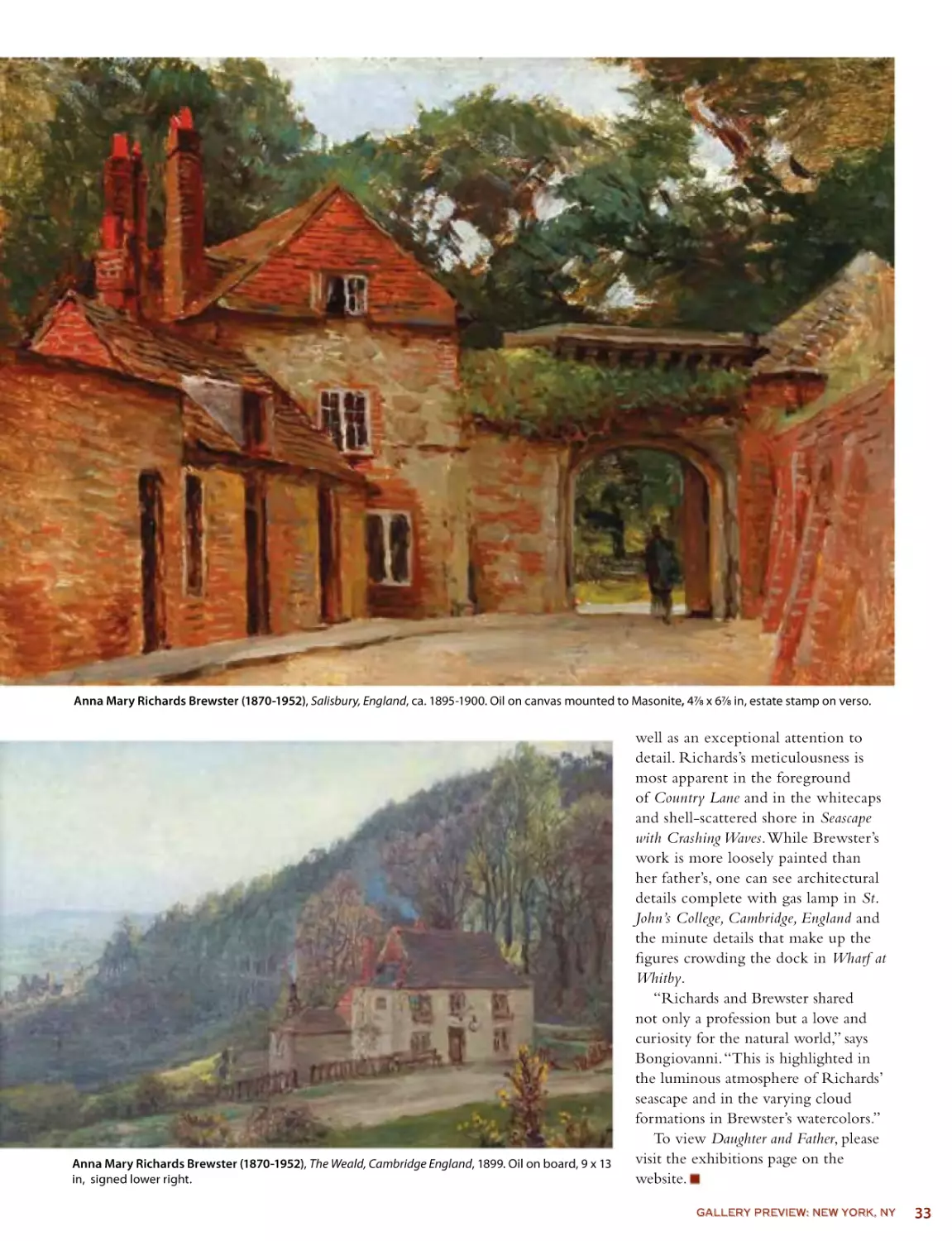
Left: Anna Mary Richards Brewster
(1870-1952), A Wharf at Whitby, ca. 1899.
Oil on canvas, 13¼ x 8¾ in. Estate of the artist.
Opposite page: Anna Mary Richards
Brewster (1870-1952), A Church at Rapallo,
Italy, ca. 1933. Oil on canvas, 7¾ x 5½ in., estate
stamp on verso.
30
31
England, circa 1900.
A vertical composition, Brewster’s A
Wharf at Whitby, circa 1899, captures a
bustling fishing pier in North Yorkshire.
The artist visited the town while on a
sketching tour of Northern England.
The work was included in Sketches from
the British Isles by Anna Richards Brewster
posthumously published by the artist’s
husband in 1954.
In A Church at Rapallo, Italy, circa
1933, Brewster depicts a bell tower
and red-tiled rooftops overlooking the
Ligurian sea. A large-scale watercolor,
Brewster’s Heather and Pine-Sussex,
England, 1896, depicts a rolling hillside
covered in pink heather while pine
trees cast striking shadows in the
foreground. Also included are several
small watercolors by Brewster such as
The English Lakeland, Derwentwater, and
The Langdale Pike. Executed in 1925,
the works capture the natural beauty of
Northwest England’s Lake District.
Brewster’s father, William Trost
Richards is represented with Country
Lane [Oldmixon Farm, Chester County,
PA], circa 1886. The rural scene with
its highly detailed foreground reveals
the influence of the Pre-Raphaelites. A
luminous and precisely executed work,
Seascape with Crashing Waves, 1889,
reveals Richard’s close and careful study
of nature.
The artists shared a strength in
draftsmanship and composition as
William Trost Richards (1833-1905), Country Lane [Oldmixon Farm, Chester County, PA], ca. 1886. Oil on panel, 10 x 20 in., signed lower left.
William Trost Richards (1833-1905), Seascape with Crashing Waves, 1889. Oil on canvas, 20 x 40 in., signed and dated lower right: 1889.
32
Anna Mary Richards Brewster (1870-1952), Salisbury, England, ca. 1895-1900. Oil on canvas mounted to Masonite, 47⁄8 x 67⁄8 in, estate stamp on verso.
Anna Mary Richards Brewster (1870-1952), The Weald, Cambridge England, 1899. Oil on board, 9 x 13
in, signed lower right.
well as an exceptional attention to
detail. Richards’s meticulousness is
most apparent in the foreground
of Country Lane and in the whitecaps
and shell-scattered shore in Seascape
with Crashing Waves. While Brewster’s
work is more loosely painted than
her father’s, one can see architectural
details complete with gas lamp in St.
John’s College, Cambridge, England and
the minute details that make up the
figures crowding the dock in Wharf at
Whitby.
“Richards and Brewster shared
not only a profession but a love and
curiosity for the natural world,” says
Bongiovanni. “This is highlighted in
the luminous atmosphere of Richards’
seascape and in the varying cloud
formations in Brewster’s watercolors.”
To view Daughter and Father, please
visit the exhibitions page on the
website.
GALLERY PREVIEW: NEW YORK, NY
33
A NN UA L GUIDE TO
MUSE UM S & E X HIBIT IONS
BA STI ON S
of B E AUT Y
M
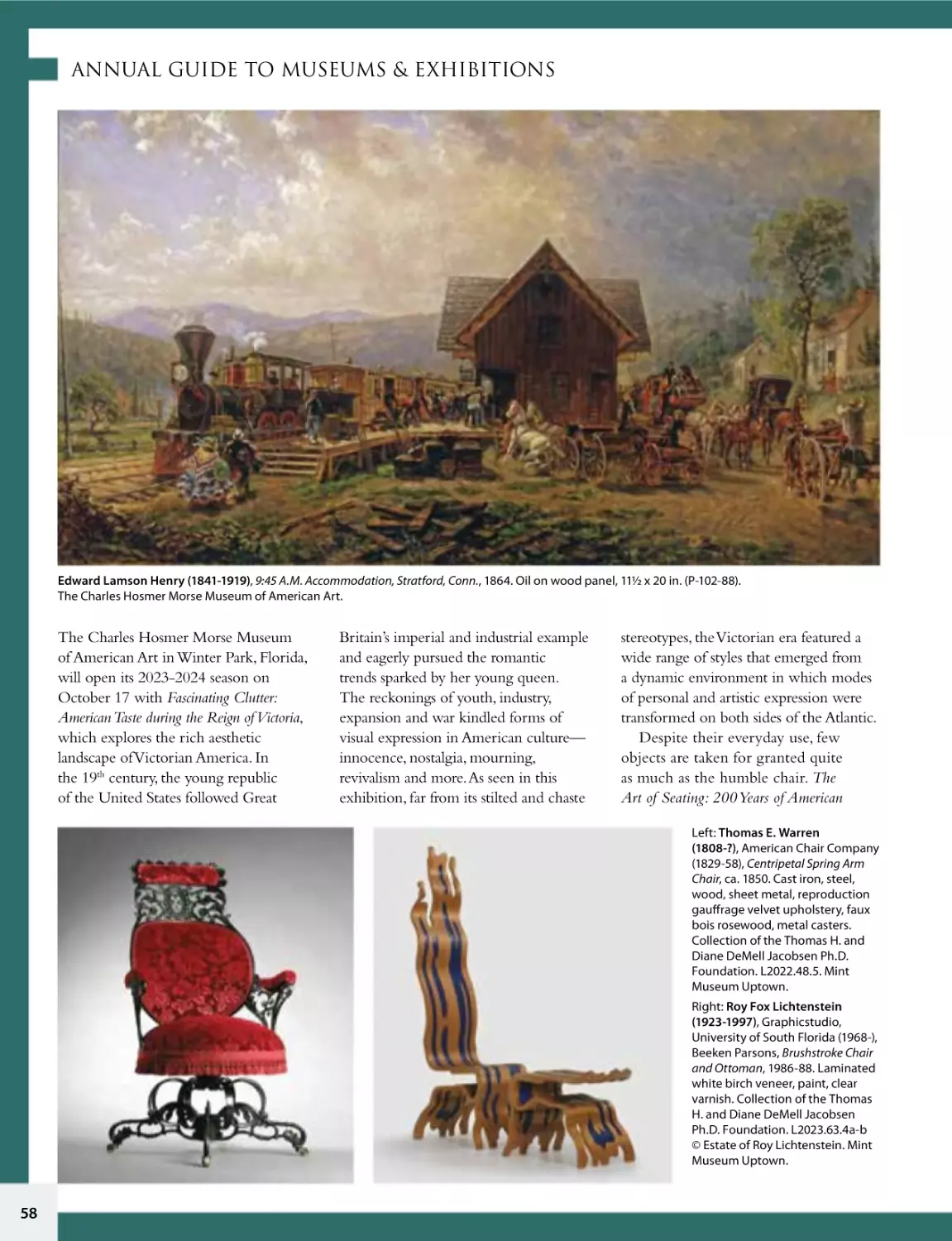
useums are places to think, learn, wonder and feel. They serve as
gathering points for people of all backgrounds and generations to bring
their own unique perspectives to exhibitions thoughtfully curated to
engender dialogue.
The 35,000 museums in this country range from the most iconic metropolitan
institutions, to the intimate and highly-specialized, but they share the same
purposes; their only differences lie in scale, focus and breadth.
People visit museums for many reasons. Some want to learn about the past,
while others are looking for insight into the present through more conceptual
and contemporary art. Some simply go for the aesthetic pleasure. No matter what
you enjoy about the museum experience, they open our minds, make us reflect,
and connect us to ourselves and each other. as well as the world around us, past
and present.
With this in mind, we welcome you to American Fine Art Magazine’s annual
guide to the nation’s museums and upcoming exhibitions of historic fine art. For
this special feature, we have scoured the country to find the most compelling
exhibitions happening in the months ahead, from the monumental to the obscure.
There are in-depth features, insights on curation from leading scholars, museum
previews and an at-a-glance directory that provides a rundown of diverse, must-see
exhibitions happening from coast to coast.
We hope you enjoy this section as much as we did curating its content, and that
it deepens your appreciation for museums, and the enrichment they bring to our
lives and communities.
35
ANNUAL GUIDE TO MUSEUMS & EXHIBITIONS
CURATOR CHAT
W E A SK LE A DING MUSEUM CUR ATOR S A BOUT
W H AT’S GOING ON IN THEIR WOR LD
one of my favorite authors in recent
years. He creates imaginary worlds
that I wish I could visit and incredibly
appealing and quirky characters that I
wish I could meet. He also makes me
laugh out loud on almost every page!
Brian Gallagher
Senior Curator of Decorative Arts
The Mint Museum
2730 Randolph Road
Charlotte, NC 28207
www.mintmuseum.org
What event (gallery show, museum
exhibit, etc.) in the next few
months are you looking forward to,
and why?
I can’t wait to see Shinichi Sawada:
Agents of Clay, which opens at the Mint
Museum in April 2024 and is being
co-organized by the Mint and the
Contemporary Art Museum St. Louis.
Sawada is a self-taught Japanese ceramic
artist, and to be honest, I did not know
about him until my colleague presented
her proposal at one of our exhibition
selection meetings. I was immediately
taken by Sawada’s clay sculptures, each
of which has vaguely human or animal
features but is so uniquely imaginative
and powerful.
What are you reading?
I just started the recently released novel
In the Lives of Puppets by TJ Klune.
He writes fantasy fiction featuring
LGBTQ+ characters and has become
36
Interesting exhibit, gallery opening
or work of art you’ve seen recently.
I was very moved by Tina Williams
Brewer: Stories of Grace, a special
exhibition organized and on view
at the Columbia Museum of Art in
Columbia, South Carolina. Her quilts
are so richly layered—literally in
terms of the way she constructs each
quilt, adding fabric or another design
element over an area that she had
already created, but also because of the
multiple visual references depicted in
many of them. And beyond all that,
Brewer’s quilts are stunningly beautiful.
What are you researching at the
moment?
I am currently working on an
upcoming gallery rotation at the Mint
that is keeping me busy. Opening in
November 2023, the installation will
feature about 40 works of art from
our Chinese ceramics collection. I
freely admit that that is not my area
of expertise even though our small
collection of historical Asian ceramics
falls under my jurisdiction, so I’m
combing through various textbooks
in our library to make sure that my
label content is accurate. I am grateful
that this project has reminded me
how especially tranquil and lovely the
celadon glaze is!
What is your dream exhibit to
curate? Or see someone else curate?
I would love to organize an exhibition
on the career of Marc-Louis-Emanuel
Solon, focusing especially on his
perfecting and popularizing the pâtesur-pâte technique. This was a form
of porcelain decoration in which thin
layers of white slip were successively
added—in an extraordinarily laborintensive process—to the colored
surface of an object to create a design
in low relief. The design could then
be carved to give it further definition.
Solon mastered the technique at
Sèvres in the 1860s and then in 1870
introduced it
at Minton. His
pâte-sur-pâte
decorations are
breathtakingly
beautiful, and I
would welcome
a chance to
showcase them
for our visitors.
Claude Raguet Hirst
ASHEVILLE ART MUSEUM
Claude Raguet
Hirst (1855-1942),
Roses, 1881. Oil on
canvas, canvas:
8½ x 10½ in.,
frame: 15⁄ x 18 in.
Museum purchase
with funds
provided by 2022
Collectors’ Circle
members Vito
Lenoci and Frances
Myers, 2022.43.01.
A
recent and significant
acquisition of 29 artworks by
the Asheville Art Museum has
yielded a comprehensive conversation
of late 19th through 21st-century trends,
recognizing both national and regional
artists. This includes the works of female
artists like that of Claude Raguet Hirst’s
(1855-1942) Roses—exemplifying
her talents in the still life genre. Hirst
exhibited under the male version of her
name (born Claudine) “in order to access
presentations of her painting in public
settings,” say museum representatives.
Born in Cincinnati, Ohio, Hirst
attended the University of Cincinnati’s
McMicken School of Design.
Eventually moving to New York City,
where “she studied privately and built
her reputation as a skillful painter of
fruit and floral still lifes,” according
to the museum. Hirst also established
her own studio in Union Square and
excelled in painting in watercolor.
While the artist became known for
undertaking very different subject matter
and technique, Roses is an example of
these early years she lived and worked
in New York. “The image characterizes
an important stage of her career before
she turned to a more masculine subject,”
reads the museum press release. Such
subjects usually included the leisure
activities more associated with the “male
pastime,” featuring scenes involving
pipes and hunting.
The museum goes on to note
that “[Roses] engages important
ANNUAL GUIDE TO MUSEUMS & E XHIBITIONS
NEW ACQUISITION
conversations in the history of
modernism, and its subject demonstrates
important trends in American art
history at the turn of the 20th-century.”
Eventually, in her 60s, Hirst returned
to subject matter more akin to Roses
and “lightened her palette and rejected
the pipes and masculine accessories.”
Hirst was prolific in her artistic practice,
continuing to “paint and exhibit into
her eighties, [and] leaving a legacy of
more than 100 still-life paintings.”
Roses is one of the earliest in the
Asheville Art Museum collection created
by a woman, and the museum feels that
it’s important in the “conversation with
all subjects in painting at the turn of the
20th-century.”
37
ANNUAL GUIDE TO MUSEUMS & EXHIBITIONS
I
HIGH
FASHION
An innovative exhibit explores the
relationship between one of history’s
greatest portrait artists and his sitters
through the dynamics of dress
By John O’Hern
38
n their curators’ preface to the
catalog for the exhibition Fashioned
by Sargent, Erica E. Hirshler and
James Finch write, “What happens
when you turn yourself over to the
hands of an artist? Who decides what
you wear when your portrait is crafted,
and what message will it send when
your image goes out into the world?
This book, and the exhibition it
accompanies, explore these questions in
John Singer Sargent’s portrait practice
from his early career in Paris to his
late studies of figures in the landscape.
Through the dynamics of dress, we can
see that Sargent did not pander to his
clients—his art always came first. Paying
particular attention to the choices he
made, we can contrast his depictions
with the types of garments his sitters
wore, illuminating the liberties and
elisions Sargent permitted himself in
painting them. He clearly took the lead
in creating his likenesses, sometimes
entirely ignoring his sitter’s preferences
to fulfill his own aesthetic vision.”
Hirshler is Croll Senior Curator of
American Paintings at the Museum of
Fine Arts, Boston, and Finch is assistant
curator of 19th Century British Art at
Tate Britain.
Organized with Tate Britain, the
exhibition will be on view at the
Museum of Fine Arts, Boston October
8 through January 15, 2024. The
museum notes, “Alongside about 50
paintings by Sargent, over a dozen
period garments and accessories shed
new light on the relationship between
fashion and this beloved artist’s creative
practice. In addition to style icons like
John Singer Sargent (1856–1925), Madame
X (Madame Pierre Gautreau [Virginie Amélie
Avegno]), 1883-84. Oil on canvas, 82⁄ x 43 ¼ in.
The Metropolitan Museum of Art, New York.
Arthur Hoppock Hearn Fund, 1916, 16.53. Image
copyright © The Metropolitan Museum of Art.
Image source: Art Resource, NY.
Opposite page: John Singer Sargent (1856–
1925), Lady Agnew of Lochnaw (Gertrude Vernon),
1892. Oil on canvas, 49 ½ x 39 ½ in. National
Gallery of Scotland, purchased with the aid of
the Cowan Smith Bequest Fund, 1925, NG 1656.
Courtesy, Museum of Fine Arts, Boston.
ANNUAL GUIDE TO MUSEUMS & E XHIBITIONS
39
ANNUAL GUIDE TO MUSEUMS & EXHIBITIONS
John Singer Sargent (1856–1925), Nonchaloir (Repose), 1911. Oil on canvas, 25⁄ x 30 in. National Gallery of Art,
Washington, DC. Gift of Curt H. Reisinger, 1948.16.1. Image courtesy National Gallery of Art, Washington, DC.
Madame X, Lady Agnew of Lochnaw and Dr.
Pozzi at Home, the exhibition brings together
several paintings with the garments worn by
the sitters, among them Ellen Terry as Lady
Macbeth with her beetle-wing encrusted
costume, and Mrs. Charles Inches (Louise
Pomeroy) with her red velvet evening gown.
Visitors are invited to step into the making
of a Sargent portrait and consider ideas of
curating—and controlling—one’s image.”
John Singer Sargent (1856–1925) was the
preeminent society portrait painter of his time.
He has been both deified and dismissed. Born
in Florence to ex-patriot American parents, he
rose to the heights of society portraiture and
became swallowed up by the progressive art
movements of the early 20th century.
Isabella Stewart Gardner and her husband
Jack were introduced to Sargent by the
novelist Henry James in October 1886. He
took them to Sargent’s London studio to see
40
his provocative portrait, Madame X, now in
the Metropolitan Museum of Art. Sargent
had painted the portrait to enhance his
reputation but, as the museum notes, “At the
Salon of 1884, the portrait received more
ridicule than praise.”
Mrs. Gardner loved it and invited Sargent
to visit her home in Boston to paint her
portrait. Beginning in December of 1887,
Sargent struggled to capture his restless sitter.
The finished portrait depicted her raised
eyebrows (a bit too much décolletage to
begin with) and Jack Gardner never allowed
it to leave their home again nor to be shown
there while he was alive. It now hangs in the
Gothic Room of the Isabella Stewart Gardner
Museum, their home in Boston.
Mrs. Gardner invited Sargent to be her artistin-residence, setting up a studio in the Gothic
Room where he painted five portraits. One of
them is Mrs. Fiske Warren (Gretchen Osgood) and
ANNUAL GUIDE TO MUSEUMS & E XHIBITIONS
John Singer Sargent (1856–1925), Elsie Palmer, or A Lady in White, 1889-90. Oil
on canvas, 75 ⁄ x 45⁄ in. Colorado Springs Fine Arts Center at Colorado College,
Museum Purchase Fund Acquired through Public Subscription and Debutante
Ball Purchase Fund, FA 1969.3.1. Courtesy Museum of Fine Arts, Boston.
Her Daughter Rachel, 1903. Mrs. Gardner and the
actress, poet and singer were close friends.
In his catalog essay, Sitting for Sargent,
Richard Ormond, the artist’s great-nephew,
observes, “Mrs. Fiske Warren’s dress is said
to have been borrowed from her sister-inlaw, who was several sizes larger, while her
daughter was simply draped in a length of
material of the desired color and texture.”
Sargent attended the opening night of
Shakespeare’s Macbeth starring Ellen Terry
in 1888. Terry’s stage partner, Henry Irving,
John Singer Sargent (American, 1856–1925), Dr. Pozzi at Home,
1881. Oil on canvas, 79 ⁄ x 40 ¼ in. The Armand Hammer Collection,
Gift of the Armand Hammer Foundation. Hammer Museum, Los
Angeles. Courtesy Museum of Fine Arts, Boston.
commissioned Sargent to do a portrait of
his friend, requesting that she be painted
wearing everyday clothes. Sargent convinced
them both that he had to paint her in the
spectacular beetle-wing robes that had
captured his attention in the performance.
The costume designer Alice Comyns-Carr
described the gown in detail. “It was cut from
fine Bohemian yarn of soft green silk and
blue tinsel…it was sewn all over with real
green beetle wings and a narrow border of
Celtic design worked out in [imitation] rubies
41
ANNUAL GUIDE TO MUSEUMS & EXHIBITIONS
John Singer Sargent (1856–1925), Mrs. Fiske Warren (Gretchen Osgood)
and Her Daughter Rachel, 1903. Oil on canvas, 60 x 40 ⁄ in. Museum of Fine
Arts, Boston. Gift of Mrs. Rachel Warren Barton and Emily L. Ainsley Fund,
1964, 64.693. Photograph © Museum of Fine Arts, Boston.
and diamonds. To this was added a cloak
of shot velvetin heather tones upon which
griffins were embroidered in flame-colored
tinsel. The wimple and veil was held in place
by a circlet of [imitation] rubies and two long
plaits twisted with gold hung to her knees.”
Sargent began to tire of formal portrait
painting and often painted his niece and
muse Rose-Marie Ormond. His 1911
painting of her, Nonchaloir (Repose), is in the
collection of the National Gallery of Art in
Washington, D.C. The museum notes, “In
keeping with his newfound preference for
informal figure studies, Sargent did not create
a traditional portrait; rather, he depicted
42
John Singer Sargent (1856–1925), Madame Ramón Subercaseaux (Amalia
Errázuriz), 1880-81. Oil on canvas, 65 x 43 ¼ in. Sarofim Foundation.
Photograph © The Museum of Fine Arts, Houston. Courtesy Museum of
Fine Arts, Boston.
Rose–Marie as a languid, anonymous figure
absorbed in poetic reverie. The reclining
woman, casually posed in an atmosphere of
elegiac calm and consummate luxury, seems
the epitome of nonchalance—the painting’s
original title. Sargent seems to have been
documenting the end of an era, for the
lingering aura of fin-de-siècle gentility and
elegant indulgence conveyed in Repose
would soon be shattered by massive political
and social upheaval in the early 20th century.”
Rose-Marie is wrapped in a Kashmir
shawl the pattern of which is repeated in the
upholstery of the sofa. The shawl is in the
exhibition. The critic Carter Ratcliff wrote
ANNUAL GUIDE TO MUSEUMS & E XHIBITIONS
John Singer Sargent (1856–1925), Ellen Terry as Lady Macbeth, 1889. Oil on
canvas, 87 x 45 in. Tate Britain Presented by Sir Joseph Duveen (the elder),
1906. Photograph: Tate.
that Sargent “presents a young woman as
withdrawn into her mood as he is into the
act of painting her. Artist and subject seem
present to each other on terms resolved by
the setting they share.”
In the early days of World War 1, RoseMarie’s husband was killed in battle. On
Good Friday in 1918, Rose-Marie was
attending a concert in the Church of St.
Gervais in Paris when a German bomb
collapsed the roof and walls of the church,
Alice Laura Comyns-Carr (1850-1927), cloak for the “Beetle Wing Dress”
for Lady Macbeth, 1888. Velvet, silk damask, cotton, metal, glass Length:
88 ⁄ in. National Trust, UK (Smallhythe Place, Kent) Photograph © National
Trust Images/ Andrew Fetherston.
killing her and dozens of others. Hearing the
news, Sargent said, “I can’t tell you how sorry
I am…and how I feel the loss of the most
charming girl who ever lived.”
October 8, 2023-January 15, 2024
Fashioned by Sargent
Museum of Fine Arts, Boston
465 Huntington Avenue, Boston, MA 02115
t: (617) 267-9300, www.mfa.org
43
ANNUAL GUIDE TO MUSEUMS & EXHIBITIONS
WHAT WE HAVE
IN COMMON
Art for the People:WPA-era Paintings
from the Dijkstra Collection makes its last
stop at Oceanside Museum of Art
By James D. Balestrieri
T
he range of American paintings in Art for the
People: WPA-era Paintings from the Dijkstra Collection
from, roughly, 1929 through the end of World War
II is so rich that I feel certain I could write any number
of essays on it without repeating myself. Collected by
Sandra and Bram Dijkstra, University of San Diego,
California, professor emeritus of American literature and
culture, and author of American Expressionism: Art & Social
Change, 1920-1950, the artists on view represent much
of the nation during this time of tumult, hardship and
Arthur Durston (1897-1938), The Flood, ca. 1934. Oil on canvas, 30 x 36 in. From the collection of Sandra and Bram Dijkstra.
44
ANNUAL GUIDE TO MUSEUMS & E XHIBITIONS
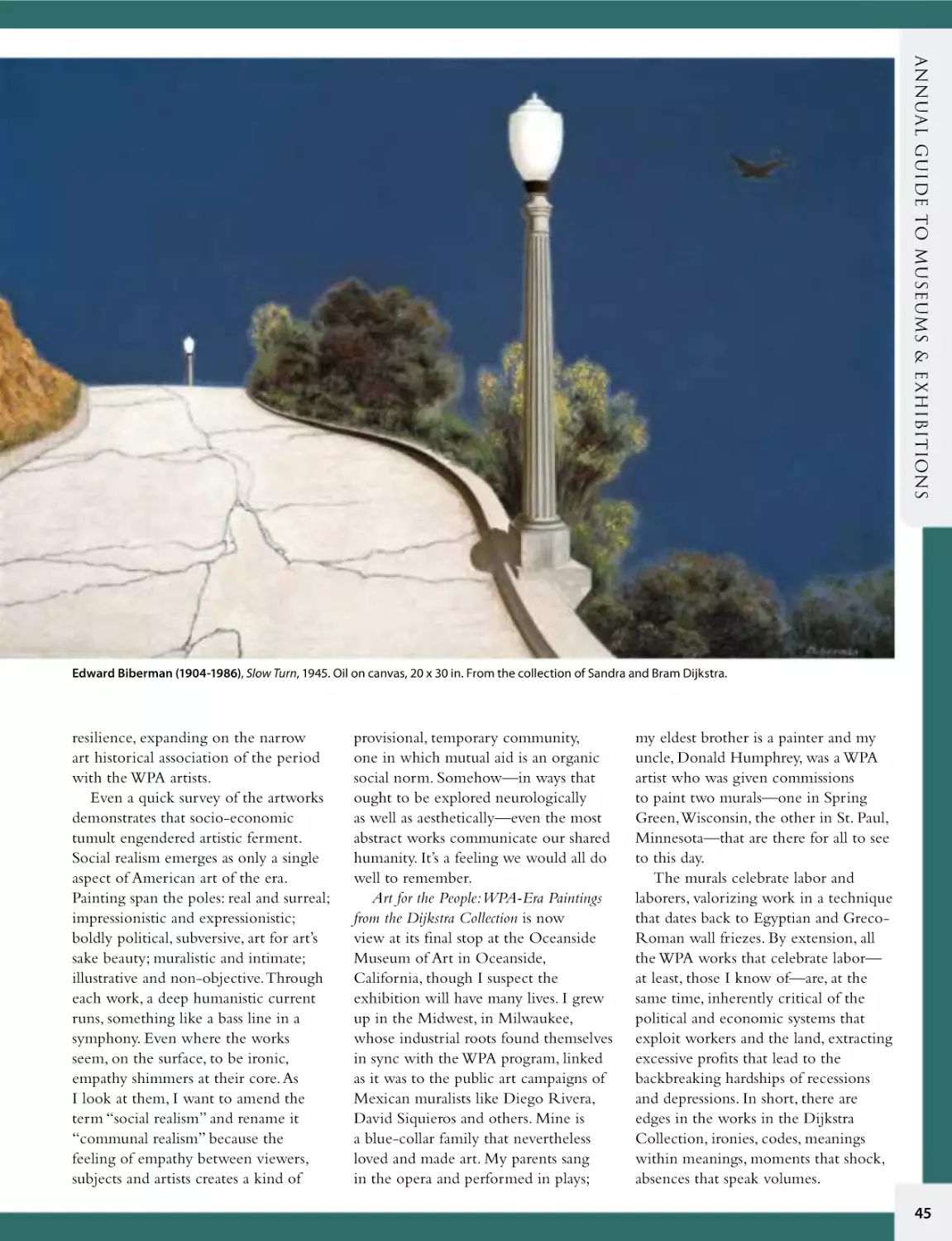
Edward Biberman (1904-1986), Slow Turn, 1945. Oil on canvas, 20 x 30 in. From the collection of Sandra and Bram Dijkstra.
resilience, expanding on the narrow
art historical association of the period
with the WPA artists.
Even a quick survey of the artworks
demonstrates that socio-economic
tumult engendered artistic ferment.
Social realism emerges as only a single
aspect of American art of the era.
Painting span the poles: real and surreal;
impressionistic and expressionistic;
boldly political, subversive, art for art’s
sake beauty; muralistic and intimate;
illustrative and non-objective. Through
each work, a deep humanistic current
runs, something like a bass line in a
symphony. Even where the works
seem, on the surface, to be ironic,
empathy shimmers at their core. As
I look at them, I want to amend the
term “social realism” and rename it
“communal realism” because the
feeling of empathy between viewers,
subjects and artists creates a kind of
provisional, temporary community,
one in which mutual aid is an organic
social norm. Somehow—in ways that
ought to be explored neurologically
as well as aesthetically—even the most
abstract works communicate our shared
humanity. It’s a feeling we would all do
well to remember.
Art for the People: WPA-Era Paintings
from the Dijkstra Collection is now
view at its final stop at the Oceanside
Museum of Art in Oceanside,
California, though I suspect the
exhibition will have many lives. I grew
up in the Midwest, in Milwaukee,
whose industrial roots found themselves
in sync with the WPA program, linked
as it was to the public art campaigns of
Mexican muralists like Diego Rivera,
David Siquieros and others. Mine is
a blue-collar family that nevertheless
loved and made art. My parents sang
in the opera and performed in plays;
my eldest brother is a painter and my
uncle, Donald Humphrey, was a WPA
artist who was given commissions
to paint two murals—one in Spring
Green, Wisconsin, the other in St. Paul,
Minnesota—that are there for all to see
to this day.
The murals celebrate labor and
laborers, valorizing work in a technique
that dates back to Egyptian and GrecoRoman wall friezes. By extension, all
the WPA works that celebrate labor—
at least, those I know of—are, at the
same time, inherently critical of the
political and economic systems that
exploit workers and the land, extracting
excessive profits that lead to the
backbreaking hardships of recessions
and depressions. In short, there are
edges in the works in the Dijkstra
Collection, ironies, codes, meanings
within meanings, moments that shock,
absences that speak volumes.
45
ANNUAL GUIDE TO MUSEUMS & EXHIBITIONS
Helen Appleton Read (1887–1974), Portrait of a Midwest Farmer, ca.
1940. Oil on canvas, 24 x 17 in. From the collection of Sandra and
Bram Dijkstra.
Seated Nude, a 1934 portrait by
Isabel Bishop, an artist who is new
to me, as many of the artists in the
exhibition are, presents itself, at first, as
a straightforward, academic painting.
But the palette, limited to light, yellow
browns, grays and lighter highlights,
brings the work within the scope of
the origins of the WPA in the classical
frieze and the Mexican mural. The
woman is real as opposed to ideal, as
one would expect in a Rivera mural.
Her head covering indicates a woman
who puts her hair up to work, signaling
that she is no goddess or dilettante. She
seems to emerge from the background
as if the artist has carved her in alabaster
in shallow bas-relief. Her pose casts
her in an eternal, even heroic light.
The straightforward, art-for-art’s sake
nude, a classical exercise and artform,
46
Philip Evergood (1901-1973), New Death, 1947. Oil on canvas,
37 x 32 in. From the collection of Sandra and Bram Dijkstra.
Phil Dike (1906-1990), Back Country Conversation, ca. 1938. Oil on canvas, 22 x 35 in. From the
collection of Sandra and Bram Dijkstra.
Below Left: Miki Hayakawa
(1904-1953), From my Window: View
of Coit Tower, ca. 1935. Oil on canvas,
30 x 30 in. From the collection of
Sandra and Bram Dijkstra.
becomes, on Bishop’s easel, something
much more.
Contrast this with Hugo Gellert’s
Worker and Machine, a 1928 painting
in which man and machine are united
you see the apparent heroism of the
worker subverted pictorially. In this
painting, which predates the onset
of the Great Depression, the worker
seems to give birth to the machine—or
does the machine give birth to the
worker? They are a monadic entity,
one organism/mechanism, the kind
of being that is created in German
Expressionist filmmaker Fritz Lang’s
seminal 1927 film, Metropolis. Is
this good? Bad? A relentless future
that must be borne, whatever the
consequences? Gellert doesn’t judge.
We, however, must. And that’s the point
of the Dijkstra Collection.
Apprehending the paintings
implicates us, compelling us to make
meaning and to decide what kind of
world we want to create and inhabit,
and what we must do to get there. The
exhibition shows us the myriad paths
that American artists took, the styles they
imported, imbibed, fused, constructed,
deconstructed and reconstructed. It
was as if American art had a mind of its
own, a purpose even the artists weren’t
entirely aware of, one that would take
the rubble left in the wake of the
Depression and the challenges the nation
faced during World War II and make
something of them, something new,
something that didn’t shy away from
the flaws in our society but nevertheless
strove to heal them.
Arthur Durston’s The Flood, painted
in 1934 when America was in the
throes of the Great Depression, has
stylistic affinities with late-1880s French
Neo-Impressionism, Cloissonnism in
ANNUAL GUIDE TO MUSEUMS & E XHIBITIONS
Left: Hugo Gellert (1892-1985),
Worker and Machine, 1928. Oil on
panel, 30 x 31 in. From the collection
of Sandra and Bram Dijkstra. ©
Hugo Gellert; Courtesy of Mary Ryan
Gallery, New York.
47
ANNUAL GUIDE TO MUSEUMS & EXHIBITIONS
particular, a technique modeled after the
Japanese prints and porcelain designs
that took art world by storm. Thick
outlines delineate shapes and the artist
creates colors, shades and textures inside
the drawn shapes. The effect suggests
the mass-produced lithograph, backformed and reappropriated into a style
of painting, and seems to be intended
to connect a broad cross-section of
viewers with the work, which combines
tragedy, pathos, and perseverance. As
two women and their children watch
their homes and trees wash away in the
floodwaters, two men erect a barrier
of sandbags. Despite the “two-by-two”
pairings, no Old Testament retribution
for sins committed operates here. The
scene isn’t a prelude to Noah’s Ark. It’s a
question of humanity pitted against the
odds—and the elements—with a hint,
perhaps, that Nature might be angry at
man’s inhumanity to man and to the
natural world. Durston looks back in
order to look forward, hoping to make
his art and message available to the
general public.
Joe Jones (1909-1963), Mining in the Mountains, ca. 1939. Oil on canvas, 30 x 36 in.
From the collection of Sandra and Bram Dijkstra.
Painted in 1945, the year that
World War II came to an end, Edward
Bieberman’s Slow Turn recalls Ralston
Crawford’s Precisionist scenes of
Isabel Bishop (1902–1988), Seated Nude, ca. 1934. Oil on canvas, 33 x 40 in.
Collection of Sandra and Bram Dijkstra.
48
abstract roadways and bridges but adds
a poignant layer of realism, a metaphor
that meets the moment when it was
painted. The American B-17 bomber
at upper right is a modern machine
of war, a dealer of death from the air,
making its “slow turn” in a cloudless
sky. In the foreground, taking up the
bottom left quarter of the canvas, a
cracked road winds up the side of a
mountain, appearing to vanish into
infinity over a rise. The only way we
know the road goes on is by looking
at the streetlight on the other side of
the crest in the road. Where are we?
Is this road somewhere in Europe,
cracked from the concussions of
aerial bombardment? Or might this
be a road in the United States, ruined
from neglect because so much of the
nation’s energy and attention has gone
into the war effort? In either event,
the painting projects a sense that
even as the world requires rebuilding,
we ourselves require a philosophical
tune-up in order to avoid making the
same mistakes that will necessitate the
fabrication of new and more deadly
instruments of war.
ANNUAL GUIDE TO MUSEUMS & E XHIBITIONS
Julio De Diego (1900-1979), Beauty and the Beasts, 1941. Oil on panel, 20½ x 27¾ in. From the collection of Sandra and Bram Dijkstra.
One of the most recently executed
works in the Dijkstra Collection, Philip
Evergood’s New Death, painted in 1947,
two years after Hiroshima and Nagasaki,
is a true allegory, one that embraces
aspects of Abstract Expressionism even
as it sends a direct political message.
Tycoons in evening wear cling to webs
and tangles of tentacles, becoming
prey to spiders, insects, an arthropods
that are beyond the reach of whatever
power they wield. Waves deluge the
thin spit of sand which is littered with
skulls. The central image, an orange
sphere collapsing in on itself, seems to
be an abstraction of a mushroom cloud
forming, while tentacles grow and the
tendrils of plants emerge, dead, from its
orifice. With calligraphic strokes that
one might find in Arshile Gorky or
Willem de Kooning, Evergood paints
a bleak picture, a cautionary tale not of
the world as it is, but as it might be if we
continue to forget our shared humanity
As I said at the outset, there’s so
much in this exhibition that a dozen
essays wouldn’t exhaust it. The trick is to
avoid pigeonholing American painting
of the period as social realism only or
as products of the WPA. The Dijkstra
Collection bridges true American
social realism, the work of John Sloan
and George Luks, say, in the early 20th
century, with the advent of magical
realism and American surrealism in the
work of say, Hughie Lee-Smith and
Brian Connelly after World War II. It
also runs alongside De Kooning and
even Jackson Pollock, as evidenced in
the paintings of Philip Evergood and
others. Though at first it might seem
difficult, perhaps impossible, to unite
the works in the Dijkstra Collection,
repeated viewings pay manifold rewards.
There is unity in humanity in the
exhibition and, it’s worth repeating—our
common humanity is something we
would all do well to remember.
Through November 5, 2023
Art for the People:
WPA-Era Paintings from
the Dijkstra Collection
Oceanside Museum of Art
704 Pier View Way
Oceanside, CA 92054
t: (760) 435-3720
www.oma-online.org
49
ANNUAL GUIDE TO MUSEUMS & EXHIBITIONS
Clement Nye Swift (1846-1918), Seaweed Gatherers, 1878. Oil on canvas, 41 x 93 in. New Bedford Whaling Museum,
Gift of the Russell Memorial Library of Acushnet, Massachusetts, 2015.9.1.
THE STORY OF
SEAWEED
New Bedford Whaling Museum
celebrates this “singularly marine
and fabulous product”
By Naomi Slipp
50
H
enry David Thoreau wrote, “This kelp,
oar-weed, tangle, devil’s apron, soleleather, or ribbon-weed…appeared to us
a singularly marine and fabulous product, a fit
invention for Neptune to adorn his car with, or a
freak of Proteus…as if they belonged to another
planet, from seaweed to a sailor’s yarn, or a fish
story. In this element, the animal and vegetable
kingdoms meet and are strangely mingled.”
The Cultures of Seaweed, featuring more than
125 works from over 30 lenders, is inspired
ANNUAL GUIDE TO MUSEUMS & E XHIBITIONS
Frank Crawford Penfold (1849-1921), Brittany Harbor, Gathering of Seaweed, 1918. Oil on canvas,
38 x 31⁄ in. Colby College Museum of Art, Gift of Mr. and Mrs. Ellerton M. Jetté, 1975.055.
by Thoreau’s musings and explores
the allure of this oceanic “produce”
from about 1780 to today. The
installation includes paintings, works
on paper, textiles, photographs, albums,
decorative arts and printed books, and
demonstrates how seaweed is always
changing in its form and appearance,
cultural and social meanings, and
industrial uses. Its changeability made
it a subject of amateur study, aesthetic
exploration and scientific examination.
The foundation of the exhibition
is a spectacular painting of Seaweed
Gatherers, created in Pont-Aven, France,
in 1878 by Massachusetts artist Clement
Nye Swift. It forms the interpretive
center of an exhibition that could have
been global in scope and far-reaching
in time and media. Instead, using Swift
as our entry point, the curatorial team
led by myself and Maura Coughlin,
Northeastern University, narrowed in
on a triangle of the North Atlantic
between New England, Brittany, France
and Southeastern England that has
similar tidal patterns, seaweed species
and distribution, and applications.
In Brittany, harvesters, sometimes
dressed in local costume, worked against
rising tides with draft animals to haul
heavy cartloads of wet seaweed off the
beaches. Seaweed produced iodine,
soda ash and carrageenan, and was used
in innumerable products such as glass
and saltpeter, and for animal bedding
and fertilizer. The spectacle of seaweed
harvesting and burning appealed to
artists, photographers and illustrators
working on both sides of the Atlantic.
Even though some seaweed was
destined for industrial uses and modern
applications, artists and authors viewed
seaweed harvesting as a historic tradition,
reminiscent of a bygone era. In harvest
images, artists including Frank Crawford
Penfold (1849-1921), Edward A. Page
(1850-1928) and George Inness, Jr.
(American, 1854-1926) romanticized
coastal labor.Visitors and tourists
purchased postcards and souvenirs
depicting the harvest, and images of
it circulated in popular culture, like
magazines. Individuals far from the coast
and those who never traveled to France
were familiar with the timeless practice
of seaweed harvesting.
Swift and other New England artists
pictured the New England seaweed
economy in paint and photography.
Robert Swain Gifford, who was born
on Naushon Island and summered at
Nonquitt in Dartmouth, Massachusetts,
51
ANNUAL GUIDE TO MUSEUMS & EXHIBITIONS
John Greenleaf Cloudman (1813–1892), Sea Captain’s Wife, undated. Oil on canvas, 25 x 20 in.
Portland Museum of Art Purchase.
depicted seaweed gatherers frequently.
In Seaweed Gatherers at Nonquitt, Gifford
carefully renders a group of figures
loading seaweed from the sea onto a
flat-bottom skiff and wagon. Distinctive
cliff and rock formations offer
geographic specificity to this curving
bit of coastal shoreline.
Conserved for this exhibition,
Sydney Richmond Burleigh’s turnof-the-century watercolor of seaweed
gathering along the nearby Sakonnet
River, shows a green meadow with
wildflowers like goldenrod. A rutted
track runs from the lower right corner
52
of the picture into the middle where
there is a cluster of wagons with teams
of oxen. The middle ground is a strip of
reflective water with a placid sailboat.
Laborers fork the seaweed from the
water’s edge up onto the wagons.
Artists, like John Singer Sargent and
Alfred Bricher demonstrate an interest
in the picturesque qualities of seaweed
itself, clinging to rocky coastlines and
draped around the edges of tidepools.
Sargent’s pristine 1921 watercolor of
a rocky coastline uses the blank white
of the page to effect the reflective
surface of a tidepool with kelp nestled
into the pockets of granite. In one
of a series of monumental low tide
paintings at Grand Manan Island, off
the coast of Maine in the Bay of Fundy,
Bricher captures the fleeting view
of an undersea landscape, with green
rockweed, starfish and stringy seaweed
exposed at low tide. Massive, irregular
boulders protrude like mountains from
the beach, while an anchored dory is
set adrift upon the shore.
An early 1940 watercolor by
Andrew Wyeth shows how American
modernists approached the subject of
seaweed. While a tiny dory floats at the
horizon line in the background, a large
lobster washes up onto shore with the
wrack, its body a wash of green, red
and purple. Fine brushwork marks out
the tiny hairs of the claw. The wrack is
a symphony of loose wet washes and
shapes, reminiscent of the abstractions
of Kandinsky. The piece demonstrates
Wyeth’s affinity for and careful study of
the natural world of coastal Maine.
The exhibition was intentionally
diverse in terms of the kinds of media
we included. Numerous French, English
and American designers incorporated
seaweed in decorative arts, from popular
mochaware made in industrial potteries
to elite studio-made silver services, and
from Palissy-style tableware encrusted
with undersea flora and fauna in high
relief, to sinuous and curving designs
on textiles and wallpaper. Silversmiths
at Tiffany & Company and Gorham
Manufacturing Company employed
different techniques and adopted
diverse visual languages from Japonisme
to Aestheticism to celebrate the watery
fronds and radial shapes of twisting
seaweeds. The silverwork on view in
the exhibition shows how the wrack,
the common, the free stuff from the
shore—deemed smelly, annoying and
an irritation by some, was transformed
by the 1880s into elite and precious
materials for wealthy clientele.
We also recognized that women
played an important role in the story
ANNUAL GUIDE TO MUSEUMS & E XHIBITIONS
Robert Swain Gifford (1840-1905), Seaweed Gatherers at Nonquitt, 1868. Oil on canvas, 17½ x 27 in. New Bedford Whaling Museum Purchase, 1991.20.
John Singer Sargent (1856-1925), Rocky Coast Near Boston, 1921.
Watercolor and graphite on paper, 13/ x 21 in. Rhode Island School
of Design Museum, Providence, RI, anonymous gift, 1992.001.119.
of seaweed. Women hobbyists created
collages, herbaria and pressings from
seaweed, and they led the seaweed
collecting industry in Brittany. English
botanist Anna Atkins (1799–1871)
published the very first book illustrated
with photographs. Her spectacular
original cyanotypes from British
Algae (1843-53) influenced artists and
designers throughout the exhibition,
but also point to how women entered
Emma L. Coleman (1853-1942), Gathering Kelp, Long Sands, York, Maine, ca.
1882. Photograph, 5 x 7½ in. Image courtesy of Historic New England.
the sciences via amateur practices like
seaweed collecting. Seaweed collecting
guidebooks encouraged seaside
gathering, instructed on assembling kits
and advised on equipment and proper
clothing. Women achieved rare freedom
outdoors through shoreline collecting.
Works by female artists exemplify
how women remained at the forefront
of seaweed art and design into the 20thcentury. These include Lobstering, a plate
from the New England Industries series
by Clare Leighton for Josiah Wedgwood
& Sons, that includes carefully studied
rockweed curled in the foreground,
undersea textile designs by students of
Mariska Karasz, who served as guest
needlework editor for House Beautiful
Magazine from 1952 to 1953; and an art
deco French sidewall design distributed
by Nancy McClelland, first female
president of the first U.S. national
53
ANNUAL GUIDE TO MUSEUMS & EXHIBITIONS
Alfred Thompson Bricher (1837-1908), Low Tide, ca. 1885-1895. Oil on canvas, 30 x 62¾ in. NBWM, Gift of Douglas and Cynthia Crocker.
Theodore Russell Davis (1840-1894), Seafood Plate, from the Rutherford B. Hayes Presidential
Service, ca. 1880. Porcelain with enamels and gilding, 9 x 1½ in. Rhode Island School of Design
Museum, Providence, RI, Gift of Christopher Monkhouse, 2003.111.
54
association of interior designers,
American Institute of Interior
Decorators (AID). These influential
women made substantive contributions
to American craft and design and were
clearly enmeshed in the vogue for
seaweed that swept America in the first
half of the 20th-century. Today, the
fields of seaweed aquaculture and
phycology are dominated by women.
Finally, the exhibition highlights
objects from our collection,
including a group of about 45
seaweed herbaria collected by
Charles H. Durgin at Hudson Bay
in 1864 while wintering-over on
a whaling vessel; a whimsical hand
block-printed textile of mermaids;
seaweed made by famed boat designer
L. Francis Herreshoff; and two souvenir
albums with whalebone covers from
Monterrey, California, that include
photographs of waves crashing on
rocky coastlines and actual seaweed
specimens mounted on facing pages.
The Cultures of Seaweed is a
perfect vehicle for reflecting the
interdisciplinary collections and
mission of NBWM, which is to
preserve the rich, diverse histories of
ANNUAL GUIDE TO MUSEUMS & E XHIBITIONS
Andrew Wyeth (1917-2009), Lobster #4, 1940. Watercolor on paper, 21½ x 29/ in. Collection of the Wyeth Foundation for American Art, BM1035. © 2023
Wyeth Foundation for American Art /Artists Rights Society (ARS).
the communities of the region and educate
audiences about whale biology, conservation
and ocean health, with a growing focus
on climate science. The Cultures of Seaweed
allowed us to lean into our mission and survey
the cultural, scientific, historical, aesthetic and
industrial applications of seaweed in the past
and today.
Naomi Slipp is the Douglas and Cynthia Crocker
Endowed Chair for the Chief Curator at the
New Bedford Whaling Museum in New Bedford,
Massachusetts.
Through December 3
The Cultures
of Seaweed
Tiffany & Co., Punch Bowl, 1885. Sterling silver and gold. Tiffany & Co. Archives, B2022.15.
Copyright Tiffany Archives 2023.
New Bedford Whaling Museum
18 Johnny Cake Hill
New Bedford, MA 02740
t: (508) 997-0046
www.whalingmuseum.org
55
ANNUAL GUIDE TO MUSEUMS & EXHIBITIONS
Howard
Rivers Jacobs
(1885-1974),
photograph
of the old
Charleston
Museum on
Rutledge
Avenue, ca. 1940.
Jacobs shot
the image from
Bennett Street.
COLLECTOR’S FOCUS
STEWARDS
of HISTORY
Introduction by John O’Hern
T
he South Carolina Colony
was founded by the British in
1663. In 1773, while it was
still a colony, the Charleston Library
Society founded what would become
the Charleston Museum, America’s
first museum. Celebrating its 250th
anniversary, “the museum’s collections
now represent the most comprehensive
assemblage of South Carolina materials
in the nation. Focusing on the South
Carolina Lowcountry, modern
collecting emphases include natural
history, historical material culture and
56
both documentary and photographic
resources.”
The Charleston Library Society
was inspired by the opening of the
British Museum, a free, national, public
museum that opened its doors to “all
studious and curious persons” in 1759.
The museum now houses nearly eight
million objects covering two million
years of human history.
Before there were museums, there
were collections. One of the earliest
collections is dated to 530 B.C. in
Sumeria and contained objects from
2500 to 2000 B.C. In his “History
of Museums” for Museologica, John
Edward Simmons observes, “The
modern museum dates to the time
when collections began to be made for
the specific purpose of exhibiting the
objects to the public, but this is not an
easy-to-define moment.”
Simmons quotes John Henry Parker,
the curator of the Ashmolean Museum,
which had been established at Oxford in
1683. In 1871, Parker wrote, “I do not
wish to exclude curiosities from [the
museum]; they attract people, and when
Exterior of the
iconic Marcel
Breuer building
that houses the
Frick Madison,
the museum’s
temporary home.
Photo: Joseph
Coscia Jr.
City building now called Frick Madison.
The collection’s home is the
mansion of Henry Clay Frick on East
70th Street which became a museum
after the death of his wife in 1931. It
is undergoing a major expansion to
accommodate a collection that has
grown, conservation labs and facilities
for a growing number of visitors.
Frick Madison offers the
opportunity to see the collection
literally in a new light, out of the
museum’s elegant home setting and
displayed in new juxtapositions, hung
sparsely against neutral gray walls
The Solomon
R. Guggenheim
Museum in New
York, designed by
Frank Lloyd Wright
and opened in
1959. Behind it is an
eight-story tower
addition, designed by
Gwathmey Siegel and
Associates Architects
that opened in
1992. Photo: David
Heald © Solomon
R. Guggenheim
Foundation
ANNUAL GUIDE TO MUSEUMS & E XHIBITIONS
they are brought hither by curiosity,
they may stop to learn something better;
they may want to know something
of the history of the curiosities
they have come to see.” Collecting,
conserving, exhibiting and educating
(or entertaining) has been the backbone
of the museum experience.
The Charleston Museum was later
housed in a classical revival building,
a style that became de rigueur for
decades. In the late 20th century,
museum buildings became works of
art themselves.
The Solomon R. Guggenheim
Museum hired Frank Lloyd Wright
to design its Fifth Avenue building in
New York which opened in 1959. In
1992, Gwathmey Siegel and Associates
Architects added a tower to the museum.
In 1997, it opened its futuristic structure
by Frank Gehry in Bilbao, Spain.
In 1966, the architect Marcel Breuer
completed the Whitney Museum of
American Art on Madison Avenue in
New York. At the time, the modernist
inverted granite ziggurat was described as
somber, heavy and brutal. Admiration of
its light filled spaces grew over the years
and it became a sought-after space to
display art. When the Whitney outgrew
the building and moved to lower
Manhattan, the Metropolitan Museum
of Art began showing its contemporary
collection in what became known as
the Met Breuer. In 2021, the Frick
Collection moved into the New York
Museums display their collections
and host travelling exhibitions of
other art. They also promote art by
younger and lesser-known artists in
periodic juried exhibitions. Ironically,
the Whitney Biennial, begun in 1932
by the museum’s founder Gertrude
Vanderbilt Whitney, is one of the most
prominent. More than 3,600 artists
have participated in what was an annual
exhibition that now occurs every two
years. The next biennial will be in 2024.
Today there are more than 35,000
museums in the United States. The
Institute of Museum and Library
Services includes in the term
“museum,” arboretums, botanical
gardens, nature centers; historical
societies, historic preservation
organizations and history museums;
science and technology centers;
planetariums, children’s museums, art
museums, general museums, natural
history and natural science museums;
and zoos, aquariums and wildlife
conservation centers.
In the remainder of this special section, a
selection of museums highlight an upcoming
historic American art exhibitions that will be
of particular interest to our readers.
57
ANNUAL GUIDE TO MUSEUMS & EXHIBITIONS
Edward Lamson Henry (1841-1919), 9:45 A.M. Accommodation, Stratford, Conn., 1864. Oil on wood panel, 11½ x 20 in. (P-102-88).
The Charles Hosmer Morse Museum of American Art.
The Charles Hosmer Morse Museum
of American Art in Winter Park, Florida,
will open its 2023-2024 season on
October 17 with Fascinating Clutter:
American Taste during the Reign of Victoria,
which explores the rich aesthetic
landscape of Victorian America. In
the 19th century, the young republic
of the United States followed Great
Britain’s imperial and industrial example
and eagerly pursued the romantic
trends sparked by her young queen.
The reckonings of youth, industry,
expansion and war kindled forms of
visual expression in American culture—
innocence, nostalgia, mourning,
revivalism and more. As seen in this
exhibition, far from its stilted and chaste
stereotypes, the Victorian era featured a
wide range of styles that emerged from
a dynamic environment in which modes
of personal and artistic expression were
transformed on both sides of the Atlantic.
Despite their everyday use, few
objects are taken for granted quite
as much as the humble chair. The
Art of Seating: 200 Years of American
Left: Thomas E. Warren
(1808-?), American Chair Company
(1829-58), Centripetal Spring Arm
Chair, ca. 1850. Cast iron, steel,
wood, sheet metal, reproduction
gauffrage velvet upholstery, faux
bois rosewood, metal casters.
Collection of the Thomas H. and
Diane DeMell Jacobsen Ph.D.
Foundation. L2022.48.5. Mint
Museum Uptown.
Right: Roy Fox Lichtenstein
(1923-1997), Graphicstudio,
University of South Florida (1968-),
Beeken Parsons, Brushstroke Chair
and Ottoman, 1986-88. Laminated
white birch veneer, paint, clear
varnish. Collection of the Thomas
H. and Diane DeMell Jacobsen
Ph.D. Foundation. L2023.63.4a-b
© Estate of Roy Lichtenstein. Mint
Museum Uptown.
58
ANNUAL GUIDE TO MUSEUMS & E XHIBITIONS
The Cincinnati Art Pottery Co., Cincinnati, Ohio (1879-91), Vase, 1887. Glazed
white clay, gold paint; 10 in. Gift of Herbert O. and Susan C. Robinson (PO-01288). The Charles Hosmer Morse Museum of American Art.
George J. Hunzinger (1835-1898), Side Chair with Wire Seat, ca.
1876. Polychromed maple, cotton-covered metal wire. Collection
of the Thomas H. and Diane DeMell Jacobsen Ph.D. Foundation.
L2022.48.12. Mint Museum Uptown.
Bellini’s St. Francis
in the Desert, one
of the Frick’s most
important and
loved works, shown
in a chapel-like
space at Frick
Madison. Photo:
Joseph Coscia Jr.
FEATURED MUSEUMS
The Charles Hosmer Morse Museum
445 N. Park Avenue,
Winter Park, FL 32789
t: (407) 645-5311
www.morsemuseum.org
The Charleston Museum
360 Meeting Street, Charleston, SC 29403
t: (843) 722-2996
www.charlestonmuseum.org
Design opening at the Mint Museum
Uptown in Charlotte, North Carolina,
on September 16 and on display
through February 25, 2024, takes these
ubiquitous objects and analyzes them
as fascinating sculptural objects with
rich stories to tell. The exhibition,
which has toured more than two
dozen locations, includes more than
50 selections from the rich holdings
of the Thomas H. and Diane DeMell
Jacobsen Ph.D. Foundation. Featuring
many of the most iconic designs and
designers from the past two centuries,
The Art of Seating encourages visitors to
reconsider chairs as not just functional
objects, but as works of art that tell
stories of United States history. These
stories range from the contributions of
immigrants to changing tastes in style
and aesthetics to new innovations in
technology and materials.
Frick Madison
945 Madison Avenue,
New York, NY 10021
t: (212) 288-0700
www.frick.org
Mint Museum Uptown
500 S. Tryon Street, Charlotte, NC 28202
t: (704) 337-2000
Solomon R. Guggenheim Museum
1071 Fifth Avenue, New York, NY 10128
t: (212) 423-3500
www.guggenheim.org
59
MUSEUM PREVIEW: FORT WORTH, TX
Repurposed Debris
A major new exhibition on sculptor Louise Nevelson to open
at the Amon Carter Museum in Fort Worth,Texas
August 27, 2023January 7, 2024
Amon Carter Museum of
American Art
3501 Camp Bowie Boulevard
Fort Worth, TX 76107
t: (817) 738-1933
www.cartermuseum.org
B
eginning August 27, the Amon
Carter Museum of American
Art will present a stunning new
exhibition on sculptor Louis Nevelson,
whose works featuring discarded bits
of wood furniture and other material
have captivated audiences for nearly
a century. Her work—which will
certainly speak to generations of
people who have embraced craft, DIY
or recycling—has been seen around
the world, and it still inspires dialog
about the environment, postmodern
anxieties about material wealth, sexism
in the art world and the subversion of
industrialization.
The World Outside: Louise Nevelson at
Midcentury is the first major exhibition
devoted to the artist since a 2007
exhibition that originated at New
York’s Jewish Museum and traveled
to the de Young in San Francisco.
“The Jewish Museum and de Young
did a retrospective, and they put
the installations up as she originally
conceived them—it was brilliant,”
says Shirley Reece-Hughes, curator of
paintings, sculpture and works on paper
at the Carter. “But in this exhibition,
I wanted to drill down into her
experiences that hadn’t been explored
before, particularly her 20-year interest
in modern dance, and some of the other
60
Louise Nevelson (1899-1988), Royal Tide I, 1960. Painted wood. Peter and Beverly Lipman. Photo
courtesy Storm King Art Center by Jerry L. Thompson, © 2022 Estate of Louise Nevelson / Artists
Rights Society (ARS), New York.
ANNUAL GUIDE TO MUSEUMS & E XHIBITIONS
Louise Nevelson (1899-1988), Case with Five Balusters, 1959. Wood and paint. Collection Walker Art Center, Minneapolis. Gift of Mr. and
Mrs. Peter M. Butler, 1983, 1983.214, © 2022 Estate of Louise Nevelson / Artists Rights Society (ARS), New York.
fascinating details about her, like how
she collected American folk art and how
radically experimental her work was.”
Reece-Hughes adds that Nevelson
doesn’t get enough credit for
pioneering site-specific installations
and hopes that can continue to be
corrected with this body of work.
The exhibition will feature 64 objects,
including 32 sculptures. In addition to
her free-standing wood pieces, there
will also be wall-mounted pieces filled
with wooden spools, chess pieces and
other material; as well as her lesser-seen
Tamarind lithographs and works that
show her embrace of Plexiglass after its
development in the early 20th century.
Many of the works, including several
key pieces from her career, have never
been shown together before.
The curator thinks visitors will be
fascinated by Nevelson’s story, which
starts in what is present-day Ukraine,
from where her Jewish family left in the
early years of the 20th century. When
they arrived in Maine, Nevelson’s father
would peddle scrap metal and other
objects. Later experiences during World
Louise Nevelson (1899-1988), Lunar Landscape,
1959-60. Painted wood. Amon Carter Museum
of American Art, Fort Worth, Texas. Purchase
with funds from the Ruth Carter Stevenson
Acquisitions Endowment, 1999.3.A-J.
61
MUSEUM PREVIEW: FORT WORTH, TX
Louise Nevelson (1899-1988), Night-Focus-Dawn, 1969. Painted wood.
Whitney Museum of American Art. Purchase with funds from Howard and
Jean Lipman, 69.73a-y, © 2022 Estate of Louise Nevelson / Artists Rights
Society (ARS), New York, digital image © Whitney Museum of American
Art / Licensed by Scala / Art Resource, NY.
Lewis Brown, Louise Nevelson’s hands at work, ca. 1964-75.
Louise Nevelson papers, ca. 1903-1982. Archives of American Art,
Smithsonian Institution.
62
War I, the Great Depression and World War II—periods when
certain materials were scarce, expensive or rationed—helped
inform Nevelson’s fascination with cast-aside material that could
be found in the world. “She was pulling wooden debris from
piles in New York City,” the curator says. By the time the 1950s
had rolled around, Nevelson had new concerns. “It was in that
backdrop, with the postwar anxiety all around because of the
atomic bomb and radiation, she really started looking at the world
outside, the natural world.”
At the same time, Nevelson’s work was dismissed by some artists
and critics because it was created by a woman. Reece-Hughes
points to a LIFE magazine article from 1958 (Headline: “Weird
Woodwork of Lunar World”) where Nevelson is portrayed as a
recluse and hermit. “She has generated so much fascination from
that perspective as a hermit. I just can’t fathom what she endured
as a woman, particularly in sculpture, when it was primarily
ANNUAL GUIDE TO MUSEUMS & E XHIBITIONS
Louise Nevelson (1899-1988), Column from Dawn’s
Wedding Feast, 1959. Wood and paint. The Menil
Collection, Houston, 1978-159.2E, © 2022 Estate of Louise
Nevelson / Artists Rights Society (ARS), New York.
Impact Photos Inc., Louise Nevelson standing in front of her artwork at Pocantico Hills, 1969.
Louise Nevelson papers, ca. 1903-1982. Archives of American Art, Smithsonian Institution.
done by men. And yet she was confident in her vision and
putting it forward in the world,” the curator says. “There is a
recorded interview with Lee Krasner, in which she talks about
a backhanded compliment she received from Hans Hofmann.
You hear about that era and it’s extraordinary that she emerged
successful, although she did struggle, like many women artists
from the time.”
Works in the exhibition include the famous Lunar
Landscape wood piece, several painted plaster works and
numerous lithographs—all of these and more come from the
Amon Carter collection. Other works include the spindlelike, all-white Column from Dawn’s Wedding Feast; the ominous
black wall of Night-Focus-Dawn, made of 24 boxes filled with
fang-like wooden forms; and the spectacularly golden Royal
Tide 1, an 18-box arrangement with a mesmerizing array of
shapes and patterns.
The World Outside will remain on view in Fort Worth, Texas,
through January 7, 2024. The Amon Carter is also publishing a
catalog that will have significant new scholarship on Nevelson,
her career and her fascinating work.
Louise Nevelson (1899-1988), Untitled, 1958. Paint and wood. Asheville
Art Museum, gift of Hans & Patty Schleicher. Image John Schweikert,
2002.22.32, © 2022 Estate of Louise Nevelson / Artists Rights Society (ARS),
New York, image John Schweikert.
63
MUSEUM PREVIEW: ROCKLAND, ME
Alvaro’s World
An exhibition examines one of Andrew Wyeth’s favorite subjects
from the perspective of the keeper of the Olson farmhouse
By John O’Hern
Through October 29, 2023
Farnsworth Art Museum
16 Museum Street
Rockland, ME 04841
t: (207) 596-6457
www.farnsworthmuseum.org
B
etsy James (1921-2020) first
took Andrew Wyeth to visit
siblings Alvaro and Christina
Olson in Cushing, Maine, in 1939.
Betsy was 17 and Andrew was 22. He
proposed within about a week and
they were married 10 months later. The
Olsons and their ancient house would
be immortalized in Andrew’s paintings
until their deaths in 1967 and 1968.
The James family had summered in
Cushing since 1931, and in 1946 they
moved there. Betsy helped Christina
around the house, braided her hair
and listened to her stories about her
ancestors in Cushing.
Andrew Wyeth (1917-2009), First Watercolor of Olson House, 1939. Watercolor on paper. Collection of the Marunuma Art Park.
© 2023 Wyeth Foundation for American Art/Artists Rights Society (ARS).
64
ANNUAL GUIDE TO MUSEUMS & E XHIBITIONS
Andrew Wyeth (1917-2009), Alvaro on Front Doorstep, 1942. Watercolor on paper. Collection of the Marunuma Art Park.
© 2023 Wyeth Foundation for American Art/Artists Rights Society (ARS).
Christina was paralyzed from the
waist down and crawled to get where
she wanted to go. Christina’s World,
which Andrew painted in 1948, has
become an icon of American art.
In her book Andrew Wyeth, art
historian Wanda Corn writes, “He is
drawn to people who live on the fringes
of modern life, whose circumstances
of life have been limited, or who,
like himself, may not have traveled
far in their lifetime. Without the
knowledge that comes from books
or wider acquaintances, these people
impress Wyeth with their rootedness,
individuality and pragmatic wisdom.
He also likes their country humor,
unpretentious pride, and strangeness.
And he likes their toughness in being
able to survive.”
Christina’s world was also Alvaro’s
world. He was a lobsterman and loved
his life at sea. In 1922, however, his
father became disabled and he returned
to help at the family farm. He planted
blueberries in the field as well as
potatoes, peas and turnips in the garden,
and often sold his produce to neighbors.
After their father’s death in 1935, he
and Christina lived alone in their house,
welcoming the rest of their family on
Christmas Eve. As Christina’s disability
became more severe, Alvaro spent more
time assisting her.
His few moments of relaxation
were often spent in the front doorway
smoking his pipe. Alvaro on Front
Doorstep, 1942, depicts the fishermanturned-farmer gazing down the hill and
out to Maple Juice Cove and the sea.
The painting is part of the exhibition,
Alvaro’s World: Andrew Wyeth and the
Olson House, on view at the Farnsworth
Art Museum in Rockland, Maine,
through October 29.
The museum notes, “This exhibition
examines the perspective of Alvaro
Olson, an unsung hero who managed
the 1870s farmhouse and cared for
his sister, through Wyeth’s watercolors.
In the works on view, Wyeth captures
Alvaro’s commitment to life on this
remote peninsula, during a time when
the Olsons were faced with rural
poverty, environmental challenges,
and regular upkeep of the farm.” The
exhibition is drawn primarily from
the Marunuma Art Park Collection in
Asaka, Japan. In 1997, Katsushige Suzaki
purchased a collection of Wyeth’s Olson
House paintings for his Marunuma
collection.
Another painting in the exhibition
is Alvaro and Others, Raking Blueberries,
1942. I moved to Maine in 1968 to
work at Bowdoin College as a staff
65
MUSEUM PREVIEW: ROCKLAND, ME
Andrew Wyeth (1917-2009), Stairway and Front Door, 1948, watercolor on paper. Collection of the Marunuma Art Park.
© 2023 Wyeth Foundation for American Art/Artists Rights Society (ARS).
66
writer. One of my first weekend day
trips was to the Olson House with
several friends. We sat out in the field
and ate blueberries from Alvaro’s bushes
and enjoyed the view of the cove.
Christina had died not long before and
someone, perhaps Betsy Wyeth, had
kept her red geranium blooming in the
kitchen window.
The association with Wyeth’s
Christina’s World and other paintings
was the initial draw to the site, but the
house itself is what captured me. It too
was “unpretentious” and demonstrated
its “toughness in being able to survive.”
The house’s elegant proportions and
simple details are remarkable and
worthy of recognition even without
the Wyeth connection. At the age of
10, Betsy described her first sighting of
the Olson House as, “looming up like a
weathered ship stranded on a hilltop.”
In Christina’s World and other of
Wyeth’s paintings of the house, as well
as in 1950s photographs of Andrew
and Alvaro, there is a ladder on the
roof. Alvaro and Christina’s father was
a sailor from Sweden where there was
the tradition of keeping a ladder on
the roof to allow the chimney sweep to
clean the chimneys regularly.
ANNUAL GUIDE TO MUSEUMS & E XHIBITIONS
Andrew Wyeth
(1917-2009),
Alvaro and
Others, Raking
Blueberries, 1942,
watercolor on
paper. Collection
of the Marunuma
Art Park. © 2023
Wyeth Foundation
for American Art/
Artists Rights
Society (ARS).
Buffeted by the ocean winds, the
Olson House needs constant repair
which Wyeth recorded in Reshingling the
Roof, 1952.
Andrew Wyeth (1917-2009), Reshingling the Roof, 1952, watercolor on paper.
Collection of the Marunuma Art Park. © 2023 Wyeth Foundation for American
Art/Artists Rights Society (ARS).
67
MUSEUM PREVIEW: WATERVILLE, ME
A Vanishing Past
An exhibition of Whistler’s streetscapes reveal a different side of the artist’s sensibilities
Through October 22, 2023
Colby College Museum of Art
5600 Mayflower Hill Drive
Waterville, Maine 04901
t: (207) 859-5600
www.museum.colby.edu
W
hen the American artist
James McNeill Whistler
exhibited his impasto,
soft-edged and beautifully bright
Symphony in White at the Salon des
Refusés of 1863, it attracted much
attention from the press and people
of Paris. The stunning painting was
unmissable—prominently hung in a
doorway so all the exhibit’s crowded
visitors had to pass before it, a shocking
contrast to the other works in the show.
Critic Philip Hamerton described the
impact it made, writing, “I watched
several parties, to see the impression
the ‘Woman in White’ made on them.
They all stopped instantly, struck with
amazement. This for two or three
seconds; then they always looked at
each other and laughed.”
The 60 streetscapes by Whistler on
view in the Davis Gallery at Colby
College Museum of Art reveal a very
different side of the painter’s complex
James Abbott McNeill Whistler (1834-1903), Black Lion Wharf, 1859. Etching in black ink on cream laid paper. Image: 5⁄ x 8⁄ in.; sheet: 6⁄ x 9⁄ in.
The Lunder Collection, Colby College Museum of Art, 2013.323.
68
ANNUAL GUIDE TO MUSEUMS & E XHIBITIONS
James Abbott McNeill Whistler (1834-1903), Old Putney Bridge, 1879. Etching and drypoint in dark brown ink on off-white laid paper;
seventh (final) state, 7¾ x 11¾ in. The Lunder Collection, 2013.400.
James Abbott McNeill Whistler (1834-1903), Fish Shop, Chelsea, 1886. Etching and drypoint in
black ink on off-white laid paper, first state (of two). Colby College Museum of Art, The Lunder
Collection, 2013.451. G.267, 22 impressions recorded, [book: fig. 52, p. 72].
personality. Whistler: Streetscapes, Urban
Change was curated by David Park
Curry, who selected paintings, etchings
and drawings from the museum’s
extensive holdings of the artist’s work,
and wrote the catalog for the show.
The exhibit focuses on drawings and
paintings of urban streets of the fin de
siècle, created as the artist witnessed
the uncertain changes transforming the
metropolitan life of the age.
Whistler, Henri Fantin-Latour, and
Édouard Manet were the notorious
stars of the Salon des Refusés, which
transformed the art of the 19thcentury—after it, the regular salons
of the Academy would never again
wield their exclusive power to rule
the aesthetics of painting. After it,
artists were liberated from the dogmas
of academic dominance to sell their
work directly to the rising middle-class
69
MUSEUM PREVIEW: WATERVILLE, ME
James Abbott McNeill Whistler (1834-1903), The ‘Adam and Eve’, Old Chelsea, 1879. Etching and drypoint in black ink on cream Japanese paper.
9⁄ x 16⁄ in. The Lunder Collection, Colby College Museum of Art, 2013.439.
James Abbott McNeill Whistler (1834-1903), The Village Sweet Shop, 1886. Etching in dark brown
ink on ivory laid paper, only state. Site: possibly Sandwich, Kent. Colby College Museum of Art, The
Lunder Collection, 2013.486. G.266, 14 impressions recorded, [book: backmatter, p. 128].
70
audience. Whistler’s achievement was
extraordinary. He is among the most
significant American artists to appear in
Western art history. He began the story
of America’s dominance of modern art.
Born in Lowell, Massachusetts,
Whistler rose to cutting-edge
prominence as an expatriate artist in
Paris and London. An obsessive sketcher,
he captured many of the shopfronts
and streetscapes close to where he lived
and worked, but when he traveled to
Venice, Amsterdam and Brussels, he also
turned his sharp and selective eye to the
changing faces of these great cities. His
rich drawings of these vanished streets
and businesses are important documents
of a vanished past, as he captured many
of these picturesque old neighborhoods
soon before they were demolished.
Curry explains, “Whistler’s diminutive
shopfronts and streetscapes are packed
ANNUAL GUIDE TO MUSEUMS & E XHIBITIONS
James Abbott McNeill Whistler (1834-1903), Chelsea in Ice, 1864. Oil on canvas, 17¾ x 24 in. The Lunder Collection, Colby College Museum of Art, 2013.293
with half-hidden references to the
complex, changing urban culture in
which he operated.” Paris was in a state
of dramatic change, as the crowd and
history of ancient neighborhoods was
destroyed to create the delightful Paris
of the new era, a new city of spacious
parks and broad avenues. Whistler was
always a modernist in his art, yet he
gained a reputation as a champion of
conservation.
The solid realism of Whistler’s
etchings contrasts dramatically with
celebrated paintings like Whistler’s famous
Nocturne in Black and Gold—The Falling
Rocket which he exhibited in 1877,
and provoked the critic John Ruskin
to famously exclaim, “I have seen, and
heard, much of Cockney impudence
before now, but never expected to hear
a coxcomb ask two hundred guineas
for flinging a pot of paint in the public’s
face.”
Whistler sued Ruskin for libel.
While he won only a farthing in
compensation for his trouble, Whistler
gained international publicity which cast
him as a controversial innovator. Curry
sees the realism of his streetscapes as the
foundation for paintings like The Falling
Rocket which gave him his notoriety as a
prophet of modern art. “His art rewards
scrutiny,” says Curry, who is also is
author of James McNeill Whistler: Uneasy
Pieces. “For each carefully staged image
hints at the real world underlying his
abstract compositions.”
The exhibit is a rare opportunity
to see these fragile works on paper
which can only be displayed for limited
periods of time. The exhibition will
travel to the Freer Gallery of Art at
the National Museum of Asian Art,
Smithsonian Institution, where it will
be supplemented by the renowned
Whistler collection established by
Charles Lang Freer, with which Curry
is intimately familiar.
71
MUSEUM PREVIEW: TULSA, OK
Textures of Nature
The Philbrook Museum hosts an exhibit of three generations
of one the country’s most creative families
Through June 9, 2024
Philbrook Museum of Art
2727 S. Rockford Road
Tulsa, OK 74114
t: (918) 748-5300
www.philbrook.org
I
n 2010, the Philbrook Museum of
Art in Tulsa, Oklahoma, received
a bequest of 15 paintings by three
generations of one of the country’s most
important creative families. Marylouise
Cowan (1921-2009) was born in Tulsa
and went on to be the publisher of
two newspapers on the Maine coast.
She collected the paintings of three
members of the Wyeth family: N. C.
Wyeth (1882-1945), his son Andrew
(1917-2009), and grandson Jamie (b.
1946).
The second floor of the Wyeth
Center at the Farnsworth Museum
in Rockland, Maine, is named in
her honor and shows primarily the
work of Jamie Wyeth. Her bequest
to the Philbrook added to its already
significant collection of American art.
Its exhibition, Wyeths: Textures of
Nature, running through June 09,
2024, explores how the family “closely
observed the world around them to
produce artworks that reflect their
richly textured visions of nature,” notes
the museum.
“N.C. painted quiet moments in
the countryside, and Andrew created
Jamie Wyeth (b. 1946), Pig and Roses, ca. 1990.
Oil on panel, 16 x 20 in. Philbrook Museum of
Art, Tulsa, Oklahoma. Bequest of Marylouise
Cowan, 2010.9.21. © 2023 Jamie Wyeth / Artists
Rights Society (ARS), New York.
72
Jamie Wyeth (b. 1946). Gulls and Pumpkins #3, 1992. Mixed media on paper, 22 x 28 in. Philbrook
Museum of Art, Tulsa, Oklahoma. Bequest of Marylouise Cowan, 2010.9.20. © 2023 Jamie Wyeth /
Artists Rights Society (ARS), New York.
ANNUAL GUIDE TO MUSEUMS & E XHIBITIONS
Andrew Wyeth (1917–2009), Star Fish, 1986. Watercolor on paper, 285/8 x 21¼ in. Philbrook Museum of Art, Tulsa, Oklahoma. Bequest of
Marylouise Cowan, 2010.9.14. © 2023 Wyeth Foundation for American Art / Artists Rights Society (ARS), New York.
73
MUSEUM PREVIEW: TULSA, OK
Andrew Wyeth (1917–2009). Boarding Party, 1984. Tempera on panel, 27¾ x 20 in. Philbrook Museum of Art, Tulsa, Oklahoma. Bequest
of Marylouise Cowan, 2010.9.11. © 2023 Wyeth Foundation for American Art / Artists Rights Society (ARS), New York.
74
ANNUAL GUIDE TO MUSEUMS & E XHIBITIONS
Andrew Wyeth (1917–2009). Barn Cats, 1993. Dry brush and watercolor on paper, 19 11/16 x 27 3/16”. Philbrook Museum of Art, Tulsa,
Oklahoma. Bequest of Marylouise Cowan, 2010.9.10. © 2023 Wyeth Foundation for American Art / Artists Rights Society (ARS), New York.
scenes that convey a sense of solitude.
Jamie, who is still working today,
depicts enticing details others may
overlook. Although all three artists
explore elements of nature within
their paintings, they each build texture
in different ways in order to convey
specific ideas or moods. The resulting
compositions are linked, yet offer
distinctly personal views of rural New
England.”
In N.C. Wyeth: A Biography, David
Michaelis writes, “Two events took
place in 1911 to pattern the rest of his
life. In February, Charles Scribner’s Sons
asked Wyeth if he would undertake
an ‘elaborate edition’ of Robert Louis
Stevenson’s Treasure Island. His fee
would be $2,500. On the strength of
the offer, Wyeth bought a piece of
land. Putting down $1,000, he took
out a $2,000 mortgage on 18 acres of
Rocky Hill, a wooded, northern-facing
slope about two-fifths of a mile from
the center of Chadds Ford. He called
the lot the ‘most glorious site in this
township for a home.’”
Between Chadds Ford and their
homes in Maine, the Wyeths were
immersed in some of nature’s most
beautiful manifestations.
Andrew, unlike his father who
painted swashbuckling heroes for his
book illustrations in addition to more
bucolic subjects, painted the common
things of his surroundings. He said,
“Most artists look for something fresh
to paint; frankly I find that quite boring.
For me it is much more exciting to find
fresh meaning in something familiar.”
The bowls for Barn Cats in a well-used
barn and a woman bent over pushing a
wheelbarrow attest to his observational
skill, his knowledge of farm life and his
love for the people who live it. Straw
on the dirt floor, peeling paint and the
reflection of water in the bowls and to
the sense of being there.
Jamie Wyeth marches to the beat of
his own drummer, his work as distinct
from his father’s as Andrew’s work
was from his father’s. In an earlier
conversation with this magazine he
commented that Andrew’s work could
sometimes be dark. When asked about
his own, he laughed.
In his series, Seven Deadly Sins,
he uses seagulls to personify their
characteristics. They are some of the
most terrifying representations of the
vices. In Gulls and Pumpkins #3, the
gulls are definitely not creatures to be
messed with. The hard, glaring eyes
gazing out from the soft surround
of feathers makes them even more
menacing.
Pig and Roses recalls an anecdote he
related. “I had a pig eat some of my
paint once. She chose mostly ochres
and oranges and a little later there were
colorful droppings around the yard.
The farmer asked ‘What have you done
to my pig?’ We thought she was going
to die but I took her home and she
survived.”
75
MUSEUM PREVIEW: NEW YORK, NY
Intricate Connections
An exhibition at the Museum of Modern Art explores the dialogue
between the art of Jacob Lawrence and Elizabeth Catlett
Ongoing
Museum of Modern Art
11 W 53rd Street
New York, NY 10019
t: (212) 708-9400
www.moma.org
T
he works of highly influential
20th-century artists Jacob
Lawrence and Elizabeth Catlett
come together in an exhibition at
the Museum of Modern Art in New
York. Showcasing Lawrence’s Migration
Series and Catlett’s The Black Woman
series for the first time ever at MoMA,
the exhibition further highlights the
importance of the African American
perspective within both the 20th century
and modern day art world.
Currently ongoing, the show was
curated by Cara Manes, MoMA’s
associate curator of painting and
sculpture and Lydia Mullin, curatorial
assistant of painting and sculpture.
“The gallery revolves around the
idea of narrative and storytelling and
provides new context for Lawrence’s
Migration Series, which finds new context
on the museum’s fifth floor nearby
other artwork from the 1930s and ’40s,”
note Manes and Mullin. They reference
Lawrence having grown up in Harlem
as a child of migrants, where, at a young
age, he began creating artwork that
addressed Black histories. A peer of
Lawrence’s, Catlett attended the premiere
Jacob Lawrence (1917-2000), Among one of the last groups to leave the South was the Negro professional who was forced to follow his clientele to make a
living, 1940-41. Caseintempera on hardboard, 12 x 18 in. The Museum of Modern Art, New York. Gift of Mrs. David M. Levy, 1942. © 2023 Jacob Lawrence /
Artists Rights Society (ARS), New York.
76
Left: Elizabeth Catlett (1915-2012),
I Am The Black Woman from the
series The Black Woman, 1946,
printed 1989. Linoleum cut, sheet:
10 x 8 in. Publisher and printer:
Robert Blackburn Printmaking
Workshop, New York. Edition: 20
(second printing). The Museum of
Modern Art, New York. Acquired
through the generosity of Erin and
Peter Hess Friedland, and Modern
Women’s Fund, 2021. © 2023
Elizabeth Catlett / Artists Rights
Society (ARS), New York.
of the Migration Series in the early 1940s
and was inspired to eventually created
her The Black Woman series, chronicling
“the oppression and resilience of subjects
such as field laborers, domestic workers,
historic abolitionists, and civil rights
activists,” according to MoMA.
“The overarching connection between
the two artists’ work is the way in which
they used serial narratives (in both
imagery and captions) to tell their stories,”
Manes and Mullin continue. “Lawrence
and Catlett had other more biographical
links, too…Both artists were recipients of
grants from the Julius Rosenwald Fund.
Lawrence received the grant in 1940, and
it funded his move into a larger studio
space in Harlem, which allowed him to
complete the Migration Series. Rosenwald’s
oldest daughter, Adele, actually provided
the funds for MoMA to purchase half
of the Migration Series in 1942. Catlett
received her own grant from the
Rosenwald Fund in 1945 to produce a
body of work focusing on Black women.
The year after receiving the grant, Catlett
moved to Mexico City, where she
produced the prints that now make up
The Black Woman series.”
While the exhibition presentation
focuses primarily on these two series,
visitors will also be able to view an
additional Lawrence drawing made the
year after he completed The Migration
Series, in addition to later prints and
ANNUAL GUIDE TO MUSEUMS & E XHIBITIONS
Far left: Jacob Lawrence (19172000, The migration gained in
momentum, 1940-41. Casein
tempera on hardboard, 18 x 12 in.
The Museum of Modern Art, New
York. Gift of Mrs. David M. Levy,
1942. © 2023 Jacob Lawrence /
Artists Rights Society (ARS), New
York.
sculpture by Catlett that demonstrate
how the artist continuously reimagined
her subjects in new ways.
Elizabeth Catlett (1915-2012), There are Bars Between Me and the Rest of the Land from theseries
The Black Woman, 1946, printed 1989. Linoleum cut, sheet: 7⁄ x 10 in. Publisher and printer:
Robert Blackburn Printmaking Workshop, New York. Edition: 20 (second printing). The Museum
of Modern Art, New York. Acquired through the generosity of Erin and Peter Hess Friedland, and
Modern Women’s Fund, 2021. © 2023 Elizabeth Catlett / Artists Rights Society (ARS), New York.
77
MUSEUM PREVIEW: LAGUNA BEACH, CA
Scenes of Yesteryear
Laguna Art Museum presents Joseph Kleitsch: Abroad and At Home in Old Laguna
Through September 24, 2023
Laguna Art Museum
307 Cliff Drive
Laguna Beach, CA 92651
t: (949) 494-8971
www.lagunaartmuseum.org
By Vanessa Françoise Rothe
P
erched on a cliff overlooking
the Pacific sits the Laguna
Art Museum, well known for
exhibiting works by California artists
across genres, mediums and eras.
On view through September 24 is
an exhibition that explores the life and
work of Joseph Kleitsch (1882-1931),
a Hungarian-American portrait and
plein air painter who was an important
figure in the early California School of
Impressionism.
Featuring more than 70 paintings
that capture the energy and beauty
of Southern California, this rare
compilation of works draws from
private collections, and loans from
galleries and museums.
“We cannot wait to welcome guests
to this exhibition that touches upon
every period of Joseph Kleitsch’s artistic
output,” says Julie Perlin Lee, director
of Laguna Art Museum. “More than 25
individual and organizational lenders
have enthusiastically come together to
bring the best of Kleitsch’s artworks in
a showing of sensuous portraits, realistic
still lifes and landscape paintings that
document the artist’s experimentation
and growth from impressionism to
post-impressionism. Because of the
artist’s ties to Laguna Beach, there is no
venue or location more perfect than the
Laguna Art Museum.”
Spanning his brief lifetime, the
exhibition includes early classical and
tonal still lifes, full size portraiture, as
well as colorful large scale landscapes,
divided across four rooms to reflect
distinct time periods of his life. The
first room contains early works, some
reminiscent of Sargent and the muted,
tonal portraits of the day. The main
exhibition space displays many grand
landscapes of the Mission San Juan,
portraits and seascapes. The remaining
rooms include works inspired by Europe
and an array of later still lifes that reflect
his brighter, more vibrant style.
Joseph Kleitsch (1882-1931), Laguna Coastline ca. 1923. Oil on canvas,
17½ x 19½ in.
Joseph Kleitsch (1882-1931), The Artist, ca. 1907. Oil on canvas, 30 x 25 in.
Laguna Art Museum Collection, purchased with funds provided in part
from Janet Barker Spurgeon and John Roger Barker.
78
ANNUAL GUIDE TO MUSEUMS & E XHIBITIONS
Born in Hungary in 1882, Kleitsch
made his way to the United States in
1902. By 1920, he and his wife Edna
settled in Laguna Beach, where he
became a member of the Laguna Beach
Art Association and started painting
landscapes and street scenes. A close
friend of Edgar Payne, he showed his
work at the first permanent home of the
art association with fellow historic artists
Anna Hills and William Wendt. The
space is now the Laguna Art Museum.
Although he was well established as
a portrait and still life painter, Kleitsch
was taken by the strong, clear light
of Laguna Beach and began painting
landscapes and street scenes. Notably,
Kleitsch’s 1922 painting, The Old Post
Office, offers a snapshot of a bygone era
on the brink of change.
“The Old Post Office is a brilliantly
painted Impressionist work that both
dazzles the eye and also records an
aspect of early Laguna village life that
no longer exists,” notes exhibition
curator Jean Stern. “It shows the front
porch of the local general store that
also served as the town’s first post office.
The building was torn down a year
after Kleitsch painted it to make room
for new urban development.”
As seen in the celebrated
Problematicus, which portrays a female
artist at the easel in a richly decorated
studio, to his scenes of downtown
Laguna Beach and the sea, Kleitsch
created a variety work in his time.
Stern continues, “While others
primarily painted the beach and
landscape, Kleitsch was fascinated by
ordinary life in the small village and
many of his paintings show aspects of
early Laguna that have passed on and
no longer exist.”
Later, in 1926, Kleitsch sailed to
Europe where he painted in Paris,
Normandy, Claude Monet’s home
village of Giverny and nearby Vernon,
among other places. The exhibit includes
a handful of these stunning scenes, many
painted in plein air. Despite his death
at the early age of 49 due to a heart
condition, Kleitsch’s art continues to live
on and his role as a chronicler of Old
Laguna adds to his standing among the
best of California’s artists.
Joseph Kleitsch (1882-1931), Problematicus, 1918. Oil on canvas, 50 x 55 in.
Loan Courtesy of Barbara and Thomas B. Stiles, II.
Joseph Kleitsch
(1882-1931), The
Old Post Office,
ca. 1922. Oil on
canvas,
40 x 34 in.
Laguna Art
Museum
Collection, gift
of the Estate of
Joseph Kleitsch
in memory of his
wife Edna.
79
MUSEUM PREVIEW: WINTER PARK, FL
Extraordinary Gifts
The Rollins Museum of Art exhibits 37 newly acquired American art works
September 9, 2023 to
January 7, 2024
The Rollins Museum of Art
1000 Holt Avenue-2765
Winter Park, FL 32789
(407) 646-2526
www.rollins.edu/rma
F
or the last couple of years, the
Rollins Museum of Art, located
on the campus of Rollins
College, has amassed a significant
collection of American art. With a
combination of gifts and long-term
loans, the collection has grown to
include late 18th- to early 20thcentury works that will be on display
as a comprehensive exhibition titled
American Visions.
“These extraordinary gifts came
as we were completing an in-depth
research and reevaluation of the
American collection made possible by
a multi-year grant from the Henri Luce
Foundation, and we realized they were
both complementary and additive to
the existing collection, bolstering areas
of strength while also filling important
gaps,” says Ena Heller, the Bruce A. Beal
director of the RMA. “They deserved
to be fully researched, exhibited and
published—hence this exhibition and
its accompanying catalog.”
Heller also shares that for the overall
RMA American collection, the newly
added American paintings featured
in this exhibition are transformative.
Some are by painters previously not
represented in the collection—among
them, major artists like Thomas Cole
and John Singer Sargent as well as
George Inness, George Luks and
80
John Singer Sargent (1856-1925), Francis Brooks Chadwick, 1880. Oil on panel. Intended gift from
the Martin Andersen – Gracia Andersen Foundation, Inc.
Richard Blakelock.
An important highlight is Francis
Brooks Chadwick, by famed portraitist
John Singer Sargent (1856-1925).
“This portrait depicts a friend and
fellow artist with whom Sargent
traveled to the Netherlands in 1880,”
reads the exhibition catalog. “They
Thomas Cole (1801-1848), Catskill Mountain House, The Four Elements, 1843-44. Oil on canvas.
Anonymous Gift. 2023.6.
went to Haarlem, site of the Frans Hals
Museum, to copy works by the Golden
Age portraitist, a favorite of CarolusDuran and his students. Hals had been
neglected by previous generations
due to his loose, painterly brushwork,
which was considered to give his
works an undesirable, ‘unfinished’
quality. It was just this looseness which
attracted the newer generation…In
addition to its painterly quality and the
frank, head-on depiction, this portrait
demonstrates other attributes which
would become hallmarks of Sargent’s
practice as a painter.”
Other artists in the exhibition
collection are set to “strengthen
periods and genres that were
comparatively less represented,” says
Heller. This includes still life and genre
scenes and works by women. One
such example is Boats on the Hudson,
a stunningly lit scene of water, boats
and sky, “with a crisp naturalism” by
the talented Elizabeth Emmet LeRoy
(1794-1878). “A number of boats,
Elizabeth Emmet LeRoy (1794 – 1878), Boats on the Hudson, 1841. Oil on canvas. Intended gift from
the Gary R. Libby Charitable Trust Collection.
ANNUAL GUIDE TO MUSEUMS & E XHIBITIONS
Martin Heade (1819–1904), Golden Marguerites,
ca. 1883-89. Oil on canvas. Anonymous Gift.
2023.4.
both human- and sail-powered, dot
the area, which also includes a small
pier and boathouse,” say museum reps.
“In the distance, a windmill suggests
something of the agricultural nature
of the area. The painting shows an area
that, by its 1841 date, would have been
leaving behind such pre-industrial
fixtures as windmills and sailboats in
favor of steam-powered factories and
shipping, and soon the railroad. LeRoy,
who moved to the Hudson Valley
just before the Erie Canal completely
remade the area, would have witnessed
all of these changes.”
Attendees of the American Visions
exhibition, opening September 9, will
be witness to 37 stunning illustrations of
the “beauty and diversity of American
art during the period featured,” Heller
remarks. “It was a time when different
influences came together in our young
country, and several styles were defined,
experimented with and refined. The
artists included in the exhibition
belonged to different generations
and embraced a variety of genres—
ultimately, though, they all illustrate
the joy of painting, the beauty of color
and texture, and of capturing fleeting
moments.”
81
MUSEUM PREVIEW: RENO, NV
End of the Range
An exhibit at the Nevada Art Museum explores the little-known
works of Charlotte Skinner
October 14, 2023 to
May 5, 2024
Nevada Art Museum
160 W Liberty Street, Reno, NV 89501
t: (775) 329-3333
www.nevadaart.org
C
harlotte B. Skinner (1879-1963)
was a painter of the Sierra
Nevada and Desert Country
of Owens Valley. She is best known for
her renderings of Lone Pine Peak, Mt.
Whitney, the Alabama Hills and other
iconic landmarks in the region, which
define the artist’s body of work.
Forty examples of such pieces are
on view October 14 through May 5,
2024 at the Nevada Art Museum in
an exhibition titled End of the Range:
Charlotte Skinner in the Eastern Sierra.
Skinner grew up in San Francisco
where studied at the Mark Hopkins
Art Institute and California School of
Fine Arts. There she met and painted
alongside notable artists including
sculptor Ralph Stackpole, Otis Oldfield,
Rinaldo Cuneo and Maynard Dixon.
She also met fellow student, artist
and mining engineer William Lyle
Skinner. The two married and, in 1905,
moved to Lone Pine—located on
California’s scenic Highway 395 just
east of the Sierra Nevada mountain
range—where they would reside for
almost 30 years.
This is where Skinner would create
her most iconic paintings, including
Charlotte Skinner (1879-1963), Willows
(Lone Pine), not dated. Oil on board, 10 x
14 in. Collection of the Nevada Museum
of Art, promised gift of John A. White in
memory of James E. Skinner.
82
Charlotte Skinner (1879-1963), Rocks, not dated. Oil on board, 12 x 15 in. Collection of the Nevada
Museum of Art, promised gift of John A. White in memory of James E. Skinner.
ANNUAL GUIDE TO MUSEUMS & E XHIBITIONS
Charlotte Skinner (1879-1963), Silence
(Lone Pine Sierra), 1938. Oil on canvas, 36 x
40 in. Collection of the Nevada Museum
of Art, promised gift of John A. White in
memory of James E. Skinner.
the first painting of her new home—an
untitled piece of Owens Lake, only a
five-minute walk from their homestead.
The piece already demonstrates
several signature elements that would
characterize her vast body of work: a
vibrant palette with skillful variations
of greens, blues and earth tones, and
a rigorous attention to the rugged
contours of the Eastern Sierra.
“Adept at painting, drawing and
printmaking, Skinner was one of the
few artists working in the Owens
Valley during the early part of the 20th
century,” says curator Kolin Perry. “She
documented, preserved and shared the
unique landscape of the Eastern Sierra
with which she had become intimately
familiar. Her work has a spirited and
energetic quality to it that comes from
a familiarity of place that she acquired
by spending almost three decades in
Lone Pine.”
She was also documenting the
changing times in her own backyard.
Around the time she arrived in Lone
Pine the City of Los Angeles began
purchasing land and water rights in the
Owens Valley to redirect the water to
Los Angeles via aqueduct. Her husband
ran for public office to oppose the
shifting water rights, but ultimately
Charlotte Skinner (1879-1963), End of the Range, not dated. Oil on canvas, 24 x 30¼ in. Collection of
the Nevada Museum of Art, promised gift of John A. White in memory of James E. Skinner.
these efforts failed, and many have
speculated this is what caused the artist
and her husband to relocate to Eugene,
Oregon in 1933.
“While environmentalism wasn’t her
primary goal, Skinner’s work shows us
an Owens Valley that is very different
from today,” says Perry. “I think of her
paintings, Rampant Owens River, 1938,
and her early landscape Untitled,1906,
that speak to an abundance of water
in the area. Today the Owens River,
its tributaries, and the Owens Lake
are considered ‘mostly dry.’ The Los
Angeles aqueduct had a devastating
and lasting impact on the environment,
economic growth and livelihoods of
the citizens of Lone Pine, including the
Skinner Family.”
The exhibition also feature works by
Skinner’s artist-friends who visited her
residence in Lone Pine, including artists
and photographers at the time such
as Dorothea Lange, Maynard Dixon,
Roi Partridge, Sonya Noskowiak,
Ralph Stackpole and William Wendt, to
name a few. It also includes Panamint
Shoshone baskets from the artist’s
personal collection that were given to
her in exchange for teaching art classes
to local Indigenous populations.
83
MUSEUM PREVIEW: READING, PA
A Landmark Gift
The Reading Museum receives a generation donation of important 19th- and 20th-century
works from the estate of Dr. Luther Brady
Through January 7, 2024
Reading Public Museum
500 Museum Road
Reading, PA 19611
t: (610) 371-5850
www.readingpublicmuseum.org
I
n what curator Scott A. Schweigert
calls one of the largest and most
valuable bequests in the museum’s
120-year history, the Reading Public
Museum has received the second
generation from the estate of Dr.
Luther Brady, a Philadelphia oncologist
and a longtime patron of the arts who
died in 2018 at the age of 92.
The gift includes over 120 paintings,
sculptures and works on paper by
important 20th- and 21st-century
artists that include iconic abstract
expressionists Hans Hofmann, Robert
Motherwell, Helen Frankenthaler,
Adolph Gottlieb, Esteban Vicente,
Friedel Dzubas and Kenzo Okada.
These paintings will join works by
American modernists Jules Olitski,
Frank Stella, Louise Nevelson, George
Segal and Nancy Graves, among others.
Additional works represent British
artists Howard Hodgkin, Henry Moore,
Lynn Chadwick and Antony Gormley.
Also featured are works by important
Native American modernist Fritz
Scholder and Kevin Red Star, as well as
paintings by Paul Pletka, who is known
for his heroic portraits of Indigenous
peoples. Leading Philadelphia-area
artists such as Liz Osborne, Thomas
Chimes, Edna Andrade, Murray
Dessner, Diane Burko, David Fertig
and Jimmy Leuders are also among the
paintings to enter RPM’s collection as
84
From left to right: Jules Olitski (1922-2007), New Love, 1964, acrylic on canvas, 46½ x 35 in. © Estate of
Jules Olitski; Helen Frankenthaler (American, 1928-2011), Untitled, oil on canvas, 18 x 19 in. © Estate of
Helen Frankenthaler; Hans Hofmann 1880-1966), Furioso, 1963, oil on canvas, 60 x 52 in. © Estate of
Hans Hofmann; Robert Motherwell (1915-1991), Spanish Death VI, 1977, acrylic on canvas, 12 x 9 in. ©
Dedalus Foundation, Inc.; and Adolph Gottlieb (1903-1974), Shadows and Halos, 1968, oil and enamel
on canvas board, 20 x 24 in. © Adolph and Esther Gottlieb Foundation.
part of the Brady bequest.
“The gifts from the estate will join
the approximately 100 works previously
donated by Dr. Brady between 2002
and 2018,” says Schweigert. “Dr. Brady’s
art collection was built over a period
of approximately seven decades, during
which he forged personal relationships
with many of the world-renowned
painters and sculptors. We are so grateful
to Dr. Brady and his keen eye for high
quality works that will now enrich our
visitors’ experience at RPM.”
The Reading Public Museum
will display many of the works in an
exhibition in the Jerome I. Marcus
American Gallery and the Irvin and
Lois E. Cohen Gallery of Modern and
Contemporary Art through January
7, 2024. Dr. Brady’s estate also made
a major concurrent donation of art
to his alma mater George Washington
University in Washington, D.C. The
two institutions will both host exhibits
featuring the recent donations and
co-publish a catalogue of some of the
key works to enter each institution’s
collections.
William A. Smith (1918-1989), Portrait of
Dr. Luther Brady, 1980. Oil on canvas, 64¼ x
30 in. Bequest, Dr. Luther W. Brady.
CALIFORNIA
soft-edged rectangular fields, many on
view for the first time.
CONNECTICUT
1
5
Langson Intitute and
Museum of California Art: Irvine
Florence Griswold Museum:
Old Lyme
t: (202) 737-4215; www.nga.gov
Through September 9
Indefinitely Wild: Preserving
California’s Natural Resources
September 30, 2023January 28, 2024
Abandon in Place: The Worlds
of Anna Audette
FLORIDA
t: (949) 476-0003; www.imca.uci.edu
Rollins Museum of Art:
Winter Park
September 9, 2023January 7, 2024
American Visions: Recent Additions to
the Collection (pg. 80)
t: (860) 434-5542; https://
florencegriswaldmuseum.org
2
Laguna Art Museum:
Laguna Beach
Through September 24
Joseph Kleitsch: Abroad and At Home
(pg. 78)
t: (949) 494-8971; www.lagunaartmuseum.org
Editor’s Pick
7
3
5
Wadsworth Atheneum
Museum of Art: Hartford
t: (407) 646-2526; www.rollins.edu
Ongoing
Surrealism and Modernism, Highlights
from the Collection
t: (860) 278-2670; www.thewadsworth.org
Oceanside Museum of Art:
Oceanside
DISTRICT OF COLUMBIA
Through November 5
Art for the People: WPA-Era Paintings
from the Dijkstra Collection (pg. 44)
Drawn from the collection of Sandra and
Bram Dijkstra, this exhibition features
works created during the years between
the American stock market crash of 1929
and World War II.
Editor’s Pick
6
National Gallery of Art:
Washington, DC
November 19, 2023March 31, 2024
Mark Rothko: Paintings on Paper
t: (760) 435-3721; www.oma-online.org
8
The Charles Hosmer Morse
Museum: Winter Park
September 16-February 25, 2024
Fascinating Clutter: Finding Identity
during the Reign of Victoria, Morse
Museum (pg. 58)
t: (407) 645-5311, www.morsemuseum.org
MAINE
9
Colby College Museum
of Art: Waterville
Through October 22
Whistler: Streetscapes, Urban Change
(pg. 68)
t: (207) 859-5600; museum.colby.edu/
COLORADO
Editor’s Pick
ANNUAL GUIDE TO MUSEUMS & E XHIBITIONS
FEATURED MUSEUMS
& EXHIBITIONS
9
Farnsworth Museum:
Rockland
4
Through October 29
Alvaro’s World: Andrew Wyeth and the
Olson House (pg. 64)
Denver Art Museum: Denver
November 12, 2023March 3, 2024
All Stars: American Artists from the
Phillips Collection
With works by more than 50 artists this
landmark show explores American art
from the birth of the modernist spirit into
the 21st-century, with artists exploring
what connects us as humans.
t: (720) 865-5000; www.denverartmuseum.org
t: (207) 596-6457; www.farnsworthmuseum.org
MASSACHUSSETTS
10
This exhibition features more than 100
examples Rothko’s works on paper, from
early figurative and surrealist works to
Cahoon Museum of Art: Cotuit
Through October 1
Refreshments at the Sea: American
Artists on Cape Cod
t: (508) 428-7581; www.cahoonmuseum.org
85
ANNUAL GUIDE TO MUSEUMS & EXHIBITIONS
Editor’s Pick
10
Museum of Fine Art Boston:
Boston
October 8, 2023-January 15, 2024
Fashioned by Sargent (pg. 38)
Alongside approximately 50 of Sargent’s
paintings, over a dozen period garments
and accessories shed new light on the
relationship between fashion and this
beloved artist’s creative practice.
t: (617) 267-9700; www.mfa.org
10
Norman Rockwell Museum:
Stockbridge
Through November 5
Tony Sarg: Genius at Play
t: (413) 931-2221; www.nrm.org
Editor’s Pick
10
New Bedford Whaling Museum:
New Bedford
Through December 3, 2023
The Cultures of Seaweed (pg. 50)
This exhibition features more than 125
works from over 30 lenders, is inspired
by Thoreau’s musings, and explores the
allure of this oceanic “produce” from
about 1780 to today.
t: (508) 997-0046; www.whalingmuseum.org
NEW YORK
Editor’s Pick
The Metropolitan
Museum of Art
Through July 21, 2024
11
New York Art Worlds, 1870-1890
Drawn from the museum’s collection,
a selection of some 50 works in varied
media, reveals the vibrant modern art
world that emerged in New York in the
post-Civil War years.
t: (212) 535-7710; www.metmuseum.org
Editor’s Pick
11
Through September 24
Joseph Stella: A Visionary Nature
The last stop on its year-long tour, it’s your
last chance to experience the first major
museum exhibition to focus exclusively
on Joseph Stella’s flora and fauna subjects,
and the complexity and spirituality driving
those works.
t: (610) 388-2700; www.brandywine.org
MoMA: New York
Ongoing
Jacob Lawrence and Elizabeth Catlett
(pg. 76)
Showcasing Lawrence’s Migration Series
and Catlett’s The Black Woman series
for the first time ever at MoMA, the
exhibition highlights the importance of
the African American perspective.
t: (212) 708-9400; www.moma.org
NEVADA
12
Nevada Museum of Art: Reno
October 14, 2023-May 4, 2024
End of the Range: Charlotte Skinner in
the Eastern Sierra (pg. 82)
t: (775) 329-3333; www.nevadaart.org
NORTH CAROLINA
Editor’s Pick
13
Mint Museum Uptown:
Charlotte
17
Philadelphia Museum of Art:
Philadelphia
September 16, 2023–
February 25, 2024
The Art of Seating: 200 Years of
American Design (pg. 58)
t: (704) 337-2000; www.mintmuseum.org
14
Asheville Museum of Art
t: (828) 253-3227; www.ashevilleart.org (pg. 37)
OKLAHOMA
15
Philbrook Museum of Art:
Tulsa
Through June 9, 2024
Wyeths: Textures of Nature (pg. 72)
t: (918) 748-5300; www.philbrook.org
PENNSYLVANIA
Editor’s Pick
Brandywine Museum of Art:
Chadds Ford
86
16
Through October 29
The Artist’s Mother:
Whistler and Philadelphia
The museum presents portraits inspired
by James Abbott McNeil Whistler’s
Arrangement in Grey and Black:The Mother.
t: (215) 763-8100; www.philamuseum.org
Reading Public Museum:
Reading
Through January 7, 2024
Estate of Dr. Luther W. Brady, Jr. (pg. 84)
t: (601) 371-5850;
www.readingpublicmuseum.org
t: (817) 738-1933; www.cartermuseum.org
UTAH
TEXAS
Brigham Young University
Museum of Art: Provo
Through 2024
From the Vault: American Highlights
and Recent Acquisitions
Amon Carter Museum of
American Art: Fort Worth
Through January 7, 2024
The World Outside: Louise Nevelson at
Midcentury (pg. 60)
21
Chrysler Museum of Art
December 8, 2023-March 10, 2024
A Shared Vision: The Macon
and Joan Brock Collection of
American Art
t: (757) 664-6200; www.chrysler.org
20
19
Editor’s Pick
VIRGINIA
t: (801) 422-8287; moa.byu.edu
WASHINGTON
22
Seattle Art Museum: Seattle
November 8, 2023-August 4, 2024
Calder: In Motion, The Shirley
Family Collection
t: (206) 654-3137; www.seattleartmuseum.org
ANNUAL GUIDE TO MUSEUMS & E XHIBITIONS
Amon Carter presents a new exhibition
on sculptor Louis Nevelson, whose works
featuring discarded bits of wood furniture
and other material have captivated
audiences for nearly a century.
18
FEATURED MUSEUMS & EXHIBITIONS LOCATIONS
22
9
10
5
12
11
18
17
16
20
4
6
21
2
1
3
14
13
19
7
8
87
AUCTION PREVIEW: CHICAGO, IL
Quintessential Americana
A Norman Rockwell painting creates a buzz around Hindman’s American Art auction
October 17, 2023, 1 p.m.
Hindman Auctions
1550 W. Carroll Avenue
Chicago, IL 60607
t: (312) 280-1212
www.hindmanauctions.com
A
quintessential Norman
Rockwell painting serves as
the anchor of Hindman’s fall
American Art Auction which also features
works by Maurice Prendergast, Orville
Bulman, Jane Peterson and John Marin,
among others.
One More Week of School and Then…
was made for the June 14, 1919, cover
of The Country Gentleman, an American
agricultural magazine founded in Albany,
New York, in 1852. Although the young
Rockwell would go on to create covers
for other renowned titles throughout his
career, he only produced paintings for
this publication from 1917 to 1922. With
a low estimate of $300,000, One More
Week of School and Then… was the 13th
cover in his popular Cousin Reginald
series about the misadventures of a city
slicker youth repeatedly duped by his
country cousins.
John Marin (1870-1953), From New York Hospital (a double sided work), 1951. Watercolor and graphite on paper, 87⁄8 x 12 in., signed and dated lower right:
‘Marin’. Property from the collection of Jean Sulkes, Chicago, Illinois. Estimate: $8/12,000
88
Norman Rockwell (1894-1978), One More Week of School and Then..., 1919. Oil on canvas laid to board, 20¾ x 21 in., signed lower center: ‘Norman
Rockwell’. From the collection of Joseph S. and Miriam T. Sample . Estimate: $300/500,000
Even though the title doesn’t actually
include Reginald’s name and the
central figure is missing his customary
glasses, the characters are clearly city
cousin Reginald Claude Fitzhugh
and country cousins Rusty and
Tubby Doolittle. The piece epitomizes
Rockwell’s lighthearted and charming
narrative style, as well as his talent in
capturing America’s youth, which is
likely to push its value far closer to its
high estimate of $500,000 or beyond.
“We are delighted to bring to market
such a strong and representative
example of Rockwell’s early work,
with its expressive and rather painterly
execution,” says American art specialist,
Pauline Archambault. “Created when
Rockwell was just 25 years old, it
beautifully illustrates his meticulous
technique and what made him among
the most sought-after commercial
artists of the 20th century.”
Additional auction highlights
include a distinctive post-Impressionist
piece by Maurice Prendergast (18581924) whose work often fetches six
figures at auction. Born in Saint John’s,
Newfoundland, Prendergast spent
his childhood and young adulthood
in Boston, where he discovered the
rugged New England coastline and
seashore. Prendergast didn’t study art
formally until his early 30s when he
attended the Académie Colarossi and
the Académie Julian in Paris from
89
1891 to 1894. During this time, he
discovered great avant-garde and
post-Impressionist painters, but it
was the works of Paul Cézanne that
impacted him most significantly.
Rocky Cove Beach, Marblehead, 1920
to 1923, was executed during the
final years of his career and has an
estimated value between $50,000
and $70,000. The scene depicts
brightly clad, anonymous figures
on a beach and reflects his many
years observing the leisure class on
holiday in New England and Europe.
It is a fine example of his unique
post-Impressionist style with its
spontaneous brushstroke and bold
color.
Orville Bulman (1904-1978) was
a self-taught artist who worked as
newspaper cartoonist in Chicago
for a short time before returning to
Grand Rapids, Michigan, to work for
the family manufacturing business.
Eventually he settled in Palm Beach,
Florida, where he owned a gallery
and became a prolific painter. In a
recent auction a piece achieved more
than four times its estimated value.
His piece Quest-cet was painted in
1957 after Bulman was captivated
by Haiti, its people—who he lived
among for a time—and color. He
dedicated the rest of his career to
works inspired by the tropical island
and Quest-cet, which has a high
estimate of $15,000, is a wonderful
example of the aesthetic.
There has been a renewed interest
in the works of Jane Peterson (18761965). Perhaps best known for her
landscapes and town scenes in the
United States and Europe, where
she traveled extensively, Peterson
Top: Jane Peterson (1876-1965), A Busy
Market, Venice. Gouache and charcoal on
paper, 17½ x 16½ in., signed lower right:
‘Jane Peterson’. Property from the collection
of Jean Sulkes, Chicago, Illinois. Estimate:
$6/8,000
Left: Orville Bulman (1904-1978), Quest-cet,
1957. Oil on canvas, 20¼ x 22¼ in., signed
lower left: ‘Bulman’; signed, dated and
titled on the reverse. From the collection of
Joseph S. and Miriam T. Sample. Estimate:
$10/15,000
90
Maurice Prendergast
(1858–1924),
Rocky Beach Cove,
Marblehead, ca.
1920-23. Watercolor,
graphite, gouache
and pastel on
paper 11¼ x 15½ in.,
signed lower left:
‘Prendergast’ with a
beach scene sketch
on verso. Estimate:
$50/70,000
De Scott Evans
(1847-1898), Free
Sample, Take One. Oil
on canvas, 12 x 10 in.,
signed lower right:
‘S.S. David’. Estimate:
$7/9,000
also painted still lifes and portraiture
in her unique blend of impressionism
and expressionism. A Busy Market,
Venice, topping out at an estimate of
$8,000, is a lovely example of her
European street scenes in which she
often depicts the exchanges between
vendors and townspeople.
Another highly anticipated lot is
John Marin’s (1870–1953) doublesided watercolor and pencil From New
York Hospital, 1951. An early modernist
artist associated with the Stieglitz circle,
Marin is best known for his watercolors
of coastal Maine and urban scenes,
the piece depicts one of Marin’s most
revisited subjects.
Bidding for the October 17th auction
will begin at 10 a.m. Central Time, and
will be available in-person at Hindman’s
Chicago headquarters, and via absentee
bid and telephone, and online via
Hindman’s digital bid room.
AUCTION PREVIEW: CHICAGO, IL
91
AUCTION PREVIEW: NEW YORK, NY
Heavy Hitters
Swann Galleries presents its popular fall sale of historic and contemporary African
American art
October 19, 2023
Swann Auction Galleries
104 E. 25th Street, Suite #6
New York, NY 10010
t: (212) 254-4710
www.swanngalleries.com
S
wann Galleries returns with its
annual fall sale of African American
Art on Thursday, October 19. One
of the only major auction houses with
a team dedicated to African American
fine art, the department handles a range
of material spanning the late 19thcentury to the Harlem Renaissance, as
well as modern and contemporary art.
The genre consistently breaks auction
records for established artists as well as
those with no previous auction history.
Leading the October sale is Moon
Madness, a processional painting by
Norman Lewis (1909-1979). Born
in New York City, Lewis was an
abstract expressionist painter known
for his gestural brushwork, expressive
renderings of line and bold use of
color. In the earlier portion of his
career, he employed a more realist style
before transitioning to the abstract.
An example of his later work, Moon
Madness is part of a series of nocturnal
compositions made by the artist in the
late 1950s. It has an estimated value of
$600,000 to $900,000.
Additional highlights include two
Edward M. Bannister (1828-1901), At “Smith’s Palace,” Narragansett Bay, ca. 1881. Oil on canvas,
22 x 30 in. Estimate: $60/90,000
92
paintings from 1954. Known for his
realistic and slightly surreal paintings of
figures in desolate landscapes, Hughie
Lee-Smith ’s Untitled (Two Young Men on
a Beach) is an evocative oil painting that
epitomizes the artist’s career-defining
body of work. The piece is expected
to achieve between $120,000 and
$180,000.
Romare Bearden’s The River Merchant’s
Wife is a significant example of his period
of abstraction which, until recently,
has been largely overlooked. With a
high estimate of $150,000, the title and
technique point to Bearden’s interest in
poetry and Asian art at the time.
An early work of note is Edward
M. Bannister’s oil painting, At “Smith’s
Palace”, Narragansett Bay. Executed circa
1881, it is a prime example from the
artist’s mature phase of New England
landscapes and will be offered at
$60,000 to $90,000. Bannister was one
of the best-known landscape painters
associated with Rhode Island in the
late 1800s, and one of the earliest
recognized African American artists.
Perhaps the first African American
artist to received international acclaim,
Henry Ossawa Tanner (1859-1937)
was born in Pittsburgh into a welleducated and devoutly religious family,
the influence of which can be seen
in much of his work. Tanner’s oil on
wood panel painting, Untitled (Flight
Into Egypt), created around 1923, is
also among the highlights of the sale,
and reflects the transformation in the
artist’s style that occurred after visiting
the Holy Land. The richly textural
impasto study is in line with Tanner’s
many nocturnal scenes of biblical
subjects and is quite possibly a study
for Tanner’s famous painting, Flight Into
Egypt, 1923, now in the collection of
Norman Lewis (1909-1979), Moon Madness, 1959. Oil on canvas, 36¼ x 60¼ in. Estimate: $600/900,000
Hughie Lee-Smith (1915-1999), Untitled (Two Young Men on a Beach), 1954. Oil on board,
18 x 24 in. Estimate: $120/180,000
the Metropolitan Museum of Art. It has
a high estimate of $60,000.
The auction also contains
works on paper, including Alma
Thomas’s Transcendental, a large and
colorful 1966 watercolor that was
Romare Bearden (1911-1988), The River Merchant’s
Wife, 1954. Oil on canvas, 40 x 31 in.
Estimate: $100/150,000
included in the artist’s first solo
exhibition in a commercial gallery
and has been valued at $75,000 to
$100,000. Contemporary highlights
include Samuel Levi Jones’ Construct of
Colour Vision, 2018, which illustrates his
technique of assembling deconstructed
books into grid-like compositions.
The complete auction catalogue and
bidding information will be available at
www.swanngalleries.com a month prior
to the sale.
93
AUCTION PREVIEW: MILFORD, CT
American Classics
Stunning examples of early 20th century American art will be available to bidders at
Shannon’s Fine Art Auctioneers
October 26, 2023, 6 p.m.
Shannon’s Fine Art Auctioneers
49 Research Drive
Milford, CT 06460
t: (203) 877-1711
www.shannons.com
A
fter a successful April sale,
Shannon’s Fine Art Auctioneers
is returning with another
Fine Art Auction on October 26 in
Milford, Connecticut. The lots, many
of them fresh to the market, come from
numerous private collections from all
around the country.
“We are thrilled to present this
remarkable Fine Art Auction, featuring
extraordinary artworks by revered
artists such as Norman Rockwell, Aldro
Thompson Hibbard, Frederick Carl
Frieseke, William Merritt Chase and
more,” says Sandra Germain, owner of
Shannon’s Fine Art Auctioneers. “This
auction offers a unique opportunity
for collectors to add excellent pieces
to their collections, each representing
the mastery and artistic brilliance of the
featured artists.”
One highlight in the sale is
American impressionist Frederick
Carl Frieseke’s Lady Trying on a
Hat, a work that the auction house
calls a “masterpiece of American
Impressionism.” The image shows a
woman seated at a vanity as she adjusts
a magnificent floral hat. The work was
first exhibited at the Carnegie Institute
in 1909 and at the National Academy
of Design the same year. The auction
house has provenance extending all
the way back to the artist. In 1906,
Frieseke spent the summer in Giverny,
94
Norman Rockwell (1894-1978), When Youth is Beautiful. Oil on canvas, 32 x 25 in., initialed lower
right: ‘NR’. Estimate: $100/150,000
France, and the influence of French
Impressionism is apparent in this work.
Estimates for the work are $250,000 to
$350,000.
Switching gears to Golden Age
Illustration, Shannon’s will also offer
Norman Rockwell’s When Youth is
Beautiful, a simple and exquisite oil
showing the artist’s signature charm
and storytelling ability. Originally an
illustration for a story of the same title
published in the November 1933 issue
of the Women’s Home Companion, When
Youth is Beautiful had a caption that
read, “He’s-go-take-me-out-don’tsit-up-g’night-darl’n-Miss’Adelaide!”
The work, which has been in a private
collection for 40 years, is estimated at
$100,000 to $150,000.
Also being offered is a winter
scene, Winter in the Hills (A Vermont
Winter), by New England painter
Aldro Thompson Hibbard. It will have
estimates of $40,000 to $60,000. The
Vermont scene was purchased at Vose
Galleries in 1925 and has been in a
private collection ever since. “This
painting is an example of the works
Hibbard completed during winters
around Jamaica, Vermont,” the auction
house notes. “Painted with quick
broad brushstrokes, the composition
creates a multi-sensory experience that
captures the tranquility and seclusion
of the countryside during winter.”
Bidding will be offered in the
auction room, on Shannon’s website
and through Invaluable, as well as by
phone and absentee bidding. Shannon’s
will also offer a printed catalog as well
as in-person auction previews prior to
the sale. For more information, visit the
auction house’s website.
Top: Frederick Carl Frieseke (1874-1939), Lady
Trying on a Hat, 1909. Oil on canvas, 63¾ x 51 in.,
signed and dated lower right: ‘F.C. Frieseke – 1909’.
Estimate: $250/350,000
Right: Aldro Thompson Hibbard (1886-1972),
Winter in the Hills (A Vermont Winter), ca. 1910-1920.
Oil on canvas, 30¼ x 34 in. Estimate: $40/60,000
95
AUCTION PREVIEW: MARLBOROUGH, MA
Classic & Compelling
Bonhams Skinner’s upcoming sale of American art features works from
the Hudson River School, Cape Ann and more
September 19, 2023
Bonhams Skinner
274 Cedar Hill Street
Marlborough, MA 01752
t: (508) 970-3000
www.bonhams.com
T
he fall edition of Bonhams
Skinner’s American Art auction
will take place at the auction
house’s Marlborough, Massachusetts,
location. Featured in the upcoming sale
are approximately 90 lots emphasizing
19th- and 20th-century American
artwork, including the Hudson River
School, Ashcan School and Cape Ann
artists, as well as American illustrations.
Numerous highlights are sprinkled
across the sale for collectors to
explore and keep a keen eye out for.
Among these is an illustration by
N.C. Wyeth, titled Ramona, which
has a presale estimate of $200,000 to
$400,000. “N.C. Wyeth contributed
four illustrations to the 1939 edition
of Helen Hunt Jackson’s Ramona
(originally published in 1884),”
explains Robin Starr, Bonhams
Skinner’s vice president of American
& European Works of Art. “Jackson’s
novel tells the story of a half Scottish,
half Native American orphan living
in Southern California after the
Mexican-American War. In this
image, Wyeth deftly portrays the
tension between Ramona and her
rigid and overbearing foster mother,
Señora Moreno. The two figures lock
eyes, and the mother has a clenched
jaw and a stern, sour expression.
The illustration as published in the
96
N.C. Wyeth (1882-1945), Ramona, frontispiece illustration (Señora Gonzaga Moreno and
Ramona). Oil on panel, 251⁄8 x 167⁄8 in., signed upper left: ‘N C WYETH’ and on verso: ‘N.C. Wyeth’ in
ink on Weber Renaissance Panel label. Estimate: $200/400,000
Lilla Cabot Perry (1848-1933), Marie at the
Window, Hancock, New Hampshire. Oil on
canvas, 40½ x 301⁄8 in., signed lower right:
‘L.C. Perry’. Estimate: $30/50,000
Jane Peterson (1876-1965), Oriental Poppies,
Blue Chinese Vase. Oil on canvas, 35¼ x 30¼
in., signed lower right: ‘JANE PETERSON’
and titled on a partial label from O. Rundle
Gilbert, New York (affixed to the stretcher).
Estimate: $10/15,000
book crops the edges of Wyeth’s
composition, very slightly focusing
our attention more closely on the
tension between the two.” Starr adds
that among Wyeth’s four illustrations
for this novel, only one other has been
located. “This work was just recently
re-discovered in a little antiques shop
in New Hampshire.”
Another major lot is Robert
Henri’s portrait of a little girl, titled
Blanche (est. $150/250,000), painted in
Monhegan, Maine, in 1918. “During
Robert Henri (1865-1929), Blanche. Oil on canvas, 24 x 20 in., signed lower left: ‘Robert Henri’;
inscribed, signed and titled on verso: ‘150/K/Robert Henri/…’, with a label from ACA American
Heritage Gallery, New York (affixed to the back of the frame) and their ink stamp (applied to the
reverse, stretcher, and back of the frame). Estimate: $150/250,000
his first summer visit to Monhegan in
1903, Henri focused on oil sketches of
the rugged landscape. As his interests
evolved, he turned to local portrait
subjects including a group of gypsies
in Ogunquit in 1915, and local
children like the dynamic subject of
this vibrantly painted work,” says Starr.
“In painting Blanche, Henri displayed
the virtuosity of his brushwork and
his keen ability to match a vivid
palette with complex pattern[s] as
exemplified by the sitter’s dress. Her
direct gaze and slightly tousled hair
make her an engaging child without
a hint of saccharine. This combination
of qualities makes Henri’s portraits of
children compelling to collectors.”
Also included in the forthcoming
sale are Marie at the Window, Hancock,
New Hampshire (est. $30/50,000) by
Lilla Cabot Perry; Oriental Poppies,
Blue Chinese Vase (est. $10/15,000) by
Jane Peterson; and James Fitzgerald’s
watercolor on paper Woodsmen, Vermont,
estimated at $6,000 to $8,000.
The sale begins at noon Eastern
Time.
97
AUCTION PREVIEW: JACKSON HOLE, WY
The Great Outdoors
Jackson Hole Art Auction offers tastes of the West during its September sale in Wyoming
September 16, 2023, 10 a.m.
Jackson Hole Art Auction
Center for the Arts
240 S. Glenwood Street
Jackson, WY 83001
t: (866) 549-9278
www.jacksonholeartauction.com
W
estern and wildlife art are the
major themes of the Jackson Hole
Art Auction that will take place on
September 16 in Jackson Hole, Wyoming. The
sale will offer more than 300 lots, including
many historic works from top artists who
documented the American West.
The sale has often had a strong focus on
wildlife, and this year’s auction will be no
exception. “Wildlife has always been our
stronghold within the sale. Wildlife consistently
comes to us, whether that is Carl Rungius, Bob
Kuhn, Ken Carlson, Wilhelm Kuhnert or many
others, our sales are typically well represented
by many of the greats,” says the auction’s
managing director Kevin Doyle. “We bring out
all the big guns, and always with very highquality pieces.”
One of the top lots being watched is
Rungius’ Caribou, a work that has been with
an East Coast family since 1930. It has never
been exhibited publicly. The work is estimated
at $500,000 to $700,000, which could put it
among the highest-selling Rungius paintings
ever brought to auction. Rungius’ auction
record is $952,000, followed by $642,000.
Top: Frederic Remington (1861-1909), Feeding the Dogs
(Hunting Musk Ox: Feeding Sledge Dogs in the Barren
Grounds). Oil on grisaille on canvas, 22 x 20 in.
Estimate: $80/120,000
Right: John Clymer (1907-1989), Last of the Buffalo
(Buffalo Killers). Oil on board, 24 x 36 in.
Estimate: $175/275,000
98
Carl Rungius (1869-1959), Caribou. Oil on canvas, 47 x 49½ in. Estimate: $500/700,000
“It’s definitely leading the way at this
year’s sale,” Doyle says. “The National
Museum of Wildlife Art has a caribou
painting, but this one has these really
beautiful pinks and blues. The size and
scale of the work are also impressive.
And it’s basically been untouched since
it was created—it’s in the original
frame and everything.”
Seven Rungius pieces will be offered
at the sale, although Caribou is the only
oil—the other six are his treasured
drypoint etchings that are chased down
by passionate collectors.
Famed Saturday Evening Post illustrator
John Clymer will have one work
available, Last of the Buffalo (Buffalo
Killers), showing two hunters using
rifles to bring down buffalo amid a
snowy scene. The work is estimated at
$175,000 to $275,000.
Another work showing Native
Americans is Frederic Remington’s
Feeding the Dogs (Hunting Musk Ox:
Feeding Sledge Dogs in the Barren
Grounds), which originally appeared
in an 1896 issue of Harper’s Monthly.
The work is listed as No. 2030 in the
Remington catalogue raisonné.
Other works include pieces by
Edgar Paxson, Harold von Schmidt,
Olaf Wieghorst and Hermann
Herzog’s 1868 painting Waterfall in the
Rocky Mountains, estimated at $25,000
to $45,000.
The entire sale will take place over
one session on September 16. The sale
will take place at the Center for the
Arts, a short walk from the Jackson Hole
Town Square. A preview will be held
nearby prior to the sale. Refer to the
website for additional information.
99
AUCTION PREVIEW: NEW YORK, NY
Unique Perspectives
Swann Galleries opens its fall season of sales with American Art in New York
September 21, 2023
Swann Auction Galleries
104 E. 25th Street, Suite #6
New York, NY 10010
t: (212) 254-4710
www.swanngalleries.com
O
n September 21, Swann
Auction Galleries kicks off
the season with its highly
anticipated offerings of American
fine art. Leading the highlights of the
auction is Will Barnet’s 1979 oil on
canvas Sleep Walk. Barnet (1911-2012)
was a key figure, whose work drew
from Native American art. Space Walk,
executed in a minimalistic style, is
expected to fetch between $50,000 and
$80,000.
Known for her modernist figurative
work, as well as landscapes and marine
scenes, March Avery’s oil Resting Models
from 1976 is executed in a similar
style, featuring two seated women in
bold blocks of color.The piece has an
high estimate of $15,000. March is the
daughter of the renowned late painter
Milton Avery, but while his influence is
evident in her work, he is said to never
March Avery (b. 1932), Resting Models, 1976. Oil
on board, 14 x 18 in. Estimate: $10/$15,000
100
Will Barnet (1911-2012), Sleep Walk, 1979. Oil on canvas, 291⁄8 x 293⁄8 in. Estimate: $50/80,000
have given her a single lesson.
A bustling New York port scene, Cecil
Cecil C. Bell (1906-1970), Coming Off the
Ferry in Manhattan, oil on canvas, 30 x 36 in.
Estimate: $12/$18,000
Bell’s Coming Off the Ferry in Manhattan
(est. $12/18,000) is a fine example of one
of his favorite subjects. Born in Seattle,
he later moved to Staten Island, New
York, where he found inspiration in the
city. Philip Evergood’s Collecting Specimens,
circa 1945, depicts another boisterous
scene, this time of parlor dancing with
figures dressed to the nines.
Other pieces include works by
Rockwell Kent (1882-1971) and
Dawson Dawson-Watson (1864-1939).
The complete auction catalog and
bidding information will be available at
www.swanngalleries.com a month prior
to the sale.
AUCTION PREVIEW: PHILADELPHIA, PA
An Eclectic Collection
Freeman’s presents a single-owner sale of the exceptionally curated
collection of Angela Gross Folk
September 20, 2023, 11 a.m.
Freeman’s Auctions
2400 Market Street
Philadelphia, PA 19103
t: (215) 563-9275
www.freemansauction.com
O
n September 20, Freeman’s
will host a 65-lot sale from
the eclectic fine art collection
of New Jersey art patron Angela Gross
Folk. First married to Charles Folk, a
collector of American silver and coins,
Ms. Gross remarried with Robert
Gross, a radiologist who collected
Haitian art and the work of modernist
Joseph Stella—some of whose works
will be featured in the sale.
A passionate afficionado of American
Art, Angela Gross Folk obtained art
through auctions, galleries or by
contacting collectors directly. In turn,
her son, Thomas Folk, developed a
strong interest in the Pennsylvania
Impressionists and is now considered
the leading and esteemed authority on
Edward W. Redfield. Some of these
works will also be represented in the
auction for the very first time—a
historic event Freeman’s is happy to
steward.
“We are honored to celebrate the
discerning taste of Angela Gross Folk,
who lovingly curated her collection
over the course of four decades,”
says head of sale, Adam Veil. “Led by
Charles Rosen’s Haystack—offered at
auction for the first time—the singleowner sale is distinguished by its
breadth. Boasting a rich complement
of academic and modernist works by
regionally and nationally acclaimed
artists, it is bound to be an exciting
Above: Charles Rosen (1878-1950),
Haystack (The Farm, Frosty Morning,
ca 1911. Oil on canvas, 32 x 40 in.,
signed bottom right: ‘CHARLES
ROSEN’ Estimate: $40/60,000
Left: Alfred Thompson Bricher
(1837-1908), Monhegan Island.
Oil on canvas, 10 x 14 in., signed
bottom left: ‘ABRICHER’; titled and
inscribed upper stretcher on verso:
‘Booth Bay [sic] Harbor, Maine’.
Estimate: $10/15,000
start to Freeman’s fall season.”
Thomas Folk shares, “I was lucky
to be born into a family of art
collectors…But it was my mother,
Angela, who encouraged my interest
in American art…At Solebury Bank,
in New Hope, Pennsylvania, I first
saw a painting by Charles Rosen, his
whimsical haystack painting, which is
included in this auction. My mother
and I traveled to Woodstock, New York,
and were able to purchase it directly
from his daughter…Haystack hung for
about 40 years in mom’s living room.
But only family members were allowed
to see mom’s paintings, as well as an
occasional museum curator. Freeman’s
will be bringing her Pennsylvania
paintings and other examples of
American art to the public for the first
time. I hope this will prove to be an
exciting event for everyone.”
101
AUCTION REPORT: PHILADELPHIA, PA
Impactful Canvases
Four June sales by Freeman’s realize more than $7 million
with the help of a strong N.C.Wyeth painting
I
t was a busy summer for
Freeman’s in Philadelphia
after the auction house
presented four sales in what
it was calling American
Week. The four sales realized
a combined $7 million, of
which $2.45 million came
from the sale of one N.C.
Wyeth piece.
The four sales were two
single-owner sales featuring
works from the Sydney F.
Martin estate on June 4 and
6, a literature and history sale
on June 8 and, the anchor
for the week, the June 4
American Art and Pennsylvania
Impressionists sale, which
featured the Wyeth painting,
Jetty Tree (Port Clyde, Maine).
The Wyeth was estimated
at $200,000 to $300,000,
but the painting and its
passionate bidders had other
plans—it closed after furious
bidding at $2.45 million,
more than eight times over
its high estimate. Not only
is the piece the fourthhighest-selling auction piece
by N.C. Wyeth, it is also
the second-highest for the
entire auction house. It is
also the highest price ever
paid at auction for a nonillustration work by the
artist. The painting, which
shows a landscape depicting
the Maine coast where the
Wyeth family summered, was
on long-term loan to the
Brandywine Museum of Art
before arriving at Freeman’s
as part of the
“Works like Jetty Tree
were important to Wyeth
as they provided him the
Carl Rungius (1869-1959), After the Storm (Tundra). Oil on canvas, 30 x 40 in.
Estimate: $150/250,000 SOLD: $453,600
102
Robert Spencer (1879-1931), The Silk Mill. Oil on canvas, 30 x 36 in.
Estimate: $60/100,000 SOLD: $163,800
opportunity to transcend the
constraints of commercial
work to create personally
meaningful compositions,”
says Freeman’s chairman
Alasdair Nichol. “Clearly, this
work and its subject matter
resonated with collectors.
We’re honored to bring
impactful canvases like this to
Henriette Wyeth (1907-1997), Portrait of Peter Hurd. Oil on
canvas, 45 x 40 in. Estimate: $40/60,000 SOLD: $138,600
N.C. Wyeth (1882-1945), Jetty
Tree (Port Clyde, Maine). Oil on
canvas, 48¼ x 40 in. Estimate:
$200/300,000 SOLD: $2,450,000
market, and delighted that it
far exceeded expectations.”
Another Wyeth in the
sale was Henriette Wyeth’s
Portrait of Peter Hurd (est.
$40/60,000) which sold for
$138,600. Henriette was the
eldest daughter of N.C., and
brother to Andrew Wyeth.
She married painter Peter
Hurd in 1929 and later
moved to the Southwest,
where her work continued.
Elsewhere in the American
sale was wildlife painter Carl
Rungius’ After the Storm
(Tundra), which came to
bidders with a high estimate
of $250,000. It soared past
that number and landed
at $453,000. Rungius is
often considered the most
important wildlife painter of
North America.
Also in the sale was
Robert Spencer’s The Silk
Mill (est. $60/100,000),
which sold for $163,000,
and Fern Isabel Coppedge’s
The Mill at Bowman’s Hill
(October) (est. $50/80,000),
which sold for $138,000.
TOP 10 LOTS
FREEMAN’S AMERICAN ART & PENNSYLVANIA IMPRESSIONISTS, JUNE 4, 2023
INCLUDING BUYER’S PREMIUMS
ARTIST
TITLE
LOW/HIGH EST.
SOLD
N.C. WYETH
JETTY TREE PORT CLYDE, MAINE
$200/300,000
$2,450,000
CARL RUNGIUS
AFTER THE STORM TUNDRA
$150/250,000
$453,600
ROBERT SPENCER
HARLEM RIVER
$100/150,000
$163,800
DANIEL GARBER
WIND BLOWN WILLOWS
$150/250,000
$163,800
ROBERT SPENCER
THE SILK MILL
$60/100,000
$163,800
HENRIETTE WYETH
PORTRAIT OF PETER HURD
$40/60,000
$138,600
FERN ISABEL COPPEDGE
THE MILL AT BOWMAN’S HILL OCTOBER
$50/80,000
$138,600
JANE PETERSON
BRIDGE OF SIGHS, VENICE
$40/60,000
$107,100
EDWARD WILLIS REDFIELD
WHEN SPRING COMES
$100/150,000
$100,000
JULIUS LEBLANC STEWART
THE UNFULFILLED WISH
$25/40,000
$81,900
103
AUCTION REPORT: RENO, NV
Jackpot in Reno
The Coeur d’Alene Art Auction hits more than $21 million in sales in Reno, Nevada.
O
n July 15, the
Coeur d’Alene Art
Auction, made
up primarily of paintings
and bronzes that depict the
American West, achieved
more than $21 million with
a 94 percent sell-through
rate during its annual sale in
Reno, Nevada.
“It’s the biggest sale we’ve
had in more than 10 years.
We are extremely pleased
with the outcome,” auction
partner Mike Overby says.
“Our consigners are quite
happy as well. We even had
several who called in just to
make sure they were seeing
the numbers right.”
The top lot was Howard
Terpning’s 70-inch-wide
Paper That Talks Two Ways
– The Treaty Signing (est.
$2/3 million) from 2008.
The painting, with dozens
of figures and faces, broke
Terpning’s auction record
when it sold for $2.36
million. It surpassed a 2012
record of $1.9 million that
held strong for more than a
decade. Terpning, who was
mentored early in his career
by Haddon Sunblom, was
a prominent illustrator in
the 1960s and 1970s before
moving West and devoting
his career to images of
American Indians. The artist
is 93 years old and lives in
Arizona.
Another top lot and
record breaker was Maynard
Dixon’s iconic The Pony Boy,
104
Top: Maynard Dixon (18751946), The Pony Boy, 1920.
Oil on canvas, 36 x 72 in.
Estimate: $2/3 million
SOLD: $2,130,000
World Auction Record
Left: Philip R. Goodwin
(1881-1935), Blazing the
Trail, 1911. Oil on canvas,
24 x 33 in. Estimate:
$250/350,000
SOLD: $574,750
estimated at $2 million to $3
million. The painting sold
for $2.13 million, topping a
2005 record of $1.6 million.
Interestingly, Dixon’s thirdbest auction record, at $1.3
million, is The Pony Boy
from 2000.
Other strong sellers were
William Herbert “Buck”
Dunton’s action-packed
A Race for the Chuckwagon
(est. $500/750,000) that
sold for $786,500; Henry
Farny’s The Trail Over the
Pass (est. $400/600,000) that
sold for $665,000; Gerard
Curtis Delano’s Evening (est.
$300/500,000), which closed
at $786,500; and Philip R.
Goodwin’s Blazing the Trail
(est. $250/350,000), which
saw consistent bidding
that pushed it well over its
estimates to $574,750.
The fireworks started
early in the auction when an
Edward Borein watercolor,
the 27th lot of the 324-lot
sale, sold for $90,000, well
over a high estimate of
$30,000. That marked the
beginning of a cascade of
high sales from Goodwin,
Frank Stick, Joseph Henry
Sharp, Thomas Moran
Fritz Scholder (1937 - 2005), Portrait at Lone Wolf, 1983. Oil
on canvas, 80 x 68 in. Estimate: $30/50,000 SOLD: $90,750
Edward Hopper (1882-– 1967), Shoshone Cliffs, Wyoming, 1941. Watercolor on paper,
19¾ x 24¾ in. Estimate: $400/600,000 SOLD: $574,750
and more. Other artists
that performed strongly
in the sale were Edmund
Osthaus, Carl Rungius, Fritz
Scholder, W.H.D. Koerner,
Edgar S. Paxon, William R.
Leigh, Alfred Jacob Miller
and Charles M. Russell,
who was represented by
several small drawings and
bronzes. Edward Hopper
also produced stellar results
with Shoshone Cliffs, Wyoming
(est. $400/600,000) selling
for $574,000.
Thomas Moran (1837-1926), The Rock of Acoma, New Mexico, 1902.
Watercolor on paper, 14 x 20 in. Estimate: $400/600,000
SOLD: $423,500
Overby adds that he was
pleased with the attendance
in the room and also the
growing number of bidders
who participated online.
“We are up about 20 percent
from last year,” he says.
“Initially online bidders
were more interested in
lower-priced pieces, but that
has totally changed as they
are growing comfortable
bidding online. We’ve seen
$500,000 and up being spent
through online purchases.”
TOP 10 LOTS
COEUR D’ALENE ART AUCTION, JULY 15, 2023 INCLUDING BUYER’S PREMIUM
ARTIST
TITLE
LOW/HIGH EST.
SOLD
HOWARD TERPNING
PAPER THAT TALKS TWO WAYS
$2/3,000,000
$2,360,000
MAYNARD DIXON
THE PONY BOY
$2/3,000,000
$2,130,000
WILLIAM HERBERT “BUCK” DUNTON
A RACE FOR THE CHUCKWAGON
$500/750,000
$786,500
GERARD CURTIS DELANO
EVENING
$300/500,000
$786,500
HENRY FARNY
THE TRAIL OVER THE PASS
$400/600,000
$665,500
WILLIAM HERBERT “BUCK” DUNTON
TWO BRAVES
$300/500,000
$574,750
PHILIP R. GOODWIN
BLAZING THE TRAIL
$250/350,000
$574,750
EDWARD HOPPER
SHOSHONE CLIFFS, WYOMING
$400/600,000
$574,750
THOMAS MORAN
THE ROCK OF ACOMA, NEW MEXICO
$400/600,000
$423,500
JOSEPH HENRY SHARP
THE YOUNG CHIEF
$300/500,000
$423,500
105
AUCTION REPORTS: PLYMOUTH, THOMASTON
THOMASTON, ME
THOMASTON PLACE
AUCTION GALLERIES
JULY 79
July Splendor Sale
$1.9 million
Many pieces of art at
Thomaston Place Auction
Galleries’ July Splendor Sale
on July 7,8 and 9 attracted
aggressive bidding and
contributed to an overall sales
result of $1.9 million.
“I was excited to see so
much interest in this auction.
The great selection of art and
decorative rarities certainly
brought out the buyers
from near and far,” says Kaja
Veilleux, Thomaston Place
Auction Galleries owner and
auctioneer.
The Wyeth family name
saw great success during the
sale. An inscribed original
watercolor remarque by
Andrew Wyeth from the
book “Christina’s World”
fetched $34,375, against a a
presale estimate of $2,000 to
$3,000. N.C. Wyeth’s graphite
on paper study of pirates
was estimated at $12,000 to
$16,000, ultimately selling
for $22,800. Other top lots
by American artists included
New York painter Irving
Ramsey Wiles’ Reverie (est.
$10/20,000), depicting a
contemplative young woman,
which sold for $33,000; as
well as a delightful mixed
media work by American
outsider artist Bill Traylor
depicting a dancing man and
dog, which sold for $51,000
against an estimate of $30,000
to $40,000.
106
Aiden Lassell Ripley (1896-1969), Dove Shooting. Watercolor, 17 x 24½ in. Courtesy Copley Fine Art Auctions.
Estimate: $30/50,000 SOLD: $114,000
PLYMOUTH, MA
COPLEY FINE ART
AUCTIONS
JULY 1314
Sporting Sale
$3.6 million
On July 13 and 14, Copley
Fine Art Auctions’ annual
Sporting Sale posted a 92
percent sell-through rate
and set multiple new world
records. The two-day auction,
consisting of 517 lots, surpassed
$3.6 million, with eight lots
reaching six-figure results.
The top painting lot was
a watercolor by Aiden Lassell
Ripley (1896-1969) titled
Dove Hunting, which more
than doubled its $50,000 high
estimate when it soared all the
way to $114,000. The auction
house was 100 percent sold for
the multiple Ripley watercolors
and drawings on offer.
Bill Traylor (18541947), Man and Dog
Dancing, the man in
top hat with pipe in
mouth, raising cane
and bottle, ca. 1939-45.
Mixed media on the
back of a Union Leader
tobacco advertisement
on cardboard, signed,
housed in a modern
gold cove frame,
lacking glass, OS: 18 x
14 in., SS: 13½ x 9½ in.
Courtesy Thomaston
Place Auction Galleries.
Estimate: $30/40,000
SOLD: $51,000
Arthur Burdett Frost’s
Autumn Woodcock Shooting
achieved $72,000, and Winter
Golf - Play the Like in Four!—
an important self-portrait of
the artist golfing with his two
sons as caddies—brought in
$46,800. In addition, an acrylic
on board titled The Cougar by
famed wildlife painter Bob
Kuhn fetched $49,200, against
a high estimate of $40,000.
MISSING AN ISSUE?
VISIT AMERICANFINEARTMAGAZINE.COM/*446&41"45*446&4
OR CALL 877 9470792 TO PURCHASE PAST ISSUES
FINE
AMrICAN
FINE
AMrICAN
July/Aug 2012
Previewing Upcoming Events, Sales and Auctions of Historic Fine Art
FINE
AMrICAN
Sept/Oct 2012
FINE
MaY/June 2013
Previewing Upcoming Events, Sales and Auctions of Historic Fine Art
Nov/Dec 2013
FINE
AMrICAN
FINE
FINE
Sept/Oct 2013
FINE
AMrICAN
Previewing Upcoming Events, Sales and Auctions of Historic Fine Art
Previewing Upcoming Events, Sales and Auctions of Historic Fine Art
P R EV I EW I N G U P C O M I N G E X H I B I T I O N S , EV E N TS , S A L E S A N D AU C T I O N S O F H I S TO R I C F I N E A RT
P R EV I EW I N G U P C O M I N G E X H I B I T I O N S , EV E N TS , S A L E S A N D AU C T I O N S O F H I S TO R I C F I N E A RT
AMrICAN
FINE
ISSUE 14
M
A
G
A
March/April 2014
Z
FINE
AMrICAN
AMrICAN
Previewing Upcoming Events, Sales and Auctions of Historic Fine Art
Previewing Upcoming Events, Sales and Auctions of Historic Fine Art
July/Aug 2013
AMrICAN
Jan/Feb 2013
Previewing Upcoming Events, Sales and Auctions of Historic Fine Art
Previewing Upcoming Events, Sales and Auctions of Historic Fine Art
Previewing Upcoming Events, Sales and Auctions of Historic Fine Art
AMrICAN
FINE
AMrICAN
Nov/DEC 2012
I
N
E
ISSUE 15
M
A
G
A
May/June 2014
Z
I
Stay informed on the latest exhibits across the country, subscribe today online at
WWW.AMERICANFINEARTMAGAZINE.COM
N
E
EVENT PREVIEW: DETROIT, MI
Art and Architecture
Initiatives in Art and Culture curates an immersive educational
experience on the Arts and Crafts movement in Detroit
September 27October 1, 2023
Initiatives in Arts and Culture’s
25th Annual Arts and Crafts
Conference
Detroit and Environs
t: (646) 485-1952
www.artinitiatives.com
E
ach year, the New York-based
organization Initiatives in Arts
and Culture travels to a different
American city to host an immersive
exploration of the region’s significance
in the evolution of the Arts and Crafts
movement and its unique expression of
the aesthetic, and philosophy.
After staging the conference in
Cleveland last year, the IAC returns to
the Midwest—often overlooked for its
contributions to the movement—and
zooms in on Detroit and surrounding
vicinity.
The Arts and Crafts movement
emerged in Britain in the mid-19th
century with the establishment of
a design firm by William Morris. It
marked the beginning of a change in
the value society placed on how things
were made and harkened back to a
time before craftspeople were replaced
by machines. In part a reaction
to industrialization, its roots are
philosophical rather than architectural
and encompassed many art forms
including textiles, furniture and other
hand-crafted decorative arts. At the
end of the 19th century the movement
crossed the Atlantic, starting in Boston
and eventually spreading across the
country.
“The conditions in Detroit circa
1900 were really optimal because
automation and industrialization
ushered in a generation of great wealth
and it requires economic resources for
a movement like this to flourish,” says
IAC president and Lisa Koenigsberg.
“In order to focus on the handmade,
quality materials and an exacting
level of craftmanship that requires
William B. Stratton
and Frank W. Baldwin,
Pewabic Pottery,
1908; the structure
was designed in a
Tudor revival style.
108
Interior of the theater of the Players Playhouse, designed by William Kapp and constructed in 1925 revealing the exclusive
use of cinder block in its construction.
bringing in artists from other places,
the economics are as important as the
social conditions that gave rise to the
movement. The irony is that it required
great wealth to commission these
massive structures but the vocabulary
they want to use draws on a more
modest style of architecture.”
From September 27 through
October 1, IAC will take conference
attendees to more than 20 sites that
were and in many cases, still are,
essential to the evolution of the Arts
and Crafts movement in and around
Detroit. With a focus on art and
architecture, the tours and a dozen-plus
lectures will be led by leading experts
and scholars in the field.
Institutions to be visited include the
Cranbook Educational Community
campus, Detroit Athletic Club, the
Union Trust and Penobscot buildings,
Musical Hall Center for the Performing
Arts, the Fox Theatre Detroit, the
Monarch Club, David Whitney Museum
and the Detroit Institute of Arts.
Albert Kahn (1869-1869), Edsel and Eleanor Ford House, 1927.
Among Koenigsberg’s personal
favorites are the Scarab Club, Ford
House, the Guardian building, Pewabic
Pottery and the Players, an amateur
gentlemen’s theatrical club formed in
1911 that found its permanent home
in 1925 with the construction of the
Playhouse. Designed by William Kapp
in the Florentine Renaissance style and
constructed entirely of cinderblock,
the building includes a four-story stage
with trapdoors, a lobby bar and formal
109
Library in Cranbrook House designed by Albert Kahn and completed in 1908. Featuring a carved wood overmantel, 1918, by Johann (John)
Kirchmayer, a cotton, wool and silk tapestry designed by Albert Herter, and lamps and lighting designed by Edward F. Caldwell & Company.
Smith, Hinchman and Grylls, head designer Wirt C. Rowland, the Guardian Building (formerly, Union Trust Building), built in 1928 and finished in
1929. This photo depicts lobby ceiling with Rookwood tiles.
110
Mary Chase Stratton (1867-1961) for Pewabic
Pottery (Maker), Jar, 1932 or earlier. Cast
stoneware clay, 9½ x 7 in. Gift of George Gough
Booth and Ellen Scripps Booth through The
Cranbrook Foundation, CAM 1932.13.
meeting room. Equipped with modern
theatrical technology, the club still
operates in its original capacity.
Pewabic Pottery is of particular
significance to the movement.
Founded in 1903 by Mary Chase Perry
(Stratton), an artist and educator, and
Horace J. Caulkins, a dental supplier
and kiln manufacturer. Pewabic became
a leader of the Arts & Crafts movement
in Detroit during a time that was
both a golden age for handcrafted
pottery and tile and an industrial boom
that accompanied the birth of the
automotive industry.
Many architectural sites reveal the
influence of Pewabic Pottery—the
Scarab Club, designed in the Arts and
Crafts style by Lancelot Sukert in 1928
features a Pewabic mosaic above the
door that includes the Scarab Club
logo. Signing the ceiling beams of the
lounge became a ceremonial honor,
with signatories including artists
John Sloan, Diego Rivera and Marcel
Duchamp, among others.
Attendees will also experience
“An Unforgettable Afternoon at Ford
House.” In conceiving the house in
1928, architect Albert Kahn took
inspiration from the English Cotswoldstyle cottages. In the 1930s, however,
Edsel Ford brought in Walter Dorwin
Teague to redecorate in a sleek,
Machine-Age aesthetic. In the 1950s
after Edsel’s death, his wife Eleanor
hired interior decorator Polly Jessup
to design spaces that would reflect
her personal taste and highlight her
collection of antique furniture and fine
art, including works by Van Gogh and
Diego Rivera.
Other topics to be explored include
cultural life in Detroit at the turn of the
century, the importance of the Detroit
Society of Arts and Crafts’ founding
in 1917, George Booth’s founding of
Cranbrook Educational Community,
women who played major roles in the
expression of the movement in Detroit,
and the relationship between Detroit
architects and those whose national
footprints created a network between
the cities in which they worked.
Koenigsberg says, “We are
committed to looking at the Arts and
Crafts movement as a philosophy with
an aesthetic and social component and
to considering a particular location
within a national and international
network and the relationship of
architecture to objects. The conference
is utterly unique because it includes
tours of an extensive number of sites
and and provides access to collections
and context often not available to the
public.”
EVENT PREVIEW: DETROIT, MI
111
Index
September/October 2023
Artists in this issue
Bannister, Edward M.
92
Evans, De Scott
91
Lee-Smith, Hughie
93
Rockwell, Norman
Bearden, Romare
93
Evergood, Philip
46
LeRoy, Elizabeth
81
Rosen, Charles
Biberman, Edward
45
Frieske, Frederick Carl
95
Lewis, Norman
93
Rungius, Carl
Bishop, Isabel
48
Gellert, Hugo
47
Lichtenstein, Roy Fox
58
Blumenschein, Ernest L.
22
Gilliam, Sam
22
Maril, Herman
26
Sargent, John Singer
Cover, 38, 53, 80
Marin, John
88
Brewster, Anna Mary Richards 30
Goodwin, Phillip R.
104
Bricher, Alfred Thompson 54, 101
Hayakawa, Miki
47
Marsh, Reginald
24
Bulman, Orville
90
Heade, Martin
81
Moran, Thomas
105
Catlett, Elizabeth
77
Henri, Robert
97
Muybridge, Eadweard
22
Cloudman, John Greenleaf
52
Henry, Edward Lamson
58
Nevelson, Louise
60
Clymer, John
98
Hibbard, Aldro Thompson
95
Peale, Sarah Miriam
25
Cole, Thomas
81
Hirst, Claude Raguet
37
Penfold, Frank Crawford
51
Coleman, Emma L.
53
Hopper, Edward
Perry, Lilla Cabot
97
Comyns-Carr, Alice Laura
43
Hunzinger, George J.
59
Peterson, Jane
Davis, Theodore Russell
54
Jacobs, Howard Rivers
56
Prendergast, Maurice
91
De Diego, Julio
49
Jones, Joe
48
Read, Helen Appleton
46
Dike, Phil
46
Keene, Paul F.
25
Remington, Frederic
98
Dixon, Maynard
104
Kleitsch, Joseph
78
Richards, William Trost
32
Durston, Arthur
44
Lawrence, Jacob
76
Ripley, Aiden Lassell
105
90, 97
106
89, 94
101
99, 102
Scholder, Fritz
105
Skinner, Charlotte
82
Smith, William A.
84
Spencer, Robert
102
Stratton, Mary Chase Perry 111
Swift, Clement Nye
50
Traylor, Bill
106
Warren, Thomas E.
58
Whistler, James McNeill
68
Wiggins, Guy C.
24
Wyeth, Andrew
53, 64, 73
Wyeth, Henriette
102
Wyeth, Jamie
72
Wyeth, N.C.
96, 103
Advertisers in this issue
A.J. Kollar Fine Paintings, LLC (Seattle, WA) 9
Freeman’s (Philadelphia, PA)
Charles Hosmer Morse Museum of American
Art, The (Winter Park, FL)
19
Hawthorne Fine Art (New York, NY)
Debra Force Fine Art, Inc. (New York, NY) 1
Delaware Antiques Show
(Winterthur, DE)
DuMouchelles Fine Art Auctions
(Detroit, MI)
112
Initiatives in Art and Culture
(New York, NY)
J. Kenneth Fine Art (Palm Springs, CA)
Cover 3
21
5
19
8
17
Scottsdale Art Auction
(Scottsdale, AZ)
Cover 4
Shannon’s Fine Art Auctioneers
(Milford, CT)
11
Soulis Auctions (Lone Jack, MO)
15
Swann Auction Galleries (New York, NY)
John Moran Auctioneers, Inc.
(Monrovia, CA)
3
Mint Museum, The (Charlotte, NC)
2
Vose Galleries (Boston, MA)
7
Cover 2
A WINTERTHUR TRADITION
Best of
Americana
Presented by
NOVEMBER 10–12, 2023, CHASE CENTER ON THE RIVERFRONT, WILMINGTON, DELAWARE
One of the most acclaimed antiques shows highlighting the best of Americana for 60 years! Don’t miss the finest offerings from more than
60 distinguished dealers at this spectacular showcase of art, antiques, and design.
General Admission and Opening Night Party tickets include entry to all three days of the show and to Winterthur during the show dates.
OPENING NIGHT PARTY– CELEBRATING 60 YEARS!
Thursday, November 9 I 5:00–9:00 pm
Celebrate the opening of the show with cocktails, hors d’oeuvres, and exclusive early shopping. Reserve your ticket!
Exhibitors
Alan Kaplan
Arader Galleries
Avery Galleries
Barbara Israel Garden Antiques
A Bird in Hand Antiques
Charles Clark
Christopher H. Jones American Antiques
David Brooker Fine Art
Diana H. Bittel Antiques
Dixon-Hall Fine Art
D. M. Delaurentis Fine Antique Prints
Earle D. Vandekar of Knightsbridge, Inc.
Elle Shushan
Elliott and Grace Snyder Antiques
Francis J. Purcell, Inc.
Greg K. Kramer & Co.
G. Sergeant Antiques
The Hanebergs Antiques
Hilary and Paulette Nolan
Hill-Stone, Inc.
H. L. Chalfant Fine Art & Antiques
Ita J. Howe
James L. Kochan
James L. Price Antiques
James M. Kilvington, Inc.
James Robinson, Inc.
Janice Paull
Jayne Thompson Antiques
Jeffrey Tillou Antiques
Jewett-Berdan Antiques
Johanna Antiques
Jonathan Trace
Kelly Kinzle
Levy Galleries
Lillian Nassau, LLC
Marcy Burns American Indian Arts, LLC
Martyn Edgell Antiques, Ltd.
Nathan Liverant and Son, LLC
The Norwoods’ Spirit of America
Olde Hope
Peter H. Eaton Antiques
Philip Bradley Antiques
Polly Latham Asian Art
Ralph M. Chait Galleries, Inc.
R. M. Worth Antiques
Schillay Fine Art, Inc.
Schoonover Studios, Ltd.
Schwarz Gallery
Scott Bassoff, Sandy Jacobs Antiques
Shaia Oriental Rugs of Williamsburg
Sheridan Loyd American Antiques
Silver Art by D & R
S. J. Shrubsole Corp.
Spencer Marks, Ltd.
Stephen-Douglas Antiques
Steven F. Still Antiques
Sumpter Priddy III, Inc.
Thistlethwaite Americana
Van Tassel Baumann American Antiques
William R. and Teresa F. Kurau
Show managed by Diana Bittel
Dealer list as of 7/20/23
800.448.3883 I winterthur.org/DAS
Scottsdale Art Auction
N OW A CCEPTING I MPORTANT C ONSIGNMENTS
FOR OUR
April 12-13, 2024 Auction
Eanger Irving Couse
Estimate: $300,000 - 500,000
B RINGING
2023 A UCTION
THE
34" x 46" Oil
Sold For: $702,000
M OST V ALUE
REALIZED NEARLY
S ETTING 37
N OW
$14
FOR YOUR
T OP W ESTERN A RT !
MILLION , WITH
99%
OF ALL LOTS SOLD .
NEW AUCTION RECORDS , NOW HOLDING
277.
ACCEPTING CONSIGNMENTS FOR OUR
A PRIL 12-13, 2024 A UCTION .
For more information please call (480) 945-0225 or visit www.scottsdaleartauction.com
SA AS CRTOTAUT SCDT IAOLNE
7176 MAIN STREET • SCOTTSDALE ARIZONA 85251
• 480 945-0225
•
WWW . SCOTTSDALEARTAUCTION . COM