/


Теги: художественная литература
ISBN: 5-88054-003-0


Текст
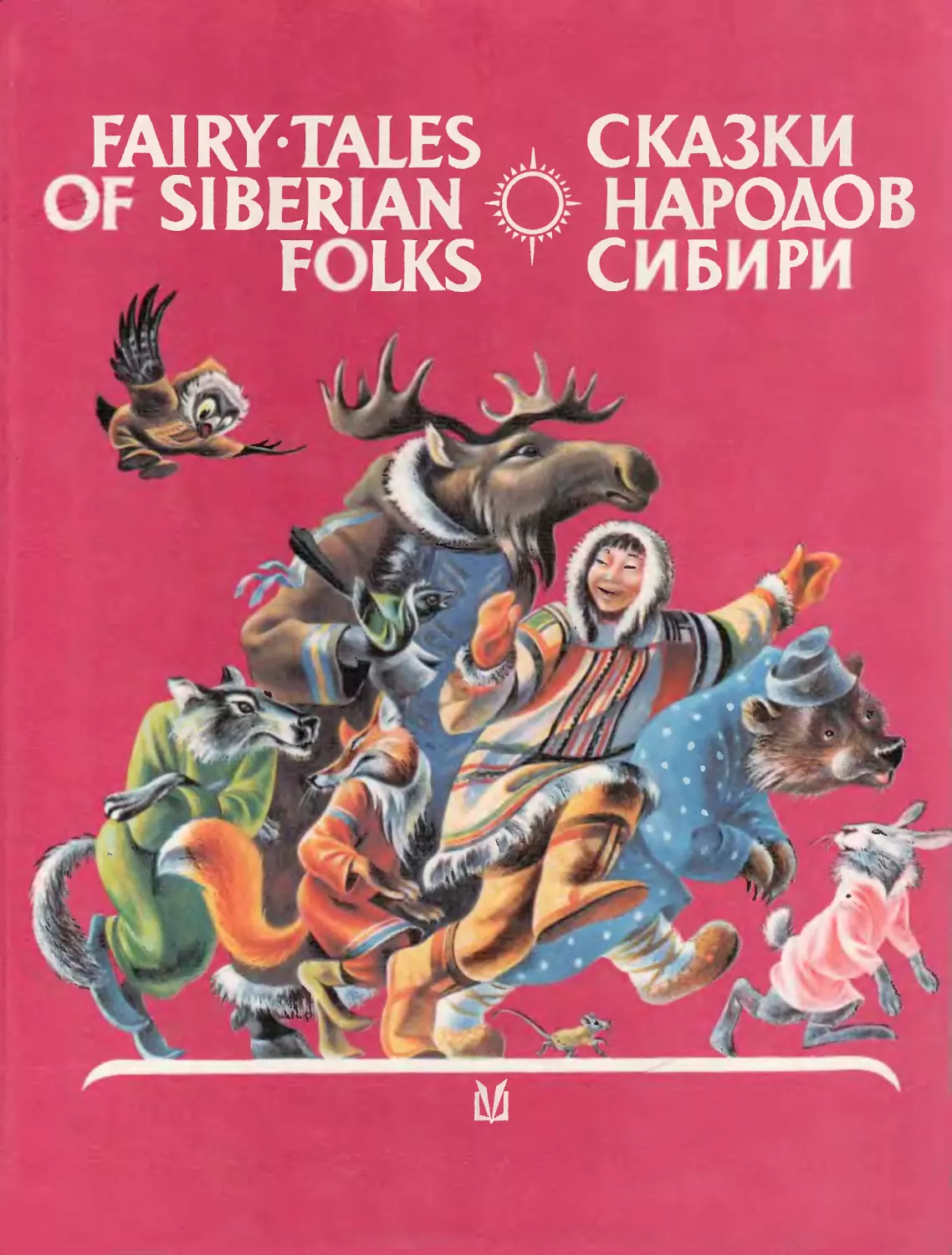
                    FAIRY- ES ..,. СКАЗ
SIBER О ' OAOB
F LKS ' С Б Р
Ы

Художники: В. В. Егоров, Л. А. Егорова
Design by Victor and Larisa Yegorov
Составитель Г. А. Сл ирнова Compiled by Galina Smirnova
Перевод на английский я -лс: О. В. Мязина, Translated by Olga Myazina
Г И. Щитникова and Galina Shchitnikova

FAIRY-TALES OF SIBERIAN FOLKS
▲
▲
V
4
w
A
♦
*
4
♦
V
*
\
Л
>
Ы&Л*. ЪЛ*ЪЛиЪЛиЪ.ЫЬ*)Ь*и
^fcJ^fefeJtJLJ^iL fe ^^Уу^у>у^^>,
Красноярск
Издательство «Витал»
1992
1?
Krasnoyarsk
Vital" Publishers
1992

9
# • • *
• • •
ДОРОГОЙ МАЛЫШ! . I
#♦
•
Хочешь ли ты узнать, почему звери дру
от друга отличаются и отчего Ворон — *
черный, а не белый? Почему Львы не живут
теперь в Сибири, а у Медведя нет большого
пальца? Или о том, какой костер разжег в
небе Сокол, как Муравей к Лягушке в гости
ходил, а маленький Комарик победил злого
духа — Чучунну? Ш *
Обо всем этом и о многом другом расска- *
жет тебе, дружок, эта книга. В ней *
собраны сказки и легенды о разных зверях,
птицах, насекомых, населяющих тайгу и
тундру. Такие сказки любят слушать и
читать, а то и сами сочиняют сибирские
мальчики и девочки.
Надеемся, что и тебе понравятся эти
сказки, а также картинки к ним, которые
дарят маленьким читателям красноярские
художники Виктор и Лариса Егоровы.
Всего хорошего тебе, дружок/
Издатели
т
•V
» • •♦ .
♦ •*• #
• • •• *
« • •

* »
DEAR CHILDREN!
#
Would you like to know why animals differ from
each other? Why the Raven is black and not
white? Why Lions don't live in Siberia any
more, and why the Bear has no thumb? Or how
the Falcon lit a fire in the sky, how the Ant
visited the Frog, and how the little Gnat
triumphed over the Evil Spirit—Chuchunna?
This book will tell you fairy-tales and legends
about various animals, birds, insects inhabiting
the taiga and the tundra. Siberian boys and girls
love listening to these stories and reading them,
sometimes they even make up their own tales.
We hope you will like these fairy-tales, too, as
well as the pictures by Victor and Larisa Yegorov
from Krasnoyarsk.
Happy reading!
The Publisher

ББК 84Р
С 42
ISBN 5-88054-003-0
© Составление, предисловие — Смирнова Г А., 1992
© Художественное оформление — В. В. Егоров, Л. А.
Егорова,1992
© Перевод на английский язык — О. В. Мязина, Г. И.
Щитникова, 1992
© Издательство «Витал», 1992
Compilation of text © Galina Smirnova, 1992
Layout and design © Yictor and Larisa Yegorov, 1992
Translation © Olga Myazina and Galina Shchitnikova, 1992
"Vital" Publishers ©, 1992

w • c/OOOOGOOOOG^ • 7 • • • ^>GX5O©0GGCv^ •
РУССКИЕ
'. f.
RUSSIAN

Русские люди живут в сибирских местах очень
давно — со времени покорения Сибири Ермаком,
Тогда же началась здесь история русского
фольклора — устного народного творчества,
О сказках русские говорят: «Не любо — не
слушай, а прослушал — намотай на ус». Та же мысль
звучит в стихах А. С. Пушкина: «Сказка — ложь, да в
ней намек — добрым молодцам урок».
Русские сказки о живой природе — это душа и
совесть народная, свод житейской мудрости на
каждый день. Они раскрывают понятия о добре и
зле, о красоте окружающего нас мира.
«\ #1 «\
Russian people settled in Siberia a long time ago — after
Yermak's subjugation of Siberia. That is when the history
of Russian folklore began.
Russians say about fairy-tales: "If you don't like it—
don't listen, if you do listen—don't forget it." The same
thought rings in Alexander Pushkin's verses: "Fairy-tales
are not true, but the hints in them can teach you a thing or
two.
Russian fairy-tales about Nature express a nations soul
and conscience. The essence of good and evil, the beauty of
the world around us are revealed in them.

ЖУРАВЛЬ И ЦАПЛЯ
THE CRANE AND THE HERON
Жили-были на болоте Журавль и
Цапля, построили себе по его концам
избушки. Журавлю показалось
скучно жить одному, и задумал он
жениться: «Дай пойду посватаюсь к
Цапле».
Пошел Журавль — тяп, тяп! Семь
верст болото месил; приходит и
говорит:
— Дома ли Цапля?
— Дома.
— Выдь за меня замуж.
— Нет, Журавль, не пойду я за тебя
замуж: у тебя ноги долги, платье
коротко, сам худо летаешь, и
кормить-то меня тебе нечем! Ступай
прочь, долговязый!
Журавль ушел домой не солоно
хлебавши.
Цапля после подумала и сказала:
— Чем жить одной, лучше пойду
замуж за Журавля.
Приходит к Журавлю и говорит:
— Журавль, возьми меня замуж!
— Нет, Цапля, мне тебя не надо!
Не хочу жениться, не беру тебя
замуж. Убирайся!
Цапля заплакала со стыда и
воротилась назад.
Журавль раздумался и сказал:
— Напрасно не взял за себя Цаплю;
Once upon a time there lived the
Crane and the Heron. They lived on the
same bog, but at the far ends of it. Once
the Crane, who lived all alone felt lonely
and decided to get married.
— I'll take the Heron as my wife, —
he thought and went to her.
He walked seven miles all through the
mud. When he came to the Heron, he
asked:
— Heron, are you in?
— I am.
— Will you marry me?
— No, I shan't. Your legs are too
long, your coat is too short, you can't fly
well, and haven't food enough for two.
Go away, you, leggy Crane! — she
answered.
The Crane went home his hopes
ruined.
The Heron gave it another thought.
— It's better to marry the Crane than
live all alone.
She hurried to the Crane and said:
— Crane, you may marry me!
— No, Heron. I don't want to marry
you. Go away! — the Crane answered.
The Heron went away, weeping and
ashamed.
The Crane thought:
v— I was wrong not to marry the

ведь одному-то скучно. Пойду теперь
и возьму ее замуж.
Приходит и говорит:
— Цапля! Я надумал на тебе
жениться, поди за меня.
— Нет, Журавль, не пойду за тебя
замуж.
Пошел Журавль домой. А тут
Цапля раздумалась:
— Зачем отказала? Что одной-то
жить? Лучше за Журавля пойду!
Приходит свататься, а журавль не
хочет.
Вот так-то и ходят они до сей поры
один к другому свататься, да никак не
женятся.
Heron. It's dull to live all alone. I'll go
and marry her right now. He came up to
her and said:
— Heron, I made up my mind to
marry you.
— No, Crane, I shan't marry you!
The Crane went away.
The Heron thought:
— I shouldn't refuse him. What's the
good in living alone? I'd better marry the
Crane.
She came to the Crane, but he didn't
want to marry her.
And to this day they visit each other
making proposals, but are not married
yet.
•»4ft

МЕДВЕДЬ И СОБАКА
THE BEAR AND THE DOG
Была у Мужика добрая Собака, да
постарела, перестала совсем лаять,
двор с амбарами сторожить. Жалко
стало Мужику кормить ее хлебом,
прогнал он Собаку.
Ушла она в лес, легла под дерево
помирать. Подходит к ней Медведь и
спрашивает:
— Ты что здесь лежишь?
— С голоду помирать пришла!
Видишь, какая нынче у людей правда:
покуда есть сила — кормят и поят, а
как пропадет сила от старости — так и
погонят со двора...
— Ничего, пойдем, я тебя
накормлю.
Пошли они. Попадается им
навстречу жеребец. Задрал его Медведь
и всего Собаке отдал.
Живет Собака, ни о чем себе не
тужит. А как съела все, как
проголодалась, так снова к Медведю
побежала.
— Ну что, все съела?
— Съела. Теперь опять голодаю.
— Зачем голодать. Знаешь, где
ваши бабы рожь жнут?
— Знаю.
— Тогда пойдем. Я подкрадусь к
твоей хозяйке, схвачу из зыбки
ребенка, а ты догоняй меня и отнимай его.
Once a Peasant had a Dog. The Dog
was good but so old that he had stopped
barking and guarding the household.
The Peasant turned the Dog out of
doors, begrudging him the very food he
ate.
The Dog went into the forest and lay
under a tree to die. A Bear came up to
him and asked:
— What are you doing here?
— I've come here to die of hunger.
People are ungrateful now: they give you
food if you are strong and healthy, and
turn you out of doors when you grow
old, — the Dog answered.
— Don't take it too much to heart.
Come with me, I'll give you some food,
— the Bear said.
So they walked together and met a
Foal. The Bear killed the Foal and gave
all the meat to the Dog.
The Dog lived in clover. But when
everything had been eaten he felt hungry
again and came running to the Bear.
— Have you eaten up all the meat? —
asked the Bear.
— Yes, I have, and feel hungry again.
— I can help you. Do you know the
field, where women are harvesting the
rye?
*— Sure I do.

I
a
*4,W
• 9
* 4
% *
s>i
<1 *■
>»
\
4
\
. v«
sr.

N
Ъ
1
\
4
1
\
*
4
*1'*
•
■4
«
V.
V
> , >
S

Как отнимешь да назад отнесешь, она
тебя снова примет и хлебом кормить
станет.
Так и сделали. Прибежал Медведь,
подкрался, унес ребенка из зыбки.
Ребенок закричал, бабы бросились за
Медведем, догоняли-догоняли, так ни
с чем и воротились. Мать плачет,
бабы тужат.
Откуда ни возьмись — Собака,
догнала она Медведя, отняла ребенка и
несет его назад.
— Смотрите, — говорят бабы, —
старая-то Собака отняла ребенка у
Медведя!
Побежали навстречу. Мать уж так
рада, так рада.
— Теперь, — говорит, — я эту
Собаку ни за что не покину!
Привела ее домой, налила молочка,
покрошила хлебца и дала ей:
— На, покушай!
А Мужику говорит:
— Нет, муженек, нашу Собаку
надо беречь и кормить, она нашего
ребенка у Медведя отняла. А ты
говорил, что силы у нее нет!..
«Спасибо Медведю, — думает
Собака, — не дал помереть с голоду!»
И стала она Медведю первым
другом.
• • • *>QQ(-X2®QQQsb •
— Let's go there. I'll steal up to your
former Mistress and take her Baby out of
its cradle. You must run after me and
snatch the Baby. When you bring it back
your Mistress will be only too happy to
invite you back, and feed you well.
They did as he said. The Bear stole up
to the Baby and took it out of the cradle.
The Baby began crying, the women ran
after the Bear, but couldn't catch him.
The Mother cried, the women became
very sad.
Suddenly they noticed the Dog
running after the Bear, grabbing the Baby
and running back to the women.
— Look! — they said. — The old Dog
has taken the Baby from the Bear.
The Mother was happy. She said she
would never abandon the Dog now.
She brought the Dog home and gave
him some milk and bread:
— Here you are, eat, please, — said
the Mistress.
And she said to the Peasant:
— No, my dear man, we have to
take care of our Dog and feed him, he
rescued our baby from the Bear. And
you've said he hasn't any strength left!...
— Thanks to the Bear, — the Dog
thought, — he didn't let me die of
hunger!
And he became the Bear's faithful
friend.

чайки и красавица ангара
the gulls and angara the beautiful
Подросла у седого Байкала кра-
_авица-дочь Ангара. От чужих
взглядов спрятал он ее глубоко в своих
волах, в стенах из скал. И решил
найти ей жениха поближе, чтобы не
оттекать в дальние края. Очень
-побил он дочку.
Выбрал Байкал в женихи соседа,
богатого и знатного Ирку та. Но не
нравился Иркут Ангаре. А тут к ней
Чайка прилетела, сказала:
— Я в Саянских хребтах была, над
Енисеем пролетала. Богатырь! Про-
гвал он горы Саянские, стремится к
.амому Ледовитому океану. Какой он
глльный и смелый.
— Какие глаза у него? — спросила
Ангара.
— Как изумруд-камень, как хвоя
-орного кедра под солнцем, —
ответила Чайка.
— Милая Чайка, — попросила
Ангара. — Передай мой привет
Енисею.
Полетела Чайка в Саяны к
Богатырю, передала привет байкальской
красавицы.
А Енисей уже слышал о чудесной
дочке Байкала от брата своего —
вольного ветра. И полюбил ее на всю
*изнь. Обрадовался Богатырь приве-
The grey-haired Baikal-lake had an
only daughter — the beautiful Angara-
river. He kept her deep under his waters
in a chamber surrounded by the rocks
and didn't allow anybody even to cast a
glance at her. He made up his mind to
find a bridegroom for her among his
neighbours, because he didn't want his
daughter to be carried far away from
him. He loved her so dearly.
Baikal chose for his daughter a rich
and noble bridegroom. It was his
neighbour — the Irkut-river. But
Angara the Beautiful refused to marry him.
Suddenly there appeared a Gull before
her and said:
— I have been to the Sayan
mountains and have flown all along the
Yenisei-river. Oh, how strong and
handsome he is! He got through the Sayan
mountains and is bound for the Arctic
Ocean. He is strong, and brave!
— What colour are his eyes?
— They are like emeralds, like
mountain cedars in the sunlight, — the Gull
answered.
— My dear Gull, — Angara said, —
send my greetings to Yenisei.
The Gull flew to the Sayan mountains
to the Yenisei-river and gave him the
greetings from Angara the Beautiful.

ту голубоглазой Ангары и решил во
что бы то ни стало увидеться с нею.
Наказал он крылатой вестнице-
Чайке:
— Передай красавице Ангаре: не
согласится ли вместе со мной уйти на
простор к Океану? Буду ждать ее до
утра на Стрелке.
Чайка передала призыв Богатыря,
и Ангара с радостью его приняла. Но
как убежать от зорких глаз злого
сторожа — Колдуна-ворона, которого
суровый Байкал поставил у скалистой
светлицы своей дочки?
Выручили красавицу братцы и
сестрички — ручейки и речки. Они
подмыли скалу — и вырвалась Ангара
на свободу. На крыльях ветра
полетела к Стрелке, где ждал ее желанный
Енисей. И Колдун-ворон не смог
помешать — заклевали его чайки.
Проснулся Байкал, да поздно было.
В ярости швырнул он огромный утес,
чтобы задержать беглянку. Но успела
Ангара грудью рассечь береговые
скалы и побежала дальше.
Чайки показали ей верную дорогу к
Стрелке.
Там, на Стрелке с нетерпением
поджидал Богатырь своенравную дочку
Байкала. И там слились навечно их
струи: голубая ангарская и зеленая
енисейская. Вместе привольно
понесли свои воды к могучему Океану
Ангара и Енисей.
Yenisei had already heard about
Angara, famous for her beauty. Free Wind
— his brother — told him about her.
And Yenisei immediately fell in love
with her. He sent his winged messenger
to ask Angara the Beautiful if she was
willing to run with him to the wide spaces
of the Arctic Ocean.
— I'll be waiting for her fill morning,
— said he.
The Gull conveyed Yenisei's proposal
to Angara the Beautiful and she
accepted it with joy.
But how could she escape the alert
eyes of her wicked guard — the Magician
Raven, who guarded her day and night
in her rocky prison? It was Baikal, her
severe father, who gave him orders.
But the Beauty's brothers and sisters
— brooks and small rivers — came to her
rescue. They washed out a way under the
rocks and Angara was set free. On the
wings of the wind Angara the Beautiful
rushed to the place, where her beloved
Yenisei was waiting for her. The
Magician Raven couldn't prevent her escape
because the Gulls pecked him
mercilessly.
Baikal woke up, but it was too late.
Mad with rage, he threw a large rock to
stop the fugitive. But Angara the
Beautiful managed to break through the cliffs
and ran further.
The Gulls showed her the way to
Strelka.

Л там, где вырвалась Ангара из тис-
в Байкала, до сих пор высится
a^ ан-камень, брошенный отцом
савицы. Говорят, если бы кто-
б\дь убрал отсюда этот камень, то
пь] Байкала вышли бы из берегов,
топили все вокруг.
С тех пор на веки вечные вместе
> сей и Ангара. Вольно бежать им
д ом русле сквозь тайгу и тундру
океанским просторам,
кружат Чайки над Стрелкой, охра-
т любовь красавицы Ангары и
гатыря Енисея.
Here the blue waters of Angara and
the green ones of Yenisei came together
and merged for ever and ever. Freely
and happily they went running together
to the mighty Arctic Ocean.
Just at the place, where Angara the
Beautiful set herself free from the gorge
of the Baikal-lake, the Shaman-Stone is
seen. Angara's father had thrown it over
there. They say, if the stone had been
removed, the waters of the Baikal-lake
could have overflown his banks and
submerged everything around.
The Gulls keep flying over Strelka,
guarding the love of Angara the
Beautiful and the mighty Yenisei.
V
Wfl£f-"-**
^ ^
<J0
4*

БЕЛКА И КЕДРОВКА
THE SQUIRREL AND THE NUTCRACKER
Поспорили Белка и Кедровка: кто
по осени больше орехов соберет?
— Я больше соберу, — сказала
Кедровка.
Белка рассердилась:
— Нет, я соберу больше!..
Летел мимо Воробей, удивился:
— Смешно ссориться, когда еще
никто ничего не собрал.
— И пр-р-авда! — согласилась
Кедровка.
— Подождем до осени, —
пропищала Белка.
Пришла осень. Еще красивее стала
тайга — как золотая. Кедры стоят в
осеннем уборе, как бояре в пышных
шубах. На каждой ветке — крупные
шишки.
Стала Белка прыгать с ветки на
ветку, спелые шишки собирать.
Обхватит шишку лапками, разгрызет
орешки — ив рот, ядрышко за
ядрышком. Вку-у-сно!.. Наелась
Белка и поскакала к ближайшему
дуплу. Там устроила склад на зиму.
Назавтра собрала ореховый запас на
другом кедре и заложила его в другое
дупло, послезавтра — в третье.
Тем временем и Кедровка не
ленилась. Насытилась орешками, а потом
натаскала орехов в своих защечных
A Squirrel and a Nutcracker were
arguing about who would gather more nuts
in autumn.
— I'll gather more nuts, — the
Nutcracker said.
The Squirrel got angry:
— No, I'll gather more.
A Sparrow flying by was surprised:
— Isn't it funny to quarrel, when
nobody has gathered anything yet?
— That's true, — the Nutcracker
agreed.
— Let's wait till autumn, — answered
the Squirrel in a tiny voice.
Autumn came. The taiga was still
more beautiful, as if made of gold. The
cedars in their autumn dresses looked
like boyars in splendid fur-coats. There
were big cones on every branch.
The Squirrel kept jumping from one
branch to another, gathering ripe cones.
She clasped a cone with her little paws,
cracked nuts and ate them one by one.
They were so tasty! She ate till she was
full and then skipped to the nearest
hollow and made a store for the winter
there. The next day she gathered a nut
store on another cedar and put it in
another hollow, on the third day — in a
third hollow.
The Nutcracker wasn't wasting her

N
■A
■■г **-
'л
^ t
***.
1 '

^
с/^ОООООООЭО0 • 20 • °O0O0COOGOGX^
^
мешочках в собственные кладовые —
в ямки в земле.
Обе трудились так усердно, что
забыли и про спор. Зато когда
наступила зима, никто не голодал, ни
Белка, ни Кедровка. Их кедровые запасы
помогли другим обитателям тайги.
Прилетел в холодный день
голодный Воробушек. Увидел в дупле
орешки, поклевал и согрелся.
Пришел Охотник с Мальчиком в
тайгу. Оба устали, проголодались.
Охотник нашел под снегом кедровкин
запас, взял немного орешков,
накормил Мальчика, и они дальше пошли.
В разные места занесли орехи
Кедровка и Белка. Теперь там
выросли молодые кедры. В их зарослях
поселились дети Кедровки и Белки.
Всем еды хватает.
time either. She ate till she was full and
then brought the nuts, using her little
cheeks like bags, to her own larders —
holes in the ground.
Both of them were working so hard,
that they forgot about their argument.
But when winter came, neither the
Squirrel, nor the Nutcracker were
hungry. Their stores of nuts helped other
inhabitants of the taiga.
One cold day a hungry little Sparrow
came flying. He saw some nuts in the
hollow, pecked at them and got warm.
A Hunter with a boy came to the
taiga. They were both tired and hungry.
The Hunter found the Nutcracker's store
under the snow and took some nuts, fed
his boy with them and they went farther.
The Nutcracker and the Squirrel kept
their nuts in different places.
Young cedars have now grown there.
^
\

%Ш^^Ш^^^^^^^^Гп^Ш!Ш^^^и^^^^^^^^
ТУВИНЦЕВ
t
TUVINIAN
ШПШГ-ТМЕ
£^SK*s£&*^^

«Послушать хорошую сказку — все равно что
выкупаться в горном роднике», — говорят тувинцы.
Они большие мастера народного творчества,
прекрасные сказители.
Тува, расположенная на высокогорном плато в
центре Азии, богата целебными источниками.
И фольклор тувинцев — это родник живой воды.
Тувинцы издревле отличные охотники, овцеводы,
звероводы. Высоко ценится их искусство в шитье
традиционной одежды, создании женских украшений.
They say in Tuva: "To listen to a kind and clever
fairytale is as good as to have a swim in a mountain spring"
Tuvinians are skilful in different handicrafts and folklore.
Tuva is situated on a high plateau in the centre of Asia
and is rich in sulubrious springs. Tuvinian folklore is like
another spring of reviving water.
Traditionally Tuvinians are good at hunting and
breeding cattle and sheep. They are especially skilful at making
folk dresses and ornaments for women.

XlJ
КАК ВЕРБЛЮД
СТАЛ НЕКРАСИВЫМ
HOW THE CAMEL
LOST HIS GOOD LOOKS
Говорят, когда-то давно Верблюд
был самым красивым животным. У
него были пышный длинный хвост и
красивые могучие рога.
Все звери завидовали Верблюду.
Многим из них хотелось бы
заполучить такой же хвост, какой имел
Верблюд, или такие рога, как у него.
Верблюд знал об этом и говорил
горделиво:
— Таких рогов и такого хвоста, как
у меня, нет ни у кого в мире!
Но лучше бы он не гордился и не
хвастался этим.
Однажды он подошел напиться к
реке и повстречал Марала. Марал
сказал Верблюду:
— Я иду на праздник, одолжи мне
твои рога, братец!
Верблюд согласился.
В тот же день встретился ему Конь
и попросил:
— Я иду на праздник, одолжи мне
твой хвост, братец! Я верну.
Верблюд опять согласился и
остался ждать на берегу.
Марал и Конь ускакали.
В ожидании их Верблюд целый день
пил воду и глядел на дорогу.
They say that long, long ago the
Camel used to be one of the most
handsome animals. He had a long fluffy tail
and nice and mighty horns.
All the animals in the forest and the
steppe were envious of the Camel. Many
of them wanted to have the kind of tail
that the Camel had, or the kind of horns
he had.
The Camel knew of this and said
proudly:
—You won't find the kind of tail T
have, or the horns, anywhere else in the
world!
But it would have been better if he had
not boasted.
Once he came up to the river to have a
drink of water and there met a Maral.
— I'm invited to a party. Will you
lend me your horns, just for a while? —
asked the Maral.
The Camel lent him his horns.
Later on that very day the Camel met
a Horse.
— I'm invited to a party, — said the
Horse, — will you lend me your tail?
The Camel agreed and stayed on the
bank of the river.
The Maral and the Horse ran off. All
p
ч

Но ни Коня, ни Марала не увидел.
Марал обманул Верблюда, ускакал
в тайгу и перестал выходить в, степь.
Чужие рога навсегда прижились у
него.
Конь, который обманом взял хвост,
пугливо убегает прочь, едва завидит
Верблюда.
А Верблюд с тех пор стал самым
некрасивым и сердитым животным.
V
\
\ Л
♦ ]>
)}^й?зйя^5!^!!г^
j
day long the Camel was drinking water
and looking up the road while waiting for
them. But there was no sign either of the
Maral, or of the Horse.
The Maral had deceived the Camel
and skipped over to the taiga. He stayed
there for ever and never went out into
the open steppe. He got accustomed to
the horns as if they were his.
The Horse never gave back the
borrowed tail and when he comes across the
Camel, he gets frightened and runs
away.
That is how the Camel lost his good
looks and sweet temper.

V.
ЛЕНИВАЯ СОВА
THE LAZY OWL
^
Жила в зеленом лесу серая Сова.
Была ленивой-преленивой. Ей даже
1ень было перелететь с дерева на
дерево.
Как-то теплым днем она сидела в
дремоте на лиственнице. Подлетел к
ней пестрый Дятел и застучал по
дереву. Проснулась Сова, встряхнула
помятыми крыльями и спросила
сонным голосом:
— Что ты, Дятел, шумишь — спать
мне не даешь?
— Разве ты не видишь? —
удивленно посмотрел на нее Дятел своими
пазами, похожими на просяные
зернышки. — Еду себе добываю.
— Ты что, не мог другого места
найти? Убирайся отсюда! —
прикрикнула на него Сова.
— Все трудятся, одна ты спишь.
Хотя бы гнездо себе сделала! —
сказал Дятел и улетел прочь.
Уселась Сова поудобнее и только
было заснула, как снова услышала
шум. Это Сорока подлетела к
лиственнице и стрекочет над самым
ухом. Закричала на нее Сова, а та не
испугалась и говорит ей бойко:
— Почему ты все спишь?
Посмотри кругом — все птицы хлопочут, у
каждой свое дело: кто птенцов кор-
Once upon a time there lived a grey
Owl in a thick green forest. The Owl was
so lazy that she even didn't bother to fly
from one tree to another.
One warm day she was fast asleep in a
larch-tree when a Woodpecker flew up
quite near and began pecking this very
tree. The Owl woke up, shook her
crumpled wings and asked in a sleepy voice:
— Why are you so noisy? You awoke
me, wicked Woodpecker!
— Can't you see? — answered the
Woodpecker, looking at her in
amazement with his eyes, as small as millet
grains, — I am feeding myself.
— Can't you find another place? Get
lost! — cried the Owl.
— Everybody has so much to do, only
you are idle all the time, — said the
Woodpecker and flew away.
The Owl had settled comfortably on
her branch and almost fell asleep again
when she heard the dreadful noise
the Magpie made, chattering just near
her.
The Owl scolded the Magpie but in
vain. The Magpie was not afraid and
answered arrogantly:
— Why are you always sleeping?
Look around! All the birds are far too
busy to sleep. Some are feeding their
p
^^^^^^^^^^^^^^^^^^^^^^^^^^^^J
^

■yz*y^^^^^^^<z?r^r=?c=z</ 26 j^s^^^^^^^^!^^^^^;
^
\ • *
^
Г
,^^^^^^^^^^^^^^^5^Р^^^^^^^^ШШШ^

мит, кто гнездо вьет. Никто не спит,
все работают.
Не дождалась Сорока ответа от
Совы и полетела дальше новости
лесные собирать.
Опять задремала Сова, вдруг
слышит, как над ее головой кто-то
летает. Оказывается, это маленькая
птичка пух тополиный себе в гнездо
собирает. А кругом птицы снуют,
кузнечики звенят, мошки жужжат.
Стыдно стало Сове, и решила она,
как придет другой день, за гнездо
приняться.
Наступила ночь. Была она очень
холодной. Сова дрожала и плотно
прижимала крылья к телу. Вспомнила
она о теплом гнезде Синички — вот
бы в таком поспать.
Длинной была холодная ночь. Даже
глаза бесчисленных звезд неба
замерзли и потускнели от холода. Всю
ночь Сова мерзла и поджидала
восхода Солнца.
Наконец Солнце взошло и согрело
ее. Разомлела Сова от тепла и сладко
заснула.
Так проходил день за днем, а гнезда
себе Сова так и не свила из-за своей
лености.
nestlings, others collecting bedding for
their nests.
Before the Owl had time to answer
her, the Magpie flew away to the forest
— to listen to local gossip which she
loved dearly.
The Owl was at the point of falling
asleep once again when she heard
somebody flying just over her head. It turned
out to be the small Tomtit who was busy
collecting poplar down for his nest.
The Owl watched for some time the
birds flying, grasshoppers chirping,
swarms of midges buzzing. She felt
somewhat ashamed and thought:
— I'll get around to building my nest
one day.
Night fell. There was quite a nip in the
air. The Owl shivered and tried to get
warm pressing her wings tight to her
body. She remembered the Tomtit's
warm nest. She wished she could sleep in
such a nest.
The night seemed very long and cold.
Even the eyes of hundreds of stars in the
sky looked frozen and dim. The Owl felt
she would die of cold while waiting for
the crack of dawn. The sun rose at last
and everything got warm. The Owl felt
snug and warm and fell asleep.
That is how one day followed the
other but the lazy Owl never built her
nest.

f( 28 )^^^^^^!^^^^!^^^S^y
ГЛУХАРЬ И СЕЛЕЗЕНЬ
THE WOOD-GROUSE AND THE DRAKE
Давным-давно это было — Глухарь
и дикий Селезень жили вместе. Когда
становилось холодно, Селезень
улетал в теплые края.
Настала снова осень, и Селезень
опять отправился далеко на юг.
Глухарь, плача, летел следом за
ним. От слез и холода у бедного
Глухаря глаза опухли и покраснели.
Пожалел его Селезень, нащипал из
своей шеи синих перышек, а из-под
крыльев — белого пуха и укутал его.
С тех пор у Глухаря оперение стало
как у Селезня — синее на шее и белое
под крыльями.
Once upon a time a Wood-Grouse and
a Drake lived together. When it got cold
the Drake would fly to warmer lands.
The Wood-Grouse would fly after him
weeping bitterly. Because of the cold
and his tears, his eyes would swell and
turn red.
The Drake felt sorry for his friend. He
plucked some blue feathers from out of
his neck and some white down from
under his wings and wrapped up the
Wood-Grouse to make him nice and
warm.
Since that time the Wood-Grouse has
had the same plumage as the Drake —
blue on the neck and white under the
wings.
\
„<-
*

/?S^2^w^fr^^
ф
ОТЧЕГО У ЛОСЯ
МОРДА ВЫТЯНУТАЯ
WHY THE ELK HAS
A LONG MUZZLE
Однажды Лось и Пищуха — суслик
таежный — поспорили. Пищуха
говорит:
— Надо удлинить лето в два раза.
Лось возразил:
— Э-э, нет! Мне лето не нравится.
Летом много комаров, мошек и очень
жарко. Надо сделать так, чтобы его
совсем не было. Тогда будет хорошо.
Пищуха ответила ему:
— А если все время будет зима,
тогда снег засыплет тебя. Ты не
сможешь быстро ходить, и человек убьет
тебя.
— Ах ты негодная! Меня убить? —
возмутился Лось и наступил на нее.
Пищуха с трудом вырвалась и
юркнула в норку. Только ее хвост остался
у Лося под копытом. Лось сердито
надулся, вытянул морду и уставился
на нору. Стал он ожидать, когда
Пищуха покажется. Да так и не
дождался.
Уже и лето прошло, а Лось все ждал
напрасно Пищуху. Пищуха не хотела
больше встречаться с Лосем, чтобы
он ее не обидел.
А Лось все ждал у норки.
Закончилась дождливая осень. Зима насту-
Once an Elk was arguing with the
Squeaky taiga Gopher.
The latter said:
— Summer should be two times
longer than it is now.
The Elk disagreed very strongly with
her.
— Oh, no! I don't like summer at all.
It is too hot and there are much too
many gnats and midges in summer.
There should be no summer at all. It
would be much better.
The Squeaky Gopher answered:
— If winter lasted all year round there
would be so much snow that you
wouldn't be able to ran quickly. And
Man would be sure to kill you.
— Kill me?! You rascal! — the
indignant Elk trod on the Gopher, but she
managed to escape and hide herself in
her hole. Only her tail was left under the
Elk's hoof. The Elk, sulky and angry,
stretched his muzzle and fixed his eyes at
the hole. But the Gopher never
appeared.
Summer had passed but the Elk still
waited for the Gopher. But the latter
didn't want to meet with the Elk any
rhore, so that he wouldn't be able to of-
p
^

пила и засыпала все вокруг снегом. И
снова потом зашумела весна,
приближалось лето.
Только тогда понял Лось, что не
выйдет Пищуха с ним спорить, и
пошел восвояси.
И с тех пор его морда стала
вытянутой и надутой.
А Пищуха осталась с коротким
хвостом.
/й-
^
)^iS^^I^Жi2йi^Sw^^^55i2^Sйa,
fend her, again. And the Elk kept
waiting by the hole. Rainy autumn had
ended. Winter came along and covered
everything with snow. And now again
noisy spring had arrived, and summer
was approaching.
Only then did the Elk understand that
the Gopher wouldn't come out to argue
with him, and he left.
Since that time the Elk's muzzle is
long and sulky, while the Squeaky
Gopher's tail is short.

►X JX X<
*х<5*>:е>х<1хж>х<ж>;е>х jx х<^*та*<^^>х<51»д>хЕ
ЭВЕНКОВ
EVENK
КЯ»Х2>Х<^»Д>Х<Ж>т^У<гге^Т7>Х<53»^

«Наш дом — под Полярной Звездой», — говорят
эвенки. Сурова и прекрасна природа тундровых и
таежных просторов, где живет эвенкийский народ: в
Эвенкии и Прибайкалье, в северной Якутии и на
Дальнем Востоке.
Традиционные занятия эвенков — пушной
промысел, оленеводство, рыболовство. Богато их
народное творчество. Их сказки, легенды, предания —
жемчужины народной поэзии.
Т/1
K*N
К*У1
.*N
"Our home is just under the North Star" — Evenks say.
The Nature of the spacious taiga and tundra is both
strikingly beautiful and severe. Evenks live in Evenkia, near the
Baikal, in northern Yakutia and the Far East.
Traditionally Evenks are engaged in hunting, deer-
breeding and fishery. Their folklore is immensely rich.
Their fairy-tales, legends, stories are real pearls of folk
poetry.

^x<2xoz>>x<ZK<>ii>xc3K>Z2>;
[<£L«52>X<3L<>iaX^
КАК ЛИСА
ОБМАНУЛА СТАРИКА
HOW THE FOX
CHEATED THE OLD MAN
Говорят, давно это было. Лиса
тогда как Человек разговаривала.
Вот однажды она к одному Старику
пришла. У этого Старика только
Старуха глухая была. Ни сына, ни дочери
у него не было.
Лиса пришла и говорит:
— Пришла наняться в работницы.
Оленей умею пасти.
Старик поверил ей и нанял в
пастухи.
Лиса погнала стадо подальше от
становища и пасет там один месяц,
другой месяц, третий месяц. На
четвертый месяц приходит к Старику
и говорит:
— В гости пришла. Оленей там
оставила, отдыхают. Хорошо пасла
оленей. Очень жирные теперь.
Обрадовался Старик и пошел
посмотреть оленей. Пришел к тому
месту, где Лиса оленей пасла, а там
одни кости валяются.
Всех оленей Лиса съела. Старик
домой бежит, руками Старухе машет,
кричит, чтоб она Лису поймала.
Старуха не слышит, что Старик
кричит ей, Лису спрашивает:
— Что говорит Старик?
They say it happened long ago, when
Foxes could speak.
Once the Fox came to the Old Man,
who lived with his old, deaf wife. They
had no children.
The Fox said:
— You may hire me. I'll be a good
shepherd for your deer.
The Old Man hired him on trust.
The Fox drove his deer far away and
kept them in the tundra for three
months. On the fourth he came to the
Old Man and said:
— I've come alone to visit you. The
deer are resting. I was shepherding them
very well. They are fat now.
The Old Man was glad and went out to
have a look at his deer. In the pasture he
saw nothing but their bones — the Fox
had eaten his deer. The Old Man ran
home shouting and showing with
gestures that he wanted his wife to catch the
Fox. The Old Woman couldn't hear and
asked the Fox:
— What is he saying?
The Fox shouted right into her ear:
— He wants you to give me a big
piece of fat for my good work and to be
quick about it.
gS£«E>X<Sg*^*g^
%

:#|^У2*^уж^1^>кж:к^У5д^^^ч^а^^^^
Лиса в самое ухо кричит Старухе:
— Старик говорит, чтоб ты мне
сала большой кусок дала за то, что
оленей хорошо пасла. А еще кричит,
чтоб ты быстрее дала сало.
Старуха дала Лисе кусок сала. Лиса
убежала в тайгу так быстро, что
Старик не успел ее поймать.
Так Старик со Старухой без оленей
остались. Вот так Лиса их обманула.
Having got the fat, the Fox
disappeared into the taiga so quickly that the
Old Man failed to catch him.
That's how the Old Man and his wife
lost their deer.
That's how the Fox cheated them.

ПОЧЕМУ КАРАСЬ
СТАЛ ПЛОСКИМ
WHY THE CRUCIAN
BECAME FLAT
Однажды Сохатый ходил по берегу
реки и у самой воды пощипывал
сочную траву. Карась увидел Сохатого,
подплыл к берегу и давай дразнить:
— Уши длинные, ноги длинные, а в
воде не плавает!
Сохатый рассердился, ударил по
воде ногой, и Карась на суше
оказался.
Карась на суше задыхаться стал,
испугался и стал упрашивать
Сохатого:
— Пить хочу! Жабры мои засохли.
Умираю без воды!
Пожалел его Сохатый и сбросил в
воду.
Ожил в воде Карась и опять начал
дразнить:
— Уши длинные, ноги длинные, а
плавать не умеет.
Сохатый еще больше рассердился и
так ударил ногой по воде, что Карась
опять на берег вылетел.
И опять Карась начал задыхаться и
просить Сохатого:
— Жабры мои засохли! Пить хочу.
Умираю. Не буду больше дразнить!
И на этот раз Сохатый пожалел его
и сбросил в воду.
Once upon a time the Elk was walking
along the bank of the river nibbling
grass. The Crucian saw him, swam
nearer and began teasing him.
— You have long ears and long legs,
but you can't swim.
The Elk became angry and banged the
water with his leg, that the Crucian
jumped out of the water and fell on the
grass, gasping. He was afraid and began
to cry:
— My gills are drying up. I'm thirsty.
I am dying.
The Elk felt pity for the Crucian and
threw him into the water.
In the wated the Crucian came to life
and again began teasing the Elk:
— You have long ears and long legs,
but can't swim.
The Elk got still angrier and
kicked the water again. And again the
Crucian flew out of the water and fell on
the grass.
Gasping he began to cry:
— My gills are getting dry. I'm
thirsty. 1 am dying. I promise not to
tease you any more.
The Elk threw him back into the river
again.
K3»12>X<g^^X^*;^X<SS^^
^

^Х<53»Е>Х<Ш>ХЭХСЖЕ2>:
:<^oz>x<ZK<^>x<ZKo^2>xc
Г
Шлепнулся Карась боком об воду и
совсем плоским стал.
С того дня Карась очень боится
Сохатого. Под водой он построил из
травы чум, и когда Сохатый приходит
на берег покормиться сочной травой,
прячется в свой чум и молчит.
The Crucian bumped against the water
sideways and turned flat.
Since then the Crucian is afraid of the
Elk. The Crucian's dwelling place is
under the water and when the Elk comes
to the bank of the river to nibble some
juicy green grass, the Crucian hides
himself quickly in his hole and keeps silent.
(3
4
"Л

>х<5&ж>х<д<>хэхстсаЕ>:
4Efc
:<~iox>x<iioz>x<iio^>xc
J
. *t
*V .*
*
it
44
X
^
KSStJ^XSS* » «.♦»X< v-
«еэя
r%

ЦЕНА ИГОЛКИ
THE PRICE OF THE NEEDLE
По тайге кочевал один эвенк с
семьей. Имел он жену, ребенка и оленей.
Вот они остановились на берегу
большой реки. Оставив семью и
оленей, эвенк ушел на рыбалку. Рыбачил
далеко от чума. Когда добыл рыбу,
возвратился домой. Заходит в чум,
видит, что жена его плачет,
спрашивает:
— Почему плачешь?
Жена отвечает:
— Чангиты всех оленей угнали. Я с
ребенком в тайге спряталась, потому
не убили.
Муж говорит:
— Ох, как ты меня напугала. Я
думал, ты потеряла иголку.
В старинные времена в семье
эвенков женщина имела только одну
иголку. Если ее теряли, то нечем было
шить одежду, и вся семья погибала.
Так дорого у эвенков стоила тогда
иголка.
An Evenk and his family spent their
life wandering about the taiga. He had a
wife, a baby and many deer. One day
they settled on the bank of a big river.
He left his family and deer for some time
and went fishing far away. Having
caught enough fish, he returned home.
He found his wife crying and asked:
"Why are you crying?"
She answered: "There were robbers
here and they stole all our deer. They
didn't kill me because I hid myself and
the baby in the taiga"
Her husband said: "Oh, you, woman.
You really frightened me. Just fancy, I
thought, you had lost the needle.
In the old days a woman could have
only one needle for the whole family. If
it was lost, they couldn't sew any clothes
and it meant death for all the family.
That was the price of the Evenk
needle in the old days.

>X<I^>^Z>X<ZKOX>>X<ZK<^>
:<^^2^X<^^2DX<S^23«
ПОЧЕМУ У МЕДВЕДЯ
НЕТ БОЛЬШОГО ПАЛЬЦА
WHY THE BEAR
HAS NO THUMB
Давно это было. Тогда жизнь на
земле только начиналась. Много
было в тайге зверей, птиц и разной
другой живности.
Хозяином был самый сильный из
всех зверей — Медведь. Он никого не
боялся, кроме Человека. Много раз
Медведь с ним бился и не смог
победить.
Это рассердило Медведя. Как это
так, он, Медведь, такой большой и
могучий, не может победить
маленького Человека! Почему? Наверно,
потому, что у Человека есть большой
палец на руке, а у Медведя нет
большого пальца на лапе.
«Попрошу-ка я, — подумал
Медведь, — у доброго духа Хэвэки
большой палец для себя. Тогда стану
сильнее Человека».
Однажды Медведь пришел к
Хэвэки и говорит:
— Добрый дух Хэвэки, у меня нет
большого пальца. Пусть у меня будет
большой палец, как у Человека.
Хэвэки ответил ему:
— Ты самый сильный из всех
зверей. Зачем тебе большой палец? Если
я дам тебе большой палец, то ты
Long, long ago, when life on the Earth
had just begun, the taiga abounded with
animals, birds and other living things.
The Bear, the strongest among the
animals, was their Headmaster. He was
afraid of nobody but Man. Many times
he fought with him but couldn't win a
victory.
That angered the Bear. How was it that
he, the Bear, so big and mighty, was
unable to win over a little Man! Why? Most
likely, because the Man had a thumb on
his hand, while the Bear had no thumb
on his paw.
—I'll go and ask for a thumb for
myself from that kind spirit Heveki,—he
thought. —Then I'll be stronger than the
Man.
Once the Bear came to Heveki and
said:
— Heveki, you are kind and merciful.
I have no thumbs. Let me have the same
thumbs as the Man has.
Heveki answered:
—You are strongest among all the
animals. Why do you need any thumbs? If I
gave you thumbs you would kill all the
people.
The Bear thought a little and said:
&^<>11>Х<^ьтуж<^<>тр>^^
ч»

^x<^»^z>x<ixoxz>x<isg2>:
победишь весь род человеческий.
Медведь подумал и говорит:
— Этого я и хочу — победить
Человека. Самым сильным хочу быть на
этой земле.
На это Хэвэки ответил:
— Я дам тебе большой палец, а
Собаке — другу и помощнику
Человека — дам лук и стрелы.
— Если дадите Собаке лук и
стрелы, — говорит Медведь, — то она за
один год прикончит весь медвежий
род. Я хорошо знаю Собаку. Лучше
буду ходить без большого пальца.
Так Медведь остался без большого
пальца.
■Л ^ *
— That's what I mean. I want to be
the strongest on the Earth.
Heveki answered:
—Well, Г11 give you thumbs. But then
I'll give the Dog, Man's best friend and
his helper, bows and arrows.
— If you give the Dog bows and
arrows, he will kill all the Bears in one
year. I know Dogs quite well. I would
rather live without thumbs.
That's why the Bear has no thumb.

*х<1Юе>х<д<>:е2>х<же2>:
:<iKO2i>x<3<>z>xcK0i2>
^
ЛЕБЕДЬ И ВОРОН
THE SWAN AND THE RAVEN
В давние времена это было, когда
Хэвэки создавал все живое на Земле.
Много птиц уже плавало и летало,
много зверей обитало в этих краях. А
в один какой-то день Хэвэки сотворил
белых лебедей.
Увидел Харги белых лебедей и
захотел сотворить свою белую птицу.
Долго лепил он белую птицу, но она
получалась некрасивой и не умела
плавать, и Харги подбросил ее
лебедям.
Лебеди увидели белую птицу,
подумали, что это тоже лебедь, и приняли
в свой род.
Вот прошло какое-то время, и один
молодой Лебедь решил жениться. Он
собрал весь свой род на свадьбу.
Белую птицу Харги тоже позвал.
На столах было много разной еды,
но вся она была из травы.
Лебеди едят, а белая птица Харги не
может есть траву.
Она пошла к чумам людей, нашла
выброшенное мясо и, к большому
удивлению лебедей, начала его есть.
Когда лебеди покушали и вышли на
поляну танцевать, к ним прибежал
маленький Лебедь и сказал, что одна
белая птица ест гнилое мясо. Лебеди
начали уходить со свадьбы.
Long ago, when Heveki was making
every living thing on the Earth, many
birds and animals were created in these
lands and among the last he created the
White Swans.
When Khargi, The Enemy, saw them,
he decided to make a White Bird of his
own. It took him much time, but his Bird
looked ugly and couldn't swim. Khargi
pushed him stealthily into the flock of
Swans.
When the Swans saw the White Bird
they took him into their family.
Time passed and one Swan decided to
get married. All the Swans of his family
gathered at the wedding feast. The
White Bird was invited too.
The tables were loaded with dishes
made of grass.
The Swans were eating helping
themselves, but the White Bird couldn't eat
any grass. So he went out, found a piece
of meat, and began eating it greedily.
A young Swan saw him, came running
to the Swans dancing after dinner and
told them about the White Bird eating
rotten meat. The Swans left the
wedding.
The Leader of the Swans went to
Heveki and said:
— One of the Swans was eating rotten
^№S»X3X<£3fr2^

^X<G^E>X<II<>XZ>X<IK<>XS>X42 Х<^1ЭХ<^ДаХ<5£»Д2>Х*1у
***
^
s t*«
• . •
<!Л^ в,
V
с л • тс
# ♦ ■ V * • *
si
ECT»XfrX<g?*y^Xg?X^^X<SSSZE>X<Si«>^
%

А лебединый Вождь пришел к
Хэвэки и сказал:
— Один наш Лебедь ел на свадьбе
гнилое мясо. Мы не можем его
держать в своем роду. Пусть он уходит от
нас.
Хэвэки сказал:
— Правильно. Его сделал Харги.
Пусть он не будет Лебедем. Пусть он
будет Вороном и навсегда покинет род
лебедей. За то, что он ел гнилое мясо
на свадьбе, пусть с этих пор он будет
черным, и пусть всю жизнь очищает
землю от гнили.
«Так Ворон стал черным. С тех пор
он ест только гнилое мясо — очищает
нашу землю и сохраняет природу. И
петь Ворон не умеет, а только
каркает, потому что его создал злой дух
Харги», — так говорят старые люди.
:o<>:EZ>XQozz>xaoz>>xc
meat, he can't live in our family. Let him
go away.
Heveki said:
— How right you are. He was made
by Khargi. He is no Swan. He'll become
the Raven and have to part with the
Swans forever. He is doomed to be
black, and to clean the Earth from any
rot.
That is how the Raven became black.
Now he eats only rotten meat — cleans
our Earth and keeps Nature safe.
The Raven can't sing, he only croaks
— because he was made by Khargi, The
Enemy.
That is what the old folk say.
*.

ХИТРАЯ ЛИСА И ДЯТЕЛ
THE CUNNING FOX AND THE WOODPECKER
Жила в этих краях очень хитрая
Лиса. Однажды она пришла в чум к
Старику со Старухой и говорит:
— Детей у вас нет. Я хочу быть
вашей дочерью.
Старики приняли Лису. Живет она в
чуме один месяц, другой. Лето теплое
подошло.
Вот Старик говорит Старухе:
— Надо нам на другой берег
перебираться. Летом там сухо, в тайге
зверя и птицы много, охотиться
будем.
Старики сложили свои вещи в
лодку, попросили Лису, чтобы она на
другой берег их переправила.
Лиса согласилась перевезти вещи,
села в лодку и поплыла. На середине
реки она положила весло и поплыла
по течению все дальше и дальше.
Старик со Старухой догадались, что
Лиса от них убегает, начали плакать.
Дятел увидел, что они плачут,
спрашивает:
— Почему плачете?
Старик рассказал Дятлу:
— Лиса попросилась в дочери.
Теперь вот надумали переехать на тот
берег. Сложили в лодку вещи и
попросили Лису перевезти эти вещи, а она
села в лодку и уплыла.
Once upon a time there lived a very
cunning Fox. One day she came to an
Old Man and an Old Woman and said:
"You have no children. I want to be your
daughter."
The old people took her into their
family and they began to live together.
Soon the warm summer came. One
day the Old Man told his wife: "We are
going to cross the river. In summer the
other bank is dry, and the taiga abounds
in animals and birds. We'll have good
hunting there."
They asked the Fox to take their
things across the river.
The Fox sat in their boat and started
rowing, but in the middle of the river she
stopped rowing and let the boat go
farther and farther down the stream.
The Old Man and the Old Woman
guessed that the Fox had played a dirty
trick on them and began to weep.
A Woodpecker saw them and asked:
"Why are you weeping?"
The Old Man answered: "The Fox
lived with us as our daughter. We
wanted to move to the other bank of the
river and asked the Fox to take our
things across the river. She sat in the
boat with our things and went away."
The Woodpecker listened to the Old
\ХЯЮЕ2>Х^*УУ>*^^^Х<^^
^

^x<zx»2z>x<zx<>x^>x<3:<jg2>;
Выслушал Дятел Старика и полетел
догонять Лису.
Летел Дятел и думал:
«Какая хитрая и вредная эта Лиса!
Всегда всех обманывает, за чужой
счет хочет прожить. Даже Старика не
пожалела. Ну погоди же,
Лиса-негодница! Вот догоню — наказать тебя
надо. Вот посмотришь, как других
обманывать!»
А Лисы все не было видно. Далеко
успела она убежать.
Долго летел Дятел. Вот догнал
Лису и говорит:
— Я долго летел. Устал очень.
Разреши в лодку сесть, отдохнуть.
Лиса разрешила Дятлу сесть в
лодку.
Сел он в лодку, незаметно дырку в
днище продолбил и говорит:
— Вода в лодку течет. Давай к
берегу пристанем и починим лодку.
Вот причалили к берегу. Дятел
пошел в тайгу смолу собирать, а Лиса
в лодке осталась. Принес Дятел одну
кору да сучки, а смолу спрятал.
Лисе Дятел сказал:
— Не нашел смолу. Искать как —
не знаю.
Лиса сама пошла искать смолу.
Как только Лиса ушла, Дятел
засмолил лодку и поплыл к Старику
со Старухой.
Прибежала Лиса, начала плакать и
кричать, что Дятел лодку с ее вещами
Man and flew after the Fox, to catch her
up.
While flying the Woodpecker thought:
"How cunning and bad that Fox is!
She's always fooling everybody, wanting
to live at someone else's account. She
didn't even take pity on the Old Man.
Well you just wait, you depraved Fox!
I'll catch up with you — and teach you a
lesson. Let's see how you'll fool
somebody else then!"
And still there wasn't a Fox in sight.
How far she had got to.
He flew for a long time. At last he saw
the Fox and said: "I am very tired. May
I rest in your boat?"
The Fox allowed him to sit in the boat.
Imperceptively the Woodpecker
pecked a hole in the bottom of the boat
and said: "This boat has a leak. Let's
make a stop and repair it."
They moored and the Woodpecker
went to the taiga to look for some resin,
while the Fox stayed in the boat.
The Woodpecker brought some bark
and knots but kept the resin hidden. He
said to the Fox: "I haven't found any
resin. I don't know where to look for it."
The Fox herself went to the taiga to
look for resin.
The Woodpecker quickly covered the
hole with resin and rowed off the bank.
The Fox came running and began to
cry and shout that the Woodpecker had
robbed her of her boat and things. But
Ъ13&11>Х^**УЖЪ<>72^^
%.

>хс1ЮЕ>х<11сдэх<заЕ2>:
<jLOTyX<ZLOX^X<ZLOII>X^
#
украл. Но кто теперь хитрой Лисе
поверит?
Дятел приплыл к Старику со
Старухой и отдал лодку. Обрадовались они,
что Дятел им вернул их добро. Старик
за это выковал Дятлу железный клюв
и когти, а Старуха сшила красивую
красную шапочку.
Вот с тех пор у Дятла клюв
крепкий, когти острые, а шапка —
красная.
who would believe the cunning Fox?
The Woodpecker returned the boat to
the old people. They were happy to get
their property back. The Old Man
forged an iron beak and claws, his wife
made a nice red cap.
Since that time the Woodpecker has a
strong beak, sharp claws and a red cap.
«♦ *

/к
♦♦♦♦♦♦♦♦♦♦♦♦♦♦♦♦♦♦♦♦.^^-.♦♦♦♦♦♦♦♦♦♦♦♦♦♦♦♦♦♦♦*
СЕЛЬКУПОВ
SELKUP
ШЩГ°ТМ1Е
♦♦♦♦♦♦♦♦♦♦♦♦♦♦♦♦♦♦♦♦♦♦♦♦♦♦♦♦♦ ♦♦♦♦♦♦♦♦♦♦♦♦♦♦

Сказки селькупов — гимн красоте Человека и
Природы. Селькупы поклоняются Земле-Матери и
воспевают ее в многочисленных легендах и сказаниях.
Живут селькупы в северных районах
Красноярского края, Тюменской и Томской областей, Ямало-
Ненецкого округа. Основные виды их занятий —
оленеводство , охота, путной и рыбный промыслы.
All the Selkup tales are hymns to Man and Nature.
Mother Earth is their chief Goddess. They glorify her in
their numerous legends and tales.
Selkups inhabit the northern part of the Krasnoyarsk
territory, the Tyumen and Tomsk regions and the Yamalo-
Nenets area. Their main occupations are breeding deer,
hunting and fishing.

♦♦♦♦♦♦♦♦♦♦♦♦♦♦♦♦♦♦♦♦.
У\
СОКОЛИНЫЙ КОСТЕР
THE FALCON FIRE
Жили-были дедушка Эйо и его
маленький внук Эне. И была у них
собака Айя, она помогала в тундре
оленей находить, в тайге соболей да
белок выискивать. Дедушка Эйо с
собакой Айей на охоту ходил, а Эне
дома оставался, огонь в чуме
поддерживал, обед варил.
Однажды дедушка Эйо пришел из
тундры опечаленный, сказал:
— Внучек мой Эне, нет у нас
больше нашей Айи. Она от волка
меня спасла, но он ее ранил. Пока я
Волка прогонял, Айя потерялась. В
тундре темно стало. Айю не найти
теперь.
Эне горько заплакал. Что же
делать? Нельзя раненую Айю в
тундре оставлять.
Тут Сокол пролетал, спросил
мальчика — что случилось? Эне со слезами
рассказал ему все.
— Не плачь, Эне, — сказал Сокол.
— Ты моих соколят в гнезде не
тронул, ну и я тебе помогу. Возьми-ка
кедровую лапу и подожги ее кончик в
костре.
Эне не знал, зачем это нужно, но
сделал то, что велел ему Сокол.
Принес из чума подожженную кедровую
лапу.
In a fringe of trees, at the edge of the
taiga a Falcon had built his nest. Soon
there appeared his nestlings. Once one
of them fell out of the nest. But there
was a choom not far away, at the edge of
the tundra. Grandfather Eio, his
grandson Ene and their dog Aija lived in this
choom. Ene found the little Falcon,
climbed the tree and put it back into the
nest.
Later on trouble came to this choom.
Grandfather Eio returned from hunting
without their dog, without Aija. He said
to his grandson:
— My dear grandson Ene. Our Aija is
lost. A wolf injured him while Aija
was saving me, and while I was driving
the wolf away, Aija got lost. It is dark
in the tundra now and we can't find
him.
Ene was weeping bitterly, but
suddenly he heard the Falcon's scream.
— Don't weep any more, Ene, — the
Falcon said to the boy. Once you have
helped my little Falcon out of trouble.
Now I shall help you. Take a cedar
branch and light fire on the top of it.
Ene did as he was told. The Falcon
took the burning branch into his beak
and flew up as high as the sky. The night
darkness retired. The Falcon was flying

ъ
щшшшшид
Сокол взял лапу в клюв и взмыл в
небо. Высоко-высоко взлетел. И
расступилась в небе тьма. Сокол кругами
летал, тундру освещал, а Эне с
дедушкой Айю искали. Догорела в клюве
Сокола кедровая лапа, но Эне уже
увидел собаку. Скоро они с дедушкой
принесли ее в чум.
— Спасибо тебе, смелый Сокол! —
крикнул в небо Эне.
Сокол качнул крылами, улетел. А в
северном небе с тех пор часто
загорается кругами костер, чтобы светить
тем, кто хочет сделать какое-нибудь
доброе дело. Люди называют этот
костер Северным Сиянием.
in circles, climbing still higher and
higher, throwing light all over the
tundra.
Ene with his grandfather were busy
looking for Aija. Before the cedar paw
was burnt to ashes, they found their
wounded dog and brought him home.
Since then, time and again, if someone
is eager to commit a good action, there
appear in the northern sky flaming
circles of fire.
People call these Northern Lights.
*

ZV
КАК СОБАКА
ХОЗЯИНА СЕБЕ НАШЛА
HOW THE DOG
FOUND HIS MASTER
Было время, когда Собака в лесу
одна жила.
И надоело Собаке в лесу одной
жить, пошла она хозяина себе искать.
Шла, шла, бежит навстречу ей Заяц.
— Заяц, давай вместе жить будем!
— говорит Собака.
— Давай! — согласился Заяц.
Нашли они себе местечко,
заночевали. Заяц тут же уснул, а Собака не
спит, слушает. Вот в лесу зашумело!
Вскочила Собака, залаяла. Проснулся
Заяц, испугался, говорит:
— Не лай! Услышит Волк,
прибежит и съест нас с тобой!
«Э-э, — думает Собака, — что это
за хозяин, трусливый такой? Надо к
Волку идти».
На другой день встретила Волка.
Сказала ему:
— Волк, давай вместе жить будем!
— Давай! — согласился Волк.
Вечером улеглись они спать. Волк
спит, а Собака слушает. Услышала
шорох в камышах, залаяла. Волк
вскочил, бранит Собаку:
— Чего лаешь? Чего шумишь?
Услышит Медведь и задерет нас с
тобой!
In the old times the Dog lived in the
forest quite alone. He got sick and tired
of living alone and went looking for a
Master for himself. He went on and
suddenly met a Hare.
— Hare, let's live together, — the
Dog said.
— Very well, — the Hare answered.
They found a place to sleep in and the
Hare fell asleep at once. But the Dog
couldn't sleep a wink. Having heard a
noise in the forest, he began barking.
The Hare woke up frightened and said:
— Don't bark! If the Wolf hears you,
he'll come running and eat us up.
— Well, — the Dog thought, — the
Hare can't be a Master for me, because
he is a coward. I'd better go to the Wolf.
Next day he met the Wolf and said:
— Let's live together.
— Let's, — agreed the Wolf.
When the night fell they went to sleep.
The Wolf was sleeping well, but the Dog
couldn't sleep at all. When he heard a
rustle in the reeds, he began barking.
The Wolf jumped up, getting angry at
the Dog:
— Why are you barking? If the Bear
hears, he'll tear us to pieces.

ys.
♦♦♦♦♦♦♦♦♦♦♦♦♦♦♦♦♦♦♦♦^^^♦♦♦♦♦♦♦♦♦♦♦♦♦♦♦♦♦♦♦*
X
r^--
4
V
**Hf4MH

/ч
«Нет, — думает Собака, — и это не
хозяин. Надо Медведя искать».
Опять пошла по лесу, и
повстречался ей Медведь. Сговорились они
жить вместе. Залаяла Собака в
первую же ночь. Медведь перепугался,
чуть не задавил Собаку, сердито
говорит ей:
— Молчи! Проснется Человек и
шкуру с нас снимет!
«Плохой это хозяин, — подумала
Собака. — Пойду-ка я к Человеку».
Принял ее Человек.
Так до сих пор и живут они вместе.
— Oh, no, —the Dog thought, — he
can't be my Master. I'll look for the
Bear.
Soon he met the Bear and they
decided to live together. The first night
when the Dog began barking, the Bear
said with fear and anger:
— Shut up! If the Man wakes up, he'll
skin us alive!
— He won't be a good Master, — the
Dog thought. — 1 would rather live with
the Man.
So the Man became the Dog's Master.
To this day they live together.
-U "-
#

X
♦♦♦♦♦♦♦♦♦♦♦♦♦♦♦♦♦♦♦♦
/V
54 ♦♦♦♦♦♦♦♦♦♦♦♦♦♦♦♦♦♦♦♦
У*
СЕМЬ ОСТРОВОВ НА ЕНИСЕЕ
SEVEN ISLANDS ON THE YENISEI-RIVER
Давно это было. В тундре на берегу
Енисея жили в чуме три брата.
Заметили они, что рыбы в реке стало
меньше. Младший брат по имени Кенгер-
селя сказал старшим:
— Вы кормите мать с отцом, а я
пойду разведаю про рыбу.
Дошел он до первого речного
переката — а там старый Черт-лоз реку
большой сетью слева
перегораживает. Пошел дальше, смотрит, а у
второго переката другой Черт-лоз
перекрывает реку справа. Возмутился
Кенгерселя:
— Разве только вам рыба нужна?!
Братья-лозы рассердились:
— Зачем сюда пришел, сын
человеческий? Вот съедим тебя!..
И кинулись за ним. Кенгерселя
прыгнул в реку, в маленькую щучку
превратился. Но хитрые Лозы
обернулись хищными налимами. Тогда
Кенгерселя на берег выскочил, опять
человеком стал. Видит, идет-пыхтит
по берегу Богатырь — сын Нума,
Верхнего Духа.
— О, спаси меня! — взмолился
Кенгерселя.
— Рад бы, да как? — ответил сын
Нума. — Видишь, руки у меня заняты.
И увидел Кенгерселя, что сын Нума
Once upon a time, many years ago, in
the tundra on the bank of the Yenisei-
river there lived three brothers in a
choom. They noticed that fish were
getting scarce in the river.
The youngest brother, named Kenger-
selja, said to his elder brothers:
— Take care of our mother and father
and let me go and find out what has
happened to the fish.
As he came up to the first river shoal,
he saw an old Evil Spirit, putting his net
across the left half of the river. He went
farther and at the second shoal he saw
another devil, putting his nets across the
right half of the river.
He asked in indignation:
— Are you alone in need of fish? And
what about others?
The brothers — Evil Spirits — got
angry:
— Where have you come from, you,
damned son of a man? Beware, or we'll
eat you! As they rushed after him,
Kengerselja jumped into the river and
turned into a small pike. However, the
cunning Evil Spirits turned into
predatory barbots. Then Kengerselja jumped
out of the river and regained his human
image. He noticed a strong young man,
the son of Noom the Almighty Spirit,
♦♦♦♦♦♦♦♦♦♦♦♦♦♦♦♦♦♦♦♦♦♦♦♦♦♦♦♦♦♦♦♦♦♦♦♦♦♦♦♦♦♦♦

'Ч
♦♦♦♦♦♦♦♦♦♦♦♦♦♦♦♦♦♦♦♦
^
♦♦♦♦♦♦♦♦♦♦♦♦♦♦♦♦♦♦♦♦
тащит за собой по реке семь
огромных островов.
— Много лет назад на свадьбе у
сестры взял я раньше старших еду со
стола, — объяснил Богатырь. — Отец
мой Нум наказал меня за жадность. С
тех пор я должен таскать за собой эти
острова. Хоть бы кто меня
освободил!..
— Я помогу тебе, но сначала надо
спастись от Лозов, — сказал Кенгерсе-
ля.
Сын Нума позвал его:
— Прячься сюда. — Он поднял
семипудовый камень и укрыл за ним
Кенгерселю. И тут подбежали Черти-
лозы. Богатырь бросил в них этот
камень, и ничего от Чертей не
осталось.
Обернулся Кенгерселя Соколом и в
небо полетел. Приблизился к
суровому Нуму и сказал:
— Не забыл ли ты, о Верхний Дух,
своего сына? Он только что меня от
смерти спас. Простил бы ты его, а?..
— Ладно, — ответил Нум. — Раз он
помог человеку, прощу его. Скажи
моему сыну, пусть оставит острова
там, куда донес их. И будет навсегда
свободен.
Вернулся Кенгерселя на землю,
передал Богатырю, что сказал его
отец. Сын Нума тут же оставил свои
острова в реке — они там до сих пор
посреди Енисея стоят.
who was going along the bank and
puffing.
— Oh, save me! — implored Kenger-
selja.
— I wish I could, Noom's son
answered. — But look, my arms are not
free.
Kengerselja saw that Noom's son was
pulling behind him no less than seven
spacious islands.
— Many years ago, at my sister's
wedding feast, I took some food from the
table ahead of the elder people. My
father Noom punished me for my greed.
Since that time I must pull these islands
behind me. I wish I could meet
somebody who would set me free.
— I promise I'll help you, but first of
all we must get rid of these Evil Spirits,
— Kengerselja said.
Noom's son told Kengerselja:
— Hide yourself here, — he put up an
immensely heavy stone and hid
Kengerselja behind it.
At that moment the Devils came
running.
Noom's son threw the stone at them
and smashed them: nothing whatsoever
was left to remember them by.
Kengerselja turned into a falcon and
flew as high as the sky. He approached
the severe Noom and said:
— Oh, Almighty Spirit! Haven't you
forgotten your son? He has just saved
me from death. Please forgive him!
/
♦♦♦♦♦♦♦♦♦♦♦♦♦♦♦♦♦♦♦♦♦♦♦♦♦♦♦♦♦♦♦♦♦♦♦♦♦♦♦♦♦♦♦

♦♦♦♦♦♦♦♦♦♦♦♦♦♦♦♦♦♦♦♦.
УХ
♦♦♦♦♦♦♦♦♦♦♦♦♦♦♦♦♦♦♦♦
А Кенгерселя вернулся домой к
родному очагу.
Его с радостью встретили отец с
матерью и братья. И скоро рыбы в
реке стало больше.
— Agreed. As he helped the man, I'll
forgive him. Tell my son to leave the
islands there, and I shall let him be free.
Kengerselja returned to earth and told
the young giant about his father's will.
Noom's son, without delay, left his
islands in the middle of the Yenisei-river.
They are still there now, you may see
them for yourself.
As for Kengerselja, he returned
home. His father, mother and brothers
were all happy to meet him. Soon there
were many more fish in the Yenisei-
river.
*\/
\
v

\* ***.***. л*********
ДОЛГАН
DOLGAN

Долганский род, по преданию, основали когда-то
выходцы из Якутии, Эвенкии, а также потомки
русских землепроходцев. Культуру этих народов
впитали чудесные старинные сказы долган о живой
Природе.
Долганы живут в основном на Таймырском
полуострове. Мало найдется им равных в оленеводстве,
рыболовстве, охоте. Они искусные резники по дереву
и кости, особенно по моржовым клыкам.
Dolgans, they say, descend from Yakuts and Evenks, as
well as from Russian explorers. The culture of all these
nations is reflected in Dolgan mythology, legends and in their
fairy-tales about Dame Nature.
The majority of Dolgans live on the Taimyr Peninsula.
They are masters beyond comparison at breeding deer,
fishing and hunting. Dolgans are skilful at carving wood and
bone (especially walrus tusks).

ВОИНА КУРОПАТОК И ЩУК
THE WAR BETWEEN THE PARTRIDGES AND THE PIKES
В давние времена Куропатки в
тундре жили. Тогда земля и небо
только утверждались, и зимы были не
такими снежными и холодными.
Но в один год в тундру зачастила
пурга, намела высокие сугробы,
потом пошел дождь, и снег покрылся
льдом. Нигде не проглядывала ни
одна проталина, ни один кустик.
Куропатки проголодались и
полетели в сторону леса.
Долетели до леса — и там нигде
проталин не видно, даже верхушки ив
не выглядывают из-под снега, одни
только голые деревья чернеют.
Что же делать? Как выжить в
такую трудную пору? Как сохранить
детушек?
Заволновались Куропатки. Надо
было чем-то кормить детей. Нужно
было что-то придумать, чтобы всем
спастись от голода.
Облетели они все вокруг и поняли,
что рядом никакой пищи нет. Все
замело снегом.
— Давайте соберемся все вместе, —
сказали друг другу Куропатки. —
Соберемся и подумаем, что
предпринять. Должен же быть какой-то
выход.
Так и сделали. Собрались вместе
Long, long ago there lived Partridges
in the tundra. The creation of the
Universe wasn't finished yet, so winters were
not as windy and cold, as now.
One year there were frequent
snowstorms in the tundra and many
snowdrifts. Then it rained and everything
became covered with ice. Neither a thawed
patch nor a small bush could be seen.
The Partridges felt hungry and flew to
the forest. They reached the forest, but
saw no thawed patches there. Even the
tops of the willows were not peeping out
of the snow, only the black skeletons of
the leafless trees could be seen.
What was to be done? How to survive
this grim period? How were they to
defend their young?
The Partridges were worried. They
had to feed their children with
something. They had to think of some way to
save them from starvation.
They flew all around and understood
that there was nothing to eat here.
Everything was covered with snow.
—Let's gather all together,—the
Partridges said to one another.—We'll
gather and think of what to do. There
must be some way out.
That is what they did. All the
Partridges came together. No one ever re-

все Куропатки. Никто из них не
помнил такой суровой зимы.
Вожаком у них была самая старая
Куропатка.
— Теперь мы и вправду пропали! —
говорит Куропатка-вожак. — Некуда
нам дальше лететь — всюду погибель!
Но я знаю место, где есть большая
река, ту реку ни в пургу не заносит, ни
в самые лютые морозы она не
замерзает. По берегам растет ивняк, горы
покрыты багульником, голубикой и
травой. Но в этой реке живут Щуки, и
они нас туда не подпустят. В
старинные времена было скреплено
клятвенное слово: Куропатки не займут их
края, а Щуки — земли Куропаток.
Если уговор помнят — добром не
уступят. Останется одно — воевать!
— Верно! Не пропадать же нам
тут?! — сказали Куропатки. — Лучше
будем воевать! Полетели!
Куропатки прилетели к реке и
увидели: река не замерзла, а ее берега
покрыты ивняком и багульником,
голубикой и травой. Они сели и
начали есть.
Но тут из воды высунулась голова
Вожака Щук. Щука крикнула:
— Эй, Куропатки, почему вы сюда
прилетели? Почему клятвенное слово
нарушаете? Сейчас же отсюда
убирайтесь! Не дам вам ни листьев
ивняка, ни семечек кустарника, ни травы,
не дам и в галечнике копаться!
membered such a grim winter as this one
was.
The Leader of the Partridges was the
oldest one.
— Now, it's really all over for us, —
the Leader of the Partridges said. — We
don't know where to fly — there is death
everywhere. But I know a place where
there is a big river which is not
snowbound in snow-storms and isn't frozen up
in frosty weather. The willows are
growing along the banks of the river, the
mountains are covered with marsh tea,
blue-berries and grass. But there are
many Pikes in this river. They won't
allow us to approach it. In olden times an
oath was taken: the Partridges shouldn't
occupy the land where the Pikes live,
and the Pikes — the territory of the
Partridges. If they remember this oath, they
won't yield to us. So, we will have to
begin a war against them.
— Quite true! We don't want to die
here, — the Partridges said. — We will
fight! Let's fly.
The Partridges came flying to the river
and saw: the river was not frozen up, its
banks were covered with willows,
blueberries and marsh tea. They began
pecking. But at that very moment the Leader
of the Pikes looked out of the water.
— You, Partridges, I say. Why have
you come here? You betray the oath.
Get lost! I'll give you neither leaves of
the willows nor grass and seeds of the

На то Вожак Куропаток ответил:
— В нашем крае все занесло
снегом, и нам нечем питаться. Не
пропадать же нам с голоду. А вы, Щуки,
живете в воде, вы ни листьев ивняка,
ни семечек не едите. Будем мирно
жить соседями!
— Я не уступлю добром! — сказал
щучий Вожак. — Пока жива хоть одна
Щука — не отдадим это место! Будем
воевать!
Щука-вожак повернулась, ударила
хвостом по воде и уплыла собирать
войско. Вскоре она привела столько
Щук, что река от их спин почернела.
Куропатки на берегу сидят, ждут!
Луки и стрелы наготове держат.
— Стреляйте Щук только в голову!
— говорит Куропатка-вожак своим.
— Если попадать им в спину, то они не
умирают!
Войско Куропаток пустило стрелы.
Услышав щелчок тетивы лука, Щуки
устремились на середину реки.
Стрелы Куропаток вонзились Щукам
в спины.
Пока Куропатки доставали стрелы,
Щуки приплыли обратно и начали
стрелять в Куропаток, целясь им в
сердце. Куропатки увертывались,
подпрыгивали, махали крыльями, и
стрелы вонзались им в ноги.
Долго так воевали, но никто не мог
победить. Выпустив все стрелы,
кончили воевать.
bushes. T shan't allow you even to
rummage in the pebbles.
The Leader of the Partridges
answered:
— Everything in our land is frozen.
We have no food left. We shall die of
hunger. You, Pikes, live in the water and
eat neither leaves nor seeds. Let's live in
peace like good neighbours do.
— I shan't yield to you of my own free
will. You'll only get this place if you kill
every Pike. Let's fight.
The Leader of the Pikes turned round,
struck the water with his tail and swam
away to gather his army. Soon he
brought so many Pikes, that the river
appeared black because of their backs.
The Partridges were sitting on the
bank of the river, waiting for them with
bows and arrows ready.
— Aim at their heads, — the Leader
of the Partridges said. If you shoot at
their backs, they won't die.
The army of the Partridges shot their
arrows. Having heard the click of the
bow-strings, the Pikes rushed to the
middle of the river. The arrows of the
Partridges hit their backs.
While the Partridges were busy with
their arrows, the Pikes were quick to
swim back and to shoot at the Partridges,
aiming at their hearts. The Partridges
dodged, jumped, flapping their wings,
and the arrows went into their legs.
So they kept fighting for a long time,

^AA^AAAAA^
* ** i*AtlttlAtAiAA/
w
s^

\
v \
\" .Л. *
N
*"""k

Тогда Щука-вожак сказала
куропаткам:
— Давайте кончим войну! Летайте,
где хотите, кормитесь, чем вам
захочется!
С тех пор стрелы Куропаток в
спинах Щук превратились в
вилообразные кости, а стрелы Щук в ногах
Куропаток — в сросшиеся жилистые
кости.
ЛьЖЖ
iiili^iiliy
but nobody could win. When the last
arrow was shot they stopped fighting.
The Leader of the Pikes said Л the
Partridges:
— Let's put an end to our war. You
may fly wherever you like, eating
anything you find.
Since that time, the arrows in the
backs of the Pikes turned into bifurcate
bones and the arrows in the legs of the
Partridges turned into knitted sinewy
bones.
*

ЛИСА-ПЛУТОВКА
THE ROGUISH FOX
Жил крестьянин с сыном-Юношей.
И были они так бедны, что ничего у
них не было, кроме земляного чума-
гол омо. А когда крестьянин умер —
Юноша остался один и чуть не погиб
от голода.
Как-то в чум забежала Лиса и
увидела Юношу. Она спасла его от
смерти, выходила, а потом сказала:
— Я тебя в люди выведу: женю на
красивой девушке и богачом сделаю!
Сказала это Лиса и побежала к
царю Грому.
— Есть очень богатый Юноша! —
говорит она царю Грому. — Послал
он меня сватать твою дочь. Калым
обещает богатый — отборных лесных
зверей. Пусть люди твои приготовят
еду и встречают тех зверей.
Царь Гром дал свое согласие.
Лиса-плутовка побежала по лесу и
всем зверям, кого увидит, говорит:
— Царь Гром приготовил много
вкусной пищи и приглашает всех
зверей в гости!
Много разных зверей пришло
отведать угощение. А когда звери
наелись-напились — люди заперли дома,
и звери не смогли вернуться в лее.
Царь Гром доволен, что ему
попался богатый зять.
Once there lived a peasant with his
son. They were poor, and had not got
anything, but a golomo. When the
peasant died, the Young Man was all alone
and nearly died of hunger.
One day a Fox visited his golomo. He
saved the Young Man from death and
when he got better, the Fox said:
— I'll help you to marry a nice girl
and to become rich.
So the Fox went running to the King of
Thunder.
— I know a very rich Young Man, —
he said. — He sent me to ask your
daughter to marry him. He promises you
a rich present — select wild animals. Let
your people prepare some food and meet
these animals.
The King of Thunder agreed.
The Roguish Fox went running to the
forest and said to every animal he met:
— The King of Thunder is holding a
luxurious banquet and invites everybody
to pay him a visit.
Many animals went there to taste good
food.
While they were eating, the people
locked up the houses and the animals
eovAdn't xetam to their fciest.
The King of Thunder was pleased to
find such a rich son in-law.

Лиса-плутовка приходит к царю:
— Жених пока занят. Скоро
прибудет на золотом корабле. Ждите и
встречайте его!
Сама тут же возвращается к Юноше
и велит ему из тальника связать
плохонький плотик. Чтобы плотик
казался издали красивым и нарядным,
советует украсить его полевыми
желтыми цветами: пусть думают, что это
золотой корабль.
Поплыли в ветреный день. Плывут
и плывут...
Видит царь Гром: по морю плывет
золотой корабль... Царь еще больше
радуется.
А когда поднялся ветер — плотик
развалился.
Лиса опять прибегает к царю
Грому:
— Случилась беда! Золотой
корабль с богатым грузом затонул!
Жених спасен, он человек сильный и
отважный, да только остался голым.
Пришлите ему одежду и корабль!
Царь Гром посылает Юноше свой
корабль и лучшую одежду.
А Лиса-плутовка опять дает совет
Юноше:
— У царя не разглядывай свою
одежду. Здоровайся только кивком.
Наблюдай за другими. Вина много не
пей!
Прибыл Юноша к царю Грому на
его корабле и в его одежде. Устроили
The Roguish Fox came up to the King
again.
— The fiance is busy now, but soon
hell arrive here by a golden ship. Wait
for him and give him a warm welcome.
Then he returned to the Young Man
and ordered him to make a little raft out
of purple willow. He advised him to
decorate the raft with wild yellow flowers
to make it look at a distance like a
golden ship.
They started out on a windy day. It
was a long voyage.
When the King of Thunder noticed a
golden ship, he felt happy.
Suddenly a severe gust of wind tore
the little raft to pieces.
The Fox came running to the King of
Thunder again:
— We've got into trouble! The golden
ship with a rich load sank. The fiance
saved himself because he is strong and
brave. But what a pity, he is stark naked
now. Will you send him some clothes
and a ship?
The King sent the Young Man the best
clothes and a ship.
The Roguish Fox gave another piece
of advice to the Young Man:
— When in the King's palace don't
stare at your clothes. Greet people by
nodding your head. Be careful, don't
drink too much wine.
The Young Man arrived at the King of
Thunder by the Royal ship and in the

богатую свадьбу. Потом все на том же
корабле поплыли обратно, на родину
Юноши.
Лиса-плутовка отозвала Юношу и
говорит ему:
— У своего чума-голомо не
останавливайся, а плыви дальше. Когда
увидишь золотой город чужого царя
— остановись невдалеке и позови
меня. Я приду, а ты мне прикажешь
сбегать и узнать, как жил без тебя
твой народ.
Юноша поступил так, как
советовала Лиса: проплыл мимо своего
чума-голомо, приблизился к золотому
городу чужого царя, останавливается
и говорит:
— Хочу знать, как жил без меня
мой народ! Где пропала моя Лиса?
Проведала бы!..
Когда позвали Лису, приказал ей
сбегать и узнать, что делается в
городе.
Лиса-плутовка прибегает к царю
золотого города:
— Царь Гром едет уничтожать вас!
Убегайте! Спрячьтесь в том лесу, но
так, чтобы головы были видны.
Народ золотого города,
испугавшись царя Грома, убежал в лес. Лиса-
плутовка возвращается с плачем:
— Народ наш истребили люди царя
Абаасы! Всех съели, а сами теперь
прячутся в том лесу. Попроси тестя —
пусть он убьет их громом!
Royal clothes. The wedding feast was
great. Soon they went back to the Young
Man's homeland by the same ship.
The Roguish Fox took the Young Man
aside and said:
— Don't stop near your choom. Pass
it by. When you see a golden town of
some other King — stop near it and send
for me. I'll come and you'll order me to
run and learn how your people are living
there in your absence.
The Young Man did everything the
Fox advised: he passed by his choom,
approached the golden town, stopped near
it and said:
— I want to know how my people
were living here without me. Where is
my Fox? T want him to find out.
The Fox was sent for, he ordered him
to run and learn what was going on in the
town.
The Roguish Fox went running to the
King of the golden town and said:
— The King of Thunder is coming
here to fight you. Run away. Hide
yourself in the forest, so that he can see only
your heads.
The people of the golden town ran in
fright to the forest. The Roguish Fox
returned weeping:
— The people of King Abaas killed
our people and ate all of them. Now they
are hiding in that forest. Ask your
father-in-law to strike them with a
thunderbolt.

^
iililAlAAliiiiiJl
Юноша попросил тестя наказать тех
людей. Царь Гром ударил громом в
лес, где прятались те люди. Так
ударил, что ни одного человека из
золотого города не осталось в живых.
Юноша поселился в том золотом
городе и стал царем. Так
Лиса-плутовка исполнила свое обещание:
женила Юношу на красавице-дочери
царя Грома и богатым его сделала.
▲ААААААЖМ^4
>ЖЖА1У
The Young Man asked his father-in-
law to punish these people.
The King of Thunder struck the forest,
where they were hiding. The blow was so
strong, that nobody survived.
The Young Man settled in the golden
town and became the King.
The Roguish Fox kept his promise:
The Young Man married the beautiful
daughter of the King of Thunder and
became rich.

ПОЛЯРНАЯ СОВА ЛЭНГКЭЙ
THE SNOWY OWL LANGKEY
В старину, говорят, в этих краях
было тепло, все птицы — Гуси, Утки
и малые пташки жили на этой земле.
Вместе с ними и полярная Сова Лэнг-
кэй жила, питаясь Утками, Гусями,
Куропатками.
Вожак у всех птиц один был — Гусь.
Потом, говорят, начались холода, и
Гусь-вожак созвал весь птичий народ
на совет.
Собралось птиц столько, что
заполнили они всю долину и склон сопки.
Слетелись все птицы, сколько их
было.
Прилетел на собрание и Лэнгкэй.
Гусь-вожак обратился к птичьему
народу:
— Видите — погода меняется?
Здесь мы можем только летом жить.
Но я знаю землю, где не бывает зимы.
Только по земле идти туда — далеко.
Мы, крылатые, зачем будем мерзнуть
в этом краю? Давайте напрямик
полетим в ту страну и будем там жить,
пока не пройдут эти холода. Если
останемся тут, все перемерзнем и
пропадем. А полетим туда — выживем.
Ну, что скажете, крылатые?
— И правда! Останемся здесь —
пропадем! Мы все туда полетим! — на
то ответили птицы.
They say it was warm in this land in
olden times. All birds — geese, ducks
and birdies, — lived here.
Among them was the Snowy Owl
Langkey, who fed on the ducks, geese
and partridges.
The Goose — was the Leader of all
the birds.
It was getting colder and the Leader —
Goose called all the birds for a
meeting.
So many birds gathered together, that
they covered the whole valley and a
slope of the mountain.
Langkey flew up to the meeting too.
The Goose addressed the birds with a
speech:
— You see, the weather is changing.
We can't live here in winter. But I know
a land where there's no winter. It will
take much time to get there. But we are
winged, and why should we freeze in
this cold? Let's fly to this country and
live there till the cold weather is over. If
we stay here, we shall all die of cold. But
if we fly there, we'll survive. Well, what
do you say, winged ones? Do you agree
to fly there?
— Right you are! If we stay here,
vwe'll die. Let's fly there all together, —
the birds answered.

— Я тоже с вами полечу! —
говорит сова Лэнгкэй.
Гусь-вожак спрашивает у птиц:
— Вот Лэнгкэй тоже собирается с
нами! Согласны ли вы взять его с
собой?
— Мы не хотим брать Лэнгкэя! —
сказали птицы.
— Почему не хотите? Скажите ему
в глаза!
Птицы как думали, так и ответили:
— Тут Лэнгкэй живет, питаясь
нашими семьями. И там не оставит
своей привычки. Мы не берем его!
Гусь-вожак говорит Сове:
— Видишь: птичий народ против!
Все птицы высказались — это закон.
Здесь останешься.
— Просить больше не буду! —
ответил Лэнгкэй. — Остаюсь. Все
равно где пропадать одинокой душе!
Может, я и здесь выживу.
Все птицы улетели искать теплую
страну.
А Лэнгкэй вернулся домой и
говорит старухе-Сове:
— Знаешь, нас не берут. Сшей мне
пышную доху-сокуй, чтоб и в пургу не
продувало, и в мороз не было
холодно.
— Сошью, — говорит старуха-
Сова.
— И пусть сокуй будет белым как
снег.
Старуха-Сова сшила белую доху-
— I'll fly with you, — the Snowy Owl
Langkey said.
The Goose asked the birds:
— Langkey also wants to fly with us.
Do you agree to take him with us?
— We don't want to take Langkey, —
the birds said.
— Why don't you? Tell him frankly.
— Langkey lives by eating our
relatives. He won't stop his bad habit. So we
shan't take him with us.
The Goose said to the Snowy Owl:
— You see, the birds are against you.
They are unanimous, so it is the law.
You stay here.
— I shan't implore you, — the
Langkey answered. — So I will stay
here. If one feels lonesome, what's the
difference where one dies. Perhaps I'll
survive here, who knows?
All the birds flew away to look for a
warm country.
But they didn't want to take the
Snowy Owl Langkey with them.
Langkey went home and said to his old
Wife:
— You know, they wouldn't take us.
Sew me please, a sokuj so that I am
warm when it is windy and frosty.
— All right, — the old Owl Wife said.
— And let the sokuj be as white as
snow.
The Owl Wife sewed a white sokuj,
whiter than the Goose's one. Langkey
put the sokuj on and it fitted him so well,

1
**^Ж*^ЖАЖАЖ^АЖЖ;Й:*
сокуй, белее, чем у Гуся. Лэнгкэй
надел доху-сокуй, а она так и
прилипла к его телу: как раз пришлась.
Лэнгкэю и в мороз не холодно, и снег
к нему в пургу не пристает.
С тех пор полярная Сова Лэнгкэй
живет в этом краю и никуда не
улетает. В отместку за то, что птицы его
не взяли, Лэнгкэй еще больше стал
пожирать мелких пташек, а особенно
зимующую здесь Куропатку.
./
JilAlAAllllAJLliS
that it stuck to his body. Now Langkey is
not cold either in frosty weather or in a
snow-storm.
Since that time the Snowy Owl
Langkey has lived in this land and does
not fly anywhere. In revenge to the birds
who did not take him with them, he now
eats even more birds, especially
partridges, who spend the winter here.
ч

СТАРИК И ЗАЙЦЫ
THE OLD MAN AND THE HARES
В старину здесь эвенки жили. Был у
них один Старик. Он указывал, где
разбить стойбище, где охотиться, и
все его слушались.
— Мы остановимся в этом месте.
Здесь много дров и ветра нет, —
говорил Старик.
И люди останавливались в том
месте, ставили чумы, а кто голомо
ставил. Так вместе три семьи
кочевали.
Вот зимой у них кончились мясные
запасы, и они стали голодать.
Забивать оленей нельзя было — мало
оленей, всего пять голов.
Тогда Старик говорит:
— Если забьем оленей —
последними нищими станем. Не будем
оленей забивать. Вот мой совет...
Недалеко по этой речке зайцы живут. У
них есть свой Шаман. Мы обманом
приведем их сюда. Я больным
притворюсь, а вы пригласите их Шамана. С
ним много зайцев придет. Мы их
побьем и съедим. Только так сможем
дожить до весны, а там будем
охотиться.
Люди искать зайцев пошли, а
старик, обуви не снимая, в постель улегся
и больным притворился. Старухе
своей сказал:
In olden times the Evenks lived here.
There was an Old Man among them. He
showed them where to set up camp,
where to hunt, and everybody followed
his advice.
— Let's stop here. There is much
wood and no wind here, the Old Man
usually said.
And people would stop there, set up
their chooms or earthen huts. So three
families roamed from place to place
together.
Once in winter their meat stock came
to an end and they felt hungry. They
only had a few deer so couldn't kill any
of them.
And the Old Man said:
— If we kill them, we'll be but poor
beggars. We won't kill them. Listen to
me. Not far along this river live some
hares. They have a Shaman of their own.
We'll trick them here. I'll pretend to be
ill and you send for their Shaman. He'll
come with his hares. We'll kill and eat
them. Thereby we'll survive the winter.
The people went to look for the hares,
while the Old Man, pretending to be ill,
was lying in bed in his kamus shoes. He
said to his Old Wife:
— When the Hare-Shaman comes to
treat me, stop up the flue and shut the

— Когда придет камлать заячий
Шаман — дымоход заткни, дверь
запри. А когда я со стоном, будто в
бреду, скажу: «Ы-ы-ы! Олдоонбо!» —
ты мне подашь палку-олдоон; «Ы-ы-ы!
Годорообо!» — скажу, ты схватишь
скребок-гэдэрээн и станешь у дверей.
Я тут же вскочу и начну бить зайцев.
Первым Шамана уложить попытаюсь.
Ты тоже не зевай — бей их!
Старик лежит и стонет, словно
бредит.
Вот пришел заячий Шаман, — ас
ним много зайцев, так много, что в
чуме тесно стало. И как только все
зайцы зашли — старуха дверь
закрыла.
Заячий Шаман начал камлать:
прыгать, бить в бубен, плясать.
Старик притворяется, будто ему
еще хуже стало и он бредит:
— Ы, ы-ы! Олдоонбо! — сказал.
Старуха вскочила и дала ему палку-
олдоон. А как только сказал: Ы-ы!
Годорообо! Ы-ы! Сукачаанма! —
старуха схватила скребок-гэдэрээн и
стала у дверей, а сосед — топор-хука-
чаан схватил.
Шаман все камлает, все пляшет:
— Убегайте все из этого чума! —
говорит он своим зайцам.
Старик, услышав это, вскочил.
Заяц-Шаман тоже не дремал —
прыгнул на шест для подвешивания
котлов. Старик размахнулся палкой и
>* ^*^*^* ****,*** ЛАЖУ
door. When I say, moaning, as if in
delirium: 'Yi-yi-yi! Oldoonbo!' — Give me
a stick (oldoon). When T say 'Yi-yi-yi!
Godoroobo!' — Take a scraper (godo-
roon) and stand by the door. I'll jump
out of bed and start beating the hares.
Be quick to do the same.
The Old Man began to moan, as if in
delirium.
The Hare-Shaman came with so many
hares, that the choom got crowded. As
the hares came in, the Old Woman shut
the door. The Hare-Shaman began
treating the Old Man: he jumped, clattered
his tambourine and danced. The Old
Man pretended growing worse and said,
as if in delirium: 'Yi-yi-yi! Oldoonbo!'
The Old Woman jumped up and gave
him a stick (oldoon). When he said: 'Yi-
yi-yi! Godoroobo! Yi-yi SukachaanmaP
the Old Woman took a scraper (godo-
roon) and stood at the door while a
neighbour took an axe (hukachaan).
The Shaman was treating and dancing.
— Get out of this choom! — he told
his hares.
Having heard this the Old Man
jumped up. But the Hare-Shaman
quickly jumped on the pole, where the
pots were hanging.
The Old Man swung his stick but the
Hare-Shaman dodged a blow and the
Old Man only managed to touch his ears.
The Hare-Shaman jumped onto the
stack of wood. The Old Woman struck

ударил. Но заяц-Шаман увернулся, и
старик только уши его задел. Заяц-
Шаман прыгнул на поленницу. Но тут
старуха ударила его скребком и
перебила задние лапы. Заяц-Шаман
сиганул с поленницы в дымоход и
выскочил из чума. Вслед за ним его старая
зайчиха выскочила, а за ней много
зайцев убежало, говорят.
С тех пор люди стали есть зайцев;
раньше, говорят, зайцев не ели.
Но злой Старик так и не дожил до
весны: продукты кончились, от
голода он ослаб и заболел, не* мог
ходить на охоту и умер.
А от убежавшего зайца-Шамана и
зайчихи расплодилось много зайцев,
только они дар речи потеряли и людей
избегают. На кончиках ушей у зайцев
от удара палкой навечно черная
отметина осталась, а перебитые задние
лапы в отдельные суставы срослись.
him with her scraper and broke his hind
pads. The Hare-Shaman jumped from
the stack of wood into the flue and got
out of the choom. They say, his wife and
many hares followed them.
Since that time people eat hares,
though they had never eaten them
before.
The wicked Old Man didn't live as
long as spring: without food he became
weak, fell ill, couldn't go hunting and
died.
The Hare-Shaman and his wife gave
birth to many hares, but they lost their
gift of speech and now avoid people. The
ends of their ears have remained black,
and the broken bones of the hind pads
are now knitted together.

%ЪЫ>>У>>>7ЯЯЖ<ЖЪ^
ЯКУТОВ
IT*"?
Y< UT
^>>>>>>>>>>>>>>>^^^

Знаете ли Вы, где находится «полюс холода»? Он
— в Якутии, в горах Оймякона.
Здесь, в Якутии, обширном краю оленьих троп и
алмазных руд, живет народ солнечно богатой
древней культуры. Недаром в Якутии говорят, что свет
доброй сказки согревает и в метель.
Якуты отменные мастера в любом современном
деле. Но особо искусны они в традиционных
промыслах, оленеводстве, пушной охоте, скотоводстве.
£у**4 +»*<$ ££ЗД
Do you know where "the pole of cold" is? It is in
Yakutia, in the mountains of Oimjakon.
Here in Yakutia, in this spacious land famous for deer
and diamonds, live a people of an ancient, immensely rich
culture. And it is not for nothing that they say in Yakutia:
the light of a kind fairy-tale gives warmth even in
snowstorms.
Yakuts are first rate specialists in many modern
professions. But they are especially skilful in reindeer-breeding,
hunting and traditional handicrafts.

ЛЕНТЯИ И ЧЕЧЕТКА
THE LAZY MAN AND THE LINNET
Жили-были ленивый человек —
Лентяй и пташка-Чечетка.
Вот однажды летом жарко стало
Лентяю. Он и говорит:
— Ой, как я взопрел. Хорошо бы
сейчас в реке выкупаться.
— Ну что ж, выкупайся, —
отвечает пташка.
А Лентяй бы и рад в воду, да
раздеваться не хочется.
— Тебе хорошо говорить:
выкупайся, — брюзжит он, — а я утонуть
могу.
— А ты держись руками за осоку, и
не утонешь, — замечает Пташка.
— А если я об осоку руки порежу?
— говорит Лентяй.
— А ты надень кожаные рукавицы.
— Да, кожаные рукавицы... А если
они промокнут?
— Ну вымокнут, так ты высушишь
их.
— А если они порвутся?
— А ты возьми иглу, да зашей.
— А если иглой палец уколю?
— А ты надень на палец наперсток,
так и не уколешь, — говорит Чечетка.
Досадно стало Лентяю, что у
Пташки на каждое его слово ответ
готов.
Он так разозлился, что вскочил и
Once there lived a Lazy Man and a
Linnet.
One hot summer day the Lazy Man
said:
— Oh, it's so hot, I'm sweating. I wish
I could have a swim in the river.
— Why not? Swim, if you want, —
the Bird answered.
The Lazy Man felt like swimming,
but didn't feel like taking off his
clothes.
— Easier said than done. And if I
drown — he kept on grumbling.
— Hold on to the sedge, and you'll
never drown — the Bird said.
— But I can cut my hand.
— Put your leather mittens on.
— Leather mittens? And if they get
soaked?
— If they get soaked, you'll dry them.
— And if I tear them up?
— Take a needle and mend them.
— I may prick my finger.
— Put a thimble on your finger so as
not to prick it, — the Bird said.
The Lazy Man got vexed with the Bird
for its ready tongue.
In indignation he jumped up and tried
to catch the Bird but instead just
plumped down into the water fully
dressed..

бросился за пташкой, чтобы поймать
ее, но вместо этого, как был в одежде,
так и угодил прямо в воду.
А Чечетка вспорхнула и улетела.
Лентяй так и остался в воде.
Разинул рот от удивления — как это
Чечетка так быстро летает, и не лень
ей?..
До сих пор Лентяй в воде мокнет.
Ему уж и холодно там. Да все сидит —
раздумывает. Надо бы на берег
выбраться, обсушиться. Да ведь для
этого самому плыть придется!.. А ему
неохота.
ч
Meanwhile the Linnet took flight and
in no time was away.
The Lazy Man stayed in the water. His
mouth fell open in amazement—how
was it that the Linnet was able to fly so
swiftly?
The Lazy Man is still soaking in the
water. It's cold already for him there.
But he keeps on sitting there and
thinking. Should he get out onto the bank and
dry up, or not? But then that means that
he would have to swim himself!... And
he didn't want to.

ПОЧЕМУ ЗИМА ДЛИННЕЕ,
А ЛЕТО КОРОЧЕ
WHY WINTER IS LONG
AND SUMMER IS SHORT
В старину люди считали, что землю
и все на ней создал Юрунг Айын-
тойон — творец Вселенной, живущий
на девятом небе. И вот, закончив
сотворение мира, Создатель спросил
Человека:
— Что мне сделать длиннее — лето
или зиму?
Человек на это ответил:
— Давай спросим у моих друзей
Коня и Бычка. Пусть будет так, как
они скажут.
Первым спросили Коня:
— Ты бы как хотел: чтобы зима
была длиннее лета или лето длиннее
зимы?
— Я бы хотел, — ответил Конь, —
чтобы лето было длинным, а то зимой
очень мерзнут мои копыта.
Тогда спросили Бычка:
— А ты что скажешь: что сделать
длиннее, а что — короче?
Бык ответил:
— Пусть зима будет длиннее, у
меня в летнюю пору мокнет нос.
Так и было сделано: зима стала
длинной, а лето коротким.
Узнав ответ Быка, Конь
рассердился и лягнул его в тот самый
Long, long ago people believed that
the Universe was created by a God
whose name was Yurung-Iyn-Toion.
Having created Heaven and the Earth,
the God asked the Man:
—What should be longer — summer
or winter?
The Man answered: "Let's ask my
friends: the Horse and the Bull and let it
be as they like."
The Horse was asked first.
— What would you like to be longer:
winter or summer?
— I would like summer, because in
winter my hoofs feel cold.
So they asked the Bull:
— What would you like to be longer:
winter or summer?
The Bull answered:
— Let winter be longer, because in
summer my nose is always wet.
It was settled to his liking: winter
became long and summer short.
The Horse got so angry with the Bull,
that he kicked his wet nose and knocked
his teeth out.
The Bull in his turn butted the Horse
and injured his gall-bladder.
Since then, the old people say, Horses

мокрый нос. Так лягнул, что выбил have no gall-bladders and Bulls live with-
зубьт. Бык в ответ боднул Коня в бок out fangs,
и проткнул ему желчный пузырь.
С тех пор, говорят старые люди, у
лошадей нет желчного пузыря, а у
рогатого скота — клыков.

*?2 fffffffifftffistfft *ЧаЧ
№
^лууууу^уууууу ууууу^ гс^э!с^Тс^Тс>дьТ1< fi*z*i*um?*7zzTi2*
&
ь Ук^Л Ук У^кУкУЪ^ CkVi

КОМАРИК И ЧУЧУННА
THE LITTLE GNAT AND CHUCHUNNA
Горный абаасы Чучунна — злой дух
любил делать что-нибудь плохое
людям и зверям. Придет к чуму —
туес с водой опрокинет. На стойбище
напугает олешек — олешки в тайгу
убегут. Весной подует с гор ледяным
ветром — птицы замерзают. Никого
не боялся Чучунна. Но однажды
напугался он Комарика, и до сих пор
боится его. Вот как это было.
Летел Комарик по своим делам и
пел свою песенку: «3-зз-зы-и-нн!»
Вдруг видит: крадется к стойбищу
Чучунна и несет с собой пургу.
— Эй, Чучунна! — крикнул
Комарик. — Останови пургу, а то в тундре
все цветы замерзнут!..
Но Чучунна и слушать не захотел
Комарика. Тогда Комарик быстро-
быстро полетел к чуму, пробрался
сквозь полог и укусил Человека в ухо,
чтобы тот понял, что беда идет.
Встал Человек. Вышел из чума и
зажег рядом большой костер: огонь
взвился до неба. Чучунна сунул лапу в
огонь и обжегся. И улетел прочь со
своей пургой, далеко к северному
морю.
Люди знают теперь: как только
зазвенит в воздухе Комарик — надо
разжигать костер.
Chuchunna — the evil spirit of
mountains — was fond of being harmful to
both people and animals. He used to
come up to the chooms and turn over the
buckets of water. The domestic deer got
so frightened by him that they left their
camps and rushed to the taiga.
In spring he brought icy winds, birds
were dying of cold. Chuchunna was not
afraid of anybody. But once he grew so
scared of a little Gnat that he has been
afraid of him ever since.
This is how it happened.
The little Gnat was flying about,
minding his own business and singing his usual
song: "Z-z-z-zing!" Suddenly he noticed
Chuchunna stealing up to a nomad camp
together with a snow-storm.
— Hey, Chuchunna! — cried the
little Gnat — tell the snow-storm to pass
by. Otherwise all the flowers in the
tundra will be frozen!
But Chuchunna turned a deaf ear to
him. The little Gnat flew up to a choom,
got into it and bit the owner of the
choom so he warned the Man about the
coming danger.
The Man got out of his choom and
made a big campfire: as high as the sky.
Meddling in the fire, Chuchunna burnt
his paw. Soon he was gone with the
snow-storm as far as the Northern Sea.
People are sure now: as soon as you
hear the buzzing of Gnats you should
make a campfire.

КАК КУРОПАТКА СПАСЛА ОХОТНИКА
HOW THE PARTRIDGE SAVED THE HUNTER
Три дня и три ночи бушевала пурга
в тундре, в горах и в лесах. На третью
ночь вышел из тайги Молодой
Охотник. Он совсем обессилел от холода и
голода и упал.
К нему из-под старой ели прилетела
Скун — Белая Куропатка. Она стала
взмахивать крыльями, отгонять от
Человека злых духов. А когда
отогнала, начала строить куропаший чум.
Сначала птица отгребла лапами
снег от Охотника. Потом долго-долго
махала и махала крыльями, чтобы
ветер нанес снегу побольше вокруг
нее и лежащего рядом Охотника.
Пурга рассердилась и стала кидать
на Человека и на птицу целые
пригоршни снега. Но Куропатка
по-прежнему отгоняла снег от Человека, снег
падал вокруг, образуя круглую
стенку. Стенка все росла, и скоро вырос
настоящий снежный чум. Вот и
получился куропаший чум.
Ветер завывал теперь снаружи. А
внутри Человеку и птице стало тепло.
Вскоре Охотник очнулся. Он
погладил Куропатку. Вместе они стали
ожидать конца пурги.
Утром пурга кончилась. Человек и
Куропатка разгребли снег и вышли из
куропашьего чума живы-здоровы.
For three days and three nights there
was a snow-storm all over the tundra,
mountains and forests. On the third
night a young Hunter went out into the
taiga. He was so hungry and cold that he
couldn't go farther and fell down.
From under an old fir-tree there
appeared Askoon — the white Partridge.
He began flapping his wings driving
away the evil spirits. When they were
driven away he started building a
Partridge choom.
First of all the bird brushed the snow
off the Hunter. Then he made a draught
with his wings so that the snow fell all
around him and the Hunter, lying near
him.
The storm increased and it snowed still
more heavily. But the Partridge kept the
snow from falling on the Hunter, but
only around them. Soon there appeared
a round wall. It grew quickly and turned
into a proper snow choom. A Partridge
choom.
The wind was now blowing outside the
choom, inside the Hunter and the
Partridge felt warm. Soon the Hunter came
to and gratefully stroked the Partridge.
Together they waited for the snow-storm
to finish.
Come morning all was quiet. The

Охотник вернулся домой и всем
рассказал, как его спасла Белая
Куропатка.
Потом Охотник с отцом пошли в
лес к старому дуплу. Отец учил сына
метко стрелять:
— Вот, видишь дерево? Выстрели в
дупло, и чтобы ни одна дробинка не
попала в дерево, а все бы залетели в
дупло.
Молодой Охотник выстрелил.
Затем он взобрался на дерево и достал
из дупла все дробинки, слез на землю
и передал их отцу. Когда Старый
Охотник сосчитал дробинки, то
оказалось, что их было столько, сколько он
зарядил в ружье сына.
И тут из-за дерева выпорхнула
птица.
— Не стреляй, отец! — воскликнул
Молодой Охотник. — Это же Белая
Куропатка!
Куропатка спокойно полетела
дальше.
Hunter and the Partridge came out of
the choom safe and sound. The Hunter
went home and told everybody how he
had been saved by the Partridge.
One day the young Hunter and his
father went to the forest, to the old
hollowed tree. The father was teaching his
son to shoot well.
— Do you see this tree? Shoot into
the hollow. Mind, all the small-shot
charges should go in together.
The young Hunter shot, then climbed
up the tree, collected all the small-shot
charges and handed them to his father.
He counted them and found out that the
number was the same. At that moment a
Partridge suddenly took wing near them.
— Don't shoot, father! — cried the
young Hunter. — This is the white
Partridge!
The Partridge flew away unperturbed.

^J/—
ТОФАЛАРОВ
У *V
TOFALARIAN

Тофалары живут «в краю возле самого неба», в
южной части Красноярского края и Иркутской
области — красивейших районах Восточного Саяна. Они
знатоки тайги, отличные охотники и
животноводы.
Интересен, красочен фольклор этого
немногочисленного народа. От тофаларских сказок и легенд
веет чистотой и красотой кедра.
Любопытно, что на каждые двадцать-тридцать
жителей всех возрастов, включая детей, здесь
приходится по одному сказителю. Недаром страну Тофа-
ларию называют еще краем песен и сказок.
4, ^ > >
Tofalars live "as high as the sky" — in the South of the
Krasnoyarsk and Irkutsk regions — in the most picturesque
parts of the East Sayans. They know the taiga perfectly and
are skilful hunters and cattle breeders.
The folklore of this minor nationality is most
impressive. Their mythology is elaborate and bright, permeated —
as scholars say — with the beauty and purity of the cedar.
Isn't it remarkable that among every 20-30 Tofalars
(children included), there is at least one folktale teller? It's
not for nothing that Tofalaria is called "the land of songs
and fairy-tales".

rfO%
y^J;
УЛУГЭН ИЗ ДОЛИНЫ ЦВЕТОВ
ULUGEN FROM THE VALLEY OF FLOWERS
Однажды в Саянах стали теряться
охотники. У одного из них подрос
сын, Улугэн, и попросил мать
отпустить его в тайгу:
— Хочу отца найти.
— Иди, сынок. Найди! В дороге
слушайся мудрой Совы.
Шел, шел Улугэн, вечером присел
отдохнуть. Вдруг на дереве над ним
кто-то как закричит, как захохочет.
Сова! Мудрая Сова, которая ночью не
спит и видит лучше, чем днем.
— Не пугай, меня, сестра, скажи
лучше, не видала ли где моего отца.
Сова крылом показала путь:
— Там найдешь волшебную
поляну. Не проспи злую колдунью!
Положи в карман острых камней,
чтобы не уснуть от ее песен. И знай,
вся сила ее — в желтом кушаке.
Зашагал Улугэн дальше. Вот
расступилась перед ним лесная чаща.
Открылась удивительная поляна,
полная цветов. И послышалась тихая
песня, от которой Улугэну сразу же
захотелось уснуть.
Он прилег, но камни в кармане не
дали сомкнуть глаза. И увидел он
перед собой красивую девушку.
Сердито посмотрела она на него, и
догадался Улугэн, что она и есть волшеб-
Once upon a time a number of hunters
one by one, disappeared in the Sayans.
Ulugen — a son of one of them, — grew
up and asked his mother to let him go to
the taiga.
— I want to bring back my father.
— Go, my son. And bring him back.
On your way follow the advipe of the
Wise Owl. Ulugen started on his
journey. He went up and down a road until
evening. Then he sat down to have a
rest. Suddenly he heard somebody
crying and laughing in the tree just above
his head. It was an Owl! The Wise Owl
who doesn't sleep at night and sees much
better after dark than in the day-time.
— Don't frighten me, dear Sister.
Please tell me if you've ever seen my
father? Where is he?
The Owl showed him the way with her
wing.
— There you'll find a fairy glade. But
don't oversleep the evil Sorceress. Put
some stones with sharp edges in your
pocket, they will prevent you from
falling asleep while listening to her songs.
Don't forget: all her might is in her
yellow sash.
Ulugen went farther. There appeared
a wonderful glade full of flowers. Ulugen
felt sleepy. But the sharp stones in his

=ЯЛ
ница. Он схватил ее за желтый кушак
и потребовал:
— Верни моего отца!
Тут у самых ног мальчика зазвенел
как колокольчик красный цветок.
Закачался цветок и сбросил с себя
лепестки. И предстал перед Улугэном
его отец! Только он был с закрытыми
глазами.
Колдунья еще больше
рассердилась. Улугэн понял, что все цветы на
поляне — это заколдованные люди.
Он бросил желтый кушак в огонь, и
все охотники вмиг ожили.
Девушка заплакала — без кушака
она не могла больше ослеплять и
завораживать людей. Но Улугэн
успокоил ее:
— Теперь ты просто человек,
пойдем с нами жить в чум.
Больше не терялись в тайге
охотники.
<*и
&
pocket prevented him from closing his
eyes. He then saw a beautiful girl in front
of him. She cast him an angry glance and
he understood that it was the Sorceress.
He grasped her by the yellow sash and
demanded:
— Bring back my father to me!
A red flower at his feet jingled like a
bell and began trembling all over, losing
its petals. And in no time Ulugen's
father appeared before his son. He was
standing with his eyes closed.
The Sorceress turned violent and Ulu-
gen guessed that every flower in the
glade was a bewitched hunter. He threw
the yellow sash into the fire and that very
moment all of the hunters came to life.
The girl burst into tears, because
without her sash she could no longer dazzle
people and put them under a spell.
But Ulugen soothed her.
— From now on you are a simple and
sincere girl. Let us go together. We'll
live in our choom.
No more hunters were lost in the
taiga.
4
_ /
V

/tt.
89 ^л/+у»\/+\а*\/»\у%\/»\у«а/«аа*у+ v» v»v>
^±J?
ШЕСТЬ ИМЕН МЕДВЕДЯ
SIX NAMES OF THE BEAR
Маленькая девочка пришла с отцом
в тайгу. Там они увидели Медведя с
красивым рыжим пятном возле уха.
— А как его зовут? — спросила
девочка.
— Медведем и зовут, — ответил
отец.
— Нет, — сказала девочка. —
Должно же быть имя! Вот я —
девочка, а мое имя — Уда.
— О, имен у Медведя целых шесть.
— Целых шесть? — удивилась
девочка. — Зачем ему так много?
— Это, дочка, ты узнаешь, когда
увидишь, чем Медведь занимается в
разные месяцы года.
— А чем он сейчас занимается?
— Сейчас у нас май. Поспешим-ка
за нашим Медведем к реке и
посмотрим...
На берегу быстрой горной речки
Медведь ловил себе на обед рыбу.
Наелся, отдохнул и отправился на
охоту.
Вернулся с добычей для своего
медвежьего завтрака и закопал се до утра
в землю.
— Сегодня имя у нашего Медведя
— Ашкиняк, это значит — Зверь-
Мужчина-Труженик, — объяснил
папа дочке.
A little girl went to the taiga with her
father. There they watched a Bear with a
beautiful red spot near his ear.
— What's his name? — asked the girl.
— His name is Bear, — answered her
father.
— Oh, no, — said the girl. — He
should have some proper name! I am a
girl, but my name is Ooda.
— Oh, then the Bear has six names.
— So many? — The girl was
surprised. — Isn't that much too much?
— You'll judge for yourself, my
darling, when you come to know how the
Bear is busy in the different months of
the year.
— And what is he busy with now?
— It is May now. Let's go with our
Bear to the river and have a look.
On the bank of a stormy river the Bear
was fishing. Having eaten his dinner he
went hunting.
He caught something for breakfast
and buried it till morning.
— Now his name is — Ashkinjak, —
it means — Animal-Man-Labourer, —
explained the father.
The girl liked this name: her father
was a hardworking man,too.
In July Ooda, with her father, again
went to the taiga, to check on the traps.

^_у»
V
х>1
1/И
**
<
^
L

^ ^} ~~™**Г
Девочке имя понравилось: ведь и ее
папа все время работает.
В июле Уда с папой пошли в
таежное урочище проверить капканы на
охотничьих тропах. Много раз папа
замечал медвежьи следы, но нигде
они не увидели самого Медведя.
— Недаром второе имя у Медведя
— Шийденга. Это означает: Зверь-
Вездеход-ловко-маскирующий-свои-
следы, — сказал Уде отец.
— Зато на него не нападает
браконьер, правда, папа? — обрадовалась
девочка.
— Конечно, дочка.
...В конце августа Уда с отцом
снова пришли в тайгу в знакомые
места.
— Ой, папа, смотри! — вскричала
Уда и показала рукой вверх.
Невдалеке на высоченном кедре сидел на
толстом суку огромный Медведь. Он
раскачивал лапами ветки кедра, и
вниз падали спелые шишки с орехами.
— А это наш Ашкиняк-Шийденга,
видишь, у него на голове солнечное
пятно, — сказал отец.
— И правда, папа! А какое у него
теперь имя?
— Кусугтар, что значит — Собира-
тель-кедровых-шишек. Он молодец —
видишь, ни одной веточки не
поломал. Сбивает только зрелые шишки.
...В конце сентября Уда с отцом
снова были в тайге. Своего Кусугтара
There were many bear traces, but not a
sign of the bear himself.
— It is not for nothing, that his
second name is Shijdenga. It means "The
animal who goes anywhere and is good
at hiding his traces" — said the father.
— So much the better, otherwise the
poacher would shoot him.
— Right you are, my dear.
Late in August Ooda with her father
again visited the familiar places.
— Oh, Daddy, look here! — cried
Ooda. Not far away a big Bear was
sitting on a thick branch of a cedar. He was
pushing and pulling the branches
and ripe cones were dropping on the
ground.
— Oh, here you are! This is our
Ashkinjak-Shijdenga! Do you see his
spot? This glimpse of sun? — said the
father.
— Yes, I do, father! And what is his
name now?
— Kusugtar. It means — "Gatherer of
cedar cones" Isn't he good at gathering
them? Just look, he hasn't broken a
single branch. And he takes only ripe
cones.
Late in September Ooda with her
father were again in the taiga. They
noticed their Kusugtar among the
raspberry bushes; he was helping himself
to the raspberries.
— Now his name is Chorkhanykh. It
means "The animal in a warm coat" He

они заметили в малиннике: он
лакомился вкусной лесной ягодой.
— Сейчас его имя — Чорханых, то
есть Зверь-в-теплой-шубе, —
объяснил папа дочери. — Он хорошо
поработал летом, сытно покормился и
теперь у него вон какая густая и
теплая шуба.
Девочке хотелось погладить Чорха-
ныха по красивому блестящему меху,
но папа сказал ей, что Чорханыху
нельзя мешать, у него много работы.
И правда: наевшись, Медведь стал
рыть большую яму во мху под
деревом. Вырыл — и принялся
натаскивать в яму сухую листву и мох. Для
удобства ходил на задних лапах, а
передними работал, как человек
руками.
Стало темнеть. Уда с папой пошли
домой, а Чорханых все еще трудился.
Через несколько дней они снова
пришли в тайгу в эти же места. И
увидели, что Медведь достроил свою
зимнюю квартиру — берлогу.
— Посмотри, дочка, он оставил
отдушину в берлоге, — сказал отец.
— Когда Медведь заляжет в берлогу,
он закроет эту отдушину мхом и будет
спокойно спать до весны.
— Какой он заботливый и
разумный, — восхитилась девочка. —
Совсем как наш дедушка.
— Ты угадала, — похвалил девочку
отец. — Это и есть пятое имя медведя:
has been working and eating all summer
long and now he is well-fed and well-
dressed. Just look at his coat!
The girl felt like patting the Bear with
her hand, but the father told her not to
disturb the Bear because he was very
busy. And he actually was: having
finished his meal the Bear started
digging out a big hole under the tree.
Having finished digging, he was carrying dry
leaves and moss into the hole.
He was going to and fro on his hind
legs, working with his paws as if they
were arms.
It was getting dark. Ooda with her
father went home. Chortchanykh never
stopped his work.
In several days they visited the same
places and saw that the Bear had finished
building his den — his winter lair.
— Have a look, my girl. The Bear has
left a flue in his lair. When he occupies
his den, he fills it with some moss.
— He is as careful and as thoughtful
as our grandfather, isn't he?
— Right you are, — the father
praised his daughter. — And this is his
fifth name: Iresang. And it means "Bear
— Grandfather"
— And what is his sixth name? —
Ooda couldn't help asking.
— His sixth name he will get while
sleeping in his lair: Kaikherar. It means:
'A fat one, who sleeps in winter in his
den'

Ol
Иресанг, что значит
Дедушка-медведь.
— А какое же у него шестое имя?
— не утерпела и спросила Уда.
— Шестое имя у него будет, когда
он заляжет в берлогу: Кайхерар. Это
значит: Зимой-в-берлоге-жирный-
полный-сала. Тот жир и сало, что
Медведь накопил за лето и осень, и
будут для него пищей до самой весны.
— Ой, как интересно! —
засмеялась девочка. Медведь услышал ее
смех и обернулся, оторвавшись от
работы. Засияло на солнце его рыжее
пятно. Потом Медведь пошел дальше
по своим медвежьим делам. Он
прошел совсем рядом с Удой и ее отцом,
но их не тронул. Тот, кто честно
трудится, никого не обижает.
His summer fat will keer him going all
winter till spring.
— How very interesting! — laughed
the girl.
The Bear heard her laughter * and
turned his head, forgetting for a moment
about his work. The sun fell on his red
spot. The Bear carried on, minding his
own business, quite near Ooda and her
father, but didn't touch them.
Those who work hard are not harmful
to anybody.

*>»^*^»^*^*^^^^A^^*WfrWfr
W4\/4\/w»VtV»VtVtV»VtV
AYiVW^
МУРАВЕЙ И КОБЫЛКА
THE ANT AND THE GRASSHOPPER
Лето подходило к концу По утрам
становилось все прохладнее, но днем
еще было тепло.
На солнечной полянке на краю леса
встретились Хомоска — Муравей и
Чэхэргэ — Кобылка.
— Как твои дела? Как провела
лето? — спрашивает Хомоска.
Кобылка отвечает:
— Очень хорошо провела: играла
на мандуре и весело прыгала. А ты
как живешь?
— А я целое лето работал, строил
гнездо на зиму, заготавливал
продукты.
Настала зима. Хомоска не боялся
морозов в своем теплом домике, и у
него была пища.
Когда пришла весна, он вышел на
солнышко довольный и снова
принялся за дело.
Вдруг видит: лежит на лугу пустая
скорлупа, ни крылышек, ни ножек.
Только это и осталось от Чэхэргэ, она
замерзла.
— Какая беззаботная была, —
сказал Хомоска. — От этого и погибла.
И он снова пошел работать.
Summer was coming to its end.
Mornings were getting cold, but the days were
still warm.
Once an Ant-Khomoska and a
Grashopper-Chekherge met on a sunny
meadow at the edge of the wood.
— How are you getting on? — asked
Khomoska. — Was the summer good for
you?
The Grasshopper answered:
— Just wonderful! I was playing the
mandura and jumping all day long. And
what about you?
— I was working all the summer,
building my home, laying up food
against a rainy day.
Winter came. Khomoska wasn't afraid
of frosty days living in a warm dwelling
full of food. When spring came he went
out on a sunny day and plunged again
into his work.
All of a sudden he noticed the
remnants of the Grasshopper — that was
all what was left of Chekherge: he had
died of cold.
— He was an easy-goer, — said
Khomoska — and died because was so
careless.
With these words he resumed his
work.

&ЗЪ:
КАК НАКАЗАЛИ МЕДВЕДЯ
HOW THE BEAR WAS PUNISHED
Раньше от Хозяина — Медведя
никому в тайге житья не было. Всех в
страхе держал. Ревел на весь лес.
Малые зверюшки дрожали и в норы
забивались, большие звери бежали,
куда глаза глядят.
Ходил Медведь, не разбирая
дороги, норы-гнезда ломал, птиц-зверей
давил, никого не миловал.
Звери просили Медведя уняться, но
он и слушать не хотел.
— Кто в тайге Хозяин? — ревел
он. — Захочу — всех передавлю!
Пришла осень. Зима впереди.
Звери устали от Хозяина, терпения
нет. И решили собраться на сходку.
Со всей огромной тайги пришли
звери, со всех рек и озер, со всех гор и
долин.
— Будем судить Медведя, —
сказали они. — Хватит ему над нами
измываться! Нет для него законов!
Судьей выбрали Лося. Все звери и
зверьки, все птицы и птички, — все по
очереди высказали свои обиды. И все
увидели, как велика вина Медведя?4
Лось подумал и присудил: заточить
Медведя на полжизни. Присудить-то
присудил, а где его держать в
заточении, кто будет охранять, кто будет
кормить?
Once there lived a Bear in the taiga,
who kept all the animals in fear.
When he bellowed, small animals
trembled in their holes, big ones took
flight.
The Bear went wherever he wished,
smashing all the nests and holes on his
way, feeling no pity for anybody.
The animals asked him to keep quiet,
but he didn't want to listen to them.
— Who is the Master of the taiga? —
he bellowed. — I could kill everybody if
I wished.
Autumn came. Winter was
approaching. The animals got sick and tired of
their Master. They lost their patience
and decided to gather together to discuss
what to do.
The taiga is very big, and many
animals came from its rivers and lakes,
mountains and valleys.
—^ The Bear should be put on trial —
they said, — because we can't stand his
ways any longer. He should obey the
law.
The Elk was elected a judge. All the
animals and birds accused the Bear of
many crimes. He was found guilty.
The Elk thought and came to the
decision: to imprison the Bear iof half of
his life. He came to a decisiorfbut where

г^Ж
^^
И тогда Лось сказал:
— Пусть Медведь полжизни спит.
Отныне он будет каждый год
проводить в спячке полгода. Пусть на всю
нашу долгую зиму укладывается в
берлогу, пусть спит с конца октября
до конца апреля. И кормить его не
надо, пусть лапу сосет. Полгода будет
лесной народ жить спокойно, без
Хозяина.
С тех пор Медведь на зиму
заваливается в берлогу. Всю зиму спит. Лапу
сосет. Да и летом он стал спокойным,
смирным.
was the Bear to be kept in prison? Who
would guard him? Who would feed him?
The Elk proclaimed the sentence:
— The Bear must sleep away half of
his life from late October till late April
without leaving his den and having any
food. Let him suck his paw. Meanwhile
other animals and birds will live
peacefully in the taiga without any Master.
Since that time the Bear sleeps all
winter long in his den, peacefully sucking
his paw. And now in summer he is much
more calm and friendly.

97
КЕТОВ
КЕТ
ШЩГ°ТМЕ

В кетской старинной песне поется: «Без крыльев
птица не летает, без песен не живет народ».
Неповторимо хороша природа тех мест, где живут кеты.
Тундра и тайга, величавый Енисей, стремящийся к
Океану... Нелегко здесь жить, трудиться и петь. Но
тем богаче народное творчество северян.
Кеты превосходные оленеводы, мастера пушного,
рыбного, охотничьего промыслов, различных
ремесел.
Kets used to sing: "No bird can fly without wings, no
people can live without songs" Nature is incredibly
beautiful in the places where Kets live. There's the tundra and
taiga, and the mighty Yenisei flowing to the Ocean... It is
not easy to live, work and sing there. Nevertheless the north
is immensely rich in folklore.
Kets are masters of cattle breeding, fishing, hunting and
different handicrafts.

ГЛУХАРЬ, УТКА И ГУСЬ
THE WOOD-GROUSE, THE DUCK AND THE GOOSE
Однажды Утка и Гусь встретили в
лесу старого Глухаря.
— Глухарь, полетим с нами на юг,
— сказали они, — а то ведь зимою ты
в этом лесу пропадешь с голоду.
— Нет, не полечу с вами, —
ответил Глухарь. — Если я улечу отсюда,
трудно тогда будет людям.
— А мы полетим, не станем
зимовать. Здесь холодно. Человек без нас
не умрет. Зимой он может добывать и
есть рыбу. Рыба никуда не уйдет, она
здесь, в озерах, живет зиму и лето.
Кроме того, для Человека есть еще и
другая пища.
— Нет, — сказал Глухарь, — когда
настанут сильные морозы, застынут
озера и покроются толстым льдом,
тогда людям тяжело будет добывать
рыбу. Без меня они не проживут.
— Сам-то ты что будешь есть
зимой? Скажи нам, — спросила Утка.
— Пищи у меня много, — ответил
Глухарь. — Зимой я буду есть
кедровую хвою.
— На этой пище ты долго не
проживешь. Если ты по своей воле не
хочешь лететь с нами в теплые края,
то мы заставим тебя.
Гусь и Утка схватили Глухаря за
шею и потащили за собою на юг.
Once the Duck and the Goose met the
old Wood-Grouse in the forest.
— Wood-Grouse, let's fly south
together, otherwise you'll die of hunger in
this forest, — they said.
— No, I shan't fly with you, — the
Wood-Grouse answered. — If I fly
away, people would miss me.
— But we are not going to stay here
for the winter. We'll fly away. It's cold
here. The man won't die without us. In
winter he can go fishing. Fish live in the
lake all the year round and don't go
anywhere. Besides, the man can find some
other food.
— No, — the Wood-Grouse said. —
When it becomes very cold and the rivers
and lakes are covered with thick ice,
fishing will not be easy. People won't survive
without me.
— And what will you eat in winter?
Tell us, please, — the Duck asked.
— I have plenty of food, — the
Wood-Grouse answered. In winter I'll
eat cedar needles.
— You won't live long eating such
food. If you won't fly with us of your
own accord, we'll have to force you.
The Goose and the Duck took the
Wood-Grouse by his neck and dragged
him to the south.

100 vVV
I
•Чр
<^\
4
V

Глухарь так заплакал с горя, что от
слез у него покраснели перышки у
бровей. Утка с Гусем бросили Глухаря
и улетели на юг.
С тех пор у Глухаря брови и глаза
стали красные.
The Wood-Grouse was weeping so
bitterly, that his little feathers near his
eyebrows turned red with tears.
The Duck and the Goose left him
alone and flew away to the south.
Since that time the Wood-Grouse has
red eyebrows and red eyes.
^»
i\.
v

ПОЧЕМУ ХОЛОДНО
МЕСЯЦУ НА НЕБЕ
WHY THE MOON
IS COLD IN THE SKY
Жил в одном чуме любопытный
Мальчик. Все на свете хотелось ему
знать: и куда птицы осенью улетают,
и отчего день сменяется ночью, и кто
живет далеко за морем. Когда вырос,
сказал родителям:
— Хочу до Солнца добраться.
Прощайте!
— Солнце, — сказала мать, —
нигде так хорошо не греет Человека,
как дома. Вовремя вернись домой,
сынок!...
Но не услышал Юноша
материнского совета. Он все бежал и бежал к
горе, откуда до Солнца ближе.
Взобрался на самую высокую вершину.
Раскинул руки, хотел взлететь, но тут
рядом вдруг просвистел ветер, птица
пролетела. Не понял Юноша, что это
мать посылала ему свой наказ. Снова
раскинул он руки-крылья — и полетел
к Солнцу.
Обрадовалось Солнце Человеку.
Показало ему сверху всю землю.
Юноше было интересно, только очень
жарко.
Скоро он затосковал: захотелось
ему родной чум увидеть. Да с такой
высоты его не разглядеть. Захотелось
Once upon a time there lived a curious
boy in one of the chooms. He wished to
know everything in the world: where the
birds of passage fly to in autumn, why
day is followed by night, who lives over
there, across the sea.
When he grew up, he declared to his
parents:
— I want to get as far as the Sun. So
— farewell!
— The Sun shines bright only in your
homeland, — said his mother. — Come
back, come back in time, my son!
But the young fellow only turned a
deaf ear to his mother's appeal: he was
already running on and on to the
mountain which seemed to be the nearest to
the Sun. He climbed the highest peak,
spread out his arms as wings and was
ready to fly still higher, but suddenly he
heard a moan of wind and noticed a bird
flying near him. The young man failed to
understand that in this way his mother
wished to be remembered to him. He
again spread out his wings-arms and
started his flight straight to the Sun.
The Sun was glad to meet the young
man and showed him all the earth. The
sight was fascinating but it was too hot

ему на землю слетать, с матерью
повидаться. Но слабыми стали от
жары его руки.
Понял он, что не долетит до
родного дома. Заплакало его сердце.
Разорвал тогда Юноша грудь свою,
вынул сердце и кинул вниз, чтобы
хоть оно передало привет матери. А
сам превратился в Месяц.
Сердце Юноши звездочкой стало. С
одной небесной сопки на другую
звездочка перелетает, к земле стремится.
А Месяцу холодно в небе без сердца.
Только ночью показывается он над
землей, осматривает тундру: ищет
дорогу к родному чуму.
there. Soon the boy felt homesick and
was eager to see his home again, but
couldn't discern it from such a height.
He dreamed of visiting the earth, to have
a look at his mother. But his arms
became weak from heat.
It dawned on him that he wouldn't
ever again return home. His heart was
bleeding. He tore open his chest, took
out his heart, threw it down (in this way
he wished to be remembered to his
mother) and turned into the Moon.
And his heart turned into a little star.
It is wandering in the sky from one hill to
another, trying to come nearer to earth.
The Moon, devoid of a heart, feels cold
in the sky. Only at night does it rise in
the sky surveying the tundra, looking for
the road to his old home.

"* 104
_T
НЕ НОЧУЙТЕ
В МЕДВЕЖЬЕЙ БЕРЛОГЕ
DON'T STAY OVERNIGHT
IN A BEAR'S DEN
Два ленивых Охотника пришли в
тайгу промышлять зверя. Была осень.
Поленились Охотники шалаш себе
построить. А когда настала ночь,
забрались они переночевать в
медвежью берлогу. Там была мягкая
постель из веток — Хозяин тайги себе
на зиму приготовил. Охотники
закрыли вход в берлогу, чтобы
Медведь их не потревожил. Закутались в
свои шубы и уснули.
Крепко уснули. Всю зиму до весны
проспали.
Весной проснулись. Собрали свои
вещи и поспешили домой. Но поздно!
Не нашли они родного становища:
люди перекочевали в другое место,
думая, что Охотники погибли в тайге.
До сих пор ищут горе-Охотники
свои семьи, да никак не найдут.
Недаром же есть пословица у кетов: «Не
ночуйте в медвежьей берлоге, а то
проспите всю жизнь».
Once upon a time two lazy hunters
went hunting in the taiga. It was autumn.
They were too lazy to make a hut. When
night came they got into a Bear's den to
stay there overnight. There was a soft
bed made of branches. The Master of the
taiga had prepared it for his winter sleep.
The hunters closed the entrance so
that the Bear would not disturb them.
They wrapped themselves in their fur-
coats and fell asleep. They slept like
logs. They slept until spring.
In spring they woke up, took their
belongings and hurried home. But they
were too late! They never found their
nomad camp: their folks had moved to
some other place, believing that the
hunters had met their death in the taiga.
From that time until now these good-
for-nothing hunters have been looking
for their folks, but in vain. There is a
wise Ket saying used for a long time by
many people: "Don't stay overnight in a
Bear's den, otherwise you may oversleep
all your life".

105
-Л L. 1 ^ I < ' '
ТРИ ПОДАРКА СОЛНЦА
THREE PRESENTS FROM THE SUN
Дедушка учил маленького
Мальчика плавать. Мальчик заплакал:
— Я не хочу купаться, вода
холодная!
— Обязательно надо научиться
плавать, — сказал Дедушка. — Не
научишься — не будет у тебя подарков
Солнышка.
— А какие они, эти подарки?
— Вот послушай. Давным-давно
это было. Жили в наших местах
первые люди-кето, и жила здесь злая
волшебница Хосядам. Когда Человек
оказывался один в тундре, она
воровала его и уносила в Нижний мир — в
мир мертвых. И тогда один Мальчик
решил увести Хосядам на другой край
земли, чтобы она больше не вредила.
— А это далеко — другой край
земли? — спросил Мальчик.
— Да, идти ему надо было далеко.
Солнце на небе знало, что Человеку,
пожалуй, не дойти до края земли.
— А как Солнышко помогло
Мальчику?
— Солнце подарило ему утреннюю
росинку, оселок и гребешок. И вот
Мальчик отправился в путь. Идет
быстро, а за ним несется Хосядам.
Совсем близко уже! Тогда Мальчик
кинул на землю росинку, из этой
A grandfather was teaching his
grandson to swim. The boy cried:
— 1 don't want to swim. The water is
cold!
— You must learn how to swim.
Otherwise you'll have no presents from
the Sun.
— What kind of presents?
— Just listen to me. It was long, long
ago. There lived in our place the first
Kets and an evil witch, her name was
Khosjadam. When anyone found himself
quite alone in the tundra, Khosjadam
would steal him away and take him to
the Lower World, the world of the dead.
Once a boy decided to drive Khosjadam
to the farthest edge of the Earth, so that
she couldn't harm any more people.
— And the farthest edge — is it far
away? — asked the boy.
— Sure it is. The Sun thought that the
boy would hardly reach the very edge of
the Earth and decided to come to his
rescue.
— And how did the Sun help the boy?
— The Sun presented him with a drop
of morning dew, a small touchstone and
a comb. So the boy started on his
journey. He went quickly, Khosjadam
followed him and got quite near him. The
boy threw his dew-drop and it turned

\, ^ 106 v- /
капельки воды вмиг выросла широкая
река. Мальчик прыгнул в реку, вода
была холодная, но он ни чуточки * не
испугался и быстро переплыл реку.
— А злая Хосядам?..
— Она плавать не умела и воды
боялась, и потому отстала ненадолго.
Но все же кое-как перебралась через
реку и опять стала нагонять человека.
Мальчик далеко ушел, но очень
устал. Когда Хосядам была уже близ-
ко, он бросил наземь оселок. И тут же
между ним и злой волшебницей
поднялась высокая-превысокая гора. И
Человек успел уйти далеко, пока
Хосядам прогрызала гору. Вот она
снова стала нагонять Мальчика, а тот
совсем уже выбился из сил. И тогда он
вспомнил про третий подарок Солнца.
— Про гребешок?..
— Да, мой внучек. Из гребешка
выросла густая тайга. Мальчик не
умел еще по ней ходить, но звери и
птицы показали ему дорогу, и он
успел прийти на край света. И когда за
ним туда пришла Хосядам, он уже
отправился через тайгу обратно
домой. А Хосядам завязла в таежной
чаще.
— И теперь она где? Она не придет
к нам?
— Нет, внучек. Хосядам никогда не
поймает Мальчиков, которые умеют
плавать, не плутать в горах и в тайге.
— Дедушка, я не буду больше
бояться воды! Давай, учи меня
плавать. А потом ты отпустишь меня на
край света?..
into a big river. The boy plunged into the
cold water, and in no time he learned
how to swim and crossed the river.
— And what about Khosjadam?
She couldn't swim was afraid of
water. So she lagged behind for some
time. But she managed somehow to
cross the river and continued her chase.
The boy was far ahead of her but he got
very tired. When Khosjadam came up to
him, he threw down his small
touchstone. That very moment there appeared
a very high mountain just between the
boy and the witch. And again the boy
went ahead, while Khosjadam was
gnawing through the mountain. She got through
it at last and continued her chase. The
boy was exhausted and then he
recollected the last present from the Sun.
— The comb?
— Yes, my dear grandson. The comb
turned into a dense taiga. The boy
couldn't get through it, but animals and
birds showed him the road arid he was
the first to come to the edge of the
Earth. By the time Khosjadam dragged
herself there too, he was already
returning home. The witch got lost in the taiga
and couldn't get out of it.
— And where is she now? Won't she
come here?
— She won't, darling. Khosjadam will
never again catch any boy, who can swim
and find his way both in the taiga and the
mountains.
— Grandfather, I won't be afraid of
water any longer. Do teach me to swim.
And would you ever allow me to go to
the edge of the Earth?

%
(Ш&Х^Ш^&м^ш^Е^Е^Е'ё^^Б^!^
107 ggPGfeGfe>Qfe>6iooX5>g«><afega>a»g;
щЛ
БУРЯТОВ
(kf
BURYAT
<дэ v-> ^£ » <■ ^ * GXS^sFL ^sSXo^ «^ * сУос^Б^^ ^ФЙБ'ЯбчУ j)j? 2? JST'KPS

Наукой жизни называют бурятские сказы и мифы
о животных, птицах, насекомых. В них ярко
проявляются наблюдательность и зоркость взгляда
этого талантливого народа.
Буряты живут в основном в южной части
Восточной Сибири. Они славятся своим мастерством
во всяком, как современном, так и традиционном,
деле. Бережно хранят предания старины, народные
обычаи.
В дни бурятских народных праздников героями
дня часто становятся персонажи сказок и мифов.
They call Buryat fairy-tales and myths about animals,
birds and insects a science of life. One can see how
observant and watchful these talented people are.
Buryats live in the southern part of East Siberia. They
are famous for their skill in both traditional and modern
handicrafts. Buryats keep their folklore and customs safe,
handing them down from one generation to another.
Heroes and characters of Buryat folklore used to take
part in national folk holidays.

=r£ inn ^
ПОЧЕМУ ЛЬВЫ
БОЛЬШЕ НЕ ЖИВУТ В СИБИРИ
WHY LIONS
NO LONGER LIVE IN SIBERIA
Ш®@Щ?
В давние времена Львы жили в
Сибири. Были они косматые,
обросшие длинной шерстью и не боялись
морозов.
Однажды встретил Лев Волка.
— Куда бежишь как сумасшедший?
— От смерти спасаюсь! —
вымолвил Волк.
— Кто же тебя напугал?
— Громкочихающий. Он раз
чихнул — убил моего брата, во второй —
сестру, в третий — ногу мне перебил.
Видишь, хромаю.
Лев зарычал — горы задрожали,
небо заплакало.
— Где этот громкочихающий? Я
его в куски разорву! Голову брошу за
самую дальнюю гору, а ноги
разбросаю на все четыре стороны!
— Что ты! Он и тебя не пощадит,
убегай!
Схватил Лев Волка за горло:
— Покажи мне громкочихающего,
иначе задушу!
Пошли они вместе. Встречают
Мальчика-пастушонка.
— Этот? — злобно спрашивает
Лев.
— Нет, этот еще не дорос.
Once upon a time the Lions lived in
Siberia. Their fur coats with long hair,
looked shaggy but the Lions weren't
afraid of any frosts.
Once a Lion met a Wolf:
—-r Aren't you mad to run so quickly?
— I'm running for my life, — the
Wolf said.
— Who has frightened you so?
— The Loudly Sneezing Man. When
he sneezed for the first time, he killed
my brother — the second time he killed
my sister, and when he did it for the third
time he wounded my leg. Look, I have a
bad limp now.
The Lion growled so loudly, that the
mountains shuddered and the sky shed
tears.
Where is this Loudly Sneezing Man?
I'll tear him to pieces. I'll throw his head
over the distant mountain and scatter his
legs.
— Don't say that! He can kill you.
Run away!
The Lion caught the Wolf by the
throat:
— Show me the Loudly Sneezing
Man, otherwise I'll smother you.
They went in search of the Man.
#
GgP>gl0>5IgAgl£?y5raAgE^
%

1
Пришли они в степь. Пасет стадо
дряхлый Старик.
— Этот? — оскалил зубы Лев.
— Нет, этот перерос.
Идут дальше. Навстречу им скачет
на быстром коне Охотник.
Лев и спросить Волка не успел —
Охотник вскинул ружье и выстрелил.
Загорелась на Льве его длинная
шерсть. Бросился он бежать, за
ним — Волк.
Остановились в темном овраге. Лев
по земле катается, бешено рычит.
Волк его спрашивает:
— Сильно чихает?
— Замолчи! Видишь, теперь я —
голый, только грива осталась да
кисточка на кончике хвоста. Дрожь
меня берет.
— Куда же нам бежать от громко-
чихающего?
— Беги в лес.
Волк скрылся в дальнем перелеске,
а Лев убежал в жаркую страну, в
безлюдную пустыню.
Так и перевелись Львы в Сибири.
When they met a shepherd-boy, the Lion
asked angrily:
— This one?
— No, the boy is too young.
In the steppe they saw an old man,
shepherding the herd.
— This one? — asked the Lion,
showing his teeth.
— No, the man is too old.
Then quite suddenly they met a
Hunter, riding a swift-footed horse.
Before the Lion asked his question,
the Hunter snatched up his gun and took
a shot. The Lion's hair was set on fire
and he broke into a run. The Wolf ran
after him. In a dark ravine the Lion
began to roll on the ground, furiously
growling. The Wolf asked him:
— Now what do you think about the
sneeze?
— Shut up! Look at me, I am stark
naked. Some hair is left only on my neck
and on the very end of my tail. I'm dying
of cold.
— Where shall we run to now?
— You may run to the forest.
The Wolf hid himself in the forest and
the Lion ran away to the hot countries,
and lives there in the desert all alone.
That's why Lions no longer live in
Siberia.

МЫШЬ И ВЕРБЛЮД
THE MOUSE AND THE CAMEL
Однажды очень большой и очень
глупый Верблюд заспорил с
маленькой, но умной Мышью.
— Я раньше тебя увижу восход
Солнца, — сказал Верблюд.
— Нет я, — сказала Мышь.
— Куда тебе! Ты ведь не больше
моей реснички. Я — гора по
сравнению с тобой. Куда тебе со мной
тягаться!
Спорили, спорили, решили
убедиться. Стали ждать утра.
Верблюд рассуждал так: «Я в сто
раз больше, чем эта Мышь. Значит, я
в сто раз быстрее замечу восход
Солнца. А так как земля круглая, то откуда
бы Солнце ни взошло, я его все равно
увижу. И все равно первым».
Глупый Верблюд! Не знал он, что
Солнце всегда встает на востоке!
Стал Верблюд мордой на юг и
принялся смотреть.
А маленькая Мышь взобралась на
верблюжий горб и стала смотреть на
восток.
— Вот оно, Солнце! Я увидела
раньше тебя! Эх ты, Верблюд! —
закричала Мышь и спрыгнула на
землю.
Обернулся Верблюд и увидел, что
Солнце уже взошло и вроде бы сме-
Once upon a time a very big, but very
silly Camel began to argue with a small,
but very clever Mouse.
— I'll see the sunrise earlier than you.
— No, I'll see it earlier, — answered
the Mouse.
— No, you won't. You are as small as
my eyelash. I'm a mountain compared to
you. You can't compete with me.
They argued for a long time and at last
decided to wait for the daybreak and to
see for themselves who was right.
The Camel thought: "I am a hundred
times larger than the Mouse, so I'm sure
to see the sunrise a hundred times
earlier. The Earth is round, so I'll see the
sun wherever it rises.
Silly Camel! He didn't know that the
sun always rises in the East.
The Camel turned his nose to the
South and started looking southward.
The small Mouse climbed on to his
hump and started looking eastward.
— Here is the sun! 1 was the first to
see it! Aren't you silly, Camel? — cried
the Mouse, jumping down.
The Camel turned round and saw the
sun. It seemed to be laughing at him.
The Camel got terribly angry with the
Mouse. He wanted to trample the Mouse
down and went running after her. But

^Ш><%^^ 112 gJ
GX» AJ-£ <3%Э<
^£>Cgc) (j]fe) 6^Di
frjggvE^^ggfrgl^era^
ется над ним. Он ужасно разозлился
на Мышь.
Бросился он в погоню за ней, хотел
ее затоптать. Но ловкая Мышь
успела спрятаться: в золе от вчерашнего
костра.
С тех пор Верблюд каждый раз,
когда увидит золу, ложится и
начинает по ней кататься. Вымажется с
ног до головы, встанет довольный и
думает, что уж на этот раз он
расправился с ненавистной Мышью.
Разве Мышь виновата, что
оказалась умнее Верблюда?
the clever Mouse managed to hide
herself in the ashes of the fire.
Since that time, when a Camel sees
any ashes, he rolls around in them.
Having done so, he gets up, dirty all over,
but well satisfied, believing he's killed at
last the hateful Mouse. The Mouse just
happened to be cleverer than the Camel.
Was she to blame?
k

fe^9<^@&<^<^G^6^Qfog^Q<9
о 113 Q^cfe<^<^<^ote<^<^<^<^
S& Ш GS&
t,
*\
#
SIPjGE^I^CgBvSlgAgE^glD^
%

%
^^<^G^<^^GJ^<3^Gj^Q^G^^^9
Gjfa JJL4 G}@
ЛАСТОЧКА И КОМАР
THE SWALLOW AND THE GNAT
Села Ласточка отдохнуть на ветку.
Видит, сидит недалеко какое-то
чучело: ростом больше Вороны, на шести
высоких тонких ногах, крылья
прозрачные, нос длинный, как вязальная
спица. (В те времена такие были
Комары).
Спрашивает Комар Ласточку:
— Откуда летишь?
— Из южных стран, тороплюсь на
север.
— Зачем ты каждый год кочуешь с
юга на север?
— Прилетаю птенцов выводить: на
юге сильная жара.
— Нет, я не такой дурак, мне и
здесь хорошо! Не буду я тратить силы
на глупые перелеты!
— А чем ты, Комар, занят?
— Узнаю, чья кровь слаще...
— Узнал?
— Ничего нет на свете слаще
человеческой крови! Переселюсь поближе
к юртам.
— Ты, Комар, однако, врешь!
Покажи-ка нос, я узнаю правду!
Комар вытянул свой длинный нос.
Ласточка его откусила и улетела.
От горя Комар сжался, стал
малюткой, от стыда спрятался в болотистые
места.
А Ласточка поселилась возле юрт
Человека.
Once upon a time a Swallow landed on
a tree to have a rest. Suddenly he noticed
an awful looking creature. It was bigger
than a crow, had six long legs,
transparent wings and a nose as long as a
knitting needle. (The gnats used to look so in
the old times.) The Gnat asked the
Swallow:
— Where are you from?
— I'm on my way from the southern
lands to the northern ones.
— Why do you fly every year from the
South to the North?
— I come here to raise my nestlings.
It's too hot to do it in the South.
— It's not for me. I'm a stay-at-home
Gnat, with no urge to travel. I'm quite
happy here and have no wish to live
anywhere else.
— And what do you do?
— I'm busy finding out whose blood is
the sweetest.
— And have you found out?
— Sure I have. There is nothing
sweeter than human blood. So I mean to
settle near people's yurtas.
— Aren't you fibbing? Show me your
nose and I'll see the truth.
The Gnat stretched out his long nose.
The Swallow pecked it off and vanished.
The miserable Gnat shrank out of grief
and shame into a tiny pest, and hid
himself in marshland. And the Swallow
settled near people's yurtas.

%
jfOS
КУРИЦА И КОШКА
THE HEN AND THE CAT
— Ты мне нравишься, Курица, —
сказала однажды Кошка. — Ты серая
и я серая, надо нам с тобой
подружиться.
Курица ей не поверила и сказала:
— Я помню, как твоя мать в
прошлом году украла моего Цыпленка.
Разве можно тебе доверять? Все
знают, что я никого не обижаю. А вы,
Кошки, известные задиры. Если
можешь, Кошка, докажи, что я не
права.
Кошка не нашла, что ответить, и
сильно огорчилась.
Но через несколько дней Кошка
пришла охотиться за мышами на
старое гумно, где стоял стог сена.
Здесь же была и Курица.
Вдруг Курица испуганно
закудахтала и бросилась под стог.
«Что такое? — подумала Кошка. —
Наверно, ей надо помочь...
Побежала Кошка следом и увидела,
что с неба на нее падает Ястреб.
С высоты он не заметил разницы,
ведь Котика и Курица были обе
серые.
Кошка быстро перевернулась на
спину, вцепилась в Ястреба своими
острыми когтями. Тут ему и смерть
пришла, злодею.
Once upon a time the Cat said:
— I like you, Hen, we are both grey.
Let's be friends.
The Hen didn't believe her and said:
— Last year your mother stole my
chicken. How can I trust you? Everyone
knows I never offended anybody. And
you Cats always want to fight. It is
common knowledge. Prove that I'm wrong,
if you can.
The Cat was upset and couldn't find a
proper answer.
After a while the Cat went hunting for
mice at an old threshing-floor with a
haystack in the middle.
The Hen was there too.
Suddenly the Hen began cackling in
fright and ran to the haystack to hide
herself under it.
— There's something wrong with the
Hen, — thought the Cat. — Probably
she needs my help...
The Cat ran after the Hen and noticed
a Hawk just falling from the sky. From
above he mistook the Cat for the Hen
because both were grey.
The Cat quickly turned on her back
and seized the Hawk with her sharp
claws.
The villain was dead there and then.
The Hen got out of her shelter and

% ,^*^
)GXO llO CggC
te<5^(gS><Tg)<agQ^Qi![9^P^
Тогда Курица вышла из убежища и
сказала:
— Теперь я тебе верю, Кошка.
Только настоящий товарищ может
так поступить.
Вот видите, Кошки и Курицы могут
подружиться, разве нет?
said: — I believe you now, Cat. You
acted as a true friend. A friend in need is
a friend indeed.
So you see Cats and Hens can be
friends, can't they?
^
^

:^_^&(^e^<^G^Q^G^<^G^Q^G)le> 117
^IЗvSE^Б,r§IЭ^SEv§I§*SB^IЭ^SE^IЭ^SE
#
БЕЛКА И МЫШЬ
THE SQUIRREL AND THE MOUSE
Белка и Мышь водили дружбу,
несмотря на то, что одна жила на
самой верхушке дерева, а другая —
внизу, под корнями.
Вот встретились они осенью и
разговорились.
— Как поживаешь, Белка? —
спросила Мышь.
— Плохо, совсем худо, — ответила
Белка. — Недавно хитрый Медведь
разграбил мое дупло. Все, что я
заготовила на зиму, украл. Не знаю,
успею ли теперь до холодов насушить
грибов, насобирать орехов.
— Ох, подружка, не у тебя одной
горе, — ответила Мышь. — Теперь
всем труженикам плохо приходится. У
меня тоже не жизнь, а сплошные
огорчения. Представь себе, целую
неделю я спокойно таскала зерно из
амбара. Прихожу позавчера, а люди
посадили туда Кошку. Еле спаслась.
Забралась я в кладовку одного
крестьянина, а он заметил меня. И
сегодня, гляжу, все щелки замазаны
глиной. Никуда теперь не проникнешь!
— Постой, постой! Зачем же ты
наши беды равняешь? Ведь мне
плохо, что меня ограбили. А тебе плохо,
что тебе воровать не дают. Э-э, да ты,
Мышь, оказывается просто воришка.
The Squirrel and the Mouse were
good friends, though one of them lived
at the top of the tree, while the other just
beneath, under its roots.
One autumn day they met and started
a conversation.
— How are you getting on, Squirrel?
— the Mouse asked.
— Awfully bad, — the Squirrel
answered. — Recently the cunning Bear
robbed me. He stole everything I had in
store for the coming winter. I am afraid I
have no time to dry any mushrooms and
gather more nuts. The cold winter will
soon be here.
— Oh, my dear, it's not only you
who's in a jam, — the Mouse answered.
— Now all the hard working animals live
poorly. My life is full of troubles too.
Just fancy, all week long I was busy
stealing corn from the barn. But the day
before yesterday I noticed a stray cat. It
was a real job to escape. Somewhat later
I got into a farmer's pantry, but the
farmer noticed me. And today I found
all the cracks puttied with clay. It's
nearly impossible to get inside now.
— So what? How can you compare
my troubles with yours! I suffer, because
I was robbed. You suffer, because you
have lost the opportunity to steal! It ap-
ё
Е51е)^б1ЪХа^<515У5ЖЭА<Л^
yeX9GXP<fE5
%

Обиделась Мышь:
— Правильно говорят: живущий
среди ветвей не поймет живущего
среди корней. И чего это я с тобой,
такой честной, связалась, не пойму! —
повернулась и пошла гордо прочь.
А Белке тоже стало обидно. Но не
потому, что ее обокрали, а потому,
что слишком долго считала
воришку-Мышь своей лучшей подругой.
pears, that you, Mouse, are nothing but
a vulgar little thief.
The Mouse felt hurt.
— It's true that one living on the top
can't understand the other, living below.
How could I be on a friendly footing with
you, such a decent person? — she said
and left with great dignity.
The Squirrel felt hurt too. Not because
she was robbed, but because for a long
time she had considered the Mouse, that
little thief, to be her best friend.
*

^&<^^(^^^<^(^G)^G^Q^(S^Q^
G)(D 11^ Gjg>
ДВЕ МЫШИ
TWO MICE
Две Мыши оказались запертыми в
одной маленькой кладовке, где, кроме
котелка с молоком, ничего не было
съестного. А им очень хотелось есть.
Думали они, думали, наконец
придумали, как быть.
— Встань-ка ты к стенке котла, —
сказала одна Мышь другой. — Я
встану тебе на спину и дотянусь до
края котла. Крепче держи меня за
хвост, пока я буду пить молоко. А
потом я тебе помогу. Идет?
— Идет! — согласилась вторая
Мышь.
Так и сделали.
Долго пила первая Мышь. Так
долго, что второй показалось, будто
хочет она все как есть молоко выпить.
От жадности вторая Мышь так
разволновалась, что выпустила хвост
своей подруги. Первая Мышь упала в
молоко и утонула.
— Так тебе и надо! — обрадовалась
вторая Мышь. — Не будешь больше
пить мое молоко.
Но не долго она радовалась. Как ни
старалась, залезть на высокую стенку
котла она так и не смогла.
Так и бегала эта глупая жадная
Мышь вокруг котелка с молоком,
пока не померла от голода.
Once upon a time two Mice were
locked in a small pantry. There was
nothing to eat but some milk in a pot. The
Mice were very hungry.
— They thought about what to do and
at last they found the way out.
— Cpme up to the pot, — one of the
Mice said. — I'll climb up your back and
try to reach the brim of the pot. Hold me
tight by the tail while I drink some milk.
Then I'll help you to do the same.
Agreed?
— Agreed! — the other Mouse
answered. They were as good as their
words.
The first Mouse had been drinking
much too long. The second Mouse
became afraid that her mate wanted to
drink all the milk.
She got so nervous from greed that she
let her mate's tail slip. The first Mouse
fell in the milk and drowned.
— It serves you right! — said the
second Mouse gaily. — You won't drink my
milk any more.
But she was happy only for some time,
because she failed to climb up the high
pot.
That greedy and silly Mouse kept
running around the pot until she died of
hunger.

f^\
^^^gy9(^c^<^<^<^GgoGj<oe!fe)gi? 120 GuDefegJig Q^gg^ogjfexSg?
Qfr 120gJdc
*
S
/
A,
1
<:
/
-Л
V
V
"IV
>

/*ч
^fo<^<^c^e^6^Q^gioefeGSp> 121 ^Cfe^^^c^^^^Q^^^
1S^121^
СНЕГ И ЗАЯЦ
THE SNOW AND THE HARE
Снег говорит Зайцу:
— Что-то у меня голова заболела.
— Наверное, ты таешь, оттого у
тебя и голова заболела, — ответил
Заяц. Сел на пенек и горько заплакал:
— Жалко, жалко мне тебя, Снег.
От Лисицы, от Волка, от Охотника я в
тебя зарывался, прятался. Как теперь
жить буду? Любая Ворона, любая
Сова меня увидит, заклюет. Пойду я к
Хозяину леса, попрошу его, пусть он
тебя, Снег, сохранит для меня.
А Солнце уже высоко ходит, жарко
припекает. Снег тает, ручьями бежит
с гор.
Затосковал Заяц, еще громче
заплакал. Услышал Зайца Хозяин
леса. Просьбу его выслушал и сказал:
— С Солнцем спорить не берусь,
Снег сохранить не могу. Но шубу
твою белую сменю на серенькую.
Будешь ты летом легко прятаться
среди сухих листьев, кустарника и
травы, никто тебя не заметит.
Обрадовался Заяц.
С тех пор он всегда меняет зимнюю
белую шубу на летнюю — серую.
The Snow said to the Hare:
— I have a headache.
— Perhaps you have a headache,
because you are thawing — the Hare
answered. He sat down on a stub, crying
bitterly.
— I'm sorry for you, Snow. You used
to hide me from the Fox, the Wolf and
the Hunter. What shall I do now? The
Crow or the Owl will peck me to death.
I'll ask the Master of the forest to
preserve you for my sake.
It was warm, the Sun was high in the
sky, the Snow was thawing and the
brooks were running down the
mountains.
The Hare felt miserable and cried
louder. The Master of the forest heard
him, listened to his request and said:
— I can neither argue against the Sun
nor preserve the Snow. But I can change
your white fur-coat to a grey one and in
summer you'll easily hide yourself in dry
leaves, bushes and grass. Nobody will
ever notice you.
The Hare was very glad to hear it.
Since that time he always changes his
white winter coat for a grey summer one.

ЖУРАВЛЬ
THE CRANE
Собрал Журавль птиц со всего
мира. Захотел он стать их царем.
Слетелись все птицы, кроме самой
маленькой, звали ее Буксэргинэ.
Красивая птичка, певунья, как
соловей.
Долго ожидали ее птицы. Журавль
свою длинную шею вытягивал: скоро
ли прилетит красивая птичка? Не
вытерпел Журавль и пошел искать
Буксэргинэ. Встретил ее, сердито
спросил:
— Почему так долго не летишь?
Все птицы тебя ждут.
— Я из далекого края летела,
устала. Вот видишь — сижу, отдыхаю,
кормлрсь.
Журавль совсем рассердился:
— Из-за тебя я до сих пор царем не
стал!
И начал клевать Буксэргинэ.
Правое крыло ей сломал.
Заплакала Буксэргинэ, слетелись
птицы, спрашивают:
— Что с тобой случилось?
— Вот Журавль на меня
рассердился, крыло сломал, лететь не могу.
Тогда птицы зашумели:
— О! Такой злой царь нам не
нужен. Он нам всем крылья
переломает.
Once the Crane gathered all the birds
from all the world together. He wanted
to become their king. All the birds came
flying except the smallest one, Bukser-
gine by name. It was a very nice bird that
sang like a nightingale.
The birds waited for her for a long
time. The Crane stretched his long neck
waiting for the nice bird. Then he lost his
patience and flew to look for her. Having
found her, he asked angrily:
— Why are you so late? All the birds
are waiting for you.
The bird answered:
— I was flying from a faraway land.
I'm very tired, you see. Now I am
resting, and having some food.
The Crane got furious.
— I haven't become the king yet,
because of you.
He began to peck Buksergine, and
broke her right wing.
Buksergine cried out loud, and all the
birds flew over and asked:
— What has happened to you?
— The Crane was so furious with me
that he broke my wing. I can't fly now.
All the birds got angry with the Crane
and said:
— Oh, we don't need such a wicked
king. He is sure to break our wings too.

Птицы стали судить Журавля и
решили его наказать.
Они сказали:
— Когда Журавль будет лететь в
теплые края и обратно, он должен
носить на своей спине Буксэргинэ.
И теперь можно видеть: летит
Журавль, а маленькая птичка всегда
сидит у него на спине.
They decided to punish him and said:
— The Crane has to carry Buksergine
on his back while flying to and from the
warm lands.
And you may see for yourselves the
Crane flying with the small bird sitting
on his back.

fe^Do^Gfe<^<^<^^e^Q^Gj^efoGfi 124 c^cfec^c^gliPe^<^<^
GJO 124 Gj@C
КУРИЦА И ЛЕТУЧАЯ МЫШЬ
THE HEN AND THE BAT
Однажды Курица пришла в гости к
Летучей Мыши:
— Я хочу подружиться с тобой,
Летучая Мышь. Мы обе крылатые,
нам не будет скучно. Оставь свое
дупло, спустись вниз. Вместе веселее
искать червяков.
— Как же я выйду из дупла? Ведь
на дворе день. У меня, Курица,
крылья посохнут, летать не смогу. У
меня глаза от Солнца ослепнут, ни
одного червяка не увижу. Ты, милая,
приходи-ка лучше ночью.
Обиделась Курица и ушла обратно в
свой курятник.
В курятнике соседки спросили
Курицу:
— Ну что, подружилась ли ты с
Летучей Мышью?
— Нет, — ответила Курица. — Эта
Летучая Мышь такая странная. Разве
можно с ней подружиться?
Представьте себе, она не хочет вместе со
мной охотиться на червяков. К тому
же Летучая Мышь не любит гулять и
работать днем. А разве ночью на
земле разглядишь червяка?
— Конечно, не разглядишь и не
найдешь его ночью, — хором сказали
соседки-Куры.
Наступила ночь, все уснули, и
Once a Hen paid a visit to a Bat.
— I want to be friends with you. We
are both winged, we'll have a good time
together. Leave your hollow and come
down to the ground. We'll enjoy
ourselves looking for worms.
— How can 1 leave my hollow during
the day-time? My wings will get dried up
and I shan't be able to fly. My eyes will
turn blind because of the sun, and I'll see
no worm. You'd better come to me
tonight, my dear.
The Hen felt hurt and went back to
her hen-coop.
Her neighbours in the hen-coop asked
Hen:
—So what—did you make friends with
the Bat?
—No,—the Hen replied. —That Bat is
very strange. How can anyone be friends
with her? Just imagine, she doesn't want
to look for worms with me. And
besides—the Bat doesn't like to stroll or
work during the day. But can you find a
single worm on the ground at night?
—Of course you can't see any at
night,—her neighbour hens chorused.
Night fell and everybody went to
sleep. The Hen was sleeping too, when
at midnight the Bat came flying.
— Get up, my friend, let's fly and
#
)JglJ№liE>ji5I3*a^5I5^
%

, _ ,/^ь
Курица тоже. А в полночь прилетела
к ней Летучая Мышь:
— Вставай, подружка, полетим
ловить ночных бабочек. На улице так
хорошо: ни одной звездочки не видно!
— Зачем ты издеваешься надо
мной? Ты ведь знаешь, что я в
темноте ничего не вижу, — ответила
Курица и еще больше обиделась.
Как ни звала ее Летучая Мышь, как
ни упрашивала, Курица так и не
вышла из курятника.
Так и не получилась дружба у
Курицы и Летучей Мыши. А все
потому, что в товарищи нужно выбирать
равного себе. Тогда и дружба будет у
вас легкая да веселая, без всяких
огорчений.
catch moths. It's very nice outdoors.
There is not a single star in the sky.
— Are you jeering at me? Don't you
know, I can't see after dark, — the Hen
answered and felt still more hurt.
The Bat asked and implored her, but in
vain, the Hen never left her hen-house.
Thus an end was put to the friendship
between the Hen and the Bat. So,
friends should be alike. If they have
much in common, their friendship is sure
to be easy, merry and free of
misunderstanding.

волк
THE WOLF
Прибежал Волк к реке. Глядит, в
грязи Жеребенок увяз. Захотел Волк
его съесть.
Жеребенок простонал:
— Ты сначала меня вытащи, а
потом съешь.
Обсох на солнце Жеребенок,
очистился.
Волк пасть разинул.
Жеребенок сказал:
— Посмотри, Волк, у меня в
копыте задней ноги печать золотая
спрятана. Возьми ее, богатым
станешь, все тебе завидовать будут.
Обрадовался Волк. Жеребенок
поднял ногу. Волк стал искать в
копыте золотую печать. Жеребенок
так лягнул Волка в лоб, что Волк
перевернулся животом кверху.
Плачет, слезы ручьями льются.
Жеребенок убежал.
Обозлился Волк и думает:
«Почему же я его сразу не съел?
Что он мне — сын или брат?»
Пошел Волк дальше.
Около поскотины жеребчик
пасется. Волк зубы оскалил и заворчал:
— Я тебя съем!
— Садись на мою спину, — говорит
Жеребчик. — Я тебя прокачу, потом
уж съешь меня.
Once the Wolf came running to the
river and saw the Foal stuck in the mud.
The Wolf was eager to eat him up, but
the Foal sighed pitifully:
— Pull me out first, and then you may
eat me.
The Wolf pulled him out, then the
Foal said:
— Wait a little, Wolf. Don't eat me
yet, I'm dirty all over. Let me get clean
and tidy, then you may eat me.
As soon as the Foal became clean and
tidy, the Wolf opened his mouth ready,
but the Foal said:
— Look here, Wolf. There is a golden
seal on my hind leg hoof. Take it off and
you'll be rich. Everybody will envy you.
The Wolf was very glad to hear it.
The Foal raised his leg and the Wolf
tried to find the golden seal on his hoof.
At that very moment the Foal kicked
him across the forehead with all his
might, so that the Wolf turned over and
burst into tears.
The Foal ran away.
The Wolf became angry and regretted
that he had failed to eat the Foal.
The Wolf went his way, but in a
meadow he again came upon the Foal.
The Wolf showed his teeth and growled:
— I'll eat you up now!

^^^^<^(^<g^<^<^9ejp>Q^Dg^>GJto
GXO l^/GgjJX
Л'
#
gIP^5igv^iaLeiS*5I^<gI5vg^^
y^)Q^S)C^g)g2c>C^^s

ЛОЛ
<5^g?jS^^<^G^"^^<^G^<g^efeGi? 128 GjpQXDGjd <^<^<^б№<^6&д&0%)0%Э
)6yPG&g5foefoGXO X^O GjgX
Волк сел на Жеребчика. Тот
понесся быстрее ветра. Пробежал под
изгородью, и Волк так стукнулся о
верхнюю жердь, что упал с
Жеребчика и долго лежал как мертвый.
Встал, шатаясь, поплелся к улусу. Там
Свиньи паслись, землю рыли.
Голодный Волк закричал:
— Я вас съем!
— Ты, Волк, сначала послушай,
как мы поем.
И Свиньи громко завизжали.
Сбежались Мужики.
Волк едва ноги унес. Пошел он
обратно в лес, а навстречу ему
охотничья Собака.
— Я тебя съем, — говорит Волк.
— Иди дальше, — Собака оскалила
зубы.
Волк поджал хвост, отошел.
Увидел тушу Козла, обрадовался.
Вцепился зубами в нее — ив капкан
попал.
м
— Climb on my back, — said the
Foal. — First you can ride a bit and then
you may eat me.
The Wolf got on his back and the Foal
ran like the wind. Running under a fence
the top pole struck the Wolf so that the
Wolf fell on his back. He lay there
for a long time. Then he stood up
and dragged himself to the village.
There he saw some pigs, nuzzling the
ground.
The hungry Wolf shouted:
— I'll eat all of you!
But the pigs answered:
— First listen to our singing, Wolf, —
and they began to utter shrill screams.
Men came running and the Wolf had a
narrow escape. He went back to the
forest and there met a Gun Dog.
— I'll eat you, — the Wolf said.
— Get out of my way! — barked the
Gun Dog and bared his teeth.
The Wolf put his tail between his legs
and ran away.
Suddenly he noticed a carcass of a
goat. Being hungry, he seized it with his
teeth and found himself in a trap.
к'

XVVWVVVyV4VSW4%WbVSVbV%V' 129 ИкУУ*и"иЧ%"иУиЧУУ^У>Ч^^"^УУУУУ'Х
МАНСИ
MANSI

Манси шутят: «Тундру не знаешь — на охоте
заблудишься, сказок народных не знаешь — в судьбе
споткнешься». Сказка им помогает и пургу
скоротать, и характер человека распознать, и ребенка
воспитать.
Народ манси расселяется в основном в Ханты-
Мансийском округе на севере России. Издавна манси
занимаются пушным и охотничьим промыслами,
рыболовством, оленеводством, различными ремесла-
ми.
Mansi used to joke: "If you don't know the tundra you
get lost hunting, if you don't know fairy-tales you get lost in
life" Fairy-tales help them to stand snow-storms, to
understand human characters, to bring up children in a proper
way.
Mansi live in the north of Russia in the Khanti-Mansi
autonomy. Traditionally Mansi are engaged in hunting,
fishing, deer breeding and different handicrafts.

^
f^-t
yywv^wvs^^wbwwvw
131
WVWWiVy^VWrtWWWrtr
V
ОТЧЕГО ВОРОН ЧЕРНЫЙ
WHY THE RAVEN IS BLACK
Жил на болоте Старик, и был у него
Белый Ворон. Хотелось Старику
узнать, скоро ли земля вырастет,
чтобы они с Вороном могли с болота
перебраться на сухое место. Сказал
Старик Ворону своему Белому:
— Землю кругом облети,
посмотри, намного ли она выросла.
Ворон улетел, вернулся довольно
быстро. За время, что он летал, всего
один котел рыбы сварить можно
было. Мало еще выросла земля.
Через некоторое время Старик
опять послал Ворона посмотреть,
намного ли больше стала земля. Ворон
три дня летал — земля выросла, но
переселяться туда Старику еще рано
было.
И вот снова отправил Старик
Белого своего Ворона землю
облететь. Улетел Ворон. Год прошел —
его нет, второй год прошел — Ворона
все нет. На третий год вдруг к чуму
подлетела какая-то черная птица.
Пригляделся Старик — а это его
Ворон, только почерневший.
— Что плохого ты сделал, что
почернел? — спросил старик.
— Я едва землю облетел, устал,
есть хотел. Человек какой-то умер, я
не вытерпел и его съел.
Do you know, dear children, that once
a Raven was white? He lived with an Old
Man on a bog. The Old Man wanted to
move from the bog to a dry place. He
sent his Raven on an errand.
— Fly round the Earth and try to
learn whether or not it has grown much.
The Raven flew away, but soon he was
back.
— The Earth hasn't grown very much
yet, so there's no place for us to
move to.
And he was right. It took him as much
time as boiling a kettle of fish.
After a little while the Old Man sent
the Raven again to see if the Earth had
grown or not.
The Raven was flying for three days
and nights and felt very hungry.
— The Earth has grown up a little,
but still there is no place to move to yet.
Give me something to eat, Old Man.
And once again the Old Man sent his
white Raven on an errand and ordered
him not to eat anything anywhere, he
should wait for home-made food.
The white Raven flew away and was
absent for one year... two years. On the
third year some black bird suddenly
came flying to the Old Man's choom.
The Old Man had a good look at the bird

— Человека съел — уходи прочь.
Отныне только мертвечиной
сможешь питаться.
С тех пор Ворон — черный. И
никогда сам ничего добыть себе для
пропитания не может. Только
подбирает останки погибших зверей и птиц.
Кто же виноват, что Ворон теперь
другую пищу есть не может.
and recognized his white Raven, who
had become black.
— What evil have you done? — the
Old Man asked the Raven.
— The Earth has grown very large, —
the Raven answered. — I could hardly
fly round it and felt hungry. Some man
over there died and I ate him up.
— Get away! — the Old Man said. —
From now on, you are doomed to eat
only dead flesh.
Since that time the Raven has been
black. And he can't find any food for
himself. Therefore he picks up remnants
of dead animals and birds.

^
J—I
"■"rtVHWw4"MSWVSSSSSVS'W4SV 133 WWVWVWyWWW^^WVS^WrtC,
^
ЖЕЛТАЯ ТРЯСОГУЗКА-БОГАТЫРЬ
THE YELLOW WAG-TAIL IS A HERO
Знаешь ли ты, внучек, что вот эта
Желтая Трясогузка — не простая
птичка? Много времени назад она
была, как и ты, Мальчиком. Да, да,
обыкновенным Мальчиком. И как все
Мальчики, любила беседовать со
своим отцом, и любила иногда
попроказничать, как ты это делаешь.
Слушай, слушай дальше. Однажды
случилась в тундре беда: исчезли с
неба Солнце и Месяц. Темнота
накрыла землю. И налетели тучи
Комаров, стали пить кровь Людей и
Оленей.
Страшно ли было? Да, многие
испугались и думали, что никогда больше
уже не увидят света и не спасутся от
комарья. Но на одной тундровой
кочке стоял маленький чум, и в нем
родился маленький-маленький
Мальчик — совсем такой, каким был ты,
когда только открыл свои глазки. Он
видел в темноте, а вырос быстро.
Ну, слушай дальше. Чуть Мальчик
подрос, он узнал, что были Солнце и
Месяц, и кто-то их снял с неба и куда-
то упрятал. Сын попросил мать,
чтобы она отпустила его бороться со
злым духом, который наслал на
землю такую беду. Мать отпустила
его, дала с собой обломок хорея и
Do you know, my dear grandson, that
this yellow wag-tail is a peculiar bird? In
olden times it had been a boy, like you.
Yes, just an ordinary boy, like you. And
was fond of conversing with his father.
And sometimes he was as mischievous,
as you.
Listen, listen further. Once there
happened a disaster: the Sun and the Moon
were stolen from the sky. Darkness fell
upon the Earth. There came
uncountable masses of mosquitoes, they began
sucking blood out of people and deer.
Was it frightening? Sure it was. Many
people were afraid that they wouldn't
see the Sun ever again, that they
wouldn't be able to get rid of the
mosquitoes and gnats. But there stood in the
tundra a choom, and there was born a
little boy, he was just as little as you, when
you opened your eyes for the first time.
The boy could see in darkness and grew
up very quickly.
Now, listen to me. As soon as the boy
grew up a little, he learnt that once upon
a time there were in the sky the Sun and
the Moon, but someone had stolen them
and kept them in a hiding place. The boy
asked his mother to let him go and fight
the evil spirit who had brought such a
disaster. The Mother blessed her son.

^
1-1
VyVftWWWVWWVWrtWW 134 /WyVWWVWV*VWVWWWWVl,
V
наказала его не терять. Иначе сын не
сможет вернуться домой в своем
человеческом облике.
Что было дальше? О, дальше
Мальчик показал себя настоящим
богатырем, настоящим манси. Он не
испугался Комаров, разведал, куда они
улетают, когда напьются человечьей
крови, и пошел за ними. А Комары
улетали в Нижний мир. И там было
светло, как днем на земле, когда еще
было на небе Солнце. И Мальчик
понял, что Солнце и Месяц взял к себе
Хуль-Отыр, Дух Нижнего мира. Да,
ты угадал внучек: тот Мальчик вошел
к Хуль-Отыру в чум, схватил Месяц и
Солнце и бросился бежать в Верхний
мир. Хуль-Отыр за ним погнался, но
Мальчик обернулся Гусем и
выскользнул из лап Хуль-Отыра. Хуль-Отыр
превратился в железную чайку и
ударил Мальчика в руку. Нет, Мальчик
не выронил ни Солнца, ни Месяца,
когда боролся с железной чайкой. Но
обломок хорея он не удержал.
А теперь, видишь, есть на небе
Солнце днем и Месяц ночью. И когда
Солнце светит, оно прогоняет
Комаров.
Вот так, мой внучек, Хуль-Отыр и
вынужден был уйти в Нижний мир без
Солнца и Месяца. Вот только тот
Мальчик-Богатырь, когда захотел
вновь сделаться Человеком,
превратился в Желтую Трясогузку. Никогда
не стреляй из рогатки по этой птичке!
Да и ни по какой другой — может, она
тоже была прежде Мальчиком.
She gave him a present: a fragment of
khorey and warned him not to lose it —
otherwise he would lose his human
image.
What else was there? Oh yes, the boy
acted like a real hero, a true Mansi. He
was not afraid of gnats and mosquitoes
and found out where they flew to having
sucked enough human blood. It was the
Lower World.
Everything was shining there as it used
to shine on the Earth when the Sun had
still been in the sky. The boy understood
that it was Khul-Otyr, the evil spirit, who
had stolen the Sun and the Moon. And
the boy acted just as you have guessed,
my grandson: he entered the Devil's
choom, grabbed the Sun and the Moon
and ran up to the Upper World. Khul-
Otyr tried to pursue him but the boy
turned into a goose and slipped out of his
paws. Khul-Otyr turned into an Iron
Gull and pecked at the boy's arm. The
boy lost neither the Sun nor the Moon.
Only the fragment of khorey he didn't
manage to keep.
And now, just look at the sky, there is
the Sun in the day time, and there is the
Moon at night. When the Sun shines it
drives away all gnats and mosquitoes.
That was how Khul-Otyr was
compelled to return to his Lower World without
any Sun or Moon. But that boy, that
hero, couldn't get back his human image
again and turned into a Yellow Wag-tail.
Don't ever throw stones at this bird. And
don't throw them at any other bird. It
might have once been a boy too!

ЗАЙЧИК
THE LITTLE HARE
Жил-был Зайчик. На озерном
берегу в осоке постоянно прыгал.
Однажды, поедая осоку, губу себе
порезал.
Пошел к Огню пожаловаться:
— Огонь, сожги осоку на озерном
берегу.
— Какое зло сделала тебе
осока? — спросил Огонь.
— Губу мне обрезала, — ответил
Заяц.
— Уж такое ненасытное брюхо у
тебя, — сказал Огонь.
Пошел Заяц к Воде и говорит:
— Вода, прибудь, затуши Огонь!
— Какое зло тебе сделал Огонь?
— Огонь осоку на озерном берегу
не зажигает!
— Какое зло тебе сделала осока?
— Губу мне разрезала.
— Уж такое ненасытное брюхо у
тебя!
Пошел Зайчик к двум Мальчикам
со стрелами и луками, говорит им:
— Дети, в Воду стреляйте!
— Какое зло тебе Вода сделала?
— Вода не прибывает, Огонь не
тушит!
— Какое зло тебе сделал Огонь?
— Огонь осоку на озерном берегу
не зажигает.
Once upon a time there lived the Little
Hare who was usually jumping among
the sedge on the lakeshore. Once, eating
the sedge, he cut his lip.
He went to the fire to complain about
the sedge:
— Fire, have the sedge burnt on the
lakeshore.
— Has the sedge done you any harm?
— the fire asked.
— The sedge has cut my lip, — the
Hare answered.
— It serves you right. You are always
eating like a glutton, aren't you? — the
fire said.
The Hare went to the water and said:
— Water, rise up and put out the fire.
— What wrong has the fire done to
you?
— The fire doesn't want to have the
sedge burnt on the lakeshore.
— What is the sedge guilty of?
— The sedge has cut my lip.
— It serves you right. You are always
eating like a glutton.
The Little Hare noticed two boys with
bows and arrows, he came up to them
and said:
— Boys! Will you shoot your arrows
into the water!
— What has the water done wrong?

— Какое зло тебе сделала осока?
— Губу мне разрезала.
— Уж такое ненасытное брюхо* у
тебя!
Пошел Зайчик к Мышке и говорит:
— Мышка, Мышка, тетиву на
луках Мальчиков перегрызи, чтобы
стрелять не могли.
Пожалела Мышка Зайчика и пошла
тетиву у луков перегрызать. Но не
успела. Схватили Мальчики луки,
натянули тетиву и пустили стрелы в
Воду. Стреляют в Воду — Вода
прибывает, идет Огонь тушить.
Испугался Огонь, к осоке
перебросился. Загорелась осока, а в осоке
Зайчик прыгает. Растерялся, из Огня
побежал — ноги и уши себе подпалил.
— The water wouldn't agree to rise
and put out the fire.
— What is the fire guilty of?
— The fire doesn't want to have the
sedge burnt on the lakeshore.
— What has the sedge done wrong?
— It has cut my lip.
— It serves you right. You are always
eating like a glutton.
The Hare went to the Little Mouse
and said:
— Dear Little Mouse, gnaw through
the boy's bow-strings, so that the boys
may not shoot into the water.
The Little Mouse felt sorry for the
Little Hare and went to gnaw through the
bow-strings. But she was too late. The
boys drew their bows and started
shooting into the water. The water began to
rise and put out the fire.
The frightened fire rushed to the
sedge. The sedge into which the Little
Hare was jumping, was set on fire.
Perplexed the Little Hare scorched his
legs and ears while running away.
<*~

XVWWb'Vftrt^V^^^^WV^^WVV 137 Hi^WVyyVVWVVW^V^VWdVVW'X
A
\
^
^
<l
V
л ч
V
\
4.
I

^
■W^VSVySSHbyS^Wby^SSSySV 138 г^^VVЦ%WWWЪ^ftЛrtrtЛЛ^^ftЛrtC,
V
ПОЯС НУМИ-ТОРУМА
NOOMY-TORUM'S GIRDLE
Верхний дух, Ну ми-Тору м создавал
Землю. Послал он на Землю свою
старшую сестру Иоли-Торум-Шань:
— Посмотри, хорошо ли будет на
Земле Человеку, и Зверю, и Птице
всякой.
Иоли-Торум-Шань спустилась на
Землю и увидела, что ненадежно
стоит Земля, шатается. Как же
Человек устоит на ней? Как Птица гнездо
совьет? Поднялась она в небо к брату
своему, сказала:
— О, брат мой, Ну ми-Тору м! Как
ни велика стала Земля, а все еще
движется, не стоит на месте. Плохо будет
на ней и Человеку, и Птице, и Зверю
всякому. О, Верхний Дух, брат мой,
Землю нашу укрепи!..
Верхний Дух думать стал. Пока
сидел думал, не один котел рыбы
сварить можно было. Потом он снял свой
драгоценный пояс с тяжелыми
пуговицами и опоясал им Землю. Чтобы
крепко стояла.
Там, где пояс пролег по Земле,
вырос Уральский хребет, Земли
середина. Где были пуговицы, там
заплескались озера.
Живи да радуйся, Человек, и Зверь,
и Птица всякая!
Almighty Spirit, Noomy-Torum, was
busy creating the Earth. He sent his
elder sister- Ioly-Torum-Shan to the
Earth.
— Look and see if every man, animal
and bird would be safe and sound on the
Earth.
Ioly-Torum-Shan climbed down and
saw that the Earth was unsteady and
shaky. How could a man stand on it or a
bird build a nest? She climbed up to the
sky and told her brother:
— Oh, my brother, Noomy-Torum!
Though the Earth has grown very large it
is still moving and hasn't come to a
standstill yet. Neither man, nor animal,
nor bird would feel well on it. Oh,
Almighty Spirit, my brother, do fortify our
Earth!..
Almighty Spirit plunged into thought.
It took him long: not one kettle of fish
could have been boiled during that time.
Then he took off his precious girdle with
heavy buttons and girded it around the
Earth to fortify it.
Where the girdle touched the Earth
there appeared the Ural mountains —
just in the middle of the Earth. Where
there were buttons — there appeared
lakes.
Live and be blessed every man, every
animal, every bird.

ч
>А>УГАУ*ЧАГЬЧАК*ЧАГЛУАУкУ. 1 139 tlfrXAttttAK»*,
АУ.УАУаУАУ^аУ
НЕНЦЕВ
NENETS

Есть у ненцев красивый обычай: когда родится
сын, отец слагает для него песню-сказку о Жизни,
Достойна легенды и сама жизнь этого
трудолюбивого, мужественного народа.
В основном ненцы занимаются оленеводством,
охотой, рыболовством, различными народными
промыслами. Расселяются на обширной территории от
Кольского полуострова до реки Енисей.
A beautiful Nenets tradition exists whereby the father of
a newly born son creates for him a peculiar song of Life,
which is a kind of a fairy-tale. And the whole life of these
hard working and courageous people merits a legend.
The majority of Nenetses are busy with breeding deer,
hunting, fishing and different handicrafts. They live all over
a vast territory from the Kola Peninsula up to the Yenisei-
river.

КАК ЛИСА БОГАТСТВО ДОБЫВАЛА
HOW THE FOX TRIED TO BECOME RICH
Жила в тундре одна очень злая и
завистливая Лиса. Кто знал эту Лису,
тот ее боялся и дружить с ней не
хотел.
Однажды эта Лиса от пастухов
узнала, что на другом берегу реки богатые
люди живут, добра всякого много
имеют. Пришла она к реке и думает:
«Как на тот берег попасть? Там
добыча богатая».
Долго Лиса на берегу так сидела...
Вот видит: два Человека в лодке
плывут. Спрашивает она этих людей:
— Куда плывете?
— С русскими людьми на том
берегу торговать будем. Меха и рыбу
на продукты и снасти менять будем, —
говорят ей люди.
— Меня возьмите. Переводчицей
вашей буду. Я по-русски говорить
умею. Вот послушайте: «кадыр-
модыр, етушки-матушки».
Люди взяли Лису в лодку и дальше
поплыли...
Плывут и плывут по реке. В лодке,
оказывается, всякого товару полно.
Лисе завидно стало: «Много товару
имеют. За него добра всякого
выменять можно», — думает. И ей
захотелось завладеть этим товаром. «Вот
как это сделать?» — сидит-гадает.
Once there lived in the tundra a very
malicious and envious Fox. Those, who
knew the Fox, were afraid of him and
didn't want to be friends with him.
Once the Fox learned from shepherds
that rich men lived on the other bank of
the river, and had a lot of property. He
came to the river lost in thought: "What
can I do to get across the river and get
my hands on their property."
The Fox was sitting deep in thought,
when he noticed two men in a boat. He
asked them:
— Where are you going?
— We are going to trade with the
Russian people on the other bank of the
river. We'll exchange our furs and fish
for food and fishing-tackle, — the men
answered.
— Take me with you. I'll be your
interpreter. I speak Russian well. Listen to
me: 'Kodyr-modyr, yetushki-matushki'
— the Fox said.
The men took the Fox in their boat
and went further. As it turned out, the
boat was full of goods. The Fox felt
envious; "They have so many goods to
exchange for still more goods" He was
eager to get everything into his
possession. "But how can I get it?" — he
couldn't imagine.

Охотники реку переплыли, и вот
вдоль берега все плывут и плывут,
веслами гребут, разговаривают. И -не
видят, что Лиса зло какое-то
замышляет. А Лиса думает-думает, а
хитрость какую-нибудь придумать
никак не может.
Вот придумала и спрашивает
Охотников:
— Скоро приплывем к торговым
людям? Где их стойбище?
— Вниз по реке еще и еще плыть
будем, — говорит один Охотник.
Еще проплыли немного, и Лиса
вдруг заболела: схватилась за живот,
стонет, плачет, корчится в лодке...
Охотникам говорит:
— Ой, заболела, однако! Ой, умру!
К берегу причальте, костер
распалите! Возле костра только могу
выздороветь!
Сжалились Охотники, к берегу
причалили и дрова для костра собирать
пошли. Лиса в лодке осталась. А как
только Охотники подальше отошли,
она оттолкнула лодку с товаром и по
течению поплыла. Плывет лодка по
течению и плывет, а Лиса лежит на
мешках с пушниной и глаза закрыла,
будто она умерла...
Вот так лежит Лиса в лодке и
про себя радуется:
— Вот я какая умная! Вот я какая
хитрая! Не пахала и не сеяла, не
работала, а сколько добра теперь у меня
АУ^АУаУАУлУАУ.УАУлУАУлУА
Having crossed the river, the hunters
were still rowing and talking. They failed
to notice that the Fox had malicious
feelings against them. The Fox couldn't
think of anything.
At last something occurred to him and
he asked the hunters:
— How long will it take us to get to
the merchants? Where is their camp?
— It is over there down the river, — a
hunter answered.
After a while the Fox all of a sudden
fell ill. He "felt" a pain in his stomach.
Groaning, weeping and writhing in the
boat, he said to the hunters:
— Oh, I am ill. Oh, Fm dying! Moor
to the bank, please. I'll get better only by
the fire.
The hunters took pity on him, moored
to the bank of the river and went to the
forest for firewood. The Fox was left in
the boat. As soon as the hunters walked
away, he pushed the boat with the goods
and went down the river. The boat was
drifting, the Fox was lying on the sacks
with furs. He closed his eyes, as if he was
dead.
That is how the Fox lay there in the
boat and rejoiced:
—How smart I am: How cunning I
am! I didn't plough or sow, I didn't
work, and see how much goods I'll now
have! How well I'll live now. I'll have
enough of everything. Let these foolish
people think that I took so sick.
^ У.УАУ.УАУ.УАУ.УАУ.УАУ.УА

будет! Как хорошо жить стану. Всего
у меня будет вдоволь. А глупые люди
пусть думают, что сильно захворала я.
Пусть жалеют меня, ха-ха-ха!..
Размышляет так про себя Лиса, а
сама то одним глазком, то другим
глазком на берег посматривает. Что
там Охотники делают? Только бы не
разгадали ее хитрость. Она уплывет
далеко-далеко. И уж она-то, Лиса,
знает, что делать с украденным
добром...
Увидели Охотники уплывающую
лодку с умершей Лисой и по берегу
побежали, звать-кричать стали. А как
мертвая Лиса их услышит? Бежали
они бежали по берегу, а потом
отстали. А ночь наступила — лодку из виду
и вовсе потеряли.
Долго плыла Лиса: все утро и весь
день плыла.
И, наконец, на другой день к
стойбищу торговых людей подплыла.
Причалила лодку, вышла на берег и
начала русским людям товар
предлагать: меха и рыбу.
Осмотрели русские люди товар и
думают:
«Хороший товар. Только как Лиса
охотилась и рыбачила? Тут что-то
не так — не ее это товар. У кого-то
украла. Задержать Лису надо. Хозяин
товара потом найдется... И у самой
шкура хорошая: рыжая и большая.
Если снять, то шапку можно сшить».
Let them pity me, ha-ha-ha!...
What Fox thought while glancing with
one eye or another at the bank. What
were the hunters doing? If only they
wouldn't come after him. If only they
wouldn't guess at his cunning. And he
went on floating farther. And he, Fox,
certainly knew what to do with the stolen
goods...
The hunters saw the drifting boat with
a dead Fox and ran along the bank
shouting. But could the dead Fox hear
them? They ran for a long time and then
fell behind. When the night came, they
lost sight of the boat. The Fox drifted all
morning and all day long.
The next day he arrived at the camp of
merchants. He moored the boat, went
up the bank and began to offer the furs
and fish and other goods to the Russian
merchants.
They inspected the goods and thought:
"The goods are nice. But can the Fox
hunt and fish? There's something
dubious about this. These goods are not his.
He is sure to have stolen them. We'll
capture him and look for the owner of
the goods. By the way, he has a nice pelt,
so big and red. Enough for a good hat"
They guessed the goods were not his
and said:
— We'll take your goods and your
pelt into the bargain!
They locked the Fox in a wooden
Choom.

ч
^v^v^^OCAZ^AV^^^^aSCA^^
Догадались они, что у Лисы товар
чужой, и говорят ей:
— Берем твой товар. В придачу
шкуру твою берем!
Схватили Лису и в деревянном чуме
закрыли.
Вот через какое-то время к
стойбищу русских людей два Охотника по
берегу пришли, рассказали, как они
товар свой потеряли, и теперь им
нечем торговать.
Выслушали русские люди
Охотников, потом им товар и Лису показали.
— Судить Лису надо. Она
хитростью товар наш забрала и продать
хотела, — сказали Охотники.
Испугалась Лиса, что живой ей
отсюда не уйти, и начала она плакать
и просить:
— Отпустите! Никогда чужое
брать не буду. Даже подходить к
людям не буду.
Пожалели они Лису и отпустили, а
лодку с товаром Охотникам вернули,
чтобы они торговали.
Убежала Лиса в тундру и до сих пор
там бегает и ни к каким людям
больше не подходит — боится их
обманывать.
w
^ХА^УСАХаЧАУ/ХА^ХАУаЧА
After a while the two hunters came to
the camp of merchants and said that they
had nothing to sell as they had lost their
goods.
The Russian people listened to their
story and then showed them the goods
and the Fox.
— The Fox is to be tried, as he
managed to take our goods by ruse and
wanted to sell them, — the hunters said.
The Fox, terrified that he would not
be released, began to cry and implore:
— Pray let me go! I will never touch
anything that is not mine. I won't even
come up to people!
They took pity on him and let him go.
Then they returned the boat with the
goods to the hunters.
The Fox ran away to the tundra and
lives there till now. He never comes up
to people — afraid of playing tricks on
them.

СВИНЦОВАЯ МУХА
THE LEADEN FLY
Медведица пошла по ягоды,
Медвежонка с собой взяла. Играет
Медвежонок, бегает, кувыркается, то птицу
вспугнет, то на зверька рыкнет.
Весело!
Вот попался ему пенек трухлявый.
Ударил Медвежонок по нему лапой,
вывернул пенек, обрадовался.
— Я сильный! Я смелый! —
кричит. — Птицы и звери меня боятся. Я
деревья с корнями выворачиваю!
Встречу Человека — одной лапой
повалю!
Послушала Медведица глупого
сынишку и говорит:
— Глупый ты, похвальбишка! На
Человека вздумал замахиваться...
Самого его, может быть, и можно
свалить, да есть у Человека муха
свинцовая, как он выпустит муху из норки,
она тут же прилетит, и ты не
заметишь, как свалишься...
Послушался Медвежонок свою
мать и, сколько жил, обходил
Человека стороной.
The Mother Bear went to the forest to
gather berries. She took her baby Bear
with her. He enjoyed himself playing
and running to and fro, turning
somersaults, scaring birds away and roaring at
petty animals.
Having seen a rotten stub of a tree, the
Baby Bear kicked it with his paw and
rooted it out. He felt happy.
— I am strong! I am courageous!
Animals and birds are afraid of me. I can
root the trees out. If I meet the Man I'll
strike him a blow that will send him to
the ground.
The Mother Bear said to her boastful
little son:
— You are but a silly little thing.
Keep calm and don't even think about
attacking the Man. Maybe one could
defeat the Man, but he has the Leaden Fly.
If he lets the Fly out of the little hole, it
is sure to hit you and you'll be dead in no
time.
The Baby Bear remembered his
Mother's words and all his life avoided
the Man.

^
>ЖУ^У А УлУдУЛАУЛАУ.УАУ.У Ч 146 I ЪЛ АУ*Х А У*Ч A Га*
^^УАУ^лу
I
' I
^
'А£*1А2ЬЧАГлЧ А Га\Ау*ЧА*>*^»^^ УлУау.уау.уау.уа^уаУ.уА
яг/ vi&

^
БЕЛЫЙ МЕДВЕДЬ
И БУРЫЙ МЕДВЕДЬ
THE POLAR BEAR
AND THE BROWN BEAR
r
Однажды лесной Бурый Медведь
пошел на север, к морю. В это время
морской Белый Медведь пошел по
льду на юг, к земле.
У самого берега моря они
встретились.
У Белого Медведя шерсть встала
дыбом.
Он сказал:
— Ты что это, Бурый, по моей
земле ходишь?
Бурый ответил:
— Когда она у тебя была, земля-
то? Твое место в море! Твоя земля —
льдина!
Белый Медведь встал на дыбы.
Бурый Медведь встал на дыбы.
Они схватились, и началась борьба.
Боролись до полудня — никто не
одолел. Боролись до вечера.
Оба устали, сели. Молчат. Первым
заговорил Бурый. Он сказал:
— Ты, Бурый, оказывается,
сильнее. Но я — ловчее, увертливее.
Поэтому никто из нас верха не
возьмет. Да и что нам делить? Ведь
мы с тобой братья.
Белый Медведь сказал:
— Верно, мы братья. И делить нам
Once the Brown Bear, who lived in
the forest, went to the northern sea. At
that moment the White Bear, who lived
in the sea went to the southern lands on
an ice-floe.
They met near the seashore.
The White Bear's hair stood on end.
He said:
— You, Brown Bear! What are you
doing here in my land?
The Brown Bear answered:
— You have never had any land of
your own. Your place is in the sea. The
ice-floe is your land!
The White Bear reared up. The
Brown Bear reared up too. They began
to fight.
They fought till midday, but nobody
could win. They kept fighting till
evening.
At last they got tired and sat silently to
have a rest.
The Brown Bear was the first to
speak. He said:
— It appears, White Bear, that you
are stronger. But I am dodgy and more
cunning. Therefore nobody will win.
And in the long run we are brothers, —
aren't we?

нечего. Земли наши неоглядны.
Лесной Медведь сказал:
— Да, мои леса огромны. Мре
нечего делать в твоих льдах.
Морской Медведь сказал:
— А мне нечего делать в твоих
лесах. Да я туда никогда и не заходил!
Давай жить каждый на своем месте и
не мешать друг другу.
Лесной Медведь пошел назад, в лес.
Морской Медведь остался на берегу
моря.
С тех пор Хозяин леса живет в лесу,
Хозяин моря живет в море. И никто
друг другу не мешает.
The White Bear said:
— That's right, we are brothers. We
mustn't quarrel about anything. We have
enormous lands in our possession.
The Forest Bear said:
— Yes, my lands are large. I have
nothing to do on your icy-field.
The Sea Bear said:
— As for me, I have nothing to do in
your forest. More than that, I haven't
ever been there. Let's live on our own
lands without disturbing each other.
The Forest Bear retired to the forest.
The Polar Bear stayed on the seashore.
Since that time the Brown Bear has
been the Master of the forest, the Polar
Bear has been the Master of the Sea.
They never disturb each other.
ta
V
4

^
>±Ул*АУ*ХЖ2+*^"+*^*+ХЛ}ЬХ
*Ы
A?VCA>Vf A*^*^ *** AiMJAV
ДЕВУШКА И ГАГАРА
THE GIRL AND THE HARRIER
Жила в тундре на берегу озера одна
семья: муж с женой и взрослой
дочерью. Дочь их была очень
красивой Девушкой.
Однажды эта Девушка по берегу
озера гулять пошла.
Шла, шла, далеко от чума отошла и
отдохнуть на траве села. Вдруг
большая черногрудая Гагара прилетела, на
воду села и смотрит на Девушку.
Удивилась Девушка и стала прогонять
Гагару, но Гагара не улетает и никуда
не плывет — очень близко сидит на
воде и смотрит на Девушку. Девушка
по берегу в одну сторону, а потом в
другую отошла — и Гагара за ней
туда-сюда плывет. Она от озера
отошла — птица за ней летит.
Девушка на берег вернулась, свой
красивый пояс сняла и силок-ловушку
из него сделала, чтоб надоедливую
Гагару поймать... Но Гагара схватила
этот пояс и улетела.
Девушка очень удивилась: зачем
Гагаре ее пояс?
Она чувствовала, что Гагара не
хотела сделать ей ничего плохого. Но
зачем Гагара взяла ее красивый пояс?
Куда его унесла? И принесет ли
обратно?
«Схожу-ка я завтра снова на берег
Once there lived a family in the
tundra, on the shore of a lake: a husband
with his wife and their daughter, who
was a very beautiful girl.
Once the girl went for a walk along the
shore of the lake.
She got far from her choom and sat
down on the grass to rest. Suddenly a big
Harrier with a black breast appeared,
settled on the water and looked at the
girl. The girl was surprised and tried to
drive him away, but the Harrier neither
flew, nor swam away. He stayed floating
on the water near the girl, looking at her.
The girl went to and fro, the Harrier
followed her. The girl walked away from
the lake, the bird flew after her. The girl
returned to the lake, took off her nice
belt and made a snare of it to catch the
Harrier. But the Harrier caught the belt
and flew away.
The girl was amazed: why did the
Harrier take her belt?
She sensed that the Harrier meant her
no harm. But why did the Harrier take
her nice belt? Where did the bird take it?
And will it bring it back?
—I'll go to the lake shore tomorrow
again,—the girl decided. —Perhaps that
strange Harrier will fly there again and
give me my belt back.
м
ЖУ.УЖУжУЖУ^УЖУ^УЖУжУЖУ.УЖУжУЖУ^УАУ^УЖУжУЖУУУЖУ^УЖУжУЖ

^
Ь^^САЛЬХАУлКЛУаХЛУаГАУ+Х
озера, — решила Девушка. — Может
быть, туда прилетит и эта странная
Гагара и отдаст мне мой пояс».
Девушка легла спать и ночью
увидела во сне Гагару. Гагара держала в
своих крыльях ее пояс и улыбалась ей.
На другой день Девушка пошла к
озеру и увидела, как все Гагары в
теплые края улетают.
Она домой пришла и матери
рассказала, как одна Гагара ее пояс с собой
унесла. Мать говорит ей:
— Птице Гагаре зачем пояс?
Потеряла, наверное, пояс, а Гагару
придумала?
Матери Девушка больше ничего не
сказала... А как она мать убедит, если
Гагара с ее поясом в теплые края
улетела?
Вот осень кончилась, и наступила
зима, а потом и зима прошла, и
наступила весна. Из теплых краев птицы
начали возвращаться.
И в один какой-то день Девушка
увидела, как на озеро прилетели
Гагары, а с ними была и Гагара с ее
поясом. Удивилась она, что птица
носит ее пояс, и думает: «Что это
значит? Непростая, наверно, это птица?»
И опять эта Гагара стала
приплывать к Девушке.
Как только она вечером выйдет на
берег и сядет на траву — сразу
приплывает Гагара с ее поясом. А потом
и днем стала к ней прилетать: увидит
Х+ХАГ*КАУ*КАУ*КАУлКАУлКА
w
The girl lay down to sleep and
dreamed of the Harrier. The Harrier had
her belt in its wings and smiled at her.
The next day the girl went to the lake
and saw all the Harriers flying to the
warm lands.
She came home and told her mother
about the Harrier, who had taken her
belt. Her mother said:
— What is the use of the belt for the
Harrier? Probably you've just lost the
belt and invented the Harrier.
The girl didn't say anything more to
her mother. How could she convince
her, when the Harrier had flown with her
belt to the warm lands.
Autumn passed, winter came, then
winter passed, spring came. The birds
were coming back from the warm lands.
One day the girl saw the Harriers
coming back to the lake. Among them was
the Harrier with her belt. She was
surprised and thought: "What does it mean?
Perhaps, this bird is not an ordinary
one."
The Harrier began to visit the girl
again.
As soon as she came to the shore and
sat on the grass, the Harrier with her belt
swam up to her. Then he began to fly to
her even in the day-time. Having seen
her far from the nomad camp, he would
fly over her head. The girl lost her peace
of mind and didn't know whom to ask
about the Harrier.
Й
m \i&

ее одну далеко от стойбища — и
летает над ней, и летает. Покой
потеряла Девушка, а что сделать, чтоб
Гагара не летала, — не у кого
спросить.
Увидела это мать, говорит ей:
— Говорила я тебе: не ходи
вечером одна к озеру или к реке — что-
нибудь привидится или тебя украдет
кто-нибудь. Словно эта Гагара тебя
«украла».
Но Девушка все равно уходила к
озеру. Какая-то сила ее туда тянула.
И только она придет и сядет —
откуда-то прилетает Гагара и
недалеко от берега садится. Видно, ждет
где-то и выслеживает.
И так все лето было...
И вот однажды в конце лета
Девушка так же пришла на берег
озера, села и ждет. Гагара прилетела,
села на воду и к ней плывет...
Подплыла, вышла на берег и — в
красивого Парня-Богатыря
превратилась. Парень был в богатой одежде и
ее поясом подпоясан.
Парень подошел к ней и говорит:
— Вот самим собой стал. Три года
Гагарой был. Один Шаман хотел
своим работником сделать. Я
отказался. Он меня заколдовал. Его
колдовство прошло. Сегодня он хотел
еще заколдовать. Не смог, потому что
человеческий пояс имею. Всегда
человеком буду, если этот пояс носить
Her mother felt her daughter's
uneasiness and said:
— I've told you not to go late in the
evening to the lake or the river. Either
you may see some evil spirit or be
kidnapped by someone. Has not this
Harrier stolen you?
But nevertheless the girl continued to
go to the lake. Some force drew her
there. As soon as she came and sat, the
Harrier would fly up from nowhere and
sit close by her. He seemed to keep an
eye on her.
It continued all summer long.
Once, towards the end of the summer,
the girl came to the lake and sat waiting.
The Harrier flew up, sat on the water
and swam up to her. He then stepped on
to the shore and turned into a young
man, strong and handsome. He was
dressed in rich clothes and her belt was
on him.
He came up to her and said:
— At last I am a man again. For three
years I have been a Harrier. The shaman
wanted me to work for him, but I
refused, and he bewitched me. His
witchcraft is finished now, and today he
wanted to bewitch me once more, but
failed, because I have a human belt on.
I'll always be a man, if I wear this belt.
YouVe saved me. Be my wife for ever
and ever.
The young man and the girl went to
the nomad camp, told everything to her

^
>АУа<АУа<АУа<АУа<АУа»АУ.У f 152V У.УАУЛАУЛАУЛАУлУАУЛА
г
стану. Ты меня спасла. Женой моей
всегда будешь.
Парень и Девушка пошли к
стойбищу и все рассказали отцу и матери,
потом у них была свадьба.
Так Девушка спасла
Парня-Богатыря и стала его женой. Парень этот
лучшим охотником в тех краях стал,
много оленей добывал. Долго они
жили, счастливыми были, детей и
внуков имели.
father and mother and soon they
celebrated their wedding.
So the girl saved a strong young man
and became his wife. The young man
became the best hunter in that land and
caught many deer. They lived a long
happy life and had many children and
grandchildren.
г *
ft*
i| rt "i

^
'АКчХ А, Г*Х АУдЧ АУдХАУ/»Х AKhSt
У^УЖУ.УЖ».УЖУ^УЖУ^УЖ^УЖ<
г
ПЕРВАЯ КУКУШКА
THE FIRST CUCKOO
Про Кукушек так люди
рассказывают, Старики вспоминают.
Жила когда-то бедная Женщина.
Мужа ее Медведь погубил, осталась
одна с тремя детьми.
Дети росли непослушные, работать
не любили. Пять раз им мать скажет,
а они и на шестой ничего не сделают.
Бегают, играют, всю одежду поизор-
вут на себе, повымочат — опять
матери забота...
Трудно они зимовали. Совсем мать
к весне ослабела.
Весна пришла, рыбу пошли на реке
ловить.
Простудилась мать, слегла,
заболела. Огнем горит, пить просит:
— Детушки, воды мне принесите!
Не слышат дети, бегают вокруг
юрты, друг друга догоняют, смеются.
И второй раз мать позвала их, и
третий. Не слышат. А потом
проголодались, заглянули домой, видят: мать их
веселко вместо хвоста приладила,
крылышки из старых перьев
смастерила, лететь собралась.
— Ху-гу, ху-гу! — плачет она. —
Улетаю... Улетаю...
Испугались дети:
— Мама, не улетай! Мама, мы
сейчас принесем тебе воды!
This is a tale about the Cuckoo, told
by the old people. Once upon a time
there lived a poor woman. Her husband
was killed by a bear and she was left
with three children.
The children were naughty and didn't
like to work. Their mother might repeat
her orders for five or six times, but they
never obeyed her. They were only
running, playing and tearing their clothes to
rags.
Once their mother fell gravely ill. She
had a fever and felt thirsty. She
implored:
— My dear children, give me some
water.
But the children didn't listen to her,
they were laughing merrily, running
after each other around the house.
The Mother called them for a second,
then a third time. They didn't listen.
Only when they grew hungry, did they
come home and saw their Mother,
making a tail out of a doughpaddle and wings
out of some old feathers.
She said, all in tears:
— I am flying away. Yes, I am.
The children got frightened and
cried:
— Mummy, don't fly away! We'll
bring you some water.
M
жу.у^у.ужу.ужу.ужу.ужу.ужУ.у^у.ужу.у^х.у^у.у^у.у^у.уж

Но поздно. Взлетела мать над
юртой, прокричала:
— Ху-гу! Ху-гу! Из реки теперь
пить буду, из озера.
Побежали дети за ней, плачут:
— На, возьми водички! На, мама,
водички!
И до сих пор дети, как увидят
Кукушку, воды ей предлагают. Да не
может она снова в Женщину
превратиться, потому и не вьет себе гнезда,
потому и не растит своих детей —
боится, что снова они ее в беде
оставят.
But it was too late. Their Mother flew
away crying:
— Cuckoo, cu-ckoo. I will drink now
from the rivers and lakes.
Her children ran after her, weeping:
— Don't fly away, Mummy. Here's
some water, Mummy.
Up to now all children offer water to a
Cuckoo. But she can't turn into a woman
again, so she neither builds any nests nor
raises her children — she is afraid to be
forsaken by her children once again.
"-*' -c-

ХАКАСОВ
KHAKASS

«Как в одном орешке заключается судьба
кедрового леса, так и в сказке кроется начало начал
Жизни», — говорят хакасы. Это один из древнейших
народов на сибирской земле, имеющий интересные
культурные традиции, богатый фольклор.
В живописнейших местах раскинулась Хакасия.
Здесь и обширные степи, и высокие отроги
Западного Саяна, склоны Кузнецкого Лла-Тау и долина
могучего Енисея.
Хакасы — искусные охотники, рыболовы,
овцеводы, наездники. Женщины в улусах традиционно
большие мастерицы рукоделия.
*'- -*• •*
"Just as a nut suggests the fate of a cedar forest, so a
good fairy-tale gives a suggestion of Life from its very
creation" — Khakasses say. They belong to an ancient people of
Siberia and have interesting cultural traditions and folklore.
Khakassia is situated in the most picturesque parts of
Siberia: among the spacious steppe, on the mountains of the
West Sayans and Kuznetsk Ala-Таи, in the valley of the
mighty Yenisei.
Khakasses are skilful hunters, fishermen, sheep and
horse breeders. Women in Khakass uluses are great at
needlework.

ЛЯГУШКА И ЖУРАВЛЬ
THE FROG AND THE CRANE
Шла однажды Лягушка к себе
домой и устала. Ноги у нее заболели,
проголодалась она. Совсем из сил
выбилась и тут Журавля увидела, он
вкусную пищу ел.
Не выдержала Лягушка, жалобно
попросила:
— Дай мне, Журавль, твоей еды
попробовать. Я тебя никогда не забу-
ДУ-
— Ешь сколько хочешь, —
Журавль отвечает. Он добрый был.
Съела Лягушка все, что у Журавля
было.
Смотрит Журавль: у Лягушки на
ногах живого места нет, одни
косточки остались. Пожалел он ее:
— Где это тебе так досталось?
— И не говори! Вытащила я
Муравья из воды, он меня в гости
позвал. Пошла я к нему, а на меня как
накинется весь муравейник, как
начали кусать. Еле спаслась. Видишь,
что с моими ногами. Вот так они мне
за добро отплатили. Я не такая.
Пойдем ко мне, я тебя хорошо угощу.
И повела Лягушка Журавля к себе.
Добрались они до болота. Лягушка и
говорит:
— Оглянись-ка, Журавль. Кто-то
идет однако.
Once the Frog went home and got
very tired. She was hungry, felt pain in
her feet. She was all in.
Suddenly she saw the Crane eating
tasty things.
The Frog couldn't help asking him
sadly:
— Crane, will you give me some food,
please. Г11 be ever so much obliged to
you.
— Eat as much as you want, —
answered the Crane. He was very kind-
hearted.
The Frog ate everything the Crane
had.
Then the Crane noticed the Frog's
feet, so thin and bony that he felt pity for
her.
— Where did you get in such a state?
— he asked.
— Oh, you see, I pulled an Ant out of
water and he invited me to his place. As
soon as I entered his house, all the Ants
attacked me and began biting. I had a
narrow escape. Look at my feet. You see
what they have done to them. That is
how they paid for my kindness. But I am
not the sort to do a mean thing. Let's go
to my place, I invite you.
So they went along. When they
reached the bog, the Frog cried:

Л>Г41414Т^141^14Г4Г414Т41414Т^Т4Т414Т4Г^414Т4Г4141^1»1^1»Г4Г^14Т^Т¥Т¥^

^Т1ГтТтТ4Г^1ПТ4Т4ГтГ4!414!»Г4Г41»!4:Г. ГтГтН^тТтГтТтТт^тТтГЕт^
^2333
4!4^Т4Т4Т4Т4Г4Т4Т4Т4Т4ГГ^сТ^Т4Т4Т4Т4Т4Г4Т4Т4Т4Т4Т4Т4Т4Т^
^

Журавль обернулся, а Лягушка
бултых в воду, и след ее простыл.
Ждал-пождал Журавль, да так и-не
дождался. Вот, думает, какая
неблагодарная. Сама про Муравьев
рассказывала, а чем их лучше?
Проклял он Лягушку:
— Быть тебе вечно с костлявыми
ногами и никогда из болота не
выходить!
С тех пор Лягушка живет в болоте и
боится Журавля.
А Журавль обиду помнит, не может
ей обмана простить. Стоит ему
увидеть Лягушку, как тут же поймает ее и
съест.
Муравьев Лягушка тоже боится и на
сухое место никогда не выходит.
— Look around, Crane. I think that
somebody is wandering about.
The Crane turned round, the Frog
jumped into the water and vanished.
The Crane was waiting for some time
and then it occurred to him that the Frog
had just tricked him. He thought that the
Frog was ungrateful and was no better
than the Ants.
The Crane said, cursing her:
— You'll never leave the bog and
your feet will stay bony forever and ever.
Since that time the Frog is afraid of the
Crane and dwells in the bog.
As for the Crane, he bears her a
grudge and can't forgive her fraud. The
moment he sees a Frog he is sure to catch
her and swallow her up just on the spot.
The Frog is also afraid of Ants and
therefore never jumps out of the bog.
I

ПОЧЕМУ КУЛИК
ПО КРИВОЙ ЛЕТАЕТ
WHY THE SNIPE
FLIES AWRY
Из года в год самка Кулика по
четыре яйца несла. Затосковал
Кулик. Даже у такой пустяшной
птицы, как Воробей, по десять птенцов
бывает.
Решил Кулик подождать еще один
год: вдруг Куличиха снесет не четыре
яйца, а все десять? Вдруг сразу много
деток у них прибудет?
Но снова, как и прежде,
прибавилось у Кулика только четыре
птенчика.
Что же делать бедному Кулику?..
Думал, думал и решил про себя: чем
терпеть такой позор, лучше об землю
разбиться.
Поднялся Кулик под облака,
сложил крылья и вниз полетел. Падает и
кричит:
— Если об камень ударюсь, пусть
песок останется. Если за дерево
задену, пусть щепки полетят.
Перед самой землей крылья Кулика
от страха замахали, и он вверх
взлетел. Летит под облака и кричит:
— Нет, нет, нет... лучше жить, чем
умереть.
Так и мотается Кулик между небом
и землей, то вверх, то вниз. А
Воробей смотрит да посмеивается.
Each year the Snipe-hen only laid four
eggs. The Snipe became sick at heart,
because even the Sparrow, this mere
nobody, had ten nestlings sometimes.
The Snipe decided to wait one year:
supposing the Snipe-hen would lay not
four eggs, but a whole ten? And
suddenly they'd have so many nestlings at
once?
But again, like before, only four
nestlings were added.
What was the poor Snipe to do?...
The Snipe couldn't stand such a
disgrace. He thought he would rather
smash himself up against the ground.
The Snipe climbed up to the clouds,
folded his wings and rushed down. While
falling down he cried:
— If 1 strike against the stone, let it
turn into the sand. If I touch the tree, let
the kindling-wood be scattered there.
But near the very ground the Snipe's
wings began to flap out of fear and he
climbed up, flying just under the clouds,
and cried:
— Oh, no, no, no... How good it is to
be alive. Much better than to be dead.
So the Snipe kept flying between the
sky and the ground, now up, now down.
The Sparrow looks at him, sneering.

чванливый шаман
THE SWAGGERING SHAMAN
Как-то Шаман возвращался домой
после камлания у одного больного.
Больной умер, а Шаману и горя мало.
Был Шаман чванливый, любил
рассказывать, с каким уважением
относится к нему народ.
По дороге навстречу Шаману ехал
Старик с белой бородой.
Поздоровались.
— Где был? — спросил Старик.
— Тут недалеко, в улусе. Больного
лечил, — ответил Шаман.
— И вылечил его? — спросил
Старик.
Шаман сделал вид, что не слышал
вопроса, и принялся рассказывать, с
каким почетом его принимали, чем
угощали, что дарили.
— Посмотри, какая шапка у меня
на голове, — хвастался Шаман. —
Какая красивая шуба на плечах...
Слушал, слушал Старик
хвастовство Шамана, гладил белую бороду,
задумчиво в степь глядел.
Потом сказал:
— За то, что ты обманываешь
народ, превратись в красноголового
Дятла. Долби твердое дерево, трудом
добывай себе пищу.
Шаман обратился в Дятла и улетел в
тайгу.
Once a Shaman, having treated a sick
man, went h6me. His patient died, but
the Shaman didn't care a hang. He was
swaggering and boasting that everybody
respected him.
On his way home he met an Old Man
with a grey beard. They greeted each
other.
— Where have you been? — the Old
Man asked.
— Not far from here. I treated a sick
man. — Shaman said.
— Have you cured him? — the Old
Man asked.
The Shaman pretended not to hear the
question describing the presents he got,
the delicious dishes he tasted, the
honours he was paid.
— Look, what a cap is on my head: —
the Shaman swaggered about. — What a
nice fur-coat is on my shoulders...
The Old Man listened to the Shaman's
bragging, stroking his beard, and looked
out into the wide steppe.
At last he said:
— For your deception of people I'll
turn you into a redheaded Woodpecker.
You'll have to peck into a hard tree to
make your living.
The Shaman was turned into the
Woodpecker and flew to the taiga.

Долбил клювом твердое дерево,
чтобы получить крошку пищи, но
вскоре умер от голода, потому что не
умел трудиться.
There he spent all his time pecking
trees to find food, but soon died of
hunger because he didn't know how to
work hard.

КАК МУРАВЕЙ
К ЛЯГУШКЕ В ГОСТИ ХОДИЛ
HOW THE ANT
VISITED THE FROG
Зла была Лягушка на Муравья:
такой маленький, а кусается. Решила
посмеяться над ним.
Однажды пригласила Лягушка
Муравья в гости.
Засобирался Муравей, стал в мешок
продукты складывать.
Лягушка притворилась, что
обиделась.
— Где это видано, чтобы в гости со
своими запасами ходили.
Застыдился Муравей и оставил
мешок дома. Пошли они с Лягушкой и
дошли до озера. Лягушка говорит:
— Хочешь посмотреть, как я
ныряю?
— Хочу... — ответил Муравей.
Нырнула Лягушка, и только ее
Муравей и видел.
Сидел, сидел он на берегу и
проголодался, от голода живот к спине
прирос. А в народе с той поры говорят:
— К злому человеку со своим
запасом в гости ходи...
Запас никогда не в тягость.
The Frog was very angry with the Ant:
he was small, but he bit. She decided to
play a trick on him.
Once the Frog invited the Ant to visit
her.
The Ant was glad and busied himself
putting some food into his bag.
The Frog pretended to be offended:
— Who on earth goes visiting with his
own food?
The Ant felt confused and left his bag
at home. When they came up to the lake
the Frog said:
— Would you like to see how I can
dive?
— I think I would, — the Ant
answered uncertainly.
The Frog dived and the Ant never saw
her again.
The Ant sat on the shore of the lake
for a long tame and felt hungry. His
stomach just stuck to his back.
Since that time people say: "If you are
going to visit a wicked man, take your
food with you. It won't be heavy."

волшебный петух
THE MAGIC ROOSTER
Был один умный Бедняк.
Мог он предсказать, какая погода
будет, какой приплод от скота
ожидается, и многое другое мог
угадывать.
У одного Бая украли
драгоценности. Искали, искали — не нашли.
Лучших шаманов приводили, самых
хитрых знахарей спрашивали — все
напрасно.
Посоветовали Баю умного Бедняка
позвать.
Привели Бедняка. Бай велит
драгоценности искать. Бедняк говорит:
— Найти не трудно, что мне за это
будет?
— Дам я тебе табун лошадей, —
пообещал Бай.
— Ладно, — согласился Бедняк. —
Пусть принесут Петуха, которого
тебе монгольский хан подарил.
Бедняк был умным человеком.
Он подумал про себя: «Если Бай
такой бестолковый, надо его
проучить. А заодно и наказать вора.
Никому не годится воровать чужие
вещи».
Чтобы исполнить задуманное,
Бедняк и решил разыграть сценку с
«волшебным» Петухом.
Что было дальше — сейчас узнаете.
Once there lived a wise but Poor Man.
He could forecast the weather,
quantify the future posterity of the cattle and
foretell many other things.
Once a Bai was robbed of his
jewellery. The thief wasn't found. The efforts
of the best shamans and the most
cunning witches were useless. The Bai
followed advice and called for the Poor
Wise Man.
The Poor Man came. The Bai ordered
him to look for the jewellery. The Poor
Man said:
— It's not difficult to find it. What
will you give me instead?
— I'll give you a herd of horses, —
the Bai promised.
— All right, — the Poor Man agreed.
— I need the Rooster, the Mongolian
Khan had presented to you.
The Poor Man was a wise man.
He thought to himself: —If the Bai is
so dumb, you have to teach him a lesson.
And, at the same time, to punish the
thief. No one should steal someone else's
property.
In order to carry out his plan, the Poor
Man had decided to act out the scene
with the "magic" Rooster.
What came next—you'll know right
now.

Велел Бай Петуха принести. Бедняк
потихоньку шею и голову Петуху
сажей намазал. Посадили Петуха
одного посередине темной юрты.
— Теперь заходите по очереди, —
сказал Бедняк байской прислуге. —
Да запомните: Петух не простой, а
волшебный. Как вор погладит его по
голове, так Петух закричит. Ну,
заходите веселей, гладить его левой рукой
надо.
По одному заходили в темную
юрту. Бай уши насторожил, слушает.
Молчит Петух. Все слуги прошли, а
Петух так и не подал голоса.
— Ты что, дурачить нас
вздумал? — грозно закричал Бай.
— Погоди, гаданье еще не
кончилось, — ответил Бедняк. — А ну,
поднимите все левую руку.
Подняли руки — у всех ладонь в
саже, только у первого байского
прислужника ладонь чистая.
— Он и украя, — сказал Бедняк.
Упал на колени слуга, прощения
просит, плачет. Велел его Бай
плетьми пороть, а Бедняку табун
коней отдал. Жалко было, а отдал,
побоялся с таким мудрецом
связываться.
The Bai ordered them to bring the
Rooster. The Poor Man secretly covered
the Rooster's neck and head with soot
and put him in the middle of a dark
yurta.
— Now, come into the yurta one after
another, — the Poor Man said to the
Bai's servants. — But bear this in mind:
this Mongolian Rooster is a peculiar one.
As soon as the thief strokes his head, the
Rooster is sure to cry. Well, come in.
Cheer up. You have to stroke him with
your left hand.
The servants came into the dark yurta
one after another. The Bai pricked up
his ears. The Rooster was silent. All the
servants came in and went out of the
yurta, but the Rooster remained silent.
— Do you mean to make fools of
us? — the Bai shouted in indignation.
— Wait a minute. It's not the end
yet, — the Poor Man answered. —
Now, raise up your left hands.
The servants raised their hands and
found that their palms were soiled with
soot. Only the palm of the Bai's main
servant stayed clean.
— Here is the thief, — the Poor Man
said.
The servant fell on his knees weeping
and begging for mercy. The Bai ordered
him to be flogged hard. Then he gave the
Poor Man the promised herd of horses.
He didn't feel like doing it, but was
afraid to trick such a wise man.

r\
НАНАЙЦЕВ
NANA1
ШЮГ°ТМё

«Сказка излучает свет Жизни и озаряет
детство», — гласит нанайская пословица. У нанайцев
сказки слагают даже дети.
Живут нанайцы в основном в Приамурье по
берегам реки Уссури, а также в других дальневосточных и
сибирских регионах. Их исконные занятия — охота,
рыболовство, огородничество, пчеловодство. Они
также большие мастера прикладного искусства.
"Fairy-tales radiate the light of Life, and light
childhood, — the Nanais say. They are fond of composing
fairy-tales, even children can do it.
Nanais live along the banks of the Amur and the Us-
suri, as well as in other districts of the Far East and Siberia.
According to a long-standing tradition they occupy
themselves with hunting, fishing, gardening and beekeeping.
They are remarkably good at different applied arts.

<§
Cf^<!^r>Z<^^^^^^I^&^
gggTClg^cgtolcggcgglc^ito^^
D
АЙОГА
IOGA
Жила-была девочка. Звали ее
Айога. Все ее любили и говорили, что
красивее ее никого нет ни в одном
стойбище.
Загордилась Айога. Стала часто
любоваться собою. Глядит на себя —
не наглядится. То в медный таз
начищенный смотрится, то своим
отражением в воде любуется.
Некогда Айоге делом заниматься.
Все только любуется собой.
Вот однажды говорит ей мать:
— Принеси воды, дочка!
Айога отвечает:
— Я могу в воду упасть.
— А ты за куст держись.
— Руки поцарапаю.
— Рукавицы надень.
— Изорвутся, — говорит Айога.
А сама все в медный таз
смотрится — какая она красивая!..
— Разорвутся, так зашей рукавицы
иголкой.
— Иголка сломается...
— Возьми толстую иголку.
— Палец уколю.
— Наперсток возьми из пестрой
ровдуги.
— Наперсток прорвется.
Тут соседская девочка говорит
матери Айоги:
Once upon a time there lived a girl.
Her name was loga. Everybody loved
her and said there was no one equal to
her anywhere.
loga began putting on airs and
admiring herself too often. She was never tired
of looking at her reflection in the copper
basin or in the water.
She wasted all her time admiring
herself, so that no time was left for her
housework.
Once her Mother said:
— Daughter, fetch me some water,
please.
loga answered:
— I may fall into the water.
— Hold on tightly to the bush.
— I'll scratch my hands.
— Put on your mittens.
— I'll tear them, — answered loga
and looked at her reflection in the
copper basin, admiring herself.
— Then you'll mend them with a
needle.
— I may break the needle.
— Take a thick one.
— I'll prick my finger with it.
— Put on a thimble made of deerskin.
— I'll tear it.
Then a neighbour girl said to Ioga's
Mother:
<g
gfrcwj?sp:s№jqga:s^
s>

ЛУсге^д^е/эе^ое/эе^^ ( 170 ] (^хГчс^смТчс^
— Давайте я за водой схожу.
Пошла и принесла воды.
Замесила мать тесто, сделала
лепешки. Испекла их на раскаленном
очаге.
Увидела Айога лепешки и кричит:
— Дай мне лепешку, мама!
— Горячая она, руки обожжешь, —
отвечает мать.
— Рукавицы надену.
— Рукавицы мокрые...
— Я их на солнце высушу.
— Покоробятся...
— Я их мялкой разомну.
— Руки заболят, — отвечает
мать. — Зачем тебе, дочка,
трудиться, красоту свою портить? Лучше я
лепешку той девочке отдам, которая
рук своих не жалеет...
Взяла мать лепешку и отдала
соседской девочке.
Рассердилась Айога. Пошла на
реку, села на берегу и смотрит на свое
отражение в воде. А соседская
девочка стоит рядом и лепешку жует.
Потекли слюнки у Айоги. Стала
она на девочку поглядывать. Шея у
нее и вытянулась: стала
длинная-длинная.
Говорит девочка Айоге:
— Возьми лепешку, мне не жалко!
Разозлилась тут Айога. Побелела
вся от злости, зашипела, пальцы
растопырила, замахала руками, и руки в
крылья превратились.
— ГЦ fetch you some water.
She went and brought some water.
The Mother kneaded dough and made
some pancakes.
Ioga saw the pancakes and cried:
— Give me a pancake, Mum!
— It's piping hot, you'll burn your
hand.
— I'll put the mittens on.
— They are wet.
— I'll dry them in the sun.
— They'll warp.
— I'll make them soft.
— Your hands will ache. You needn't
work and spoil your beauty. I'd better
give the pancake to the girl who doesn't
spare her hands.
The Mother took the pan cake and
gave it to the neighbour girl.
Ioga got angry. She went to the river,
sat on the bank and began looking at her
reflection in the water. The neighbour
girl stood nearby eating the pancake.
It made Ioga's mouth water. She
began casting glances at the girl,
stretching her neck till it became very long.
The girl said to Ioga:
— Help yourself to the pancake, I'm
not greedy.
Ioga got furious and turned white with
anger. Beside herself with rage, she
began to hiss and wave her hands. And
her hands turned into wings.
— I don't want anything, — she
cried.
€
с№:<№та^та^&дз^втсю^^
§>

vfrg
/r\
тъл1ья&^)<^<^еу^л&л№7ю.>ъшэ>[ 171
cri^Tce^cCtolc|Jr)IcS'lD:ci^:<T^
ш
*G
1
"S/
<г*
vi^x
, * -«s--
4
\
-sr
<g
^/9C^^j^o:<^^ic^s:c^szc^^ic^
S>

У^1У?хуа<ах&ё/Ф<5^^ 172
c^^TcV^c^Tc^Ictolcfi^
D
— Не надо мне ничего-го-го!.. —
кричит.
Не удержалась Айога на бер'егу.
Бултыхнулась в воду и обратилась в
Гуся. Плавает и кричит:
— Ах, какая я красивая! Го-го-го...
Ах, какая я красивая!
Плавала, плавала, пока говорить не
разучилась. Все слова забыла. Только
имя свое не забыла, чтобы с кем-
нибудь ее, красавицу, не спутали.
Чуть людей завидит, кричит:
— Айо-га-га-га-га!.. Айо-га-га-га!..
— She fell into the water and turned
into a goose, swimming and crying:
— I'm so nice! Go-go-go! I'm so
beautiful!
She swam until she forgot how to
speak. She remembered only her name
not to be confused with that of anybody
else.
And now, seeing people, she cries:
— Ioga-ga-ga-ga! lo-ga-ga-ga-ga.

V^3
1У?>3^<^а/а<а/э<5/а(^^ 173 )&\Ж\<^^е^Ыйы^^
jg)
ВОЛШЕБНЫЙ ЛОСОСЬ
A FAIRY SALMON
Кошка и Собака сидели возле чума
и разговаривали.
— Как плохо стало зимой, —
сказала собака. — В тундре мало пищи.
Есть хочется.
— Ры-ы-бки хочу! — сказала
Кошка. — А хозяин говорит, что рыба
куда-то ушла от берега. Мяу-у-ва!..
Тут Старик вышел из чума и
отправился на промысел, рыбачить.
Вечером пришел хмурый, сказал:
— Только одна рыбина поймалась,
один Лосось. Вот, мать, возьми,
свари. Собаке и кошке тоже надо чуть-
чуть дать.
Старуха раздула в чуме очаг и
только хотела разделать рыбину
своим острым ножом, как вдруг
Лосось заговорил человеческим
голосом:
— О, Мать чума, счисти с меня
чешую и ее свари. А меня отпусти
обратно в реку, а то без меня мои
детки погибнут.
Удивилась хозяйка чума — никогда
еще не разговаривала она с рыбами.
Но просьбу Лосося выполнила,
пожалев его деток в речке. Когда вода в
котле закипела, она бросила в него
чешую, посолила, приправила и стала
ждать, что же будет. Вскоре вкусный
Once upon a time a Cat and a Dog
were sitting near a choom. They were
having a talk.
— Oh, it isn't good in winter, — said
the Dog. — Food is scarce in the tundra.
I'm hungry.
— I wish I could have some fi-i-ish —
moaned the Cat. — But the Master said
fish went somewhere away from the
bank of the river.
At that moment their Master came out
of his choom and went fishing. In the
evening he came back in low spirits and
told his wife:
— I have caught only one small
Salmon. Take it and make some soup. And
don't forget about the Dog and the Cat.
The Old Woman kindled the fire and
took a sharp knife to cut the salmon. All
of a sudden the Salmon told her in a
human voice:
— Oh, Mother of the choom! Scrape
off my scales and make soup of them but
let me go back to the river. My children
cannot do without me.
The Old Woman was flabbergasted —
never before had she had a talk with any
fish. But she felt pity for the small
youngsters and let their mother free.
When water in the kettle began
boiling, she put in it the scales, added some
sac»:g№r<s^:c^;^^5^ic^3
s>

vfea
jp/cXS^^G/ae/ac^G/^y^^ 174 ) ь^хыхыж\сх^п^^
запах заполнил чум, из-под крышки
повалил пар.
В чум зашел Старик.
— Вот так Лосось, — сказал он,
понюхав воздух. — Всего одна рыбка,
а кажется, что ее целый котел
варится.
Старуха рассказала об
удивительной просьбе Лосося и добавила:
— Боюсь крышку снимать, не
знаю, что там в котле. А запах и
вправду вкусный.
— Разве ты что плохое сделала,
что боишься? — заметил Старик. —
Ну давай, я сниму крышку.
Снял он крышку и ахнул:
— Ты говоришь, что заложила в
котел чешую. А он, смотри, полон
рыбы! Просто настоящая уха!
Они хорошо пообедали. Накормили
Кошку и Собаку.
И с тех пор Старик всегда приносил
хороший улов, Старуха готовила еду,
и все были сыты.
salt and herbs and sat waiting to see what
would come of it. Soon all the choom
was filled with an appetizing smell.
The Old Man came in.
— You can always tell a salmon from
anything else, — said he, smelling the
air. — Only one small fish but it smells
like a kettle of fish.
The Old Woman told him about the
Salmon, about her appeal for mercy and
added:
— I'm afraid to peep into the kettle. I
don't know what could possibly be there.
But the smell is really appetizing.
— Why should you be afraid? Have
you done anything wrong? — asked the
Old Man. — Let me do it. — He took the
lid off the kettle and couldn't help crying:
— You told me that you had put
nothing in but scales! Good grief! But the
kettle is full of fish! That's what I call
real fish soup!
It was a great dinner. The Dog and the
Cat got enough too. Since that time the
Old Man was always lucky at fishing and
his wife cooked well. Nobody was ever
hungr in their choom.

^ьтъ/?&у7х>л>^еуъе^л&уылшш&\'Н5
(ЖэТсЯЖДвТсДоТсЯрТдЕКС!^
1
ПОЧЕМУ ЗВЕРИ
ДРУГ ОТ ДРУГА ОТЛИЧАЮТСЯ
WHY THE ANIMALS
DIFFER FROM EACH OTHER
Видели звери, что Охотники всегда
легко их истребляют. Собрались они
и начали обсуждать, как им дальше
жить, чтобы Охотники не могли их
поймать. После долгих споров
решили так.
— Лось, чтобы Охотник не убил
тебя, пусть у тебя будут длинные и
быстрые ноги.
— Хорошо, — сказал Лось.
— Изюбрь, чтобы Охотник тебя не
застал врасплох, пусть у тебя будут
очень хороший слух и обоняние.
— Хорошо, — сказал Изюбрь.
— Косуля, чтобы Охотник не убил
тебя, пусть твое тело будет легким, а
ноги — тонкими.
— Ладно, — сказала Косуля.
— Лисица, так как твое тело
маленькое, ноги короткие, то ты
должна стать самым хитрым зверем,
чтобы даже Охотник не мог тебя
поймать.
— Хорошо, — ответила Лисица.
— Выдра, тебе по снегу трудно
ходить, живи больше в воде, чтобы
Охотник не мог тебя поймать.
— Хорошо, — ответила Выдра.
— Заяц, пусть летом твоя шкура
The animals saw that it wasn't
difficult for the hunters to kill them. Once,
the animals came together to discuss
what was to be done.
After a long discussion they came to
the conclusion:
— You, Elk, will have long and quick
legs so that the hunter cannot kill you.
— Very well, — the Elk said.
— Reindeer, you'll have a keen ear
and a fine sense of smell lest the hunters
should take you by surprise.
— All right, — the Reindeer answered.
— Roe, let your body be light and
your legs thin so that the hunter cannot
kill you.
— Agreed, — the Roe answered.
— Fox, as your body is small and legs
short, you must become the most
cunning animal, lest the hunter should catch
you.
— That's fine, — the Fox answered.
— Otter, as it is difficult for you to
walk on the snow, live in the water, lest
the hunter should catch you.
— All right, — the Otter answered.
— Hare, let your fur be grey in
summer and white in winter so that the
hunter cannot notice you.
<g
csp^g^r<g^jcgg>=g^fcj^ic3^^
D

vfea
ТЪ/ЖЛ*(к^уЪеУ&е^&УЖ/Жу7&ЖУЪ\\ 76
<?&УЯ&ъВ&сЯ£&Ю
Ш
будет серой, а зимой белой, чтобы
Охотник не мог заметить тебя.
— Ладно, — ответил Заяц.
— Соболь, твой мех самый ценный,
за тобой всегда будет большая
охота, — прячься в дупле и в воде.
— Хорошо, — ответил Соболь.
— Барсук, твои ноги короткие, и
по глубокому снегу ты ходить не
можешь, — живи в норе, чтобы
Охотник не мог тебя поймать.
— Хорошо, — ответил Барсук.
— Енот, ты живи, как Барсук.
Но Енот не расслышал, что ему
говорили, и потому Охотнику легко
его поймать.
— Very well, — the Hare answered.
— Sable, your fur is priceless, so the
hunters will always chase you. Hide
yourself in the hollow of the tree or in
the water.
— All right, — the Sable answered.
— Badger, as your legs are short, you
can't walk on deep snow. Live in a hole,
lest the hunter should catch you.
— Agreed, — the Badger answered.
— You, Racoon, live as the Badger
does.
But the Racoon let those words go in
one ear and out of the other. Therefore
the hunter can easily catch him now.
4.

НГАНАСАН
NGANASSAN
MRY°TCMJ£

Удивительный народ — нганасаны. Они умеют...
пешими охотиться на оленей. Так у них повелось с
древности. Они убеждены: нужно жить и работать,
не нарушая законов Природы.
Природу, Землю-созидательницу нганасаны
считают Матерью всего живого. Природа и ее дети —
животные, птицы, люди, духи являются героями
светлых нганасанских сказок и преданий.
Живут нганасаны на Таймырском полуострове.
Они отличные рыболовы и охотники. Занимаются
также разведением лошадей, народными
промыслами.
Nganassans are amazing people. They can (can you be-
lieve this?) hunt wild deer not mounted, but on foot. They
have hunted this way since olden times. Their motto is: live
and work, doing no harm to Nature.
Nature and Earth for Nganassans are like a Mother
giving life. So Nature and her children — animals, birds,
people, Spirits — are the characters of Nganassan fairy-tales
and legends.
Nganassans live in the Taimyr Peninsula. They are first-
rate fishermen and hunters. Besides this they are engaged
in the breeding of horses and are skilful at different
handicrafts.

ДОМАШНИЙ ОЛЕНЬ
И ДИКИЙ ОЛЕНЬ
THE DOMESTIC
AND THE WILD DEER
Давно это было, говорят. Жил у
одного оленевода старый Олень.
Много повидал этот Олень на своем
веку, много лет возил в нартах своего
хозяина-оленевода и его детей.
Однажды этот Олень ушел далеко
от стойбища добывать ягель и увидел
стадо диких оленей.
Вожак диких оленей подошел к
нему и говорит:
— Пойдем с нами!
— Зачем зовешь меня? —
спрашивает Домашний Олень.
— Ты живешь у хозяина и делаешь,
что он захочет. А с нами будешь
свободный, как ветер. Жить будешь, где
захочешь. Бежать захочешь — беги
на все четыре стороны. Все тропы и
холмы будут твои и все пастбища
будут твои. Захочешь воды попить —
все реки и озера твои. Никто тебя не
заставит аргишить, когда тебе
захочется отдохнуть, никто не прогонит с
поляны, где много ягеля и грибов.
— Нет, не хочу с вами, — говорит
Домашний Олень.
— Почему не хочешь? —
спрашивает Дикий Олень.
— Когда на нас нападают волки,
It happened in olden times, they say.
A deer-breeder owned a Deer. He was
much worn by age, for many years he
pulled his Master and his children in a
sledge.
Once, the Deer went far from the
nomad camp to get some iceland moss
and came upon a herd of wild deer.
The leader of the wild deer came up to
him and said:
— Will you come with us?
— Why do you ask me to go with
you? — the Domestic Deer asked.
— You live with your Master and do
what he wants. With us you'll be as free
as any in our herd. You could run
wherever you want. Every path, hill and
pasture will be yours. If you want to drink
— every river and lake are yours also.
Nobody will force you to work if you
want to have a rest. Nobody will send
you away from the meadcrvv full of moss
and mushrooms.
— No, I don't want to go with you, —
the Domestic Deer said.
— Why not? — the Wild Deer asked.
— If wolves attack us, we call for
people and they drive them away with
their spears and arrows. But who'll de-

мы зовем людей, и они копьями и
стрелами прогоняют волков. А кто
защитит диких оленей? Вот почему я
не хочу к вам.
— Хозяин спасает тебя от волков.
Но хозяин запрягает тебя в нарты и
заставляет везти себя. А когда ты
везешь нарты с тяжелым грузом,
я через горы слышу, как ты
хрипишь, — говорит Дикий Олень.
— Да, мне тяжело бывает, и я
очень устаю. Да, мне трудно дышать,
и хрипы мои далеко слышны. Да, мне
очень тяжело бывает, когда хозяин
много-много настреляет диких оленей
и нагрузит нарты свежим мясом, —
отвечает Домашний Олень. — Но как
же я его оставлю?.
Постоял Дикий Олень, подумал и,
ничего больше не сказав, со своим
стадом побежал дальше.
А Домашний Олень к своему
стойбищу вернулся.
С той поры Домашний Олень
дружит с Человеком. Он на нартах
перевозит его тяжелые грузы и катает его
детей. Дает ему свой теплый мех.
Человек заботится о Домашнем
Олене. Отгоняет от него волков.
Летом, когда много Комаров,
разжигает костер, чтобы прогнать их прочь
от своего Друга-Оленя.
А Дикий Олень вольно кочует со
своим стадом по тундре.
fend the wild deer? That's why I don't
want to be with you.
— The Master may defend you from
the wolves. But it is he who harnesses
you to a sledge and orders you to pull
him. And when you pull a sledge with a
heavy load, I hear your wheeze as far
away as the mountains.
— Yes, sometimes it is not easy and I
feel tired. Right you are, when I am out
of breath my wheeze is heard far off, and
I feel awful when the Master, having
shot too many wild deer, puts fresh meat
on my sledge, — the Domestic Deer
answered. — But how can I leave him?
The Wild Deer stood for some time,
thought a little and without saying
anything more, ran off with his herd.
As for the Domestic Deer, he
returned to his nomad camp.
Ever since the Domestic Deer is
friends with Man. He carries his heavy
loads on sledges and gives his children a
ride. And gives him his warm fur.
Man takes care of the Domestic Deer.
He chases the wolves away from him. In
summer, when there are many
mosquitoes, he lights a fire to chase them
away from his friend, the Deer.
And the Wild Deer runs free in the
tundra with his herd.

ЛИСИЙ ТОПОР
THE FOX'S AXE
Проголодалась Лисица. Видит на
дереве Ворона с Вороненком и
кричит:
— Ворон! Отдай мне твоего
Вороненка, а то я дерево срублю, гнездо
свалю и тебя и Вороненка сгублю.
Подумал Ворон и спрашивает:
— Как же ты дерево срубишь? У
тебя, Лиса, топора нет.
— А это что? — Лиса хвост
вытянула и давай им по стволу стучать.
Испугался Ворон, полетел,
заплакал. Встречается ему маленькая
птичка Дямаку, спрашивает:
— Ты чего, Ворон, плачешь?
— Лиса прибежала, Вороненка
себе требует, дерево грозит срубить,
меня с Вороненком сгубить!
— Полетели, посмотрим, —
говорит Дямаку.
А Лисица все под деревом стоит,
хвостом стучит по стволу, слова
страшные говорит, грозится.
Увидала ее Дямаку, засмеялась:
— Таким топором только следы
заметать.
Убежала Лисица, зло затаила на
Дямаку.
Осень пришла. Лежит Лиса, на
последнем солнышке греется. Тут
птичка подлетела, присела на кустик.
The Fox felt hungry. He saw a Raven
with his little son on the tree and
shouted:
— Raven, give me your nestling,
otherwise I'll cut down the tree, destroy
your nest and kill both of you.
The Raven thought a little and asked:
— How will you cut down the tree?
You have no axe, Fox.
— But isn't this an axe? — the Fox
showed his tail and began knocking it
against the tree.
The frightened Raven flew away, all in
tears.
A small bird Dyamaku asked him.
— Why are you weeping, Raven?
— The Fox is under my tree,
threatening to cut it down to destroy my
nest and to kill my son and me, if I refuse
to give him my little Raven-boy.
— Let's fly and see for ourselves. —
Dyamaku said.
They saw the Fox still standing under
the tree, knocking his tail on the trunk,
threatening and swearing.
Dyamaku laughed and said:
— You'd be better to sweep away
your tracks with such an axe.
The Fox ran away, bearing him a
grudge.
Soon autumn came. One day the Fox

<r
4 \,
%
\
\
1
\
\
ft
> л
-ъ

V
'4.
**
•i4 #.
'-V
^
\
V
\
*l
X

^tfuSauCSgCaS»5^ 184
— Ой, как хорошо, что ты
прилетела, — говорит Лиса. — Так голова у
меня чешется, сядь, почеши,
пожалуйста.
— Знаю я твои проделки, Лиса, не
обманешь! — ответила Дямаку.
Рассердилась Лиса, прыгнула на
куст, коготком задела хвост птички.
Улетела Дямаку, а белое ее перышко
прилипло к груди Лисицы.
Не верите? А вы посмотрите!
basking in the sun noticed a bird sitting
on a bush.
— Oh, I'm so glad to see you, — the
Fox said. — My head itches; will you sit
on my head and scratch it, please?
— I know your tricks too well. You
won't deceive me, Fox, — Dyamaku
answered.
The Fox got angry, jumped up into the
bushes, trying to catch the bird, but only
touched its tail with his claw.
Dyamaku flew away, but her white
feather was left stuck in the Fox's breast.
Don't you believe me? Then have a
look at his breast.
*
-•*-.
%
i t *

и и
КАК ОЛЕНЬ ПОМИРИЛ
ТУЙ-НЯМЫ И МОУ-НЯМЫ
HOW THE DEER RECONCILED
TUJ-NJAMY AND MOU-NJAMY
Когда рождалась Земля, поспорили
две матери: Туй-Нямы (Огня мать) и
Моу-Нямы (Земли мать).
— Я самая главная, — сказала Туй-
Нямы. — Я даю людям тепло, они
могут сварить рыбу.
— Нет, самая главная — я, —
заявила Моу-Нямы. — Без меня
некуда было бы поставить чум, негде
было бы расти ягелю, и все бы
погибли от голода.
— Зачем споришь, — рассердилась
Туй-Нямы. — Вот возьму и сожгу
чум, и все деревья в лесу, и мох в
тундре.
— А я, — еще больше рассердилась
Моу-Нямы, — сделаю разрыв в
тундре, и придет Воды мать и затопит
Огонь и все, что есть вокруг.
Забушевал Огонь. Затряслась
Земля. Всем стало плохо. Тут прибежал
из тундры Олень. Он копытами
раскидал костер на полешки, и Огонь
утихомирился. Потом Олень
протоптал дорожку от чума к низкому месту,
и вода ушла.
С тех пор Туй-Нямы в чуме стала
жить, а Моу-Нямы в Земле
поселилась. Олени греются возле Огня, а
когда щиплют ягель, разговаривают с
Моу-Нямы, чтобы ей не было скучно.
When the Earth was just coming to
life, — there was a quarrel between
Mother of Fire (her name was Tuj-
Njamy) and Mother of Earth (Mou-
Njamy).
— I am the chief, — said Tuj-
Njamy. — I give people fire, they can
warm themselves and cook fish.
— No, I am the chief, — said Mou-
Njamy. — Without me there would be
no place to put a choom, and no place
for ice moss. Everybody would die of
starvation.
— Why are you so fond of quarel-
ling? — Tuj-Njamy got angry. — Mind,
1 may set everything alight: the choom,
the trees, the moss in the tundra.
— And I'll make an earthquake —
Mou-Njamy felt still more angry, —
Mother of Water will come and plunge
everything into the water.
The Fire became ferocious. The Earth
was quaking. It was a real disaster. So
then a Deer from the tundra came
running. He trampled the fire with his hoofs
and it died down and then the road from
the choom to the lower part and the
Water went away.
Since that time Tuj-Njamy settled in
her choom, and Mou-Njamy settled on
the Earth. Deer used to come to the Fire
to get warm, and have talks with Mou-
Njamy.

КАК УТКА ЗЕМЛЮ ДОБЫВАЛА
HOW THE DUCK
Сначала Бог сотворил землю. Но ее
накрыло водой. На воде сидела Утка.
— Кр-р-ряк-к! — сказала Утка. —
Вода есть, а земли нет. Как же без
земли? Нырну-ка я за ней. Кр-р-ряк-к!
И нырнула. Опустилась на самое
дно, взяла там в клюв капельку земли,
вынесла наверх.
Нырнула и в другой раз, и в третий,
и в четвертый...
Наносила Утка земли на целую
сопку. Из этой сопки потом выросла
вершина Шайтанского хребта. Там
появились люди, деревья, звери и
птицы. Один Соболек спросил:
— Эй, Утка! Почему перестала
землю выносить из-под воды?
— Больше нельзя ее носить, —
ответила Утка. — Эту воду надо
оставить, чтобы были реки и озера. В них
рыба пусть живет. Рыбой кормиться
будем.
Ч

^SLITHERED EARTH
First God created earth. Later on it
was covered with water. Soon there
appeared a Duck, who was sitting on it.
— Qua-a-a-ck! — the Duck said. —
Here is water, but where is earth? How
can one do without earth? I'll dive and
fetch some. Qua-a-a-ck!
He dived, touched the ground,
collected some earth in his beak and carried
it up to the surface. Then he dived for
the second, third, the fourth time...
Soon the Duck had piled up a whole
hill. Later on this hill grew up into the
highest peak in the Shaitan mountains.
People, trees, animals and birds
appeared there.
A young sable asked once:
— I say, Duck! Why have you
stopped carrying ground from under water?
— It can't be done any more. There
are limits, you see,—answered the
Duck. — This water should be kept
safe, otherwise there soon will be neither
rivers nor lakes left. Let fish live in
water. And we'll feed on fish.

^у^у^у^у^у^уГшУ •• •• • •• • •• •• •• • •• " л)
ШОРЦЕВ
4 Т \
SHORIAN
€

Встреча с шорскими сказками — всегда праздник.
Шорцы немногочисленный народ, но их сказочное
творчество богато и разнообразно.
Шорцы любят и редко покидают свои родные
места. Расположена Горная Шория на Алтае, в одном
из красивейших мест Сибири.
Жители Горной Шории занимаются в основном
таежными промыслами. Среди них есть немало
самобытных художников, сказителей, воспевающих в
своих произведениях красоту родного края.
V Ак Ак
Hearing Shorets fairy-tales is a real treat for anyone.
There are not many Shoretses on earth, but nevertheless
their fairy-tales are numerous and rich.
Shoretses love their homeland and reluctantly leave it
for anything. Mountainous Shoria is situated in Altai, this
enchanted country in the South of Siberia.
Inhaditants of Mountainous Shoria are engaged in
crafts connected with the taiga. Among them there are
a number of painters, folk artists and story-tellers,
dedicating their creative activity to this strikingly beautiful land.

ОГОНЕК И ПЧЕЛА
THE FIRE-FLOWER AND THE BEE
Ветром нанесло на высокую скалу
немного земли. Она задержалась в
расщелине, и там вырос красивый
яркий цветок — Огонек. А еще его
жарком называют. Огонек качал
своей оранжевой как солнышко
головкой и беседовал с ветром.
Больше не с кем ему было беседовать.
Далеко внизу текла речка Оя, но как
до нее цветку добраться? И стал
Огонек от тоски закрывать свои
лепестки.
Вдруг кто-то громко зажужжал над
ним. Цветок раскрыл свои лепестки и
увидел мохнатую Пчелку. Огонек
обрадовался:
— Как хорошо, что ты прилетела
ко мне в гости!
— Я не в гости, — ответила
Пчелка. — Я заблудилась.
— Тогда сядь ко мне на плечо, —
пожалел Огонек Пчелку, — и
отдохни.
Пчелка села цветку на плечо.
Огонек угостил ее своим сладким
нектаром. А Пчелка ему рассказала обо
всем, что видела интересного на
свете.
Цотом они попрощались: Пчелке
надо было возвращаться в улей. Но
зато она унесла с собой семена,
которые ей дал Огонек. И теперь такие
Огоньки, как капельки Солнца,
растут по всей Сибири.
Winds carried some soil onto a high
rock and it stayed there in a cleft. A
beautiful bright flower grew up in this
soil — a true Fire-flower. Sometimes
they call it a red-hot flower. He bowed
his sunny head in greeting to the wind
whom he talked to: there was nobody
else to talk to. Far below there ran the
Oja-river. But how could he possibly run
up to her? Feeling miserable, the Fire-
flower began closing his petals.
Suddenly he heard some loud buzzing
above him. The flower opened his petals
and saw a shaggy Bee. The Fire-flower
was very glad:
— It is so very kind of you to visit me!
— Sorry, but I didn't mean to visit
you, — said the Bee. — Fve just lost my
way.
— Well, sit down on my shoulder and
have a rest, — the Fire-flower felt pity
for her.
The Bee sat on the Flower. The Fire-
flower treated her to some of his sweet
nectar. The Bee told him about
everything she saw on earth.
Soon after she said good-by to the
Flower: the Bee had to return to her
hive. She flew away and took with her
the seeds which the Flower presented
her with. And now all over Siberia these
Flowers grow up, looking like little
glimpses of the Sun.

ДОГАДЛИВАЯ ВЫДРА
THE QUICK-WITTED OTTER
Поглядишь, так зверям и птицам
вроде совсем вольно и беззаботно
живется: нет среди них ни родовитых
князьков, владеющих самыми
обильными и добычливыми угодьями, ни
богачей, жадных и хитрых,
закабаляющих вечно своих бедных родичей
долгами и обманом.
А все-таки и им приходится
ежегодно и выкуп за себя выплачивать, и
дань в срок приносить: птицам —
своими перьями, а зверям — шерстью.
Ведь каждую весну все звери, птицы
линяют — скидывают с себя теплые
пушистые шубы и свое зимнее
оперение.
Вот этой одеждой и украшениями
своими они платят албан-дань и
повинность духам — хозяевам земли и
воды.
Живущие на суше звери и птицы
хозяевам гор и тайги албан
выплачивают, обитающие в воде — хозяевам
рек и озер дань несут.
Из зверей только одна Выдра ни
горному, ни водяному хозяину албан
платить не желает, хитро от него
увертывается. Она ведь попеременно
то на берегу, то в воде живет. И когда
Хозяин горы ее спрашивает:
— Где ты, Зверюга, проживаешь?
•' "жад^ае^ТОА:^:!^^
Look at the animals and the birds.
They seem to live carelessly and
freely
You'll see among them neither
highborn princes possessing enormous and
plentiful lands, nor rich men, cunning
and greedy, enslaving their relatives
through debts and fraud.
But nevertheless they have to pay
their contribution: every year birds give
up their feathers, animals — their pelts.
That's why every spring animals and
birds change their fluffy coats for winter
ones.
Thus they pay a contribution, being
under obligation to the Masters of Land
and Water. The animals and birds living
on the land, pay a contribution to the
Master of the Mountains and Taiga,
those who live in the water — to the
Master of the Rivers and Lakes.
Only the Otter pays contribution
neither to the Master of Mountains, nor
to the Master of Rivers, because he lives
part of the time on the mountains, part
time in the water. When the Master of
the Mountains asks him:
— Where do you live, you
monster? — The Otter answers playfully
smiling with his moustache:
— T live in the water.

г
• • ♦
191 •"
J
■»*Ss
it
\
,.'A *
€
'^i*fti:^^L
Л А *-*-»

Выдра лукаво отвечает:
— В воде живу!
А когда Хозяин реки интересуется:
— Где ты, красавица, обитаешь?
Тогда Выдра молвит:
— В тайге, на горе жилище мое!
Когда Хозяин горы сердито ее к
ответу требует:
— Кому ты, непокорная, албан
платишь?
Выдра, посмеиваясь в усы, говорит:
— Хозяину реки должна платить!
А спрашивающему о том же
Хозяину воды дерзко отвечает:
— Хозяину горы я должна дань
приносить!
Так ни тому, ни другому албана и не
платит. Поэтому выдра весной и не
линяет — красивой и пышной
шерстки не меняет.
When the Master of the Rivers asks
him:
— Where do you live, my beauty? —
He answers:
— My home is over there on the taiga
mountain.
When the Master of the Mountain is
angry with him and demands his
contribution, he asks:
— To whom do you pay your
contribution? You, difficult animal!
— To the Master of the Rivers,—he
answers laughing.
When he is asked by the Master of the
Rivers, he answers:
— I pay it to the Master of the
Mountains.
Thus he pays nothing. The Otter
neither casts off his coat, nor changes his
nice fluffy pelt.

ДВА РУЧЬЯ
THE TWO BROOKS
В лесу под большой скалой
родились два Ручейка. Были они полны
водой и похожи как братья. Только по
характеру разные: один веселый и
добрый, другой ленивый да жадный.
Веселый Ручеек огляделся вокруг и
сказал:
— Побежим посмотрим, что там
впереди за кочками, а?
— Неохота, — ответил Ленивый
Ручеек. — Наверно, далеко бежать,
всю воду по дороге расплещу.
— Давай тогда заведем рыбок! —
предложил Веселый Ручеек. —
Хорошо будет играть с ними!..
Но Ленивый Ручеек не согласился:
— Мою воду рыбам отдать? Ни за
что. Мне вода самому нужна.
Веселый Ручеек удивился:
— Но ведь скучно плескаться всю
жизнь возле кочек!
Ленивый Ручеек ответил:
— Здесь тихо и тепло. Спа-а-ать
хочу-у!..
— Что ж, оставайся, — огорчился
Веселый Ручеек. — А я побежал.
Прощай, братец!
Никогда больше не встретились
братья.
Совсем остановился Ленивый
Ручеек у большой кочки и скоро стал
In the forest, just under a big rock two
Brooks sprang into life. They both were
full flooded and looked like twin
brothers. But their characters were quite
different: one was cheerful and
generous, the other lazy and greedy.
The Cheerful Brook looked around
and said:
— Let's run together over there to the
hillocks!
— I won't — answered the Lazy
Brook. — It's a long way. I'll spill all my
water while running there.
— Then let's breed the fish! —
suggested the Cheerful Brook. — It will
be fun to play with them.
But the Lazy Brook didn't agree.
— I won't share my water with any
fish! Not for anything! T need all my
water for myself.
The Cheerful Brook was surprised:
— Isn't it dull to spend all your life
near this very hillock?
The Lazy Brook answered:
— It's warm here and so quiet. I'm
drowsy...
— Nothing doing! — answered the
Cheerful Brook in a sad voice. — But
I'm running forward. Farewell, brother!
The brothers have never met again.
The Lazy Brook came to a standstill

e
болотом. Вода в нем затянулась
тиной, и тут поселились Комары да
Лягушки.
А Веселый Ручеек храбро бежал и
бежал вперед. Когда он перепрыгивал
через камни, возникали водопады, и в
них резвилась Форель. Ветер сдувал
воду с Ручья и обрызгивал сосны, ели
и кедры, и они стали вечнозелеными.
В конце пути сбежал Веселый Ручеек
в долину. Здесь он разлился красивым
горным озером с синей как небо
живой водой.
Но Ленивый Ручеек, ставший
болотом, не знал об этом.
'j
near the hillock and soon turned into a
marsh. Through lack of flowing or
motion its water became stagnant. There
was no life in it, only frogs and gnats.
Meanwhile the Cheerful Brook was
bravely running still farther and farther.
Where he jumped across the rocks, there
appeared small waterfalls, with merry
trouts. The Wind kept blowing and
sprinkling the nearby pines, fir-trees and
cedars with the water from the Brook
and they remained green all year round.
At last the Cheerful Brook came running
to a valley. Here he turned into a
beautiful sky-blue lake with reviving water.
But the Lazy Brook, which had turned
into a marsh, never learnt about it.
- *i
,/
/;,
„ •&_ рад t-

% *
• »
#
f *
В НАРОДЕ
Г ВОР Т...
»• 1
Щ
&
*
#
£ ft
«*•
Фт
\ -"Ч
ч,*
N
^
M^JUU
~~^ЪЪЪЪЪ™^~^~~.~-~-~.~~-~^~~~~~

В НАРОДЕ ГОВОРЯТ...
ПОСЛОВИЦЫ, ПОГОВОРКИ, ПРИМЕТЫ
THEY SAY IN SIBERIA
SAYINGS, PROVERBS, SIGNS
Чем метель над тундрой злее, тем в
снегу куропатке теплее.
Выкорми пса из щенка, если хочешь
иметь дружка.
У одного ум в словах, у другого — в
делах.
Как олень гордо несет голову свою,
так же высоко держи имя свое.
Оставленный в тундре запас — и для
нас, и для вас.
Тот, кто оленя может побить, сам не
уйдет от его копыт.
Обижать своих соседей — то же, что
дразнить медведей.
Наш врожденный прищур — от
снежной белизны и бурь.
Олекю лучшая мерка — в дороге
проверка.
Олень за ягелем бежит быстрее, чем
из-за хорея.
Слово, что лжет, далеко не уйдет...
О человеке складывается мнение по
упряжке его оленей.
The stronger the snow-storms in the
tundra — the warmer the partridges in
the snow.
Raise a puppy — make a friend.
One is speaking handsomely, another is
acting well.
Keep your name as high and mighty as a
deer keeps his head.
The stock left in the tundra is for anyone
in need.
Who dares to beat a deer, takes the risk
of being tramped down by his hoofs.
You may rather tease a bear than offend
your neighbour.
Our eyes are narrow because our snows
are wide.
A deer is good if he is good in the road.
Moss for deer is the best khorey.
A eie hasn't got long legs.
Like Master, like deer-sledge.
If you hear the tramping of hoofs in the
tundra — be sure someone is hurrying
on.

ч
>А>УГ А ХлХ АУлХ АУЬХАГлХА1Ш j 198 Е >ЬХ АГ*Х АГ*,Х АГлХАГаХАГЛХА1
Г
Я услышал стук копыт, значит по
тундре кто-то спешит.
Бело-пестрого Духа-Оленя берегите
из поколения в поколение.
Стрелу и для того можно пустить,
чтобы не убить, а предупредить.
Тот законы тундры изведал, кто пояс
украсил зубами волка и медведя.
У оленя мех-камус крепок на ногах
оттого, что не ленится копаться ими в
снегах.
Гагара на воде кричит — дождя
накликает.
Солнце вечером краснеет — день
настанет ветреный.
Около луны звезда народилась —
потеплеет.
Звезды сильно заблестят — к
близкому теплу.
Много грибов — много белок будет.
Солнце красные рукавицы надело —
сильно похолодает.
Собаки воют — волки близко.
Не бросай после еды кости рыб;
рассердится Дух охоты Хингкэн, и
рыба больше в твои сети не
попадется.
Начнешь стареть — приготовь
The Spirit of Reindeer should be
cherished by young and old.
An arrow may be shot not to kill but to
warn.
Those know the laws of the tundra —
who decorate their girdles with teeth of
wolves and bears.
The best deerskin is on legs, because
deer are not lazy to tramp and dig in the
snow.
The harrier is crying sitting on the water
— for a rainy day.
The Sun is red in the evening — for a
windy day.
A star is born near the Moon — for
warm weather.
Stars are twinkling brighter — warm
weather is coming.
Many mushrooms — many squirrels.
The Sun puts on red mittens — cold
weather is coming.
Dogs are howling — wolves are coming.
Don't throw off fish bones — Khinken
wouldn't bring any fish to your net.
Getting old make a pair of kamus skis, a
sledge, a lasso and a rifle ready for your
son.
M
m №>

ч
>АУа YАУлЧА>УЛАУ*ХАУ*ХАУ*Х 1 199 Г у^аулаулау.уау^ау.уа
W
своему сыну камусные лыжи, санки
для оленей, маут и ружье.
Уходи на охоту рано — и всегда
будешь с удачей.
Не будь жадным, и не останешься
одиноким.
Не вылавливай из озера всю рыбу —
оставь потомкам.
Не будь ленивым, как олень, который
последним идет по проторенной
дороге аргиша.
Первую добычу раздели с друзьями, и
станешь удачливым охотником.
Не ругай землю, если споткнешься:
не земля виновата!
Не убивай орла, а то все птицы на
тебя рассердятся.
Не дразни старого человека, а то
вырастешь глупым.
Get up early and your luck is in your
hunting bag.
Don't be greedy not to be lonely.
Don't fish out all fish — leave something
for your grandchildren.
Don't be as lazy as the last deer in
argish, going along a tramped path.
Share your first bag of game and be sure
of your luck.
Having slipped don't abuse earth: it is
not to blame.
Don't kill eagles — birds would not
forgive you.
Don't mock old people or you'll grow
stupid.
V

ЧТО ЗНАЧИТ
Абаасы —
Ангара —
Аргиш —
Аскун —
Албан —
злые Духи-оборотни,
вредные, глупые и
трусливые.
полноводная красивая река,
вытекающая из озера
Байкал. Впадает в Енисей,
олений обоз из нарт,
северная белая куропатка,
дань Духам, Хозяевам
Земли и Воды.
Зыбка — люлька для младенца.
К
Каюр — возница, погонщик оленьей
или собачьей упряжки.
Камус — шкура с ног оленя, легкая
и прочная.
Камусные широкие лыжи, подбитые
лыжи — камусом.
Л
Бокари —
Буксэргинэ-
Веселко—
Важенка —
Голомо —
Гэдэрээн —
Духи —
обувь из шкур с ног оленя,
имя птицы.
в
деревянная лопаточка
с длинной рукояткой для
перемешивания пищи,
олениха, самка домашнего
оленя.
чум, у которого жерди
обкладываются кусками
дерна.
скребок для выделки шкур
животных.
д
Хозяева Земли, Воды,
Воздуха, Охоты и т. д.
Лоз —
Лежень —
Лабаз —
черт.
колода для рубки дров,
дробления костей
животных.
постройка на высоком
помосте для защиты пищи
от зверей.
Маут —
Малица —
Нуохюте ■
Нюк —
М
ременной аркан для отлова
оленей.
меховая куртка
с капюшоном.
Н
божество, Млечный путь,
небесный спинной хребет,
покрытие для чума. Зимние
нюки — из оленьих шкур,
летние — из замши.
М
т \!&s

о
Олдоон — крюк над костром для
чайника или котла.
С
Сокуй — шуба из меха зверей.
Сохатый— лось.
Т
Тальник — приречный кустарник.
Туес, туесок — посудина из берёсты.
У
Улугэн— сова.
Улус — хакасская деревня.
X
Хозяин тайги — медведь.
Хорей — длинный деревянный шест
с костяным крючком
на конце.
А
Abaas — an Evil Spirit — malicious,
stupid and cowardly
Alban — a contribution for Spirits,
Masters of Earth and Water
Angara — a fullflood beautiful river,
which flows from the Baikal to
the Yenisei
Argish — a caravan of deer sledges
Askoon — a white partridge
Хэвэки — добрый Дух, творец жизни
и всего прекрасного.
Хингкэн — Дух Охоты.
Хомоска — муравей.
ч
Чум — разборное, конической
формы жилище из жердей,
обтянутых шкурами.
Чу чу нна — злой Дух.
Чэхэргэ — кузнечик (кобылка).
Ш
Шаман — наделенный
сверхъестественными
силами посредник между
людьми и божествами.
Я
Ягель — северный лишайник,
основной зимний корм
оленей.
В
Bokari — boots made of skin from deer's
legs
Bukserginc — a bird
С
Chekherge — a grasshopper
Choom — a convertible dwelling
of conical form made of sticks
covered with deer skins

Chuchunna —
Godoroon —
Golomo —
an Evil Spirit
G
a tool for treating raw skins,
a scraper
a choom made of earth
Morse —
Heveki —
Kamus —
Kamus skis -
Khargi —
Khinken —
Khomoska —
Khorey —
Loz —
H
a kind Spirit — creator of
everything good
К
light and durable skin from
deer's legs
wide skis covered with kamus
underneath
an Evil Spirit, the Enemy
a Spirit of hunting
an ant
a long wooden stick with a
bone hook on the end to drive
deer
devil
M
Malitsa — a fur-coat with a hood
Maral — a forest deer
Master of Taiga — a bear
Oldoon —
Pole of cold —
Shaman —
Sokuj —
Taiga —
Tundra —
Ulugen —
Ulus —
walrus, a large animal of the
seal type, with two large
downward pointed tusks,
found in thq Arctic regions
О
a hook over a fire for a tea-pot
or a kettle
the geographic pole of the
lowest temperatures
a man who is supposed to have
magic power
a deerskin coat
the coniferous forests chiefly
of pines, firs and cedars in
subpolar latitudes
a frozen desert in northern
Russia
U
an owl
a Khakass village

СОДЕРЖАНИЕ
CONTENTS
РУССКИЕ СКАЗКИ
7
ЖУРАВЛЬ И ЦАПЛЯ
9
МЕДВЕДЬ И СОБАКА
11
ЧАЙКИ И КРАСАВИЦА АНГАРА
15
БЕЛКА И КЕДРОВКА
18
СКАЗКИ ТУВИНЦЕВ
21
КАК ВЕРБЛЮД СТАЛ НЕКРАСИВЫМ
23
ЛЕНИВАЯ СОВА
25
ГЛУХАРЬ И СЕЛЕЗЕНЬ
28
ОТЧЕГО У ЛОСЯ МОРДА ВЫТЯНУТАЯ
29
СКАЗКИ ЭВЕНКОВ
31
КАК ЛИСА ОБМАНУЛА СТАРИКА
33
ПОЧЕМУ КАРАСЬ СТАЛ ПЛОСКИМ
35
ЦЕНА ИГОЛКИ
38
ПОЧЕМУ У МЕДВЕДЯ НЕТ БОЛЬШОГО ПАЛЬЦА
39
ЛЕБЕДЬ И ВОРОН
41
ХИТРАЯ ЛИСА И ДЯТЕЛ
44
СКАЗКИ СЕЛЬКУПОВ
47
RUSSIAN FAIRY-TALES
7
THE CRANE AND THE HERON
9
THE BEAR AND THE DOG
11
THE GULLS AND ANGARA THE BEAUTIFUL
15
THE SQUIRREL AND THE NUTCRACKER
18
TUVTNIAN FAIRY-TALES
21
HOW THE CAMEL LOST HIS GOOD LOOKS
23
THE LAZY OWL
25
THE WOOD-GROUSE AND THE DRAKE
28
WHY THE ELK HAS A LONG MUZZLE
29
EVENK FAIRY-TALES
31
HOW THE FOX CHEATED THE OLD MAN
33
WHY THE CRUCIAN BECAME FLAT
35
THE PRICE OF THE NEEDLE
38
WHY THE BEAR HAS NO THUMB
39
THE SWAN AND THE RAVEN
41
THE CUNNING FOX AND THE WOODPECKER
44
SELKUP FAIRY-TALES
47

СОКОЛИНЫЙ КОСТЕР
49
КАК СОБАКА ХОЗЯИНА СЕБЕ НАШЛА
51
СЕМЬ ОСТРОВОВ НА ЕНИСЕЕ
54
СКАЗКИ ДОЛГАН
57
ВОЙНА КУРОПАТОК И ЩУК
59
ЛИСА-ПЛУТОВКА
65
ПОЛЯРНАЯ СОВА ЛЭНГКЭЙ
69
СТАРИК И ЗАЙЦЫ
72
СКАЗКИ ЯКУТОВ
75
ЛЕНТЯЙ И 4E4FTKA
77
ПОЧЕМУ ЗИМА ДЛИННЕЕ, А ЛЕТО КОРОЧЕ
79
КОМАРИК И ЧУЧУННА
82
КАК КУРОПАТКА СПАСЛА ОХОТНИКА
83
СКАЗКИ ТОФАЛАРОВ
85
УЛУГЭН ИЗ ДОЛИНЫ ЦВЕТОВ
87
ШЕСТЬ ИМЕН МЕДВЕДЯ
89
МУРАВЕЙ И КОБЫЛКА
94
КАК НАКАЗАЛИ МЕДВЕДЯ
95
СКАЗКИ КЕТОВ
97
THE FALCON FIRE
49
HOW THE DOG FOUND HIS MASTER
51
SEVEN ISLANDS ON THE YENISEI-RIVER
54
DOLGAN FAIRY-TALES
57
THE WAR BETWEEN THE PARTRIDGES
AND THE PIKES
59
THE ROGUISH FOX
65
THE SNOWY OWL LANGKEY
69
THE OLD MAN AND THE HARES
72
YAKUT FAIRY-TALES
75
THE LAZY MAN AND THE LINNET
77
WHY WINTER IS LONG AND SUMMER IS SHORT
79
THE LITTLE GNAT AND CHUCHUNNA
82
HOW THE PARTRIDGE SAVED THE HUNTER.
83
TOFALARIAN FAIRY-TALES
85
ULUGEN FROM THE VALLEY OF FLOWERS
87
SIX NAMES OF THE BEAR
89
THE ANT AND THE GRASSHOPPER
94
HOW THE BEAR WAS PUNISHED
95
KET FAIRY-TALES
97

ГЛУХАРЬ. УТКА И ГУСЬ
99
ПОЧЕМУ ХОЛОДНО МЕСЯЦУ НА НЕБЕ
102
НЕ НОЧУЙТЕ В МЕДВЕЖЬЕЙ БЕРЛОГЕ
104
ТРИ ПОДАРКА СОЛНЦА
105
СКАЗКИ БУРЯТОВ
107
ПОЧЕМУ ЛЬВЫ БОЛЬШЕ НЕ ЖИВУТ В СИБИРИ
109
МЫШЬ И ВЕРБЛЮД
111
ЛАСТОЧКА И КОМАР
114
КУРИЦА И КОШКА
115
БЕЛКА И МЫШЬ
117
ДВЕ МЫШИ
119
СНЕГ И ЗАЯЦ
121
ЖУРАВЛЬ
122
КУРИЦА И ЛЕТУЧАЯ МЫШЬ
124
ВОЛК
126
СКАЗКИ МАНСИ
129
ОТЧЕГО ВОРОН ЧЕРНЫЙ
131
ЖЕЛТАЯ ТРЯСОГУЗКА-БОГАТЫРЬ
133
ЗАЙЧИК
135
ПОЯС НУМИ-ТОРУМА
138
THE WOOD-GROUSE, THE DUCK AND THE GOOSE
99
WHY THE MOON IS COLD IN THE SKY
102
DONT STAY OVERNIGHT IN A BEAR'S DEN
104
THREE PRESENTS FROM THE SUN
105
BURYAT FAIRY-TALES
107
WHY LIONS NO LONGER LIVE IN SIBERIA
109
THE MOUSE AND THE CAMEL
111
THE SWALLOW AND THE GNAT
114
THE HEN AND THE CAT
115
THE SQUIRREL AND THE MOUSE
117
TWO MICE
119
THE SNOW AND THE HARE
121
THE CRANE
122
THE HEN AND THE BAT
124
THE WOLF
126
MANSI FAIRY-TALES
129
WHY THE RAVEN IS BLACK
131
THE YELLOW WAG-TAIL IS A HERO
133
THE LITTLE HARE
135
NOOMY-TOROOMS GIRDLE
138

СКАЗКИ НЕНЦЕВ
139
NENETS FAIRY-TALES
139
КАК ЛИСА БОГАТСТВО ДОБЫВАЛА
141
СВИНЦОВАЯ МУХА
145
БЕЛЫЙ МЕДВЕДЬ И БУРЫЙ МЕДВЕДЬ
147
ДЕВУШКА И ГАГАРА
149
ПЕРВАЯ КУКУШКА
153
СКАЗКИ ХАКАСОВ
155
HOW ГНЕ FOX TRIED TO ВЕСОМО к!СН
141
THE LEADEN FLY
145
THE POLAR BEAR AND THE BROWN BEAR
147
THE GIRL AND THE HARRIER
149
THE FIRST CUCKOO
153
KHAKASS FAIRY-TALES
155
ЛЯГУШКА И ЖУРАВЛЬ
157
ПОЧЕМУ КУЛИК ПО КРИВОЙ ЛЕТАЕТ
161
ЧВАНЛИВЫЙ ШАМАН
162
КАК МУРАВЕЙ К ЛЯГУШКЕ В ГОСТИ ХОДИЛ
164
ВОЛШЕБНЫЙ ПЕТУХ
165
СКАЗКИ НАНАЙЦЕВ
167
АИОГА
169
В ОЛШЕБНЫЙ ЛОСОСЬ
173
ПОЧЕМУ ЗВЕРИ ДРУГ ОТ ДРУГА ОТЛИЧАЮТСЯ
175
СКАЗКИ НГАНАСАН
177
ДОМАШНИЙ ОЛЕНЬ И ДИКИЙ ОЛЕНЬ
179
ЛИСИЙ ТОПОР
181
THE FROG AND THE CRANE
157
WHY THE SNIPE FLIES AWRY
161
THE SWAGGERING SHAMAN
162
HOW THE ANT VISITED THE FROG
164
THE MAGIC ROOSTER
165
NANAI FAIRY-TALES
167
IOGA
169
A FAIRY SALMON
173
WHY THE ANIMALS DIFFER FROM EACH OTHER
175
NGANASSAN FAIRY-TALES
177
THE DOMESTIC AND THE WILD DEER
179
THE FOX'S AXE
181

КАК ОЛЕНЬ ПОМИРИЛ ТУИ-НЯМЫ
И МОУ-НЯМЫ
185
КАК УТКА ЗЕМЛЮ ДОБЫВАЛА
186
HOWTHEDEER RECONCILED TUJ■ NJAM\
AND MOU-NJAMY
185
HOW THE DUCK GATHERED EARTH
186
СКАЗКИ ШОРЦЕВ
187
ОГОНЕК И ПЧЕЛА
189
ДОГАДЛИВАЯ ВЫДРА
190
ДВА РУЧЬЯ
193
SHORIAN FAIRY-TALES
187
THE FIRE-FLOWER AND THE BEE
189
THE QUICK-WITTED OTTER
190
TWOBROOKS
193
В НАРОДЕ ГОВОРЯТ
195
ЧТО ЗНАЧИТ...
200
THEY SAY IN SIBERIA
197
GLOSSARY...
201
В сборнике напечатаны народные сказки в литературной обработке В. Ермакова. Впервые публикуются (записала Г Смирнова) сказки:
«Чайки и красавица Ангара», «Белка и Кедровка», «Соколиный костер», «Семь островов на Енисее», «Комарик и Чуч\нна», «Как Куропатка
спасла Охотника», «Улуг^н из долины цветов», «Шесть имен Медведя», «Почему Месяцу холодно на небе», «Три подарка Солнца», «Отчего
Ворон черный», «Желтая Трясогузка-богатырь», «Пояс Нуми-Торума», «Волшебный Лосось», «Как Олень помирил Т\й-Нямы и Моу-Нямы»,
«Как Утка землю добывала», «Огонек и Пчела», «Два Ручья».
ИЗДАНИЕ ДЛЯ ДЕТЕЙ
ДОШКОЛЬНОГО И МЛАДШЕГО ШКОЛЬНОГО ВОЗРАСТА
СКАЗКИ НАРОДОВ СИБИРИ
Составитель Смирнова Галина Лнисимовна
Редактор Г. Л. Смирнова
Художественный редактор В. В. Егоров
Редакторы английского текста Г. И. Щитникова, Т. К. Родькина
Корректор И. П. Белявский
Технические редакторы: И. В. Высотина, К. С. Королева
Слайды изготовил Л. С Купцов
Лицензия ЛР № 060194
Подписано в печать 05.06.92. Формат 84x108/16. Бумага офсетная. Гарнитура «тайме». Печать офсетная. Усл. псч. л. 21,84.
Усл. кр.-отт. 128,94. Уч.-изд. л. 15,58. Тираж 500 000 экз. (1-й завод 1—100 000 экз.). Изд. № Д1Х-3. Заказ № 227. С-1
Издательство «Витал», 660097 г. Красноярск, а/я 8794
Отпечатано в ордена Трудового Красного Зиамеии Тверском полиграфкомбинате Министерства печати и информации Российской Федерации.
170024, г. Тверь, проспект Ленина, 5

ДОРОГИЕ ЧИТА ТЕЛИ!
Если вам понравилась эта книга сказок народов Сибири,
поблагодарите вместе с нами рабочих и инженеров Тверского
полиграфкомбината за прекрасное полиграфическое исполнение.
Издатели
Издательство «Витал», при участии «АПИАС», готовит к печати повесть-сказку
А. Суворина и Л. Сувориной «Тайны пчелиного замка». Ее герои
Жужа
Мединка, Воскина и другие вместе с маленькой дочкой сибирского пчеловода Катей
совершают увлекательные путешествия по медовому царству Замка-улья, по лесным
и луговым нектарникам. С ними происходят таинственные приключения, они отважно
вступают в схватку со страшными врагами пчелиного рода. Крылатые подружки
открывают девочке удивительные секреты: как лучше использовать мед и медовые
продукты в домашней кулинарии, косметике и медицине.
Обладателями этих секретов станете и Вы, дорогой читатель, если пожелаете иметь
эту книгу, которую иллюстрируют художники В. Егоров и Л. Егорова, чьи рисунки
Вам знакомы по «Сказкам народов Сибири».
Адрес для интересующихся: 660097 г. Красноярск, а/я 8794, издательство «Витал».
МЕЖДУНАРОДНОЕ АГЕНТСТВО
«РУССКАЯ ПРЕСС-СЛУЖБА»
Наша цель — ь
Наше средство
акт со всем миром,
ффективная реклама
Наши координаты — МОСКВА
Путинковский пер. 1/2
тел. 209-51-78, 200-21-10
акс (095)200-42-23 200-41-92
THE «RUSSIAN PRESS SERVICE»
INTERNATIONAL AGENCY
Our ways — contact with all the world.
Our means — effective advertising.
Our location — 1/2 Putinkovsky
Pereulok, Moscow, Russia.
Telephones: 209-5178, 200-2110
Fax: 200-4223, 200-4192
У самого Ледовитого Океана, на Севере Красноярского края расположены
предприятия НГМК — Норильского Горно-Металлургического Комбината.
Здесь рядом живут и трудятся представители всех народностей, чей фольклор
представлен в нашей книге «Сказки народов Сибири». НГМК — это крупнейший
промышленный и научно-исследовательский комплекс России. Здесь производятся
по самым современным технологиям никель, медь, кобальт, селен, сера,
благородные металлы. НГМК работает на базе уникальных Талнахского и
Октябрьского месторождений медно-никелсвых руд. НГМК готов к обмену
технологиями, к сотрудничеству в области науки, техники, культуры.
Для всех заинтересованных адрес: 663300 г. Норильск, пр. Ленина, 1, тел: 6-20-02,
6-20-01, телетайп: 288785 «Никель», факс: 62945

:•**
У
*1*
^s