/


Автор: Steinberg J.
Теги: programming languages programming information technology computer technology
ISBN: 978-1481277150
Год: 2012


Текст
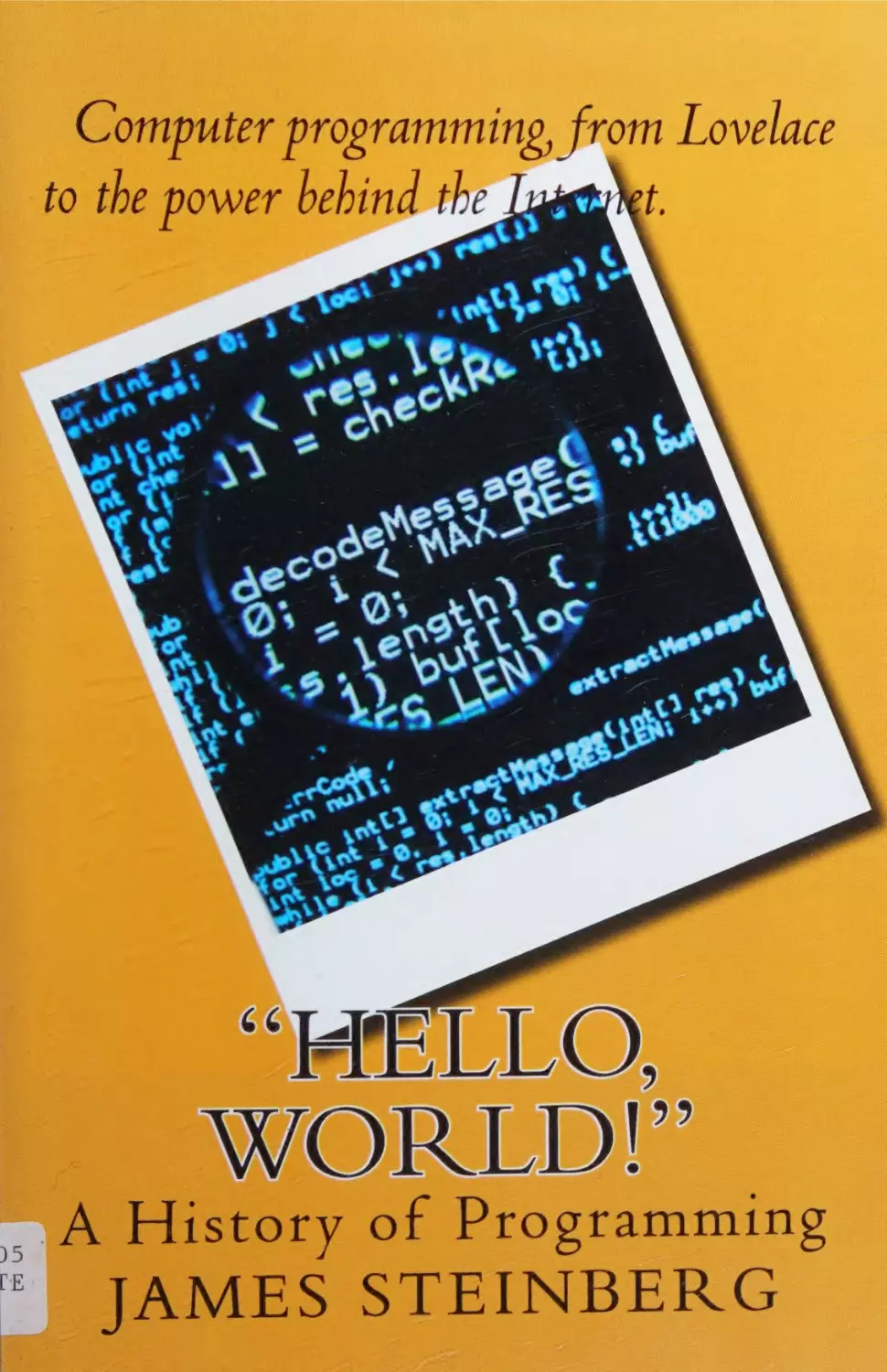
                    Computer programming, from Lovelace
to the power behind the Lui<tj\t.
WORLD!”
A History of Programming
E JAMES STEINBERG

Copyright © 2012 James Steinberg
AU rights reserved.
ISBN: 1481277154
ISBN-13: 978-1481277150

CONTENTS
1
2
3
3
4
5
6
8
9
10
И
12
13
14
15
16
Introduction	1
Looms and Lovelace	4
Generational Classification	7
The 1940s	9
The 1950s and 1960s	14
The 1970s	22
The 1980s	29
The 1990s	35
The 2000s and beyond	41
The Future	46
Punched Cards to PCs	48
Evolution of a Language	56
An Alternative History	61
Programming Paradigms	67
Esoteric Programming Languages	70
Debugging - Literally!	72
Hello, World!” Translated
75


1 INTRODUCTION
Computers are a part of everyday life — wherever you look,
there is likely to be a computer behind the scenes. Hand-in-
hand with the physical computer (the chips and other
hardware), is the software that runs on it. When most people
think of software, they will usually only think of programs such
as word processors or spreadsheets or even the latest “third
person shoot-‘em up” that they play on their X-Box. Software
goes much further than that though — consider your washing
machine. When you turn the dial (or press the button) to start
the 40° wash, you are actually interacting with a program which
will control the machine during that wash.
So, how did that program that you are using get produced?
The answer is by programmers using a programming language.
There are thousands of programming languages in existence -
some are extremely popular and used for many things, others
are specialist or have been assigned to history.
This book seeks to explore the history of programming, from
its early beginnings before the invention of computers (yes that
is right - programming came before computers), through to the
modern programming languages that are used today.
The history of programming languages can be described in
one of two ways. Firstly, there is the generational language
classification system, that classifies languages as getting more
abstract. Secondly, the developments can be described in terms
of the chronological history of their development. It is
important to understand that the “generations overlap, for
example with third generation languages continuing to be
developed and designed after the initial introduction of fourth
generation languages.
In Chapter 2, we take a brief look at the pre-history of
computers in the 19th century. Chapter 3 gives an overview of
the generations classification and then the subsequent chapters
explore in depth the important developments since the
beginning of the modern computer age and my thoughts for the
future of programming.
Chapter 10 describes the process of writing a program in the
early 1970s and is based on the recollections of a programmer
working for IBM at the time.
Some of the original high level languages from the 1950s are
still in use today, over half a century’ later. These languages have
evolved over time, taking in ideas from more recent languages
and paradigms. In chapter 11, we look at the evolution of the
FORTRAN language, by comparing the coding of the same
program in the various versions.
Chapter 12	provides a humorous alternative look at the
history of programming that I came across while surfing the
web.
Chapter 13	takes a look at another feature of programming
languages that has changed over time during the history of
programming, that of programming paradigms.
2
Chapter 14	takes a look at the area of esoteric programming
languages and why they are created.
In chapter 15, we look at something that had gone hand in
hand with programming throughout its history - the ‘bug’.
Finally, in chapter 16, there is a comparison of a number of
languages using the popular “Hello, World!” program (hence
the name of the book). This program is often the first that a
newcomer will w rite in a language and docs nothing more than
output the phrase “Hello, World!”.
3
2 LOOMS AND LOVELACE
The first programming languages predate the modern
computer by well over a century. These first languages have no
comparison to the complex languages that exist today and were
in fact just codes.
In 1801, Joseph Marie Jacquard invented the Jacquard Loom,
a mechanical loom controlled by punched cards.
4
Although the Jacquard Loom did no computation on the
punched card inputs, it is considered an important step in the
history of computers. An important feature of the loom was
that the pattern of its weave could be changed by simply
changing the cards and this was an important concept in the
development of computer programming.
Jump forward nearly four decades to 1837 and Charles
Babbage, who was known as the Father of Computing, first
described his Analytical Engine, which was a successor to his
Difference Engine. The Analytical Engine was designed to be a
general purpose computer, which could be programmed by
means of punched cards.
In 1843, Ada Byron, Countess of Lovelace translated a
description of the Analytical Engine written by Luigi Menabrea
into English. As part of the translation, Ada added additional
notes. One of these notes was an algorithm for the Analytical
Engine to compute Bernoulli numbers. This algorithm was
considered the first to be specifically written for implementation
on a computer and Ada is often cited as being the first
computer programmer.
This pre-history of computing is however, entirely
conceptual as neither the Difference Engine or the Analytical
Engine were built in Babbage or Ada’s lifetimes. It was not
until a century later that the first general purpose computers
were actually built and it is there that the real history of
programming languages begins.
In the mid 1930s, a need to understand more about the
nature of computation led to two early programming
formalisms - Turing machines and Lambda calculus.
5
Alan l uting wrote a paper introducing an abstract machine
with which to study the nature of computing. A Turing
machine is a 7-tuple — M — <Q, E, I, 8 , b, qo, qt-5’, where —
•	Q is a finite, non-empty set of states,
•	T is a finite, non-empty set of the tape
alphabet/symbols,
•	I is the set of input symbols, I С T,
•	8 is the transition function,
•	b e T \ I is the designated symbol for a blank,
•	qo is the initial state, and
•	qf is the final or accepting state.
The transition function 5 governs the operation of the
Turing machine.
At each step in its operation, the Turing machine examines
an input symbol on the tape, writes a symbol and moves the
tape according to its current state and the transition function 8.
This process will continue until the final state is reached.
Lambda calculus (X-calculus) is a formal system for
expressing computation using value binding and substitution.
Lambda calculus was first formulated by Alonzo Church at the
Princeton Institute of Advanced Studies. Lambda calculus
expressions form the underlying basis of the functional
programming paradigm.
Every’ lambda expression is a function or an application of a
function to an argument and every' algorithm can be expressed
as a lambda expression. Unlike the Turing machines, Lambda
calculus does not exhibit any time-variant behavior.
6
3 GENERATIONAL CLASSIFICATION
Modern computer programming language development can
be thought of as going through five overlapping generations,
although the concept of these generations was not really
introduced until the third generation.
The first generation actually consisted of only one language,
machine language. This was the direct entry of binary' code (0’s
and 1’s) into the computer. In the early days of computers, this
was often achieved by directly manipulating switches and dials
on the front of the computer to represent the code being
entered. These early computers also had no permanent storage,
so programs had to be re-entered each time they were rcc|uired.
Similarly, the second generation is deemed to be just one
language, assembly language. Assembly language was a low
level language where each instruction represented one machine
code operation. Assembly language had mnemonics to
represent the operation part of the code, which made it easier
for humans to understand.
7
Although both machine language and assembly language arc-
each deemed to be one language, there were in fact many
different flavours of each. Each different computer architecture
would have its own version of the languages with different
instructions.
The third generation languages began to evolve in the 1950s
and continue to be in use today. These were general purpose
languages, such as FORTRAN, COBOL, C and Pascal. These
languages differ widely in terms of their syntax, but they all
share enhancements in logical structure over assembly language.
There is also a greater level of abstraction from machine code,
with a single line of third generation language code representing
a number of lines of assembly or machine code.
The introduction of fourth generation languages in the 1970s
looked to move away from the general purpose languages and
into application specific languages. This included languages
such as SQL, SAS and ColdFusion.
In the 1980s, the fifth generation of programming languages
was defined. These languages tend to be more researched based
than operational and are not commercially available. One
defining feature of these languages is that they are constraint
based rather than algorithmically designed. The idea was that it
would not be necessary for a programmer to worry7 about how
to solve a problem, just what the problem is and what the
constraints were.
8
3 THE 1940S
In the early 1940s, the first modern computers were created.
These enormous machines did not have the keyboards and mice
that we are used to today. Input was done using punched cards
or using individual switches on the front of the computer.
However, on the inside, logically the computers worked in
much the same way as they do today, using binary logic (the
representation of 0’s and l’s) to store data and programs.
The programming of these early computers was done using
machine code — direcdy inputting the 0’s and Ts that
represented a particular instruction. Each instruction performs
a very specific task, such as an add operation on a unit of data
and an executable program is made up of a series of many
thousands of these atomic instructions.
Each instruction is made up of a set number of bits, which
are sub-divided to hold details of the operation to be performed
and what numbers it is to be performed on. For example, in a
32 bit long instruction, the instruction to add the contents of
registers 1 and 2 and store the result in register 6 could be
written as:
000000 00001 00010 00110 00000 100000
9
Whilst machine language speaks in the language of the machine
(hence the name), it is not easily readable by humans. Imagine that
the example above is just one line in a program that could consist of
many thousands of lines of similar instructions and you can see why.
In fact in “CONTU Revisited: The Case against Copyright Protection
for Computer Programs in Machine-Readable Form , Pamela
Stevenson indicates that machine code is so unreadable that the
United States Copyright Office cannot even identify whether a
particular encoded program is an original work of authorship.
Although introduced in the early years of computers,
machine code still operates at the heart of all computers.
Programs written today in the higher level languages are still
internally translated into machine code to enable them to be run
on the computer.
In the late 1940s, the second generation of programming
languages was introduced. This was assembly language, which
is a low-level programming language where each statement
corresponds to an individual machine code instruction. The
assembly language program is converted into executable
machine code by a program referred to as an assembler. As
with machine code, assembly languages were specific to a
particular type of computer.
Assembly language uses a mnemonic to represent each
machine code operation, followed by one or more operands to
represent the data to be operated on. Assembly language is a
step away from machine code and is more humanly readable,
allowing for easier programming and debugging.
As an example, consider the code required to move the value
9 into the AL register, lhe assembly language to do this could
be:
MOV AL, 61 h
io
This line of code can be broken down as follows:
•	First comes the mnemonic MOV, which tells the
processor that it is moving a value to a register.
•	Then comes the register that the value is to be moved
into - in this case the AL register.
•	Finally, we specify the value that is to be moved. This
is specified in hexadecimal as 61.
One of the benefits of assembly language code is that it is
easier for a human to read and therefore be able to understand
what the program is doing and how it is doing it. This in turn
makes it easier to find and fix any errors that occur in the
program.
Whilst many of today’s high-level languages can produce
code that when compiled can run as fast as hand-written
assemblv, there are still niche areas where assembly language is
important.
For example, assembly is often used where a compact stand-
alone executable is required that does not need the libraries and
run-time components that are often associated with high level
languages. This is often seen in code that is required to run
things such as household appliances and other electrical
equipment. Another use of assembly is where direct interaction
with the computer hardware is required, such as in the
implementation of device drivers.
Such is the continued importance of assembly language, that
it is still taught in many computer science programs. It is also
deemed to be an important method in gaining a grasp of how
the computer operates at hardware level and for introducing
concepts such as memory allocation.
Il
Further developments in computing saw the introduction of
the third generation of programming languages, or higher-level
languages as they were known. 1 hese languages are closer to
human language than they are to the actual machine language
that the computers run. These languages were designed to be
easier to use for programmers and thus reduce the number of
bugs and increase code reuse.
In 1945, John von Neumann began the development of two
important concepts that would have a direct impact on future
computer programming languages. His first concept, which was
known as “shared-program technique” stated that computer
hardware should be simple and not need to be hand-wired for
each program. Instead, complex instructions should be used to
control this simple hardware, allowing for much faster
reprogramming. His second concept, referred to as
“conditional control transfer”. Gave rise to the notation of
subroutines and conditional logic such as IF THEN statements
and looping using FOR statements. This concept changed
programs from a single set of chronologically executed steps to
the structured programs that we see today.
In 1948, Konrad Zuse published a paper about his
programming language Plankalkul (Plan Calculus). Plankalkul
was designed for engineering purposes between 1943 and 1945.
It is deemed to be the first high-level programming language to
be designed, but was not implemented until 1998 and Zuse’s
contributions were isolated from other developments that
started to take place in the decade that followed.
12
Important languages of the 1940s
Year	Language	Predecessor(s)
1943-45	Plankalkiil (concept)
1943-46	ENIAC coding system
1946	ENIAC Short Code	ENIAC coding system
1947	ARC Assembly	ENIAC coding system
1948	CPC Coding Scheme	Babbage’s Analytical Engine order code
1948	Curry Notation System	ENIAC coding system
1948	Plankalkiil (concept published)
1949	Brief Code	ENIAC Short Code
1949	C-10	ENIAC Short Code
1949	Seeber coding system	CPC Coding Scheme
13
5 THE 1950S AND 1960S
It was during the late 1950s and 1960s, that the development
and introduction of the first modern programming languages
took place and descendents of these languages are still in
widespread use today.
1957 saw the introduction of the first implemented high-level
language, FORTRAN (FORmula TRANslator). FORTRAN
was designed by IBM for use in scientific and engineering
computing. FORTRAN’S origins can be traced to John W.
Backus, who in 1953 submitted a proposal to his superiors at
IBM for the development of a practical alternative to assembly
language. A draft specification for the language was completed
by the middle of 1954, with the first compiler being delivered in
April 1957.
1 he initial version of FORTRAN supported 32 statements
and introduced concepts such as IF, DO and GOTO and the
use of data-types such as integers and doubles.
14
FORTRAN has now been in use for over 50 years and has
undergone a number of innovations during that time, but has
remained backwards compatible to the original language. These
innovations have been driven by the trends and paradigms that
were in vogue at the time of their release. For example, the
Fortran 2003 release added object-oriented support and Fortran
2008 introduced support for concurrent programming.
In 1958, John McCarthy of MIT created the LISt Processing
(LISP) language for use in artificial intelligence research. LISP
differs from other languages in that its only data-type is the list,
which are denoted as a sequence of items enclosed by
parentheses. Due to its specialised nature, LISP remains in use
to this day and has features that are tough to equal in any
modern language.
An additional innovation that came with LISP was the way
the language was described. The language syntax was described
using a mathematically exact notation called Backus-Naur Form
(BNF). Nearly all subsequent programming languages have
used a variation of BNF to describe their syntax.
Like FORTRAN, LISP has evolved a great deal since its
earliest versions and there have been a number of dialects
during that time. The most common current dialects are
Scheme and Common Lisp.
Also in 1958, ALGOL (ALGOrithmic Language) a language
for scientific use was created by a committee of European and
American computer scientists. ALGOL implemented some
novel concepts, such as the recursive calling of functions and
served as a root of the family tree that eventually produced
languages such as Pascal, C and Java.
15
Whilst ALGOL has influenced a number of current
languages, there has been no development of the language itself
over the last 30 years. The last major version of ALGOL was
S-algol, which was released in 1979.
Initially limited to the scientific fraternity, computing began
to take off in the business environment in the late 1950s.
Whilst FORTRAN, LISP and ALGOL were very good at
handling complex numerical calculations, they were not so good
at handling input and output (ALGOL 58 did not have any
input/output facilities), which were important in business
computing.
In the mid to late 1950s, work done by Grace Hopper and
her team at the Remington Rand Corporation identified that
business users were uncomfortable with the mathematical
notation used in programming languages. They proposed the
data-processing problems should be expressed using English
keywords. Their work led to the development of FLOW-
MATIC, which was previously called B-0 (Business Language
version 0).
COBOL (COmmon Business Oriented Language) was
developed in 1959 to address this issue. The specifications of
the language drew a great inspiration from the Grace Hopper’s
work on the FLOW-MAI 1C language and she is often referred
to as the “mother of COBOL ”. COBOL statements have a
very English-like grammar, which makes it easy to learn,
particularly for businessmen. An example of a COBOL
statement is:
ADD YEARS TO AGE
16
In 1964, the Beginners All-purpose Symbolic Instruction
Code (BASIC) was designed by John Kennedy and Thomas
Kurtz at Dartmouth College. BASIC was designed to be an
easy first language for programming newcomers. Original
BASIC had a syntax that included a line number for each line
and program control consisted of GOTO # and GOSUB #
statements that transferred control to the given line number.
BASIC has enjoyed popularity since its introduction,
particularly during the early years of personal computers, where
it was often a standard feature. Its presence allowed small
business and home users to develop their own custom
applications and opened up the availability of computers to
businesses that would not previously been able to afford them.
Even today, nearly 50 years after its introduction, BASIC can
still be seen in use in areas such as scripting languages for
application suites such as Microsoft Office and Open Office. It
has developed a long way from the early version and no longer
has line numbers and now features object-oriented concepts,
but the basic structure and syntax can still be seen.
Whilst it is no longer in common use, the Basic Combined
Programming Language (BCPL), which was designed in 1966,
has played an important part in programming language
development, as we will see below.
BCPL led to a stripped down version, which was called В. В
first appeared in the late 1960s and had many of the features of
BCPL that B’s designers deemed unnecessary’ removed to make
it fit into the memory capacity of the microcomputers that were
available at the time. It was this language on which the popular
C language was based.
17
Important languages of the 1950s and 1960s
Year	Language	Predecessor(s)
1950	Short Code	Brief Code
1950	Birkbeck Assembler	ARC
1951	Superplan	Plankalkul
1951	ALGAE
1951	Intermediate Programming Language	Short Code
1951	Regional Assembly Language	EDSAC
1951	Boehm unnamed coding system	CPC Coding scheme
1951	Klammerausdrucke	Plankalkul
1951	OMNIBAC Symbolic Assembler	Short Code
1951	Stanislaus (Notation)
1951	Whirlwind assembler	EDSAC
1951	Rochester assembler	EDSAC
1951	Sort Merge Generator
1952	A-0	C-10 and Short Code
1952	Autocode	CPC Coding scheme
1952	Editing Generator	SORT/MERGE
1952	COMPOOL
1953	Speedcoding
1953	READ/PRINT
1954	Laning and Zierler system
1954	Mark I Autocode	Glennie Autocode
1954-55	Fortran (concept)		Speedcoding
1954	ARITH-MATIC	A-0
1954	MATH-MATIC	A-0
1954	MATRIX MATH
1954	IPL I (concept)
1955	FLOW-MATIC		A-0
1955	BACAIC
1955	PACT I	FORTRAN, A-2
1955-56	Sequenticlle Formelubersetzung	Boehm
18
Year	Language		Predecessor(s)
1955-56	IT 		Laning and Zierler
1955	PRINT
1956-58	LISP (concept)		IPL
1957	COMTRAN		FLOW-MATIC
1957	Fortran I (implementation)	FORTRAN
1957-58	UNICODE	MATH-MATIC
1957	COMIT (concept)
1958	IPL II (implementation)	IPL I
1958	Fortran II	FORTRAN I
1958	ALGOL 58 (LAL)	FORTRAN, IT and Sequentiellc F ormclubcrse tzung
1958	IPLV	IPL II
1959	FACT
1959	COBOL (concept)	FLOW-MATIC, COMTRAN, FACT
1959	JOVLAL	ALGOL 58
1959	LISP (implementation)	IPL
1959	MAD — Michigan Algorithm Decoder	ALGOL 58
1959	TRAC (concept)
1960	ALGOL 60	ALGOL 58
1960	COBOL 61 (implementation)	FLOW-MATIC, COMTRAN
1961	COMIT (implementation)
1962	Fortran IV	FORTRAN II
1962	APL (concept)
1962	Simula (concept)	ALGOL 60
1962	SNOBOL	FORTRAN II, COMIT
1963	CPL	ALGOL 60
1963	SNOBOL3	SNOBOL
1963	ALGOL 68 (concept)		ALGOL 60
1963	JOSS I		ALGOL 58
1964	MIMIC	MIDAS
1964	COWSEL	CPL, LISP
19
Year	Language	Predecessor(s)
1964	PL/I (concept)	ALGOL 60, COBOL, FORTRAN
1964	BASIC	FORTRAN II, JOSS
1964	IBM RPG		FARGO
1964	Mark-lV
1964	Speakeasy-2	Speakeasy
1964	TRAC (implementation)
1964?	I1TRAN
1965	MAD/I (concept)	MAD, ALGOL 60, PL/I
1965	TELCOMP	JOSS
1965	Atlas Autocode	Algol 60, Autocode
1966	JOSS II	JOSS I
1966	ALGOL W	ALGOL 60
1966	Fortran 66	FORTRAN IV
1966	ISWIM (Concept)	LISP
1966	CORAL66	ALGOL 60
1967	BCPL	CPL
1967	MUMPS	FORTRAN, TELCOMP
1967	A PL (implementation)
1967	Simula 67 (implementation)	ALGOL 60
1967	InterLisp	Lisp
1967	SNOBOL4	SNOBOL3
1967	XPL	PL/I
1968	ALGOL 68 (UNESCO/IFIP standard)	ALGOL 60
1968	POP-1	COWSEL
1968	DIBOL-8	DIBOL
	1968_	Forth (concept)
1968	LOGO		LISP
1968	MAPPER	CRT RPS
1968	REFAL (implementation)
1968	ТГМ (implementation)	GAP, GPM
1969	PL/I (implementation)	ALGOL 60, COBOL, FORTRAN
1969	В			BCPL
20
Year	Language	Predecessor(s)
1969	PPL
1969	SELL
1969	TUTOR
1969	Edinburgh IMP	Algol 60, Autocode, Atlas Autocode
21
5 THE 1970S
The 1970s saw the major development of programming
languages and most of the major language paradigms currently
in use were invented during this period.
Additionally, during this period there was considerable
debate over the merits of “structured programming”.
Structured programming is a paradigm which makes use of
subroutines and loops rather than using jumps such as the
GOTO statement. The aim was to produce clearer code which
was easier to follow and maintain.
In 1971, Niklaus Wirth introduced a simple block-structured
language called Pascal, designed for computer science
education. Although initially designed as a teaching language,
variations of Pascal have been used for everything from
computer games to embedded systems development.
Pascal requires a certain level of discipline from its
programmers as all types, data and subroutines in a Pascal
program must be explicitly declared prior to use.
22
Like the popular languages of the 1950s and 60s, Pascal has
undergone a number of developments over the years. There
have been derivatives such as Object Pascal, which was
designed for object-oriented programming.
Also in 19 1, Steve Bourne released sh, or Bourne Shell as it
was also known. Bourne Shell was one of the original
command languages for the Unix operating system. It is used
for automating complex tasks using individual Unix tools.
Whilst it is not a traditional programming language, the
flexibility of Bourne Shell and the provision of control
structures such as IF and FOR makes it worthy of inclusion in
this book. Bourne Shell also provides extensive features for
running programs and handling their input and output, such as
the “pipe”, which is used to pass the output of one program to
the input of another.
In 1972, the first dedicated object-oriented language,
Smalltalk, was developed at Xerox PARC. Smalltalk is a pure
object-oriented language — all data are encapsulated as objects
and all operations are performed by sending messages to those
objects.
This concept of message sending is entirely different to the
way that non-object-onented languages work. Consider for
example the operation of outputting an item of information (for
example a name). In a non-object-oriented language, this would
be achieved by a statement such as -
print $name
Whereas, in an object-oriented language it would be achieved
as follows —
$person->printName()
23
In the first example, we are using a generic function print to
output the variable $name, whilst in the second we are sending
a message to the object instance $person telling it to perform
the action printName. An important feature of object-oriented
programming is that each object would have its own method to
perform the outputting of data. So, for example, the printName
method for a Person object and the printAddress method for a
House object whilst achieving the same thing would be
implemented internally in entirely different ways, which the
calling function would have no idea about. This concept of
abstraction removes from the programmer the need to worry'
about the underlying data and just concentrate on the objects
themselves.
An influential aspect of Smalltalk was its run-time
environment. It was the first language to support a multi-
window graphical user interface and its ideas can be seen in
modern windowing systems such as Microsoft Windows.
The C language was developed in 1972 by Dennis M. Richie
at Bell Laboratories. It is a fairly low-level block structured
language, with features such as simple data structures,
subroutines, memory' pointers and simple I/O facilities. C is
seen as a fast and powerful language, but at the expense of
being more difficult to read than other languages.
C got its name because; as previously mentioned; its features
were derived from an earlier programming language called B.
C is one of the most widely used programming languages of
all time and there are very few computer architectures for which
a C compiler does not exist.
24
19'8 saw the introduction of Awk, a string-processing
language developed at Bell Laboratories. Awk offered powerful
regular expression pattern matching and quickly became the
language of choice for small Unix data transformation
programs.
Also in 1978, the Structured Query Language or SQL was
introduced commercially, for managing data in relational
database management systems. SQL is based on work
undertaken at IBM in the early 1970s for the SEQUEL
(Structured English QUEry Language) language and was first
commercially released by Relational Software Inc as Oracle V2,
followed soon after by an IBM version.
SQL is based on the relational database model described in
Edgar F. Codd’s 1970 paper “A Relational Model of Data for
Large Shared Data Banks” and is the most widely used database
language.
Even though SQL became a standard of the American
National Standards Institute (ANSI) and International
Organization for Standards (ISO) in the late 1980s, there are
still differences to the flavours of SQL offered by the various
relational database management systems products, due to lack
of full compliance with the standard.
The most common operation in SQL is the query, which is
performed using the SELECT statement. SELEC I retrieves
data from one or more tables that matches defined conditions.
The tables are linked together by key fields and the returned
results can be limited by using conditions.
25
The example below assumes that there are two tables Book
and Author, which are linked by the key field Authorld. I’or
example, the code below would return the titles of all the books
written by a particular author sorted in alphabetical order by the
book’s title.
SELECT Book.Title
FROM Book, Author
WHERE Book.Authorld = Author.Authorld
AND Author.Name = “James Steinberg”
ORDER BY Book.Title
The above query has no persistent affect on the data in the
database; it is simple returning a set of data that matches the
conditions given
There is a subset of the SQL referred to as the Data
Manipulation Language, that can be used to insert, update and
delete data. The updating and deletion can be conditional using
a WHERE clause as used in the select query.
Important languages of the 1970s
Year	Language	Predecessor(s)
1970?	Forth (implementation)
1970	POP-2	POP-1
1970	Pascal	.ALGOL 60, ALGOL W
1970	BLISS	ALGOL
1971	KRL	KM, FRL (MIT)
1971	Sue	Pascal, XPL
1972	Smalltalk	Simula 67
1972	PL/M	PL/I, ALGOL, XPL
1972	C	B, BCPL, ALGOL 68
1972	INTERCAL
1972	Prolog	2-level W-Grammar
1972	SQL	Ingres
26
Year	Language		Predecessor(s)
1973	COMAL	Pascal, BASIC
1973	ML
1973	LIS	Pascal, Sue
1973	Speakeasy-3	Speakeasy-2
1974	grass	BASIC
1974	BASIC FOUR	Business BASIC
1975	ABC	SETL
1975	Scheme	LISP
1975	Altair BASIC	BASIC
1975	CS-4	ALGOL 68, BLISS, ECL, HAL
1975	Modula	Pascal
1976	Plus	Pascal, Sue
1976	Smalltalk-76	Smalltalk-72
1976	Mesa	ALGOL
1976	SAM76	LISP, TRAC
1976	Ratfor	C, FORTRAN
1976	s	APL, PPL, Scheme
1977	FP
1977	Bourne Shell (sh)
1977	Commodore BASIC	Licenced from Microsoft
1977	IDL	Fortran
1977	Standard MUMPS	MUMPS
1977	Icon (concept)	SNOBOL
1977	Green	ALGOL 68, LIS
1977	Red	ALGOL 68, CS-4
1977	Blue	ALGOL 68
1977	Yellow	ALGOL 68
1978?	MATLAB
1978?	SMALL	Algol60
1978	VisiCalc
1979	Modula-2	Modula, Mesa
Year	Language	Predecessor(s)
1979	REXX	PL/I, BASIC, EXEC 2
1979	AWK	C, SNOBOL
1979	Icon (implementation)	SNOBOL
1979	Vulcan dBase-11
28
6 THE 1980S
The 1980s were a period of consolidation, no new paradigms
were invented. Instead, the ideas of the previous decade were
elaborated on.
The 1980s also saw advances in programming language
implementation. For example, the RISC (Reduced Instruction
Set Computing) movement in computer architecture proposed
that hardware should be designed for compilers rather than for
human assembly programmers.
Modula-2 was released in 1980, although the development
began in 1977. It was conceived by Niklaus Wirth as a
descendent of Pascal. It had a less rigid syntax than Pascal,
allowing programmers to declare variables closer to where they
wrere being used.
Whilst Modula-2 enjoyed some degree of success in the early
1980s, its popularity was limited by the fact that it did not
support inheritance and was therefore unable to fully implement
the object-oriented paradigm that became popular in the late
1980s.
29
There was little development of the language during the
1990s, but recently there have been efforts to produce a
standardised version of the language, referred to as Modula-2
RIO.
Also in 1980, Bjarne Stroustrup produced a number of
extensions to C, known as C With Classes. These extensions
introduced features to C such as multitasking, dynamic variables
and interrupt handling. C With Classes would go on to be
renamed C++ before it was commercially released.
1982 saw the foundation of Adobe Systems Inc and the
introduction of Postscript. Postscript is a Page Description
Language that was originally designed to execute inside a printer
with very little memory. It is seen as the language of choice for
graphical output.
In 1983, Ada was released. Named in honour of Ada
Lovelace, it is a block-structured language that features many
object-oriented features. Ada was designed for the US
Department of Defence, with the aim of being a reliable
language with a Pascal-like syntax.
Ada has been designed for use in large-scale critical systems,
such as those used in avionics and space technology. Because
of this it includes a number of run-time checks to protect
against bugs such as trying to access unallocated memory,
buffer overflows and range violations.
In July 1983, the first implementation of C++ was released.
C++ is a derivation of C that supports object-oriented
programming. The syntax of C++ is similar to C, with
extensions to support object-oriented features such as classes
and inheritance. C++ was originally an extension of C, but
soon developed into a language of its own.
30
C++ compiles to highly efficient code, so it is often used in
high performance application domains such as device drivers,
embedded systems and video games.
MATLAB (MATrix LABoratory) was developed by Cleve
Moler at the Universip of New Mexico and first released in
1984. MATLAB is a numerical computing environment which
allows the manipulation of matrices and plotting of functions.
An area where MATLAB excels is in the plotting of two and
three dimensional graphs based on a function. For example, the
following code -
% Create a grid of x and у points
points = linspace(-2, 2, 40);
[X, Y] = meshgrid(points, points);
% Define the function Z = f(X,Y)
Z = 2/exp((X-.5).A2+Y.A2)-2./exp((X+ 5) A2+Y.A2);
% Create the surface plot using the surf command
figure;
surf(X, Y, Z);
wall produce this output -
31
1987 saw the introduction of Perl (Practical Extraction and
Reporting Language, which was developed by Larry' Wall as a
general-purpose Unix scripting language designed for
simplifying report processing.
Perl is influenced by a number of languages such as AWK, C,
sed and Pascal. Perl became popular for writing Common
Gateway Interface scripts and some notable websites such as
Amazon.com and the BBC make extensive use of Perl.
Mathematica, which was released in 1988 and designed by
Stephen Wolfram is a computational language used in scientific,
engineering and mathematical fields.
Mathematica is particularly good at plotting 2D and 3D
mathematical functions. For example, the code —
Plot3D[Sin[x] Cos[y], {x, 0, 5}, {y, 1,10}]
Will produce the following output —
32
Important languages of the 1980s
Year	Language	Predecessor(s)
1980	Ada 80 (MIL-STD-1815)	Green
1980	C with classes	C, Simula 67
1980-81	CBASIC	BASIC, Compiler Systems, Digital Research
1981	IBM BASICA	BASIC
1982?	Speakeasy-IV	Speakeasy-3
1982?	Draco	Pascal, C, ALGOL 68
1982	PostScript	InterPress
1983	GW-BASIC	IBM BASICA
1983	Ada 83 (ANSI/MIL- STD-1815A)	Ada 80, Green
1983	C+ +	C with Classes
1983	True BASIC	BASIC
1983	occam	EPL
1983?	ABAP	COBOL
1984	CLIPPER	dBase
1984	Common Lisp	LISP
1984?	GOM - Good Old Mad	MAD
1984?	Korn Shell (ksh)	sh
1984	RPL	Forth, Lisp
1984	Standard ML	ML
1984	Redcode
1985	PARADOX	dBase
1985	QuickBASIC	BASIC
1986	CorVision	INFORM
1986	Eiffel		Simula 67, Ada
1986	GFA BASIC		BASIC
1986	Informix-4GL
1986	Lab VIEW
1986	Miranda
1986	Objective-C	Smalltalk, C
33
Year	Language		Predecessor(s)
1986	Object Pascal	Pascal
1986	PROMAL	c
1987	Ada ISO 8652:1987	Ada 83
1987	Self (concept)	Smalltalk
1987	occam 2	occam
1987	Hyper lalk
1987	Perl		C, sed, awk, sh
1987	Oberon	Modula-2
1987	Erlang	Prolog
1987	Mathematica
1987	Turbo Basic	BASIC/Z
1988	Octave	MATLAB
1988	Td	Awk, Lisp
1988	STOS BASIC	BASIC
1988	Object REXX	REXX
1988	SPARK	Ada
1988	A +	APL
1989	Turbo Pascal OOP	Turbo Pascal, Object Pascal
1989	Modula-3	Modula-2
1989	PowerBASIC	Turbo Basic
1989	VisSim
1989	LPC
34
7 THE 1990S
The 1990s was the decade of the Internet and many of the
developments that took place during rhe decade were driven by
the needs of the new technology.
Also during this decade, many Rapid Application
Development (RAD) languages emerged. 1’hese languages were
descendents of older languages and were object-oriented. 1’here
was also a move to scripted languages within larger applications,
such as the use of VBA (Visual Basic for Applications) within
the MS Office suite. These scripted languages are used for
automation of tasks within the applications.
In 1991, the Java language project was initiated and the
language was finally released in 1995 by Sun Microsystems. All
data and methods within Java are associated with a class.
Applications that are written in Java are compiled to
bytecode that can then run on any Java virtual machine
regardless of the underlying computer architecture. Java
became very popular due to its early integration with the
Netscape Navigator web browser.
35
Java software runs on platforms from mobile phones, games
consoles, all the way through to supercomputers.
A further introduction in 1991 was the first version of Visual
Basic from Microsoft. The visual element of Visual Basic
referred to its Integrated Development Environment, which has
extensive facilities for the design of dialog boxes, menus and
other windows interfaces.
One of the reasons for Visual Basic’s popularity is that it is
similar in syntax to most other modern Basic dialects, but
includes a number of additional features. Many computer
professionals of the early 1990s cut their programming teeth
using the versions of Basic included with their Sinclair, Atari
and Commodore home computers from a decade before, so
Visual Basic was immediately familiar to them.
Although not a programming language per se (it is as its
name suggests a markup language), HTML is an important
language in the development of the World Wide Web. HTML
controls the display of text and graphics in a web browser.
HTML is written using HTML elements that consist of tags
enclosed in angle brackets, within the web page content. The
tags are used by web browsers such as Internet Explorer,
Firefox, Google Chrome and Apple Safari to format the output
of the webpage, such as defining headings or displaying images.
HTML was specified in 1991 by British physicist Tim
Berners-Lee at CERN in Switzerland as a means of linking
documents together using hypertext links.
JavaScript was introduced in 1994, initially as LiveScript by
Netscape. Sun Microsystems took an interest in the script and
worked with Netscape to improve it and release it as J avaScript.
36
JavaScript is primarily used as a client-side scripting language
in web browsers and has extensive facilities for manipulating
and controlling the content of web pages. For example, it is
often used as a means of enabling parts of a web page to be
hidden until some action takes place, such as displaying a drop-
down sub-menu when a menu item is rolled over. Another
popular use is validating the content of forms before they are
submitted to a web server.
In 1995, the first public version of Ruby was announced. It
is a fully object-oriented language where all data types are object
classes. Ruby has a simple syntax that is similar to that of Perl
and is also influenced by Eiffel and Lisp.
Another product of the Web boom, PHP was also
introduced in 1995 as a server-side scripting language for the
production of dynamic Web pages. PHP is an open source
language and was one of the first server-side scripting languages
that could be embedded directly into an HTML document.
PHP is very popular with web developers and is estimated to be
installed on in excess of 20 million web sites.
Because PHP is a server-side language, the PHP source file is
executed by the PHP runtime on the server and usually
generates an HTML file for display in the web page visitor’s
browser. PHP is often teamed with a relational database
management system such as MySQL to enable it to generate
web pages based on the contents of the database. This
approach is used in sites such as ecommerce and forums.
VB Script, which was first released with Microsoft’s Internet
Explorer 3.0 in 1997, is a general-purpose scripting language
that is a subset of Visual Basic.
37
VB Script was initially designed as a tool for web developers
and was Microsoft’s answer to the popular JavaScript scripting
language used by Netscape in its web browser. Its popularity
and use has spread though and it is used for automation
purposes in a number of applications, such as the Quick 1 est
Professional test automation tool.
Important languages of the 1990s
Year	Language	Predecessor(s)
1990	AMOS BASIC	STOS BASIC
1990	AMPL
1990	Object Oberon	Oberon
1990	J	APL, FP
1990	Haskell	Miranda
1990	EuLisp	Common Lisp, Scheme
1990	Z Shell (zsh)	ksh
1991	GNUE	C+ +
1991	Oberon-2	Object Oberon
1991	Python	ABC, ALGOL 68, Icon, Modula-3
1991	Oz	Prolog
1991	Q
1991	Visual Basic	QuickBASIC
1992	Borland Pascal	Turbo Pascal OOP
1992	Dylan	Common Lisp, Scheme
1993?	Self (implementation)	Smalltalk
1993	Brainf} ck	P"
1993	FALSE	Forth
1993	Revolution Transcript	HyperTalk
1993	AppleScript	HyperTalk
1993	К	APL, Lisp
1993	Lua	Scheme, SNOBOL, Modula, CLU, C++
38
Year	Language		Predecessor(s)
1993	R	S
1993	ZPL	c
1993	NewtonScript	Self, Dylan
1994	ANSI Common Lisp	Common Lisp
1994	RAPID	ARLA
1994	Pike	LPC, C, pLPC
1994	ANS Forth	Forth
1995	Ada 95	Ada 83
1995	Borland Delphi	Borland Pascal
1995	ColdFusion (CFML)
1995	Java	C, Simula 67, C++, Smalltalk, Ada 83, Objective-C, Mesa
1995	LiveScript	Self, C, Scheme
1995	PHP	Perl
1995	Ruby	Smalltalk, Perl
1996	Curl	Lisp, C++, Tcl/Tk, TeX, HTML
1996	JavaScript	LiveScript
1996	Perl Data Language (PDL)	APL, Perl
1996	NetRexx	REXX
1996	Lasso
1997	Component Pascal	Oberon-2
1997	E	Joule, Original-E
1997	Pico	Scheme
1997	Squeak Smalltalk	Smalltalk-80, Self
1997	ECMAScript	JavaScript
1997	F-Script	Smalltalk, APL, Objective-C
1997	ISLISP		Common Lisp
1997	Tea		Java, Scheme, Tel
1997	REBOL	Self, Forth, Lisp, Logo
39
Year	Language	Predecessor(s)
1998	Standard C+ +	C++, Standard С, C
1998	Open Source Erlang	Erlang
1998	M2001	*
1998	Pikt	AWK, Perl, Unix shell
1998	PureBasic
1999	XSLT (+ XPath)	DSSSL
1999	Game Maker Language (GML)	Game Maker
1999	Harbour	dBase
40
8 THE 2000S AND BEYOND
The new millennium has seen a continued evolution in
programming languages, with trends such as functional
programming, distributed programming and massively parallel
languages. There has also been evolution in the support for
Unicode in source code to allow the development of non-Latin-
based scripts and extended punctuation.
Another innovation that the new millennium has bought
about is what devices we are programming for. In the early
days of programming, the programs were written to run on
room-sized computers. The present has seen the introduction
of tablets and smart phones with processing power far in excess
of what the early computer pioneers could ever have dreamed
of. With these devices has come a whole new industry, with
developers specialising in the development of ‘apps’ for these
new devices.
There have also been a number of new languages introduced
during the period.
41
ActionScript was introduced in 2000 by Macromedia Inc,
who are now a part of Adobe Systems. ActionScript was
developed as a language for controlling 2D vector animations
created in Macromedia Flash. It is an open-source object-
oriented scripting language and has gone through a number of
versions, which have added features such as 3D graphics
capabilities.
Released in 2001 by Microsoft as part of their .Net initiative,
C# (C Sharp) is intended to be a simple, general purpose object-
oriented language.
C Sharp has been defined by a number of people in the
programming community as being an “imitation of’ or “almost
identical to” Java. However, since the release of 2.0, the
languages have started to become less similar and began to
evolve in increasingly different directions.
Another element of Microsoft’s .Net initiative also released
in 2001 was Visual Basic .Net. VB .Net is an evolution of the
earlier Visual Basic and it is a subject of debate in programming
circles as to whether it is new language or just a new version of
the earlier language. My personal opinion is that it is a version
of VB, which seems to be backed up by Microsoft’s versioning
of it, which started with version 7. It is however a significant
enough evolution to have a place in the history of programming
languages.
Initially discussed in 2003 and first released in 2007, Groovy
is an object-oriented language that can be used as a scripting
language for the Java platform. It is similar to languages such as
Python, Ruby and Perl. Because Groovy compiles to Java
Virtual Machine bytecode, it is architecture independent and a
compiled file will run on different machines without further
effort being required.
42
Showing the power and diversip- of the Web-based
corporations, Google Inc released the Go language in 2009,
with compilers for a number of popular operating systems. The
language is syntactically broadly similar to that of C, with some
differences such as not needing semi-colons at the end of each
line. Although developed bv Google, Go is an open source
project.
Another of Google’s developments is the Dart language
introduced in 2011. Dart has been designed to replace
JavaScript as the unifying language of web development. Dart
is another C-style object-oriented language.
fhe main perceived problem with Dart is that it is currently
not supported in Internet Explorer, Firefox, Opera and Safari
browsers, so there is a real risk of websites being developed that only
work properly in Google’s Chrome browser.
Important languages of the 2000s and beyond
Year	Language	Predecessor(s)
2000	Join Java	Java
2000	ActionScript	ECMAScnpt
2000	Joy	FP, Forth
2000	D	C, C++, C#, Java
2000	XI,	Ada, C+ + , Lisp
2000	at	C, C++, Java, Delphi, Modula-2
2000	Ferite	C, C++, Java, PHP, Python, Ruby, Scheme
2001	Aspect]	Java, Common Lisp
2001	Processing
2001	Visual Basic .NET	Visual Basic
2002	Io	Self, NcwtonScnpt
2003	Nemerle	C#, ML, MctaHaskell
43
Year	Language	Predecessor(s)
2003	Factor	Joy, Forth, lisp
2003	Scala	Smalltalk, Java, Haskell, Standard ML, OCaml
2003	Squirrel	Lua
2004	Subtext	*
2004	Alma-0	*
2004	Boo	Python, C#
2004	FreeBASIC		QBasic
2004	Groovy	Java
2004	Little b	Lisp
2005	F#	Objective Caml, C#, Haskell
2005	Seed7	*
2006	Links	Haskell
2006	Cobra	Python, C#, Eiffel, Objective-C
2006	Windows PowerShell	C#, ksh, Perl, CL, DCL, SQL
2006	OptimJ	Java
2007	Ada 2005	Ada 95
2007	Fan tom	C#, Scala, Ruby, Erlang
2007	Vala	c#
2007	Clojure	Lisp, ML, Haskell, Erlang
2007	Fortress	Scala, ML, Haskell
2007	Oberon-07	Oberon
2008	Genie	Python, Boo, D, Object Pascal
2008	Pure	Q
2009	Go		C, Oberon, Limbo
2009	CoffeeScript	JavaScript, Ruby, Python, HaskeU
2010	Fancy	Smalltalk, Ruby, Io, Erlang
2010	Grace	*
44
Year	Language	Predecessor(s)
2010	Rust	Alef, C++, Camlp4, Common Lisp, Erlang, Hermes, Limbo, Napier, Napier88, Newsqueak, NIL, Sather, Standard ML
2010	Kotlin	Java
2011	Dart	Java, JavaScript, CoffeeScnpt, Go
2011	Ceylon	Java
2012	TypeScript	JavaScript, CoffeeScript
45
9 THE FUTURE
I obviously don’t have a crystal ball or a time machine, so it
is not possible to give a definite statement as to the future of
programming, but here are some predictions of how things may
develop (if you pardon the pun).
‘Smart devices’ will continue to diversify — already, there are
smart watches that interact with the owner’s smart phone to
display emails, texts and tweets. These will continue to evolve
and as they do, so will the programming languages used to write
the apps that run on them.
Programming will also likely continue to move away from
the realm of the specialist who is employed to just write
programs. Scripting facilities within applications such as MS
Office and Open Office already mean that non-programmers
can produce small programs or modules to automate repetitive
tasks themselves rather than waiting for a solution to be
produced by their company’s development team.
46
At a recent conference 1 spoke to an actuarial manager
working for a large insurance company, who told me that he
had got fed up with waiting for a formal project to be raised
every time he needed to make changes to the scripts behind his
Excel spreadsheets. His solution is that he will be sending some
of the more IT minded members of his team on a course to
train them in the basics of Visual Basic for Applications.
No doubt many of the languages currently in use will
continue to evolve with added features and changes in direction.
There will also be new’ languages introduced to support as yet
unknown evolutions in computing hardware and unthought-of
devices.
Another area which is likely to have an affect on the future
of programming is the continuing growth in the importance of
data. Modern languages tend to focus on the object-oriented
paradigm where data is wrapped up in to classes with access
methods. In the statistical w'orld data has no behaviour and
does not fit neatly into classes, yet object-oriented languages
force developers to take this approach. This could lead to more
simplistic languages that treat data as data rather than forcing it
in to an un-necessary class.
47
10 PUNCHED CARDS ТО PCS
This chapter is based on the memories of two programmers.
The first is my uncle Richard Steinberg, who gives an insight
into the programming of computers in the early 1970s. The
second is one of my students Ian Mugridge, who is a modern
dav programmer.
Programming in the 1970s
I started working for IBM in the late 60s and in the spring of
1972, took up a new role as a junior programmer. I was
assigned an office which I shared with 2 experienced
programmers. The first thing that struck me was the number of
boxes that they had stored in the room. Each of these boxes
stored around 2000 of the punched cards upon which a
program was written.
The process of writing and then running a program was quite
a comphcated one. The first thing that the programmer had to
do was write their program on a series of coding forms similar
to the one shown on the next page. Each coding form had
about fifty lines on it and each line would eventually be
transformed into a punched card representing that particular
line of code.
48
1 he programming process involved writing and amending
the code on the coding forms until you were happy with it, then
you could move on to the next stage.
Once the programmer had their completed program written
on the coding sheets, they would take it to the keypunch
operator and leave it with them. The keypunch operator would
use a kevpunch machine to transfer each line of code on the
coding sheets to an individual punched card. Each punched
card would have the code punched into it and also the code
itself tvped at the top of the card, similar to that shown below.
49
Once the programmer had his stack of punched cards, the
next stage was to check that they had been punched correctly.
This involved going through the stack a card at a time and
comparing the code typed at the top with the corresponding
line on the coding forms.
This stack of cards contained the program I had written in
the language 1 had used (FORTRAN), but it was not actually
able to run on the computer. This stack was the source stack
and had to be processed by the computer using a program
called a compiler to produce the runable program card stack.
So, the next stage is to take your source stack to the
computer room for it to be run through the compiler. Junior
programmers weren’t allowed in the computer room, that was
the domain of the computer operator. Instead, the programmer
took his stack of cards to the ‘in tray’ of the computer room and
filled out a request form. Then you went away and waited.
In the computer room, a computer operator will take the
next stack of cards from the ‘in tray’ and put them into the
computer’s punched card reader, which is connected to the
computer. The computer in this case was an IBM 360, which
was made up of various components (console, tape storage,
card reader, printer, etc.) and took up a fair amount of the
room. The punched card reader reads the cards and passes the
instructions to the computer to process.
Once the compiler program has run, the source cards, the
program output (on a stack of printer paper) and (hopefully) the
outputted program punched cards would be collated together
by the computer operator. These would then be put in the
computer room’s ‘out tray’ for the programmer to collect.
50
Once the programmer has received his output back from the
computer room he would need to review it. There are two
likely scenarios. The first is that the output would include a
stack of program cards, indicating that the program had
compiled successfully. The other is that there arc no program
cards, which would indicate that the program had failed to
compile and there was a problem with the source punched
cards.
If the compiler had failed to compile the program then the
programmer would need to find the errors and fix it. This
would involve searching through the source looking for the
error (often something as simple as a missing comma) and then
completing a coding form to enable a replacement punched
card to be created. The punched cards could then be
resubmitted to the computer room for processing. This process
would be repeated until the program compiles and the stack of
program punched cards are created.
Once the program punched cards have been created, you are
then in a position to run your own program, so it is back to the
computer room. The programmer would submit his program
punched cards and a request form and wait for the program to
be run.
Once the program had run, the punched cards and the
printed output would be put in the computer room’s ‘out’ tray
to be collected by the programmer. Then the fun really began.
51
Having got his printed output back, the programmer would
start by looking to see if the outputted results were as expected.
If, as was likely, they weren’t it was an indication that the
program had errors (or bugs) in it and would need to be
debugged. This was done by manually working through the
source code on the compiler program s output, to work out
where the program was going wrong. When the source of the
error was found, the source code was marked up with the
corrections that needed to be made. These corrections were
then copied onto a coding form and taken to the keypunch
operator to get new punched cards produced to replace the
errors.
The punched cards would then be taken back to the
computer room to be run through the compiler and the re-
compiled program would then be run again. This process
would be completed time and time again until the output was as
expected.
This process could take days or even weeks for a reasonable
sized program; due to the fact that contention for the computer
resource between the various programmers limited the number
of times you could run the program to perhaps half a dozen
times a day.
There was also another problem with this constant re-
compiling and re-running of the program. The source punched
cards were constantly being handled by the programmer and
put through the card reader. This caused a lot of wear and tear
on the cards and eventually the reader would not be able to read
the damaged cards. This meant that the source cards had to be
replaced with a new set. This was done by going back to the
keypunch operator and asking them to run the old cards
through a punched card duplicator to produce a new set of
identical cards.
52
Programming in the 2000s
I have worked as a C developer for a number of companies
since I left university. I am currendy working for a small
consultancy company who work on data migrations for financial
sendees organisations. I work in a largely ‘paperless’ office with
all of the information about the program I am writing being
stored on the hard drives of the company’s server. I am one of
a team of three developers and one or more of us may be
working on a program at a particular time.
The development of a program is based on analysis done by
the company’s team of Business Analysts, who will produce
pseudo-code to define how individual parts of the program will
function. It is from this pseudo-code that the actual program
code will be written.
The programs that we write are large and as mentioned
previously, will have a number of developers working on them
at the same time. The program is divided into a number of
source files, which arc all saved separately and to avoid
conflicts, only one developer will work on a particular source
file at a time.
The master copies of the source files are stored on the
company’s server (which is in the head office 20 miles from
where I am based and is connected over a leased line) and are
controlled by a version control system. When a developer
wants to work on a particular file he will ‘check it out’, which
copies a version onto his local machine. In my case, that local
machine is a Dell laptop running the Windows NT operating
system.
53
I hc writing of the program code is done using a text editor
on the laptop and once I have written the code, I will save it
and then check it back in to the master copy. I then sit down
with the Business Analyst and we undertake a code walkthrough
to compare my code to their pseudo-code and ensure they are
doing the same thing.
After the code walkthrough, I use the version control system
to release the code onto the machine on which it will be
running. This machine will normally belong to the client that
we arc working on and can be located anywhere and connected
to again via leased lines. The machines are often running a
flavour of Unix operating system.
When all the code has been released, it will be compiled on
the remote machine and can then be run. This is all achieved
using a remote shell connection from my laptop to the client’s
machine and working in Unix.
Once the program has run and assuming that it didn’t crash
then the results will be passed to the Business Analyst to
compare against their expected results.
If the program crashed or the results are not as expected
then the program will need to be debugged. This is done using
a debugger such as gdb. The debugger will be launched and a
breakpoint can be set at a particular line or function within the
C program. 1 he program is then executed from within the
debugger and will run normally until it gets to the breakpoint.
Once the program is at the breakpoint, it is possible to view the
value of variables or step through the code a line at a time.
54
Once the bugs have been identified, the code is updated on
the local machine, checked back in to the master copy and then
released back on to the target machine. The code can then be
compiled and run again and checked for errors. This process is
repeated until the results arc as expected.
A comparison of 1970s and 2000s programming
Having read Richard and Ian’s accounts of programming in
their respective decades, it is useful to consider the differences
between the way the job was performed over 30 years apart.
Feature	1970s	2000s
People involved	Programmer, keypunch operator and computer operator.	Developers.
Equipment involved	A keypunch machine, a card reader, an IBM 360 computer and a line printer.	A laptop, servers and leased line connections.
Storage of program source	Stored on punched cards, which would be kept by the programmer in his office.	Stored as source files on the company’s server.
Version control	Limited - changes were made and the old punched cards usually thrown away.	Full version control using a system such as CVS.
Timescales		Days or weeks	Hours or days
55
11 EVOLUTION OF A LANGUAGE
FORTRAN was the first high level language to be released in
the late 1950s and had its most recent version released in 2008.
The language has evolved as new versions have been released
and this chapter shows the differences between some of the
versions.
We will use an algorithm called the Trabb Pardo—Knuth
algorithm, which was specifically designed to show the
evolution of programming languages. The algorithm reads 11
numbers from an input device, reverses the order and then
applies a user defined function (in this case afx + 5 * x3) to each
value and displays the output from the function or a message if
the value exceeds a threshold.
56
FORTRAN
DIMENSION А(11)
READA
2 DO 3,8,11 J=1,11
3	l=11-J
Y=SQRT(ABS(A(I+1 )))+5*A(l+1 )**3
IF (400>=Y) 8,4
4 PRINT 1,999.
GOTO 2
8 PRINT I,Y
11 STOP
The original version of FORTRAN was not able to output
text; therefore the value 999 is used to indicate numbers that
were too large.
FORTRAN II
C THE TPK ALGORITHM
FUNF(T)=SQRTF(ABSF(T))+5.0*T**3
DIMENSION A(11)
1 FORMAT(6F12.4)
READ 1,A
DO 10 J=1,11
1=11-J
Y=FUNF(A(I+1))
IF(400.0-Y)4,8,8
4 PRINT 5,1
5 FORMAT(110,10H TOO LARGE)
GOTO 10
8 PRINT 9,1,Y
9	FORMAT(I10,F12.7)
10 CONTINUE
STOP 52525
FORTRAN II was the first language to allow comments.
The reverse DO loop has to be simulated as this version did not
allow negative indexes in the loops.
57
FORTRAN IV/Fortran 66
C THE TPK ALGORITHM
DIMENSION A(11)
FUN(T) = SQRT(ABS(T)) + 5.)‘T“3
READ (5,1) A
1 FORMAT(5F10.2)
DO 10 J = 1, 11
I = 11 - J
Y = FUN(A(I+1))
IF (400.0-Y) 4, 8, 8
4	WRITE (6,5) I
5	FORMAT(I10,	10H TOO LARGE)
GO TO 10
8	WRITE(6,9) I,	Y
FORMAT(I10, F12.6)
10 CONTINUE
STOP
END
In this version, again the backwards loop is simulated, but a
more structured layout is used. Use is still made of a GOTO
statement to allow flow control in the IF statement.
58
Fortran 77
PROGRAM TPK
C THE TPK ALGORITHM
REAL A(0:10)
READ (5,*) A
DO 10 I = 10, 0, -1
Y = FUN(A(I))
IF ( Y . LT 400) THEN
WRITE(6,9) I,Y
9	FORMAT(I10 F12 6)
ELSE
WRITE (6,5) I
5	FORMAT(I10,'TOO LARGE')
ENDIF
10 CONTINUE
END
REAL FUNCTION FUN(T)
REALT
FUN = SQRT(ABS(T)) + 5.0*T“3
END
Here the program is taking a more modern structure. The
simulated backwards loop is no longer needed, as decreasing
indexes are supported. The need for a GOTO statement has
also been removed with the introduction of an IF THEN ELSE
structure.
59
FORTRAN 90
PROGRAM TPK
! The TPK Algorithm
IMPLICIT NONE
INTEGER	:: I
REAL	:: Y
REAL, DIMENSION(0:10) :: A
READ (*,*) A
DO I = 10, 0, -1	! Backwards
Y = FUN(A(I))
IF ( Y< 400.0) THEN
WRITE(V) I, Y
ELSE
WRITER,*) I, ’ Too large'
END IF
END DO
CONTAINS	I Local function
FUNCTION FUN(T)
REAL :: FUN
REAL, INTENT(IN):: T
FUN = SQRT(ABS(T)) + 5.0*T‘*3
END FUNCTION FUN
END PROGRAM TPK
Again, the decreasing index in the loop is supported and the
loop now ends with an END DO statement rather than a
CONTINUE statement. The line numbers have also been
removed, giving a contemporary feel. Finally, comments are
now marked with an ! and can appear on the same line as a
statement.
60
12 AN .ALTERN ATIVE HISTORY
While surfing the Web looking for information for a lecture 1
came across the following humorous alternative history of
programming. The article was mainlv written by James Iry on
his blog	as A Brief, Incomplete, and
Mostly Wrong History of Programming Languages. /Additional
portions are by Dave Mason.
1801 - Joseph Marie Jacquard uses punch cards to instruct a
loom to weave "hello, world" into a tapestry. Redditers of the
time are not impressed due to the lack of tail call recursion,
concurrency’, or proper capitalization.
1842 - Ada Lovelace writes the first program. She is
hampered in her efforts by the minor inconvenience that she
doesn't have any actual computers to run her code. Enterprise
architects will later relearn her techniques in order to program
in UML.
1936 - Alan Turing invents every programming language that
will ever be but is shanghaied by British Intelligence to be 007
before he can patent them.
61
1936 - Alonzo Church also invents every language that will
ever be but does it better. His lambda calculus is ignored
because it is insufficiently C-like. I his criticism occurs in spite
of the fact that C has not yet been invented.
1940s - Various "computers" are "programmed" using direct
wiring and switches. Engineers do this in order to avoid the tabs
vs spaces debate.
1957 - John Backus and IBM create FORTRAN. There's
nothing funny about IBM or FORTRAN. It is a syntax error to
write FOR TRAN while not wearing a blue tie.
1958 - John McCarthy and Paul Graham invent LISP. Due to
high costs caused by a post-war depletion of the strategic
parentheses reserve LISP never becomes popular. In spite of its
lack of popularity7, LISP (now "Lisp" or sometimes "Arc")
remains an influential language in "key algorithmic techniques
such as recursion and condescension".
1959 - After losing a bet with L. Ron Hubbard, Grace
Hopper and several other sadists invent the Capitalization Of
Boilerplate Oriented Language (COBOL) . Years later, in a
misguided and sexist retaliation against Adm. Hopper's COBOL
work, Ruby conferences frequendy feature misogynistic
material.
1964 - John Kemeny and Thomas Kurtz create BASIC, an
unstructured programming language for non-computer
scientists.
1965 - Kemeny and Kurtz go to 1964.
62
1970 - Guy Steele and Gerald Sussman create Scheme. Their
work leads to a series of "Lambda the Ultimate" papers
culminating in "Lambda the Ultimate Kitchen Utensil." This
paper becomes the basis for a long running, but ultimately
unsuccessful run of late night infomercials. Lambdas arc
relegated to relative obscurity’ until Java makes them popular by
not having them.
1970 - Niklaus Wirth creates Pascal, a procedural language.
Critics immediately denounce Pascal because it uses "x := x +
y" syntax instead of the more familiar C-like "x = x + y". This
criticism happens in spite of the fact that C has not yet been
invented.
1972 - Dennis Ritchie invents a powerful gun that shoots
both forward and backward simultaneously. Not satisfied with
the number of deaths and permanent maimings from that
invention he invents C and Unix.
1972 - Alain Colmerauer designs the logic language Prolog.
His goal is to create a language with the intelligence of a two
year old. He proves he has reached his goal by showing a Prolog
session that says "No." to every query.
1973 - Robin Milner creates ML, a language based on the
M&M type theory. ML begets SML which has a formally
specified semantics. When asked for a formal semantics of the
formal semantics Milner's head explodes. Other well known
languages in the ML family include OCaml, F#, and Visual
Basic.
1980 - Alan Kay creates Smalltalk and invents the term
"object oriented." When asked what that means he replies,
"Smalltalk programs are just objects." When asked what objects
are made of he replies, "objects." When asked again he says
"look, it's all objects all the way down. Until you reach turtles."
63
1983 - In honour of Ada Lovelace’s ability to create programs
that never ran, Jean Ichbiah and the US Department of Defense
create the Ada programming language. In spite of the lack of
evidence that any significant Ada program is ever completed
historians believe Ada to be a successful public works project
that keeps several thousand roving defence contractors out of
gangs.
1983 - Bjarnc Stroustrup bolts everything he's ever heard of
onto C to create C++. The resulting language is so complex
that programs must be sent to the future to be compiled by the
Skynet artificial intelligence. Build times suffer. Skynet's motives
for performing the service remain unclear but spokespeople
from the future say "there is nothing to be concerned about,
baby," in an Austrian accented monotones. There is some
speculation that Skynet is nothing more than a pretentious
buffer overrun.
1986 - Brad Cox and Tom Love create Objective-C,
announcing "this language has all the memory safety of C
combined with all the blazing speed of Smalltalk." Modern
historians suspect the two were dyslexic.
1986 - Since concurrency programming was so obscure and
difficult, Joe Armstrong invented Erlang because a little Prolog
syntax and Lisp semantics was bound to make things clearer.
1987 - Larry Wall falls asleep and hits Larry Wall's forehead
on the keyboard. Upon waking Larry Wall decides that the
string of characters on Larry Wall's monitor isn't random but an
example program in a programming language that God wants
His prophet, Larry' Wall, to design. Perl is born.
64
1990 - A committee formed by Simon Peyton-Jones, Paul
Hudak, Philip \X adler, Ashton Kutcher, and People for the
Ethical 1 reatment of Animals creates Haskell, a pure, non-strict,
functional language. Haskell gets some resistance due to the
complexity of using monads to control side effects. Wadler tries
to appease critics by explaining that "a monad is a monoid in
the category of endofunctors, what's the problem?"
1991 - Dutch programmer Guido van Rossum travels to
Argentina for a mysterious operation. He returns with a large
cranial scar, invents Pvthon, is declared Dictator for Life by
legions of followers, and announces to the world that "There Is
Only One Way to Do It." Poland becomes nervous.
1995 - At a neighborhood Italian restaurant Rasmus Lerdorf
realizes that his plate of spaghetti is an excellent model for
understanding the World Wide Web and that web applications
should mimic their medium. On the back of his napkin he
designs Programmable Hvperlinked Pasta (PHP). PHP
documentation remains on that napkin to this day.
1995 - Yukihiro "Mad Matz" Matsumoto creates Ruby to
avert some vaguely unspecified apocalypse that will leave
Australia a desert run by mohawked warriors and Tina Turner.
The language is later renamed Ruby on Rails by its real inventor,
David Heinemeier Hansson.
1995 - Brendan Eich reads up on every mistake ever made in
designing a programming language, invents a few more, and
creates LiveScript. Later, in an effort to cash in on the
popularity^ of Java the language is renamed JavaScript. Later still,
in an effort to cash in on the popularity of skin diseases the
language is renamed ECMAScript.
65
1996 - James Gosling invents Java. Java is a relatively
verbose, garbage collected, class based, statically typed, single
dispatch, object oriented language with single implementation
inheritance and multiple interface inheritance. Sun loudly
heralds Java's novelty.
2001 - Anders Hejlsberg invents C#. C# is a relatively
verbose, garbage collected, class based, statically typed, single
dispatch, object oriented language with single implementation
inheritance and multiple interface inheritance. Microsoft loudly
heralds C#'s novelty.
2002 - Because Smalltalk had too many constructs and was
too mainstream, Steve Dekorte invented Io.
2003 - A drunken Martin Odersky sees a Reese's Peanut
Butter Cup ad featuring somebody's peanut butter getting on
somebody clse's chocolate and has an idea. He creates Scala, a
language that unifies constructs from both object oriented and
functional languages. This pisses off both groups and each
promptly declares jihad.
2008 - Rich Hickey turned Clojure loose on the world
because he found a new supplier of parentheses and thought
they'd make Haskell more approachable.
66
13 PROGRAMMING PARADIGMS
A programming paradigm can be thought of as a school of
thought for programming. There are four recognised main
programming paradigms and a number of minor paradigms.
The four main paradigms are -
•	Imperative
•	Functional
•	Logical
•	Object-oriented
Imperative programming is defined by the fact that they are
based on a series of statements that change a program’s state.
An example of a statement in an imperative program is -
x := x + 1
The earliest forms of imperative language can be considered
to be machine code and assembly language. Other examples of
imperative languages are Fortran, Pascal, Basic and C.
67
Functional programming treats the program as the evaluation
of mathematical functions. In a pure functional language a
mathematical identity like:
fred(x) + fred(x) = 2*fred(x)
should hold true.
Functional programming tends to be centred more in
academia than in commercial enterprises, although some
languages such as Common Lisp and Scala have been used
commercially.
Logical programming is based on axioms, queries and
inference rules, with a basic concept of the relation. For
example consider how brother can be defined in relation to
father and mother, using Prolog syntax —
brother(X.Y) /* X is the brother of Y	*/
/*	if there	are two people F and	M for which*/
father(F,X), /*	F	is the father of X	*/
father(F,Y), /* and F is the father of Y */
mother(M,X),Z*	and	M is the mother of X	*/
mother(M,Y),Z*	and	M is the mother of Y	*/
Examples of logical programming languages are Prolog and
Datalog.
Object-oriented programming focuses on objects that have
attributes (data fields) and methods (procedures). In pure
object-oriented programming all access to an object’s attributes
is done through a corresponding method. For example, if an
object had a Name attribute then it would also have getName()
and setName() methods to access the name data.
68
An object is an instance of a class and there will normally be
many instances of a particular class when a program runs. For
example if there is a customer class then there will be a separate
object instance to represent each customer.
Classes are normally arranged into a hierarchy that represents
a “kind-of” relationship. For example, if we consider the
implementation of a School model, which might have a person
class to represent the various people associated with the school.
There might be sub-classes of person called student and teacher.
Both students and teachers will share behaviours (methods) and
attributes applicable to people, such as walking, talking,
sleeping, name and date of birth. However, the sub-classes will
have their own unique behaviours — for example, a teacher will
teach and a student will have test marks.
The object-oriented paradigm is supported at a number of
levels by different programming languages -
•	There are pure object-oriented languages, such as Ruby,
Scala and Smalltalk. These are languages that have
been designed specifically to use (or even enforce)
object-oriented methodologies.
•	Then there are languages that have been designed for
object-oriented programming, but have some
procedural elements. Examples of these languages are
Java, C# and VB.NET.
•	Finally, there are procedural languages that have been
extended with some object-oriented features, such as
Visual Basic and PHP.
69
14 ESOTERIC PROGRAMMING LANGUAGES
The vast majority of programming languages are produced
either to be released commercially or to meet a specific
requirement. There is however a growing Internet community
of people creating languages just for fun or for a joke. These
languages are known as esoteric programming languages.
The earliest known deliberate esoteric programming language
is INTERCALC, which was designed in 1972. The number of
esoteric languages being developed took off in the early 1990s
when the Internet became popular, giving hobby programmers
a means with which to challenge each other and develop
languages of their own.
There are a number of different reasons for creating an
esoteric programming language, but five common reasons are -
•	Minimalism - to design a language that has as few
instructions as possible, but still be a working
language. An example of this type of language is
Brainflck.
•	Weirdness - to design a language that is difficult to
program in, for example Malbolge.
70
New concepts — to design a language in an alternative
way to the norm. An example of this is Bcfunge.
Themed - to design a language with a theme that is not
computer related. Examples of this are Shakespeare,
whose programs look like Shakespearean plays and
Chef, where the programs look like recopies.
Jokes — some languages are just designed as a joke,
often not even being usable for programming. An
example of this is the Hello language, which has just
one instruction ‘h’, which displays the text “Hello,
World!”.
71
15 DEBUGGING - LITERALLY!
Anyone who has been involved in the computer industry will
likely be aware that errors in programs are referred to as bugs
and that removing them is referred to as debugging. What they
mav not be aware of though is how these names came about.
The use of the term “bug” to define a defect predates
computers and software and may originally have been used in
hardware engineering to describe mechanical malfunctions or
problems.
During the Second World War, problems with radar
electronics were also referred to as bugs.
However, there is evidence that its usage goes further back
than that. An example of its use was by Thomas Edison in an
1878 letter to an associate where he described the faults
inherent in his inventions:
72
It has been just so in all of my inventions. The first step is an
intuition, and comes with a burst, then difficulties arise — this
thing gives out and [it is/ then that "Bugs”— as such little faults
and difficulties are called — show themselves and months of intense
watching, study and labor are requisite before commercial success or
failure is certainly reached.
The terms gathered more of a meaning in the computer
world in 1947, when operators at the Computation Laboratory
of Harvard traced an error in their Mark JI computer to a moth
trapped in a relay. Their entry in the computer’s log included
the sentence “First actual case of bug being found”.
In the early years of modern computers, debugging was a
ven- hit-or-miss procedure and involved either data dumps of
the system or output devices to indicate that an error had
occurred. The programmer would then step through the code
line by line until they traced the error.
73
As computers developed, so did debugging. The first
development was the introduction of command-line debuggers.
These allowed a programmer to direcdy look at the registers and
memory blocks that held local variables.
When the higher level languages were developed, developers
realised that they could map memory addresses to variable
names and to dump the memory by name. These were called
symbolic debuggers after the symbol map file in which the
additional mapping information was stored.
The next big step in debugging was the ability to set
breakpoints in the code. Before breakpoint development, the
programmer was only aware of two states of the program — the
initial state before it ran and the final state after it finished
running. With breakpoints, it was possible to stop the code at a
particular line and view the state of the program at that time.
Initially, it was only possible to stop the program at a given
line of code. Soon, however, conditional breakpoints were
introduced. This allowed the code execution to be halted when
a given condition was met (such as a variable being equal to 0).
Up until this time, debugging had been undertaken separately
from development, using separate utilities. The next
development in debugging was the introduction of the
Integrated Development Environment (IDE), which allowed
developers to edit, compile, link and debug code in the same
system. These IDEs continued to be developed and when from
simple text based systems to the fully-fledged GUI based
systems such as Visual C++ that you see today.
74
16 “HELLO, WORLD!” TRANSLATED
When first starting programming in a new language, a
common first program is Hello World, which in its most basic
form does nothing more than output the string “Hello, World!”.
This small program provides an ideal source for the comparison
of the various languages that are available.
This chapter provides an implementation of the Hello World
program in a number of popular, archaic and joke/esoteric
languages from the history of programming languages.
Assembly Language
Assembly language is a low-level programming language
where each instruction corresponds to a single machine code
instruction. The assembly language program is converted into
machine code for execution using a utility called an assembler.
Assembly language has been around since the late 1940s and
is still in use today in modern computers.
Different computer architectures have different versions of
assembly language with differences in the mnemonics used.
75
6502 Commodore 64 Assembler
: Hello World for 6502 Assembler (C64)
Idy #0
beq in
loop
jsr $ffd2
iny
in
Ida hello.у
bne loop
rts
hello: tx "Hello World1"
by 13.10.0
68000 Amiga Assembler
: Hello World in 68000 Assembler for dos.library (Amiga)
	move.l move.l jsr move.l beq.s move.l	#DOS 4 w,a6 -$0198(a6) d0,a6 Out #HelloWorld.d1	;OldOpenLibrary
A)	moveq Jsr	#13,d2 -$03AE(a6)	;WriteChars
B)	jsr	-$03B4	;PutStr
Out	move 1 move.l jsr rts	a6,a1 4 w,a6 -$019E(a6)	:CloseLibrary
DOS	dc.b 'dos.library',0
HelioWorld de b 'Hello World1' $A,0
76
68000 AtariST Assembler
; Hello World in 68000 Assembler (Atari ST)
move. I #helloworld.-(A7)
move	#9.-(A7)
trap	#1
addq.l #6.A7
move	#0.-(A7)
trap	#1
helloworld
do b "Hello World'".SOd SOa 0
8086 Assembler
start
MOV
LEA
INT
MOV
INT
msg DB
AH 09h
DXJmsg]
21h
AX.4C00h
21h
'Hello World'S'
ABAP
A BAP is an object-oriented programming language created
by SAP AG and is used in their SAP Application Server.
ABAP’s syntax is quite similar to COBOL.
* ABAP: "Hello, world'" *
REPORT HELLO_WORLD
WRITE 'Hello. World''
ActionScript
ActionScript is an object-oriented language used mainly for
the development of websites using the Adobe Flash Player
platform. It is an open-source language.
tracef'Hello. World!"):
77
Ada
Ada is a multi-paradigm language that was developed by the
United States Department of Defense to replace the numerous
languages that were used in the Department. Ada is named
after Ada Lovelace.
- Ada- "Hello. World'”
with Ada TextJO. use Ada Text JO:
procedure Hello is
begin
Put Line ("Hello, World!")
end Hello
ALGOL
ALGOrithmic Language (ALGOL) is an imperative
language, which was developed in the 1950s, as a language for
scientific use.
BEGIN
DISPLAY ("Hello. World'"):
END
APL
APL is an array-oriented language that uses symbols rather
than words in its syntax, as can be seen in the example below.
'Hello. World”
78
AppleScript
AppleScript is a scripting language developed bv Apple Inc,
which is included in the Macintosh operating systems. It is
designed to exchange data between applications and allow
control of applications for automating tasks.
• AppleScript "Hello world'"
display dialog "Hello world"
ASP
Active Server Pages (ASP) is a server-side scripting engine
for dvnamic web pages. ASP pages are normally written using
VBScript, as in the example below.
<% @ Language-’VBScript'
<% 'ASP "Hello world’"
Response Wnte("<html><body>Hello world'</body></html>") %>
awk
Awk is a programming language that is used for data
extraction and reporting and is a standard feature of most Unix
operating systems.
# awk' "Hello world''
BEGIN { print "Hello, world'"}
79
в
В is an extinct programming language that was a forerunner
to the popular C language.
Г Hello World in В 7
main() {
extern a b, c;
putchar (a); putchar (b); putchar (c); putchar ('!*n');
}
a 'hell';
b 'o. w’:
c 'odd'.
BABEL
BABEL is an experimental programming language designed
to integrate functional and logical programming.
main: {"Goodbye. World!" « }
Bash
Bash is a Unix shell designed as a replacement for the
Bourne Shell.
# Bash: "Hello, world!"
echo Hello, world!
80
BASIC
Beginner’s All-purpose Symbolic Instruction Code (BASIC)
is a general purpose language which was designed with ease of
use in mind. 1 here have been a number of versions of BASIC
since it was introduce, with minor differences. The code below
is based on the original Dartmouth BASIC.
10 REM -Hello World"
20 PRINT "Hello. World'"
30 END
BCPL
Basic Combined Programming Language (BCPL) is an
imperative programming language that was intended for use in
writing compilers for other languages.
II Hello world in BCLP
GET "libhdr"
LET start() = VALOF
$( writesf'Hello world*N")
RESULTIS 0
$)
Befunge
Befunge is an esoteric programming language that was
devised as an attempt to produce a language which was hard to
compile as possible.
>25*'"dlrow olleH" v
v:,_@
81
Brainflck
Brainflck is an esoteric programming language that was
designed to be as small as possible. The language consists of
eight commands, each consisting of a single character.
* * t f • ♦ 4 t 4 + 4- -a -+• -4- + ' t » 4- ’<•'	1'44 >4
}
F4- + > + + << 4-4-4 4-4-4-4 4 4-4-4-4-4-4-4- > 4-4-4-.------------,--------.>4-
c
C is a general purpose imperative programming language that
is one of the most widely used programming languages of all
time.
#include <stdlib h>
#include <stdio.h>
int main(void)
printff’Hello. World'Xn")
return EXIT_SUCCESS
r
Cit
C Sharp (Cft) is a multi-paradigm language that was
developed by Microsoft. It is intended for use as a general-
purpose language.
System Console WriteLinef'Hello World1")
82
С++
С + + is a multi-paradigm general-purpose programming
language that initially began as an enhancement to C, adding
object-oriented features such as classes.
#include <iostream>
int main () {
std cout << "Hello, World'" « std: endl,
return std cout bad()
Chef
Chef is an esoteric programming language that is designed to
look like a recipe, with the variables named after ingredients. In
the example below potatoes is assigned the value 33, which is
the ASCII for ‘d’. The method puts all the values for the output
into the stack (mixing bowl) and then moves the stack to output
(baking dish)
Hello World Souffle
Tfi'S гесюе prims tne ‘mri'O'tsi words Hello world' in a basically
brute force
way. It also makes a lot of food for one person
Ingredients.
72 g haricot beans
101 eggs
108 g lard
111 cups oil
32 zucchinis
119 ml water
114 g red salmon
100 g dijon mustard
33 potatoes
83
Method
Put potatoes into the mixing bowl
Put dijon mustard into the mixing bowl.
Put lard into the mixing bowl.
Put red salmon into the mixing bowl
Put oil into the mixing bowl.
Put water into the mixing bowl.
Put zucchinis into the mixing bowl.
Put oil into the mixing bowl.
Put lard into the mixing bowl.
Put lard into the mixing bowl.
Put eggs into the mixing bowl.
Put haricot beans into the mixing bowl.
Liquefy contents of the mixing bowl.
Pour contents of the mixing bowl into the baking dish
Serves 1
Clean
Clean is a general-purpose functional programming language
influenced by Haskell.
module hello
Start {#Char}
Start = "Hello, world'"
COBOL
Common Business-Oriented Language (COBOL) is one of
the original high-level programming languages, designed for use
in business rather than scientific environments.
program-id. hello.
procedure division.
display "Hello, World'"
stop run.
84
ColdFusion Markup Language
Coldbusion MArkup Language is a scripting language used
for web development.
<cfoutput>Hello World'</cfoutDut>
Component Pascal
Component Pascal is a multi-paradigm programming
language. Despite bearing the name of Pascal, it is incompatible
with it.
MODULE Helio
IMPORT Out
PROCEDURE Do*
BEGIN
Out StnngC’Hello. World’") Out Ln
END Do
END Hello
COOL
Classroom Object-Oriented Language (COOL) is an object-
oriented programming language designed for use in an
undergraduate course project.
- Hello World in Cool
class Main inherits IO{
main() Object{
out_strmg("Hello worldhn")
}
85
CYBOL
Cybernetics Oriented Language (CYBOL) is a knowledge
modelling and programming language that is based on XML.
Hello World in Cybernetics Oriented Language (CYBOL)
<model>
<part name="send_message" channel-'inline"
abstraction-'operation" model="send">
<property name="channel" channel-'inline"
abstraction-'character" model="shell7>
<property name-'message" channel-'inline"
abstraction-'character" model-'Hello, World!"/>
</part>
<part name="exit_application" channel-'inline"
abstraction-’operation" model="exit"/>
</model>
D
D is a multi-paradigm programming language that is
influenced by C++, Java, Python and a number of other
languages.
// Hello World in D
import std.stdio:
void main()
{
writefln("Hello World!"):
86
Dart
Dart is an object-oriented web programming language
designed by Google. It is an open source language and its
intention is to replace JavaScript as the main language of web
development.
main() {
var bye = Hello World1'
print("$bye"):
}
dBase
The dBase programming language is the internal language of
the dBase database system. It is primarily used for opening,
traversing and manipulating records in the database.
* dBase IV: "Hello world'"
? "Hello, world!"
Delphi
Delphi is a dialect of Pascal and is written using the
Embarcadero Delphi integrated development environment.
program ProjectHello;
{SAPPTYPE CONSOLE}
begin
WriteLnfHello. World'');
end
87
Dylan
Dylan is a multi-paradigm programming language that is
derived from Scheme and Common Lisp.
7 Hello World in DYLAN
define method main (#rest args)
princf'Hello world1")
end
main():
Eiffel
Eiffel is an object-oriented programming language. The
language included a number of concepts that would later be
integrated into other languages such as Java and C$.
indexing
description' "Eiffel Hello, world!"
class
HELIO WORLD
create
make
feature
make
do
print ("Hello, World!%N")
end
end
88
Erlang
Erlang is a multi-paradigm programming language that was
developed by Ericsson to support distributed non-stop
applications.
% % Hello World in Erlang
-module(hello)
-export([hello/0|)
hello() ->
ioformatf’Hello Worldl-n", [])
Fjolnir
Fjolmr is an Icelandic programming language, which is based
on the concept of representing programs as trees.
;; Hello World in Fjdlnir (Icelandic programming language)
"hello" < mam
{
main ->
stef(j
stofn
sknfastrengf."Halid Verdld'").
stofn lok
*
"GRUNNUR"
89
Forth
Forth is an imperative programming language. There are a
number of dialects of the Forth language. The code below is
written in G forth which is an implementation by the GNU
project.
'. Gforth: "Hello, world!"
s" world!" s” Hello."
type type CR
bye
Fortran
FORmula TRANslating System (FORTRAN) is another of
the early high-level languages, which was designed for scientific
and engineering applications.
C Fortran: Hello, world1
PROGRAM HALLO
WRITE (*.100)
STOP
100 FORMAT CHello. world!’)
END
G is a graphical dataflow programming language used in the
LabVIEW development environment. There is no source code,
every thing is programmed graphically.
//Hello world m LabVIEW 7.1
Hello World’
Output
►
90
Go
Go is an imperative programming language that is being
developed bv Google. Go’s syntax is broadly similar to that of
C.
package main
func main() { println("Hello. World'”)
Gofer
GOod For Equational Reasoning (Gofer) is an
implementation of Haskell that is intended for educational
purposes.
-- Hello World in Gofer
- Dialog version
helioWorld Dialogue
helloWorld resps = [AppendChan stdout "Hello world1"]
Groovy
Groovy is an object-oriented scripting language that is
designed to run on the Java Virtual Machine platform.
//Groovy: "Hello world'"
printin "Hello, world'"
Haskell
Haskell is a general-purpose functional programming
language. It is named after the logician Haskell Curry.
— Haskell: ’’Hello world!”
main : IO ()
mam = putStrLn "Hello, world1’’
91
Hello
Hello is a joke esoteric programming language that has only
one instruction (h). The instruction prints “Hello World”,
giving, along with the HQ9+ language mentioned later, the
most compact implementation of the Hello World program.
h
HQ9+
HQ9+ is a joke esoteric programming language, which has
only 4 instructions (H, Q,) and +). One instruction ‘H’ prints
“Hello, World!”, giving, along with the Hello language
mentioned earlier, the most compact implementation of the
Hello World program.
H
HTML
HyperText Markup Language (HTML) is a markup language
that is used for displaying web pages.
<!DOCTYPE HTML PUBLIC "-//W3C//DTD HTML 4 01//EN">
<!- HTML: "Hello, world!” ->
<html>
<head>
<title>Hello World</title>
<meta http-equiv="Content-Type" content="text/html;
charset=UTF-8">
</head>
<body>
<p>Hello, World!</p>
</body>
</html>
92
HyperTalk
Hyper Falk is a procedural programming language used with
Apple Computer’s HyperCard hypermedia program.
- Hello World in HyperTalk
answer "Hello, world!"
Inform 6
Inform 6 is a object-oriented programming language
designed for writing interactive fiction.
[ Main:
print "Hello World*";
INTERCAL
Intercal is an esoteric programming language created to
satirise various languages available when it was developed.
* INTERCAL: "Hello, world'" INTERCAL
PLEASE DO .1 <-#13
DO .1 SUB#1 <-#238
DO.1 SUB #2 <-#112
DO ,1 SUB#3 <-#112
DO .1 SUB #4 <-#0
DO ,1 SUB #5 <-#64
DO .1 SUB #6 <-#238
DO.1 SUB #7 <-#26
DO .1 SUB #8 <-#248
DO .1 SUB #9 <-#168
DO .1 SUB #10 <-#24
DO .1 SUB #11 <-#16
DO .1 SUB #12 <-#158
DO.1 SUB #13 <-#52
DO READ OUT .1
PLEASE GIVE UP
93
Io
Io is a pure object-oriented programming language that was
inspired by Smalltalk.
П Hello World in io programming language
"Hello world!" printin
J
J is a functional programming language that is based on APL,
FP and FL languages. J is most often used in mathematical and
statistical programming
NB Hello World in J
'Hello World' 1'2(2)
Java
Java is an object-oriented language that was designed to be as
platform independent as possible. Java applications are
normally compiled into bytecode that is run on a Java Virtual
Machine.
•> Java: "Hello, world!"
class HelloWorld {
public static void main(String args[]) {
System out printlnf'Hello. world!"):
94
Java (Suing)
Swing is the main Java GUI widget toolkit, which was
developed to provide a sophisticated set of GUI components.
Hello World in Java using Swing GUI
class HelloWorldSwing {
static public void mamfString args[]) {
javax swing JOptionPane showMessageDialogfnull "Hello
world'").
}
}
JavaScript
JavaScript is a client-side scripting language that is used in
web browsers to create dynamic websites. The code example
below is designed to be embedded in an HTML document and
will output the text string to the browser.
<script type="text/javascnpt">
document wnteCHello. world1');
</script>
JCL
Job Control Language (JCL) is a scripting language used on
IBM mainframe operating systems to instruct the system how
to run a batch job.
//HERIB JOB ,'HERIBERT OTTEN'.PRTY=12
//* HELLO WORLD FOR MVS
//HALLO EXEC PGM=IEBGENER
//SYSIN	DD DUMMY
//SYSPRINT	DD SYSOUT=*
//SYSUT2	DD SYSOUT=T
//SYSUT1	DD *
HELLO WORLD'
95
к
К is an array processing language that serves as the
foundation for kdb, an in-memory column-based database.
• Hello World in К
’0:"Hello World'\n
KiXtart
KiXtart is a scripting language for Windows that provides
automation for Windows programs. In the example below, the
code opens Notepad and types the phrase “Hello, World!”
; Hello World in Kix
Run( "Notepad exe")
Sleep 1
SetFocus( "Untitled - Notepad")
SReturnCode = SendKeysf'Hello World")
Sleep( 2 )
SReturnCode = SendKeys("'{F4}Y")
L
L is an object-oriented programming language with a C-like
syntax.
namespace HelloWorld is
class Main is
// Program execution starts at Main init():
void init() is
// IO Std.out refers the program's standard output:
IO.Std.out printlnf "Hello World!");
Si
SI
SI
96
LaTeX
L'li-X is a document markup language for the TeX
typesetting program.
% LaTeX "Hello world1"
\documentclass{article}
\begin{document}
Hello world’
\end{document}
Limbo
Limbo is a programming language for writing distributed
systems. The Limbo compiler produces object code that can be
interpreted by a virtual machine.
implement Command
include "sys m"
sys Sys
include "draw m"
include "sh m"
init(nil ref Draw->Context nil list of string)
sys = load Sys Sys->PATH
sys->print("Hello World'Xn")
97
Lisaac
Lisaac is an object-oriented programming language. The
language is influenced by Smalltalk, Self and Eiffel.
Section Header
+ name = GOODBYE.
Section Public
- main <- ("Goodbye. World’\n" print;);
Linotte
Linotte is a fourth generation programming language that is
unique in that its syntax is in French.
Livre: Hello
Paragraphe: display message
Actions '
Affiche "Hello World!"
Termine
Lisp
Lisp is the second oldest high-level programming language,
having been specified in 1958. There are a number of List
dialects and the code below is written in Common Lisp.
(format t "Hello World'~%")
Logo
Logo is a multi-paradigm programming language that was
designed for use in education. It is an adaptation of Lisp.
print [Hello. World!]
98
Machine Code
Machine code is the lowest level programming language
possible. Each instruction in a machine code program performs
one specific task such as storing a value in a register.
Machine code is normally written in binary format, but for
brevity I have converted it to hexadecimal here. If it were
written in 8-bit binarv, the first two commands (B4 and 09)
would look like this —
10110100 00001001
B4 09 8D 16 0D 01 CD 21 B8 ОС 4C CD 21 48 65 6C 6C 6F 2C 20
77 6F72 6C 64 21 24
MACRO-10
MACRO-10 is an assembly language that has extensive
macro facilities. It is used on DEC’s PDP-10 minicomputer
systems.
TITLE HELLO WORLD
: ’Hello world' in MACRO-10 for TOPS-10
SEARCH UUOSYM
LAB ASCIZ /Hello, world1
START: RESET
OUTPUT: OUTSTR LAB
MONRT
JRST OUTPUT
END START
99
MACRO-11
MACRO-11 is an assembly language that has macro facilities.
It is used on DEC’s PDP-11 minicomputer systems.
"Hello world'" in MACRO-11 for RT-11
MCALL	.EXIT. PRINT
START .PRINT EXIT ST	ASCIZ END	#$1 /Hello, world!/ START
Malbolge
Malbolge is an esoteric programming language that was
specifically designed to be impossible to write useful programs
in.
(’&% 9]'~}|z2Vxwv- POqponl$Hjig%eB@@>}=<M 9wv6WsU2Tinm-
.jcL(l&%S#"
CB]Vnx<uVtT Rpo3NIF Jh++FdbCBA@?]'~|4XzyTT43Qsqq(Lnmkj”
FhgS{z@>
Mathematica
Mathematica is a software program used for scientific,
engineering and mathematical projects. It includes the
Mathematica language as part of the package.
Print[”Hello. World!"]
100
MATLAB
MA 1 LAB is a multi-paradigm fourth-generation
programming language.
» Hello. World1'
ans =
Hello World1
Mercury
Mercury is a functional logic programming language
influenced by Prolog and Haskell.
- module hello
interface
- import_module io
:- pred main(io di. io::uo) is det
implementation
main*'IO.-
io write_string("Hello. World'\n"T IIO)
Modula-2
Modula-2 is an imperative programming language developed
as a revision of Pascal.
(* Modula-2: "Hello, world!” *)
MODULE Hello.
IMPORT InOut;
BEGIN
InOut WriteStnngfHello, World1');
InOut.WriteLn
END Hello
101
Modula-3
Modula-3 is an imperative programming language that was
conceived as a follow on to Modula-2.
;* Hello World in Modula-3 *)
MODULE Hello EXPORTS Main:
IMPORT IO
BEGIN
IO Poti"HeBo Worldhn")
END Hello
MOO
MOO is the programming language used in the MOO text-
based online virtual reality game system.
piayer ’ocaf.on announce allC'Hello. world'"):
MUMPS
MUMPS is a procedural programming language designed for
use in the healthcare industry.
; Hello World in Mumps-M
w ’."Hello World"
102
NewtonScript
NewtonScript is an object-oriented programming language
developed by Apple’ Newton PDA Platrorm.
// Hello World in NewtonScript
base view :=
{viewBounds: {left -3 top 71. right 138. bottom 137}.
viewFlags: 581.
declareSelf base
_proto protoFloatNGo
debug "baseview"
textview = * child of baseview *
{text: "Hello World'",
viewBounds {left 33. top 24 right 113 bottom 46}.
viewFlags: 579:
_proto protoStaticText
debug "textview"
}
NXC
Not eXactly C (NXC) is a programming language for the
Lego Mindstorms NXT programmable robotics kit. It has a C-
like syntax.
Г Hello World in NXC ("Not Exactly C") 7
#include "NXCDefs h"
task main()
{
TextOut(0. LCDJJNE1, "Hello World' ").
}
103
Oberon
Oberon is an imperative programming language, developed
as part of the Oberon operating system.
(* Oberon: "Hello, world!” *)
MODULE Helloworld
IMPORT Write:
BEGIN
Write. Linef'Hello. world1"):
END Helloworld
occam
occam is an imperative programming language based on
Communicating Sequential Processes process algebra.
PROGRAM Hello
- Hello world in Occam
#USE ioconv
SEQ
write full.string(screen."Hello World!")
104
Оок!
Оок! is a joke esoteric programming language that is identical
to Brainflck, just with the commands changed to ‘orang-utan
language’.
Ook Ook? Ook Ook Ook Ook Ook Ook Ook Ook. Ook. Ook.
Ook Ook. Ook. Ook Ook Ook Ook Ook. Ook! Ook? Ook? Ook
Ook Ook Ook. Ook Ook Ook. Ook. Ook Ook Ook Ook. Ook Ook
Ook Ook Ook. Ook Ook? Ook! Ook' Ook? Ook! Ook? Ook Ook!
Ook Ook Ook? Ook Ook. Ook Ook Ook. Ook Ook. Ook Ook
Ook. Ook Ook Ook. Ook. Ook! Ook? Ook? Ook Ook. Ook. Ook.
Ook Ook Ook. Ook Ook. Ook. Ook? Ook1 Ook! Ook? Ook! Ook?
Ook Ook Ook. Ook1 Ook Ook Ook Ook Ook Ook Ook Ook. Ook.
Ook Ook Ook. Ook Ook Ook Ook! Ook Ook' Ook Ook Ook. Ook
Ook Ook Ook Ook! Ook Ook Ook? Ook Ook? Ook Ook? Ook
Ook Ook Ook Ook. Ook. Ook. Ook Ook Ook Ook. Ook Ook. Ook
Ook. Ook Ook! Ook? Ook? Ook Ook Ook Ook Ook. Ook. Ook.
Ook. Ook Ook Ook? Ook' Ook' Ook? Ook! Ook? Ook. Ook' Ook.
Ook Ook? Ook Ook? Ook Ook? Ook Ook Ook. Ook Ook Ook
Ook Ook Ook Ook Ook Ook. Ook Ook. Ook Ook Ook Ook. Ook
Ook Ook' Ook? Ook? Ook Ook Ook Ook. Ook. Ook. Ook. Ook.
Ook Ook. Ook Ook Ook Ook. Ook. Ook Ook Ook. Ook. Ook.
Ook? Ook' Ook' Ook? Ook' Ook? Ook Ook Ook' Ook' Ook' Ook'
Ook' Ook' Ook Ook? Ook Ook? Ook Ook? Ook Ook? Ook Ook'
Ook Ook Ook Ook Ook Ook Ook Ook' Ook Ook' Ook' Ook' Ook'
Ook’ Ook' Ook' Ook' Ook' Ook' Ook’ Ook' Ook' Ook Ook' Ook' Ook'
Ook' Ook' Ook' Ook' Ook' Ook' Ook’ Ook' Ook' Ook' Ook' Ook' Ook'
Ook' Ook Ook Ook? Ook Ook? Ook Ook Ook' Ook Ook' Ook?
Ook’Ook’Ook? Ook'Ook Ook Ook Ook Ook Ook Ook
Ook Ook Ook Ook Ook Oo* Ook Ook Ook Ook Ook Ook Ook'
Ook
105
Oxygen е
Oxygene is an object-oriented programming language that is
based on Object Pascal.
namespace HelloWorld:
interface
type
HelloClass = class
public
class method Main:
end:
implementation
class method HelloClass Main;
begin
System.Console WriteLine(Hello, World!');
end:
end.
Oz
Oz is a multi-paradigm programming language that is
influenced by Erlang, Lisp and Prolog
% Hello World in Oz
functor
import
System
Application
define
{System.showinfo "Hello World!"}
{Application.exit 0}
end
106
Pascal
Pascal is an imperative programming language named after
the French mathematician Blaise Pascal.
program helloworld,
(* Pascal. Hello, world1 *)
begin
wnteln(Hello, World1'):
end
Perl
Perl is a multi-paradigm programming language. It was
initially developed as a general-purpose Unix scripting language
for report processing.
# Perl: "Hello, world1"
print "Hello Worldhn"
PHP
PHP is a server-side scripting language used for producing
dvnamic web pages. It is an open-source language and can be
embedded directly into an HTML document.
<?php
// PHP: "Hello, world!"
echo ”<html><body>" "Hello world'" "</body></html>";
?>
107
Piet
Pict is an esoteric programming language whose programs
arc bitmaps that resemble abstract art. Commands are defined
by the transition of colour from one colour block to the next.
The number of steps along the Hue Cycle and Lightness Cycle
in each transition determine the command executed.
PL/1
PL/1 (Programming Language One) is an imperative
programming language developed by IBM. It was designed as a
single programming language for business and scientific users.
; PL/1 "Hello world!" */
Hello: procedure options(main);
put skip listfHello, world!');
end Hello:
PL/SQL
PL/SQL is a procedural extension language for SQL for use
in Oracle’s relational databases.
SET SERVEROUTPUT ON
BEGIN
DBMS_OUTPUT.PUT_LINE('Hello. world!')’
END:
108
Plankalkiil
Plankalkiil was the first high-level programming language to
be designed. Although it was designed over a decade before
FORTRAN, it was not implemented at the time.
R1.1(V0[ sig]) => RO
R1.2(V0[ m x sig]) => RO
0»> «I m * •-
[W [ i < j -> [ R1 1(V0[i: m x sig]) => RO ] i + 1 => i ] ] ]
END
R' 3.i = RO
=> Z0[: m x sig]
R1.2(Z0) => RO
END
PostScript
PostScript is a multi-paradigm programming language
developed by Adobe Systems. It is often used as a page
description language for desktop publishing.
% Hello World in Postscript
7r. PS
/Palatmo-Roman findfont
100 scalefont
setfont
100 100 moveto
(Hello World1) show
Showpage
Prolog
Prolog is a general purpose logical programming language
often used in artificial intelligence.
% Prolog: "Hello, world'"
?-writefHello. world1') nl
109
Python
Python is a multi-paradigm general purpose programming
language that has been designed with code readability in mind.
# Python: "Hello, world I"
print "Hello, world!"
Qore
Qore is a multi-paradigm general-purpose programming
language with a syntax similar to Perl.
#7usr/local/bin/qore
# Hello World in qore
class HelioWorld
{
constructor)
{
background $.output("Hello. world!");
}
output(Sarg)
{
printf("%s\n", $arg);
}
}
new HelloWorld();
Refal
Recursive functions algorithmic language (Refal) is a
functional programming language that is based on pattern
matching.
SENTRY Go { = <Hello>;}
Hello {
= <Prout 'Hello world’>:
}
HO
RPG
RPG is a multi-paradigm programming language developed
by IBM in 1959 The current version is RPG IV.
H* Hello World in RPG IV
D msg D emd	S	32 inz(*blank) S	64
C	eval msg = ‘Hello World'
C msg	dsply
C C C C	eval emd = 'DLYJOB DLY(30)’ call 'QCMDEXC parm	emd parm 64	len	15 5
C	eval *inlr = *on
RTL/2
RTL/2 was an imperative programming language designed
for use in real-time computing.
TITLE Hello World:
LET NL=10;
EXT PROC(REF ARRAY BYTE) TWRT:
ENT PROC RRJOB(') INT;
TWRTf'Hello. World'#NL#“):
RETURN(1)
ENDPROC:
111
Ruby
Rubv is a multi-paradigm programming language that has a
Perl inspired syntax together with Smalltalk-like features.
# Ruby: "Hello, world!"
puts "Hello, world1"
SAS
The SAS language is a statistical analysis and data processing
language used in the SAS (Statistical Analysis System) software
package.
/* Hello world in SAS 7
" Writes as output title
TITLE "Hello World!":
" writes to the log,
PUT Hello world':
Sather
Sather is an object-oriented programming language that was
originally based on Eiffel.
class HELLO_WORLD is
main is
#OUT+"Hello World\n":
end
end
112
Scala
Scala is a multi-paradigm programming language designed to
be an improvement on Java. It runs on the Java Virtual
Machine, so is platform independent.
// Hello World in Scala
object HelloWorld with Application {
Console printlnf'Hello world'")
Scheme
Scheme is a multi-paradigm programming language and is a
dialect of Lisp.
Scheme "Hello, world’"
••defme ni lampdai itdispiay nHelio wor’d"')(newhne)()))(h)
sed
sed is a Unix utility that is used for text parsing and
transformation. It is a primitive language, but can perform
powerful data processing from within shell scripts.
echo s | sed -ne '1s/ ‘/Hello world'/p’
Seed7
Seed7 is a multi-paradigm general-purpose programming
language that is syntactically similar to Pascal and Ada.
$ include "seed7_05 s7i";
const proc main is func
begin
writelnf’Hello, World!"):
end func:
из
Self
Self is an object-oriented programming language and is a
dialect of Smalltalk.
Hello, world1' print
Shell (Bourne Shell)
Bourne Shell is a command-line interface for the Unix
operating system. Whilst mainly used as a command
interpreter, it has all the features of a scripting language.
echo Hello world!
Simula
Simula is an object-oriented programming language based on
ALGOL 60. It is considered the first object-oriented language.
Begin
OutText ("Hello World!”);
Outimage
End
SISAL
SISAL is a general-purpose functional programming language
with a Pascal-like syntax.
define main
type string = arrayfcharacter]:
function main(returns string)
"Goodbye, World!"
end function
114
Smalltalk (simple version)
Smalltalk is a pure object-oriented programming language,
which means that all data types are stored as objects.
This code example assumes that a Transcript window is
open.
"Hello World in Smalltalk (simple version)"
Transcript show 'Hello World1'
Smalltalk (window version)
This second Smalltalk example will open its own window to
display the output.
"Hello World in Smalltalk (in an own window)"
"(to be entered in a special browser)"
VisualComponent subclass #HelloWorldView
instanceVariableNames
classVanableNames "
poolDictionanes '
category 'test'
displayOn aGraphicsContext
Helio World' asComr ;=><z: I • /! disp'a /'at •iaori<- sf. antext
open
|window|
window := ScheduledWmdow new
window label 'Hello World Demo
window component self new
window open
115
SQL
Structured Query Language (SQL) is a special-purpose
programming language for working with data in a relational
database.
There are various flavours of SQL from the different
database vendors. Below are a few examples.
SELECT 'Hello. World!' FROM DUAL; - Oracle version.
SELECT Hello World1’ FROM SYSIBM SysDummyl - DB2 version
SELECT 'Hello. World!' -- SQL Server version
Thue
Thue is an esoteric programming language based on semi-
Thue grammar.
a:=-Hello World1
a
Unlambda
Unlambda is a functional programming language that is
based on combinatory logic. The language has no variables.
r H e.I.I.o... .w o r l d.!i
116
Yala
X ala is an object-oriented programming language that has a
similar syntax to Cft.
class Sample : Object {
void greeting() {
stdout. printff’Hello Worldtn"):
static void main(string[] args) {
var sample = new Sample();
sample greeting():
}
Vatical
Vatical is an esoteric programming language with a religious
flavour.
+ Hello World in Vatical
LITURGY
PRAY "Hello World1"
AMEN
117
VAX Macro
VAX Macro is the assembly language implementation for
CPUs running DEC’S OpenVMS operating system.
title helloworld
ident /hello world/
library /sys$library: lib/
Slibdef
SlibSroutinesdef
psect	Sdata,wrt.noshr,noexe,long
hello' ascid	/Hello World!/
psect	$code,nowrt.shr,exe.long
entry	helloworld.Am<r9,r10.r11>
Pushaq Calls	hello #1.gAlib$put_output
ret .end	helloworld
VBScript
VBScript is a scripting language developed by Microsoft that
is based on Visual Basic.
' Hello World in VBScript (Windows Scripting Host)
msgbox "Hello, World!"
118
Visual Basic
Visual Basic is a derivative of BASIC developed by
Microsoft. It is designed to be an event-driven language with
modules run when events such as clicking on a button in the
GUI occur. A cut down version of the language Visual Basic
for Applications (X'BA) is supplied with the Microsoft Office
package.
REM Hello World in Visual Basic for Windows
VERSION 2 00
Begin Form Forml
Caption	=	"Forml
ClientHeight =	6096
ClientLeft=	936
ClientTop=	1572
Clientwidth	=	6468
Height	=	6540
Left	=	876
LinkTopic=	"Forml"
ScaleHeight	=	6096
ScaleWidth	=	6468
Top	=	1188
Width	=	6588
Begin Label LabeH
Caption = "Hello, World!"
Height	=	372
Left	=	2760
Tablndex= 0
Top	=	2880
Width	=	972
End
End
Option Explicit
119
Visual Basic .Net
Visual Basic .Net is an object-oriented language that forms
part of Microsoft’s .Net Framework. It is often seen as an
evolution of Visual Basic, with the versioning starting from
V7.0 (the last Visual Basic was VB6).
Class Forml
P..ri Sub Fornn1_Load(By\/al sender As Object, ByVai e As
EventArgs) Handles Me.Load()
MsgBoxf'Hello, world!")
End Sub
End Class
XML
Extensible Markup Language (XML) is a markup language
that defines rules for encoding documents in a format that is
readable by both machines and humans. XML document
formats are used by recent versions of Microsoft Office as well
as Open Office.
<?xml version="1 0" encoding="ISO-8859-1"?>
•	?xml-stylesheet type-’text/xsl" href="HelloWorld.xsl" ?>
•	• - Hello World in XML ->
- g>eet'
<how>Hello </how>
<who>world</who>
<mark>!</mark>
XPLO
XPLO is a programming language that is a cross between
Pascal and C.
code Text=12
Text(0. "Hello, World!")
120
ABOUT THE AUTHOR
Professor James Steinberg is a Professor of Applied
Computing, lecturing on programming in a number of current
and historical programming languages.
Professor Steinberg also acts in a consultancy role for a
number of software development companies, advising on the
implementation of corporate systems.
Professor Steinberg is an avid proponent of the Open Source
movement and regularly lectures on the benefits of the Open
Source paradigm.
Professor Steinberg is married with two children.
More information about Professor Steinberg and the other
books he has written can be found at
hrtn: w w\\ .lamcs^Tc’nncn '
121
OTHER BOOKS BY THE AUTHOR
Open Office Basic: An Introduction
Apache Open Office is the leading open-source office
software suite. It features word processing, spreadsheets,
presentations, graphics and databases. It is available for all
major operating systems. Open Office has the ability to
automate features using recorded and manually created macros,
created using a number of different programming languages.
This book concentrates on one of those languages
OpenOffice.org Basic. This book starts by giving an overview
of the language and its structure, before detailing the various
commands and functions that are available in OpenOffice.org
Basic.
Open Office Basic: An Introduction is available in Paperback
(ISBN 1481270931) and as a Kindle eBook from your local
Amazon website.
122


CPSIA information can be obtained at www ICC,. ,
Printed in the USA	,CGtcettn8 com
LVOWI0s0822 161215
466795LV00022B/1606/P
9

“Hello, World!” looks at the history
of programming from the conceptual
days of the 19th Century, through the
invention of modern computing to the
dawn of the 21 st Century.
As well as a detailed journey through
the programming languages developed
during the 20th and 21st centuries,this
book provides a valuable comparison of
the syntax of a number of the influential
programming languages.
ISBN 9781481277150
9 781481 277150
KT-078-867
90