/
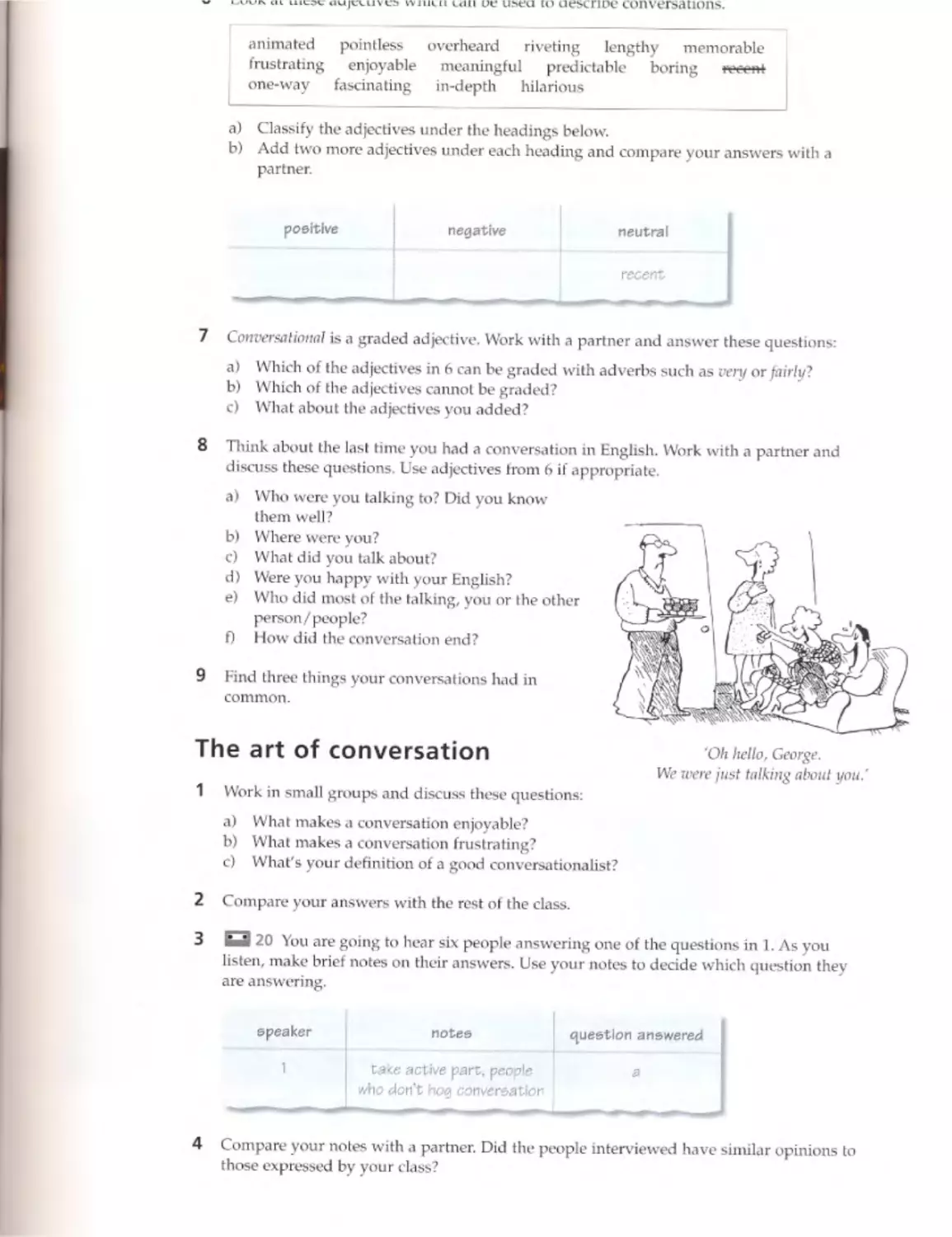
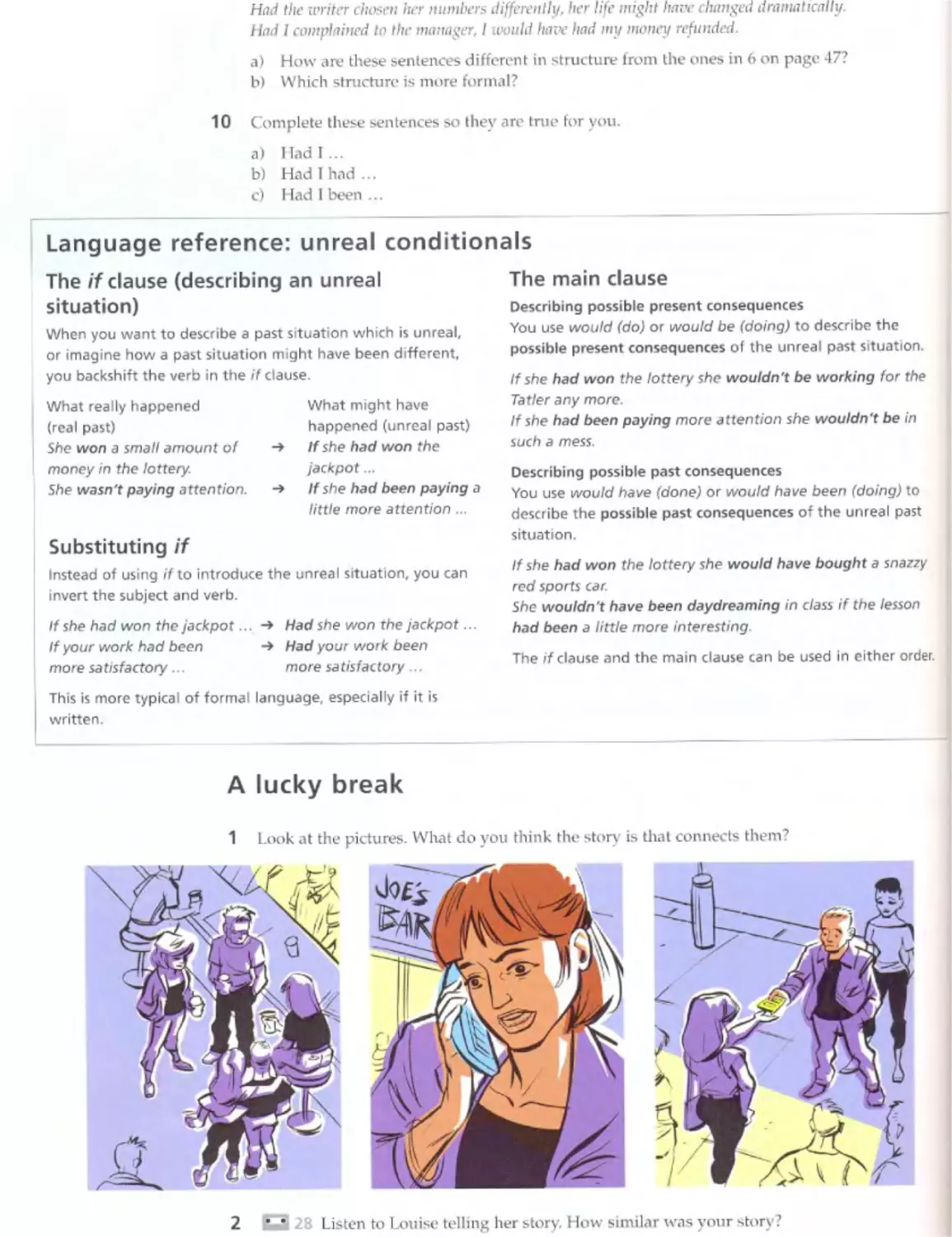
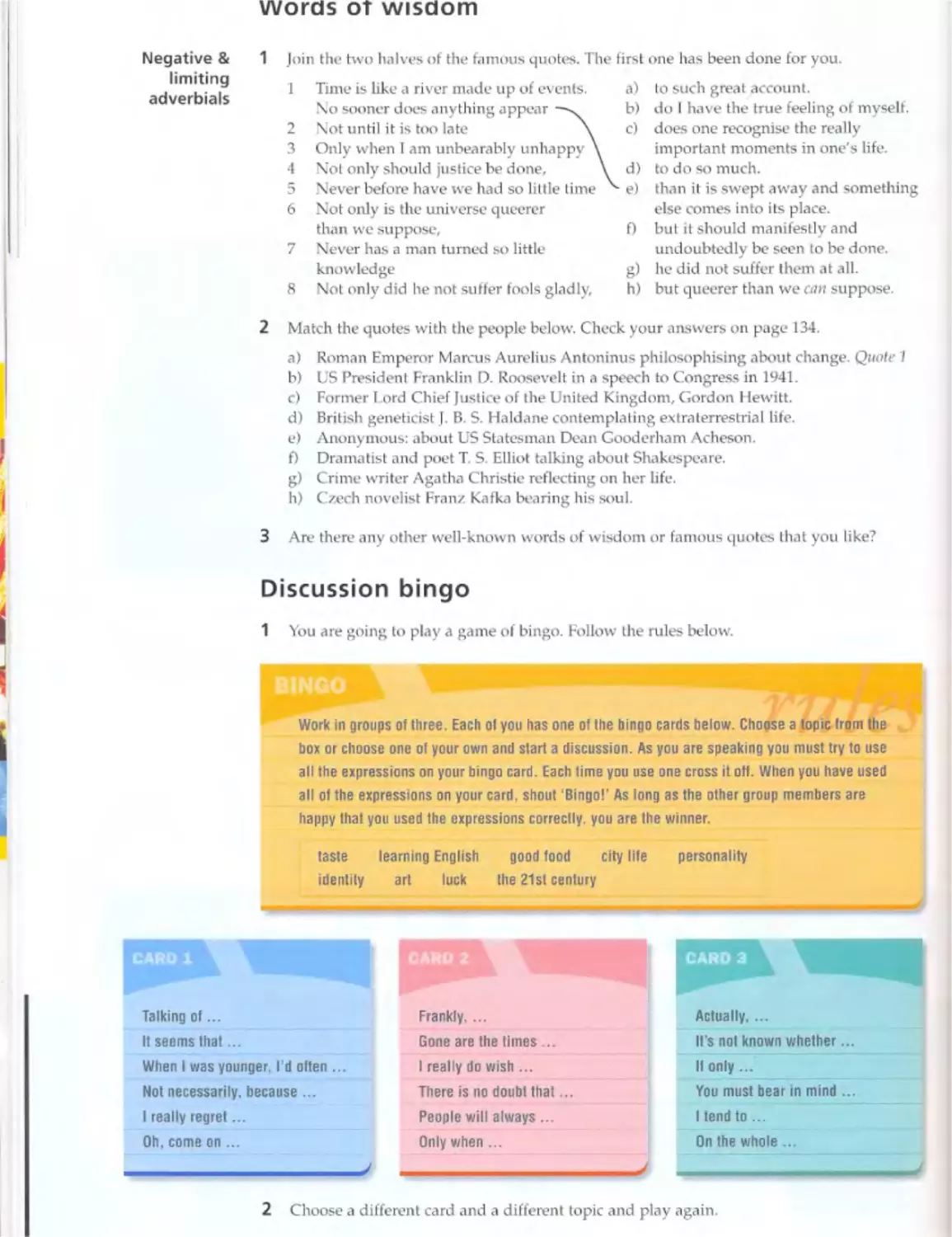
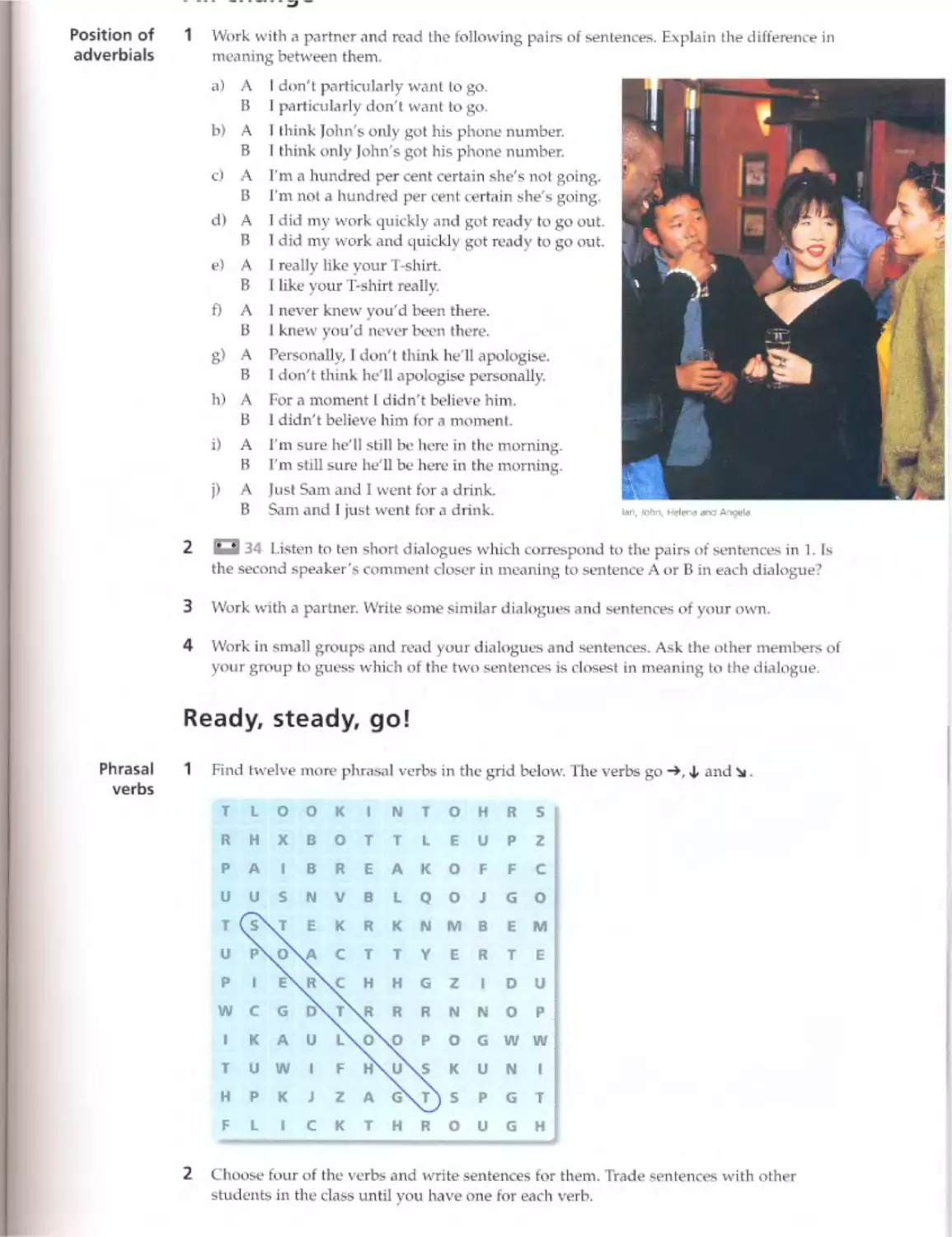
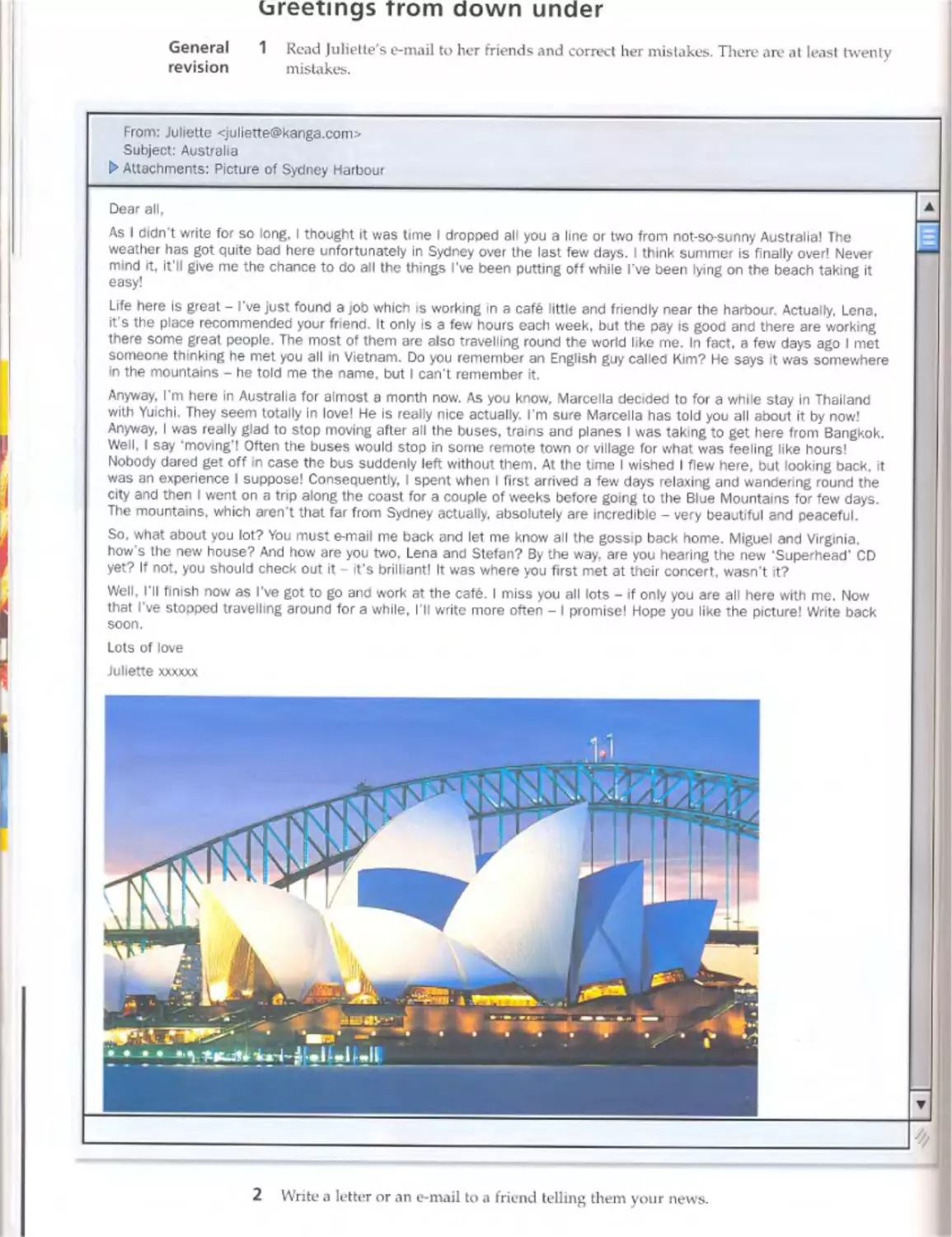
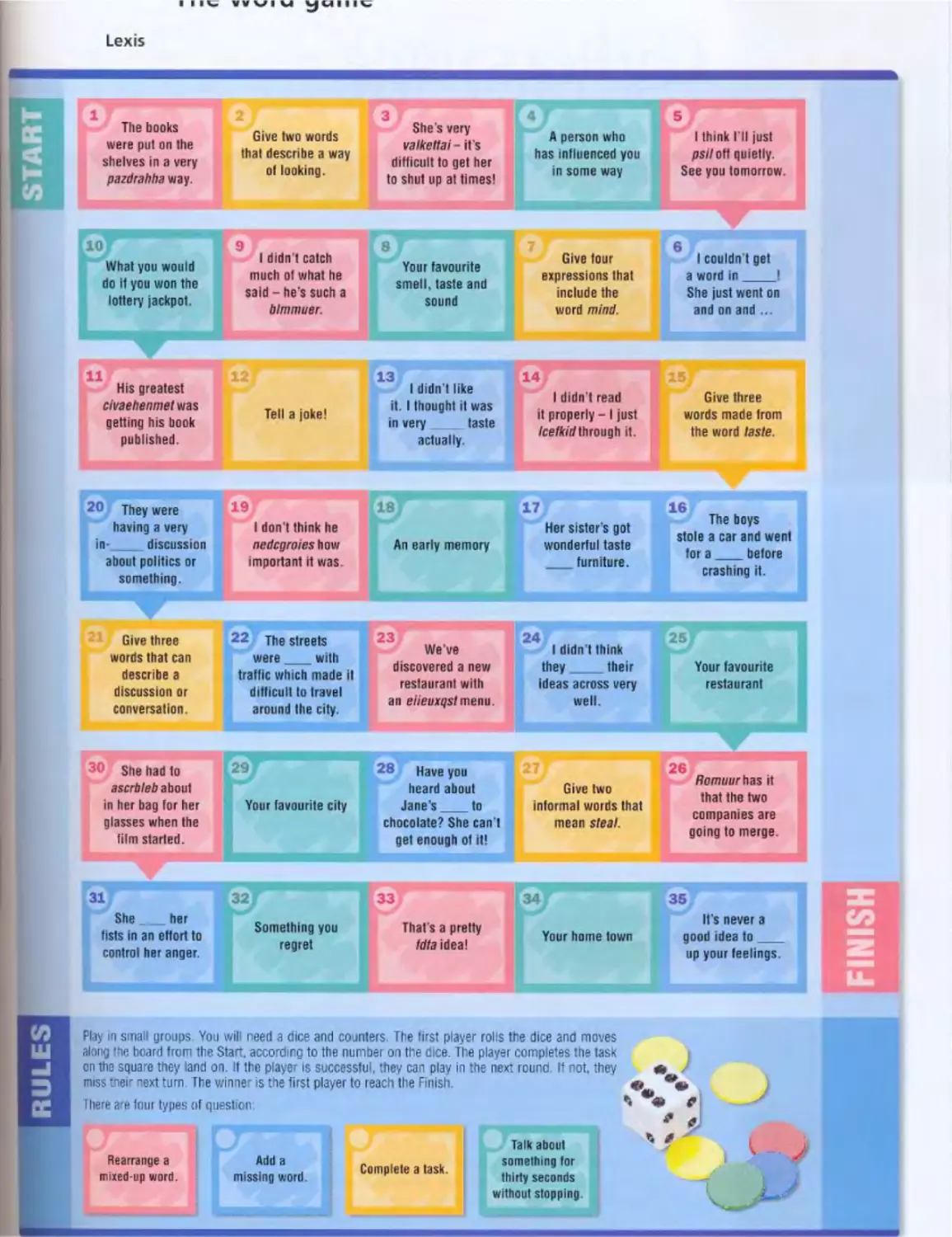
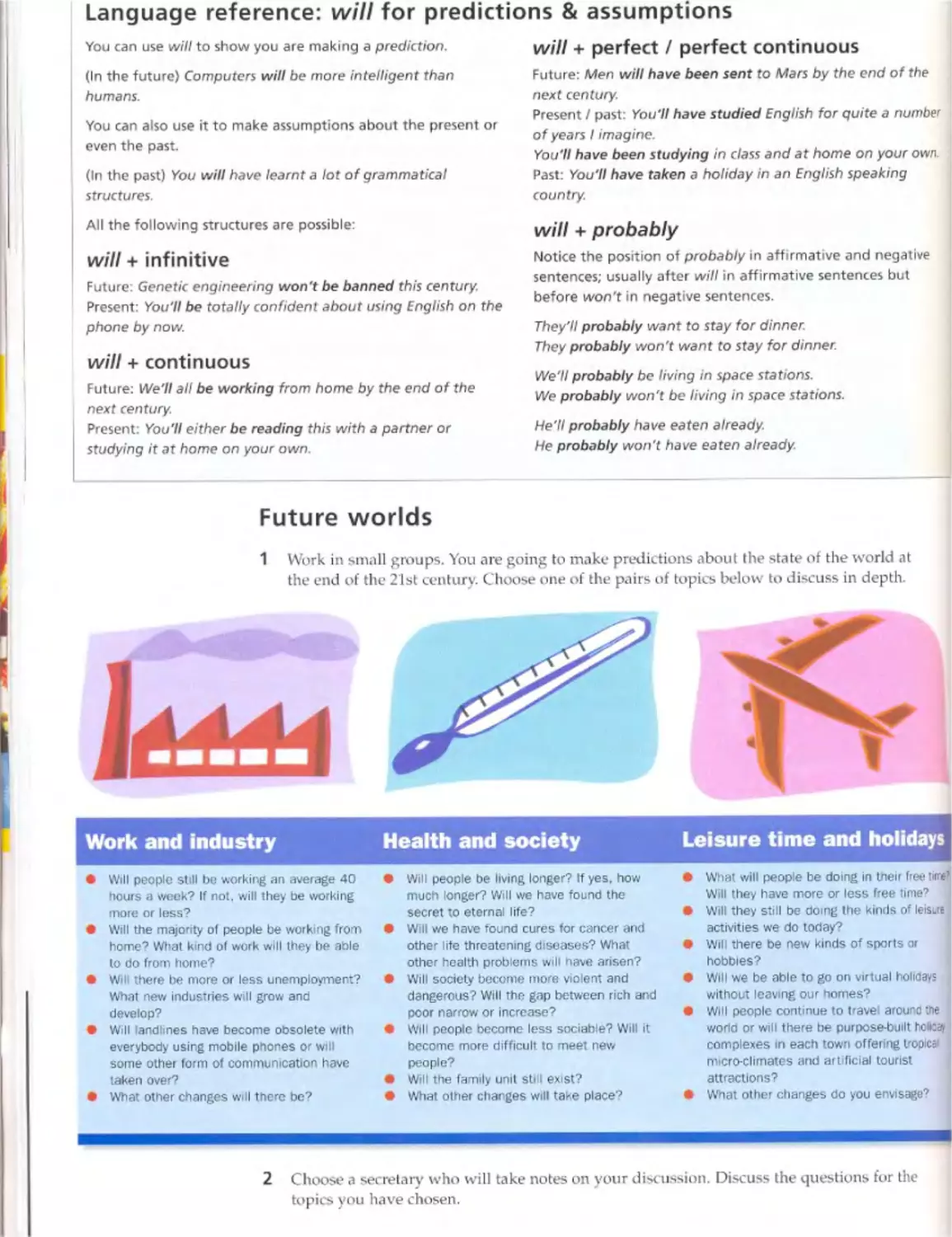
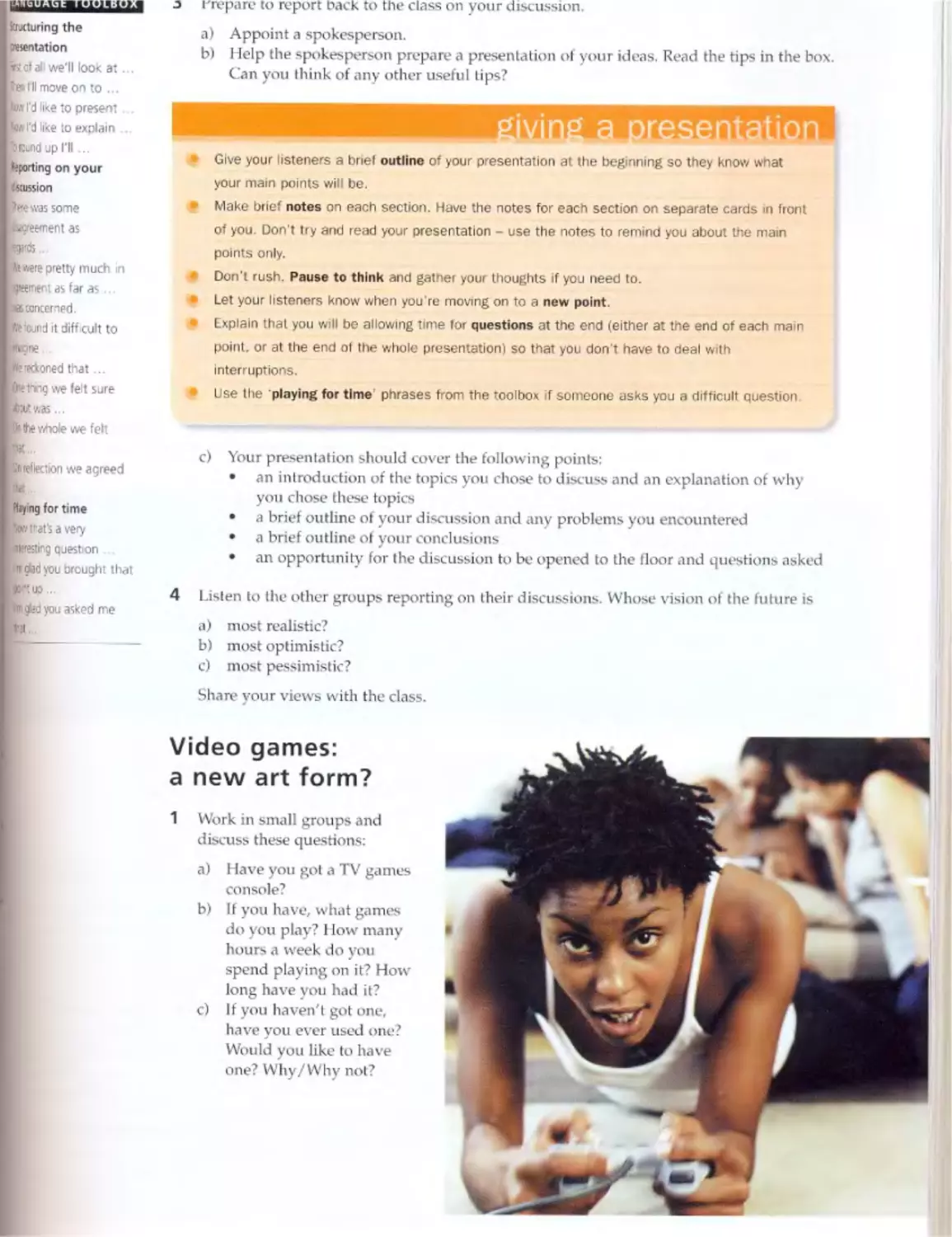
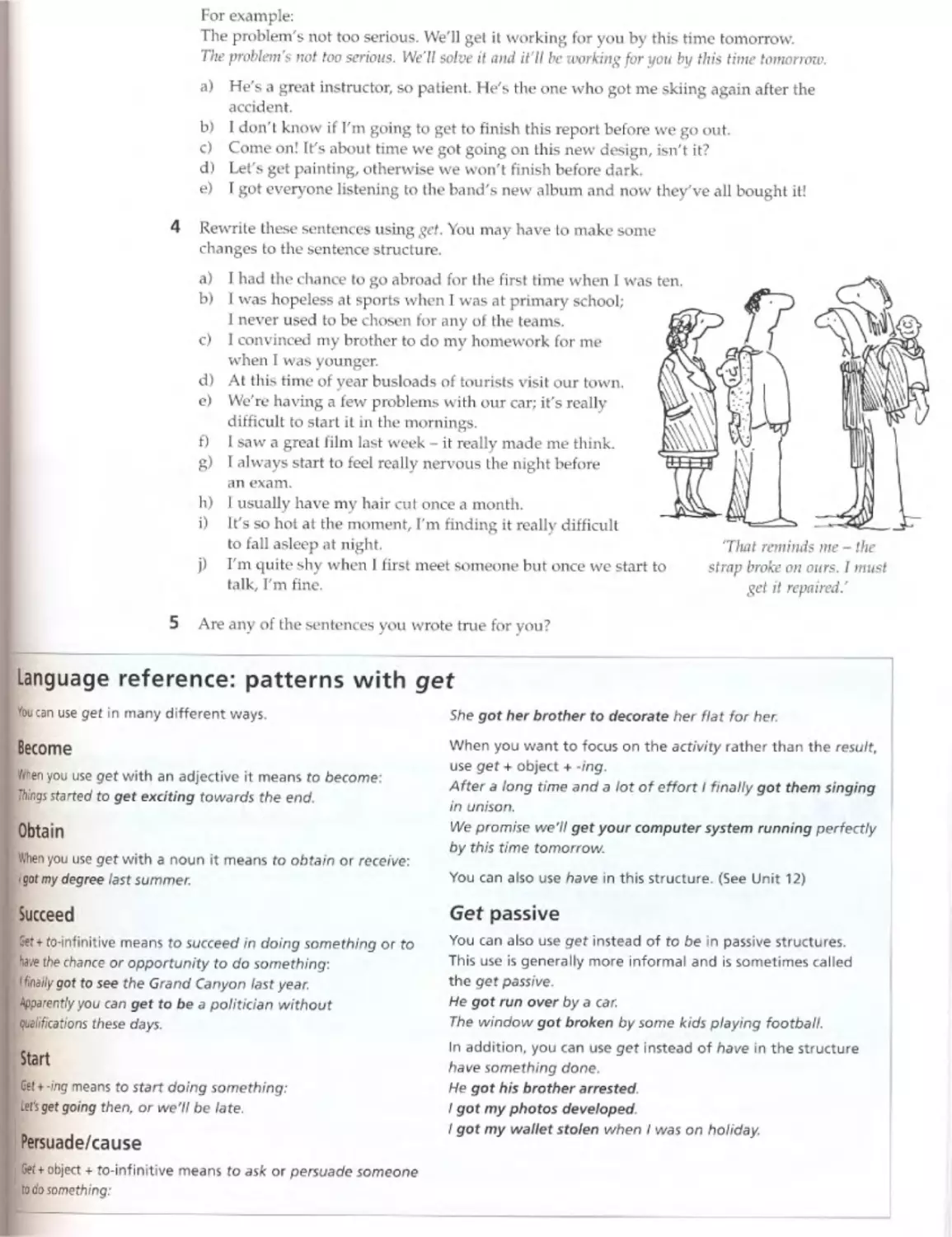
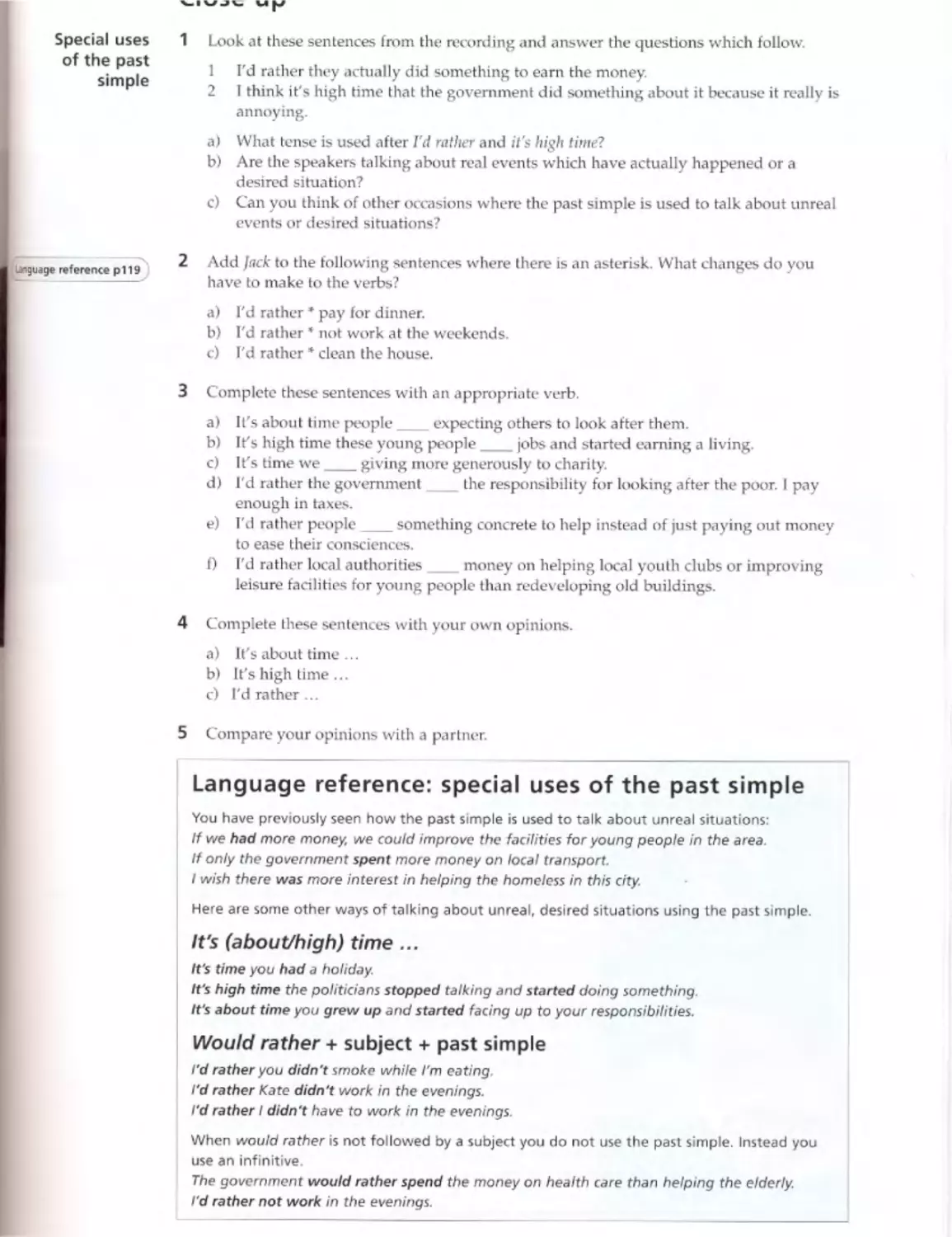
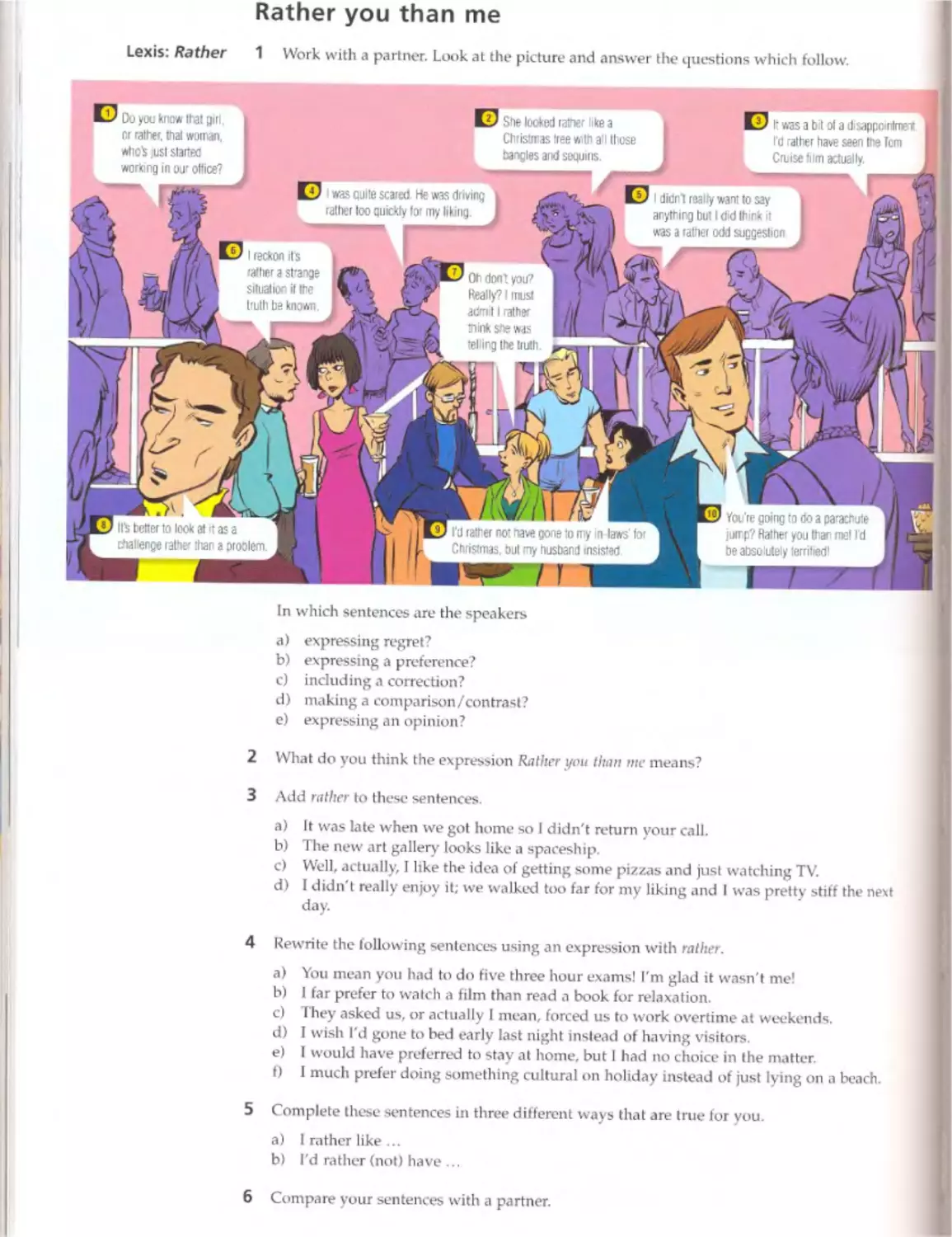
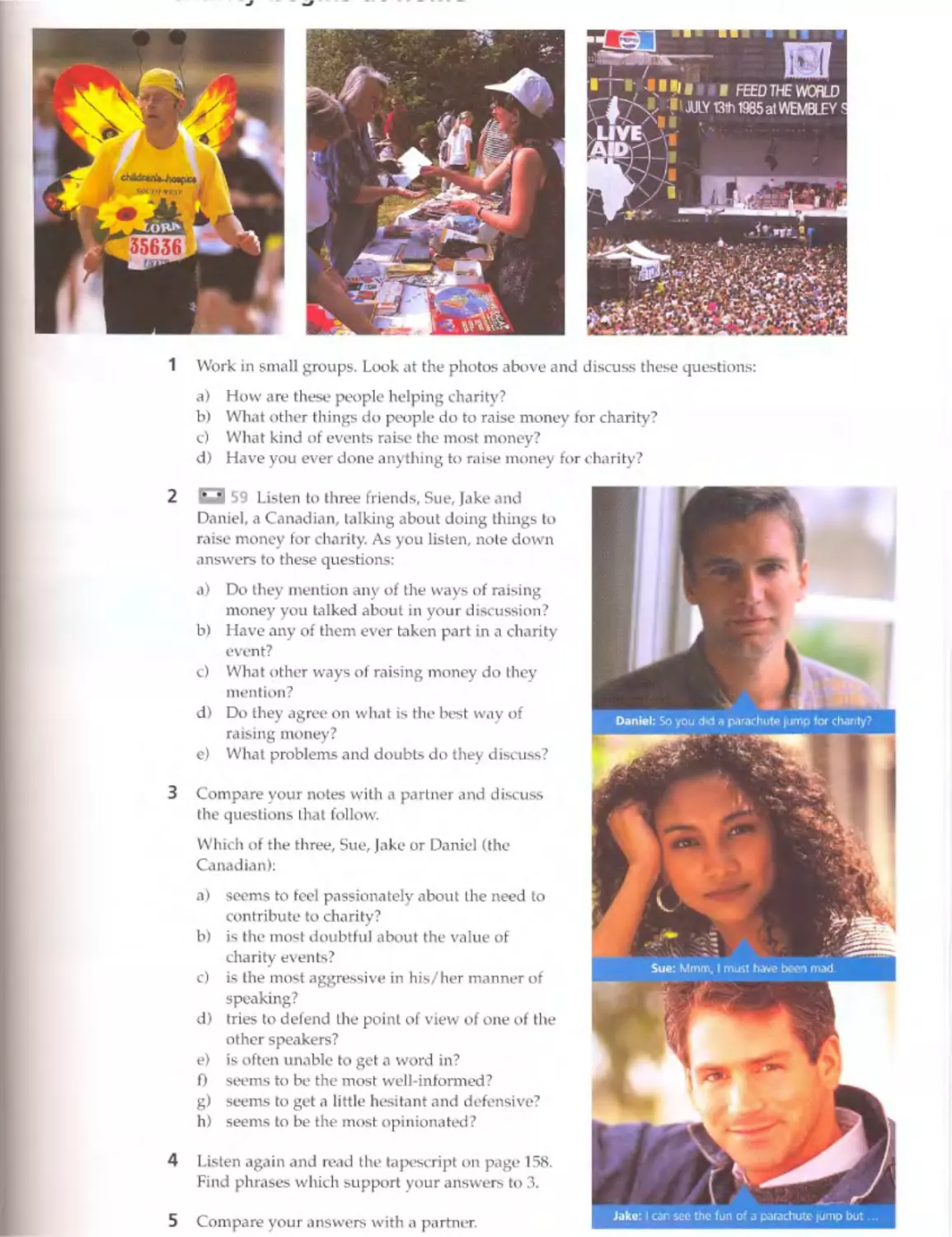
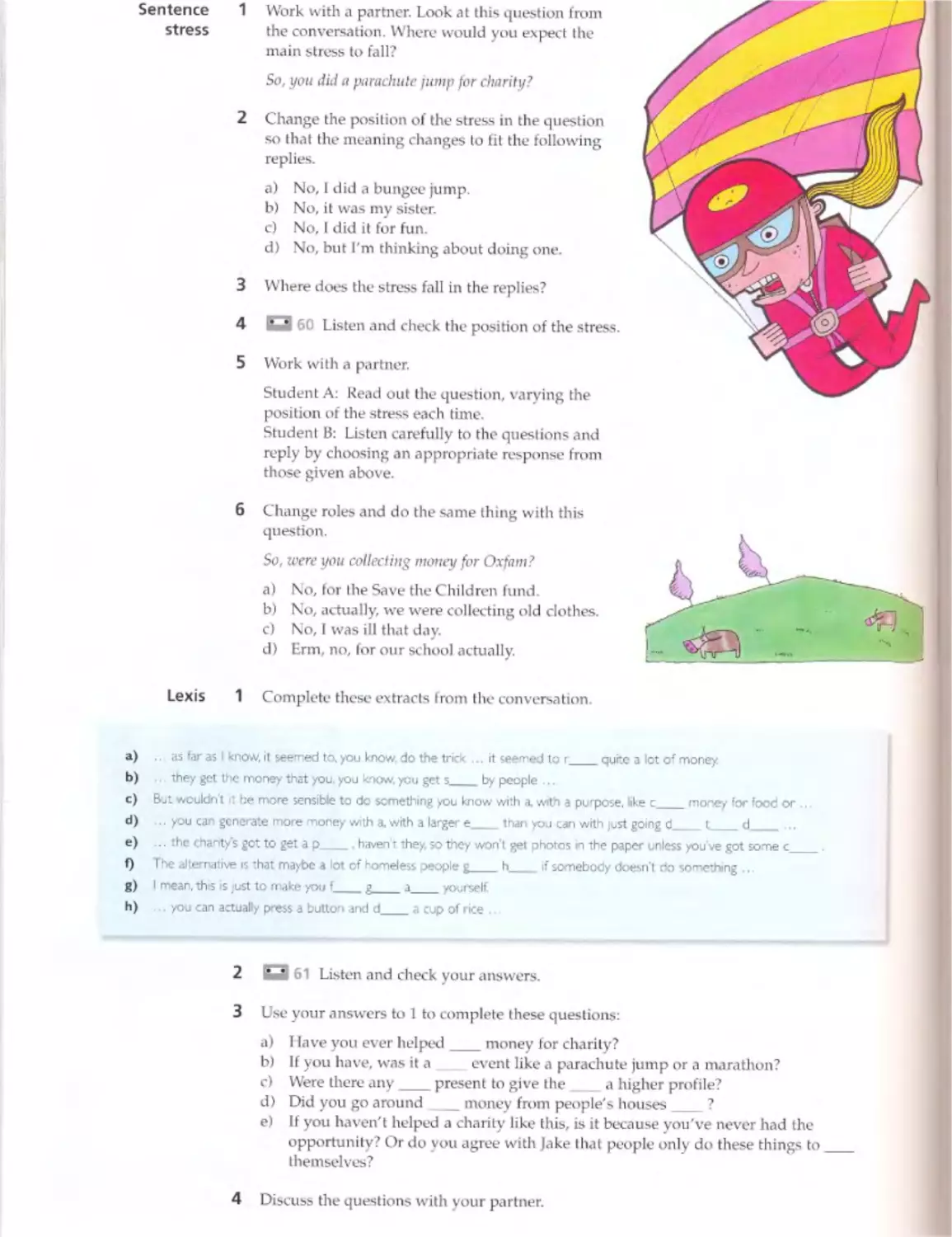




Текст
                    Ceri Jones & Tania Bastow
with Jon Hird
Inside я
Student’s


Inside Dut
Л ЛITT T A NT
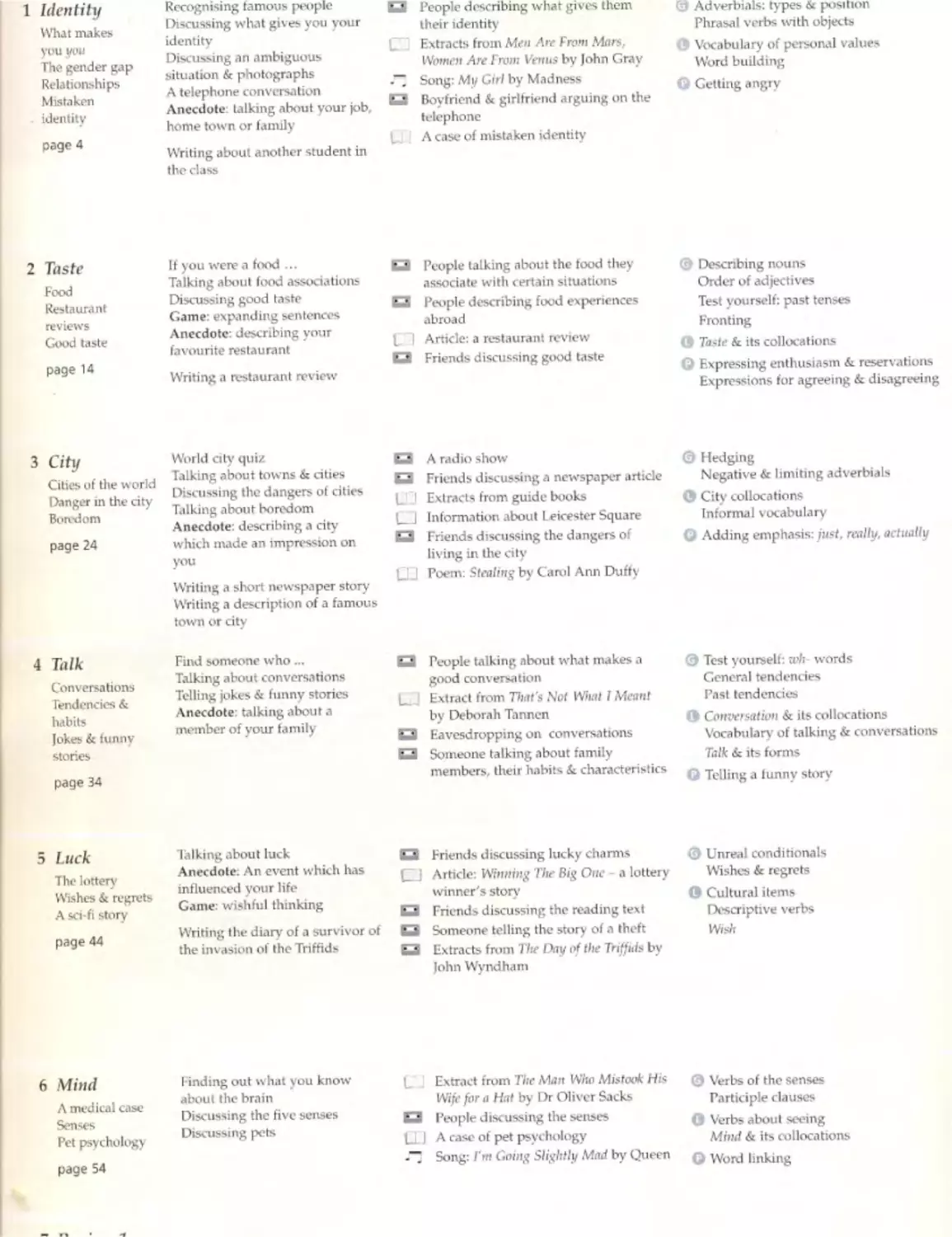
1 Identity
What makes
you you
The gender gap
Relationships
Mistaken
identity
page 4
Recognising famous people
Discussing what gives you your
identity
Discussing an ambiguous
situation & photographs
A telephone conversation
Anecdote: talking about vour job,
home town or family
Writing about another student in
the class
О
Li.I
People describing what gives them
their identity
Extracts from Men Are Front Mars,
Women Are From Venus by John Gray
Song: My Girl by Madness
Boyfriend & girlfriend arguing on the
telephone
A case of mistaken identity
<3 Adverbials: types & position
Phrasal verbs with objects
) Vocabulary of personal values
Word building
Getting angry
2 Taste	If you were a food ...
Food	Talking about food associations
Rpstaijra nt	Discussing good taste
txv J СС1	<1 1 IS reviews Good taste	Game: expanding sentences Anecdote: describing your favourite restaurant
page 14	Writing a restaurant review
E3 People talking about the food they
associate with certain situations
О People describing food experiences
abroad
L 71 Article: a restaurant review
О Friends discussing good taste
3 Describing nouns
Order of adjectives
Test yourself: past tenses
Fronting
• Tasto & its collocations
> Expressing enthusiasm & reservations
Expressions for agreeing & disagreeing
3 City	World city quiz	a	A radio show	0 Hedging
Cities of the world	Talking about towns & cities	E3	Friends discussing a newspaper article	Negative & limiting adverbials
Danger in the city	Discussing the dangers of cities Talking about boredom Anecdote: describing a city	LO	Extracts from guide books	О City' collocations
Boredom		О	Information about Leicester Square	Informal vocabulary
page 24	which made an impression on you Writing a short newspaper story Writing a description of a famous	E3 LO	Friends discussing the dangers of living in the city Poem: Stealing by Carol Ann Duffs	О Adding emphasis: just, really, actually
town or citv
4 Talk	Find someone who...	Q	People talking about what makes a	© Test yourself: wh- words
Conversations Tendencies &	Talking about conversations Telling jokes & funny stories	LJ	good conversation Extract from That's Not IVi.il I Meant	General tendencies Past tendencies
habits Jokes & tunny	Anecdote talking about a member of your family	E3	by Deborah Tanncn Eavesdropping on conversations	Q Conversation & its collocations Vocabulary of talking & conversations
stories page 34		S3	Someone talking about family members, their habits i. characteristics	Talk & its forms О Telling a funny’ story
5 Luck
The lottery
Wishes & regrets
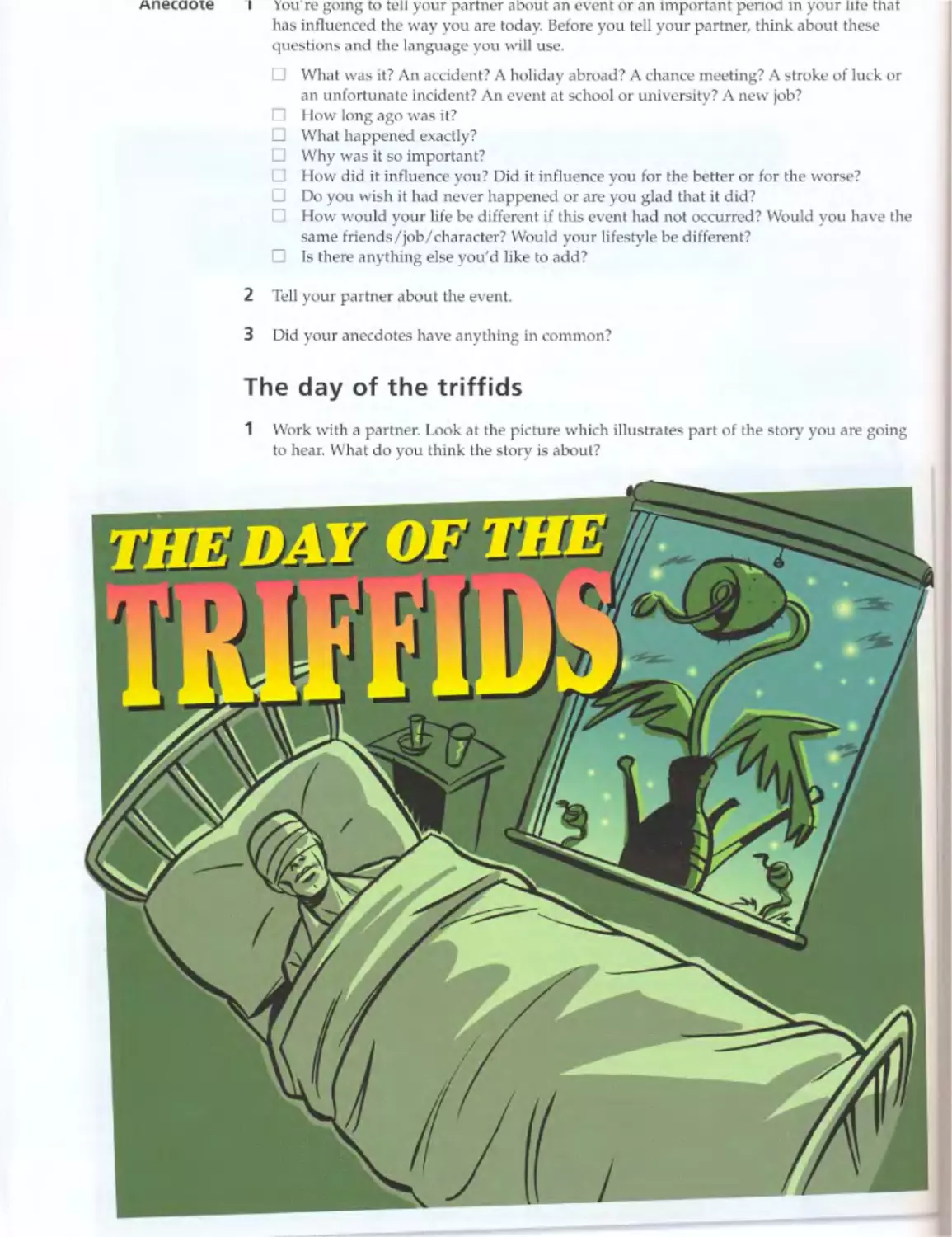
A sci-fi story
page 44
Talking about luck
Anecdote: An event which has
influenced your life
Game: wishful thinking
Writing the diary of a survivor of
the invasion of the Triffids
S3 Friends discussing lucky charms
(_ j Article: Winning The Big One a lottery
winner's story
’Zr Friends discussing the reading text
£3 Someone tolling the story of a theft
E3 Extracts from The Day of the Triffids by
John Wyndham
<3 Unreal conditionals
Wishes & regrets
О Cultural items
Descriptive verbs
Wish
6 Mind
A medical case
Senses
Pet psychology
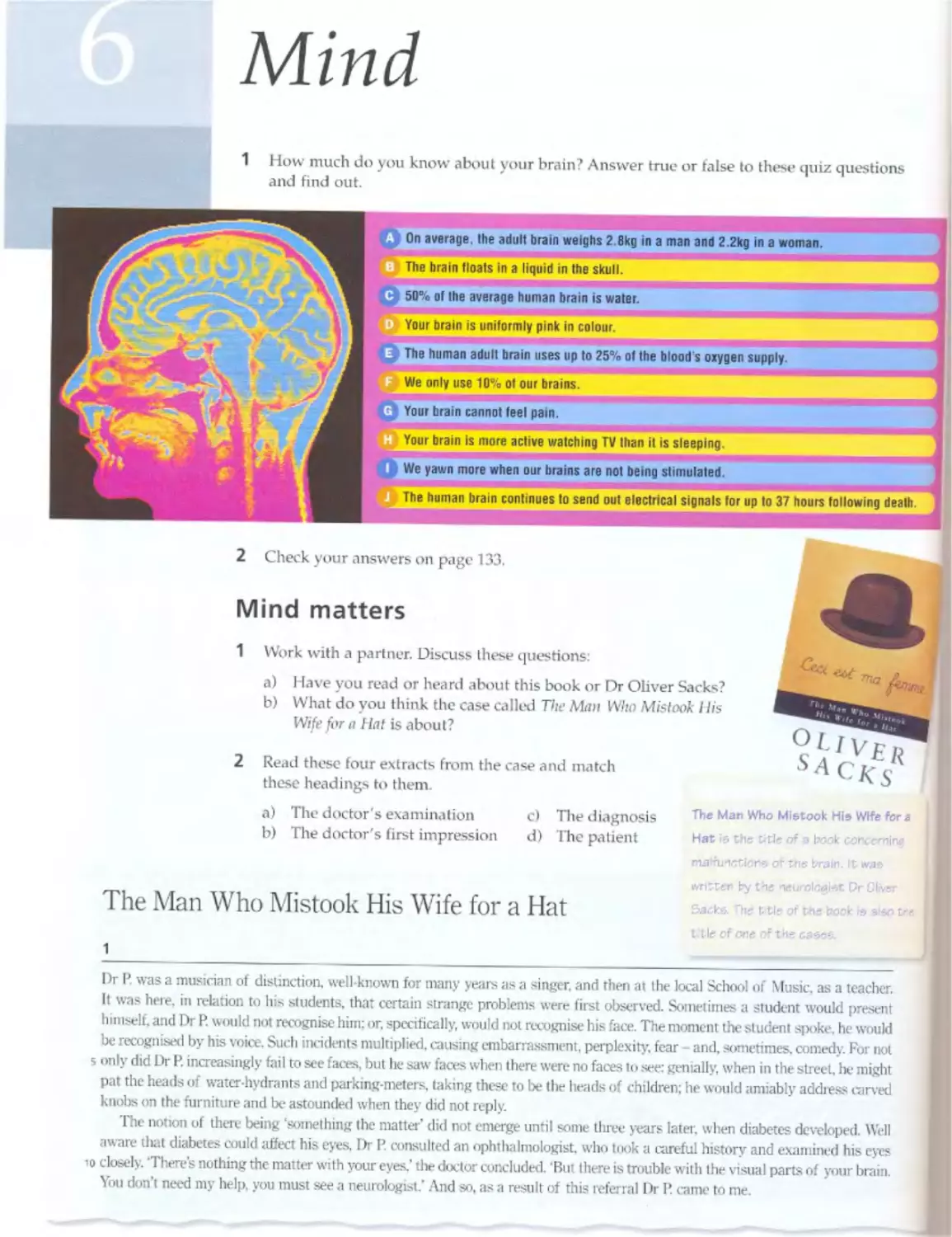
Finding out what you know
about the brain
Discussing the five senses
Discussing pets
page 54
L Extract from The Man Who Mistook His
Wife for a Hat by Dr Oliver Sacks
ЕЭ People discussing the senses
QJ A case of pet psychology
Song: I'm Going Slightly Mad by Queen
© Verbs of the senses
Participle clauses
О Verbs about seeing
Mind & its collocations
Q Word linking
Inits & topics
writing
listening texts
renunciation
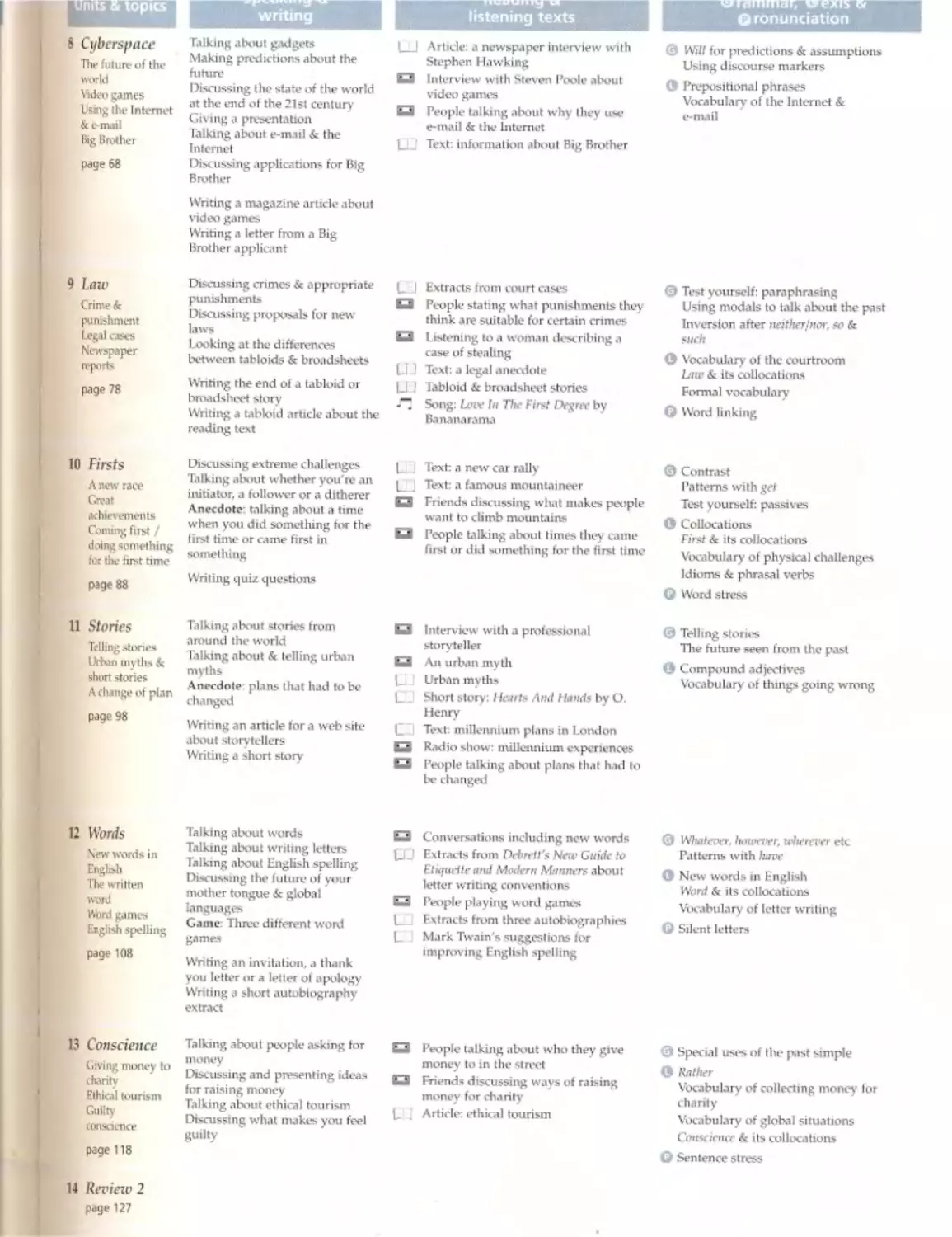
8 Cyberspace
The future of the
world
Video games
Using lhe Internet
& e-mail
Big Brother
page 68
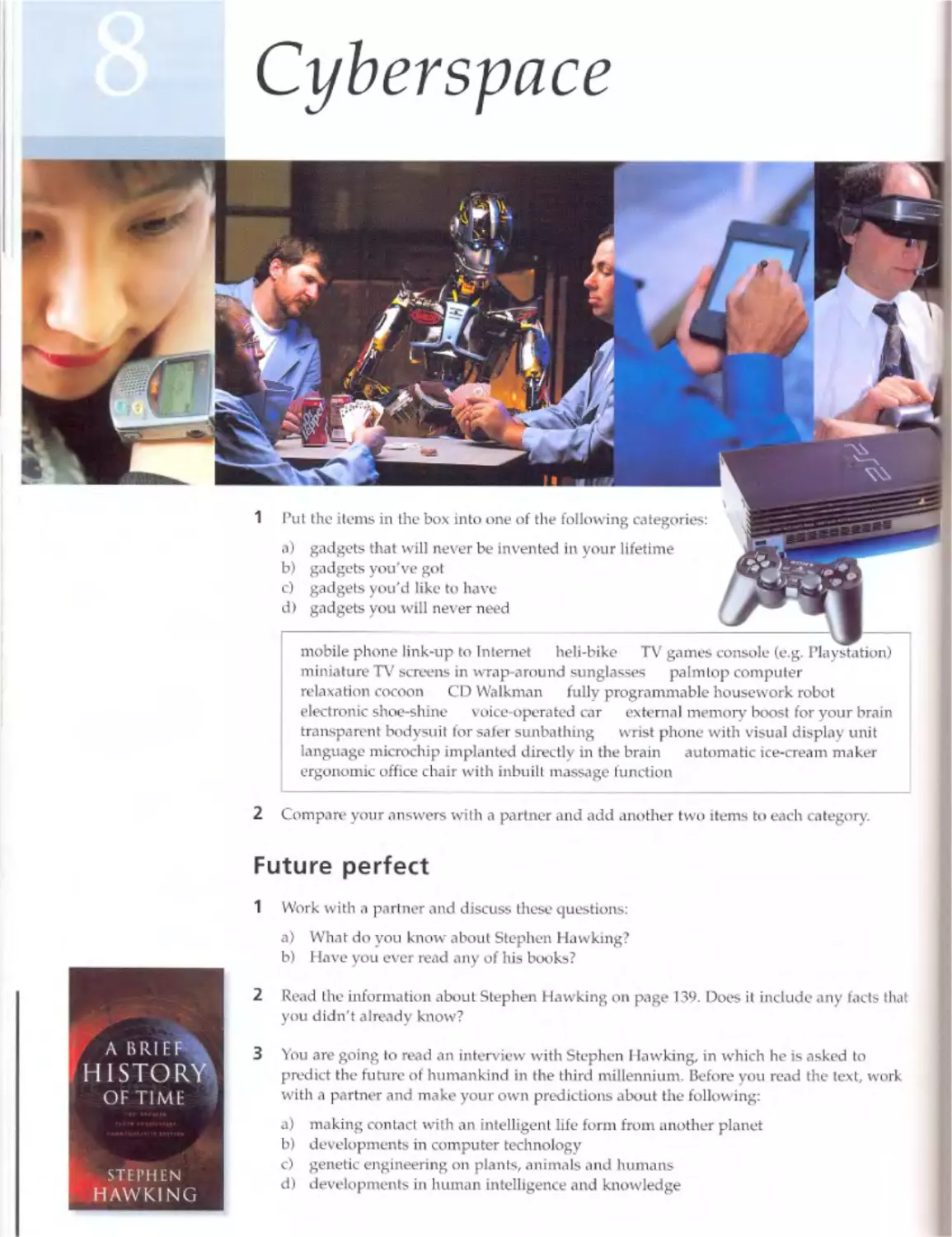
Talking about gadgets
Making predictions about the
future
Discussing the state of the world
at the end of the 21st century
Giving a presentation
Talking about e-mail & the
Internet
Discussing applications for Big
Brother
Writing a magazine article about
video games
Writing a letter from a Big
Brother applicant
I I Article: a newspaper interview with
Stephen Hawking
£3 Interview with Steven Poole about
video games
£3 People talking about why they use
e-mail & the Internet
L Text: information about Big Brother
:  Will for predictions & assumptions
Using discourse markers
G Prepositional phrases
Vocabulary of the Internet &
e-mail
9 Law
Crime &
punishment
Legal cases
Newspaper
reports
page 78
Discussing crimes & appropriate
punishments
Discussing proposals for new
laws
Looking at the differences
between tabloids & broadsheets
Writing the end of a tabloid or
broadsheet story
Writing a tabloid article about the
reading text
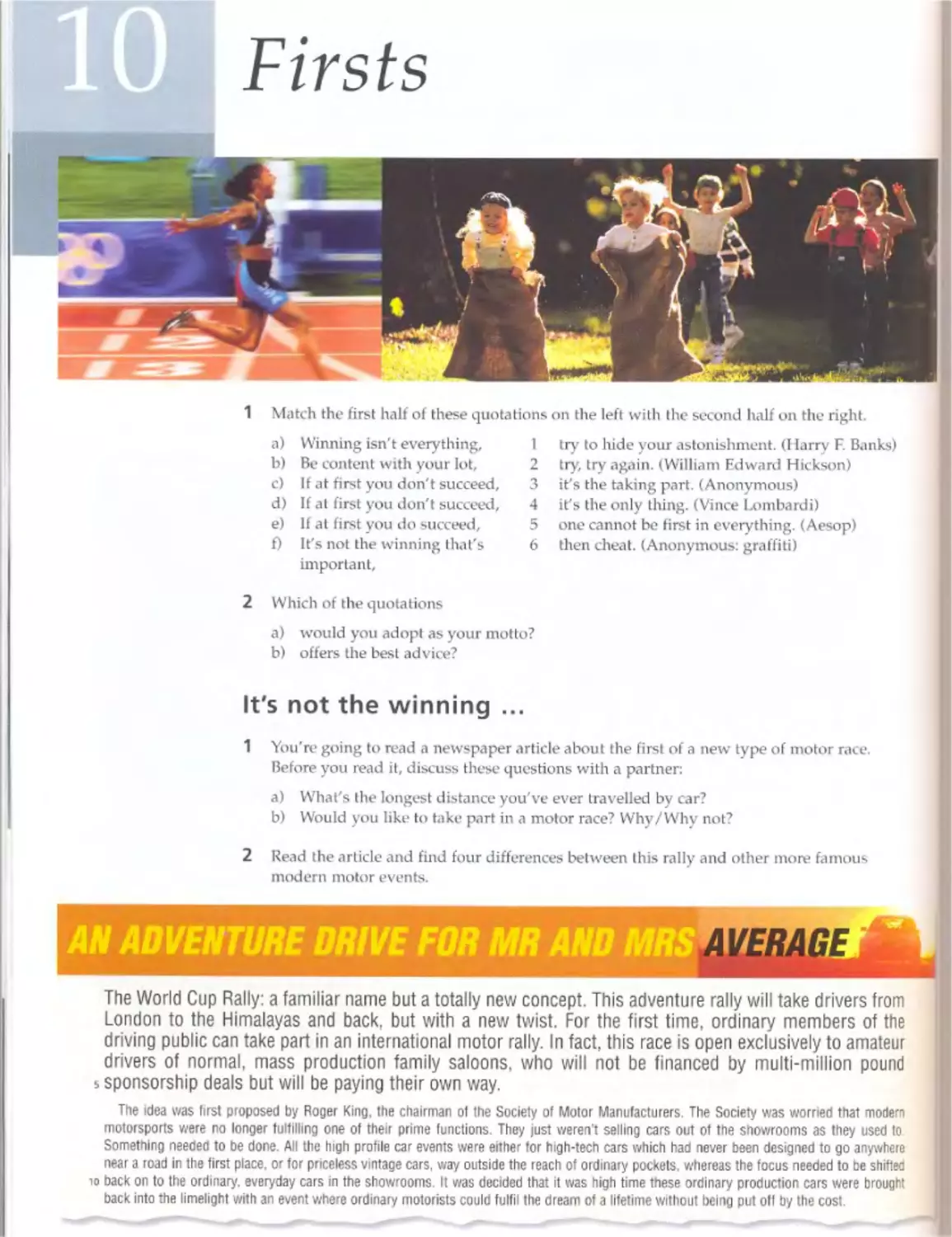
10 Firsts
A new race
Great
achievements
Coming first /
doing something
for the first time
page 88
11 Stories
Telling stones
Urban myths &
short stories
A change of plan
page 98
Discussing extreme challenges
Talking about whether you're an
initiator, a follower or a ditherer
Anecdote: talking about a time
when you did something for the
first time or came first in
something
Writing quiz questions
Talking about stories from
around the world
Talking about & telling urban
myths
Anecdote: plans that had to be
changed
Writing an article for a web site
about storytellers
Writing a short story
L J Extracts from court cases
О People stating what punishments they
think are suitable for certain crimes
U Listening to a woman describing a
case of stealing
(J J Text: a legal anecdote
t_l Tabloid & broadsheet stories
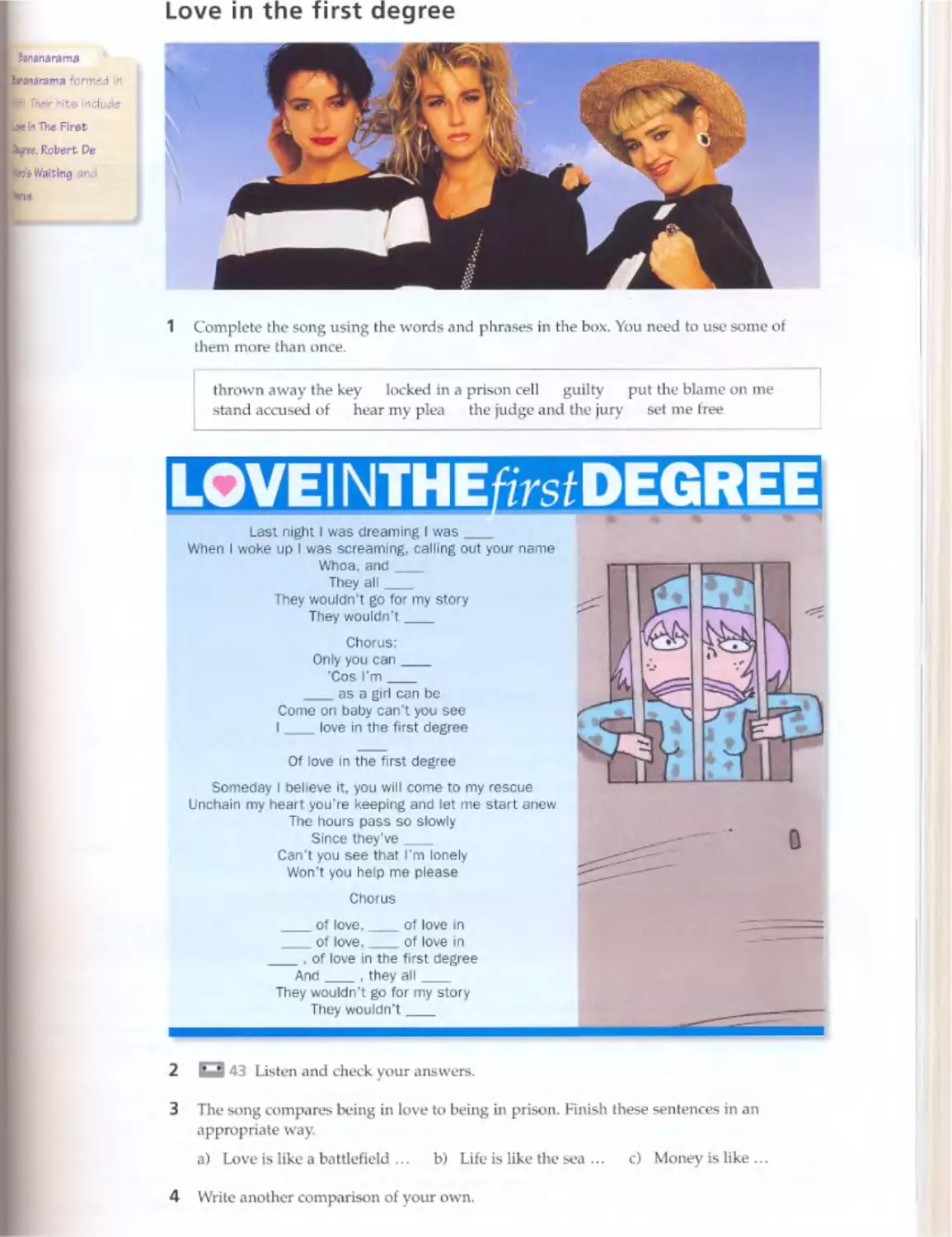
Song: Love tn The First Degree by
Bananarama
L Text: a new car rally
I J Text: a famous mountaineer
Q Fnends discussing what makes people
want to climb mountains
£3 People talking about limes they came
first or did something for the first time
© Test yourself: paraphrasing
Using modals to talk about the past
Inversion after neither!nor, so &
such
0 Vocabulary of the courtroom
Law & its collocations
Formal vocabulary
Q Word linking
Q Interview with a professional
storyteller
£3 An urban myth
L Urban myths
|_ Short story: I leuit> And Hands by O.
Henry
| Text: millennium plans in London
£3 Radio show: millennium experiences
Q People talking about plans that had to
be changed
© Contrast
Patterns with gel
Test yourself: passives
О Collocations
First & its collocations
Vocabulary of physical challenges
Idioms & phrasal verbs
Q Word stress
0 Telling stones
The future seen from the past
0 Compound adjectives
Vocabulary of things going wrong
12 Words
New words in
English
The written
word
Word games
English spelling
page 108
13 Conscience
Giving money to
charity
Ethical tourism
Guilty
conscience
page 118
14 Review 2
page 127
Talking about words
Talking about writing letters
Talking about English spelling
Discussing the future of your
mother tongue & global
languages
Game: Three different word
games
Writing an invitation, a thank
you letter or a letter of apology
Writing a short autobiography
extract
Talking about people asking for
money
Discussing and presenting ideas
for raising money
Talking about ethical tourism
Discussing what makes you feel
guilty
£3 Conversations including new words
L ’ Extracts from Debrett's New Guide to
Etiquette and Modern Manners about
letter writing conventions
£3 People playing word games
|__। Extracts from three autobiographies
|_ Mark Twain's suggestions for
improving English spelling
£3 People talking about who they give
money to in the street
£3 Friends discussing ways of raising
money for charity'
L Article: ethical tourism
0 Whatever, however, wherever etc
Patterns with have
О New words in English
Word & its collocations
Vocabulary of letter writing
Q Silent letters
© Special uses of lhe past simple
О Rather
Vocabulary of collecting money for
charity
Vocabulary of global situations
CoiBcirncr & its collocations
О Sentence stress
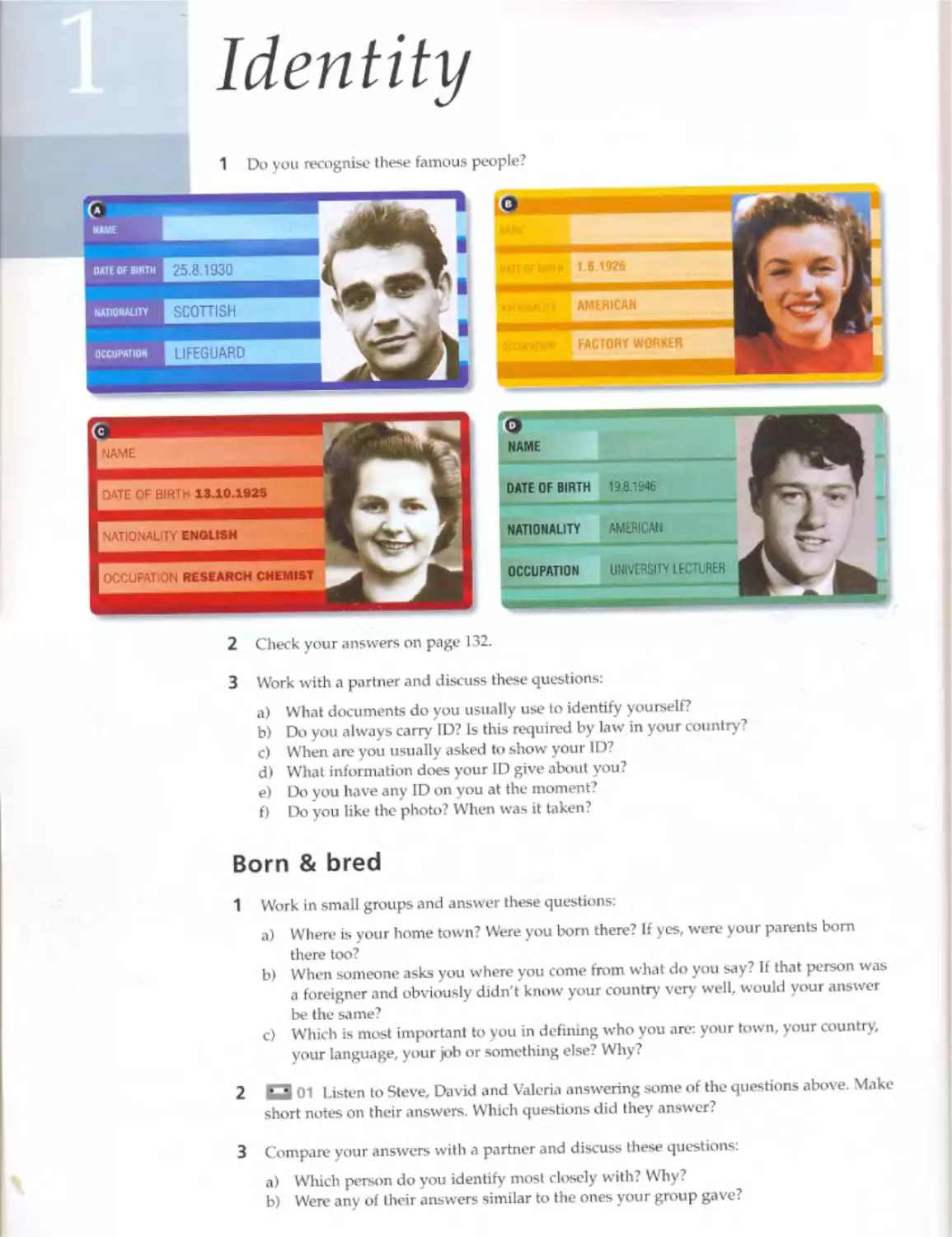
Identity
1 Do you recognise these famous people?
2 Check your answers on page 132.
3 Work with a partner and discuss these questions:
a)	What documents do you usually use to identify yourself?
b)	Do you always carry ID? Is this required by law in your country?
c)	When are you usually asked to show your ID?
d)	What information does your ID give about you?
e)	Do you have any ID on you at the moment?
f)	Do you like the photo? When was it taken?
Born & bred
1	Work in small groups and answer these questions:
a)	Where is your home town? Were you born there? If yes, were your parents born
there too?
b)	When someone asks you where you come from what do you say? If that person was
a foreigner and obviously didn't know your country very well, would your answer
be the same?
c)	Which is most important to you in defining who you are: your town, your country,
your language, your job or something else? Why?
2	01 Listen to Steve, David and Valeria answering some of the questions above. Make
short notes on their answers. Winch questions did they answer?
3	Compare your answers with a partner and discuss these questions:
a)	Which person do you identify most closely with? Why?
b)	Were any of their answers similar to the ones your group gave?
Types of
adverbials
language reference p6
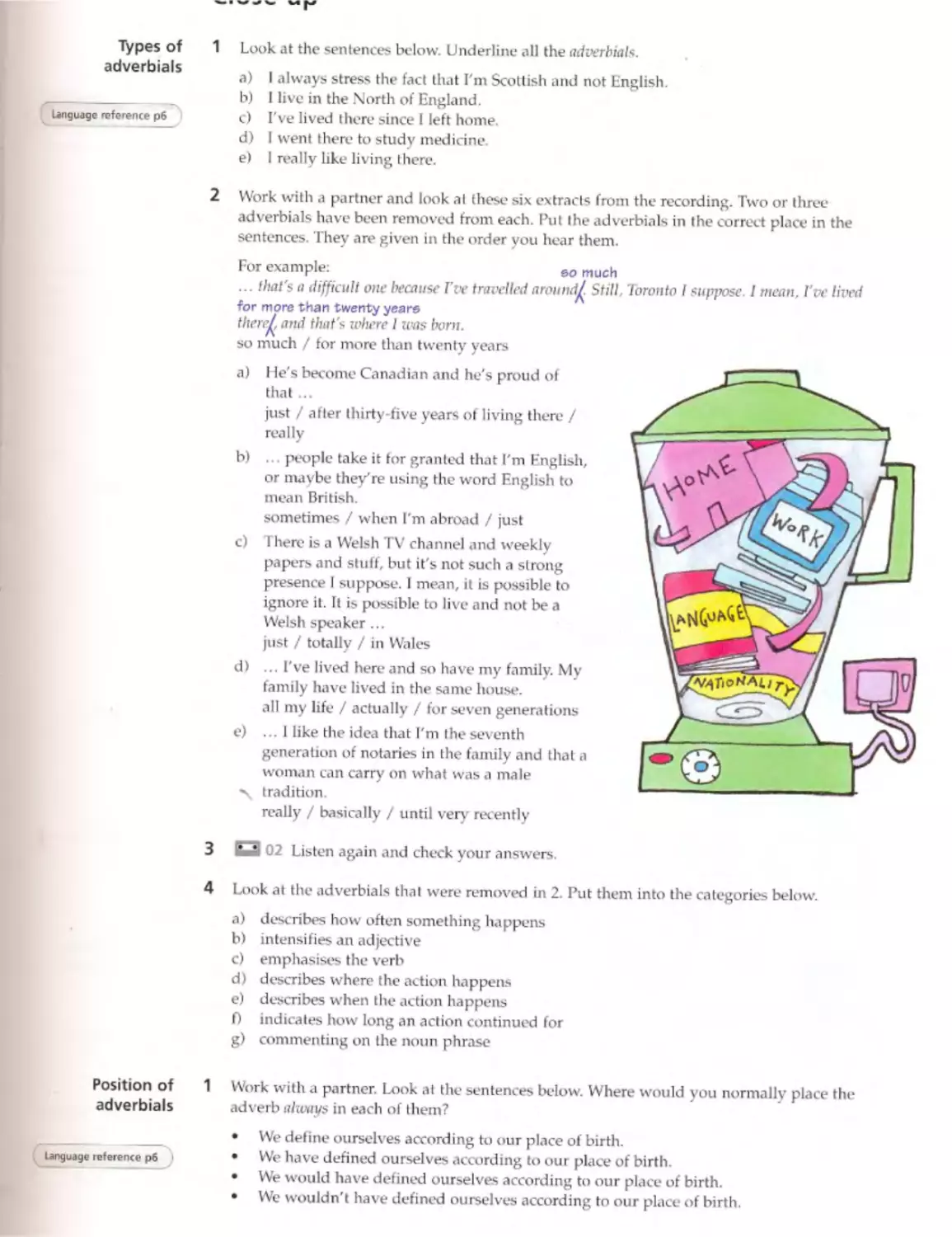
1	Look at the sentences below. Underline all the adverbials.
a)	I always stress the fact that I'm Scottish and not English.
b)	1 live in the North of England.
c)	I've lived there since 1 left home.
d)	I went there to study medicine.
e)	I really like living there.
2	Work with a partner and look al these six extracts from the recording. Two or three
adverbials have been removed from each. Put the adverbials in the correct place in the
sentences. They are given in the order you hear them.
For example:	so much
... that's a difficult one because I’ve travelled around/. Still, Toronto I suppose. 1 mean, I've lived
for more than twenty years
there^, and that's where I was born.
so much / for more than twenty years
a)	He's become Canadian and he's proud of
that ...
just / after thirty-five years of living there /
really
b)	... people take it for granted that I'm English,
or maybe they're using the word English to
mean British.
sometimes / when I'm abroad / just
c)	There is a Welsh TV channel and weekly
papers and stuff, but it's not such a strong
presence I suppose. I mean, it is possible to
ignore it. It is possible to live and not be a
Welsh speaker...
just I totally I in Wales
d)	... I’ve lived here and so have my family. My
family have lived in the same house.
all my life / actually / for seven generations
e)	... 1 like the idea that I'm the seventh
generation of notaries in the family and that a
woman can carry on what was a male
\ tradition.
really / basically / until very recently
3	E302 Listen again and check your answers.
4	Look at the adverbials that were removed in 2. Put them into the categories below,
a) describes how often something happens
b) intensifies an adjective
c) emphasises the verb
d) describes where the action happens
e) describes when the action happens
f) indicates how long an action continued for
g) commenting on the noun phrase
Position of 1 Work with a partner. Look al the sentences below. Where would you normally place the
adverbials adverb always in each of them?
•	We define ourselves according to our place of birth.
•	We have defined ourselves according to our place of birth.
•	We would have defined ourselves according to our place of birth.
•	We wouldn't have defined ourselves according to our place of birth.
2	Look at this sentence again and answer the questions. ~
We 111 define ourselves *” according to our place of birth ®.
a)	In which position, 1-5, would you normally add these adverbials to this sentence?
•	when we are children • if we live there • on the whole
•	often	• to some extent • probably
b)	Which adverbials would you not use in position 2?
c)	In which position can you never add an adverbial?
3	Modify the model sentence to fit your own opinion as closely as possible.
4	Look at these pairs of sentences, rhe adverbials in italics are in different positions. How
does this change the meaning of the sentence?
For example:
A Actually he's performing in the play tomorrow, (and not doing something else)
В He's actually performing in the play tomorrow, (and not just sitting in the audience)
1A Only Kate knows howr to look after horses.
IB Kate only knows how to look after horses.
2A Honestly, I can't speak to her any more.
2В 1 can't speak to her honestly any more.
ЗА Earlier, I had wanted Rich to come to the meeting.
ЗВ I had wanted Rich to come to the meeting earlier.
5	Interview another student and write a profile of them for a class magazine. Use at least
five adverbials.
Language reference: adverbials
An adverbial can be a word (usually, really, probably, softly) or
a phrase (at home, once a week, to get a good job, when I
was a child). You generally use an adverbial to provide
additional information about a verb or an adjective.
Types of adverbials
Adverbials fulfil a number of functions.
1	You can use them to add information about the verb by
a)	describing how often something happens
I speak to my mother on the phone every other day
b)	describing where the action happens
/ was mugged on the way home
c)	describing when the action happens
The dinner will probably be ready by then.
d)	telling us how long an action continued for
He'd been dreaming about it for months
2	You can use them to give extra information about
adjectives, for example, by grading them.
He was extremely happy to see her.
It was fairly hot for the time of year
3	You can use them to comment on a clause or focus
attention on one part of it.
Generally speaking, the trains are very quick and
efficient.
Frankly, I didn't believe a word they said.
I've actually lived here for five years now.
Position of adverbials
You can use adverbials in three positions in a sentence.
1 Initial position
On the whole I prefer to eat home-made food.
2 You tend to use one-word adverbials of frequency,
emphasis and probability in the mid position.
a)	between the subject and the main verb:
I never trusted him.
b)	between an auxiliary and the main verb:
I've always loved travelling by train.
c)	In negative sentences the adverb can be placed either
between the subject and a negative auxiliary:
I really don't think you should be doing that.
or directly after the negative auxiliary:
I don't really think you should be doing that.
Adverbs of probability usually follow the first pattern
and adverbs of frequency usually follow the second:
They probably didn't mean to offend you.
I don't always get along with him.
3 You tend to use longer adverbial phrases and adverbs of
manner in the final position.
They finished the job as quickly as they could
Changing the position of the adverb can change the meaning
of the sentence:
Only Sarah has Pierre's e mail address. (no-one else has it)
Sarah only has Pierre's e mail address, (and nothing else)
I am who I am
Anecdote
LANGUAGE TOOLBOX
Stressing importance
I suppose it really means a
tot to rne
it's quite an important part
ot my life
•tstood of central to wtio i
am, I suppose
Running out of things
to say
Let me see .
I think that's it.
"here's not much else to
say really
I'm not sure what else I
can tell you
I'm яге you know what I
rrean
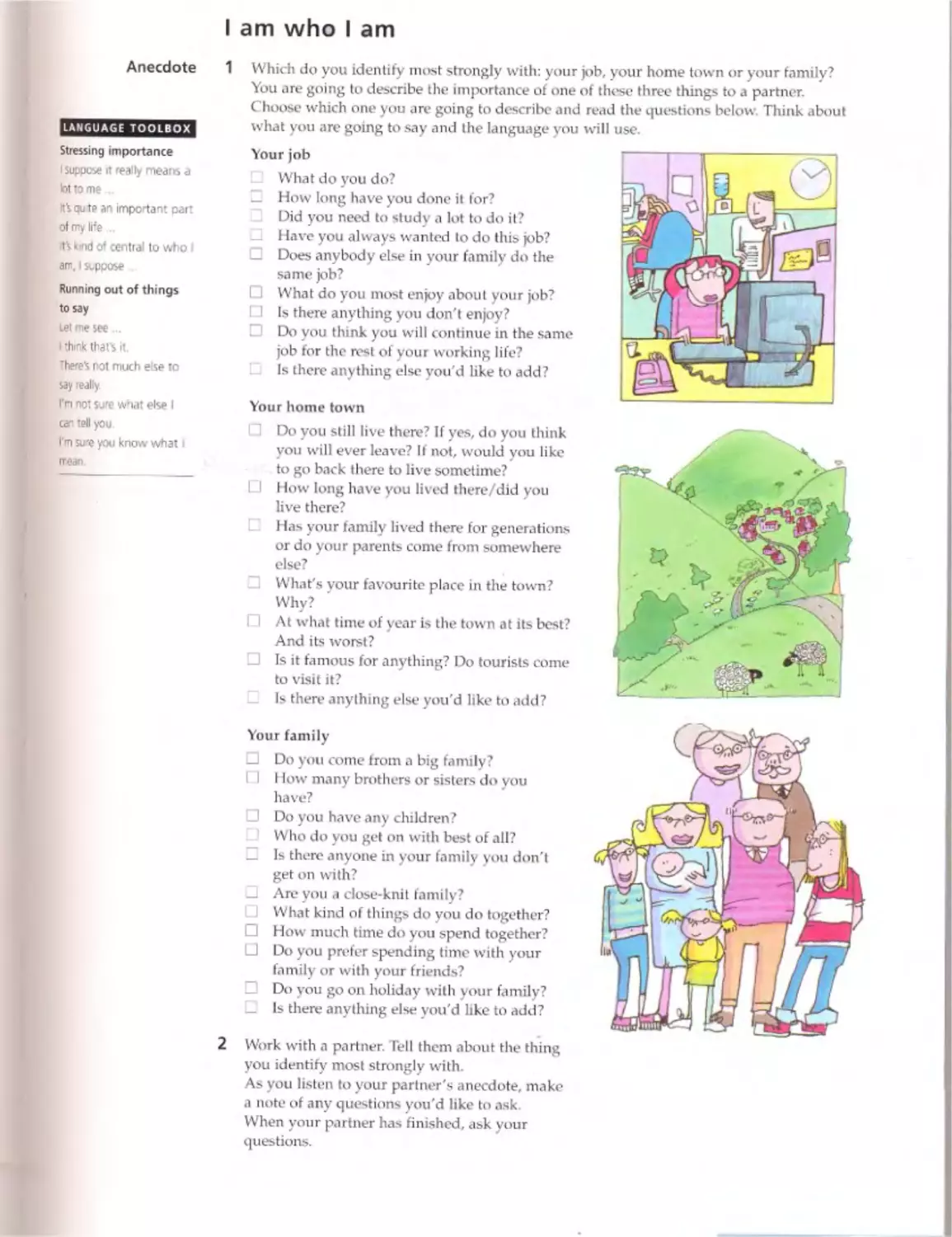
1 Which do you identify most strongly with: your job, your home town or your family?
You are going to describe the importance of one of these three things to a partner.
Choose which one you are going to describe and read the questions below. Think about
what you are going to say and the language you will use.
Your job
What do you do?
□	How long have you done it for?
Did you need to study a lot to do it?
Have you always wanted to do this job?
C Does anybody else in your family do the
same job?
□	What do you most enjoy about your job?
□	Is there anything you don't enjoy?
□	Do you think you will continue in the same
job for the rest of your working life?
Is there anything else you'd like to add?
Your home town
Do you still live there? If yes, do you think
you will ever leave? If not, would you like
to go back there to live sometime?
□	How long have you lived there/did you
live there?
Has your family lived there for generations
or do your parents come from somewhere
else?
What's your favourite place in the town?
Why?
I I At what time of year is the town at its best?
And its worst?
Is it famous for anything? Do tourists come
to visit it?
Is there anything else you'd like to add?
Your family
□	Do you come from a big family?
How many brothers or sisters do you
have?
U Do you have any children?
Who do you get on with best of all?
□	Is there anyone in your family you don’t
get on with?
□	Are you a close-knit family?
What kind of things do you do together?
□	How much time do you spend together?
□	Do you prefer spending time with your
family or with your friends?
C	1 Do you go on holiday with your family?
Is there anything else you'd like to add?
2 Work with a partner. Tell them about the thing
you identify most strongly with.
As you listen to your partner's anecdote, make
a note of any questions you'd like to ask.
W'hen your partner has finished, ask your
questions.
NINAPt
шоп ms.
У^отепЛг^
JrotnVenus
। ши, »ra m м«ж
CMMCNNI Hi
ЯПЖ WM *» I HaI Ч1Г»ГМГ.
JOHN GRAY
1	Work in small groups and discuss these questions. Which question generates the most
discussion?
a)	If you were a member of the opposite sex how would your life be different?
b)	To what extent does our society expect men and women to fulfil different roles?
c)	Do you think men and women think differently or perceive the world differently?
2	You are going to read an extract from a book that explores the differences between men
and women. Work with a partner. Read the blurb from the book cover and answer the
questions which follow.
Once upon a time Martians andVenusians met. fell in love, and
had happy relationships together because they respected and
accepted their differences.Then they came to Earth and
amnesia set in: they forgot they were from different planets.
Using this metaphor to illustrate the commonly occurring
conflicts between men and women. Dr John Gray explains
how these differences can come between the sexes and
prohibit mutually fulfilling loving relationships. Based on years
of successful counselling of couples and individuals, he gives
advice on how to counteract these differences in
communication styles, emotional needs, and modes of
behaviour to promote a greater understanding between
individual partners.
(fx< rrui from Mw) xlie From Matz. Women A<e From Venus by	Силу It'D.)
a)	Have you read the book? If you have, did you enjoy it? If you haven't read it, have
you heard of it? What kind of book is it? Who was it written for? What do you think
the main argument is?
b)	The book is based on the premise that men and women are very different. The
author mentions three categories of differences: communication styles, emotional
needs and modes of behaviour. What do you think the differences are?
c)	Which of the following do you think he associates with men and which with
women?	•
uniforms self-help books romance sports clothes shopping
gadgets and gizmos spirituality communication power
3	Work with a partner. You are going to read two extracts in which the author highlights
the main differences between the two sexes.
Student A read about life on Mars on page 132.
Student В read about life on Venus on page 134.
4	Use your notes to tell your partner about your extract and then discuss these questions:
a)	Do you identify with the description given of your sex?
b)	Are men and women really different?
Lexis 1 Do these sentences refer to men or women?
a)	value power, efficiency, and achievement.
b)	The issue of competence is very important to
c)	value love, communication, beauty and relationships.
d)	experience fulfilment through sharing and relating.
e)______________feel satisfaction when they win a race, achieve a goal, or solve a problem.
f)______________take pride in being considerate of the needs and feelings of others.
g)	are always doing things to prove themselves and develop their power and skills.
2 Find words or phrases in the sentences in 1 to match the definitions below.
a)	the knowledge and abilities that enable you to do something well, which can often
be learnt
b)	something which someone has succeeded in doing, especially after a lot of effort
c)	the general ability to do something well or efficiently
d)	the quality of being able to do a task successfully without wasting time or effort
e)	the pleasure you feel when you have done something well
f)	the feeling you have when a hope, dream or ambition has been realised
g)	thoughtful towards other people
h)	to think that something is important and to appreciate it
3 Create a table and complete it with the verb, noun, adjective and adverb forms for your
answers to 2 where appropriate.
For example:
noun	verb	adjective	adverb
©kills		skilful / ©killed	skilfully
4 Complete these sentences using words from 3.
a)	1 always try to take other people's points of view into before
making a decision.
b)	I find helping others very
c)	Honesty is the thing 1____most in a friend.
d)	1 always feel really when 1 manage to reach a deadline.
e)	Passing my degree has been my greatest______so far.
f)	1 really admire people who are super- and always manage
to do everything on time.
g)	My job is the one thing that gives me real
h)	Using a computer is probably one of the most important
I've learnt in my present job.
i)	Feeling_____about doing my job gives me confidence.
5 Do you agree with the sentences in 4? If not, change them so they are true for you.
6 Work with a partner and compare your answers.
Close up
Phrasal verbs
with objects
1	* * 03 l isten to Martha and Liz discussing the book Men Arc From Mars, Women Are
From Venus and answer the following questions:
a)	1 lave they both read the whole book?
b)	What do they think of it?
c)	Which passages from the book do they discuss?
2
Work with a partner. Look at the statements below. Are they true or false according to
the conversation you've just heard?
a)	Neither of them has read the book, they’ve
only had a chance to look at it very quickly and
superficially.
b)	Both think the Mars/Venus metaphor is a
good way to communicate the idea of the
difference between tire sexes.
c)	Tire book claims that men prefer to find
solutions to their problems by talking to
someone.
d)	1 he book suggests that men tend to reflect on
their problems.
e)	The book suggests that women lend not to
show their feelings.
f)	The book suggests that women do not like to
discuss their problems.
g)	The book suggests that men's refusal to talk
about their problems tends to depress women.
h)	The mam solution the author is able to propose
is to learn to understand and to tolerate our
differences.
Winria ага и/
Language reference p12
3 Listen again and check your answers.
4 Look at the sentences in 2 again. Match the phrases in italics to the phrasal verbs below.
1	to sort out	4
2	to bottle up	5
3	to put up with	6
to flick through
to think through
to get down
7 to talk through
8 to put across
9 to come up with
5 Work with a partner. Look at the three types of phrasal verbs which take objects shown
below and answer the questions.
Type 1
Two of the sentences below are not correct. Which are they?
a)	She flicked the book through.	c) She flicked it through.
b)	She flicked through the book.	d) She flicked through it.
Type 2
One of the sentences below is not correct. Which is it?
a)	The metaphor puts the idea across well.	c) The metaphor puts it across well.
b)	The metaphor puts across the idea well.	d) The metaphor puts across it well.
Type 3
What is the correct word order for these sentences?
a)	differences we others' pul should each with to learn up.
b)	author with what up solution did the come?
6 Answer these questions:
a)	What are the rules for word order in types 1 and 2?
b)	Are type 3 verbs similar to type 1 or type 2?
7 Look at the other phrasal verbs in 4. Are they type 1, 2 or 3?
tne ngnt position.
a)	I try not to____, it's always much better to talk about them with a friend, (my
feelings)
b)	I hate asking people for help. I'd much rather on my own. (my problems)
с)	I don't often buy a newspaper, but sometimes I______at the bar. (one)
d)	I'm not a very confident speaker. Sometimes I'm not sure I've managed to very
effectively, (my ideas)
e)	My motto is 'if you can't change it, then you'll just have to__'. (it)
f)	I tend to be a little too impulsive and don't enough, (things)
g)	I hate arguments, I'd much rather______quietly and calmly, (things)
h)	My sister’s a really happy, positive person, nothing ever . (her)
I can't stand hint,
really, but I quite like
dressing him up.'
9 Are the sentences in 8 true for you? If not, change them so that they are true. Compare
your answers with a partner.
Madness are a popular British bard
who reached the peak of their career ir
My girl
1 Work with a partner. Make a list of five common
complaints girlfriends and boyfriends make about each
other. Do the complaints differ according to sex?
2 You're going to listen to a song about an argument
between a couple. Look at these expressions from the
song. What do you think the problem between them is?
had enough on my own why can't 1 explain
we argued just the other night 1 don't care
see the film tonight lovely to me on the telephone
doesn't understand talked it out mad at me
3	• * 04 Listen to the song and put the expressions in the
order you hear them.
th* 1900®. They had папу hits
including House Of Fun. Baggy
Trousers and It Must Be Love.
4 Were your predictions correct? What is the boy
complaining about? What is the girl upset about?
э work witn a partner. Act out tneir teiepnone conversation.
Student A look at page 133.
Student В look at page 135.
6	' * 05 Listen to the conversation. Was it very different from yours?
7	Work with your partner. Here are some extracts from their telephone conversation. Do
you remember who said each line, the boy or his girlfriend?
a)	... a bit stressed out, had a hard day at work, you know, the usual.
b)	So, what about lhe film then?
c)	... do you mind if we go another night?
d)	What's going on?
e)	I just don't fancy it tonight...
f)	Have 1 done something wrong?
g)	^ut not tonight, eh? The football's more interesting ...
h)	Shall I come and pick you up?
i)	Let's just drop it.
j)	Whatever. Just please yourself.
8	Listen again and check your answers.
9	What do you think he should do now?
Getting angry
1	Work with a partner. Look at these two extracts from the telephone conversation and
discuss the questions that follow.
A But not tonight, eh? l he football's more interesting 1 suppose.
В No, forget it! I wouldn’t want you to go out of your way or anything!
a)	Does the girl mean what she says?
b)	How does she convey her anger?
2	* * 06 Listen to the two extracts being repeated, first in a normal tone and then angrily.
What is the difference?
3	Look at tapescript 05 on page 144. Find other phrases where the girl uses an angry tone
of voice. Work with a partner and read the conversation aloud.
Language reference: phrasal verbs with objects
There are three basic types of phrasal verbs which take
an object.
Type 1: not separable
verb + particle + object
They flicked through the newspaper.
The research group looked into it quite thoroughly.
Type 2: separable
1	verb + object + particle
We picked the rest of the party up at the corner.
He'll be bringing the issue up in the next meeting.
2	verb + particle + object
We brought up the subject of Harry's birthday
party.
John and Linda have broken off their engagement.
If the object is a pronoun, only the first order is
possible: verb + object pronoun + particle
I'm trying to sort it out. /
I'm trying to sort out it. X
The second order is favoured if the noun phrase is
particularly long:
He bottled up all his negative feelings against his
mother-in-law until he could stand it no longer.
Note: Distinguishing between type 1 and type 2 is
never easy, but a good dictionary will tell you which
pattern any verb follows.
Type 3: two particles
verb + particle + particle + object
In this type of phrasal verb the particles are not
separable
I had to come up with a solution quickly.
I've always looked up to my father.
Mistaken identity
1 Work with a partner. Read this passage and decide whether the statements that follow
are true, false or unknown.
A young man drove a car into a car park. He had just thought how badly lit it
was when a man appeared next to the car and said, ‘Give me the keys.’ The
owner of the car reluctantly handed over a large bunch of keys. The car was
driven away at speed. Shortly afterwards, a police officer arrived.
a)	The car was driven into the car park.
b)	The young man parked the car.
c)	A man demanded the car keys.
d)	The driver handed over the keys.
e)	The car was stolen.
f)	The police were called shortly after the incident.
g)	A policeman arrived.
h)	Three people are involved in the story.
2 Check your answers on page 137.
3	The text is not describing a car robbery. What do you think the situation might be? Work
with your partner and think of a story which fits with all the facts given in the passage.
4	Tell your story to the class. Which story was the most original?
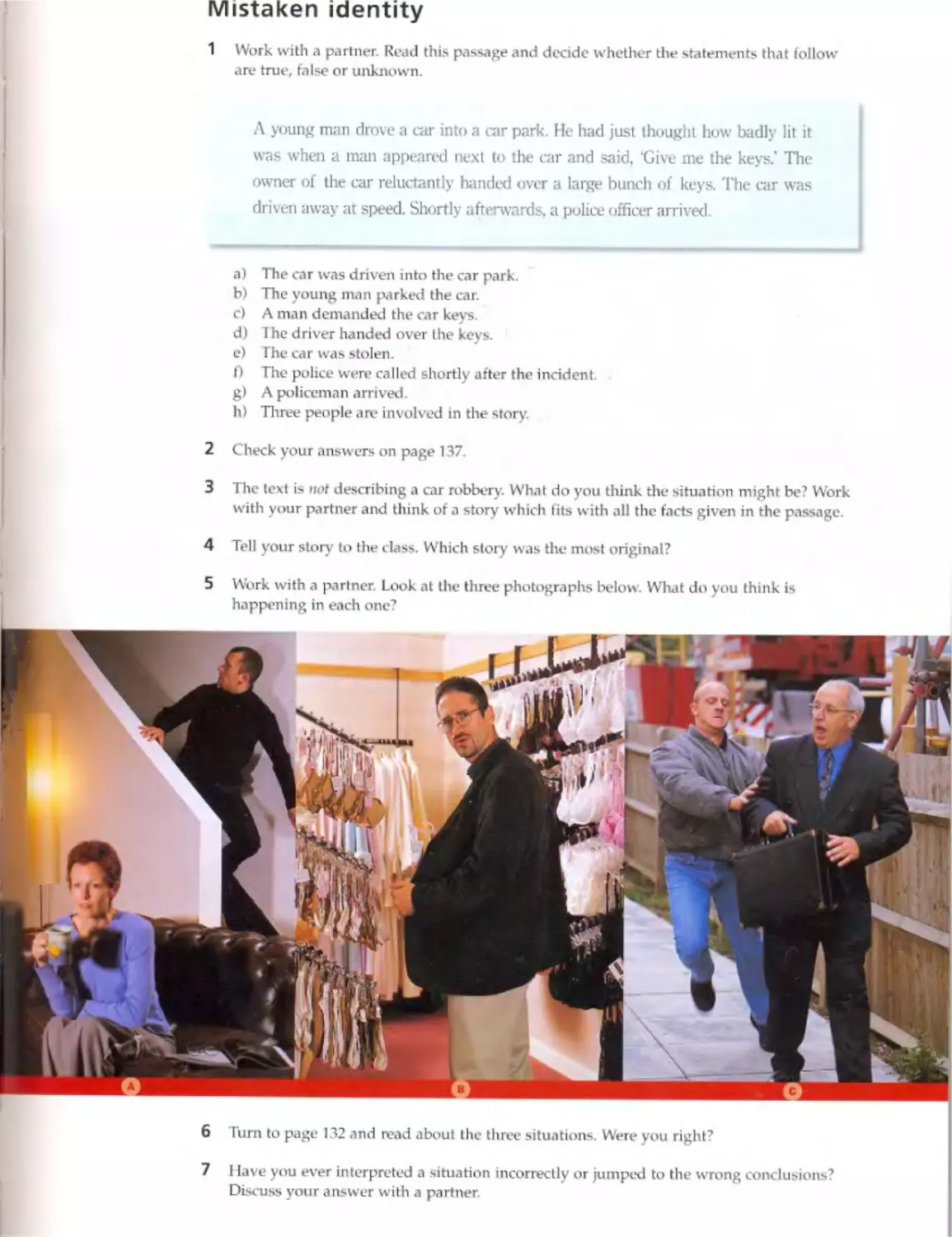
5	Work with a partner. Look at the three photographs below. What do you think is
happening in each one?
6	Turn to page 132 and read about the three situations. Were you right?
7	Have you ever interpreted a situation incorrectly or jumped to the wrong conclusions?
Discuss your answer with a partner.
Taste
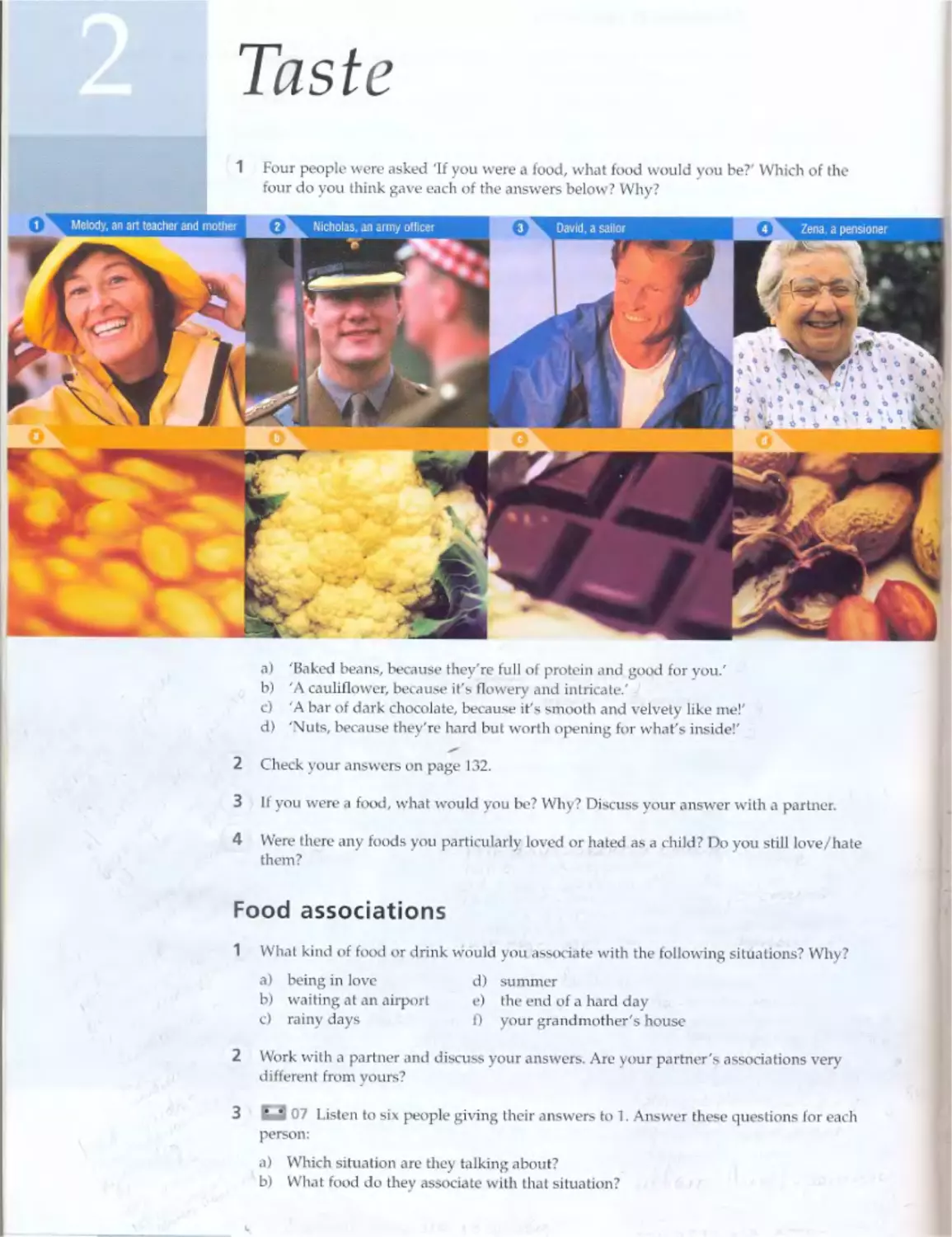
1	Four people were asked 'If you were a food, what food would you be?' Which of the
four do you think gave each of the answers below? Why?
a)	'Baked beans, because they're full of protein and good for you.'
b)	'A cauliflower, because it’s flowery and intricate.'
c)	'A bar of dark chocolate, because it’s smooth and velvety like me!'
d)	'Nuts, because they're hard but worth opening for what's inside!'
2	Check your answers on page 132.
3	If you were a food, what would you be? Why? Discuss your answer with a partner.
4	Were there any foods you particularly loved or hated as a child? Do you still love/hate
them?
Food associations
1 What kind of food or drink would you associate with the following situations? Why?
a)	being in love
b)	waiting at an airport
c)	rainy days
d)	summer
e)	the end of a hard day
f)	your grandmother's house
2	Work with a partner and discuss your answers. Are your partner's associations very
different from yours?
3	* £ 07 Listen to six people giving their answers to 1. Answer these questions for each
person:
a)	Which situation are they talking about?
b)	What food do they associate with that situation?
--viose up
Describing
nouns
1	How were the foods described by the speakers? Complete the noun phrases.
a)	b____coffee i______a p___c____
b)	big bowls of f_____salad w_	h____-m______d_____
c)	huge	plates of r_lamb s_	w_________________m p_
d)	the b___ gravy у_____h_____e_____t_____
e)	c____m______c______biscuits d____i__________c_
f)	s____s______strawberries w____f____c_______
g)	some	kind of m	convenience	food t______d_____n_____a_____c
2	Listen again and check your answers.
3
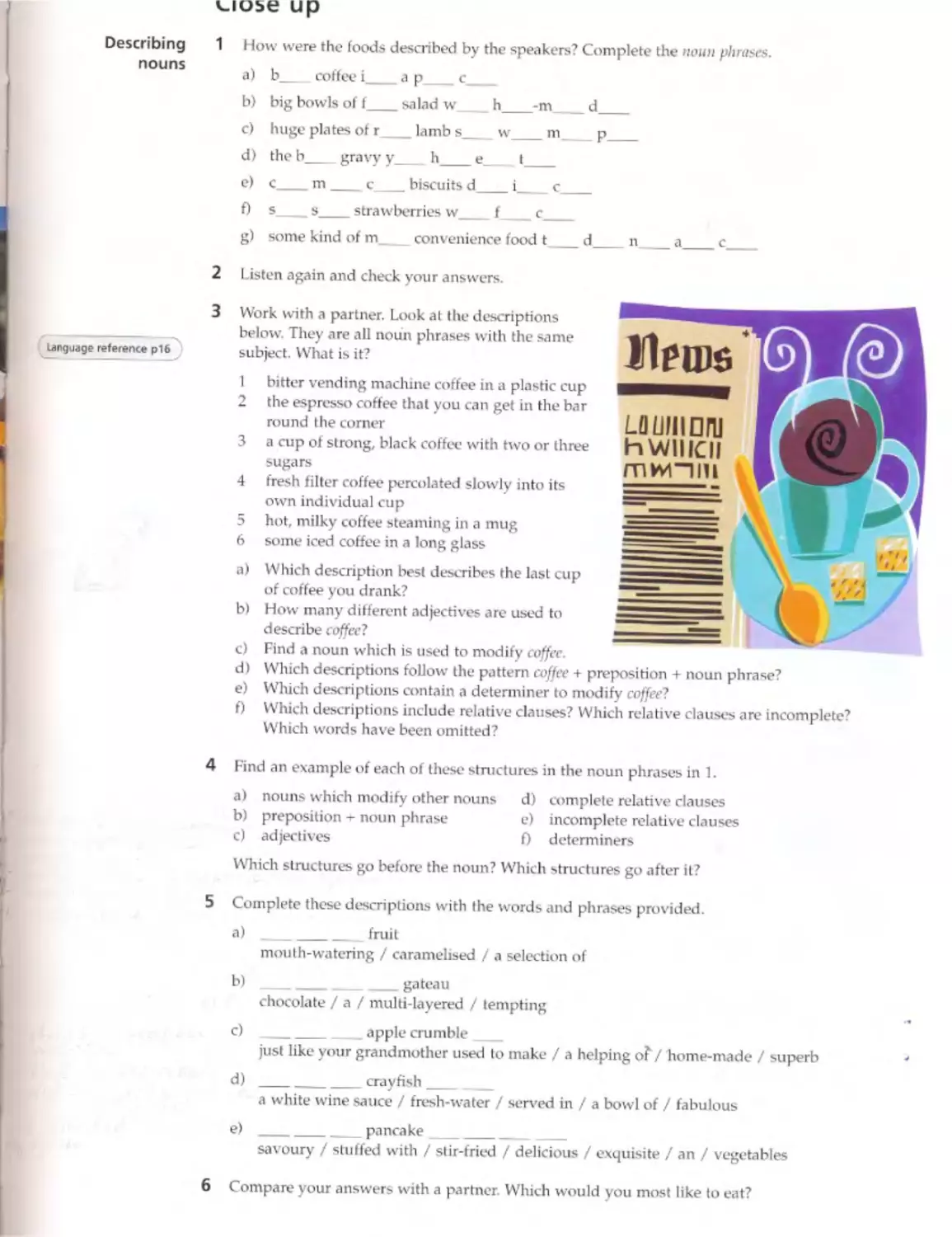
Work with a partner. Look at the descriptions
below. They are all noun phrases with the same
subject. What is it?
1	bitter vending machine coffee in a plastic cup
2	the espresso coffee that you can get in the bar
round the comer
3	a cup of strong, black coffee with two or three
sugars
4	fresh filter coffee percolated slowly into its
own individual cup
5	hot, milky coffee steaming in a mug
6	some iced coffee in a long glass
a)	Which description best describes the last cup
of coffee you drank?
b)	How many different adjectives are used to
describe coffee?
c)	Find a noun which is used to modify coffee.
d)	Which descriptions follow the pattern coffee + preposition + noun phrase?
e)	Which descriptions contain a determiner to modify coffee?
f)	Which descriptions include relative clauses? Which relative clauses are incomplete?
Which words have been omitted?
4 Find an example of each of these structures in the noun phrases in 1.
a)	nouns which modify other nouns
b) preposition -t- noun phrase
c) adjectives
d)	complete relative clauses
e)	incomplete relative clauses
f)	determiners
Which structures go before the noun? Which structures go after it?
5 Complete these descriptions with the words and phrases provided.
a)fruit
mouth-watering / caramelised / a selection of
b)	gateau
chocolate / a / multi-layered / tempting
c)	apple crumble
just like your grandmother used to make / a helping of / home-made / superb
d)crayfish____________
a white wine sauce / fresh-water / served in / a bowl of / fabulous
e)pancake
savoury / stuffed with / stir-fried / delicious / exquisite / an I vegetables
6 Compare your answers with a partner. Which would you most like to eat?
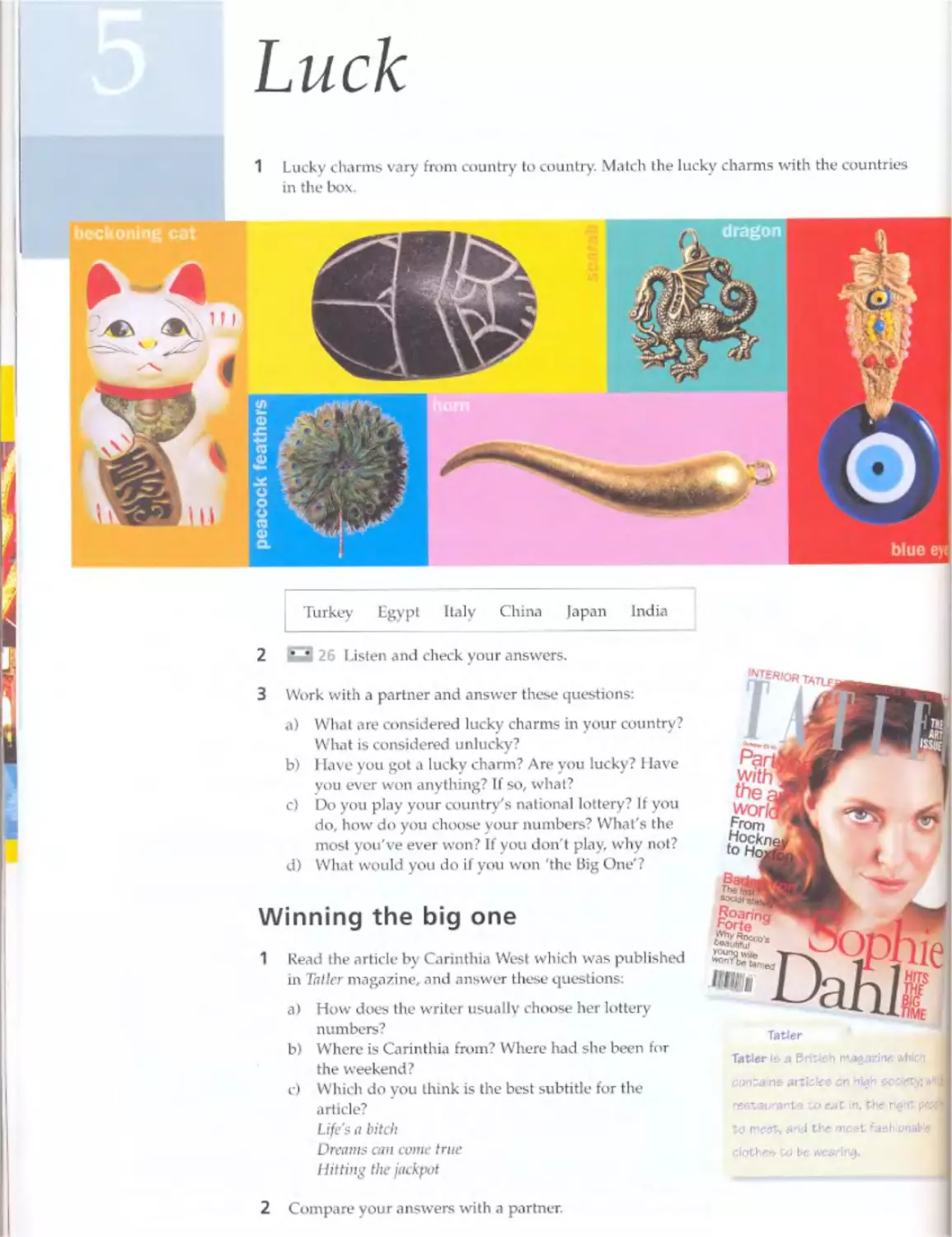
Luck

1 Lucky charms vary from country' to country. Match the lucky charms with the countries
in the box.
Turkey Egypt Italy China Japan India
2	• • 26 Listen and check your answers.
3 Work with a partner and answer these questions:
a)	What are considered lucky charms in your country?
What is considered unlucky?
b)	Have you got a lucky charm? Are you lucky? Have
you ever won anything? If so, what?
c)	Do you play your country's national lottery? If you
do, how do you choose your numbers? What's the
most you've ever won? If you don't play, why not?
d)	What would you do if you won ‘the Big One'?
Winning the big one
1 Read the article by Carinthia West which was published
in Taller magazine, and answer these questions:
a)	How does the writer usually choose her lottery
numbers?
b)	Where is Carinthia from? Where had she been for
the weekend?
c)	Which do you think is the best subtitle for the
article?
Life's a bitch
Dreams can come true
Hitting the jackpot
2 Compare your answers with a partner.
Tati er
Tatler io a Brrdeh magazine which I
contains articles on high society; wha
rssvauranta to eat in. the ngnc
to meet, and the most faahionablf I
clothe» to be nearing.
adjectives
follow.
mouth-watering caramelised savoury delicious exquisite home-made
superb fabulous tempting
a)	Which adjectives express an opinion?
b)	Which express a fact?
c)	Look at the order of the adjectives in 5 on page 15. Do the 'opinion' or the 'fact'
adjectives come first?
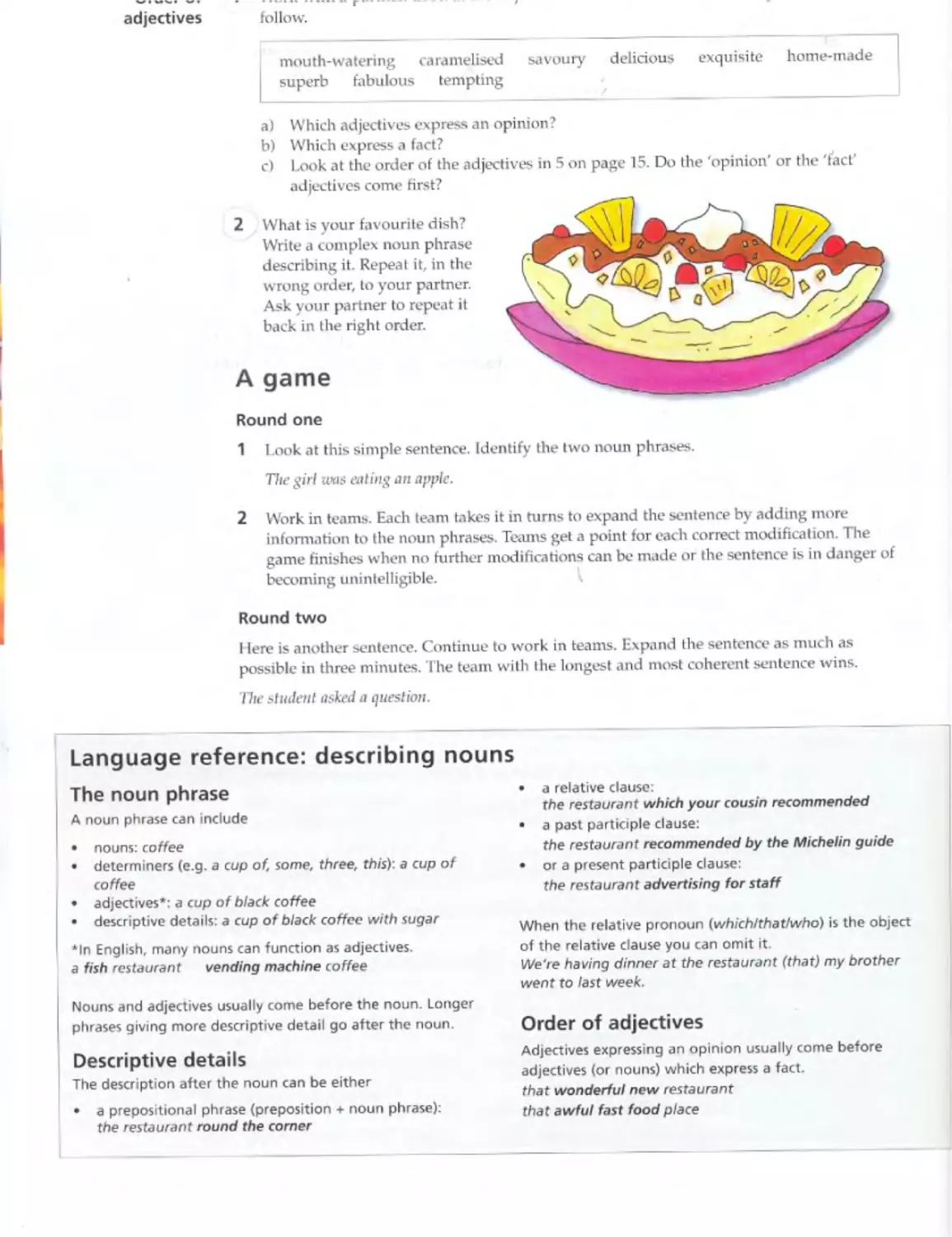
2 What is your favourite dish?
Write a complex noun phrase
describing it. Repeat it, in the
wrong order, to your partner.
Ask your partner to repeat it
back in the right order.
A game
Round one
1	Look at this simple sentence. Identify the two noun phrases.
The girl was eating an apple.
2	Work in teams. Each team takes it in turns to expand the sentence by adding more
information to the noun phrases. Teams get a point for each correct modification. The
game finishes when no further modifications can be made or the sentence is in danger of
becoming unintelligible.	к
Round two
Here is another sentence. Continue to work in teams. Expand the sentence as much as
possible in three minutes. The team with the longest and most coherent sentence wins.
The student asked a question.
Language reference: describing nouns
The noun phrase
A noun phrase can include
•	nouns: coffee
•	determiners (e.g. a cup of, some, three, this): a cup of
coffee
•	adjectives*: a cup of black coffee
•	descriptive details: a cup of black coffee with sugar
*	ln English, many nouns can function as adjectives.
a fish restaurant vending machine coffee
Nouns and adjectives usually come before the noun. Longer
phrases giving more descriptive detail go after the noun.
Descriptive details
The description after the noun can be either
• a prepositional phrase (preposition + noun phrase):
the restaurant round the comer
•	a relative clause:
the restaurant which your cousin recommended
•	a past participle clause:
the restaurant recommended by the Michelin guide
•	or a present participle clause:
the restaurant advertising for staff
When the relative pronoun (which/that/who) is the object
of the relative clause you can omit it.
We're having dinner at the restaurant (that) my brother
went to last week.
Order of adjectives
Adjectives expressing an opinion usually come before
adjectives (or nouns) which express a fact.
that wonderful new restaurant
that awful fast food place
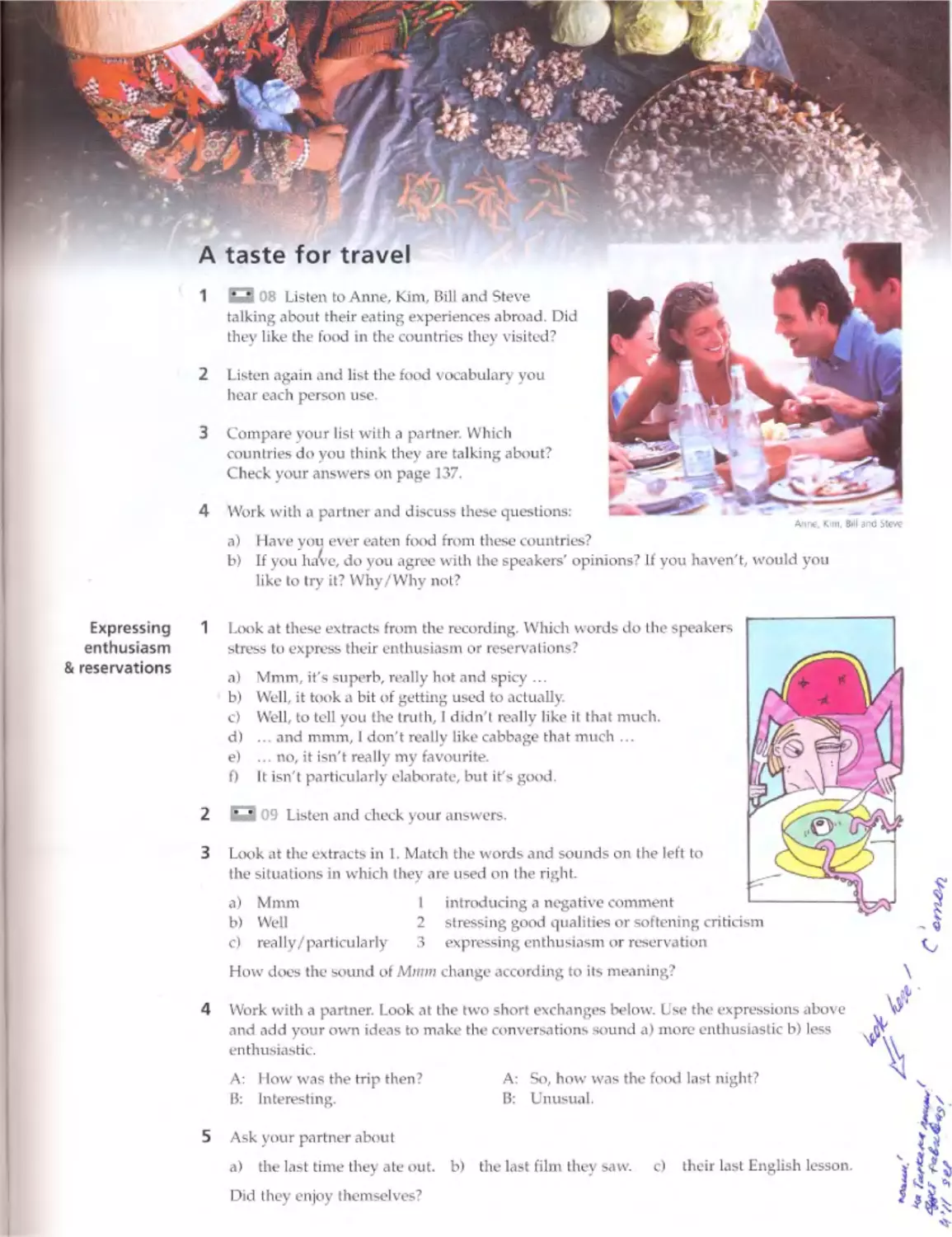
A taste for travel
1	• • 08 Listen to Anne. Kim, Bill and Steve
talking about their eating experiences abroad. Did
they like the food in the countries they visited?
2	Listen again and list the food vocabulary you
hear each person use.
3	Compare your list with a partner. Which
countries do you think they are talking about?
Check your answers on page 137.
4	Work with a partner and discuss these questions:
Anne, K in. Bill and Steve
a)	Have you ever eaten food from these countries?
b)	If you have, do you agree with lhe speakers' opinions? If you haven't, would you
like to try it? Why/Why not?
Expressing
enthusiasm
& reservations
Look at these extracts from the recording. Which words do lhe speakers
stress to express their enthusiasm or reservations?
a)	Mmm, it's superb, really hot and spicy ...
b)	Well, it took a bit of getting used to actually.
c)	Well, to tell you the truth, 1 didn't really like it that much.
d)	... and mmm, I don't really like cabbage that much . ..
e)	... no, it isn't really my favourite.
f)	It isn't particularly elaborate, but it's good.
@3 09 Listen and check your answers.
Look at the extracts in 1. Match the words and sounds on the left to
the situations in which they are used on the right.
a)
b)
Mmm
Well
I introducing a negative comment
2
stressing good qualities or softening criticism
c) really/particularly
3 expressing enthusiasm or reservation
2
3
How does the sound of Mmm change according to its meaning?
\
4
Work with a partner. Look at the two short exchanges below. Use the expressions above
and add your own ideas to make the conversations sound a) more enthusiastic b) less
enthusiastic.
A:	How was the trip then?	A: So, how was the food last night?
B:	Interesting.	B: Unusual.
Ask your partner about
a) the last time they ate out. b) the last film they saw. c) their last English lesson.
Did they enjoy themselves?
SY
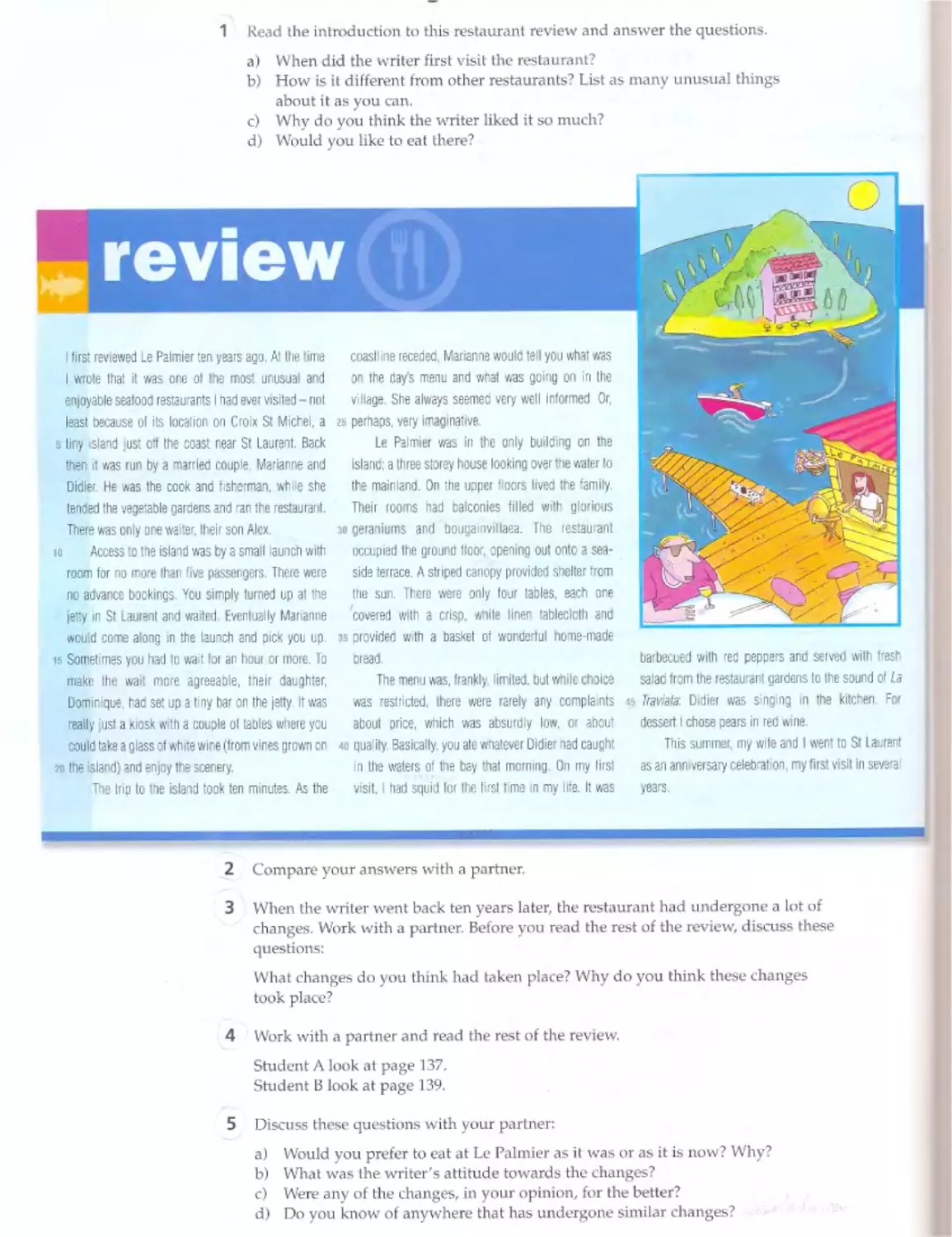
1	Read the introduction to this restaurant review and answer the questions.
a)	When did the writer first visit the restaurant?
b)	How is it different from other restaurants? List as many unusual things
about it as you can,
c)	Why do you think the writer liked it so much?
d)	Would you like to eat there?
review
I first reviewed Le Palmier ten years ago. Al the time
I wrote that it was one ol the most unusual and
enjoyable seafood restaurants I had ever visited - not
least because of its localion on Croix St Michel, a
5 liny island just off the coast near St Laurent. Back
then it was run by a married couple Marianne and
Didier He was the cook and fisherman, whi e she
tended the vegetable gardens and ran the restaurant.
There 'was only one wader, their son Alex.
i о	Access to the island 'was by a small launch witb
room for no more than five passengers. There were
no advance bookings. You simply turned up at the
jetty m St Laurent and waited Eventually Marianne
coastline receded. Marianne would tell you what was
on the day’s menu and what was going on in the
village. She always seemea very well informed Or,
2s perhaps, very imaginative
Le Palmier was in the only build ng on the
island: a three storey house looking over tr*e water to
the mainland. On the upper floors lived the family.
Their rooms had balconies filled with glorious
so geraniums and bougainvillaea, the restaurant
occupied the ground floor, opening out onto a sea-
side terrace. A striped canopy provided shelter from
the sun. There were only four tables, each one
covered with a crisp, while linen tablecloth and
would come along in the launch and pick you up
35 provided with a basket of wonderful home-made
is Sometimes you had 1c wait lot an hour or more. To
make the wait more agreeable, tneir daughter,
Dominique hac set up a tiny bar on the jetty If was
oread
The menu was, frankly limited, but while choice
was restricted, there were rarely any ccmpla nts
barbecued with red peppere and served with fresh,
saiac from the restaurant gardens to the sound of La
« Traviata Didier was singing m the kitchen For
really just a Kiosk with a couple ol tables where you
could take a glass of white wire (frorr, vines grown on
about price, which was absurdly low, or about
ад qualify Basically, you ale wnatever Didier had caught
dessert l chose pears in rec wine
This summer, my wife and I went to St Laurent
td the island) and enjoy lhe scenery.
The trip to the island took ten minutes. As the
m lhe waters of the bay that morning On my first
visit, i had squid for the first time in my life. It was
as an anniversary celebration, my first visit in severa
years.
2	Compare your answers with a partner.
3	When the writer went back ten years later, the restaurant had undergone a lot of
changes. Work with a partner. Before you read the rest of the review, discuss these
questions:
What changes do you think had taken place? Why do you think these changes
took place?
4	Work with a partner and read the rest of the review.
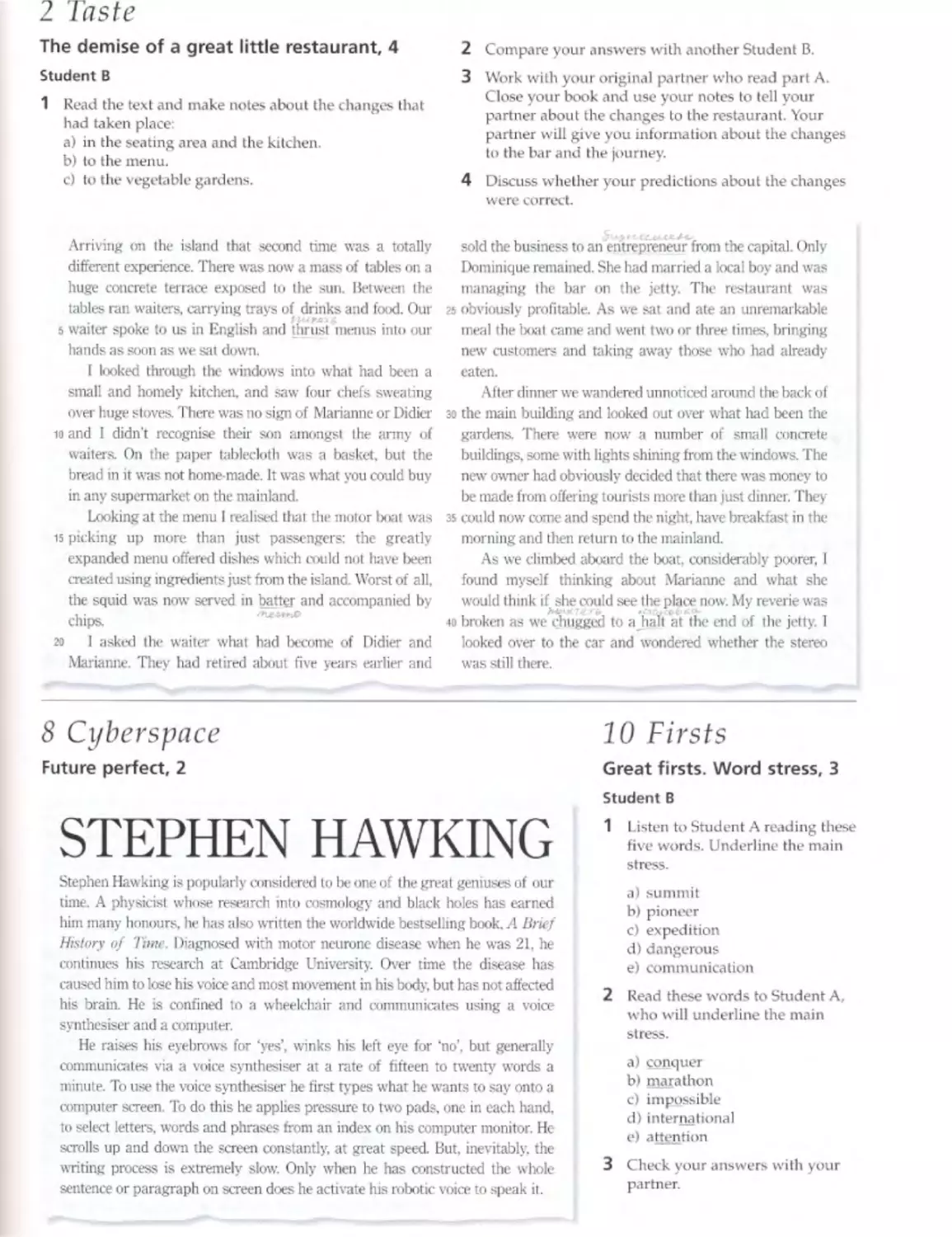
Student A look at page 137.
Student В look at page 139.
5	Discuss these questions with your partner:
a)	Would you prefer to eat at Le Palmier as it was or as it is now? Why?
b)	What was the writer's attitude towards the changes?
c)	Were any of the changes, in your opinion, for the better?
d)	Do you know of anywhere that has undergone similar changes?
----- ---------..............	nuu ш. мине ivm as you unu luuuw uie instructions oeiov.,
1 Prepare to teach four of these words from your part of the review to a student who read
the other part.
Student A
thriving exquisite blared out pricey clientele sped off
Student В
concrete thrust homely batter entrepreneur reverie
a)	Read the text again and find the words.
b)	Discuss their meanings with your partner. Think about the best way to explain them.
2 Work with a different partner and teach them the words.
3 Ask your partner to write sentences containing the new words.
4 Check that the words have been used correctly in the sentences.
Test yourself
Past tenses 1 Look at this extract taken from the restaurant review. Choose the most appropriate form
of the verbs.
Basically you (1) ate / were eating whatever Didier (2) was catching/had caught in the waters of the bay Ilia’
morning. On my' rsl visit 1 (3) had / was having squid for ine first tme in my life. II (4) barbecued / was
barbecued with red peppers and (5) served / had been served with fresh salad from the restaurant gardens to
the sound of La Travels Didier (6) was singing / sang in the kitchen. {Introduction, lines 40-45)
2 Complete these extracts with the correct form of the verbs in brackets.
The bar clearly (1).___(cater) for more than lhe restaurant clientele, but the number of people who (2)_____(look)
expectantly out across the water (3)______(worry) me slightly. Eventually our names (4)__________(call) along with
around twenty others (Text A. page 137, lines 21-25)
I (1)_____(ask) the waiter what (2)_____(become) ol Did ier and Marianne They (3)______ (reti re) about five years
earlier and (4)_______(sell) lhe business Io an entrepreneur from the capital Only Dominique (5)__(remain).
She (6). _ (marry) a local boy and (7)____(manage) the bar on the jetty (Text B. page 139, lines 20-24)
3 Check your answers with the review. Discuss any differences you find with a partner.
4 Choose one of the openings below and think about something that has happened to you
recently.
a)	I had just got in when ...
b)	I was walking down the road when ...
с)	1 was in my car ...
d)	It was three o'clock in the morning ...
e)	You'll never believe who I saw the other day ...
f)	I'd just been ...
5 Tell your partner about it.
Fronting
Language reference p20
1	The sentences below have been taken from the restaurant review. Put the words in the
correct order without looking back.
a)	floors family the lived upper on the. (Introduction, line 28)
b)	chat to gone Marianne was with opportunity the. (Text A, line 37)
c)	ran between tables waiters the. (Text B, lines 3-4)
2	Check your sentences with the review and answer these questions:
a)	Are they different?
b)	Why is the word order different from usual?
3	Complete these sentences about a place you remember from your past.
a)	Gone is the...
b)	Many were the ...
4	Work with a partner. Compare your sentences and explain the changes that have taken
place.
Language reference: fronting
Fronting is when you start a sentence with something other than the subject.
You use it to create dramatic effect.
Usual word order
The family lived on the upper floors. ->
The days when we could sit back and
do nothing are gone.
The rain came down.	->
Fronting
On the upper floors lived the family.
Gone are the days when we could sit
back and do nothing
Down came the rain.
Fronting is usually used in writing. It is not commonly used in everyday speech.
Anecdote
Food for thought
1 You are going to tell your partner about one of
your favourite restaurants. Decide which
restaurant you are going to describe. Think back
to the last lime you ate there. Look at the
questions below and think about what you're
going to say and the language you will need.
_) Where is the restaurant?
~l What kind of restaurant is it?
I When did you last go there?
I Who did you go with?
~I Was it a special occasion?
□	What did you eat?
How often do you go there?
Do you always go with the same people?
□	Do you always eat the same thing there?
What do you like most about the restaurant?
□	Who first introduced you to it?
When do you think you'll next go back?
Would you recommend it to your partner?
LI Is there anything else you'd like to add?
2 Tell your partner about the restaurant.
Writing
a)	Which of the following did your partner talk about?
•	the food
•	the service
•	the decor
•	the atmosphere
•	the company
b)	Which was most important to your partner?
c)	Which is most important to you?
1 Write a review of your favourite restaurant for a
local English-language newspaper. Before you start,
look at the questions below and think about what
you are going to write and the language you will need
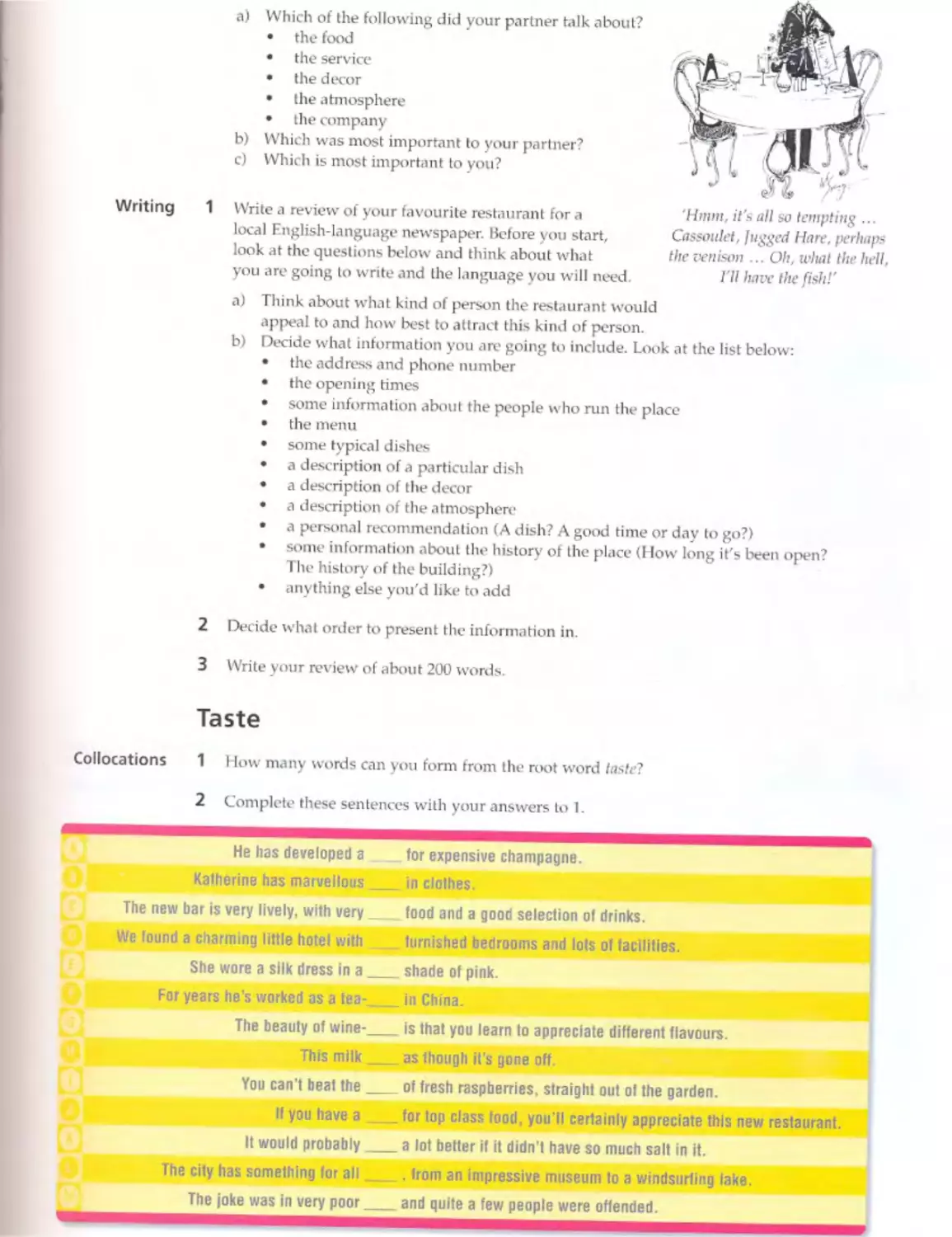
'Hmm, it’s all so tempting ...
Cassoulet, Jugged Hare, perhaps
the venison ... Oh, what the hell,
I’ll have the fish!'
a)	Think about what kind of person the restaurant would
appeal to and how best to attract this kind of person.
b)	Decide what information you are going to include. Look at the list below:
•	the address and phone number
•	the opening times
•	some information about the people who run the place
•	the menu
•	some typical dishes
•	a description of a particular dish
•	a description of the decor
•	a description of the atmosphere
•	a personal recommendation (A dish? A good time or day to go?)
•	some information about the history of lhe place (How long it's been open?
The history of the building?)
•	anything else you'd like to add
2 Decide what order to present the information in.
3 Write your review of about 200 words.
Taste
Collocations 1 How many words can you form from the root word taste?
2 Complete these sentences with your answers to 1.
He lias developed a_____for expensive champagne.
Katherine has marvellous_____in clothes.
The new bar is very lively, with very	food and a good selection of drinks.
We found a charming little hotel with	furnished bedrooms and lots of facilities.
She wore a silk dress in a___shade of pink.
For years he's worked as a tea-___in China.
The beauty of wine-_____is that you learn Io appreciate different flavours.
This milk_____as though it's gone off.
You can’t beat the____of fresh raspberries, straight out ol the garden.
If you have a____for top class food, you'll certainly appreciate this new restaurant.
It would probably____a lot better il it didn’t have so much salt in it.
The city has something lor all  , from an impressive museum Io a windsurfing lake.
The joke was in very poor and quite a few people were offended.
4 Which of the two meanings do these words and expressions have?
a)	to taste
b)	to be tasty
c)	to be tasteful
d)	to have poor taste
e)	a taste of ...
5 Complete these sentences with prepositions.
a)	He has developed a taste French films.
b)	They have incredibly poor taste clothes.
6 Which sentence in 5 talks about choice? Which refers to preference?
Choose the correct preposition in these expressions:
a)	peculiar taste in/for books
b)	a taste in/for exotic travel
c)	a taste in/for dangerous sports
d)	excellent taste in/for shoes
e)	very good taste in/for music
Think of people you know who have these tastes. Tell a partner about them.
question of taste
Work with a partner. Write a short definition of good taste. Use no more than twenty
words.
Share your definition with the rest of the class. Which one do you like best?
10 Listen to Sarah, David and Angela discussing good taste. Make notes about
what they each think good taste is.
Compare your notes with a partner. Were your ideas similar to the speakers'?
What other quality did they mention? What did the speakers understand by this quality ?
Listen again and check your answers. Do you agree with their definitions of this quality?
Agreeing &
disagreeing
1 Look at these extracts from the discussion. Words are missing from each extract, l he
missing expressions are used to express agreement or disagreement. Decide which type
of expression is missing in each gap.
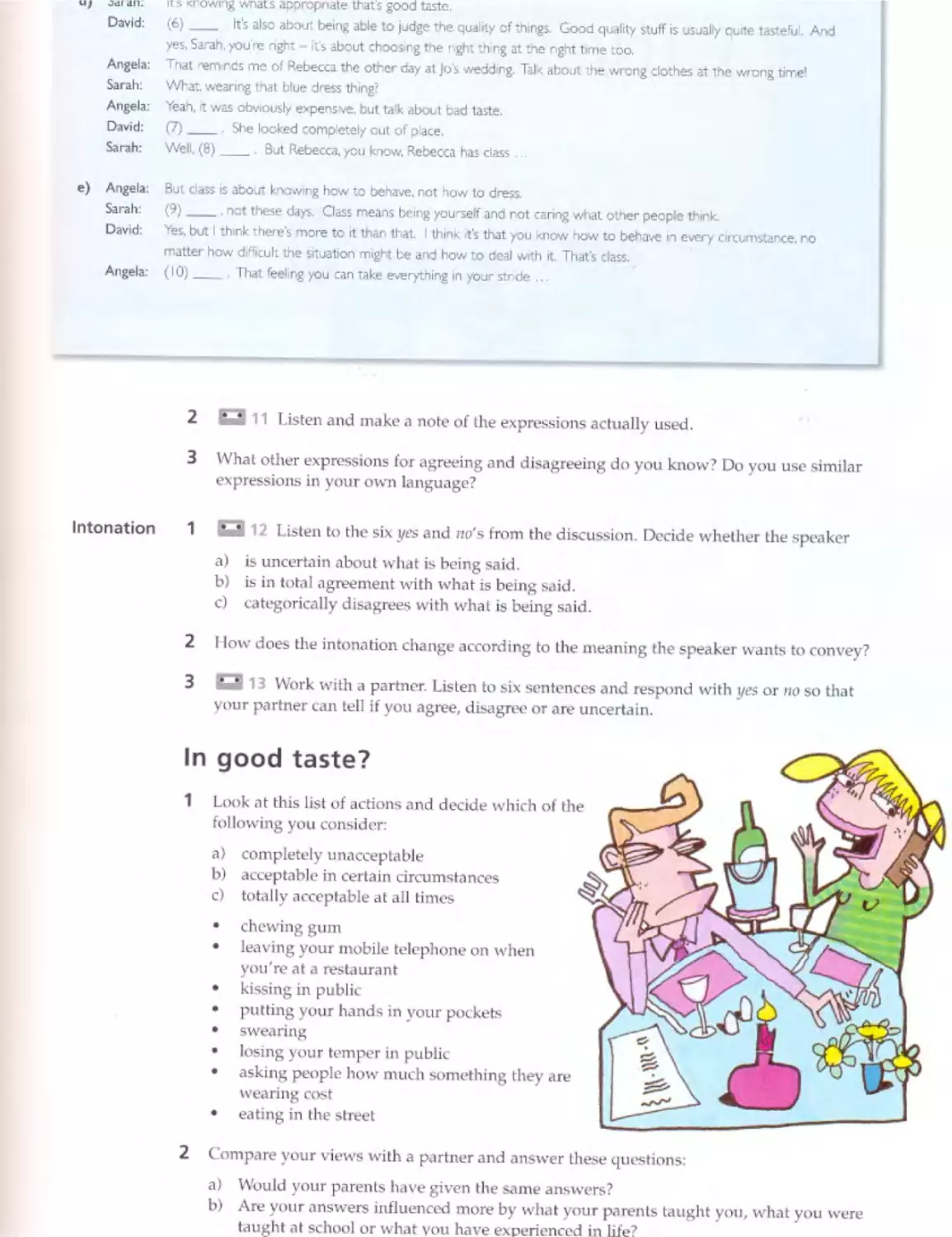
a)	Sarah:	I can t believe he bought her pastic Powers for her bit thoay. I mean that is so tacky. That is such bad taste.
Angela: (I)________ It s the thought that counts
David: (2)_________! Plastic flowers don't count!
b)	Sarah: Yes, I mean, taste is a very personal thing
Angela: Yes. Beauty is in the eye of the beholder and that sort of th.ng.
Sarah: (3)_________. Everyone’s different and so I suppose .,
c)	Angela ,. wearing a big gold medallion, or something
David: (4)_________1 Things like that are awful, aren't they?
Angela: Socks!
David: Socks and sandals, and whi te socks and black shoes, definitely!
Sarah: (5)_________ , some people like them.
---- и; оогап. га Ki Tig v>- iji l асгятp' kite thats good t.-tc
David: (6)___________ It's also about being able to j jdge the quality of things. Good quality stuff is usually quite tasteful. And
yes. Sarah, you're ngh* it’s about choosing the r ght thing at the right time too.
Angela: That "emnos me of Rebecca the other day at Jo's wedding. Talk about the wrong clothes at the wrong time1
Sarah: What, wearing that blue dress thing?
Angela: Yeah, ft was obviously expensive, but talk about bad taste.
David: (7)_________. She looked completely out of place.
Sarah: Well. (8)________. But Rebecca, you know, Rebecca has class
e) Angela: But class is about knowing how to behave, not how to dress
Sarah:	(9)______. not these days. Class means being yourself and not caring what other people think
David:	Yes but I think there’s more to it than that. I think it’s that you know how to behave in every circumstance, no
matter how difficult the situation might be and how to deal with it. That’s class.
Angela: (10)_______. That feeling you can take everything in your stride ...
2	E3n Listen and make a note of the expressions actually used.
3	What other expressions for agreeing and disagreeing do you know? Do you use similar
expressions in your own language?
Intonation 1	• • 12 Listen to the six yes and no's from the discussion. Decide whether the speaker
a)	is uncertain about what is being said.
b)	is in total agreement with what is being said.
c)	categorically disagrees with what is being said.
2	I low does the intonation change according to the meaning the speaker wants to convey?
3	* ‘ 13 Work with a partner. Listen to six sentences and respond with yes or no so that
your partner can tell if you agree, disagree or are uncertain.
In good taste?
1 L<x)k at this list of actions and decide which
following you consider
a) completely unacceptable
b) acceptable in certain circumstances
c) totally acceptable at all times
• chewing gum
• leaving your mobile telephone on when
you're at a restaurant
• kissing in public
• putting your hands in your pockets
• swearing
• losing your temper in public
• asking people how much something the
wearing cost
• eating in the street
2	Compare your views with a partner and answer these questions:
a)	Would your parents have given the same answers?
b)	Are your answers influenced more by what your parents taught you, what you were
taught at school or what you have experienced in life?
City
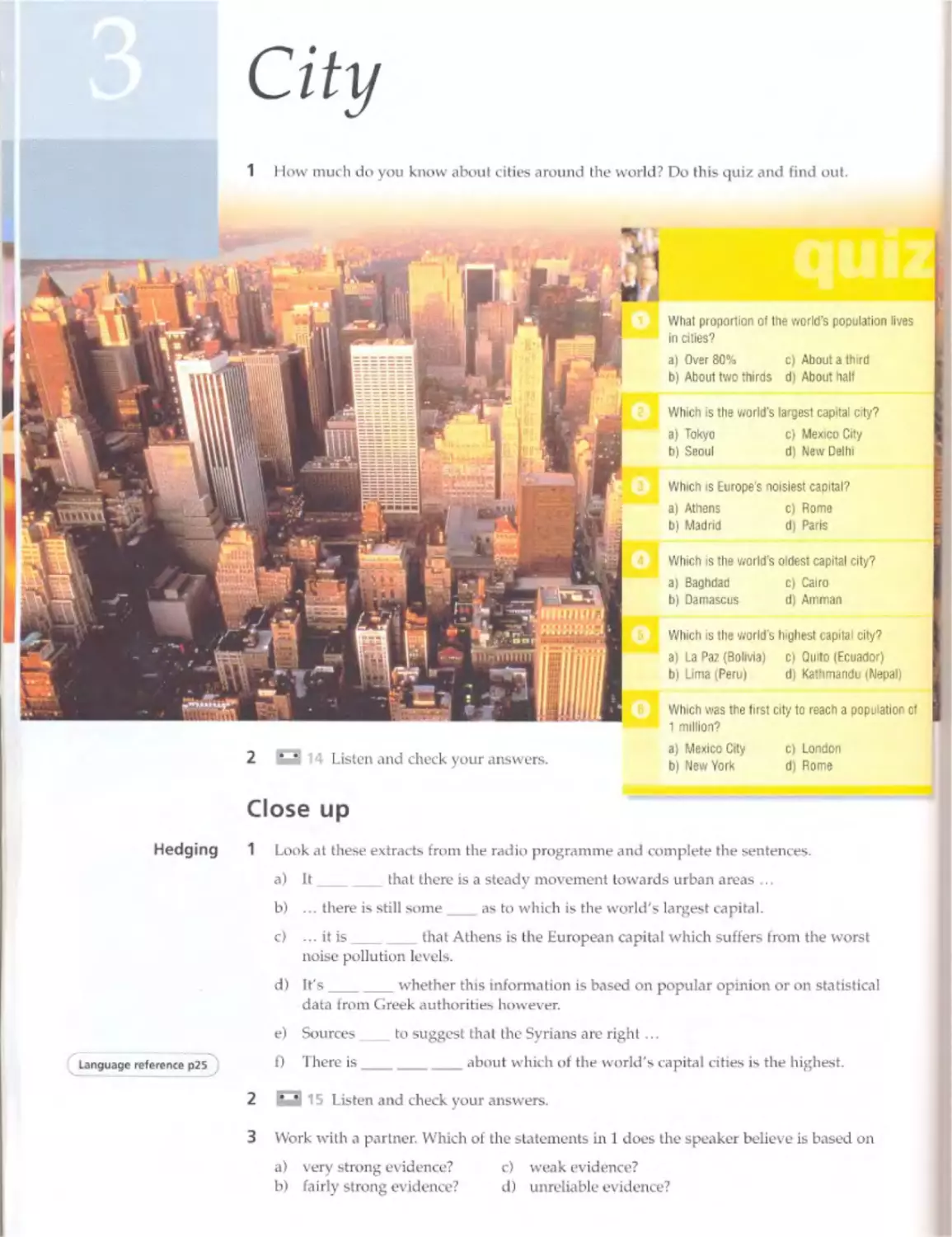
1 I low much do you know about cities around the world? Do this quiz and find out.
2 E314 Listen and check your answers.
What proportion of the world’s population lives
in cities?
a)	Over 80% c) About a third
b)	About two thirds d) About halt
Which is the world's largest capital cty?
a)	Tokyo	c) Mexico City
b)	Seoul	d) New Delhi
Which is Europe's noisiest capital?
a)	Athens	c)	Rome
bi	Madrid	d)	Paris
Which is the world’s oldest capital city?
a)	Baghdad	c)	Cairo
bi	Damascus	d)	Amman
Which is the world's highest capital city?
a)	La Paz (Boltvia) c) Quito (Ecuador)
b)	Lima (Peru) d) Kathmandu (Nepal)
Winch was the first city to reach a population of
1 million?
a)	Mexico City	c) London
b)	New York	d) Rome
Close up
Hedging
Language reference p25
1	Look at these extracts from the radio programme and complete the sentences.
a)	It________that there is a steady movement towards urban areas ...
b)	... there is still some as to which is the world's largest capital.
c)	... it is____ that Athens is the European capital which suffers from the worst
noise pollution levels.
d)	It's_________whether this information is based on popular opinion or on statistical
data from Greek authorities however.
e)	Sources to suggest that lheSyrians are right...
f)	There is about which of the world’s capital cities is the highest.
2	.* , * 15 Listen and check your answers.
3	Work with a partner. Which of the statements in 1 does the speaker believe is based on
a)	very strong evidence?	c) weak evidence?
b)	fairly strong evidence?	d) unreliable evidence?
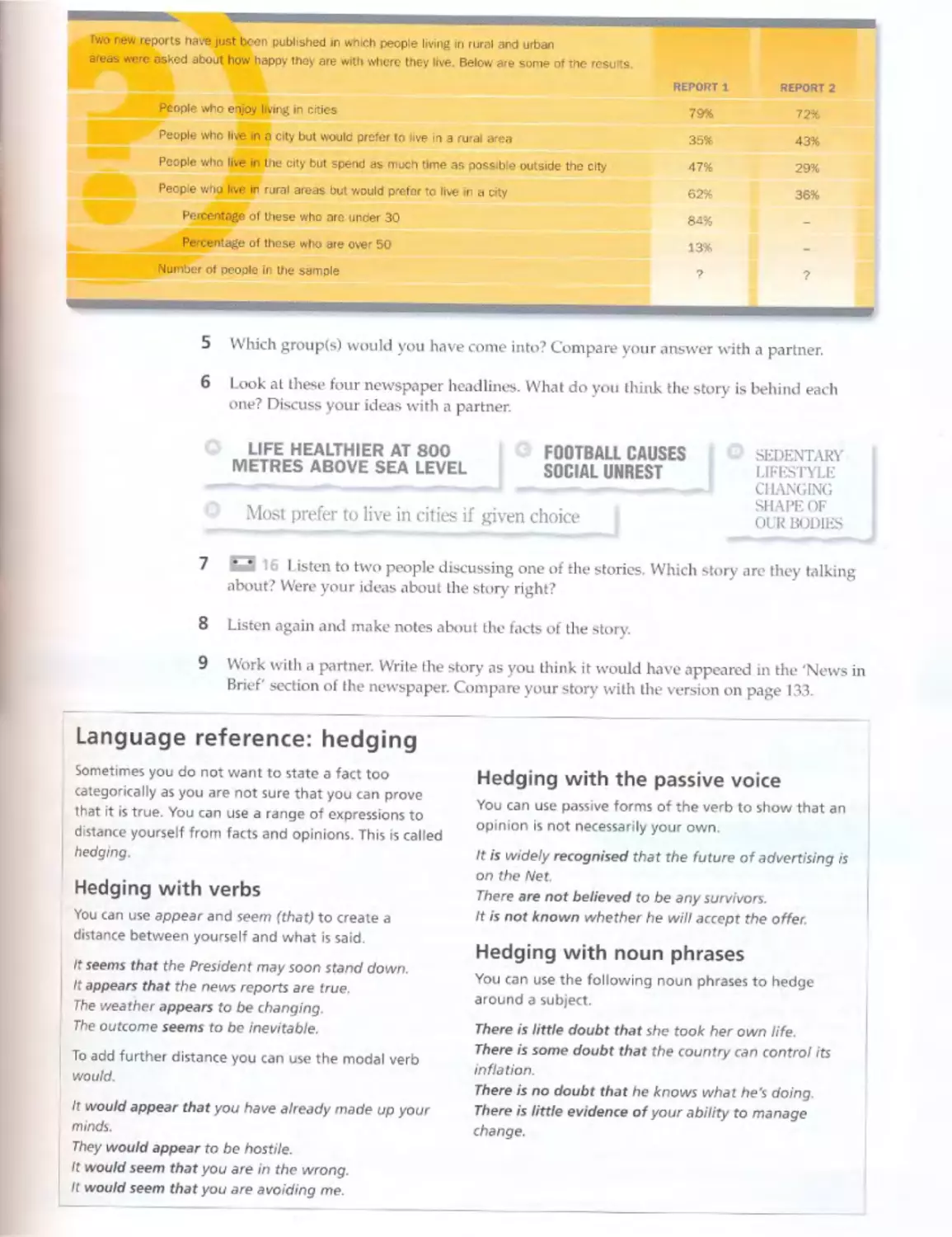
Two new reports have just been published in which people living in rural and urban
areas were asked about how happy they are with where they live. Below are some of the results.	REPORT 1	REPORT 2
People who enjoy living in cities	79%	72%
People who live in a city but would prefer to live in a rural area	35%	43%
People who live tn tne city but spend as much time as possible outside the city	47%	29%
People who live in rural areas but would prefer to live in a city	62%	36%
Percentage of these who are under 30	84%	-
Percentage of these who ate over 50	13%	-
Number of people In the sample	?	?
5	Which group(s) would you have come into? Compare your answer with a partner.
6	Look at these four newspaper headlines. What do you think the story is behind each
one? Discuss your ideas with a partner.
LIFE HEALTHIER AT 800	FOOTBALL CAUSES	SEDENTARY
METRES ABOVE SEA LEVEL	SOCIAL UNREST	LIFESTYLE
— —	—	—--------I — — -	- - I CLANGING
..	.	............. .	SHAPE OF
Most prefer to live in cities if given choice	OUR bodies
7	• • 16 Listen to two people discussing one of the stories. Which story are they talking
about? Were your ideas about Lhe story right?
8	Listen again and make notes about the facts of the story.
9	Work with a partner. Write the story as you think it would have appeared in the 'News in
Brief' section of the newspaper. Compare your story with the version on page 133.
Language reference: hedging
Sometimes you do not want to state a fact too
categorically as you are not sure that you can prove
that it is true. You can use a range of expressions to
distance yourself from facts and opinions. This is called
hedging.
Hedging with verbs
You can use appear and seem (that) to create a
distance between yourself and what is said
It seems that the President may soon stand down.
It appears that the news reports are true.
The weather appears to be changing.
The outcome seems to be inevitable.
To add further distance you can use the modal verb
would.
It would appear that you have already made up your
minds.
They would appear to be hostile.
It would seem that you are in the wrong.
It would seem that you are avoiding me.
Hedging with the passive voice
You can use passive forms of the verb to show that an
opinion is not necessarily your own.
It is widely recognised that the future of advertising is
on the Net.
There are not believed to be any survivors.
It is not known whether he will accept the offer.
Hedging with noun phrases
You can use the following noun phrases to hedge
around a subject.
There is little doubt that she took her own life.
There is some doubt that the country can control its
inflation.
There is no doubt that he knows what he's doing.
There is little evidence of your ability to manage
change.
1
2
a)
b)
c)
lonely planet
Work with a partner. Discuss the following questions:
What is the capital of your country famous for? Does it attract a lot of visitors?
Which capital city would you most like to spend a weekend in?
Do you live in a city, a town, a village or out in the country? Have you always lived
there? Do you like it? Why/Why not?
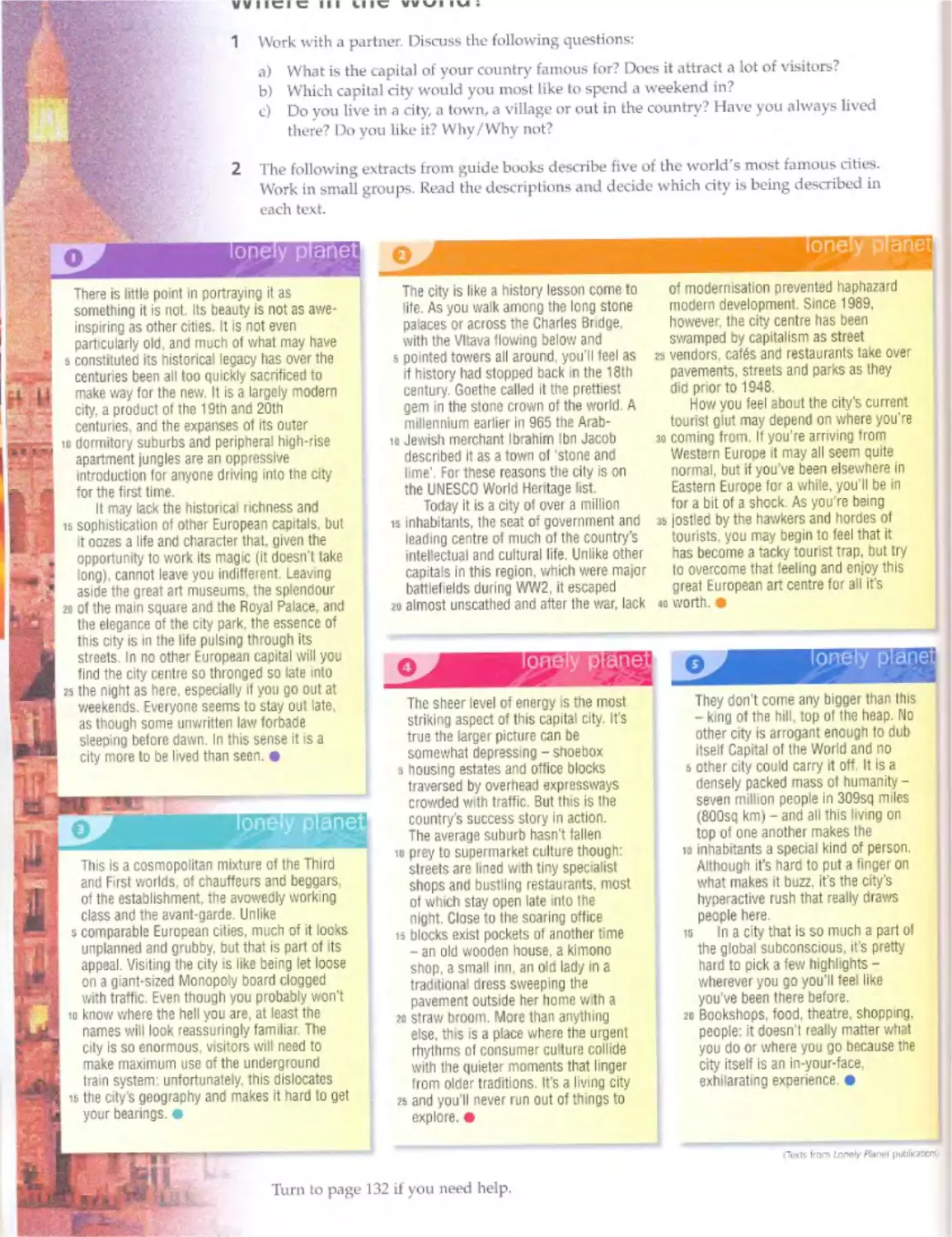
The following extracts from guide books describe five of the world's most famous cities.
Work in small groups. Read the descriptions and decide which city is being described in
each text.
There is little point in portraying it as
something it is not. Its beauty is not as awe-
inspiring as other cities. It is not even
particularly old, and much of what may have
constituted its historical legacy has over the
centuries been all too quickly sacrificed to
make way for the new. It is a largely modern
city, a product of the 19th and 20th
centuries, and the expanses of its outer
dormitory suburbs and peripheral high-rise
apartment jungles are an oppressive
introduction for anyone driving into the city
for the first time.
It may lack the historical richness and
is sophistication of other European capitals, but
it oozes a life and character that, given the
opportunity to work its magic (it doesn't take
long), cannot leave you indifferent. Leaving
aside the great art museums, the splendour
of the main square and the Royal Palace, and
the elegance of the city park, the essence of
this city is in the life pulsing through its
streets. In no other European capital will you
find the city centre so thronged so late into
25 the night as here, especially if you go out at
weekends. Everyone seems to stay out late,
as though some unwritten law forbade
sleeping before dawn. In this sense it is a
city more to be lived than seen. •
anei
This is a cosmopolitan mixture of the Third
and First worlds, of chauffeurs and beggars,
of the establishment, the avowedly working
class and lhe avant-garde. Unlike
| 5 comparable European cities, much of it looks
Г unplanned and grubby, but that is part of its
_JU appeal. Visiting the city is like being let loose
on a giant-sized Monopoly board clogged
with traffic. Even though you probably won't
io know where the hell you are, at least the
names will look reassuringly familiar The
city is so enormous, visitors will need to
make maximum use of the underground
tram system unfortunately, this dislocates
и the city's geography and makes it hard to get
У your bearings. •
Turn to page 132 if you need help.
The city is like a history lesson come to
life. As you walk among the long stone
palaces or across the Charles Bridge,
with the Vltava flowing below and
5 pointed towers all around, you'll feel as
if history had stopped back in the 18th
century. Goethe called it the prettiest
gem in the stone crown of the world A
millennium earlier in 965 the Arab-
ia Jewish merchant Ibrahim Ibn Jacob
described It as a town of ’stone and
lime'. For these reasons the city is on
the UNESCO World Heritage list.
Today it is a city of over a million
is inhabitants, the seat of government and
leading centre of much of the country's
intellectual and cultural life. Unlike other
capitals in this region, which were major
battlefields during WW2. it escaped
го almost unscathed and after the war, lack
25
30
3»
The sheer level of energy is the most
striking aspect of this capital city. It's
true the larger picture can be
somewhat depressing - shoebox
5 housing estates and office blocks
traversed by overhead expressways
crowded with traffic. But this is the
country’s success story in action.
The average suburb hasn't fallen
w prey to supermarket culture though:
streets are lined with tiny specialist
shops and bustling restaurants, most
of which stay open late into the
night. Close to the soaring office
is blocks exist pockets of another time
- an old wooden house, a kimono
shop, a small inn, an old lady in a
traditional dress sweeping the
pavement outside her home with a
го straw broom. More than anything
else, this is a place where the urgent
rhythms of consumer culture collide
with the quieter moments that linger
from older traditions. It’s a living city
n and you'll never run out of things to
explore. •
40
of modernisation prevented haphazard
modern development. Since 1989,
however, the city centre has been
swamped by capitalism as street
vendors. caf6s and restaurants take over
pavements, streets and parks as they
did prior to 1948
How you feel about the city’s current
tourist glut may depend on where you're
coming from. If you're arriving from
Western Europe it may all seem quite
normal, but if you’ve been elsewhere in
Eastern Europe for a while, you'll be in
for a bit of a shock. As you're being
jostled by the hawkers and hordes of
tourists, you may begin to feel that it
has become a tacky tourist trap, but try
to overcome that feeling and enjoy this
great European art centre for all it’s
worth. •
lonely planet
They don’t come any bigger than this
- king of the hill, top of the heap. No
other city is arrogant enough to dub
itself Capital of the World and no
5 other city could carry it off. It is a
densely packed mass of humanity -
seven million people in 309sq miles
(800sq km) - and all this living on
top of one another makes the
io inhabitants a special kind of person.
Although it’s hard to put a finger on
what makes it buzz, it's the city's
hyperactive rush that really draws
people here.
is In a city that is so much a part ol
the global subconscious, it's pretty
hard to pick a few highlights -
wherever you go you’ll feel like
you've been there before.
го Bookshops, food, theatre, shopping,
people: it doesn't really matter what
you do or where you go because the
city itself is an in-your-face,
exhilarating experience. •
<iwts Rom icfx»«p fttiwi pufilkatK^
-> кеаи оаск rnrougn me extracts and underline the information which helped you decide
which city was being described.
4 Work with a partner and discuss these questions:
a)	Which description appeals to you most? Why? Choose two or three phrases which
you find evocative.
b)	Have you been to any of these cities? Do the extracts reflect your experiences?
c)	Do the extracts make you want to visit any of these cities?
Lexis
1 Match definitions a-h to the adjectives 1-8 on the right. Then decide which of the
adjectives you would use to describe the noun phrases in the box below.
a)	rather dirty	1	awe-inspiring
b)	full of people who are very busy or lively (especially a place)	2	haphazard
c)	not organised, not arranged according to a plan	3	tacky
d)	very tall or high in the sky (especially buildings or trees)	4	grubby
e)	so loud, big or noticeable that you just can't ignore it	5	clogged
f)	cheap and badly made or vulgar	6	bustling
g)	giving a feeling of respect and amazement	7	soaring
h)	blocked so that nothing can pass through (especially a place)	8	in-your-face
plastic souvenirs	tree tops arteries
children's hands	approach to work
tower blocks waterways scenery
coastal resorts collection of people
beauty advertising campaigns
market seaside postcards
action movies old trainers
2 Find the adjectives in the extracts What are they describing?
3	Work with a partner. Look at the verbs below. Without looking back at the extracts,
match each one with an appropriate phrase from the list on the right.
a)	(extract 1, line 7)	to make	a finger on (something)
b)	(extract 1, line 17)	to work	prey to (something)
c)	(extract 3, line 15)	to get	on top of one another
d)	(extract 4, line 9)	to fall	its magic
c)	(extract 5, line 8)	to live	your bearings
f)	(extract 5, line 11)	to put	way for the new
4	Check your answers with the extracts and make sure you understand the meanings
of the phrases. Use a dictionary if necessary.
5	Complete these sentences using the phrases in 3. Make any changes to the phrases that
are necessary.
a)	No matter how stressed you feel, once you let the beauty of lhe beach and the
warmth of the sun on you, you will begin to wind down and relax.
b)	The old town is built on the edge of a cliff overlooking the gorge, using up every bit
of spare space. Some houses are even built into the cliff face and people in a
warren of narrow cobbled streets.
c)	The medieval clock tower offers a landmark which is visible wherever you are in the
town, making it very easy________.
d)	It is difficult__exactly what makes this grey, industrial town such a popular
tourist destination.
e)	It's very easy___the charm of the market stall holders and people often end up
spending much more than they'd expected to.
f)	Far too often historic town centres are carved up and charming old buildings torn
down
6	Can any of the words and phrases in I and 3 be used to describe your home town or a
place you know well? Discuss your thoughts with a partner.
Negative &
limiting
adverbials
Language reference p29
Writing
1	Work with a partner. Look at the adverbial phrases in the box and decide which of them
have negative or limiting meanings.
under no circumstances quite often only after a long night never
not until he'd finished seldom at once frequently only then usually
only after a long wait not a word rarely even in the summer on no account
2	Look at these sentences and answer the questions which follow.
1A !>i no other European capital will you find the city centre so thronged so late into the
night.
IВ You won't find the city centre so thronged so late into the night in any other European
capital.
2A Not until I actually lived there did 1 understand just how great the lifestyle is.
2B I didn't understand just how great the lifestyle is until I actually lived there.
a)	Which sentence appears in the extract about Madrid on page 26?
b)	Look at the adverbial phrases in the sentences. Which is the more common position for
the adverbial? Why has the adverbial phrase been moved in the A sentences?
c)	Which sentences, the As or Bs, would be more likely Io be spoken?
d)	What happens to the word order when the adverbial phrase is placed at the
beginning of the sentence?
3	Rewrite the sentences below, starting with the word or words given.
For example:
You will rarely see such a superb example of modern architecture.
Rarely will you see such a superb example of modern architecture.
a)	I rarely visit a city more than once, but this place is really special.
Rarely ...
b)	I had never seen anything so breathtakingly beautiful before.
Never before ...
c)	You should not go out alone at night under any circumstances.
Under no circumstances ...
d)	You will only be able to see and feel the heart of this beautiful old town by
wandering down its narrow side streets.
Only ...
e)	You will only begin to understand the special charm of this place after you have
spent an evening there.
Only after you ...
f)	You can’t really understand exactly how beautiful the view is until you climb to the
top.
Not until ...
4	Think of a town, city or village to fit each sentence.
1	You are going to write a short description of a famous town or city in your country.
a)	Choose the town or city you are going to write about.
b)	Decide what kind of tourist or visitor you are writing for. (Young backpackers?
Families? Culture vultures?)
c)	Decide on three or four main points to include in your description.
d)	Write a short description (about 200 words) in the style of a guide book. Include at
least one inversion and three of the words and expressions from the lexis exercises
on page 27. Do NOT include the name of the town or city.
2	When you have finished writing, work in groups of three or four. Read your description
to the group. Listen to the descriptions and try to guess which town or city they are
describing. What information helped you get the answer?
Language reference: negative & limiting adverbials
Sometimes you can place a negative or limiting adverbial in
the front position in a sentence to create emphasis. This effect
is most frequently found in writing
Word order
In this type of sentence, the subject + auxiliary word order is
inverted.
/ have never seen anything quite so breathtaking.
Never have I seen anything quite so breathtaking.
The same thing happens with the verb be.
It is not only one of the oldest cities on Earth, but also one of
the most beautiful.
Not only is it one of the oldest cities on Earth, it is also one of
the most beautiful.
in the present simple and past simple, use do/does or did.
tVe rarely visit that part of town
Rarely do we visit that part of town.
Negative adverbials
Not a + noun
Not a word did she say to anyone.
Not until + verb phrase
Not until I got home did I realise how lucky I'd been.
Not until + noun phrase
Not until the end did I realise how lucky I'd been.
Under no circumstances
Under no circumstances are you to leave before you finish the
exercise.
On no account
On no account can they claim to be the best.
Never
Never had I seen such a beautiful sight.
No sooner... than
No sooner had I arrived than the doorbell rang.
Limiting adverbials
Only + by + -ing
Only by bribing the police officer was he able to get away.
Only + conjunction + verb phrase
Only if he promised to help would she tell him where he had
left his keys.
Only after they had finished their lunch were they allowed
outside to play.
Only when I took the test did I realise how little I knew!
Little
Little did they know that we were following them.
Rarely I seldom
Rarely had I seen such a beautiful sight.
Barely I hardly / scarcely ... when
Barely had I arrived when the doorbell rang.
Anecdote
1 You are going to describe a visit to a city which made an impression on you. Decide
which city' you are going to talk about and then look at the questions below. Decide
which are relevant to the city you are going to talk about. Think about what you are
going to say and what language you will use.
LANGUAGE TOOLBOX
It was about three years
ajo
The one thing that really
Struck me was
its hard to describe ...
It's difficult to put into
wyds
iMw you arrive, the first
thng you see is ...
The first thing I noticed
wa
When did you first visit the city? I lave you visited it more than once? If so, when
was the last time you were there?
What was your overall impression of the place? Is there any one particular image
that sticks in your mind? How would you describe the general atmosphere of the
city?
I Why did you go there? On holiday? For work? To study? Was it your decision or did
you go on a trip with friends or your family?
How long did you stay? Where did you stay? What were lhe people like? What was
the weather like?
2
What did you do? The usual touristy things?
Did you sit and watch the world go by or did
you walk for miles and miles?
□ Would you like to go back? Have you made
any plans to go back? Would you recommend
it to a friend?
LZ Is there anything else you'd like to mention?
Tell your partner about the city. Give as much
detail as possible.
3 Have you visited the city your partner described?
If yes, were your impressions the same? If not,
would you like to visit it after hearing your
partner's description? Why/Why not?
'This is Mr Trimp from the Town
and Country Planning Department.
l ie's here to demonstrate the
proposals for the old town.'
One big party
1 Have you heard of Leicester Square? Where is it? Why is it well known?
2 You’re going to read an article about Leicester Square. Match the questions from the first
part of the article on the left with the answers on the right.
a)	Where is it?
b)	What is it?
c)	On a bad day?
d)	What's with the
funny spelling?
1 OK, it’s spelt funny, but it's pronounced Lester.
2	A loud, brash, sweaty mass of seething humanity’.
3	On a good day, it's a huge meeting place for lhe world.
4	Between Piccadilly and Covent Garden, just north of
Trafalgar Square.
3 Read the article and answer these questions:
a)	What type of entertainment does Leicester Square offer?
b)	What type of people go to Leicester Square?
c)	What money-saving tips does the writer mention?
(1)______Leicester Square is one of the busiest spots in
London. Buskers entertain the crowds with anything from an
impromptu song to a political rant, tourists pay good money
to have their faces ridiculed by cruel cartoonists and
s suburban kids queue to dance the night away at the
Hippodrome. Equinox or Maximus.
(2)____________ the whole pedestrianised area can seem like
one big, youthful party.
The Square is a popular meeting place for Inends
io (3)_____and tor tourists who seem to enjoy congregating
outside the tube station The enemas claim to be the biggest
and best but (4)_______tickets are the most expensive in
town It will cost you almost double the price of a normal
seat to see a blockbuster at the Empire, for example For
is good value movie magic check out the Prince Charles
cinema on Leicester Place (5)________I
People-watching is one of Leicester Square's great
attractions as representatives from virtually every country
on little old planet Earth vzalk past (6)_. Ordinary people
x are interesting enough but if you're really lucky you get the
chance to eyeball visiting stars who attend the regular movie
premieres.
Despite its movie-made image of constant tog. London
does get hot from time to time. Luckily for Leicester Square
л visitors, there's a handily placed ice cream emporium where
you can gorge yourself on Triple Choc Brownie until one in
the morning. For main-meal feed-ups, (7)___________avoid the
overpriced chain-store eateries that front the Square and
head instead for nearby Chinatown The choice can be
so overwhelming with little to differentiate one prim Cantonese
restaurant from another. Watching out for where the
Chinese themselves eat is probably the best indicator of
quality. Eternally popular choices include a number of small
family-run places with menus listing up to 40 dim sum
n dishes and other traditional offerings
(8)______Leicester Square is something of a 'must' for
tourists and Londoners alike. All you need to enjoy it fully is
plenty of time and a bit of patience'

Below are eight words and phrases which were in the original text. Insert them into the
appropriate spaces 1-8.

a)	Especially on Friday and Saturday nights
b)	and simply gawp at each other
c)	looking for a drink and chat after a hard day's slog
d) where tickets for a good selection of cult films start
at the same price as a cup of coffee in the Square
c) All in all
f)	your best bet is to
g)	By night
h)	consequently
5 Work with a partner. Student A turn to page 133. Student В turn to page 135.
6 Work in small groups and discuss lhe following questions:
a)	What is the busiest place in the evening where you live? What do people do there?
Are there buskers or eateries? Which places would you recommend?
b)	Do you like to go out in the evenings? Where do you go? What do you do? When
was the last time you went out for the evening? Tell your group where you went and
what you did.
1 Work with a partner and discuss this question:
Is life in the city more dangerous than life in the country?
Draw up a list of the main dangers of city life.
2 i«£l 17 Listen to two friends talking about the city they live in.
As you listen, answer the following questions:
a)	Do they think they live in a particularly dangerous city?
b)	How many dangers from your list do they mention?
c)	Do they mention any other dangers?
3 Compare your answers with a partner and discuss these
questions:
a)	What precautions do they suggest you should Lake when walking home at night?
b)	In what places do they suggest you should lake special care with your bag or wallet? Why?
c)	There seems to have been an increase in crime recently. What sort of crime?
d)	Have the speakers been victims of crime themselves? What about their friends?
e)	What exactly happened to the group of tourists?
f)	What do they think the police could do to improve the situation?
4 Listen again and check your answers.
Adding
emphasis
1 Which word from the box can be used to mean the following?
a)	extremely	f)	at that very moment
b)	now you come to mention it	g)	to be honest	just
c)	only	h)	very recently	really
d)	very	i)	simply	actually
e)	to tell you the truth	j)	totally
2 Look at these short extracts from the conversation. Complete them with just, really or actually.
a)	... there are certain areas that you_know you wouldn't go into ...
b)	...____there have been a couple of stories in the papers recently about this spate of
muggings that's been going on.
c)	... her wallet was snatched from her bag__as the train was coming into the station ...
d)	You've got to be careful there because there is a big crowd and a lot of pickpockets ...
e)	You don't_____know what's going on ...
f)	... I know that is a terrible thing to say, but it’s money.
g)	I think she thought they were going to stab her husband
h)	... but the sad thing was that they had only_arrived ...
i)	She didn't lose anything valuable...
j)	1 think they need to know if a crime's happened  .
3	18 Listen and check your answers. Where does the stress fall?
4 Write a paragraph using just, really and actually at least once each. Show it to a partner to
work out their meanings. Practise reading the paragraph with emphasis.
Discussion Work in small groups. Discuss one of these sets of questions:
•	Is your home town a dangerous place to live in? Do you need to take precautions when
you go out at night? Would you go out alone after ten o'clock? If you were a member of
the opposite sex do you think your answers would be the same?
•	Do you take extra precautions when you travel? Why/Why not? Are cities more
dangerous if you're a tourist? Why/Why not?
•	Which of the following safety measures are used in your town: police patrols at night,
close-circuit TV' cameras in public places, security guards on public transport, street
lighting all night? What other measures can be taken to make our cities safer?
Lexis 1 Work with a partner. Look at the following words and phrases taken from the poem you
are about to read. Answer the questions which follow.
a mute a mate to hug someone a gut to joy-ride mucky
to pinch something to boot something or someone daft to nick something
to flog something
a)	There are two nouns which refer to people. Which one means a partner? Which one
means a person who cannot speak?
b)	One noun refers to a part of the body. Which part?
c)	Which two verbs mean to steal?
d)	Which verb means to kick violently?
e)	Which verb describes a much more tender action?
0 Which verb means to sell?
g)	Which verb means to steal a car and drive it around just for fun?
h)	There are two adjectives. One means stupid and one means dirty. Which is which?
2	Some of lhe words above are particularly informal. They have been included in the
questions below in bold. Discuss your answers to the questions with a partner.
a)	Have you ever had anything nicked from your car?
b)	Did you ever pinch fruit or sweets when you were a kid?
c)	What would you do if you saw someone booting one of your mates?
d)	I lave you ever flogged anything al a second-hand stall?
e)	When was the last time you got really mucky?
f)	Have you done anything daft lately?
Reading 1 Work in small groups. Look al the poem below and answer the questions.
a)	The verses have been
jumbled up. Decide on an
appropriate order.
b)	Do you think the character
in the poem is male or
female? Which lines in the
poem support your
argument?
It took some time. Reassembled in the yard,
Iw didn’t look the same. I took a run
and booted him. Again. Again. My breath ripped out
in rags It seems daft note. Then I teas standing
alone amongst lumps of snow. sick of the world.
Boredom. Mostly I'm so bored I could eat myself
One lime. I stole a guitar and thought I might
learn to play. / nicked a bust of Shakespeare once,
flogged it. but lhe snowman was strangest.
You don't understand a word I'm saying, do you?
 Better off dead than giving in. not taking
what you want. He weighed a ton; his torso,
frozen stiff, hugged to my chest, a fierce chill
piercing my gut Bart of the thrill teas knowing
that children would cry in the morning Life's lough.
. The most unusual thing I ever stole? /1 snowman.
Midnight. He looked magnificent; a tall, white mule
beneath the winter moon. I wanted him, a mate
with a mind as cold as the slice of ic<
within my own brain. I started with the head.
Sometimes I steal things I don't need. I joy-ride cars
to nowhere, break into houses jus! to have a look.
I'm a mucky ghost, leave a mess, maybe pinch a camera.
1 watch my gloved hand twisting the doorknob
.4 stranger's bedroom. Mirrors. I sigh like this - Aah
(Pown by Carr* Anr CXj’ly from SeHmg MtnhelUn >!
your answers.
3	Discuss these questions with your group:
a)	Do you like the poem?
b)	What do you think the title of the poem is?
c)	How old do you think the character is?
Find lines in the poem which support
your argument.
d)	Where do you think the character lives?
e)	Why does s/he steal?
f)	Why does s/he steal a snowman?
g)	Why do people steal things they don't
need?
4	Choose two phrases which you found
particularly evocative. Explain why you chose
them.
the 'o e of- tdet Laureate.
(Eflwara П.ХМЖ	M»« 1939 MOMA. New York)
Discussion Work in small groups. Look at the painting and discuss these questions:
a)	Look at the woman in the painting. What do you think she's waiting for? What is she
thinking? 1 low does she feel?
b)	What are the three things that bore you most? Was it the same when you were a child?
c)	What do you do when you're bored? Do you just put up with it or do you do something
to amuse yourself?
Talk
Find someone in the class who:
•	is tile most talkative member of their family.
•	has spoken in front of a crowd of 50 people or more.
•	has a job that involves listening.
•	knows the difference between whisper and whistle.
•	has gossiped about someone today.
•	can say / love you in at least four languages.
•	has had a conversation in English outside the classroom recently.
conversation ‘
Tk e conversation
Is dsnv&d from
the Latin vn'b
conversari лПсп -пезнб
'to tee;i company н th'.
5s, perhaps >vliat you
talk about Isn’t as
I'nportart- as the fact
that you a'e
being sociable.
Conversation piece
1	Work in small groups. Define the word conversation. Do not use more than 20 words.
2	When you have agreed on the wording, look at the two dictionary definitions on
page 136 and discuss these questions:
a) Which definition is most similar to your own? b) Which do you prefer?
3	Without looking back at the dictionary definitions, answer the following questions:
a)	Is conversation countable, uncountable or both?
b)	Where is the main stress in conversation?
c)	What's the difference between having a conversation and making conversation"!
d)	What three words can you form from the word conversation? Use them to complete
these sentences.
1	He's a great storyteller and an excellent . He's never at a loss for words.
2	She writes almost . When you read her books, you can almost hear her
talking to you.
3	I don't want to learn how to read and write. Japanese is enough for me.
4	Check your answers with the dictionary definitions.
5	Work with a partner and answer these questions:
a)	What’s the difference between a chat, a conversation, a discussion and an argument?
b)	Think of three more verbs to fill the gap: to___(a) conversation
c)	What is the missing preposition in these expressions?
I they were deep_________conversation
2 she was engaged conversation
3 the subject came up _ conversation
.	» uicacTiujkXTrv vsTviuMi van ue usea to aescnoe conversations.
animated pointless
frustrating enjoyable
one-way fascinating
overheard riveting lengthy memorable
meaningful predictable boring recent
in-depth hilarious
a)	Classify the adjectives under the headings below.
b)	Add two more adjectives under each heading and compare your answers with a
partner.
positive
negative	neutral
recent
7	Conversational is a graded adjective. Work with a partner and answer these questions:
a)	Which of the ad jectives in 6 can be graded with adverbs such as very or fairly?
b)	Which of the adjectives cannot be graded?
c)	What about the adjectives you added?
8	Think about the last time you had a conversation in English. Work with a partner and
discuss these questions. Use adjectives from 6 if appropriate.
a)	Who were you talking to? Did you know
them well?
b)	Where were you?
c)	What did you talk about?
d)	Were you happy with your English?
e)	Who did most of the talking, you or the other
person / people?
f)	How did the conversation end?
9 Find three things your conversations had in
common.
The art of conversation
1 Work in small groups and discuss these questions:
Oh hello, George.
Wc were just talking about you.'
a)	What makes a conversation enjoyable?
b)	What makes a conversation frustrating?
c)	What's your definition of a good conversationalist?
2 Compare your answers with the rest of the class.
3	20 You are going to hear six people answering one of the questions in 1. As you
listen, make brief notes on their answers. Use your notes to decide which question they
are answering.
©peaker
1
notes
take active part, people
who don’t hog conversation
question answered
a
4 Compare your notes with a partner. Did the people interviewed have similar opinions to
those expressed by your class?
you can before you listen again.
a)	. it helps if there aren't some people who (I) _ _ the conversation all the time and also people need to have a sense
of Humour about things. I think, not to take things too seriously and you need a conversation that (2)_...
b)	. it's someone who’s got a point that they want to (3) 	 during the conversation Someone with
(4)as opposed to someone who just talks endlessly about various subjects
c)	also some people don’t care about whose (5)_________it is to talk so they just, you know, (6)when you're in
the middle of a thought ...
d)	I really hate it when I’m with someone who just (7)_n a conversation, and who doesn't give you a
chance to speak at all
e)	... like you m on (8)and you can share the same tastes or experiences so you know where the other
person's coming from
f)	I can't stand it when you have to (9) _yourself, when the other person’s not responding, or when
they are responding but it's with (10)___ . you know, just going yeah, en um. and that’s a l you re getting back, and
when you have to work to (11), that's really bad when you're having to (12)______________________for tnings
to say ...
2	Listen again and check, your answers.
3	Work in small groups. Choose one of the questions below and discuss it with your group
using some of the expressions from 1.
a)	Who is the best conversationalist you know? What makes them such a good
conversationalist?
b)	Can you remember a frustrating conversation you've had recently. Why was it so
frustrating?
c)	What was the most enjoyable conversation you've had recently? Who were you
talking to? What made it so enjoyable?
Conversational styles
1	You are going to read an article about conversational styles. Read the title and the first
paragraph and answer these questions:
Do you identify with either Sara or Betty? Why?
2	Read the rest of the article and decide what lhe topic of each section is. Match the
headings below to the numbered sections.
a)	Don't take it too personally	d) Pause to think
b)	Whose turn is it anyway?	e) You are what you say
c)	It depends where you come from
 ara toed to befriend her etc
I 1 friend Steve's new wife but
г | Betti1 newt seemed to have
 anything to say While Sara
s Barty didn't hold up he- ervd of the
conversa* on. Betty complained Io Steve
№t Sara never gave her a chance to
lax the problem had to do with
eipxlafons atom pacing and pausing
u Conversation is a turn-taking care.
Vim 8k, then I talk, then you talk aga n
Ore oersor starts talking when another
stoistied Tha seems s mple enough
| i
Bui how и you know when I’m
n h listed? Wei, when I stop But how oo
you knew when I’m stooping?’ When my
vaioe gets setter, when. t start repeat ng
rmsa.t or лгйп I slow tom and leave a
yac a: the end
n Bit bow soft does my voice have to
gel to mean Tial’s about it as opposed
to This isn't lhe main point yet' or ‘I’m a
nxwtilsr'? Does repealing myself mean
Tm out of new things to say' гм 'i'm
в -rnriBising ? And how much cf a 'jap
atkr am means Tm stepping as
серий to I’m pausing within my
tom - pausing for breath, lo find the
rlgtil words, rar dramatic ertect. or as
м any conversational signal. ,usl out of
tabP
i
‘n the тюк ot a conversation, you don't
®e lime lu puzzle this out. You sense
alien In finstec, or about to make a
»pein?. or craping aimlessly based oo
pu years ot experience talking to
psxiie (Mien our habits are similar
lhereb no problem. Whal you sense and
what I feel are similar. But it our teblts
« ate different, you may start to talk te'ore
I m finished - in other words, interrupt-
or lad lo take your turn when1 am
finished - leading me lo observe that
you're not paying attention or have
« nothing to say
That s what was happening with
Betty and Sara. The tiny pause Betty was
waiting for never occurred when Sara
was arouno, because before t did, Sara
w would sense an awkward silence and
woo d kindly end it by tilling lhe gap
with more talk - hers And when Belly
did start to say something, she would
tend to have what seemed lo Sara like
55 long pauses wmm her speech, giving
Sara the impression that Betty had
finished when she had hardly got
started
Such differences are nut a matter ot
«»seme people expecting tong pauses and
others expecting short ones Lona and
short are relative they nave meaning
only in comparison to something -
what s expected, or someone clse’s
it. pause Someone who expects a shorter
pause than the person she's speaking to
will often start talking before the other
has a chance lo finish or to start
Someone who is waiting for a longer
;n pause Iran ins person she's speaking to
won’t be able ic get a word n edgewise.
3
и may not be coincidental that Betty,
who expected relatively longer pauses
between turns, is B-itisfi, and Sara wfio
л expected relatively shorter pauses, is
American Although there are group arid
individual differences among British and
among American speakers, on the
average, B:ittsb speaker tend to expect
no longer pauses between turns than do
Americans
Belly often tell nterupted by Sa'a
But Betty herself became an interrupter
and found herself de in g all the talking
bi when she met a visitor from Finland.
Whereas sne expected lunger pauses
between turns than Sara, she expected
shorter pauses than the Finn And Sara,
who became interrupting and
<• dominating in conversation with Betty,
had a hard time getting a word in
edgewise with some speaker from Latin
America or Israel.
4
Deferences among speakers from
n different countr.es are most pronounced
and most easily identifiable But there
are also ethnic, regionsclass, age and
gender differences among speakers from
each country And ш members of one
no group can’t get a conversation going
with members ot a certain other group,
lhe result is often ire stereotype that
people from the other group are taciturn
uncooperative or duil-wilted The
us British., for example, think of
Scandinavians as being taciturn, but
among Scandinavians the Finns have a
reputation for terne slow and dull
Conversely Americans Irom faster-
iio speaking regions like New York, are
thought of as pushy, overbearing and
aggressive.
5
The general phenomenon, then, is that
the small, automatic mechanisms for
in conversation, ке pacing and pausing.
lead people to draw conclusions not
about conversational style but about
personality and abilities These habitual
differences are often the basis fur
in dangerous stereotyping And these
social phenomena can have very
personal consequences For example, a
woman from lhe southwestern pari of
the United Stales went to five m an
us Eastern city to take up a iob in
personnel. When the personnel
department got together lor meetings
She kept searching lor tne right time to
break in - and never found it. Although
и» back home she was considered
outgoing and confident, in Washington
she was perceived as shy and retiring.
When she was evaluateo al the end of a
year, she was told to lake an
ns assertiveness-training course because of
her inability to speak up
That's why slight differenees in
conversational style - tiny little things
like microseconds of pause can nave
a an enormous impact on your lite These
little signals make up lhe mechanics cf
conversation, and when they're even
slightly otf, the conversation is thrown
otf - or even cut oft. The result in this
i« case was a judgement of psychological
problems even in the mind of the
woman nersetf, who ready wondered
wha: was wrong with her and signed up
tor assertiveness training.
AaptMIW hurj ,VW IttS' IMSintJ/J»tOTtiTannin IW;
3 Answer these questions:
a)	What exactly was causing the problems between Sara and Betty?
b)	Where were the two women from? Why is this significant?
c)	How would you summarise the article to someone who hasn't read it?
4 Work with a partner and compare your answers.
Without looking back, decide whether these statements are true or false according to the
article.
a)	Betty didn't really have much to say to Sara.
b)	The British tend to be quieter than Americans.
c)	Israelis speak more quickly than most North Americans.
d)	The Finns have a reputation lor being boring.
e)	New Yorkers take short pauses and tend not to wait for people to take their turn.
f)	People from the east coast of America tend to speak a little more slowly than those
from the south west.
g)	The way different nationalities speak contributes to the formation of national
stereotypes.
Check your answers with the article and then discuss these questions with your partner:
a)	The article is taken from a book. What type of reader is it written for?
b)	Have you ever considered this topic before? Do you agree with the argument
presented in the article?
c)	Did the article make you think of anybody you know, or any situations you've found
yourself in?
Lexis 1 Match these words and phrases from the article with their definitions. Look back at the
article if you need to check the meanings of the words.
a)	never seemed to have anything 1
to say (line 3)	2
b)	didn't hold up her end of the 3
conversation (line 5)
c)	never gave her a chance to talk 4
(line 7)
d)	a mumbler (line 23)	5
e)	chatting aimlessly (line 35)
f)	interrupt (line 41)	6
g)	an awkward silence (line 50)	7
h)	had a hard time getting a word
in edgewise (line 91)	8
i)	can't get a conversation going
(line 1(H))	9
j)	inability to speak up (line 136)	10
talking about nothing in particular
unable to find a common subject of interest
say something which makes someone else
stop what they are saying or doing
didn’t contribute enough to the
conversation
when neither person knows what to say so
no-one says anything
dominated the conversation
lack of confidence at taking part in a
conversation
was unable to express her point of view as
she was not allowed time to speak
someone who doesn't speak clearly
was usually rather quiet
2 Check your answers with a partner.
3 Work with a partner and discuss these questions:
a)	Look back at the words and phrases a-j in 1. Which might be associated with Betty
and which with Sara? Are there any which you would not associate with either?
b)	Does the way people in your country speak vary from town to town or region to
region?
c)	Are you typical of your region or country?
Test yourself
wh- words 1 Which word(s) in the box below refer(s) to
a)	a point or period in time?	e)	the way something is done?
b)	a place?	f)	a person?
c)	a reason?	g)	a thing (2 words)?
d)	a relationship of possession or belonging?
--------------------------------------------------------1
who what where when whose which why how
(1) you're talking to people (2)________ don't
really want to hear (3)_____you've got to say, or
(4) keep interrupting you all the time and don't
seem to care at all about (5) _ turn it is to talk,
it can be very disheartening.
(6)__ all you get is monosyllabic answers and
you really don't know (7) to keep the
conversation going, you really have to hunt around
for something to say, something (8)__'11 interest
them and get them talking, and sometimes you
wonder (9)_____you even bother.
3	In how many places could you have used that?
4	Use words from 1 to complete the following questions:
a)		fault is it when a conversation breaks down?
b)	Do you sometimes start talking without thinking about you're going to say?
c)		is the best conversationalist you know?
d)	I lave you ever been in a situation you've been lost for words?
e)	____was the last time you said something and then wondered_______you'd bothered?
f)	____do you feel about talking to strangers?
5	Discuss the questions with a partner.
Listening
Lexis
Eavesdropping
Secretly listening to other people's conversations is called
eavesdropping. Work in small groups and discuss these
questions:
a)	In what kind of situations is it difficult not to
eavesdrop?
b)	What was the last conversation you eavesdropped on?
Where were you? Who was talking? What were they talking
about? Did they notice that you were listening to them?
1 V* 21 You are going to eavesdrop on three
conversations. As you listen, decide which
conversation takes place
a) in a university' canteen. b) at a party. c) in a pub.
2 In which conversation
a)	did the speakers use to do something together?
b)	have the speakers just started doing something together?
c)	do the speakers share a similar problem?
3 Check your answers with a partner and discuss what the speakers are talking about in
each conversation.
1 Work with a partner. Look at the following expressions. They have all been taken from
the conversations. Match them to definitions 1-6 on the right.
a)	all sweetness and light	1	a snack or a light meal
b)	something catches my eve	2	have a short rest or break
c)	have a sit down	3	to be neighbours
d)	a bite to eat	4	complain angrily about something
e)	shout and rant	5	1 have my attention drawn to something
f)	to live next door	6	smiling and happy
2 Which conversation does each expression come from? Listen again if necessary and
check your answers.
3	Lse the expressions in 1 on page 39 to complete these questions. Make any changes that
are necessary.
a)	Do you usually have a full meal at lunch time or do you just have_?
b)	is your boss normally bad-tempered or is he or she_ ?
c)	Do you get on well with the people who__to you?
d)	Do you get a chance to at all during the day or are you always rushing around?
e) Is there anything that makes you really angry and makes you want to ?
f)	If a really expensive item of clothing_in a shop window, do you go in and try it
on or decide it's too expensive and walk away?
4	Choose three of the questions and ask your partner.
Close up
General 1 Look at these short extracts from the first two conversations. Write out the full form of
tendencies the verbs in brackets.
a)	he (I)______(shout and rant) for a wh le and then half an hour later he (2)____(forget) all about it And then he (3)_____(be) all
sweetness and light after that.
b)	... he (4) _ _ (buy) everytoody a drink at the end of the night and he (5)__(order) in some pi. I .body and then we
(6)______(all sit round) and have a nice drink and a chat, and a bite to eaL
с)	I (7)_______(go) and make a cup of coffee and then I (8) (just have) a sit down with my cup of coffee Tithe than work
2	Compare your answers with a partner.
language reference p4i 3	• • 22 Listen and check your answers. Were your answers different from the recording?
If yes, do you think your answers are also correct?
4	Which modal verb is used in the extracts? What time is this modal verb usually
associated with?
5	Look at these sentences and answer the questions which follow.
A He shouts and rants tor a while and then he's forgotten all about it.
В He'll shout and rant for a while and then he’ll have forgotten all about it.
a) Do the sentences refer to the present, the future or no time in particular?
b) Which sentence is presenting a fact? Which mentions a tendency?
6	Complete the text below with the verbs in brackets. Lse will where possible.
If I (1)_(have) a really difficult task to do, say writing a particularly complex
report or tackling a particularly difficult question, rather than getting down to it
straightaway I (2) (find) all kinds of little tasks to distract me. I (3)
(decide) that now is the perfect time to write all those letters to long lost
friends, or I (4)__(start) cleaning the house from top to bottom. Sometimes I
(5)______(do) some cooking, convincing myself that I (6)____(actually/save) time
for later by preparing all that food now. At other times I (7)___(spend) ages
just staring out of the window and waiting for inspiration!
7 Work with a partner and discuss these questions:
a)	Can you think of any other displacement activities people indulge in when they
don't want to do something?
b)	Do you get things done straightaway or do you tend to procrastinate?
c)	If you are a procrastinator, what delaying tactics do you employ? If you aren't, do
you know anybody who is? Describe how they put things off.
the past
brackets.
Adam: Yes.the bus (I)_______(wait) for me because he knew I (2)_____(always be) a minute late
Nick; Anc we (3)________(sit) at the back of the bus
Adam; We (4)_________. (short answer)
Nick: We had our little club for two.
Adam: That's right. And you. you (5)_____(always forget) to do your homework and you (6)_______(have to) crib off m-ne.
Nick: Yes. Got me where am today1 And do you remember you started me off $moking? Remember we (7)______________(go) down
by the river and smoke at lunchtimes?
2	Compare your answers with a partner.
language reference р41	3	•_,$ 2 Listen and check your answers. Were there any differences?
4	Work with a partner and discuss these questions:
a)	Which forms of the verb did you use in 1?
b)	Did you use would at all? If not, what verb form did you use in its place?
c)	What time does would refer to in the extract?
d)	Does П’ом/d refer here to specific events or general tendencies?
5	Can would be replaced with the past simple in the following sentences? If not. say why.
a)	My grandfather would sit down with us and talk for hours on end, making up
fabulous stories about characters he had invented on the spur of the moment. I wish
I could remember them, then 1 would be able to tell them to my children.
b)	Our next door neighbour was a terrible gossip. She would talk for hours and hours.
If we'd given her the opportunity she would have gone on indefinitely!
c)	David used to be really shy as a child. I le would be quite happv sitting quietly in the
corner, playing contentedly by himself and he hated having to talk to strangers.
d)	Sally was my best friend at university. She was the life and soul of the partv. She
would always know’ lhe latest jokes and could tell them really well. Life in the flat
would have been very dull without her!
6	Do you know anyone like the people described above? Ask vour partner.
Language reference: tendencies
You can use the modal verbs will and would to talk about
tendencies in general and tendencies in the past respectively.
General tendencies
When you want to talk about facts that you think are
generally true you use the present simple.
The earth revolves around the sun.
The sun rises in the east and sets in the west.
The UK consists of four nations. Northern Ireland, Scotland,
Wales and England.
When you want to talk about things that generally tend to
happen without suggesting that they always, inevitably
happen, you can use the modal auxiliary verb will.
Men will often prefer to start a conversation about sports or
the news, whilst women will talk about their feelings or their
relationships.
You can tell her something one minute and she'll have
forgotten it the next.
Tendencies in the past
You can use would to talk about habits, tendencies or
characteristic behaviour in the past.
When I was young my father would sit down with me in the
kitchen every day after school and help me with my
homework. On Saturday mornings wc would go to the
movies together and he would let me go to the sweet shop
on the way home. When we got back to the house my
mother would be waiting for us and we would all have lunch
together.
You cannot use would to refer to a specific event in the past.
You use the past simple for this.
My father would help me with my homework last night. X
My father helped me with my homework last night. /
We would see a great film at the cinema last weekend. X
We saw a great film at the cinema last weekend. /
I love them dearly but ...
1	£2 24 Listen to Ann talking about some of the members of her family and answer the
following questions:
a)	Which members of the family does she mention? Make a note of their names and
their relationship to her.
b)	What habits and characteristics of theirs does she mention?
2	Work with a partner and check your answers. Then discuss these questions:
a)	What do you think Ann’s children might say about her? Do you think she may have
some annoying habits or characteristics?
b)	Does she remind you of anyone in your family?
1 You are going to tell your partner about a member of your family or a person you know,
or used to know, very well. Look at the questions below. Which are you going to answer
in your description? Think about the language you will need to use.
How long have you known this person?
_ What is their relationship to you?
Have they got any annoying or endearing habits?
□	Is there anything they used to do in the past but don't do anymore?
□	What attracts you to this person?
□	Have vou had/do you have any disagreements?
L I What is their conversational style like?
□	I low do they approach life?
Do you have anything in common?
Is there anything else you'd like to add?
2 Tell your partner about the person.
3 When you have finished, look back at the questions listed above. Which did your
partner include in their description? Did they mention anything else? Did your two
descriptions have anything in common?
Talk
Lexis 1 Work with a partner. Look at the list below. It shows some of the most common uses and
forms of the word talk. Which part of speech is used in each sentence - noun (countable
or uncountable?), verb or adjective?
A
В
C
D
E
F
G
H
I
J
К
I
M
N
0
p
Silting next to Fiona was a small man who was talking intently to the woman on his left
My mother has talked of little else since meeting you.
The next stage in the process will be talks between the American and Russian Foreign Secretaries.
I was already hearing talk about the merger ol the two companies.
II you want to talk to me, call me Sir'!
Morris gave a riveting talk on his visit to East Africa.
He s not very talkative but you certainly feel his presence.
She has become the talk of the town since her very public affair with the minister.
If we re lucky she’ll stop talking to us altogether.
Simon was always late home, despite always talking about family and responsibility
I'm going to cover three areas in this brief talk which most of you should find relevant.
After dinner we listened to Fred's hilarious talk about how to avoid becoming a millionaire.
After the meeting the main talking point was the threat of redundancy.
You can't talk! You never do any exercise, and you smoke loo much!
All that talk of food made me feel extremely hungry.
There’s fresh talk of a strike at lhe car factory.
a)	Complete these expressions with an appropriate preposition:
1 to talk_____someone_______ something
2 to give a talk____ something
b)	What does She ims the talk of the town mean?
c)	In what situation would you say Yoh ain't talk!?
d)	Complete these sentences using one of the forms of talk:
1	Are there any international peace___going on at the moment?
2	When did you last go to a public____? What was it on?
3	Who's the most _ person you know?
4	What's the main point in the news these days?
e)	What is the difference between these three nouns: talks, a talk and talk?
3 Work with a partner. Discuss the questions in 2d.
A tall tale
Stress 1 You are going to hear a comedian telling a story containing these four items:
Work with a partner. Discuss how you think the items might be linked. Tell your story to
the class.
2	25 Listen to the story. Is it different from your version? Did you find it funny?
Why/Why not?
3 One of the important things about telling a joke successfully is getting the timing and
pace of delivery right. Turn to page 133 to take a closer look at how this joke is told
Doctor! Doctor!
1 Below are the first lines of three jokes. Match them with the other lines which have been
jumbled up.
a)	A man goes to see his doctor and says, 'Doctor! Doctor! I can't stop shaking.'
b)	A man says to his doctor, 'Doctor! Doctor! Will I be able to play the violin after the
operation?'
c)	A man speaks frantically into the phone, 'Doctor! Doctor! My wife is pregnant and her
contractions are only two minutes apart!'
1	'No, you idiot!' the man shouts. 'This is her husband.'
2	And the man replies, 'Not really, I spill most of it!'
3	'Great!' the man says. 'I never could before!'
4	'Is this her first child?' the doctor asks.
5	The doctor asks him, 'Do you drink a lot?'
6	'Yes, of course,' replies the doctor.
2 Check your answers with a partner and then practise reading the jokes aloud. Pay
particular attention to pace and timing.
3 Work with a partner and discuss your answers to these questions:
a)	Which is your favourite joke in 1? Which made you laugh? Which made you groan?
b)	Do you have 'Doctor! Doctor!' jokes in your language? What kind of jokes are common
at the moment? Can they be translated or do they depend on a play on words?
HOW I WON THE
(and also managed to top up the money by selling my story to the Tatler)
inning the Lottery is one of
those things that only happens
to other people. That's what I
thought as I peered yet aga n at
5	the wnning numbers published
m ffte Маг/ гм Sunday and then once more at the
tfcretstuo clenched in my hand I might nave
beer in a tront-rcw seat on lhe Centre Court, so
last was my head flicking between the two
u cneckirg over ano over again ttie (act that I held
the winning numbers in my hand II couldn't be
hue. out it was I had picked five ot the six
LCtery numbers. I had hit the jackpot! I let out
- what can only be described as a bloodctKdI mg
is *31 whoop and then remembered where I was.
I was sitting in the 23rd row of lhe 3pm Isle ol
Wght terry, heading back to London after a jolly
weslerd. The day telore, । had popped into a
Spar supermarket just outside Ryde for some
io nr Ik. I had been in a hurry but my eye caught
ite Saturday Lottery display at lhe entrance tc the
I Shop, and having only seconds to spare, I
аевккхий my usual tactic of waiting for
nimbus to float down to me by divine
25 inspiration ( Carinthia.' booms an Olympian
voice 'I see a 10, a 24, ana possibly a 36’) or
wy that old staneby cf my birthday the ideal
age la a partner my bra size, the number ol my
gotfctiiMren, and so on, and just dashed oft the
jo Inst six numbers my pen touched (tor the record:
4,11,14,33,32 and 43). The ticket went into the
pcckel ol my coal and I forgot about it.
So there ’ sal on me terry scrabbling about tor
my gloves, when my fingers touched 'he ticket
35 With nothing better to do than read about some
Spice Girl and her new sporting 'friend, I turned
to the page with lhe numbers published on ri.
Cue the war whoop.
Seventy passengers in anoraks and baseball
«о caps turned lo stare, I was about lo shout i've
won the Lottery*' when I realised how easy it
would be for me to go overboard. I cou d see the
headlines: Mysterious drowning oil Portsmouth
ferry. Seventy strangers share Lottery Win'.
4s Suddenly, perfectly ordinary people turned into a
snarling pack ol wolves. My war whoop tailed oft
and I tried to pretend that I'd read something
frightfully funny n the newspaper (this is rather
hard when you are readme The Mail on Sunday)
so and I subtly transferred me ticket (by now
burning in rny hand like green kryptonite) to a
position of safety under my bottom.
was still 20 minutes from port, and you
never know wfiat might happen It's amazmg what
55 lhe mind can do Five minutes earlier, I was your
regular law-abiding citizen. Now I was plotting
like a hardened criminal, prepared to protect that
piece of paper and already planning spending
sprees in Harvey Nicks, dawn raids on Hermes
eo and Gucci, and Gulfstream getaways to Rio.
But you know what girts are like I bad to ten
someone, and I knew exactly who My mobile
pl ane amazingly, works in the middle of the
Solent (but not at Hyde Park Corner) so I rang
65 my triend Mr Evans in Wales. I wanted to know
how much I'd won and he studies Lottery wins
assiduously I slunk furtively down behind my
paper and whispered my amazing news. 'Five
numbers is it. Cariad?' he said m his lilting
to Welsh voice Just a minute, while I look it jp.'
He was gone long enough lor more visions to flit
through my mind Lea' jets this time, and tep-of-
the-range Mercedes and summer homes in
Sard nia Are you sitting down? he said when he
75 returned sounding super-excited. You lucky g rl
you've won £1 700. Tnmk whal ycu can do with
that1 * * * 5 * * * * io He went on to explain that because the
bonus ball was included in my winning five I'd
just missed the £14 million jackpot, but he was
eo sure I was on a vz nning streak and • was only a
matter ot time before would win the Big One
When I lived in Los Argeles in the Eighties
and people talked about lhe Big One they meant
the giant earthquake that was due to hit. I felt as
as if I'd been hit by it as I switched off the mot ।le
phone and sensed the smite slipping oft my *ace.
The green kryptonite stopped burning and began
to feel like an uncomfortable, crumpled bump
underneath me - and the other passengers
so stared reaching for their nags and giving me a
wide berth.
My ship was coming in, all right, but holed
beneath the waterline covered in barnacles and
with the rigging looking like something out of a
as bodice-ripper. I felt a bit silly My shining hour
was gone my coach had turned into a purrpxin
and although £1.700 is not to be sneezed at.
there will be no BMW for me-more like a BMX
and the diamond-encrusted Cartier collar for
юс my new Border colbe wii have tc wart.
Oh, well I'm still lhe only person I know
who's ever won the Lottery. And anyway, 'spend-
spend-spend Carinthia' just doesn't sound quite
right •
[Carinthia West © Г«»Г*рг / lip Cord? Nav РиЫ ations lid
3 Work with a partner. Discuss these questions:
a)	How did she feel when she found out that she had won? And when she found out
/гене much she had won?
b)	What would she have spent the money on if she had won the jackpot? Would you
have bought the same things?
c)	What do you think she will buy with the money she did win? What would you do
w’ith that amount of money?
d)	What do you think Carinthia is like? What social class do you think she belongs to?
Why?
a)	an important
b)	a famous theatre.
c)	a tennis court at Wimbledon.
I A Spice Girl (line 36) is ...
a)	a girl who likes excitement
b)	a member of the pop group The Spice Girls'.
c)	a female British spy.
i Green kryptonite (line 51) is ...
a)	a type of Indian fcxid.
b)	the only effective weapon against Superman.
c)	explosive material.
Harvey Nicks (line 59) is ...
a)	an expensive department store in London
b)	a burger bar.
c)	a village near I-ondon.

 The Solent (line 64) is ...
a)	the water between the Isle of Wight and the British mainland.
b)	the centre of British telecommunications.
c)	a place on a ferry.
My coach had turned into a pumpkin (line 96) Here the writer is ...
a)	talking about vegetables.
b)	referring to the story of Cinderella.
c)	referring to a common problem people have with their coaches.
. A BMX(line98) is ...
a)	a cheap version of the BMW.
b)	a train service.
c)	a bike.
A Border collie (line 100) is ...
a)	a designer shirt
b)	a breed of dog.
c)	a woman who helps with the cooking and cleaning.
2 Check your answers on page 132.
3 The writer uses a selection of descriptive verbs. Find the verbs in the text which mean:
a) to look at very closely (paragraph 1)
b) to hold very tightly (paragraph 1)
c) to move in a disorganised manner (paragraph 3)
d) to become less or die down (paragraph 4)
e) to move quietly and secretly (paragraph 6)
D to move quickly (paragraph 6)
g) to leave quietlv or slowly (paragraph 7)
4 Which verbs in 3 can involve
a) the eyes?
b) the hands?
c) the whole body?
d) the voice?
5 Lse the verbs in 3 in an appropriate form to complete these sentences.
a) When he noticed his ex-wife come into the room, he_____back into the corner and
hoped she wouldn't spot him,
b) The teacher threw a handful of sweets up into the air and the children, squealing
with delight, trying to get as many as possible.
c) He_______early last Friday without telling the boss.
d) She______her fists until her knuckles turned w'hite.
e) The supporters' shouts of excitement_____as the other team scored the winning goal.
f) I have a very nosy neighbour. She's always____over the fence to see what I'm
doing.
g) At the party she_____from one room to the other like a butterfly,
6 Tell your partner about the last time you did two of the actions in 5.
4.IU3C up
Unreal
conditionals
1	• .* 27 Listen to a conversation between Sarah
and Angela, who have just read Carinthia's
article. Answer these questions:
a)	Which parts of the article did they enjoy in
particular?
b)	Do they play the lottery?
c)	Has either of them ever won anything?
2 Compare your answers with a partner.
3 Look at these extracts from the conversation and
complete the sentences.
Sdtdh and Angela
EXTRACT I
Sarah:	it's a good story.
Angela: Yeah, and all that stuff about what (I)___if (2)_____ “the Big One
Sarah: Yeah. I really like that i>t about ow (3)____her dogs life, like (4)___a diamood-eoc<usted
collar right row ...
Angela: Nah I think it's more likely that (5)__a snazzy little red sports cad
EXTRACT 2
Sarah: I got really close to wnnmg once f (6)_____my brothers b'nhday ristead of mine (7)
Angela: How much (8)________if (9)____?
Sarah: Oh, millions no dount11(10)_______a new house, a car, a luxury yacht and If I)___as a
secretary any more, I can tell you!
language reference p48
4	Listen again and check your answers.
5	Work with a partner and answer the questions below.
Extract I
a)	Is a real or an unreal situation being described?
b)	Find one possible past result of lhe situation.
c)	Find two possible present results.
Extract 2
a)	Is a real or an unreal situation being described?
b)	Find one possible past result of the situation.
c)	Find one possible present result.
6	Write out the correct form of the verbs in brackets.
a)	If I____(stay in) last night, 1__(not/be) so tired today.
b)	If 1____(not/work) late last night, I___(go) to the cinema.
c)	If I	(go) to bed earlier, 1___(not/get up) so late.
d)	If I (sleep) a little bit more, I (not/yawn) now.
7	Look at the sentences again. What other modal verbs can you use instead of would?
8	Are any of the sentences in 6 true for you? If not, change them to make them true and
compare your sentences with a partner.
Had the writer chosen her numbers differently, her life might have changed dramatically.
Had I complained to the manager, I would haiv had my money refunded.
a)	How are these sentences different in structure from the ones in 6 on page 47?
b) Which structure is more formal?
10 Complete these sentences so they are true for you.
a) Hadi...
b)	Had I had ...
c)	Had I been ...
Language reference: unreal conditionals
The //clause (describing an unreal
situation)
When you want to describe a past situation which is unreal,
or imagine how a past situation might have been different,
you backshift the verb in the if clause.
What really happened
(real past)
She won a small amount of ->
money in the lottery.
She wasn't paying attention.
What might have
happened (unreal past)
If she had won the
jackpot...
If she had been paying a
little more attention ...
Substituting if
Instead of using if to introduce the unreal situation, you can
invert the subject and verb.
If she had won the jackpot... -» Had she won the jackpot...
If your work had been -> Had your work been
more satisfactory ...	more sa tisfactory...
The main clause
Describing possible present consequences
You use would (do) or would be (doing) to describe the
possible present consequences of the unreal past situation.
If she had won the lottery she wouldn't be working for the
Tatler any more.
If she had been paying more attention she wouldn't be in
such a mess.
Describing possible past consequences
You use would have (done) or would have been (doing) to
describe the possible past consequences of the unreal past
situation.
If she had won the tottery she would have bought a snazzy
red sports car.
She wouldn't have been daydreaming in class if the lesson
had been a little more interesting
The if clause and the main clause can be used in either order.
This is more typical of formal language, especially if it is
written.
A lucky break
1 Look at the pictures. What do you think the story is that connects them?
2	" ’ 28 Listen to Louise telling her story. How similar was your story?
Answer cnese questions aoout me story:
a)	Who first noticed the thieves?
b)	How were the thieves caught?
c)	Whose idea was it?
d)	How do you think the thieves felt?
Close up
Wishes &
regrets
1 Match the first part of the sentences on the left with the endings on the right.
a) I bet the thieves wished they'd
b) Kelly wishes she'd
c) The girls wished they hadn't
1	kept an eye on her coat while she was in the bar.
2	spent so long chatting.
3	turned the phone off.
What do you notice about the verb structure which follows these wishes and regrets?
2 What other wishes or regrets might the people in the story have had?
language reference pSO
3 Match the two halves of the sentences in the three groups below.
a	I wish	I loved you	1
b	I wish	I didn't love you	2
с	I wish	I could love you	3
a	I wish	you had left	1
b	I wish	you would leave	2
с	I wish	you weren't leaving	3
a	I wish	I had told you	1
b	I wish	I could tell you	2
с	I wish	I hadn't told you	3
but hard as I try, I can't,
but I don't.
but the fact is, I do.
because you're getting on my nerves.
so early.
before my mother arrived.
but I promised I wouldn't tell anyone.
but I didn't know you'd be so upset.
but I was scared you'd get angry with me
4	Look at the sentences again and answer these questions.
a)	Which three sentences express a definite wish to change the past?
b)	Which two sentences express a definite wish to change the present?
c)	Which four sentences express a desire to change the near future or the present?
5	Which verb forms are used in cases a c in 4?
6	Finish these sentences so they are true for you. Discuss your sentences with a partner.
a)
b)
c)
d)
e)
1 wish 1 (past simple) ...
1 wish 1 had ...
1 wish ... (past continuous)
I wish ... would ...
I wish ... could ...
STRANGEltTBsf
PWMH OFFICERS
MiNUAl DINNER

Regrets
Language reference p50
1 Which of these sentences are incorrect? Make
changes to them so they are correct.
a)	1 regret leaving my job last year.
b)	If only 1 spent so much money at the weekend.
с)	I regret to have that argument with my best
friend.
d)	1 regret not having learnt to play a musical
instrument.
e)	If only I’d got up so late this morning.
f)	I regret not going to Spain on holiday last
year.
g)	1 regret having lent my car to my brother.
h)	1 regret not to take my driving test.
i)	If only I'd got through my work more quickly.
2	Are any of the regrets in 1 true for you? Tell your
partner about them.
Game Wishful thinking
Work in small groups. Think of a famous person,
cartoon or fairytale character. Write down three
possible wishes or regrets that this person or character
might have made. Read your wishes to the rest of the
class to guess who it is.
Language reference: wishes & regrets
You backshift the verb after wish to express the following
unreal (and wished for) situations.
Regrets about past situations
I didn’t tell you the truth.
I wasn't really concentrating. -*
Regrets about present situations
I don't have enough time to -»
study.
You're working very hard at -*
the moment.
A desire to change the future
They're coming to visit us -»
next weekend.
I’m going to fail my exam ->
again.
I wish that I'd told you
the truth.
I wish I'd been
concentrating.
I wish I had more time
to study.
I wish that you weren't
working so hard.
I wish they weren't
coming to visit us next
weekend.
I wish I wasn't going to
fail my exam again.
Could is also used to emphasise the inability to change a
situation in the present or future.
I wish I loved you. (but I don't)
I wish I could love you. (but I can't)
You can also use would to describe a desired change in the
present or future. It emphasises a sense of longing or
irritation.
It isn’t raining.	-» I wish it would rain
You smoke in the house.	-» I wish that you wouldn't
smoke in the house.
Other ways of expressing regret
if only + past perfect
If only I’d studied English when I was younger.
If only I hadn't eaten the whole pizza!
regret + ing
The verb which follows regret is always in the -ing form
whether it is an auxiliary verb or not.
I regret choosing French when I was at school.
I regret not having studied English when I was younger
Notes;
You use wish + to-infinitive to express a formal intention. This
form is usually used in writing.
We wish to inform you that the offices will be closed on
Mondays until further notice.
We wish to congratulate you on your recent success.
We wish to thank all those who participated in the recent
conference
You can also use the verb regret + to-infinitive in a formal
context to say that you are sorry about something. It is often
used to break bad news.
We regret to inform you that you have failed your exams.
I regret to announce that Paul will be leaving the company at
the end of the month.
In informal clauses with wish, that is normally omitted.
vvimi luinimeni
Lexis 1 Look at this list of song titles with tcis/z in them. I lave you heard of any of the songs or
artists? Which title do you like best? Which is the most romantic title? Which is the
saddest title?
SINGSEARCH
	You searched for: Й" ‘			-
	Sing Search found the following matches:
	Title	Artist
	1 wish every day could be like Christmas	Bon Jovi
•	1 wish we could be alone	Laura Branigan
	1 wish 1 didn't love you so	kd Lang
	1 sometimes wish 1 was dead	Depeche Mode
	1 wish it would ram	The Temptations
	1 wish that 1 could fall in love today	Barbara Mandrell
	1 wish that 1 could tell you	Reba McEntire
	1 wish the phone would ring	Expose
	1 wish you could be here	The Seekers
•	1 wish you love	Paul Young
	1 wish you peace	The Eagles
	1 wish you well	Tom Cochrane
	King of wishful thinking	Go West
	My wish came true	Elvis Presley
	You can make a wish	Mica Paris
	Wish fulfilment	Sonic Youth
	Wish list	Pearl Jam
	Wish you were here	Pink Floyd
	Wishing well	Black Sabbath		▼ 1
2 Work with a partner. Look through the list again and answer these questions:
a)	What part of speech is wfsft and the words formed from it in each title?
b)	Find two adjectives formed from the root tcrs/i. What nouns do they collocate with?
c)	Tlw noun wish is used to describe other nouns. Find two examples.
d)	Find an example of each of these patterns:
/ wish + clause
1 wish you + adverb
/ wish you + noun
3 Write some song titles using the prompts below. Use your imagination!
a)	wish/phone/ring
b)	wish/fly/eagle
c)	wish/tell/truth
d)	wish/all the money in the world
e)	wish/somewhere else
f)	wish/you/me
4 Complete these questions with an appropriate verb and discuss them with your partner.
a)	In the UK it is traditional to __a wish when you blow out candles on a birthday
cake. Do you have the same, or similar, traditions in your country?
b)	If you could_____three wishes now, what would they be?
c)	Have anv of your wishes ever true?
АПесаоте I you re going to tell your partner about an event or an important period in your lite that
has influenced the way you are today- Before you tell your partner, think about these
questions and the language you will use.
IJ What was it? An accident? A holiday abroad? A chance meeting? A stroke of hick or
an unfortunate incident? An event at school or university? A new job?
П How long ago was it?
L What happened exactly?
□ Why was it so important?
I_ How did it influence you? Did it influence you for the better or for the worse?
Do you wish it had never happened or are you glad that it did?
How would your life be different if this event had not occurred? Would you have the
same friends/job/character? Would your lifestyle be different?
□ Is there anything else you'd like to add?
2 Tell your partner about the event.
3 Did your anecdotes have anything in common?
The day of the triffids
1 Work with a partner. Look at the picture which illustrates part of the story you are going
to hear. What do you think the story is about?
LANGUAGE TOOLBOX
Linking devices
I: start with we ,
Mrst we didn't
hrderstarc ...
After a short while we
teganto
battjsiy we realised
IMt .
Ito next step was to .
After »aO3ir> attempts
w?
Atcugh we tried to
bspiteof/ Despite this
Ат/му. going back to
ta though the Triff ids
hwt
Trey, whereas/whilst
*e
_—— .—- - - - —^,.-ч7г слд-игст? пит uiv iKKiR, i nr । лп/ er me mfftss. i Ae< uie whether
these sentences are true or false.
a)	The storyteller's whole body was in bandages.
b)	The storyteller knew something was wrong because he couldn't hear any traffic.
c)	The storyteller was in a mental hospital.
d)	Somebody in the street was singing.
e)	On Tuesday 7th May the Earth passed through some comet debris.
f)	The storyteller really enjoyed lhe fireworks.
g)	The storyteller opened the curtains for the patients in the surgical ward.
h)	A Triffid is a carnivorous animal capable of killing a man.
3	Work in small groups and answer these questions:
a)	How did the comet debris bring about 'the end of the world?
b)	How did the writer survive it?
c)	Why did he think that he might have been transferred to a mental hospital?
d)	When did he realise that all the other patients were blind?
e)	What made Triffids different from other plants?
4	Listen again and check your answers.
5	Work with a partner. Discuss these questions:
a)	What would some of the major consequences of practically everyone going blind be?
The storyteller described it as 'the end of the world'. Do you think he was
exaggerating?
b)	Approximately 99% of the population were blinded. Imagine that you and your
partner were two of the lucky ones who weren’t. How would you have spent that
first Wednesday?
Three months on ...
The Day of the Triffids starts off with the end of the world as we know it. This is caused by
comet debris which blinds practically everyone. To add to everyone's difficulties the Earth is
also plagued by man-eating Triffids.
Work with a partner. Write the narrator's diary for the first three months of life after 'the end
of the world'. Before you start writing discuss the points below with your partner. Write
about 100 words for each month.
The first month
Have you met other sighted people? How did you meet them? What do they do? Do you or
they have skills that will be useful in this 'new' life?
What has happened to the people who were blinded by the comet debris?
What is everyday life like? W'hat about food, water, electricity? Do you still use money?
How are you dealing with the Triffids?
Are you still living in the same town or city or have you had to move? Why?
The second month
Do you still get on with the other sighted people you've met? Do you share the same
objectives for the future? What are they?
Have your food supplies run short? What are your plans for long-term food supplies?
Are the Triffids increasing in number or have you found a way of reducing their numbers?
What medical problems have you had?
The third month
What do you do every day? Are your lives beginning to get into a routine?
What do the blind people do?
How are you feeling? Are you optimistic for the future? What do you think the future holds?
1 How much do you know about your brain? Answer true or false to these quiz questions
and find out.
tloats in a liquid in the skull.
of lhe average human brain is water.
brain is uniformly pink in colour.
use 10% ot our brains.
brain cannot feel pain.
brain is more active watching TV than it is sleeping
more when our brains are not being stimulated.
. lhe adult brain weighs 2 8kg in a man and 2.2kg in a woman.
adult brain uses up to 25% of the blood s oxygen supply.
brain continues to send out electrical signals for up to 37 hours following death.
2 Check your answers on page 133.
Mind matters
1	Work with a partner. Discuss these questions:
a)	Have you read or heard about this book or Dr Oliver Sacks?
b)	What do you think the case called The Man Who Mistook Iiis
Wife for a Hat is about?
2	Read these four extracts from the case and match
these headings to them.
The Man Who Mistook HI» Wife fora
Hat 1s the Ude of a bnok corceminu
matfuMGtidn» of the brain, it wae
witter- by the neurolc«|i»t DrCliver
Sacks. Пи: t tie of the book ie also tne
t.tie of one of the cases.
a)	The doctor's examination	c) The diagnosis
b)	The doctor's first impression	d) The patient
The Man Who Mistook His Wife for a Hat
1
Dr P. was a musician of distinction, well-known for many years as a singer, and then al the local School of Music, as a teacher,
it was here, in relation to his students, that certain strange problems were first observed. Sometimes a student would present
himself, and Dr P. would not recognise him; or, specifically, would not recognise his face. The moment the student spoke, he would
be recognised by his voice. Such incidents multiplied, causing embarrassment, perplexity, fear and, sometimes, comedy. For not
s only did Dr P. increasingly fail to see faces, but he saw faces when there were no faces to see: genially, when in the street, he might
pat the heads of water-hydrants and parking-meters, taking these to be the heads of children; he would amiably address carved
knobs on the furniture and be astounded when they did not reply.
The notion of there being ‘something the matter’ did not emerge until some tliree years later, when diabetes developed. Well
aware that diabetes could affect his eyes. Dr P. consulted an ophthalmologist, who took a careful history and examined his eyes
’0 closely. ‘There’s nothing the matter with your eyes.’ the doctor concluded. ‘But there is trouble with the visual parts of your brain.
You don’t need my help, you must see a neurologist.’ And so, as a result of this referral Dr P came to me.
It was obvious within a few seconds of meeting him that there was no trace of dementia in the ordinary sense. He was a man of
great cultivation and charm, who talked well and fluently, with imagination and humour. I couldn’t think why he had been
referred to our clinic.
is And yet there was something a bit odd. He faced me as he spoke, was oriented towards me. and yet there was something the
matter - it was difficult to formulate. He faced me with his ears, I came to think, but not with his eyes. These, instead of looking,
gazing, at me. ‘taking me in’, in the normal way, made sudden strange fixations - on my nose, on my right ear, down to my chin,
up to my right eye - as if noting (even studying) these individual features, but not seeing my whole face, its changing expressions,
‘me’, as a whole. 1 am not sure I fully realised this al the time - there was just a teasing strangeness, some failure in the normal
20 interplay of gaze and expression. He saw me, he scanned me and yet .
What seems to be the matter?’ I asked him at length.
Nothing that I know of,’ he replied with a smile, ‘but people seem to think there's something wrong with my eyes.’
But you don't recognise any visual problems?’
‘No, not directly, but 1 occasionally make mistakes.’
3
25 He saw ah right, but what did he see? I opened out a copy of the National Geographic Magazine. and asked him to
describe some pictures in it.
His responses here were very curious. His eyes would dart from one thing to another, picking up tiny features,
individual features, as they had done with my face. Л striking brightness, a colour, a shape would arrest his
attention and elicit comment but in no case did he get the scene-as-a-whole.
io ‘What is this?’ I asked, holding up a glove.
‘May I examine it?’ he asked, and, taking it from me. he proceeded to examine it.
‘A continuous surface,’ he announced at last, ‘infolded on itself. It appears to have - he hesitated -
five outpouchings, if this is the word.’
‘Yes,’ I said cautiously. 'You have given me a description. Now tell me what it is.'
к "A container of some sort?’
‘Yes,’ I said, ‘and what would it contain?'
‘It would contain its contents!' said Dr P„ with a laugh. 'There are many possibilities. It could be a change purse, for example,
for coins of five sizes. It could ...’
I interrupted the barmy flow. ‘Docs it not look familiar? Do you think it might contain, might fit. a part of your body?’
« No light of recognition dawned on his face.
No child would have the power to see and speak of ‘a continuous surface... infolded on itself’, but any child, any infant, would
immediately know a glove as a glove, see it as familiar, as going with a hand. Dr P. didn’t. He saw nothing as familiar. Visually,
he was lost in a world of lifeless abstractions.
4
Well, Dr Sacks,' he said to me. ‘You find me an interesting case, I perceive. Can you tell me what you find wrong, make
<5 recommendations?'
‘I can't tell you what 1 find wrong,’ 1 replied, ‘but I’ll say what 1 find right. You are a wonderful musician, and music is your
life. What I would prescribe, in a case such as yours, is a life which consists entirely of music. Music has been the centre, now
make it tlie whole, of your life.'
<Е»Кл.Ь Iron The Ma" Who Mistook He Wife far л Hat by Oliver Sarky 1 ЭД5‘
3 Work with a partner and discuss these questions:
a)	What were Dr P.'s first symptoms?
b)	Why did Dr P. consult an ophthalmologist? Why was the ophthalmologist unable to
help him?
c)	What did Dr Sacks notice about Dr P.’s eyes when they first met?
d)	Was Dr P. aware that he didn't see normally? Why/Why not?
e)	How did Dr P. see?
f)	How do you think Dr P. would describe a book or a pair of glasses? What might he
mistake them for?
g)	What advice did Dr Sacks give the patient? Is this lhe kind of advice you would
expect from a doctor? Why did he give him this advice?
h)	Look at these titles of other case histories from the book. What do you think the
problem was in these cases?
The Lost Mariner
The Phantom Finger
The Dog Beneath The Skin
You can find out by reading the file cards on page 134.
Lexis 1 Find words in sentences 1-8 below with the following meanings:
a)	looking steadily at something for a long time
b)	noticed
c)	move suddenly and quickly
d)	understand something by looking at it
e)	know what something is when you see it again
1) looked at or over something carefully or quickly
g)	to look closely or analytically at something
h)	become aware of something using your eyes
1	It was here, in relation to his students, that certain strange problems were first
observed, (line 2)
2	... Dr P. would not recognise him; or, specifically, would not recognise his face,
(line 3)
3	... instead of looking, gazing, at me, 'taking me in', in the normal way ... (lines 16-17)
4	He saw me, he scanned me and yet... (line 20)
5	1 le saw all right, but what did he see? (line 25)
6	His eyes would dart from one thing to another ... (line 27)
7	... taking it from me, he proceeded to examine it. (line 31)
8	You find me an interesting case, I perceive, (line 44)
2 Observe, recognise and see have more than one meaning. Look at these sentences and
match the verbs with the meanings in the box.
a)	I recognise I'm not perfect.
b)	I see what you mean.
c)	They have recognised the importance of your contribution.
d)	If you travel abroad it is important to observe the customs of the country' you are
visiting.
e)	Are you still seeing Peter?
0 'That wasn't very clever,' he observed.
g) The police observed the criminals from the house across the road.
h) As I see it, she's making a big mistake.
to watch to understand lo follow or obey a law/rule to admit
to comment/remark	to have an opinion on something
to meet someone socially or date someone to acknowledge
3 How would you translate observe, recognise and see into your own language? Do the
translations have multiple meanings?
4 Write a paragraph using observe, recognise and see. Use each word once. Show it to a
partner and ask them to work out lhe meanings of the verbs you have used.
The five senses
1 Work with a partner and discuss these questions:
a)	What are the five senses?
b)	Which do you think is most important to you in your everyday life?
c)	Which would you be able to cope best without?
d)	Which sense triggers lhe most memories?
e)	Have you ever lost the use of one of your senses temporarily?
f)	Do you think any of your senses is especially well-developed?
2 S3 30 Listen to Mike, Maria, I lelen, Nick and Petra each answering one of the
questions in 1. Make notes on their answ ers. Which senses are they talking about?
Which question is each person answering?
3 Compare your notes with your partner. Were the speakers' answers similar to yours?
Verbs of the 1 Work with a partner. Look at the verbs in the box. Which refer to an ability? Which refer
senses to an action? Which can refer to both?
language reference p58
smell feel see look hear listen taste touch
Complete these extracts from the speakers' answers using correct forms of the verbs in
the box. You may need to add a modal verb or a negative.
a)	Yes. the most important ore is sight I suppose ... I mean, if you’re blind, Y you (I)___.	then although you can cad a full life and all that
I think it does make you more vulnerable, more dependent on other people ...
Ь)	I would malty hate l if [2)______what thngs or people looked like .. or the express on on a person's face wtien they're talking to you
I mean, you wouldn't even know if they (3)________ al you or whether they looked interested in what you were saying.
с)	I read this article about a man who’d gone deaf and then Ins tie an ng was restored to him. and he spoke aoout how solating it can be if you
(4>_________•
d)	he rea ly missed (5)_______to music, that was the worst part he said. That and not being able to (6) _ hs wife's voice
e)	I (7)________the palm fees, (8)_____the food. (9)_______the sun or my skin .
f)	they used an internal onal signing language which was based on ’ouch - they would (10)___________each other and sign on each other's oalms.
and they (II)______each other talking and it showed them going to a drum concert too like a traditional Japanese drum concert - and
Tey (12)______the music, I mean they (13)_______the vibrations of the drums, even though they (14)_________them.
g)	I'm mally sensitive to th ngs I ke gas leaks and anything that (15)____bad
h)	(16)_________really strong things, like coffee or if something's burning m the kitchen but I (I 7)__otner things .ke perfume so I don't know
how much to put on. Ard I really miss the subtle^ smells in the kitchen, h affects my taste too Everything (i8J_______so bland.
3 S3 31 Listen and check your answers.
4 Were your answers different from those* in the speakers' answers? If yes, do you think
your answers arc also correct?
5 Look at the verbs in italics in the following sentences. Which describe:
•	an ability or a sensation?
•	an action?
a)	He's amazing, he can hear a tune just the once and then reproduce it perfectly.
b)	When I'm watching a film at the cinema 1 like to sit in the middle of a row so that I
can see more clearly.
c)	When you've got a heavy cold you can't really taste things properly.
d)	When it's windy you can't always feel how hot the sun is on your skin and it's very
easy to get sunburnt.
e)	'Don't touch that plate - it's just come out of the oven.'
f)	The teacher got really angry because none of the children were listening to what he
was saying.
g)	It was a terrible fire; they could feel the hot air and smell the smoke a kilometre away.
h)	Always smell wine before tasting it.
i)	If you turn the volume down a little, you'll be able to hear it much more clearly.
j)	He didn't look before crossing the road and was almost knocked over by a bus!
6 Look at the sentences again and discuss these questions with your partner:
a)	Which verbs are used to describe an ability or a sensation?
b)	Which verbs arc used to describe an action?
c)	Find the modal auxiliaries and any other phrases with similar meanings. Are they
used with descriptions of ability, descriptions of action, or both?
Verbs with dynamic
meanings refer to
action or change
/ spent the weekend
in Barcelona.
She s gained a lot of
might recently.
Verbs with st alive
meanings refer to a
state or condition.
They are not usually
used in continuous
forms or imperatives.
/ lore my husband.
He believes that his
method is right.
-	--1
I Complete these sentences with the correct form of an appropriate verb from 6 on page 57.
a)	Sometimes I found it difficult to concentrate in class. I used to switch off,_out of
the window and I to a word the teacher said.
b)	Sometimes groupwork can be really difficult, I just what people are saying
when there are a lot of people talking at the same time.
c)	If I was short-sighted, I'd have laser treatment on my eyes, so that I__without
having to wear glasses.
d)	I find that I can remember a word much better if I_____it written down,
e)	When I______freshly cut grass 1 always think of the end of summer term and exams.
f)	When I was a kid I hated cabbage. I just couldn't eat it. If there was even the
slightest trace of it, say in a soup or something, I it straight away and absolutely
refused to eat it.
g)	1 used to perfectly when I was younger, but now I need to wear glasses to read
or when I go to the cinema.
h)	I love summer evenings when you can sit outside and you the heat of the sun
still on your skin.
8	Are these sentences true for you? Discuss them with a partner.
9	Work with a partner. Ltxik at the pairs of sentences below.
a)	Discuss the difference in meaning of the verbs in italics.
b)	Which verbs are stative and which are dynamic?
1Л 1 can see John. He's just over there, standing next to the bar.
IB Гт seeing John tomorrow. 1'11 let him know what we've decided.
2A I could hear strange sounds coming from downstairs, so 1 decided to go and
investigate.
2B I've been hearing great things about you recently. You must be doing really well
ЗА Гт not feeling very well, 1 flunk I'm going to go and lie down for a while.
3B That heater's really good! I сям feel the heat from here.
4A I'm just tasting the soup to see if I need to add any more salt.
4B I really can't taste the difference between butter and margarine.
5A She was in the garden smelling the roses when she was stung by a bee.
5B We lived near a chocolate factory. It was great. You could smell it all around you.
Language reference: verbs of the senses
You can talk about your senses in two ways:
•	using stative verbs, to refer to abilities or sensations
•	using dynamic verbs, to refer to voluntary actions
Stative verbs	Dynamic verbs
see	look (at)/watch
feel	touch/feel
hear	listen (to)
smell	smell
taste	taste
can, could & be able to
You can often use stative verbs with can, could or be able to.
I can see much better when I'm wearing my glasses.
I could smell the smoke, but I couldn't see the fire.
I would love to be able to hear as well as I could when I was
younger.
Continuous forms
You rarely use verbs with stative meanings in continuous
forms. When they are used in continuous forms, the meanings
usually change and they become dynamic.
Гт seeing the car over there, У
Гт seeing the doctor tomorrow about my back. У
(meaning = meeting)
I'm feeling your hand on my shoulder. У
Гт feeling much better today. ✓
(meaning = talking about your state of health)
Гт smelling gas. у
He's smelling her new perfume /
(meaning = investigating)
I'm tasting too much salt in this dish. X
They're tasting the dessert to see if they like it. У
(meaning = testing)
I'm hearing beautiful music coming from the flat upstairs. У
She's been hearing good reports about his work. У
(meaning = being told about something)
Discussion
Reading
rei рьуспоюуу
Work in small groups and discuss these questions:
a)	Have you ever had a pet? What was it? What was
its name?
b)	What's the most unusual pet you've heard of?
Why do you think people keep such animals?
c)	Do you think pets serve a useful function?
If so, what?
d)	Do you think people get too attached to their pets?
1 Match the problems to the definitions.
a)	nervous breakdown
b)	addiction
c)	separation anxiety
d)	phobia
e)	territorial aggression
1	hostile action taken towards trespassers
2	the condition of doing or consuming something
habitually and being unable to give it up
3	a loss of mental health and strength
4	a state of uneasiness brought about by the absence of a
person or thing
5	an irrational fear or hatred of something
2 Read this pet case history and decide which of the problems above Willy was suffering
from.
JheCanine
The day Mr X took delivery of his new van Speechless, Mr X rushed towards his
was the dav his dog decided to start out on a hound with his arms outstretched. Waking
a new career. Previously a docile creature,
Willy the cross-bred terrier turned into Ix*x
s Flex, the Canine Cruncher, in the time it
took his owner to eat a three course meal.
Haiing left his trusty companion to
keep an eye on the smart new van, Mr X
returned from lunch to find that his new
to mode of transport had been completely
remodelled. What had been a sturdy,
dependable method of delivering frozen
foods around the city centre would now not
have looked out of place by a beach on a
is hot summer’s day. The nxif had been torn
back as if with a tin opener, an air
conditioning system had lieen thoughtfully
provided by the removal of lhe windscreen
and the seats had been given a new look,
jo which might have been described as ‘ripperl
and tattered’. Exhausted by all his hard
work, Willy was having a quick nap when
his owner reappeared.
up with a jump, Willy sat up to greet his
owner and barked with excitement.
However, being a modest sort of dog and
not thinking it necessary for his devoted
30 owner to thank him so profusely, he
bounded through the shattered windscreen
and took off down the street. Mr X’s voice
could be heard fading into the distance
behind him as he raced away. Overcome
35 with emotion, the van owner returned to
survey die full extent of the new design.
These days it’s not uncommon to see
Mr X driving round lhe streets of the city
looking for his absent friend. Numbed by
40 the efficiency of his new air-conditioning
system, he’s often spotted scouring the
streets between deliveries, under the
protection of a warm blanket. Rumour has
it that he’s bought a small shotgun to give
45 Willy when they are reunited, just as a
small token of his appreciation.
3 Work with a partner and discuss the meanings of these expressions.
a)	a docile creature (line 3)	d) Rumour has it (lines 43-44)
b)	ripped and tattered (lines 20-21)	e) a small token of his appreciation (lines 45-46)
c)	a quick nap (line 22)
4 The text contains a lot of descriptive language. However, the actual events of the story
can be summarised in a few sentences. Write as short a factual account of the story as
you can.
Close up
Participle 1 Without looking back, make three sentences from the text, using one clause from each
clauses column.
a)	Having left his trusty companion
b)	Waking up with a jump.
c)	Numbed by the efficiency o* his new air-
conditioning system,
he’s often spotted scouring the streets
between deliveries.
to keep an eye on the smart new van.
Willy sat up to greet his owner
and barked with excitement.
under the protection of a warm blanket.
Mr X returned from lunch to find that his new mode
of transport nad been completely remodelled
Language reference p61
2	Look back at the text and check your answers.
3	I ook at your answers to 1 and answer these questions:
a)	Find the participle clause in each sentence. Which contains a
• present participle? • past participle? • perfect participle?
b)	What is the subject of each participle clause?
c)	Where is the subject of each participle clause?
4	Look at this pair of sentences and answer the questions.
A Exhausted by all his hard work, Willy was having a quick nap when ...
В Willy was exhausted by all his hard work, so he was having a quick nap when ...
a)	Which sentence, A or B, is more likely to be spoken? Which was used in the text?
Look back and check.
b)	What has been added to В to replace the participle clause?
5	Rewrite these sentences using participle clauses.
a)	When I finished university 1 took a year out to travel and give myself time to decide
what to do next.
b)	After my last English exam 1 went straight to bed because I was totally exhausted.
c)	Because I live on my own, I don't really do a lot of cooking.
d)	I have a large car, so I'm often the driver when I go out with friends in the evening.
e)	I like to spend lhe weekends relaxing as I'm tired after a long week at work.
6	Are these sentences true for anyone in your class?
7	Work with a partner. Look at the following sentences and add 'not' where necessary.
a)	Wanting to offend people, they decided to extend the guest list to include both
family and friends.
b)	Discouraged by the long climb ahead of them, they set off at dawn, chatting happily,
с) I laving completed the form, please send it, with a photograph, to the address below,
d) Jean has a clear grasp of the grammar, but having spoken English for quite a few
years, he lacks confidence in conversation.
e)	Knowing that arriving on time would make a very bad impression, he left with
plenty of time to spare.
f)	Relieved at hearing that she had passed, Sandra immediately phoned her parents.
8	What do you notice about the position of not in the sentences in 7?
9	Rephrase your answers to 7 without using participle clauses. You may need to add
linking words.
For example:
They didn't want to offend people so they decided to extend the guest list to include both family
and friends.
Language reference: participle clauses
Participle clauses do not include a subject or linking words
Yog can form them with a:
She wasn’t taken in by his charm, so she refused his offer of
dinner.
Present participle
Being a little shy, he chose not to speak out in front of
everybody.
Not having a lot of time, they decided to take a taxi.
In these cases the participle is substituting for the subject and
a different form of the verb:
Because he was a little shy, he chose not to speak out in
front of everybody.
Because they didn't have a lot of time, they decided to take a
taxi.
Past participle
Woken by a noise, James phoned the police.
Hot taken in by his charm, she refused his offer of dinner.
In these cases the participle is substituting for the subject and
the verb be:
James was woken by a noise, so he phoned the police.
Perfect participle
Not having understood the question, she failed to answer it
correctly.
Having mixed the chemicals together, we observed the
reaction.
In these cases the perfect participle is substituting for the
subject and a verb in the past perfect.
Because she hadn't understood the question, she failed to
answer it correctly.
After we had mixed the chemicals together, we observed the
reaction
Note: Participle clauses are often used to avoid repetition and
to shorten complex sentences. They are more commonly
found in written language, such as narratives, reports and
essays.
Mind
Collocations 1
Look at the expressions in bold in these sentences. Is mind a verb or a noun in each one?
a)	Have a good trip. Mind how you go on the roads, they're terrible at this time of day.
b)	They pay really well. Mind you, they can afford it.
c)	Don't worn,; we'll sort it out somehow. Something will come to mind.
d)	Jen's invited me to go on holiday with her, but I'm in two minds about it.
e)	What annoys me about him is the fact that he keeps changing his mind all the time.
f)	Stop wasting time, make up your mind!
g)	Never mind! I'm sure you'll do much better next time.
h)	Do you mind if I open the window?
i)	Don't worry about what other people think, just speak your mind!
j)	Bear in mind that you're not as young as you used to be!
2 Match each expression in I	“X.	/
with one of these meanings. / S X	//sank
1 Say what you honestly j
On the	£2.	" /-
You'll think of an idea Г
4	Don't worry	I
5	I can't decide
6	Would it bother you X ‘	. ?]'"\	I	’ I
Don't forget	‘
8	Be careful	X. , < ,	'
9	Altering his opinion	f
10	Make a decision	/	/ x.
3	Do you know any other	I '	J
expressions with mind?	-	'	"11f
4	Work with a partner. Discuss these questions:
a)	When were you last in two minds about something?
b)	Do you mined if people smoke in restaurants?
c)	When was the last time you spoke your mind? Did you offend anyone?
Word linking 1	32 Listen to a conversation between three people. Where arc they? Who do you
think the boss is? Why?
2	Look at these sentences from the conversation. Complete them with expressions
including mind.
a)	Look John, _ _ leaving the room (or a minute? there's something I need to discuss with Pete here
b)	Oh. dear I think I know what you re going to say _if I smoke’
с)	I thought as much _, it doesn't come as much of a surprise Not after last years fiasco.
3	Listen again and check your answers.
4	Look at the following phrases. How do the speakers pronounce the underlined sections?
Practise saying the phrases.
Would you mind Do you mind Mind you
5	Work with a partner and discuss the following questions. Think carefully about the
pronunciation of the underlined sections.
a)	Did you do anything special last night?
b)	Do you prefer tea or coffee?
c)	Do you mind if people keep you waiting?
d)	Would you mind if someone borrowed something of yours without asking?
e)	Did you go anywhere on holiday last year?
f)	What would you do if you won a lot of money on the lottery?
g)	Do you go to the cinema often, or do you prefer to watch videos?
h)	How would you react if a friend told you they were going to live abroad?
Гт going slightly mad
Queen
1 Look at the pictures. There's something going wrong in each one. What is it?
Freddie Mercury, Rogr.r
Taylor, briar May and
John Deacon formed
the rock group Queen
in the «arty '3/70$. They I
released their first
album Queen in 1973
and soon gained a
reputation for their
flamboyancy. They
recorded trie album
Innuendo, on wnich l*m
Going Slightly Mad
appears. in 1990.
shortly before Mercury
2	C3 33 Listen to the song. All the images in the pictures are included. Note the order in
which they are mentioned.
3	Listen again. What other images and metaphors are used to describe the singer's state of
mind? Look at tapescript 33 on page 150 if you need help.
4	What do you know about Freddie Mercury? Why do you think he wrote this song?
NEWS IN BRIEF
Counting on the money
A woman from Dewsbury, (1)	with Dracula
and vampires since she was a child, has set up a
company (2) 'reporting coffins from Transylvania.
High and dry
Emergency staff at a hospital in Hampstead. London
treated a man last week after he inhaled fumes tram
his socks, (3) while drying in front of an electric
heater.
Stolen moments
Women (4)____chips from their partner’s plate is the
most common cause of arguments between couples
(5) , according to a recent poll.
Crisis point
The guest speaker at a meeting in Plymouth last
night had to abandon his talk, (6)_How to Cope
m a Cnsrs, when he was called home because lus
Itnuse was on fire.
Compact case
A Midlands police force is seeking a make-up artist tn
make volunteers (7)____in identity |>arades look
more like the suspected criminals.
Whole in one
A man 18)_____Iris wife to bingo only to stop her
complaining about the amount of golf he plays won
the £200.000 jackpot at a club in Bristol.
Flower power
A florist's in the Midlands is offering bunches of dead
roses (9)____in black paper for jilted lovers to send
to their former partners.
Deeply in love
A couple (10)_____while learning to scuba dive got
married in a tank full of tropical fish at Birmingham’s
national sea life centre.
Relative &	1 The stories above are all taken front British newspapers. Complete the relative or
participle participle clauses by adding a verb from the box in the correct form. You may also need
clauses to add a relative pronoun. The first two have been done for you.
import catch fire entitle eat out steal take part
obsess wrap accompany meet
2 One of the stories is not true. Which one is it? Check your answer on page 132.
Verb forms Complete the newspaper story by putting the verbs in brackets into the correct form.
'f SNAKES ALIVE!

I
A young groom to be with a phobia about snakes
(11 woke (wake) on ilw morning of his wedding (2) .
(find) his room and his body covered in snakes about
30cm long. Mike Sanders. 22, who (3)____(marry) at
2 o’clock that afternoon, was so terrified that he
(4)_____(can/not/move) or even (5)___(shout out) for
help. (6)___(believe) the slightest twitch (7)_.
(result) in his immediate death (8)__(he) in his bed.
and despite the frantic knocking of his bride on the
door, he (9) ____ (remain) motionless as the hour of his
wedding (10)____(come) and (11)______(go). He
(12) ___(eventually 'rescue) when police officers
(13)____(break into) his house, whereupon it (14)___
(emerge) that the snakes were plastic, certainly not
poisonous, and (15)______(pul) there by friends as a
slag-night joke.
Clearly shaken a week later and still (16)____
(not'speak) to his friends since his ordeal. Mr Sanders
(17)______(tell) reporters. ’Snakes (18)__(always/be)
my absolute number one hate ever since 1 was a child.
My so-called friends were well aware that 1 (19)_____
(not/find) it in the slightest bit funny. I (20)_(nob'
think) 1 (21)_____(ever/be able) (22)_____(forgive) them.'
(23)___it______(not/be) for his friends’ misplaced
sense of fun. Mr and Mrs Sanders (24)_____(today/
celebrate) one week as man and wife.
words от wisdom
Negative &
limiting
adverbials
1 Join the two halves of the famous quotes. The first one has been done for you.
1	Time is like a river made up of events.
No sooner does anything appear —
2	Not until it is too late	\
3	Only when I am unbearably unhappy '
4	Not only should justice be done,
5	Never before have we had so little time
6	Not only is the universe queerer
than we suppose,
7	Never has a man turned so little
knowledge
8	Not only did he not suffer fools gladly.
a)	to such great account.
b)	do I have the true feeling of myself.
c)	does one recognise the really
important moments in one's life.
d)	to do so much.
e)	than it is swept away and something
else comes into its place.
f)	but it should manifestly and
undoubtedly be seen to be done.
g)	he did not suffer them at all.
h)	but queerer than we can suppose.
2	Match the quotes with the people below. Check your answers on page 134.
a)	Roman Emperor Marcus Aurelius Antoninus philosophising about change. Quote I
b)	US President Franklin D. Roosevelt in a speech to Congress in 1941.
c)	Former Lord Chief Justice of the United Kingdom, Gordon 1 lewitt.
d)	British geneticist J. B. S. Haldane contemplating extraterrestrial life.
e)	Anonymous: about US Statesman Dean Gooderham Acheson.
f)	Dramatist and poet T S. Elliot talking about Shakespeare.
g)	Crime writer Agatha Christie reflecting on her life.
h)	Czech novelist Franz Kafka bearing his soul.
3	Are there any other well-known words of wisdom or famous quotes that you like?
Discussion bingo
1 You are going to play a game of bingo. Follow lhe rules below.
Work in groups of three. Each of you has one of lhe bingo cards below. Choose a topic from the
box or choose one of your own and start a discussion. As you are speaking you must try to use
all the expressions on your bingo card. Each time you use one cross it oft. When you have used
all of the expressions on your card, shout Bingo!’ As long as the other group members are
happy that you used the expressions correctly, you are the winner.
taste learning English good food city lite personality
identity art luck the 21 st century
Talking of...
It seems that...
When I was younger. I d often ...
Not necessarily, because ...
I really regret...
Oh, come on ...
Frankly....
Gone are the times ...
I really do wish ...
There is no doubt that...
People will always...
Only when...
Actually. ...
It’s not known whether...
II only ...
You must bear in mind ...
I tend to ...
On lhe whole ...
2 Choose a different card and a different topic and play again.
Position of
adverbials
1	Work with a partner and read the following pairs of sentences. Explain the difference in
meaning between them.
a)	A I don't particularly want lo go.
В I particularly don't want to go.
b)	A I think John's only got his phone number.
В I think only John's got his phone number.
c)	A I’m a hundred per cent certain she's not going.
В Гт not a hundred per cent certain she's going.
d)	A 1 did my work quickly and got ready to go out.
В 1 did my work and quickly got ready to go out.
e)	A 1 really like your T-shirt.
В 1 like your T-shirt really.
f)	A 1 never knew you'd been there.
В 1 knew you'd never been there.
g)	A Personally, 1 don't think he'll apologise.
В I don't think he'll apologise personally.
h)	A For a moment I didn't believe him.
В	1 didn't believe him for a moment.
i)	А	Гт sure he'll still be here in the morning.
В	Гт still sure he'll be here in the morning.
j)	A	Just Sam and I went for a drink.
В	Sam and I just went for a drink.
1л n, lohn, Hdenrt and Angela
2	* ’ 34 Listen to ten short dialogues which correspond to the pairs of sentences in 1. Is
the second speaker's comment closer in meaning to sentence A or В in each dialogue?
3	Work with a partner. Write some similar dialogues and sentences of your own.
4	Work in small groups and read your dialogues and sentences. Ask the other members of
your group to guess which of the two sentences is closest in meaning to the dialogue.
Ready, steady, go!
Phrasal
verbs
1 Find twelve more phrasal verbs in the grid below. The verbs go ф and .
T	L	0	0	К	1	N	т	О
R	H	X	в	о	T	Т	L	Е
P	A	1	в	R	Е	А	К	О
U	U	s	N	V	В	L	Q	О
T <	fs4	\T	E	К	R	К	N	м
и	P\		\A	С	т	т	Y	Е
p	1	e\	JT	\C	н	н	G	Z
w	C	G	D4	V г	\R	R	R	N
1	К	A	U	г	чо4	\О	Р	О
T	и	W	1	F	н\		sS	К
H	p	К	J	z	А	G\	.Л	) S
F	L	1	C	к	Т	Н	R	О
HRS
U P Z
F F C
J G О
В E M
RTE
I D U
NOP
G W W
U N I
P G T
UGH
2 Choose four of the verbs and write sentences for them. Trade sentences with other
students in the class until you have one for each verb.
Greetings trom down under
General 1 Read Juliette's e-mail to her friends and correct her mistakes. There are at least twenty
revision mistakes.
From: Juliette <julierte@kanga.com>
Subject: Australia
> Attachments: Picture of Sydney Harbour
Dear all,
As I didn’t write for so long. I thought it was time I dropped all you a line or two from not-so-sunny Australia! The
weather has got quite bad here unfortunately in Sydney over the last few days. I think summer is finally over! Never
mind it, it’ll give me the chance to do all the things I’ve been putting off while I’ve been lying on the beach taking it
easy!
L_
Life here is great - I’ve just found a job which is working in a caffe little and friendly near the harbour. Actually, Lena,
it’s the place recommended your friend. It only is a few hours each week, but the pay is good and there are working
there some great people. The most of them are also travelling round the world like me. In fact, a few days ago I met
someone thinking he met you all in Vietnam. Do you remember an English guy called Kim? He says it was somewhere
in the mountains - he told me the name, but I can’t remember it.
Anyway, I’m here in Australia for almost a month now. As you know, Marcella decided to for a while stay in Thailand
with Yuichi. They seem totally in love! He is really nice actually. I’m sure Marcella has told you all about it by now!
Anyway, I was really glad to stop moving after all the buses, trams and planes I was taking to get here from Bangkok.
Well, I say ‘moving’! Often the buses would stop in some remote town or village for what was feeling like hours!
Nobody dared get off in case the bus suddenly left without them. At the time I wished I flew here, but looking back, it
was an experience I suppose! Consequently, I spent when I first arrived a few days relaxing and wandering round the
city and then I went on a trip along the coast for a couple of weeks before going to the Blue Mountains for few days.
The mountains, which aren’t that far from Sydney actually, absolutely are incredible - very beautiful and peaceful.
So. what about you lot? You must e-mail me back and let me know all the gossip back home. Miguel and Virginia,
how’s the new house? And how are you two, Lena and Stefan? By the way. are you hearing the new ’Superhead’ CD
yet? If not. you should check out it - it’s brilliant! It was where you first met at their concert, wasn’t it?
Well, I’ll finish now as I’ve got to go and work at the caffe. I miss you all lots - if only you are all here with me. Now
that I’ve stopped travelling around for a while, I’ll write more often - I promise! Hope you like the picture! Write back
soon.
Lots of love
Juliette xxxxxx
2 Write a letter or an e-mail to a friend telling them your news.
Lexis

If The books were put on the shelves in a very pazdrahha way.	I 2 Give two words that describe a way of looking.	3 J She's very valkettai - it’s difficult to get her to shut up at times!	4 ? A person who has influenced you in some way	5 1 think I'll just psr/oft quietly. See you tomorrow.

10 What you would do it you won the lottery jackpot.	9 I didn't catch much of what he said - he's such a blmmuer.	Your favourite smell, taste and sound	7 Give four expressions that include the word mind.	6 1 couldn't get a word in	! She just went on and on and ...


	Г12’" Tell a joke!
11 His greatest civaehenmet was getting his book published.		13 1 didn't like it. 1 thought it was in very	taste actually.	14 1 didnt read it properly - 1 just Icefkidthrough it.	15 Give three words made from the word taste.


20 They were having a very in-	discussion about politics or something.	1 19 1 don't think he nedcgroies how important it was	18 An early memory		17 Her sister's got wonderful taste 	furniture.	16 The boys stole a car and went for a	before crashing it.


Give three words that can describe a discussion or conversation.	22 The streets were	with traffic which made it difficult Io travel around lhe city.	23 We’ve discovered a new restaurant with an eiieuxqst menu.		24 1 didn't think they	their ideas across very well.	25 Your favourite restaurant
She had to	[29/	28 Have you	27
ascrbleb about		heard about	Give two
in her bag for her glasses when the film started.	Your favourite city	Jane's	to chocolate? She can’t get enough ot it!	informal words that mean steal.
26
Romuur has it
that the two
companies are
going to merge.
31 She	her fists in an effort to control her anger.		32 Something you regret	1 33 That's a pretty fdta idea!	Your home town
35
It's never a
good idea to_____
up your feelings.
Play in small groups You will need a dice and counters. The first player rolls the dice and moves
along rtie board from the Start, according to the numoer on the dice. The player completes the task
on the square they land on. If the player is successful, they can play in the next round. If not. they
miss tneir next turn The winner is the first player to reach the Finish.
There are four types of question
Rearrange a
mixed-up word.
Add a
missing word
Complete a task.
Talk about
something for
thirty seconds
without stopping

A BRIFF
HISTORY
OF TIME
STEPHEN
HAWKING
Cyberspace
1
Put
a)
b)
0
d)
i I
the items in the box into one of the following categories:
gadgets that will never be invented in your lifetime
gadgets you've got	J
gadgets you'd like to have	/
gadgets you will never need	f A
mobile phone link-up to Internet heli-bike TV games console (e.g. Playstation)
miniature TV screens in wrap-around sunglasses palmtop computer
relaxation cocoon CD Walkman fully programmable housework robot
electronic shoe-shine voice-operated car external memory boost for your brain
transparent bodysuit for safer sunbathing wrist phone with visual display unit
language microchip implanted directly in the brain automatic ice-cream maker
ergonomic office chair with inbuilt massage function
2 Compare your answers with a partner and add another two items to each category.
Future perfect
1	Work with a partner and discuss these questions:
a)	What do you know about Stephen Hawking?
b)	Have you ever read any of his books?
2	Read the information about Stephen Hawking on page 139. Does it include any facts that
you didn’t already know?
3	You are going to read an interview with Stephen Hawking, in which he is asked to
predict the future of humankind in the third millennium. Before you read the text, work
with a partner and make your own predictions about the following:
a)	making contact with an intelligent life form from another planet
b)	developments in computer technology
c)	genetic engineering on plants, animals and humans
d)	developments in human intelligence and knowledge
A brief history of the future
Will we colonise the universe? Are aliens out there? Can computers outsmart
us? In a unique interview. Professor Stephen Hawking, who has spent a
lifetime applying his formidable intellect to the big questions, gives Nigel
barndale his predictions for the human race.
I’ve come here to Cambridge University's Department of Applied
Mathematics and Theoretical Physics, where Hawking holds the
jxnfeswial chair once held by Isaac Newton on the turn of the
millennium to ask him what he thinks the future has in store for the
s human race.
If the world’s population continues to grow at its present rate
doubling every 40 years - there isn’t going to be enough room for us
all on Earth by the year 26110. So will we, I ask, be able to spread out
tn other planets? His hands go into action. The only sounds in the
n room are the clicking of the pressure pads and
the whining of the computer. The electronic
voice delivers the answer five minutes later.
‘We shall probably manage a manned or.
should 1 say, persoimed, flight to Mars in the
« next century,' Hawking says. 'But Earth is by
tar the most favoured planet in the solar
system. Mars is small, cold and without much
atmosphere, and the other planets are quite
unsuitable for human beings. We either have
a tn learn to live in space stations or travel to the
next star. We won’t do that in the next
century.'
1 ask whether we humans will keep on
changing, or will we eventually reach an
в ultimate level of development and knowledge?
Click click click, ‘hi the next 100 years or even
m the next twenty, we may discover a complete theory of the basic
laws of the universe (the so-called Theory of Everything, in which
quantum theory is unified with Einstein’s theory of general
x relativity), but there will be no limit to the complexity of biological
nr electronic systems we can build under these laws.’
I'm just about to ask a supplementary question when the hands
start up again. A few minutes pass before Hawking adds: 'By far the
must complex systems we have are our own bodies. There haven't
» been any significant changes in human DNA in the past 10,000 years.
But soon we will be able to increase the complexity of our internal
record, our DNA, without having to wait for the slow process of
bwkigical evolution. It is likely that we will be able to redesign it
completely in the next 1,000 years by increasing our brain size, for
«example. Of course, many will say genetic engineering on humans
will be banned hut I rather doubt that they will be able to prevent it.
Genetic engineering on plants and animals will be allowed for
eoowtnic reasons and someone is bound to try it on humans - unless
w have a totalitarian world order, someone will improve humans
«somewhere.'
We need to become more complex if biological systems are to
keep ahead of electronic ones. At the moment computers have an
advantage of speed but they show no sign of intelligence. This is not
surprising as our present computers are less complex than the brain
of an earthworm, a species not known for its intellectual powers. But и
computers’ speed and complexity double every eighteen months and
this will probably continue until computers have a similar
complexity to the human brain.'
But will computers ever show true intelligence, whatever that
might be? ’It seems to me that if very и
complicated chemical molecules can operate in
humans to make them intelligent, then equally
complicated electronic circuits can also make
computers act in an intelligent way. And if
they are intelligent, they can presumably so
design computers that have even greater
intelligence and complexity.’
‘On the biological side, the limit of human
intelligence has been set by the size of the
human brain that will pass through the birth и
canal,’ Hawking says. ‘Having watched my
three children being bom, I know how difficult
it is to get the head out. Bui in the next 100
years I expect we will learn how to glow babies
outside the human body so this limitation will n
be removed. But ultimately, increases in the
size of the human brain through genetic engineering will come up
against the problem that the chemical messages responsible for our
mental activity are relatively slow-moving so further increases in
the complexity of the brain will be at the expense of speed. We can
be quick-witted or very’ intelligent, but not both.’
It's time to ask the big one: will we make contact with aliens in the
next millennium? He smiles. His fingers click the pressure pads. The
answer comes seven minutes later. ‘Even if life developed in other
stellar systems, the chances of catdung it at a recognisably human к
stage are very small. Any alien life we encounter will be much more
primitive or much more advanced titan us. And if it's more advanced
why hasn't it spread through the galaxy and visited Earth? It could
be that there is an advanced race out there which is aware of our
existence but is having us to stew in our own primitive juices, к
However, I doubt they would be so considerate to a lower life form.
Some people believe that the reason we have not been contacted is
that when a civilisation reaches our stage of development it becomes
unstable and destroys itself. But I’m an optimist. 1 think we have a
good chance of avoiding nuclear war and Armageddon.'	so
(Adapted tfom The ScMixAdy Telegraph, 2nd	2000}
5 Work with a partner and answer these questions:
a)	Does anything Stephen Hawking says surprise you?
b)	Do any of his predictions scare you?
c)	What would you like to know about the future? Ask your partner what they think
might happen.
Lexis 1 Look at these extracts from the text. Use prepositions to complete the sentences.
a)	I've come here ... on the turn the millennium to ask him what he thinks the
future has in store______the human race, (lines 1-5)
b)	... there isn't going to be enough nx>m for us all on Earth_the year 26СЮ. (lines 7-8)
c)	... there will be no limit _the complexity of biological or electronic systems ...
(lines 30-31)
d)	far the most complex systems we have are our own bodies, (lines 33-34)
e)	Genetic engineering on plants and animals will be allowed economic reasons ...
(lines 42-43)
f)	We need to become more complex if biological systems are to keep ahead
electronic ones, (lines 46-47)
g)	... genetic engineering will come tip the problem that the chemical messages
responsible for our mental activity are relatively slow-moving - so further increases
in the complexity of the brain will be_____the expense____speed, (lines 72-75)
h)	I think we have a good chance avoiding nuclear war ... (lines 89-90)
2	Check your answers with the text.
3	Use the expressions in italics and the prepositions from I to complete these sentences.
a)	Younger people who are coming into my company are far more computer-literate
than me and it takes a lot of time and energy them in the promotion stakes.
b)	There have been few significant changes in my lifestyle since_the century.
c)		urgent problem facing our cities is the use of private cars.
d)	People born in the 21st century will living to be a hundred.
e)	Once I've mastered English there'll be the job opportunities that open up for me!
f)	I've got exams coming up soon and 1 know pretty well what the near future___me
- lots of studying!
g)		2020 more than half of the population will be over 60.
h)	Investment in computer technology has been thousands of local jobs.
i)	I've been job hunting for quite a long time now and I often the 'no experience,
no job' trap which is so hard to get out of.
j)	I'm studying English__ . I'm sure it'll help me get a better job.
4	Compare your answers with a partner. Are any of the sentences true for you or your
country?
Close up
Will for
predictions &
assumptions
Language reference p72
1 Work with a partner. Look at the predictions (1-7), below, that were made in the text
and find examples of the following verb patterns:
a)
b)
c)
d)
e)
1
2
3
4
5
6
will + infinitive
will + continuous
will + perfect
will + simple passive
will + perfect passive
By lhe end of this century we will
have landed a spaceship on Mars.
We won't colonise Mars as it is
far less hospitable than Earth.
In a hundred years' time we will be
producing babies outside the womb.
We won't be contacted by aliens.
Genetic engineering on humans won't be banned this century.
By the end of the millennium techniques will have been developed to redesign
human DMA.
7 The development of computers will continue until they are more intelligent than
humans.
2 What is the difference in the meaning between the five verb forms?
я—пчи ши .iuvlI и ргииишу шеасп ш tne preaicnons in i. wnat GO you notice about the
position of prohibit/?
4	Complete the following sentences using will / will be I will haiv j will have been and lhe
appropriate form of the verb in brackets.
a)	By this time next week I (take) five exams.
b)	I_____(probably not go) to the cinema next week.
c)	My dinner _____(cook) by lhe time 1 get home this evening.
d)	Things are very busy at work at the moment so I (probably ask) to do some
overtime some time over the next week or so.
e)	This time tomorrow I_____(sit) on a plane on my way to New York.
f)	I imagine 1____(probably have) my first child by the time I'm thirty.
g)	My suit_____(probably clean) by now so 1 can pick it up from the dry-cleaners.
5	Change the sentences so that they are true for you. Compare your sentences with a
partner.
6	Read the following assumptions about your English. Are they true for you? Compare
your answers with a partner.
Now that you are at an advanced
level you'll probably have been
studying for quite a number of years.
You'll feel fairly confident in being
able to put your point across in most
situations and won’t have any
problems talking to native speakers.
However, a native speaker wit h a
strong regional accent will sometimes
give you some trouble. You’ll have
been using cinema and television to
give you practice in listening and no
doubt you will have lx night
magazines and newspapers in
English to read in your spare time.
You will possibly also have read a
lew novels or short stories. Maybe
you’ll have made English speaking
penfriends or cyberpals and possibly
you will have been invited to spend a
holiday with them.
7	Look at the uses of will in 6, above. In each case, what time is referred to: past, present,
future or a combination of times?
8	Make assumptions and predictions about your partner using the verb phrases and time
expressions in the boxes below.
For example:
Maria will probably have had something to eat before coming to class.
She’ll probably be tired after a long day.
She probably won't haiv done her homework.
She'll probably have got married by this time next year.
She'll probably be going on holiday with her parents sometime soon.
Verb phrases
have something to eat get married pass a driving test have children
get a new job buy a new house win a sports competition
meet someone famous go on holiday win the lottery make some new friends
take an exam be tired do homework
Time expressions
before coming to class as soon as s/he gets home sometime soon never
last summer by this time next year at some point during her/his life
yesterday sometime during the last year or so after a long day
9	Show your sentences to your partner and see what they think. Were your assumptions
correct? Was your partner happy about your predictions?
Language reference: will for predictions & assumptions
You can use will to show you are making a prediction.
(In the future) Computers will be more intelligent than
humans.
You can also use it to make assumptions about the present or
even the past.
(In the past) You will have learnt a lot of grammatical
structures.
All the following structures are possible:
will + infinitive
Future: Genetic engineering won't be banned this century.
Present: You'll be totally confident about using English on the
phone by now.
will + continuous
Future: We'll all be working from home by the end of the
next century.
Present: You'll either be reading this with a partner or
studying it at home on your own.
will + perfect I perfect continuous
Future: Men will have been sent to Mars by the end of the
next century.
Present / past: You'll have studied English for quite a number
of years I imagine.
You'll have been studying in class and at home on your own.
Past: You'll have taken a holiday in an English speaking
country.
will + probably
Notice the position of probably in affirmative and negative
sentences; usually after will in affirmative sentences but
before won't in negative sentences.
They'll probably want to stay for dinner.
They probably won't want to stay for dinner.
We'll probably be living in space stations.
We probably won't be living in space stations.
He'll probably have eaten already.
He probably won't have eaten already
Future worlds
1 Work in small groups. You are going to make predictions about the state of the world at
the end of the 21st century. Choose one of the pairs of topics below to discuss in depth.
Work and industry
Health and society
Leisure time and holidays
•	Will people still be working an average 40
hours a wook? If not, will they be working
more or less?
•	Will the majority of people be working from
home'’ What kind of work will they be able
to do from home?
•	Wil there be more or less unemployment?
What new industries will grow and
develop?
•	Will landlines have become obsolete with
everybody using mobile phones or will
some other form of communication have
taken over?
•	What other changes will there be?
•	Will people be living longer? If yes. how
much longer? Will we have found the
secret to eternal life?
•	Will we have found cures for cancer and
other lite threatening diseases? What
other health problems will nave arisen?
•	Will society become more violent and
dangerous? Will the gap between rich and
poor narrow or increase?
•	Will people become less sociable? Will it
become more difficult to meet new
people?
•	Will the family unit Sti I exist?
•	What other changes will take place?
•	What will people be doing in tneir free time
Will they have more or less free time?
•	Will they still be doing lhe kinds of leisure
activities we do today?
•	Will there be new kinds of sports or
hobbies’
•	Will we be able to go on virtual holidays
without leaving our homes?
•	Will people continue to travel around tne
world or will there be purpose-built hcfcoay
complexes in each town offering tropics'
micro-climates and artificial tourist
attractions?
•	What other changes do you envisage’
2 Choose a secretary' who will take notes on your discussion. Discuss the questions for the
topics you have chosen.
«цфмчэдФНУМ
Structuring the
owentation
«tai all we'll look art ...
tai'll move on to ...
to.tr j ke to present
Mr. I'd like to explain
bitund up I'll ...
’•sporting on your
Uoission
was some
ement as
sgards .
At were pretty much in
^tetnen as far as..
«joncerned.
№;ound it difficult to
w
м «toned that ..
Os Ing we felt sure
wxtwas...
> lhe whole ле fell
BK...
3» reflection we agreed
Pitying for time
nwr trat's a very
ilerestiro question
pctadyou orought that
fr'tuo...
Hiigfedyou asked me
tit
□ rrepare to report back to the class on vour discUSSiotn.
a)	Appoint a spokesperson.
b)	Help the spokesperson prepare a presentation of your ideas. Read the tips in the box.
Can you think of any other useful lips?
•	Give your listeners a brief outline of your presentation at the beginning so they know what
your main points will be.
Make brief notes on each section. Have the notes for each section on separate cards in front
of you. Don't try and read your presentation - use the notes to remind you about lhe main
points only.
Don't rush. Pause to think and gather your thoughts if you need to.
Let your listeners know when you're moving on to a new point.
•	Explain that you veil be allowing time for questions at the end (either at the end of each main
point, or at the end of the whole presentation) so that you don't have to deal with
interruptions.
Use the playing for time phrases from the toolbox if someone asks you a difficult question
c) Your presentation should cover the following points:
•	an introduction of the topics you chose to discuss and an explanation of why
you chose these topics
•	a brief outline of your discussion and any problems you encountered
•	a brief outline of your conclusions
•	an opportunity for the discussion to be opened to the floor and questions asked
4 Listen to the other groups reporting on their discussions. Whose vision of the future is
a)	most realistic?
b)	most optimistic?
c)	most pessimistic?
Share your view's with the class.
Video games:
a new art form?
1 Work in small groups and
discuss these questions:
a)	Have you got a TV games
console?
b)	If you have, what games
do you play? How many
hours a week do you
spend playing on it? How
long have you had it?
c)	If you haven't got one,
have you ever used one?
Would you like to have
one? Why/Why not?
Trigger Happy
Steven Poole’s cook is
ar In-depth iituay of
vk>eo games, It deals
with the history of
video games and how
t hey have developed
since they first
appeared in the early
1.970л
2 Q?s You are going to hear an interview with Steven Poole, a journalist who has
written a book about video games. Work with a partner and write three or four
questions you would like to ask him. Listen to the interview and see if your questions
are answered.
3 Work with your partner and discuss these questions:
a)	Were your questions answered?
b)	What did Steven Poole say about the following topics:
1	the comparison between video games and cinema
2	technological developments over the last 30 years or so
3	the effect that violent games might have on children
4	women and video games
4	Imagine you are a journalist preparing to write one of the following articles. Listen to the
interview again and make notes which you think will be useful when you write the
article.
a)	Video games: are they polluting our minds?
b)	From TV tennis to Tomb Raider: a history of video games
c)	Video games - something for everyone?
5	Compare your notes with another student who's going to write the same article as you.
Did you note down the same things? Keep your notes as you will need them to help you
write your article later.
Close up
Using 1 Look at these extracts from the interview. The discourse markers have been taken out of
discourse each extract. Put them in the correct place in the text.
markers
a)	So why are video games so popular? Well they combne very last moving, well-designed g- aphical mages with very
interesting sound design and music. (I)__________they're interactive so the computer system poses you very interesting chalenges
and difficulties at very high speeds. (2)___the video game is a much more ctallengng and involving art form .
So.	in this sense But crucially
b)	The very early video games like Pong just took place on one screen. (3) _ _ the space m video games started to get larger.
And men the bg innovation tools place tn lhe 90s which was the invention of Ml 3D (4)________________you started to control
characters who explored fully reahsec. solid 3D environments.
But then This meant that
c)	A Io: of people think that playing violent video games might be baa for children but I don't think that’s true (5)_____ . millions
of people around the world play these games and the vast majority of them are very peaceful people and never pick up a
gun in real life. The violence m video games after all ts very crude, cartoon violence. Now, (6)_____if a slightly disturbed
child plays these video games too much, then he might become more violent, (7)_________ that sort of child would become more
violent f he watched a film or listened to a heavy metal record ..
but then it’s true that after all it’s certainly true that
d)	. that's ’>ot the case in Japan or America where many more wonien liave become interested in video games. (8)_____________ lhe
dea that video gaming is an anti-soda! activity is no longer true at all. (9)_can you invite your fnends round to your
home to play a four-player game of Micro Machines you can go to a bar and play games on networked PCs there ..
Not only Also
e)	a lot of people thought films were mindless entertainment (10)____________we know that cinema is an art form and we have
film crtics who can analyse f Ims arid enhance our enjoyment of them, and think in the inure this will be tnje of video
games (ll)_______.
as well but now
Trigger Happy
Steven Foote's 000k is
an In-depth study of
video games, It deals
with the history of
video games are! how
they have developed
since they first
appeared in the early
197IX
2	* * You are going to hear an interview with Steven Poole, a journalist who has
written a book about video games. Work with a partner and write three or four
questions you would like to ask him. Listen to the interview and see if your questions
are answered.
3 Work with your partner and discuss these questions:
a)	Were your questions answered?
b)	What did Steven Poole say about the following topics:
1 the comparison between video games and cinema
2 technological developments over the last 30 years or so
3 the effect that violent games might have on children
4 women and video games
4 Imagine you are a journalist preparing to write one of the following articles. Listen to the
interview’ again and make notes which you think w ill be useful when you w rite the
article.
a)	Video games: are they polluting our minds?
b)	From TV’ tennis to Tomb Raider: a history of video games
c) Video games - something for everyone?
5 Compare your notes with another student who's going to write the same article as you.
Did you note down the same things? Keep your notes as you will need them to help you
write your article later.
Close up
Using	1 Look at these extracts from the interview. The discourse markers have been taken out of
discourse each extract. Put them in the correct place in the text.
markers
a)	So why are video games so popular? Well, they comb<ie very fast moving, well-designed graphical images with very
interesting sound design and music, (I)___________they're interactive so the computer system poses you very interesting challenges
and difficulties at very high speeds (2)_____the video game is a much rwe challengrg and involving art form .
So.	in this sense But crucially
b)	The very early video games tike Pong just took place on one screen. (3) _ _ the space m video games started to get larger.
And trier the b-g innovation took place in the 90s which was the invention of (JI 3D (4)______________you started to control
characters who explored fully realised, solid 3D environments.
But then This meant that
c)	A lot of people think that playing violent video games might be bad for children but I don't think that's true. (5)_____. mif ons
of people around the world play these games and the vast majority of them are very peaceful people and never pick up a
gun m real life. The violence in video games after all is very crude, cartoon violence. Now, (6)______if a slightly disturbed
child plays these video games too much, then he might become more violent, (7)__________that sort of child would become more
violent if he watched a film or listened to a heavy metal record ..
but then it's true that after all it's certainly true that
d)	that's not the case m Japan or America where many more women have become interested in video games. (8)_________________. the
idea that video gaming is an anti-sodal activity is no longer true at all. (9)__can you invite your fnends round to your
home to play a four-player game of M<vo Machines. you can go to a bar and play games on networked PCs there ..
Not only Also
e)	a tot of people thought films were mindless entertainment (10)___________we know that cinema is an art form and we have
film cr'tics who ran analyse firns and enhance our enjoyment of them, and think in the future this wih be tree of video
games (11)_______.
as well but now
wi. you're just going
n hw to use your
imagination and
'ii’tenii it's a video
game.'
3	Look at the discourse markers that were removed from the extracts. Which of them
a)	highlight the difference between two tilings?
b)	add similar information to what's already been said?
c)	draw conclusions?
4	Put the discourse markers in brackets in the correct position in the sentences.
a)	Video games provide entertainment and the opportunity to make new friends, (also)
b)	Video games are the new films. Far more money is spent on games now than on
going to the cinema, (after all)
c)	Most video gamers are men. Most games have been marketed towards them, (but
then it's true that)
d)	New technology allows games to have high quality sound and images, it means that
the player can interact with the characters and their surroundings, (but crucially)
e)	Video games can be violent and could encourage children to act violently, but they
are unlikely to be the only influence on their behaviour, (so, in this sense)
5	Choose discourse markers from the box to complete the text below.
but now also as well not only but more importantly as well as
but then it's true that so, in this sense this means that after all
WILL COMPUTERS BECOME THE NEW PLEASURE DOMES?
Twenty-five	we
си TVs. radios and stereo equipment to provide entertainment in our homes, (1)lheir place is quickly being taken over by computers. (2)_
do we use computers to lighten our load at work, increasingly we are using computers lor fun (3)_ More and more home computers have access
to toe Internet. (4)_we can now access a huge range ol leisure facilities in our homes such as reading newspapers on screen, shopping frcm
l»ome, (5)_downloading music ana films. Developments in optical fibre cables and DVD videos and CDs mean ’hat we can now download entire
clt'jns or feature films onto our computers and soon video players ard hi-fis could oecome totally obsolete
6	What do you think about the ideas presented in the text?
7	Use at least five of the discourse markers you've studied, and the notes you made from
lhe interview to write your article based on the interview with Steven Poole. Use about
200 words.
Language reference: using discourse markers
Discourse markers are used in both speech and writing to give
yojr ideas a coherent structure and to help your listeners or
leaders follow what you want to say. You can use them to
help explain a number of ideas. Here are some examples.
Contrasting two ideas or things
Computers are being used for entertainment, but more
importantly they have educational uses as well.
In class Tommy is very well-behaved but outside school he can
tx a little monster.
Adding similar information
fto you know that he can play the clarinet as well7
She's also been involved in developing some new computer
yaphics programs.
Not only do they offer the best visual quality on the market,
their sound is probably the best you can get
Note: When you use Not only in the initial position as above,
the verb that follows it needs to be inverted. (See Unit 3,
page 29.)
Drawing conclusions
So, in this sense video games can be considered to be a new
art form.
This means that we can expect to see a whole range of new
games appearing on the market.
It's true that more and more people are getting interested in
video gaming.
After all, we are living in the computer age.
NCI VVUI Л
1 Do you use e-mail or the Internet? И you do, what do you use them for? Brainstorm as
many uses as possible for both. If you don't, why not?
2 £3 37 I isten to four people talking about how they use e-mail and the Net. How many
uses do they mention from your list? Do they mention any others? Do you identify with
any of the speakers?
Lexis 1 The extracts below are taken from the first speaker's answer. Work with a partner and
complete the sentences with words associated with computers and the Internet.
b)
c)
I knd of start off (I)_____locking
for something specific. I might, want
some information on a particular,
on a particular sublet, but I get
camied away, I get diverted. I end
up coking at something
complete:/ unrelated
. theres some realty, really really,
funky shopping (2)_____. You can
pick up ail sorts of different
things ..
- I've (3)____I think nearly all
the. all the kind of sound (4)__
that you need, sc I end up
watching film (5)______on different
products, and gett ng к nd of well,
getting completely carried away
2 £3 38 Listen and check your answers.
3 Match your answers to 1 with these definitions.
a)	The programmes used to operate a computer.
b)	More formally known as navigating, this means to visit various sites on the Internet,
usually moving from page to page using highlighted links.
c)	Places on the Internet where companies or organisations display information about
their products.
d)	Short extracts, designed to give you a taste of a product and hopefully encourage
you to buy it.
e)	If you have copied pages or programs from the Internet onto your own computer
you have done this.
4 Look at the words and phrases in the box. Would you associate them with e-mail, the
Internet or both? If there are any words you don't know, find someone in the class who
can explain them to you.
server log on search engine hyperlink home page bookmark
attachment graphics online inbox chat room newsgroup
5 Work with a partner. Choose three of the words from 3 and 4 and write definitions for
them. Close your books and exchange your definitions with another pair of students.
Can you remember the terms?
6 What role does the computer play in your everyday life? Do you think it will be the
same in ten years' time? Discuss your answers with a partner.
ыд oroiner is waicnmg you:
Here is a description of the world's first truly interactive TV programme, Big Brother. Read
the description and then work with a partner and answer the questions that follow.
BROTHER
‘Ten people. Ten weeks. One house.’ Big Brother, Gran Hermano. II Grande Fratello ... probably the world’s most
successful Real Life’ TV show. In this 24-hour online soap opera ten contestants are chosen from tens of
thousands ot hopefuls. They live together for two and a half months in a house completely cut oft from the rest
of the world, with no access to TV. radio or newspapers and no means of contacting their family and friends.
Mobile phones are banned and the contestants' every movement is recorded by dozens of television cameras and
microphones placed throughout the house. From the kitchen to the garden. From the bedrooms to the bathroom.
The programme places the people in the house in an interesting, if difficult, position. They must get on together
or the ten weeks could turn into a living hell, but they must also compete against each other to win the votes and
support of the viewing public. Every week the viewers decide which one of the candidates will be evicted from the
house. At the end of the ten weeks there is only one winner. So far, all the winners, and in fact many of the losing
contestants, have won themselves a place in the hearts of the viewing public and have gone on to star in their
own TV shows, or to be offered modelling or acting contracts. О
a)	Hundreds of thousands of people applied to take part in the programme. Why do
you think they wanted to take part? Would you like to take part in a similar
programme?
b)	What do you think the contestants miss most from the outside world? What would
you miss most?
c)	The programme has been watched by nullions around the world. What do you think
is the secret of its popularity?
Writing 1 Work with a partner. Look at the advert on the right and
discuss what you think the producers are looking lor in the
ideal contestants. Think about personal qualities, practical
skills, past experiences and motivation for taking part.
2	You are going lo write a letter of application from the ideal
candidate. It should be no longer than 200 words and should
explain why you think you should be selected.
a)	Decide what information you need to include in your
letter.
b)	Think about the points you discussed in 1 and consider
which aspect of the experience is going to be most
challenging for you. How will you rise to the challenge?
c)	When you have finished writing the first draft, show it to
a partner and see if they can help you improve on it
3	Work in two groups. You are going to look at the applications
from the other group and decide on one candidate to go on to
the next round of the selection procedure.
a)	Before you look at the applications, decide within the
group on your selection criteria.
b)	Decide which candidate gives the best overall impression,
c) When you have chosen the candidate, prepare to present
your choice and to justify your decision.
TEN PEOPLE
TEN WEEKS
ONE HOUSE
ONE WINNER
We are making an
international version of
BIG BROTHER
with prize money of
£100,000
Are you able to communicate
well in English and able to give
up to ten weeks of your time
to the programme?
If so send us a letter telling us
why you should be picked to
be one of the housemates.
Applications to be sent to
Big Brother. P0 Box 258.
London W1 5JZ
Law
And the youngest son, the 20-year-oid, how old is he™
Doctor, before you performed the autopsy, did you ched
for a pulse?’
No.’
'Did you check for blood pressure?
'No.'
'Did you check for breathing’’
No.’
'So then is it possible that the patient was alive when yen
began the autopsy?’
'No.'
'How can you be so sure, doctor?'
‘Because his brain was sitting on my desk in a jar.'
‘But could the patient have still been alive, nevertheless?
'It is possible that he could have been alive and practise
law somewhere.'
Was it you or your younger brother who was killed in te
war?'
You say the stairs went down to the basement’’
Yes'
Did they also go up?'
What were you doing at the time of the murder?
'I was watching the football on TV.'
Were you alone?'
‘Yes, I was.’
'Who won the match?’
Manchester United ’
Now. doctor, isn't it true that when a person dies in his
sleep, he doesn't know about it until the next morning?'
Were you present when your picture was taken?'
1	Above are some extracts from court cases. In all but one of them a silly question is asked.
Which one?
2	Which one did you find the most amusing?
In the courtroom
Lexis 1
The words and phrases in the box are all connected to the theme of law. Work with a
partner and put the words under one of the headings below.
crimes	punishments	people	legal processes
sue libel suspended sentence jury the accused contempt of court
judge counsel arson award damages community service manslaughter
weigh up the evidence fraud speeding witness return a verdict
cross examine solitary confinement
2	Add another word or phrase to each category.
— -> ..	...	ив & w wj• <picte чivac >v11iciicvs.
a)	What's the difference between the two? Well, slander is when you say something
about someone which isn’t true.___________is when you publish it, and that's when people
generally take action.
b)	If a person is on trial for murder the press can't refer to them as 'the murderer'. They
have to say '________
c)	You're guilty of when you didn't kill the victim deliberately.
d)	You______someone if you want to claim money from them because they have harmed
you in some way.
e)	The jury' has to listen to the case,__and then
f)	A _ means that you don't actually have to go to prison unless you commit
another crime.
g)	'___' is a more formal term for a legal adviser.
h)	can be anything from teaching kids to play football to cutting the grass.
Obviously, it's not paid.
4 Choose another three words or phrases from 1 and write three sentences like the ones
above. Give them to a partner to complete.
5	* * 39 Listen to three conversations. Which of the crimes in 1 are the speakers talking
about?
Paraphrasing
Test yourself
1 Look at the sentences below. Which of the three conversations from 5, above, do they
come from?
a)	The verdict we returned was unanimous guilty.
b)	That's a lesson I won’t forget in a hurry’.
c)	The best person to ask is Fred MacIntyre.
d)	It was fascinating, seeing how a court works.
e)	It's been almost three weeks since they published the article.
There is always more than one way of saying something. Paraphrase the sentences in I
starting with the words given.
a)	We...
b)	1...
c)	Fred MacIntyre ...
d)	Seeing ...
e)	They ...
3
4
Compare your answers with a partner. Are there
any differences between your sentences?
Paraphrase these sentences starting with the
words given.
a)	A recent court case was held in Wales.
1	It was ...
2	Wales...
b)	In the witness box stood a Welshman who
was accused of shoplifting.
1	A Welshman ...
2	Accused ...
c)	He was defended by a Welsh lawyer.
1	Defending...
2	The lawyer...
d)	Towards the end of the trial the lawyer asked
the judge if he could speak to the jury’ in Welsh.
I 'May 1 ...
2 The lawyer...
'Mae'r erlynydd yn sais, ntae'r cyfreithrwr
yn sais, mae'r banner yu sais. Ond cyntro
ydi'r diffynydd, cyntro ydiv i a cymry ydych
chi. Felly cyflawnwch eich dylelswydd.'
e)	The judge agreed because he didn't wish lo appear biased towards English.
1	Not wishing ...
2	In order not to ...
f)	The jury returned a verdict of not guilty.
1	A verdict...
2	Not guilty ...
g)	The judge was puzzled as the defendant was obviously guilty.
1	What puzzled the judge ...
2	The defendant...
h)	The judge didn't speak Welsh so he hadn't understood what the lawyer had said.
1	Not being able ...
2	As the judge ...
The lawyer had said to the jury 'The prosecutor is English, the prosecution counsel is
English, the judge is English. But the prisoner is Welsh, I'm Welsh and you're Welsh. Do
your duty.'
5 Use the sentences you have written in 4 to write an account of the court case for the
News in Brief' section of a newspaper. Make any changes or additions that you think
are necessary.
6 Compare your story with the one on page 135. What differences are there?
Crime & punishment
Put the crimes below in order of seriousness. Decide on the punishment you think a
person guilty of each crime should get.
mugging swearing in public kidnapping drink driving graffiti
creating and releasing computer viruses trespassing dropping litter
2
3
Compare your answers with a partner.
40 Nine people were asked what
punishment they would give people guilty of the
above crimes. Listen and answer these questions:
a) Which crime is each person talking about?
b) Which speaker does not refer to one of the
crimes above?
Listen again and answer these questions:
a) What punishments do the speakers suggest?
b) Which punishments do you agree with? Do
you disagree with any of them? Why?
Speaker	Crime	Punishment
1	trespassing
Discussion
1
Work in small groups and discuss these questions:
a)	Do you think punishment is an effective
deterrent to crime? If yes, which kind of
punishment do you think is most effective?
If not, how would you prevent crime?
b)	Do you think crime is ever justifiable?
Case one
A driver swerves tn avoid a
little girl crossing lhe road.
The driver goes off the road
and injures a pedestrian.
Case two
A footballer trips up an
opponent deliberately. The
opponent breaks a leg and is
unable to play football again.
He sues the other footballer
for a lifetime of lost earnings.
Case three
Bob adds a double vodka
rather than a single to Joes
drink. Joe gets into his car and
is stopped by the police on the
way home. He's breathalysed,
found to be over the legal
alcohol limit and banned from
driving for six months. Joe
sues Bob for the money he has
to spend on taxis over the
next six months.
*
Case 1
a)	What is the driver guilty of, if anything?
b)	Who should pay for the pedestrian's medical expenses?
c)	Who should pay for the damage done to the car?
Case 2
Should the footballer pay? Why/Why not?
Case 3
Should Bob pay for Joe’s taxi expenses? Why/Why not?
Legal wrangles
1 Work with a partner and discuss these questions:
a)	Have you ever had anything stolen? If you have, what was it? Did you get it back?
Were you insured? Was the thief caught?
b)	If you haven't, what would cause you the most inconvenience if it was stolen?
2
БЗ 41 Listen to Anne telling Tim about a time she had something stolen.
Are the statements below true or false?
a)	Her car was stolen by three teenagers who wanted to sell it for cash.
b)	Her insurance documents had 'disappeared' from the car.
c)	Her insurance didn't cover accidents after theft.
d)	She had read the contract carefully before signing it.
e)	She thought that the insurers had altered the original insurance document.
f)	Her friend finds it difficult to believe the story.
g)	Her insurance company paid up in the end.
h)	She split up with her boyfriend.
Anne end Ten
Word linking 1
Work with a partner. Look at the phrases below which have been taken
from the dialogue. Discuss when the underlined consonants are pronounced and
when they are silent.
a)	a brand new car
b)	they just didn't want to pay up
c)	second hand
d)	What did you do?
e)	I went back
f)	they said it didn't matter
g) I was insured against theft
h) 1 ought to have done
i) 1 couldn't be bothered
j) you could have asked a friend
2 Q 42 Listen to the recording and check your answ ers.
and practise reading the questions out loud.
a)	What do you think about the woman in the story?
b)	What would you have done if you'd been her?
c)	Do you read everything you sign?
d)	What was the last thing you signed?
e)	Have you ever had to go to a police station? What for?
4 Discuss your answers to the questions with your partner.
Using modals
to talk about
the past
Language reference p83
Close up
1 Work with a partner. Look at the modal verb phrases in these sentences which have been
taken from the conversation. Match them to the functions 1-3 below.
a)	The insurance company wouldn't pay up.
b)	1 couldn't believe it when I saw it!
c)	You really should have read it before signing it.
d)	I suppose with hindsight I ought to have done.
e)	Couldn't you have asked your boyfriend to check it over for you?
f)	They're standard forms so 1 thought I'd be all right.
g)	They might have simply ticked the box themselves to save them having to pay out
the equivalent of £8,000.
h)	I reckon they must have taken it from the car, along with all the other documents.
i)	They wouldn't have dared do something like that, surely.
j)	They certainly could have done it if they’d wanted to.
k)	You must have been upset at the time.
1)	They can't have just stolen the documents like that.
1	reporting speech or thought
2	speculating/making deductions
3	commenting/criticising
2	Answer these questions:
a)	What time do all the sentences refer to?
b)	Which modal verbs are used in the three types of sentences?
c)	What form of the verb follows the modals in the three types of sentences?
3	Look at the sentences below. In two of them the modal verb is being used incorrectly.
Correct the sentences which are wrong.
a)	Anne mustn't have been very happy when she found her car had been stolen.
b)	Her boyfriend must have worked hard to win the case.
c)	The boys can't have known how to drive very well.
d)	Anne can have made a mistake about the insurance company.
4	Rewrite these sentences using an appropriate modal verb phrase.
For example:
I believe they stole the documents.
They must have stolen the documents.
a)	It's possible that they changed the original contract.
b)	You were a bit silly signing a contract without reading it first.
с)	1 think it's possible that you're wrong.
d)	The garage owner had the opportunity to take the documents.
e)	The boys' parents refused to take any responsibility for their actions.
5	Use the words and phrases below to make three sentences which are true for you or
people you know. Discuss your sentences with a partner.
should have could have been may ought to wouldn't must have been
Laiiyuayt: ieierem.e. ubiny ruuudlb lО
Here are some of the ways you can use modals to talk about
the past.
To report speech or thought
The modals typically used for reporting speech or thought are
mid (to report will) and could (to report can).
We'// take care of things for you,’ they said.
Ihey promised they'd take care of things for us.
'Hihave finished the work by the end of the day,' he
jromrsed.
ne promised that he would have finished the work by the
eno of the day.
'This time next week I’ll be lying on a tropical beach, ’ I
thought.
I thought I'd be lying on a tropical beach this time next week.
Too ran come with us, there's plenty of room in the car,'she
said.
She said that I could go with them as there was plenty of
room in the car.
To speculate or make deductions
The modals typically used for speculating and making
deductions are would, could, might, must and can’t.
taiK dooui xne past
When they are used to talk about the past you use them with
the perfect form of the verb.
Surely they’d have said something to you before now.
They couldn't have done it, because there wasn't time.
It might just have been an honest mistake.
They must have been really worried about him to have called
the police.
He can't have known about the appointment, it's not like him
to be late.
When you speculate or make deductions about the past, you
can only use must in affirmative sentences, and can in
negative sentences.
To comment or criticise
The modals typically used for commenting and criticising are
could, should and ought to When you use them to talk about
the past they are used with a perfect verb form.
You really shouldn't have left without apologising, you know.
They could have told us they were going to be so late; we
were really worried.
I know I ought to have had the car serviced sooner.
Law
Collocations 1 Look at the expressions in the box below.
Which means ...
a)	suspected of having committed a crime?
b)	she doesn't follow rules?
c)	we are all equal in the eyes of the law?
d)	take revenge without using the legal system?
e)	bossing people about?
f)	What I say must be respected?
g)	illegal?
h)	obeying and respecting the law?
i)	legally?
7'm in for forgery."
a law' unto herself laying down the law' against the law’
take the law into my own hands no-one is above the law by law
in trouble with the law law-abiding my word is law
2	Complete these sentences with the expressions in 1.
a)	After years as a_____citizen, John decided to rob a bank and flee the country.
b)	Policeman: You were doing 160 kilometres per hour.
Prince: Yes, but do you know’ who I am?
Policeman: Yes, but
c)	There was a constable here earlier. I think Mark's again!
d)	1 was tempted to____and w'ring his neck.
e)	'Do this! Do that! Be back by 10!' My father was ahvays
f)	You can never tell what Ruth's going to do. She's____.
g)	I'm the boss and_____.
h)	Most Europeans are required______to carry ID cards.
i)	In some countries it's to chew gum.
a)	Why do people take the law into their own hands?
b)	Which laws are most often broken in your country?
2	Look at the proposals for laws below. Discuss with your group which would affect you
personally. Which of these laws would make the world a better place?
a)	No-one should work more than a 32-hour week.
b)	Shops should all be open 24 hours a day.
c)	Cars should be banned from city centres.
d)	The dropping of chewing gum should be forbidden.
e)	Mobile phones should not be used in public areas.
3	Compare the outcome of your discussion with other groups.
4	Are there any laws in your country that you would like to change or introduce?
Legal anecdotes
1	Read the anecdote below and decide which is the best title for it.
a) It pays to do your homework b) Honesty is the best policy c) Crime doesn't pay
/J
prominent Canberra barrister.
Ian Byrne, appeared for an
Italian who was seeking
workers compensation for an
5 injury which he claimed he received at work.
It was alleged on his behalf that he had
difficulty in moving, bending and even
walking. He could not lift any heavy’ article,
nor could he indulge in his hobbies of
io gardening and tennis So severe was the
injury that lie was practically housebound.
Prior to the trial the respondent
insurance company engaged a loss assessor
to follow the applicant Italian, photograph
is him when he was unaware, and report with
a view to giving evidence at the trial.
Eventually the application came on for
hearing. Ian Byrne put his client (whom I
shall call Bruno) in the witness box. He told
x his story ol pain and suffering lie showed
that he had severe limitation of movement
and could not bend or cany weights because
of his unfortunate injury.
At the end of his examination
л Jan Byrne's opponent, a somewhat
inexperienced Counsel, sprang to his feet.
enthusiasm gleaming in his eyes, and said
Your Worship, 1 have here nearly 350
metres of film which shows this man Bruno
m bricklaying, lifting weights, concreting,
vaulting a fence, working cm Ins own house
and even running. I would ask leave of Your
Worship to run the film before I begin to
cross examine die applicant'
35 The film was then run. It showed the
applicant running, making a bnck wall,
carrying wheelbarrow loads of bricks,
picking up slabs of concrete, climbing up
and down ladders, digging in lhe garden and
« running behind a lawnmower. Further. it
depicted the applicant's home and his small
truck with his name clearly marked on the
door, and also showed him wearing a red
cardigan which he was wearing in the
45 witness box. At the finish of the screening
the enthusiastic Counsel for the insurance
company commenced his cross-examination.
‘You saw that film?'
*Yes,' said Bruna
» There is nothing wrung with your back
at all. is there?'
‘Yes,’ said Bruno •Everything that 1 said
before is true. That was not me in the
picture. That was my brother.’
55 'But,' exploded Counsel. That was your
house, wasn’t it?'
‘Yeah,’ said Bruno.
’And the same cardigan you've got on
today is the one shown in the film?'
«« ‘Yeah,1 said Bruno, 'I lent it to my brother.
I le is very good to me. He helps me round the
house, he paints, he cements the paths, he
mows the lawns,'
‘But,’ said learned Counsel. 'His Worship
has seen lhe him and he knows it is you.'
'It is not me. It's my brother.'
In due course Ian Byrne railed the
brother, and when he walked into Court it
was obvious to all that he was the identical
to twin of the applicant; and after a few
questions it was obvious that he was the one
in the film doing all the physical acts.
The angry Counsel for the defendant had
the applicant recalled and said to him, ‘You
то have tried to deceive the Court. You and your
brother knew he was being photographed.'
‘Yes.’ said the applicant, ’we thought it
was funny.’
(From Tlte Oxford Book Of Legal Anecdote
2	Work with a partner and answer these questions:
a)	Why was Bruno in court?
b)	Why was he photographed?
c)	What didn't the lawyer who was representing the insurance company know?
d)	How do you think he felt when Bruno's brother walked into the courtroom?
Broadsheets
l-rge fonn.it
tmpapers which are
irrcnlly aimed at the
I 'tduftted classes'. Nows
ts reported in a formal
oleand there are
tour photographs than
•ffjld normally be
I rd m a tabloid
IV items reported are
tpierally of a serious
иге and cover issues
cfiubonal and global
«Merest. Examples of
britsh broadsheets
elude The Tunes. Vie
li.'«iidr«l and The
uuntait.
V.-.sxipers which
Milam bold headlines
al large photographs.
0е page size is half
i t ot a broadsheet
lie writing style is
pfornul; sentences are
start and dramatic
rwabulary is used to
grab the reader's
Mention, especially
in the headlines.
I Talloids often contain
I Boscopes, stories
। Wcut celebrities and
potkin pages Stories
tod to be of more
nii 'iwl than global
ittinst. British tabloids
л tide Die Sun, Thi
.’•tim ’ and The News of
frHMJ
a)
b)
c)
d)
e)
шик- iviiiicu woiusor pnrases wnn tnese meanings.
in addition (column 2)
showed (column 2)
started (column 2)
later (column 3)
to trick (column 3)
well-known (column 1)
asking for (column 1)
before (column 1 >
employed (column 1)
very bad (column 1)
I)
g)
h)
i)
Look at the information about tabloid and broadsheet newspapers on
the left. Decide which of the newspaper extracts below are from
a)	a tabloid newspaper.
b)	a broadsheet newspaper.
Complete the extracts using the correct form of the w’ords and phrases
in 1. Decide whether to use the formal words or the more informal ones.

Martin Smith in court yesterday
THUG
BEHIND
BARS
THUG MARTIN SMITH, who has a
reputation for starting fights in
nightclubs, was thrown into jail
yesterday for a four year stretch
after smashing the nose ot a
(1) __ footballer. The attack
was so violent that soccer
superstar Pete Thirsk needed 24
stitches.
The judge heard how Smith
(2)___a punch up with Thirsk
after a night out on the town in
June....
• «ri»rs piay
on fear with г V
dim election
1&OR
Martine Moon murdered
MARTINE MOON, internationally
renowned star of film and stage,
was found dead in her New York
apartment last night. Sources
report that the actress was found
with (3)______injuries to her head
and body. So malicious was the
attack, it is reported that police
who found the body were unable
to identify it immediately as that of
the actress. A murder investigation
is underway.
Miss Moon, who had recently
been (4) ______ to star in a new
I lolly wood blockbuster, is reported
to have been found surrounded by
photographs (5) _______ her with a
number of male co-stars. Such was
the attention she received from
admirers around the world, it is
thought that jealousy is the motive
behind the murder. ...
Martine Moon
Tears and anger as groom disappears
‘He (6)_____me.' sobbed Tracey Smith on what should have been the
happiest day of her life. He told me he loved me. How could he have
done this?' Only days (7)___the couple's wedding day Tracey's fiance.
Tony Briggs, disappeared with all the money in their joint bank account
his passport and the tickets for their honeymoon in Jamaica ...
°M0RE FUNDS FOR MARS PROJECT
The government has been
approached by the National
Space Agency for additional
funds for the Mars exploration
project. 11 is reported that the
Agency lias neither been able to
complete the construction of the
craft which will be sent to the
planet, nor has it been able to
recruit suitable candidates to man
__________, it is n ported that the
mission is running five years
behind schedule.
Dr Philip Carr, spokesman for the
project, will attend a meeting with
ministers today, (9) _______ an
additional £10 million, which will
come mainly from the tax payer.
Ministers will consider the
application and announce their
decision (10) ____ . A result is
expected within the next week.
A government spokesman said
last night...
style of writing appropriate to either a broadsheet or a tabloid newspaper.
2 Look back at the courtroom anecdote on page 84. Rewrite the text as a storv for a tabloid
newspaper. Think carefully about style and lexis.
Inversion
after neither/
nor, so & such
Language reference p86 j
Close up
1 Look at these sentences from the newspaper reports on page 85. What do you notice
about the position of lhe verb and the subject after nor, so (+ adj) and such?
A So malicious was the attack, it is reported that police who found the body were
unable to identify it immediately as that of the actress.
13 Such was the attention she received from admirers around the world, it is thought
that jealousy is the motive behind the murder.
C It is reported that the Agency has neither been able to complete the construction of
the craft which will be sent to the planet, nor has it been able to recruit suitable
candidates to man it.
2 The sentences in 1 are all from broadsheet stories. Rewrite them as they would appear in
a tabloid.
3 Match the first half of the sentences on the left with the endings on the right.
The north of the country doesn't have theatres
z
The government is so determined to stop young
people smoking
He isn’t young and he isn't good looking either
They were so happy with the results
There was such an outcry over the new proposals
a There was such confusion over who was telling
the truth
but he is very popular.
that the jury failed to reach a verdict.
that they have recommended the company to all their
colleagues.
and it doesn't have opera houses.
that it has banned tobacco advertising.
that the government is having to reconsider its plans
4	Rewrite the sentences using inversions. Make any other changes that are necessary.
5	Think about stories that are in the news at the moment. Write sentences about them
using so, such and neither/nor.
6	Work in small groups and discuss your sentences.
Language reference: inversion after neither/nor, so & such
When neither or лог are used to add a further negative
comment to a sentence you invert the subject and the verb:
They weren't hungry and nor were they thirsty.
He wasn't seeking recognition and neither did he appreciate
it when it came.
When so or such are used at the beginning of a sentence you
must invert the subject and verb:
So disgusted was he by the service, he decided to complain to
the manager.
So excited was she by the idea of winning a car, she spent all
her money on tickets.
Such was the weather, that even the most daring windsurfers
stayed at home.
Such was his skill, even the most experienced lawyers feared
him.
Note: You tend to use these structures in formal contexts and
they are more usually found in writing than in speech.
You also invert the subject and the verb when so, neither or
nor are used at the beginning of a short answer to show
agreement or disagreement:
I hate that first day back at work after the holidays.
So do I!
I don't really understand why people complain so much about
the heat.
Neither do I.
Love in the first degree
Swanarama
Iranarama formsd >rt
№1 fteir -lite delude
Вм1л The First
Suras, Robert De
krot- Waiting ard
1 Complete the song using the words and phrases in the box. You need to use some of
them more than once.
thrown away the key locked in a prison cell guilty put lhe blame on me
stand accused of hear my plea lhe judge and the jury set me free
LOVEINTHE DEGREE
Last night I was dreaming I was__
When I woke up I was screaming, calling out your name
Whoa, and_____
They all_____
They wouldn’t go for my story
They wouldn't_________
Chorus:
Only you can___
'Cos I'm_____
______as a gid can be
Come on baby can t you see
I_____love in the first degree
Of love in the first degree
Someday I believe it, you will come to my rescue
Unchain my heart you’re keeping and let me start anew
The hours pass so slowly
Since they've____________________
Can't you see that I'm lonely
Won't you help me please
Chorus
____of love.______of love in
____of love.______of love in
_____. of love in the first degree
And______, they all_____
They wouldn’t go for my story
They wouldn’t_____
2 Q 43 Listen and check your answers.
3 The song compares being in love to being in prison. Finish these sentences in an
appropriate way.
a) Love is like a battlefield ... b) Life is like the sea ... c) Money is like ...
4 Write another comparison of your own.
Firsts
1 Match the first half of these quotations on the left with the second half on the right.
a) Winning isn't everything, 1
b)	Be content with your lot,	2
c)	If	at first	you	don't succeed,	3
d)	If at first	you	don't succeed,	4
e)	If	at first	you	do succeed,	5
f)	It's not the winning that's 6
important,
2 Which of the quotations
a) would you adopt as your motto?
b) offers the best advice?
try to hide your astonishment. (Harry F. Banks)
try, try again. (William Edward Hickson)
it's the taking part. (Anonymous)
it's the only thing. (Vince Lombardi)
one cannot be first in everything. (Aesop)
then cheat. (Anonymous: graffiti)
It's not the winning ...
1 You're going to read a newspaper article about the first of a new type of motor race.
Before you read it, discuss these questions with a partner:
a)	What's the longest distance you've ever travelled by car?
b)	Would you like to take part in a motor race? Why/Why not?
2 Read the article and find four differences between this rally and other more famous
modern motor events.
AN ADVENTURE DRIVE FOR MR AND
The World Cup Rally: a familiar name but a totally new concept. This adventure rally will take drivers from
London to the Himalayas and back, but with a new twist. For the first time, ordinary members of the
driving public can take part in an international motor rally. In fact, this race is open exclusively to amateur
drivers of normal, mass production family saloons, who will not be financed by multi-million pound
s sponsorship deals but will be paying their own way.
The idea was first proposed by Roger King, the chairman of the Society of Motor Manufacturers. The Society was worried that modern
motorsports were no longer fulfilling one of their prime functions. They just weren’t selling cars out of the showrooms as they used to
Something needed to be done. All the high profile car events were either for high-tech cars which had never been designed to go anywhere
near a road in the first place, or for priceless vintage cars, way outside the reach of ordinary pockets, whereas the focus needed to be shitted
io back on to the ordinary', everyday cars in the showrooms It was decided that it was high time these ordinary production cars were brought
back into the limelight with an event where ordinary motorists could fulfil the dream of a lifetime without being put oft by the cost.
wide, but their ardent tans would never consider buying the vehicles they support. If an equally interesting, high profile race could focus their
attention on normal, family cars, surely this would boost sales And what about designing an event which they could actually take part in if they
is wanted? And so the World Cup came into being: a competition for the sort of ordinary cars that normal people drive on an everyday basis, a
competition that could fire the imagination of all those armchair rally drivers and who knows, maybe tempt some of them out of their living
rooms and on to the road. The rally will take participants down the old silk route to India, via the Golden Temple in Amritsar and up along a
stunning, though challenging, route through the Himalayas before driving back again to London The whole competition will be run against the
clock, with the team who succeeds in completing the route in the shortest time winning.
я The competition revives the name and spirit of the classic World Cup rallies of the nineteen-seventies, with long distance international routes
over rough terrain However, in those days the cars were not driven by ordinary drivers. The newly revived World Cup will take the rally an
important step further. Whereas the drivers in the original World Cup rallies were professional rally drivers, in the new World Cup Rally, tor the
first time the entrants will be ordinary car drivers, competing m their own cars and without the help of highly-skilled mechanics and the millions
of pounds of high-tech sponsorship which nowadays accompanies all professional rally driving teams.
25 In all other aspects however, the rally will follow the traditions of the original World Cup rallies. The rally will start in London and follow a
route across the mountains of Greece to Istanbul. From there they will drive across Iran. Pakistan and into India, where they will drive up into
the Himalayas before turning round and driving all the way back to London and the Motor Show at Earls Court, where the winning cars will be
put on display.
The drivers will be driving standard production cars with engines no bigger than 1 4 litres for petrol cars and 1.7 litres for diesel cars (there
it are more than 60 different models in these two categories on sale in Britain alone) and will be accompanied by a navigator. The precise details
of the route will be kept a secret and the teams will be told where they are going and which route to follow day-by-day. It is expected that a
number of family teams will be taking part. For a once m a lifetime experience the cost is by no means prohibitive: £4,750 Surely that's enough
to tempt anyone to take part?
3 Work with a partner and discuss these questions:
a)	How many people arc needed for each team?
b)	What are the aims of the rally?
c)	What is the aim of the article?
d)	Why hasn't the average person been able to take part in this type of sport up to now?
e)	Would you like to take part in this rally? Why/Why not?
Lexis 1 Match the two halves of the phrases below without looking back at the text.
a)	mass	1	the clock
b)	multi-	2	in a lifetime
c)	high	3	fans
d)	against	4	million
e)	once	5	details
f)	precise	6	production
g)	ardent	7	rally driver
h)	armchair	8	profile
2	Complete these sentences with the phrases in 1.
a)		of football will follow their team around the world.
b)	My dad's an . He never misses an event if it's on TV.
c)	_____sportsmen have a duty to show’ their countries in a positive light.
d)	Taking part in a world-recognised event w'ould be a_ experience.
e)	The of cars means they are not usually equipped for rally driving.
f)	International sports events are frequently backed by__pound sponsorship deals.
g)	Many sportsmen train by racing_____.
h)	A marathon runner must know the of the course before setting off.
3	Work with a partner and discuss these questions:
a)	Do you know’ any ardent sports fans?
b)	Have you had a once in a lifetime experience?
c)	Do you enjoy working or playing sports against the clock, or does it cause too much
stress?
d)	Multi-million pound sponsorship deals are changing the nature of modern sports.
Do you agree?
close up
1
Contrast
Language reference p91
Look at the extracts below which have been taken from the text In each one the new
World Cup Rally is being contrasted with its predecessor.
a)	What specific characteristics are being contrasted each time?
b)	Underline the discourse marker of contrast in each sentence.
A The World Cup Rally: a familiar name but a totally new concept.
В ... this race is open to ... amateur drivers ... who will not be financed by multi-
million pound sponsorship deals but will be paving their own way.
C All the high profile car events were either for high-tech cars ... or for priceless
vintage cars, way outside the reach of ordinary pockets, whereas the focus needed to
be shifted back on to the ordinary, everyday cars in the showrooms.
D However, in those days, the cars were not driven by ordinary drivers.
E Whereas the drivers in the original World Cup rallies were professional rally drivers,
in the new World Cup Rally, for the first time, the entrants will be ordinary car
drivers ...
F In all other aspects however, the rally will follow the traditions of the original World
Cup rallies.
Complete these sentences using but, whereas and however. In some sentences more than
one answer is possible.
a)	The drivers in the original World Cup rallies were professional rally drivers._ , in
the new World Cup Rally, for the first time, the entrants will be ordinary car drivers.
b)	The drivers in the original World Cup rallies were professional rally drivers__in
the new World Cup Rally, for the first lime, the entrants will be ordinary car drivers.
c)	____the drivers in the original World Cup rallies were professional rally drivers, in
the new World Cup Rally, for the first time, the entrants will be ordinary car drivers.
d)	The drivers in the original World Cup rallies were professional rally drivers. For the
first time, the entrants in the new World Cup Rally,________, will be ordinary car
drivers.
e)	The drivers in the original World Cup rallies were professional rally drivers, , in
the new World Cup Rally, for the first time, the entrants will be ordinary car drivers.
Look back at the sentences in 2. Use but, whereas or however to complete these rules.
a)		is always followed by a comma.
b)	____can be used to start a sentence which contains two contrasting ideas, or in the
mid position of a sentence.
c)	____and_______can be used to link two contrasting ideas within a sen fence or to
introduce a contrasting idea at the beginning of a new sentence.
d)	____can be used after the subject of tire second contrasting clause. and
cannot be used in this position.
Complete these sentences using but, whereas or however.
a)	I've never been very good at competitive sports. My brother,____ , is great at them;
he's won loads of prizes.
b)	I think jogging can be very boring____1 do it because it's a great form of exercise.
с)	I know that swimming is very good for you too.______, I find it extremely tedious.
d)	____individual sports can be a bit competitive, I think team sports are more fun.
e)	The scariest sport I've ever done was white water rafting. I was absolutely terrified
	I'm glad I did it.
f)	I love watching football live at the ground,___I prefer to watch athletics on TV.
Change lhe sentences above so that they are true for you. Discuss them with a partner.
Language гетегепсе: conirasx
You can use the discourse markers but, however and
whereas to contrast two ideas.
But
You can use but to link two contrasting ideas within a
sentence. When used like this it is used in a mid
position.
I like playing golf but I hate watching it on TV.
You can also use but to introduce a contrasting idea at
the beginning of a new sentence. This use is more
common in informal language.
Golf's a fun pastime and is a great way of spending
some time outdoors. But watching it on TV can be
really tedious.
In both cases, but is being used between the two
contrasting ideas.
However
You can also use however to link contrasting ideas.
I'm really bad at remembering names sometimes.
However, I hardly ever forget a face.
The main difference between the use of but and
however is that however is always followed by a
comma and but is more informal.
You can also use however after the subject of the
second contrasting clause.
I never used to come first in anything at school. My
brother, however, seemed to be constantly winning
prizes and competitions.
In this case however cannot be substituted with but.
Whereas
You can use whereas either at the beginning or in the
middle of a sentence which contains two contrasting
ideas.
Whereas most people prefer to work a 9 to 5 day, I
prefer to have a more flexible timetable.
Most people prefer to work a 9 to 5 day, whereas I
prefer to have a more flexible timetable.
Notice that whereas, in contrast with but and
however, can introduce either the first or the second
of two contrasting ideas.
Firsts
Collocations 1 Match the expressions on the left with the meanings on the right.
a)	at first	1	excellent
b)	first and foremost	2	the opening performance of a play
c)	first lady	3	basic medical treatment
d)	from first to last	4	early morning
e)	first aid	5	mother tongue
f)	first class	6	at the beginning
g)	first-hand	7	more than anything else
h)	first language	8	the wife of a president
i)	first light	9	from beginning to end
	first night	10	information or experience gained directly
2 Use expressions with first from 1 to complete these sentences.
a)	Have you got a_____box at home, in case of accidents?
b)	I lave you ever been to a al the theatre?
c)	Do you know anyone who's as fluent in English as they are in their _
d)	Where's the best place to have a__meal in your town?
e)	Would you rather read about other countries and cultures in books, or experience
them_________?
0 Can you name the_______of the United States of America?
3 Work with a partner. Choose three or four of the questions in 2 to ask and answer.
4 Look back at the expressions in 1. In which of them can the word first be replaced with
second? How does the meaning change?
5 Do you know any other expressions with first or second?
Great firsts
1 Read an account of one of Reinhold Messner's
great climbs and answer these questions.
a)
b)
c)
What 'first' was he hoping to achieve?
Why did he face opposition from the
mountaineering world?
What mental and physical hardships did the
climbers experience towards the end of the
climb?
First Without Oxygen
Climbing Mount Everest, the tallest mountain in the world, was a challenge
that eluded scores of great mountaineers until 1953, when Sir Edmund I Hilary
and Tenzing Norgay first reached its summit. Over the next three decades,
more ‘firsts’ followed, including the first ascent by a woman, the first solo
s ascent, the first traverse (up one side of the mountain and down the other) and
the first descent on skis. But all of these climbers had relied on lx it t led oxygen
to achieve their high altitude feats. Could Everest be conquered without it?
s early as the 1920s, mountain
climbers debated the pros and cons of
artificial aids. One. George Leigh
Mallory, argued that ‘the climber does best to
rely on his natural abilities, which warn him
whether he is overstepping the bounds of his
strength. With artificial aids, he exposes
is himself Io the possibility of sudden collapse if
the apparatus fails.’ The philosophy that
nothing should come between a climber and
his mountain continued to have supporters
fifty years later when in 1978 Reinhold
го Messner and Peter Habeler decided to attempt
the ascent - without bottled oxygen.
Messner and Habeler quickly found
themselves the subject of criticism by
members of both the climbing and medical
is communities. They were labelled ’lunatics’,
who were placing themselves at risk of severe
brain damage. The physiological demands of
climbing Everest had been studied on previous
expeditions, and found to be extreme.
so Despite the controversy, Messner and
Habeler continued with their plan. On May 6,
Messner and Habeler set out. They reached
Camp 111 (7,200 metres) easily and felt ready to
move on to the South Col the next day. They
35 were now reaching altitudes wliere they could
expect to feel the effects of oxygen
deprivation. Messner and Habeler had agreed
on carrying t wo oxygen cylinders to Camp IV,
in case of an emergency, and had also made a
«I pact to turn back if either person lost his
coordination or speech.
The next day. it took them only three and a
half hours to reach the South Col (7,986
metres), where they camped for rhe afternoon
45 and evening. At 3am on May 8, the two woke
and began preparing for the day's attempt on
the summit. Simply getting dressed took them
two hours. Since every breath was now
precious, the pair began using hand signals to
so communicate. Progress was slow. Trekking
through the deep snow was exhausting, so
they were forced to climb the more challenging
rock ridges. Messner and Habeler now faced
exhaustion unlike any they'd encountered
55 before. Every few steps, they leaned on their
ice axes and gasped for breath. Messner
described feeling as though he were going to
‘burst apart’.
I pon reaching the South Summit, the pair
so roped themselves together and pressed on. The
wind battered them about, but they saw a
break in the sky' and were hopeful that the
weather would improve. They had 88.12
twice.
Reinhold Messner
Re,r hold Mcegrtrr
startrtd climbing nt 1ч
sge of free arid «ли tu
first man to climt ead
of the world's f'Jixtfll
peaks over b.OOv I
Wtrcd. He clalrr-j -zl
have вели the Yet I
vertical metres to go. Messner described a
65 feeling of apathy mingled with defiance. He
testified into his tape recorder that, ‘breathing
becomes such a serious business we scarcely
have strength to go on.’ Hr described freluic
like his mind was dead - and that it was only
to his soul that compelled him to crawl forward
Sometime between one and two in tlr
afternoon on May 8. 1978, Messner ard
(labeler achieved what was believed tn к
impossible - the first ascent of Everest
75 without oxygen. Messner described his feeling
‘In my slate of spiritual abstraction, I m
longer belong to myself and to my eyesight I
am nothing more than a single narrow gaspins
lung, floating over the mists and summits'
Os«d 2nd Sue
2	Work in small groups and discuss these questions:
a)	The two climbers suffered a lot of physical hardship to make the ascent. What do
you think made them do it?
b)	What is it that drives people to take on extreme physical challenges?
3	£2 44 Listen to David and Sue discussing a psychological study on the topic. As you
listen, answer the questions below.
a)	What does the study suggest?
b)	What other reasons are mentioned for people taking up mountaineering?
4	Compare your answers with a partner. Did the speakers mention any of the points you
raised in your discussion in 2?
words or phrases.
David Mmm. and then there's the danger element too. I can kind of understand the (I)____________of seeing how far you can
(2)______. you wow. (3)______ and all that, bvt not to the point of (4)_____
Sue Yeah, I reckon they must be really (5)__________by something, a need to (6)______tnemsehes. a need to
(7)______something real у special. I don't think that's necessarily negative. I mean we wouldn't make any (8)___at all
would we, f we didn’t try to do the impossible .
2 Q 45 Listen and check your answers.
3 Complete the sentences below with words and phrases from 1. Make any changes that
are necessary.
a)	In order to succeed in any sport at an international level you need to be___by the
desire to be the best.
b)	Extreme sports allow people to . If they want to risk their lives like that it’s up
to them.
c)	You'll only make______in your life if you continually test yourself against others.
d)	I don't really enjoy facing up to physical . They scare me.
4 Do you agree with the sentences in 3? Discuss your answers with a partner.
5 Look at the list of great human achievements
below and discuss the questions with a partner.
•	Reaching the North Pole
•	Crossing the Antarctic on foot
•	Swimming the Atlantic
•	Circumnavigating the globe in a hot air
balloon
•	Apnoea diving (without oxygen) to 150m
•	Pot-holing in uncharted caves and passages
•	Sailing single-handed around the world
a)	Which do you think would be the most
difficult?
b)	Which do you think would be the most
dangerous?
c)	Which, if any, appeal to you?
d)	What's the greatest challenge you've faced?
It may or may not have been a physical
challenge.
Word stress 1 Look at the words below and underline the main
stress. The first one has been done for you.
a)	altitude	0	achievement
b)	coordination	g)	apparatus
c)	exciting	h)	mountaineers
d)	challenge	i)	circumnavigate
e)	emergency	P	ascent
2	46 Listen and check your answers.
3 Work with a partner.
Student A turn to page 137.
Student В turn to page 139.
Аоппей d'vng
1	Q 47 Listen to three conversations and match them to the pictures.
2	In which conversation are the speakers talking about
a)	coming first?
b)	doing something for the first time?
Lexis 1 Choose the correct word to complete these expressions from the conversations.
a)	When I was a child I got my pocket money on Saturdays and I had to eke it out I
through I up all week.
b)	Last year I plucked out / up / dozen the courage to go travelling on my own.
c)	The first thing that springs of / to / front mind when I think of holidays is a sandy
beach.
d)	I asked my first girlfriend in / around I out when we were in the school playground!
e) I used lo run off I in / around everywhere in bare feet when I was young.
f)	I like to be picked off / in I up at the airport whenever I've been away.
g)	My parents are never at home; they're always on / off / at somewhere.
2 Work with a partner. Discuss the meanings of the expressions in italics.
3 Are any of the sentences in 1 true for you?
Close up
Patterns with 1 Look at these sentences from the third conversation. In which sentence could get be
get replaced with
a)	received?
b)	ask?
c)	were?
1	1 had to get my dad to drive me out...
2	At the end of the night we got picked up and taken home ...
3	That's when I got my first kiss.
2 Look at these .sentences. Replace get with one of the words in the box.
became was manage ask have received
Language reference p95
a)	I hardly ever get to go to the cinema these days.
b)	I usually get my mum to do my washing for me.
c)	The film was a bit boring to start with but then it got really exciting towards the end.
d)	I got a nasty letter from my bank manager this morning.
e)	I must get my holiday photos developed before I forget!
f)	He was really pleased when he cot chosen to bo the ranfain
For example:
The problem's not too serious. We'll get it working for you by this time tomorrow.
The problem's not too serious. Well solve it and it’ll be working for you by this time tomorrow.
a)	He's a great instructor, so patient. He's the one who got me skiing again after the
accident.
b)	I don't know if I'm going to get to finish this report before we go out.
c)	Come on! It's about time we got going on this new design, isn't it?
d)	Let’s get painting, otherwise we won't finish before dark.
e)	I got everyone listening to the band's new album and now they've all bought it!
4 Rewrite these sentences using get. You may have to make some
changes to the sentence structure.
a)
b)
c)
d)
e)
t)
g>
h)
i)
j)
I had the chance to go abroad for the first time when I was ten.
1 was hopeless at sports when I was at primary school;
1 never used to be chosen for any of the teams.
1 convinced my brother to do my homework for me
when I was younger.
At this time of year busloads of tourists visit our town.
We're having a few problems with our car; it's really
difficult to start it in the mornings.
1 saw a great film last week - it really made me think.
I always start to feel really nervous the night before
an exam.
1 usually have my hair cut once a month.
It's so hot at the moment, I'm finding it really difficult
to fall asleep at night.
I'm quite shy when 1 first meet someone but once we start to
talk, I'm fine.
'That reminds me - the
strap broke on ours. I must
get it repaired.'
5 Are any of the sentences you wrote true for you?
Language reference: patterns with get
toucan use get in many different ways.
Become
When you use get with an adjective it means to become:
Things started to get exciting towards the end.
Obtain
When you use get with a noun it means to obtain or receive:
। got my degree last summer.
Succeed
Set♦ to-infinitive means to succeed in doing something or to
ha/e the chance or opportunity to do something:
I finally got to see the Grand Canyon last year.
Apparently you can get to be a politician without
qualifications these days.
Start
Get ♦ -ing means to start doing something:
let's get going then, or we'll be late.
Persuade/cause
Get + object + to-infinitive means to ask or persuade someone
to do something:
She got her brother to decorate her flat for her.
When you want to focus on the activity rather than the result,
use get + object + -ing.
After a long time and a lot of effort I finally got them singing
in unison.
И/e promise we'll get your computer system running perfectly
by this time tomorrow.
You can also use have in this structure. (See Unit 12)
Get passive
You can also use get instead of to be in passive structures.
This use is generally more informal and is sometimes called
the get passive.
He got run over by a car.
The window got broken by some kids playing football.
In addition, you can use get instead of have in the structure
have something done.
He got his brother arrested
I got my photos developed
I got my wallet stolen when I was on holiday.
did something new. Decide which you'd like to tell your partner about then look at the
questions below and think about what you're going to say and the language you will
need.
Coming first
C What did you come first in? Was it a race, a competition or something else? Or did
you win first prize in a raffle?
I How old were you at the time?
□ Where wen* you?
□	What did you have to do to win?
□	Why did you enter the competition?
L J Did you have to pay to enter it or have any special qualifications?
“I What did you win?
□	Were you pleased with your prize?
□	Can you remember how you felt?
□	Is there anything else you'd like to add?
Doing something for lhe first time
—	Is this something you've done recently for the first time or is it something that you
remember particularly clearly from the past?
What did you do?
_ When did you do it?
□	Where were you?
Did you have to do any preparation? If so, what did the preparation involve?
J Why did you do it?
□	How did you feel?
—	1 Would you do it again?
□	Is there anything else you'd like to add?
2 Tell your partner about the occasion.
3 Find three similarities or differences between your stories.
Test yourself
Passives 1 Read through this news story quickly and answer the questions that follow.
FIRST MEETING IMMINENT
Plans (1 >_____(still/finalise) Iasi night,
despite significant problems in
communication, tor the tirst tace-to-
tace meeting with intelligent life from
outer space Contact (2)________________
(tirst/establish) over three years ago
but the information (3) _______________
(only/make) public once a team of
international linguistic experts had
confirmed without a shadow of a doubt
that Gaters were indeed friendly.
Daily bulletins (4)______(issue) by
the ETF (Earth Task Force) on the state
ot communications with Gat. the
Gaters' home planet It (5) _________
(report) mat Gaters have been frying to
make contact with us for over 25 years
now It (6)_______(believe) that their
initial attempts failed because they
overestimated the evolution of our
communication systems and their
earlier messages of peace and
goodwill fell on deaf ears. However,
they persevered
developments in
communications has meant that we
are finally able to ‘hear' them.
The location and date of the meeting
and recent
the field of
(7)______(still/confirm). An unofficial
source from the ETF said that a Gat
spaceship had left Gat seven and a naif
weeks ago. It (8) ________ (previously/
state) that it would take approximately
eight weeks for a spaceship travelling
at the speed of light to arrive which
would mean that a visit (9)
(expect) any time from 27th June
onwards. There has been much
speculation concerning the Gaters'
physical appearance but no
information (10)_______(release) on this
point
a)	Are the Gaters more or less developed than us?
b)	Where will the meeting take place?
c)	Do you think this news story (or a similar one) is ever likely to be published?
2 Complete the story using the verbs in brackets in an appropriate passive form.
For example:
It is said that this week's lottery jackpot will be £9,000,(XX).
This week's lottery jackpot is said to be £9,000,000.
a)	It is expected that Brazil will win the next World Cup.
Brazil...
b)	It has been reported that unemployment has risen steeply.
Unemployment ...
c)	It has been estimated that 1,000 people have lost their homes due to the recent floods.
1,000 people ...
d)	There were assumed to be only ten people injured following last night's rail accident.
It is ...
e)	The actress is reported to have been offered a role in Cedric Scheybeler's new film.
It is...
4 Have any similar stories been reported in the news recently?
Making the first move
1 Initiator, follower or ditherer, which are you? Read the following descriptions. Which do
you think best describes you? Discuss your answer with a partner
THE INITIATOR tire never afraid of making the first move. ,4iu want something, you go for it. You ioi t wry about conventions, you do what Is you and if other people come along for ride, then fine.	THE FOLLOWER You're one of life's cautious types. You don't realise that you could break new ground if you wanted to. You prefer to do things that have already been tried and tested rather than take risks. You know that doing something that works will give you good results, and that will make you look good. Trying something new may not work out as well.		THE DITHERER Shall 1, shan’t 1? That’s often what other people hear you say. It’s not a question of making the first move or hanging round to follow but whether you should or shouldn't. You never know whaf to do for the best and sometimes opportunities just slip through your hands while you hesitate Go on - take the plunge once in a while. You might be pleasantly surprised by the results’
L
2 Read the first two questions in a quiz designed to determine which of the personality types you are. a)	What would your answers be? b)	What would a typical initiator, follower and ditherer's answers be?
€ You meet someone you like at a party and talk to them for a short time. You’d like to see them again. Would you a.	go up Io them and give them your phone number and suggest meeting up sometime? b.	go over to say goodbye as you leave and hope they’ll suggest meeting up again? c.	think aoout going over, then change your mind ano just smile as you leave? 1		О You're interested in taking up a new sport, but don’t want to do it alone. Would you a.	mention it to some of your friends and hope they’ll organise atrip? b.	arrange and pay for a weekend course and then persuade your friends to go along? c.	buy magazines and books about it, find out about it on the Net. talk about it, but never actually get round to doing anything?
3 Compare your answers with your partner.
4 Work in small groups and write another four questions for the quiz. Choose new
situations and think of three alternative answers that would suit the personality types.
5 Work with a partner from a different group. Ask and answer all your new quiz questions.
6 Having done the quiz, have you changed your mind about your personality type?
Stories
Work with a partner. Look at the pictures and discuss these questions:
a)	Do you know the characters in the pictures?
b)	What do you know about their stories?
c)	How do the characters in these pictures, which were all drawn between 1860 and 1923,
differ from the images that are familiar today?
d)	What country do you associate them with?
e)	Are there any famous stories or legends associated with your country?
Story telling
Helen Lot is a professional
UoryiHiw She nas traveled al over
rhe work!. txitti listening to and
telling si<jrir%
1	Work in small groups and discuss these questions:
a)	What makes a good story?
b)	What makes a good story teller?
c)	Do you know anyone who's a particularly good storyteller? What kind of stories
does he or she tell?
d)	When did you last hear a good story? What was it about?
e)	Do you prefer reading stories or listening to them?
2	You're going to hear an interview with Helen East, a professional storyteller. Look at the
list below and think about which areas you would be most interested in hearing about.
a)	her background
b)	her first job as a storyteller
c)	why she became a storyteller
d)	the project she's currently involved in
e)	the job of a professional storyteller
f) the traditional role of storytellers
g) what makes a good storyteller
h) what makes a good story
i) the universal appeal of stories
j) different types of stories
3	48 Look at the list in 2 again. Listen to the interview and tick the topics which
Helen talks about. Does she mention the points you were interested in?
4	Imagine you work for the radio station which broadcast the interview with Helen East.
You are going to write a short article about storytellers for your website. Listen again
and make notes on what she said about the topics you heard her mention in 2.
5	Compare your notes with a partner. Did you miss anything?
6	Work with a partner and write the article. It should be no longer than 2(X) words.
Telling stories 1 Work with a partner. There arc five sections which are normally included in a traditional
story. Match them to their definitions on the right.
	a)	comment	1	A complication or dilemma that affects the main character or characters.
	b)	background	2	The beginning of a story, possibly explaining its origin or giving a general idea of what is to follow.
sge reference p100
	c)	problem	3	The moral of the story' or an explanation of its wider implications.
	d)	resolution	4	A description of the time and place where the story' is set, or its main character/s.
	e)	introduction	5	The solution to the dilemma or complication that the main character was faced with.
2 What order would you expect the sections to appear in?
3 Put the following story in order according to your answers to 2.
As he was wandering about there he found a lion
lying down moaning and groaning. At first he
turned to run away, but seeing that the lion didn't
chase him, he turned back and went up to him. As
he approached, the lion put out his paw, which was
all swollen and bleeding, and Androcles found that a
huge thorn had got into it. and this was causing the
lion's pain. He pulled out the thorn and bound up the
paw of the lion, who was soon able to get up and
lick Androcles' hand like a dog. Then the lion took
Andrcx les to his cave, and brought him meat to eat
even day.
E But shortly afterwards both Androcles and the lion
were captured, and the slave was sentenced to be
thrown to the lion, who hadn’t been given any food
for several days. The Emperor and all his court came
to see the spectacle, and Androcles was led out into
the middle of the arena. Soon the lion was let loose
from his den, and rushed towards his victim,
bounding and roaring.
Gratitude is the sign of noble souls.
Once upon a time a slave called Androcles escaped
from his master and fled to the forest.
But as soon as he came near to Androcles he
recognised his friend, and licked his hands like a
friendly dog. The Emperor was surprised at this and
called Androcles to him, who told him the whole
story. When he heard the story the Emperor
pardoned and freed the slave, and the lion was let
loose into the forest
4 Have you heard this story before? Do you know any other fables like this?
5 lul 49 Listen to Helen telling a story.
a) Does her story include the five sections in 1?
U\	ri---.	•	.
6
Here is a list of features commonly used by storytellers to add spice to the stories they're
telling. Match the features on the left to the extracts from Helen's story on the right.
reporting thoughts directly
a)
b)
c)
reporting speech directly
making the story personal
d)
asides to the listener
e)
adding detail
f)
repetition
Look at the tapescript on page 155. Can you find any other examples of these features?
• t 50 Here are some examples of how good storytellers use their voices to add to the
atmosphere of the story they're telling:
a)	changing pace and tone of voice
b)	pausing for dramatic effect
c)	using stress for dramatic effect
Listen to three short extracts from Helen's story and match them to one of the features
above.
look at the tapescript on page 156 and listen again. Prepare to shadow read the extracts
in 8 with Helen.
7
8
9
Language reference: telling stories
Staging
Stories are often told in five stages:
Introduction
I was told this story by my grandfather when I was a child.
Background
It was a bright, spring day and the first leaves had begun to
show on the trees My father was in the garden ...
Problem
Suddenly I heard a blood-curdling scream ...
Resolution
In the end she just breathed a sigh of relief and sank back
into her chair, glad that the day was finally over.
Comment
Their lives would never be the same again.
Features
The following are common features of oral story telling:
Reporting thoughts directly
She looked at the wolf and thought. 'That doesn't look like
my grandmother!'
Reporting speech directly
The witch stood facing the mirror and said 'Mirror, mirror, on
the wall, who's the fairest of them all?'
1
3
4
6
She was about fourteen, she was dressed in a
very short mini-skirt and a tank top.
This was a while back, you know, when those
big fur coats were in fashion.
... and I found this road - Gleneldon Road -
and 1 found number 29 ...
1 couldn't believe it, and then I thought to
myself, 'but what about the coat?'
... and 1 said, 'I'm sorry, what is it?', and she
said 'My daughter is dead.'
... this one actually happened to me ...
Repetition
And Pinocchio's nose started to grow, and the more he lied,
the more it grew, and the more it grew, the more he lied.
Asides to the listener
And she sat there all day, every day, staring into the fire. Who
would have thought that such a pretty child could be so sad?
Adding detail
He was a sad old man. So sad that the puppets cried to see
him, so old the wrinkles in his face were deep enough to hide
his tears.
Making the story personal
I saw him once, in the distance, a mysterious figure in his
black cloak with his silver walking stick in his hand.
Using the voice
Storytellers also use their voices to add dramatic effect in a
number of ways, including:
Using stress for dramatic effect
And I'll HUFF and I'll PUFF and I'll BLOW your house down.
Pausing for dramatic effect
And as / pushed open the door ... I saw a huge figure
standing by the window.
Changing pace and tone of voice
And he walked up to the door v-e-r-y, v-e-r-y s-l o-w-l-y, and
opened it v-e-r-y, v-e-r-y s-o-f-t-l-y.
ri турпэ
 ...........J	VII J
8Г myth >6 a
Scary, ~>aii or
il'rj' story which
Kited to be true.
kytx/ll never
hem told by the
I they actual у
led to. Every
Jr urban tryth i»
d It changes
1	Look at the file card on urban myths. Are there any differences between the definition
given here and the story you heard Helen tell?
2	Here are the titles of three classic urban myths. Do you think you've heard any of them?
a)	The spider's bite
b)	The killer in the back seat
c)	The flat tyre
3	Work in three groups. Each group is going to read one of the three urban myths.
Group A turn to page 135.
Group В turn to page 136.
Group C turn to page 138.
4	Work in groups of three with one student from each of the previous groups. Tell your
urban myth to the other members of the group. Then discuss these questions:
a)	Which story did you enjoy most? Which was the most instructive? The most
entertaining? The scariest?
b)	Have you heard any similar stories?
5	A new website is being created, dedicated to urban myths. Write an e-mail version of
about 200 words of one of the urban myths that your partners told you, to send to the
site. Then compare your version to the version at the back of the book. Are there any
differences in the content? Did your partner embellish the story or change it in any way?
Telling tales
1 I ook at the three passengers in the picture. Where do you think they are going? What's
the relationship between them?
2 Read lhe short story on the next page and check vour answers.
HKAttrs ani> Hashs - O. Husky
At Denver, a great many passengers joined the east-
bound Boston and Maine train. In one coach, there sat
a very pretty young woman. She was beautifully and
richly dressed. Among the new-comers were two men. The
5 younger one was good looking with a bold, honest face and
manner. The other was a large, sad-faced person, roughly
dressed. The two were handcuffed together.
As they passed down the aisle of the coach, rhe only
empty seat was one facing the young woman. Here the linked
w pair seated themselves. The woman quickly glanced at them
with disinterest. Then with a lovely smile, she held out a little
grey-gloved hand. When she spoke, her voice showed that she
was used to speaking and being heard.
‘Well. Mr Easton, if you trill make me speak first, 1
и suppose I must. Don't you ever say hello to old friends when
jw meet them in the West?’
The younger man pulled himself up sharply at the sound
of her voice. Hr seemed to struggle with a little
embarrassment, which he threw off instantly. Then he held
» her fingers with his left hand.
‘It's Miss Fairchild,’ he said, with a smile, Til ask you to
excuse the other hand. I’m not able to use it at present.’
He slightly raised his right hand, which was bound at the
wrist by the shining bracelet to the left one of his partner. The
и happy look in the womans eyes slowly changed lo one of
puzzled horror. Tire glow passed from her cheeks. Easton,
with a little laugh, as if amused, was about to speak again
when the other stopped him. The sad-faced man had been
watching the young woman's face with his sharp, searching
io eyes.
‘You'll excuse me for speaking, miss. But I see you know
the marshal here. If you'll ask him to speak a word for me
when we get to the pen, he’ll do it. It’ll make things easier for
me there. He’s taking me to Leavenworth Prison. It’s seven
» years for counterfeiting.’
‘Oh!’ she said, with a deep breath and returning color. “So
that is what you are doing here. A marshal’’
‘My dear Miss Fairchild,’ said Easton calmly, '1 had to do
something Money has a way of taking wings. You know it
io takes money to keep in step with our crowd in Washington. I
saw this opening m the West, and ... well, a marshal isn't
quite as high a position as that of an ambassador, but...'
‘The ambassador,’ she said warmly, 'doesn’t call anymore.
HEARTS ANU llANlrS - O. HkSKY
I Ic needn’t ever have done so. You ought to know that So now
« you are one of those dashing western heroes, And you ride
and shoot and go into all kinds of dangers. Thai’s different
from the Washington hie. You have been missed by the old
crowd.'
Tlie woman’s eyes, interested, went back, widening a little,
so to rest upon the shiny handcuffs.
‘Don't worry- about them, miss,’ said the other man. ‘All
marshals handcuff themselves these days to their prisoners to
keep them from getting away. Mr Easton knows his business.'
Will we see you again soon in Washington?' asked Miss
55 Fairchild.
‘Not s<x»n, 1 think.' said Easton. ‘My carefree days are over.
1 fear.'
1 love the West,' she said. Iler eyes were shining softly She
looked away and out the train window. She began to speak
so truly and simply, forgetting about style and manner. Mamma
and 1 spent the summer in Denver. She went home a week ago
because Father was ill. I could live and be happy in the West.
I think the air here agrees with me. Money isn’t everything
But people always misunderstand things and remain stupid.'
65 "Say, Mr Marshal,' growled the sad faced man. 'This isn't
quite fait. I'm needin' a drink of water. Haven't you calked
long enough? Take me into the dining car now. won’t you?'
The bound travelers ruse to their feet. Easton still had the
same slow smile on his face.
ю I can't say no to a need for water,' he said lightly. 'It's the
one friend of the unfortunate. Goodbye, Miss Fairchild. Duty
calls, you know.’ He held out his hand for a farewell
'It's too bad you're not going East,' she said, remembering
again her manner and style. ‘Bui you must go to Leavenworth,
И 1 suppose?'
‘Yes.’ said Easton. I must go on to Leavenworth.’
The two men made their way down the aisle into the
dining car.
The two passengers in a seat nearby heard most of the
so conversation. Said one of them, ‘That marshal is a good sort
of chap. Some of these Westerners are all right.’
‘Pretty young to hold an office like that, isn't he.?' asked the
other.
‘Young!' exclaimed the first speaker. ‘Why ... Oh! ...
as Didn't you catch on? Say, did you ever know an officer to
handcuff a prisoner to his right hand?'
3 Without looking back at the text, decide if the following statements are true or false.
a)	The men chose to sit with lhe young lady because they knew her.
b)	l he younger man seemed embarrassed to see the young woman.
c)	He tried to hide the handcuffs from her.
d)	The men were both on their way to Leavenworth Prison.
e)	The young woman and the young man had once been friends.
f)	The young man had once been an ambassador.
g)	The two men went to the dining car because the prisoner was thirsty.
h)	The older man was a prisoner.
i)	The younger man was a marshal.
j)	The marshal was a kind man.
4 Discuss your answers with a partner. Refer back to the story if necessary.
5 Work with a partner and discuss these questions:
a)	Have you ever lied to help someone?
b)	When was the last time you did someone a good turn? What did you do for them?
c)	When was the last time someone was kind to you? What did they do? Have you
been able to repay their kindness?
adjectives questions that follow.
newly-arrested slow-moving well-informed good-looking quick-thinking
wealthy-looking record-breaking roughly-dressed stress-induced
well-behaved softly-spoken grey-haired fair-skinned time-consuming
smartly-dressed sad-heed comfort-loving grey-gloved
a)	Four of the compound adjectives above were used in the text. What were they used
to describe?
b)	Which ot the other adjectives can be used to describe the people in the story?
c)	What can the other adjectives be used to describe?
2	What would you call something that
a) has been made carefully? b) will save you time? c) looks tasty? d) dries quickly?
3	What would you call someone who
a) has good manners? b) loses their temper quickly? c) loves having fun? d) works hard?
4	Replace the clauses in italics with compound adjectives. Make any other changes that are
necessary.
For example:
They've invented a new device which will save energy.
They've invented a new energy-saving device.
a)	The building was a real eyesore; it had been built very cheaply.
b)	She was wearing a new perfume that smelt very sweet and didn't really suit her.
c)	He had received a good education and could speak knowledgeably on a range of topics.
d)	He thinks quickly and always makes intelligent contributions.
e)	Her skin is smooth and she has a beautifully clear complexion.
f)	We bought some gorgeous plates that were made by hand.
g)	Peter's parents have very broad minds - they let him do whatever he wants.
5	Use each compound adjective in 4 to describe someone or something you know.
The best laid plans ...
1 Here is an article that was published just before the millennium celebrations in London,
a) What were the main events going to be? b) What time were they due to take place?
HAVE A BLAST
THE BEST WAYS TO WELCOME THE NEW MILLENNIUM
LONDON: THE MAIN EVENTS
The world's eyes will be on London as the second millennium
dwns Greenwich lias been the centre of world time since
Ш and a global television audience of a billion people will
i be watching the hands of Big Beti as midnight strikes on M
New Year's Eve, providing the capital with the excuse to have
I the biggest party of al) time London's official Millennium
Eve event is ‘Big Time', incorporating a party zone
stretching four miles along the River Thames from Tower
•Ttiif.'i' in the east to Vauxhall Bridge in the west.
___.	25
RIVER OF FIKE
At midnight on Big Ben’s first chime, 2,000 pyrotechnic
ramfiS will be lit creating a 60m high flame that will travel
at l^lOkph along die river, firing from 16 barges moored
U btfsten Tower and Vauxhall Bridges, The 6km river of fire 3!)
fl---,—inno>
will burn for about 20 seconds and will be visible from both
banks of the river and many parts of Greater London.
FIREWORK DISPLAY
A 15-minute pyrotechnic display follows the river of fire,
launched from 16 barges on the Thames.
BRITISH AIRWAYS LONDON EYE
Tony Blair will officially open the observation wheel on the
South Bank beside County Hall al 8.30pm. He will fire a laser
beam to start the wheel turning. It is 135 metres tall and has
32 pods, each able to cany 25 people. It will not be open to
lhe public on New Year's Eve, but 250 lucky winners of a
British Airways competition will be on the wheel to enjoy the
spectacular view of London that can be seen from the top. At
11.50pm the wheel is due to stop turning so those on boat'd
can toast tire start of the new millennium with champagne.
2 Q51 Listen to a radio programme broadcast on the evening of the 1st of January 2000
and answer these questions:
a)	Which events from the newspaper article are mentioned?
b)	Did all the events go as planned?
c)	What other events do they talk about?
d)	What was expected to happen that didn't?
3 Compare your answers with a partner. Was the night a success? Why/Why not?
4 Work with your partner. Look at the phrases on the left taken from the recording. Match
them to the people or the events on the right that they are describing.
a)	didn't really live up to expectations
b)	a slight technical hitch
c)	the mix up
d)	the fiasco
e)	it all fell through
f)	they just didn't get their act together
in time
g)	they' managed to pull everything off
without a hitch!
h)	the whole thing was almost called off
because of a bomb scare ...
i)	the show went on
j)	a bit of a no-show
1	the people in charge of the
London Eye
2	the French
3	the tickets for the Dome
4	the Millennium Experience Party
at the Dome (two phrases)
5	the River of Fire (two phrases)
6	the Millennium Bug
7	a Star Wars type laser show
organised for the opening of the
London Eye
8	picking up the tickets at the train
stations
5 Check your answers with the tapescript on page 156.
6 Match the words and phrases in italics in 4 with their definitions below.
1	to succeed in doing something
2	cancelled
3	something that was expected to happen but didn't
4	confusion
5	something that fails, often causing embarrassment
6	a problem
7	be as good as anticipated
8	tailed to happen
9	get themselves organised
10 continued
7 Complete the following TV' web review using words and phrases from 4.
TVGUIDE
If you missed the last episode of RUMNEY SQUARE, don’t despair! Catch up here ...
Well, after the (1) _____of last week's episode where the
wedding of the year had to tie (2) _ . after a slight technical
(3)_____’ when Bobby got put on a night train to Glasgow by his
drunken mates, will he and Katie manage to (4) _ _ and finally
do the decent thing in this weeks episode?
Meanwhile Ted is having problems at work. After the (5)___
with last month s wages getting lost on the way to the bank it
looks like he may well be out of a job. And will we find that Jean's
plans for an exotic holiday all (6)	_ when she found out that
her estranged husband was back in town?
All these questions and more will be answered in Rumney
Square. Tuesday 8 30pm Whatever happens, it's bound to
(7)_____I
Close up
The future
seen from
the past
1 Look at the following extracts taken from the radio programme. Complete the sentences
using the phrases in the box.
would go off was going to be one of the centrepieces would be a flood
aws supposed to be one of the most spectacular didn't sound like it was going to
was due to begin ws to have opened it were on the verge of evacuating
measuring OU metres in neignt ana travelling
down the Thames at the incredible speed of
1,240 kph.
b)	There was talk at one point of having to call
the whole thing off: it_______happen.
c)	... it of the whole evening. Tony Blair
________with a Star Wars type laser show but it
all fell through.
d)	... apparently a hoax caller phoned lo say that
a bomb__________in the Dome at midnight. The
organisers the Dome at 10.45, minutes
before the main show______- but the Queen
stood her ground ...
e)	Most medical staff had had their leave
cancelled to cover what they had imagined
of partv victims, but it seems that in fact
it turned out to be a very quiet night.
2	* * 52 Listen to the extracts and check your answers.
Ingwge reference p105
3	Work with a partner. Look at the verb phrases in italics in the box in 1.
a)	Only one of the verb phrases is not followed by an infinitive with or without to.
Which one?
b)	These structures all refer to actions or events that were expected to happen in the
past. Did they happen?
c)	Which phrase suggests that the action or event was imminent?
4	Reorder the words and phrases below to form logical sentences.
a)	supposed to / to the seaside / be going / the car / we didn't go / we were / so /
broke down / but.
b)	I didn't feel / so / but / going to / last night / do my homework I to bed early /
1 was / very well I I went.
c)	due to I heavy fog I we were I by six hours / the plane was / at 8.30 / delayed /
leave / but / and / there was.
d)	at the last minute / to have met / the minister I at the opening / he was delayed /
I was / but.
e)	the exam / it was I but actually / we had / pretty easy I would be /
imagined that / really difficult.
f)	the rescue partv / on the verge of / when / giving up hope / we were / arrived.
5	Have you ever found yourself in a similar situation? Tell your partner about it.
Language reference: the future
You can use the following phrases to talk about an
event or action that was expected to happen in the
past, but didn't.
going to	1
was / were	+	supposed to > + verb
due to	J
on the verge of + ing
We were going to go to the cinema last night, but in
the end we couldn't be bothered.
They were supposed to be going away on holiday this
week, but James got the flu.
seen from the past
The phrase on the verge of is used to suggest that the
action or event was imminent.
They were on the verge of cracking the code, but the
other team got there first.
You can use to be to + infinitive to explain that a
formal arrangement had been made.
The Prince was to visit the town in mid-May.
You can often use the modal auxiliary verb would to
talk about the future in the past, especially in
conjunction with phrases such as we had imagined,
they had expected, he had thought.
We had expected that they would bring some warm
clothes, considering the climate.
/—i vnunyu VI ^ZIUII
1	£3 53 Listen to three people describing plans
that had to be changed. Answer these questions
for each story:
a)	What was the original plan?
b)	What went wrong?
c)	How did they feel about the change of plan?
d) Did they do something else instead?
2	Compare your answers with a partner.
Anecdote
LANGUAGE TOOLBOX
We reckoned we'd thought
of everything but...
We hadn't calculated on ...
8ut then, at the very last
minute ...
But when it came to ...
I had no say in the matter
and ...
Luckily it all turned out OK
in the end
If it hadn't been for ... I'd
never have ...
LANGUAGE TOOLBOX
I'd thought it would be ...
I'd imagined something a
little different
I don't really know exactly
what I was expecting.
Things didn't really turn
out as I'd expected
I was really disappointed
because
I suppose । should have
known but ...
LANGUAGE TOOLBOX
I thought it'd be really
i was reaby dreading it
because ...
When the time came ...
I was really pleasantly
surprised
it was totally different
from what I’d expected,
in the end it all turned out
lor the best
1 You are going to tell your partner about a time
when you found yourself in one of the situations
below. Choose one of the situations to talk about.
Before you start to speak, look at the questions
and think about what you're going to say and the
language you're going to need to say it.
A change in plans
[ What had you planned? A holiday? A party?
A career change? A new home? Something else?
Were you responsible for making the plans or did someone else do the planning?
Г 1 low far ahead were the plans made? Was there a lot of planning involved?
Г What exactly was the original plan?
C Were you looking forward to it?
□	What happened to force you to change your plans?
□	Did the change happen at the very last minute or did you have time to
make new plans?
□ How did you react when your plans fell through?
[ Did you do something else instead? Do you think it turned out for the best
in the end?
Is there anything else you'd like to add?
A time when things didn't live up to expectations
C What was the occasion? A holiday? A party? A new job? A date? Something else?
Г- What had you expected to happen?
Г Why were you looking forward to it?
[ What actually happened?
□	In what way did it not live up to your expectations?
□	Did you feel angry? Upset? Annoyed?
C Did you complain?
Г Was anyone to blame?
L Do you think that maybe your expectations were a little unrealistic?
Г Is there anything else you'd like to add?
A time when things worked out much better than you'd expected
What was the occasion? An exam? A job interview? Meeting someone for the first
time? Something else?
I Were you really dreading the occasion? Why?
I What exactly did you think was going to happen?
How did you feel beforehand?
What actually happened?
Г~ What was it that made it much better than you'd expected?
□	How did you feel after the event?
Did you do anything special to celebrate?
Did you tell lots of people about it?
□	Is there anything else you'd like to add?
2 Tell your story to your partner. Give as much detail as possible.
3 Did vour stories have anything in common?
1	• 3 54 You are going lo write a short story. Before you start, look at the photograph,
listen to the recording and imagine the scene that is described to you.
2	Work in groups of four. The four of you are in the lift together. You are going to write
about your experience, but first you must decide on the characters. The four characters
must all be different from each other in some way (e.g. in age, social status, nationality).
3	When you have decided on the characters for your story, choose one each. Work
individually and read the questions below. Think about the answers for your character.
a)	Why are you in the building? Do you work there? Were you visiting someone? Did
you have some business to do there?
b)	You’re in a hurrv to go somewhere Where are you going? Why arc you so anxious
to get there?
4	Write the first part of the story from the moment you leave wherever you were and walk
towards the lift up to the moment when you realise that there is a power cut right across
the city. Write in the first person.
5	When you have finished, read your story to your group and discuss the following
questions:
a)	What's going to happen next?
b)	How are your characters going to react? Will they panic? Will one person take
control? Will they start talking to each other?
c)	How is the story going to end? Will they be rescued by someone from outside? Will
the power come back on? I low will they get out of the lift?
6	When you have decided on the next part of the story, continue writing your part.
7	When you have finished your story, show it to the other members of your group. Do
your four stories coincide? Do you have a favourite version?
Words
Use the words in the box to answer the questions below.
choice breakfast facetious	orange brunch
smoke	fog lunch smog	madam feedback
a)	Which word, read backwards or forwards reads the same?
b)	What two words does smog originate from? And brunch?
c)	Which words can you think of a rhyme for?
d)	Which word, written in capital letters, reads the same upside down in the mirror?
e)	Which word contains all five vowels in alphabetical order?
f)	Which word contains the first six letters of the alphabet?
New words
Lexis 1 Work in small groups and answer these questions:
a)	What's the longest word you can think of in English?
b)	Can you remember what the last new word you learnt in English was?
c)	Can you remember what the last new word you learnt in your own language was?
d)	Can you think of some English words that are used in your language?
e)	Can you think of three English words that people wouldn't have known 50 years ago?
f)	What do you think the origin of these new words is?
2	Compare your answers with another group. How many of your words were the same?
3	The words and phrases below have all appeared in the English language in the last
twenty years.
a)	Which of them have you never heard of before?
b)	Work with a partner and discuss what you think they might mean.
clamp (n and v) decaf (n and adj) gap year (n) hacker (n) quality time (n)
road rage (n) scratch card (n) semi-skimmed (adj and n) spin doctor (n)
retail therapy (n) GM food (n) bad hair day (n)
correctly?
a)	1 buy a scratch card every time I'm in the newsagent's but of course I never win
anything.
b)	We both have very demanding jobs, so weekends and holidays are the only time we
can get some quality time together.
с)	I prefer full fat milk but I'm on a diet so I'd better have semi -ski mmed.
d)	l he party's spin doctors recommended that the Prime Minister flew to the scene of
the disaster so that he could appear sympathetic.
e)	1 just hopped out to get some cash from the cash machine and when 1 came back my
car had been clamped.
f)	Retail therapy is cheaper than a session with a therapist - and you get something for
your money!
g)	1 like a nice cup of decaf before 1 go to bed. Normal coffee keeps me awake.
h)	Just ignore her bad temper, she's having a bad hair day.
i)	James went to South America in his gap year and then to Oxford University to study
archaeology.
j)	David is a keen hacker. He spends most of his spare time trying to get into banks'
security systems.
k)	There's a lot in the news about GM foods because people aren't sure whether it's
safe to change the genetic make up of produce or not.
1)	I saw a case of road rage on the way home - a man jumped out of his car at the
lights and threatened the driver behind him with a knife.
5	Match these definitions with three of the words in 3.
a)	A driver's uncontrolled, aggressive behaviour, apparently caused by the stresses of
modern driving.
b)	A person who is employed by a political party to ensure that information is
presented to lhe public in a positive light for the party.
c)	Going shopping in order to cheer yourself up.
6	Write definitions for three of the other words. Read them to your partner and ask them
to guess the words.
7
Listening
1
2
3
Which of the words in 3 do you think
a)	will make a permanent entry into English?
b)	will be obsolete in five years' time?
c)	you'll remember next lesson?
55 You are going to hear three conversations.
As you listen
a)	decide what lhe relationship between the
speakers is.
b)	tick the words you hear from the box in 3 on
page 108.
Check your answers with a partner.
Work in small groups. Answer two or three of the
questions below.
'Well, I can't stand here idly chatting."
a)	What do you think of GM foods? Do you eat
GM foods? Are you prepared to pay more for
food which hasn't been modified?
b)	Who would you like to spend more quality
time with? Why?
c)	Spin doctors do more harm than good. Do you agree?
d)	Do you like a bit of retail therapy when you're feeling down? What sort of things do
you buy? What else do you do fo cheer yourself up?
-ever
1 Match the first half of these sentences from the conversations with the second half.
a) b)	Whichever Whatever you buy.	1 2	don't give them the number, you're having.
c)	Whenever 1 hear people getting	3	make sure you put it on his credit card.
	het up about GM foods	4	just say you'll make sure 1 get their message.
d)	So now wherever I am	5	you can contact me.
e)	However much they pester you,	6	it really makes me angry.
f)	Whoever calls,
2 Use the words in the box to complete these sentences.
whichever whatever whenever wherever whoever however
a)		he was doing, and_____he was, he always phoned her on her birthday.
b)	decision I make, it's bound to be the wrong one.
c)		big or small, all dogs need a lot of care and attention.
d)	I'm going to finish this today,_happens.
e)	many years I live here, I'll never get used to the noise.
f)	I can come over____suits you. Just let me know.
g)	did this terrible thing must be extremely cruel.
h)	____you need help just give me a call.
i)	We've got all afternoon. We can go to the shops or_you like.
3	Read these sentences and correct those which are wrong.
a)	I'm going to find her, where she is.
b)	Whatever you do, don't let the cat out when you open the door.
c)	Which dress you choose, make sure it's not too revealing.
d)	It doesn't matter whoever takes the letters to the post, as long as they go today.
e)	'Shall we get the 2 o'clock bus or the 3 o'clock?' 'Whichever suits you best.'
f)	How much chocolate she eats, she never puts on weight!
g)	Who's on the phone, I'll ring them back later.
4	Rewrite these sentences using the words in the box in 2.
a)	Even if it takes forever. I'm going to speak English like a native.
b)	I don't care what you do. I'll always love you.
c)	No matter where I go, I'll never forget you.
d)	Every time I go to London 1 take the train.
5	Look at the sentences below. Are any of them true for you? Discuss your answers with a
partner and tell them more.
a)	However hard 1 try, I can never diet for more than three hours.
b)	Whatever the weather, I always drink a mug of hot coffee first thing in the morning.
c)	Wherever 1 go, 1 always take my mobile with me.
d)	Whenever I go on holiday, I always send postcards to friends.
e)	Whichever size I want, they've always sold out.
f)	Whoever wins, it's never me!
Language reference: -ever
The suffix -ever can be combined with question words
to create whichever, whatever, whenever, wherever,
whoever and however, They are usually used to mean
'it doesn't matter what / who / how' or 'any thing that
/ any person who' etc.
He just does whatever he wants, whenever he wants
to and doesn't care about anybody else.
Wherever you're going on holiday, remember to take
enough sun cream.
Whoever it is, I can't talk to them right now.
However you do it, just make sure it's done by this
time tomorrow.
Whichever route you choose, it'll take you about three
hours to get there.
You should always tell the truth, however hard it may
be.
Note: Words formed with -ever can also be used to
finish an open-ended list:
I really don't mind what we do. Go to the cinema, go
out for a meal, stay in and watch a video, whatever
Come round anytime, tomorrow morning, this
evening, whenever
Words
Collocations 1
Match the expressions with word in the dialogues below to these meanings:
a)
b)
cl
1
by one person telling another
to explain clearly
I don't know what to say
d)	briefly
e)	a quiet person
f)	put another way
g)	I believe you
h)	I promise
i)	I didn't say that
2
3
4
5
6
7
A:	That's a lot of money.
B:	Yes, but you have nty word, I'll pay you back.
A: I've heard that before.
A:	But you said we could go.
B:	No, 1 didn't. You're putting words in my
mouth. 1 said you could go if Peter went with
you.
A: You, Mrs Arnold, have just won £5,000,000.
What do you have to say?
B:	Well, err, words fail me. Err, I'm very happy.
A: Your grandfather was a man of few words but
when he did speak everyone listened.
В: I wish I'd met him.
A:	It’s difficult for me to put into words what I
feel at this precise moment.
B:	Is there anything I can do to help?
A:	No, 1 don't think so. Thanks anyway.
A: Can I borrow your car?
B:	In a word? No.
A: Oh, go on. I promise I'll be careful.
A:	1 low do you get your customers?
B:	Word of mouth mostly. If people are happy
with my work, they recommend me to their
friends.
8 A: I'm afraid there's very little work at the moment.
B: So, in other words, you can't give me a job.
A: No, I'm afraid not.
9 A: This is the best price you'll get.
B: Well, I'll take your word for it but if I see a cheaper deal elsewhere ...
A: You won't.
2 Do you know any other expressions with word?
3 Work with a partner. Write a short dialogue containing at least three of the expressions
in 1. Compare your dialogue with others in the class.
The written word
1 Look at the notes below and decide which type of correspondence they are.
thank you letter invitation e-mail letter of complaint
love letter letter of apology
Dear Mr Smith.
I’m writing to say thank
you very much for the book
which arrived this morning.
I’m sure I’ll enjoy reading it.
Yours.
Peter
□ ear Chris
Just a note to see if
you can make the
meeting on Monday.
T
Dear Jo.
Just a line to say that I am
so sorry about your vase.
You said it was an old one;
thank goodness it wasn’t an
antique!
Much love,
Tracey	/д
2 Work with a partner and discuss these questions:
a)	Which of the six types of correspondence in I have you had to write in your own
language?
b)	Which of them have you written in English?
c)	What other types of correspondence can you think of?
3 Below arc six extracts from an article on letter writing. Give each extract one of these
titles:
a)	Letters of apology
b)	Netiquette
c)	Signing off
d)	Starting a letter
e)	Thank you letters
f)	Job application letters
/
The universal opening to most letters is 'Dear ...' with the exception of those to intimates, which can take the form of
'My dear or 'Darling' (seriously enamoured). How you address the recipient depends on how well you know hint or her.
If you arc writing to a friend, then the first name is fine. If you don't know them personally, or it they arc older, then it
is wise to use the formal ‘Dear Mr / Mrs Brown’. ‘Dear Sir or Madam' is reserved for business correspondence. It is usual
to end the salutation with a comma.
a
How you have started a letter dictates how you should sign off. If you began a letter 'Dear First Name', then you sign off
with your first name only; if you started with ’Dear Mr Surname' then you sign off with your full name. The adverb you
use with Yours' depends on the level of formality and familiarity. ‘Yours faithfully' is used to end letters which started
with Dear Sir . When closing a letter written to a name (i.e. 'Dear Ms .Smith’, not 'Dear Sir / Madam') 'Yours sincerely'
is rhe most usual and formal. It is ideal in letters to people you don't know.
In addition there are several other sign-offs: Much love’ and Best love', which suggest love of a platonic nature;
’Affectionately which means just what it says; ‘Kind regards', ‘Best wishes’ and ‘Warmest regards’ which can be used in
conjunction with 'Yours sincerely’ to narrow the distance implied by the latter. If in doubt about the familiarity it is always
better to err on the side of formality.
3
•	I    	  	. *•* - ... I , ....... ,, 	 w . M »| — , ♦	- a ...»   l i —i. 4  —     I - — -
Although an endangered species, this is one of the most delightful and effective of letters. It is required whenever someone
has done you a personal favour or you have received a present or hospitality. Rather like a flower, it becomes less attractive
the longer it is left. So remember, the most polite one is л prompt one. .A letter of this kind should be short and to the
point but personalised, if possible by referring to a particularly good dish, the gift or whatever the teason for writing.
4
These can be immensely important as you will want to make a good impression on a prospective employer. Some
companies will ask fot a handwritten letter, but otherwise you should type the letter and pay particular attention to the
layout and presentation. If you are enclosing a CV try not to duplicate too much information in your letter. Although той
arc of course selling yourself in the letter, and there is a strong temptation to list all your abilities and achievements, try not
to overdo it. It can often be useful to have someone read over the letter and give you their opinion on it once it’s finished.
These can be difficult to write but certainly a rhoughrful letter is always much more effective and sometimes less painful
than having to mumble an awkward sorry. Its tone, which should be contrite but not obsequious, is obviously governed
by the seriousness of the crime. However, in all cases it should be brief and ger straight to the point in the first paragraph.
Suggestions for making amends should be mentioned, but attempts to lighten things up with a little humour are risky
and best avoided.
Just as there ate right and wrong ways of writing letters, the sending of messages via the Internet is also governed by certain
rules and customs. The essence of electronic mail is speed. The language of the Internet is brief, and makes more use of
abbreviations, symbols and acronyms than traditional or snail mail does. E-mail is also less formal, though this should not
be achieved at the expense of politeness. Introductory salutations such as ‘Dear Siegfried’ can often be omitted, and as the
sender’s e-mail address and the date and time of sending usually appear automatically at the top of the message on the
receiving end. these too are omitted, к is, however, important to sign off with your name, as your e-mail address may not
be sufficient to inform the recipient of who you are.
When communicating there are two things to avoid: SHOUTING, or the use of upper case letters to make a point;
and 'spamming', the sending of junk e-mail to advertise some commercial venture. Spamming is known as rhe ultimate
e-mail faux pas and you’ll have people flaming you if you persist. Flaming, incidentally, is when critical comments about
you are displayed on the Internet for all to sec.
(Adapted Dcbrtft! New Guide 10 Lriqueiie and Modern Manners}
Read through the extracts again and make a note of any
correspondence conventions that you were unaware of.
5
Discuss anything you noted down with a partner.
6
Look at the notes in 1. What mistake has the writer made in
each one. according to the extracts?
Lexis 1
Find words or phrases in lhe extracts which mean the following:
a)
b)
c)
d)
e)
f)
g>
h)
call someone by a name or title (extract 1)
the person who receives a letter (extract 1)
determines (extract 2)
write your name at the end of a letter (extract 2)
kind behaviour (extract 3)
to repeat (extract 4)
be clear and direct (extract 5)
traditional posted letters (extract 6)
2
Use your answers to 1 to complete the paragraph below
about how to write invitations.
Tarty!!
An invitation must contain all the information a guest needs to know: who is giving the party, for whom, the occasion, the
location, the date, the time and details about how to reply. If you want people to come dressed in a particular way then
you must (1) and mention it early in your invitation so people know it's important. Obviously, the type of invitation
you're sending (2)__the layout and look of the invite. A wedding invitation for example, will look very different to an
invite to a birthday party. How you decide to (3)_the (4)____depends on how well you know them and on how formal
the affair is going to be. Hopefully, in return for your (5)_you will receive a thank you note shortly after the event.
Writing 1 Choose one of the following to write:
a)	An apology for having forgotten a birthday
b)	An invitation to a fancy dress party
c)	A thank you for an enjoyable dinner party
2 Using the information from the reading extracts, write your correspondence.
3 Work with a partner who chose the same piece of writing. Read your partner's
work and make any necessary suggestions for improvements.

close up
Patterns with
have
Language reference pl 15
1 Work with a partner and look at the verb phrases in italics in the sentences below. Which
phrase deals with
a)	a result?
b)	an arrangement?
1	It can often be useful fo have someone read over the letter and give you their opinion
on it once it's finished.
2	Spamming is known as the ultimate e-mail faux pas and you'll have people flaming
you if you persist.
2	Do these sentences mention results or arrangements?
a)	Don't worry, I'm sure you'll have him smiling and laughing in no time.
b)	What's holding you up? You promised me you'd have it working by now.
c)	We could have someone come round and do it while we're on holiday.
d)	You'll have the neighbours on the phone complaining about the noise.
e)	We did most of it ourselves, but we had professionals come in and do the kitchen.
f)	You'll have people coming up to you and asking for your autograph.
g)	You'll have the police searching the countryside.
3	Look at the sentences in 2. What verb form is used when talking about
a) a result?
b) an arrangement?
4	Think of a situation in which you might hear each of the sentences in 2.
5	Complete the sentences below using the correct form of have and the words in brackets.
a)	It's been a long lime since I_(a visitor from abroad/come) to stay at my house.
b)	I always (my brother/check) my homework for me before I hand it in.
c)	My father's great at telling jokes; he sometimes (us/cry) with laughter.
d)	I saw a really exciting film last night; it (me/sit) on the edge of my seat.
e)	My mother works such long hours that she___(someone/do) the cleaning and
cooking for her.
6	Match the first part of the sentence on the left with the best ending for you on the right
a)	Waiting for exam results
b)	Poor service in restaurants
c)	Watching my parents dancing
d)	Sitting in traffic
e)	An unexpected present from a friend
f)	People talking about politics
1	has me yawning.
2	has me tearing my hair out.
3	has me biting my nails.
4	has me cringing with embarrassment.
5	has me complaining.
6	has me jumping for joy.
7 Work with a partner and discuss your answers to 6.
language iciciciilc. panciiu wiiu u«»i.
km can use have to talk about results or arrangements.
Results
*oucan use have + someone I something + present participle
Киу:
1 that you encouraged someone to do something.
In the end I had them all dancing and singing
1 that you managed to get a machine or an animal to do
something.
I had the computer working five hours after I'd started to
i work on it.
1 had the parrot talking in no time.
3 that something happened as a consequence of an action.
The party was a bit noisy; we had the police knocking on
the front door at one point.
Arrangements
You use the pattern have + someone / something + infinitive
to say you have asked someone to do something for you.
/ had my neighbours look after the dog last weekend.
She had someone come round to give her a quote for the
decorating work.
World languages
Discussion
1
Work in small groups and discuss
these questions:
a)
b)
c)
d)
e)
f)
Is your mother tongue
spoken in any other
countries?
Do you think the
majority of
languages around
the world will
eventually die
out?
Do you think
that governments
should have
programmes to
protect minority
languages, or
should we accept
that they will die
out?
Do you like the way
your language is
changing?
Do you like to adopt new
words and expressions?
What do you think the future of
your own language is?
g) What would the advantages and disadvantages be of having one universal
language?
2 Compare your group's answers with another group. Did you have similar ideas and
opinions?
Word games
1	БЗ 56 Listen to people playing three different word games.
What are the rules of each game?
2	Work in small groups and play a round of each game.
in their own words
1 Work with a partner. Look at the people in the photographs on the
right. What do you know about them?
2 I lore are some short extracts from their autobiographies. Read them
and decide who is writing.
a)	I drank enough just to get tipsy and to feel a little sad.
b)	... I changed my strategy.
c)	... 1 knew I could survive.
d)	... people turned to look at us hugging each other.
e)	And 1 won't lie; 1 was scared.
f)	When 1 was among the crowd 1 raised my right fist, and there
was a roar.
g)	It was also my way of saying thank you to all those people who
had supported and encouraged me.
h)	... 1 saw a tremendous commotion and a great crowd of people ...
3 Compare your answers with a partner.
4 You are now going to read fuller extracts from the autobiographies.
Match each text with its author and answer these questions:
a)	What event are they describing?
b)	How did they feel?
5 Check your answers to 2 with the texts.
Just before 11k fight, when the referee was
giving us instructions, Liston was giving me
that stare. And I won t lie. 1 was scared. Sonny
Liston was one of the greatest fighters of all
s rime. He was one of the most scientific of
boxers who ever lived: he hit hard; and he was
fixing co kill me. It frightened me, just
knowing how hard he hit. But I was there; I
didn't have any choice bur to go out and fight.
Ю I'hc first round. I was dancing, moving
back and stde-to-sidc. I hit hmi with .1 couple
of combinations, and he got me once with a
right hand ro the stomach. Al the end of rhe
round. I went back ro my corner, and I fclr
is good because I knew 1 could survive. Round
two, 1 made .1 mistake and he caught me
against the ropes. I got away from most of die
punches, but he hit me good with a left hook
that shook me up. Round three, I changed my
20 strategy. I’d planned to fight hard the first two
rounds, and then coast while Liston got tired.
That way, bv round five or six. I’d be rested
and he'd be out of energy, and I’d start coming
on strong. But at the start of round three, I
a could sec he was frustrated and getting tired
already, so I decided to test him then.
It was early evening in Tokyo when the call
came through We were all sitting around in the
lounge opposite the hotel reception. The waiter
had jusr delivered a tray of cold drinks.
5 Camilla, our I’A. walked in with a smile on her
face. Simon has a message for you all 1 le says
you should crack open a bottle of bubblv.’
‘Why?'
’Because НяяялЛ.’ is number one."
10 Our hollers and whoops brought the hotel to a
standstill as people turned to look at us hugging
each other.
'I want to get drunk,’ said Mel B, ordering
champagne.
15 ’We have to be up at eight-
's., what? We re- NUMBER ONE!’
We «lebrated at a Chinese restaurant in the
hotel. Mel В kept ordering bottle- of champagne
and we kept coming up with new things to toast
20 1 drank enough just to get tipsy and to feel a little
sad. I didn’t want to be on the other side of tile
world. I wanted to be at home.
This was die moment I’d been waiting for my
ultimate revenge on all those people who Ixaci
25 dumped, doubted or ridiculed me It was also toy
way of saying thank you to al! those people who
liad supported and encouraged me.
I wanted them to see me. so 1 could say. Look
at me' 1 did good! I told you sol’
At first I could not really make out what tm I
goi ng on in front of us, but 1 saw a tremendois I
commotion and a great crowd of people I
hundreds of photographers and leleviaM I
5 cameras and newspeople as well as leveill I
thousand well-wishers. I was astounded aide]
little alarmed. 1 had truly not expected such a I
scene. But this proved to be only the beginning 11
realised we had not thoroughly prepared for JI
10 that was about to happen.
Within twenty feet or so of the gate, :l>; I
cameras started clicking, a noise that .«.undid like I
some great herd of metallic beasts. Report® I
started shouting questions; television crews tnpn I
15 crowding in; supporters were ydling and I
cheering. It was a happy. if slightly disoricncatilg, I
chaos. When a television crew thrust a long dsk I
and furry object at me, I recoiled slijhd/, I
wondering it it were some newfangled vaeapOQ I
20 developed while I was in prison. Winnie rtiyl
wife, informed me that it was a microphone.
When I was among thcctowd I raised myrirfit I
fist, and there was a roar. 1 had nor been aKc tn I
do that tor twenty-seven years and it gne nit i I
25 surge of strength and joy. As I finally walked I
through those gates to enter a car on the xbet I
side, I fi.lt - even at the age of sevcnty-unc tint I
my life was beginning anew My ten tbouand I
days of imprisonment were at 1ая over.
6 You are going to write a short autobiographical piece. Read the instructions below.
a)	Choose an event or moment that was particularly important to you, and that you
remember well.
b)	Make notes about what actually happened. Remember it's going to be a short piece,
so concentrate on one event or moment.
c)	Make notes about how you felt at the time. Can you remember any particular
sounds, smells or sensations connected with the event?
d)	Use your notes to write about your experience in about 200 words.
1	Work with a partner and discuss these questions:
a)	Do you think English spelling is difficult?
b)	Which words do you occasionally misspell?
c)	What changes do you think could be made to
English to make spelling easier?
2	Look at this article which was written by Mark
Twain. Work with a partner and read it aloud.
A Han for the Improvement of English Spelling by Mark Twain
In Year 1 that useless letter ‘c’ would be dropped to be rcplased either
by ‘k’ or ‘s’, and likewise ‘x’ would no longer lie part of the alphabet.
The only kase in which ‘c’ would be retained would be the ‘ch’ forma-
tion. which will be dealt with later. Year 2 might reform ‘w’ spelling, so
that ‘which' and ‘one' would take the same konsonant, wile Year 3
might well abolish ‘y’ replasing it with *i’ and lear 4 might fiks the ‘g/j’
anomali wonse and for all.
Jenerally, then, the improvement would kontinue iear bai iear with
lear 5 doing awai with useless double konsonants, and tears 6-12 or so
modifaiing vowlz and the rimeining voist and unvoist konsonants. Bai
lear 15 or sou. it wud fainali bi posibl tu meik ius ov thi ridandant letez
’с'. ‘у’ and *x’ bai now jast a memori in the rnaindz ov ould doderez
tu riplais ‘ch’, ‘sh’. and ‘th' rispektivli.
Fainali. xen, aafte sam 20 iers ov orxogrefkl riform. wi wud hev a
lojikl, kohirnt speling in ius xrewawt xe Ingliy-spiking werld.
Mark Twain	i
Mark Twain iva& the pseudcrym at
Samuel Langhorne Clemens. Having
travelled to France. Italy and the
M ddle Ea&t in lti>67 he wrote The
Innocents Abroad and established
himself as a humourist, ho later wrote
the classics The Adventures of Tom
Sawyer and The Adventures of
Huckleberry Finn, basing them on nis
own boyhood experiences.
3	Which of his suggestions do you approve of?
Silent letters 1 Mark I wain recognised that English spelling and pronunciation are often very different.
Read these sentences and cross out the silent letters.
a)	Knowing how to pronounce English words correctly is important but there's no
doubt that it is one of the hardest things to learn.
b)	Keep your receipt if you want to return a purchase otherwise there’s no guarantee
you'll get your money back.
с)	1 had a really bad case of pneumonia earlier this year. Even watching the TV was
tiring so I spent most days just listening to the radio.
d)	Psychiatrists can be very vague. They'll rarely give you a direct answer to a question.
e)	Dunng the flight the plane will climb to 10,000 metres above sea level.
2 The pronunciation of British place names
can be difficult too. Look at these place
names and cross out the silent letters.
TRY READING THIS LIMERICK:
a)	Gloucester
b)	Leicester
c)	Grosvenor Square
d)	Brighton
e)	Greenwich
f)	Guildford
3 D 57 Listen and check your answers.
There was a young lady from Gloucester,
Whose parents thought they had loucester.
Front the fridge came a sigh,
‘Let me out or I 'll digh!
But rhe problem was how to defroucester
4	Can you think of any more English words
which contain silent letters?
Conscience
a)	Look at the photos above. Which is the odd one out?
b)	Which of the people would you give money to?
с)	Пач е you given money to anybody on the street recently? If not, do you ever give
money?
Spare change
1 IMi 58 Listen to six people talking about giving money to people in the street. For each
person answer these questions:
a)	Do they give money to people in the street?
b)	If yes, who do they give money to? If they don't, why not?
Speaker	Give money?	Why/Why not?
1	no	might spend It on alcohol
___________2_____________________________________________________________I
2 Compare your answers with a partner. Do you agree with any of the speakers' views?
3 Work in small groups and discuss these questions:
a)	Is begging prohibited in your country?
b)	Do you often see people asking for money on the streets in your town or in other
towns in your country?
c)	What do you think is the best way to help people who ask for money on the streets?
Special uses
of the past
simple
language reference pl 19
1 Look at these sentences from the recording and answer the questions which follow.
1	I'd rather they actually did something to earn the money.
2	I think it's high time that the government did something about it because it really is
annoying.
a)	What tense is used after I'd rather and it's high time?
b)	Are the speakers talking about real events which have actually happened or a
desired situation?
c)	Can you think of other occasions where the past simple is used to talk about unreal
events or desired situations?
2	Add /ack to the following sentences where there is an asterisk. What changes do you
have to make to the verbs?
a)	I'd rather * pay for dinner.
b)	I'd rather * not work at the weekends.
c)	I'd rather * clean the house.
3	Complete these sentences with an appropriate verb.
a)	It's about time people____expecting others to look after them.
b)	It's high time these young people_____jobs and started earning a living.
c)	It's time we_____giving more generously to charity.
d)	I'd rather the government lhe responsibility for looking after the poor. I pay
enough in taxes.
e)	I'd rather people_____something concrete to help instead of just paying out money
to ease their consciences.
f)	I'd rather local authorities__money on helping local youth clubs or improving
leisure facilities for young people than redeveloping old buildings.
4	Complete these sentences with your own opinions.
a)	It's about time ...
b)	It's high time ...
c)	I'd rather ...
5	Compare your opinions with a partner.
Language reference: special uses of the past simple
You have previously seen how the past simple is used to talk about unreal situations:
If we had more money, we could improve the facilities for young people in the area.
If only the government spent more money on local transport.
I wish there was more interest in helping the homeless in this city.
Here are some other ways of talking about unreal, desired situations using the past simple.
It's (about/high) time ...
It's time you had a holiday.
It's high time the politicians stopped talking and started doing something.
It's about time you grew up and started facing up to your responsibilities.
Would rather + subject + past simple
I'd rather you didn't smoke while I'm eating
I'd rather Kate didn't work in the evenings.
I'd rather I didn't have to work in the evenings.
When would rather is not followed by a subject you do not use the past simple. Instead you
use an infinitive.
The government would rather spend the money on health care than helping the elderly.
I'd rather not work in the evenings.
Rather you than me
Lexis: Rather 1 Work with a partner. Look at the picture and answer the questions which follow.
EJ It was a bit of a disappointment
I'd rather have seen me fom
I Cruise film actual I v
ID Do you know that girl,
or rather, that woman,
whoS just starrec
She looked rattier Mb I
Christmas free w th ah those
In which sentences are the speakers
a)	expressing regret?
b)	expressing a preference?
c)	including a correction?
d)	making a comparison /contrast?
e)	expressing an opinion?
2	What do you think the expression Ra/her you limit me means?
3	Add rather to these sentences.
a)	It was late when we got home so 1 didn't return your call.
b)	The new art gallery looks like a spaceship.
c)	Well, actually, I like the idea of getting some pizzas and just watching TV.
d)	I didn't really enjoy it; we walked too far for my liking and I was pretty stiff the next
day.
4	Rewrite the following sentences using an expression with rather.
a)	You mean you had to do five three hour exams! I'm glad it wasn't me!
b)	1 far prefer to watch a film than read a book for relaxation.
c)	They asked us, or actually I mean, forced us to work overtime at weekends.
d)	I wish I'd gone to bed early last night instead of having visitors.
e)	1 would have preferred to stay at home, but I had no choice in the matter.
t) 1 much prefer doing something cultural on holiday instead of just lying on a beach.
5	Complete these sentences in three different ways that are true tor you.
a)	I rather like ...
b)	I'd rather (not) have ...
6	Compare your sentences with a partner.
1	Work in small groups. Look at the photos above and discuss these questions:
a)	How are these people helping charity?
b)	What other things do people do to raise money for charity?
c)	What kind of events raise the most money?
d)	Have you ever done anything to raise money for charity?
2	59 Listen to three friends, Sue, Jake and
Daniel, a Canadian, talking about doing things to
raise money for charity. As you listen, note down
answers to these questions:
a)	Do they mention any of the ways of raising
money you talked about in your discussion?
b)	Have any of them ever taken part in a charity
event?
c)	What other ways of raising money do they
mention?
d)	Do they agree on what is the best way of
raising money?
e)	What problems and doubts do they discuss?
3	Compare your notes with a partner and discuss
the questions that follow.
Which of the three. Sue, Jake or Daniel (the
Canadian):
a)	seems to feel passionately about lhe need to
contribute to charity?
b)	is the most doubtful about the value of
charity events?
c)	is the most aggressive in his/her manner of
speaking?
d)	tries to defend lhe point of view of one of the
other speakers?
e)	is often unable to get a word in?
f)	seems to be the most well-informed?
g)	seems to get a little hesitant and defensive?
h) seems to be the most opinionated?
4	Listen again and read the tapescript on page 158.
Find phrases which support your answers to 3.
5	Compare your answers with a partner.
Sentence
stress
1	Work with a partner. Look at this question from
the conversation. Where would you expect the
main stress to fall?
So, you did a parachute jump for charity?
2	Change the position of the stress in the question
so that the meaning changes to fit the following
replies.
a)	No, I did a bungee jump.
b)	No, it was my sister.
c)	No, I did it for fun.
d)	No, but I’m thinking about doing one.
3	Where does the stress fall in the replies?
4	60 Listen and check the position of the stress.
5	Work with a partner.
Student A: Read out the question, varying the
position of the stress each time.
Student B: Listen carefully to the questions and
reply by choosing an appropriate response from
those given above.
6	Change roles and do the same thing with this
question.
So, were you collecting money for Oxfam?
a)	No, for lhe Save the Children fund.
b)	No, actually, we were collecting old clothes.
c)	No, I was ill that day.
d)	Erm, no, for our school actually.
Lexis 1 Complete these extracts from the conversation.
a)	.. as <ar as • snow, it seemed to, you know, do the trick it seemed to r_quite a lot of money
b)	they get the money that you you know; you get si___by people...
c)	But wouldn't it be more sensible to do something you know with a, wrth a purpose, like c_money for food or ..
d)	.. you can generate more money with a. with a larger e___than you can with just going d___t. . d_______
e)	.. the charity’s got to get a p .	. haven t the) so they won’t get photos in the paper unless you ve got some c
f)	The alternative is that maybe a lot of Homeless people g_h___if somebody doesn't do something
g)	I mean, th s is just to make you f_g__a____yourself
h)	you can actually press a button and d_a cup of rice
2 БЗ 61 Listen and check your answers.
3 Use your answers to 1 to complete these questions:
a)	I lave you ever helped____money for charity?
b)	If you have, was it a event like a parachute jump or a marathon?
c)	Were there any______present to give the a higher profile?
d)	Did you go around ______money from people's houses
e)	If you haven't helped a charity like this, is it because you've never had the
opportunity? Or do you agree with Jake that people only do these things to
themselves?
4 Discuss the questions with your partner.
All in a good cause
1 Work in small groups. You have been asked to organise a fund-raising event. Consider
the points below.
WHO THE MONEY IS GOING TO
•	Will it be a local charity?
•	An international organisation?
•	Or maybe a country or group of people which is in particular need at the moment?
•	Why have you decided to help this particular cause?
THE KIND OF EVENT YOU'RE GOING TO ORGANISE
•	Will it be a sponsored sports event?
•	If so. what kind of sport?
•	Or will it be some kind of cultural event?
•	Maybe a film show or a play or a concert. What will you do exactly?
•	Why have you decided on this kind of event?
WHO YOU'RE GOING TO INVITE
•	Are you going to invite any celebrities or local dignitaries?
•	If yes. who? Why?
THE PRACTICALITIES
•	Decide on the date, the time and the venue.
LANGUAGE TOOLBOX
ideas
(Escaflyt те believe
«Bl
C-rf rst priority is to
-remain issue here, I'm
Aieyou ll agree, is...
тяге you'll agree
kswii can see. we've
an ths matter a lot of
bight and...
pltosun up...
nite Io take this
«Certunity to...
i dxxbse I'd just like to
relhcuto...
2 Prepare to present your ideas to the class.
a)	Nominate a spokesperson.
b)	Help the spokesperson to prepare a presentation following the structure given
below:
1	Explain who you are raising the money for and why you chose this cause.
2	Explain what kind of event you're going to organise and why you chose this
kind of event.
3	Explain the practicalities.
4	Invite your audience to be generous in their support and answer any questions
they may have.
You may want to look back at the tips for giving presentations on page 73.
3 Listen to the other groups' prestentations. Which group presented
a)	the most original fund-raising idea?
b)	the most practical fund-raising idea?
Travelling with an easy
conscience
1	Work in small groups and discuss these questions:
a)	When did you last go on holiday? Where did
you go? Why did you choose to go there?
b)	Was it an all-inclusive holiday or did you
fend for yourself?
c)	How did you spend your holiday? Relaxing
on the beach? Visiting museums? Getting to
know lhe locals?
di Would you go back there again?
2	Read the article on the next page about ethical
tourism. Would the writer have approved of your
last holiday?
UNEASYVIRTUE
Going on holiday needn’t mean leaving ethics at home, says Rosie Burke.
I low clear is your conscience? You may eat organic carrots, recycle your newspapers, contribute
to charity. But now you’re going on holiday so you don't need to think about all that. Do you?
1
'No, it's as important people apply ethical issues to their holidays as to
the rest of their lives.' I-ara Marsh, campaigns officer al Tourism
Concern, doesn't want to spoil your trip but she does think people have
an obligation to consider the impact they may be having on their
s destination. ’Ethical tourism can mean all sorts ot things - w here you
decide to go in the first place, who you travel with and how you behave
when you get there. Tourism is the world's largest industry. It can bring
benefit but it's not spread evenly.'
The World Tourism Organisation predicts that in the next ten years the
io number of tourists will reach one billion a year with a quarter of those
travelling to the Third World. And while some of the developing
nations are delighted at the influx of foreign currency, on the whole
local people see httle benefit from our spending The World Bank
estimates 90 per cent of income from tourism goes straight lo the
15 multinational operators with local people seeing as little as 10 pence in
every pound. Building hotels and resorts can lead to short term jobs,
bin they can also lead to tlx* destruction of habitats and so of
livelihoods. Precious л акт supplies are often diverted to the large hotels
or swimming pools, fishing grounds are cordoned off for snorkelling
20 and any villages in the way of development are simply mown down.’
explains Lara Marsh.
3
'Tour operators arc there to make money and lhere are some who have
adopted the buzz words and use them for marketing rather than being
genuinely concerned, while others who do good things may be keeping
25 quiet about it.’ says Mike Sykes, МГ) of one operator.
To try and help the 'quiet' ones. Tourism Concern has published a
community tourism guide This shows us how to have holidays in the
developing world in ways that benefit poor communities. For example,
you needn't book through a large multinational company, you can book
30 directly with a local operator. You need to be careful when deciding your
destination. Tourism Concern urges people to react with their feet to
hostile regimes. If a country’ has a record of human rights abuses you
should simply stay away,’ instructs Lara Marsh.
«
But not everyone thinks that absence makes die country stronger.
iAtkipled from Туарег. Jul^August 20Ki
3 Work with a partner. Match the headings below to the numbered spaces in lhe article.
Regulations: is this the answer?
Support local industries
Don't leave your conscience at home
Get to know local cultures
Choose your holiday operators with care
Tourism: a growing influence
b)
с)
d)
e)
t>
35
Hilary Bradl, who publishes Bradt guidelxxiks, believes boycotts are
basically detrimental. ‘Staying away doesn't do anyone any good while
going can make a difference. By depriving an area of tourism it's tlie
locals who are suffering.' The Dalai Lama agrees. He argues that Tibet
needs tourists to continue to visit his country so that they can see and
40 report back on the conditions the local people have to cope with.
Tourism Concern would like people on package holidays to widei
their horizons and travel beyond the confines of their tourist
compounds and luxury hotels. It has produced a film now shown oti
some flights to Gambia that suggests some steps to ethical behaviour.
45 Tourists are urged to travel further afield, visiting the villages, learning
about the country's culture and purchasing local products - as long as
they are dressed decently.
People in the Gambia have had their modesty offended by tourists’ style
of dress. But by visiting markets, tourists can inject some money :ntu
so the local economy by buying home-grown goods, something die large
hotels tend not to do. 'I knew of one hotel in lhe Gambia that imported
all their tomatoes from the Canary Islands when they really needrt t
lave done as they had tomatoes growing yards away from thftr
compound,’ says Mike Sykes. Hilary Bradl also fell an ethical poky
55 was betrayed on a recent trip cruising poverty stricken areas of Russia
All the food consumed during the cruise had been flown in fmm
Holland.
6
As an industry, tourism is almost impossible to regulate ’Tourism isn't
a single product, thw are a whole range of services provided by a
60 whole range of people.’ explains Jackie Gibson who works for the
Association of British Travel Agents. It's up to (he airline, to the hotel
to tlw lour operator and to the local government to limit die damage. In
Mauritius they have a local law dial no hotel can be higher than the
trees which is great, but then they Itave to justify to the krai people why
65 there aren’t as many tourists as there might be. It's a question <•!
balance, everything we do has an impact. Tourism can have a beneficial
effect, it can also mean that we end up destroy ing what we're going to
see. Most people just think relaxing thoughts on holiday; maybe if they
also think about the kind of life the locals are living there and what they
70 can do to lielp, they’ll actually have a better time.'
And you could supplement your suntan with a virtuous glow. •

a)	What factors does the article suggest we need to take into consideration when
deciding on a holiday?
b)	Do you consider these things? Is it realistically possible to take all of these things
into account?
5 Work in small groups and discuss these questions:
a)	Is your country a popular tourist destination? Are there any areas which are
exclusively for tourists?
b)	What kind of tourists visit your country? People on package holidays or
independent travellers?
c)	Where do they come from? What do they come to do? Enjoy the sun? Find out about
the local culture?
d)	Do you think they contribute to the local economy? If they do, in what wav?
e)	Do you think they do any harm? If they do, what kind of damage do they cause?
f)	Do you think tourism needs to be more strictly regulated? If yes, what regulations
would you impose? If not, why not?
Lexis 1
Look at the words and phrases in the box which have been taken from the article. Match
them to the definitions below. Look back at the article if you need help.
poverty stricken areas boycotts issues campaigns impact
habitats human rights abuses livelihoods
a)	geographical areas where particular races or species live
b)	points of interest or discussion
c)	means of making a living
d)	acts which deprive a person or people of their fundamental rights
e)	regions where a large portion of the population live in extremely poor conditions
f)	refusals to trade with other states, or to use or buy a product or service, as a form of
protest
g)	a powerful influence
h)	series of activities designed to bring about a result
2 Complete the text below with the words in 1.
Buzz
words
io your
shopping
basket?
fthical (1)_______are pushing their way into
our supermarket trolleys. (2)_are not
only exercised by governments to put
pressure on hostile regimes, they are also used
as a powerful tool for change by ordinary
consumers. Refusing to buy certain goods or
services is often the easiest way for ordinary
consumers to make their voices heard. Recent
(3)_____against such things as GM foods, or
eggs produced by battery-farmed hens, have
had a significant (4)_on the buying policies
of some of the main high street supermarkets It
is not only by refusing to spend their money that
consumers can make a difference, they can also
make a difference by spending a little extra on
selected goods. Charitable organisations
endorse certain trademarks with promises that
a percentage of the money paid is going to a
good cause, from safe-guarding the (5)
of endangered species to fighting against
(6)_____.
Fair World takes it one step further. Fair
World is a charity that helps producers of staple
food products such as coffee, tea and sugar sell
their goods directly to shopkeepers, so ensuring
that a high percentage of the profits made from
these goods go straight to (7) where they
are grown rather than to line lhe pockets of the
middlemen. So when consumers buy these
goods they know they are contributing directly
to safe-guarding the (8)______of those farmers
and their families
3 Work with a partner and discuss these questions:
a)	Do you think consumers can make a difference?
b)	Are there any products you refuse to buy?
c)	Are there any products you make a point of buying?
d)	Is there anything else we can do in our everyday lives to make a difference?
Collocations
Discussion
Look at the collocations with conscience in the box. Use them to complete the sentences which
follow.
a guilty conscience on his conscience in all conscience an easy conscience
eased my conscience a clear conscience
a)	It was a tragic accident. He'll have it__for the rest of his life.
b)	I was able to leave with , happy that I'd done all 1 could to help.
c)	He suffered with_____for months after he left his wife and family.
d)	1____by telling my boss about the mistake I'd made.
e)	Can you,_____, take their money when you know how much they need every
penny?
f)	You can go on holiday with - I'll look after everything here for you.
1 Which of these things would make you feel guilty? Add another three things to the list.
a)	smoking in an enclosed space
b)	throwing litter on the floor
c)	not recycling glass, paper or aluminium cans
d)	spending money on luxury items
e)	eating too much chocolate
f)	forgetting someone's birthday
g)	not doing your homework
h)	letting your mobile phone ring at the cinema
i)	losing your temper with someone
j)	not keeping a promise
k)	keeping people waiting
I)	forgetting to water the plants
m)
n) ______
o) _______________________
No flowers. That means you want mete
think you haven't got a guilty conscience.'
2 Compare your answers with a partner. Which three things make you feel the guiltiest?
What would you do to ease your conscience in each case?
3 Can you think of a time when you felt guilty about doing any of these things? When was
the last time you suffered from a guilty conscience?
Review 2
Just a coincidence?
The world is full of amazing coincidences. You've probably experienced some
yourself. (1)are they really that incredible? (2)	. bumping into an old
school friend in the Australian outback or discovering that your boyfriend or
girlfriend bought the same first CD as you is probably not that uncommon. I lere
are a few coincidences, (3). that can truly lx* called ‘amazing’.
LIGHTNING STRIKES THRICE
In 1889, a man from Cleveland in the United
Slates was killed in his garden when he was
struck byr lightning. Thirty years later, his
son was also killed in exactly the same spot
and incredibly, 20 years after that his
grandson was (4) _______ . (5) ______ the
grandfather and father had both been struck
directly, the grandson was killed by a falling
branch - from a tree which had been struck
by lightning.
TAXI TERROR
It’s not just lightning that strikes so do
taxis. In 1971. Neville Ebbin was killed when
he was knocked off his moped by a taxi in
Bermuda. Exactly a year later, his brother
Erskine was killed in the same place when he
was knocked off the same moped.
(6)____was he killed by the same taxi with
the same driver. (7) ____the very same
passenger was in the taxi.
LUCKY HUGH
Have you ever thought about changing your
name? Maybe this will make you think
again, especially if you’re going on a sea
voyage. On December 5th, 166-4. a ship
sailing off the coast of North Wales sank
with 81 passengers on board. There was one
survivor - a man named I high Williams. On
the same date in 1785. another ship sank in
the same area with 60 passengers on board.
There was one survivor a man named
Hugh Williams. On the very same date, in
I860, a ship sank off the coast of Scotland.
On this occasion, (8)___, there were only
25 passengers on board. (9)____there was
once again one survivor - a man named
Hugh Williams.
Discourse
markers
1 Complete the text with the discourse markers in the box.
whereas as well but also but incredibly not only
however (x2) but after all
2 Do you know of any other amazing coincidences or have you experienced any yourself?
Words of wisdom
Rather
йеогэе O.w-1
Lews Cwrc<l
1	The word rather has been removed from the following quotes. Put it in the correct place
in each sentence.
a)	We should not grieve, but find strength in what remains behind.
British poet William Wordsworth
b)	Friendship is unnecessary as it has no survival value. It gives value to survival.
British writer C.S. Lewis
с)	1 wish 1 had never read so much. It gives me an inferiority complex.
British novelist George Orwell
d)	The English are a foul-mouthed nation.
British essayist and journalist William Hazlitt
e)	Life is like a tin of sardines. We are all of us looking for the key.
British playwright Alan Bennett
f)	'When I use a word,' Humpty Dumpty said in a scornful tone, 'it means just what I
choose it to mean. Neither more nor less.'
British writer and mathematician Lewis Carroll in 'Through the Looking Glass'
g) Given the choice. I'd be a failure at something 1 enjoy as opposed to a success at
something 1 hate.
American actor and comedian George Burns
2	Which of the words of wisdom do you like the most?
Word games
Compound
adjectives
1 Complete the compound adjectives in these sentences. Fill in the crossword with your
answers.
a)	Because my friend is always very smartly-______(9 across) in a three-piece suit and is
slightly grey (4 down), he looks quite distinguished. Everyone thinks he's
very good-_____(12 across)!
b)	He recently graduated from university and so is well- (5 down). He's always
very well-_________(1 down) about most subjects and he can talk to you about almost
anything. And even though he's got many fixed views and ideas, he is at the same
time very broad-_____(13 across) and willing to listen to most points of view.
c)	Everyone's parents love him! In public he's polite and well-____(3 across) and he
fits into any social situation with case. If there's a difficult situation he's quick-
(6 down) enough to be able to come up with something to say to sort it out. In
private though he's not always so well-____(2 down)! 1 le loves playing jokes on
people and really knows how to be naughty!
d)	He's usually calm, and softly- (10 down), but occasionally he can be quick-
(6 across) and suddenly get quite angry. You don't ever want to get into an argument
with him!
e)	In general, he's great company as he's such a fun-____(11 across) person. He can at
times though look a little sad- (7 across), particularly when he's got something
important on his mind.
f)	He's very hard- (8 down) and never stops until the job is done, whatever it may
be.
2 Write a description of a friend of yours using at least five compound adjectives.
Internet lexis
1 Find nine more words or phrases connected with
the Internet and e-mail in the text on the right.
The words may run from one line on to the next.
2 Work with a partner. For each word or phrase,
ask and answer questions.
For example:
WJwTft sifcs are bookmarked on your computer?
drhtLua t tachmen t go
nseruermkjhuaeinb
oxjfderlogonkootull
searchengmeldpamj
homepagelokhabe^k
maFkjdonlmejudert
chatroomakediirkos
neiusgroijpgrsedaati
The 21st century
The future 1
seen from
the past
Complete the article using the phrases in the box.
were supposed to crash were to last	were on the verge of colonising
would be were going to be carrying	would be swallowing
were going to be delivering
In hindsight, it’s easy to
scoff at past predictions
Nor that many years ago, scientists and futurologists predicted
that by the beginning of the 21st century we (1)pills for
breakfast before strapping on personal jetpacks to fly to work and
that we would lx* living in floating cities and holidaying in cities
under the sea.
Even NASA, the American space agency, was laughably wide of the mark. In 1980, it
said that we (2)____the moon and that by now mon; than 1,000 people would be
permanently living and working their.
I Other forecasts, such as the idea that by the year 2(XX), robots (3)____letters to
am whetv in the world within one day. seem ridiculously naive in the age of e-mail and
the Internet.
The only recurrent theme that emerges from decades of studies looking into the future
it that we are much better ar creating a future than predicting it.
I It was said in the seventies, that by the new millennium computers (4)_________as
intelligent as the human brain and small enough to carry in your pocket, hypersonic
aircraft (5)__us from London tn Sydney in two hours and devices for controlling
bunxanes would be used as weapons against enemies. Trains would Ire replaced by
centinuous high-speed horizontal escalators, adhesive tape would be strong enough for
ill structural household repairs and shoes, one pundit proclaimed, (6)___a lifetime.
And let us not forget of course that die worlds computers (7)_____in the first few'
seconds of the new millennium, throwing the world into confusion and mayhem - a bit
like tile minds of those charged with predicting our future perhaps.
Living on lhe moon?
2
1
Special uses
of the past
simple
2
Think of five more predictions for the future of
the world. Work in groups and decide which
predictions are
a)	the most amusing.
b)	the most probable.
I low would you like to see the world change in
lhe future? Write five sentences using lhe prompts
I wish ...
If only ...
It's high time ...
It's time ...
I'd rather...
For example:
Il's time people slopped being so obsessed with money.
Work in small groups and share your ideas.
Which are the most common, interesting or
unusual ideas?
(Adapted fro»n The Deify fetepraprt. 31st August 2000)
Greetings from Nepal
Patterns with
have & get
Complete the letter using have or get with the verbs
in brackets in the correct form. The first one has been
done for you.

Hi Everyone,
Well. I'm here az la&t! After spending a few months in Australia with Yuichi, i finally (1) got him to agree
(him/agree) to come to Nepal with me. We've been hene for over a month now and we’re loving every minutel
As you know, I've always wanted to go Trekking In the Himalayas and two weeks ago finally (2)________(do) it. The
whole experience was absolutely amazing from start to finish. We (3)(a small truok/cake) us up into the
foothills and when we got out we found ourselves in the middle of nowhere in the middle of the night. Anyway, we
finally (4)(go) and tnen had the most amazing time. We (5)(a local guide/take) us up some routes and
we were on top of the wodd - literally! It was so peaceful. Well, whenever we didn't (6)(people/run) after us
offering to carry our bags it was. I have to say it was the best two weeks of my life, can't wait ’til I (7)(the
photos/develop). They’ll certainly (&)(you/pack) to come out here!
Anyway, only a few more weeks to go and I’ll be back home. It’s strange, but even after all this time away, I still feel
a bit homesick from time to time. I can't wait to see you all and at last you’ll all (9)(meet) Yuichi for
yourselves. De warned though - he’ll (10)(you all/teach) him English before you know it!
I'll write again before we head home.
Lots of love,
Marcella xxx
Strange but true
Using modals
to talk about
the past
1	£2 62 Listen to three true stories. What is the connection between
a)	a large crate and a birthday?
b)	a commuter train and a tidal wave?
c)	a pilot called Jack and armed police?
2 Complete the news stories. For each space, add a modal from the box and put the verb
into lhe correct form. Use each modal at least once.
could couldn't can't would might must should
.. Ard to finish tonights programme, we said we (I)______(bring) you some amusing stones from this weeks press from around the world, and
here they are:
In the United States, John Franklin. a cleaner from Illinois decided last month he (2)_(post) himself to his best friend as a birthday surprise
He climbed mto a large crate and got his wife to post him to his friend's house thirty miles away. He (3)___(arrive) the next morn,ng, but
unfortunately the crate went missing for six days before final/ turning up in IHabbu. California Postal workers (4)_(rescue) him, earlier but they
mistook hts desperate banging for the ticking ol a clock. Mr Franklin sad he (5) _ _ (think) clearly as it seemed Lke such a good idea at the t me.
An understatement if ever we've heard one.
Japan now. and Keita Ono's inflatable underpants caused chaos on a rush hour train in Tokyo last week Mr Ono. 43, designed the rubber pants so
they (6)_____(inflate) to 30 t<nes the r norma! size in the event of a tdal wave. He expla ned that hed always been afraid of drowning and that he
wore them 24 hours a day. Mr Ono thinks that somebody (7)__________(splash) some water on them, triggering the sensor ano accidentally causing
them to inflate He admitted that he (8)_______(be able) to deflate the pants, but he said he (9)____(noVmove) at all and was firmly wedged m
the middle of the carriage aisle.Things (10) __ (be) much worse had it not been for a quick-thinking passenger who punctureo the pants with a
pen.
Finally. Detrot airport was last night put on red-alert when a man boardng a plane greeted the pilot whom he knew, with the words 'Hi Jack'
Air-traffic controllers, who (I I)__(pay) too much attention to what 'was going on ordered armed police to board the plane, before maising
their mistake A spokesman said that from now on officials (12)_____(notify) air traffic control whenever there was a pilot called Jack on duty
3 Listen again and check your answers.
1 Play in gioups of three.
STUDENT A: You are the referee. Look at page 138.
STUDENT B: Choose a square for Student C, who must add the missing word. If the answer is correct, Student C gets a point
It t is not correct, you can win the point if you can give the correct answer.
STUDENT C: When you have answered your question, choose a square tor Student В and continue the game.
Take it in turns to ask and answer questions until all the sentences are completed.
The winner is the person with the most points at the end of the game
It’s	far the most interesting place I’ve visited.	Unfortunately, my plans	1 came	against a lol of		a word, the food was fell	.	opposition.	terrible.
It didn't live	to my expectations.	0Ц   — - 1 had to weigh it	in my	Unfortunately, it was called	1 have a good chance	 mind very carefully.		at the last minute.	doing it before the end of the year.

1 couldn t put it	 words.	1 realised it was		I’ll do it	due course.	It s been	my conscience the law.	for a long time.
of the year
had in store______me.
It was a once______a
lifetime opportunity.
1л		zTl
She’s a woman few	There was a terrible mix	£	1 did it	economic		1 needed to pluck
words.
reasons.
courage.
2 Choose five of the sentences and tell the other members of the group about a person or
situation in your life which fits the sentence.
Lexis Do this quiz as quickly as you can.
1	Add lhe missing words	6	Which one of the following is not possible?
	a I’m sorry, but nothing springs to			a guilty conscience
	n Don t worry - i’ll	your word tor it.		b clear conscience
	c She’s a law unto	.		c on his conscience
	d I think he's got a guilty			d dirty conscience
2	Match the neutral word with its formal equivalent a	later	1	severe b	very bad	2	prior to c	well-known	3	in due course d	before	4	prominent	7	Match words from each column. a	scratch	1	year b	bad hair	2	food c	gap	3	card d	GM	4	day
3	Wnicti of the following is not a crime? a	arson	c fraud b	libel	d	sue	8	Which of the following is not possible? a	first and foremost c first and finish b	first aid	d first-hand
4	Rearrange the last parts of the sentences, a They managed off pull lo everything. b There’s been up mix a terrible. c We've had hitch technical a slight d They need to act their get together	9	Name someone or something that is. a time-consuming b slow-moving c record-breaking d stress-induced
5	Rearrange the mixed-up words. a The whole evening was one big caifso. b He never actually goes anywhere. He’s an tchamira traveller c Look at all that fraifgit on the wall over there d He's always been totally wla-gadibin.	10	Which one word completes all the following? a You have my	. b 	of mouth. c Ina	. d I'll take your	for it!
Additional material
1 Identity
Introduction, 2
Answers
a)	Sean Connery
b)	Marilyn Monroe
c)	Margaret Thatcher
d)	Bill Clinton
I Identity
Mistaken identity, 6
Answers
a)	l he man has just put his children to bed and is creeping back downstairs
so he doesn't wake them up.
b)	'1 he man has gone in to buy a surprise birthday present for his wife and
has just bumped into a friend of hers.
c)	The 'thug' has noticed that something is about to fall from the building site.
He's about to push the businessman out of the way so he doesn't get hurl.
1 Identity
The gender gap, 3
Student A
1 Make notes on the following:
a) What Martians value
b) How they experience fulfilment
c)	How their clothes reflect their
value system
d)	What they are interested in
e)	What they take pride in
f)	What most annoys them
2 Taste
Introduction, 2
Answers
a)	baked beans: Nicholas
b)	cauliflower: Melody
c)	a bar of chocolate: Zena
d) nuts: David
LIFE ON MARS
Martians value power, competency, efficiency, and achievement. They are always
doing things to prove themselves and develop their power and skills. Their sense
of self is defined through their ability to achieve results. They experience
fulfilment primarily through success and accomplishment.
A man’s sense of self is defined through his ability to achieve results.
5 Everything on Mars is a reflection of these values, liven their dress is designed
to reflect their skills and competence. Police officers, soldiers, businessmen,
scientists, cab drivers, technicians, and chefs all wear uniforms or at least hats to
reflect their competence and power.
They don’t read magazines like Psychology Today, Self, or People. They are more
io concerned with outdoor activities, like hunting, fishing, and racing cars. They are
interested in the news, weather, and sports and couldn't care less about romance
novels and self-help books.
They are more interested in ‘objects' and ‘things' rather than people and feelings.
Even today on Earth, while women fantasize about romance, men fantasize about
i& powerful cars, faster computers, gadgets, gizmos, and new powerful technology.
Men are preoccupied with the ‘things’ that can help them express power by
creating results mid achieving their goals.
Achieving goals is very important to a Martian because it is a way for him to
prove his competence and thus feel good about himself. And for him to feel good
a about himself he must achieve these goals by himself. Someone else can’t achieve
them for him. Martians pride themselves in doing things all by themselves.
Autonomy is a symbol of efficiency, power and competence.
Understanding this Martian characteristic can help women understand why men
resist so much being corrected or being told what to do. To offer a nun unsolicited
25 advice is to presume that he doesn’t know what to do or that he can’t do it on his
own. Men are very touchy about this, because the issue of competence is so very
important to them.
Because he is handling his problems on his own. a Martian rarely talks about his
problems unless lie needs expert advice. He reasons: ‘Why involve someone else
30 when I can do it by myself?' He keeps his problems to himself unless he requires
help from another to find a solution. Asking for help when you can do it yourself
is perceived as a sign of weakness.
Irtyn Afen Are From Maes, Women Are From Venus, by John Gray. F* D.)
3 City
Where in the world?, 2
Clue 1
The texts describe five cities from
the list below:
Bangkok, Budapest, London,
Madrid, Moscow, New York, Paris.
Prague, Rome, Tokyo
Look at page 138 if you need
another clue.
5 Luck
Winning the big one.
Lexis, 2
Answers
(l)c (2)b (3)b (4) a
(5) a (6) b (7) c (8) b
7 Review 1
Relative & participle
clauses, 2
Answer
Deeply in love. The tank was full of
sharks, not tropical fish!
2 When you have finished, turn back to page 8.
My girl, 5
Student A
Last night you and your boyfriend decided to go to the
cinema tonight to see a film you both really want to see
Tonight is the last night it's showing. He's already cancelled
two dates to go. You’re not too sure about your
relationship at the moment. Your boyfriend seems to be
very distant these days. You think there must be something
worrying him but he refuses to talk about it. You wish he'd
talk to you because you're sure it would help.
You phone your boyfriend to make arrangements to
meet. Think about what you're going to say and the
language you are going to use.
Hedging, 9
Most prefer to live in cities
if given choice
According to a survey published in the press today, it
would appear that most people under the age of thirty
would much prefer to live in a large city if given the
choice.
By far the most important factor given in their answers
would seem to be the fact that it is far easier to find work
in larger cities.
However, the results show that there is no doubt that
the range of free time facilities on offer is also an
important factor in the decision to leave families and
homes in rural areas.
3 City
One big party, 5
Student A
1	Below are four words from the text. Check their
meanings in a dictionary if necessary, and prepare to
explain the words to your partner. Do not tell your
partner the word you are explaining. Your partner
must listen and identify the word from the text,
a) buskers
b) check out
c) eyeball
d) gorge
2	When you have finished, listen to your partner's
description of four more words from the text and
identify the words being described.
6 Mind
Introduction, 2
Answers
a)	False: the average male brain weighs 1.4kg and the
average female brain weighs 1.3kg.
b)	True
c)	False: 80% of the average human brain is water.
d)	False: the brain is pinkish grey on the surface and
white inside.
e)	True
f)	False: we use 100% of our brains in everyday life.
g)	True
h)	False: the brain is very active during sleep, but the
activity is of a different type to waking activity.
i)	False: we yawn more when the brain is being
stimulated to allow more oxygen to the brain.
j)	True
4 Talk
A tall tale, 3
1	Before telling the story, it's important to identify the
main stresses. Before you listen to the story again,
look at the tapescript below and decide where the
speaker pauses and where the main stresses fall. The
first ones have been marked for you.
A rich lady returned home from a ball. // She rang
the bell for her butler and when he appeared she
said, 'Edward, take off my shoes,' and he did. Then
she said, 'Edward, take off my coat,' and he did.
'Take off my dress,' and he did. 'And now take off
my underwear,' and he did. 'And now, Edward,'
she said, 'if you wish to remain in my service, you
are never to wear any of my clothes again.'
2	Compare your answers with a partner.
3	О 25 Listen again and check your answers. Make
sure you mark any differences.
4	Prepare to 'shadow read' the joke, telling it at the
same time as it plays on the tape, mirroring the
pauses and intonation. Follow the instructions below:
a)	Listen to the tape again. Read the tapescript
quietly to yourself, trying to keep up with the tape
as closely as possible.
b)	'Shadow read' the story. Listen again and tell the
joke out loud with the comedian.
1 Identity
The gender gap, 3
Student В
1 Make notes on the following:
a) What Venusians value
b) How they experience fulfilment
c) How their dress reflects their value system
d) What they are interested in and concerned with
e) What they take pride in
LIFE ON VENUS
Venusians have different values. They value love, communication, beauty, and
relationships. They spend a lot of time supporting, helping, and nurturing one
another. Their sense of self is defined through their feelings and the quality of
their relationships. They experience fulfilment through sharing and relating.
A woman's sense of self is defined through her
feelings and the quality of her relationships.
5 Everything on Venus reflects these values. Rather than building highways and
tall buildings, the Venusians are more concerned with living in harmony,
community, and loving cooperation. Relationships are more important than work
and technology. In most ways their world is the opposite of Mars.
They do not wear uniforms like Martians (to reveal their competence). On the
Ю contrary; they enjoy wearing a different outfit every’ day, according to how they are
feeling. Personal expression, especially of feelings, is very important. They may
even change outfits several times a day as their mood changes.
Communication is of primary importance. To share their personal feelings is
much more important than achieving goals and success. Talking and relating to
15 one another is a source of tremendous fulfilment.
This is hard for a man to comprehend. He can come close to understanding a
woman's experience of sharing and relating by comparing it to the satisfaction he
feels when he wins a race, achieves a goal, or solves a problem.
Instead of being goal oriented, women are relationship oriented; they are more
20 concerned with expressing their goodness, love, and caring. Two Martians go to
lunch to discuss a project or business goal; they have a problem to solve. In
addition, Martians view going to a restaurant as an efficient way to approach food:
no shopping, no cooking, and no washing dishes. For Venusians, going to lunch is
an opportunity Io nurture a relationship, lor both giving support to and receiving
25 support from a friend. Women’s restaurant talk can be very open and intimate,
almost like the dialogue that occurs between therapist and patient.
On Venus, everyone studies psychology and lias at least a master's degree in
counseling. They are very involved in personal growth, spirituality, and
everything that can nurture life, healing, and growth. Venus is covered with parks.
» organic gardens, shopping centers and restaurants.
Venusians are very intuitive. They have developed this ability through centuries
of anticipating the needs of others. They pride themselves in being considerate of
the needs and feelings of others. Л sign of great love is to offer help and
assistance to another Venusian without being asked.
(From Men Are From Mars. Wfcrwn Are From Venus, K>v Job" Grer. Ph 0 >
2 When you have finished, turn back to page 8.
6 Mind
Mind matters, 3h
The Lost Mariner
the Loet Vadner is about a man
suffering from amnea.a. He coM
remember his childhood urd the first
years of his working |,fs (he worked -nr
the American navy) m great detail but
nothing else. His world had stopped n
1945; he bebered he was a young man
in hie twertssss that America had won
the war and Truman was the President
of the USA He was unable to
remember anything that nad happened
to him since.
The Phantom Finger
A sa or accidentally cut off his rght
index finger. For forty years afterwards
he was plagued by the phantom of the
Finger rigidly extended: whenever hr
scratched his nose or tried to eat he
was afraid that the phantom finger
would poke his eye out. He knew that it
was impossible but the feeling was so
strong he couldn't ignore it.
The Dog Beneath The Skin
This case concent» a young man who
dreamt he was a dog and could smell
like a dog. He then woke up and found
hp was indeed able to smel' 'ike a dog.
He could distinguish all his friends by
smell; he could smell them emotions -
rear, contentment, worry - like a dog. It
was a whole new worig but then
suddenly, after three weeks, this
strange transformation ceased.
7 Review 1
Words of wisdom, 2
Answers
Quote 1: Marcus Aurelius Antoninus
Quote 2: Agatha Christie
Quote 3: Franz Kafka
Quote 4: Cordon Hewitt
Quote 5: Franklin D. Roosevelt
Quote 6: J. B. S. I laldane
Quote 7: T. S. Elliot
Quote 8: Anonymous, about Dean
Gooderham Acheson
My girl, 5
Student В
You and your girlfriend had talked about going to see a film
tonight but you’ve had a hard day and you just want to
have a quiet night in at home, alone. You re not really
bothered about seeing the film anyway and you know your
girlfriend’s sister would love to see it. Maybe the two of
them could go together. You and your girlfriend can go out
anothei time when you're feeling more sociable You know
you wouldn’t be good company tonight
You know your girlfriend will be phoning you soon.
Think about what you're going to say to her and the
language you're going to use.
One big party, 5
Student В
1	Below are four words from the text. Check their
meanings in a dictionary if necessary, and prepare to
explain the words to your partner.
a)	rant
b)	gawp at
c)	handily
d)	eateries
2	Your partner will explain four more words from the
text. You must listen and identify the words being
described. When your partner has finished, explain
your four words for your partner to identify.
9 Law
Test yourself, 6
WELSH IN THE WITNESS BOX
l hiring a recent court case held in Wales an English
judge learnt a lesson about using Welsh in the
courtroom. A Welshman stood in the witness box,
accused of shoplifting. Defending him was a Welsh
lawyer.
The lawyer asked rhe judge towards the end of
the trial whether he could speak to the jury in
Welsh. Not wishing to appear biased towards
English, the judge agreed. Shortly afterwards, a
verdict of not guilty was returned. What puzzled
the judge was the verdict, as the defendant was
obviously guilty.
Not being able to speak Welsh, the judge
hadn't understood what the lawyer had said, which
was ‘The prosecutor is English, the prosecution
counsel is English, the judge is English. But the
prisoner is Welsh, I’m Welsh and youre Welsh. Do
your duty.'
11 Stories
Urban myths, 3
Group A
1	Read this urban myth and discuss the questions that follow with your group.
The Spider’s Bite
A woman decides to take a trip to a Jamaica. She spends the week lazing on numerous beaches, but on the last day
decides to take a tour through a forested area. She comes across a secluded waterfall, where she decides to fake a swim
and then dry off in the sun. The woman falls asleep in the sun and is woken up by a spider crawling on her cheek. She
brushes the spider away and thinks no more of it.
However, after returning home, the woman develops a cyst on her cheek. She goes to her local surgery, where the
doctor tells her they will need to burst the cyst to let the fluid escape. As it's a painless procedure, lhe woman is not
anaesthetised. Soon after the doctor makes the first attempt to burst the cyst, the woman hears a gasp and then feels
something trickling down her cheek. She assumes it's the fluid. The doctor tells her mit to panic. Instinctively, she brings
her hand to her cheek to wipe off tlx? fluid. At that point she realises that it’s not fluid, but rather something crawling
on her cheek.
Spiders ... hundreds of tiny spiders are crawling all over her face and on her hand. She lets out a blood-curdling
scream. She is so out of control that site needs to be restrained by several members of staff.
To this date, she remains in the psychiatric ward of the same hospital where the procedure took place.
a)	Is the story credible?
b)	What makes it a good story?
c)	What information needs to be delayed until the end?
2	Imagine a friend of a friend told you this story and swore that it was true. You are going to tell it to some other
students in your class. Before you do, think about how you could adapt the story to make it sound as if it could
have happened to someone you know. Think about what you know about storytelling. Remember that urban
myths grow and change each time they’re told.
3 When you have finished, turn back to page 101.
4 Talk
Conversation piece, 2
Definition 1
conversation /konvaXetjlaiti/ n. 1 the
informal exchange of ideas,
infonnation, etc by spoken words.
2 an instance of this. [Middle English
via Old French from Latin conoersetio
-OrtlS (aS CONVERSE )|
conversational /konva'seif(a)n(a)l/ adj.
1 of or in conversation. 2 fond of or
good at conversation 3 colloquial.
□conversationally adv
conversationalist /konvaseijtajntollisi/
n a person who is good at or fond
of conversing.
conversation piece n. 1 a small genre
painting of a group of figures. 2 a
thing that serves as a topic of
conversation because of its
unusualness etc.
<O Oxford University Press 1995 Definitions reputed
from Hie Солод? Oxfu’d Dxutxwy <91* c-ditw. 1995>
by permission ol Oxford UnivofWy Рг»н$ I
Definition 2
conversation /.knnvoseijn/ noun
О [Cl a talk between two or more people, usually a private and informal one:
Later in the evening. the conversation turned to politics ♦ + with/between a
conversation with my neighbour/between two friends ♦ have a conversation Stic had a
long telephone conversation with her mother.
@ [III informal talk between people: With so much loud music, conversation uws
almost impossible. ♦ topic of conversation He’s so boring - his only topic of
conversation is foiitlwll ♦ (deep) in conversation I found her deep in conversation
with one of the tutors ♦ snatches of conversation (-short parts of a conversation)
From snatches of conuersafion I overheard. I realized they were in financial difficulties.
get into conversation to start talking to someone you have never met before: She
met Harry at the airport and they got into conversation.
make conversation to talk to someone that you do not know well, just in order to
be polite, not because you really want to talk to them. This type of conversation is
also called small talk Its a nice party, isn’t it?'. I said, trying to make conversation.
conversational /.konvaseijanl/ adj О conversational style of writing or speaking
is informal, like a private conversation: She spoke in a quiet conversational lone
® relating to conversations; conversational skills
-conversationally adj: Иное you been here before?' he enquired, conversationally.
conversationalist / konva.scij.sn.Mist/ noun [Cl someone who enjoys conversations
and always has interesting or funny things to say: a delightful conversationalist
conver sation piece noun |C| an interesting or unusual objix t that attracts
attention and makes people start talking about it.
iftom Macmllan ingiisti ОяГюплгу, published by Млтн11<«ч Publishers ltd 2001, ©Bkxxnsbury Publisl. nij Pk 2001 •
11 Stories
Urban myths, 3
Group В
1 Read this urban myth and discuss the questions that follow with your group.
THE KILLER IN THE BACK SEAT
One night a woman went out for drinks with her friends. At the end of the night she got in her car and drove onto die
deserted motorway. She noticed a pair of headlights in her rear view mirror, approaching at a pace just slightly quicker
than hers. As the car pulled up behind her she saw that it had its indicator on - it was going to pass - then suddenly it
swerved back behind her, pulled up dangerously close and flashed its headlights.
She began to feel nervous. The lights dimmed lor a moment and then they flashed again. The frightened woman
struggled to keep her eyes on the road and didn't dare look at the car behind her. Finally, she reached her turning but
the car continued to follow, flashing its lights periodically.
Through every red light and turn it followed her until she arrived home. She decided that her only hope was to make
a mad dash into the house and call the police. As she jumped from the car so did the driver in the car behind her - and
he shouted. ‘Lock the door and call the police!’
When the police arrived the horrible truth was finally revealed to the woman. The man in the car behind her had been
trying to save her. As he pulled up behind her and his headlights illuminated her car. he saw the silhouette of a man
with a butcher’s knife rising up from the back seat to stab her, so he flashed bis headlights and the figure crouched back
down.
a)	Is the story credible?
b)	What makes it a good story?
c)	What information needs to be delayed until the end?
2 Imagine your neighbour told you this story about a friend of hers. You are going to tell it to some other students in
your class. Before you do, think about how you could adapt and embellish the story to make it sound as if it could
really have happened in your home town. Think about what you know about storytelling. Remember that urban
myths grow and change each time they're told.
3 When you have finished, turn back to page 101.
2 Taste
The demise of a great little restaurant, 4
Student a
1	Read the text and make notes about the changes that
have taken place:
a)	in the area surrounding the bar.
b)	in the bar on the jetty.
c)	to the boat and the journey to the island.
2	Compare your answers with another Student A.
3	Work with your original partner who read part B.
Close your book and use your notes to tell your
partner about the changes to the bar and the journey.
Your partner will give you information about the
changes to the restaurant.
4	Discuss whether your predictions about the changes
were correct.
My wife had heard all about Le Palmier and was looking
forward to our visit as much as I was. Driving to the jetty,
we were surprised to find that what had once been a tiny
village was now a thriving tourist town. As 1 parked the
5 car 1 looked across the water to the island, where I saw a
brand new sign with the restaurant’s name in lights. We set
off for Dominique’s bar in the hope of finding her still
serving exquisite wine from a barrel.
It was not to be. At the edge of the water stood a large
io liar with tables inside and out. As I pushed open the door,
pop music blared out at me. I made my way to the bar to
find out about lhe possibility of getting a table that
evening. The woman I spoke to looked familiar and 1
realised 1 was speaking to Dominique. As she looked at her
is list of bookings, 1 noticed that a number of coach parties
were booked in. It all looked terribly efficient.
We were in luck - there had been a late cancellation. We
ordered a drink and settled down to wait for our turn on
the launch. But while the wait was the same about an
a hour the surroundings were not. As we sat sipping our
pricey beers people came and went all around us. The bar
clearly catered for more than the restaurant clientele, but
the number of people who were looking expectantly out
across the water worried me slightly. Eventually our names
25 were called along with around twenty others. 1 wondered
how we were all going to fit into the five-seater launch that
I remembered from my earlier visit.
But there was no small launch any more. Instead,
bobbing up and down at the end of the walkway, 1 saw a
io sleek boat with plenty of seating and an enormous motor
at the back. We were helped aboard by a smartly-dressed
crew member. As the boat sped off towards the island I
glanced back towards our rented car, and saw a crowd of
teenagers gathered around it. I wondered whether the
35 stereo would still Im- there when we returned.
The journey across the water was speedy and efficient.
Gone was the opportunity to chat with Marianne and find
out what Didier had caught that day. Instead we listened to
more music.
1	Identity
Mistaken identity, 2
Answers
a)	True
b)	Unknown: the text doesn't tell us if he parked it or
not.
c)	True
d)	Unknown: we don't know it the driver and the
owner are the same person.
e)	Unknown: we don't know who drove it away or
why.
f)	Unknown: we don't know if the police officer came
because s/he was called, just happened to be passing
or maybe saw what was happening on a security
camera.
g)	Unknown: we don't know whether the police officer
was a man or a woman.
h)	Unknown: in addition to the man who appeared and
the police officer, we don't know if the driver and the
owner are two different people or the same person.
2	Taste
A taste for travel, 3
Answers
Anne: Thailand
Kim: Southern India
Bill: 1 lungary
Steve: Spain
10 Firsts
Great firsts. Word stress, 3
Student A
1 Read these words to Student B, who will underline
the main stress.
a) summit	b) pioneer c) expedition
d) dangerous	e) communication
2 Listen to Student В reading these five words.
Underline the main stress.
a) conquer	b) marathon	c) impossible
d) international e) attention
3 Check your answers with your partner.
Where in the world?, 2
Clue 2
I lere are photos of the five cities, but not in the correct order.
71 Stories
Urban myths, 3
Group C
1 Read this urban myth and discuss the questions that follow with your group.
THE FLAT TYRE
Two university students decided to go skiing for the weekend but planned to be back on campus in time to revise for
an important exam on the Monday morning. However, they were having such a good time on the slopes that they
decided to forget about studying for the exam in order to get some final runs in before heading back to university. They
knew that they would have to come up with a good excuse for not being prepared for the exam so they decided to tell
their lecturer that they had set off with plenty of time to get back and do some studying but that they had got a flat
tyre on the way back and therefore deserved to take the exam at a rescheduled time.
When he heard the story, the lecturer agreed that it really was just bad luck, and suggested that they took a few days
to study and do the exam at the end of the week. The students, of course, were delighted. At the appointed time, the
lecturer greeted them and placed them in two separate rooms to take the exam.
The few questions on the first page were worth a minor 10% of the overall mark, and were quite easy. Each student
grew progressively more confident as they worked their way through the questions, sure that they had got away with
fooling their lecturer. However, when they turned to the second page they discovered that really they hadn’t.
The only question on the page, worth 90% of the exam, read: "Which tyre?’
a)	Is the story credible?
b)	What makes it a good story?
c)	What information needs to be delayed until the end?
d)	What's the moral of the story?
2 Imagine your hairdresser told you this story about a friend of theirs. You are going to tell it to some other students
in your class. Before you do, think about how you could adapt and embellish the story to make it sound as if it
could really have happened in your home town. Think about what you know about storytelling. Remember that
urban myths grow and change each time they're told.
3 When you have finished, turn back to page 101.
14 Review 2
Word challenge, 1
Student A
You are the referee for the game. Students В and C take it in turns to ask each other to fill in the missing words in the
grid on page 131. You must check their answers.
(1) by	(5) up	(9) into	(13) at	(17) of
(2) through/apart	(6) up	(10) against	(14) by	(18) up
(3) up	(7) off	(11)in	(15) for	(19) for
(4) In	(8) of	(12) on	(16) in	(20) up
The demise of a great little restaurant, 4
Student В
1	Read the text and make notes about the changes that
had taken place:
a)	in the seating area and the kitchen.
b)	to the menu.
c)	to the vegetable gardens.
Arriving on the island that second time was a totally
different experience. There was now a mass of tables on a
huge concrete terrace exposed to the sun. Between the
tables ran waiters, carrying trays of drinks and food. Our
5 waiter spoke to us in English and thrust menus into our
hands as soon as we sal down.
I kxiked through the windows into what had been a
small and homely kitclten. and saw four chefs sweating
over huge stoves. Their was no sign of Marianne or Didier
Ю and I didn't recognise their son amongst lhe army of
waiters. On the paper tablecloth was a basket, but the
bread in it was not home made. It was what you could buy
in any supermarket on the mainland.
Looking at die menu I realised that the motor boat was
15 picking up more than just passengers: the greatly
expanded menu offered dishes which could not have been
created using ingredients just from the island. Worst of all,
the squid was now served in batter and accompanied by
chips.
го I asked the waiter what had become of Didier and
Marianne. They had retired about five years earlier and
2	Compare your answers with another Student B.
3	Work with your original partner who read part A.
Close your book and use your notes to tell your
partner about the changes to the restaurant. Your
partner will give you information about the changes
to the bar and the journey.
4	Discuss whether your predictions about the changes
were correct.
sold the business to an entrepreneur from the capital. Only
Dominique remained. She had married a local boy and was
managing the bar on the jetty. The restaurant was
25 obviously profitable. As we sat and ate an unremarkable
meal the boat came and went two or three times, bringing
new customers and taking away those who had already
eaten.
After dinner we wandered unnoticed around the back of
30 the main building and looked out over what liad been die
gardens. There were now a number of small concrete
buildings, some with lights shining from the windows. The
new owner had obviously decided that there was money to
be made from offering tourists more than just dinner. They
35 could now come and spend the night, have breakfast in the
morning and then return to the mainland.
As we climbed aboard the boat, considerably poorer, J
found myself thinking about Marianne and what she
would think if she could see the place now. My reverie was
to broken as we chugged to a halt at the end of the jetty. 1
looked over to the car and wondered whether the stereo
was still there.
8 Cyberspace
Future perfect, 2
STEPHEN HAWKING
Stephen Hawking is popularly considered to be one of the great geniuses of our
time. A physicist whose research into cosmology and black holes has earned
him many honours, he has also written the worldwide bestselling book. A Brier
History of Time. Diagnosed with motor neurone disease when he was 21, he
continues his research at Cambridge University. Over time the disease has
caused him to lose his voice and most movement in his body, but has not affected
his brain. He is confined to a wheelchair and communicates using a voice
synthesiser and a computer.
He raises his eyebrows for ‘yes’, winks his left eye for ‘no’, but generally
communicates via a voice synthesiser at a rate of fifteen to twenty words a
minute. To use the voice synthesiser he first types what he wants to say onto a
computer screen. To do this he applies pressure to two pads, one in each hand,
to select letters, words and phrases from an index on his computer monitor. He
scrolls up and down the screen constantly, at great speed. But. inevitably, the
writing process is extremely slow. Only when he has constructed the whole
sentence or paragraph on screen does he activate his robotic voice to speak it.
10 Firsts
Great firsts. Word stress, 3
Student В
1	Listen to Student A reading these
five words. Underline the main
stress.
a)	summit
b)	pioneer
c)	expedition
d)	dangerous
e)	communication
2	Read these words to Student A,
who will underline the main
stress.
a)	conquer
b)	marathon
c)	impossible
d)	international
e)	attention
3 Check your answers with your
partner.
Verb structures
Basic structures
ASPECT	VOICE	TENSES		MODALS will (would, must...)
		Present	fast
simple	active	He writes letters.	He wrote letters.	He will write letters.
	passive	Letters are written.	Letters were written.	letters will be written.
continuous	active	He is writing letters	He was writing letters	I le will L>e writing letters.
	passive	1 otters arc being written	Letters were being written	Letters will be being written.’
perfect	active	1 le has written letters.	He had written letters	I le will have written letters.
	passive	Letters have been written	Letters had been written	Letters will have been written.
perfect continuous	active	He has been writing letters.	He had been writing letters.	He will have been writing letters.
•Note You usually avoid saying be being or been being Therefore, the future continuous passive and the present/past continuous passives are rare. For
the same reason, the perfect continuous passive is almost never used.
Phrasal verbs
See unit 1.
Type 1: not separable
She quickly looked over her notes before starting her speech.
I le got over his divorce remarkably quickly.
Can you look after the kids while I go to the shops’
Type 2: separable
He finished the sandwich off in a single mouthful.
1 le finished off the sandwich in a single mouthful.
1 le finished it off in a single mouthful
Type 3: two particles
I couldn t put up with it any longer
She finally managed to stand up to her boss in the meeting.
I’m really looking forward to the party
Inversion
See units 3, 5 and 9.
Not only do we need food and dnnk to stay alive, we also need love
and affection
Little did 1 suspect that 1 would come to love his strange ways
Barely had I opened the door when I heard a loud noise upstairs
We cannot rely on him to be there on time, nor can we depend on
his discretion
So surprised were we by his extreme reaction that we said nothing
in reply.
Had I known you were going to be so late I’d have lett without vou.
Unreal conditionals
See unit 5.	If clause	Main clause
Present reference	If 1 was on holiday It 1 wasn't working	I wouldn't feel so stressed. I d be feeling a lot more relaxed.
l-и tu re reference	If 1 wasn't going away next week If 1 was staying at home	I d be happy to come to the party on Saturday. I d be coming to the party' on Saturday.
Past reference	If I had had a little more free time If 1 hadn't been working	I d have been happy to come to the party. I d have been doing something else
Notes
Any of the if clauses can be used in combination with any of the main
clauses
In formal language the structure It I were you is frequently used to give
advice
Patterns with wish
See unit 5.
I
Fact	Wish
1 don't have much chance to speak English.	1 wish 1 had more chance to speak English
Pete's travelling a lot for work at the moment.	1 wish Pete wasn't travelling so much.
1 didn't know what 1 was doing.	1 wish I'd known what I was doing
1 was wasting mv time.	1 wish Г hadn't been wasting my time.
We're going to be working hard next week.	I wish we weren't going to be working so hard.
1 can't come to the party	I wish 1 could come to the parti.
The sun isn't shining.	1 wish the sun would shine
2
We wish to inform you that the building will be closed until five
o'clock today.
See unit 6.
Present participle clause
Past participle clause
Perfect participle clause
Eating a plum. I came across a
maggot
Having some lime lo myself. I drove
to the coast for a couple of days.
Built in 1998, this is probably one of
the best examples of modem
architecture in the city centre.
l he police, trained in crowd control,
had trouble holding back the angry
mob.
Not having seen the news, she hadn't
heard about the earthquake-
Having finished the book, he
breathed a sigh of relief.
Verbs of the senses
See unit 6.
Ability I sensation (stative verbs)	Voluntary action (dynamic verbs)
1 can see for miles and miles	l ook at that ship on the horizon.
1 could feel the wind in my hair as 1 walked along the cliff.	We were just feeling the material when the shop assistant accused us of stealing.
1 can hear the church bells ringing from my house	Are you going to listen to the news?
Can you smell something burning?	Smell this! 1 think it’s gone off.
He could taste the nuts as sexm as he took the first bite.	Would you taste this for me? Does it need more salt?
Modals
See units 8 and 9.
Modal verbs are always followed by an infinitive form. (See Basic
structures table)
You'll be coming to the party, won't you?
He must have been really angry when he found out
1 should know better 1 suppose.
You promised you'd take me out for dinner tonight.
Cuuld vou phone me when the order arrives, please?
You really ought to have told someone about the missing money.
He may have taken the bus. but he's probably gone by car.
You can't be seeing Mary tonight - she's going out with Pete.
They might have been shouting for help, but I thought they w'ere
just enjoying themselves.
See unit 11.
They were going to go by car, but in the end they decided that it
was cheaper by bus.
I was supposed to be going on holiday next week but I've had to
postpone it because of work
The babv was due to be born last week, so they’re going to induce
It.
They were on the verge of calling the whole thing off when she
showed up.
Tire Prime Minister was lo open lhe new hospital but he was held
up in traffic.
He had thought that the show would be spectacular, but he was
sadly disappointed.
Patterns with have
See unit 12.
You'll have them queueing up tor more, believe me
You'll have people coming up to you on the street asking for your
autograph.
It's a good idea to have a mechanic look at the car before you buy
it.
You should always have the dentist check your teeth every six
months or so.
Special uses of the past simple
See unit 13.
Il's time you slopped wasting time and got down to a bit of W'ork.
Il's about time we headed lor home.
It's high time the government did something about the situation.
I'd rather you didn't mention it. if you don't mind.
Other structures
-ever
See unit 12.
Whichever queue I stand in, it s always the slowest.
However angry he gets, I just can't take him seriously
Whoever came in last, please 4iut the door.
The dog barks like mad whenever he sees the postman.
I always take a photo of my family, wherever I travel lo.
Whatever Joe says to Donna, he always upsets her.
Come round before dinner, after we've eaten, or even
later. Whenever.
Give the letter to the secretary or the receptionist Whoever
Patterns with get
See unit 10.
He gets really impatient if he has to wail too long in a queue,
i got first prize in the poetry competition.
We hardly gel to see you at all these days, you're so busy.
She got her boyfriend to book the flight for her.
Hurry up! We'll never get going at this rate!
I'll get the car working for you by tomorrow.
They got their photos developed overnight.
The cat got run over by a bus.
Grammar
glossary
DHXidl
auxiliary	main
verb adjective conjunction verb	adverb article pronoun verb
Illi	II	II
Learn these useful words and you can understand more about the language you are studying.
I	III	III
determiner noun pronoun main preposition noun auxiliary
verb	verb
Adverbials can be words or phrases. They are used to give additional information about a
verb or an adjective or to comment on a statement.
For example; I usually try io gj swimming twice и week Frankly I think ,'hal arts .1 really
rtiiftd thing he did.
Backshift is when a verb moves 'one tense back' in a conditional clause or reported statement.
For example: 7 can't come -» He said he couldn't come
Clauses are groups of words containing a verb.
For example: He said	that he'd be late.
main clause subordinate clause
Collocations refer to words that frequently occur together.
For example: Common sense Cel on well Merry Christmas
Discourse markers are words or phrases that indicate the relationship between ideas.
For example. Frank is a really good manager of people, whereas Tom is belter with figures.
Dynamic/stative. Verbs can have dynamic or stative meanings Verbs with dynamic meanings
refer to action or change.
For example I sea Iked to the shops. 1 read the book. I got trery excited.
Verbs with stative meanings refer to a state or condition. They are not usually used in
continuous forms or imperatives.
For example: I knout her very well. I believe in miracles
Expressions are groups of words that belong together where the words and word order never
or rarely change.
For example- black and white That reminds тс. 1 must buy some toath/ostc. How do you do?
Fronting is when a word or phrase which is not usually used in the initial position of a
sentence is placed at the beginning to create emphasis.
For example: Gone are lhe long summer evenings when w could sit outside unlit bile
Hedging is a tactic used to avoid stating a fact too categorically
For example: It seems that lhe President may have made л mistake.
Inversion is when the auxiliary verb is placed in front of lhe subject.
For example: Do you come here often? Are you sure? Neirr have I heard such nonsense.
So shocked was I by the news that I let end a cry
Noun phrases tn their simplest form can be a pronoun or a noun. Complex noun phrases can
also include determiners, some description before the noun and some description alter the
noun. The description after the noun is often a reduced clause or a prepositional phrase
For example .4 strong cup of tea with a couple of biscuits always goes down well after work.
Objects usually' come after the verb and show who or what is affected by the verb.
For example: She closed the window. My neighbour hates me. I've made a cup of tea
NB: some verbs take a direct object (DO) and an indirect object (IO).
For example: She gave him (IO) a kiss (DO). He sent her (IO) some flowers (DO). I teach
students (IO) tnglish (DO).
Particles are the prepositions or adverbs that form part of a phrasal verb.
For example: give away grar up on
Participle clauses do not include a subject or linking words and are otten used to avoid
repetitton and to shorten complex sentences.
For example: Sweating from his long run. he collapsed on the chair, l he new bridgi built tn
2001 mis the pride of the community.
Phrasal verb is the term which commonly refers to all multi-word verbs which consist of a
verb f particle(s).
For example to pick up to look through In run over to put up with
Prepositional phrases are phrases which consist of a preposition followed by a noun phrase or
clause.
For example: in my opinion through the wiiuhnv since I left school
Relative clauses can be either defining or non-defining A defining relative clause is necessary
to identify the person or thing being talked about in the main clause
For example: The people who live next door have gol three kids.
A non-defining relative clause is not necessary for identification and just gives extra
information.
For example: The Smiths, who have got three children, live next door
NB: relative clauses are usually introduced by relative pronouns who. lh.il or which or by
relative adverbs whose, when. where, why.
Stative. See Dynamic
Subjects usually come before the verb and refer to the main person or thing yrou are talking
about.
For example: Aforn-y ifivsn'J grow on trees. \1y tailor is rich, lhe biggest rock and roll
group in the irorld have started their world four
Phonetic
symbols
VOWELS AND DIPHTHONGS
/1/	big fish	/big fif/
/i:/	green beans	/grim bi:nz/
/и/	should look	/Jud II*/
/и:/	blue moon	/Ын; mu:n/
/с/	ten eggs	/ten egz/
/а/	about mother	/obaut mifta.
/□:/	learn words	/h:n waidz/
/а:/	short talk	/foil tx:k/
/ае/	fat cat	/fan кая/
/л/	must come	/тля клт/
/ос/	calm start	/ки:т stmt/
/о/	hot spot	/hot spot/
/»/	ear	/ю/
/е«/	face-	/fets/
/ио/	pure	/pjua/
/э|/	boy	/bai/
/эо/	nose	/паш/
/со/	hair	/lies/
/at/	eye	/ai/
/аи/	mouth	/таив/
CONSONANTS
/р/	pen	/реп/
/ь/	bad	/hasl/
III	tea	/ti:/
/а/	dog	/dog/
lt\i	church	/tjxtj/
lib!	jazz	/charz/
/к/	cost	/kost/
/6/	girl	/g?:l/
/f/	far	/fa/
/V/	voice	/vois/
/о/	thin	/осп/
/Л/	then	/йеп/
/я/	snake	/sneik/
/г/	noise	/пли/
/\1	shop	/fnp/
/з/	measure	/тез»/
/ш/	make	/ineik/
/п/	nine	/пат/
/П/	sing	/sit)/
/Ь/	house	/ha os/
/1/	’eg	/leg/
/г/	red	/red/
/*7	wet	/wet/
/)/	yes	/jes/
STRESS
In this book, word stress is shown by
underlining the stressed syllable,
lor example water; result, disappointing
LETTERS OF THE ALPHABET
/ei/	/i:/	/с/	/at/	/ао/	/и:/	/о:/
Aa	8b	И	ii	Oo	Qq	Rr
Hh	Co	LI	Yy	Uu
Jj	Dd	Mm	Ww
Kk	Ее	Nn
Gg Ss
Pp Xx
Tl Zz
Vv
1 Identity
•*? 01
Steve
(I = Interviewer; S = Steve)
I. Steve, what would you say was your
home town?
S: Utn, ah, that's a difficult one because
I've travelled around so much Still,
um, Toronto, 1 suppose I mean, I've
lived there for more than twenty years
and that's where 1 was bom
I: Your parents weren't bom there,
though, were they?
S: Oh no, my parents were born in
England, in Manchester.
1: Both of them?
S: Yeah, both of them
I: And what would they say was their
home town?
S: Well, my Dad s really proud to be
English and proud to be from
Manchester, but he's also proud to be
Canadian - a naturalised Canadian
He’s just become Canadian after thirty-
five years of living there and he's
really proud of that, but I guess it
would be difficult for them to answer
too.
1; And when someone asks you where
you're from, what do you say ?
S: Canada.
I: That's because you live abroad?
S: Yes, but when I'm back home at my
parents' house, they've moved since 1
left Canada, and someone asks me
where I'm from, I say Toronto.
I: And what would you say was maybe
the most important thing for you in
defining yourself, you know, your
personal identity?
S: Wow! Well that's a big one.
1. You know, like is it your town, your
country, your language, your job?
S: Well, it isn't my home town I don't
think. Or my country. Maybe it's
language, because Canada has got the
two languages and people tend to
define themselves according to
language so I'd say I was English
speaking Canadian, 1 suppose, you
know, as opposed to French speaking
Canadian. But it's not really that at all.
I mean it's more to do with my
attitude Yeah, you know, my attitude,
my opinions about things. 1 guess
that's who I am
David
I - Inten iewer; D - David)
]l:	It someone asks von и here you come
from, what । lay?
|D; 1 usually say I'm Welsh. Or it depend
1 suppose depending on w ho s asking
or where I am at the time. (>b\iously if
I I'm back home in Wales, then I give the
name of my home town -
1 Aberystwyth. Even though I haven't
lived there m years.
c Were you bom tin
f); Yes I was, and spent most ot my
childhood there .is well. until i
eighteen
I And, if you're not back home, I mean,
what if you're on holiday or whatever?
D: Yes, sometimes, when I'm abroad
people take it for granted that I'm
English, or maybe they’re |usl using
the word English to mean British That
can be quite annoying, or not that
exactly. Il's when 1 explain that I'm
from Wales and they say, ‘Isn't that in
England?' Now that, that’s annoying.
I- Is it really that important to you?
D; Oh, that's a big question. Um, yeah, I
suppose it is. I suppose it's kind of a
central part of my identity. Part of how
I see myself, define who I am.
1: Do you speak Welsh’
D: Y'es, 1 do. Maybe that's part of the
reason why it’s so important. I mean, 1
think the language you speak really
defines the way you think sometimes.
Or at least I feel like it's another side to
me Like there's my English side and
there's my Welsh side. 1 haven't lived
in Wales tor years and sometimes I
really miss speaking the language like
I'm missing a part of myself
I; Do you speak Welsh at all these days?
D: Yeah, on the phone to my Mum. or my
brother. Once or twice a week. But
that's about ail
I: So, what would you say is your
mother tongue, then? Welsh or
English?
D Both 1 suppose. 1 mean I was brought
up speaking both as a kid. It's
impossible not to be an English
speaker in Wales, You're just
surrounded by the language
everywhere. On the TV, in films. There
is a Welsh TV channel and weekly
papers and stuff, but it s just not such a
strong presence I suppose. I mean, it is
possible to ignore it. It is totally
possible to live in Wales and not be a
Welsh speaker well most people
aren't.
Valeria
(I - Interviewer; V = Valeria)
I: So if I asked you to say who you are, I
mean like, how you define yourself,
what would you say was the most
important factor? Y'our home town?
Your job?
V: Difficult to say. Both I suppose. I mean.
I've lived here all my life, and so have
my family. My family have actually
lived in the same house for seven
generations. Well, OK, that's a bit of an
exaggeration. But we do still have a
house in a village nearby that we use
in the summer, and my grandmother
was born there, and her grandparents
before her ... I love that house, its big
thick stone walls and vaulted
ceilings ...
I: So maybe lhe house is what you
identify with?
V: Oh no, not only the house, the village,
the town, the whole region really.
I. And what about your job?
V; Mmm, yes. well being a notary is kind
of a family trade. I mean, again we go
back generations and generations .
actually the first woman in our family
to become a notary and 1 really like the
idea that I'm the seventh generation of
notaries in the family and that a
woman can carry on what was
basically a male tradition until very
recently
I: And did you always know you were
going to follow in your father's
footsteps? Or did you resist it at all at
any time?
V: No, no, there was no question of
resisting at all. I'm really happy with
my choice. I really love my job. You
know, it's such an old tradition, such a,
I know this is going to sound a bit
pompous, a bit cliched, but it s such a
respected profession and 1 feel really
proud about carrying on the family
tradition.
ЕЭ 02
a)	He’s just become Canadian after thirty
five years of living there and he's
really proud of that ...
b)	... sometimes, when I m abroad people
take it for granted that I'm English, or
maybe they're gist using the word
English to mean British.
c)	There is a Welsh TV channel and
weekly papers and stuff, but it's just
not such a strong presence I suppose. 1
mean, it is possible to ignore it. It is
totally possible to live in Wales and not
be a Welsh speaker .
d)	I've lived here all my life, and so
have my family. My family have
actually lived in the same house for
seven generations.
e)	... I really like the idea that I’m the
seventh generation of notaries in the
family and that a woman can carry on
what was basically a male tradition
until very recently.
£3 оз
(M = Martha; L = Liz)
M: Oh, you've got Mi'H Arr h wn Mars
Women AreFnm Venus. 1 saw it.
L Yeah, Trish lent it to me. 1 lave you
read it?
Mr No, well not properly' I just saw it in a
bookshop and I flicked through it just
briefly. I read the first few jwges
though, the bit ... oh, what was it? Tire
bit about men and women being from
different planets. Y'ou know. It sounded
really funny. I think, um, it's quite a
nice idea but maybe just a little bit
contrived. A bit obvious, you know.
Have you read it?
L; Y'eah, I've just finished it. 1 know what
you mean about it seeming a bit
contrived, but 1 do think it's actually
quite a neat way of putting the idea
across. Y'ou know, it's very clear. Anti
it's very original and I didn't find it at
all patronising.
M. That’s good. 1 got the impression that
it's very politically correct. What did
you think ot it? Do you think that men
Г Well, sortot. I quirt-- iked what I
to say actually. For example, how men
and women cope with stress and
problems. How we cope differently.
How men like to sort things out on
their own,
M Oh, tliat's true.
L: lake time to think things through
quietly, all on their own.
M: Well, actually, that really means just
bottling things up, doesn't it?
L: Well, it's interesting you should say
that because that's exactly what the
book predicted that that's how a
woman would interpret it
M: Really?
I Because women actually differ from
men In that they prefer to talk about
problems and vent their feelings,
whereas, as I say. men think it's far
more efficient to sort things out on
their own.
M When 1 was (licking through, 1 caught
a glimpse, a bit about how men really
fake pride in being able to do things
and achieve things actually without
help, totally on their own
L. I think they do I think they do actually
and I think that's the root of some of
the problems really because women
like to talk things through and express
themselves and it really gets them
down if they've got a partner who
won't join in, won't tell them anything
M: Yeah. So what solution did the hook
come up with?
L: Well, tolerance really. You know, the
best thing tn do is be aware that we re
different. Realise that men and women
have a different style of approaching
things and then learn to put up with it
Makes sense.
M: Yeah
О 04
My Girl by Madness
My girl's mad al me, I didn't want to see
the film tonight,
1 found it liard to say, she thought I’d had
enough of her.
Why can't she sec.
She's lovely to me,
But 1 like lo stay in and watch TV on mv
own every now and then
My girl's mad at me, been on the telephone
for an hour.
We hardly said a word. I tried and tried,
but I could not be heard.
Why can't I explain.
Why do 1 feel this pain?
"Cos everything I say she doesn't
understand, site doesn't realise.
Site takes it all the wrong way.
My girl's mad at me, we argued just the
other night,
I thought we'd got it straight, we talked
and talked until it was light.
I thought we'd agreed,
1 thought we d talked it out,
Now when 1 try to speak she says that I
don't care.
Site says I'm unaware and now she says I'm
weak.
Q 05
(B - Brian, 8 - Suzi)
B: Hello?
& Hi, it's me!
В
S:
B:
Sc
B:
5:
B:
S:
B:
8:
B:
S:
B:
S:
B:
8:
B:
8:
В
Sc
B:
S:
B:
St
B:
S:
B:
Hiya! How are you doing?
Fine, a bit stressed out, had a hard day
at work, you know, the usual.
Yeah, me too.
So, what about the film then? 1 just
phoned the cinema lo check the times
and it's on at 7 o'clock and 9.30. Which
do you reckon?
Listen, love, do you mind if we go
another night? I'm tired. I just fancy a
quiet night in. you know, bit ot a veg
on the sofa, watch some footie on TV.
But it's the last night You said you
really wanted to go!
Why don't you go with your sister’
You said she wanted to see the film ..
This is the thiid time you've pulled
out What's going on?
Nothing. 1 just don’t fancy it tonight,
that's all
Come on, if there's something wrong
you can tell me. I'm not going to fly oft
lhe handle.
There's nothing wrong
Yes, there is. You've bivn off for days.
You don't talk to me, you don't want
to see me.
That’s not true
Are you bored with me? Is there
someone else? I lave I done something
wrong?
No, no, of course not
You never used to shut yourself away
like tills, you iisi-d to want lo spend
time with me. What's changed’
Nothing's changed Of course I want to
see you.
But not tonight, eh? Hie football's
more interesting I suppose.
Oh, you know tliat's not true. It's just
that I’m tired, that's all. It's been a hard
day. I just need a quiet night in ...
Alone!
Look, if it's that important to you. I’ll
come. What time did you say?
No. forget it! I wouldn't want you to
go out of your way or anything!
Don't be like that. Come on. shall I
come and pick you up?
No, forget it I've gone off the idea.
Let's just drop it.
Look. I’d love to do something
tomorrow, yx'ah !
Whatever, lust please yourself. You
always do'
Suzi, don't ... Suzi. Suzi?
£3 об
1	But not tonight, ch? The football's
more interesting I suppose.
2	But not tonight, eh? The football's
more interesting I suppose
3	No, forget it! I wouldn't want you to
go out of your way or anything.
I No, forget it! I wouldn't want you to
go out of your way or anything!
2 Taste
• • 07
1
Erm, bitter coffee in a plastic cup and milk
in plastic containers. Yeah, either that or a
greasy burger on a plastic tray. Looks great
in the picture but tastes disgusting and is
definitely over-priced.
2
Erm . watermelon maybe, or strawberries
... no, I know, big bowls of fresh salad with
home-made dressing, served with cheese,
bread and a glass of chilled white wine
.ТС»*/>-1СГ
3
Roast dinners, you know, huge plates of
roast lamb served with mashed potatoes
and tiny, sweet green peas, and on top of it
all, swimming in it, the best gravy you have
ever tasted.
4
Crunchy milk chocolate biscuits dipped in
coffee, curled up on the sofa watching your
favourite film. r.	? 5
(J V*
5
No food really, I mean. I associate it more
with not being able to eat anything, well, at
first at least and later ... maybe chocolate
or fruit for some reason I don’t know,
something like strawberries, yes. succulent
sweet straw berries with fresh cream.
b
I don't know, hot chocolate? Erm. no, fish
'n' chips or a Chinese takeaway - or some
kind of microwaveabie convenience food
that doesn’t need any cooking.
Anne
l he food? Mmm, it's superb, really hot and
spicy, but quite delicate too. Kind of like a
cross between Indian and Chinese food but
with its own special flavours too. They use
a lot of lemon grass and coconut and a lot
ot tish. I really liked the soups You can buy
them from stalls on lhe corner of the street.
You clioose the meat you want in your soup
and the kind of noodles - long thin white
nee noodles, or big fat, thick yellowish
ones, and there are these tubs ot spices too
and you choose as much or as little of
whatever you want, Then you sit there on
lhe street, or in the market or wherever you
are and eat it. I had some for breakfast one
day it was great! Really great!
Kim
The food? Well, it took a bit of getting used
to actually. I like hot, spicy food, but this
was too much for me af the beginning. I
reckon I built up a kind of immunity to it as
time went by' though and I got to like it by
the end. It's nothing like the kind of food
we get in restaurants back home. I loved
the ritual of it. going to the small street
cafes where they serve your food on a
banana leaf. They wash the leaf and then
serve a huge helping of nee right in the
middle and give you generous helpings of
all the various different sauces on offer that
day. You don't get a knife and a fork. You
cat with your right hand, making little balls
of rice and then soaking up the sauce with
these little balls - it takes quite a long time
to get good al it. When you've finished they
bundle the banana leaf up with any
leftovers and throw it out on the street
where lhe goats and cows eat them. I love
that side of it too, nothing goes to waste'
Bill
The food’ Well, to tell you the truth I didn't
really like it that much. It isn't the healthiest
of diets. Everything is either fried or cooked
in pig's tat and mmm, I don't really hke
cabbage that much and that’s a staple part
of their diet, like a lot of places in Central
Europe. It’s usually pickled and served
with sour cream - so, no, it isn’t really my
favourite. Having said that, there were
V минрк, а* я tvuuv ХП« UltU ШЭ1у> cUlU '
many different kinds, and the scones and
pastries too are really good. And some of
the soups, the various kinds of goulash
that's their national dish - and the bean
soups arc really delicious and the paprika
makes them quite spicy - great on a cold
day.
Steve
The food? It isn't particularly elaborate, but
it's good l he seafood is especially good,
and there’s just such a variety, so many
different kinds of shellfish, I wouldn't know
the names for half of them in English
Another favourite of mine is the grilled
green chilli peppers. They serve them up by
the plateful to be shared between friends
over a beer or two. There's always one
that's so spicy it almost blows your head
off. More than any tiling else I love the
eating out culture. It’s quite informal, you
go to a bar and order huge platefuls of
various different specialities and share
them, everybody eating off the same plates.
It's very’ sociable - a really nice social eating
ritual.
ЕЭ 09
a)	Mmm, it's superb, really hot and
spicy ...
b)	Well, it took a bit of getting used to
actually
c)	Well, to tell you the truth, I didn't
really like it that much.
d)	... and nitnm, I don't really like
cabbage that much...
e)	no, it isn’t really my favourite.
f)	It isn't particularly elaborate, but it's
good.
Q 10
<S  Sarah, A = Angela; D = David)
S: ... 1 can't believe he bought her plastic
flowers for her birthday. I mean, that is
so tacky. That is such bad taste.
Л: I don’t know. It's the thought that
counts.
L> No! Come on! Plastic flowers don’t
count!
A: Well, no, it might not be your cup of
tea but you know, one man’s wine is
another man's poison.
D Eh?
S: What’
A: Well, I mean I know people who like
plastic flowers and they don't
necessarily have bad taste.
D: It depends what you consider bad
taste.
S: Yes, I mean, taste is a very personal
thing
A; Yes. Beauty is in the eye of the
beholder and that sort of thing.
S: Exactly. Everyone's different and so I
suppose everyone has a different idea
of what good taste is.
D: Yes. so it really depends on your own
taste, doesn't it?
S: Well, yeah, but having said that, no-
one thinks plastic flowers are in good
taste, do they?
D: No. Good taste is ...
A: It's really hard to say what good taste
is. Bad taste is like being flash, you
know what I mean, like wearing a big
gold medallion, or something
D: Oh yes, definitely! Things like that are
Atvfiil згрпЧ
Т/..TlUAhdllU XUUUUbr dllU Will IV NL’CKS
and black shoes, definitely!
S: Not necessarily, some people like them.
A: Good taste is really then, I suppose, it
might be an ability to judge the beauty
or the elegance of things.
D: Yes, possibly
S: No. 1 don't think beauty's got anything
to do with it I think it's knowing
what's right for the moment. It’s
knowing what's appropriate that's
good taste.
D: Yes. I think you've got a point there.
It's also about being able to judge the
quality of things Good quality stull is
usually quite tasteful. And yes, Sarah,
you're right - it's about choosing the
right thing at the right time too.
A: That reminds me of Rebecca the other
day at Jo's wedding. Talk about the
wrong clothes at the wrong time!
S: What, wearing that blue dress thing?
A. Yeah, it was obviously expensive, but
talk about bad taste.
t> Absolutely. She looked completely out
ot place.
S: Well, yes, 1 suppose you’re right. But
Rebecca, you know, Rebecca has class,
which isn't the same as taste. Il's not
the same.
D: No, but class doesn't excuse her bad
taste.
Sc But it does in a way. because has ing
class means being confident in
yourself You don't worry what other
people think, you just do what you
want to do and people accept you for
what you are.
A But class is about knowing how to
behave, not how to dress.
S: 1 don't totally agree there, not these
days. Class means being yourself and
not caring what other people think.
D: Yes, but I think there’s more to it than
that. I think It's that you know how to
behave in every circumstance, no
matter how difficult the situation
might be and how to deal with it.
That's class.
A: Yes, yes, I guess if is. That feeling you
can take everything in your stride ...
you're not fazed by any situation or
any group of people, you just carry on
being yourself regardless.
D: You're cool; you don't get upset, you
don't get het up, you know. Yeah.
Q 11
(S = Sarah; A - Angela. D - David)
л
S:	...I can't believe he bought her plastic
flowers tor her birthday. I mean, that is
so tacky. That is such bad taste.
A: I don't know It’s the thought that
counts.
D: No! Come on! Plastic flowers don't
count!
b
St Yes, 1 mean, taste is a very personal
thing.
A; Yes. Beauty is in the eye of the
beholder and that sort of thing.
S: Exactly. Everyone's different and so 1
suppose ...
c
A: ... wearing a big gold medallion, or
something.
D: Oh ves. definitely! Things like that arc
л: socks:
D: Socks and sandals, and white socks
and black shoes, definitely!
S: Not necessarily, some people like them.
d
S: It's knowing what's appropriate that's
good taste.
D: Yes, 1 think you've got a point there
It's also about being able to judge the
quality ot things. Good quality stuff is
usually quite tastetul. And yes, Sarah,
you're right - it's about choosing the
right thing at the right time too.
A. That reminds me of Rebecca the other
day at Jo's wedding Talk about the
wrong clothes al the wrong time’
S: What, wearing that blue dress thing?
A: Yeah, it was obviously expensive, but
talk about bad taste.
T> Absolutely. She looked completely out
of place.
S: Well, yes, I suppose you're right But
Rebecca, you know, Rebecca ha*,
class...
e
A Bui das*- is about knowing how to
behave, not how to dress.
S: I don't totally agree there, not these
days. Class means being yourself and
not caring what other people think.
D Yes. but I think there's more to it than
that. 1 think it's that you know how lo
behave in every circumstance, no
matter how difficult the situation
might be and how to deal with it.
That's class.
A; Y'cs, yes, 1 guess it is. That feeling you
can take everything in your stride ...
ЕЭ 12
1 No
2 Yes
3 Yes
4 Yes
5 No
6 No
a)	Tlic best way to vat fish is raw.
b)	f rench cuisine is the best in the world.
c)	People who smoke in restaurants are
inconsiderate.
d)	If you want to get to the top, you have
to start at the bottom.
e)	Late is too short to waste time
worrying about what other people
think.
f)	Travel is the best way of broadening
the mind.
3 City
ЕЭ 14
(M Mike; S • Sue)
M: .. Thank you John, and now it's back
to the studio for the answers to last
week’s quiz. Sue?
S: Thanks Mike. I lello, ves, and there are
a few surprises in the answers this
week. So let's start with the first
question, which 1 think held lhe
biggest surprise for our contestants.
According to data collected by the UN,
53% of the world's population lives in
cities, whilst 47% live in rural areas. In
the fcU tlie percentage nt jHople living-
in urban centres rises to a staggering
74% and an even higher 76% in the
USA It would appear that there is a
steady movement towards urban areas
and that the proportion of city dwellers
will continue to rise
Although it may seem a fairly
Straightforward question to answer,
there is still some discussion as to
which is the world's largest capital.
This is mainly due to the difficulty in
deciding where lhe world's largest
cities actually end as they all tend to be
surrounded by a mass of satellite
towns which all merge into one large
agglomeration. It we take 'city' to
mean the population which lives
within the city limits, then Mexico Cits',
with a population of more than
20,01X1,0(10. is the world's largest
capital, closely followed by Seoul at
12,000,000 and Tokyo at 8,01X1,1X10.
Likewise, it is very difficult to tell
which is Europe's noisiest capital,
mainly as there don’t seem to be any
standardised noise pollution
measurements across the countries of
the EU, and very few exhaustive
studies have been earned out.
However, it is widely recognised that
Athens is tlie European capital which
suffers from the worst noise pollution
levels. It's not known whether this
information is based on popular
opinion or on statistical data from
Greek authorities however. Judging
from the entries we've received, this
will come as quite a surprise to some
of our listeners.
On to the fourth question. There is still
some debate over this one The Syrians
claim that their capital city, Damascus,
is the world's oldest city though other
Middle Eastern inhabitants would
claim that their capitals are just as old
Sources seem to suggest that the
Syrians are right and that their capital
is indeed the oldest in the world,
having been continuously inhabited
since 5000 BC.
Question five was pretty
Straightforward There is no doubt
whatsoever about which of the world's
capital cities >s the highest. La f’az, in
the Bolivian Andes, stands four
kilometres above sea level.
And finally, the last question, again a
fairly straightforward question, l he
first city to have readied a population
of 1 ,<100,000 was Rome which had a
population of over a million during the
heyday of the Roman Empire in 133
BC. London reached the mark in 1810
and New York in 1875 Today there are
over 300 cities in the world that boast a
population in excess of one million
So, the winners this week are. |ane
Turbot from Whitstable in Kent, Carol
Jackson from St Andrews ...
E3 15
a) It would appear that there is a steady
movement towards urban areas ...
bl ... there is still some discussion as to
which is the world's largest capital.
c> it is widely recognised that Athens
is the European capital which suffers
from the worst noise pollution levels.
d> It's not known whether this
intormation IS cased un I
opinion or on statistical data from
Greek authorities however
e) Sources seem to suggest that the
Syrians are right...
fl There is no doubt whatsoever about
which of the world's capital cities is
the highest.
E3 16
(A - Alison; В - Hartl
A: Have you seen this? The artide about
that new survey ...
B: Y'es, I was reading it earlier. No
surprises there I don't think .. seems
pretty obvious to me. You don’t need a
survey to tell you that, do you?
A Yeah, well, I don't know. 1 mean it’s
not that simple is it? I mean, some
people like living in the country . ..
B: Yeah, and you can see why. less stress,
less traffic, less smog ... hut I don't
think it’s just a simple question of what
you like, you know ...
A. No, it’s more like ... it seems like it's a
question of work and money more
than anything else, I mean
B: Yeah, it said that. didn't it? The main
reason was that they couldn't find a
job in the country ...
A: Well, it doesn't say that exactly, but
yes, it says it’s er, it’s, you know, easier
to find work in large cities and I reckon
that's true, don't you?
B; Yeah, but I don't think that's the main
reason. I mean, it might be the main
reason for older people ... you know,
no jobs, rural unemployment,
whatever...
A: Yeah, there's a lot of that...
B; But it seems to be talking more about
young people ... 1 mean, the statistics
here are referring to people under
thirty and you know', 1 reckon that
even if, even if there were plenty of
jobs in the rural areas, well, they'd still
go to the cities, wouldn't they?
A Do you think so? Maybe you're right
Maybe it’s more a kind of lure of the
bright lights thing ,.
B: Yeah, you know, nightlife, music,
youth culture in general ...
A: Yeah, it says something about that,
doesn’t it? That bit where it talks
about, what is it ... ’leisure time
activities’ or something like that?
B: 'Free time facilities’.
A: Yeah, that was it.
B: ... pubs and clubs more like!
A Yeah, and cinemas and exhibitions and
stuff as well ...
B; Nah. discos and the chance to meet
other young people more like ...
A: Yeah, OK, the social side of things, but
it's important, isn't it?
В Yeah, this survey seems to reckon it's
the second most important factor in
fact after getting a job. You know, if
young people decide to leave their
homes m the country’, then they reckon
the social side of things is the second
most important thing they consider
What other things do you think they
mentioned?
A: Oh, I don't know Maybe they said
there were more opportunities for
continuing their education, like going
to colleges and stuff. They might be
thinking about facilities for their
families in the future, like being near
^txxa XllUUlb dint MUU- к/ill» V» licit
about better living conditions ... more
modem houses which need less work
doing to them and stuff?
В Yeah, I suppose they're all things you'd
have to titink about, aren’t they?
A: Yeah, the survey makes quite a lot of
sense
B. Mmm.
Q 17
(H = Helen; R - Robert)
H Well, I don't really think it’s
particularly dangerous. Not any more
than any other large city. You have to
be sensible, take the normal
precautions. I mean 1 wouldn't walk
down a street and stare at somebody
and I certainly wouldn't walk home
alone, and 1 wouldn’t go down unlit
alleys, you know, dark alleys at night,
and obviously there are certain areas
that you just know you wouldn't go
into, but 1 think on the whole it's not a
particularly dangerous city
R: Yeah, 1 think I agree, but, um, actually
there have been a couple of stories in
the papers recently about this spate of
muggings that's been going on.
H Oh yeah, I read about that Yeah,
because they say things are changing
and things are getting worse in the city.
I did have a friend, actually, she was
on the underground, and her wallet
was snatched from her bag just as the
train was coming into the station, and
of course they got off straight away
and there was absolutely nothing she
could do about it
R: Well. 1 sympathise with her. I mean
I've seen that happen too, and, er,
you’ve just got to watch it in a place
like that, or like the street market
You've got to be really careful there
because there is a big crowd and a lol
of pickpockets and they can steal
something and run away.
H: But I don't think it's really dangerous
They're not violent people, you just
have to be sensible and keep your eyes
open, and ..
R: Well, I don't know. This article I read
they said that a lot of the thieves were
carrying knives, which means if you
resist then, er, you could get badly
hurt, so that really makes you think,
doesn't it?
H Mmm, I said it wasn’t violent, maybe it
is. 1 heard about a group of tourists the
other day who were mugged. What do
you do if you see something like that?
You don’t really know what’s going on
and you don't really want to get
involved in case you get hurt
R: Yes. I think it's stupid to try and be a
hero. 1 mean vou could get very badly
hurl and all the)' want is just money. 1
mean I know that is a terrible thing to
say, but it's just money. It's not worth
losing your life for.
IL I suppose so. Apparently these guys
had a knife and they cut one of the
women's handbags from her shoulder.
I think she thought they were going to
stab her husband actually.
R: Did you hear if anybody was hurt at
all? ’
H: No, no-one was hurt. Apparently the
woman had had her passport stolen,
and her travellers cheques taken but
leave all their stuff ill the hotel. They
thought it was safer with them.
R: Yeah, well that's a problem with
tourists though, isn't it? They're easy
targets. They stand out in a crowd,
thieves know they're probably carrying
money and documents around and
they don't speak the language, and
they're vulnerable, aren’t they?
H: Well
R: I mean it happens to locals as well.
There is a friend or mine w’ho was
jumped from behind, you know, and
they got her bag and they ran away,
and she tried to run after them but the
thieves were too quick obviously.
H: Was she hurt at all?
R: No, no, but she was really angry.
H: Of course.
R: She didn’t lose anything really
valuable so. um. she didn't report it to
the police in the end actually.
H: 1 think she should have done that
actually I think it's quite important
when something like that happens
because it might be mild at the
moment but they could get worse. I
think they need to know if a crime’s
happened actually.
R: Yeah. Well, 1 mean, there should be
more police around anyway, shouldn't
there? There should be more police on
the streets at night.
H I think you're right.
R; You can be on main streets and there’s
nobody, just a police car driving up
and down every now and again,
would ...
H: You would feel better protected I think
R: Yeah, and it would put the muggers
and thieves off. wouldn't it?
О 18
a)	... there are certain areas that you just
know you wouldn't go into ...
b)	... actually there have been a couple of
stories in the papers recently about this
spate of muggings that’s been going
on.
c)	. . and her wallet was snatched from
her bag just as the train was coming
into tire station ..
d)	You've got to be really careful there
because there is a big crowd and a lot
of pickpockets ...
e)	You don't really know what's going
on ...
0 ... I know that is a terrible thing to say,
but it's just money.
g)	I think she thought they were going to
stab her husband actually
h)	... but the sad thing was that they had
only just arrived ...
i)	She didn't lose anything really
valuable ...
)> I think they need to know if a crime's
happened actually.
Q 19
An urban poem
The most unusual thing 1 ever stole’ A
snowman.
Midnight. He looked magnificent; a tall,
white mule
beneath the winter moon. I wanted him, a
mate
with a mind as cold as the slice of ice
ItVUCl.
Better off dead than giving in, not taking
what you want. He weighed a ton; his
torso,
frozen stiff, hugged to my chest, a fierce
chill
piercing my gut. Part of the thrill was
knowing
that children would cry in the morning.
Life's tough.
Sometimes I steal things 1 don't need. 1 joy-
ride cars
to nowhere, break into houses just to have a
look.
I m a mucky ghost, leave a mess, maybe
pinch a camera.
1 watch my gloved hand twisting the
doorknob.
A stranger's bedroom Mirrors 1 sigh like
this - Aiih.
It took some time. Reassembled in the yard,
he didn't look the same. I took a run
and booted him. Again Again My breath
ripped out
in rags. It seems daft now. Then I was
standing
alone amongst lumps of snow, sick of the
world.
Boredom. Mostly I'm so bored I could eat
myself.
One time, I stole a guitar and thought I
might
leam to play. 1 nicked a bust of Shakespeare
once,
flogged it, but the snowman was strangest.
You don't understand a word I'm saying,
do you?
4 Talk
БЭ 20
i
Well, I like to be able Io take an active part,
so it helps if there aren't some people who
hog the conversation all the time and also
people need to have a sense of humour
about things, 1 think, not to take things too
seriously and you need a conversation that
flows, so that you can well, you don't get
stuck on one point.
2
Um. a good conversationalist I'd say it's
someone who's got a point that they want
to put across during the conversation
Someone with something to say as opposed
to someone who just talks endlessly about
various subjects and doesn't engage in one
particular subject and I'd say it was
someone who listens to other people as
well. um. that's what I’d say.
3
When people aren’t really interested in
what you're saying, um. that's very
annoying indeed. Also people who
interrupt you continually with grunts or
opinions of their own or whatever, and also
some people don't care about whose turn it
is to talk, so they just, you know, butt in
when you're in the middle of a thought and
obviously, you know, when the topic's
boring. That’s very irritating. And
sometimes, you know, the conversation
goes nowhere, it’s going nowhere, and that
is also extremely irritating.
i ivauy ii«uc u wiicii > in >viui ,m>ii>vi»iv wnu
just drones on and on in a conversation,
and who doesn't give you a chance to
speak at all. Oh, and 1 also really hate it
when they just carry' on and they don't care
whether or not you are interested at all in
what they're saying They seem oblivious to
how you are reacting to them I hate that
5
It's good when you're talking about things
which you've got in common with the
person vou are talking to, like you're on the
same wavelength and you can share the
same tastes or experiences so you know
where the other person's coming from It’s
also nice if you can share a joke or a
personal story or an anecdote or something
like that.
6
1 can't stand it when you have to do all the
talking yourself, when the other person's
not responding, or when they are
responding but it's with monosyllabic
answers, you know, just going yeah, er, um,
and that's all you're getting back, and when
you have to work to keep the conversation
going, that's really bad, when you're
having to hunt around for things to say,
because you're just not getting anything
back
Q 21
1
(H = Helen; К « Kate)
H: He can be a bit difficult at times. You
know' sometimes he'll just get really
angry about something really trivial
like, I don't know, not collecting the
dirty' glasses quickly enough or
something like that, but he'll shout and
rant for a while and then half an hour
later he'll have forgotten all about it.
And then he'll be all sw eetness and
light after that.
K: The woman I used to work for, she was
exactly the same. Do you know, she’d
complain about everything, and no
matter how clean the bar top was,
she’d make us clean it over and over
again, like three or four times. She'd
complain if we were milliseconds late
for work, she'd complain if w'e didn't
look smart enough and no matter how
late it got she would make us stay until
all the cleaning up was finished.
H: Oh, no, no, he's not that bad actually.
No, really not, and sometimes he can
be really nice, really generous. Like
sometimes after we’ve shut, he'll buy
everybody a drink at the end of the
night, um. and he'll order in some
pizza for everybody and then we'll all
sit round and have a nice drink and a
chat, and a bite to eat.
K; Oh. that sounds really nice.
II: Mmm, it is, yeah.
2
(B = Bob; J = Jack)
В: I know, 1 know exactly what you mean.
I mean, sometimes, you know', what I
do is. I'll. I'll sit down, you know. I II
get myself all sorted out, get
everything ready, and then something
catches mv eye in the room, like, I
mean. I've got the telly on, you know,
in the comer, you know, I have the
sound turned down, but I just notice
the picture - and I'm like, well. I’ve got
to see what that, I mean I've got to see
that programme, you know, it'll only
take twenty minutes, and then ot
course, then I’m off and I'm away and
I’m here. Oh! It's terrible'
.1:	1 know, just before 1 start. I'll go and
make a cup of coffee and then I'll just
have a sit down with my cup ol coffee
rather than work ...
В And you've got to make yourself, you
know, a jam sandwich or something to
go with it
J: Absolutely.
В To go with the coffee Yeah, yeah, you
can look around and think 'Well,
actually it’s more important that I tidy
the tl.ii
J: Yeah, and you've got to wash up your
cup of coffee.
3
(A = Adam: F = Fiona: N - Nick)
A- ... Apparently it’s doubled in the last
two years. It’s absolutely extraordinary.
F: Really? That's amazing. Oh. hang on.
hang on, er. I'd like you to meet Nick,
actually He ... Nick, hi. I'd like you to
meet Adam. Adam ... Nick.
A: Nick! Nick Watkins! How are you?
N I don't believe it!
A: We were at school together.
F: No. Really?
N. Gosh1 What, twenty years ago?
F That's a long time.
N Oh my goodness me!
A Gosh! Yeah, we used to live next door
to each other.
N: That's right. That's right. And you
always used to be late to the bus stop.
A That's right, every morning!
F: I can believe that
A. Yes. the bus would wait for me because
he knew I'd always bo a minute late.
N: And we would sit at the back of the
bus.
A: We would.
N: We had our little club lor two.
A: That's right. And you. you'd always
forget to do your homework and you'd
have to crib off mine.
N. Yes Got me where I am today! And do
you remember you started me off
smoking? Remember we’d go down by
the river and smoke at lunchtimes?
A No. you smoked long before then.
N: (didn't.
A: Y'ou did
E3 22
a)	... hi ll shout and rant for a while and
then hall an hour later he'll have
forgotten all about it. And then he 11 be
all sweetness and light after th.it.
b)	. he 11 buy everybody a drink at lhe
end of the night, um, and he'll order in
some pizza for everybody and then
we’ll all sit round and have a nice
drink and a chat, and a bite to eat.
c)	I II go and make a cup ol coffee and
then I'll just have a sit down with my
cup ot cotlee rather than work ...
Q 23
t A = Adam; N = Nick)
A: Yes, the bus would wait for me because
he knew I'd always be a minute late.
N: And we would sit at the back of the
bus.
A We would.
N We had our little club tor two.
A: That’s right And you, you'd always
forget to do your homework and you'd
have to crib off mine.
N: Yes. Got me where I am today! And do
you remember you started me off
smoking? Remember we’d go down bv
the river and smoke at lunchtimes?
E3 24
The children? All groivn up and left the
nest. Timothy, my eldest, got married
fifteen years ago to a girl he met outside an
ice-cream kiosk. 1 ler name's Kate, she was,
and still is. a very docile sort ol person and
was just right tor Timothy. Timothy's very
highly-strung and always has been When I
think back lo his childhood the picture that
always springs to mind is that of him
sitting at the piano playing brilliantly and
being so involved But that's what he's like.
Whatever he's doing he'll do it with total
commitment and concentration. 1 suppose
you could say he's a perfectionist, which
must be tiring for Kate sometimes I le's
been looking particularly run-down of late
but that's because he will work all hours. I
tell him it's ruining his health but will he
listen to me1 Of course not! Anyway, they
have just the one child, David. He’s twelve
now and absolutely wild. Though I don't
like to criticise my own son, the fault
nevertheless lies with him. He appears
indifferent to David s behaviour and
though I've heard Kate talk to him about it
he won't listen to her. They really should
have been stricter with him from the
beginning. They wouldn't listen to me
when I told them that a little discipline
would go a long way and now they're
paying the price.
My second, Rebecca, got married the same
year as Timothy and is now in the middle
of extremely bitter divorce proceedings. I
knew it would end up this way but there's
no use trying to change the minds of two
people in love. Fortunately there were no
children Foor Rebecca, she was never very
good at making the right decisions but her
eternal optimism will get her through this
period, I'm sure.
Now Sam, ahhh Sam. my youngest
daughter and without a doubt my
favourite, though of course I never let it
show. A real rascal when she was young,
who would charm everyone. She had us all
wound round her little finger - real bundle
of joy. A little on the lazy side, but good at
heart with her head screwed on properly.
She married Anthony - a real marriage of
hearts and they're still as much in love now
as they were twelve years ago. They have ’
three adorable children, Nicholas, Peter and
Sarah, who are well-mannered and not too
noisy.
БЗ 25
A rich lady returned home from a ball She
rang the bell for her butler and when he
appeared she said, 'Edward, take off my'
shoes,' and he did Then she said, Edward,
take off my coal,' and he did. "Take off my
dress,’ and he did. 'And now take off my
underwear,' and he did. ’And now,
Edward,' she said, 'if you wish to remain in
my service, you are never to wear any of
my clothe» again'
5 Luck
£3 26
(M = Mary; 5 = Sarah; D = Dave; В a Rob)
M; here are your keys back, thanks.
What's that horn on your keyring for?
5: it’s a souvenir from Italy. I got it last
year when we were there on holiday
It's supposed to bring good luck but st
doesn't seem to be working so far! I
suppose I did win a tenner on the
lottery a couple of weeks ago, but
that's about it!
D: Gullible tourists! It’s all a racket to
make money' You make your own luck
in this world.
S: Well, how come people have been
carrying round lucky charm- with
them for so long then? I mean, the
Egyptians have been carrying scarabs
around and wearing them as jew ellery
for thousands of years. I think the
ancient Egyptians believed that they'd
protect them from death and people
who died were buried with them.
D. How come you know so much?
4 I'm interested in things like that. Did
you know that people in India wear
peacock feathers on their clothes to
keep evil away?
M That's interesting because here peacock
feathers are supposed to bring bad
luck and you shouldn't have any in
your house The eye pattern on them is
supposed to be the evil eve I
remember my brother picking one up
once and bringing it home and my
mum wouldn't let him keep it because
it was unlucky.
B: Hmm. I’ve never heard about that but I
know that the eye thing is quite
popular in Turkey. You see them all
over the place there. People hang them
in their houses and in their cars and
they're supposed to protect you from
the evil eye and bad luck.
Sc I’ve seen them they're really pretty,
aren't they?
D: It's all a load of mumbo jumbo. My
mate went out with a Japanese girl
when we were at university and she
had this little cat statue which went
everywhere with her. It had one arm
up in the air which was supposed to
attract good luck but she dropped it
one day and the arm came off. You
should have seen the state she got into
over it! Just a silly little thing like that!
What’s the point?
S: Well, everyone's allowed to have their
own beliefs, aren't they? I bet you've
got a lucky pair of socks or something
you wear if you've got a special date or
an interview or something!
D: 1 haven’t!
M: I've got a little dragon brooch that I
wear sometimes. A Chinese friend of
mine gave it to me years ago and told
me it would protect me against
unhappiness and the loss of love. I
should have been wearing it the night
Phil told me he didn't want to see me
any more!
D: There you are, you see not a very
lucky charm, is it?
M I wasn't wearing it though If I had
been things might have worked out
differently.
D: Rubbish! You believe what you like,
but I'm sticking to mv theory that life's
what you make it, and having lucky
married, make a million or get the job
of my dreams.
S: You do that!
Q 27
(A = Angela, 5 = Sarah)
A Have vou read this article about the
lottery in the Taller?
S: Yeah, it's fun isn't it?
A. Do you think it's true?
S: I don't know, it might be .. but even if
it isn't, it's a good story.
A: Yeah, and all that stuff about what
she'd have done if she'd actually won
'the Big One’.
S: Yeah, 1 really like that bit about how it
would have changed her dog's life, like
he'd be wearing a diamond encrusted
collar right now ...
A Nah, 1 think it's more likely that she'd
be driving a snazzy little red sports
car!
S; And 1 like that bit about how she
usually picks her numbers .
A Yeah, that bit about the birthdays and
sluff.
S: And the ideal partner ...
A. And the bra! I think I should try that!
S: Do you think she'd have got the
jackpot if she'd been playing her usual
numbers?
Л: I don't know. I don't think it actually
says anything about that ...
S: I got really close to winning once. If I'd
played my brother's birthday instead
ot mine I'd have won
A: How much would you have won if
you had?
S: Oh, millions no doubt! 1 would have
bought a new house, a car, a luxury
yacht and I wouldn't be working as a
secretary any more, I can tell you! 1 still
got fifty quid mind you, but I wish I'd
chosen a 17 instead of a 19 ... I
certainly wouldn't be sitting here
having this conversation if I had!
A: I never even buy a ticket - it’s just a
waste of money.
S: I low boring! If you're not in it, you
can't win it!
О 28
Did 1 tell you about what happened to us
last week? No? Well, we were out tn a bar
in town, quite a crowd of us, and of course
Kelly had her mobile phone with her.
Anyway, while we were in the bar Kelly left
her mobile in her coat pocket and we were
chatting and laughing and having a good
time It was some time later when Kelly
noticed this couple rummaging aniund in
the pile of coats and then getting ready to
leave. Well, Kelly was a bit suspicious, so
she went over to check if her phone was
still there and of course it wasn't1 So she
went to follow the couple outside to ask
them if they’d taken her phone and a
couple of the others went with her. They
were just approaching the couple when
Hannah had a brainwave. She had her
mobile on her too, so she phoned Kelly's
number and just as Kelly was asking the
couple whether or not they'd got her
phone, it started ringing in one of their
pockets' They couldn't very well deny
having it and handed it over very
sheepishly! Lucky, eh?
world - well, the end of the world 1 had
known for close on thirty years - was sheer
accident, like a lol of survival, when you
come to think of it. In the nature of things a
good many somebodies are always in
hospital, and the law of averages had
picked on me to be one of them a week or
so before ... my eyes and indeed my whole
head was wreathed in bandages.
Customarily the west-bound buses
thundered along trying to beat the lights at
the comer; as often as not a pig-squeal of
brakes and a salvo of shots from the
silencer would tell that they hadn't.
But this morning was different
Disturbingly because mysteriously
different. No wheels rumbled, no buses
roared, no sound of a car of any kind, in
fact, was to be heard. No brakes, no horns,
not even the clopping of the few rare horses
that Still occasionally passed. Nor, as there
should be al such an hour, the- composite
tramp of work-bound feel.
... 'Hey!' 1 shouted. 'I want some breakfast.
Room forty-eight!
Fora moment nothing happened Then
came voices all shouting together. It
sounded like hundreds of them, and not a
word coming through clearly, it was as
though I'd put on a record of crowd noises
- and an ill-disposed crowd at that. I had a
nightmarish flash wondering whether I had
been transterred to a mental home while I
was sleeping, and that this was not St
Merryn's Hospital at all. Those voices
simply didn't sound normal to me. At that
moment bed seemed to be lhe one safe,
comforting thing tn my whole baffling
environment. As if to underline that there
came a sound which checked me in lhe act
of pulling up the sheets. From the street
below rose a scream, wildly distraught and
contagiously terrifying It came three times,
and when it had died away it seemed still
to tingle in the air.
You'll find it in the records that on Tuesday,
7 May, the Earth's orbit passed through a
cloud of comet debris. Al) that I actually
know ot the occasion is that I had to spend
the evening in my bed listening to eye-
witness accounts of what was constantly
claimed to be lhe most remarkable celestial
spectacle on record.
... The nurse who brought me my supper
had to tell me all about it.
'Tlie sky's simply full of shorting stars,' she
said. 'AU bright green. They make people's
faces look frightfully ghastly. Everybody's
out watching them, and sometimes it's
almost as light as day - only all the wrong
colour. Every now and then there's a big
one so bright that it hurls lo look at it. It's a
marvellous sight. They say there's never
been anything like it before. It is such a pity
you can't see it, isn't it?'
’It is,' I agreed somewhat shortly.
Qooh!'
Why "oooh"?' 1 inquired.
'That was such a brilliant one then - it
made the whole room look green. What a
pity you couldn't see it.'
'Isn't it. Now do go away, there's a good
girl.'
control to get out of bed and pull the blind
down before 1 started on the safety-pins.
Once I had the coverings off, and had
found out that I could see in the dimness, 1
felt a relief that I'd never known before. I
discovered a pair of dark glasses
thoughtfully pul ready.... Cautiously 1 put
them on before I went right dose to the
window.
... At the far end of the wide corridor were
the doors of a ward. ... I opened the door. It
was pretty dark in there. The curtains had
evidently been drawn after the previous
night's display was over - and they were
still drawn.
'Sister?' I inquired.
'She ain't 'ere,' a man s voice said 'What’s
more,' it went on, 'she ain’t been 'ere for
ruddy hours, neither Can't you pull them
ruddy curtains, mate, and let's 'ave some
flippin' light’ Don’t know what's come
over the bloody place this morning.'
'Okay,' I agreed.
Even if the whole place were disorganised,
there didn’t seem to be any good reason
why the unfortunate patients should have
to lie in lhe dark.
1 pulled back lhe curtains on the nearest
window, and lei in a shaft of bright
sunlight. It was a surgical ward with about
twenty patients, all bedridden. Leg injuries
mostly, several amputations, by the look of
it.
'Stop fooling about with 'em, mate, and
pull 'em back,' said the same voice.
I turned and looked at the man who spoke.
He was a dark, burly fellow with a
weather-beaten skin. 1 le was sitting up in
bed, facing directly at me - and at the light
His eyes seemed to be gazing into my own,
so did his neighbour's, and the next
man's...
For a few moments I stared back at them. It
took that long lo register. Then:
'I - they they seem to be stuck,' I said. TH
find someone lo see to them.'
And with that 1 lied the ward.
... A Triffid is certainly distinctive ... a
height of seven feet or more, here was a
plant that had learned to walk People
were surprised and a little disgusted to
learn that the species was carnivorous
but actually alarming was the discovery
that the whorl topping a Triffid's stem
could lash out as a slender stinging weapon
ten feet long, capable of discharging
enough poison to kill a man if it struck
squarely on his unprotected skin.
6 Mind
£3 30
Mike
Mmm ... sight I suppose. Yes, the most
important one is sight I suppiose . I mean,
if you're blind, if you can't see, then
although you can lead a full life and all
that, 1 think it does make you more
vulnerable, more dependent on other
people. I don’t know, for silly little things
like, for example, like shopping in a
supermarket or whatever and I would
really hate it if I couldn't see what things or
people looked like ... or the expression on a
person's face when they're talking to you. I
mean, you wouldn't even know if thev
were looking at you or whether thev looked
interested in what you were saying.
Maria
No, I haven't, but I read this article about a
man who'd gone deaf and then his hearing
was restored to him, and he spoke about
how isolating it can be it you can't hear. He
said that you miss out on a lot of things,
that although you can communicate fine
when you need to, you ntiss out on the
subtleties of a conversation, and the thing
he missed most was humour . the humour
in spontaneous conversation ... because it
all gets slowed down when you're signing.
And he really missid listening to music,
that was the worst part he said That and
not being able to hear his wife's voice. And
he said that it was really strange to start
with when he regained his hearing.
Everything sounded much louder. 1 le said
he actually trusses total silence sometimes,
just not hearing anything, and that it can be
really relaxing.
Helen
Umm, I don't know . but maybe smell 1
suppose ... like someone can just walk past
you on the street and vou catch the smell of
their perfume and it reminds you really
strongly of someone ... or food ... I can’t
remember where I was the other day, but 1
suddenly smelt the most wonderful
cooking smells; coconut oil and eastern
spices and it reminded me so strongly ot
my holidays in Thailand 1 could see the
palm trees, taste the food, feel the sun on
my skui ... yes, I flunk smell triggers the
strongest, most vivid memories.
Nick
This may seem like a strange answer, but
maybe touch .. you know, lire sense
of touch I think it's probably the one we
take most tor granted, being able to feel
tilings and it's not, it's not, you know, a
sense that's limited to one part of your
body cither - it's everything, every single
pore, every single bit of your skin. I
remember seeing a documentary about a
man who'd been bom deaf and mute and
had later lost his sight in an accident - he
lived a full lite - he was eighty something
and he still worked and even travelled. He
just In ed his life totally through his sense
of touch. In this programme they showed
him visiting other people like him in lapan.
It was amazing-they used an international
signing language which was based on
touch - they would touch each oilier and
sign on each other's palms, and they could
feel each other talking - and it showed
them going to a drum concert too - like a
traditional Japanese drum concert and
they could feel the music. I mean they
could feel the vibrations of the drums, even
though they couldn't hear them. It was just
totally amazing.
Petra
Well, usually I'm renowned for my sense of
smell! Sometimes I can smell tilings that no-
one else notices. That can be good because
I'm really' sensitive to things like gas leaks
and anything that smells bad ... things like
food that's gone off. My mum often asks
me to smell meat or fish or milk or
whatever to see if it's OK .. buf recently
I've had quite a heavy cold and it's really
affected my sense of smell. 1 mean, I can
smell rcallv strong things, like coffee or if
something's burning in the kitchen, but 1
can't smell other things like perfume so I
don't know how much to put on. And I
really miss the subtler smells in the kitchen.
It affects my taste too. Everything tastes so
bland
БЭ 31
a) Yes, the most important one is sight I
suppose ... I mean, if you're blind, if
you can't see, then although you can
lead a full life and all that, 1 think it
does make you more vulnerable, more
dependent on other people ...
b) ... I would really hate it if I couldn't
see what things or people looked like
... or the expression on a person's face
when they're talking to you. 1 mean,
you wouldn't even know if they were
looking at you or whether they looked
interested in what you were saying.
<•)	... I ivad this article about a man
who'd gone deaf and then his hearing
was restored to him, and lie spoke
about how isolating it can be if you
can't hear.
d) . he really missed listening to music,
that was the worst part he said. Tliat
and not being able to hear his wife's
voice.
e) I could see lhe palm trees, taste the
food, feel the sun on my skin ...
I) ... they used an international signing
language which was based on touch
they would touch each other and sign
on each other's palms, and they could
feel each other talking - and it showed
them going to a drum concert too
like a traditional Japanese drum
concert - and they could feel the
music. I mean they could feel the
vibrations of the drums, even though
they couldn't hear them.
g) ... I'm really sensitive to things like gas
leaks and anything that smells bad ...
h) I can smell really strong things, like
coffee or if something's burning in the
kitchen, but I can't smell other things
like perfume so 1 don't know how
much to put on. And I really miss the
subtler smells in the kitchen. It affects
my taste too. Everything tastes so
bland.
Q 32
(S = Sue; J = John, P = Pete)
S: Look John, would you mind leaving
the room for a minute? There's
something I need to discuss with Pete
here.
J- No, of course not I'm feeling a bit
peckish anyway. Would you mind if I
popped out tor something to eat?
S: No, go ahead.
P Well, what is it. Sue?
S: I've got some Kid news I'm afraid.
P: Oil, dear. 1 think I know what you're
going to say. Do you mind it I smoke?
S: If you must.
P: So what is it?
S: We've lost the contract.
P: Hmm I thought as much. Mind you, it
doesn't come as much of a surprise.
Not after last year's fiasco.
S: Yes, 1 suppose so ...
< • зз
I'm Going Slightly Mad bv Queen
When the outside temperature rises
And the meaning is oh so clear.
One thousand and one yellow daffodils
Begin to dance in front of you, oh dear.
Are they Irving to tell you something?
You're missing that one final screw,
You're simply not in the pink my dear.
To be honest vou haven't got a clue.
I'm going -lightly mad.
I'm going slightly mad.
It finally happened, happened,
It finally happened, ooh oh.
It finally happened
I'm slightly mad. (Oh dear!)
I'm one can! short of a full deck.
I'm not quite the shilling.
One wave short of a shipwreck.
I'm not my usual top billing.
I’m coming down with a fever,
I'm really out to sea.
This kettle is boiling over
I think I’m a banana tree.
Oh dear, I'm going slightly mad
I'm going slightly mad
It finally happened, happened
It finally happened uh huh
It finally happened.
I'm slightly mad (Oh dear!)
I'm knitting with only one needle.
Unravelling fast it’s true.
I'm driving only three wheels these days.
But my dear how about you?
I'm going slightly mad,
I'm going slightly mad,
It finally happened,
It finally happened, oh yes,
Il finally happened
I'm slightly mad!
lust very slightly mad!
And there you have iff
7 Review 1
E3 34
(1 = Ian; H = Helena; J = John; A = Angela;
T = Tom)
a
I: You haven't forgotten it's Sara's party
this evening, have you Helena? You are
coming, aren't you?
H. Well, I'm a bit tired actually and I’m
not that bothered to be honest Ian ... I
think I might just stay here if you don't
mind and ... er. . OK, if that's what
everyone's doing, why not? Yeah,
yeah. I'll come along, but just for a
while.
b
1: I'll give Tom a ring to see if he fancies
coming along to the party. We haven't
seen him for ages, have we? Have you
got liis new phone number?
11. Er, no, er, I haven't I’m afraid. I don't
know if anyone's got it actually Oh,
hang on. I think John might have. 1
think he's got it Give him a ring and
ask him.
c
H:	Do you know if Angela's going to be at
the partv tonight? I need to, er, speak
to her about somethmg.
I:	Well, I think she is. 1 think I overheard
her saying she was going, but I could
be wrong.
d
H: Tliis isn't like you John! Jeans and a T-
shirt!
J:	Yeah, I know - work took longer than I
J Hi bn, haven't seen you for ages.
How's it going?
I: Fine, really good. Hey, 1 love the T-
shirl. Snazzy!
f
J; Sorry,... what? ... Oh, this T-shirt?
Yeah, 1 bought it in Ibiza a few years
ago.
I: You've been to Ibiza? 1 didn't know
that! I low was it?
6
H Hi Angela. Hey, how are things with
you and Tom? Has he said sorry yet
for the other night? Do you know who
he was with?
A: No, and 1 don't think he will apologise.
He doesn't seem to think he's done
anything wrong. Can you believe it?
h
11 You'd have thought he'd offer some
explanation! I mean, he must have
some excuse or something.
A: He’s certainly tried, but I didn't believe
a single word of it Wait 'til 1 find out
what he was up to1 And 1 don't know
where he is tonight. Aaaargh!
i
A: You’re going home? OK, see you soon
I lelena. What about lan? Is he going
with you?
Hr No, I'm going on my own. I'm a bit
tired. He'll be dancing all night. 1 think
you'll find he’ll be here for breakfast.
See ya!
i
T: Hello?
J. Hi Tom. I didn't see you at the party
last night. Where were you?
T: Oh, hi John. Well, I didn't quite make it
actually. I was all set to go ... my
flatmate Sam and 1 were on our wav to
the party and we stopped in a bar for a
quick drink. We ended up staying
there for something to eat and by the
time we’d finished it was a bit late to
go to the party so we just went home.
I low was it anyway?
8 Cyberspace
Q 35
(I = Interviewer; S - Steven Poole)
1: How popular are video games, and
why are they so popular?
S: Video games these days are extremely
popular One in four households in
Britain has a Playstation and in 1999
the video game industry made nearly a
billion pounds, which was 60 percent
more than cinema box office takings.
So why are video games so popular?
Well, they combine very fast moving,
well-designed graphical images with
very interesting sound design and
music. But crucially they’re interactive,
so they' change according to what you
du from moment to moment, so the
computer system concentrates on what
you are saying to it, and poses you
very interesting challenges and
difficulties at very high speeds. So, in
this sense the video game is a much
i niaii was iiie urst viueo game anu
who played it?
S: The first commercial video game came
along m 1971. It was called Computer
Space. Unfortunately it tvasn't very
successful because it was a very
complicated game involving space
ships and torpedoes and black holes
and so forth. The same man who had
invented that invented a game called
Pong in 1972 and that's when the video
game explosion really took off. It was a
very very simple tennis game. You had
two white bats and a ball travelling
across the screen making little blippy
noises, and er, it was put in bars next
to pmball machines and so on, and it
became a very popular activity, more
popular than the pinball.
I: So, how have games changed and
developed since those early days?
S: The very early video games like Pong
just took place on one screen and the
boundaries ot the screen were the
boundaries of the playing area. But
then the space in video games started
lo get larger. The games started to
scroll from side to side or up and
down, so that the playing area became
larger than lhe total size of one screen.
The graphics in games slowly became
more colourful and more detailed and
then the big innovation took place in
the 90s, which was the invention of full
3D. This meant that you started to
control characters who explored fully
realised, solid 3D environments You
could wander round landscapes and
buildings and look at them from any
angle.
I: There’s a common criticism that video
games are very violent. What’s your
view on that?
S: A lot of people think that playing
violent video games might be bad for
children; it might make them into
violent people themselves. But 1 don't
think Uvat's true. Alter all, millions of
people around the world play these
games and the vast majority of them
are very peaceful people and never
pick up a gun in real life. The violence
in video games after all is very crude,
cartoon violence. It's very exaggerated.
It bears no relation to real life and
people who play video games know
this. They aren't stupid. Now. it's
certainly true that if a slightly
disturbed child plays these video
games too much, then he might
become more violent, but then it’s true
that that sort of child would become
more violent if he watched a film or
listened to a heavy metal record, or did
any one of a number of other things.
Video games themselves can't be
blamed lor causing people to act
violently in real life.
I What’s tile profile of a typical games
player?
S: A lot of people still think the typical
video game player is a teenage boy
locked in his smelly bedroom, not
having any kind of social life, just
playing games all day. But that's not
true. The average age of a Playstation
owner nowadays is 26 and although
video gamers in this country are still
America wnere many more women
have become interested in video
games. Also, the idea that video
gaming is an anti-social activity is no
longer true at all. It's a very sociable
one. Not only can you invite your
friends round to your home to play a
four-player game of Micro Machines,
you can go to a bar and play games on
networked PCs there. And these days
of course, many many people over the
world play video games on the
Internet. Hundreds of thousands of
people can be plaving a game at the
same time and thev can be making
friends on different continents through
video games.
I: Do you think that video games could
be considered an art form?
S: I think video games are close to
becoming an art form in themselves.
Certainly, when cinema was only
around 30 years old, as video games
are today, a lol of people thought films
were mindless entertainment and
rotted people's brains and were no
good. But now we know that cinema is
an art form and we have film critics
who can analyse films and enhance our
enjoyment of them, and I think in the
future this will be true of video games
as well.
I: What will the next developments be’
S: Well, the current research in video
games is concentrating on artificial
intelligence. People want to play video
games that give a greater illusion of
interacting with real characters. A
game like Black And White is brilliant at
doing this, where you teach creatures
who actually learn from you and then
they go oif and do their own thing and
they seem to have their own brains
and their own wills.
E3 36
a) So why are video games so popular?
Well, they combine very iast moving,
well-designed graphical images with
very interesting sound design and
music. But crucially they're interactive
so the computer system poses you very
interesting challenges and difficulties
at very high speeds. So, in this sense
the video game is a much more
challenging and involving art form ..
b) The very early video games like Pong
just took place on one screen. But then
the space in video games started to get
larger. And then the big innovation
took place in the 90s, which was the
invention of full 3D. This meant that
you started to control characters who
explored fully realised, solid 3D
environments.
С) A lot of people think that playing
violent video games might be bad for
children but I don't think that's true.
After all, millions of people around the
world play these games and the vast
majority of them are very peaceful
j>eople and never pick up a gun in real
life. The violence in video games after
all is very crude, cartoon violence
Now, it's certainly true that if a slightly
disturbed child plays these video
games too much, then he might
become more violent, but then it's true
that that sort of child would become
more violent if he watched a film or
listened to a heavy metal record ...
d) ... that's not the case in Japan or
America where many more women
have become interested in video
games. Also, the idea that video
gaming is an anti-social activity is no
longer true at all. Nol only can you
invite your friends round to your home
to play a four-plaver game of Micro
Madiiwcs, you can go to a bar and play
games on networked PCs there ...
e) . a lot of people tliought films were
mindless entertainment but now we
know that cinema is an art form and
we have film critics who can analyse
films and enhance our enpyment of
them, and 1 think in lhe future this will
be true of video games as well.
E3 37
1
Ira terrible on the Net. I'm really, really bad
at it, but I really enjoy it. I kind ot start off
surfing, looking for something specific. 1
might want some information on a
particular, on a particular subject, but 1 get
carried away, I get diverted, I end up
looking at something completely unrelated,
and inevitably, urn. actually 1 have to
confess I end up shopping, or window
shopping anyway, which is, urn, well, it’s,
it’s, it s quite seductive on the Net because
there's some really, really, really, funky
shopping sites. You can pick up all sorts of
different things and you can go through it
and normally the graphics are like really
good and, um, I’ve downloaded I think
nearly all the. all the kind of sound
software that you need, so I end up
watching film bites on different products,
and getting kind ot, welt getting
completely carried away. But J never get my
credit card out. so that's quite good but on
the other hand, I do tend to do it in the
middle of the day which makes it a bit
expensive, but. um. I really enjoy it.
2
1 work as a doctor in a very busy medical
practice, um, and I never thought I'd have
time to use lhe Internet, but 1 discovered of
course, how useful it is for e-mailing and
sending messages, um, particularly work
related messages, and also I've. I've
discovered that I can find information out
much quicker than by looking up the
telephone book for instance, or. or the
newspaper to find out train times or mavbc
what's on at my local cinema, and if I have
a problem, um, a professional problem, I
can also get in touch with colleagues and
find out their opinions. I don't use it
socially though - 1 hardly ever use it to talk
to friends. Frankly 1 still like the old-
fashioned telephone.
3
Er, I'm fairly new to the whole kind of
computer Hung, but I have started to use
the e-mail, um, mainly for personal use
and, um, I find it very handy if 1 forget
someone's birthday, I can just sort of
quickly send an e mail, send a card which
is quite nice, um. but I rarely use the Net.
um, 1 have yet to work out how to do that,
but I'm sure in the next couple of weeks I'm
going to give it a go.
4
I use the Net for a couple of reasons, one
because 1 have family that are scattered all
over the world and 1 find that's a quite a
good way to keep in touch with them and
again it's quite cheap, but 1 primarily use it
because I'm doing a degree part-time and I
find it really helpful for various reasons and
probably the best thing is that I can get in
touch with the lecturers and the professors
without actually having to speak lo them in
person which I find to be a plus. They are
very hard to track down and they seem to
be, it seems to be easier for them to
communicate with me or with students in
that wav so, so that's one advantage and I
suppose lhe other advantage is that on the
Nel vuo have access lo various different
libraries and so it is very easy to track
down materials and books and reserve
them or find out where they are anyway
and, and find out if you have, you can gain
access to them, so that's primarily why I
use the Net.
£3 38
a)	1 kind of start off surfing, looking for
something specific. 1 might want some
information on a particular, on a
particular subject, but I get carried
away, I get diverted. I end up looking
at something completely unrelated
b)	... there's some really, really, really,
funky shopping sites. You can pick up
all sorts ot different things ...
c)	... I've downloaded I think nearly all
the. all the kind of sound software that
you need, so I end up watching film
bites on different products, and getting
kind of, well, getting completely
earned away.
9 Law
О 39
i
(D = David; M - Margaret)
D: So, have you spoken to Mike?
M: Yes.
D: And does he reckon you have a case?
M: Well, he says I certainly have a case but
it'll probably cost me more than it's
worth to take them to court. So I'm not
sure what lo do
D: Well. I think you should sue them,
even if you only get minimal
compensation. It's the principle that
counts. People can’t just go round
spreading lies and rumours like th.u.
What I mean is you have to stand up
for yourself, you know, show that it’s
important to you.
M: Yes, I agree. The only reason I’m
hesitating is because I don't want any
more bad publicity.
D: Well it might not all be had, and you
know what they say, there's no such
thing as bad publicity. But if you want
a second opinion, the best person to
ask is Fred MacIntyre.
Mr But surely it's too late now anywav? I
mean it’s been almost three weeks
since they published lhe article ...
2
(R = Rani; D - Daniel)
R:	And then?
D Well. I suppose what 1 should have
said is 'Yes. officer. I'm sorry, but I was
in a terrible hurry.’
R: But you didn't.
D: No. I tried to deny it. you know, make
out that I couldn't possibly have been
doing 100 mile» per hour.
R: And?
I> And, he gave me an on-the-spot fine
and said that if it happened again I'd
lose my licence.
R Ooh, how much?
D: Fifty pounds.
R Oooh!
D That's a lesson I won't forget in a
hurry!
R: What, don't lie to a policeman?
D: No. it's better to be late than fifty
pounds worse off
3
(F = Fiona; D - Doug)
F: Yeah, being on the jury was a really
weird experience.
D: I low long did it last?
F: Urn, a couple of weeks. It was
fascinating, seeing how a court works,
you know, how formal it all is and
everything. We had to stay* m a hotel
overnight because we couldn't come to
a verdict in one day That was quite
exciting.
D: Really? What was it for then? Murder?
F: No, nothing that drastic! It was your
usual story of a guy setting up a
company, borrowing money from
banks, getting things on credit and
then using the company money to buy
himself and his girlfriend some nice
treats, you know, a Ferrari, a Rolex ...
D: A couple of diamond rings!
F: Exactly. But the main issue was that
the accused used to be a local
politician! Didn't you read about it in
the papers? It was quite big nevi's al
the time
D: Yeah, now you come to mention it, I do
remember something . John Lames or
something like that’
F Yes, lohn Limey
l>. And what did you decide?
F Well. in the end tlie verdict we
returned was unanimous - guilty!
QI 40
1
Well, 1 think if you do something like go
into somebody’s garden without asking
them first, tlien. then I think that it's not too
bad so vou shouldn’t, you shouldn't be
punished for it. but I really think that you
should go and say sorry.
2
Well, I suppose it's not really an offence is
it, not, not a serious offence? 1 just think
people do it without thinking. Um, they see
other people do it so they do it themselves
and then you end up with a really filthy
street People should think more about the
environment, about their surroundings and
perhaps rather than punishing them they
should, they should have a deterrent fine
or, or. you know, enough of a fine to make
them think twice about doing it again,
frankly.
3
Well, let's be honest, it's the most serious
tiling you can ever do, isn't it? 1 mean it's
the most brutal tiling you can ever do and I
personally think it should be an eye for an
eye, a tooth for a tooth, a life for a life. If
x.n ..,	» «. vvaitit yvu
4
Well, my mother always said that when she
was a little girl, she hud her mouth washed
out with soap and waler and 1 think that is
still the best way. I really do.
5
Um, I'm not really sure to be honest. Er, I
think, ban, a ban I think. Er, six months, a
year, depending on how much you've had I
suppose, but 1 don't really have a strung
opinion about it
6
I think give the person a bucket and a cloth
and make them scrape the sluff off the
walls themselves I think it's really
important. Vou have to see the
consequences of your actions and be made
to fix up your own mess. Other than that,
maybe give them art classes, so they do it
properly.
7
Well, 1 think this is, you know, a really
violent theft. You know, it's a dreadful
crime and I think you should be quite
heavily punished for it really. Um, I think
you should get at least fifteen years I mean,
this might act as a deterrent, especially lor
younger people thinking that it's |ust a bit
of fun and. um, it's maybe an easv way of
getting money.
s
Well, first of al) I think the damage these
things do should not be underestimated
This is in no way a nuisance crime. It is
extremely, extremely serious. It can have
worldwide effects. It can lose businesses
and individuals millions of pounds and I
think the punishment should reflect this
It's a difficult one because 1 think perhaps
prison is too harsh but perhaps we should
consider community service. I mean, a lot
of these people that commit this kind of
crime are obviously extremely talented and
have a lot of knowledge and maybe that
could lx» put to better use. (.fr perhaps a
large fine. Er, gosh, how much I don't
know, but that would be decided by the
courts, but 1 think that would certainly
make these criminals, because that's what
they' are, think twice about doing it again.
Q
Well, I think it should be imprisonment for
quite a long time because this is a crime
that can also involve torture and can also
involve murder as well, so it is a very
serious crime and it can do an enormous
amount of damage to the victim if they
survive and to the victim's family, so 1 think
it's quite a serious offence.
• Л 41
(T = Tun; A = Anne)
T Have you ever had anything stolen?
Л; Er, yes I have, a brand new car! I'd had
it lor just under a month
T: You're kidding!
A: No!
T: You were insured of course?
A: Of course, but the insurance company
wouldn't pay up.
T: What do you mean, wouldn't pay up?
I mean, a brand new car and you
didn't insure it against theft?
A Of course 1 did, and 1 was insured
want co pay up. it was a Pit Of a
complicated case ... Fortunately my
boyfriend at the time was a lawyer so
in the end we managed to sort it out
T: So, what happened then?
A: Well, you see, these three teenagers
stole my car . . they'd broken out ot
this special school for young offenders
and well, it seems they wanted to run
away, so they decided to pinch a car -
my car! Anyway, while they were
driving away they started arguing and
drove the car straight into a tree.
T: Oh no!
A: The car was a write-off, a total write
off. I couldn't believe it when I saw it1
T: What about the kids?
A: Well, they’ weren't seriously hurl or
anything, miraculous really,
considering ... but they got arrested ot
course and sent back to the school. I
was just relieved I'd taken out
insurance and I was already thinking
I’d get another car with the insurance
money ... maybe buy a second hand
one this lime and make a bit of money
on the deal!
T: Sounds like a good idea . . but they
wouldn't pay up you said?
A: Yeah, when I explained to the
insurance company what had
happened, they told me they would
need to see mv insurance documents
So. I went down to the garage where
my car had been towed, only to find
that all my documents had
mysteriously disappeared from the
glove compartment.
T: So what did you do?
A: Well. I went back to the insurance
people and explained the situation and
they said it didn't matter because they
had their own copy of the original
contract and that anyway, I wasn't
covered.
T: But didn't you say ...
A: Well, 1 thought I was covered but they
said 1 was insured against theft, but
that the car had been found, so
technically it was no longer stolen. The
problem was that I wasn't covered lor
any damage incurred in the event of
theft.
T: Surely they can't include such a
ridiculous clause?
A Well, apparently they can and thev did.
The box with this condition liad been
ticked. 1 hadn't read all lhe small print
in the contract
T But why not? You really should have
read it before signing it you know. You
were almost asking for trouble.
A Thanks! Yeah, I suppose with hindsight
I ought to have done, but I couldn't be
bothered at the time.
T: But couldn’t you have asked your
boyfriend to check it over for you? He
was a lawyer, wasn't he? Or you could
have asked a friend.
A: Well, I suppose I could have done, but
you know how these things are, they're
standard forms so 1 thought I'd be all
right. Anyway, I have no idea if I had
actually ticked the box or not. I might
have done but 1 didn’t have my copy
and so they might have simply ticked
the box themselves to save them
having to pay out the equivalent of
£8,000.
T: They wouldn’t have done that, surely?
A! I aon t know. I hey certainly coukl
have done it if they'd wanted to
T: It would have been far text risky, I
mean, you might have found your
copy of the contract.
A Not if they had it.
T: What do you mean?
A: Well, the man who ran the insurance
company office was the brother of the
man who owned the garage where mv
car was towed 1 reckon they must
have taken it from the car, along with
all the other documents.
T: That sounds too far-fetched, they
wouldn't have dared do something
like that, surely? 1 mean. I know vou
must have been upset at the time, and
of course, you may be right . but they
can t have just stolen the documents
like that'
A: I know it all sounds very improbable,
but it all looked terribly suspicious at
the time.
T: So what happened in the end then’
A: Well, my boyfriend drx ided lhe best
way to get the money back would be
to sue the boys' school, which he did,
and four years later we got the money
hack. Not that I saw much of it.
T: What, all swallowed up by the
lawyers?
A: Yeah, my husband.
T: Oh. you married your boyfriend!
A: Yeah, to avoid the legal fees!
E3 42
a)	a brand new car
b)	they just didn't want to pay up
c)	second hand
di What did you do’
e) I went back
Л they said it didn't matter
g)	1 was insured against theft
h)	1 ought to have done
i)	1 couldn't be bothered
j) you could have asked a fnend
• * 43
love in the First Degree by Bananarama
Last night I was dreaming 1 was locked in a
prison cell
When I woke up I was screaming, calling
out your name
Whoa, and the judge and the jury
t hey all put the blame on me
They wouldn't go for my story
They wouldn't hear my plea
Only you can set me free
’Cos I'm guilty
Guilty as a girl can lx*
Come on baby can't you see
I stand accused of love in the first degree
Guilty
Ol love in the first degree
Someday I believe it, you will come to my
rescue
Unchain my heart you're keeping and let
me start anew
The hours pass so slowly
Since they've thrown away the key
Can't you see that I’m lonely
Won't you help me please
Only you can set me free
'Cos I'm guilty
Guilty as a girl can be
Come on baby can’t you see
I stand accused of love in the first degree
Guilty
Of love in the first degree
Guilty' of love, guilty of love in
Guilty’ of love, guilty of love in
Guilty, of love in the first degree
And the judge and the jury
They all put the blame on me
They wouldn't go tor my story
They wouldn't hear my plea
10 Firsts
(D - David; S - Sue)
D: I fave you seen this article about why
men want to climb Everest?
Sr Well, because it's there, surely?
D: I hat's not what lhe article reckons. It
reckons that they do it for the
attention.
Sr What? Well, I suppose that could be
true but I can think of a lot of easier
ways of getting attention!
D: Yeah, but this article says that
psychologists reckon their desire to
climb high mountains can be traced
back to the fact that they just weren't
shown enough love by their mothers.
S: Oh. give overt
D: No really, there's an article here on the
Internet, it says they're making up for
this lack of motherly love and attention
by doing daring, dangerous feats.
Sc Whatever next!
D: And it has some pretty harsh things to
say about the kind of people who are
attracted to mountaineering.
St Yeah’
D: Yeah Listen to this. ’Mountain men are
"ovendependent on external
admiration ... intensely envious,
exploitative in relations with others.'"
S: Wow! That's a bit harsh, they have
after all been neglected by their
mothers. Did they canvass any
mountaineers on this, finding?
D: Yeah, there are a couple of good quotes
actually. What about this one, 'Maybe
mountaineers should do a study of
narcissism, competition and the desire
for fame among academics,' Alan
Hinkes.
St Who?
D: Alan 1 Imkes, you know, that English
climber ...
S: Oh yeah, he's trying to be the first
Englishman to climb all the highest
peaks, isn't he?
D: Yeah, that's the one.
S: So, does he have anything lo say in his
defence?
D: Well, his answer's pretty
straightforward really, he just says he
does it for fun, 'You are out exercising
in die middle of fantastic scenery w ith
some good mates. It is a very simple
pleasure .. that's all'
Sc Mmm, a nice leisurely hike in the
summer I can understand. Hiking up
an enormous mountain, no.
D: Mmm, and then there’s lhe danger
element too. I can kind of understand
the challenge of seeing how far you
can push your body, you know, lest
yourself to the limits and all that, but
not lo the point of putting your life in
danger.
S: Yeah. I reckon thev must be really
driven by something, a need to prove
themselves, a need to achieve
something really special. I don't think
that's necessarily negative, 1 mean we
wouldn't make any progress at all,
would we, if we didn't try to do the
impossible ... that's how progress
happens.
D: Yeah, good point, but at what cost? I
mean it's one thing to put vour own
lite in danger, but what about the
effects on other people’ I mean, some
of these people have families, and
what about the sherpas and the local
guides?
О 45
D: Mmm, and then there's the danger
element too I can kind ot understand
the challenge of seeing how far you
can push your body, you know, test
yourself to the limits and all that, but
not to the point of putting your life in
danger.
S: Yeah, I reckon they must be really
driven by something, a need to prove
themselves, a need to achieve
something really special. 1 don't think
that's necessarily negative, I mean we
wouldn't make any progress at all,
would we, if we didn't try' to do the
impossible ...
Q 46
a)	altitude
b)	coordination
c> exciting
d)	challenge
e)	emergency
f)	achievement
g)	apparatus
h) mountaineers
i) circumnavigate
j) ascent
О 47
1
(M = Martin; К = Kate)
M: Well, 1 never win anything. Did you
ever win anything?
K: Well, yes I did, actually. Yes, I came in
first tn this little competition in the
local newspaper, and it was this
competition where you had to, um,
finish the phrase 'School is ...'
M: Right.
K: And design a poster and so 1 said,
because I was quite a good student at
the time, I said School is the key’ to a '
new and better world'. And 1 had a
little rocket ship blasting off and
everything...
M: So you were how old then?
К: I was elev'en.
M: Oh, eleven, right, right. So what did
you win then?
K: Well, I won a twenty' dollar gift
certificate to Hathaway House
Bookshop, and I spent the whole
summer kind of eking it out because
twenty dollars was quite a lot back
then, so i still have the books that I
bought and I still have the Mothering
Height» and . .. yes, so .
M: So how do you (eel when you look at
those books?
K: It was a pniud moment tor me and my'
mother.
M: Lucky you.
2
(J = Jenny; H = Howard)
I; I got my titty pence back. Have you
ever won anything?
H: Oh, do you know, I've won a couple of
things actually The thing that springs
to mind is, um, 1 was quite young and
away on holiday with my family and
extended family, um, at a holiday
camp.
J: Oh, right.
H: Lots of organised games and Hungs
like that and I think my sister and the
older kids were oft doing something
else and. er, my mother entered me
into the Tarzan Call competition.
J: I'm sorry, the what?
H: The Tarzan Call competition. Don't
you remember? Oooooh, oooooh,
ooooh. I used to be much better at it
than that. So, anyway, there I was in
this big draughty hall with loads of
other kids who were all up on stage. I
remember we were extremely late for
this thing and, er, I was fully clothed
and my mother undressed me. I was
quite young, about five, down to my
pants.
J: Why?
H: My underpants. Well, because Tarzan
always ran around in a loin cloth.
J: Oh, I see. All the other kids were
1 i: They were all there in their trunks or
something tike that, so there I was, on
stage doing the Tarzan Call
competition and extremely nervous
first time in front of an audience, but I
won. I can't quite remember w hat 1 did
win. 1 just remember the feeling of
coming first. It was great.
J: Exciting.
H: Yeah.
3
(E = Emma; R = Rob)
E: Well, I suppose you've had lots of
girlfriends, but I mean, can you even
remember the first one?
R Tire first one’ Oh, oh yes, 1 can. OK
Thirteen years old, a girl called Lucy
Dunkerly who 1 fancied for ages. I was
thirteen.
E: Oh, how old was she?
R: Twelve. I had fancied her for ages. I
eventually plucked up the courage to
ask her out and she said yes and 1 was
so shocked it was ridiculous. And, 1
sort of, I used to lix'e in this village
really far away from sort ol the town
where we sort of used to live near and
I had to get my dad to drive me out so
that we could pick her up and I took
iter to see this terrible film, 1 can’t ever,
remember the title of it, but it had
Michael J. Гох in it and it was really
had. I remember always sort of people
giving advice lo you saying, 'Oh, don't
sit on the back row,' and all this kmd
of thing because it will make .. and
everyone will poke fun and everything
and it was so embarrassing and
eventually we sort of sat in the middle
of the cinema and watched this film
and it was really nice. And at the end
of the night got picked up and sort of
taken home, and that's when I sort of
got my first kiss as well, which was
very, very frightening I probably did
really badly as well, but, um, ..
E: Well, it's not a competition. How did
you feel, sort ol, did you see her again?
for .il-ччк three weeks.
E: That long'
R- Which is nothing, really, is it? But...
E: It's quite a lot when you're eleven or
thirteen.
11 Stories
Q 48
(I = Interviewer; H = 1 lelent
1	Helen, let me first ask you a bit about
your background We’re here in
London but you weren't born here,
were you?
H; No. I was born in Sri Lanka and alter
that I lived for a while in Norway and
in Nigeria and my father moved on to
Iceland - I've spent a lot of time there
and I’ve also lived for some time in
India so, I've spent a lot of time in
many different cultures that have a
very strong oral tradition, but I
decided to come to England and settle
in England when 1 was about twenty-
one, twenty-two and I moved to
London.
I; What exactly does a professional
storyteller do?
11	: Everything. Л professional storyteller
has to work with all ages, and in all
situations and they have to be able to
tell all different kinds of stories I think
traditionally professional storytellers
were the people who were genealogists
and historians and everything else was
domestic storytelling - whether it be
the passing of news and information
by people travelling from village to
village or whether it be the stories that
mothers, fathers and grandparents told
to their children, or the stories that
friends told each other, they were all
happening domestically, but what has
happened now is that domestic
storytelling has all but died out and so
the job of a professional storyteller Ls to
cover everything. So you must work
with history and information about the
past. You also have to work with the
whole area of belief - myth, which
goes into religion You have to work in
education, so you have to use teaching
stories that are teaching all ages about
simple behaviour and about complex
moral and social issues and you also
have to tell as a mother does to a child
to create that intimacy, that close
connection between teller and listener.
Stories are told inside, outside, in
bizarre as well as very normal
situations, so really a professional
storyteller has to be able to do all
different kinds of storytelling.
I: And how did you first get into
storytelling?
H: Well, I've always been into storytelling
as long as I can remember 1 was
listening to stones, reading stories, and
telling anybody who'd listen and
luckily I had a younger sister who
would listen and in fact wouldn’t go to
bed unless I told her stories, and then
my friends, they like stories, but
actually professionally it was
accidental When I arrived in London 1
saw an advert for a storyteller wanted
to work in Brixton, to work in the
streets and the adventure playgrouixic
idea, it was for the libraries» the idea
was to encourage people by hearing
stories lo come into lhe library and
read them
I: And what do you think is the universal
appeal of stories?
H:	1 think primarily it's human contact.
What stories do is they connect peopk*
to each other, to the listener, put all the
listeners together, listener to teller,
listeners to each other, they connect
you with your inner world, your
private dreams. They connect you with
the natural world, with the
environment all around you, and at lhe
same time they entertain you. they
amuse you, and they are put in a form
tliat are memorable, so you can carry
them away with you. So I think that's
the universal appeal of stories and of
course they're free! Now stories, when
I say stories, 1 mean everything - could
be a joke, could be an anecdote, could
be a family story, a little bit of family
history, could be a personal event that
did happen, could be a wildly-
exaggerated tall tale that might have a
grain of truth. It could be a folk tale, a
wonder talc, it could be a ghost story, a
myth, something to do with that great
scale of human belief or it could be
what we call an urban myth An urban
myth is set in an urban rather than a
rural situation and it deals with
primarily urban considerations and
one of the most important urban
considerations is living all together-
it's people. it's society, so an urban
myth is a rumour often with an
element of humour and it's a rumour
that's rooted in possibility and it has a
contemporary ring but yet these stories
that people think happened here and
now, they are very, very' often
hundreds and hundreds and hundreds
of years old. One of the most common
urban myths is the story of the
vanishing hitch-hiker Everybody
know's somebody who knows
Mimebody who knows somebody that
this happened to and yet this story
actually has its antecedents in ancient
Rome and perhaps even before that,
only' naturally the girl wasn't picked
up in a car, she was picked up in a
coach or a chariot or lifted onto the
back of a horse, but the story remains
the same.
E3 49
(1 = Interviewer, H - Helen)
1:	Do you have an urban myth you could
tell us?
H: Well, 1 know lots of urban myths but
this one actually happened to me. so it
wasn't so much an urban myth as a
really disturbing experience.
You see, what happened was, it was
when I first moved to London and I
was driving up from the North and I
was rather nervous because I had only
just passed my driving test and I had a
very old car and it was also very bad
weather. So 1 was driving along and
rather anxiously leaning over the
wheel and peering out and then all of a
sudden somebody stepped out right in
front of me and I only just managed to
jam the brakes on and 1 zipped into the
it was, so I jumped out of the car
shaking all over, and there was a girl.
She was about fourteen, she was
dressed in a very short mini-skirt and a
tank top She was soaking wet and she
was still standing in the middle of the
motorway. So I yelled and screamed at
her because I had been so scared and
then I noticed that she was crying, so
of course 1 calmed down and I got her
out of the road and I asked her if she
needed some help and she said T want
a lift.' So I let her get into the car and
we started driving along and it turned
out that she was going to London as
well, and she was going to Streatham
She had been out at a party and she
lived actually at 29 Glcneldon Road. 1
remember it was really impressed in
my mind So we were driving along
and then I noticed that she was
shivering and this being an old car I
didn't have any heating or anything so
I told her that 1 had a coat in the back
that she could borrow, This was a
while back, you know, when those big
fur coats were in fashion.
So, she wrapped herself up in that and
we drove, and I must say I forgot
about her because she stopped talking.
I suppose she must have fallen asleep,
and I just concentrated on the road. It
must have been quite late when we got
to London, and as we drove in off the
ring road, there was a little bit of a
problem, and I had to brake very
suddenly and automatic reflex, I just
flung my arm out in front of my'
passenger, forgetting that you know,
she had a seat belt, and when 1 looked
round to make sure she was all right,
she wasn't there.
So then I had to stop and pinch myself
and I was sure 1 Itadn'l been dreaming
but she definitely wasn't there and I
got out the car and 1 looked at the car
and I got back in the car. and then I
looked in the back, and my coat wasn't
there either. 1 couldn't believe that it
was just a dream, 1 couldn't explain the
disappearance of the coat, so in the end
1 drove all the way to Streatham, and 1
found this road Gleneldon Road -
and I found number 29 and 1 stopped
outside it and of course it was about
one o'clock in the morning by then, but
there was a light on, so 1 went and I
knocked and the door was opened by a
woman who was probably late .Yl's,
40's perhaps, but she looked just like
this girl. So I just stared at her. and
after a while she said, "Yes?', Yes?' and
she made as if to shut the door.
Well, 1 suppose it was late at night, and
I said. 'Excuse me, it's just that I’ve
just, 1 just gave a lift to your daughter,'
and sire looked at me and her face
crumpled up and she said, 'How could
vou, how could you?' 1 didn't know
what was going on, and I said. 'I'm
sorry, what is it?' and she said 'My
daughter is dead.' I said, 'I'm so sorry,
I'm so sorry, it must have been
somebody else. It's just such a
coincidence. She said this was her
address and I picked her up, oh. it
must have been about seven or eight
hours ago, I picked her up just outside
York on the Ml'
She stared at me then, and she said,
York exactly a year ago.' My legs	15:
started to give way underneath me. I J:
couldn't believe it. and then 1 thought
to myself, 'But what about the coat?’, B:
and 1 said. But how can it be, because
she got in the car and I talked to her
and she was there, and she even put J:
my coat on, and a ghost wouldn't put
on a coat.' And the woman said. 'Well,
if you don't believe me, go and look at
her grave." And there and then she
came out, and she was still in her
slippers but she took me up the road
and left and right and there was a big
church. She stopped at the gate of the
churchyard and she said, 'Mv
daughter, she's in there, the third grave
to the right of the church. You'll excuse H:
me if 1 don’t go any further.'
So of course I understood and 1 went
in and it was very dark, but there was J:
a light outside the church and I could
just make out lhe third grac e. Sure
enough, it was fairly new, grass just
growing, flowers on it. and 1 looked -
date, the girl had died exactly that day
a year before. Fourteen years old But B:
folded up on lhe grave was my fur	I:
coat.
It's hard to believe, isn't it? It it hadn't
happened to me, well I wouldn't be
telling you now.
£3 so	*
i
So I yelled and screamed at her because I
had been so scared and then I noticed that
she was crying, so ot course I calmed down
and I got her out of the road and I asked
her if she needed some help and she said '1
want a lift.’
2
... and she even put my coat on. and a
ghost wouldn't put on a coat.
3
Sure enough, il was fairly new. grass just
growing, flowers on it, and I looked date.	b
the girl had died exactly that day a year	J
before. Fourteen years old But fokled up
on the grave was mv fur coat.
E3 51
(B - Becky; J = John)
В Good evening and welcome to t lie first
show of the year 2000! Today we have
John Ruskin in the studio with us.
John's been following the events of the
Millennium, and I must say John,
you're looking remarkably wide	b:
awake.	J:
J: If only’ You don't look so bad yourself!
Were you one of the hordes lining the
river last night, waiting to see the river
of fire?
B: No, I took up a last minute invitation
from some friends to whizz down to
the coast for a Iwuse party!
J: You did well. Most Londoners were B:
not impressed by lhe party laid on by
the capital. The river of fire didn't	J
really live up to expectations. It was
supposed to be one of the most
spectacular pyrotechnic shows ever
seen, measuring 60 metres in height
and travelling down the Thames at the
incredible speed of 1,240 kph .. but a
slight technical hitch meant that 99', of
So there was a river of fire then’
Yes, but it was only visible by
helicopter!
Fantastic! So the crowds lining the
banks of the Thames must have been
pretty disappointed.
Yes, 1 think we all were really. The
organisers are blaming the weather
conditions but I think they
miscalculated how much, or should I
say. how little, people would have
been able to see from the ground The
helicopter crews flying over the city to
cover the events claim to have had
superb views I must admit I thought
the fireworks display in Pans was
much better.
Yes, it was spectacular wasn't it? The
whole of the Eiffel lower lit up like
that. Amazing!
Yes. especially considering the terrible
weather and the flooding that France
has been suffering over the last week.
I here was talk at one point of having
to call the whole thing off: il didn't
sound like it was going to happen.
Really?
Yes, but they pulled it off - and in
superb fashion, really put us to shame
in fact what with the, well, vou know,
the mix up with the tickets fur the
Dome, the fiasco with the trains, the
London Eve ...
Oh yes!
I mean, it was going to be one of the
centrepieces of the whole evening.
Tony Blair was to have opened it with
a Star Wars type laser show but it all
fell through. Thanks to bad
organisation and bad time
management it just didn’t hapjxin ...
they just didn't get their act together in
time. The Ferris wheel failed some
fairly routine safety check at the last
minute. 1 mean, that's pretty bad, isn't
it? France had to contend with a major
hurricane and they managed to pull
everything off without a hitch!
Typical!
And then of course there was lhe
Millennium Experience party at the
Dome Up to a third of the tickets
hadn't been distributed by yesterday
so the guests had to pick them up at
the train stations on the way, and that
was a fiasco. The train service was
slow and irregular and some of the
guests actually never made il to the
Dome. In fact the whole thing was
almost called off because ot a bomb
scare...
A bomb scare?
Yes, apparently a hoax caller phoned to
say that a bomb would go off in the
Dome at midnight. The organisers
were on the verge ot evacuating the
Dome at 10.45, minutes before the
main show was due to begin - but the
Queen stood her ground and, as we
know, the show went on.
Sounds like a bit of a disaster all round
really
Well, it wasn't all bad news. On a
happy note, there were no rushes at
the hospitals and everything seemed to
pass off very peacefully. Most medical
staff had had their leave cancelled to
cover what they had imagined would
be a flood of party' victims, but it seems
that in fact it turned out to be a very
Millennium Bug was a bit of a no-
show To date, the only failures
reported here in the UK were a
weather vane in Portsmouth and a set
of traffic lights in Inverness.
B: Could it all have been an elaborate
hoax on the part of the IT technicians
to get a bit of extra cash over the
holidays?
J:	Well, yes il might well have been
£3 52
a)	It was supposed to be one of the most
spectacular pyrotechnic shows ever
seen, measuring 60 metres in height
and travelling down the Thames at the
incredible speed of 1,240 kph.
b)	There was talk at one point of having
to call the whole thing off: it didn't
sound tike it was going to happen.
c)	... it was going to be one of the
centrepieces of the whole evening.
Tony Blair was to have opened it with
a Star Wars type laser show but it all
fell through
d> ... apparently a hoax caller phoned to
say that a bomb would go off in the
Dome at midnight. The organisers
were on the verge of evacuating the
Dome at 10.45. minutes before the
main show was due to begin - but the
Queen stood her ground ...
e) Most medical staff had had their leave
cancelled to cover what they had
imagined would be a flood of parly
victims, but it seems that in fact it
turned out to be a very quiet nigh I.
£3 53
i
I had planned to go on holiday to South
America I was supposed to go visit friends
and travel around for six weeks. It was my
dream to visit Machu Picchu in Peru. I'd
been thinking about it tor years and so 1
had booked time off of work and I hail mv
itinerary' all worked out and 1 had bought
all my hiking gear and everything, but
luckily I hadn't paid for the ticket yet
because you see, what happened was this
big problem came up at work. A client had
moved the deadline forward and so 1
actually had to cancel the whole trip and 1
... I couldn't believe it actually, I really
could not believe il I was so disappointed
because I had been hoping and thinking
and dreaming about this for years and, um,
so this friend of mine suggested that we
should just go to Egypt, after the project
deadline, um, just sort of a last minute
thing, and 1, you know, 1 was very stressed
by that point and I definitely was m need of
a holiday so, so we went and in fact 1 ended
up doing a scuba diving course in the Red
Sea and now I am a convert to diving. I
can’t, you know, can’t get enough of it, so I
am really glad that things turned out the
way they did in the end.
2
Ah. well, there’s a, there's a funny story
there actually. You see, this job wasn't
actually the job that I'd applied for I. um. 1
had been offered the post of a lecturer in a
university in Kuala Lumpur, and you know
I quite fancied, I was up for the travel and
everything. I was very exated, and er, so
I'd made all sorts of plans. You know and
winter wararooe, wnun rv.is huh- muuau -
as it turned out, but as I was going to be
there for two years, you know, what did
one need you know, the winter woollies
for? And I was really looking forward to
living in a tropical climate. 1 thought, 'Well
this will be a nice change', and er, there I
was, my bags practically packed and their
economy crashes! and they cut back on
their budgets and there was no job and, er,
that was a month before I was due to leave
So there I was. 1 practically didn't have a
home to live m because, of course. I'd given
up the tenancy on my flat and, er, so I mean
1 was frantic. 1 was looking in the journals,
you know, 'Oooh, where do I find another
job?', and it was a terrible time of year to
job hunt believe me. and then I couldn't
believe it. I mean, suddenly here was this
job in Madrid. Well. I mean, it was a total
change of plan because actually it does get
very cold in Madrid in the winter. I don't
know whether people have been there, but
believe me it does, so of course it was a
complete new winter wardrobe and, er,
there I was. But, erm, ah, no, I'm glad it
worked out like that really because I mean
I, I love Madrid and I've bis-n there for
three years now, and 1 may stay for longer,
you know.
3
Well. I'd organised a surprise party for my
friend's 30th birthday and it was at my
home and oh, it was great. We, a couple of
friends and myself, we'd decorated the
house out with streamers and balloons and
it looked fantastic and this big banner
saying 'Happy Birthday’ and we'd
prepared loads of food and lhe, the house
was going to be just bursting because we'd
invited close to fifty people. And the guests
were supposed to arrive half an hour before
my friend was due to turn up, so it could
all be a surprise. And we. 1 told her to come
and meet me at my house because she
thought we were going to go out for dinner
Um. 1 sort of. all this pretext had been made
up and everything, so all ol our friends
arrived and then all of a sudden, twenty
minutes before she was supposed to turn
up, I get this phone call from mv friend
saying that her dad was ill and she had to
go and see him, and she wouldn't turn up
until much later. So, there was nothing I
could do. I had all these people at the house
so we just decided to start the party. Um.
and she did, you know, my friend turned
up and she was still surprised and it was
lovely, um, I was a bit upset that the
surprise got ruined because we had gone to
so much trouble but the party was brilliant.
It all went you know, really well, but, um, it
taught me never lo plan a surprise again
because you never know what’s going to
happen.
E3 54
It's twilight on a cold winter’s evening. You
are in a tall building in the middle of a
large city. You are on one ot the top flours.
You are getting readv to leave You walk
towards the lift. It's a glass elevator on the
outside of the building. The lift arrives. You
get in. The view is beautiful with all the
lights of lhe city coming on against the
backdrop of the turquoise twilight sky. The
UUI IHH'U^llUUl UlU c<“
12 Words
Q 5S
1
(C - Claire; К = Karon)
C: Do you want tea or coffee?
K: Whichever you're having.
C: Coffee. Decaf or normal?
К Normal. I need some caffeine.
C: Milk?
К Yeah. Full fat.
C; I've only got semi-skimmed.
K: That's fine.
C: There you are.
K: Thanks.
C So what are you going to do this
afternoon?
К: 1 thought I might go off and get some
retail therapy in.
C: Got*! idea ... but whatever you buy,
make sure you put it on his credit card!
K: Yes, I will. When are you picking Mum
up from the station?
C: Twenty past five
К OK. so let's meet up at about eight
then?
C Yeah, fine.
2
<D = DJ; R = Robin Jones)
D This afternoon we've got Robin Jones
in the studio, talking about GM food
Robin, where do you stand on the GM
food argument then?
R Whenever I hear people getting het up
about GM foods it really makes me
angry I mean, we've been genetically
modifying things for centuries and
nobody says a word, but the idea of
doing it with a bit more sophistication
and every one starts flapping and
fussing.
D: But that's only right I mean, we don't
know what the effects of altering a
plant's DNA are going to be.
R: Effects, effects! What are you worried
about? Is eating too many genetically
modified peas or whatever going to
turn you into a monster?
D: Ah, but what happens if eating too
many genetically modified peas gives
you cancer?
R: How can peas give you cancer1
D Well you never know. It depends what
they put into the pea’s DNA. s
R: Well, it's not going to be something
carcinogenic is it? More likely
something to make them frost resistant
to keep the farmers happy and greener
and bigger to keep the customers
happy.
3
(M = minister, S = secretary)
M: ...705
St 0338 1945705.
M: That's it. So now wherever I am you
can contact me. but only in real
emergencies
S: OK
M: And on no account whatsoever must
you give my' number out Whoever
calls, just say you'll make sure I get
their message.
Г. T>..4	iUa.A	nrinitfort?
M: Го get some quality time in with my
kids.
S: OK. And when will you be back in?
M Not until tomorrow morning.
S: Don't forget you have an appointment
with Reginald Clarke at ten.
M Who?
S: The spin doctor.
M Oh yes, Reg. Fine. Thanks for
reminding me. I think I'd like the
meeting in the Blue Room.
S No problem, Sir.
• • 56
1
(A - Andy; E - Emma; В = Beryl; C = Chris.
D Donna)
A OK. Emma, you choose the topic ...
E Er, films.
В That's too difficult!
C: No it's not!
B:	OK.
D: I’ll start! American Bmiity.
A OK. It goes clockwise, so Chris, you're
next!
C: Black Beauty,
E CJmrlie's Angels.
A: Dracula.
В Elephant Man.
D: Er, Forrest Gump ...
2
(A - Ann; К = Katy, P - Pete, M - Mike;
S - Sue)
A: I'll start and Katy and Pete can go next
as they know the game. Let's start with
'umbrella' Your turn Katy.
K: Avocado.
P: OK. operation.
A Your turn Mike. Have you got it?
M: Yes. 1 think so. November?
A; Yes! Your turn. Sue.
S: Er - banana?
All: No! fry again.
S Garlic.
All. No!
St I give up.
A: OK. Mv go again What was the last
word? November? Um. rubbish.
K: Helicopter.
P Radio.
M: Orange.
S: I think I've got it - elephant'
A: Well done! Let's play something else ...
3
(H - Helen; К = Kiki; I = John»
H: Right Kiki, your topic is libraries. I'm
timing you Your minute starts now!
K: Oh no! Right, libraries are really
interesting places. 1 hey're full of books
and they're somewhere you can go
when you want to find out all sorts of
information, especially if you haven't
got access to a computer. Um,...
J: Ha! You said 'um'. My turn ...
57
a)	Doctor Foster went to Gloucester in a
shower of rain.
b)	Have you been to Leicester Square?
You see people from every country
under the sun there.
c)	I'd love to live in Grosvenor Square -
it's a very desirable part of London.
,41 Mv rratcins live in Bnchton.
e) Greenwich ha: a fantastic market on
Sundays.
f) Guildford's about an hour’s drive out
of London.
13 Conscience
£3 58
1
Well. I don’t think it's such a good idea to
give money because, er. well. I'd be really
worried that somebody would spend it on
alcohol rather than something nourishing
or. you know, because they always say, like
'penny for a cup of tea' or whatever. Um, so
what I think I might do is, um, buy a
sandwich or hot drmk or something in
winter or ... and give it to tliem there, or
maybe find some old clothes.
2
Yes. 1 usually put a couple of coins in a
donation box, cun, 1 mean, obviously if it’s,
if I’m not in a hurry and if it's easy to get at
llie change. Um, tire tiling I don't do is J
don't believe in giving money to beggars.
3
Well. 1 never give any money to anybody
As far as I'm concerned it just encourages
them. You know. I pay mv taxes so the stale
will look after these people 1 mean that’s
what we re paying all these high taxes for
and you know what, quite frankly. 1 just
think it's sheer laziness 1 mean. 1 think they
could get up off their bums and get a job if
they really wanted to. Il's just that they
don't want to work
4
Well, I don't mind giving money to people
who are doing something to earn it. I mean
you know I'd rather they actually did
something to earn the money, you know
like, like street artists or, or buskers. 1 mean.
I think someone who is actually playing
music, it puts people in a good mood on
the way to work, so you know, 1 usually
give those people something. A few
pennies.
5
Yeah, 1 never give money on the street any-
more. Um, I, um. 1 do give money through
my bank. um. to charities that, um. I'm
particularly concerned about. Once a month
they get money from my bank. And that
way I laid I know where it's going and it
also means that you're giving extra money
because of tax relief.
6
It really annoys me. These people with their
squeegies I don’t see why I should give
money for cleaning my windscreen. I
haven't, I haven't asked them. I think it's
high time that the government did
something about it because it really is
annoying. No, 1 never give them anything
E3 59
(D = Daniel; S - Sue; J - lake)
D. So, you did a parachute jump for
chanty?
9: Uh, huh. I must have been mad
because it was the most frightening
thing 1 ever did, but as far as 1 know, it
seemed to, you know, do the trick ... it
seemed to raise quite a lot of money.
D: I've always wanted to do a parachute
jump but I. I've never really had the
kind of guts to do it.
I 1 can sec the fun of a parachute jump
but what does the charity get out of it?
S: Well, they get the money that you, you
know, you get sponsored by people or
they'
|: What? You ring people up and say,
give me so much money and I'll jump
out of an aeroplane?
S: Yeah, yeah, because I think people are
more willing to do that because the,
you know because it's something that
kind of is right at the edge of the sort
of comfort zone, so people are going.
'Oh I wouldn't do that, 1’11, I’ll give .. '
D: Did you raise a lot?
S: 1 don't really know, you know, that's
one tiling that does bother me that you
know, you never really know how
much these charities . .
J: That bothers me too, I mean, what
does it cost lo take an aeroplane up?
You know, and presumably they have
to insure you, um ...
5: Yeah, 1 suppose so, but then, you
know, people wouldn’t do it, would
they? I mean they wouldn’t be
organised if you didn’t, if they didn’t
raise money, if the ...
D: Well, that's right. I mean you, you, you
have to have some sort ot... 1 mean,
before we had any kind of a welfare
system, um, charities were the only, the
only way that we could possibly er, er,
support people who were less
fortunate than we were.
J. But wouldn't it be more sensible to do
something you know with a. with a
purpose, like collect money for food
or ...
D: Well, there is something to an event.
OK, if you have a big event it focuses
people's attention on things and you
can generate more money with a, with
a larger event than you can with just
going door to door ...
S: Yeah, you can have celebrities along
and you know they can all
J: Yeah, well, they’re doing it for
publicity. What are they getting out of
it?
S 1 think they want to give as well, you
know, they want to give something. It’s
like these sort of champagne
receptions, you know, you've got to
get, the charity's got to get a profile,
haven't they, so they won't get photos
in the paper unless you've got some-
celebrities.
J: Yes, but what worries me is how much
they spend setting up the event You '
know, it's really expensive now and
vou. you know. I get letters from
people saying, come to this black tie
ball to raise money for a particular
chanty, tickets are 150 quid each.
D: But on the other hand what’s the
alternative? The alternative is that
maybe a lot of homeless people go
hungry if somebody doesn't do
something, and it takes an awful lot to
gel people off their bulls lo go and do
stuff.
J: But it's such a contradiction that, you
know, people will revel in something
luxurious in order to help people who
have got nothing. I mean ...
S: Yeah, but, you know, the thing is that it
must, it absolutely must make money
for lhe charities because they wouldn’t
bother doing it...
J: I reckon if you saw the figures at the
end of that 1 mean I know that these
big fund-raising things ... I know for
instance that whoever organised it, is
on a percentage of what money is
raised ...
5: Oh. you're just being cynical
J; I'm being realistic. I’m being realistic
because I think that by the time you've
paid for the event, you know, probably
that champagne's cost a lot of money,
the food’s cost a lot of money, hiring a
hotel...
S: Maybe people donate it though, you
never know, do you?
D: And also, it’s, there's got to be a
bottom line level of help for people
and at least if something is going
through it's got to be bet ter than
nothing ...
S: I tell you what does bother me
though ...
J: It’s just to make you feel good though,
isn't it? 1 mean, this is just to make you
feel good about yourself.
St No. I think
D: I think that's a bit simplistic ...
S: Yeah.
D: And not necessarily accurate at all. 1
think we are moving from a time of
extreme selfishness to a time of a bit
more benevolence. 1 tlunk people have
got to a point now where we, we do
feel a bit guilty about things and so we
should. And so we should. There's a
huge inequality in the world now and
it's about tune we did start doing
thingsand ...
S: There's one thing that does bother me
though, and like these big
organisations. You sometimes hear in
the newspapers or whatever that the
money vou actually give doesn’t
actually get through to places like
Africa or ...
J: Quite, because of the administration is
absolutely enormous,
D: That's why I like .
J: People jetting around the world, you
know. um. staying in smart hotels, um,
distributing money. I mean how much
of your, of your money to a. to a
famine charity actually buys food?
D: Well, that’s what makes ... there's a lot
of great things now ... of course if you
go out and look on the web and things
like there's ail these great erm, sites
where people ...
S: Oh yeah, you can press a button and
erm ...
D: ... where you can actually press a
button and donate, and donate a cup
of rice, er, there's, they have a row of
sponsors and by pressing tlie button
oh, the World Hunger site is a really
good example of that ..
5: Mmm, veah, I do that.
D: ... where you. where you press a
button and er. they donate a cup of rice
to ...
J; I can sec the sense of that That seems
much more sensible to me than
jumping out of an aeroplane, frankly,
for a few bob.
& Well, thanks very much!
E3 60
a)	A: So, you did a parachute jump for
charity?
п: so. i oiu <i nungee jump.
b)	A: So, you did a parachute jump for
charity?
В No, it was my sister.
c)	A: So, you did a parachute jump for
charily?
B: No, I did it for fun.
d)	A: So, you did a parachute jump for
charity?
B: No, but I'm thinking about doing
one.
r many. еллгон airport w.is uist nignt put
on red-alert when a man boarding a plane
greeted the pilot, whom he knew, with the
words 'Hi Jack’. Air traffic controllers, who
can't have been paying too much attention
to what was going on, ordered armed
police to board the plane, before realising
their mistake. A spokesman said that from
now on, officials would notify air-traffic
control whenever there was a pilot called
Jack on duty. I don't know!
61
at ... as far as 1 know, it seemed to. you
know, do the trick ... it seemed to raise
quite a lot of money.
Ы . . they get the money that you, you
know, you get sponsored by people ...
c)	But wouldn't it be more sensible to do
something you know with a, with a
purpose, like collect money lot food
or...
d)	... you can generate more money with
a, with a larger event than you can
with just going door to door ...
e)	... the chanty's got to get a profile,
haven't they, so they won't get photos
in tile paper unless you've got some
celebrities.
f)	Tlie alternative is that maybe a lot of
homeless people go hungry if
somebody doesn't do something ...
g)	I mean, litis is just to make you feel
good about yourself.
h)	... you can actually press a button and
donate a cup of rice
14 Review 2
Q 62
And to finish tonight's programme, we
said we'd bring you some amusing stones
from this week's press from around lhe
world, and here they are:
In the United Stales, John Franklin, a
cleaner from Illinois, decided last month he
would post himselt to his best friend as a
birthday surprise. He climbed into a large
crate and got his wife to post him to his
friend's house thirty miles awray. I le should
have arrived the next morning, but
unfortunately the crate went missing for six
days before finally turning up in Malibu,
California. Postal workers might have
rescued him earlier, but they mistook his
desperate banging for the ticking of a clock.
Mr Franklin said he can't have been
thinking clearly as it seemed like such a
good idea at the time. An understatement if
ever we've heard one.
Japan now. and Kcita Ono's inflatable
underpants caused chaos on a rush-hour
train in Tokyo last week. Mr Ono, 43,
designed the rubber pants so they would
inflate to 30 times their normal size in the
event of a tidal wave. He explained that
he’d always been afraid of drowning and
that he wore them 24 hours a dav. Mr thio
thinks that somebody must have splashed
some water on them, triggering the sensor
and accidentally causing them to inflate. He
admitted that he should have been able to
deflate the pants, but he said lie couldn't
move at all and was firmly wedged in lhe
middle of the carriage aisle. Things could
have been much worse had it not been for a
quick-thinking passenger who punctured
the panb with a pen.
Macmillan Education
Between Town» Road. Oxford 0X4 3PP
A division of Macmillan Publisher» Limited
Companies and representatives throughout the world
ISBN 0 333 91740 5
Text © Ceri Jones, Tania Bastow, Sue Kay and Vaughan Jones
Design and illustration © Macmillan Publishers Limited 2001
First published 2001
All rights reserved; no part of this publication may be reproduced,
stored in a retrieval system, transmitted in any form, or by any
means, electronic, mechanical, photocopying, recording, or
otherwise, without the prior written permission of the publishers
Designed by Keith Snaw. Threefold Design
I lustrated by Gary Andrews pp79, 101, 120; Emma Brownjohn pp16,
51, 62, 99; Martina Farrow ppIS, 43, 46, 72. 91. 94, 96. 110. Julian
Mosedale ppS. 7, 9, 17. 18. 19, 22, 23, 27. 28, 32, 38. 40. 43. 59. 61.
76. 80, 87, 90. 111, 114, 122. 123, 126, 129; Peter Richardson ppll,
48, 52. 53.
Cover design by Andrew Oliver
Cover painting © Howard Hodgkin
Authors' acknowledgements
We would like to thank staff and students at IH Made d Serrano and
The English School of I'Aquila. Special thanks to Bev, Fred and Rich
for their constant support Also to Fausto Corti. Roberto Giordano.
Anna-Maria lanni, Gianluca Racano. Dafydd Jones, Mandy Grocutt,
Melody and Nick Sawyer and David and Zena Bastow for their help
in providing and testing material. A big thank you also to Karen
Warner, our editor, for all her help, hard work and patience.
We are especially grateful to Joo Hird for writing the review units
and for his contribution to the teacher's book. His comments, along
with those of Peter Maggs, were much appreciated. Similarly, our
thanks to Russell Stannard (Inside Out Workbook), Helena Gomm
(Inside Out Teacher's Book) and of course everyone involved in the
Inside Out Resource Pack.
The authors and publishers would like to thank the following for
their help in piloting the material and making comments:
Mary Pickett and Ben Darby, International House, London Tom
Bradbury, London School of English. London. Amanda Smith, Kings
Street College. London Angus Savory, Lake School of English, Oxford.
Sarah Briscoe. Regent Oxford, Oxford. Alejandro Zarzalejos. EOI Las
Rozas Elisa Jimenez, EOI Fuenlabrada Rosa Melgar, EOI Valdezarza
Henny Burke, British Language Centre, Madrid. Fiona Miller,
International House. Madrid. Angela Tomkinson, British School
Cinedtta, Rome Tobias Jones, Parma University, Parma. Alison
Hayman, Liceo Scientifko *G В Grass!'. Latina. Jennifer Malta and Neil
Tibbetts, British Institutes. M Ian Patrick McCann, Linguaviva, Milan.
We would a so like to thank teachers and staff at the Escuelas Oficial
de Idiomas of Spain for the r help In tne early stages of the project,
in particular at A Coruna, Alcala de Guadaira-Seville, Alcorcon,
Barcelona 1, Barcelona 2. Bilbao. Cartagena, Ciudad Lineal,
Fuenlabrada, Gandla, Getafe, Jesus Maestro-Madrid, Mostoles,
Pamplona. San Blas, San Sebastian de 'os Reyes and Santander.
The publishers wish to thank Steven Poole and Helen East.
The authors and publishers would ‘ike to thank the following for
permission to reproduce their material:
HarperCollins Publishers Ltd for extracts from Men Are from Mats.
Women Are from Venus by John Gray Ph D.; IMP and EMI for My
Girt, words and music by Michael Barson. © 1979 EMI Music
Publishing Limited, London WC2H OEA; LondonNet Limited
(http //www.londonnet.com) for adapted extracts from Leicester
Square by David J Clee. all rights reserved; Lonely Planet Publications
for extracts from Spam, ed f, Lonely Planet, /992 and Central
Europe, ed 2. Lonely Planet, 1997 Reproduced by permission of
Lonely Planet Publications; Lonely Planet Publications for extracts
reproduced by permission of Lonely Planet Publications from the
Lonely Planet website; www.lorselyplanet.com.au. Anvil Press Poetry
Ltd for Stealing, taken from Selling Manhattan by Carol Ann Duffy,
published by Anvil Press Poetry in 1987. Oxford University Press for
definitions of conversation, conversational, conversationalist and
conversation piece reprinted from The Concise Oxford Dictionary (9th
edition. 1995) by permission of Oxford University Press. О Oxford
University Press 1995; Macmillan Publishers Ltd for definitions of
conversation, conversational, conversationalist and conversation
piece from Macmillan English Dictionary, published by Macmillan
Publishers Ltd, 2001; © Bloomsbury Publishing Pic 2001; Virago Press
for an extract from That's Not What I Meant by Deborah Tannen,
reprinted With permission of Little Brown and Company (UK); Tatter
magazine for the article Life's a Bitch/How I won the Lottery by
Carinthia West, from Taber, April 1998. Vol 293. No 4, Carinthia West
© TaderTThe Conde Nast Publications Limited, Laurence Pollinger
Limited and the John Wyndham Estate Trust, and David Higham
Associates for extracts from The Day of the Tr iff ids by John Wyndham
published by Penguin Books Limited; The Wylie Agency (UK) Ltd for
an extract from The Man Who Mistook Hrs Wife For a Hat by Oliver
Sacks. © 1985; IMP Ltd and EMI for I'm Going Slightly Mad Words
and music by Freddie Mercury, Brian May, Roger Taylor and John
Deacon © 1991 Queen Music Limited. EMI Music Publishing Ltd.
London WC2H OEA jxshxc .ucooearaooi ; The Yorkshire Evening Post,
29th January 2000, for Counting Money; Camden New Journal, 3rd
February 2000. for High Drama; The Yorkshire Post. 27th May 1999
for False Hope: The Shropshire Star, 15th July 1999 for Deeply in
Love; The Daily Telegraph, 2nd January 2000 for extracts from A brief
history of the future - an interview with Nigel Ferndale; International
Music Publications Limited. BMG Entertainment Limited, Mike Stock
Publishing L'mited. and All Boys Music Limited for Love in the First
Degree Words and Music by Sarah Dallin, Keren Woodward. Siobhan
Farley, Mike Stock, Matt Aitken and Peter Waterman. © 1987
Wamer/Chappell Music Limited, All Boys Music Limited, Mike Stock
Publishing Limited and Sids Songs Limited (50%) Warner/Chappell
Music Limited, London W6 8BS; WGBH Educat onal Foundation, for
extracts from First Without Oxygen taken from NOVA Online
(http J/www pbs org/wgbfVnova/everest) © 2000; Times Newspapers
Limited for an extract from The Times Millennium Weekend, 11th
December 1999. © Times Newspapers Limited, 11th December 1999;
Headline for extracts from Debretts New Guide to Etiquette and
Modern Manners by John Morgan, Robson Books for an extract from
Muhammed Ah by Thomas Hauser. © 1991 Thomas Hauser and
Muhammed Ah; Bantam Press, a division of Transworld Publishers for
an extract from If Only by Geri Halliwell, © Geri Halliwell 1999. All
rights reserved; Little Brown & Co Inc, USA for an extract from Long
Walk to Freedom by Nelson Mandela, Copyright © 1994 Nelson
Rolihlahla Mandela, Rosie Burke for extracts from Uneasy Virtue,
from Voyager July/August 2000; Constable & Robinson Publishing Ltd
for an extract from Smarties All the incredible facts you ever need to
know, edited by Mike Ashley, Corgi, a division of Transworld
Publishers for an extract from The Book of Lists © David
Wallechinsky, Irvine Wallace and Amy Wallace. Extracted from The
Book of lists published in the UK by Corgi, a division of Transworld
Publishers. All rights reserved; The Telegraph Group Ltd for an extract
from In hindsight, it's easy to scoff at past predictions by Robert
Uhlig in The Daily Telegraph 31st August 2000 © Telegraph Group
Limited, 31st August 2000
Wh 1st every effort has been made to locate the owners of copyright
in some cases this has been unsuccessful. The publishers apologise for
any Infringement or failure to acknowledge the original sources and
will be glad to include any necessary correction in subsequent
printings
Picture research for units 8-14 (inclusive) by Helen Relhy/Arnos
Design
The authors and publishers would like to thank the following for
permission to reproduce their photographs
Allsport pp89 Grazia Neri, 121 (tl); Aquarius Library p4(b), Anthony
Blake Photo Library p20, Chris Bonington Picture Library p92(tr);Tony
Boyle pp98(b), The Bridgewater Book Company Ltd p44(scarab.
peacock feathers, horn, dragon, blue eye); Camera Press p129;
Collections p!21(tm); SIN/Corbis p11, Micheal S Yamashita/Corbis
p17(t), Ian Derry/Freedivlng Association of GB p93(t), Mary Evans
Picture Library p98(all); Eyewire p108(all); Peter Gould p85(t); Ronald
Grant Cinema Archive/ Twentieth Century Fox p50; Robert Harding
pp81, 93(b), 121(bb,bc), 130(ml); David Hoffman p118(fr). Image Bank
ppio, 17(b). 24. 36. 42; Images Colour Library p34(l); Military Photo
Library p14(2); ©The Museum of Modern Art, New York p33(Hopper,
Edward New York Movie (1939); Network pl 18 (fl.ml); Ronald
Toms/www.osf.co.uk p63(b); Photonica p44(Japanese cat); Pictor
pp31. 65. Popperfoto pp4(a,c). 68(Playstation 2) Reuters, 107. 117,
127; Powerstock/Ze+a pp14(3), 68(palmtop), 85(bl,br), 88(r), 92(bl),
103, 105; Simon Fowler/ ©Queen Productions Ltd p62, Rex Features
pp63(t), 68(wearable computer). 87. 116(m,b); SAMS/5ipa Press p4(d).
Mehau Kulyk/Science Photo Library pp54(scan), 68(ml), 96. 115(1),
Frank Spooner Picture Library pp69, 88(1), 92(r) 116(t), 121(tr); Stone
pp14(1,4). 26. 30. 34(r), 39. 47, 59, 66 73, 78, 118(mr), 12 Uba); Tony
Durran©Tatler/The Conde Nast Publications Ltd p44 (Tatler cover);
Dudley Reed©Tatler/The Conde Nast Publications ltd p45; Telegraph
Colour Library p34(m); The Topps Co.lnc. p70
Commissioned photographs by Gareth Boden pp13. 14(food),
Haddon Davies p55
Cartoons on pp11. 49, 75. 95, 109, 126 reproduced with permission of
Punch Limited; pp21, 29, 35. 106 reproduced with permission of
Private Eye; p83 reproduced with permission of Anthony Kelly.
Printed in China
2006 2005
12 11 10 9 8 7
Inside Out
room-tested English course for adults and young adults,
has been designed to develop real-life communicative
and powers of self-expression.
To see an
example of
gramrr
look at pages
5 and 6.

Other components
Includes an
integrated writing
syllabus developing
key skills unit by unit.
Features
photocopiable tests
for every unit in the
Student’s Book.
Thirty - seven tried and
tested photocopiable
worksheets, all
linked to the
Student’s Book.
Written by various
teachers in the UK
and abroad.
• Class Cassettes or CDs
• Workbook Cassette
or CO
• Video
Over an hour of video
material based on the
activities in the
Student's Book, with
an accompanying
Teacher's Book.
To see an
example of a
personalised
speaking task,
look at page 7.
To see an
example of work
on lexis, look at
pages 8 and 9.
To see an
example of
exercises based
on a pop song,
look at page 11

Personalised speaking tasks
Realistic listening and reading
Inside Out
A senes of challenging speaking tasks Scuses n 1
learners' own experiences and opinions. Choices
within tasks encourage learners to take charge o'
interactions. Structured planning time is built into
tasks, improving both fluency and accuracy
of grammar. Easy-to-use exercises pur rules intp
practice - and are then recycled as speaking
activities. All grammar work is backed up with
clear summaries
Contextualised lexis
Advanced St
provides over 90 hours*
Loo* “P1
9 780333n917404
9’740.s
.exical items are seen in context, showing how
words and phrases function and how they
collocate with each other. Focus exercises
highlight and recycle lexis tc help learne
a bigger and better active v
A nch selection of accessible and
texts: cartoons, poetry, letters and extracts
newspapers, magazines and novels. Listen'd
include conversations, interviews and classic pop
songs recorded by the original artists.

ai'ancea
ISBN 0-333-91 740-b
MACMILLAN