/

















































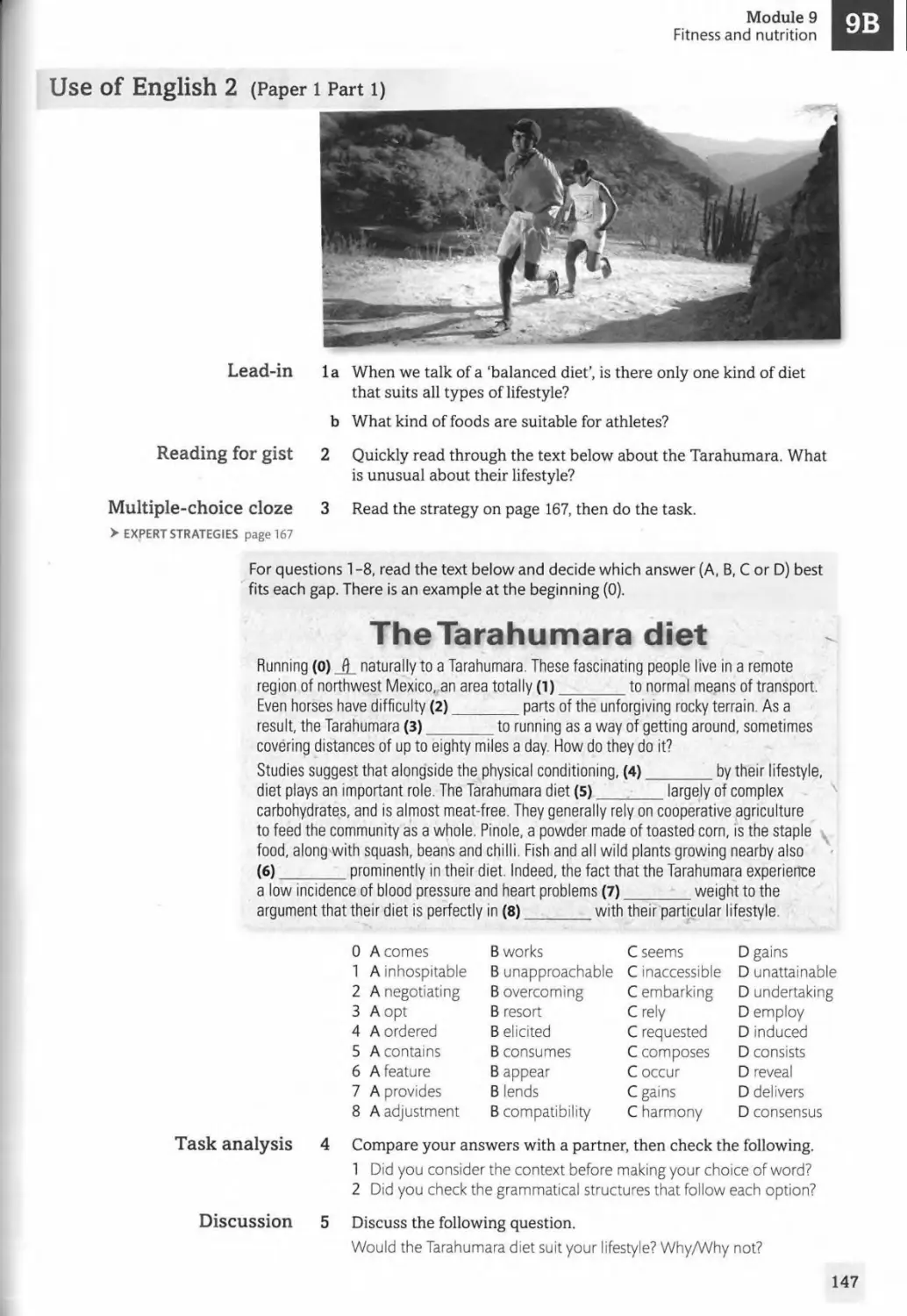
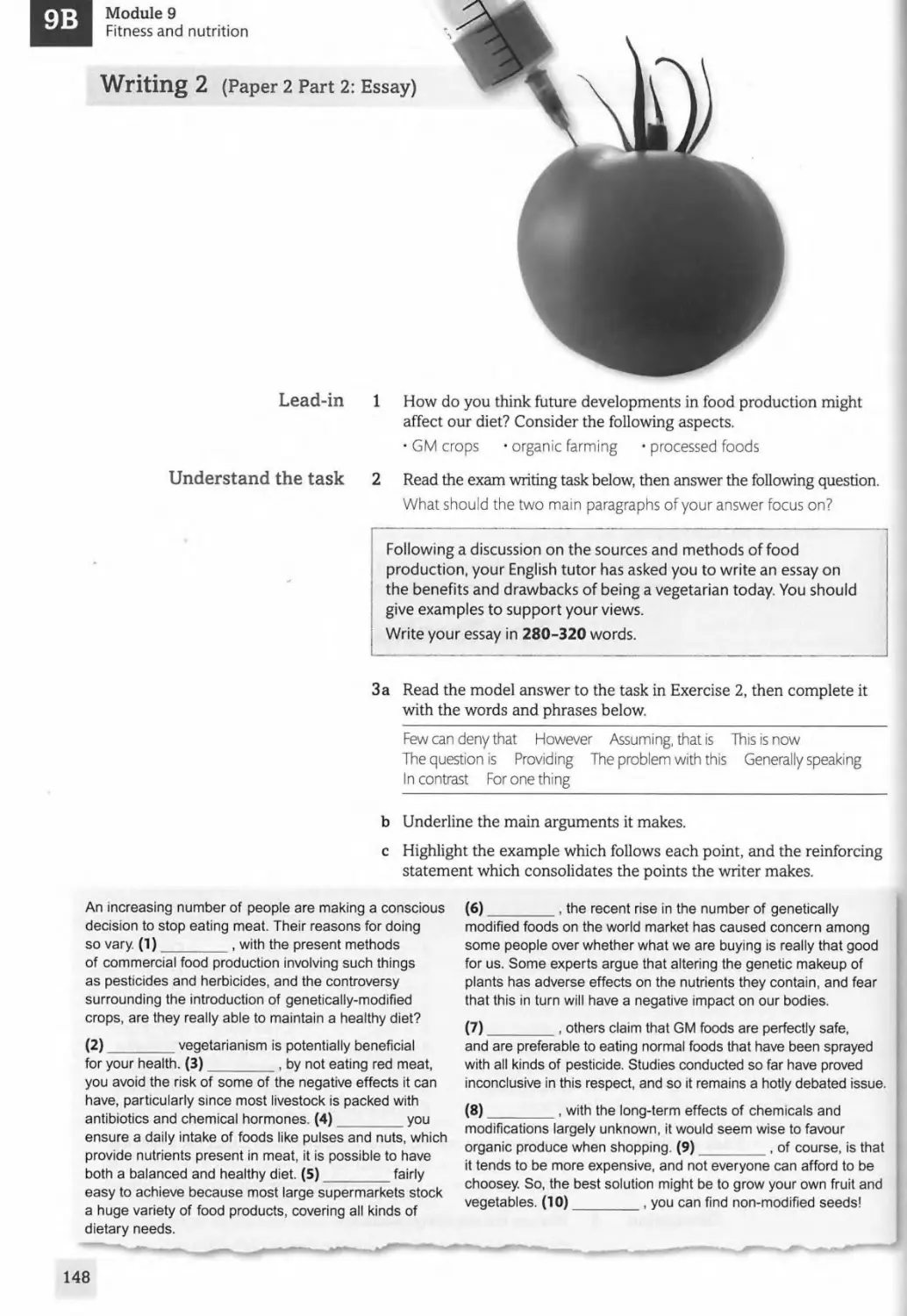
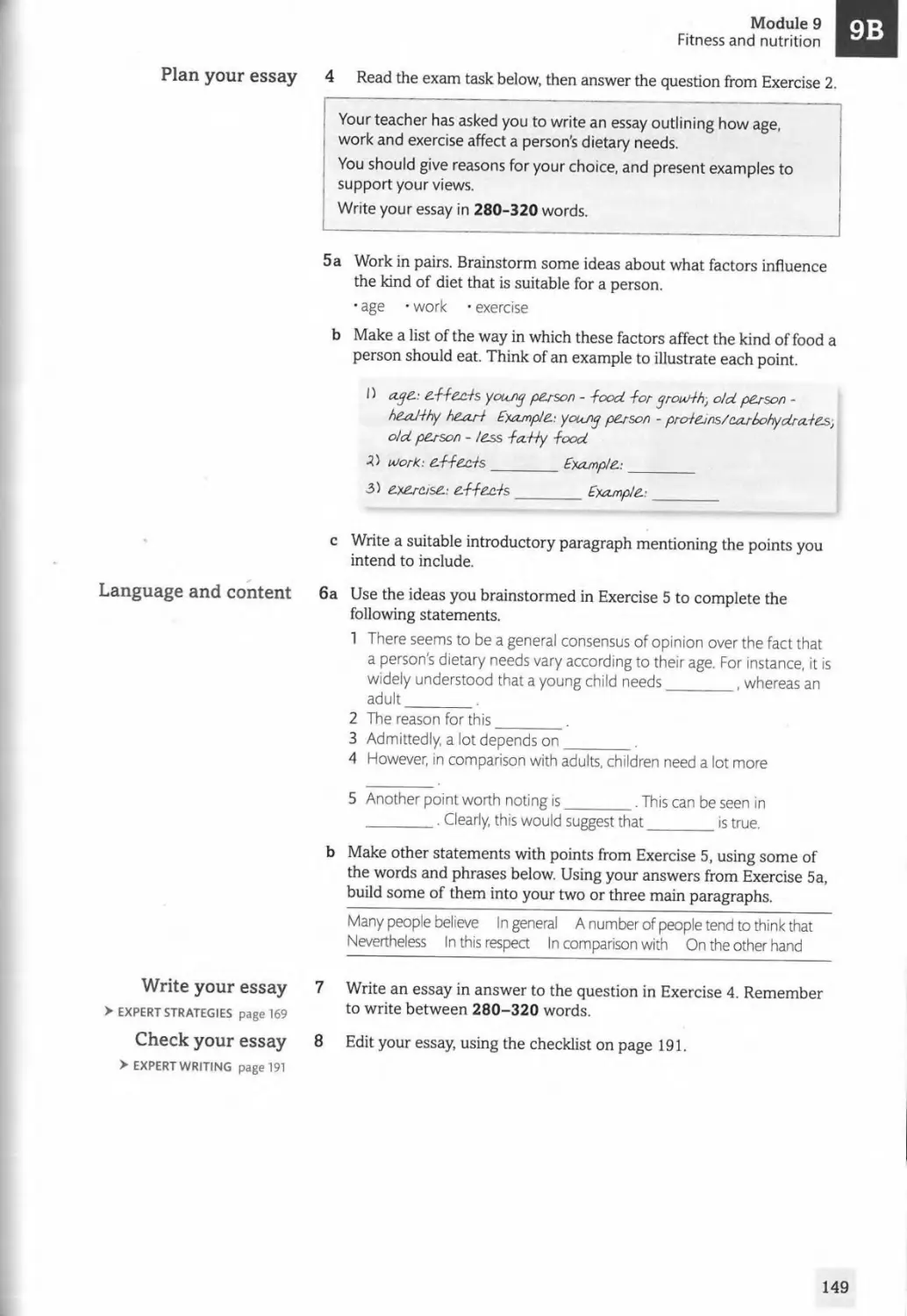

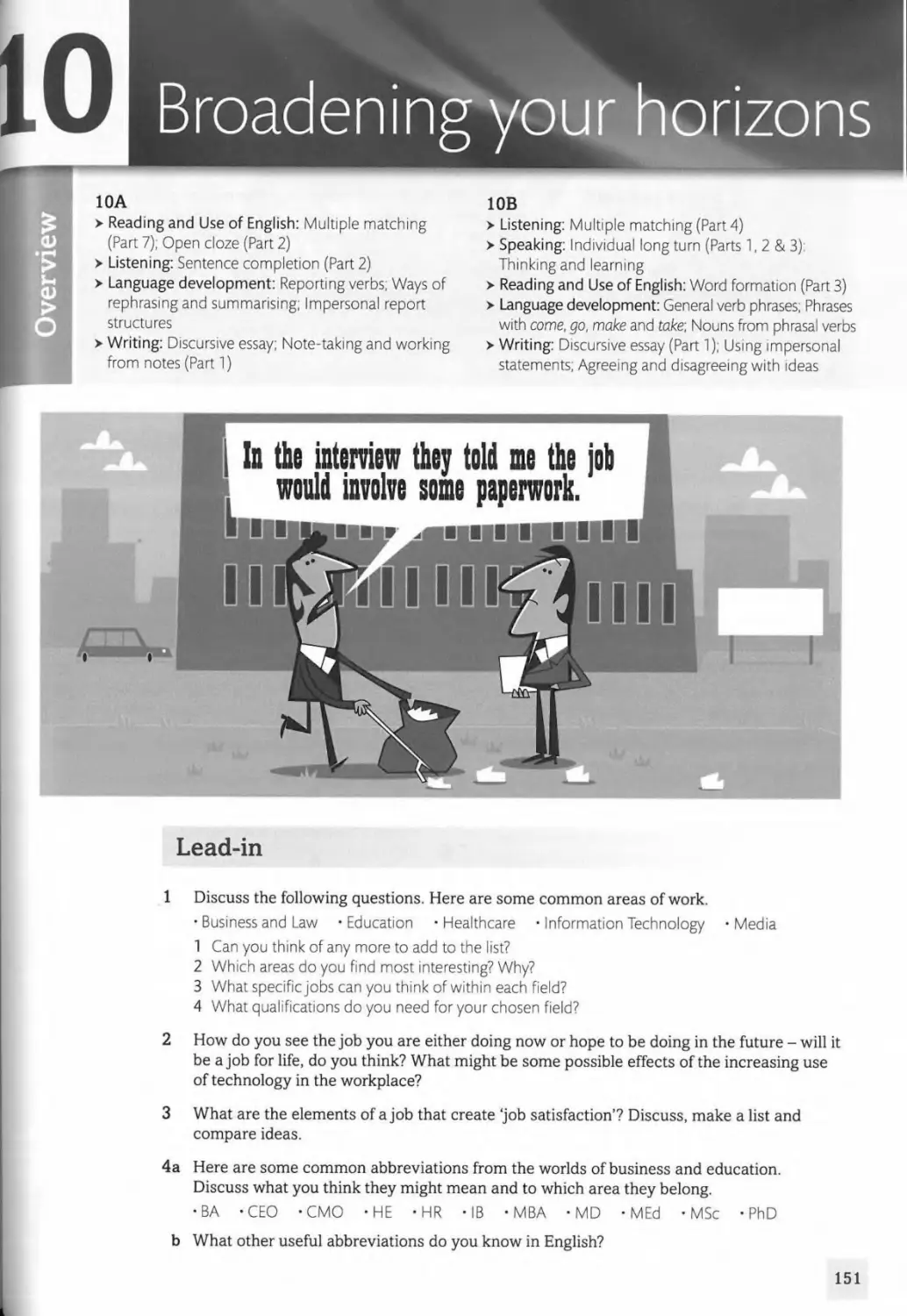

















Текст
I PROFICIENCY
EXPERT
COURSEBOOK
WITH MARCH 2013 EXAM SPECIFICATIONS
XLWAYS LEARNING
PFARSON
PROFICIENCY
EXPERT
COURSEBOOK
Megan Roderick and Carol Nuttall with Nick Kenny
Contents
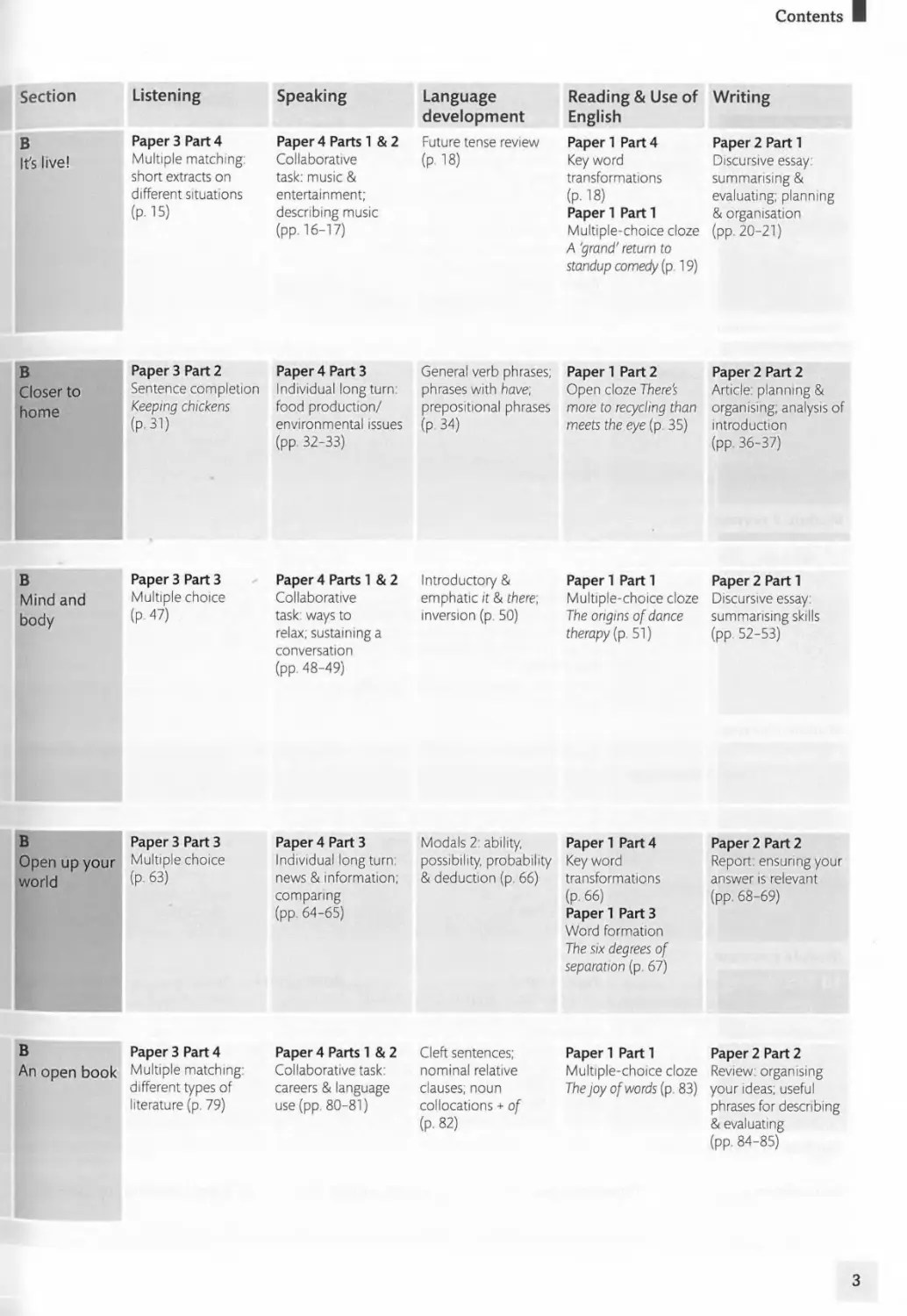
Module Section Reading & Use of English Listening Language development Writing
1 Performing arts (P- 7) A Have you got what it takes? Paper 1 Part 5 Multiple choice A dancer's lot (pp. 8-9) Vocabulary Words connected with the performing arts(pp. 10-11) Paper 1 Part 3 Word formation How do you say 'Mamma Mia' in Chinese? (p 11) Paper 1 Part 2 Open cloze Conductor declares war on mobile phones (p 13) Paper 3 Part 2 Sentence completion James Quigley animator (p. 12) Present & past tense review: state verbs (p. 13) Paper 2 Part 1 Discursive essay summarising & evaluating; analysing a model answer (p. 14)
Module 1 review (p. 22)
2 The natural world (P- 23) A Wild experience Paper 1 Part 6 Gapped text The last stand of the Amazon (pp. 24-25) Vocabulary Word formation: verbs-*nouns ending in -ion; animal sounds - figurative use; phrasal verbs Paper 1 Part 3 Word formation The power of the tides (P 27) Paper 3 Part 1 Multiple choice Animals (p 28) Passive forms (P 29) Paper 2 Part 2 Article: skills for article-writing; descriptive vocabulary (P 30)
Module 2 review (p. 38)
3 Surviving and thriving (p. 39) A Who's in control? Paper 1 Part 7 Multiple matching DIYpsychology (pp 40-41) Vocabulary Compound nouns with self-, word formation: prefixes (inter-, mis-, non-); suffixes (-ment, -tion, -ness, -sion) (p 42) Paper 1 Part 3 Word formation (p 43) Vocabulary Animal idioms (p 43) Paper 1 Part 2 Open cloze Positive psychology (p 45) Paper 3 Part 1 Multiple choice: understanding the main ideas (p 44) Conditionals tense review (P 45) Paper 2 Part 1 Discursive essay, summarising & evaluating (p. 46)
Module 3 review (p. 54)
4 Information (P- 55) A Too much of a good thing? Paper 1 Part 6 Gapped text My digital detox (pp. 56-57) Vocabulary Use of metaphors; collocations, word formation words with multiple suffixes, prepositional phrases, phrasal verbs with up & down; compound words (pp 58-59) Paper 1 Part 2 Open cloze Kenya's mobile banking revolution (p. 59) Paper 3 Part 1 Multiple choice (P 60) Modals 1 obligation, necessity, advice & criticism (p. 61) Paper 2 Part 2 Report: presenting factual information Report on the effects of internet use on the individual (p 62)
Module 4 review (p 70)
5 Language and literature (P- 71) A It's all in a word! Paper 1 Part 5 Multiple choice At home with books (PP 72-73) Vocabulary Literary devices; expressions using brain, face, head, mind & wits; phrases from Shakespeare; word formation: multiple affixation (pp. 74-75) Paper 1 Part 3 Word formation Word power (p. 75) Paper 3 Part 2 Sentence completion Endangered languages (p. 76) Words with a similar meaning, confusable words, homophones (p. 77) Paper 2 Part 2 Review: language for different types of reviews (p 78)
Module 5 review (p 86)
2
Contents
Section Listening Speaking Language development Reading & Use of English Writing
В It's live! Paper 3 Part 4 Multiple matching: short extracts on different situations (p 15) Paper 4 Parts 1 & 2 Collaborative task: music & entertainment; describing music (pp. 16-17) Future tense review (P 18) Paper 1 Part 4 Key word transformations (p. 18) Paper 1 Part 1 Multiple-choice cloze A 'grand' return to standup comedy (p 19) Paper 2 Part 1 Discursive essay: summarising & evaluating; planning & organisation (pp 20-21)
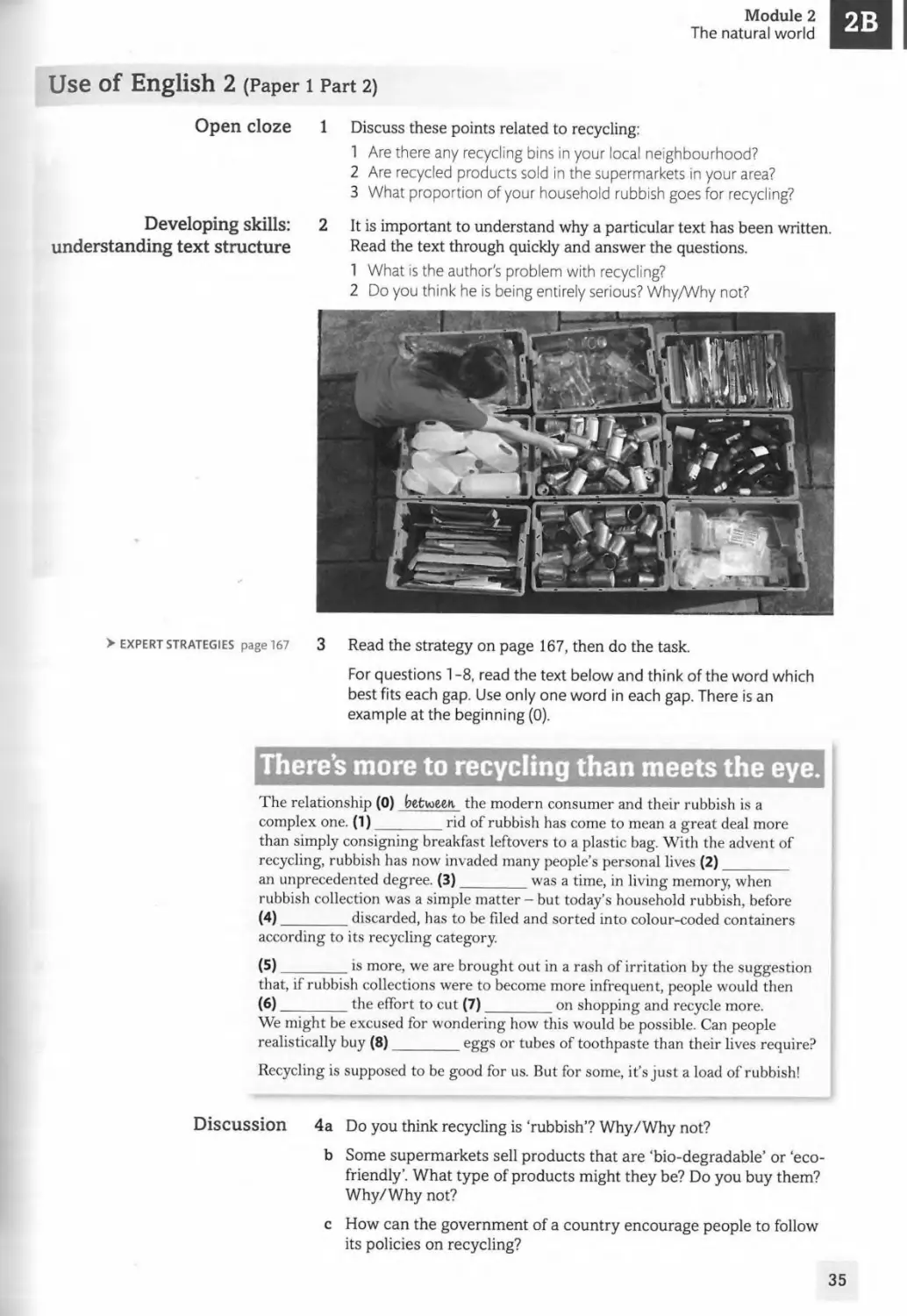
В Closer to home Paper 3 Part 2 Sentence completion Keeping chickens (p 31) Paper 4 Part 3 Individual long turn food production/ environmental issues (PP 32-33) General verb phrases; phrases with have; prepositional phrases (P 34) Paper 1 Part 2 Open cloze There's more to recycling than meets the eye (p 35) Paper 2 Part 2 Article: planning & organising; analysis of introduction (pp 36-37)
В Mind and body Paper 3 Part 3 Multiple choice (p 47) Paper 4 Parts 1 & 2 Collaborative task: ways to relax; sustaining a conversation (pp 48-49) Introductory & emphatic it & there; inversion (p 50) Paper 1 Part 1 Multiple-choice cloze The origins of dance therapy (p 51) Paper 2 Part 1 Discursive essay: summarising skills (pp 52-53)
В Open up your world Paper 3 Part 3 Multiple choice (p 63) Paper 4 Part 3 Individual long turn news & information, comparing (pp 64-65) Modals 2 ability, possibility, probability & deduction (p 66) Paper 1 Part 4 Key word transformations (p 66) Paper 1 Part 3 Word formation The six degrees of separation (p 67) Paper 2 Part 2 Report: ensuring your answer is relevant (pp. 68-69)
В An open book Paper 3 Part 4 Multiple matching: different types of literature (p. 79) Paper 4 Parts 1 & 2 Collaborative task: careers & language use(pp 80-81) Cleft sentences; nominal relative clauses, noun collocations + of (p. 82) Paper 1 Part 1 Multiple-choice cloze The joy of words (p 83) Paper 2 Part 2 Review organising your ideas; useful phrases for describing & evaluating
(pp. 84-85)
3
Contents
Module Section Reading & Use of English Listening Language Writing development
6 Travel (p. 87) A Sense of adventure Paper 1 Part 7 Paper 3 Part 2 Present Paper 2 Part 1 Multiple matching Has technology Sentence subjunctive; past Discursive essay: robbed travel of its riches? (pp. 88-89) completion subjunctive & evaluating input Vocabulary Greenland unreal past material (p. 94) Describing places; the travel experience; (p. 92) (p. 93) travel & transport collocations; expressions with sight; describing remote places; phrasal verbs with set; verbs of movement (pp. 90-91) Paper 1 Part 2 Open cloze Open-water swimming (p. 91)
Module 6 review (p 102)
7 The way we live (p. 103) A Communities Paper 1 Part 6 Paper 3 Part 1 Relative clauses; Paper 2 Part 2 Gapped text The internet in a cup Multiple choice reduced relative Letter varying (pp. 104-05) social activities clauses with your language Vocabulary (p 108) participlesand in descriptive Collocations, expressions with place; to infinitives, writing (p 110) purpose & intent; derivatives of social & reduced prefix inter- (pp. 106-107) non-defining Paper 1 Part 3 descriptive Word formation The central square (p. 107) clauses (p 109)
Module 7 review (p. 118)
8 Changing fashions (p.119) A A question of style Paper 1 Part 7 Paper 3 Part 3 -ing form Paper 2 Part 1 Multiple matching Locked in time Multiple choice (p 125) Discursive essay: (pp. 120-121) museums structuring Vocabulary (p 124) your essay Architectural & design features; phrases using discourse from art & architecture; collocations: markers (p 126) adjective + noun, prepositions (p 122) Paper 1 Part 2 Open cloze The Arts & Crafts Movement (P 123)
Module 8 review (p. 134)
9 Fitness and nutrition (p. 135) A How far can you go? Paper 1 Part 5 Paper 3 Part 4 Sentence Paper 2 Part 2 Multiple choice The match that would Multiple adverbials. Essay: never end (pp 136-137) matching modifying & developing your Vocabulary sportinginjuries intensifying points (p. 142) Adjective + adverb collocations; words (p 140) gradable & of endurance; expressions with keep, ungradable phrasal verbs with get; idioms with get adjectives; & keep, use of prefixes over & under common (pp 138-139) adverb + adjective Paper 1 Part 3 collocations Word formation Edison Pena (p 139) (p 141)
Module 9 review (p. 150)
10 Broadening your horizons (p.151) A Professional concerns Paper 1 Part 7 Paper 3 Part 2 Reporting Paper 2 Part 1 Multiple matching When things don't go Sentence verbs; ways of Discursive essay: right in business (pp. 152-153) completion rephrasing & note-taking & Vocabulary Kevin Arden: summarising; working from Phrasal verbs; collocations, proverbs/ thatcher (p 156) impersonal notes (p. 158) idioms, word formation: in- or un-? report structures (pp 154-155) (p 157) Paper 1 Part 2 Open cloze Networking (p 155)
Module 10 review (p 166)
Exam reference (pp. 167-171) Expert grammar (pp. 172-190) Expert writing (pp. 191-203)
Expert speaking (pp. 204-206)
4
Contents
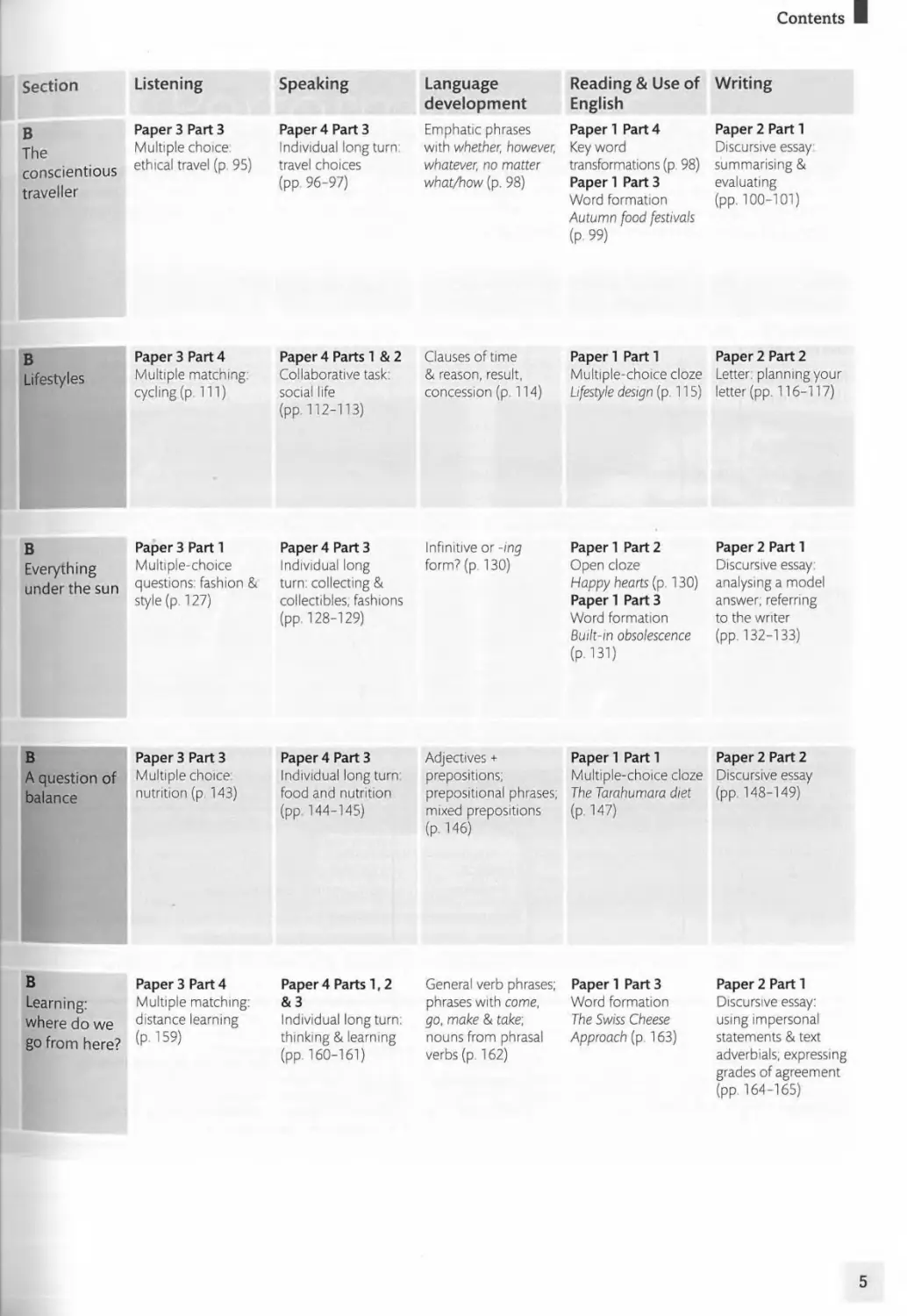
Section Listening Speaking Language development Reading & Use of English Writing
В The conscientious traveller Paper 3 Part 3 Multiple choice ethical travel (p 95) Paper 4 Part 3 Individual long turn travel choices (PP 96-97) Emphatic phrases with whether, however, whatever, no matter what/how (p. 98) Paper 1 Part 4 Key word transformations (p 98) Paper 1 Part 3 Word formation Autumn food festivals (P 99) Paper 2 Part 1 Discursive essay summarising & evaluating (pp. 100-101)
В Lifestyles Paper 3 Part 4 Multiple matching: cycling(p 111) Paper 4 Partsl &2 Collaborative task: social life (PP 112-113) Clauses of time & reason, result, concession (p. 114) Paper 1 Part 1 Multiple-choice cloze Lifestyle design (p 115) Paper 2 Part 2 Letter, planning your letter (pp 116-117)
В Everything under the sun Paper 3 Part 1 Multiple-choice questions: fashion & style (p 127) Paper 4 Part 3 Individual long turn: collecting & collectibles, fashions (pp 128-129) Infinitive or -ing form? (p 130) Paper 1 Part 2 Open cloze Happy hearts (p 130) Paper 1 Part 3 Word formation Built-in obsolescence (P 131) Paper 2 Part 1 Discursive essay: analysing a model answer, referring to the writer (pp 132-133)
В
A question of
balance
Paper 3 Part 3
Multiple choice
nutrition (p 143)
Paper 4 Part 3
Individual long turn
food and nutrition
(pp 144-145)
Adjectives +
prepositions;
prepositional phrases,
mixed prepositions
(p 146)
Paper 1 Part 1 Paper 2 Part 2
Multiple-choice cloze Discursive essay
The Tarahumara diet (pp. 148-149)
(p 147)
В
Learning:
where do we
go from here?
Paper 3 Part 4
Multiple matching:
distance learning
(P 159)
Paper 4 Parts 1,2
&3
Individual long turn:
thinking & learning
(pp 160-161)
General verb phrases;
phrases with come,
go, make & take;
nouns from phrasal
verbs (p 162)
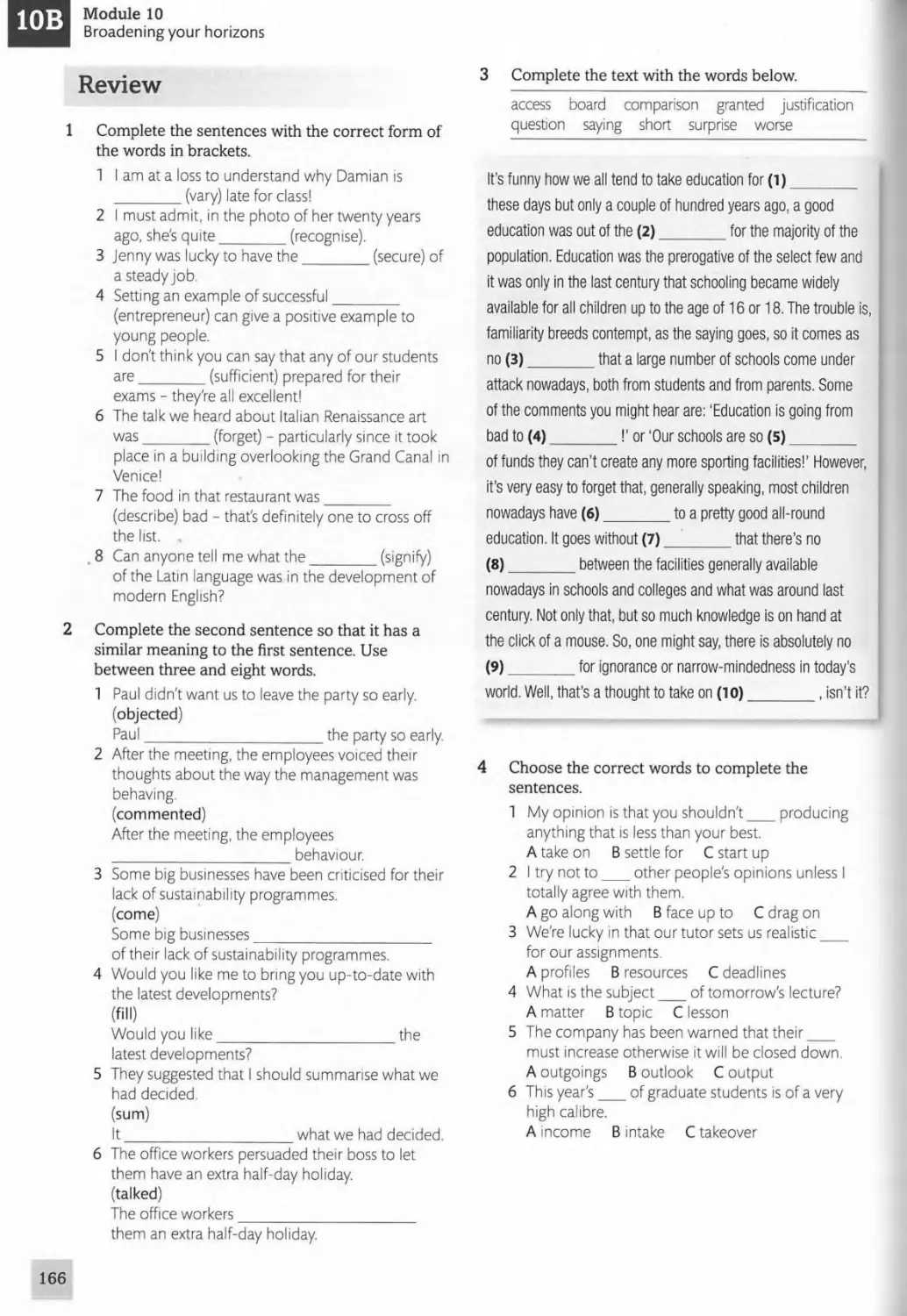
Paper 1 Part 3
Word formation
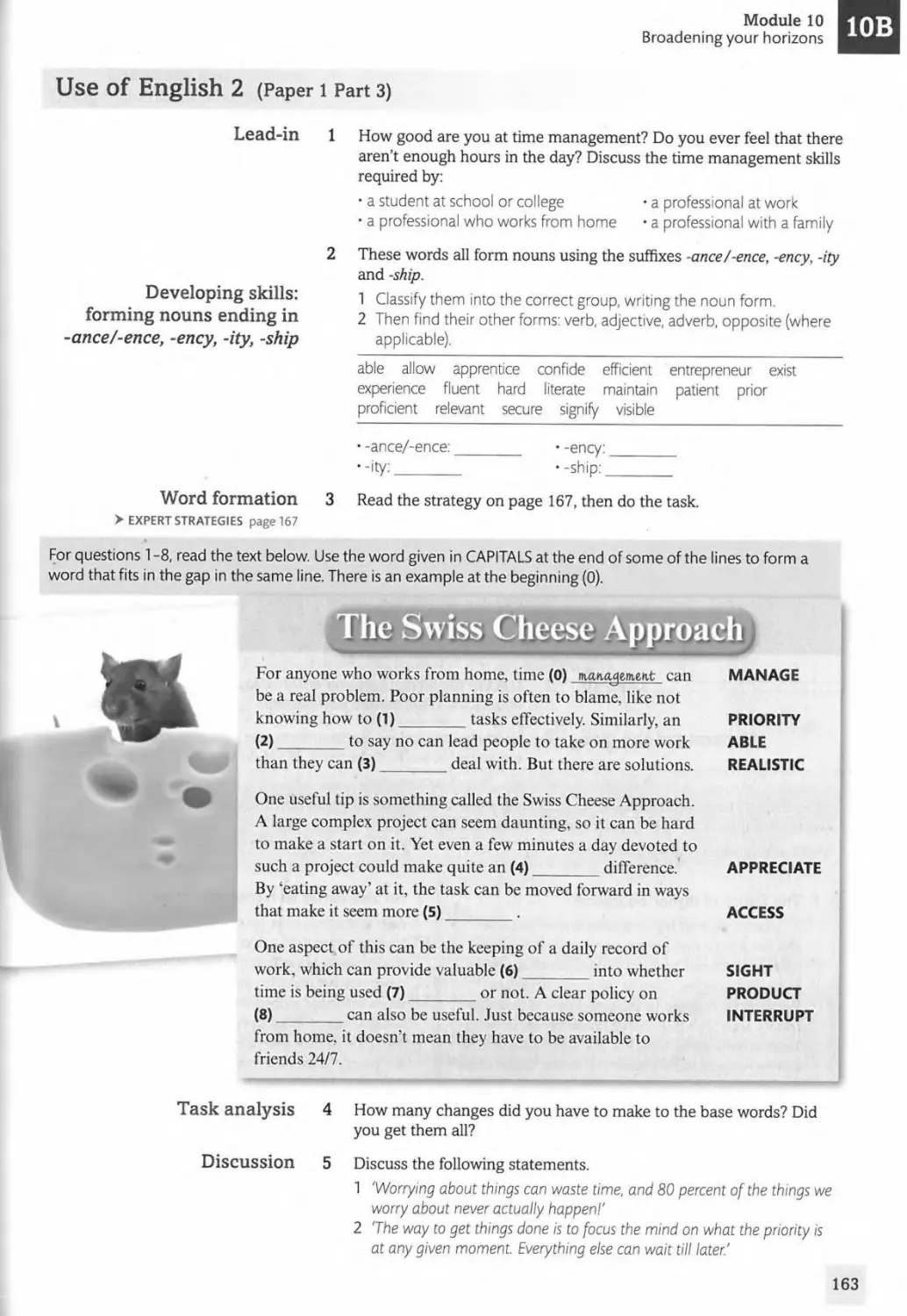
The Swiss Cheese
Approach (p 163)
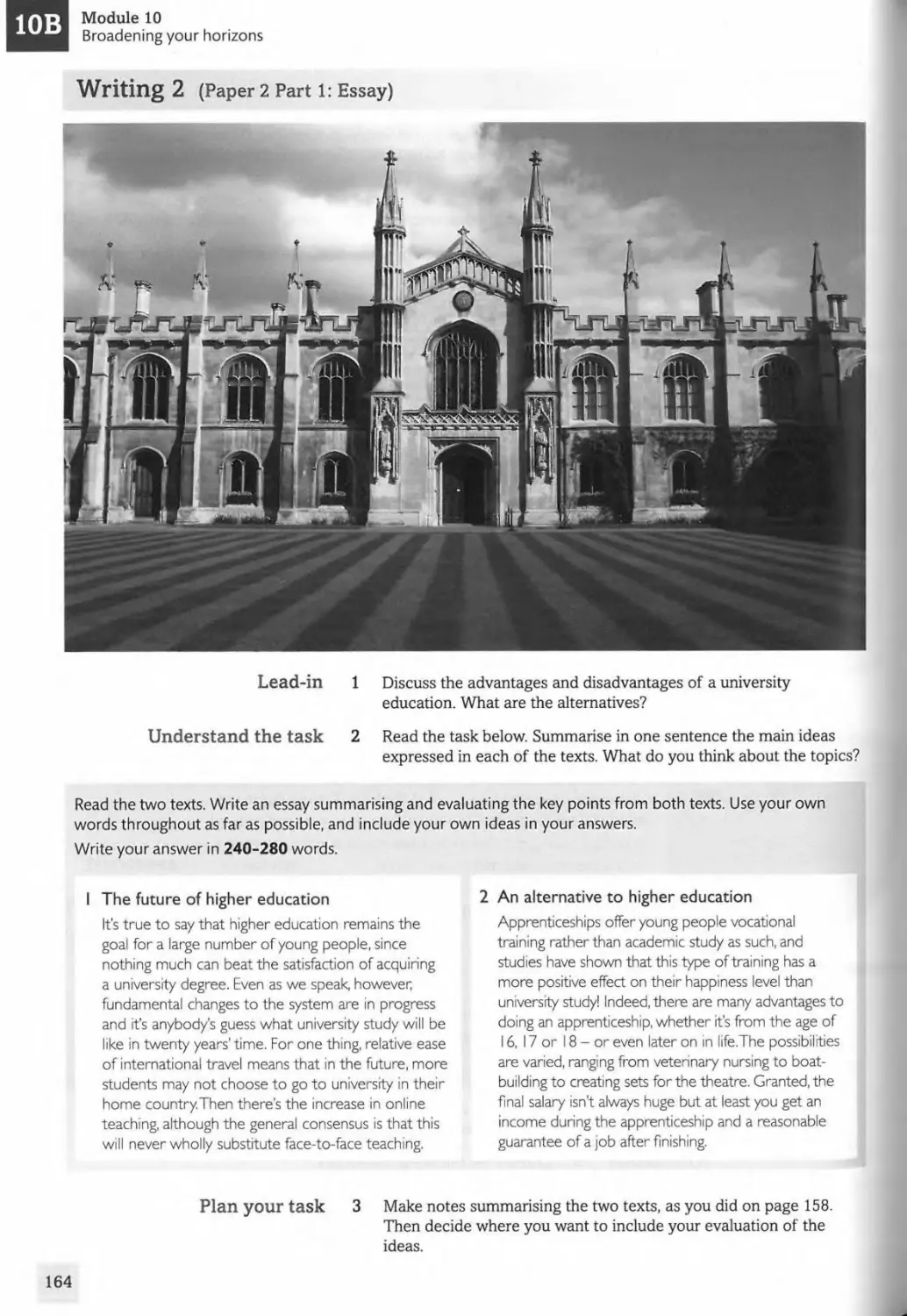
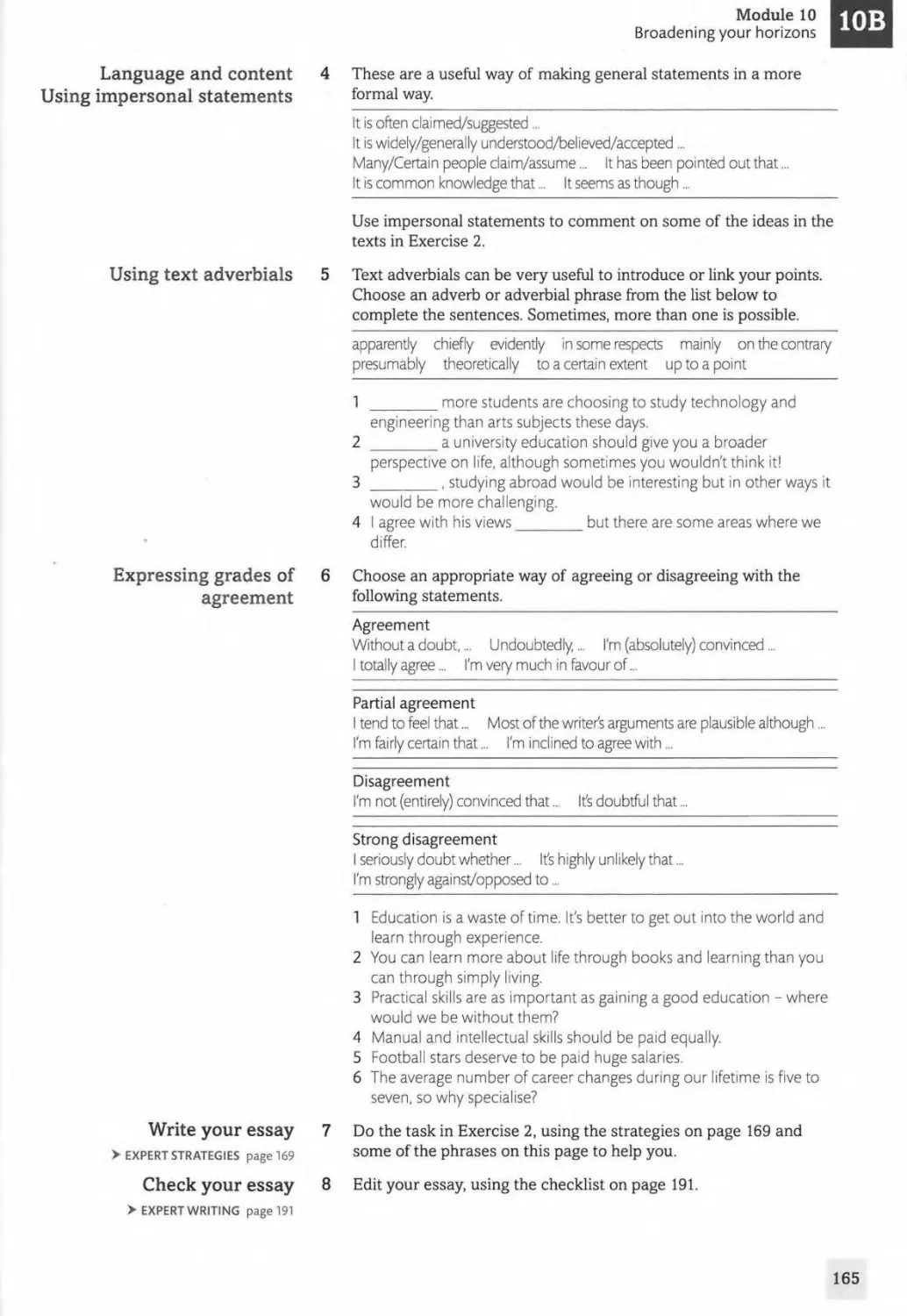
Paper 2 Part 1
Discursive essay:
using impersonal
statements & text
adverbials, expressing
grades of agreement
(pp 164-165)
5
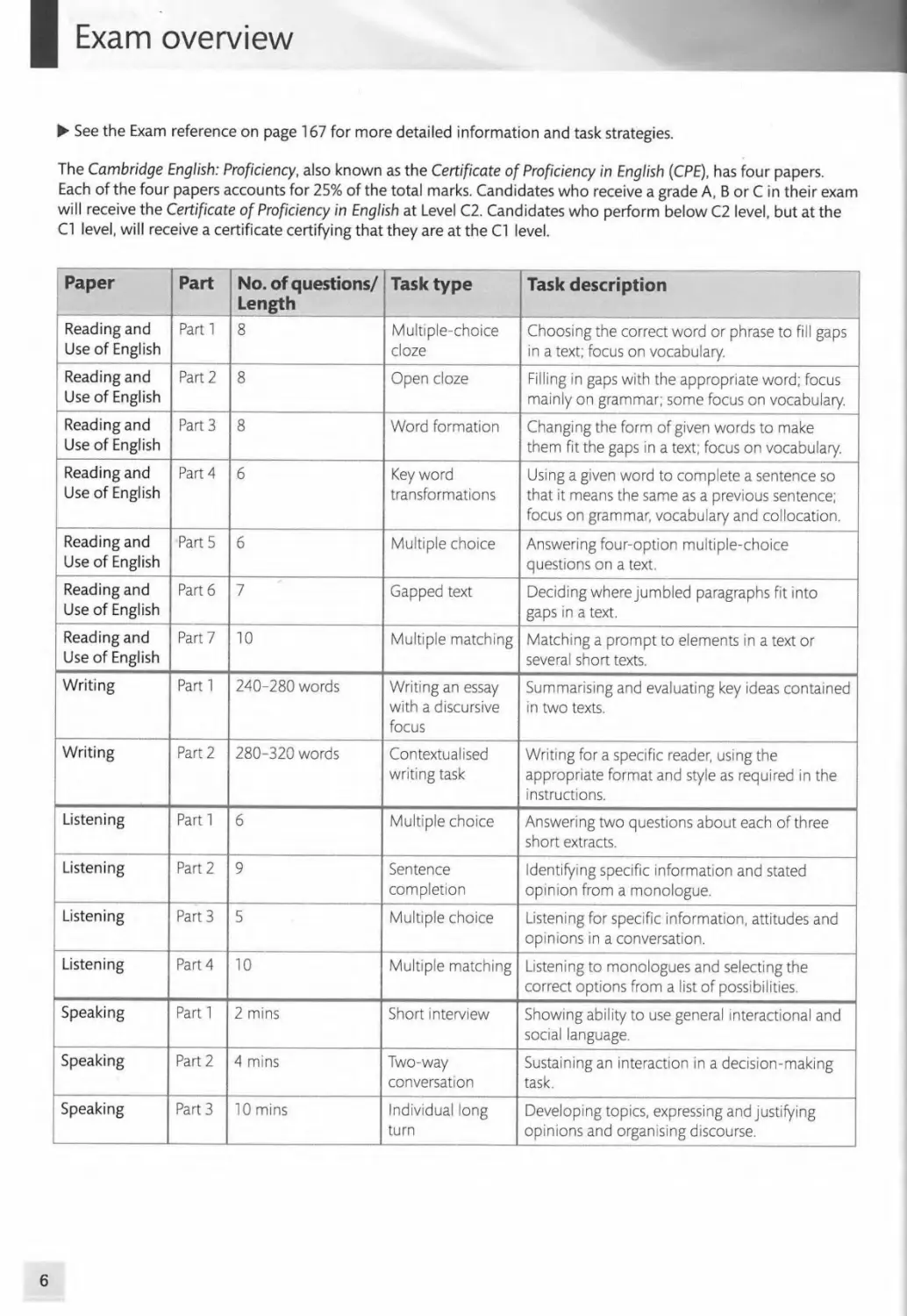
Exam overview
► See the Exam reference on page 167 for more detailed information and task strategies.
The Cambridge English: Proficiency, also known as the Certificate of Proficiency in English (CPE), has four papers.
Each of the four papers accounts for 25% of the total marks. Candidates who receive a grade A, В or C in their exam
will receive the Certificate of Proficiency in English at Level C2. Candidates who perform below C2 level, but at the
Cl level, will receive a certificate certifying that they are at the Cl level.
Paper Part No. of questions/ Length Task type Task description
Reading and Use of English Part 1 8 Multiple-choice cloze Choosing the correct word or phrase to fill gaps in a text; focus on vocabulary.
Reading and Use of English Part 2 8 Open cloze Filling in gaps with the appropriate word; focus mainly on grammar; some focus on vocabulary.
Reading and Use of English Part3 8 Word formation Changing the form of given words to make them fit the gaps in a text; focus on vocabulary.
Reading and Use of English Part 4 6 Key word transformations Using a given word to complete a sentence so that it means the same as a previous sentence; focus on grammar, vocabulary and collocation.
Reading and Use of English Part 5 6 Multiple choice Answering four-option multiple-choice questions on a text.
Reading and Use of English Part 6 7 Gapped text Deciding where jumbled paragraphs fit into gaps in a text.
Reading and Use of English Part 7 10 Multiple matching Matching a prompt to elements in a text or several short texts.
Writing Part 1 240-280 words Writing an essay with a discursive focus Summarising and evaluating key ideas contained in two texts.
Writing Part 2 280-320 words Contextualised writing task Writing for a specific reader, using the appropriate format and style as required in the instructions.
Listening Part 1 6 Multiple choice Answering two questions about each of three short extracts.
Listening Part 2 9 Sentence completion Identifying specific information and stated opinion from a monologue.
Listening Part 3 5 Multiple choice Listening for specific information, attitudes and opinions in a conversation.
Listening Part 4 10 Multiple matching Listening to monologues and selecting the correct options from a list of possibilities.
Speaking Part 1 2 mins Short interview Showing ability to use general interactional and social language.
Speaking Part 2 4 mins Two-way conversation Sustaining an interaction in a decision-making task.
Speaking Part 3 10 mins Individual long turn Developing topics, expressing and justifying opinions and organising discourse.
6
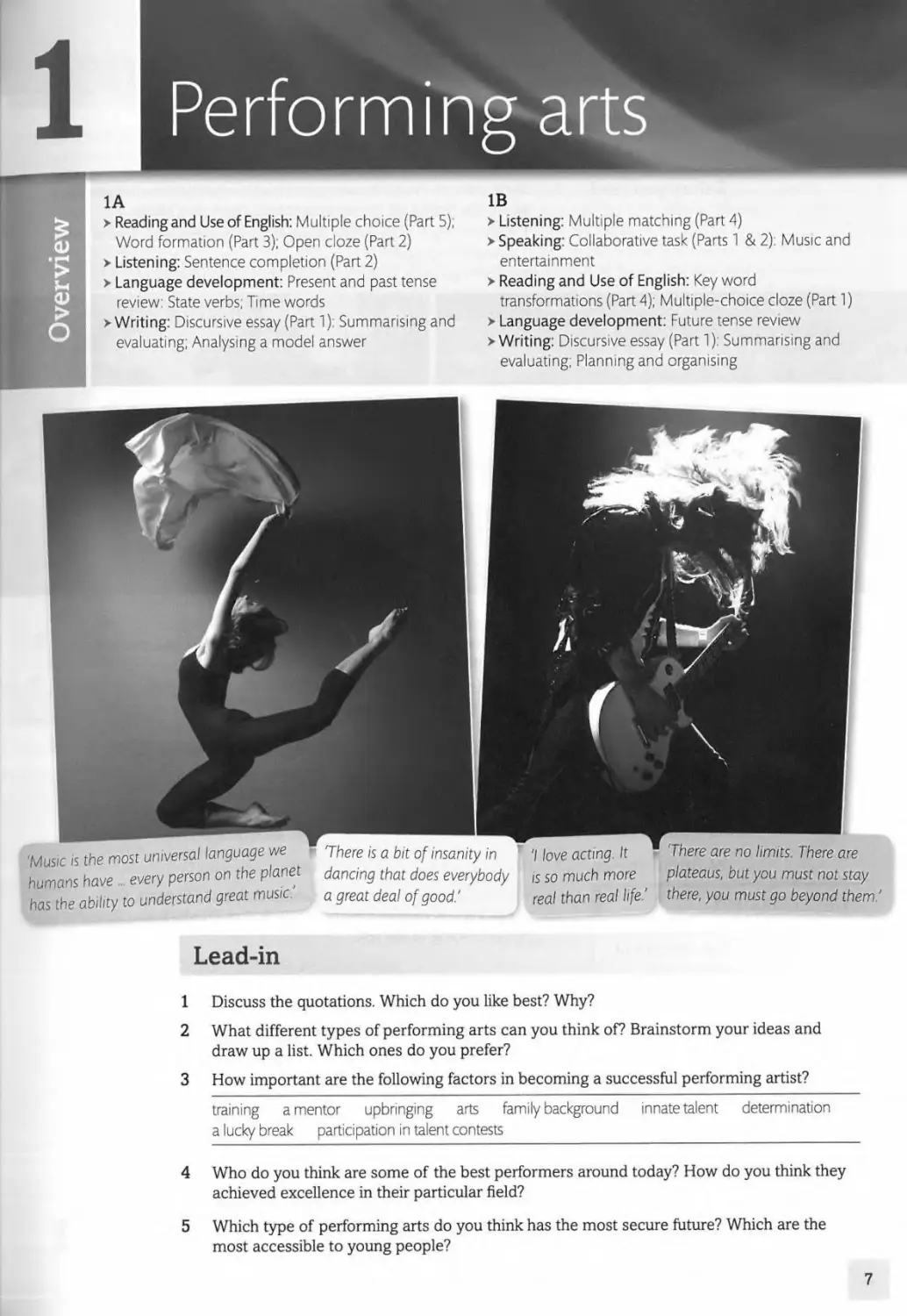
Performing arts
&
<и
>
<D
>
О
1A
> Reading and Use of English: Multiple choice (Part 5);
Word formation (Part 3); Open cloze (Part 2)
> Listening: Sentence completion (Part 2)
> Language development: Present and past tense
review: State verbs; Time words
► Writing: Discursive essay (Part 1): Summarising and
evaluating; Analysing a model answer
IB
> Listening: Multiple matching (Part 4)
► Speaking: Collaborative task (Parts 1 & 2): Music and
entertainment
> Reading and Use of English: Key word
transformations (Part 4); Multiple-choice cloze (Part 1)
> Language development: Future tense review
> Writing: Discursive essay (Part 1): Summarising and
evaluating; Planning and organising
'Music is the most universal lanyuuyc
humans have every person on the planet
has the ability to understand great music.'
i neitr is a un 0[ insanity in
dancing that does everybody
a great deal of good.'
। neie we nu limits, i nere are
plateaus, but you must not stay
there, you must go beyond them '
is so much more
real than real life '
Lead-in
1 Discuss the quotations. Which do you like best? Why?
2 What different types of performing arts can you think of? Brainstorm your ideas and
draw up a list. Which ones do you prefer?
3 How important are the following factors in becoming a successful performing artist?
training a mentor upbringing arts family background innate talent determination
a lucky break participation in talent contests
4 Who do you think are some of the best performers around today? How do you think they
achieved excellence in their particular field?
5 Which type of performing arts do you think has the most secure future? Which are the
most accessible to young people?
7
1А
Have you got what it takes?
Reading 1 (Paper 1 Part 5)
Before you read 1
Some cultural events involve participants who remain anonymous,
where the individual is only important as part of a whole.
1 Can you think of any more examples of this, other than what is shown
in the photographs?
2 Do you generally prefer to be anonymous or to stand out in a crowd?
Skimming and scanning:
reading for main idea (gist)
and reading for detail
2 Reading a text and answering questions on it require two basic
skills working together: the understanding of gist and the ability to
comprehend the detail of a text.
1 Quickly skim the text on page 9 for gist, focusing on the beginning
of the sentences, particularly in the first half of each paragraph.
2 Match the summaries below to the paragraphs. Support your choice
with details from each paragraph. There is one extra summary
sentence you do not need.
> EXPERT STRATEGIES page 168
A source that never runs dry
Complaints are useless
A harsh reality
The dangers of fame
A financial dilemma
It's who you know, not what you know
Multiple choice
---- 1 ’ I
EXPERT STRATEGY
When you answer questions on a
text, keep the overall context and
the writer's intention in mind.
3 Read the strategy, then do the task.
You are going to read an article about dancers in London. For
questions 1-6, choose the answer (А, В, C or D) which you think fits
best according to the text.
Task analysis
4 Analyse any problems you had with the multiple-choice questions.
• Was it difficult to understand the writer's intention?
• Did any unknown words give you problems?
• Did you find the question options confusing?
• Once you know the correct answers, go back and study the text to
make sure you understand the rationale behind the answers.
Discussion
5 Have you ever performed in public? How did you feel? If you
haven’t, would you like to? Why/Why not?
6 Check the meaning of these key words from the text.
EXPERT WORD CHECK
tatty hustle resilience prerequisite sartorial mediocrity lousy
ruthlessness jaded notorious
8
SCREEN & STAGE | THE SATURDAY NEWSPAPER
A dancer’s lot
1 All across London, they emerge from underground stations
and buses; bags slung over their shoulders and taut stomachs
beneath thick winter overcoats, Nobody recognises them, as
they head for freezing upstairs rooms in tatty gymnasiums or
s slink into backstage theatre doors, even though they appear
regularly in sold-out musicals and favourite television shows.
They earn precious little, even those who perform live with
famous singers, and have no real prospects, doing what they’re
doing despite having hustled and sweated themselves to the
io heights of one of Britain’s most demanding professions. But still
they go, every morning to their gnm upstairs rooms in gyms
and their backstreet, backstage doors, to dance.
2 Most have left behind worried parents in faraway towns and
villages; made repeated promises to look after themselves and
is taken trains, in their late teenage years, for London.There’s
much to despise about the city, where talent and a reptilian
grade of resilience, although prerequisites, provide no guarantee
of success. Even auditions are becoming rare. Conscious of
deadlines and financial constraints, choreographers call in talent
го from the blessed pool of their own chosen. If you aren't the
right height don't have the right face, hair or sartorial style, then
don’t expect a look in. Although choreographers occasionally
seek out the beautiful, they’re mostly instructed to hunt the
bland: those least likely to outshine the stars. And, as many
2s dancers will tell you, it's getting to the point where mediocrity
is acceptable; there'll be someone over there out of sync,
someone over there who can't hold her arm still.
3 And if they get a part, increasingly dancers are turning up for
jobs where the choreographer just stands there and works
30 them endlessly, fingers clicking: 'Again, again, again'. As one
dancer; Melanie Grace says, 'You dance for the love and the
1 In the first paragraph, the writer paints a picture
of dancers who are
A careful not to be recognised by fans in the street.
В deserving of the fame they have achieved.
C unlikely to be making further advances in their
careers.
D hoping to find work on stage alongside
established stars.
2 What do we learn about auditions in the second
paragraph?
A Increasingly higher standards are expected of
dancers.
В The best dancers do not necessarily get the jobs
on offer.
C It’s difficult for dancers to find the time to attend
very many.
D Dancers with family connections in the business
get invited to more.
3 What is implied about choreographers in the third
paragraph?
A They expect dancers to do as they are told.
В They dislike it when dancers criticise each other.
C They are intolerant of dancers who make mistakes.
D They are sensitive to the pressures that dancers are
under.
35
40
4
45
50
5
55
60
65
passion, and keep your mouth shut because you don't want
to get a reputation.’ It’s not always easy, though. You think the
television shows provide changing rooms? For dancers? Even
the big budget ones have them disrobing in a comer of the
canteen - and the pay's lousy But you have to ignore ft, keep
your head down. You’re in London now. You're one of many;
one of nothing.The sooner you accept that the better you'll get
on. Of the fleets of talented dancers who try, only a quarter
make ft, the rest simply can't process the ruthlessness - to dance
in London is hard on the soul.
Yet most of the dancers have agents, who you might think
would negotiate a better fee or conditions for their dancers, but
no. You’ll never meet a dancer who thinks their agent deserves
their twenty percent cut of the fee. Mostly you’ll just get a text
or email notifying you of an audition and a single agent might
have as many as two hundred dancers on their books. As
Melanie says,‘It's catch-22, because you won't hear about the
auditions without one.’ Here’s the job, take ft or leave ft, and if
you leave it, they’ll just hire someone straight out of college and
pay them even less.
Oh, the annual chum of the colleges. The dancers hear
it constantly, the sound of the machine in the distance, its
ceaselessly grinding gears that, with every coming year; push
out hundreds of new dancers, each one younger and hungner
and less jaded than you. And with every release of fresh limbs
into the stew of the city, things get harder The worst thing the
kids can do is accept a job for no pay. They do it all the time.
One website has become notorious for television and pop-
video production companies scrounging for trained people
to work for nothing but’exposure’. And if the youngsters are
fresh out of dance school, despairing of their blank CV and
craving the love of those ranks of sparkle-eyed strangers, they'll
leap at the chance. It’s the reason things are getting harder
How to describe the London dance scene today? The word
Melanie chooses is ‘savage’.
4 What point is made about agents in the fourth
paragraph?
A Dancers are largely satisfied with their service.
В Most dancers recognise that they are essential.
C They tend to represent only the less experienced
dancers.
D They make every effort to get the best deal for
dancers.
5 The writer uses the image of a machine in line 53
to underline
A the attitude of training institutions.
В the dubious activities of a website.
C the constant supply of new talent.
D the exploitation of young people.
6 In the text as a whole, the writer is suggesting
that dancers in London
A should demand much better pay and working
conditions.
В have to regard the experience as useful for the
future.
C should be rewarded for dedication and
perseverance.
D have to accept the realities of a competitive
industry.
9
Module 1
Performing arts
1А
Vocabulary
Words connected with the performing arts
1 a Read the dictionary definitions below from the
Longman Exam Dictionary and use the ‘How to
use the dictionary’ notes at the beginning of
your dictionary to help you answer the following
questions.
1 What tells you which part of speech the word is?
2 What helps you to pronounce the word correctly?
3 What do the symbols [С], [I] and [T] tell you about?
4 What does [+ for] tell you about the word?
audition
[/oi'difon/] n [C] a short
performance by an actor, singer, etc., that
someone watches to judge if they are good
enough to act in a play, sing in a concert, etc.
[+ for] I’ve got an audition for the Bournemouth
Symphony Orchestra on Friday.
audition
v 1 [i] to take part in an audition:
[+ for] She's auditioning for Ophelia in ‘Hamlet’.
2 [T] to watch and judge someone’s performance
in an audition: We auditioned more than 200
dancers before deciding on Carole Ann.
b Look up the following words in your
dictionary, then give a full explanation of their
pronunciation, symbols and use to the rest of
the class. Write an example sentence for each
one to show how they are used.
choreography auditorium inspire
backstage preview
Nouns + prepositions
2 Complete the text with the prepositions below.
on for(x3) to with in of
Phrases with jump/leap/bounces)
3 a The phrase leap at the chance appears in the text
on page 9. The words jump, leap and bound(s) are
sometimes used in phrases to add emphasis to a
reaction or situation. Discuss the meaning of the
phrases in italics in the following sentences.
1 His determination to become a dancer knew no
bounds and he practised for eight hours a day.
2 Kathy jumped for joy when she heard she’d got the
part in the play.
3 Paul’s move from Liverpool in the hope of
becoming a professional dancer was a leap in the
dark, as he had no idea what would happen.
b Replace the underlined phrases in the sentences
with the correct form of a phrase below.
jump to conclusions jump down my throat
leap at the opportunity by leaps and bounds
out of bounds know no bounds
1 Sara's enthusiasm for the stage was endless, and
by the age of twelve she had already performed in
two musicals, both as a dancer and actor.
2 'OK, I know you've been working really hard
but there's no need to yell at me just because I
pointed out a mistake!'
3 If you are invited to audition for a West End
production, you should accept immediately, as it
may be a while before you get another chance.
4 Kevin's performance in his first few concerts was
rather wooden and unnatural but he’s improved
immensely since then.
5 The area backstage is off limits to the public
during the performance but certain members
of the audience are sometimes invited to visit
performers after a show.
6 There have been rumours that the leading lady is
romantically involved with the lighting technician
but perhaps we shouldn't assume too much.
film Villains
Home | News | Archive | Log-in
It appears to be a prerequisite (1)screen
villains to love classical music, and magnificent
examples abound. Take, for instance, Malcolm
McDowell’s insistence (2)listening to
Beethoven while he kills people in A Clockwork
Orange. Glenn Close’s thirst (3)revenge
is fuelled by music from Madame Butterfly in Fatal
Attraction, while the gangster Al Capone finds
reason (4)shed a tear when listening
to Leoncavallo’s I Pagliacci in The Untouchables.
Hollywood’s interpretation (5)evil genius
comprises villains who are highly intelligent, often
slightly aristocratic beings, and their sensitive tastes
(6)_______art and music are placed in sharp
contrast (7)the crude brutality of their
acts of violence. Hans Zimmer’s score for Hannibal
enhances the dramatic effect of Dr Lecter’s talent
(8)displaying a veneer of refined elegance
just before he murders his victims. Perhaps, more
than any other kind of music, the range and complexity
of classical music reflects the tangled psychological
workings of the criminal mind.
10
Module 1
Performing arts
1A
Collocations
4 Complete the collocational phrases in the
sentences with the words below.
stage dress emotional standing backing
curtain live cue limelight
1 Theatre companies always claim that a disastrous
rehearsal usually means an outstanding
first night.
2 Some actors find that being in the can
put a strain on family relationships.
3 Bidji sang vocals for Manu Chao on his
CD Mister Bobby.
4 It is not unusual for accomplished movie stars
attempting to perform on stage to suffer from
fright on their opening night.
5 The opera was so moving that the principal
singers received a ovation from the
audience at the end of the performance.
6 Despite the struggle to get into her costume,
Helena managed to enter the stage on.
7 The pianist gave an inspiring
performance in Hyde Park, in front of a large
audience.
8 Actors often make excellent use of
recall to enhance their portrayal of a character.
9 After a riveting charity performance, U2 were
joined on stage by all the other artists for a
moving call.
Compound words
5 a The words backstreet and backstage in the text on
page 9 are compound words. The words over and
under are also used to form compounds. Discuss
what overstatement and understatement mean.
b Match the words in column A with a word from
column В to form compound nouns. Some of the
words combine with more than one other word.
A В
1 under a writer
2 sound b wright
3 play c track
4 over d act
5 screen e study
6 back f stage
Use of English 1 (Paper 1 Part 3)
Word formation
1 Read the strategy, then do the task.
EXPERT STRATEGY
Remember to read each sentence in the context of
the paragraph and the text as a whole.
> EXPERT STRATEGIES page 167
For questions 1-8, read the text below and the
task strategy. Use the word given in CAPITALS at
the end of some of the lines to form a word that
fits in the gap in the same line.
How do you say
‘Mamma Mia’
in Chinese?
The (0) lotdetq acclaimed Матта Mia is
to be the first major Western musical to be
translated for the Chinese stage. But is it
possible to produce a successful
(1)of a Western show in
Chinese? The world is about to find out.
When the (2)Catherine
Johnson wrote the original plot, based
on the music of the Swedish band Abba
in 1999, she couldn't have imagined that
it would come this far. It remains to be
seen what the band's (3),
Benny Andersson and Bjorn Ulvaeus,
will make of the translation. Some
words were initially (4)and
had to be corrected. Some of the
Western choreography considered to
be of (5)taste in China has
given way to traditional folk dances to
render the show more appropriate for
local audiences. 'It's certainly been an
(6)challenge,' laughs one
member of the British production team,
'but so far the show's been received
enthusiastically by everyone who has seen
the (7)showing. So well have
to wait and see.'
Meanwhile, (8)in the dressing
rooms the atmosphere is tense, as the
curtain rises on this ambitious production.
WIDE
ADAPT
PLAY
LYRIC
INTERPRET
QUESTION
PRECEDE
VIEW
STAGE
11
the CULTURE supplement
2 Write a short review of a film, theatrical
performance or concert you have seen recently.
Use words from this section to help you.
11
Module 1
Performing arts
1А
Listening 1 (Paper 3 Part 2)
Before you listen
Listening for information:
taking notes
Sentence completion
EXPERT STRATEGY
In Paper 3 Part 2, you are listening for
concrete pieces of information. On
the recording, you will hear the words
or phrases you need to complete the
gaps but they will not be in the same
sentences. Before you listen, think
about:
• the type of word or phrase which is
missing in each gap
• the sort of information you are
listening for.
1 Discuss the following questions.
1 Make a list of the kind of jobs connected with the film industry.
2 What role does each one play in the making of a film?
2 ifjlT,M Read the exam question in Exercise 3. Listen and note
down any experiences that helped the speaker become an
animator.
3 Ijjl n °2 Look at the task below. Read the questions and the
strategy carefully, then do the task.
You will hear an animator called James Quigley giving a talk about his
work. For questions 1-9, complete the sentences with a word or short
phrase.
James Quigley: animator
Before being introduced to animation, James had been hoping to
make | | 1 | his career.
James' college tutor showed him how retaining | 2 |
in his drawings helped to achieve a sense of movement.
James uses the word | | 3 | to describe the type of
animation he favours in films.
James' success at a | | 4 | led to opportunities to work
as an animator.
Money made from work on | | 5 | allows James to
finance his own films.
James says he particularly enjoys the level of | | 6~|
required to create an animated film.
People are surprised to learn that much of James' drawing is done
| ~ | 7 | and that this suits him best.
James feels that | | 8 | is the most important aspect of
an animator's work.
James mentions that the | |1T| involved in a film can
prove a source of inspiration for drawing the characters.
4 You are interested in becoming an animator. Based on what you
heard, and the notes you made in Exercise 2, write down some
questions you would like to ask James.
12
Module 1
Performing arts
Language development 1
Present and past tense review: state verbs
> EXPERT GRAMMAR page 172
1 Tick the acceptable sentences and correct the
sentences containing mistakes. Sometimes both
might be possible. Discuss your answers.
1 a Unfortunately, it isn't looking as if that dance
company needs me at the moment - and I
really wanted to be in their show!
b They look for someone who can sing really well.
2a I really am not seeing what you mean by
'professionalism'.
b I'm seeing some actor friends tomorrow.
3a They are having a lovely villa in France.
b Do you have a lot of studying to do at the
moment?
4a This matter doesn't really concern him.
b What is concerning me is her lack of stamina.
5a I don't mind singing and acting as part of our
amateur performance but my dance skills need
a bit of work.
b I'm minding my neighbour's dog while she’s away.
Time words
2 Complete the short dialogue with the correct time
word and form of the verb. There are two extra
time words you do not need.
before currently first just last lately long
since still yet
Chrissy and Dana are chatting before a performance.
Chrissy: Ever (1)_____I first (2)(meet)
Ryan, he's wanted to become a performer.
Dana: Yes, he says he's (3)____(4)
(find) anyone with an extraordinary talent
who has really inspired him. However,
he (5)(6)(not travel)
much abroad, I suppose.
Chrissy: He (7)(do) a lot of hip-hop
classes (8)_____________. How (9)
do you think it will be before he
(10)(become) a dance teacher?
Dana: He (11)(12)
(13)(do) masterclasses with a
top dancer, so I think it will be soon!
After the performance.
Chrissy: It's the (14)time that I
(15)(see) Ryan dance that well.
Dana: He left by the backstage door
(16)I (17)(have) time
to congratulate him! Let's send him a text!
Use of English 2 (Paper 1 Part 2)
Open cloze
1 a Read the newspaper extract about mobile phone
use during concerts. How do you feel about Sir
Peter’s comments?
b Read the strategy below, then do the task.
EXPERT STRATEGY
Read through the whole text quickly to get the
general idea, before trying to find the missing words.
For questions 1-8, read the text below and think
of the word which best fits each gap. Use only
one word in each gap. There is an example at the
beginning (0).
> EXPERT STRATEGIES page 167
ft <- -> search News C
Conductor declares war on mobile phones
The British composer and conductor, Sir Peter Maxwell
Davies, is fast losing patience (0) wttk the problem
of mobile phone ringtones interrupting performances
of classical music. During one particular concert at
a music festival, three phones (1)________off in
quick succession, prompting an angry reaction from
other members of the audience who shouted at the
offenders. (2)________a personal appeal from the
festival's director for phones to be switched off, the
following evening (3)rang in the middle of a
piano sonata. (4) ______made matters worse was
the fact (5)the owner was sitting close to Sir
Peter himself.
'I've just about (6)_______enough!' Sir Peter
said, branding those failing to comply with the
polite request 'artistic terrorists' intent (7)
committing an act of vandalism. All it takes is a
(8)________calls or message bleeps for everyone
else's enjoyment of the music to be spoilt. 'Some
people,' he continued, 'just can't bear having their
mobile turned off. It's like they feel disconnected from
the world, or not wanted!'
2 Discuss these comments. Do you agree or
disagree? Give reasons to support your opinion.
13
Module 1
Performing arts
1А
Writing 1 (Paper 2 Part 1: Essay)
Summarising and evaluating
> EXPERT STRATEGIES page 169
1 Read the strategy and the exam task below, then
answer the following questions.
1 What type of writing task is it?
2 Which two tasks must you include in your answer?
EXPERT STRATEGY
For this type of writing task, make sure your answer
contains the following:
• key points of the two texts (a summary)
• your opinion of their content (an evaluation).
Also, use your own words, not 'chunks' from the texts.
Write an essay summarising and evaluating the
key points from both texts. Use your own words
throughout as far as possible, and include your own
ideas in your answers.
You should write 240-280 words.
I Performing techniques: stage vs. screen
Gesture, movement and physicality are vital on
stage.Whereas tiny gestures can be magnified
in close-up film shots, as a stage actor you will
use your body very differently. You will need
to communicate a physical energy and develop
a‘stage presence'.The film close-up permits
subtleties of facial expression and movement that
don't work on the stage.
Camera work and editing achieve effects on the
screen that the stage actor must create largely
by using the body. In film, props and settings are
also used extensively to convey meaning and
atmosphere. On the stage, it’s down to you to do
that work.
2 Read the model answer to the question in
Exercise 1. Does it address the two tasks
successfully? Why/Why not?
The two texts (1) discuss / assess techniques required
for different styles of acting. Firstly, the first text
(2) examines / evaluates the use of physical expression
on stage as opposed to film and (3) conveys /
compares the value of facial expression in close-up
film shots with the need to use the whole body
on stage to (4) exemplify / communicate feeling. It
(5) suggests /asserts that whereas film actors are
supported by the setting and camera work, the
stage actor is unaided, and must therefore exude
stronger physical energy to achieve the same result.
There is no doubt that the two media (6) demand /
need different styles of acting but now that
technology has entered the theatre, set designers
and directors are able to make use of special effects
and more sophisticated props to create atmosphere.
So, while it may have been true 50 years ago, I feel
it is a gross exaggeration to suggest that the stage
actor is totally unsupported today.
The second text, on the other hand, looks at the
importance of the voice in acting, and emphasises
the need for aspiring actors to (7) acquire / achieve
a range of vocal skills to be able to sustain a career
in any medium. It (8) assumes / acknowledges the
relationship between vocal expression and body
movement and (9) advocates / concludes following a
training course to develop such skills effectively.
To my mind, the two texts examine specific skills
needed for different types of acting but we should
not ignore recognising the essential connection
between vocal and physical expression, and the
value of gaining the proper kind of training in order
to become a versatile performer, capable of working
on both stage and screen.
2 Acting: finding your voice
Consider the actor's voice for a moment. Vocal
expression is as much about movement and
emotion as sound, and nowhere is this more
noticeable than on the stage. Achieving resonance in
your voice requires physical as well as vocal effort.
For the screen, the emphasis may be on perfecting
a range of accents rather than pitch, yet even
here embracing cultural body language makes
the accent sound more authentic. Interestingly, in
the recording studio many voice actors imitate
the movements of their animated characters to
achieve better vocal results.The right training can
help you develop such skills to find work in any
medium.
3 Circle the most suitable verb in italics in the
model answer. Explain your choices and say why
the other options do not work.
4 a Look at how the essay is organised. Underline the
paragraphs which summarise the two texts. Has
the candidate used their own words effectively?
b Highlight the paragraph(s) in which the candidate
evaluates the texts.
5 Discuss. Do you agree with the candidate’s
evaluation of the texts?
6 Do the extra writing task on page 192. Use the
writing strategy to help you.
14
It's live!
Listening 2 (Paper 3 Part 4)
Before you listen
expert strategy
Before you listen, carefully read the
rubric and then the options for each
part.
1 ifjl ТЮЗ Listen carefully to what the speaker says about studio vs.
live performance and answer the following questions.
1 Name three advantages of recording music in a studio that the
speaker mentions.
2 Which does the speaker prefer: studio recordings or live
performances? How do you know?
Multiple matching 2 T’M Read the strategy, then do the task.
> EXPERT STRATEGIES page 171
You will hear five short extracts in which people are talking about different free-time activities they take part in.
Task One Task Two
For questions 1-5, choose from the list (A-H) each For questions 6-10, choose from the list (A-H) what
speaker's main reason for doing the activity. each speaker plans to do in the future.
You will hear the recording twice. While you listen, you must complete both tasks.
A a wish to excel at something
В nostalgia for a former interest
C feeling in need of a challenge
D proving someone wrong
E a love of entertaining people
F a need to impress others
G the chance to improve fitness
H wanting to develop existing skills
A learn new techniques
В meet like-minded people
C find work in a related field
D initiate a local project
E participate in a major event
F put original work on show
G gain a qualification
H pass on expertise
6
6
7
8
9
10
> HELP
• Speaker 1 refers to a friend's reaction - but was this the reason why she
did the activity?
• Speaker 2 mentions getting a qualification. Is he talking about the past,
the present or the future?
• Speaker 4 refers to an activity she used to do - but why did she take it
up again?
Discussion 3 Which of the activities you heard about do you find interesting?
Why/Why not?
4 Check the meaning of these key words and phrases from the
audioscript.
EXPERT WORD CHECK
hard-pressed counteract inevitable sedentary tag along hark back
passable thrive on hilarious get your teeth into (sth)
15
1 a Think of different ways in which music is used to
entertain, either on its own or in combination with
other activities. Which interests you the most?
b Discuss these questions.
1 What's on your iPod or your phone?
2 Have your tastes in music changed at all over the
last couple of years? If so, in what way?
3 What do people's tastes in music reveal about
their culture or generation?
2 Read the question and the four possible answers.
1 How much information is given in the answers?
2 What answer would you give to the question?
Part 1
3 In pairs, ask each other the following questions,
taking turns to ask and answer. Use the strategy
to help you.
1 In what way does music make a difference to your
life?
2 What would the world be like without music?
3 Is musical talent something you are born with or
can you acquire it through hard work?
4 How do you think musical training might enhance
other areas of your life?
Do you ever go clubbing?
EXPERT STRATEGY
Don't forget to expand your answers by giving
additional information or a reason for your answer.
Answer 1
No, it's not really my scene, although I enjoy
dancing generally.
Answer 2
I've been on the odd occasion with friends. It's
quite fun!
v____________________________________________J
Answer 3
Yes, every summer! We sometimes go to
Mykonos where the clubbing scene is really good!
Answer 4
t
I can't dance to save my life so this is not
something I'd choose to do in my spare time!
Vocabulary 2: describing music
4a Ijj) tios Listen to a conversation between Maggie
and Tom, then choose from the adjectives below
to express their ideas.
deafening depressing discordant harmonious
inspiring mind-blowing rhythmic soothing
uplifting/moving upbeat
Tom likes__________heavy metal. He hates__________
20th century classical music.
Maggie likes rock or pop; she doesn't
really like music. She finds classical
composers such as Bach.
b Who do you agree with?
16
Useful language: agreeing, disagreeing and
weighing things up
5 a Listen to the dialogue again, then
complete the table below with phrases the
speakers use to agree or disagree.
j?- Agreement Disagreement/ Partial disagreement -\ Weighing things up
b Now write the following expressions in the table.
I can't disagree with that...
I think we ought to take into consideration...
That may be the case but...
We can't rule out (the possibility that)...
Have you considered...?
You've got a point but...
I'd go along with that.
Absolutely!
6 Write a chat message in response to the
statements below, using phrases from Exercise 5.
1 Listening to really loud music on a
hands-free or on headphones is bad for
your hearing. Be careful!
4?^ There's nothing better than a live
concert!
I don't think I'd like to give a performance
online and be watched by millions of
people! How about you?
Part 2
Collaborative task: planning a summer arts
festival
EXPERT STRATEGY
Maintain a dialogue with your partner and use
appropriate phrases for agreeing and disagreeing.
7 In pairs, do the task, using the strategy to help you.
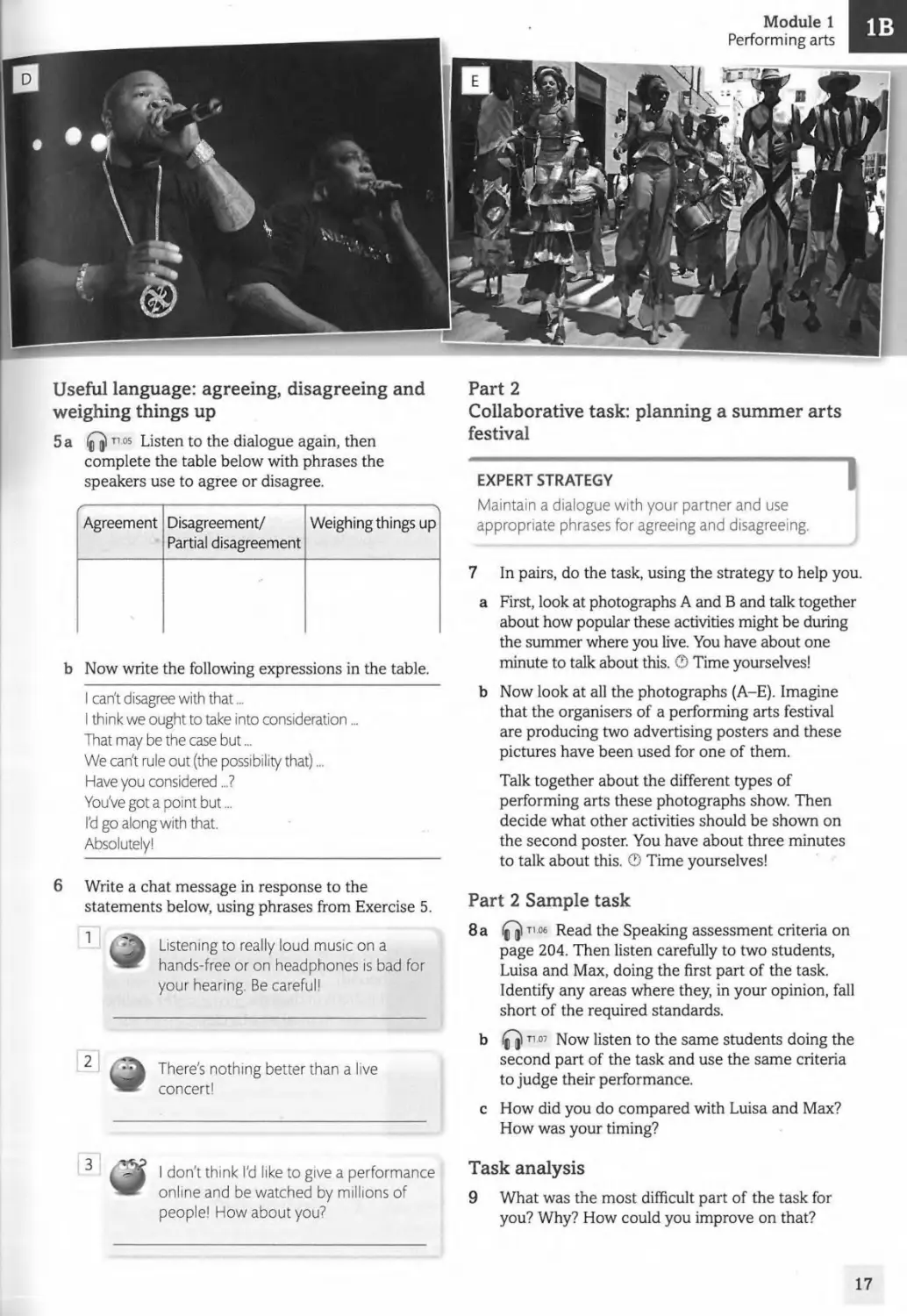
a First, look at photographs A and В and talk together
about how popular these activities might be during
the summer where you live. You have about one
minute to talk about this. © Time yourselves!
b Now look at all the photographs (A-E). Imagine
that the organisers of a performing arts festival
are producing two advertising posters and these
pictures have been used for one of them.
Talk together about the different types of
performing arts these photographs show. Then
decide what other activities should be shown on
the second poster. You have about three minutes
to talk about this. © Time yourselves!
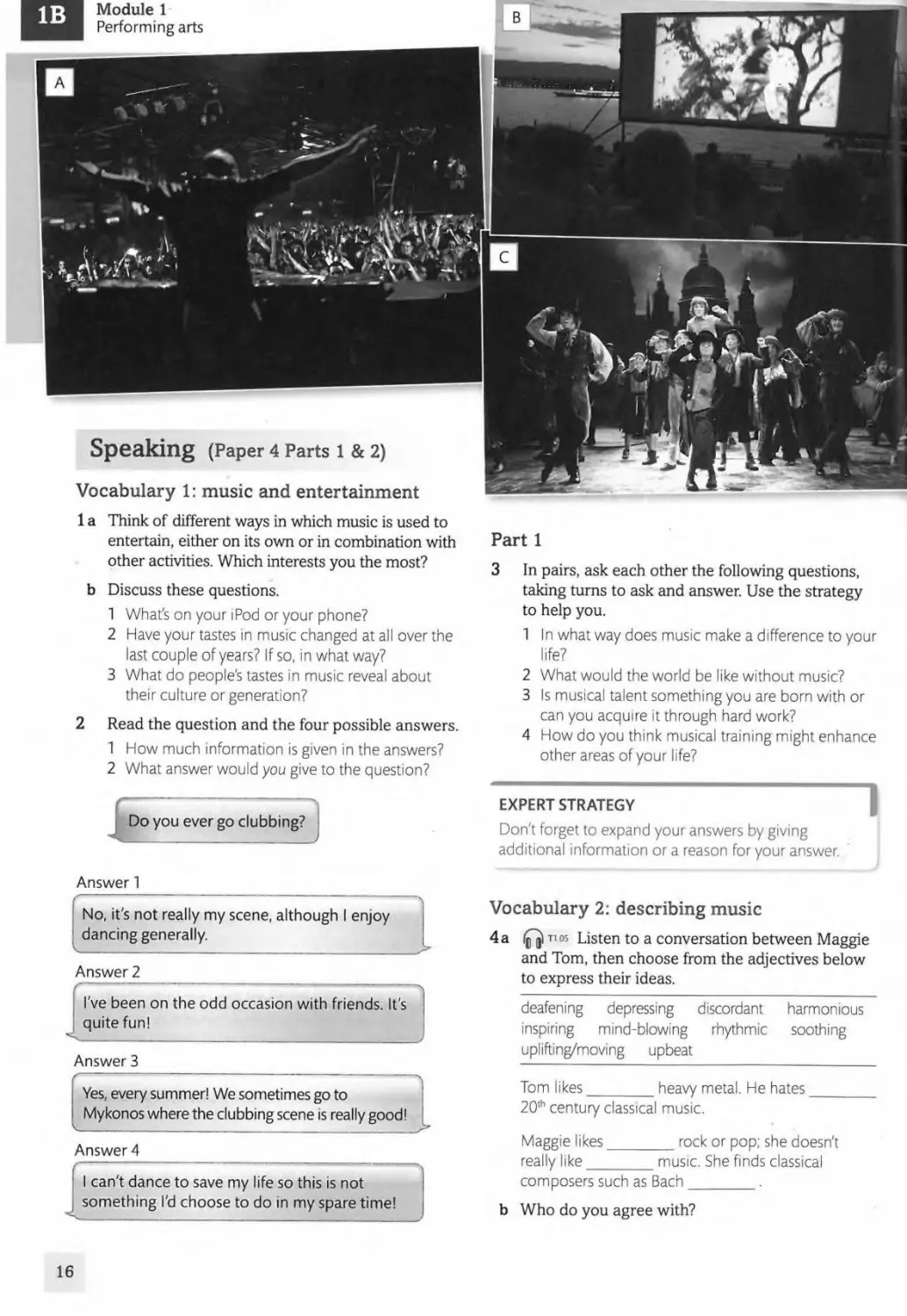
Part 2 Sample task
8 a lj-jl ti.°6 Read the Speaking assessment criteria on
page 204. Then listen carefully to two students,
Luisa and Max, doing the first part of the task.
Identify any areas where they, in your opinion, fall
short of the required standards.
b ifjlno? Now listen to the same students doing the
second part of the task and use the same criteria
to judge their performance.
c How did you do compared with Luisa and Max?
How was your timing?
Task analysis
9 What was the most difficult part of the task for
you? Why? How could you improve on that?
17
Module 1
Performing arts
IB
Language development 2
Future tense review
> EXPERT GRAMMAR page 173
1 In pairs, decide which follow-on sentence, a or b,
is the most suitable in the following contexts.
Give reasons for your decision.
1 Oh no! The electricity's gone off!
a What are we doing now?
b What are we going to do now?
2 You know he can't be trusted, so don't expect any
sympathy from me!
a If you will keep on seeing him, you're bound to
get hurt.
b If you see him, you'll get hurt.
3 Don't worry about being late! When you get to
the station,
a Paul will be waiting for you.
b Paul will have waited for you.
4 Oh, good! You're here!
a I was just about to call you.
b I'm going to call you.
Other forms with future meaning
2 a Complete the dialogue with the phrases below.
Use each phrase only once.
wouldn't be were supposed to was just about to
might were due to be was going to
Gemma: Oh, hi, Matt! I (1)call you
shortly. I thought I (2)go and see Kevin
Spacey in Richard III. Do you fancy it?
Matt: Well, lucky you caught me. really. We
(3)rehearsing today but Bob called to
say that Carla's sprained her ankle and so we
(4)going after all. I (5)go and
see her now, as a matter of fact, but wanted to let
you know about the situation first.
Gemma: Thanks. Shame about Carla, but lucky for
you! A day off!
Matt: I'm not so sure about that, Gemma. We
(6)finish rehearsing the first act today,
so this is bound to set us back quite a bit. It could
be days before she's able to rehearse again now.
Gemma: Sorry to hear that, then. Anyway, what do
you say to Richard III? Shall we go?
Matt: Yeah, why not?
b нов Listen and check your answers. Discuss.
Use of English 2 (Paper 1 Part 4)
Key word transformations
1 Read the strategy on page 168, then do the task.
For questions 1-6, complete the second sentence
so that it has a similar meaning to the first
sentence, using the word given. Do not change
the word given. You must use between three and
eight words, including the word given. Here is an
example (0).
0 Shall we get Harry a present? He's retiring next
month.
(due)
Harry is d.M ts retire. n,e£t rn.6n.tk , so why don't we
get him a present?
1 If the star hadn't caught the flu, there would have
been a cast party tomorrow.
(was)
There cast party tomorrow but the star
has caught the flu.
2 Competition is fierce but Tilda Swinton is a firm
favourite to win the award for Best Actress.
(set)
Despite win the award for Best Actress.
3 Profits from Justin Timberlake's worldwide tour will
probably exceed one billion dollars.
(stands)
Justin Timberlake's worldwide tour of
one billion dollars.
4 A problem has forced the director to cancel this
week's meeting with the scriptwriter.
(supposed)
The director a meeting with the
scriptwriter this week but a problem has forced
him to cancel it.
5 Sandra was fully intending to send a photograph
with her application form but she forgot.
(had)
Sandra a photograph with her
application form but she forgot.
6 They're auditioning for the new musical on
Monday, so no doubt hundreds of dancers will
turn up.
(bound)
Hundreds of dancers the auditions for
the new musical on Monday.
18
Module 1
Performing arts
IB
Use of English 3 (Paper 1 Part 1)
Lead-in 1 Do you have a favourite comedian? What do you find funny about
him/her?
Developing skills:
words in context
> EXPERT STRATEGIES page 167
Multiple-choice cloze
2 a Read the task and the text below. Then look at the example answer (0).
All the options fit grammatically but only A fits the context.
Discuss why the other options are not possible.
b Read the strategy, then complete the task. Use the Help notes for
support with certain items.
For questions 1 -8, read the text below and decide which answer (А, В, C or D) best fits each gap. There is an
example at the beginning (0).
A ‘GRAND’ RETURN
TO STANDUP
COMEDY
Comedians Pete Barnes and Dave Reid are
(0) Q into the spotlight once more. After a
twelve-year (1)in TV sitcoms, the comic
duo are (2)up to appear live at the Grand
Theatre, Leeds, on 15th August. ‘We’re delighted to
be returning to the stage after such a long time and
it seems fitting to be (3)our comeback at
the venue where we gave our debut performance,’
says Dave. ‘We’ve (4)a long way since
then, and have added some great new material to
our (5)in preparation for going on tour in
the autumn.’
The duo will be performing alongside other big
names in a one-off gala performance which aims to
(6)money for charity. Pete and Dave have
gone viral with a promotional sketch, to give people
a taste of what to expect in the show. Look out for
‘Pete and Dave: The Traffic Warden’ on all the major
networking sites. At least one member of the Royal
family is (7)to be attending the show,
which is bound to (8)further interest. So, to
be sure of a seat, buy your tickets early!
EXPERT STRATEGY
Some options have a similar
meaning but only one fits the
context of the passage.
> HELP
1 This is a word that means 'an
amount of time spent doing
something specific'.
3 You are looking for the word that
collocates with comeback.
4 All options fit grammatically but
only one forms an idiom which
means 'make great progress or
improvement'.
0 A stepping В tapping C slipping D popping
1 A stint В shift C turn Dgo
2 A lined В planned C booked D laid
3 A breaking В doing C holding D making
4 A reached В come C gained Dgot
5 A role В act C play D turn
6 A gather В attract C raise D achieve
7 A gossiped В suggested C alleged D rumoured
8 A enhance В induce C generate D initiate
Task analysis 3 Answer the questions about the task.
1 Which of the gapped words in the text form part of a collocation?
2 Which words form part of an idiom or fixed phrase?
19
Module 1
Performing arts
IB
Writing 2 (Paper 2 Part 1: Essay)
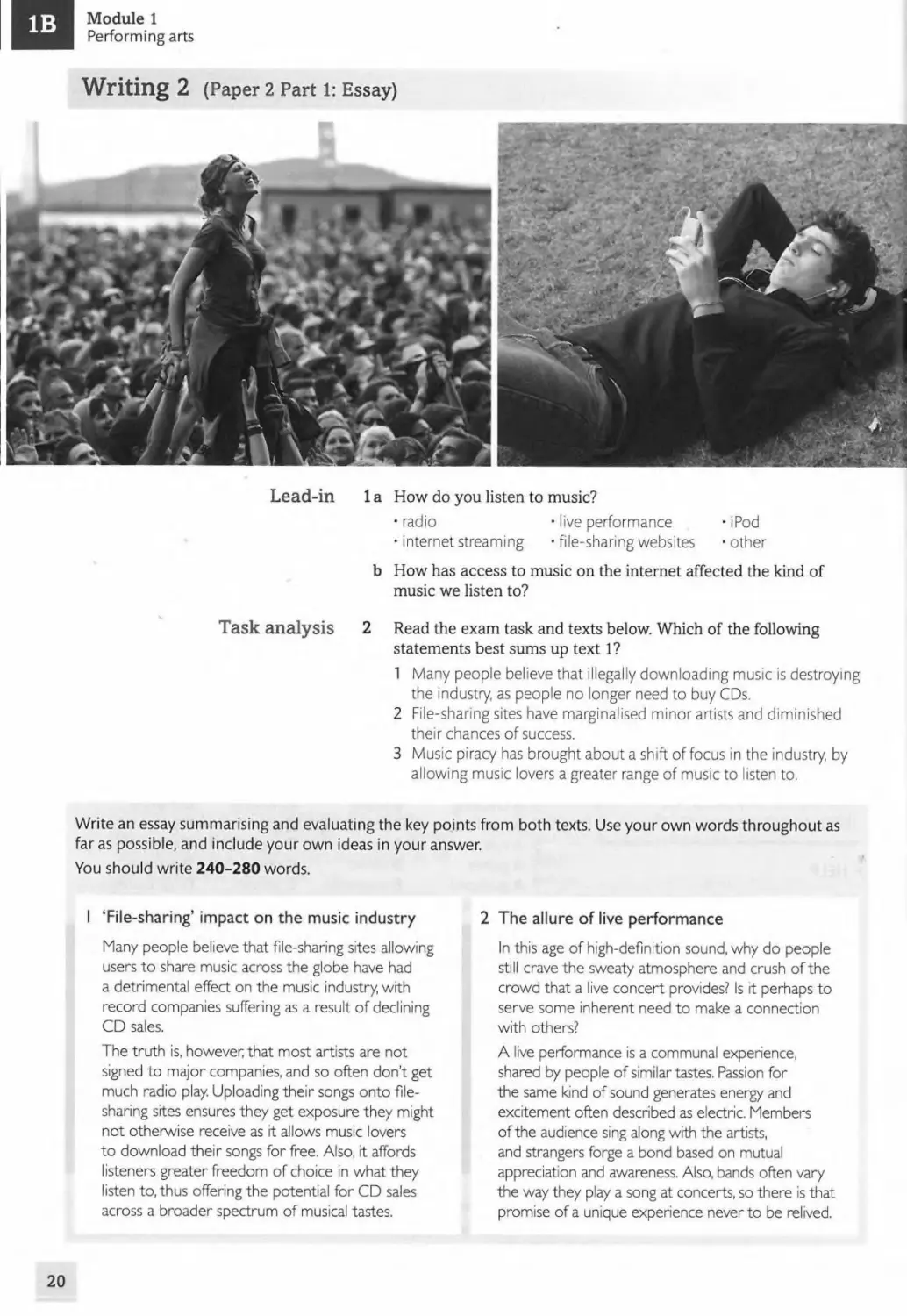
Lead-in 1 a How do you listen to music?
• radio • live performance • iPod
• internet streaming • file-sharing websites • other
b How has access to music on the internet affected the kind of
music we listen to?
Task analysis 2
Read the exam task and texts below. Which of the following
statements best sums up text 1?
1 Many people believe that illegally downloading music is destroying
the industry, as people no longer need to buy CDs.
2 File-sharing sites have marginalised minor artists and diminished
their chances of success.
3 Music piracy has brought about a shift of focus in the industry, by
allowing music lovers a greater range of music to listen to.
Write an essay summarising and evaluating the key points from both texts. Use your own words throughout as
far as possible, and include your own ideas in your answer.
You should write 240-280 words.
I ‘File-sharing’ impact on the music industry
Many people believe that file-sharing sites allowing
users to share music across the globe have had
a detrimental effect on the music industry, with
record companies suffering as a result of declining
CD sales.
The truth is, however that most artists are not
signed to major companies, and so often don’t get
much radio play. Uploading their songs onto file-
sharing sites ensures they get exposure they might
not otherwise receive as it allows music lovers
to download their songs for free. Also, it affords
listeners greater freedom of choice in what they
listen to, thus offering the potential for CD sales
across a broader spectrum of musical tastes.
2 The allure of live performance
In this age of high-definition sound, why do people
still crave the sweaty atmosphere and crush of the
crowd that a live concert provides? Is it perhaps to
serve some inherent need to make a connection
with others?
A live performance is a communal experience,
shared by people of similar tastes. Passion for
the same kind of sound generates energy and
excitement often described as electric. Members
of the audience sing along with the artists,
and strangers forge a bond based on mutual
appreciation and awareness. Also, bands often vary
the way they play a song at concerts, so there is that
promise of a unique experience never to be relived.
20
Module 1
Performing arts
IB
Plan your essay 3 a Summarise: List the key points in the two texts. Then use them to build up a summary. Look back at the summary paragraphs in the model answer in Writing 1 on page 14 to help you. b Evaluate: Compare the content of the two texts, by considering the following: • any similarities - in style, theme, opinion • any differences - in perspective, opinion, style • to what extent you agree/disagree with the points they make 4 Decide how you wish to organise your answer. Look at the model answer in Writing 1 and the writing strategy to help you. EXPERT STRATEGY Here are two ways you can organise your answer. Either or • summarise text 1 • summarise text 1 • evaluate text 1 summarise text 2 • summarise text 2 • evaluate texts 1 and 2 • evaluate text 2 > EXPERT STRATEGIES page 169
Language and content 5 a Complete the summary of text 2 with the correct form of the words below.
while attract suggest despite stem experience The second text looks at why live concerts continue to (1) large audiences (2) the high quality of recorded music today. It (3) this tendency (4) from a fundamental need to physically (5) the atmosphere and share their love of music with others of similar tastes, (6) at the same time hoping to hear something slightly different. b Refer back to your notes and write a paragraph evaluating the two texts. The following words and phrases may help you. While the first text suggests... The second text, on the other hand, argues... We cannot ignore the fact that... To my mind ... There is no doubt in my mind that... While 1 agree with this point to a certain extent, there are other factors to consider. Undoubtedly, there is some truth in this view but...
Write your essay
> EXPERT STRATEGIES page 169
6 Now write your essay, using the ideas and some of the language
above. Write your answer in 240-280 words.
Check your essay 7 Edit your essay, using the checklist on page 191.
> EXPERT WRITING page 191
21
Module 1
Performing arts
IB
Review
1 Complete the sentences with the correct form of
the verbs below.
acquire convey assert demonstrate assess
recognise demand conclude
1 During next week's seminar, students of the drama
school the skills necessary to promote
themselves, as well as perform on stage.
2 Today, professional dancer Miguel Zotto
the modern style of the Argentine
tango for us, with his lovely partner, Eva Viron.
3 Training to become a professional ballet dancer
dedication, hard work and natural
talent.
4 After examining the damage caused by the fire,
the experts that it had been caused by a
discarded cigarette
5 the need to inject new life into the
declining theatre, the manager decided to hold a
hip-hop and breakdance festival.
6 At the end of the course, students will
on their ability to adapt to a variety of acting roles,
including song and dance routines.
7 Mona her right to demand
compensation for the accident, after some loose
floorboards were discovered in the stage.
8 The haunting music of the ballet Swan Lake
the sense of anguish that the
protagonist feels.
2 Replace the underlined phrases in the sentences
with a suitable collocation or fixed phrase.
1 The final practice of the play was disastrous but
fortunately, the first evening performance went off
very smoothly.
2 The audience cheered as all the artists returned to
the stage for a final bow.
3 The actress took one last look in the mirror before
sweeping onto the stage right on time.
4 The audience gave the cast a wonderful send-off
by rising from their seats to applaud them
5 Just because I didn’t agree with his view, there was
no need for the director to shout at me!
6 I would grab the chance to perform alongside
Johnny Depp, if I were you.
7 Some performers relish being in the public eye,
while others crave some privacy
8 According to some critics, Spanish actor Javier
Bardem's talent is unlimited.
3 Circle the correct form of the verb to complete
the sentences.
1 Sally is studying/studies graphic art and hopes to
become a set designer.
2 The London Symphony Orchestra, which was
performing /has been performing at the Royal
Albert Hall since May, is giving its final concert this
evening.
3 David's debut performance as Hamlet was
magnificent. Until then, he was only ever
performing / had only ever performed in minor roles.
4 Helena was training / trained to be a ballet dancer
when an accident put an end to her dreams.
5 A preview performance of Richard Beecham's
new play at the Barbican theatre is to be shown /is
showing on Friday.
6 Alice works at Pixar, and so far has been working /
has worked on five major animated movies.
7 George and Dave have been collaborating /
collaborated for four years before setting up their
own Light and Sound studio.
8 Molly had been hoping /has hoped to make a
career in film but her father wouldn't let her.
4 Read the text below. Use the word in CAPITALS
at the end of some of the lines to form a word
that fits in the gap in the same line.
.------------------4
ITALIA CONTI ACADEMY
The world-renowned Italia Conti Academy
in London is a centre of (0) exlceLlen.ee
in the training of students whose dream
is to work in the performing arts. The
overall standard of (1)is very
high and teaching staff typically use the
most up-to-date methods with great
(2)and dedication.
The Academy offers a variety of courses.
What these have in common is the level
of both physical and mental (3)
they demand from students. But they are
all designed to be (4)to anyone
with a high level of ambition combined
with (5)talent.
Students get the chance to attend both
formal classes and practical workshops
with the emphasis on preparing for public
performance. Indeed, many successful
students do go on to perform first as
(6)_______and then as lead artists
in (7)theatrical productions
in London, whilst others bring the same
level of (8)to more specialist
fields, such as choreography. Little wonder;
therefore, that the Italia Conti Academy
enjoys such an enviable reputation.
EXCEL
TUTOR
ENTHUSE
COMMIT
ACCESS
ORDINARY
UNDER
PRESTIGE
PROFESSION
22
The natural work
2A
> Reading and Use of English: Gapped text (Part 6),
Word formation (Part 3)
> Listening: Multiple-choice questions (Part 1)
> Language development: Passive forms
> Writing: Article (Part 2): Skills for article-writing:
Descriptive vocabulary
2B
> Listening: Sentence completion (Part 2)
> Speaking: Individual long turn (Part 3): Food
production/environmental issues
> Reading and Use of English: Open cloze (Part 2)
> Language development: General verb phrases,
Phrases with have; Prepositional phrases
> Writing: Article (Part 2): Planning and organising,
Analysis of introduction
Lead-in
1 a Where would you normally find the animals in the photographs?
Africa Asia Canada Denmark Germany Mexico Norway Russia the Arctic
the UK the USA
b Which three animals would you most like to see in the wild?
c Which would you say are threatened or endangered species?
d What aspects of the natural world do you appreciate the most? Which aspects of modern
society do you enjoy the least?
2 One of the dangers of modern society is the threat to the world’s natural resources. What
do you think we should do about this?
3 Which environmental organisations do you know? What do they do?
23
2А
Wild experience
Reading (Paper 1 Part 6)
Before you read 1 The Amondawa are an Amazonian tribe of about 150 people. • They live by hunting, fishing and farming. • They have no words for concepts such as 'next week' or 'last year'. • Nobody in the tribe has an age; they just change their name when they become an adult.
2 Compare how the tribe lives with how we live in the modern world. Think of some of the advantages and disadvantages of living as they do.
Skimming 3 Read through the text quickly (ignore the missing paragraphs at this stage). 1 What is the main topic of the text? 2 How would you describe the attitude of the tribes mentioned in the text towards contact with the outside world?
Gapped text 4 Read the strategy on page 168, then do the task.
> EXPERT STRATEGIES page 168 You are going to read an extract from an article. Seven paragraphs have been removed from the extract. Choose from the paragraphs A-H the one which fits each gap (1-7). There is one extra paragraph which you do not need to use.
Task analysis 5 Compare your answers. 1 Highlight sections in the text and in the gapped paragraphs that gave you the clues or the links. 2 In what way was an understanding of the overall text structure important in finding the answers?
Discussion 6 Give your opinion on the following question. Should we try to bring 'civilisation' to these uncontacted peoples or do they have a right to follow their traditional way of life in peace?
7 Check the meaning of these key words from the text.
1
EXPERT WORD CHECK
ravage clamour tributaries resurgent indigenous enmeshed
slaughter logger dredge up concessions
24
The last stand of the Amazon
Novelist Edward Docx has spent almost a decade travelling to the Amazon, watching as multinational
companies ravage the land he loves. Here is his heartfelt dispatch on the forests final frontier - still home
to as many as 100 uncontacted tribes.
Deep in the Brazilian Amazon, there are no horizons and so the dawn
does not break but is instead born in the trees - a wan and smoky blue
The crazed clamour of the night - growls, hoots, croaks - has died away
and for a moment there is almost hush. This is also the only time of
cool. Then, suddenly, the great awakening begins and the air is filled
with a thousand different songs, chirps, squawks and screeches - back
and forth, far and near, all around Nothing anywhere can prepare you
for this unique experience in a supremely challenging part of the world
111 I
The area of the Amazon rainforest is larger than Western Europe and
the forest stretches over nine countries There are approximately
1,250 tributaries that service the mam river, 17 of which are more than
1,000 miles long Roughly a fifth of the earth's oxygen is produced
in the Amazon rainforest and more than two-fifths of all the species
in the world live there Surprisingly enough, oil is one of the main
resurgent threats to the region
I 2 | I
Major disruption and destruction to the forest usually follows, starting
with seismic testing and then helicopters, roads, crews, and so on And
inevitably, there are catastrophic spills and accidents. Health studies
have found that 98 percent of the children of the indigenous Achuar
tribe have high levels of cadmium in their blood, and two-thirds suffer
from lead poisoning. A lawsuit is currently being brought to court by
some of their members due to the contamination of the region.
I>l I
Beatriz Huertas Castillo, a writer and researcher, explains 'They are
indigenous peoples who, either by choice or by chance, live in remote
isolation from their national societies. There are at least 14 such
tribes in Peru We think 69 in Brazil. Maybe 100 in the Amazon area
as a whole.’ They are among the handful of peoples left alive on the
planet who have next to no idea of what the world has become and
who live as they have done for thousands of years.
'I spoke to Mashco-Piro women when they were first contacted,' says
Castillo. 'And they were terrified of disease, of being slaughtered, of
their children being taken into slavery. In the past, every encounter
has brought terror for them - they have no immunity to our diseases
and they were thought of as animals, even hunted. Now they see the
loggers and the oil companies coming in a little further every year And
for them it's the same thing so they flee into neighbouring territories.’
M I
The problems of this new threat, as explorer, writer and Amazon
expert John Hemming explained, are these' the territories of tribes
such as the Kayapo will be flooded, vast amounts of the greenhouse
gas methane will be released, due to rotting vegetation; further roads
and colonisation will happen in their wake, they change the flow
and run of all the river systems, which affects untold numbers of
aquatic species, meaning that more food will have to be imported for
consumption, more roads will have to be built, and so grimly on
'Since the 2004 peak of 27,000 sq km of forest destroyed, matters
have improved with regard to deforestation,' he says when I call him
at his home in Manaus, the great river city right in the heart of the
Amazon. 'Last year we only lost 6,500 sq km ’ However, that is still an
area more than four times the size of Greater London.
I 7 I I
His grandfather had been among the first of his tribe to be contacted
and his own sons were wearing football shirts, his eldest was training
to be a guide. He put it like this the Amazon matters because right
now it is where humanity is making its biggest decisions - actualities
that have an impact first on the lives of his children, but eventually on
the lives of ours too To have no view, I realised as I left, amounted to
much the same as being a hypocrite
A It is important to acknowledge though, that not everything is
getting worse. Some of the campaigning in the past 20 years
has worked and there are cautious grounds for hope. Paulo
Adario, a veteran ecologist, is one of the individuals to have
done most in the service of conservation, and he is happy to
bring me up-to-date.
В There are hundreds of such tribes in the forest - many of them
now enmeshed in 'integration projects' or other demoralising
fiascos - but those that most often capture international
attention are the uncontacted. There is some dispute, however,
as to what exactly is meant by the term.
C The best way to think about these few remaining isolated tribes
is to imagine a series of concentric circles. There are the tribes
that have regular relations with the outside. Then there are a
good number of tribes who have very circumscribed dealings
with the outside world. Then finally, in the heart of the forest,
there are these few remaining peoples with none.
D Time on the river is like time at sea. It's measured in the way the
light changes the colour of the water. At dawn, there are mists
and the river appears almost milky. By noon it is the colour of
cinnamon. And then, in the evening, the low sun shoots streaks
of amber and gold before the dusk rises up and everything turns
to indigo. One such evening, we visited a fisherman.
E Tribal leaders have even been to London to complain, saying
that these dams will force their people from the land and
threaten their way of life. There has also recently been an
unprecedented operation to destroy the unlawful gold-mining
dredgers that are now killing off river habitats by dredging up
silt.
F The amount of land that has been covered by concessions for
its extraction, together with gas, has increased fivefold in the
last ten years - almost 50 percent of the entire Peruvian-owned
Amazon. This means that the government has effectively sold
off half of the rainforest it owns for this purpose and 75 percent
is forecast by 2020.
G One reason we struggle to understand the region is that there
is so much to take in. And because there has been some good
news on the headline problem - deforestation - it has faded
in our collective consciousness in the past few years. So it's
worth stepping back and reminding ourselves of some of the
fundamentals.
H In other words, it is the incursions and what follows that have
the most impact. But now another problem is causing acrimony,
fear and dispute. More than 100 new hydroelectric dams are
planned across Brazil and Peru, including the most controversial
of all - the Belo Monte Project on the Xingu river.
25
Module 2
The natural world
2А
Vocabulary
Word formation: verbs -» nouns ending in -ion
1 The suffix -ion when added to a verb refers to a
state or process, e.g. operate -» operation.
a Find the noun form of these verbs in the text on
page 25 and complete the sentences. Discuss the
meaning of any words that are unfamiliar.
colonise consume disrupt extract
integrate isolate
1 Over-, when we buy or eat more than
we need to fulfil our basic needs, will have to be
curtailed in order to preserve resources.
2 It is doubtful whether the of native
tribes into modern society is desirable or
beneficial to them.
3 When humans start building roads and bridges in
the jungle, this can cause severe to the
whole ecosystem of the forest.
4 The of Antarctica is unlikely given the
difficult living conditions there.
5 Only a few communities nowadays live in
complete from the modern world.
6 Many multinational mining companies are
involved in the of gold, copper and
diamonds from the world's rainforests.
b The following verbs (1-10) have noun forms
ending in -ion. Write the noun form and match the
verbs to their meanings (a-j). Where is the stress
in the pronunciation of the noun forms?
1 contaminate
2 degrade
3 deplete
4 deteriorate
5 devastate
6 implement
7 irrigate
8 legislate
9 pollinate
10 rehabilitate
a become worse
b damage sth badly or completely
c enable a plant to produce seeds
d help (a person, an animal) to live a normal life again
e make changes that have been officially decided
f make a law
g make the condition of sth worse
h pollute
i reduce the amount of sth
j water land or crops
c Complete the sentences with an appropriate noun
from Exercise lb.
1 For animals born in captivity, there are some very
successful programmes whereby they
are eventually released back into the wild.
2 of the land to keep it watered and
of the crops by insects or the wind are
essential for the livelihood of millions of people.
3 Uncontrolled development can often lead to the
of water supplies by waste chemicals
and a in the quality of life of local'
peoples. Suitable and its are
of the utmost urgency to control the situation.
4 Environmental is largely caused by the
reduction or of the world's natural
resources. This also includes the of its
forests by short-sighted companies hoping to
make a quick profit.
Animal sounds - figurative use
2 a ljjlT’o’ Can you identify the following sounds
mentioned in the text on page 25? Which type of
animal or bird do you think might make them?
1 croak 4 chirp
2 growl 5 hoot
3 screech ______________ 6 squawk
b Here are some more animal sounds. Which
animals or insects might make these sounds?
1 bark 3 buzz 5 howl 7 roar
2 bellow 4 chatter 6 hum 8 squeak
c Animal sounds can be used figuratively in our
daily language. Circle the verbs that would
be most commonly used in the following
sentences. Discuss the contexts in which the
verbs in Exercises 2a and 2b can be used, giving
examples where possible.
1 'Get back to your room!,' Dad screeched /growled.
2 'It's such a lovely morning!' she chirped/squawked
happily.
3 Tve got a really sore throat,' he hooted / croaked.
4 'Can you stop squeaking/screeching in my ear?
You'll deafen me,' she said.
5 The car roared /howled off down the road in a
cloud of exhaust fumes.
6 He was so cold in the snow his teeth were
humming / chattering.
7 The coffee shop at Kew Gardens was buzzing /
bellowing with activity last Saturday morning.
d What do these phrases mean?
1 I don't give a hoot.
2 He's very chirpy this evening.
26
Module 2
The natural world
2A
Phrasal verbs
3 Read the sentences below. Use your dictionary to
find the correct phrasal verbs to complete each
gap using the verbs and particles given. Write the
phrasal verbs in their correct form.
amount come crack back down up
cut die hand step out down on
use wipe up against to
1 Governments are trying to the
companies that carry out illegal logging and
some serious punishments.
2 Environmentalists are warning about the dangers
of existing water supplies in certain
parts of the world.
3 areas of forest could effectively
certain species.
4 It is often the case that local peoples
impossible odds when they try to protect their
immediate environment.
5 Campaigns by the international community
against whalers have prevented the blue whale
from.
6 Her reaction on hearing the news
nothing less than disbelief.
7 The company needs someone who can
from the immediate problems and consider the
situation long-term.
Use of English 1 (Paper 1 Part 3)
Word formation
1 a Read the text below quickly. What is the
alternative source of power referred to and why
is it currently not being used so much?
b Now do the task.
> EXPERT STRATEGIES page 167
For questions 1 -8, read the text below. Use the
word given in CAPITALS at the end of some of the
lines to form a word that fits in the gap in the same
line. There is an example at the beginning (0).
The power of the tides
In recent years, a lot of international
(0) attentisn. has focused on the ATTEND
idea that we should be aiming to
meet the needs of the present without
compromising the ability of future
generations to meet theirs. This idea
is generally referred to as (1) SUSTAIN
development, and an integral part of
the wider aim is the use of so-called
(2)sources of energy. RENEW
Tidal power, the (3)of the HARNESS
movement of the oceanic tides to
generate electricity, has a part to play
in this, especially given the greater
(4)of tides compared to PREDICT
other sources of power, such as the
wind or the sun. Until recently, however,
tidal power has remained a largely
(5)source of energy, due to TAP
the relatively high costs involved. If this
issue can be addressed however, tidal
power could represent an almost
(6)source of energy, and EXHAUST
recent technological (7)are BREAK
beginning to make this into a more
realistic proposition. If costs can be
brought down, then electricity produced
in this way could compete more
(8)on the open market. EFFECT
Collocations
2 Find at least eight collocations (adjective-noun)
in the text in Exercise 1. Make a note of them and
discuss their meaning.
3 Have you seen any evidence of renewable energy
sources being used in your country? What is your
opinion of them?
27
Module 2
The natural world
Listening 1 (Paper 3 Part 1)
Before you listen
1
Discuss the following question.
Look at the photographs. What can we learn from studying these
creatures and animal life in general?
Identifying speaker purpose,
gist, detail
Multiple-choice questions
> EXPERT STRATEGIES page 170
2 Ij'jlT110 Listen to three short extracts from talks, then answer the
question that goes with each extract.
Extract One: listen for speaker purpose
Why does the speaker mention what certain orang-utans do?
Extract Two: listen for gist
What is the point of the new 'smart' collar?
Extract Three: listen for detail
In what ways might bycatch be better controlled?
3 ffHjIT1 ” Read the strategy, then do the task.
You will hear three different extracts. For questions 1 -6, choose the answer (A, В or C) which best fits according to
what you hear. There are two questions for each extract.
Extract One
You hear part of an interview with
a scientist called Ruth Carter who
studies the emotional life of animals.
1 Ruth feels that animals are
often not credited with having
feelings because of
A inadequate research to
support the idea.
В false assumptions based on
appearance.
C prejudice against certain
species.
2 Why does Ruth mention an
incident with a whale?
A to give weight to her arguments
В to show how events can be
misinterpreted
C to underline how much
research still needs to be done
Extract Two
You hear a zoologist called Liam
Evans giving a talk about a species
of ape called white-handed gibbons.
3 According to Liam, what is
unusual about the gibbons?
A how they move through their
natural habitat
В similarities between them and
some species of frog
C the way their limbs have
adapted to their environment
4 Liam mentions Greek athletes
in order to explain how
gibbons manage to
A carry objects when jumping.
В jump relatively great distances.
C control their landings after a
jump.
Extract Three
You hear a radio report about a
man called John Reybridge, who
worked as a volunteer at a wildlife
rescue centre in Africa.
5 What led John to decide to go
to Africa?
A fear of losing his job in a
recession
В frustration at his poor career
prospects
C loss of motivation for his
previous work
6 In Africa, John got most
satisfaction from
A successfully returning animals
to the wild.
В preparing captive animals for
life in the wild.
C rescuing animals that couldn't
survive in the wild.
Development and discussion
4 If you were given the opportunity to take a year out to spend
studying wildlife or the environment generally, where would you
choose to go, and why? Give your reasons and discuss.
28
Module 2
The natural world
2A
Language development 1
Passive forms
> EXPERT GRAMMAR page 174
Active or passive infinitive?
1 Complete the sentences with the active or passive
infinitive.
1 I'm afraid there's nothing(do) since
we've tried everything. The new road through the
jungle is going ahead.
2 He looked for his binoculars but they were
nowhere(find).
3 In the end, the police found that no one was
(blame) for the fire; it was an accident.
4 I've got so much work(do) to complete
this report.
5 The animals are usually(feed) at noon.
6 The reason behind the new government strategy
is impossible(understand).
Impersonal passive structures
2 Read the grammar reference on impersonal
passive structures on page 174.
In pairs, rewrite the following sentences, using
an impersonal structure. Compare your answers.
1 I know that his furniture business only uses
recycled wood - that's a fact.
2 They claim that the environmentally-educational
board game Ethica is really good.
3 I think that the turtle population is increasing in
certain parts of the world.
4 I believe that the largest deep sea coral is near
Norway and covers more than 100 sq km.
5 Scientists say that more than 600 new species
have been discovered in Madagascar in the last
decade.
6 Deep-sea fishermen have reported seeing giant
squid but they still remain elusive creatures.
Other passive forms
3 Rewrite the sentences in the passive. Make any
changes that are necessary.
1 They have seen elephants crying.
Elephants____________________________________
2 The monkeys loved it when we took their
photographs!
The monkeys loved____________________________
3 You must finish this report by Monday without
fail.
This report__________________________________
4 He explained to us how a herd of elephants
behaves.
It___________________________________________
5 They made us wear hats and heavy boots on our
jungle walk.
We___________________________________________
6 They suggested that we took part in a new eco-
project.
It___________________________________________
7 The girl's parents didn't let her keep snakes in the
house.
The girl_____________________________________
The passive: mixed tenses
4 Complete the text with the correct form of the
passive. More than one answer might be possible.
Я
Welcome Essentials Help Favountes
The African lion is an iconic symbol of Africa.
Historically, lions (1)(distribute)
throughout the Mediterranean, the Near and
Middle East as far as India, and all of Africa. By
100 AD, they (2)(eliminate) from their
last European strongholds in Greece but survived
until the 20th century in Syria, Iran and Iraq. The
last lion in Iran (3)(say) to (4)
(shoot) in 1942. In Africa, reduced numbers of
lions are still present in the north of South Africa
and Namibia and south of the equator. Lions are
difficult to count accurately and any survey figures
can best (5)(describe) as ‘guesstimates’
but it is evident that the lion population in Africa
(6)(currently/threaten) by habitat
encroachment because of increased land cultivation
The hope is that, in the future, traditional habitat
protection methods (7)(support) by
translocation and reintroduction programmes.
Fortunately, a certain amount of progress
(8)(already/make) in this area.
29
Module 2
The natural world
2А
Writing 1 (Paper 2 Part 2: Article)
What makes a good article?
1 Skills for article-writing include:
1 How will you know who your target readers will be?
2 Give examples of types of articles that will require
formal and semi-formal language. Can articles
include more than one style? Give an example.
3 Give three examples of how you might organise
your writing to be more effective.
4 How can you make your writing more interesting
through your choice of vocabulary? Give
examples. What grammatical structures should
you try to include?
5 In what ways can you make a title stand out?
What linguistic tricks can you use in the first
paragraph to grab your readers?
2 a The following extract is about the Amboseli
elephants in Kenya and includes some interesting
descriptive language. Complete the gaps with
a word from the list below that has a similar
meaning to the word given.
daintily euphoric grumpy lavishly lazily
massive peacefully trumpeting wide-eyed
wistfully
3 The extract continues when the writer returns
after many years. Discuss the meaning of the
verbs in bold. How does the use of these verbs
add to the effectiveness of the description?
Nearby, hippos wallowed, and bushbuck and oryx
twitched nervously before bounding out of their path,
while brightly-coloured crested cranes, the ballet dancers
of the bush, strutted their stuff. At one point I leaned
out of the Land Cruiser to see two huge catfish in the
crystal-clear water of a swamp; later I spotted a family of
hyenas skulking in the elephant grass.
> EXPERT WRITING page 191
> EXPERT STRATEGIES page 169
4 Read the writing task below. Write your article.
Try and include some interesting descriptive
language.
An online environmental magazine has asked
readers to send in articles about places of natural
beauty that they have visited. You decide to write an
article describing a place you enjoyed visiting, what
you saw there and evaluating its importance as a
place of natural beauty.
Amboseli, Kenya:
where elephants have the right of way
A 15-year-old English schoolboy gazes (1)_
(wonderingly) over the lush savannah lands of Kenya’s
Amboseli Reserve. Large herds of zebra, wildebeest
and buffalo are moving (2)(quietly) through
a landscape of acacia bushes and elephant grass as
giraffe feed (3)(delicately) on the elegant,
outstretched branches of fever trees. In the background,
hovering above a halo of cloud, Kilimanjaro’s cone is
(4)(thickly) laden with snow.
The young man’s eye is caught by a small group of
elephants enjoying a mud bath in the Longinye Swamp.
The family members, from matriarch to (5)
(bad-tempered) adolescent to a creche of (6)
(noisy) toddlers, bring a (7)_(happy) smile
to his face. Just a few months before, he had gazed
(8)(longingly) at scenes just like this in a book
of prints by the wildlife artist David Shepherd.
And now, as the sun drops like a giant blood orange
in the west, a (9)_(huge) bull elephant with
tusks large enough to grace a mammoth wanders
(10)(slowly) onto the road in front of the
vehicle he is travelling in. And stops. Beside him a sign
reads Elephants have right of way. Neither vehicle nor
elephant moves for the next hour.
b Discuss the meaning of any unknown words.
30
2В
Closer to home
Listening 2 (Paper 3 Part 2)
Before you listen
Sentence completion
> EXPERT STRATEGIES page 170
1 What factors should you consider when planning to keep animals at
home? Think about the following:
• shelter • cost • feeding • long-term commitment
• safety • neighbours • noise
2 <|"jlT112 Listen to this short extract about building chicken coops
(houses) and complete the gap. What do you notice about the
sentence that you have to complete?
According to the speaker, it's important for chickens to have
in their coop where they can sit at night.
3 ffMjiT113 Read the strategy, then do the task.
You will hear a writer called Alex Horne talking about keeping chickens as a hobby. For questions 1 -9,
complete the sentences with a word or short phrase.
KEEPING CHICKENS
A website with the name (1)supplied Alex
with all he needed to begin his new hobby.
The section of the chicken house intended to act as
the (2)was the only part that wasn't straight.
Alex found some wire in the shape of a (3),
; which was designed to keep predators out of the
chicken house.
I The first (4)which Alex constructed in his
garden was not very effective.
> HELP
1 How did the website called Poultry Plus help Alex and
his wife?
Alex mentions being impressed by how (5)
the chickens seemed to be.
What Alex calls the chickens' (6)had to be
cleaned on a regular basis.
Alex uses the word (7)to describe the
personality of the chicken called Shakira.
Alex describes his garden as a (8)to give an idea
of what it was like after the chickens had been digging.
Even the traps and (9)which Alex bought
didn't solve the problem of rats.
6 How often did Alex have to do his chores?
9 How did Alex try to solve the problem of the rats?
Discussion
4 Discuss the pros and cons of keeping animals as a food source.
5 Check the meaning of these key words and phrases from the
audioscript.
EXPERT WORD CHECK
straightforward dump deterrent teething problem
scramble (over sth) solidarity fret tweak sneaky stalk
31
Module 2
The natural world
2В
Speaking (Paper 4 Part 3)
Lead-in
1 a For years, the idea in farming has been that ‘bigger
is better’. However, things seem to be changing.
Look at the pairs of photographs A and В and
discuss the differences - from the point of view of
the animals, the farmer and the consumer.
b Why are honey bees important in food
cultivation?
Vocabulary: food production/environmental
issues
2 Complete the fact sheets below with the words
and phrases below. There should be only one
answer for each gap.
animal pollination confined space
cost-effective daylight hours fungal diseases
lifespan natural surroundings nutritional value
roam freely welfare concerns
Factory farming
• greater milk yield (22-30 litres per day)
• cows milked 3/7 (three times a day)
• animal (1)regarding mega-dairies
• cows live up to 5 years
• 1,000-30,000 cows in a barn or shed
Factory-reared meat
• animals are given lots of antibiotics
Organic farming
• smaller milk yield (5 litres per day)
• cows milked 1П (twice a day)
• cows in (2)are not stressed
• cows live up to 20 years
• 50-100 cows in a field/barn
8UT
• organic farmers still make a profit by selling high-
quality milk direct to the customer
• organic farmers grow their own feed so they don't
have to buy expensive processed feed supplements
Organic meat
• animals graze the grass and are fed natural products
Battery/Caged hens
• produce more eggs (?)
• more (3)because they eat less, more
control
• eat less
BUT
• are enclosed in a (4)
• have health problems, e.g. painful feet
• slaughtered young
Free-range hens
• produce slightly fewer eggs but higher (5)
(less cholesterol), taste better
• less easily controlled
• need more food because more active
• (6), eat insects, etc.
• are happy and healthy (apart from the normal
illnesses)
• live out their normal (7)
Honey bee collapse
• Almost a third of global farm output depends on (8), largely by honey bees. Honey
bees pollinate 80%-90% of fruit and vegetables consumed globally.
• Bees are in decline. What are the causes? Pesticides seem to be the main culprit. Some pesticides
harm the bees' memory; others poison them; yet others reduce their resistance to (9).
What can be done?
• curb pesticide use during (10)________, the time when bees are active
• plant more bee-friendly flowers and shrubs, especially in cities
* give more help and support to bee-keepers
32
Part 3 Model answer
3 a Look at Task card 1 and the possible points to
talk about. Make a note of important points you
would mention under each section.
b Ijjl в к Listen to a student doing the task. © Time
how long she takes.
Task card 1
How much do these issues concern you?
• factory farming, battery or caged hens
• recycling
• deforestation
c Ijjl ti и Now listen again.
1 Add any important points the speaker mentioned
to your notes for Exercise 3a. How do your ideas
compare?
2 Note down any useful linking structures that were
used in the task.
Useful language: structuring your extended
contribution/talk
4 You can use the useful language listed on page 206
to help you structure your long turn. Add any
phrases you found in Exercise 3b.
Part 3 Individual long turn
> EXPERT STRATEGIES page 171
5 a Work in pairs. Firstly, read the strategy on page 171,
then look at the Task cards below. Student A
should respond to the question on Task card 1
and talk for about two minutes. © There are some
ideas on the card for you to use if you like. Student
В should respond briefly to their question.
Task card 1
What steps are being taken to protect the
environment?
sustamable/alternative technology
• scientific research
• animal protection programmes
Question for Student B:
• In what ways can people try to help the
environment in their daily lives?
b Student В should respond to the question on
Task card 2 and talk for about two minutes.
© There are some ideas on the card for you to
use if you like. Student A should respond briefly
to their question.
Task card 2
What responsibilities does having domestic pets
entail?
• providing adequate exercise, care and attention
• not leaving them locked up for hours
• providing the right food and veterinary care
Question for Student A:
• What can be done about the problem of
mistreated or abandoned animals?
Developing the discussion
6 Discuss the following questions.
1 Why are certain animal and plant species in
danger of dying out?
2 How can governments be persuaded to change
their minds about environmental policies?
3 What are some of the main dangers facing our
seas and the creatures that live in them?
33
Module 2
The natural world
Language development 2
Collocational phrases
> EXPERT GRAMMAR page 175
General verb phrases
1 a Complete the verb phrases in the sentences with
the words below. The verbs are in bold text.
at (your) ease the attention importance
interest no signs of on a whim thanks to
the needs up-to-date
1 Their boss always brings them with the
latest developments in the market.
2 The man at the organic farm put us quickly
and answered all our questions.
3 Don't ever buy an animal or bird
because they require an awful lot of looking after.
4 The video of the rehabilitated battery hens
captured of YouTube viewers.
5 A small city centre flat doesn't really meet
of farmyard animals.
6 Children often take more in healthy food
if they are taught to grow vegetables themselves.
7 The dolphins showed tiring of their
game.
8 Schools these days place a lot of on
educating children about the environment.
9 It was a friend that I got interested in
ecological issues.
b Now complete the verb phrases in the following
short article using the correct form of the verbs
in bold in Exercise la.
The good life
Some years ago, a meeting of village residents
(1)place in the village where I live. Jan, a friend
of mine, (2)in charge of the proceedings. Her
idea was that we should work together as a community to
grow and then sell our own produce. That way, she said,
we would both save money and eat more healthily. I must
admit her ideas (3)our imagination and, quite
surprisingly, everyone at the meeting agreed. Jan
(4)the meeting to an end by handing out some
seeds for us to sow which she had (5)in bulk
from a local supplier. The aim, she told us, was to be up
and running as a business by the following summer.
From the very next day, we (6)our plans into
action and started digging our gardens! Would you believe
it, by the following summer we had (7)all our
goals, we were producing loads of vegetables and people
were phoning from all over the area to (8)____________
orders! The business even (9)a small profit in
the end so we treated ourselves to a meal out at a country
restaurant. On the menu were our vegetables!
Phrases with have
2 Complete the sentences with the correct form of
a phrase with have.
have a major impact on have the right to
have no say have access to
have no inclination to have serious consequences
have strong views on
1 Unfortunately, people often feel that they
in the matter of
policy-making but that is not always the case. All
individuals put forward
their opinion.
2 The inability of countries to reach an agreement
could.
3 If you ecological issues,
there are plenty of societies you can join.
4 The oil spill from the tanker
marine life in the area.
5 The group really walk
through thejungle at nighttime.
6 It is crucial for people all over the world to
drinkable water.
Prepositional phrases
3 a Combine the words and prepositions below to
make phrases (e.g. in other words) and discuss
their meaning. You will need to use some of the
prepositions more than once.
by all likelihood of breath
in captivity other words
on chance pleasure
out ease sb's/sth's wake
with living memory occasion (of) tune with
b Work in pairs. Carry on a dialogue using as many
of the phrases as possible.
34
Module 2
The natural world
2B
Use of English 2 (Paper 1 Part 2)
Open cloze
1 Discuss these points related to recycling:
1 Are there any recycling bins in your local neighbourhood?
2 Are recycled products sold in the supermarkets in your area?
3 What proportion of your household rubbish goes for recycling?
Developing skills:
understanding text structure
2 It is important to understand why a particular text has been written.
Read the text through quickly and answer the questions.
1 What is the author's problem with recycling?
2 Do you think he is being entirely serious? Why/Why not?
3 Read the strategy on page 167, then do the task.
> EXPERT STRATEGIES page 167
For questions 1 -8, read the text below and think of the word which
best fits each gap. Use only one word in each gap. There is an
example at the beginning (0).
There’s more to recycling than meets the eye.
The relationship (0) bfctvoe.cn the modern consumer and their rubbish is a
complex one. (1)rid of rubbish has come to mean a great deal more
than simply consigning breakfast leftovers to a plastic bag. With the advent of
recycling, rubbish has now invaded many people's personal lives (2)____
an unprecedented degree. (3)was a time, in living memory, when
rubbish collection was a simple matter - but today’s household rubbish, before
(4)discarded, has to be filed and sorted into colour-coded containers
according to its recycling category.
(5)is more, we are brought out in a rash of irritation by the suggestion
that, if rubbish collections were to become more infrequent, people would then
(6)the effort to cut (7)on shopping and recycle more.
We might be excused for wondering how this would be possible. Can people
realistically buy (8)eggs or tubes of toothpaste than their lives require?
Recycling is supposed to be good for us. But for some, it’s just a load of rubbish!
Discussion 4a Do you think recycling is ‘rubbish’? Why/Why not?
b Some supermarkets sell products that are ‘bio-degradable’ or ‘eco-
friendly’. What type of products might they be? Do you buy them?
Why/Why not?
c How can the government of a country encourage people to follow
its policies on recycling?
35
Module 2
The natural world
2В
Writing 2 (Paper 2 Part 2: Article)
Lead-in 1
Understand the task 2
The photograph is of an organic farm. What would you expect to
find there? Discuss and create a list.
Read the writing task and note down your answers to the questions.
Look back at Writing 1 on page 30 for ideas.
1 What type of writing will you include in your article?
2 What topics will you need to cover in your article?
3 What title will you give it?
4 How will you organise the article?
5 What particular vocabulary will you use?
You recently spent two weeks working as a volunteer on an organic
farm, as part of a project to familiarise young people from the city
with country life. You have been asked to write an article for a local
environmental newsletter, describing your responsibilities during that
time and discussing your experiences.
Plan your article
3 Read the points below about planning your article. Is there anything
you would add?
1 Identify the main points you need to cover in the task and brainstorm
your ideas around those points.
2 Organise them in a way to make them more interesting and effective.
3 All writing requires a degree of imagination! You don't have to base
what you write on your personal experience.
4 Remember that descriptions should go from general to specific.
5 Check that you have an interesting introduction and conclusion.
4 Write your plan for the article. Include any interesting items of
vocabulary that you would like to use.
36
Module 2
The natural world
2B
Language and content
5 Complete the phrases with the words below.
common community crack home-made manual quiet
self-sufficient starry touch
Work experience
• get up at the (1)of dawn
• have a sense of working towards a (2)goal
• have the aim of being (3)with regard to basics such as
vegetables, etc.
experience a sense of (4)
• cook (5)meals
• do hard (6)labour
Nature
• get back in (7)with nature
• look up at the (8)sky at night
• enjoy the peace and (9)of the countryside
6a Here are some different ways of expressing movement that might
be useful in the context of the task. Check the meanings of the
verbs in a dictionary.
stagger stride stroll tramp trudge wade
b Here are some useful adverbs. Check their meanings. Can you
think of any others you might need for your article?
hurriedly painstakingly pleasantly thankfully wearily
c Remember you can use some of the phrases below to describe the
conditions.
boiling hot freezing cold soaking wet pouring with rain
Model introduction
7 Read the two introductions for the task in Exercise 2. Discuss and
analyse which one you prefer, and why.
A
As I staggered outside sleepily at 6 a.m., the sun
was already up and the grass was sparkling with
early morning dew. The cows were munching the grass
and the sheep were roaming peacefully over a distant
hillside. Other than that, there was just peace and
quiet. No noise of traffic, no horns blaring, no people
rushing to work. Yes. my jobs on the farm were about
to start but for now I had five minutes to enjoy the
sounds and smells of the natural surroundings.
В
I had decided to take part in a volunteer scheme for
young people from the city to live and work on a
farm for two weeks in the summer. Farm life had
always attracted me and I also belonged to an
environmental organisation so I had an interest in
the growing of organic vegetables and in keeping
livestock. So it was with lots of enthusiasm that we
set off for the fa rm onedayearly in July. Little did I
know what delights were awaiting me!
Write your article
> EXPERT STRATEGIES page 169
Check your article
> EXPERT WRITING page 191
8 Now write your article, using the ideas and the language from this
section and from Writing 1 (page 30). Write your answer in 280-
320 words.
9 Edit your article, using the checklist on page 191.
37
Module 2
The natural world
2В
Review
1 Complete the sentences with the nouns formed
from the verbs below.
colonise consume destroy extract
implement integrate
1 A certain amount of environmental will
be caused by the proposed high-speed railway line.
2 of too much red meat is generally
thought to be not very good for our health
3 It's quite easy to accept new measures: it's their
that causes the most problems.
4 The of oil and other fossil fuels often
happens in areas where there are potential
problems for the natural surroundings.
5 The of parts of Africa by different
European powers took place from the 15th
century onwards.
6 Unfortunately, the attempted______of
indigenous peoples into a different type of culture
has often failed.
2 Circle the correct phrasal verb to complete the
sentences.
1 Conservationists are doing their best to prevent
certain species from being wiped out/died away.
2 Governments should crack down on /wipe out
businesses that keep their animals in inhumane
conditions
3 Sometimes it's important to step back from/crack
down on the daily problems and take a look at the
bigger picture of what's going on in the world.
4 I can't understand why they cut down /used up
those apple trees just so they could build a house
5 The sounds of the birds singing gradually died
away /wiped out.
3 Complete the short text with the missing words.
You might think there is little left (1)
discover on Earth in the 21 st century, yet the deep
sea remains almost entirely unknown. Life in the
deep, apart from fish and other creatures such as
the giant squid, (2)found in the form of
bacteria, worms and crustaceans, which teem in the
abyssal plains that cover vast stretches of the deep.
They feed off organic 'snow' that falls from above.
Deep below the sea floor, life was (3)
thought to be possible. But then in 2003, researchers
found many unique bacteria 300 metres beneath
the Pacific sea floor, feeding on sediments millions
of years old. More spectacular are the deep-sea
corals, found at depths of up to 6,000 metres in
waters as cold as 2°C.These slow-growing animals
(4)now found from Ireland to New
Zealand, and have even (5)discovered
growing on the legs of oil rigs.
4 Choose the correct word to complete the
sentences.
1 I could hear the frogs___in the stillness of the
night.
A squawking В chattering C croaking
2 All my friends___with laughter when I told them
I was going to take up gardening.
A chirped В hooted C bellowed
3 Being a farmer entails a lot of__labour.
A manly В strong C manual
4 Solar power is a useful__of energy in hotter
countries.
A source В resource C basis
5 Some animals in danger of extinction are born
and raised in________.
A capture В captivity C enclosure
6 I have no____to go out in the field in the pouring
rain and get wet and muddy!
A preference В inclination C tendency
5 Complete the text with the missing prepositions.
Hugh Fearnley-Whittingstall, who has been called
an ‘eccentric’ chef by some, set (1)_________his
own organic farm and restaurant in the south-west
of England a number of years ago. Thanks
(2)__________his dedication to organic farming and
a ‘back-to-nature’ lifestyle, he has had quite an effect
(3)__________the way people see food and where
it comes from. One thing he places importance
(4)__________is a sense of respect (5)_______the
animals that provide us with our food. As the years
go by, Hugh shows no signs (6)___________relaxing
his belief in himself and the issues he finds important.
This has led to his involvement (7)__________
campaigns (8)_________battery-farming and for
sustainable fishing, amongst other things. He is
fortunate that he has the ability to speak in front of a
camera (9)____________ease, as the many TV shows he
has produced prove. Several of these can be watched
(10)_________YouTube, if they are unavailable in
your area.
38
Surviving and thriving
•>
<u
ЗА
> Reading and Use of English: Multiple matching
(Part 7); Word formation (Part 3); Open cloze (Part 2)
> Listening: Multiple-choice questions (Part 1);
Understanding the main ideas
> Language development: Conditionals tense review
► Writing: Discursive essay (Part 1); Summarising and
evaluating
3B
> Listening: Multiple choice (Part 3)
> Speaking: Collaborative task (Parts 1 & 2): Ways to
relax; Sustaining a conversation
> Reading and Use of English: Multiple-choice cloze
(Part 1)
> Language development: Introductory and
emphatic it and there, Inversion
> Writing: Discursive essay (Part 1); Summarising and
evaluating
Lead-in
1 Compare two of these cartoons and say what the cartoonist is trying to convey. How do
they make you feel?
2 Below are five titles of popular psychology self-help books on the market. Which titles
could match the cartoons A-C? Give reasons for your choice.
1 Brilliant confidence: what confident people know, say and do
2 Water off a duck's back: how to deal with frustrating situations, awkward, exasperating and
manipulative people and... keep smiling!
3 Working with the enemy: how to survive and thrive with really difficult people
4 In sheep's clothing: understanding and dealing with manipulative people
5 Feel the fear and do it anyway: how to turn your fear and indecision into confidence and action
3 If you could choose one of these books to read, which one would you choose, and why?
4 In pairs, think of ideas for cartoons to illustrate the two remaining books.
5 What advice would you give a friend if:
1 someone was trying to manipulate him/her by using threatening language?
2 he/she was giving in to peer pressure to commit a crime?
3 he/she had argued with a good friend and didn't know how to resolve it?
39
ЗА
Who's in control?
Reading 1 (Paper 1 Part 7)
Before you read
1 Compare the following pairs of sentences. Which pair is similar in
meaning, and which pair is different?
1 a This book adopts an essentially objective approach to its subject,
b The concepts in this book are presented in an informative, non-
judgemental manner.
2 a You are presented with a number of practical techniques for
achieving your goals in life.
b The concepts presented offer you practical ways to be more
optimistic in your life.
Skimming 2 Read through each review on page 41 quickly. Which book(s) might
you recommend for someone who:
1 is suffering from anxiety?
2 has recently experienced a crisis of confidence?
3 is simply interested in the subject of psychology?
Scanning 3 Answer the following questions.
1 Read the questions in Exercise 4, and underline the key words and
phrases.
2 Read the reviews and underline the relevant information.
3 Check the questions against the text again. Then complete Exercise 4.
Multiple matching
4 Read the strategy on page 168, then do the task.
> EXPERT STRATEGIES page 168
You are going to read some reviews of self-help books. For questions 1-10, choose the best answer from
sections А-D. Some of the choices may be required more than once.
About which book is the following stated?
It can be an enjoyable read irrespective of whether you have problems. 1
It presents ideas in language that is accessible to the non-specialist. 2
It examines the evidence to support some of the claims made by exponents of self-help. 3
It offers a step-by-step guide to working through a psychological dilemma. 4
It describes ways in which people can make the most of their unfulfilled potential. 5
It suggests that people may be encouraged to have unrealistic expectations. 6
Many of the suggested therapies are based on a recognised methodology. 7
The quality of writing makes the advice appear more credible. 8
It suggests that we should view one particular negative emotion as something natural. 9
It offers comfort and advice to those frustrated by seemingly straightforward problems. 10
Discussion 5 Discuss. Under what circumstances would you recommend that
someone should:
• buy a self-help book? • consult a professional psychologist?
6 Check the meaning of these key words from the text.
EXPERT WORD CHECK
fallacy fabrication advocate misconception perspective jargon
prose pronouncement solace premise
40
Module 3
Surviving and thriving
ЗА
DIY psychology
Books offering self-help and advice sell in their millions. We take a look at four of the most popular.
a The last self-help book you'll ever need
by Paul Pearsall
c Help: How to become slightly happier and
get a bit more done by Oliver Burkeman
In this book, Pearsall explores the tendency for
proponents of self-help therapy to substitute clich£s for
serious thought. Hackneyed fallacies like 'be all that
you can be', 'live up to your full potential', 'nurture
and understand your inner child', are just a few of
the arguably silly fabrications that masquerade as
legitimate advice, and Pearsall exposes them to the
light of scientific scrutiny. Primarily, this book advocates
accepting that you may never become a concert pianist
or an international footballer, and concentrating on
achieving what is within your reach. You can derive
more happiness from life, he suggests, when you
appreciate your current situation and those around
you. Were people less caught up in the misconception
that they should be happier and more fulfilled, they
probably wouldn't be so discontented Pearsall sees
much of what we might term 'therapeutic culture'
as based on rather questionable remedies that over
time have gained the status of unassailable truth. He
effectively explores the validity of these assertions
from a more objective, down-to-earth perspective.
в Instant confidence by Paul McKenna
McKenna puts forward the notion that people who
feel they lack confidence are in fact confident - if
only in the belief that they have no confidence! He
offers techniques to help people develop their hitherto
suppressed abilities and apply these to situations in
which they may be of use Many of his suggestions
follow well-known coaching concepts familiar to
practitioners of neuro-linguistic programming.
However, the book is written in a refreshingly down-
to-earth style that avoids the almost incomprehensible
jargon which some self-help practitioners are prone to!
One of McKenna's key ideas is to encourage people to
visualise and experience as far as possible what 'the
confident you' will be like. He advocates the simple
use of a technique which helps to reframe negative
'inner thoughts' in a 'positive' way. Don't expect to
develop instant or total confidence as a result of
reading this book, but if you follow the suggestions
and practise them, you should make some progress.
This is a genuinely useful book; the writer really
does want us to become slightly happier and get a
bit more done, just as the title promises us. In a
winning aside, he says that 'adding an exclamation
mark to the title of your book isn't necessarily going
to help make it fun. (There are some exceptions.)'
And this is an exception, because it is fun, and can
be read for pleasure even if you judge your self-
management and feelings of personal fulfilment to
be in good shape I like to think that a decent prose
style is one of the guarantors of sanity, and Burkeman
has a lovely turn of phrase, neither too dry nor too
flashy, but a sort of just-rightness that makes his
pronouncements sound wholly trustworthy. In short,
Help is win-win. Should you find yourself prone to
those niggling difficulties which, though surmountable,
are disproportionately aggravating, then you'll find
solace and good counsel here
o Feel the fear and do it anyway
by Susan Jeffers
The subject of this book rests on the following premise:
fear is a necessary and essential element of life and
pushing through fear is actually less frightening than
living with a feeling of helplessness Susan Jeffers
highlights the paradox that whilst we seek the security
of a life free of fear, this creates an environment in
which we are denied the satisfaction of achievement
or development. The result is a no-win situation in
which we experience both a fear of change and fear of
staying the same. The book introduces a progression of
truths which illuminate the crippling effects of fear and
build the case for taking action to address the problem.
Given that you accept these truths, you can change
your attitude and approach A number of simple models
and techniques are engagingly presented through a
series of first-hand accounts of people at various stages
of succumbing to or addressing their fears When strung
together, these provide a structured programme with
which you may set about changing your attitude and
raising your self-awareness and self-esteem.
41
Module 3
Surviving and thriving
ЗА
Vocabulary
Compound nouns with self-
1 a All these nouns can be combined with self- to
make compound nouns (e.g. self-help). Complete
the sentences with a suitable compound noun,
awareness belief confidence discipline
discovery esteem evaluation help knowledge
management worth
1 skills are very important if
you want to make the most of your time.
2 Sometimes in life there are crisis points
where you need to go through a period of
: a time when you can
discover what your strong and weak points are.
3 The journey of life is all about the process of
4 Any course of study requires a certain amount of
5__________________Children often acquire a sense of their own
____________________from their parents.
b In a similar way, discuss the concepts expressed
by the remaining compound nouns in Exercise la.
In what way are they important?
Word formation (1): prefixes (inter-, mis-, non-)
2a Adding a prefix can have a radical effect on the
meaning of the base word.
• Inter- often has the meaning of things being
connected in some way (e.g. interact).
• Mis- usually means things done wrongly or badly
(e.g. mislead).
• Non- usually expresses the opposite of the base
word (e.g. non-aggressive).
Complete the short extract with words formed
from a prefix given, plus a word below.
connecting essential interpret use
Company rules
• You are kindly requested to keep your desks clear
of any (1)items. A messy office is a sign
of a messy mind.
• Any (2)of office materials will not be
tolerated.
• All (3)doors between offices should be
kept closed because of fire regulations.
• Critical feedback on projects should be given
face-to-face whenever possible: feedback by
email can often be (4).
b Create word formation lists in a vocabulary
notebook, using different prefixes and suffixes
and add to them as you come across new words.
Make a point of revising them each week.
Word formation (2): suffixes (-ment, -tion,
-ness, -sion)
3 a Read the dialogue below quickly. How do Charlie
and Jessica’s opinions differ with regard to self-
help books?
b These words form nouns ending in -ment, -tion,
-ness or -sion. Complete the noun forms, then
choose an appropriate word to complete the
dialogue.
1 achieve ______________________________________
2 conceive _____________________________________
3 decide _______________________________________
4 fulfil _______________________________________
5 happy ________________________________________
6 helpful ______________________________________
7 inspire ______________________________________
8 motivate _____________________________________
9 solve ________________________________________
10 weak _________________________________________
Charlie: What do you think of self-help books,
Jessica?
Jessica: Well, to be honest, I was a bit doubtful
about their rather exaggerated claims, you know,
about finding an immediate
(1)to problems, overcoming
your (2)or achieving
(3)in your chosen path in
life! It all sounded too good to be true. However,
after reading one recently. I realised that I'd had
no (4)of how complicated
people's emotions actually are and I felt that I
learnt a lot. Also, I drew (5)
from its positive approach and the idea that the
(6)of (7)
is in our own hands.
Charlie: I agree, although I think their
(8)is limited in the sense that
we all still have to make our own
(9)in life, no matter how
many books we read. There has to be the personal
(10)to learn and to change,
doesn't there?
Jessica: Sure, but this is where this sort of book can
sometimes show the way, I feel.
c To which nouns in Exercise 3b, including their
derivatives, could you add the prefix un-?
d In pairs, discuss the following points, using some
of the words from Exercise 3b.
• How far do you think people can change the way
they behave through reading books?
• How can psychotherapy help people?
42
Module 3
Surviving and thriving
ЗА
Use of English 1 (Paper 1 Part 3)
Word formation
1 a Quickly read the text below. What would you say
some of the dangers are of not expressing how
you feel?
b Read the strategy on page 167, then do the task.
> EXPERT STRATEGIES page 167
For questions 1 -8, read the text below. Use the
word given in CAPITALS at the end of some of the
lines to form a word that fits in the gap in the same
line. There is an example at the beginning (0).
EMOTIONAL AND
PHYSICAL HEALTH
To a large extent, problems and
difficulties are an (0) unavoidable.
part of everyday life. According to
psychologists, however, there is a
(1)for people in the
west to hide negative feelings, such as
anger or (2), rather
than express them. Furthermore,
studies have shown there to be an
(3)between physical
and emotional health. For example,
via the (4)system, a
person's emotions have a direct effect
on heart rate and digestion, and the
suppression of strong emotions can have
a (5)effect on a
person's health.
Such findings, however, should not be
taken to mean that emotions are best
expressed in a totally (6)
manner. On the contrary, the ability
to convey feelings in a rational way
is widely regarded as evidence of
emotional maturity. So the questions
people need to ask themselves are: Am
I a good (7)________________? Is there
balance in my relationships with others?
Do I show (8)to
others' emotions and moods? If the
answer to these questions is 'yes', then
they are on the right path.
AVOID
TEND
SATISFY
DEPEND
NERVE
DETRIMENT
CONTROL
COMMUNICATE
SENSE
Idioms: animal idioms
2 Animal idioms often illustrate personality types or
ways of dealing with difficult situations. Discuss
the meaning of the idioms, then choose a suitable
idiom to complete the sentences. Suggest
situations where the remaining idioms might be
used.
as stubborn as a mule a wolf in sheep's clothing
flog a dead horse have kittens let sleeping dogs lie
like water off a duck's back
put the cat among the pigeons
take the bull by the horns have a bee in one's bonnet
1 I was advised to tell my friend the reasons why
her behaviour annoys me. That's certainly going
to.
2 My attempt to change his mind about the plans
for the evening was hopeless: it was like trying to
3 Sarah never takes any notice when other
people criticise the way she dresses: it's
4 Jack won't stop going on about that conference
he wants me to go to: he's certainly got
about it.
5 Trish can be when she doesn't
want to do something.
Discussion
3 If you had to give three pieces of general advice
to a friend, what would you tell them? Use
phrases that you have learnt in the Vocabulary
section.
43
Module 3
Surviving and thriving
ЗА
Listening 1 (Paper 3 Part 1)
Before you listen
Understanding the main
ideas
Multiple-choice questions
1 Discuss the following questions.
1 What does Emotional Intelligence (El) mean?
2 How would you describe bullying behaviour?
2 (jjl n is Listen to people speaking about three different topics and
answer the questions that go with each extract.
Extract One: bullying in the workplace
1 Where did Emma find help?
2 How did Emma's feelings change after reading about bullying?
Extract Two: dealing with difficult conversations
1 What is James asked to give his opinion about?
2 What problems does he mention?
Extract Three: the importance of Emotional Intelligence
1 According to the speaker, what new system are some employers using?
2 What does the speaker say could be a way to begin the process of
acquiring Emotional Intelligence?
3 ifjl n.i6 Read the strategy, then do the task.
> EXPERT STRATEGIES page 170
You will hear the three extracts again. For questions 1 -6, choose the answer (A, В or C) which fits best according to
what you hear. There are two questions for each extract.
Extract One
You hear part of an interview with a
woman called ‘Emma Collins’, who
suffered bullying in the workplace.
1 When she was being bullied,
she felt
A determined to prove her
colleague wrong.
В convinced that her colleague's
criticisms were just.
C indifferent to what her
colleague said about her work.
2 What helped her to overcome
the problem?
A sharing her story with other
victims
В coming to terms with the
reality of the situation
C getting her manager to confront
the person responsible
Extract Two
You hear an actor called James
Milner talking about a book he
read as a teenager.
3 Before reading the book,
James had been feeling
A unable to discuss an issue.
В in need of career guidance.
C unwilling to listen to advice.
4 James liked the book because
it taught him how to
A develop professional skills.
В deal with demanding people.
C express his own feelings
calmly.
Extract Three
You hear a psychologist talking
about the use of tests of ‘emotional
intelligence’.
5 What does she suggest about
the cosmetics company?
A It has been slow to experiment
with new recruitment
procedures.
В It now looks for a wider range
of abilities in prospective
employees.
C It has solved a long-term
problem with poor levels of
staff retention.
6 Who is her target listener?
A people who may be looking
for a job in the future
В companies aiming to recruit
effective salespeople
C academics preparing students
for the world of work
Development and discussion
4 Assertiveness training is all about expressing what you feel in a non-
aggressive way. Read the list of rights below and discuss.
• You have the right to change your mind.
• You have the right to make mistakes - and be responsible for them.
• You have the right to make seemingly illogical decisions.
• You have the right to say, 'I don't care.'
44
Module 3
Surviving and thriving
ЗА
Language development 1
Conditionals tense review
> EXPERT GRAMMAR page 176
1 Read the conditional sentences and choose the
correct answer. Check your answers and discuss
any ones you were not sure about.
1 If it, we could go and play tennis.
A didn't rain В wasn't raining
2 Susie the topic of conversation if she
didn't like it.
A had changed В could have changed
3 Without her insight into his problems, he
got better so fast.
A would have В wouldn't have
4 I wouldn't have been able to go to the concert if
the lecture cancelled.
A hadn't been В hadn't
5 any later, we would have missed
meeting the author.
A Had we arrived В Should we arrive
6 disagree with their advice, what would
their reaction be?
A Imagine to В Were you to
More constructions with if
2 Write conditional sentences that have a similar
meaning to the sentence given. Choose one of
the following phrases for each sentence: If it
hadn’t been for, If you happen to, If or Even if.
1 Have you decided to do a course in
psychotherapy? I hope you'll let me know.
2 The other students helped me to understand the
problem.
3 Sally was so self-confident that when other people
criticised her, it was like water off a duck's back!
4 Is there any chance that you'll be in this evening?
I'd like to ask your advice about something.
Alternative conditional phrases
3 Choose one of the following phrases to complete
the conditional sentences. There are two extra
phrases that don’t fit any of the sentences. In
which sentences could you also use if?
assuming (that) but for imagine in case
on condition that otherwise unless what if
whether or not
3 I'll give you my honest opinion you
don't get angry.
4 Sometimes I don't know it would be a
good idea to say something.
5 everyone here is interested in
improving their social skills, let's start off with a few
practical exercises.
6 Can I have your phone number I need
to ring you tomorrow?
7 Please read this book you won't know
what I'm talking about.
Use of English 2 (Paper 1 Part 2)
Open cloze
1 a Read the extract from a magazine article quickly.
In what way is positive psychology different from
previous branches of psychology?
b Read the strategy on page 167, then do the task.
> EXPERT STRATEGIES page 167
For questions 1 -8, read the text below and think
of the word which best fits each gap. Use only
one word in each gap. There is an example at the
beginning (0).
POSITIVE PSYCHOLOGY
For anyone involved in the field, the term ‘positive
psychology’ has (0) beceine a familiar one in recent
years. The term is attached to a movement which
seeks to restore (1)are regarded as
‘positive’ features of human nature, such as happiness,
virtues, personal strengths and altruism, (2)
their rightful place within the field of psychology. The
movement can be seen as a reaction to a perceived
over-emphasis on mental illness, (3)the
expense of mental health, in the study of psychology.
(4)the term positive psychology was
actually coined by humanistic psychologist Abraham
Maslow as (5)back as 1964, neither the
term nor the intellectual approach surrounding it
really took (6)until Martin Seligman made
it the centrepiece of his presidency of the American
Psychological Association in 1998. (7)then
the movement has (8)ground across the
USA and beyond, with popular authors, like former
New York Times writer Daniel Goleman, playing a
major role in fuelling its widespread appeal.
1 He would have carried on bullying her
2 Jan won't forgive me I apologise,
something that I'm not prepared to do.
Discussion
2 Imagine you could choose to do anything you
liked or live anywhere you liked in the world.
What or where would you choose, and why?
45
Module 3
Surviving and thriving
ЗА
Writing 1 (Paper 2 Part 1: Essay)
Summarising and evaluating 1 Read the exam task and texts below, then answer the following
questions.
1 What is positive psychology?
2 What kind of person is a defensive pessimist?
3 Do you regard yourself as an optimist or a pessimist? Why?
Write an essay summarising and evaluating the key points from both texts. Use your own words throughout as
far as possible, and include your own ideas in your answer.
You should write 240-280 words.
I Get happy with positive psychology
No more saying,‘I should and I would if I could.'
Positive psychology turns the focus away from how
and why things go wrong and towards how and
why things go right.
Critics of the movement say it is akin to the sort of
frivolous self-help advice that tells people to smile
more and they'll feel better However, scientifically
speaking, positive psychology views the development
of happiness from an evolutionary standpoint
Happy people are healthier and live longer They
make better mental connections, hence they
improve systems and solve problems quicker and in
new ways.They have more energy for other people
and contribute to the improvement of society.
2 Is positive psychology for everyone?
Psychologist Julie Norem questions the assumption
that 'positive psychology is for everyone', presenting
us with an illuminating example. If you know
someone who drove everyone nuts in school
worrying about how he/she would do in exams
and who ended up getting A pluses, you probably
know a defensive pessimist For defensive pessimists,
worrying about upcoming challenges is a way of
life. But it’s also a healthy coping strategy that helps
them prepare for adversity. Norem has shown that
when defensive pessimists are deprived of their
pessimism by being forced to look on the bright
side of life, their performance in tasks plummets.
For defensive pessimists, positive psychology has a
decidedly negative side.
2
4
> EXPERT STRATEGIES page 169
5
Which of the following offers the best summary of text 1? Why are
the others not suitable?
1 In text 1, positive psychology advocates approaching life from an
optimistic perspective, arguing that happier people make more
effective members of society.
2 Text 1 makes a case for positive psychology, refuting suggestions that
its concept is ineffectual by arguing that having a more optimistic
outlook benefits not only the individual but society in general.
3 According to the writer of text 1, positive psychology turns the focus
away from how and why things go wrong and turns to face how and
why things go right, creating happy people who make better mental
decisions and contribute to improving society.
Find words or phrases in the summaries in Exercise 2 that mean the
following.
1 recommend as being beneficial 3 argue in favour of
2 a positive viewpoint 4 show that an idea is wrong
Read the strategy on page 169. Using your own words as far as
possible, write a brief summary of text 2. Write between 25-35
words.
Using information from the summaries of texts 1 and 2, write a
paragraph of between 60-70 words.
46
Mind and body
Listening 2 (Paper 3 Part 3)
Before you listen
Multiple choice
> EXPERT STRATEGIES page 170
1 Discuss. What are some of the main causes of stress? Is stress
increasing in the modern world? Why?
2 Read the task questions below, then discuss the following.
1 What is a laughter club?
2 How might laughter clubs help people with stress-related problems?
3 Underline the words in the question options which give you that
impression.
3 lj"jl л n Read the strategy on page 170, then do the task.
You will hear two alternative practitioners called Stella and Rick McFarland, talking about laughter therapy. For
questions 1 -5, choose the answer (А, В, C or D) which fits best according to what you hear.
1 What do Stella and Rick see as the main
explanation for the popularity of what are called
‘laughter clubs’?
A They allow people to share their problems with
others.
В They don't require people to make a long-term
commitment.
C They are a cost effective way for people to access
professional help.
D They appeal to people who may be sceptical
about other forms of therapy.
2 Rick feels that the main role of a laughter
therapist is to
A ensure that people get sufficient rest and relaxation.
В help people to escape from one pattern of
behaviour.
C make people aware of the consequences of
depression.
D investigate the causes of people's emotional
problems.
3 What does Rick regard as the principal benefit of
the laughter therapy sessions he runs?
A They enable people to feel less inhibited.
В They stop people taking life too seriously.
C They give people a good physical workout.
D They encourage people to form lasting bonds.
4 Rick’s interest in laughter therapy initially arose from
A first-hand experience of another method.
В participation in his wife's group sessions.
C a desire to help his clients more effectively.
D his mistrust of other alternative approaches.
5 Why does Rick tell us about a client who had
problems giving presentations?
A to suggest an alternative remedy for work-related
stress.
В to highlight the way in which essential oils affect the
senses.
C to show how stress can affect a person's level of
performance.
D to support Stella's point about making time for
certain activities.
> HELP
1 Listen carefully to what both Rick and Stella say before
making your choice.
2 What does Rick say the laughter therapist aims to do?
5 Rick begins the story by saying to give you an example.
An example of what?
4 Check the meaning of these key words and phrases from the
audioscript.
EXPERT WORD CHECK
practitioner accessible intimidating buy into knock-on effect
grumpiness downward spiral dispel reticence reap benefits
Discussion 5 Discuss the benefits and drawbacks of the ideas Stella and Rick put
forward. Give reasons for your views.
47
Module 3
Surviving and thriving
Speaking (Paper 4 Parts 1 & 2)
1 In Part 1 of the Speaking paper, the examiner
asks candidates some questions about
themselves. Read the following questions, and
answer them as fully as you can.
1 What do you do to relax at weekends?
2 Which activity do you feel helps you to relax the
most?
Vocabulary: ways to relax
2 Match some of the words below with the
photographs. You can use the words more than
once.
acupuncture aromatherapy meditation
relaxing pastime emotional comfort reflexology
medication pain relief
3 a Use the words and phrases below to talk about
the positive and negative aspects of using the
relaxation methods shown in the photographs,
emotional/physical benefits
drawbacks
beneficial
detrimental
keeps you active
provides you with an interest
can do more harm than good
gives lonely people physical contact
rather exclusive
expensive and so for the privileged few
effective relaxation technique
takes your mind off things
it's emotionally uplifting
helps you unwind
relieves tension
b Complete the statements with the phrases below.
not for everyone makes me feel frustrated
rather weird enjoyable pastime
should be seen as a last resort
did me the world of good
1 Personally, I think it's to have
your feet massaged. It makes me shiver.
2 OK, I know essential oils can be beneficial, but
they're. I mean, I know
several people who can't stand strong smells.
3 I spent the afternoon working in the garden,
and it. I felt so refreshed
afterwards.
4 Quite frankly, having my feet massaged
. I can't relax at all.
5 I think taking anti-depressant pills
. Try to find other solutions
first.
6 Listening to music is a really,
and technology has improved the sound quality
no end.
4 Use some of the words and phrases from
Exercises 2 and 3 to talk about two of the
photographs.
48
Module 3
Surviving and thriving
3B
Part 2 Model answer
5 a Q n 18 Listen to the examiner’s instructions for
the first section of Paper 4 Part 2, then answer the
questions.
1 Which pictures do the candidates have to talk
about?
2 How long do they have to speak?
b Ijj* T’” Listen to two candidates performing the
task, then discuss the following.
1 How well they tackle the task.
2 How successful they are at interacting.
6a Now listen to the instructions for the second
section of the task, then answer the questions.
1 What do the candidates have to do?
2 How long do they have for this section?
b ij"jl tw Listen to the candidates perform the
task, then answer the questions.
1 What techniques do they use to develop and
sustain the conversation?
2 How do they achieve a balance between them in
sharing the conversation?
3 What do you notice about Ariana's performance
in this part of the task?
Useful language: discourse markers for
sustaining a conversation
7 a l|j) nil Listen to the candidates perform the
second part of the task again, then complete the
extract below with a word or short phrase.
Ariana: This is a really good way to relax! I like this
myself, particularly listening to classical music. It
makes me feel calm after a difficult day at work.
(1)_________for many people... Er, don't you, Jarek?
Jarek: (2)_________I I totally agree with you, and I
often listen to music on the train going home. It
shuts out all the noise of people around me! I also
like the idea of a massage, even though it can be
expensive. Some big companies offer this service
once a fortnight to their employees, and I think
this is a really good idea.
Ariana: Yes. I've only had an aromatherapy massage
once, and it was very relaxing, but I really like
having reflexology. Having your feet massaged is
really special. I think that massage is an important
relaxation technique, however, even though it is
expensive. It's very... how do you say... beneficial,
I can say. What do you think?
Jarek: (3), I think gardening is also a very
popular way for people to relax. It covers a wide
range of people, too, of different ages and social
backgrounds. Don't you think?
Ariana: (4), it's an outdoor activity. So,
people are in the fresh air. What about this photo
with the pills? I cannot see the reason for that.
How do pills help us relax?
Jarek: Mm. (5)because when people are
really stressed, they sometimes take pills... erm ...
how are they called? Anti-depressants. This is not
a good approach, though. (6), if you're
really depressed, then they might be necessary.
Ariana: (7), I don't think I like that photo
for the article, as we want to emphasise the more
positive ways to relax. So, which two photos
should we choose?
Jarek: Well, (8), the pills could be shown
as a contrast to the more positive activity of...
say, gardening. After all, the article will probably
mention pills, if only to criticise them.
b Which of the expressions in the extract mean the
same as the following?
1 definitely 3 actually
2 apart from that 4 this is the case
Part 2 Collaborative task
> EXPERT STRATEGIES page 171
8 In pairs, look at the photographs on page 204,
then do the tasks below. Use the strategies to help
you.
1 First, look at photographs A and C and talk
about how beneficial these activities are for the
individual. Ф You have about a minute for this.
2 Then, look at all the photographs. Imagine you are
promoting a TV programme on popular leisure
activities today. Discuss how popular each activity
is, and then decide which two should act as the
focus of the advertisement for the programme.
Task analysis
9 Discuss the following questions.
1 Did you use examples or personal experiences to
illustrate your points?
2 Were you able to respond to your partner's points
in a natural way?
3 How many of the discourse markers from Exercise 7a
did you use together?
49
Module 3
Surviving and thriving
ЗВ
Language development 2
Introductory and emphatic it and there
> EXPERT GRAMMAR page 177
1 a Complete the sentences with there or it.
1 's possible that he's just gone for a walk.
2 Is any likelihood that he's left the
country?
3 isn't much point in phoning him, I
suppose.
4 's no use asking Sally to help! She hates
him!
5 appears to be no relation between the
theft and his disappearance.
6 could be that he's depressed about
Celia leaving.
7 's no harm in checking his room.
8 might also be an idea to check the
hospitals in the area.
b Complete the passage by adding it where
appropriate.
Tm quite a private person at heart, and prefer
(1)people phoning before they visit.
So, I consider (2)an intrusion to have my
neighbour popping in whenever she feels like
(3). I've tried telling her that I'm busy, but
(4)makes no difference. She always
manages to keep me talking for ages. And just when I
decide to be blunt, she'll do something extra nice, like
bringing me a cake. So, (5)doesn't seem
appropriate to tell her to get lost. Honestly, I can't
stand (6)hiding, but I've started sneaking
around the house and not answering the door when
she calls. I can't take (7)much longer. I tell
you, if (8)______weren't for my psychotherapist,
I'd have gone out of my mind by now...’
2 What would you say in response to someone who
said the following to you? Use the phrases in
brackets to help you.
1 The conference room is ready for you, and the
team's waiting there, (this is it)
2 I'm not coming to the party. I just don't feel up to
it. (it's a pity)
3 Which is more beneficial, a massage or
reflexology? (it's a matter of)
4 So, should I tell him to get lost, or not? (it makes
no difference)
5 Who told Mr Jones the truth about that fire? (it was)
6 Gina really helped me get through that difficult
period with my father, (if it hadn't been for)
Inversion
3 Circle the most suitable words in italics to
complete the sentences.
1 Only after he had left/had he left did they relax.
2 On no condition you should/should you take
these pills without consulting your doctor first.
3 Little she realised/did she realise that the treatment
would be so expensive.
4 Not until I'd had/had I had a massage did I realise
how stressed out I'd been.
5 No sooner I'd started / had I started the yoga class
than I began to feel better.
6 Hadn't it been /Had it not been for Berthold's help,
we wouldn't have got home that night.
4 a Rewrite the sentences without inverted phrases.
Make any changes necessary.
1 Not only did Mandy do a course in aromatherapy
but she became a professional too.
2 So unable to cope was she after losing her
husband that she sought professional help.
3 At no time during your acupuncture treatment
should you move your body.
4 Hardly had she got back from the hospital when
she fell down the stairs and broke her leg!
5 Should you see Hannah, tell her to phone me.
6 Such was the response to the Laughter Club's
advertisement that they had to create three
classes.
b Rewrite the sentences using inverted phrases.
1 I didn't seek psychological help for my depression
at any time.
2 I'd only just got out of hospital when I was
involved in a car accident.
3 I didn't realise it would be so hard to cope with all
the extra work.
4 I only began to relax once the unwanted visitors
had left.
5 She didn't feel happy until she had left her job.
50
Module 3
Surviving and thriving
3B
Use of English 3 (Paper 1 Part 1)
Developing skills: words
often confused
Multiple-choice cloze
> EXPERT STRATEGIES page 167
1 Discuss the following questions.
1 What sort of music, if any, do you like dancing to?
2 How does dancing make you feel? Can you explain this?
2 Choose the correct word to complete the following sentence. A
thesaurus will tell you that they all mean supported. You need to
examine the whole sentence to see which one fits.
Dr Schneider has long___the use of alternative treatments for stress-
related problems.
A believed В advocated C engaged D subscribed
3 Complete the task below. Use the Help notes for support.
For questions 1 -8, read the text below and decide which answer (А, В, C or D) best fits each gap. There is an
example at the beginning (0).
dance therapy
Dance therapy gained professional (0) 6
during the 1940s. It was the inspiration
of Marian Chace, who began teaching
dance after her own dancing career (1)____
to an end in 1930. She noticed that some
of her students were more (2)______ in the
emotions they experienced while dancing
than in technique. Intrigued by this, Chace
encouraged them to explore this aspect, and
(3)___developing classes that emphasised
(4)___of expression through music.
(5)____ , local doctors started sending her patients,
including anti-social children and people with
mobility problems. Later, Chace joined the staff at St
Elizabeth’s Hospital, where she worked with emotionally
troubled patients, some of whom were suffering from
(6)____ stress disorders. Success for these patients
meant being able to move rhythmically in (7)_______with
others in their class. Chace went on to study Psychiatry,
and the fact that the first dance therapy interns began
learning and teaching dance therapy in the 1950s is
(8)____to her tireless dedication.
> HELP 0 A standing В status C level D mode
1 Which word completes the fixed 1 A got В reached C came D arrived
expression with 'an end'? 2 A absorbed В captivated C preoccupied D enthralled
2 Choose the word which can be 3 A made off В set about C took up D turned over
followed by the preposition in. 4 A licence В freedom C openness D liberty
4 You are looking for a word which 5 A Eventually В Frequently C Specifically D Effectively
usually collocates with expression. 6 A harsh В oppressive C austere D severe
7 A symmetry В balance C unison D relation
8 A evidence В witness C proof D testimony
Task analysis 4 Which questions required knowledge of:
1 collocations?
2 differences in the use of words of similar meaning?
Discussion 5 In pairs, practise giving each other advice on taking up one of the
following activities.
dance aerobics football swimming T'ai Chi yoga
You should mention:
• its physical benefits
• any emotional benefits it may have
• any drawbacks, such as money, time needed, etc.
51
Module 3
Surviving and thriving
ЗВ
Writing 2 (Paper 2 Part 1: Essay)
Lead-in
Understand the task
1 a Discuss. Do you exercise
regularly? What kind of
exercise do you do?
b Which of the following
techniques for stress relief
do you think is the most/
least helpful? Why?
deep breathing exercises
meditation yoga massage
guided imagery technique
drinking a cup of tea/coffee
listening to music
working out in a gym
2 Read the question below. What must you remember to do when
answering it?
Read the two texts. Write an essay summarising and evaluating the key points from both texts. Use your own
words throughout as far as possible, and include your own ideas in your answer.
You should write 240-280 words.
I Relax with a nice cup of tea!
How many of us look forward to a soothing cup of
hot tea at the end of the working day? Why is it that
in so many countries tea is drunk not only to refresh
us, but also to help us calm down after a stressful
experience?The truth is that tea contains chemicals
that induce a feeling of well-being. Research has
shown that green and white tea, in particular, are
conducive to relaxation due to their low levels of
caffeine. They contain the amino acid L-theanine,
which evokes a sense of calm in the brain, yet
without a feeling of drowsiness.
2 Yoga for stress relief
Should you crave solitude, solo relaxation
techniques such as meditation will give you the tools
to quieten your mind. If, however, you lack the self-
discipline to maintain a regular programme, a class
setting may help you to stay motivated. It would
be better to avoid power yoga, with its physically
demanding poses and focus on fitness, as classes
that emphasise slow, steady movement and gentle
stretching are best for chronic stress relief. Consider
your level of fitness and any medical issues before
joining. There are many yoga classes for different
needs. If in doubt, consult a specialist.
3 Make a note of the key points in each text.
4 Look back at your summary of the texts in Writing 1, on page 46.
Then compare the two texts above, and make a note of the
similarities between them. What is the main difference?
Plan your essay
5 a Ijjl пи Listen to some students discussing how to organise their
answer to the task in Exercise 2. Complete the plan below, based on
what they decide to do.
Paragraph 1: Introduction
Paragraph 2:
Paragraph 3:
Paragraph 4: Conclusion
> EXPERT STRATEGIES page 169
b Do you agree with their decision? Why/Why not?
52
Module 3
Surviving and thriving
3B
Language and content
6a Choose the most suitable word to replace each of the following
words from text 1.
1 soothing 4 are conducive to
A calming В gentle A lead to В boost
2 refresh 5 evoke
A renew В invigorate A produce В render
3 induce 6 drowsiness
A encourage В cause A weakness В sleepiness
b Write a sentence that summarises the information below. You
should be able to reduce the number of words by 50 percent. Begin
with the words given.
1
Should you crave solitude, solo relaxation techniques such as
meditation will give you the tools to quieten your mind. If, however,
you lack the self-discipline to maintain a regular programme, a class
setting may help you stay motivated.
For people who find it difficult to.
2
It would be better to avoid power yoga, with its physically demanding
poses and focus on fitness, as classes that emphasise slow, steady
movement and gentle stretching are best for stress relief. Consider
your level of fitness and any medical issues before joining. There are
many yoga classes for different needs. If in doubt, consult a specialist.
Think carefully about your health before.
7 Complete the summary of the two texts above with the correct
form of the words below.
while need benefit caution highlight advocate however
means
As their titles suggest, both texts focus on ways of helping people
to relax. The first text describes the emotional (1)of
drinking a cup of tea, (2)the properties found in green
and white teas which make them especially suitable, (3)
the second text (4)taking up yoga as a physical
(5)of relieving the long-term effects of stress.
(6), it advises (7)in choosing the right type
of yoga to suit your (8), as slow, gentle exercise is
preferable for dealing with chronic stress.
Write your essay
> EXPERT STRATEGIES page 169
Check your essay
> EXPERT WRITING page 191
8 n23 Listen to Sukhi and Enrique discussing ideas to include in
the evaluation stage of their essay. What points do they make?
Sukhi:_______________________________
Enrique:_______________________________
9 In pairs, discuss how far you agree with Sukhi and Enrique, and add
your own ideas for evaluation of the two texts.
10 Now write your essay, using the ideas and some of the language you
have already discussed. Write your answer in 240-280 words.
11 Edit your essay, using the checklist on page 191.
53
Module 3
Surviving and thriving
ЗВ
Review
1 Complete the idioms with the missing words.
1 Whatever I said to Alex about her attitude, she
couldn't have cared less! It was like water off a
's back!
2 Your parents will have when they hear
you want to emigrate to Australia!
3 Poppy can be as stubborn as a when
she has set her mind on something.
4 I'm trying to finish this essay for tomorrow but I
haven't got any more ideas: I feel like I'm flogging
a dead!
5 There's no alternative but to take the by
the horns and explain what the problem is. There's
no point in running away from it.
6 Oh I don't know, if the problem isn't serious then
I think you should let sleeping lie and
pretend you know nothing about it.
7 Asking for time off work to go on an assertiveness
training course has really put the among
the pigeons - everyone else wants to go now!
8 Kevin has got a_________in his bonnet about
punctuality this month: woe betide you if you're
more than five minutes late for his classes!
2 Complete the second sentence so that it has a
similar meaning to the first sentence. Use
between three and eight words.
1 If you see Mary, ask her to demonstrate that new
relaxation technique, (happen)
If Mary, ask her to demonstrate that
new relaxation technique
2 If I disagreed with Tom, how would he react?
(were)
What would to disagree with him?
3 I may need to leave early, so could I have the car
keys? (give)
Could case I need to leave early?
4 They would have ended up fighting, but for Mark's
intervention, (for)
If, they would have ended up fighting.
5 Only thanks to the counselling, have I been able
to go back to work, (not)
Had, I would not have been able to go
back to work.
6 John will only do the gardening if the sun shines,
(unwilling)
John the sun shines.
7 She only got over her feeling of shame because
her neighbours were so kind, (but)
She would never have the kindness of
her neighbours.
8 As soon as the infuriating couple left, Mark got on
the phone to his therapist, (had)
No sooner called his therapist.
3 Complete the sentences with the correct form of
the words in brackets.
1 That film was very(inspire): just the
same old plot full of cliches.
2 I'm(decide) about my plans for next
year as yet: let's hope I'll be able to clarify things
soon.
3 Sometimes other people's(thought) is
very heartwarming.
4 If you can respond calmly and
(aggressive), then I think that would be the best
way forward.
5 One thing I really enjoy about academic life is the
(change) of ideas and opinions.
6 I think Katie is deservedly proud of her
(accomplish).
7 I'm afraid there's been a(understand):
the meeting was due to start at 2 p.m., not at
3 p.m.
8 Some people get very annoyed when others try to
use their gifts of(persuade) to try to get
them to change their mind. It doesn't often work!
4 Complete the text with the words below. There
are two extra words you don’t need.
assertiveness circulation derive effective
effects holistic manage negative optimistic
self-confidence technique therapeutic
The benefits of yoga, many of whose poses originate
from the observation of animals and of nature
generally, seem to be endless. Apart from being
particularly (1)in reducing stress levels
as a relaxation (2), it also improves
balance, flexibility and strength. As a form of exercise,
it is (3)for your mental health, since it
helps to combat negative emotions, makes you more
(4)and gives a boost to your
(5). Millions of people all over the world
(6)a lot of satisfaction from this
(7)system of mind and body fitness
which has been in existence for over 5,000 years.
T’ai Chi, a martial art which is several hundred years
old, is likewise reputed to be a form of exercise that
has beneficial (8)on the mind and
body, by improving (9)and mental
concentration. T’ai Chi has also been very effectively
integrated into (10)training and stress
management courses in modern-day society.
54
(D
nformation
<D
4A
> Reading and Use of English: Gapped text (Part 6);
Open cloze (Part 2)
> Listening: Multiple-choice questions (Part 1)
> Language development: Modals 1 Obligation,
necessity, advice and criticism
> Writing: Report (Part 2); Presenting factual
information
4B
> Listening: Multiple choice (Part 3)
> Speaking: Individual long turn (Part 3): News and
information
> Reading and Use of English: Key word
transformations (Part 4), Word formation (Part 3)
> Language development: Modals 2: Ability, possibility,
probability and deduction
> Writing: Report (Part 2)
Lead-in
Look at the three photographs and the words and phrases below. Use them to discuss the
following questions.
multi-tasking access information visual stimuli interactive digital organiser
exciting challenges chat rooms
1 Why do you think people become addicted
to the following, and how might such a
dependency affect their daily life?
• digital media
• computer games
• social networking
2 How do computers help people enjoy
life?
• escapism
• convenience
• work
55
4А
Too much of a good thing?
Reading 1 (Paper 1 Part 6)
Before you read
Skimming
> EXPERT STRATEGIES page 168
Gapped text
1 Look at the photograph and the article heading on page 57.
1 What do you do if you have a 'detox'?
2 What kind of'detox' might you usually have?
3 What does the use of the word suggest about the writer?
2 Read the main article and find out what the writer did to get a
‘detox’. Don’t worry about the missing paragraphs for now.
3 Do you think people will change their digital habits as a result of
reading this article?
4 Read the article again. Seven paragraphs have been removed.
Using the strategy on page 168 to help you, choose from the
paragraphs A-H the one which fits each gap (1-7). There is one
extra paragraph which you do not need to use.
> HELP
1 What do you normally do to
capture a special moment on
holiday? Which paragraph A-H
reflects that reaction?
Task analysis
3 Which paragraph A-H highlights
how technology affects our daily
routine?
Discussion
5 Look for evidence to support
the point made in the previous
paragraph.
5 Look at the following phrases from the text again. Who or what do
they refer to? How did they help you link the paragraphs in the text?
1 That weekend, however (para 2)
2 Like me, he is a true believer (para D)
3 What did strike me though (para G)
4 What's more, the hustle they develop (para H)
6 Discuss the following questions.
1 Do you think the couple will change their everyday digital habits?
2 How do your digital habits compare with those of the couple?
3 How do you think digital dependency will change within the next five
years?
7 Check the meaning of these key words from the text.
EXPERT WORD CHECK
crouch blessed obsession permeate impulse reinforcement
erode fallible mundane take precedence
56
Module 4
Information
My digital detox
Spending a weekend without access to
communications technology was an eye-opener.
We were brushing through wet grass in the early morning when we
saw it - a flash of white drifting behind a small patch of trees, backlit
by the sun. Crouching down next to Artley, our twenty-one-month-old
son, my partner Will and I watched the unmistakable shape of a barn
owl until it disappeared into the wood. The look on Artley’s face was
part of a brief moment of magic, the kind of memory that we live for.
Ordinarily, my next thought would have been to pull out my phone,
take a photo or video and send a message. Connecting is something
I do unconsciously now, and sharing such moments has become
second nature.
That weekend, however, the three of us were, by our own choice,
offline. We were camping at a rural site called Swallowtail Hill in
southern England, which offers visitors the option of leaving all their
electronic devices in the safe keeping of the owner for the duration of
their stay - a kind of digital detox, you might say. We had been inspired
by William Powers' book Hamlet's BlackBerry, an imaginative and
thoughtful work that explores reactions to new technologies throughout
history and the lessons we should have learnt from them. Blessed
with two days of good weather and some delicious local food, I barely
noticed I wasn’t online.
Hl I
By breaking away from my connected life, however, I came to appreciate
just how much it had permeated my way of being. So-called 'early adopters’,
the heavy technology users who throw themselves at every new device and
service, will admit to an uncontrollable impulse to check their email accounts
or social networking sites. Researchers have called this ‘variable interval
reinforcement schedule'. Such people have in effect been drawn into digital-
message addiction because the most exciting rewards are unpredictable.
I* I
A study by the University of California concluded that such constant
multi-tasking gradually erodes short-term memory. It also discovered that
interruptions to any task requiring concentration are a massive problem, as
it takes us much longer to get back into them than it does to deal with the
interruption itself.
I 5 I
In other words, what was once exterior and faraway is now easily accessible
and this carries a sense of obligation or duty. He sees the feeling that we
should be reaching out, or be available to be reached out to as tied to the self-
affirmation that the internet, and all that goes with it, provides us with.
I в I I
One practical suggestion, for example, is to use paper as a more efficient way
of organising our thoughts. The theory of 'embodied interaction’ asserts that
physical objects free our minds to think because our hands and fingers can do
much of the work, unlike screens where our brains are constantly in demand.
I take equal responsibility for our digital obsession - magnetically
drawn, as I am, to any screen that can feed my addiction. Nonetheless,
any objections of mine to this specific vice are usually swiftly defended
by an explanation of the importance of dealing with whatever it is
now, though it never seems anything that couldn't wait half an hour.
Suddenly, however, we had his full attention - well almost. There
was a moment when he was distracted by a buzzing sensation and
automatically reached for his phone, before realising it was a bee.
As we left Swallowtail Hill, we seemed to have achieved that. The real work
was just starting, however, trying to put this and other ideas into regular
practice in an attempt to balance work and home life. Powers also talks about
‘vanishing family trick’, where a seemingly sociable family gradually dissolves
away to screens in different corners of the house. It’s clearly a situation to be
avoided. Our digital detox had been something of a wake-up call. And guess
what? When the owner handed back our phones, we didn’t have a missed call
or message between us.
A At home, those concerns about my digital addiction are most acute
when I catch my son looking at me while I'm checking a screen. It's
reinforcing how much more important the screen is than him, as if I'm
teaching him that obeying these machines is what he needs to do.
В In truth, he wasn’t alone in such lapses. Without our hand-held devices,
neither of us had much idea what the time was. Then, I reached for
mine when I wondered about local shopping facilities and whether it
is normal to see a barn owl during the day. And the magical moment
when Artley was being read his bedtime story in front of an open fire,
I've had to try and commit to my own fallible memory.
C For those of us compelled to check email every few minutes, that
finding accounts for those days which seem to pass so quickly with
so little getting done. And this is part of a wider trend. 'The more
we connect, the more our thoughts lean outward,' Powers writes.
‘There's a preoccupation with what’s going on “out there” in the
bustling otherworld, rather than “in here" with yourself and those
right around you.'
D Like me, he is a true believer in the value and potential of digital
technologies. He concludes, however, that we need to find the
discipline to restore control by reintroducing a little disconnectedness.
E More radical still is the idea of banning the internet at weekends on
the grounds that being away from it on a regular basis allows us to
grasp its utility and value more fully. Hopefully, it also brings about
a shift to a slower, less restless way of thinking, where you can just
be in one place, doing one particular thing, and enjoy it.
F The meaningful and the mundane have thus merged into one, all
dutifully and habitually recorded - my enjoyment split between that
technological impulse and the more delicate human need to be in
the moment. This is how we live these days.
G What did strike me though was the change in Will's behaviour. If
my worst habit is incessant messaging, his is allowing his phone
to take precedence over everything else. Country walks, dinner,
bathing our son - no moment is safe from the seemingly irresistible
ringing, vibrating, nagging phone, that demands - and wins - his
attention when he should be enjoying the moment with us.
H What’s more, the hustle they develop as they struggle to keep up with
the pace of all that incoming information has produced a restless,
anxious way of engaging with the world. Desperate for efficiency, this
seeps into people’s physical lives. Perhaps that's why I feel compelled
to tidy while on the phone, to fold the washing while brushing my
teeth, and no single job has my undivided attention.
57
Module 4
Information
Vocabulary
1 Discuss the statement above. Say whether you
agree with it or not.
Use of metaphors
2 a The following sentences come from the text on
page 57. Discuss how the underlined words are
normally used, and how they are used in the
sentences below.
1 'We were brushing through wet grass in the early
morning when we saw it.' (main text, line 1)
2 'no moment is safe from the... nagging phone,
that demands - and wins - his attention' (para G,
line 4)
3 'Desperate for efficiency, this [restless, anxious way
of engaging with the world] seeps into people's
physical lives, (para H, line 3)
b Work in pairs. Discuss how the following
metaphors are used every day in connection with
the computer.
search engine shopping cart/basket chat rooms
mouse file inbox recycle bin outbox folder
c The writer of the reading text on page 57 refers
to a book called Hamlet's BlackBerry. Its author
draws parallels between present day technology
and the Elizabethan equivalent, the ‘writing table’.
Discuss the use of the BlackBerry as a metaphor
here. Look at paragraph 5 in the main text on
page 57 to help you.
Collocations
Many new words and phrases are now part of our
everyday language due to computer technology.
3 a Match the words in column A with an item from
column В to form a collocation.
A В
1 download a publishing
2 update your b wall
3 add new c profile
4 blog the latest d files
5 post on someone's e contacts
6 desktop f news
b Complete the sentences with phrases from
Exercise 3a.
1 The good thing about this networking site is
that I can contacts and create job
opportunities.
2 Anna, why don't you add some recent photos and
update your?
3 Professor Brown's saved all the lecture notes, and you
can download the from the webpage.
4 Some critics argue that while the advent of
publishing may have rendered publishing more
accessible, it has also led to a decline in quality.
5 Kevin, I've posted details of the meeting on your
, so check it when you log on this evening.
6 One advantage of reading newspapers online is that
journalists news, and you can learn about
events much faster.
Word formation: words with multiple suffixes
4a Form at least two adjectives from each of the stems
below using the following suffixes. Make any
necessary changes to the stems.
-ative -ful -ed -ing -able -less -ent -sive
-sory -ational
1 compel 4 represent
2 meaning 5 depend
3 control 6 inform
b Discuss the meaning of each word you formed in
Exercise 4a, and complete the sentences below with
some of them.
1 Kevin has created incredibly realistic
graphics for his short animated film.
2 Gregor's mother is worried because he is a
computer gamer, and plays up to 12 hours a day.
3 The seminar was extremely, and the
students felt they'd learned a lot about the latest
technology.
4 The survey must be conducted in a
environment, to ensure we gain objective results.
5 Computer security is on sophisticated
anti-virus software.
6 With the right kind of strategy, seemingly
videos manage to go viral on sites like YouTube.
58
Module 4
Information
4A
Prepositional phrases
5 Complete the short extract with suitable
prepositions.
Worried you may be suffering from information
overload? Recent studies suggest that what could
be (1)fault is people's uncontrollable
need to stay (2)touch, either with the
latest news, or with activity at the office while on
holiday. And thanks (3)developments
in wireless technology, they can satisfy this
need, even when they’re on the beach. However,
unlimited access (4)the internet via
laptops, cell phones and iPads means that they
can never truly escape or relax. With regard
(5)work, they are seen as constantly
available, and may be expected to reply to
emails or messages (6)delay. For those
concerned that their job might be (7)the
line, this adds extra pressure to stay connected.
The problem is, the quality of their holiday, not to
mention their relationship with the people they are
sharing it with, gets lost (8)the process.
So, if you are concerned that this is happening, it
may be time to take control.
Phrasal verbs with up and down
6a Form phrasal verbs by adding up or down to the
verbs below. Some verbs can be combined with
both, and some can take a second preposition/
particle after them.
back set break make let play follow catch
put
b Replace the words in italics in the sentences with
the correct form of phrasal verbs from Exercise 6a.
1 Georgia felt really hurt and disappointed by her
sister's lack of interest in her achievement.
2 Felix had to call out the technician after his
computer suddenly crashed.
3 The bank tried to say that the problem with their
computer system wasn't serious so as not to cause
panic among investors.
4 Make sure you copy all your working files onto a
memory stick in case your PC crashes.
5 Dan couldn't get a signal for his mobile, which
he decided was caused by the high mountains
blocking transmission.
Compound words
7 a Phrasal verbs can sometimes form compound
nouns, e.g. break up becomes breakup. In pairs,
make compounds from some of the phrasal
verbs in Exercises 6a and b, then look back at the
main reading text on page 57 and highlight any
compound words you can find.
b Complete the sentences with compound words
from Exercise 7a.
1 As a result of the recent in
communication, the company has decided not to
go ahead with the proposal.
2 Apart from occasionally listening to her
and checking for messages, Kelly kept her mobile
switched off for most of the weekend.
3 Paul now conducts most transactions and does 80
percent of his shopping, and feels he
saves time and money by avoiding the town centre.
4 Sometimes work and ineffective
time management can lead to exhaustion and
depression.
5 Do you have a system for saving your
work in case your computer crashes?
Use of English 1 (Paper 1 Part 2)
Open cloze
1 For questions 1-8, read the text below and think
of the word which best fits each gap. Use only
one word in each gap. There is an example at the
beginning (0).
Kenya's mobile
banking revolution
In recent years, an economic revolution has been
(0) taking place in Kenya, and a company called
Safaricom has been at the centre of it. The company was
(1)up in 1997, initially as a mobile-phone
business catering (2)the millions of Africans
who until (3)had never even had a land line.
(4)this meant in effect was that, for the
first time, suppliers and customers in rural areas could
communicate directly with each other, and the effects
were astounding. The company's phone-credit transfer
service was (5)even greater significance,
however. This was designed so that users (6)
buy phone time for relatives living in the bush.
But (7)people began using the facility as
currency, paying for taxi rides and other things with cell-
phone credit, Safaricom saw a golden opportunity for a
mobile money-transfer service, and M-PESA was born.
Today, users can pay bills and get money out of ATMs
(8)having a conventional bank account or pin
number - all they need is a mobile phone.
Discussion
2 a Discuss the following statement in relation to
your own and your friends’ experience:
7 can survive without my laptop for a week, but please
don't take away my mobile phone!'
b Write an account of your own relationship with a
digital gadget.
59
Module 4
Information
4А
Listening 1 (Paper 3 Part 1)
Before you listen 1
Listening: understanding the 2
questions
> EXPERT STRATEGIES page 170
Multiple-choice questions 3
Look at the cartoon, and
speculate what you might hear
in extract 1 which follows.
Read questions 1 and 2 in
Exercise 3. Underline the key
words that help you to answer
the question correctly.
Ij'jjl Read the strategy on
page 170, then do the task.
You will hear three different extracts. For questions 1 -6, choose the answer (A, В or C) which fits best according to
what you hear. There are two questions for each extract.
Extract One
You hear two friends discussing a
talk they’ve just been to about a
computer game.
1 What does the man think of
the speaker’s suggestion?
A It underestimates the skill
needed to play well.
В It misunderstands the
motivation of gamers.
C It overcomplicates a simple
problem.
2 The woman thinks the game
would generate useful ideas if
A it formed part of a wider
educational activity.
В it could be promoted in an
imaginative way.
C it was designed by teenagers
themselves.
Extract Two
You hear a businessman talking
about managing a company’s
online reputation.
3 What is his opinion of the
software he mentions?
A It's not as reliable as has been
suggested.
В It needs to be part of a
co-ordinated policy.
C It works best when criticisms
are unfounded.
4 When he talks about his own
company’s policy, he is
A proposing a procedure that
should be adopted.
В explaining why its rivals have
followed its lead.
C describing an initiative that
has proved effective.
Extract Three
You hear part of a discussion
programme about graduate
recruitment.
5 What point does the woman
make about corporate use of
the internet?
A Usual codes of business conduct
may not always apply online.
В Processing the volume of data
poses a problem for business
users.
C Businesses are inclined to
reveal more about themselves
these days.
6 What is the man doing?
A warning students to exercise
caution online
В criticising the attitude of
certain employers
C regretting his own youthful
indiscretions
Task analysis
Discussion
4 Q tu* Listen to Extract One again, then discuss your answers to
questions 1 and 2. Explain why you rejected the other two options
in each case.
5 Discuss the following statements, explaining whether you agree or
disagree with them, and why.
1 As far as I'm concerned, online games are a great way of learning to
perform problem-solving tasks of all kinds.'
2 'Personally, I can't see the point of all these social networking sites, with
people cluttering your page with meaningless comments all the time.'
3 'Social networking sites help to expose unfair commercial practices, and
warn people against them.'
60
Module 4
Information
4A
Language development 1
Modals 1: obligation, necessity, advice and
criticism
> EXPERT GRAMMAR page 177
Obligation and necessity
1 Explain whether the obligation in the following
sentences comes from the speaker (internal) or
someone else (external).
1 It's late. I really must be going.
2 I have to wear a shirt and tie to work every day.
3 We had to shut down the system after someone
hacked into our network.
4 You mustn't tell him that I told you!
5 I resent having to switch off my mobile when I go
into the college building.
6 The hotel must have WiFi facilities, or else I'm not
going!
2 a Explain the difference in meaning between the
following sentences.
1 You mustn't keep texting her.
2 You needn't go to the club tonight.
b Rewrite the phrases in italics with a suitable form
of need. Make any other changes necessary.
1 It was not necessary for them to buy tickets because
Beatrice's father had already bought them.
2 You tidied up but it wasn't necessary. I could have
done it later.
3 You don't have to call. Just come when you like.
4 It's not necessary for him to do any shopping, as
we're fully stocked.
Advice and criticism
3a In pairs, discuss which of the following can be
used to give advice, and which can be used to
express criticism. Some may be used for both.
should(n't) would(n't) could might
should(n't) have might have
b Complete the sentences with a suitable form of
the modals in Exercise 3a. There may be more
than one possibility.
1 You uploaded that video on YouTube!
Everyone's laughing at me!
2 I do that, if I were you. You might lose
all your files.
3 One thing you do is to search the Web
for universities that offer that kind of course.
4 I think he talk to his course tutor and
tell her about the problem.
5 You ask Simone for help. She usually
knows what to do in these situations.
6 You told me you hadn't a clue about
computers! That's another morning wasted!
Other ways of expressing obligation,
necessity and advice
4 Complete the sentences with the words below.
up ought had would onus duty
obligation your
1 It's your to tell your tutor when you
can't make it for a lesson.
2 It's to you to explain to him why you
don't want to go to Brussels.
3 Social networking sites have a(n)to
warn members of the dangers of revealing too
much personal information online.
4 The is on Daniel to apologise for the
mistake.
5 It's responsibility to check that you
are buying from a secure site when purchasing
products over the internet.
6 You better not play Pro all night again!
7 You be better off uploading your
short film onto YouTube if you want to get some
feedback on it.
8 We to send Karen an email about the
change of plan.
5 For questions 1-8, fill the gaps with one suitable
word from Exercises 3 and 4.
I don’t believe it! You (1)______have told
me you didn’t need the results until tomorrow!
I (2)_______have stayed up half the night
working! You’d (3)_________make sure you
back up the fde, since we don’t want to run
the risk of losing all that data. Remember, the
(4)_________is on you to explain to the boss
exactly how we conducted the experiment,
so I think that perhaps you (5)_______prepare
what you’re going to say to her. We absolutely
(6)_________to make sure she gives us the
funding for further research. As it’s (7)_____
responsibility to convince her, I (8)______
wear a shirt and tie, if I were you.
61
Module 4
Information
4А
Writing 1 (Paper 2 Part 2: Report)
1 Read the following writing task, then underline the
key words that help you to answer the question.
You have been asked by your course tutor to
produce a report on the positive and negative
effects of internet use on the individual. You
should examine its effects on the individual's social,
intellectual and physical development, and make
recommendations for encouraging appropriate use.
Write your report. Write 280-320 words.
Presenting factual information
2 Read one candidate’s answer below. Does it
answer the question fully?
Report on the effects of internet use on
the individual
Introduction
This report (1) presents I illustrates the (i) findings of research
into the effects, both positive and negative, of internet use on the
individual, and makes some recommendations for improvement.
A__________
Generally (2) talking I speaking, the internet’s (ii) effect on an
individual’s social behaviour is not all negative. (3) Once / When
used sensibly, social networking sites actively (iii) enhance
people’s ability to make new friends, and chat rooms and instant
messaging (iv) facilities allow them to keep in touch with friends
after school or work, replacing the phone in this respect.The
(v) threat of cyber bullying is very real, (4) moreover / however;
and young people in particular tend to expose themselves to
this by uploading too much personal information onto webpages.
В__________
Increasingly, people are making use of the internet to search for
information for school or work projects and study.The wealth
of information available encourages them to analyse and assess
what they read, (vi) Furthermore, online games are interactive,
and many involve problem-solving or strategic activities. So,
(5) far / apart from being mindless, some games are intellectually
challenging.The main area for (6) concern I consideration is that
these games are so attractive that they can become addictive,
and there are cases where compulsive use leads to a decline in
work performance and anti-social behaviour
C__________
It cannot be (7) argued I denied that some people often spend
time on the computer (vii) to the detriment of physical
activities like sport. Online gaming can (8) lead I result to a loss
of interest in such activities, and studies suggest a (viii) link
between excessive internet use and the rise in obesity.
Recommendations
To encourage responsible use of the internet schools and
colleges ought to include lessons in internet awareness, while
internet cafes should display notices warning their customers of
the dangers involved in spending too much time playing online.
3 Choose the word in italics (1-8) which best fits in
the context.
4 Find suitable synonyms to replace the underlined
words (i-viii) in the model answer.
Paragraph organisation
5 It is useful to organise your report into sections
with headings. Choose a suitable heading for
paragraphs A, В and C in the model answer.
6 In pairs, read the writing task below, then turn to
page 200.
Imagine that one of you is the counsellor and one
a college student. The counsellor asks the college
student questions relating to the points to be
addressed in the writing task. The college student
gives answers based on his/her personal experience.
The counsellor could take notes. The counsellor
from each pair should report to the rest of the
class on what they have learned, and make some
recommendations.
The Principal has asked you to write a report on
the effects of social networking sites on college
students, with reference to the time spent
online, their involvement in social activities and
their academic performance. You should make
recommendations for addressing problem areas.
Write your report in 280-320 words.
7 Work in pairs. Decide how many paragraphs you
need to answer the task in Exercise 6, then think
of a suitable heading for each one.
8a The verbs suggest, recommend and propose can be
used for making recommendations. Rewrite the
following sentences, using the words indicated.
1 I think you should check your computer for
viruses.
I suggest you.
2 It'd be good to create a blog for the chess club
I propose we.
3 It might be a good idea to update your profile.
I recommend that.
4 Let's set up a local Freecycle website.
I propose.
5 He should cancel his subscription, in my opinion.
I suggest.
6 Why doesn't she join the LinkedIn network?
I recommend.
> EXPERT GRAMMAR page 178
b Write a paragraph of 50-60 words outlining
problematic aspects of social networking sites
and making recommendations for addressing
them.
62
Open up your world
Listening 2 (Paper 3 Part 3)
Before you listen 1
Multiple choice 2
> EXPERT STRATEGIES page 171
3
Discuss the meaning of the following proverbs. In what
circumstances do you think they are true?
1 Two heads are better than one.
2 A problem shared is a problem halved.
Read the task questions and options below, then answer the
following.
1 What is the subject of the discussion?
2 Do the questions focus on factual information or the speakers'
opinion?
Ijjl rias Listen and complete the task below.
You will hear an interview with a scientist called Alicia Graham and an amateur science enthusiast called Jeremy Ingles,
who are talking about public participation in scientific research. For questions 1 -5, choose the answer (А, В, C or D)
which fits best according to what you hear.
1 Alicia and Jeremy agree that rivalries between
scientists
A may impede progress in some areas.
В create a valuable impetus for researchers.
C are the direct cause of certain dishonest practices.
D should be respected by those advocating
co-operation.
2 Alicia and Jeremy disagree about the extent to
which supporters of open science
A have to provide alternative sources of funding for
researchers.
В can ensure that the contribution of individuals is
recognised.
C might benefit from the way blogs and forums
operate.
D should consider the needs of commercial sponsors.
3 Jeremy’s interest in open science arose from
A participation in an online discussion.
В listening to Alicia talk on the subject.
C conducting experiments in his own home.
D research done whilst studying at university.
4 How does Alicia feel about the contribution of
amateur scientists?
A She thinks they can reveal weaknesses in existing
theories.
В She believes they cast new light on the research
process.
C She would like them to be less isolated from each
other.
D She actively encourages them to ask for advice
online.
5 Jeremy mentions the Polymath project in order
to
A show how amateur scientists approach the
process of research.
В explain how open science generates enthusiasm
and co-operation.
C illustrate Alicia's point about how effective online
collaboration can be.
D give an example of a professional seeking the help
of non-professionals.
Task analysis
Discussion
4 Did working out the focus of each question help you find the answer?
5 Check the meaning of these key words and phrases from the
audioscript.
EXPERT WORD CHECK
initiative be up to speed with (sth) collaboration sponsor
think'outside the box' constraints tinkerer stifle diehard barrier
6 What other ways of sharing ideas and information over the internet
may be beneficial? Discuss among other benefits:
• time • the subject • imagination
63
Module 4
Information
TECH3 GALACTIC XS-II
Community Page about TECH3 Mobile
trite something...
pi Post
facebook
TECH
3
'Retailers in Britain are hoping the relaxation could provide them with a
much needed boost in sales of around £220 million.
'This will be a fantastic opportunity to showcase, not just London, but
the whole of the country to the rest of the world and provide a boost for
the economy, sales and employment.
'This generation of youngsters have spent most of their shopping lives
post the 1994 Sunday Trading introduction and have grown up
accustomed to unrestricted trading hours on other days of the week.
‘The research shows that the younger generation of shoppers are less
conservative than their parents and less attached to the idea of keeping
Sunday special.'
H Share 108 D Facebook 81 Q Twitter 21 LinkedIn
47 comments
PollyGee
2 minutes ago
Not many pub and restaurant owners would agree with you there, as some
nt them rtn mnct nf their hncinwc nn a Sunrtavl
Speaking (Paper 4 Part 3)
Vocabulary: news and information 1 a Discuss the sources of information that are illustrated in the photographs. What purposes might each type of media serve? b The words below can be used to talk about news and the media. Use some of them to discuss the effectiveness of one of the sources illustrated in informing the public of the news. 0 Talk for one minute. Your teacher will time you.
comment censorship restrict criticise expose controversy bias objectivity
2 a Choose the correct word to complete the sentences. 1 The question of how much information should be revealed to the public is an extremely issue.
A doubtful В controversial C questionable 2 The journalist won an award for his of the company's illicit arms deal. A exposure В article C report 3 Do you think the internet should be subject to ? A censorship В approval C examination 4 It is impossible for newspapers to be completely in their portrayal of current affairs. A biased В objective C thoughtful 5 The validity of a lot of information posted on the Web is open to
Model answer A doubt В consideration C question 6 The movie star's comments to the press a heated online response from readers yesterday. A influenced В provoked C followed b Make sentences using the other options from each question. 3 Ijj) ti 26 Read Egon’s card, listen to him perform the task, then answer the questions. 1 How well does he tackle the task? 2 What techniques does he use to develop and sustain his talk? What effects has the internet had on the way we receive news and information? • newspapers/TV/radio • bias • objectivity
64
Module 4
Information
4B
Individual long turn
> EXPERT STRATEGIES page 171
Task analysis
4a Q n 26 Listen to Egon again. Complete his statements below with
a word or short phrase, according to what you hear.
1 The tabloids, and even with broadsheet newspapers, is that
they cannot avoid some kind of bias coming through.
2 , newspaper websites get round this by presenting their
contents on the home page, making it easier for readers to choose an
article they are interested in.
3 With the TV and radio, news programmes are restricted by
time.
4 But I'm that online articles are more objective in
themselves, or that the quality of writing is any better.
5 What online is that readers are able to post comments
immediately after an article, and generate discussion.
6 And I, I sometimes find the comment section more
interesting than the article that inspired it!
b Which of the expressions you used to answer Exercise 4a could be
replaced with the following?
I must admit I don't mean As for On the other hand
5 a Read the question card and complete the beginning of an answer
with the words below.
What are some of the consequences of sharing information openly online?
• personal information
• research
• exposure to abuse
the value of this the thing about find rather than depends
in order to
Isabel: Yes, well, I think (1)sharing information online is that
it (2)on what kind of information you're talking about.
People share personal information on social networking sites, usually
(3)make new friends. I think (4)______________________is that you may
meet someone online who will become important in your life. Some
people (5)it easier to express themselves via the internet,
(6)when they're standing in a group, you know? The Net
acts as a vehicle for introductions, if you like. For me, the Web makes
me feel...
b Complete the answer with your own views. Use the following
words and phrases to help you.
One of the dangers is run the risk of leave themselves exposed to
could end up regretting it is wise to it is best to
6 Work in pairs. Student A, read Task card 1 on page 205, and
Student B, read card 2 on page 205. Using the strategy to help
you, practise performing the task for Part 3 of the Speaking test.
Remember to use some of the discourse markers from Exercises 4
and 5 in your talk. Ф Time yourselves.
7 Discuss the following questions.
1 Did you use examples or personal experiences to illustrate your
points?
2 Were you able to link your points in a natural way?
3 How many of the phrases from Exercises 4 and 5 did you use?
65
Module 4
Information
4В
Language development 2
Modals 2: ability, possibility, probability and
deduction
> EXPERTGRAMMAR page 178
Ability
1 Complete the email with a suitable form of can,
could or be able to. Some of the gaps can take two
possible forms.
Dear Anil,
Thanks for your email. Sorry to hear you've been
so ill. Mike said you (1)_______get out of bed
this morning. It's a shame you (2)make
it to Prof Andrews' lecture today, as it was really
interesting. It was all about cell mutation. Don't
worry, though. You (3)find his notes
posted on the course blog. He's also uploaded
some great images that he showed us in the
lecture. Our next project is to research an aspect
of cell mutation, but we (4)access the
instructions for that until tomorrow. Also, Sara
says she's tried several times but (5)
reach you on your mobile. Have you had it
switched off? Give her a call, if you (6).
She's been worried about you. I'll try and pop in
tomorrow on my way to class. Take care, and get
well soon!
Bye for now,
Guppy
Possibility and probability
2 Discuss the difference in meaning between the
following sentences.
1 I could join LinkedIn in order to make new
business contacts.
2 I should join LinkedIn in order to make new
business contacts.
3 I might join LinkedIn in order to make new
business contacts.
3 Complete the sentences with the correct form of
the modals can, could, should and might and the
verbs in brackets.
1 I(join) Facebook or MySpace but I'm
not sure yet.
2 I'm working on your computer right now, so I
(finish) fixing it by late this afternoon.
3 It(be) Josh you saw on YouTube, as he
wasn't even at the party!
4 The weather(be) quite changeable in
this area, so make sure you bring a coat.
5 It's fairly easy to find your way round the website,
so you(have) any difficulty.
Deduction
4 Correct the mistake in each of the sentences
below. Look carefully at the context!
1 I can't access that link Gianni sent me. He can't
have made a mistake.
2 Jules hasn't phoned home once since she left for
college. She must have been having a good time!
3 The results must be wrong! I checked them three
times!
4 Paola hasn't been online all day. She should have
been feeling better.
5 Karen can't access her Facebook account? She can
forget her password again.
Use of English 2 (Paper 1 Part 4)
Key word transformations
1 For questions 1-6, complete the second sentence
so that it has a similar meaning to the first
sentence, using the word given. Do not change
the word given. You must use between three and
eight words, including the word given. Here is an
example (0).
0 I can't understand why Kyle didn't know about the
change of plan, as I texted him earlier.
(known)
I texted Kyle earlier about the change of plan,
56 U skould kave Laowa about it.
1 David finally managed to solve the problem after
6 hours' hard work.
(was)
Only after working hard for 6 hours
____________________solve the problem.
2 I think people who reveal personal information on
networking sites really crave attention.
(post)
People who want to get
noticed.
3 I'd like to drop by and discuss the design of my
new website, if that's alright.
(if)
I wonder and discuss the
design of my new website?
4 You must be joking about emailing the American
President!
(serious)
You the American President!
5 Right, I've checked the hard drive, so I don't think
you'll have any more problems.
(help)
Right, you, as I've checked
the hard drive.
6 I'm certain Kevin is still in the building, as his car
keys and BlackBerry are still on his desk,
(have)
Kevin's car keys and BlackBerry are still on his
desk, so the building.
66
Module 4
Information
4B
Use of English 3 (Paper 1 Part 3)
1
Lead-in
Developing skills: identifying
the part of speech
> EXPERT STRATEGIES page 167
Word formation
2
Discuss the following questions.
1 How many online contacts do you
have?
2 How easy is it to find old friends or
family that you have lost touch with
over the internet?
3 Do you think the Facebook trend is
here to stay or just another passing
fad?
Read through the extract below and
consider the following.
• Which part of speech - noun, verb,
adjective, etc. - do you need to fill
each gap?
• Is it negative or positive?
• Is it singular or plural?
3 Read the strategy on page 167, then do the task.
For questions 1 -8, read the text below. Use the word given in CAPITALS at the end of some of the
lines to form a word that fits in the gap in the same line. There is an example at the beginning (0).
The degrees of separation
The idea that we live in a web of communications and that you're (0) e.ffe.cfccve.Ltj only six steps away from direct contact with your EFFECT
favourite film star is not a new one. Indeed, it (1) the DATE
internet and mobile telephony by several decades. In the 1960s, Stanley Milgram established that it was (2) easy to SURPRISE
contact anyone in the USA via the postal system, even if their address I was (3) to you. However, his findings were deemed KNOW
(4) , since some messages never reached their target. CONCLUDE
Interest in the idea was revived by John Guare's play Six degrees of separation in the 1990s, and then (5) by an online POPULAR
game (6) the Six degrees of Kevin Bacon, in which TITLE
players link any actor to Kevin Bacon in as few steps as possible. More recently, people have tested out the theory using social networking sites like Facebook. There are still questions about how (7) the results are, but the latest technology lends REPRESENT
considerable weight to the underlying (8) of the theory. FEASIBLE
Task analysis 4 Discuss the following questions.
1 For which gaps did you find the task strategy useful?
2 What other points do you need to consider when doing this task?
Discussion 5a How successful do you think the Six degrees of separation
experiment will be?
b Play your own version of the Six degrees of Kevin Bacon game.
Your teacher will give you instructions.
67
Module 4
Information
4В
Writing 2 (Paper 2 Part 2: Report)
Lead-in
1 Look at the photograph and discuss the following questions.
1 When do you use your mobile phone?
2 Do you ever switch it off?
3 When do you consider it inappropriate/impolite to use a mobile
phone?
Plan 1
Understand the task
Plan your report
> EXPERT STRATEGIES page 169
2 Read the following writing task and answer these questions.
1 What is the purpose of the report?
2 Who is the target reader?
3 What information do you need to include in your report?
Your tutor has asked you to write a report on the positive and negative
effects of mobile phone use in public places such as shops, bars and
restaurants and public transport. You must consider its effects on the
individual's ability to relax and interact socially, and also its effects
on other people. Make recommendations for encouraging people to
restrict their use of mobile phones.
Write your report. Write 280-320 words.
3 Read and compare the two plans below. What do you like and
dislike about them? Read the strategy on page 169.
Plan 2
I Introduction
2 Effects of the mobile, phone, in shops, bars
and restaurants
5 Effects of -the. mobile, phone on public, -transport
4 Recommendations
p Effects of the mobile phone on a person s
ability to relax and interact socially
(o Recommendations
I Aim of report + areas of research covered
2 Positive and negative effects on the
individual's ability to relax and interact socially
5 Effects on the people around the individual
4
Recommendations - the potential impact of
my suggestions
4 Make your own paragraph plan with suitable headings.
68
Module 4
Information
4B
Language and content:
ensuring your answer is
relevant
Write your report
> EXPERT STRATEGIES page 169
Check your report
> EXPERT WRITING page!91
5 a Are the following phrases normally used in:
Introduction (I)? • Current situation (С)? • Recommendations (R)?
This report presents/outlines/examines...
It is based on ...
At present...
The current situation suggests that...
According to some students/tutors...
Comments have been made about the lack of...
Generally speaking,...
Overall,...
One reason for this could be ...
In view of this, it would be advisable to ...
In the light of the present situation ...
The following measures could improve...
b Make sentences with at least one phrase from each group that you
could include in your report.
6 The following paragraph makes recommendations for
improvements to an internet cafe. Complete the paragraph with the
words and phrases below.
appeal could premises in this way suggestion in the light of
(1)the information gathered, it is believed that the
Alpha internet cafe (2)be improved in several ways.
One (3)is to redecorate the (4)in brighter
shades. Creating a coffee bar at the front of the shop instead
of the back would also enhance its (5)as a meeting
place. (6), the cafe would be able to satisfy all its
customers’ needs.
7 a Several other complaints were made about the internet cafe. Read
them and make recommendations for improvement. Begin your
sentences with the words given, and use suitable modals where
appropriate.
‘We need a separate area for group gaming.’
‘I can’t concentrate on updating my CV with all the noise
coming from those games.’
1 PC terminals could also.
2 Gamers.
3 Meanwhile, job-seekers and people wanting to use email
facilities.
b Rewrite the paragraph from Exercise 6, including the
recommendations you made in Exercise 7a.
8 Now write your report in answer to the question in Exercise 2. Write
your answers in 280-320 words, using some of the language above
where appropriate.
9 Edit your report, using the checklist on page 191.
69
Module 4
Information
4В
Review
1 Circle the correct words to complete the
sentences.
1 You had/would be better off creating a new file
for all that information.
2 'Hannah thinks you're incompetent.' 'She would /
might say that! She can't stand me.'
3 Oh no1 We're terribly late1 Andreas won't /can't
have waited for us, I just know it!
4 Sorry Ellie, I'd already done it, so you didn't need to
send /needn't have sent me the attachment, after
all.
5 I've spent all morning uploading these images
onto the website! You could/would have told me
you'd changed your mind!
6 It's your onus/duty to check through the report
before sending it to head office.
7 You should / might find it useful to ask tech
support for help in the matter, but it's only a
suggestion.
8 Dan's angry with me, so he must /should have
seen that comment I posted on his Facebook wall!
2 Add a suitable suffix to the words in brackets to
complete the sentences. Make any other changes
necessary.
1 Wanda is a(compel) gamer. She plays
computer games for up to 8 hours a day.
2 If you want to have(meaning)
relationships, don't rely on Facebook to make
friends.
3 I have this(control) urge to check my
emails all the time. I just can't stop myself!
4 We have a talk from science enthusiast, Joseph
Jackson(represent) the Open Science
movement.
5 Your success is(depend) on whether
you can present your artwork effectively in a blog.
6 Dr Nimble is a highly(inform) Professor
of Chemistry.
7 The Secret Scripture tells the(compel)
story of a psychiatrist's fascination with the
mystery surrounding one of his patients
8 Fortunately, we have an extremely___
(depend) young computer technician at the office,
who is able to answer all my queries.
3 Complete the sentences with the correct form of
a suitable phrasal verb with up or down.
1 I can't see you properly, because the image on the
screen keeps!
2 The problem with his emails was to the
fact that the server had been overloaded that day.
3 Could you help me with Skype on my
new computer? I'm not sure how to do it.
4 I'd like this complaint dealt with immediately, and
then by an investigation
5 I use online chat rooms mainly to on
the latest news with friends that I'm unable to see
during the week.
6 Simon said he'd show me how to use AutoCAD
but didn't turn up. I hate being like this!
7 Melanie's a games designer, and spends all day
new computer games for people like
me to play!
8 I tried to get him to admit he was wrong, but he
refused to, and continued arguing
4 Circle the correct word to complete the text.
Managing information
In our desire to appear well (1) informative I informed
in all things relating to our working life, we have come
to rely on email, RSS feeds and social network sites
to keep us (2) upgraded I updated on all the latest
news and information, and no matter whether we are
in a meeting or in the company of friends, messages
sent to our BlackBerry seem too (3) compelling I
compulsory to ignore. Research has shown that up to
a third of these messages are unnecessary, and that
time at work spent sifting through emails can reduce
our creative (4) output I production. Therefore, when
processing all the information we receive, we need
to focus on what is truly (5) relevant I meaningful
to our needs. There are solutions available. With
respect to emails, it is now possible to prioritise
messages by importance of subject history, or sender
Furthermore, aside from filters which isolate items of
(6) questionable I contentious content, software tools
are being designed to weed out whatever does not
appear to be (7) representative I representational of
our interests. The (8) question I concern is, how far do
we want such tools to control what we read?
70
CD
Language and literature
5A
> Reading and Use of English: Multiple choice (Part 5),
Word formation (Part 3)
> Listening: Sentence completion (Part 2)
> Language development: Words with a similar
meaning, Confusable words; Homophones
> Writing: Review (Part 2): Language for different
types of reviews
5B
> Listening: Multiple matching (Part 4)
> Speaking: Collaborative task (Parts 1 & 2): Careers and
language use
> Reading and Use of English: Multiple-choice cloze (Part 1)
> Language development: Cleft sentences, Nominal
relative clauses, Noun collocations + of
> Writing: Review (Part 2): Organising your ideas;
Useful phrases for describing and evaluating
Lead-in
1 The English language is a mixture of different influences that have accumulated and merged
over the years. Look at the timeline below and match the words to the different periods.
The history of the English language: timeline
St Augustine 597AD
religious words and words for gardening
Celts 500BC-43BC
lust a few place names
Romans 43BC-C.450AD
used by merchants and soldiers
Anglo Saxons from 449AD
basic everyday words
1 mods and rockers, cappuccino, cybercafes
2 London, Dover, the river Thames
3 magazine, yoghurt, potato
4 wine, candle, belt
Vikings 789AD
words derived from Norse - animals and food
Normans 1066
French is the language of the invader
100 Years'War 1337-1450s
after the war, literacy in English improves
Renaissance 1476-1650
printing press introduced, explorers travel
Industrial Revolution 1760-1800s
science, industry, expanding cities
1900s-present day
computer technology, slang, globalisation
5 history, library, genius
7 school, monk, spade
6 earth, house, sleep
8 biology, chromosome, claustrophobia.
9 cake, reindeer, egg
10 chess, banquet, castle
2 Discuss the following questions.
1 Can you think of any other words used in English that have come from other cultures?
2 What influences from other languages are evident in your language?
3 What is the most difficult aspect of learning English: vocabulary or grammar?
71
5А
It's all in a word!
Reading (Paper 1 Part 5)
I |iuc Hltrrt AT*
\r*»C
ll.trtWl'C rcir’ll
t>l1 pl!<•» nirfMh
xkCTUC hirp’0
Wmi^11-”’’
CIllOl^lC infTCIIK
lildli
t im .ч-ptc
(tccoiiitn ttwW
fvi-»t|"‘
Ц ftflifcu (ф*.
(cJ’iktC |к«'
pud
Before you read 1
Books are the written form of language. They are living proof of
the ways in which languages change throughout the centuries.
1 Do you see this continuing in the same way?
2 How do you think your language will evolve in the future?
Skimming
Multiple choice
> EXPERT STRATEGIES page 168
Task analysis
Discussion
2 What do you read in English other than your books for study?
What sources do you find most useful for language learning?
3 Read the article quickly and find what the author thinks about the
question below. Do you agree?
Will the home library survive the surge of the e-book?
4 You are going to read an article about books in the home. For
questions 1-6, choose the answer (А, В, C or D) which you think
fits best according to the text. Use the strategies on page 168 to
help you.
5 In pairs, discuss your answers to the questions, underlining the
parts of the text where you found your answers.
6a How important are your books to you? Where do you display your
books and which do you display? Are you happy with where they
are in your home?
b Which is the better way to relieve boredom: watching TV or
reading a book?
7 Check the meaning of these key words from the text.
EXPERT WORD CHECK
abound ensue speculation stack deem tangible relegate
deploy odds kudos
72
At home with books
In an age when literature is increasingly going digital, books hold a
curious role in some people's homes. There are few purchases which,
once used, are placed on proud display and carted round as families
move from place to place. And yet that's precisely what sometimes
happens with books, despite the existence of a digital equivalent. After
all, both the music industry and other aspects of the print media have felt
the heat of virtual competition - why not books? Part of the explanation
for this may lie in the fact that, when it comes to the crunch, nosing
around someone's bookshelves is interesting. 'You can tell a lot about
someone by their collection of books,' says Doug Jeffers, owner of a
London bookstore.
It's not just the quantity of titles on display, however, that speaks
volumes; generation, occupation, political leanings, leisure pursuits (even
where they go on holiday) - clues to all of these abound, if you care to
analyse the contents of someone's bookshelves, and even casual visitors
aren't slow to form judgements. Evidence of this manifested itself when
the President of the USA made an informal call on the English Prime
minister at home recently, and for some reason the pair posed for photos
in the kitchen. One of the snapshots was subsequently released to the
press, and widely published. There then ensued much speculation as to
how the complete works of Shakespeare had ended up on the shelf in
the background rather than a cookery book.
Household stylist Abigail Hall agrees. 'I often style houses for sale and
you'd be amazed how important the contents of the bookcase can be.'
Apparently, people use such clues to form judgements about the type of
person who lives in a property that's up for sale, and this may affect how
they feel about going ahead with the purchase. Perhaps we all seek out
others whose tastes in such matters match our own, and we can imagine
living happily in a space that like-minded people have made homely. And
even if we're not thinking of putting our home on the market, instinct
tells us that however much they were enjoyed, paperbacks read on the
beach might be better put away in a cupboard, whilst the unopened
classics are destined for display.
For the interior designer, however, the art of reputation-
management-via-bookshelf is not the only issue. Books
can also become an interactive display tool. 'They can
almost be sculptural in that they offer a physical presence,'
explains Abigail Hall. 'It's not just about stacking them
on a bookcase, it's how you stack them. I've seen books
arranged by colour, stacked on top of each other. Once I
saw a load of coffee-table books piled up to become a
coffee table in themselves. Books define a space, if you
have some books and a comfy chair, you've immediately
created an area.' It's a trick of which countless hotels,
cafes and waiting rooms for fee-paying clients are only
too aware. Placing a few carefully-chosen books atop
coffee tables is about creating an ambiance. No one
actually engages with the content.
And this principle can be transferred to the home Tve
not actually read any of them. I just love the bindings.' So
said the actress, Davinia Taylor, earlier this year when she
decided to put her house on the market - complete with
its carefully-sourced collection of classic books. Rarely
removed from their perch on a bookcase in the living
room, their primary purpose was to disguise Taylor's walk-
in fridge. And so, with the fridge no longer destined to be
a feature in her life, the books were deemed redundant.
Perhaps, then, the future of books lies in this. With more
and more being bought in the undeniably handier digital
format, the first casualties of the tangible variety are
likely to be the beach-read paperbacks - the ones that,
if you invite Abigail Hall around, would be relegated to
the garage anyway. But given the uses to which we put
our other tomes - whether they're deployed to show off,
look pretty, or create an atmosphere - the odds of them
hanging around look good. The kudos of great work is
still there, and there's nothing like being, and being seen
to be, in possession of the real thing.
2
3
In the first paragraph, the writer is 4
A outlining the reasons for changing priorities.
В drawing our attention to an ongoing process.
C seeking to account for a seemingly illogical attitude.
D questioning our assumptions about people’s behaviour.
What does the mention of political figures in the
second paragraph serve to illustrate?
A the public's curiosity about celebrity lifestyles
В the importance of background detail in photography
C the extent to which books tend to attract people's
attention 5
D the false impression that can be gained from books
on display
Abigail Hall’s experience suggests that the books
on show in a house for sale
A may not be as representative of the owners' taste as
people assume.
В can create an affinity between sellers and prospective 6
buyers.
C might help buyers to assess how keen the owners
are to sell.
D could mislead people into buying an unsuitable
property.
What is implied about interior designers in the
fourth paragraph?
A They regard books as little more than additional
pieces of furniture.
В They are likely to underestimate the impact of the
content of books.
C They sometimes show a lack of respect for the true
function of books.
D They understand the effect of books on the users
of spaces they create.
Davinia Taylor no longer wants her books because
A she has no use for them beyond their current purpose.
В she accepts that they don't reflect her taste in reading.
C she realises she selected the titles for the wrong
reasons.
D she feels they are an integral part of the house she's
selling.
In the final paragraph, the writer expresses
A a personal preference for books in digital format.
В optimism regarding the future of non-digital books.
C regret that the content of all books is not more valued.
D a hope that attitudes towards books will be different
in the future.
73
Module 5
Language and literature
5А
Vocabulary
Expressions using brain, face, head, mind and
wits
Literary devices
1 a Various literary devices are used in writing and in
speech. Match the devices below with their
meanings. Can you find any more examples in the
text on page 73?
1 clichd
2 idiom
3 irony
4 metaphor
5 onomatopoeia
6 personification
7 pun
8 rhetorical question
9 simile
a an expression that has acquired a special meaning
which is different from the normal meaning of the
individual words, e.g. She's an absolute angel!
b a question you ask as a way of making a
statement, without expecting an answer, e.g. Will
the digital revolution change that?
c a way of describing sth as if it were sth else, e.g. I
gave him a piece of my mind.
d an amusing use of a word or phrase that has two
meanings or that sounds similar to another word,
e.g. A gossip is someone with a sense of rumour.
e a comparison that uses like or as, e.g. That car goes
like a dream.
f a phrase that has been over-used and has lost its
meaning, e.g. / thank you from the bottom of my heart.
g when you use words that are the opposite of what
you mean, often to be amusing or sarcastic, e.g. Are
you feeling tired after all that studying you've been
doing? Why don't you have a rest - again!
h when sth that is not human is given human-like
qualities, e.g. The sun smiled down from the sky.
i a word that sounds like what it means, e.g. / heard
a huge CRACK as the ice broke.
2 a Complete the phrases with brain, face, head, mind
or wits. Discuss the meaning of the phrases.
1 (say sth) off the top of your
2 be a load off your
3 be at your' end
4 be the behind sth
5 come to with (sb/sth)
6 cross (sb's)
7 give (sb) a piece of your
8 go to (sb's)
9 have a good to (do sth)
10 have a of its own
11 keep a straight
12 keep your_________about you
13 bang your against a (brick) wall
14 lose/save
15 put your to (sth)
16 rack your
b Complete the sentences with a suitable phrase
from Exercise 2a. In pairs, make sentences to
illustrate the other phrases.
1 When he made a funny remark, it was difficult for
her to.
2 When I lost my passport in Japan, I tried to
. It would have been helpful
to speak the language, though!
3 I've been for hours but I
simply can't remember his name!
4 This flat is in a disgusting mess. I'm going to give
Tracy when she gets back.
5 , I'd say that his
autobiography came out last year, but I'm not
sure.
b Identify the different literary devices in the text
below. Discuss their meaning and how effective
they are here.
The night was as black as ink. As Detective
Rowley trudged through the forest, the wind
howled and the trees threw their branches
around madly, as if threatening to slap him
round the head. ‘Where was that cabin?’ Rowley
asked himself as he peered into the blanket of
darkness around him. Normally he had a good
eye for spotting things - being a detective -
but that night he couldn't see in front of his
nose! Suddenly, a piercing scream cut through
the wind and darkness like a knife. Detective
Rowley snapped his head around and stared in
the direction it had come from. Glowing in the
darkness was a tiny pinprick of light - the cabin!
74
Module 5
Language and literature
5A
Phrases from Shakespeare
3 a Quotes from Shakespeare have entered the
English language without most of us realising it.
1 Look at the underlined phrases in the text. Discuss
their meaning.
2 What other phrases come from Shakespeare?
Discuss their meaning.
On quoting Shakespeare
If you cannot understand my argument, and declare
'It's Greek to me', you are quoting Shakespeare; if
your lost property has vanished into thin air, you
are quoting Shakespeare; if you have ever refused to
budge an inch, if you have been tongue-tied or a tower
of strength, if you have insisted on fair play, slept not
one wink, or had too much of a good thing - why, the
more fool you, for it is a foregone conclusion that you
are quoting Shakespeare; if you think it is high time
and that that is the long and short of it, if you believe
that the game is up, if you lie low till the crack of doom
because you suspect foul play, then - if the truth were
known, you are quoting Shakespeare; even if you bid
me good riddance and send me packing, if you wish I
was dead as a door-nail, if you think I am a laughing
stock, then - Tut tut! For goodness’ sake! - it is all one
to me, for you are quoting Shakespeare.
b Write the next paragraph from the detective story
in Exercise lb. Include examples of the language
in Exercises la, 2a and 3a.
Word formation: multiple affixation
4a Many words are formed by adding both a prefix
and a suffix to the base word, e.g.
prefix; basewcrd suffix;
III
un + remark + able = unremarkable
Look at the following word families.
1 Say whether each word is a noun, verb, adjective
or adverb. There may be more than one possibility
for each word.
understand -» understanding-» misunderstand -♦
misunderstanding —► misunderstood
believe -» belief —» disbelief -» disbelieving -»
believable -» unbelievable -» unbelievably
comprehend —» comprehension —»
comprehensible -»comprehensive -»
incomprehensible
2 Explain the difference in meaning for the words
highlighted in yellow and give examples. Use your
dictionary to help you.
b Make your own word families for the following
words. Try to do something similar with new
items of vocabulary that you learn.
1 conceive (v) 2 doubt (v) 3 suit (v)
Use of English 1 (Paper 1 Part 3)
Word formation
1 Words and language can be manipulated to suit
your purpose. Think of at least three ways in
which you can use language more effectively.
2 Read the strategy on page 167, then do the task.
For questions 1 -8, read the text below. Use the
word given in CAPITALS at the end of some of the
lines to form a word that fits in the gap in the same
line. There is an example at the beginning (0).
> EXPERT STRATEGIES page 167
Word power
Using language (0) effecttvehj involves EFFECT
more than simply stringing together a series of words.The power of words lies in knowing how to use them to create (1) of meaning and SUBTLE
communicate a clear point of view.This means thinking about the (2) of SUITABLE
the words themselves and the linguistic context in which they are used. What’s called communicative (3) is the COMPETENT
knack of saying what you mean succinctly, yet clearly enough to avoid your being (4) • UNDERSTAND
What’s more, word power is also a skill that can be used to your advantage. For example, if you want to make your target audience sit up and think, one way of (5) this is to force them to SURE
view reality from a slightly different, and possibly (6) perspective.This HUMOUR
can be done through the use of words that are relatively (7) , and so EXPECT
make an impression. The (8) of more sophisticated INCLUDE
vocabulary in your lexicon also provides the potential for creative language use that is playful rather than simply rule- bound.
75
Module 5
Language and literature
5А
Listening 1 (Paper 3 Part 2)
Before you listen la Look at the image of a brain. Which of the functions below belong
Sentence completion to the right side of the brain and which to the left? Do you find any of them surprising? • analytic thought • science and maths • art and music • creativity • holistic thought (where a person tends to • intuition see the 'big picture' rather than the detail) • logic • language b Which of the above areas do parents tend to encourage more in their young children? How do they go about doing this? c Which of the above areas do you devote a lot of your time to? Are there any ways in which you might develop your brain more? Brainstorm a few ideas. 2 IjjlT’ 27 Read the strategy on page 170, then do the task.
> EXPERT STRATEGIES page 170
You will hear a researcher called Clive Thomas talking about the world's endangered small languages. For questions
1 -9, complete the sentences with a word or short phrase.
ENDANGERED LANGUAGES
• Clive studied | | 1 I as the subject of his first degree.
• Clive has been working as part of a project with the name | | 2 |
• Clive quotes a figure of | | 3 | languages that are as yet undocumented.
• Clive uses the word | I 4 | to describe how he selected a language to document.
• Clive’s attempt to write a | | 5 | of the language he documented was abandoned.
• Clive gives | | 6 | as the main reason for the decline of many minority languages.
• Clive points to a link between | | 7 | and the survival of many small languages in an area.
• Clive uses the term | | 8 | to describe the cultural content of the recordings he makes.
• Clive gives the example of | | 9 | as a minority language which is now becoming more widely spoken.
Discussion 3 How important do you think it is to preserve languages that are
only spoken by a small number of people? Are there any such
languages in your country or in the place where you are studying?
Exchange your ideas and experience.
76
Module 5
Language and literature
5A
Language development 1
Words with a similar meaning; confusable
words; homophones
> EXPERT GRAMMAR page 179
Words with a similar meaning
la Complete the sentences with the correct form of
one of the words given.
1 entail/contain/enclose
This document the whole
outline of the new book.
2 differentiate/discern/separate
People with dyslexia sometimes have a problem
between the letters b and p or
d and q.
3 discrepancy / difference
What's the between prose and
poetry?
4 associate/compare
The new science museum has been
to something out of a futuristic
novel.
5 possibility I opportunity I potential
A creative writer has to learn to tap into the
of their imaginative powers.
6 rare/scarce
Emma's husband specialises in the buying and
selling of books.
7 refuse I reject I refrain
Jill from making a comment
about his bad grammar while she was reading his
essay.
8 match / similarity
Adam was surprised at the lack of
between the sisters.
b Use your dictionary to find example sentences
using the remaining words in Exercise la.
Confusable words
2 Choose the correct word from each pair to
complete the short dialogue.
disinterested / uninterested exhausted / exhaustive
historical / historic accept I except
industrial I industrious personal / personnel
Ben: Look, I can (1)that I'm not the most
(2)of people but even so, this research
that all the (3)have been asked to do is
a bit much, isn't it? 'The (4)background
and derivation of the word gobbledygook' - I
wonder who thought that one up?
Dana: I know but it's for that new TV quiz and
we've got to get it done by the end of today. The
research has got to be (5)otherwise the
boss will kill us.
Ben: Never mind, I'm (6)and with all due
respect, I'm totally (7)in all of this. I'm
going home!
Dana: Ben! Come back! What about gobbledygook?
Homophones
3 We all know the difference between break and
brake but what makes those two words
homophones? Can you think of any other
homophones you have come across?
a Identify the homophones (14) in the following
sentences and correct the spelling.
1 Despite the fowl weather, they swam out to the
red plastic boy and back again. Afterwards, they
felt very virtuous!
2 All the guests were extremely complementary
about the food - the principle dishes were
chicken curry and rice or fillet stake with an
avocado salad.
3 The children were told off for playing hide-and-
seek amongst the stationery vehicles.
4 'It's rather stuffy in here - can we open a window
to get some heir?', a student asked, waiting for the
teacher's ascent.
5 Finally it was time for him to hand over the rains
of his company to his sun.
6 Sally wasn't at all phased by the news that she was
going to be working abroad for a year.
7 I'd really like to know what the sauce of that
rumour is.
8 Guerillas don't pray on smaller animals: they only
eat leaves, fruit and a few insects.
b Can you think of any homophones for these
words? Compare your findings and try to put the
words you find in a context.
1 aloud
2 bite
3 feet
4 insure
5 lent
6 lesson
7 pause
8 scent
9 sees
10 serial
11 sight
12 sort
13 source
14 wine
77
Module 5
Language and literature
Writing 1 (Paper 2 Part 2: Review)
What makes a good review?
• A good review is an interesting and informative one
Remember that, based on what you say, your readers
will either go and see that film, read that book, go to
that restaurant, or not1
• A review is likely to include narrative, descriptive,
explanatory and evaluative language
4 In pairs, think of at least five words as core topic
vocabulary or core ideas for each type of review
mentioned in Exercises 3a and b.
5 Discuss the meaning of these adjectives.
acclaimed cliched exceptional gripping
hi-tech legendary mediocre (un)memorable
over-hyped over-priced over-the-top
sophisticated superb thriving true-to-life
up-to-scratch world-renowned
1 Stages of review-writing
1 Read the rubric carefully. Who is going to read
your review?
2 Think of sub-topics or key points connected with
the subject of the review.
3 Plan your review and decide how to order your
points.
4 Think of core topic vocabulary.
5 Think of appropriate adjectives (+ adverbs, if
desired) to express praise or criticism.
6 Give your review a title.
2 Read the extracts from the two exam rubrics
below. Who are the target readers in each case?
What type of language will you use?
1 Your local town council has organised a
competition to encourage people to eat out
more often at local restaurants. To win the prize,
a free meal at a restaurant of your choice, you
must write a review for a tourist brochure of a
visit to a restaurant near where you live...
2 An online literary magazine has requested
reviews of children's fiction. You decide to
submit a review of a children's novel...
1 In which type of review (film, book, concert,
restaurant, exhibition, magazine) would you most
commonly find them?
2 Would you classify them as positive, negative or
neutral? Explain your answers.
6a Read the writing task below. Make the plan for
your review. Use the notes on this page.
3 a Look at the sub-topics below. To which type of
review might they belong - a review of a
restaurant (R), a concert (C), a film (F) or a book
(В)? Some may belong in more than one category.
• acting
• atmosphere
• atmosphere/ambiance
• camerawork/lighting
• cast
• characterisation
• choice of music (programme)
• cost/price
• decor
• length of programme
• location
• location/setting
• plot/storyline
quality of food/service
• standard of players
• theme music
• historical/factual accuracy
• interest level
Your local film society has invited reviews of a
recent film based on a book to include in their
quarterly magazine. You have decided to write
about a film you saw a few weeks ago. Write your
review, giving your opinion on the acting, the
scenery and the storyline, and stating how far it
remained true to the book.
Introduction:_______________
Para 1:_____________________
Para 2:_____________________
Para 3:_____________________
Conclusion/Recommendation:
b Now think of three or four sub-topics for a review
of an exhibition and a magazine.
b Write your review. Write between 280-320
words.
> EXPERT STRATEGIES page 169
78
5В
An open book
Listening 2 (Paper 3 Part 4)
Before you listen
1 a How many different types of literature can you think of?
b Which type of book would you take with you to read on holiday,
and why? Is there a particular genre you prefer?
c What features make a book a good book?
Multiple matching
2 T2oi Read the strategy on page 171, then do the task.
> EXPERT STRATEGIES page 171
You will hear five short extracts in which different people are talking about books that made an impression on them.
Task One
For questions 1 -5, choose from the list (A-H) what
led each speaker to read their book.
Task Two
For questions 6-10, choose from the list (A-H) why
each speaker particularly appreciated their book.
You will hear the recording twice. While you listen, you must complete both tasks.
A receiving it as a gift
В a family member recommending it
C getting hold of a copy cheaply
D reading a review
E seeing the film version
F doing a course of study
G buying it on an impulse
H being part of an interest group
A the novelty of a new medium
В the fast-moving storyline
C the underlying message
D the light-hearted look at life
E the insight into a particular culture
F the link between landscape and literature
G the perceptive characterisation
H the use of language
Discussion
3 Check your partner’s tastes in reading and then choose a book you
might recommend for him/her. Talk about the book for one minute,
saying what you particularly liked about it.
4 Check the meaning of these key words and phrases from the audioscript.
EXPERT WORD CHECK
unfolding keep (sb) on tenterhooks quirky daunting blow (sb) away
intricate browse eclectic eye-opener human endeavour
79
Speaking (Paper 4 Parts 1 & 2)
Vocabulary: careers and
language use
1 a Different careers require different skills in language use. What
specific language skills do you think would be required in the jobs in
the photos?
A politician requires skills of persuasion, explanation, emphasising.
b Here are some requirements of the jobs in Exercise la, plus some
of the personal challenges. Work in pairs. Choose a job and
categorise the points below for that job. Compare your findings.
24/7 availability
can involve being in dangerous circumstances
can suffer from writer's block
creative imagination
dependent on public opinion
good command of the language
has to come up with new and inventive slogans
huge responsibility
involves a lot of travel and time spent away from home
needs to convince the public
potential for high income from sales
requires good oratorical skills
should be able to deal with emergencies
should be sympathetic and well-organised
should describe ongoing situations with the aid of background knowledge
should have good personal skills
should respond calmly to difficult situations
solitary occupation
uncertain future
works under a lot of pressure
1 politician:________________________________________________________
2 author:____________________________________________________________
3 advertising agent:_________________________________________________
4 news correspondent:________________________________________________
5 holiday/tour rep:__________________________________________________
c Can you think of any other jobs where the use of language plays a
major role? Do they appeal to you at all? Why/Why not?
80
Module 5
Language and literature
5B
Useful language: concluding
your turn and moving on
Part 1
> EXPERT STRATEGIES page 171
Useful language: adding points
and expressing contrast
Part 2 Collaborative task
5a
> EXPERT STRATEGIES page 171
Task analysis
Moving on
How about you?
What do you think?
How do you feel about that?
What's your opinion?
Here are some ways of concluding what you say and then inviting
the other person to speak. Try to use some of them in the tasks
below.
Concluding your turn
That's about it, I think.
That's my personal opinion.
That's how I see things.
That's basically where I'm at on this.
3
Work in pairs. Discuss the following questions, then report back to
the class.
1 What foreign languages can you speak? Why do you think it is
important to learn foreign languages in today's world?
2 Do you keep a blog or a diary? Do you think it is a good idea to keep
a record of your thoughts and experiences?
4
Here are some ways of adding information and expressing contrast.
Try to use some of them in the tasks below.
Adding information
On top of that,...
What's more,...
And another thing is that...
Not only that, but...
Expressing contrast
But in fact,...
In reality,...
The fact of the matter is...
But actually,...
X, on the other hand,...
X, meanwhile,...
When it comes to X, however,...
Look at photographs A and B. Talk together about what opinion
people have of these jobs in your country. Ф You have about one
minute to talk about this.
b
Look at all the photographs. Imagine that your college is
organising a careers conference. These photographs show
some of the careers. Talk together about the different qualities
and responsibilities required for each job. Then decide which
photograph would attract most people to the conference. ® You
have about three minutes to talk about this.
6
Did you:
• express your opinion clearly and concisely?
• say what you wanted to say within the time limit?
81
к
Module 5
Language and literature
5В
Language development 2
More emphatic structures; nominal relative
clauses; noun collocations
> EXPERT GRAMMAR page 180
More emphatic structures (cleft sentences)
1 a Compare the pairs of sentences below. How does
the emphasis change in each case? Underline the
relevant phrases.
1 a I like the fact that she is honest about her
opinions.
b What I like about her is that she is honest
about her opinions.
2 a I've always wanted to travel more than anything,
b All I've ever wanted is to travel.
3 a I know quite a lot about most things.
b There isn't a lot I don't know.
4 a It was a sign of status to have a library.
b To have/Having a library was a sign of status.
b Rewrite these sentences more emphatically with
the options below.
' All ../The (only) thing... What... The reason why...
The person who... There is/isn’t... To.../-ing
1 I've come to discuss my project with you.
2 You need to see Mr Evans about that.
3 I can't do a lot about the problem, I'm afraid.
4 It would be a pity to give up the course now.
5 I just want to pass my exams.
6 I like the fact that you always try hard!
Nominal relative clauses
That's exactly what (= the thing that) we've been doing with
our books.
It's how (= the way in which) you stack the books...
You can guess where (= the places where) they go on
holiday...
You can tell when (= the time when) they did their formative
reading...
2 In nominal relative clauses, the relative pronoun
acts like a noun + a relative pronoun together.
Complete the sentences in any logical way, with the
relative pronouns below. Compare your answers.
how what whatever when where
wherever who why
1 I completely understand.
2 You take your thoughts with you.
3 I really don't know.
4 I'll do.
5 Can you remember.
6 Does he know.
7 I can't remember.
Noun collocations + of
3 a Choose a noun from each list and make a
collocation using of.
(the) cost of living
balance centre choice eest course crack
language life matter point price sign time
train
Strabford-Kpoa-flvoa is wkere Shakespeare, was bora.
action dawn success no return leisure living
attention thought trouble power principle
year career love
b Complete the sentences with an appropriate
collocation from Exercise 3a. Then write your
own sentences to illustrate the remaining
collocations.
1 I'm afraid that phone call made me completely
lose my.
2 Unfortunately, the failure of Serena's relationship
was the for her.
3 At the, they broke camp
and set off for the distant mountains.
4 I refuse to throw books away in the rubbish as a
5 French is the, they say.
6 According to the news reports, there was no
after the football match.
82
Module 5
Language and literature
5B
Use of English 2 (Paper 1 Part 1)
Lead-in
Multiple-choice cloze
> EXPERT STRATEGIES page 167
1 a What qualities do you think you would need in order to write books
for children? Discuss your ideas and rank them in order of
importance. Use the ideas below as a starting-point.
• a plot that has a 'magical' element to it
• ability to use humour effectively
• creative use of illustrative material
• imaginative choice of vocabulary
• lovable and appealing characters
b What makes a great writer? In pairs, decide on at least three
qualities. Are any of them the same as you found for Exercise la?
2 Read the strategy on page 167, then complete the task.
For questions 1 -8, read the text below and decide which answer (А, В, C or D) best fits
each gap. There is an example at the beginning (0).
The JOY of words
Cressida Cowell is the author of the (0) fl -praised How To Train Your
Dragon series of children’s books. She spent her own childhood holidays on a
remote island, where she was left very much to her own (1)_______. As a result,
she became an avid reader, entertaining herself with books and developing a
fervent imagination. She even (2)_____up her own secret languages.
Cowell believes that today’s children still have a real ear for language, even
though their attention (3)____may not be as great as in her day, (4)____
them less tolerant of long descriptive passages in stories. Her books are
outlandish and exciting, with vivid imagery, cliffhangers and eye-catching
illustrations. Dragons seem to (5)____to children of all nationalities, who also
seem to (6)____with her protagonist, Hiccup, quite easily. Hiccup’s a boy who
battles his way through life’s problems, often against the (7)___.
Cowell is currently planning an illustrated book for teenagers. In her own
words, she enjoys breaking the (8)____and finds that kids are open-minded
enough to accept this.
0 A widely В deeply C greatly D entirely
1 A entertainments В pastimes C hobbies D devices
2 A created В dreamt C imagined D invented
3 A period В time C span D length
4 A meaning В resulting C making D causing
5 A appeal В engage C entice D attract
6 A respond В warm C relate D identify
7 A odds В hardships C downsides D worries
8 A barrier В mould C boundary D limit
Discussion 3a Which books do you remember from your childhood? What made
them special for you?
b Do you have a favourite author now? Do you prefer to read all the
works by a particular author or read a variety of authors? Discuss
and compare ideas.
83
Module 5
Language and literature
5В
Writing 2 (Paper 2 Part 2: Review)
Lead-in
Understand the task
1 Discuss the following questions.
1 If you could request a book as a present, regardless of price, which
would it be? Why?
2 What do you think of giving books as presents? Is there anything else
that you would prefer to give and/or receive?
2 Read the task below and think about your answers to the questions.
1 What type of writing will you include in your review?
2 What topics will you need to cover in your review?
3 What title will you give?
4 How will you organise the review?
5 What particular vocabulary should you use?
An online book club which makes reading recommendations has
requested reviews of books that readers have liked and given as
presents. You have decided to write about a book you recently
bought as a birthday present for a member of your family. In your
review, explain why you bought that particular book, what was special
about it and why it was a suitable choice for that person.
84
Module 5 Language and literature К22Л
Plan your review 3 Before you start writing, you need to organise your ideas. Use the points below to help you do this. 1 Identify the main points you need to cover in the task: • what book did you buy? • what was special about it? • why was it a suitable gift? 2 Brainstorm your ideas around those points: • type of book/special features: hardback or paperback? fiction or non-fiction? a 'coffee table book'? (i.e. one with lots of glossy illustrations in it which is meant more for display) a first edition/collector's item/rare book? • reason for buying: recommended by someone else? happened to find it while browsing in a bookshop or surfing the Net you had already read it • suitability: you knew the other person would be interested in it (hobby, favourite TV personality, favourite author, etc.) 3 Decide on the main vocabulary items you wish to use in your review. Look back at the sub-topics in Writing 1 (page 78). 4 Write your plan.
Language and content 4 Complete the phrases with the word(s) below.
complex detail down to pleasantly realism set strongest up to vivid worth
Useful phrases for describing it had some very (1) descriptions of... it went into great (2) when describing... it is (3) in/based on ... a mixture of (4) and fantasy emotionally (5) characters fantastic illustrations/photography packed with... convincing, well-rounded, likeable characters
Useful phrases for evaluating it was really (6) reading / buying its weakest/(7) point was it was lacking in ... 1 found it unputdownable! it totally lived (8) my expectations 1 was captivated by ... very readable 1 was (9) surprised by... there were some interesting insights into ... it would suit me (10) the ground
Write your review > EXPERT STRATEGIES page 169 5 Now write your review, using the ideas and the language from this section and from Writing 1, page 78. Write your answer in 280-320 words.
Check your review 6 Edit your review, using the checklist on page 191.
> EXPERT WRITING page 191
85
Module 5
Language and literature
5В
Review
1 Complete the sentences with the missing word,
brains, face, head, mind or wits.
1 It's difficult to control this electric drill - it seems
to have a of its own!
2 And who was the behind this clever
little scheme then?
3 I tried to convince my sister that she was wrong
but it was like banging my against a
brick wall.
4 Peer approval is very important for young people
and they don't want to lose by being
criticised in front of others.
5 If you put your to something and
really want to succeed, then you'll often find that
obstacles tend to melt away.
6 So many people let success go to their
and then they think they are the bee's knees!
7 If anything goes wrong on the journey, keep your
about you and don't panic!
8 As I turned the corner, I came to
with my worst enemy.
2 Complete the text with a suitable relative
pronoun.
Learning a foreign language isn’t easy, (1)
people might say. For example, let’s say you've
been learning a language and you eventually get
to visit the country (2)people speak that
language. (3)well do you understand
the people once you’ve stepped off the plane?
(4)you’re on the bus from the airport
to your hotel or place of residence, you may try
to surreptitiously listen in on the conversations of
people (5)are sitting around you - not to
really listen, if you know (6)I mean, but
simply to see if you can get the hang of (7)
they’re talking about. And the sad conclusion is
usually in the negative. You may, if you’re lucky,
catch a few words here and there but (8)
you hear seems to be an unending string of noises
all joined together with very little break in the middle!
And (9)you go, much the same thing
happens! (10), oh (11)should
this be the case after so many years of study, you
might ask? All I can say is - don’t give up! Give your
ear time to adjust and you'll soon find things settle
down. After a couple of days, you might at least
manage to formulate a few intelligible sentences
and you will be cheered by your hosts telling you
(12)wonderfully you speak the language!
3 Choose the correct word to complete the
sentences.
1 Writing the dissertation for my degree will
a lot of hard work.
A include В entail C contain D enclose
2 I'm afraid there's a between the figures
in the book and the amount in the till
A divergence В disagreement
C differentiation D discrepancy
3 In her autobiography, the author described her
wartime childhood when food was very
A rare В infrequent C scarce D occasional
4 I trust her advice - she'll be able to
what the best way forward should be.
A discriminate В separate C distinguish
D discern
5 Louise my offer of help so it's up to her
now to produce the goods.
A rejected В refrained C excluded
D prohibited
6 I really love the city of Bath with its
Roman baths and lovely buildings.
A antique В historical C historic D ruined
7 I think the number of working for the
security firm has increased recently
A personal В personnel C workforce
D staffing
8 You're being very this evening - have
you got a deadline to meet for tomorrow?
A tireless В industrious C persevering
D industrial
4 Circle the correct word to complete the
sentences.
1 Collecting books can be an expensive pursuit I
recreation
2 A retrospective I rhetorical question is one to
which you don't expect an answer.
3 Really, his rudeness was quite disbelieving I
unbelievable.
4 Do you fancy a nice juicy stake I steak for dinner
tonight?
5 The stunning location I ambiance for that film
was in the west of Ireland.
6 Have you decided on a possible course of
activity I action?
7 The book I've just read gave some fascinating
inserts I insights into the Native American way
of life.
8 I presume you all have a pretty good command I
expertise of the language by now.
9 There was a high level of fictional I factual
accuracy in the film, which was quite surprising.
10 To gather information for her biography, the
author visited all the sights I sites in Paris where
the artist had lived
86
Trave
5
(U
<u
6A
> Reading and Use of English: Multiple matching
(Part 7); Open cloze (Part 2)
> Listening: Sentence completion (Part 2)
> Language development: Present subjunctive, Past
subjunctive and unreal past
> Writing: Discursive essay (Part 1); Evaluating input
material
6B
> Listening: Multiple choice (Part 3)
> Speaking: Individual long turn (Part 3): Travel choices
> Reading and Use of English: Key word
transformations (Part 4); Word formation (Part 3)
> Language development: Emphatic phrases with
however, whatever, no matter what/how
> Writing: Discursive essay (Part 1); Summarising and
evaluating
Lead-in
1 a Some of the adjectives in column A form collocations with words in column B. Match them
to form descriptive phrases. Some words in A may go with more than one option in B.
A В
1 mountainous a climate
2 dense b with life
3 humid c vegetation
4 quaint d terrain
5 barren e landscape
6 bustling f village
7 pristine g undergrowth
8 lush h wilderness
b Compare and contrast the photographs, using some of the collocations in Exercise la.
2 Discuss the following question.
What can affect people’s appreciation of such places when they visit them?
• atmosphere • facilities • self-fulfilment
87
6А
Sense of adventure
Reading 1 (Paper 1 Part 7)
1 Do you own any of these? Do you take them everywhere? Which
of them would you take on holiday?
Before you read
• mobile phone/smartphone • MP3 player *e-reader
• global positioning system • laptop/iPad
Skimming 2a Look at the title of the text on page 89. Quickly read through the
text. Which writer’s opinion most closely matches your own?
b Do all the writers think the travel experience has been destroyed
by technology?
Multiple matching
> EXPERT STRATEGIES page 168
3 Read through the questions in Exercise 4, then underline the key
words in each.
4 Read the strategy on page 168, then do the task.
You are going to read a text about technology and travel. For questions 1-10, choose the best answer from
sections A-E. Some of the choices may be required more than once.
Which writer ...
suggests that places retain their essential identity despite the passage of time? 1
refers to a tendency for each generation of travellers to look down on the next? 2
expresses a personal feeling of nostalgia for some of the hardships in the past? 3
feels that travel can still be spontaneous and unpredictable in the age of the internet? 4
explains how even seemingly pointless journeys can have a worthwhile outcome? 5
questions the use of a term in relation to one type of traveller? 6
reveals a slight sense of guilt in an attitude towards the modern traveller? 7
offers a word of caution for those who want to get the most out of a trip? 8
mentions valuable insights gained from observing other travellers? 9
insists that modern travellers can do without modern technology if they so desire? 10
Task analysis 5 Compare your answers. How successful were you at recognising
the key words in each question?
6 Check the meaning of these key words and phrases from the text.
EXPERT WORD CHECK
relish grimy privileged officialdom fraught allure hub
tides of history (that) old chestnut a far cry vagabonding
Discussion 7 Discuss these statements.
1 'He travels fastest who travels alone.' (proverb)
2 'Good company in a journey makes the way seem shorter.' (Izaak Walton)
88
Module 6
Travel
6A
Has technology robbed travel of its riches?
We asked five experts.
A Jan Morris
I began travelling professionally just after the Second
World War, and I travelled mostly in Europe, where
famous old cities lay ravaged. Travelling in this
disordered region was not easy. Currencies were hard to
come by, visas were necessary almost everywhere, food
was often scarce, trains were grimy and unreliable and
air travel was reserved largely for privileged officialdom.
I’m sorry to have to say it, because those times were
cruel indeed for many Europeans, but I greatly enjoyed
my travelling then. The comfort and safety of modern
transport means that while travel is a lot less fraught
than it used to be, it has lost some of its allure for me.
Partly, I am almost ashamed to admit, this is because
everybody else does it too! Travelling abroad is nothing
unusual, and even if we haven’t actually been to the
forests of Borneo or the Amazon jungle, most of us have
experienced them via television or the internet.
В Pico Iyer
The world is just as interesting — as unexpected, as
unvisited, as diverse — as it ever was, even though the
nature of its sights and our experience of them have
sometimes changed. I once spent two weeks living in
and around Los Angeles airport — that hub of modern
travel - and, although it wasn’t a peaceful holiday, it
offered as curious and rich a glimpse into a new era
of crossing cultures as I could imagine. Places are
like people for me and, as with people, the wise, rich,
deeply rooted places never seem to change too much,
even though they might lose some hair or develop
wrinkles... Though the tides of history keep washing
against a Havana or a Beirut, for instance, their natural
spiritedness or resilience or sense of style never seems
greatly diminished. My motto as a traveller has always
been that old chestnut from the writings of Marcel
Proust: ‘The real voyage of discovery consists not in
seeking new sights, but in seeing with new eyes’.
C Benedict Allen
Now, the world is open to us all. Grab your camera
or smartphone and hike! So these couldn’t be better
times for the average person — we may all share
in the privilege. Is it exploration? Well, if it’s not
advancing knowledge, no. Those who today flog to
the Poles are not explorers, they are simply athletes.
Yet, exploration isn’t entirely about assembling proven
fact. Dr David Livingstone made many discoveries
in Africa but his biggest role was actually as
communicator, giving nineteenth-century Europeans
a picture of the continent. Take Ed Stafford’s recent
walk along the length of the Amazon. Not a greatly
significant journey in itself, with two-thousand miles
of it along what is essentially a shipping lane. Yet
the journey was saved from irrelevance and self-
indulgence because along the way he documented the
Amazon for his time, which is our time.
D Vicky Baker
Personally, I relish the fact that we can forge new
contacts all around the world at the click of a button
and a quick email can result in the type of welcome
usually reserved for a long lost friend. I also relish
the fact that we’re less likely to lose touch with those
whose paths we cross on the road and that we get to
explore places we wouldn’t have stumbled across had
we left it all to chance. Does all this detract from the
experience? I hardly think so. There’s nothing to stop
you following a random tip you saw on an obscure
blog and ending up who knows where. Sure, it’s a far
cry from what came before, but one day these will be
the current generation’s ‘good old days’. And if you
have the time and the money to go off into the back
of beyond without so much as a guidebook let alone
a smartphone, if haphazard wandering is your thing,
those days aren’t over either.
E Rolf Potts
Many of the older travellers I met when I first
started vagabonding fifteen years ago — some of them
veterans of the 1970s hippy trail across Asia — argued
that my travel experiences were tainted by luxuries
such as email and credit cards. These days I am myself
tempted to look at younger travellers and suggest that
smartphones and micro-blogging are compromising
their road experiences. Any technology that makes
travel easier is going to connect aspects of the travel
experience to the comforts and habits one might
seek back home — and can make travel feel less like
travel. There are times when a far-flung post office
encounter or directions scribbled onto a scrap of
paper can lead a person into the kind of experiences
that make travel so surprising and worthwhile. That
means 21st-century travellers must be aware of when
their gadgets are enhancing new experiences, and
when those gadgets are getting in the way.
89
Module 6
Travel
6А
Vocabulary
Describing places
1 Circle the correct word.
1 Parts of the town were ravaged /diminished by the
earthquake, and will take time to recover.
2 Berit loves travelling to all the obscure, diverse /
far-flung corners of the Earth.
3 The slums were grimy /pristine and run-down,
with litter strewn all over the streets.
4 The rickshaw ride through the centre of Calcutta
was rather fraught / mundane, and Jane was
terrified for most of it.
5 Some veteran travellers believe that the individual
character of many old cities has become
glorified / tainted by modern tourism.
6 Wandering along the haphazard / bewildered
network of back streets, we were delighted to
stumble upon a quaint little tavern where they
served the most delicious food I'd ever tasted.
The travel experience
2 Complete the text below with a suitable noun,
nostalgia spontaneity cynicism vagabond
resilience motto
Musings of а
veteran traveller
I was something of a (1)in my youth, and
never liked staying in one place for too long. Stifled
by the routine of a nine-to-five job, I longed for the
(2)of travelling to distant parts without an
itinerary. My (3)had always been Carpe
Diem, or ‘Seize the day’, and I felt I was missing
out on life experiences. So, I packed in my job and
bought a ticket on the magic bus to see the world.
In retrospect, I was hopelessly romantic and naive
but the experiences I had during my travels, though
not always pleasant, taught me a lot. I acquired
a certain (4), discovering that, more
often than not, out of adversity you gain something
positive. Now married with kids and living the routine
I vowed I would never conform to, I am occasionally
filled with (5)for those times, but am
able to say that, thanks to the freedom I had then,
I generally feel content and have managed to avoid
the (6)that besets so many in middle age.
So, I have no regrets!
Travel and transport collocations
3 Circle the words that do NOT collocate with the
following. There may be more than one.
1 travel documents /sickness / trap /agency / brochure /arrangements
2 flight chartered / round /scheduled / domestic /agency /connecting /details
3 trip day / business / boat / camping / documents / school / round
4 tourist board / home / operator / information / trap / attraction
5 holiday resort / operator / camp / package / home /season / tour / destination
6 journey tiring / business / tram / outward / return / wasted / information / safe / endless
Expressions with sight
4 Replace the words in italics in the following
sentences with the correct form of the phrases
below. Make any other changes necessary.
see the sights be a sight to behold look a sorry sight
set your sights on lose sight of out of sight
1 Tears streaming down her face, Laura kept waving
until the train was no longer visible.
2 The morning after the raucous wedding party, the
hotel conference room was very untidy.
3 Jez and Kalli decided to spend the next day visiting
tourist attractions.
4 Joanna has decided she will definitely sail across the
Atlantic single-handed next year.
5 Set against the backdrop of the Pyrenees, the
magnificent hotel looked fantastic.
6 Tourist operators often forget the fact that local
communities depend on them for their livelihood.
Collocations: describing remote places
5 Complete the phrases with the words below.
beyond Earth nowhere out-of-the-way track
backwater far-flung sticks
1 Jelena loves travelling to the corners of
the Earth, and this year she's decided to visit an
aboriginal settlement in the Australian outback.
2 So, there we were, in the middle of,
with nothing around us but miles and miles of
mountainous terrain.
3 Fed up with package holidays, we decided to go
off the beaten for a change and went
kayaking in Slovenia.
4 Quite frankly, I think Tony's mad, going off to the
ends of the, when he's got such a good
job here!
90
Module 6
Travel
6A
5 Gabriella has moved out of the city. She now lives
m a village in the countryside, right out in the
6 Hans and Rita live in a rural that is
unaffected by modern social life.
7 The hotel was in a remote,spot in the
mountains of Andorra la Vella.
8 Francesco went off to the back of,
hiking for a fortnight.
Phrasal verbs with set
6a Match the phrasal verbs in the sentences 1-7
with the correct definition a-g.
1 Ginny set out to arrange transport for everyone to
the airport.
2 OK, we're in Delhi and we've lost our luggage. So,
how do we set about finding some clothes and a
toothbrush?
3 Right, the itinerary says we're going down the
Nile on Tuesday, and to see the Pyramids on
Wednesday and Thursday. Can some time be set
aside for shopping in Cairo on Friday?
4 What sets the islands apart from other places is
the friendliness of the locals.
5 Simon started going on backpacking holidays
when he was at university, and has now set up a
blog offering young people advice on how to get
around Europe and Asia.
6 While in India, Carl caught malaria, which set him
back 10 days on his tour.
7 Trudi wanted to reach the summit by lunchtime,
so she set off at 6 a.m.
a to reserve something - time, money, etc. - for a
specific purpose
b to make someone or something distinctive,
different from others
c to start a journey
d to make plans or intend to do something
e to start dealing with or trying to do something
that requires a lot of effort
f to create something, or start a new business or
organisation
g to delay the progress or development of
something
b Form your own sentences using the phrasal
verbs from Exercise 6a.
Verbs of movement
7 Work in pairs. Discuss situations in which the
following verbs might be used.
stride march negotiate cross draw near
wander stroll jog race pursue
8 Write an account of an outing to a place of
interest. Use the verbs from Exercise 7 and other
vocabulary items from this section.
Use of English 1 (Paper 1 Part 2)
Open cloze
For questions 1-8, read the text below and think
of the word which best fits each gap. Use only
ONE word in each gap. There is an example at the
beginning (0).
Open-water swimming
Do you feel (0) like doing something different
this summer7 Recently set (1)_____by one
of the world's great exponents of the sport, Strel
Swimming Adventures offers open-water swimming
trips in the beautiful lakes region of Slovenia. Other
companies offer similar trips but what sets this
one (2)________is the fact that Strel himself is
(3)________of a celebrity. Renowned (4)_____
a long-distance swimmer, he is passionate about
preserving the world's lakes and rivers. In
(5)________to draw attention to this issue, he
swam the length of the River Danube in the year
2000 (6)________successful was this trip that he
went on to swim other rivers: the Mississippi,
the Yangtze and, in his most famous swim to
(7)_________the Amazon. These days, Strel's main
aim is to introduce others to the joys of open-water
swimming If you sign up (8)______one of
Strels's courses, you'll find that wetsuits, swimming
caps and goggles are all provided. All you need is
your swimming costume!
91
Before you listen
1 Describe the impression you get of the place shown in the
photograph. Use these words to help you.
desolate pristine pure untouched wild isolated challenging
mysterious mountainous awesome
2 Would you like to go there? Why/Why not? What do you think
motivates people to travel to these places?
Sentence completion 3 Ijjl rzo? Listen and complete the task below.
You will hear a conservationist called Jane Birch, talking about a recent visit she made to Greenland. For questions
1 -9, complete the sentences with a word or short phrase.
Greenland
Jane says that the name of the island was originally chosen as a way of attracting | | 1 I to go
there.
Jane says that the glacier she went to study is regarded as the most | | 2 | in the world.
Jane uses the term | | 3 | to underline the importance of the glacier to climatologists and others.
Jane explains how the melting of what’s called | | 4 | contributes to the greenhouse gases in
the atmosphere.
Jane found travelling by || 5 | the most memorable ride during her trip.
By studying what are called the | | 6 | on a iceberg, it is possible to predict how likely it is to
break up.
Jane learnt that people go close to icebergs in search of | | 7 |.
Jane uses the word | | 8 | to describe local peoples’ reaction to changes in their lifestyle.
Jane gives the image of objects on a | I 9 | as symbolising the realities of life in polar regions today.
Task analysis 4 Consider the task strategy notes you have been given so far for this
task type. See page 170. Decide which strategies help you to
complete this task successfully.
Discussion
5 The Sermeq Kujalleq glacier was declared a World Heritage site in
2004. This means that while it is to be protected, it will also attract
more tourists. Hold a class debate on the following.
'Attracting more tourists to Greenland will greatly improve the island's
revenue, and consequently the local way of life.'
92
Module 6
Travel
6A
Language development 1
Present subjunctive
> EXPERT GRAMMAR page 181
la Who might be speaking, and to whom, in the
following sentences?
1 ‘Far be it from me to tell you what to do, but I
think you'd be mad to give up your job and go
travelling.'
2 Tm going backpacking in India, no matter what
you say!'
3 'This train's so old and slow!' 'Be that as it may, it's
the only one that will take us across the border.'
4 'If you want to take a year off and go travelling
before going to university, so be it.'
5 'Why's Jane leaving so suddenly?' 'Suffice it to say,
Mrs Jones, it's not entirely out of choice.'
b Which of the above phrases in italics could be
replaced by the following?
1 nevertheless
2 go ahead
3 I don't mean to preach
4 put it this way
5 whatever
2 Complete the sentences in your own words.
1 No matter what.
2 This exercise is quite a challenge! Be that as it
may..
3 If we have to.
4 Far be it from me.
5 'Is it difficult to get to Greenland?' 'Suffice it to say
3 Complete the second sentence so that it is a
more formal version of the first, using the present
subjunctive.
1 ’The customs official wants you to open your
suitcase,' explained the guide.
'The customs official insists that your
explained the guide.
2 If you happen to see Joanna in Cairo, say hi from
me.
If you my regards.
3 Why don't you go to the market in Istanbul for
souvenirs?
I suggest you find souvenirs.
4 I strongly recommend Machu Picchu early in the
morning, as it looks more impressive then.
If I early in the morning, as it looks
more impressive then.
5 Why don't we cross the desert by camel?
I propose camel.
6 David must follow the guide's instructions while in
thejungle.
It is of the utmost importance while in
thejungle.
7 Passengers' passports must be ready for
inspection.
It is essential to be checked.
8 If they offer her the job, she'll have to move to
Madrid.
Should she move to Madrid.
Past subjunctive and unreal past
4 Circle the correct word(s) in italics to complete
the following sentences.
1 Gerard talks as if he has / had never been abroad
before but he went to Thailand last May.
2 It's time we're packing /packed our bags and
leaving / left the hotel.
3 I'd rather you didn't /won't speak to the hotel
manager.
4 Suppose they were to / would follow your advice,
and go to Jordan. What would they do next?
5 I see. So, you'd sooner I wouldn't be /weren't with
you when you speak to the tour rep?
6 Were /HadJane agreed to the plan, she'd have
been on her way to Singapore by now.
7 Had you told us you were vegetarian, sir,
we would make /have made every effort to
accommodate you.
5 Complete the email below with a suitable word.
Dear Mr Schwarz,
Thank you for your email. Before you proceed with any
legal action, it is essential that you (1)certain
facts into account with regard to yacht chartering.
It is a standard requirement that at least one member
of the crew should (2)a recognised yacht
master's licence. (3)you been able to
produce such a document, it would not have been
necessary for the boat owner to hire a skipper. Your
frustration at not being told that this would involve
you paying an extra fee is understandable. Be that as
it (4), this information is clearly stated in the
Charter Party contract, which you had already signed.
In legal terms, therefore, (5)it to say, it was
your responsibility to read this before signing.
Since the contract is legally binding, (6)you
to take matters further, I fear the outcome would be
unfavourable. For this reason, I strongly recommend
that you (7)your decision. (8)you
wish to contact me, I would be happy to discuss an
alternative solution.
Yours sincerely,
Helena Vickers
93
Module 6
Travel
6А
Writing 1 (Paper 2 Part 1: Essay)
Evaluating input material 1 Discuss the following questions.
1 How do you get to work or school? What alternatives are there for you?
2 For people who commute to work, which is the best form of
transport for:
a short distances? b long distances?
Give reasons for your views.
2 Read the following task and texts, then answer the questions.
1 What is the main point of each text?
2 How far do you agree or disagree with the points they make?
Write an essay summarising and evaluating the key points from both texts. Use your own words throughout as
far as possible, and include your own ideas in your answer.
You should write 240-280 words.
I Commuting by train
Increasingly, people are moving to the countryside
and commuting to work every day. If you are one
of them, there are numerous reasons to choose
the train as your mode of transport. Firstly, you
avoid the chore of a long drive, coupled with the
frustration of sitting in rush hour traffic once you hit
the city. Also, the comfort of modern rail facilities
means you have space to work if you are on your
way to a meeting.Then at the end of the day, you
can simply sit back and relax on your way home.
2 Long-distance commuting: plane, car or train?
Although flying long distances generates more
carbon dioxide emissions than going by car; the high
price of petrol means that driving from Aberdeen
to London, for example, may actually prove more
expensive. However; studies suggest that the train
produces about half the carbon dioxide emissions of
the car
So, despite the recent rise in rail tickets, commuting
by train would seem to be the best option in both
an environmental and economical sense.
> EXPERT STRATEGIES page 169
3 a Discuss the following counter-arguments to travelling by train.
• Trains are subject to delay, particularly in bad weather.
• Rail services are occasionally poorly maintained or insufficient in some
areas.
• Rail travel is often expensive.
b List some possible counter-arguments to the points below.
• Travel by car is more convenient. •
4 Complete the paragraph with the words and phrases below.
certain similarly in fact while another point worth resultingin
with respect to one of these
(1)the first text makes some strong arguments in favour of
travelling by train, there are (2)aspects of rail travel it ignores.
(3)is the fact that rail tickets are often expensive. (4)
considering is the tendency of rail services to be poorly maintained in
some areas, (5)trains being subject to delays. (6),
the second text's argument also has limitations. It makes a convincing
case for rail travel as opposed to travelling by car or plane, but this
argument is only valid (7)the individual traveller. (8)
if four people travel together in the same car, the car not only has a
lower negative impact on the environment, but is also cheaper and
more convenient than the plane or train.
5 Write an essay in answer to the questions in Exercise 1. Use the
work you have done in Exercises 2, 3 and 4 to help you.
94
The conscientious traveller
Listening 2 (Paper 3 Part 3)
Before you listen
Multiple choice
1
Which of the following
criteria do you consider
when choosing a holiday?
• nightlife
• access to shops
• beach
• convenience of travel
What effect do you think
these things have on the
local community?
3 Т2 оз Listen and complete the task below.
You will hear a travel journalist called Lucy Marske and a conservationist called Brian Eckers discussing the issue of
ethical travel. For questions 1 -5, choose the answer (А, В, C or D) which fits best according to what you hear.
1 Lucy and Brian agree that the term ‘ethical 3
travel’ is most appropriate when
A the profits of tourism are re-invested in the local
economy.
В the travel companies source products from
within the local area.
C the interests of local people are consistently
given a high priority.
D the natural environment of travel destinations
remains unaffected.
2 What do Lucy and Brian suggest about the
‘green’ labels used by tour companies?
A Most of these do not stand up to close 5
examination.
В Travellers should seek proof of claims before
booking.
C Rules regarding their misuse are not enforced
effectively.
D The regulations governing these need to be
more clearly defined.
Brian identifies the key aim of the ‘slow travel
movement’ as
A related to the various means of transport used.
В promoting self-catering holidays over other types.
C reducing the distance people cover whilst on holiday.
D addressing people's wider need to relax and enjoy life.
Brian explains that on Stradbroke Island, emphasis is
placed on preserving
A the lifestyle of a small community.
В a safe environment for visitors.
C the viability of local businesses.
D the integrity of local produce.
What reservation does Lucy express regarding
Stradbroke Island?
A She's concerned that tourists may find some aspects
off-putting.
В She doubts whether all visitors will want so much
attention.
C She thinks it might become a victim of its own success.
D She fears that it may attract some negative publicity.
Task analysis 4 Discuss your answers. Why are the other options not suitable?
5 Is Stradbroke Island a place you’d like to visit? Why?
6 Check the meaning of these key words and phrases from the audioscript.
EXPERT WORD CHECK
sustainable travel underlie notion intrinsic watchdog
slip through the net credentials unwind
Discussion
7 Discuss the following statement. To what extent do you agree or
disagree with it?
We need to restrict the number of tourists visiting such places as Machu Picchu
in Peru, and Petra in Jordan, as the volume of visitors is eroding the site.'
95
Module 6
Travel
6В
Speaking (Paper 4 Part 3)
Vocabulary: travel choices
la Place the words and phrases in the most suitable category below,
according to the context in which we normally use them.
all-inclusive package deal travel blog travel agent holiday brochure
babysitting facilities sporting activities newspaper travel section
friends'experiences proximity to airport coach tour weekend break
surfing the Net backpacking access to beach/shops
1 Source of information:_________________________________
2 Criteria for choosing:________________________________
3 Types of travel:________________________________
b Brainstorm other items to add to each list. Look back through this
module to help you.
2a The sentences below can be expressed in different ways. Replace
the words in italics with one of the words below, and make any
other changes necessary. Some sentences have more than one
possibility. Discuss the differences in the use of each word.
impact result consequences spin-off effects repercussions
outcome upshot implications
1 Building an all-inclusive holiday village outside the town may have
far-reaching effects on the local economy.
2 None of the class could agree on where to go. The outcome of this
was that they decided not to have a class trip together at all.
3 The consequences of increased travel on the Antarctic have yet to be
understood.
4 The town council is meeting today to discuss the possibility of
building a theme park but it is not yet known what the result will be.
5 The decision of the international tour company to take their business to
another location has had serious repercussions for the island's economy.
6 Staying in fully-equipped luxury tents, known as 'glamping', is an
upshot of the idea of organised camping.
b Replace the words in italics in the following sentences with the
correct form of one of the words below. Some sentences have more
than one possibility.
promote advocate recommend urge
1 I generally disagree with those who support holidays at all-inclusive
resorts, as these are often of little benefit to the local community.
2 Gavin strongly encouraged Selena to try out the activity holiday, saying
it would appeal to her desire for adventure.
3 The restaurant owner suggested they try out the Enalion Hotel, on the
basis that it was comfortable and reasonably priced.
4 The tour operator has gone to great lengths to advertise holidays in
Tenerife this year.
5 Their safari guide advised caution when photographing the rhinos.
96
Model answer
Useful language
Individual long turn
> EXPERT STRATEGIES page 172
3 T2O4 Look at the Task card on page 205. Listen to a candidate,
Jelena, perform the task and answer the questions.
1 Does she address all the points on the card?
2 Does she add anything of her own?
3 Does she finish within the time limit? Does this matter?
4 Complete the sentences to express your own ideas in answer to the
sample task in Exercise 3.
1 I think it's a matter of personal taste/choice whether you ....
2 Whichever type of holiday you prefer, the cost may affect...
3 As far as freedom of choice is concerned, many people prefer...
4 I feel that it is essential that young families be provided with ....
5 Personally, I'd sooner go ...
6 My own holiday decisions are always based on ....
5 Work in pairs. Student A, read Task card 1 on page 205 and
Student B, read card 2 on page 205. The main theme is the subject
of travel choices. Follow the instructions and perform the task.
© Time yourselves.
a Student A should respond to the question on Task card 1 for about
two minutes. ®
b Student B, answer the following question. Use the strategy to help
you.
Do you usually seek the advice of others when choosing a holiday, or
search for information on your own?
c Student В should respond to the question on Task card 2 for about
two minutes. ©
d Student A, answer the following question. Use the strategy to help you.
What factors influence your choice of holiday?
Task analysis 6a Did you manage to sustain your answer for two minutes?
b In your response to the follow-up question, did you manage to
refer to something your partner had said in his/her individual turn?
Discussion
7 Discuss the factors which affect people’s ability to travel. Consider
the following:
• visa restrictions • socio-economic status • fear of flying
97
Module 6
Travel
6В
Language development 2
Emphatic phrases with whether, however,
whatever, no matter what/how
> EXPERT GRAMMAR page 182
1 Match the sentence beginnings with their
endings.
1 Whether you like it...
2 No matter how...
3 Whatever your reasons for...
4 No matter what...
5 Cold though it...
6 However strange it...
a crowded it may be, Calcutta is an amazing city.
b might be at this time of the year, we're going
camping in the Scottish highlands.
c may sound, I actually enjoyed the chaotic bus
journey from Delhi to Lahore.
d or not, I'm going backpacking with Jeremy round
Europe.
e happens at work, I'm taking a holiday next week.
f going to Cape Town may be, I'm not going to
stand in your way.
2 Complete the gaps with one suitable word.
The problem with the camera
People travel for various reasons but, (1)
their tastes may be, there is one item that is rarely
missing from their suitcase: the camera. (2)
they like photography or not, most people feel that
a holiday is not complete without a collection of
holiday snaps for posterity. And, boring (3)
it may seem to others, many delight in displaying
photographs of themselves standing in front of
famous sites, like the Taj Mahal or Petra.
Be that as it may, I fail to grasp the point of this
photographic mania. (4)impressive such
pictures may be, I can't help wondering if those people
actually remember the experience of being there. Did
they allow themselves the luxury of standing still for a
moment and soaking up the atmosphere of the place?
Did they notice the exquisite detail in the carvings on
the wall? Personally, no (5)where I’m going,
I never take a camera. Yet, (6)anybody asks
me about a place I have visited, I can recall everything
from the sounds and smells to the colours of tiles
on the floor. This to me is the essence of the travel
experience, and it cannot be captured in a frame.
3 Do you agree with the views expressed in the
text in Exercise 2? Use the prompts below
to make your own statements about holiday
photography.
1 Whether you like taking photographs or not,...
2 Personally, wherever I...
3 However strange it may be,...
4 No matter what...
5 Whenever...
6 However,...
Use of English 2 (Paper 1 Part 4)
Key word transformations
For questions 1-6, complete the second sentence so
that it has a similar meaning to the first sentence,
using the word given. Do not change the word
given. You must use between three and eight words,
including the word given. Here is an example (0).
0 Our car is in urgent need of a service.
(had)
It's time we had cur car serviced.
1 Would you ever consider staying in an underwater
hotel?
(entertain)
Would in an underwater hotel?
2 Whatever happens, you can rely on Simon to turn up.
(be)
No matter upon to turn up.
3 I have come to a decision about the expedition.
(mind)
My as far as the expedition is concerned.
4 I'm determined not to miss the start of the lecture.
(intention)
Come of missing the start of the lecture.
5 If I hadn't ignored Gayle's advice, I wouldn't be in this
mess now.
(paid)
Had I, I wouldn't be in this mess now.
6 I know it sounds strange, but I've always wanted to
explore the Amazon.
(as)
Strange, I've always wanted to explore
the Amazon.
98
Module 6
Travel
6B
Use of English 3 (Paper 1 Part 3)
Before you read
Word formation: a noun,
but which noun?
Word formation
1 Which of the following would you like/not like to eat? Why?
• snake • sheep's head • frog's legs • black pudding • haggis
• tripe • head cheese
2 a When you visit somewhere new, how adventurous are you with
local food?
b There are several popular TV travel programmes that focus on local
cuisine. What do you think attracts viewers to such programmes?
3 Some root words can form more than one noun. The example in the
text below has two forms: enthusiasm (the emotion) and enthusiast
(the person). Some words can also form compounds. Use a
dictionary to find noun derivatives and compounds of the following
words.
1 back 2 set 3 work 4 refer 5 life 6 serve
4 Read the strategy on page 167, then do the task.
For questions 1 -8, read the text below. Use the word given in CAPITALS at the end of some of the lines to form a
word that fits in the gap in the same line. There is an example at the beginning (0).
Autumn food festivals
Autumn is the season of food festivals in Europe, giving food (0) an-tkusiasts the world ENTHUSE
over the chance to combine travel with their favourite pastime. From the Helsinki Baltic
Herring Fair to the Living Food Festival in Scotland, different regions celebrate their local
produce. Restaurants demonstrate their culinary (1), offering visitors tasting EXPERT
sessions at knock-down prices. Some regions even offer cookery (2), where WORK
people can learn to make some local recipes under the supervision of well-known chefs.
One particularly popular destination is the Invito a Pranzo ('Come for lunch') festival held in
Friuli, a wonderfully (3)mountainous region on the Italian border with Slovenia. SPOIL
Against this magnificent (4)twelve local restaurants serve up delicious dishes BACK
ranging from river trout to wild boar and venison. Their gastronomic delights are infused
with the (5)of wild herbs and berries that grow in the surrounding forests. DIVERSE
The (6)flavour of the chestnut and porcini soup is not to be missed, and the COMPARE
otherwise simple homemade pasta is (7)with nettles. So, if you wish to allow RICH
yourself a little (8)this autumn, you could do worse than head for Italy. INDULGE
Discussion 5 Why do people hold food festivals? Discuss in relation to your own
country or region.
99
Module 6
Travel
6В
Writing 2 (Paper 2 Part 1: Essay)
Lead-in 1 Discuss the reasons for and against taking photographs on holiday.
2 Look at the photographs on this page. Where do you think they
were taken? Why do people like taking these kind of photographs?
3 Are photographs of scenery always successful? What things should
you consider before photographing a scene?
Task analysis
4 Read the exam task and texts below, then answer the following
questions.
1 What is the overall theme of the input texts?
2 What view does the writer express in each case?
3 How far do you agree with either view?
Write an essay summarising and evaluating the key points from both texts. Use your own words throughout as
far as possible, and include your own ideas in your answer.
You should write 240-280 words.
I Reflections of a travel photographer
The beauty of a travel photograph is perhaps not
the moment you first see it, when the memory of
taking it is still fresh in your mind. It is that weird
moment years down the line, when you come
across it in a long-forgotten box, and looking at it
evokes a reminiscent glimpse of past travels.You
pause for a moment, indulging yourself as memories
of sights, smells and sounds flood your brain. In that
moment, the photograph isn't just a picture of a
scene. It’s the whole experience of a journey taken,
a place explored and people encountered.
2 Taking good travel photographs
As you arrive at your destination, try to ignore any
preconceived ideas about what you will find, and
take note of your first impressions. How do you
feel as you round that corner and set eyes on the
place? What first catches your eye? The colours?
The architecture? Sounds? Movement? Whatever it
is, keep hold of it, and use it to choose the focus of
your photographs.You may find it useful to venture
out on initial sojourns without your camera, in order
to soak up the atmosphere of the place and consider
potential subjects.Then, let your inspiration guide you.
100
Module 6
Travel
6B
Plan your essay 5
Read the task again and do the following.
1 Summarise the main points of the two texts, to form your
introductory paragraph.
2 Brainstorm ideas for evaluating the texts. Discuss the following
statements to help you.
I think its really important to spend some time just walking
around a place before you start clicking away.
First impresstons of a place can prove to be misguided, especially if
your initial reaction is negative.
To my mind, photographs without people in them evoke few
memories. It is a face that captures my imagination, and not the
scene in the background.
Photographs are definitely taken for prosperity, and are ultimately
very personal.
> EXPERT STRATEGIES page 169
Language and content
Evaluating
6 Write a paragraph plan for your answer, and make notes on the
points to include in the main body.
7 Look back at the vocabulary presented on page 87 and the
Vocabulary section on pages 90-91. Decide which words and
phrases you can use in your essay.
8 Complete the following statements in your own words. Then
choose three to four to help you develop your evaluation of the
texts. Look back at Exercises 3 and 4 in Writing 1 on page 94, for
extra ideas.
1 The feelings that travel photography can arouse...
2 This is juxtaposed ...
3 While the first text examines..., the second text talks about the
importance of...
4 According to the second writer, wherever you may find yourself,...
5 Eager though you may be to...
6 Weighing up the points made in the two texts,...
7 The two texts evoke different feelings...
8 It can be argued that...
9 Decide which of the following phrases you could use in your
conclusion.
Generally speaking All in all Whatever your views I firmly believe
Ultimately To my mind Overall To sum up
Write your essay
> EXPERT STRATEGIES page 169
Check your essay
> EXPERT WRITING page 191
10 Now write your essay, using the ideas and some of the language
you have already discussed. Write your answer in 240-280 words.
11 Edit your essay, using the checklist on page 191.
101
Module 6
Travel
6В
Review
1 Complete the phrases in the following sentences.
1 The Pyramids at Giza are a sight to!
2 We discovered that the hotel was in the middle of
, miles from the nearest village.
3 When travelling across Russia, make sure you have
your documents with you at all
times.
4 During your trip to Istanbul, try to set
some time to visit the Blue Mosque
5 I'm not interested in going off the
track; give me the comfort of a package holiday
any day!
6 Marcus has his sights on studying
archaeology next year.
7 Their plane arrived late at Gatwick, and they
had to run to catch their flight to
Glasgow
8 Although you've only moved to Toronto, it feels
like you've gone to the back of to
me!
2 Choose the correct word to complete the
sentences.
1 We arrived at a picturesque village, with
little cottages and cobbled streets.
A dense В bustling C humid D quaint
2 The company owns several campsites, and
eco-holidays in the area.
A advocates В promotes C urges
D recommends
3 What sets the Hotel Blue Sky from
other resorts is its friendly atmosphere.
A out В up C apart D off
4 We looked down from the top of the Eiffel Tower
on the city below
A diverse В lush C sprawling D pristine
5 Due to the drought, the dried up lake looked like
a wasteland.
A haphazard В barren C rugged D vibrant
6 Emil and Un gazed at the photographs and
about the trip they had been on
together.
A reminisced В recounted C reflected
D recalled
7 In this idyllic country, you can
enjoy various outdoor activities.
A backdrop В setting C landscape
D vicinity
8 At this riverside restaurant, you can
yourself to the local fare.
A indulge В treat Cfill D stuff
3 Complete the sentences by forming a suitable
word from the word in CAPITALS.
1 Hans suffered a major when his
computer broke down and he lost his files SET
2 This boomerang is a fine example of Maori
____________. WORK
3 The architecture is of the Greek
Doric style. REMINISCE
4 The of two opposing viewpoints in
this essay is rather interesting. JUXTAPOSE
5 The unknown workshop where they
make statues destined for Madame Tussaud's wax
museum is well worth a visit COMPARE
6 The Taj Mahal is a famous of India.
LAND
7 One of the main problems facing monuments
around the world is that of due to
pollution ERODE
8 That trip was one of the most I've
ever been on MEMORY
4 Complete the email with a suitable word or short
phrase.
To Mr Ame
Subject Hotel complaint
Dear Mr Arne,
In reply to your request for further details of my
complaint against your hotel, (1)to say,
I was disappointed with both the service and the
facilities. The description on the website is most
misleading, and I suggest that you (2)__________it
as soon as possible.
Firstly, I discovered the shower in my room was
not working, and requested that it (3)
fixed. The receptionist assured me that someone
would be up immediately, but the plumber
only arrived four hours later. (4)he
apologised, I might have accepted the delay,
but he was most abrupt. Then, at dinner, I was
informed that none of the fish dishes on the
menu were available. Obviously, you can't always
guarantee the presence of a particular type of fish.
(5)it may, I would expect a hotel that
'prides itself in its wide range of seafood' to at
least be able to provide some of those dishes on
any occasion, (6)the season. As if that
(7)not enough, I then decided to use
the gym, only to find the door locked and a sign
informing me that it was undergoing renovation.
All things considered, I think it fair to request that
I (8)given some form of compensation.
Yours sincerely,
A. Haslow
102
The way we live
7A
> Reading and Use of English: Gapped text (Part 6),
Word formation (Part 3)
> Listening: Multiple-choice questions (Part 1)
> Language development: Relative clauses, Reduced
relative clauses, Reduced non-defining descriptive
clauses
> Writing: Letter (Part 2): Varying your language in
descriptive writing
7B
> Listening: Multiple matching (Part 4)
> Speaking: Collaborative task (Parts 1 & 2): Social life
> Reading and Use of English: Multiple-choice cloze
(Parti)
> Language development: Clauses of time and
reason, result, concession
> Writing: Letter (Part 2)
1 Discuss. What aspects of the way people live today do the photographs depict? Use the
words and phrases below to help you.
meeting place mall stress buster way to unwind connections social contact keep fit
gossip change of scenery organic produce get out of the house
2 Discuss the questions with regard to your neighbours.
1 How well do you know your neighbours?
2 What makes a good neighbour?
3 Are there any committees to address the needs of local residents where you live?
3 Which of the following do you think are important features in a community?
• cafes/bars
• squares
• parks
• gardens/allotments • street markets
• cycle lanes facilities for children
• shopping centres • neighbourliness
103
7А
Communities
Reading 1 (Paper 1 Part 6)
Before you read
Skimming
Gapped text
> EXPERT STRATEGIES page 168
Task analysis
1 Discuss the following question.
How do you learn the latest news and gossip?
• internet chat rooms
• meeting friends for coffee
• TV, radio, newspapers, phone
2 Read through the main text quickly and make notes on the following.
1 What comparison is made between the internet and coffee houses in
the seventeenth and eighteenth centuries?
2 What view do coffee drinkers of the past and today's internet users
appear to share with regard to information?
3 You are going to read an article about the social history of coffee
houses. Seven paragraphs have been removed from the extract.
Choose from the paragraphs A-H the one which fits each gap (1-7).
There is one extra paragraph which you do not need to use.
4a Did you check the finished task to see if the text flows naturally?
b Why does the extra paragraph not fit?
5 Check the meaning of these key words and phrases from the text.
EXPERT WORD CHECK
stay abreast of flit (political) fermentation beverage oscillate
proclamation public outcry ambience invigorating rein (sth/sb) in
Discussion
6 Discuss the following questions.
1 The seventeenth-century coffee house shown in the picture is Edward
Lloyd's famous coffee house in London, which eventually became the
insurance company, Lloyd's of London. How does it illustrate the point
the writer makes about the significance of coffee houses at that time?
2 How important are coffee houses today? How has their role changed,
and do you think they are still a necessary part of the community?
104
Module 7
The way we live
7A
The internet in a cup
The internet cafe is not such a neuu idea - something similar
existed hack in the seventeenth century.
Where do you go when you want to know the latest news, keep
up with celebrity gossip, find out what others think of a new
book, or stay abreast of the latest scientific and technological
developments? Today, the answer is obvious: you log on to the
internet. Three centuries ago, the answer was just as easy; you
went to your favourite coffee house
What's more, rumours, news and gossip were often carried
between them by their patrons and runners would flit from one
to another to report major events Each establishment was,
therefore, an integral part of quite a complex web of contacts. But
of even greater importance was their role as centres of scientific
education, literary and philosophical speculation, commercial
innovation and, sometimes, political fermentation.
I 2 1 1
This reputation accompanied its spread into Europe during the
seventeenth century, at first as a medicine, and then as a social
beverage in the eastern tradition. It was reflected in the decor
of the dedicated coffee houses that began to appear in European
cities, London in particular, where they were often adorned with
bookshelves, mirrors, gilt-framed pictures and good furniture.
I 3 I 1
There was a new rationalism abroad in the spheres of both
philosophy and commerce, and this ethos struck exactly the right
note, whilst coffee was the ideal accompaniment. The popularity
of the beverage owed much to the growing middle class of
information workers - clerks, merchants and businessmen - who
did mental work in offices rather than performing physical labour
in the open, and found that it sharpened their mental faculties.
l«l ....... ~ I
As with modern websites, the coffee houses an individual or
group frequented reflected their interests, for each coffee house
attracted a particular clientele, usually by virtue of its location.
Though coffee houses were also popular in Pans, Venice and
Amsterdam, this characteristic was particularly notable in
London, where eighty-two coffee houses had been set up by
1663, and more than five hundred by 1700. For many, coffee
houses had become almost an extension of the home.
I 5 I I
That said, most people frequented several houses for the purpose
of furthering their commercial, social or political interests.
A merchant, for example, would generally oscillate between a
financial house and one specialising in shipping or trade with a
particular region. The wide-ranging interests of Robert Hooke,
a scientist and polymath, were reflected in his visits to around
sixty houses during the 1670s. Not to visit one at all was to invite
social exclusion.
Ml I
This is exactly the kind of threat that worries some people today
about the power of social-networking sites. Interestingly, a
proclamation of 1675 that sought to outlaw the coffee houses of
London was met by a public outcry, for they had become central
to commercial as well as political life When it became clear that
the proclamation would be ignored, it was toned down and then
quietly dropped.
But history also provides a cautionary tale for those operators
who would charge for access. Coffee houses used to charge for
coffee, but gave away access to reading materials. Many coffee
shops are now following the same model, which could undermine
the prospects for fee-based hotspots. Information, both in the
seventeenth century and today, wants to be free - and coffee-
drinking customers, it seems, expect it to be.
A According to local custom, social differences were left at
the door when you entered such a scholarly space, each
of those details contributing to an ambience that fostered
sober, respectful behaviour. Indeed, anyone who started a
quarrel had to atone for it by buying a coffee for all present.
In short, these were calm, well-ordered establishments that
promoted polite conversation and discussion.
В But that was a risk some were willing to take, for coffee
houses did have their detractors. Coffee itself was held
by some to be a harmful substance, although this was
never taken particularly seriously. The real opposition came
from those who were alarmed at the houses' potential for
facilitating political discussion and activity.
C Coffee, the drink that fuelled this vibrant network, originated
in the highlands of Ethiopia, where its beans were originally
chewed rather than infused for their invigorating effects.
Coffee spread into the Islamic world during the fifteenth
century, where it came to be regarded as stimulating
mental activity and heightening perception.
D In the days before formal addresses or regular postal
services were introduced, for example, it became a common
practice to use one as a mailing address. Regulars could pop
in once or twice a day, hear the latest news, and check to
see if any post awaited them.
E Lavish entertainment at home was beyond the means of
this social stratum but a few pence a day on coffee could
be afforded. What’s more, coffee houses provided a forum
for education, debate and self-improvement, and were
nicknamed ‘penny universities’ in a contemporary English
verse.
F Such kinship was soon underlined by the establishment of
so-called ‘hotspots'. What’s more, from the outset these
often provided access in establishments where coffee was
also on offer - this can’t have been a coincidence.
G The parallels are certainly striking. Originally the province
of scientists, the Net also soon grew to become a nexus
of commercial, journalistic and political interchange. In
discussion groups, gossip passes freely - a little too freely,
according to some regulators and governments, which
have generally failed in their attempts to rein them in.
H The quality of the coffee wasn't the only factor governing
which one this would be, however, for these lively and often
unreliable sources of information typically specialised in a
particular topic or political viewpoint. They also doubled as
outlets for a stream of newsletters and pamphlets that
reflected the interests of their particular clientele.
105
Module 7
The way we live
7А
Vocabulary
Collocations
1 a Form collocations of the words 1-5 with the items
below. You may need to add of to some of them,
of one's own human spirit rural community
pride belonging neutral social level centre
security safe financial wellbeing
1 co m m u n i ty:_______________
2 place:_____________________
3 ground:____________________
4 a sense:___________________
5 services:__________________
b In pairs, choose words from Exercise la that can
complete the phrase in the following sentences.
For items where more than one option is possible,
discuss any differences in meaning.
1 Places like neighbourhood cafes and bars give
local people a sense of; the
feeling that they have a place in the community.
2 One thing that struck me about the old people's
centre was the community
among its members.
3 Natalie works in services as
a home help coordinator for the elderly.
4 The statue was given of
place in the town square.
5 You'll be on ground
discussing this with Julia, as she knows a lot about
the subject.
6 It's good to get involved in community
when you move to a new
area, as it's a way of meeting people.
Expressions with place
2 a Complete the sentences with the words below,
an advertisement bets hopes importance
restrictions blame
1 In this company, we place great on
community projects.
2 It's early days yet but I'd place on
Graham winning a gold medal in the Olympics.
3 Angry residents placed the for the rise
in accidents on the council.
4 The community centre placed in the
local newspaper for volunteers.
5 Due to cutbacks, the college has had to place
on the number of new students it can
accept each year.
6 Several rural communities are placing their
on receiving government grants.
b Replace the words in italics in the following
sentences with one of the phrases below.
in place be going places a place of her own
out of place fall into place there's a time and a place
1 Fiona's staying with her aunt at present but she's
hoping to get her own home soon.
2 Olivier's doing well in his new job and it seems he
will become successful.
3 Anna shouldn't have spoken out against the
Mayor at the council meeting. There are certain
circumstances for doing such things.
4 I went along to the meeting at the Town Hall but I
felt I didn't belong there.
5 Everything seems strange and new to you now but
once you settle in, it will soon become natural.
6 For the transport scheme to work, certain
conditions need to be ready first.
Purpose and intent
3 The following sentence appears in the paragraph
after gap 5 in the text on page 105.
That said, most people frequented several houses for
the purpose of furthering their commercial, social or
political interests.
Rewrite the sentence using the following
phrases.
1 with the intention of
2 intent on
Is there any change in meaning or emphasis?
4a Intent, intention and purpose have several uses.
Using your dictionary to help you, explain the
meaning of the words in italics in these sentences.
1 The meeting was due to carry on until 4 o'clock
but, to all intents and purposes, had finished by 3,
the most important decisions having been made.
2 Danny claimed he had not hit the old lady on
purpose but the police didn't believe him, and he
was charged with causing grievous bodily harm
with intent.
3 The protesters all marched to the town council
offices with the intention of waiting outside until
the Mayor agreed to listen to their demands.
4 The council bought and renovated the old
double-decker bus for the purpose of using it as a
mobile library.
5 The Youth Centre served its purpose well,
becoming not only a meeting place for teenagers,
but also a venue for social events and local
entertainment.
6 Angry with his rowdy neighbours, George went
round, intent on having an argument.
b In pairs, form your own sentences with phrases
from Exercise 4a. How many can you produce?
106
Module 7
The way we live
7A
Word formation: derivatives of social and
use of the prefix inter-
Sa The words antisocial, unsociable and unsocial
appear to be closely connected in meaning but
have differences in use. Use a dictionary to find
out their differences.
b Use derivatives of the word social to complete
the following sentences:
1 In his role as president of the tennis club, Martin
spends a lot of time with members.
2 Five youths were arrested outside a pub last night
for behaviour.
3 Gavin is hoping to study at York
university next year.
4 School plays a vital role in the of
children who have no siblings.
5 Keira is quite outspoken and belongs to the
university Debating.
6 Michael is rather, and keeps to himself
most weekends.
7 Mark is fed up of working such hours,
and is searching for another job.
8 people will love the friendly
atmosphere in our town square.
c Make a list of other derivatives of social. Include
some compound words.
6a Which of the words below can take the prefix
inter-?
departmental action rate connect mixed
supportive city section change social
continental direct
b Make sentences with each of the words you
formed in Exercise 6a.
Use of English 1 (Paper 1 Part 3)
Word formation
la Look at the photograph of a city square and think
of a square in your area. Discuss the following
questions.
1 What is the function of the square today?
2 How might life in the community be affected if
the square were not there?
b For questions 1-8, read the text below. Use the
word given in CAPITALS at the end of some
of the lines to form a word that fits in the gap
in the same line. There is an example at the
beginning (0).
The central square
The central square is a (0) topical feature
of the European city. Most cities began as
commercial centres, the original (1)
growing up around a marketplace that was a
(2)point for the local agricultural
community. Even where cities developed for
(3)reasons, like those near castles
guarding key routes, the establishment of a
market square often heralded truly urban
development.
As the city grew and became (4),
so the square became the centre of the
community, and prominent public buildings and
private houses were constructed around it.The
physical sense of enclosure helped to give the
city its (5), and the square became
the obvious meeting place for its citizens. It was
where they gathered at festival time, and where
they went to protest in times of (6).
Today, despite the trend for commercial
activities to leave the central area and
(7)in the suburbs, the square
remains an important part of a city's identity, in
stark contrast to the seeming (8)of
modern suburban development. For this reason,
it is still regarded as significant by town planners.
TYPE
SETTLE
FOCUS
STRATEGY
PROSPER
IDENTIFY
REST
LOCATE
ANONYMOUS
Discussion
2 Discuss the following question.
How important are public meeting places in a
neighbourhood?
• squares
• public libraries, community centres
• community spirit
107
Module 7
The way we live
7А
Listening 1 (Paper 3 Part 1)
Before you listen
> EXPERT STRATEGIES page 170
Multiple-choice questions
1 Which of the following social activities do you participate in?
Explain what is special about it/them, and what benefits they offer.
Can you think of any other activities?
• sports or other social club • college/school association or committee
charity work (voluntary) • other
• online discussion forum
2 Do you enjoy getting involved in social activities at college, work
or in your local community? Why/Why not?
3 Qr20S Before you read questions 1-6 in Exercise 4, listen to the
extracts once. What seems to be the attitude of each speaker to the
subject they are talking about? Use the following words to help you.
enthusiastic matter-of-fact optimistic
4 (jjl Tzos Read the strategy on page 170, then do the task.
You will hear three different extracts. For questions 1 -6, choose the answer (A, В or C) which best fits according to
what you hear. There are two questions for each extract.
Extract One
You hear two Australian teachers
talking about going to work in a
rural area.
1 Initially, they were both
impressed by
A attempts to integrate them
into the local community.
В how welcome they were
generally made to feel.
C the range of leisure activities
on offer.
2 What concern did the man
have about the teaching before
he arrived?
A He'd find it hard to introduce
new ideas.
В He'd have little access to
professional support.
C He'd find that his methods
were inappropriate.
Extract Two
You hear a man talking about
a possible solution to a traffic
problem in his town.
3 Why has the ‘shared space’
approach been proposed?
A to allay the fears of the
business community
В to respond to a suggestion
from local residents
C to allow for savings in the
local government budget
4 What is his own view of the
approach being proposed?
A He agrees with those who
have expressed doubts.
В He feels cautiously optimistic
about it.
C He regards it as impractical.
Extract Three
You hear a woman talking about a
neighbourhood project.
5 What inspired her to set it up?
A a personal need
В her social conscience
C requests from friends
6 What has particularly
impressed her so far?
A the amount of funding
received
В the range of skills being
offered
C the impact on the local
community
Discussion
5 Do you agree with the following statements? Give reasons for your
views.
1 7 wouldn't go to live in such a remote area, even if you paid me!1
2 'The idea of a shared space approach to traffic is interesting, but I worry
that some drivers may still drive recklessly.'
3 7 know recycling is important, but I simply don't have time to repair and
recycle things such as clothes!'
108
Module 7
The way we live
7A
Language development 1
Relative clauses
> EXPERT GRAMMAR page 183
1 Circle the correct word or phrase in italics to
complete the sentences. Explain your choice.
1 The youth club is a place to which /where young
people can meet and socialise.
2 Many of the residents, some of whom/which live
close to the main road, are angry about the new
traffic regulations.
3 The new public library, that/which was designed
by a local architect, was opened by the Mayor
yesterday.
4 Tomorrow's meeting might have to be cancelled,
at which point/in which case we will contact all
the members.
5 The coffee shop that /where was located in the
town centre had a really pleasant atmosphere.
6 Courses in woodwork and dressmaking will be
available from September, at that point/by which
time the new workshops should be ready.
2 Some of the following sentences contain
mistakes. Find them and correct them.
1 The talk on sustainable communities was very
informative that we heard.
2 The chess club was the place where I met my partner.
3 My girlfriend that has recently got a job in the
town council hopes to promote community
projects in the area.
4 The village pub which we visited it last night was
very cosy and welcoming.
5 The councillor who I spoke this morning assured
me the problem would be dealt with.
6 Socialising and meeting new people is something
that I've always had difficulty with.
Reduced relative clauses with participles
and to infinitives
3 a The following sentences contain ‘reduced’ relative
clauses. Rewrite them with the full relative clause.
1 Anyone wanting to take part in the carnival parade
should write their name on this list.
2 All questions raised at the public meeting will be
discussed when the organising committee meets
next Tuesday.
3 The person to talk to about the arrangements for
the carnival is Carrie Evans.
b Make one sentence with a reduced relative clause
from the pairs of sentences 1-5 below. You may
need to make several changes in structure.
1 The events chairperson, Carrie Evans, introduced
the theme of the carnival. The introduction was
considered extremely informative.
2 The headmaster of the local primary school spoke
next. He offered some interesting ideas.
3 The headmaster's proposal has been met with
widespread approval. He advocates the inclusion
of a firework display to conclude the celebrations,
4 We plan to provide entertainment in the square.
This still needs a lot of organising.
5 Some people may wish to become involved in the
carnival preparations. They should apply to Carrie
Evans directly.
Reduced non-defining descriptive clauses
4 Read the examples on page 184, then make a
similar sentence with the pairs of sentences
below. You will need to make several changes.
1 The youth club has been forced to close. It was
affected by cutbacks in local government spending.
2 The Town Hall is undergoing renovation. It is one
of the finest examples of Victorian architecture in
the north-east.
3 The company is a sustainable business. It supports
local farmers' cooperatives. Its net profits go to
fund community projects in Africa.
5 Complete the text by adding the correct relative
pronoun where necessary. Omit the relative
pronoun whenever possible. Other words such as
prepositions might also be used.
Margit and Richard Schweger are businesspeople (1)
a social conscience. They are the driving force behind the Noan
Olive Oil company, (2)a sustainable business dealing
in organic olive oil. The company operates on the premise
that business should not ignore its responsibility towards the
environment or fair trade. With this in mind, they work closely with
farmers in Greece (3)grow organic olives. Richard,
(4)ties with the country stem from family holidays spent
in the region, personally oversees oil production every year at a
state-of-the-art organic olive press situated in the Pelion region. The
end product, (5)voted one of the best extra virgin olive
oils by The Gourmet magazine, is then exported and sold to retailers
and restaurants with direct sales to companies and via Noan’s online
shop, in Austria, Germany, Switzerland, with Scandinavia and the UK
to join shortly. Besides ensuring that the farmers, most of
(6)own independent smallholdings, get a fair price for
their produce, the company donates its net profit to community
education programmes in the countries where the product is sold
as well as to other countries in need. In this way, the Schwegers
and their team have managed to create a self-sustaining charity
(7)generates repetitive investment capital to support
educational projects for children and youth in need.
109
Module 7
The way we live
7А
Writing 1 (Paper 2 Part 2: Letter)
Varying your language in
descriptive writing
1 Read the task below and underline the key points. Then answer the
questions.
An English language magazine has invited readers to send in
letters describing community schemes they either know about or
are involved in. You have decided to send in a letter describing a
project, explaining why you think it is a good idea for local people,
and saying what the project hopes to achieve in the future.
1 Who is the letter to?
2 What kind of letter should you write: a complaint, a description or a
letter of advice?
3 What do you have to include in your letter?
4 Should the register be formal or informal?
2 Decide which of the following opening paragraphs is the most
suitable way to begin your answer to the task in Exercise 1.
Explain why the others are not as suitable.
a Dear Editor,
The project I want to talk about is a garden share project called
Growing Together It was thought up by a couple of university
students, who noticed that their garden was going to waste.
c
To whom it may concern,
I am writing in answer to your request for descriptions of a
b
community project. I’d like to put forward a suggestion that you
include mention of the Growing Together garden share project.
Dear Sir/Madam, ,r_______________
I read the announcement in your magazine asking readers to send
in descriptions of a community project. Although I am not directly
involved, I would like to describe a project that I particularly admire.
It is called the Growing Together garden share project.
3 In pairs, discuss which project you would write about in reply to
the task in Exercise 1.
4 Read a student’s notes below. Expand them into two paragraphs
describing the community project. Use a variety of relative
clauses and reduced clauses where possible, and make any other
necessary changes.
i scheme / / university students / bath / help / & Kate Myers / resident / oldfveld parte / enthusiastic
residents / allotment space / unused gardens 'no contact / students before / but / Lads / house /
vegetable crops /. nice / grow / potatoes for them.'
2. many students / / rented accommodation / y- Caroline walteer and Ming chan / undergraduates /
gardens unused. passionate /. gardening / helping Kate / theirs / first
з neighbours / Interested / gardening./ no green successful garden share.
space / / use students' gardens. g grow onions, carrots, potatoes / so far / / fresh
4 the growing Together Project / students and produce / students.
residents / / chance to Interact. several garden shares / functioning / but /
5 residents / / extremely positive / some of them hope / / more residents /join,
worte with students '.
5 Letters of this kind often end with a recommendation, or hopes for
the future. Decide on a suitable ending for the letter in Exercise 4,
and write the concluding paragraph.
110
Lifestyles
Listening 2 (Paper 3 Part 4)
Before you listen 1
2
Multiple matching 3
> EXPERT STRATEGIES page 171
Discuss the following questions.
1 Why do people use a bicycle?
• to get to work/college • for personal needs, e.g. to go shopping
• for pleasure or meet friends
• to keep fit • to take part in competitions
2 Is the bike a luxury item, a fitness tool or a basic means of transport?
(jjl T2 06 Listen to the five extracts once only, without looking at the
questions in Exercise 3. Quickly note down what each person likes
about cycling.
Ijjl 12 07 Read the strategy on page 171, then do the task.
You will hear five short extracts in which different people are talking about cycling.
Task One Task Two
For questions 1-5, choose from the list (A-H) what For questions 6-10, choose from the list (A-H) what
led each speaker to take up cycling. advice each speaker would give to others thinking of
following their example.
You will hear the recording twice. While you listen, you must complete both tasks.
A a wish to lose weight
В a desire to compete
C a need to economise
D feeling under stress
E environmental awareness
F peer pressure
G a transport problem
H health reasons
A invest in a good bike
В don't overstretch yourself
C avoid organised cycling groups
D try it out before committing yourself
E find like-minded companions
F don't waste money on accessories
G always keep your options open
H don't take it too seriously
Discussion
4 What are the benefits and limitations of using bikes as a basic means
of transport? Do you think local governments should do more to
encourage people to cycle more around the town? If so, how?
5 Check the meaning of these words and phrases from the audioscript.
EXPERT WORD CHECK
axe a must be dead set on (sth) set (sb) back go over the top
fraternity steer clear of (sth) means to an end progression
bite off more than (sb) can chew
111
Module 7
The way we live
7В
Speaking (Paper 4 Parts 1 & 2)
Vocabulary: social life
Part 1
> EXPERT STRATEGIES page 171
1 a Place the words below next to the group of words with similar
meaning.
fete contest spare time tournament activity scheme competition
celebration association function society programme occasion
pastime match group
1 sport, hobby,_________________________________
2 event, festival, fair,_____________________________
3 championship, game,____________________________________
4 project,_________________________________
5 leisure, free time,________________________________
6 club, organisation,________________________________
b Make sentences with some of the words in Exercise la to describe
your own interests and experiences.
2 Use verbs from column A and phrases from column В to form
sentences to talk about the value of doing the activity depicted in
one of the photographs (А-D). Note that different combinations are
possible. Make a list of collocations and practise using them. You
will need to add your own words and expand the phrases.
It creates opportunities for people to get involved in local events.
A В
enhance a bit of fun
boost a great way to relax
improve get you out of the house
stimulate a chance to meet new people/make new friends
generate let your hair down
create enjoy making a fool of yourself
develop get involved in local events
offer socialise
allow build relationships/community spirit
encourage social awareness of the community we live in
3 In pairs, practise asking each other and answering the following
questions. Try to vary your language. Use some of the phrases
from Exercises 1 and 2 to help you.
1 What social activities do you enjoy doing in your leisure time?
2 What is the value of local communities holding celebrations?
112
Useful language
4a Look at photograph D. Use the prompts below to make sentences
about the social value of an activity like this. Try to use a relative
clause structure (see page 183) where appropriate.
The benefits of this kind of activity, involving people of all ages,...
The act of replenishing forests benefits the local community on two
levels, one of which ...
Another reason for promoting such activities is...
Personally, I would like to see more ...
Having taken part in a similar project/event, I can say that...
Projects such as these, which not only benefit those involved but also ...
b Match the sentences 1-4 below with one of the photographs. Then
use some of the following phrases to respond to the statements in
Exercise 4a and 1-4 below.
Yes, I totally agree with you on that. Oh, I wouldn't say that!
But think of the benefits to the local clubs that participate every year!
You're absolutely right. Yes but isn't it better to hold charity events?
1 'Personally, I can't see the point of karaoke nights. A bunch of people
singing badly and making fools of themselves is not my idea of
entertainment.'
2 'Quite frankly, I'm not sure of the value of holding a carnival, since it's
so expensive to organise.'
3 'I think holding fun sports day events is a great way to relax with other
people in your community.'
4 'The carnival is often a good way to generate trade for local retailers
with visitors from other towns.'
Part 2 Collaborative task
5 a Look at photographs A and C and talk together about the value
these activities may have for the community. Use examples from
your own experience where possible. ® Time yourselves, and
remember to allow one minute only.
b Look at all the photographs. Imagine that your local newspaper is
producing a special supplement featuring aspects of community
life. Photographs (А-D) illustrate some of the aspects to be
included. Talk together about the role each activity plays in the life
of a community today. Then decide which photograph would be
the most suitable to place on the front cover of the supplement.
Task analysis
6 Did you:
• interact naturally with your partner?
• vary your language sufficiently from that of your partner?
113
Module 7
The way we live
7В
Language development 2
Clauses of time and reason, result,
concession
> EXPERT GRAMMAR page 184
Time and reason clauses
1 a Decide which word can begin each of these
sentences.
1 While/After waiting for ages for a bus, we
decided to take a taxi.
2 Now that/Once she has stopped eating meat, she
feels much healthier.
3 While/As soon as the children are growing up, I
want to spend weekends doing things with them.
4 The moment /Until the film had finished, Peter left
without saying a word.
5 No sooner / Ever since she could remember, she'd
enjoyed rowing.
6 Until/After Nick finishes school this summer, we
won't even think about moving house.
7 On /While arriving in Paris, she joined a
community theatre group.
8 As soon as / No sooner he arrived home, he
decided to leave his office job and travel.
b Complete the sentences with a suitable word or
phrase below. There may be more than one
possibility. Discuss the effect on the meaning of
the sentence in these cases.
since seeing planning on hoping to in that in case
1 He decided to go freelance,have more
freedom to choose which kind of work he would do.
2 that there is so much interest, we
really ought to set up a chess club in the school.
3 Living in a sustainable community involves making
a serious commitment you must
adhere to the way of life once you've made the
decision.
4 I keep my mobile phone switched on even when
I'm at work the babysitter needs to
reach me.
5 you've made up your mind to
become a digital nomad, I'll give you some
contacts in Australia and Indonesia.
6 becoming wine producers, they
bought a vineyard in Tuscany.
Result clauses
2 Choose the correct word or phrase (А-D) to
complete the sentences.
1 There was enormous traffic congestion in the
town centre every lunchtime,the
council's decision to pedestrianise the area.
A therefore В such was C hence D as a result
2 I need to make some changes to my life,
I think I'll go mad.
A so that В otherwise C in which case
D consequently
3 She organised her work schedule she
could compete in Tall Ships racing events twice a
year.
A in such a way that В so as Cor else
D resulting in
4 Life in the Australian outback was
they returned to Sydney.
A so harsh that В such difficult one that
C one such difficult that
D in such a harsh state that
5 She moved to the country and sold her car and
TV, and her life has become much
less stressful.
A otherwise В consequently
C in such a way that D hence
6 You said you're moving to Argentina.
you won't be needing your Harley. Can I have it?
A In which case, В So as C Otherwise
D That being the case,
Concession clauses
3a Match the first half of the sentence (1-6) with the
second half (a-f).
1 Much as she hates working on Sundays,
2 I'm not going to become a volunteer overseas,
3 Despite being in love with Xavier,
4 I spend hours playing computer games,
5 She makes all her own clothes,
6 Difficult though life on the island sometimes was,
a even though it's a waste of time.
b she isn't willing to go and live in Brazil.
c in spite of being able to afford to buy them.
d it's sometimes unavoidable.
e they managed to raise a family there.
f although I admire the fact that you want to do it.
b Using the prompts, complete the following
concession clauses with reference to your own
experience.
1 I've been feeling a bit fed up lately. Nevertheless,
2 I'm afraid I can't come on that trip with you. All the
same,.
3 Living on a remote island is not for me. Even so,
4 I love the nightlife of the city. However,
5 A nomadic lifestyle sounds very romantic. All the
same,.
6 Living a very active life can be exciting. Be that as
it may,.
114
Module 7
The way we live
7B
Use of English 2 (Paper 1 Part 1)
Lead-in
la The person in the photograph is a ‘location-independent
professional’. Look at the individual words that make up the
phrase. What do you think it means?
b What recent developments (e.g. technological and sociological) are
changing the way people work, and in what professions?
Multiple-choice cloze
2 Quickly read through the text below. Do not worry about the gaps.
What does it imply about professionals who are not tied to an office?
For questions 1 -8, read the text below and decide which answer (А, В, C or D) best fits
each gap. There is an example at the beginning (0).
Lifestyle
design
The term ‘lifestyle design’ has been (0) fl quite recently. It describes a way of radically
re-evaluating lifestyle choices by encouraging a (1)away from the idea that a
person’s job will by (2)determine where they live. Advocates of the idea argue
that the (3)of laptops and WiFi has enabled certain types of people to
(4)free from the nine-to-five mould and arrange their working timetable
around family life. They gain, for example, the chance to get involved in activities they
would (5)miss out on because they were at work. The end result is a greatly
enhanced quality of life for the whole family.
A group known as ‘location-independent professionals', or LIPs have taken the concept
a step further. Digital nomads, with no (6)abode, they travel to distant places,
combining work with other life experiences. Work is conducted from internet cafes, hotel
rooms or camper vans, (7)with regular runs along the beach or sightseeing
outings. An idyllic life, it would seem, but perhaps less (8)______to raising a family.
0 A coined В made C given D bom
1 A shift В change C route D swap
2 A compulsion В requirement C obligation D necessity
3 A onset В advent C release D upshot
4 A become В escape C break D emerge
5 A meanwhile В otherwise C instead D thereby
6 A definite В known C certain D fixed
7 A interspersed В interwoven C intersected D interrupted
8 A persuasive В incentive C conducive D supportive
Discussion 3 Which would you prefer, working in an office or being locationally
independent, and why?
115
Module 7
The way we live
7В
Writing 2 (Paper 2 Part 2: Letter)
Lead-in
Understand the task
1 Festivals are held all over the world for numerous reasons. Describe
a festival you know of, and say whether it is held for any of the
following reasons:
• to promote tourism in the region • to celebrate an industry
• to generate local business • other
• to promote local culture
2 Read the exam writing task below, then answer these questions.
1 Who are you writing to?
2 Why are you writing - to complain, describe an event, give advice, etc.?
3 What should you include in your letter?
4 Should the letter be formal, semi-formal or informal?
5 How long should the letter be?
An English-language magazine has invited readers to send in letters
describing their experience of a recent festival, either in their own
country or abroad. You have decided to write about a festival you
recently attended, commenting on the festival, saying what was specia
about it, and if there was anything you didn't like.
Write your letter in 280-320 words. You do not need to write any
postal addresses.
Plan your letter
3a Decide which festival you are going to write about. You may choose
one of the following, or something else, if you like.
• a food and wine festival
• a cultural festival
• a festival of a particular industry, such as film, animation, tourism, the
arts, etc.
b Plan how your letter will develop. Make notes with the frame below.
Paragraph 1: 1
Paragraph 2:_______________________________________________________I
Paragraph 3:_______________________________________________________]
Paragraph 4:J
c Compare your plan with a partner, and discuss any improvements
you could both make.
116
Module 7
The way we live
7B
Language and content 4 Read the model answer to the question in Exercise 2 and answer the
following questions.
1 Does it cover all the points in the task?
2 Is it well developed?
3 Is the level of language suitable?
PfcAC Edctor,
| иал'Ь to describe -for you a festivAl I wert to receAtly.
|f was ia A plAce CAlled Богуеол^, ia ^outh K.oreA. It's the
Mud FeStivAl, AAd it's ^reAt -CuaI
The -feSttvAl StArted ia I99B ia order to Advertise the
ЬеАе-fitS o-f skiA-CAre products. The products were maJs. with
IocaI wud thAt is rich ia wiAerAlS. Богуеол^ hAS a beAch
thAt is 13 kilometres Ioa^. £o, the mud is trAASported
there, AAd a Mud Ехрепелсе 1—AAd iS creAted ia oAe sectioA.
Tourists come -from All over the world, aS well aS IocaI people,
i„ order to ^et dirty. There is mud wreStliA^, mud SlidiA<j,
pud SwimmiA^, mASSA^eS AAd A photo CoAteSt AVAilAble. The
feStivAl hAS become very populAr, AAd AowAdAyS over 2 millioA
people come. The -FeStivAl is held ia the Summer, AAd I weAt
with A <^roup o-F -frieAdS this уелг. УУе hAd a reAliy ^ood
time, AAd ^ot very dirty. It's a ^reAt wAy to meet people,
AS everyoAe is lAu^hiA^, AAd pushiA<^ eAch other <л the mud.
Олсе I <jot Some mud ia my eyes AAd mouth, AAd this WASA't
very Aice, but ^елеглПу I hAd a <jood time. You must tAke
a chAA^e o-F clothes with you. There Are SpeciAl lockers where
you caa leAve them, AAd theA ^o AAd collect them At the eAd
oP the dAy. The festivAl <joes oa For a week, AAd the Ai^ht-
time eAtertAiAmeAt is Also ^ood. There Are -firework dtSplAyS
oa the opeAiA^ AAd cIoSia^ Ai/jhts, AAd pArAdes AAd IocaI
eAtertAiAers perfiormiA^ oa the other Ai^hts. You caa Also
buy the mud SkiA products At vatiouS StAllS ia the towA.
The ол1у problem was with trAASport. There were So mAAy
people ia Богуеол^ thAt week, AAd it was difficult to move
ia the trApfic. I thiAk the Authorities should do SomethiA^
to Solve the trApfic problem Por Aext уелг.
> EXPERT STRATEGIES page 169 5 Work in pairs. Brainstorm ideas for improving the letter in Exercise 4. Follow the procedure below. 1 Using the paragraph plan you made in Exercise 3b, organise the candidate's points into more appropriate paragraphs. 2 The underlined words in the text are used repeatedly. Brainstorm ideas for replacing some of them, e.g. get dirty - become muddy/ messy/slimy/grubby/filthy, etc.
6 Think of ways of making the sentences more varied. Look back at the Language development sections in this module and in the previous ones, and use the structures in brackets () to rewrite the following sentences. 1 1 want to describe for you a festival 1 went to recently. It was in a place called Boryeong, in South Korea. It's the Mud Festival, (a relative clause) 2 The festival has become very popular, and nowadays over 2 million people come, (a time clause) 3 The festival started in 1998. It was held to advertise the benefits of skin-care products, (a relative clause) 4 Once 1 got some mud in my eyes and mouth, and this wasn't very nice, but generally 1 had a good time, (a clause of concession) 5 Tourists come from all over the world, as well as local people, in order to get dirty, (inversion) 6 The only problem was with transport. There were so many people in Boryeong that week, and it was difficult to move in the traffic, (cleft sentence + emphatic structure)
7 Work in pairs. Rewrite the model answer. Make any other changes you think necessary.
8 Compare your version with others in the class.
Write your letter > EXPERT STRATEGIES page 169 9 Now write your own answer to the question in Exercise 2. Remember to use an appropriate form of address, both to open and close the letter. Write your answer in 280-320 words.
10 Edit your letter, using the checklist on page 191.
Check your letter
> EXPERT WRITING page 191
117
Module 7
The way we live
7В
Review
1 Complete the collocations in each sentence.
1 Let's not discuss this at your place. I'd rather meet
somewhere on ground, like in a cafe,
say.
2 Katrina's just got a new job in advertising. She's
really going I
3 We believe that upholding local traditions gives
residents a of pride in the community.
4 The council have placed on parking
near the town square, as they want to gradually
pedestrianise the area.
5 Darren was caught shoplifting for the third time
last week, and has been sentenced to six months'
service. He'll be working at the local
home for the elderly.
6 Once the funding is in, restoration
work on the museum can begin.
7 As a result of recent break-ins in the
neighbourhood, residents have called in
services to organise patrols.
8 When he moved to the village, joining the local
tennis club gave Mike a sense of to the
community, as he got to know people quickly.
9 When the councillor explained the plan to me,
everything fell into and I began to
understand the reasons behind the move.
2 Circle the correct phrases to complete the
sentences.
1 Much as / Despite he likes sport, he doesn't want
to join the local sports centre.
2 I really admire what Jill has done for the
community. Hence /Be that as it may, I wouldn't
want to be in her shoes right now.
3 Carmen became a digital nomad or else/so as to
be more flexible.
4 The council imposed speed restrictions, to no
avail. In such a case /As a result, they decided to
adopt the shared space approach.
5 You should join in some social activities,
otherwise /in case you're going to feel lonely here.
6 Although /In spite of her presence at the meeting
was expected, Julie decided not to go.
7 Jorge is under a lot of pressure at work. Even so /
Consequently, he's had to decline the committee's
request that he become chairman.
8 The situation in the village was one such awkward /
such an awkward one that Gareth resigned his post
as councillor.
9 Joe refused to join the community group, despite /
even though being invited to do so by several
members.
3 Complete the sentences by forming a suitable
word from the word in CAPITALS.
1 Peter is interested in becoming a, and
wants to specialise in indigenous social groups
SOCIAL
2 The Law, History and Social Science faculties have
decided to hold an party to encourage
social relations throughout the university.
DEPARTMENT
3 It wasn't just a slip of the tongue. You made
that remark to ruin my image on the
committee! INTENT
4 The schoolyard is by rather imposing
high stone walls. CLOSE
5 'I will be allowed to speak my mind!' shouted Mrs
Briggs at the meeting. DEFY
6 The Mayor was in his view with regard
to the proposed demolition of the Town Hall. 'We
shall fight it, of course.' EQUIVOCAL
7 Mr Clark is a of the community centre,
and has come to outline their proposal for a new
arts wing. REPRESENT
8 The words antisocial and unsocial are in
some contexts. CHANGE
9 Without proper council records or deeds, the
rightful owner of the property may be.
IDENTIFY
4 Complete the text with a suitable preposition.
A kind of life:
A family tradition in steam
Your first impression (1)Roland Meeson and
his son, Mark, may well be that, aside (2)the
affectionate banter that flows easily between them,
they are two fairly nondescript individuals. However,
they share an unusual hobby (3)that they
both drive steam trains. The impetus (4)
their interest came from Roland’s grandfather, a robust
man who had worked (5)the railways before
becoming involved (6)a private steam
collection. Roland was barely walking before he was
working on the trains, and he passed his passion on
to his own son. He is unequivocal about the reason for
this: ‘Steam is fascinating. It’s as though the engine
comes alive when the steam starts rising. There’s
nothing like it.’ Judging (7)the number of
people that gather at the little station (8)of
which they operate each weekend, Richard seems to
have a point.
118
Changing fashions
Overview
8A
> Reading and Use of English: Multiple matching
(Part 7); Open cloze (Part 2)
> Listening: Multiple choice (Part 3)
> Language development: -ing form
> Writing: Discursive essay (Part 1); Structuring your
essay, Using discourse markers
8B
> Listening: Multiple-choice questions (Part 1)
> Speaking: Individual long turn (Part 3): Collecting and
collectibles; Fashions
> Reading and Use of English: Open cloze (Part 2),
Word formation (Part 3)
> Language development: Infinitive or -mg form?
> Writing: Discursive essay (Part 1); Summarising and
evaluating, Analysing a model answer, Language and
content: Referring to the writer
Red Tree, Blue Sky (2008) by Sally Trace
Boulevard Montmartre au printemps (1897) by CamMss^
Lead-in
la Look at the paintings. Painting 1 is representative of Abstract art and painting 2 of
Impressionist art.
1 Which appeals to you most? Why?
2 What do you notice about the shapes included in painting 1?
3 What 'impression' does painting 2 give you?
b When innovations occur in the sciences or the arts, how do people often respond? Can
you think of any examples from history?
2 Here are some useful words and phrases to use when describing works of art or particular
designs. Use them and any others you know to describe one of the paintings above.
straight line perpendicular wavy line perspective curved line depth height length
width symmetry harmony pattern contrasting colours brushstroke
119
8А
A question of style
Reading 1 (Paper 1 Part 7)
Discuss the following questions.
Before you read 1
1 What do you like or dislike about the village, town or city in which
you live? In what way would you change it if you could?
2 With regard to old buildings, do you think the better policy is to
pull them down and replace them with modern buildings or spend
money on restoring them? Give your reasons.
Scanning: finding and 2a
understanding detail
b
Multiple matching 3
> EXPERT STRATEGIES page 168
Read the text through quickly and identify which two
constructions or buildings are discussed there.
In what way are the places you found in Exercise 2a similar and
how has their treatment been different?
Do the task below. Read the strategies on page 168 before you
start.
You are going to read an article about architecture. For questions 1 -10, choose the best answer from sections
(А-D). The sections may be chosen more than once.
In which section does the writer mention
the idea that a preservation project can regenerate the surrounding area? 1
why a particular structure stood out amongst its contemporaries? 2
the inescapable need to make compromises when structures find a new use? 3
a successful attempt to halt the total destruction of an obsolete structure? 4
a paradox regarding the work of highly renowned architects? 5
an approach to saving the architectural heritage that cannot always be financed? 6
how an architect made a feature of something which is usually obscured? 7
a disagreement about how a principle should be applied in practice? 8
a structure that embodied the optimism of its time? 9
a feeling that alterations to a structure were justifiable? 10
Discussion 4 Discuss the following questions.
1 What kind of historic buildings are conserved in your country?
2 Do you like visiting places of historical interest? What can people
learn from visiting such places?
5 Check the meaning of these key words and phrases from the text.
EXPERT WORD CHECK
fortress transparency gut friction dismantle flip side upheaval
buoyancy elevated grass-roots
120
Module 8
Changing fashions
8A
Locked in time
What are the issues surrounding the preservation of good architecture?
A Emerging from the Lincoln tunnel into midtown
Manhattan in New York, a yellow cab from JFK Airport
takes you past an architectural masterpiece. Number
5 10 Fifth Avenue was originally the Manufacturers
Hanover Trust Bank and was designed in 1954 as a
new kind of banking house, something other than a
thick-walled fortress. It was a glass temple of finance,
inviting passers-by to step through its cool transparency
and be converted to its gleaming vision of the future.
Mid-twentieth-century banks were usually mundane
but at 510 Fifth Avenue, the vault was displayed behind
the glazed facade and the escalators became central
to the composition, falling and rising diagonally across
the gridded lines like an updated game of snakes and
ladders. The upper floor featured a gilded screen by
the artist Harry Bertoia.
В But things are changing at 5 I 0 Fifth Avenue. As a
very carefully-designed and much-admired building,
it now finds itself at the frontier between developers
and preservationists and it’s turning into quite a fight.
For if there’s one thing in architecture that causes
friction, it’s that our needs change, and so buildings
must evolve and adapt in order to stay useful. Within
reason. Vornado Realty Trust, the site's owners and
one of New York’s largest developers, has made the
not unreasonable assumption that this commercial
building on the world’s primary shopping street
should be adapted to suit its new tenant, a retailer of
lumberjack-style shirts. For this purpose, the gilded
screen has been dismantled, the entrance is to be
moved, the escalator reversed and the vault moved.
On the basis that the facades remain intact, the
Landmarks Preservation Commission approved these
changes in April. But in July, a judge halted work after a
legal challenge by the Citizens' Emergency Committee
to Preserve Preservation, which argues that, given
the transparency of the faqade, Landmark status must
extend to those interior features that contribute to
the streetscape, Too late. It is now gutted, the interior
features broken from their positions of more than half
a century.
C Architects are often feted for designing
buildings whose form follows function. And
that’s reasonable - intelligent design brings
intellectual and physical beauty to the world.
But architects are no better at predicting the
future than the rest of us. Hence, the flip side
to architectural masterpieces: the closer a
building's form follows its function, the bigger
the upheaval when the original purpose no
longer needs to be served. Preservation
groups are aware that conservation is an
expensive business. Arguments to preserve
for preservation's sake are weakened when
loans are in short supply and the economic
buoyancy that might offer a long-term
business case for the sensitive commercial
usage of old buildings starts to sink. The
stronger argument is to update historic
places so they can fund themselves. In any
repurposing of a historic building, something
has to give. And it usually gives in the
direction of apartments, shops, restaurants or
art galleries. It’s a global picture.
D The most exciting new place in New York
is the High Line, built as an elevated railway
through the Meatpacking District and unused
since the 1980s. It was scheduled to be torn
down, but local residents started a grass-roots
movement in 1999. Three years on, they
gained the authorities' support for a radical
redevelopment as a city garden, a string of
improbable greenery threading through an
overlooked quarter that has since spread
economic fertiliser in its wake with hotels,
boutiques and bars abounding. Back in Fifth
Avenue, there's much hand-wringing over
the stripped modem icon. Is it too late to
hope the perfect tenant will turn up and want
to strike a deal? If it’s not to change further,
who will put it back together, take care of it
and run it as ... what - an icon?
121
Module 8
Changing fashions
8А
Vocabulary
Architectural and design features
1 a Label the drawings with the features below.
alcove bay window beam dormer window
facade furnishings loft ornament parquet
porch screen skylight wallpaper windowsill
b Complete the short dialogues with a word from
Exercise la.
Sara: Max, where are those old school photos of
mine? I'd like to have a look through them
again.
Max: Oh, I think they're up in the. I need
to go up there anyway to get a suitcase down.
Shall I get them for you?
Sara: Oh yes, thanks Max.
Later...
Max: Sorry Sara, but how many do we
really need on every surface?
Sara: Well, these were gifts from my mum from her
holidays, those over there I've picked up on
my travels and these here are...
Max: OK, OK, sorry I asked!
After lunch...
Max: Gosh, look at that rain - but I’ve got to go out
and buy some more DIY stuff. Where's that
big black umbrella, Sara?
Sara: Oh, I was tidying up yesterday and I put it in
the front since it looked like rain!
Phrases from art and architecture
2 a Complete the phrases with these words below.
Then discuss what the phrases mean.
art designs facade Iine(x3) perspective
1 I think it's time to draw a undercut
misunderstanding and move on.
2 Don't worry too much about it. Try to keep things
in.
3 Whatever happens, he always maintains a
of self-assurance.
4 There's a fine between being original in
your tastes and being a bit eccentric.
5 Over the years, she had got her household
management skills down to a fine.
6 The local council has got on the
field behind our house to build a new housing
development.
7 He's gone along with the open-plan working area
but he draws the at including his own
office!
b Check in your dictionaries to find more useful
phrases with line.
Collocations: adjective + noun
3 a We are all familiar with phrases such as take a
look or make a decision. But do you know which
words collocate with look or decision?
1 take a ... look (at sth)
Tick which of the following words collocate with
look in this phrase. Discuss their meaning.
bright close fresh good hard humorous
near nostalgic strong
2 make a(n)... decision (about sth)
Tick which of the following words collocate with
decision in this phrase. Discuss their meaning.
central crucial fast irrevocable permanent
poor rash rough snap tough
3 exert/have a(n)... influence on (sb/sth)
Tick which of the following words collocate with
influence in this phrase. Discuss their meaning.
artificial beneficial civilising continual destructive
large peaceful significant stabilising useful
worthy
b Write a couple of short dialogues using words
and phrases from Exercises 1, 2 and 3a. Compare
with a partner.
122
Module 8
Changing fashions
8A
Test yourself: prepositions!
4a Complete the text about interior decorating with
the words below.
around back by(x3) for from of on(x4)
out in without up(x3)
Interior decorating -
on a shoestring
These days, there is a growing band of 'shoestring
renovators' who, in a climate where finance is
hard to come (1), are scaling (2)
their refurbishment plans and coming (3)
with imaginative ways to transform their homes.
Extra money is (4)short supply so things
are done (5)the cheap - not in a nasty
way but in a way that makes use (6)
materials that other people don't want. Sarah
and her husband are an example of this way of
working (7)a tight budget: the loan
(8)an old cottage they bought was
reduced (9)the bank so they had no
choice but to do most of the work themselves.
Sarah spent every spare minute for a year
painting and decorating. She sourced materials
and furniture from eBay and recycled friends'
unwanted possessions. Do-It-Yourself, however,
is not (10)its hazards: Steve, Sarah's
husband, knocked himself (11)cold
for two hours (12)hitting his head
(13)a low beam above the front door.
Another time, they only just managed to save
their new kitchen furniture (14) being
ruined after a mains water pipe burst. However,
the upside is that the project has opened
(15)a new avenue for Sarah - people
have seen her work and have suggested she start
(16)her own home-styling business.
And the cottage next door is (17)sale so
more creative furniture sourcing could lie just
(18) the corner!
b Now highlight all the phrasal verbs you can find in
the text in Exercise 4a, together with any useful
prepositional phrases. Discuss their meanings.
Use of English 1 (Paper 1 Part 2)
Open cloze
> EXPERT STRATEGIES page 167
1 a Quickly read the text below. What was unique
about the Arts and Crafts Movement?
b What other styles of art or design have you heard
of, apart from the ones you discussed on page
119?
c Now do the task, using the strategies on page 167
to help you.
For questions 1-8, read the text below and think
of the word which best fits each gap. Use only
one word in each gap. There is an example at the
beginning (0).
The
Arts and Crafts
Movement
The Arts and Crafts Movement is (0) jstu of the
most influential developments in the history of
design. Its origins can be traced to Britain around
1880 but it wasn’t long (1)_________its ideas
had spread across Europe and the Americas and
Asia. The movement grew (2)of concern
about industrialisation, and the effect this was
(3)_________on traditional skills and the lives of
ordinary people.
(4)_________it did in practice was to establish a
new set of principles by (5)people could I
live and work. It advocated seeing the home itself
(6)_________a work of art, where the wonderful
patterns that are found in nature could be reflected. I
The Movement’s most influential figures were John
Ruskin, who examined the relationship between
art, society and labour, and William Morris who
(7)_________Ruskin’s philosophies into practice.
This was a Movement (8)_____________any that had
gone before. Its pioneering spirit of supporting h
local craftsmen, and the value it placed on the
quality of materials and design, helped shape the
modern world.
2 If you could design your ideal home, what would
it look like and what features would it have?
Compare and support your ideas.
123
Module 8
Changing fashions
8А
Listening 1 (Paper 3 Part 3)
1 Do you know where the buildings in the photos are? (Clue: one is in
the United States and the other in Europe.)
2 What museums or art galleries have you visited? Did you like them?
3 Do you know the names of any other well-known museums or art
galleries? Which ones would you like to visit? Why?
Multiple choice
2 t2°b Read the strategy on page 171, then do the task.
> EXPERT STRATEGIES page 171
You will hear two history of art students called Emily and Scott discussing the relevance of museums today. For
questions 1 -5, choose the answer (А, В, C or D) which fits best according to what you hear.
1 Emily interprets the statistical information she quotes as 4
A an indication that museums are attracting people of all
ages.
В evidence of the continuing appeal of permanent
exhibitions.
C reflecting the particular appeal of travelling exhibitions.
D being unrepresentative of museums outside big cities.
2 Scott points out that an impressive museum building
A can distract attention from the exhibits.
В often presents the exhibits in the best light.
C should reflect the historical period of the exhibits.
D encourages people to spend longer viewing the exhibits. 5
3 When asked about tour groups, Emily suggests that
A people shouldn't feel prejudiced against them.
В few of them give participants a good experience.
C they're best avoided if you have a serious interest in art.
D it would be good to restrict them to designated time slots.
What surprised Scott when he was
doing research into why people visited
a museum?
A how reluctant people were to give him a
reason
В how keen some people were on
particular periods
C how most people had few expectations
before arriving
D how differently people from other
cultures viewed the visit
Emily and Scott agree that virtual
museums
A are a good introduction to new art.
В are quite time-consuming to access.
C reduce the need for traditional ones.
D can't replicate the real-life experience.
Discussion 3 Discuss the following questions.
1 What are some of the advantages and disadvantages of viewing
paintings or museum exhibits online?
2 Do you think that museums are dying out? Why/Why not?
124
Module 8
Changing fashions
8A
Language development 1
-ing form
> EXPERT GRAMMAR pagel8S
Verb + preposition + -ing
1 Complete the sentences with the correct
preposition, from, in or on, and the correct form
of the verbs below.
come convert create demolish have move
paint study
1 They're depending a lot of people to
the exhibition.
2 I'm afraid I don't believe beautiful old
buildings - it's such a waste!.
3 Fortunately, many charities benefit
wealthy patrons!
4 Adam specialises old warehouses into
office space.
5 His success as a top yacht designer results_
very hard for many years.
6 Sophie specialises watercolours of
flowers, which are very popular as greetings cards.
7 Everyone complimented the couple____________a
very comfortable living space inside a very small
flat!
8 I think they're planning house in the
very near future.
Common words and expressions + -ing
2 Choose the correct word or phrase to complete
the sentences.
Despite / Instead of
1 having a lot of energy and talent, he
never quite made it.
It's worth /It's no good
2 mentioning it to Emma - she won't take
your preferences into account at all.
can't stand /can't help
3 I feeling a bit pessimistic - I don't think
anyone will want to buy my paintings!
There's no point in /There's no prospect of
4 visiting Paris without going to the
Louvre museum.
for the sake of/with the purpose of
5 James visited the ancient Greek temple in the late
afternoon watching the sunset.
Through / With a view to
6 using all her skills and imagination, Ceri
managed to win the interior design competition.
Phrasal verbs + -ing form
3 Complete the text with the correct form of a
phrasal verb and the verbs in brackets.
burst out cut down on end up feel up to
make up for set about take up
One day, Clare, a novelist, decided to (0) take up painting
(paint) - not watercolour painting but painting in oils. So
the first thing she did was to (1)(gather) all the
necessary materials together-, paints, canvas, an easel, and
so on. She (2)her(spend), including
little luxuries like weekend trips to the cinema so she could
buy good-quality stuff. Finally one afternoon, when she
had run out of ideas and didn't (3)(work) on
her novel, she was ready to start. Tibbs, her fluffy grey cat,
loved snoozing on the windowsill, so Clare decided to use
her as a model. She had just finished when her friend Paul
and his dog, Rex, came for a visit.
Rex took one look at the sleeping Tibbs - and a second
Tibbs on the canvas - and went wild! He took a flying leap
towards Tibbs, landed on the canvas and (4)
(get) covered in orange paint. Paul was horrified but Clare
(s)(laugh). 'To be honest, Paul, I don't think I'm
much good at this,' she said. 'My painting of Tibbs made
her look like a monster. Do you fancy buying the materials
off me7 Perhaps you'll be a better artist than I am!'
So Paul paid Clare for her painting equipment and, to
(6)/ Rex(ruin) her portrait of Tibbs, he
took her out to the cinema.
4 In pairs, carry out a role play between the owner
of a house and the architect. The owner has been
disappointed with the architect’s work. Imagine
and continue a dialogue between them. Use the
notes below to help you. Use as many phrases and
expressions from this page as you can.
• the architect apologises for the mistakes he made
on the house
• he tries to suggest a friend of his to design and
landscape the garden
the owner is very dubious
125
Module 8
Changing fashions
8А
Writing 1 (Paper 2 Part 1: Essay)
Structuring your essay
> EXPERT WRITING page 192
As with all discursive essays, you need to express what you want to say
clearly, using appropriate discourse markers throughout.
1 Here are some discourse markers for discursive essays. Working in
pairs, put them into the correct category below. See Expert writing
on page 203 for further categories.
although as a result it may be true (that) moreover certainly
consequently even so finally first of all for example for instance
furthermore granted however if in my view/opinion in particular
in spite of/despite in the first place in addition as well as (that)
nevertheless of course on the contrary
on the one hand... on the other hand so still then therefore
what is more while whereas yet
1 adding:_____________________________
2 concession:_____________________________
3 contrasting:____________________________
4 giving examples:_____________________________
5 giving your opinion:_____________________________
6 result:_____________________________
7 structuring:____________________________
2a Read the texts below, which are personal responses to the
quotations, A and B. Complete the texts with a word or phrase
from Exercise 1. More than one phrase might be possible.
A
'Have nothing in your house that you do not know to be useful,
or believe to be beautiful.'(William Morris)
(1), the idea of having only useful or
beautiful items in your house is indeed something
we could all aspire to. (2), how many of us
actually manage to live in that way? (3),
we all tend to accumulate a multitude of possessions
which, for one reason or another, we are loath to part
with. (4), there's the glass bowl that Aunt
Minny gave me a few years ago. Instead of throwing
it away, I end up keeping it (5)it's not
really useful or beautiful. (6)there are the
souvenirs we bought which, (7)seeming a
good idea at the time, now don't really fit in with our
decor.
В
'Any old place I can hang my hat is home sweet home to
me.'(William Jerome)
(8), we are all free to do whatever
we like with the place we live in. If we are
fortunate enough to live in a place of our
own, then that is where we can express our
personality. Interior designers might try to tell
us what to do; (9), I feel strongly that
your home is what you yourself make it.
(Ю), my personal principles would
be the following: you should feel comfortable
in your own particular 'space', you should only
follow general guidelines (11)they
suit your particular situation and (12),
you should trust in your own judgement!
> EXPERT STRATEGIES page 169
b Now do the task below, using the two texts in Exercise 2a. Try to
include discourse markers from Exercise 1 and some of the
language from Language development 1 on page 125.
Read the two texts. Write an essay summarising and evaluating the
key points from both texts. Use your own words throughout as far
as possible, and include your own ideas in your answers. Write your
answer in 240-280 words.
126
8В
Everything under the sun
1
Listening 2 (Paper 3 Part 1)
Before you listen
Multiple-choice questions
> EXPERT STRATEGIES page 170
la Fashions come and go in clothing but also in many other areas of
life. What other areas can you think of?
b As fashions change, ‘vintage’ - things from a previous era -
becomes something to be admired or collected. What vintage
items can you think of?
c What types of clothes have you worn in the past that you would
not consider wearing now? Explain your reasons.
2 Can you describe what the following jobs in the fashion industry
might entail? Can you name any others?
visual merchandise designer costume designer clothing pattern maker
textile artist seamstress
3 lj"J rax» Read the strategy on page 170, then do the task.
You will hear three different extracts. For questions 1 -6, choose the answer (A, В or C) which fits best according to
what you hear. There are two questions for each extract.
Extract One
You hear an interview with a man
who collects vintage cars.
1 What does Harry recommend
that potential collectors should
do?
A set a budget before beginning
the collection
В focus on the particular type of
car you're interested in
C be ready to consider whatever
opportunities come your way
2 When Harry buys vintage
cars,
A the condition is relatively
unimportant to him.
В he tends to regard them as a
short-term investment.
C he often has to talk their
owners into parting with
them.
Extract Two
You hear part of an interview with
a fashion expert on the subject of
sourcing products.
3 How does she feel about the
working conditions in clothing
factories?
A disappointed with the current
situation
В encouraged by ongoing
developments
C pessimistic about the coming
years
4 When asked about eco-friendly
labels, she explains that
A manufacturers regularly
mislead the public.
В natural materials do not
always carry them.
C the real situation is more
complicated than it seems.
Extract Three
You hear a woman giving a talk
about her work as a freelance
stylist.
5 What does she suggest about
it?
A Her contribution goes largely
unappreciated.
В Her clients are unreasonably
demanding.
C Her role is quite challenging.
6 What is she doing in this part
of her talk?
A explaining the process behind
a finished product
В encouraging young people to
follow her career
C complaining that her work is
time-consuming
Development and discussion
4 Discuss the following question.
When you buy an item of clothing, what things do you look for mainly
(brand, comfort, cost, durability, etc.)? Compare your ideas with a partner.
5 Check the meaning of these key words and phrases from the audioscript.
EXPERT WORD CHECK
root (sth) out go with the flow stash (sth) away mainstream turn the corner
clear-cut give free rein to get full credit (for) wow factor perseverance
127
Module 8
Changing fashions
8В
Speaking (Paper 4 Part 3)
Vocabulary: collecting and
collectibles
1 Here is a sample of items people collect. Discuss the following
questions.
antiques artwork autograph books books cameras CDs/DVDs
china ornaments coins comicbooks entertainment memorabilia
models porcelain postcards posters radios, etc. recipes
rocksand minerals/fossils silver spoons souvenirs stamps
teddy bears vintage clothing vinyl records/albums
1 Have you collected or do you collect any of these items?
2 Which of the items would increase most in value over the years?
3 Sometimes items are collected or kept for their sentimental value.
Which of the items are most likely to fall into this category?
2a The text below gives some tips on collecting. Quickly read the text
and identify the two main points the writer makes.
Collecting entertainment memorabilia
If you are thinking about starting a collection of entertainment memorabilia,
there are some important (1) guidelines I plans to keep in mind. Perhaps the
most important thing to remember whether you are collecting for (2) security I
investment purposes or for personal enjoyment is to always buy things you
genuinely enjoy. While there are certain (3) styles I trends in the various
collecting markets, it is difficult to consider any of them a sure thing and
although the memorabilia market has shown great (4) promise I ability, there
are no guarantees. Collecting pieces you truly find appealing is the best defence
against a piece not (5) appreciating / escalating as much or as quickly as you
might have (6) awaited I anticipated. Another general (7) principle I principal in
collecting is to buy the best pieces within your price (8) limit I range. Quality vs
(9) amount I quantity should be your mantra In ten years' time, your collection
will (10) command / demand much more respect if it contains a few really great
pieces rather than several average pieces.
b Now circle the correct words in the text, making a note of any
useful collocations you find.
128
Module 8
Changing fashions
8B
Useful language: 3 Here are some useful phrases you can use in order to clarify or
communication strategies give further information about what you are saying. Read the
extract of spoken language and circle the correct phrase.
I mean I suppose in that sense not only that so to speak,
somehow sort of the thing is that well when it comes to you know
you see that's why
Well, I'm not really a person who likes collecting. (1) Somehow/ You see, I have
minimalist tendencies which means lots ofclean, clear space - uncluttered,
(2) so to speak / that's why! (3) The thing is that / Not only that, but I like to spend
what money I have on travelling: that's my one luxury. (4) When it comes to /
Somehow travelling and holidays have become the thing I work towards every
year. (5) When it comes to / In that sense possessions, I try not to accumulate too
many but it's not that easy. (6) The thing is that /In that sense I grew up in a home
where my mother hoarded everything so it's (7) the thing is/sort o/ingrained in
me to want to keep things! (8) That's why / Not only that I have to fight against
this tendency all the time.
Individual long turn > EXPERT STRATEGIES page 171 4a Work in pairs. Student A should respond to the question on Task card 1 (two minutes). Student В should respond briefly to their question (one minute). © Time yourselves! Task card 1 What would you say are the most important features of a home? • decor • location • personal possessions Question for Student B: • What are the most important features of your home, in your opinion? b Student В should respond to the question on Task card 2 (two minutes). Student A should respond briefly to their question (one minute). © Time yourselves! Task card 2 How does fashion influence our lives? • clothes • art and architecture • collectibles Question for Student A: • Do you tend to prefer modern or traditional styles of architecture? Why?
Developing the discussion 5 Discuss the following questions. 1 Do you think changing fashions are a reflection of our consumer society? 2 If you had the money, time and opportunity, what sort of item would you collect? 3 Architects continue to design very high skyscrapers. What is your opinion of such buildings?
129
Module 8
Changing fashions
8В
Language development 2
Infinitive or -ing form?
> EXPERT GRAMMAR page 186
-ing form, to + infinitive or infinitive without to?
1 Complete the sentences with the correct form of
the verbs below.
agree ask be choose go inform postpone
sell spend warn
1 We were advised neutral shades for
our living room but I wanted green.
2 I'd rather not to the fashion show, if
you don't mind.
3 Steve claims an expert on 19th-
century art.
4 Jenny always avoids money if she
possibly can!
5 I don't really expect you with me on
this matter.
6 The customers appreciated us them
about the forgeries.
7 Are you contemplating your book
collection online?
8 It really didn't occur to me for
professional advice.
9 I regret you that the museum will be
closed tomorrow due to strike action.
10 We'd better doing up the living room
until next year.
Dependent prepositions + -ing or infinitive?
2 Complete the dialogue with to, at or of and the
correct form of the verbs.
Jack: Sally, why don't we take advantage (1)
the weather (2)(be) warmer at
this time of year and have a five-day break
in Florence? It'd be a chance to brush up my
Italian and do the round of the art galleries.
Sally: Oh Jack, I’m sorry but I'm committed
(3)(4)(organise) this
conference at the moment and I'm really
reluctant (5)(6)(change)
anything right now.
Jack: Well, you're a genius (7)
(8)(delegate) - isn't there anyone
who could help out?
Sally: Actually, in addition (9)_(10)
(overwhelm) at work, I've also got my training
for next month's half-marathon ...
Jack: OK, Miss Workaholic! So, would you consider
the possibility (11)
(12)(take) an autumn break instead?
Sally: OK, let's book right away!
Phrases + -ing form or to + infinitive?
3 a How do you feel about your home? Are you
fanatically tidy? Are you hopelessly untidy? Using
the phrases below, plus some of the phrases
from Exercise 2, write a short paragraph about
yourself. Make sure you get the right verb form
after the preposition!
be (radically) opposed to be guilty of
have a tendency to have difficulty in
make up your mind to take the trouble to
In my flat/house/room, generally speaking I have a
tendency to...
b Compare your answers with other students. Who
would make a suitable flat- or housemate for you?
Open cloze
> EXPERT STRATEGIES page 167
4 For questions 1-8, read the text below and think
of the word which best fits each gap. Use only
one word in each gap. There is an example at the
beginning (0).
(Happy hearts^
Born in the Czech Republic, the supermodel Petra
Nemcova was scouted walking through Prague (0) as
a young girl. She worked her (1)up through
the ranks, gracing the covers of magazines such as
Vogue, Harper's Bazaar, Elie and Sports Illustrated, to name but
a few. (2)Petra may be well known for her
modelling career, she has also gained public acclaim in
recent years (3)of her philanthropic work.
It was the Thailand tsunami of 2004 that (4)
about this change in Petra’s life. (5)been
caught up in the huge wave when on holiday there,
she managed to cling onto a palm tree and survive
the ordeal. However, the experience (6)a
profound effect on Petra, who decided to help children
affected by similar natural disasters. The Happy Hearts
Fund, a not-for-profit foundation that she (7)
up, has been involved in various charitable projects,
including the rebuilding of schools in disaster areas.
As she says, (8)her modelling work brings
glamour and beauty to people, helping others brings
depth and meaning to her life.
Discussion
5 Do you know of any other celebrities who are
involved in charity work? What do you think of
their involvement in this type of activity?
130
Module 8
Changing fashions
8
Use of English 2 (Paper 1 Part 3)
Word formation
Lead-in
1 Discuss the following questions.
1 When you buy something - an item of clothing, an electronic item,
etc. - how long do you expect it to last?
2 Have you had personal experience of a reasonably new item not
working properly or wearing out fast? What did you do?
3 What would you pay more for: something that will last longer or
something that is fashionable?
Developing skills: 2
forming verbs
There are many different ways of forming verbs:
• by adding a prefix, e g. dis-, en-, mis-, re-
• by adding or changing the suffix, e.g. -ate, -fy, -ise/ize, -y, -en
• by adding another word as prefix, e.g. back-, down-, out-, over-, up-
• by adding or changing both prefix and suffix
• by making internal changes
Word formation
3 Read the strategy on page 167, then do the task.
> EXPERT STRATEGIES page 167
For questions 1 -8, read the text below. Use the word given in CAPITALS at the end of some of the lines to form a
word that fits in the gap in the same line. There is an example at the beginning (0).
Built-in obsolescence
Built-in obsolescence is a classic feature of (0) censumerism. . Products are designed CONSUMER
to have a limited lifespan, and manufacturers are always developing new products,
which will supersede those currently available. This is, therefore, a business strategy
that aims to maintain demand for products by (1)that people feel a need to SURE
buy a replacement for what they already have, (2)of its state of repair. RESPECT
This practice is particularly (3)in the electronics industry, where there is PREVAIL
seemingly constant (4)and remodelling of gadgets. What's more, the time DATE
span between the launch of a product and the launch of its (5), or the SUCCEED
version with the latest 'must-have' feature, is often (6)short. Similarly, car REMARK
manufacturers encourage us to view their products as indicators of our social status,
making us more likely to feel we should go for an (7). GRADE
But is built-in obsolescence such a bad thing? One marketing guru views it as a
natural (8)of the free-market economy, fuelled by technological advance - EXTEND
maybe he has a point.
Discussion 4 Discuss the following questions.
1 Do you agree with the final opinion mentioned in the text? Why/
Why not?
2 What other examples of built-in obsolescence have you come across
or can you think of?
3 It has been said that we live in a consumer society. How could you
best summarise that concept in one sentence?
131
Module 8
Changing fashions
8B
Writing 2
(Paper 2 Part 1: Essay)
Lead-in 1 Have a mini class debate about the following statement.
We believe that fashion is a multi-million dollar industry that serves no
useful function in society. It should be banned.'
• One team should think of at least three ideas in support of the
statement and the other team should think of at least three arguments
against the statement.
• Whichever team argues the most convincingly and gets the most class
votes wins!
Understand the task
2 Read the task below. Identify the two main points each text refers to.
Read the two texts below. Write an essay summarising and evaluating the key points from both texts. Use your
own words throughout as far as possible, and include your own ideas in your answers.
Write your answer in 240-280 words.
I Ever-changing fashion
The problem with fashion is that it never stands still
for very long - it's always changing. Cars, clothes,
interior decor: if we wanted to keep up with it we'd
have to be changing everything every few years!
However; in a sense it makes life interesting and
ensures that we never get bored! It's also fascinating
to see how fashions change over the years and
even how fashions come back again, if you wait long
enough. Unfortunately, though, when they do come
back they’re never exactly the same, so it’s no use
trying to hang onto your clothes for thirty years.
2 Fashionable items: a historical viewpoint
Fashion is only interesting from the point of view of
what is not in fashion! That is to say, good and fine
things mostly appreciate in value the longer they are
around. Vintage cars, old paintings by well-known
artists, rare books, antique furniture: these are just
some of the examples of the way the interest value
of items often increases with the years. Think, too,
of how many museums and art galleries would not
have any proper function if objects and works of
art had not been preserved. In this way, changing
fashions supply us with a means of experiencing a
past world that somehow lives on.
132
Module 8
Changing fashions
8B
Analysing a model answer
3 Read the first part of a model answer to the task below.
1 What essay plan is the student following?
2 Do you agree with the opinions stated?
3 Underline the phrases where the student:
• summarises in their own words.
• expresses an opinion.
Tke. writer of the -first text re-Fers to the -Fact that man^
aspects o-F our lives are related. to what is popular and. и
-Fashion at a particular time and. how quickly this can change.
However, the text also mentions that this ver^ -Fact brings
variety into our lives and. means that we don t Rave to see the
same things all the tune. Ike writer makes the point, though,
that when certain -Fashions reappear, there is always a subtle
di-F-ference the second, tune round.
1 a^ree with the viewpoint that -Fashion relieves boredom to
a certain extent, although the -Fact that -Fashions in clothing
change so rapidly can mean that people have to yo to quite a
lot o-F expense m order to keep up with them It s true that
•Fashions reoccur but J think it’s unlikely that we will ever wear
what the^ used, to wear in the J.8th century, -For example!
Language and content:
referring to the writer
Write your essay
> EXPERT STRATEGIES page 169
4а You will need to mention what each writer says as part of the
summarising procedure. Here are some examples:
argues for/against (+ noun or -ing)
claims (that... or to + inf)
supports (the idea that or of + -ing)
outlines the importance of (+ noun or -ing)
makes particular mention of/mentions/states (+ noun or -ing)
refers to/advocates/suggests (+ noun or -ing)
makes the point (that...)
You can also use the phrases on page 126 (Writing 1).
b Write three sentences about the opinions expressed in Exercise 2,
text 2, using some of the phrases in Exercise 4a.
5 Do the task in Exercise 2, substituting the text below for text 1 in
the task.
I Designer vs. High Street fashion
The world of designer fashion - or haute couture, as it’s called - often seems to be a million
miles away from our day-to-day reality, although it sometimes gets filtered down to us
lesser mortals through the more easily accessible High Street fashion outlets. Still, would life
be any more interesting if it didn't exist?That's possibly much the same as saying that art or
classical music shouldn’t exist. Who are we to judge? In the meantime, we continue to roll
our eyes in amazement at some of the fantastic creations that appear on our catwalks and
wonder whether anyone actually ever wears them!
Check your essay 6 Edit your essay, using the checklist on page 191.
> EXPERT WRITING page 191
133
Module 8
Changing fashions
8В
Review
1 Match the features with their meanings.
1 skylight 5 furnishings
2 porch 6 beam
3 parquet 7 alcove
4 loft
a a type of flooring made of small flat blocks of
wood
b the furniture, plus curtains, etc in a room
c an entrance covered by a roof outside the front
door
d a window in the roof of a building
e a room or space under the roof of a building
f a place in the wall of a room that is built further
back than the rest of the wall
g a long heavy piece of wood used in buildings
2 Complete the text with the discourse markers
below.
so similarly of course just as in particular
in other words in a word as I see it
3 Choose the correct words to complete the
sentences.
1 Take a look at that portrait, Alice - don't
the eyes seem to follow you around the room?
A near В short C strong D good
2 He made a decision to buy the painting
even though it was a bit pricey.
A brief В poor C snap D fast
3 That private art gallery has benefitted
the interest of wealthy patrons.
A with В about C from D by
4 It’s no hoping you'll get round the
museum quickly - there’s just too much to see!
A use В point C hope D prospect
5 They are going to finding an interior
designer for their new house.
A look after В give up C take up D look into
6 I'm afraid he has no of finding a buyer
for that collection of cracked old records!
A potential В chance C objection D difficulty
4 Complete the text with the words below.
trouble tendency need mood likely lengths
keen how bound advisable
The issue of beauty in art has always been a thorny
problem and one that has culminated in numerous
heated discussions. (1), the role of art and
architecture should be to add something of beauty -
not ugliness - to our world. (2), the role
of art and architecture should be to enhance our
lives, perhaps even taking them to a different
aesthetic level. (3)we all like to see things
of beauty in the world around us, (4)
surely we should want to see that beauty reflected
in our art forms. (5), it might be argued
that music has much the same role in our lives - it
should be a thing of harmony that reflects, as people
have said in the past, the harmony of the cosmos.
(6), this view is not shared by everyone,
(7)those artists who display ugly,
everyday objects in the name of Modern Art or
those musicians whose music is full of clashes and
discordant sounds! (8), beauty remains
in the eye of the beholder and what we personally
believe to be beautiful is rarely the result of rational
deliberation.
Imagine that you and your family are either moving to a new
house or have decided to redecorate your present one. You
are in no (1)to fork out a lot of money on this
but you are (2)to change the colour scheme and
generally upgrade the look. Never fear! Here are a few quick
and easy tips as to how you can maintain your sanity during
this period of transformation!
• Firstly, there is no (3)to go to great (4)J
to choose wallpaper or think up elaborate patterns for the
walls. Simply choose one main colour then paint the house
in different shades of that colour. The effect will be both
restful and chic.
• A few pots of paint don't cost the earth and if you know
(5)to wield a brush or a paint roller, you're
(6)_____________to find the whole process relatively easy.
• If you have a (7)to be messy, it's (8)____________________J
to cover all the furniture with plastic sheeting before you
start! Of course, some splashes are (9)to happen
but try and wipe these off with a soft cloth before they dry.
• Once the painting is done, take the (10)___________to
change a few details of the decor as well: for example, the
light switches, the door handles, the lamp shades. You’d be
surprised how much difference that makes. Happy painting!
134
nutrition
9A
> Reading and Use of English: Multiple choice
(Part 5); Word formation (Part 3)
> Listening: Multiple matching (Part 4)
> Language development: Sentence adverbials;
Gradable and ungradable adjectives
> Writing: Essay (Part 2); Developing your points
9В
> Listening: Multiple choice (Part 3)
> Speaking: Individual long turn (Part 3): Food and
nutrition
> Reading and Use of English: Multiple-choice cloze
(Part 1)
> Language development: Adjectives + prepositions;
Prepositional phrases; Mixed prepositions
> Writing: Essay (Part 2); Effective use of discourse markers
hr I
Lead-in
1 What kind of skills and personal attributes are necessary for the sports depicted in the
photographs? Use the words below to help you.
determination dedication stamina mental and physical agility passion
2 In pairs, discuss the quotations below. Which one(s) do you agree with? Which ones
would you try to use as a motto for life in general?
'Only those who risk going too far can possibly find out how far one can go '
(T. S. Eliot, poet)
'One man can be a crucial ingredient on a team, but one man cannot make a team.'
Kareem Abdul-Jabbar, former basketball player
'If all the year were playing holidays; To sport would be as tedious as to work.’
King Henry IV (William Shakespeare, playwright)
135
9А
How far can you go?
Reading (Paper 1 Part 5)
Before you read
Skimming
Multiple choice
> EXPERT STRATEGIES page 168
Task analysis
la What is the correct definition of ‘sportsmanship’?
1 behaviour that is fair, honest and polite in a game or sports
competition
2 the act of showing remarkable determination in a sport
3 the act of being a strong member in a team
b Discuss the importance of sportsmanship in sport.
2 Quickly read the text and decide which of the following statements
summarises it best.
1 The impact of Wimbledon's longest-lasting match on tennis as a
world sport was insignificant.
2 Following their epic tennis match at Wimbledon, John Isner and
Nicolas Mahut struggled to deal with the attention they received
from the media.
3 Isner and Mahut will go down in history for their tennis match but
they have mixed feelings about its impact on their tennis careers.
3 You are going to read an extract from a magazine article. For
questions 1-6, choose the answer (А, В, C or D) which you think
fits best according to the text.
4 Justify your choice of answers to a partner by referring to the
passage. Do you need to change any of them?
5 Check the meaning of these key words from the text.
EXPERT WORD CHECK
incongruous stalemate gangly fidget baggy languid partisan
epic stagger jostle
Discussion
6a How do you think international sporting events can influence
understanding between nations?
b Why do some people take up endurance sports like marathon
running, the triathlon and pentathlon?
136
The match that would never end
In 2010, the Wimbledon tennis tournament saw the most extraordinary game of tennis in its 125-year history
If you go to the Wimbledon tennis museum, next to the famous
courts where the international tournament is played each year, you
can see clips and images of all the major champions. The display
that attracts most attention, however, features two players who
never won a title there. In 2010, Nicolas Mahut and John Isner
played the most extraordinary match in the tournament's history.
I was lucky enough to be there. Yet curiously, it's not an image that
I recall from the match, but a sound. At seemingly incongruous
moments, the spectators collectively emitted a nervous giggle,
something higher and finer than laughter. It was the noise of
people watching a tightrope walk, not a tennis match. And it told
you one thing: they were on the edge of their seats, enthralled by
the idea that a result could sit on a knife edge for so long.
It's usually impossible for professional tennis matches to go on
for eleven hours. The rules at major tournaments provide for tie-
breakers, designed to end the stalemate if no player wins by a clear
margin after a given number of games. Wimbledon is one of only
three major tournaments to play men's singles with no tie-breaker.
Although in theory, matches could go on forever, most finish within
a predictable time frame. Few people expected a classic on that
warm Tuesday evening. The gangly Isner was fancied to beat the
low-ranked Mahut in routine fashion. When the players walked
onto court to light applause, Mahut fidgeted with the necklace
underneath his Lacoste shirt. Isner, dressed in baggy whites and
backwards cap, looked disarmingly languid. There was no hint of
the epic struggle to come. When play was suspended for bad light,
the score was level, with no clear victor emerging.
The following day, the match continued in the same vein, with
neither player able to break the deadlock. Some spectators began
to split into partisan camps, whilst others started to get anxious
for the players, especially Isner, who appeared shattered. He could
still hit the ball cleanly but between points he staggered around,
often with a towel hanging out of his mouth. Mahut meanwhile,
skipped out of his chair at the restarts and sprinted for every ball.
That contrast in body language is what stays with me as an abiding
image. 'I could see he was very tired,' remembers Mahut. 'I was
tired too, of course, but I wanted him to think I was unstoppable.
It was a second fight, a psychological fight.'
Meanwhile, news of the extraordinary match had trickled around
the championship. Spectators began to jostle for room in the
standing area above the official seating. In the wider world, too,
the pair had caught the public imagination - the drama had
hypnotised them and the pair had officially entered the record
books. During the latter stages of Wednesday's play, Isner couldn't
believe how Mahut managed to keep going. The answer was
adrenalin. Mahut remembers sitting down at the changeover and
'feeling the electricity from the crowd'. By Thursday morning, the
seemingly endless tennis match had gone viral - the eyes of the
world were upon them.
How did it feel to play tennis like that? 'It was the biggest moment
of my life,' says Mahut, gravely. 'It was magical.' He still finds the
moment of defeat difficult to discuss. 'In my mind, it was the only
tennis match I have ever played where I knew I couldn't lose,' he
says. 'So, when I did ... ' Certainly, in the immediate aftermath,
he suffered a breakdown, weeping inconsolably in the locker
room. Finding it hard to stand or breathe, he kept asking the same
question: 'Did I lose the match, or did he win it?'
A week later, Mahut sent Isner an email, telling him he showed
'incredible fair play' throughout, and 'real class' by celebrating
his victory in a humble manner. He also thanked Isner, because
the match had taught him that 'everything that had been written
about my physical and mental boundaries was wrong'. These
lessons, however, were slow to register, with Mahut experiencing
injuries and depression before recovering his form as a player. The
match inspires, rather than haunts him: 'I can see now that this
isn't going into the history books as a loss or a win, but because
we both achieved something unbelievable.’ Oddly, Isner now finds
the match more painful to discuss than Mahut. Tm trying to get
over it, in my head,' he says. 'I want to be remembered for more
than that one match.'
1 Why does the writer mention a sound made by spectators? 4
A It revealed the effect the match was having on them.
В It seemed to represent a spontaneous group response.
C It reflected their frustration with the scoring system.
D It marked a turning point in the match for the players.
2 The writer describes the scene at the start of the match in
order to 5
A emphasise the fact that the two players were virtually unknown.
В underline how unprepared the spectators were for what
followed.
C provide readers with an insight to the atmosphere at g
tournaments.
D suggest why the players were unable to finish the match that
day.
3 On the second day of play, the writer recalls feeling
A struck by the contrast in the two players' behaviour.
В touched by the anxiety the crowd showed towards Isner.
C concerned about the signs of exhaustion from both players.
D impressed that the spectators supported both Mahut and
Isner.
The writer suggests that, by the end of the
second day
A the crowd was distracting the players.
В interest in the tennis itself had waned.
C a milestone in tennis history had been reached.
D the players' commitment was beginning to flag.
According to the writer, after the match Mahut
felt
A totally exhausted. C extremely relieved.
В utterly devastated. D incredibly inspired.
In the final paragraph, the writer reveals his
surprise that
A a feeling of empathy has developed between
the two players.
В Mahut now regards the match as a wholly
positive experience.
C it took both players so long to get over the
effects of the match.
D Isner has difficulty coming to terms with the
impact of the match.
137
Module 9
Fitness and nutrition
9А
Vocabulary
Adjective + adverb collocations
1 Choose the adverb which best completes the
collocation in the following sentences.
perceptibly bitterly perfectly remarkably deeply
painfully
1 Rachel was disappointed when she lost
the match against Carrie.
2 Construction of the new football stadium has
been slow, due to adverse weather
conditions.
3 Ellen MacArthur is talented, having
achieved a great deal both in the sailing world and
through her charity work with sick children.
4 The crowd showed more interest when
Kenya's marathon runner Geoffrey Mutai walked
onto the race track.
5 Alice was moved by her opponent's
show of respect towards her.
6 Petra assured her coach she was capable
of finishing the race, despite her broken arm.
Words of endurance
2a Complete the text with the words below. Use each
word only once.
ordeal challenge isolation resourceful
remarkable endurance overcome perseverance
Epic tales of (1)_______at sea abound, but
Steven Callahan's story of survival is in a league of
its own. In 1981, this (2)sailor drifted in
a life raft across the Atlantic Ocean but unlike other
adventurers who have undertaken solo transatlantic
voyages, his was unplanned The sudden sinking
of his yacht forced him to abandon ship into an
inflatable life raft With nobody aware that he was
missing, he then had to endure a seventy-six day
(3)in this tiny leaking raft, fully aware
that his food and water supplies were mournfully
inadequate. Showing (4)fortitude, he
confronted the (5)of obtaining food and
water with both ingenuity and a great deal of
(6). He struggled at times to (7)
feelings of (8)and despair but the fact
that he survived to tell the tale is a testament to this
man's courage and determination.
b Endurance and perseverance are not only
applicable to sports - describe a situation in
which you or someone you know displayed some
of the qualities listed below.
resourcefulness stamina drive persistence
willpower perseverance
Expressions with keep
3 a Which of the following expressions with keep
mean ‘to persevere or persist’ in doing
something?
keep it up keep it back keep going keep trying
keep him in keep at it keep to keep out of
b Match the most suitable responses of
encouragement to the statements. Some may fit
more than one statement. Decide which one is
best in each case.
1 Coach said I ran faster today.
2 I've run 64 of the 70-mile race.
3 I haven't finished my training programme but I'm
exhausted.
4 I didn't make it onto the team this week.
a Keep at it.
b Keep trying.
c Keep it up.
d Keep going.
Phrasal verbs with get
4a Choose the correct particle(s) to complete the
phrasal verbs in the following sentences.
1 John Isner had difficulty getting on with/over his
win against Nicolas Mahut.
2 We need to get down /up to some serious
training if we're going to win the championship.
3 Jodie is doing extremely well, and has got on /
through to the semi-finals.
4 Raoul is trying to get ahead /along in Formula 1
racing, but he needs to join a stronger team if he
wants to win.
5 Enrique hates after-match parties, and is trying
to get over /out of going tonight.
6 Isner and Mahut ended up getting about/along,
and have remained firm friends since their epic
match.
7 Not having a car, Keira gets ahead/about mainly
on horseback, using public transport only to go
into the city.
8 Yelena is trying to get round /in with the
basketball coach at college, as she wants to be
chosen for the team.
9 The athlete got away with /from using
performance enhancing drugs for several years
but was finally caught just weeks before the
Olympic Games.
10 John studied physical education but then got
down to /into sports therapy.
b Make your own sentences with the phrasal verbs
from Exercise 4a that did not fit.
138
Module 9
Fitness and nutrition
9A
Idioms with get and keep
5 Match the first half of the sentence in column A
with its ending in column B.
A
1 There's a lot of truth in the saying When the going
gets tough, the tough
2 Training hasn't being going well, and
3 Laura was easily defeated by her opponent, and she
4 The match starts in 20 minutes, so you'd better
5 I firmly believe in proverbs such as An apple a day
6 Yarek found ice hockey hard at first but he's
starting to
7 Damian really wants to win this match, so
8 Ellen has got a new personal trainer, so I
В
a keeps the doctor away.
b get the hang of it.
c get going.
d wonder how she's getting on.
e found it hard to keep a stiff upper lip after the
match.
f keep your fingers crossed.
g it's getting her down.
h get a move on.
Word formation: use of the prefixes over and
under
6a Match the words below with the prefixes over and
under. Some may go with both.
come estimate mine cover take shadow
head hand cut dog awed board go
crowded developed wrought power pin
b Explain the use of the words in italics in the
following sentences.
1 When I watch a tennis match, I often favour the
underdog, as I enjoy seeing people win against the
odds.
2 The spectators' show of support towards Ken's
opponent began to undermine his confidence.
3 Overawed by the fact that he was playing for such
a famous team, Christian's first match for Real
Madrid was not a good one.
4 Alex underestimated the difficulty of the climb, and
found he was unable to make it to the summit.
5 The Olympic Games were overshadowed by the
discovery that some athletes had been taking
illegal steroids.
6 Realising his companion was unable to move with
a broken ankle, Carl undertook the task of going
for help.
7 Devastated at losing the race by a millisecond, the
overwrought athlete shouted abuse at his trainer.
8 Ellen MacArthur overcame many hardships when
participating in the Vendee Globe single-handed
round-the-world yacht race.
Use of English 1 (Paper 1 Part 3)
Word formation
> EXPERT STRATEGIES page 167
1 For questions 1-8, read the text below. Use the
word given in CAPITALS at the end of some of the
lines to form a word that fits in the gap in the same
line. There is an example at the beginning (0).
Edison Pena
Edison Pena is living proof that sport
can be a (0) pcwerfut tool. The Chilean
miner was trapped two-thousand feet
underground with thirty-two others for
sixty-nine days. Most people would find
this appalling situation (1)
and Edison almost lost his battle against
(2). Amazingly, what helped
him to overcome such feelings was
jogging through the (3)system
of underground tunnels. He believes
he managed to survive his ordeal by
concentrating on the (4)of a
strict fitness routine. Running around six
miles a day, his (5)paid off, and
he emerged from the ordeal in relatively
good shape.
Following the miners’ dramatic rescue,
Pena was invited to attend the New York
Marathon, not as a (6)but as an
honoured spectator, the organisers having
been impressed by his story. They
(7)him, however because he
asked to compete. Disarmingly
(8), Pena captivated the New
York crowds. Not only did he run the race,
but he finished it in less than the six hours
he had set himself.
POWER
BEAR
DESPOND
EXTEND
MAINTAIN
PERSIST
COMPETE
ESTIMATE
CHARM
Discussion
2 Why do some people run for the sake of running?
Writing
3 Sport and sporting personalities have often been
a source of inspiration to people of all ages. Write
a short article outlining one example of this. Use
words and phrases from this section to help you
express your ideas.
139
Module 9
Fitness and nutrition
9А
Listening 1 (Paper 3 Part 4)
Before you listen
1 Sporting accidents occur frequently. What are some of the risks
involved in the following sports?
sailing show jumping karate basketball skiing skydiving
2 Describe a situation in which you took a risk. Use the words below
to express how you felt:
a at the time. b after the incident.
exhilarated shattered petrified excited overwhelmed relieved
ashamed
Multiple matching
> EXPERT STRATEGIES page 171
3 (jjl T210 Read the strategy on page 171, then do the task.
You will hear five short extracts in which footballers are talking about injuries.
Task One Task Two
For questions 1 -5, choose from the list (A-H) what For questions 6-10, choose from the list (A-H) the
caused each speaker's injury. long-term impact of the injury on each speaker.
Ybu will hear the recording twice. While you listen, you must complete both tasks.
A a kick to the head
В a momentary loss of concentration
C a badly timed attempt to prevent a goal
D hesitation before diving for the ball
E a poorly-aimed tackle
F two blows in the same game
G a teammate's misjudgement
H misinterpreting an opponent's intentions
A anxiety at the start of each match
В limitations in performance
C fear of getting hurt again
D abandoning the sport
E reluctance to engage with the ball
F slow return to full fitness
G acceptance of the risks involved
H reduced speed on the field
Discussion 4 Discuss the following question.
What attracts people to team sports?
• the challenge • being part of a team • keeping in shape
140
Module 9
Fitness and nutrition
9A
Language development 1
Sentence adverbials; modifying and
intensifying gradable and ungradable
adjectives
> EXPERT GRAMMAR page 187
Sentence adverbials
1 a The penultimate sentence of the text in Exercise 4
begins with Incredible though it may sound. What is
the effect of using this phrase?
b Complete the following responses with the words
and phrases below.
Surprisingly Incredible though (x2) Believe it
Difficult as
1 'So. were you surprised when Helena won the
race?''or not, I'd been expecting it.'
2 'It's odd that Jamie hasn't contacted us since he left
for Liverpool, isn't it?''it may sound, I'm
not worried at all, as I've heard he's training hard.'
3 'I thought you'd given up riding after your
accident.''it is to believe, I couldn't wait
to get back in the saddle.'
4 'Where's Sonya these days?''enough,
she's head of the physical training department at
the college down the road from here.'
5 'I thought you'd be playing basketball
professionally by now.''it may seem, I've
given up playing altogether.'
Common adverb + adjective collocations
2 Circle the adjective that does NOT collocate with
each of the following adverbs.
1 bitterly cold / disappointed / opposed /
exhausted
2 deeply ashamed/angry/moved/unhappy/
attached / upset
3 enti rely beneficial / unexpected / shattered /
true /different /satisfactory
4 heavily guarded/loaded/armed/polluted/
trained
5 highly likely / qualified / captivated /
trained / critical
6 painfully slow / aware / bored / obvious / shy
7 perfectly capable/confident/balanced /
normal / safe / serious
8 total ly convinced / excited / harmless /
inadequate / unbelievable
9 utterly devastated / crazy / shattered /
useless / beneficial / impossible
10 widely available / known / publicised /
used / read / opposed / understood
3 In sentences 1-6, circle the adverb (А-D) which
CANNOT be used.
1 Jake's performance in the match today was
awful!
A absolutely В completely C perfectly
D thoroughly
2 Stoke City's 3-0 win against Liverpool was
unexpected.
A deeply В totally C utterly D entirely
3 I think it's unlikely that Heather will win
the race in Gateshead tomorrow.
A highly В utterly C extremely D fairly
4 Don't worry! Kirsty will be safe
swimming in the lake with her new coach.
A deeply В perfectly C completely D totally
5 I'm not sure that amateurs can enter
this competition.
A entirely В absolutely C thoroughly
D completely
6 Ivan was ashamed of his rude
behaviour towards the umpire in the cricket
match yesterday.
A deeply В painfully C totally D thoroughly
4 Complete the text below with the adverbs below.
Use each adverb only once.
deceptively quite absolutely stupidly
reassuringly rather thoroughly slightly
somewhat pretty decidedly totally
Leaving Dover
The wind was already rising in a (1)__alarming manner,
and the outlook for the next few days was (2)______bleak.
Jeff looked at me and said, ‘It’s going to get (3)_
rough out there. Are you sure you still want to come?’ The inner
harbour in Dover was (4)______peaceful at the time, and,
(5)________convinced that I could handle anything, 1 replied
there was no way I was going to miss it. I had no idea how
(6)naive I was being.
We motored out, and my eyes eagerly sought the outer harbour
entrance to the sea and the elements beyond. It took me a few
moments to realise that the reason I couldn’t find it was that the
sea had swollen to the same height as the thick outer sea wall,
making it look like one solid mass.
(7)________shocked by this, I couldn’t believe it when Jeff told
me to take the wheel while he put up the mainsail. The boat was
already swaying considerably, and I wondered how I was going
to control it. Jeff, (8)__matter-of-fact, explained that
partially raising the sail would help steady the boat. I had no
choice but to grit my teeth and hang on. Jeff staggered around on
deck, struggling with the sail, and at times I was (9)_
terrified that he was going to fall overboard, but he finally
managed to hoist the sail. I was (10)relieved to find
that the boat did indeed become steadier and (11)______
easier to handle. Incredible though it may sound, given the
appalling weather, once we were in the open sea, the voyage was
actually (12)______enjoyable. Mind you, I wouldn’t want to
repeat the experience!
141
Module 9
Fitness and nutrition
9А
Writing 1 (Paper 2 Part 2: Essay)
Developing points to express
your opinion in an essay
1 Read the question below and underline the key points. Then answer
the questions.
Your English teacher has asked you to write an essay evaluating the
following quotation:
'Sport can teach us some valuable lessons for life. Through sport many of us
first learn that fear can be overcome, that there is pride in working as part of
a team, and that it is important to work together to achieve your goals '
Write your essay, giving examples to support your views.
Model answer
> EXPERT STRATEGIES page 169
1 Who is the essay for?
2 What do you have to write about?
3 Do you agree with the points made in the statement?
2a Work in pairs. Place these sentences in order to form a paragraph.
__A Admittedly, we may have been kicking a ball around the garden with
Dad at the weekend since we were toddlers, but it is at school that
we tend to learn to play in groups.
__ В Furthermore, we will come to recognise the abilities of opponents,
and also learn about the danger that lies in underestimating them.
__C Through practice, however, we can learn that to do so will ultimately
increase the chances of getting the desired result.
__ D Many of us first come into contact with team sport at school, and one
of the most valuable lessons we gain from this is that of respect, both
for our teammates and perhaps more importantly for our opponents.
__ E For instance, passing the ball to a team mate who is in a better
position than us is not always easy for those of us who want to
score a goal on our own.
__ F Sports such as football, basketball and volleyball teach us to share
and offer each other support.
b What is the main point of the paragraph in Exercise 2a? What
examples are given?
3 Write a final sentence for the paragraph in Exercise 2a to reinforce
the point being made. Begin with the following words:
In this way,.
4 Look at the following counter-argument to the point made in
Exercise 2a. Underline the point being made, the example given to
support it and the reinforcement of the point.
Nevertheless, we should remember that not all of us are good at sport
There are many for whom the physical education lesson at school
conjures up nothing but memories of shame and humiliation, simply
because they did not fit into the 'team', were never chosen to be on
anybody's 'side', and ended up feeling like outcasts For them, the lessons
learned from sport were often cruel ones, for you are more likely to be
admired by your peers in school for your skills in sport than any academic
achievement you may make
5a Place the full paragraphs from Exercises 2, 3 and 4 in a suitable
order to form the main body of an essay in answer to the question
in Exercise 1.
b Write a suitable introduction and conclusion to complete the essay.
142
9B
A question of balance
Listening 2 (Paper 3 Part 3)
Before you listen
1 Discuss the meaning of the following terms.
How do these issues affect our daily lives?
• genetically-modified (GM) food
• organic farming
pesticide and herbicide use in farming
• additives and preservatives in food
• nanotechnology
Multiple choice 2 ifjlT2I) Read the strategy on page 171, then do the task.
> EXPERT STRATEGIES page 171
You will hear two nutritionists, Fay Wells and George Fisher, discussing methods of food production. For questions
1 -5, choose the answer (А, В, C or D) which fits best according to what you hear.
1 Looking at reports on the subject of GM 3
foods, Fay feels
A pleased to read that the problem of food
shortages is being addressed.
В surprised that the fears of the public are not
allayed by them.
C frustrated by contradictory conclusions.
D critical of the scientists' methodology.
2 What does George suggest about organic
foods?
A Consumers remain surprisingly poorly
informed about them. 5
В People need to check out the claims made
about them.
C They need to be made more attractive to
meat-eaters.
D They may become more widely affordable in
future.
What is George’s opinion of ‘vertical farming’?
A It could provide a realistic alternative to existing methods.
В It’s a highly impractical scheme dreamt up by architects.
C It’s unlikely to go much beyond the experimental stage.
D It has the potential to reduce consumption of energy.
George and Fay agree that the use of nanotechnology in
food production will
A reduce the need for dietary supplements.
В simplify the process of food-labelling.
C complicate things for the consumer.
D introduce potential health risks.
In Fay’s view, returning to self-sufficiency is only an
option for people who
A have no need to get a return on their investment.
В are willing to accept a high level of regulation.
C reject the values of a consumer society.
D already have sufficient set-up funds.
Discussion 3 Check the meaning of these key words and phrases from the
audioscript.
EXPERT WORD CHECK
kick off hype residue be clued up (about) afoot prohibitive
far-fetched barrage red tape toe the line
143
Module 9
Fitness and nutrition
9В
Speaking (Paper 4 Part 3)
Vocabulary: food and 1 How do the terms in the word cloud relate to your daily diet?
nutrition Are you careful about what you eat?
additives
carbohydrates
energy
< fibre g 0|jve oj|
fluids 3
fats
preservatives
r . . vegan
protein
q* vegetarian
2 raw salads
pasta
Q)
2 Food for thought. How much do you know about what you eat?
Do the quiz and find out.
b butter
IWhat types of food contain more iron?
a dairy products b dried fruits
IWhich is worse for your health?
a margarine made out
of hydrogenated oils
I In what foods do you find Omega 3 fatty acids? |
a oily fish b eggs
I Lentils are part of which food family? |
a vegetables b pulses
lApart from sunlight, what is the next best source of
Vitamin D?
a cheese b salmon
IWhat are calcium and iron?
a minerals b vitamins
IWhich is an example of a complex carbohydrate?
a fruit b wholemeal bread
IWhat is a good source of protein apart from meat, fish and
dairy products?
a nuts b pasta
IWhich type of meal is best to eat before participating in sport?
a high-protein b high-carbohydrate
IWhat type of foods are convenience foods?
a low-fat b pre-prepared
Useful language: discourse За IjjItziz Listen to a conversation between two native speakers of
markers English about a change in lifestyle. As you listen, note down your
answers to these questions.
1 Why does Maria say she doesn't buy vegetables 'out of season'? What
does she imply by that?
2 What did the athletics coach suggest that Maria should do first?
3 Note down three changes that Maria made to her diet.
4 What does Maria say she's careful about in the supermarket?
144
Module 9
Fitness and nutrition
9B
b Q) Tzu Now listen again and tick the discourse markers you hear in
the conversation.
1 after all
2 at any rate □
3 basically
4 for one thing □
5 in any case
6 in fact
7 in particular
□ 9 in the same way □
□ 10 on top of that □
□ 11 to begin with □
8 in the first place □ 12 well actually
c Complete or connect the following sentences with the discourse
markers you didn’t tick in Exercise 3b.
1 The best way to keep healthy is to eat a variety of different foods,
, foods that you can cook from scratch., if they
have been processed, then they are bound to have lost a lot of their
goodness.
2 It's no wonder that people feel unhealthy if they eat all the wrong
foods., it's hardly surprising that they feel sluggish if their
way of life is completely sedentary., lots of people say
they're too busy to take up a sport on a regular basis. My advice
would be to start with a little exercise and build up - that's better than
nothing,I
4a Maria uses a couple of food idioms when talking to Emma: in a
nutshell and have a lot on my plate. What do you think they mean?
b Here are some more useful food idioms. Substitute the underlined
parts of the sentences with the correct form of the idioms below.
food for thought pie in the sky go bananas/nuts hot potato
a piece of cake walk on eggshells
1 Tim gets irritated very quickly - I always feel as if I have to be very
careful what I say to him all the time.
2 My trainer was furious when I told him I was going off to the
Bahamas on holiday for ten days!
3 Jane's scheme for setting up a restaurant is very unlikely to ever
happen - she's got no money, for a start!
4 I wouldn't say that walking ten kilometres was easy but I managed to
do it and felt very proud of myself!
5 That talk we went to about new farming technologies certainly gave
us something to reflect on.
6 At the meeting, everyone avoided discussing the plans to build a road
right through private farmland - it was a bit of a difficult issue.
Part 3 Individual long turn
> EXPERT STRATEGIES page171
Developing the discussion
5 a Work in pairs. Student A should respond to the question on Task
card 1 on page 205 and talk for about two minutes. ® There are
some ideas on the card for you to use if you like. Student В should
respond briefly to their question. Try to use some of the discourse
markers from Exercise 3.
b Student В should respond to the question on Task card 2 on
page 205 and talk for about two minutes. © There are some ideas
on the card for you to use if you like. Student A should respond
briefly to their question.
6 Discuss the following questions about nutrition in general.
1 Some people say that eating healthily is unaffordable for the average
family. Do you agree?
2 In the modern world, what problems do we have to deal with
regarding the purchase and preparation of food?
3 What is your opinion of fast food? Is it all unhealthy?
145
Module 9
Fitness and nutrition
9В
Language development 2
Adjectives + prepositions; prepositional
phrases; mixed prepositions
> EXPERT GRAMMAR page 187
Adjectives + prepositions
la Complete the sentences with the prepositions
below. You will need to use some prepositions
more than once and there are some extra
prepositions you don’t need.
against at for in of on to with
1 People whose diet is deficient vitamins
are more vulnerable illness.
2 I found it difficult understand why he
was so indifferent what he ate.
3 Working in a cake shop was fraught
danger: I was liable pick up a jam
doughnut at the drop of a hat!
4 When Lucy was training for the marathon,
she went out running every day, irrespective
the weather.
5 Unfortunately, insects and weeds that are sprayed
with pesticides or herbicides eventually become
resistant the chemicals, and mutate
into different forms.
6 Many people who develop diabetes become
dependent insulin injections to keep
their blood sugar level down.
b Work in pairs. Think of some other situations
where you could use the phrases in Exercise la.
Prepositional phrases
2 a Complete the sentences with the words below.
Then underline the completed prepositional
phrases (preposition + noun) you have found,
belief coincidence collaboration extent fail
fault impression jeopardy mistake reach
response verge
1 There were loads of applicants in to the
advertisement for a personal trainer on a cruise
ship!
2 The new TV chef is working in with
various ecological groups.
3 We were under the that she was a
vegetarian but we saw her having a steak the
other day!
4 I'm starting my new exercise regime on Monday,
without!
5 I'm afraid his place in the team is in
after his poor performance in Australia.
6 The children were on the of fainting
with hunger by the time we arrived at the hotel.
7 Body-building seems to have taken over Ben's life,
to a great.
8 Chrissie cut into the avocado pear by,
thinking it was a real pear!
b Make sentences with the remaining words, using
a prepositional phrase. Check the list in Expert
grammar on page 188 if you are unsure.
Mixed prepositions
3 a Complete the text with the missing prepositions.
Brainfoods for increased intelligence
» Your brain, which takes up at least 20 percent of your
daily calorie intake, also requires a balanced and varied
diet to feed your neutrons! So what foods are good
(1)your brain? Firstly, the Omega 3 fatty
acids are crucial (2)the production and
maintenance (3)brain cells and also play a
part (4)neuron activity. Weakening brain
function and memory trouble can often be traced back
(5)a deficiency (6)Omega 3.
Oily fish, as we know, are one of the best sources
(7)Omega 3.
>> The brain depends (8)glucose for its
capacity (9)memorise but beware
of indulging (10)sugary foods and
confectionery. Foods like pulses, on the other hand,
are rich (11)complex sugars which
don’t lead (12)sudden surges and drops
(13)your blood sugar level. Green leafy
vegetables - spinach, for example - also play an active
role (14)the development of memory.
» Shellfish provide US (15) certain minerals
that help in the fight (16)anxiety and
mental stress. Similar foods are wholemeal bread or
wheatgerm. Other ‘happy’ foods we can benefit
(17)include bananas, berries and cocoa!
» Avocados contribute (18)keeping the brain
young, and liver (or beef) can bring about a substantial
improvement (19)cognitive function.
» Remember that intellectual athletes need to train
their brain through study, doing puzzles, and so on.
Adequate sleep, too, is essential (20)the
brain’s regeneration: don’t burn the candle at
both ends!
b Do you think you might follow some of the
nutritional advice in Exercise 3a to help you
prepare for and take your examinations? Which
parts of the advice might you find most helpful?
146
Module 9
Fitness and nutrition
9B
Use of English 2 (Paper 1 Part 1)
Lead-in
Reading for gist
Multiple-choice cloze
> EXPERT STRATEGIES page 167
la When we talk of a ‘balanced diet’, is there only one kind of diet
that suits all types of lifestyle?
b What kind of foods are suitable for athletes?
2 Quickly read through the text below about the Tarahumara. What
is unusual about their lifestyle?
3 Read the strategy on page 167, then do the task.
For questions 1 -8, read the text below and decide which answer (А, В, C or D) best
fits each gap. There is an example at the beginning (0).
TheTarahumara diet
Running (o) Q naturally to a Tarahumara. These fascinating people live in a remote
region of northwest Mexico, an area totally (1)_to normal means of transport.
Even horses have difficulty (2)parts of the unforgiving rocky terrain. As a
result, the Tarahumara (3)_to running as a way of getting around, sometimes
covering distances of up to eighty miles a day How do they do it?
Studies suggest that alongside the physical conditioning, (4)by their lifestyle,
diet plays an important role. The Tarahumara diet (5)largely of complex
carbohydrates, and is almost meat-free. They generally rely on cooperative agriculture
to feed the community as a whole. Pinole, a powder made of toasted corn, is the staple
food, along with squash, beans and chilli Fish and all wild plants growing nearby also
(6)prominently in their diet. Indeed, the fact that the Tarahumara experience
a low incidence of blood pressure and heart problems (7)weight to the
argument that their diet is perfectly in (8)with their particular lifestyle.
0 A comes В works C seems D gains
1 A inhospitable В unapproachable C inaccessible D unattainable
2 A negotiating В overcoming C embarking D undertaking
3 A opt В resort C rely D employ
4 A ordered В elicited C requested D induced
5 A contains В consumes C composes D consists
6 A feature В appear C occur D reveal
7 A provides В lends C gains D delivers
8 A adjustment В compatibility C harmony D consensus
Task analysis 4 Compare your answers with a partner, then check the following.
1 Did you consider the context before making your choice of word?
2 Did you check the grammatical structures that follow each option?
Discussion
5 Discuss the following question.
Would the Tarahumara diet suit your lifestyle? Why/Why not?
147
Module 9
Fitness and nutrition
9В
Writing 2 (Paper 2 Part 2: Essay)
Lead-in
Understand the task
1 How do you think future developments in food production might
affect our diet? Consider the following aspects.
GM crops • organic farming • processed foods
2 Read the exam writing task below, then answer the following question.
What should the two main paragraphs of your answer focus on?
Following a discussion on the sources and methods of food
production, your English tutor has asked you to write an essay on
the benefits and drawbacks of being a vegetarian today. You should
give examples to support your views.
Write your essay in 280-320 words.
3a Read the model answer to the task in Exercise 2, then complete it
with the words and phrases below.
Few can deny that However Assuming, that is This is now
The question is Providing The problem with this Generally speaking
In contrast For one thing
b Underline the main arguments it makes.
c Highlight the example which follows each point, and the reinforcing
statement which consolidates the points the writer makes.
An increasing number of people are making a conscious
decision to stop eating meat. Their reasons for doing
so vary. (1), with the present methods
of commercial food production involving such things
as pesticides and herbicides, and the controversy
surrounding the introduction of genetically-modified
crops, are they really able to maintain a healthy diet?
(2)___________vegetarianism is potentially beneficial
for your health. (3)__________, by not eating red meat,
you avoid the risk of some of the negative effects it can
have, particularly since most livestock is packed with
antibiotics and chemical hormones. (4)____________you
ensure a daily intake of foods like pulses and nuts, which
provide nutrients present in meat, it is possible to have
both a balanced and healthy diet. (5)fairly
easy to achieve because most large supermarkets stock
a huge variety of food products, covering all kinds of
dietary needs.
(6), the recent rise in the number of genetically
modified foods on the world market has caused concern among
some people over whether what we are buying is really that good
for us. Some experts argue that altering the genetic makeup of
plants has adverse effects on the nutrients they contain, and fear
that this in turn will have a negative impact on our bodies.
(7), others claim that GM foods are perfectly safe,
and are preferable to eating normal foods that have been sprayed
with all kinds of pesticide. Studies conducted so far have proved
inconclusive in this respect, and so it remains a hotly debated issue.
(8), with the long-term effects of chemicals and
modifications largely unknown, it would seem wise to favour
organic produce when shopping. (9)_____________, of course, is that
it tends to be more expensive, and not everyone can afford to be
choosey. So, the best solution might be to grow your own fruit and
vegetables. (10), you can find non-modified seeds!
148
Module 9
Fitness and nutrition
9B
Plan your essay
4 Read the exam task below, then answer the question from Exercise 2.
Your teacher has asked you to write an essay outlining how age,
work and exercise affect a person's dietary needs.
You should give reasons for your choice, and present examples to
support your views.
Write your essay in 280-320 words.
Language and content
5 a Work in pairs. Brainstorm some ideas about what factors influence
the kind of diet that is suitable for a person.
• age • work • exercise
b Make a list of the way in which these factors affect the kind of food a
person should eat. Think of an example to illustrate each point.
I) age- e-fderds yoang person - -food for groudh, old person -
heaJfhy hear! Erampie-. yoang person - prcdejns/earbohydrafess,
old person - less fady -food
•2) urorK: efferds Example:
3) enerc.se- ef fends Eyarnple-.
c Write a suitable introductory paragraph mentioning the points you
intend to include.
6a Use the ideas you brainstormed in Exercise 5 to complete the
following statements.
1 There seems to be a general consensus of opinion over the fact that
a person's dietary needs vary according to their age. For instance, it is
widely understood that a young child needs, whereas an
adult.
2 The reason for this.
3 Admittedly, a lot depends on.
4 However, in comparison with adults, children need a lot more
5 Another point worth noting is. This can be seen in
. Clearly, this would suggest that is true.
b Make other statements with points from Exercise 5, using some of
the words and phrases below. Using your answers from Exercise 5a,
build some of them into your two or three main paragraphs.
Many people believe In general A number of people tend to think that
Nevertheless In this respect In comparison with On the other hand
Write your essay
> EXPERT STRATEGIES page 169
Check your essay
> EXPERT WRITING page 191
7 Write an essay in answer to the question in Exercise 4. Remember
to write between 280-320 words.
8 Edit your essay, using the checklist on page 191.
149
Module 9
Fitness and nutrition
9В
Review
1 Circle the correct words to complete the
sentences.
1 Henry was shattered /petrified after the marathon,
and took a while to recover.
2 David was rather overwhelmed /overwrought after
all the criticism he'd received during the training
session, and really snapped at me.
3 Laura proved herself to be quite resourceful /
reckless by managing to find her way down the
mountain despite the thick fog.
4 I know you like doing parkour, but jumping from
the roof of one building to the next was extremely
foolhardy / remarkable!
5 Initially, I had trouble getting ahead /the hang of
the rules of cricket but now I really enjoy playing.
6 Stan's persistence /endurance in entering
competitions paid off when he won a gold medal
7 During tennis matches, I tend to favour the
daredevil/underdog, as I enjoy watching players
beat a stronger opponent.
8 In the championship, Ivan faces the challenge /
ordeal of improving on last year's poor
performance
2 Complete the sentences with a suitable adverb.
bitterly heavily deeply entirely highly painfully
perfectly totally utterly widely
1 Diana was convinced she would win
the championship.
2 Snowboarding and skateboarding require
different skills.
3 Уои Are What You Eat is a popular book on
nutrition that is read by dieticians and
health professionals.
4 Jake was disappointed at not being
selected for the Olympic team.
5 Sally is a trained karate instructor.
6 After the accident, Kate's recovery was
slow and frustrating.
7 Ian's diet is balanced to suit his
rigorous training programme.
8 The team coach was moved when the
players presented him with a leaving present.
9 Throughout the competition, the athletes were
guarded in case of trouble from over-
enthusiastic supporters.
10 The tennis champion was shattered at
being knocked out in the quarter finals.
3 Complete the sentences by forming a suitable
word from the words in CAPITALS.
1 Anna surgery after she tore a ligament
during training. GO
2 The success of the tournament was by a
dispute between two rivals. SHADOW
3 I think the way you got that job was.
You should have been more honest about it.
HAND
4 Sarah the task of organising the
welcoming ceremony for the visiting teams. TAKE
5 Some of the athletes were and a little
intimidated by the size of the new Olympic
stadium. AWE
6 The organisers of the competition the
popularity of the sport, and were unable to sell
half the tickets. ESTIMATE
7 In many sports, spectators will often support
the brave, the unknown player who
challenges a champion. DOG
8 The basketball hall was with spectators
and the atmosphere was stiflingly hot. CROWD
4 Complete the text with the words below.
packed effects mindful crucial lapse demands
committed prone
Nutrition is (1)to an athlete’s
performance, and the optimal diet varies
from sport to sport. Endurance sports such
as triathlon, running, swimming and cycling
place great (2)on the body, especially
during training. Athletes are (3)to
injury and fatigue due to overtraining, and this
can have adverse (4)on their long-
term health. While most are (5)to
following a strict diet (6)with optimal
nutrients during peak training periods, some
(7)into bad habits during the
rest of the year, exposing themselves to
health problems. Some nutritional experts,
(8)of the dangers, now focus on
creating long-term nutritional plans for athletes,
including foods suitable for recovery periods as
well as those geared towards rigorous training.
150
)
Broadening your horizons
10A
> Reading and Use of English: Multiple matching
(Part 7); Open cloze (Part 2)
> Listening: Sentence completion (Part 2)
> Language development: Reporting verbs; Ways of
rephrasing and summarising; Impersonal report
structures
> Writing: Discursive essay; Note-taking and working
from notes (Part 1)
10B
> Listening: Multiple matching (Part 4)
> Speaking: Individual long turn (Parts 1,2 & 3)
Thinking and learning
> Reading and Use of English: Word formation (Part 3)
> Language development: General verb phrases; Phrases
with come, go, make and take; Nouns from phrasal verbs
> Writing: Discursive essay (Part 1); Using impersonal
statements; Agreeing and disagreeing with ideas
Lead-in
1 Discuss the following questions. Here are some common areas of work.
• Business and Law • Education • Healthcare • Information Technology • Media
1 Can you think of any more to add to the list?
2 Which areas do you find most interesting? Why?
3 What specific jobs can you think of within each field?
4 What qualifications do you need for your chosen field?
2 How do you see the job you are either doing now or hope to be doing in the future - will it
be a job for life, do you think? What might be some possible effects of the increasing use
of technology in the workplace?
3 What are the elements of a job that create ‘job satisfaction’? Discuss, make a list and
compare ideas.
4a Here are some common abbreviations from the worlds of business and education.
Discuss what you think they might mean and to which area they belong.
•BA -CEO -CMO -HE -HR -IB -MBA • MD -MEd • MSc -PhD
b What other useful abbreviations do you know in English?
151
10А
Professional concerns
Reading (Paper 1 Part 7)
Before you read
Skimming:
understanding gist
Multiple matching
> EXPERT STRATEGIES page 168
1 People often make mistakes in their personal or professional lives.
What is the best way to deal with any mistakes you make, and
why? Why don’t people always react like that?
2 Quickly read through the text on page 153. Each section (А-D) is
written by a successful businessperson. What do you think each
person learns from their experiences? Choose which of the
following points could relate to each text.
• Don't let yourself get so carried away by enthusiasm that you fail to put
in place a careful planning strategy.
• It's best to do things properly if you're going to do them at all.
• In business, you must be on your guard and always have a plan В to
fall back on.
• Stay with what you know best and remedy any mistakes you make as
soon as possible.
3 Read the strategies on page 168, then do the task.
Answer questions 1 -10 by referring to the article about the sort of problems businesspeople have to
overcome. For each question, choose from the best answer from sections А-D. Some of the choices may be
required more than once.
Which businessperson mentions
initial success being the source of later problems? 1
not paying attention to wise advice? 2
underestimating the effect of cultural differences? 3
being unable to raise sufficient levels of investment? 4
not responding to an instinctive feeling about a proposal? 5
failing to realise that integrity could not be assumed? 6
overreacting to an unrepresentative trend in sales? 7
not tackling fundamental problems soon enough? 8
approaching the staff of rival companies as a form of recruitment? 9
suffering a feeling of personal inadequacy at one stage? 10
Discussion 4a The sayings below could be applied to one or more of the
situations in the texts. Which do you agree with most, and why?
• Every cloud has a silver lining.
• If at first you don't succeed, try, try again.
• Nothing ventured, nothing gained.
• You have to learn to walk before you can run.
b How far do you agree with the idea that people can learn from
their mistakes? Does this also apply to language learning?
5 Check the meaning of these key words and phrases from the text.
EXPERT WORD CHECK
canny restraint venture capitalist naivety burgeon backlog
detract (from) untenable flounder headhunt
152
Module 10
Broadening your horizons
10A
When things don't go right in business
И Michaela James: Food industry
I emerged from business school raring to go. My area
of expertise was supplying the catering industry with
'ingredients for use in fast-food outlets. I'd thought of a
new idea for how to organise the distribution network
and thought I could make a go of it. I immediately
set up a company, despite my canny parents urging
restraint and patience. I sunk all my savings into the
company, took out loans, ran up an overdraft but
was still underfunded. So I explained my idea to an
expert, a venture capitalist, and asked him if he could
help me attract backers. Little did I know that he'd go
straight to one of the big players in the industry and
sell my idea to them behind my back. In my naivety,
and desire to set the ball rolling. I'd omitted to get him
to sign a confidentiality agreement - an omission
which I paid dearly for in subsequent months, and
years. My idea was certainly a money-spinner but
sadly not for me. I lost out there but chalked it up to
experience. Before long, I'd been taken on by a rival
company and found my niche Luckily, my injured
pride soon recovered!
3 Sam Liddle: Lifestyle management business
Our particular problem was not lack of expansion
but rather over-expansion, in the sense that it all
happened too fast without our having done the
necessary groundwork. In our business, we commit
to respond to our clients' requests - whether it's for
concert tickets, a hotel booking, a golfing holiday -
within a very short timescale. However, when the
number of requests suddenly burgeoned into over
10,000 a month, we recruited staff in the heat of the
moment, simply to clear the backlog. I guess we
thought that level of business would be sustained,
but it turned out to be no more than a blip. After
that, we faced the prospect of radical cost-cutting,
reduction in staffing levels and motivational talks for
our reduced workforce. It paid off in the end but I was
certainly out of my comfort zone for a while. I thought
I'd messed up totally - and that's putting it mildly!
Our business successfully provides translation services
for business or individuals. Some years ago, a multi-
millionaire with more money than sense, persuaded
us to take on a major project for him. He wanted
us to translate his ’philosophy of life' into fifty-seven
languages so that he could then create a dedicated
website for this purpose. He also requested that we
help him with the content. Since his financial input was
going to be considerable and he seemed trustworthy,
we felt we could hardly refuse, although our gut feeling
told us otherwise. Although we recruited additional
staff specifically for the project, it still detracted from
our core values and the focus on improving our
services for the general public. Eventually, we simply
couldn't produce the material fast enough and the
situation became untenable, so we agreed to call
it a day. As a company, the upside is that we got
and retained two excellent managers, but the fact
remains that the whole situation dragged on for an
inexcusable length of time before we faced up to it.
E Josh Black: Email security business
A year after our business was established, I insisted on
sending a small team over to the USA to start up an
office there, assuming that a small-scale operation
would be a good way of assessing the market
potential for our product. Due to lack of funds and
inadequate on-site backup however, the operation
floundered. We were getting nowhere fast. Marketing
a product in the USA is a different kettle of fish from the
UK: the expectations are greater and the market is so
huge in comparison. Really, a fully-functioning base
was needed out there, so I suggested we set it up in
New York as a fairly self-contained enterprise.That was
the only way I could see it would work. So we duly went
over there and headhunted some key people from
a competitor - so far so good.That was the point at
which, however, it came to light that our charges to
users were quite a bit above the going market rate -
and our hands were tied; we'd committed to the new
setup. In the end, it all worked out for us and the USA
became our biggest market with five million users by
the time we sold the company.
153
Module 10
Broadening your horizons
10А
Vocabulary
Phrasal verbs
la Match the phrasal verbs from the texts on
page 153 with their meanings in context. Then
complete the sentences with the correct form of
one of the phrasal verbs.
1 set up (text A)
2 take out (text A)
3 run up (text A)
4 lose out (text A)
5 take sb on (text A)
6 pay off (text B)
7 mess up (text B)
8 take on (text C)
9 drag on (text C)
10 face up to (text C)
11 start up (text D)
12 work out (text D)
a accept and not run away from a difficult fact or
problem
b agree to do some work or be responsible for sth
c agree with or support sb/sth
d be successful, have a good result
e continue for too long
f use so much of sth or owe so much money that
you owe a lot
g make a financial or legal arrangement
h found a business/company/organisation (2 verbs)
i make a mistake and do sth badly
j not get sth good or valuable because sb else gets
it instead
к start to employ sb
Some expert advice
» If you're thinking of becoming self-employed and
(1)your own business, it's a good idea
to build up some savings beforehand and not
(2)too many debts. You'll find that
careful planning always (3)in the end.
» It's always best to (4)any problems you
have and not let them (5). Inevitably,
you'll find they get worse!
» In some deals, you might (6)through
wrong judgement on your part but learn from
your mistakes If you (7)once or twice,
it's not the end of the world
» In whatever you do, don't settle for second best.
If you find things aren't going so well, step up
your efforts and you'll soon find that things will
(8). Sometimes you'll need to take
professional advice - in that case, go along with
whatever you are told. Experts usually know best!
b What other phrasal verbs can you find in the
sentences in Exercise la? Highlight them and
discuss their meaning.
Collocations
2 a Read what a professional translator has to say
about her job. Match the words below with the
words in bold in the text to make collocations.
background internet job lifelong open print
realistic research sound subject target team
Translation -
a changing profession
The (1)_____profile of a translator is changing
constantly. It is no longer defined solely by
criteria such as source and (2)languages,
specialisation areas and freelance or payroll status.
Translation skills and love of language are essential
but so, too, are a(n) (3)attitude to new
technologies, (4)spirit, and reliability.
Translators have direct (5)access and are
efficient at researching and finding information
from online and (6)resources. Upon
entering the workforce, most graduates have a
repertoire of translation techniques. However, few
have an adequate concept of the complexity of
many texts and the overall (7)knowledge
required to translate such material reliably while
meeting (8)deadlines. It pays to embrace
any technology that can enhance efficiency and
reduce repetitive processes.
A typical personal profile for a freelance or
payroll translator would include qualifications as
varied as excellent translation skills, (9)
knowledge of office software and good (internet)
(10)skills.
(11)learning has special relevance in
our profession. Not only do we need to keep
abreast of changes and evolving terminology in
the (12)matter we translate, we also
need further training if we wish to keep up-to-date
with trends or simply broaden our perspective of
ourselves and the world we live in.
b Look back at the text in Exercise 2a and find the
words that collocate with these verbs. Can you
think of any other words that collocate with the
same verbs?
meet embrace enhance broaden
c Talk about a career that interests you, using some
of the ideas and collocations from Exercise 2a.
In what way do you think that career might be
affected by recent technological innovations?
154
Module 10
Broadening your horizons
10A
Proverbs/Idioms
3 a Discuss the meaning of these sayings within the
context of success or failure.
1 It's no use crying over spilt milk.
2 Where there's a will, there's a way.
3 Whoever laughs last, laughs longest.
4 Strike while the iron's hot.
5 Practice makes perfect.
6 Don't count your chickens before they hatch.
7 Bite off more than you can chew.
8 Actions speak louder than words.
b How far do you agree with the sayings? Are
there similar sayings in your own language?
Which do you think could be applied to people or
situations you know well?
Word formation: in- or un-?
Use of English 1 (Paper 1 Part 2)
Open cloze
1 a Think of two or three contexts in which you
could use the word network. What does a
network facilitate?
b Now do the task below.
For questions 1-8, read the text below and think
of the word which best fits each gap. Use only
one word in each gap. There is an example at the
beginning (0).
> EXPERT STRATEGIES page 167
4a Here are some verbs from which you can create
adjectives and adverbs with in- or un-. Create a
short dialogue with two or three.
conceive decide describe foresee inform
recognise rely vary
b Discuss the question below. Use some of the
vocabulary and ideas you have learnt in this
section.
What qualities do you think employers look for in
job applicants and which characteristics would they
not want to see?
Networking
Networking is often described (0) as a key
business skill. But what do we mean by the term?
(1)all, every business already maintains
a network of clients to (2)it sells its
products on a regular basis, as well as a network
of suppliers, who provide it (3)the raw
materials and services it needs in (4)_____to
carry on that business.
Networking, however, (5)this idea a step
furtherThe skill of networking resides in the ability
of the individual to make and maintain contact
with a wide range of business associates.These
are people who might one day be helpful in his
or her careen (6)if it is not immediately
apparent what form that help might take.
The individual may, for example, call on these
people for support when facing difficult times
in his or her job, secure in the knowledge
(7)a kind of informal reciprocal
arrangement exists between them. What’s more,
these networks of contacts are a portable asset
(8)the individual move from one
employer to another
Discussion
2 Discuss different ways that people can network
with other professionals in their field.
155
Module 10
Broadening your horizons
10А
Listening 1 (Paper 3 Part 2)
- ,бф •мк м
tkatcked csttaje at Blaise kamlet, near Bristol, Ш
Before you listen
Sentence completion
> EXPERT STRATEGIES page 170
1 a Look at the buildings in the photographs. Do you see roofs like this
anywhere near where you live? Discuss what you know about the
different processes involved in making these roofs.
b Making thatched roofs out of straw is a traditional skill that has
been around for hundreds of years. Discuss what the following
traditional skills involve.
•weaving • stained glass ’glass-blowing • stone/wood-carving
•basketry -topiary -dry-stonewalling -carpentry
2 Have you seen these crafts being put into practice in your country
or elsewhere? Do you know of any other traditional skills that are
in use in your country?
3 Ijjl T2i3 Read the strategy on page 170, then do the task.
You will hear a man called Kevin Arden, who works as a thatcher, talking about his job. For questions 1 -9, complete
the sentences with a word or short phrase.
Kevin Arden: thatcher
The subject which Kevin studied at university was | | 1 |.
Kevin explains that thatchers create a roof using | | 2 | which are made of straw.
Kevin says that | | 3 | is the key personal quality needed for building a career as a thatcher.
Kevin mentions the use of | | 4 I to explain why thatchers need to be physically fit.
Kevin points to recent | | 5 | as the cause of rising demand for his thatching skills.
People are surprised to hear that Kevin doesn’t use | | 6 | when he's planning a thatched roof.
Kevin uses the term | | 7 | to indicate the impact thatching has on the natural environment.
Kevin gives the example of preparing | | 8 | as a less enjoyable aspect of running his own business.
Kevin always has what he calls a | | 9 | to fall back on when adverse weather conditions upset his
schedule.
Discussion 4 Discuss the following questions.
1 Thatching is an example of what is called a 'labour-intensive' industry,
that is one that depends more on people than machinery to deliver the
product. What other labour-intensive industries can you think of?
2 What do you think the future of labour-intensive industries is? Will
they ever die out completely, in your opinion? Why/Why not?
156
Module 10
Broadening your horizons
10A
Language development 1
Reporting verbs; ways of rephrasing and
summarising; impersonal report structures
> EXPERT GRAMMAR page 189
Using reporting verbs: rephrasing and
summarising
1 Ijjl «и We can often rephrase what people tell us
by using reporting verbs. Listen to a dialogue
between two friends which is in three parts. After
each part, rephrase the points you heard using the
correct form of the verbs below. Then listen again
to check what you have written.
promise insist object prefer congratulate regret
Part 1
1 The day before, Mel's boss
2 However, Mel
Part 2
3 Jack's boss
4 Jack would
Part 3
5 Mel said that Jack
6 Mel.
Using phrasal verbs as reporting verbs
2 a Complete the sentences with the correct form of
the phrasal verbs below.
call for come in for come up with drive at fill in
get through to put down reel off spell out touch on
1 If we go for a coffee, I'll(you) on
everything that happened at work today.
2 I feel like I'm banging my head against a brick
wall! Why can't I him!
3 We only the theme of profits and losses
in the tutorial today: we'll be going into greater
detail tomorrow.
4 When I asked him what he wanted for his
birthday, Tim_____a list of books he'd seen
for sale on eBay.
5 Entrepreneurs such as Stelios Haji-loannou,
Richard Branson and Alan Sugar are well known
for some very bright ideas!
6 It's really not the done thing to(a
colleague) in front of their workmates.
b Look at the list of phrasal verbs in this category
in Expert grammar on page 190. Choose three
which were not used in Exercise 2a and think of
an example sentence to use them.
More ways of rephrasing and summarising;
impersonal report structures
3a Discuss the exact meaning of the verbs below,
then complete the sentences with the correct
form of the verbs.
allege confess confirm consider deny
doubt state
1 The CEO openly to embezzling the
company funds.
2 It was officially yesterday that Yvonne is
to be named Businesswoman of the Year. We all
knew that it was a foregone conclusion!
3 I seriously whether Darren will make a
good teacher, but you never know.
4 James strongly having designs on the
manager's position in the company.
5 His company is to be one of the top
100 in the country.
6 Ruth and Paul categorically that they
would have nothing to do with the new venture.
7 I'm afraid the business to be in serious
financial trouble but no one knows how far the
rumours are true.
b Another way of summarising what people say is
by the use of nouns. Complete the sentences with
nouns formed from the verbs below.
allege approve criticise demand recollect
require
1 Bill was quick to deny all the of fraud
made against him.
2 It was impossible to meet all the workers’
for equal pay.
3 Toby had no of what he'd done with
the file.
4 The rest of the team were quick to show their
of her innovative idea.
5 The levelled at him was totally
unjustified as he was really hard-working.
6 What exactly are the of the job?
Discussion
4 Do you know the names of any other successful
entrepreneurs, apart from the ones mentioned in
Exercise 2a? What makes a good entrepreneur?
Module 10
Broadening your horizons
10А
Writing 1 (Paper 2 Part 1: Essay)
Note-taking 1 a Discuss why it can be useful to make notes on the texts before you
start writing your essay. Read the task below and the notes that
a student, Lily, has made on the first text, Small is good. Tick the
notes that correctly summarise the ideas in the text.
Read the two texts below. Write an essay summarising and evaluating the key points from both texts. Use your own
words throughout as far as possible, and include your own ideas in your answers.
Write your answer in 240-280 words.
I Small is good
Not everyone wants to be in big business and
create a huge international company but even if
you just want to start up a small business, you still
have to do it properly and follow certain basic
guidelines. A good starting-point is to find an area
in the market where there is a gap: do something
a bit different from everyone else and you'll have
a chance of success.Then you'll need to do your
homework about how to run a business and make
sure to get professional advice. Guesswork in this
area is not helpful and is more likely to be a recipe
for disaster.
2 Bigger is better
Successful entrepreneurs don't even see 'small' as an
option: they think 'big' and they will do whatever it takes to
achieve that goal.They have an overwhelming inner drive
to succeed which means keeping an eagle eye on any
potential competitors and expanding their own businesses
accordingly. What can sometimes be seen as arrogance
from the outside is simply a refusal to admit defeat,
combined with a steely determination to overcome
any obstacles in their path. These entrepreneurs have
achieved success not only by accepting constructive
criticism and putting it to good use but also by ignoring
anything they judge to be negative pessimism.
My notes o/i the first text:
df you. set up a small business,
you should:
• research carefully what you
want to do
• face up fo any difficultios
• always aim higher
• roaliso it 5 not going to bo
easy
• imitate the success of big
businesses
My opinion
• fion 't really agroo with some
of tho idoas
• ff 50 many small businossos
fad, then isn't it host to do
something else?
• Most successful big businesses
have small beginnings so don t
quite see logic of advice
• Would acceptance of this
advice mean not really trying
to improve?
• However, good idea to learn
about running a business and
not run away from mistakes
> EXPERT STRATEGIES page 169
> EXPERT WRITING page 191
158
b Which reporting verbs do you think Lily could use to summarise
the writer’s arguments in the first text? Look at the list on page 189
in Expert grammar to refresh your memory!
c Match Lily’s notes on her opinion to sentences 1-5 from her essay.
Complete the gaps in the sentences with an appropriate word.
1 Does the author intend discourage people
having goals in life, I wonder?
2 I admit that it’s impossible succeed without having an
understanding how businesses work and being strong
enough to face up your mistakes.
3 I confess having doubts the validity of some of
the ideas mentioned here.
4 It could be argued everyone has to start from somewhere
and I object the idea that everyone does not have the
same potential success.
5 The thought only a minority of small businesses succeed
puts me off wanting to set one myself.
d Do you agree with her opinions? Make a few notes about what you
think of the text.
2 Read text 2. Make notes to summarise the ideas expressed and give
your opinion. Compare your ideas with the rest of the class.
3 Now do the task in Exercise la.
10В
Learning: where do we go from here?
Listening 2 (Paper 3 Part 4)
Before you listen
1 Online distance learning is gradually gaining in popularity. What
reasons can you think of that might attract people to this method of
studying? What might be the disadvantages?
Multiple matching
> EXPERT STRATEGIES page 171
2 1215 Read the strategy on page 171, then do the task.
You will hear five short extracts in which people are talking about distance-learning courses they have done.
Task One
For questions 1-5, choose from the list (A-H) each
speaker's reason for doing a distance-learning
course.
Task Two
For questions 6-10, choose from the list (A-H) the
unexpected benefit of doing the course which each
speaker mentions.
You will hear the recording twice. While you listen, you must complete both tasks.
A a need to develop language skills
В a long-held ambition to study
C a desire to feel fully occupied
D family pressure
E health issues
F a wish for improved job security
G an overseas posting
H a lack of theoretical background
A gaining promotion
В greater self-discipline
C academic recognition
D increased respect from peers
E discovering hidden talents
F developing personal relationships
G changing career path
H realising previous mistakes
Discussion
3 What might tempt you to do an online course of study? Or is it out
of the question for you? Give your reasons.
4 Check the meaning of these key words and phrases from the
audioscript.
EXPERT WORD CHECK
knock (sb) down with a feather fall into place (be) at a loose end hooked
bowled over flabbergasted grasp muck about gobsmacked hanker
159
Speaking (Paper 4 Parts 1, 2 & 3)
Vocabulary: 1 a Learning may once again have reached a critical point in time, as new
thinking and learning paradigms, or generally accepted sets of ideas and practices, are being
proposed. Read the short text and choose the correct words.
Sir Ken Robinson in his Royal Society of Arts lecture
entitled 'Changing Education Paradigms', proposed
changing the (1) traditional / ancient methods of
educating children. He (2) repeated /quoted studies
which have found that children's ability to use
(3) sideways / lateral thinking skills, or to think
'outside the box' as they say, (4) reduces / diminishes
with the number of years they go to school!
Salman Kahn of Kahn Academy has (5) collated /
collected a couple of thousand videos on an internet
site where students of all ages go and learn for free and
which schools are starting to use as a (6) foundation /
source of teaching material. His philosophy is that the
one-on-one (7) education / tuition that students get
from his videos enables them both to move at their
own (8) pace /stride and to learn more effectively than
they do in the classroom situation
YouTube Edu (YouTube Education) is home to
thousands of free instructional videos (9) initiating /
originating from universities, including subjects such
as science, maths, business, engineering, humanities,
history, social sciences, medicine, law, arts, education
and languages; the online TED (Technology,
Entertainment and Design) series of conferences and
lectures inform us about every subject under the sun
The list is (10) endless / interminable. The question
remains: where is learning going and where do we go
from here?
b Where do you think learning is going?
160
Module 10
Broadening your horizons
10B
Part 1 2 In pairs, discuss the following questions, then report back to the
> EXPERT STRATEGIES page 171 class. • What aspect of learning do you find most rewarding? • What is your preferred method of learning? Can you see yourself becoming an educator? Why/Why not?
Part 2 Collaborative task: 3a In pairs, look at photographs 2 and 3. Talk together about how
TV documentary - the future of education useful you think these learning situations are. Ф You have about one minute for this. b Now look at all the photographs. Imagine that a television documentary is being produced about the future of education. These photographs show some of the issues that will be discussed. Talk together about the different issues relating to the future of education that these photographs show. Then suggest one other issue related to the topic that might be included in the documentary. © You have about three minutes for this.
Part 3 Individual long turn: 4 a Work in pairs. Student A should respond to the question on Task
learning card 1 and talk for about two minutes. Ф There are some ideas on the card for you to use if you like. Student В should respond briefly to their question. Task card 1 Do you learn more by making mistakes or by doing everything perfectly?
• in life • in education • at work Question for Student B: • How do you feel about making mistakes? Follow-up question for Student A: • What do you think? b Student В should respond to the question on Task card 2 and talk for about two minutes. ® There are some ideas on the card for you to use if you like. Student A should respond briefly to their question. Task card 2 Should education prepare you for a job or for life? • academic qualifications • general knowledge • personal development Question for Student A: • What, m your view, have you gained most from your education? Follow-up question for Student B: • Do you agree?
Developing the discussion 5 Discuss the following questions about learning in general. 1 Does learning stop once you finish your formal education, that is after you leave school or university? 2 Does a subject have to interest you in order for you to learn about it effectively? 3 Can you learn from other people or only from books or digital material? Why/Why not?
161
Module 10
Broadening your horizons
10В
Language development 2
General verb phrases; phrases with come,
go, make and take-, nouns from phrasal verbs
> EXPERT GRAMMAR page 190
General verb phrases
1 a Choose the words below to complete the verb
phrases in bold in the sentences.
aback comparison concern disposal exempt
justification making practice question short
1 Fortunately, the charity my brother set up is
from tax.
2 My tutor informed me that taking an extra year
to finish my degree is out of the.
3 There's no between the course here
and the one at other universities.
4 In the exam, I'm going to put into
everything I've learnt this year!
5 'Your future is in your hands,' the speaker said.
'It's all of your own what you end up
doing in life.'
6 Sue's not of creativity, but she's
lacking in organisational skills.
7 There's no for not turning up to class -
you were all given the timetable two weeks ago!
8 The professor apologised for not being at our
this term but he was teaching abroad!
9 I must admit I was taken by the high
standard of English required.
10 To be honest, it's no of mine if they
want to waste their time doing nothing.
b In pairs, make up and act out a dialogue between
a tutor at college and his/her student. There is a
problematic situation which the tutor is trying to
resolve. In your dialogue, use as many phrases
from Exercise la as you can.
Phrases with come, go, make and take
2 Study the groups of phrases on page 190, then
read the beginning of the following short story.
Underline the phrases you find. In pairs or groups,
write the remainder of the short story, including
at least four more of the phrases.
Philip was a very keen student of French. His university
tutor thought he had a good chance of going for a
doctorate after he graduated. As the summer holiday
approached before his final year at university, he came
to a decision. He would take the opportunity to go
backpacking around France and practise his French
It went without saying that he’d have to take some
textbooks with him but he was pretty fit so he should
manage OK. While Philip was in France, he picked up
a strange bug which meant he had to stay in bed for a
day - and study - but he then made a swift recovery
and hitched a lift with a lorry that was going to the
Dordogne area. The lorry dropped him at the foot of
a little hill, and as Philip came to an exhausted halt
outside a little brasserie, who should he see but ...
Nouns from phrasal verbs
3 A number of compound nouns are formed from
phrasal verbs. Combine the words below with the
particle given and complete the sentences. (The
particle may come either at the beginning or at
the end of the word.)
break come draw feed goings look put
take (x2) turn
1 If your________(out) are more than your
(in), then you're in trouble!
2 After the(up) in the company's
finances, they put in a(over) bid for a
rival firm.
3 Unfortunately, there was a(down) in
communication amongst the members of the
team.
4 You should be on the(out) for any new
work opportunities since many companies have
reduced their(in) of new graduates.
5 I wonder why the factory's(out) has
decreased in recent months? Perhaps we need to
investigate some of the workers' complaints.
6 The only(back) of her research
project was that the(back) for her
questionnaire was going to come from multiple
sources. Very time-consuming to collate!
162
Module 10
Broadening your horizons
10B
Use of English 2 (Paper 1 Part 3)
Lead-in 1 How good are you at time management? Do you ever feel that there aren’t enough hours in the day? Discuss the time management skills required by: • a student at school or college • a professional at work • a professional who works from home • a professional with a family
Developing skills: forming nouns ending in -ance/-ence, -ency, -ity, -ship 2 These words all form nouns using the suffixes -ance/-ence, -ency, -ity and -ship. 1 Classify them into the correct group, writing the noun form. 2 Then find their other forms: verb, adjective, adverb, opposite (where applicable).
able allow apprentice confide efficient entrepreneur exist experience fluent hard literate maintain patient prior proficient relevant secure signify visible
• -ance/-ence: • -ency: •-ity: --ship:
Word formation > EXPERT STRATEGIES page 167 3 Read the strategy on page 167, then do the task.
For questions 1 -8, read the text below. Use the word given in CAPITALS at the end of some of the lines to form a
word that fits in the gap in the same line. There is an example at the beginning (0).
The Swiss Cheese Approach
For anyone who works from home, time (0) памдиммЬ can
be a real problem. Poor planning is often to blame, like not
knowing how to (1)tasks effectively. Similarly, an
(2)to say no can lead people to take on more work
than they can (3)deal with. But there are solutions.
One useful tip is something called the Swiss Cheese Approach.
A large complex project can seem daunting, so it can be hard
to make a start on it. Yet even a few minutes a day devoted to
such a project could make quite an (4)difference.
By ‘eating away’ at it, the task can be moved forward in ways
that make it seem more (5).
MANAGE
PRIORITY
ABLE
REALISTIC
APPRECIATE
ACCESS
One aspect of this can be the keeping of a daily record of
work, which can provide valuable (6)into whether
time is being used (7)or not. A clear policy on
(8)can also be useful. Just because someone works
from home, it doesn’t mean they have to be available to
friends 24/7.
SIGHT
PRODUCT
INTERRUPT
Task analysis 4 How many changes did you have to make to the base words? Did
you get them all?
Discussion 5 Discuss the following statements.
1 'Worrying about things can waste time, and 80 percent of the things we
worry about never actually happen!'
2 'The way to get things done is to focus the mind on what the priority is
at any given moment. Everything else can wait till later.'
163
Module 10
Broadening your horizons
10В
Writing 2 (Paper 2 Part 1: Essay)
Lead-in 1 Discuss the advantages and disadvantages of a university
education. What are the alternatives?
Understand the task
2 Read the task below. Summarise in one sentence the main ideas
expressed in each of the texts. What do you think about the topics?
Read the two texts. Write an essay summarising and evaluating the key points from both texts. Use your own
words throughout as far as possible, and include your own ideas in your answers.
Write your answer in 240-280 words.
I The future of higher education
It’s true to say that higher education remains the
goal for a large number of young people, since
nothing much can beat the satisfaction of acquiring
a university degree. Even as we speak, however
fundamental changes to the system are in progress
and it's anybody’s guess what university study will be
like in twenty years' time. For one thing, relative ease
of international travel means that in the future, more
students may not choose to go to university in their
home country.Then there's the increase in online
teaching, although the general consensus is that this
will never wholly substitute face-to-face teaching.
2 An alternative to higher education
Apprenticeships offer young people vocational
training rather than academic study as such, and
studies have shown that this type of training has a
more positive effect on their happiness level than
university study! Indeed, there are many advantages to
doing an apprenticeship, whether it's from the age of
16, 17 or 18 - or even later on in life.The possibilities
are varied, ranging from veterinary nursing to boat-
building to creating sets for the theatre. Granted, the
final salary isn’t always huge but at least you get an
income during the apprenticeship and a reasonable
guarantee of a job after finishing.
Plan your task 3 Make notes summarising the two texts, as you did on page 158.
Then decide where you want to include your evaluation of the
ideas.
164
Module 10
Broadening your horizons
10B
Language and content
Using impersonal statements
Using text adverbials
Expressing grades of
agreement
Write your essay
> EXPERT STRATEGIES page 169
Check your essay
> EXPERT WRITING page 191
These are a useful way of making general statements in a more
formal way.
It is often claimed/suggested...
It is widely/generally understood/believed/accepted...
Many/Certain people claim/assume... It has been pointed out that...
It is common knowledge that... It seems as though...
Use impersonal statements to comment on some of the ideas in the
texts in Exercise 2.
Text adverbials can be very useful to introduce or link your points.
Choose an adverb or adverbial phrase from the list below to
complete the sentences. Sometimes, more than one is possible.
apparently chiefly evidently in some respects mainly on the contrary
presumably theoretically to a certain extent up to a point
1 more students are choosing to study technology and
engineering than arts subjects these days.
2 a university education should give you a broader
perspective on life, although sometimes you wouldn't think it!
3 , studying abroad would be interesting but in other ways it
would be more challenging.
4 I agree with his views but there are some areas where we
differ.
Choose an appropriate way of agreeing or disagreeing with the
following statements.
Agreement
Without a doubt,... Undoubtedly,... I'm (absolutely) convinced ...
I totally agree... I'm very much in favour of...
Partial agreement
I tend to feel that... Most of the writer's arguments are plausible although...
I'm fairly certain that... I’m inclined to agree with...
Disagreement
I’m not (entirely) convinced that... It's doubtful that...
Strong disagreement
I seriously doubt whether... It's highly unlikely that...
I'm strongly against/opposed to...
1 Education is a waste of time. It's better to get out into the world and
learn through experience.
2 You can learn more about life through books and learning than you
can through simply living.
3 Practical skills are as important as gaining a good education - where
would we be without them?
4 Manual and intellectual skills should be paid equally.
5 Football stars deserve to be paid huge salaries.
6 The average number of career changes during our lifetime is five to
seven, so why specialise?
Do the task in Exercise 2, using the strategies on page 169 and
some of the phrases on this page to help you.
Edit your essay, using the checklist on page 191.
165
Module 10
Broadening your horizons
10В
Review
1 Complete the sentences with the correct form of
the words in brackets.
1 I am at a loss to understand why Damian is
(vary) late for class!
2 I must admit, in the photo of her twenty years
ago, she's quite(recognise).
3 Jenny was lucky to have the(secure) of
a steady job.
4 Setting an example of successful____
(entrepreneur) can give a positive example to
young people.
5 I don't think you can say that any of our students
are(sufficient) prepared for their
exams - they're all excellent!
6 The talk we heard about Italian Renaissance art
was(forget) - particularly since it took
place in a building overlooking the Grand Canal in
Venice!
7 The food in that restaurant was_____
(describe) bad - that's definitely one to cross off
the list. .
8 Can anyone tell me what the_______(signify)
of the Latin language was in the development of
modern English?
2 Complete the second sentence so that it has a
similar meaning to the first sentence. Use
between three and eight words.
1 Paul didn't want us to leave the party so early,
(objected)
Paul the party so early.
2 After the meeting, the employees voiced their
thoughts about the way the management was
behaving.
(commented)
After the meeting, the employees
________________________behaviour.
3 Some big businesses have been criticised for their
lack of sustainability programmes.
(come)
Some big businesses______________________
of their lack of sustainability programmes.
4 Would you like me to bring you up-to-date with
the latest developments?
(fill)
Would you like the
latest developments?
5 They suggested that I should summarise what we
had decided
(sum)
It what we had decided.
6 The office workers persuaded their boss to let
them have an extra half-day holiday.
(talked)
The office workers_______________________
them an extra half-day holiday.
3 Complete the text with the words below.
access board comparison granted justification
question saying short surprise worse
It’s funny how we all tend to take education for (i)
these days but only a couple of hundred years ago, a good
education was out of the (2)for the majority of the
population. Education was the prerogative of the select few and
it was only in the last century that schooling became widely
available for all children up to the age of 16 or 18. The trouble is,
familiarity breeds contempt, as the saying goes, so it comes as
no (3)that a large number of schools come under
attack nowadays, both from students and from parents. Some
of the comments you might hear are: ‘Education is going from
bad to (4)!’ or ‘Our schools are so (5)
of funds they can't create any more sporting facilities!' However,
it’s very easy to forget that, generally speaking, most children
nowadays have (6)to a pretty good all-round
education. It goes without (7) 'that there’s no
(8)between the facilities generally available
nowadays in schools and colleges and what was around last
century. Not only that, but so much knowledge is on hand at
the click of a mouse. So, one might say, there is absolutely no
(9)for ignorance or narrow-mindedness in today’s
world. Well, that’s a thought to take on (10), isn't it?
4 Choose the correct words to complete the
sentences.
1 My opinion is that you shouldn't___producing
anything that is less than your best.
A take on В settle for C start up
2 I try not to__other people's opinions unless I
totally agree with them.
A go along with В face up to C drag on
3 We're lucky in that our tutor sets us realistic_
for our assignments
A profiles В resources C deadlines
4 What is the subject____of tomorrow's lecture?
A matter В topic C lesson
5 The company has been warned that their______
must increase otherwise it will be closed down.
A outgoings В outlook C output
6 This year's___of graduate students is of a very
high calibre.
A income В intake C takeover
166
Exam reference
Paper 1: Reading and Use of
English 1 hour 30 minutes
There are seven parts to this paper:
• Part 1: four-option multiple-choice cloze - one short
text with eight questions
• Part 2: open cloze - one short text with eight questions
• Part 3: word formation - one short text with eight
questions
• Part 4: key word transformations - six separate items
• Part 5: Four-option multiple choice - one long text
with six questions
• Part 6: gapped text - one long text with seven questions
• Part 7: multiple matching - one long text or several
short texts with ten questions
There are 53 questions overall. For Parts 1 -3, each correct
answer gets one mark, for Part 4 each correct answer gets
up to two marks, for Parts 5 and 6, each correct answer
gets two marks and for Part 7, each correct answer gets
one mark. Total number of marks = 72.
The texts come from a wide range of sources, including
magazine and newspaper articles, non-fiction, academic
publications and literature.
EXPERT TASK STRATEGY (ALL TASKS)
• Watch the time carefully. Allow yourself 5-10 minutes
for tasks 1 -4 and 15-20 minutes for tasks 5-7. Once
you have finished each task, move on straightaway to
the next one. Make sure you answer all the questions
and if you have time at the end, quickly check through
your answers.
• For all the text-based tasks, read the heading and skim
the text quickly to understand the general meaning.
Read the rubric carefully before starting the task.
Part 1: multiple-choice cloze
This is a four-option multiple-choice task with eight
gaps, based on a text of between 150-170 words. The
focus is on vocabulary, which may also be tested within
the framework of collocations (e.g. freedom of the press),
fixed phrases (e.g. off the beaten track), idioms (e.g. a
twelve-year stint), complementation (the structures that
follow different types of verbs), phrasal verbs (e g. stand
up to) or semantic precision (choosing the correct word
for the context).
EXPERT TASK STRATEGY
• Some options have similar meanings but are used in
different contexts or collocate with different words.
Consider the exact meaning and use of each option
carefully before deciding which word fits the context.
• Look carefully at the words that come before and after
the tested item. The correct word might be followed
by a particular preposition or particle.
• Once you have made your choice, read through the
completed sentence together with the word you have
chosen. If it is wrong, it may not 'sound' right to you.
Part 2: open cloze
This is a task with eight gaps, based on a text of between
150-170 words. The focus is mainly on an understanding
of grammar but there may also be some testing of
vocabulary. The missing words may include prepositions
(e.g. in, on, against), verb forms (e.g. being), pronouns (e.g.
they, this), conjunctions (e.g. as, because, when), etc. and
may often form part of a set phrase, a lexical chunk or a
phrasal verb.
EXPERT TASK STRATEGY
• Read through the whole text quickly to get the general
idea, before you start trying to find the missing words.
• After reading the text, complete the gaps, looking
carefully at the context of the sentence and the
paragraph to help you.
• Do not use contractions.
• Once you have completed the gaps, read the text
through again carefully and check that your answers
accurately reflect the overall meaning of the text.
Part 3: word formation
This is a task with eight gaps, based on a text of between
150-170 words. The focus is on vocabulary and the
formation of words from a stem, making use of affixation
(prefixes and suffixes), internal changes and compound
words. There may also be a grammatical element
(plurality, verb tenses, participles, etc.) to the changes that
need to be made. Some of the words you have to form
may be part of fixed expressions or collocations.
EXPERT TASK STRATEGY
• In order to find the correct word, remember to read
each sentence in the context of the paragraph and the
text as a whole.
• Use your knowledge of grammar to understand
what part of speech the missing word is (noun, verb,
adjective, adverb) and think through the range of
possible affixes, including particles and negative prefixes
or suffixes.
• Look carefully at the way the sentence is constructed to
decide whether the missing word should be positive or
negative. Look for evidence of antithesis (two opposing
ideas).
• When the stem presents several possible derivatives,
look at the context carefully to check that you have the
derivative with the correct meaning.
• Remember that more than one change to the stem
word can often be required.
167
I Exam reference
Part 4: key word transformations
This is a task with six sentences which have to be
rewritten using a given key word. The focus is on
grammar, vocabulary and collocation, e.g. verb phrases,
prepositional phrases, and so on. You must use
between three and eight words, including the key word.
Contracted words are counted as two words. You must
not change the key word.
EXPERT TASK STRATEGY
• Read both sentences carefully to understand the
meaning of what is missing in the second sentence.
• The key word will normally form part of a fixed phrase
or grammatical structure. Use the phrase correctly to
fit in the gap, together with any other words or phrases
that might be necessary.
• Read the completed sentence through again to make
sure that it accurately reflects the meaning of the
original sentence.
• All elements of the first sentence must be included in
the second sentence, although they will be expressed in
different language.
Part 5: multiple choice
This is a text of about 700-750 words followed by
six four-option multiple-choice questions. The focus
of this task includes an understanding of the writer's
opinion and purpose for writing through attitude, tone
and implication, together with an ability to grasp the
significance of detail and text organisation features.
EXPERT TASK STRATEGY
• Whenever you answer questions on a text, it is
important to keep the overall context and the writer's
intention in mind.
• Read the multiple-choice questions before you read the
text. This will give a focus to your reading and ultimately
save you time.
• Read the question stem carefully, plus all the options.
Then read the relevant section of the text to find the
answer.
• All of the options will seem possible answers to the
question but only one will match the information in the
text or the view of the writer. Check that the option you
choose does both.
EXPERT TASK STRATEGY
• Read through the base text first, then the missing
paragraphs.
• Paragraphs in a text are linked in various ways. Look
at how the main text develops, and try to assess the
purpose of the gapped paragraph. For example, it may
develop a line of argument, give an example to illustrate
a point, introduce a new person or point, or refer to
something in the past.
Make sure you check the paragraphs immediately
before and after the gapped paragraph to ensure
there is cohesion. Look out for textual clues such as
time references, the use of direct or reported speech,
referencing through the use of pronouns, parallel
phrases, etc. that should help you to identify the missing
paragraphs.
• Notice the development of the writer's narrative or
description and consider whether the opinions being
expressed are the writer's or someone else's.
• When you have finished the task, remember to check
that the whole passage makes sense.
Part 7: multiple matching
This is a text of 650-700 words, or several short texts,
preceded by ten questions which you need to match to
sections of the text. The task tests the ability to identify
specific information in the text or texts together with an
understanding of attitude and opinion.
EXPERT TASK STRATEGY
• Read each question first, then find the sections of the
text or texts that seem to match each question. You may
find two or three possible sections.
Read these sections carefully. Examine the detail in order
to find the one which matches the question exactly.
• You may find it helpful to underline key words in the
sentences as you read through them.
• If the task involves finding points that have been
mentioned by the writer, then these need to be clearly
stated, not simply implied.
Part 6: gapped text
This is a text of about 800-1,100 words from which six
paragraphs have been removed and put in jumbled order.
There is one extra paragraph that does not belong to the
text. The focus of this task is on an understanding of the
text as a whole, with regard to the flow of the argument it
presents (coherence), the way it all logically fits together
(cohesion) and its overall meaning. It is also necessary to
examine the detail of the text structure (through the use
of reference words, e.g. it, there, afterwards) to identify
which paragraphs should go where.
168
Exam reference
Paper 2: Writing (i hour зо minutes)
There are two parts to this paper:
• Part 1 is a compulsory essay.
• Part 2 consists of a choice between five questions. The
task types may include an essay, a review, an article, a
letter and a report.
The instructions clearly specify the type of writing, the
target reader and the purpose for writing, and each
question carries equal marks. Candidates should read the
instructions carefully, as an answer must include all the
relevant information in order to receive a good mark.
> EXPERT WRITING Page 191
Part 1
Part 1 is based on input material consisting of two texts of
approximately 100 words each. The texts are on the same
topic and each one has two clear main points. The texts
may present opposing or complementary views and may
be extracts from newspapers, books, magazines, online
source material or could be based on quotations made
by speakers during a discussion. The question instructions
are standard, and candidates are required to write an
essay summarising and evaluating the key points in the
texts. You must use your own words as far as possible and
include your own ideas in your answer. You must write
240-280 words.
> EXPERT WRITING Page 192
EXPERT TASK STRATEGY
• Before you start writing your essay, analyse the writer's
main ideas in both texts and make notes on the key
points that are mentioned. Use your own words as far as
possible. Then make a few notes about your opinion of
the ideas in the texts.
• Use the notes you have made as a basis for your essay.
• Careful planning is essential for this task during the
note-making stage. Do not forget to use appropriate
linking phrases to ensure your essay has a logical flow.
• Your aim in your essay is to create a new piece of
original writing, with a new target reader and purpose,
which draws on the views and information in the two
texts.
• Make sure your answer:
contains a clear and concise summary of the key
points of the two texts
analyses and evaluates the main ideas or opinions
expressed in the texts
includes possible counter-arguments and points the
writer has failed to consider when presenting his/her
view (It is important that you address these in your
answer, even if you in fact agree with what the writer
says)
includes your own views and opinions on the topics of
the texts.
is organised into clear paragraphs.
Part 2
In Part 2, you have to choose one of five tasks. The task
types include an essay, article, report, letter or review.
Questions 2-4 provide candidates with a clear topic,
purpose and target reader for their answer. All tasks are
formal or semi-formal, and the target reader may be the
editor of a newspaper or magazine, the director of an
international company or a school or college principal.
Question 5 contains a choice between two tasks based on
the set reading texts. You should not attempt this question
if you have not read the texts or seen the corresponding
film. Your answer will be marked on its ability to answer
the question, appropriate style and register, as well as use
of language. You must write 280-320 words.
> EXPERT WRITING Page 194
EXPERT TASK STRATEGY
For all task types, you should:
• consider the target reader carefully, and ensure you use
the appropriate register
• organise your answer in a way that is appropriate to the
task type
• display a suitable range of vocabulary and grammar,
using a variety of sentence structure and more complex
language
• use discourse markers effectively
• endeavour to capture the reader's interest.
Article - This should be written in a suitable style for
publication in an English-language newspaper, magazine
or newsletter. You will need to convey information
through your article, and your answer may need to
include examples of descriptive, narrative, evaluative or
anecdotal language.
• Organise your article in a way that it will have maximum
impact on the reader, particularly if it is semi-formal.
• Plan your article carefully. Include an introduction that
will make the reader want to read further and a suitable
conclusion. The conclusion can also include a rhetorical
question to the reader.
Report - Make sure you organise your answer carefully
into paragraphs with sub-headings, which address all the
points specified in the question.
• A report will include mostly factual information but you
will also be able to bring in some of your own ideas and
experience.
• Give your reason for the report in the introduction
and include a summary of what you have said, plus a
recommendation in the conclusion.
Review - When analysing the question, consider the kind
of language you need to use in your answer. This may be
narrative, descriptive, explanatory or evaluative.
• Think of sub-topics and core vocabulary connected with
the subject of the review.
• Think of appropriate adjectives/adverbs to express praise
or criticism.
169
Exam reference
• Plan your review and decide how to order your points.
Give your review a title.
• A good review is an interesting and informative review.
Remember that, based on what you say, your readers
will either go and see that film, read that book, go to
that restaurant or not!
Letter - This will be a response to a situation specified
in the question and may contain a narrative element,
requiring you to describe a personal experience or it may
be largely factual. Some other possible genres might be
letters of complaint or advice.
• Make sure you use a range of appropriate language.
• Include appropriate opening and closing phrases for
letter-writing.
• Ensure that your language is at the correct level of
formality to suit the context.
Essay - Make sure your main paragraphs make a main
point, give examples to support the point, then reinforce
that point.
• Clarity and a logical presentation and organisation of
ideas are essential for essay-writing.
• Spend 5-10 minutes planning the outline of your essay
before you start writing. In this way, your essay will flow
much better.
Set text - Questions may be any of the task types
mentioned previously and will specify which aspects of
the text you should focus on, e.g. character development
or significance of events.
• You should not attempt this task if you have not read
the prescribed text.
• Make sure you restrict your answer to the aspects
outlined in the question.
• You should also make detailed reference to appropriate
sections of the text to support your arguments.
Paper 3: Listening
(approximately 40 minutes)
There are four parts to this paper:
• Part 1: three-option multiple choice - three short
extracts with two questions each
Part 2: sentence completion - a monologue with nine
questions
• Part 3: four-option multiple choice - discussion
involving interacting speakers, with five questions
• Part 4: multiple matching - five themed monologues
with ten questions
Each correct answer gets one mark.
Part 1: multiple-choice questions
For this part, you will hear three short, unrelated extracts
from monologues or exchanges between interacting
speakers. Each extract has two three-option multiple-
choice questions. You may need to identify the speaker's
feeling, attitude, opinion and purpose; agreement
between speakers, gist or detail.
EXPERT TASK STRATEGY
Read the context sentence and then the questions
before you listen. Think about the type of text you will
be listening to and the specific information (opinion,
detail, etc.) you will be listening for.
• Consider the speaker's attitude to what they are talking
about: how they feel, what their opinion is.
Listen also for expressions of agreement or
disagreement between interacting speakers.
• Remember that what you hear will not be using the
same words as are in the questions.
Part 2: sentence completion
In this part, you will hear a monologue which may be part
of a talk, lecture, speech or radio broadcast. You will have
to complete nine gapped sentences which summarise the
main points in the audioscript. You must identify specific
information and stated opinion that you hear.
EXPERT TASK STRATEGY
• The sentences you are given summarise the information
from the audioscript text, but use different words and
expressions. The sentences give an outline of what you
can expect to hear.
• Before you listen, read through the gapped sentences
carefully, to identify the kind of information you are
looking for. Try to predict the missing word or words.
• The words you have to write are the exact words you
will hear on the audioscript, although they may come in
a different order. The target words are concrete pieces of
information, and so are usually nouns or noun phrases.
170
Exam reference
• The first time you listen, try to understand where
the relevant information appears for each question.
Listen out for discourse markers and topic shifts in
the audioscript that relate to the sentences. Then
focus on the target language the second time you
hear the script.
• You will hear other answers that could logically fit the
gap but that are not the correct answer. Check the
sentence carefully to see which answer is correct.
Once you have completed the task, read through
the completed sentences to make sure they make
sense.
Part 3: multiple choice
This part is an interview or discussion between two or
more speakers. There are five four-option multiple-
choice questions, and the focus is on identifying gist,
detail, attitude, opinion and inference.
EXPERT TASK STRATEGY
As for Part 1 but in this part you should also listen for:
• attitudes and opinions which are stated indirectly by
the speakers
• cues in the audioscript that should signal the next
question
• discourse markers that indicate a change in topic,
speaker's attitude, or agreement or disagreement
with another speaker's view
• words and phrases in the audioscript that have a
similar meaning to the options. Be careful, as some
options contain words from the script but the
meaning of the whole sentence is different.
Part 4: multiple matching
This part contains five short monologues on a related
theme. You must complete two tasks containing
five questions each. Each task requires you to
choose from a list of eight options. The focus is
on interpreting gist, main points, attitude and the
context. You will hear the rubric on the audioscript
but not the options.
EXPERT TASK STRATEGY
• Before you listen, read both the task rubric and
options carefully, to understand what the task focus
is and what information you need to listen for.
• The first time you listen, complete task one, and the
second time you listen, complete task two.
• You will hear similar ideas expressed by some of
the speakers. However, only one of the options
will accurately match the ideas expressed by each
speaker. Look back at the task rubric as you listen to
remind yourselves of what type of information you
are listening for.
Paper 4: Speaking (16 minutes)
There are three parts to this paper:
Part 1: social interaction - a conversation between the
interlocutor (the examiner who participates in the interaction
with the candidates) and each candidate on general topics
relating to the candidate. (2 minutes)
• Part 2: collaborative task - a two-way decision-making task
between the candidates, based on visual and written prompts.
(4 minutes)
• Part 3: individual long turn - each candidate has to speak for
about two minutes in response to a task card which has a
question and some prompts on it. The other candidate has to
respond, and then the interlocutor leads a discussion about
the topics covered in each individual long turn. (10 minutes)
Candidates are assessed on their ability to:
• use a wide range of grammar and vocabulary appropriately
• maintain a coherent dialogue or monologue
• take part effectively in interpersonal interaction
• use correct pronunciation and intonation.
EXPERT TASK STRATEGY
Part 1
• Do not forget to expand your answers by giving additional
information or a reason for your answer. Express your ideas in
an interesting and lively way.
• You should try to use different language from your partner
when answering questions about yourself, to demonstrate
your knowledge of a range of vocabulary.
Part 2
• Interaction is vital in this part of the Speaking paper. Aim to
achieve a balance with your partner, by actively encouraging
each other to speak in the following ways:
1 When you make a point, finish by asking for their
agreement or opinion.
2 Respond to what they say by commenting on it, then
adding another point.
• Aim to give your opinion clearly and succinctly. Your goal is
to express yourself within the time limit, conclude your turn
and move on by including your partner.
Part 3
• To help you expand your views, use the following techniques
to help you.
1 Introduce the topic by talking about it in general terms
before saying how it affects you personally.
2 Support your views with examples from personal knowledge
or experience; if not your own, then someone close to you.
• Listen carefully to what your partner says and consider
your own opinion, as the examiner will ask you a follow-
up question. Do not repeat your partner's exact words
and phrases but it is a good idea to refer to things he/she
mentions to support your response.
• Use discourse markers to structure your talk and also to give
yourself time to think.
• Remember that the points on the task cards are simply a
guideline and you do not have to mention them all. You can
also introduce points of your own, if you wish.
171
| Expert grammar
i
Present and past tense review
(page 13)
A Continuous forms
We use present and past continuous forms when we are:
1 talking about temporary events.
The film is showing at the local cinema tonight, (present
continuous)
We were filming in the studio last week, (past
continuous)
2 talking about repeated actions.
Mobile phones were ringing all through the concert.
(past continuous)
3 talking about ongoing events.
We are rehearsing a play, (present continuous)
I've been drawing since I was a child, (present perfect
continuous)
I've been meaning to invite you to come to our new
show, (present perfect continuous)
4 setting the background to narrative events.
I was listening to the concert when a mobile phone rang.
(past continuous)
People had been queuing outside the theatre for hours in
order to get tickets, (past perfect continuous)
5 focusing on the action or situation.
James was always doodling at school, (past continuous,
characteristic behaviour)
I've been sitting at my computer all day, and I'm very
stiff now. (present perfect, leading to present result)
В State verbs
Some verbs describe states and are not normally used in
a continuous form. State verbs often:
1 describe emotions or mental states or processes.
adore, appreciate (= value), approve of, believe, care,
consider (= hold an opinion), detest, dislike, doubt, expect
(= think), fear, feel (= have an opinion), find (= realise),
forget, gather (= understand), hate, imagine, know,
like, loathe, love, need, mind, perceive, prefer, realise,
recall, recognise, recollect, regret, remember, require, see
(= understand), see through sb (= understand hidden
motives), suppose, suspect, think (= have an opinion),
trust (= believe, have confidence in), understand, value,
want, wish
Exceptions: enjoy, long for
2 refer to the senses.
feel, hear, see, smell, sound, taste. Also: notice, observe
3 refer to communication.
agree, apologise, deny, disagree, mean, promise
4 refer to exterior appearance.
appear, look (= seem), seem
5 refer to possession.
belong to, have, owe, own, possess
6 Other state verbs include:
be, concern, consist of, contain, cost, depend on, deserve,
exist, fit, hold (= contain), impress, include, involve, keep
(= continue), lack (BUT is lacking in), matter, resemble,
signify, suit, surprise, weigh
Note
We can use state verbs in the continuous when they describe an
action
I'm thinking about/considering taking ballet lessons.
He’s always promising to introduce me to Johnny Depp.
I’m seeing the director tomorrow.
We're having a great time, doing this show.
C Perfect forms
We use perfect forms:
1 when we are talking about events or states that
happened or obtained before a point in time.
So far, all the audiences have enjoyed the show, (present
perfect for time up to now)
James Quigley has made money from advertising work
that funds his own films, (present perfect for a past
event or action that is relevant now)
Several mobile phones rang after Sir Peter had asked
people to switch them off. (past perfect for something
that happened before another event in the past)
2 after reporting verbs.
I think it's been scientifically proven.
3 with superlatives or ever/never.
I've never seen a musical like 'Mamma Mia'!
Hannibal Lecter was the worst villain Anthony Hopkins
had ever played.
Have you ever met Sir Peter Maxwell Davies?
4 with certain phrases.
This is the first time I've been to the opera!
5 for reporting new information.
A Chinese adaptation of 'Mamma Mia' has just opened
in Beijing.
D Tense forms often confused
1 Present perfect and past simple
1 We use the present perfect to show present relevance.
We often use it for announcing news or things that
have recently changed.
Jane has just started her drama course.
2 We use the past simple for finished action and often
refer to a specific time in the past.
She met the director yesterday.
3 We use the present perfect for talking about
experiences, and unfinished time periods.
Animators have learned to exploit technology.
4 We use the present perfect with ever/never for general
experiences.
The director has never achieved his goal of creating
reality.
172
Expert grammar
5 We use the past simple for talking about finished
actions/events in the past.
James made a short film called 'Happy Cow' while he
was at art college.
2 Past continuous and past simple
1 We use the past continuous for talking about
background states or incomplete events in the past.
James was studying art.
2 We use the past simple for talking about completed
actions, and events that interrupt another action in the
past.
James was studying art when he made a film.
3 Present perfect simple and present perfect
continuous
We use the present perfect simple for completed
actions, with present result.
Chinese folk dances have replaced some Western
choreography in the new adaptation of'Mamma Mia'.
4 Past perfect simple and past perfect continuous
1 We use the past perfect simple to show that one
event finished before something else happened.
By the time we arrived, the film had already finished.
2 We use the past perfect continuous to talk about a
longer period up to a specified time in the past.
Sara had been dancing for a long time before she joined
the Royal Ballet.
E Time words
1 We use the present/past perfect simple with still/
yet to refer to a period of time up to the moment of
speaking.
We still haven't heard from her.
Six days had passed and we still hadn't heard from her.
Sally hasn't appeared in a film yet.
BUT also note the construction: Sally has yet to appear
in a film.
2 We use the present perfect simple or present perfect
continuous with recently/lately/before, etc. to mean 'at
some time up to now'.
I haven't seen Alice lately, have you?
Note
Recently can also be used with the past simple + an affirmative
verb.
I saw Toby recently and he was asking after you.
3 We use the present perfect continuous to focus on
the length time of an uncompleted action.
They have been working on the translation for five years.
4 We use the present/past perfect continuous for
repeated actions.
She has been dancing the lead role in 'Swan Lake' for six
weeks.
I’d been ringing Anne Hathaway's agent all morning but
with no luck.
Notes
1 We use for with a period of time (e.g. for five months) and since
with a point in time (e g. since last November).
2 The use of the past perfect in these sentences is unusual
because it refers to a time later than the action of the main verb.
Jo's agent sold the book before she'd finished writing it.
The critics decided they hated the show before they'd seen it.
3 When we want to emphasise an action, we use do/did +
infinitive (mainly spoken with stress on the auxiliary verb).
James did do some work for children's books - I remember now!
Future tense review (page 18)
A will and going to
1 We use will to make predictions, spontaneous
decisions and offers.
I think set design will change a lot in the next twenty
years, (prediction)
'We need a director for our film.’ 'OK, I'll do it!'
(spontaneous decision, offer)
2 We use going to for predictions based on evidence
and for plans.
The show has had good reviews. It's going to be a
success, (prediction based on evidence)
I'm going to be a dancer, (plan)
В Present simple and present continuous
1 We use the present simple for timetables and
programmes.
The show starts at 7.15.
2 We use the present continuous for arrangements and
planned events.
We're starting rehearsals on Saturday, and we’re opening
the show in September.
C will and future continuous
1 We use will for predictions.
You won't be able to get a job unless you're highly
computer literate.
2 We use the future continuous for events that will be in
progress in the future.
We'll be working at the Edinburgh Festival this summer.
D Future perfect
We use the future perfect for an action that will be
completed before a certain time in the future.
Set design will have changed a lot by 2020, and designers
will need to be computer literate.
E Present simple or present perfect?
We use the present simple or present perfect, not will,
for future time after time conjunctions (after, as soon as,
when, etc.).
Let me know as soon as you decide/have decided.
The hard work really starts when/after you graduate/have
graduated.
173
I Expert grammar
We won't know whether Benny and Bjorn like the
adaptation of 'Mamma Mia' until they've seen the show.
After he's given his presentation, James will answer the
children's questions about becoming an animator.
F Expressions with future meaning
1 To talk about fixed, planned events, we use:
be to + infinitive.
'Mamma Mia' is to be the first Western musical to be
translated into Chinese.
2 To talk about events that will happen very soon, we use:
be about to + infinitive
The world is about to find out whether the Chinese
'Mamma Mia'will be a success.
on the point/verge of+ -ing/noun.
Some veteran musicians are on the verge of retiring.
3 To talk about probability, we use:
be likely/unlikely to + infinitive.
A rock music concert is likely to attract people of
different ages.
expect (sb/sth) to + infinitive
Joe's expecting his agent to call him any day now.
stand to + infinitive.
If he gets the film part, he stands to make a lot of money.
4 To talk about things we feel certain about, we use:
bound to + infinitive.
Gemma's accident is bound to set us back.
5 To talk about planned events or actions that didn't
happen, we use:
just about to + infinitive
Thanks for ringing, I was just about to call you.
was/were going to + infinitive
They were going to have wonderful special effects but
the computer broke down.
supposed to/due to + infinitive.
We were supposed/due to meet the director tomorrow
but he's cancelled the meeting.
2
Passive forms (page 29)
A Use
We use the passive when;
1 the agent is unknown.
More food will be imported.
2 the agent is obvious or not important.
The Kayapo's territories will be flooded
Some tribes in the Amazon have been contacted.
3 we do not want to say who the agent is (non-accusatory).
New hydroelectric dams are planned across Brazil and
Peru.
Something should have been done.
Forests are being cut down.
We use the passive + by + agent when:
we want to focus on the agent.
The crops are pollinated by insects.
We use the passive when we want to be formal and
impersonal:
1 in academic and scientific works
2 for giving rules, orders and instructions, often on notices
Dogs must be kept under control.
3 for talking about events and achievements
The lion cubs have been reintroduced into the wild.
4 for describing processes
First, the cubs are trained to hunt and kill...
Notes
1 We cannot use intransitive verbs in the passive, because there is
no object to become the subject.
The elephant died, (not The elephant was died.)
We arrived at the river at dawn, (not The river was arrived at
dawn.)
2 We cannot always use the indirect object of a transitive verb as a
subject for a passive sentence.
They explained the route to us. (not We were explained the
r f , 1 \
Alex likes eggs, so a neighbour suggested he keep chickens, (not
Alex was suggested to keep chickens.)
3 Some verbs describing states cannot be used in the passive.
The tribes lack immunity to western diseases, (not Immunity to
western diseases is lacked...)
В Form
1 Passive infinitives
1 We form passive infinitives using be + past participle.
Tense Active Passive
simple to write to be written
perfect to have written to have been written
continuous to be writing to be being written (rarely used)
perfect continuous to have been writing to have been being written (rarely used)
2 We often use passive infinitives in set expressions.
There's nothing to be done.
It's nowhere to be found.
It's only to be expected.
2 Modal passives
We form the passive of modal verbs using modal verb +
be + past participle in the present, and modal verb +
have + been in the past.
Active Passive
Present We mustn't destroy the forest. The forest must not be destroyed.
Past Tourists shouldn't have approached the animals. The animals should not have been approached.
3 Passive -ing forms and infinitives
1 Some verbs and expressions can be followed by the
passive infinitive.
Active: People have to sort rubbish into different containers.
Passive: Rubbish has to be sorted into different
containers.
174
Expert grammar
2 Other verbs and expressions (e.g. adjectives +
prepositions) can be followed by the passive -ing form.
Active: They were terrified of people taking their
children into slavery.
Passive: They were terrified of their children being
taken into slavery.
3 Both forms can also come at the beginning of a
sentence.
To be asked to give a talk on the environment was quite
a surprise.
Being made to leave their homes and move to the city
wasn't easy for the tribe.
Having been kept in cages all their lives, the chickens
didn't know what to do when they were finally released.
Notes
1 Some verbs (make, hear. see. help) are followed by an object +
infinitive without to in the active but require a to infinitive in the
passive.
Active: They saw the orang-utans use leaves as gloves.
Passive: Orang-utans were seen to use leaves as gloves.
2 Let cannot be used in the passive when it is followed by a verb
phrase. We have to use allow.
They let us take photos, (not We-were-let to take photos.) We were
allowed to take photos.
3 Some verbs are followed by an -ing form.
Active: Loggers keep destroying the forests.
Passive: The forests keep being destroyed (by loggers).
4 need + -ing
When we say something needs doing, this can have a passive
meaning.
Endangered species need protecting = Endangered species need
to be protected
C Impersonal passive structures
1 We use impersonal passive structures after reporting
verbs (e.g. say, know, ask, suggest, explain).
2 We form impersonal passives in three main ways.
• subject + passive verb + to infinitive
Orang-utans are known to use leaves as gloves.
• It + passive verb + that clause
It is acknowledged that logging damages the
environment.
There + passive verb + to be
There are thought to be over 180 uncontacted tribes in
the Amazon region.
Note
We can also make passive structures with impersonal pronouns.
Something should have been done about the oil spill.
Nothing was done to save the animals.
D have/get + object + past participle
We use have/get + object + past participle to:
1 talk about something which someone else does for us.
We had our photos taken before we left.
2 describe an accident or unexpected event, often
unpleasant.
They had their land stolen.
Language in use: collocational phrases (page 34)
A Verb phrases
Some verbs are part of fixed phrases that often include a
noun or adjective and a prepositional phrase. Here are
some examples that often appear in CPE exams. Add to
the list any others that you find.
1 General verb phrases
be in charge (of)
be thanks to
bring (sb) up-to-date
bring (sth) to an end
buy (sth) on a whim
buy in bulk
capture the attention of (sb)/capture (sb's) attention
meet (our) goals
meet the needs/demands/requirements/conditions, etc. (of)
place importance/value/emphasis (on sth)
place/take an order/advertisement (for sth)
put (sb) at (their) ease
put plans into action
show (no) signs of
show/таке a profit
take (an) interest (in)
take place
2 Phrases with have
have access to
have an/a major/no impact on
have dealings/relations with
have no decision
have no inclination to
have serious/far-reaching/disastrous consequences
have strong/no views on
В Prepositional phrases
1 Phrases with by
by accident by chance by choice
2 Phrases with in
in all likelihood in sb's wake
in captivity in the end
in living memory in the west
in my view in the wild
in peace in tune with
3 Phrases with on
on Earth on occasion
4 Phrases with out
out of breath out of the way
5 Phrases with with
with ease with reference/regard to
with enthusiasm with the advent/arrival of
with pleasure
175
I Expert grammar
3
Conditionals tense review (page 45)
A Overview
1 We use the zero conditional to talk about real events
and things that are always true.
• If/When + present simple + present simple
If/When you know you can do something, you feel
confident.
• If/When + past simple + past simple
When Pearsall reviewed the book, he showed it was
nonsense.
2 We use the first conditional to talk about possible or
likely events/situations in the future.
• If/When + present + modal verb/present
continuous/going to/imperative
If you practise, you'll improve.
If you don’t try, you're not going to succeed.
When you're ready, we can start.
3 We use the second conditional to talk about unlikely
or unreal situations in the present or future, and for
giving advice.
lf+ past + would/could/might + infinitive
If you read this book, you might understand the
problem, (advice)
If they didn't want to be happy and successful, people
wouldn't buy these books, (unlikely situation)
4 We use the third conditional to talk about unreal/
impossible situations or events in the past.
• If + past perfect + would/could/might + have + past
participle
If Emma hadn't found good advice on the website, she
might have become ill. (= She did find advice, and
she didn't become ill.)
If you had worked harder, you might have succeeded.
(criticism)
В Mixed conditionals
We can also use mixed conditionals to talk about unreal
situations.
• Unreal past + unreal present
If she'd stayed in that job, she'd be the director by now.
• Unreal present + unreal past
James wouldn't be an actor if he hadn't read the book.
C Alternatives to if
We can use other conjunctions to replace if.
• unless (= if... not or only if...)
Unless he apologises, I won't speak to him again. (= If he
doesn't apologise...)
• provided/providing (that), on condition that, so/as long
as (= only if)
I'll lend you the book, provided that you promise to give it
back to me.
but for
Emma would have left her job, but for the advice she
found online. (= if she hadn't found advice online)
• whether... or not
Whether you agree with Paul McKenna or not, you'll
enjoy reading his book.
• suppose/supposing/what if/imagine... (imaginary
situations)
Supposing you take the course, what job would you get
afterwards? (present simple, suggests that the condition
may be fulfilled)
What if you took the course, how would it help you? (past,
suggests that the condition is unlikely to be fulfilled)
Imagine you hadn't read the article, Emma, what would
you have done? (past perfect for unreal past)
• assuming that (= in the possible situation that...)
Assuming that the company paid for you, would you take
the course?
• in case (= as a precaution)
Write the telephone number down, in case you forget it.
• otherwise (= if not...)
Speak confidently, otherwise they won't believe you.
• without
Without their help, Emma couldn't have overcome her
problems.
You shouldn't take these pills without consulting your doctor.
• Given (that) (= Since/Because)
Given that you're not feeling well, it would be better to go
to bed.
D Omission of if
In formal English we can invert the subject and the
auxiliary verb, and omit if.
Should you find yourself with such difficult problems... (an
unlikely situation = If you found...)
Were it not for that book, I wouldn't have had the courage
to tell my parents I wanted to be an actor, (unlikely or
unreal situation)
Had his wife not been the therapist, Rick would have gone
to laughter classes, (unreal past)
When we omit if we do not contract negatives.
Had she not stood up to him, he'd still be bullying her.
E Other phrases with if
Even if you’re self-confident, you can enjoy reading this book.
If I were to recommend a laughter club, would you go to one?
If you should/happen to come across a laughter club, give
it a try.
If talking helps, you can call a friend. (If + present participle)
If taken too seriously, self-help books can be depressing. (If +
past participle)
If in doubt, consult a specialist. (= If you're in doubt .../If
you're not sure...)
If necessary, you can take a pill to help you calm down. (=
If you need to...)
It would be a pity if you couldn't express your emotions.
(preparatory it)
Do you feel negative all the time? If so, a laughter club
could help you. (= If you do feel negative...)
176
Expert grammar
Do you have the potential to be a concert pianist? If not.
give yourself a break and do something else. (= If you don't
have the potential...)
If it weren't/hadn't been for her friends' help, Emma wouldn't
have recovered. (= If she hadn't had her friends' help ...)
Introductory and emphatic it and there (page 50)
A Introductory it and there
1 In sentences that say something exists, we can use
there as an introductory subject and put the real
subject after the verb. We often use this structure with
subjects that have indefinite or no article or indefinite
determiners (some, any, no) or indefinite pronouns
(something, nobody, etc.).
There's a feature on relaxation techniques in the magazine
this month. (This is more natural than A feature on
relaxation techniques is in the magazine this month.)
There are some good suggestions about how to relax.
2 When the subject is an infinitive expression, we avoid
putting this at the beginning of a sentence by using
introductory it.
It's easy to relax when you listen to music. (This is more
natural than To relax when you listen to music is easy.)
3 We often use it + be + name to say who is talking
(when the person can't be seen).
Hello, it's Jenny here.
4 We can also use introductory it as an object.
Ariana and Jarek found it difficult to choose the photos
for the article.
В Emphasis with it + be
1 We can use introductory it + be for emphasis, often
contrasting or contradicting a previous statement.
Ariana suggested gardening as a good way to relax, (no
emphasis)
It was Ariana who suggested gardening as a good way to
relax, (emphasising the subject)
It was gardening that Ariana suggested as a good way to
relax, (emphasising the object)
It was as a good way to relax that Ariana suggested
gardening, (emphasising the prepositional phrase)
2 We can also use this structure to emphasise a condition.
If it weren't for gardening, I'd never be able to relax.
If it hadn't been for laughter therapy, I couldn't have
continued giving lectures.
Some common phrases with emphatic it
We often use expressions with it to express anger and
frustration.
That does it!
I've had it!
I can't stand it!
I won't stand for it (any longer).
Also note these phrases:
It’s a matter of making the decision to do it.
It's a question of finding the right solution.
It's a pity you were out when I called.
It makes no difference, whatever I say, she keeps on talking.
This is it.
C Inversion
The following expressions can be placed first in a
sentence for emphasis. The subject and verb are then
inverted. We use do/does/did if there is no auxiliary.
• little, never, rarely, scarcely
Never have I seen so many people.
Little did we know that he had followed us.
• no sooner... than, barely/hardly... when
No sooner had he got the job than he asked for a pay rise.
Hardly had I got through the door when the phone rang.
• at no time, under no circumstances, on no account, no
way (informal)
Under no circumstances should you let anyone in.
• not since, not for, not a (person/thing), not only... (but
also)
Not since the 90s has he written such a superb novel.
Not a soul did we see on our journey.
Not only do they want a pay increase, they (also) want
reduced hours.
• only + time expression or prepositional phrase
Only now/after all these years has the crime been solved.
Only when I got to the airport did I realise that I had
forgotten my passport.
4
Modals 1: obligation, necessity, advice and
criticism (page 61)
A Obligation, prohibition, necessity and lack
of necessity
1 We use must/mustn't when:
• we decide for ourselves that something is necessary,
obligatory or prohibited.
I must answer my emails.
You mustn't interrupt me while I'm working.
• we express strong opinions.
We must meet more often.
• we give instructions, especially in writing.
Mobile phones must be switched off for take-off and
landing.
You mustn't talk loudly in the library.
2 We use have to, need to for an obligation imposed by
someone else.
You have to say where you got the information from.
You need to write a report.
3 We use must, have to, need to to express general
necessity.
We must try to talk to each other more.
We have to reduce our dependence on technology.
We need to take control of our lives.
4 We can also use these other expressions of obligation
and necessity.
• be required to + infinitive
You're required to say where you got the information from.
• be to + infinitive
The next task will be to find out how people use their
phones.
177
Expert grammar
• had better + infinitive
You'd better finish your homework before you start
playing computer games.
• feel/be obliged + to infinitive
I feel obliged to answer my emails straightaway.
We're obliged to attend all the lectures.
• It's (your) duty/responsibility + to infinitive
It's the moderators' duty/responsibility to ensure that
nobody is bullied online.
• ought to
You ought to apologise for being so late.
• the onus
The onus is on you to keep the information secure.
• be up to (you) to
It's up to you to make sure the information is accurate.
5 We use not have to, need not, not need to when there
is a lack of necessity.
Safaricom users don't need to have a bank account.
(= not necessary)
Notes
1 There is a difference in meaning between not need to and
needn't have + past participle.
The customers didn't need to have a bank account (= We don't
know whether they had bank accounts or not.)
He needn't have brought his laptop. (= He brought his laptop
but it wasn't necessary.)
2 We also use need as an ordinary (not modal) verb, followed by a
to infinitive or a noun phrase.
They need to reduce the time they spend online.
I need a new phone.
3 We can also use these other expressions for lack of necessity.
• be under no obligation to
The cafe is under no obligation to provide free WiFi.
You are under no obligation to give them your email address.
• there is no need to
There's no need to go to the library, all the information is
online.
В Advice and criticism
1 We use must for strong advice and recommendations.
You must keep your PIN secret.
2 We use should/ought to when the advice is less strong.
You should charge up your phone before you go out.
You ought to be careful what you put on the website.
3 We use could, would and might to make suggestions
and recommendations.
You could try looking it up on Wikipedia.
I would market the games in a different way.
It might be a good idea to make the games more exciting.
4 We use might have, would and should(n't) have to
criticise people.
You might have told me you'd borrowed my phone.
I warned her to leave him alone but she would keep texting.
You shouldn't have read my email.
Note
We avoid using ought to in questions and negative statements.
You didn't ought to shouldn't borrow my phone without asking.
Do you think you ought to should have posted that photo on your
website?
C Special uses of should
1 We often use should + subjunctive in that clauses after
verbs used to make requests (e.g. ask, request) and
suggestions (e.g. suggest, recommend, propose) or to
give orders (e.g. insist, demand, require) or warnings (e.g.
warn).
Jemima asked/recommended/insisted that the family
should spend the weekend offline.
2 We can also use should in that clauses after adjectives
expressing importance (important, essential, vital,
necessary) or reactions (sorry, surprised/surprising,
interesting, horrified, worried/worrying).
It's important/essential that we should relate to the
people we're with at the moment.
It's worrying that Artley should feel obliged to obey
these machines.
3 In formal English we can omit should after that clauses.
Powers recommends that families spend time together.
It's vital that we balance work and home life.
4 We can also use should in clauses of purpose, to give a
reason.
The company has a response team in place so that
negative comments shouldn't go unanswered.
People put photos on social networking sites in order
that their friends should see them.
5 We can also use should with some verbs (e.g. hope,
imagine, say, think) to express uncertainty.
I should hope there's nothing embarrassing on your website.
I should imagine that an employer would use social
networking sites to find out about candidates.
Modals 2: ability, possibility, probability and
deduction (page 66)
A Ability
1 We use can/can't for general ability in the present and
future.
You can charge up your mobile phone when you get home.
You can’t access the internet from here, there's no signal.
2 We use could for general ability in the past.
People in rural areas could communicate with mobile
phones.
3 We use was able to for ability in a specific situation in
the past.
They were able to enjoy the weekend together without
being interrupted by mobile phone calls.
4 We use wasn't/weren't able to or couldn't for negative
ability in the past.
Will couldn't resist checking his emails and text messages.
They weren't able to use their phones at the farm.
Note
We can also use be able to for ability in the present and future
Readers are able to post comments immediately after an article.
Everyone will be able to see your photos on the website
178
Expert grammar
В Possibility and probability
1 We use can, could, may for things that are possible and
sometimes happen.
Damaging comments can destroy your company's
reputation.
Jemima couldn't take a photo because she didn't have
her phone.
2 We use could, may, might for possibility in the present
or future.
Thousands of people could see an embarrassing photo
on the internet.
People may post criticisms on a blog or in a forum.
You might find it difficult to delete the comments.
3 We use could for something that did happen from time
to time.
The comments on his blog could sometimes be
unpleasant. (= On some occasions, the comments were
unpleasant.)
4 We use could + have for a theoretical possibility in the
past.
They could have found the information on the internet.
(= It's possible but we don't know if they did or not.)
5 We use can, could, may. might + have + past
participle for specific past possibilities.
Shakespeare could have used a writing table.
We think Shakespeare might have used a writing table
because he shows Hamlet using one.
Desktop publishing may have led to a decline in quality.
6 We use could/might (+ have + past participle) to
express criticism or annoyance.
You might have switched off the computer when you
had finished using it.
7 We use may/might (well) to acknowledge something is
true before introducing a contrast.
It may well be in the newspaper, but it isn't true.
8 We use should/shouldn't for probability.
We should be able to find the answer in the dictionary.
It shouldn't take long to work it out.
C Deduction
1 We use must to make deductions in the present.
There must be something wrong with my computer. It
keeps crashing.
2 We use must + have + past participle to make
deductions about the past.
Working together must have given them an advantage.
3 We use can't/couldn't for deduction in negative
sentences.
It can't be true. I don't believe it.
It couldn't have been an interesting article, there were no
comments.
5
Language in use: words with a similar
meaning; confusable words; homophones
(page 77)
A Words with a similar meaning
It is important to choose the correct word for the
meaning you want to express.
• associate/compare
We associate the library with studying. (= When we think
of the library, we think of studying.)
We compare the library with other places to study: The
library is quieter than my room at home.
• contain/enclose/entail
The box contains (= holds inside) books.
The dictionary contains (= includes) hundreds of new words.
This product may contain (= have as part of it) nuts.
The school is enclosed (= surrounded) by a high brick wall.
A card is enclosed (= also in the envelope) with this letter.
Trading with the outside world entails communication.
(= Communication is a necessary part or result of trading.)
• difference/discrepancy
There is a difference between the books we display and the
books we read for pleasure. (= They aren't the same books.)
There's a discrepancy between the books he says he reads
and the books he actually reads. (= They should be the
same books but they aren't.)
differentiate/discern/separate
It's important to differentiate (= recognise the difference)
between fact and fiction.
From looking at the books on the shelf, we discerned
(= noticed) that he was a keen cook.
You can't separate (= divide) the language from the culture.
• match/similarity
There’s a match (= suitability, close connection) between
your books and your personality.
There is no similarity (= likeness) between the book and
the film.
• opportunity/possibility/potential
Clive Thomas's work with Enduring Voices gave him the
opportunity (= chance) to study endangered languages.
Clive is optimistic about the possibility (= it may happen)
of saving endangered languages.
Clive sees the potential (= quality that makes it possible)
for minority languages to survive.
• rare/scarce
Old books in perfect condition are valuable because they
are so rare (= uncommon).
We must make the most of scarce (= few or little
available) resources.
• refrain/refuse/reject
We refrained from laughing (= We wanted to laugh, but
we didn't.) at her attempts to appear sophisticated by
quoting poetry.
The restaurant reviewer refused (= said 'no' to) the offer of
a free meal.
179
Expert grammar
The teacher rejected (= refused to accept, believe in or
agree with) the boy's excuse that the dog had eaten his
homework.
В Confusable words
Some words sound very similar and have similar spellings,
and related meanings but it is important to use the
correct word.
accept/except: Please accept this gift. /1 can resist
everything except temptation.
affect/effect: Your decision will affect everybody. / Her
words had the desired effect, and we all agreed,
disinterested/uninterested: The judges must be
disinterested (= impartial, not personally affected by the
outcome) but we don't want them to be uninterested in (=
bored by) the competition.
emigration/immigration: Emigration to Australia increased
in the second half of the 20th century. / The immigration
officials looked closely at everyone's passports as they
entered the country.
exhausted/exhaustive: We looked everywhere, we made
an exhaustive search. / We walked all day, so we were
exhausted.
historic/historical: There are several associations that look
after and maintain historic houses. /James was very good
at remembering historical facts.
industrial/industrious: There are lots of factories in
industrial cities. /Joe is an industrious boy, he works hard,
loath/loathe: The boys are loath (= don't want) to join the
book group because they loathe (= hate) chic-lit.
personal (= belonging to you)/personnel (= staff of an
organisation)
suites (= a set of, e.g. rooms, furniture, music) / suits (= sets
of clothes that match, men who wear suits at work, one
of the four types of cards in a set of playing cards)
C Homophones
It is important to know the difference between these
words that sound the same but have different spellings.
air - the gas we breathe / heir = someone who will inherit
aloud = audibly / allowed = permitted
assent = approval, agreement I ascent = upward climb
bite = with your teeth / byte = piece of electronic data
buoy = a floating object / boy = a young male person
complimentary = free, or saying you admire someone or
something/ complementary = go well together
counsellor = advisor / councillor = member of the council
ensure = make certain / insure = protect against something
fazed = confused / phased = done in stages
feet = part of the body//eat = achievement
foul = dirty, unpleasant//owl = birds
gorillas = type of ape / guerrillas = unofficial military group
historic = an important place or event in history/
historical = related to the past
leant = in a sloping position / lent = let someone borrow
lessen = diminish, grow smaller/ lesson = period of instruction
nose = part of the face / knows = has knowledge of
pause = stop for a short time / paws = the feet of some
animals I pores = small holes in the skin / pours = makes a
liquid flow
peak = the highest point / peek = a quick look /
реке = short for Pekinese dog /pique = feeling of being
annoyed
prey = victim of a predator / pray = speak to God
principal = main, most important/principle = moral rule
or belief
reek = smell very bad / wreak = cause damage
reins = used to guide a horse I rains = wet weather
scent = perfume / sent = past of send
sees = with your eyes I seize = grab hold of / seas = the
oceans
serial = a story in several parts, one after the other / cereal =
a plant grown for grain, e.g. wheat, barley, etc.; breakfast
cereal
sight = something you see / site = a place / cite = mention
sort = type / sought = past of seek
sauce = liquid served with food / source = place where
something starts or comes from
stationary = not moving / stationery = writing equipment,
pens, paper, etc.
steak = piece of meat I stake = a stick used as a support
sun = bright object in the sky / son = sb's male child
toe = part of the foot / tow = pull along
wine = drink / whine = complain
More emphatic structures; nominal relative
clauses; noun collocations (page 82)
A More emphatic structures (cleft sentences)
When we want to emphasise a point, we can split a
sentence into two clauses. This is called a cleft or divided
sentence. The emphasis is on the information that follows
the first verb. Cleft sentences are common in both speech
and writing. In writing they show an emphasis that cannot
be signalled by intonation.
1 We form cleft sentences with a wh- clause (with a verb) +
correct form of be + emphasised information.
2 We use this structure to emphasise the subject, object
or complement of a sentence.
Your book collection creates a good impression, (neutral)
What creates a good impression is your book collection.
(emphasis on subject)
Your book collection is what creates a good impression.
(emphasis on object)
3 The clauses can be reversed.
A good impression is what your book collection creates.
4 We use this structure to emphasise the action of a
sentence. We usually use the auxiliary verb do.
What your book collection does, is create a good
impression.
5 We use cleft sentences with an introductory phrase to
focus on a thing, person, place, time or reason. The
wh- clause acts like a relative clause.
The thing that creates a good impression is your book
collection.
The person who wrote the best-selling detective stories
was Agatha Christie.
180
Expert grammar
The place where I like to read is on the beach.
The time when I'm most relaxed is when I'm lying on the
beach with a book.
The reason (why) I enjoy detective novels is that they're
exciting.
All I'd ever wanted was to become a novelist.
All I know is, I prefer real books to e-books.
В Nominal relative clauses
1 In nominal relative clauses, the relative pronoun acts
like a noun + a relative pronoun together.
I needed a bookcase and IKEA had exactly what I was
looking for. (= exactly the thing which I was looking for)
2 We do not use another pronoun or relative pronoun
with a nominal relative pronoun.
A cheap stylish bookcase was the thing what I was
looking for.
3 What is the most common nominal relative pronoun
but we can also use:
• whatever/whoever/whichever/wherever
I read whatever is available.
Romantic stories are all the same, whoever the author is.
Take whichever book you like. I don't mind.
I read all the time, wherever I am.
• when
Do you remember when you first saw a Shakespeare play?
• where
Is this where they put the classic novels?
• who
Do you know who you're going to meet at the party?
• how
It's interesting to see how people display their books.
• why
Can you explain why you like e-readers?
4 Nominal relative pronouns what, when, where, who
and how can be followed by a to infinitive.
We couldn't work out how to assemble the bookcase.
I didn't know where to find the books I wanted.
I was so confused. I didn't know what to do
I don't know who to give this book to.
Amy is so irritating. She doesn't know when to stop
talking.
5 Nominal relative pronoun what can be followed by a
noun.
What enjoyment we had came from books. (What = 'all
the enjoyment' but it suggests that there wasn't much
enjoyment.)
6 We can use which to refer to a whole clause, not just
the preceding noun.
He went to see a speech and language therapist, which
was a major breakthrough.
Language in use: noun collocations + of
(page 82)
We often use of to link two nouns. Here are some
common noun + of+ noun collocations. Add any more
that you find to the list.
a kind/type/sort of+ person/thing
balance of power
break of day
centre of attention/gravity
choice of career/books
cost of living
course of action/treatment
crack of dawn/thunder
language of love
life of leisure/crime/poverty/luxury
matter of principle/course/life or death/opinion/time
point of departure/order/principle/reference/view
point of no return
price of success/fame/gold/food
sign of trouble/the times/success
standard of living
time of year/day/the month/your life/life
train of thought
6
Present and past subjunctive and unreal
past (page 93)
A Present subjunctive
We use the present subjunctive (the infinitive without
to) in a few fixed phrases and in formal and impersonal
language.
1 Present subjunctive in fixed phrases
Far be it from me... (= I shouldn't criticise, but I'm going to.)
Be that as it may... (In spite of what you have just
mentioned, however...)
Suffice it to say... (That's enough to explain ...)
So be it. (= I accept the outcome, although I don't like
it.) / want to travel by train, and if it takes longer, so be it.
No matter what... (= whatever happens/should happen)
I'm going to climb Mount Kilimanjaro, no matter what.
(= Nothing will stop me climbing Mount Kilimanjaro.)
Come what may (= whatever should happen to prevent
it) I'll get to the top of the mountain, come what may.
2 Present subjunctive in formal and impersonal language
We use the present subjunctive after:
• reporting verbs, e.g. insist, suggest, recommend,
propose, request, order, etc.
• adjectives and nouns, usually expressing the idea that
something is urgent, important or desirable.
For fan, it's essential that she apply for a visa before
travelling to Russia.
Rolf's recommendation/advice is that a traveller
(should) leave his mobile phone behind.
3 We can also use the present subjunctive after if,
whether and whatever.
If Paco (should) find himself in a familiar place, he tries
to see it with new eyes.
Whether he revisit a place or a person, he recognises
an old friend.
Whatever your situation may be, Benedict says you
should enjoy travelling.
181
Expert grammar
В Past subjunctive and unreal past
1 We use the past subjunctive (were) in formal English.
Its meaning is similar to unreal past.
If he were really serious about visiting Greenland, he'd
have gone last year.
2 We use the past subjunctive or unreal past for
impossible wishes, proposals, giving advice and polite
requests.
I wish I were able to come with you. (but I can't)
I'd suggest we travel together, but I'm afraid of flying.
If I were you, I'd go by train.
If you were able to meet me when I arrived, I'd be very
grateful.
C Hypothetical meanings
To talk about situations in the present, past or future
which are imagined or unreal, we use wish/ifonly, It's
(high) time, would rather/sooner, would prefer, as if/though,
suppose/supposing, what //'followed by past tenses.
It's high time we booked our tickets.
I'd rather/sooner have slept in an igloo.
I would prefer to have visited Greenland.
The tour guide wasn't interested in our safety, it's as if/
though he weren't responsible!
Suppose/Supposing we'd fallen in the ravine!
What if we hadn't had our mobile phones with us?
1 wish/ifonly
1 We use wish and if only + past to talk about a present
situation that we want to be different.
/ wish I were a more adventurous traveller.
If only I knew how to fly a helicopter.
2 We use wish and if only to talk about something
we want to change in the present or future, often to
complain about someone or something.
I wish/ifonly the airport weren't so crowded.
Notes: differences between wish and hope
1 We use hope for something we believe is possible and
likely.
2 We use wish for something we don't think will happen.
/ hope I'll see an iceberg when I visit Greenland next year.
(= I think it's likely.)
/ wish you would come to Greenland with me. (= But I
don’t think you will.)
3 We do not use / wish + would to refer to ourselves.
/ wish he would take his phone, so we could contact him.
I wish I could (not would) contact him but he hasn't got
his phone with him.
4 We do not use would for something which we cannot
change.
/ wish/ifonly Greenland were (not would-be) closer.
5 We use wish/if only + past perfect to express regret
about a past situation.
/ wish I'd seen the iceberg break up.
Notes: differences between wish and if only
1 If only is usually more emphatic than I wish.
2 We can put a subject between if and only for emphasis.
If people only knew how beautiful Greenland is, more tourists
would go there.
2 It’s time
We use It's time to talk about something we think should
be happening, but isn't.
It's time we realised the importance of the polar ice caps.
3 would rather/sooner, would prefer
We use these expressions to talk about preferences and
what we would like to happen or not happen.
I'd rather/sooner travel by train, (not to travel)
I'd prefer to travel by train, (not travel)
4 as if/as though
1 We use as if/as though + past tense to indicate that a
situation is unlikely.
Strel makes it sound as if/as though it was (formal were)
easy to swim along the Amazon. (= In fact, it's difficult to
swim along the Amazon.)
BUT It sounds as if you had an exciting adventure.
(= I think you had an exciting adventure.)
2 As if/As though + present tense indicates that
something is likely.
It looks as if/as though the road ahead is blocked.
(= The road probably is blocked.)
It looks as if/as though the ice is melting
(= The ice probably is melting.)
It looks as if/as though the iceberg has broken up
(= The iceberg probably has broken up.)
5 suppose/supposing, imagine, what if
We use these expressions to talk about imaginary
situations in the (unreal) past, present or future, and
possible consequences.
Suppose the iceberg tipped over, what would happen to the
fishing boats?
What if the iceberg had tipped over, could the fishing boats
have escaped?
Imagine you'd been really hungry, you'd have had to eat
seal meat.
Language in use: emphatic phrases with
whether, however, whatever, no matter what/
how (page 98)
We use these phrases to emphasise what we say.
Whether you like it or not, I'm going to join the expedition
to the South Pole.
No matter how beautiful the animals may be, they are very
dangerous, so stay in the car.
Whatever you do, make sure you tell us where you're going.
No matter what the time is, call me if you need help.
However long you stay in India, there'll always be more
places to explore.
182
Expert grammar I
Note
After whatever and however, we can omit the verb.
I'm going camping, whatever the weather (may be).
I'm determined to get to the top, however difficult the climb (is/may
be).
7
Relative clauses (page 109)
A Relative pronouns and adverbs
We can use a relative pronoun as the subject of a relative
clause.
Coffee shops were establishments that promoted discussion.
(= Coffee shops were establishments. The establishments
promoted discussion.)
Anyone who started a quarrel had to atone for it by buying
a coffee for all present. (= If a person started a quarrel, the
person had to buy coffee for everyone.)
People whose work is mental rather than physical find
coffee stimulating. (= Some people do mental work. These
people find coffee stimulating.)
Notes
1 We do not use a subject pronoun (he, she, it, etc.) after a subject
relative pronoun.
Coffee shops were establishments that they promoted discussion.
2 We cannot omit a relative pronoun when it is the subject.
Anyone started a quamAhad-ioafone for it by buying a coffee for
all present.
3 We can use a relative pronoun as the object of a relative clause
The people who you met in the coffee house were very interesting.
(= You met people in the coffee house. They were very
interesting.)
The coffee houses that people went to reflected their interests. (=
People went to coffee houses. The coffee houses reflected their
interests.)
4 We do not use an object pronoun and a relative pronoun in the
same clause.
The coffee houses that people went to them reflected their
interests.
5 We can omit the defining relative pronoun if it is an object.
The coffee houses people went to reflected their interests.
6 We can use relative adverbs (where, when, why) as the subject or
object of a relative clause.
The coffee house was the place where people heard the news.
In the days when there were no regular postal services, people
collected their mail from the coffee house.
The friendly atmosphere is why everyone feels at home.
7 We can use the relative pronoun which to refer to a whole
sentence, not just the subject or object.
Going to the coffee house cost only a few pence, which was much
cheaper than entertaining at home.
8 We can also say which (be) why/when/where/what.
Cycling is a way to avoid traffic jams which is why I started going
to work by bike.
Everyone in my department joined the Cycle Challenge, which
was when we started cycling again.
В Defining relative clauses
We use defining relative clauses to identify or classify a
noun/pronoun. Defining relative clauses are necessary to
the sentence. We do not use commas.
Coffee houses were popular with people who did mental work.
C Non-defining relative clauses
We use non-defining relative clauses to add extra
information. They are not necessary to the sense of the
sentence. We use commas to separate the extra information
from the rest of the sentence. Non-defining relative clauses
are more common in written than spoken English.
Robert Hooke, who was a scientist and polymath, visited
dozens of coffee houses.
Notes
1 In non-defining relative clauses we do not omit the relative
pronoun.
2 We do not use that in non-defining relative clauses.
D Words used with relative pronouns
1 Prepositions and prepositional phrases
We can put a preposition in two positions: before the
relative pronoun, or at the end of the clause.
Coffee houses were places in which people of all classes felt
comfortable.
Coffee houses were places which people of all classes felt
comfortable in.
Note
After the preposition we use which (not that) for things and whom
(not whe) for people.
Coffee houses were places which/that everyone felt comfortable in.
Coffee houses were places in which everyone felt comfortable, (more
formal)
Office workers were people who coffee was useful for
Office workers were people for whom coffee was useful.
2 Expressions of quantity
We can use expressions of quantity (e.g. all. both, neither,
some, many) + of before the relative pronoun in non-
defining clauses.
Volunteers, many of whom were students, created a
neighbourhood centre.
3 Indefinite pronouns
We can use indefinite pronouns (e.g. someone, nothing,
everything, anybody, etc.) before a relative pronoun in
defining clauses, with who (not whom) and that (not which).
Everyone who comes to teach at the school is made welcome.
You can do anything that you want to do here - swimming,
pottery, painting, sports.
E Reduced relative clauses with participles
and to infinitives
1 In reduced relative clauses we can use -ing forms after
nouns and pronouns.
Homeowners living close to the main road are in favour
of a bypass, (living = who are living)
• We can omit the -ing form when it is followed by a
prepositional phrase of place.
A man at a table by himself was busily writing notes.
• With reduced relative clauses we can use stative
verbs, not usually used in the continuous form.
Anyone imagining/thinking that life in rural Australia
is dull will be surprised, (imagining/thinking = who
imagines/thinks)
183
I Expert grammar
2 In reduced relative clauses we can use past participles
after nouns or pronouns.
The authorities, alarmed at the potential for dissent,
tried to outlaw the coffee houses, (alarmed = who were
alarmed)
Anyone interested in purchasing their olive oil. (Anyone
interested = Anyone who is interested)
We can also use some adjectives in the same way.
The people responsible for the Noan Olive Oil
company are Margit and Richard Schweger. (people
responsible = people who are responsible)
The coffee house is a place welcoming to all. (a place
welcoming = a place that welcomes)
3 We can use to infinitives to replace relative clauses
containing modal verbs.
London was the city to go to for the best coffee houses.
(= where you should go)
• We can also use to infinitives after expressions of
quantity and indefinite pronouns.
Surprisingly, there is a lot to do in rural Australia. (= a
lot of things we can do)
In the coffee house there was always somebody to talk
to. (= somebody who you could talk to)
• We can also use to infinitives after phrases such as the
first, the next, the last, the only, the best, etc.
This was the first coffee house to open in London.
(= that opened)
F Reduced non-defining descriptive clauses
We can also add participle phrases or noun phrases
to non-defining clauses when we want to give extra
information.
The coffee houses, doubling as outlets for newsletters,
reflected the interests of their clientele.
The teachers, determined to keep abreast of things,
established an online forum.
The shopkeepers, concerned about losing trade, opposed
the bypass.
The volunteers, mainly enthusiastic students, run
workshops on recycling.
Clauses of time and reason, result,
concession (page 114)
A Time and reason clauses
1 Time clauses
We use time clauses to say when things begin and end and
whether one event happened earlier or later than, or at the
same time as, another event. Time clauses are introduced
by a conjunction (when, while, etc.) or an -ing form.
1 To say when events or situations began.
We've reduced waste since we set up the repair centre.
I moved to rural Australia a year ago, and I've enjoyed it
ever since.
I began to enjoy cycling once I got used to it.
Once you've made the decision, you must stick to it.
Now that the traffic signs are gone, everyone drives more
slowly.
2 To say that two things happened at the same time.
Social differences were ignored while/when people were
in the coffee house.
The customers exchanged news and ideas while they
drank their coffee.
The popularity of coffee houses increased as the middle
class expanded.
Scientists gathered in one coffee house, meanwhile
philosophers exchanged ideas in another.
3 To say that one thing happened after another.
I took up cycling after a friend recommended it for
medical reasons.
I hadn't been canoeing before I went to Australia.
4 To say that one thing follows another very quickly.
As soon as we met, we became friends.
No sooner had we met, than we became friends.
The moment we met, we became friends.
On arrival, we left our luggage at the hotel and went
straight to the meeting.
5 To say when things end.
The meeting continued until six o'clock.
By the time the meeting finished, it was dark.
2 Reason clauses
We use clauses of reason to explain why things happen.
/ choose to be a поп-driver for ethical reasons, and I cycle
because it's so practical.
We like to repair things since it's so much more economical.
It's worth supporting the Noan Olive Oil company seeing
(that) it's a fair trade enterprise.
The council is planning on removing all the traffic signs.
The council is hoping to make drivers slow down.
The Schwegers work closely with farmers so that/in order
that the company respects the environment.
Take your phone in case you need to call me.
В Result clauses
We use result clauses to show the consequences of
actions or situations.
The council organised a welcome party and consequently
we all got to know each other very quickly.
The car broke down, hence we had a long walk!
Take a map, otherwise you could get lost.
The company is organised in such a way that it supports
the farmers and educational charities.
The climate is so harsh that nothing can grow there.
We can't afford to buy new equipment and that being the
case we try to repair anything that breaks down.
C Concession clauses
We use concession clauses to introduce unexpected
contrasts. Concession clauses introduce either the
background information or information that conflicts with
it. They can be the first or second clause in the sentence.
Much as I’d like to, I can't come to the party.
Difficult though it is to organise volunteers, the club has a
lot of members.
The school is very isolated, nevertheless there is a great
professional network.
184
Expert grammar I
/ don't like sports, even so there is plenty to do in rural Australia.
Sceptics anticipate problems, however, there's no harm in
giving the traffic proposal a try.
Ann is really good at her job Be that as it may, her
repeated lateness for work this month cannot be ignored.
Although we suffered some setbacks, we persevered and the
centre is a success.
While homeowners were in favour, shopkeepers opposed the
bypass.
Note
In spite of and despite are followed by a noun phrase or -ing form.
Despite/ln spite of concerns about safety the council decided to
remove the traffic signs.
8
-ing form (page 125)
A -ing form in clauses
We use the -ing form in clauses:
1 to show that two actions occurred at the same time, or
that one happened immediately after the other.
Emerging from the Lincoln tunnel into midtown
Manhattan, a yellow cab from JFK Airport takes you past
an architectural masterpiece.
The escalators became central to the composition of the
building, falling and rising diagonally.
2 to suggest a cause, reason or result. In these clauses,
we can use stative verbs, not usually used in the
continuous.
Believing that everyday objects should be useful or
beautiful, Morris made the home a work of art.
3 to replace adverbial clauses of time or contrast. We
introduce the participle clause with a conjunction.
After redecorating her own cottage, Sarah started a
home-styling business.
Although working on a tight budget wasn't easy, Sarah
enjoyed redecorating her cottage.
В Common words and expressions + -ing
Here are some of the common words and expressions
commonly tested in CPE exams. Add to the list any other
examples you find.
be a master/genius at: Sarah's a genius at renovating
houses on a small budget.
be to blame for: Rex was to blame for ruining Clare's picture,
for fear of
for the sake of. for the sake of preserving old buildings
for/with the purpose of: for the purpose of adapting the
building for a new tenant.
in addition to
in spite of/despite
instead of: Instead of employing tradesmen, Sarah did the
work herself.
be worth
be no good/use
the best way/the idea of (doing sth)
there's no hope of
there's no point in
there's no prospect of
through
with a view to
with the purpose of
without
Would you mind... ?
I don't mind...
C Adjectives + prepositions + -ing
accused of: The developers were accused of wrecking a
historical building.
accustomed to: Wealthy developers are accustomed to
getting their own way.
based on: Approval of the plans was based on the facade
remaining intact.
better at: Architects are no better at predicting the future
than the rest of us.
better off
capable of
committed to
excited/enthusiastic about
guilty of
justified in
keen on
opposed to
prone to
responsible for
sorry for
tired of
worried about
D Verb phrases + -ing
be charged with (= made responsible for something)
be feted/honoured for: Architects are often feted/honoured
for designing buildings whose form follows function.
be fined for
be no likelihood of
be/get landed/stuck with
can't help
can't stand
consider the possibility of
feel like
hate the thought of
have a reason for
have an/no excuse for
have difficulty in
have no intention of
have no objection to
have no regrets about
have по/little chance of
have/take responsibility for
keep (sb) waiting
take advantage of
come/result from
plan on
E Verb + preposition + -ing
Some verbs are followed by a preposition and then the
-ing form of the verb.
believe in: Morris believed in making things by hand.
benefit from
come/result from
compliment sb on: They complimented the architects on
their innovative design.
depend on: Sarah's renovation depended on finding cheap
furniture.
dream of/about: Sarah dreamt of/about restoring her own
house.
plan on
pride yourself on: Sarah prided herself on keeping to a budget,
specialise in: William Morris specialised in creating patterns
from nature.
succeed in: The Arts and Crafts Movement succeeded in
changing the relationship between art, society and labour.
185
В Expert grammar
F Phrasal verbs + -ing
burst out: Amy burst out crying when she saw the damage
the storm caused to her house.
cut back/down on
cut out (also be cut out for)
end up
feel up to
get over
give up: Clare decided to give up painting.
go into (time/money/effort/hard work): A great deal of time,
money and hard work went into decorating the house.
keep on: Sarah will keep on renovating houses.
look after (= be responsible for)
look into: The committee looked into extending Landmark
status to interior features.
make up for (= compensate)
put off (= delay)
set about: Sarah set about finding cheap things on eBay,
take to
take up: Sarah decided to take up renovating houses as a
full-time job.
Infinitive or -ing form? (page 130)
A -ing form, to + infinitive or infinitive
without to?
We can use -ing forms, to infinitives and infinitives
without to in a variety of ways.
1 As subject
Adapting old buildings for new functions is difficult.
To prevent the destruction of the elevated railway, the
residents formed a protest group.
2 As object
Sarah enjoys finding interesting pieces of furniture.
Sarah's husband wanted to help.
3 Following be
The purpose of the Landmark trust is saving beautiful
buildings.
Clare's intention was to paint a picture of her cat.
4 Following a noun or adjective
There are tenants waiting for the building to be ready.
The council took a long time to decide what to do about
the banking house.
It's important to consider the interior as well as the facade.
5 Adding a subject to a to infinitive clause
We usually add for when a to infinitive clause has a
subject.
It's essential for the architects to reduce the budget.
6 Verb + object + -ing clause
In formal language we use a possessive form as the
object of an -ing clause.
We didn't like them changing the use of the building.
(= informal/spoken)
The council objected to their changing the use of the
building. (= formal)
7 Verb + continuous infinitive
The figures seem to be telling us that people want to see
the museum's permanent collection.
8 Verb + in order to/so as to
Buildings must evolve and adapt in order to stay useful.
The design changed so as to retain the facade.
В Verb phrases + to + infinitive
do your best/do what you can to: Do your best/Do what
you can to reduce the costs.
feel the need to/there is no need to
go to great lengths to
have/be time to
have a tendency to
have no wish/desire to
know how to
make an attempt to
make ап/every effort to
make up your mind to
take the trouble to (BUT go to the trouble of): It's worth
going to the trouble of painting some details.
C Adjectives + to + infinitive
anxious
apt
bound
due
inclined: They are inclined to ask for the impossible,
liable: Inexperienced builders are liable to make mistakes,
prepared
ready
reluctant
(un)willing
D Other useful phrases + to + infinitive
be (unjlikely: The website allows people to see things they
would be unlikely to get to see in person,
be at a loss
be in no mood: You're in no mood to spend a lot of money
on redecorating.
be keen: They were keen to improve the decorations.
be under no obligation
don't want there to be
it was kind of you to let me come
nowhere to be seen
occur to (sb) to do something: It didn't occur to me to ask
him to come back.
turn out
9
Language in use: sentence adverbials;
modifying and intensifying gradable and
ungradable adjectives (page 141)
A Sentence adverbials
We can use sentence adverbials to express the speaker's
attitude to a statement. We often put these at the
beginning of a sentence but we can also put them in the
186
Expert grammar I
middle. Here are some examples that are often tested in
CPE exams. Add to the list any others that you find.
Believe it or not,...
Difficult as it is to believe...
Incredible as it may be/look/sound...
Surprisingly,... (also Amazingly,... /Astonishingly,... /
Fortunately, .../Incredibly .../Unbelievably, .../Unfortunately ...,
etc.)
To (somebody's) amazement,... falso astonishment... /
surprise..., etc.)
В Modifying gradable adjectives
We can grade most adjectives (e.g. good, big, dangerous)
because they describe things that can have more or less
of the quality.
1 We can intensify gradable adjectives (= make them
stronger) by using very, extremely, rather, pretty
(informal) really, terribly, most (formal).
2 We can modify gradable adjectives (= make them
weaker) by using a bit, fairly, quite (= partially), relatively,
slightly, somewhat (formal)
C Modifying ungradable adjectives
Adjectives that describe absolute qualities (e.g. unique,
fantastic, extraordinary, perfect) cannot be graded.
1 We can intensify the extreme quality by using really,
totally, utterly, completely, quite (= totally).
2 We can say that something approaches an absolute
state by using almost, practically, virtually, nearly.
D Gradable and ungradable adjectives
Some adjectives may be gradable or ungradable,
depending on the context.
The place was fairly deserted, (gradable = there weren't
many people in the place)
The place was completely deserted, (ungradable = there
were no people in the place)
E Common adverb + adjective collocations
We often use adverb-adjective collocations to modify or
intensify the adjective. Here are some examples that often
appear in CPE exams. Add to the list any others that you
find.
absolutely awful/convinced/excruciating/sure/terrified
bitterly cold/disappointed/opposed
completely awful/safe/sure
deceptively peaceful
decidedly bleak/rough
deeply ashamed/attached/moved/unhappy/upset
entirely beneficial/different/satisfactory/sure/true/unexpected
heavily armed/guarded/loaded/polluted
highly critical/likely/qualified/trained/unlikely
painfully aware/obvious/shy/slow
perfectly awful/balanced/capable/normal/safe/serious
pretty alarming/bleak/rough
quite bleak/enjoyable/relieved/rough/shocked
rather alarming/bleak/enjoyable/relieved/rough/shocked
reassuringly matter-of-fact
slightly alarming/easier/shocked
somewhat alarming/bleak/shocked
stupidly naive
thoroughly ashamed/convinced/relieved
totally ashamed/convinced/harmless/inadequate/safe/
unbelievable/unexpected
utterly crazy/devastated/impossible/shattered/unexpected/
useless
widely available/known/publicised/read/understood/used
Language in use: adjectives + prepositions;
prepositional phrases; mixed prepositions
(page 146)
These are common collocations and phrases that are
often tested in CPE exams. Add to the list any other
combinations that you find.
A Adjectives + prepositions
1 + by
confused impressed surrounded
2 + for
eligible essential
(impossible: It's usually impossible for professional tennis
matches to go on so long.
normal responsible
3 + in
absorbed/engrossed deficient fluent involved
lacking rich
4 + of
devoid independent indicative innocent
irrespective mindful regardless reminiscent typical
5 + on
based centred dependent intent tough
6 + to
accessible integral
allergic liable
committed prone
conducive resigned
crucial resistant
difficult/hard/painful sensitive
immune slow
impervious (un)able
indifferent vulnerable
7 + with
blue (with cold) good (with children)
breathless (with excitement) incompatible
bursting (with health) obsessed
concerned/concerned about packed
fraught
187
Expert grammar
В Nouns + prepositions
1 + against
race: a race against time fight/struggle
2 + for
capacity justification
3 + in
deficiency drop improvement surge
4 + of
hint: There was no hint of the epic struggle to come,
maintenance production source
5 + on
authority information/information about
6 + to
capacity (+ verb): The brain depends on glucose for its
capacity to memorise.
C Verbs + prepositions
1 + about
boast decide dream protest reminisce
2 + against
battle/fight/struggle decide discriminate insure
protest race
react: People might react against all these developments.
3 + at
glance hint marvel
4 + for
account allow apply (e.g. apply for a job)
blame (sb) cater count opt
provide (for sb/sth): The rules provide for tie-breakers.
struggle substitute
5 + from
abstain ban bar benefit derive differ
distinguish/distinguish between expel distract
profit stem
6 + in
confide fail implicate indulge involve result
specialise
7 + into
divide/split something poke your nose pry
8 + of
consist deprive remind
9 + on
blame (sth on sb) concentrate
congratulate (sb on sth) comment decide (= choose)
depend elaborate impose lavish (sth)
pride oneself
10 + to
appeal apply (oneself/sth) attend attribute
contribute devote oneself lead react refer
resort subject (sb/sth) tend trace (back)
11 + with
acquaint associate coincide collide comply
confront confuse cram
deal: Are GM foods the best way of dealing with food
shortages?
ingratiate oneself provide
struggle: Jeff staggered around on deck, struggling with
the sail.
tamper trust
D Prepositional phrases
against the law
at fault
beyond a joke
beyond belief
beyond the shadow of a doubt
by coincidence
by mistake
far from the truth
for fear of
for the time being
in advance
in all likelihood
in collaboration with
in comparison with
in demand
in favour of
in jeopardy
in recognition of
in response to
in theory
on a knife edge
on a regular/long-term basis
on behalf of
on good terms (with)
on my mind
on purpose
on the edge of
on the safe side
on the verge of
out of breath
out of control
out of favour
out of hand
out of the ordinary
out of the question
to a great extent
under control
under the circumstances
under the impression
with good reason
with the exception of
within reach (of)
without delay
without exception
without fail
E Verb phrases + prepositions
acquire a taste for
be/have (no) room for
find a solution to
have a craving/thirst for
have a high level of
have a lot of influence on
have access to/access (v) sth
have an aptitude for
10
have an effect on
have complete disregard for
have success in
impose a ban on
make a comment on
play a part/role in
spring to mind
take responsibility for
Reporting verbs; ways of rephrasing and
summarising; impersonal report structures
(page 157)
A Review of reported speech and reported
questions
When we report what someone else said, we make
changes to the verb tenses, pronouns and references to
time and place, in order to be clear.
188
Expert grammar
1 Tense changes
We change the tenses by 'backshifting' one step further
back in the past.
7 feel very proud of what I've achieved.' (present simple,
present perfect)
Kevin said that he felt very proud of what he had
achieved (past simple, past perfect)
We do not backshift:
• when the reporting verb is in the present.
Kevin says he feels proud of what he's achieved.
• when we use modal verbs.
'You should be proud of what you've achieved.' - I told
Kevin that he should be proud of what he's achieved
• with the past perfect.
7 had done a degree in engineering before I started
thatching.'
Kevin said that he had done a degree in engineering
before he started thatching.
We can choose whether to backshift or not if the
present and future events are still true.
'Thatch keeps (will keep) you warm in winter and cool in
summer.'
Kevin said that thatch keeps (will/would keep) you
warm in winter and cool in summer.
Note
Shall changes to should when it is a suggestion.
'Shall we start the meeting at 10 o'clock?' The chair asked if we
should start the meeting at 10 o'clock.
2 Changes of pronouns and adverbs
When we report what someone else said in a different
time and place, we have to change the pronouns and
adverbs to be clear.
'The next meeting will be here, in this room, tomorrow,
at two o'clock.'
The secretary said the next meeting would be there, in
that room, the following day, at two o'clock.
'The deal was signed, on this very table, last year.'
The manager said the deal had been signed on that very
table, the previous year/the year before.
'I hope sales will improve next year.'
The sales director (He/She) hoped that sales would
improve the following year.
3 Word order in reported questions
• When we report questions, we do not invert
the subject and auxiliary verb as we do in direct
questions. We use subject-verb as in statements.
‘Where are you going?' He asked me where I was going.
• With what/who/which questions + be + complement,
we can put be before the complement.
'Who is your business partner?' She asked me who my
business partner was./She asked me who was my
business partner.
В Using reporting verbs: rephrasing and
summarising
We can report what people say by using reporting verbs.
There are various patterns that we can use.
1 Verb + that clause (+ should)
add. admit, advise, agree, announce, answer, argue, ask,
beg, claim, command, complain, confess, decide, demand,
deny, expect, explain, hint, hope, insist, intend, mention,
prefer, promise, propose, recall, recommend, regret, repeat,
report, request, suggest, swear, threaten, warn
Michaela's parents suggested that she shouldn't set up a
company immediately.
He requested that we help him with the content.
Notes
1 In more formal context we can omit should.
The lawyer advised that she (should) insist on a secrecy
agreement.
2 In less formal contexts we use the normal progression of tenses
for reported speech.
Our advisor recommended that we drew up a business plan.
2 Verb + to + infinitive
agree, ask, claim, decide, demand, expect, hope, intend,
offer, prefer, promise, refuse, swear, threaten
Michaela hoped to get some advice from a venture
capitalist.
She expected to be successful.
3 Verb + object + to + infinitive
advise, ask, beg, command, encourage, expect, forbid,
intend, invite, order, persuade, prefer, recommend, remind,
tell, urge, warn
Michaela's parents advised her to wait a bit before she
set up a company.
A millionaire asked them to translate his philosophy of life.
4 Verb + -ing form
admit, deny, mention, prefer, propose, recommend, regret,
report, request, suggest
Sam admitted launching his product prematurely.
Liz regretted taking on a big project.
5 Verb (+ object) + preposition (+ object/genitive)
+ -ing
accuse sb of. apologise to sb for, blame sb for, complain
about, confess to, congratulate sb on, insist on, object to,
warn sb about
Michaela's parents warned her about setting up a
company too soon.
Michaela blamed herself for making a mistake.
Note
Some reporting verbs may be followed by a wh- clause.
He told them what he wanted
She explained where she went wrong.
189
Expert grammar
C Using phrasal verbs as reporting verbs
blurt out (= say sth without thinking), call for (= propose),
come back with (= retaliate) (e.g. a sharp response), come
in for (e.g. heavy criticism), come out with (e.g. sth rude/
contemptuous), come up with (e.g. a good idea), drive at
(= what sb is trying to say), dwell on (= think/talk too long
about sth unpleasant) (e.g. don't dwell on your problems),
fill sb in on (= update), get through to (= reach) (e.g. I tried
to phone but I couldn't get through to the company), put
forward (e.g. a suggestion), put sb down (e.g. with sarcasm),
put/get across (e.g. your message), read out (e.g. he read out
the list of candidates), reel off(= quickly recite a list) (e.g.
the sales manager reeled off the list of targets) sound off (=
express strong opinions about), speak out against (= protest
about), speak up (= express your opinion), spell sth out
(= explain clearly and in detail), sum up (= summarise), take
sth back (= admit you were wrong to say sth), talk down
to (= talk to sb as if they are stupid), talk sb out of/into
(= persuade sb (not) to do sth), touch on (= briefly mention)
D More ways of rephrasing and summarising
We can use reporting verbs to summarise what
somebody said.
allege, assert, challenge, confess, confirm, consider, deny,
doubt, imply, maintain, proclaim, refute (= prove that a
charge against you is false), repudiate (formal = say that
something is not true), state
James refuted the accusation that he broke the photocopier
by proving that he wasn't at work that day.
The company repudiated the accusation of discrimination.
These verbs can also be used impersonally.
The company is alleged to be in serious financial trouble.
It has been confirmed that two hundred members of staff
will be made redundant.
Note
Noun forms can also be used.
Allegations concerning the CEO's integrity have been made.
Language in use: general verb phrases;
phrases with come, go, make and take; nouns
from phrasal verbs (page 162)
A General verb phrases
Some verbs are part of fixed phrases that often include a
noun or adjective and a prepositional phrase. Here are
some examples that often appear in CPE exams. Add to
the list any others that you find.
be at (sb's) disposal be of your own making
be no comparison between
be no concern of (sb's)
be exempt from
be no justification for
be out of the question
be short of
be taken aback by
put (sth) into practice
В Phrases with come, go, make and take
1 come
come as a/по surprise
come in for criticism
come to a decision
2 go
go from bad to worse
go out of business
go to great expense
3 make
make do (with)
make a swift recovery
make allowances for
4 take
take exception to
take (no) notice of
take the opportunity to
come to a halt
come to terms with
come to the conclusion (that)
go bankrupt
go by the board
go without saying
make no difference to
make the best of
make it possible for (difficult/easy)
take something on board
take something for granted
take something into account
C Nouns from phrasal verbs
We can form nouns from phrasal verbs. The particle can
be used as a prefix (e.g. an upturn) or a suffix (a takeover).
Here are some examples. Add to the list any others that
you find.
Phrasal verbs
break down come in draw back feed back go out
look out put out take in take over turn up
The company didn't get the order because communications
with the supplier broke down.
For a business to be successful, it must have more money
coming in than going out.
The company is looking out for new opportunities and
plans to take over one of its rivals.
Nouns
breakdown income drawback feedback outgoings
lookout output intake takeover upturn
The company asked for feedback on its advertising campaign.
In spite of some drawbacks, the company considers the
takeover was a success.
Note
The phrasal verbs and the nouns formed from them do not always
have identical meanings.
Financial considerations made the company draw back from its
original plan. (= not continue with)
There was a drawback to the original plan. (= a disadvantage)
190
Expert writing
Contents page
Assessment, mark scheme, writing checklist 191
Part 1: Essay (complementary opinions) 192
Part 1: Essay (contrasting opinions) 193
Part 2: Essay (discursive) 194
Part 2: Essay (set text) 195
Part 2: Article (formal) 196
Part 2: Article (semi-formal) 197
Part 2: Letter (personal experience) 198
Part 2: Letter (factual information) 199
Part 2: Report 200
Part 2: Review 201
Linking devices in writing 202
Assessment
Acceptable performance at CPE is represented by Band 3.
Candidates' writing answers are assessed in two ways:
firstly by an overall impression and secondly, by the
requirements of the particular task. The overall impression
mark is based on the content of the piece of writing,
the organisation and cohesion, the range of structures
and vocabulary, the appropriateness of the register and
format, and the effect on the target reader.
Candidates need to be aware of the following:
• All the content points in a question must be covered in
the answer, otherwise candidates will be penalised.
• The length of the answer should ideally be within the
word-length given. However, candidates will not be
penalised for writing more than the upper limit stated.
• The accuracy of spelling and punctuation is taken into
account in the overall impression mark.
• Handwriting needs to be legible! If communication is
hampered by handwriting, this will be penalised.
• Candidates will be penalised for including content that
is irrelevant to the exam question
Mark scheme
Band 5
For a Band 5 (outstanding realisation of the task) to be
awarded, the candidate's writing should impress the
reader and have a very positive effect. It should show
a wide range of vocabulary and structures, including
collocations and expressions that are completely
relevant to the task The register, format and style
should be fully in line with the demands of the task
All aspects of the topic should be covered and the task
should show coherence and excellent organisation.
There should be very few errors
Band 4
For a Band 4 (good realisation of the task) to be awarded,
the candidate's writing should have a positive effect on the
reader It should show a good range of vocabulary and
structures, including collocations and expressions that are
relevant to the task. The register, format and style should be in
line with the demands of the task Most aspects of the topic
should be covered and the task should show coherence and
good organisation There may be minor errors but these do
not affect the overall impression given by the task.
Band 3
For a Band 3 (satisfactory realisation of the task) to be
awarded, the candidate's writing should have the desired
effect on the reader. It should show a reasonable range of
vocabulary and structures. The register, format and style
should be generally in line with the demands of the task.
The topic should be adequately covered and the task
should show coherence and clear organisation. Any errors
will not impede communication
Writing checklist
Have you answered the question and included all the
points? Read the exam rubric again to check
For Part 1 tasks, have you summarised and evaluated the
writer's views? Have you used your own words?
Have you organised your writing in accordance with the
particular task? For example:
Letter: have you used appropriate opening and closing
phrases? Is the language you use appropriate to the task?
Article: have you organised your article for maximum
effect? Is it written in the correct register for the target
reader or publication?
Report: have you organised your report under the correct
sub-headings? Have you covered all the points in the task?
Review: have you used suitable descriptive and evaluative
vocabulary? Have you included recommendations?
Essay: have you used convincing arguments? Have you
included the use of suitable discourse markers?
Is your writing logically organised?
Are you showing in your writing that you have a good
knowledge of grammar and vocabulary, including
collocations, phrasal verbs, prepositional and verb phrases?
Are you using complex sentence structure, e g. use of
impersonal structures, conditional sentences, inversion?
Have you used the appropriate register throughout the
task or does it go from formal to informal?
Have you written the correct number of words?
• Does your piece of writing show evidence of good
organisation and paragraph use? Do you include an
appropriate introduction and conclusion?
Have you checked for any inaccuracies in your spelling
or grammar that might prevent comprehension or lead
to lack of clarity?
191
Expert writing
Part 1: Essay
Task
Read the two texts below.
Write an essay summarising and evaluating the key points from both texts. Use your own
words throughout as far as possible, and include your own ideas in your answers.
Write your essay in 240-280 words.
I Nature should be left alone
Nature, in its natural state, is a balanced system: larger
animals prey on smaller animals, bigger fish eat up the smaller
ones. Other animals feed on the vegetation which is allowed
to grow thickly in the shade of the towering trees above.The
laws of nature do not change but man's activities can very
easily disturb that balance by destroying habitats and hunting
wild animals for trade. It is fortunate that individuals, together
with conservation organisations, campaign tirelessly on behalf
of our natural surroundings and the creatures that live there.
They have achieved great things but the struggle is ongoing.
Nature needs our help and protection.
2 Nature as inspiration
Where would Art be without nature from which to
draw inspiration?Throughout the centuries, so many
artists, designers and architects have used scenes from
nature in their works: the petals on a flower; the savage
sea, the green knife-like shape of a blade of grass. And
there’s science too, drawing so much knowledge over
the centuries from the study of plants and animals and
how they function, proving how an understanding of
this can deepen our understanding of humanity. Nature
is our source of wisdom and it will only benefit all of
us if we give it the due care and attention it deserves.
Model answer
Identify the
main point of
each text, and
explain them in
your own words.
Summarise the
key points of the
first text in your
own words.
Both texts support the idea that it is important to protect the natural world but
they give different reasons. The first mentions the necessity of campaigning to
protect nature. The second text considers the benefits of nature.
The first text suggests avoiding any disruption to the balance of nature. It
makes the point that the destruction of habitats can easily result from human
activities. It warns against the depletion of natural resources, for example,
by hunting wild animals. The second text suggests that we should protect-
nature because it inspires us. It outlines the importance of studying plants
and animals and claims that the more we know about nature, the better we
understand ourselves.
Summarise the
key points of the
second text in
your own words.
Evaluate the key
points of the first
text, and add
your own ideas.
In my opinion, the first text does not make a convincing argument. It makes
particular mention of the balance of nature, and advocates leaving nature
alone. However, it completely ignores the place of humanity. I agree that we
should guard against the degradation of nature and try to avoid wiping out
animals and plants. At the same time, we should recognise that we are part of
nature and cannot leave it entirely alone. The second text makes a better case.-
Say how far
you agree or
disagree with
the points made
in the texts.
It acknowledges that man interacts with nature and concludes that we can only
learn from nature if we protect it.
In conclusion, I think it’s the benefit that we get from nature that is the
stronger reason to minimise the impact we have on the natural world. The
balance of nature is not a good thing merely because it exists. We should limit
our consumption of the animals and plants that share our planet not only
Evaluate the
key points of
the second text,
and add your
own ideas.
because they are natural, but also because we need them. [280 words]
Further practice
Read text 3 and text 1 in the task
above. Write an essay summarising
and evaluating the key points from
both texts. Use your own words
throughout as far as possible, and
include your own ideas in your
answers.
Write your essay in 240-280 words.
3 Nature is there to be exploited
There are many people in the world who believe that nature is there
to be exploited fully so that businesses can flourish and people’s desire
for good living can be met.They see rare species as a source of highly
expensive restaurant delicacies, the seas as a source of indiscriminate
fishing so as to catch as much as possible, the forests as a source of
wood for cheap furniture. In many areas of the world, people have no
other option but to work in industries they may or may not like; they
simply work in order to survive.The luxury of choice is fast disappearing.
192
Expert writing
Part 1: Essay
Task
Read the two texts below.
Write an essay summarising and evaluating the key points from both texts. Use your own
words throughout as far as possible, and include your own ideas in your answers.
Write your essay in 240-280 words.
I Making a case for computer games in the classroom
Playing computer games is second nature for today’s
children.Teachers can embrace this fact in the classroom
in order to enhance their relationship with their students.
By focusing on the positive aspects of games, teachers
can use them as valuable educational tools. Games such
as Restaurant Empire teach students problem-solving and
business skills. Other games like Making History get them
to role-play historical events, bringing history to life in a
way that books cannot, and making it more attractive to
less academic children.They face challenges that people of
the past faced, and work together to find solutions.Thus,
interaction in the classroom is maintained.
2 Should computer games be used in the classroom?
There is a danger that students who get used to learning via
computer games will become intolerant of other learning
tools such as books. Also, the predominance of computer
terminals in the classroom may effectively destroy direct
physical interaction between students. While children may
create certain things on the computer, physical creativity
such as handicrafts and play-acting may be lost. For many
teachers, these are a fundamental part of classroom life.
Virtual interaction via the internet detracts from real physical
interaction, and could adversely affect children’s ability to
express themselves orally. We should not lose sight of the
social role that the classroom plays in a child’s development.
Model answer
The texts consider the controversial issue of playing computer games in the
classroom. The first text advocates bringing computer games into the classroom,
and claims that they can be a valuable educational tool. The second text, on the
other hand, says that one of the dangers of encouraging students to learn through
computer games is that they may become unwilling to learn in other ways.
The first text outlines the benefits of using computer games in the classroom.
It makes particular mention of an improvement in the relationship between
teachers and students. It gives examples of computer games that it claims can
develop learning skills and boost the educational experience. It points out
that the collaboration required to solve problems and find solutions provides
motivation for students to work together and interact with each other.
Summarise the
key points of the
second text in
your own words.
' /The second text argues that using computer games in class runs the risk of
discouraging students from working together. It focuses on the different quality
of interaction provided by computers and warns that physical activities, such
as play-acting and crafts may be lost. It concludes that virtual interaction is
not a substitute for talking to other students in the classroom.
Evaluate the key
points of each
text, and add
your own ideas.
In my opinion, there are weaknesses in both arguments. I think that teachers
should take responsibility for making learning interesting without becoming
dependent on computer games. As for rejecting computer games altogether, I
think teachers would end up regretting such a decision. Allowing computers-------
into the classroom does not make it compulsory to use them all the time. On the
whole, therefore, I agree with the first text that it is wise to use all the educational
tools that are available, including computer games. [279 words]
Say how far
you agree
or disagree
with the
points made
in the texts.
Further practice
Read text 3 and text 1 in the task
above. Write an essay summarising
and evaluating the key points from
both texts. Use your own words
throughout as far as possible, and
include your own ideas in your
answers.
Write your essay in 240-280 words..
3 The creativity of computer games in the classroom
At school, the challenge for children is to learn in order to progress to the next
class.The current system demands they pass a series of tests in order to do this.
Video games present children with challenging tasks which they must complete
in order to progress to the next level. At the next level, they must employ skills
learned in previous levels in order to continue playing.Thus.the need fortesting
is eliminated, because the process of learning is ongoing. Potentially, games
designed to teach skills for specific subjects could revolutionise the way we teach
children of the future, and enhance the performance of current low achievers.
193
I Expert writing
Part 2 Essay (discursive)
Task
Your tutor has asked you to write an essay about the extent to which our lifestyle
affects our health. You should focus on eating habits, work and leisure activities,
and include examples to support your views.
Write your essay in 280-320 words.
Model answer
This essay will examine the role played by diet, occupation and free-time
activities in keeping fit and healthy. It will examine the positive influence
of healthy eating and consider how different activities can promote fitness
and a sense of well-being.
The first part of a healthy lifestyle is a healthy diet. It's a good idea to
eat organic food, because fruit and vegetables not grown organically
retain large quantities of herbicides and pesticides. Organic meat doesn't
contain antibiotics and growth hormones like normal meat. Reducing
consumption of red meat is also a good idea. It's important to eat a variety
of different foods. A healthy, balanced diet includes plenty of fresh fruit —
and vegetables, and food cooked from scratch.
Exercise is another vital part of a healthy lifestyle. Studying doesn't provide
many opportunities for physical activity, so it's important to find ways to
get out of the house. Although joining a gym is a good way to get fit,
it's expensive and if you don't keep at it, it can be money wasted People
who don't enjoy sports, won't manage to keep it up An alternative is
something like a dance class, which is great fun. Classes will not only help
you to feel fitter, they also provide a chance to meet new people and
make new friends. Members of the class socialise and let their hair down
together. This creates a greater sense of community which is good for-------
mental health as well.
To sum up, there are three aspects of a healthy lifestyle. The first one
is diet, because without good food you can't be healthy. The second is
exercise, which keeps you physically fit. The third and possibly the most
important, is building relationships and developing community spirit,
which keeps you happy. It's much easier to eat well and exercise properly if
you have friends to help you maintain a sense of well-being. [318 words]
Relate your
examples
to the main
point.
Relate your
examples
to the main
point.
Further practice
Your tutor has asked you to write an essay outlining the value of including
meeting places in public buildings and institutions, such as colleges, museums and
libraries. You should focus on the social and economic effects such places have,
and include examples to support your views.
Write your essay in 280-320 words.
194
Expert writing
Part 2: Essay (set text)
Task
Based on a book you have read recently, write an essay for your tutor comparing the
main characters in the story and discussing your opinion of the way it ended.
Write your essay in 280-320 words.
Model answer
Introduce your
essay, saying
which book you
are writing about.
Say how the novel
demonstrates
the differences
between the
characters.
This essay will compare the main characters in Persuasion by Jane
Austen. The heroine, Anne Elliot, is kind, dutiful and loyal, whereas her-
family are variously snobbish, vain, selfish and hypocritical.
Aspects of each person’s character are exemplified in different scenes.
In Bath we see the vain and snobbish Sir Walter Elliot perplexed
and angry that Anne prefers to visit a distressed friend rather than
accompany him and Elizabeth to visit Lady Catherine de Burgh.
Elizabeth’s extravagance is compared to Anne's sense of economy —
when Elizabeth offers the expensive luxury ice-cream in late summer,
while Anne and Lady Russell are looking for ways for the family to
Use adjectives
to describe the
characters.
Use the
language of
comparison
and contrast.
Use different
structures to
introduce your
points.
Keep the
summary of
the plot very
brief. Your aim
is evaluation.
economise.
In all the encounters between Mary and Anne, we see Mary being
selfish and petulant while Anne is kind and helpful. The contrast is
most vivid when Mary’s son has a fall just before a dinner party which
they were both looking forward to and Mary readily accepts Anne’s
offer to stay with the boy.
Anne's qualities of constancy and loyalty are highlighted against
Louisa’s changeability. Louisa falls in love first with Captain Wentworth
and then with Captain Benwick. Anne remains constant to Captain
Wentworth, rejecting Mr Eliott even though he will inherit Sir Walter’s
land and wealth.
The main plot of the story turns on Anne’s initially thwarted love for
Captain Wentworth. Her family persuaded her to reject him because
they did not consider him worthy to be her suitor. When they meet
again, and find that each has retained the same feelings for the other,
they find the courage to defy her family.
State briefly how the story ends, and say how you feel about the ending.
The story ends happily, with the marriage of Anne and Captain
Wentworth, but they have to overcome many obstacles on the way.
Their love has overcome snobbery and hypocrisy. The ending is
very satisfying because Anne and Captain Wentworth both show
themselves to be loyal and courageous and they are rewarded. The
Captain’s friends and relatives are kind and pleasant so the reader is
sure that Anne will be happier in the future. [314 words]
Further practice
Based on a book you have read recently, write an essay for your tutor discussing the
use of descriptive language in the story and how the plot was developed.
Write your essay in 280-320 words.
195
Expert writing
Part 2: Article (formal)
Task
The History of Art department at the university in a city near you is carrying out
some research into places of historical interest. They have asked for contributions
which will describe places of historical interest in your area. You decide to write
an article about these places, saying why you have chosen them and what visitors
might learn from visiting them.
Write your article in 280-320 words.
Model answer
Say what the area
is, which places
you have chosen
and why they are
interesting.
As a contribution to your research into places of historical interest,
I would like to tell you about two very different places close to
Blackfriars Bridge in London. On the south side, Shakespeare’s
Globe Theatre is a well-known landmark. On the north side,
hidden from view, is Dr Johnson’s house. Each place is associated
Describe the
first place, saying
what it looks like
and what you
can see there.
Describe the
second place.
with one of the most important figures of English literature.
----The Globe is actually a twentieth-century reconstruction, not a
historical building. We don’t know a great deal about Elizabethan
theatres but the Globe is based on what information we do have,
and building it contributed to the understanding of Elizabethan
playhouses. The building is round, and partly open to the sky, ‘a
wooden O’ as described in Henry V. The facade has black beams and
white walls, and the roof is thatched. Watching a performance at-
the Globe takes theatregoers back over four centuries, and it’s a very
different experience from seeing a play in a modern theatre. As well
as watching a play, visitors can take a tour of the theatre and see the
backstage areas and the replicas of Elizabethan costumes.
Dr Johnson lived at 17, Gough Square, and this is where, in 1746,
he began the work for which he is most famous, his Dictionary of the
Say what visitors
can learn by
visiting it.
English Language. It’s fascinating to climb the steep, narrow staircase
to the long, light room at the top of the house and to imagine Dr
Johnson and his assistants sitting around the long table, busy writing
and copying. On the walls there are portraits of Dr Johnson and —
his friends, many of them women. One portrait of Johnson is by
his friend Frances Reynolds, sister of Sir Joshua Reynolds, the first
president of the Royal Academy. Visitors to the house can learn a —
great deal about eighteenth-century life in London and about Dr
Johnson’s life and work. [313 words]
Give examples
of what you can
see there.
Say what visitors
can learn by
visiting it.
Further practice
An educational journal has asked young people currently attending an educational
institution to write an article for its quarterly publication. The article will be part of
a series called The educational system and the world of work.. It should describe your
impressions of the educational system you have experienced and how well it has
prepared you for a future career. The article should also mention other areas in
which education is valuable.
Write your article in 280-320 words.
196
Expert writing
Part 2: Article (semi-formal)
Task
Your college magazine has asked readers to send in articles about social or sports
clubs that they are involved in. You decide to write an article describing a club
you belong to, what you like about it and evaluating its benefits for members.
Write your article in 280-320 words.
Model answer
Choose a snappy
heading and a
first paragraph
that will capture
the readers'
attention.
Choose the
appropriate
register (semi-
formal) and style
(in this case,
anecdotal).
— How the college sports and social club changed my life!
Yesterday, I was unhealthy, unfit and painfully shy. I worked on
my own in the library, bought ready-meals from the supermarket
and ate alone in my room. When I had spare time, I watched TV
or played computer games. I looked in the mirror and felt deeply
ashamed. Today, I'm fit, healthy and perfectly confident in company.
How did it happen? I joined a club, and I'm totally convinced that it
changed my life.--------------------------------------------
Use a wide range
of interesting
vocabulary,
collocations,
etc., plus
evidence of an
advanced level
of grammatical
knowledge.
End with a
recommendation,
and refer back to
the task.
— It didn’t really happen overnight, of course, but I really have
undergone a transformation. I saw the advert for the club on the
college noticeboard, and I decided to join. The first time I went, I
crept in, hoping nobody would notice me. Immediately, a friendly —
trainer came up and introduced himself. He worked out a training
programme for me, and we got started. The first few sessions
were an ordeal, and I became painfully aware of muscles I’d never
thought about before. He encouraged me to keep trying and it
— gradually became easier. With his help, I kept at it. As soon as I
overcame one challenge, he set me another, and then another.
My trainer also recommended changes to my diet and I began
eating more healthily. Remarkably, I kept going and eventually, my
underdeveloped muscles responded and I got stronger. As I got
fitter and felt healthier, my confidence improved. No longer do I feel
totally inadequate in company. I started going to the social events
organised by the club: my team scored well at the quiz night and I
met a girl at the disco.
— Before I joined the club, I found social events unbearable. I found a
reason to get out of every invitation. Now, I've overcome my shyness,
and found a partner. So, take my advice - join the club! [305 words]
Further practice
A performing arts magazine has asked readers to send in articles about the
use of special effects in the cinema and theatre, and whether they enhance the
audience’s enjoyment of the film or play, or not. You should give examples of films
or plays you have seen recently to support your views.
Write your article in 280-320 words.
Address the
target audience,
in this case
fellow students
at the college.
Organise
your content
and sentence
structure in
a way which
will make
the greatest
impression
on the reader.
197
Expert writing
Part 2: Letter (personal experience)
Task
An English language magazine is doing a feature on travel, and has invited readers
to send in letters describing personal holiday experiences where something
unexpected happened. You have decided to send in a letter about a trip you went
on, describing what happened that was unexpected and the effect it had on you.
Write your letter in 280-320 words.
Model answer
Explain the reason for Dear Sir/Madam,
writing, referring — I read the announcement in yesterday’s magazine asking readers
to the magazine to send in descriptions of holiday experiences. Last summer I set-
request. out on an adventure. I didn’t want to stay in a tourist trap and
see the sights that everybody sees. I wanted to get off the beaten
track, so I decided to go to the Outer Hebrides, off the west coast
of Scotland. The Butt of Lewis is the most north-westerly point
of Europe, so it’s one of the far-flung corners of the Earth. Some
of the islands are uninhabited, so they are a wild and pristine
Decide what
type of letter
to write, in
this case a
description of
a holiday and a
surprising event.
Set the scene
that led up to
the surprising
event.
Say what effect
the event had
on you.
wilderness. This is one of the best places to go climbing, and
some of the cliffs are only accessible by boat.
The day we decided to go climbing was a beautiful, clear, sunny
day. Four of us took a boat and set off early in the morning.
We got to the foot of the cliff and looked up at the awesome,
beautiful climb ahead. We couldn’t wait to get started. After
a long climb, we reached the summit and watched the birds
swooping around the cliffs. It was wonderful. Then our problems
began. The weather changed very suddenly. All at once, we lost —
sight of the beach below. We could hear the waves crashing on the
rocks, but we couldn’t see where we were going. What had been a
challenging climb became a terrifying nightmare. We shouted for
help but the wind was too strong and we knew that nobody could
hear us. We didn’t know what to do. It would be too dangerous
to take the boat across to the next island in a storm. After what
seemed like a lifetime waiting on the beach, we were finally
rescued by helicopter. I think I got more than I bargained for.
I’ve lost my taste for adventure. Next year, I’ll take a nice, safe
package tour to a familiar holiday resort.
Describe the
surprising
event.
Yours sincerely,
[321 words]
Further practice
An English language magazine has invited readers to send in letters sharing their
experiences of trying something new. It may be a new sport or leisure activity, or
the first day in a new school, college or job. You have decided to send in a letter
describing a new experience, describing what happened, your feelings and the
effect the experience had on you.
Write your letter in 280-320 words.
198
Expert writing I
Part 2: Letter (factual information)
Task
A director of an international company is carrying out a survey to find the
Entrepreneur of Modern Times. A local TV channel is organising the survey.
Viewers are invited to nominate an individual for this title, explaining why they
have chosen this person. The person should be well-known and should have had
a significant impact on modern life in today's society.
Write your letter in 280-320 words.
Model answer
Explain your
reason for writing
by referring
directly to the TV
channel's request.
Dear Sir/Madam,
— I'm writing in response to your request to nominate an
Entrepreneur of Modern Times. The person I would like to---------
nominate is Mark Zuckerberg, the founder of Facebook. My reasons
for nominating him are that Facebook has made a huge change to
Say who you
have chosen
and explain
your reasons.
the way people communicate and keep in touch with each other all
Explain
what the
entrepreneur's
business is.
around the world.---------------------------------------------
Zuckerberg set up the business while he was still at university
and it grew extremely quickly reaching 500 million users in just a
few years. The success of Facebook was unforeseeable, and even
Zuckerberg failed to predict its potential. His intention was only
to allow college friends to contact each other easily and quickly
using a computer programme. It became so popular among
Choose the
correct register,
neither too
formal nor
informal.
students at Harvard that he extended it to include other American
-
Explain the
impact the
business
has had on
modern life.
Close your
letter using
Yours sincerely,
or Yours
faithfully,.
universities. Zuckerberg and his co-founders decided not to sell out
to big corporations, because they were more interested in the idea
than in making money. The decision paid off because Zuckerberg
became one of the world's youngest billionaires.
Facebook is a modern business: it isn't a product to buy, it's a tool
to use. Communications is the fastest-growing and most important
business of the 21st century. Facebook is innovative, it embraces
technology and would be inconceivable without the internet. It
is useful for personal life, helping people to stay in touch with
friends, and it's useful for business. Any company that wants to
build up its business has a Facebook account. Any prospective
employee can get a lot of background information about the
company they want to join by looking it up on Facebook. It gives
companies a human face.
To sum up, Facebook has changed the way the world
communicates in a very short time. It's undeniably the most
successful business of the early 21st century. Facebook was
created by Mark Zuckerberg, and therefore, I think you should
choose Mark Zuckerberg as your Entrepreneur of Modern Times.
Yours faithfully,
[320 words]
Further practice
Recently, a literary festival took place in your home town at which many major
authors and other people associated with the literary world gave talks to the
public over three days. Your college principal has asked members of the student
body who attended the festival to write a letter describing the event, and giving
their opinion as to the value of this type of festival for the general public.
Write your letter in 280-320 words.
199
I Expert writing
Part 2: Report
Task
Following complaints from local residents about students’ cars and bikes blocking
the street, the principal of your English school has asked you to write a report on
the means of transportation students use to reach their classes and the effects this
has on traffic circulation outside the school. You should make recommendations
for improving the situation.
Write your report in 280-320 words.
Model answer
Introduce your
report. Say what
it presents, what
it examines and
that it makes
recommendations.
Say what the
main areas of
concern are.
----This report presents the findings of research into the numbers of
students who come to the school on foot, by bike, by bus and by car.
It examines the impact of these different means of transportation on
the circulation of traffic outside the college and the primary school
next door. It makes three recommendations to improve the situation.
Generally speaking, there are two periods of time, morning and-
afternoon, when traffic is heavy outside the college. Traffic is heavy
at these times because the time that students arrive for classes
State the
findings of
the research.
coincides with the time that children arrive at school and students
leave college at the same time that workers leave their offices in the
afternoon. This means that many people converge on the area at the
same time in the mornings and evenings.
The main area for concern is the safety of schoolchildren. The
amount of traffic in the area can lead to cars being parked on the
pavement and immediately outside the school gates. This could
result in accidents as children try to cross the road to enter the
school grounds. Another problem is that residents complain that
students’ cars block the roads near to the college. It cannot be
denied that too many students who live only a short distance away
drive to college. Furthermore, many students who cycle to college
leave their bikes locked to railings, in spite of the notices requesting
them not to do this.
Give the
recommendations.
This report makes three recommendations. Firstly, that students —
living close to the college shouldn’t come by car. Secondly, that the
Organise your
points.
college extend and improve the facilities for cyclists, so that bikes
can be safely left within the college grounds. Finally, it is proposed
Conclude with
the benefits of
implementing the
recommendations.
that the college approach the council to request that they improve
the bus service between the residential area and the college.
Implementing these recommendations would benefit local residents
and schoolchildren as well as college students. [317 words]
Further practice
Your tutor has asked you to write a report on how students spend their leisure time.
Your report should focus on entertainment, sport, hobbies and socialising, the time
individuals spend on each and the benefits they receive from such activities.
Write your report in 280-320 words.
200
Expert writing
Part 2: Review
Task
A local magazine that gives information about what’s on in your area has asked
for a review of a local restaurant. The best review will win a meal for two at
the restaurant of their choice. The review should be about a restaurant that has
recently opened. Describe the location, the food, the service and the ambiance,
and say whether you would recommend the restaurant, and why.
Write your review in 280-320 words.
Model answer
Give your
review a title.
Describe the
location.
Describe the
ambiance.
Describe the
service.
Describe the
food.
Say whether
you would
recommend
the restaurant,
and why.
---------------The Hot Potato
There aren't many shops or restaurants in the streets around Denham
College, where I'm studying, and the self-service college canteen lacks
atmosphere. The quality of the food is mediocre but because there wasn't
anywhere else to go, my friends and I have consumed many unmemorable
lunches there. So we were full of excitement and anticipation when a new
cafe opened nearby. We couldn't wait to give it a try.
The Hot Potato looks very attractive. A glowing fire at one end of the room
contributes to the warm, cosy atmosphere. There are about twelve sturdy
wooden tables, each with cafe-style chairs for four or six people. It isn't
sophisticated, there are no tablecloths and it doesn't serve wine.
The service comes with a smile. The waiters and waitresses are smartly
dressed in white shirts, black trousers and striped aprons. Orders are taken
at the counter and food is brought to your table. The Hot Potato may not
be the restaurant you dream about for a special date or celebration but for
filling a hungry stomach at a reasonable price, it can't be beaten.
It caters for students and people on a tight budget. It specialises in healthy
soups with chunks of bread, baked potatoes with different fillings, fresh
green salads and delicious home-made cakes.
My friend and I were impressed by the quality of the ingredients. I tried the
carrot and coriander soup, which benefited from being piping hot as well
as packed with flavour. My friend opted for a baked potato. It had a lovely
crunchy skin, and there was an interesting choice of fillings, including
mushrooms, chilli and cream cheese and chives.
The Hot Potato certainly comes out well in comparison with the college
canteen! I can recommend it for its cosy ambiance, friendly service, the
quality of the food and the reasonable prices. I give it five stars! [314 words]
Further practice
A radio programme is running a competition to find the best cultural night
out. To win the prize, two tickets to the theatre, the ballet or a music concert,
you must write a review of a cultural night out to celebrate a special occasion.
Describe the type of place you went to, the standard of the performance and the
overall value for money, and say whether you would recommend it, and why.
Write your review in 280-320 words.
201
I Expert writing
Linking devices in writing
Part 1: essay
A Comparing two texts
Both texts present similar views...
Both texts present similar views with regard to the use of
mobile phones in public places.
The two texts illustrate different aspects...
The two texts illustrate different aspects of the issue.
The two texts look at the subject from different perspectives:
On the one hand,... While text A suggests...
While text A suggests that computer games can be
educational, text В advocates placing strict time limits on
the amount of time children are allowed to spend on the
computer.
This point is juxtaposed with ...
Text A makes a case for social networking sites as a good
means to make new friends. This point is juxtaposed with
the view presented in text В that teenagers generally spend
so much time on online chat rooms that they find face-to-
face interaction difficult.
In contrast with this, text В places emphasis on ...
In contrast with this, text В places emphasis on the value of
training to improve your performing skills.
Text B, on the other hand, argues for/against...
Text B, on the other hand, argues against educating
children at home.
claims...
supports the idea of...
outlines the importance of...
makes particular mention of/mentions/states...
refers to/advocates/suggests...
makes the point that...
makes a case for...
Text A outlines the importance of play in helping children
to learn social skills.
Text В makes the point that team games show children
how to work together to produce a desired result.
В Evaluating
Weighing up the points made in the two texts,...
Weighing up the points made in the two texts, it is clear
that text A presents a more balanced view of the subject.
Text 1 places emphasis on... but ignores the fact that...
Text 7 places emphasis on the value of traditional
education, but ignores the fact that it fails to cater for some
children.
Another point worth mentioning/considering ...
Another point worth considering is the fact that not all
children are academic.
There is a correlation between/link between ...
There is a correlation between ability in sport and a child's
self-esteem.
With respect to...
With respect to acting on the stage, text В makes a stronger
case in favour of voice training.
Similarly...
Admittedly... but nevertheless...
Admittedly, young people can learn a lot from online
courses, but nevertheless, the value of social interaction in
education should not be underestimated.
We cannot ignore the fact that...
We cannot ignore the fact that western societies produce
vast amounts of waste.
To my mind...
There is no doubt in my mind that...
There is no doubt in my mind that the problem of waste
needs to be addressed.
While I agree with this point to a certain extent, there are
other factors to consider...
Undoubtedly, there is some truth in this view, but...
In fact...
C Using impersonal statements
It is often claimed/suggested...
It is widely/generally understood/believed/accepted...
Many/Certain people claim/assume
It has been pointed out that...
It is common knowledge that...
It seems as though ...
D Expressing grades of agreement
1 Agreement
Without a doubt,...
Undoubtedly,...
I'm (absolutely) convinced...
I totally agree...
I'm very much in favour of...
2 Partial agreement
I tend to feel that...
Most of the writer's arguments are plausible although ...
I'm fairly certain that...
I'm inclined to agree with ...
3 Disagreement
I'm not (entirely) convinced that...
It's doubtful that...
4 Strong disagreement
I seriously doubt whether...
It's highly unlikely that...
I'm strongly against/opposed to...
202
Expert writing
Parts 1 & 2
A Linking devices
1 Conjunctions
Addition: and, as well as, not only... but also
Not only do people get fitter doing yoga, but they are also
able to control their stress levels more effectively.
Time: before, after, as soon as, once, since, until, when,
while, by the time
The problem is that the current technology will have become
outdated by the time many teachers get used to it.
Contrast: although, despite, in spite of, but, even if, even
though, while, whereas
Mobile phones remain popular despite efforts to warn
people of the potential threat they pose to our health.
Reason/Result: as, because, so, since
Many people prefer the cinema to the theatre as they find
action-packed movies more exciting.
Purpose: (in order) to, so that, so as to
After climbing for three hours, we stopped at the shelter in
order to rest.
2 Adverbials
Presentation: at present, the current situation suggests,
some experts/students/tutors believe, one view put forward is
that, to begin/start with, firstly
One view put forward is that alternative therapies help you
to take responsibility for your health.
Some experts believe that we should eat more raw food.
Addition: also, as well, besides, furthermore, in addition,
moreover, too, what's more
What's more, it is thought that dogs benefit from eating raw
meat rather than tinned dog food.
Time: afterwards, beforehand, eventually, finally, first, in the
end, lastly, later, meanwhile, next, secondly
Mum left for school rather hurriedly. Meanwhile, my
brother and I began the preparations for her surprise party.
Contrast/Change of direction: even so, nevertheless,
nonetheless, however, on the other hand, still, yet, in
contrast, the problem with this, the question is, quite the
opposite, contrary to
Contrary to criticisms that social networking sites are full
of inane comments and useless information, they do in
fact play an important role as advertising tools for both
businesses and charity organisations.
Example/lllustration: for example/instance, for one thing,
to begin/start with
For example, Greenpeace uses such sites to publish
warnings against GM foods.
Explanation/Clarification: one reason for this could be,
from this perspective, providing, as long as
Looked at from this perspective, it can be seen that social
networking sites are not all bad.
Concession: admittedly, few can deny that, it cannot be
denied that, certainly, it may be true that, naturally, of
course, that's not to say/suggest that
Admittedly, there are dangers that individuals may suffer
harassment from unpleasant characters, but this can be
avoided by not uploading too many personal or provocative
photographs onto your page.
Comment: interestingly enough, surprisingly, thankfully,
(un)fortunately, in my opinion/view
Interestingly enough, young people are generally becoming
more cautious about how they use such sites.
Reason/Result: as a result, because of this, consequently,
then, therefore, that's why
Consequently, reports of problems have decreased in recent
months.
Recommending: In light of the current situation, it would
be advisable to, the following measures could be taken to
improve, it would be a good idea to... in this way
It would be a good idea for networking sites to offer
advice on the sensible way to use their facilities. In this way,
problems could be avoided more effectively.
Conclusion: generally speaking, all in all, whatever your
views, I firmly believe, ultimately, to my mind, overall, to
sum up, in view of this, in the light of this
Whatever your views, social networking sites are here to
stay, so the best way to approach them is to show young
people how to use them sensibly by making them aware of
potential dangers.
Modifying/Hypothesis: apparently, chiefly, evidently,
in some respects, mainly, on the contrary, presumably,
theoretically, to a certain extent, up to a point
3 Discourse markers
Adding: moreover, furthermore, in addition, as well as (that),
what is more
Clarifying: I mean, that is to say, in other words
Concession: it may be true, certainly, granted, of course, if
Concluding: to sum up, in conclusion, briefly, in short, in a
word
Contrasting: on the one hand... on the other hand, while,
whereas, however, nevertheless, although, nonetheless, still,
yet, in spite of/despite, even so, on the contrary, quite the
opposite
Generalising: on the whole, it is commonly accepted, the
general opinion is, broadly speaking, to a great extent, to
some extent, apart from, except for
Giving examples: for instance, for example, in particular
Giving your opinion: in my view/opinion, as I see it
Reference: with reference to, talking about, regarding, with
regard to, as far as... is concerned, as for, according to
Result: therefore, as a result, consequently, so
Similarity: similarly, in (much) the same way, just as
Structuring: to begin/start with, first of all, in the first place,
then, lastly/finally
203
| Expert speaking
Contents page
Assessment 204
Module 3B: Exercise 8 204
Module 4B: Exercise 6 205
Module 6B: Exercise 3 205
Module 6B: Exercise 5 205
Module 9B: Exercise 5a 205
Linking devices in speaking 206
Module 3B: Speaking, Exercise 8
Collaborative task
Assessment
Candidates are assessed individually on their
performance in five mam areas.
• Grammatical resource
A wide range of grammatical structures should be
used at CPE level and candidates should show their
ability to use grammar correctly and effectively.
• Lexical resource
Candidates should give evidence of a wide range
of vocabulary and an ability to describe practical
situations as well as abstract ideas. Opinions should
be clearly expressed and candidates should not
have to simplify their language, even when dealing
with topics that they may not be familiar with.
• Discourse management
Candidates should be able to maintain a
monologue or dialogue in a logical and structured
way, without too much hesitation The length of
their contributions should also be appropriate for
the requirements of the task.
• Pronunciation
Candidates should aim to produce spoken language
that is easily intelligible, both from the point of
view of the pronunciation of individual sounds and
from the point of view of stress and intonation at
sentence level
• Interactive communication
The candidates should show an ability to participate
actively in a dialogue, initiating discussion
where necessary or responding appropriately.
Communication strategies should be used
effectively in order to maintain the interaction.
The assessor awards the above marks, and the
interlocutor also awards an overall mark for global
achievement, that is, how effective the candidate
was in dealing generally with the three parts of the
Speaking test
204
Expert speaking I
Module 4B: Speaking, Exercise 6
Individual long turn
Student A
Task card 1
How has technology affected the way people
communicate?
• instant messaging
• video conferences
• cell phone applications
Question for Student B:
• Do you think such technological developments are
ultimately beneficial or detrimental to our ability to
communicate?
Student В
Task card 2
How has technology affected the way we travel?
• weather and traffic information
• booking and buying tickets
• convenience and safety
Question for Student A:
• Do you think people will travel more or less in the
future?
Module 6B: Speaking, Exercise 3
Individual long turn
Student A
Task card 1
Which do you prefer, a package holiday or
independent travel?
• convenience
•cost
• freedom of choice
Module 6B: Speaking, Exercise 5
Individual long turn
Student A
Task card 1
When choosing a holiday, which source of
information is preferable?
• travel agency
• internet
• advice from friends
Student В
Task card 2
When deciding where to go on holiday, which criteria
are the most important?
• price
• facilities
• respect for local community
Module 9B: Speaking, Exercise 5a
Individual long turn
Student A
Task card 1
What would you say are the main criteria for a healthy
lifestyle?
• nutrition
• physical activity
• intellectual stimulation
Question for Student B:
• Would you say you have a reasonably balanced diet?
Follow-up question for Student A:
• How about you?
Student В
Task card 2
How far should we be concerned about where our
food comes from?
• health reasons
• expense
• local producers
Question for Student A:
• What criteria do you use when choosing what to cook
or eat?
Follow-up question for Student B:
• Do you agree?
205
I Expert speaking
Linking devices in speaking
A Agreeing and disagreeing
/ can't disagree with that...
I think we ought to take into consideration ...
That may be the case but...
We can't rule out (the possibility that)...
Have you considered... ?
You've got a point but...
I'd go along with that.
Absolutely!
Don't forget...
В Structuring a long piece of speech
1 Starting off
Well, there are pros and cons to ...
I think I can safely say that...
This is an important issue and one that is discussed a lot.
Well, this is an interesting question and it's not that simple
to answer. Anyway,...
To start off with,...
Er, generally speaking, I think .../Er, let's see now...
2 Linking
Another point we need to consider that should be taken into
consideration is...
Regarding/As regards/With reference to...
3 Expressing personal opinion
Personally/Personally speaking,...
I (don't) tend to...
My opinion is that...
In my view,...
4 Giving counter-argument
I'm not sure to what extent this is true. Instead of...
Having said that,... ... whereas...
E Concluding and moving on
1 Concluding your turn
That's about it, I think. That's how I see things.
That's my personal opinion. That's basically where I'm at on this.
2 Moving on
How about you? How do you feel about that?
What do you think? What's your opinion?
F Adding points and expressing contrast
1 Adding
On top of that,... And another thing is that...
What's more,... Not only that, but...
2 Expressing contrast
But in fact/actually,... X, on the other hand,...
In reality,... X, meanwhile,...
The fact of the matter is... When it comes to X, however,...
G Expressing opinions and responding
1 Expressing opinion
/ think it's a matter of personal taste/choice whether you...
Whichever type of holiday you prefer, the cost may affect...
As far as freedom of choice is concerned, many people prefer...
I feel that it is essential that young families be provided with...
Personally, I'd sooner go...
My own holiday decisions are always based on ...
Quite frankly,...
2 Responding
Yes, I totally agree with you on that. You're absolutely right!
Oh, I wouldn't say that! Yes, but isn't it better to... ?
But think of the benefits...
H Communication strategies
5 Summing up
So. in this sense...
So, what I think is...
To finish then, I feel that...
... 1 mean sort of well, when it comes to
1 suppose the thing is that you know
In that sense so to speak you see
not only that somehow that's why
C Sustaining a conversation
/ think this is true. Anyhow,...
Absolutely. As a matter of fact,...
While I agree with you, of course... Definitely.
Not only that.... Apart from that,...
Perhaps... Actually,...
Mind you,... This is the case.
I Discourse markers
after all in any case on top of that
at any rate in fact to begin with
at least in particular well actually
basically in the first place
for one thing in the same way
D Comparing and expressing opinion
The problem with...
Whereas...
With regard to...
I'm not suggesting...
What does happen...
I have to say...
I must admit...
I don't mean...
As for...
On the other hand,...
J Adverbs to describe how you do something
hurriedly painstakingly pleasantly thankfully wearily
К Sentence adverbials expressing surprise
Believe it or not,... Incredible though ...
To X's amazement,... Difficult as it is to believe,...
Surprisingly enough,...
206
Pearson Education Limited
Edinburgh Gate
Harlow
Essex CM20 2JE
England
and Associated Companies throughout the world.
www.pearsonelt.com
© Pearson Education Limited 2013
The rights of Megan Roderick. Carol Nuttall and Nick Kenny to be identified as
authors of this Work has been asserted by him/her in accordance with the Copyright.
Designs and Patents Act 1988.
All rights reserved; no part of this publication may be reproduced, stored in a retrieval
system, or transmitted in any form or by any means, electronic, mechanical, photocopying,
recording, or otherwise without the prior written permission of the Publishers.
First published 2013
ISBN: 978-1-4479-3759-3
Set in Amasis and Mundo Sans
Printed in Slovakia by Neografia
Acknowledgements
The publishers and authors would like to thank the following people for their feedback
and comments during the development of the material: Petra Pointer. Emily Bell,
David Petrie. Mike Mills, Agnieszka Mlynarska, Jeannie Efstathiou and Rosalind Eden.
We are grateful to the following for permission to reproduce copyright material:
Cartoons
Cartoon Module2..2 from http://wwwdailymail co.uk/news/article-1254467/Battery-
farm-cows-8-000-animals-housed-milk-factory.html, Daily Mail / Pugh. Daily Mail
Figures
Figure Module 4..1 from One photo from original article: www.
guardian.co.uk/technology/2011/apr/24/jemima-kiss-twitter-facebook-
emails?INTCMPHLCNETTXT2387, Guardian News and Media Ltd; Figure Module 4.2
from http://thenextweb.com/shareables/2010/02/01/google-before-you-tweet-is-
the-new-think-before-you-speak/. Design: Joe Newton Copy: Jon Parker Typeface:
Olduvai. by Randy Jones; Figure Module 4..3 from http://www.facebook.com/www.
thearomatherapycompany.co.uk?sk=wall&filter=1, The Aromatherapy Company
Text
Article Module 1. adapted from www.telegraph.co.uk/culture/theatre/dance/8S546S1/
The-truth-about-life-as-a-background-dancer.html Will Storr/June 5,2011.
copyright (c) Telegraph Media Group Limited: Article Module 1. adapted from http://
runninginheels.co.uk/articles/cinema-villains-classical-music/. Running in Heels /
Ruth O’Reilly; Article Module 1. adapted from www.telegraph.co.uk/culture/music/
classicalmusic/8585103/Queens-composer-calls-for-fines-on-artistic-terrrorists-who-
allow-mobile-phones-to-ring-during-concerts.html Telegraph /Auslan CrambJune 19.
2011. copyright (c) Telegraph Media Group Limited; Article Module 1. adapted from
www.independent.co.uk/student/magazines/performing-arts-no-business-like -show-
business-427081.html Virginia Matthews, Independent Print Limited; Article Module
1. adapted from www.articlesbase.com/art-and-entertainment-articles/stage-acting-
v-screen-acting-worlds-apart-1155932.html#axzz1 RDFIw313, Brian Timoney; Article
Module 1. adapted from www.american.com/archive/2008/march-april-magazine-
contents/the-show-must-go-on/Jillian Cohan March/April 2008, The American.
The Journal of the American Enterprise Institute; Extract Module 2. adapted from
http://en.wikipedia.org/wiki/Sustainable_development, Wikipedia:Text of Creative
Commons Attribution-ShareAlike 3.0 Unported License, http://creativecommons.org/
compatiblelicenses; Article Module 2 adapted from http://www newscientist.com/
article/dn20780-zoologger-the-most-athletic-ape-in-the-canopy.html, NewScientist
Michael Marshall 10 August 2011. http://www.newscientist.com/article/dn20780-
zoologger-the-most-athletic-ape-in-the-canopy.html; Extract Module 2. adapted
from http://www.lionalert.org/pages/about.htmlhttp://www.lionalert.org/pages/
why-act-now.html African Lion & Environmental Research Trust 2011. African Lion &
Environmental Research Trust; Article Module 2. adapted from http://www.telegraph.
co.uk/travel/safariandwildlifeholidays/8296668/Amboseli-Kenya-where-elephants-
have-the-right-of-way.html. Daily Telegraph / Richard Madden 11 Feb 2011.
copyright (c) Telegraph Media Group Limited; Article Module 2. adapted from http://
www.telegraph.co.uk/travel/safariandwildlifeholidays/8296668/Amboseli-Kenya-
where-elephants-have-the-right-of-way.html. Daily Telegraph I Richard Madden /1
Feb 2011, copyright (c) Telegraph Media Group Limited; Extract Module 2. adapted
from http://www.guardian.co.uk/theobserver/2010/mar/28/raising-chickens-eglu-
alex-home. The Observer / Alex Horne/ 28 March 2010, The Observer; Article
Module 2. adapted from http://www.independent.co.uk/environment/green-living/
they-tell-us-recycling-is-good-for-us-garbage-2297961 html. The Independent /John
Walsh /16 June 2011. Independent Print Limited: Article Module 2. adapted from
http://www.guardian.co.uk/environment/2011/apr/03/last-stand-of-the-amazon.
The Observer/ Edward Docx/ Sunday 3 April 2011, The Observer; Article Module2.
from http://www.newscientist.com/article/dn9967-instant-expert-mysteries-of-the-
deep-sea.html; Article Module3. adapted from When I Say No. I Feel Guilty. 1975
978-0553263909 Bantam USA (Smith. Manuel J 1975), From WHEN I SAY NO. I FEEL
GUILTY by Manuel J. Smith, copyright 1975 by Manuel J.Smith. Used by permission
of Doubleday, a division of Random House. Inc.; Article Module 3. adapted from Is
Positive Psychology For Everyone? New Research Raises Doubts. Scott Lilienfeld I Jun
19,2009, Scott O.Liienfeld Professor of Psychology; Article Module3. adapted from
www.healthline.com/galecontent/dance-therapy-1.GaleGroup. Inc. - Healthline.com/
Barabara Boughton / 2002 p.l - Origins. Material adapted from Cengage source.;
Article Module3. adapted from www.life-coach-tips.co.uk/bookreviews1.html, David
Bonham-Carter, Life Coach David Bonham-Carter; Article Module3. adapted from
www.guardian.co.uk/books/2011/jan/22/help-slightly-happier-oliver-burkeman-
review?INTCMP=ILCNETTXT3487], Nicholas Lezard, The Guardian; Article Module3.
adapted from www.accesstoexcellence.co.uk/html/feel_the_fear_and_do_it_anyway.
html. Steve Unwin/ Feb 28.2004, Feel The Fear And Do It Anyway: How To Turn Your
Fear And Indecision Into Confidence And Action by Susan Jeffers; Article Module4
adapted from www.guardian.co.uk/technology/2011/apr/24/jemima-kiss-twitter-
facebook-emails?INTCMP=ILCNETTXT2387 The Observer/ Jemima Kiss / April 24th,
2011. ©Will Whipple/The Observer; Article Module4.5 adapted from http://www.
telegraph.co.uk/motoring/columnists/mike-rutherford/8632060/Mr-Money-driving-
the-car-of-the-future.html, copyright (c) Telegraph Media Group Limited; Article
Modules., adapted from http://www.independent.co.uk/arts-entertainment/books/
features/will-the-home-library-survive-the-surge-of-the-ebook-2298751.html.
The Independent / Alice Azania-Jarvis, Independent Print limited; Extract Modules.,
adapted from http://www.bl.uk/learning/langlit/changlang/across/languagetimeline.
html. British Library / David Crystal Geoffrey Hughes. (C) British Library Board ; Article
Module6. adapted from www.guardian.co.uk/travel/2011/mar/05/technology-travel-
jan-morris-iyer, Guardian I March 05 2011. The Guardian; Article Module 7. after
www.noanoliveoil.com,www.noanohveoul.com; Article Modules, adapted from
http://www.telegraph.co.uk/property/intenorsandshopping/8789691/Shoestring-
renovators-lntenor-design-on-a-budget.html, copyright (c) Telegraph Media Group
Limited; Article Modules, adapted from http://fashion.telegraph.co.uk/Article/
TMG8677647/304/Fashions-most-influential-Petra-Nemcova.html, Daily Telegraph /
Aurelia Donaldson/19 Oct 2011, copyright (c) Telegraph Media Group Limited;
Article Module9.4 adapted from http://www.gq-magazine.co.uk/entertainment/
articles/2011-06/03/gq-sport-wimbledon-nicolas-mahut-john-isner-tennis/
Wimbledon GQ.com, Edward Caesar: Article ModutelO. adapted from http://www
translatingtoday.com/index.php?option=com_content&view=article8<id=50:translat
ion-a-changing-profession&catid=36:feature-articles<emid=53, Translating Today
magazine I Mary Carroll. Mary Carroll
The Financial Times
Article Modules, adapted from http://www.ft.com/intl/cms/s/2/22943b1c-d878-
1le0-8f0a-00l44feabdc0.html#axzz1ZPZaR9OB. Financial Times/Jonathan Foyle/
Sept 192011
In some instances we have been unable to trace the owners of copyright material, and
we would appreciate any information that would enable us to do so.
Picture Credits
The publisher would like to thank the following for their kind permission to reproduce
their photographs:
(Key: b-bottom; c-centre; l-left; r-right; t-top)
Alamy Images: Andrew Holt 160br. Aurora Photos 147tr, Caro 43tr. CJG-Technology
72tr, Danita Delimont 97tl, David Coleman 95tr, Dov Makabaw 96tl, Eddie Linssen
81 tc. Gregory Wrona 103tl, Ian Dagnall 87tl, 103Ы, Image Source 96tr, incamerastock
128t, James Boardman 65tl, Jeff Morganl 5 127tl. Jonathan Larsen I Diadem Images
140b. Maxim / Photoshelter.com 72d, Moviestore 12tr, MPworks 128Ы, Patrick
Frilet / Marka 17tr, Radius Images 49tl. Sandy Young 80tr. Steven May 72tc, Tetra
Images 113tl. Tom Mackie 156tl. Vario Images GmBH&Co KG 160cl. Bridgeman
Art Library Ltd: Boltin Picture Library 119tr. Corbis: Adrianna Williams 160tl. Gae
Tan Bally / Keystone 16tr, Ivan Hunter / Rubberball 81 tl. Jens Rydell / Naturbild 23c.
Joseph Sohm / Visions of America 124tr. Kidstock / Blend Images 113tr. Lin Yiguang
I Xinhua Press 99t. Paul Souders 92tr, Susanne Kronholm / Johner Images 55bl, Tom
Koene I Visuals Unlimited 24t. William Holland I Hulton Deutsh 104b. Xu Zijian /
Xinhua Press 11 bl: Digital Vision: 23tl, 28tr, 32tr; DK Images: 23bc, 32cr, Laurie
Noble 82Ы. Linda Whitwam 23d, lOOtr; Fotolia.com: Erectus 23tc Getty Images:
AFP8tl, Ben Stansall/AFP 111b, Chip Somedevilla 80tl. Dan Kitwood 16cr. Dimitri
Vervitsiotis/ Photographers Choice 34Ы, Fabrice Lerouge 68t. George Doyle/
Stockbyte 155Ы, Heather Perry / National Geographic 91 br. Image Source 36tl, Jo
Hale 19br. Kim Jae-Hwan/AFP 116tl, Les & Dave Jacobs/ Culture 35c, Liu Jin/AFP/
Getty 55tl, Mark Regan 136t, Martin Bernetti / AFP 81 tr, Mmol / Digital Vision 143tl,
143tr, Monica Fecke / Flickr Open 411. Pascal Braze 55cr. Peter Wafzig/ Redferns
20tl, Philip & Karen Smith / Iconica 88tr, Pierre Verdy / AFP 132t. Tom Woolliscroft
157br. Toshifumi Kitamura/AFP 8tr: Guillaume Dargaud: 87d; Mary Evans
Picture Library: Interfoto / A Koch 72tl; Masterfile UK Ltd: 50br, James Wardell
84; Pearson Education Ltd: Jules Selmes 20tr. Ian Wedgewood 31 tc; Rex Features:
Adrian Sherratt 38cr, Canadian Press 112tc Most Wanted 67tr; Sally Trace: 118cl;
Science Photo Library Ltd: Pasieka 76tc. Shutterstock.com: Amanda Perkins 11 Str.
Anatema 16tl. Andreas Gradin 7r. Andresr 160tr, Anita Gilden 30br. Art & Design 126tl,
ArtmannWitte 79t. Auremar 103br. Ayakovlev 71. Christopher Elwell 33d, Dusan Zidar
48tl, EML 127cl, EpicStockMedia 27br. Ferenc Szelepcsenyi 17tl. Fotoban Eos 30cl.
Helen Filatove 156tr, idreamphoto 28tc. Johan Swanepoel 30bc. Kamira 164t. Kiselev
Andrey Valerevich 56t, Maga 103tr, Mario Savoia 116tr, Max Blain 112tl. Mikhail
Melikov 148tc. MogensTrolle 28tl, Monkey Business Images 97tr. Nadirco 124tl,
Natali Glado 33tl, Nikos Psychogios 23tr. Philip Date 135c, Pierre-Yves Babeion 23cr,
Ragnarock 163cl. Rechitan Sorin lOOtl, StockCube 120tr, StockUte 48tr, Sweet Crises
33tr, Tyler Olsen 87cr, ViniciusTupinamba 107Ы, Vitalii Nesterchuk 1351, Wallenrock
48c, Wavebreakmedia 158tr. WithGod 64tr, Yuri Arcurs47tl. 52tl, 153t; Sozaijiten:
135r; The Kobal Collection: 20th Century Fox / Barry Wetcher 44tl. Dreamworks
Animation 83tl. Ecosse Films 78cr
All other images © Pearson Education
In some instances we have been unable to trace the owners of copyright material, and
we would appreciate any information that would enable us to do so.
Illustrated by David Semple. Martin Sanders (Beehive Illustration) and Roarr Design.
We recommend the
Longman Exams Dictionary
to accompany the course.
PROFICIENCY
EXPERT
The Expert series provides rigorous exam training for high-achieving students
while continuing to develop language awareness and communication skills.
In line with the 2013 exam specifications, this intensive course for the
Cambridge English: Proficiency exam will prove to satisfy your students' practice
needs and allow them to achieve their full potential.
The Proficiency Expert coursebook supports students by giving them:
• Step-by-step strategies for speaking and writing
• Additional listening practice on the Audio CDs plus emphasis on language chunks
• Expert Word Check boxes that help students develop their vocabulary
• Specific focus on Use of English tasks
• Extra support for the new Writing task
Other available components:
• Student's Resource Book: extensive additional material that enables students to
consolidate and enrich their language and practise exam skills
• Teacher's Resource Material with Class audio MP3 online: your complete guide to
using all of the Proficiency Expert components in a blended classroom
• ActiveTeach: interactive whiteboard software providing everything the teacher needs
on one disc, including Testmasters
Score top marks with this intensive Proficiency exam preparation course.
www.pearsonELT.com/proficiencyexpert
ISBN 978-1-4479-5759-3
9 781447 937593 >