/
Текст
                    HCWTODfW
HCWTODRAW
MAH&A
Illustrating
Battles
Table of Contents
Chapter 1 - Drawing Fighting Scenes Theory ............................5
How to Show Force .....................................................6
1	. Using a Crescendo (<) Mark ................................6
2.	Using Close-ups ...........................................7
3.	Conveying rhe Sensation of Speed ...........................8
4,	Expressing Harsyes .........................................9
5.	Looking at the Opoonent - Line of Sight....................10
6,	Using Larger Frames.......................................11
7.	''Attacked-charccers are the Conclusive ...................12
Factor in Free-’or-a ! Bght Scenes Too!
8.	Drawing Mar., Serous .....................................14
9.	Drowing Mo'--, Sec 2.......................................15
Knock-out Patterns - Theory Composition...............................16
1.	Drawing the <r'oc<.ea-o_’ Cnaracter's......................16
Feet in the Hyr.-:
2.	Drawing •>•= <"'«ea-oc Character's.........................17
Head i-
Expressing Swollen Faces	 18
Chapter 2 - Drawing Blows: Punches, Kicks and Slaps...................19
Drawing Attacked-Characters	 20
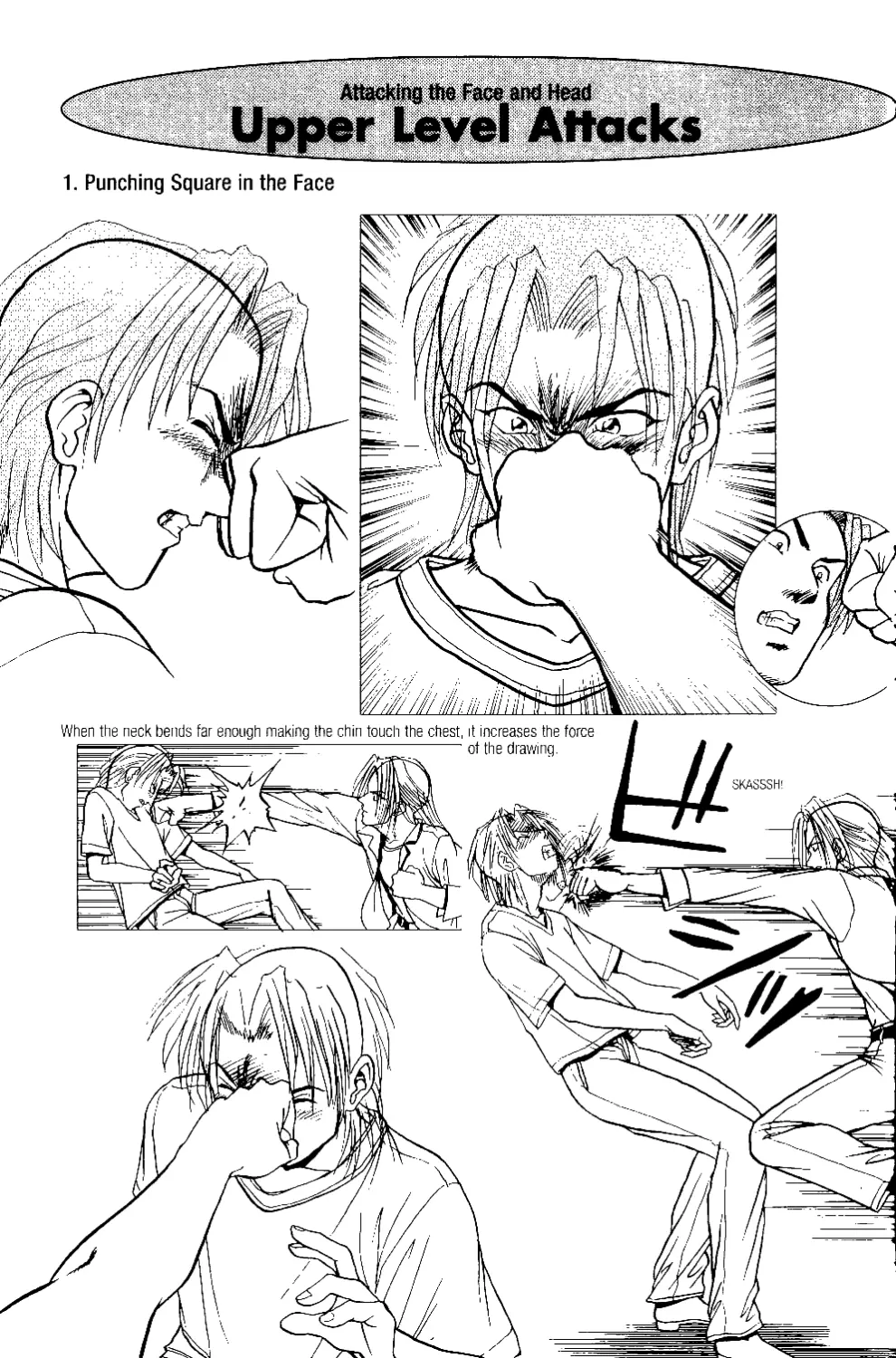
Attacking the Face and Head - Upper Level Attacks.....................22
1	. P.nc- S-.ce - -e = oce ...................................22
2	. A"ac<-g Z agc'o .	 26
3	nr---: '	. ................................28
4	’-e ~eoa - _ooe' Level Kicks......................30
5	=	. z.;- , e>...................................32
5	-ccec :c:es --eo- . ел .....................................33
The Knack of Drawing Realistic Punches................................34
Simple Ways to Draw	................................35
Slapping	................................36
c; .rr-:	 36
2	. S" «. 'о л - -e =o n of the Hand..........................38
3	.	Siaco 'a - —e Back of	the Hand............................40
4	.	Bac<-cra-*o'"” ‘.’„.•ple| Slaps..........................41
Striking the Mid Level Area and Chest.................................42
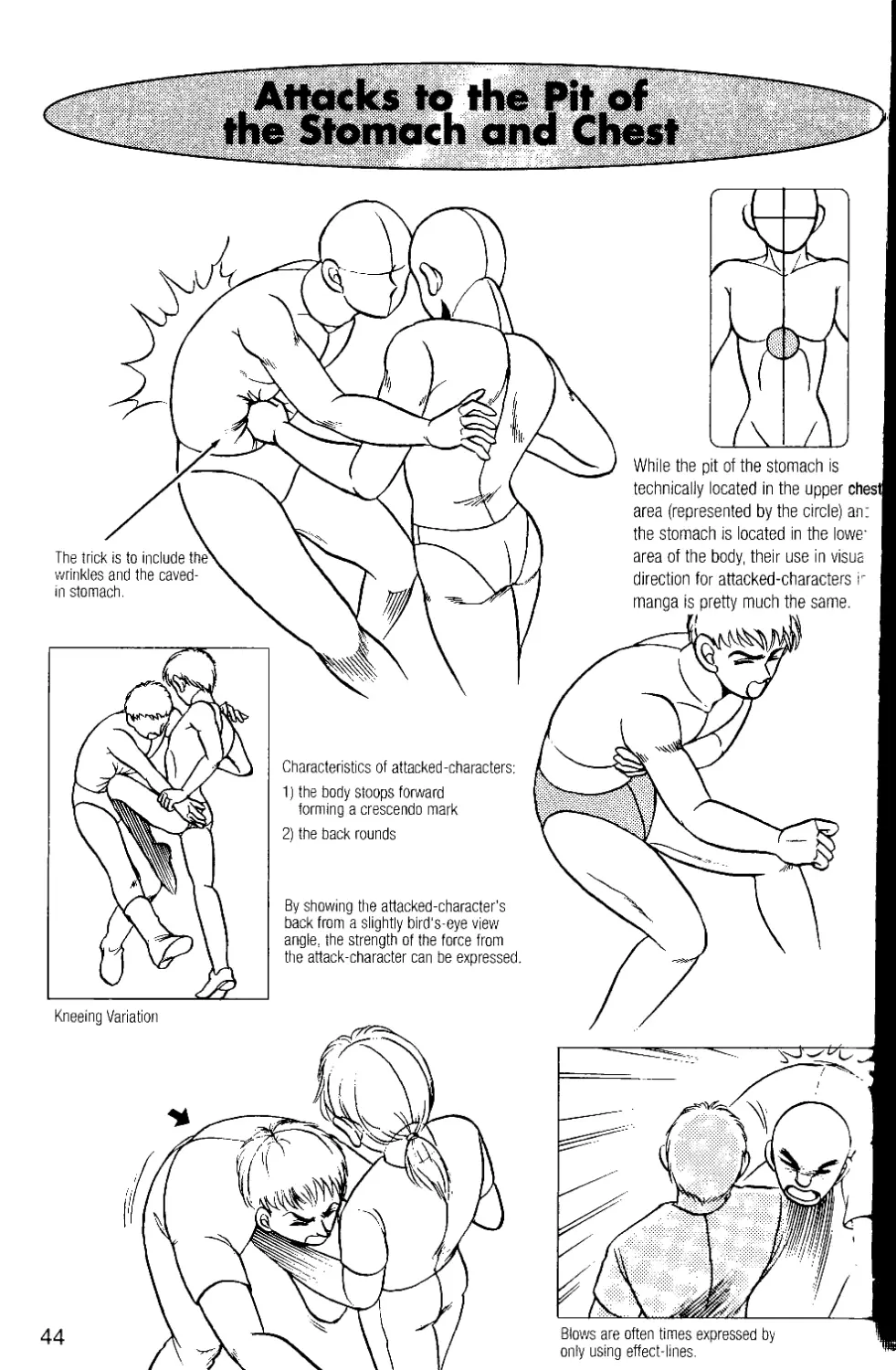
Attacks to the Pit of the Stomach and Chest...........................44
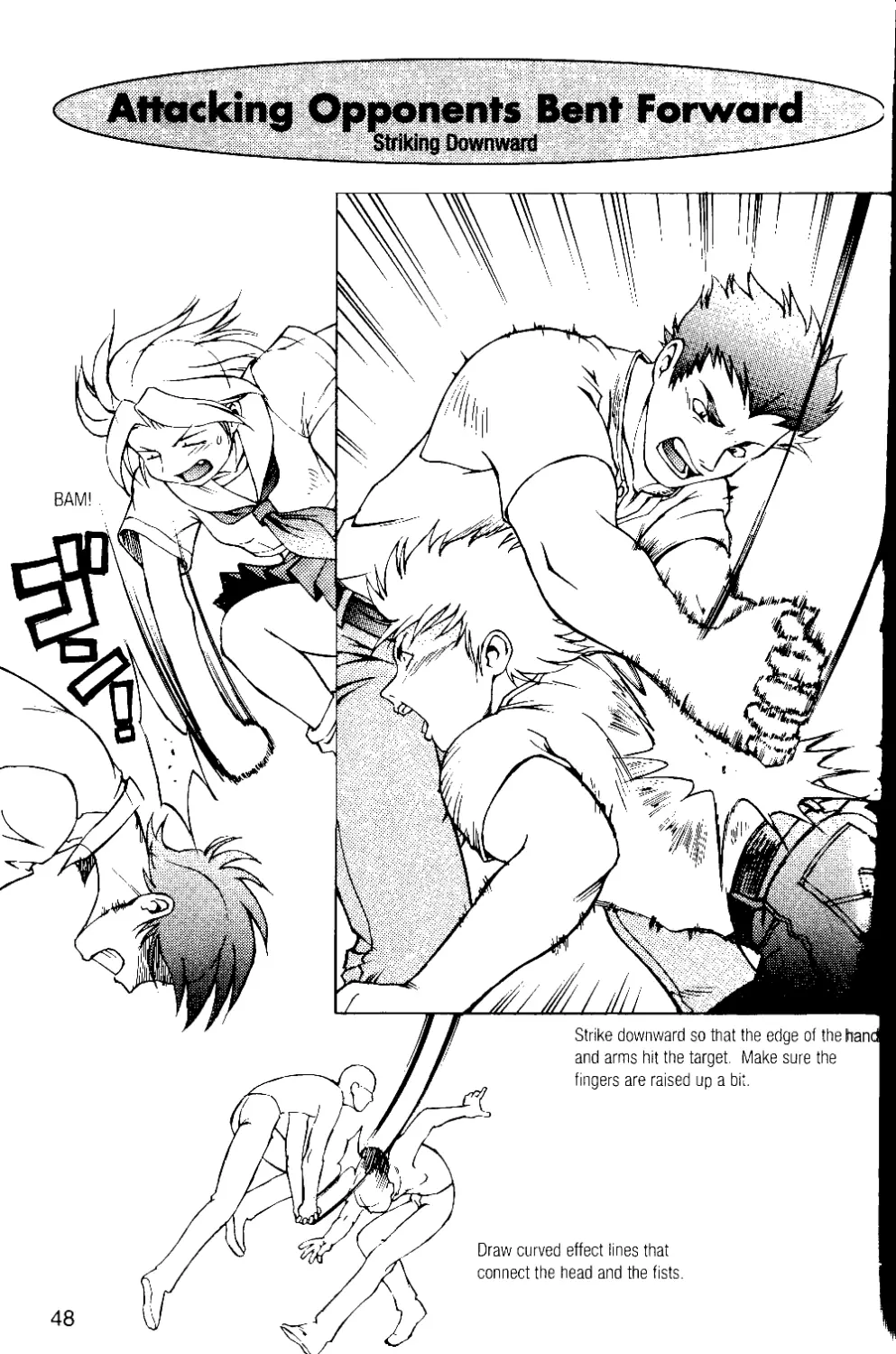
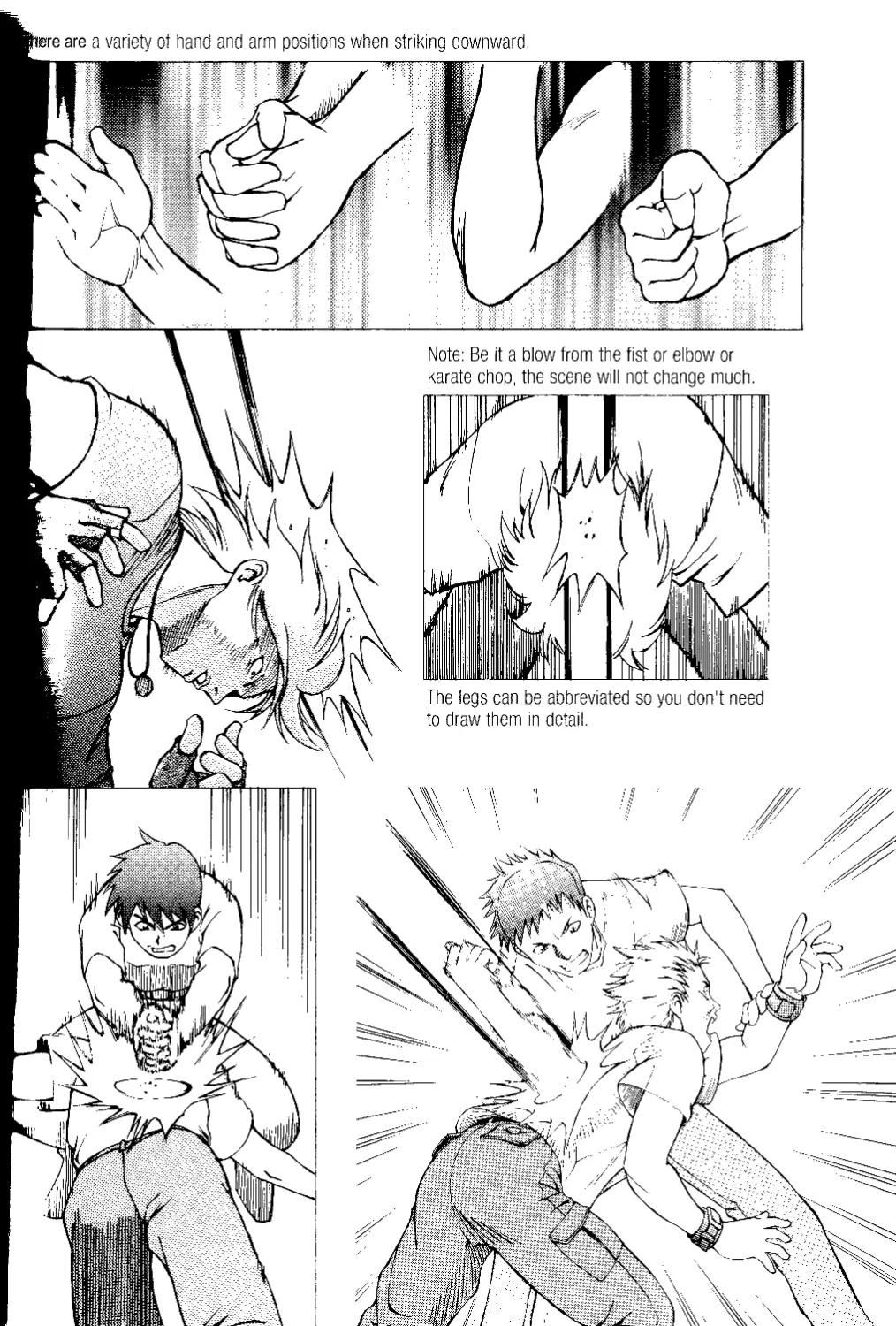
Attacking Opponents Bent Forward......................................48
Forward - Striking Downward
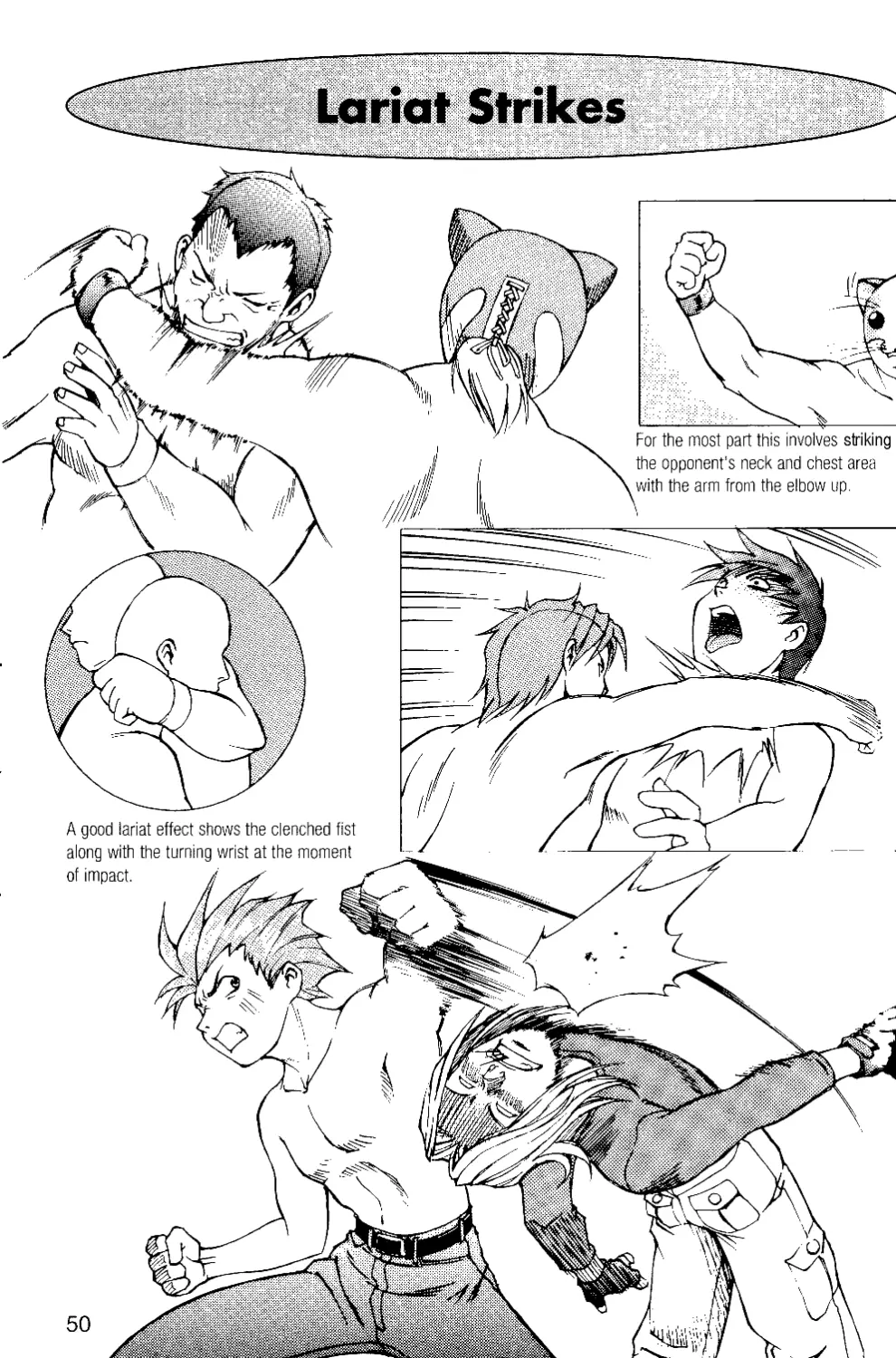
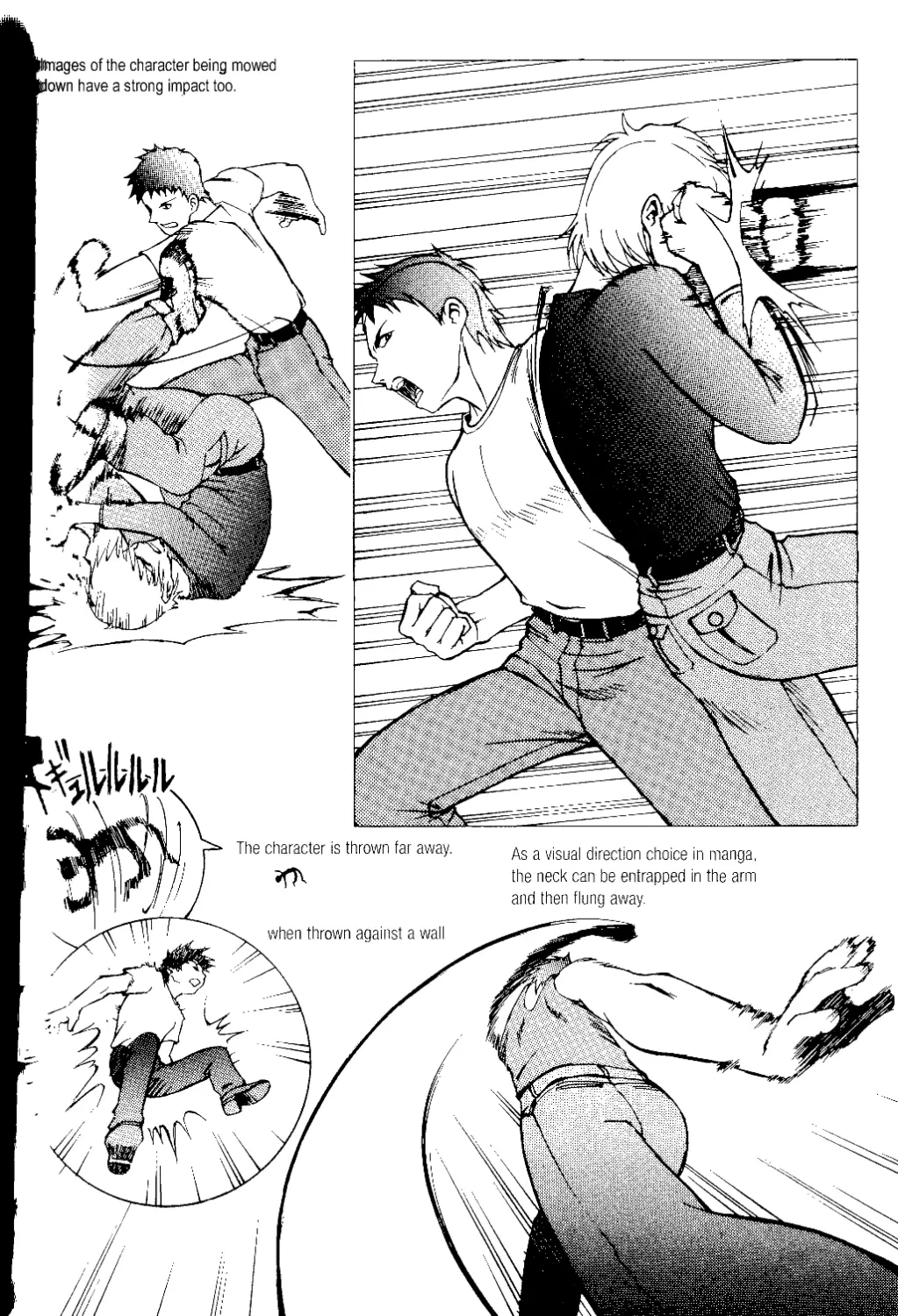
Lariat Strikes .......................................................50
Hand Chops ...........................................................52
Elbows and Knees......................................................54
Dodging and Defending ................................................56
How to Draw Dodge Scenes .............................................58
How to Draw Curved Effect Lines - Using a Fine-Point Pen .............60
Expressing Weariness..................................................62
2
Chapter 3 - Drawing Throws, Grabs and Grappling ....................63
Throwing.........................................................  -64
1.	Grabbing the Arm and Throwing.............................64
2.	Making Throwing Scenes	Simple............................65
3.	Aikido Throws.............................................66
4.	Using Falling Poses......................................67
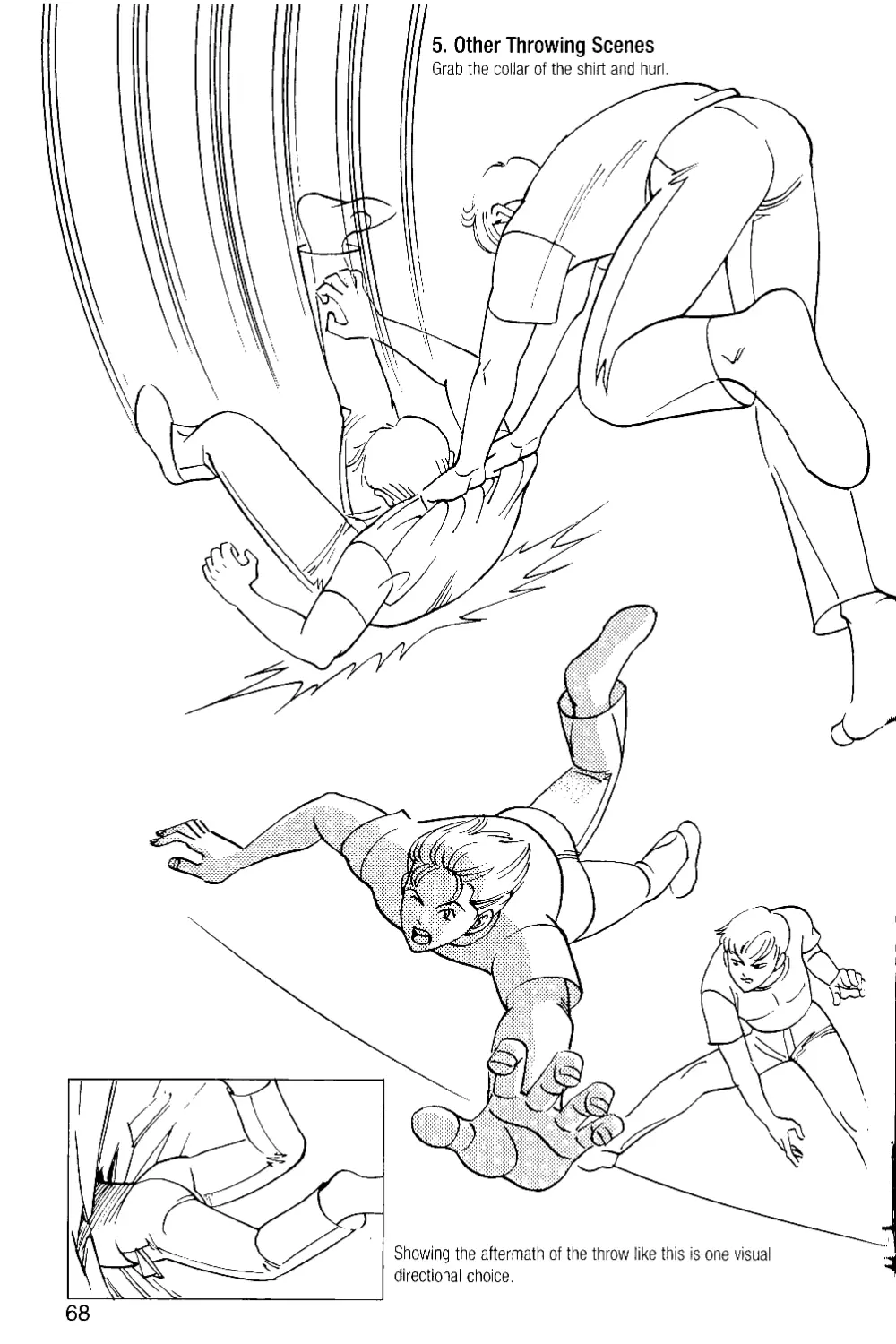
5.	Other Throwing Scenes	...............................68
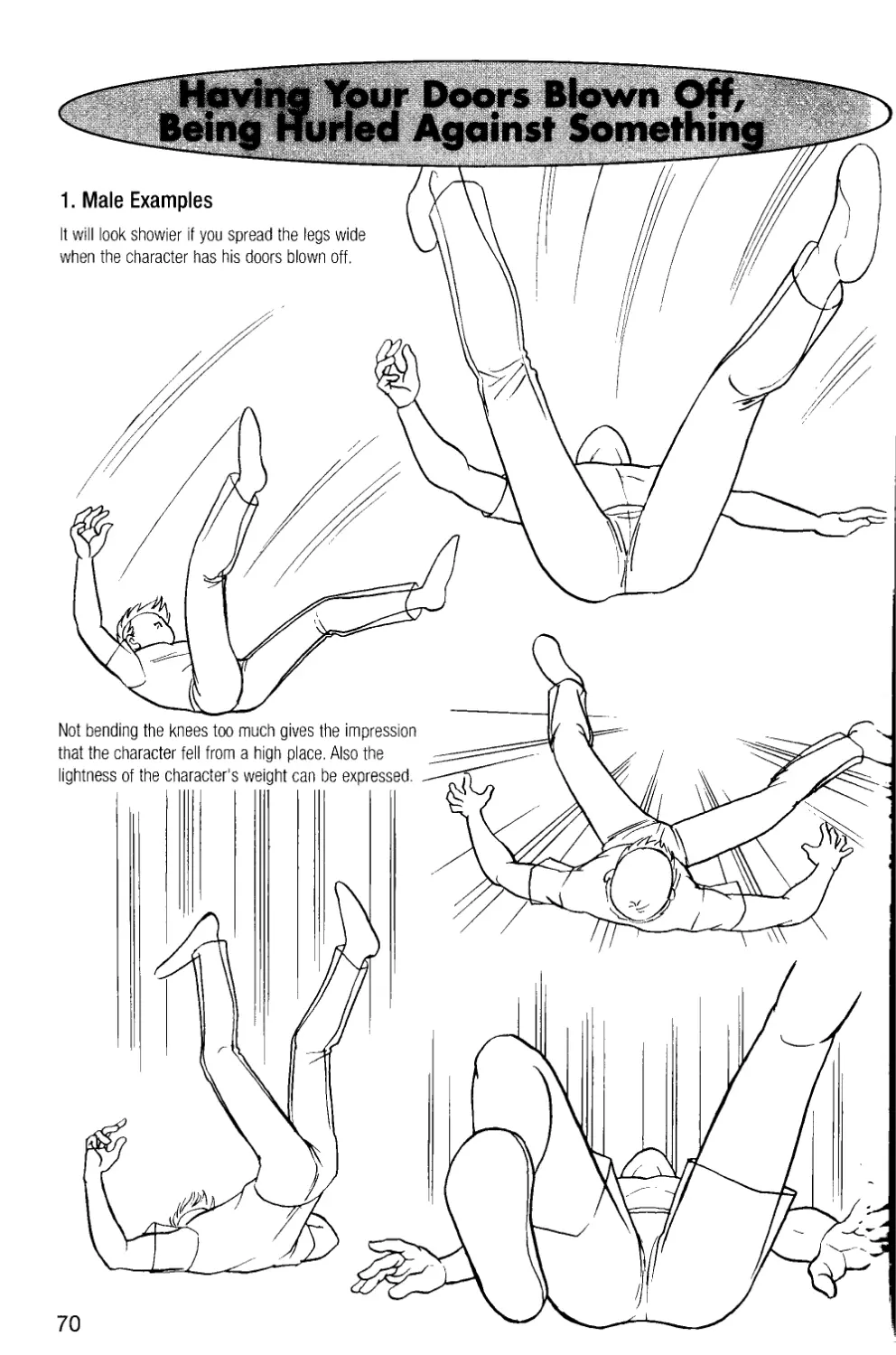
Having Your Doors Blown Off, Being Hurled Against Something , . .70
1. Male Examples.............................................70
2. Female Examples...........................................72
Grabbing ...........................................................74
1.	Grabbing	Sh’rt Collars ..................................74
2.	Grabbing	Faces ..........................................76
3.	Grabbing	Throats.........................................77
4.	Grabbing	Arms............................................78
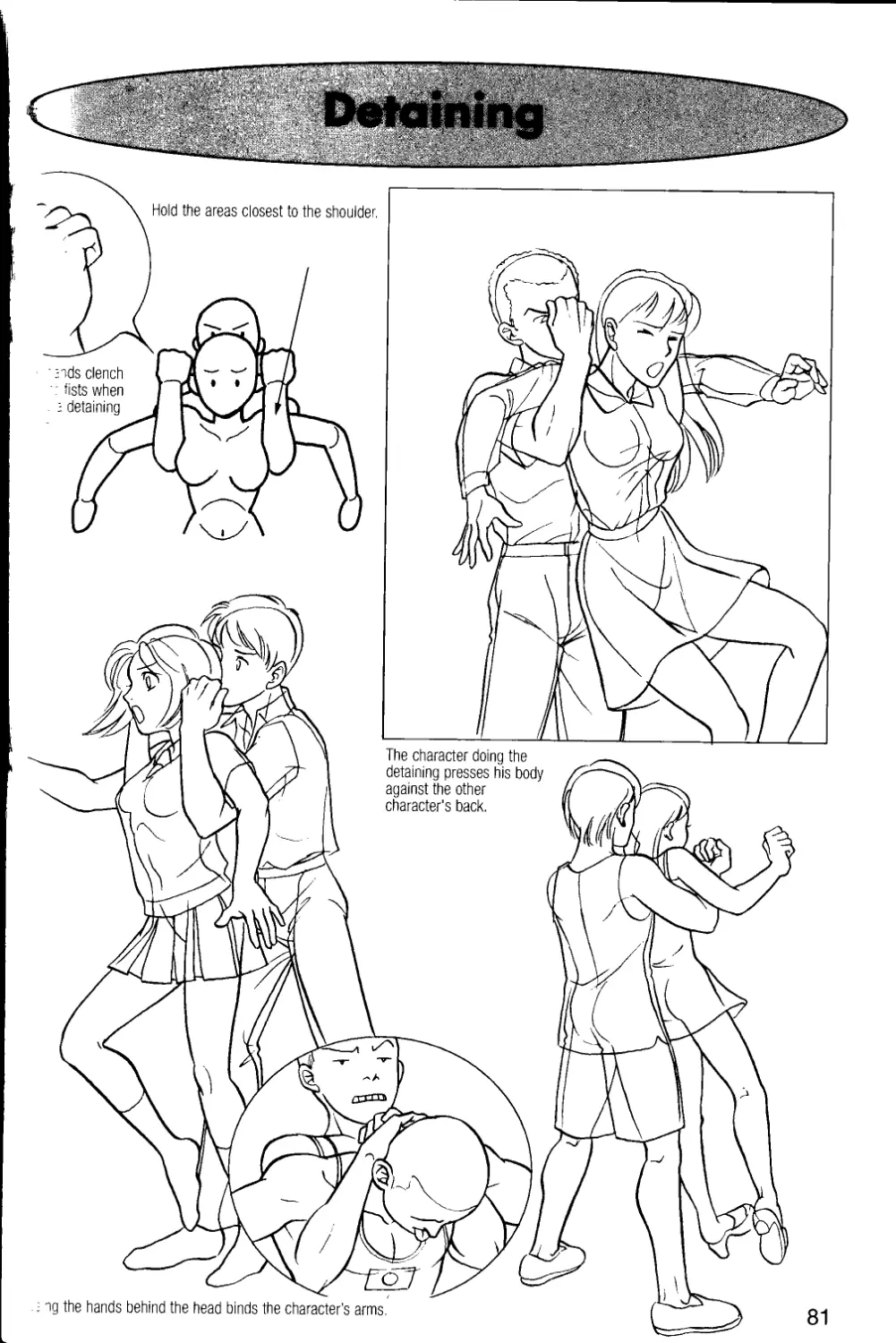
Detaining ..........................................................81
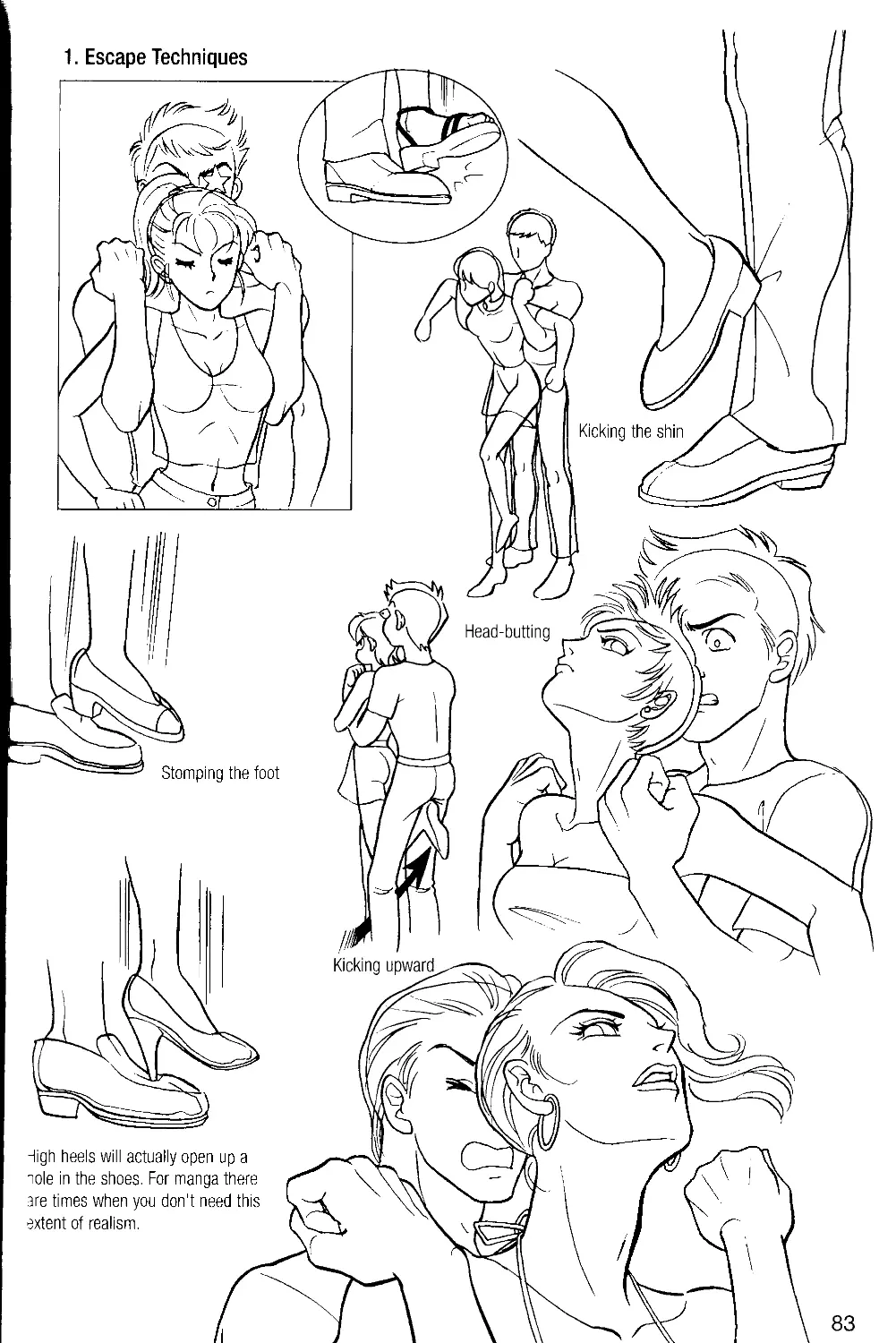
1. Escape Techniques.........................................83
2. Grabbing from Behind .....................................84
Lunging.............................................................86
Punching Sitting Astride............................................88
Crouching Down, Falling to the Knees and Falling Over ..............90
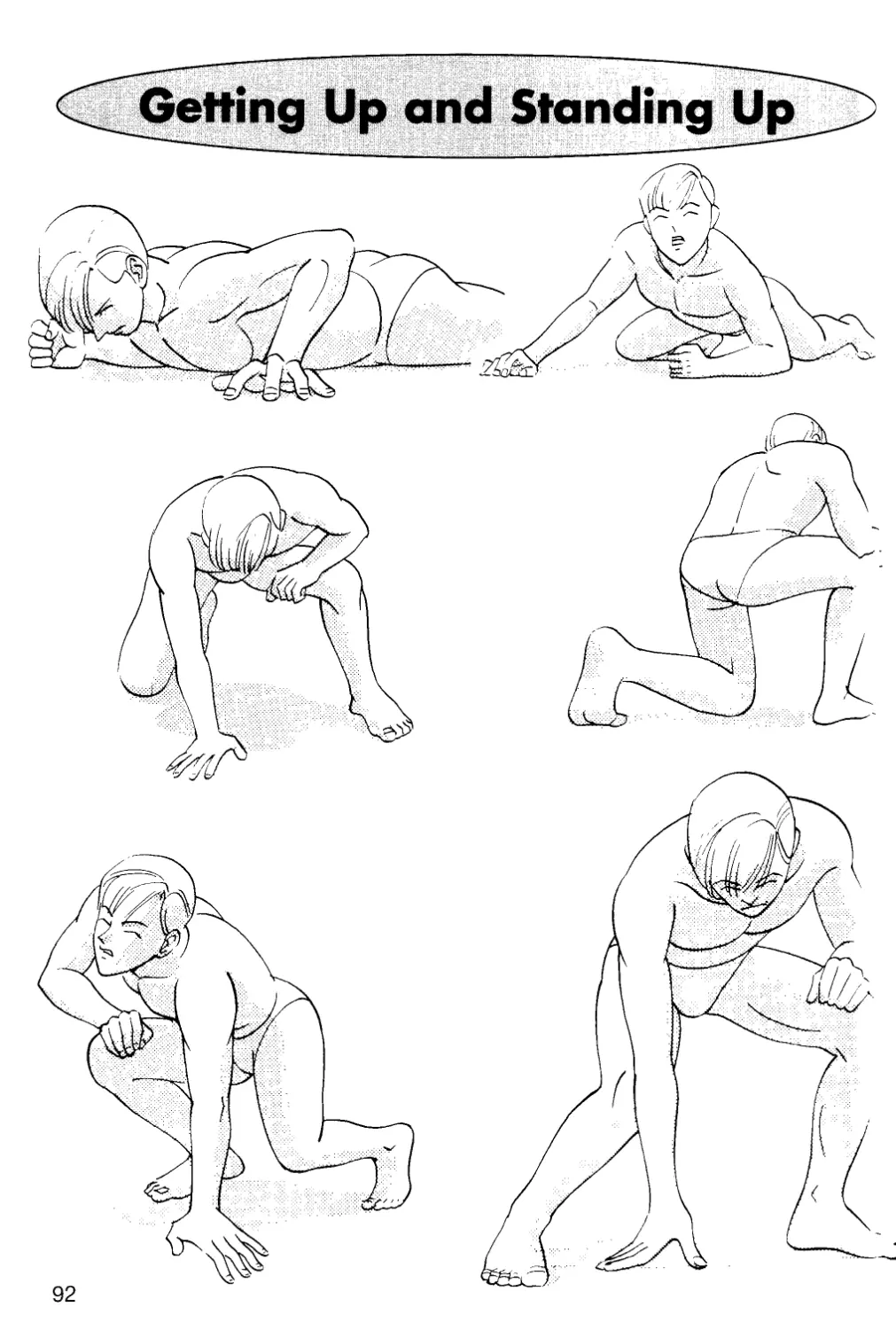
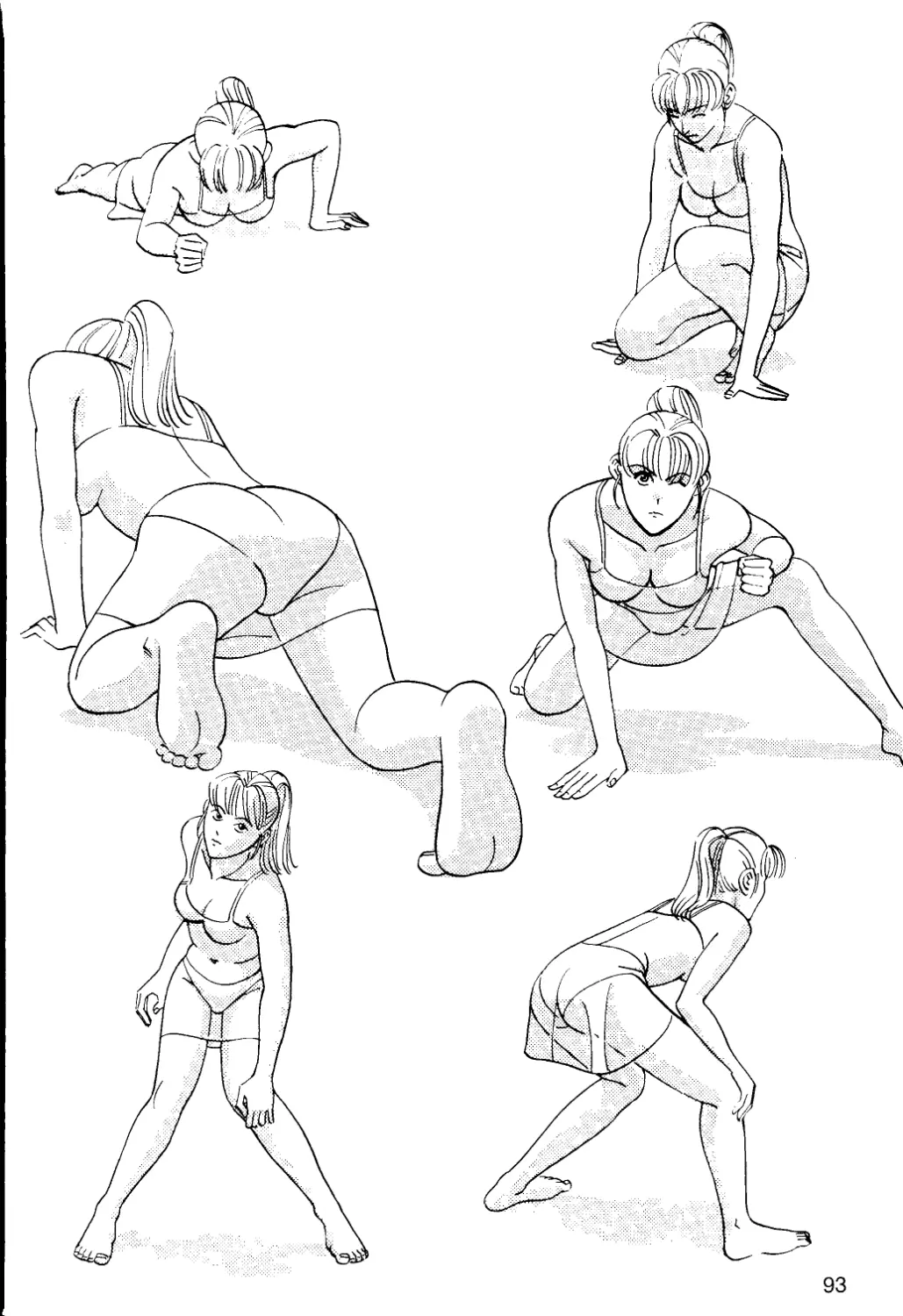
Getting Up and Standing Up	 92
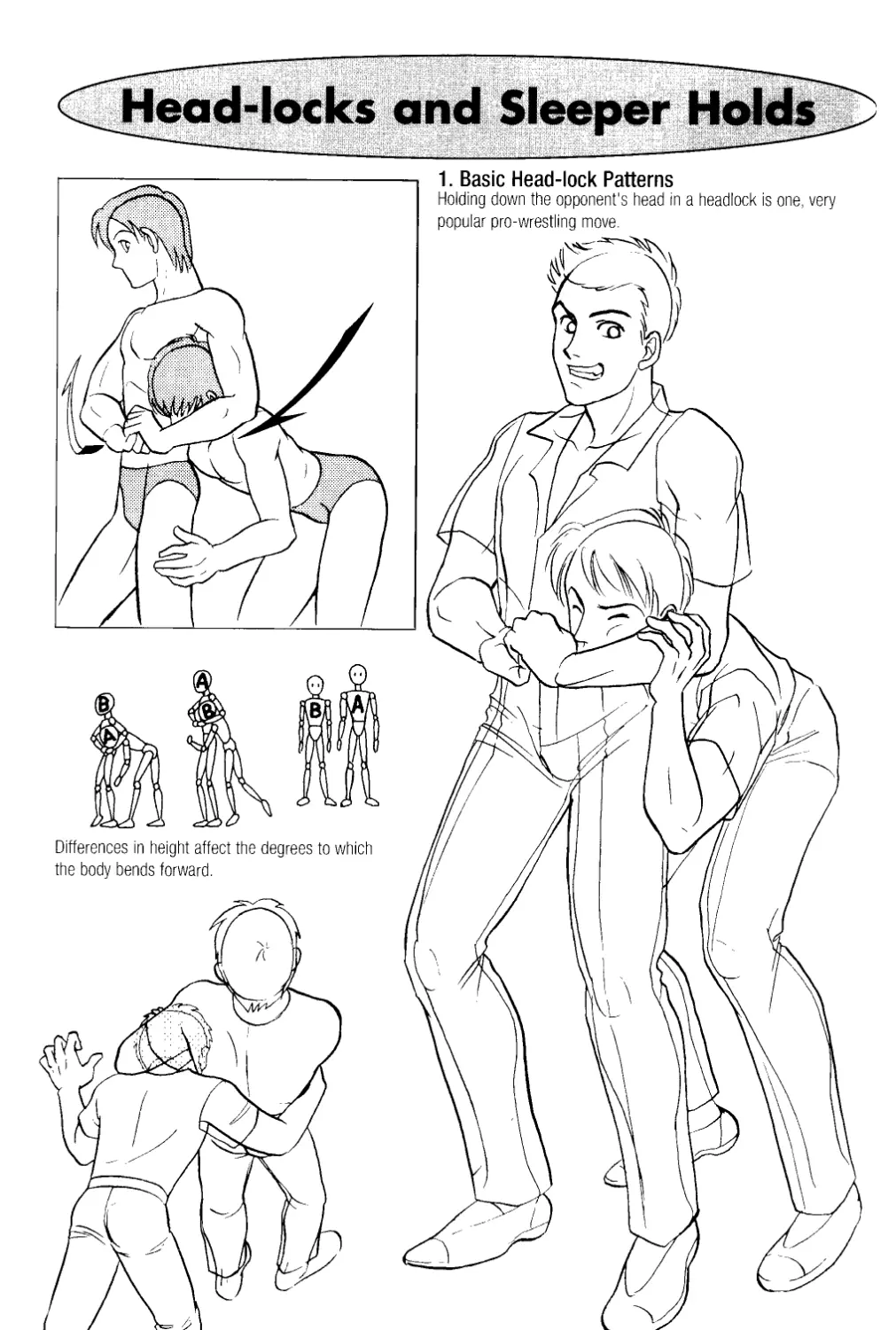
Head-locks and Sleeper Holds	 94
1.	Basic Head-lock ^cre'-s	 94
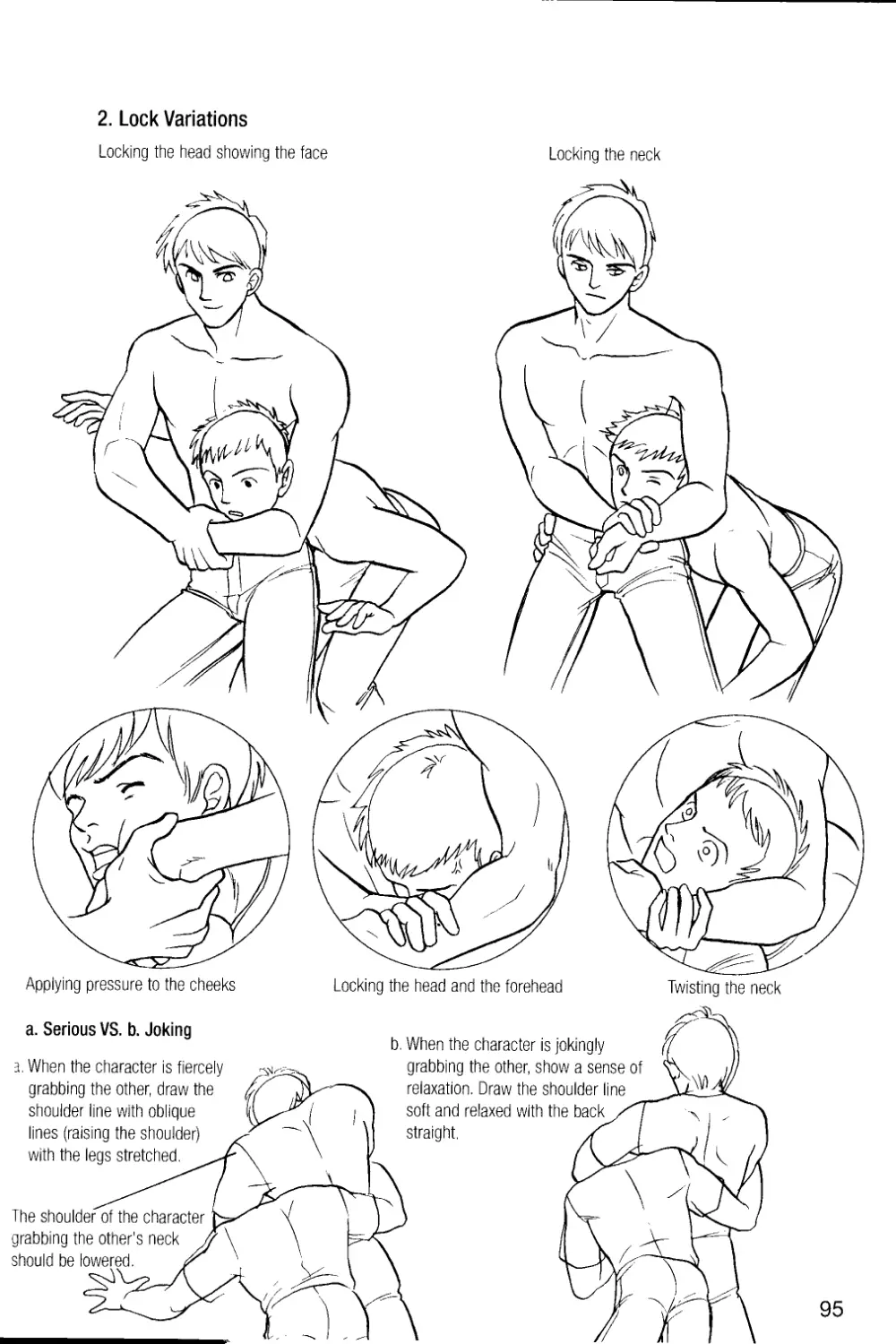
2.	Lock Variations	 95
3.	Strangle Holes •	:•	...........96
Sailor Suit School Uniform Battles	 98
1.	Punching . .	  98
2.	Kicking	 102
3.	Throwing.................................................106
4.	Pro-Wrestling Tecnmq^es ................................107
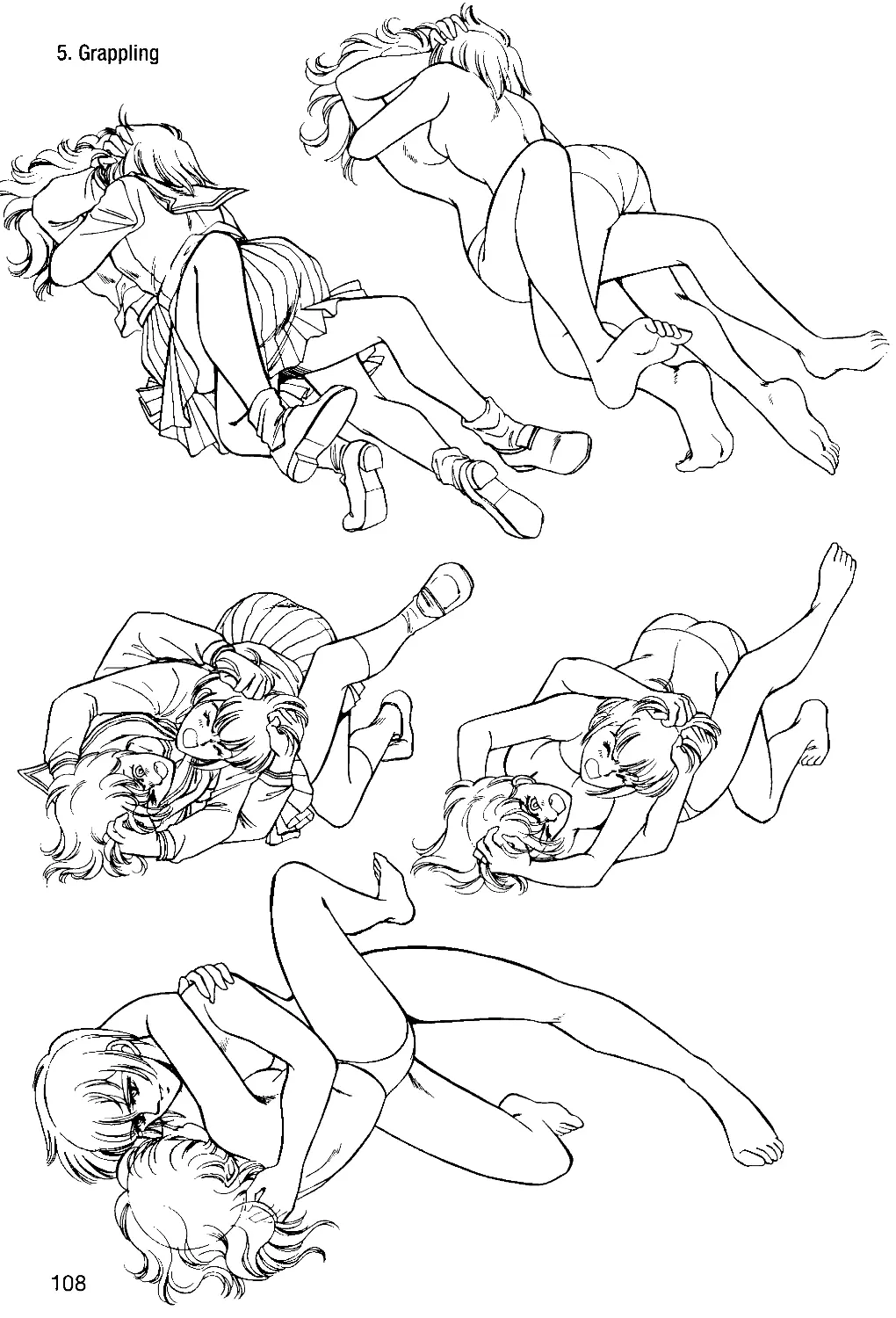
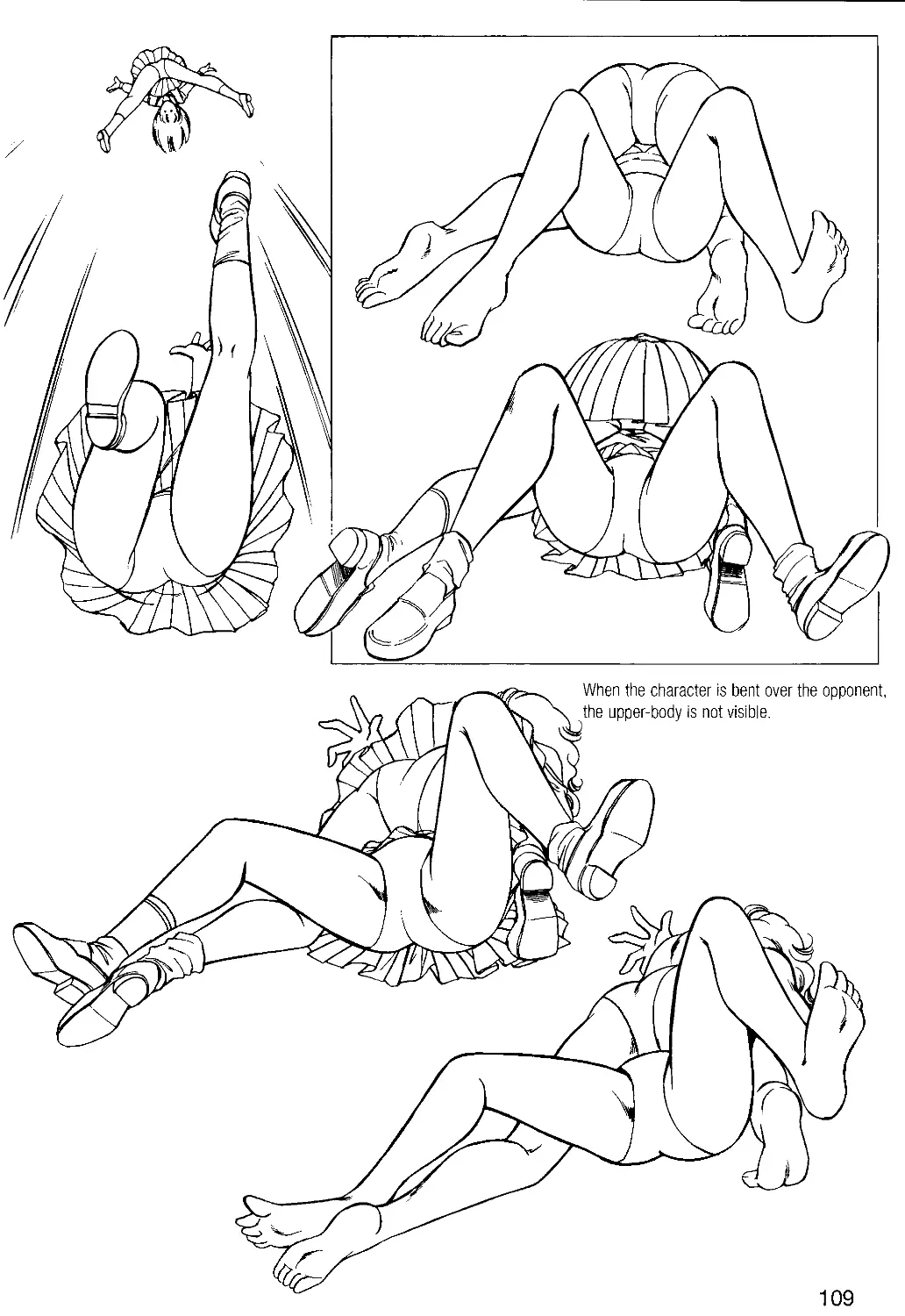
5.	Grappling	 108
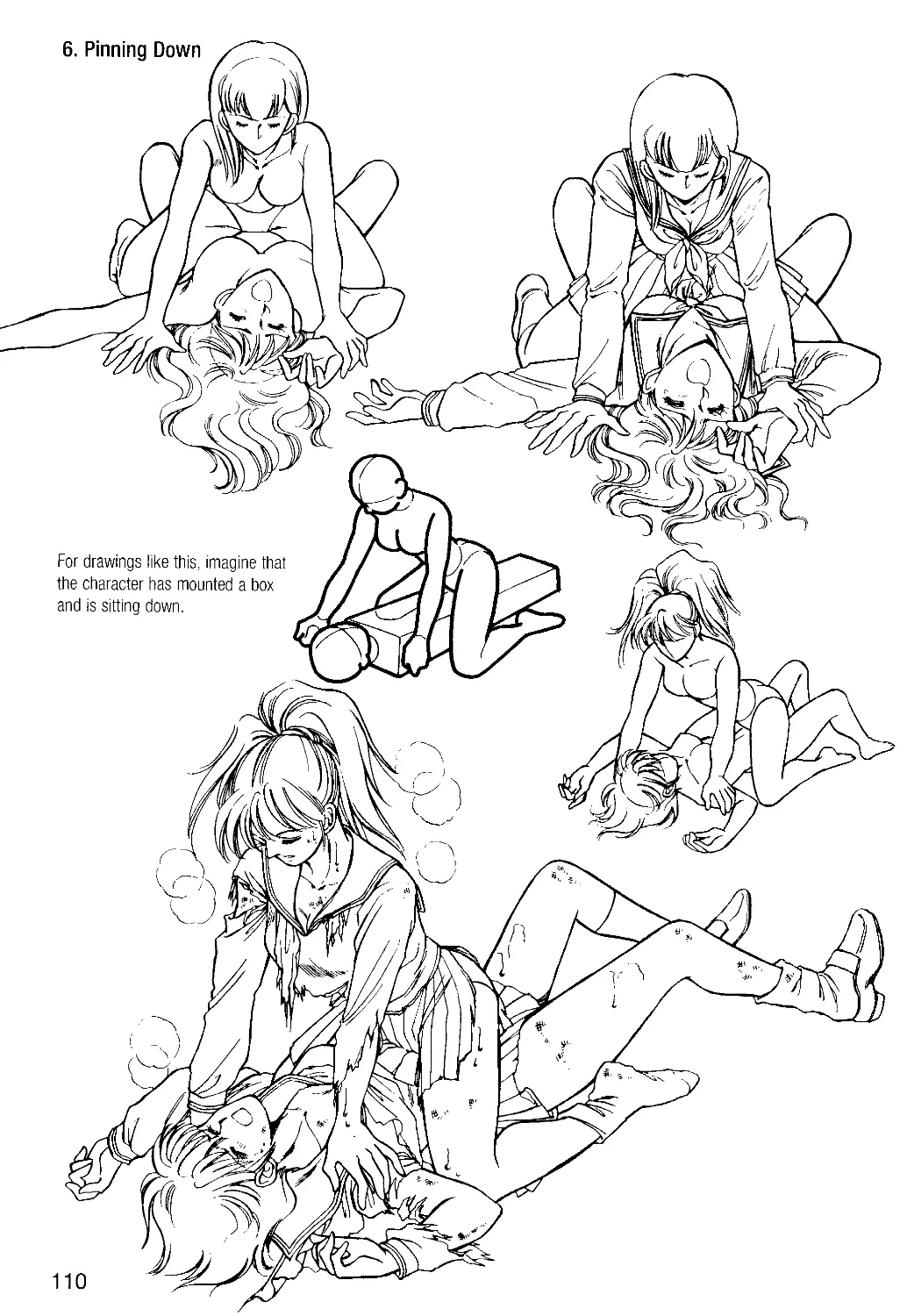
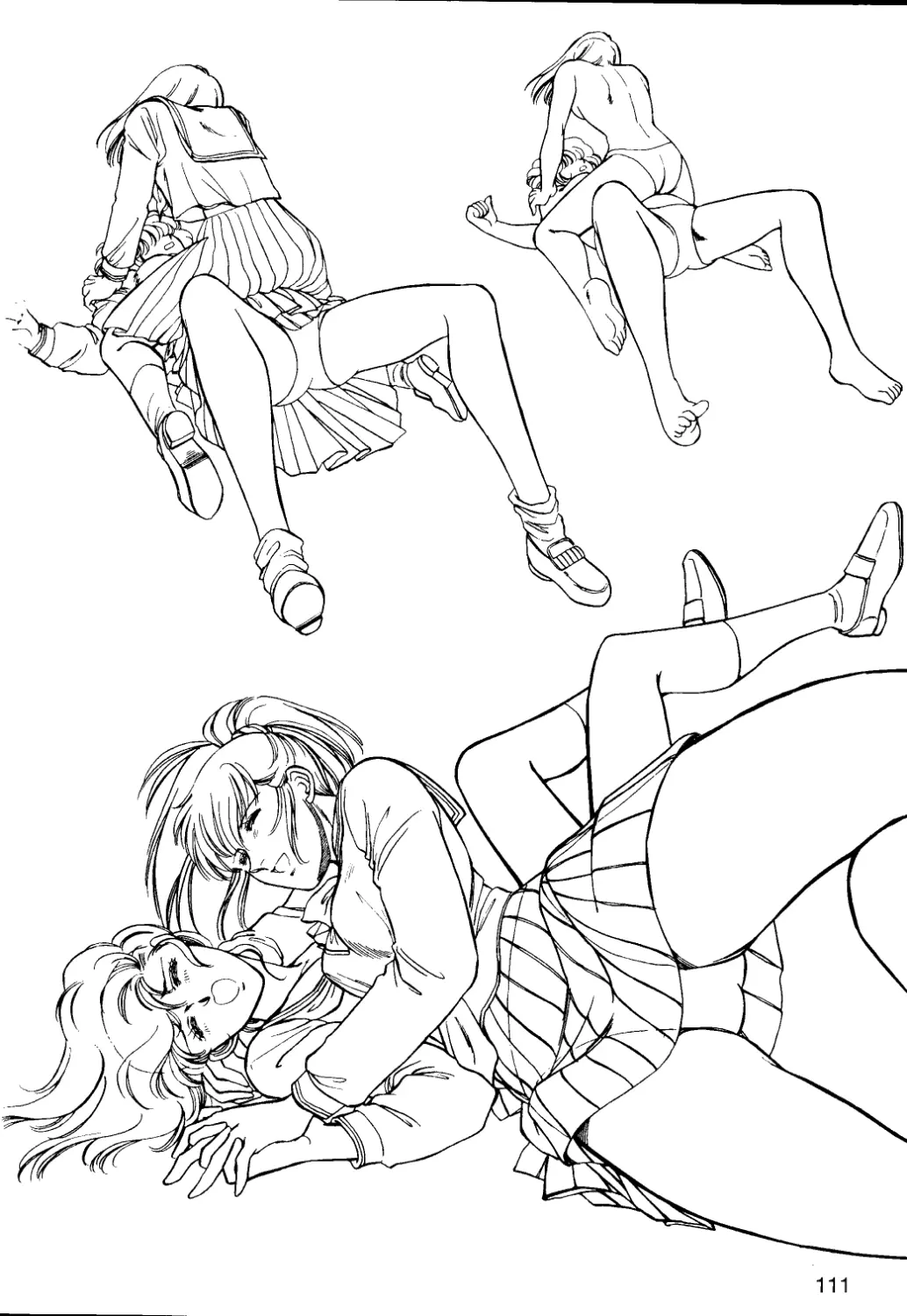
6.	Pinning Down ...........................................110
Ripped Clothing - Being Covered All Over with Wounds...............112
Chapter 4 - Learn From the Masters
Manga Artist Case Study Techniques ................................113
HIIROO SANJOO (Hero Visit) by Kazuaki Morita ......................114
ICHIGEKI (One Shot) by Miyoko Satomi................................116
KURUII (Come On!!) by Takashi Nakagawa..............................118
KE N‘KAify (Cat Fight) by Kimiko Morimoto..........................120
Fight! by Takehiko Matsumoto ......................................122
PAIRUDORAIBAA (Pile-Driver) by Kunichika Harada....................124
3
HOW TO DRAW MANGA: ILLUSTRATING BATTLES
by Hikaru Hayashi, Go Office
Copyright © 1998 Hikaru Hayashi, Go Office
Copyright © 1998 Graphic-sha Publishing Co., Ltd.
First published m 1998 by Graphic-sha Publishing Co., Ltd.
This English edition was published in 2000 by Graphic-sha Pub-isnng Co., Lzo
Planning & Production: Yasuo Matsumoto, Jun Matsubara. K-miz S^’azam fvhai Murakawa.
Riho Yagizawa, Takehiko Matsumoto, Kazuaki Morta
Cover drawing: Takehiko Matsumomo
Cover CG work: Takashi Nakagawa
Cover design: Hideyuki Amemura
English edition layout: Shinichi Ishioka
English translation: Christian Storms
English translation management: Lingua Tmza m a"	-^et.or.jo)
Japanese edition editor: Motofurm Na^ ял Grnm	m^gCo.. Ltd.)
Foreign language edition proiec*	- m -:	Gnaoho-sha Publishing Co., Ltd.)
All rights reserved. No pa'* r s l-.,c or ’ - - ze 'ec'zc^zez: у used in any form or
by any means, graft-<. eecm-" z n ~~z^a- za "zoc-g rmz.zccopying, recording, or
information storage	~:ze-'~ sson of the publisher.
DistrioLted by
NIPPAN IPS CO.. LTD
11-6, Scheme, lidabashi,
Chiyoda-ku, Tokyo
102-0073 Japan
Tel: +81-(0)3-3238-0676
Fax: +81-(0)3-3238-0996
E-mail: ips03@nippan-ips.co.jp
_ 5^o_+ed m the U.S.A, by
ZGT MANGA DISTRIBUTION
LTiSion of DIGITAL MANGA, Im
' '23 Dominguez St., Unit "K“
Oamom CA 90746, U.S.A.
T 310) 604-9701
“ax 1310)604-1134
E-mail: distribution@emanga.com
URL' http//www. emanga.com/dmd/
First printing:	August 2000
Second printing: May 2001
ISBN: 4-7661-1147-8
Printed and bound in China by Everbest Printing Co., Ltd.
4
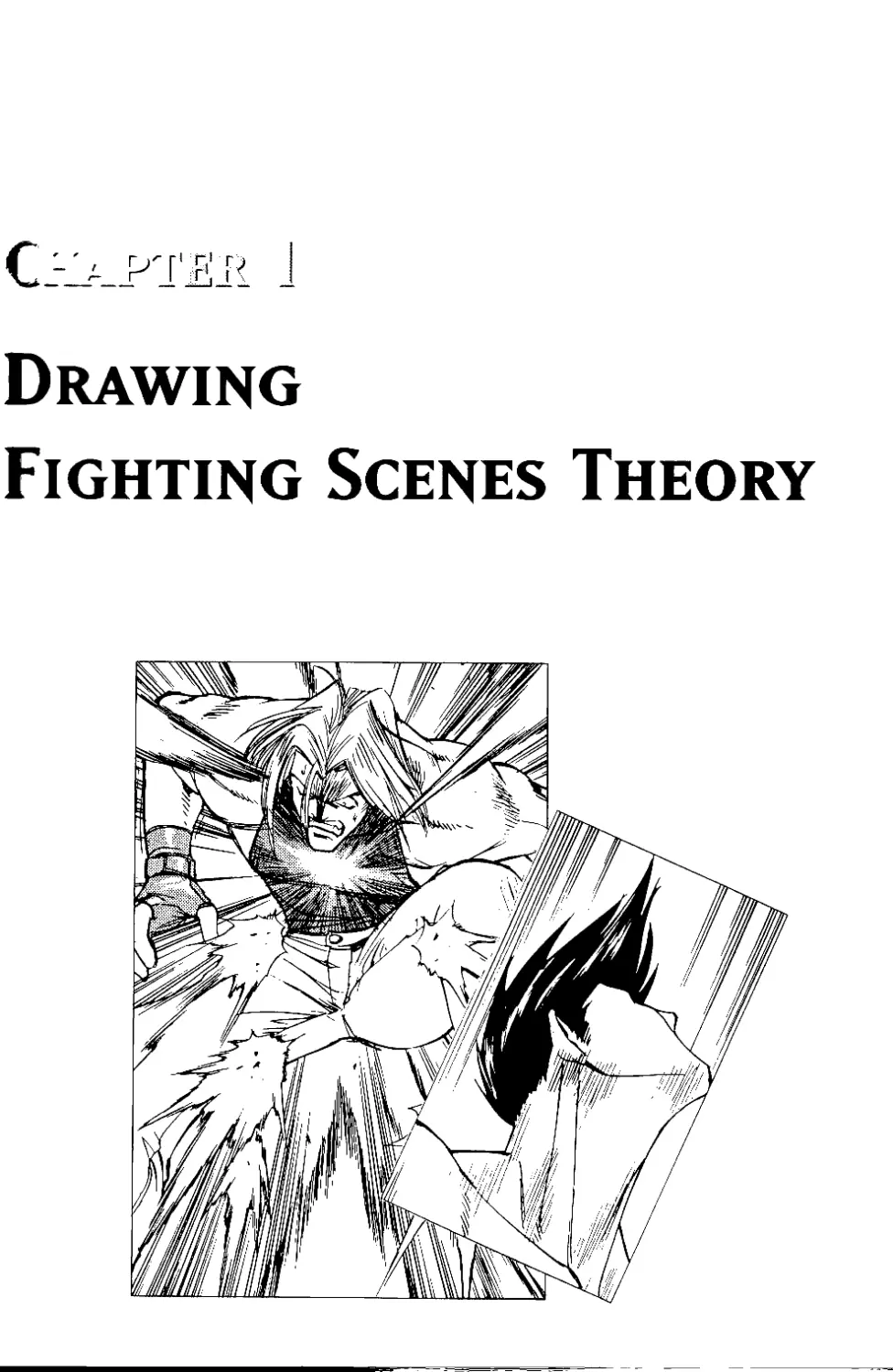
С_-_л_К_Г'Ж
Drawing
Fighting Scenes Theory
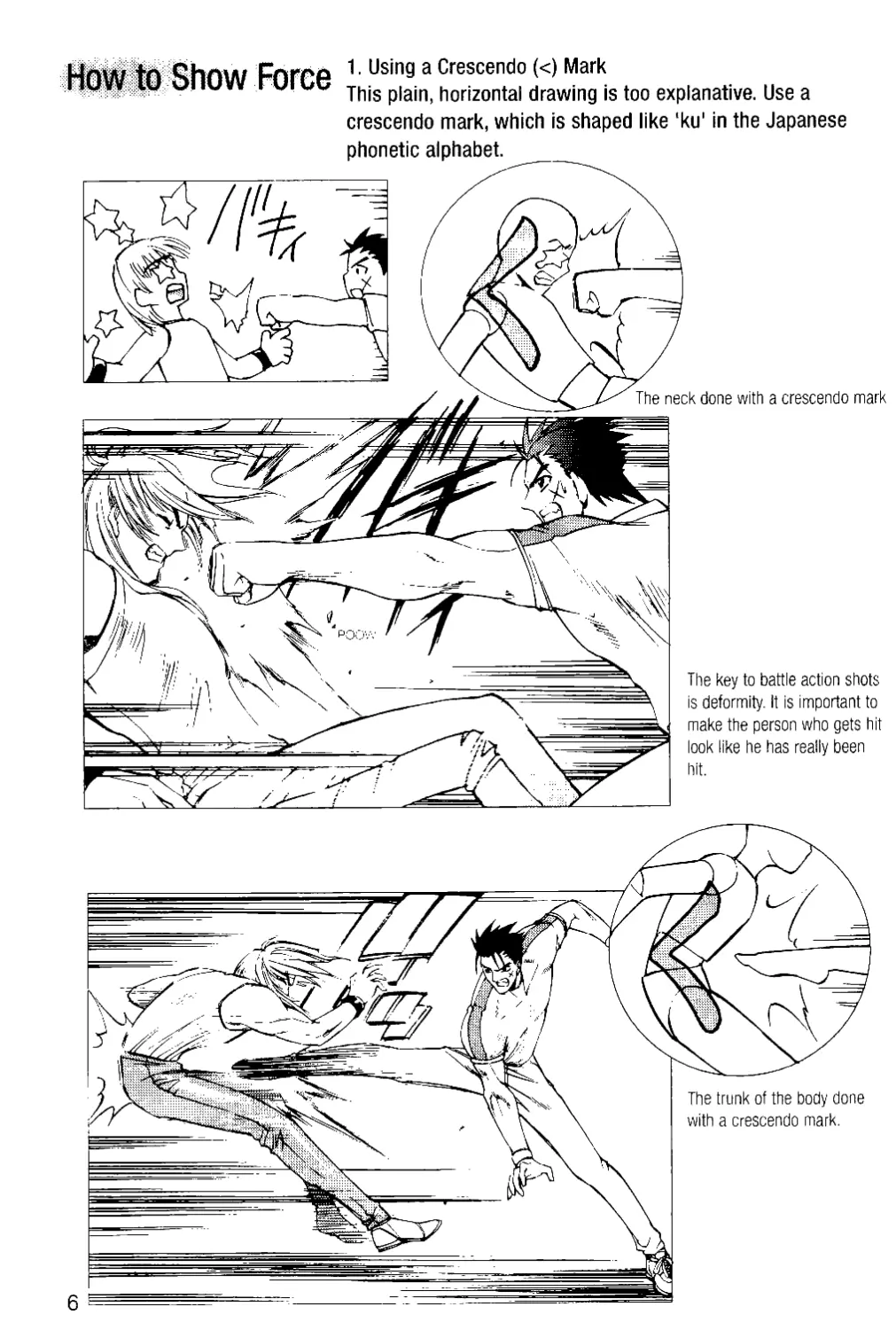
Hnw tn Qhnw Fnrrp 1 •Using a Crescend0 (<)Mark
v	v v This plain, horizontal drawing is too explanative. Use a
crescendo mark, which is shaped like 'ku' in the Japanese
phonetic alphabet.______
The key to battle action shots
is deformity. It is important to
make the person who gets hit
look like he has really been
hit.
The neck done with a crescendo mark
The trunk of the body done
with a crescendo mark.
6
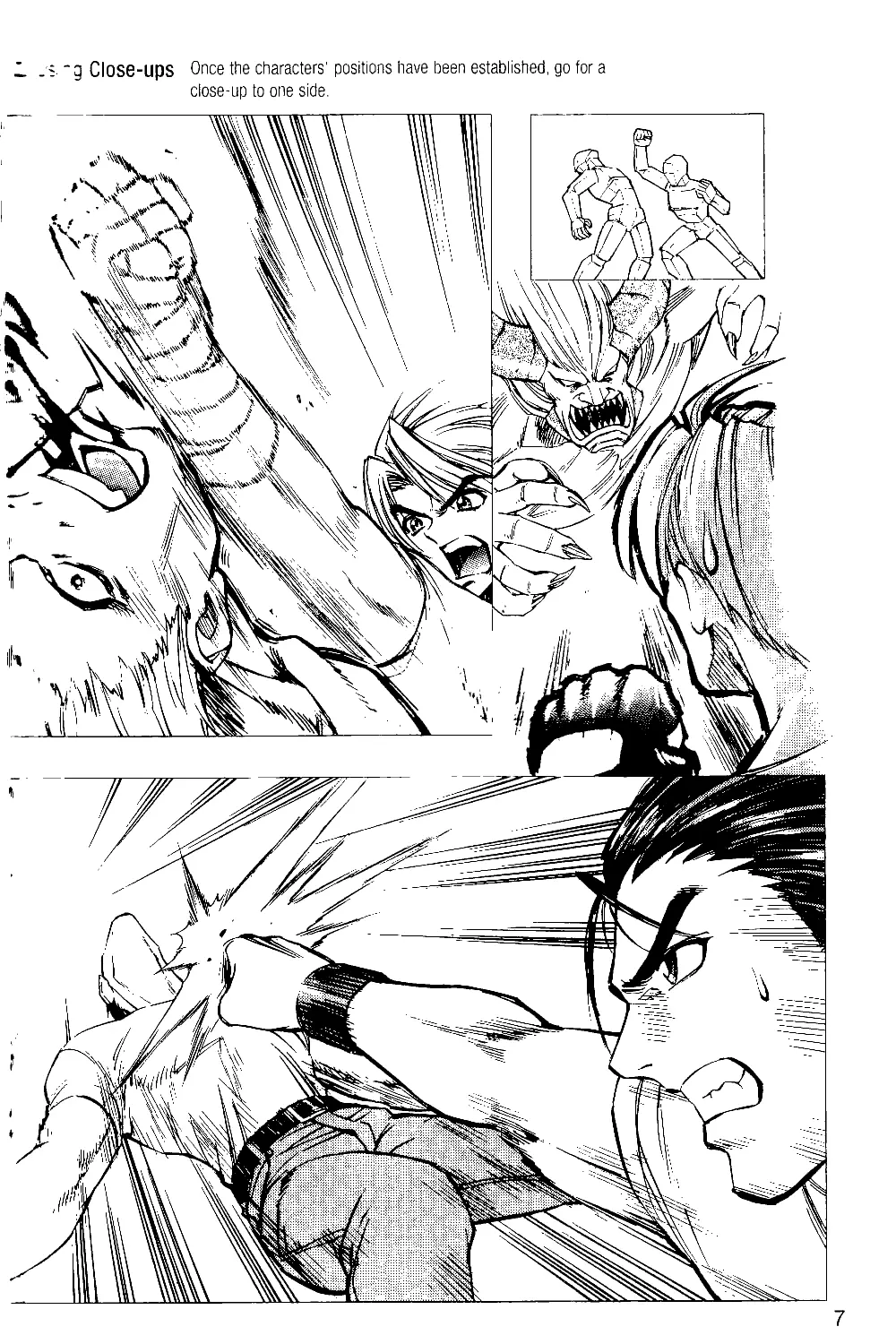
,S " g Close-ups Once the characters' positions have been established, go for a
close-up to one side.
7
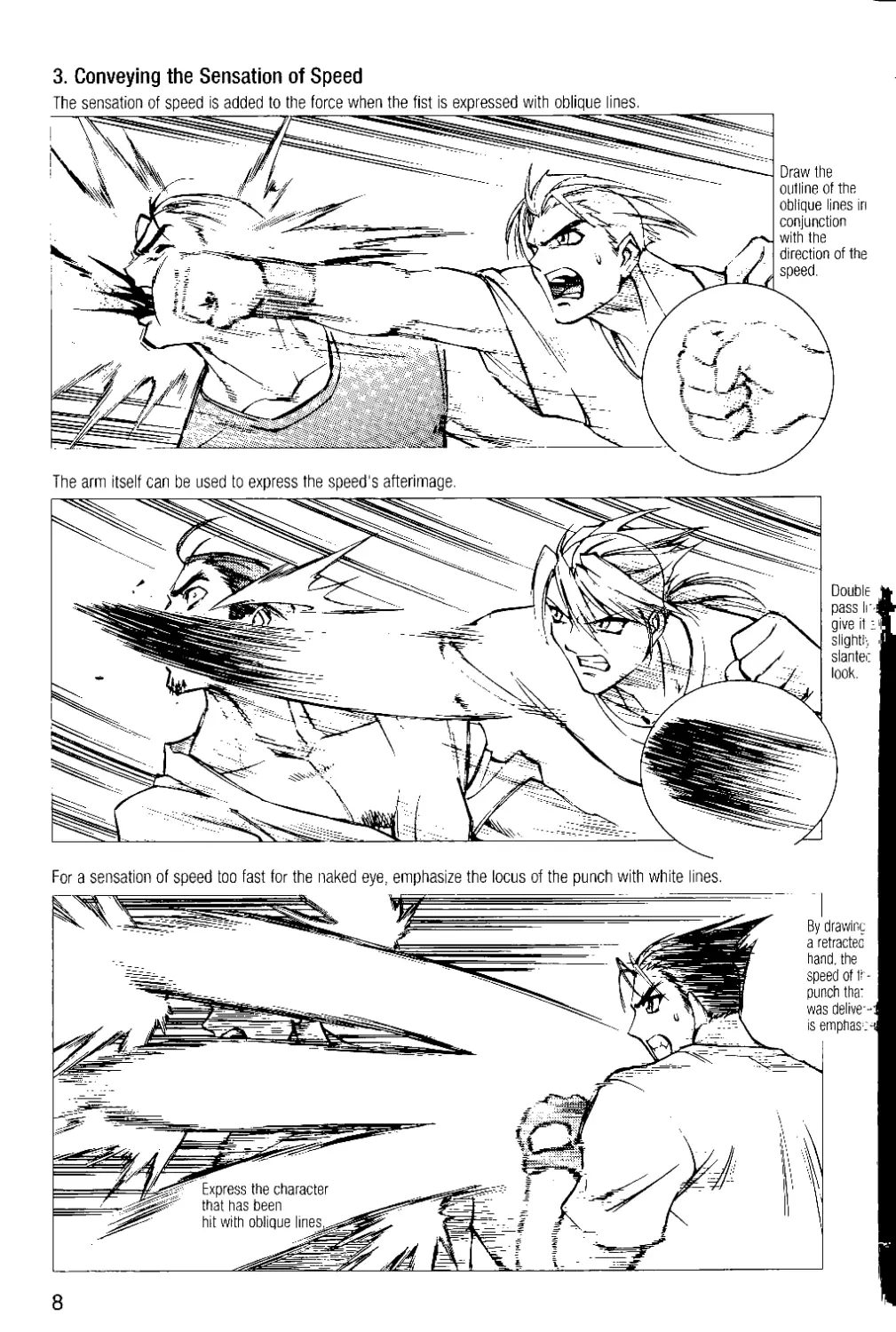
3. Conveying the Sensation of Speed
The sensation of speed is added to the force when the fist is expressed with oblique lines.
The arm itself can be used to express the speed's afterimage,
Draw the
outline of the
oblique lines in
conjunction
with the
direction of the
speed.
Double
pass lr
give it e
slighti':,
slantec
look.
By drawinc
a retractec
hand, the
speed of tr-
punch tha:
was delive'-
is emphasc-


8
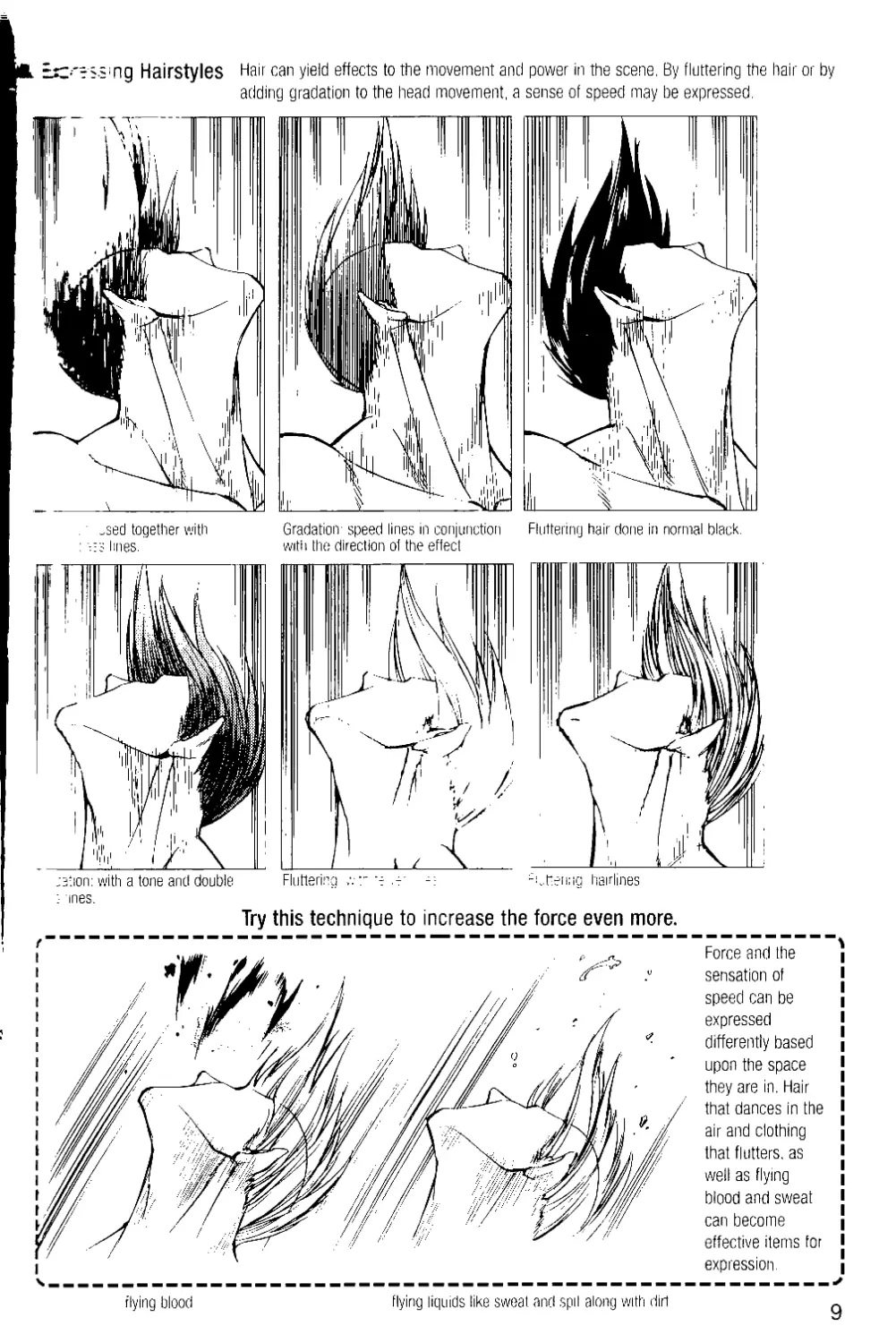
XZrS.^ng Hairstyles Hair can yield effects to the movement and power in the scene. By fluttering the hair or by
adding gradation to the head movement, a sense of speed may be expressed.
:• ines.
Try this technique to increase the force even more.
Force and the
sensation of
speed can be
expressed
differently based
upon the space
they are in. Hair
that dances in the
air and clothing
that flutters, as
well as flying
blood and sweat
can become
effective items for
expression.
flying blood	flying liquids like sweat and spil along with din
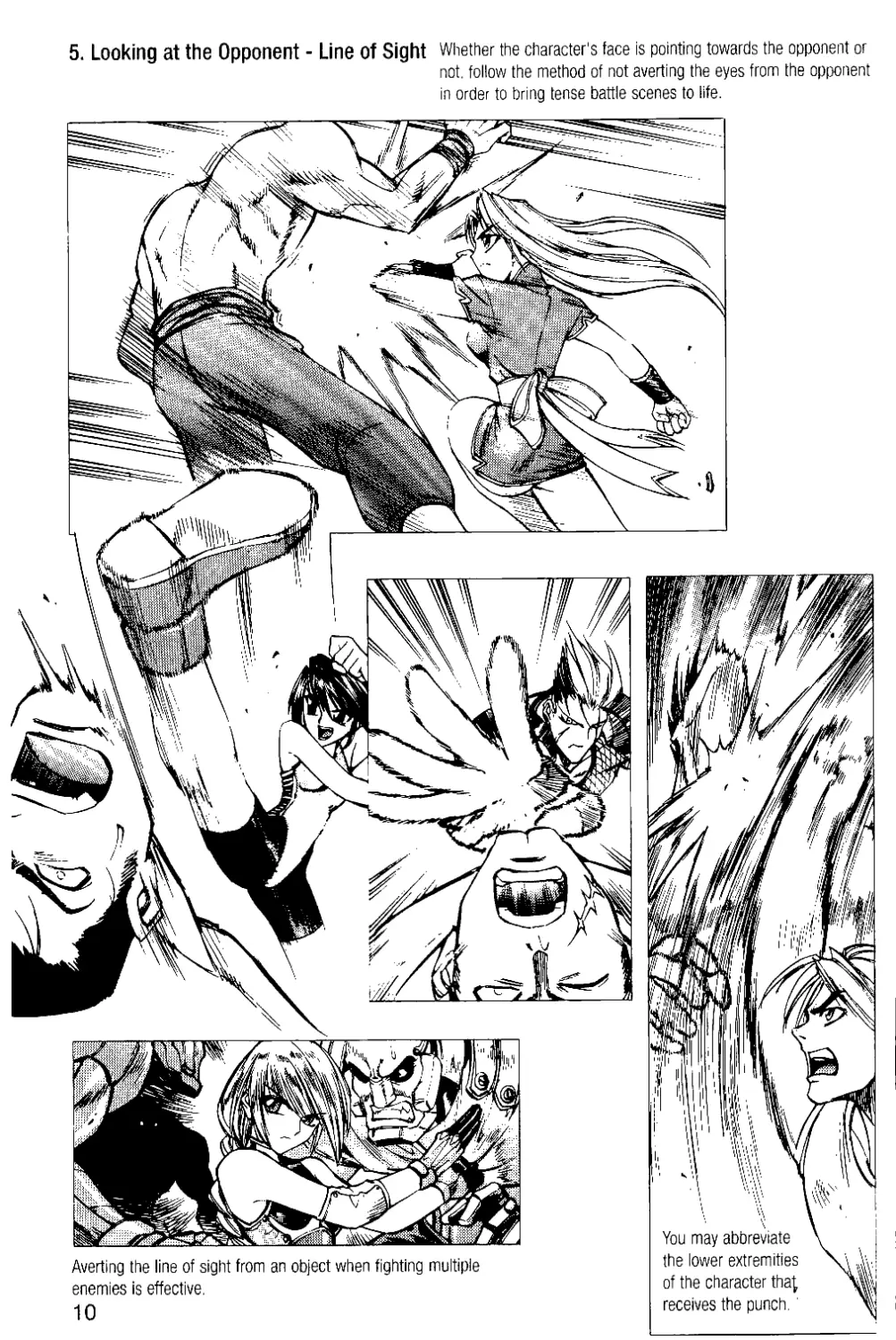
5. Looking at the Opponent - Line Of Sight Whether the character's face is pointing towards the opponent or
not. follow the method of not averting the eyes from the opponent
in order to bring tense battle scenes to life.

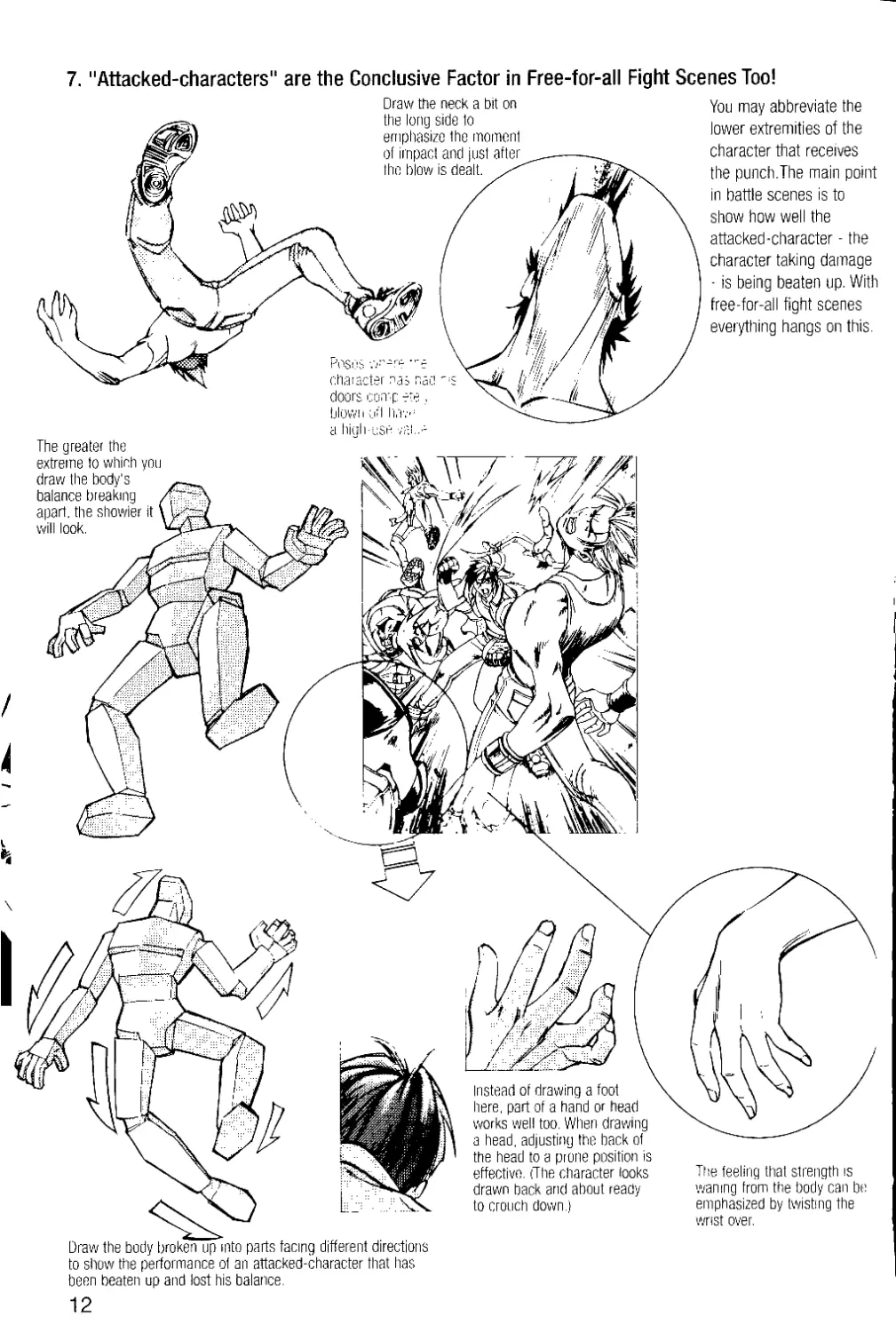
7. "Attacked-characters" are the Conclusive Factor in Free-for-all Fight Scenes Too!
You may abbreviate the
lower extremities of the
character that receives
the punch.The main point
in battle scenes is to
show how well the
attacked-character - the
character taking damage
• is being beaten up. With
free-for-all fight scenes
everything hangs on this.
Draw the neck a bit on
the long side to
emphasize the moment
of impact and just after
the blow is dealt.
The feeling that strength is
waning from the body can be
emphasized by twisting the
wrist over.
Draw the body broken up into parts facing different directions
to show the performance of an attacked-character that has
been beaten up and lost his balance.
The greater the
extreme to which you
draw the body's
balance breaking
apart, the showier it
will look.

doors cna'p
blown nd h,
instead of drawing a foot
here, part of a hand or head
works well too. When drawing
a head, adjusting the back of
the head to a prone position is
effective. (The character looks
drawn back and about ready
to crouch down.)
12
к
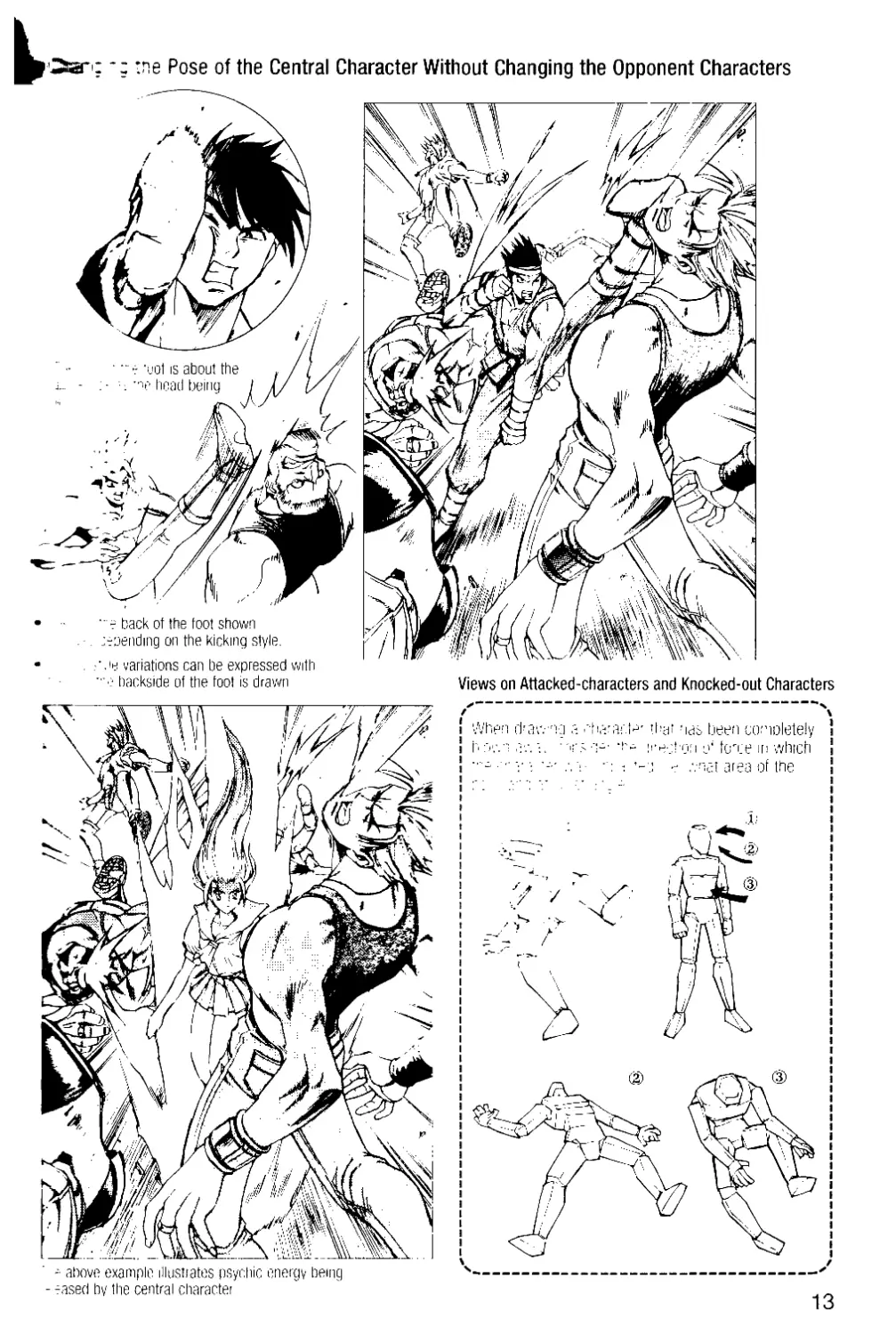
*: :ne Pose of the Central Character Without Changing the Opponent Characters
“ t back of the foot shown
c-rsending on the kicking style.
? Je variations can be expressed with
hackside of the foot is drawn
-• above example illustrates psychic energy being
- -ased by the central character
Views on Attacked-characters and Knocked-out Characters
13
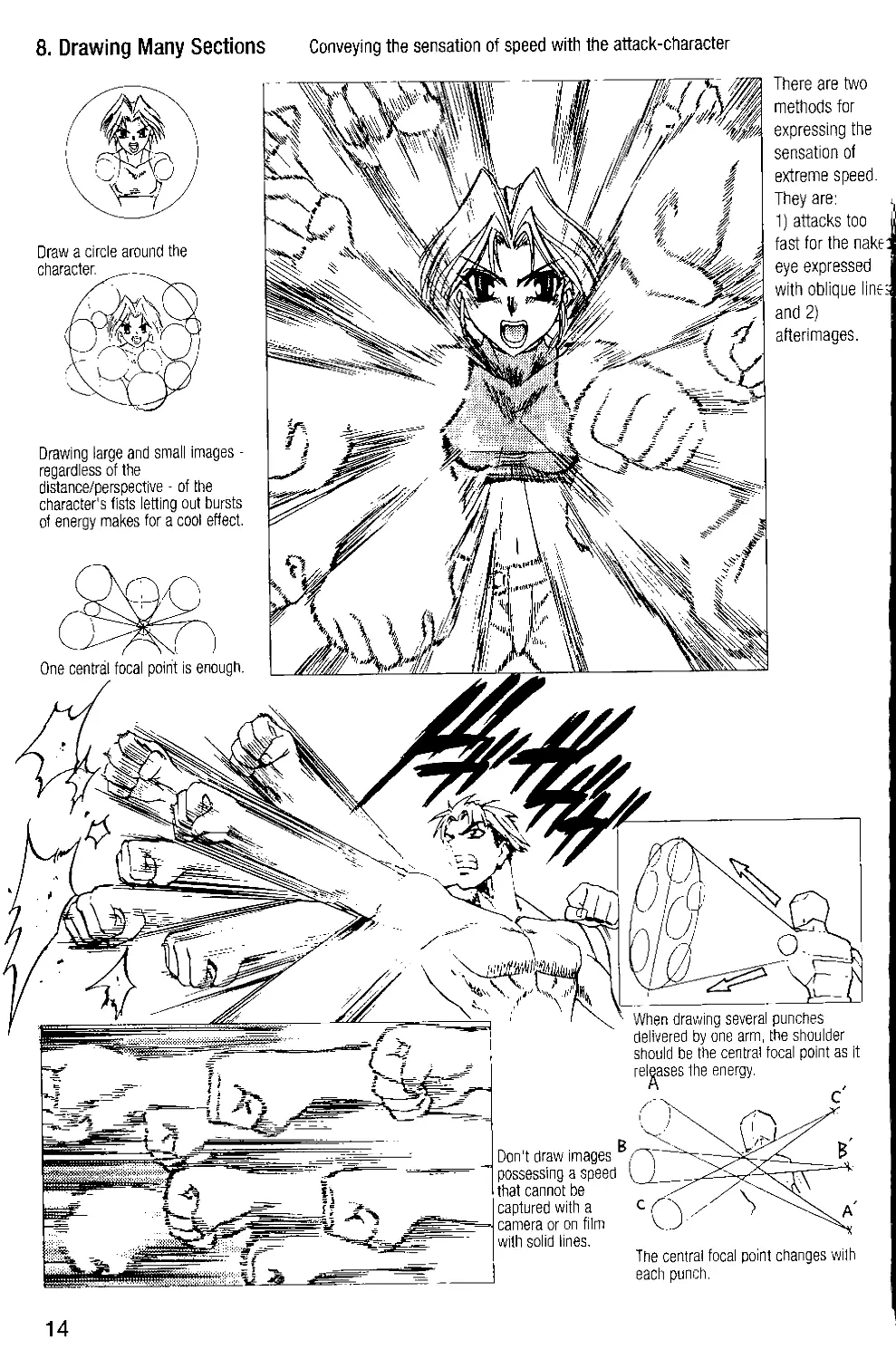
8. Drawing Many Sections Conveying the sensation of speed with the attack-character
Drawing large and small images -
regardless of the
distance/perspective - of the
character's fists letting out bursts
of energy makes for a cool effect.
*•?**<%
$
a'
The central focal point changes with
each punch.
When drawing several punches
delivered by one arm, the shoulder
should be the central focal point as it
releases the energy.
Draw a circle around the
character.
One central focal point is enough.
в
Don't draw images
possessing a speed
that cannot be
captured with a
camera or on film
with solid lines.
There are two
methods for
expressing the
sensation of
extreme speed.
They are:
1) attacks too
fast for the паке
eye expressed
with oblique line:
and 2)
afterimages.
C
14
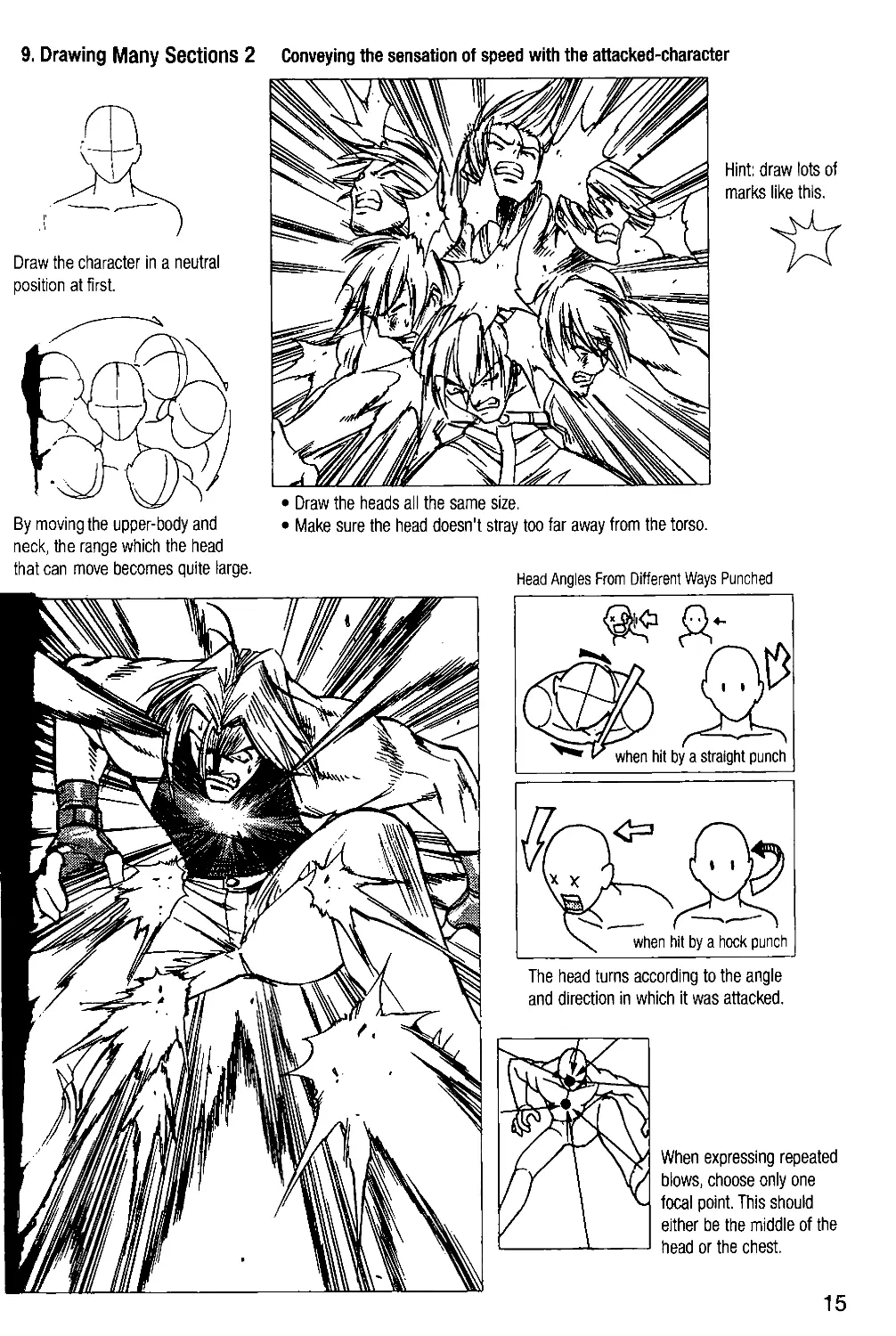
9. Drawing Many Sections 2
Draw the character in a neutral
position at first.
By moving the upper-body and
neck, the range which the head
Conveying the sensation of speed with the attacked-character
• Draw the heads all the same size.
• Make sure the head doesn't stray too far away from the torso.
that can move becomes quite large.
Head Angles From Different Ways Punched
The head turns according to the angle
and direction in which it was attacked.
When expressing repeated
blows, choose only one
focal point. This should
either be the middle of the
head or the chest.
15
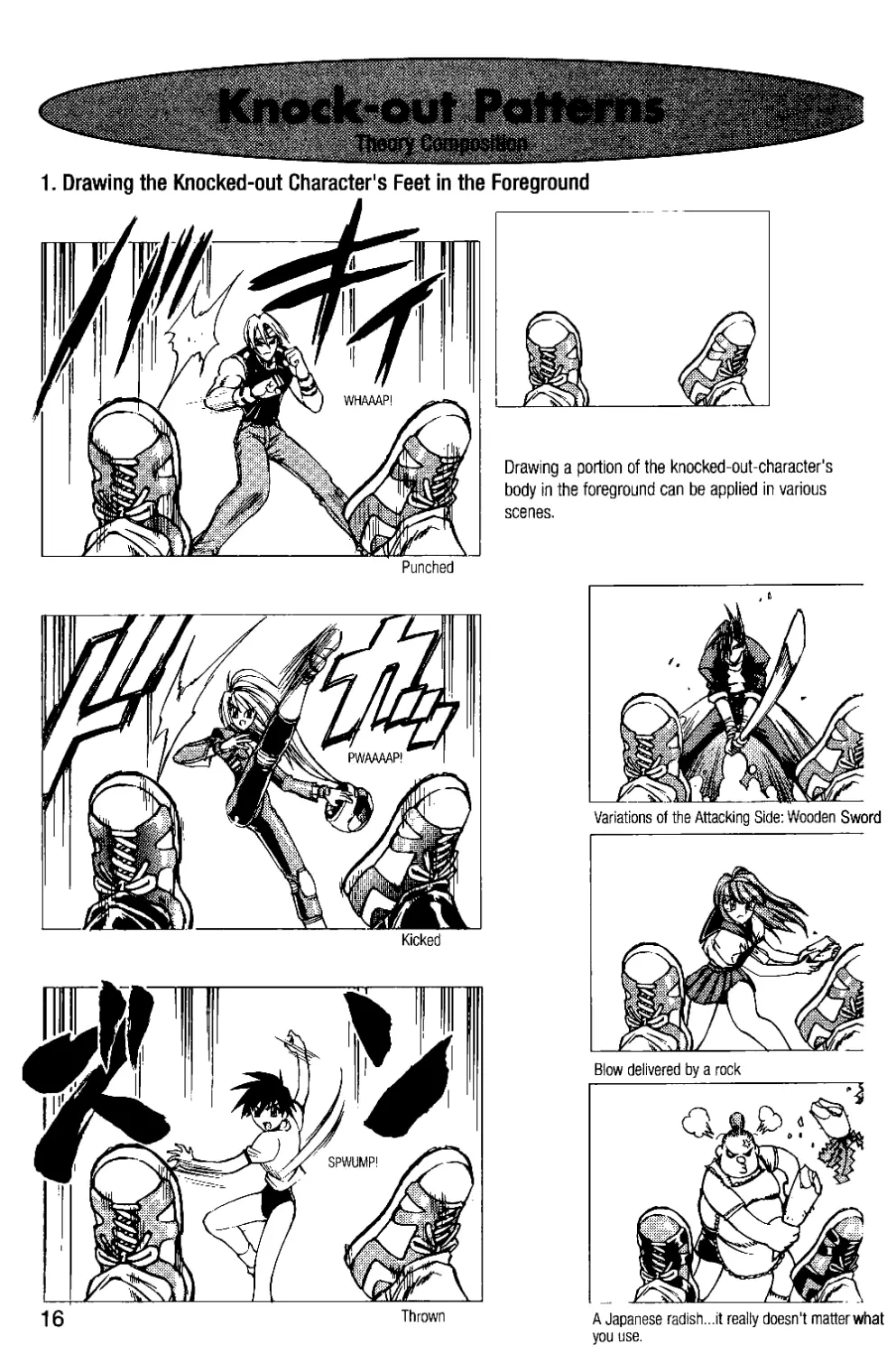
1. Drawing the Knocked-out Character's Feet in the Foreground
Drawing a portion of the knocked-out-character's
body in the foreground can be applied in various
scenes.
Kicked
Variations of the Attacking Side: Wooden Sword
A Japanese radish...it really doesn't matter what
you use.
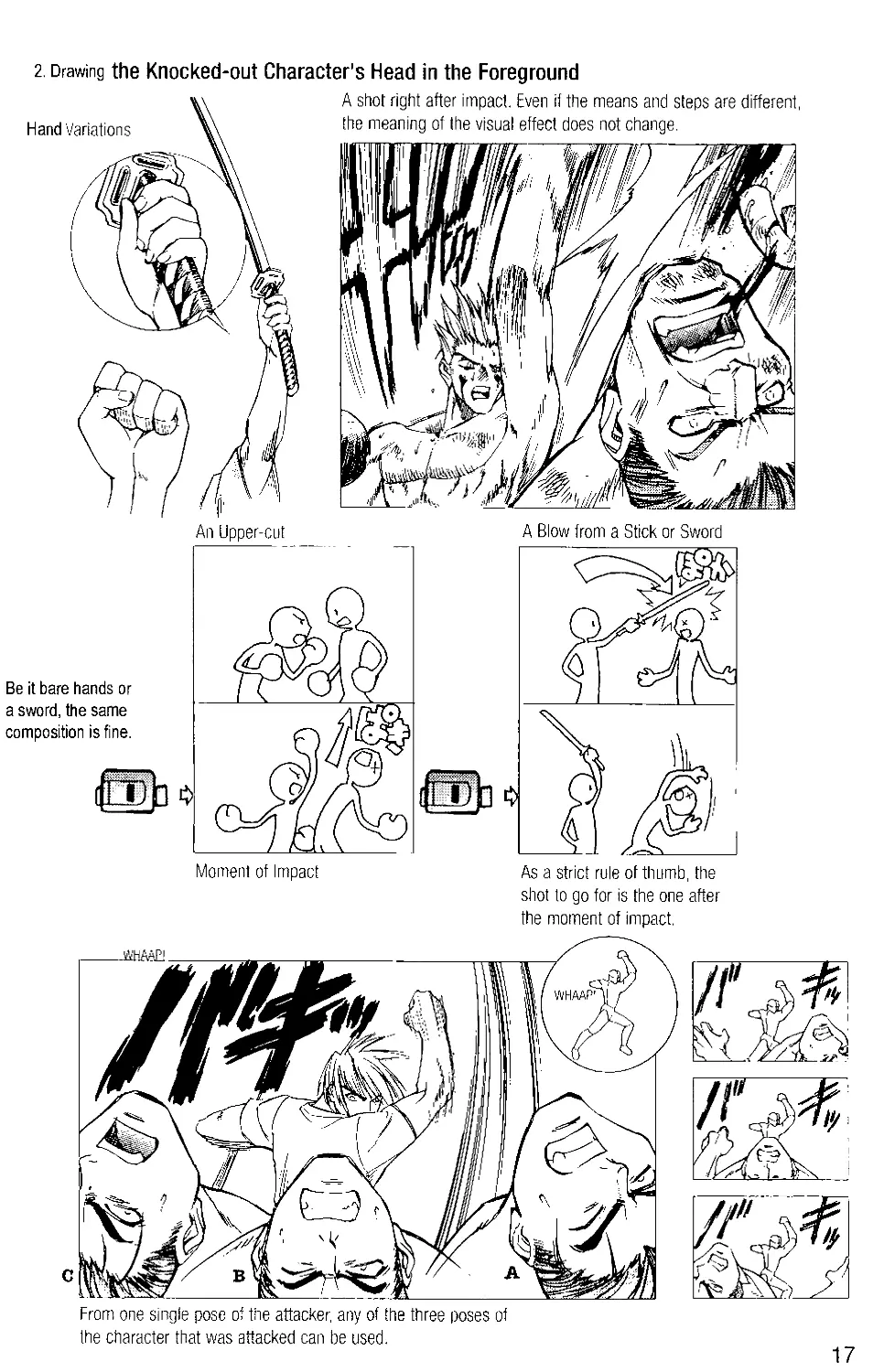
2. Drawing the Knocked-out Character's Head in the Foreground
An Upper-cut	A Blow from a Stick or Sword
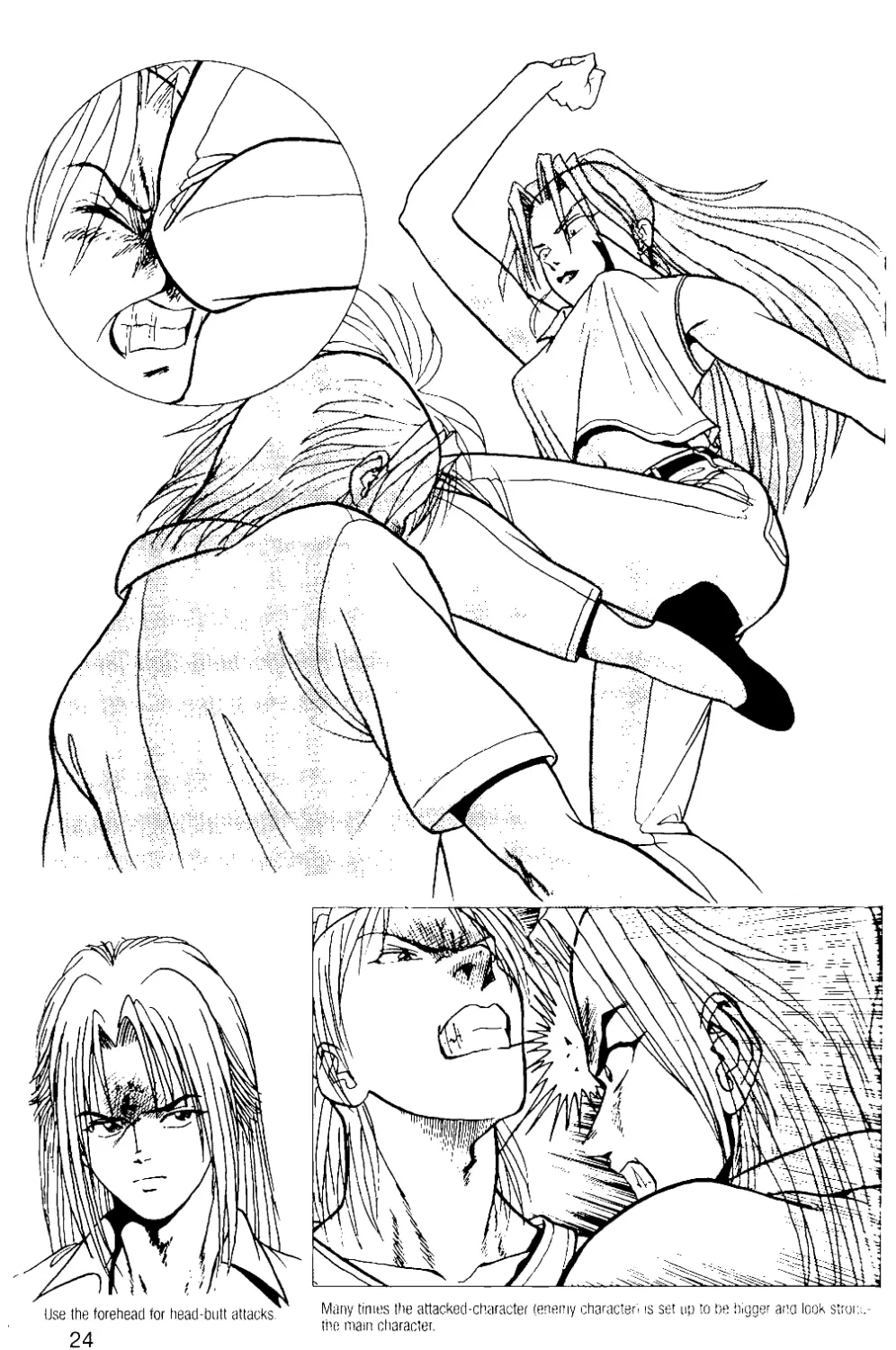
Moment of Impact	As a strict rule of thumb, the
shot to go for is the one after
the moment of impact.
From one single pose of the attacker, any of the three poses of
the character that was attacked can be used.
17
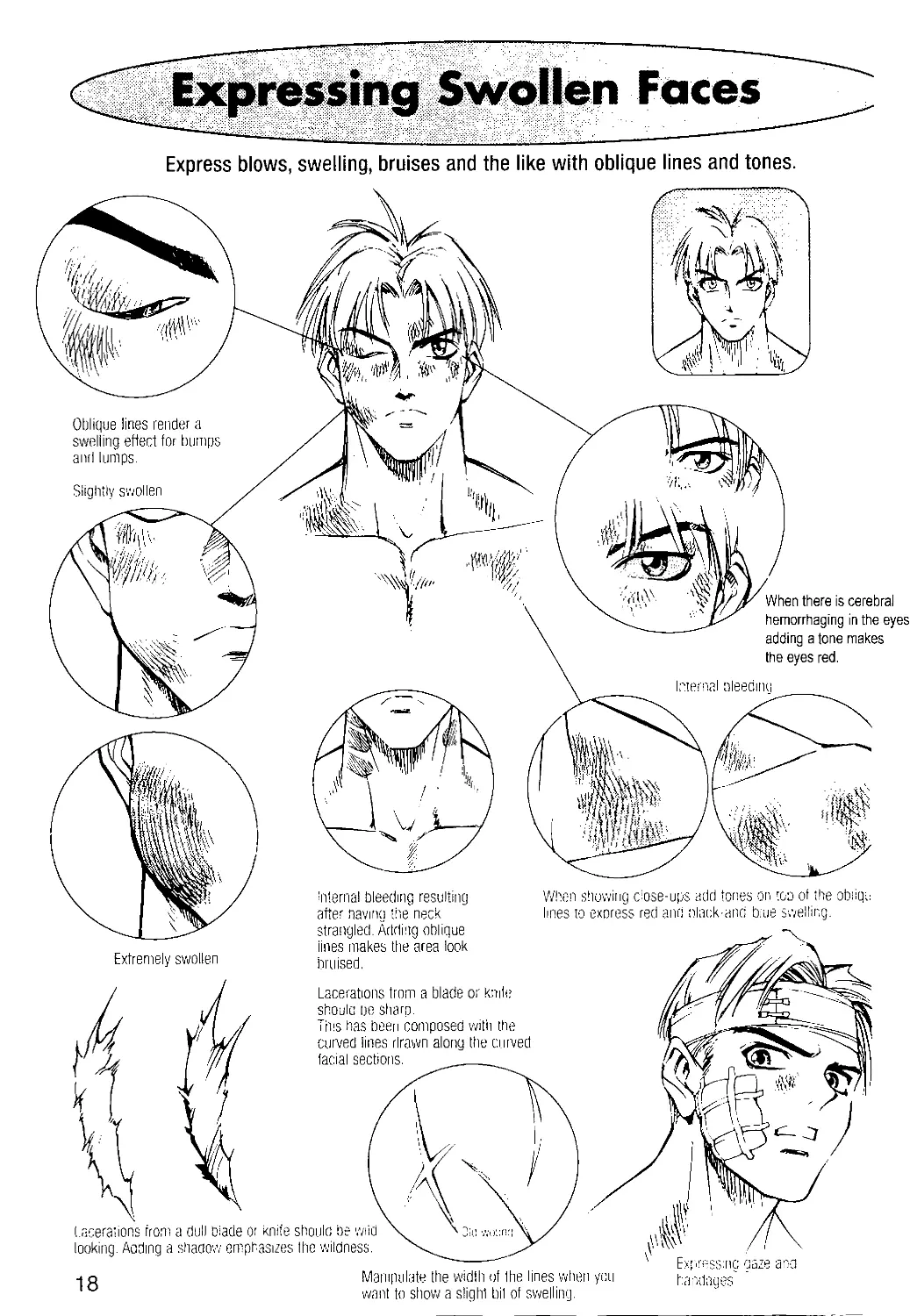
Expressing Swollen Faces
Express blows, swelling, bruises and the like with oblique lines and tones.
Oblique lines render a
swelling effect for bumps
and lumps.
Extremely swollen
When there is cerebral
hemorrhaging in the eyes
adding a tone makes
the eyes red.
When showing dose-ups add tones on too of the obriqu
lines io express red and black-and blue swelling.
Internal bleeding resulting
after having the neck
strangled. Adding oblique
lines makes the area look
bruised.
Stightlv swollen
Internal oleednui
handages
Lacerations from a blade or knde
shoulci pe sharp.
This has been composed with the
curved lines drawn along the curved
facial sections.
t.acera*ions from a dull blade or knife should be wild
looking. Acdmg a shadow emphasizes the wildness.
Manipulate the width of the lines when you
want to sliow a slight bil of swelling.
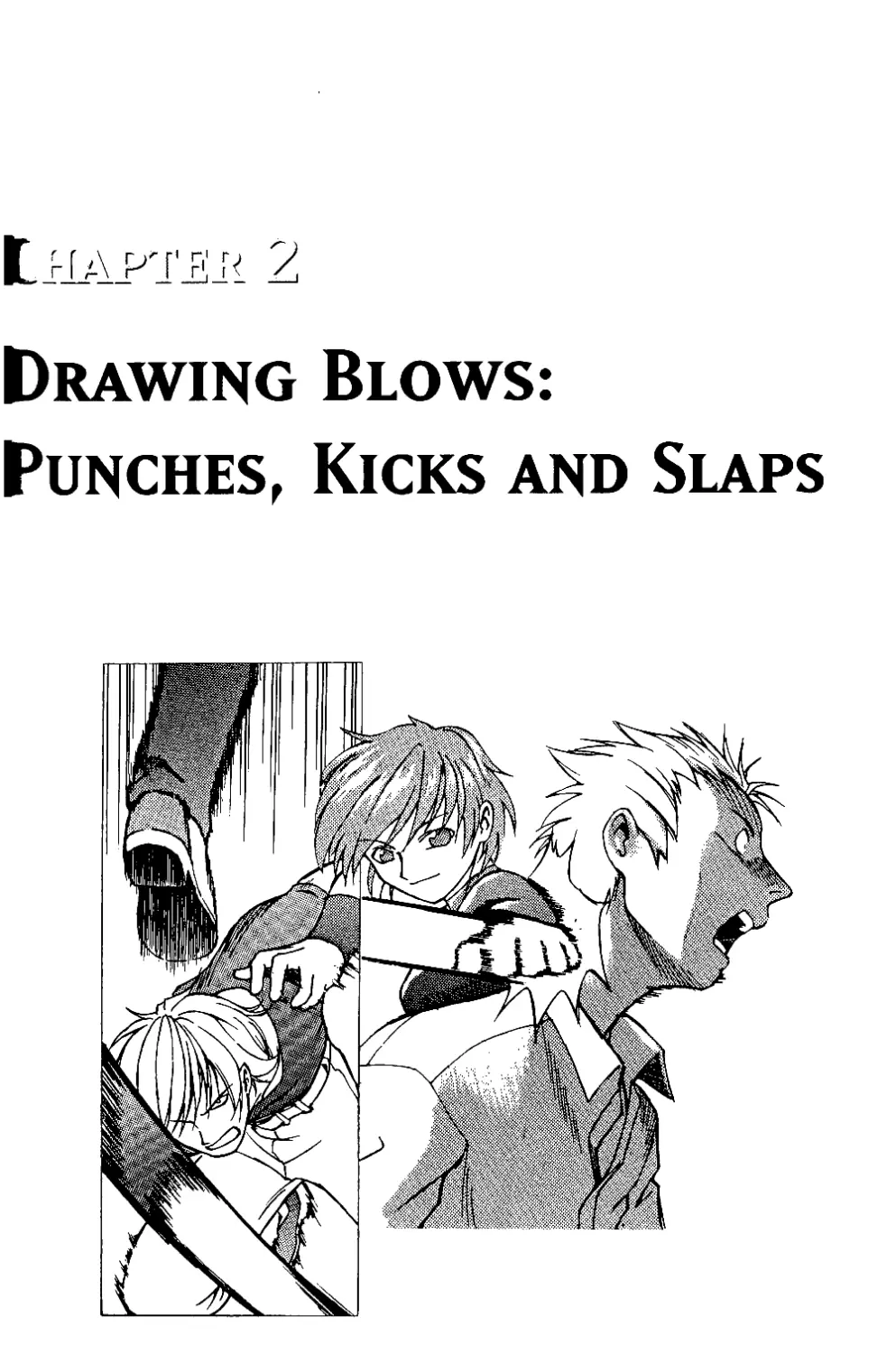
18
Lila2
Drawing Blows:
Punches, Kicks and Slaps
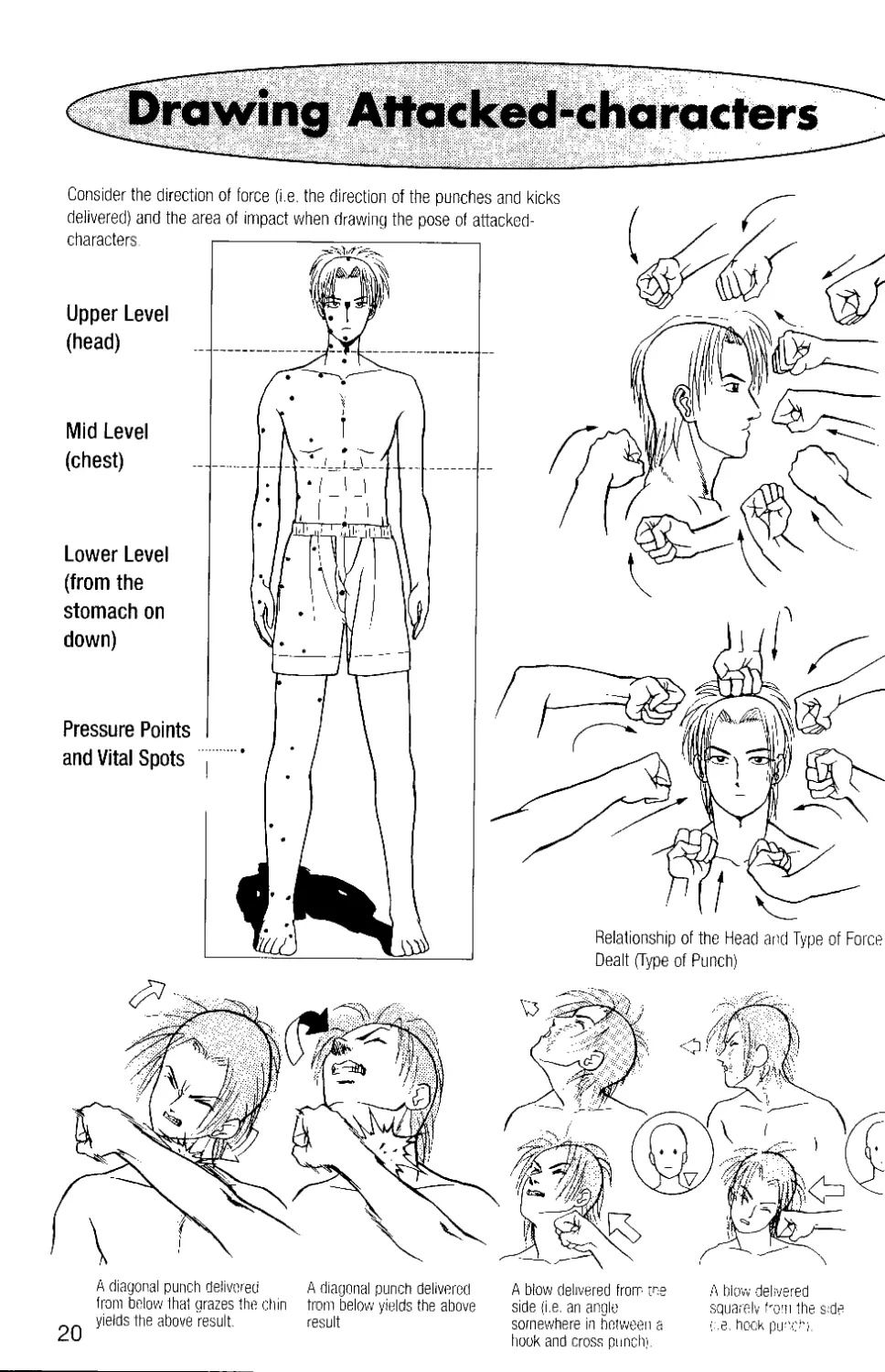
<^Drawing Attacked-characters
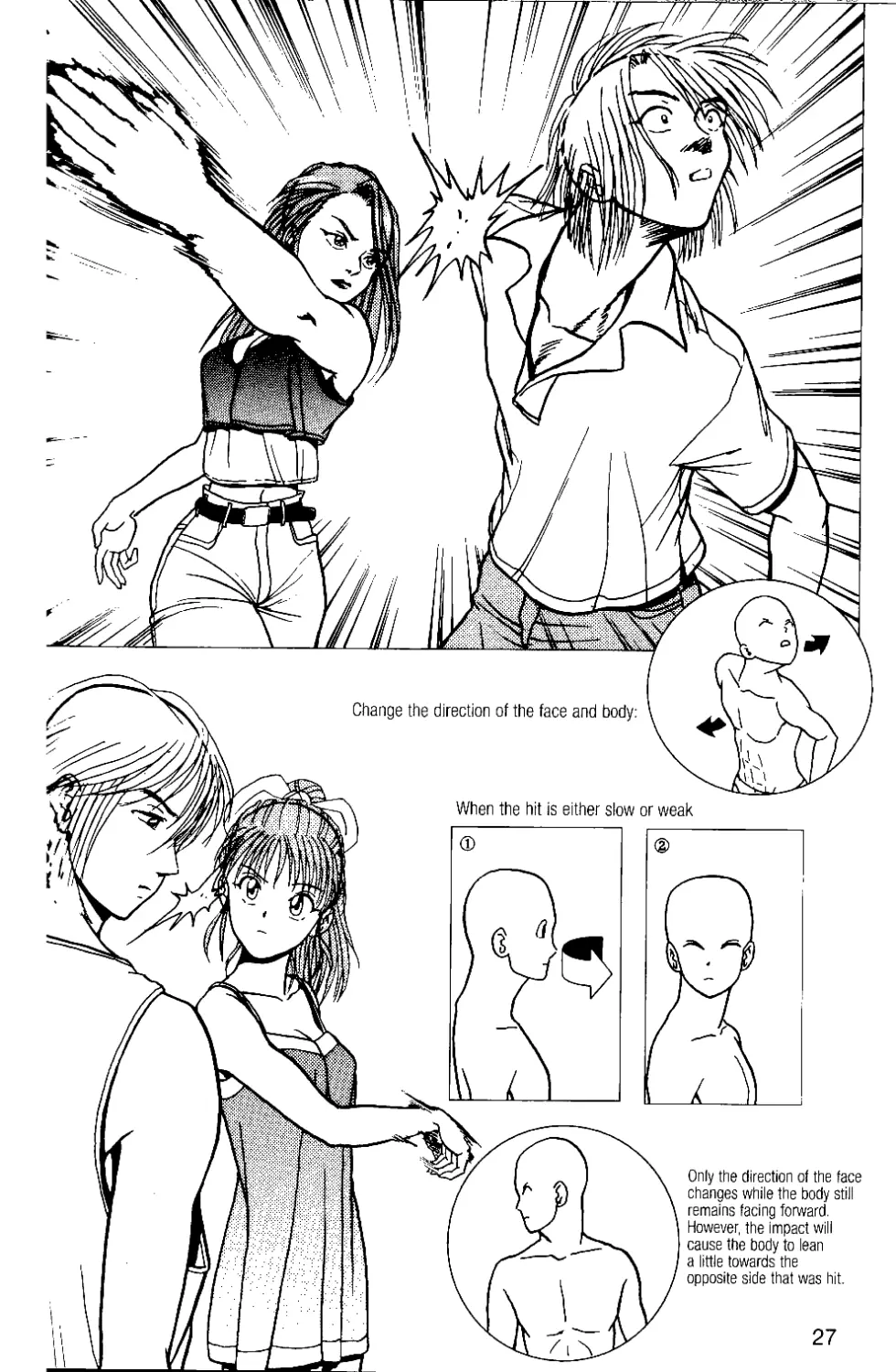
Consider the direction of force (i.e. the direction of the punches and kicks
delivered) and the area of impact when drawing the pose of attacked-
characters.
Upper Level
(head)
Mid Level
(chest)
Lower Level
(from the
stomach on
down)
Pressure Points
and Vital Spots
Relationship of the Head and Type of Force
Dealt (Type of Punch)
A diagonal punch delivered
from below that grazes the ch in
yields the above result.
A diagonal punch delivered
from below yields the above
result
A blow delivered from me
side ij.e. an angle
somewhere in between a
hook and cross pi inch).
A blow delivered
squarely f'om the side
me. hock pir'cm.
20
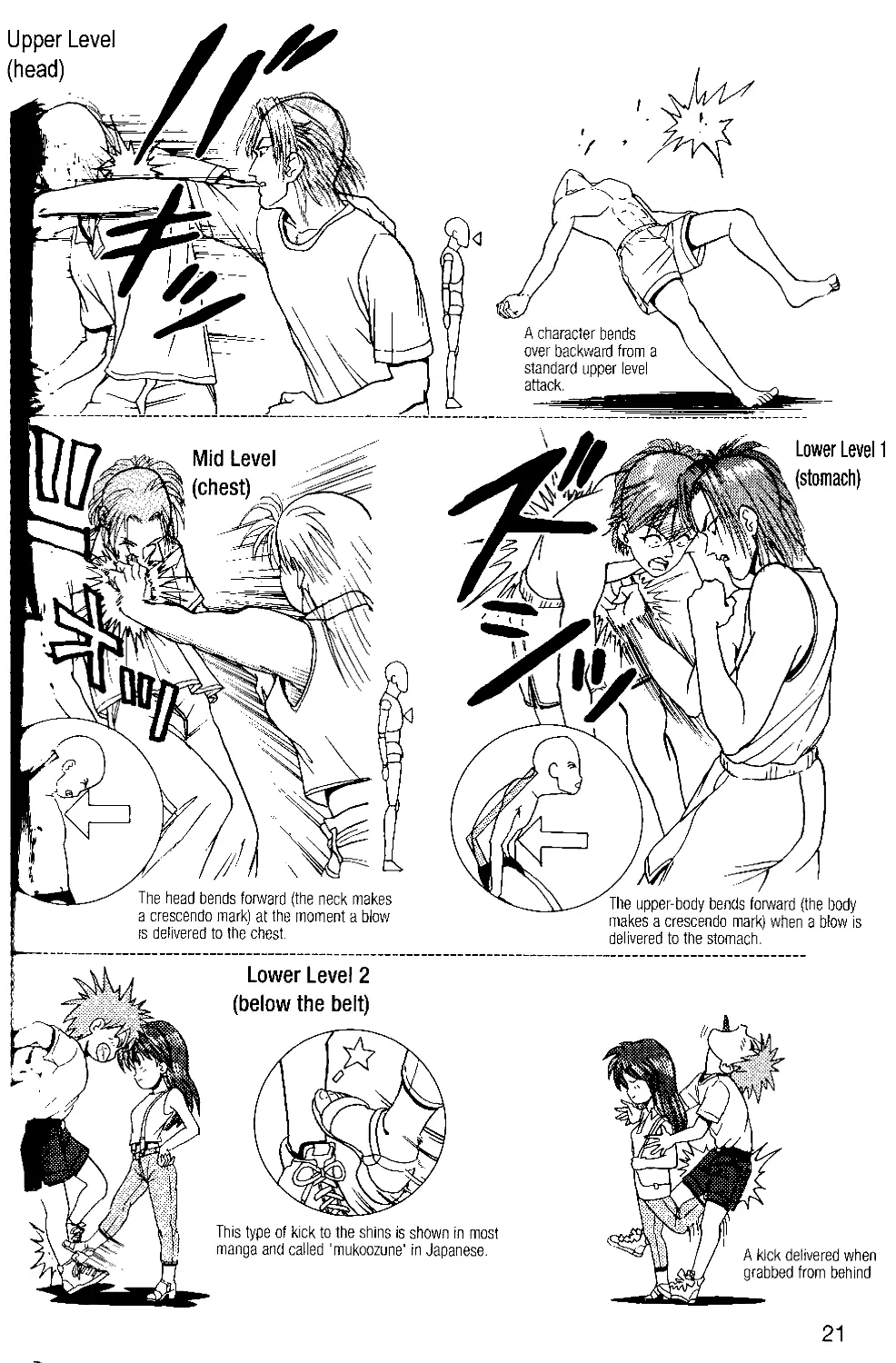
The upper-body bends forward (the body
makes a crescendo mark) when a blow is
delivered to the stomach.
Upper Level
(head)
A character bends
over backward from a
standard upper level
attack.
Mid Level
The head bends forward (the neck makes
a crescendo mark) at the moment a blow
is delivered to the chest.
Lower Level 2
(below the belt)
This type of kick to the shins is shown in most
manga and called 'mukoozune' in Japanese.
A kick delivered when
grabbed from behind
Lower Level 1
(stomach)
21

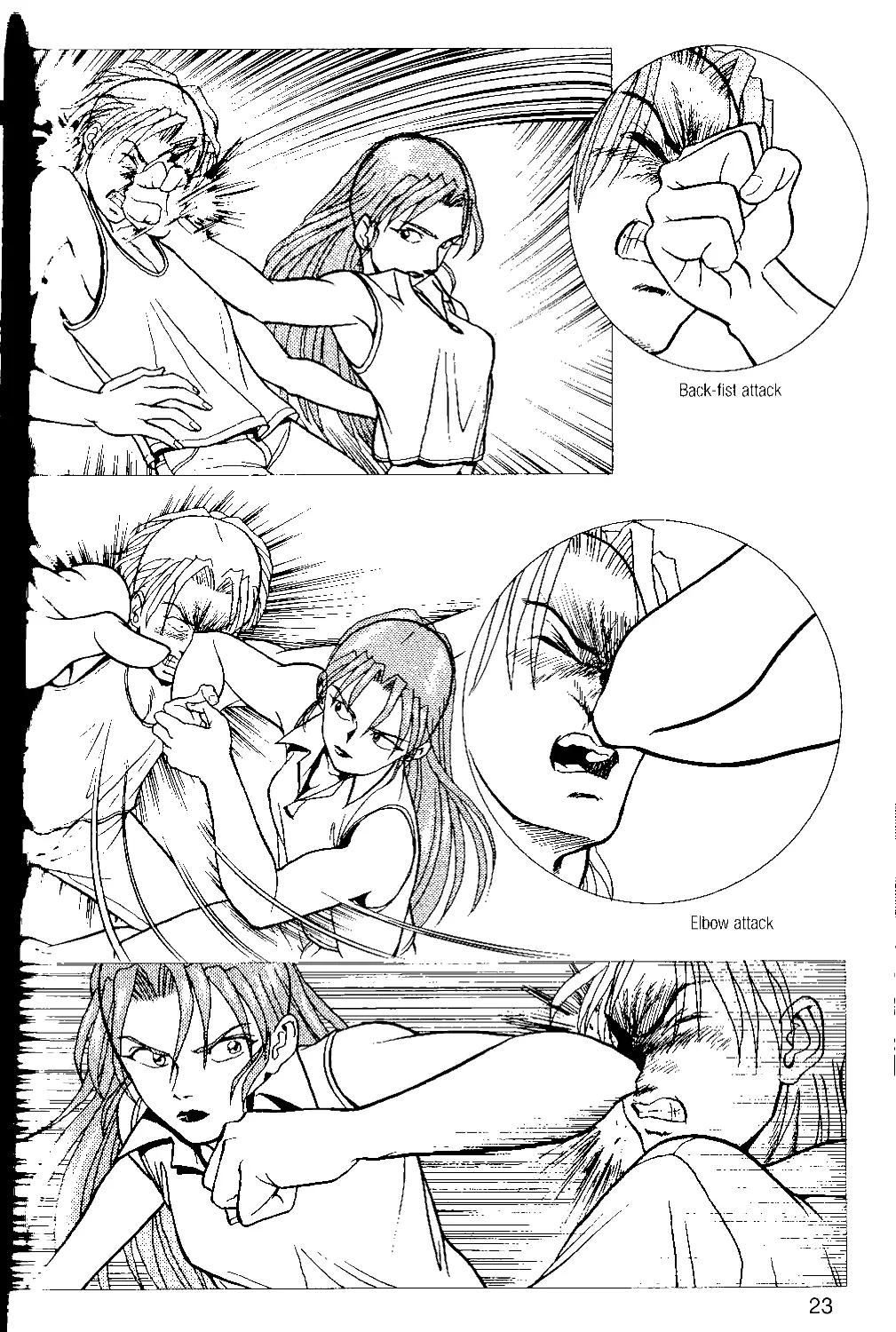
Back-fist attack
Elbow attack

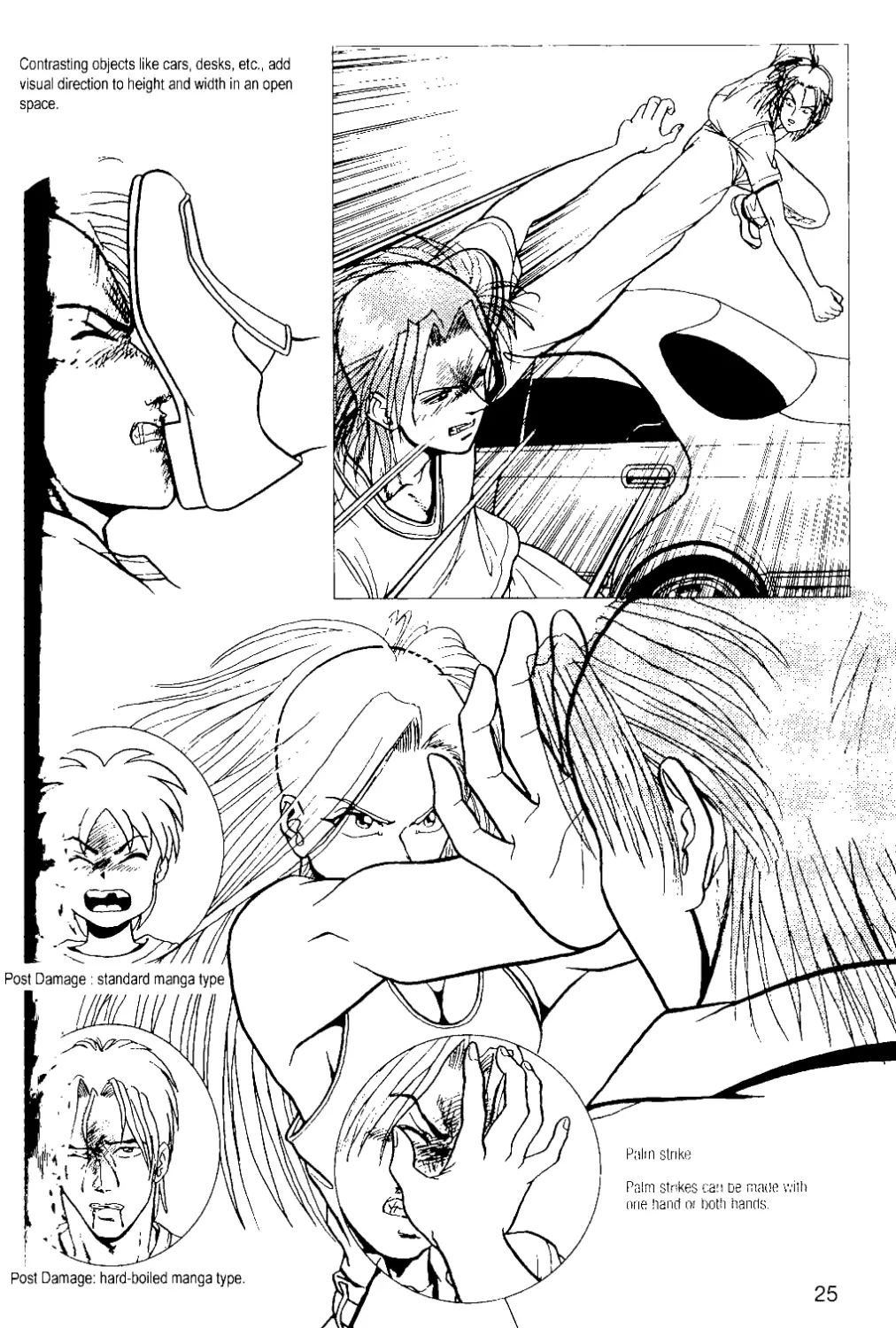
Post Damage : standard manga type
Contrasting objects like cars, desks, etc., add
visual direction to height and width in an open
space.
Palm strike
Post Damage: hard-boiled manga type.
Palm strikes can oe mace with
one hand oi both hands.
25
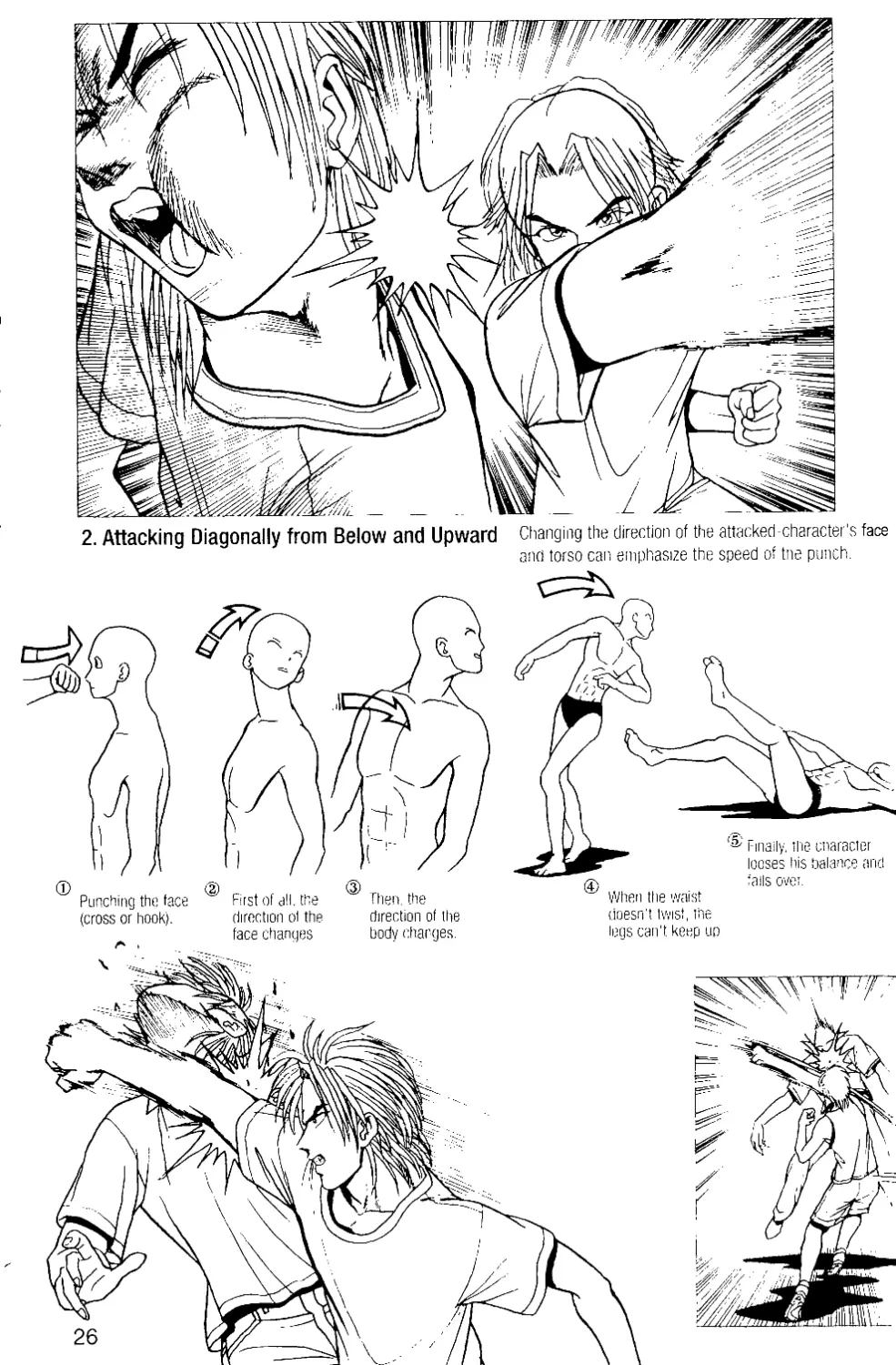
2. Attacking Diagonally from Below and Upward
Changing the direction of the attacked-character's face
and torso can emphasize the speed of tne punch.

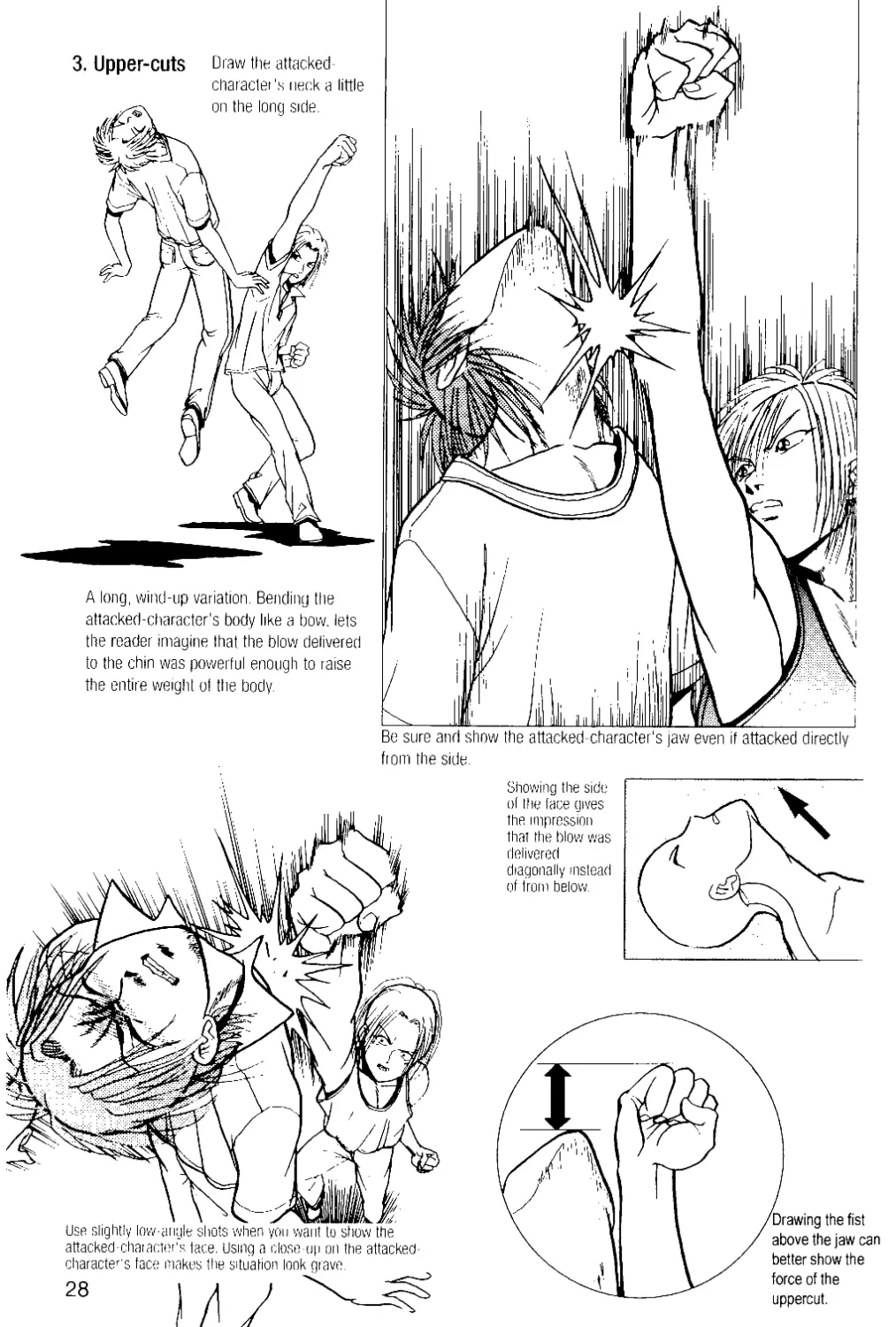
3. Upper-CUtS Draw the attacked
character's neck a little
A long, wind-up variation. Bending the
attacked-character's body like a bow. lets
the reader imagine that the blow delivered
to the chin was powerful enough to raise
the entire weight of the body.
Be sure and show the attacked-character's jaw even if attacked directly
from the side.
Use slightly low-angle shots when you want to show the
attacked-character's lace. Using a close-up on the attacked-
characters face makes the situation look grave.
“ I /I 7
Showing the side
of the face gives
the impression
that the blow was
delivered
diagonally instead
of from below
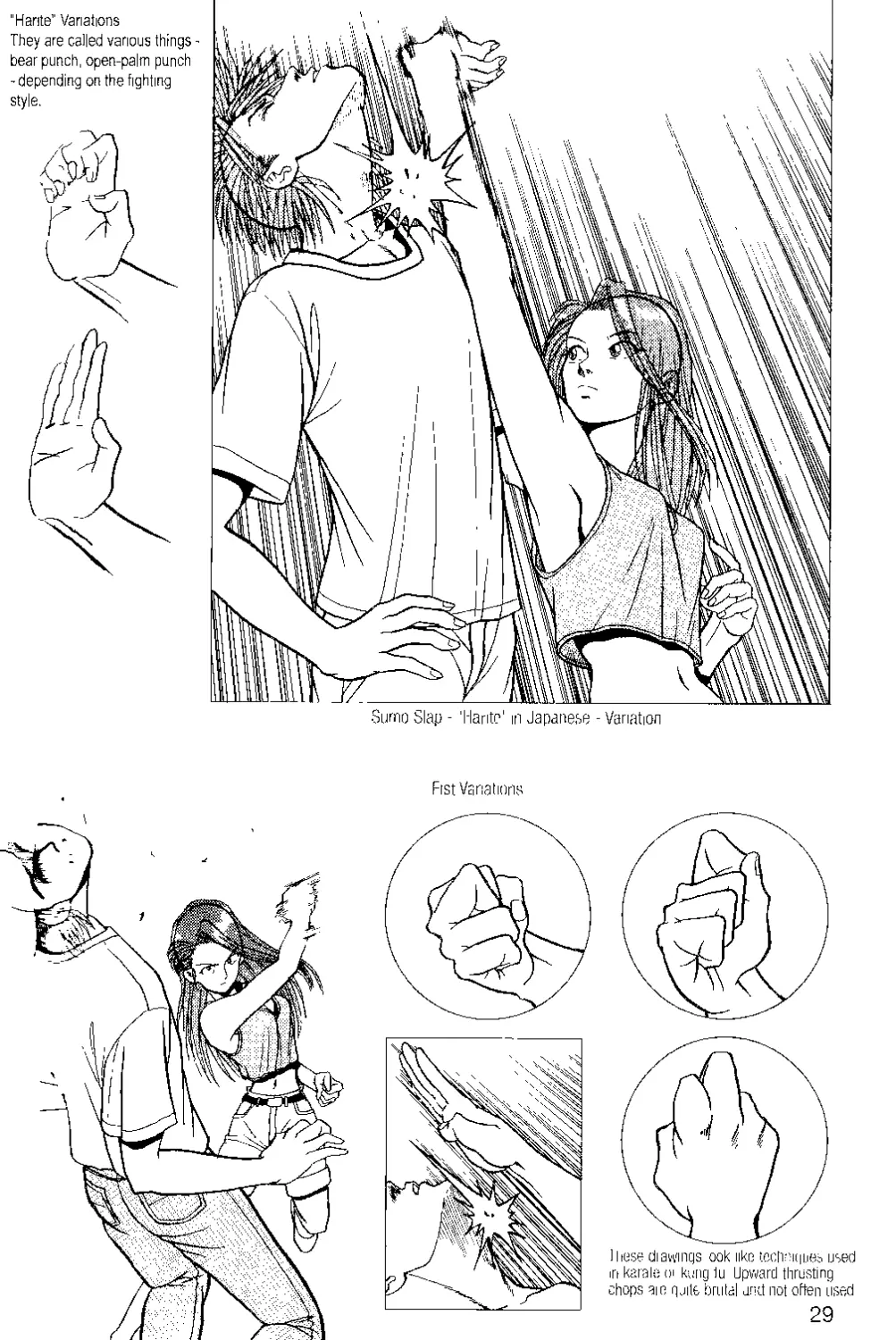
"Hante'' Variations
They are called various things -
bear punch, open-palm punch
-depending on the fighting
style.
Sumo Slap - Tlantrn IN Japdiie.se - vuuauuii
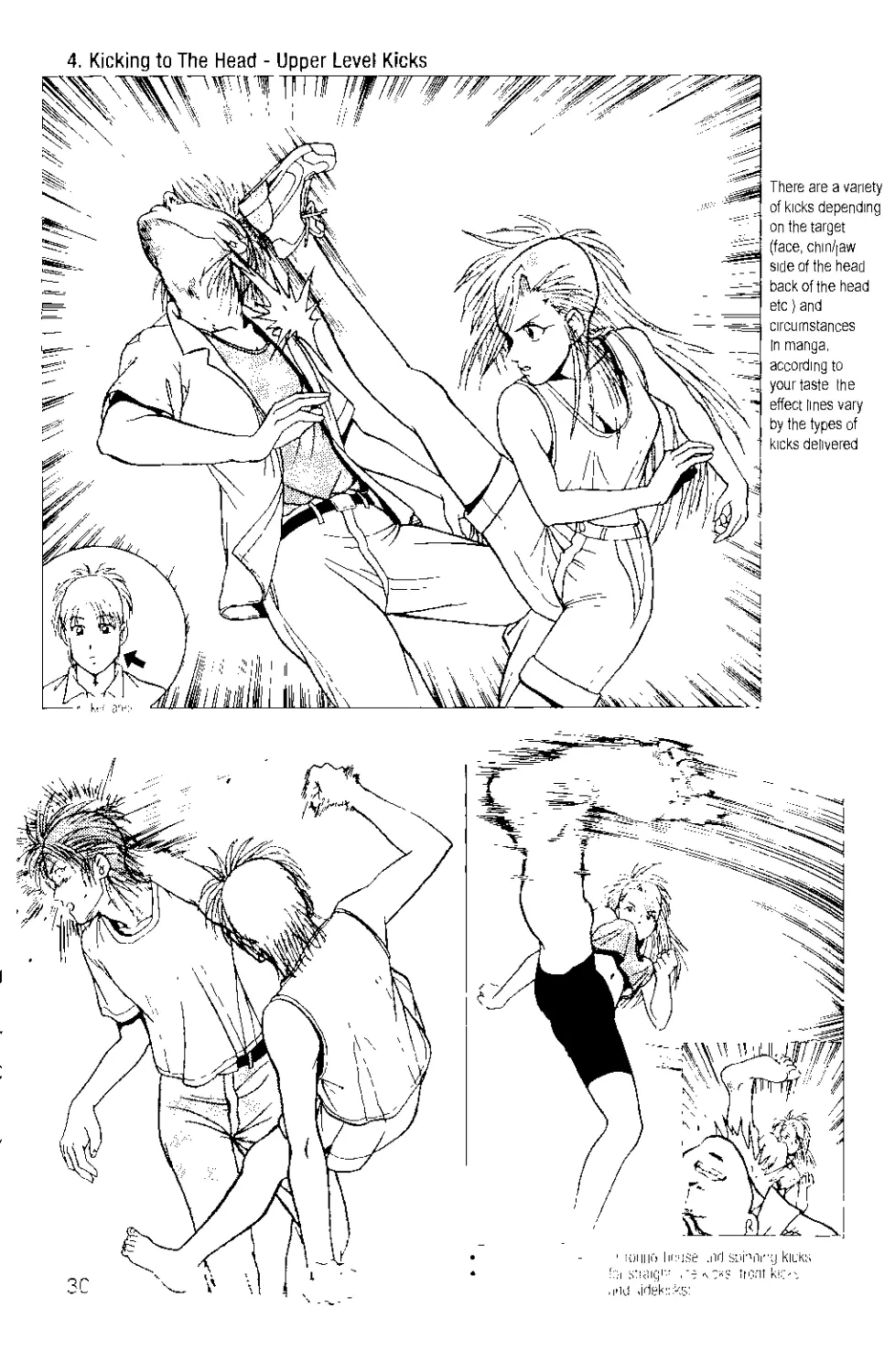
4. Kicking to The Head - Upper Level Kicks
i here are a variety
f kicks depending
n the target
(face, chin/,aw
side of the head
back of the head
etc) and
circumstances
In manga,
according to
your taste lhe
effect lines vary
by the types of
kicks delivered

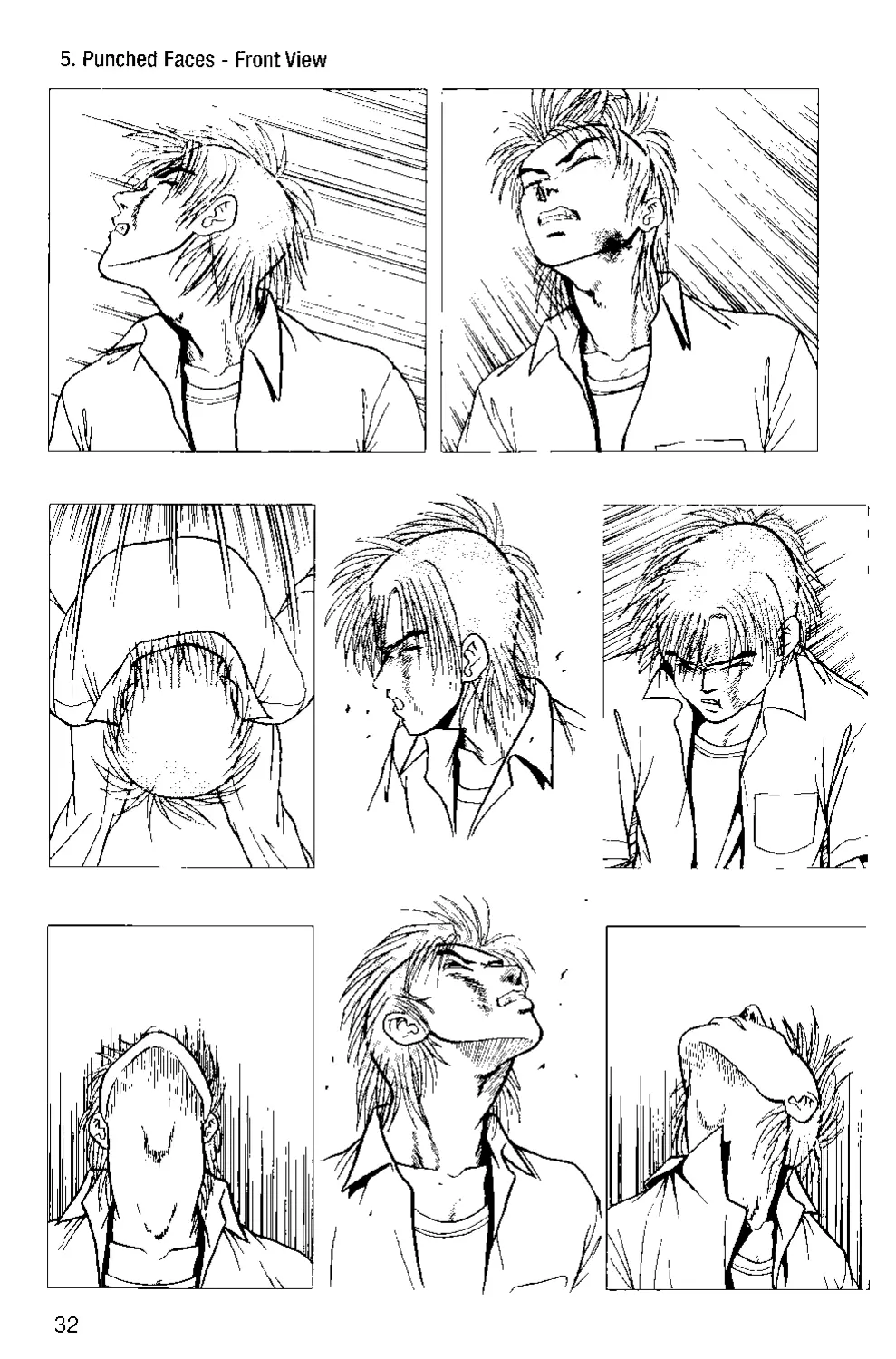
5. Punched Faces - Front View
32
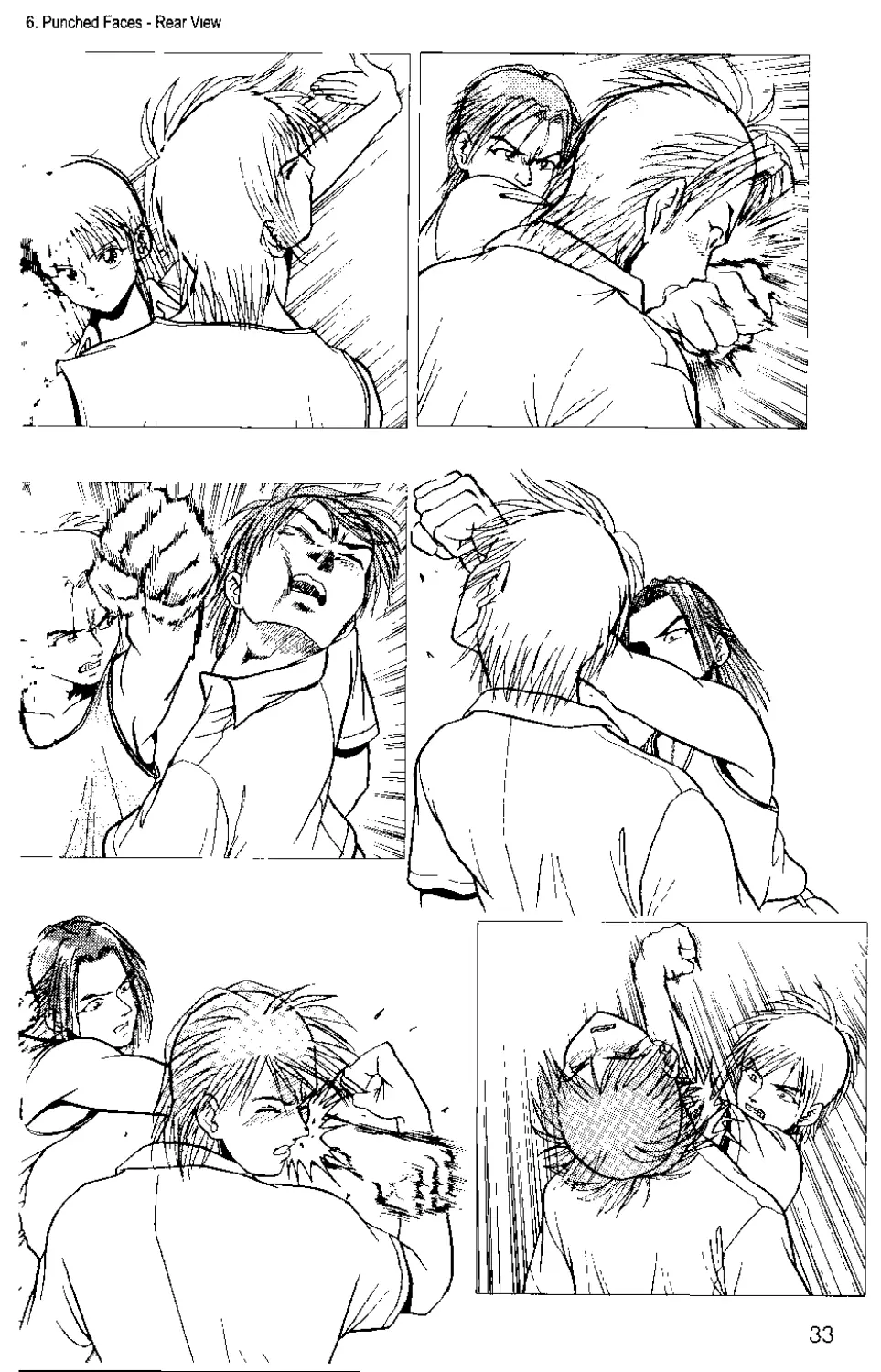
6. Punched Faces - Rear View
33
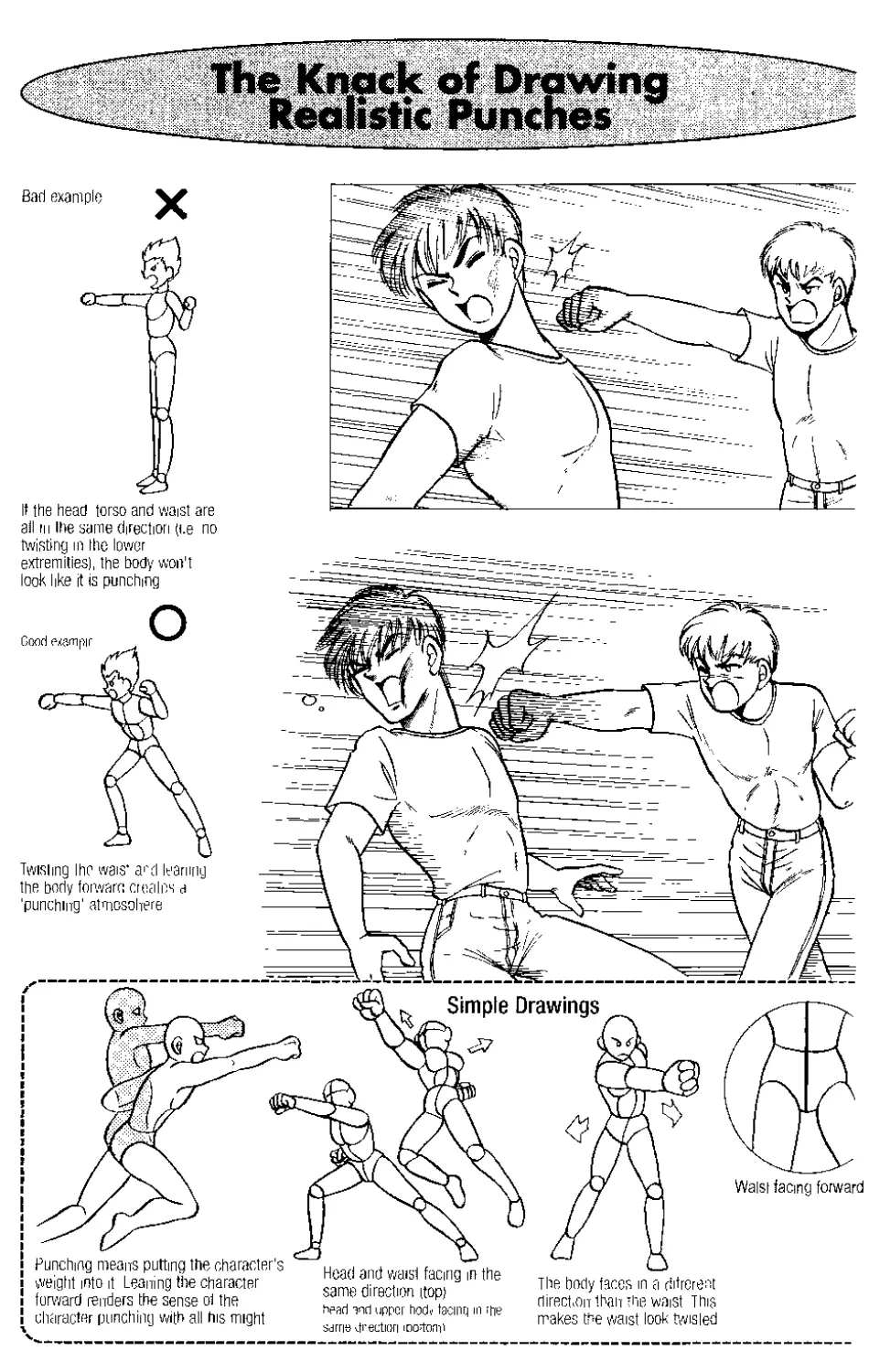
The Knack of Drawing
Realistic Punches
It the head torso and waist are
all in Ibe same direction (i.e no
twisting in Hie lower
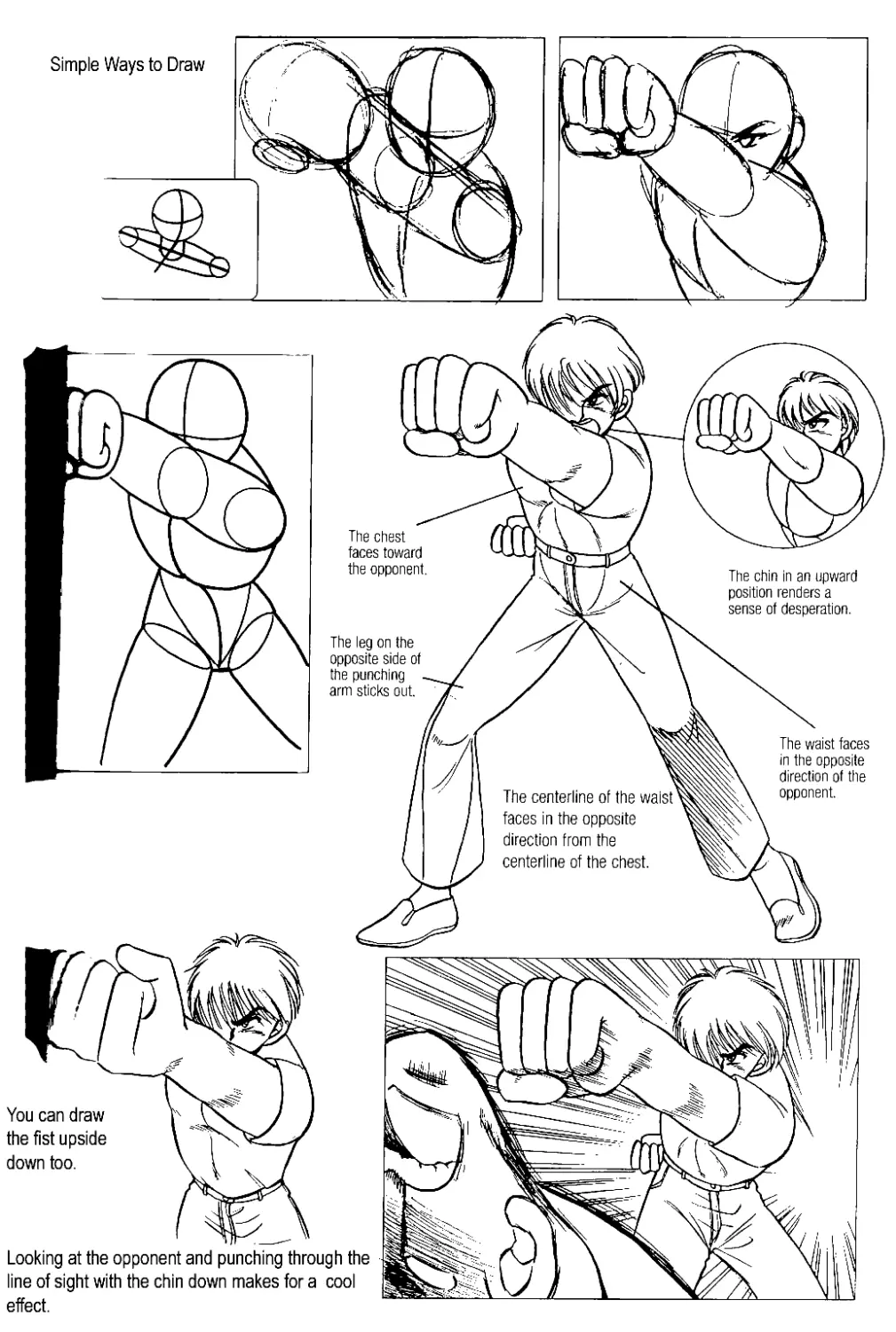
Simple Ways to Draw
You can draw
the fist upside
down too.
The chin in an upward
position renders a
sense of desperation.
The waist faces
in the opposite
direction of the
opponent.
Looking at the opponent and punching through the
line of sight with the chin down makes for a cool
effect.
The chest
faces toward
the opponent.
The leg on the
opposite side of
the punching
arm sticks out.
The centerline of the waist
faces in the opposite
direction from the
centerline of the chest.
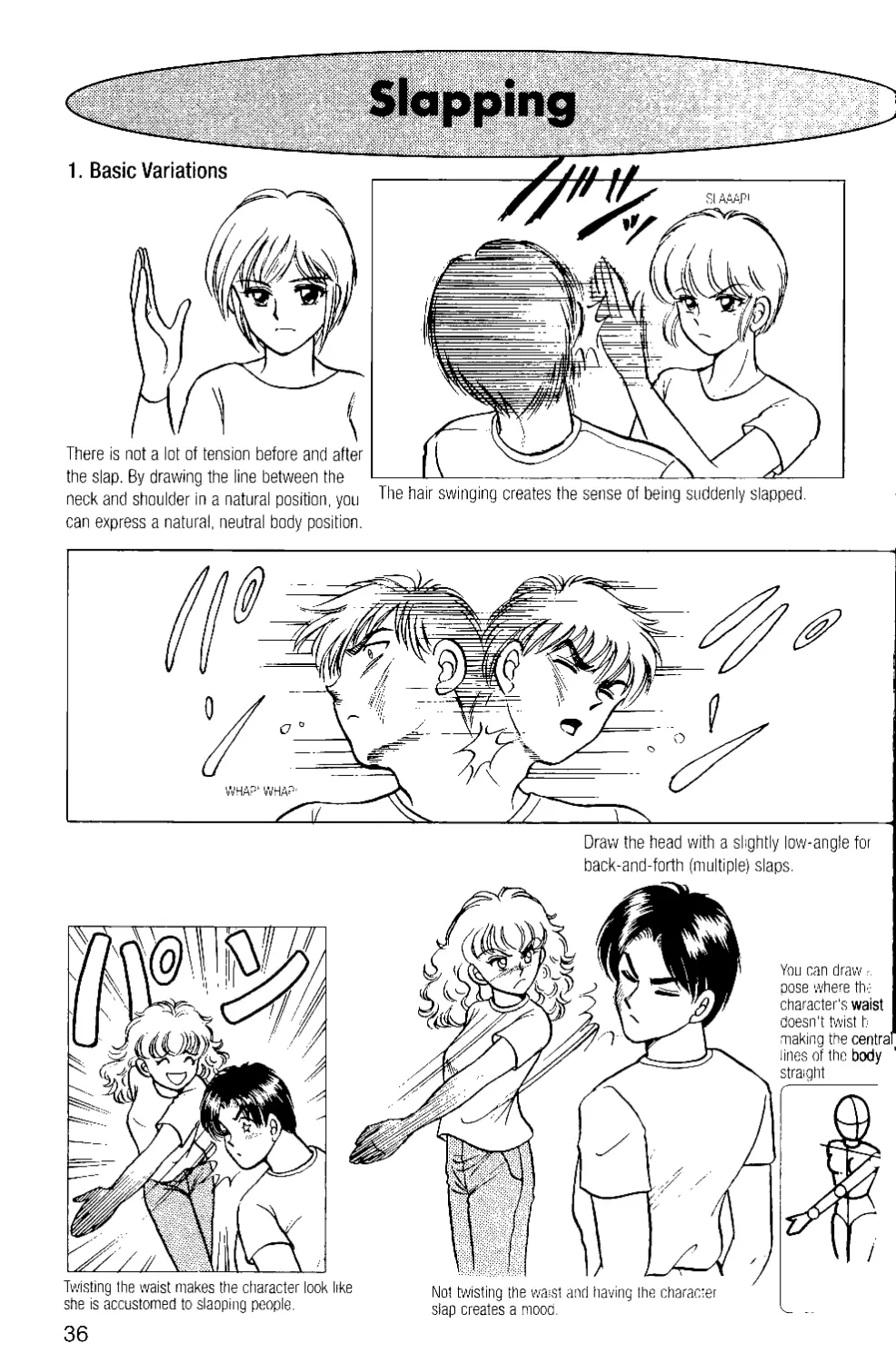
neck and shoulder in a natural position, you The hair swinging creates the sense of being suddenly slapped.
can express a natural, neutral body position.
Draw the head with a slightly low-angle for
back-and-forth (multiple) slaps.
36
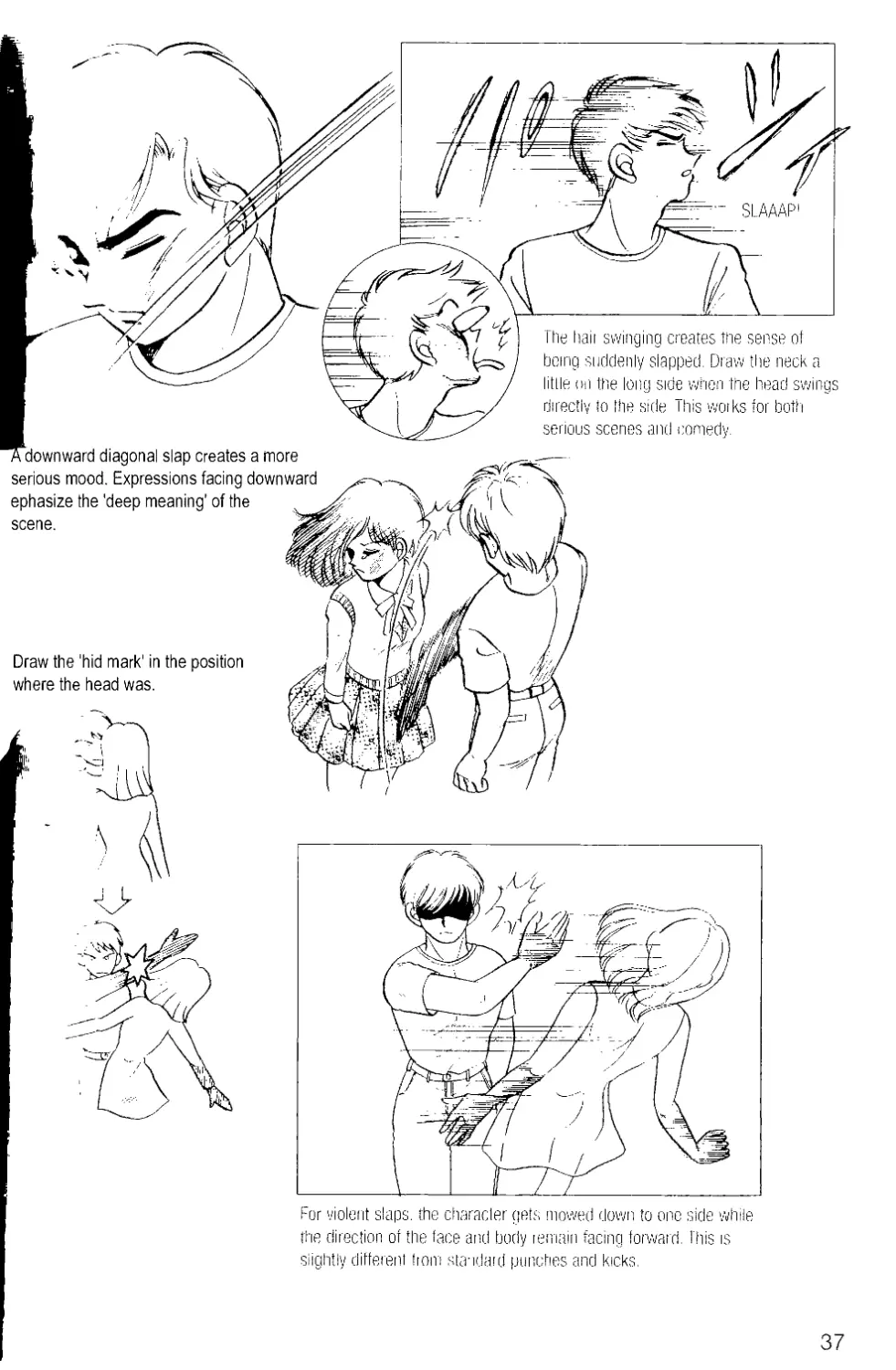
For violent slaps, the character gets mowed down to one side while
the direction of the face and body icmaiii facing forward. This is
slightly different from staudaid punches and kicks.
downward diagonal slap creates a more
serious mood. Expressions facing downward
ephasize the 'deep meaning' of the
scene.
Draw the 'hid mark1 in the position
where the head was.
The hail swinging creates the sense of
being suddenly slapped. Draw the neck a
little on the long side when the head swings
directly to the side This woiks for bothi
serious scenes and comedy.
37
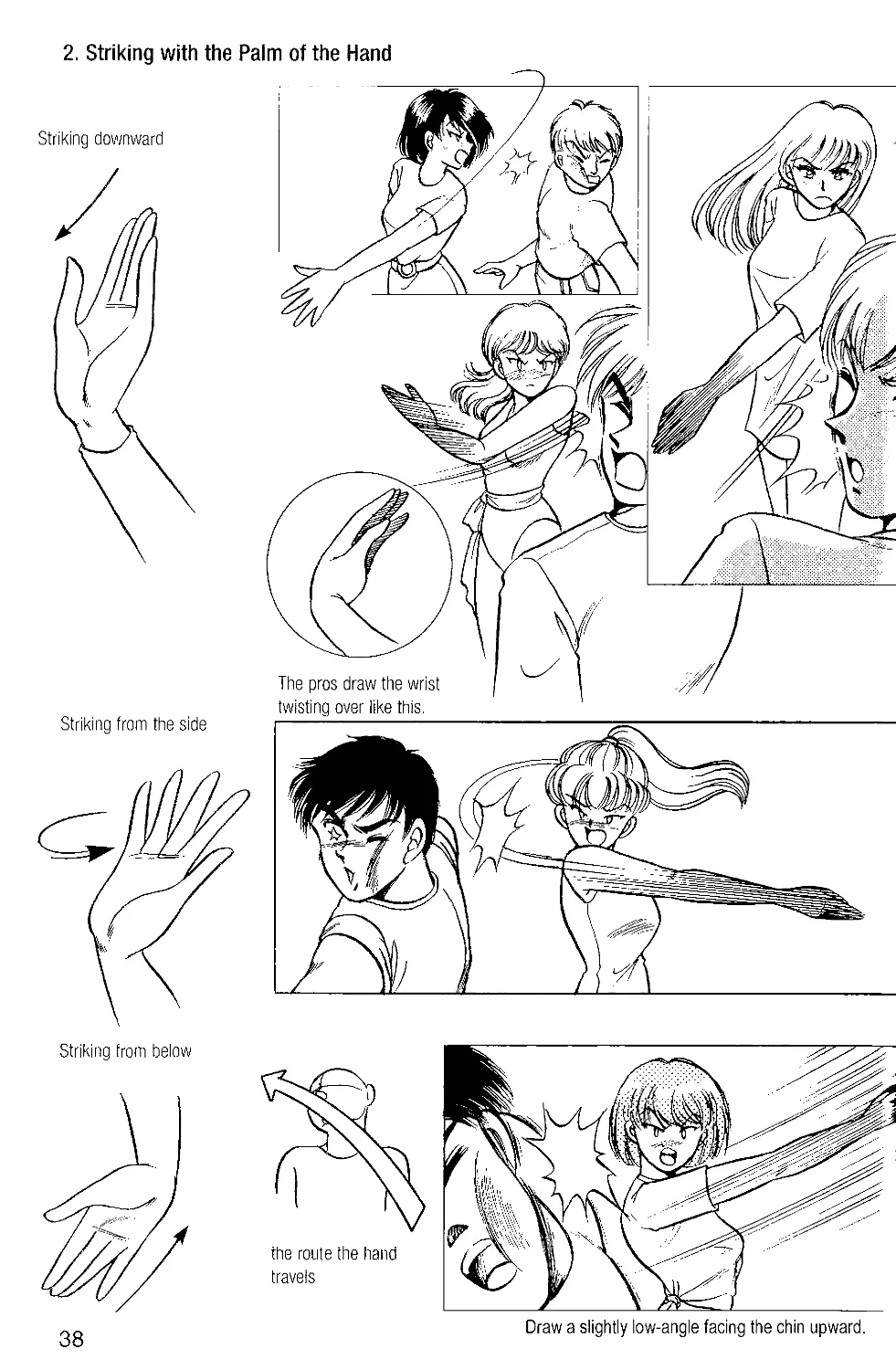
2. Striking with the Palm of the Hand
Draw a slightly low-angle facing the chin upward.
38
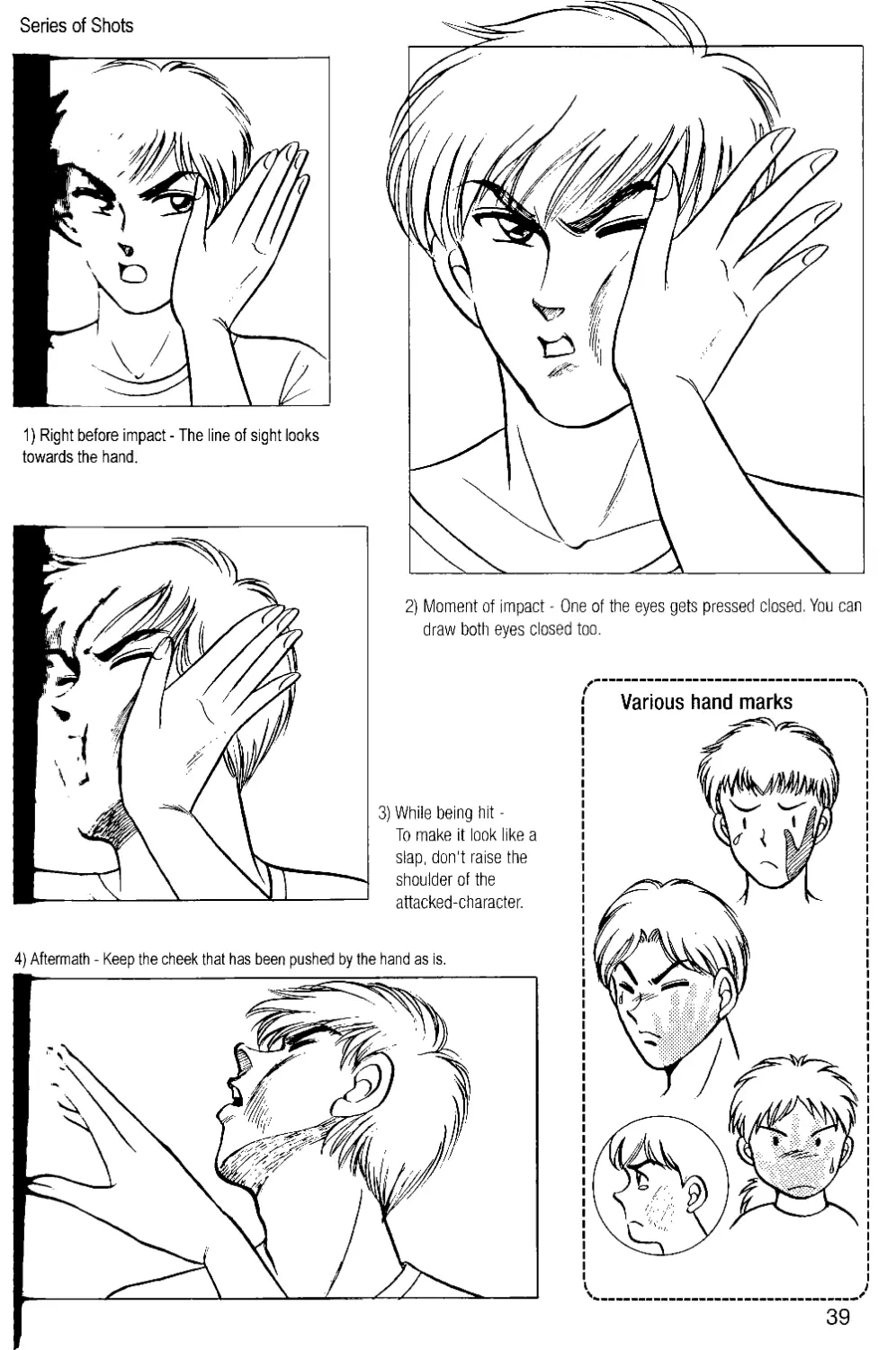
Series of Shots
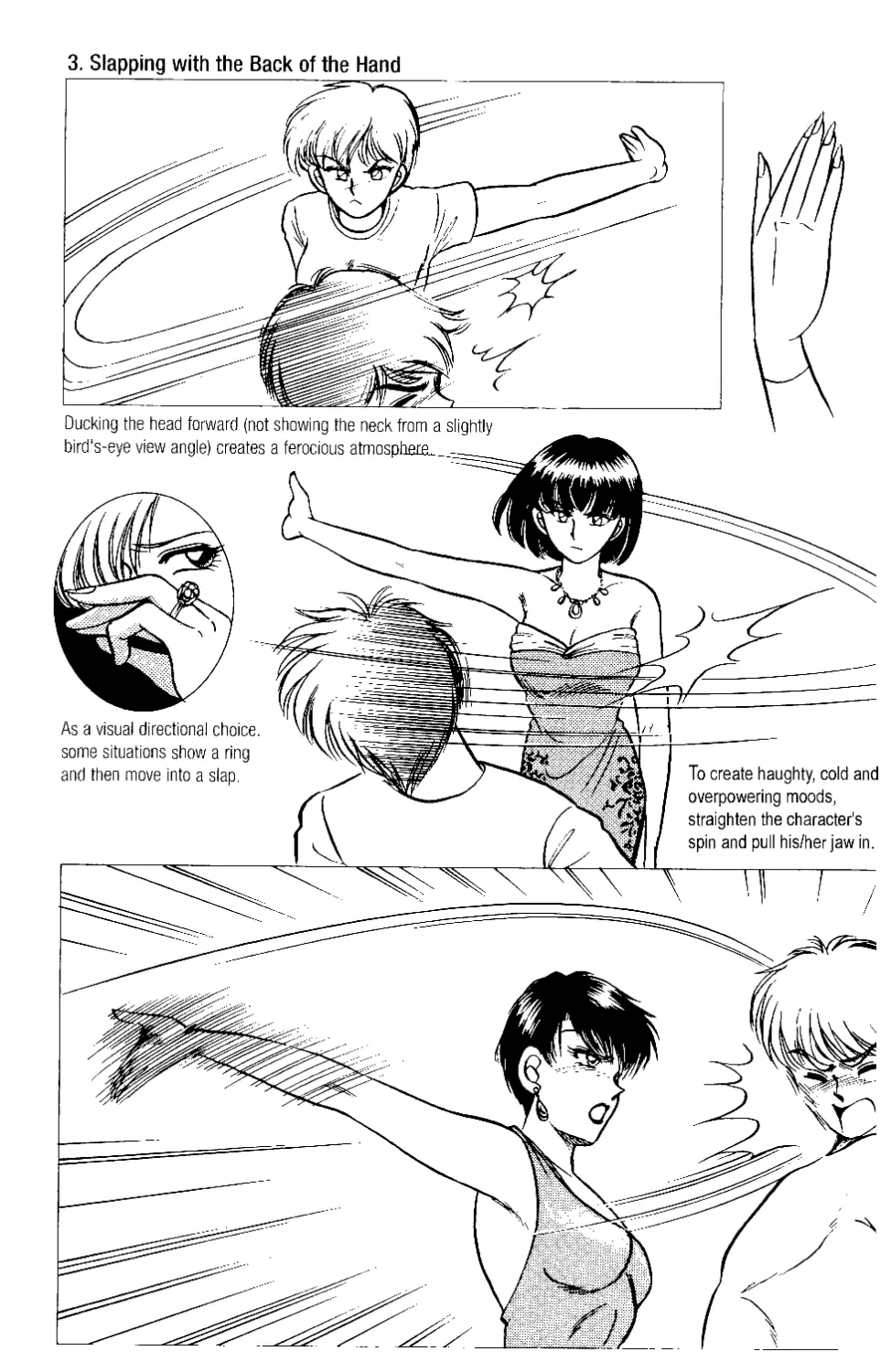
3. Slapping with the Back of the Hand
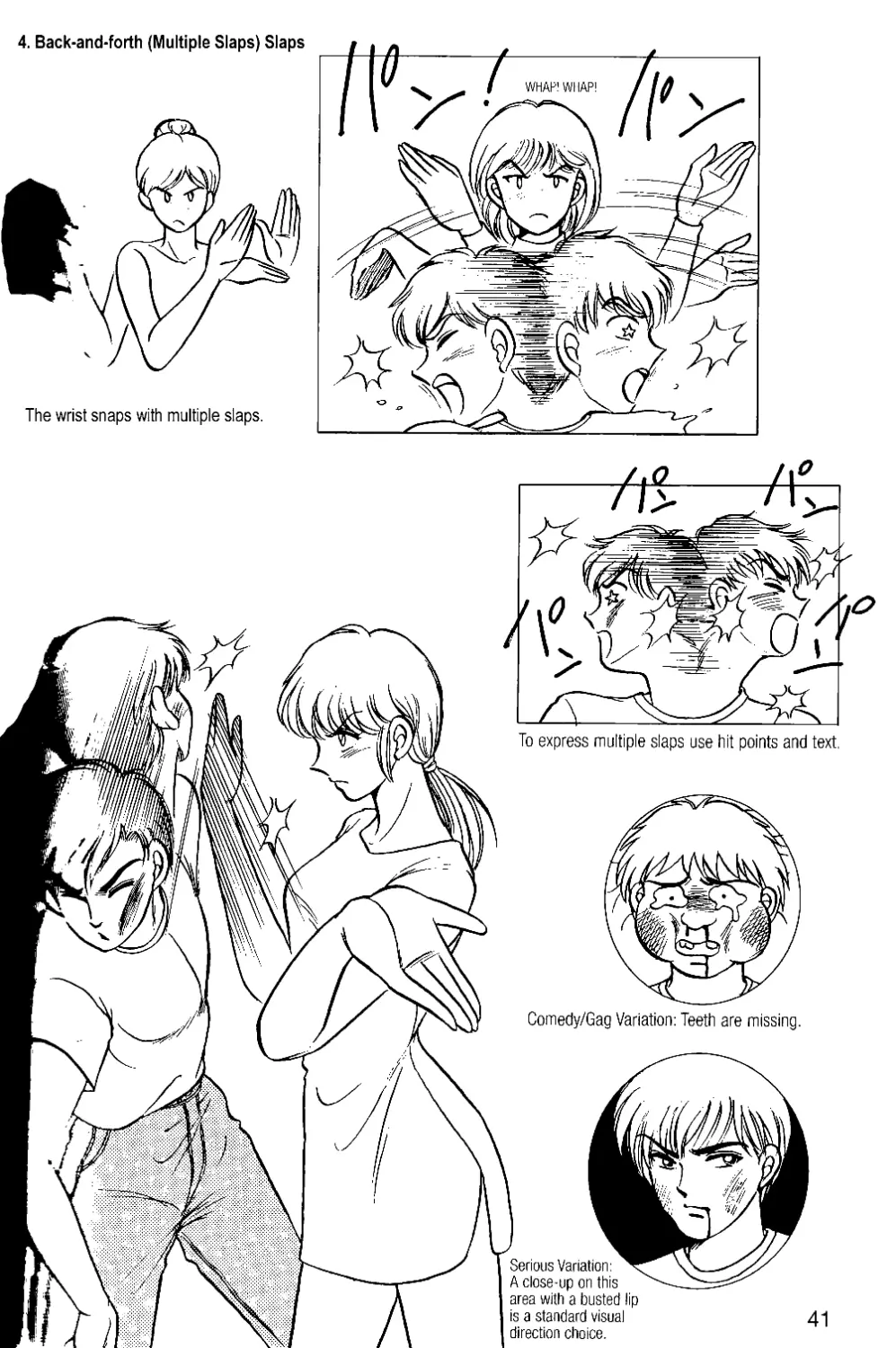
4. Back-and-forth (Multiple Slaps) Slaps
The wrist snaps with multiple slaps.
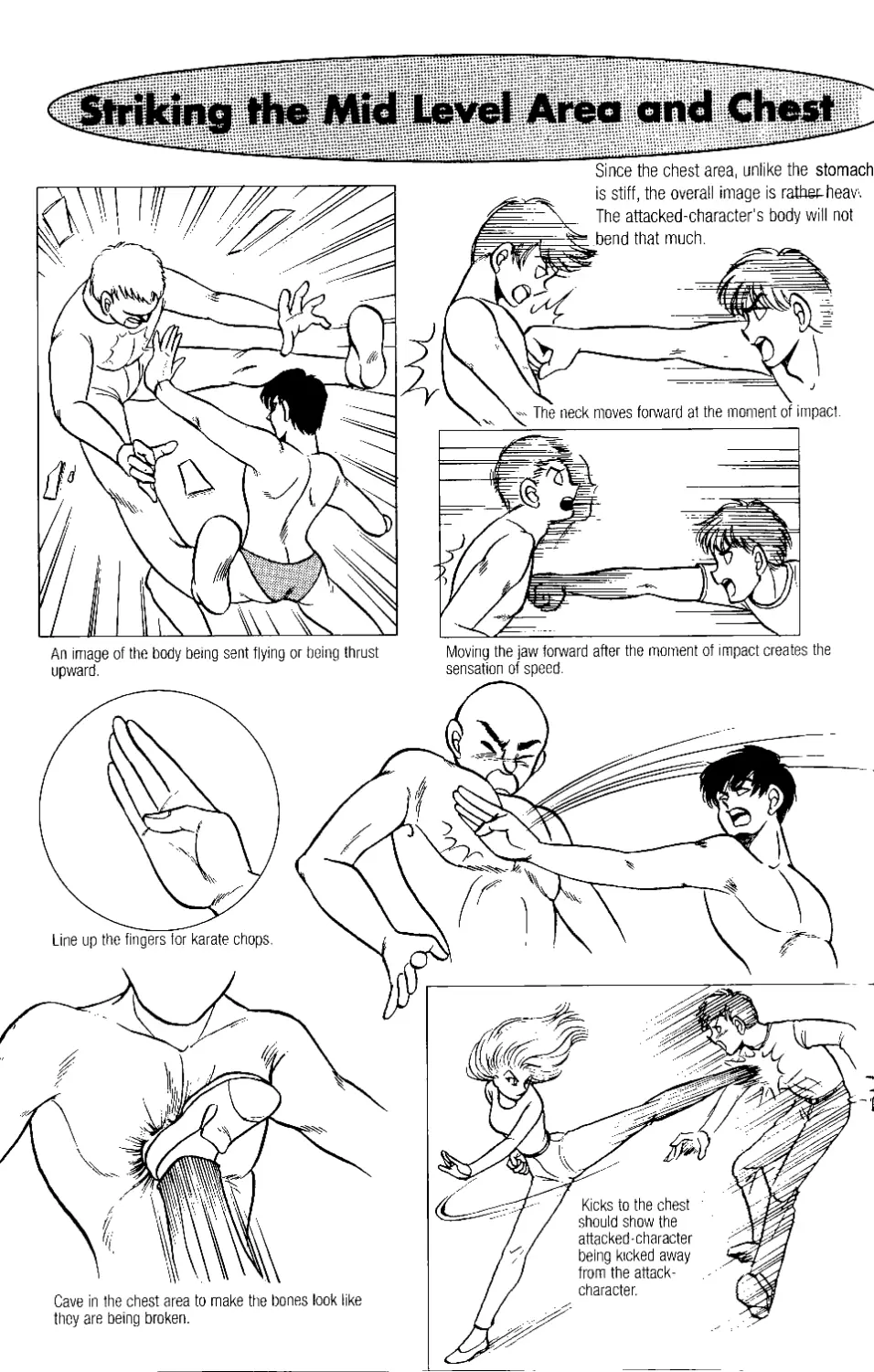
An image of the body being sent flying or being thrust Moving the jaw forward after the moment of impact creates the
upward.	sensation of speed.
Since the chest area, unlike the stomach
is stiff, the overall image is ratoepheav\
The attacked-character's body will not
The neck moves forward at the moment of impact.
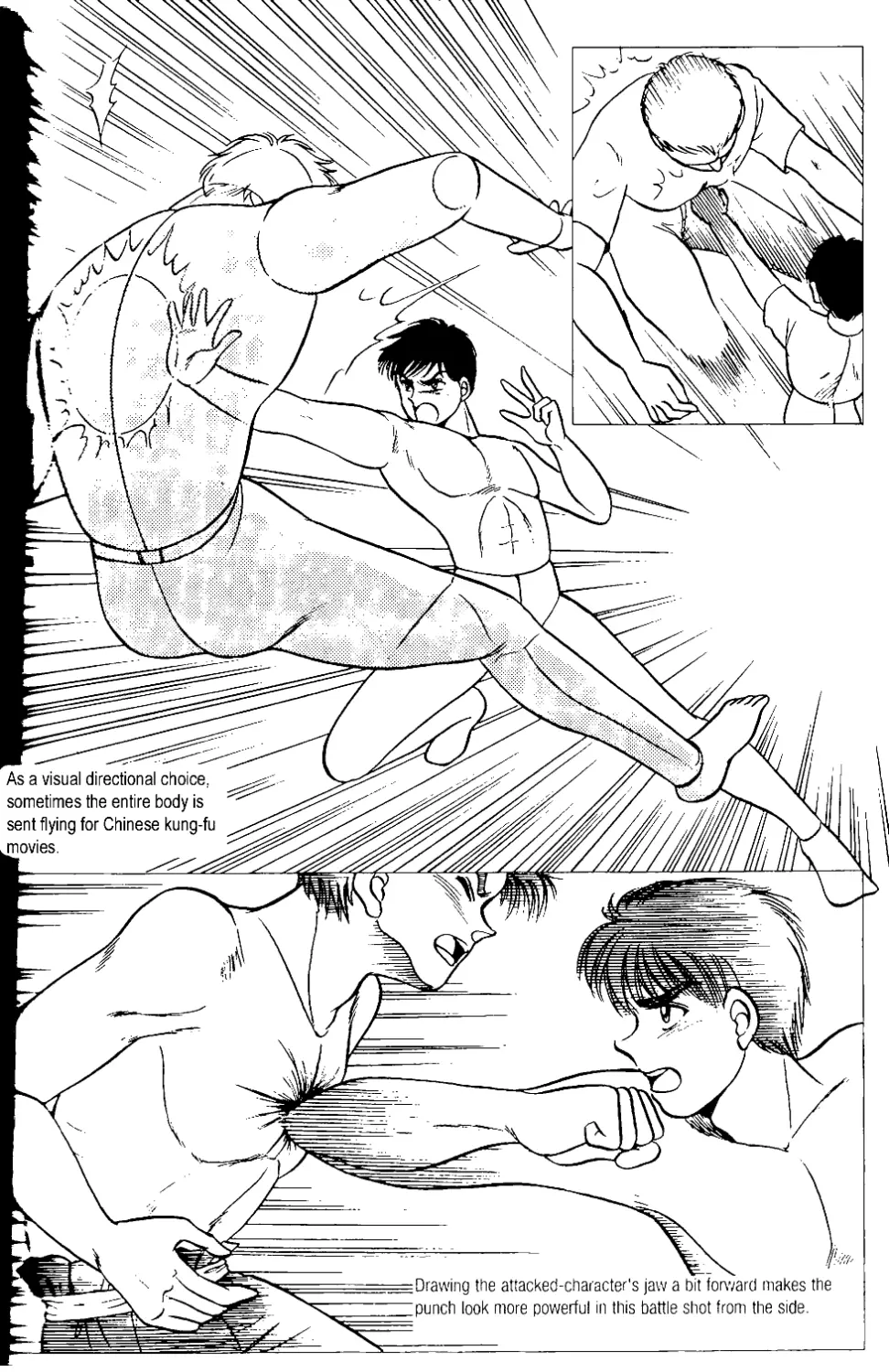
Drawing the attacked-character's jaw a bit forward makes the
punch look more powerful in this battle shot from the side.
As a visual directional choice,
sometimes the entire body is
sent flying for Chinese kung-fu
movies.
Attacks to the Pit of
the Stomach ana Chest
Blows are often times expressed by
only using effect-lines.
I he trick is to include the
wrinkles and the caved-
in stomach.
Characteristics of attacked-characters:
1) the body stoops forward
forming a crescendo mark
2) the back rounds
By showing the attacked-character’s
back from a slightly bird's-eye view
angle, the strength of the force from
the attack-character can be expressed.
While the pit of the stomach is
technically located in the upper ches
area (represented by the circle) an:
the stomach is located in the lowe-
area of the body, their use in visua
direction for attacked-characters г
manga is pretty much the same.
Kneeing Variation
44
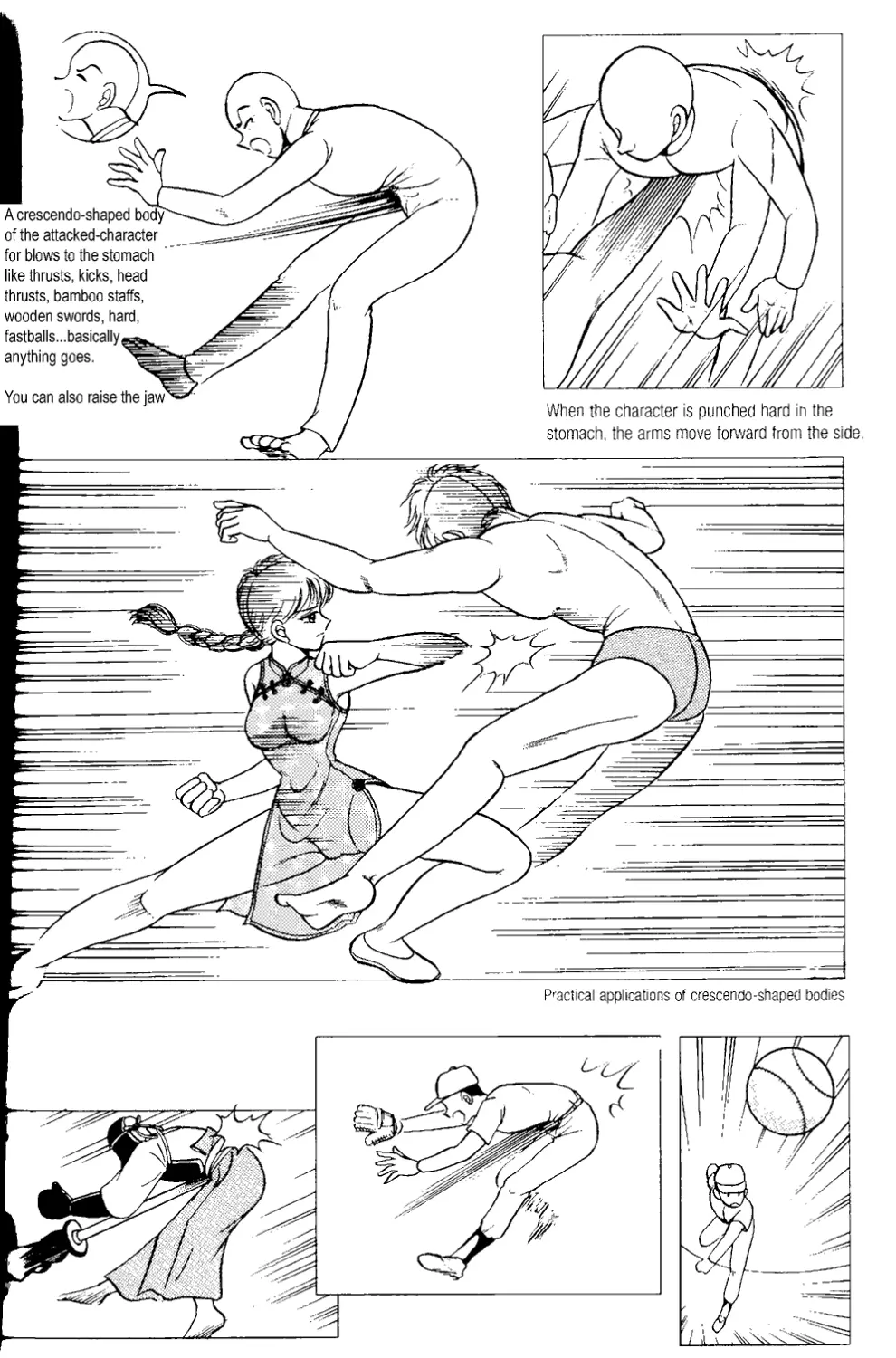
A crescendo-shaped body
of the attacked-character
for blows to the stomach
like thrusts, kicks, head
thrusts, bamboo staffs,
wooden swords, hard,
fastballs...basically
anything goes.
You can also raise the jaw
When the character is punched hard in the
stomach, the arms move forward from the side,
Practical applications of crescendo-shaped bodies
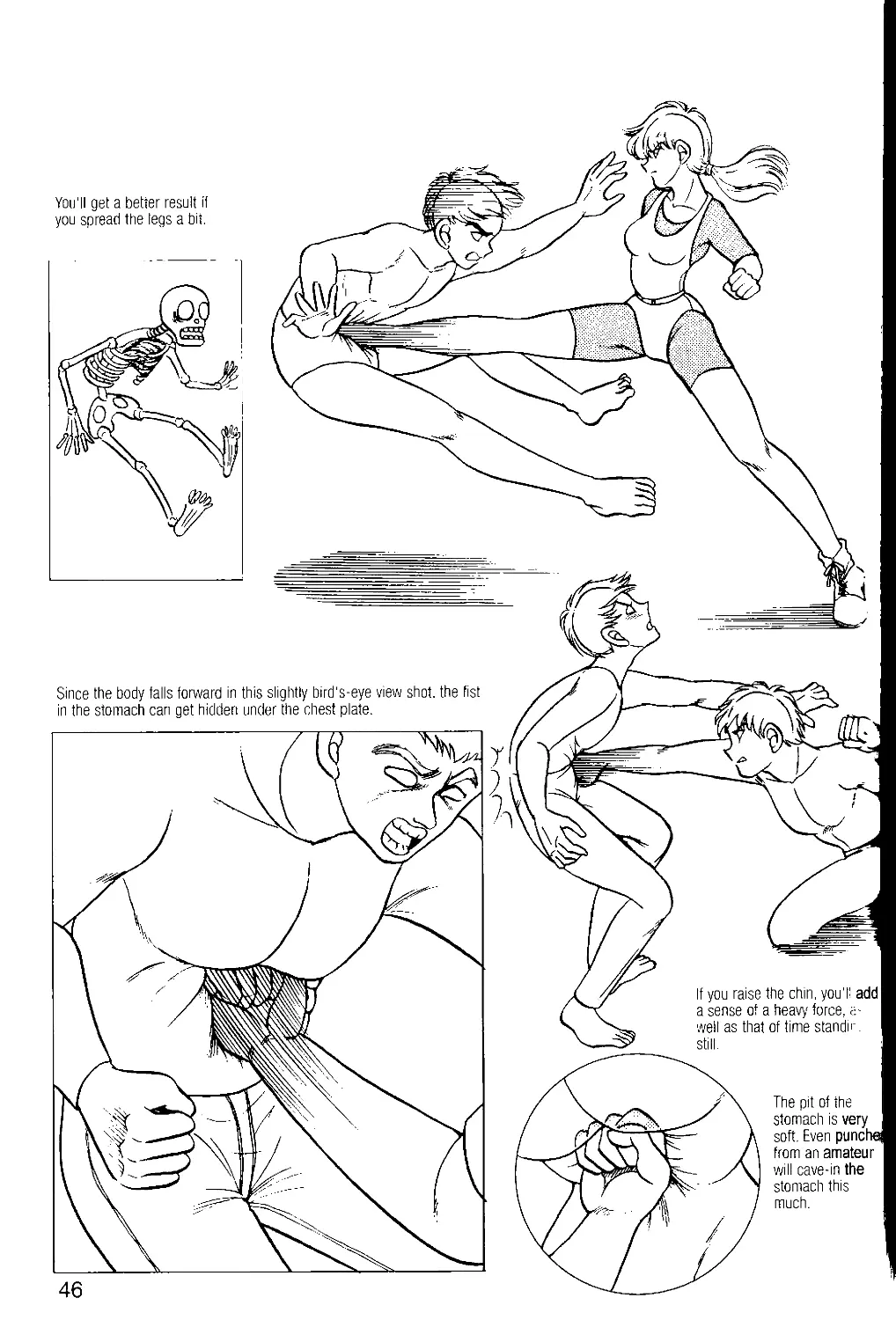
You'll get a better result if
you spread the legs a bit.
If you raise the chin, you'll add
a sense of a heavy force,
well as that of time standi’’,
still.
Since the body falls forward in this slightly bird's-eye view shot, the fist
in the stomach can get hidden under the chest plate.
The pit of the
stomach is very
soft. Even punchf
from an amateur
will cave-in the
stomach this
much.
46

Attacking Opponents Bent Forward
...	Striking Downward	.  ——

Lariat Strikes

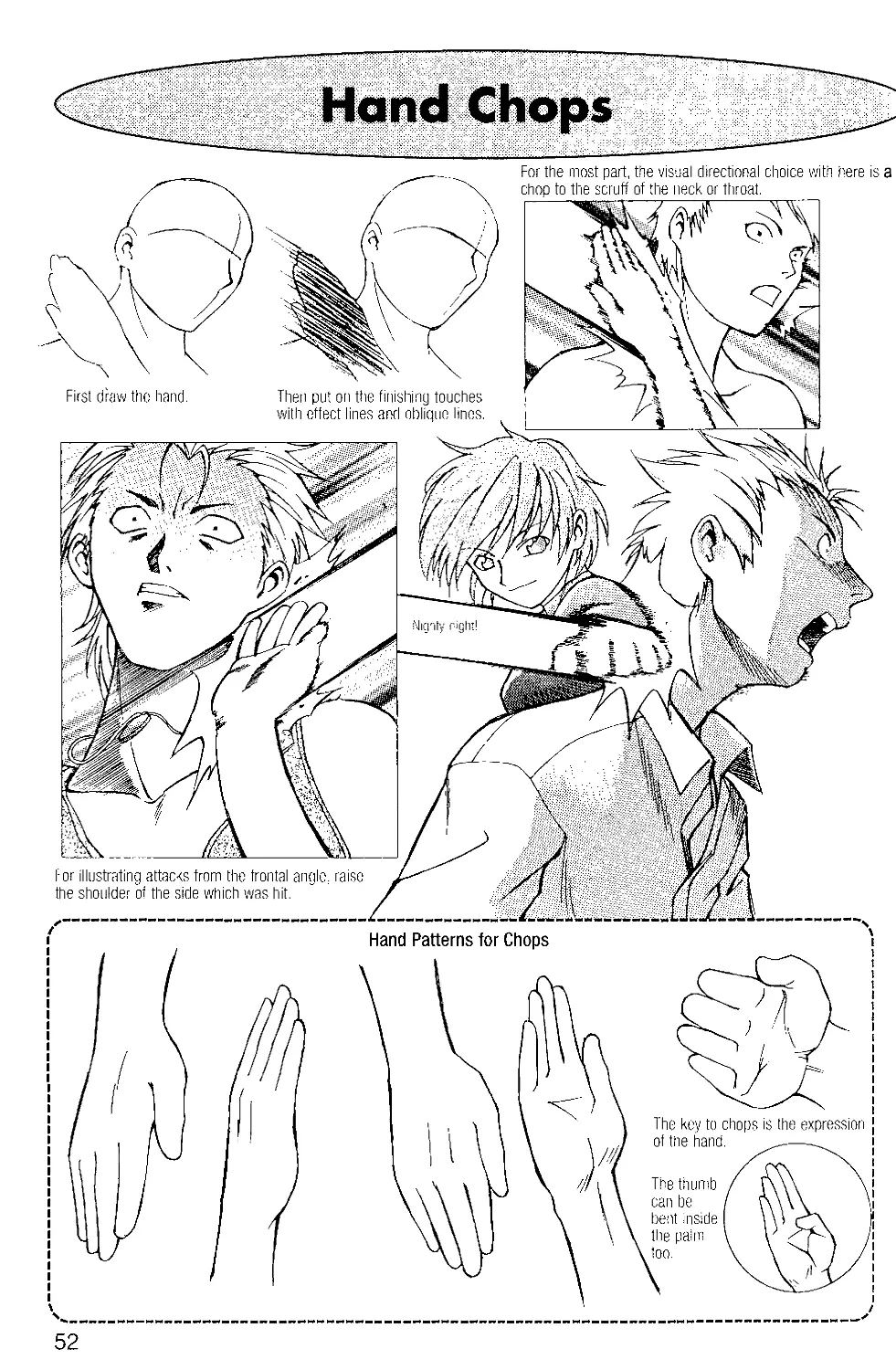
Hand Chops
52
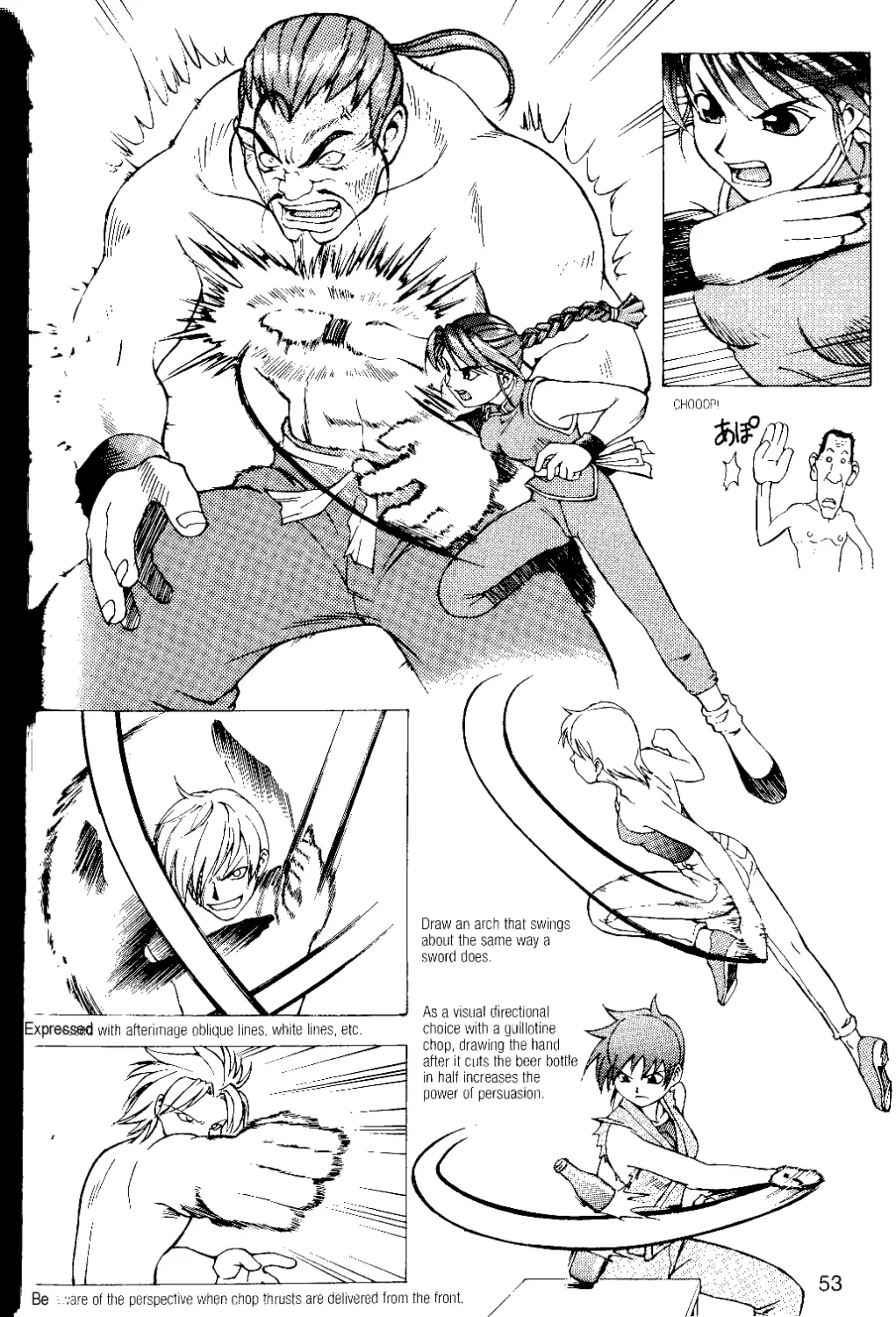
Draw an arch that swings
about the same way a
sword does.
Be :.'/are of the perspective when chop thrusts are delivered from the front.
Expressed with afterimage oblique lines, white lines, etc.
As a visual directional
choice with a guillotine
chop, drawing the hand
after it cuts the beer bottle
in half increases the
power of persuasion.
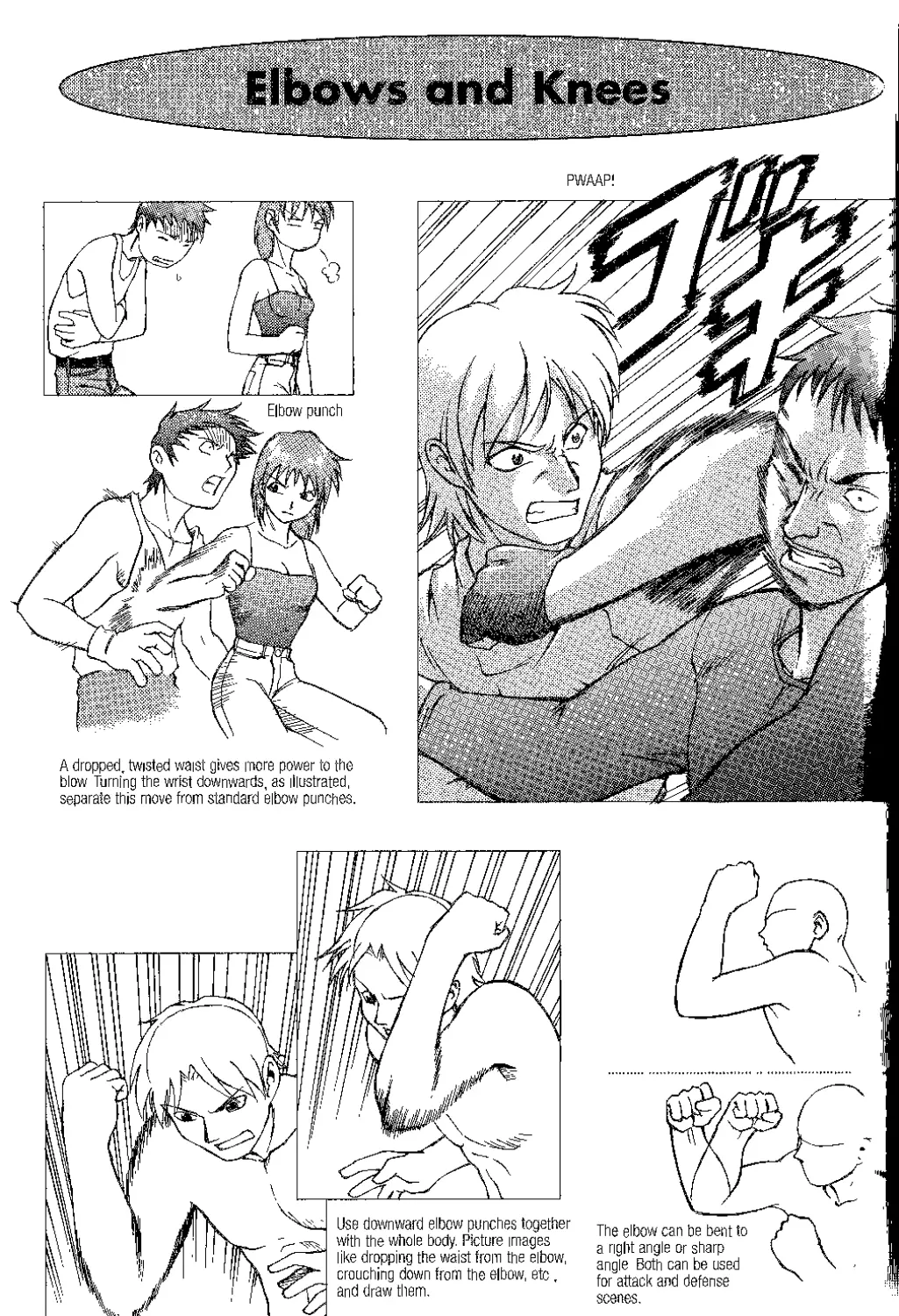
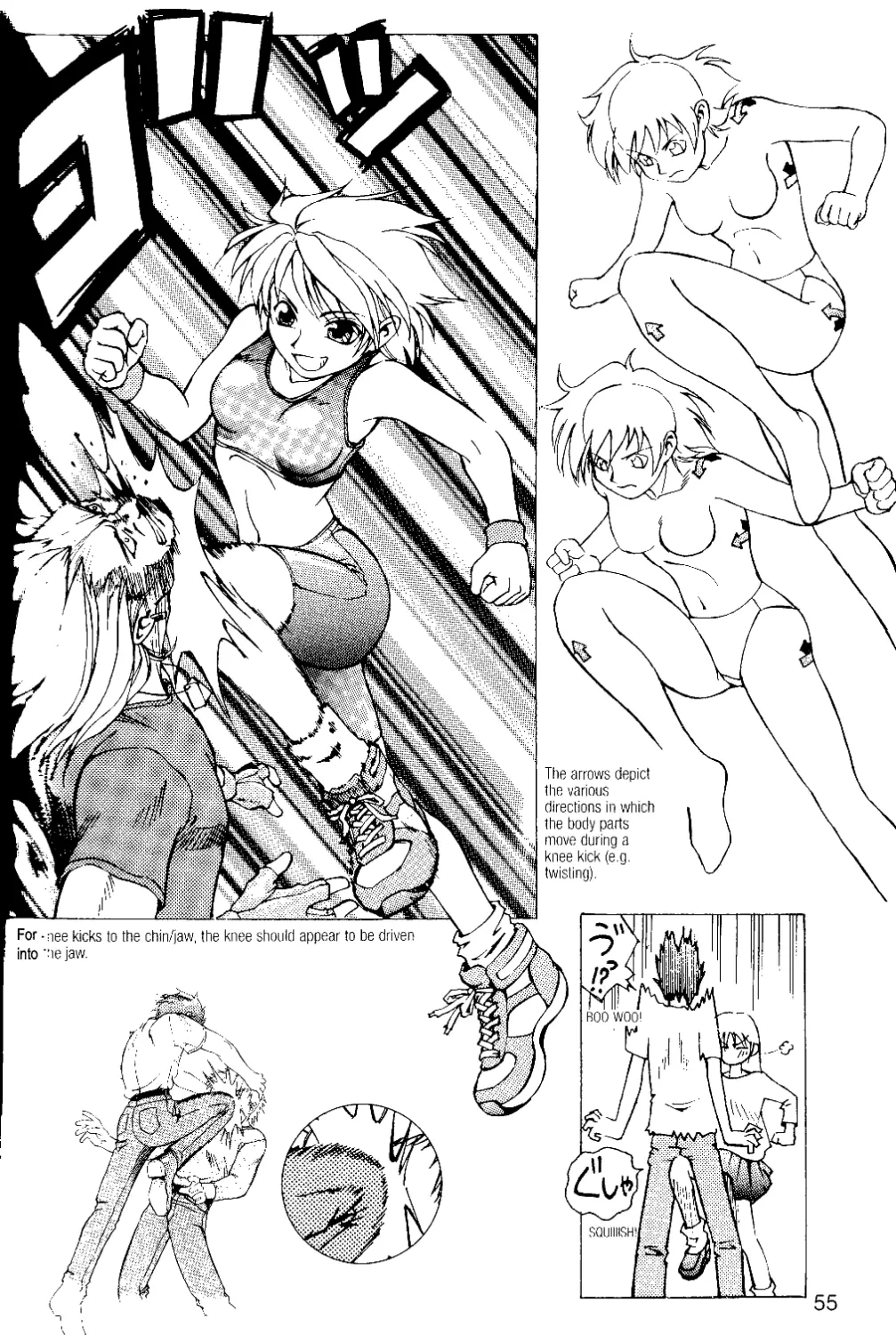
Elbows and Knees

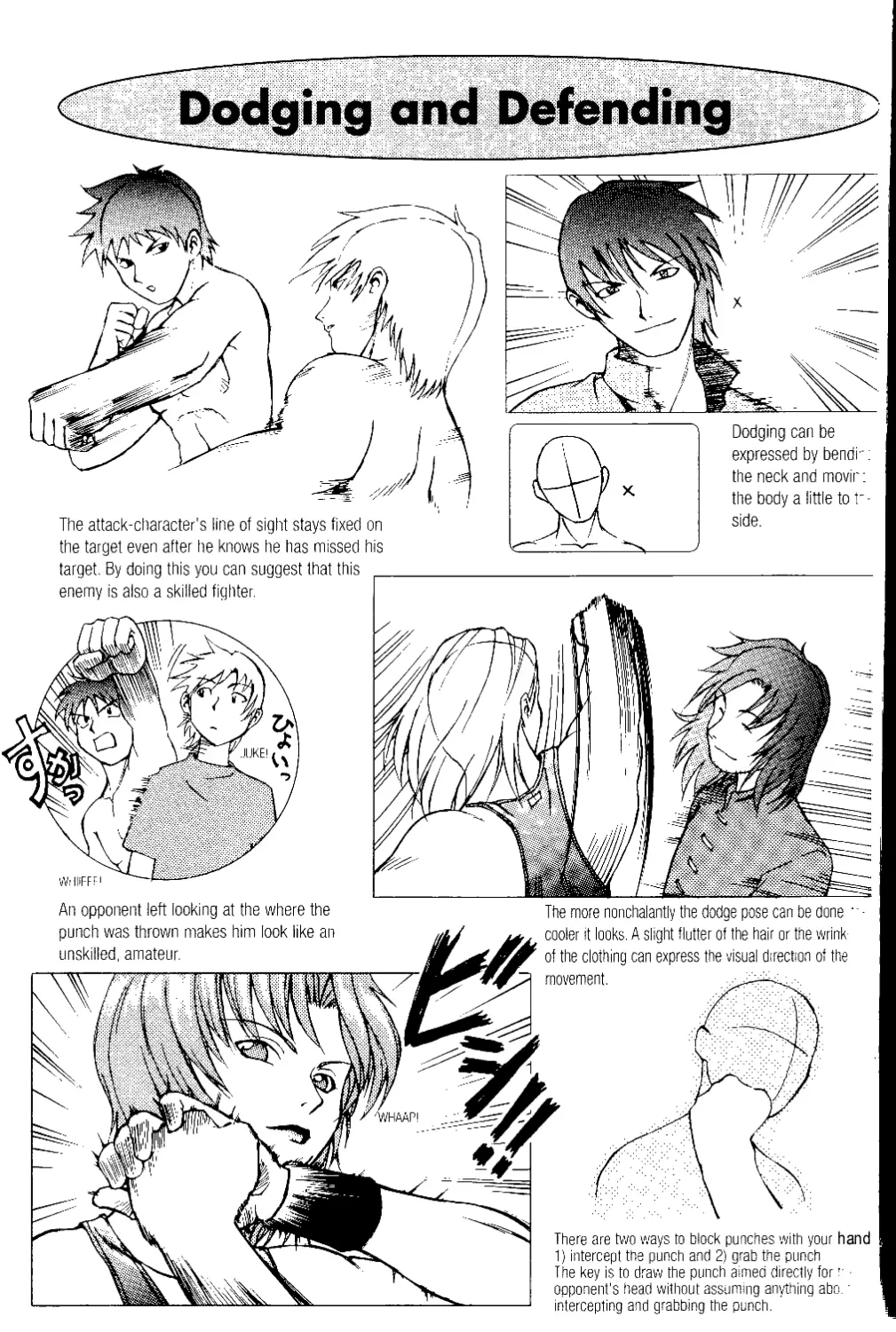
Dodging and Defending
target. By doing this you can suggest that this
enemy is also a skilled fighter.
The more nonchalantly the dodge pose can be done
cooler it looks. A slight flutter of the hair or the wrink
of the clothing can express the visual direction of the
movement.
An opponent left looking at the where the
punch was thrown makes him look like an
unskilled, amateur.
There are two ways to block punches with your hand
1) intercept the punch and 2) grab the punch
The key is to draw the punch aimed directly for ”
opponent's head without assuming anything abo.'
intercepting and grabbing the punch.
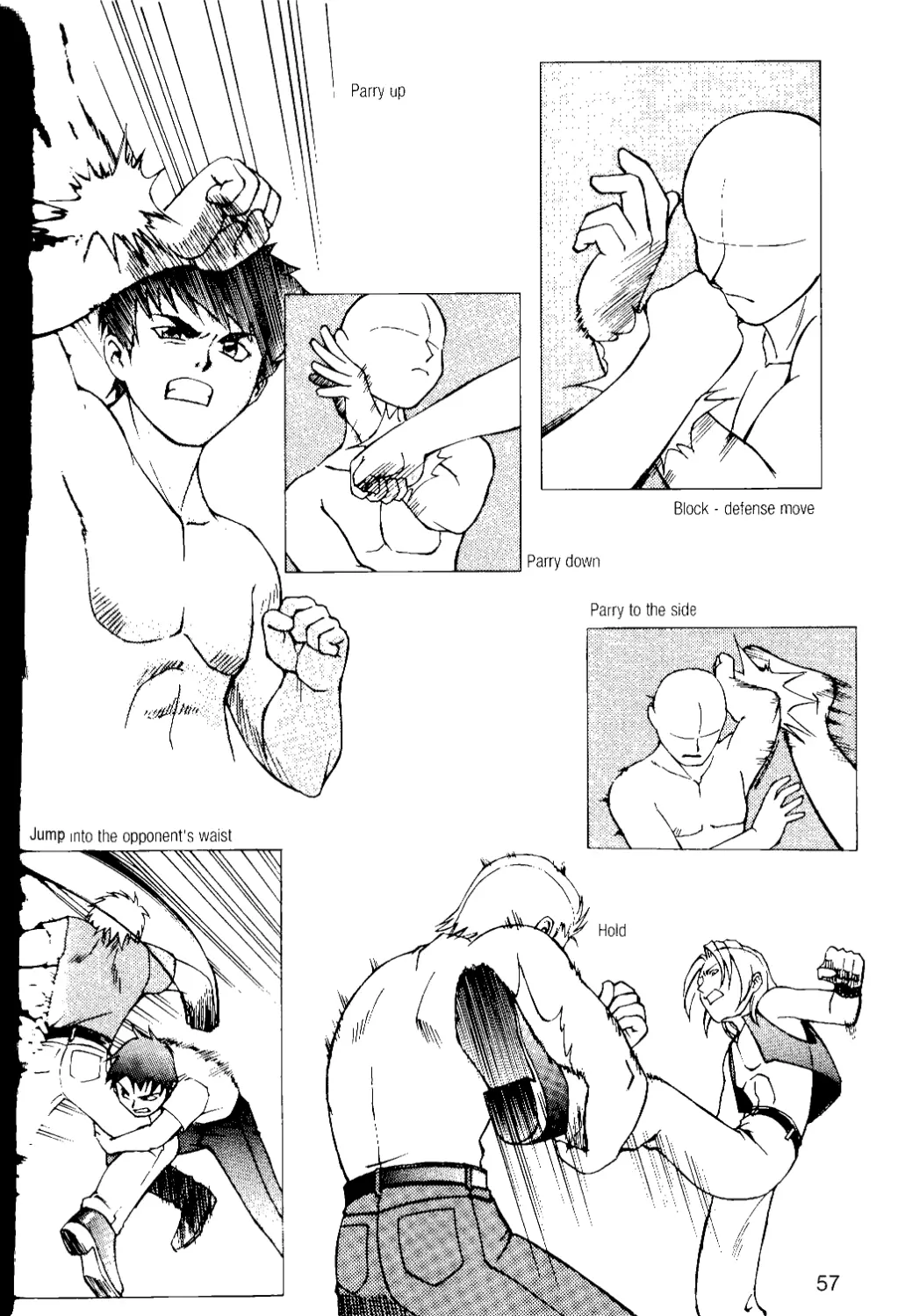
57
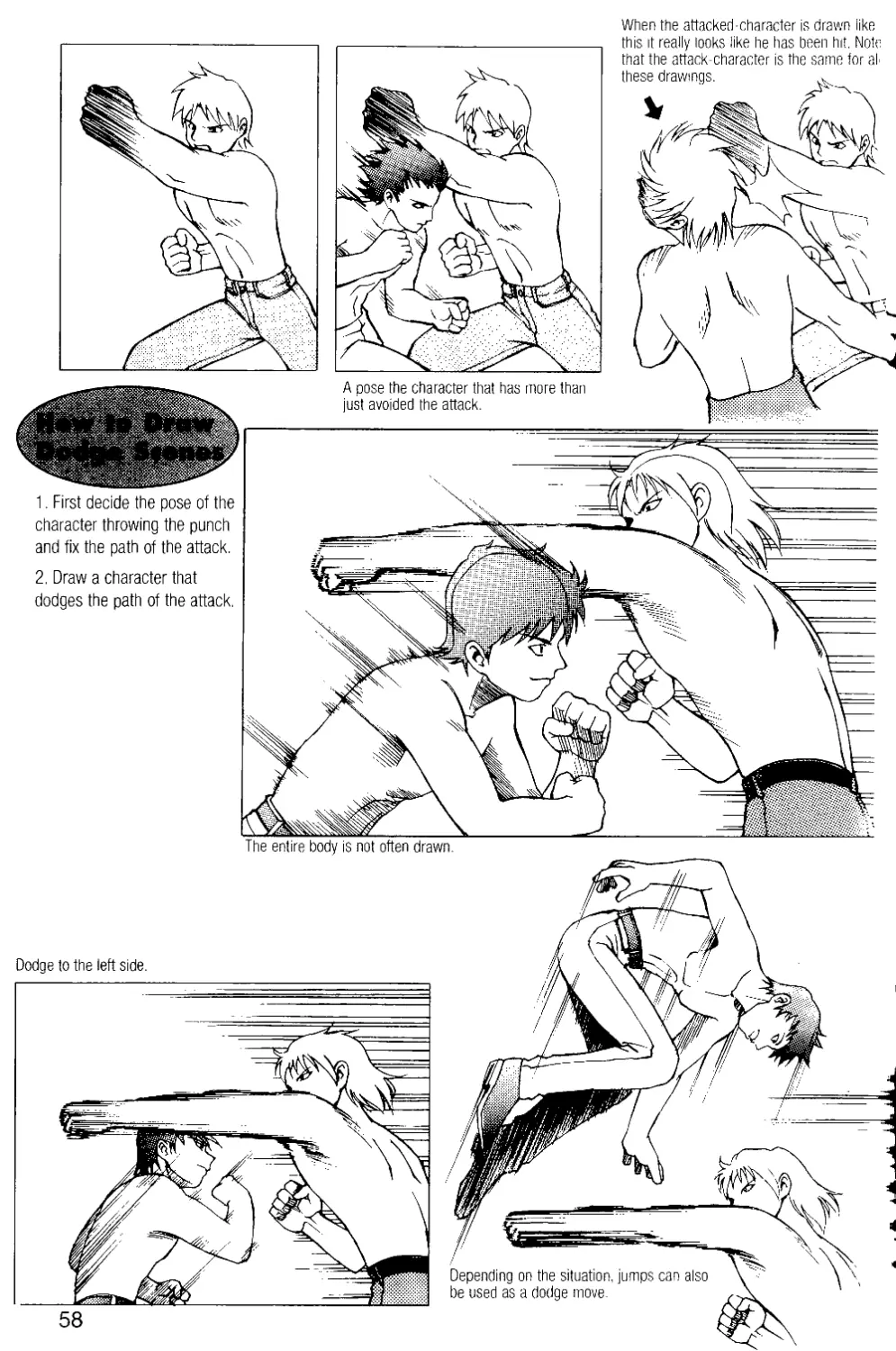
When the attacked-character is drawn like
this it really looks like he has been hit. Note
that the attack-character is the same tor at
these drawings.
1. First decide the pose of the
character throwing the punch
and fix the path of the attack.
2. Draw a character that
dodges the path of the attack.
A pose the character that has more than
just avoided the attack.
The entire body is not often drawn.
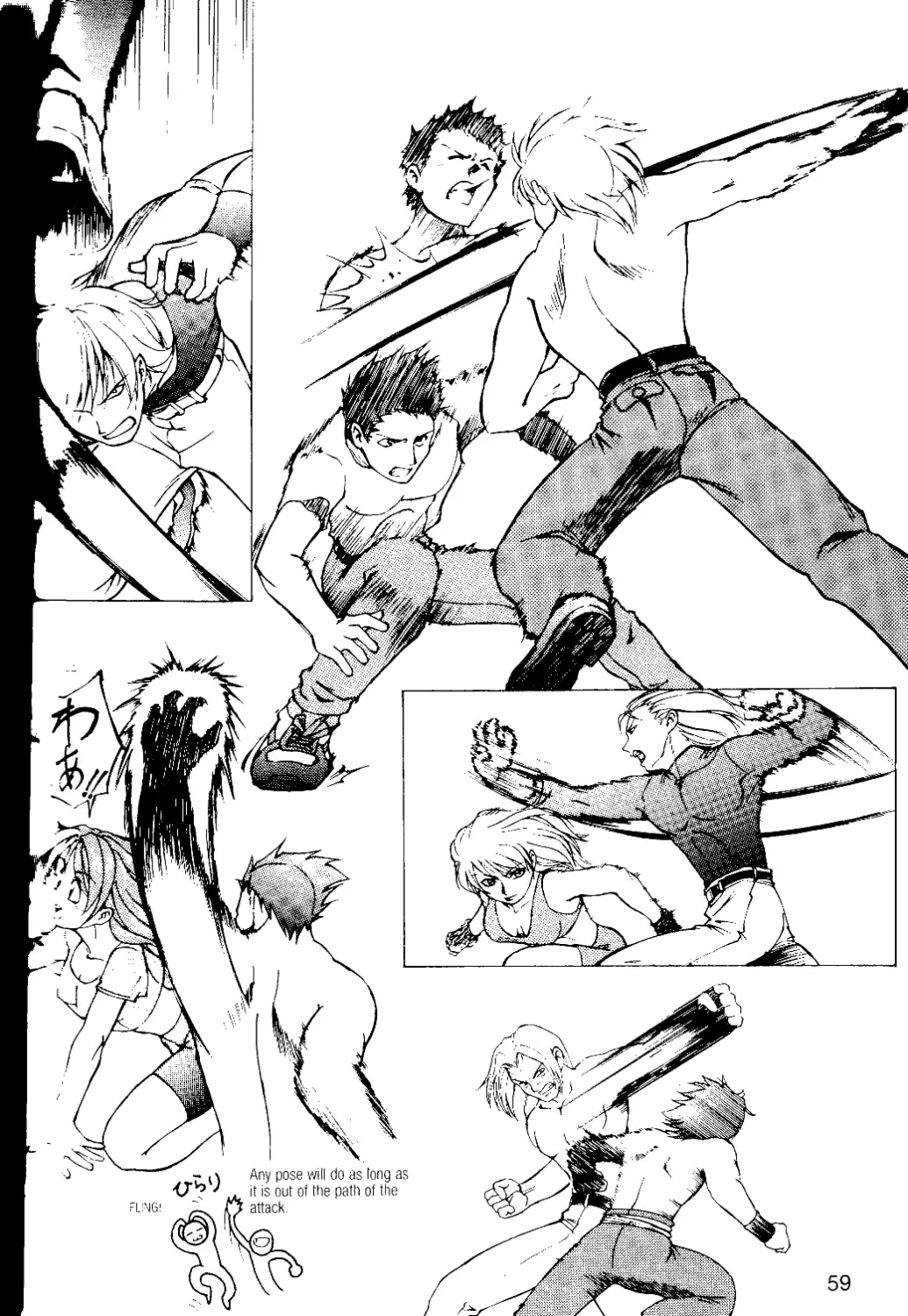
59
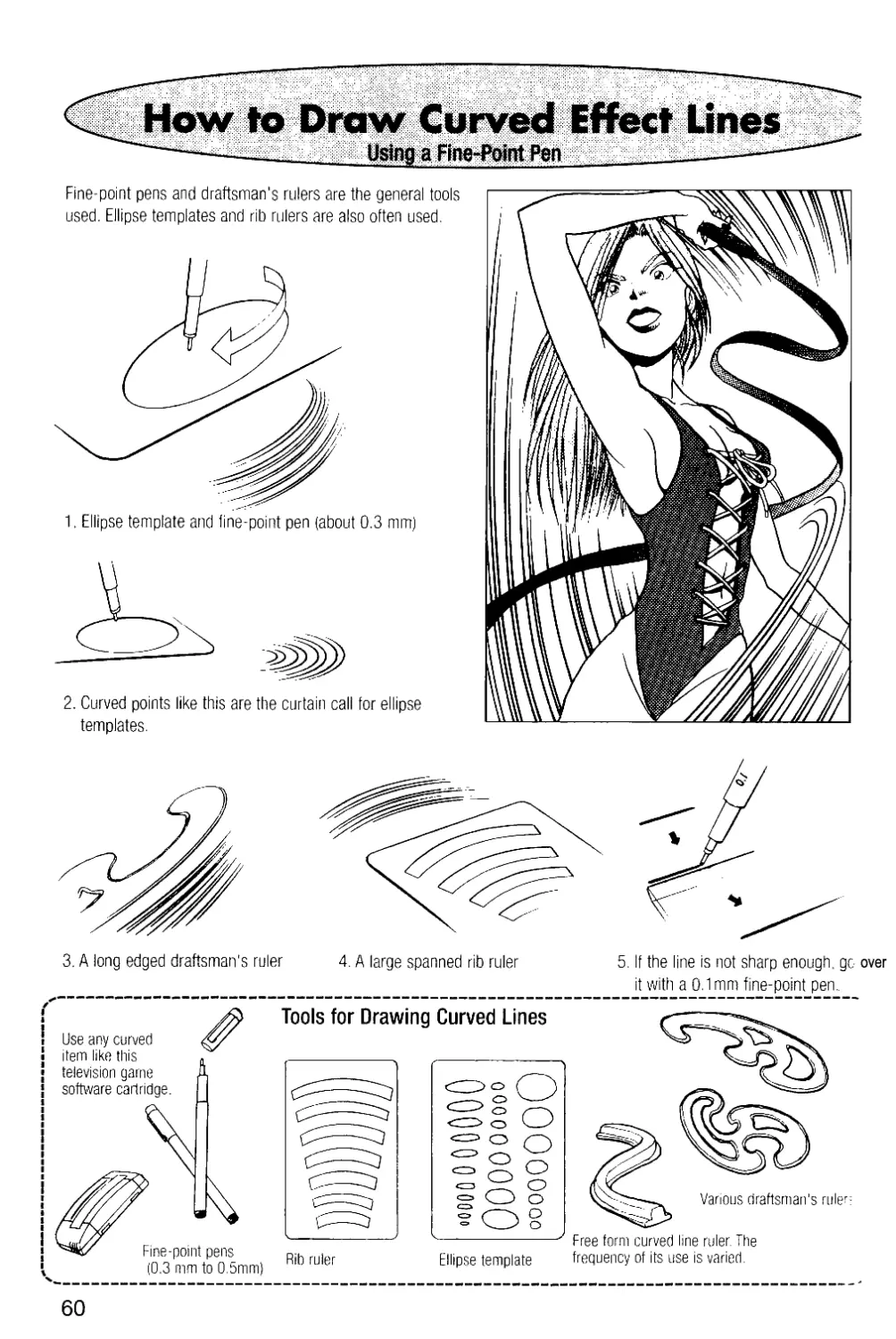
Fine-point pens and draftsman's rulers are the general tools
used. Ellipse templates and rib rulers are also often used.
1. Ellipse template and fine-point pen (about 0.3 mm)
2. Curved points like this are the curtain call for ellipse
templates.
4. A large spanned rib ruler
3. A long edged draftsman's ruler
5. If the line is not sharp enough, go over
it with a 0.1 mm fine-point pen..
Tools for Drawing Curved Lines
Use any curved
item like this
television game
software cartridge.
(0.3 mm to 0.5mm)
Rib ruler	Ellipse template
Free form curved line ruler. The
frequency of its use is varied.
60
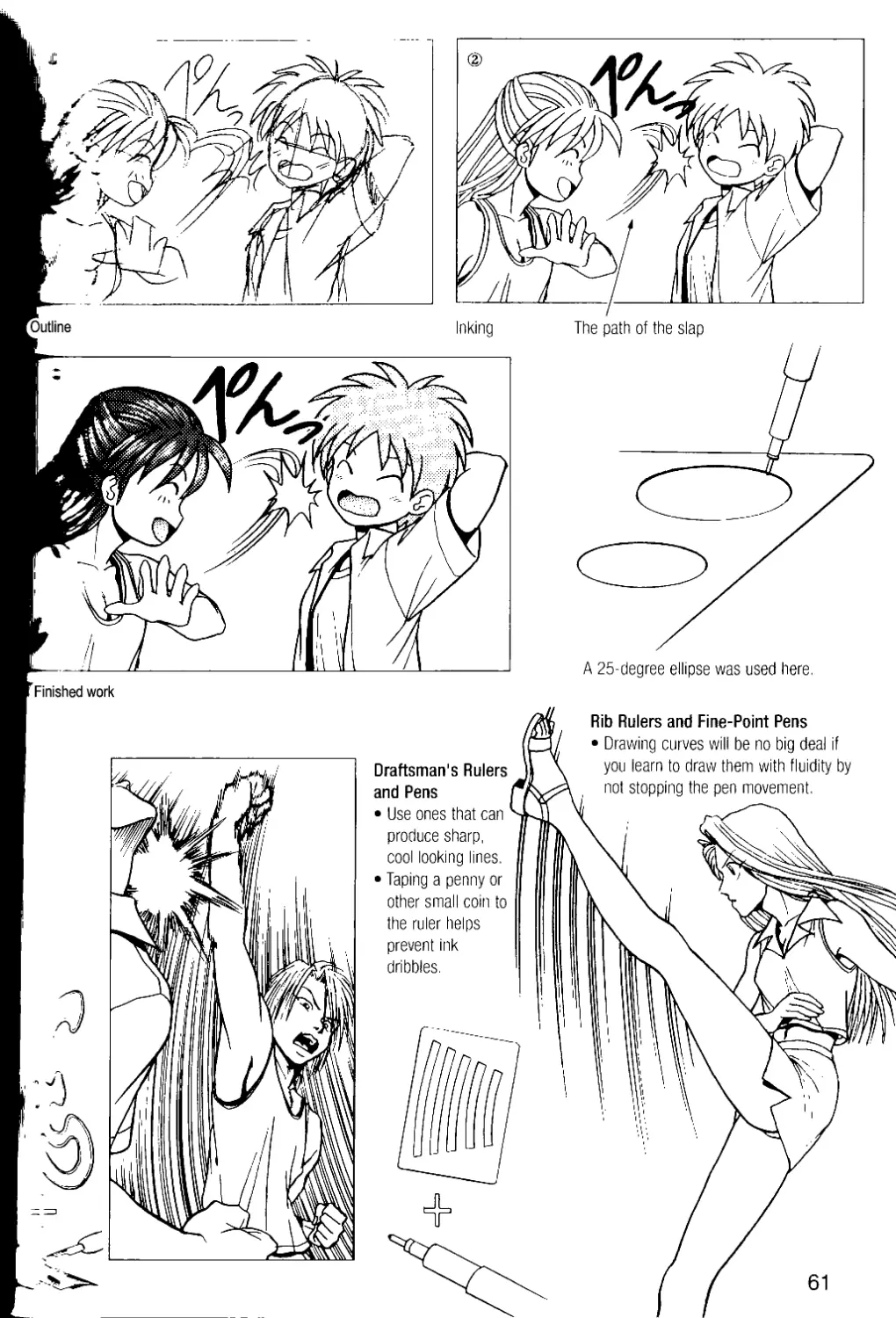
Finished work
Rib Rulers and Fine-Point Pens
• Drawing curves will be no big deal if
61
, WwwRHIж I i 1C₽99
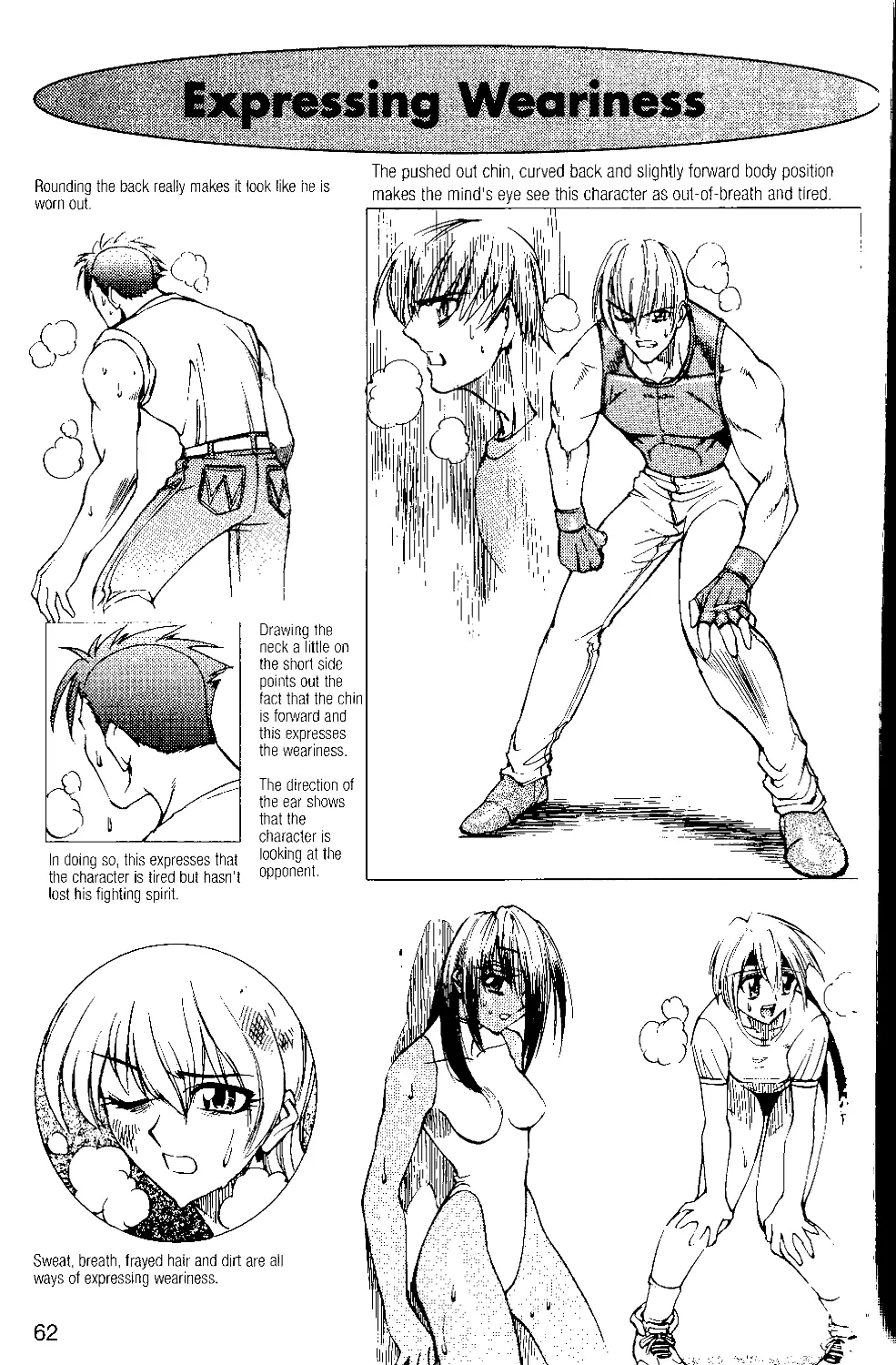
The pushed out chin, curved back and slightly forward body position
makes the mind's eye see this character as out-of-breath and tired.
Rounding the back really makes it look like he is
worn out.
In doing so, this expresses that
the character is tired but hasn’t
Drawing the
neck a little on
the short side
points out the
fact that the chin
is forward and
this expresses
the weariness.
The direction of
the ear shows
that the
character is
looking at the
opponent.
lost his fighting spirit.
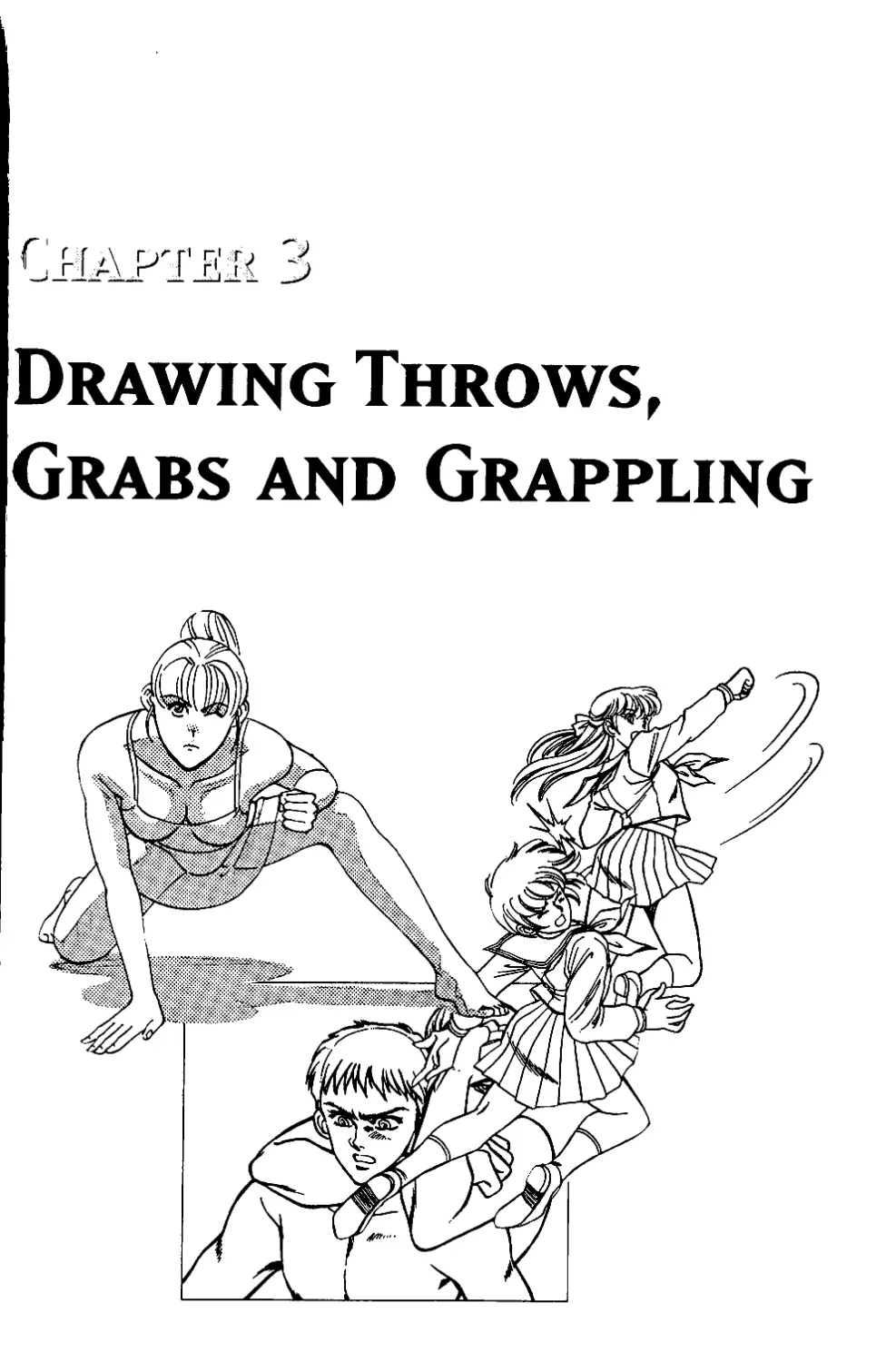
Drawing Throws,
Grabs and Grappling
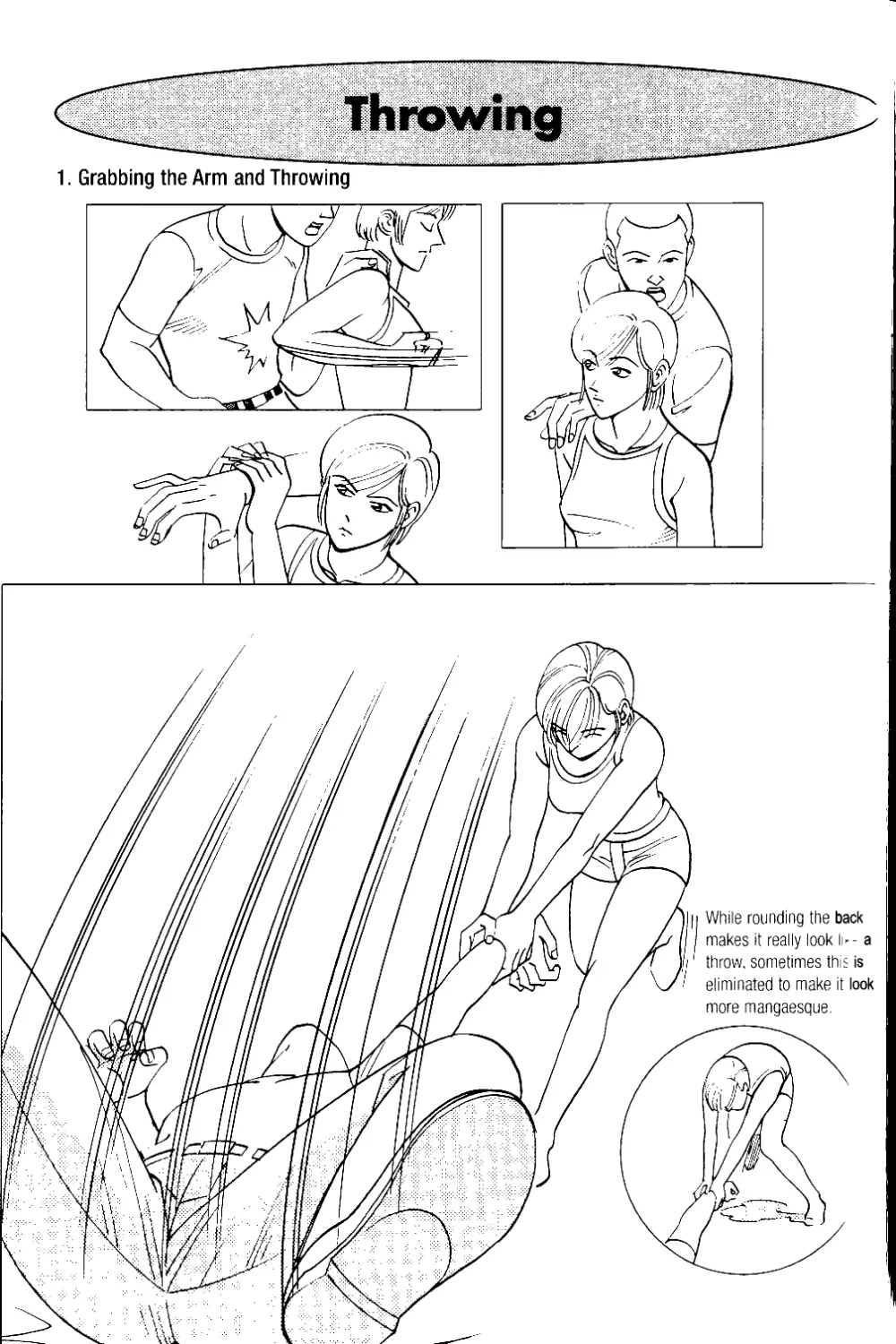
1. Grabbing the Arm and Throwing
While rounding the back
makes it really look li-- a
throw, sometimes this is
eliminated to make it look
more mangaesque.
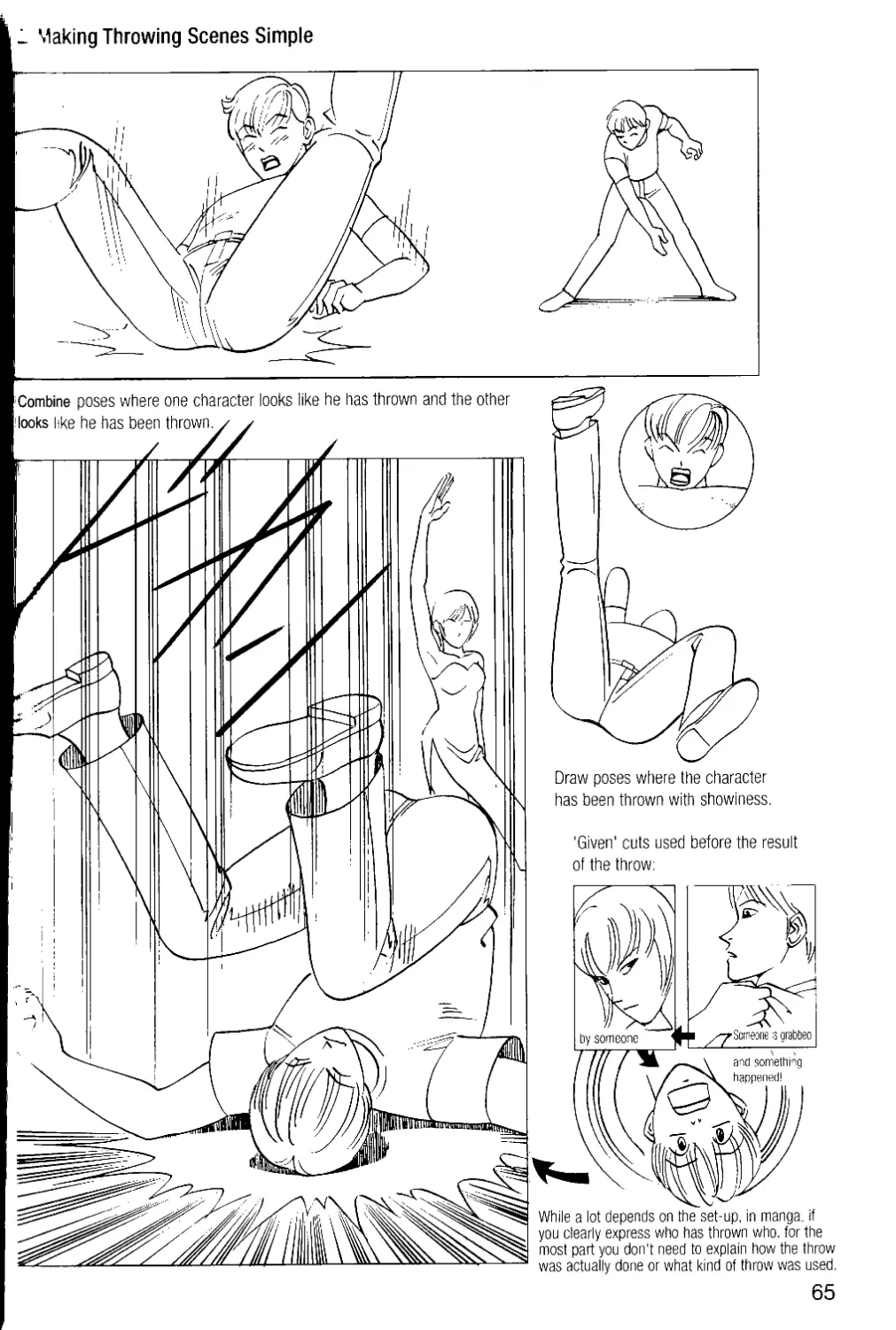
_ Making Throwing Scenes Simple
by someone
Draw poses where the character
has been thrown with showiness.
While a lot depends on the set-up, in manga, if
you clearly express who has thrown who. for the
most part you don't need to explain how the throw
was actually done or what kind of throw was used.
’Given' cuts used before the result
of the throw:
' Combine poses where one character looks like he has thrown and the other
looks hke he has been thrown
and something
65
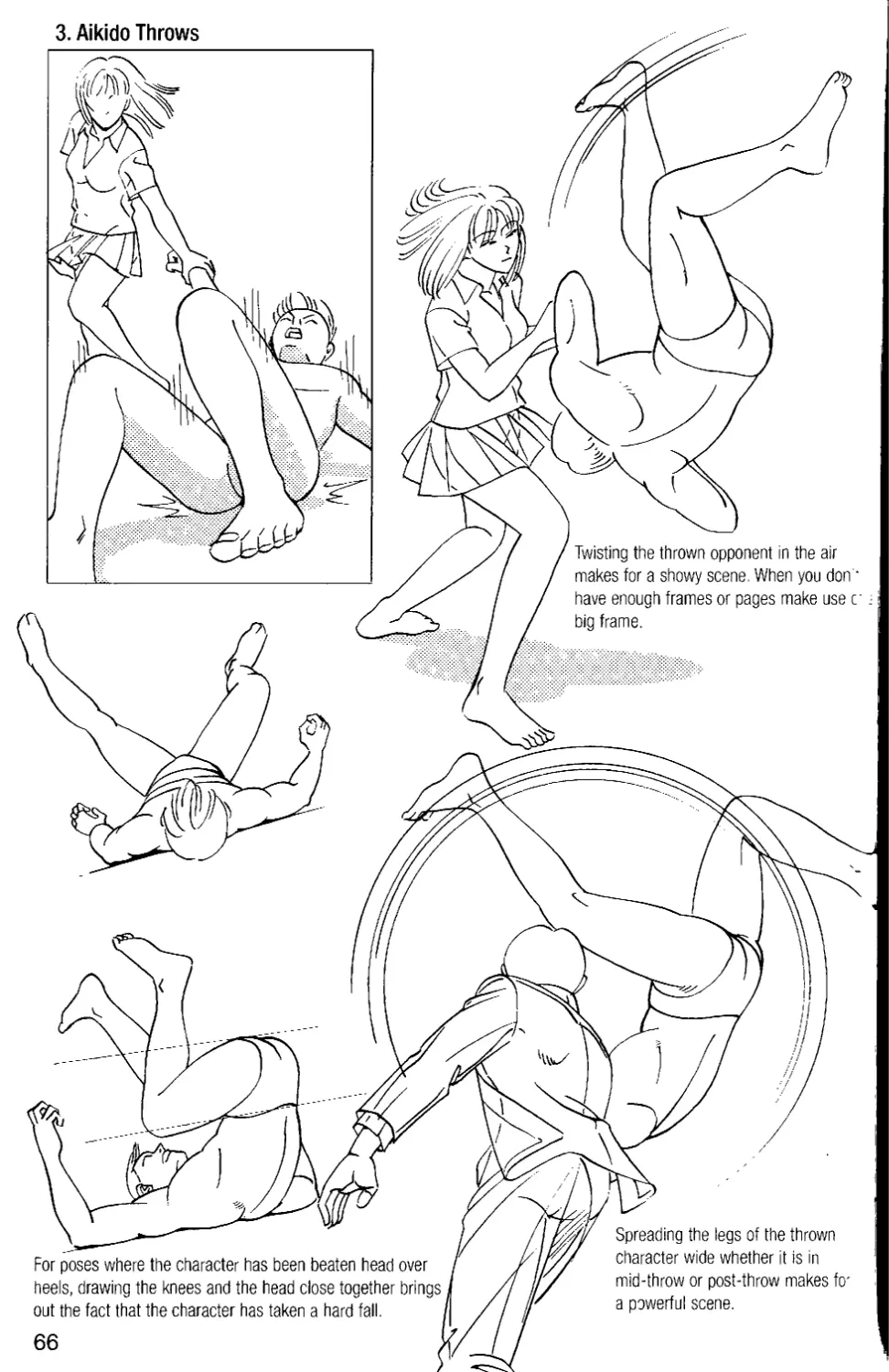
3. Aikido Throws
Spreading the legs of the thrown
character wide whether it is in
mid-throw or post-throw makes fo'
a powerful scene.
For poses where the character has been beaten head over
heels, drawing the knees and the head close together brings
out the fact that the character has taken a hard fall.
66
Twisting the thrown opponent in the air
makes for a showy scene. When you don ‘
have enough frames or pages make use c r
big frame.
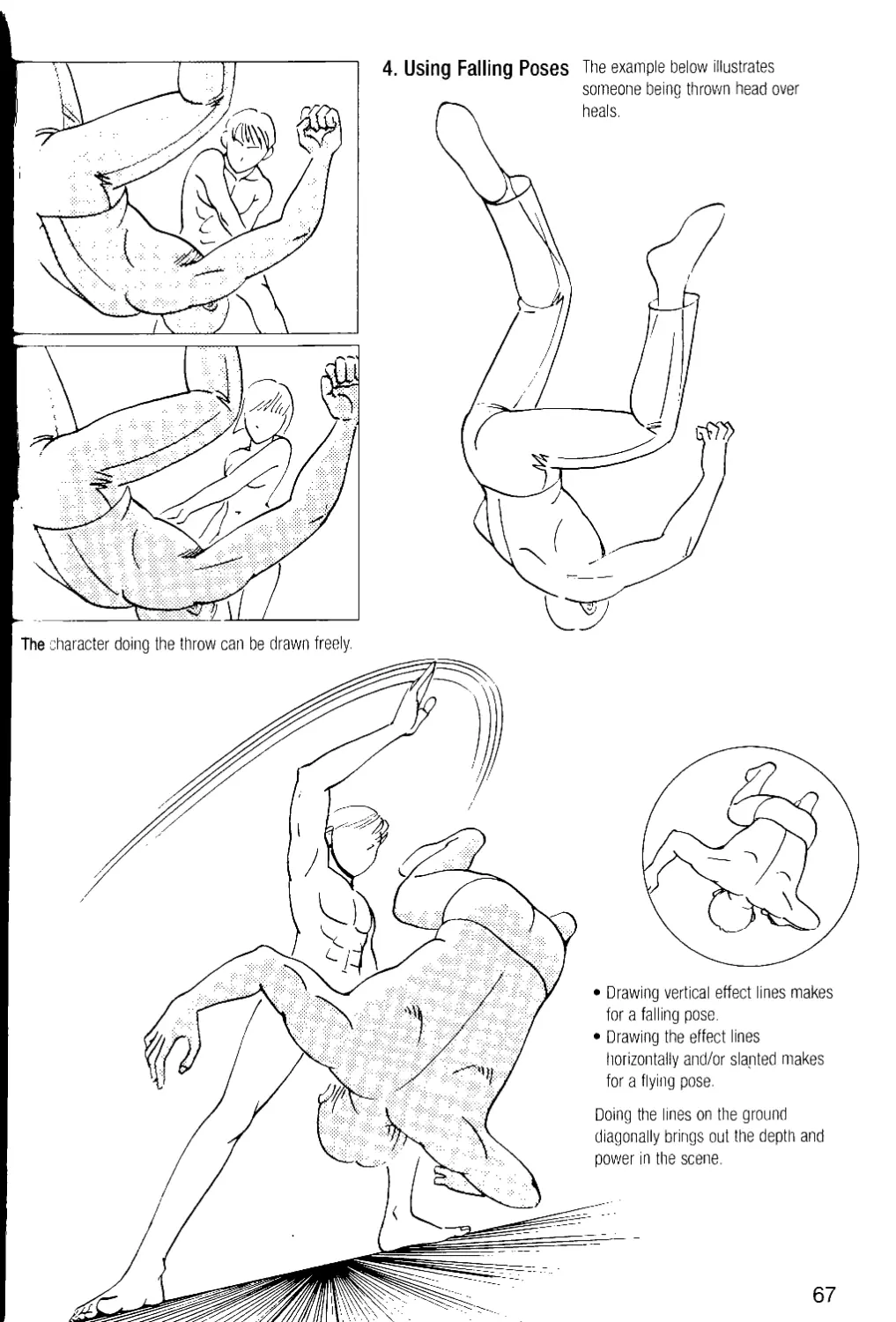
4. Using Falling Poses
The example below illustrates
someone being thrown head over
heals.
Doing the lines on the ground
diagonally brings out the depth and
power in the scene.
• Drawing vertical effect lines makes
for a falling pose.
• Drawing the effect lines
horizontally and/or slanted makes
for a flying pose.
The character doing the throw can be drawn freely.
67

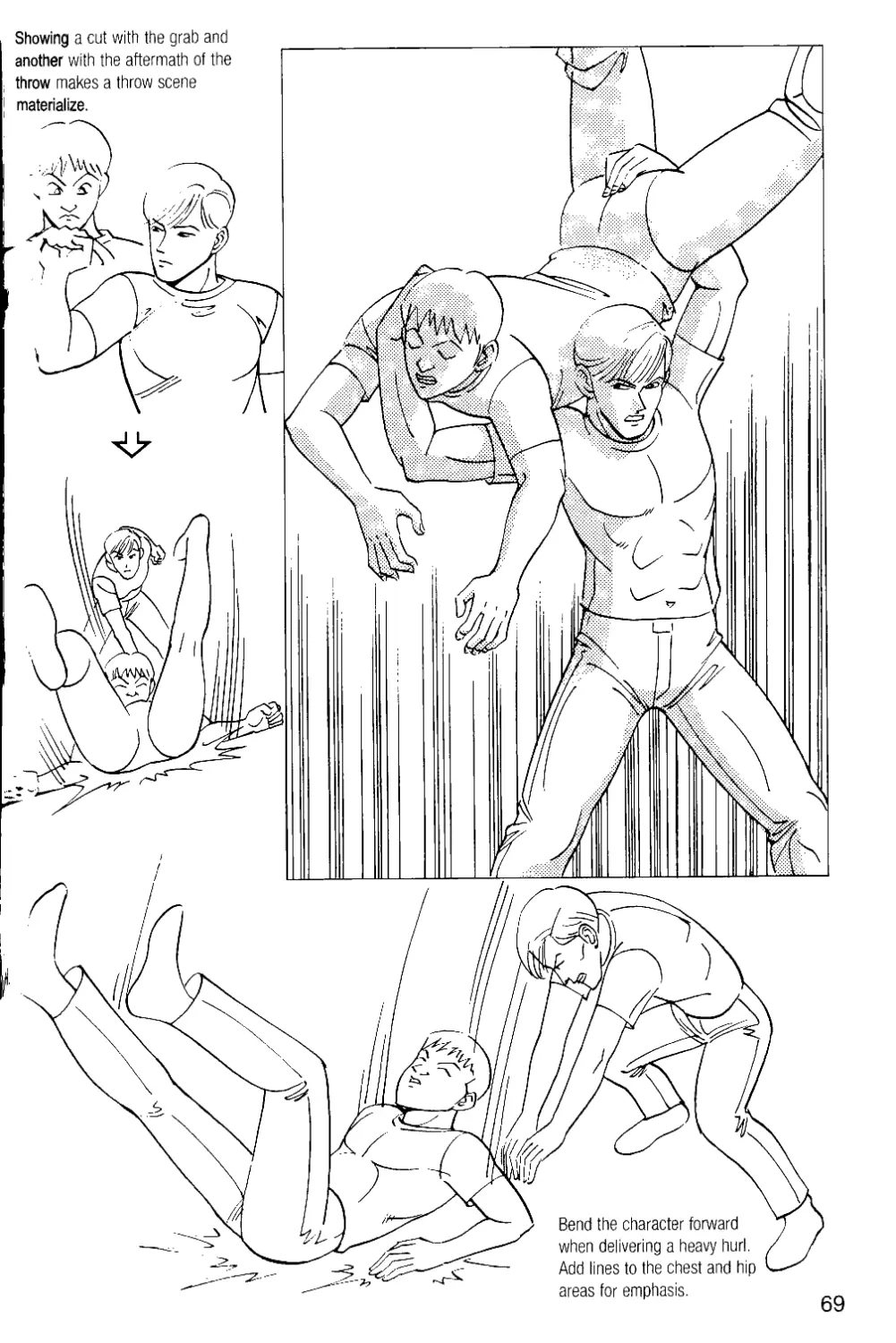
Showing a cut with the grab and
69
Having Your Doors Blown Off,
Being Hurled Against Somethin
1. Male Examples
It will look showier if you spread the legs wide
when the character has his doors blown off.
Not bending the knees too much gives the impression
that the character fell from a high place. Also the
lightness of the character's weight can be expressed.
70
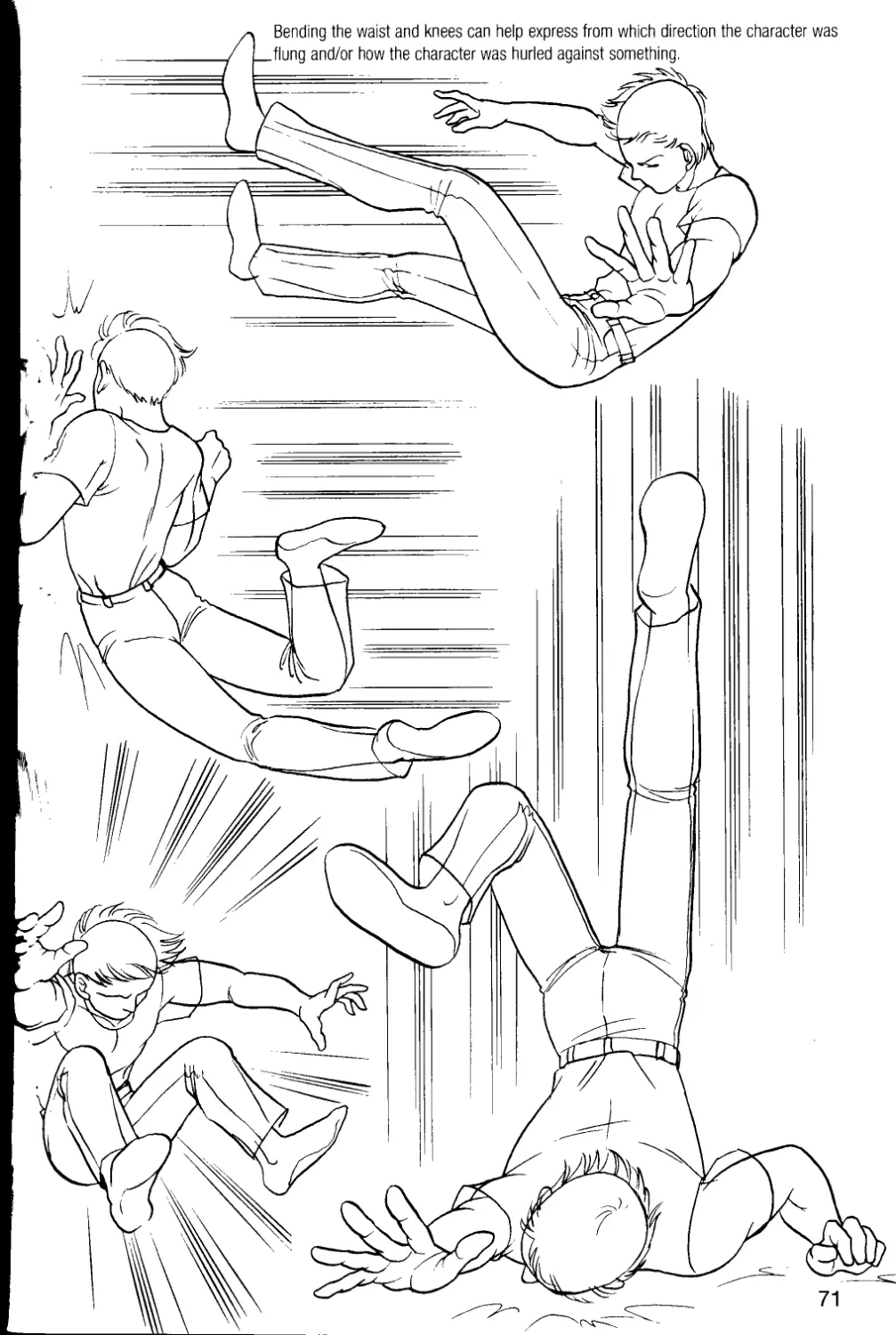
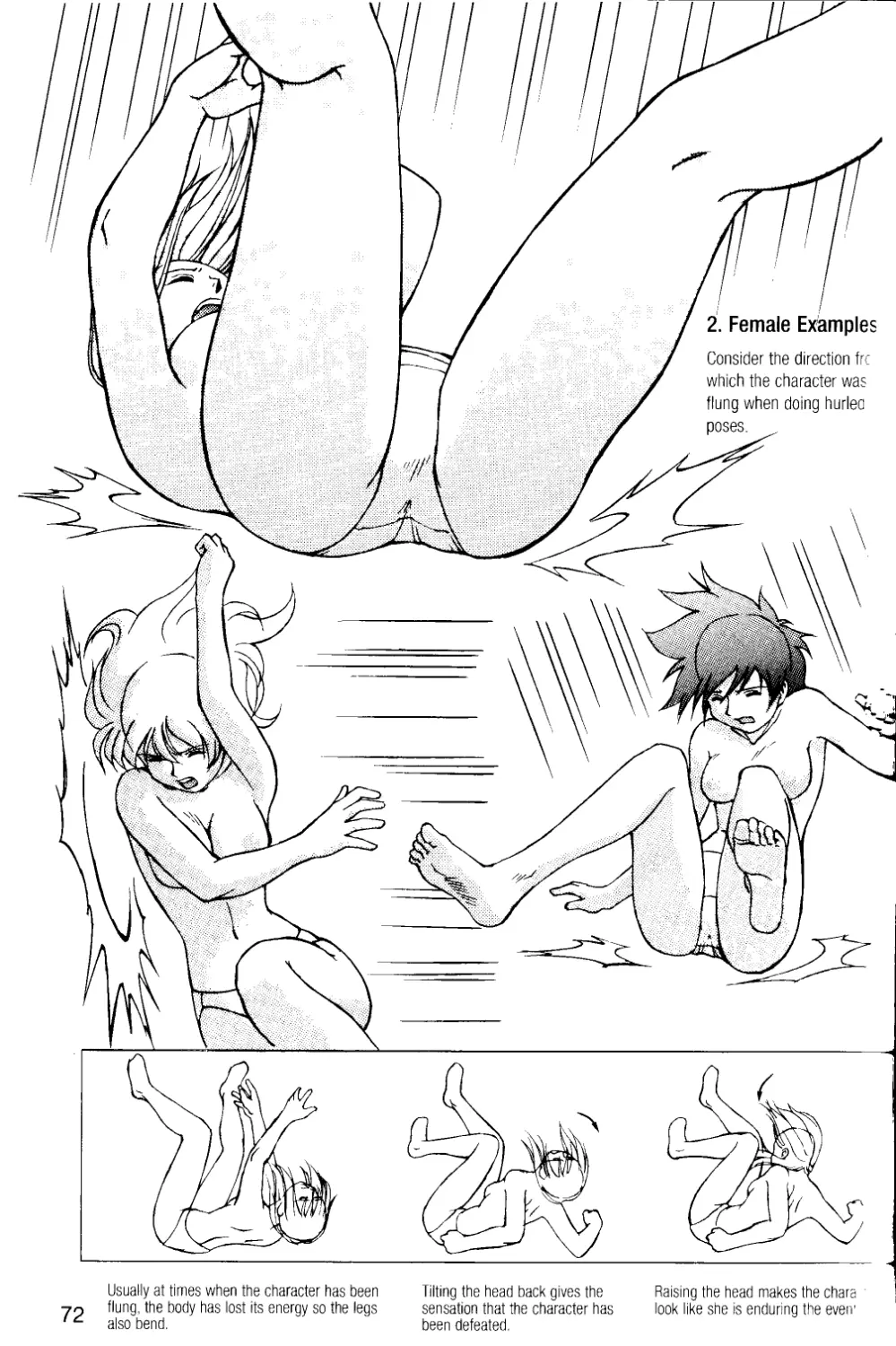
Bending the waist and knees can help express from which direction the character was
_fiung and/or how the character was hurled against something.
71
txanvp'es
,ЛагЖ direct
Consider^	as
poses
«<,SSS*,Ml
72 S^end.


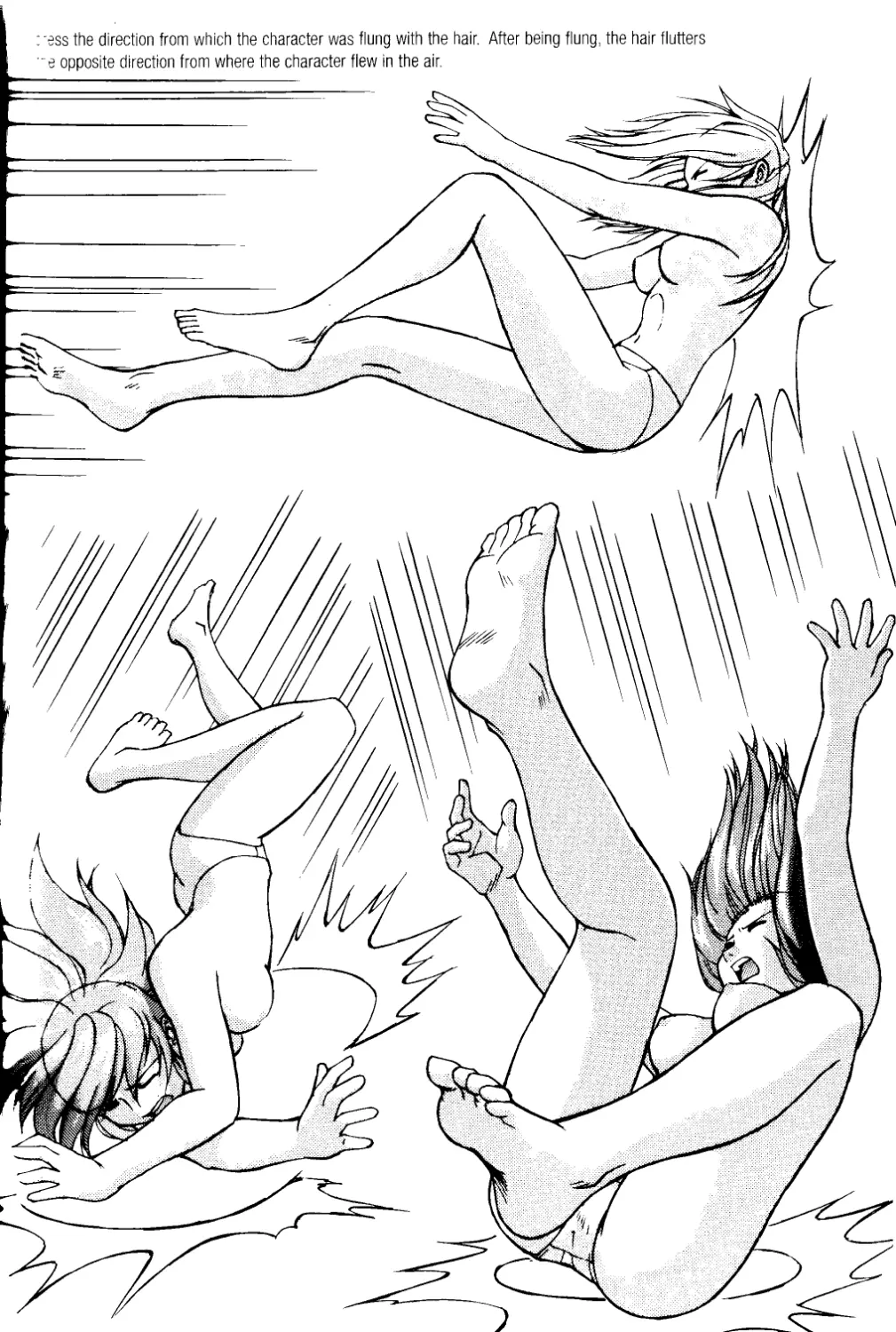
:’ess the direction from which the character was flung with the hair. After being flung, the hair flutters
"e opposite direction from where the character flew in the air.


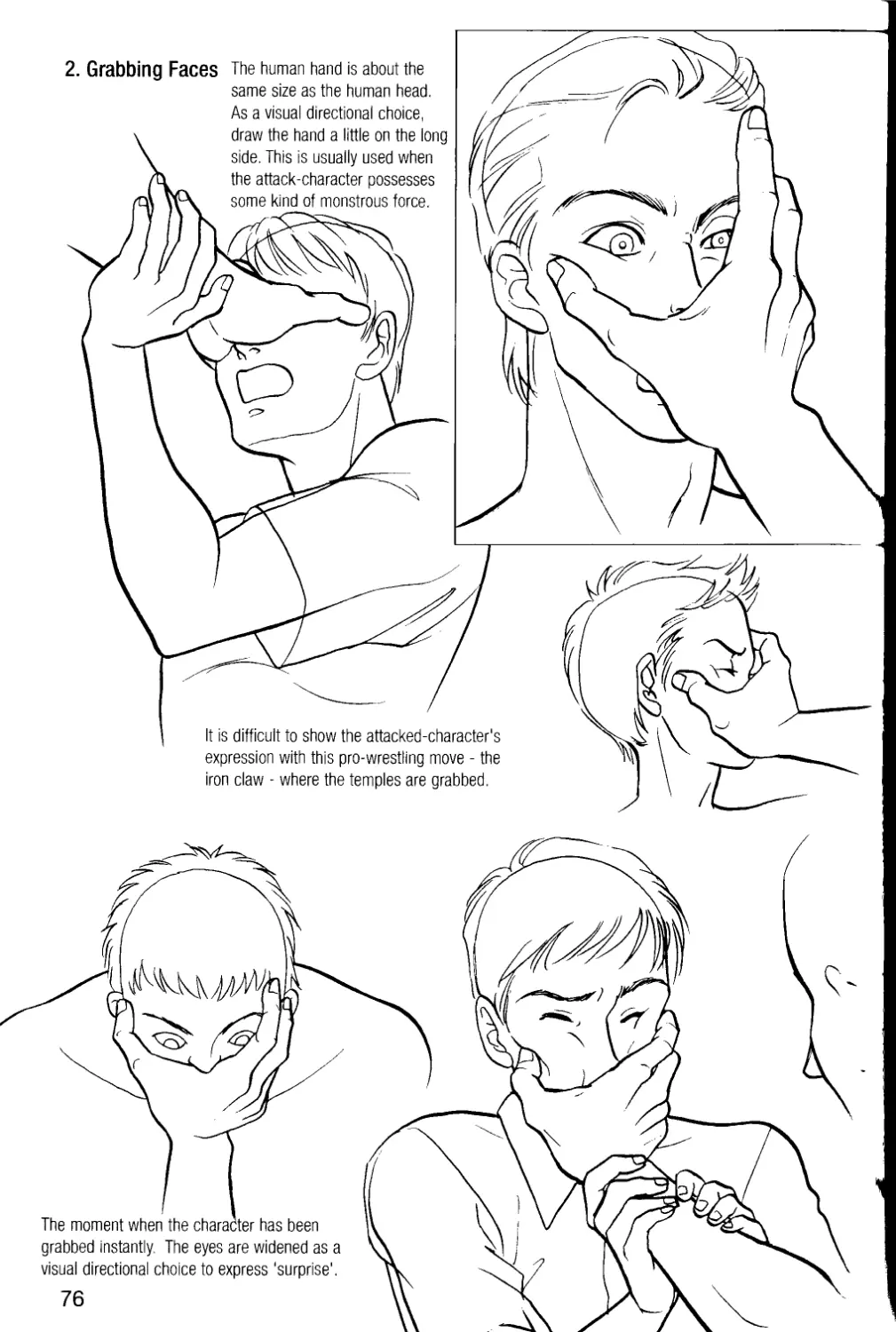
It is difficult to show the attacked-character's
expression with this pro-wrestling move - the
iron claw - where the temples are grabbed.
2. Grabbing Faces The human hand is about the
same size as the human head.
As a visual directional choice,
draw the hand a little on the long
side. This is usually used when
the attack-character possesses
some kind of monstrous force.
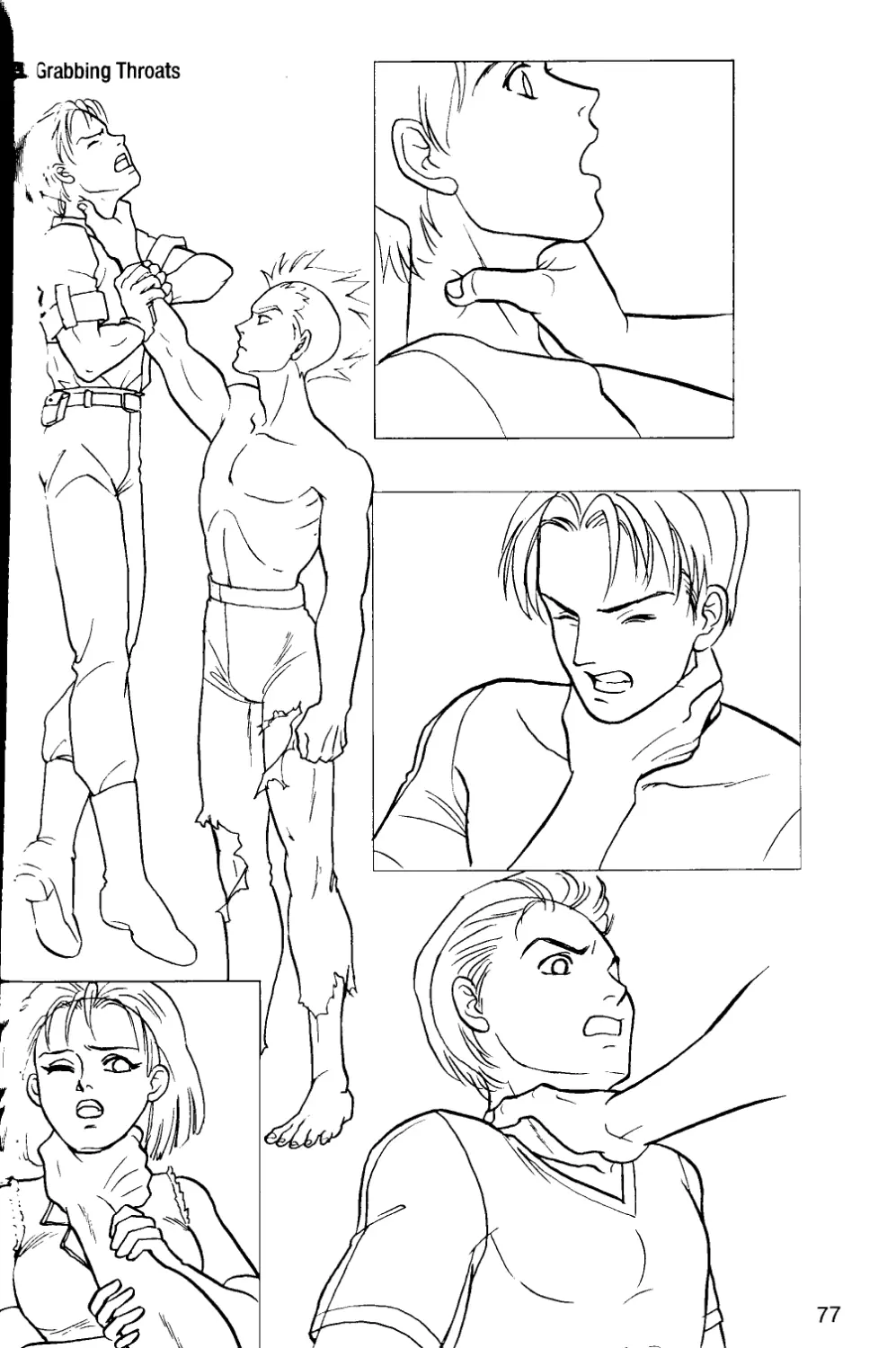
77
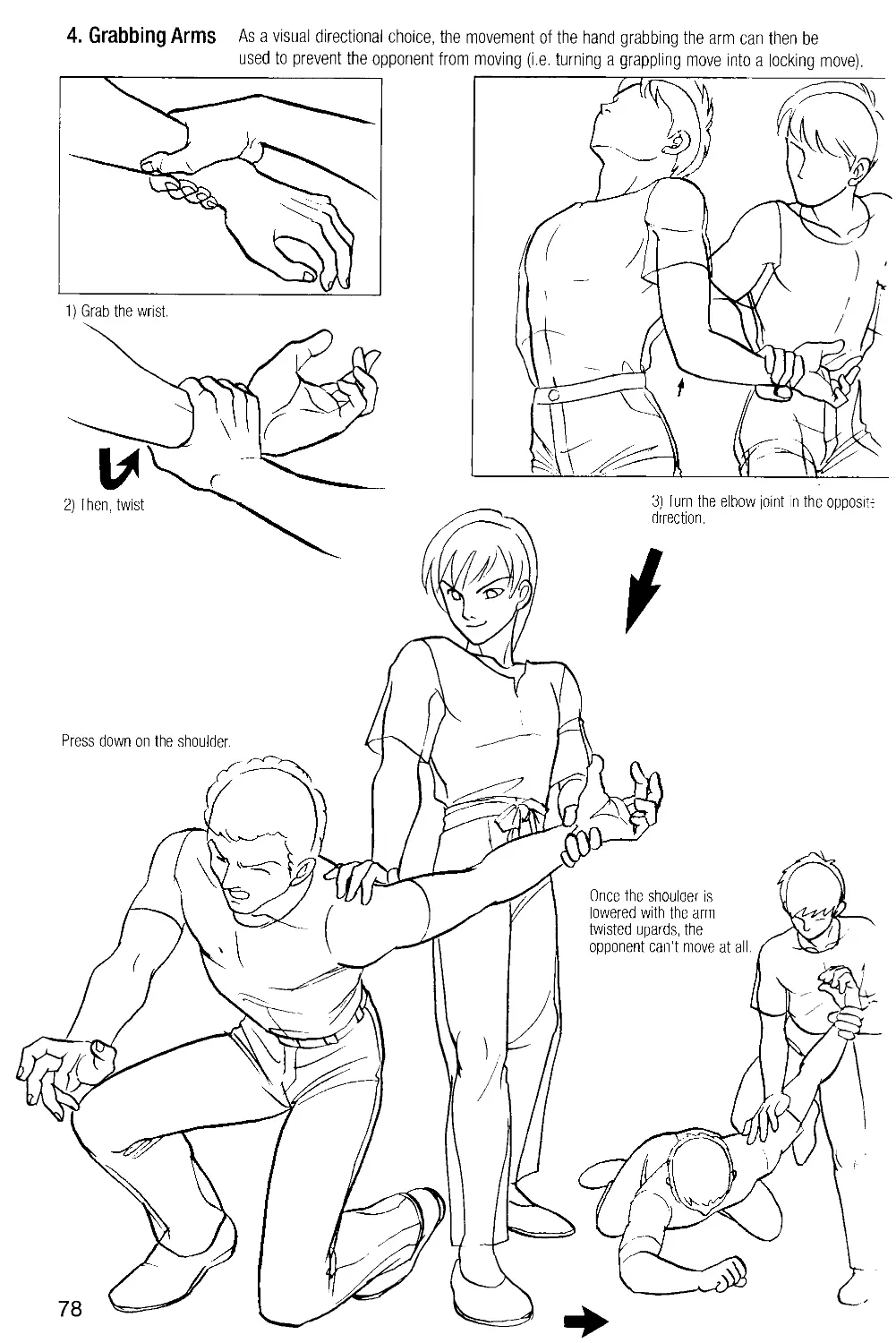
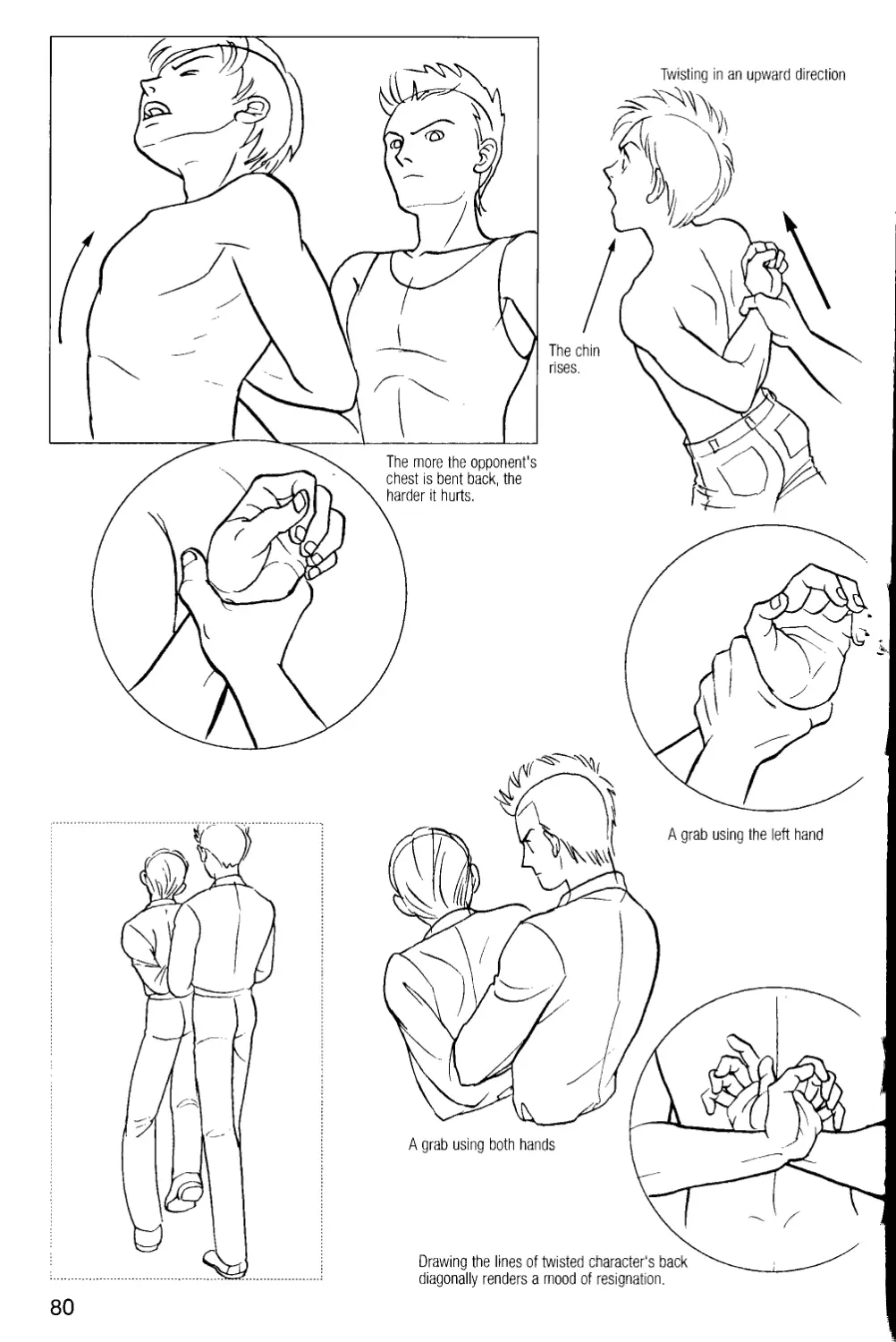
4. Grabbing Arms As a visual directional choice, the movement of the hand grabbing the arm can then be
used to prevent the opponent from moving (i.e. turning a grappling move into a locking move).
1) Grab the wrist.
2) Then, twist
Press down on the shoulder
3) lurn the elbow joint in the opposiE
direction.
Once the shoulder is
lowered with the arm
twisted upards, the
opponent can't move at all.
78
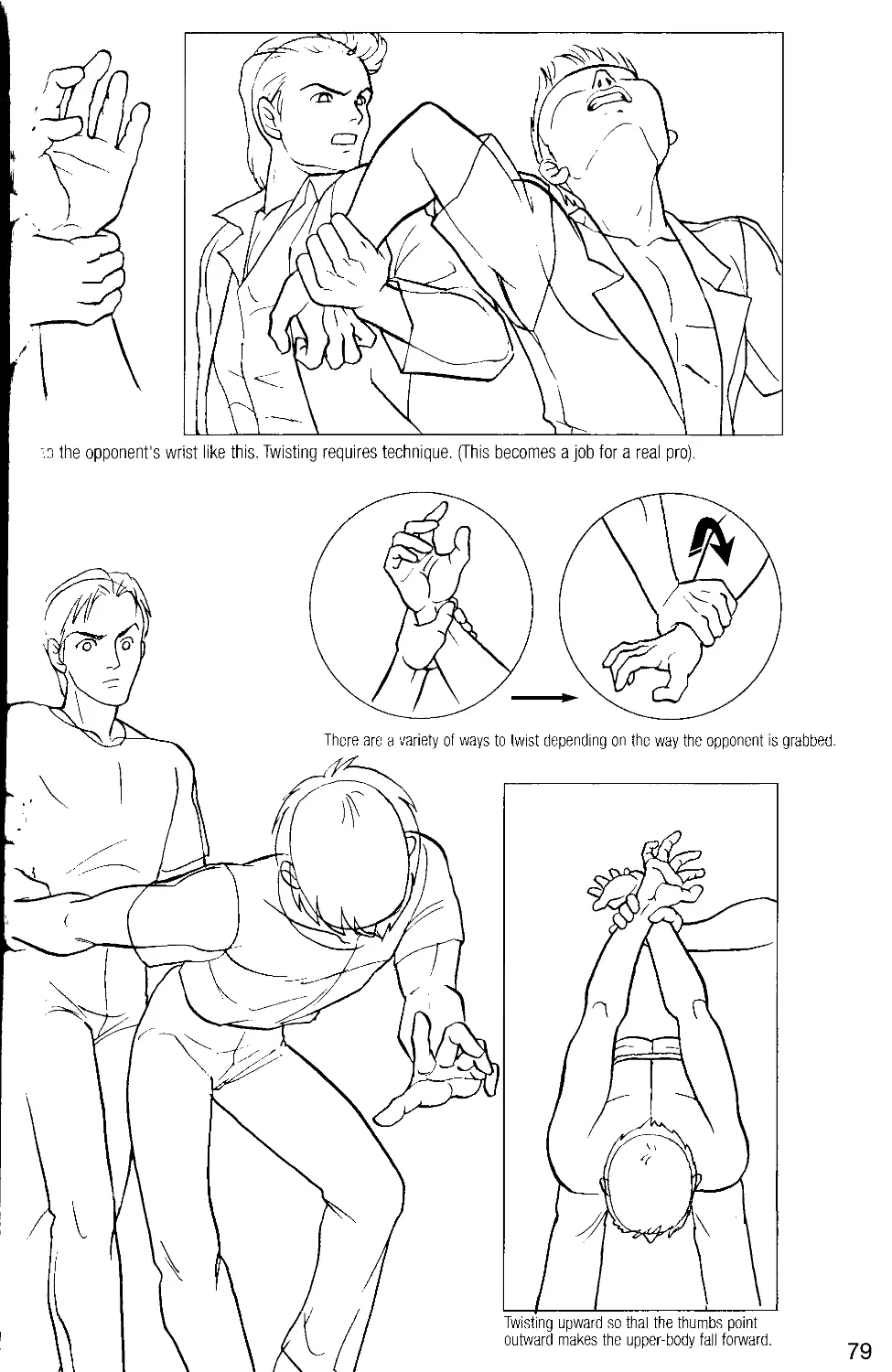
э the opponent's wrist like this. Twisting requires technique. (This becomes a job for a real pro).
79
Drawing the lines of twisted character’s back
diagonally renders a mood of resignation.
80

The arms' range of movement
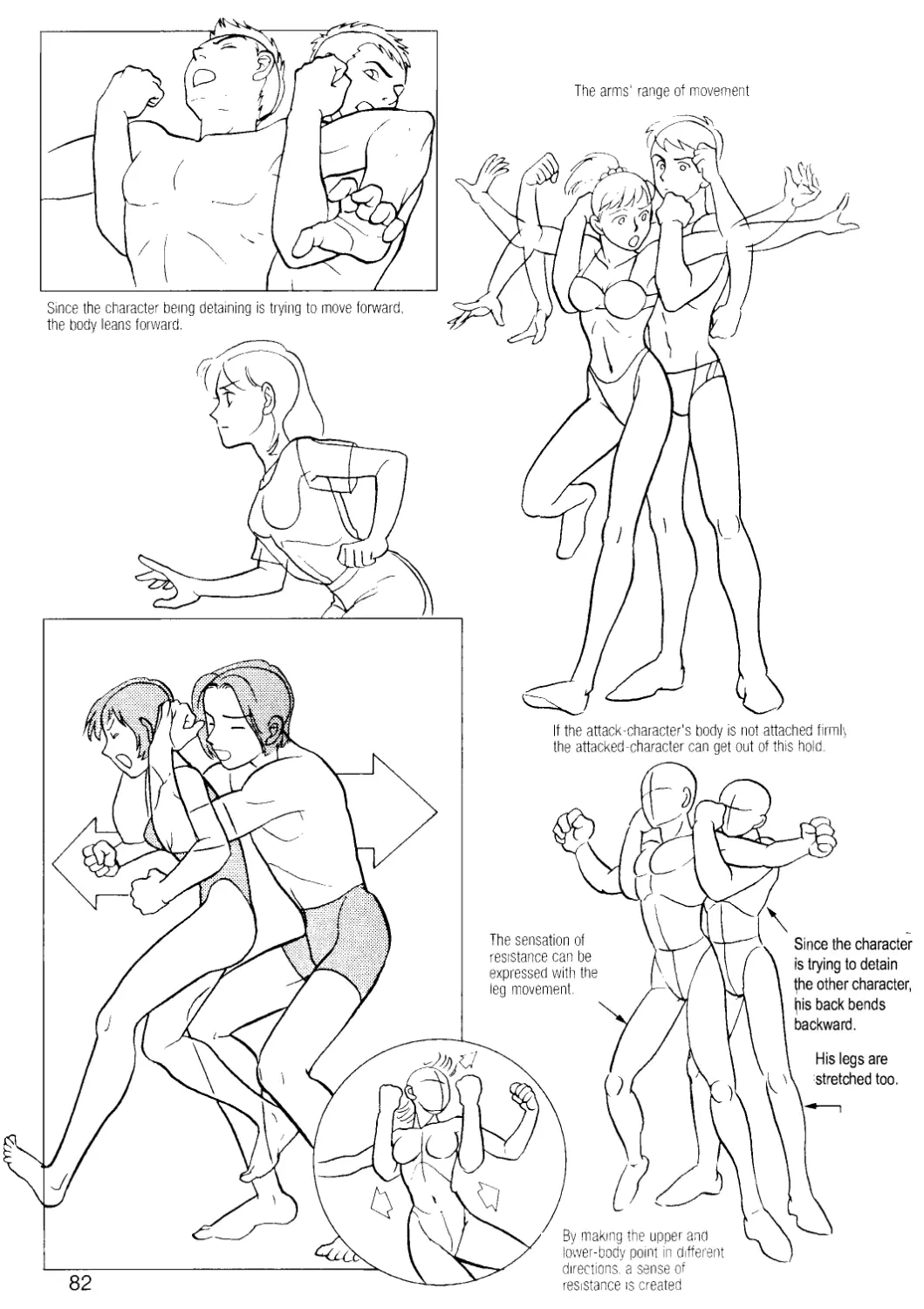
If the attack-character s body is not attached firmix
the attacked-character can get out of this hold.
By making the upper and
lower-body point in different
directions, a sense of
resistance is created
Since the character being detaining is trying to move forward,
the body leans forward.
The sensation of
resistance can be
expressed with the
leg movement.
Since the character
is trying to detain
(he other character,
fiis back bends
backward.
His legs are
stretched too.
82

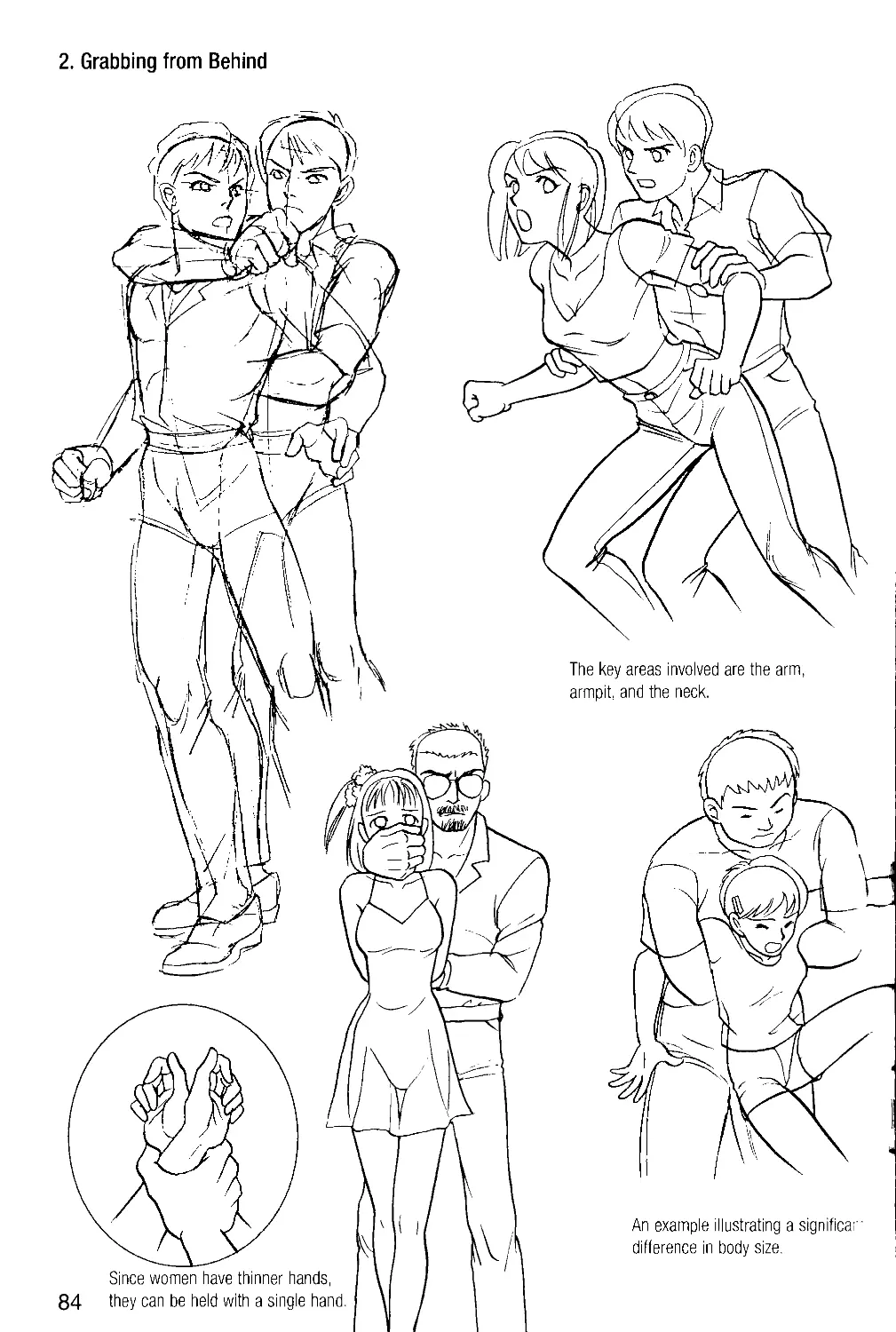
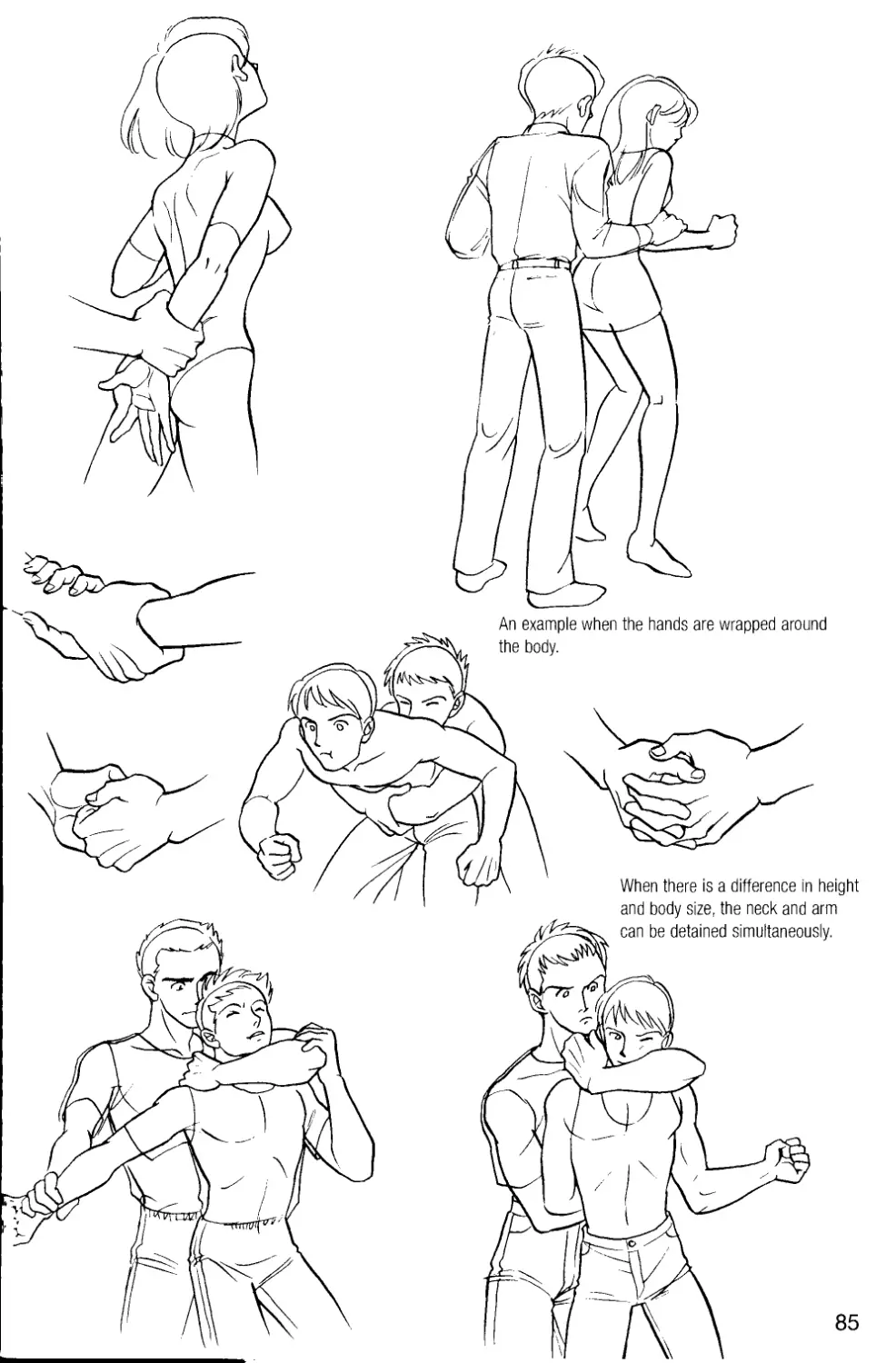
2. Grabbing from Behind
When there is a difference in height
and body size, the neck and arm
can be detained simultaneously.
An example when the hands are wrapped around
the body.

7
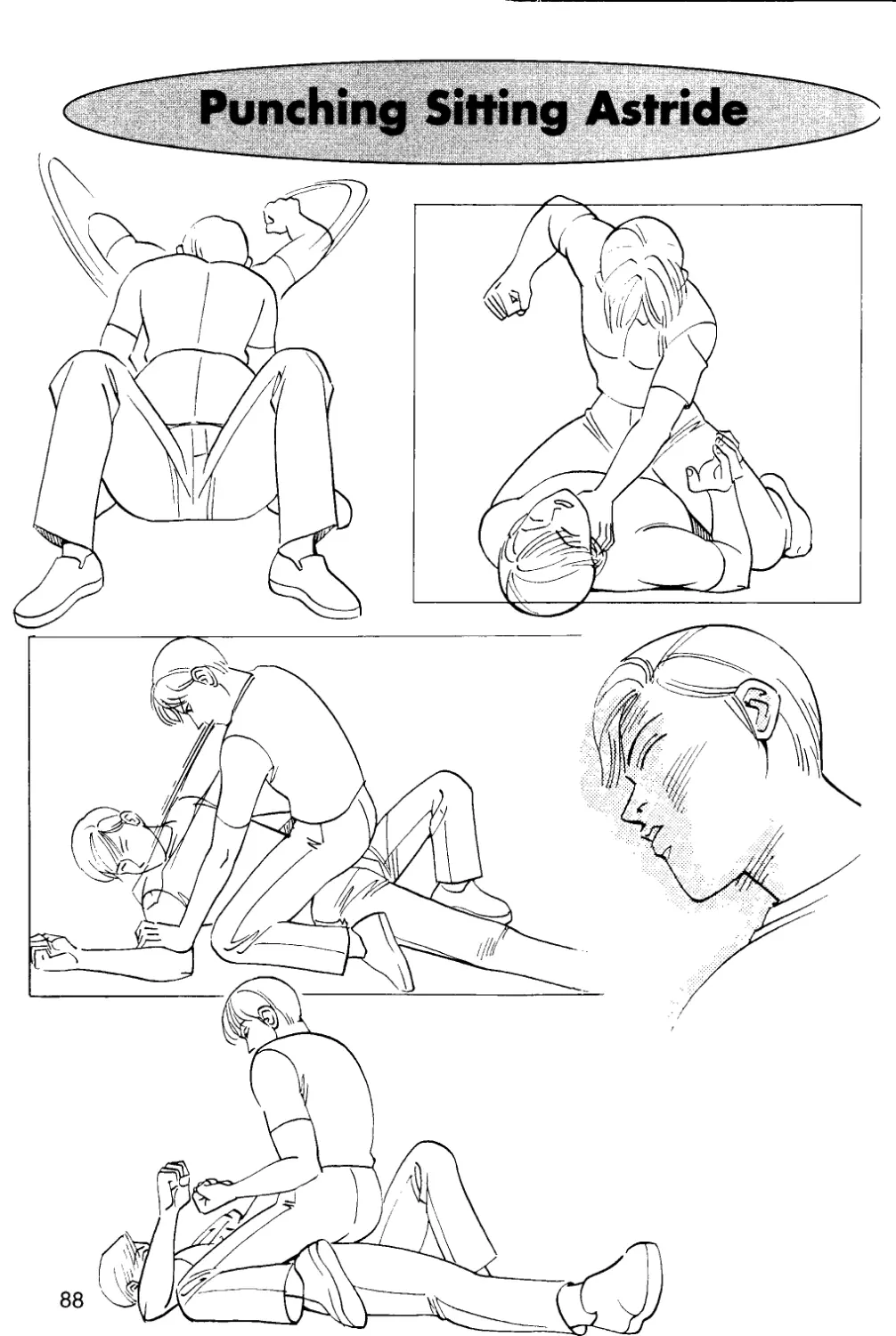
Punching Sitting Astride
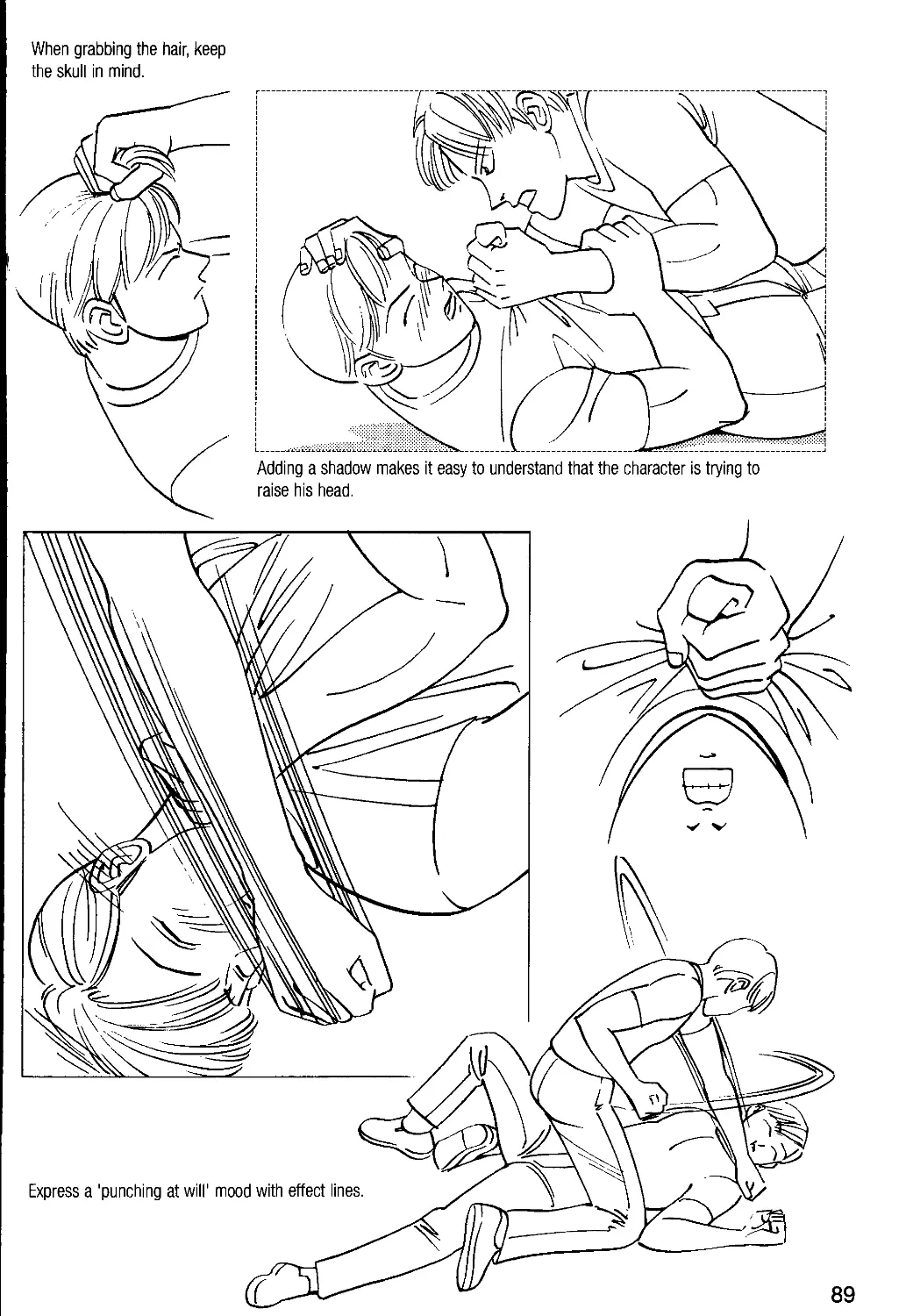
When grabbing the hair, keep
the skull in mind.
89
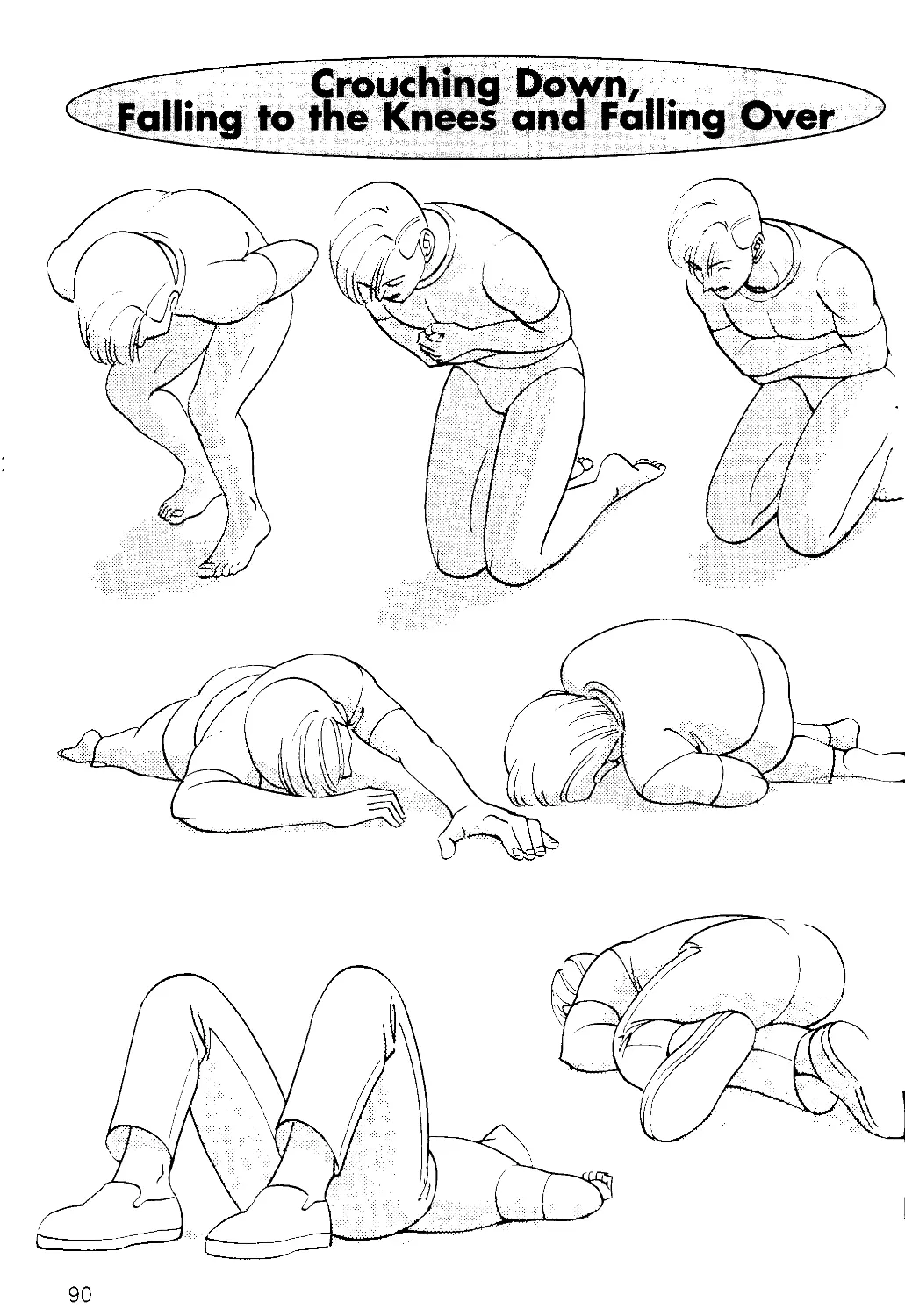
\ Crouching Down, e -
Falling to the Knees and Falling Over
90
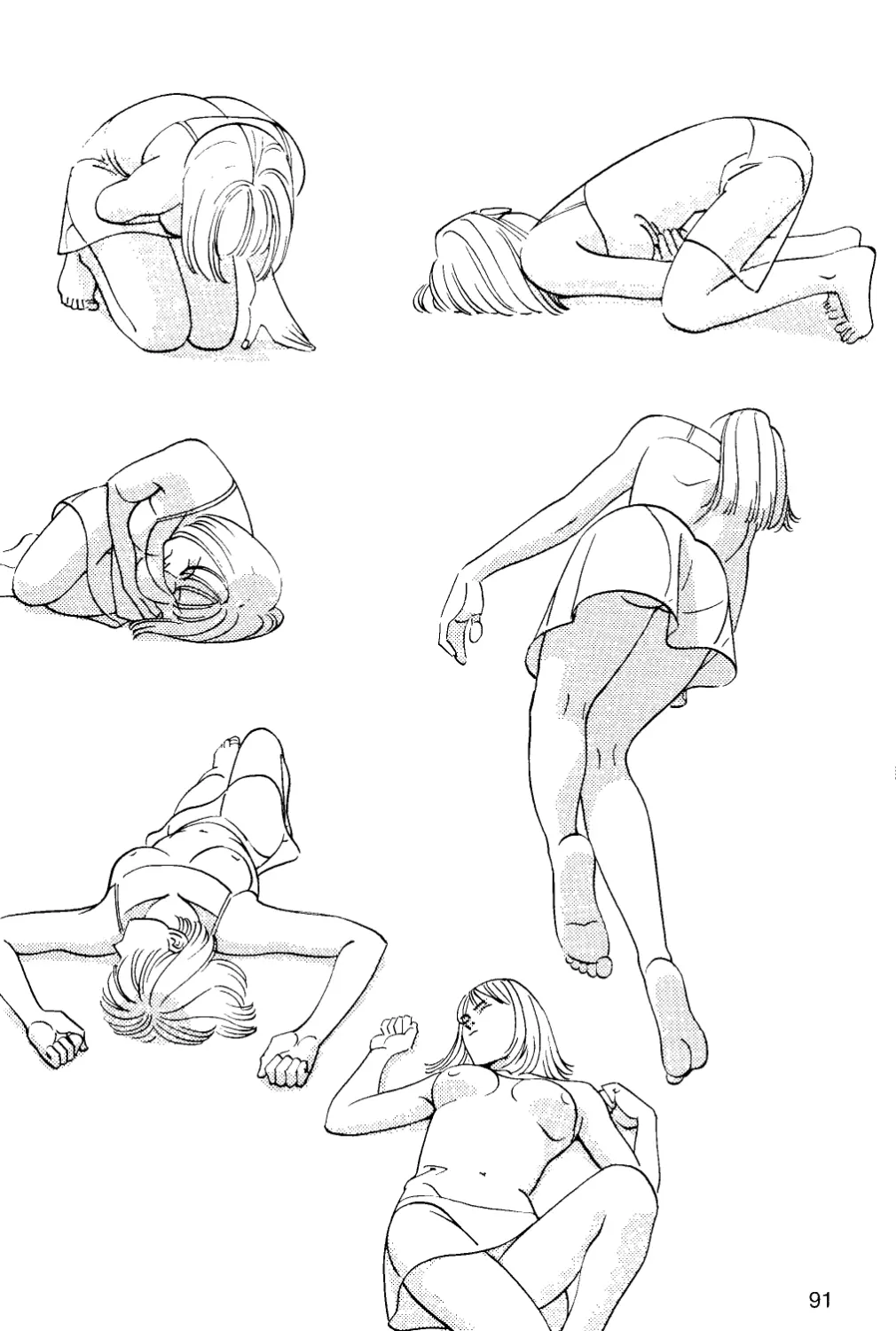
91
( Getting Up and Standing Up
92
93

2. Lock Variations
Locking the head showing the face
Locking the neck
Applying pressure to the cheeks	Locking the head and the forehead	Twisting the neck
a. Serious VS. b. Joking
a. When the character is fiercely
grabbing the other, draw the
shoulder line with oblique
lines (raising the shoulder)
with the legs stretched.
The shoulder of the character
grabbing the other's neck >
should be lowered.
b. When the character is jokingly
grabbing the other, show a sense of
relaxation. Draw the shoulder line
soft and relaxed with the back
straight.
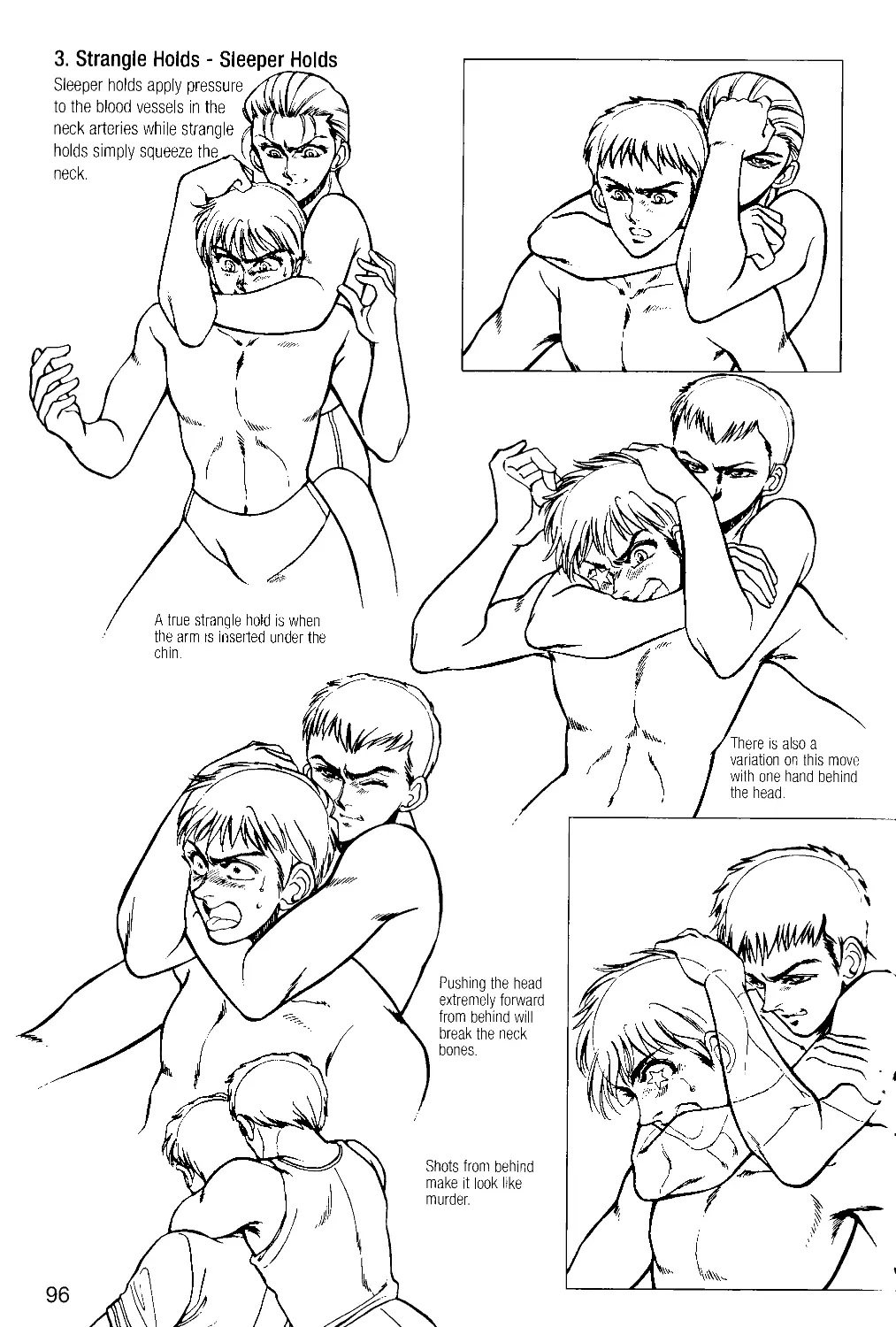
3. Strangle Holds - Sleeper Holds
96
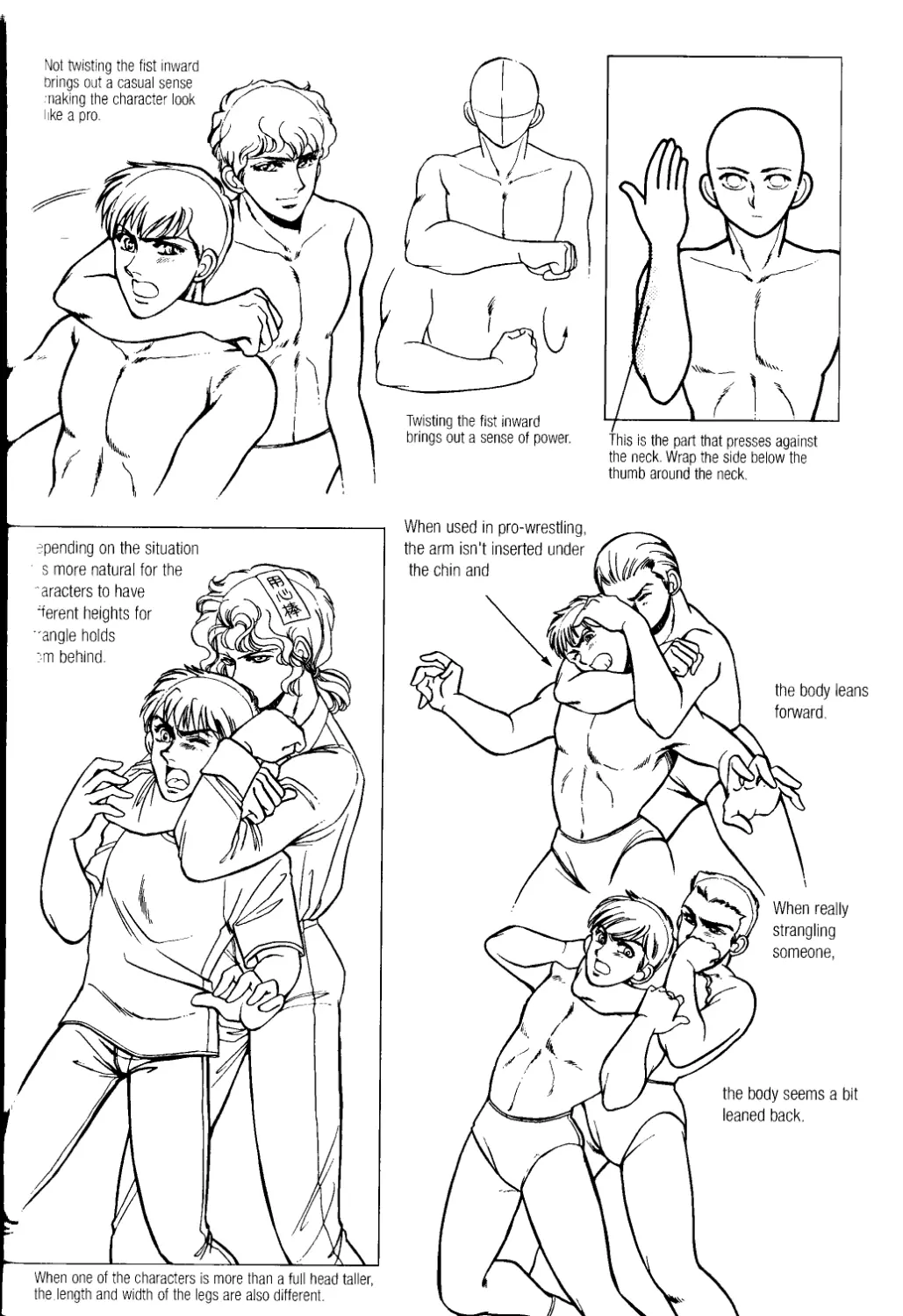
This is the part that presses against
the neck. Wrap the side below the
thumb around the neck.
When one of the characters is more than a full head taller,
the.length and width of the legs are also different.
When used in pro-wrestling,
the arm isn't inserted under
the chin and
the body leans
forward.
When really
strangling
someone,
the body seems a bit
leaned back.
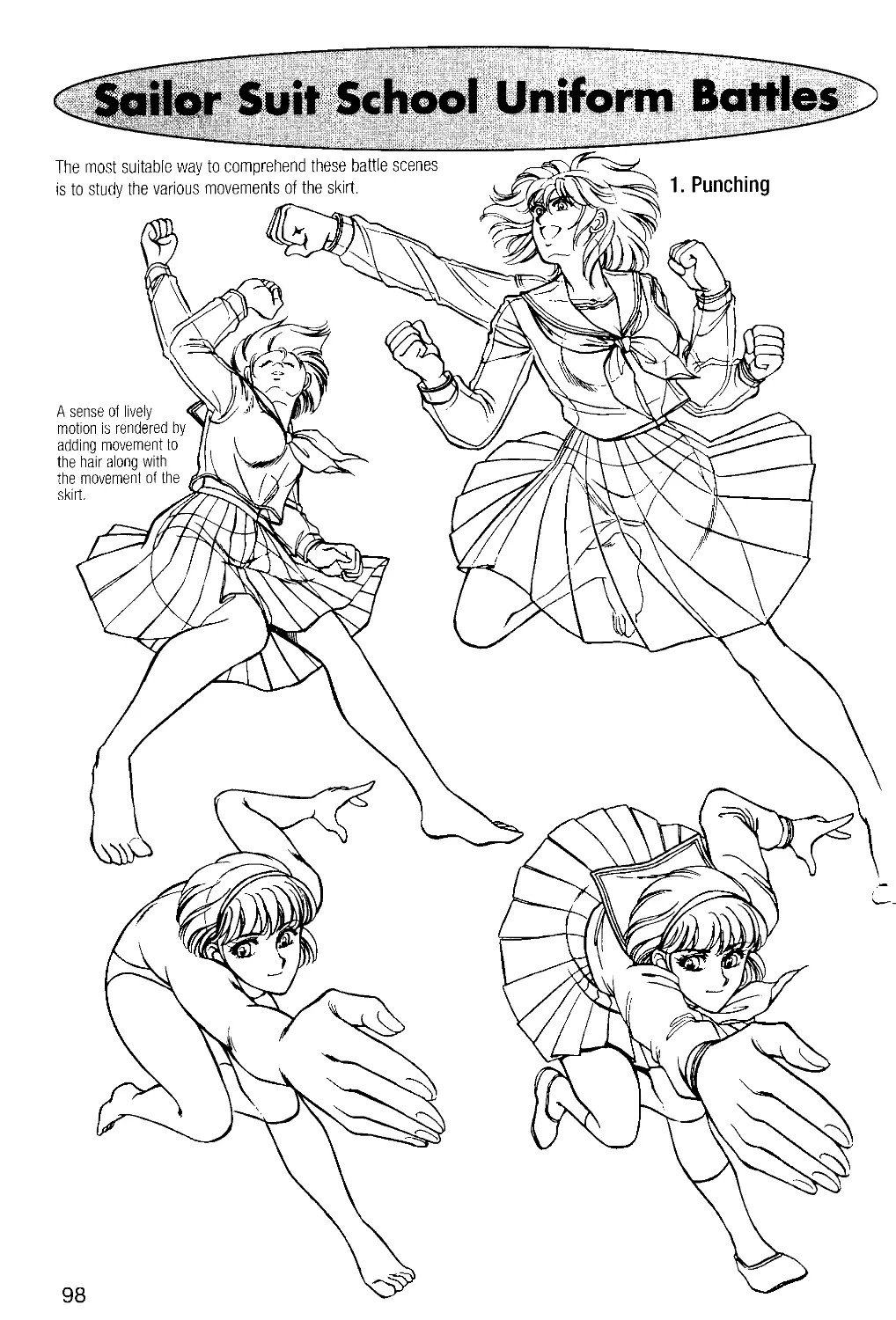
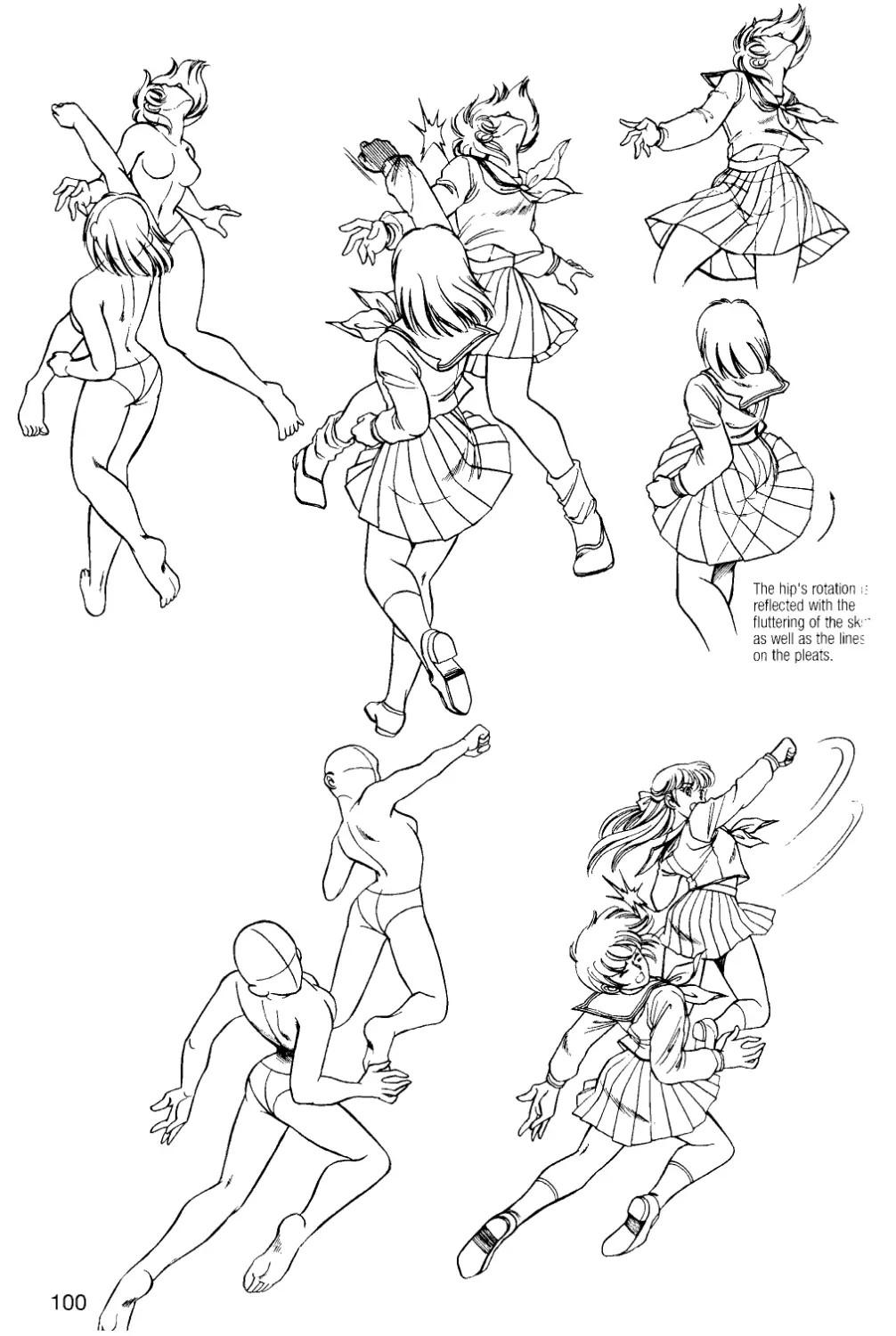
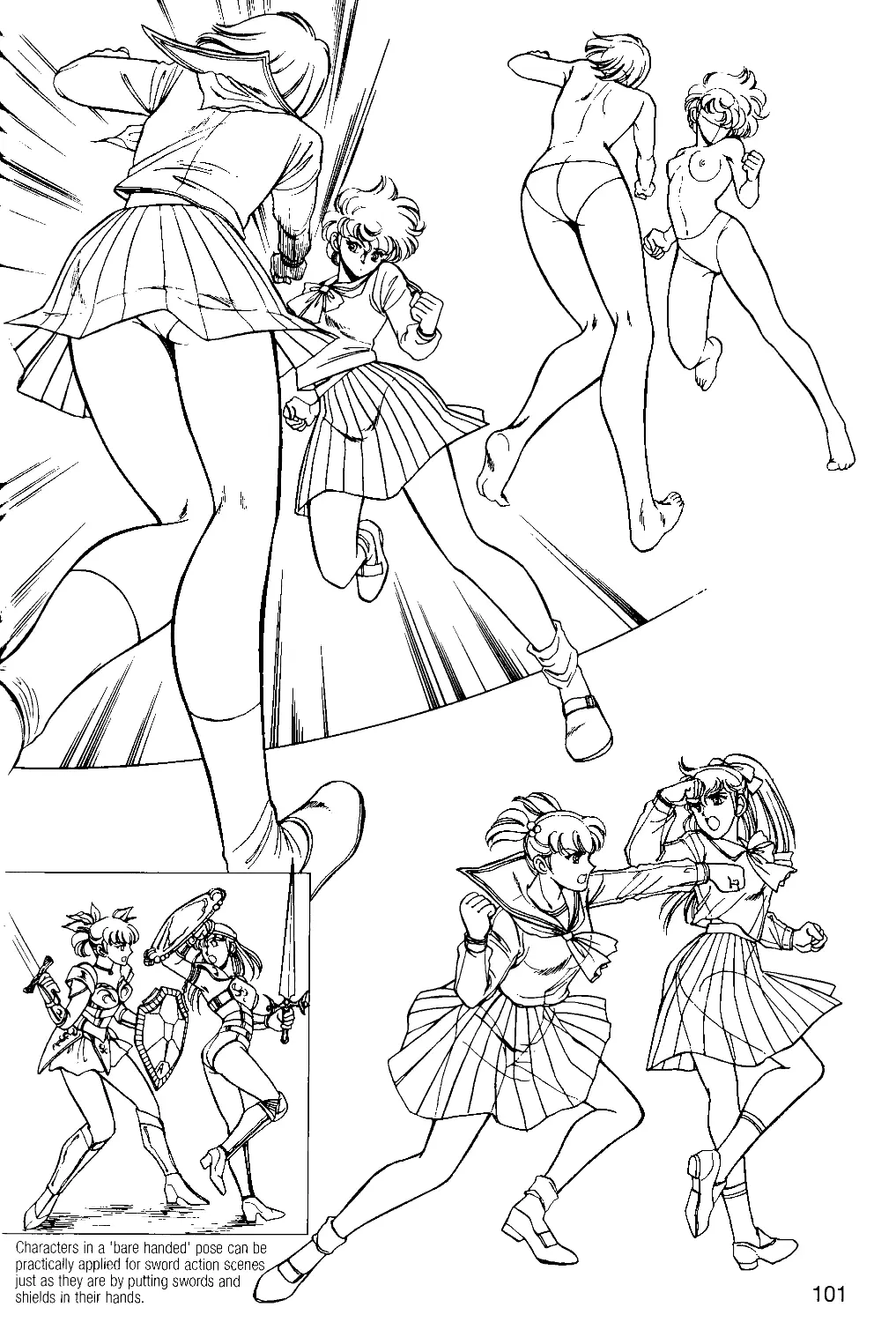
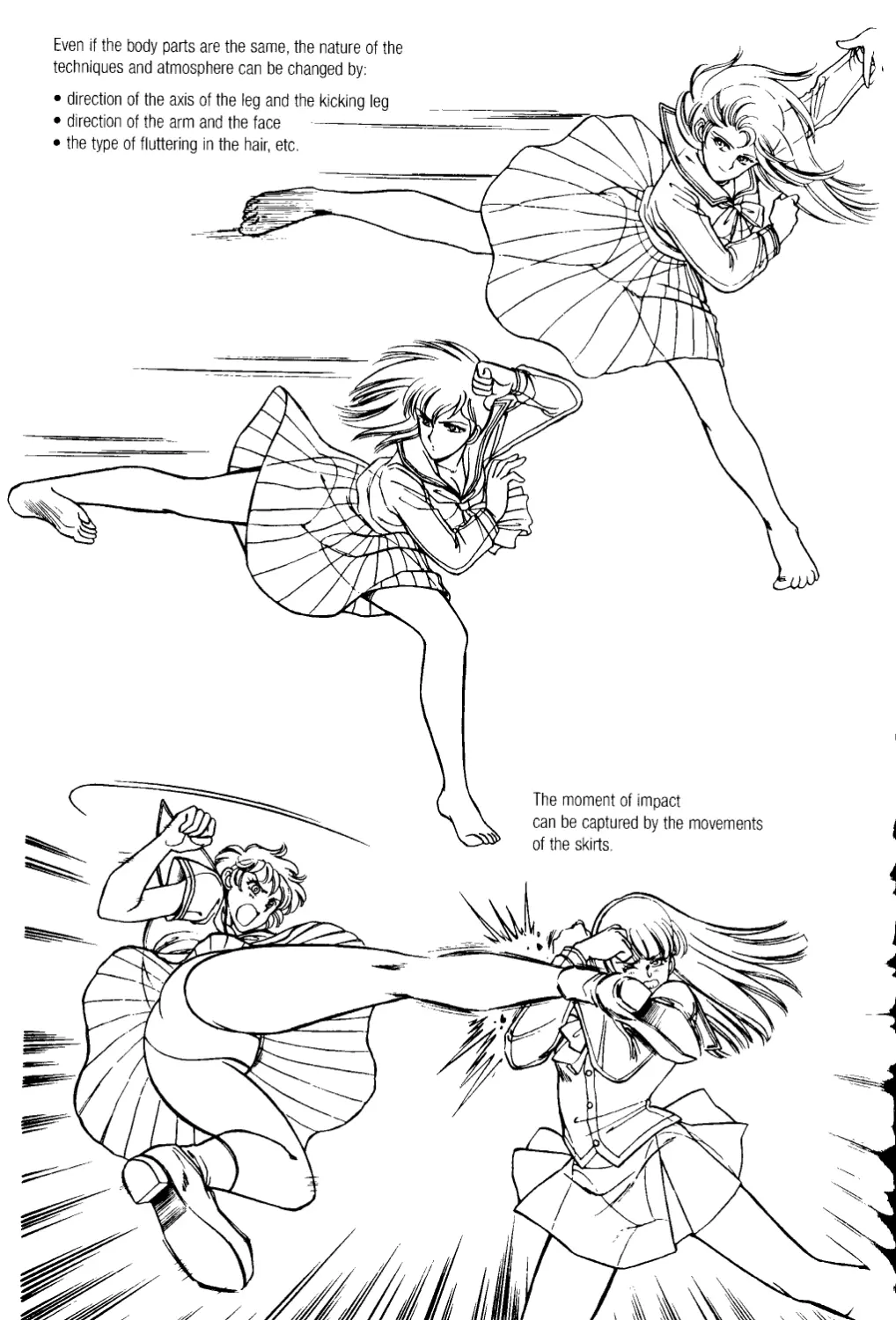
Sailor Suit School Uniform Battles
1. Punching
The most suitable way to comprehend these battle scenes
is to study the various movements of the skirt.
A sense of lively
motion is rendered by
adding movement to
the hair along with
the movement of the
skirt.
98


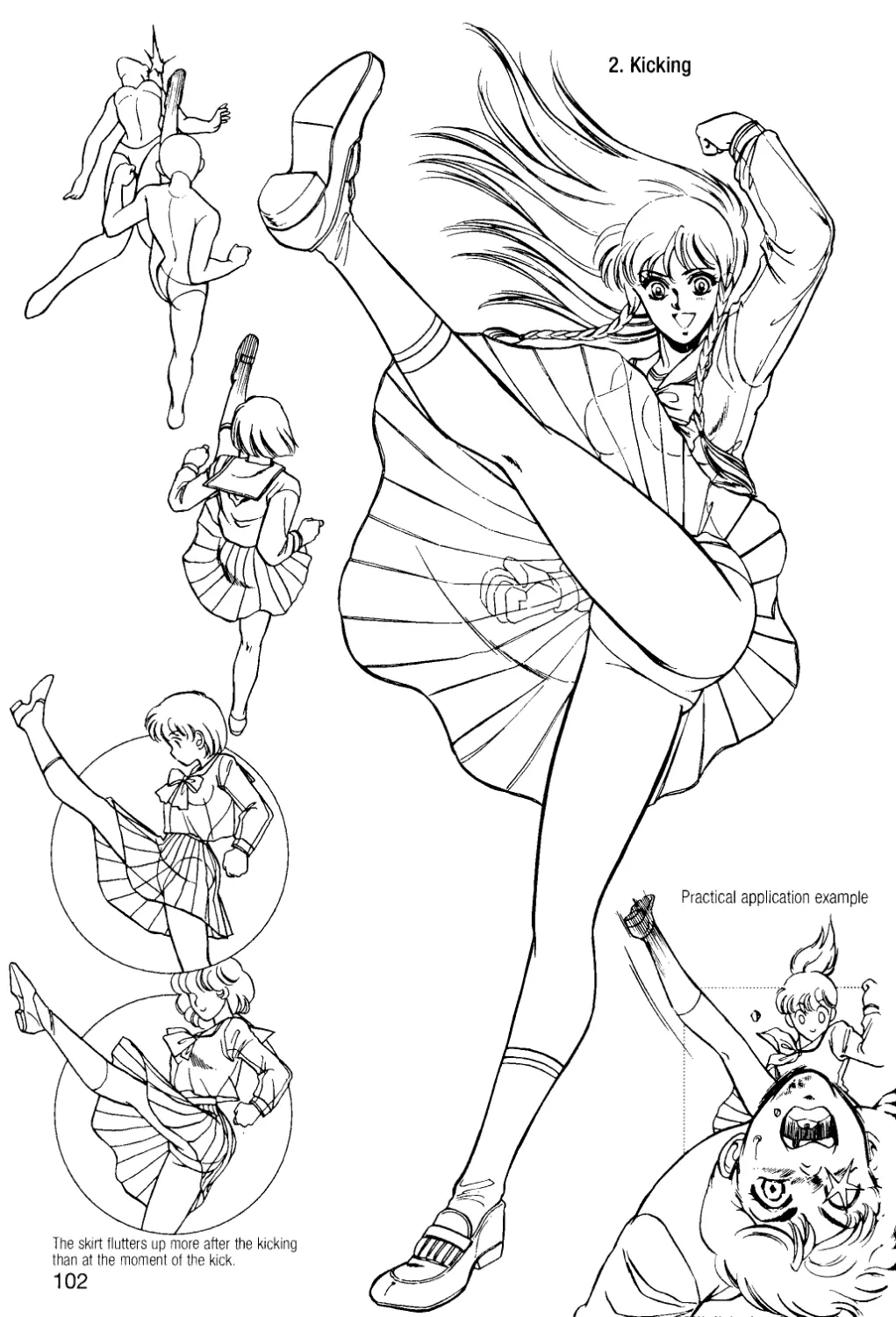
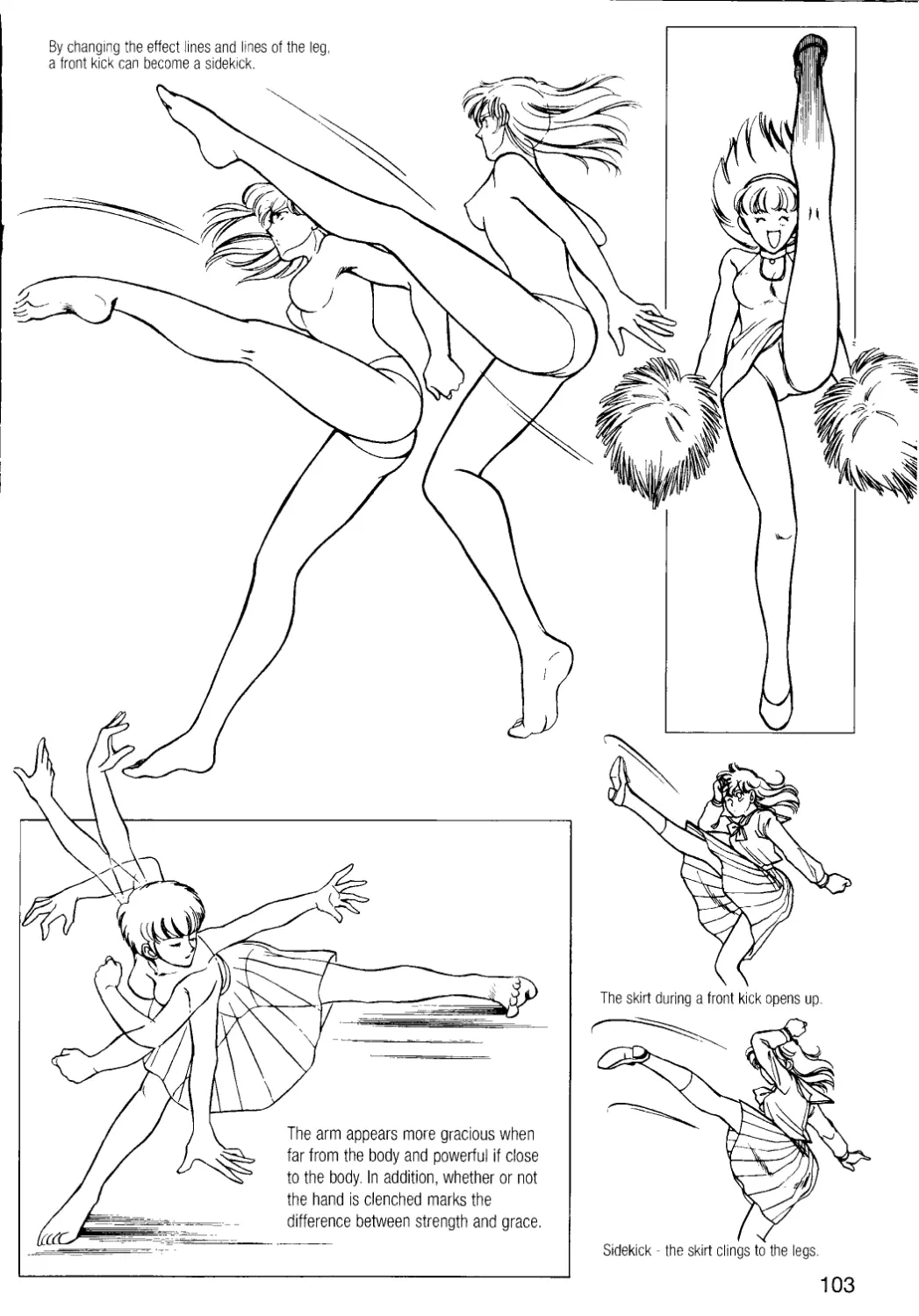
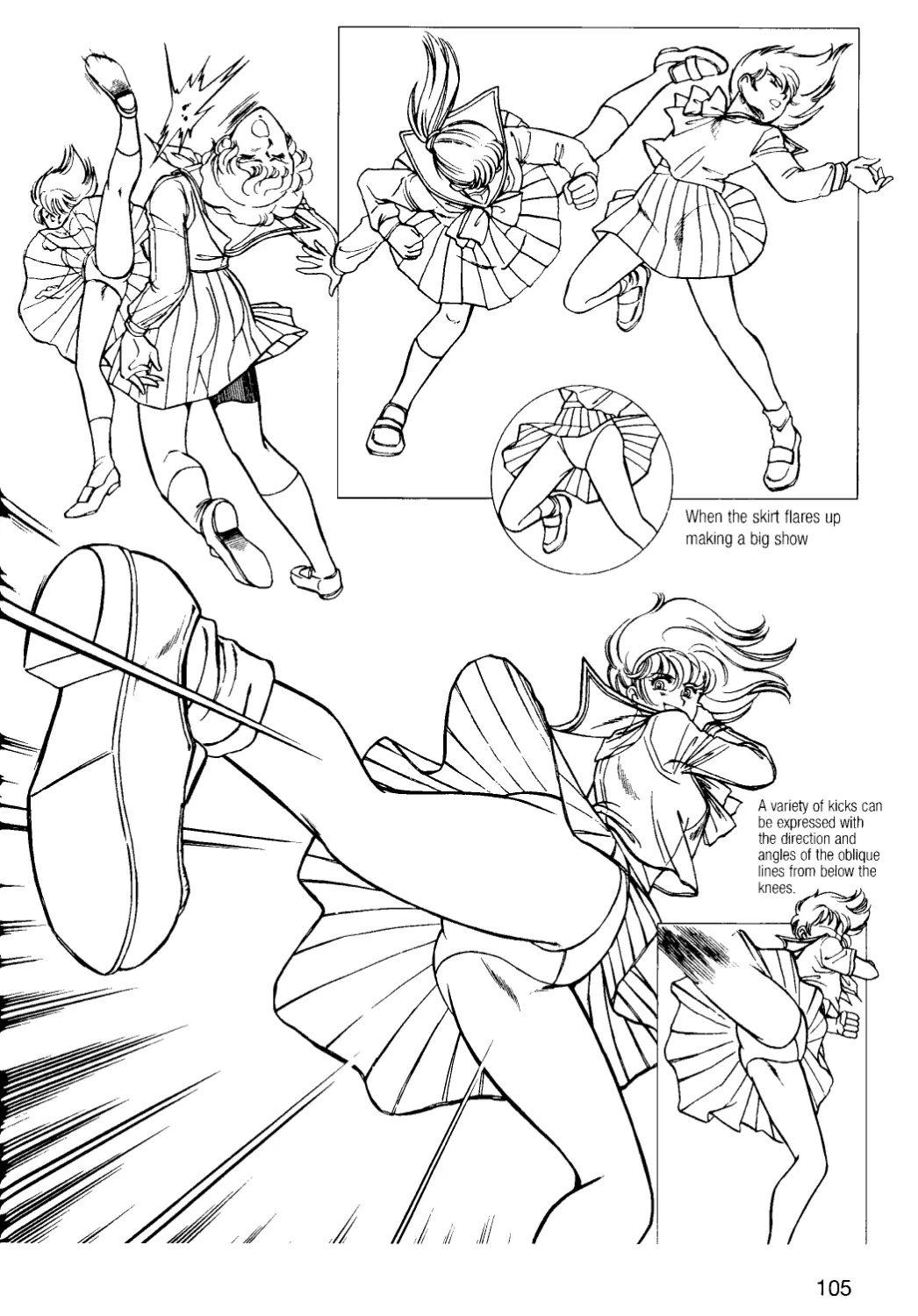
2. Kicking
By changing the effect lines and lines of the leg,
a front kick can become a sidekick,
103

(
When the skirt flares up
making a big show
К variety of kicks can
be expressed with
the direction and
angles of the oblique
lines from below the
knees. t _
105
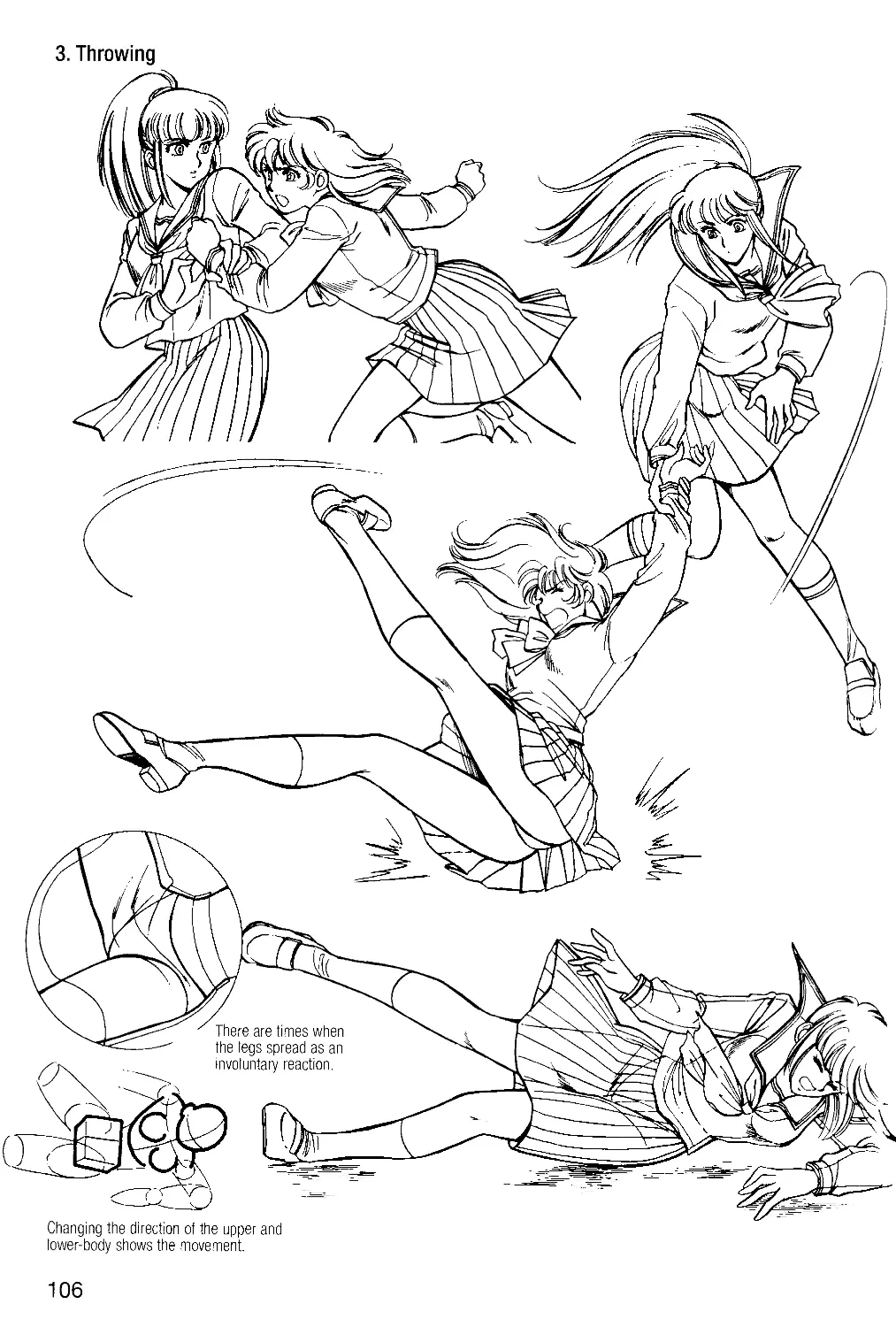
3. Throwing
Changing the direction of the upper and
lower-body shows the movement.
106
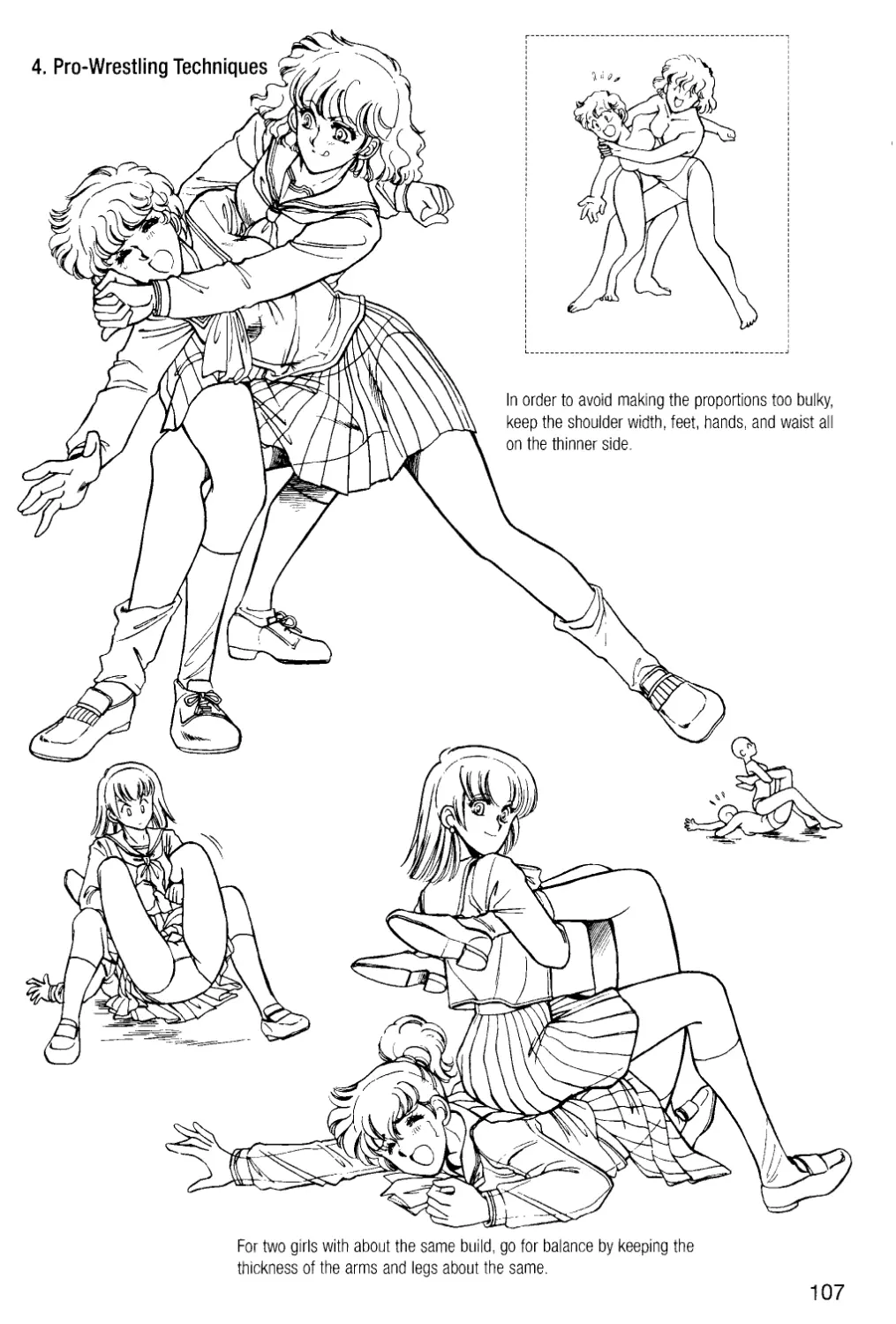
For two girls with about the same build, go for balance by keeping the
thickness of the arms and legs about the same.
107
5. Grappling
108
109
6. Pinning Down
For drawings like this, imagine that
the character has mounted a box
and is sitting down.
110
111
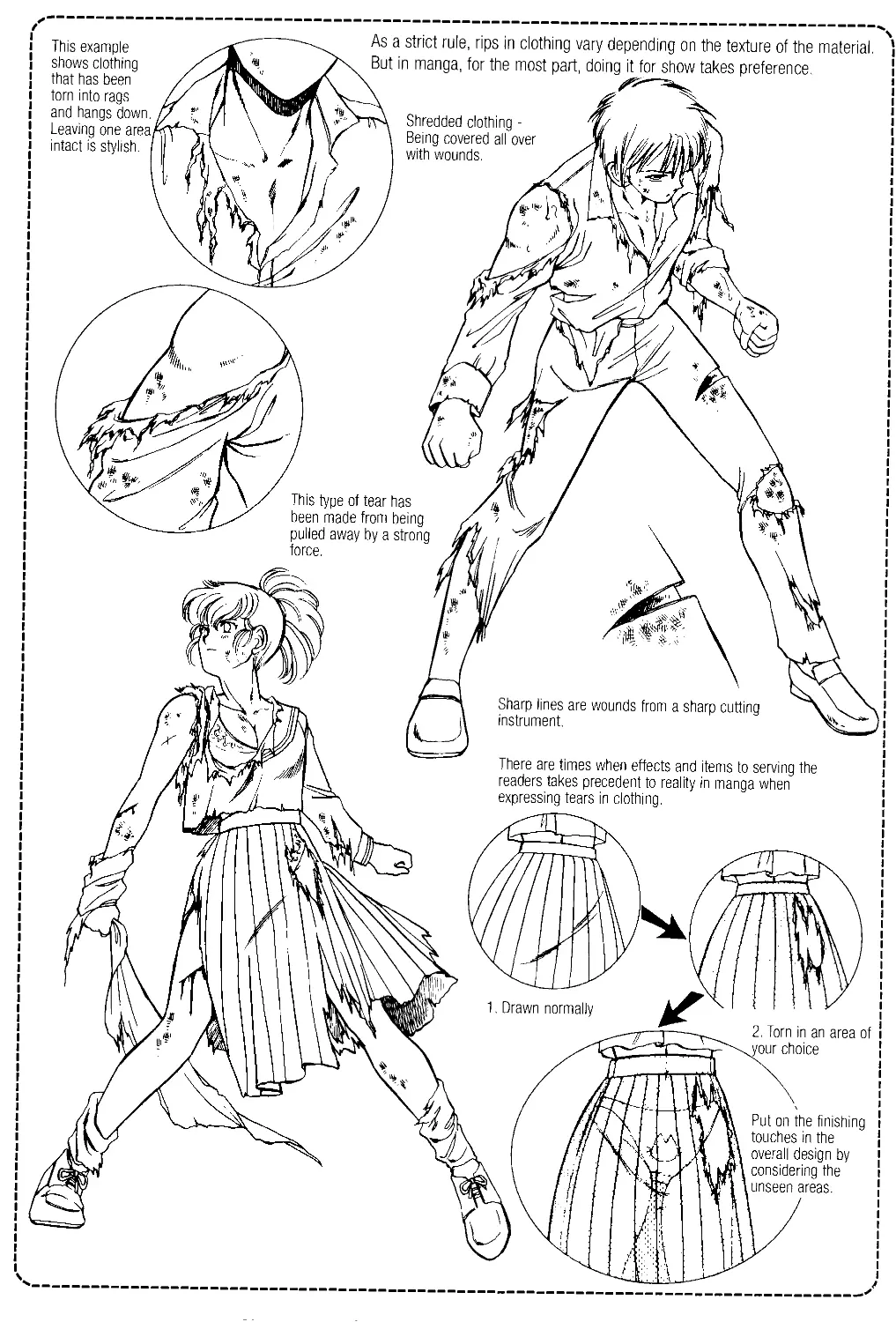
This example
shows clothing
that has been
torn into rags
and hangs down.
Leaving one area
intact is stylish.
As a strict rule, rips in clothing vary depending on the texture of the material.
But in manga, for the most part, doing it for show takes preference.
over
Shredded clothing -
Being covered all
with wounds.
,»>
Put on the finishing
touches in the
overall design by
considering the
unseen areas.

This type of tear has
been made from being
pulled away by a strong
force.
Sharp lines are wounds from a sharp cutting
instrument,
There are times when effects and items to serving the
readers takes precedent to reality in manga when
expressing tears in clothing.
1, Drawn normally
2, lorn in an area of
your choice
sanoiMHDai Aanis asv3
1SI1HV vdmvh
:sHaisvw 3Hi womj hravaq
]7 ?J ,^,Ld VJJ □
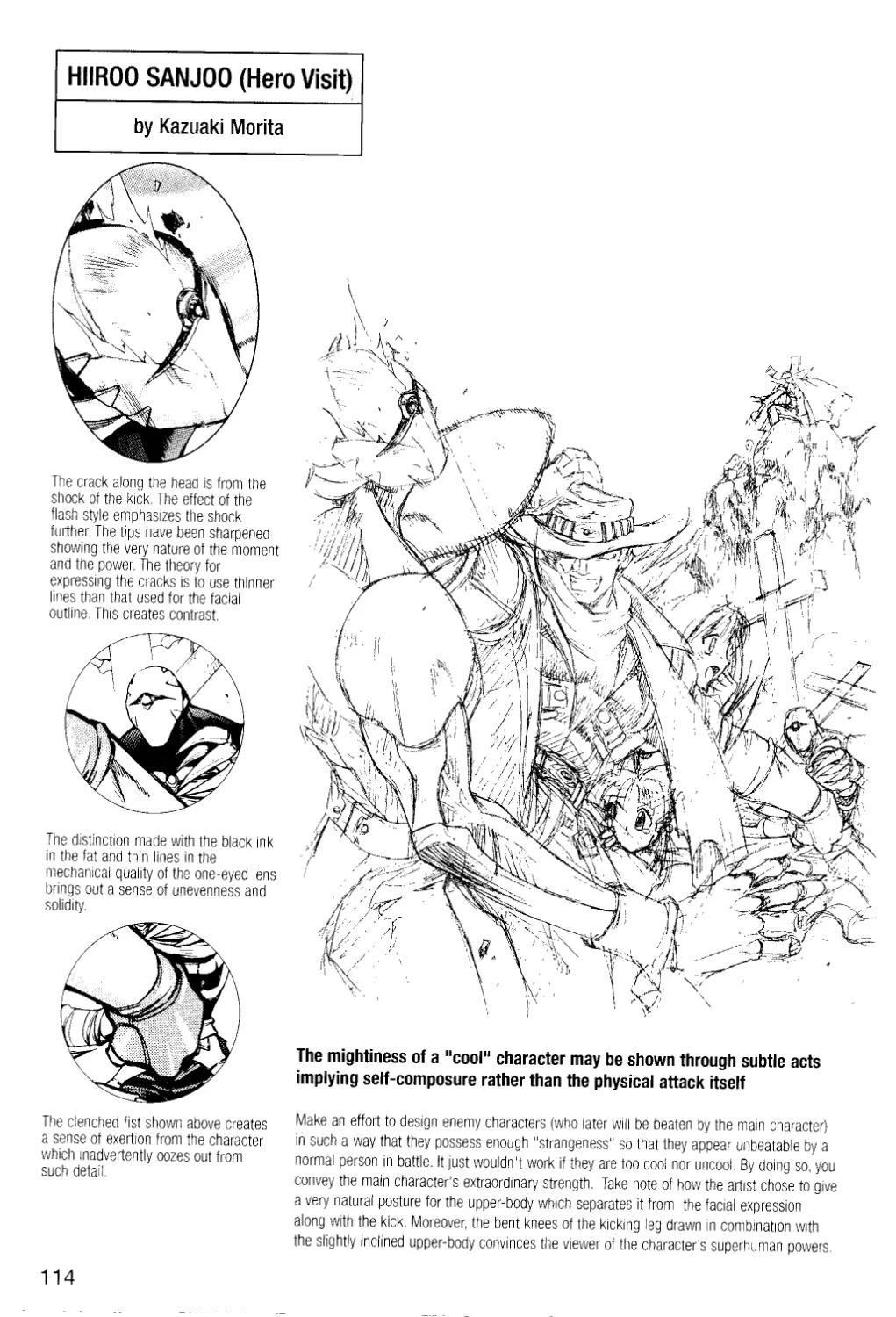
HIIROO SANJOO (Hero Visit)
by Kazuaki Morita
The crack along the head is from the
shock of the kick. The effect of the
flash style emphasizes the shock
further. The tips have been sharpened
showing the very nature of the moment
and the power. The theory for
expressing the cracks is to use thinner
lines than that used for the facial
outline. This creates contrast.
The distinction made with the black ink
in the fat and thin lines in the
mechanical guality of the one-eyed lens
brings out a sense of unevenness and
solidity.
The clenched fist shown above creates
a sense of exertion from the character
which inadvertently oozes out from
such detail.
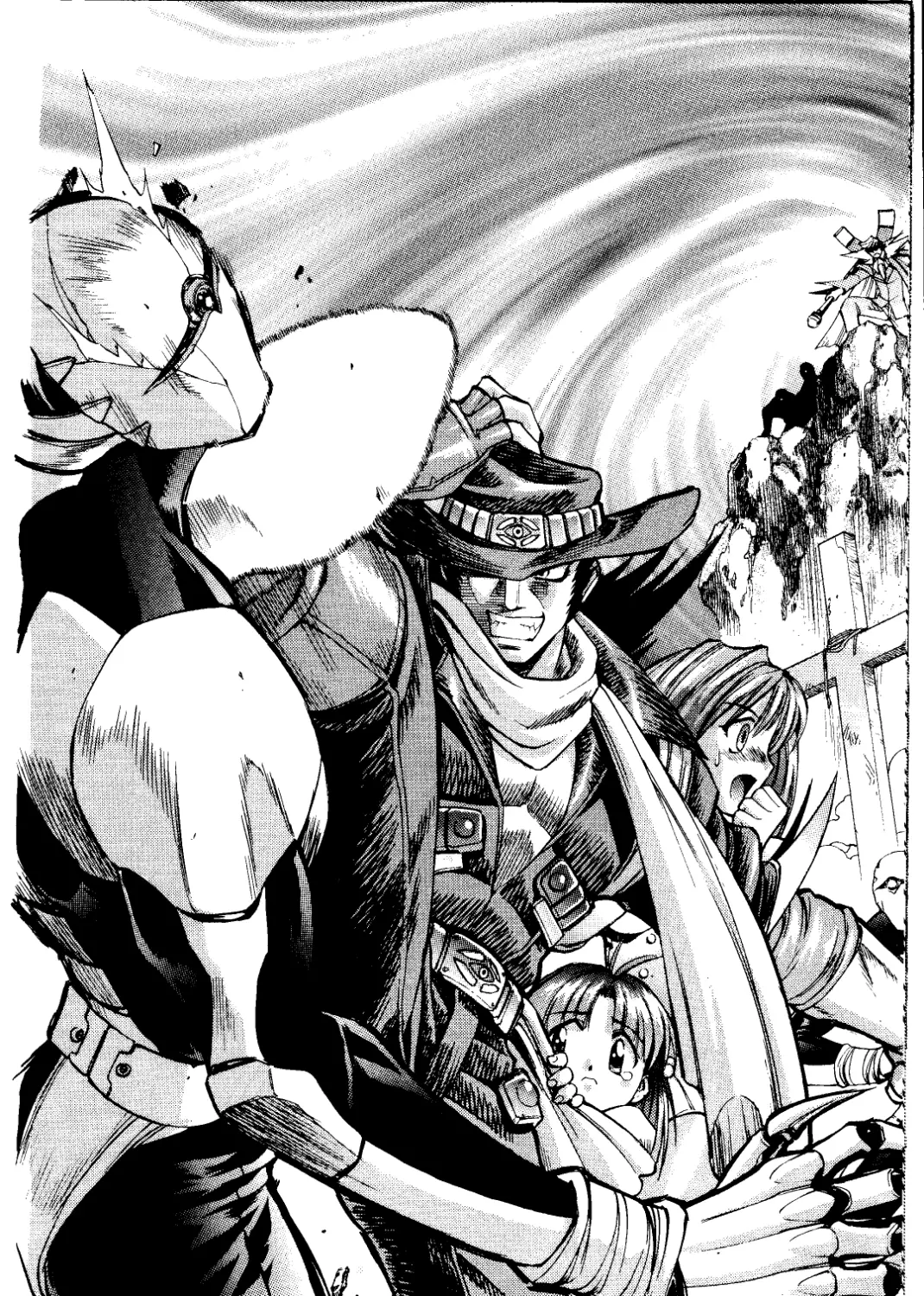
The mightiness of a “cool11 character may be shown through subtle acts
implying self-composure rather than the physical attack itself
Make an effort to design enemy characters (who later will be beaten by the main character)
in such a way that they possess enough "strangeness" so that they appear unbeatable by a
normal person in battle. It just wouldn’t work if they are too cool nor uncool. By doing so, you
convey the main character’s extraordinary strength. Take note of how the artist chose to give
a very natural posture for the upper-body which separates it from the facial expression
along with the kick. Moreover, the bent knees of the kicking leg drawn in combination with
the slightly inclined upper-body convinces the viewer of the character's superhuman powers.
114

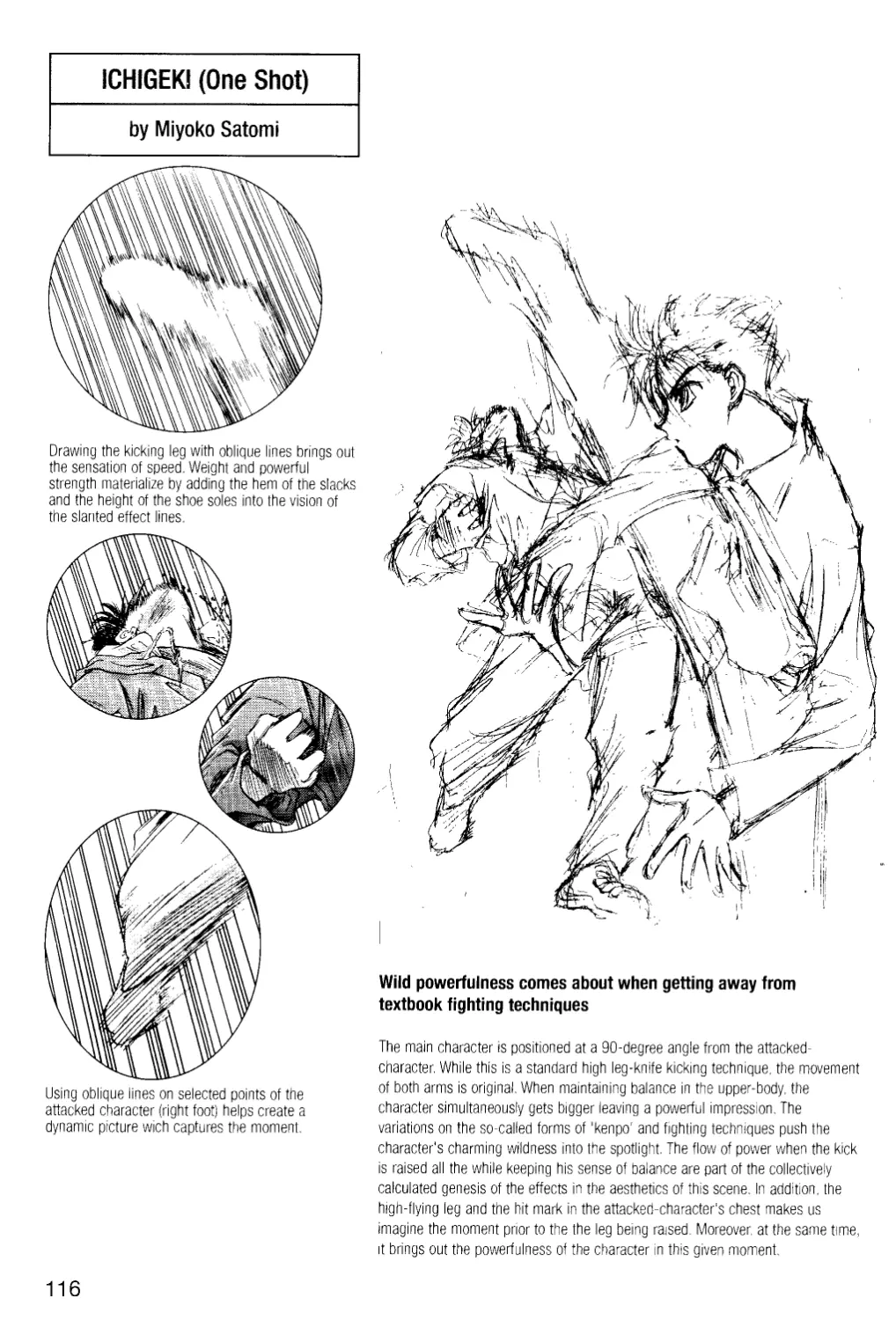
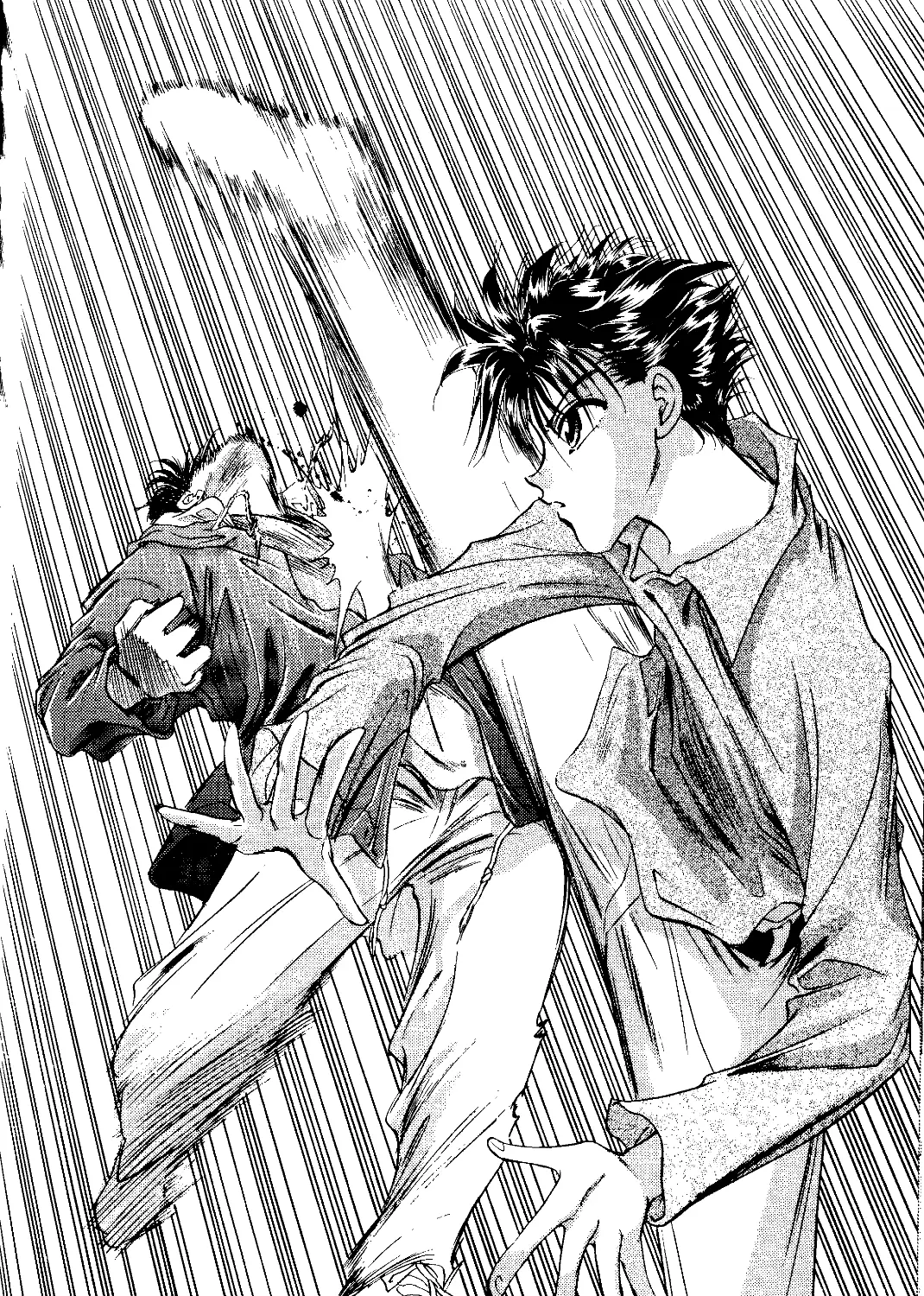
ICHIGEK! (One Shot)
by Miyoko Satomi
Drawing the kicking leg with oblique lines brings out
the sensation of speed. Weight and powerful
strength materialize by adding the hem of the slacks
and the height of the shoe soles into the vision of
the slanted effect lines.
Using oblique lines on selected points of the
attacked character (right foot) helps create a
dynamic picture wich captures the moment.
Wild powerfulness comes about when getting away from
textbook fighting techniques
The main character is positioned at a 90-degree angle from the attacked-
character. While this is a standard high leg-knife kicking technique, the movement
of both arms is original. When maintaining balance in the upper-body, the
character simultaneously gets bigger leaving a powerful impression. The
variations on the so-called forms of 'kenpo' and fighting techniques push the
character’s charming wildness into the spotlight. The flow of power when the kick
is raised all the while keeping his sense of balance are part of the collectively
calculated genesis of the effects in the aesthetics of this scene. In addition, the
high-flying leg and the hit mark in the attacked-character’s chest makes us
imagine the moment prior to the the leg being raised. Moreover, at the same time,
it brings out the powerfulness of the character in this given moment.
116

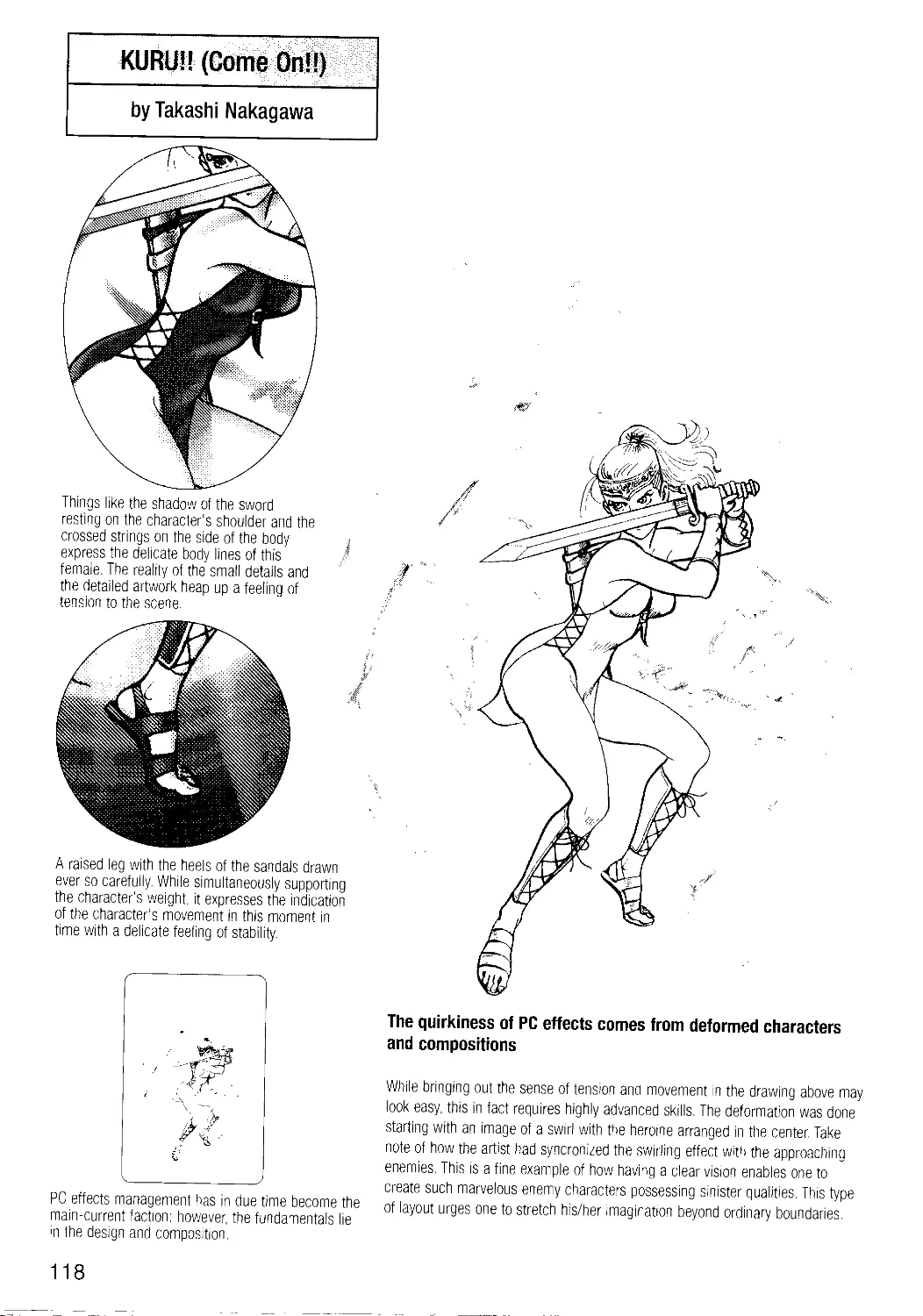
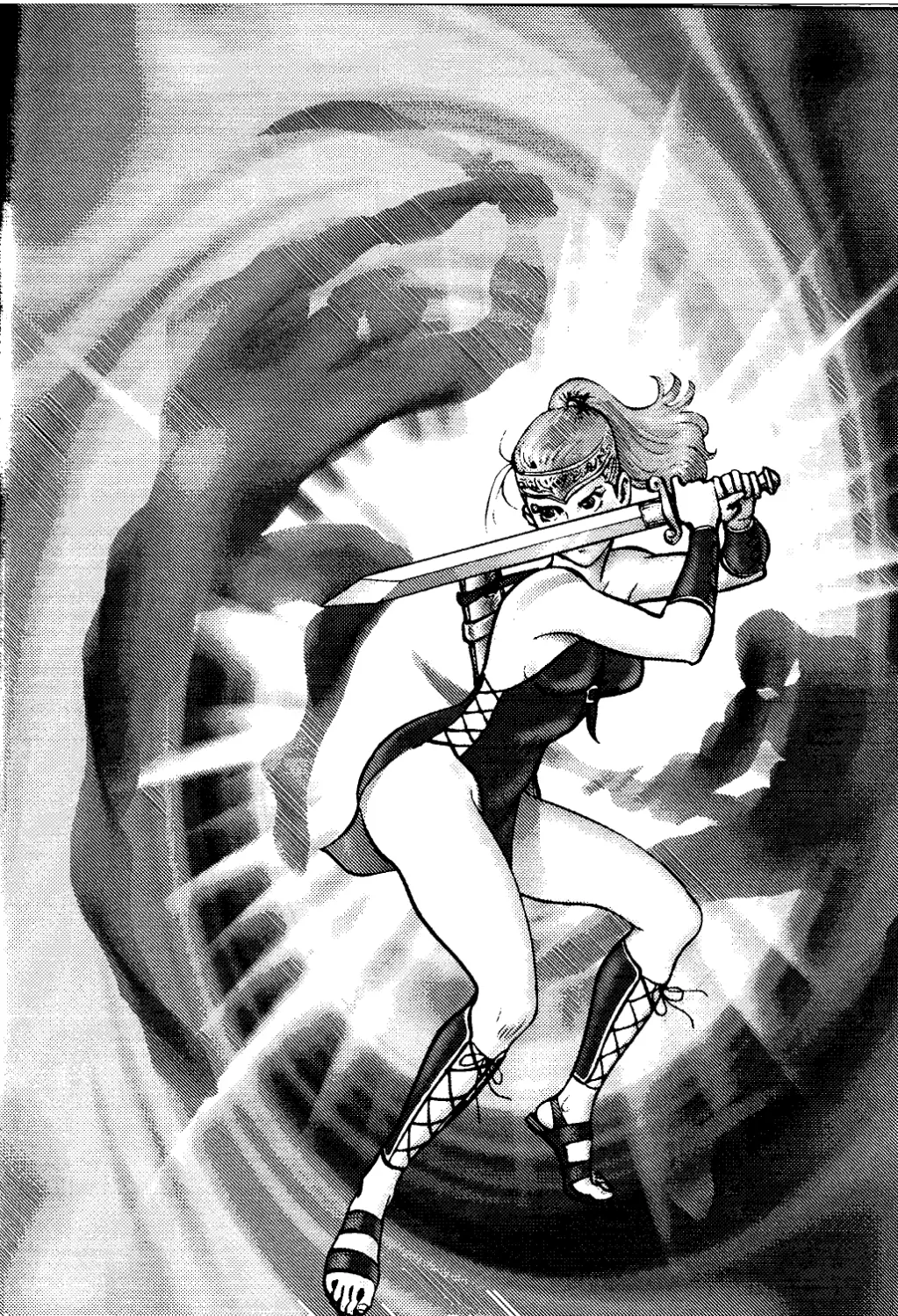
KURUH (Come On!!)
by Takashi Nakagawa

Things like the shadow of the sword
resting on the character's shoulder and the
crossed strings on the side of the body
express the delicate body lines of this
female. The reality of the small details and
the detailed artwork heap up a feeling of
tension to the scene.
A raised leg with the heels of the sandals drawn
ever so carefully. While simultaneously supporting
the character's weight, it expresses the indication
of the character’s movement in this moment in
time with a delicate feeling of stability.
The quirkiness of PC effects comes from deformed characters
and compositions
PC effects management has in due time become the
main-current faction: however, the fundamentals lie
While bringing out the sense of tension and movement in the drawing above may
look easy, this in fact requires highly advanced skills. The deformation was done
starting with an image of a swirl with the heroine arranged in the center. Take
note of how the artist had syncronized the swirling effect with the approaching
enemies. This is a fine example of how having a clear vision enables one to
create such marvelous enemy characters possessing sinister qualities. This type
of layout urges one to stretch his/her imagination beyond ordinary boundaries.
in the design and composition.
118

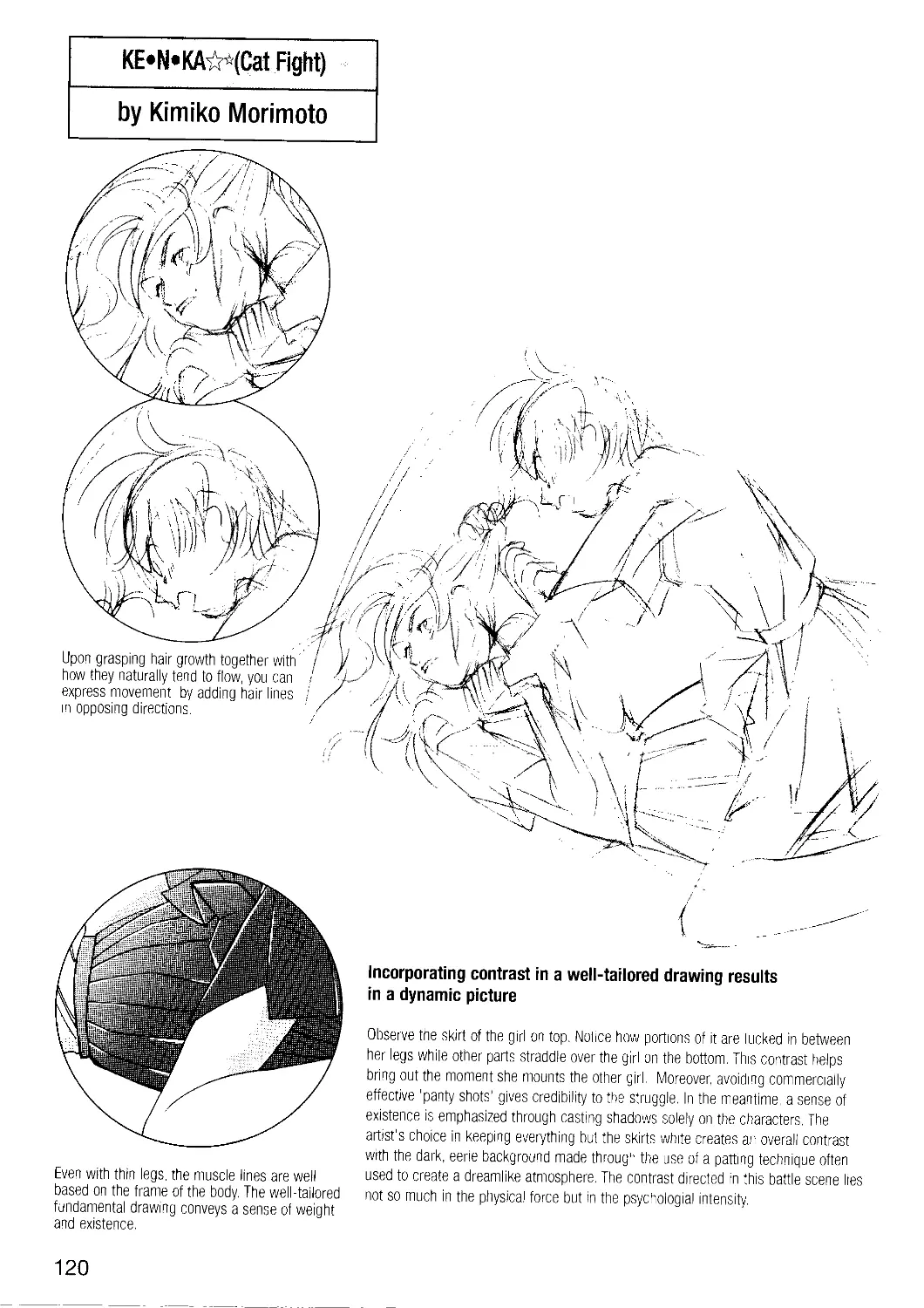
KE«N«KAT*(Cat Fight)
by Kimiko Morimoto
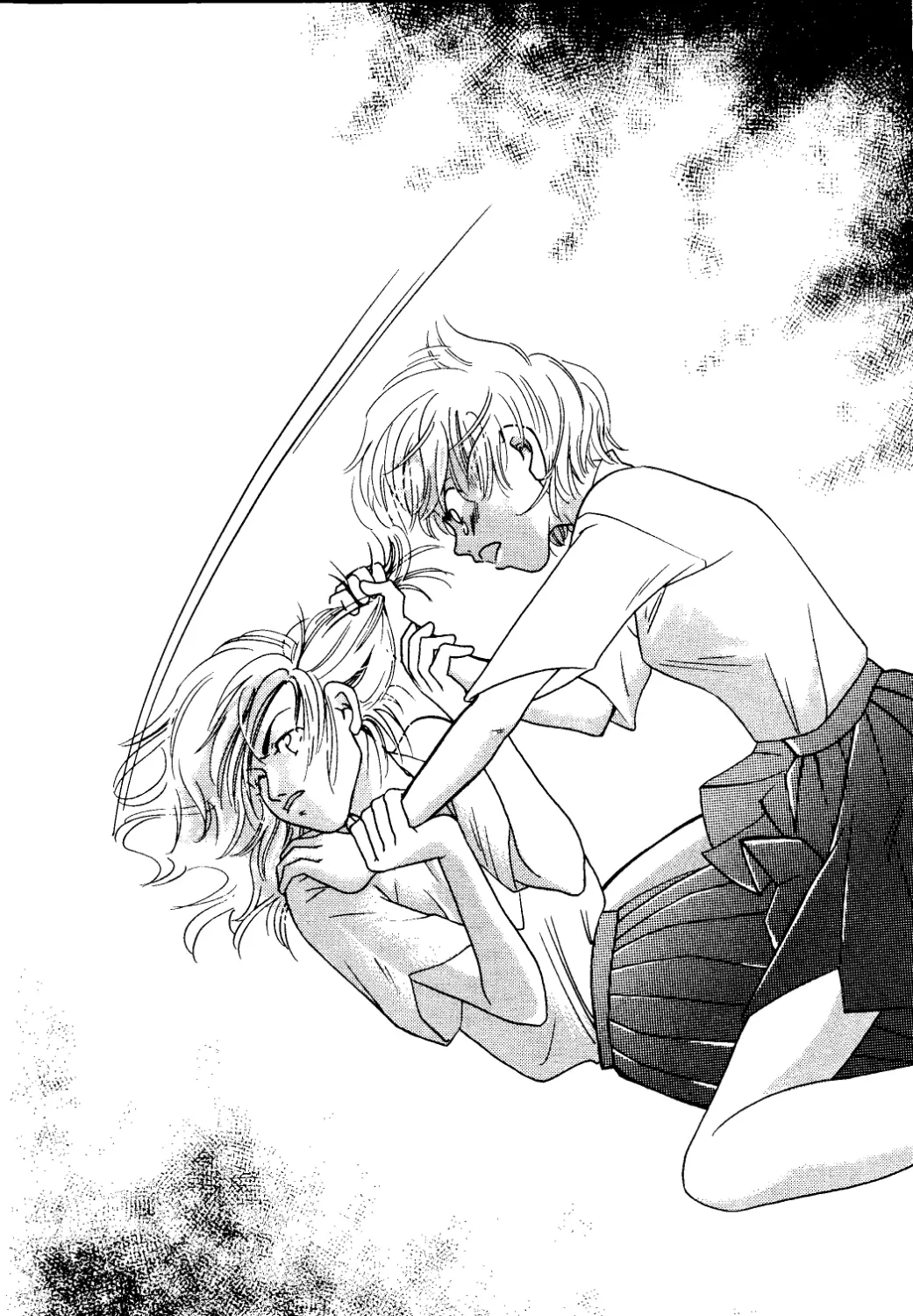
Incorporating contrast in a well-tailored drawing results
in a dynamic picture
Observe the skirt of the girl on top, Notice how portions of it are tucked in between
her legs while other parts straddle over the girl on the bottom. This contrast helps
bring out the moment she mounts the other girl. Moreover, avoiding commercially
effective 1 panty shots’ gives credibility to the struggle. In the meantime, a sense of
existence is emphasized through casting shadows solely on the characters. The
artist's choice in keeping everything but the skirts white creates an overall contrast
with the dark, eerie background made through the use of a patting technique often
Even with thin legs, the muscle lines are well	used to create a dreamlike atmosphere. The contrast directed in this battle scene lies
based on the frame of the body. The well-tailored	not so much in the physical force but in the psychoiogial intensity.
fundamental drawing conveys a sense of weight
and existence.
120

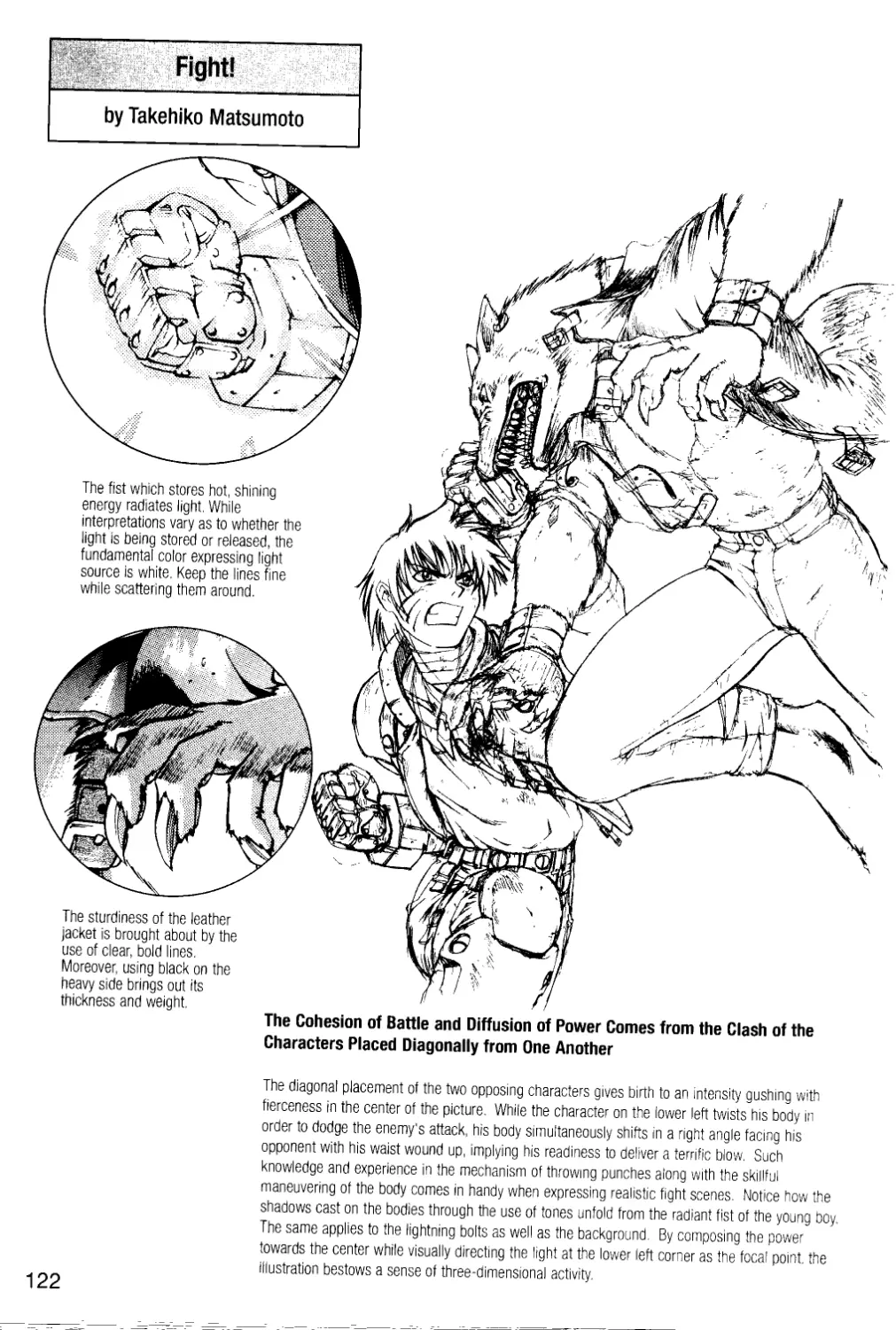
Fight!
by Takehiko Matsumoto
The fist which stores hot, shining
energy radiates light. While
interpretations vary as to whether the
light is being stored or released, the
fundamental color expressing light
source is white. Keep the lines fine
while scattering them around.
The sturdiness of the leather
jacket is brought about by the
use of clear, bold lines.
Moreover, using black on the
heavy side brings out its
thickness and weight.
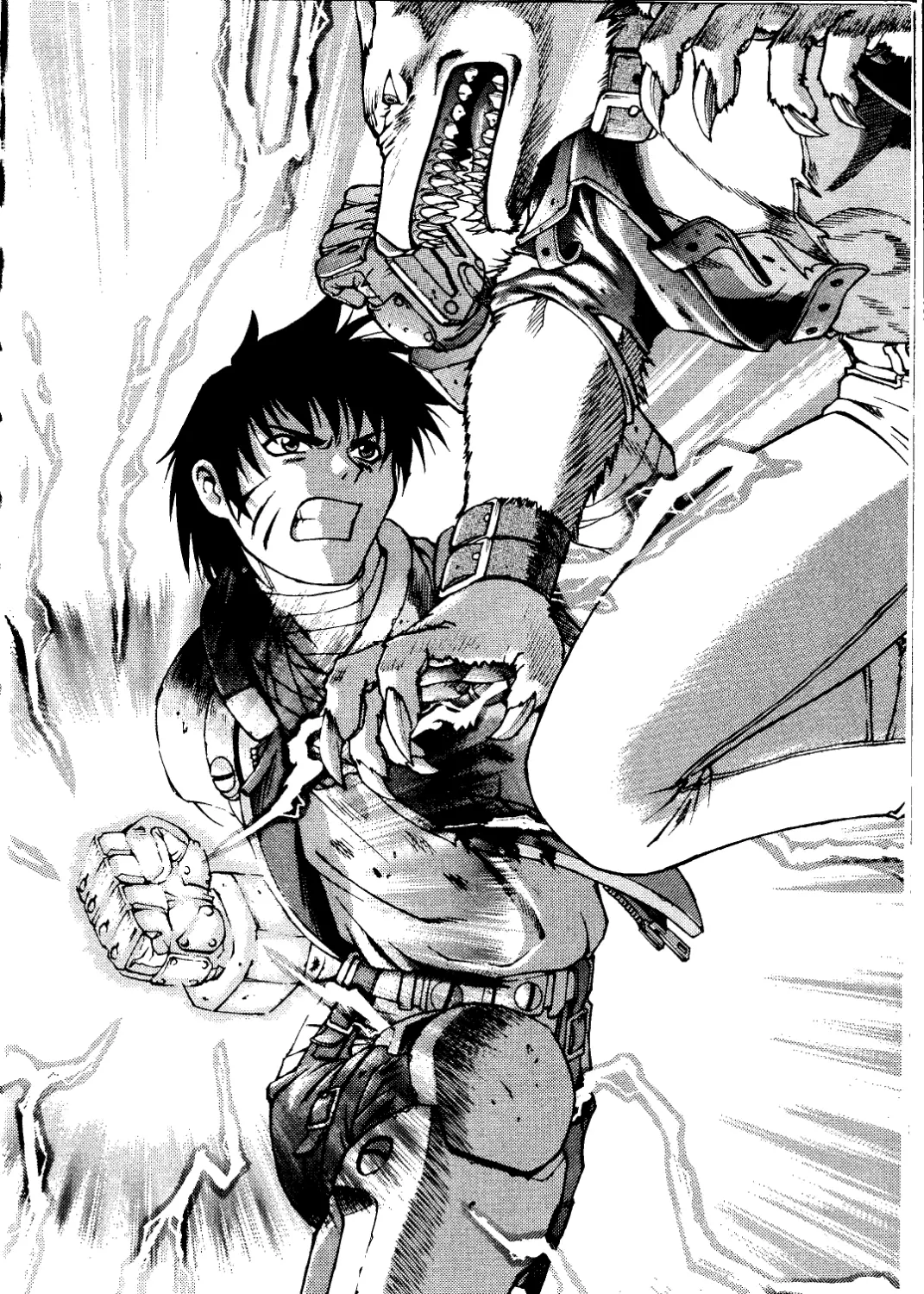
The Cohesion of Battle and Diffusion of Power Comes from the Clash of the
Characters Placed Diagonally from One Another
The diagonal placement of the two opposing characters gives birth to an intensity gushing with
fierceness in the center of the picture. While the character on the lower left twists his body in
order to dodge the enemy's attack, his body simultaneously shifts tn a right angle facing his
opponent with his waist wound up, implying his readiness to deliver a terrific blow. Such
knowledge and experience in the mechanism of throwing punches along with the skillful
maneuvering of the body comes in handy when expressing realistic fight scenes. Notice how the
shadows cast on the bodies through the use of tones unfold from the radiant fist of the young boy.
The same applies to the lightning bolts as well as the background. By composing the power
towards the center while visually directing the light at the lower left corner as the focal point, the
illustration bestows a sense of three-dimensional activity.
122

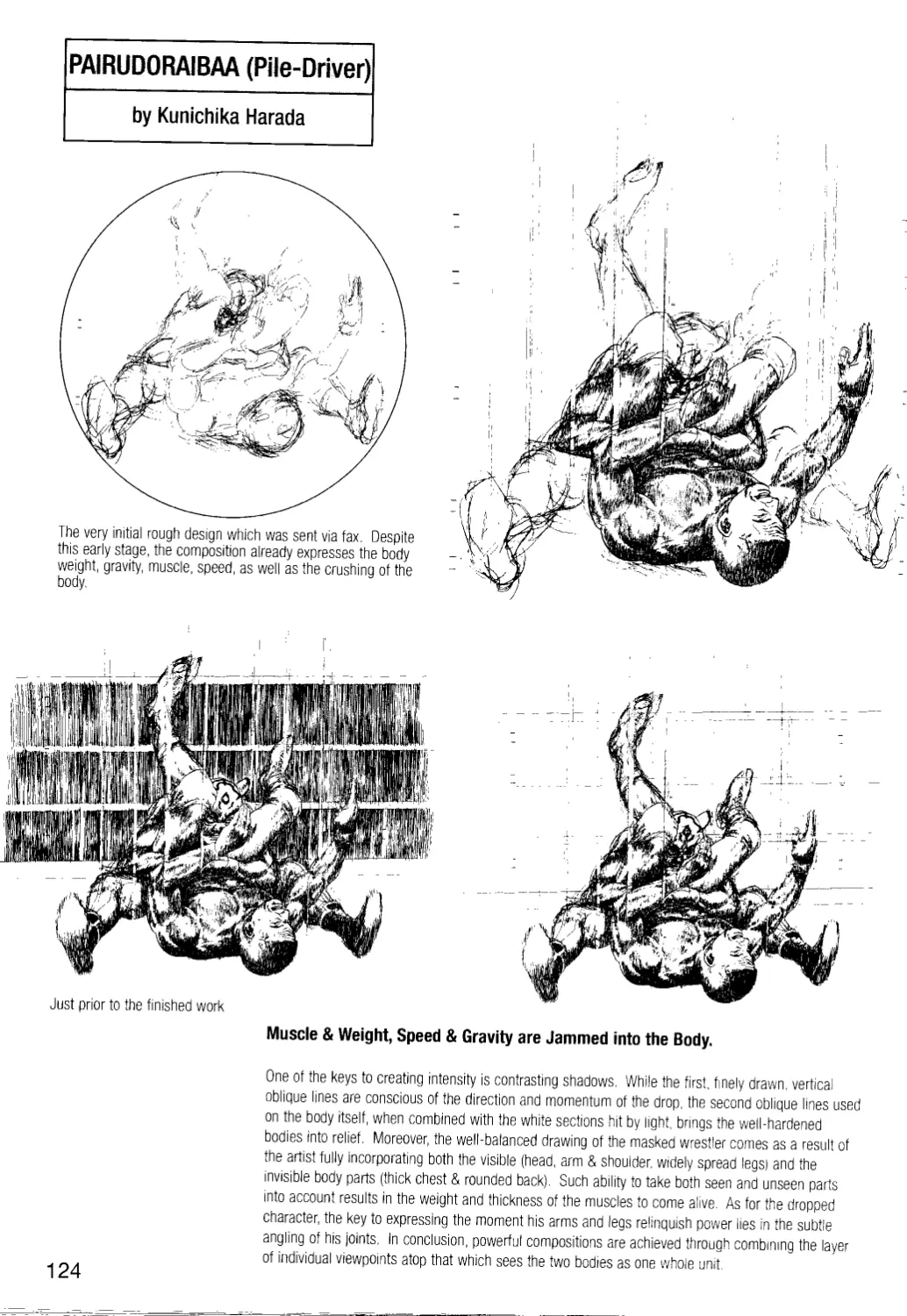
PAIRUDORAIBAA (Pile-Driver)
by Kunichika Harada
The very initial rough design which was sent via fax. Despite
this early stage, the composition already expresses the body
weight, gravity, muscle, speed, as well as the crushing of the
body.
Just prior to the finished work
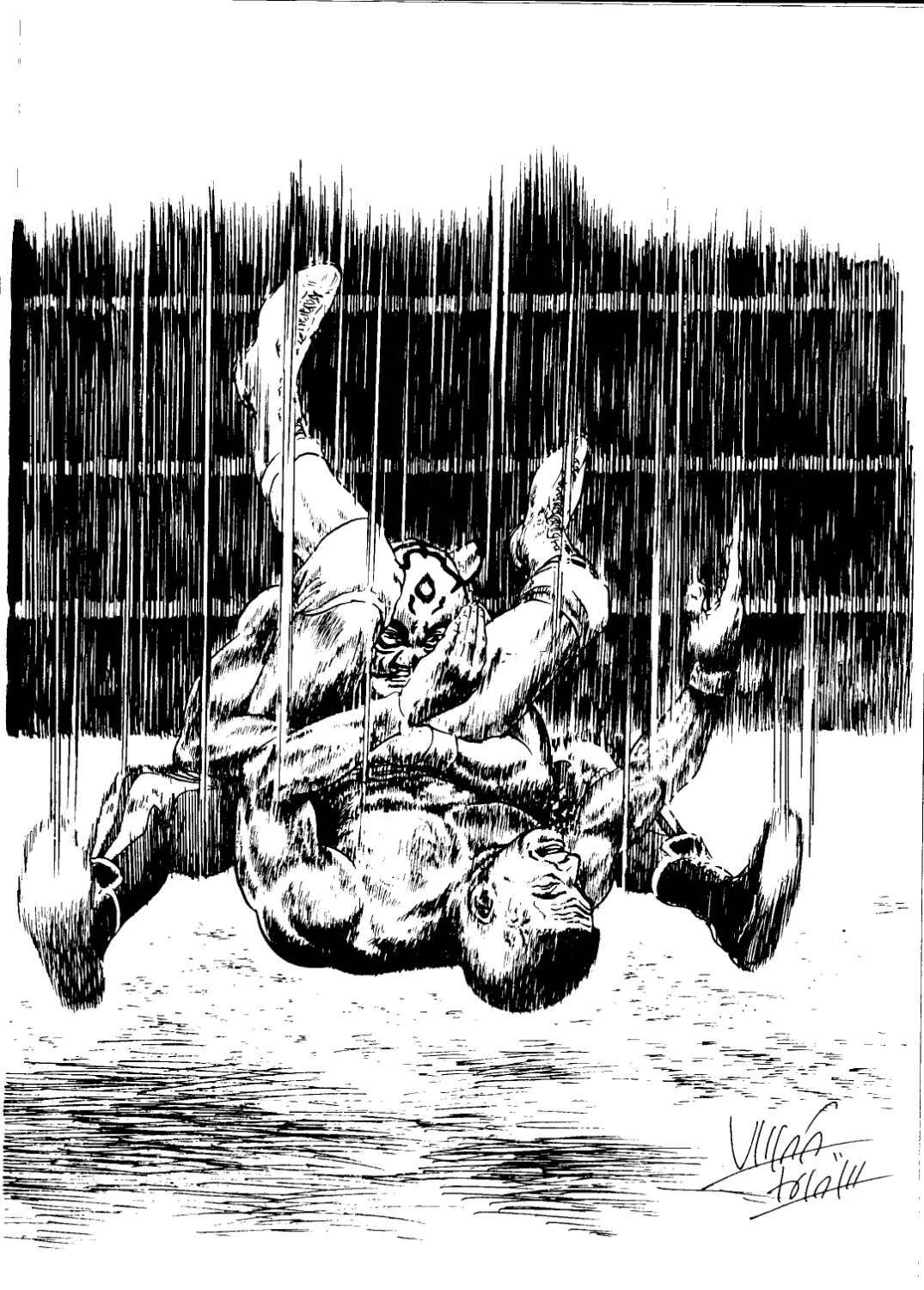
Muscle & Weight, Speed & Gravity are Jammed into the Body.
One of the keys to creating intensity is contrasting shadows. While the first, finely drawn, vertical
oblique lines are conscious of the direction and momentum of the drop, the second oblique lines used
on the body itself, when combined with the white sections hit by light, brings the well-hardened
bodies into relief. Moreover, the well-balanced drawing of the masked wrestler comes as a result of
the artist fully incorporating both the visible (head, arm & shoulder, widely spread legs) and the
invisible body parts (thick chest & rounded back). Such ability to take both seen and unseen parts
into account results in the weight and thickness of the muscles to come alive. As for the dropped
character, the key to expressing the moment his arms and legs relinquish power lies in the subtle
angling of his joints, In conclusion, powerful compositions are achieved through combining the layer
of individual viewpoints atop that which sees the two bodies as one whole unit.
124

I