/





















































Автор: Haines S.
Теги: english english language cambridge vocabulary cambridge english vocabulary self-study vocabulary practice
ISBN: 978-0-521-18220-1
Год: 2012


Текст
                    H UNIVERSITY-/ CAMBRIDGE
I SO! I xmiiiiunions
Cambridge English
Self-study vocabulary practice
Official preparation material for Cambridge English: Advanced,
also known as Certificate in Advanced English (CAE)

Cambridge
UNIVERSITY PRESS
UNIVERSITY of CAMBRIDGE
ESOL Examinations
Cambridge English
Cambridge
uiith answers
Self-study vocabulary practice
SIMON HAINES

CAMBRIDGE UNIVERSITY PRESS
Cambridge, New York, Melbourne, Madrid, Cape Town,
Singapore, Sao Paulo, Delhi, Mexico City
Cambridge University Press
The Edinburgh Building, Cambridge CB2 8RU, UK
ww w.ca mbridge.org
Information on this title: www.cambridge.org/9780521182201
© Cambridge University Press 2012
This publication is in copyright. Subject to statutory exception
and to the provisions of relevant collective licensing agreements,
no reproduction of any part may take place without the written
permission of Cambridge University Press.
First published 2012
Printed in the United Kingdom at the University Press, Cambridge
A catalogue record for this publication is available from the British Library
ISBN 978-0-521-18220-1 With answers and audio CD
ISBN 978-0-521-18219-5 Without answers
Cambridge University Press has no responsibility for the persistence or
accuracy of URLs for external or third-party internet websites referred to in
this publication, and does not guarantee that any content on such websites is,
or will remain, accurate or appropriate. Information regarding prices, travel
timetables and other factual information given in this work is correct at
the time of first printing but Cambridge University Press does not guarantee
the accuracy of such information thereafter.

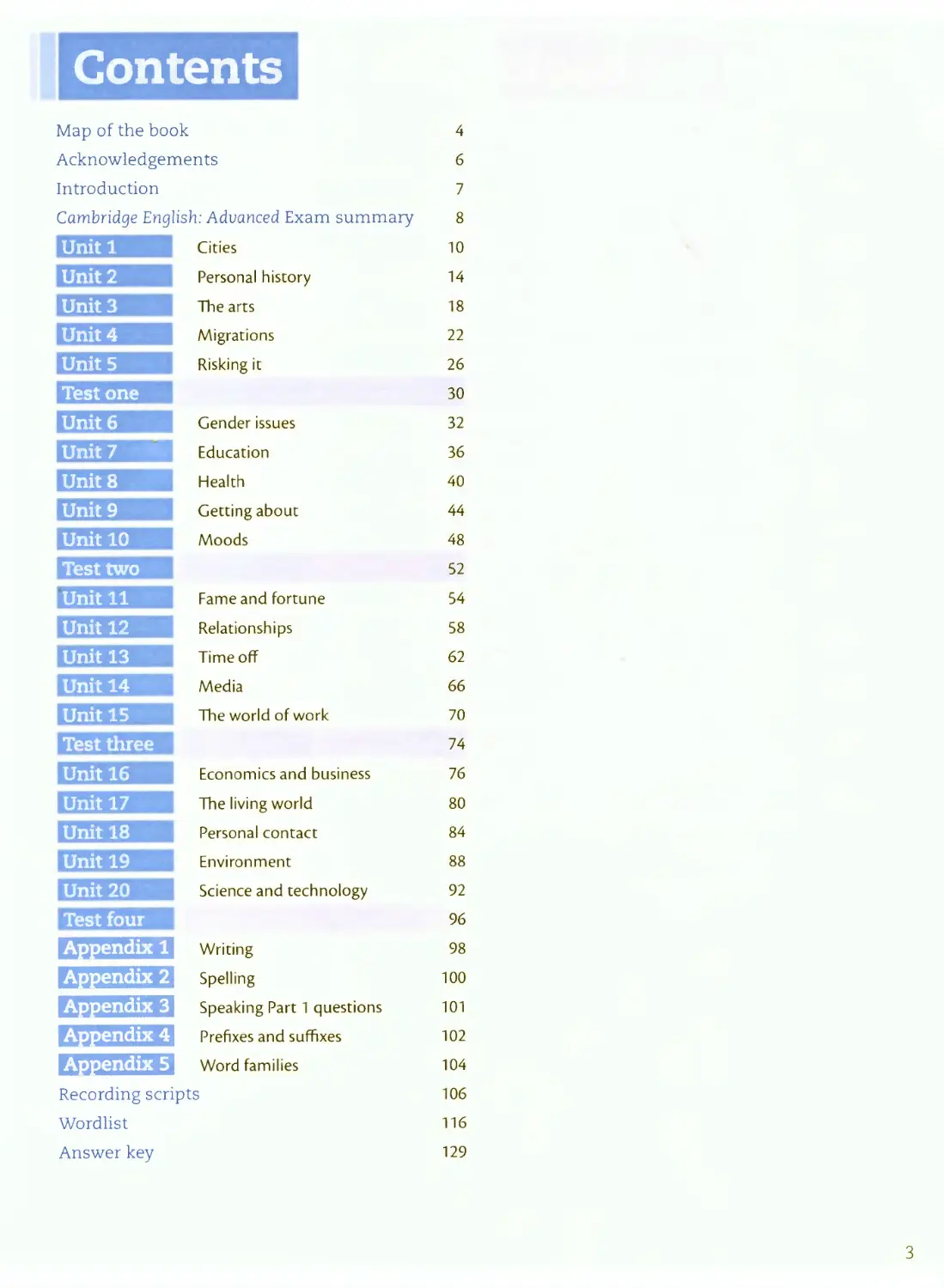
Contents
Map of the book
Acknowledgements
Introduction
Cambridge English: Advanced Exam summary
Cities
Personal history
The arts
Migrations
Risking it
Unit 1
Unit 2
Unit 3
Unit 4
Unit 5
Test one
Unit 6
Gender issues
Education
Unjt8^
Unit9
Unit 10
Test two
Unitll
Unit 12
Unit 13
Unit 14
Unitl5
Test three
Unitl6
Unitl7
Unit 18
Unit 19
Unit20
Test four
Health
Getting about
Moods
Fame and fortune
Relationships
Time off
Media
The world of work
Economics and business
The living world
Personal contact
Environment
Science and technology
Writing
Spelling
Speaking Part 1 questions
Prefixes and suffixes
ES33SE33	Word families
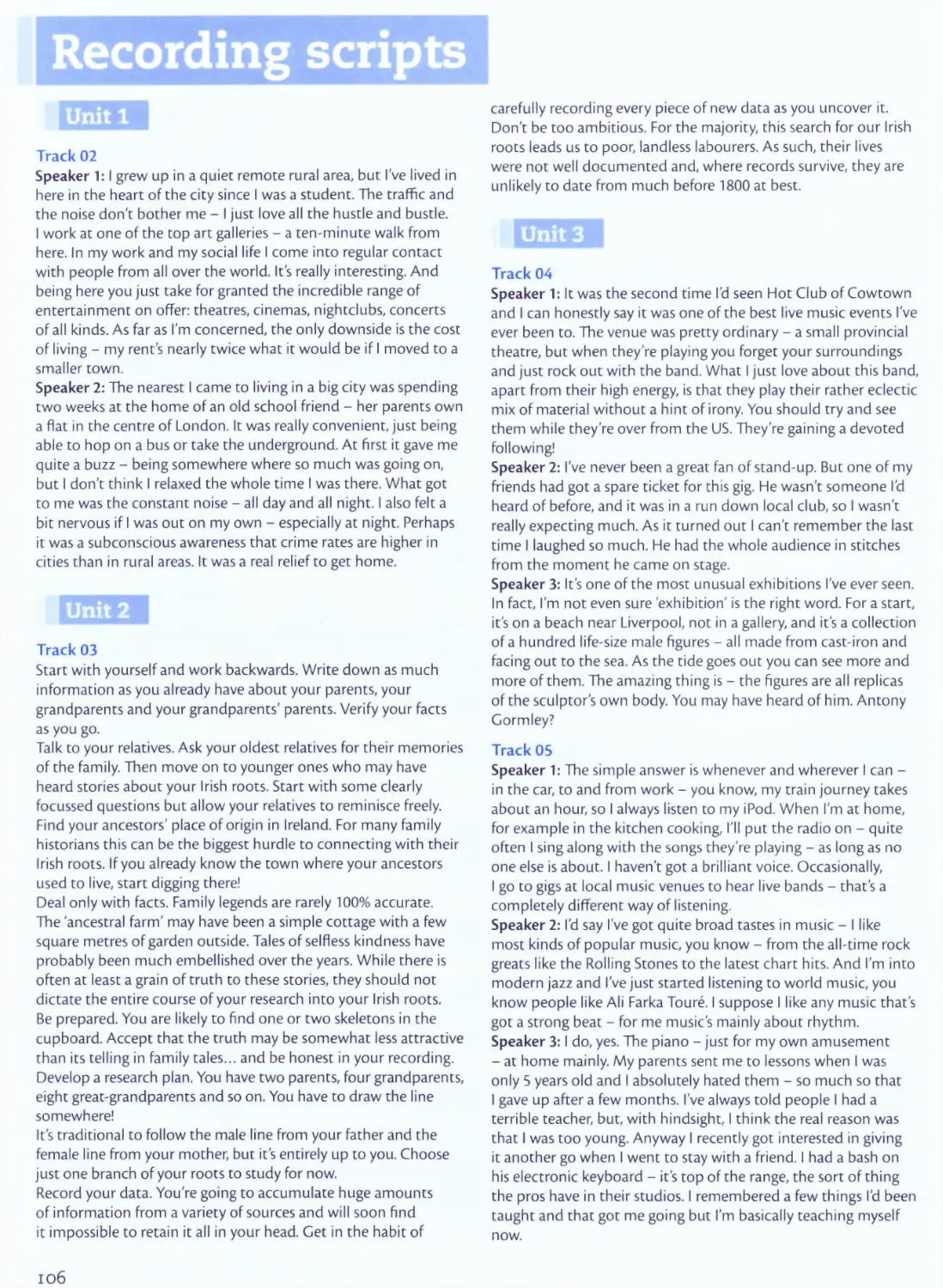
Recording scripts
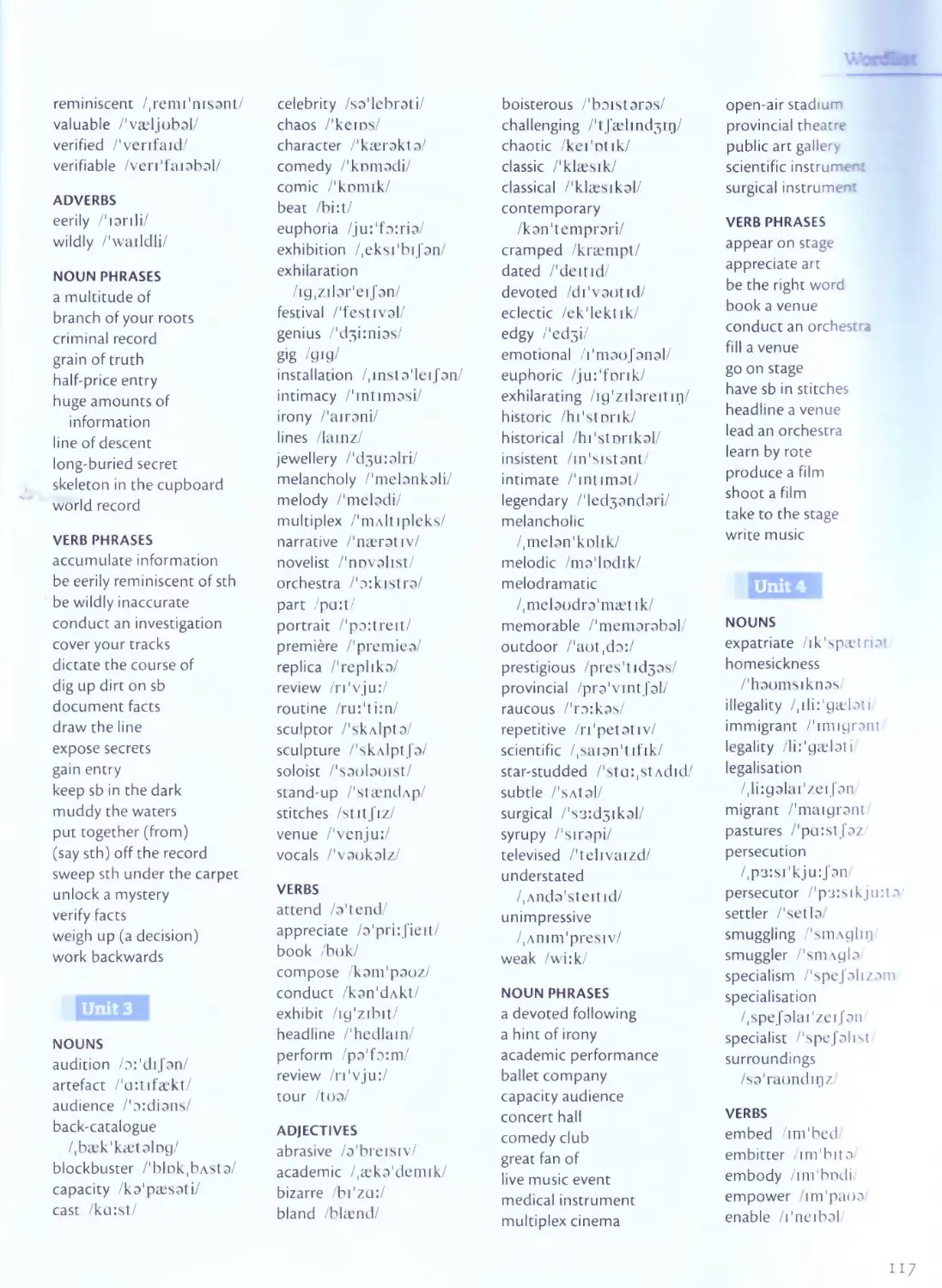
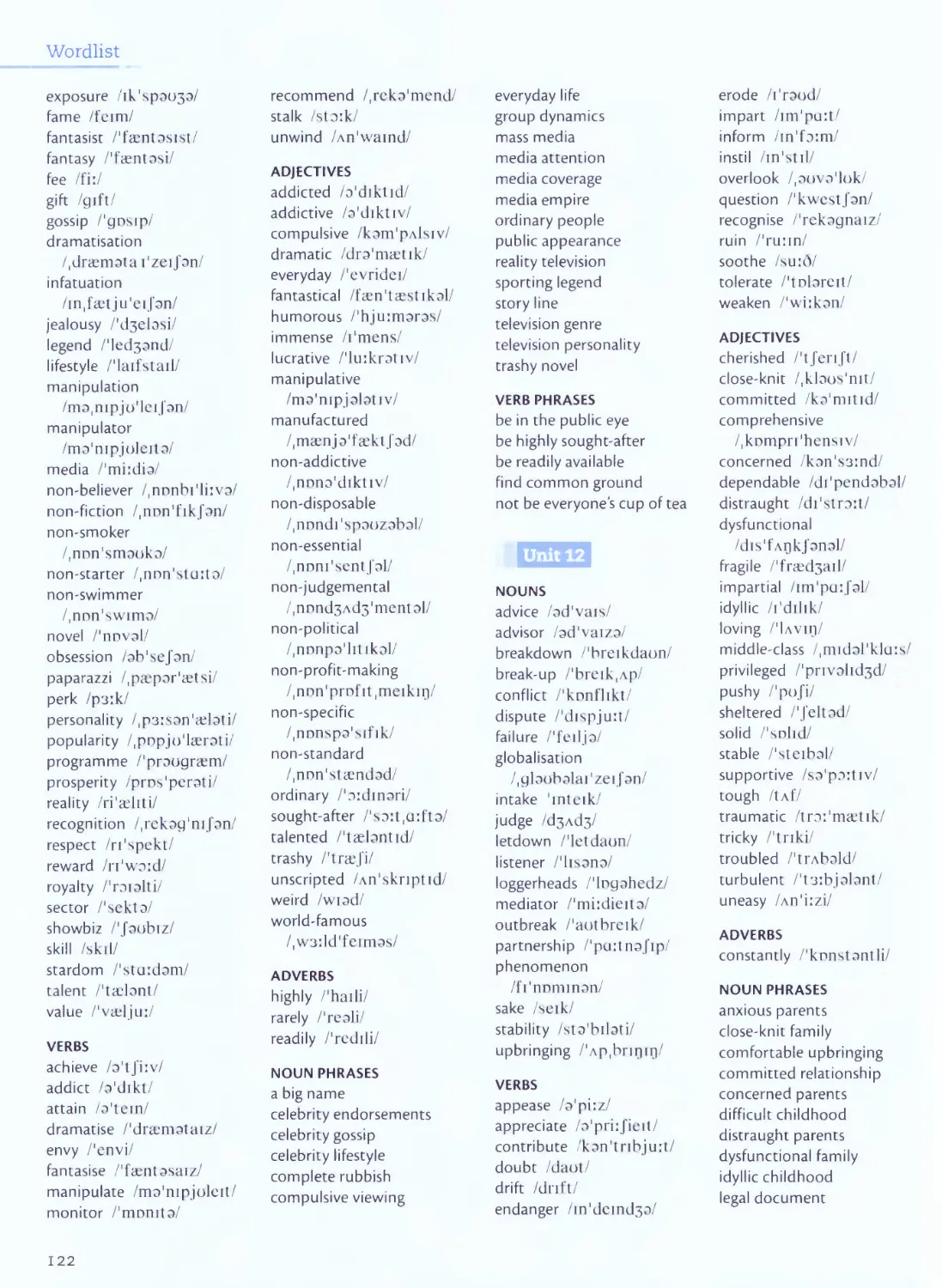
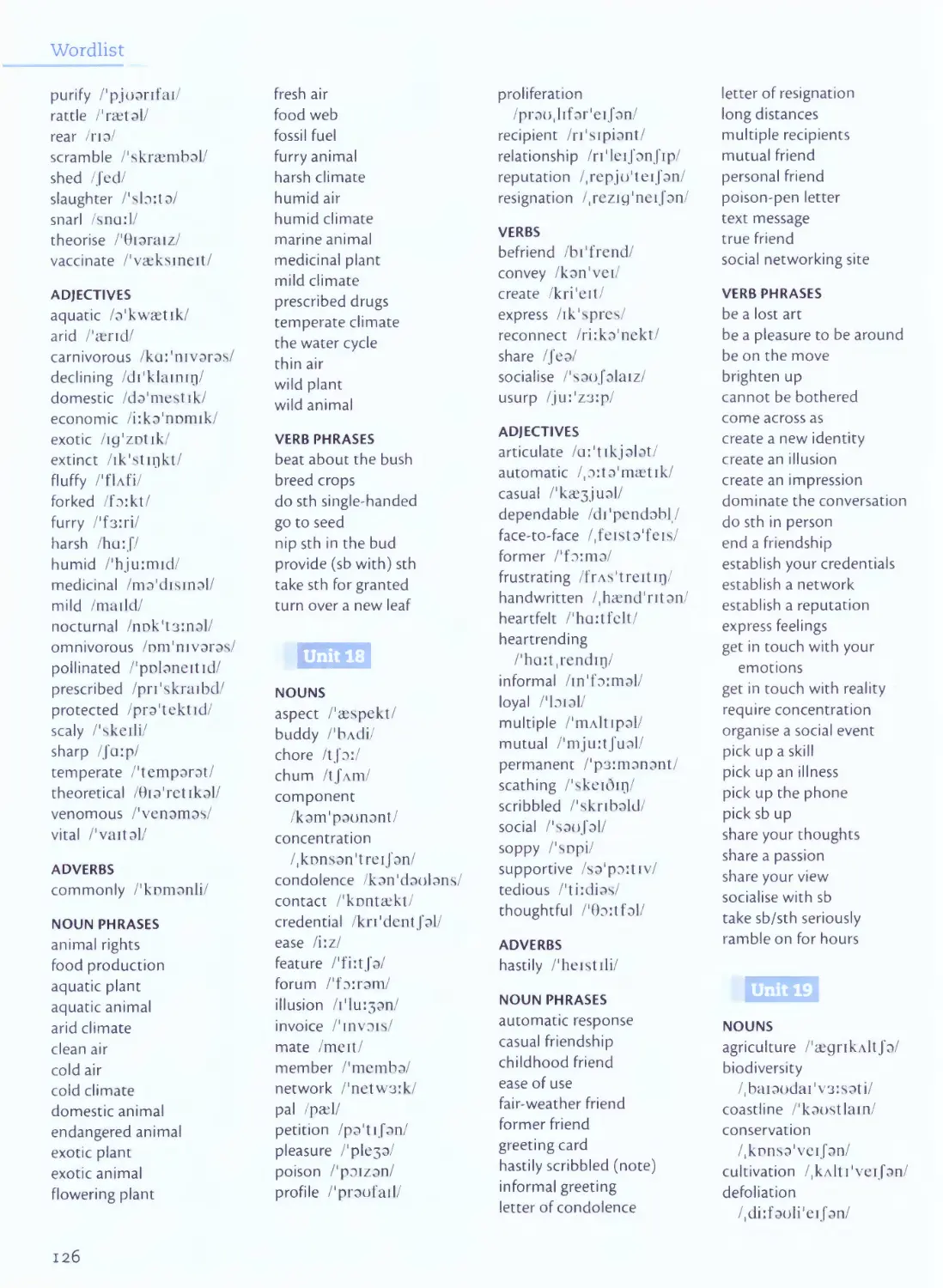
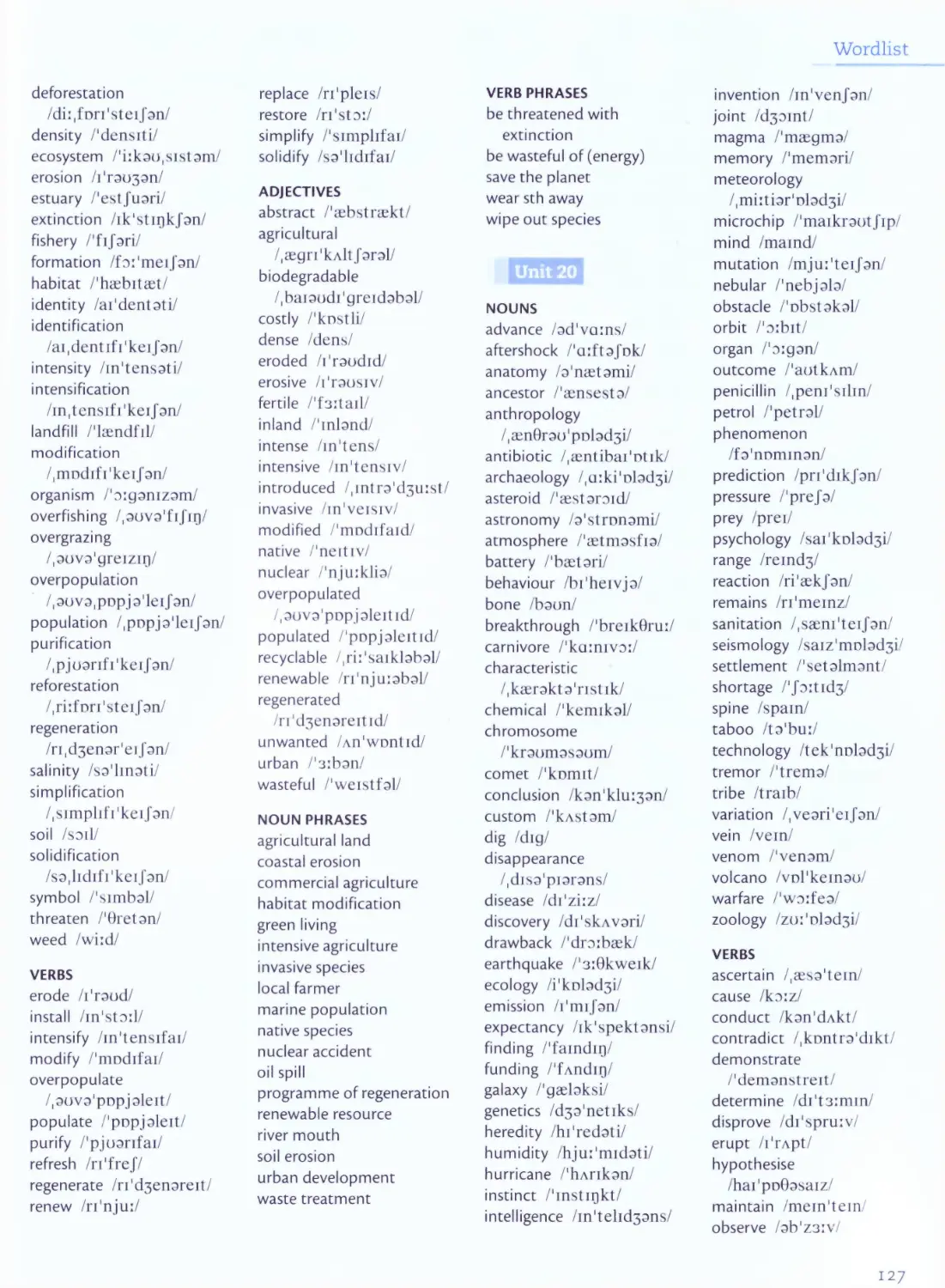
Wordlist
Answer key
4
6
7
8
10
14
18
22
26
30
32
36
40
44
48
52
54
58
62
66
70
74
76
80
84
88
92
96
98
100
101
102
104
106
116
129
3

Map of the book
Unit number
Title
Topics
Exam practice
Unit 1
Unit 2
Unit 3
Unit 4
Unit 5
Unit 6
Unit 7
Unit 8
Unit 9
Unit 10
Unit 11
Unit 12
Unit 13
Cities
Personal history
The arts
Migrations
Risking it
Gender issues
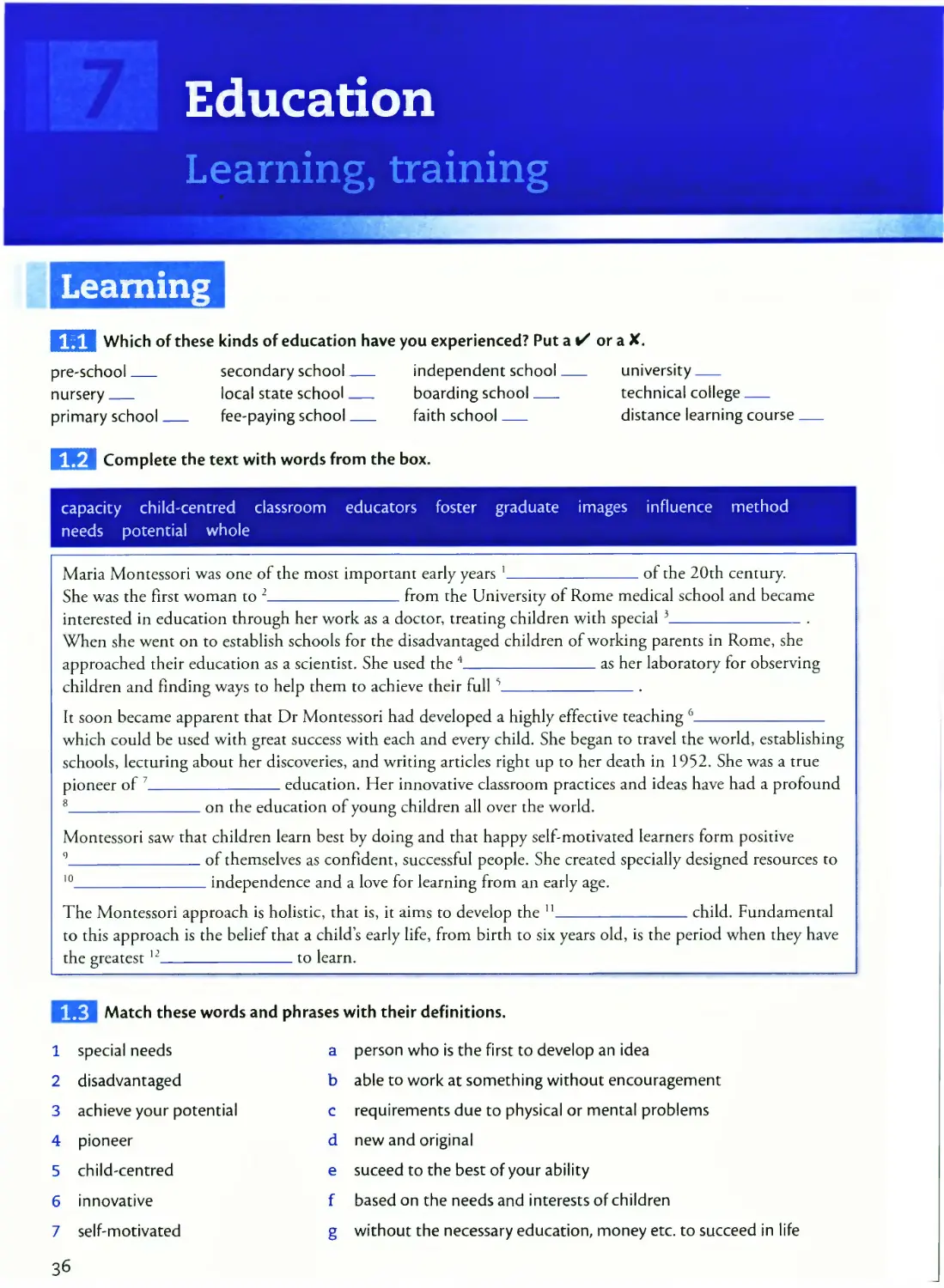
Education
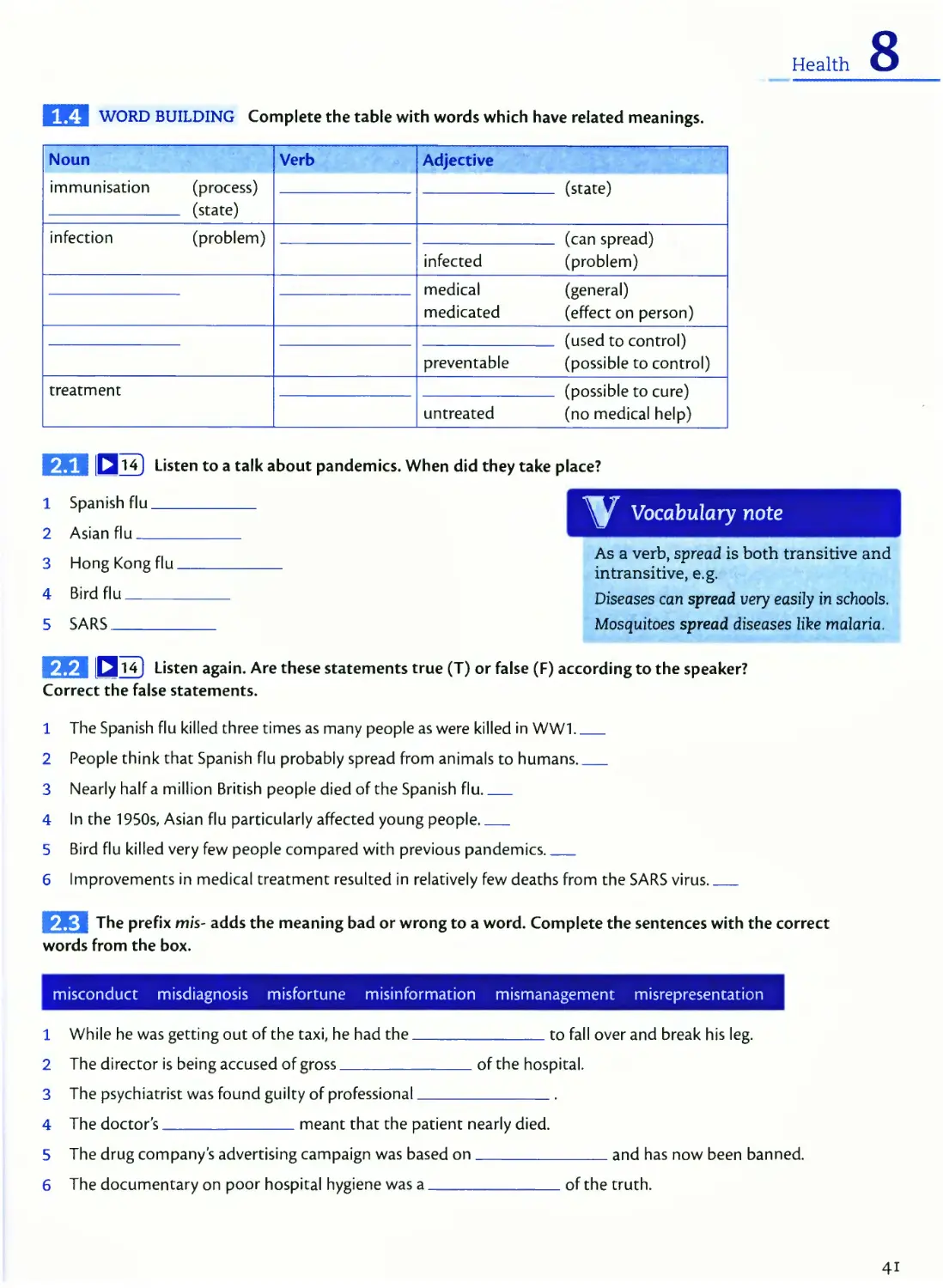
Health
Getting about
Moods
Fame and fortune
Relationships
Time off
Urban growth
Urban living
Ancestry
Autobiography
Arts events
Reviews
Departures
Personal stories
Extreme sports
Risk-taking
Language
Gender in sport
Learning
Training
World health
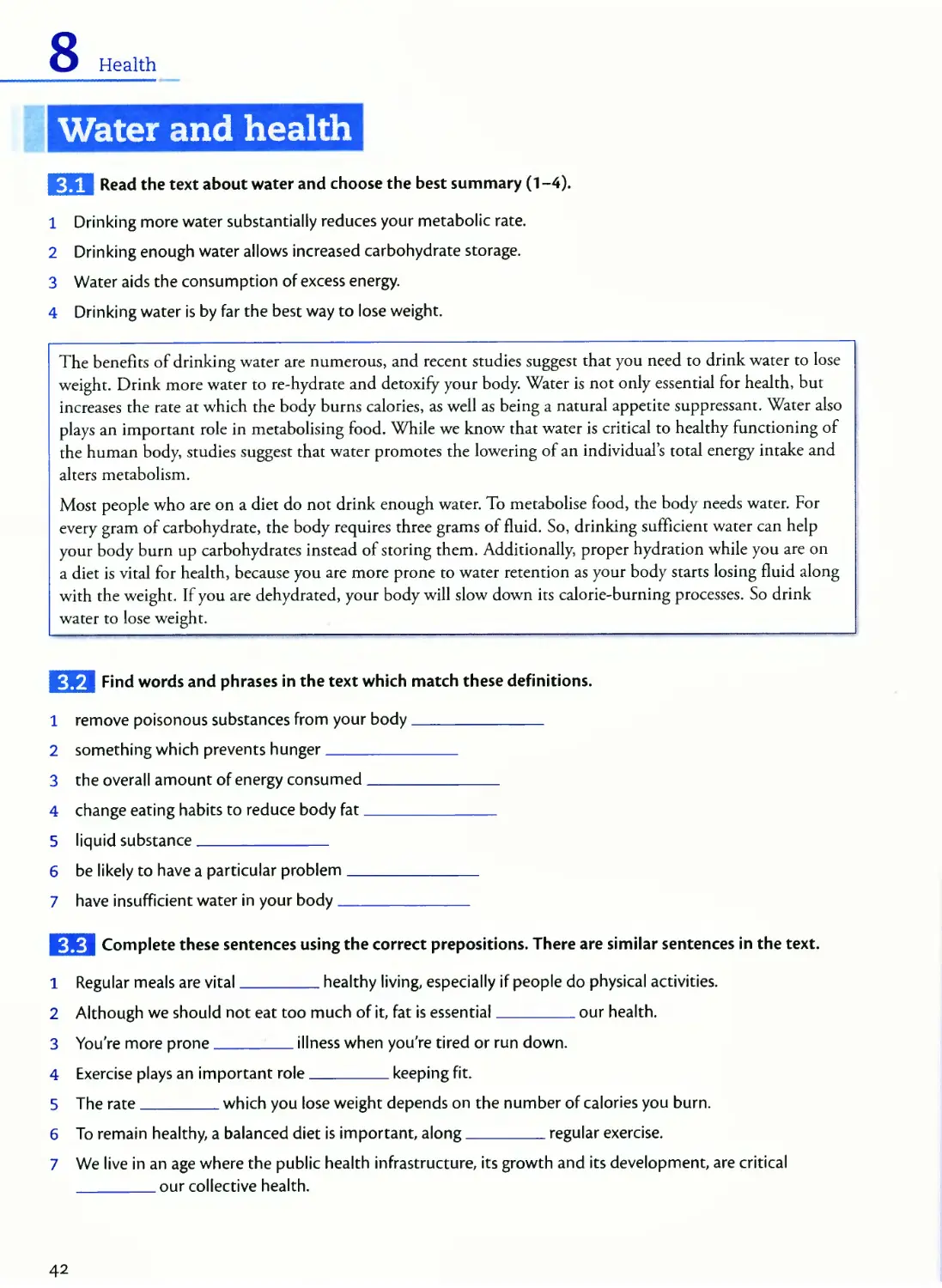
Water and health
Private journeys
Public transport
Attitudes
Memory
Celebrity culture
Reality television
Families
Friends
Holidays
Enjoying exercise
Reading Part 3
Writing Part 1
Use of English Part 1
Speaking Part 1
Speaking Part 2
Reading Part 2
Listening Part 2
Use of English Part 5
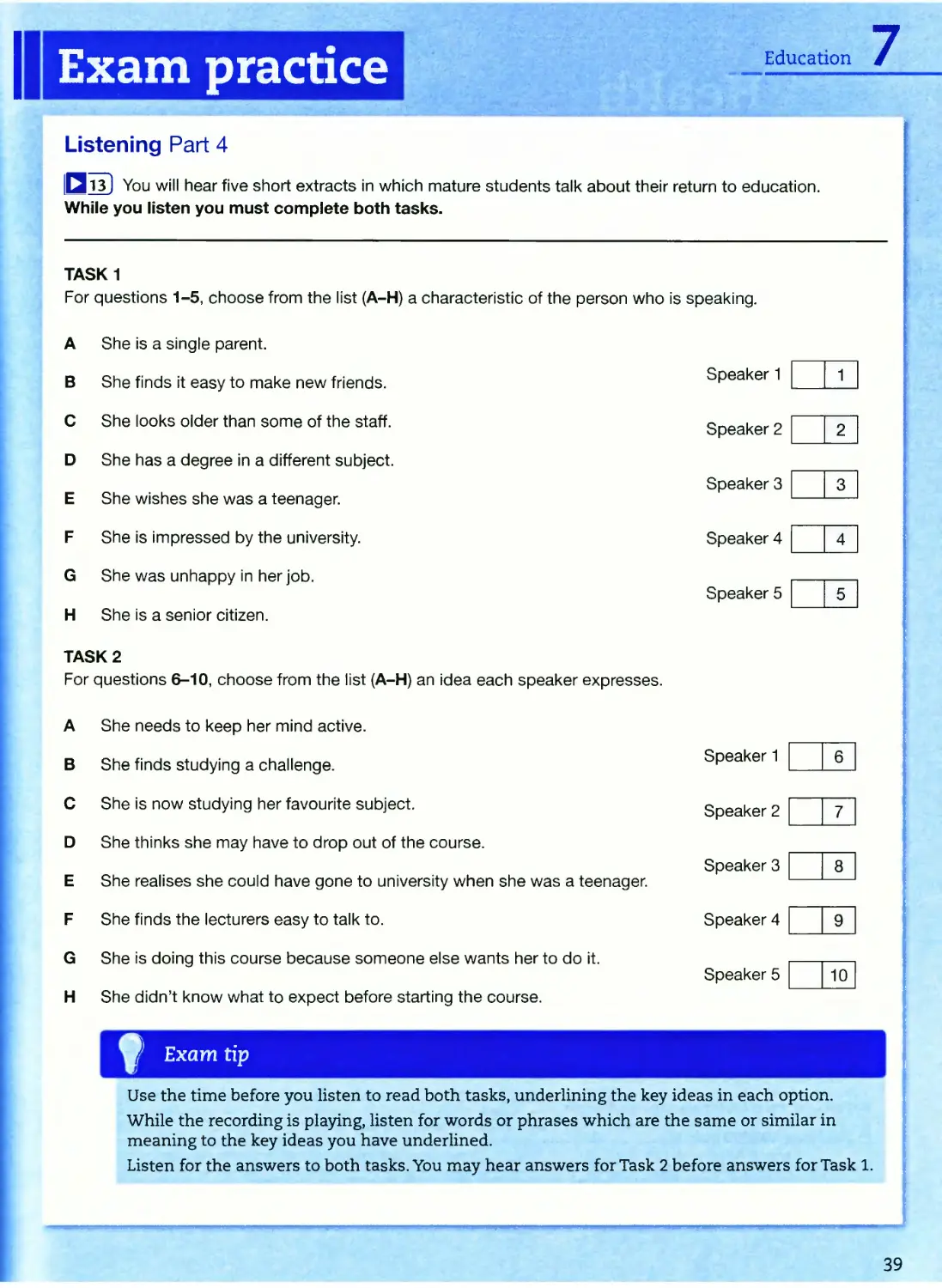
Listening Part 4
Speaking Part 3
Writing Part 2
Listening Part 1
Reading Part 1
Use of English Part 4
Speaking Part 2
Use of English Part 2
Listening Part 3
Reading Part 4

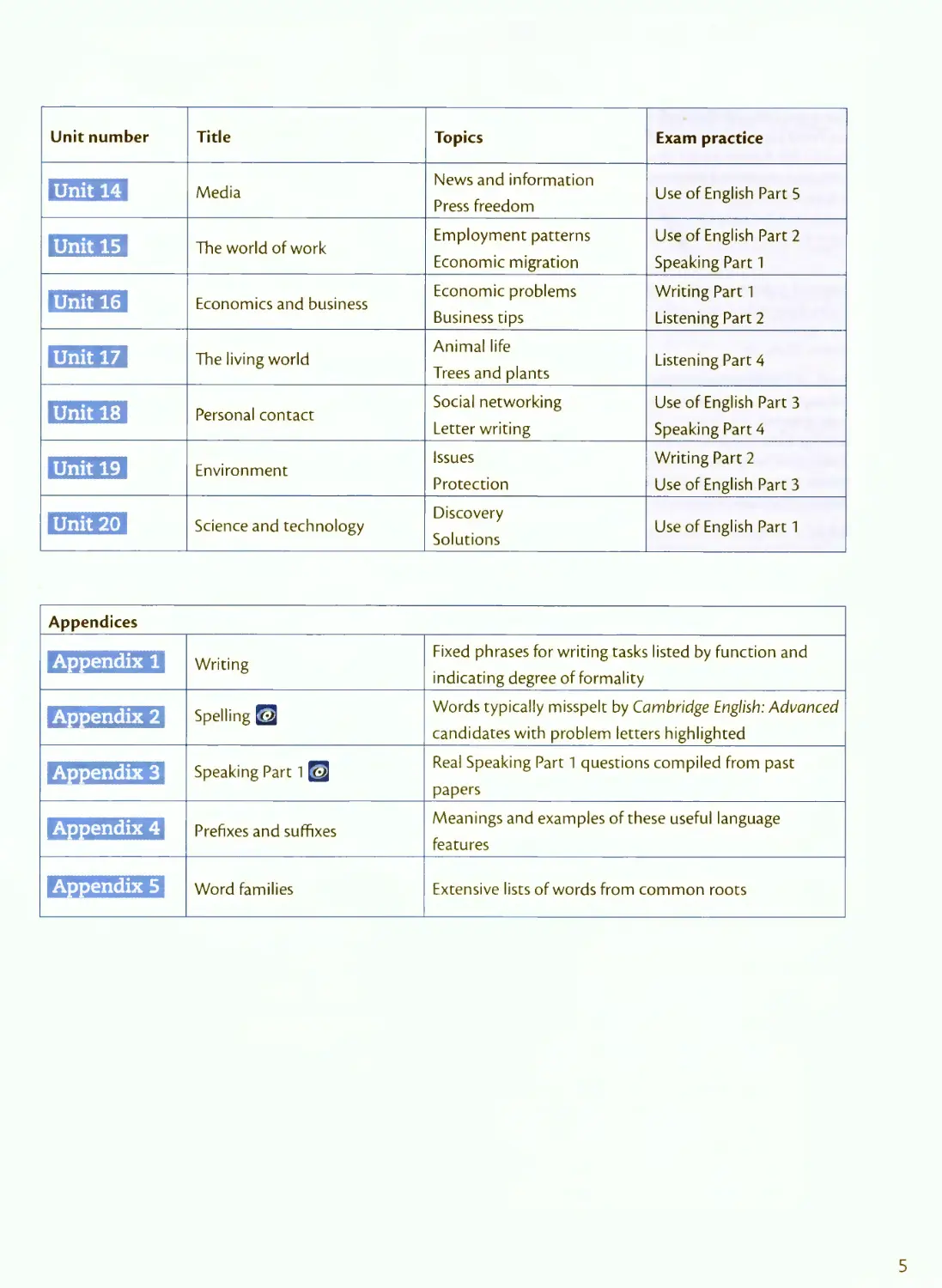
Unit number
Title
Topics
Exam practice
Unit 14
Unit 15
Unit 16
Unit 17
Unit 18
Unit 19
Unit 20
Media
The world of work
Economics and business
The living world
Personal contact
Environment
Science and technology
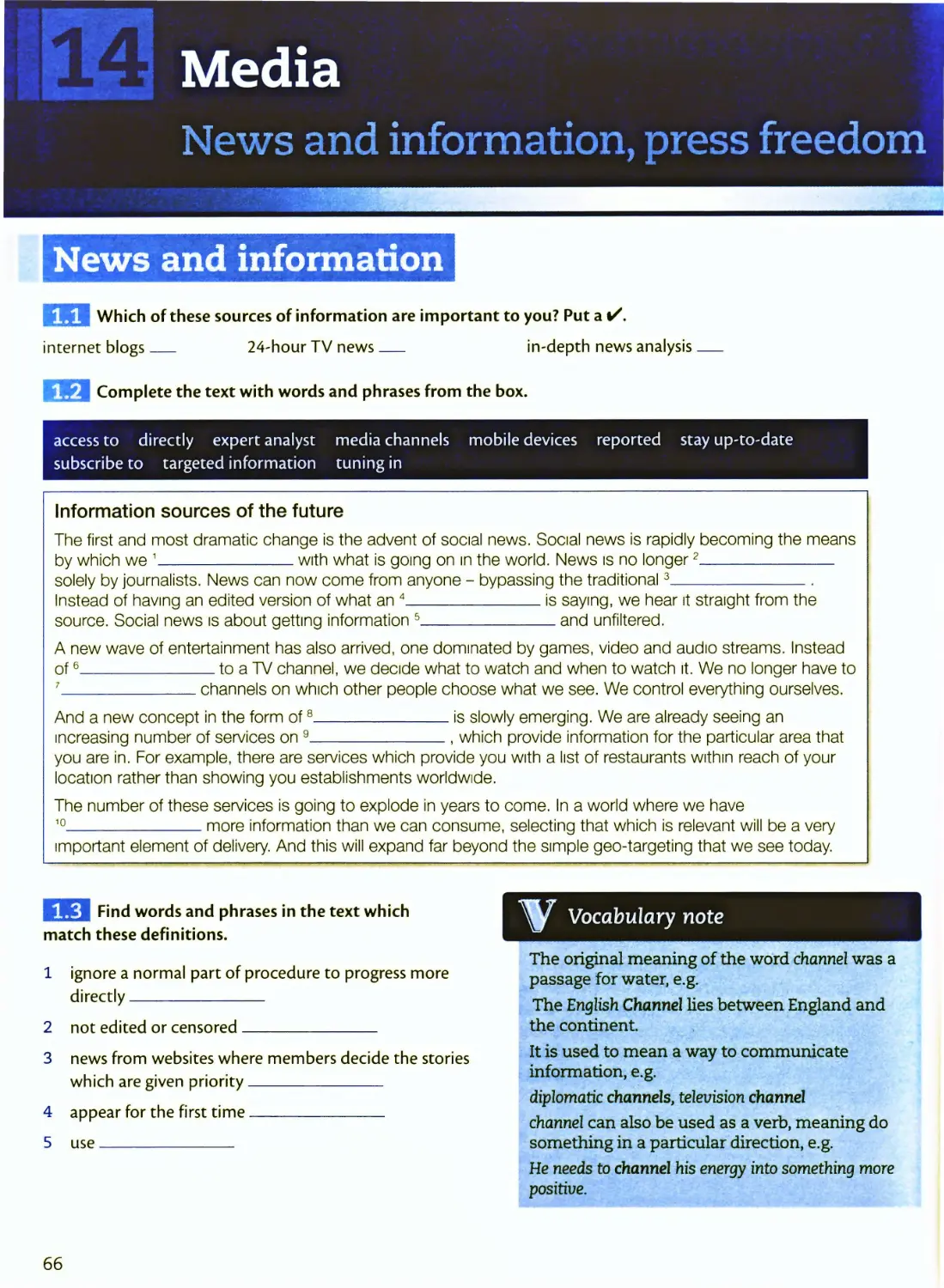
News and information
Press freedom
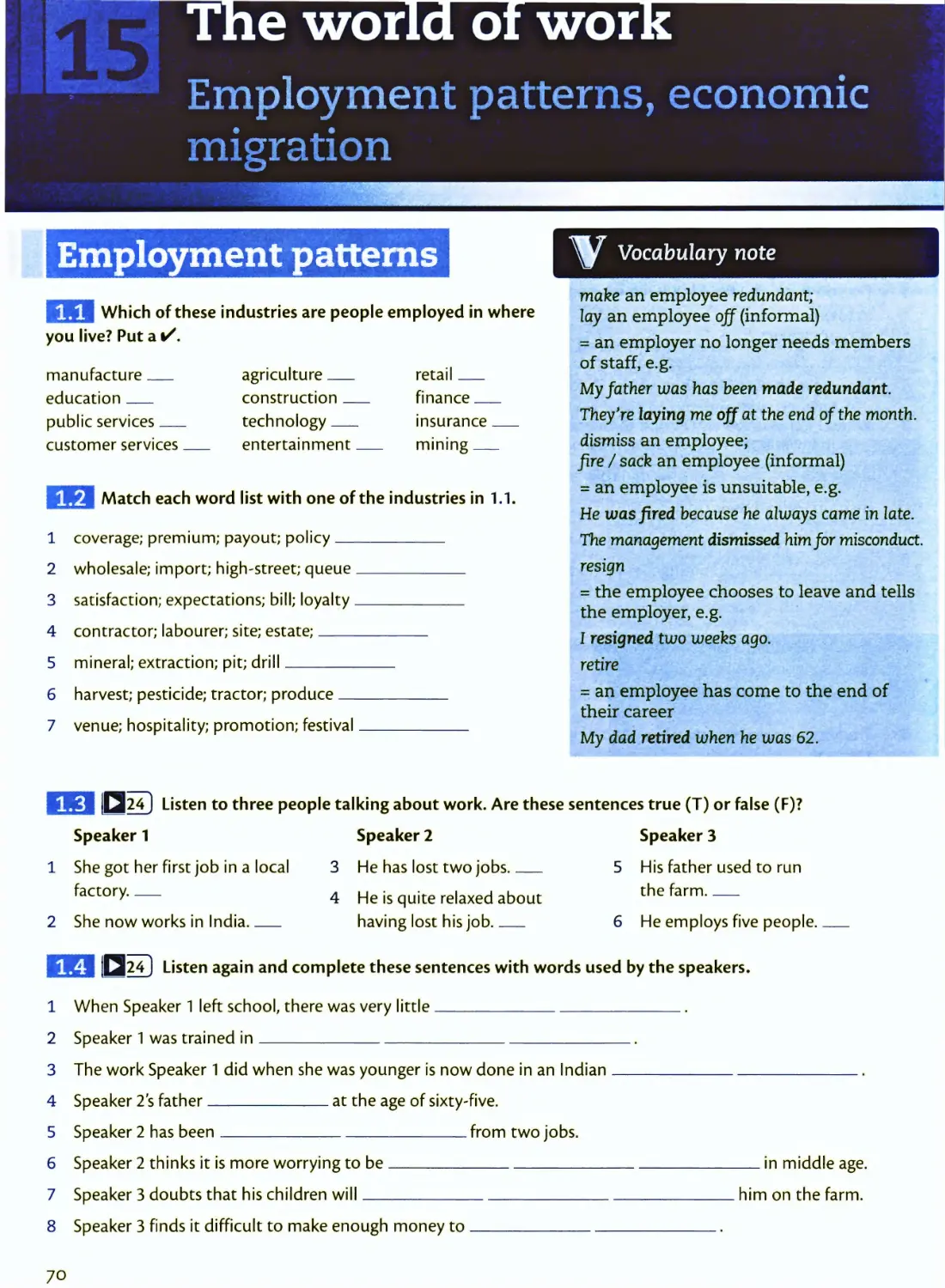
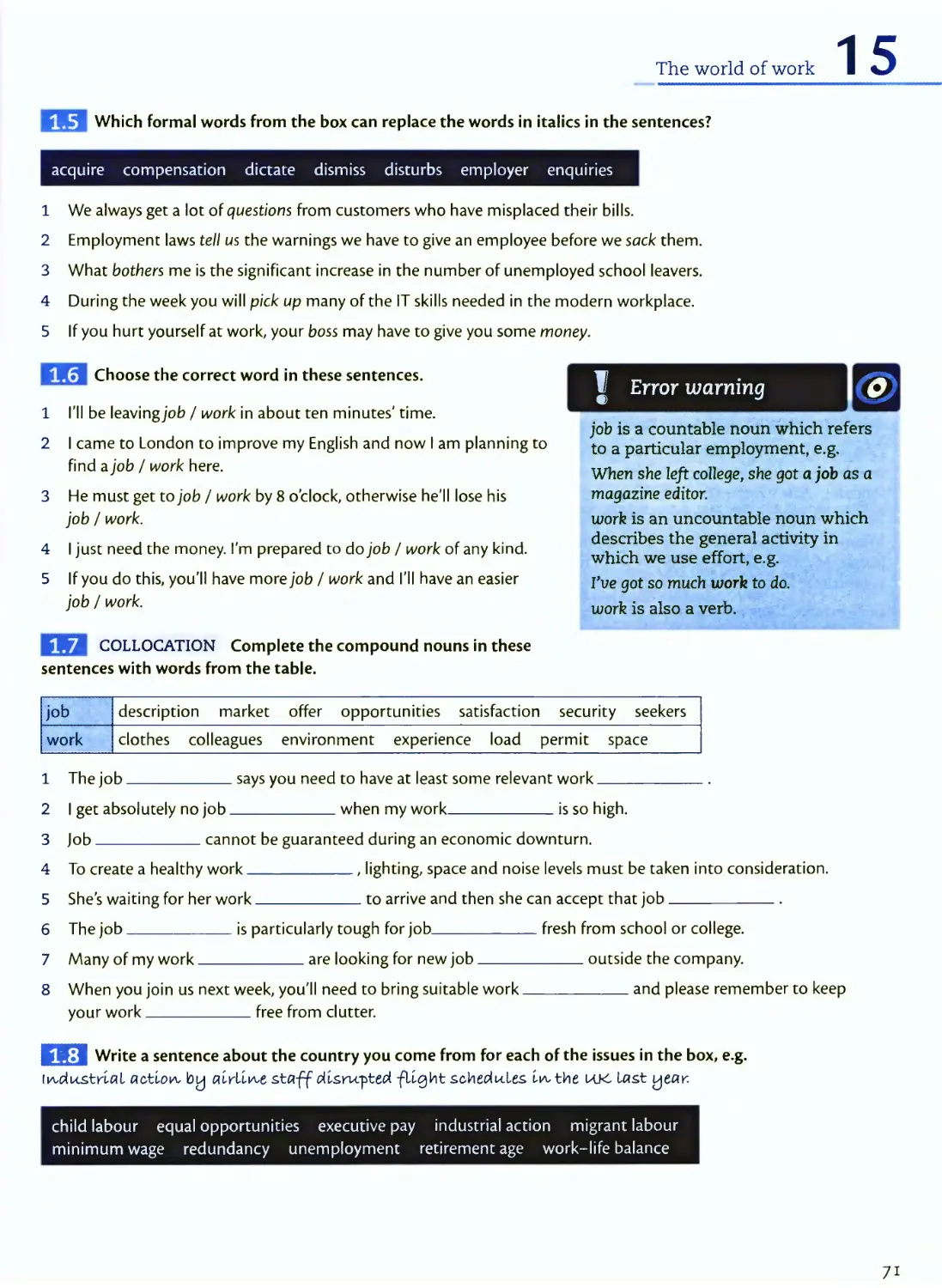
Employment patterns
Economic migration
Economic problems
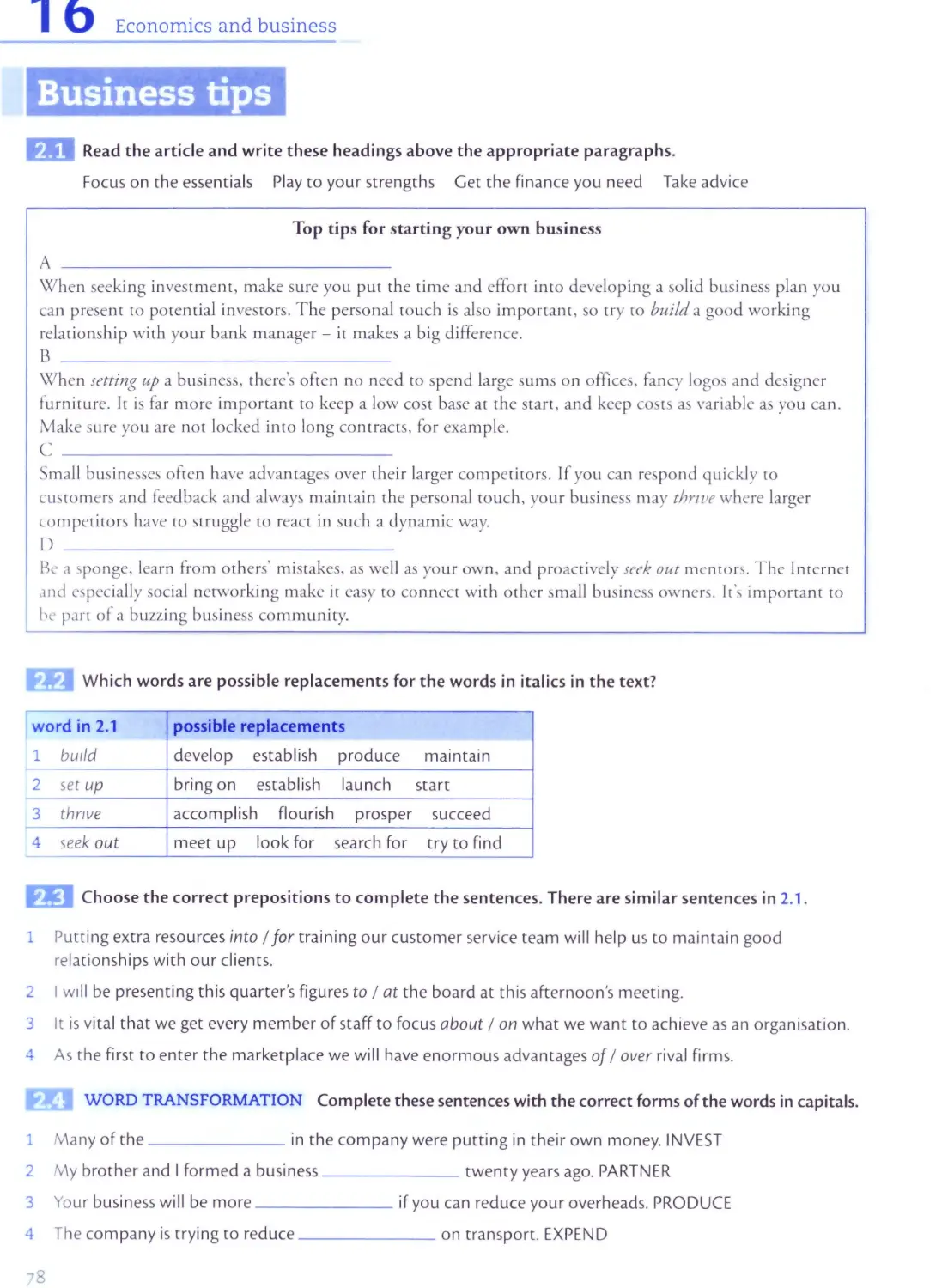
Business tips
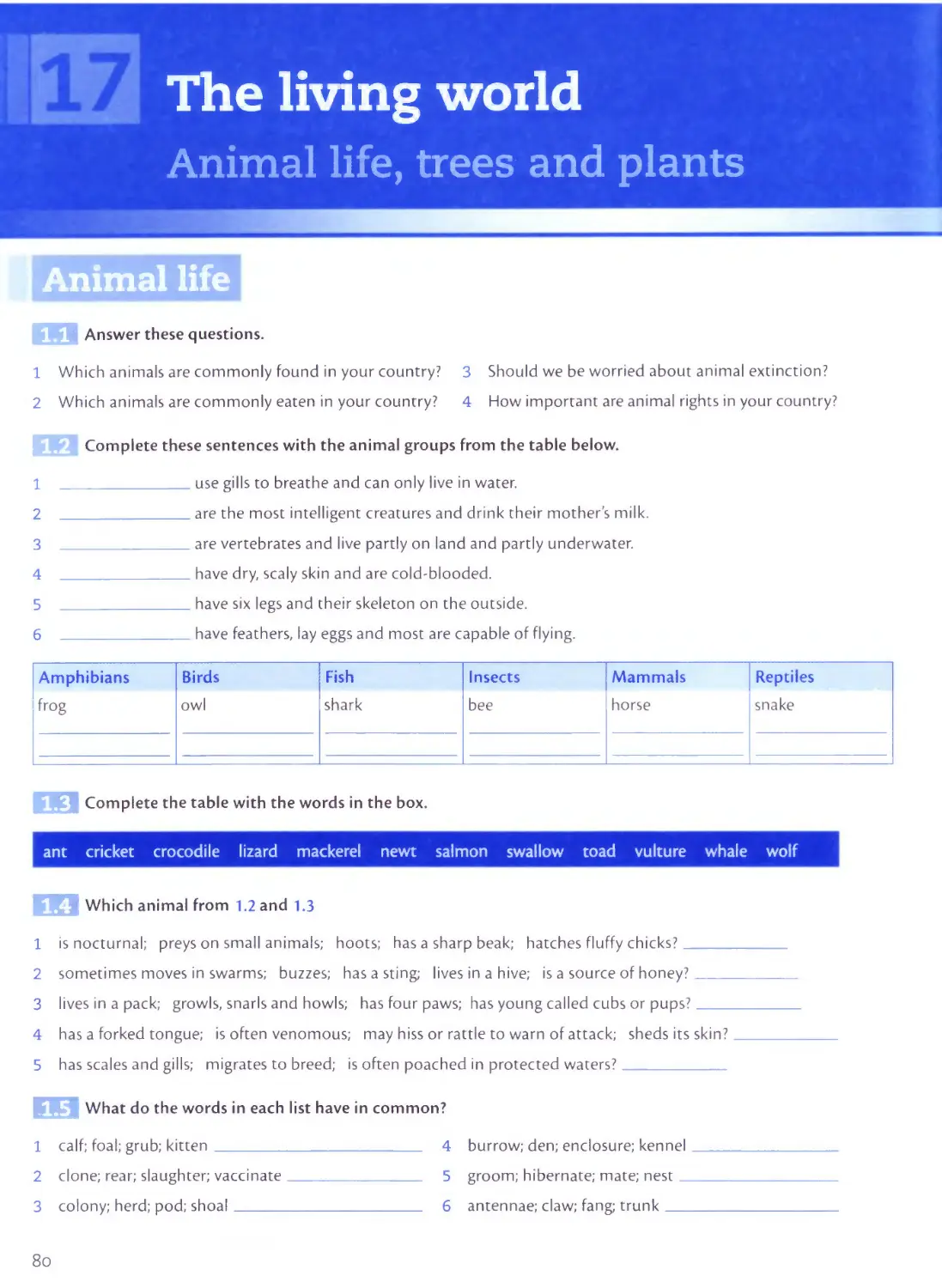
Animal life
Trees and plants
Social networking
Letter writing
Issues
Protection
Discovery
Solutions
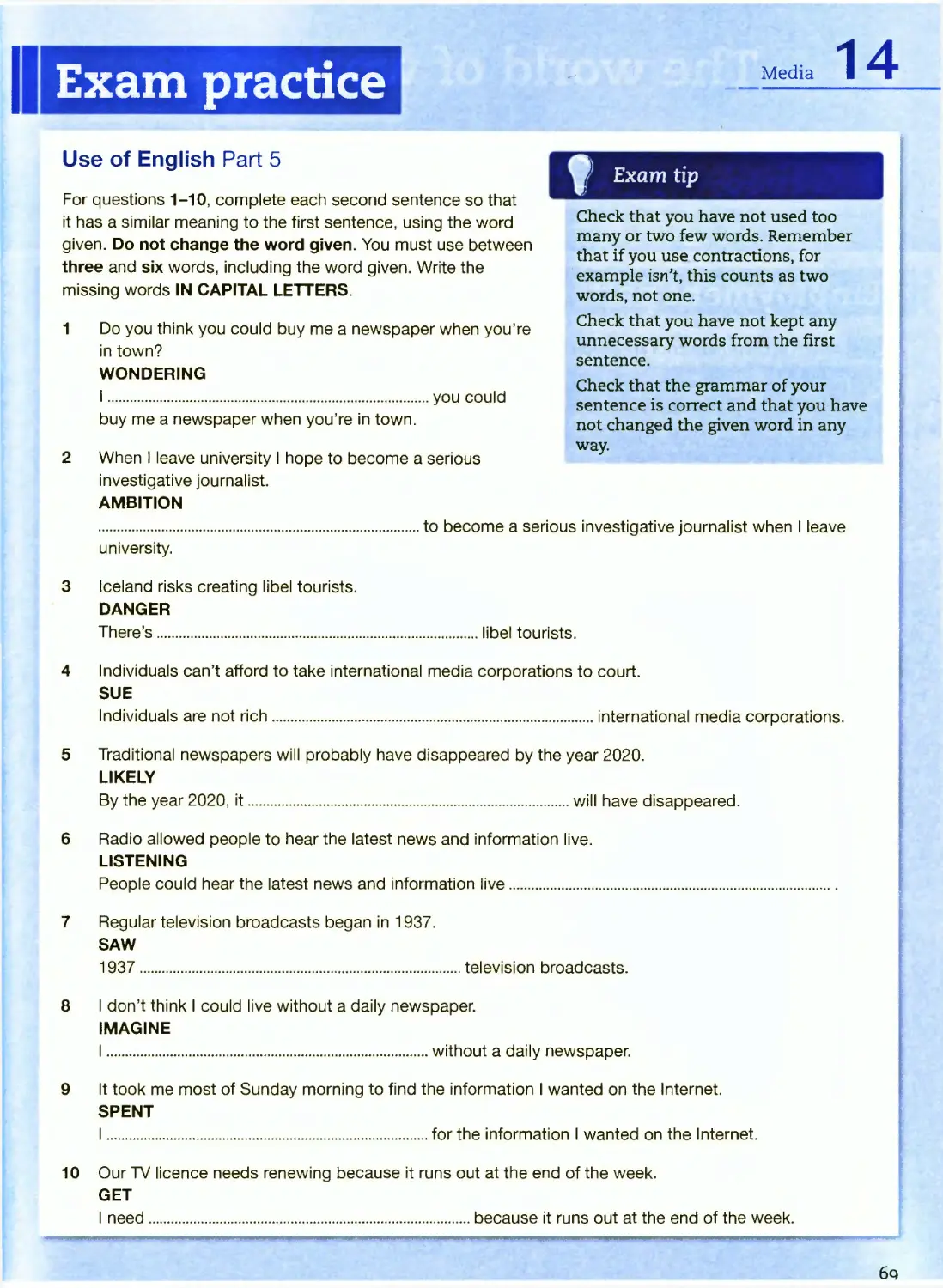
Use of English Part 5
Use of English Part 2
Speaking Part 1
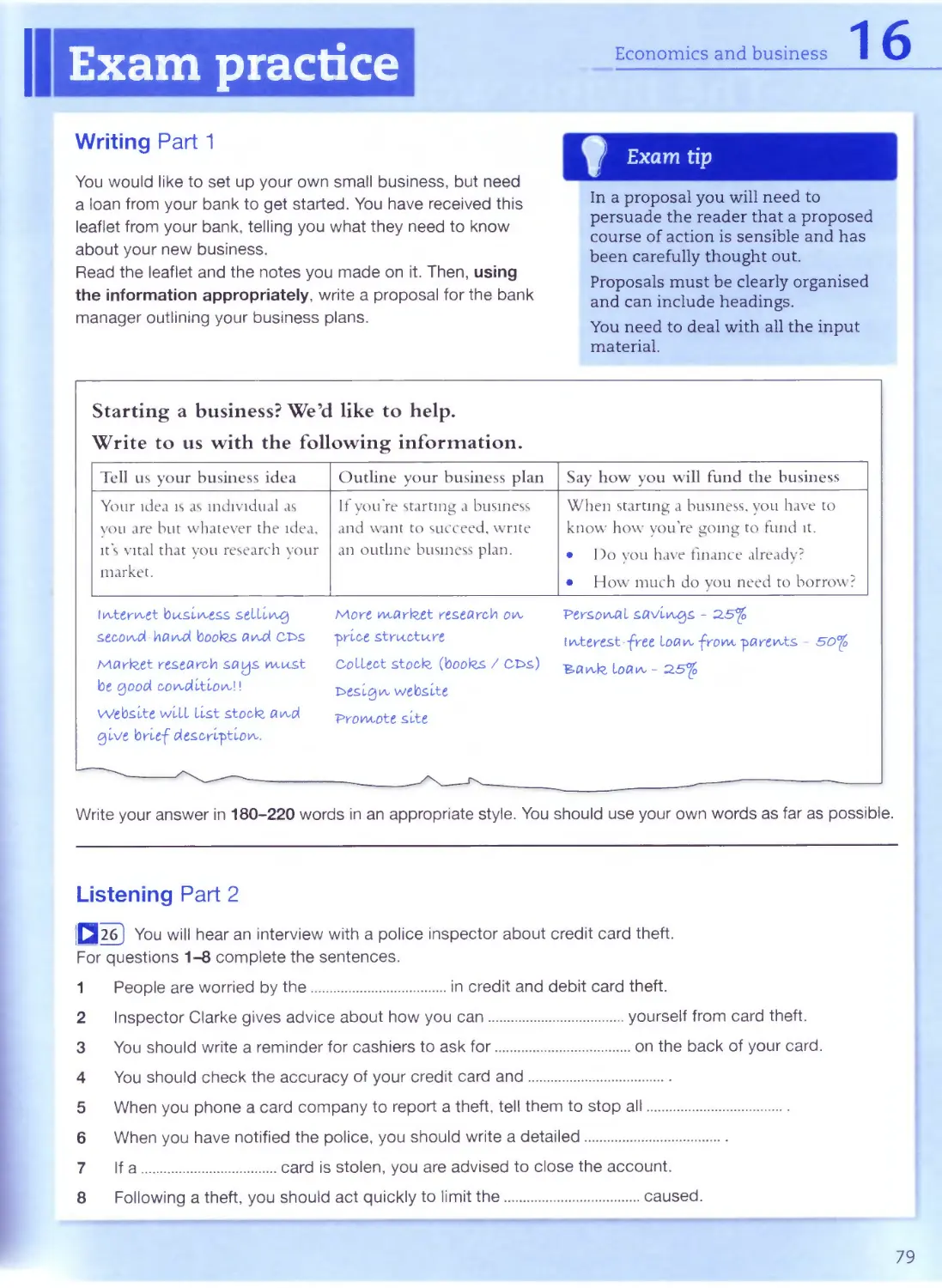
Writing Part 1
Listening Part 2
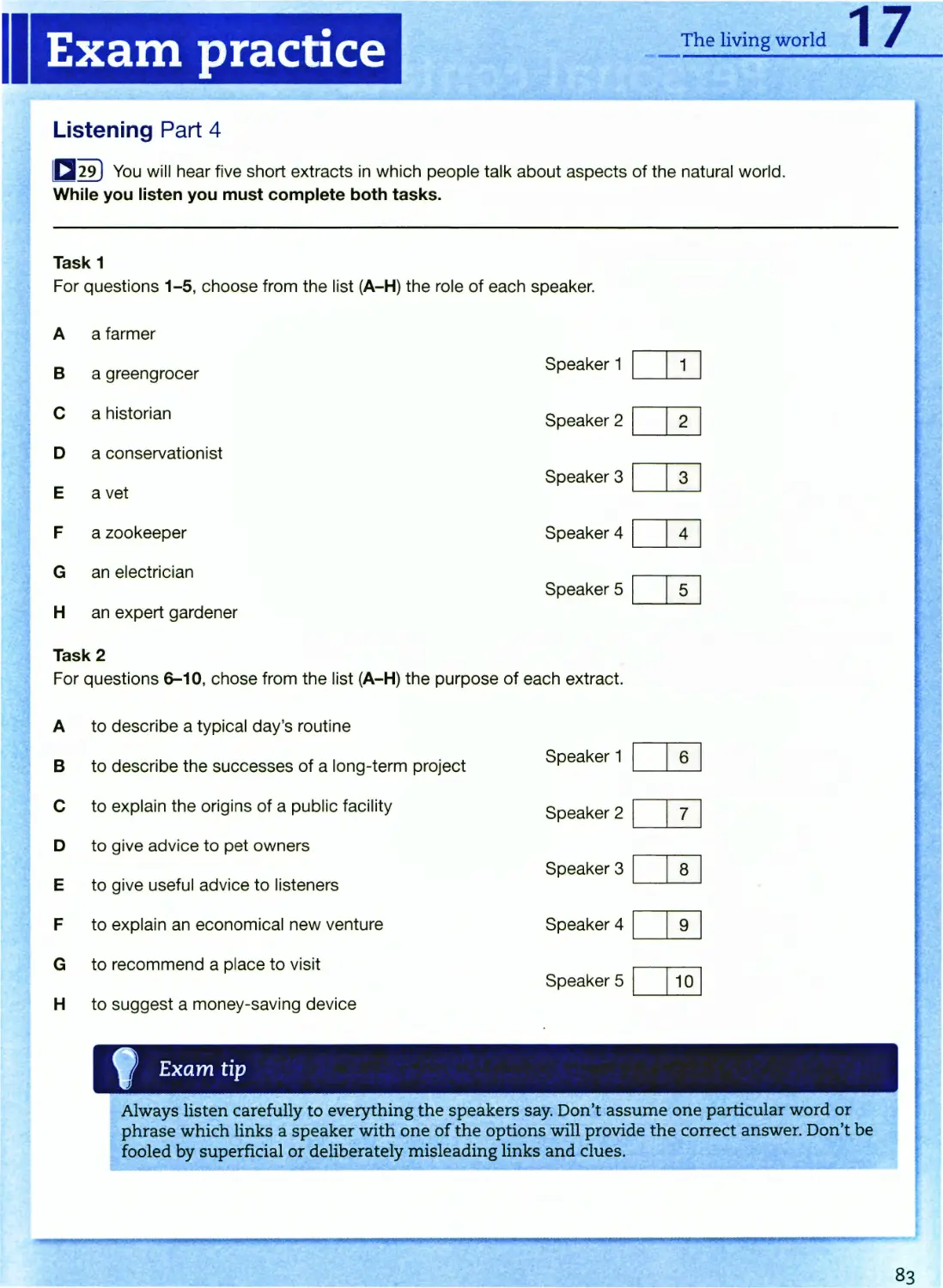
Listening Part 4
Use of English Part 3
Speaking Part 4
Writing Part 2
Use of English Part 3
Use of English Part 1
Appendices
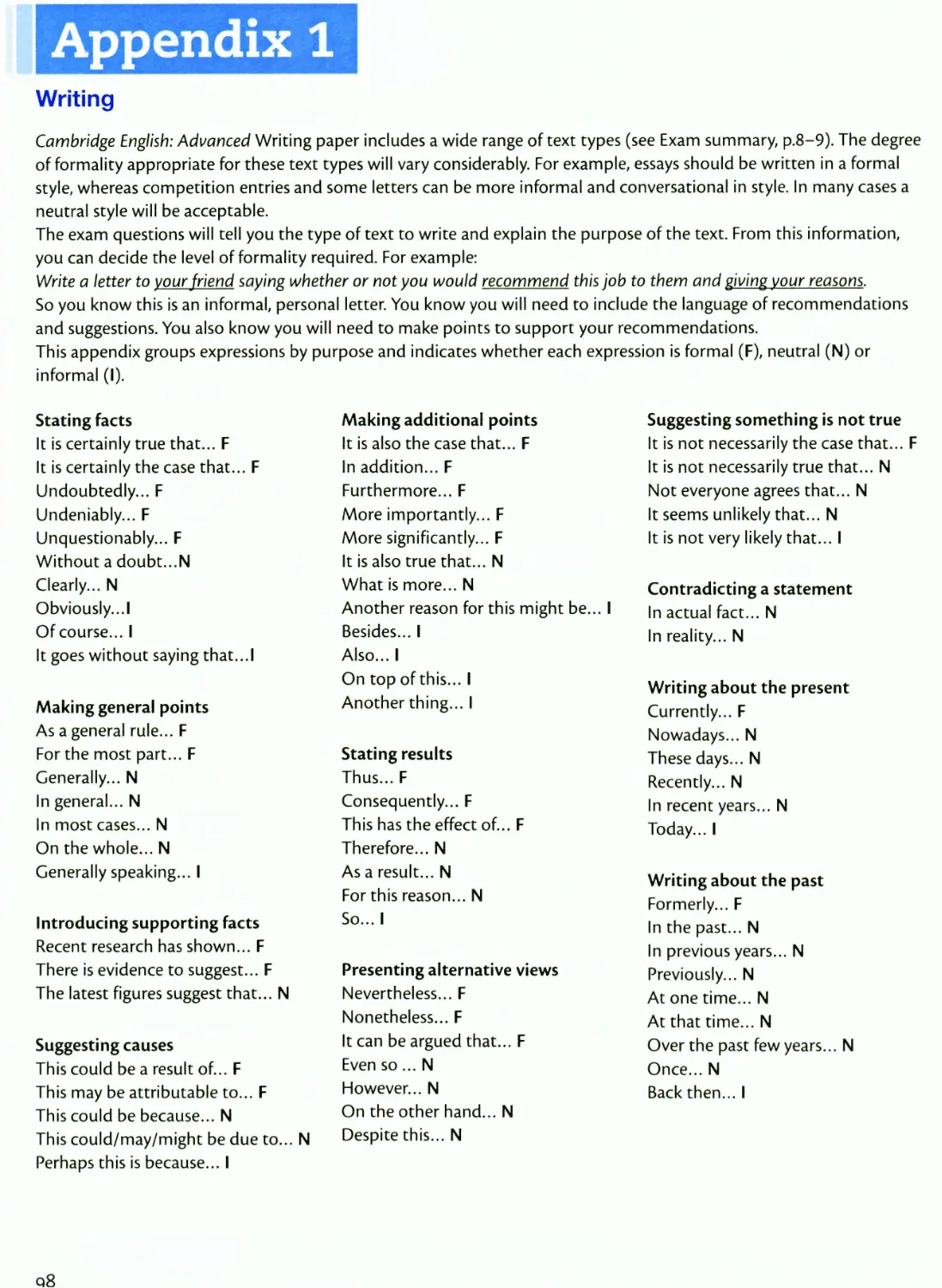
Writing
Fixed phrases for writing tasks listed by function and
indicating degree of formality
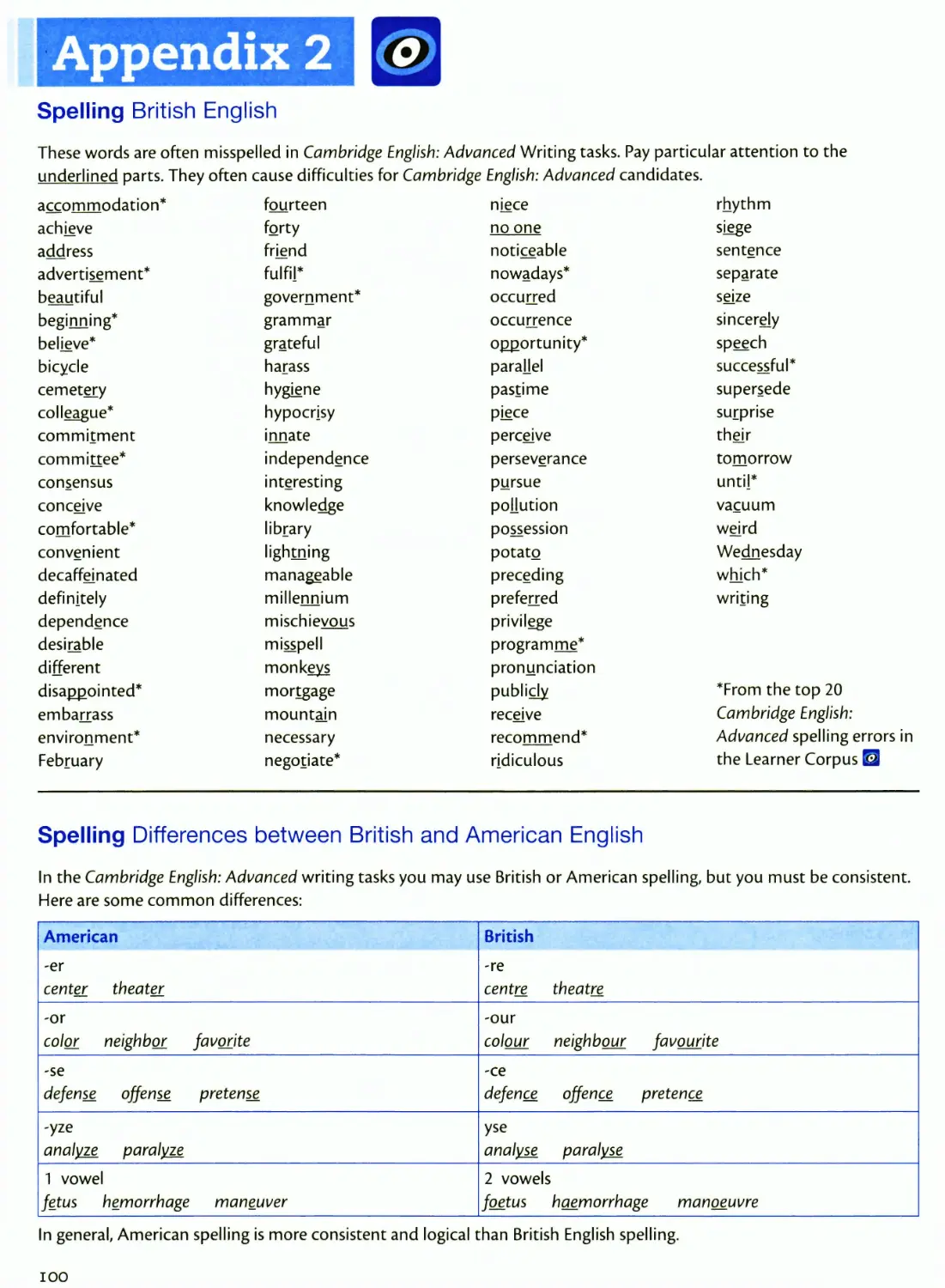
Spelling 22
Words typically misspelt by Cambridge English: Advanced
candidates with problem letters highlighted
Speaking Part 1 22
Real Speaking Part 1 questions compiled from past
papers
esbsbeo
Prefixes and suffixes
Meanings and examples of these useful language
features
Word families
Extensive lists of words from common roots
5

Acknowledgements
The author would like to thank all the Cambridge
University Press team involved in the development
of Vocabulary for Advanced for their commitment,
enthusiasm and continued support, especially Brendan
O'Se, Frances Disken, Emily Hird, Rhona Snelling, Barry
Tadman and Jennifer Farmer. Finally, I would like to thank
my family - Val, Laura and Jo for their good'natured
support.
The author and publishers are grateful to the following
reviewers for their valuable insights and suggestions:
Marfa Pilar Aguado-Jimenez, Spain; John Irving, UK; David Jay,
UK; Catherine Shaw, UK
The authors and publishers acknowledge the following
sources of copyright material and are grateful for the
permissions granted. While every effort has been made, it
has not always been possible to identify the sources of all
the material used, or to trace all copyright holders. If any
omissions are brought to our notice, we will be happy to
include the appropriate acknowledgements on reprinting.
p. 13: Wanted in Africa article adapted from
www.wantedinafrica.com; p. 16: Text about writing a
biography from 'Speaking for Myself' by Joan Bakewell from
The Author (Winter 2003); p. 20: Review 2 is an excerpt
from Battista, Denise, 'Law Dares to be a Great Hamlet’,
PlayShakespeare.com, www.playshakespeare.com/hamlet/
theatre-reviews/3881-law-dares-to-be-agreat-hamlet
(October 2009), Copyright © PlayShakespeare.com, used
with permission; p. 21: Gotan Project biography from www.
rfimusique.com; p. 22: Types of migrant article adapted from
Stalker's Guide to International Migration www.pstalker.com;
p. 27: audio script activity adapted from 'Risking teenagers'
article, March 2010, © ITV Breakfast Limited; p. 28: 'Five
steps to risk assessment' contains public sector information
published by the Health and Safety Executive and licensed
under the Open Government Licence v1.0; p. 29: 'Don’t
text and drive!' adapted from 'Texting while driving is more
dangerous than drink-driving' by Helen Nugent, September
2008, The Times/NI Syndication; p. 35: Audio script for glass
ceiling activity from article ‘What is the glass ceiling?'
www.wisegeek.com; p. 36: Dr. Maria Montessori article
from www.montessori.org.uk; p. 38: Audio script for
apprenticeships activity adapted from Apprenticeship
Programmes text from Bentley Motors website, by
permission; p. 38: Mechanical engineering article from
www.seas.yale.edu/departments-mechanical; p. 40: Current
world health issues article by Anup Shar, © Copyright 1998-
2011 under a 'Creative Commons License’; p. 41: Audio
script for flu pandemics activity adapted from article by
permission of The New Zealand Herald; p. 54-55: Celebrity
definition adapted from www.wordiq.com; p. 58: 'The role
of grandparents in children’s upbringing' adapted from
www.indianchild.com; p. 66: 'Information sources of the
future' adapted from 'Where is Everyone?’ by Thomas Baekdal -
www.baekdal.com/media/market-of-information; p. 68:
Audio script for activity on Iceland's press freedom law
adapted from 'Organ Grinder: our panel of experts discuss
Iceland's freedom of expression law’, Copyright Guardian
News & Media Ltd 2010; p. 72: from 'A brain drain for
Ireland as economy buckles’ by Molly Muldoon, June 2010,
www.irishcentral.com; p. 73: Leaving St Kilda from the
Learning and Teaching Scotland website www.ltscotland.org.
uk © Crown Copyright 2009; p. 77: 'Low holiday spending
due to economic worries' by Martha C. While, November
5th, 2009 from www.walletpop.com, content © 2011 AOL
Inc, used with permission; p. 78: Starting your own business
article from 'How to grow your start up', www.newbusiness.
co.uk; p. 81: Our Disappearing Bees by Brigitte Straub, R.N.,
B.E.S., suite101.com, copyright © 2010; p. 82: Audio script
activity about plants from www.earthplatform.com; p. 85:
Audio script about letter writing from 'The Lost Art of Letter
Writing’ © 2001 Bobbie Ann Pimm, www.bobbieann.net/
LetterWriting.html; p. 87: Family history in Arundel article
adapted from www.arundelmuseum.org.uk/family; p. 93-94:
'Batteries are putting the brakes on electric car take-up' by
Dickon Ross first published in Engineering & Technology
magazine, June 2010; p. 95: 'Solar flares: everything you need
to know', by Heidi Blake The Telegraph, September 2010, ©
Telegraph Media Group Limited 2010; p. 101: questions
collated and adapted from the CAE Examination Papers series
published by Cambridge University Press
The publishers are grateful to the following for permission
to reproduce copyright photographs:
Key: T = top, C = centre, L = left, R = right, B= bottom
p. 10: iStockphoto; p. 19: Christopher Furlong/Getty Images;
p. 23 (L): Tatania Popova/Shutterstock; p. 23 (R): ©Leslie
Garland Picture Library/Alamy; p. 25 (T): Bloomberg via Getty
Images; p. 25 (BL): Boris Horvat/AFP/Getty Images; p. 25 (BR):
©Davis Young-Wolf/Alamy; p. 33 (T): ©Ady Kerry/Alamy;
p. 33 (B): Partik Giardino/Photolibrary.com; p. 44: Ed
Pritchard/Getty Images; p. 57 (L): Michael Buckner/Getty
Images; p. 57 (C): ©Rolf Bruderer/Corbis; p. 57 (R): Tim
Rooke/Photolibrary.com; p. 81: iStockphoto; p. 88: Getty
Images; p. 93: ©The Image Works/Topfoto.
Picture Research by Thomas Bonsu-Dartnall
Designed and typeset by eMC Design Ltd
Illustrations by Adrian Barclay and Clive Goodyer
6

Introduction
What does the book aim to do?
This book aims to extend your vocabulary knowledge
and to introduce ways of studying vocabulary which will
help you succeed in Cambridge English: Advanced, also
known as Certificate in Advanced English (CAE). Particular
attention is given to language chunks, such as collocations
and idioms. These make your written and spoken
language more effective and improve your understanding
of listening and reading texts. The exam practice sections
increase your awareness of the ways you will need to use
your vocabulary knowledge in the Cambridge English:
Advanced examination.
Who is the book aimed at?
This book is designed for students working alone who
want to revise and extend their vocabulary, but it can
also be used as part of Cambridge English: Advanced
preparation course in the classroom, or set as homework
by a teacher.
How do I use the book?
You can work through the twenty units in any order. You
may choose units that relate to topics in your coursebook,
because you have a particular interest in that subject, or
simply because you are attracted to an interesting text or
set of activities. In each unit there are four pages: three
pages of general exercises and one page of exam practice.
It is best to work through a unit from beginning to end as
one exercise may revise the vocabulary from a previous
exercise.
When should I use a dictionary?
To get the most out of this book you will need a good
dictionary. Use the Cambridge Advanced Learner's
Dictionary or another suitable monolingual dictionary.
You should try to do each exercise without a dictionary
first, and then use your dictionary to help you with
answers you didn't know. Use the Answer key as a final
check. When you see the dictionary symbol, you are
advised to use a dictionary to complete the exercise. i=J
What does this symbol mean? □
This symbol appears in the Error warning boxes, and
indicates that the errors were found in the Cambridge
Learner Corpus, a database of mistakes made by students
who have taken Cambridge ESOL exams.
What is included in the exam
practice?
The exam practice sections contain examples of the style
of questions used for every task type in the Cambridge
English: Advanced examination. These tasks show you how
your vocabulary knowledge will be tested. However, the
practices in this book are often shorter than the tasks in
the real examination. Please check the Exam summary
(page 8) for details of the number of questions in each
section of the examination.
How do I best use the exam
Writing practices?
These exercises give you an opportunity to use the
vocabulary from the unit. Appendix 1 (page 98) lists fixed
phrases you may find useful when doing an exam writing
task. There are also model answers for each question in
the Answer key. These models can be used as a guide to
organising ideas and using vocabulary accurately and
effectively.
What is on the CD?
You need to listen to the CD to do some of the exercises.
The exam listening tasks are also on the CD. In the exam
you hear everything twice so you will need to replay
these tracks. Make sure you read all the instructions and
questions before you play the exam Listening tracks. Some
of the Listening exercises in the units are similar to the
tasks you will do in the exam. You will probably need to
listen to these tracks twice too.
How do I use the Wordlists?
On pages 116 to 128 there are Wordlists containing the
key vocabulary for each unit. The pronunciation for each
individual word is given and there are also lists of phrases.
When you have finished each unit, go through the
Wordlist and check you know the meanings of each word
and expression. Highlight any items you don't remember
and go back to the unit to revise them.
When should I do the tests?
Each of the four tests recycles a selection of vocabulary
from five units. When you have finished the five units, do
the test and mark it. Highlight the items you got wrong
and review the units if necessary.
7

Cambridge English: Advanced Exam summary
Paper 1 Reading (1 hour is minutes)
There are 34 questions in total.
Part
What are the tasks?
What do 1 have to do?
How many
questions?
Where can 1
get practice?
1
Multiple choice
You read three short texts and answer two questions
on each. You choose from four possible answers (A, B,
C or D).
6
Unit 10, p.51
2
Gapped text -
paragraphs
You read a text from which six paragraphs have been
removed and put in a jumbled order. You have to
choose which paragraph fits into which space. There
is a paragraph which does not fit into any space.
6
Unit 5, p.29
3
Multiple choice
You read a text and answer seven multiple-choice
questions. You choose from four possible answers
(A, B, C or D).
7
Unit 1, p.13
4
Multiple matching
You scan a text or texts and decide which text each of
the questions refers to. Some questions may refer to
more than one text / text section.
15
Unit 13, p.65
Paper 2 Writing (1 hour 20 minutes)
The two parts of the test carry equal marks.
Part
What are the tasks?
What do 1 have to do?
How many
questions?
Where can 1
get practice?
1
Write one text
There is one compulsory question. You have to
write an article, a letter, a proposal or a report. The
content of your writing is based on information in the
question. You must write 180-220 words.
1
Unit 2, p.17
Unit 16, p.79
2
Write one text
Choose from a selection of four of the following
non-specialised text types: an article; a competition
entry; a contribution to a longer piece; an essay;
an information sheet; a letter; a proposal; a report;
a review. The focus of these pieces will be on
advising, comparing, evaluating, expressing opinions,
hypothesising, justifying, persuading.
Or you can answer a question on the set books which
has two options.
You must write 220-260 words.
5 but you
choose 1
Unit 8, p.43
Unit 19, p.91
8

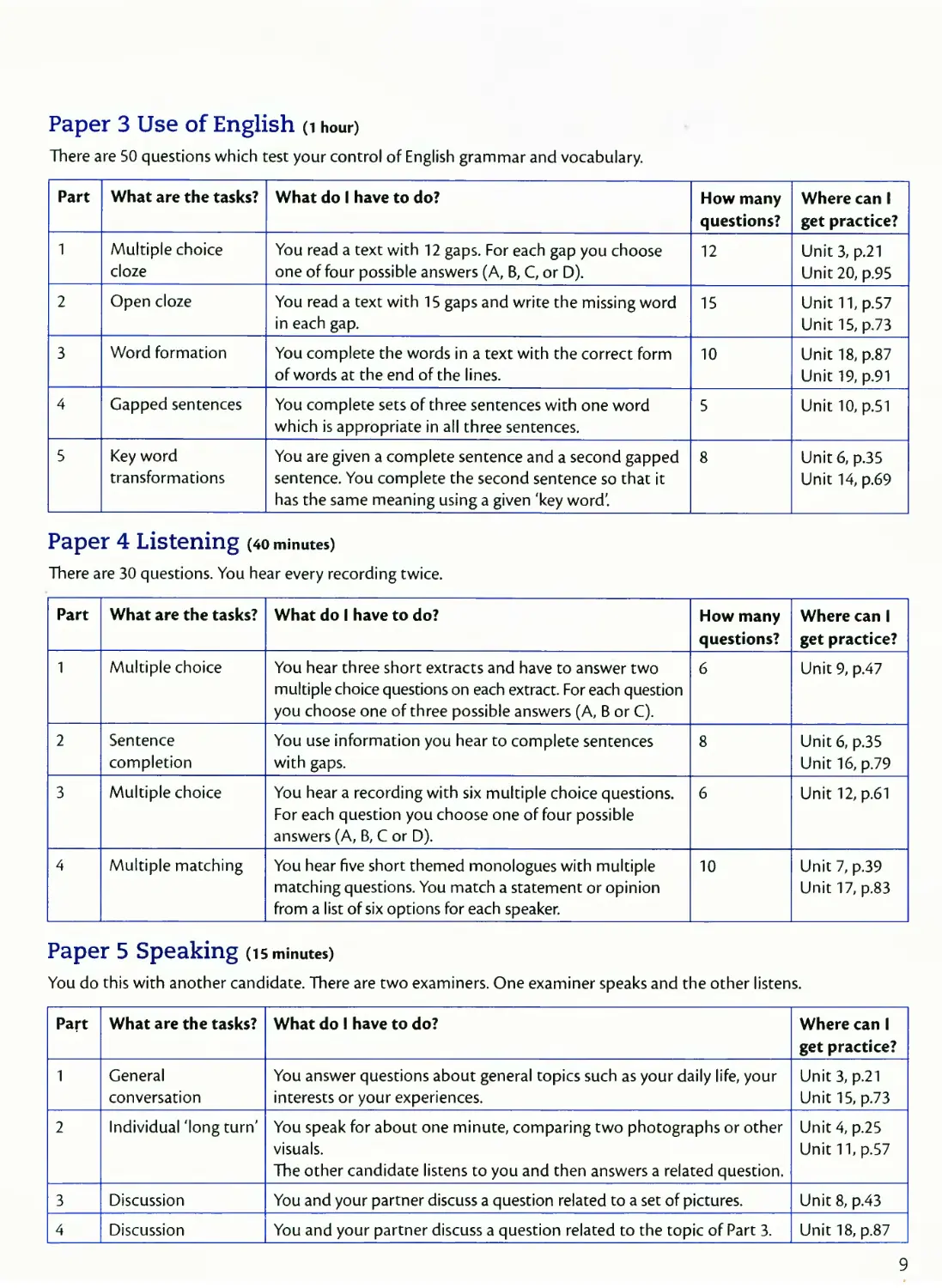
Paper 3 Use of English (i hour)
There are 50 questions which test your control of English grammar and vocabulary.
Part
What are the tasks?
What do 1 have to do?
How many
questions?
Where can 1
get practice?
1
Multiple choice
cloze
You read a text with 12 gaps. For each gap you choose
one of four possible answers (A, B, C, or D).
12
Unit 3, p.21
Unit 20, p.95
2
Open cloze
You read a text with 15 gaps and write the missing word
in each gap.
15
Unit 11, p.57
Unit 15, p.73
3
Word formation
You complete the words in a text with the correct form
of words at the end of the lines.
10
Unit 18, p.87
Unit 19, p.91
4
Gapped sentences
You complete sets of three sentences with one word
which is appropriate in all three sentences.
5
Unit 10, p.51
5
Key word
transformations
You are given a complete sentence and a second gapped
sentence. You complete the second sentence so that it
has the same meaning using a given 'key word'.
8
Unit 6, p.35
Unit 14, p.69
Paper 4 Listening (40 minutes)
There are 30 questions. You hear every recording twice.
Part
What are the tasks?
What do 1 have to do?
How many
questions?
Where can I
get practice?
1
Multiple choice
You hear three short extracts and have to answer two
multiple choice questions on each extract. For each question
you choose one of three possible answers (A, B or C).
6
Unit 9, p.47
2
Sentence
completion
You use information you hear to complete sentences
with gaps.
8
Unit 6, p.35
Unit 16, p.79
3
Multiple choice
You hear a recording with six multiple choice questions.
For each question you choose one of four possible
answers (A, B, C or D).
6
Unit 12, p.61
4
Multiple matching
You hear five short themed monologues with multiple
matching questions. You match a statement or opinion
from a list of six options for each speaker.
10
Unit 7, p.39
Unit 17, p.83
Paper 5 Speaking (15 minutes)
You do this with another candidate. There are two examiners. One examiner speaks and the other listens.
Part
What are the tasks?
What do 1 have to do?
Where can 1
get practice?
1
General
conversation
You answer questions about general topics such as your daily life, your
interests or your experiences.
Unit 3, p.21
Unit 15, p.73
2
Individual 'long turn'
You speak for about one minute, comparing two photographs or other
visuals.
The other candidate listens to you and then answers a related question.
Unit 4, p.25
Unit 11, p.57
3
Discussion
You and your partner discuss a question related to a set of pictures.
Unit 8, p.43
4
Discussion
You and your partner discuss a question related to the topic of Part 3.
Unit 18, p.87
9

Cities
Urban growth, urban living
Urban growth
HI Think of a city you know well.
Which of these phrases do you associate
with it? Put a
an important commercial centre
a vibrant, cultural centre
a major tourist attraction
a sprawling metropolis
gridlocked rush-hour traffic
accessible open spaces
run-down estates
affluent suburbs
steeped in history
seriously polluted
densely populated
friendly and welcoming
iW Choose the best words to complete the text.
Urban sprawl is the unchecked spreading of a city
or its 'suburbs / residences. It often involves the
1 demolition / construction of residential or commercial
buildings in 1 rural / environmental areas or otherwise
undeveloped land on the 4outskirts / neighbourhoods of a city.
Typical ■residents / commuters of these areas live in single-family
homes and travel by car to their jobs in the city. Concerns over
urban sprawl largely focus on negative bcosts / consequences for
residents and the local Environment / space. The tendency of
people living in these neighbourhoods to commute to work
means that urban sprawl is sometimes associated with increased
air 8pollution /pollutant from car exhaust fumes.
iifci Find words in the text which match these definitions.
1	related to towns and cities
2	related to trade or business
3	particular part of a place
4	not previously built on
5	people who live in a place
¥ Vocabulary note
This book draws attention to language
chunks of the following types:
COLLOCATIONS = words frequently
used together, e.g.
densely populated, leafy suburbs, open
spaces, violent crime
COMPOUND NOUNS = nouns made up
of two or more words, e.g.
tourist attraction, skyscraper, cost of living
DEPENDENT PREPOSITIONS = some
adjectives, nouns and verbs are
followed by particular prepositions, e.g.
steeped in history, plagued by crime
PHRASAL VERBS = two- or three-part
verbs with idiomatic meanings, e.g.
break down, get around, look forward to
IDIOMS = phrases with special
meaning that cannot be understood
from the individual words, e.g.
go to town on something, hit the road,
cut and dried
io

Cities
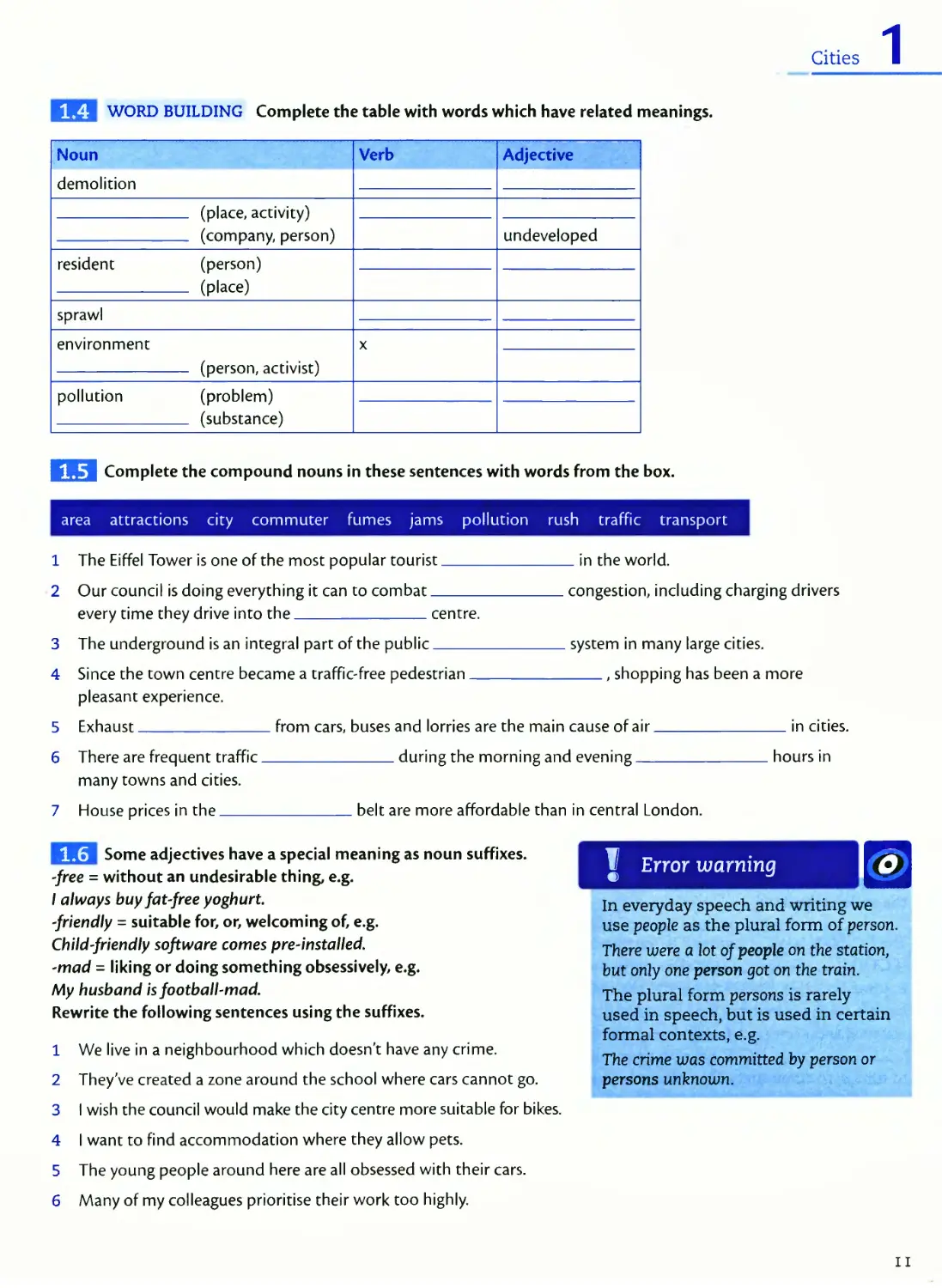
HKl WORD BUILDING Complete the table with words which have related meanings.
Noun
Verb
Adjective
demolition
(plarp, activity)
(company, person)
undeveloped
resident (person)
(place)
sprawl
environment
(person, activist)
X
pollution (problem)
(substance)
HiIMI Complete the compound nouns in these sentences with words from the box.
area attractions city commuter fumes jams pollution rush traffic transport
1	The Eiffel Tower is one of the most popular tourist	in the world.
2	Our council is doing everything it can to combat	congestion, including charging drivers
every time they drive into the	centre.
3	The underground is an integral part of the public	system in many large cities.
4	Since the town centre became a traffic-free pedestrian	, shopping has been a more
pleasant experience.
5	Exhaust	from cars, buses and lorries are the main cause of air	in cities.
6	There are frequent traffic	during the morning and evening	hours in
many towns and cities.
7	House prices in the	belt are more affordable than in central London.
Wil Some adjectives have a special meaning as noun suffixes.
-free = without an undesirable thing, e.g.
I	always buy fat-free yoghurt.
-friendly = suitable for, or, welcoming of, e.g.
Child-friendly software comes pre-installed.
-mad = liking or doing something obsessively, e.g.
My husband is football-mad.
Rewrite the following sentences using the suffixes.
1	We live in a neighbourhood which doesn't have any crime.
2	They've created a zone around the school where cars cannot go.
3	I wish the council would make the city centre more suitable for bikes.
4	I want to find accommodation where they allow pets.
5	The young people around here are all obsessed with their cars.
6	Many of my colleagues prioritise their work too highly.
Error warning
In everyday speech and writing we
use people as the plural form of person.
There were a lot of people on the station,
but only one person got on the train.
The plural form persons is rarely
used in speech, but is used in certain
formal contexts, e.g.
The crime was committed by person or
persons unknown.
ii

Cities
Urban living
[Hop Listen to two people talking about living in a city. Complete these sentences with words used
by the speakers.
1	I just love all the	and bustle.
2	In my work and my	life, I come into regular	with people from all over the world.
3	You just take for granted the incredible	of entertainment on offer.
4	The only downside is the	of living.
5	Her parents own a flat in the	of London.
6	It was really convenient, just being able to	on a bus or take the
7	Crime	are higher in cities than in	areas.
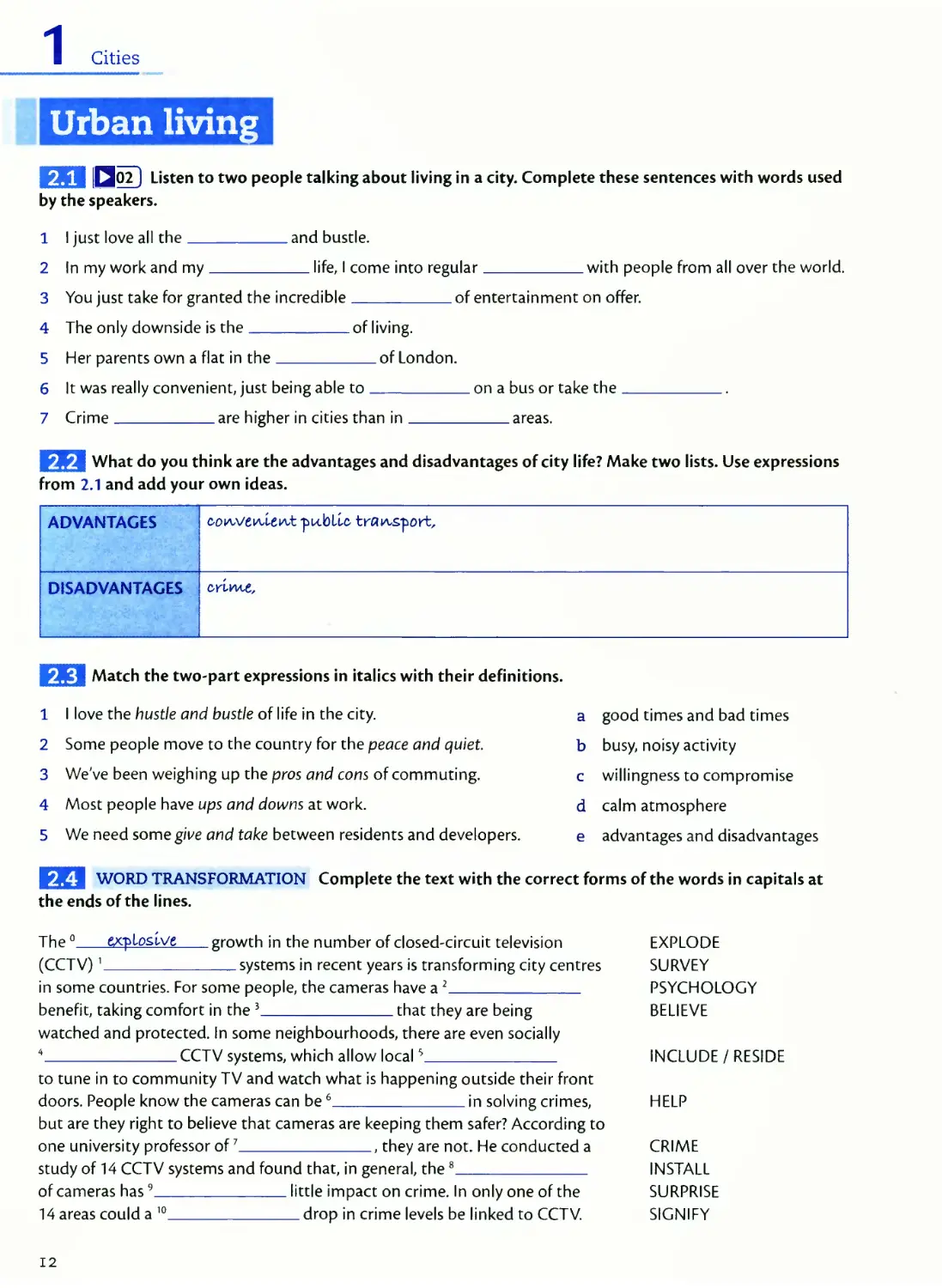
2.2
What do you think are the advantages and disadvantages of city life? Make two lists. Use expressions
from 2.1 and add your own ideas.
ADVANTAGES
cQvcvewiewt public, transport,
DISADVANTAGES
cnnte,
2.3
Match the two-part expressions in italics with their definitions.
1	I love the hustle and bustle of life in the city.
2	Some people move to the country for the peace and quiet.
3	We've been weighing up the pros and cons of commuting.
4	Most people have ups and downs at work.
5	We need some give and take between residents and developers.
a good times and bad times
b busy, noisy activity
c willingness to compromise
d calm atmosphere
e advantages and disadvantages
2.4
WORD TRANSFORMATION
the ends of the lines.
Complete the text with the correct forms of the words in capitals at
The0	explosive	growth in the number of closed-circuit television
(CCTV)1	systems in recent years is transforming city centres
in some countries. For some people, the cameras have a2
benefit, taking comfort in the 3	that they are being
watched and protected. In some neighbourhoods, there are even socially
4	CCTV systems, which allow local3
to tune in to community TV and watch what is happening outside their front
doors. People know the cameras can be6	in solving crimes,
but are they right to believe that cameras are keeping them safer? According to
one university professor of7	, they are not. He conducted a
study of 14 CCTV systems and found that, in general, the8
of cameras has9	little impact on crime. In only one of the
14 areas could a 10	drop in crime levels be linked to CCTV.
EXPLODE
SURVEY
PSYCHOLOGY
BELIEVE
INCLUDE/RESIDE
HELP
CRIME
INSTALL
SURPRISE
SIGNIFY
12

Exam practice
Cities
1
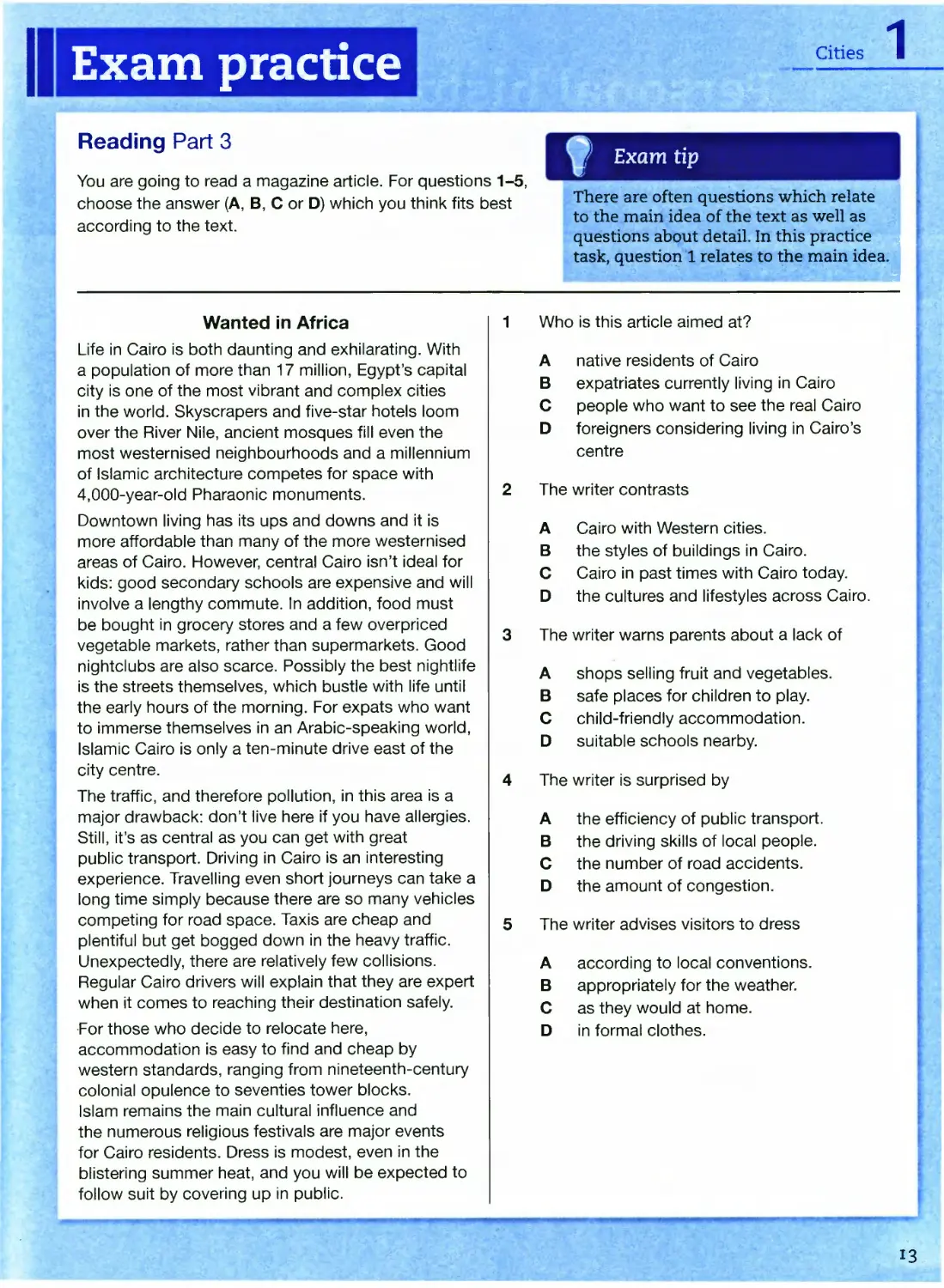
Reading Part 3
You are going to read a magazine article. For questions 1-5,
choose the answer (A, B, C or D) which you think fits best
according to the text.
Exam tip
There are often questions which relate
to the main idea of the text as well as
questions about detail. In this practice
task, question 1 relates to the main idea.
Wanted in Africa
Life in Cairo is both daunting and exhilarating. With
a population of more than 17 million, Egypt’s capital
city is one of the most vibrant and complex cities
in the world. Skyscrapers and five-star hotels loom
over the River Nile, ancient mosques fill even the
most westernised neighbourhoods and a millennium
of Islamic architecture competes for space with
4,000-year-old Pharaonic monuments.
Downtown living has its ups and downs and it is
more affordable than many of the more westernised
areas of Cairo. However, central Cairo isn’t ideal for
kids: good secondary schools are expensive and will
involve a lengthy commute. In addition, food must
be bought in grocery stores and a few overpriced
vegetable markets, rather than supermarkets. Good
nightclubs are also scarce. Possibly the best nightlife
is the streets themselves, which bustle with life until
the early hours of the morning. For expats who want
to immerse themselves in an Arabic-speaking world,
Islamic Cairo is only a ten-minute drive east of the
city centre.
The traffic, and therefore pollution, in this area is a
major drawback: don’t live here if you have allergies.
Still, it’s as central as you can get with great
public transport. Driving in Cairo is an interesting
experience. Travelling even short journeys can take a
long time simply because there are so many vehicles
competing for road space. Taxis are cheap and
plentiful but get bogged down in the heavy traffic.
Unexpectedly, there are relatively few collisions.
Regular Cairo drivers will explain that they are expert
when it comes to reaching their destination safely.
For those who decide to relocate here,
accommodation is easy to find and cheap by
western standards, ranging from nineteenth-century
colonial opulence to seventies tower blocks.
Islam remains the main cultural influence and
the numerous religious festivals are major events
for Cairo residents. Dress is modest, even in the
blistering summer heat, and you will be expected to
follow suit by covering up in public.
1	Who is this article aimed at?
A native residents of Cairo
B expatriates currently living in Cairo
C people who want to see the real Cairo
D foreigners considering living in Cairo’s
centre
2	The writer contrasts
A Cairo with Western cities.
B the styles of buildings in Cairo.
C Cairo in past times with Cairo today.
D the cultures and lifestyles across Cairo.
3	The writer warns parents about a lack of
A shops selling fruit and vegetables.
B safe places for children to play.
C	child-friendly accommodation.
D	suitable schools nearby.
4	The writer is surprised by
A the efficiency of public transport.
B the driving skills of local people.
C	the number of road accidents.
D	the amount of congestion.
5	The writer advises visitors to dress
A according to local conventions.
B	appropriately for the weather.
C	as they would at home.
D	in formal clothes.
■ '			 ■ • • V
13

Personal history
Ancestry, autobiography
Where could you find out more about your ancestors? Put a ^.
official records		older relatives		old family photo albums
websites		family diaries		local newspaper archives
^I^Jj Read the introduction to a talk about investigating your family history. Choose the best words to
complete the text.
There is nothing more exciting than 1 opening / unlocking the mysteries of your own past. With each
additional clue, your 1 ancestors / associates will become more than just names or dates on a
3genealogical /geological form. In this 4process /progress you will realise that most of them were just
ordinary people, just like you and me.
In genealogy you always start from the present and work 3backwards /forwards. You should approach the
search as if you were a detective 6conducting / concluding an investigation; looking for clues, interviewing
Resources / sources and carefully 8documenting / disclosing your facts. This is important because you need to
be able to prove that your line of ^ascent / descent is correct. Anyone can claim that they are a
10descendant / successor of George Washington, but proving it is another thing altogether.
03 J Listen to the talk and answer these questions.
1	Who is this advice aimed at?
2	What does the speaker warn listeners about?
information is an uncountable noun
and cannot be made plural, e.g.
I’d like some informations information
about my family.
ISIHEil Qoil Listen to the talk again. Find words and phrases which match these definitions. Use the
recording script on page 106 to help you.
1
check your information is correct
veri-fu wcu.r-facts
(3 words)
2
enjoy talking about memories
* j j *
(1 word)
3
the most difficult problem to overcome
(3 words)
4
a small proportion of correct information
(4 words)
5
shocking personal secrets from the past
(4 word<;)
6
set a limit for something
(3 words)
7
separate line of your ancestry
(4 words)
8
collect a lot of data
(5 words)
14

Personal history
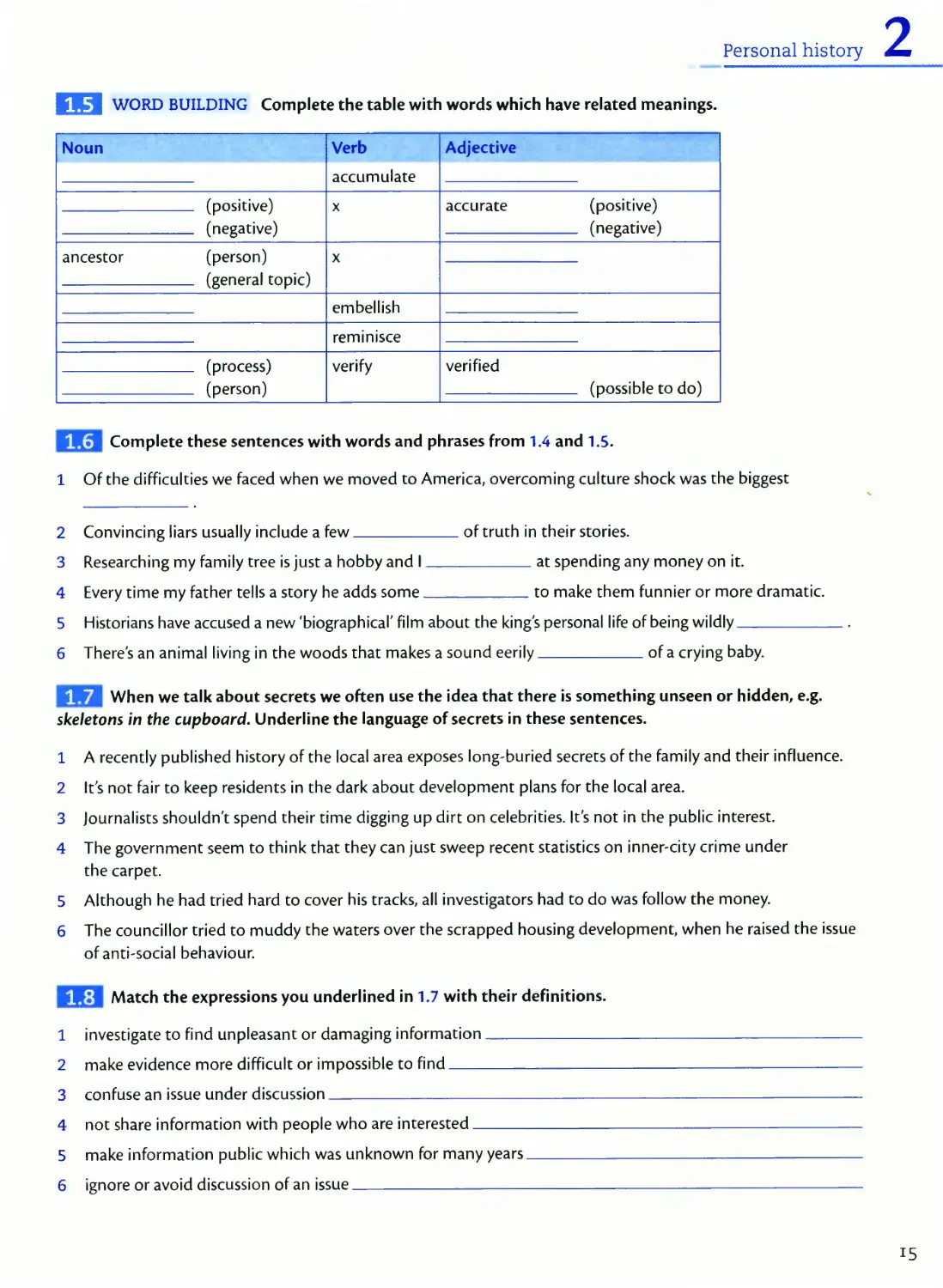
j WORD BUILDING Complete the table with words which have related meanings.
Noun
Verb
Adjective
accumulate
*
>
‘■UJ
'i/l
o
c
X
accurate (positive)
(negative)
(negative)
ancestor (person)
(general topic)
X
embellish
reminisce
(process)
verify
verified
(possible to do)
(person)
i|[il Complete these sentences with words and phrases from 1.4 and 1.5.
1	Of the difficulties we faced when we moved to America, overcoming culture shock was the biggest * 1 2 3 4 5 62	Convincing liars usually include a few	of truth in their stories.
3 Researching my family tree is just a hobby and I	at spending any money on it.
4 Every time my father tells a story he adds some	to make them funnier or more dramatic.
5	Historians have accused a new 'biographical' film about the king's personal life of being wildly
6	There’s an animal living in the woods that makes a sound eerily	of a crying baby.
* When we talk about secrets we often use the idea that there is something unseen or hidden, e.g.
skeletons in the cupboard. Underline the language of secrets in these sentences.
1	A recently published history of the local area exposes long-buried secrets of the family and their influence.
2	It's not fair to keep residents in the dark about development plans for the local area.
3	Journalists shouldn't spend their time digging up dirt on celebrities. It's not in the public interest.
4	The government seem to think that they can just sweep recent statistics on inner-city crime under
the carpet.
5	Although he had tried hard to cover his tracks, all investigators had to do was follow the money.
6	The councillor tried to muddy the waters over the scrapped housing development, when he raised the issue
of anti-social behaviour.
Match the expressions you underlined in 1.7 with their definitions.
1	investigate to find unpleasant or damaging information
2	make evidence more difficult or impossible to find
3	confuse an issue under discussion
4	not share information with people who are interested
5	make information public which was unknown for many years
6	ignore or avoid discussion of an issue
15

Personal history
Autobiography
How is an autobiography different from a biography?
2.2
Complete the text with words from the box.
accurate appointments blank confront feelings forget hoarded myths reports traces
which
Autobiography is a curiously naked business. It requires intimacy with your own 1
you might have been avoiding for years. You have to 2	your guilts and fears, dredging
from deep down things you might rather 3	Then you must weigh up whether they are
4	in any objective sense, or simply memories formulated from family 3
Any life as long as mine has left a multitude of 6
nearest home. Ever since I was a child, I have 7 _
. The most valuable proved to be those
	: scraps of paper, childish sketches, soppy
poems, notes from girls in my class at school, exam papers, school8	and boxes and boxes
of letters.
Then there are the diaries: the daily record of events and
. The casual entries in
numerous little pocket diaries, thrown casually into a big box at each New Year, allowed me to pinpoint,
though only roughly - there are many 10	pages - what I was doing in any particular year
of my life.
2.3
Write one word from 2.2 which can be used in all three sentences.
1	The world	for the 100 metres has been broken twice in the last year.
Speaking off the	, the politician admitted he had made a mistake.
If you are found guilty of shoplifting, you will end up with a criminal
2	Thieves gained	to the building through an upstairs window.
Adults accompanying small children are eligible for half-price
The last	in the diary describes the danger they were in.
3	I left my parents a	saying I'd be late home.
If you ask a friend for advice, you should take	of what they say.
Sorry, I haven't got any change. I'll have to give you a ten-pound
Which words are possible replacements for the words in italics in 2.2?
word in 2.2
possible replacements
1 weigh up
consider decide regard think about
2 formulated
created originating put together prepared
3 a multitude of
a crowd of countless many numerous
4 valuable
expensive important precious useful
5 scraps
bits crumbs fragments small pieces
16

Exam practice
Personal history
2
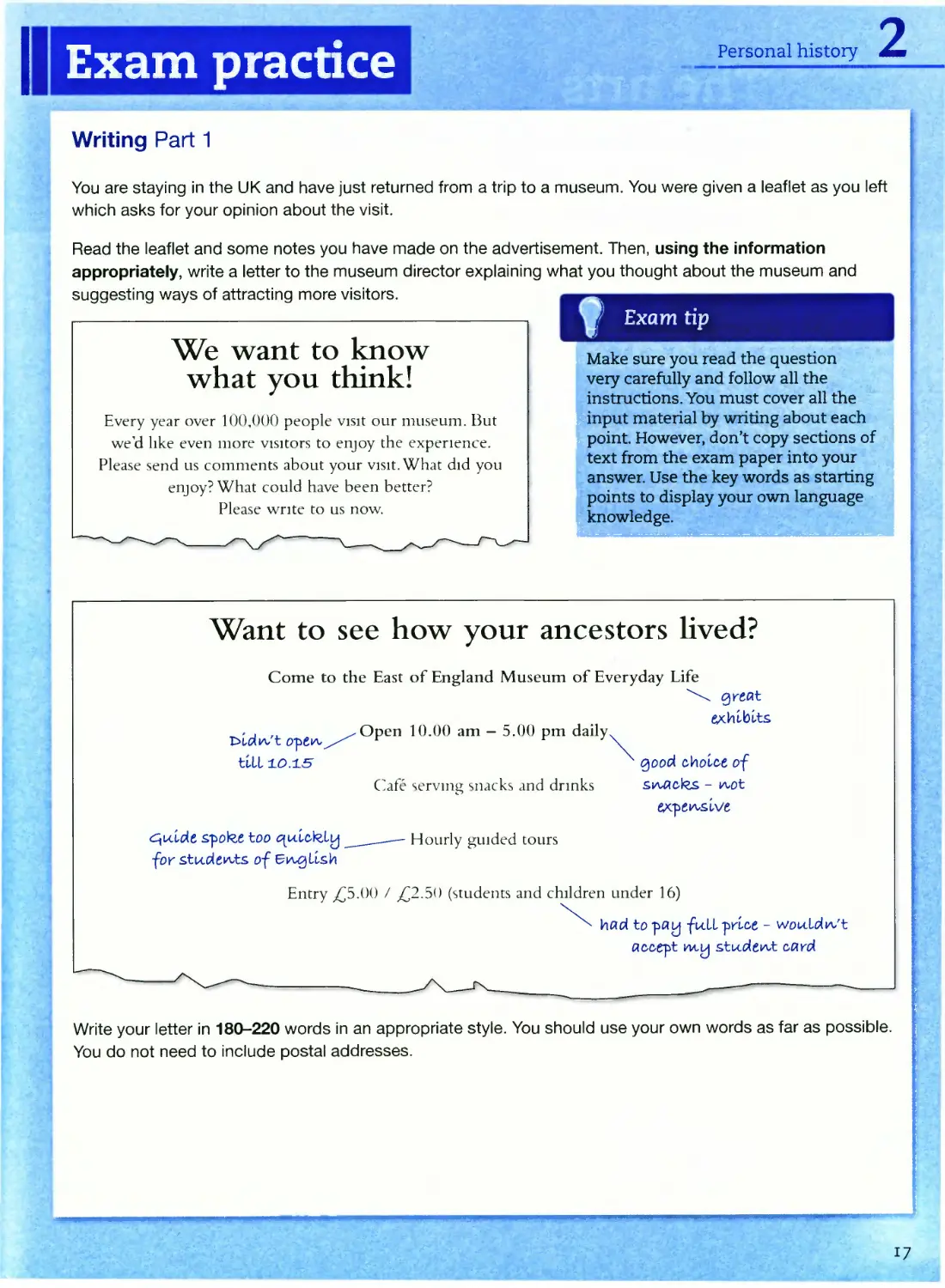
Writing Part 1
You are staying in the UK and have just returned from a trip to a museum. You were given a leaflet as you left
which asks for your opinion about the visit.
Read the leaflet and some notes you have made on the advertisement. Then, using the information
appropriately, write a letter to the museum director explaining what you thought about the museum and
suggesting ways of attracting more visitors.
We want to know
what you think!
Every year over 100,000 people visit our museum. But
we’d like even more visitors to enjoy the experience.
Please send us comments about your visit. What did you
enjoy? What could have been better?
Please write to us now.
C
Exam tip
Make sure you read the question
very carefully and follow all the
instructions. You must cover all the
input material by writing about each
point. However, don’t copy sections of
text from the exam paper into your
answer. Use the key words as starting
points to display your own language
knowledge.
Want to see how your ancestors lived?
Come to the East of England Museum of Everyday Life
/ , ,,	^-Open 10.00 am — 5.00 pm daily,
rudkv't operc^^ v	\
. great
exhibits
ttll 10.15"
<qwlde spoke too quickly
for stu.alerts of Ckvglisk
Cafe serving snacks and drinks
Hourly guided tours
good choice of
skvacks - iA/0t
expensive
Entry £5.00 / £2.50 (students and children under 16)
kad to pay full ■price - wouldn't
accept kvey student card
Write your letter in 180-220 words in an appropriate style. You should use your own words as far as possible.
You do not need to include postal addresses.

17

The arts
Arts events, reviews
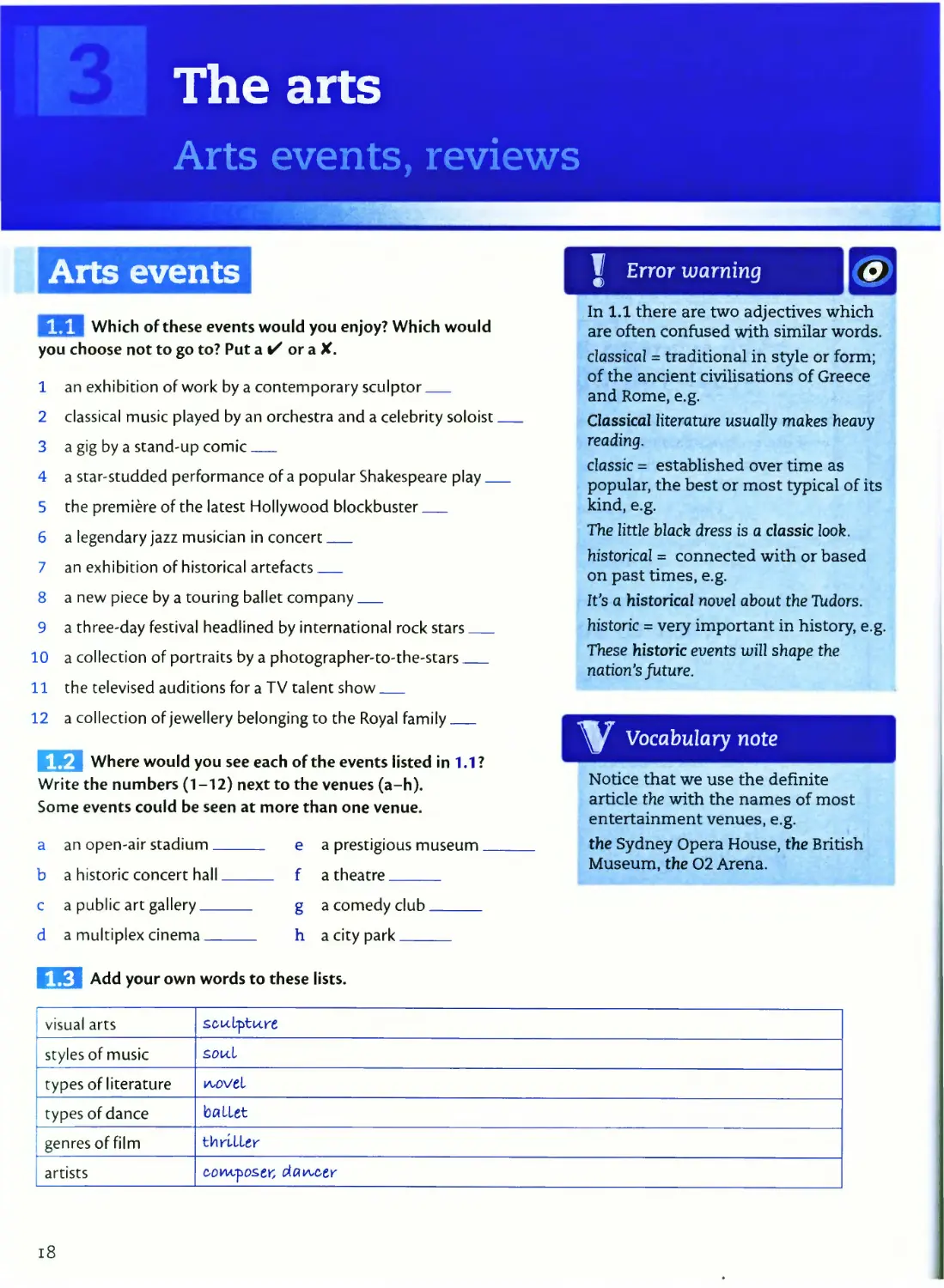
Arts events
PUB Which of these events would you enjoy? Which would
you choose not to go to? Put aor a X.
1	an exhibition of work by a contemporary sculptor
2	classical music played by an orchestra and a celebrity soloist
3	a gig by a stand-up comic
4	a star-studded performance of a popular Shakespeare play _
5	the premiere of the latest Hollywood blockbuster
6	a legendary jazz musician in concert
7	an exhibition of historical artefacts
8	a new piece by a touring ballet company
9	a three-day festival headlined by international rock stars
10	a collection of portraits by a photographer-to-the-stars
11	the televised auditions for a TV talent show
12	a collection of jewellery belonging to the Royal family
8^4 Where would you see each of the events listed in 1.1 ?
Write the numbers (1-12) next to the venues (a-h).
Some events could be seen at more than one venue.
a
an open-air stadium
e
a prestigious museum
b
a historic concert hall
f
a theatre
c
a public art gallery
g
a comedy club
d
a multiplex cinema
h
a city park
T Error warning
In 1.1 there are two adjectives which
are often confused with similar words.
classical = traditional in style or form;
of the ancient civilisations of Greece
and Rome, e.g.
Classical literature usually makes heavy
reading.
classic = established over time as
popular, the best or most typical of its
kind, e.g.
The little black dress is a classic look.
historical = connected with or based
on past times, e.g.
It’s a historical novel about the TUdors.
historic = very important in history, e.g.
These historic events will shape the
nation’s future.
w Vocabulary note
Notice that we use the definite
article the with the names of most
entertainment venues, e.g.
the Sydney Opera House, the British
Museum, the 02 Arena.
Pcj Add your own words to these lists.
visual arts
sculpture
styles of music
soul
types of literature
Mvel
types of dance
ballet
genres of film
thriller
artists
com-posen daucer
18

The arts
COLLOCATION Match each list of verbs with a noun.
1
play, hear, write, read
a
art
2
shoot, watch, produce, show
b
a venue
3
appreciate, buy, create, view
c
a film
4
lead, conduct, join, hear
d
music
5
go on, take to, leave, appear on
e
an orchestra
6
book, fill, headline, choose
f
the stage
[ Complete these sentences using an adjective from box A and a noun from box B.
academic medical musical scientific surgical ■*! instrument performance
match-winning opening third-quarter	Krfj
1	A stethoscope is a
2	A scalpel is a sharp
3	The striker gave a
4	The company delivered a good
5	The saxophone is a
6	The	was sold out.
7	The telescope was an early
8	University entry depends upon
Reviews
04 J Listen to three people talking about arts events.
Match the speakers with the events they describe (a-d).
One of the events is not described.
Speaker 1
Speaker 2
Speaker 3
a a comedy night at an unimpressive venue
b a bizarre event at a modern art gallery
c an outdoor art installation
d a memorable concert by a new group
2.2
Oo4 j Listen again and complete the sentences with words
and phrases used by the speakers.
1	It was one of the best	I've ever been to.
2	The venue was pretty ordinary - a
3	They play their rather eclectic mix of material without
4	They're gaining a devoted
5	I’ve never been	stand-up.
6	He had the whole audience
7	I’m not even sure 'exhibition'
8	The figures are all	of the sculptor's own body.
19

The arts
2.3
Match these reviews with two of the events in 1.1.
1
Playing some of his better known back-catalogue, the now 79-year-old free-jazz saxophonist Ornette
Coleman proved to a capacity audience what a lasting genius he is. What was chaotic and painful to
listen to in the 1960s sounds melodic 40 years on. The mood of the music alternates between euphoric
and melancholic, but it is always exciting and often surprising.
Speaking an estimated forty percent of the lines in the play, Jude Law, as Hamlet, gives an exhilarating
performance. He incorporates physicality throughout, and infuses a breathtaking amount of energy into
the part. He also knows what he’s talking about. There is no recitation or learning by rote here. It’s plain
that after the year he was given to prepare for this role, and after the three months of performance in
London, Law has an intimate understanding of his character, the language and the play as a whole.
Find words and phrases in the reviews which match these definitions.
1	past recordings of a musician _
2	largest crowd a venue can hold
3	pleasantly musical
4	words an actor has to say
5	role played by an actor
6	repeat in order to remember
2.5
Write the nouns of these adjectives from the reviews in
2.3.
1 chaotic	 3 exhilarating
2 melancholic	 4 melodic
5	intimate
6	euphoric
2.6
Read these sentences. The words in italics have similar meanings. Circle the word in each pair which
is more positive.
1	The portrait, which hangs in the National Gallery, is one of his more difficult / challenging works.
2	The band draws heavily on 1960s influences, giving this latest album a classic / dated sound.
3	His prose is understated / bland and his use of narrative device is weak / subtle.
4	They played in a cramped / an intimate venue to a boisterous / raucous crowd.
5	This was a typically edgy / abrasive routine from the undisputed bad boy of comedy.
6	The sweet / syrupy vocals and repetitive / insistent beat are reminiscent of disco.
7	She gives an emotional / a melodramatic performance as the late, great singer.
HfJkJi Complete this review with one word which best fits each gap.
The Road has a beauty which is reminiscent 1	classic twentieth-century novels such as Of Mice and
Men and The Old Man and the Sea. The deceptively simple narrative is both gripping 2	revealing
of human nature.
The novel 3	the story of a father and son as they travel across a desolate landscape 4
search of food and shelter. It becomes clear 3	a huge disaster 6	befallen planet earth.
The sun has stopped shining and, 7	light* plants do not grow, animals have starved and humanity
is 8	the brink of extinction. Society has broken 9	and the few people that remain have
turned against 10	another. As the father tries desperately to 11	his son alive, he learns
that the greatest human need of all is not food, 12	hope for the future.
20

Exam practice
The arts
3
Use of English Part 1
For questions 1-10, read the text below and decide which
answer (A, B, C or D) best fits each gap. There is an example
at the beginning (0).
Exam tip
Start by reading the whole text to get
a general idea of what it is about.
When choosing options, look for
language clues in the text such as
collocations and prepositions, as well
as considering meaning.
Narrow your choice by eliminating
options which are obviously incorrect.
Gotan Project (0)	bra.!??..... onto the music scene in 1999 with
their innovative mix of electro tango. The trio of elegant, dark-
suited showmen went on to score a huge international
(D	 	with their debut album, La Revancha del tango.
They have now carved out a worldwide (2)	as fusion
mix masters.
The driving (3)	behind the founding of Gotan Project was a French DJ, Philippe Cohen-Solal. Born
in 1962, Cohen-Solal began his (4)	in films in the nineties, working as a music consultant for a
number of leading film directors. He also (5)	something of a name for himself as a composer.
Meanwhile, Cohen-Solal’s future associate, Christophe Muller, was busy forging his own reputation on the
electro scene in Switzerland. Muller was a technical whizzkid, tinkering around on machines from his
(6)		 	teens. Muller moved to Paris where he met Cohen-Solal in 1995. The two musicians
(7)		it off immediately, discovering they shared an absolute (8)	for electronica and Latin
American music. Fusing the two together, they went on to (9)	the Y-Basta record label.
The foundations of Gotan Project were (10)	in 1999 when Muller and Cohen-Solal met the
Argentinian singer and guitarist Eduardo Makaroff.
0
A
took
B
broke
C
brought
D
arrived
1
A
accomplishment
B
gain
C
success
D
ambition
2
A
reputation
B
fame
c
character
D
status
3
A
energy
B
power
c
strength
D
force
4
A
job
B
career
c
occupation
D
working
5
A
made
B
achieved
c
did
D
realised
6
A
young
B
youthful
c
early
D
first
7
A
got
B
hit
c
made
D
knocked
8
A
enjoyment
B
feeling
c
devotion
D
passion
9
A
set out
B
set up
c
set on
D
set off
10
A
firmed
B
grounded
c
placed
D
laid
Speaking Part 1
1	For 1-5 think about how you would reply to the examiner.
1	Tell me something about the kinds of music you enjoy listening to.
2	When and where do you listen to music?
3	How do you prefer to listen to music?
4	Where can you go to listen to live music in your area?
5	Do you play or have you ever played music yourself?
Q05) Listen to three people replying to one of the prompts (1-5).
1	Which prompt (1-5) is each person replying to?
2	Listen again, and follow the recording script on p.106. Make a note of useful words or phrases.
21

Migrations
Departures, personal stories
Departures
W Vocabulary note
Complete the text with words from the box.
asylum seekers contract workers expatriates
illegal immigrants professionals refugees settlers
are people who intend to live permanently in a new
The prefix en- adds the meaning
put into, cause to be or provide with
to verbs. So endanger means to put
in danger. Other common verbs
starting with en- include:
encase, encircle, engulf, enable,
enlarge, enliven, enrich, enclose
The prefix em- is used before
words which begin with b or p, e.g.
embed, embitter, embody, empower
country. Most head for just a few main countries, for example, the USA.
Some will succeed in their aims and gain status as legal residents of the
country they have moved to. These people are technically called
2	, although this term is most commonly used by people from English-speaking nations to
describe people from more developed nations living permanently abroad.
Migrants who leave their homes to escape danger or persecution may also be looking for a permanent
new home. Until their claims are dealt with they are known as 3	, and if their claims are
accepted they will be classified as 4		 In some cases of mass flight, when thousands of
people escape across a border, they are immediately granted this status.
Looking for a job, a better income or perhaps just an experience, other migrants are admitted to countries as
3		 They are allowed to stay in their destination country on the understanding that it is for
a specific period. Some are seasonal employees. Others will stay in the new country for a year or more. These
include employees of multinational corporations who are moved around from country to country. These
people are often 6	, with specialist knowledge in their field.
Some migrants overstay their visas or work whilst in the country on tourist visas. When this happens they
become 7	in the eyes of the officials. They may also try to enter an ‘immigration country’,
often endangering their own lives, by being smuggled in by people they have paid for this service. * 1 2Answer these questions.
1	Which types of migrants come to your country? Which countries do they come from?
2	Which types of migrants leave your country? Which countries do they go to?
Bici Match these words with their definitions.
1	multinational corporation
2	smuggle
3	seasonal employee
4	overstay
5	persecution
a take things or people to or from a country illegally or secretly
b worker whose employment is related to a time of the year
c company that operates in more than one country
d remain beyond a specific time limit
e subject someone or a group of people to cruel or unfair treatment
22

Migrations
WORD BUILDING Complete the table with words which have related meanings.
Noun
Verb
Adjective
endanger
endangered
(positive)
(change)
(positive)
illegality (negative)
(change)
illegal (negative)
(problem)
persecute
(person)
(activity)
smuggle
(person)
(particular arpa)
specialist (in an area)
(for a purpose)
specialisation (process)
(person)
Personal stories
06 J You will hear the first part of a radio programme
about emigration. Listen and complete this summary. Write no
more than two words for each gap.
Many people imagine that their life in a new country will be more
exciting than the 1	of home. But in fact, although
their new2	are better, they often pine for aspects of
their old life. Jane Foreman has experienced painful3
Her husband David's job4	them to Kuala Lumpur
in Malaysia eighteen months ago. Now all she wants to do is
s	to Northumberland.
Error warning
many is commonly used in affirmative
sentences in writing, e.g.
Many people these days prefer to
shop online.
However, many is very formal in
spoken, affirmative sentences. We
prefer to use a lot of or lots of, e.g.
"I know many a lot of people like her."
"She has many lots of good friends.”
many is used in questions and
negative sentences whatever the level
of formality.
2.2
07) Now listen to the radio programme and answer these questions.
1	What positive aspects of life in Kuala Lumpur does Jane mention?
2	What has happened to make Louisa feel happier in New Zealand?
23

Migrations
2.3
Match these definitions with words from the recordings.
1
needing or wanting something very much
a
pine for
2
miss something very much
b
insecure
3
having strong, supportive relationships
c
grieve
4
feel deeply sad because of a death
d
familiar
5
anxious, not confident
e
close-knit
6
well-known and easily recognised
f
desperate
2.4
The adjective prefix multi- means 'many'. Complete the sentences with an
adjective starting with multi-. The first sentence is given as an example.
1	The city is home to people from many different cultures. It’s a m-u.LtLcudtu.rfll city.
2	Many different languages are spoken in our country. It's a	society.
3	HSBC is a bank which operates in many different nations. It's a	company.
4	The fabric is printed with many contrasting colours. It's	fabric.
5	My printer has many different functions. It's a	printer.
2.5
Complete these sentences with phrases from the box.
sense of belonging sense of duty sense of humour sense of responsibility sense of urgency sense of loss
1	We're leaving in half an hour and he hasn't finished packing yet. He has no
2	I have a real	even though I've only lived here for six months.
3	Nothing makes you laugh. You have absolutely no
4	He didn’t really want to see his parents. He only visited them out of a
5	She has looked after her brothers and sisters since they arrived in the country. She has an
amazing
6	When my long-term neighbour moved house I was surprised by the	I felt.
2.6
Answer these questions. The idioms in italics can all be found in the recording scripts on page 107.
1	If you dream of pastures new, what do you want to do?
2	If you say 'my heart is' somewhere, do you want to be in that place or not?
3	If you find your feet, do you feel more or less comfortable in a situation?
4	If you do something like a shot, do you do it slowly or quickly?
5	If you go off the beaten track, do you travel to tourist destinations or not?
6	If a rug was pulled out from under you, would you feel more or less confident?
7	If things are looking up, is your situation getting easier or more difficult?
8	If something you planned to do is off the menu, can you do that thing as planned?
24

Exam practice
Migrations
Speaking Part 2
1	Read what the oral examiner will say to you at the
beginning of Part 2 of the Speaking test:
In this part of the test, I’m going to give each of you three
pictures. I’d like you to talk about them on your own for
about a minute and also to answer a question briefly
about your partner’s pictures.
Candidate A it’s your turn first. Here are your pictures.
Exam tip
You will be expected to:
organise your thoughts,
describe and compare,
express opinions and speculate.
There are no right or wrong answers
to the questions.
They show people going abroad.
I’d like you to compare two of the pictures and say who you think these people are, and why they are
going abroad.
Choose two pictures. Follow the examiner’s instructions. Make some written notes on what you will say.
Who do you think these groups of people are?
Why are they going abroad?
2	Now imagine you are Candidate B. How would you answer this question about the same pictures?
How do you think the people in the pictures are feeling?
25

Risking it
Extreme sports, risk-taking
Extreme sports
[ Match the illustrations with the names of the sports.
1	bungee jumping
2	hang-gliding
3	ice climbing
4	potholing
5	scuba diving
6	skydiving
7	white-water rafting
8	windsurfing
Which of these sports have you done?
Which would you try?
w Vocabulary note
The compound nouns for these sporting
activities are formed using the -ing form.
Some are written as two separate words,
some have a hyphen and others are one word.
iWCl Choose the best words to complete the text.
A defining feature of extreme sports for many people is their alleged capacity to 1 induce / install an adrenaline
rush in 2participants /patients. However, the medical view is that the ‘rush’ or ‘high’3associated / imparted with
an activity is not due to adrenaline being4resumed /released as a response to 3 flight / fear. Medical professionals
now claim it is due to increased 6levels / channels of dopamine, endorphins and serotonin resulting from
extreme physical1 exhibition / exertion. Furthermore, a recent study suggests that the link between adrenaline
and true’ extreme sports is 8tentative / understated. The study defined true’ extreme sports as leisure or
''recreational / residential activities where the most likely outcome of a mismanaged 10adventure / accident or mistake
was death. This definition was designed to separate the marketing hype from the 11action I activity itself. Another
characteristic of these activities is that they tend to be 12individual / lonely rather than team sports. Extreme sports
can include both competitive and non-competitive activities.
Match these words and phrases from the text with their definitions.
1	marketing hype _
2	physical exertion
3	outcome
4	mismanaged
5	characteristic
a result
b exaggerated descriptions used in sales
c poorly controlled or organised
d movement of the body which raises the heart rate
e typical or noticeable quality
26

Risking it
COLLOCATION We take risks and make mistakes.
Match the words in the box with take and make. Use a dictionary
to help you.
action advice care a chance a choice a decision
a difference effect an effort exercise part precautions
progress responsibility steps to sure use of
TAKE -
MAKE
Error warning
The verb take part is followed by the
preposition in, e.g.
He’s hoping to take part in the next
Olympic Games.
NOT He’s hoping to take part of/-at the
next Olympic Games.
Il[il Complete these sentences with one of the collocations from 1.5.
1	I've only just started, but my ski instructor says I am	good
2	If you want to	in any sporting activity, you should
from those who are more experienced than yourself.
3	It's important that participants in extreme sports	full	for their own actions.
4	Some sports are extremely dangerous even if you do	the proper
5	I think you have to	about the level of risk you find acceptable.
jjri Write five sentences of your own using the collocations from 1.5, e.g.
I	try wot to wcatee flwy rw.Lstate.es where I speate ErcojlLsh.
Risk-taking
DoT) You are going to hear a news report which says
that teenagers take more risks in their daily lives than either children
or adults. Why do you think this is? Choose a reason (1-3). Listen
and check.
1	Teenagers don't think before they do something dangerous.
2	Teenagers enjoy the excitement that comes from taking risks.
3	Teenagers think they will live forever.
2.2
P08J Listen again and complete these sentences with words
or phrases used by the speaker. Write up to three words.
¥ Vocabulary note
The speaker uses formal, scientific
language in the report, e.g.
determine = find out
display =show
engage in = take part in
foresee = predict
consequences = results
onset = beginning
response = reaction, reply
1	In the study, participants had to choose between	options.
2	The adolescents in the study were good at	the pros and cons of their decisions.
3	Teenagers felt very satisfied as a result of winning in a	situation.
4	With the onset of adolescence comes an increase in	, for example, dangerous driving.
5	Teenagers' ability to	is as good as adults.
6	Researchers want to do further research with larger
27

Risking it
2.3
What does the speaker mean by the health paradox of adolescence! Choose the best meaning.
1	Adolescence should be a very healthy time of life but there is actually a lot of illness and death.
2	Death due to risk-taking is rare in adolescence.
3	Despite their youth, adolescents are rarely healthy.
2.4
Circle the word in each list which has a different meaning from the word in italics.
1 adolescent
teenager youth sibling teen
2 satisfied
content amused happy pleased
3 onset
attack beginning start arrival
4 foreseeing
predicting anticipating analysing
5 thrill
excitement enthusiasm buzz kick
Choose the correct words to complete the text. Use a dictionary to help you.
How to assess the risks in your workplace.
Don’t overcomplicate the process. In many organisations, the risks are well known and the necessary
control 1 measures / ways are easy to apply. You probably already know whether, for example, you have
1 employees / employers who move heavy loads and so could harm their backs, or the places where people are
most likely to slip or trip. If so, check that you have taken 3rational / reasonable precautions to
‘‘‘prohibit / avoid injury. If you run a small organisation and you are confident you understand what’s
involved, you can do the assessment yourself. You don’t have to be a health and safety 3expert / leader. If
you work in a larger organisation, you could ask a safety adviser to help you. If you are not confident, get
help from someone who is 6competent / talented. In all cases, you should make sure that you involve your
staff or their 1 agents / representatives in the process. But remember, you are 8responsible / responsive for seeing
that the assessment is carried out properly. When thinking about your risk assessment, remember: a hazard
is anything that may cause harm, such as chemicals, electricity, working from ladders, etc. The risk is the
9chance / opportunity, high or low, that somebody could be harmed by these and other hazards, together with
an indication of how 10sensible / serious the harm could be.
3.2
Answer these questions about a place you know well.
1 What are the most hazardous areas and objects?
2 What are the riskiest activites carried out on the premises?
3 Who might be harmed by these hazards?
4 What precautions could be taken to prevent people being
harmed?
w Vocabulary note
trip = to lose your balance after
hitting your foot on something, e.g.
I tripped while I was running for my train
and fell flat on my face.
slip = to slide unintentionally on
something wet or smooth, so that you
lose your balance, e.g.
Several people slipped on the icy
pavements and two were admitted to
hospital with suspected fractures.
stumble = to put a foot down
awkwardly and because of this begin
to fall, e.g.
Running along the beach, she stumbled
and fell on to the sand.
28

Exam practice
Risking it
5
Reading Part 2
You are going to read an extract from a magazine article. Four
paragraphs have been removed from the extract. Choose from
paragraphs A-E the one which fits each gap (1-4) There is one
extra paragraph which you do not need to use.
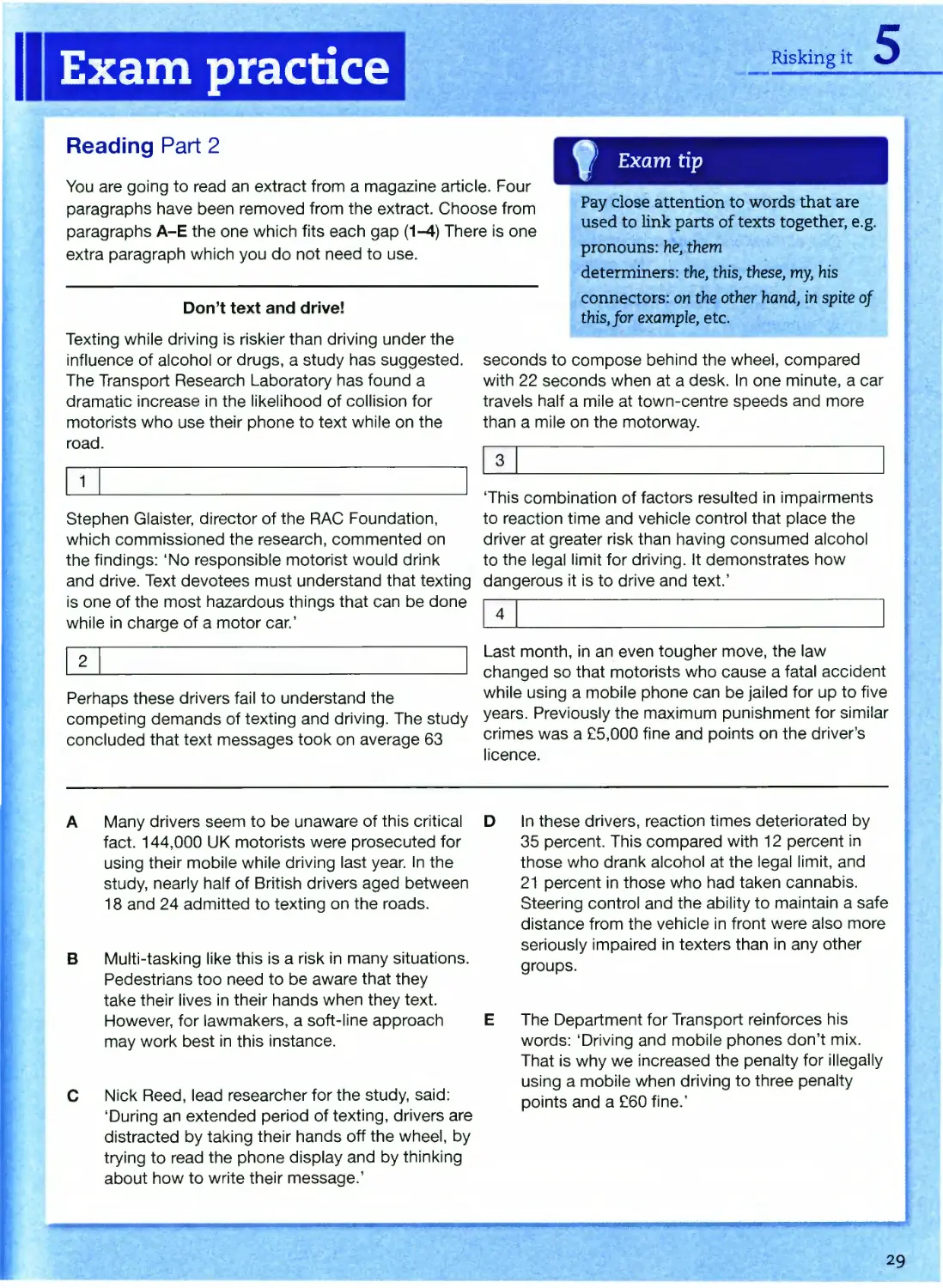
Don’t text and drive!
Exam tip
Pay close attention to words that are
used to link parts of texts together, e.g.
pronouns: he, them
determiners: the, this, these, my, his
connectors: on the other hand, in spite of
this, for example, etc.
Texting while driving is riskier than driving under the
influence of alcohol or drugs, a study has suggested.
The Transport Research Laboratory has found a
dramatic increase in the likelihood of collision for
motorists who use their phone to text while on the
road.
1
Stephen Glaister, director of the RAC Foundation,
which commissioned the research, commented on
the findings: ‘No responsible motorist would drink
and drive. Text devotees must understand that texting
is one of the most hazardous things that can be done
while in charge of a motor car.’
Perhaps these drivers fail to understand the
competing demands of texting and driving. The study
concluded that text messages took on average 63
seconds to compose behind the wheel, compared
with 22 seconds when at a desk. In one minute, a car
travels half a mile at town-centre speeds and more
than a mile on the motorway.
This combination of factors resulted in impairments
to reaction time and vehicle control that place the
driver at greater risk than having consumed alcohol
to the legal limit for driving. It demonstrates how
dangerous it is to drive and text.’
Last month, in an even tougher move, the law
changed so that motorists who cause a fatal accident
while using a mobile phone can be jailed for up to five
years. Previously the maximum punishment for similar
crimes was a £5,000 fine and points on the driver’s
licence.
A Many drivers seem to be unaware of this critical
fact. 144,000 UK motorists were prosecuted for
using their mobile while driving last year. In the
study, nearly half of British drivers aged between
18 and 24 admitted to texting on the roads.
B Multi-tasking like this is a risk in many situations.
Pedestrians too need to be aware that they
take their lives in their hands when they text.
However, for lawmakers, a soft-line approach
may work best in this instance.
C Nick Reed, lead researcher for the study, said:
‘During an extended period of texting, drivers are
distracted by taking their hands off the wheel, by
trying to read the phone display and by thinking
about how to write their message.’
In these drivers, reaction times deteriorated by
35 percent. This compared with 12 percent in
those who drank alcohol at the legal limit, and
21 percent in those who had taken cannabis.
Steering control and the ability to maintain a safe
distance from the vehicle in front were also more
seriously impaired in texters than in any other
groups.
The Department for Transport reinforces his
words: ‘Driving and mobile phones don’t mix.
That is why we increased the penalty for illegally
using a mobile when driving to three penalty
points and a £60 fine.’
29

Test one (Units 1-5)
Choose the correct letter A, B, C or D.
1	Egypt is a fantastic country for tourists. It’s absolutely	in history.
A	soaked	B	drenched	C	steeped	D	saturated
2	One of the worst features of modern cities is the urban	resulting from poor planning
A	sprawl	B	spread	C	increase	D	growth
My uncle and his family have just moved into a new house on the
A suburbs	B outskirts	C borders
.... of the city.
D edges
The Opera House is one of the main tourist
A appeals	B charms
	in Sydney.
C attractions
D temptations
Pedestrian.
experience.
A spaces
in towns and cities make shopping a more relaxing, less dangerous
B precincts
C areas
D regions
6	I’ve discovered that my	on my mother’s side were originally from Russia.
A descendants	B ancestors	C children	D associates
I	wanted to talk but she was determined to sweep the matter under the
A cupboard	B table	C carpet
D bed
8 There are many
A resources
	of information you can investigate to find out about your family history.
B bases	C origins	D sources
I expect it’ll be interesting to read my school
A reports	B registers
	when I’m older.
C histories
D accounts
10	The newspaper story was based on an interview which had been done off the
A script	B record	C key	D tape
11	Before you make a decision you should
A weigh through	B weigh out
	all the issues involved.
C weigh up	D weigh down
12 It costs a fortune to maintain a
A classic	B historic
car.
C historical
D dated
13 I really admired the actor who
A staged	B made
the part of Romeo.
C auditioned
14 The audience clapped enthusiastically when the famous actor...
A appeared	B entered	C showed
D played
on the stage.
D turned
15 Wherever he performs, his	fans follow him.
A adored	B devoted	C loved
D entertained
30

Test one
1-5
16	I love Mozart. He composed some of the world’s most	music.
A classical	B	abrasive	C melodramatic	D	euphoric
17	It was one of the year’s most popular events, with	audiences every night.
A full	B	capacity	C complete	D	whole
18	She spent weeks researching the perfect venue before she actually
A	established	B	agreed	C	chose
19	A scalpel is a surgical	used in operations.
A	equipment	B	instrument	C	gadget
20	Many refugees leave their home country to avoid
A	persecution	B	immigration	C	institution
21 I’m afraid that cycling is off the
A record	B card
until the weather improves.
C track
	anywhere.
D decided
D apparatus
D corporation
D menu
22 We’re a very
A near
... family, so I spend a lot of time with my brothers and sisters.
B tight	C close-knit	D familiar
23 Most of us get on best with people who share a	of humour.
A way	B feeling	C kind
24 When I changed jobs last year it took me several weeks to find my
A belonging	B feet	C balance
D sense
D place
25	People involved in extreme sports are well aware of the risks they are
A making	B getting	C involving
26	There is no reliable way to	the results of a race.
A foresee	B apprehend	C comprehend
D taking
D analyse
27 The authorities are taking	to improve conditions in the country’s prisons.
A responsibility	B place	C steps	D exercise
28	A breaking voice marks the
A outset	B onset
29	I didn’t realise the path was icy until I....
A tripped	B stumbled
of adolescence in boys.
C offset
and lost my balance.
C slipped
D inset
D slid
30	He’s broken his arm, which means he can’t take part
A in	B at	C on
Saturday’s match
D for
3i

4,
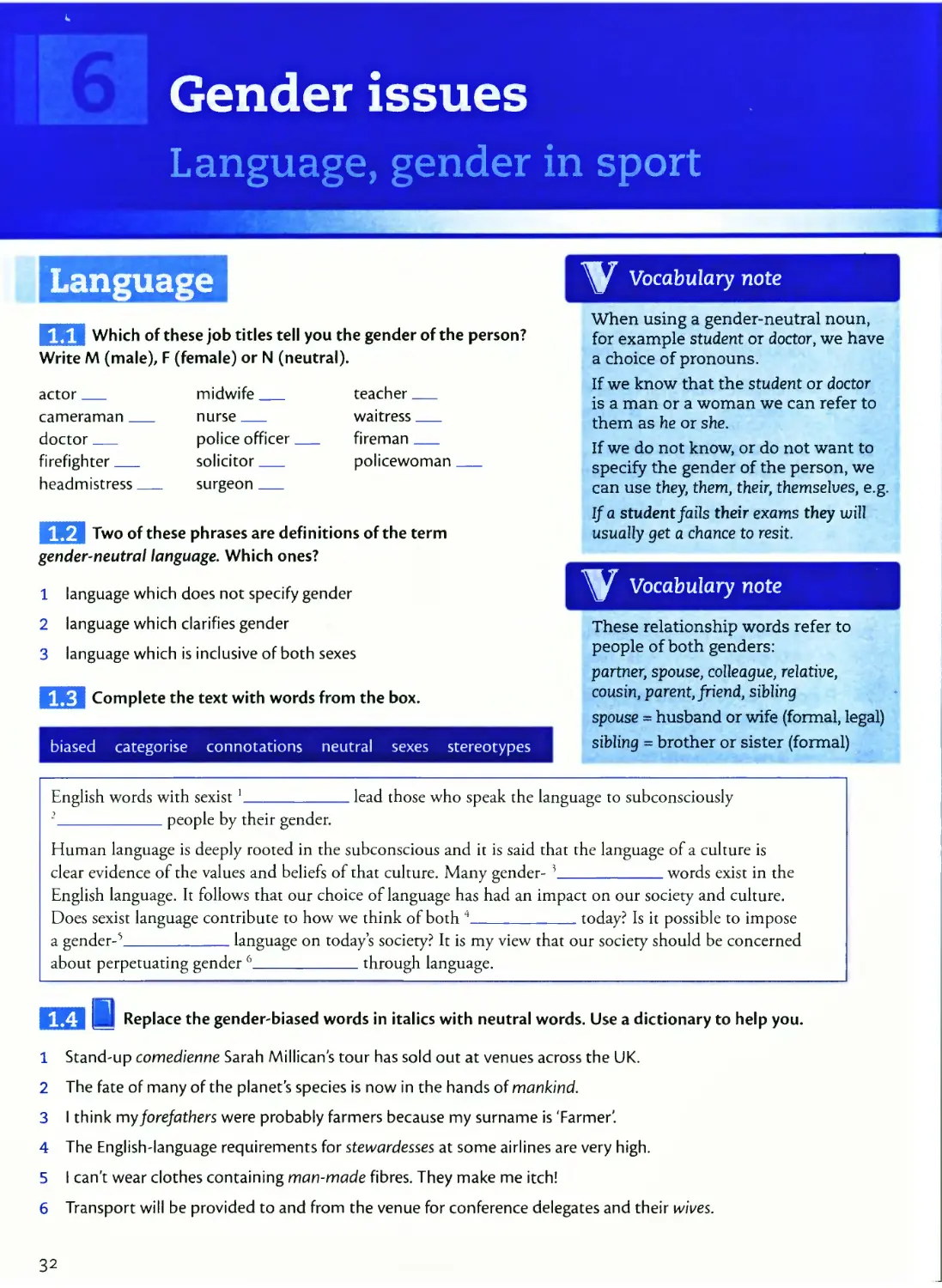
Gender issues
Language, gender in sport
Language
Which of these job titles tell you the gender of the person?
Write M (male), F (female) or N (neutral).
actor		midwife
cameraman	 nurse
doctor		police officer
firefighter		solicitor
headmistress	 surgeon
jfcjj Two of these phrases are definitions of the term
gender-neutral language. Which ones?
1	language which does not specify gender
2	language which clarifies gender
3	language which is inclusive of both sexes
Complete the text with words from the box.
biased categorise connotations neutral sexes stereotypes
teacher
waitress
fireman
policewoman
¥ Vocabulary note
When using a gender-neutral noun,
for example student or doctor, we have
a choice of pronouns.
If we know that the student or doctor
is a man or a woman we can refer to
them as he or she.
If we do not know, or do not want to
specify the gender of the person, we
can use they, them, their, themselves, e.g
If a studentfails their exams they will
usually get a chance to resit.
w Vocabulary note
These relationship words refer to
people of both genders:
partner, spouse, colleague, relative,
cousin, parent, friend, sibling
spouse = husband or wife (formal, legal)
sibling = brother or sister (formal)
English words with sexist 1	lead those who speak the language to subconsciously
2	people by their gender.
Human language is deeply rooted in the subconscious and it is said that the language of a culture is
clear evidence of the values and beliefs of that culture. Many gender- 5	words exist in the
English language. It follows that our choice of language has had an impact on our society and culture.
Does sexist language contribute to how we think of both 4	today? Is it possible to impose
a gender-'’	language on today’s society? It is my view that our society should be concerned
about perpetuating gender 6	through language.
Replace the gender-biased words in italics with neutral words. Use a dictionary to help you.
1	Stand-up comedienne Sarah Millican's tour has sold out at venues across the UK.
2	The fate of many of the planet’s species is now in the hands of mankind.
3	I think my forefathers were probably farmers because my surname is 'Farmer'.
4	The English-language requirements for stewardesses at some airlines are very high.
5	I can't wear clothes containing man-made fibres. They make me itch!
6	Transport will be provided to and from the venue for conference delegates and their wives.
32

Gender issues
EVjkA Choose the correct prepositions in these sentences. There are similar sentences in 1.3.
1	The language we use is deeply rooted in / with our subconscious.
2	The words we choose are evidence on / of our fundamental beliefs and values.
3	Our early education has an enormous impact at / on our future life chances.
4	Urban sprawl can contribute to /for pollution levels.
5	Is it right to impose any restrictions in / on what people say?
6	Should we be concerned about /for people's use of sexist language?
Q09] Listen to an American talking about the use of the word 'girl' in the UK and complete
the sentences.
1	The speaker thought the way adult women were referred to as 'girls' was
2	A 'girl' is not someone who	for herself, she's a child.
3	In this society women are	in comparison to men.
4	We should	to the way women are addressed.
Listen again and complete these sentences with phrases used by the speaker.
1	Asa mature adult, you do not want to	a child.
2	Women are striving to	into male-dominated society.
3	We should look at whether the word 'girl' is used	or not.
4	Men do not have a	to deal with.
Gender in sport
Hi Which of the adjectives in the box do you
associate with sports people? Put a
aggressive	 driven		passive
arrogant	 flexible		powerful
attractive	 gifted		pure
competitive	 graceful	 submissive _
2.2
Write the nouns related to the adjectives
in 2.1.
33

Gender issues
2.3
WORD TRANSFORMATION
the ends of the lines
Complete the text with the correct forms of the words in capitals at
The positive outcomes of sport for gender1	and women's
empowerment are constrained by gender-based2	in all areas
and at all levels of sport and physical3	This is fuelled by continuing
stereotypes of women's physical4	and social roles. Women are
frequently segregated9	into types of sports, events and competitions
specifically targeted at women. Women's access to positions of6
and 7	-making is constrained from the local to the international level.
The value placed on women's sports is often lower, resulting in 8
resources and unequal wages and prizes. In the media, women's sport is not only
9	but often also presented in a different style that reflects and
reinforces gender stereotypes.
EQUAL
DISCRIMINATE
ACT
ABLE
VOLUNTARY
LEADER
DECIDE
ADEQUATE
MARGINAL
2.4
lOTol Listen to someone talking about gymnastics. Are these statements true (T) or false (F)
according to the speaker?
1	The speaker started doing competitive gymnastics in her late teens
2	The speaker was physically different from the majority of other gymnasts
3	She has always known that gymnastics is generally considered to be a female sport
4	Gymnastics is regarded as a feminine sport because participants do not need to be openly aggressive.
5	The speaker doesn't believe that attitudes towards gender stereotyping will change in the near future.
2.5
WORD BUILDING Complete the table with words which
have related meanings.
Noun
Verb
Adjective
categorise
X
(thin p)
contribute
'o/
- (person)
discriminate
X
equal
involve
perpetuate
X
neutral
2.6
Match the words in the box with less formal words which
have similar meanings.
complete deem overt participate predominantly pursue
1	do
2	consider
3	finish
4
5
6
mainly
open _
take part in
w Vocabulary note
stand out = be visibly different / be
clearly visible
My old clothes stood out in fashionable
Paris.
Other phrasal verbs with stand:
stand by = not act to prevent
something
I should not have stood by u/hile she was
bullied.
not stand for = refuse to accept
I will not stand for rude behaviour.
stand in for = do someone else’s job
My colleague stood in for me when I
was ill.
stand up for = defend and fight for
It’s important to stand up for what you
believe in.
34

Exam practice
Gender issues
6
Listening Part 2
|Hm You will hear an employment consultant describing
what is meant by the term, ‘glass ceiling’. For questions 1-6,
complete the sentences.
1 The phrase ‘glass ceiling’ refers to the
attitude many women find in their places of work.
Exam tip
You will not hear the exact sentences
as they appear on the exam paper but
the speaker will talk about each idea.
You should choose words used by the
speaker for each gap.
2 The metaphorical ceiling is made out of glass because it is
3	The term ‘glass ceiling’ was first used in the	which Gay Bryant wrote in 1984.
4	The related term ‘glass	’ refers to the means by which men travel to the highest levels.
Some believe that women prioritise their family and so cannot
careers.
enough time to their
6 The	sector has been severely criticised in the past.
Use of English Part 5
For questions 1-4, complete the second sentence so that it
has a similar meaning to the first sentence, using the word
given. Do not change the word given. You must use between
three and six words, including the word given. Flere is an
example (0). Write your answers IN CAPITAL LETTERS.
0 It was the first time I had seen women playing
competitive football.
NEVER
I H-At> NeveR.seeN women playing competitive football before.
Exam tip
The second sentence must mean
the same as the first sentence, must
include the key word unchanged and
must be grammatically correct.
The correct second sentence will
normally require significant changes
to the first sentence.
1	The manager accepted that he was fully responsible for the way his team performed.
TOOK
The manager	performance.
2	We should not accept sexist language and attitudes in the places where we work.
ACCEPTABLE
Sexist language and attitudes	workplaces.
3	I find people’s use of the word ‘girls’ to refer to adult women objectionable.
USING
I	the word ‘girls’ to refer to adult women.
4	I first participated in competitive sport when I was six years old.
PART
I first	the age of six.
35

Education
Learning, training
! Which of these kinds of education have you experienced? Put a»/ or a X.
pre-school		secondary school	 independent school	 university
nursery		local state school	 boarding school		technical college
primary school	 fee-paying school	 faith school		distance learning course
Complete the text with words from the box.
capacity child-centred classroom educators foster graduate images influence method
needs potential whole
Maria Montessori was one of the most important early years 1	of the 20th century.
She was the first woman to 2	from the University of Rome medical school and became
interested in education through her work as a doctor, treating children with special 3
When she went on to establish schools for the disadvantaged children of working parents in Rome, she
approached their education as a scientist. She used the 4	as her laboratory for observing
children and finding ways to help them to achieve their full3
It soon became apparent that Dr Montessori had developed a highly effective teaching 6
which could be used with great success with each and every child. She began to travel the world, establishing
schools, lecturing about her discoveries, and writing articles right up to her death in 1952. She was a true
pioneer of 7	education. Her innovative classroom practices and ideas have had a profound
8		on the education of young children all over the world.
Montessori saw that children learn best by doing and that happy self-motivated learners form positive
9		of themselves as confident, successful people. She created specially designed resources to
10		independence and a love for learning from an early age.
The Montessori approach is holistic, that is, it aims to develop the 11	child. Fundamental
to this approach is the belief that a child’s early life, from birth to six years old, is the period when they have
the greatest 12	to learn.
jcl Match these words and phrases with their definitions.
1
special needs
a
2
disadvantaged
b
3
achieve your potential
c
4
pioneer
d
5
child-centred
e
6
innovative
f
7
self-motivated
g
36
person who is the first to develop an idea
able to work at something without encouragement
requirements due to physical or mental problems
new and original
suceed to the best of your ability
based on the needs and interests of children
without the necessary education, money etc. to succeed in life

Education
7
MftlEi Complete these sentences with the correct prepositions. There are similar sentences in 1.2.
1	My brother graduated	Harvard University in 2009.
2	In some countries, children	special needs are taught in mainstream schools.
3	The professor toured the world, lecturing	his educational theories.
4	Successful teachers are those who have a good influence	their students.
5	Children often learn better	doing things themselves rather than listening passively.
6	Students who have a positive image	themselves are usually happy and successful.
7	Ever since I started school, I have had a real love	learning.
8	Everyone can succeed at something. This idea is fundamental	my beliefs about education.
BKHi WORD BUILDING Complete the table with words which have related meanings.
Noun
Verb
Adjective
establish
(event, process)
(person)
graduate
X
education (general noun)
(person)
(of a person)
(for this purpose)
(thing, idea, process)
(person)
innovative
influence
(general noun)
motivator (increasing factor)
motivated (of a person)
(increasing this)
motivational (for the purpose of increasing this)
COLLOCATION Choose the correct adverbs in these sentences.
1	The newly /firmly established early years centre is already serving a large number of local families.
2	The historic university is newly/firmly established as top choice for international students hoping to study in
the city.
3	We are seeking advice on how to recruit the highly / poorly educated workforce needed for these skilled roles.
4	He plays the character of a highly / poorly educated caretaker who has an innate gift for mathematics.
5	His theory was increasingly / highly influential in the development of educational practices in the latter part
of the century.
6	The department will become increasingly / highly influential as the publication of papers in top journals
continues.
7	Focus groups showed that parents were strongly / politically motivated to do the best for their offspring
whilst being wary of other parents' competitive behaviour.
8	The announcement today of additional grants for poorer students has been seen as a strongly / politically
motivated attempt to deflect allegations of a U-turn.
37

Education
Training
iDlU Listen to Steve describing his apprenticeship and
answer these questions.
1	Why was the apprenticeship better for Steve than a course at his
local college?
2	What additional opportunities does the company offer Steve?
3	How is Steve continuing his education?
4	Which industry do you think Steve is working in?
w Vocabulary note
The word workshop has two meanings.
a room or building where things are
made or repaired, e.g.
an engineering workshop
a meeting of people to discuss and/or
perform practical work, e.g.
a drama workshop
2.2
Listen again and complete these sentences with words Steve uses.
1	The	course in Engineering at the local college didn't appeal to Steve.
2	Steve’s apprenticeship provided him with	experience that he couldn’t get elsewhere.
3	Steve's manager worked out	plans and objectives with him.
4	Steve and his fellow apprentices learnt useful business skills at	organised by the company.
5	The company also puts on	events in recognition of people's hard work.
6	Steve has been on a day-	course and gained a nationally recognised
7	When he completed his apprenticeship, Steve moved into a full-time
2.3
Choose the correct words in these sentences.
1	My sister abandoned / left school at the age of 16.
2	I'm going to apply / request for a catering course in September.
3	My experience has given me a real insight / view into how
universities work.
4	Modern companies often organise group / team-building days to
enable staff to work well together.
5	While he was working as an apprentice, Steve helped to lift / raise
funds for charities.
w Vocabulary note
Most collective nouns like team, staff,
and class can be used with either
singular or plural verb forms, e.g.
The company are keen to recognise this
extra time.
The government is bringing in new
regulations related to apprenticeships.
WtMtik WORD TRANSFORMATION Complete the text with the correct forms of the words in capital
letters at the ends of the lines.
Mechanical Engineering is among the most diversified of the 1
engineering disciplines. Mechanical engineers design and build machines and devices that
2	humans to live and work in space, in the air, on the ground, and under
water. Their machines can extend our physical3	and improve our health
and standard of living. Students acquire an4	of the fundamentals of
mechanics and of the thermal energy sciences. They learn to perform 8
design tasks using computers and to select appropriate materials for a specific
6	They also become familiar with the chemical and 7
sciences, which are often essential to the total design and8	of a mechanical
system. We have a small but active group of faculty9	; graduate students
and undergraduates who share a passion for Mechanical Engineering.
TRADITION
ABLE
CAPABLE
UNDERSTAND
INTERACT
APPLY / ELECTRIC
REALISE
RESEARCH
38

Exam practice
Education
Listening Part 4
13	J You will hear five short extracts in which mature students talk about their return to education.
While you listen you must complete both tasks.
TASK 1
For questions 1-5, choose from the list (A-H) a characteristic of the person who is speaking.
A
She
B
She
C
She
D
She
E
She
F
She
G
She
H
She
TASK 2
B She finds it easy to make new friends.
C She looks older than some of the staff.
D She has a degree in a different subject.
She wishes she was a teenager.
F She is impressed by the university.
For questions 6-10, choose from the list (A-H) an idea each speaker expresses.
A She needs to keep her mind active.
B She finds studying a challenge.
C She is now studying her favourite subject.
D She thinks she may have to drop out of the course.
E She realises she could have gone to university when she was a teenager.
F She finds the lecturers easy to talk to.
G She is doing this course because someone else wants her to do it.
H She didn’t know what to expect before starting the course.
Exam tip
Speaker 1
Speaker 2
Speaker 3
Speaker 4
Speaker 5
Speaker 1
Speaker 2
Speaker 3
Speaker 4
Speaker 5
6
7
8
9
10
7
1
2
3
4
5
Use the time before you listen to read both tasks, underlining the key ideas in each option.
While the recording is playing, listen for words or phrases which are the same or similar in
meaning to the key ideas you have underlined.
Listen for the answers to both tasks. You may hear answers for Task 2 before answers for Task 1.
39

Health
World health, water and health
World health
Which of these health issues are problems in your country? Put a»/.
influenza	 cancer		obesity		heart disease	 waterborne disease
dementia	 malnutrition	 depression	 injury		access to healthcare
rail
Explain the difference between the words in each pair. Use a dictionary to help you.
1	infectious / contagious
2	starvation / malnutrition
3	treatment / medicine
4	transmit / contract
5	epidemic / pandemic
6	acute / preventable
iifci Complete the sentences using information from the text.
Despite incredible improvements in health since 1950, there are still a number of challenges, which should
have been easy to resolve. Consider the following:
•	One billion people lack access to healthcare systems.
•	Cardiovascular diseases (CVDs) are the biggest killer amongst diseases globally. An estimated 17.5 million
people died from CVDs in 2005, that is 30% of all global deaths.
•	In 2002, almost 11 million people died from infectious diseases alone, far more than the number killed in
the natural or man-made catastrophes that make headlines.
•	HIV has spread rapidly. UNAIDS, the Joint United Nations Programme on HIV/AIDS, estimates are
roughly: 33.4 million living with HIV, 2.7 million new infections of HIV, two million deaths from AIDS.
•	There are 8.8 million new cases of tuberculosis (TB) and 1.75 million deaths from TB, each year.
•	1.6 million people still die from pneumococcal diseases every year, making it the number one vaccine-
preventable cause of death worldwide. More than half of the victims are children.
•	Malaria causes more than 300 million acute illnesses and at least a million deaths, annually.
•	Around 11 million children under five die from malnutrition and preventable diseases each year.
•	More than half a million people, mostly children, died from measles in 2003 even though effective
immunisation costs just 0.30 US dollars per person, and has been available for over 40 years. 11	Thirty percent of all
2	In 2002, more people died of
3	Pneumococcal diseases are preventable yet
4	In 2003 over 500,000 people
5	It costs only thirty cents to
40

Health
BUB! WORD BUILDING Complete the table with words which have related meanings.
Noun
Verb
Adjective
immunisation (process)
(state)
(srarp)
infection (problem)
(ran spread)
infected (problem)
medical (general)
medicated (effect on person)
(iispH to rnnrrol)
preventable (possible to control)
treatment
(possiblp ro rurp)
untreated (no medical help)
Ql4) Listen to a talk about pandemics. When did they take place?
1	Spanish flu
2	Asian flu
3	Hong Kong flu
4	Bird flu
5	SARS
¥ Vocabulary note
As a verb, spread is both transitive and
intransitive, e.g.
Diseases can spread very easily in schools.
Mosquitoes spread diseases like malaria.
Q'U) Listen again. Are these statements true (T) or false (F) according to the speaker?
Correct the false statements.
2.2
1	The Spanish flu killed three times as many people as were killed in WW1
2	People think that Spanish flu probably spread from animals to humans
3	Nearly half a million British people died of the Spanish flu
4	In the 1950s, Asian flu particularly affected young people
5	Bird flu killed very few people compared with previous pandemics
6	Improvements in medical treatment resulted in relatively few deaths from the SARS virus.
2.3
The prefix mis- adds the meaning bad or wrong to a word. Complete the sentences with the correct
words from the box.
misconduct misdiagnosis misfortune misinformation mismanagement misrepresentation
1	While he was getting out of the taxi, he had the	to fall over and break his leg.
2	The director is being accused of gross	of the hospital.
3	The psychiatrist was found guilty of professional
4	The doctor’s	meant that the patient nearly died.
5	The drug company's advertising campaign was based on	and has now been banned.
6	The documentary on poor hospital hygiene was a	of the truth.
41

Health
Water and health
Read the text about water and choose the best summary (1-4).
1	Drinking more water substantially reduces your metabolic rate.
2	Drinking enough water allows increased carbohydrate storage.
3	Water aids the consumption of excess energy.
4	Drinking water is by far the best way to lose weight.
The benefits of drinking water are numerous, and recent studies suggest that you need to drink water to lose
weight. Drink more water to re-hydrate and detoxify your body. Water is not only essential for health, but
increases the rate at which the body burns calories, as well as being a natural appetite suppressant. Water also
plays an important role in metabolising food. While we know that water is critical to healthy functioning of
the human body, studies suggest that water promotes the lowering of an individual’s total energy intake and
alters metabolism.
Most people who are on a diet do not drink enough water. To metabolise food, the body needs water. For
every gram of carbohydrate, the body requires three grams of fluid. So, drinking sufficient water can help
your body burn up carbohydrates instead of storing them. Additionally, proper hydration while you are on
a diet is vital for health, because you are more prone to water retention as your body starts losing fluid along
with the weight. If you are dehydrated, your body will slow down its calorie-burning processes. So drink
water to lose weight.
3.2
Find words and phrases in the text which match these definitions.
1	remove poisonous substances from your body
2	something which prevents hunger
3	the overall amount of energy consumed
4	change eating habits to reduce body fat
5	liquid substance
6	be likely to have a particular problem
7	have insufficient water in your body
3.3
Complete these sentences using the correct prepositions. There are similar sentences in the text.
1	Regular meals are vital	healthy living, especially if people do physical activities.
2	Although we should not eat too much of it, fat is essential	our health.
3	You're more prone	illness when you're tired or run down.
4	Exercise plays an important role	keeping fit.
5	The rate	which you lose weight depends on the number of calories you burn.
6	To remain healthy, a balanced diet is important, along	regular exercise.
7	We live in an age where the public health infrastructure, its growth and its development, are critical
		our collective health.
42

Exam practice
Health
Speaking Part 3
Read what the oral examiner will say to you and your partner at the beginning of Part 3 of the Speaking test.
Now I’d like you to talk about something together for about three minutes. Here are some pictures related to
healthy living. First talk to each other about what aspect of healthy living each picture represents. Then decide
which aspect you would focus on if you were launching a new health awareness campaign for young people.
Writing Part 2
Exam tip
In Parts 3 and 4 of the Speaking test
candidates speak to each other. The
examiner asks the initial questions
and then takes no further part in the
conversation.
Most importantly you and your
partner must keep your conversation
going. This is a joint responsibility.
Remember that in this part of the test
there are no right or wrong answers.
You see the following notice in your doctor’s surgery.
The International Health Development Agency is collecting data about attitudes to health campaigns in countries around
the world. Please help by writing a report on attitudes where you live. Your report should:
•	outline briefly some of the main current health problems in your country
•	describe people’s attitudes to any recent campaigns aimed at promoting healthy lifestyles
•	recommend ways in which people could be persuaded to take healthy living more seriously.
Write your answer in approximately 220-260 words in an appropriate style.
C
Decide who will read the report and how formal/informal your language should be.
The report should include factual information followed by suggestions or recommendations.
Give your report a title and organise your ideas into sections, each with its own heading.
Start by outlining the purpose of your report. Use your own words rather than repeating the
words in the question.
Explain the reasons for any recommendations you make.
V
Exam tip
43

Getting about
Private journeys, public transport
Private journeys
HEIH Complete the questions with travel, journey(s), or trip(s).
Answer them about yourself.
1	How do you entertain yourself on a long train	?
2	How long does your round	to school or work take?
3	How often do you	by taxi?
4	Where did you use to go on school	?
5	What are the benefits of air	?
6	Where would you like to go on your next	abroad?
COLLOCATION Match the phrases (1-8) to the type of
transport (a-h). 1 2 3 4 5 6 7board a packed, commuter
a
dinghy
catch a sightseeing, tourist
b
cab
fly in a light, twin-engine
c
ship
book a cabin on a roll-on, roll-off
d
plane
pedal a three-speed, folding
e
ferry
hail an empty, black
f
train
sail on a large, cargo
g
bus
row a leaky, inflatable
h
bicycle
ES OlE) Listen to a talk about three bicycle-friendly
cities. Match the features (1-7) with each city. Write
A (Amsterdam), P (Portland) or C (Copenhagen).
1	Local authorities supply bicycles to workers with less money.
2	There is a scheme to stop bicycles from being stolen
3	Almost a third of workers here travel to work by bicycle
4	Cars are banned from part of this city
5	Here cyclists have their own traffic signals
6	Around half of all journeys here are by bicycle
7	Many more people here cycle than ever before
Don’t confuse travel as a noun with
journey or trip.
travel is an uncountable noun which
refers to the general activity, e.g.
Air travel is much cheaper than it was in
the past.
trip refers to an occasion when you go
somewhere and come back, e.g.
I can’t afford to take another trip abroad
this year.
journey refers to an act of travelling
from one place to another, especially
in a vehicle, e.g.
It’s a two-hour train journey from London
to York.
travel is commonly used as a verb, e.g.
I travel to work by bus.
journey is only used as a verb in
literary, descriptive writing.
trip has a different meaning as a verb
(see page 28).
44

Getting about
|PTjp Listen again and complete these sentences with words and phrases used by the speaker.
1	People refer to Amsterdam as the	of the world,
2	There is an	of safe and fast cycle lanes in Amsterdam.
3	There is also an original scheme designed to prevent the	of bicycles in the city.
4	It is possible for people who live in Amsterdam or visitors to	bicycles.
5	The creation of cycle paths in Portland has resulted in a	in the use of bicycles in the city.
6	Portland was the first city in America to provide adults on	with commuter bicycles.
7	The bicycles are all	everything needed to use them.
8	The world's most successful community cycling	can be found in Copenhagen.
9	In Copenhagen the majority of bicycle paths are separated from the main
10	There is a 20 kroner	when you use one of Copenhagen's public bicycles.
Public transport
HjidHSHH Complete the text with the correct words from the box.
eco-friendly fossil fuels get around carbon emissions
private cars self-driving vehicles
Dubai recently opened its first Metro network in a bid
to reduce the number of people using their cars and cut
1		The $7.42 billion project has so far been
hailed as a success as thousands of people have opted to use it to
2		the city, as opposed to their cars. It raises the
question that, if governments are so enthusiastic about citizens
relinquishing their 3	to save the environment,
then what are the alternatives? How else are people going to get
to work conveniently, do their shopping or generally travel with
ease and relative cheapness?
Currently, the majority of public transport runs on
4		, which creates pollution and is reliant
on finite resources. However, many alternatives, such as
5		, are being researched. Some of them may
seem like preposterous ideas drawn from science fiction, but the
drive to find 6	 forms of transport is on.
w Vocabulary note
get around = travel to different places
More and more people are getting around
by bicycle, especially in big cities.
get away with = escape without
punishment for something you have
done wrong
They attacked the old man in the park, but
nobody saw them, so they got away with
their crime.
get by = to cope in a difficult situation
I	couldn't speak the language, but I got by
with gestures.
get out of = avoid doing something
He tried to get out of going on the school
trip, but in the end he had no choice.
get round to = do something after a long
delay
I’ue had her DVD for weeks, but yesterday 1
eventually got round to giving it back.
2.2
Answer these questions using appropriate phrasal verbs from the Vocabulary note.
1	If you were in a unfamiliar city, how would you travel from place to place?
2	If you were abroad and couldn't speak the language, how would you cope?
3	How do you avoid doing things you don't want to do?
4
45

Getting about
/
*
2.3
Read about some possible new forms of public transport and answer these questions.
1	Which of the forms of transport would you like to use? Why?
2	Which do you think would be sensible transport solutions for your local area? Why?
3	Which ideas are unrealistic? Why?
Driverless pods
These vehicles seat four people and run
along guideways like miniature trams.
The service will not be timetabled, and
will resemble a taxi service as a means of
getting from A to B. Users will have the
advantage of avoiding congested roads
and will be able to travel at speeds of up [
to 32 km/h. Energy consumption per
passenger is one quarter that of a car.
Backpack helicopter
| Strap on a motor attached to a
rotor and take to the skies with
| your very own backpack helicopter.
Popular use of this personal flying
machine would require individuals
to undergo significant training in
navigation and safety. Jet-packs, as
! seen in science-fiction films, seem
an even less realistic prospect.
Slidewalks
Keep moving even while you’re
standing still when slidewalks replace
conventional pavements. In tests,
these devices allowed walkers to move
at speeds of up to 9 km/h. Airports
have long used similar systems in
the form of travelators. However,
equipping our city streets with
slidewalks would be a costly business.
Zeppelins
A greener alternative to planes,
these flying machines are
finally making a comeback.
Environmentalists praise the
fact that they fly at lower
altitudes than planes and use a
fraction of the fuel. Another key
advantage is that zeppelins do
not need a runway to take off.
Segway
Powered by electricity, these
clean-running, two-wheeled
machines allow individuals
to travel at speeds of up to
20 km/h. However, they
cannot currently be used
on most roads. Confined to
pavements, users’ speeds are
restricted.
Maglev Trains
These trains use the force of magnetism
to drive them, slashing CO? emissions
and significantly reducing noise
pollution in the process. They’re even
faster than conventional trains, with a
potential top speed of 6,400 km/h. The '
only downside is that maglev trains are
incompatible with the existent rail tracks |
and these would have to be replaced.
KJEl Complete these sentences with the correct prepositions.
There are similar sentences in the texts. 1 2 3 4 5 61	In most countries, cars are not allowed to drive to / at speeds of
over 110 k/ph.
2	Cycling is a greener alternative to /from other forms of transport.
3	New drivers are not allowed to go in / on fast roads like motorways.
4	Drivers caught speeding have to train in / about speed awareness
or face a heavy fine.
5	The pedestrian zone is confined about / to a very small central area.
6	Make sure you get the right fuel! Diesel is incompatible with / to
petrol engines.
w Vocabulary note
means = method or way or doing
something
means can be both singular and
plural, e.g.
The tram is a cheap means of getting
around.
There are several means of transport we
can use.
We will get there by any means possible.
46

Exam practice
Getting about
9
Listening Part 1
You will hear three different extracts. For questions 1-6, choose the answer (A, B or C) which fits best
according to what you hear. There are two questions for each extract.
Extract 1
You hear a woman asking her friend about a change in his habits.
16
1	On what occasions did he use to travel by taxi?
A when he couldn’t get a lift
B when he was on a short journey
C when he missed the last bus or train
What is the main reason he started walking more?
A He was spending too much money on taxis.
B He became tired of waiting for taxis.
C He realised that walking was good exercise.
Exam tip
For each question there is only one
correct answer but you will hear
vocabulary related to all of the
options. Don’t choose your answers
too soon. Make sure that what you
hear fully answers the question.
Remember, you will hear the
recording twice.
Extract 2
In the airport, you overhear two people talking about flying.
T7
3	What made the woman panic during her flight to France?
A Other passengers on the plane were panicking.
B She mistakenly believed that the plane was in real danger.
C The pilot said they might have to make an emergency landing.
4	Which is the worst part of flying for the woman?
A when the plane is landing
B waiting in the departure lounge
C when the plane is about to take off
Extract 3
You hear part of a radio programme about the London Underground in which a celebrity is describing his
experiences to an interviewer.
i?
5	How did he feel about travelling on an underground train for the first time?
A It was a terrifying experience.
B	He was quite overexcited.
C	He found it very funny.
6	What does he think of the Underground as an adult?
A It doesn’t inspire any particular feelings in him.
B It is surrounded by unnecessary marketing hype.
C It is an important part of London’s cultural heritage.
47

Moods
Attitudes, memory
Attitudes
BUB Choose the best words to complete these sentences. Which
illustration (A-E) do they relate to?
1	His eyes twisted / narrowed and he frowned / wrinkled deeply, sure
signs that he was about to jump / fly off the handle.
2	As he delivered the tragic / terrific news, his voice groaned / trembled
and it was clear that he was completely devastated / destroyed.
3	She just drives / sails through life without a conscience / care in the
world. I've never met anyone so laid-back / uptight.
4	I can always tell when he’s got something on his mind / chest,
because he grinds / bites his nails and stammers / stumbles.
5	She may have her head in the clouds / skies, but we need more
dramatists / dreamers to get the rest of us to brighten / lighten up.
KUdi Now choose the list of adjectives which best describe the
people's expressions (A-E).
1	relaxed, calm, contented
2	angry, furious, confrontational
3	optimistic, upbeat, positive
4	dejected, miserable, tearful
5	anxious, apprehensive, nervous
iici Use an adjective from 1.2 to complete the sentences.
1	The constant rain meant we had a thoroughly	time
on holiday.
2	When it was time for us to go, she grew almost
and I was sorry to leave.
3	When I told him what I'd done to his car, he was obviously very
		He was literally shaking with rage.
4	I may have looked outwardly	but I was actually
extremely nervous.
5	Your weekly shopping budget of £20 is hopelessly
You'll end up spending much more than that.
48

Moods
10
HE1 Write the nouns related to these adjectives.
1	angry
2	anxious
3	apprehensive
4	calm
5	confrontational
6	contented
7	furious
8	miserable
9
optimistic
10
patient
11
positive
12
relaxed
Hm Complete these sentences with verbs related to the adjectives above.
1		! It’ll be okay. Nothing's going to go wrong, I promise.
Just try to	down.
2	The way to deal with bullies like that is simply to
them and say you're not going to put up with it any longer.
3	The arrogance of the minister's remarks	the
opposition leader, who angrily demanded an apology.
ii.Hi Match an extreme adjective from the box with a gradable
adjective which is similar in meaning.
astonishing excruciating devastating hideous
petrifying superb ravenous ludicrous
sad	 scary
good	 silly
hungry	 surprising
painful	 ugly
iirj COLLOCATION Choose the best words to complete the sentences.
1	You're such an exaggerator! The injection wasn't absolutely
devastating / excruciating. It was mildly / completely painful at worst.
2	I had a particularly / totally good meal at the sushi place in town.
The only problem is I'm still completely ravenous / hungry.
3	It was utterly ludicrous / funny when the girl fled just because the
man was a bit / absolutely ugly.
w Vocabulary note
angry is a gradable adjective. We
can make it stronger or weaker
using adverbs, e.g.
very; quite; extraordinarily; a bit;
rather; mildly
furious is an example of an extreme
adjective as it includes the idea
‘very’. This means we cannot use
very with furious very furious. To
make extreme adjectives stronger
we use adverbs meaning 100%, e.g.
absolutely; completely; thoroughly;
utterly; totally
I was totally furious when my brother
crashed my car.
really can be used to make both
gradable and extreme adjectives
stronger.
There are many exceptions to these
rules and it is useful to make a note
of adverb + adjective collocations you
see, e.g.
faintly ludicrous; thoroughly miserable;
bitterly disappointing; endlessly
fascinating
4	I'm completely / rather petrified of spiders. They're totally hideous / ravenous.
5	What totally devastating / petrifying news. You must both be bitterly / absolutely disappointed.
1.8
The words mood and attitude are used in many expressions.
Match the sentences (1-5) with the expressions (a-e).
1	He's very up and down.
2	I wouldn’t go near him just now.
3	He hates anyone with authority.
4	He’s never put off by a challenge.
5	He doesn't feel like going clubbing tonight.
a He's got a real attitude problem,
b He's not in the mood,
c He's in one of his moods,
d He has terrible mood swings,
e He's got a real can-do attitude.
49

Moods
Memory
WrMW Think about your own memory and complete these sentences.
1	I have a fantastic memory for
2	I'm terrible at remembering _
3	A memorable event was
4	I find it easy to memorise
5	I always remember to
6	As a child I remember
2.2
Complete the text with words from the box.
ear forgotten memories mind
photographic recall retain short-term
As far as our 1		are concerned, my twin
sister and I couldn’t be more different. She only has to see or
hear something once to remember it - it’s what they call a
2	memory. And she’ll3	that
image or that sound more or less indefinitely. As for me, I’ve got a
4	like a sieve. If you say something to me now,
I’ll have 3	it ten minutes later. It’s a case of in
one 6	and out the other. I’m like an old person
- I’ve got a terrible 7	memory. By contrast, my
long-term memory is fantastic. I can still8	the
names of all the other children in my first class at school - that’s
over thirty years ago.
w Vocabulary note
remember has a different meaning
when followed by to + infinitive or the
-ing form of a verb.
He remembered to phone work to say
he was going to be late. = It is a fact. He
definitely did phone work.
He remembers phoning work to say he
was going to be late. = It is a memory.
He thinks he phoned work.
2.3
COLLOCATION Read the sentences about memories. Put a ^ if the sentence is about remembering
something. Put a X if the sentence is about forgetting.
1	The visit to my old school triggered an early memory of my favourite teacher, Mr Bell.
2	Psychiatrists used to believe patients’ problems were caused by repressing traumatic childhood memories.
3	A service was held to honour the memory of the war dead.
4	He refused to move on with his life, reliving the bitter memories of the courthouse time and time again.
5	My grandma loves that record. She says it brings back treasured memories of her youth.
6	It's all so vague! I need something to jog my memory.
Answer these questions using the words in italics from 2.3.
1	Which two adjectives are used to describe a very unpleasant memory?
2	Which two words describe memories from when you were young?
3	Which three expressions mean 'remind someone of something'?
4	Which word could you use to describe a memory which is not clear? _
50

Exam practice
Moods
Reading Part 1
You are going to read an extract which is concerned with the
human mind. For questions 1-2, choose the answer (A, B, C
or D) which you think fits best according to the text.
Exam tip
Read the text quickly to get a general
idea about the subject. Then, look at
the questions and options and find
the relevant part of the text. The text
will not contain the same words as
the correct answer.
Keeping new words in mind
Committing words to memory is a notoriously hit-and-miss
business. Over the last forty years psychologists have found three
methods which consistently improve memory for words: creating imagery for the word you want to remember;
using elaboration to form word associations; generation of the word through complex processes such as clues.
In research on trying to remember lists of words, these methods have each produced memory improvements of
ten percent over simply reading words once. That might not sound much, but it is an average over many studies
and often for things that are hard to remember.
Now, in a new series of studies, there’s solid evidence for a fourth which could join the other big three memory
enhancers. And, you’ll be happy to hear, it’s very simple. It only involves saying the word you want to remember
to yourself. It doesn’t even seem to matter if you don’t vocalise the word, it only has to be mouthed. Across eight
experiments in which participants were asked to read and remember lists of words, the researchers found memory
improvements sometimes greater than ten percent.
1	What is the main purpose of this article?
A to summarise established methods of learning words
B to compare four different ways of remembering words
C to introduce a newly discovered method of memorising words
D to explain why saying words is an effective way of remembering them
2	Which of these factors is important in one technique for memorising words?
A repeatedly reading the words aloud
B making the shape of the words with your mouth
C looking at the words on the page whilst you say them
D ensuring you select the most important words from the text
Use of English Part 4
For questions 1-2, think of one word only which can be used appropriately in all three sentences. Write the
missing word IN CAPITAL LETTERS.
1	She has a really	outlook so I’m sure she’ll get over this in no time.
Many initial tests yielded	results that later turned out to be false.
Are you absolutely	that it starts at nine? I thought it was nine thirty!
2	Failing my English exam was a	disappointment to me.
I’m not keen on that brand of coffee - it’s too	for me.
Wear something warm if you go out today. There’s a	wind.
5i

Test two (Units 6-10)
Choose the correct letter A, B, C or D
8
1
Many words in English,
such as mankind or man-made, have
	connotations.
A sexual
B neutral
C sexist
D
feminist
2
Employers must not
	employees by their gender.
A discriminate
B categorise
C bias
D
prejudice
3
Ben is so tall, he always stands
	in a crowd.
A up
B for
C out
D
behind
By the age of 16, young people should be
A paying	B making
	responsibility for their actions.
C taking	D carrying
My son never
A gives
	attention when I tell him off.
B puts	C pays
D makes
6	The recent environmental campaign had a real impact
A on	B to	C with
young people.
D of
7	I didn’t enjoy my time at school because I never achieved my full.
A possibility	B ability	C capability
D potential
Teachers should encourage their students to develop a positive
A image	B vision	C feeling
. of themselves.
D impression
9 My sister has just
A submitted
	for a job in the New York office of the company she works for.
B applied	C requested	D demanded
10	If you can’t be a full-time student, perhaps you could do a
A distance	B independence	C local
learning course,
D home
11 Foreign holidays can give us real
A views	B awareness
into how other people live.
C perception
D insight
12	When I leave university, I’m going to train be a teacher in a school for children with
A different	B unusual	C special	D unique
needs.
13 When I was six, I
A spread
	a serious illness and was sent to an isolation hospital.
B transmitted	C contracted	D picked
14	There have been several new	of malaria in our area recently.
A cases	B incidents	C events	D occasions
15	Since they were vaccinated, none of the children have developed any visible	of the
disease.
A signals	B indications	C expressions	D symptoms
... • '
52

Test two
6-10
16
It’s a well-known fact that smoking is an appetite.
	That’s why you
never feel hungry.
A prevention
B depressant
C stimulant
D
suppressant
17
People who do little or no exercise are more
	to heart disease than
others.
A likely
B prone
C inclined
D
ready
18
Bicycle
	is one of the most common crimes in this city.
A theft
B stealing
C robbery
D
burglary
19
In the past, horses were a common
. of transport.
A means
B way
C fashion
D
technique
20
The best way to travel around London is to stand at the side of the road and .
	a cab.
A beckon
B wave
C summon
D
hail
21 Rail
A journey
will be more popular when the new high-speed trains are introduced,
B travel	C trip	D tour
22 My computer’s being repaired. I don’t know how I’m going to get
A around	B away	C up
.... without it,
D by
23 Increased carbon
A releases
	are having a damaging effect on the environment.
B discharges	C submissions	D emissions
24	Passenger planes fly	very high altitudes.
A	at	B	on	C	in
25	Since he’s been on medication he’s had noticeable mood
A	swings	B	moves	C	fluctuations
26	The photos brought back	memories of family holidays.
A	young	B	youth	C	early
27 He’d worked hard throughout the election campaign, so was
A hurtfully	B bitterly
D for
D variations
D childish
disappointed when he lost,
28 You’re so
A outgoing
B hilarious
29 I can’t remember our last meeting. Can you
A trigger	B bring back
30 	of people I know walk or cycle to work.
A Lot	B Many	C
strongly
D
angrily
will turn out well.
apprehensive
D
optimistic
	my memory?
jog
D
remind
Several
D
Lots
53

Fame and fortune
Celebrity culture, reality television
HIM Write the names of people that fit these descriptions.
1 a national sporting legend	 4 a world-famous celebrity
2 a television personality	 5 someone who is famous for no particular reason
3	a big name in showbiz
Choose the correct words to complete the text.
The modern mass 1 media / medium has increased the
•’ exposure/ expose and power of celebrities. Often,
’’celebration /fame carries with it immense social capital that is
highly sought-after by some individuals. Well-paid jobs and other
social perks are 4 rarely/ readily available to celebrities. They can
even gain 5 lucrative/ expensive work entirely unconnected to the
6 talents/ benefits or accomplishments that made them into stars.
For example, a retired athlete might receive high speaking fees for
public 7	entrances/ appearances, despite his specialism having been
sports, not speaking.
While some envy celebrities and many aspire to celebrity, a few of
those people who have actually 8 at/ undergone celebrity are
less than happy with their status. Often they cannot escape the
public eye and risk being 9 stalked/ obsessed by fans or paparazzi.
w Vocabulary note
The word celebrity can be a countable
or uncountable noun.
Some envy celebrities and many aspire to
celebrity.
a celebrity = a person who is famous
That magazine is/ull of photographs of
international celebrities.
celebrity = the state or quality of being
famous
Manyfilm actors are obsessed with the
idea of celebrity.
KWCl Find words and expressions in the text which match these definitions.
1	very large or great
2	wanted by many people
3	benefits which are not financial
4	skills learnt through practice
5	want to become in the future
6	feel jealous of
7	position in society
8	attention from the media
MBtM Which word in each group is different? Why?
1
celebrity fame
popularity prosperity stardom
2
accomplishment
benefit gift skill talent
3
devotion envy
infatuation jealousy obsession
4
credibility entitlement esteem recognition respect
5
compensation
fee payment perk reward
54

Fame and fortune
11
Complete the second part of the text with words from the box.
attaining benefits consultancy credibility non-famous
reality talented royalty sectors value
Some participants in 1	television shows have
admitted that they appeared on these programmes with the
goal in mind of2	celebrity. Most often, they
achieve only fleeting celebrity with no social or economic
3
Celebrity culture, once restricted to senior 4
and iconic public figures, has pervaded many 5
of society including business, publishing and even academia.
Only a small proportion of individuals in any profession can
achieve celebrity. For those who do, the 6	can
be substantial, in the form of speaking fees, book advances and
well-paid 7	work for businesses. There are
disadvantages as well, however: academics and business leaders
who become well known often lose 8	with their
colleagues.
In many fields, such as the arts and publishing, a moderate degree
of celebrity is necessary before individuals are able to get respect.
Most9	individuals in these sectors are poorly
compensated, though they may be as 10	or
more so than well-compensated, famous people in the same field.
w Vocabulary note
The prefix non- adds the meaning
not or the opposite of to adjectives or
nouns. Some of the more common
words which begin with non- include:
Adjectives
non-addictive, non-disposable
non-essential, non-judgemental
non-political, non-profit-making
non-specific, non-standard
Nouns
non-believer, non-smoker
non-swimmer, non-fiction
COLLOCATION Complete the compound nouns in these sentences with a word from the box.
attention coverage empire endorsements gossip lifestyle
1	He has a global media	worth billions of dollars and his wife is a supermodel.
2	She wanted to marry a footballer so that she could experience a celebrity
3	Designers try to get celebrity	of their products, as a kind of walking advertisement.
4	Media	of the royal visit largely focussed on the princess's wardrobe.
5	Celebrity	, true or otherwise, sells a lot of newspapers these days.
6	The persistence of media	from the likes of paparazzi can be uncomfortable and intrusive.
jjjfrrJI Find and correct the two misspelt words in each sentence.
1	Paparrazi who stack celebrities can earn large sums of money
2	I'm conflicted. I dislike famos people, but think I still envie them a bit
3	Celebrities who acheive fame very quickly are often forgetten just as quickly.
4	Many very tallented individuels never become famous
5	Retired sports personnalities often earn money form speaking fees
6	I highly recomend her biography. It's full of wierd celebrity anecdotes
55

Fame and fortune
11
Reality television
[ Choose the definition of reality television which is closest to your personal opinion.
1	a TV genre featuring ordinary people in unscripted dramatic or humorous situations
2	live television that monitors the behaviour of real people in manufactured situations
3	a type of programming which shows how ordinary people behave in everyday life
2.2
19] Listen to three people talking about reality television and choose the phrase from the box
which represents their view. You do not need to use one of the phrases.
complete rubbish my kind of television a bit of an embarrassment relaxing entertainment
Speaker 1 	 Speaker 2 	 Speaker 3
2.3
Pi™! Listen again and complete these sentences with words used by the speakers.
1	Speaker 1 compares watching a reality television programme to reading a
2	Speaker 1 thinks people need programmes like this to relax and
3	Speaker 2 compares reality television to a	, which you can't look away from.
4	Speaker 2 does not approve of producers manipulating the	of reality TV shows.
5	Speaker 3 is interested in how new acquaintances manage to find
6	Speaker 3 is fascinated by the	of people who have never met.
jBStM WORD BUILDING Complete the table with words which have related meanings.
Noun
(person)
Verb
Adjective
addictive
(problem)
(problem)
drama
(film/TV adaption)
(person)
fantasy
(person)
manipulate
(person)
2.5
Answer these questions. The expressions in italics can be found in the recording script on page 110.
What have you read or watched that you consider trashy?
What are some of the things that you do to unwind?
What, on TV, do you consider to be compulsive viewing?
How do you find common ground with new acquaintances?
What is something that you like which not everyone's cup of tea?
56

Exam practice
Fame and fortune
11
Speaking Part 2
1	At the beginning of Part 2 of the Speaking test, the examiner gives you three pictures and says:
Candidate A. It’s your turn first. Here are your pictures. They show people being photographed. I’d like
you to compare two of the pictures and say who you think the people are and how their situations
are different
Think about these questions, choose two of the pictures and then make brief written notes of what you
might say.
Who do you think the people are?
How are their situations different?
Now imagine you are Candidate B. How would you answer this question about the same pictures?
How do you think the people in the pictures are feeling?
Use of English Part 2
For questions 1-12, read the text below and think of the word
which best fits each gap. Use only one word in each gap.
There is an example at the beginning (0). Write your answer
IN CAPITAL LETTERS.
Exam tip
Look at the words before and after
the gap in the text. This will help you
to decide what type of word you need,
such as a preposition, an article, a
pronoun or an auxiliary verb. Missing
words may be part of phrasal verbs or
fixed phrases.
The Hollywood Star System
The star system was the method (0) ...9.T.... creating, promoting
and exploiting movie stars (1)	classical Hollywood cinema. Studios used (2)	select promising
young actors, then glamorise and create personas for (3)	, often inventing new names and even new
backgrounds. Stars who were put (4)	the star system include Cary Grant and Joan Crawford.
The star system put an emphasis (5)	the image rather (6)	the acting. Women (7)	expected
to behave like ladies, and were never to leave the house (8)	stylish clothes and make-up. Men had to
behave as gentlemen (9)	public.
Just (10)	studio executives, public relations staff and agents worked alongside the actor to create a
star persona, so they would work together to cover (11)	incidents that could damage the star’s public
image. A star’s personal problems, such as divorce, (12)	be suppressed.
57

Relationships
Families, friends
ill Quickly read the article to find the answers to these questions.
1	The writer names five roles that grandparents have in family life. The first is adviser. What are the other four?
2	When was it easier than it is now to teach children about beliefs and values?
3	What phenomenon is responsible for the changes in children today, according to the writer?
The role of grandparents in children’s upbringing
(1)	The word grandparents is descriptive of the unique dual parenting role that this generation assume. It
emphasises the vital part they play in family life. With a wealth of old world experience behind them, and with the
unique ability to metamorphose from advisers or mediators into listeners or friends, they can offer support and
stability in an ever-changing world.
(2)	The underlying sense of responsibility that goes with this is tremendous. Grandparents perform a balancing
act between the needs of their adult children and those of their grandchildren. This role is varied. It is imperial at
times, muted at others. It goes underground whenever required, but it is solid and absolutely dependable.
(3)	Grandparents often bridge the gap between parents and their children. Rebellious, independent children
who are trying to find their feet are almost always at loggerheads with their parents. The role of grandparents
can be very important provided they act as impartial judges and are able to convey this feeling to both parties.
Grandchildren prefer to listen to their grandparents rather than their parents, who often find themselves up
against a brick wall.
(4)	One important thing, which seems to be missing in the lives of children today, is a sense of family, values,
beliefs and principles. This is where the grandparents step in. However, instilling beliefs and values is not as easy
as it was fifty or sixty years ago. Then, no questions were asked and there was an implicit sense of trust. With
changing times and changing outlooks, children have started to question the validity of everything around them.
Globalisation has eroded their sense of belonging and weakened identification with their roots. Science and
technology force them to doubt every traditional belief.
(5)	Parents, who have so many demands on their time, are perhaps not in the best position to instil traditional
values in their offspring. Children are very demanding and grandparents, without appearing to be pushy, have
both the time and the experience to deal with tantrums. They can appease, soothe and impart values with
tremendous ease. Our Indian culture is rich and varied, but how many children recognise this? Grandparents can
teach them to appreciate cultural traditions and inform their moral development.
wWM Match these expressions from paragraphs 1, 2 and 3 with their definitions.
1
have a wealth of
a
find it impossible to make progress
2
perform a balancing act
b
deal with different demands at the same time
3
be at loggerheads
c
provide a connection
4
bridge a gap
d
be unable to agree
5
be up against a brick wall
e
have a lot of
58

Relationships
fc||Cl Read the text again and find words which match these definitions.
1	a strong state which is unlikely to change or fail
(paragraph 1)
2	trustworthy and reliable (paragraph 2)
3	not favouring one side in a disagreement
(paragraph 3)
HE1 Now complete these sentences using words and phrases
from 1.2 and 1.3.
1	Adults often have to perform	between looking
after their children and caring for their ageing parents.
2	Money from parents often	between what
students can earn and what they need to pay out.
3	My best friend is thoroughly	She's always
there when I need her.
4	My brother and I never really got on very well. We were constantly
5	Parents and grandparents provide the	which
children need in their early years.
6	Parents should not take sides in their children's disputes. They
should remain
w Vocabulary note
The usual form of nouns from
phrasal verbs is: verb + particle, e.g.
Communications broke down between
the parties.
There was a breakdown in communication.
However, there are exceptions to this.
upbringing is the noun from the
phrasal verb bring up.
She was brought up strictly.
She had a strict upbringing.
Another form these nouns take is:
particle + verb, e.g.
The disease broke out in the poorest part
of the city.
The outbreak started in the poorest part
of the city.
Here are some more examples:
set out /from the outset
take in / this year’s intake
cry out / a public outcry
Which of these verbs from paragraphs 4 and 5 have similar meanings? Use the text to help you.
appease
appreciate
doubt
erode
impart inform instil
question
recognise
soothe
teach
weaken
COLLOCATION Which of the adjectives in each box CANNOT replace the word in italics in the
sentence below it? Why?
1
2
idyllic troubled traumatic turbulent
The siblings have some behavioural problems
which are thought to result from their difficult
childhood.
middle-class privileged tough sheltered
My comfortable upbringing meant there were a lot
of survival skills for me to learn when I left home.
4
committed solid stable uneasy
5
They told me that the success of their marriage
came from their secure relationship.
concerned distraught pushy worried
I was met at the hospital by my anxious parents,
who suddenly seemed very old and fragile.
3
close-knit dysfunctional loving supportive
I’m lucky to have a strong family, who'll always be
there for me.
59

Relationships
Friends
IHm Read these quotes about friendship. Put a ✓ if you agree. Put a X if you disagree.
1	'A true friend is one who overlooks your failures and tolerates your successes.' (Doug Larson)
2	'You can make more friends in two months by becoming interested in other people than you can in two
years by trying to get other people interested in you.' (Dale Carnegie)
3	'Few friendships would survive if each one knew what his friend says of him behind his back.' (Blaise Pascal)
2.2
Complete this email to a radio phone-in programme with words from the box.
advice conflicts contribute go into partnership ruin
My friends and I would like to 1	business together. I think it would be an exciting
opportunity, but am reluctant because of potential2	that may3
our relationships. Does anyone have any words of4	about doing business with
friends? I’d also like some suggestions on how we should structure our business 5
given that all of us will be making a different cash investment and can 6	in a range
of different ways.
2.3
20 J Four people called the radio show to give their advice. How many of them do you think will
advise against going into business with friends? Listen and check.
2.4
020) Listen again and match the speakers with the advice they give (a-d).
Speaker 1
Speaker 2
Speaker 3
Speaker 4
a warns against business partners who get upset easily,
b suggests including people who are not friends in the business,
c advises against endangering a friendship for the sake of profit,
d stresses the importance of written plans and legal documents.
2.5
Match the phrasal verbs in italics with their definitions.
1	If business partners fall out, the business may suffer.
2	We really don't want to mess up our relationship.
3	It looks like my brother and his girlfriend have broken up.
4	My father fell for my mother the first time they met.
5	Real friends will never let you down.
6	They used to be best friends, but, they've drifted apart.
2.6
Complete the sentences with a noun from the box.
a become less close over time
b begin to feel romantic love for
c disappoint or fail someone
d end a romantic relationship
e argue and be on bad terms
f create problems, damage
break-up fall out letdown
1	We had such high expectations of her, so this kind of behaviour is a real
2	The news of the	of the star's marriage was all over the papers.
3	They had a terrible	I don't think they'll be speaking to each other for a few months at least.
6o

Exam practice
Relationships
12
Listening Part 3
21J You will hear part of a radio interview in which a
human resources expert is giving advice to office workers.
For questions 1-5, choose the answer (A, B, C or D) which
fits best according to what you hear. * 2 3 4 5Why does Stella Burrows mention ‘the smooth talker’ and
other office types?
A They are successful personas to adopt.
B They are people who don’t contribute much.
C	They are types we should try to avoid in offices.
D	They are characters every office worker will recognise.
Exam tip
Before you listen, read through the
questions and underline the main
idea in them. This will provide a focus
for your listening.
While listening, wait until the
speaker has finished talking before
you choose your answer.
Listen for the idea expressed in the
four possible answers rather than for
specific words.
2	According to Stella Burrows, what should ‘live-to-work’ employees consider?
A the best way of impressing their boss
B what co-workers really think of them
C how to motivate other members of staff
D how to improve their image with colleagues
3	According to Stella Burrows, why might colleagues be irritated by ‘work-to-live’ types?
A	They have no ambition.
B	Their excuses are unconvincing.
C They do not do their fair share of work.
D Their lack of effort goes unnoticed by senior staff.
4	According to Stella Burrows, what happens if someone does not take their job seriously?
A Their colleagues feel disrespected.
B Their colleagues have to work harder.
C Their colleagues lose trust in them.
D Their colleagues will be demotivated.
5	What does Stella Burrows warn employees against doing?
A constantly seeking advice from your superiors
B offering help when it is not needed
C giving advice which was not asked for
D openly criticising other people’s contributions
6i

Time off
Holidays, enjoying exercise
BUB Answer these questions from a holiday questionnaire.
1 What was your most recent holiday destination?	3 Why did you choose this destination?
2 How did you travel?	4 What kind of accommodation did you choose?
Complete the description of childhood holidays with words and phrases from the box.
destination entertainments international flights isolated beach local cuisine
pack self-catering spectacular scenery tropical resorts two-week
When I was a child it was fairly unusual to go on a foreign holiday. The prices of1	were
exorbitant compared to those offered by today’s budget airlines. Package holidays to 2
were pretty much unheard-of. Instead my parents would 5	our aged car with the necessary
belongings, and our family holiday would begin with a twelve-hour drive through the night. Our
4	was always the same; exotic Scotland.
Each year my parents booked a different s	cottage, usually next to an 6
and invariably with no mod cons whatsoever. The beds were always lumpy and damp. There wouldn’t even
be a washing machine, never mind a television.
No doubt we were surrounded by 7	, but this meant little to me and my sister. Plastic
buckets and spades were the basis of all our holiday 8	. Armed with these and a towel, we
would tear down to the beach every morning. We built extravagant castles, we buried my father alive, we
saved the lives of stranded jellyfish, we collected jewels, and we dug to Australia. Summer holidays lasted at
least a year back then.
I pity the kids today with their 9	breaks in the sun. Who wants all-inclusive resorts
boasting restaurants serving authentic10	? Who needs artificial lagoons featuring wave
machines and plastic waterfalls? Show me an eight-year-old girl on a Scottish beach with a bucket and spade
and I’ll show you what real holiday fun is all about.
COLLOCATION Find collocations in the Vocabulary note
which match these definitions.
1	a break for parents and their children
2	a holiday with outdoor activities
3	a holiday in another country
4	a day off from work for everyone
5	a holiday at the seaside
6	to arrange and pay for a holiday
v Vocabulary note
verb + holiday, e.g. go on holiday
have a; take a; book a; cancel a
adjective + holiday, e.g. public holiday
annual; two-week; foreign; exotic
noun + holiday, e.g. package holiday
beach; family; adventure
holiday + noun, e.g. holiday resort
destination; season; insurance
62

Time off
HE1 Write sentences of your own which include these collocations.
1	cancel a holiday	2 winter holiday	3 holiday resort	4 holiday insurance
Match each word in the box with a word in italics with a similar meaning.
artificial authentic exorbitant exotic extravagant isolated local spectacular unheard-of
1	We wanted to honeymoon in a remote location with incredible views.
2	We searched high and low for genuine regional handicrafts to bring back as souvenirs.
3	I think it's wasteful to build a man-made beach when there are homeless people in this city.
4	If you want to go to a far-flung destination, you'll have to pay excessive amounts of money.
5	In the 1980s, Thailand was almost unknown as a tourist destination, but now it's very popular.
Enjoying exercise
COLLOCATION Match the nouns in the box with the correct list of noun collocations below.
aerobics cycling dance football martial arts
1
2
accident, enthusiast, helmet
rlass, miifinp, workout
3
instrurtor, fightpr, pxpprt
4
tour, boots, pace
swimming tennis walking
5
6
pitch, league, tournament
Ipsson, roarh, rourt
7
m<;nimp, pnpplps, pnnl
8
partner, move, step
2.2
Complete the following sentences with compound nouns from 2.1.
She's something of a	and is a black belt in judo and karate.
Our PE teacher used to make us run the length of the
The traffic was so bad that we crept along at
if we misbehaved.
can't come in with you. I've left my
	for most of the journey.
and my towel at home.
	which keeps me fairly fit.
I go with some of the other girls to a regular
She needs a new	as David just doesn't move well enough
63

Time off
2.3
Think of adjectives that express your personal opinion
of each form of exercise in 2.1, e.g.
Tor aerobics Is exhaustive but exhliaratlvu-)'.
|22 J Listen to someone talking about exercise. Are
these sentences true (T) or false (F) according to the speaker?
1	You have to be serious about getting into shape
2	There is no need to drastically change your schedule to be
more active
3	Shopping is a healthy activity.
4	If you dance, you should make bigger movements
5	Swimming has three major advantages as an exercise
6	Gyms charge too much money
7	Other people can be distracting when you're exercising. _
8	The benefits of exercise are worth a little pain
2.5
|22 j Listen again and complete the sentences with
words and phrases used by the speaker.
1	She recommends that busy people make some
		to their daily routine.
w Vocabulary note
exercise can be uncountable or countable
as a noun.
The uncountable noun describes physical
activity that people do to keep fit and
healthy, e.g.
Regular exercise is good for you.
Swimming is my favourite form of exercise.
The countable noun has several uses:
specific physical or mental activity to
improve something, e.g.
I do stomach exercises every day.
I'm not keen on doing grammar exercises.
a course of action to achieve something
specific, e.g.
The company statement is part of a public
relations exercise.
the use of something (formal), e.g.
The exercise of power is enjoyable to some
politicians.
2	She says that dancing at home is an enjoyable way of
3	She thinks that people are discouraged by the	at gyms.
4	She encourages listeners with a favourite sport to be more than just a
5	She reassures listeners that if they include neighbours in their plans, they’ll be
2.6
Complete the questions with the correct prepositions.
There are similar sentences in the recording script on
page 111. Answer the questions about yourself.
1 What kind of things put you
exercising?
2 When do you catch
with gossip?
3 How do you burn
calories?
4 What do you do when you’re low	energy?
5 What kind of social activities do you hang	from?
6 How often do you get out and	in your neighbourhood?
V Vocabulary note
The phrasal verb particle off has a
number of meanings:
get off close off
departure or separation, e.g.
They’ve closed off the city centre because of a
bomb scare.
set off, start off, trigger off
beginning, e.g.
The incident triggered off a political debate,
call off, cut off, switch off
stop or cancel, e.g.
They've called off tomorrow's meeting,
bum off, wear off, tail off
decrease or completion, e.g.
The effect of the medicine is wearing off now.
64

Exam practice
Time off
Reading Part 4
You are going to read an article about travelling in China
containing advice from four different people. For questions
1-7, choose from the people (A-D). Each person may be
chosen more than once.
^ Exam tip
L	J
Study the questions before you read
the text(s) in Reading Part 4.
Don’t expect to find exactly the same
words in the text(s) and the options.
Which email does the following?
advises tourists not to spend too much time trying to save money
gives advice to tourists considering travelling alone
expresses regrets about communication with local people
mentions the advantages of being with somebody who can speak the local language
suggests a way to meet ordinary people on public transport
suggests a region where travellers can find cheap accommodation
warns against travelling by plane
1
2
3
4
5
6
7
China on a Shoestring?
Is China a realistic destination for tourists on a budget? Four of our readers share their experiences.
A You can probably manage on less than 30 euros C
per day. To do this, you’ll have to look for the lowest
fares on buses or trains and stay in hostels or budget
hotels, of which there are many in southwest China.
Taking the train is the best way of getting from one
big city to the next, but buses are more economical.
There are buses you can sleep on for long journeys
- but having said that, they’re pretty uncomfortable.
One thing I can’t stress enough: you’ll miss out on
the real China if you fly. Getting off the beaten track
is best done by other means. However, in rural areas
the language barrier was a challenge for me. I just
wish I had been able to converse more easily.
B I felt I’d probably have a better time going on	D
something organised, as I was travelling on my
own. My travel and accommodation cost about
a hundred pounds a week, then there was food
and flights to China on top of that. Once I’d paid, I
didn’t have to worry about money or anything else
and I had people to share the experience with. I’d
really recommend this option if you are in the same
position. Our guide was a native speaker but fluent
in English. He accompanied us everywhere and
made everything so easy for the group.
Beijing seems really expensive to start with, but
you soon find out how to get by on a budget and
still eat well - the restaurants near the station
are a good place to start. If you’re going to travel
around China by train, I’d suggest that you book
in advance, especially if you want to travel on a
public holiday. And if you choose hard seats, you’ll
be sure to get acquainted with the real Chinese. I
can guarantee that they’ll be interested in you. I’ve
heard that you can travel pretty cheaply by plane
these days, but I don’t feel like I missed out. I would
not have come into contact with so many locals if I
had prioritised my own comfort whilst travelling.
If you go all the way to China, make sure you do as
much as possible, and don’t waste time worrying
about finding the best deals. Obviously organised
trips cost a little more than doing everything
yourself, but I think you have a better experience.
The travel reps are very efficient and want to make
sure you get a good impression of the places you
visit. As everything’s set up in advance, you avoid
misunderstandings and difficulties which can
arise if you’re trying to make arrangements in an
unknown language.
■ . '

Media
News and information, press freedom
iWii Which of these sources of information are important to you? Put a ✓.
internet blogs		24-hour TV news		in-depth news analysis
iW Complete the text with words and phrases from the box.
access to directly expert analyst media channels mobile devices reported stay up-to-date
subscribe to targeted information tuning in
Information sources of the future
The first and most dramatic change is the advent of social news. Social news is rapidly becoming the means
by which we 1	with what is going on in the world. News is no longer1 2
solely by journalists. News can now come from anyone - bypassing the traditional3
Instead of having an edited version of what an4	is saying, we hear it straight from the
source. Social news is about getting information 5	and unfiltered.
A new wave of entertainment has also arrived, one dominated by games, video and audio streams. Instead
of6	to a TV channel, we decide what to watch and when to watch it. We no longer have to
7	channels on which other people choose what we see. We control everything ourselves.
And a new concept in the form of8	is slowly emerging. We are already seeing an
increasing number of services on9	, which provide information for the particular area that
you are in. For example, there are services which provide you with a list of restaurants within reach of your
location rather than showing you establishments worldwide.
The number of these services is going to explode in years to come. In a world where we have
10	more information than we can consume, selecting that which is relevant will be a very
important element of delivery. And this will expand far beyond the simple geo-targeting that we see today.
iifcl Find words and phrases in the text which
match these definitions.
1	ignore a normal part of procedure to progress more
directly
2	not edited or censored
3	news from websites where members decide the stories
which are given priority
4	appear for the first time
5	use
w
Vocabulary note
The original meaning of the word channel was a
passage for water, e.g.
The English Channel lies between England and
the continent.
It is used to mean a way to communicate
information, e.g.
diplomatic channels, television channel
channel can also be used as a verb, meaning do
something in a particular direction, e.g.
He needs to channel his energy into something more
positive.
66

Media
14
iBII£Ml WORD BUILDING Complete the table with words which have related meanings.
Noun
Verb
'
Adjective
analyst (person)
(process)
dominate
emerge
(process)
subscribe
(too much demand)
(person)
(not enough demand)
(event)
explode
(substance)
(action)
consume
(madp to hp consumed)
(person)
BH»B Complete these sentences using words from the table in 1.4.
1	I must renew my	to Time Magazine which runs out next month.
2	It has been widely reported that three civilians have been injured in a bomb	in the city centre.
3	A good journalist can	a situation quickly, process a large quantity of information and
report what's happening accurately.
4	Comparison websites have been one of the great successes of the dotcom boom. They allow
		to shop around before making their final buying decisions.
5	The	of online media has affected the sale of traditional newspapers and magazines.
6	Three rival companies are fighting for	of the information technology marketplace.
jfcjlfdl COLLOCATION All of the words below collocate before
device, e.g. a mobile device. Which word is different in each list
(1-
-3)? Why?
1
explosive electronic mechanical nuclear
2
digital handheld mobile
portable
3
communication navigation
labour-saving storage
Press freedom
What does the term freedom of the press mean to you?
Put a if you agree with a statement.
J Error warning
The adjective big is often used when
great, large or wide would be more
appropriate.
LARGE: a large number, a large quantity,
a large amount
GREAT: great pleasure, great importance,
great fun, great success
WIDE: a wide choice, a wide range, a
wide variety
BIG: a big increase, a big improvement, a
big problem, a big surprise, a big impact 1 2 3 41	Newspapers can publish anything they like even if it is not true
2	Newspapers can publish anything, but they must be able to prove that it is true.
3	Newspapers can publish anything as long as it is not politically sensitive
4	Journalists and reporters do not have to reveal their sources of information
67

Media
2.2
Complete this news story with one word which best fits each gap.
A unanimous vote in Iceland’s parliament has seen the country pass its so-called ‘Icelandic Modern Media
Initiative’, allowing it 1	create the world’s most stringent laws preserving free speech and a free
press. It was created 1 2	the intention of making Iceland a very attractive place for investigative
journalists to live and work and for media organisations to publish 3	fear of reprisal. The laws
are almost certain to prohibit any kind of investigation 4	the identity of an anonymous source,
as 3	as offering a significant safe haven for media companies. That means that 6	all
of a media organisation’s communications were routed through Iceland, then any communications with
anonymous sources would, 7	theory, be protected by those laws.
2.3
(C|23j Listen to four speakers reacting to Iceland's new press freedom law. Answer these questions
for each speaker.
1 Are they in favour of the new law?
2	Do they think it will be completely successful?
Bail Listen to the first speaker again and complete
the text with words he uses.
Iceland wants 1	journalism to be
free of unjustified interference by the rich and powerful.
Although I thoroughly approve of the idea, the difficulty
is that the rich and powerful also profit from freedom of
2	by publishing material which is
either a gross infringement of the 5	of
an individual, or misinforms the general public on important
issues. Allowing international media organisations to say what
they like, free from any4	, creates
a new form of totalitarian state. Iceland risks creating libel
tourists - media corporations that want to profit, without fear
of correction or sanction, at thes	of
the individual.
V Vocabulary note
Notice how the speakers use adverbs
to strengthen their expressions of
opinion:
I thoroughly approve of the idea.
I wholeheartedly support Iceland’s move.
This is a fantastic proposal that will
undoubtedly help news organisations.
I honestly don’t think that it’s going to
make much difference.
2.5
Complete these sentences with your own ideas.
1	I honestly think
2	I genuinely believe
3	I wholeheartedly approve of _
4	I fundamentally disagree with
2.6
Choose the correct definitions for these words used by the speakers.
1	by publishing material
a substance which objects are made from
b information used when writing something
2	without fear of sanction
a an action taken to make people obey a law
b official approval or permission
3	one European country revises its laws
a to study something previously learned
b to change something in order to improve it
4	a fantastic and innovative proposal
a statement of opinion or judgement
b formal suggestion or plan
68

Exam practice
Media
14
Use of English Part 5
For questions 1-10, complete each second sentence so that
it has a similar meaning to the first sentence, using the word
given. Do not change the word given. You must use between
three and six words, including the word given. Write the
missing words IN CAPITAL LETTERS.
1	Do you think you could buy me a newspaper when you’re
in town?
WONDERING
I	you could
buy me a newspaper when you’re in town.
Exam tip
Check that you have not used too
many or two few words. Remember
that if you use contractions, for
example isn't, this counts as two
words, not one.
Check that you have not kept any
unnecessary words from the first
sentence.
Check that the grammar of your
sentence is correct and that you have
not changed the given word in any
way.
When I leave university I hope to become a serious
investigative journalist.
AMBITION
	to become a serious investigative journalist when I leave
university.
Iceland risks creating libel tourists.
DANGER
There’s
libel tourists,
Individuals can’t afford to take international media corporations to court.
SUE
Individuals are not rich	international media corporations,
Traditional newspapers will probably have disappeared by the year 2020.
LIKELY
By the year 2020, it	will have disappeared.
Radio allowed people to hear the latest news and information live.
LISTENING
People could hear the latest news and information live
Regular television broadcasts began in 1937.
SAW
1937	television broadcasts.
8	I don’t think I could live without a daily newspaper.
IMAGINE
I	without a daily newspaper.
9	It took me most of Sunday morning to find the information I wanted on the Internet.
SPENT
I	for the information I wanted on the Internet.
10	Our TV licence needs renewing because it runs out at the end of the week.
GET
I	need	because it runs out at the end of the week.
6q

¥*MDg$g£%*,* • -'j..; Zwk•**'.
jwy,iiJFnW^
fells MCCiJM
wrim	j§§:
ifsSS m.
The world ot work
Employment patterns, economic
migration
BUB Which of these industries are people employed in where
you live? Put a •/.
manufacture		agriculture		retail
education		construction	 finance
public services	 technology		insurance
customer services	 entertainment	 mining
MiHUfM Match each word list with one of the industries in 1.1.
1	coverage; premium; payout; policy
2	wholesale; import; high-street; queue
3	satisfaction; expectations; bill; loyalty
4	contractor; labourer; site; estate;
5	mineral; extraction; pit; drill
6	harvest; pesticide; tractor; produce
7	venue; hospitality; promotion; festival
v Vocabulary note
make an employee redundant;
lay an employee off (informal)
= an employer no longer needs members
of staff, e.g.
My father was has been made redundant.
They're laying me off at the end	month.
dismiss an employee;
fire / sack an employee (informal)
= an employee is unsuitable, e.g.
He was fired because he always came in late.
The management dismissed him for misconduct.
resign
= the employee chooses to leave and tells
the employer, e.g.
I resigned two weeks ago.
retire
= an employee has come to the end of
their career
My dad retired when he was 62.
@24] Listen to three people talking about work. Are these sentences true (T) or false (F)?
Speaker 1	Speaker 2	Speaker 3
1	She got her first job in a local 3 He has lost two jobs		5 His father used to run
factory.		4 |_je j$ qUjte re|axecj about	t*ie ^arm
2	She now works in India		having lost his job		6 He employs five people.
^241 Listen again and complete these sentences with words used by the speakers.
1	When Speaker 1 left school, there was very little
2	Speaker 1 was trained in
3	The work Speaker 1 did when she was younger is now done in an Indian
4	Speaker 2's father	at the age of sixty-five.
5	Speaker 2 has been	from two jobs.
6	Speaker 2 thinks it is more worrying to be	in middle age.
7	Speaker 3 doubts that his children will	him on the farm.
8	Speaker 3 finds it difficult to make enough money to
70

The world of work
15
Which formal words from the box can replace the words in italics in the sentences?
acquire compensation dictate dismiss disturbs employer enquiries
1	We always get a lot of questions from customers who have misplaced their bills.
2	Employment laws tell us the warnings we have to give an employee before we sack them.
3	What bothers me is the significant increase in the number of unemployed school leavers.
4	During the week you will pick up many of the IT skills needed in the modern workplace.
5	If you hurt yourself at work, your boss may have to give you some money.
ilifdl Choose the correct word in these sentences.
1	I'll be leaving job / work in about ten minutes' time.
2	I came to London to improve my English and now I am planning to
find a job / work here.
3	He must get to job / work by 8 o'clock, otherwise he'll lose his
job / work.
4	I just need the money. I'm prepared to do job / work of any kind.
5	If you do this, you'll have more job / work and I’ll have an easier
job / work.
itHMi COLLOCATION Complete the compound nouns in these
sentences with words from the table.
job
description market offer opportunities satisfaction security seekers
work
clothes colleagues environment experience load permit space
1	The job	says you need to have at least some relevant work
2	I get absolutely no job	when my work	is so high.
3	Job	cannot be guaranteed during an economic downturn.
4	To create a healthy work	, lighting, space and noise levels must be taken into consideration.
5	She's waiting for her work	to arrive and then she can accept that job
6	The job	is particularly tough for job	fresh from school or college.
7	Many of my work	are looking for new job	outside the company.
8	When you join us next week, you'll need to bring suitable work	and please remember to keep
your work	free from clutter.
| Error warning
job is a countable noun which refers
to a particular employment, e.g.
When she left college, she got a job as a
magazine editor.
work is an uncountable noun which
describes the general activity in
which we use effort, e.g.
I’ve got so much work to do.
work is also a verb.
1.8
Write a sentence about the country you come from for each of the issues in the box, e.g.
industrial action by airlift staff disrupted flight schedules In the lAK Last year.
child labour equal opportunities executive pay industrial action migrant labour
minimum wage redundancy unemployment retirement age work-life balance
71

The world of work
Economic migration
l	Read the text and underline the parts which give you the information in these sentences.
1 Molly found Ireland depressing.	3 Molly expected to find a good job in Ireland.
2 Molly is not sorry she moved to New York.	4 Molly was determined to be promoted.
Ireland’s brain drain
Armed with a great Irish education and a willingness to work hard, Molly Muldoon found the job market at home
to be virtually non-existent, so she applied for a US visa to escape the doom and gloom. Now she’s a waitress in
New York City.
A communications graduate, I moved here from Ireland last September in search of opportunity, experience and the
American dream. While I haven’t landed the perfect job yet, how could I ever regret a move to a city like New York?
Growing up in Ireland, the future seemed like a secure place filled with hope and opportunity. Business was
thriving as our highly educated workforce attracted large-scale foreign investment. Hotels, industrial estates,
shopping centres and housing estates sprung up overnight. Immigration increased with an influx of our fellow
Europeans, eager to fill gaps in the labour market.
Meanwhile, Ireland’s educational institutions continued to churn out highly motivated and professional young
people. My five-year plan was firmly set in place. I would study, attain good grades, achieve an education and
eventually graduate and do a job that I was passionate about.
In November 2008, my classmates and I received our degrees. At that point we were all employed, some had
contracts and everyone had prospects. I told my boss when he hired me that I didn’t want to be in the same
position in a year’s time. I wanted to climb the corporate ladder.
Three weeks after my graduation I got laid off. And so I found myself standing in line at the social welfare office
in Dublin asking myself where it all went wrong.
I tried in vain for almost six months in an impossible job market to find secure employment. I would have done
almost anything. For the first time in my life I felt like my work ethic, my morals and my determination were null
and void. Deflated, disheartened and not content with erratic freelance work, like so many other disillusioned
graduates, I made a decision. I went online and applied for a US visa. It was time to cut my losses and leave.
2.2
Find words and phrases in italics from the text which match these definitions.
1	all the workers in a particular company, city, country etc.
2	self-employed and working for many organisations
3	atmosphere of hopelessness
4	belief in the importance of work to life
5	produce something quickly and in large quantities
6	chances to be successful in the future
7	appear suddenly
8	successful and profitable
2.3
Answer these questions which include phrases from the text. Use a dictionary to help you.
1	What kind of people want to climb the corporate ladder?
2	Why are immigrants sometimes needed to fill gaps in the labour market?
72

Exam practice
The world of work
15
Use of English Part 2
For questions 1-20, read the texts below and think of the word which best fits each gap. Use only one word
in each gap. There is an example at the beginning (0). Write your answers IN CAPITAL LETTERS.
Leaving St Kilda
The archipelago of St Kilda, 110 miles west (0) the
Scottish mainland is made (1)	of the main island of Hirta,
a number of smaller islands and a scatter of giant rocks which
are breeding grounds (2)	a vast colony of seabirds.
Inhabited for over 2000 years, and only viable because
(3)	.... lies in the path of the Gulf Stream, St Kilda’s society
and (4)	 .... of life did not conform to the very different values
and monetary standards of (5)	mainland.
C
Start by reading the text quickly to
find out what it is about.
Look at the words before and after
the gap you have to fill to decide
what type of word is missing. The
word may be part of a fixed phrase or
a phrasal verb.
Exam tip
Hirta (6)	finally evacuated in 1930, when the island’s resident nurse convinced the last thirty-six St
Kildans that their tenure was unsustainable. Rents could no longer be paid (7)	the island’s owner, and
there were constant threats (8)	starvation and severe weather.
Shipped to the mainland by the government, the St Kildans left a bible and a portion of oats in their
abandoned homes. They also left all (9)	furniture, boats and fishing gear. Most St Kildans settled in
Argyll; the younger men were given forestry jobs - ironically, having never seen (10)	tree.
My ideal work environment
I	believe a work culture that complements employee personality is vital (11)	employee retention and
business success. My ideal work environment is creative, fun, relaxed (12)	challenging. When I walk in,
I	feel welcomed and there is a spirit (13)	teamwork and positive energy. I respect my boss (14)
his or her leadership, integrity and friendly positive demeanour. I am able to contribute through (15)
use of my unique talents and skills to (16)	a difference in the company. The company is focussed
(17)	achieving a clearly defined goal. My team and the company work together to innovate best
practices. Within the company, each employee has an opportunity to learn and develop new skills to help
the company achieve its goals. I look forward (18)	coming to work every day because I am making
a positive contribution towards something I believe (19)	I am challenged mentally and face new
opportunities every day. My colleagues feel confident and comfortable collaborating and (20)	is a spirit
of teamwork on all levels of the company.
Speaking Part 1
For 1-5, think about how you would reply to the examiner and make a brief written note of your answers.
Try to use words or phrases you have come across in this unit.
1	What kind of work do you do/would you like to do in the future?
2	From your point of view, what are the two most important aspects of a job?
3	Describe your ideal work environment.
4	What are/would be your strengths as an employee and colleague?
5	How do you see your career progressing over the next twenty years?
73

II
Test three (Units 11-15)
Choose the correct letter A, B, C or D.
1 In some
A real
8
10
television programmes, the public can vote for the person they want to win,
B realistic	C reality	D realist
He started as a newsreader but people liked him and he’s now a popular television
A	player	B	person	C	persona	D	personality
Not only is John well paid - there are all kinds of	that come with the job.
A	perks	B	gifts	C	presents	D	offers
He was born with a fantastic
A accomplishment B reward
for language.
C skill
I wouldn’t want to be a TV celebrity and I certainly don’t
A wish	B envy	C desire
When the scandal broke, people waited to see his media
A coverage	B attention	C empire
I’ve often thought of going into
A business	B company
with my brother.
C commerce
D gift
them their lifestyle,
D want
.. collapse.
D world
D trade
My mother had a really	childhood. She never had anything to worry about,
A close-knit	B committed	C supportive	D idyllic
The most important thing about friends is that they never let you
A down	B off	C go
My sister has a passionate interest
A for	B on
Italian opera.
C towards
D out
D in
11	The government initiative had clearly failed to bridge the
A gap	B hole	C channel
between rich and poor.
D margin
12 You really shouldn’t take sides. It’s very important that you remain completely
A honest
B equal
C
impartial
D
observant
13
I’d hate a
	holiday. We prefer to make our own arrangements.
A parcel
B package
C
baggage
D
arranged
14
Karate is one of the most popular
	arts in
the world.
A martial
B fighting
C
military
D
hostile
15
I think the interest rate on our loan is
A extravagant
B wasteful
C
exorbitant
D
costly
74

16
17
18
19
20
21
22
23
24
25
26
27
28
29
30
Test three
11-15
Aerobic exercises can help you to burn	calories.
A out	B	off	C	through	D down
Union officials have	off the strike that was planned for next Tuesday.
A driven	B	called	C	switched	D set
There’s no point in getting angry. Try to	your energy into something constructive.
A	turn	B	guide	C	control	D	channel
I	want to take part in the New York marathon, so I’m	out five times a week.
A	working	B	exercising	C	training	D	practising
My father has just renewed his annual	to an educational journal.
A	payment	B	prescription	C	fee	D	subscription
The freedom of the	is an essential feature of a democratic country.
A	newspaper	B	journalism	C	reporting	D	press
The government is hoping to find a way to	the law on tax-havens.
A	revise	B	mend	C	correct	D	fix
The law is supposed to protect the	rights of citizens of democratic countries.
A	personal	B	human	C	people’s	D	self
There are a multitude of	devices to help with domestic chores.
A	hard-working	B	hands-free	C	labour-saving	D	hands-on
Many graduates find work in	centres, dealing with customer enquiries.
A	phone	B	media	C	call	D	ring
Two thousand employees worldwide have been made	already.
A	retired	B	sacked	C	unemployed	D	redundant
Employees are planning to take industrial	to save their jobs.
A	strikes	B	negotiations	C	action	D	activity
	unemployment is becoming a serious problem in many developed countries.
A	young	B	teenager	C	youth	D	youthful
When I give up my job I’m planning to become a	writer and work for myself.
A solo	B	lonely	C	freelance	D lone
In recent years, hundreds of new office blocks have	up in our city.
A sprung	B	grown	C	built	D jumped
75

Economics and business
Economic problems, business tips
Economic problems
Find expressions in the newspaper headlines which match these definitions. The first letters are provided.
Pension fund crisis
500 firms could go bust
Profits fall
Slump worsens
Pound weakens against dollar Worldwide recession
Inflation soars
Stocks tumble
ECONOMIC DOWNTURN
Crash on Wall Street!
A.	I
Interest rates climb
Credit crunch hits home
1	money set aside to provide income for people
when they are retired
P	f
2	go bankrupt
g	b
3	period of economic decline (3 different words)
r	; s	;	d
4	economic situation where banks stop lending
c	c
5	a situation where the value of something suddenly
decreases
c
6	increase in prices leading to an increase in the cost
of living
i
7	the charge, in percent, for borrowing money
i	r
8	go down in value (3 different words)
t	; w	; f
1025] Listen to two Americans talking about their family's financial situation. What rising costs
concern each speaker?
Speaker 1 	 Speaker 2
Listen again and complete the phrases in italics with words used by the speakers.
Speaker 1	Speaker 2
1	the whole economy's in a	 5
2		their mortgage repayments	6
3	What's	my family the hardest 7
4	keep a	on our spending	8
people/inance their college fees through
college fees are going up at an	rate.
Some of our friends are already getting
with the economy in	anything could
happen
76

Economics and business
Match the definitions (a-h) with the phrases in italics from 1.3.
a become nervous
b continue paying off a loan
c worsening uncontrollably
d in a depressed state
e increase at a worrying speed
f control something tightly
g pay for something by borrowing money
h most seriously affected
Complete the news article with words from the box.
finances income market non-essentials profits retailers spending stock
Low holiday spending due to economic worries
Americans won't be spending as much this holiday season due to continued worry about their
1		 New research found that 56% of Americans rated the economy as “poor” and 46%
believed the situation was getting worse.
This is bad news for2	trying to e&e out their earnings this holiday season, especially since
the survey showed that roughly 63% of respondents said they planned to spend less this holiday season. The
figure is unchanged since last year, when retailers had one of the worst showings ever and had to slash prices
even before Christmas to help move '
Even the news that household *	inched up is a double-edged sword. People surveyed
indicated they’d be spending more on items like gas and groceries, but they’re making up for this increase by
further cutting what they spend on s	like movies or restaurant meals.
Perhaps the most troubling part of the research shows that a rising number of Americans not only have
no money left over after paying their bills, but expect their 6	to fall even further in the
coming months. Most people have already cut their spending to the bone, so it’s not clear what lies ahead
for average Americans trying to make ends meet. The stock 	may be rising and some big
companies may be reporting *	, but make no mistake: This data shows that we re certainly
not out of the woods yet.
Find phrases in italics which match these definitions in the article.
1	increase slowly
2	survive financially
3	still in danger
4	reduce expenditure to a minimum
5	make something last longer
6	both an advantage and a disadvantage
1.7
Add words and phrases with similar meanings from the box to
the lists (1-3).
w Vocabulary note
Notice these verbs used when
reporting the findings of research:
New research found that 56% of
Americans rated the economy as poor
the survey showed that roughly
63% of respondents said they
planned to spend less...
People surveyed indicated they’d be
spending more on items like gas...
cut disconcerting disturbing lower reduce rise dramatically rocket soar worrying
1	shoot up
2	slash
3	troubling
77

Economics and business
Business tips
Read the article and write these headings above the appropriate paragraphs.
Focus on the essentials Play to your strengths Get the finance you need Take advice
Top tips for starting your own business
A
When seeking investment, make sure you put the time and effort into developing a solid business plan you
can present to potential investors. The personal touch is also important, so try to build a good working
relationship with your bank manager - it makes a big difference.
B
When setting up a business, there’s often no need to spend large sums on offices, fancy logos and designer
furniture. It is far more important to keep a low cost base at the start, and keep costs as variable as you can.
Make sure you are not locked into long contracts, for example.
C
Small businesses often have advantages over their larger competitors. If you can respond quickly to
customers and feedback and always maintain the personal touch, your business may	where larger
competitors have to struggle to react in such a dynamic way.
D
Be a sponge, learn from others’ mistakes, as well as your own, and proactively seek out mentors. T he Internet
and especially social networking make it easy to connect with other small business owners. It’s important to
be part of a buzzing business community.
2.2
Which words are possible replacements for the words in italics in the text?
word in 2.1
possible replacements
1 build
develop establish produce maintain
2 set up
bring on establish launch start
3 thrive
accomplish flourish prosper succeed
4 seek out
meet up look for search for try to find
2.3
Choose the correct prepositions to complete the sentences. There are similar sentences in 2.1.
1	Putting extra resources into /for training our customer service team will help us to maintain good
relationships with our clients.
2	I will be presenting this quarter’s figures to / at the board at this afternoon's meeting.
3	It is vital that we get every member of staff to focus about / on what we want to achieve as an organisation.
4	As the first to enter the marketplace we will have enormous advantages of / over rival firms.
WORD TRANSFORMATION Complete these sentences with the correct forms of the words in capitals.
1	Many of the	in the company were putting in their own money. INVEST
2	My brother and I formed a business	twenty years ago. PARTNER
3	Your business will be more	if you can reduce your overheads. PRODUCE
4	The company is trying to reduce	on transport. EXPEND
78

Exam practice
Economics and business
Writing Part 1
You would like to set up your own small business, but need
a loan from your bank to get started. You have received this
leaflet from your bank, telling you what they need to know
about your new business.
Read the leaflet and the notes you made on it. Then, using
the information appropriately, write a proposal for the bank
manager outlining your business plans.
E
In a proposal you will need to
persuade the reader that a proposed
course of action is sensible and has
been carefully thought out.
Proposals must be clearly organised
and can include headings.
You need to deal with all the input
material.
Exam tip
Starting a business? We’d like to help.
Write to us with the following information.
Tell us your business idea
Outline your business plan
Say how you will fund the business
Your idea is as individual as
you are but whatever the idea,
it s vital that you research your
market.
If you Ye starting a business
and want to succeed, write
an outline business plan.
When starting a business, you have to
know how you Ye going to fund it.
•	Do you have finance already?
•	How much do you need to borrow?
u^ten^et business selll^vg
s>tco\^d-kavuA boote& avui
Market research says m,ucst
be good oov^dltiov^W
Website will list stock ai/\,d
give brief description.
More ncarket research on
price structure
Collect stock (books / CE>s)
resign website
Promote site
Personal savings - Q_5°(o
interest-free U>atA, from, parents - 50°(o
Bank loan - Q_5°(o
Write your answer in 180-220 words in an appropriate style. You should use your own words as far as possible.
Listening Part 2
|Q26] You will hear an interview with a police inspector about credit card theft.
For questions 1-8 complete the sentences.
1	People are worried by the	in credit and debit card theft.
2	Inspector Clarke gives advice about how you can	yourself from card theft.
3	You should write a reminder for cashiers to ask for	on the back of your card
4	You should check the accuracy of your credit card and
5	When you phone a card company to report a theft, tell them to stop all
6	When you have notified the police, you should write a detailed
7	If a	card is stolen, you are advised to close the account.
8	Following a theft, you should act quickly to limit the	caused.
79

The living world
Animal life, trees and plants
Animal life
Answer these questions.
1	Which animals	are commonly found in your country? 3 Should we be worried	about	animal	extinction?
2	Which animals	are commonly eaten in your country?	4 How important are	animal rights in your country?
Complete these sentences with the animal groups from the table below.
1		use gills to breathe and can only live in water.
2 	are the most intelligent creatures and drink their mother's milk.
3 	are vertebrates and live partly on land and partly underwater.
4		have dry, scaly skin and are cold-blooded.
5		have six legs and their skeleton on the outside.
6		have feathers, lay eggs and most are	capable of flying.
Amphibians
frog
Birds
owl
Fish
shark
Insects
bee
Mammals
horse
Reptiles
snake
Complete the table with the words in the box.
ant cricket crocodile lizard mackerel newt salmon swallow toad vulture whale wolf
Which animal from 1.2 and 1.3
1	is nocturnal; preys on small animals; hoots; has a sharp beak; hatches fluffy chicks?
2	sometimes moves in swarms; buzzes; has a sting; lives in a hive; is a source of honey?
3	lives in a pack; growls, snarls and howls; has four paws; has young called cubs or pups?
4	has a forked tongue; is often venomous; may hiss or rattle to warn of attack; sheds its skin?
5	has scales and gills; migrates to breed; is often poached in protected waters?
What do the words in each list have in common?
1 calf; foal; grub; kitten	 4 burrow; den; enclosure; kennel
2 clone; rear; slaughter; vaccinate	 5 groom; hibernate; mate; nest
3	colony; herd; pod; shoal	 6 antennae; claw; fang; trunk
8o

1.6
The living world
Complete these sentences with your own ideas. Read the article in 1.7 to check.
1	Scientists are trying to protect bees from
2	The proportion of human food production which relies on bees is
fcffr Complete the article with words from the box.
crops declining disappearing economic existence globe grains man pollinate vital
Many of us have taken bees for granted, assuming they will be ever present to produce honey and
1	our crops. The 2	numbers of honeybees as well as wild bees have
researchers scrambling for solutions. We cannot let bees become extinct because our own survival depends
upon their 5	. Einstein once wrote “If the bee disappeared off the surface of the
4	then man would have only four years of life left. No more bees, no more pollination, no
more plants, no more animals, no more 5	.”
The consequences of bees completely 6	are immeasurable. Bees pollinate fruits, vegetables
and 7	for human consumption and also plants and flowers that are 8	to
the survival of other species. The 9	effects of an extinction would be enormous, as it has
been theorised by scientists that at least one quarter of what we eat depends upon honeybees. In the United
States this is more than $14 billion value in seeds and 10	.
¥ Vocabulary note
The word species has the same form
in the singular and the plural, e.g.
The panda is an endangered species.
There are thousands of species of bees.
The word series is similar, e.g.
Have you seen the new wildlife series
on TV?
There have been four series of these
wildlife documentaries.
1.8
WORD BUILDING Complete the table with words which have related meanings.
Noun
Verb
Adjective
declining
disappear
existence
(negative)
X
extinct
(action)
pollinate
pollinated
(substance)
(person)
theorise
(concept)
8i

The living world
Trees and plants
Match the idioms in italics in these sentences with their definitions.
1	We didn't use to recycle things, but we've turned over a new leaf and we recycle everything now.
2	The government should stop beating about the bush and tell us the truth about climate change.
3	People had started leaving rubbish in the park, so the council introduced fines to nip it in the bud.
4	Nobody cares about our city. It’s gone to seed during the last few years.
a avoid talking about something important		c deteriorate in appearance or condition.
b deal with a problem before it gets worse		d start behaving in a better way
2.2
327) How do people use plants? Make a list. Listen
and check your list against the uses mentioned by the speaker.
Plants provide us with the air we breathe.
Plants provide the air we breathe.
NOT Plants provide us the air we breathe.
2.3
§28) Listen to part of the recording again.
What do these plants provide?
1	timber from trees	4	willow trees
2	cotton plants	5	aloe and jojoba
3	the bark of the Pacific yew tree	6	corn
2.4
Explain the difference
each pair.
in meaning between the words in
1	gardener / farmer
2	roots / branches
3	carnivorous / omnivorous
4	shelter / habitat
2.5
COLLOCATION Match the adjectives in the box with
the nouns to make collocations. Some adjectives match with
more than one noun.
w Vocabulary note
The adjective single is often used to
emphasise that you are referring to only
one thing or person, e.g.
In the tropics, a single tree can be the home of
more than 1,000 different species of insects.
single-handed means to do something
without help, e.g.
She moved all the furniture single-handed.
single out means to choose one person or
thing from a group for attention, often
for criticism or praise, e.g.
His parents single him out for being lazy.
aquatic arid clean cold domestic endangered exotic flowering fresh
furry harsh humid marine medicinal mild temperate thin wild
1
2
PLANT	3
ANIMAL	4
AIR
CLIMATE
2.6
Describe these using some of the adjectives from the box in 2.5.
1	the climate of your country 2 the air in your neighbourhood 3 your favourite animals and plants
82

Exam practice
The living world
17
Listening Part 4
D29] You will hear five short extracts in which people talk about aspects of the natural world.
While you listen you must complete both tasks.
Task 1
For questions 1-5, choose from the list (A-H) the role of each speaker.
A
a farmer
B
a greengrocer
Speaker 1
C
a historian
Speaker 2
D
a conservationist
E
a vet
Speaker 3
F
a zookeeper
Speaker 4
G
an electrician
Speaker 5
H
an expert gardener
Task 2
For questions 6-10, chose from the list (A-H) the purpose of each extract.
A
to describe a typical day’s routine
B
to describe the successes of a long-term project
Speaker 1
C
to explain the origins of a public facility
Speaker 2
D
to give advice to pet owners
E
to give useful advice to listeners
Speaker 3
F
to explain an economical new venture
Speaker 4
G
to recommend a place to visit
Speaker 5
H
to suggest a money-saving device
•
| ^ Exam tip
1
2
3
4
5
6
7
8
9
10
Always listen carefully to everything the speakers say. Don’t assume one particular word or
phrase which links a speaker with one of the options will provide the correct answer. Don’t be
fooled by superficial or deliberately misleading links and clues.
IT» 1 p»t^¥n» Tl ffrfOiltjT i mW ITTTiitT
83

Personal contact
Social networking, letter writing
Which of these methods of contacting friends do you use most often? Put a
1	phone call		3	email		5	video call		7 postcard
2	text message		4	social networking site		6	letter
Which of the communication methods in 1.1 would you use for these purposes? Write the numbers.
a organising a social event
b sending an informal greeting
c maintaining casual friendships
d having a face-to-face conversation
e making people take you seriously
f sending a message when on the move
g sending something to multiple recipients
h expressing personal and private feelings _
WSl Complete the article with words from the box.
business forums location members networks profile reconnect
relationships share touch
Through social networking, people can use '	of online
friends and group memberships to keep in 2	with current
friends, 5	with old friends or make real-life friends
through similar interests or groups. Besides establishing important social
4	, members can 5	their interests with
like-minded members by joining groups and 6
Some networking sites can also help members find a job or establish
		contacts.
Most social networking sites also offer additional features like links to
blogs. 8	can express themselves by customising their
9	page to reflect their personality. These days, much social
networking is done on the move by smartphone, so users can now share their
current 10	as well as their photos and personal thoughts.
COLLOCATION Which word in each list does NOT form a collocation?
1 BE IN TOUCH WITH
your emotions your problems your relatives reality
2 SHARE
your thoughts a passion a question your view
3 ESTABLISH
your credentials a network a reputation an idea
4 CREATE
a friend a new identity an illusion an impression
5 MAKE
an arrangement a connection an impact an understanding
84

Personal contact
18
1.5
Complete each question with a suitable word from 1.4 and then answer them with your own ideas.
1	How can you establish your	online?
2	Have you met anyone that you share a	with online?
3	What problems have arisen from people creating new	for themselves online?
4	Is it possible to lose touch with	when you use social networking sites?
Match the phrases in italics to their definitions below.
1
2
3
4
5
6
a
b
c
d
e
f
A former friend of the actor has revealed details of the star's personal life to the tabloid press.
Loads of	childhood friends that I haven't seen for years have added me to their list of contacts.
The director is a personal friend of mine. If I recommend you, he's bound to help you out.
A true friend would have trusted me with the money without asking what it was for!
He hasn't called since I had the accident. He turned out to be a bit of a	really.
I	got chatting to a woman on the train and we realised we had several mutual friends in the area.
a friend you knew in your schooldays
someone two people both have friendships with .
a friend who disappears when you have problems
a friend you socialise with outside work
someone you have ended a friendship with
a friend who is loyal, supportive and dependable -
w Vocabulary note
Some informal synonyms for friend
are:
mate, buddy, pal, chum
befriend = deliberately make
friends with someone, e.g.
He befriended me on my first day at
school.
Letter writing
Ifcli Answer these questions about writing letters.
1	When was the last time you wrote a letter? What kind of letter was it?
2	Have you ever sent or received these types of letter? Put a
a thank-you letter		a letter of resignation
an apology		a complaint
a letter of condolence	 a handwritten letter
a love letter		a poison-pen letter
3	What is the difference between these types of written document?
letter memo note card petition invoice diary
2.2
|30 j Listen to someone talking about letter writing
and answer these questions.
w Vocabulary note
pick up the phone = answer, e.g.
The phone rang, but when I picked it
up there was no one there.
pick up a disease = catch, e.g.
I picked up a stomach bug on
holiday.
pick up a language = learn, e.g.
I picked up quite a few words of
Italian when I was on holiday there.
pick someone up = collect
somebody in a motor vehicle, e.g.
Would you like me to pick you up
from the	airport?
1	Why does the speaker prefer letters to phone calls?
2	What other methods of communication does she mention?
35

Personal contact
2.3
30 J Listen again and complete these sentences with words used by the speaker.
1	In the past, people could only communicate over I	d	by writing letters.
2	The main reasons people prefer to use the phone are speed and e	o	u
3	One of the most important aspects of communication is i	with another person.
4	The speaker likes receiving letters because they are a p	r	which you can read more
than once.
5	Unlike writing, speaking is usually an a	r	to something another person says.
6	The growth of the Internet has resulted in letter writing becoming a I	a
Match the words in italics with their definitions. Use a dictionary to help you.
1	The proliferation of long-distance services
2	It requires concentration and effort
3	Greeting cards have usurped letter writing
4	I long to receive a three-page, heartrending,...
5	soppy letter
6	the tedious chore of putting pen to paper
7	create your own beautiful, heartfelt cards
a giving attention to one thing only
b boring
c causing great sadness or sympathy
d great or sudden increase
e replace or take over from
f sincere
g very emotional or sentimental
2.5
Answer these questions with your own ideas.
1	What situations require your concentration?
2	What housework do you find tedious?
3	Do you enjoy reading soppy books or watching soppy films?
4	What heartrending news stories have you heard about recently?
2.6 1Which words are possible replacements for the words in italics in the extracts?
extracts
possible replacements
1 means of communicating
choice method way
2 component of communication
aspect feature piece
3 what the card is trying to convey
advise communicate express
Underline the words in these sentences which show positive or negative feelings.
1	She couldn't even be bothered to speak to me in person. She just left a hastily scribbled note on my desk.
2	It was very thoughtful of you to send me a card when I was ill. It did brighten up my day.
3	Sending him these soppy messages all the time just makes her come across as desperate.
4	Her response to the petition was scathing, which I find very frustrating after all our hard work.
5	He rambled on for hours about his life, and never once asked me how I was doing.
6	He's so articulate that, even when he dominates the conversation, he's a pleasure to be around.
86

Exam practice
Personal contact
18
Use of English Part 3
For questions 1-10, read the text below. Use the word given in capitals at the end of some of the lines to
form a word that fits in the gap in the same line. Write your answers IN CAPITAL LETTERS.
Has your family ever lived or worked in Arundel or the (0)
villages? Are you interested in (1)	the secrets in your
family’s past? We can probably help you if you want to know more about your
(2)	roots but do not know how to get started, or if you want
local (3)	that will help you write the story of a special
(4)	 	or branch of your family. Our recently appointed family
history (5)	has built up an (6)
catalogue of information about local families, their genealogy, where they lived
and what they did for a (7)	She has used this catalogue
to research many families in detail in (8)	to requests from
the public.
We can also access data from numerous sources including:
(9)	registers, national censuses, parish records, voting
registers and (10)	archives.
SURROUND
COVER
ANCESTOR
KNOW
RELATE
COORDINATE / EXTEND
LIVE
RESPOND
ELECT
HISTORY
S
Speaking Part 4
For questions 1-3, make some notes on your opinions. Try to
use language from this unit in your responses.
1	What do you think are the main reasons that people lose
touch with one another?
2	Some companies are experimenting with ‘no email days’
on which employees must use more traditional forms of
communication. What do you think of this idea?
3	Some people do not like emails and text messages
because they think they are replacing face-to-face
contact. What is your opinion?
^ Exam tip
In Part 4 of the Speaking test,
candidates discuss a question or
questions related to the topic of Part 3.
You and your partner will discuss this
question without interruption from
the examiner. You will be expected
to express and justify opinions and
to keep the conversation going. If
you agree with your partner, try to
extend and develop their points. If you
disagree, give your reasons why.
t
!

Environment
Issues, protection
ill Which of these issues have a negative effect on the environment where you live? Put a .
coastal erosion		overfishing		invasive species		urban development
nuclear accidents	 deforestation		intensive agriculture		waste treatment
overgrazing		oil spills
iifei Read the article about environmental problems in Australia. Choose headings for paragraphs (1-6)
from the expressions in 1.1.
1
When large numbers of trees are cut down,
the salinity of the soil can greatly increase.
As a result, salt water draining from such
areas can affect downstream water quality.
2
Pasture mismanagement is one of the
main pressures on biodiversity. The
unsustainable use of grazed pasture
without giving plants time to recover has
modified vast areas of grasslands. This
kind of continued defoliation has led to
desertification and erosion.
3
Australia’s fisheries are already close to collapse because of this activity, and the problem is getting worse.
There are two major factors which account for the problem: slow regeneration of marine populations and
depletion of fish stocks by commercial over-exploitation.
4
It is estimated that Australia gains around 20 new pests each year. Examples include cane toads, willows
and, more recently, red fire ants. Historically, feral cats and foxes have been a cause of local extinctions and
reductions in range for native species through a combination of habitat modification and predation. Weeds
are an equally significant pressure on ecosystems, with more than 2,500 species of introduced plants now
thriving in the wild in Australia. They have invaded every part of the landscape.
5
Bio-intensive farming is affecting Australia’s coasts and oceans, particularly estuaries and environments near
the shore. Estimates are that each year almost 19,000 tonnes of phosphorus and 141,000 tonnes of nitrogen
are discharged into rivers flowing to the coast.
6
Of continuing concern for Australia is continued population growth along the coastline. The formation of
massive metropolitan centres with intensive population density on Australia’s coasts could displace much
valuable biodiversity and ‘high-value’ agricultural land.
88

Environment
19
iici | | Are these statements true (T) or false (F) according to the text? Explain your answers using the
words in bold in the text. Use a dictionary to help you.
1 Deforestation leads to an increase in the level of salt in the soil. T - salim-ttj oft he soil can
2	The range of organisms in the environment has not been affected by overgrazing
3	Overgrazing has gradually worn away fertile soil
4	Fish stocks have been able to renew themselves quickly.
5	In the past, new species of animals and plants wiped out some native Australian species
6	Unwanted wild plants have had no effect on the environment
7	Parts of rivers near to the mouth have not been affected by intensive agriculture
8	Population growth is particularly worrying in inland areas of Australia
w Vocabulary note
The verb suffix -ify adds the meaning or become to some adjectives:
purify = make pure simplify = make simple solidify = become solid
These verbs can be converted into action nouns:
purification, simplification, solidification
Some verbs and action nouns which follow a similar pattern are:
identify / identification, modify / modification, verify / verification
HE1 WORD BUILDING Complete the table with words which have related meanings.
Noun
Verb
Adjective
X
agricultural
density
X
erosion
intensive
(action noun)
modification
overpopulation (too much)
(too much)
(too much)
regenerate
Complete these sentences with words from the table in 1.4.
1	The stronger the wind and the heavier the rain, the more soil they can
2	Humans have always	their environment in order to survive and protect themselves.
3	Commercial	is responsible for a significant proportion of damage to the environment.
4	Scientists believe that we should	our efforts to slow the rate of climate change.
5	Some of the country's old industrial cities are undergoing a massive programme of
6	The day will come when food supplies will be insufficient to meet the needs of our	planet.
89

Environment
Protection
§*li Match these words with their definitions.
1	reforestation	a
2	biodegradable	b
3	conservation	c
4	recyclable	d
5	renewable	e
can be broken down by bacteria into safe substances
describes materials that can be processed and used again, such as glass
can be replaced, refreshed or restored
planting trees where they have been cut down
long-term protection and sustainable management of natural resources
2.2
Complete these sentences with words from 2.1.
1	Ideally, all waste that is put in landfill sites should be
2	Wildlife	is becoming increasingly important as more species are threatened with extinction.
3	Many products, including packaging, have a symbol which tells consumers that they are
4	Solar power and wind power are	energy sources.
5	A programme of	in India is aimed at preventing soil erosion to reduce the risk of flooding.
2.3
31	j Listen to people in an examination situation discussing these images. Answer the questions.
1	In what order do the speakers refer to the images?
2	According to the speakers, what aspect of green living does each image represent?
2.4
[Pin Listen again and complete these sentences with words used by the speakers.
1	There are quite a lot of cycling accidents in London because there aren’t
2	People accepted the idea of	very quickly.
3	The problem with solar panels is that they're
4	Power from the sun costs nothing and doesn't
5	Some fruit and vegetables are expensive because they've been transported
6	Buying fruit and vegetables grown in your area is a good way of supporting
7	Traditional light bulbs are very	compared with the new type of bulbs.
90

Exam practice
Environment
19
Writing Part 2
You see the following announcement in an international
science magazine.
COMMUNITY ENVIRONMENTAL CHAMPIONS WANTED
We’re looking for environmental champions to feature in
our magazine. We’re offering the prize of an eco-holiday
for four people to the writer of the best article.
Write to us describing the environmental issue your
community have. Tell us how you are tackling it, what you
have achieved so far and why you deserve this amazing
prize. The most persuasive entry will win.
Exam
A competition entry is written for a
judge or a group of judges.
You are expected to nominate or
propose someone or something for
selection.
Your task is to persuade the judges
that your choice is best. You will need
to include clear reasons.
Write your competition entry in 220-260 words in an appropriate style.
Use of English Part 3
For questions 1-10, read the text below. Use the word given in capitals at the end of some of the lines to
form a word that fits in the gap in the same line. There is an example at the beginning.
Write your answers IN CAPITAL LETTERS.
The ongoing (0)	of agriculture in Brazil is seriously threatening rare and
vulnerable habitats such as the Atlantic forest, the Cerrado and the Amazon. The major
threat to these vast natural areas is often the (1)	power of a
vegetable, more precisely the soya bean. Soya beans are one of Brazil’s main
(2)		crops, with more than 21 million hectares under
(3)		Another crop which is causing concern is cocoa, which has
been blamed for widespread (4)	in Brazil. During the
(5)	 	boom of the 1970s, expansion of this crop was a leading cause
of the decline of Brazil’s (6)	 	Atlantic forest ecosystem, of which
only about 10% remains. The Cerrado, an (7)	woodland savanna
ecosystem in Brazil, is threatened by cattle ranching. The (8)	of this
business is closely linked to the increase in soya production, which poses serious concerns
about the impact of this industry on (9)	ecosystems.
In the Atlantic forests of Brazil, some of the world’s most diverse ecosystems have been
converted to fast-growing (10)		 mainly of eucalyptus, which is a
non-native species.
Exam tip
EXPAND
DESTROY
AGRICULTURE
CULTIVATE
FOREST
ECONOMY
DANGER
EXTEND
GROW
SENSE
PLANT
For Use of English Part 3 tasks, read the whole text quickly first, thinking about what type of words
are missing (for example, a noun or adjective). Then think about the exact form of each missing word.
For example, if the word is a noun, should it be singular or plural? Think about the meaning the word
will add to the sentence as a whole. Does the word need a prefix, a suffix or both to make sense?
A T

Science and technology
Discovery, solutions
Which of these inventions or discoveries do you think are the most important? Put a»/.
radio		television		electricity		the telephone _
the personal computer		the Internet		nuclear energy		the microchip
the aeroplane		penicillin		birth control		sanitation
the internal combustion engine
	32] Listen to three people talking about the most important discoveries and inventions. Answer
these questions for each speaker.
1	What does each speaker choose?
Speaker 1
Speaker 2
Speaker 3
What are the reasons for these choices?
Speaker 1
Speaker 2
Speaker 3
32	j Listen again and complete the sentences with words used by the speakers.
1
2
3
4
5
6
Without electric lighting many
Many parts of
The discovery of penicillin saved
Antibiotics have increased the average
Microchips are the brain, heart and
Since the early 1970s there have been more
	would have been more difficult.
depend on electricity.
	in the developed world.
of digital devices.
	than in any other period.
Match the word lists (a-j) with the branch of science they come from (1-10).
1	Anatomy
2	Anthropology
3	Archaeology
4	Astronomy
5	Ecology
6	Genetics
7	Meteorology
8	Psychology
9	Seismology
10 Zoology
a carnivore; invertebrate; mammal; prey; venom
b biodiversity; extinction; habitat; pollution; species
c asteroid; comet; galaxy; nebular; orbit
d aftershock; earthquake; magma; tremor; volcano
e culture; custom; taboo; tribe; warfare
f joint; muscle; organ; spine; vein
g atmosphere; humidity; hurricane; pressure; temperature
h chromosome; heredity; mutation; organism; variation
i ancestor; bone; dig; remains; settlement
j behaviour; instinct; intelligence; memory; mind
no

Science and technology
Complete each sentence with words from two of the lists in 1.4.
ANATOMY & ZOOLOGY
1	The common characteristic of
like insects is that they do not have a
ANTHROPOLOGY & SEISMOLOGY
2	Local	hold the belief that the
ECOLOGY & GENETICS
3 Lack of genetic
in the population makes a
is a god which erupts when it is angry.
vulnerable to disease.
ASTRONOMY & METEOROLOGY
4	If a	were to enter the earth’s
, the results would be catastrophic.
Which of the words in each box CANNOT replace the word in italics in the sentence below it? Why?
4
hypothesised proved speculated suggested
carry out conduct review undertake
Researchers have predicted that there is a possible
relationship between the two phenomena.
Only when we get the funding to do the research,
can we begin to recruit our team.
ascertain contradict demonstrate determine
caused developed set off triggered
Only clinical trials can show whether or not the
drug is truly effective.
It was observed that the introduction of the
compound started an explosive chemical reaction.
advance breakthrough development drawback
conclusion finding outcome prediction
This significant discovery contributes more to our
knowledge than any past study.
The unexpected result of the experiment may
disprove earlier theories.
Solutions
itli How will science and technology be used to solve the world's problems? Make a prediction about each
of the problems in the box.
climate change disappearance of fossil fuels food shortages disease water shortages
Read the first paragraph of an article about electric cars. According to the writer, what is the main
problem associated with these cars?
I would love electric cars to work, but they have their problems and the
biggest of these is battery technology. Portable electronic gadgets like
laptops, mobiles and cameras have long suffered from the limitations
of the humble battery. In fact, while the performance of electronics has
increased by 10,000% in the past 35 years, battery technology has lagged
behind with only a sixfold increase in a century. This imbalance has
important implications for the electric car. Many drivers won t consider
replacing their conventional petrol-powered car with an electric model
until the differences in price and performance narrow dramatically.

Science and technology
2.3
Choose the correct words to complete the rest of the article.
Batteries have to go a lot further before they can catch up with the combustion 1	/ machine and their
limitations are forcing car factories / manufacturers into designing and making electric cars with the same
'’distance I range as vehicles made in 1910. As an example, a typical small family car can travel over 370
miles in mixed driving4 conditions/ circumstances and can easily 5	/ retain a speed of 70mph. For
an electric car to manage that, its batteries would weigh over 1.5 tonnes and would be similar in size to the
car itself. And unlike a 6 container/ tank of petrol, a massive battery doesn’t get any lighter with each mile
covered.
There are three key problems that will be difficult for
manufacturers to overcome / overtake:
Firstly, their range calculations may be too optimistic: to get a
reasonable 8 life/ living from batteries they should not be run from
full to empty and should be kept at 20—80% of their charge.
Secondly, charging time remains a major 9	/ obstruction.
Recharging an electric vehicle battery on a domestic power supply is
likely to take around 13 hours.
Finally, with the majority of our electricity likely to come from
non-renewable 10 resources/funds in the near future, electric vehicles
could actually contribute more C02 to the environment than one of
today’s high-efficiency diesel 1 11 models/ s
I’d like to see electric cars take off but we can’t assume they will.
Neither can we assume they will have any impact on carbon dioxide
12 discharges/ emissions for quite some time.
T Error warning
at last and	finally are both used
with the same meaning when
something happens after a
long period of waiting or effort.
At last I'm old enough to drive.
I’ve finally finished my essay.
We can also use finally to
introduce the last point in a
piece of writing or a speech but
we cannot use at last, e.g.
Finally, /Atlast there can he no
change without governmental
support...
Finally, /AHast I'd like to thank
you all for coming this evening...
2.4
Compound nouns can often be used to replace a longer phrase, which may include a preposition. For
example, power supply is used instead of supply of power. Make two-word compound nouns from these phrases.
1	emissions of gas
2	a tank for petrol
3	a car suitable for a family
4	manufacturers of motors
5	resources of oil
6	engines using diesel
2.5
Choose the correct phrasal verb with take in these sentences.
1	The mini-disk was a wonderful invention but it never really took off/ took up commercially.
2	I hear they're taking up / taking on a hundred new employees at the aircraft factory.
3	A small IT firm in our town has been taken out / taken over by a large multinational corporation.
4	When I started work in the laboratory, they took me round / took me through all the safety procedures.
5	My brother has decided to take up / take to medicine as a career.
6	The doctor has said I'm okay now, so he's taken me away / taken me off the tablets.
7	I find it difficult to take up / take in what people are saying when I’m tired.
2.6
Write sentences using each of the take verbs you did not use in 2.5, e.g.
1	I'd ll\ze to ta\ztyou. up your offer of help.
94

Exam practice
Science and technology
Use of English Part 1
For questions 1-12, read the text below and decide which answer (A, B, C or D) best fits each gap. There is
an example at the beginning (0).
What are solar flares?
Scientists are warning that an explosion of solar flares could (0)	communications on Earth at any
time. But what are these sudden bursts of light and what (1)	them?
A solar flare is a large explosion of magnetic (2)	in the sun’s atmosphere which causes an intense
burst of increased brightness. They cannot be detected by the (3)	eye from the surface of the Earth
but can be observed through telescopes, space x-rays and thermal imaging (4)
The (5)	of energy released by a flare can be (6)	to millions of 100-megaton hydrogen
bombs (7)	at the same time - ten million times greater than that released by a volcanic (8)
Often lasting just a few minutes, solar flares (9)	material to many millions of degrees and produce
a burst of radiation across the electromagnetic spectrum, including from radio waves to X-rays and
gamma rays.
A flare occurs when energy that has built up in the solar atmosphere is suddenly (10)	- mostly in
the active regions around sunspots. Their frequency varies from several a day, when the sun is particularly
active, to less than one a week during quiet periods.
Large flares are less (11)	than smaller ones. Solar activity varies within an 11-year cycle at the
(12)	 	of which there are typically more sunspots and therefore more solar flares.
0
A
break
B
interfere
C
disrupt
D
disorder
1
A
causes
B
results
C
makes
D
begins
2
A
influence
B
energy
c
power
D
strength
3
A
bare
B
nude
c
open
D
naked
4
A
gear
B
kit
c
equipment
D
tools
5
A
amount
B
number
c
sum
D
total
6
A
equivalent
B
corresponding
c
parallel
D
alike
7
A
bursting
B
blasting
c
exploding
D
going
8
A
outbreak
B
eruption
c
outburst
D
surge
9
A
bake
B
warm
c
roast
D
heat
10
A
freed
B
released
c
liberated
D
let off
11
A
everyday
B
recurrent
c
frequent
D
often
12
A
peak
B
top
c
summit
D
zenith
C
Remember that this part of the exam tests
your knowledge of words which have similar
meanings but are grammatically different,
e.g. number and amount,as well as common
collocations and phrasal verbs.
If you are not sure which of the four options
is correct, try reducng your choices by
eliminating incorrect options.
Exam tip

Test four (Units 16-20)
Choose the correct letter A, B, C or D.
1	Some economists believe that banks will put their interest	up to 3% next month.
A	fees	B	rates	C	costs	D	prices
2	It is often the poorest people who are	the hardest during an economic recession.
A	hit	B	hurt	C	struck	D	harmed
3	I read some pretty	news about the economy today.
A	challenging	B	jumpy	C	disconcerting	D	cutting
4	He spent too much on his credit card and now he can’t	the minimum payments.
A	keep on	B	keep in	C	keep to	D	keep up
5	People pay into a pension	while they are working so that they have money when they
retire.
A	account	B	fund	C	supply	D	trust
6	Her condition is improving but she’s not out of the
A	dark	B	cupboard	C	woods	D	fire
7	If bees become	plants and flowers will not be pollinated.
A	dead	B	destroyed	C	extinct	D	unavailable
8	Most birds build their own nests but cuckoos	their eggs in other birds’ nests.
A	lay	B	put	C	place	D	plant
9	Tigers are one of the world’s most endangered
A	races	B	types	C	classes	D	species
10	He didn’t do very well at school last year, but now he’s turned over a new
A leaf	B note	C penny	D chapter
11
These days more and more children are being brought up by
	parents.
A single
B
alone
C single-handed
D
free
12
In the future, the sun will.
	us with most of our domestic energy.
A offer
B
give
C provide
D
deliver
13
While I’m away, I’ll try to.
	in touch by phone or email.
A put
B
keep
C maintain
D
continue
14
Some people spend hours every day on social networking
_
A webs
B
pages
C sites
D
spots
15
Jake’s one of several
friends. We’ve both known him for years.
A mutual
B
shared
C communal
D
collective

Test four
16-20
16 I want to make an
A identity
	at interview so I’ve bought myself a new suit.
B illusion	C impact	D interest
17 I feel terrible - it must be something I picked
A out	B up
18 Just seeing your face really brightens
A up	B of
	while I was away.
C over	D on
. my day.
C in
D on
19 I’ve applied for a job working for a wildlife.
A maintenance	B conservation
	group.
C upkeep
D defence
20 The sun and tides are excellent sources of
A renewed	B new
	energy.
C renewable
D recycled
21		agriculture has contributed to the world’s environmental problems.
A Intensive	B Concentrated	C Heavy	D Rigorous
22	I know I should use public	more often, but it’s not as convenient as using your own car.
A travel	B journey	C ways	D transport
23	If trees are not planted soon, the wind and rain will have
A corroded	B worn	C blown
all the soil.
D eroded
24 I think that most people could be less
A costly	B extravagent
25 Coal is still the most plentiful fossil
A energy	B fuel
,. of energy if they tried.
C wasteful
in the world.
C power
D excessive
D force
26 Microchips are to computers what the
A nerve	B brain
... system is to human beings.
C anxious	D nervous
27 Biochemistry, genetics, neurology and meteorology are different
A branches	B aspects	C topics
.. of science.
D subjects
28 Certain foods
A trigger
	an allergic reaction in some people.
B activate	C set
29	Some electric cars have a	of 150 kilometres.
A run	B distance	C range
30		I’d like to say how much I’ve enjoyed our meeting.
A Finally	B At Last	C Eventually
D initiate
D scope
D After all
Q7

Appendix 1
Writing
Cambridge English: Advanced Writing paper includes a wide range of text types (see Exam summary, p.8-9). The degree
of formality appropriate for these text types will vary considerably. For example, essays should be written in a formal
style, whereas competition entries and some letters can be more informal and conversational in style. In many cases a
neutral style will be acceptable.
The exam questions will tell you the type of text to write and explain the purpose of the text. From this information,
you can decide the level of formality required. For example:
Write a letter to vourfriend saying whether or not you would	this job to them and giving you r
So you know this is an informal, personal letter. You know you will need to include the language of recommendations
and suggestions. You also know you will need to make points to support your recommendations.
This appendix groups expressions by purpose and indicates whether each expression is formal (F), neutral (N) or
informal (I).
Stating facts
It is certainly true that... F
It is certainly the case that... F
Undoubtedly... F
Undeniably... F
Unquestionably... F
Without a doubt...N
Clearly... N
Obviously...I
Of course... I
It goes without saying that...I
Making general points
As a general rule... F
For the most part... F
Generally... N
In general... N
In most cases... N
On the whole... N
Generally speaking... I
Introducing supporting facts
Recent research has shown... F
There is evidence to suggest... F
The latest figures suggest that... N
Suggesting causes
This could be a result of... F
This may be attributable to... F
This could be because... N
This could/may/might be due to... N
Perhaps this is because... I
Making additional points
It is also the case that... F
In addition... F
Furthermore... F
More importantly... F
More significantly... F
It is also true that... N
What is more... N
Another reason for this might be... I
Besides... I
Also... I
On top of this... I
Another thing... I
Stating results
Thus... F
Consequently... F
This has the effect of... F
Therefore... N
As a result... N
For this reason... N
So... I
Presenting alternative views
Nevertheless... F
Nonetheless... F
It can be argued that... F
Even so... N
However... N
On the other hand... N
Despite this... N
Suggesting something is not true
It is not necessarily the case that... F
It is not necessarily true that... N
Not everyone agrees that... N
It seems unlikely that... N
It is not very likely that... I
Contradicting a statement
In actual fact... N
In reality... N
Writing about the present
Currently... F
Nowadays... N
These days... N
Recently... N
In recent years... N
Today... I
Writing about the past
Formerly... F
In the past... N
In previous years... N
Previously... N
At one time... N
At that time... N
Over the past few years... N
Once... N
Back then... I
q8

Writing about the future
In years to come... F
In a future time... F
In the future... N
The day will come when... N
One day... I
Writing about future plans
It is our intention to... F
We hope to... N
Ending with a summary
In summary... F
In conclusion... F
To sum up... N
On balance... N
All in all... I
Giving personal opinions and
reasons
It is my feeling that... F
It is my opinion that... F
From my perspective... F
In my opinion... N
In my view... N
I believe that... N
Personally, I think/believe/would
say/feel... N
From my point of view... N
It seems to me that... N
I’m convinced that... N
I can honestly say that... I
I think... I
Giving other people's opinions
According to x... F
In x's opinion/view... F
As x argues/claims/explains/points
out... F
Many people argue... F
It is often said that.... F
According to some people... N
I've heard/read that... I
X says that... I
Making suggestions and
recommendations
My recommendations are as
follows:... F
I	would suggest doing... N
I suggest that... N
I would recommend doing... N
I (strongly) recommend that... N
It would be a good idea to... N
Why not do... I
Why don't we/you do... I
How about doing... I
Let's do... I
Personalising
I'm sure you will agree... N
On a personal note... N
Stating objectives
The purpose/aim of this report/
proposal... F
In this report I will...
Starting a letter
Dear Sir/Madam... F
I am writing with regard to... F
I am writing in response to... F
Dear... N
I	am writing to... N
Hello... I
Hi... I
It's great to hear from you... I
Sorry that I’ve been out of touch... I
Thanks so much for... I
Appendices
Ending a letter
I	look forward to your response. F
I hope to hear from you soon with
regards to... F
Yours faithfully... F
Yours sincerely... F
I look forward to hearing from you
soon. N
Yours N
Best wishes N
Kind regards N
See you soon. I
Write soon. I
All the best I
Bye for now I
Take care. I
99

Appendix 2
Spelling British English
These words are often misspelled in Cambridge English: Advanced Writing tasks. Pay particular attention to the
underlined parts. They often cause difficulties for Cambridge English: Advanced candidates.
accommodation*
fourteen
niece
rhythm
achieve
forty
no one
siege
address
friend
noticeable
sentence
advertisement*
fulfil*
nowadays*
separate
beautiful
government*
occurred
seize
beginning*
grammar
occurrence
sincerely
believe*
grateful
opportunity*
speech
bicycle
harass
parallel
successful*
cemetery
hygiene
pastime
supersede
colleague*
hypocrisy
piece
surprise
commitment
innate
perceive
their
committee*
independence
perseverance
tomorrow
consensus
interesting
pursue
until*
conceive
knowledge
pollution
vacuum
comfortable*
library
possession
weird
convenient
lightning
potato
Wednesday
decaffeinated
manageable
preceding
which*
definitely
millennium
preferred
writing
dependence
mischievous
privilege
desirable
misspell
programme*
different
monkeys
pronunciation
disappointed*
mortgage
publicly
*From the top 20
embarrass
mountain
receive
Cambridge English:
environment*
necessary
recommend*
Advanced spelling errors in
February
negotiate*
ridiculous
the Learner Corpus ®
Spelling Differences between British and American English
In the Cambridge English: Advanced writing tasks you may use British or American spelling, but you must be consistent.
Here are some common differences:
American
British
-er
center theater
-re
centre theatre
-or
-our
color neighbor favorite
colour neighbour favourite
-se
-ce
defense offense pretense
defence offence pretence
-yze
yse
analyze paralyze
analyse paralyse
1 vowel
2 vowels
fetus hemorrhage maneuver
foetus haemorrhage manoeuvre
In general, American spelling is more consistent and logical than British English spelling.
ioo

Speaking Part 1 questions
After you have answered a question, the examiner will often ask follow-up questions such as or Why not? You are
expected to explain your answers, describe your experiences and justify your opinions. This gives you the opportunity
to demonstrate that you can use a wide range of language. Here is a list of questions of the type that are asked in
Speaking Part 1.
Yourself
Looking back on your life, what has been a memorable
event for you?
Which part of the day do you enjoy most? Why?
Is it easy for you to find time to relax every day? Why? /
Why not?
Do you prefer to follow a routine or do you like to do
something different every day?
Family and friends
What do you most enjoy doing with your friends?
Have you ever had the opportunity to really help a friend?
How?
Would you prefer to spend your holidays with your family
or your friends?
What is the best way for people visiting your country to
make friends?
Who do you think has had the most influence on your life
so far? Why?
Tell me about a friend of yours and how you got to know
him or her.
How easy is it for you to meet new people and make new
friends?
Leisure and entertainment
What do you like to do at weekends?
What do you do to relax after a busy day?
How important is the computer in your daily life?
What are your interests and leisure activities?
What types of TV programme do you think are worth
watching?
How important is music in your life?
Do you prefer watching films at home or at the cinema?
Why?
Health and fitness
What do you do to keep fit?
If you had the opportunity to learn a new sport, what
would it be? Why?
How important are sport and exercise in your life?
Learning
What is your earliest memory of school?
What were the most useful things you learned at school?
If you had the opportunity to learn something new, what
would you choose?
Do you prefer studying on your own or with other people
How important have teachers been in your life so far?
Who is the best teacher you've ever had?
Future plans
What do you hope to be doing this time next year?
What do you think you'll be doing in five years' time?
In what ways do you hope to use your English in the
future?
Are you someone who likes to plan for the future or do
you prefer to let things happen?
Are you excited or worried about the future? Why?
Travel and holidays
What do you most enjoy about being on holiday?
Which parts of your country would you recommend to
tourists? Why?
Do you think you would like to work in the travel
industry? Why? / Why not?
If you could travel anywhere in the world, where would
you choose to go? Why?
What things do you most enjoy doing when travelling on
holiday? Why?
Would you enjoy an adventurous or possibly dangerous
journey? Why / Why not?
Where is the most interesting place you have ever
travelled to? Why?
Would you consider going on holiday on your own? Why?
/ Why not?

Prefixes and suffixes
A prefix is a group of letters at the beginning of a word which changes the word's meaning.
prefix
meaning(s)
examples
anti-
opposed or preventing /destroying
anti-racist laws, anti-aircraft missile
auto-
independently or of yourself
autopilot, autobiography
bi-
two
bilingual
co-
with or together
co-author, coexist
counter-
opposing or as a reaction to
counterattack, counterculture
dis-
not or the opposite of
dishonest, disagree
de-
to take something away
deforestation
hyper-
having a lot of or too much of a quality
hyperactive, hypersensitive
ill-
poorly, in an unsuitable way
ill-judged, ill-matched
il-
not
illegal, illegible
im-
not
impossible, implausible
in-
not
incorrect, indecisive
ir-
not
irregular, irresponsible
inter-
between or among
international, interlock, intermingle
mega-
a very large amount or huge
mega rich, megacity
micro-
very small
microchip, microscopic
mini-
small
miniskirt, miniscule
mono-
one or single
monolingual, monotone
multi-
many
multi-talented, multicultural
out-
1	more than or better than others
2	far away from
3	beyond a limit or beyond normal
outnumber, outdo, outwit
outstretch, outlying outpost
outgrow, outstay, outsize
over-
too much
overeat, overpopulated
p re-
before or earlier than
pre-tax profits, pre-school
pro-
supporting or in favour of
pro-democracy, pro-biotic
re-
again
redo, reusable, reforestation
sub-
1	under, below or less than
2	lesser or smaller part of a larger whole
sub-zero temperatures, subhuman
subsection, subculture
super-
more than usual, extreme of its kind
supermodel, super-rich, superbug
trans-
1	change one form to another
2	movement from one place to another
transform, translate
transatlantic flights
ultra-
extremely
ultra-modern, ultra-careful
under-
1	not enough
2	below
undercooked, underprivileged
underpass, underwear
102

Appendices
A suffix is a group of letters at the end of a word which can change the word's meaning, or its part of speech, or both.
This list contains only those suffixes with special meanings.
suffix
meaning
word form
examples
-aholic
who is addicted to
NOUN PERSON
work > workaholic, chocolate > chocoholic
-oholic
-able
can do
VERB > ADJECTIVE
avoid > avoidable, eat > edible
-ible
^centric
focussed exclusively on
ego > egocentric, European > Eurocentric
-ed
having this thing
NOUN > ADJECTIVE
age > aged, beard > bearded
-ee
who something is done to
VERB > NOUN PERSON
employ > employee, interview> interviewee
~en
become or make become
ADJECTIVE > VERB
thick > thicken, fat > fatten
-er
-or
who or what does this
VERB > NOUN
coordinate > coordinator, time > timer
hood
state of being and period of time
NOUN
child > childhood, mother > motherhood
'ish
1 slightly
ADJECTIVE
grey >greyish, small > smallish
2 in the way of
NOUN > ADJECTIVE
child > childish, devil > devilish
3 approximately
ADJECTIVE
fifty > fifty ish
-ise
,170
to make become
ADJECTIVE > VERB
modern > modernise / modernize
ItC
-less
without
NOUN > ADJECTIVE
home > homeless, thought > thoughtless
dike
similar to
NOUN > ADJECTIVE
child > childlike, life > lifelike
-ly
1 every time
NOUN > ADJECTIVE /
ADVERB
day > daily, month > monthly
2 in the way of or similar to
NOUN > ADJECTIVE
mother > motherly, coward > cowardly
'ology
the study of
NOUN
psychology, sociology
'phile
who likes, loves or is obsessed with
NOUN PERSON
technology > technophile, Francophile,
bibliophile
-phobe
who fears
NOUN PERSON
technology > technophobe
phobia
fear of
xenophobia, claustrophobia
-proof
protecting against or not damaged by
NOUN (or VERB)
>ADJECTIVE
bullet > bulletproof, tamper > tamper-proof
-ship
1 involvement between people or
things
NOUN > NOUN
friend > friendship, owner > ownership
2 skill, quality
NOUN > NOUN
sportsman > sportsmanship
-ward
in the direction of
PREPOSITION / NOUN >
ADJECTIVE ADVERB
back > backward, North > Northward
-wards
in the direction of
PREPOSITION / NOUN >
ADVERB
in > inwards, home > homewards
-y
having a lot of (often negative)
NOUN > ADJECTIVE
noise > noisy, dirt > dirty, smell > smelly
mo

Word families
If you know all the possible words within a word family, you can express yourself in a wider range
of ways, which can improve your fluency in written and spoken English. The Cambridge English:
Advanced Use of English paper tests this ability. Here are some useful word families.
Nouns
Verbs
Adjectives
Adverbs
ability, capability, disability,
inability
enable, disable
able, unable, disabled, capable
ably, capably
acceptance
accept
acceptable, unacceptable, accepted
acceptably,
unacceptably
act, action, inaction,
interaction, reaction
act, enact
acting
X
activity, inactivity, activation
activate
active, inactive, interactive, proactive
actively
agreement, disagreement
agree, disagree
agreed, agreeable, disagreeable
agreeably
attachment
attach, detach
attached, unattached, detachable, detached
detachedly
avoidance
avoid
avoidable, unavoidable
unavoidably
base, basic, basis
base
baseless, basic
basically
belief, disbelief
believe, disbelieve
believable, unbelievable, disbelieving
unbelievably
break, breakage, outbreak
break
broken, unbroken, breakable, unbreakable
X
breath, breather, breathing
breathe
breathless, breathy
breathlessly
calculation, calculator
calculate
incalculable, calculated, calculating
X
certainty, uncertainty
ascertain
certain, uncertain
certainly,
uncertainly
character, characteristic,
characterisation
characterise
characteristic, uncharacteristic
characteristically
comparison
compare
comparable, incomparable, comparative
incomparably,
comparatively
conclusion
conclude
concluding, conclusive, inconclusive
conclusively
consciousness, unconsciousness,
subconscious
X
unconscious, conscious, subconscious
unconsciously
continuation, continuity
continue, discontinue
continual, continued, continuous
continually,
continuously
correction, correctness
correct
correct, incorrect, corrective
incorrectly
creation, creativity, creator
create, recreate
creative, uncreative
creatively
critic, criticism
criticise
critical, uncritical
critically
deceit, deceiver, deception
deceive
deceitful, deceptive
deceptively
dependant, dependence,
independence, dependency,
dependability
depend
dependable, dependent,
independent
dependably,
independently
determination, determiner
determine
determined, predetermined, indeterminate
determinedly
doubt, doubter
doubt
undoubted, doubtful, doubtless
doubtfully
effect, effectiveness,
ineffectiveness
effect (do not confuse
with affect)
effective, ineffective, ineffectual
effectively,
ineffectively
encouragement, discouragement
encourage, discourage
encouraged, encouraging, discouraging
encouragingly
expenditure, expense, expenses
expend
expensive, inexpensive, expendable
expensively,
inexpensively
deformity, form, formation,
transformation, reformer,
deform, form, reform,
transform
reformed, deformed, transformational,
formative
X
transformer
TCVL

Appendices
Nouns
Verbs
Adjectives
Adverbs
frequency, infrequency
frequent
frequent, infrequent
frequently,
infrequently
help, helper, helpfulness, helping
help
helpful, unhelpful, helpless
helpfully,
helplessly
identification, identity
identify
identifiable, unidentified
identifiably,
unidentifiably
industrialist, industrialisation,
industry, industrialism,
industriousness
industrialise
industrial, industrialised, industrious
industrially,
industriously
inflation, deflation
inflate, deflate
inflatable, inflated, inflationary
X
knowledge
know
knowing, knowledgeable,
known, unknown
knowingly,
unknowingly
law, lawyer, outlaw
outlaw
lawful, unlawful
lawfully,
unlawfully
limit, limitation, limitations
limit
limited, unlimited, limitless, limiting
X
local, locale, location, relocation,
dislocation, localisation
locate, relocate,
dislocate, localise
local, localised
locally
machine, machinery, machinist,
mechanic, mechanics,
mechanism
mechanise
mechanic, mechanical, mechanised
mechanically
market, marketing,
marketability, marketer
market
marketable
X
material, materialism, materialist,
materials, materialisation
materialise
material, immaterial, materialistic
materially
measure, measurement
method, methodology
measure
measurable, immeasurable, measured
methodical, methodological
immeasurably
methodically
minimum, minimisation
minimise
minimal, minimum, minimalist
minimally
modernity, modernisation
modernise
modern, modernistic
X
nature, naturalist, naturalisation,
naturalness, the supernatural,
naturalism
naturalise
natural, supernatural,
unnatural, naturalistic
naturally,
unnaturally
necessity
necessitate
necessary, unnecessary
necessarily,
unnecessarily
origin, original, originality,
originator
originate
original, unoriginal
originally
regular, regularity, irregularity
regulate
regular, irregular
regularly,
irregularly
reliability, reliance
rely
reliable, unreliable, reliant
reliably
repair, disrepair
repair
irreparable
irreparably
respect, disrespect,
respectability, respecter,
respects
respect
respectable, respected,
respectful, disrespectful
respectably,
respectfully,
disrespectfully
satisfaction, dissatisfaction
satisfy
satisfactory, unsatisfactory, satisfied,
dissatisfied, unsatisfied, satisfying
satisfactorily,
unsatisfactorily
sign, signal, signatory,
signature, signing
sign
signal, signed, unsigned
X
structure, restructuring,
structuralism, structuralist
structure, restructure
structural, structured, unstructured
structurally
variable, variance, variant,
variety, variation
vary
variable, varied, various
invariably,
variously
toc;

Recording scripts
Track 02
Speaker 1:1 grew up in a quiet remote rural area, but I've lived in
here in the heart of the city since I was a student. The traffic and
the noise don’t bother me - I just love all the hustle and bustle.
I work at one of the top art galleries - a ten-minute walk from
here. In my work and my social life I come into regular contact
with people from all over the world. It’s really interesting. And
being here you just take for granted the incredible range of
entertainment on offer: theatres, cinemas, nightclubs, concerts
of all kinds. As far as I'm concerned, the only downside is the cost
of living - my rent’s nearly twice what it would be if I moved to a
smaller town.
Speaker 2: The nearest I came to living in a big city was spending
two weeks at the home of an old school friend - her parents own
a flat in the centre of London. It was really convenient, just being
able to hop on a bus or take the underground. At first it gave me
quite a buzz - being somewhere where so much was going on,
but I don’t think I relaxed the whole time I was there. What got
to me was the constant noise - all day and all night. I also felt a
bit nervous if I was out on my own - especially at night. Perhaps
it was a subconscious awareness that crime rates are higher in
cities than in rural areas. It was a real relief to get home.
Unit 2
Track 03
Start with yourself and work backwards. Write down as much
information as you already have about your parents, your
grandparents and your grandparents' parents. Verify your facts
as you go.
Talk to your relatives. Ask your oldest relatives for their memories
of the family. Then move on to younger ones who may have
heard stories about your Irish roots. Start with some clearly
focussed questions but allow your relatives to reminisce freely.
Find your ancestors’ place of origin in Ireland. For many family
historians this can be the biggest hurdle to connecting with their
Irish roots. If you already know the town where your ancestors
used to live, start digging there!
Deal only with facts. Family legends are rarely 100% accurate.
The 'ancestral farm’ may have been a simple cottage with a few
square metres of garden outside. Tales of selfless kindness have
probably been much embellished over the years. While there is
often at least a grain of truth to these stories, they should not
dictate the entire course of your research into your Irish roots.
Be prepared. You are likely to find one or two skeletons in the
cupboard. Accept that the truth may be somewhat less attractive
than its telling in family tales... and be honest in your recording.
Develop a research plan. You have two parents, four grandparents,
eight great-grandparents and so on. You have to draw the line
somewhere!
It's traditional to follow the male line from your father and the
female line from your mother, but it's entirely up to you. Choose
just one branch of your roots to study for now.
Record your data. You’re going to accumulate huge amounts
of information from a variety of sources and will soon find
it impossible to retain it all in your head. Get in the habit of
carefully recording every piece of new data as you uncover it.
Don’t be too ambitious. For the majority, this search for our Irish
roots leads us to poor, landless labourers. As such, their lives
were not well documented and, where records survive, they are
unlikely to date from much before 1800 at best.
Unit 3
Track 04
Speaker 1: It was the second time I'd seen Hot Club of Cowtown
and I can honestly say it was one of the best live music events I've
ever been to. The venue was pretty ordinary - a small provincial
theatre, but when they’re playing you forget your surroundings
and just rock out with the band. What I just love about this band,
apart from their high energy, is that they play their rather eclectic
mix of material without a hint of irony. You should try and see
them while they’re over from the US. They're gaining a devoted
following!
Speaker 2: I've never been a great fan of stand-up. But one of my
friends had got a spare ticket for this gig. He wasn't someone I'd
heard of before, and it was in a run down local club, so I wasn't
really expecting much. As it turned out I can’t remember the last
time I laughed so much. He had the whole audience in stitches
from the moment he came on stage.
Speaker 3: It's one of the most unusual exhibitions I've ever seen.
In fact, I'm not even sure 'exhibition' is the right word. For a start,
it's on a beach near Liverpool, not in a gallery, and it's a collection
of a hundred life-size male figures - all made from cast-iron and
facing out to the sea. As the tide goes out you can see more and
more of them. The amazing thing is - the figures are all replicas
of the sculptor's own body. You may have heard of him. Antony
Gormley?
Track 05
Speaker 1: The simple answer is whenever and wherever I can -
in the car, to and from work - you know, my train journey takes
about an hour, so I always listen to my iPod. When I'm at home,
for example in the kitchen cooking, I'll put the radio on - quite
often I sing along with the songs they're playing - as long as no
one else is about. I haven't got a brilliant voice. Occasionally,
I go to gigs at local music venues to hear live bands - that's a
completely different way of listening.
Speaker 2: I'd say I’ve got quite broad tastes in music - I like
most kinds of popular music, you know - from the all-time rock
greats like the Rolling Stones to the latest chart hits. And I'm into
modern jazz and I've just started listening to world music, you
know people like AN Farka Toure. I suppose I like any music that's
got a strong beat - for me music’s mainly about rhythm.
Speaker 3:1 do, yes. The piano - just for my own amusement
- at home mainly. My parents sent me to lessons when I was
only 5 years old and I absolutely hated them - so much so that
I gave up after a few months. I've always told people I had a
terrible teacher, but, with hindsight, I think the real reason was
that I was too young. Anyway I recently got interested in giving
it another go when I went to stay with a friend. I had a bash on
his electronic keyboard - it’s top of the range, the sort of thing
the pros have in their studios. I remembered a few things I’d been
taught and that got me going but I’m basically teaching myself
now.
106

Recording scripts
Unit 4
Unit 5
Track 06
Presenter: Do you fantasise about a new life on the other side of
the world?... where everything is exciting and the dreary routine
of home is a million miles away? Lots of people do.
The dream of pastures new is realised by thousands of Brits
every year... but the downside is that, however wonderful your
new surroundings, it is likely that you will pine for some aspect
of home. 35-year-old Jane Foreman knows all about the pain
of homesickness. Her husband David’s job took her to Kuala
Lumpur in Malaysia a year and a half ago, but she is desperate to
return home to Alnwick in Northumberland.
Track 07
Jane Foreman: We’ve managed to find a pretty strong expat
community out here, but I still feel homesick most of the time.
I miss my family and friends desperately, the daily contact with
people I’ve known all my life. As a family we’re very close-knit,
always on the telephone or popping round for this and that. I
definitely feel I've lost more than many by moving here. After
eighteen months we still haven't found our feet and I'm starting
to feel like it will be impossible to really settle.
If you look at it logically, KL is a far more exciting place to live...
it's multicultural, there are amazing places to eat and drink...
it's one of the best cities in Asia for shopping, and it's summer
all year round. By contrast, Alnwick is pretty dull really... but my
heart's in Northumberland. We would be home like a shot if it
wasn’t for David's job.
Presenter: Severe homesickness, like Jane's, is difficult to
overcome, but it can be done. Louisa Stevenson, a 32-year-old
environmental engineer from Sheffield, initially regretted her
decision to emigrate to New Zealand's South Island - but after 6
months she says she's happier than ever before.
Louisa Stevenson: In the past I've travelled a fair bit, and I'd
always been one for going off the beaten track. I spent a year as
a volunteer in Tanzania and another year in Indonesia. I'd also
spent several holidays here in Christchurch with my fiancee's
family. None of this prepared me for the sense of loss that
overwhelmed me on arrival though. It was like a rug being pulled
out from under my feet. I didn't know anyone. Obviously my in¬
laws and my fiancee were here, but compared to Sheffield. All the
familiar faces were gone for good. I felt very insecure. Somebody
once told me that homesickness is similar to the grieving process.
I can believe that now.
...That's passed though and things are looking up. The wedding
helped; I met so many of Jason's friends... then I joined a local
Thai kickboxing class. The teachers at the centre are lovely
welcoming people... And just last week I found out that I'm
going to have a baby! Kickboxing may be off the menu for a
while, but, right now, emigrating to New Zealand feels like the
best decision I ever made.
Track 08
Research published recently suggests that adolescents take
more risks than children or adults. The findings came in a study
involving a computer gambling game where participants had
to choose between risky and safe options. The study found that
14-year-olds were around 20% more likely to take risks than the
oldest category of 25 to 35-year-olds. According to scientists
based at University College London, even though they were good
at weighing up the pros and cons of their decisions, adolescents
displayed a more positive emotional response to winning in a
'lucky escape' situation.
The researchers studied 86 boys and men aged between 9
and 35 as they made decisions in an attempt to win points
in the computer game. After each game, they measured the
participants' emotional responses by recording how satisfied
or dissatisfied they were. The scientists found that levels of
enjoyment as a result of winning in a 'lucky escape' situation
increased in the teenage years.
The onset of adolescence marks an explosion in potentially
harmful behaviours - from dangerous driving and
experimentation with alcohol and drugs, to poor dietary habits
and physical inactivity. This contributes to the so-called 'health
paradox’ of adolescence, whereby a peak in lifetime physical
health is accompanied by high mortality and illness. These results
from the laboratory suggest that the reason teenagers engage in
risky behaviour is not a problem with their ability to foresee the
consequences. Teenagers showed they could evaluate outcomes
as well as adults. The risk-taking behaviour is likely to be more
frequent in teens because they enjoy the thrill involved.
Understanding why adolescents take such risks is important
for public health interventions and for families. The authors of
the study said that further studies were needed - with bigger
samples and including girls - to explore what happens in real life.
Track 09
When I moved to England from the States, it was one of the first
things I noticed. I found it quite shocking, to see grown women
call themselves 'girls' and to allow themselves to be called ‘girls'.
A 'girl' is someone who is not an adult, not a grown-up, is not
someone who takes responsibility for herself, she's a child. When
you get past a certain age, as a mature adult, you do not want
to be treated as a child. In comparison to men, women are still
underpaid in Western culture, and are striving to make inroads
into a male-dominated society. We should pay attention to
the way women are addressed, especially in the workplace, and
whether the word 'girl' is used in a derogatory way or not. Of
course the same applies to the term 'boys' but you don't throw
that word around as often and men do not have a historical
disadvantage to deal with.

Recording scripts
Track 10
Throughout my life I have been involved in gymnastics. I first
participated in the sport at the age of three, and completed
my competitive career at the age of 18.1 was a strong and
powerful gymnast who did well on the vault and bars, but
had more difficulties with the graceful dancing aspects of the
balance beam and floor exercise. To me, my larger frame, and
muscular physique stood out among most other gymnasts who
were petite and graceful. However, this did not stop me from
pursuing the sport I loved. Before studying the subject, I knew
that gymnastics was mainly an individualised sport but I’d never
thought about it being a traditionally female sport. What I've
learned from my studies is that gymnastics is deemed a feminine
sport predominantly because it lacks face-to-face competition
and overt aggression. But with the amazing skills and strength
that male gymnasts demonstrate, I can see that we are moving
away from this gender-typing. Behaviour and participation in
the sport seems to be more and more gender-neutral and this
encourages both boys and girls to take part. Gymnastics provides
wonderful strength and flexibility training for both male and
female, so this can only be a good thing for everyone involved.
Track 11
While the phrase 'glass ceiling’ is metaphorical, many women
who find themselves bumping their heads on it find it very real
indeed. It is most often used to describe the sexist mind-set of
senior men which holds many women back in their workplace. In
a discussion of ascending the corporate ladder, the word ’ceiling’
implies that there is a limit to how far someone can climb it.
Along with this implied barrier is the idea that it is glass, meaning
that, while it is very real, it is transparent and not obvious to the
observer. The term 'glass ceiling’ is most often applied in business
situations in which women feel that men are deeply entrenched
in the upper echelons of power, and women, try as they might,
find it nearly impossible to break through.
Gay Bryant wrote an article containing the first documented use
of the term in 1984. An extension of his metaphor is the 'glass
elevator', which implies that there is an invisible vehicle that
transports men up the through the ranks of corporate power.
And a 'glass cliff refers to a position that, if taken by a woman,
will put her in the precarious position of utter professional
disaster if she fails.
Many challengers to the notion of a 'glass ceiling' say that it exists
mostly because women choose to focus more of their time on
family and, in the end, are unable to dedicate as much time to
their career. Others claim that women think they want to focus
on their career, but in reality choose family over career.
Industries which have suffered the brunt of criticism, such as
investment banking, have faced legal judgments for blatant
sexism, punishing them for their discriminatory practices. More
recently, this sector has made huge efforts to recruit and train
women for top positions. Many say that improvement, no matter
how small, shows that cracks are developing in the glass ceiling.
Unit 7
Track 12
I left school at 16 with good exam results but wasn’t quite
sure which route to take for my career. The local full-time
college courses in Engineering didn't offer what I wanted, and
so I decided to look at other options instead. I applied for my
apprenticeship and started that September. After the company
induction, I spent my first 12 months in the Engineering
workshop, learning about the electrical and mechanical aspects
of the work. This gave me the hands-on experience that the
college courses couldn't offer. For the second year I moved
around other engineering functions including 'Crash Worthiness'
and 'Aerodynamics'. This offered me a great insight into how
the various parts of the company interact and allowed me to
see the processes that take place in a test and development
environment.
Through every step of the apprenticeship I was supported
by the Academy, and worked with my manager to complete
training plans and objectives which would be followed for my
development. Academy activities included regular meetings with
my apprentice year group, workshops to learn useful business
skills and also outdoor activity days for team building.
As well as the compulsory elements of Academy training, I’ve
had opportunities to work with local schools and to raise funds
for the company's chosen charities. My company are keen to
recognise this extra time and effort that people are willing to give
and it hosts awards events which aim to reward people for this.
In conjunction with the work-based training I also studied
at a local college on day release for a nationally recognised
qualification. Additionally, I have followed German-language
classes in the evenings; just one of the many development
opportunities available to everybody at the factory. When I'd
finished my apprenticeship, I moved into a full-time position in
Engineering and, now in my fifth year with the company, I am
studying towards a degree in Mechanical Engineering.
In all honesty, there isn't much that I’d change about my time
here, and I feel very proud to work for this company. For me,
undertaking an apprenticeship was definitely one of the best
choices I have made, and the fact that the company will support
me with my development and qualifications over the coming
years makes it even better.
Track 13
Speaker 1: Only two of us, including me, are on the wrong side
of thirty, and I’d say one of the advantages of being a mature
student is that lecturers seem like perfectly approachable human
beings - unlike when I was an 18-year-old undergraduate fifteen
years ago - though it is a bit disconcerting when some of them
look considerably younger than yourself. Having just finished our
first year, we've all breathed a sigh of relief - I wasn’t sure I was
going to be able to manage juggling my part-time work, looking
after my elderly parents, getting to lectures on time and meeting
the deadlines for the written assignments, but somehow I've
coped better than I could've dreamed.
Speaker 2:1 was really keen on English at school and always
got good marks. Then I looked into doing a degree course
and discovered to my surprise that, at the age of only 28,1 was
considered a mature student. It made me feel so old. I wasn't sure
what it would be like to go to university in England and I have to
108

Recording scripts
say it’s very different from the situation in my own country- it's
much better organised and the resources are great. The best
thing about this first year has been thinking ‘Wow, I’m actually
doing this. I'm using my brain - for the first time in nearly seven
years.’ And now that I’m doing that I don't feel so old any more.
Speaker 3: This has been my first experience of higher education.
I left school when I was 16, so I didn’t go to university when I was
younger. After I left school, I tried college but it wasn’t for me.
After that, I drifted along in loads of boring jobs. Then I woke up
one morning and suddenly realised that my brain was rotting -
there was absolutely no challenge in the job I was doing. I really
needed to get it working again as I was starting to feel quite
down on myself. I started by doing a special course to get myself
back into education. After two years I applied and here I am. The
first year’s been a real eye-opener, but I couldn't have managed it
as a teenager - you're a different person, aren't you?
Speaker 4: This is my second degree - the first time round I did
a chemistry degree but by the time I finished my course, I knew
I wasn’t interested any more. At school I'd always wanted to do
psychology but I was pushed into doing chemistry, which the
teachers said I’d enjoy. Anyway, a couple of years ago, I started
reading some popular psychology books and reignited my
interest. I knew I had found my subject and that I had to come
back to university and do another degree. The crucial difference
between this time and first time round is that I'm doing this
degree because I want to, not because someone else thinks it’s
the best thing for me.
Speaker 5: At 16 it never occurred to me to go to university - I
just wanted to get a job and start my life. By the time I was 22 I
was on my own with two kids. I love them, but I realised I'd been
missing out on something. I started by doing an Open University
course - that's all by correspondence, so I could fit it round my
job and the children. Studying isn't easy for me - there's a lot of
reading to do and I'm quite a slow reader! But that course gave
me the confidence to make the decision that, when my kids were
at school and a bit more independent, I was going to become a
full-time student... and that's what I'm doing now.
Unit 8
Track 14
Swine flu concerns have revived memories of one of last century's
deadliest pandemics. The Spanish flu, the Influenza A strain of
subtype H1N1, swept the globe between March 1918 and June
1920, reaching the Arctic and Pacific Islands. The death toll was
more than double that of World War 1.
Like the swine flu, it has been suggested that the Spanish flu
leapt hosts from animals to humans. In the United States, around
28 percent of the population suffered from the flu and 500,000
to 675,000 died. Britain lost close to 250,000 lives. In Australia
12,000 people died, while Fiji lost 14 percent of its population in
just a fortnight.
The high death toll was caused by a high infection rate, the
severity of symptoms and misdiagnosis. Doctors often thought it
to be dengue fever, cholera or typhoid.
Later in the 20th century there were other, less serious, influenza
pandemics. In 1957 the Asian flu hit the elderly hard, killing
nearly 70,000 in the United States alone. Between September
1968 and March 1969 the Hong Kong flu swept through Asia and
into the West, killing 33,000. In comparison, the 1997 'bird flu’
claimed just a few hundred lives.
Like the swine flu, the 2003 SARS virus, which attacked the
human respiratory system, was also compared to the 1918
pandemic. But medical advances meant there were fewer than
1000 deaths. According to Professor Roy Anderson, who carried
out the first detailed analysis of the spread of the virus in Hong
Kong, the virus was deadly, but not as highly transferable as other
pandemic-causing viruses of the 20th century.
Unit 9
Track 15
Cycling is a great way to get to know a city and, at the same time,
to keep fit. There are many amazing cities for biking throughout
the world, cities which allow you to explore at ease and safely.
Today, you are going to hear about three bike-friendly cities.
Let's start with Amsterdam, which is known as the 'bike capital
of the world'. According to the latest statistics 40% of all traffic
movements in the city are by bicycle. The city has an extensive
network of safe, fast cycle lanes as well as a highly effective
theft-prevention programme. Residents or visitors can also rent
bicycles. The city council is currently planning a 10,000-bike
garage at the main train station.
Portland, the second most bike-friendly city in the world, has a
bicycle network that connects all parts of the city. This has led
to a dramatic increase in bicycle use in the city. The city was also
the first in the States to provide adults on low incomes with
commuter bicycles as well as lessons on commuting safely. The
bikes are all fitted with lights, a lock, a helmet, a pump, tool kits,
maps and rainwear. In some neighbourhoods, bike commuters
are as high as 9%.
Copenhagen, the capital of Denmark, is home to the world’s
most successful community cycling programme. In Denmark,
almost everybody has a bike, and currently 32% of workers
cycle to work. Most of the city's extensive and well-used bicycle
paths are separated from the main traffic lanes and sometimes
have their own signal systems. Already one neighbourhood is
completely car-free. The city provides public bicycles which can
be found throughout the city centre and used with a returnable
deposit of 20 kroner; your money is refunded when you return
the bike to one of the many racks.
109

Recording scripts
Track 16
Extract 1
Amy: What's happened to you? You never used to walk anywhere.
Joe: I know, but now I've turned over a new leaf.
Amy: I don't believe it. You always used to get us to drive you
everywhere even when you could have caught a bus or a train.
Joe: Yeah, well a couple of weeks ago, just about everyone
seemed to be away and I had to get taxis everyday. You know I
have no idea about public transport. Even though I was often
just travelling very short distances it was costing me an absolute
fortune. One night - it was really late and I got fed up of waiting
for a taxi, so I walked home. It only took me about ten minutes
longer than it would have taken me by taxi. I really felt quite
smug because I'd saved the price of a pizza. I realised that there
were a lot of better things I could be doing with my cash than
blowing it on taxis.
Amy: Why don't you buy yourself a car?
Joe: Yeah, you're right. Actually I've started taking driving lessons,
and I'm saving what I would have spent on taxi fares - eventually
I'll be able to afford my own car. In the meantime, I'm enjoying
walking - it's really good exercise.
Track 17
Extract 2
Sean: So, how did it all start?
Rosy: Well it got really bad after a flight to France. It was a small
plane and the weather wasn't wonderful, but it was only a
55-minute flight.
Sean: And what happened?
Rosy: Well, take-off was a bit wobbly and as we got higher it
started to get really bumpy. When the pilot starting speaking,
I thought he was going to tell us to prepare for an emergency
landing and I started to panic. As it turned out, all he said was
that the flight was going to be a bit rough, because of turbulence.
Sean: But that didn't help?
Rosy: No, not really - I thought he was just saying that to stop
everyone panicking - but nobody else was panicking. They were
taking the whole incident very calmly. It was then that I realised I
had a problem.
Sean: Mm. And you always get like this in the airport?
Rosy: Well, I just feel a bit apprehensive now. That's natural isn't
it? My hands are a bit sweaty, I suppose. I guarantee you on the
plane I'll feel absolutely sick with nerves when the engine starts
up. But landing is a massive relief to me... which is the bit most
people find scary.
Track 18
Extract 3
Interviewer: Do you remember the first time you went on an
underground train?
Sam: Yeah, I was only four or five, I think - I remember it was my
first time in London, too. I didn't have the faintest idea what 'the
Tube’ was. I couldn't believe it when we stepped on the escalator
and started going down into the ground. That was thrilling for a
little kid like me. I remember giggling and waving at the people
on the up escalator. At one point I got so carried away that I
almost toppled over except my dad was holding my hand. On the
platform, I remember staring at the black tunnel - then there was
a whooshing noise, a warm wind and suddenly there was the train.
Amazing. The doors slid open and hundreds of people spilled out
on to the platform. That was the only thing that was a bit scary.
Interviewer: Do you still get like that?
Sam: Of course not. I'm pretty blase about it now. The
Underground is still awe-inspiring though, when you think about
it. All the business types and tourists and clubbers and buskers
going about their day in those hot airless tunnels - because
it's simply the best way to get from A to B. It's one of the great
London institutions - no wonder you see all the merchandise
covered in logos and maps on sale everywhere these days - it's
become an icon.
Unit 11
Track 19
Speaker 1: They've got absolutely nothing to do with reality.
They’re just fantasies for people who've got no life of their own...
if they had, they wouldn't waste their time watching these
programmes! I just see them more as entertaining game shows!
They’re all contests of some kind whether the prizes are money,
love, jobs, or whatever. And these game shows are wonderfully
entertaining in the same way a great trashy novel feels so good
during the summer. We all need to relax and unwind from
time to time. And in the world of reality there's something for
everybody to enjoy.
Speaker 2: Although I’m quite ashamed of it... and would never
admit it to my friends, I adore reality TV programmes - they’re
definitely a guilty pleasure for me. I even prefer some of them
to normal scripted shows. It seems the drama on these shows
is addictive. It's compulsive viewing - like a car crash - you just
can't tear your eyes away from it. But I really wish they were more
real than they are. I don’t like the fact that the producers feel the
need to re-shoot certain scenes or to manipulate story lines.
Speaker 3:1 love reality TV, although I'm not too sure how much
is unscripted, but it is interesting to watch how others react to a
new situation, how they work together with other people they've
never met, and how they find a way to find common ground
with people they would have never spoken to if not brought
together by the show. I think group dynamics are fascinating...
especially when they're complete strangers. These shows may not
be everyone's cup of tea but I certainly enjoy them.
Unit 12
Track 20
Speaker 1: While I've seen many successful start-ups with
friends and family, I have seen more heartache and failures. The
friendships won't last if there is a fall out. I've always been told,
'Never go into business with friends or family.' I think that's
basically good advice. Our personal relationships are too precious
to risk in this way.
Speaker 2: What I'd suggest is that you bring in other people
from outside your social circle and give them real responsibility. If
the strain of cash flow or conflicting goals gets too great, that will
give you more of a buffer. And keep things in perspective, so that
the friendship stays first.
Speaker 3: Treat this venture as you would when dealing
with strangers, so get everything in writing. I'd strongly advise
having each potential partner - and their spouses - put down
what they expect from their participation in the business.
Build a comprehensive business plan based in part on these
HO

Recording scripts
expectations. Also, have an attorney review all contractual
agreements. 'Oh, we're such good friends we don't need an
attorney' will never hold up in a court of law - only a contract
holds up! Good luck!
Speaker 4: Deciding whether or not to partner with a friend or
family member is a tricky question. Businesses are tough. You don't
want to mess up your relationship. Consider whether a dispute
with your partner would affect your ability to be friends with
them, and vice versa. If they tend to get pretty emotional in a
disagreement, you are probably better off choosing someone else.
Track 21
Interviewer: Good afternoon. In today’s programme, we're
looking at how to get on well with work colleagues. With me
today I have Stella Burrows, an independent human resources
adviser. Stella, welcome to the programme. Can you start by
outlining some of the issues we're going to be discussing this
afternoon?
Adviser: Okay, let's start by looking at the importance of
personality in the office environment. We all know the classic
office characters - the smooth talker with a suit that’s a bit
too shiny, the terribly efficient but nervous office manager, the
person who gets paid a lot but no one is quite sure what they
actually do - which one are you? Hopefully none of the above,
but you will have your own office persona.
Interviewer: Are you saying that people behave differently at
their place of work from how they do at other times?
Adviser: Yes, that's exactly what I’m saying - your office persona
will be slightly or, indeed, very different to your home-life
character. If you are a live-to-work type, it's a good idea to think
about how your character comes across to your colleagues -
perhaps other people are inspired by your efforts, or they may
see you as a goody-goody. Your boss is likely to value the fact
that you put so much effort into your work, although they may
have started taking it for granted that you arrive early, stay late
and never put a foot wrong.
Interviewer: That’s a live-to-work type. What about the work-to-
live type?
Adviser: Obviously they're different. If you are a work-to-live
type, your colleagues may be frustrated that you don't seem
to pull your weight, or fed up of making excuses for your being
late. Your boss may secretly be impressed at your lack of interest
in joining the rat race, but still be irritated by your lack of
commitment and effort.
Interviewer: But surely these are extreme examples!
Adviser: Well, sure, most people are not at either of the two
extremes I've described - they're probably somewhere in the
middle. So I have a number of tips which will help everyone
to have a healthier work-life balance and so be a good work
colleague.
Interviewer: Okay, let’s have some concrete ideas for our listeners.
Adviser: Well whatever you do, don't take the credit for someone
else's work ...especially to try and impress your manager in
meetings. Be prepared - make sure you are up-to-date with new
projects and have plenty of your own ideas. If you're working on
a team project, make sure you pull your weight - don't hide in
the group and expect them to carry you. Take your job seriously -
regardless of what you do, other people in your workplace will
respect and value their jobs. If you undermine what you do, you
are undermining their job too. This is a surefire way to drive your
colleagues mad.
Interviewer: How about on the more personal front? Do you
have any advice there?
Adviser: Well, yes, there are some very simple do's and don'ts
that are just common sense. For example, don't gossip about
your colleagues behind their backs. And if you can see that
one of your colleagues is upset about something, ask if there's
anything you can do to help. Also be very careful about telling
other people what you think they should do, unless, of course
they seek out your opinion.
Interviewer: Stella, thank you so much for your time today.
Everything you've said makes sense. Let's hope that office
relationships improve as a result.
Unit 13
Track 22
Is exercise your idea of a nightmare? Do you think it's impossible
to keep fit and enjoy yourself at the same time? I hope I can
convince you otherwise. Get your inspiration from the physical
activities that you already do and take pleasure from. There are
things that are part of your regular everyday life that are seriously
good for you.
For people with busy lives it can be difficult to take the time out
to go to a special place to exercise. You don't have to sacrifice
any of that precious time at all! Think about making some minor
adjustments to get your heart rate up while you go about your
day. We all use the stairs. Learn to love them and never take the
elevator. Challenge yourself to run up to the first stairwell. Take
them in double time. When you're driving, park a little way from
your destination and walk the rest. Get off the bus or the train
one stop early and do the same. If you love shopping, shop till
you drop! It's good for you, if not for your wallet.
If you're tied to the home most of the day don't fear. How
do you feel about dancing? Even if you’re just rocking out in
your kitchen, you're activating your muscles and enjoying
the experience. Or, have you tried rollerblading, cycling or
swimming? If you have an indoor pool nearby, swimming is a
wonderful aerobic activity that can both relax you and burn off
some calories. It’s no-impact, which protects your joints from
damage too. In good weather, cycling or rollerblading are a fun
way to get out and about.
Obviously the extortionate fees charged by many gyms can put
people off becoming members. Don't let that be your excuse not
to exercise. Many high schools have tracks that anyone can use
and they’re a perfect place to walk, jog, or run... alone or with
company. City parks are also great spots to take a leisurely stroll.
Maybe the all-American pastime of baseball is your favourite
sport. Don't hang back there as a spectator. Sports are not
just for the pros. Get together with some of your friends and
neighbours and start some old-fashioned neighbourhood
ballgames. The entire neighbourhood can join you in your quest
for improved fitness! You'll be doing them a favour. Physical
activity is often more fun with other people. And who better
than people you already know? You get to catch up with gossip
and they won't let you quit when you're low on motivation.
Got some ideas now? Remember, when you find the right
exercise for you, it'll be no pain and all gain. Have fun!
Ill

Recording scripts
Unit 14
Track 23
Speaker 1: Iceland wants investigative journalism to be free of
unjustified interference by the rich and powerful. Although, I
thoroughly approve of the idea, the difficulty is that the rich and
powerful also profit from freedom of expression, by publishing
material which is either a gross infringement of the human rights
of an individual, or misinforms the general public on important
issues. Allowing international media organisations to say what
they like, free from any accountability, creates a new form of
totalitarian state. Iceland risks creating 'libel tourists' - media
corporations that want to profit, without fear of correction or
sanction, at the expense of the individual.
Speaker 2: It's a great idea. If one European country revises its
laws to meet high free-speech standards, then others may do
so too. Currently, plenty of countries in Europe restrict free
speech. But, using the internet, dissidents can speak freely to
their supporters back home. From now on, if they publish from
Iceland, opponents will find it difficult to close them down
through expensive lawsuits. And, critically, sources and contacts
will remain hidden. There are other benefits too. This might even
make our politicians take free speech more seriously.
Speaker 3:1 wholeheartedly support Iceland's move, but will
Iceland’s proposed legislation make any difference in the long
run? I doubt it. For every move on the chessboard of free speech
there is an equal and opposite move which negates openness.
Access to Icelandic servers will be blocked by countries who are
against the idea, leaving the technologically literate to use proxy
servers to actually access the information.
Speaker 4: This is a fantastic and innovative proposal that will
undoubtedly help certain news organisations and possibly
individual journalists, but I honestly don't think from the
perspective of responsible news organisations that it’s going
to make much difference. They will still be sued in their own
countries under their own outmoded libel laws.
Unit 15
Track 24
Speaker 1: When I left school thirty years ago, there was plenty
of work. There was hardly any youth unemployment, but there
were basically three work possibilities for 16-year-old girls like
me. You could do shop work, go into the local textile factory, or
do admin in an office. I found work in the head office of a big
insurance firm. It was a little on the dull side, but it was quite well
paid and they trained me in general office skills and there was
quite a pleasant working atmosphere there. Lots of banter, you
know. I'm still in touch with quite a few people from the office.
Obviously, at the time, I was still living with my parents, so I
didn't need a great deal of money.
And the work was quite varied - I spent most of my time on the
phone dealing with customers' enquiries. I went on maternity
leave and never went back. I thought about it when my children
started school, but everything’s changed now. The office where I
worked has gone now and the work I used to do has moved to a
call centre in India.
Speaker 2: My dad retired last year - he’d been with the same
company all his working life. He'd started with the company
straight after leaving school and retired when he was 65. That's
pretty unusual these days. I'm only just coming up to 30 and
I’ve already been made redundant twice. The same goes for
lots of my friends, so it doesn’t bother me that much, you just
accept it and get on with your life, don't you? But my dad’s really
shocked. People of his generation would have thought the world
had ended if they'd lost their job at any age. I suppose it's more
worrying if you find yourself out of work in your late forties or
your fifties - it's so much more difficult to find new employment
at that age. At my age, as long as you're prepared to retrain, you
know, pick up new skills, you’re almost certain to find something.
Having said that, I'm probably one of the lucky ones - I'm
experienced and well qualified and I don't really mind what kind
of work I do.
Speaker 3: My family has run this farm for as far back as anyone
can remember - at least eight generations. My father took it
on from his father who had taken it over from his father, my
great grandfather. In those days - the 1920s - twenty men were
employed here. Now there are just five of us - my wife and I,
our foreman and two farm hands who've been with us for over
thirty years. That's in addition to a lot of expensive tractors and
other hi-tech gear of course. I love farming, but I don't think
my children will want to take over from me. You have to work
all hours of the day - often seven days a week - I haven't had a
proper holiday for five years - it's a very hard life. And it isn't as
if there are great financial compensations. Margins are very tight
today largely because the supermarkets dictate the prices we get
for our produce - sometimes there's barely enough money to
cover costs. Most kids these days think farming's a mug’s game.
Unit 16
Track 25
Speaker 1: Obviously it’s not just the fuel situation that’s
worrying us: we know the whole economy's in a mess - one or
two friends lost their jobs already and couldn’t keep up their
mortgage repayments... and have had to move out of their
homes. But, I think what's hit my family the hardest in the last
few years is the increase in the price of fuel of all kinds, you know,
from running the family automobile to keeping the house heated
during the winter months. I guess here in the States, we've
never had to worry overmuch about the cost of gas - now all
of a sudden we're beginning to realise that it’s not going to last
forever. We're having to import oil from other places - that's one
of the reasons prices are going up so fast. What this all means
to us as a family is that we're having to generally keep a check
on our spending - you know, using our car less - going by bus
or train if we can - like I don't drive to work any more - getting
stuck in those early-morning jams turned out real expensive.
Speaker 2: For us it has to be the cost of putting the kids through
higher education. Here, people finance their college fees through
debt these days - but loans are not as easy to come by as they
were a few years ago. It's well known that college fees are going
up at an alarming rate. I read an article the other week which
said that in the near future college education may become
unaffordable to many American families. It's not just the fees
- it's the accommodation, food, books. Both of our boys are at
college - one graduates next year, our younger son Jake still has
two years to go. They both do a few hours part-time work a week
112

Recording scripts
to help with their living costs. For the moment we can afford it,
but if the general economic situation goes on getting worse, who
knows what may happen. Some of our friends are already getting
jumpy and talking about taking their kids out of college. We're
not quite at that stage yet, but if my husband or I got laid off,
what then? We don't think it’s very likely, but these are strange
times - you get the feeling that with the economy in free fall,
anything could happen.
Track 26
Presenter: Welcome to 'It's your Money'. Today’s programme
is a response to a number of emails from listeners who want to
know how best to prevent credit or debit card theft and what to
do, should a theft occur. In the studio today we have Inspector
Clarke of the Fraud Squad. Inspector, could you start off by
outlining the problem? Why are so many of our listeners worried
about credit card theft?
Insp. Clarke: The simple answer is that this kind of theft is on
the increase. And it's not just the act of theft which causes the
problems. The feeling of violation associated with the loss of a
wallet or purse can continue if the thief begins to use the stolen
cards. Remember - some thieves obtain credit card numbers by
observing everyday transactions. It may seem obvious, but you
can protect yourself from this kind of crime before it occurs.
Here are some of the things you can do to help yourself. First of
all, in a secure place at home, keep a record of all the cards that
you carry. These records should include the emergency contact
numbers of the card companies. But whatever you do, don’t keep
a card number or PIN in your wallet or purse. Then write 'Check
ID' on the back of your cards to remind cashiers to request
identification before completing transactions with those cards.
It's also important to make sure your PIN is difficult to guess.
Birthdays, mother's maiden name or successive numbers should
be avoided. Finally, always check your credit card and bank
statements for accuracy. Look for unfamiliar transactions - they
may be fraudulent.
Presenter: But in the end, Inspector, we can’t stop credit card
theft, can we?
Insp. Clarke: No, unfortunately not. However careful we are,
some of us will have our cards stolen. So, what should you do
if you discover that one of your cards is missing? Well, before
you do anything else, call the companies which issued the card
to report the theft and get all future payments stopped. Then,
notify the police and write a report including as much detail
about the theft as possible. Make sure you obtain a case number
from the police. In the case of cash cards, it's best to close the
associated bank accounts and open new ones, but if this is not
practical, stop payments and order new cards.
Presenter: Then I suppose it's down to fate whether you're one of
the unfortunate victims of this crime.
Insp. Clarke: That's right. But make no mistake about it, being
a victim of this kind of theft is a humbling experience. Being
proactive before the theft occurs can help blunt its impact, and
taking action immediately after a theft will limit the damage
resulting from such a crime.
Presenter: Thank you very much, Inspector.
Unit 17
Track 27
You don't have to be a gardener, a farmer, or a biologist to know
how much we all rely on plants. We use plants for food, shelter,
clothing, medicines, and they even provide us with the air we
breathe. Here are some more examples of how we rely on plants.
Most of us depend on plants for protection and shelter. Timber
from trees is used in the construction of many of our homes.
Cotton plants provide us with the material to make clothes,
and, of course, plants provide habitats for many wild animals.
In the tropics, a single tree can be the home of more than 1,000
different species of insects.
And did you know the Native Americans used more than 2,000
wild plants for medicine? And approximately twenty-five percent
of all today's prescribed drugs are derived from plants. Taxol,
for example, which is used to treat certain types of cancer, was
discovered in the bark of the Pacific yew tree. Aspirin, a very
common drug, was originally from the willow tree. Many of the
ingredients of cosmetics are provided by plants such as aloe and
jojoba. Corn is used to produce a variety of products like soap,
glue and plastics.
From an environmental point of view, plants are also the
basis of ecosystems and purify air and water. Green plants
combine sunlight and carbon dioxide, through the process of
photosynthesis, and produce oxygen. With every breath we take,
we depend on the oxygen that is given off by plants, which also
are part of the water cycle; ninety percent or more of the water
that is absorbed by a plant's roots is eventually released back to
the atmosphere.
Perhaps most obviously, plants are the basis of most food
webs on Earth. Even totally carnivorous animals, such as lions,
need plants because their prey are plant eaters. Also, the wild
relatives of the plants we grow and eat are becoming increasingly
important for breeding... to make healthier and more productive
crops. One example is Texas wild rice. This type of rice is known
only from one river in Texas and is being crossbred with northern
wild rice, because people want to develop a strain suitable for
mild climates.
Finally, every time we turn on our lights, we use electricity
generated in power stations which use coal or other fossil fuels
themselves formed by plants that lived over 350 million years
ago.
Track 28
Most of us depend on plants for protection and shelter. Timber
from trees is used in the construction of many of our homes.
Cotton plants provide us with the material to make clothes,
and, of course, plants provide habitats for many wild animals.
In the tropics, a single tree can be the home of more than 1,000
different species of insects.
And did you know the Native Americans used more than 2,000
wild plants for medicine? And approximately twenty-five percent
of all today's prescribed drugs are derived from plants. Taxol,
for example, which is used to treat certain types of cancer, was
discovered in the bark of the Pacific yew tree. Aspirin, a very
common drug, was originally from the willow tree. Many of the
ingredients of cosmetics are provided by plants, such as aloe and
jojoba. Corn is used to produce a variety of products like soap,
glue and plastics.

Recording scripts
Track 29
Speaker 1: Here at the Millennium Seed Bank we work with
partners in 50 countries around the world. We tend to collect
seeds from alpine, dry land, coastal and island ecosystems, as
these are most vulnerable to climate change. Plants from arid
locations can tolerate being dried out and frozen for many
years, but those from moist tropical areas are harder to store.
Our initial aim was to store seeds from all of the UK's native
plant species. We've now achieved this, apart from a handful of
species that are either very rare, or whose seeds are particularly
difficult to store. What's even more remarkable is that in 2009,
we achieved the goal of banking seeds from 10% of the world's
flora. Our next target is to conserve 25% of the world's plant
species by 2020.
Speaker 2: Throughout the country, we have inherited a legacy
of first-class public parks and landscapes. Today, every town has
a park that it can be proud of, and many of these are historically
important. The Victorians invented and shaped the concept of
public parks and this in turn influenced the creation of parks in
North America and other parts of Europe. Recognising the need
for places to relax, to unwind and to exercise, the top landscape
designers of the day were commissioned to lay out these new
parks. The promoters and champions of the first public parks
also saw them as a means to boost the local economy, by making
towns and cities attractive places to work and live. These parks
were conceived as special places where all sections of society
could enter free of charge and mix freely.
Speaker 3: We all need power and I believe micro-generation is
the way forward. It’s so quiet and efficient and I expect to earn
back what I pay for it in a very short time because we're located
on the very windy coastal road. I farm 400 head of beef cattle,
and last year our electricity bill was £2,500. Next year, I'm hoping
to pay nothing for electricity and make a profit by selling some
back to the National Grid. So, if we can play our part in saving
money and producing surplus energy, I'll be very happy. Don't
forget, we've been harnessing wind power since the 12th century,
to mill grain, pump water and saw wood, but now wind will play
an even more important role as we face rising fuel costs, battles
with supermarkets, and a growing population.
Speaker 4: All the animals that have arrived from the overnight
emergency clinic or were brought in early are examined first. If
any of them needs surgery or hospitalisation, they'll be admitted.
The emergency clinic doctor usually calls to discuss any cases
referred to us from the emergency clinic. This is followed by
the morning rounds - all patients currently in the clinic are
examined and the owners phoned with progress reports. At the
same time, animals being admitted for surgery are examined and
the procedure discussed with the owner. After they are admitted,
technicians take blood samples for pre-anaesthetic blood work.
Next, it's time for appointments or surgery. Personally, I like to do
surgery as early in the day as possible. This allows the patient to
recover throughout the day while plenty of staff are around to
monitor progress.
Speaker 5: Here’s what I'd suggest doing in the next week or
so. Clip your hedges, and prune your shrubs, cutting out dead,
diseased, branches. Plant shrubs and trees while the soil is still
warm. Aerate lawns and remove any moss and dead grass to
encourage healthy growth next season. Incidentally, now is also
an ideal time to sow or lay a new lawn. Next, check the readiness
of fruit and vegetables. Apples and pears should be gently lifted
with the hand; if the stalk remains on the fruit but parts easily
from the tree, it is ready to be picked. Sweetcorn should be ripe
enough to harvest, but remember that it deteriorates quickly, so
you should use it as soon as possible after picking.
Unit 18
Track 30
There was a time when writing letters was our only means of
communicating over long distances. In today's world, we can
pick up a phone and speak to anyone anywhere in a second or
two. I have found, in my not very scientific research, that most
people prefer to use the phone when they have something to say.
Speed and ease of use are the main reasons. The proliferation of
long-distance services has brought the cost of speaking to distant
friends down drastically, giving us yet another reason to pick
up the phone instead of writing. Most people enjoy one-to-one
conversations and interaction is an important component of
communication. However, there are times when writing is better.
Yes, it's nice to hear someone say, 'I love you', but to read it in
a letter, knowing someone took the time to write it, makes it
much more meaningful. And even if, at some time in the future,
they take those words back, you still have a permanent record
of it. Once written, you can read it over and over again. After all,
writing requires thought, concentration and effort. People often
speak without thought - it is, for the most part, an automatic
response.
But, the phone is not the only reason that people have stopped
writing. Greeting cards, as well, have usurped letter writing. Is
there something meaningful you need to say? Today you can
go to the shop and buy a card to say just about anything. 'I miss
you!' or 'Sorry we had a disagreement.' They're nice gestures, but
they're still someone else's words. I know that most people truly
feel what the card is trying to convey, but I write a note, or letter,
to say it in my own words as well.
I long to receive a three-page, heartrending, soppy letter, filled
with carefully chosen words, and, yes, I have written such letters -
with no reply, thank you very much. Maybe I'm a hopelessly
romantic dreamer, or just old-fashioned.
Sadly, the advent of the telephone in the late 1800s, cheap
long-distance services of today and the ever-growing Internet
have made writing letters a lost art. But modern technology
offers us the opportunity to (almost) bring it back. Forget the
tedious chore of putting pen to paper, writing and rewriting.
Worry no more about your handwriting, spelling and grammar.
Welcome the personal computer with word processing,
spellchecker and grammar checker. If you're the slightest bit
creative, you can even buy software to create your own beautiful,
heartfelt cards, too.
Imagine cards and letters filled with genuine sincerity from both
the author and sender. Try it - you'll like it, and so will your loved
ones when they receive them. And who knows, maybe they'll
write back to you. Won’t you feel special then?

Recording scripts
Unit 19
Track 31
interlocutor: Here are some pictures showing some ways in
which people try to protect the environment.
First talk to each other about the benefits of each form of
environmental protection. Then decide which change to people’s
lifestyle is most difficult to make.
Man: So what do you make of this one?
Woman: Those are rental bikes - you can hire them by the hour
or the day in London, can’t you? You collect them at one place at
the beginning of your journey, and then leave them at another
place near the end. They're trying to stop people using their cars.
I think they're a great idea - and cycling helps people to keep fit.
Man: I agree they’re a good idea - but it often rains in London
and there aren't many cycle lanes, so cyclists are involved in quite
a few accidents.
Woman: Mmm. This one’s obviously about recycling plastic.
Man: Yes, people picked up on this idea very quickly, didn't
they? I know my family were very keen to do it. It seems such an
obvious thing to do.
Woman: It does, yes - we've always done it, too. But I remember
hearing on the news recently that we’re recycling more plastic
than our industries can reuse. So they're now exporting what we
can't use to other countries.
Man: Seems crazy, doesn't it? It must cost a fortune to export.
Woman: Yes, it must. OK, how about this one? Are they solar
panels? Surely solar energy is the way forward - the sun’s never
going to stop shining.
Man: Well, it is, but not for millions of years. The real problem
with panels is that they're expensive to install so it takes years to
save the initial cost of installation.
Woman: I suppose you're right. But the energy itself is free - and
it doesn’t pollute the environment.
Man: True, but what about people who live in cloudy countries?
Woman: As long as the sun shines for part of the time - it at least
means people use less conventional fuel like electricity or gas.
Man: This is my favourite idea. If we all bought fresh fruit and
vegetables from our local shops, we'd be healthier.
Woman: I agree, but sometimes the fresh fruit and vegetables
are grown in other countries and are brought here by air, and -
planes are some of the worst air polluters. And not only that, the
fruit and vegetables are more expensive because they’ve had to
travel so far.
Man: You're right. The issue of so-called food miles is being taken
much more seriously than it was a few years ago. We do always
try to buy local produce if we can. That's also a good way of
supporting local farmers.
Woman: And lastly, the energy-saving light bulb. They’re trying
to ban the sale of traditional light bulbs, because they're so
wasteful of energy. But these new ones are much more expensive
than the old ones.
Man: But they do last much longer - an average of seven years,
apparently.
Woman: I know that, but they're not as bright as the old ones. I
don't like them, I'm afraid.
Man: So which change do you think is the most difficult to
make....?
Unit 20
Track 32
Speaker 1: In my opinion, the answer has to be electricity and
electrification. I know electricity is more of a discovery than an
invention, and also that we're not talking about a single event
- electricity is still being introduced in many parts of the world.
For me, the reason it's so important is that without electricity,
many of the other inventions people mention would not
have been possible, like radio and television, computers or the
Internet. Even many medical advances would have been far more
difficult without the simple benefit of electric lighting. So much
of modern life depends on electricity: lighting, heating, food
production, transport, healthcare etcetera, etcetera. The list is
endless. Nothing else even comes close.
Speaker 2: So the real answer is that product that we just could
not survive without and has allowed us to develop at a faster
rate than if it hadn't been there is, in my opinion, the discovery in
1928 of penicillin by Sir Alexander Fleming. This not only marked
a period of great medical advance, it saved countless lives,
including people who have gone on to contribute to our cultural
evolution. Today the average life expectancy of a human in the
developed world is far greater than before we had antibiotics and
this increased lifespan allows us as individuals to contribute far
more to the world.
Speaker 3: The most important invention over the last 100 years
must be the microchip. It goes to prove the incredible power
of tiny things. Smaller than the smallest coin, the chip is quite
literally the brain, heart and nervous system of every digital
device on the planet. It powers computers, mobile phones,
washing machines, cars and satellites. It is used in the design of
space stations, it guides planes in for a safe landing, it makes it
possible for us to watch hundreds of TV channels, and enables
teenagers every day to log on to the Internet and chat with
somebody half a world away. Since the widespread introduction
of the microchip in the early 1970s, there have been more
scientific breakthroughs than in any other period of time, due in
large part to the awesome computing power this thin silicone
wafer has brought us.

Wordlist
Unit 1
NOUNS
area /'eoris/
belief /bi'liif/
benefits /'benifits/
commuter /ka'mjuito/
construction
/kon'strAkJon/
consequences
/'knnsikwonsiz/
costs /knsts/
criminology
/,krimi'nnbd3i/
impact /'impaekt/
installation /.insto'leijon/
demolition /.demo'lijon/
developer /di'vebpo/
development
/di'vebpmont/
downside /'daonsaid/
environment
/in'vairanmont/
environmentalist
/in.vairon'mentalist/
estate /i'steit/
exhaust /ig'zoist/
fumes /fju:mz/
metropolis /ma'trnpalis/
neighbourhood
/'neibohod/
outskirts /'aotsk3:ts/
pollution /po'luijan/
pollutant /po'luitont/
psychology /sai'knbdji/
resident /'rezidont/
residence /'rezidans/
rush-hour /rAjaoa/
sprawl /sprail/
suburb /'sAb3:b/
surveillance /sa'veibns/
system /'sistam/
VERBS
combat /kam'baet/
demolish /di'mnlij/
develop /di'velap/
include /in'kluid/
install /in'stad/
explode /ik'splaud/
pollute /pa'lu:t/
prioritise /prai'nritaiz/
reside /ri'zaid/
signify /'signifai/
116
sprawl /sprail/
survey /sa'vei/
ADJECTIVES
accessible /ak'sesabal/
affluent /'a'fluant/
affordable /a'fa:dabal/
bike-friendly
/.baik'frendli/
car-free /.kui'fri:/
car-mad /,ka:'maed/
commercial /ka'ni3:J'al/
convenient /kan'vi:niant/
crime-free /.kraim'fri:/
cultural /'kAltJaral/
demolished /di'mnlijt/
developed /di'velapt/
environmental
/in,vairan'mental/
explosive /ik'splaosiv/
gridlocked /'gridlnkt/
inclusive /in'kluisiv/
incredible /in'kredabal/
integral /in'tegral/
major /'meidja/
pet-friendly /,pet 'frendli/
polluted /pa'luitid/
psychological
/,saikal'Dd3ikal/
remote /ri'maot/
residential /.rezi'dentjal/
rural /'roaral/
run-down /.rAn'daon/
significant /sig'mfikant/
sprawling /'sprailip/
undeveloped
/,Andi'vebpt/
urban /'3:ban/
vibrant /'vaibrant/
work-mad /,w3:k'maed/
ADVERBS
densely /'densli/
obsessively /ab'sesivli/
seriously /'siariasli/
socially /'saojali/
surprisingly /sa'praiziqli/
NOUN PHRASES
a significant drop in
an incredible range of
an integral part of
air pollution
commuter belt
crime levels
crime rate
exhaust fumes
give and take
hustle and bustle
local residents
negative consequences
open spaces
peace and quiet
pedestrian area
public transport system
pros and cons
psychological benefits
rural area
rush-hour traffic
social life
surveillance system
the cost of living
tourist attraction
traffic congestion
traffic jam
ups and downs
urban sprawl
VERB PHRASES
be densely populated
be obsessed with sth
be steeped in history
be socially inclusive
come into contact with
sb/sth
conduct a study
have little impact on
hop on (a bus/train)
Unit 2
NOUNS
accumulation
/o.kjuimjo'leijon/
accuracy /'aekjorosi/
ancestor /'aensesto/
ancestry /'aensestri/
appointment
/o'pointmont/
archive /'u:kaiv/
autobiography
/.oitoobui'ngrofi/
branch /bruintJV
descendant /di'sendont/
descent /di'sent/
embellishment
/lm'belij’mont/
entry /'entri/
fact /faekt/
fragment /'fraegmont/
hurdle /'h3:dol/
multitude /' m a 1111 Ju: d/
mystery /'mistori/
myth /mi0/
note /noot/
process /'prooses/
record /'reko:d/
reminiscence
/,remi'nis3ns/
roots /ruits/
scrap /skraep/
source /sd:s/
trace /treis/
verification
/.verifi'keijan/
verifier /'verifais/
VERBS
accumulate
/o'kjuimjaleit/
conduct /kan'dAkt/
confront /kon'frAnt/
consider /kon'sids/
dig /dig/
disclose /dis'klooz/
document /'dnkjoment/
embellish /im'beliJV
expose /ek'spaoz/
formulate /'foimjoleit/
hoard /ho:d/
originate /3'rid3ineit/
overcome /.ouvo'kAm/
reminisce /.remi'nis/
unlock /An'lDk/
verify /'verifai/
weigh /wei/
ADJECTIVES
accumulated
/o'k juimjoleitid/
accurate /'aekjorot/
ancestral /aen'sestrol/
blank /blaerjk/
countless /'kaontlos/
embellished /im'belijt/
genealogical
/,d3i:ni3'lnd3ik3l/
huge /hju:d3/
inaccurate /in'a'kjorot/
numerous /'njoimoras/
precious /'prejos/

reminiscent /,remi'nis3nt/
valuable /'veeljobal/
verified /'verifaid/
verifiable /veri'faiobal/
ADVERBS
eerily /'iorili/
wildly /'waildli/
NOUN PHRASES
a multitude of
branch of your roots
criminal record
grain of truth
half-price entry
huge amounts of
information
line of descent
long-buried secret
skeleton in the cupboard
world record
VERB PHRASES
accumulate information
be eerily reminiscent of sth
be wildly inaccurate
conduct an investigation
cover your tracks
dictate the course of
dig up dirt on sb
document facts
draw the line
expose secrets
gain entry
keep sb in the dark
muddy the waters
put together (from)
(say sth) off the record
sweep sth under the carpet
unlock a mystery
verify facts
weigh up (a decision)
work backwards
Unit 3
NOUNS
audition /oi'difon/
artefact /'u:tifaekt/
audience /'o:dians/
back-catalogue
/.baek'kaetoloy/
blockbuster /'blnk.bASto/
capacity /ko'paesoti/
cast /ka:st/
celebrity /so'lebroti/
chaos /'kerns/
character /'kaerokto/
comedy /'komodi/
comic /'knmik/
beat /bi:t/
euphoria /jui'foiria/
exhibition /.eksi'bijan/
exhilaration
/ig,zil3r'eij3n/
festival /'festival/
genius /'d3i:nias/
g'g /gig/
installation /pnsta'leijan/
intimacy /'intimasi/
irony /'airani/
lines /lainz/
jewellery /'d3u:alri/
melancholy /'melankali/
melody /'meladi/
multiplex /'mAltipleks/
narrative /'nasrativ/
novelist /'novalist/
orchestra /'aikistra/
part /pu:t/
portrait /'poitreit/
premiere /'premiea/
replica /'replika/
review /ri'vju:/
routine /ru:'ti:n/
sculptor /'skAlpta/
sculpture /'skAlptJa/
soloist /'saolaoist/
stand-up /'staendAp/
stitches /stitj'iz/
venue /'venju:/
vocals /'vaokalz/
VERBS
attend /a'tend/
appreciate /a'priijieit/
book /bok/
compose /kam'paoz/
conduct /kan'dAkt/
exhibit /ig'zibit/
headline /'hedlain/
perform /pa'faim/
review /ri'vju:/
tour /toa/
ADJECTIVES
abrasive /a'breisiv/
academic /.asko'demik/
bizarre /bi'zu:/
bland /blsend/
boisterous /'baistaras/
challenging /'tJaclinci3irj/
chaotic /kei'otik/
classic /'klaesik/
classical /'klaesikal/
contemporary
/kan'temprari/
cramped /kr&'mpt/
dated /'deitid/
devoted /di'vaotid/
eclectic /ek'lektik/
edgy /'ed3i/
emotional /I'maojanal/
euphoric /jui'fnrik/
exhilarating /ig'zilareitig/
historic /hi'storik/
historical /hi'storikal/
insistent /in'sistant/
intimate /'intimat/
legendary /'led3andari/
melancholic
/,melan'kolik/
melodic /ma'lodik/
melodramatic
/,melaodra'maetik/
memorable /'memarabal/
outdoor /'aot,da:/
prestigious /pres'tid3as/
provincial /pra'vintjal/
raucous /'raikas/
repetitive /ri'petativ/
scientific /.saian'tifik/
star-studded /'stu:,stAdid/
subtle /'sAtal/
surgical /'S3id3ikal/
syrupy /'sirapi/
televised /'telivaizd/
understated
/,Anda'steitid/
unimpressive
/jAnim'presiv/
weak /wi:k/
NOUN PHRASES
a devoted following
a hint of irony
academic performance
ballet company
capacity audience
concert hall
comedy club
great fan of
live music event
medical instrument
multiplex cinema
open-air stadium
provincial theatre
public art gallery
scientific instrument
surgical instrume-'-
VERB PHRASES
appear on stage
appreciate art
be the right word
book a venue
conduct an orchesr
fill a venue
go on stage
have sb in stitches
headline a venue
lead an orchestra
learn by rote
produce a film
shoot a film
take to the stage
write music
Unit 4
NOUNS
expatriate /ik'spajtn.r
homesickness
/'hoomsiknos/
illegality /,ili: gajloti
immigrant /'imiyrant
legality /lii'gaeloti
legalisation
/.lhgolai'zeijon
migrant /'maiyront
pastures /'paistjoz
persecution
/,p3:si'kju:Jon
persecutor /'p3:s i k j u:t r»
settler /'setlo/
smuggling /'sniAglni
smuggler /'smAglo
specialism /'spejalizam
specialisation
/,speJolai'zeiJon
specialist /'spefolist
surroundings
/so'raondigz/
VERBS
embed /im'bed
embitter /im'bito
embody /im'bndi
empower /im'paoo
enable /I'neibol

Wordlist
encase /in'keis/
encircle /in's3:kol/
enclose /in'klooz/
endanger /in'deind3o/
engulf /in'gAlf/
enlarge /in'lu:d3/
enliven /in'laivon/
enrich /m'ritJV
grieve /gri:v/
legalise /'liigolaiz/
migrate /mai'greit/
overstay /.oovo'stei/
persecute /'p3:sik ju:t/
pine /pain/
settle /'setol/
smuggle /'smAgol/
specialise /'spejolaiz/
ADJECTIVES
beaten /biiton/
close-knit /.kloos'nit/
desperate /'desporat/
endangered /in'deind3ad/
familiar /fa'milia/
homesick /'haomsik/
illegal /I'lixgal/
insecure /,insrkjoa/
legal /'liigal/
multicoloured
/,mAlti'kAlad/
multicultural
/,mAlt i1 kAlt Jaral/
multifunctional
/.mAlti'fAgkJ'anal/
multilingual
/.mAlti'liggwal/
multinational
/,mAlti'naeJnal/
persecuted /'p3isikju:tid/
smuggled /'smAgald/
specialised /'spejalaizd/
specialist /'spejalist/
NOUN PHRASES
asylum seeker
contract worker
illegal immigrant
multinational corporation
seasonal employee
sense of belonging
sense of duty
sense of humour
sense of loss
sense of responsibility
sense of urgency
VERB PHRASES
things are looking up
be off the menu
do sth like a shot
dream of pastures new
find your feet
go off the beaten track
your heart is in (a place)
pine for sth/sb
pull a rug out from under sb
Unit5
NOUNS
adolescence /.eedo'lesons/
adolescent /^do'lesont/
bungee /'bAnd3i/
buzz lb\zl
characteristic
/.kaerskts'rist ik/
consequences
/'knnsikwonsiz/
exertion /ig'z3:j3n/
expert /'eksp3:t/
hazard /'haszod/
hype /haip/
individual /,indi1 vid3usl/
kick /kik/
level /'levol/
measures /'me33z/
onset /'onset/
outcome /'aotkAm/
participant /pui'tisipont/
precautions /pri'korjonz/
reaction /ri'aekjon/
representative
/.repri'zentotiv/
response /ri'spDns/
results /ri'zAlts/
risk /risk/
sample /'saimpol/
scuba /'skuibo/
teen /ti:n/
thrill /0ril/
youth /ju:0/
VERBS
analyse /'aenolaiz/
anticipate /aen'tisipeit/
avoid /o'void/
determine /di't3:min/
display /di'splei/
engage /in'geid3/
evaluate /i'vael jueit/
foresee /fd:‘si:/
induce /in'd3u:s/
release /ri'liis/
predict /pri'dikt/
slip /slip/
stumble /'stAmbol/
trip /trip/
ADJECTIVES
associated /o'sooj’ieitid/
content /kon'tent/
competent /'knmpitont/
exaggerated
/ig'zaed3oreitid/
frustrated /frAs'treitid/
harmful /'haimfol/
hazardous /'haezodos/
physical /'fizikol/
reasonable /'riiznobol/
recreational
/,rekri'eij3n3l/
responsible /ri'sponsobol/
risky /'riski/
serious /'siorios/
satisfied /'saetisfaid/
tentative /'tentotiv/
ADVERBS
potentially /poo'tentjoli/
NOUN PHRASES
bungee jumping
control measure
dangerous driving
hang-gliding
ice climbing
individual sport
lucky escape
marketing hype
physical exertion
potholing
reasonable precautions
recreational activity
safety expert
scuba diving
skydiving
tentative link
white-water rafting
windsurfing
VERB PHRASES
do further research
engage in sth
evaluate outcomes
live forever
have a lucky escape
make a choice
make a decision
make a difference
make an effort
make progress
make sure
make use of
take action
take advice
take care
take a chance
take a decision
take effect
take exercise
take part in sth
take precautions
take responsibility
take risks
take steps to do sth
Unit 6
NOUNS
aggression /o'grejon/
arrogance /'serogons/
attractiveness
/o'traektivnos/
attraction /o'traekjon/
attendant /o'tendont/
bias /'baios/
capability /.keipo'biloti/
category /'kaetogri/
colleague /'knli:g/
comedian /ko'miidion/
comedienne /ko,mi:di'en/
competitiveness
/kom'petitivnas/
competition
/.knmpo'tijon/
connotations
/.konoo'teijonz/
contribution
/.knntri'bjuijon/
contributor /kon'tribjoto/
disadvantage
/,dis3d'va:ntid3/
discrimination
/di.skrimi'neijon/
drive /draiv/
equality /i'kwnloti/
evidence /'evidons/
flexibility /,fleksa'bilsti/
forefathers /'foi.fcuboz/
gender /'d3endo/
gift /gift/
118

gracefulness /'greisfslnss/
grace /greis/
humanity /hjui'maensti/
humankind
/.hjuinnon'kaind/
involvement
/in'vnlvmsnt/
leadership /'liidsjip/
mankind /maen'kaind/
man-made /.maen'meid/
midwife /'midwaif/
partner /'puitns/
passivity /paes'iviti/
perpetuation
/ps.petju'eijsn/
power /'paus/
purity /'pjosriti/
predecessor /'pri:di,sess/
responsibility
/ri.spnnsi 'biliti/
sibling /'siblirj/
spouse /spaos/
stereotype /'sterisotaip/
stewardess /'stjuisdes/
subconscious
/sAb'kDnJas/
submissiveness
/sab'misivnss/
submission /ssb'rmjsn/
synthetic /sin'Betik/
VERBS
categorise /'kaetsgsraiz/
clarify /'klaerifai/
complete /ksm'pliit/
consider /ksn'sids/
contribute /ksn'tribjuit/
deem /di:m/
discriminate
/di'skrimineit/
involve /in'vDlv/
marginalise
/'mu:d3inalaiz/
overt /3o'v3:t/
participate /pui'tisipeit/
perpetuate /ps'petjueit/
pursue /ps'sju:/
specify /'spesifai/
strengthen /'strer)k0sn/
ADJECTIVES
adequate /'aedskwst/
aggressive /s'gresiv/
arrogant /'aeragant/
attractive /a'traektiv/
biased /'baiast/
competitive /kam'petitiv/
concerned /kan's3:nd/
contributory
/kan'tribjotri/
derogatory /di'rngatri/
discriminatory
/di'skriminatri/
dominated /'dnmineitid/
driven /'drivan/
equal /'iikwal/
flexible /'fleksibal/
fundamental
/,fAnda'mental/
gifted /gift id/
graceful /'greisfal/
historical /hi'stnrikal/
inadequate /I'naedikwat/
inclusive /in'klursiv/
involved /in'vnlvd/
marginal /'mu:d3inal/
muscular /'mAskjala/
neutral /'njuitral/
passive /'paesiv/
perpetual /pa'petjual/
powerful /'paoafal/
pure /pjoa/
rooted /ru:tid/
sexist /'seksist/
shocking /J'nkir)/
submissive /sab'misiv/
underpaid /.Anda'peid/
voluntary /'vnlantri/
ADVERBS
involuntarily
/in,vnlan'terali/
mainly /'meinli/
predominantly
/pri'dnminantli/
subconsciously
/sAb'knntJasli/
NOUN PHRASE
flight attendant
fundamental beliefs
future life chances
historical disadvantage
mature adult
VERB PHRASES
be concerned about sth
be deeply rooted in the
subconscious
be treated as
contribute to
do sth in a derogatory way
have an enormous impact
on sth
impose restrictions on sth
make inroads
pay attention to
stand by
stand for
stand in for sb
stand out
stand up for
take responsibility for
yourself
Unit 7
NOUNS
academy /s'kasdsmi/
apprenticeship
/s'prentijip/
boarding /'boidirj/
capability /.keips'bilsti/
capacity /ks'paessti/
charity /'tJaeriti/
educator /'ed3okeits/
establishment
/I'staeblijmsnt/
faith /fei0/
funds /fAndz/
graduation
/,graed3u'eij3n/
graduate /'graed3ust/
induction /in'dAkJsn/
influence /'influsns/
innovation /.insu'veijsn/
innovator /'insoveits/
insight /'insait/
lecture /'lektjs/
method /'me0sd/
motivation
/.msoti'veijsn/
motivator /'msotiveits/
nursery /'naissri/
objective /sb'd3ektiv/
opportunity
/.Dpa'tjuinati/
pre-school /'pri:sku:l/
pioneer /.pais'nis/
position /ps'zijsn/
potential /pso'tentjsl/
release /ri'liis/
realisation /.rislai'zeijsn/
researcher /ri's3itJs/
Wordlist
special needs
/.spejal'niidz/
team building
/'tiimbildir)/
technical /'tekniksl/
workshop /'w3:kjnp/
VERBS
achieve /s'tjiiv/
educate /'ed3okeit/
enable /I'neibsl/
establish /i'staebliJ/
foster /'fasts/
graduate /'graedjueit/
influence /'influsns/
innovate /'insoveit/
motivate /'msotiveit/
raise /reiz/
ADJECTIVES
child-centred
/,tjaild'sentsd/
disadvantaged
/,dissd'vu:ntid3d/
educated /'ed3okeitid/
educational
/,ed3o'keiJsn9l/
electrical /i'lektriksl/
established /I'staeblijt/
fundamental
/.fAnds'mentsl/
hands-on /,heendz'Dn/
holistic /hso'listik/
innovative /'insvstiv/
influential /,influ'entJal/
interactive /.intsr'aektiv/
mainstream /'meinstriim/
motivated /'msotiveitid/
motivational
/.msoti'veijsnsl/
motivating /'msotiveitir)/
practical /'praektiksl/
self-motivated
/.self'msotiveitid/
technical /'tekniksl/
traditional /trs'dijsnsl/
ADVERBS
firmly /'f3:mli/
highly /'haili/
increasingly /in'kriisiijli/
newly /'njudi/
politically /ps'litikli/
poorly /'psili/
strongly /'strDrjli/

Wordlist
NOUN PHRASES
children with special needs
boarding school
day release
development opportunity
distance-learning course
early years
faith school
fee-paying school
further education
hands-on experience
higher education
local state school
independent school
primary school
secondary school
special needs
teaching method
team-building day
technical college
training plans
VERB PHRASES
apply for a course
be firmly established
be fundamental to sth
be highly educated
be highly influential
be increasingly influential
be newly established
be politically motivated
be poorly educated
be strongly motivated
graduate from university
give insight into sth
have a (good) influence
on sb
have a love of sth
have a positive image of
yourself
learn by doing sth
raise funds for charity
Unit 8
NOUNS
appetite /'aepitait/
calories /'kadariiz/
cancer /'ktensa/
catastrophe /ka'taestrafi/
dementia /di'mentja/
depression /di'prejan/
disease /di'ziiz/
epidemic /,epi'demik/
fluid /'fluxid/
healthcare /'helOkea/
hygiene /'haidjiin/
immunisation
/,imjanai'zeijan/
immunity /I'mjuinati/
influenza /.influ'enza/
infection /in'fekfan/
injury /'ind3ari/
intake /'inteik/
malnutrition
/.maelnjui'trijan/
medication /,medi'kei Jan/
medicine /'medisan/
metabolism
/ma'taebalizam/
misconduct
/mis'knndAkt/
misdiagnosis
/,misdai3g'naosis/
misfortune /mis'fait | u:n/
misinformation
/,misinfa'meijan/
mismanagement
^mis'maenidsmant/
misrepresentation
^misreprizen'teijan/
obesity /ao'biisati/
pandemic /paen'demik/
prevention /pri'venjan/
suppressant /sa'presant/
starvation /stui'veijan/
toll /taul/
treatment /'triitmant/
VERBS
cope /kaop/
contract /ksn'treekt/
detoxify /,di:'toksifai/
immunise /'imjanaiz/
infect /in'fekt/
medicate /'medikeit/
prevent /pri'vent/
spread /spred/
transmit /traenz'mit/
treat /triit/
ADJECTIVES
acute /a'kjuit/
contagious /kan'teid3as/
critical /'kritikal/
dehydrated
/.diihai 'dreit id/
elderly /'eldali/
essential A'sentjal/
immune /i'mju:n/
infectious /in'fekjas/
infected /in'fektid/
insufficient /.insa'fijant/
medical /'medikal/
medicated /'medikeitid/
metabolic /.meta'bnlik/
preventable /pri'ventabal/
preventative
/pri'ventativ/
prone /praun/
treatable /'triitabal/
untreated /An'triitid/
vital /'vaitsl/
waterborne /‘waitaboin/
ADVERBS
substantially
/sob'staenjsli/
NOUN PHRASES
a balanced diet
access to healthcare
appetite suppressant
death toll
energy intake
heart disease
medical advance
metabolic rate
professional misconduct
rate at which you do sth
regular exercise
respiratory system
the elderly
waterborne disease
VERB PHRASES
be a vital part of sth
be essential to sth
be on a diet
be prone to
be run down
burn calories
lose weight
play an important role
sweep the globe
Unit 9
NOUNS
altitude /'aeltitjuid/
authority /oi'Bnrsti/
awareness /a'wesnas/
cabin /'kaebin/
comeback /'kAmbaek/
dinghy /‘dirji/
fraction /'fraekjan/
income /'ujkAm/
increase /'inkriis/
journey /'d33:ni/
network /'netw3:k/
pavement /'peivmant/
rent /rent/
runway /'rAnwei/
theft /©eft/
vehicle /'viaksl/
VERBS
hail /heil/
opt /opt/
pedal /'pedal/
rent /rent/
relinquish /ri'lir]kwiJ7
row /rau/
ADJECTIVES
conventional
/kan'ventjanal/
confined /kan'faind/
costly /'kostli/
clean-running
/.kliin'rAnirj/
dramatic /dra'maetik/
eco-friendly
/.izkau'f rendli/
extensive /ik'stensiv/
finite /'fainait/
incompatible
/.inkam'paetabal/
inflatable /in'fleitabal/
leaky /'li:ki/
miniature /'minitja/
packed /paskt/
potential /pao'tenjal/
preposterous
/pri'pnstaras/
realistic /.ria'listik/
timetabled /'taim,teibald/
unrealistic /,Anria'listik/
NOUN PHRASES
a dramatic increase
a fraction of
a heavy fine
a means of
a realistic prospect
black cab
carbon emissions
commuter train
cargo ship
energy consumption
120

finite resource
folding bicycle
fossil fuel
inflatable dinghy
key advantage
local authority
pedestrian zone
private car
returnable deposit
roll-on, roll-off ferry
row a dinghy
sightseeing bus
speed awareness
top speed
traffic lane
VERB PHRASES
be a costly business
be an alternative to
be confined to
be fitted with
be incompatible with
be on a low income
board a train
book a cabin
drive / travel at speeds of
(up to)
get around
get away with doing sth
get by
get out of doing sth
get round to doing sth
hail a cab
make a comeback
pop out to (a place)
undergo training in sth
Unit 10
NOUNS
anger /'aerjga/
anxiety /aer)'zaioti/
apprehension
/.aepri'henjan/
attitude /'aetitjuid/
authority /a:'0nrati/
bully /'boli/
confrontation
/,knnfrAn'teiJ’an/
calm /ka:m/
contentment
/kan'tentmant/
dreamer /'drkma/
fury /'fjoari/
misery /'mizari/
optimism /'nptimizam/
optimist /'optimist/
patience /'peijans/
positivity /pnza'tiviti/
relaxation /.riilaek'seiJan/
sieve /siv/
VERBS
confront /kan'frAnt/
frown /fraon/
groan /graon/
honour /'ona/
infuriate /in'fjoarieit/
narrow /'nterao/
trigger /'triga/
recall /ri'kail/
repress /ri'pres/
retain /ri'tein/
relive /,ri:'liv/
sail /sell/
stammer /'sterna/
tremble /'trembal/
twist /twist/
wrinkle /'rirjkal/
ADJECTIVES
apprehensive
/.sepri'hensiv/
anxious /'aerjkjas/
astonishing /a'stnnij'ig/
calm /ku:m/
confrontational
/JonfrAn'teiJanal/
contented /kan'tentid/
dejected /di'd3ektid/
devastating /'devasteitirj/
devastated /'devasteitid/
excruciating
/ik'skruifieit irj/
fascinating /'faesineitirj/
furious /'fjoarias/
hideous /'hidias/
laid-back /.leid'baek/
ludicrous /'luidikras/
memorable /'memrabal/
miserable /'mizrabal/
nervous /'n3:vas/
optimistic /,Dpti'mistik/
patient /'peij’ant/
petrifying /'petrifanrj/
positive /'pDzativ/
ravenous /'raevanas/
relaxed /ri'laekst/
superb /su:'p3:b/
tearful /'tiafal/
terrific /ta'rifik/
tragic /'traed3ik/
traumatic /trai'maetik/
treasured /'tre3ad/
upbeat /Ap'biit/
upset /Ap'set/
uptight /Ap'tait/
vague /veig/
ADVERBS
absolutely /,aebsa'lu:tli/
bitterly /'bitali/
completely /kam'pliitli/
endlessly /'endlasli/
extraordinarily
/ik'straidanarili/
faintly /'feintli/
hopelessly /'haoplasli/
incredibly /in'kredibli/
indefinitely /in'definatli/
literally /'litrali/
mildly /'maildli/
obviously /'nbviasli/
outwardly /'aotwadli/
particularly /pa'tikjalali/
thoroughly /'0Arali/
totally /'taotali/
utterly /'Atali/
NOUN PHRASES
a bitter memory
a childhood memory
an early memory
a photographic memory
a mind like a sieve
a traumatic memory
a treasured memory
short-term memory
long-term memory
VERB PHRASES
be bitterly disappointing/
disappointed
be endlessly fascinating
be faintly ludicrous
be hopelessly optimistic
be in a mood
be mildly painful
be particularly good
be put off by sth
be thoroughly miserable
be up and down
bite your nails
bring back a memory
calm down
Wordlist
deal with bullies
demand an apology
fly off the handle
frown deeply
go in one ear and out the
other
go wrong
have a can-do attitude
have a (good) memory for
have an attitude problem
have mood swings
have sth on your mind
have your head in the clouds
honour the memory of sb
jog sb's memory
lighten up
look outwardly calm
narrow your eyes
not be in the mood
not feel like doing sth
not have a care in the world
repress a memory
relive a memory
sail through life
Unit 11
NOUNS
academia /,aeka'di:mia/
accomplishment
/a'kAmpliJmant/
addict /'aedikt/
addiction /a'dikjan/
attention /a'tenjan/
benefit /'benifit/
celebrity /sa'lebrati/
compensation
/.kompan'seijan/
consultancy /kan'sAltansi/
coverage /'kAvarid3/
credibility /.kreda'bilati/
devotion /di'vaojan/
drama /'dru:ma/
dramatist /'dramatist/
embarrassment
/im'baerasmant/
empire /'empaia/
endorsements
/in'daismants/
genre /'3on/
entitlement
/in'taitalmant/
envy /'envi/
esteem /I'stiim/
121

Wordlist
exposure /ik'spao3a/
fame /feim/
fantasist /'feentasist/
fantasy /'faentasi/
fee /fi:/
gift /gift/
gossip /'gDSip/
dramatisation
/,draemata I'zeijan/
infatuation
/in.feetju'eijan/
jealousy /'dgelasi/
legend /'led3and/
lifestyle /'laifstall/
manipulation
/ma.nipju'leijan/
manipulator
/ma'nipjoleita/
media /'miidis/
non-believer /.nnnbi'liiva/
non-fiction /,nnn'fikfan/
non-smoker
/.nDn'smaoka/
non-starter /,nDn'stu:ta/
non-swimmer
/,nDn'swima/
novel /'noval/
obsession /ab'sejan/
paparazzi /.paepar'aet si/
perk /p3ik/
personality /,p3:san'aelati/
popularity /.pnpju'laerati/
programme /'praograem/
prosperity /prns'perati/
reality /ri'aeliti/
recognition /.rekag'nijan/
respect /ri'spekt/
reward /ri'waid/
royalty /'raialti/
sector /'sekta/
showbiz /'Jaobiz/
skill /skil/
stardom /'sta:dam/
talent /'taelant/
value /'vaelju:/
VERBS
achieve /a'tjiiv/
addict /a'dikt/
attain /a'tein/
dramatise /'draemataiz/
envy /'envi/
fantasise /'faentasaiz/
manipulate /ma'nipjoleit/
monitor /'mnnita/
recommend /,reka'mend/
stalk /staik/
unwind /An'waind/
ADJECTIVES
addicted /a'diktid/
addictive /a'diktiv/
compulsive /kam'pAlsiv/
dramatic /dra'maetik/
everyday /'evridei/
fantastical /faen'taestikal/
humorous /'hjuimaras/
immense /i'mens/
lucrative /'luikrativ/
manipulative
/ma'mpjalativ/
manufactured
^maenja'fasktjad/
non-addictive
/.nona'diktiv/
non-disposable
/,nnndi'spaozabal/
non-essential
/.nnni'sentjal/
non-judgemental
/,nnnd3Ad3'mental/
non-political
/,nnnpa'litikal/
non-profit-making
/,nDn'prDfit ,meikig/
non-specific
/,nnnspa'sifik/
non-standard
/,nnn'staendad/
ordinary /'aidinari/
sought-after /'sa:t,a:fta/
talented /'taelantid/
trashy /'trae/i/
unscripted /An'skriptid/
weird /wiad/
world-famous
/,w3:ld'feimas/
ADVERBS
highly /'haili/
rarely /'reali/
readily /'redili/
NOUN PHRASES
a big name
celebrity endorsements
celebrity gossip
celebrity lifestyle
complete rubbish
compulsive viewing
everyday life
group dynamics
mass media
media attention
media coverage
media empire
ordinary people
public appearance
reality television
sporting legend
story line
television genre
television personality
trashy novel
VERB PHRASES
be in the public eye
be highly sought-after
be readily available
find common ground
not be everyone's cup of tea
Unit 12
NOUNS
advice /ad'vais/
advisor /ad'vaiza/
breakdown /'breikdaon/
break-up /'breik.Ap/
conflict /‘konflikt/
dispute /'dispjuit/
failure /'feilja/
globalisation
/.glaubalai'zeijan/
intake 'inteik/
judge /d3Ad3/
letdown /'letdaon/
listener /'lisana/
loggerheads /'lDgahedz/
mediator /'mhdieita/
outbreak /'aotbreik/
partnership /'puitnajip/
phenomenon
/fi'nnminan/
sake /seik/
stability /sta'bibti/
upbringing /'Ap.brigig/
VERBS
appease /a'piiz/
appreciate /a'pri:Jieit/
contribute /kan'tribjuit/
doubt /daot/
drift /drift/
endanger /in'deind33/
erode /I'raod/
impart /im'pait/
inform /in'foim/
instil /in'stil/
overlook /.aova'lok/
question /'kwestjan/
recognise /'rekagnaiz/
ruin /'ru:in/
soothe /su:d/
tolerate /'tnlareit/
weaken /'wiikan/
ADJECTIVES
cherished /'tjerijt/
close-knit /,kl90s'nit/
committed /ka'mitid/
comprehensive
/.knmpri'hensiv/
concerned /kan's3:nd/
dependable /di'pendabal/
distraught /di'stroit/
dysfunctional
/dis'fAqkJanal/
fragile /'fraed3ail/
impartial /im'paijal/
idyllic /I'dilik/
loving /'lAVirj/
middle-class /.midal'kluis/
privileged /'priv3lid3d/
pushy /'poji/
sheltered /'Jeltad/
solid /'sdid/
stable /'steibal/
supportive /sa'paitiv/
tough /tAf/
traumatic /trai'mastik/
tricky /'triki/
troubled /'trAbald/
turbulent /'t3:bjalant/
uneasy /An'iizi/
ADVERBS
constantly /'knnstantli/
NOUN PHRASES
anxious parents
close-knit family
comfortable upbringing
committed relationship
concerned parents
difficult childhood
distraught parents
dysfunctional family
idyllic childhood
legal document
122

Wordlist
loving family
middle-class upbringing
privileged upbringing
pushy parents
secure relationship
sheltered upbringing
social circle
solid relationship
supportive family
stable relationship
strong family
tough upbringing
traumatic childhood
troubled childhood
turbulent childhood
uneasy relationship
worried parents
VERB PHRASES
be up against a brick wall
be at loggerheads
be there for sb
be thoroughly dependable
break down
break out
break up
bridge a gap
do/say sth behind sb's back
do sth for the sake of (profit)
drift apart
fall for
fall out
get sb interested
go into business
have a fall out
have a wealth of
have high expectations
let sb down
mess up
not be speaking to each
other
perform a balancing act
provide stability
take sides
Unit 13
NOUNS
adjustment /a^AStmont/
calorie /'kaelori/
cuisine /kwiz'iin/
destination /.desti'neijan/
exercise /'eksasaiz/
favour /'feiva/
fee /fi:/
gossip /'gDsip/
pastime /'pcnstaim/
pro /prao/
resort /ri'zo:t/
scenery /'si:nari/
spectator /spek'teita/
view /vju:/
VERBS
encourage /in'kAridj/
honeymoon /'hAnimuin/
include /in'kluid/
pack /paek/
reassure /,ri:3'Jo:/
sacrifice /'saekrifais/
ADJECTIVES
all-inclusive
/,o:liri'klu:siv/
artificial /.aiti'fijal/
authentic /o:'0entik/
distracting /di'straektir)/
discouraged /di'skAridjd/
enjoyable /in'd3niabl,/
excessive /ik'sesiv/
exhausting /ig'zo:stir)/
exhilarating /ig'zilareitir)/
exorbitant /ig'zo:bitont/
exotic /ig'zntik/
extortionate /ik'stajanat/
extravagant
/ik'straevagant/
far-flung /pfu:'flAij/
foreign /'fnran/
genuine /'djenjuin/
incredible /in'kredabal/
international
/.inta'nasjanal/
isolated /'aisaleitid/
local /'laokal/
regional /'ri:d33nal/
remote /ri'maot/
self-catering
/.self'keitorirj/
spectacular
/spek'taekjala/
tropical /'tropikal/
unheard-of /An'h3:dnv/
wasteful /'weistfal/
ADVERBS
drastically /'draestikli/
NOUN PHRASES
adventure holiday
aerobics class
aerobics routine
aerobics workout
beach holiday
cycling accident
cycling enthusiast
cycling helmet
dance partner
dance move
dance step
family holiday
football pitch
football tournament
holiday destination
holiday insurance
holiday resort
holiday season
international flight
martial arts instructor
martial arts fighter
martial arts expert
package holiday
tennis lesson
tennis coach
tennis court
two-week break
two-week holiday
swimming goggles
walking tour
walking boots
walking pace
VERB PHRASES
activate muscles
be good for you
be low on sth
book a holiday
burn off calories
call sth off
cancel a holiday
catch up with gossip
close sth off
creep along
cut sth off
do sb a favour
get out and about
hang back (from doing sth)
include sb in your plans
make minor adjustments
put sb off sth
ring off
set off
start off
switch sth off
trigger off sth
wear off
Unit 14
NOUNS
accountability
/a.kaonta'bilati/
analysis /a'naelasis/
analyst /'aenalist/
channel /'tj’asnal/
consumer /kan'sjuima/
consumption
/kon'sAmpJon/
device /di'vais/
dominance /'dnminans/
domination
/.dnmi'neijan/
emergence /i'm3:d3ans/
expense /ik'spens/
explosion /ik'splao3an/
explosive /ik'splaosiv/
expression /ik'sprejan/
freedom /'fri:dom/
libel /'laibal/
material /ma'tiarial/
navigation /.naevi'geilan/
privacy /'privasi/
proposal /pro'paozal/
rival /'raivol/
sanction /'saerik/on/
storage /'sto:rid3/
subscriber /sob'skraiba/
subscription
/sab'skripjon/
VERBS
analyse /'amalaiz/
block /blok/
bypass /'baipuis/
consume /kan'sju:m/
dominate /'domineit/
emerge /i'm3:d3/
explode /ik'splood/
renew /ri'nju:/
reveal /ri'viil/
prohibit /proo'hibit/
prove /pru:v/
publish /'pAbliJ/
subscribe /sob'skraib/
sue /su:/
ADJECTIVES
analytic /.aena'litik/
analytical /.aena'litikal/
consumable
/kan'sjuimabol/
digital /'did3it3l/
123

Wordlist
dominant /'dominant/
electronic /.elek'tronik/
emergent /i'm3:d3ant/
emerging /i'm3:d3iij/
expert /'eksp3:t/
explosive /ik'sptaosiv/
handheld /,haend'held/
in-depth /,in'dep0/
innovative /'inavativ/
investigative
/in'vestigativ/
labour-saving
/'leiba.seivirj/
mechanical /mi'kasnikol/
mobile /'maobail/
oversubscribed
/,aovasab'skraibd/
sensitive /'sensitiv/
targeted /'tuigitid/
undersubscribed
/,Andasab'skraibd/
unfiltered /An'filtad/
ADVERBS
directly /di'rektli/
fundamentally
/,fAnda'mentali/
honestly /'nnistli/
politically /pa'litikli/
thoroughly /'0Arali/
undoubtedly /An'daotidli/
wholeheartedly
/.haol'hait idli/
NOUN PHRASES
communication device
diplomatic channels
electronic device
explosive device
human rights
freedom of expression
handheld device
in-depth news analysis
internet blog
investigative journalism
labour-saving device
mechanical device
media channel
mobile device
navigation device
news coverage
nuclear device
portable device
press freedom
public interest
storage device
targeted information
television channel
VERB PHRASES
be free from accountability
be given priority
be politically sensitive
do sth at sb’s expense
do sth without fear of
sanction
fight for dominance/
domination
have access to sth
renew a subscription
reveal sources
revise a law
shop around
stay up-to-date
subscribe to
tune in
Unit 15
NOUNS
agriculture /'asgrikAlt/o/
balance /'baetans/
bill /bill
construction
/ksn'strAkJbn
contractor /kon'strAkJbn/
coverage /'kAvarid3/
description /di'skripfon/
drill /dril/
education /,edjo'keiJbn/
enquiry /in'kwairi/
entertainment
/ento'teinmant/
estate /i'steit/
ethic /'e0ik/
executive /ig'zekjotiv/
expectations
/.ekspek'teijanz/
extraction /ik'straekjbn/
festival /'festival/
harvest /'ha:vist/
high-street /'haistriit/
hospitality /,ha:spi'taebti
import /'import/
influx /'inflAks/
jobseeker /'d3nb,si:ka/
insurance /in'Jbirans/
labour /'leiba/
labourer /'leibara/
loyalty /'bialti/
manufacture
^maenja'faektja/
market /'maikit/
migrant /'maigrant/
mineral /'minaral/
mining /'maimq/
offer /'nfa/
opportunity
/.opa'tjuinati/
payout /'peiaot/
pesticide /'pestisaid/
pit /pit/
policy /'pnlasi/
premium /'prirmiom/
produce /'prndjuis/
promotion /pra'maojbn/
prospect /'prospekt/
queue /kju:/
redundancy /ri'dAndansi/
retail /'riiteil/
satisfaction
/.saetis'faskj'an/
security /si'kjoariti/
site /sait/
technology /tek'nobd3i/
tractor /'traekta/
unemployment
/.Anim'pbimant/
venue /'venju:/
wholesale /'haolseil/
workforce /'w3ikfa:s/
workload /'w3:klaod/
youth /j u:0/
VERBS
acquire /a'kwaia/
bother /'bnda/
churn /tj3:n/
dictate /dik'teit/
dismiss /di'smis/
disturb /di'st3:b/
fire /faia/
regret /ri'gret/
resign /ri'zain/
retire /ri'taia/
sack /saek/
thrive /0raiv/
ADJECTIVES
corporate /'kaiparat/
freelance /'fri:lu:ns/
industrial /in'dAStrial/
non-existent
/.nnnig'zistant/
ADVERBS
virtually /'V3:tjuali/
NOUN PHRASES
call centre
child labour
customer services
doom and gloom
equal opportunities
freelance work
general office skills
head office
industrial action
job description
job market
job offer
job opportunity
job satisfaction
job security
labour market
migrant labour
minimum wage
public services
retirement age
work clothes
work colleague
work environment
work ethic
work experience
work-life balance
work permit
work space
youth unemployment
VERB PHRASES
be fired
be made redundant
be out of work
be passionate about sth
be sacked
be virtually non-existent
climb the corporate ladder
churn out sth
cover costs
fill a gap
have prospects
lay sb off
not bother sb much
pick up
spring up
take over from sb
try in vain
124

Unit 16
NOUNS
crash /krajV
crisis /'kraisis/
debt /det/
downturn /'daont3:n/
expenditure
/ik'spendit Jo/
free fall /'fri:fo:l/
income /'inkAm/
inflation /in'fleijon/
investment /in'vestmont/
investor /in'vesto/
logo /'loogoo/
non-essentials
/,nnm'sentJolz/
partner /'pu:tno/
partnership /'puitnofip/
pension /'pentjon/
profit /'profit/
rate /reit/
recession /ri'sejon/
retailer /'riiteila/
slump /sUmp/
spending /‘spendig/
stock /stDk/
sword /sa:d/
VERBS
climb /klaim/
cut /kAt/
eke /i:k/
establish /VstaebliJV
finance /'fainans/
flourish /'flAriJ/
inch /intj/
invest /in'vest/
launch /la:ntj
lower /'laoa/
maintain /mein'tein/
produce /pra'd3u:s/
prosper /'prospa/
rate /reit/
reduce /ri'dju:s/
rocket /'rokit/
slash /slaj/
soar /sa:/
succeed /sok'siid/
survey /sa'vei/
tumble /'tAmbal/
weaken /'wi:kan/
worsen /'w3isan/
ADJECTIVES
alarming /o'lumug/
bust /bASt/
disconcerting
/,diskon's3:tig/
disturbing /di'staibig/
jumpy /'d3Ampi/
overall /,aovar'a:l/
productive /pra'dAktiv/
troubling /'trAbluj/
worldwide /,W3:ld'waid/
ADVERBS
dramatically /dro'matikli/
uncontrollably
/.Ankan'traolabli/
tightly /'taitli/
NOUN PHRASES
a double-edged sword
an alarming rate
credit crunch
economic decline
interest rate
pension fund
stock market
the cost of living
VERB PHRASES
be out of the woods
be in a mess
be in free fall
build a relationship
cut sth to the bone
eke out
establish a business
establish a relationship
focus on sth
get jumpy
go bust
have advantages over sb/sth
hit hard
inch up
keep up payments
keep a check on
maintain a relationship
make ends meet
pay off (debts)
set up a business
seek out
shoot up
Unit 17
NOUNS
aloe /'sbu/
amphibian /am'fibion/
ant /ant/
antennae /an'teni:/
bark /bulk/
basis /'beisis/
beak /bi:k/
bud /bAd/
burrow /'bAroo/
bush /boJV
calf /ku:f/
chick /tj’ik/
claw /kb:/
climate /'klaimot/
coal /kool/
colony /'knbni/
construction
/kon'strAkJon/
cosmetic /koz'metik/
cricket /'krikit/
crocodile /'krnkodail/
crop /krnp/
cub /kAb/
den /den/
ecosystem /'i:koo ,sistom/
electricity /i.lek'trisiti/
enclosure /in'kloo3o/
existence /ig'zistons/
extinction /ik'stigkjon/
fang /fag/
feather /'fedo/
foal /fool/
fossil /'f dsoI/
frog /frog/
glue /glu:/
gills /gilz/
globe /gbob/
grain /grein/
grub /grAb/
habitat /'habitat/
herd /h3:d/
hive /haiv/
honey /'hAni/
ingredient /in'griidiont/
jojoba /ho'hoobo/
kennel /'kenol/
kitten /'kitan/
leaf /li:f/
lizard /'lizod/
mackerel /'makrol/
mammal /'marnol/
Wordlist
material /mo'tioriol/
medicine /'medson/
newt /nju:t/
owl /aol/
pack /pak/
paw /po:/
pod /pnd/
pollen /'pnlon/
pollination /.pnb'neijon/
proportion /pro'po:Jon/
pup /pAp/
reptile /'reptail/
roots /ru:ts/
salmon /'saman/
scales /skeilz/
seed /si:d/
shark /J'aik/
shelter /'Jelto/
shoal /fool/
snake /sneik/
soap /soop/
species /'spi:Ji:z/
sting /stig/
swallow /'swnloo/
swarm /swo:m/
theorist /'Biorist/
theory /'Biori/
timber /'timbo/
toad /tood/
trunk /trAgk/
vertebrate /'vs.’tibrot/
vulture /' v a It J o/
whale /well/
willow /'wiloo/
wolf /wolf/
yew /j u:/
VERBS
breed /briid/
buzz lb\zl
clone /kloon/
groom /gru:m/
growl /graol/
hatch /hat//
hibernate /'haiboneit/
hiss /his/
hoot /hu:t/
howl /haol/
lay /lei/
mate /meit/
migrate /mai'greit/
nest /nest/
poach /pootJV
pollinate /'pnloneit/
prey /prei/
125

Wordlist
purify /'pjuarifai/
rattle /'raetal/
rear /ria/
scramble /'skraembsl/
shed /Jed/
slaughter /'sbita/
snarl /snail/
theorise /'Bmraiz/
vaccinate /'vaeksineit/
ADJECTIVES
aquatic /a'kwastik/
arid /'aerid/
carnivorous /kui'mvarss/
declining /di'klamir)/
domestic Ab'mestik/
economic /iiks'nnmik/
exotic /ig'zntik/
extinct /ik'stirjkt/
fluffy /'fUfi/
forked /foikt/
furry /'f3iri/
harsh /ha:J/
humid /'hjuimid/
medicinal /ms'disinal/
mild /maild/
nocturnal /nnk't3in3l/
omnivorous /nm'nivaras/
pollinated /'pnbneitid/
prescribed /pri'skraibd/
protected /pra'tektid/
scaly /'skeili/
sharp /Jaip/
temperate /'temparat/
theoretical /Bia'retikal/
venomous /'venomas/
vital /'vaital/
ADVERBS
commonly /'komanli/
NOUN PHRASES
animal rights
food production
aquatic plant
aquatic animal
arid climate
clean air
cold air
cold climate
domestic animal
endangered animal
exotic plant
exotic animal
flowering plant
fresh air
food web
fossil fuel
furry animal
harsh climate
humid air
humid climate
marine animal
medicinal plant
mild climate
prescribed drugs
temperate climate
the water cycle
thin air
wild plant
wild animal
VERB PHRASES
beat about the bush
breed crops
do sth single-handed
go to seed
nip sth in the bud
provide (sb with) sth
take sth for granted
turn over a new leaf
Unit 18
NOUNS
aspect /'aespekt/
buddy /'bAdi/
chore /tjo:/
chum /tjAm/
component
/kam'psonant/
concentration
/.konsan'treijan/
condolence /ksn'daobns/
contact /'knntaekt/
credential /kri'dentjal/
ease /i:z/
feature /'fiitj’s/
forum /'foiram/
illusion /i'lui33n/
invoice /'invois/
mate /meit/
member /'memba/
network /'netw3ik/
pal /pael/
petition /pa'tijbn/
pleasure /'ple3a/
poison /'pDizsn/
profile /'praufail/
proliferation
/prso.lifor'eijan/
recipient /ri'sipbnt/
relationship /ri'leijanjip/
reputation /.repjo'teijbn/
resignation /.rezig'neijbn/
VERBS
befriend /bi'frend/
convey /kan'vei/
create /kri'eit/
express /ik'spres/
reconnect /riiko'nekt/
share /Jea/
socialise /'ssojblaiz/
usurp /ju:'z3ip/
ADJECTIVES
articulate /ai'tikjabt/
automatic /.oita'maetik/
casual /'kae3jusl/
dependable /di'pendsbl,/
face-to-face /.feista'feis/
former /'foima/
frustrating /frAs'treitirj/
handwritten /.haend'ritan/
heartfelt /'huitfelt/
heartrending
/'halt .rendirj/
informal /in'foimsl/
loyal /'bial/
multiple /'mAltipal/
mutual /'mjuitjual/
permanent /'paimsnont/
scathing /'skeidip/
scribbled /'skribsld/
social /'ssujbl/
soppy /'sDpi/
supportive /ss'poitiv/
tedious /'tiidbs/
thoughtful /'Boitfsl/
ADVERBS
hastily /'heistili/
NOUN PHRASES
automatic response
casual friendship
childhood friend
ease of use
fair-weather friend
former friend
greeting card
hastily scribbled (note)
informal greeting
letter of condolence
letter of resignation
long distances
multiple recipients
mutual friend
personal friend
poison-pen letter
text message
true friend
social networking site
VERB PHRASES
be a lost art
be a pleasure to be around
be on the move
brighten up
cannot be bothered
come across as
create a new identity
create an illusion
create an impression
dominate the conversation
do sth in person
end a friendship
establish your credentials
establish a network
establish a reputation
express feelings
get in touch with your
emotions
get in touch with reality
require concentration
organise a social event
pick up a skill
pick up an illness
pick up the phone
pick sb up
share your thoughts
share a passion
share your view
socialise with sb
take sb/sth seriously
ramble on for hours
Unit 19
NOUNS
agriculture /'aegrikAltJb/
biodiversity
/,bai3odai'v3iS3ti/
coastline /'ksustlain/
conservation
/.knnsa'veijbn/
cultivation /.kAlti'veiJbn/
defoliation
/,di:f soli 'eijsn/
126

Wordlist
deforestation
/dii.fDri'steiJan/
density /'densiti/
ecosystem /'iikoi^sistom/
erosion /i'r303an/
estuary /'est/uori/
extinction /ik'stigkjan/
fishery /'fijori/
formation /foi'meijon/
habitat /'haebitaet/
identity /ai'dentoti/
identification
/ai.dentifi'keijon/
intensity /in'tensoti/
intensification
/in,tensifi'keij3n/
landfill /'laendfil/
modification
/.mndifi'keijon/
organism /'oigonizom/
overfishing /.oovo'fijir)/
overgrazing
/.Dova'greizig/
overpopulation
/.oovo.pnpja'leijan/
population /.pnpjo'leijon/
purification
/.pjoarifi'keiXon/
reforestation
/.riifnri'steijon/
regeneration
/ri^enor'eijon/
salinity /so'linoti/
simplification
/.simplifi'keijon/
soil /soil/
solidification
/so.lidifi'keijon/
symbol /'simbol/
threaten /'Gretan/
weed /wi:d/
VERBS
erode /i'raod/
install /in'stail/
intensify /in'tensifai/
modify /'mndifai/
overpopulate
/,aova'pnpjaleit/
populate /'pnpjaleit/
purify /'pjoarifai/
refresh /ri'frej/
regenerate /ri'd3enareit/
renew /ri'nju:/
replace /ri'pleis/
restore /ri'sto:/
simplify /'simplifai/
solidify /sa'Iidifai/
ADJECTIVES
abstract /'aebstraekt/
agricultural
/.asgri'kAltJaral/
biodegradable
/.baiaodi'greidabal/
costly /'knstli/
dense /dens/
eroded A'raodid/
erosive A'raosiv/
fertile /'f3:tail/
inland /'inland/
intense /in'tens/
intensive /in'tensiv/
introduced /,intra'd3u:st/
invasive /in'veisiv/
modified /'mndifaid/
native /'neitiv/
nuclear /'njuiklia/
overpopulated
/.aova'pnpjaleitid/
populated /'pnpjaleitid/
recyclable /.rii'saiklsbsl/
renewable /ri'njuiabal/
regenerated
/ri^enareitid/
unwanted /An'wDntid/
urban /'3:ban/
wasteful /'weistfal/
NOUN PHRASES
agricultural land
coastal erosion
commercial agriculture
habitat modification
green living
intensive agriculture
invasive species
local farmer
marine population
native species
nuclear accident
oil spill
programme of regeneration
renewable resource
river mouth
soil erosion
urban development
waste treatment
VERB PHRASES
be threatened with
extinction
be wasteful of (energy)
save the planet
wear sth away
wipe out species
NOUNS
advance /ad'vcuns/
aftershock /'aiftajnk/
anatomy /a'naetami/
ancestor /'aensesta/
anthropology
/,aen9rao'pnlad3i/
antibiotic /,aentibai'Dtik/
archaeology /,a:ki'Dlad3i/
asteroid /'aestaroid/
astronomy /a'strnnami/
atmosphere /'aetmasfia/
battery /'baetari/
behaviour /bi'heivja/
bone /boon/
breakthrough /'breikGru:/
carnivore /'kainivo:/
characteristic
/,kaerakta'ristik/
chemical /'kemikal/
chromosome
/'kraomasaom/
comet /'kDmit/
conclusion /kan'klu:3an/
custom /'kAStom/
dig /dig/
disappearance
/.disa'piarans/
disease /di'ziiz/
discovery /di'skAvari/
drawback /'droibaek/
earthquake /'3:Gkweik/
ecology /i'knlod3i/
emission /I'mijan/
expectancy /ik'spektansi/
finding /'faindig/
funding /'fAndig/
galaxy /'gaelaksi/
genetics /d33'netiks/
heredity /hi'redati/
humidity /hjui'midati/
hurricane /'hArikan/
instinct /'instigkt/
intelligence /in'telid3ans/
invention /in'ven/an/
joint /d30int/
magma /'maegma/
memory /'memari/
meteorology
/,mi:tiar'Dlad3i/
microchip /'maikraotjip/
mind /maind/
mutation /mjui'teijan/
nebular /'nebjala/
obstacle /'Dbstakal/
orbit /'Dibit/
organ /'aigan/
outcome /'aotkAm/
penicillin /.peni'silin/
petrol /'petral/
phenomenon
/fa'anminan/
prediction /pri'dikjan/
pressure /'pre/a/
prey /prei/
psychology /sai'knlad3i/
range /reind3/
reaction /ri'aekjDn/
remains /ri'meinz/
sanitation /,saeni'teijan/
seismology /saiz'mnlDd3i/
settlement /'setalmant/
shortage /‘/oit id3/
spine /spain/
taboo /ta'bu:/
technology /tek'nnlDd3i/
tremor /'trema/
tribe /traib/
variation /.veari'eijan/
vein /vein/
venom /'venam/
volcano /vDl'keinDo/
warfare /'wDifea/
zoology /zo:'nlDd3i/
VERBS
ascertain /.aesa'tein/
cause /kDiz/
conduct /kan'dAkt/
contradict /,knntrD'dikt/
demonstrate
/'demanstreit/
determine /di't3:min/
disprove /di'spruiv/
erupt /i'rApt/
hypothesise
/hai'pnGasaiz/
maintain /mein'tein/
observe /ab'z3iv/
127

Wordlist
overcome /.aovo'kAm/
predict /pri'dikt/
prove /pru:v/
review /ri'vju:/
speculate /'spekjoleit/
suggest /so'd3est/
trigger /'triyo/
undertake /.Ando'teik/
ADJECTIVES
catastrophic
/.kaeto'strnfik/
clinical /'klinikol/
effective /i'fektiv/
nervous /'n3:vos/
nuclear /'njuiklio/
scientific /,sai3n'tifik/
significant /siy'mfikont/
unexpected
/.Anik'spektid/
vulnerable /'vAlnarobal/
NOUN PHRASES
birth control
branch of science
cause and effect
chemical reaction
climate change
clinical trial
common characteristic
countless lives
digital device
electric lighting
family car
food production
gas emissions
healthcare
laser surgery
life expectancy
major obstacle
medical advances
modern life
nervous system
nuclear energy
petrol tank
scientific breakthrough
significant advance
significant breakthrough
significant discovery
significant development
significant drawback
space shuttle
space station
unexpected finding
VERB PHRASES
be vulnerable to disease
carry out research
cause a chemical reaction
conduct research
overcome a problem
set off a chemical reaction
take in (what sb says)
take off (commercially)
take sb off (medication)
take on (staff)
take over (a business)
take sb through (a
procedure)
take sb up (on an offer)
take sth up (as a career)
trigger a chemical reaction
undertake research
128

Answer key
1.2
1 suburbs
4 outskirts
7
environment
2	construction
3	rural
5	residents
6	consequences
8
pollution
1.3
1	urban
2	commercial
3	area
4	undeveloped
5
residents
2.4
1 surveillance
6 helpful
2 psychological
7 criminology
3 belief
8 installation
4 inclusive
9 surprisingly
5 residents
10 significant
Exam practice
1 D 2 B 3D 4 C
5 A
1.4
Noun
demolition
Verb
demolish
Adjective
demolished
development
developer
develop
developed
undeveloped
resident
residence
reside
residential
sprawl
sprawl
sprawling
environment
environmentalist
X
environmental
pollution
pollutant
pollute
polluted
1.5
1	tourist attractions
2	traffic congestion,
city centre
3	public transport system
4	pedestrian area
1.6
1	We live in a crime-free neighbourhood
2	They've created a car-free zone around the school.
3	I wish the council would make the city centre more
bike-friendly.
4	I want to find pet-friendly accommodation.
5	The young people around here are all car-mad.
6	Many of my colleagues are work-mad.
2.1
1	hustle	5	centre
2	social, contact	6	hop, underground
3	range	7	rates, rural
4	cost
2.3
lb 2d 3 e 4a 5c
5	exhaust fumes,
air pollution
6	traffic jams, rush hours
7	commuter belt
1.2
1	unlocking
2	ancestors
3	genealogical
4	process
5	backwards
6	conducting
7	sources
8	documenting
9	descent
10 descendant
1.3
1	people who have Irish ancestors
2	Family legends ... are rarely 100% accurate.
The truth may be somewhat less attractive than ...
in family tales.
You will find it impossible to retain (all the
information) in your head.
Don’t be too ambitious (or you may be disappointed).
1.4
1	verify your facts
2	reminisce
3	the biggest hurdle
4	a grain of truth
5	skeletons in the cupboard
6	draw the line
7	branch of your roots
8	accumulate huge amounts of information
1.5
Noun
accumulation
Verb
accumulate
Adjective
accumulated
accuracy
inaccuracy
X
accurate
inaccurate
ancestor
ancestry
X
ancestral
embellishment
embellish
embellished
reminiscence
reminisce
reminiscent
verification
verifier
verify
verified
verifiable

Answer key
1.6
1	hurdle	4	embellishments
2	grains	5	inaccurate
3	draw the line	6	reminiscent
1.7
1	A recently published history of the local area exposes
long-buried secrets of the family and their influence.
2	It's not fair to keep residents in the dark about
development plans for the local area.
3	Journalists shouldn't spend their time digging up dirt
on celebrities. It's not in the public interest.
4	The government seem to think that they can just
sweep recent statistics on inner-citv crime under the
carpet.
5	Although he had tried hard to cover his tracks, all
investigators had to do was follow the money.
6	The councillor tried to muddy the waters over the
scrapped housing development, when he raised the
issue of anti-social behaviour.
1.8
1	dig up dirt (on somebody)
2	cover your tracks
3	muddy the waters
4	keep (somebody) in the dark
5	expose long-buried secrets
6	sweep (something) under the carpet
2.1
An autobiography is the story of someone’s life written by
that person. A biography is written by another person.
2.2
1 feelings
6
traces
2 confront
7
hoarded
3 forget
8
reports
4 accurate
9
appointments
5 myths
10
blank
2.3
1	record
2	entry
3	note
2.4
1	consider, decide, think about
2	created, originating, put together
3	countless, many, numerous
4	important, precious, useful
5	bits, fragments, small pieces
Exam practice
Model answer
Dear Sir or Madam,
I am writing with feedback on an educational visit I made
to your museum last week.
I should start by saying that my fellow students and I really
enjoyed our visit and found the exhibits very interesting.
They certainly showed us very clearly what our ancestors'
lives must have been like. We also visited your cafe and
were very impressed with the range of snacks available at
prices we could afford.
However, there were aspects of our visit that were not
satisfactory. Firstly, your publicity states that you open at
10:00. On the day we came, however, we had to wait until
70:75. Secondly, even though we are full-time students, we
were charged the full entry price. We showed our student
cards but these were not accepted by your employee.
Finally, the guide who took us round was a very pleasant,
helpful man, but unfortunately, although he knew we were
students of English, he spoke too quickly for most of the group.
To sum up, although we enjoyed our visit, we would
suggest the following improvements. Most importantly,
your publicity material should not be misleading as far as
opening times and entry prices are concerned. Secondly, we
suggest that your guides adjust how they speak to suit the
language level of groups like ours.
Yours faithfully
Unit 3
1.2
a 3,6,9,11 b 2,3,6 c 1, 10, 12 d 5 e 1,7,12
f 2, 3, 4, 6, 8, 11 g 3 h 1,9
1.3
Model answer
visual arts
sculpture, painting textiles, drawing
photography, ceramics, film
styles of
music
soul, blues, rock, pop, hip-hop, funk, jazz,
classical, R&B, electronic, folk
types of
literature
novel, poetry, poem, short story, essay, play,
novella
types of
dance
ballet, jazz, modern, tap, ballroom, hip-hop,
Latin, street, contemporary
genres of
film
thriller, romantic comedy, drama, action,
fantasy, adventure, science-fiction
artists
composer, dancer, comedian, painter,
author, director, actor, sculptor, poet
130

Answer key
1.4
1 d 2c 3a 4e 5 f
1.5
1	medical instrument
2	surgical instrument
6 b
3 match-winning performance
4	third-quarter performance
5	musical instrument
6	opening performance
7	scientific instrument
8	academic performance
2.1
1 d 2 a 3 c
2.2
1 live music events
5 a great fan of
2 small provincial theatre
6 in stitches
3 a hint of irony
7 is the right word
4 following
8 replicas
Exam practice
0 B
4 B
8 D
1 C
5 A
9 B
2 A
6 C
10 D
3 D
1	Question 2
2	Question 1
3	Question 5
7 B
1.1
1 settlers
5
contract workers
2 expatriates
6
professionals
3	asylum seekers
4	refugees
7
illegal immigrants
1.3
1 c 2 a 3 b
4 d 5 e
1.4
2.3
1	a legendary jazz musician in concert
2	a star-studded performance of a popular
Shakespeare play
2.4
1 back-catalogue
4
lines / part
2 a capacity audience
5
part / character
3 melodic
6
learn by rote
2.5
1 chaos
4
melody
2 melancholy
5
intimacy
3 exhilaration
6
euphoria
2.6
1 challenging
5
edgy
2 classic
6
sweet, insistent
3	understated, subtle
4	intimate, boisterous
7
emotional
2.7
1 of
7
without
2 and
8
on
3 tells / is
9
down
4 in
10
one
5 that
11
keep
6 has
12
but
Noun
Verb
Adjective
danger
endanger
endangered
dangerous
legality
illegality
legalisation
legalise
legal
illegal
persecution
persecutor
persecute
persecuted
smuggling
smuggler
smuggle
smuggled
specialism
specialisation
specialist
specialise
specialist
specialised
2.1
1 dreary routine	4 took
2 surroundings	5 return (home)
3	homesickness
2.2
1	strong expat community, exciting place, multicultural,
amazing places to eat and drink, one of the best cities
in Asia for shopping, summer all year round
2	wedding, met jason's friends, joined a kickboxing class,
going to have a baby
2.3
1	f 2a 3 e 4c 5b 6 d
131

Answer key
2.4
1	multicultural
2	multilingual
3	multinational
2.5
1	sense of urgency
2	sense of belonging
3	sense of humour
4	multicoloured
5	multifunctional
4	sense of duty
5	sense of responsibility
6	sense of loss
2.2
1	risky and safe	5 evaluate outcomes /
2	weighing up	foresee consequences
3	lucky escape	6 samples
4	(potentially) harmful behaviour
2.3
1 Adolescence should be a very healthy time of life but
there is actually a lot of illness and death.
2.6
2.4
1 make a life change, e.g. 5 not
new job, move house etc. 6 less
1	sibling
2	amused
4	analysing
5	enthusiasm
2	yes
3	more
4	quickly
7	easier
8	no
3 attack
3.1
Unit 5
1.1
1 c
4 B
7
E
2	G
3	F
5	H
6	A
8
D
1.3
1 induce
5 fear
9
recreational
2 participants
6 levels
10
accident
3 associated
7 exertion
11
activity
4 released
8 tentative
12
individual
1.4
lb 2d 3a 4c 5e
1.5
TAKE action advice care a chance a decision effect
1 measures
6
competent
2 employees
7
representatives
3 reasonable
8
responsible
4 avoid
9
chance
5 expert
10
serious
Exam practice
1 D 2 A
3 C 4 E
Paragraph B is not needed
Test one
1 c
9 A
17
B
25 D
2 A
10 B
18
C
26 A
3 B
11 C
19
B
27 C
4 C
12 A
20
A
28 B
5 C
13 D
21
D
29 C
6 B
14 A
22
C
30 A
7 C
15 B
23
D
8 D
16 D
24
B
exercise part precautions responsibility steps to
MAKE a choice a decision a difference an effort
Unit 6
progress sure use of
1.1
1.6
actor N
midwife F
teacher N
1 making good progress
cameraman M
nurse N
waitress F
2 take part, take advice
doctor N
police officer N
fireman M
3 take full responsibility
firefighter N
solicitor N
policewoman F
4	take the proper precautions
5	make a choice / make/take a decision
headmistress F
1.2
surgeon N
2.1
1,3
2 Teenagers enjoy the excitement that comes from taking
risks.
1.3
1 connotations
4
sexes
2 categorise
5
neutral
3 biased
6
stereotypes
132

Answer key
1.4
1	comedian
2	humankind / people / humanity
3	ancestors / predecessors
4	flight attendants
5	synthetic
6	companions / partners
1.5
1 rooted in
4
contribute to
2 evidence of
5
impose on
3 impact on
6
concerned about
1.6
1 shocking
3
underpaid
2 takes responsibility
4
pay attention
1.7
1 be treated as
3
in a derogatory way
2 make inroads
4
historical disadvantage
2.2
aggression
arrogance
attraction
attractiveness
competition
competitiveness
drive
flexibility
gift
grace
gracefulness
passivity
power
purity
submission
submissiveness
2.3
1	equality
2	discrimination
3	activity
4	abilities / capabilities
5	involuntarily
6	leadership
7	decision
8	inadequate
9	marginalised
2.4
1	F She started at the age of three and finished when she
was 18.
2	T She was larger and more muscular.
3	F She had 'never thought about it being a traditionally
female sport’.
4	T She says 'it lacks face-to-face competition and overt
aggression’.
5	F She says 'I can see that we are moving away from this
gender-typing'.
2.5
Noun
Verb
Adjective
category
categorise
X
contribution
contributor
contribute
contributory
discrimination
discriminate
discriminatory
equality
X
equal
involvement
involve
involved
perpetuation
perpetuate
perpetual
neutrality
X
neutral
2.6
1 do - pursue	4 mainly - predominantly
2 consider - deem	5 open - overt
3	finish - complete	6 take part in - participate
Exam practice
1	sexist
2	transparent
3	article
4	elevator
5	dedicate
6	investment banking
1	The manager TOOK FULL RESPONSIBILITY FOR HIS
TEAM’S performance.
2	Sexist language and attitudes ARE NOT ACCEPTABLE
IN OUR workplaces
3	I OBJECT TO PEOPLE USING the word girls to refer to
adult women.
4	I first TOOK PART IN COMPETITIVE SPORT AT the age
of six.
Unit 7
1.2
1 educators
5 potential
9
images
2 graduate
6 method
10
foster
3 needs
7 child-centred
11
whole
4 classroom
8 influence
12
capacity
1.3
1 c 2 g 3 e
4 a 5 f 6 d
7 b
1.4
1 from
4 on
7
for / of
2	with
3	about/on
5	by
6	of
8
to
133

Answer key
1.5
Noun
establishment
Verb
establish
Adjective
established
graduation
graduate
graduate
X
education
educator
educate
educated
educational
innovation
innovator
innovate
innovative
influence
influence
influential
motivation
motivator
motivate
motivated
motivating
motivational
1.6
1	newly established
2	firmly established
3	highly educated
4	poorly educated
5	highly influential
6	increasingly influential
7	strongly motivated
8	politically motivated
2.1
1	It provided real practical experience (hands-on
experience that the college courses couldn't offer).
2	He can work with local schools, fundraise for charities,
go to German evening classes and study on day release
at college.
3	He is studying towards a degree in Mechanical
Engineering.
4	He works in engineering - making a vehicle of some
kind (engineering functions including crash worthiness
and aerodynamics).
2.2
1 full-time
5
awards
2 hands-on
6
release, qualification
3	training
4	workshops
7
position
2.3
1	left
2	apply
3	insight
4	team
5 raise
Exam practice
Task 1
1 C 2
F
3
G
4
D
5 A
Task 2
6 F 7
H
8
A
9
C
10 B
Unit 8
1.2
1	infectious = spread by germs
contagious = spread by bodily contact
2	starvation = state of suffering or death caused by
having no food
malnutrition = physical weakness and bad health
caused by lack of food
3	treatment = includes all of the things that are done to
help a sick or injured person, e.g. surgery, counselling,
medication
medicine = substance which is drunk or swallowed as
part of medical treatment
4	transmit = pass a disease on to another person
contract = get a disease from another person
5	epidemic = outbreak of disease that spreads through
one or more communities
pandemic = an epidemic which spreads throughout
the world
6	acute = suddenly very serious
preventable = applying current medical knowlege can
stop / reduce the incidence of the disease
1.3
1	Thirty percent of all deaths globally are caused by
cardiovascular diseases.
2	In 2002 more people died of infectious diseases than
were killed by natural or man-made catastrophes.
3	Pneumococcal diseases are preventable yet 1.6 million
people die from them each year.
4	In 2003 over 500,000 people (mostly children) died
from measles.
5	It costs only thirty cents to immunise someone against
measles.
2.4
1	traditional
2	enable
3	capabilities
4	understanding 7 electrical
5	interactive 8 realisation
6	application 9 researchers
134

Answer key
1.4
Noun
immunisation
immunity
Verb
immunise
Adjective
immune
infection
infect
infectious
infected
medication
medicate
medical
medicated
prevention
prevent
preventative
preventable
treatment
treat
treatable
untreated
2.1
1	Spanish flu - March 1918 - June 1920
2	Asian flu - 1957
3	Hong Kong flu - Sept. 1968 - March 1969
4	Bird flu - 1997
5	SARS- 2003
2.2
1	F (twice as many people)
2	T
3	F (close to 250,000 lives)
4	F (it hit the elderly hard)
5	T
6	T
2.3
1	misfortune
2	mismanagement
3	misconduct
3.1
3
3.2
1	detoxify (your body)
2	appetite suppressant
3	total energy intake
4	be on a diet
3.3
1	for / to
2	for
3	to
4	in
Exam practice
Model answer
Attitudes to healthy living in my country
Introduction
The purposes of this report are to outline some of the
country's main health problems, to describe how people
have reacted to campaigns aimed at promoting healthier
lifestyles, and to make recommendations for ways of
improving the current situation.
Current health problems
The main health problems at the present time are smoking-
related illnesses, lack of exercise, and poor diet. There have
been many national campaigns in recent years to inform
people about these problems, and to suggest small changes
in behaviour that could lead to enormous health benefits.
The most recent campaign has been to ban smoking on
public transport.
People’s attitudes to health awareness campaigns
Although most people are aware of these problems and
understand what they need to do to be healthier, many are
unwilling or unable to change their behaviour. Some people
blame nicotine addiction for their continuing to smoke, lack
of time for taking little or no exercise, and say they cannot
afford to eat healthily. In addition, they object to being
treated like children and insist that they have the right to
decide for themselves how to lead their lives.
Recommendations
Persuading people to new healthier lifestyles will never
be straightforward. However, my main recommendation
is that lessons on healthy living should be included in the
school curriculum, starting at the primary level. I hope that
this will not only have a positive effect on young people
themselves, but will also make parents more aware of the
problems and lead to the adoption of healthier lifestyles in
all generations.
Unit 9
1.1
1	journey	4	trips
2	trip	5	travel
3	travel	6	trip
1.2
1	f 2 g 3d 4 e 5 h 6b 7c 8a
1.3
1	P 2 A 3 C 4 C 5 C 6 A 7 P
4	misdiagnosis
5	misinformation
6	misrepresentation
5	fluid
6	be prone to
7	dehydrated
5	at
6	with
7	to
135

Answer key
1.4
1.5
1 bike capital
6 low incomes
1 relax, calm
2 extensive network
7 fitted with
2 confront
3 theft
8 programme
3 angered / infuriated
4	rent
5	dramatic increase
2.1
9 traffic lanes
10 returnable deposit
1.6
sad devastating
scary
petrifying
good superb
silly
ludicrous
1 carbon emissions
4 fossil fuels
hungry ravenous
surprising
astonishing
2 get around
5 self-driving vehicles
painful excruciating
ugly
hideous
3 private cars
6 eco-friendly
1.7
2.2
1 absolutely excruciating, mi
Idly painful
Model answers
2 particularly good, completely ravenous
1 I’d get around by taxi so i
f wouldn't get lost.
3 utterly ludicrous, a bit ugly
2 I’d get by with gestures and pointing.
4 completely petrified, totally hideous
3 / get out of doing things I don't want to by saying I'm not
feeling very well.
2.4
1
2
5 totally devastating, bitterly disappointed
1.8
Id 2c 3a 4e 5b
at
to
3	on
4	in
5	to
6	with
Exam practice
1 A 2 A 3 B 4 C
Unit 10
5 B 6 C
2.2
1	memories
2	photographic
3	retain
4	mind
5	forgotten
6	ear
7	short-term
8	recall
3D 4 C 5 A
1.1
1	narrowed; frowned; fly illustration E
2	tragic; trembled; devastated illustration C
3	sails; care; laid-back illustration B
4	mind; bites; stammers illustration A
5	clouds; dreamers; lighten illustration D
1.2
1	B 2 E
1.3
1	miserable
2	tearful
3	angry
1.4
1	anger
2	anxiety
3	apprehension
4	calm
5	confrontation
6	contentment
2 X 3 ✓ 4/	5 ✓ 6 X
4	calm / relaxed
5	optimistic
2.3
i	✓
2.4
1	traumatic, bitter
2	early, childhood
3	trigger a memory, bring back a memory,
jog someone's memory
4	vague
Exam practice
1	C 2 B
1	POSITIVE
2	BITTER
Test two
1
C
9
B
17
B
25
A
7
fury
2
B
10
A
18
A
26
C
8
misery
3
C
11
D
19
A
27
B
9
optimism / optimist
4
C
12
C
20
D
28
D
10
patience
5
c
13
C
21
B
29
C
11
positivity
6
A
14
A
22
D
30
D
12
relaxation
7
D
15
D
23
D
8
A
16
D
24
A
136

Answer key
Unit 11
1.2
1	media
2	exposure
3	fame
4	readily
5	lucrative
6	talents
7	appearances
8	attained
9	stalked
1.3
1	immense	5	aspire to
2	(highly) sought-after	6	envy
3	(social) perks	7	status
4	accomplishments	8	the public eye
1.4
1	prosperity (is NOT about how much people like you)
2	benefit (is NOT an ability)
3	devotion (does NOT have a negative meaning)
4	entitlement (is NOT about people’s opinions of you)
5	perk (does NOT consist of money)
1.5
1 reality
6
benefits
2 attaining
7
consultancy
3 value
8
credibility
4 royalty
9
non-famous
5 sectors
10
talented
1.6
1 (global) media empire
4
media coverage
2 celebrity lifestyle
5
celebrity gossip
3 celebrity endorsements
6
media attention
1.7
1 paparazzi; stalk
4
talented; individuals
2 famous; envy
5
personalities; from
3 achieve; forgotten
6
recommend, weird
2.2
Speaker 1: relaxing entertainment
Speaker 2: a bit of an embarrassment
Speaker 3: my kind of television
2.3
1	trashy novel
2	unwind
3	car crash
4	story lines
5	common ground
6	group dynamics
2.4
Noun
Verb
Adjective
addict
addict
addictive
addiction
addicted
drama
dramatisation
dramatist
dramatise
dramatic
fantasy
fantasist
fantasise
fantastical
manipulation
manipulator
manipulate
manipulative
Exam practice
(1)	IN / OF
(2)	TO
(3)	THEM
(4)	THROUGH /INTO
(5)	ON
(6)	THAN
(7)	WERE
(8)	WITHOUT
(9)	IN
(10)	AS
(11)	UP
(12)	WOULD
Unit 12
1.1
1	listener; mediator; friend; (impartial) judge
2	fifty or sixty years ago
3	globalisation
1.2
1	e 2 b 3d 4 c 5a
1.3
1	stability	3 impartial
2	dependable
1.4
1	a balancing act
2	bridges the gap
3	dependable
4	at loggerheads
5	stability
6	impartial
1.5
appease, soothe
appreciate, recognise
doubt, question
erode, weaken
impart, inform, instil, teach
137

Answer key
1.6
1	An idyllic childhood does not cause problems.
2	A tough upbringing teaches you survival skills.
3	People do not feel lucky to have a dysfunctional family.
4	An uneasy relationship would make marriage difficult.
5	Pushy parents are not fragile, they are assertive.
2.2
1 go into	3 ruin	5 partnership
2 conflicts	4 advice	6 contribute
2.3
Speaker 1 is the only speaker who advises against friends
going into business together.
2.4
Speaker 1 c	Speaker 3 d
Speaker 2 b	Speaker 4 a
2.5
1e 2 f 3d 4b 5c 6a
2.6
1	letdown
2	break-up
3
fall out
Exam practice
|lJnitl3^^H
5 C
1.2
1 international flights
6
isolated beach
2 tropical resorts
7
spectacular scenery
3 pack
8
entertainments
4 destination
9
two-week
5 self-catering
10
local cuisine
1.3
1 a family holiday
4
a public holiday
2 an adventure holiday
5
a beach holiday
3 a foreign holiday
6
book a holiday
1.5
1 isolated, spectacular
4
exotic, exorbitant
2	authentic, local
3	extravagant, artificial
5
unheard-of
2.1
1 cycling
5
football
2 aerobics
6
tennis
3 martial arts
7
swimming
4 walking
138
8
dance
2.2
1 martial arts expert
4 swimming costume
2 football pitch / tennis court 5 aerobics class
3 walking pace
6 dance partner
2.4
1 F 2 T 3 T 4 F 5
T 6 T 7 F 8 F
2.5
1 minor adjustments
4 spectator
2 activating your muscles
5 doing them a favour
3 extortionate fees
2.6
1 put you off
4 be low on (energy)
2 catch up with gossip
5 hang back (from)
3 burn oj^f calories
6 get out and about
Exam practice
1 D 3 A
5 C 7 A
2 B 4 B
6 A
Unit 14
1.2
1 stay up-to-date
6
tuning in
2 reported
7
subscribe to
3 media channels
8
targeted information
4 expert analyst
9
mobile devices
5 directly
10
access to
1.3
1	bypass
2	unfiltered
1.4
3	social news 5 consume
4	emerge
Noun
analyst
analysis
Verb
analyse
Adjective
analytic
analytical
domination
dominance
dominate
dominant
emergence
emerge
emergent
emerging
subscription
subscriber
subscribe
oversubscribed
undersubscribed
explosion
explosive
explode
explosive
consumption
consumer
consume
consumable

Answer key
4	Individuals are not rich ENOUGH TO SUE international
media corporations.
5	By the year 2020, it IS LIKELY THAT TRADITIONAL
NEWSPAPERS will have disappeared.
6	People could hear the latest news and information live
BY LISTENING TO THE RADIO.
7	1937 SAW THE BEGINNING OF REGULAR television
broadcasts.
8	I CAN’T IMAGINE LIVING / LIFE without a daily
newspaper.
9	I SPENT MOST OF SUNDAY MORNING LOOKING /
SEARCHING / HUNTING for the information I wanted
on the Internet.
10	I need TO GET OUR TV LICENCE RENEWED because it
runs out at the end of the week.
1.5
1	subscription
2	explosion
3	analyse
2.4
1	investigative
2	expression
3	human rights
2.6
1 b 2 a 3 b 4 b
4	consumers
5	emergence
6	dominance / domination
Unit 15
1.2
1	insurance
2	retail
3	customer services
4	construction
1.4
1	youth unemployment
2	general office skills
3	call centre
4	retired
1.5
1	enquiries
2	dictate, dismiss
3	disturbs
1.6
1	work
2	job
3	work, job
5	mining
6	agriculture
7	entertainment
5	made redundant
6	out of work
7	take over from
8	cover costs
4	acquire
5	employer, compensation
4	work
5	work, job
1.6
1	explosive - what it does, not how it works
2	digital - how it works, not how it is used
3	labour-saving - a benefit, not a what it does
2.2
1	to	5	well
2	with	6	if/providing
3	without	7	in
4	into
2.3
1	All four speakers are in favour of the idea.
2	Speaker 1 does not think that the laws will be wholly
successful (media corporations that want to profit,
without fear of correction or sanction, at the expense
of the individual).
Speaker 2 thinks they will be successful.
Speaker 3 does not think they will be successful (for
every move on the chessboard of free speech there is
an equal and opposite move which negates openness).
Speaker 4 does not think the laws will be successful (I
don't think from the perspective of responsible news
organisations that it's going to make much difference).
4	accountability
5	expense
1.3
1	F Her first job was working for an insurance company.
2	F Her job was moved to India, but she herself doesn't
work there.
3	T
4	T
5	T
6	F Five people work on the farm including him and his
wife.
Exam practice
1	I WAS WONDERING WHETHER / IF you could buy me
a newspaper when you're in town.
2	IT IS MY AMBITION to become a serious investigative
journalist when I leave university.
MY AMBITION IS to become a serious investigative
journalist when I leave university.
3	There's A DANGER THAT ICELAND WILL CREATE libel
tourists.
There’s A DANGER OF ICELAND CREATING libel
tourists.
139

Answer key
1.7
1	job description, work experience
2	job satisfaction, workload
3	job security
4	work environment
5	work permit, job offer
6	job market, jobseekers
7	work colleagues, job opportunities
8	work clothes, work space
2.1
1	She applied for a US visa to escape the doom and
gloom.
2	'How could I ever regret a move to a city like New
York?'
3	'My five-year plan was... do a job that I was passionate
about.’
4	'I didn't want to be in the same position in a year's
time. I wanted to climb the corporate ladder.’
2.2
1	workforce
2	freelance
3	doom and gloom
4	work ethic
5	churn out
6	prospects
7	spring up
8	thriving
2.3
1	Ambitious people want to climb the corporate ladder.
2	Immigrants are sometimes needed to fill gaps in the
labour market for two reasons: because there are
not enough sufficiently well-qualified job seekers in a
country, or because people are not prepared to do low-
level, badly paid work.
Exam practice
1
UP
8 OF
15
THE
2
FOR
9 THEIR
16
MAKE
3
IT
10 A
17
ON
4
WAY
11 TO/FOR
18
TO
5
THE
12 AND
19
IN
6
WAS
13 OF
20
THERE
7
TO
14 FOR
Test three
1
C
9
A
17
B
25
C
2
D
10
D
18
D
26
D
3
A
11
A
19
A
27
C
4
D
12
C
20
D
28
C
5
B
13
B
21
D
29
C
6
C
14
A
22
A
30
A
7
A
15
C
23
B
8
D
16
B
24
C
Unit 16
1.1
1	pension fund
2	go bust
3	recession; slump;
downturn
4	credit crunch
5	crash
6	inflation
7	interest rate
8	tumble; weaken; fall
1.2
Speaker 1 fuel / gas / heating
Speaker 2 higher education / college fees
1.3
1	mess
2	keep up
3	hit
4	check
5	debt
6	alarming
7	jumpy
8	free fall
1.4
a 7 b 2 c 8 d 1 e 6 f 4 g 5 h 3
1.5
1	finances
2	retailers
3	stock
4 spending	7 market
5 non-essentials	8 profits
6	income
1.6
1	inch up
2	make ends meet
3	not out of the woods
4	cut spending to the bone
5	eke out
6	a double-edged sword
1.7
1	rise dramatically/rocket / soar
2	cut / lower / reduce
3	disconcerting / disturbing / worrying
2.1
A Get the finance you need
B Focus on the essentials
C Play to your strengths
D Take advice
2.2
1	develop, establish, maintain
2	establish, launch, start
3	flourish, prosper, succeed
4	look for, search for, try to find
140

Answer key
2.3
1	into
2	to
2.4
1	investors
2	partnership
3	on
4	over
3	productive
4	expenditure
Exam practice
Model answer
Proposal for a new home-based small business
Introduction
The purposes of this proposal are to outline a business idea,
to present my business plan and to request a bank loan.
The business idea
My idea is for an internet company selling second-hand
music CDs. Stock will be described on my website. All
descriptions will be detailed and truthful. My initial market
research tells me that all stock must be in good condition.
My business plan
Before starting to trade, I will undertake further market
research. I need to discover what customers are looking
for and how much they will be prepared to pay. I have yet
to decide whether or not to specialise in certain types of
music. Once my research is complete, I will begin collecting
stock and design my website. I have a number of friends
who have offered to help with me with this.
Funding my business
I estimate that I will need about £10,000 to start my
business. I have twenty-five percent of this figure myself and
my parents have offered me a £5,000 interest-free loan. This
means that I shall require a loan of £2,500from the bank.
Conclusion
I trust that you find my proposal attractive and my plan
clear, and hope that you will agree to my request for a loan
of £2,500.
1	increase	5	(future)	payments
2	protect	6	report
3	identification	/	ID	7	cash
4	bank statements	8	damage
Unit 17
1.2
1 Fish	3 Amphibians	5 Insects
2 Mammals	4 Reptiles	6 Birds
1.3
Amphibians
frog
newt
toad
Birds
Fish
owl
swallow
vulture
shark
mackerel
salmon
Insects
Mammals
Reptiles
bee
horse
snake
ant
whale
crocodile
cricket
wolf
lizard
1.4
1 owl	4 snake
2 bee	5 salmon
3	wolf
1.5
1	young animals
2	things humans do to animals
3	groups of animals
4	animal homes
5	things animals do
6	animal body parts
1.6
1	Scientists are trying to protect bees from extinction /
becoming extinct.
2	The proportion of human food production which relies
on bees is 25%.
1.7
1	pollinate
2	declining
3	existence
4	globe
5	man
1.8
Noun
Verb
Adjective
decline
decline
declining
disappearance
disappear
disappearing
existence
exist
existing
existent
non-existent
extinction
X
extinct
pollination
pollen
pollinate
pollinated
theorist
theory
theorise
theoretical
6	disappearing
7	grains
8	vital
9	economic
10 crops

Answer key
2.1
a 2 b 3 c 4 d 1
2.3
1	used in the construction of homes
2	material for clothes
3	Taxol (drug used to treat cancer)
4	aspirin
5	(ingredients of) cosmetics
6	soap; glue; plastics
2.4
1	Gardeners do not grow crops for profit. Gardeners’
work is often aesthetic and they can be employed on
other people's land.
2	Roots are parts of a tree or plant that spread
underground whereas branches are parts of a tree that
spread above ground.
3	Carnivorous animals eat mainly meat but omnivorous
creatures eat vegetable foodstuffs as well.
4	Shelter means protection from the weather and other
possible threats while habitat refers to a specific living
environment.
2.5
1	medicinal / aquatic / wild / exotic / flowering PLANT
2	wild / marine / furry / domestic / endangered / exotic /
aquatic ANIMAL
3	clean / thin / cold / humid / fresh AIR
4	humid / cold / mild / harsh / arid / temperate
CLIMATE
Exam practice
Task 1
1 D 2
Task 2
C
3 A 4 E
5 H
6 B 7
C
8 F 9 A
10 E
Unit 18
1.2
Possible answers
a 12,3,4
b 2, 3, 4, 7
c 2,4
d 5
1.3
1	networks
2	touch
3	reconnect
4	relationships
142
e 1,3,6
f 2,3,4
g 2,3,4
h 1,3,6
5	share
6	forums
7	business
8	Members
9 profile
10 location
1.4
1	your problems	4 a friend
2	a question	5 an understanding
3	an idea
1.5
Possible answers
1	credentials - using scans of official documents
2	passion - no, I don't meet new people online
3	identities - fraud and other serious crimes
4	reality - yes, I think people feel disconnected
1.6
a2 b 6 c 5 d 3 el f 4
2.1
letter - addressed and put in an envelope, communicating
messages which may be detailed
memo - short message about a practical subject, often in
work context
note - short informal message
card - usually communicates a social greeting on a
specific occasion, has an attractive design
petition - addressed to officials requesting a change to
something, with a large number of signatures
invoice - a bill for goods or services
diary - record of appointments or day-by-day account of
events throughout the year
2.2
1	Letters are more meaningful. They are a permanent
record. They show that someone cared enough to take
the trouble to write things down in order to convey
their thoughts and feelings.
2	Phone conversations and greeting cards are mentioned
and email is implied.
2.3
1 long distances	4 permanent record
2	ease of use	5 automatic response
3 interaction	6 lost art
2.4
Id 2a 3 e 4c 5g 6b 7 f
2.6
1	method, way
2	aspect, feature
3	communicate, express

Answer key
2.7
1	couldn’t even be bothered, hastily scribbled note
2	very thoughtful, brighten up my day
3	soppy messages, come across as desperate
4	scathing, frustrating
5	rambled on for hours, never once (asked)
6	so articulate, even when he (dominates the
conversation), a pleasure to be around
Exam practice
i
UNCOVERING /
6
EXTENSIVE
DISCOVERING
7
LIVING
2
ANCESTRAL
8
RESPONSE/
3
KNOWLEDGE
RESPONDING
4
RELATIVE / RELATION
9
ELECTORAL
5
COORDINATOR
10
HISTORICAL
1.2
1 Deforestation
4
Invasive species
2 Overgrazing
5
Intensive agriculture
3 Overfishing
6
Urban development
1.3
2	F - Overgrazing is one of the main pressures on
biodiversity.
3	T - Defoliation leads to erosion.
4	F - The regeneration of marine populations happens
slowly.
5	T - Historically there have been extinctions caused by
predation.
6	F - Weeds are a significant pressure on ecosystems.
7	F - Bio-intensive farming is affecting estuaries.
8	F - Population growth on the coastline is cause for
concern.
1.4
Noun
Verb
Adjective
agriculture
X
agricultural
density
X
dense
erosion
erode
erosive
eroded
intensity
intensification
intensify
intensive
modification
modify
modified
population
populate
populated
overpopulation
overpopulate
overpopulated
regeneration
regenerate
regenerative
regenerated
1.5
1 erode
4
2 modified
5
3 agriculture
6
2.1
1 d 2 a 3 e 4 b
5 c
2.2
1 biodegradable
4
2	conservation
3	recyclable
2.3
1 B, A, E, D, C
5
2 A recycling plastic
B rental bikes / stop
D
people using cars
E
C energy-saving light bulbs
2.4
1	many cycle lanes	5
2	recycling plastic	6
3	expensive to install	7
4	pollute the environment
intensify
regeneration
overpopulated
renewable
reforestation
buying local produce /
food miles
solar panels / solar
energy
by air / so far
local farmers
wasteful of energy /
bright
Exam practice
Model answer
My town is no different from hundreds of towns in my
country. It has traffic jams during the rush hours; it has a
large supermarket where people do their weekly shopping.
Most people work in the town but many commute to the
city 50 kilometres away. And, like everywhere else, we have
environmental problems: air pollution from cars and buses,
water pollution caused by chemicals leaking into the river
from a factory, and waste disposal.
Naturally, people are worried about these problems. Two
years ago, tired of waiting for the council to act, a group
of volunteers started a campaign. I was one of those
volunteers and since we started we've achieved amazing
results. First, we approached the factory managers and
persuaded them to stop the chemical leak. Initially they
weren't convinced it was their problem, so we organised a
petition signed by about 80% of the population threatening
to boycott the factory's products. It worked like magic. We
then tackled air pollution and persuaded the council to ban
traffic from the shopping areas. They provided car parks
outside the town and free buses into the centre. This has
made shopping a much more pleasant experience.
Continued...
143

Answer key
Finally, we persuaded people to sort their rubbish into two
categories: recyclable and non-recyclable. This has reduced
the amount of rubbish that is buried in landfill sites.
For me, environmental issues are the most important facing
our species today, and I am committed to using all my
power to help our planet. For this reason, I believe I would
be a worthy winner of the prize on offer and this would
encourage my future efforts.
1
DESTRUCTIVE
6
ENDANGERED
2
AGRICULTURAL
7
EXTENSIVE
3
CULTIVATION
8
GROWTH
4
DEFORESTATION
9
SENSITIVE
5
ECONOMIC
10
PLANTATIONS
Unit 20
2.1
Possible solutions
climate change: development of new clean sources of
energy
disappearance of fossil fuels: the development of new
bio-fuels
food shortages: development of new high-yield crops
resistant to disease and pests
diseases: discovery of new drugs and improved detection
methods
water shortages: rain harvesting and new efficient
desalination techniques
2.2
Battery technology is very primitive and has not kept up
with other technological developments.
1.2
1
Speaker 1 electricity
Speaker 2 penicillin / antibiotics
Speaker 3 the microchip
2
Speaker 1
Without electricity many other important modern
inventions would never have happened.
Speaker 2
Penicillin has saved many lives. These people have gone
on to contribute to progress.
Speaker 3
The microchip is central to every digital device on the
planet.
1.3
1	medical advances
2	modern life
3	countless lives
4	life expectancy
5	nervous system
6	scientific breakthroughs
2.3
1	engine
2	manufacturers
3	range
4	conditions
5	maintain
6	tank
2.4
1	gas emissions
2	petrol tank
3	family car
2.5
1	took off
2	taking on
3	taken over
4	took me through
Exam practice
7	overcome
8	life
9	obstacle
10	resources
11	models
12	emissions
4	motor manufacturers
5	oil resources
6	diesel engines
5	take up
6	taken me off
7	take in
1.4
1 A
4 C
7 C
10
B
2 B
5 A
8 B
11
C
1 f 2 e 3i 4c 5b 6 h 7 g 8j 9 d 10 a
3 D
6 A
9 D
12
A
1.5
Test four
1 invertebrates, spine 3 variation, species
1 B
9 D
17 B
25
B
2 tribes, volcano 4 comet, atmosphere
2 A
10 A
18 A
26
D
1.6
3 C
11 A
19 B
27
A
4 D
12 C
20 C
28
A
1 proved - certain rather than possible
5 B
13 B
21 A
29
C
2 contradict - only a definite statement can be disproved
6 C
14 C
22 D
30
A
3 drawback - is negative so does not contribute anything
7 C
15 A
23 D
4 review - past research so does not need funding
8 A
16 C
24 C
5	developed - over time rather than suddenly
6	prediction - happens before an experiment
144

Vocabulary
for
uiith answers
Are you preparing for the Cambridge English: Advanced exam?
Do you want to practise all the vocabulary you need to be confident in the exam?
Cambridge Vocabulary for Advanced covers the vocabulary that occurs in the
exam and provides the following:
error warnings to help you avoid common mistakes
regular tests to check your progress
practice exam tasks for the Reading, Writing, Use of English, Listening and Speaking papers
useful tips on how to approach exam tasks
techniques for learning and remembering vocabulary
a full wordlist for easy reference
vocabulary in a listening context
Cambridge Vocabulary for Advanced is informed by a bank
of real candidate exam papers* to ensure that vocabulary is
presented in realistic contexts and typical learner errors are
highlighted to help candidates avoid common mistakes.
Also available: Book without answers
*Find out more about the Cambridge Learner Corpus at
www.cambridge.org/elt/corpus
CAMBRIDGE ENGLISH CORPUS
The Cambridge English Corpus is a
multi-billion word collection of written
and spoken English It includes the
Cambridge Learner Corpus, a unique
bank of exam candidate papers
Our authors study the Corpus to see how English is
really used, and to identify typical learner mistakes
This means that Cambridge materials help students to
avoid mistakes, and you can be confident the language
taught is useful, natural and fully up to date
www.cambridge.org/corpus
CAMBRIDGE QUALITY GUARANTEE
ISBN: 978 0 521 71375 7
ISBN: 978 0 521 60377 5
ISBN: 978 0 521 15692 9
ISBN 978-0-521-18220-
780521
1 8220
1
>