/

Теги: weapons military affairs firearms military intelligence ammunition
Год: 1943



Текст
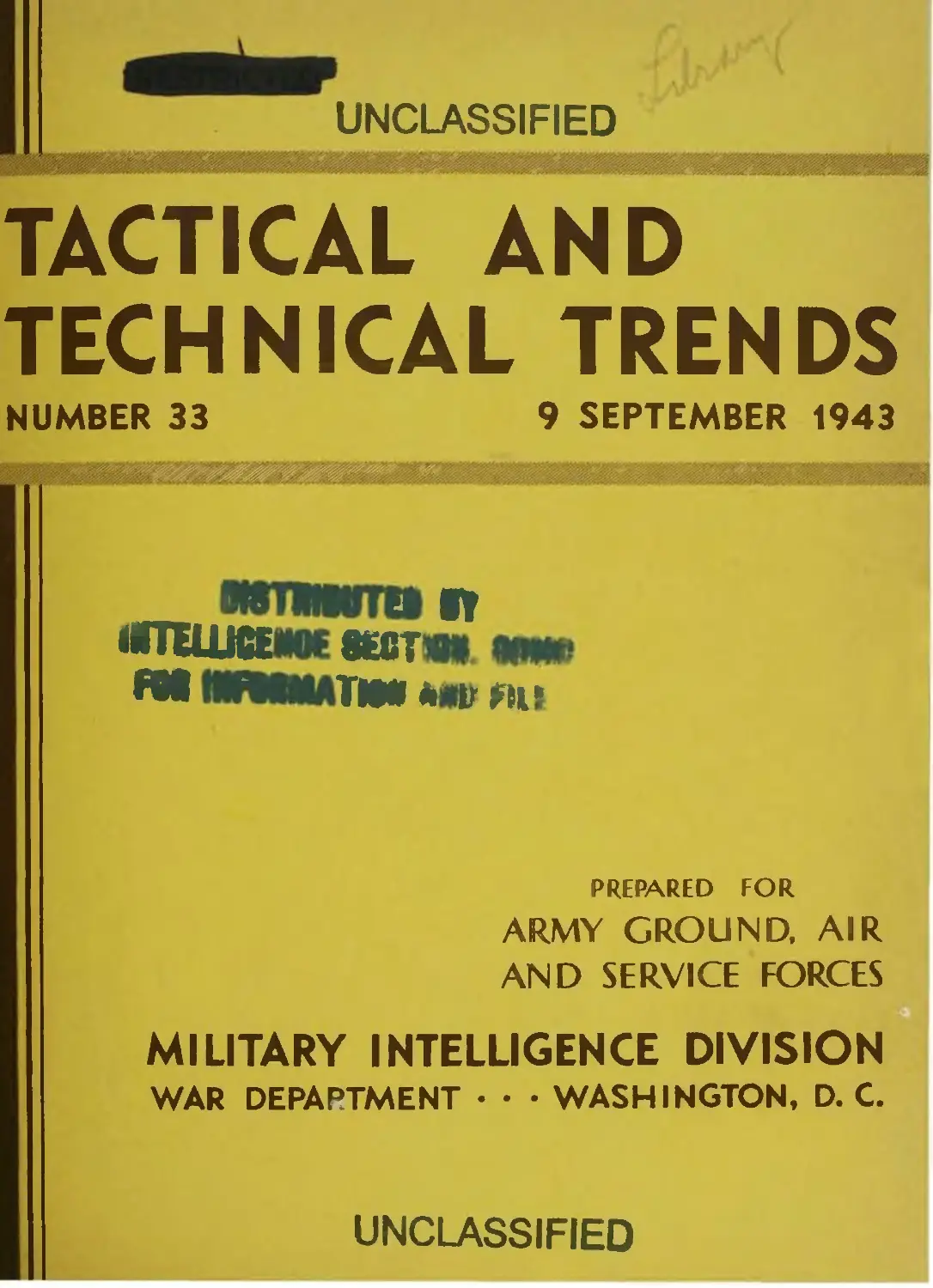
UNCLASSIFIED
33
AND
L TRENDS
9 SEPTEMBER 1943


MTMVTtt n
«rmjJCEKOE ttCTW **'
FMNRMMTIM Mir m>
PREPARED FOR
ARMY GROUND, AIR
AND SERVICE FORCES
MILITARY INTELLIGENCE DIVISION
WAR DEPARTMENT • • • WASHINGTON, D. C.
UNCLASSIFIED
Unclassified
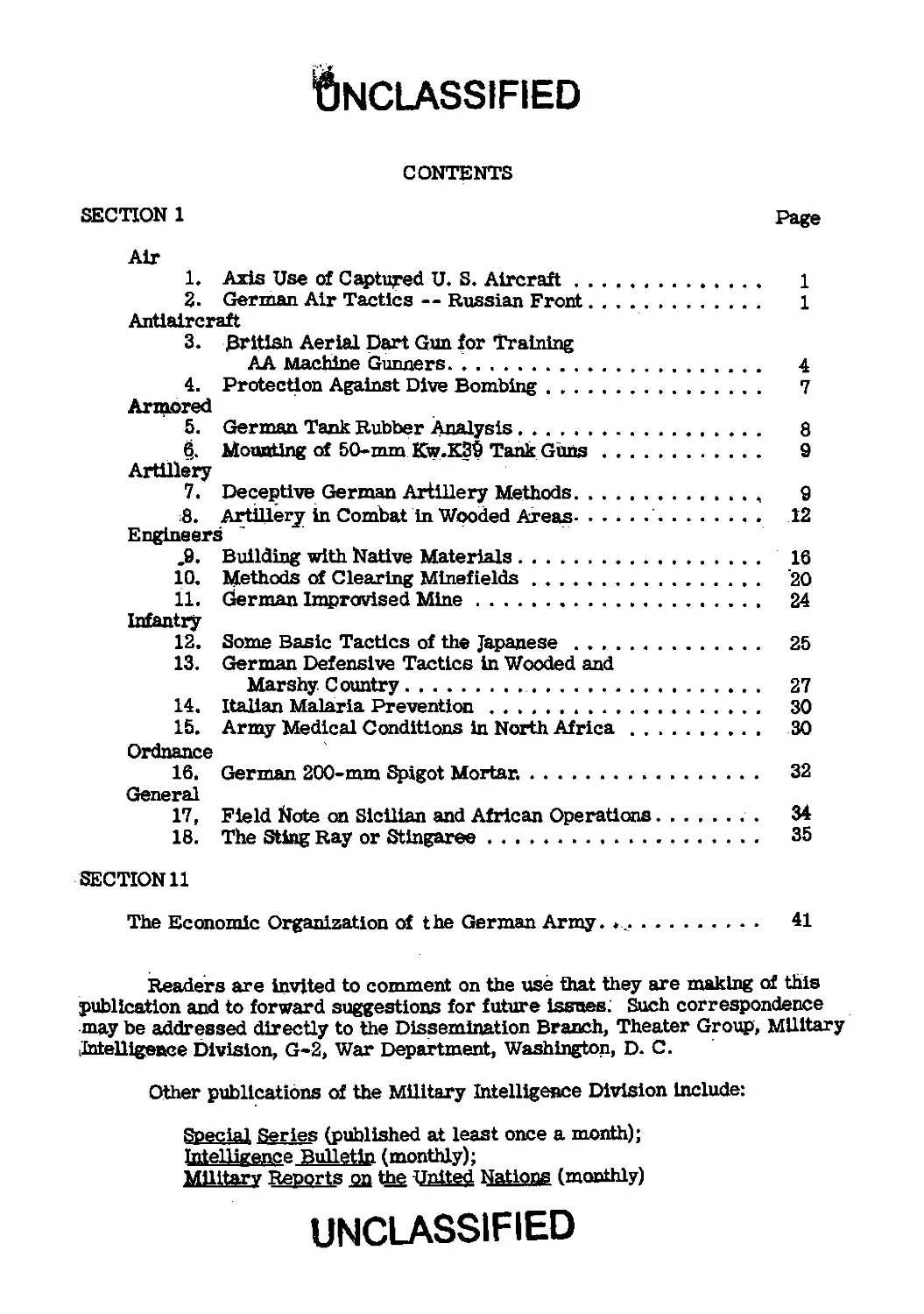
CONTENTS
SECTION 1	Page
Air
1.	Axis Use of Captured U. S. Aircraft.................... 1
2.	German Air Tactics — Russian Front..................... 1
Antiaircraft
3.	.British Aerial Dart Gun for Training
AA Machine Gunners......................................... 4
4.	Protection Against Dive Bombing........................ 7
Armored
5.	German Tank Rubber Analysis............................ 8
0. Mounting of 50-mm Kw.KS9 Tank Guns..................... 9
Artillery
7.	Deceptive German Artillery Methods..................... 9
8.	Artillery in Combat in Wooded Areas................... 12
Engineers
.9.	Building with Native Materials........................ 16
10.	Methods of Clearing Minefields........................ 20
11.	German Improvised Mine................................ 24
Infantry
12.	Some Basic Tactics of the Japanese.................... 25
13.	German Defensive Tactics in Wooded and
Marshy. C ountry.........................................  27
14.	Italian Malaria Prevention............................ 30
15.	Army Medical Conditions in North Africa............... 30
Ordnance
16.	German 200-mm Spigot Mortar........................... 32
General
17,	Field Note on Sicilian and African Operations........  34
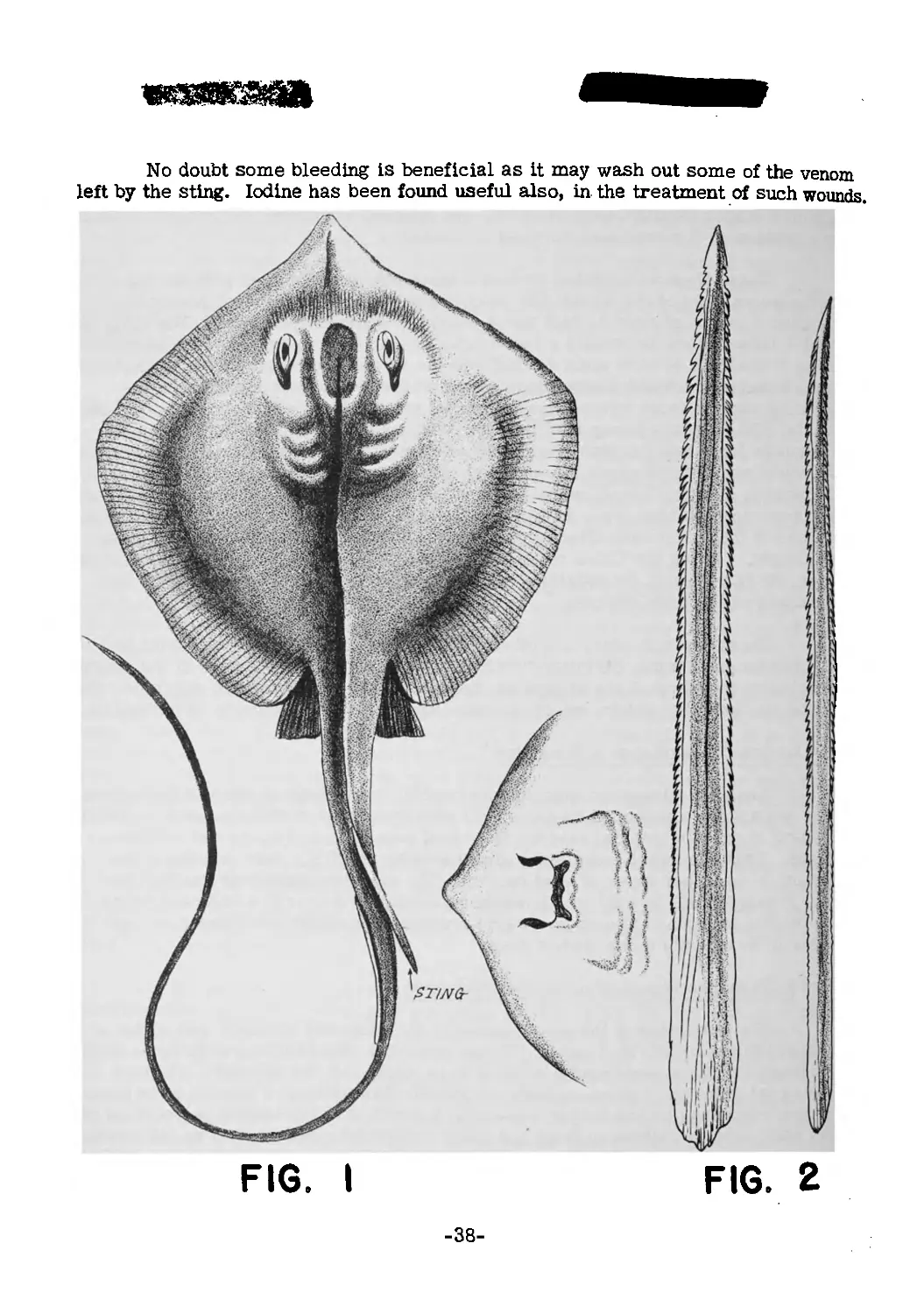
18.	The Sting Ray or Stingaree............................ 35
SECTION 11
The Economic Organization of the German Army. ♦................ 41
Readers are invited to comment on the use that they are making of this
publication and to forward suggestions for future issues; Such correspondence
may be addressed directly to the Dissemination Branch, Theater Group, Military
Intelligence Division, G-2, War Department, Washington, D. C.
Other publications of the Military Intelligence Division Include:
Special Series (published at least once a month);
Intelligence Bulletin (monthly);
Military Reports on the United Nations (monthly)
UNCLASSIFIED
UNCLASSIFIED
Requests for additional copies of all publications of the Military Intelli-
gence Division should be forwarded through channels for approval.
* ♦ *
Reproduction within the military service Is permitted provided (1) the
source is stated, (2) the classification is not lowered, and (3) one copy of the publi-
cation in which tiie material is reproduced is furnished Dissemination Branch,
Theater Group, Military Intelligence Division, G-2, War Department, Washington,
D. C.
UNCLASSIFIED
UNCLASSIFIED
SECTION I
UNCLASSIFIED
UNCLASSIFIED
AIR
1. AXIS USE OF CAPTURED U.S. AIRCRAFT
The use of captured U.S. aircraft by the Axis countries should be serious-*
ly contemplated, in view of certain incidents which have occurred during the last
few months both in the Pacific and over Europe.
Early in the year, there were two distinct occasions where unidentified
U.S. Navy planes were observed in the Pacific area. One hovered over one of our
task forces for a good part of a day, apparently on a reconnaissance flight. Another
failed to respond to proper recognition signals. It Is believed that some of these
planes may have been captured by the Japanese and are in use for reconnaissance
purposes.
Oh the Western front, sightings of B-17’s apparently enemy operated, are
Increasing. Returning from one recent mission, the first wing of our heavy bomb-
ers was joined by one unidentified B-17 which accompanied the formation until
near the German coast when it met some twin-engine enemy planes and turned
back with them. While the purpose of this particular manoeuver remains in doubt,
the inherent dangers are obvious, although to date no attempts to imitate American
markings have been observed. This is further illustrated by a recent report that
on the return flight from an attack on a town in central Italy, one of a number of
unescorted B-172 * * 5s was destroyed and three damaged by a P-38 marked with a
swastika which made five determined attacks on the formation. The next day,
during a return flight from northwest Sicily, a formation of light bombers was
trailed by a tan-colored P-38 for forty miles before it turned back towards Italy.
Photo reconnaissance has Indicated the presence of one of these fighters on a
nearby Italian airdrome. On another occasion over France, a P-47 was observed
flying in company with an Me-109 and another enemy plane.
In addition, a Fortress has been photographed at a German Air Force
experimental station and reports that the enemy has In his possession examples
of other ,U. S. aircraft In good condition have been received from time to time.
While all such information must be treated with some reserve, due to the
possibility of mistakes In recognition under the difficult conditions which usually
apply, the possibility that the enemy may continue to use captured aircraft against
us cannot be dismissed, although the practical difficulties involved in such
operations might be thought to outweigh other considerations.
2. GERMAN AIR TACTICS—RUSSIAN FRONT
The importance of aircraft concentration over one particular area to
support a ground thrust was recognized by the Germans in the battles on the
Belgorod and Orel-Kursk sectors according to an article appearing in the “Red
Star”, 11 July 1943, as described by a field officer of the Red army. It was
necessary for the Germans to concentrate aircraft in order to obtain local air
superiority in these sectors even for a short time. The article In question follows
-1-
UNCLASSIFIED
UNCLASSIFIED
in the form of an English paraphrased version of the translation.
* * *
The distinguishing feature of the battles on the Belgorod and Orel-Kursk
sectors during the past week has been one of fierce engagements over the battle-
field. As distinct from former tactics, the Germans have set only one problem
before their aircraft - the closest possible coordination with tank and infantry
units ii breaking through our [Russian] front line of defense and In exploiting
the success. Thus, all the air engagements took place over a narrow strip, a few
kilometers wide, along the entire front.
The tendency of the Germans is to mass as many planes as possible over
the battlefield at the greatest possible height. In doing this, several new aircraft
have appeared on the front, such as, the Ju-87 dive bomber with retractable land-
ing gear and mounting a 37-mm gun; the long range 4-engine He-177 bomber with
a heavy bomb load; the Me-109G with a pressurized cabin designed for high-
altitude battles.
The work of our fighter aircraft over the battlefield is divided into three
main parts, closely linked together:
(1)	Combat with enemy fighters to gain air supremacy so that other
types of our aircraft can operate more safely in the area;
(2)	Direct support and protection of our bombers and Stormoviks during
raids on ground formations;
(3)	Attacks on enemy bombers to reduce the effectiveness of their bombing.
This last type of activity is one of the most important in fighter operations.
The Germans use two methods for supporting and protecting their Junkers
and Heinkel bombers over the battlefield:
(1) Massed concentrations of German fighters are used for neutralizing
our fighters in the front-line area; (2) fighter escort is divided into two parts -
one fighter escort preceding the bombers to engage our fighters behind the front
lines, and, simultaneously, another close escort accompanies the enemy bombers.
Practice has shown that if the German fighter tactics are broken 14) in
time, the enemy loses the initiative and suffers heavy losses. The following two
episodes are examples of this:
On the first day of the battle one large group of our fighter planes on its
way to the front, was met several times by a “shield” of German fighters. This
group then divided into two parts. One part engaged with the enemy “shield”, as
before, holding the Germans in the area where they had chosen to intercept our
fighters, while the other part changed course and intercepted groups of German
bombers as they came up to the front line.
UNCLASSIFIED '2'
UNCLASSIFIED
On another sector of the front one of our fighter formations continued the
attempt to break through this shield, rather than ^oing around it. The enemy, how-
ever, by distributing their forces at various altitudes, was able to keep our fighters
engaged. Although we inflicted heavy losses on the enemy fighters, their bombers
were unmolested.
The fact that the enemy has large plane concentrations adjacent to front
lines must not cause fighters to be diverted from their main objective - that of
attacking German bombers. Although fighter-versus-fighter battles clear the sky
of enemy aircraft, this type of activity should be coordinated with fighters sent
out only to intercept German bombers. Hence the tactics:(a) German “shields” of
fighters must be engaged by aircraft sent up for this specific purpose, (b) at the
same time, other fighters must be sent out to intercept and destroy German bomb-
ers as they approach the front lines.
Such tactics have had good results on one sector of the Belgorod front,
where the majority of planes shot down were intercepted bombers.
German ground forces are well equipped with antiaircraft artillery and
large fighter patrols are maintained to intercept our Stormoviks and bombers.
The antiaircraft guns are coordhated with fighter operations.
As a group of our Stormoviks prepares to bomb, the German antiaircraft
immediately ceases firing to give the Messerschmitts and Focke-Wulfs a chance
to attack. Therefore, our fighters must accompany the Stormoviks throughout the
whole raid so that they will not suffer heavy losses in such attacks.
The experience of these recent battles shows that the work of protecting
and supporting our bombers and Stormoviks must be organized in two ways:
(Ij Close escort fighters retain their former tactics, protecting the
Ilyushin-2 Stormoviks from large fighter patrols.
(2) When no enemy fighters are in the air, our fighters aid the Stormoviks
in neutralizing enemy antiaircraft batteries.
The commander who organizes the escort should detail several fighters
for this duty. In fighting our Stormoviks the Germans use a number of methods
based on surprise, 'their fighters keep to the side, ready at any moment to exploit
the least error made by our escort formation.
For example, a shock group of Yakovlav-7 fighters engaged 4 FW-190’s
which had been specially sent out for diversion purposes at approximately 3,200
feet to 5,000 feet above a group of our Stormoviks. Seeing this, 10 other FW- 190’s
attacked the Stormoviks which had been left with only two fighters, to protect them.
The enemy was beaten off but did not suffer any losses, as would have been the
case had our shock group been at hand.
The duty of our commanders is to keep the initiative, and this can only be
UNCLASSIFIED ’3’
UNCLASSiFIED
done И each new tactical method of the enemy is quickly understood and countered.
ANTIAIRCRAFT
3. THE BRITISH AERIAL DART GUN FOR TRAINING AA MACHINE GUNNERS
To provide moving antiaircraft short-range targets, the British have a
piece of training equipment with a number of interesting possibilities called the
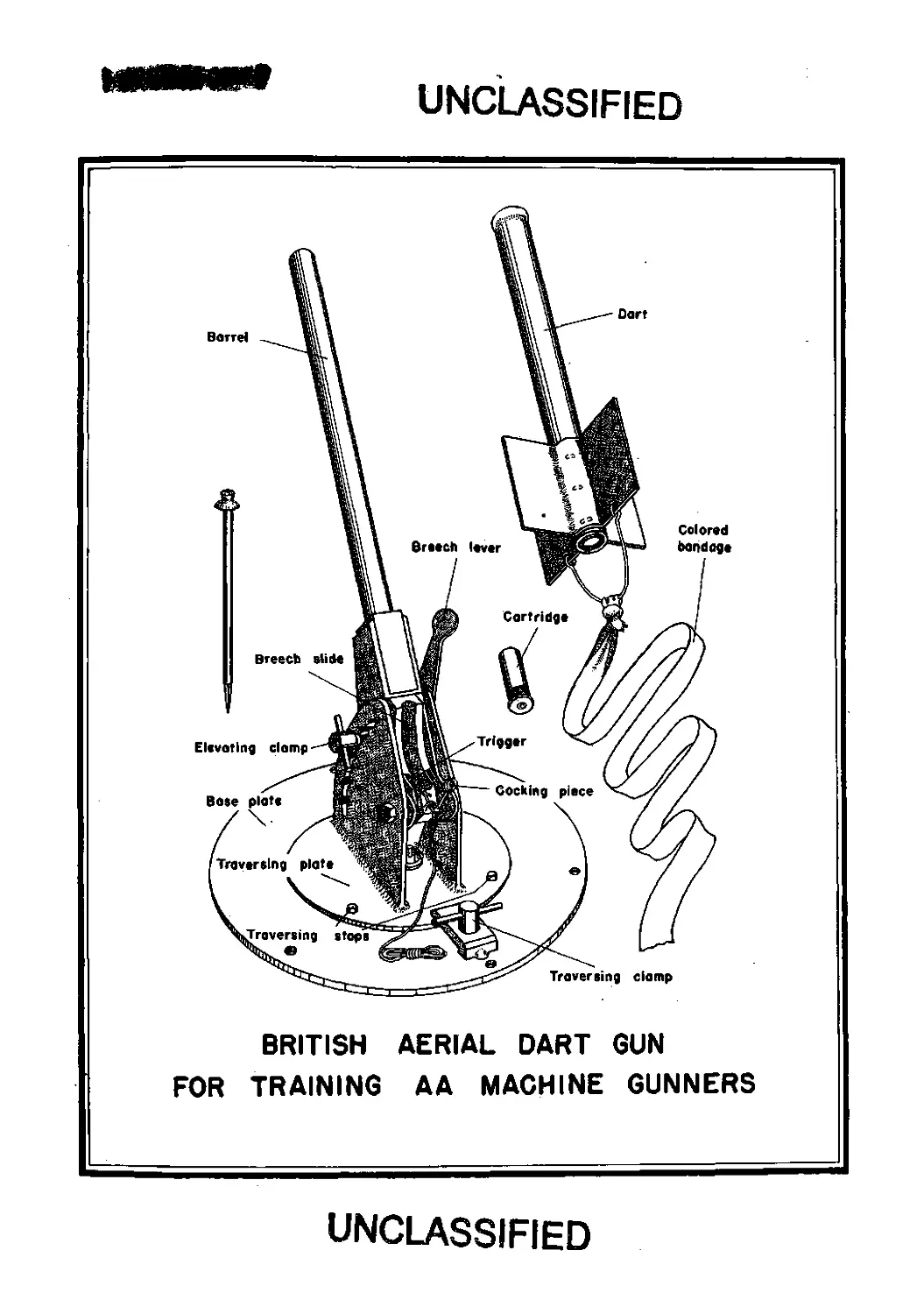
“Aerial Dart Gun,” see figure 1. The gun fires a “dart” not unlike a small
mortar bomb, fitted with colored streamers, which can be made to simulate an
approaching dive bomber, a crossing or a departing plane. The flight of the dart
is similar to the flight of a clay pigeon In trap shooting.
While the American army lacks the dart gun, with a reasonable amount of
ingenuity, a similar device could be developed using a rifle grenade or even a
60-mm mortar, a 37-mm AT gun or possibly a catapult made of old automobile
springs or an otherwise useless inner tube. The following description and account
of the use of the gun is taken from a British source.
* * *
The aerial dart, fired by a simple gun, provides a realistic air target which
can be used on all ranges suitable and classified for antiaircraft fire. Darts are
recoverable and the only expendable item is the propellant cartridge.
a.	Description
(1)	The Gun
This consists of a barrel, breech piece, and firing mechanism held In a
quadrant which allows the barrel to be elevated or depressed. The gun is mount-
ed on a circular base plate which permits a traverse of the barrel within an arc
of 90 degrees. The dart is propelled by a 12-gauge cartridge filled with 70 grains
of powder.
(2)	The Dart
This is a steel tube, closed at one end, with a solid shaft running down the
center of the tube which goes into the barrel. The tube itself fits outside the barrel.
Four steel fins are fitted to maintain steady flight. A 4-foot length of 2-inch wide
cotton bandage colored with ink, is tied to the end of the dart, and streams out
during flight. The colors of the cotton bandage may be varied to suit the colors of
the sky background; red, or red and white, is the most useful for the average
British sky background. (This variation can be made very simply by the use of
red ink.)
UNCLASSIFIED
-4-

UNCLASSIFIED
b.	Use
(1)	To fire the dart
Fix the base to the ground with the four steel pins, the traversing arc to
the rear. Elevate the barrel to the height required. (See range table.) Open the
breech, insert a cartridge, and close the breech. Put the dart into and over the
barrel, with the cotton streamer on the ground and clear of the gun. Cock the
trigger mechanism and, on the order to fire, pull the trigger cord.
(2)	To unload the gun
Open the breech and, with the aid of a steel rod inserted in the barrel from
the muzzle end, push out the empty cartridge case.
(3)	Care and cleaning
(a)	The gun should be cleaned in the normal way after firing, and left
slightly oiled until next required.
(b)	Care should also be taken to ensure that any dirt or grit is removed
from the inside of the dart tube, and the solid shaft.
(c)	Streamers should be examined before firing to see that they are
securely fastened to the dart. If a streamer breaks away in flight, it makes the
retrieving of the dart a matter of some difficulty
(d)	The darts, on landing, may penetrate deeply into the ground,
particularly if it is soft,* Care must be taken when digging them out to avoid
damaging the darts, which are made of light metal since their future efficiency
may be impaired.
(e)	If possible, avoid firing darts on to hard ground.
c.	Range Table
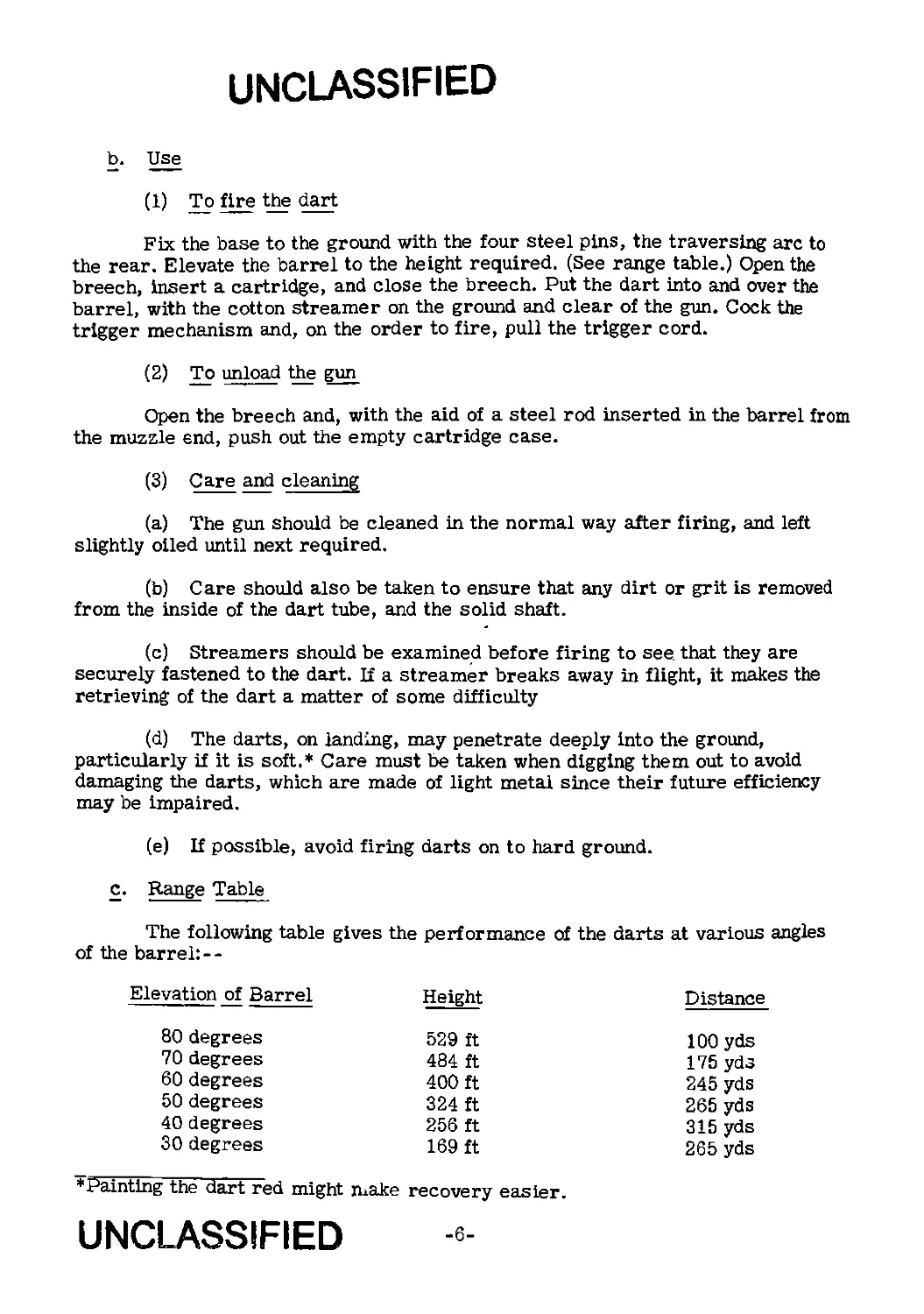
The following table gives the performance of the darts at various angles
of the barrel:--
Elevation of Barrel	Height	Distance
80 degrees	529 ft	100 yds
70 degrees	484 ft	175 yds
60 degrees	400 ft	245 yds
50 degrees	324 ft	265 yds
40 degrees	256 ft	315 yds
30 degrees	169 ft	265 yds
Painting the dart red might make	recovery easier.
UNCLASSIFIED
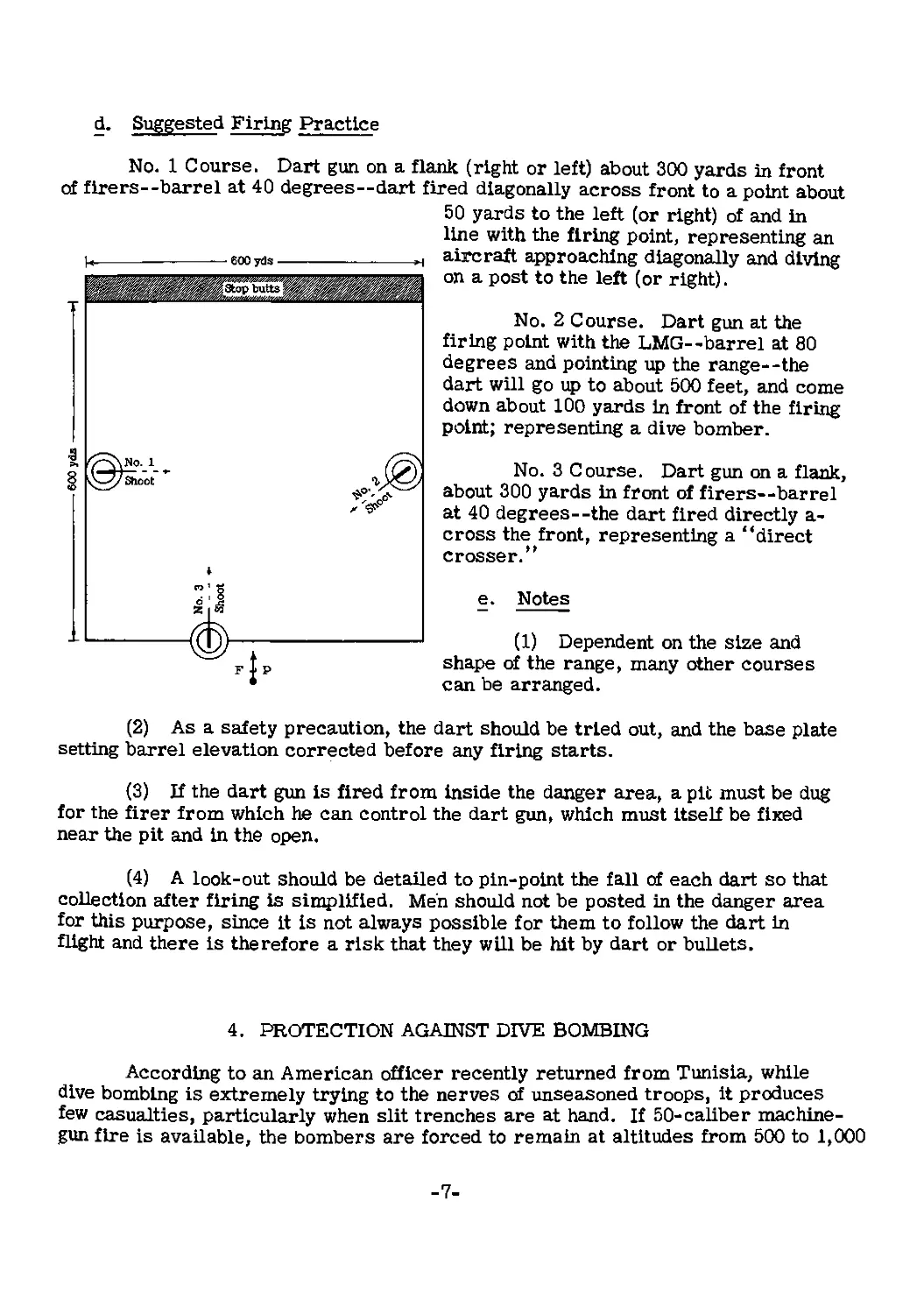
d.	Suggested Firing Practice
No. 1 Course. Dart gun on a flank (right or left) about 300 yards in front
of firers--barrel at 40 degrees—dart fired diagonally across front to a point about
50 yards to the left (or right) of and in
line with the firing point, representing an
aircraft approaching diagonally and diving
on a post to the left (or right).
No. 2 Course. Dart gun at the
firing point with the LMG--barrel at 80
degrees and pointing up the range--the
dart will go up to about 500 feet, and come
down about 100 yards in front of the firing
point; representing a dive bomber.
No. 3 Course. Dart gun on a flank,
about 300 yards in front of firers—barrel
at 40 degrees--the dart fired directly a-
cross the front, representing a “direct
Grosser.”
e.	Notes
(1)	Dependent on the size and
shape of the range, many other courses
can be arranged.
(2)	As a safety precaution, the dart should be tried out, and the base plate
setting barrel elevation corrected before any firing starts.
(3)	If the dart gun is fired from inside the danger area, a pit must be dug
for the firer from which he can control the dart gun, which must Itself be fixed
near the pit and in the open.
(4)	A look-out should be detailed to pin-point the fall of each dart so that
collection after firing is simplified. Men should not be posted in the danger area
for this purpose, since it Is not always possible for them to follow the dart in
flight and there is therefore a risk that they will be hit by dart or bullets.
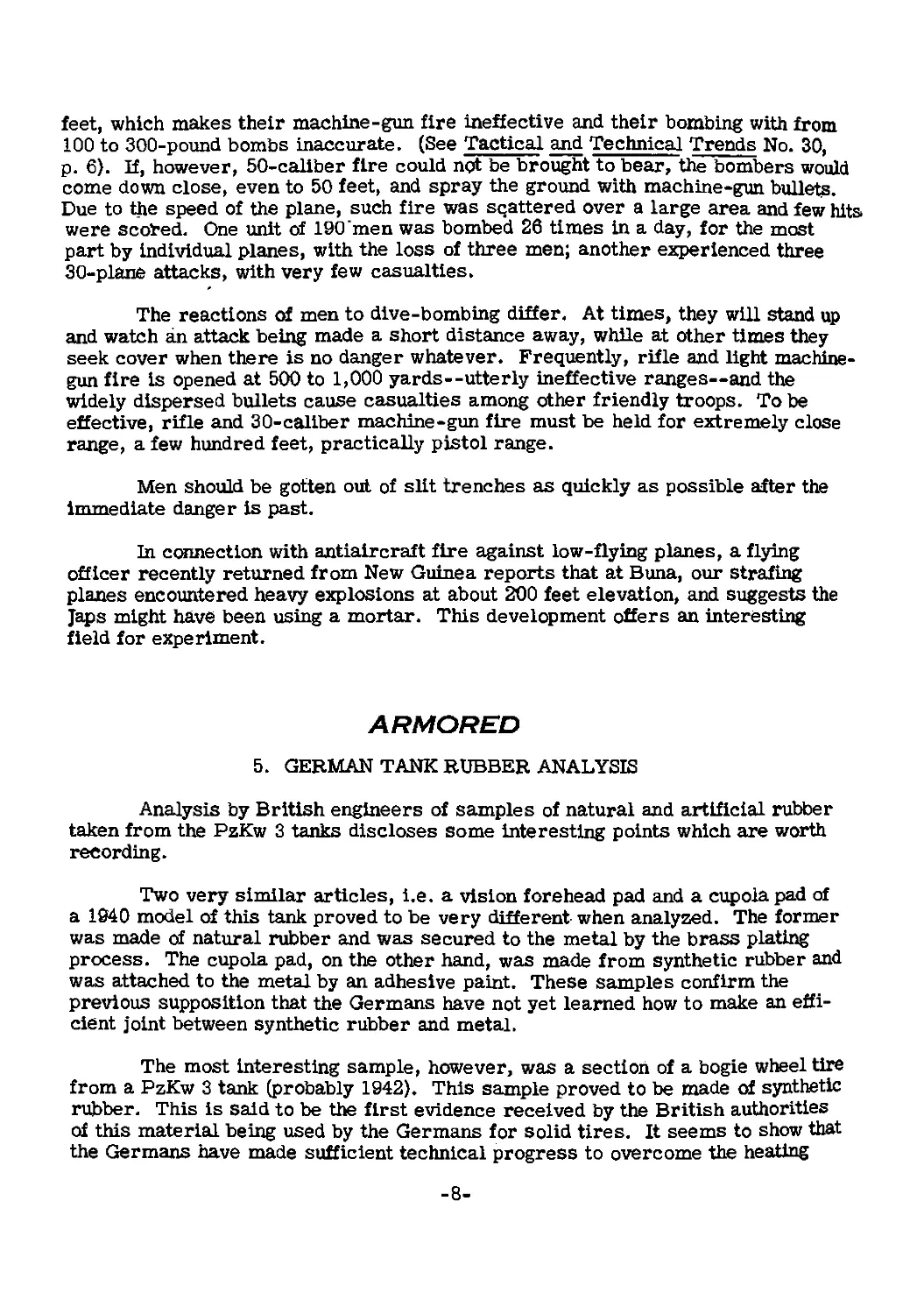
4.	PROTECTION AGAINST DIVE BOMBING
According to an American officer recently returned from Tunisia, while
dive bombing is extremely trying to the nerves of unseasoned troops, it produces
few casualties, particularly when slit trenches are at hand. If 50-caliber machine-
gun fire is available, the bombers are forced to remain at altitudes from 500 to 1,000
-7-
feet, which makes their machine-gun fire ineffective and their bombing with from
100 to 300-pound bombs inaccurate. (See Tactical and Technical Trends No. 30,
p. 6). If, however, 50-caliber fire could not be brought to bear, the bombers would
come down close, even to 50 feet, and spray the ground with machine-gun bullets.
Due to the speed of the plane, such fire was sqattered over a large area and few hits
were scored. One unit of 190 men was bombed 26 times in a day, for the most
part by individual planes, with the loss of three men; another experienced three
30-plane attacks, with very few casualties.
The reactions of men to dive-bombing differ. At times, they will stand up
and watch an attack being made a short distance away, while at other times they
seek cover when there is no danger whatever. Frequently, rifle and light machine-
gun fire is opened at 500 to 1,000 yards--utterly ineffective ranges—and the
widely dispersed bullets cause casualties among other friendly troops. To be
effective, rifle and 30-caliber machine-gun fire must be held for extremely close
range, a few hundred feet, practically pistol range.
Men should be gotten out of slit trenches as quickly as possible after the
immediate danger is past.
In connection with antiaircraft fire against low-flying planes, a flying
officer recently returned from New Guinea reports that at Buna, our strafing
planes encountered heavy explosions at about 200 feet elevation, and suggests the
Japs might have been using a mortar. This development offers an interesting
field for experiment.
ARMORED
5.	GERMAN TANK RUBBER ANALYSIS
Analysis by British engineers of samples of natural and artificial rubber
taken from the PzKw 3 tanks discloses some interesting points which are worth
recording.
Two very similar articles, i.e. a vision forehead pad and a cupola pad of
a 1940 model of this tank proved to be very different when analyzed. The former
was made of natural rubber and was secured to the metal by the brass plating
process. The cupola pad, on the other hand, was made from synthetic rubber and
was attached to the metal by an adhesive paint. These samples confirm the
previous supposition that the Germans have not yet learned how to make an effi-
cient joint between synthetic rubber and metal.
The most interesting sample, however, was a section of a bogie wheel tire
from a PzKw 3 tank (probably 1942). This sample proved to be made of synthetic
rubber. This is said to be the first evidence received by the British authorities
of this material being used by the Germans for solid tires. It seems to show that
the Germans have made sufficient technical progress to overcome the heating
-8-
difficulties previously arising when synthetic rubber was used for this type of work.
The method of adhesion to the metal band was by means of an intermediate layer
of hard, probably natural rubber.
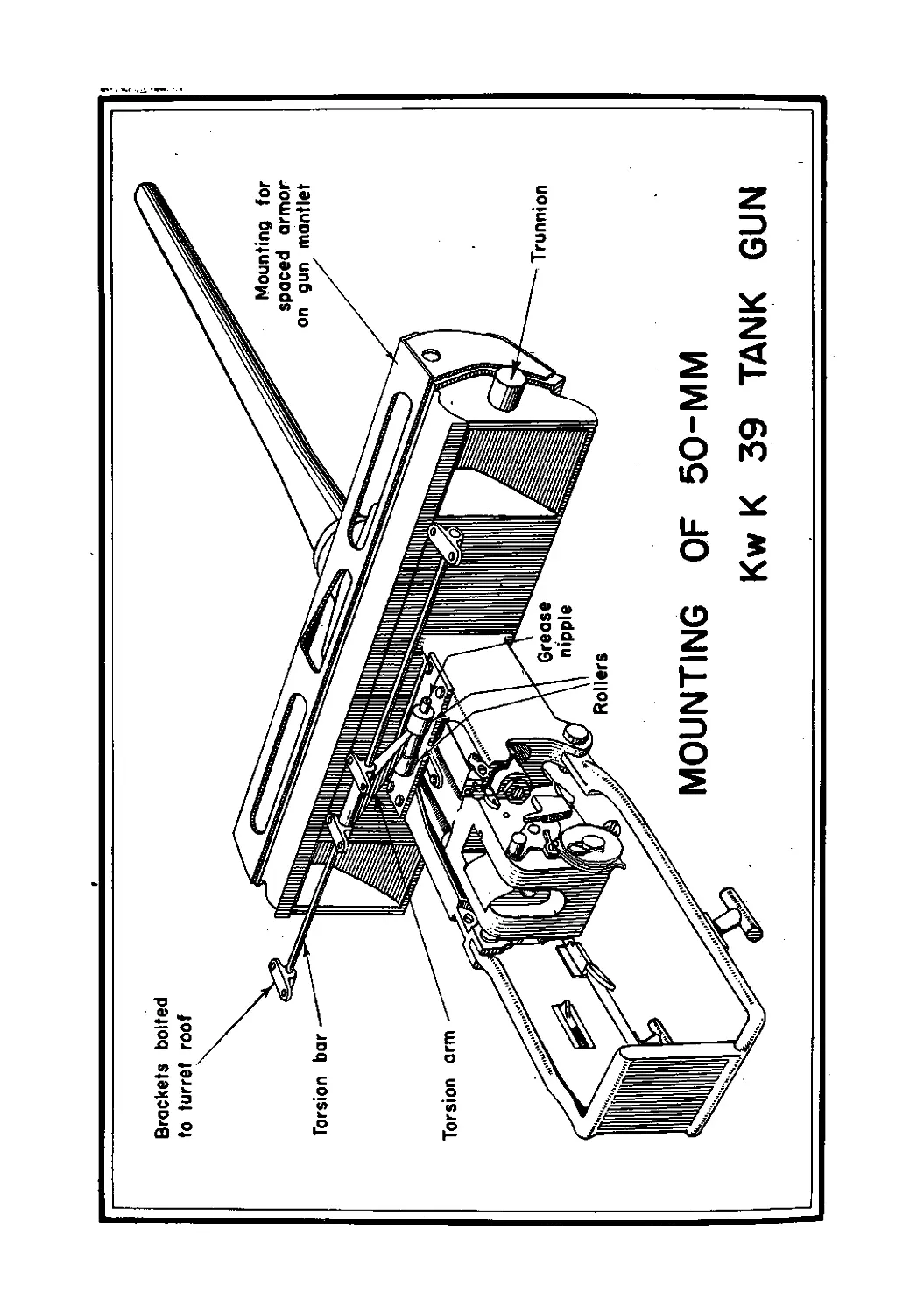
6.	MOUNTING OF 50-MM (2 IN) Kw.K 39 TANK GUN
A preliminary examination in the United Kingdom of a captured PzKw 3
Model L (Tp)* * has disclosed that the long-barreled 50-mm tank gun, 50-mm Kw.
К 39, is balanced by means of a torsion-bar compensator.
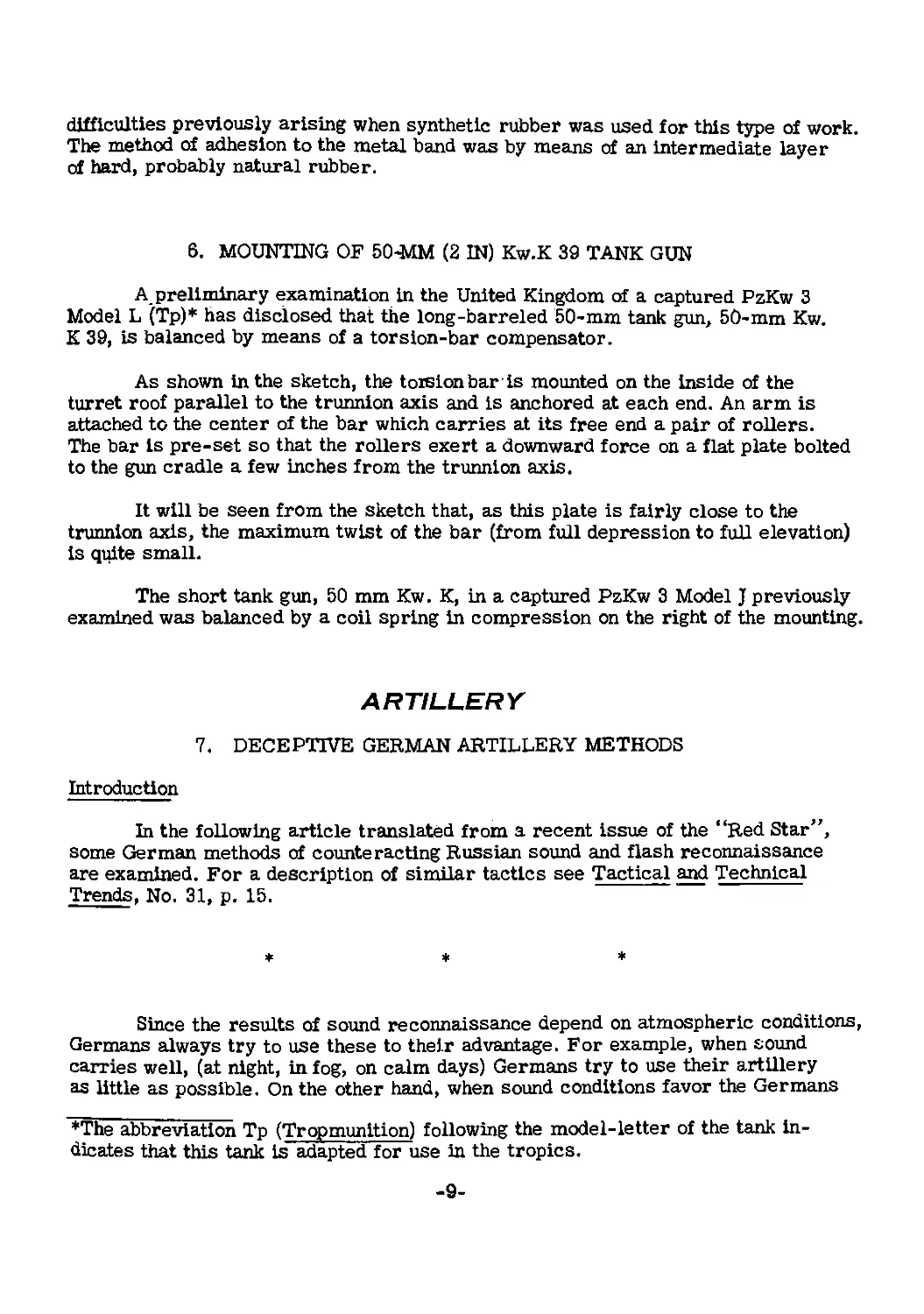
As shown in the sketch, the toisionbar is mounted on the inside of the
turret roof parallel to the trunnion axis and is anchored at each end. An arm is
attached to the center of the bar which carries at its free end a pair of rollers.
The bar Is pre-set so that the rollers exert a downward force on a flat plate bolted
to the gun cradle a few inches from the trunnion axis.
It will be seen from the sketch that, as this plate is fairly close to the
trunnion axis, the maximum twist of the bar (from full depression to full elevation)
is quite small.
The short tank gun, 50 mm Kw. K, in a captured PzKw 3 Model J previously
examined was balanced by a coil spring in compression on the right of the mounting.
ARTILLERY
7.	DECEPTIVE GERMAN ARTILLERY METHODS
Introduction
In the following article translated from a recent issue of the “Red Star”,
some German methods of counteracting Russian sound and flash reconnaissance
are examined. For a description of similar tactics see Tactical and Technical
Trends, No. 31, p. 15.
* * *
Since the results of sound reconnaissance depend on atmospheric conditions,
Germans always try to use these to their advantage. For example, when sound
carries well, (at night, in fog, on calm days) Germans try to use their artillery
as little as possible. On the other hand, when sound conditions favor the Germans
*The abbreviation Tp (Tropmunition) following the model-letter of the tank in-
dicates that this tank is adapted for use in the tropics.
-9-

(wind in the direction of their positions, vertical midday currents, sharp drops in
temperature etc.) the activity of their artillery increases. In selecting their firing
positions Germans take into consideration the effect of the surrounding terrain on
sound. Firing positions on the reverse slopes of the hills, in groves, near lakes,
and marshes are more desirable in this respect than those on tops of hills.
In order to deceive our sound reconnaissance and to draw our fire on
empty positions Germans use “swinging” or “duty” batteries (American roving
guns). These batteries swinging from one position to another, fire a few rounds
from each position, mixing it occasionally with systematic fire. These positions
are selected away from other batteries and other troop positions. Germans are
very careful not to disclose their fire system. Many batteries do not fire for a
long time as their mission is to ambush either our troops or our batteries. Almost
never does a gun fire individually as it is then easily located by sound reconnaissance;
instead, as a rule, several batteries fire together at an even tempo so that individual
shots are drowned in the general noise.
To camouflage fire activity of especially important positions special devices
are used that imitate sounds of gunfire. These devices are placed from 200 to 300
meters on the flanks of the camouflaged battery, or to the rear with respect to the
direction of actual firing. Sometimes, for more complete imitation of a battery,
these devices are supplemented by others which produce a flash simultaneously
with the real volley.
Along the same principle a single piece located also 200 to 300 meters
from the others is used for ranging fire. This piece if moved farther away, would
interfere with correct ranging for the rest of the battery and would also enable us
to discover the trick. These seperate pieces also have the secondary mission of
nuisance fire. If several batteries are to take part in a barrage, these ranging
pieces are used during the first stages. As soon as the Germans think that our
sound reconnaissance has located these pieces, the rest of the guns open up. The
ranging pieces continue their fire until the end of the barrage.
In order to hide their guns from our flash locators, very often rockets are
sent up, haystacks and other material burned, so that the gun flashes are nearly
Invisible against the burning background. Smokeless powder and flash hiders are
also used. Large-Scale engineering works are made in order to hide the batteries
from ground and air observation. Each battery has two camouflage experts who
supervise this work.
Of course, all these measures are not taken by every German battery all
the time, but it is well to know about all these tricks. Such knowledge enables us
to evaluate properly the findings of our flash and sound locators, and when every-
thing else fails we check our evaluation with PW interrogation.
-11-

8.	ARTILLERY IN COMBAT IN WOODED AREAS
The following personal critique by a German artillery officer on artillery
in combat in wooded areas is taken from a translated German document.
a.	Example 1
An infantry regiment, reinforced by my light fie Id-howitzer battery
(probably 105’s) horse-drawn, received orders, late in the afternoon, topushfdr-
ward toward the east through extensive forest region, turn off to the right at a
crossroad, and relieve the left flank of the neighboring division by making an attack.
It was nearly dark before the column of march advanced. The deep sand of
the road and the necessary reconnaissance, caused the column to halt more than
once. Tall trees alternated with those of recent growth. There were a few small
clearings along the roadside but no large, completely cleared areas. The battalion
to which the light field-howitzer battery was attached marched close behind the
battalion forming the advance guard.
In the meantime, it had grown dark. The first shells burst over the point,.
more than a mile from the crossroad. Everyone halted and then the order rang
out: “Antitank troops forwardl” and “Artillery will fire I” The commander of the
infantry regiment, who marched behind the point, turned to me and asked “Chn you
fire?” A fire missionl thought I. In a forestl At nighti The enemy red-green map
on a scale of 1:100,0001 Our own position? The enemy? “Can you fire?”
One must, try anything.
I hastened back and found a partially cleared place where one could fire
fairly well between the trees. A gun commander was instructed to place at least
one gun in position as quickly as possible. This took some time, for the infantry’s
moving of baggage and supply trains with the advance guard battalion barred the
way of the guns. The din of battle grew ever stronger. While we were searching
for gun positions, the gun commander asked me somewhat diffidently how he should
lay and fire the gun with the map he had. I asked him in return, “Where is the most
combat noise?” “There”, he said. “Then aim your guns at that place! I estimate
that the distance to our point is 800 yards. For safety’s sake, begin to fire at
1,200, and fire two high bursts, then lower your gun and begin to use percussion
fuzes. Bring your fire back to the target. Establish a forward observation post near
the infantry.’
say.
“If things only go well,” the expression on the lieutenant’s face seemed to
And things did go well. We saw the third burst against the background of
the evening sky. We fired shells equipped with percussion fuzes by ear (it had grown
quite dark in the meantime) and brought the fire back to the target. The infantry
-12-
was happy. It repulsed two attacks by the enemy.
We had not hit anything- -the shots had gone over—and as the lines were
only 30 yards in front of us, we couldn’t bring the fire any closer. The infantry,
however, swore by their artillery battalion, and the moral value of the fire, com-
pletely offset its lack of material effect.
b.	Example 2
We, that is, our division and my light horse-drawn field howitzer battalion,
relieved an armored division that had pressed forward to the western border of a
strongly defended city but could get no farther because of deep minefields, tank
traps, and the river. The period of position warfare lasted a month. We were at
first provided with poor maps, but finally obtained captured maps on a scale of
1:50,000. The observation posts and command post were necessarily located at the
edge of the wood 300 yards behind the front line. Only from the observation posts
was it possible to get a fairly good view of the city and of the slowly rising open
hinterland behind it. These posts were fitted up at night and carefully camouflaged.
As we learned later from the enemy’s position, these posts could not be seen. The
flying bullets of the enemy infantry, however, constantly whined among the trees
and made our stay there very unpleasant. The enemy artillery likewise beat the
edge of the wood with a brisk fire. The fire-control wires were destroyed many
times every day. Even the radio often failed us, largely because of the difficulty
of supplying the anode batteries. The observation posts were connected with one
another as well as with the battalion command post, and the battery positions were
also connected with one another. Subdivisions of the battalion were interconnected;
thus,, for example, on a day when the enemy attacked and all the wires were des-
troyed by artillery fire, the fire of the entire battalion was controlled by the one
remaining radio circuit of the battery within calling distance of the observation
post.
c.	Example 3
The enemy had pushed forward a salient in wooded and swampy terrain.
The division, to which my mountain artillery battalion belonged at this time, was
driven from the railway during the combat.
The infantry of both sides lay in the dense wood with lines not more than
50yards apart. There were no elevated observation posts, consequently, our OPs
were located in the front line. The longest view - 80 yards - was in a sparsely
wooded area. In view of the dispersion, the center of impact of the barrage fire
was 300 yards in front of the main line of resistance and consequently failed to
accomplish its purpose. The fire was adjusted only by ear. It was necessary to
adjust separately the fire of each of the guns laying the barrage and to check their
adjustment separately twice a day. When our battery positions were surveyed in,
we used map data to fire upon enemy positions, supply lines, and concentrations,
deep within his combat zone (map on a scale of 1:50,000 and 1:25,000) and the fire
was checked from time to time by aviators.
-13-

If the enemy was finally annihilated solely by artillery fire, this was due
exclusively to the continuous bursts and harassing fire of the entire regiment. The
expenditure of ammunition was heavy. My battalion (2 batteries) fired 17,500 shells
during the 28 days. This method is really not “elegant”, but it is impossible to do
otherwise when fighting in wooded country.
d.	Examples Compared
In example No. 1 there was no data relating to the position. The observation
posts did not have a good view. Rough aiming in azimuth by ear, laying on any
point, range estimated. In example No. 2 the positions were surveyed, the batteries
interconnected, but only a small sector of terrain two miles deep could be seen
from the observation posts. The laying was in the grid direction, ranges were
obtained from the map. The regular firing method was used; smoke shells fired on
a terrain, parts of which were not clearly visible. In example No. 3 the positions
were surveyed but the observation posts did not have a good view. Laying was in
grid direction, ranges obtained from map, fire brought back to the target by ear.
e.	The Work in the Observation Post
In cases 1 and 3, the observation posts were located far forward. The lack
of Vision and the fact that the posts were located in the front line permitted the
performance of only the most essential tasks. It was obviously impossible to
employ the observation posts on a large scale. Radio communication, supplemented
by wire, and binoculars were the means used by the battery commander’s represent-
ative. Corrections in azimuth and range, given in meters with respect to the line
of sighting, were supplied to the battery. In case 3, the battery commander’s
representative was expressly forbidden to give ranges over the telephone or radio,
as the Interception service of the enemy was working well and could easily draw
correct conclusions concerning the location of the battery positions from the ranges
given.
In case 2, the fire was also affected by the “front-line influences”, although
an ordinary observation-post service could be maintained. Command posts A and
В (instrument section) and the observation post, situated within call of its battery,
were actually in communication because within calling distance. Moreover, it was
possible to reach the other observation posts through the infantry command post;
the battery positions could also be reached by means both of an infantry wire and
that of an artillery group. The supplementary radio connections also permitted
communication, but were less used, as the enemy located them by means of a
radio direction-finder. The great Importance of having as many lateral radio and
telephone lines as possible was plainly indicated. The control of fire by the battalion
was always assured. The observation posts In trees were occupied only’in the most
urgent cases. The observers, who wore safety belts, occupied positions in the
forks of branches rather high up in the trees. One observation post could use the
battery commander’s telescope, but the others were restricted to binoculars.
With respect to camouflage, It should be mentioned that it is more im-
portant to have a good background, that is, trees with thick foliage, than to use
-14-
camouflage on the side toward the enemy. The branches must be changed frequently
and must be cut from trees of the same species.
f.	Possibilities of Barrage Defense Against Enemy Attack
The event which causes the artilleryman the most pain is when a shell falls
short and drops in his own lines. Artillery fire in forest combat reaches a decisive
stage at just this point.
The barrage fire, whose center of impact was between 200 and 300 yards
in front of our own front line, was adjusted by earl No rule gives any information
as to how the distance of detonations is to be estimated in a wood, without inter-
rupting fire if possible, as in case 3. Nor can one decrease the range until the
shells begin to fall in our own lines, when one learns that it would have been better
to keep it at a distance. Moreover, sound is deceptive. Many bursts that sound far.
away actually occur in the nearby underbrush, while many that sound near at hand
result from detonation on distant trees. Here the difficulties begin.
Can we call fire directed behind the enemy’s front line a barrage fire? In
case 3, the enemy had always prepared for an attack in his front line, because he
was safest from artillery fire there (according to the statements of prisoners). At
most, the barrage blocks the second or third wave of attack and the supply lines.
Our own infantry must always be apprised of this fact, for they must lay the barrage
themselves.
Harassing fire and concentrations of fire on rear areas proved very effect-
ive, especially in case 3. This, in my opinion, is absolutely the only way in which
artillery support can be useful in an engagement in the woods. If one has enough
ammunition, the enemy can be driven out of the woods. There is little prospect,
however, that artillery can be successful in supporting troops attacking in a forest.
Enemy positions, supporting points, and bunkers can, at most, be recognized at a
distance of 100 yards, a range at which the artillery can no longer fire upon them.
Antitank guns, and particularly assault guns, on the contrary, have proven their
usefulness. The forward artillery observer can at best only direct a scattering
fire toward the rear. Attempts to measure the positions of tracer ammunition
fired by forward observers have been useful in locating the position of the forward
observer and the course of the front line. However, I would hardly recommend
that fire be based on these measurements when all the tracer ammunition is not
plainly recognized.
g.	Conclusions
The lessons taught concerning artillery in a combat in the forest may there-
fore be summarized as follows:
(1)	It is usually possible to fire only by ear in dense wood;
(2)	The barrage as such is ineffective and constitutes a fire barrier only
In front of the rear areas;
-15-
Sts.  ...s - л
(3)	The artillery cannot support attacking troops, for it can fire only from
clearings In the forest and areas containing scattered trees;
(4)	The main value of artillery in a forest combat is in firing upon routes
over which the enemy approaches and areas in which he assembles;
(5)	It is suicide to observe from trees in a dense forest, owing to the
proximity of the enemy’s front line;
(6)	As far as possible, only forward observers should be employed In a
combat in the woods; to establish a larger “command mechanism” in the front
line will cost many casualties;
(7)	The nearer the front line and the denser the forest, the more facilities
for communication should be established. It is sometimes impossible to find wires
that have been cut by artillery fire in a dense wood;
(8)	Interconnection is of value only when the observation posts have more
or less view or no firing maps are available. It seems useless in a dense wood
unless air observation is available for adjusting the fire. No liaison plane is need-
ed when the target is shown on the map;
(9)	Under certain circumstances, however, artillery should fire during
an engagement in a forest even when its “material” Ineffectiveness is obvious,
for its “moral” effect is always obtained;
(10)	The artilleryman must never forget to explain in detail to the infantry
the artillery’s role in a combat in the woods, so that the former will have no
expectations that the latter cannot fulfill.
ENGINEERS
9.	BUILDING WITH NATIVE MATERIALS
There is an abundance of natural materials Ln the South Pacific which may
be used to provide for the comfort of troops as well as for the protection of
equipment. However such materials must not be wasted as they represent resources
that should be carefully preserved for the population. Native methods of construct-
ion should be carefully investigated and improvements effected whenever possible.
Bamboo and rattan are the most universal of building materials among
people of the South Pacific area. They are generally plentiful and easily available.
No native material has proved to be more versatile or useful. Some natives say it
is best to cut bamboo in the last quarter of the moon, as wood-boring insects are
less apt to infect the wood when the sap is down. Rattan may be cut at any time.
All sizes and shapes of bamboo are useful; however, the well-dried yellow stalks,
about six inches in diameter, are best. Do not attempt to drive nails or screws
-16-
through the wood without first boring holes--it splits easily. If nails or screws
are not available, native methods of binding building members together can be
used. As a structural member, bamboo is fairly reliable especially if seasoned.
There are several methods of curing and insect-proofing bamboo; one is to soak
the wood for at least a week in salt water; the other is to bury the freshly cut
bamboo in warm sand exposed to the sun. Moderate heating of the sand hastens
the process. Petroleum creosote, thinned and sprayed on, is effective. Smoking
the bamboo will dry it and kill the insect larvae. Some of the uses of the material
are wall sheathing, plumbing, furniture, lamp fixtures. When used for sheathing,
it requires a backing of some sort, such as building paper, water-proof paper from
packing crates, or salvaged canvas.
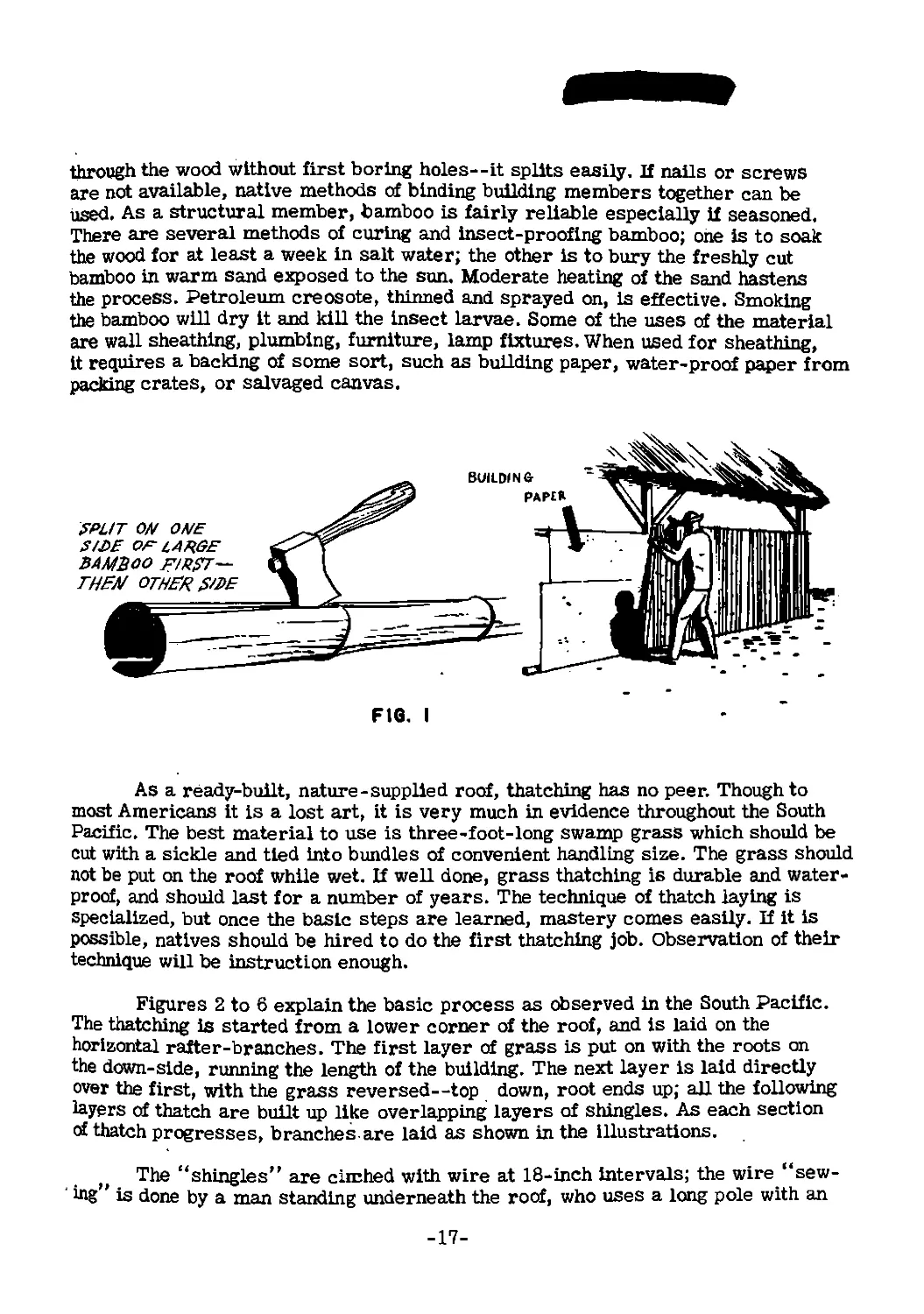
FIG. I
As a ready-built, nature-supplied roof, thatching has no peer. Though to
most Americans it Is a lost art, it is very much in evidence throughout the South
Pacific. The best material to use is three-foot-long swamp grass which should be
cut with a sickle and tied into bundles of convenient handling size. The grass should
not be put on the roof while wet. If well done, grass thatching is durable and water-
proof, and should last for a number of years. The technique of thatch laying is
specialized, but once the basic steps are learned, mastery comes easily. If it is
possible, natives should be hired to do the first thatching job. Observation of their
technique will be instruction enough.
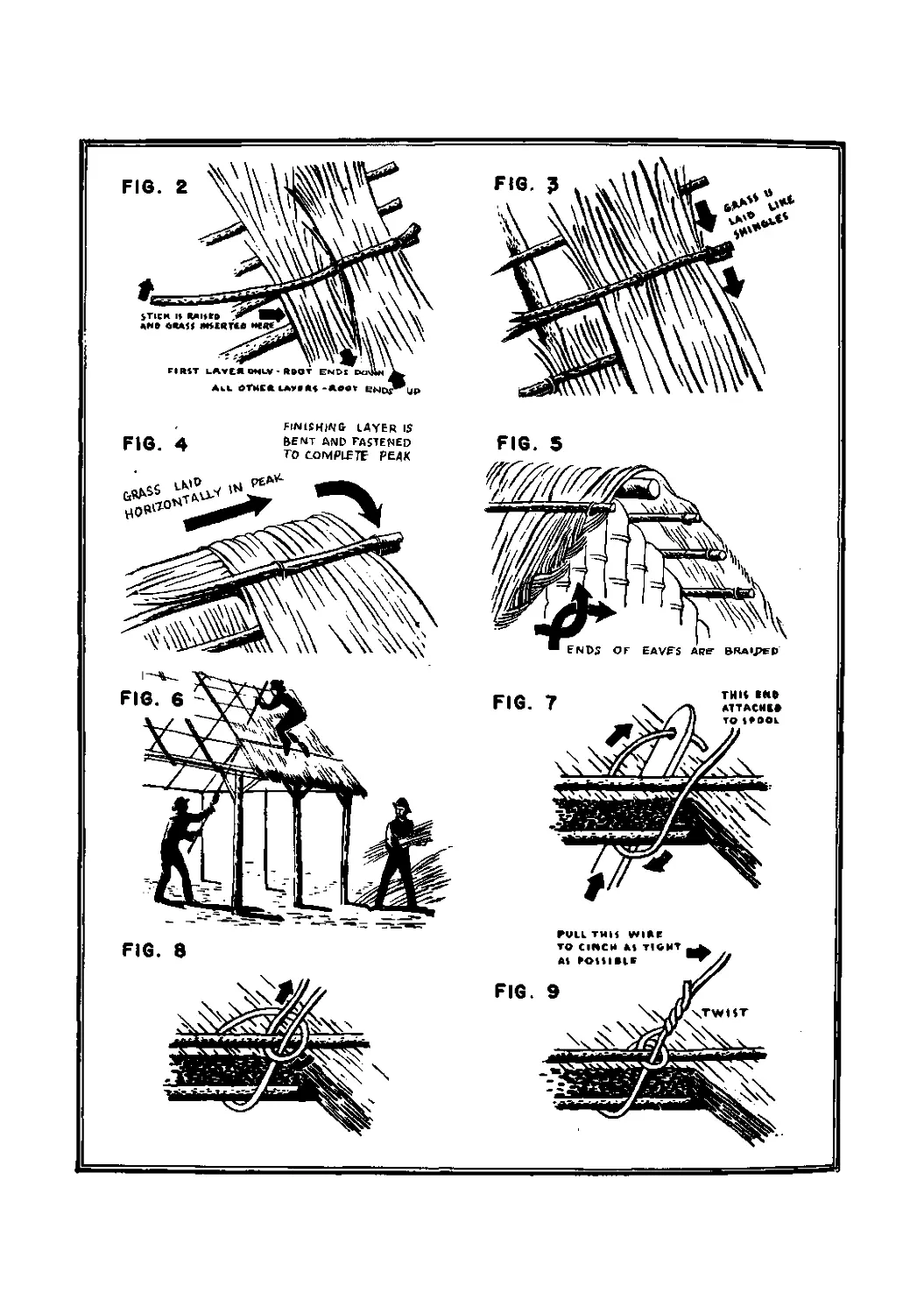
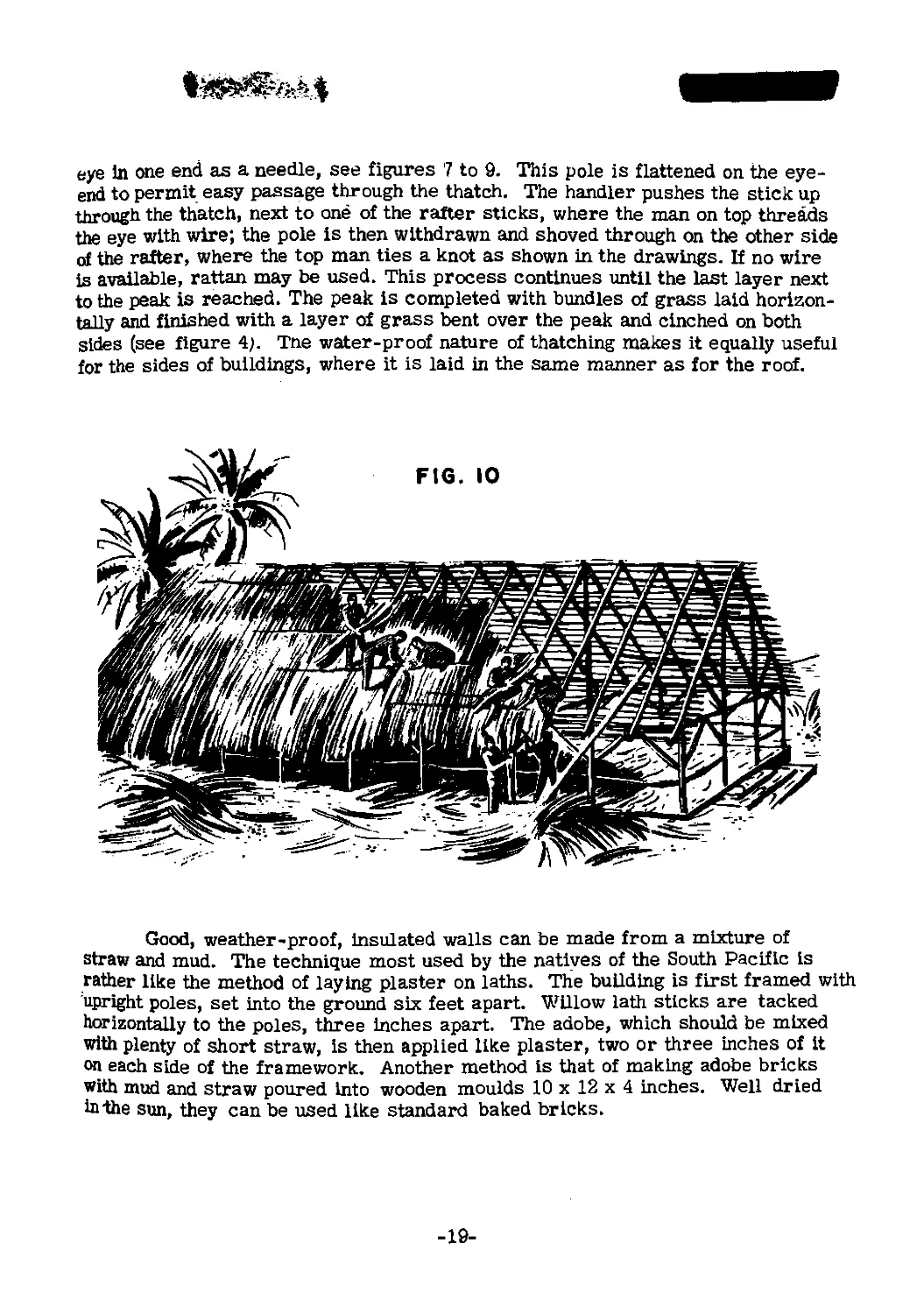
Figures 2 to 6 explain the basic process as observed in the South Pacific.
The thatching is started from a lower corner of the roof, and is laid on the
horizontal rafter-branches. The first layer of grass is put on with the roots on
the down-side, running the length of the building. The next layer is laid directly
over the first, with the grass reversed—top down, root ends up; all the following
layers of thatch are built up like overlapping layers of shingles. As each section
of thatch progresses, branches are laid as shown in the illustrations.
The “shingles” are cliched with wire at 18-inch Intervals; the wire “sew-
ing” is done by a man standing underneath the roof, who uses a long pole with an
-17-


eye In one end as a needle, see figures 7 to 9. This pole is flattened on the eye-
end to permit easy passage through the thatch. The handler pushes the stick up
through the thatch, next to one of the rafter sticks, where the man on top threads
the eye with wire; the pole is then withdrawn and shoved through on the other side
of the rafter, where the top man ties a knot as shown in the drawings. If no wire
is available, rattan may be used. This process continues until the last layer next
to the peak is reached. The peak is completed with bundles of grass laid horizon-
tally and finished with a layer of grass bent over the peak and cinched on both
sides (see figure 4). Tne water-proof nature of thatching makes it equally useful
for the sides of buildings, where it is laid in the same manner as for the roof.
Good, weather-proof, insulated walls can be made from a mixture of
straw and mud. The technique most used by the natives of the South Pacific is
rather like the method of laying plaster on laths. The building is first framed with
'upright poles, set into the ground six feet apart. Willow lath sticks are tacked
horizontally to the poles, three inches apart. The adobe, which should be mixed
with plenty of short straw, is then applied like plaster, two or three inches of it
on each side of the framework. Another method is that of making adobe bricks
with mud and straw poured into wooden moulds 10 x 12 x 4 inches. Well dried
in-the sun, they can be used like standard baked bricks.
-19-
А- 4
10.	METHODS OF CLEARING MINEFIELDS
The importance which land mines has assumed in modern warfare has
been discussed in Tactical and Technical Trends No. 27, p. 15, and No. 28, p 15
with reference to the laying of enemy minefields and the construction of enemy
land mines. A knowledge of the different methods of clearing enemy minefields is
as important as an understanding of the enemy tactics in laying the minefields.
Information concerning the following methods for clearing minefields was taken
from Allied sources covering operations in North Africa. In the first five methods
the working party did not exceed one NCO and four men.
*
*
a.	Lifting and Placing Ln Dumps of 20 to 40
After locating, the earth was cleared around the mines and, without touch-
ing the igniter assembly,* the mines were lifted and carried a distance of approxi-
mately 30 yards depending on the size of the dump.
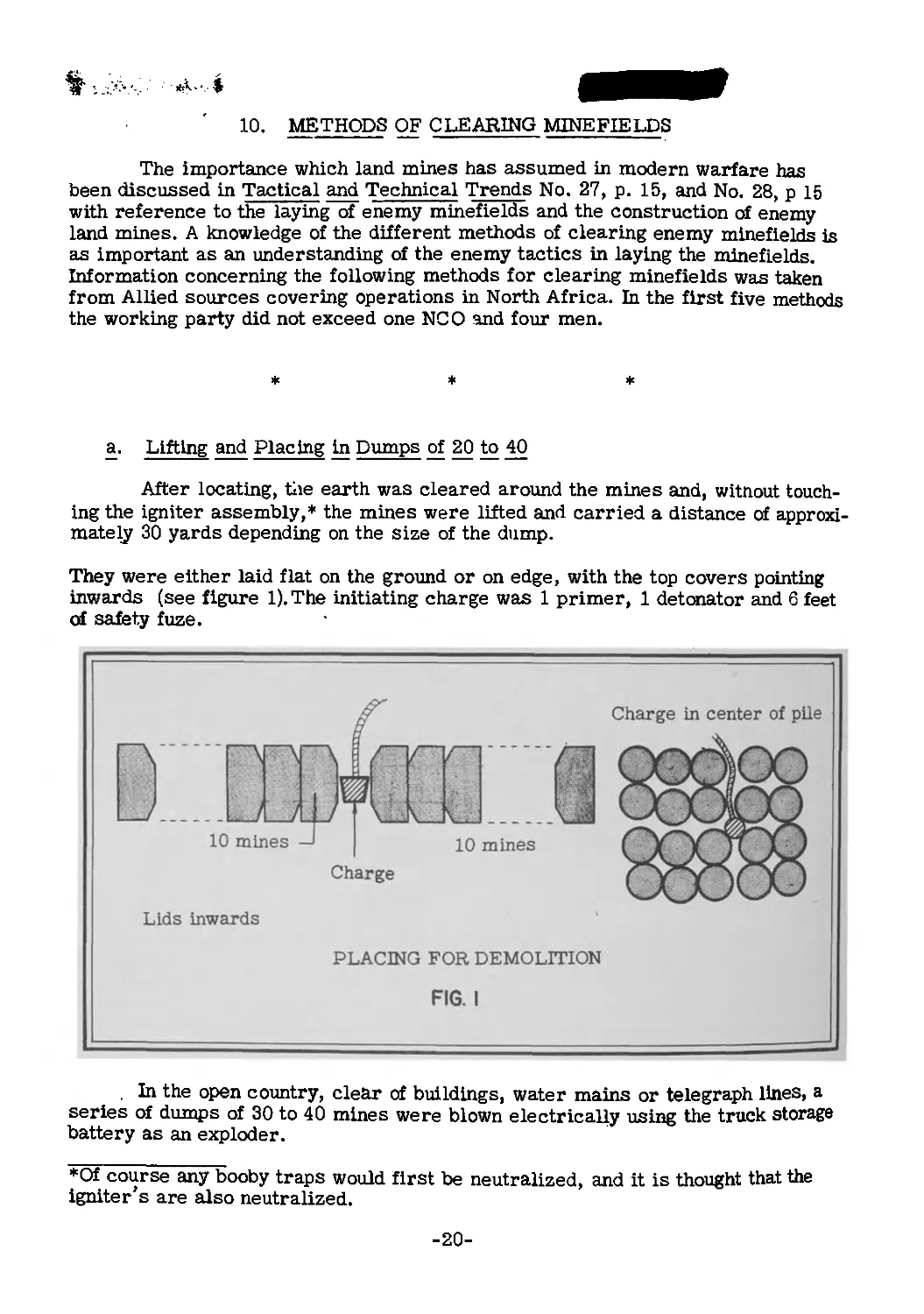
They were either laid flat on the ground or on edge, with the top covers pointing
inwards (see figure l).The initiating charge was 1 primer, 1 detonator and 6 feet
of safety fuze.
Lids inwards
PLACING FOR DEMOLITION
FIG. I
. In the open country, clear of buildings, water mains or telegraph lines, a
series of dumps of 30 to 40 mines were blown electrically using the truck storage
battery as an exploder.
*Of course any booby traps would first be neutralized, and it is thought that the
igniter’s are also neutralized.
-20-
The rate of work was 60 mines рёг тал per day;
The number lifted by the method, 80,000 approximately;
Casualties - nil;
Failures during firing - nil;
Type of country - rough with average undergrowth.
b.	Cat-O-Nine Tails
This was not very successful. Experiments proved that the method could
only be used on very level ground and even then the mines cannot be. drawn close
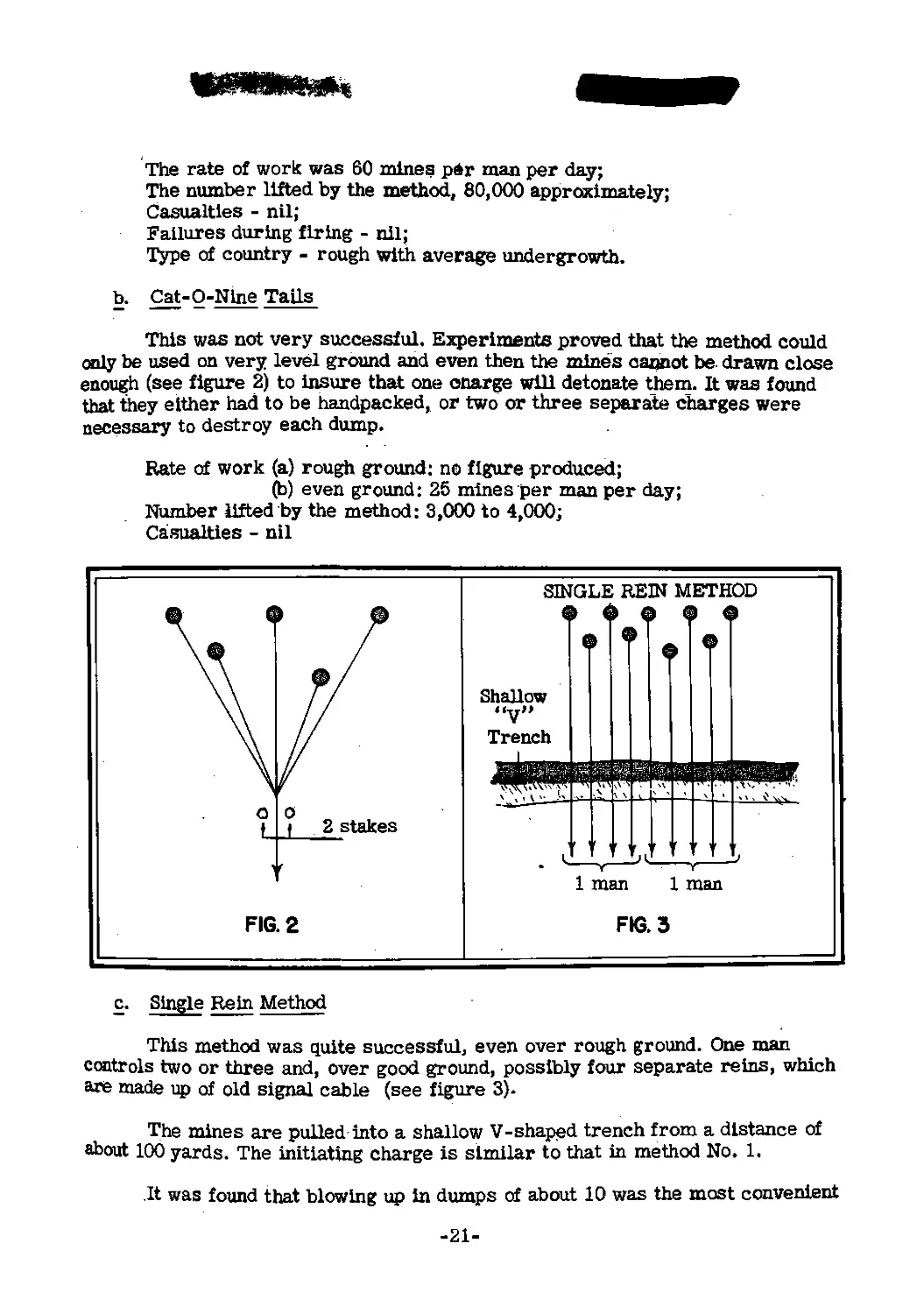
enough (see figure 2) to insure that one charge will detonate them. It was found
that they either had to be handpacked, or two or three separate charges were
necessary to destroy each dump.
Rate of work (a) rough ground: no figure produced;
(b) even ground: 25 mines per man per day;
Number lifted by the method: 3,000 to 4,000;
Casualties - nil
c.	Single Rein Method
This method was quite successful, even over rough ground. One man
controls two or three and, over good ground, possibly four separate reins, which
are made up of old signal cable (see figure 3).
The mines are pulled into a shallow V-shaped trench from a distance of
about 100 yards. The initiating charge is similar to that in method No. 1.
It was found that blowing up In dumps of about 10 was the most convenient
-21-
number.
The rate of work: 30 mines per man per day;
The number lifted by the method, 60 to 70,000;
Casualties - nil;
Type of ground, average.
This method was not given fair trial over smooth ground. The rate of work
in that type of ground would probably be 40 mines per man per day.
d.	Six in One
This method was the quickest over smooth ground. It would undoubtedly
have the disadvantages of other methods on rough ground. One man is capable of
drawing in six mines at once with the assurance that they will be close together
in the pit.
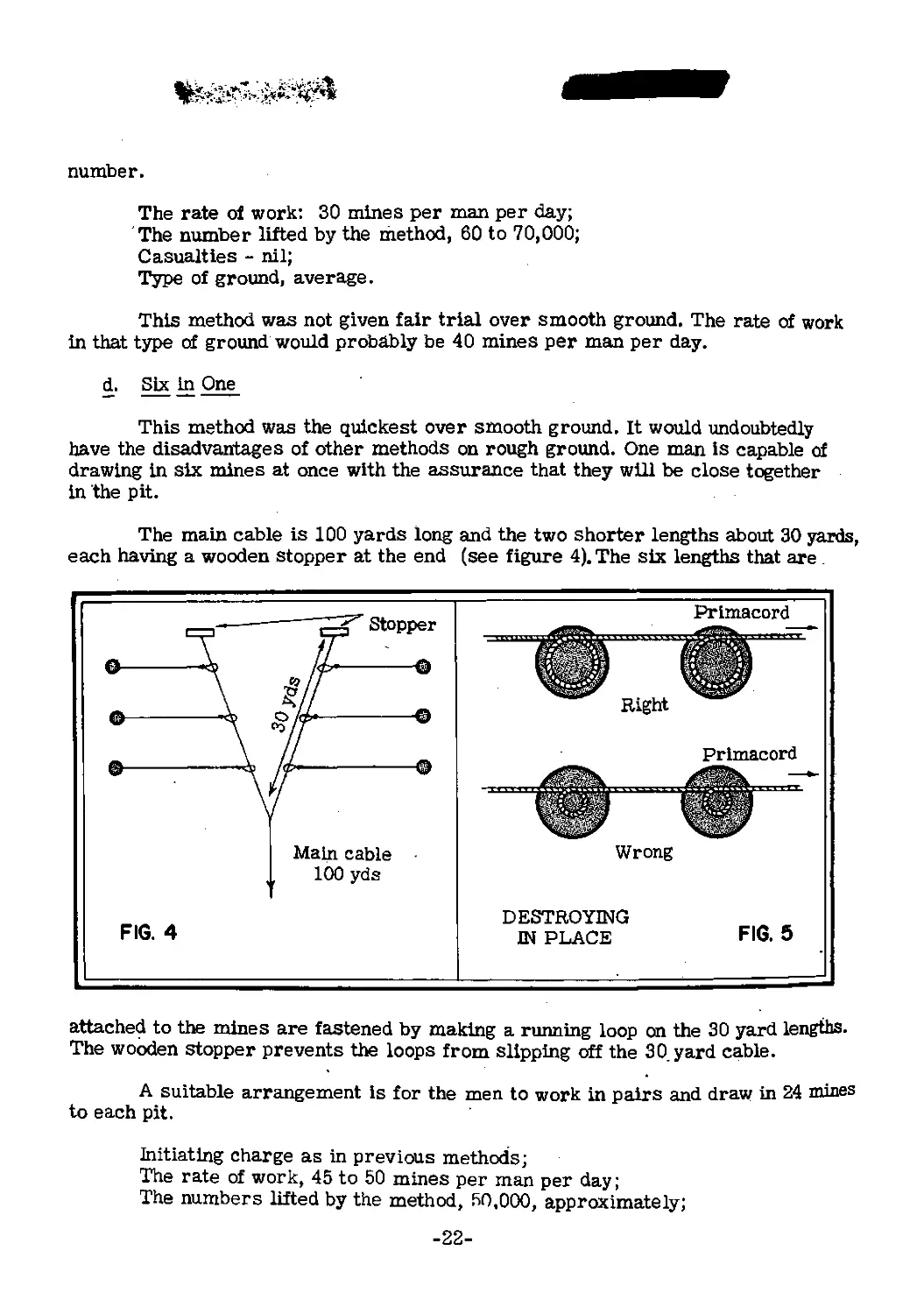
The main cable is 100 yards long and the two shorter lengths about 30 yards,
each having a wooden stopper at the end (see figure 4). The six lengths that are
Primacord
Wrong
DESTROYING
IN PLACE
attached to the mines are fastened by making a running loop on the 30 yard lengths.
The wooden stopper prevents the loops from slipping off the 30. yard cable.
A suitable arrangement is for the men to work in pairs and draw in 24 mines
to each pit.
Initiating charge as in previous methods;
The rate of work, 45 to 50 mines per man per day;
The numbers lifted by the method, 50,000, approximately;
-22-

Casualties - nil;
Nature of ground; smooth sand.
e.	Destroying in Place
Primacord (instantaneous fuze) is ideal and does not require any sub-
sidiary explosive. A loop on the top of each mine held in place by a stone Is
sufficient (see figure 5)
One main point, however, Is that the loop must be at least 3/4 the diameter
of the mine, so that the pressure is towards the outer edge. Failures were reported
if the loop was too small.
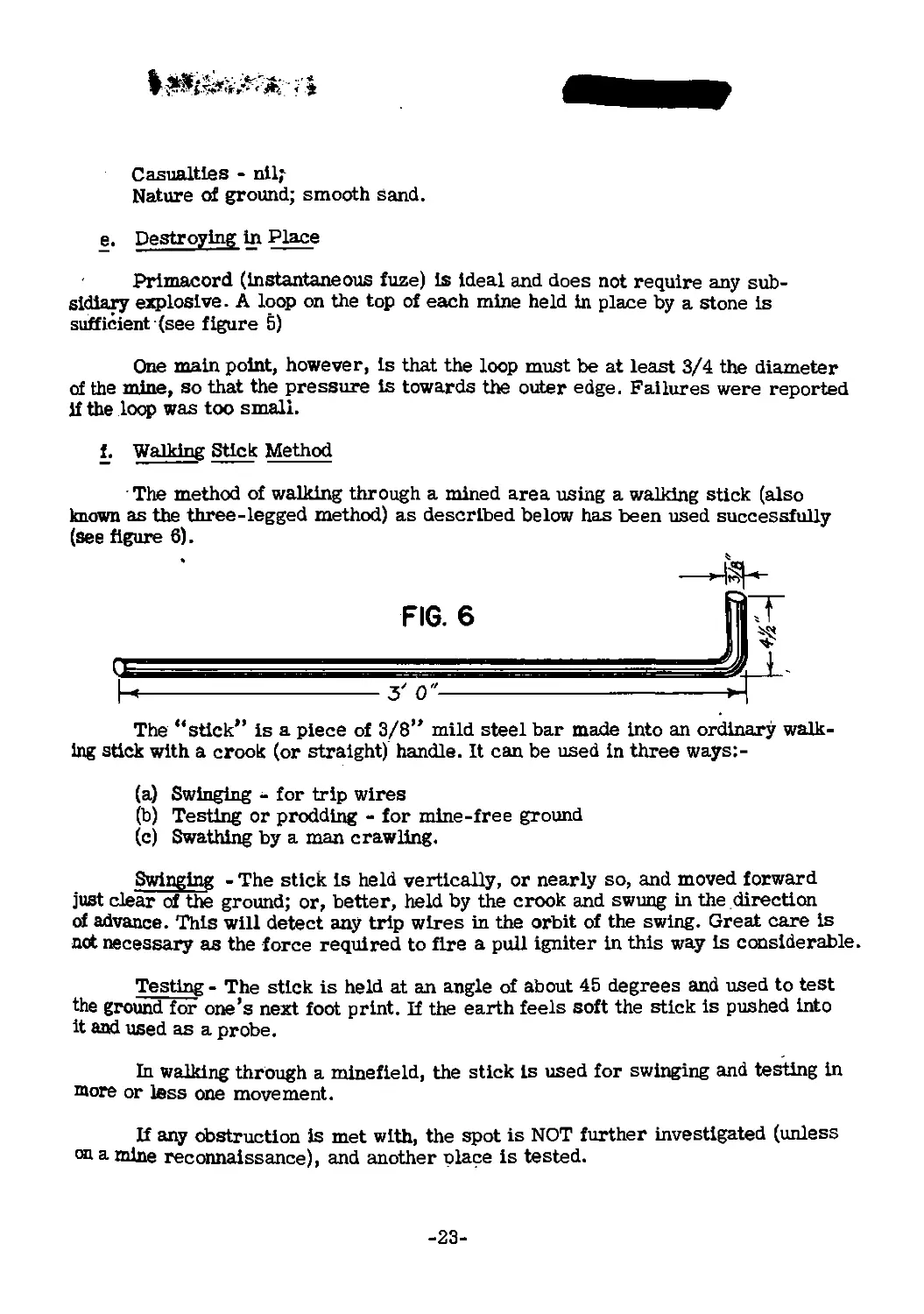
f.	Walking Stick Method
The method of walking through a mined area using a walking stick (also
known as the three-legged method) as described below has been used successfully
(see figure 6).
The “stick*’ is a piece of 3/8’* mild steel bar made into an ordinary walk-
ing stick with a crook (or straight) handle. It can be used in three ways:-
(a)	Swinging - for trip wires
(b)	Testing or prodding - for mine-free ground
(c)	Swathing by a man crawling.
Swinging - The stick Is held vertically, or nearly so, and moved forward
just clear of the ground; or, better, held by the crook and swung in the direction
of advance. This will detect any trip wires in the orbit of the swing. Great care is
not necessary as the force required to fire a pull igniter in this way Is considerable.
Testing - The stick is held at an angle of about 45 degrees and used to test
the ground for one’s next foot print. If the earth feels soft the stick is pushed into
it and used as a probe.
In walking through a minefield, the stick is used for swinging and testing in
more or less one movement.
If any obstruction is met with, the spot is NOT further investigated (unless
on a mine reconnaissance), and another place is tested.
-23-

Swathing - A man crawling uses the walking stick held horizontally and
flat on the ground. He thus sweeps an arc of ground immediately to his front to
detect 3-pronged igniters. The stick can also be used (held half-way down) as a
“short arm” prodder.
g.	Clearing Antipersonnel Minefield
From a recent report on clearing an enemy antipersonnel minefield the
following points have been noted.
(a)	A careful search with a detector to insure 100 per cent clearance is
necessary.
(b)	Engineers checked one field where they found two mines overlooked
by the infantry who had already reported the area clear.
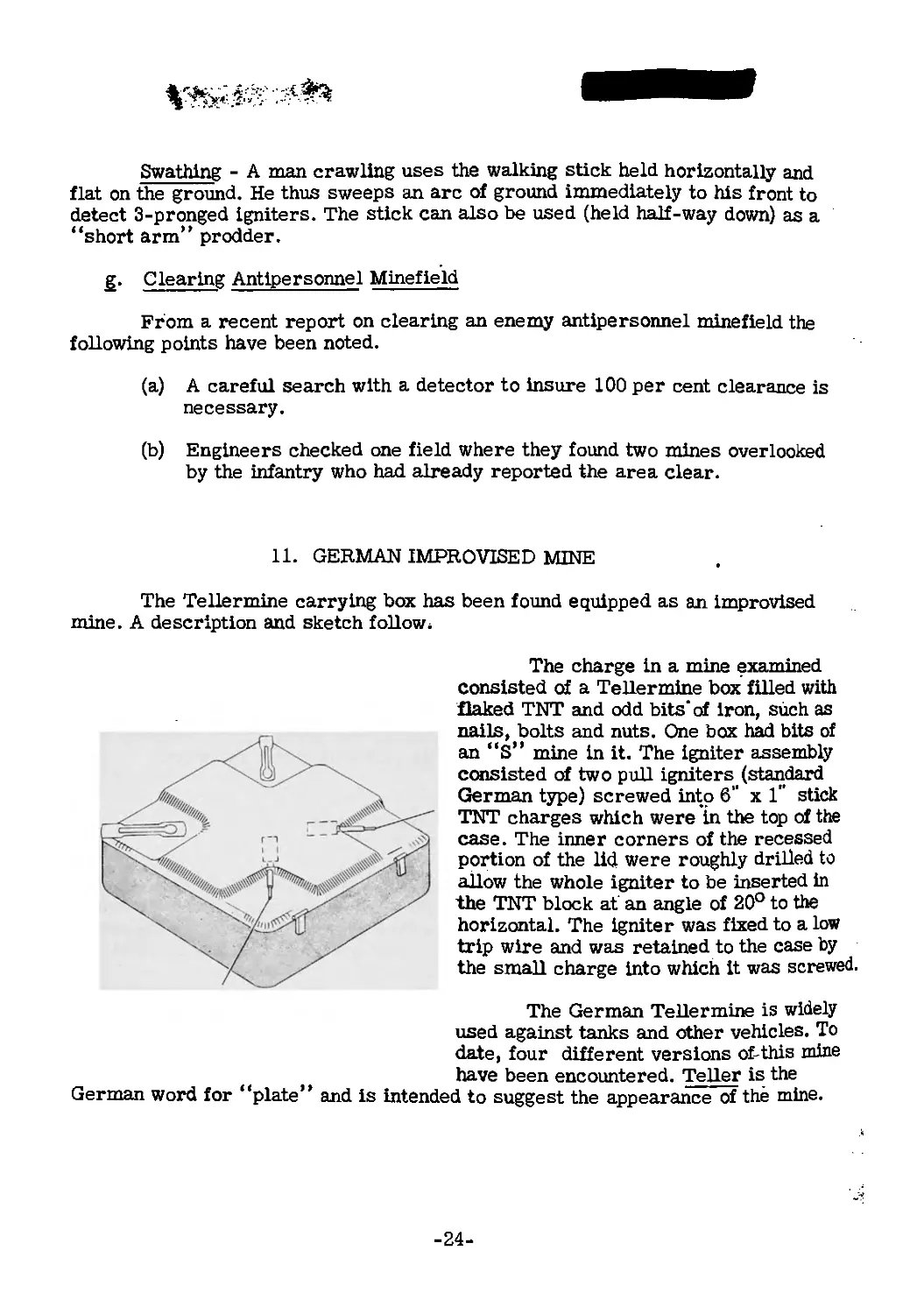
11.	GERMAN IMPROVISED MINE
The Tellermine carrying box has been found equipped as an Improvised
mine. A description and sketch follow*
The charge in a mine examined
consisted of a Tellermine box filled with
flaked TNT and odd bits'of iron, such as
nails, bolts and nuts. One box had bits of
an “S” mine in it. The igniter assembly
consisted of two pull igniters (standard
German type) screwed into 6" x 1" stick
TNT charges which were in the top of the
case. The inner corners of the recessed
portion of the lid were roughly drilled to
allow the whole igniter to be inserted in
the TNT block at an angle of 20° to the
horizontal. The igniter was fixed to a low
trip wire and was retained to the case by
the small charge into which it was screwed.
The German Tellermine is widely
used against tanks and other vehicles. To
date, four different versions of-this mine
have been encountered. Teller is the
German word for “plate” and is intended to suggest the appearance of the mine.
-24-
INFANTRY
12.	SOME BASIC TACTICS OF THE JAPANESE
A review of the operations of the Japanese so far in this war shows that
they have stressed the indoctrination of an almost fanatical spirit of self-sacrifice;
the wide use of deception; and emphasized speed, surprise, mobility, and offensive
action. From almost every fighting front in the Pacific there have come reports
that it. has been necessary to completely wipe out all Japanese opposition before
the objective could be attained. The following examples taken from a British source
are illustrative of some basic Japanese tactics.
* * *
“When I received my mobilization orders, I had already sacrificed my life
for my country...you must not expect me to return alive.” This sentence is
quoted from a letter found on the body of a dead conscript. It is by no means
exceptional and indicates a fanatical conception of service which finds expression
in a disregard for personal safety and a readiness to fight to the last man and the
last round. The morale from which such feelings of self-sacrifice spring, is based
on an attitude of mind assiduously cultivated from a very early age.
Japanese moral training instils a strong religious belief; “Comrades who
ftave fallen,” reads what is almost the last entry in a soldier’s diary, “soon we
shall be fighting our last fight to avenge you, and all of us together, singing a battle
song, will march to Kudan. ’ (Kudan is a shrine in Tokyo dedicated to the war
dead). The second pillar of Japanese morale is deep personal devotion to the
Emperor. The .last blood-smeared page of a diary captured in Burma has “Three
cheers for the Emperor” scrawled across it. The army belongs to the Emperor and
its mission is his divine will. Finally,the Japanese believe they are a chosen people,
and a superior race. Such is the basis of a morale to which is closely allied a high
state of individual and collective battle discipline.
All this does not mean that the Japanese are immune from fear and defeat.
Even now when the main United Nations effort is still confined to Europe and the
situation is more favorable to the Japanese than it may ever be again, we find that
the desire for self preservation can, at times, be stronger than the desire to stay,
and fight it out. A statement by a Japanese captured in the Arakan is worthy of
note. He volunteered the information that our shelling and bombing had caused,
besides shell shock, several cases of nervous prostration.
Japanese tactics in general are based on deception and rapid maneuver.
They will go to extremes to create false impressions. Sheer weight of numbers
and steam-roller tactics are apparently distasteful to them, as such tactics lack
finesse, though they would probably be used if required. One gets the impression
that the perfect solution to a tactical problem is a neatly performed stratagem,
followed by an encirclement or a flanking attack driven home with the bayonet.
This allows the commanders to demonstrate their ability, and the men to show their
courage and ferocity in hand-to-hand fighting. Their plans are a mixture of military
-25-
artistry and vain-glorious audacity.
Deception, strategems and ruses must be expected at all times. Bulldog
tenacity in carrying out a mission, even to annihilation, will very frequently give
a most erroneous Impression of the Japanese strength and will often result in
small forces overcoming larger ones, as their units are not rendered ineffective
until they are nearly all casualties.
This capacity for driving on despite losses is not displayed by officers
only. Training for the Japanese has been so thorough that every man will keep
plugging until his own part of the main mission is completed. Long experience has
taught even the privates what must be done before a mission is completed, and
discipline, lack of imagination, and fatalism, drives them on despite losses.
To the Japanese leader, tactics is an art, with decisions gained by skill,
not by sheer power. Training and the delegation to subordinates of the initiative
for independent action are most probably the factors that make such tactics simple.
The Japanese attempt to achieve surprise both in strategy and tactics and
ruses are extensively employed.
Approaches through country regarded as impassable and the conduct of
operations during foul weather are means by which troops more sensitive to
ground and climate have been placed at a disadvantage. The fifth column has been
freely employed, and with its aid it has been possible greatly to increase the
methods by which the enemy can be taken by surprise.
Ruses include the use of disguises, calling out in the language of opposing
troops, feigning panic, disorganized withdrawal, and the use of captured uniforms
and native clothing. Disorganized withdrawal may be accompanied by strewing the
line of withdrawal with supplies and equipment—all cardfully covered by concealed
machine guns.
Mobility, which is achieved in a number of ways, has been one of the most
important factors in obtaining surprise. The ability to exploit to the full the
exceptional marching powers of the troops--they are capable of covering thirty or
more miles per day--is closely allied with the question of rations. They may, by
choosing a circuitous path through difficult country; attempt to overtake and cut
the line of retreat of a force withdrawing along a road, but mobility does not end
there; if the chances of living off the country are small, troops may carry as
much as seven days’ rations with them, thus freeing themselves during this period
from the encumbrance of an administrative tail. Impressed local inhabitants,
with carts or boats, if the country is suitable, supplement their carrying powers,
while opportunities to seize local supplies are never neglected.
The Japanese soldier has been trained to carry up to 58 pounds which is
what Napoleon’s troops carried when they marched to Moscow--but the total load
of the French included 15 days’ rations. Lest either of these loads should be thought
exceptional, we should not forget that the British troops in the Peninsular War
-26-
carried about 60 pounds and those at Mons in 1914 carried only a few pounds less.
It should on no account be construed from this paragraph that the Japanese
habitually carries a heavy load of rations and equipment, for like us he prefers to
fight as lightly equipped as possible," but the point worthy of note is that if several
days’ mobility can be achieved c ’ '.e price of carrying a load of rations on
his back, he is prepared to carry ...
Offensive action has been described as a principle which gives moral
superiority, tends to confer the initiative, and, with it, liberty of action. The
Japanese interpretation applies the principle of offensive action not only to his
attacks but also to situations in which his defeat is a foregone conclusion. What-
ever the situation, his object is to kill the enemy, “if only I can die killing six or
seven of the enemy instead of by his first onslaught"-writes a soldier just before
the last attack is made by a small party.
In August 1942 American marines raided an island held by about 90 Japanese.
The raid was a complete success and most of the garrison were annihilated. The
remnant, however, estimated at about a dozen, attacked the raiding party as it was
leaving the island and thus suffered further casualties. It is an interesting example
of offensive action in desperate circumstances.
An outstanding example of strategic mobility on the part of the Japanese
was their advance through the Shan States from Karenni in the south to Myitkyina
in the north, a distance of some 450 miles, covered in three weeks. This feat is
even more remarkable when it is realized that during their advance the Japanese
fought thre ; heavy engagements and were hindered by numerous delaying actions.
The maintenance of a dally average advance of some 21 miles despite delaying
actions and having to fight, speaks for itself as an example of strategic mobility.
In considering hoW this advance was achieved the following points are outstanding:
First, the skill of the Japanese in the choice, direction and execution of their
encircling movements which, probably more than any other single factor, accounted
for the speed and great distance of withdrawals the Chinese were compelled to
undertake. Second, the refusal on the part of the Japanese to be deterred from the
primary objective by threats to flank or rear.
Finally, there is the ability of the Japanese to move without a cumbersome
administrative overhead.
13.	GERMAN DEFENSIVE TACTICS IN WOODED
AND MARSHY COUNTRY
The following description of German defensive tactics on the Eastern
Front is taken from an Allied source.
-27-

a.	Selection of Defensive Positions
In wooded country a highly developed system of artificial obstacles was
usually constructed along the outer perimeter of a defended position and machine-
gun positions were sited in all defense areas and also along the perimeter.
Defense based on mutual fire support, as well as on the strong system of
obstacles covered by fire, allowed battalions to be dispersed over wide frontages
and thereby permitted stronger forces to be maintained for the defense of more
open country and for tactical reserve.
The Germans, when undertaking the defense of a thickly-wooded position
usually cut out of the wood a wide clearing in the shape of an obtuse angle, the
apex of which pointed inward towards the defense area.- Both sides of the clearing
were covered by timber, obstacles, mines, fougasses* and wire (of from two to
four strands). These clearings were patrolled day and night.
The main lines of resistance were normally 150 to 200 yards in the rear
of the obstacles, their firing points being disposed in depth. Clearings in the form
of lanes leading to the flanks were cut out of the wood In order to allow the siting;
of flanking machine-gun positions.
The forward defended zone was not organized in depth within 1,000 yards
of the obstacles. The regimental reserve line was constructed similar to the main
line of resistance but with fewer machine-gun positions. Between the main line of
resistance and the regimental reserve line, there were double-embrasured fire
positions sited in checker-board fashion.
The weakness of such a defensive system lies in the fact that the defender
depends entirely on a system of obstacles, whether natural or artificial, and fire
points, completely static and vulnerable to flank and night attacks. The Germans,
therefore, adopted this static form of defense only in wooded approaches to vital
points.
In marshy areas the Germans selected the commanding knolls of dry
ground and turned them Into defense areas forming a mutually supporting system
of such areas. If a knoll could not be incorporated within the defensive system it
might become an isolated post.
b.	Organization of the Defense
(1)	These defense areas might consist of two platoon areas disposed
along a front of 1,200 to 1,400 yards with a reserve platoon approximately 1,500
yards in the rear.
If the position of a platoon was not naturally strong, and lacked fire cover,
the weakness would be offset by a system of artificial obstacles designed to hinder
♦Land mines loaded with broken stones.
-28-

attack from the flank and rear. An outpost would be sited so as to protect the flank
of the position and the reserve position.
The ground between any two defense areas was covered by fire from both
positions forming a sort of pocket into which the Germans would attempt to entice
their opponents’ advance.
(2)	In the open parts of an area, as well as within inhabited place?, the
German defensive positions were marked by the usual system of timber and earth
fortifications and considerable concentrations of fire power. Within 100 to 150 yards
of the main line of resistance pickets armed with sub-machine guns, were posted
in pairs. At night, the whole area was patrolled. The main line of reslstence was
usually covered by wire placed between minefields. In the rear of the minefields
slit trenches were dug and behind them were machine-gun emplacements. The
machine guns were sited in line or in checker-board fashion with heavy and light
machine guns alternating, the distance between them being 50 to 60 yards.
The above description is one of a normal type of defensive position. Such
positions were connected by crawl trenches sometimes over a mile long. This
permitted the enemy to manoeuver his forces and to bring up his ammunition un-
observed. In the event of artillery or mortar fire against his lines he often pulled
in the forward troops to shelters constructed in the rear. During the bombardment,
the trenches remained manned by observers and the Nos. 1 of the machine-gun
detachments. As soon as Russian troops moved forward to the attack the Germans
returned to their main line of resistance, using the crawl trenches.
c.	Construction of Defensive Positions
(1)	Emplacements for both heavy and light machine guns were usually
constructed in the shape of the letter W. The width of such an emplacement was
from three to four yards, the length four to five yards and few examples were
encountered on the northwestern Russian Front of the large quadruple-embrasured
machine-gun emplacement. The usual type was a two-embrasured emplacement of
light construction, used both for protecting the weapon and as a dug-out for housing
the detachment. The dug-out was normally covered by two or three layers of earth,
sod and timber, giving a thickness of 16 to 20 inches. Embrasures two feet long and
three to six inches deep in the emplacement were cut about 6 to 12 inches from
ground level.
(2)	Mortar emplacements sited in open areas were also of timber and
earth construction, similar to the machine-gun emplacements. In both cases
approaches on the forward side were mined.
(3)	In wooded and swampy areas, unsuited to tank movement, the Germans
made use of shrapnel mines and booby traps, the mines being placed some two
yards apart.
The minefields usually were found to have one or two, but seldom three rows,
the rows being anywhere from 2 to 15 yards apart. They were found on occasions to
-29-

be laid without any regular system in order to make the finding and clearing of
them more difficult. Timber and wire obstacles were frequently found to have a
single row of mines on the forward side. Land mines and booby traps were often
placed in and around wire and felled timber. Antitank and shrapnel mines were
frequently found in the immediate vicinity of enemy defense areas. These were
arranged so that they could be blown up by the garrison when attacking troops
advanced over them. It was common to find that minefields were extended over the
front without much depth. German fire-plans often included janes of some 150 to
250 yards width into which, by employing weak frontal fire, the Germans allowed
advance troops to penetrate, whereupon heavy enfilading fire with automatic weapons
was brought to bear. Mortars sited in groups of three or four were frequently used.
The use of single mortars was limited to roving weapons only. One of the tactics
employed was to abandon certain positions and emplacements with little resistance
and to enfilade the attacking troops as they approached.
The type of defense detailed above must not be considered as invariable,
in that the enemy changed his methods to suit topographical features and the
situation at the moment. This applied particularly to instances where the position
was known to have been patrolled by Russian troops and is a confirmation of the
necessity of carrying out never-ceasing reconnaissance in order to discover in
time any changes which have taken place in the defensive positions.
MEDICAL
14.	ITALIAN MALARIA PREVENTION
It is reported in an Italian navy circular dated March of this year, that
Italchina*is issued to Italian navy personnel as a prophylactic against malaria. It
is issued on two consecutive days each week in three doses totalling 30 centigrams.
Personnel stationed in central and southern Italy, Corsica, Sardinia, Sicily, Albania,
Greece, the Aegean area and North Africa received this prophylactic treatment in
the l*May to 15 November period. Men stationed in northern Itaiy, Russia and
Yugo-Slavia got Italchina pills from 15 May to 31 October. Quinine is only used as
a cure and not as a prophylactic against malaria.
15.	ARMY MEDICAL CONDITIONS IN NORTH AFRICA
a.	General
A very recent article by a British medical observer in North Africa has
come to hand, from which the following article has been taken. It is of interest to
the non-medical as well as Medical Corps personnel.
^Examination of captured Italian medical supplies,,reveals that this is Identical
With our atabrine.
-30-
Among the miscellaneous observations noted was that while lice were well
controlled in British and American troops, 20 to 25 percent of the captured German
troops and practically all the natives were lousy. As lice carry the dangerous typhus
fever, the freedom of Allied troops from the vermin is commendable. Venereal
disease rates in both British and American forces were unexpectedly low. Dysentery,
which might have been expected In Africa, was likewise not severe. Malaria infection
has not yet become a serious problem, but more is expected as the rainy season
advances. Among British and American troops, no tetanus was observed, a
remarkable tribute to the antitetanus vaccination, but captured German personnel
suffered from it. Gas gangrene, which haunted the hospitals in France during the
First WorldWar, has been cut to 51 cases and 13 deaths in from 10,000 to 12,000
wounded. Here it Will be noted that North’ Africa is a country where gas gangrene
is to be looked for, at least in the cultivated areas.
The incidence of psychoneurotic cases among the American forces was
high, especially where connected with extreme fatigue and nervous exhaustion.
Some appeared to be caused by blast injuries (shell shock). Most of these were
treated in the forward areas and returned to dutv.
b.	German Field Evacuation of Casualties
Forward field evacuation of the German forces seems to be handled
similarly to that in the American Army, there being company first aid men and
stretcher .bearers. A German division consists of three regiments and contains
one or two medical companies (Sanitatskompanie) which are similar to the
British field ambulance organization. Each of these two organizations consists of
eight doctors, who in the German Army are not given military rank, and 180*
medical department soldiers. Each company was broken down into a headquarters
and two other sections. Each section was prepared to perfonh surgical operations
and had a surgeon attached to Lt. One X-ray unit per dlvison was furnished. An
ophthalmologist was also occasionally attached to a company. The use of the personnel
of this organization does not seem to have been stereotyped but was subject to
variation as the situation demanded.
There was a regimental aid post near the front lines and evacuation to the
rear was direct by ambulance. The next step in the chain of evacuation was
Feldlazarett (f ield hospital) with a normal capacity of 200 beds. This hospital was
staffed by eight doctors, of whom three were surgeons; 200* enlisted men were
attached. Further to the rear was found a Kreigslazarett (probably evacuation •
hospital) with a bed capacity of 400 and capable of expanision to 700. During the
North African campaign no hospitals of larger capacities were to be found behind
the German lines. Evacuation of casualties from the Kreigslazarett was by air to
the Mediterranean Islands or to Italy. Following air supremacy by the Allies
evacuation of patients by air became difficult and the German hospitals were
greatly crowded.
fThese figures do not correspond to other reports on the organizational strength
of these units.
-31-
On the whole in the last phases of the North African campaign the wounds
seen In captured German soldiers were more severe than those experienced by
our own men. Mortar fire seemed to produce particularly severe types of wounds.
The severer German casualties were attributed to superiority In artillery fire and
air attack by the Allies.
ORDNANCE
16.	GERMAN 200-MM SPIGOT MORTAR
The German 200-mm (7.9 in) spigot mortar leichte Ladungswerfer 40 is
an engineer weapon, intended for use against minefields, wire, antitank obstacles,
and weapon emplacements. It is of normal spigot design, the propellant case being
attached to the top of the spigot before the bomb is loaded. Fixed ammunition is
not used. The 200-mm spigot mortar bomb was described in Tactical and Technical
Trends No. 16, page 32.
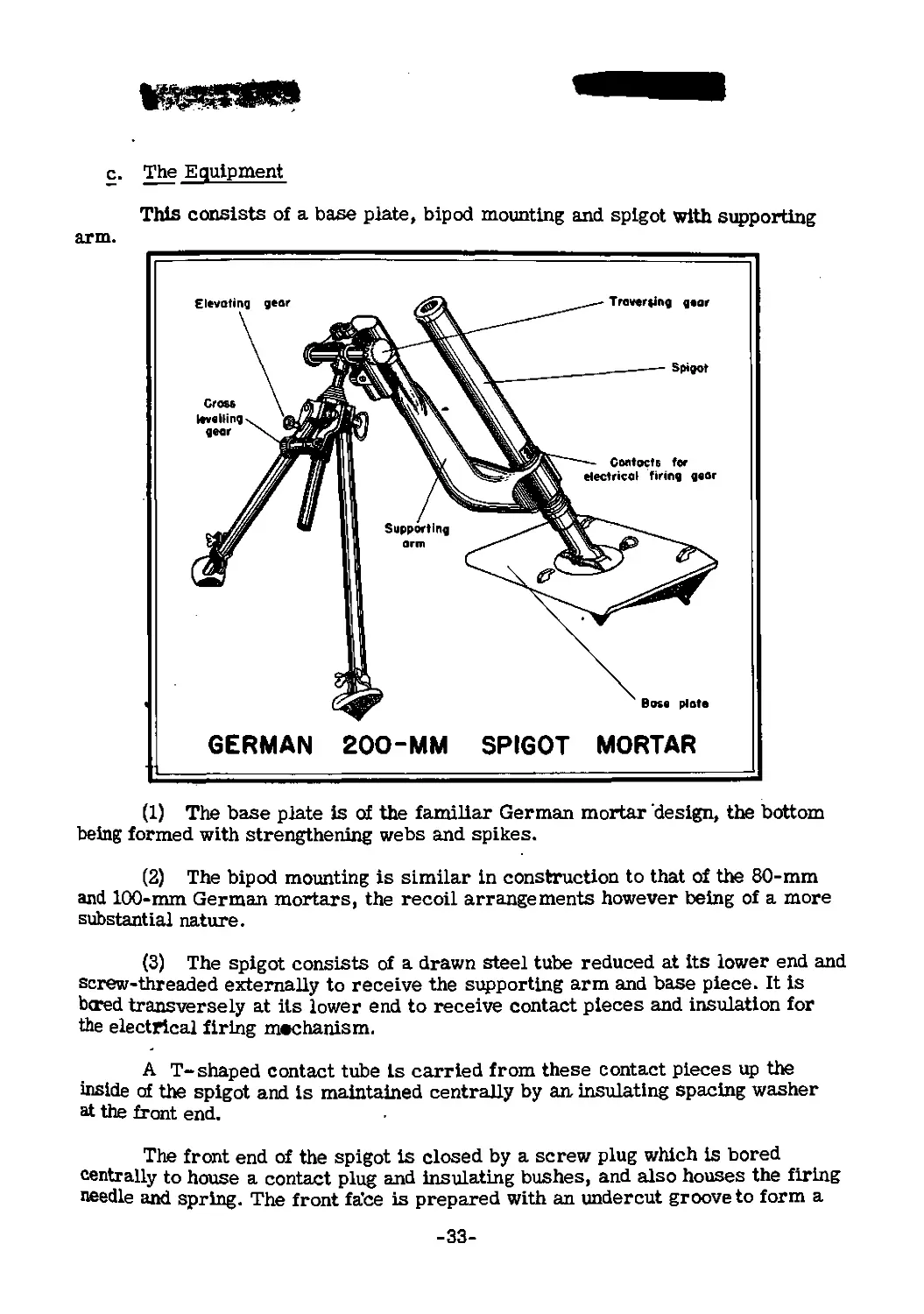
The following additional information as to the mortar itself with accompany-
ing sketch have recently been received from a British source.
*
♦
a. General Description
Total weight in action
Weight of bipod
Weight of spigot and supporting arm
Weight of base plate
Length of spigot
Diameter of spigot
System of operation
Range
Sight
Transport
205 lb
43 lb
73 1/2 lb
84 lb
21.15 In
3.5 in
feomb electrically fired
from spigot
766 yards max. with
46 lb HE bomb
Dial sight (Richtaufsatz 39)
Hand cart
b. Ammunition
The 46 pound HE bomb (200-mm Wurfgranate 40), a smoke bomb (200-mm
Wurfgranate, 40 Nb), and “harpoon projectiles’' are fired. The harpoon rounds are
said to be used to project cords by means of which mines or a network of charges
can be drawn onto dead ground.
-32-
c. The Equipment
(1)	The base plate is of the familiar German mortar design, the bottom
being formed with strengthening webs and spikes.
(2)	The bipod mounting is similar in construction to that of the 80-mm
and 100-mm German mortars, the recoil arrangements however being of a more
substantial nature.
(3)	The spigot consists of a drawn steel tube reduced at its lower end and
screw-threaded externally to receive the supporting arm and base piece. It is
bcred transversely at its lower end to receive contact pieces and insulation for
the electrical firing mechanism.
A T-shaped contact tube is carried from these contact pieces up the
inside of the spigot and is maintained centrally by an insulating spacing washer
at the front end.
The front end of the spigot is closed by a screw plug which is bored
centrally to house a contact plug and insulating bushes, and also houses the firing
needle and spring. The front fa’ce is prepared with an undercut groove to form a
-33-
bayonet joint when the cartridge Is placed in position.
(4)	The base piece screws on to the spigot and is formed with a ball at
the rear end to engage in the socket of the base plate.
(5)	The supporting arm is tubular and elbow shaped. The rear end is
formed with a boss which is bored to receive the spigot, the .front end is solid and
is sczew-threaded to receive a collar for positioning in the cradle.
GENERAL
17.	FIELD NOTES ON SICILIAN AND AFRICAN OPERATIONS
An officer returning from the Sicilian operations reports that extensive use
was made of pill boxes designed to resemble such ordinary road-side structures
as houses and filling stations. These were usually found at road bends, where two
fire lanes could be covered, and contained machine guns and antitank weapons. It
was a most successful camouflage.
The triangular yellow pennant bearing a black skull and cross bones hanging’
from a light steel support stuck in the ground, was described in Tactical and
Technical Trends No. 24, page 11 as a gas contamination warning. In Sicily its
appearance was associated with the presence of booby traps.
South of Mateur In Tunisia, the same officer reported the presence of
rough cast-aluminum mines resembling tellermines. It is hoped that an accurate
description of these mines will shortly be available, as they appear to be made in
’the field of salvaged materials, and may be met with in Europe.
In a German battalion-strength hill defense position that put up a particular-
ly stiff resistance, the machine guns and antitank weapons were sited with their
muzzles barely clear of the ground along the crest. Behind the crest were deep
dug-outs and trench positions to which the garrison retired during bombardment.
German powder is practically smokeless, but does flash at night. The
88-mm guns give no smoke, and on one occasion, held up a tank attack all day, till,
at dusk light tanks were sent out to draw fire, and the guns were located by their
flash.
He remarked upon the successful use of a 110-foot span steel Bailey bridge
triple truss, single story, which during the Sicilian operations, had to be emplaced
over a deep gorge at a hairpin turn. In spite of the turn, the bridge was placed by
means of a counterweighted end.
-34-
18. THE STING RAY OR STINGAREE
While American troops are fairly well acquainted with the vicious habits
of the shark and barracuda, other varieties of dangerous fish exist in far greater
numbers in S. W. Pacific waters, where even the coral can cause poisoned cuts.
Many of these warm-water fish are capable of giving venomous stings, and are
far more likely to be encountered by troops in operations along the shore, than
the barracuda or shark. Among them are the stone-fish and scorpion-fish, small
to moderate-sized denizens of coral reefs; the weever, a reef fish resembling a
sea-bass, but equipped with venomous spines upon its head; numerous sea-urchins,
animated pin cushions that live among stone and coral, which are capable of giving
severe stings if touched, or disabling, poisoned wounds if trodden upon. In shallow
water, on both sandy and mud bottoms lurks the sting ray, see figure 1.
The authoritative magazine, Natural History, published by the American
Museum of Natural History, New York City, recently referred to the sting ray or
stingaree, as the “rattlesnake of the sea.” A small specimen, perhaps a foot in
length exclusive of the whip-like tail, is capable of sending a man to the hospital;
a 200-pound ray can kill a man. Dr. Leonard P. Schultz, Curator of Fishes, U.S.
National Museum, to whom we are indebted for the following timely article, stated
that, on the mud-flats of a tropical river at low tide, he had seen sting rays, large
and small, lying as thickly as one per square rod. Such a congregation of highly
venomous fish constituted--to use Dr. Schultz’s expression—a mine field. As
casualties have already occurred among our forces from ray stings, the following
article may well be of value to officers whose commands are assigned to areas
where these fish occur.
♦ * *
In general, many people and some uninformed naturalists have the opinion
that sting ray or stlngarees do not have a poisonous sting. However, those of us
who have studied these fishes and have had personal experience with them, are
certain that the “sting” is highly venomous. Before I cite one or more cases
of persons who have been jabbed by the spine of a sting ray, I shall attempt to
acquaint the reader with these fishes and the nature of their sting or spines.
The stingaree is one of the_ rays, a fish related to the sharks and greatly
resembling them in structure. In shape, however, the rays are flattened and disk-
shaped, and have a long tail. The rays that bear a long sharp spine, usually in the
middle upper part of the tail, are known as sting rays, a word corrupted to stingaree.
Several dozen different species of sting rays are known to science. These
creatures occur in all warm seas, and in adjoining brackish waters as well as in
many of the tropical rivers, some freshwater sting rays in South America even
occurring more than a thousand miles above the river mouth. A few freshwater
sting rays occur in the S. W. Pacific area, in very shallow water. Wherever sting
rays occur - in the seas, bays, or in rivers - they are to be found, hiding on the
Oottom in mud or sand, if disturbed, they swim with an undulating motion, usually
close to the bottom, and stir up a cloud of mud, then come to rest on the bottom,
-35-
the muddy cloud gradually settling around the ray. This “mud cloud” and the
camouflaged coloration of the fish itself, serves a definite purpose in concealing
it. While thus partly burled in the sand or mud bottom, the sting ray is in perfect
readiness to drive its sting into any unsuspecting victim who might inadvertently
step on it. The weight of a person stepping on the disk-shaped part of the body
anchors the sting ray, giving it the needed leverage to whip its tail upward with
uncanny precision and drive the already erected spine or sting Into its target The
sting, on the powerful tail of even a small ray only a foot across In size, can pass
through one’s foot or into the bone of the leg.
Figure 2 (see p. 38) shows the sting or spine clearly with the barbs along the
sides and the groove near the base of these spines. Dr. H. M. Evans of the
Lowestoft Hospital, England, who made an extensive study of the sting ray, found
that the poison gland of the fish occurs in this groove. The barbs tear a jagged
wound and if the sting breaks off, it invariably has to be pushed on through or
dissected out by a doctor. J. Vellard carried out experiments injecting the venom
from the glands of South American freshwater sting rays in various animals, and
in several instances death occurred in a few minutes.
Now that the reader is familiar with the habits of the stingaree and the
structure of its sting, I would like to cite a few cases to illustrate why fishermen
and bathers have great fear of this demon of the beaches, bays, and rivers of the
tropics.
During 1942, my assistant, Rafael Navarro and I were collecting fishes for
the United States National Museum in a swamp north of Sinamaica, Maracaibo
Basin, Venezuela. We had walked nearly half a mile across this shallow muddy
mire, pushing a small boat (cayuco) in front of us. Along the way, we noticed
many sting rays measuring In size up to a foot across their disks. The water
was from a few inches to a foot deep and our feet sank as far In the soft muddy
bottom. We made a fair collection of the various kinds 6f fishes present and
started back. I urged my assistant not to pick up his feet in this mud but to push
them forward at the surface so that he would not step on one of these sting rays,
as they lie slightly Imbedded in the upper layer of the mud. If you touch one with
your foot it wiggles off, but if you set your foot upon it, this gives the little demon
the needed leverage for driving its sting, which is one or two inches long, into your
foot or leg with terrific force.
On the way, I heard Navarro cry out in agony. A stingaree had driven its
spine into his ankle, but fortunately -the spine did not break off. My assistant was
in terrible pain, jumped around wildly, and then lighted a match to stick into the
Wound. At this point I knocked the match from his hand and forcibly shoved him
.into the boat. Although Шу Spanish was not good, I made him understand that he
.should let the wound alone. It bled some and he was very excited. He tried to put
a tomlquet around the upper part of his leg to stop the flow of blood, but I observed
that it was not arterial blood and made him take the band off and let the wound
bleed freely for a few minutes, hoping to cleanse it of the venom. When we reached
Shore, I got out my first aid kit and cleaned the wound, swabbing it out with iodine
(for lack of something better), and then bandaged it. Navarro said the iodine hurt
-36-

almost as much as the sting. At camp that night, I found the wound was about an
inch deep, clear to the bone, but showing no special swelling. I then washed it off,
put on a larger bandage saturated with one percent metaphen, and after a week of
this treatmait, the sore was completely healed.
These freshwater sting rays are mere babies compared with the big ones
in the warm seas of the world. One species, the giant stingaree of Australia,
reaches a length of over 14 feet and a weight of at least 750 pounds. The sting in
such a large fellow is usually a foot long. One can well imagine what a terrible
thing it would be to have such a stingaree jab its sting through one’s leg. Evidence
from fishermen around Europe indicates that the venom of stingarees in the
adjacent seas is most severe, its action not greatly different from that of cobras.
Dr. Lo Bianco saw a young man become extremely pale and fall down almost
senseless for a few minutes after having received only a very small puncture from
the sting ray called Trygon. Another physician relates the case of a colonist of
Demerara, British Guiana, who died in violent convulsions, and of the two Indians
who accompanied him, who, wounded in the feet, became seriously ill and recovered
the use of their feet only after a long period of suffering. The same physician
continues: “Along the China coast, a twenty year old Chinese was wounded in the
thigh. He fainted and, on regaining consciousness, had complete numbness and
paralysis of the limb affected. ”
These few accounts, and others that I know of which have happened-to
acquaintances of mine, definitely verify the extreme virulent nature of.the venom
injected by the sting of the stingaree. Besides the venom, bacteria may enter the
wound and Infection set in, which has been known to result in death of the victim.
How to Avoid Stepping on a Stingaree
Since all stingarees hide, partly buried, in the mud or sand of the bottom,
they are always a potential danger to all who wade over such bottoms in tropical
seas or in certain tropical rivers. The chief hazard is to step on one of these
fishes. This is almost completely eliminated by scuffling your feet along the
bottom in the upper layer of mud or sand. The moment something touches the
ray, it wiggles off. In addition, it would be advisable to carry a pole and probe
the bottom in front of you as you walk forward. Remember the stingaree may
occur in water only a few inches deep.
How to Treat the Wound Made by the Stingaree
For treatment of the wound made by the sting ray or other venomous
fishes, I quote Dr. H. M. Evans. “From practical experience, I have come to the
conclusion that the most useful method is to inject into the puncture 0.5 cc of
5 per cent solution of permanganate of potash. Two patients I treated in this way,
having been stung by the lesser weever in the foot, had immediate relief from pain
and were able to walk away from my house in perfect comfort, and no inflammation
or gangrene resulted. For the resulting inflammation in untreated cases, cooling
lotions or hot fomentations must be applied.”
-37-
No doubt some bleeding is beneficial as it may wash out some of the venom
left by the sting. Iodine has been found useful also, in the treatment of such wounds.
FIG. I	FIG. 2
-38-
SECTION II
THE ECONOMIC ORGANIZATION OF THE GERMAN ARMY
THE ECONOMIC ORGANIZATION OF THE GERMAN ARMY
Introduction
The German Wehrmacht has displayed a clear understanding of the impor
tance of economic factors in modern warfare and has attempted successfully to
apply this understanding in the practical sphere of operations.
The importance of economic factors in influencing the outcome of a
modern war was driven home to the German armed forces by the events of the
First World War. German post-war military doctrine blamed the outcome of
the First World War in large part on the failure of Germany to prepare in advano
for a long, industrial-type war. A substantial section of influential military
opinion held that the economic factor was decisive in Germany’s losing the war.
The war of attrition that developed after the First Battle of the Marne found
Germany unable in the long-run to match the production potential of the Allied
Powers. Germany’s failure tp build up large stockpiles of essential imported
raw materials, expand domestic food production, arrange for an orderly shift
from peacetime to wartime production, devise an efficient rationing system, and
develop plans for the Incorporation of the economy of the occupied nations into
the German economy meant that it was forced to improvise in the economic
sphere.
Although Germany’s economic efforts in 1914-1918 compared favorably
with those of the Allied Powers, its initial failures meant that it forfeited its
only real oppbrtunlty to offset its inferior resources by a more effective and
prompter economic mobilization. The greatest single blow to the Central
Powers came with the entry of the United States into the war. It was the unex-
pectedly prompt harnessing of the American production potential and the near
exhaustion of the limited German potential that was in large part responsible
for the final military collapse of Germany.
The significance of the American effort was not lost upon the German
military leaders. The post-war army leaders were determined to avoid the
economic mistakes of the First World War. The failure to carry out effective
mobilization in the pre-war period was blamed largely on the Inability of the
German military and civilian authorities to grasp the potential importance of
economic factors In determining the outcome of the war. The logical answer to
avoiding repetition of this experience was to secure within the armed forces a
body of officer personnel competent to cope with the problems of economic
mobilization. This procedure would overcome the major weakness of the pre-
World War I military personnel in the economic sphere,which was the lack of
interest in, and an understanding of, economic problems on the part of the General
Staff. This lack of interest meant that the military failed to play a decisive role
-41-
in formulating economic mobilization plans and failed to exercise a general
supervision over the economy sufficient to ensure an adequate arms production
and sustained powers of resistance over an indefinite period.
Preliminary Military-Economic Research
Out of the First World War experience, then, a German military doctrine
as to the proper role of the military in a war economy arose. The essential
element of the doctrine was that representatives of the armed forces should
assume authority for the over-all planning of economic mobilization and the
coordination of the military and civilian phases of the economy.
The first actual step taken In the post-war period was the undertaking of
a careful study of the experiences of the first war in the Historical Section of the
General Staff, camouflaged as a section of the Reichsarchiv. The economic studies
were published as a series,Kriegrustung und Kriegswirtschaft (War Armament
and War Economy). Two volumes, dealing with the pre-World War I experience
were published by 1930, while the otiier volume, dealing with World War I
economic mobilization, was kept secret. These studies contained the blueprints
and drawings for the mass production of armaments under the Hindenburg program
of 1916.
Shortly after the establishment of the Historical Section, a small economic
section devoted to the preparation of economic mobilization plans was established
within the Heereswaffenamt (Arms Office, i.e., Ordnance Department) of the
Reichswehr. This section was called the Nachschubstab (Supply Staff) and was
a part of the Testing Division of the Ordnance Department. As early as 1926,
the Nachschubstab began to place officer-economists with the various corps area
commands (Wehrkreiskommandos) for the purpose of exploring quietly the arma-
ment potential of the districts to which they were assigned. At the same time,
the first attempts were made to interest certain leaders of industry in economic
mobilization problems. At the instance of the Heereswaffenamt a committee of
industrialists, disguised behind the name of Statistical Society7 was created under
the chairmansnip of Privy Councilor von Borsig.
Preliminary Organization
The officers first engaged in the economic studies and planning were
largely outside the 100,000 men permitted the Reichswehr under the Versailles
Treaty. They were men who had studied engineering and technology as part of
their military education and who, but for their camouflaged employment, would
have had to remain in the private businesses to which demobilization had sent
them.
The need for additional officers specially trained for the economic phase
of modern warfare, and particularly younger officers for field-inspection work,
soon became apparent. A small but steadily increasing number of officers on the
active list were therefore sent to study engineering and ecpnomics in various
technical institutes.
-42-
The use of non-military institutions was necessary because the mil Лягу
academies had been abolished under the Versailles Treaty. The chief place of
study was the Technical Institute at Berlin-Charlottenburg. The emphasis in the
training was upon industrial engineering problems such as production management
in armament factories, problems of standardization, control of raw material flows,
and rational use of manpower.
The training of the officers included at least one year of practical work
in factories and other production plants and numerous inspection trips to mines,
factories, and producing and fabricating centers.
Upon this pioneer work of the Reichswehr, the Third Reich proceeded to
build an elaborate system of military Control of economic mobilization. In 1933
a new body, the Wehrwirtschaftsstab (War Economy Staff) was instituted under
the leadership of Colonel Georg Thomas and with a small staff recruited from
the officer-economists trained in the 1920’s, The Wehrwirtschaftsstab represented
the direct successor to the Nachschubstab of the Ordnance Department.
Working Organization - The WiRu
The Wehrwirtschafts und Riistungsamt im Oberkommando der Wehrmacht
(War Economy and Armament Office of the High Command of the Armed Forces)
The Wehrwirtschaftsstab functioned under the control of the High Command
of the Armed Forces as the key economic organization of the Wehrmacht. From
1933 until 1938, command of the Armed Forces was exercised by the Wehrmachtamt
(Armed Forces Office), a special office in the Reich War Ministry (Kriegsmlnis-
terium) composed of representatives of the Army, Navy, and Air Force.
In 1938 the Oberkommando der Wehrmacht (High Command of the Armed
Forces) took the place of both the old War Ministry and the Wehrmachtamt. As
a part of the general reorganization, the name of the Wehrwirtschaftsstab was
changed to Wehrwirtschafts und Riistungsamt (WiRu). Under Colonel Thomas,
later promoted to general, this economic staff remained under the supervision
of the High Command of the Armed Forces as before and was composed of repre-
sentatives of the three services.
The principal duty of the Wehrwirstschaftsstab-WiRu was to plan the mo-
bilization of the German war economy. This involved the WiRu in a thorough-
going examination of German resources and the preparation of detailed plans
for the conversion of German industry into armament production.
(a)	Mobilization Plans
The formulation of mobilization plans by the WiRu involved it in policy
decisions on a variety of Important questions, such as the distribution and accumu-
lation of raw materials, conversion of existing plant facilities, location of the
armament Industry, personnel requirements of the new armament Industry,
broad principles of price and wage policy, and regulations governing the adminis-
tration of the Wehwirtschaft.
-43-
The scope of the activities that had to be undertaken by the WIRu In
preparing its mobilization is indicated by its organizational structure, the WiRii
being divided into four branches:
War Economics Division
Armaments Economics Division
Raw Materials Division
Price and Contracts Examination Division
This phase of the work of the WiRii was analogous to the economic mo-
bilization planning activities of the United States Army-Navy Munitions Board
in the same period. In contrast to subsequent developments in the United
States, however, the program planned by the WiRii was followed by the German
Government.
(b)	Implementation
The implementation of the broad plans developed by this military body
was carried out by a variety of governmental departments, largely civilian.
In 1936, when the Four Year Plan was introduced, the Office of the Four Year
Plan, under Goring, received supreme authority for the subsequent reorganiza-
tion of the German economy and the WiRii nominally functioned under directives
from this Office. However, this development created apparent rather than actual
overlapping of functions. Colonel General Thomas (promoted to General der
Infanterle in 1940), Chief of the WlR.il. was one of the organizers of the Four Year
Plan, and the WiRii continued its operations undisturbed,
(c)	Supervision of Armaments Industry
Although the WiRii was primarily a planning group, it acquired more and
more administrative functions as the German economy shifted onto a highly mo-
bilized basis. The most important of these functions revolved about the super-
vision of the German armaments industry. Armaments inspectorates were
established, first in every corps area (Wehrkrels), and later in smaller districts.
Each corps area inspectorate was placed under a Rustungsinspektor, whose rank
varied from colonel to major general, depending on the. industrial importance
of the Wehrkrels, and who was chosen from any of the three branches of the
armed forces. This officer was successor to the economic officer of the
Reichswehr but had far more power. His primary function was to serve as
counsellor on all economic questions involving the needs of national defense.
This involved supervision of all armaments and related plants in the district
The Inspectorate staff undertook detailed studies of available Industrial capacity
in their districts and made recommendations on such matters as the establishment
of new plants, conversion of existing plant facilities into armament production,
and shift of old plants to safer areas.
The field inspection system of the WIRu became increasingly important
as the bulk of German industry shifted into war production. This development
moreover involved the WiRii in a number of very important new functions, most
-44-

important of which was the coordination of the military requirements schedules
submitted by the Army, Navy, and Air Force with the available supply of labor,
raw materials, and capital equipment.
(d)	The WiRu Subdivided
The system as developed in the pre-September 1939 period lasted without
important modification until May 30, 1942, when the WiRu was split into two
branches. The Riistungsamt (Armament Office) was transferred to the Ministry
of Armaments and Munitions under Speer. The Wehrwirtschaftsamt (War Econ-
omy Office) remains under the Oberkommando but some of its officer personnel
are subject to Speer’s orders as well.
The splitting up of the WiRu meant a definite curtailment of military author-
ity over the German economy. There are several explanations for the action under-
taken on May 30, 1942. In the first place the 1941 Eastern Campaign had revealed
certain defects in the existing system--duplications and overlapping of authority,
a mounting volume of paper work, administrative bottlenecks, etc. In the second
place, the curtailment of military authority fitted In with the current policy of con-
centrating power more and more into the hands of trusted Nazis. Under the re-
organization, final reconciliation between civilian and military requirements was
taken out of the hands of the Oberkommando and placed under the control of two
leading Nazis: Walther Funk and Albert Speer.
(e)	Walther Funk and the War Economy Office
Under the present system demands for war materiel which originate in
the various branches of the Armed Forces are first sent to the War Economy
Office (Wehrwirtschaftsamt), which sets up a balanced program of requirements.
From here the program is transmitted to the Armament Office (Rustuhgsamt) now
a part of the Ministry of Armaments and Munitions, where it is adjusted to the
available raw materials and.labor supply and the productive capacity of the German
economy. This board, therefore, has in effect the power to veto the requests of
the War Economy Office and is thus the central directing agency of German arms
production.
Supreme command over the civilian branch of the German war economy is
exercised by Walther Funk, Minister of Economics and Plenipotentiary for War
Economy. Speer, in his capacity of Minister of Armaments and Munitions, exer-
cises similar authority over the military sector. If Speer and Funk fail to agree
on fundamental policy, the issue may be carried to Gdring as Chairman of the
Ministerial Council for Defense of the Reich or even, ultimately, to Hitler.
Arbitration of this kind, however, is the exception.
The military requirements program, as formulated by the War Economy
Office and modified by the Armament Office, is translated into actual production
schedules, usually on a three-month basis, by the Ministry of Armaments and
Munitions. The allocation of raw materials to industry is carried out by a special
department of this Ministry, organized as a limited-liability company, christened
-45-

the Riistungskontor.
The determination as to who is to produce and how the war material is*
to be manufactured is in the hands of the Ministry of Armaments and Munitions
and the various German industrial organizations, especially the Main Committees
(Hauptausschusse) and Industrial Rings (Industrieringe). These organizations are
represented on the Riistungsrat (Armament Council), composed of five high army
and navy officers and eight industrialists, which serves as an advisory body to
the Minister of Armaments and Munitions, Albert Speer.
(f)	Speer's Armament Office
The regional administrative organization of the German economy was un-
affected by the May 30, 1942 decree, bi this sphere also considerable confusion
had developed as a result of a multiplicity of regional officials and bodies with
ill-defined jurisdictions. Finally on September 17, 1942, after all previous efforts
to achieve greater coordination among the regional agencies had failed, Goring
established by decree 42 regional armament commissions (Riistungskommissionen)
in the 42 party districts (Gaue).
These armament commissions have complete authority over the agencies
represented on them, which comprise all the organs of regional economic control,
those of the state and army as well as the self-governing agencies of industry:
(1)	Riistungsinspektor of the'Ministry of Armaments and Munitions (fre-
quently the chairman). Also the Wehrwirtschaftsinspektor (who may also be the
Riistunginspektor).
(2)	Armaments chairman (Riistungsobmann) representing the Main Com-
mittees and Industrial Rings.
(3)	The president of the provincial labor exchange (Landesarbeitsamt)
operating under the authority of the Ministry of Labor.
(4)	The president of the provincial economic office (Landeswirtschaftsamt),
operating under the authority of the Ministry of Economics.
(5)	The president of the district economic chamber (Gauwirtschaftskanuner);
and his economic advisers.
Whenever the need arises, the chairman of the Armament Commission may call
in other officials such as the presidents of the regional railway administrations ana
the managers or leaders of the regional organizations of Industry proper. The
chairman of each commission is appointed by and is responsible to the Minister
of Armaments and Munitions, who can thus control all the regional agencies in-
volved in the execution of the war production program.
One of the important features of the decree of September 17, 1942, was the
abandonment of the old corps areas as administrative units in favor of the party
-46-
districts (Gaue). Armaments Inspectors are now appointed for each of the 42
Gane, thus giving the Minister of Munitions the opportunity to appoint “loyal”
Inspectors and, if necessary, replace the old corps area armaments inspectors.
Field Operations of the WiRii
(1) Economic Troops
In addition to its planning and administrative work, the WiRii functioned
as the economic intelligence branch of the Armed Forces. In this connection
it undertook in the pre-1939 period detailed studies of the economic resources of
the other European countries. Emphasis was placed on the principal tangible
resources, such as raw material stockpiles, key mines, public utilities, plant
equipment, and readily available foodstuffs, the seizure of which would prove of
major usefulness to the German war economy.
The first opportunity of the WiRii to put into practice a system of field
organization for the sequestration of important resources came in September
1939. With the German armed forces concentrating on the offensive against Poland
and standing on the defensive in the West, it became necessary to abandon tempora-
rily small tracts of land in the Saar. The WiRii was called upon to devise ways
and means of withdrawing all of the most useful materiel to safer territory. Since
the Saarland ranks next to the Rhineland as the most concentrated industrial dis-
trict of Gex’many, this was a difficult assignment.
The task before the WiRii was the equivalent oi carrying out the prompt
sequestration and removal of the key resources of a small but highly strategic
bit of occupied territory. The WiRii carried out the assignment with efficiency
and dispatch. The civilian population was evacuated promptly and three thousand
carloads of machinery and supplies were moved into the interior of Germany.
The work of evacuation of equipment was carried out by representatives of the
WiRii, assisted by three provisional companies--one mining company to take
care of the mines and prevent their flooding, one electrical company to protect
the essential utilities, and one company for miscellaneous jobs—formed for this
particular operation.
Later, when the French Army withdrew from its advanced positions beyond
the Maginot Line and, incidentally, failed to carry out the obvious operation of
shelling the most important factories and Immovable mining and utilities equipment
before withdrawing, the WiRii agents immediately assumed responsibility for the
restoration of production in the Saarland. Evacuated machinery and supplies were
brought back, except in those cases where the new and less exposed location of a
particularly strategic ex-Saar plant was believed preferable.
The results achieved by the WiRii in the Saarland were distinctly superior
to-those of the regular Armed Forces in the Polish campaign. There it was
found that the regular troops had destroyed or seriously mishandled much valuable
economic materiel and had not tracked down supplies of foodstuffs, raw materials,
and finished products ruthlessly enough.
-47-
On the basis of this autumn 1939 experience, the Oberkommando delegated
to the WiRu the responsibility for extending field assistance to the combat forces
on all economic matters. These include the physical task of requisitioning raw
materials, finished products, and machinery in newly seized areas and the prompt
occupation and restoration of production of the most strategic mines, utilities, and
plants in those areas.
In the six months prior to the May 1940 campaign, the WiRii devised an
effective program for carrying out the field tasks assigned to it. As a first step,
officers from the WiRu were attached to the staff of the G-4, GHQ, and later to the
G-4 sections of the various Army (and sometimes Corps) Headquarters. These
officers served as liaison with the WiRii, and advised the G-4 on all economic
problems.
(2) Special Units
Plans were then drawn up for carrying out the requisitioning of foodstuffs,
raw materials, and equipment and the occupation of selected utilities, mines, and
industrial plants. A variety of special units were to be used for the purpose. Al-
though secrecy has been preserved as to the actual method of recruitment, the
following represents a probable close approximation of the method used.
In setting up these special units, the WiRu undoubtedly approached the
groups most experienced in the problems to be confronted, viz., the managers of
German mines and plants of types similar to those in the territory to be overrun,
and obtained their advice as to the proper methods of seizure and maintenance or
evacuation of specified plants and the type and number of technical personnel re-
quired to accomplish the objectives. On the basis of such information, the WiRii
could prepare tables of organization for the appropriate specialist companies.
It is probable that the activation of these companies was postponed until
just prior to hostilities, with the technical personnel lined up weeks beforehand
directly from German industry and supplemented at the last minute with regular
military personnel for use as operating cadre. It is believed that German engineer^
who had had previous experience in the districts to be overrun were included in
the companies whenever they were available. The specialist units were initially
assigned to GHQ, and then reassigned to the particular echelons which were to
advance into the sectors in which the previously-designated mines, utilities, and
plants were located. The economic staff officers attached to the various commands
advised on the proper use of the specialist units, particularly as to when they were
to be detached to occupy the economic objectives. Once these objectives were oc-
cupied, supervisory control over the units reverted to the WiRii.
A substantial number of such specialist units were apparently used in the
1940 campaign. Particular emphasis was placed in this campaign upon public util'
ities, mines, and armaments plants. Electrical units were utilized to occupy •
promptly the local gas, water, and electrical works to ensure that the essential
public utilities were maintained or restored. This was deemed of especial im-
portance as a means of facilitating the prompt restoration of industrial activity in
-48-
the occupied districts. “Mining units” were used to prevent so far as possible
damage to, and flooding of, certain highly strategic mines (especially the Lorraine
iron ore mines, the coal mines in Northern France, Belgium, and Holland, and the
Norwegian molybdenum mines). These mines entered heavily Into German calcu-
lations as Important sources of essential raw materials in which Germany was re-
latively deficient.
In addition to the specialist units with their predetermined industrial ob-
jectives, the WiRu set up special provisioning units for the purpose of requisi-
tioning local foodstuffs and petroleum stocks for the immediate use of the armed
forces. Still another group of WiRu units, which followed after the ordinary pro-
visioning units, undertook the sequestration of raw material stocks and movable
materiel and equipment.
All the WiRii-controlled units were intended solely for emergency use dur-
ing the active phases of combat and the first phases of occupation. The more
permanent work in the occupied areas was left largely to other units, especially
the Bautruppen (construction troops) of the Army, the Technische Nothilfe (Tech-
nical emergency corps), and detachments of the Todt Organization,* which worked'
at times independently and at times under the supervision of the WiRu.
Regional Field Administration of the WiRu.
Prior to the 1940 campaigns, the WiRu was apparently scheduled to be used
in occupied territories for emergency purposes only, with the more permanent
phases of economic conquest being entrusted to the civilian authorities.
The unexpected rapidity of the French military collapse disorganized the
plans for a gradual shift from military to civilian economic administration. The
limited scope of WiRu operations as originally planned was inadequate to cope
with the situation that actually arose. Consequently a regional branch of the WiRu
was established in Paris. Although nominally under General von Stiilpnagel, the
Military Commander In France, this Wehrwirtschafts und Riistungsstab (War
Economy and Armament Staff) was directly responsible to General Thomas.
The War Economy and Armament Staff consisted of four central bodies:
Special Security Offices, four Armament Inspectorates, Special Buying Offices,
and a Central Order Bureau.
The Special Security Offices (Spezialsicherungsstellen) undertook the
initial disarmament of the country. Wirtschaftstruppen were used to requisition
the most accessible raw material stockpiles, while special salvage columns
(Bergungskolonnen) collected the arms and ammunition of the defeated army.
Once these operations were completed, the Special Security Offices ceased to
function for the War Economy and Armament Staff and came under the control of
the Gestapo.
*For further details of the operation of these organizations see Tactical and
Technical Trends No. 30, p. 25.
-49-

The most elaborate and important divisions of the Staff were the four
Armament Inspectorates, which were responsible for the detailed supervision of
the French armament and related industries. The inspectorate staffs of regular
WiRii - officer personnel - were assisted in their work by a variety of organiza-
tions. In the early phases of the operations, the WiRii economic troop units were
used for the purpose. Other organizations also assisted. For example, the Paris
Inspectorate was provided initially with organized salvage and wrecking groups as
well as engineers and technicians from the O.T. (Todt Organization).
The Special Purchasing Offices were created for the purpose of provision-
ing the troops engaged in the campaign against Britain.
A Central Order Bureau was established in Paris to assist the War Econo-
my and Armament Staff and the Industrial Section of the Administration for Occu-
pied France (Verwaltungstab). Its personnel was drawn in equal proportion from
the WiRii and the Reich Ministry of Economics (civilian). The Bureau was the
central office for placing Gerznan orders with French industry, all orders above
5,000 Reichsmarks being passed on by it.
Gradually, the bulk of economic activity in Occupied France was left to the
Industrial Section of the Administration for Occupied France. The War Economy
and Armament Staff increasingly confined its attention to supervision of the in-
dustrial production undertaken for German account, leaving the detailed adminis-
trative activity to the civilian authorities. The principal explanation for this
development is the limited number of officer-economists available; thev were
needed in Germany and later in Eastern Europe.
As a result of the successful French experience, elaborate plans were made
to use the WIRu in facilitating the economic conquest of Russia. A special Eastern
Economics Staff (Wirtschaftsstab Ost) was instituted, and economic staff officers
were assigned to the various commands. It was planned to use specialist units
on a much larger scale than in France, and in the early phases of the operation
this aim was apparently achieved. However, the Soviet policy of carrying off or
destroying everything useful to the enemy raised almost insuperable obstacles in
the way of effective utilization of the economic troops. The task of rehabilitation
became a long-time project Involving comprehensive planning and thousands of
skilled workers operating under a relatively stable military-civil affairs adminis-
tration.
-50-