/


Теги: weapons military affairs patent
Год: 1937
Текст
                    April 20, 1937.
W. E. HOUSE
GUN
2,077,415
Filed July 26. 1935
by
Attorney
Patented Apr. 20, 1937
2,077,415
UNITED STATES PATENT OFFICE
2,077,415
GUN
William E. House, United States Army,
Auburndale, Fla.
Application July 26, 1935, Serial No. 33,334
3 Claims. (Cl. 89—2)
(Granted under the act of March 3, 1883, as
amended April 30, 1928; 370 O. G. 757)
The invention described herein may be manu-
factured and used by or for the Government for
governmental purposes, without the payment to
me of any royalty thereon.
5 The subject of this invention is a gun and the
invention is intended to so modify the Brown-
ing machine gun that the barrel may be held
stationary to facilitate air cooling thereof.
The main object of the invention is to hold the
10 barrel of a gun stationary while permitting the
breech block and the barrel extension to per-
form their usual recoiling movements.
These objects are attained by separating the
front portion of the barrel extension into which
15 the barrel fastens from the remainder of the ex-
tension and securing it to the receiver and at-
taching a gas operated piston and rod to the
barrel extension. The piston arranged to have
the same amplitude of recoil as was originally
20 had by the barrel.
With the foregoing and other objects in view,
as may more fully appear, the invention resides
in the novel arrangement and combination of
parts and in the details of construction herein-
25 after described and claimed, it being understood
that changes in the precise embodiment of the
invention herein disclosed may be made within
the scope of what is claimed without departing
from the spirit of the invention.
30 A practical embodiment of the invention is il-
lustrated in the accompanying drawing, where-
in:
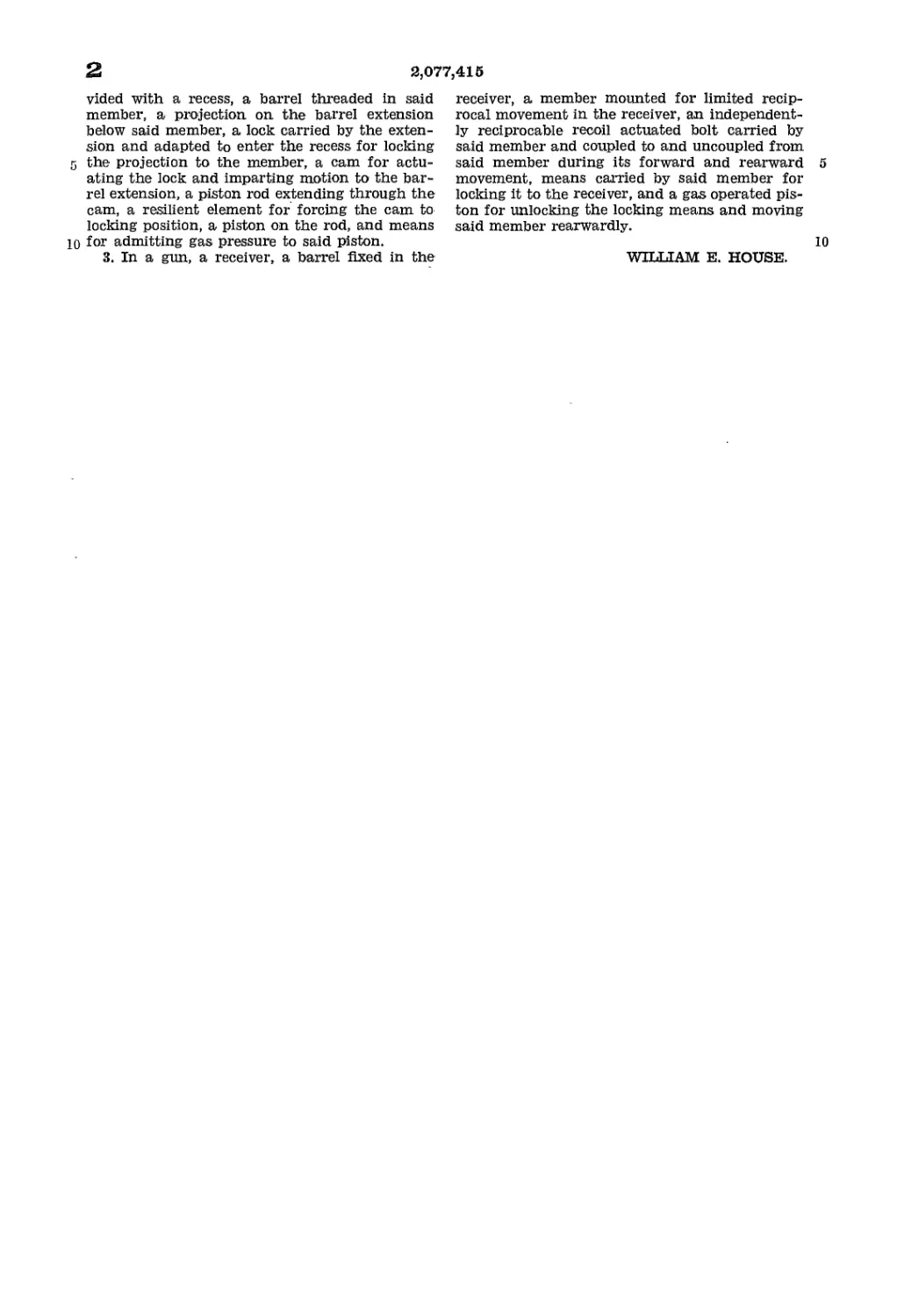
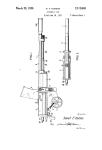
Fig. 1 is a longitudinal sectional view of a gun
constructed in accordance with the invention.
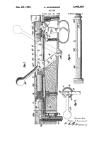
35 Fig. 2 is an enlarged detail sectional view
through the lock.
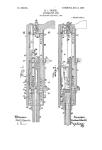
Fig. 3 is an enlarged detail sectional view
through the lock showing the gun in recoil.
Referring to the drawing by numerals of ref-
40 erence:
The gun consists of standard parts of the
Browning machine gun having the receiver I,
barrel 2, bolt 3 and barrel extension 4 which has
been modified by cutting off and enlarging the
45 forward end 5 into which the breech end of the
barrel is threaded and making the portion fast
in the receiver by rivets or in other suitable man-
ner. The remainder of the barrel extension has
added thereto a projection 6 which underlies the
50 member 5.
The projection 6 is slotted at 7 to receive a
sliding lock 8 apertured to provide cam surfaces
9—9 adapted to cooperate with a cam 10 fast on a
piston rod 11 which enters a bore 12 formed in
55 the projection 6 and communicating with the
slot 7. The rear counterbored end of the bore
12 receives a coiled spring 13 which surrounds
the projecting end of the piston rod 11 and acts
to retain the lock in elevated position.
The piston 14 carried on the forward end of 6
the rod 11 works in a cylinder 15 secured to the
forward end of the barrel 2 and adapted to re-
ceive gases from the barrel through a port 16 and
to exhaust such gases through a port 17 so sit-
uated that the recoil of the piston and rod will 10
cause a recoil in the barrel extension of the same
amplitude as that formerly imparted to such
part by the recoil of the barrel.
The lock 8 in its elevated position extends into
a recess 18 to lock the barrel extension to the 15
member 5.
The operation is as follows: When the gun is
fired, gases escaping through port 16 enter the
cylinder 15 and cause the piston 14 and rod 11
to move rearwardly. This movement causes the 20
cam 10 to act on the lower cam face 9 of the lock
8 and cam the lock downwardly to unlock the
parts. The barrel extension is then free to be
moved rearwardly by the piston rod carrying and
disconnecting the bolt for continued movement 25
in the usual manner.
As soon as the piston passes the exhaust port
17, the gas in the cylinder is free to escape and
no further pressure is exerted on the piston so
that the recoil of the barrel extension is the same 30
as that for which it was originally designed in
the Browning gun.
During the operation of firing, the heavy alu-
minum jacket which is in intimate contact with
the barrel dissipates the heat generated with 35
sufficient rapidity to keep the barrel at a temper-
ature below that which would prove injurious
to the barrel.
I claim:—
1.	The combination with a gun including a re- 40
ceiver, a barrel extension in the receiver mounted
for relative movement with respect to said barrel,
a bolt in the receiver, of a member fast in the
receiver, a barrel threaded in said member, a
projection on the barrel extension below said 45
member, a lock carried by the extension for lock-
ing the projection to the member, a cam for actu-
ating the lock and imparting motion to the barrel
extension, and a gas operated piston connected
to' the cam.	50
2.	The combination with a gun including a re-
ceiver, a barrel extension in the receiver mount-
ed for relative movement with respect to said
barrel, a bolt actuated in recoil by the barrel ex-
tension, of a member fast in the receiver pro- 55
2
vided with a recess, a barrel threaded in said
member, a projection, on the barrel extension
below said member, a lock carried by the exten-
sion and adapted to enter the recess for locking
5 the projection to the member, a cam for actu-
ating the lock and imparting motion to the bar-
rel extension, a piston rod extending through the
cam, a resilient element for forcing the cam to
locking position, a piston on the rod, and means
10 for admitting gas pressure to said piston.
3.	In a gun, a receiver, a barrel fixed in the
2,077,415
receiver, a member mounted for limited recip-
rocal movement in the receiver, an independent-
ly reciprocable recoil actuated bolt carried by
said member and coupled to and uncoupled from
said member during its forward and rearward 5
movement, means carried by said member for
locking it to the receiver, and a gas operated pis-
ton for unlocking the locking means and moving
said member rearwardly.
10
WILLIAM E. HOUSE.