/
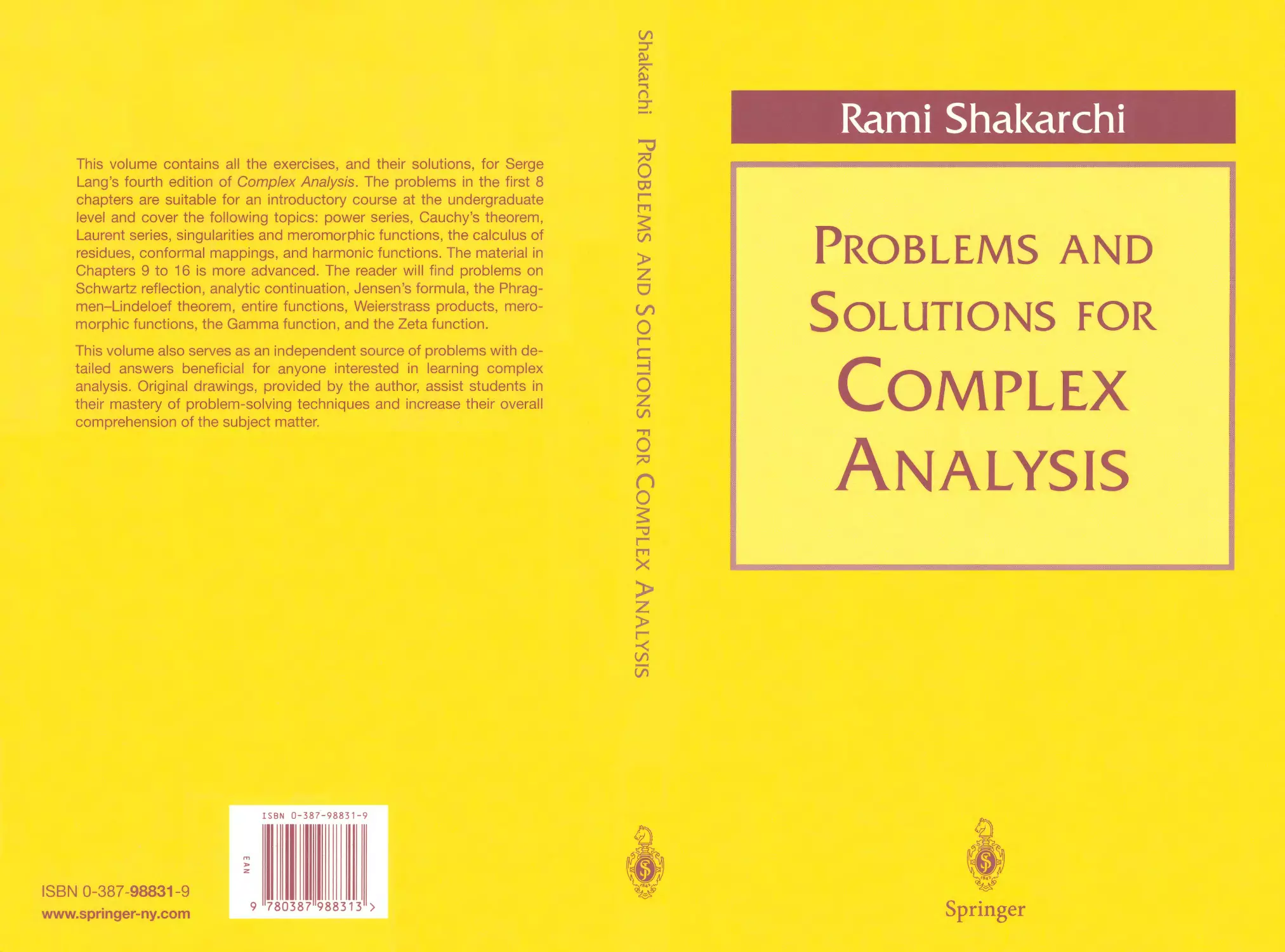


Автор: Shakarchi R.
Теги: mathematics group theory mathematical analysis problems in mathematics
ISBN: 0-387-98831-9
Год: 1999
Текст
PROBLEMS AND SOLUTIONS FOR
COMPLEX ANALYSIS
Springer
New York
Berlin
Heidelberg
Barcelona
Hong Kong
London
Milan
Paris
Singapore
Tokyo
Rami Shakarchi
PROBLEMS AND
SOLUTIONS FOR
COMPLEX
ANALYSIS
With 46 Illustrations
..
:.;:s;
Springer
Rami Shakarchi
Department of Mathematics
Princeton University
Princeton, NJ 08544-1000
USA
Mathematics Subject Classification (2000): 30-01
Shakarchi, Rami.
Problems and solutions for Complex analysis I Rami Shakarchi.
p. em.
"Contains all the exercises and solutions of Serge Lang's Complex
analysis""-Pref.
Includes bibliographical references.
ISBN 0-387-98831-9 (softcover : alk. paper)
1. Mathematical analysis-Problems, exercises, etc. 2. Functions
of complex variables-Problems, exercises, etc. I. Lang, Serge,
1927- . Complex analysis. II. Title.
QA301.S48 1999
515'.9-dc21 99-13255
Printed on acid-free paper.
@ 1999 Springer-Verlag New York, Inc.
All rights reserved. This work may not be translated or copied in whole or in part without the written
permission of the publisher (Springer-Verlag New York, Inc., 175 Fifth Avenue, New York, NY 100 1 0,
USA), except for brief excerpts in connection with reviews or scholarly analysis. Use in connection
with any fonn of infonnation storage and retrieval, electronic adaptation, computer software, or by
similar or dissimilar methodology now known or hereafter developed is forbidden.
The use of general descriptive names, trade names, trademarks, etc., in this publication, even if the
fonner are not especially identified, is not to be taken as a sign that such names, as understood by the
Trade Marks and Merchandise Marks Act, may accordingly be used freely by anyone.
Production managed by Lesley Poliner; manufacturing supervised by Jerome Basma.
Photocomposed copy prepared from the author's TeX flies.
Printed and bound by Sheridan Books, Ann Arbor, MI.
Printed in the United States of America.
9876543 2
ISBN 0-387-98831-9 Springer-Verlag New York Berlin Heidelberg SPIN 10773477
This book is dedicated to my parents,
Mohamed and Mireille Shakarchi,
in appreciation for their love and support.
Preface
This book contains all the exercises and solutions of Serge Lang's Complex Analy-
sis. Chapters I through vm of Lang's book contain the material of an introductory
course at the undergraduate level and the reader will find exercises in all of the fol-
lowing topics: power series, Cauchy's theorem, Laurent series, singularities and
meromorphic functions, the calculus of residues, confonnal mappings and har-
monic functions. Chapters IX through XVI, which are suitable for a more advanced
course at the graduate level, offer exercises in the following subjects: Schwarz re-
flection, analytic continuation, Jensen's formula, the Phragmen-Lindelof theorem,
entire functions, Weierstrass products and meromorphic functions, the Gamma
function and the Zeta function. This solutions manual offers a large number of
worked out exercises of varying difficulty.
I thank Serge Lang for teaching me complex analysis with so much enthusiasm
and passion, and for giving me the opportunity to work on this answer book.
Without his patience and help, this project would be far from complete.
I thank my brother Karim for always being an infinite source of inspiration and
wisdom. Finally, I want to thank Mark McKee for his help on some problems and
Jennifer Baltzell for the many years of support, friendship and complicity.
Rami Shakarchi
Princeton, New Jersey
1999
Contents
Preface
I
Complex Numbers and Functions
1.1 Definition . . . . . . . . . .
1.2 Polar Fonn . . . . . . . . . . . . .
1.3 Complex Valued Functions. .
1.4 Limits and Compact Sets. . . . .
1.6 The Cauchy-Riemann Equations. . .
II
Power Series
11.1 Fonnal Power Series . . . . . . . . . . . . . . . . .
11.2 Convergent Power Series . . . . . . . . . . . . . . .
11.3 Relations Between Formal and Convergent Series . . . . . .
11.4 Analytic Functions . . . . . . . . . . . . . . . . . . .
11.5 Differentiation of Power Series. . . . . . . .
11.6 The Inverse and Open Mapping Theorems . . .
III
Cauchy's Theorem, First Part
111.1 Holomorphic Functions on Connected Sets
111.2 Integrals over Paths . . . . . . . . . . . . . .
111.5 The Homotopy Fonn of Cauchy's Theorem
111.6 Existence of Global Primitives.
Definition of the Logarithm
111.7 The Local Cauchy Formula. . .
vii
1
1
3
8
9
12
14
14
19
24
28
29
31
36
36
37
42
43
45
x Contents
IV
Winding Numbers and Cauchy's Theorem
IV.2 The Global Cauchy Theorem. . . . .
48
48
V Applications of Cauchy's Integral Formula
V.l Uniform Limits of Analytic Functions . .
V.2 Laurent Series ... . . . . .
V.3 Isolated Singularities . . . . . . . . . . . . .
51
51
60
66
VI Calculus of Residues
VI.I The Residue Formula . . . . . . . . . . . .
VI.2 Evaluation of Definite Integrals .....
VII
76
76
93
Conformal Mappings
VII.2 Analytic Automorphisms of the Disc
VII.3 The Upper Half Plane .......
VII.4 Other Examples. . . . . . . . . . . .
VII.5 Fractional Linear Transformations .
119
119
122
126
137
VID Harmonic Functions 146
VIII. 1 Definition . . . . . . . . . . . . . . . . . 146
VIII.2 Examples . . . . . . . . . . . . . . . . . . . . . . . 153
VIII.3 Basic Properties of Harmonic Functions . . . . . . 159
VIII.4 The Poisson Formula . . . . . . . . . . . . . 165
VIII.5 Construction of Harmonic Functions . 167
IX
x
Schwarz Reftection
IX.2 Reflection Across Analytic Arcs
175
175
The Riemann Mapping Theorem
X.l Statement of the Theorem ......
X.2 Compact Sets in Function Spaces
179
179
181
XI Analytic Continuation along Curves
XI.I Continuation Along a Curve . . . . .
XI.2 The Dilogarithm .... . . . .
185
185
187
XU Applications of the Maximum Modulus Principle
and Jensen's Formula
XII. 1 Jensen's Formula . . . . . . . . . . . . . . . .
XII.2 The Picard-Borel Theorem. . . . . . . . . . .
XII.6 The Phragmen-Lindelof and Hadamard Theorems
XDI Entire and Meromorphic Functions
XlII.I Infinite Products ..
XIII.2 Weierstrass Products . . . . .
191
191
198
201
. . .
206
206
211
. . . . .
. . . .
Contents xi
XIII.3 Functions of Finite Order. . . . . . . . . . . . . . . 213
XIII.4 Meromorphic Functions, Mittag-Leffler Theorem. . 214
XV The Gamma and Zeta Functions
XV. 1 The Differentiation Lemma
XV.2 The Gamma Function
XV.3 The Lerch Formula .
XV.4 Zeta Functions . . . . .
219
219
223
235
238
XVI The Prime Number Theorem
XVI.l Basic Analytic Properties of the Zeta Function
XVI.2 The Main Lemma and its Application . . . . . .
241
241
245
I
Complex Numbers and Functions
1.1 Definition
Exercise 1.1.1. Express the following complex numbers in the form x + iy, where
x, yare real numbers.
(a)(-1+3i)-1 (b)(I+i)(I-i)
(c) (1 + i)i(2 - i) (d) (i - 1)(2 - i)
( e) (7 + Jr i)( Jr + i) (f) (2i + I)Jr i
(g) (,J2i)(Jr + 3i) (h) (i + 1)(i - 2)(i + 3)
Solution. (a) J - 130 i. (b) 2. (c) -1 + 3i. (d) -1 + 3i. (e) 6Jr + i(7 + Jr2). (1)
-2Jr + iJr. (g) -3,J2 + Jr,J2i. (h) -8 - 6i.
Exercise 1.1.2. Express the following complex numbers in the form x + iy, where
x, yare real numbers.
(a) (1 + i)-I (b) 3l; (c) (d) 2 ;
1 +; ; 2; 1
(e) i (f) 1+; (g) 3-; (h) -1+;
I
Solution. (a) ! - !i. (b) ?o - /o i. (c) + i. (d) + !i. (e) 1 - i. (1) ! + !i.
(g) 51 + i. (h) 2 1 - ! i .
Exercise 1.1.3. Let ex be a complex number 1= O. What is the absolute value of
-J..
ex / ex ? What is ex ?
Solution. Let ex = a + ib. Then
ex a + ib
ex a - ib
a 2 - b 2 + 2abi
a 2 + b 2
2 I. Complex Numbers and Functions
so
l a 1 2 = (a 2 - b 2 )2 + 4a 2 b 2 = (a 2 + b 2 )2 = 1.
a (a 2 + b 2 )2 (a 2 + b 2 )2
Moreover,
a = a - ib = a + ib = a.
Exercise 1.1.4. Let a, {J be two compl ex numbers. Show that a{J = a{J and that
a + {J = a + p .
Solution. Suppose a = a + ib and {J = c + ide Then
a{J = (a - ib)(c - id) = ac - bd - i(ad + be) = a{J ,
and
a + {J = a - ib + c - id = (a + c) - i(b + d) = a + (J.
Exercise 1.1.5. Justify the assertion made in the proof of Theorem 1.2, that the
real part of a complex number is < its absolute value.
Solution. Suppose z = x + iy. Then
x 2 < x2 + y2,
and taking square roots we obtain the inequality
I Re(z)1 < Izl.
Exercise 1.1.6. If a = a + ib with a, b real, then b is called the imaginary part
ofa and we write b = Im(a). Show that a - a = 2i Im(a). Show that
Im(a) < I Im(a)1 < lal.
Solution. We have
a - a = a + ib - a + ib = 2ib.
The first inequality is obvious, while the second inequality follows from
Im(a)2 < Re(a)2 + Im(a)2.
Exercise 1.1.7. Find the real and imaginary parts of (1 + i)H)().
Solution. Since (1 +i)2 = 2i we have (1 +i)IOO = 2 50 i 50 . But i 50 = (_1)25 = -1
so
(1 + i)IOO = _250.
Exercise 1.1.8. Prove that for any two complex numbers z, w we have:
(a) Izl < Iz - wi + Iwl
(b) Izi - Iwl < Iz - wi
(c) Izi - Iwl < Iz + wi
1.2 Polar Form 3
Solution. All three inequalities are obtained by writing z = z - w + w and
applying the triangle inequality.
Exercise 1.1.9. Let a = a + ib and z = x + iy. Let c be real> o. Transform the
condition
Iz - al = c
into an equation involving only x, y, a, b, and c, and describe in a simple way
what geometric figure is represented by this equation.
Solution. By definition we see that Iz - al = c i s equivalent to
J (x - a)2 + (y - b)2 = c,
so the above equation describes the circle of radius c centered at a.
Exercise 1.1.10. Describe geometrically the sets of points z satisfying the
following conditions.
(a) Iz - i + 31 = 5 (b) Iz - i + 31 > 5
(c)lz-i+31 < 5 (d)lz+2il < 1
( e) 1m z > 0 if) 1m z > 0
(g)Rez>O (h)Rez > O
Solution. (a) Circle of radius 5 centered at i - 3.
(b) Complement of the closed disc of radius 5 centered at i - 3.
(c) Closed disc of radius 5 centered at i - 3.
(d) Closed disc of radius 1 centered at - 2i .
(e) Open upper half plane.
(f) Closed upper half plane.
(g) Open right half plane.
(h) Closed right half plane.
1.2 Polar Form
Exercise 1.2.1. Put the following complex numbers in polar form.
(a) 1 + i (b) 1 + i.J2 (c)-3 (d) 4i
(e)l-i.J2 if)-5i (g)-7 (h)-I-i
Solution. (a).J2e i: (b) Let 8 E [0, 21r) be the angle such that cos 8 = 1/.J3 and
sin 8 = .J2/ J3. Then 1 + i.J2 = .J3e i8 . (c) 3e i1r (d) 4e i; (e) If 8 is as in (b),
then 1 - i.J2 = .J3ei(21r-8) (f) 5e 3 7r (g) 7e i1r (h) ...tie S 7r .
Exercise 1.2.2. Put the following complex numbers in the ordinary form x + iy.
(a) e 3i1r (b) e 2i1r / 3 (c) 3e i1r / 4 (d) 1re- i1r / 3
(e) e 2i1r / 6 if) e- i1r / 2 (g) e- i1r (h) e- 5i1r / 4
Solution. (a) -1 (b) -4 +i4 (c) +i (d) -i 1r f (e) 4 +i4 (f) -i (g)
-1 (h) _.L + i .L
v'2 v'2
4 I. Complex Numbers and Functions
Exercise 1.2.3. Let a be a complex number # o. Show that there are two distinct
complex numbers whose square is a.
Solution. Suppose a = rei({J. Then the two solutions to Z2 = a are ei«({J/2) and
ei(tr+cp/2). See Exercise 6.
Exercise 1.2.4. Let a + bi be a complex number. Find real numbers x, y such that
(x + iy)2 = a + ib,
expressing x, y in terms of a and b.
Solution. Since (x + iy)2 = x 2 - y2 + 2ixy we have x 2 - y2 = a and 2xy = b.
Taking absolute values we also get x 2 + y2 = v' a 2 + b 2 . These three equations
imply
a + v'a 2 + b 2
x 2 =
2
2 v'a 2 +b 2 -a
and y = .
2
and therefore
x = J a + v';2 + b 2
solves our problem.
Exercise 1.2.5. Plot all the complex numbers Z such that zn = 1 on a sheet of
graph pape1; for n = 2, 3, 4, and 5.
Solution. The equation Z2 = 1 has two solutions, 1 and -1 which we plot as
stars. The equations Z3 = 1 has three solutions, 1, e 27ri / 3 and e 4tri / 3 which we plot
as dots.
The equation Z4 = 1 has four solutions, 1, i, -1 and -i which we plot as stars.
The equation Z5 = 1 has five solutions, 1, e 2tri / 5 , e 4tri / 5 , e 6tri / 5 and e 8tri / 5 which
we plot as dots. (See figure at top of next page.)
I v' a 2 + b 2 - a
and y = (sign b)y 2
Exercise 1.2.6. Let a be a complex number # O. Let n be a positive integer. Show
that there are n distinct complex numbers z such that zn = ex. Write these complex
numbers in polar form.
Solution. We use the expressions z = re i8 and a = se iCP . Then the equation
zn = a is equivalent to
zn = r n e ni8 = se;({J,
hence
r n
_e;(n8-cp) = 1.
s
Taking absolute values we get r n = s. Moreover n8 - cp must be an integral
multiple of 211' , so the set of solutions of the equation zn = ex is
S = {sl/n ei( ), s'l/n ei( + ), . . . , sl/n i( +(n-1) 2:> } .
1.2 Polar Fonn 5
/
..\
/
(
.i
2.
.... * ....... a :=. ,
"
3
.fJi'3 \. =l
;,
if.=1
. cS-=1
Exercise 1.2.7. Find the real and imaginary parts of i 1/4, taking the fourth root
such that its angle lies between 0 and 1r /2.
Solution. Since i = e i 1r /2 we see that we want to find the real and imaginary parts
of e i 7r /8. Hence
1 / 4 1r J l +cos
Re(i ) = cos "8 = 2 = V '2 + "4
and
4 1r J I-COS
Im(i 1/ ) = sin "8 = 2 = V 2 - "4.
Exerci e 1.2.8. (a) Describe all complex numbers z such that e Z = 1.
(b) Let w be a complex number. Let a be a complex number such that e a = w.
Describe all complex numbers z such that e Z = w.
Solution. (a) If z = x + i y where x and y are real, then e Z = 1 is equivalent to
eX e iy = 1. Taking absolute values we see that eX = 1 hence x = 0 and therefore y
must be an integral multiple of 2n . Conversely, any complex number of the form
2nki withk E Zisasolutionofe z = 1.
(b) The number w is nonzero because e a = w and therefore
e Z w
e z - a - - - - - 1
- - -
e a w
hence by (a) we must have Re(z) = Re(a) and Im(z) - Im(a) must be an integral
multiple of 21r. We can also express the solutions of e Z = w independently of a.
6 I. Complex Numbers and Functions
Writing w = re i8 and z = x + iy we see that
x = logr and y = 8 (mod 21r).
Conclude.
Exercise 1.2.9. If e Z = e W , show that there is an integer k such that z = w + 21r ki.
Solution. Writing z and w in the form a + i b we find after taking absolute values
that
eRe(Z) = eRe(w) and e i Im(z) = e i Im(w)
therefore Re(z) = Re(w) and Im(z) - Im(w) is equal to an integral multiple of
21r , as was to be shown.
Exercise 1.2.10. (a) If8 is real, show that
e i8 + e- i8 e i8 _ e- i8
cos8 = and sin 8 = .
2 2i
(b) For arbitrary complex z, suppose we define cos z and sin z by replacing 8 with
Z in the above formula. Show that the only values of Z for which cos z = 0 and
sin z = 0 are the usual real values from trigonometry.
Solution. (a) The two formulas follow from
e i8 + e- i8 = cos8 + i sin 8 + cos8 - i sin 8 = 2cos8
and
e i8 - e- i8 = cos8 + i sin 8 - cos8 + i sin 8 = 2i sin8.
(b) If cos z = 0 then by definition we get e iz + e- iz = O. Multiplying this equation
bye iZ and writing z = x + iy we obtain
-1 = e 2i (x+iy) = e -2y e 2ix .
Taking absolute values we get y = 0 and,therefore x = 1r/2 (mod 1r) as was to
be shown. The equation sin z = 0 is equivalent to e iz - e- iz = 0 hence e 2iz = 1.
Letting z = x + i y and arguing as we did before, we find that x = 0 and y = 0
(mod 1r).
Exercise 1.2.11. Prove that for any complex number Z # 1 we have
zn+ I - 1
1 + z + · . · + zn = .
.' Z - 1
Solution. This formula follows from
(z - 1)(1 + z + · · . + zn) = z + Z2 + · · · + zn + zn+l - 1 - z - · · · - zn
= zn.+l - 1.
Exercise 1.2.12. Using the preceding exercise, and taking real parts, prove:
1 sin[(n + 1/2)6]
1 + cos 8 + cos 28 + · · . + cos n8 = 2 + 2 sin(8/2)
1.2 Polar Form 7
forO < () < 21r.
Solution. The real part of the sum E =o( e i8 )k is 1 + cos 8 + cos 28 + . . . + cos n8 .
The formula of the preceding exercise gives
n. ei(n+l)8 _ 1 e i (n+I/2)8 _ e- i8 / 2
(e'8)k == ==
e i8 - 1 e i8 / 2 - e- i8 / 2
k=O
e i (n+I/2)8 _ e- i8 / 2
2 sin(8/2)
The imaginary part of e- i8 / 2 - ei(n+I/2)8 is sin( -8 /2) - sin[(n + 1/2)8], whence
1 8 28 8 sin(8/2) + sin[(n + 1/2)8]
+ cos + cos + . . · + cos n == ,
2 sin 8/2
and the desired formula drops out.
Exercise 1.2.13. Let z, w be two complex numbers such that ZW '1= 1. Prove that
2i sin(8/2)
. e- i8 / 2 _ ei(n+l/2)8
==1
z-w
< 1 iflzl < 1 andlwl < 1,
l-zw
z-w
== 1 iflzl == 1 or Iwl == 1.
l-zw
(There are many ways of doing this. One way is as follows. First check that you
may assume that z is real, say z == r. For the first inequality you are reduced to
proving
(r - w)(r - w ) < (1 - rw)(1 - rw ).
You can then use elementary calculus, differentiating with respect to r and seeing
what happens for r == 0 and r < 1, to conclude the proof.)
Solution. If z == re i8 we make the substitution w ++ we i8 and we find
re i8 - we i8 r - w
1 - re- i8 we i8 - 1 - rw '
so we may assume that z is a real number 0 < r < 1. We want to show that
(r - w)(r - w ) < (1 - rw)(1 - rw)
with == if and only if r == 1 or I w I == 1. We expand both sides, make the necessary
cancellations and move all the terms to the right to see that the above inequality is
equivalent to
o < (1 - r 2 )(1 - w w ),
hence
o < (1 - r 2 )(1 - IwI 2 ).
8 I. Complex Numbers and Functions
Conclude.
1.3 Complex Valued Functions
Exercise 1.3.1. Let !(z) = l/z. Describe what! does to the inside and outside
of the unit circle, and also what it does to points on the unit circle. This map is
called inversion through the unit circle.
Solution. The inversion is defined on the complex plane minus the origin. If
z = re;(} then
1 1 _;(}
- = -e .
Z r
Let V = C - D , in other words, V is the complement of the closed unit disc. From
the above formula we find we see that the image of D under the inversion is V and
conversely, the image of V under the inversion is D.
If r = 1, then 1/ z = e-;(} so the image of the unit circle is the unit circle.
Exercise 1.3.2. Let f(z) = l/z. Describe f in the same manner as in Exercise 1.
This map is called reflection through the unit circle.
Solution. The reflection is defined on the complex plane minus the origin. If
z = re;(}, then
1 ' (}
!(z) = -e'
r
so if V = C - D , then we see that f(D - {OJ) = V and f(V) = D - {OJ.
If r = 1, then !(z) = e;(} so the image of the unit circle is the unit circle.
Exercise 1.3.3. Let !(z) = e 21r ;z. Describe the image under f of the set shaded in
the figure on the facing page, consisting of those points x + i Y with -! < x < !
and y > B.
Solution. If z = x + i y, then
f(z) = e 21r ;(x+;y) = e- 21r ; e 21r ;x.
But -4 < x < 4 so -Jr < 2Jrx < Jr and y > B so -2JrY < -2Jr B. From the
above expression we see that the absolute value of f(z) is e- 21rY and the argument
of f (z) is 2Jr x. So the image of the shaded region under f is the closed disc of
radius e- 21r B minus the origin.
Exercise 1.3.4. Let !(z) = e Z . Describe the image under! of the following sets:
(a) The setofz = x + iy such that x < I and 0 < y < Jr.
(b) The set ofz = x + iy such that 0 < y < Jr (no condition on x).
Solution. If z = x + i y, then
f(z) = eX+;Y = eXe iy .
1.4 Limits and Compact Sets 9
.' ::-,;-..:::..
-
So the absolute value of f(z) is eX and the argument of f(z) is y.
(a) The image of the given set is the closed upper half disc of radius e minus the
ongln.
(b) The image of the given region is the closed upper half plane minus the origin.
1.4 Limits and Compact Sets
Exercise 1.4.1. Let a be a complex number of absolute value < 1. What is
I . n ? P if ?
Imn oo a. roo.
Solution. We write a = re;(J with 0 < r = lal < 1. Then
Ian I = Irnen;(J I = r n ,
and since limn oo r n = 0 we conclude that
lim Ian I = 0,
n oo
and therefore
lim an = o.
n oo
Exercise 1.4.2. If la I > l, does limn oo an exist? Why?
Solution. We write a = re;(} with lal = r. Then
Ian I = r n
so Ian I -+ 00 as n -+ 00 so the limit
lim an
n OO
10 I. Complex Numbers and Functions
does not exist.
Exercise 1.4.3. Show that for any complex number z '# 1, we have
zn+l - 1
1 + z + · . . + zn = .
Z - 1
lflzl < 1, show that
lim (1 + z + . . . + zn) = 1 .
n oo 1 - z
Solution. We have
(z - 1)(1 + z + . . . + zn) = z + . . . + zn + zn+l - 1 - z - . . . - zn
= Zn+ 1 - 1,
so if z '# 1 the first formula drops out. If Iz I < 1, then
lim zn+l = 0,
n oo
so
I . n 1
1m (1 + z + . . . + z ) =
n OO 1 - z
as was to be shown.
Exercise 1.4.4. Let f be the function defined by
. 1
f(z) = nl "Jo 1 + n2z .
Show that f is the characteristic function of the set to}, that is, /(0) = 1, and
f(z) = 0 if z '# O.
Solution. We clearly have f(O) = 1. If z '# 0, then Izl '# 0 and for all large n we
have
1
In 2 z + 11 > n 2 1z1 - 1 > 2 n21zl.
so for all sufficiently large n we have
1 2
<-
n 2 z + 1 - n 2 lzl.
Therefore f(z) = 0 as was to be shown.
Exercise 1.4.5. For Izl '# 1 show that the following limit exists:
( zn - 1 )
f(z) = lim 1 .
n OO zn +
Is it possible to define f(z) when Izl = 1 in such a way to make f continuous?
1.4 Limits and Compact Sets II
Solution. Suppose Izl < 1, then
zn - 1
zn + 1 - (-1)
as n 00, so f(z) = -1. If Izl > 1 then
zn-l 2
-1 = o
zn + 1 I zn + 11
as n 00, so f(z) = 1. Prom these results we see that we cannot define f(z)
when Izl = 1 so as to make f continuous.
2 z n
o
zn + 1
Exercise 1.4.6. Let
. zn
f(z) = 11m .
n oo 1 + zn
(a) What is the domain of definition of f, that is, for which complex numbers z
does the limit exist?
(b) Give explicitly the values of f(z)for the various z in the domain of f.
Solution. If Izl < 1, then zn 0 as n 00 so f(z) = O. If Izl > 1, then
f(z) = 1 because
zn
zn + 1
1
-1 = O
Izn + 11
as n --+ 00.
We now investigate what happens on the unit circle. Let z = e;(J with 0 < f) <
21l'. Then 1 + zn = 1 + e n ;(}, so if f) = 0 we immediately get f(z) = 1/2. If f) '# 0
then
en;(J 1
f(z) = 1 + en;(J - 1 + e-n;(J ,
and since e- n ;(} goes around the circle we cannot define f at the points z = e;(J
with f) '# O. So if Q denotes the unit circle minus the point 1, we see that the
domain of definition of f is the set C - Q.
Exercise 1.4.7. Show that the series
00 n-l
?; (1 - zn (1 - zn+l)
converges to 1/(1 - Z)2 for Izi < 1 and to l/z(1 - Z)2 for Izl > 1. Prove that the
convergence is uniform for Iz I < c < 1 in the first case, and Iz I > b > 1 in the
second. [Hint: Multiply and divide each term by 1 - z, and do a partial fraction
decomposition, getting a telescoping effect. ]
Solution. (i) Let Un = zn /(1 - zn)(1 - zn+l) and let D(z) = (1 - zn)(1 - zn+l).
Then
zn(l - z) 1 [ zn - zn+l ]
Un = D(z)(1 - z) = 1 - z D(z)
12 I. Complex Numbers and Functions
1 [ (Zn - 1) + (1 - zn+I) ]
- 1 - z (1 - zn)( 1 - zn+ I )
1 [ 1 1 ]
= - +
1 - z 1 - zn+1 1 - zn .
We get a telescopic sum, whence
n 1 [ 1 1 ]
Uk = -
L 1 - z 1 - z 1 - zn+ I
k=1
and therefore
n Zk-I 1 [ 1 1 ]
Sn(Z) = = -
f=r (1 - zk)(1 - Zk+l) z(1 - z) 1 - z 1 - zn+1 .
If Izl < 1, then 1/(1 - zn+l) 1 as n 00 and therefore Sn(Z) 1/(1 - Z)2 as
n 00. If Izi > 1, then 1/(1 - zn+l) 0 as n 00 so Sn(Z) l/z(1 - Z)2.
(ii) Suppose Izi < c < 1. A little algebra and part (i) imply that
s ( ) 1
n z - (1 _ Z)2 -
1
z( 1 - z)
zn+l
1 - zn+1 .
But 11 - zn+11 > 1 - Izln+1 > 1 - c n + l , so we get the estimate
Sn(Z) - (1 Z)2 < 1 c 1 _ n+1
for all z in the region Izi < c < 1. Now c n 0 hence the convergence is uniform
in the region Izl < c < 1.
If I z I > b > 1, then
11111
Sn(Z) - z(1 - Z)2 - z(1 - z) 1 - zn+1 < b(b - 1) /1'+1 - 1
and b n + 1 00, so the convergence is uniform in the region Izl > b > 1.
1.6 The Cauchy-Riemann Equations
Exercise 1.6.1. Prove in detail that ifu, v satisfy the Cauchy-Riemann equations,
then the function
f(z) = f(x + iy) = u(x, y) + iv(x, y)
is holomorphic.
Solution. The Cauchy-Riemann equations are
au av
---
ax ay
au av
and ay = - ax .
1.6 The Cauchy-Riemann Equations 13
We use the notation of the section. Let = - i . Then using the Cauchy-
Riemann equations we find that f(z + w) - f(z) - w is equal to
[ au au ]
u(x + h. y + k) - u(x. y) - ax h - ay k
[ av av ]
+ i v(x + h, y + k) - v(x, y) - -h - -k .
ax ay
which we can rewrite as
I(h, k)lu) (h, k) + i I(h, k)lu2(h, k)
where Iim(h.k) (O.O) u;(h, k) = 0 for i = 1, 2, because both u and v are
differentiable. For w # 0 near zero we let
Iwl
u(w) = -(u)(w) + iU2(W».
w
Then
f(z + w) - f(z) - w = wu(w)
where limw o u(w) = O. This proves that f is holomorphic at z.
II
Power Series
11.1 Formal Power Series
Exercise 11.1.1. Give the terms of order < 3 in the power series:
( a) e Z sin z ( e) --L
cosz
(b) (sin z)( cos z) (I) C?S z
J) sm z
(c) eZ-1 ( g ) sinz
z cosz
(d) eZ-cos z (h) e Z / sin z
z
Solution. (a) e Z sin z == z + Z2 + (- i! + i! ) Z3 + higher terms.
(b) (sin z)(cos z) = z + (- i! - i! ) Z3 + higher terms.
) eZ -I _ 1 Z Z2 z3 h .
(c Z- - + 2! + 3! + 4! + Igher terms.
(d) eZ- osz = 1 + (1 + 1) z + i! Z2 + higher terms.
( ) I _ 1 1 2 ( 1 I ) 4 h . h
e cos Z - + 2 z + - 24 + 4" z + Ig er terms.
(f) C?S Z = z + ( ! - .!. ) Z4 + hi g her terms
sm Z 2 3! .
(g) sin Z = Z + ( ! - .!. ) Z4 + hi g her terms
cos Z 2 3 ! .
(h) Z / . - I + 1 + ( 1 I ) I 2 ( 1 1 1 I ) 3 h . h
e sIn z - z 3! + 2! z + 3! z + (3!)2 - 5! + 3!2! + 4! z + Ig er
terms.
Exercise 11.1.2. Let f(z) = Lanz n . Define f(-z) = Lan(-z)n =
La n (-I)n z n. We define f(z) to be even if an = 0 for n odd. We define f(z)
to be odd if an = 0 for n even. Verify that f is even if and only if f( -z) == f(z)
and f is odd if and only if f( -z) == - f(z).
11.1 Formal Power Series 15
Solution. Suppose f is even. Since an = 0 for n odd and ( -1)n = 1 if n is even,
we get
f(-z) = Lan{-l)nzn = L an(-l)nzn = L anZ n = f(z).
n even n even
Conversely, suppose that f( -z) = f(z). This implies that
L(-I)n anz n = Lanz n
hence 2 2:nodd anz n = 0 which implies that an = 0 for all n odd.
When f is even, a similar argument proves the desired statement.
Exercise 11.1.3. Define the Bernoulli numbers Bn by the power series
z Bn n
e Z - 1 = n! Z ·
n=O
Prove the recursion formula
Bo B 1 Bn -I \ 1 if n = 1,
-+ +...+ =
n!O! (n - 1)!1! 1!(n -I)! 0 ifn > 1.
Then Bo = 1. Compute Bt, B2, B3, B4. Show that Bn = 0 ifn is odd '# 1.
Solution. We know that e Z = 2::0 zn j n !, so
z z 1
e Z -l - 2::1z n jn! - 2::oz n j(n+l)!.
Therefore by definition of the Bernoulli numbers we have
1 = ( zn j(n + I)!) ( : zn) .
Since we are multiplying power series we can use the formula given in the text so
that
Bk \ 1 if n = 0,
f:o k!(n - k + I)! = 0 if n > O.
Let m = n + 1 and conclude. Using the above formula we get BI = -lj2,
B2 = Ij6, B3 = 0 and B4 = -lj30. To show that Bn = 0 if n is odd '# 1 we use
Exercise 2. Let
z z
f(z) = +-.
e Z -12
This eliminates the first term of the power series which defines the Bernoulli
numbers, hence f(z) = 2:n#l :! zn. Some straightforward computations show
that
-1 + e Z + e- z - 1
f(z) - f( -z) = z + z 1 Z -z 1 = O.
-e -e +
Conclude using Exercise 2.
16 II. Power Series
Exercise 11.1.4. Show that
Z ez/2 + e-z/2 B
2n 2n
- z
2 e z / 2 - e- z / 2 - n=O (2n)! .
Replace z by 2]'( i z to show that
00 (2]'( )2n
]'( Z cot]'( z = L( _1)n B 2n Z 2n .
n =0 (2n) !
Solution. In Exercise 3 we proved that
z z B 2n 2n
f(z) = e Z _ 1 + 2 = (2n)!z .
We rewrite f as
Z ( 2 ) Z e z + 1 Z e Z/2 + e -z/2
f(z) = - + 1 =-
2 e Z - 1 2 e Z - 1 - 2 e z / 2 - e- z / 2 .
Combining these two results we obtain the desired fonnula. Replacing z by 2]'( i z
in the left hand side of the above expression we obtain
e i8 + e- i8 00 B
L) . L 2n (2 . ) 2n
ul 'I') 'I') = ]'(IZ
e 'U - e- IU ( 2n ) !
n=O
where () = ]'( z. Euler's formulas imply cot () = i ::: :=:: and the desired formula
drops out.
Exercise 11.1.5. Express the power series for tan z, z/ sin z, z cot Z, in terms of
Bernoulli numbers.
Solution. Replacing]'( z by z in the last formula obtained in Exercise 4 we get
00 2 2n
Z cot Z = L( _1)n B 2n Z 2n .
n=O (2n)!
The power series for tan z is obtained by using the above formula together with
the identity
tanz = cotz - 2cot2z.
We find
00 22n(1 _ 2 2n )
ztanz = (-lt (2n)! B 2n Z 2n .
The constant term is 0, so
00 22n(1 _ 2 2n )
tan Z = "' ( _I ) n B z2n-l.
(2n)! 2n
11.1' Formal Power Series 17
Finally we find the power series expansion of z / sin z. The trigonometric formula
we use IS
2z
. == 2z cot z - 2z cot 2z.
sin 2z
The above results then imply
2z 00 2 2n (2 _ 2 2n )
. 2 = L(-lt (2 )' B 2n z 2n .
SIn z n=O n .
Replacing 2z by z we find
z 00 2 - 2 2n
--;--- = L( _1)n (2 )' B 2n Z 2n .
sin z n=O n .
Exercise 11.1.6 (Difference Equations). Given complex numbers ao, aI, UI, U2
define an for n > 2 by
an == Ulan-l + U2 a n-2.
If we have afactorization
T 2 - Ul T - U2 == (T - a)(T - a'), and a =1= a',
show that the numbers an are given by
an == Aa n + Ba'n
with suitable A, B. Find A, B in terms of ao, a}, a, a'. Consider the power series
00
F(T) == Lan Tn.
n=O
Show that it represents a rational function, and give its partial fraction
decomposition.
Solution. The existence of A and B is proved in the next exercise. Since A + B ==
ao and Aa + Ba' == a} we conclude that
,
al - a ao
A==
a -a'
and
aaO - al
B == .
a -a'
If we consider the power series F(T) == E:o an Tn, we can write
00 00
F(T) == LAanT n + LBa,nT n
n=O n=O
00 00
== A L(aT)n + B L(a'T)n
n=O n=O
A B
== + .
1 - aT 1 - a'T
18 II. Power Series
This gives us the desired representation of F as a rational function namely
F(T) = A + B - Aa'T - BaT .
(1 - aT)(1 - a'T)
Exercise 11.1.7. More generally, let ao, . . . , ar-l be given complex numbers. Let
u I, . . . , U r be complex numbers such that the polynomial
P(T) = T r - (uIT r - 1 +... + u r )
has distinct roots aI, . . . , are Define an for n > r by
an = Ulan-l + . . . + ura n - r .
Show that there exist numbers A I, . . . , Ar such that for all n,
an = A I a + . . . + Ara .
Solution. The reader can find a solution to this exercise in the appendix of Lang's
book. Here we give another argument.
Let (1:) be the system
ao = x I + . . . + X r
al = Xl al + . . . + xra r
r-I + + r-l
ar-l = Xla l . . . xra r
Since aI, . . . , a r are distinct,
1
1
al
a r
= O(a; - aj)
;-Ij
r-l r-I
a l a r
is nonzero (this is the Vandennonde determinant), so (1:) has at least one solution,
say (A I, . . . , Ar). Now let Sn be the statement
r
an = LAk a k .
k=1
By construction, So, . . . , Sr-l are true. Suppose Sn (n > r - 1) is true for all
n < N. Then
aN+I = UlaN + . . . + uraN+I-r
(A N A N ) (A N+l-r + A N+l-r )
=UI la} +...+ rar +...+u r la l +... rar
A N+l-r ( r-l ) + A N+l-r ( r-l + + )
= la l ula l + . . . + U r . . . + rar ula r . . . U r
= Ala +1 + . · . + Ara +l
where this last equality follows from the fact that P(a;) = 0 for alII < i < r. So
SN+I is true, and by induction we conclude that Sn is true for all n > o.
11.2 Convergent Power Series 19
11.2 Convergent Power Series
Exercise 11.2.1. Let lal < 1. Express the sum of the geometric series
00
Lan
n=l
in its usual simple form.
Solution. We simply use a geometric series
m am+l-a
'"'"' an -
- a-I'
n=l
and since lal < 1 we have a m + 1 0 as m 00, so L l an = a/(I-a) which
is the expression we want.
Exercise 11.2.2. Let r be a real number, 0 < r < 1. Show that the series
00
Lr n e in8 and
n=O
00
L rlnlein8
n=-oo
converge (() is real). Express that series in simple terms using the usual formula
for a geometric series.
Solution. We can use the comparison test because Ire i8 I = r and in Exercise 1 we
showed that L r n converges. The expression of the series in simple tenns is given
by the following manipulation and the usual fonnula for the geometric series,
r n e in8 = ( re i8 ) n = 1 , .
1 - re ,8
n=O n=O
The second series converges for the exact same reasons the first series converged.
To express the second series in a nice way we split the sum,
00 0 00 00 00
L rlnlein8 = L rlnlein8 + Lr n e in8 = Lr n e- in8 + Lr n e in8
n=-oo n=-oo n=l n=O n=l
so that
00
L
1 re i8
r lnl e in8 = +
'n 'n .
1 - re- lu 1 - re 'u
n=-oo
Exercise 11.2.3. Show that the usual power seriesfor 10g(1 + z) or 10g(1 - z)from
elementary calculus converges absolutely for Izi < 1.
Solution. We have
Z2 (_I)n+l n 00 (_I)n+l n
10g(1 + z) = z - - + ... + z +... = L z .
2 n n=l n
20 II. Power Series
Taking the logarithm and using an elementary limit we find limn oo(l/n)l/n = 1,
so the radius of convergence of the above series is 1. Clearly, the proof and the
result is the same for log( 1 - z).
Exercise 11.2.4. Determine the radius of convergence for the following power
series.
(a) LnnZn
(c) L 2n z n
(e) L 2-n z n
(g) L l zn
(b) L zn Inn
(d) L{1ogn)2 z n
(f) L n 2 z n
( h ) '"" (n !)3 zn
(3n)!
Solution. In all of this exercise we let an denote the coefficients of the power
series which we are dealing with.
(a) Since Ian 1 1 / n = n it follows that the radius of convergence is O.
(b) In this case we have Ian 1 1 / n == Iln so the radius of convergence is 00.
(c) We have Ian 1 1 / n == 2 so the radius of convergence is 112.
(d) For all large n, 1 < log n < n holds so 1 < Ian 1 1 / n < n 2 /n. Since
limn oo n 2 /n == 1 (take the logarithm and use an elementary limit) we conclude
that the power series has radius of convergence equal to 1.
(e) Arguing like in (c) we find that the radius of convergence is equal to 2.
(f) The radius of convergence of the power series is 1 because of the limit
I . 2/n 1
Imn oo n ==.
(g) By Stirling's formula, n! == nne-n un with limn oo u /n == 1. Then we see that
lani lin = ( nne:nnu n ) lln = e-lu /n
which implies that the radius of convergence is e.
(h) Using the notation of (g) we get
( n3n e- 3n u 3 ) l/n 1
lanl1/n = n _
(3n )3n e- 3n u3n 3 3
so the radius of convergence of the power series is 27.
Exercise 11.2.5. Let f(z) == L anz n have radius of convergence r > O. Show that
the following series have the same radius of convergence:
(a) L nanz n (b) L n 2 a n z n
(c) L ndanz n for any positive integer d (d) Ln2:1 nanz n - 1
Solution. We are given that L anz n has a strictly positive radius of convergence
so it is sufficient to investigate the limit of the term next to an. We show that in all
four cases, the limit is 1. We do (c) first. We have
logn
log(nd/n) == d- 0
n
as n 00, so limn oo nd/n = 1. Let d = 1 or d == 2 to get (a) and (b). For (d)
we want to find the radius of convergence of the power series E o(n + 1 )a n + 1 zn .
II.2 Convergent Power Series 21
We can write
«n + 1)la n +ll)l/n = (n + 1)1/(n+1)Ia n +tl 1 /(n+l))(n+I)/n,
so the desired result follows.
Exercise 11.2.6. Give an example of power series whose radius of convergence is
1, and such that the corresponding function is continuous on the closed unit disc.
[Hint: Try L zn /n 2 .]
Solution. The power series L zn /n 2 has a radius of convergence equal to 1
because
( 1 ) l/n ( 1 ) 2
lim - = lim - = 1
n oo n 2 n oo n l/n .
To show that L l/n 2 < 00 we can either use the integral test with h(x) = l/x 2
or use the fact that l/n 2 < l/n(n - 1) and that the partial sums of L l/n(n - 1)
are telescopic. Let fn (z) = zn / n 2 and let D be the closed unit disc. Then on D we
have
II fn II < 1 / n 2
for all n, whe II . II denotes the sup norm on D . So the series L fn converges
uniformly on D. Since the partial sums are continuous and the convergence is
uniform, we con clu de that the limit function, namely the power series L zn / n 2 ,
is continuous on D.
Exercise 11.2.7. Let a, b be two complex numbers, and assume that b is not equal
to any integer < O. Show that the radius of convergence of the series
a(a + 1)... (a + n) zn
b(b + 1) . . . (b + n)
is at least 1. Show that this radius can be 00 in some cases.
Solution. First, note that if a is equal to some negative integer, the series has only
finitely many tenns, and in this case the radius of convergence is 00. Suppose a is
never equal to some negative integer. Let
a(a+l)...(a+n)
C n =
b(b+l)...(b+n)
which is never equal to O. Then
Cn+l la + n + 11 I + 11
C n Ib + n + 11 I n l + 11
and the above ratio converges to 1 as n 00. This concludes the proof.
Exercise 11.2.8. Let {an} be a decreasing sequence of positive numbers approach-
ing O. Prove that the series L anz n is uniformly convergent on the domain of z
such that
Izi < 1 and Iz - 11 > 8,
22 II. Power Series
where 8 > O. [Hint: For this problem and the next, use summation by parts.]
Solution. Let Tn(z) == L =o akz k and Sn(Z) == L =o Zk. The summation by parts
formula gives
n-l
Tn(z) == anSn(Z) - L Sk(z)(ak+l - ak)
k=O
hence if n > m some straightforward computations show that
n-l
Tn(z) - Tm(z) == an(Sn(Z) - Sm(Z)) + L (Sk(Z) - Sm(Z))(ak - ak+l)
k=m+l
Summing a geometric series we find Sn(Z) == (zn+l - 1)/(z - 1), so using the
assumption that Izi < 1 and Iz - 11 > 8 we get the uniform bound ISn(z)1 < 2/8
for all n. Therefore ISn(z) - Sm(z)1 < 4/8 for all m and n. Putting absolute values
in the above displayed equation and using the triangle inequality and the fact that
{an} is positive and decreasing we get
4 4 n-l
ITn(z) - Tm(z)1 < an - + - L (ak - ak+l)
8 8 k=m+l
4 4
== a n - + -(am+l - an)
8 8
4
== -am+l.
8
Since am 0 as m 00 we conclude that the series L anZ n is uniformly
convergent in the domain I z I < 1 and I z - 11 > 8 of the complex plane.
Exercise 11.2.9 (Abel's Theorem). Let L o anZ n be a power series with radius
of convergence > 1. Assume that the series L o an converges. Let 0 < x < 1.
Prove that
00 00
lim LanX n == Lan.
x l
n=O n=O
Remark. This result amounts to proving an interchange of limits. If
n
Sn(X) == Lak xk ,
k=l
then one wants to prove that
lim lim sn(x) == lim lim sn(x).
n oo x 1 x 1 n oo
Solution. Let f(x) == L l ak xk , A == L l ak and An == L =l ak. Consider
the partial sums
n
sn(x)== Lak xk .
k=l
II.2 Convergent Power Series 23
We first prove that the sequence of partial sums {sn(x)} converges uniformly for
o < x < 1. For m < n, applying the summation by parts formula, we get
n n-l
sn(x) - sm(x) = L xkak = xn(A n - Am+l) + L (A k - Am+1)(X k - xk+l).
k=m+l k=m+l
There exists N such that for k, m > N we have IAk - Am+ll < E. Hence for
o < x < 1 and n, m > N we have
n-l
ISn(x) - sm(x)1 < E + E L (x k - xk+l)
k=m+l
= E + E(X m + 1 - x n )
< 3E
This proves the uniform convergence of {sn(x)}.
Now given E, pick N as above. Choose 8 (depending on N) such that if Ix - 11 <
8, then
ISN(x) - ANI < E.
By combining the above results we find that
If(x) - AI < If(x) - sn(x)1 + ISn(x) - sN(x)1 + ISN(x) - ANI + IAN - AI
< If(x) - sn(x)1 + 5E
for all n > N and Ix - 11 < 8. For a given x, pick n so large (depending on x!)
so that the first term is also < E, to conclude the proof. This argument is in the
appendix of Lang's book.
Exercise 11.2.10. Let L anz n and L bnz n be two power series, with radius of con-
vergence rand s, respectively. What can you say about the radius of convergence
of the series:
(a) L(a n + bn)zn (b)L anbnz n ?
Solution. (a) The triangle inequality implies
m m m
L Ian + bnllzl n < L lanllzl n + L Ibnllzl n .
n=O n=O n=O
If Izi < min(r, s), then L(a n + bn)zn converges, so we can say that the radius of
convergence of this last series is > min(r, s).
(b) Since lim sup Un V n < (lim sup un)(lim sup V n ) it follows that the radius of
convergence of the series L an b n zn is > r s .
Exercise 11.2.11. Let a, fJ be complex numbers with lal < IfJl. Let
f(z) = L(3a n - 5fJn)zn.
Determine the radius of convergence of f(z).
24 II. Power Series
Solution. By Exercise 10 we see that the radius of convergence of the series is
at least 1/1,81. We contend that this radius of convergence is exactly 1/1,81. Let
an = 3a n - 5,8n. Then
lanl = 51tW ( ; r - 1
and since lalPI < 1 we have lim lanl l / n = IPI thereby proving our contention.
Exercise 11.2.12. Let {an} be the sequence of real numbers defined by the
conditions:
aO = 1, al = 2, and an = an-I + a n -2 for n > 2.
Determine the radius of convergence of the power series
00
L an zn .
n=O
[Hint: What is the general solution of a difference equation? Cf. Exercise 6 of * 1.]
Solution. This exercise is a special case of Exercise 13.
Exercise 11.2.13. More generally, let u I, U2 be complex numbers such that the
polynomial
P(T) = T 2 - uiT - U2 = (T - aI)(T - a2)
has two distinct roots with lail < la21. Let ao, al be given, and let
an = ulan-I + U2 a n-2 forn > 2.
What is the radius of convergence of the series L an Tn ?
Solution. We solve the difference equation as was done in Exercise 6, 1 of this
Chapter, so that we find
an = Aa + Ba2
where A and B are complex numbers determined by ao, aI, al and a2. Then
n A ( at ) n
Ian I = Bl a 21 - - + 1 .
B a2
But lal/a21n Oso lanl l / n la21. Therefore the radius of convergence of the
series Lanz n is l/la21.
11.3 Relations Between Formal and Convergent Series
Exercise 11.3.1. (a) Use the above definition of log zfor Iz - 11 < 1 to prove that
exp log z = z. [Hint: What are the values on the left when z = x is real?]
11.3 Relations Between Formal and Convergent Series 25
(b)Letzo =1= O.Letexbeacomplexnumbersuchthatexp(ex) == Zo.ForIZ-Zol < Izol
define
logz = f c: - 1) +O!.
Prove thatexplogz == zfor Iz - zol < Izol.
Solution. (a) For x real we have the usual series
00 x n
eX == L -
n =0 n!
00 (_I)n-l
log x == L (x - l)n for 0 < x < 2.
n=l n
We know that exp log x == x for all x > 0, so if z is real and I z - 11 < 1 then
exp log z == z.
Combined with a translation to the origin, the uniqueness theorem (Theorem 3.2)
implies the desired result.
(b) The given inequality implies that Iz/zo - 11 < 1, so by (a)
exp log z = (ex pj C: - I))' (expO!) = Zo = z.
Note that we have used the fact that exp(ZI + Z2) == (exp Zl)(exp Z2) which can be
easily proved using the uniqueness theorem twice.
Exercise 11.3.2. (a) Let exp(T) == L o Tn / n! and
00
10g(1 + T) == L(-I)k-1Tk/k,
k=l
show that
explog(1 + T) == 1 + T and 10gexp(T) == T.
(b) Let hI (T) and h 2 (T) be formal power series with 0 constant terms. Prove that
10g«1 + h}(T»(1 + h 2 (T») == 10g(1 + h}(T» + 10g(1 + h2(T».
(c) For complex numbers ex, f3 show that 10g(1 + T)a == ex 10g(1 + T) and
(1 + T)a(1 + T)/3 == (1 + T)a+/3.
Solution. (a) For all real numbers x > -I we know that
exp log( 1 + x) == 1 + x
so by the uniqueness theorem we have
explog(1 + T) == 1 + T.
Since log exp x == x whenever x is real, we conclude that
log exp T == T.
26 II. Power Series
(b) To prove this assertion, we first note that substituting power series in part (a) we
find that exp 10g(1 + h(T» = 1 + h(T) for all power series h(T) with 0 constant
tenn. Therefore
explog«1 + hl(T»(1 + h2(T») = explog(1 + h}(T) + h 2 (T) + h}(T)h 2 (T»
= 1 + hI(T) + h2(T) + h}(T)h 2 (T)
= (1 + hI (T»(1 + h2(T»
= explog(1 + h}(T»explog(1 + h2(T»
= exp(log(1 + hI (T» + 10g(1 + h2(T»)
So 10g«1 + h I (T»(1 + h 2 (T») and 10g(1 + hI(T» + 10g(1 + h2(T» differ by a
constant multiple of 2Jr i. Evaluating at 0 we find that this constant is O.
(c) If ex is real, then for all real T we have the identity log( 1 + T)a = a log( 1 + T),
so when a is real, we have equality. of the two power series in T. Now 10g(1 +
T)a is a power series with real coefficients which we may consider polynomials
in ex, namely 10g(1 + T)a = Lan(ex)T n where an (a) are real polynomials in
ex. Similarly, a log( 1 + T) is also a power series in T whose coefficients are
real polynomials in the variable ex, say, ex 10g(1 + T) = L bn(ex)T n . Then, since
an (ex) = b n (ex) for all real a, this equations also holds true for all complex ex. Hence
log(l + T)a = a 10g(1 + T) for all complex a.
Since (1 + T)a = 1 + ha(T) and (1 + T)fJ = 1 + hfJ(T) where ha(T) and hfJ(T)
are power series with 0 constant tenn, we get from (b)
10g«1 + T)a(1 + T)fJ) = 10g(1 + T)a + 10g(1 + T)fJ.
Since 10g(1 + T)a = ex 10g(1 + T) we find that
10g«1 + T)a(1 + T)fJ) = ex 10g(1 + T) + ,8 10g(1 + T)
= (ex + ,8) 10g(1 + T)
= log( 1 + T)a+ fJ .
Exponentiating gives the desired result.
Exercise 11.3.3. Prove that for all complex z we have
cos z =
e;Z + e- iz e;z _ e- iz
and sin z =
2 2
Solution. We use the power series expansion of the exponential:
, 00 zn
e1z=Li n - and
n=O n!
00 n
e- iz = L(-lr i ":.....
n=O n!
Adding these two series we obtain
., zn 00 z2n
e'Z+e- IZ = L2i n _=2Li 2n =2cosz.
neven n! n=O (2n)!
Use the same argument to prove the formula for the sine.
11.3 Relations Between Formal and Convergent Series 27
Exercise 11.3.4. Show that the only complex numbers z such that sin z = 0 are
Z = kJr, where k is an integer. State and prove a similar statement for cos z.
Solution. By the previous exercise, the equation sin z = 0 is equivalent to e iz =
e- iz or simply e 2iz = 1. Writing z = x + iy where x and y are real we find that the
equation sin z = 0 is equivalent to e 2ix e- 2y = 1. Since e 2ix has absolute value 1 it
follows that e- 2y = 1 so y = o. Therefore the real part of z must verify e 2ix = 1, so
x = kJr with k E Z. For the cosine the exact same argument shows that cos z = 0
if and only if z = kJr /2 where k is an integer.
Exercise 11.3.5. Find the power series expansion of f(z) = 1/(z + 1)(z + 2), and
find the radius of convergence.
Solution. We use partial fraction decomposition to modify the expression of f,
namely
1
(z + 1 )(z + 2)
1
z+1
1
z+2
1
1 - (-z)
1 1
2 1 - (-z/2)
The fonnula for the sum of a geometric series implies that for I z I < 1 we get
00 1 00
f(z) = L( -z)n - 2 L( -z/2)n
n =0 n=O
== [ ( _l)n _ (_l)n ] zn
2n+l
n=O
n ( 1 ) n
= (-1) 1- 2n + 1 z.
n=O
Since lim sup (1 - 2n l ) I/n == 1, the radius of convergence of the power series is
1.
Exercise 11.3.6. The Legendre polynomials can de defined as the coefficients
Pn(a) of the series expansion of
1
f(z) = (1 - 2£1!z + Z2)1/2
= 1 + PI (a)z + P 2 (a)z2 + . . . + Pn(a)zn + . . . .
Calculate the first four Legendre polynomials.
Solution. Squaring both sides we get
1 _ 2 1 2 = ( f Pn(Ol)zn ) 2 = fdn(£I!)Zn
az + Z n=O n=O
where Po(a) = 1 and dn(a) == L =o Pn(a)Pn-k(a). Hence
1 = (1 - 20lZ + Z2) ( dn(Ol)Zn)
28 II. Power Series
00 00 00
== L dn(a)zn - 2a L dn(a)Zn+l + L d n (a)Zn+2
n=O n=O n=O
00
== do(a) + (d} (a) - 2ado(a») + L(dn(a) - 2ad n _ 1 (a) + dn(a))zn.
n=2
We get the recursive formulas
do(a) = 1
d} (a) - 2ado(a) = 0
dn(a) - 2ad n - 1 (a) + dn(a) = 0
which allow us to find the desired Legendre polynomials. We find Pi (a) = a,
P2(a) == 1(3a 2 - 1), P 3 (a) = 1(5a 3 - 3a) and for the fourth polynomial we find
P 4 (a) == k(35a 4 - 30a 2 + 3).
Note. It can be shown that Pn(a) = 2}n! D n [(a 2 - l)n].
11.4 Analytic Functions
Exercise 11.4.1. Find the terms of order < 3 in the power series expansion of the
function fez) = Z2/(Z - 2) at Z = 1.
Solution. To find the expansion we must modify the expression on f. We write
Z2 == [(z - 1) + 1]2 = (z - 1)2 + 2(z - 1) + 1
and
z - 2 = -(1 - (z - 1»),
so that we find
/(z) = [(z - 1)2 + 2(z - 1) + 1] ( - (z - 1/) .
Therefore the beginning of the power series expansion of f is
-1 - (1 + 2)(z - 1) - (1 + 2 + 1)(z - 1)2 - (1 + 2 + 1)(z - 1)3.
Exercise 11.4.2. Find the terms of order < 3 in the power series expansion of the
function fez) = (z - 2)/(z + 3)(z + 2) at Z = 1.
Solution. We use partial fraction decomposition to get
5 4
fez) = z + 3 z + 2
But
5 5 1
z + 3 4 1 - - / (z - 1)
11.5 Differentiation of Power Series 29
= ( 1 - (z - 1) + (z - 1)2 - (z - 1)3 + . . . )
4 4 4 2 4 3
and the same method shows that
4 = 4 ( 1 _ (Z - 1) + (Z - 1)2 - (Z - 1)3 + . . . ) .
z + 2 3 3 3 2 3 3
Therefore we find that the beginning of the power series of f at 1 is
( 5 4 ) ( 5 4 ) ( 5 4 ) 2 ( 5 4 ) 3
- - - - - - - (z - 1) + - - - (z - 1) - - - - (z - 1) .
4 3 4 2 3 2 4 3 3 3 4 4 3 4
11.5 Differentiation of Power Series
In Exercises 1 through 5, also determine the radius of convergence of the given
series.
Exercise 11.5.1. Let
Z2n
fez) = L (2n)!
Prove that f"(z) = f(z).
Solution. The ratio test implies at once that the radius of convergence is 00. Let
gn(Z) = z2n j(2n)!. Then
I 2n 2n-1 ,,2n(2n - 1) 2n-2
gn(z) = (2n)! z and gn(z) = (2n)! z = gn-l(Z),
which implies that f (z) = f" (z).
Exercise 11.5.2. Let
00 z2n
fez) = ?; (n!? '
Prove that
Z2 f" (z) + zf' (z) = 4Z2 f(z).
Solution. By the ratio test we see that the radius of convergence of the series is
00. Differentiating we find
, 2n 2n-1
f (z) = ( ' ) 2 Z
I n.
n=
f " 2n(2n - 1) 2n-2
and (z) = 2 Z
n=l (n!)
so that
, 2n 2n
zf (Z) = (n!)2 Z
30 II. Power Series
and
2 f " 2n(2n - 1) 2n n 2 2n ,
Z (z) = ( ' ) 2 Z = 4 ( ' ) 2 Z - zf (z)
I n. I n.
n= n=
Therefore
00 2 00 1
Z2 f"(z) + zj'(z) = 4 ?; (:!)2 z2n = 4 ?; ((n _ 1)!)2 z2n = 4Z2 fez)
as was to be shown.
Exercise 11.5.3. Let
Z3 Z5 Z 7
f(z) = Z - 3 + "5 - 7' + . · . .
Show that f'(z) = Ij(z2 + 1).
Solution. Since lim sup(ljn)l/n = 1 the radius of convergence is 1. Differentiat-
ing term by term we get
, 2 4 2n 1 1
f (z) = 1 - z + z -... = (-z) = 1 _ (-z2) = 1 + Z2 ·
n=O
Exercise 11.5.4. Let
00 (-I)n ( z ) 2n
J(z) = ?; (n!)2 2 ·
Prove that
Z2 J" (z) + zJ' (z) + Z2 J (z) = o.
Solution. The ratio test implies that the radius of convergence is 00. Let S(z) =
Z2 J"(z) + zJ'(z) + Z2 J(z). Then differentiating term by term, some elementary
manipulations show that
00 (-If
S(z) = (Z2 + 2n + 2n(2n - 1)) 2 2 z2n
( n ! ) 2 n
n=O
00 ( -1 )n
= (Z2 + 4n 2 ) z2n.
( n ! ) 222n
n=O
However
2 4n 2 (_l)n 2n _ (_l)n 2(n+l) _ (_l)n-1 2n
(z + ) (n !)222n Z - (n !)222n Z ((n _ 1 )!)22 2 (n-1) Z
so we have a telescopic sum, which implies that S(z) = 0, as was to be shown.
Exercise 11.5.5. For any positive integer k, let
00 (-I)n ( z ) 2n+k
Jk(Z) = ?; n!(n + k)! 2 ·
II.6 The Inverse and Open Mapping Theorems 31
Prove that
Z2 Jt(z) + zJ£(z) + (Z2 - k 2 )Jk(Z) = o.
Solution. The ratio test implies that the radius of convergence is 00. Let
( - 1 )n
a -
n - 22n+kn !(n + k)!
Differentiating term by term we find that the coefficient of z2n+k in the sum
z21£'(z) + zJ£(z) + (Z2 - k 2 )J(z) is
= a n (2n + k)(2n + k - 1) + a n (2n + k) + an-l - k 2 a n
= (4kn + 4n 2 )a n + an-l
But an-l / an = -4n(n + k) so z21t(Z) + z1£(z) + (Z2 - k 2 )Jk(Z) = 0 as was to
be shown.
Exercise 11.5.6. (a) For Iz - 11 < 1, show that the derivative of the function
00 (z - l)n
logz = 10g(1 + (z - 1)) = L(-I)n-1
n=l n
is 1/ z.
(b) Let zo ;/; O. For Iz - zol < 1, define /(z) = L:( _1)n-I«z - zo)/zo)n In. Show
that /'(z) = l/z.
Solution. (a) Differentiating term by term we find that
00 1 1
(logz)' = "(_I)n-l(z - l)n-l = = -.
=r 1-(-(z-I)) z
(b) Differentiating term by term we find that
00 (_I)n-1 00 (_I)n-1 ( ) n-l
f'(z) = " (z - zo)n-l = " - 1
zn Z Z
n=l 0 n=l 0 0
1 1 1
- .
Zo 1 - (z / Zo - 1) z
11.6 The Inverse and Open Mapping Theorems
Determine which of the following functions are local analytic isomorphism at the
given point. Give the reason for your answer.
Exercise 11.6.1. /(z) = e Z at Z = O.
Solution. By definition we have f(z) = L: zn /n! and f'(z) = f(z), so f'(O) =
1 ;/; o. Therefore f is a local analytic isomorphism at O.
Exercise 11.6.2. f(z) = sin(z2) at Z = O.
32 II. Power Series
Solution. For all z near zero we have sin(z2) = sin« _Z)2) so there does not exist
and open ball around 0 such that the given function is an analytic isomorphism in
this ball.
Exercise 11.6.3. f(z) = (z - 1)/(z - 2) at Z = 1.
Solution. We write z - 2 = -(1 - (z - 1)) so that for all z near 1 we have
f (z) = - (z - 1) [1 + (z - 1) + (z - 1)2 + . . .]
so that f'(I) = -1. This proves that f is a local analytic isomorphism at z = 1.
Exercise 11.6.4. f (z) = (sin Z)2 at Z = o.
Solution. For all z near 0 we have (sin Z)2 = (sin -Z)2 and therefore f cannot be
a local isomorphism at O.
Exercise 11.6.5. f(z) = cos Z at Z = JT:.
Solution. For all real x near 0 we have cos(JT: - x) = cos(JT: + x) so f is not a
local analytic isomorphism at O.
Exercise 11.6.6 (Linear Differential Equations). Prove:
Theorem. Let ao(Z), . . . , ak(Z) be analytic functions in a neighborhood of o. As-
sume that ao(O) ;/; O. Given numbers co, . . . , Ck-l, there exists a unique analytic
function f at 0 such that
D n f (0) = C n for n = 0, . . . , k - 1
and such that
ao(z)D k f(z) + al (z)D k - 1 f(z) + . . . + ak(z)f(z) = O.
[Hint: Firstyoumayassumeao(Z) = 1 (why?). Then solve for f byaformalpower
series. Then prove that this formal series converges.]
Solution. The solution of this exercise is in the appendix of Lang's book but for
the sake of completeness we will repeat the argument here. Since a(O) ;/; 0 we
must have a(z) ;/; 0 in a neighborhood of 0 which shows after dividing through
by ao that we may assume ao = 1. We change notation a little to be in accordance
with the appendix of the book. In fact, we prove the following
Theorem. Let p be an integer > 2. Let go, . . . , g p-l be power series with complex
coefficients. Let ao, . . . , ap-l be given complex numbers. Then there exists a
unique power series f(T) = L an Tn such that
DP f = gp-l DP-l f + . . . + gof.
If go, . . . , g p-l converge in a neighborhood of the origin, then so does f.
The coefficient an (n > p) of f will be determined inductively and uniquely.
Then we prove that the power series L an zn converges in a neighborhood of the
II.6 The Inverse and Open Mapping Theorems 33
origin. Proceeding formally we see that
00
DP f(T) = L n(n - 1) . . . (n - p + 1 )a n Tn-p,
n=p
and therefore putting m = n - p, we get
00
DP f(T) = L(m + p)(m + p - 1) . . . (m + l)a m + p T m .
m=O
Similarly, for every positive integer s with 0 < s < p - 1 we have
00
D S f(T) = L(k + s)(k + s - 1)... (k + l)ak+sTk.
k=O
It will be useful to use the notation [k, s] = (k + s)(k + s - 1) . . . (k + 1) for s > 1
and [k, s] = 1 if s = o.
Next we write down the power series for each gs, say
00
gs = Lbs,jTj.
j=O
Then
gsD S f(T) = LCs,m Tm where cs,m = L [k, s]ak+sbs,j. (1)
k+j=m
Hence once we are given ao, . . . , ap-l we can solve inductively for am in terms of
ao, . . . , am-l and the coefficients of gl, . . . , gs by the formula
p-l k
cO,m+...+Cp-l,m "" [,s] b
a m + p = = L...., L...., ak+s s,j
[m, p] s=o k+ j =m [m, p]
which determines a m + p uniquely in terms of ao, . . . , am+p-l, b s , I, . . . , bs,m. Hence
we have proved that there is a unique power series satisfying the differential
equation.
Assuming that the power series go, . . . , g p-l converge, we must now prove
that f(T) converges. We select a positive number K sufficiently large > 2 and a
positive number B such that
(2)
lao I < K, . . . , la p- II < K
and for all s = 0, . . . , p - 1 and all j we have
Ibs,j I < K Bj.
We prove by induction that for m > 0 we have
lam+pl < 2 m pm+l K 2 K m B m . (3)
The standard m-th root test for convergence then shows that f(T) converges.
We note that the expression (1) for Cs,m and hence (2) for a m + p have positive
coefficients as polynomials in ao, aI, . . . and the coefficients bs,j of the power series
34 II. Power Series
gs. Hence to make our estimates, we may avoid writing down absolute values by
replacing bs,j by K Bj, and we may replace ao,..., ap-l by K. Then all values
a m + p (m > 0) are positive and we want to show that they satisfy the bound in (3).
Observe first that for 0 < k < m and 1 < s < p - 1 we always have
[k, s] < 1.
[m, p] -
Hence the fraction [k, s]j[m, p] will be replaced by 1 in the following estimates.
Now first we estimate a m + p with m = o. Then k + j = 0, so k = j = 0 and
p-l
a p < L L ak+sbs,j < pK 2
s=o k+ j=O
as desired. Suppose by induction that we have proved (3) for all integers > 0
and < n. Then
p-l
a <"" a b, < P " 2n-I p nK2Kk-lBkKBj
n+p _ k+s S,j -
s=Ok+j=n k+j=n
< 2 n - 1 pn+l L K 3 K k - 1 B k Bj
k+j=n
n
< 2 n - 1 pn+l K 2 L K k B n
k=O
< 2 n pn+l Kn+2 B n
which is the desired estimate. We have used the elementary inequality
n Kn+l - 1 K
K 2 " K k = K 2 < Kn+2 < 2Kn+2
f=o K-l -K-l - ,
which is trivial.
Exercise 11.6.7 (Ordinary Differential Equations). Prove:
Theorem. Let g be analytic at O. There exists a unique analytic function f at 0
satisfying
f(O) = 0 and f'(z) = g(f(z)).
[Hint: Again find a formal solution, and then prove that it converges.]
Solution. Again, the proof is in the appendix of Lang's book, but we repeat the
argument for sake of completeness.
Let g(T) = L bk T k and write f (T) with unknown coefficients
00
f(T) = Lam Tm .
m=l
11.6 The Inverse and Open Mapping Theorems 35
Then f'(T) = L ma m T m - l = L(n + l)a n +1 Tn. The given differential equation
has the form
00
L(n + l)a n +1 Tn = bo + b l f(T) + b2f(T)2 + . . · .
n=O
Equating the coefficient of Tn on both sides, we see that al = bo, and
(n + l)a n +1 = Pn(bo, ..., bn;al, ..., an)
where Pn is a polynomials with positive integer coefficients. In particular, starting
with al = bo, we may then solve inductively for an+l in terms of at, . . . , an for
n > 1. This proves the existence and uniqueness of the power series f(T).
Assume next that g(T) converges. We must prove that f(T) converges. Let Bk
be positive numbers such that Ibkl < Bk, and such that the power series G(T) =
L Bk Tk converges. Let F(T) be the solution of the differential equation
F'(T) = G(F(T)),
and let F(T) = L AmT m , with Al > 0 and lat! < AI. Then
(n + I)A n + 1 = Pn(Bo, ..., Bn; AI, ..., An),
with the same polynomial Pn. Hence lan+d < An+}, and if F(T) converges so
does f (T).
Since g(T) converges, there exists positive numbers K, B such that
Ib k I < K B k for all k = 0, 1, . . ..
We let Bk = K B k . Then
k k K
G(T) = K B T = ,
k=O 1 - BT
and so it suffices to prove that the solution F(T) of the differential equation
K
F'(T) =
1- BT
converges. This equation is equivalent with
F'(T) = K + BF(T)F'(T),
which we can integrate to give
F(T)2
F(T)=KT+B .
2
By the quadratic formula, we find
1 - (1 - 2K BT)I/2
F(T) = = KT + . . . .
B
We then use the binomial expansion which we know converges. This concludes
the proof.
III
Cauchy's Theorem, First Part
111.1 Holomorphic Functions on Connected Sets
Exercise 111.1.1. Prove Lemma 1.5, that is, prove
Lemma. Let S be a subset of an open set U. Then S is closed on U if and only if
the complement of S in U, that is, U - S is open. In particular, if S is both open
and closed in U, then U - S is also open and closed in U.
Solution. Suppose S is closed, and let W E U - S. Since U is open, U - S is
not empty. Then for some n the ball of radius 1/ n centered at w is contained in
U and this ball does not intersect S, for otherwise w is in the closure of S which
contradicts the fact that S is closed and w E S. Hence U - S is open.
Conversely, suppose that the set U - S is open, and let Z E U and Z E S, where
S denotes the closure of S. If z is not in S then there exists a ball centered at z
which is contained in U - S. So z is not adherent to S, a contradiction which ends
the proof.
Exercise 111.1.2. Let U be a bounded open connected set, {fn} a sequence of con-
tinuousfunctions on the closure ofU, analytic on U. Assume that {fn} converges
uniformly on the boundary of U. Prove that {fn} converges uniformly on U.
Solution. We use Cauchy's criterion for uniform convergence. Let 11.11 a u and 11.11 u
denote the sup norm on the boundary of U and the sup norm on U respectively.
Let E > 0 and choose N such that for all n, m > N we have II fn - fm lIau < E.
By the maximum modulus principle, the function fn - fm attains its maximum on
the boundary of U, so we have II fn - fm II u < E for all n, m > N which implies
the uniform convergence of the sequence {fn} on U.
111.2 Integrals over Paths 37
Exercise 111.1.3. Let at, . . . , an be points on the unit circle. Prove that there exists
a point Z on the unit circle so that the product of the distances from Z to the a j is
at least 1. (You may use the maximum modulus principle.)
Solution. Consider the map f : D (O, 1) C given by
n
f(z) == (z - at)... (z - an) == n(z - ak).
k=l
The closed unit disc is compact and the function f is continuous on D (O, 1) and
analytic in the open unit disc. We have If(O)1 == 1 and If(ak)1 = 0 for all k ==
1, . . . , n which implies that f is not constant. By the maximum modulus principle,
f attains its maximum at a point z of the unit circle, so If(z)1 > If(O)1 == 1.
111.2 Integrals over Paths
Exercise 111.2.1. (a) Given an arbitrary point Zo, let C be a circle of radius r > 0
centered at zo, oriented counterclockwise. Find the integral
L (z - zordz
for all integers n, positive or negative.
(b) Suppose f has a power series expansion
00
f(z) = L ak(Z - ZO)k
k=-m
which is absolutely convergent on a disc of radius > R centered at ZOo Let C R be
the circle of radius R centered at ZOo Find the integral
[ f(z)dz.
JCR
Solution. (a) Suppose n ;/; -1 and let f(z) = (z - zo)n. Then if
1
g(z) = 1 (z - zo)n+1
n+
we see that g' = f so f has a primitive and since C is closed we find that
L (z - zordz = O.
If n == -1 we parametrize C by y(t) = Zo + re it with t E [0, 27r], and we get
1 dz 1 27r y'(t) 1 27r rie;t .
== dt == dt == 27rl.
C Z - Zo 0 Y (t) - Zo 0 r elf
3M 111. Cauchy's Theorem, First Part
(b) Let in(Z) = L =-m ak(Z - ZO)k. The sequence {in} converges uniformly on
C R hence
lirn {fn={ f
n---+oo JCR JCR
The results obtained in (a) imply that
( f(z)dz = 21fia_!.
JCR
Exercise 111.2.2. Find the integral of f(z) = e Z from -3 to 3 taken along a
semicircle. Is this integral different from the integral taken over the line segment
between the two points?
Solution. Since f' = f, the function f is its own primitive. Therefore the integral
is independent of the path and is equal to f(3) - f( -3).
Exercise 111.2.3. Sketch the following curves with 0 < t < 1.
(a) y(t) = 1 + it
(b) y(t) = e- lfit
( c) y (t) = elf i t
(d) y(t) = 1 + it + t 2
Solution.
.
'to
o
,....A. t (Q.)
...
\...\ +-t:
(d)
k-
'-
¥
I
Jt-
.-k/
-rit:-
e. (b)
o
1.
Exercise 111.2.4. Find the integral of each one of the following functions over
each one of the curves in Exercise 3.
(a) f(z) = Z3
(b) f(z) = z
(c) f(z) = l/z
Solution. (a) (i) (l i)4 - (ii) 0 (iii) 0 (iv) (2 i)4 -
(b) (i) i + 1/2 (ii) -1ri (iii)1ri (iv) 2 + .
(c) (i) log + i (ii) -1ri (iii) 1ri (iv) log '\.15 + i arctan(I/2)
IIL2 Integrals over Paths 39
Exercise 111.2.5. Find the integral
i ze z2 dz
(a) from the point i to the point -i + 2, taken along the straight line segment, and
(b) from 0 to 1 + i along the parabola y = x 2 .
Solution. We see that the function g defined by g(z) = !e z2 is a primitive for ze z2
so for (a) the integral is equal to
g(-i + 2) - g(i) = !(e 3 - 4i - e- 1 )
2
and for (b) the integral is equal to
1 2'
g(1 + i) - g(O) = -(e I - 1).
2
Exercise 111.2.6. Find the integral
l sin zdz
from the origin to the point 1 + i, taken along the parabola
2
Y = x .
Solution. The function g defined by g(z) = - cos z is a holomorphic primitive
of sin z on C, so
l sin zdz = g(1 + i) - g(O) = -(cosO + i) - 1)
Exercise 111.2.7. Let a be a vertical segment, say parametrized by
a (t) = zo + it c , -1 < t < 1,
where zo is a fixed complex number, and c is a fixed real number > O. (Draw a
picture.) Let ex = Zo + x and ex' = Zo - x, where x is real positive. Find
1( 1 1 )
lim - dz.
x o (T z - ex z - ex'
(Draw the picture.) Warning: The answer is not 01
Solution. The picture is the following:
40 III. Cauchy's Theorem, First Part
i!o ...i c.
-x.
G
e----- . +
o
.
e - A.c.
o
o
Since O"(t) = ic we have
1 ( 1 1 ) 1 1 1 1
- dz = ic - dt
u z - a z - a' -1 ite - x ite + x
Reducing to the same denominator we find that this last integral is equal to
1 1 2x -2ie 1 1 1
= ie dt = dt
-1 -t 2 e 2 - x 2 X -1 (te/x)2 + 1
2i e [ X ] 1
= -- - arctan(tcjx) = -4i arctan(cjx).
x e -1
The limit limu-H)o arctan ( u) = n /2 implies that
lim f ( 1 _ 1 / ) d z == - 2n i .
x o J u z - a z - a
Exercise 111.2.8. Let x > O. Find the limit:
1 8 ( 1 1 )
lim - d t .
B oo -B t + ix t - ix
Solution. We write
1 1
t + ix t - ix
so the integral in the limit is
-2i
= - [x arctan(tjx)] B == -4i arctan(Bjx).
x
-2ix
t 2 + x 2
-2i 1
x (t / x)2 + 1
"
Whence
l B ( 1 1 )
lim - dt == -2ni.
B oo -B t + ix t - ix
111.2 Integrals over Paths 41
Exercise 111.2.9. Let y : [a, b] -* C be a curve. Define the reverse or opposite
curve to be
y-: [a,b] -* C
such that y-(t) == y(a + b - t). Show that
f F == - f F.
J y - J y
Solution. The integral along the reverse path is
f F == l b -F(y(a + b - t))y'(a + b - t)dt.
J y - a
Changing variables u == a + b - t we obtain
{ F = r F(y(u))y'(u)du = - { F,
J y - Jb J y
as was to be shown.
Exercise 111.2.10. Let [a, b] and [c, d] be two intervals (not reduced to a point).
Show that there is a function g(t) == rt + s such that g is strictly increasing,
g(a) == c and g(b) == d. Thus a curve can be parametrized by any given interval.
Solution. By putting r == = and s == c - ra we get the desired function g.
Exercise 111.2.11. Let F be a continuous complex-valuedfunction on the interval
[a, b]. Prove that
l b F(t)dt < l b IF(t)ldt.
[Hint: Let P == [a == ao, ai, . . . , an == b] be a partition of [a, b]. From the
definition of integrals with Riemann sums, the integral
l b F(t)dt
n-l
is approximated by the Riemann sum L F(ak)(ak+l - ak)
k=O
whenever max(ak+l - ak) is small, and
l b IF(t)ldt
n-l
is approximated by L IF(ak)l(ak+l - ak).
k=O
The proof is concluded by using the triangle inequality.]
Solution. Given E > 0 there exists 8 > 0 such that for any partition of size < 8
we have the following two inequalities:
l b n-l
F - L F(ak)(ak+l - ak) < E
a k=O
(1)
42 III. Cauchy's Theorem, First Part
l b n-l
IFI - L IF(ak)l(ak+l - ak) < E
a k=O
(2)
Then (1) and the triangle inequality imply
I b n-l n-l
F < L F(ak)(ak+l - ak) + E < L IF(ak)l(ak+l - ak) + E
a k=O k=O
so that combined with (2) we get
l b F < IF(ak)!(ak+1 - ak) + E < l b IFI + 2E.
SO for all E > 0 the inequality
l b F I b
< a IFI + 2E
is true hence the inequality 11: F I < 1: IF! holds, as was to be shown.
111.5 The Homotopy Form of Cauchy's Theorem
Exercise 111.5.1. A set S is called star-shaped if there exists a point Zo in S such
that the line segment between Zo and any point z in S is contained in S. Prove that
a star-shaped set is simply connected, that is, every closed path is homotopic to a
po into
Solution. Consider a closed path y : [a, b] -* S. Then by hypothesis we see that
we have a homotopy Fy : [a, b] x [0, 1] -* S defined by
Fy(t, u) = (1 - u)y(t) + uZo.
Hence every closed path in S is homotopic to Zo which implies that S is simply
connected.
Exercise 111.5.2. Let U be the open set obtained from C by deleting the set of real
numbers > o. Prove that U is simply connected.
Solution. By the previous exercise, it is sufficient to show that U is star-shaped.
Let Zo = -1. A picture shows that U is star-shaped, but here is a fonnal argument.
Given z = x+iy consider the segment [z, zo] parametrized by y(t) = tz+(I-t)zo.
The imaginary part of y(t) is given by ty so we see at once that the line segment
is contained in U.
Exercise 111.5.3. Let V be the open set obtainedfrom C by deleting the set of real
numbers < o. Prove that V is simply connected.
Solution. Argue as in the previous exercise, with Zo = 1.
111.6 Existence of Global Primitives. Definition of the Logarithm 43
Exercise 111.5.4. (a) Let U be a simply connected open set and let f be an analytic
function on U. Is f(U) simply connected?
(b) Let H be the upper half-plane, that is, the set of complex numbers z == x + i Y
such that y > O. Let f(z) == e 21fiz . What is the image f(H)? Is f(H) simply
connected?
Solution. We first solve (b). If z == x + i y, then we see that
f(z) == e- 21fY e i (21fx)
If Y > 0, then 0 < e- 21fY < 1 so the image of H is the open unit disc minus
the origin which is not simply connected. This shows that the image of a simply
connected set under an analytic map need not be simply connected. This answers
(a) because we see that the image of a simply connected set need not be simply
connected.
111.6 Existence of Global Primitives. Definition of the
Logarithm
Exercise 111.6.1. Compute the following values when the log is defined by its
principal value on the open set U equal to the plane with the positive real axis
deleted. (a) logi (b) log(-i) (c) 10g(-1 + i) (d) ii (e) (-i)i (f) (-I)i (g) (-I)-i
(h) 10g(-1 - i)
Solution. (a) log i == log e i1f /2 == log 1 + i == i I
(b)log( -i) == log e 3i1f / 2 == 3i I
(c) log( -1 + i) == ! log 2 + i 3:
(d) ii == e- 1f / 2
(e) (-ii == e- 31f / 2
(t)(-li=e- 1f
(g) (-I)-i = e 1f
(h) 10g(-1 - i) == ! log 2 + i 5 :
Exercise 111.6.2. Compute the values of the same expressions as in Exercise 1
( except (f) and (g)) when the open set consists of the plane from which the negative
real axis has been deleted. Then take -Jr < () < Jr.
Solution. (a) log i = i
(b)log( -i) = log e 3i1f / 2 = -i
(c) l<:>g( -1 + i) = ! log 2 + i 3:
(d) i' = e- 1f / 2
(e) (-ii = e 1f / 2
(h) log( -1 - i) == ! log 2 - i 3:
44 III. Cauchy's Theorem, First Part
Exercise 111.6.3. Let U be the plane with the negative real axis deleted. Let y > o.
Find the limit
lim[log(a + iy) -log(a - iy)]
y O
where a > 0, and also where a < O.
Solution. First suppose a > O. Let r y = (a 2 + y2)1/2. Then for small y > 0 we
can write a + iy = rye iEY and a - iy = rye- iEy with 0 < Ey < n/2. Hence
log(a + iy) - log(a - iy) == log ry + iEy - log ry - i( -Ey) == 2iEy
and since Ey -* 0 as y -* 0 we find that
lim[log(a + iy) - log(a - iy)] == o.
y O
Now suppose a < O. In this case we can write a + iy = r y e i (1f-E y ) and a - iy ==
r y e i (-1f+E y ) so that arguing as above we get
log(a + iy) - log(a - iy) == 2ni - 2iEy,
therefore
lim[log(a + iy) - log(a - iy)] == 2ni.
y O
Exercise 111.6.4. Let U be the plane with the positive real axis deleted. Find the
limit
lim [log(a + iy) -log(a - iy)]
y O
where a < 0, and also where a > O.
Solution. We argue as we did in the previous exercise. When a > 0, write a + i y =
rye iEY and a - iy == r y ei(21f-E y ) so that
lim[log(a + iy) - log(a - iy)] == -2ni.
y O
When a < 0, we write a + iy == r ye i (1f-E y ) and a - iy = r ye i (1f+E y ) and therefore
lim[log(a + iy) - log(a - iy)] == O.
y O
Exercise 111.6.5. Over what kind of open sets could you define an analytic function
ZI/3, or more generally zl/n for any positive integer n? Give examples, taking the
open set to be as "large" as possible.
Solution. We can define an analytic function z I/n over any simply connected open
set not containing the origin. Indeed, on such a set the log is well defined. Then
we define
I / n def ! l a g z
Z == en
III. 7 The Local Cauchy Formula 45
Exercise 111.6.6. Let U be a simply connected open set. Let f be analytic on U
and assume that fez) =I 0 for all z E U. Show that there exists an analytic function
g on U such that g2 == f. Does this last assertion remain true if2 is replaced by
an arbitrary positive integer n?
Solution. We show that the assertion is true for an arbitrary n > O. It is shown in
the text that we can define log fez) on U. Define gn by
gn(Z) == f(z)l/n == e logf(z).
Then gn is a solution to the problem because
gn (z) . . . gn (z) == e log f(z)+...+ log f(z) == e log f(z).
Exercise 111.6.7. Let U be the upper half plane, consisting of all complex numbers
z == x + iy with y > O. Let qJ(z) == e 21fiz . Prove that qJ(U) is the open unit disc
from which the origin has been deleted.
Solution. If z == x + i Y we get
qJ(z) == e- 21fY e 21fix .
Since x ranges over Rand y > 0 it is clear that qJ( U) is the open unit disc minus
the origin.
Exercise 111.6.8. Let U be the open set obtained by deleting 0 and the negative
real axis from the complex numbers. For an integer m > 1 define
L-m(z) = (lOg Z _ (I + + . . . + ) ) :m! .
Show that L'-m(z) == L-m+l (z), and that L'-l (z) == log z. Thus L-m is an m-fold
integral of the logarithm.
Solution. Using the rule for differentiating a product we find that
I 1 zm ( ( 1 1 ) ) zm-l
L_m(z)==--+ logz- 1+-+...+-
zm! 2 m (m-l)!
== ( + logz - ( 1 + +... + )) zm-t = L-m+I(Z).
m 2 m (m - I)!
In particular we have L-I (z) == (log z - l)z so
I 1
L_l (z) == -z + (log z - 1) == log z
z
hence L-m is an m-fold integral of the logarithm.
111.7 The Local Cauchy Formula
Exercise 111.7.1. Find the integrals over the unit circle y: (a) J, cosz dz (b)
y z
f y Si z dz (c) f y COS;Z2) dz.
46 Ill. Cauchy's Theorem, First Part
Solution. (a) We use the local Cauchy formula on D (O, 1). Let f(z) = cos z and
Zo = O. Then
1 1 cos z
f(zo) == _ 2 . -dz.
nl y z
Therefore j, cos Z d z == 2n i .
y Z
(b) The same argument as in (a) shows that j, sin Z d z == O.
y Z
(C) Arguing like in ( a) we find j, cos(Z2) d z == 2n i .
y Z
Exercise 111.7.2. Write out completely the proof of Theorem 7.7 to see that all the
steps in the proof of Theorem 7.3 apply.
Solution. Let Zo E U and Zo not on y. Since the image of y is compact there is
a minimum distance between Zo and points on y. Select 0 < R < dist(zo, y) and
take R also small enough that the closed disc D(zo, R) is contained in U. Select
o < s < R. We write
z = Zo ( 1 - )
-Zo
1 ( z - Zo ( z - Zo ) 2 )
== 1+ + +...
- Zo - Zo - Zo
This series converges absolutely and uniformly for Iz - zol < s because
z - Zo s 1
< - < .
- Zo - R
The function g is continuous on y so it is bounded. By Theorem 2.4 of Chapter
III, we can integrate tenn by tenn and we find
00
f(z) = Lan(z - zo)n
n=O
where
f g( ) d
an = Jy ( - zo)n+1 .
This proves that f is analytic, and that
j(n)(zo) = n! ( g( ) d
J y ( - zo)n+l
thereby concluding the proof of Theorem 7.7.
Exercise 111.7.3. Prove Corollary 7.4, that is, prove:
Corollary. Let f be an entire function, and let II f II R be its sup norm on the circle
of radius R. Suppose that there exists a constant C and a positive integer k such
that
IIfliR < C R k
III. 7 The Local Cauchy Formula 47
for arbitrarily large R. Then f is a polynomial of degree < k.
Solution. Let n > k. The estimate Ian I < II f II R j R n of the coefficients in the
power series expansion of f gives in our particular case the inequality
Ian I < CRkjR n
which holds for all large R. Letting R 00 we get that an = 0 for all n > k. So
in the power series expansion of f, all tenns of degree > k are equal to 0, whence
f is a polynomial of degree < k.
IV
Winding Numbers and Cauchy's
Theorem
IV. 2 The Global Cauchy Theorem
Exercise I 2.1. (a) Show that the association f r-+ f' / f (where f is
holomorphic) sends products to sums.
(b) If P(z) = (z - al). . . (z - an), where a}, . . . , an are the roots, what is P' / P?
( c) Let y be a closed path such that none of the roots of P lie on y. Show that
1 1 I
---:- (P / P)(z)dz = W(y, al) + . . . + W(y, an).
27r l Y
Solution. (a) The product rule for differentiation implies that
(fg)' f' g fg' f' g'
-- + --- + -
- - ,
fg fg fg f g
so the association f r-+ f' / f sends products to sums.
(b) Let us write <t>(f) = f' / f. Part (a) implies that <t> (0 fk) = L <t>(fk) so if
fk = z - ak, then (f£/fk)(Z) = 1/(z - ak) and therefore
P' n 1
<t>(P)(z) = -(z) = L .
P k=l Z - ak
(c) By definition
1 j dz
W(y,a k )=- 2 . ,
7r l Y Z - ak
IV.2 The Global Cauchy Theorem 49
so using part (a) we find
r (P'jP)(z)dz = t r dz = t W(y,ak)
21fl J y 21fl k=l J y Z - ak k=l
as was to be shown.
Exercise IV:2.2. Let fez) = (z - zo)m h(z), where h is analytic on an open set U,
and h(z) i= 0 for all Z E U. Let y be a closed path homologous to 0 in U, and
such that zo does not lie on y. Prove that
1 1 f'(z)
_ 2 . dz = W(y, Zo)m.
1fl y fez)
Solution. We have
f' (z)
fez)
m h' (z)
+-.
z - Zo h(z)
The hypothesis that h does not vanish on U implies that h' / h is holomorphic on
U and therefore by Cauchy's theorem its integral along y is O. So
1 1 f'(z) 1 1 m
_ 2 . f( ) dz = _ 2 . dz = W(y, zo)m.
1f I Y Z 1f l Y Z - Zo
Exercise I 2.3. Let U be a simply connected open set and let z 1, . . . , Zn be points
of U. Let U* = U - {z 1, . . . , Zn} be the set obtained from U by deleting the points
Zl, . . . , Zn. Let f be analytic on U*. Let Yk be a small circle centered at Zk and let
ak = r f( )d .
21f I J Yk
Let h(z) = fez) - L ak/(Z - Zk). Prove that there exists an analytic function H
on U* such that H' = h.
Solution. Fix a point W E U*. Given a path y in U* from W to a point z E U*
define
Hy(z) = i h(nd .
We claim that this function is independent of the path chosen from w to z. Indeed,
suppose 1] is another path from w to z. Then we have
Hy(z) - HTJ(z) = i h( )d ,
where J.L is a closed curve in U*. Since U is simply connected, the path J.L is
homologous to 0 in U. By Cauchy's theorem, we see that if mk denotes the winding
number of J.L with respect to Zk, then
1 h(nd = Lmk r h(nd .
Jl, J Yk
50 IV. Winding Numbers and Cauchy's Theorem
By construction, we have
{ h(nd = 0
in
which proves our claim. So we may use the notation H to denote the function
defined above. The standard argument then shows that H is analytic and that
H' = h. This concludes the proof.
v
Applications of Cauchy's Integral
Formula
V.I Uniform Limits of Analytic Functions
Exercise 1.1. Let f be analytic on an open set U, let ZO E U and f'(zo) i= O.
Show that
2ni 1 1 d
f'(zo) == c fez) - f(zo) z,
where C is a small circle centered at ZOo
Solution. For z near ZO we can write fez) - f(zo) == al (z - zo) + a2(Z - ZO)2 +. . .
with al == f'(zo) i= O. So
f(z) - f(zo) = al (z - zo) (1 + : (z - zo) + · . -)
which after inverting the expression in parenthesis implies that on a small disc
around Zo the function given by f(z =f(zo) is analytic, thus by Cauchy's formula
We get
1 1 dz 1 1
2ni c fez) - f(zo) == a} == f'(zo).
Exercise 1.2. Weierstrass' theoremfora real interval [a, b] states that a contin-
uous function can be uniformly approximated by polynomials. Is this conclusion
still true for the closed unit disc, i.e., can every continuous function on the disc be
uniformly approximated by polynomials?
52 V. Applications of Cauchy' Integral Formula
Solution. Since polynomials are holomorphic, the unifonn limit of a sequence of
polynomials is holomorphic. However, not every continuous function on the disc
is holomorphic (z z for example), so the conclusion of Weierstrass' theorem is
false for the closed unit disc.
Exercise 1.3. Let a > O. Show that each of the following series represents a
holomorphic function:
(a) L l e- an2z for Re(z) > 0;
(b) L l (:: ;2 for Re(z) > 0;
(c) L l (a1n)z f orRe (z) > 1.
Solution. (a) Let c > 0, fn(z) == e- an2z and z = x + iy where x and y are real
numbers. Then
le- an2Z I == e- an2x .
2 2
Ifx == Re(z) > c,thene- an x < e- an c < e- anc and the geometric series L(e-aC)n
converges for c > 0 so we conclude that the series L e- an2z converges uniformly
for Re(z) > c. Clearly, the functions fn are holomorphic so the series L e- an2z
defines a holomorphic function on Re(z) > o.
(b) Let fn(z) == e- anz l(a+n)2. The functions fn areholomorphic and for Re(z) > 0
we have le-anzl < 1 which implies that Ifn(z)1 < Iln 2 . The convergence of
L I1n 2 implies that the series L e- anz I(a + n)2 defines a holomorphic function
for Re(z) > o.
(c) Let fn(z) == I/(a + n)z. Then Ifn(z)1 == 11 (a + n)X, so if Re(z) > 1 + E, for
E > 0, we get that Ifn(z)1 < Iln l+f. Since L II n l+f converges, we conclude that
the function L I/(a + n)Z is holomorphic for Re(z) > 1.
Exercise V.l.4. Show that each of the two series converges uniformly on each
closed disc Izl < c with 0 < c < 1:
00 nzn
L 1 - zn
n=l
and
00 zn
(1 - zn)2 .
Solution. Let an(z) == nzn 1(1 - zn). We have 11 - zn I > 1 -Iz n I > 1 - c n so that
c n
lan(z)1 < n .
1 - c n
For all sufficiently large n, 1 - en > 1/2, so for all large n we have lan(z)1 < 2nc n .
The ratio test implies at once that L nc n converges, so the series L nzn 1(1 - zn)
converges uniformly on each closed disc Izl < c with 0 < c < 1.
Consider the series L zn 1(1 - zn)2, and let an (z) == zn 1(1 - zn)2. Estim ting
lan(z)1 as we did for the first series we find that for large n the inequality
lan(z)1 < 4c n
holds. But L en converges, so L zn 1(1 - zn)2 converges uniformly on each closed
disc Izl < c with 0 < c < 1.
V.I Uniform Limits of Analytic Functions 53
Exercise V.I.S. Prove that the two series in Exercise 4 are actually equal. [Hint:
Write each one in a double series and reverse the order of summation.]
Solution. We use the fact that l zn = L o(zn)k to get
00 nzn 00 00 00 00
'" = '" nzn "'(zn)k = '" n "'(zn)k+l
l- z n
n=l n=l k=O n=l k=O
00 00 00 00
= L L n(zn)j = L L n(zj)n.
n=l j=l j=l n=1
For the second series we get
f: 1 nzn 2 = f: zn [ f:(zni . f: (zn i ] = f: zn f:(k + l)(zn)k
n=l ( ) n=l k=O (" k=O n=l k=O
00 00 00 00
= L L(k + 1)(zn)k+l = L L j(zn)j.
n=l k=O n=l j=l
It is now clear that both series are equal.
Exercise 1.6 (Dirichlet Series). Let {an} be a sequence of complex numbers.
Show that the series L an/n s , ifit converges at all for some complex s, converges
I absolutely in a right half-plane Re(s) > ao, and uniformly in Re(s) > ao + E for
every E > O. Show that the series defines an analytic function in this half plane.
The number ao is called the abscissa of convergence.
Solution. Suppose that the series converges for some so. Let ao = Re(so) + 1 and
suppose that Re(s) > ao + E. The series Lan / n SO converges, so for all large n we
have the inequality
lan/nsOI = lanl/nRe(so) < 1
which implies that for all large n we have
lan/nsl < lanl/n CTO + f = lanl/nRe(so)+l+f < l/nl+f.
Conclude.
Exercise 1.7. Let f be analytic on a closed disc D of radius b > 0, centered at
Zoo Show that
/1 f(x + iy)dydx = f(zo).
nb D
[Hint: Use polar coordinates and Cauchy's formula. Without loss of generality,
you may assume that Zo = O. Why?]
Solution. Let g(z) = fez + Zo). A linear change of variables shows that
f { f(x + iy)dxdy = f ( g(x + iy)dxdy,
D D(O,b)
54 V. Applications of Cauchy's Integral Formula
and g(O) = f(zo), so we may assume that zo = O. If 0 < r < band C r denotes
the circle centered at the origin of radius r, Cauchy's formula implies
f(O) = 1 f(O d ,
21! l C,
We parametrize C r by re iO with 0 E [0, 21!], so that
1 1 21C f(re iO ). 1 1 21C .
f(O) = _ 2 . '0 ire,odO = - f(re,o)dO.
1! ,or e' 21! 0
We can now multiply both sides of the above equality by r and integrate with
respect to r from 0 to b. Interchanging the order of integration we obtain
f(O) {b rdr = {2Jr {b f(re ilJ )rdrd8,
10 21! 10 10
Evaluating the integral on the left and changing variables in the integral on the
right (from polar to rectangular), we get after some simplifications
f(O) = I b 2 f ( f(x + iy)dydx,
1! 11J(0,b)
which is the desired fonnula.
Exercise 1.8. Let D be the unit disc and let S be the unit square, that is, the set of
complex numbers Z such that 0 < Re(z) < 1 and 0 < Im(z) < 1. Let f : D S
be an analytic isomorphism such that f(O) = (1 + i)/2. Let u, v be the real and
imaginary parts of f respectively. Compute the integral
f 1 [( :: Y + ( : Y] dxdy.
Solution. By the Cauchy-Riemann equations we find that
( :: Y + ( : Y = I1 f .
where D. f is the Jacobian determinant of f. Applying the change of variable
formula we get
f 1 dxdy = f tlf'(Z)12dXdY
so the desired integral is equal to the area of the unit square namely
f 1 [ ( :: Y + ( : Y] dxdy = I.
Exercise V.l.9. (a) Let f be an analytic isomorphism on the unit disc D, and let
00
fez) = L anz n
n=l
V.I Uniform Limits of Analytic Functions 55
be its power series expansion. Prove that
00
areaf(D) = Jr Lnlanl2.
n=1
(b) Suppose that f is an analytic isomorphism on the closed unit disc D, and that
If(z)1 > 1 iflzl = 1, and f(O) = O. Prove that area feD) > Jr.
Solution. (a) Applying the change of variable formula together with the Cauchy-
Riemann equations we find
area feD) = ! r dxdy = ! r If'(z)1 2 dxdy.
1 f(D) 1 D
Switching to polar coordinates we get
area f(D) = 1 1 1 2 1£ rlf'(ri(J)1 2 dedr.
However, f'(z) = L l nanz n - I thus
If'(re io )1 2 = (al + 2a2reiO + . . .)( a l + 2 a 2re-iO + . . .).
For all nonzero integers n a direct calculation shows that J0 27r e niO de = 0 hence
1 1 1 ' 27r ( 00 )
area feD) = r L n 2 1a n 1 2 r 2n - 2 dBdr
o 0 n=l
= 27r f ( n2lanl2 t r 2n - 1 dr ) .
n=1 10
The desired formula drops out after evaluation of the last integral.
(b) We are given that If(eiO)1 > 1 for all real B. So
1 2Jr If(e i (J)1 2 de > 27r.
Since f (0) = 0, the constant term of the power series of f at 0 is O. Using the fact
r 27r '0
that J 0 en, de = 0 for all nonzero integers n, we find that
1 27r 1 27r 00 00
o If(e i (J)1 2 de = 0 la n l 2 de = 27r la n l 2 .
Therefore combined with the previous inequality we get L I Ian 1 2 > 1. The
result now follows from part (a)
00 00
area feD) = Jr Lnlan 1 2 > Jr L la n l 2 > Jr.
n=1 n=1
56 V. Applications of Cauchy's Integral Formula
Exercise V.t.tO. Let f be analytic on the unit disc D and assume that
J JD Ifl 2 dxdy exists. Let
00
fez) == L anz n .
n=O
Prove that
fl lf(Z),2dXdY = f: Ian 1 2 f(2n + 2).
2 D n=O
Solution. To compute the integral we use polar coordinates,
f llf(Z) 12 dXd Y = i 2Jr i' If(re ilJ )1 2 rdrd9 = i' i 2Jr If(re ilJ )1 2 rd9dr.
Arguing like in the preceding exercise we find that
(2 00
Jo If(re ilJ )1 2 d9 = 21T Ian 12 r 2n
so that
1 1 1 27C 00
If(re;B)1 2 rdOdr == 2 L Ian 1 2 j(2n + 2)
o 0 n
as was to be shown.
For the next exercise, recall that a norm II . lion a space of functions associates
to each function f a real number > 0, satisfying the following conditions:
N 1. We have II f II == 0 if and only if f == O.
N 2. If c is a complex number, then lief II == Icillfli.
N 3. IIf + gll < Ilfll + Ilgll.
Exercise 1.11. Let A be the closure of a bounded open set in the plane. Let f,
g be continuous functions on A. Define their scalar product
(f, g) = f i f(z) g(z)d ydx
and define the associated L 2 -norm by its square,
IIfII = f i If(z)1 2 dydx.
Show that II f 112 does define a norm. Prove the Schwarz inequality
I (f, g) I < II f 11211g 112.
On the other hand, define
II fII, = f i I f(z)ldydx.
V.I Uniform Limits of Analytic Functions 57
Show that f II f III is a norm on the space of continuous functions on A, called
the L I-norm. This is just preliminary. Prove:
(a) Let 0 < s < R. Prove that there exist constants CI, C 2 having the following
property. If f is analytic on a closed disc D of radius R, then
II fils < C I II f III ,R < C 211 f 112, R ,
where II . lis is the sup norm on the closed disc of radius s, and the L I, L 2 norms
refer to the integral over the disc of radius R.
(b) Let {fn} be a sequence of holomorphic functions on an open set U, and assume
that this sequence is L 2 -Cauchy. Show that it converges uniformly on compact
subsets of U.
Solution. First we prove the preliminaries. The Schwarz inequality is a standard
result in linear algebra of hermitian scalar products. Let a = (g, g) and f3 =
-(f, g). Then
o < (af + f3g, af + f3g)
- -
= a a (f, f) + f3 a (g, f) + af3(f, g) + f3f3(g, g).
Note that a = Ilg II . Substituting the value s for a, f3 we obtain
o IIg IIi II f II - 211g II (f, g) (f, g) + IIg II (f, g) (f, g).
But (f, g) (f, g) = I (f, g) 1 2 hence
II g II I (f, g) 1 2 < II g II i II f II ·
Conclude the proof by considering both cases IIgll2 = 0 and IIgll2 i= O.
We now show that II . 112 is a norm. Clearly, IIfll2 > 0 for all f. Suppose that f
is not identically zero. Then by continuity, If(z)1 > 8 > 0 for all z in some ball,
so II f 112 > O. The second condition is obvious, Finally for the triangle inequality
we use the Schwarz inequality. We have
IIf + gll = (f + g, f + g) = (f, f) + (f, g) + (g, f) + (g, g)
but (f, g) + (g, f) = 2 Re(f, g) < 21(f, g)l, so
II f + g II < II f II + 21 (f, g) I + II g II
< IIfll + 211fll211g112 + IIglI
< (II f 112 + IIg 112)2.
The triangle inequality follows from taking square roots on both sides.
Finally, II . III is a norm. The first two conditions are obvious, and the triangle
inequality follows from the triangle inequality for the standard absolute value of
complex numbers.
(a) These two estimates show that the integral norms dominate the sup norm. To
prove the first inequality, we proceed as follows. Fix a real number ro such that
s < ro < R. There exists a constant 8 > 0 such that Iz - I > 8 for all z in the
closed disc of radius s and all on a circle of radius r with ro < r < R. In fact,
58 V. Applications of Cauchy's Integral Formula
we may take 0 = ro - s. Then, applying Cauchy's formula we obtain
I(z) = [ I( ) d .
2nl JC r s - z
Writing S = re i {}, putting absolute values and using the above observation we get
I/(z)1 < [2:rr I/(reiO)lrdB.
2no Jo
Integrating both sides with respect to r from ro to R, and using polar coordinates
we find
(R - ro)lf(z)! < C 1 III < c III
ro<lzl<R JD(O,R)
which completes the proof. The second inequality follows from applying the
Schwarz inequality taking one function to be I f I and the other to be 1.
(b) Let K be a compact subset of U. For each point z in K, choose r z > 0 such
that D(z, 2r z ) CU. Then UZEK D(z, r z ) is an open cover of K from which we can
select a finite subcover Uf=l D(zi, ri). By part (a) we have II f IIr; < Cdl f 112,2r;
for some constant C i . Clearly IIfIl2,2r; < IIflb, u so IIfllr; < Cdlflb, u . If {fn}
is L 2-Cauchy, then given E > 0 there exists N such that II fn - fm Ib, u < E
for all n, m > N. So IIfn - fm IIr; < CiE for all i = 1,..., P and therefore
IIfn - fm ilK < CE for some positive constant C (actually, C = L C i will do).
This proves that {fn} is uniformly Cauchy on K and therefore {fn} converges
uniformly on compact subsets of U.
Exercise V.l.12. Let U, V be open discs centered at the origin. Let f = fez, w)
be a continuous function on the product U xV, such that for each w the function
Z t-+ fez, w) andfor each z the function w t-+ fez, w) are analytic on U and V,
respectively. Show that f has a power series expansion
fez, w) = LamnZmw n
which converges absolutely and uniformly for Iz I < rand! wi < r, for some posi-
tive number r. [Hint: Apply Cauchy'sformulaforderivatives twice, with respect to
the two variables to get an estimate of the coefficients a mn .] Generalize to several
variables instead of two variables.
Solution. Select R > 0 such that D (O, R) C U and D (O, R) c V. Fixing w,
Cauchy's formula implies
I(z, w) = [ I( , w) d
2n l J C R - Z
for z E D(O, R). For fixed S, we have
I( , w) = [ I( , ) d
2nl JCR - W
V.I Uniform Limits of Analytic Functions 59
for w E D(O, R). Hence
fez, w) == ( ) 2 r r f(s. ) d ds.
2ni lcRlcR (S - z)( - w)
Since f is continuous, we can apply Fubini's theorem to transform the iterated
integral into an integral over C R x CR. We get
fez, w) == ( ) 2 1 f(s. ) d ds.
2ni CRXCR (S - z)( - w)
Now suppose that 0 < r < R and that Izl < rand Iwl < r. Then we can write
1 1 1
(s - z)( - w) s(1 - z/s) (1 - w/ )
1 ( 00 zm ) 1 ( 00 w n )
==- L- - L-
S m=O sm n=O n
00 zm w n
= L sm+l n+l .
m,n=O
This series is absolutely and uniformly convergent whenever Iz I < r and I w I < r.
Since f is bounded on C R x C R we can integrate tenn by term and we get
00
fez, w) == L amnZmw n
m,n=O
where
( ) 2
- f(s' )dd
a mn - 2 . 1 n+lsm+1 s.
nl CRXCR
Note that we have the estimates
la I < IIflbxCR 4Jr 2 R 2 = IIflbxCR .
mn - 4n 2 Rn+m+2 Rn+m
where II . II denotes the sup norm.
The same argument shows that for n variables, we have the expansion
f(zl,..., Zn) == L... Lail...inzill .. .z n
I) I"
which converges for I Zi I < r < R. Moreover the formula that gives the coefficients
IS
1 1 f(sl'...' Sn)
ail,..i n == ... il+1 in+l dsn...dsl.
C R C R S 1 . . . Sn
We also have the estimate
IIfllcRx,,,xCR
lai ,,,.i n I <
Ri, +'''+in
60 V. Applications of Cauchy's Integral Formula
V.2 Laurent Series
Exercise V.2.1. Prove that the Laurent series can be differentiated term by term
in the usual manner to give the derivative of f on the annulus.
Solution. We use the notation of the section and of Theorem 2.1. Write f = f+ +
f-. Look at f+(z) = L: o akz k and let fn+(z) = L: =o akz k . Then f n + --* f+
uniformly on a slightly smaller annulus, namely on the annulus s < Izi < s. So
(fn+)' --* (f+)' uniformly on s < Izi < S and therefore we can differentiate term
by term. The same argument shows that we can differentiate term by term f- to
obtain (f-)'.
Exercise 2.2. Let f be holomorphic on the annulus A, defined by
o < r < Izi < R.
Prove that there exist functions fl, f2 such that fl is holomorphicfor Izi < R, f2
is holomorphicfor Izi > rand
f = fl + f2
on the annulus.
Solution. Write fez) = L::-oo anz n . Let fl (z) = L::o anz n and f2(Z) =
L::I a_nz- n . We show that fl is holomorphic for Izl < R. Since it is holo-
morphic in the annulus we must only consider the case when Izi < r. But then, if
r < S < R, we have
lanznl < lanlr n < lanlS n
and by assumption the series L:n>O Ian I sn converges so this proves that fl is
holomorphic for Izl < R. The same argument shows that f2 is holomorphic for
Izl > r.
Exercise V.2.3. Is there a polynomial P (z) such that P (z)e I/z is an entire function?
Justify your answer. What is the Laurent expansion of e l / z for Izl #- O?
Solution. We know that e Z = L::o zn / n !, so
el/z = f: ( ) n .
n =0 n. Z
If we have a polynomial P(z) = adz d + . . . + ao, then the Laurent expansion of
P(z)e l / z near zero will have terms of the form cz where CN '# 0 and N > O. To
Z
see this, note that the coefficient of l/z N in the expansion of P(z)e l / z is
ao al ad
cN = N! + (N + I)! + . . . + (N + d)!
If r is the smallest nonnegative integer such that a r '# 0, then we see that we can
rewrite
1 [ ar+ I ad ]
CN = (N + r)! a r + N + r + 1 +... + (N + r + 1). .. (N + d)
V.2 Laurent Series 61
and therefore this coefficient is nonzero for all large N. This proves that there is
no polynomial P(z) such that P(z)e l / z is entire.
Exercise V.2.4. Expand the function
z
f(z) == 1 + Z3
(a) in a series of positive powers ofz, and
(b) in a series of negative powers ofz.
In each case, specify the region in which the expansion is valid.
Solution. (a) For Izi < 1, we have
1 ( 3 3 2 )
!(z) = z 1 _ (_Z3) = z 1 + (-z ) + (-z) +...
so that f(z) == E:o( -1)n z3n+1 .
(b) For Izl > 1, we write
f(z)= 1 = ( 1+ ( -1 ) + ( - 1 ) 2+... )
Z2 1 + 1/ Z3 Z2 Z3 Z3
whence f(z) = E:o(-I)n(l/z)3n+2.
Exercise V.2.5. Give the Laurent expansions for the following functions:
(a) z/(z + 2)for Izl > 2
(b) sin l/zfor z # 0
(c) cos l/zfor z # 0
(d) (Z 3) for Izl > 3
Solution. (a) z 2 ,= l+ /Z = E:o(2/z)n.
(b) . 1 / ,",00 ( _l)n 1
SIn Z == L..m=O (2n+l)! z2n+1 .
(c) cosi ]z - - L:: - ;: 1: - --
(d) --L - ! -1- _ ,",00 (-3)n
z-3 - Z 1-3jz - L..m=O zn+1 .
\
Exercise V.2.6. Prove the following expansions:
(a) e Z == e + e E:I ! (z - l)n
(b) l/z == E:o(-I)n(z - l)n for Iz - 11 < 1
(c) 1/ 2 == 1 + E:I(n + 1)(z + l)n for Iz + 11 < 1
Solution. (a) By definition,
00 1 00 1
e z - l == L -(z - l)n == 1 + L -(z - l)n.
n =0 n! n= 1 n!
However e z - l = eZe- l .
(b) For Iz - 11 < 1 we can use the formula for the geometric series,
1
1 = 'E(-lt(Z _ 1)n.
1 + (z - 1) n=O
z
62 V. Applications of Cauchy's Integral Formula
(c) The derivative of -1/ z is 1/ Z2. For I z + 11 < 1 we have
-1 1
-
z 1 - (z + 1)'
so -1/z == E o(z + l)n == 1 + E l(Z + l)n and therefore
1 0000
2' == Ln(z + l)n-l == 1 + L(n + 1)(z + l)n
z n=l n=l
which proves the formula.
Exercise V.2.7. Expand (a) cos z, (b) sin z in a power series about Tl /2.
Solution. (a) Just like in the real case we have cos z == - sin(z - 1l' /2) for all
z E C, so
( 1 ) n+ 1 (z - Tl /2)2n+ 1
COS Z == - .
n=O (2n + I)!
(b) Similarly, sin z == cos(z - 1l' /2), so
00 ( z 1l' / 2 ) 2n
sin z = (_l)n 2n)! ·
Exercise V.2.8. Let fez) == (Z-1;(Z-2; . Find the Laurent seriesfor f:
(a) In the disc Izl < 1.
(b) In the annulus 1 < Izi < 2.
(c) In the region 2 < Izi.
Solution. We can write
1 -1 1
== + .
(z - 1)(z - 2) z - 1 z - 2
If Izi < 1, we have
-1 1 00
L n
- - z
z-1 l-z
n=O
and
1
z-2
-1 1 1 00 ( z ) n
2 1 - (z/2) = -2 2
so
1 00 1 00 z n
(z - 1)(z - 2) = zn - 2 C ) ·
If 1 < Iz I < 2, then
-1 -1 1 -1 f: 1
z - 1 = iZ 1 - (l/z) = 7 n=O zn
V.2 Laurent Series 63
and
1 = - 1 f: ( .: ) n
z - 2 2 n=O 2
so
1 00 -1 1 00 ( z ) n
(z - 1)(z - 2) = f; zn+l - 2 2 ·
If 2 < Izl, then
1 1 1 1 00 ( 2 ) n
z - 2 = z 1 - (2/z) = z f; Z
so
1 00 -1 1 00 ( 2 ) n
(z - 1)(z - 2) = L zn+l + z L z ·
n=O n=O
Exercise V.2.9. Find the Laurent seriesfor(z+ 1)/_(z =_1) in the region (a) Izi < 1;
(b) I z I > 1. . - . - -- - -
Solution. (a) Let fez) = (z + 1)/(z - 1) and suppose that Izi < 1. Then
z + 1 2
f(z)=- I_z =-(z+I)(I+z+z +...)
which gives, after expansion, the desired Laurent expansion for f in the region
Izl < 1.
(b) For Izi > 1 we have
1 z+1 ( 1 )( 1 1 )
/(z) = z 1 _ (1/z) = 1 + z 1 + z + Z2 + . .. ·
Expanding the above expression gives the desired Laurent expression of f for
Izi > 1.
Exercise V.2.IO. Find the Laurent series for l/z2(1 - z) in the regions:
(a) 0 < Izl < 1; (b)lzl > 1.
Solution. (a) We write
1 1 1 2 1 1 2
fez) = - = -(1 + z + z +...) = - + - + 1 + z + z +....
Z2 1 - Z Z2 Z2 z
(b) For Izi > 1 we simply have
fez) = 2. 1 = -1 ( 1 + + +.. . ) = _ _ _ _ ....
Z3 1 - (1/z) Z3 z Z2 Z3 Z4 Z5
Exercise V.2.11. Find the power series expansion of
1
fez) = 1 + Z2
around the point z = 1, and find the radius of convergence of this series.
64 V. Applications of Cauchy's Integral Formula
Solution. We have the factorization Z2 + 1 == (z + i)(z - i), so the singularities
of f are at i and -i. Since 11 - i I == 11 + i I == ,Ji, the radius of convergence of
the power series expansion of f at z == 1 is ,Ji. Using partial fractions we get the
expressIon
i [ 1 1 ]
f(z) == - ----=- - . .
2 Z+l Z-l
Since we want the power series expansion at z == 1 we must make the following
transformation,
i [ 1 1 1 1 ]
f(z) = 2 i + 1 (1 + f D - 1 - i (1 + r D
so that
00 i ( _1)n ( 1 1 ) n
f(z) =?; 2 (i + 1)n - (1 _ i)n (z - 1) ·
Exercise V.2.12. Find the Laurent expansion of
1
f(z) = (z - 1)2(z + 1)2
for 1 < Izi < 2.
Solution. Write
1 1 1 1
(z - 1)2(z + 1)2 - (Z2 - 1)2 - Z4 (1 - l/z2)2'
and since Izi > 1 we have
1 _ ( 1 / 2 ) n
1 - 1/z2 - Z ·
Conclude.
Exercise V.2.13. Obtain the first four terms of the Laurent series expansion of
e Z
f(z) = Z(Z2 + 1)
valid for 0 < Izl < 1.
Solution. We write
e Z 1 1 ( Z2 Z3 ) 2 4 )
f(z) == - == - 1 + z + - + - + . .. (1 - z + z +...)
z 1 - ( - Z)2 Z 2! 3 !
1 z 5 2
== - + 1 - - - -z +....
z 2 6
V.2 Laurent Series 65
Exercise V.2.14. Assume that f is analytic in the upper halfplane, and that f is
periodic ofperiod 1. Show that f has an expansion of the form
00
f = L cne27rinZ,
-00
where
C n = 1 1 f(x + iy)e-2nin(x+iY)dx,
for any value of y > o. [Hint: Show that there is an analytic function f* on a disc
from which the origin is deleted such that
f*(e 27riZ ) == f(z).
What is the Laurent series for f*? Abbreviate q = e 27riz .]
Solution. Let Zo be a point in the unit disc minus the origin. Let z be another point
on the unit disc minus the origin and let y be a path joining ZO and z. Let
l z ds
gy(z) = - +logzo
Zo, y S
for some branch of the logarithm. For different paths y joining ZO and z and
different branches of the logarithm, the function g y differs by integral multiples
of 21l'i. Since f is periodic we see that we can define an analytic function on the
unit circle minus the origin by
f*(q) = f ( 2 i (gy(q»).
The coefficients in the Laurent expansion of f* are given by
_ 1 1 f*(s) _ 1 1 27r f*(reiB)
an - - d s - - dB.
21l'i rn+l 21l' rne niB
C r '> 0
Changing variables 21l' x = B and writing r = e- 27rY we find that the above
coefficient is
an = 1 1 f*(e-2nYe2niX)e2nnYe-2ninxdx = 1 1 f*(e2ni(x+iY»e-2nin(x+iY)dx.
Therefore f*(q) = L oo anqn. But q == e 27riz = e 27ri (x+iy) and by construction
we have
f*(e 27ri (x+i y ») == f(x + iy)
so f(x + iy) == L oo cne27rin(x+iy) where
C n = 1 1 f(x + iy)e-2nin(x+iY)dx.
00 v. AppnCatlons or Laucny S IDregraI ronnUla
Exercise V.2.15. Assumptions being as in Exercise 14, suppose in addition that
there exists Yo > 0 such that fez) == f(x + iy) is bounded in the domain y > Yo.
Prove that the coefficients C n are equal to 0 for n < O. Is the converse true? Proof?
Solution. Suppose that y > Yo and let B be a bound for f in that region. Then
we have the estimate
Icnl < 1 11f (X +iY)lle-2Jfin(x+iY)ldx
< 1 1 Be'brny dx = Be 2Jfny .
If n < 0, letting y 00 we see that C n = 0, as was to be shown.
Now we show that the converse is true. Suppose that C n = 0 for all n < O. Then
using the notation of Exercise 14 we have an = 0 for all n < o. Therefore f* is
bounded in a neighborhood of the origin, that is there exists 0 < Band 0 < C < 1
such that for alllql < C we have If*(q)1 < B. But since Iql = le 21fiZ I = e- 21fY
and f*(e 21fiZ ) == fez) we conclude that If(z)1 < B whenever y > 2; log C. This
ends the exercise.
V.3 Isolated Singularities
Exercise 3.1. Show that the following series define a meromorphic function on
C and determine the set of poles, and their orders.
( ) oo (_l)n
a L.m=O n !(n+z)
(b) E l z2 n2
(C)E l (z n)2
( d ) oo sin nz
L.m=l n!(z2+n 2 )
(e) + E:o,n=-oo [ z n + ]
Solution. (a) Let f(z) = E o n (,, nZ) . We contend that f is meromorphic on C
with simple poles at the negative integers. Let R > 0, and select an integer N such
that N > 2R. We write
N ( -1)n 00 ( -1)n
fez) == L + L ·
n=O n !(n + z) n=N+l n !(n + z)
The first sum exhibits the poles of order 1 at the negative integers of absolute
value < N. The second sum defines a holomorphic function for Izi < R. Indeed,
for Izi < Rand n > N we have
( - 1 )n 1 1
< <-
n!(n + z) - n!(n - IzD - n!R
and E 1/ n! converges. The above argument is true for all R, so our contention is
proved.
V.3 Isolated Singularities v,
(b) Let fez) = E l z2 n2 and let S == {. . . , -2i, -i, i, 2i, . . .}. We contend that
f is meromorphic on C with simple poles at points of S. Let R > 0, N > 2R and
write
N 1 00 1
f(z) = L 2 + 2 + L 2 + 2 .
n=l Z n n=N+IZ n
Since Z2 +n2 = (z+in)(z - in), the first sum defines a meromorphic function with
simple poles :t:in for n < N. If Izl < R the second sum defines a holomorphic
function. Indeed, with Izl < Rand n > N we have the estimates
1 1 1
< <
Z2 + n 2 - n 2 - IZ21 - n 2 - R2
1 1
n 2 1 - (Rln)2
4
<-
- 3n 2 .
The series E I1n 2 converges so we have proved our contention.
(c) Let fez) = L l (z n)2 . We contend that f is a meromorphic function on C
with poles of order 2 at the negative integers. Let R > 0, N > 2R and write
N 1 00 1
fez) = + .
(z+n)2 n 1(z+n)2
The first sum exhibits the poles. If I z I < R the infinite sum defines a holomorphic
function. Indeed, if Izl < Rand n > N we have
1 1 1
< < ,
(z + n)2 - (n - Izl)2 - (n - R)2
and the denominator satisfies (n - R)2 = n 2 (1 - Rln)2 > n 2 (1 - 1/2)2 so
1 4
<-
(z + n)2 - n 2 .
Conclude.
(d) Let fez) = E l n!; : 2) . We contend that f is a meromorphic function with
simple poles at the points of S where S is defined as in (b). Note that the solutions
f th .. 0 { - 27f - 7f 0 7f 27f } h f f
o e e q uatIon sIn nz = are ..., -, -, , -, -, . .. , so t e set 0 zeros 0
n n n n
sin nz and Z2 + n 2 are disjoint for all n > 1. Let R > 0, N > 2R and write
L N sin nz L oo sin nz
fez) = + 2 2 .
n=l n !(z2 + n 2 ) n=N+I n !(z + n )
The first sum exhibits the poles. If Izi < R, we claim that the second sum defines
a holomorphic function. Indeed, the power series expansion of the sin implies
I sin nzl < e n1zl < e nR and the ratio test shows that e nR In! converges (actually to
68 V. Applications of Cauchy's Integral Formula
0) as n --+ 00, so there exists a constant C > 0 such that
sin n z 1
<C
n!(z2 + n 2 ) - I(Z2 + n 2 )1
for all n > 1. The estimate given in (b) for the fraction 1/I(z2 + n 2 )1 concludes the
argument. This proves our contentions.
(e) Let f(z) = + L::O,n=-oo [ z n + ]. We contend that f is meromorphic on
C with simple poles at the integers. First we have
/(z) = + L z + L -z .
Z n2::1 n(z - n) m2::1 m(z + m)
Now let R > 0, N > 2R and write
f(z) - ( + t z _ z ) + ( f: z _ z )
- Z n=l n(z - n) n(z + n) n=N+l n(z - n) n(z + n) .
The expression in the first parenthesis exhibits the poles, while the expression in
the second parenthesis defines a holomorphic function for I z I < R. Indeed, the
absolute value of the general term of the series is
2z 2 R
<-
Z2 - n 2 - n 2 1 - Iz/ n 1 2 ·
However,
1 _ I 1 2 > I - Iz21 > 1 -
n - N2 - 4
whenever n > N, so we see that the infinite sum defines a holomorphic function
for Izl < R. This proves our contention.
Exercise V.3.2. Show that the function
00 Z2
/(z) = L 2 2 + 8
n=l n Z
is defined and continuous for the real values of z. Determine the region of the
complex plane in which this function is analytic. Determine its poles.
Solution. Let fn(z) = n 2 ::+8 . The for all real z the inequality n 2 z 2 + 8 > n 2 z 2
holds, thus 0 < fn (z) < 1/ n 2 . Now each partial sum L: =1 fk is continuous, and
the inequalities show that the sequence of partial sums converges uniformly to f.
Hence f is well defined for real z and f is continuous.
Let S denote the set of zeros of n 2 Z2 + 8 union the origin, that is
S = {i.J8/n : n E Z} U {OJ.
We contend that f is analytic on the complement of S. Let 8 > 0 be small, and let
R > 0 be so large that S is contained in the disc of radius R centered at the origin.
V.3 Isolated Singularities 69
Suppose Izl < Rand Izl > 8, so that we stay away from the origin. Choose N so
large that 8/ N 2 < 8 2 /2. Write
N Z2 00 Z2
f(z) = +
L.." n 2 z 2 + 8 L.." n 2 z 2 + 8
n=l n=N+l
The first sum exhibits the poles. The infinite sum defines a holomorphic function
on the region Izl < Rand Izi > 8. Indeed, for n > N we have
Z2 R 2
<
n 2 z 2 + 8 - n 2 8 2 - 8'
and the denominator satisfies
n 2 8 2 - 8 = n 2 (8 2 - :2 ) > n 2 (8 2 - )
thus
Z2 2R 2
<-
n 2 z 2 + 8 - n 2 8 2 .
Since the series L 1 j n 2 converges, the infinite sum defines a holomorphic function
in the region I z I < R and I z I > 8. The above results being true for all large R, and
all small 8, our contention is proved.
Exercise V.3.3. Show that the series
00 ( z + ) n
L z-z
n=l
defines an analytic function on a disc of radius 1 centered at -i.
Solution. Let 0 < s < 1. Suppose that z belongs to the open disc centered at -i
of radius s. Then z + i < sand
I z - i I > I - 2i I - I z + i I > 2 - s.
Therefore
z + i s
<
Z-l - 2-s
Since 0 < s < 1 we have 0 < sj(2 - s) < 1, and the series
L ( 2 S ) n
n2:1
converges. Since s was arbitrary we have shown that the series
L ( z + ) n
n2: 1 Z - I
defines an analytic function on the disc of radius 1 centered at -i.
70 V. Applications of Cauchy's Integral Formula
Exercise V.3.4. Let {Zn} be a sequence of distinct complex numbers such that
1
L _ I 3 converges.
znl
Prove that the series
00 ( 1 1 )
L 2 -2
n=l (Z - Zn) zn
defines a meromorphic function on C. Where are the poles of this function?
Solution. Let f(z) = L l ( z- n}2 - z ), and let R > O. We now show that f
defines a meromorphic function on the open disc D(O, R) or radius R centered
at the origin. The hypothesis that L 1/lznl 3 converges implies that IZnl 00 as
n 00. So there are only finitely many n such that Zn E D(O, R). Select N so
large that for all n > N we have IZn 1 > 2R. Each Zn E D(O, R) is a pole of order
2. Write
f(z) = t ( 1 2 - ) + f: ( 1 2 - ) .
n=l (z - Zn) zn n=N+l (z - Zn) zn
The first sum exhibits the poles in D(O, R), so it is sufficient to show that the
second sum defines a holomorphic function on D(O, R). We have the estimates
_Z2 + 2zz n 1 I-f + 2z1
-- 2
Zn 2 (Z - Zn) 2 Iz 1 3 I I
n z -1
R 2 2
1 2R + R
<-
- IZnl 3 (1 - 2 )
B
<-
- IZnl 3
where B is some large positive constant. By hypothesis L 1/IZn 1 3 converges, so
this completes the proof.
Exercise 3.5. Let f be meromorphic on C but not entire. Let g(z) == e!(z). Show
that g is not meromorphic on C.
Solution. Since f is not entire it has at least one pole, say at zoo In a neighborhood
of zo we can write
1
(z - Zn)2
1
Z2
n
(Z - zo)m f(z) == p(z) + (z - zo)m h(z)
where h is holomorphic and p is a polynomial of degree < m. So
p(z)
f(z) = ( )m + h(z),
z - zo
and therefore
e!(z) = e (z-zoY" eh(z) .
V.3 Isolated Singularities 71
But eh(z) is holomorphic at Zo, and the power series expansion of the exponential
---2J!L
shows that e (z-zo)"l has an essential singularity at zo, so e!(z) is not meromorphic
on C.
Exercise V.3.6. Let f be a nonconstant entire function, i.e., a function analytic
on all of C. Show that the image of f is dense in C.
Solution 1. In the spirit of this chapter we use the Casoratti- Weierstrass theorem.
Suppose f is an entire function whose image is not dense in C. Then there exists a
complex number a and a positive number s such that If(z)-al > s for all complex
z. Write f(z) == L o anz n and suppose that there are infinitely many nonzero
terms in this expansion. Then, for all z =f. 0 let g(z) == f(l/z). We see that g has
an essential singularity at 0 so by the Casoratti-Weierstrass theorem for some z
near 0 we have Ig(z)-al < s,hence If(ljz)-al < s. This contradiction implies
that the power series expansion of f can have only finitely many terms. Then the
fundamental theorem of algebra guarantees that f is constant. This contradicts the
hypothesis.
Solution 2. Suppose there exists a complex number a and a positive number s such
that If(z) - al > s, for all complex z. Then the function g(z) == Ij(f(z) - a) is
entire and bounded, so by Liouville's theorem, g is constant. Hence f is constant,
again contradicting the hypothesis.
Exercise V.3.7. Let f be meromorphic on an open set U. Let
cp:V-+U
be an analytic isomorphism. Suppose that cp(zo) == wo, and f has order n at WOo
Show that f 0 cp has order n at Zoo In other words, the order is invariant under
analytic isomorphisms. [Here n is a positive or negative integer.]
Solution. We can write
00
f(w) == L am(w - wo)m
m=n
for all w near WOo Also we have cp(z) == Wo + b i (z - zo) + b 2 (z - ZO)2 + . . . for all
z near zoo We assume that cp is an analytic isomorphism so b i =f. O. Put w == cp(z)
in the expression of f at WOo Since bi =f. 0 we see that the composite f 0 cp also
has order n at zo.
Exercise V.3.8. A meromorphic function f is said to be periodic with period w if
f(z + w) == f(z)for all z E C. Let f be a meromorphicfunction, and suppose f
is periodic with three periods WI, w2, W3 which are linearly independent over the
rational numbers. Prove that f is constant. [Hint: Prove that there exist elements
w which are integral linear combinations of WI, W2, W3 and arbitrarily small
in absolute value.] The exponential function is an example of a singly periodic
function. Examples of doubly periodic functions will be given in Chapter XlV.
72 V. Applications of Cauchy's Integral Formula
Solution.
Following the hint, we prove that there exists integral linear combinations of WI, W2
and W3 which are arbitrarily close to 0 (and not 0 since the three periods are linearly
independent over the rational numbers.) Let WI == WI/W3 and W2 == W2/W3. It
suffices to show that for every positive integer N, we can find integers m I, m2 and
n such that
Iml WI + m2w2 - nl < c/ N, for some constant c.
We use a modification of the pigeon hole principle (see figure on page 73). Fix N,
and choose a positive integer B such that:
11m (wi)1 < B for i == 1,2.
Finally, choose an integer M such that M > 4 B N 2 . Consider the box:
R == {z E C : 0 < Re (z) < 1 and 11m (z)1 < 2BM).
For each pair of integers (m I, m2), let {m I WI + m2 W2} denote the representative
of ml WI + m2w2 mod Z with real part between 0 and 1. If 0 < ml, m2 < M, then
o < Re ({mi WI + m2w2}) < 1 and
1m ({mi WI + m2 W 2}) == mIIm (WI) + m2 Im (W2).
so {m 1 WI + m2 W 2} E R. Also, if (m 1, m2) =f. (m;, m;), then
{mlwl +m2 w 2} =f. {m;wI +m;w2}
because WI, W2 and W3 are linearly independent over the rationals. For 0 < m I ,
m2 < M, we get M 2 distinct points in R. But we can write R as a union of
squares with side I/N. There are 4BMN 2 such squares in R. By assumption
M 2 > 4BMN 2 , so two points {m;wI + m;w2} and {m wI + m w2} belong to
the same small square. This proves that there exists integers m I, m2 and n such
that ImlWI + m2w2 - nl < -J2/N. This proves that there exists integral linear
combinations of WI, W2 and W3 which are arbitrarily close to O.
Let Zo be a point where! is holomorphic. Then I(zo+w) == !(zo) for arbitrarily
small W =f. 0, so I is constant in a neighborhood of zoo Since the set of poles of I
is discrete with no points of accumulation, we conclude that! is constant outside
of the set of poles. By the theorem on removable singularities we conclude that I
is constant on C.
Exercise V.3.9. Let! be meromorphic on C, and suppose
lim I/(z)1 == 00.
Izl oo
Prove that I is a rationallunction. (You cannot assume as given that I has only I
ajinite number olpoles.)
Solution. Since limlzl oo I/(z)1 == 00, the quantity 1!(z)1 is well defined for all
large I z I. This implies that the poles of I are contained in some disc of large
radius. Hence f can only have a finite number of poles. Let P be a polynomial
V.3 Isolated Singularities 73
J'
:IBM
1<.
.
.
.
.
,
-
ti
o
N
'"
I)H ,
.
.
.
.
.
.
-%8H
with zeros where f has poles and such that fl (z) = f(z)P(z) is entire. Let g(z) =
fl (l/z) defined for z 1= O. If fl is not a polynomial, then g has an essential
singularity at O. However, Ig(z)1 00 as Izl 0, which contradicts the theorem
of Casoratti- Weierstrass. So fl must be a polynomial, and we are done.
Exercise 3.10 (The Riemann Sphere). Let S be the union ofC and a single
point denoted by 00, and called infinity. Let f be a function on S. Let t = l/z,
and define
get) = f(l/t)
for t 1= 0, 00. We say that f has an isolated singularity (resp. is meromorphic resp.
is holomorphic) at infinity if g has an isolated singularity (resp. is meromorphic
resp. is holomorphic) at O. The order of g at 0 will be called the order order of
f at infinity. If g has a removable singularity at 0, and so can be defined as a
holomorphic function in a neighborhood of 0, then we say that f is holomorphic
at infinity.
We say that f is meromorphic on S, if f is meromorphic on C and is also
meromorphic at infinity. We say that f is holomorphic on S if f is holomorphic
on C and is also holomorphic on at infinity.
Prove:
The only meromorphic functions on S are the rational functions, that is, the
quotients of polynomials. The only holomorphic function on S are the constants.
If f is holomorphic on C and has a pole at infinity, then f is a polynomial.
In this last case, how would you describe the order of f at infinity in terms of
the polynomial?
74 V. Applications of Cauchy's Integral Formula
Solution. We prove the last two assertions first. Suppose f is holomorphic on S.
Then g has a removable singularity at 0, which implies that in a neighborhood of
0, the function g is bounded. This implies that f is bounded outside some disc
and therefore f is bounded on C. By Liouville's theorem we conclude that f is
constant.
Now suppose f is holomorphic on C, and that f has a pole at infinity. The
function f has a certain power series expansion f(z) == L o anz n , and therefore
00 ( l ) n
g(t) = an t ·
Since g has a pole at 0, we conclude that the power series of f at 0 has only finitely
many nonzero terms, thus f is a polynomial and deg f == - ord o g.
Finally, suppose that f is a meromorphic function on S. Since S is compact, f
can have only finitely many poles in C, say {(Zi, ni)}, i == 1, . . . , m where ni is
the order of the pole Zi. Then
M
cp == f(z) n(z - Zi)n j
i=1
is holomorphic on C, and cp is either holomorphic on S or has a pole at infinity.
In all cases, we conclude that cp is a polynomial, hence f is a rational function as
was to be shown.
Exercise V.3.11. Let f be a meromorphic function on the Riemann sphere, so a
rational function by Exercise 8. Prove that
Lord p f == 0,
p
where the sum is taken over all points P which are either points ofC, or P == 00.
Solution. In this exercise, all sums and products are finite. By the previous
exercise, we know that f is a rational function. We write
PI (z) flj(z - W j )mj
f(z) == == K ·
P2(Z) fli(Z - Zi )n j
The numerator describes the zeros of f, and the denominator describes the poles
of f. So
L ord p f == Lmj - Lni.
Pee j i
Now we have to determine the order of f at infinity. We have
fl ,(! - w,)mj fl, t- mj (1 - tw ,)mj
(t) == K J t J == K J J
g fli( f - Zi )n i fli t- n , (1 - tZi )nj
V.3 Isolated Singularities 75
and therefore the order of g at 0 is - Lj m j + L; ni. Hence
:E0rdp f == :Emj - :En; - :Emj + :Eni == 0
p j i j i
as was to be shown.
Exercise 3.12. Let P;(i == 1, . . . , r) be points ofC or 00, and let mi be integers
such that
r
:E mi == O.
i=1
Prove that there exists a meromorphicfunction f on the Riemann sphere such that
ord pj f == mi
and ord p f == 0 if P 1= Pi.
Solution. We may assume without loss of generality that the points Pi are pairwise
disjoint and that m; 1= 0 for all i. Suppose first that Pi 1= 00 for all i. Let Zi be the
complex number which determines Pi. Then
i==l,...,r
r
f(z)== n(Z-Zi)m j
i=1
is meromorphic on S and satisfies the desired property. Indeed, if P == Pi, then
ord p f == mi, if P 1= Pi for all i, and P E C, then ord p f == O. Finally, if P == 00
the previous exercise implies that ord p f == - L mi == O.
Now suppose without loss of generality that PI == 00. Let
r
f(z) == n (z - Zi)m j .
i=2
Then if i is not equal to 1 and P == Pi, we have ord p f == mi. If P 1= Pi for all i,
and P E C, then ord p f == O. Finally, if P == PI we have
ord p f == - :Em; == mI.
i#1
This concludes the exercise.
VI
Calculus of Residues
VI.t The Residue Formula
Exercise VI.I.I. Find the residue of the following function at 0: (Z2 + 1)/z.
Solution. resz=o f == 1.
Exercise VI.I.2. Find the residue of the following function at 0: (Z2 + 3z - 5)/z 3 .
Solution. resz=o f == 1.
Exercise VI.I.3. Find the residue of the following function at 0:
z3/(z - 1)(z4 + 2).
Solution. resz=o f == o.
Exercise VI.I.4. Find the residue of the following function at 0:
(2z + 1)/z(z3 - 5).
Solution. resz=o f == -1/5.
Exercise VI.I.S. Find the residue of the following function at 0: (sin z) I Z4.
Solution. resz=o f == -1/3!.
Exercise VI.I.6. Find the residue of the following function at 0: (sin z)1 Z5.
Solution. resz=o f == O.
Exercise VI.I.7. Find the residue of the following function at 0: (si n z)lz 6 .
VI. I The Residue Formula 77
Solution. resz=o f == 1 15 !.
Exercise VI.I.S. Find the residue of the following function at 0: (sin z)lz 7 .
Solution. resz=o f == o.
Exercise VI.I.9. Find the residue of the following function at 0: e Z I z.
Solution. resz=o f == 1.
Exercise VI.I.IO. Find the residue of the following function at 0: e Z I Z2.
Solution. resz=o f == 1.
Exercise VI.I.II. Find the residue of the following function at 0: e Z I Z3.
Solution. resz=o f == 1/2!.
Exercise VI.I.12. Find the residue of the following function at 0: e Z I Z4.
Solution. resz=o f == 1/3!'
Exercise VI.I.13. Find the residue of the following function at 0: z- 2 1og(1 + z).
Solution. resz=o f == 1.
Exercise VI.I.14. Find the residue of the following function at 0: e Z I sin z.
Solution. resz=o f == 1.
Exercise VI.I.IS. Find the residue of the followingfunction at 1: 1 I (Z2 -1 )(z + 2).
Solution. reSz=1 f == 1/6.
Exercise VI.I.16. Find the residue of the following function at 1: (Z3 - 1 )(z +
2)/(Z4 - 1)2. -
Solution. reS z =l f == 3 2 14 2 , because
(Z3 - 1)(z + 2) (z - 1)(1 + z + Z2)(Z + 2)
(z4-1)2 - (z-I)2(I+z+z2+z3)2.
Exercise VI.I.17. Factor the polynomial zn - 1 into factors of degree 1. Find the
residue at 1 of I/(zn - 1).
Solution. If we let e == 21r In, then
zn - 1 == (z - 1)(z - eiO)(z - e i20 ). . . (z - e i (n-I)8).
To compute the residue we can differentiate zn - 1 and evaluate at z == 1 or note
that
zn - 1 == (z - 1)( 1 + z + Z2 + . . . + zn-l),
so that reSz=1 I/(zn - 1) == Iln.
78 VI. Calculus of Residues
Exercise VI.I.IS. Let Zl, . . . , Zn be distinct complex numbers. Let C be a circle
around Zl such that C and its interior do not contain Zj for j > 1. Let
f(z) = (z - ZI)(Z - Z2) . . . (z - Zn).
Find
1 t;Z) dz.
Solution. Since
/ 1 if j = 1
W(C, Zj) = 0
if j > 1
the residue formula implies that the desired integral is equal to 2n i resz=Z\ (11 f).
Hence
1 1 n 1
-dz = 2ni n
c f(z) j=2 Zl - Zj
Exercise VI.l.19. Find the residue at i of I/(z4 - 1). Find the integral
{ 1 dz
J C (Z4 - 1)
where C is a circle of radius 112 centered at i.
Solution. We have the factorization Z4 - 1 = (z - 1)(z + 1)(z - i)(z + i), so
1 -1
reSz=i Z4 - 1 = 4i .
We could also differentiate Z4 - 1 and evaluate at Z = i. By the residue formula
we conclude that
1 (Z4 1) d z = 2:rc i ( 4i 1 ) = 2:rc .
Exercise VI.I.20. (a) Find the integral
1 2 1 dz,
c Z - 3z + 5
where C is a rectangle oriented clockwise, as shown on the figure.
4 '- C
,
J, , ,
J
0 " 10
VI.l The Residue Formula 79
(b) Find the integral Ie 1/(z2 + Z + l)dz over the same c.
(c) Find the integral Ie 1/(z2 - Z + l)dz over this same C.
Solution. (a) The roots of the polynomial p(z) == Z2 - 3z + 5 are
3+iffi d 3-iffi
Zl == 2 an Z2 == 2 .
The only singularity of 1/ p(z) in the rectangle is at Zl, and to compute the residue
we write p(z) == (z - Zl )(z - Z2). Therefore, by the residue formula (and being
careful about the orientation of C) we find that
1 1 - i -
-dz == -2Jri resz=zl 1/ p(z) == == r11 .
e p(z) Zl - Z2 v 11
(b) Let p(z) == Z2 + Z + 1. Then, the roots of p are
-1+i -1-i
Z 1 == and Z2 == .
2 2
Clearly, none of the roots of p lie in the interior of C, so 1/ p is holomorphic in
this region and therefore
( dz == o.
Je p(z)
(c) Let p(z) == Z2 - Z + 1. Then the roots of p are
l+i l-i
Zl == and Z2 == .
2 2
The point Zl is the only singularity of 1/ p in the interior of C so writing p(z) ==
(z - Z 1 )(z - Z2), the residue formula gives
(I -2Jri -2Jr
lc p(z) dz = Zl - Z2 = .
Exercise VI.l.21. Let Zl,..., Zn be distinct complex numbers. Determine
explicitly the partial fraction decomposition (i.e., the numbers ai):
1 a 1 an
+...+
(Z-Zl)...(Z-Zn) Z-Zl Z-Zn
(b) Let P(z) be a polynomial of degree < n - 1, and let al, . . . , an be distinct
complex numbers. Assume that there is a partial fraction decomposition of the
form
P(Z)
(z -al)...(Z -an)
CI
Z - al
c n
+...+
Z - an
Prove that
P(al)
Cl == ,
(al -a2). ..(al -an)
and similarly for the other coefficients c j.
80 VI. Calculus of Residues
Solution. Let
1 al an
f(z) = - + . . . +
(z - Zl) . . . (z - Zn) Z - Zl Z - Zn
These two expressions for f allow us to compute the residue at Zj in two different
ways. The first formula gives
1
resz=Zj f(z) = n '
k# j Z j - Zk
and the second formula gives resz=Zj f(z) = aj, therefore
1
aj = n .
k# j Z j - Zk
(b) Arguing in the exact same way as in (a) we find that
Cj = n P(aj) .
k#j (aj - ak)
Exercise VI.l.22. Let f be analytic on an open disc centered at a point Zo, except
at the point itself where f has a simple pole with residue equal to an integer n.
Show that there is an analytic function g on the disc such that f = g' / g, and
g(z) = (z - zo)n h(z) where h is analytic and h(zo) "# O.
(To make life simpler, you may assume Zo = 0.)
Solution. Assume Zo = 0, and let D* = D - {OJ denote the punctured disc
centered at the origin. Let W E D* and define
gy(z) = L y f( )d
where the integral is taken on the path y C D* that joins W to z. Suppose we are
given two paths YI and Y2 from w to z. Then the residue formula applied to the
closed path YI Y2- 1 combined with the fact that f has integer residue at 0 implies
that gYI (z) and gY2 (z) differ by an additive integer multiple of 21C i. Hence
g(z) = exp(gy(z))
is well defined (independent of the path y) on D*. Now we show that we can
extend g to be analytic at O. It suffices to show that g is bounded near the origin,
so that 0 becomes a removable singularity. Suppose z is close to 0 and let Y be a
path joining wand z. If
n
f(z) = - + ao + alZ + . . .
z
is the Laurent series of f at the origin, then
l z [ Y (t)2 ] 1
f(s)ds = log y(t)n + aoy(t) + at 2 + . . . ,
w,Y 0
VI.l The Residue Formula 81
so g(z) = znh(z) where h is analytic on D. Thus g is bounded near the origin and
we can extend g to be holomorphic on the whole disc. Therefore f = g' / g on D*
and since 1 has a simple pole with residue n at 0 we conclude that g has order n at
0, namely there exists an analytic function h such that g(z) = zn h(z) and h(O) "# o.
Exercise VI.l.23. Let 1 be afunction which is analytic on the upper halfplane,
and on the real line. Assume that there exist numbers B > 0 and c > 0 such that
B
If( )1 < IfF
for all s. Prove thatJor any z in the upper halfplane, we have the integrallormula
f(z) = 1 00 I(t) dt.
21fl -00 t - Z
[Hint: Consider the integral over the path shown on the figure, and take the limit
as R 00.]
The path consists of a segment from - R to R on the real axis, and the semicircle
S R as shown.
(b) By using a path similar to the previous one, but slightly raised over the real
axis, and taking a limit, prove that the formula is still true if instead of assuming
that f is analytic on the real line, one merely assumes that 1 is continuous on the
line, but otherwise satisfies the same hypotheses as before.
Solution. Let z be a point in the upper half plane. Choose R so large that z belongs
to the interior of SR. Then by Cauchy's integral formula we have
f(z) = ( f( ) d .
21f l J S R S - z
This formula holds for all large R. Let S denote the upper semi circle. Then we
can write
21Cif(z) = ( f( ) d + { f(n d .
J£-R,R]S-Z Js s-z
82 VI. Calculus of Residues
It suffices to show that the last integral goes to 0 as R 00. By hypothesis we
have the estimate
r f( ) d < r f(S) d < r B d .
Js+ s -z - Js+ s -z - Js+ Isicis -zl
R R R
For all large R we have Is - zl > R/2 so
r f(S) d < 2B r d < 2B 7rR = 2B7r
J s+ S - z - R J s+ I sic - R RC RC'
R R
which proves that the integral over the upper semi circle goes to 0 as R 00.
Hence
27rif(z) = lim r f(S) d ,
R oo J[-R,R] S - z
and therefore
f(z) = J oo f(t) dt.
2Jr l _ 00 t - z
(b) Consider a path as shown on the figure.
.
... M.,.)..
".
..z,,--.
...IIL
o
Let Ln be the segment from n + i /n to -n + i /n. Then, arguing as before we have
27rif(z) = lim r f( ) d ,
n oo J Ln S - Z
and
1 !(s) 1 f(t + i/n) 1
d = X[-n,n] . dt = !n(t)dt
Ln S - Z R t + l/n - Z R
where X[-n,n] denotes the characteristic function of the interval [-n, n] and
f(t+i/n)
fn(t) = X[-n,n] +. / ·
t l n-z
VI.l The Residue Formula 83
By continuity,
. yr(t)
hm yrn(t) ==
n-+oo t - z
and the following estimates show that the In's are uniformly bounded by an
integrable function
If, (t)1 < If(t + i/n)1 < B
n -It+i/n-zl-lt+i/nIClt+i/n-zl
and It + i/nl > Itl. For all large It I we have
It I
It+i/n-zl > 2
so that for all large I t I we get
K
Ifn(t)1 < IW+ 1
for some positive constant K. We can apply the dominated convergence theorem
to obtain
f(z) = J oo yr(t) dt.
2nl -00 t-z
Exercise VI.l.24. Determine the poles and find the residues oyr the following
functions. (a) 1/ sin z (b) 1/(1 - e Z ) (c) z/(1 - cos z).
Solution. (a) The function 11 sin z has poles at the points z == kn where k E Z,
and the derivative of sin z, is cos z so
1 k
res z =k1f -:-- == (-1) .
SIn z
(b) The poles of 11 (1 - e Z ) are the points 2n i k where k E Z. The derivative of
1 - e Z is - e Z so
1
reS z =21f; k == -1.
1 - e Z
(c) The solutions of 1 - cosz == 0 are the complex numbers z == 2nk with k E Z,
and z/( 1 - cos z) has poles at these points. Moreover
z 1
1 - cos z - z /2! - Z3 14! + . . . '
so
z 1 2
res z =21f k ==
1 - cos z 0
Exercise VI.l.25. Show that
if k == 0,
if k # o.
1 -z
cose . .
2 d z == 2n l . sIn 1.
Izl=l Z
84 VI. Calculus of Residues
Solution. Let I(z) = cos e- z . By Cauchy's integral formula we have
2 . f ' (O) _ 1 cos e- Z
nl - 2 dz.
Izl=1 z
Differentiating we obtain f' (0) = sin 1 which proves the desired formula.
Exercise VI.l.26.
the origin.
(a) Ie si z dz
( c ) r l+z dz
J e l-e Z
(e) Ie 1 z dz
Solution. (a) The function 1/ sin z has poles at the numbers n k where k E Z. The
residue at n k is ( -1)k (see Exercise 24), so
Find the integrals, where C is the circle of radius 8 centered at
(b) Ie l- osz dz
(d) Ie tan zdz
1 dz = 2ni.
e sIn z
(b) The zeros of 1 - cos z are located at the points z = 2n k with k E Z. We
first compute the residue at O. To do so, we use the power series expansion of the
cosIne:
1
1 - cosz
1
Z2 Z4 Z6
2! - 4! + 6! - . . .
2
1
- Z2 1 _ 2!Z2 + 2!Z4 _ . . .
4! 6!
2 ( ( 2!Z2 2!Z4 ) ( 2!Z2 2!z4 ) 2 )
= Z2 1 + 4! - 6! + . .. + 4! - 6! + . . . + . . .
and we see that the residue of 1/(1 - cos z) at the origin is O. By periodicity we
conclude that the residues of 1/( 1 - cos z) at the points 2n k are all 0 and therefore
1 1 dz = O.
e 1 - cos z
(c) Let I(z) = (1 + z)/(I- e Z ). This function has simple poles at 2nik with k E Z.
Simple computations give
resz=o f = 1, reS z =-21fi 1 = -(1 - 2ni) and reS z =21fi f = -(1 + 2ni).
By the residue formula we have
1 1+z d 6 .
z = - nl.
e l -e z
(d) Let I = - Ie tan zdz. Then
I = 1 f'
e f
VI.l The Residue Formula 85
where I(z) = cos z. By the residue formula,
I = 21ri L (number of zeros of 1 in C).
The zeros of 1 are at the points k1r /2 with k odd. Therefore, 1 has 6 zeros in the
interior of C which gives
Ie tan zdz = -12Jl'i.
(e) Let I(z) = (1 + z)/(1 - sin z). The poles of 1 are precisely at the points
z = k1r /2 where k is an odd integer. Since sin z = cos(z - 1r /2) we see that
l+z
I(z) = ·
1 - cos(z - 1r /2)
Arguing like in (b) we see that the residue of 1 at the points k1r /2 with k odd is 0
and therefore
1 l+z
. dz = o.
c 1 - sIn z
Exercise VI.l.27. Let 1 be holomorphic on and inside the unit circle, Izi < 1,
except for a pole of order 1 at a point Zo on the circle. Let 1 = L anz n be the
power series for 1 on the open disc. Prove that
. an
hm - = zoo
n-+oo a n +l
Solution. For z near Zo we have
c
I(z) = + higher terms.
z - Zo
Let
c
, g(z) = I(z) -
z - Zo
Then g is analytic in the closure of the unit disc, and
g(z) = L anz n + !:... L ( ) n = L ( an + n l ) zn.
Zo ZO Zo
The power series of g has radius of c0nvergence > 1 so an + c/Z +l 0 and
therefore a n /a n +l Zoo
Exercise VI.l.28. Let a be real> 1. Prove that the equation
ze a - z = 1
has a single solution with Izi < 1, which is real and positive.
Solution. Let I(z) = ze a - z and g(z) = I(z) - 1. Then I/(z) - g(z)1 = 1 and if
Izi = 1 with z = x + iy, x, Y E R, then
I/(z)1 = e a - x .
lSO V..' Calculus of Residues
But since a > 1 we have 1/(z)1 > 1 whenever Izl == 1 and therefore If(z)-g(z)1 <
1 f(z) Ion the circle. By Rouche's theorem we conclude that the equations ze a - z == 1
and ze a - z == 0 have the same number of solutions in the closed unit disc. Since
the second equation has only one solution, we conclude that ze a - z == 1 has only
one solution in the closed unit disc.
Let f(x) == xe a - x . Then f(O) == 0 and f(l) > 1, so the solution of ze a - z == 1
is real and positive.
Exercise VI.l.29. Let U be a connected open set, and let D be an open disc whose
closure is contained in U. Let I be analytic on U and not constant. Assume that
the absolute value III is constant on the boundary of D. Prove that I has at least
one zero in D. [Hint: Consider g(z) == f(z) - I(zo) with Zo ED.]
Solution. Fix any ZO E D and let g(z) == f(z) - f(zo). Clearly, we have
I/(z) - g(z)1 == I/(zo)l.
The maximum modulus principle applied to I in D, combined with the fact that
I I I is constant on the boundary of D and that I is not constant implies
If(zo)1 < If(z)1 for all z on the boundary of D.
By Rouche's theorem, f and g have the same number of zeros in D. Clearly, g
has at least one zero, namely ZO, so I has at least one zero in D. This concludes
the proof.
Exercise VI.l.30. Let f be a function analytic inside and on the unit circle.
Suppose that If(z) - zl < Izi on the unit circle.
(a) Show that If'(1/2)1 < 8.
(b) Show that f has precisely one zero inside the unit circle.
Solution. (a) By Cauchy's integral formula
1 ' ( 1 / 2 ) - 1 f(s) d r
- 2Jri c (s - 1/2)2 '>
where C is the unit circle. But Is - 1/21 > 1/2 for all s E C and
If(s)1 < I/(s) - sl + Isl < 21s1
by hypothesis. Putting these two observations together we get
, 1 2 X 2Jr
I f ( 1 / 2 )1 < - == 8.
- 2Jr (1/2)2
(b) Rouche' s theorem implies at once that I has precisely one zero inside the unit
circle.
Exercise VI.l.31. Determine the number of zeros of the polynomial
Z87 + 36z57 + 71 Z4 + Z3 - Z + 1
inside the circle
(a) of radius 1,
VI. I The Residue Formula 87
(b) of radius 2, centered at the origin.
(c) Determine the number of zeros of the polynomial
2Z5 - 6z 2 + z + 1 = 0
in the annulus 1 < Izi < 2.
Solution. (a) Letg(z) be the polynomial given in the exercise, and let f(x) = 71z4.
If ! z I == 1, the triangle inequality implies
Ig(z) - f(z)1 < 1 + 36 + 1 + 1 + 1 < 71,
so on the unit circle we have Ig(z) - f(z)1 < If(z)l. By Rouch6's theorem we
conclude that g(z) == 0 has 4 zeros inside the unit circle.
(b) Let g(z) be the polynomial given in the exercise and let f(z) == Z87. Then if
Izi == 2, we have
!g(z) - f(z)1 < 36 x 2 57 + 71 x 2 4 + 2 3 + 2 + 1 < 2 87 == If(z)l,
so by Rouch6's theorem we conclude that g(z) = 0 has 87 zeros inside the circle
of radius 2 centered at O.
(c) Let g(z) == 2Z5 - 6Z2 + z + 1, fl (z) == _6Z2 and f2(Z) == 2Z5. We denote by Dr
the open disc of radius r centered at the origin. Rouch6's theorem applied to g and
12 shows that g has 5 zeros in D2 and no zero on the boundary of D2. Applying
Rouch6's theorem to g and fl we find that g has two zeros in DI and no zeros on
the boundary of DI. Therefore, g has 3 zeros in the annulus 1 < Izl < 2.
Exercise VI.l.32. Let f, h be analytic on the closed unit disc of radius R, and
assume that f(z) # Of or Z on the circle of radius R. Prove that there exists E > 0
such that f(z) and f(z) + Eh(z) have the same number of zeros inside the circle
or radius R. Loosely speaking, we may say that f and a small perturbation of f
have the same number of zeros inside the circle.
Solution. Let E > 0, and define g€(z) = f(z) - Eh(z). Then
Ig€(z) - f(z)1 < Elh(z)l.
There exists 8 > 0 such that If(z)1 > 8 for all z on the boundary of C (the circle of
radius R) because! f I is continuous on this circle and never 0 by hypothesis. Since
h is continuous on the same circle, there exist EO > 0 so small that Eolh(z)1 < 8
whenever z E C. By construction, we have
Ig€o(z) - f(z)1 < If(z)1 for all z E C.
Rouch6's theorem guarantees that EO verifies the desired property.
Exercise VI.l.33. Let f(z) == anZ n + . . . + ao be a polynomial with an # o. Use
Rouche's theorem to show that f(z) and anZ n have the same number of zeros in a
disc of radius R for R sufficiently large.
Solution. Select Ro so large that
lan-II laol
Ian I > +...+-.
Ro Rg
88 VI. Calculus of Residues
Let g(z) = anz n and suppose that Izl = Ro. Then
Ig(z) - /(z)1 < lan_tlR -1 + . . . + laol < Ian IRQ = Ig(z)l.
By Rouche's theorem we conclude that Ro satisfies the desired property.
Exercise VI.l.34. (a) Let / be analytic on the closed unit disc. Assume that
If(z)1 = 1 if Izl = 1, and / is not constant. Prove that the image of / contains
the unit disc.
(b) Let f be analytic on the closed unit disc D . Assume that there exists some point
Zo E D such that 1/(zo)1 < 1, and that If(z)1 > 1 if Izi = 1. Prove that f(D)
contains the unit disc.
Solution. (a) It suffices to show that if IWol < 1, then g(z) = f(z) - Wo has a
zero in D, the unit disc. If Izi = 1, then
Ig(z) - /(z)1 = Iwol < 1 = If(z)l,
so by Rouche's theorem / and g have the same number of zeros in D. We have
reduced the problem to showing that / has a zero in D.
By the maximum modulus principle and the hypothesis on f we see that there
exists Zo E D such that /(zo) E D. Let g(z) = f(z) - f(zo). Then
Ig(z) - /(z)1 = If(zo)1 < 1 = 1/(z)1 whenever Izi = 1
so by Rouche's theorem f and g have the same number of zeros in D. Since g has
at least one zero in D we get the desired conclusion.
(b) From the hypothesis given, it is clear that with a slight modification, the proof
of part (a) carries over.
Exercise VI.l.35. Let Pn(z) = E =o Zk / k!. Given R, prove that Pn has no zeros
in the disc of radius R for all n sufficiently large.
Solution. Let f(z) = e Z . We know that f has no zeros in C, so If(z)1 > DR > 0
on the closure D R of the disc or radius R centered at the origin. Moreover, Pn f
- -
uniformly on DR, so for all sufficiently large n, Pn has not zeros in DR.
Exercise VI.l.36. Let ZI, . . . , Zn be distinct complex numbers contained in the
disc Izi < R. Let f be analytic on the closed disc D(O,. R). Let
Q(z) = (z - ZI).. .(z - Zn).
Prove that
p(z) = 1 f(O 1 - Q(z)/ Q(O d{
2Jr I C R { - z
is a polynomial of degreen - 1 having the same value as f at the points ZI, . . . , Zn.
Solution. Since Q(Zk) = 0 for all k = 1,..., n we see from Cauchy's integral \
formula that
1 1 f({)
P(Zk) = _ 2 ' f({) { d{ = f(Zk).
Jrl CR -z
VI.l The Residue Formula 89
To see why P is a polynomial of degree n - 1 we write
p(z) == 1 f( ) Q(n - Q(z) d .
21Ti CR Q( ) - z
Viewed as a polynomial in z, Q(s) - Q(z) has degree n so there exists ak({) such
that
n-l
Q({) - Q(z) == ({ - z) Lak({)Zk,
k=O
thus
n-l ( 1 1 f({) )
P(z) = f; 27ri CR Q( ) ak(nd i.
Exercise VI.l.37. Let f be analytic on C with the exception of a finite number of
isolated singularities which may be poles. Define the residue at infinity
res oo f(z)dz == - 2 1. r f(z)dz
1( l J1z1=R
for R so large that f has no singularities in Izl > R.
(a) Show that res oo f(z)dz is independent of R.
(b) Show that the sum of the residues of f at all singularities and the residue at
infinity is equal to O.
Solution. (a) The residue at infinity of f is independent of R because f is holo-
morphic outside some large disc and since any two circles of large radius are
homotopic, this implies that the integrals of f along these two circles are equal.
(b) Suppose that z 1, . . . , Zn are the poles of f with residues Cl, . . . , C n respectively.
Then for all sufficiently large R, the residue formula gives
r f(nd = 27ri L Ck.
J1z1=R
It is now clear that
res oo f(z)dz + L res Zk f(z) = O.
k
Exercise VI.l.38 (Cauchy's Residue Formula on the Riemann Sphere). Recall
Exercise 2 of Chapter 3 on the Riemann sphere. Bya (meromorphic) differential
w on the Riemann sphere S, we mean an expression of the form
w = f(z)dz,
where f is a rational function. For any point Zo E C the residue of (J) at Zo is
defined to be the usual residue of f(z)dz at zoo For the point 00, we write t = liz,
1 1
dt = --dz and dz = --dt,
Z2 t 2
90 VI. Calculus of Residues
so we write
(J) = fO/t) ( - t 12 ) dt = - t; fO/t)dt.
The residue of w at infinity is then defined to be the residue of - t f(llt)dt at
t = o. Prove:
(a) L residues w = 0 if the sum is taken over all points ofC and also infinity.
(l!) Let y be a circle of radius R centered at the origin in C. If R is sufficiently
large, show that
2 1. { f(z)dz = -residue of f(z)dz at infinity.
17:1 J y
(Instead of a circle, you can also take a simple closed curve such that all the poles
of f in C lie in its inte rio r. )
( c) If R is arbitrary, and f has no poles on the circle, show that
2 1. ( f(z)dz
17:1 J y
= - L residues of f(z)dz outside the circle, including the residue at 00.
[Note: In dealing with (a) and (b), you can either find a direct algebraic proof of
(a), as in Exercise 38 and deduce (b) from it, or you can prove (b) directly, using
a change of variables t = liz, and the deduce (a) from (b). You probably should
carry both ideas out completely to understandfully what's going on.]
Solution. (b) Choose R so large that f has all its singularities and zeros in D(O, R).
Then we can make the change of variable t = l/z in the integral 2 i f y f(z)dz
and we obtain
1 1 -1
- - f(llt)dt.
217: I y t 2
The first minus signs comes from the fact that the change of variables reverses the
orientation. So we have proved (Residue formula) that
( f(z)dz = -residue of f(z)dz at infinity.
217: I J y
(a) When R is large, the integral 2 i fCR f(z)dz is equal to the sum of the residues
of f at points in C. By (b) it follows that L residues w = O. See the next exercise
for a direct (algebraic) proof of (a). It is clear that (b) follows immediately from
(a) by the residue formula.
(c) By the residue formula, the integral 2 i f y f(z)dz is precisely equal to the sum
of the residues of points in the circle of radius R, so part (a) implies at once the
desired formula.
Exercise VI.l.39. (a) Let P(z) be a polynomial. Show directly from the power
series expansion of P(z)dz that P(z) has 0 residue in C and at infinity.
(b) Let a be a complex number. Show that I/(z - a) has residue -1 at infinity.
VI.I The Residue Formula 91
(c) Let m be an integer > 2. Show that 1/(z - a)m has residue 0 at infinity and at
all complex numbers.
(d) Let fez) be a rational function. The theorem concerning the partial fraction
decomposition of f states that f has an expression
r ni
!(z) = (z i:i )m + P(z)
where aI, . . . , a r are the roots of the denominator of f, aim are constants, and P
is some polynomial. Using this theorem, give a direct (algebraic) proof of Exercise
38( a).
Solution. (a) Since P is entire, the residue of P(z)dz at any points in the complex
plane is o. If we write P(z) == ao + . . . + anz n , then
-1 ( 1 ) -1 ( al an )
-P - == - ao + - +... + - .
t 2 t t 2 t t n
We see from this expression that the residue of P(z)dz at infinity is O.
(b) Immediate from the expression
-1 1
t 2 (l/t) - ex
-1
t(1 - ta)
(c) The only singularity of the function 1/ (z - a)m in C is at a where this function
has residue o. At infinity, the residue is also 0 because
-1 1
t 2 (I/t - a)m
_t m - 2
(1 - ta)m
and because we assumed m > 2.
(d) We prove that the sum of the residues is equal to o. We use (a), (b), (c), the
expression of f, and the fact that the residue of the function in (b) is 1 at a and
o everywhere else in C. By (b) we are only interested in the terms with m == 1,
hence the sum of the residues of f taken over the points in C is
all + a21 + . . . + arl.
Also, by all the previous results we find that the sum of the residues at infinity are
-a II - a21 - . . . - a r 1 .
The formula L residues w drops out.
Exercise VI.l.40. Let a, b E C with lal and Ibl < R. Let C R be the circle of
radius R. Evaluate
r zdz
JC R (z - a)(z - b).
The square root is chosen so that the integrand is continuous for Izl > R and has
limit 1 as Izi 00.
92 VI. Calculus of Residues
Solution. Consider a circle centered at the origin, of radius r > R. Then
{ zdz { zdz
iC r (z - a)(z - b) iCR (z - a)(z - b)'
because the two circles C rand C R are homotopic in an open set where the integrand
is holomorphic. But
1 zdz 1 27r reiO . iO d L)
= rle o.
C r (z - a)(z - b) 0 J (re iO - a)(re iO - b)
We know that the fraction will tend to 1 as r 00, but since this is multiplied by
rie iO we cannot conclude. Therefore, we add and subtract 1
1 27r
rieiOde
o J (re iO - a)(re iO - b)
1 27r ( rei 0 ) ..
= - 1 rie 'O + rie 'O de
o J (re iO - a)(re iO - b)
1 27r ( reiO ) .
= - 1 rie 'O de.
o J (re iO - a)(re iO - b)
re iO
But
- 1
J (re iO - a)(re iO - b)
re iO - J (re iO - a )(re iO - b)
J (re iO - a )(re iO - b)
r 2 e 2iO - (re iO - a)(re iO - b)
( J (re iO - a)(re iO - b»(re iO + J (re iO - a)(re iO - b»
(a + b)re iO - ab
( J (re iO - a)(re iO - b»(re iO + J (re iO - a)(re iO - b»
so if we denote by D(z) the denominator, we find that the integrand we are interested
In IS
re iO
(a + b)reiOrie iO abrie iO
D(z) D(z)
As Izi = r 00, the term on the right behaves like : and the term on the
left behaves like ( t z = (Qib)i . An application of the dominated convergence
theorem shows that the integral of the term on the right goes to 0, and the integral
of the term on the left goes to
(a + b)i
2n = n(a + b)i.
2
VI.2 Evaluation of Definite Integrals 93
Hence
1 zdz ( b) .
==Jra+ l.
CR ,J (z - a)(z - b)
VI.2 Evaluation of Definite Integrals
Exercise VI.2.1. Find the following integrals:
(a) J oo x6 1 dx == 2Jr /3.
(b) Show thatfor a positive integer '! > 2,
"
roo 1 dx == Jr/n
J 0 1 + x n sin Jr / n
[Hint: Try the pathfrom,"(j\to .R, thenfrom R to Re 27ri / n , then back to 0, or apply
a general theorem.]
Solution. (a) Consider the contour shown on the figure, namely a symmetric
segment on the real line and a semicircle in the upper half plane.
--1\
We have
1 1 dz <7rR
1 6 - R 6
SR + z
for some constant B valid for all large R. This shows that the integral on the
semicircle goes to zero as R tends to infinity: and by the residue formula
1 00 1 1
6 dx == 2Jr i L residues of 6 in the upper half plane.
-00 x + 1 . 1 + z
The poles of 1/(1 + Z6) in the upper half plane are at the points e i7r / 6 , e i7r / 2 and
e i57r /6. Moreover, these poles are simple, so we can use the derivative to find the
94 VI. Calculus of Residues
residues. It follows that the desired integral is
1 00 1 e- 5i1f /6 e- 5i1f / 2 e- 25i1f /2
1 6 dx == 2n i ( + + )
-00 + x 6 6 6
= i ( _ _ _ i _ + ) = 2; .
(b) We split the contour integral given in the hint in three parts, L R the segment
from 0 to R, A R the arc from R to Re 21fi / n , and L the segment from Re 21fi / n to o.
.
'R I/""
R
The integral on the arc tends to 0 as R becomes large because this integral is
estimated by the sup norm of f multiplied by the length of the arc, and because
we assume n > 2
1 1 2n B
dz < R--.
AR 1 + zn - n Rn
The only pole of 1/(1 + zn) in the interior of the contour (for large R) is e 1fi / n and
this pole is simple. The derivative shows that the residue is
.!.e-<n-I)1fi/n = - 1 e 1fi / n .
n n
Parametrizing L by te 21fi / n with 0 < t < R we find that
1 1 2 ' / 1 1
dz = -e 1f1 n dz.
L 1 + zn LR 1 + zn
Taking the limit as R 00 and using the residue formula we get
2 ' j 1 00 1 -1 O J
(1 - e 1f1 n) dx == 2ni( _e 1f1 n),
o 1 + x n n
thus
(e 1fi / n - e- 1fijn ) 1 00 1
dx = nln.
2i 0 1 + x n
VI.2 Evaluation of Definite Integrals 95
By Euler's formula we conclude that
1 00 1 n/n
dx ==
o 1 + x n sin 11 / n
Exercise VI.2.2. Find the following integrals:
(a) J: X::l dx == 11 /2.
(b) Jo oo X:: 1 dx == 11/6.
Solution. (a) Let f(z) == z2/(1 + Z4). To use the contour given in the text, i.e.,
a segment on the real line and a semicircle in the upper half plane (see the first
figure of the preceding exercise) we must show that f decreases rapidly at infinity.
There exists a constant B such that for all large R we have
R 2 B
If(z)1 < B R4 == R2 whenever Izl == R.
The integral on the semicircle is estimated by the sup norm of f multiplied by
the length of the semicircle. Hence the integral on the semicircle is bounded by
n R(B / R2) == 11 B / R, and therefore this integral tends to 0 as R tends to infinity.
So
f OO f(x)dx = 27fi L residues of Z2 4 in the upper half plane.
-00 1 + z
The function f(z) has two simple poles in the upper half plane at e 7ri / 4 and e 37ri / 4 .
U sing the derivative of the denominator and the fact that the numerator is entire,
we find that the residues are
(e 7ri / 4 )2 (e 37ri / 4 )2
and
4e37r i /4 4e97r i /4 '
respectively. Hence
f oo ( e7ri/2 e 37ri / 2 )
-00 f(x)dx = 27fi 4e3Jrij4 + 4e Jrij4
== 11i (e- 7ri / 4 + e 57ri / 4 )
2
== 11i ( -2i ) = 7f .
222
(b) Let f(z) == z2/(1 + Z6). The function f is even, so
f oo f(x)dx = 2 roo f(x)dx,
-00 J 0
and we are reduced to computing the integral of f over the whole reallin . Arguing
like in (a) we see that we can use the same contour, hence
f OO 2
f(x )dx = 27f i L residues of Z 6 in the upper half plane.
-00 1 + z
96 VI. Calculus of Residues
The poles of f are described in part (a) of Exercise 1. Taking into account that Z2
is entire we can compute the residues at the poles and obtain
J oo ( e2ni/6 e 2ni / 2 elOni/6 )
-00 f(x)dx = 27Ci 6e57Ci/6 + 6e57Ci/2 + 6e257Ci/6
= Jr i (e- ni / 2 + e- 3ni / 2 + e- ni / 2 )
3
Jri Jr
= -(-i + i-i) = -.
3 3
The above observation implies that
[00 Jr
10 f(x)dx = 6'
as was to be shown.
Exercise VI.2.3. Show that
J oo x-I 4Jr . 2Jr
dx == - SIn -.
-00 x 5 - 1 5 5
Solution. Let f(z) = (z - 1)/(z5 - 1). Then there exists a positive constant B
such that for all large R we have
R 2 B
If(z)1 < B R5 = R3
whenever Izi == R. The same argument as in Exercise 1 (a) shows that we can use
the same contour as this exercise, therefore
J oo x-I " z - 1
5 dx = 2Jr i residues of 5 in the upper half plane.
-00 x-I z - 1
The simple poles of f in the upper half plane are at the points e 2n i /5 and e 4n i /5 , so
the residues at these points are
5
and
e 4ni /5 - 1
5( e 4n i /5)4
e8ni/5 _ e 4ni / 5
e 2ni / 5 - 1
5( e 2n i /5)4
Therefore
e 4ni / 5 _ e 2ni / 5
5
J oo x-I dx = 27Ci (e 47Ci / 5 _ e 27Ci / 5 + e 87Ci / 5 _ e 47Ci / 5 )
-00 x 5 - 1 5
= 27Ci (_e2ICi/5 + e- 27Ci / 5 )
5
2Jr i .
== -2i sln(21r/5)
5
= 27Ci _ 2i sin( -27C /5)
5
== 41r sin(2Jr /5)
5
"
as was to be shown.
VI.2 Evaluation of Definite Integrals 97
Exercise VI.2.4. Evaluate
1 _Z2
dz,
y Z
where y is:
(a) the square with vertices 1 + i, -1 + i, -1 - i, 1 - i.
(b) the ellipse defined by the equation
x2 y2
a 2 + b 2 = 1.
(The answer is 0 in both cases.)
Solution. The only singularity of the function e- z2 / Z2 is at the origin. The power
series expansion for the exponential gives
e- z2 1 Z2 Z4
-=--1+---
Z2 Z2 2! 3!
so 0 is a pole of order 2. From the above expression we also see that the residue
of e- z2 Iz2 at the origin is O. By the residue formula we conclude that the answer
to (a) and (b) is o.
Exercise VI.2.5. (a) J oo xe;:l dx = Jre- a if a > O.
(b) For any real number a > 0,
J oo cosx -a
2 2 dx = Jre fa.
-00 X + a
[Hint: This is the real part of the integral obtained by replacing cos x by e ix .]
Solution. (a) This integral belongs to the section on Fourier transforms: We must
show that f(z) = 1/(1 + Z2) goes to 0 fast enough. There exists a constant K such
that for all sufficiently large Iz I we have
K
1!(z)1 < Iz1 2 '
so the decay assumption is satisfied and we can use the formula given in the text
(Theorem 2.2)
J oo eiax .
I 2 dx = 27fi L residues of e 1az !(z) in the upper half plane.
-00 + x
The function f has a simple pole at i with residue 1 /2i, so
J oo eiax ( eiai )
-00 I + x 2 dx = 27fi 2i = 7fe- a .
as was to be shown.
(b) Changing variables x = ay we get
J oo cosx 1 J oo cos(ay)
dx - - dy
-00 x 2 + a 2 - a -00 y2 + 1
98 VI. Calculus of Residues
1 (1 00 eiay )
= - Re 2 dy
a -00 Y + 1
1 -a
= -Jre ,
a
as was to be shown.
Exercise VI.2.6. Let a, b > O. Let T > 2b. Show that
1 1 T e iaz 1
-----: . dz - e- ba < -(1 - e- Ta ) + e- Ta .
2Jrl -T Z -lb Ta
Formulate a similar estimate when a < O.
Solution. Let f(z) = e iaz /(z - ib). Consider the rectangle:
.
-T+ T
l1 T
.iT
T tA. T
L
T
-T
1<T
T
The only pole of f in this rectangle is at ib and the residue is e- ab , so it suffices
to show that
f f + f f + f f < ...!....(1- e- Ta ) + e- Ta ,
2Jrl JRT JLT JrT Ta
where R T denotes the right vertical segment, L T the left vertical segment and r T
the top vertical segment (all with the orientation given on the picture). We begin
with
1 1 1 i T eia(T+it)
- f=- idt.
2Jr i RT 2Jr i 0 T + it - i b
Putting absolute values we get
1 1 1 i T 1
- f < - e-atdt = (1 - e- aT ).
2Jri RT - 2JrT 0 2JrTa
The same estimate holds for the left hand side, namely
1 1 1
- f < (1 - e- aT ).
2Jri LT - 2JrTa
"
VI.2 Evaluation of Definite Integrals 99
We now estimate the integral on the top segment. With the parametrization t + iT,
- T < t < T we get
1 1 e-aT f T dt
- f<-
27ri rT - 21T -T It + iT - ibl
e- aT 2T
<-
- 21T T-b.
Since T > 2b, we must have 2T /(T - b) < 4 so that
1 1 2e-aT
- f < .
27r i r T - 7r
We see now that our estimate is sharper than the one we wanted to prove.
If a is negative, then a similar argument with a rectangle lying in the lower half
plane gives
1 j T eiaz 1
- dz - e- ba < Ta (e aT - 1) + eTa.
27r i _ T Z - i b
Exercise VI.2.7. Let c > 0 and a > O. Taking the integral over the vertical line,
prove that
1 j C+ioo aZ
--: -dz =
27r I c-ioo Z
o
1
2
1
ifa < 1,
if a = 1,
if a > 1.
If a = 1, the integral is to be interpreted as the limit
j C iOO
C-loo
j C+iT
= lim .
T oo c-iT
[Hint: [fa> 1, integrate around a rectangle with comers c- Ai, c+ Bi, -X + Bi,
-X - Ai, and let X 00. If a < 1, replace -x by x.]
Solution. Let b = log a so that
a Z e bz
f(z) = - = -.
Z Z
We begin with the case a = 1. Then b = 0 and we must evaluate the integral
j C+iOO 1
-dz.
c-ioo z
If X > 0, the segment from c - i X to c + i X is parametrized by c + it where
- X < t < X, so that
j C+ioo 1 j x i
-dz = . dt.
c-;oo Z -x c + It
100 VI. Calculus of Residues
Now
f x i f x c f x t
dt = i dt + dt
-x c + it -x C 2 + t 2 -x C 2 + t 2
= 2i arctan(Xjc)
so letting X 00 we obtain
j C+iOO 1 n
-dz = 2i - = in
c-ioo Z 2
and this proves that
j C+iOO aZ dz = .
2ni c-;oo z 2
We now look at the case a > 1 or equivalently b > O. Suppose X > 0 is large,
and consider the contour:
.
-X+ X.
T
L
.
Ci-"" X.
Rx.
o
...>\-i"
:ax
.
C -A.X-
Here, Tx denotes the horizontal segment on top, Ex the horizontal segment on the
bottom, Lx the vertical segment on the left and Rx the vertical segment on the
right and all segments have the orientation given on the picture. If y is the path
defined by
y = Rx + Tx + Lx + Bx
the residue formula gives
1 1 aZ ,",. f f .
---:- -dz = resIdues 0 In y.
2n I y z
The only pole of f is at the origin and since the numerator is equal to 1 at 0 we
conclude that the right hand side of the above equality is equal to 1. Therefore,
"
VI.2 Evaluation of Definite Integrals 101
it suffices to show that the integral over Tx, Lx and Bx go to 0 as X 00. We
begin with T x. This segment is parametrized by t + i X with - X < t < c so that
1 aZ i -X eb(t+iX)
-dz = dt,
Tx Z C t + i X
and therefore
1 aZ
-dz
Tx Z
I c ebt
< dt
- -xlt+iXI
1 I c 1
< - e bt dt = _ [ e bc _ e- bX ]
- X -x Xb '
which implies that
( a Z dz 0 as X 00.
JT x Z
For Lx, we use the parametrization - X + it where - X < t < X so that
1 aZ - I x . eb(-X+it)
-dz - I dt.
Lx Z -x -X+it
Therefore
! aZ
-dz
Lx Z
I x -bX
e
< dt
- -x It+iXI
-bX I x
< dt < 2e- bX
- X - ,
-x
and this proves that
! aZ dz 0 as X 00.
Lx Z
Finally, we must show that the integral over Bx tends to 0 as X 00. To do this,
we use the parametrization t - i X where - X < t < c, and estimating as before
one easily finds that
{ a Z dz < [ e bc _ e- bX ]
J Bx Z - Xb '
and this settles the case a > 1.
For the case a < 1 or equivalently b < 0 we consider the following contour:
102 VI. Calculus of Residues
c+i X x.+ "
r
Rx
c-.t X "- x.
If y = Rx + Tx + Lx + Bx, then the residue formula gives
1 aZ dz = Lresidues of fin y.
2Jr I Y Z
so it suffices to show that the integral over Rx, Tx and Bx tend to 0 as X 00.
To prove this, we argue as before. With the obvious parametrizations we obtain
r a Z dz < [e bX _ e bc ] ,
JTx z bX
and the right hand side goes to 0 as X 00. Similarly, we obtain that
( a Z dz 0 and
JBx z
as X 0 and this concludes the proof.
Exercise VI.2.8. (a) Show thatfora > 0 we have
f oo cosx Jr(1 + a)
dx = .
-00 (x 2 + a 2 )2 2a 3 e a
(b) Show thatfora > b > 0 we have
1 00 (x 2 + : :2 + b2) dx = a2 : b2 ( b:b - a:a ).
Solution. The function sin x is odd so J oo sin x / (x 2 + a 2 )2 dx = 0 and therefore
{ a Z dz 0
JRx Z
f oo cosx f oo eix
dx = dx.
-00 (x 2 + a 2 )2 -00 (x 2 + a 2 )2
Let f(z) = 1/(z2 + a 2 )2. We want to find the Fourier transform J oo f(x)eixdx.
An estimate like in Exercise 5 shows that we can apply TI\.eorem 2.2, and therefore
i: f(x)eixdx = 27fi L residues of f(z)e iZ in the upper half plane.
VI.2 Evaluation of Definite Integrals 103
The only pole of f in the upper half plane is at ia. We must now find the residue
of f at this pole. We write
1
fez) = 2 2 .
(z - ia) (z + ia)
Now we have
( . ) -2
(z + ia)-2 = (z - ia + 2ia)-2 = (2ia)-2 1 + z la
2la
which after expanding becomes
(z + ia)-2 = (2ia)-2 ( 1 _ 2 z -. ia +.. . ) .
2la
We also have e iz = e-aei(z-ia) = e- a (1 + i(z - ia) + . . .) so
-a ( . )
iz e Z - la ..
f (z)e = . . 1 - 2 . + . .. (1 + I (z - I a) + . . .).
(z - la)2(2Ia)2 2la
Hence
iz e- a ( -1 . ) e-a(1 + a)
res' e - - l -
IQ f(z) - (2ia)2 ia + - 4a 3 i ·
By the residue formula we conclude that
1 00 f( ) iX d 2 . e- a (1 + a) e- a (1 + a)
x e x = Jrl = 1r
-00 4a 3 i 2a 3
as was to be shown.
(b) Arguing like in (a) and using the fact that cos is even we find that the desired
integral is equal to ! J oo f(x)eixdx where
1
f(z) = (Z2 + a2)(z2 + b 2 ) '
We can apply Theorem 2.2. We are only concerned with singularities in the upper
half plane. In this region f has two simple poles one at i a and the other at i b.
Computing the derivative of (Z2 + a 2 ) implies that the residue of f(z)e iZ at ia is
. ei(ia) e- a
reSz=ia f(z)e'Z = (2ia)«ia)2 + b2) = - (2ia)(a2 _ b 2 ) '
Similarly we find that
,ei(ib) e- h
resz=ib f(z)e'Z = (a 2 + (ib)2)(2ia) = - (2ib)(a2 _ b 2 ) '
By Theorem 2.2 we obtain
i: f(x)eixdx = 21l'i(res z =ia f(z)e iZ + reSz=ib f(z)e iZ )
1r ( e-a e- h )
= a 2 - b 2 - ---;;- + b .
104 VI. Calculus of Residues
Conclude.
Exercise VI.2.9. Jo oo Si x dx = Jr 12. [Hint: Consider the integral of (1
e 2ix )lx 2 .J
Solution. Since the integrand is even, the desired integral is equal to
1 f oo sin2 x
2 2 dx ·
-00 x
The trigonometric identity 2 sin 2 x = 1 - cos 2x, implies
f oo sin2 x (f oo 1 - e 2ix )
2 2 dx = Re 2 dx .
-00 x -00 x
We have reduced the problem to finding the integral J oo f(x)dx where fez) =
(1 - e 2iZ )lz2. The function f has a unique pole at the origin. We take as a path
SCR)
To show that
lim ( f(z)dz = 0
R-+-oo J S(R)
split the integral and write is as
1 dz f e2iz
- - -dz
S(R) Z2 S(R) Z2 .
The first integral goes to 0 as R tends to infinity because it is bounded by Jr R 1 R 2 ,
namely the sup norm of 11 Z2 on S(R) times the length of S(R). The second integral
is estimated exactly like on page 196 of Lang's book. By the lemma on this same
page we obtain
lim f f(z)dz = -1Ti resz=o fez).
E-+-O S(E)
,
To find the residue, we must use the power series expansion of the exponential
1-(1+2iz+(2iz)2/2!+...) -2i .
fez) = = - + terms of higher order.
Z2 Z
VI.2 Evaluation of Definite Integrals 105
Hence the residue of f at the origin is - 2i and therefore
1 00 1 - e 2ix
2 dx = 21(.
-00 X
Conclude.
Exercise VI.2.10. J oo a o ;2 dx = 71: s n a for a > O. The integral is meant to be
interpreted as the limit:
l -a- l a- 1 B
lim lim + + .
B-+-oo -+-O -B -a+ a+
Solution. Since the sine function is odd, the integral we must compute is equal to
i: f(x)dx
e iZ
where f(z) = 2 2 .
a -z
The function f has two simple poles, one at a and the other at -a. Consider the
following contour:
SCR)
-R-
-4-.
Q..
We must show that
lim f f(z)dz = o.
R-+-oo S(R)
We argue like on page 196 of Lang's book. We have
f 1 71: ei R cos 0 e - R sin 0 ,
f(z)dz = 2 2 2iO i Re'O dO,
S(R) 0 a - R e
so for all large R we get
f 1 71: e-R sinO 2R 1 71:/
f(z)dz < 2 2 RdO = 2 2 2 e- R sinO dO.
S(R) 0 R - a R - a 0
106 VI. Calculus of Residues
But if 0 < 0 < Jr 12, then sin 0 > 20 IJr, thus
1 2R 1 7r / 2 Jr
f(z)dz < e- 2R8 /7r dO = (1 - e- R ),
S(R) R2 - a 2 0 R2 - a 2
and now it is clear that our limit holds.
Now we must evaluate the limits
lim r f(z)dz and lim r f(z)dz.
€--+o J Sa(€) €--+o J S-a(€)
A simple modification of the lemma on page 196 of Lang's book shows that if f
has a pole at x, then
lim r f(z)dz = 1T resz=x f(z).
€--+o J SX(€)
Writing f as
e iZ
f(z) =
(a - z)(a + z)
we find that
_e ia
resz=a f(z) = and
-ia
e
resz=-a f(z) = 2a .
Therefore
1 00 ( eia e- ia )
-00 f(z)dz = 1T + 2a
= 1r ( e ia _ e- ia )
a 2i 2i
Jr sIn a
a
E · VI 2 11 f oo cos x d 7r r T h . d . d
xerclse .. . -00 eX+e- X X = e 1r / 2 +e- 1r / 2 . use t e In lcate contour:
-R + 7ri
-1
-R
7ri
:
R + 7ri
L
R
Solution. The sine function is odd, so the desired integral is equal to
1 00 ei
- 00 f(x)dx where f(z) = .
e Z + e- Z
To find the singularities of f we must solve e Z + e- Z = O. Multiplying this
equation by e Z we get e 2z + 1 = O. Letting z = x + i y, we get e 2x e 2iy = -1.
VI.2 Evaluation of Definite Integrals 107
Putting absolute values we find x = 0 and this shows that f has singularities at
the points i(1r/2 + k1r) where k E Z.
Consider the contour y(R) = Yl (R) + Y2(R) + Y3(R) + Y4(R) as shown on the
figure
.
....1l... T
03 (R)
.
X'-
.
"R+T
"t....(R)
& ( )
-P-.
(R)
The only singularity of f in the interior of the contour is at i1r /2. The derivative
of e Z + e- Z at that point is equal to 2i which is nonzero so f has a simple pole at
i 1r /2 with
ei (i 7r /2)
res z =i;rr/2 f(z) = 2i
e-;rr /2
2i
By the residue formula, we get
r f(z)dz = 7fe- 1f / 2 .
J y(R)
We now want show that the integral over Y2(R) and Y4(R) tend to 0 as R tends to
infinity. We can estimate the integral by
1 1 eiRe-Y
f(z)dz < If(z)1 d < 1r sup R i -R -i '
Y2(R) Y2(R) O y ;rr e e Y + e e Y
and for large R
eiRe- Y e- Y 1
< < .
eRe iy + e-Re- iy - e R le iY + e- 2R e- iY I - eR(l - e- 2R )
The last inequality follows from 0 < y < 1r and the triangle inequality applied to
the denominator and the fact that R is large. It is now clear that the integral of f
over Y2(R) tends to 0 as R tends to infinity. A similar argument proves the same
result for the integral of f over Y4(R).
Finally, we find the expression of the integral of f over Y3(R). Using the
parametrization t + 1r for - R < t < R and being careful about the orientation we
108 VI. Calculus of Residues
get
r f(z)dz = r- R it+1r . dt
J Y3(R) J R e t + 1l1 + e- t1l1
= e- 1r r- R eit dt
JR -e t - e- t
f R eit
= e- 1l dt
-R e t + e- t
= e- 1r r f(z)dz.
J Yt (R)
SO if I denotes the integral we want to evaluate we conclude that
I + e- 7r I = 1re- 1l / 2 ,
and therefore
1r
1= .
e 1l / 2 + e- 1l / 2
This concludes the exercise.
E · VI 2 12 roo x sin x d I -a if 0
xerclse .. . Jo x 2 +a 2 X = '2 1re l a > .
Solution. The integral we wish to evaluate has an even integrand so it is equal to
1 f oo x sin x
_ 2 2 2 dx ·
-00 x + a
The function x cos x is odd so
f oo sinx2 dx=Im (f OO f(x)eiXdX ) wheref(z)= 2 z 2 .
-00 X + a -00 z + a
Clearly, the function f verifies the hypothesis of Theorem 2.2 so we can apply the
formula
f: f(x )i X dx = 2H i L residues of f(z)e iZ in the upper half plane.
The function f has simple poles at ia and -ia. Since a > 0 we are only concerned
with the pole at i a which is in the upper half plane. Since
z
f (z) = ( .)( .) ,
z - la Z + la
it follows that
( . ) -a
. la. . e
reSz=ia f(z)e 'Z = -:- e,(,a) = -.
2la \ 2
Hence
1 00 f(x)eiXdx = Hie-a.
-00
VI.2 Evaluation of Definite Integrals 109
The observations at the beginning of the exercise imply that
1 00 x sin x I_a
2 2 dx = - 2 1Te .
o X +a
Exercise VI.2.13. 1:0 e :l dx = sin ll lla for 0 < a < 1.
Solution. The solution to this exercise is very much like our answer to Exercise
VI.2.11. Let f(z) == eaz/(e Z + 1). The function f has poles at i1T + 2k1T with
k E Z. Consider the contour y(R) = Yl (R) + Y2(R) + Y3(R) + Y4(R) given by
-R "' T.c:
1(3 (R)
R+27r'-.
\,CR)
(R)
-R
o (R)
Taking the derivative of the denominator of f we find that the residue of f at i1T
is e ai7r / e ill = _e ai7r so by the residue formula we obtain
f f(z)dz == -21Tie aill .
y(R)
We must show that the integrals on the sides Y2(R) and Y4(R) tend to 0 as R tends
to infinity. We estimate the sup norm of f on Y2(R) by
eaReiay eaR
sup If(z)1 = sup . < .
ZEY2(R) zE)/2(R) eRe 'Y + 1 - e R - 1
But 0 < a < 1 so we see that the sup norm of f on Y2(R) goes to 0 as R tends
to infinity, and since Y2 (R) has length 211: we conclude that the integral of f over
Y2(R) tends to 0 as R tends to infinity. A similar argument shows that the same
, conclusion holds for the integral of f over Y4(R).
We must now find an expression for the integral of f over Y3(R). Arguing like
in Exercise 11 we find that
f f(z)dz = _e 21lai f f(z)dz.
Y3(R) YI (R)
If I denotes the integral we want to compute, we get (letting R (0)
I - e 21lai I = -21Tie aill
110 VI. Calculus of Residues
so that
(e 1lai _ e- 1lai )
I = 1T.
2i
We have therefore proved that I = 1T/(sin1Ta).
Exercise VI.2.14. (a) 10 00 (l ; 2 dx = 1T 3 /8. Use the contour
(b) 10 00 (; )2 dx = -11:/4.
Solution. (a) We first define the following mysterious function:
(log z - i; )2
f(z) = 1 + Z2 .
We take the branch of the logarithm given by deleting the negative imaginary axis
and taking the angle to be -11:/2 < f) < 31T /2. Consider the contour given by
SR
-
-3
o
"-
.."
r
""- ..... ..a.
( / & )
,
(R,. )
VI.2 Evaluation of Definite Integrals III
The only singularity of f which is of interest is the simple pole at i. The residue
of f at that pole is
(log i-in: /2)2 = O.
2i
This is one reason which explains the strange constant 1T i /2 in the definition of f.
By the residue formula, we conclude that f y f(z)dz = O. The integral of f on SR
tends to 0 as R 00 because the length of S R multiplied by the sup norm on S R
behaves like R (lO )2 which tends to 0 as R tends to infinity. The integral of f on
S behaves like (log 8)28 which tends to 0 as 8 O.
On the real axis we have
f f(x)dx = 1 -0 (log Ix I + i n:/2»2 dx
YI(R,8) -R 1 + x
and
1 f(x)dx = {R (log Ixl - i(n:/2)l dx.
Y2(R,8) 18 1 + x 2
Letting R 00 and 8 0 we see that after cancellations (which explain the
choice of our f) we get
1 0 (log Ix 1)2 1 00 (log Ix 1)2 1T2 1 °O dx _
2 dx + 2 dx - - 2 - 0,
-00 1 + x 0 1 + x 4 -00 1 + x
hence
1 00 (logx)2 _ 1T2 1 °O dx _ 1T 3
2 dx - - - -.
o 1 + x 2 4 -00 1 + x 2 4
(b) We use the same technique as in (a). Let
logz _ i;
f(z) = (Z2 + 1)2 ·
We use the same branch of the logarithm and the same contour as in part (a). The
only singularity of f in the upper half plane is at the point i. Our next step is to
find the residue of f at this singularity. Since we can write
logz _ i;
f(z) = (z + i)2(z - i)2
it suffices to find the coefficient of the term z - i in the power series expansion of
(logz - i1T/2)/(z + i)2 near i. We simply have
I 2 = I 2 = -I ( I _ 2 z - i + higher order terms ) ,
(z+i) (2i)2 (1 + Z2ii ) 4 2i
and
( 1 ) n -1 ( . ) n ·
- Z-l Z-l
log z - i1T /2 = L . = . + higher order terms.
n l l
112 VI. Calculus of Residues
Thus
-1
resz=i f(z) = 4i .
The residue formula gives
i f(z)dz = 217:i reSz=i f(z) = 217: .
An argument similar to the one given in (a) shows that the integrals on the
semicircles S Rand S8 tend to 0 as R 00 and 8 0 respectively. Therefore
1 0 log Ix I + iTC/2 1 00 log Ix I - iTC/2 _-TC
2 2 dx+ dx--.
-00 (x + 1) 0 (x 2 + 1)2 2
We obtain
2 tX) log x dx = - 17:,
Jo (x 2 + 1)2 2
as was to be shown.
Exercise VI.2.15. (a) f o OO l x + a dx = fi orO < a < 1.
J( x x SIll1ra
(b) Jo oo 1 :3 d: == 3 sint1ra/3) for 0 < a < 3.
Solution. Let f(z) = 1/(1 + z). Then If(z)1 < C/izi as Izl 00 for some
constant C and If(z)1 1 as Izi 0, so we can apply Theorem 2.4 which states
that the integral (a Mellin transform)
1 00 dx
f(x)x a -
o x
is e q ual to - 1r,e- 1ria times the sum of the residues of f (z)za-l at the P oles of f ,
Sill 1r a
excluding the residue at O.
The only pole of f is at - 1 and
reSz=-1 f(z)za-l = (_I)a-l = e(a-l)log(-l) == e(a-l)i1r.
Therefore
1 00 a d -1ria
X X _ TCe (a-l)i1r _ TC
o 1 + X - - sin 11' a e - sin 11' a .
(b) As in part (a), we can apply Theorem 2.4, so all we have to do is compute the
residues of f(z)za-l where f(z) = 1/(1 + Z3). The poles of f are at e i1r / 3 , e i1r and
e 5i1r / 3 so the sum of the residues of f(z)za-l excluding the residue at the origin is
(e i1r / 3 )a-l (e i1r )a-l (e 5i1r / 3 )a-l
3(e i1r / 3 )2 + 3(e i1r )2 + 3(e 5i1r /3-)2 .
We transform the first term in the following way
( i1r/3 ) a-l ai1r/3 -i1r
e == e(a-l)(i1r /3)3e 2i1r /3 == e e
3(e i1r / 3 )2 3
eai1r /3
3
VI.2 Evaluation of Definite Integrals 113
Making the same transformations to the other terms, we find that the sum of the
residues of f(z)za-l excluding the residue at the origin is
= - 1 (e ai "./3 + e ai ". + e ais "./3)
3
ai7r
== -e (eai(-2)7r/3 + 1 + eai27r/3) .
3
Hence
rX) x a dx = j[ (ea;<-2)"./3 + 1 + e ai2 "./3) .
J 0 1 + x 3 x 3 sin 1r a
We claim that
e ai ( -2)7r 13 + 1 + e ai27r 13 1
sIn 1ra - sin(1ra/3).
Using Euler's formula 2i sin f) == e iO - e- iO to write everything with exponentials
and cross multiplying proves our claim.
Exercise VI.2.16. Let f be a continuous function, and suppose that the integral
(00 f(x)x a dx
Jo x
is absolutely convergent. Show that it is equal to the integral
f: f(et)eatdt.
If we put get) == feet), this shows that the Mellin transform is essentially a Fourier
transform, up to a change of variable.
Solution. We change variables e t == x. Then dx = etdt and therefore
1 00 dx f oo dt f oo
f(x)x a - == f(et)(et)aet t == f(et)e at dt.
o x -00 e_ oo
Exercise VI.2.17. Jo 27r l+a2_ acosO df) == 1 :2 if 0 < a < 1. The answer comes
out to the negative of that if a > 1.
Solution. Since this is a trigonometric integral we will apply Theorem 2.3. We
have
1 1 1 1
fez) == - - - .
iZl+a2-2a(!(z+ )) i -az 2 +(I+a 2 )z-a
The roots of the denominator of the second fraction are
-(1 + a 2 ) + J (l - a 2 )2
Zl ==
-2a
-(1 + a 2 ) - J (1 - a 2 )2
d Z2= .
-2a
114 VI. Calculus of Residues
If 0 < a < 1, the only pole of f in the unit circle is at Z 1 = a and (differentiating
the denominator of the fraction) we find that the residue is
1 1 1
; -2az I + (1 + a 2 ) - ;(1 - a 2 )'
and therefore
1 f (z)d z = 21T:; ( . 1 2 ) = 21f 2 '
c l(1 - a ) 1 - a
If a > 1 the only pole of f in the unit circle is at z I = 1/ a and the residue is
1 1 1
; -2az l + (1 +a 2 ) - i(-1 +a 2 )'
hence
1 f(z)dz = 2 21f ·
C a-I
Exercise VI.2.18. Jo 7r I+s n2 () d() = :/2 .
Solution. See Exercise 20.
Exercise VI.2.19. J; 3+2 os(} d() = :S .
Solution. In order to apply Theorem 2.3 we must integrate from 0 to 27r. We claim
that
i 7r 1 1 i 27r 1
d() = - d().
o 3 + 2 cos () 2 0 3 + 2 cos ()
To prove this claim, we change variables () -() in the first integral so that
(7r 1 d() = (-7r -1 d() = / 0 1 de.
Jo 3 + 2cos() Jo 3 + 2cos(-()) -7r 3 + 2cos()
Now changing variables () () + 27r we get
/ 0 1 de = {27r 1 de.
-7r 3 + 2 cos () J 7r 3 + 2 cos ()
This proves our claim. We must now compute
(27r 1 de
Jo 3 + 2cos()
and we use Theorem 2.3 with the function
1 1 1
fez) = - = .
iz 3 + 2! (z + ) i(Z2 + 3z + 1)
"
The zeros of the denominator are
-3 + v"5
2
ZI =
and
Z2 =
-3 - v"5
2
VI.2 Evaluation of Definite Integrals 115
The only pole of f in the unit circle is at Z I and the residue is
1 1
--,
i(2z 1 +3) i
and therefore
i 27r dfJ 1 211'
= 211' i
o 3 + 2cosfJ 2i - .
This proves that
(7r df) 1f
Jo 3 + 2cosfJ - .
Exercise VI.2.20. r 7r adO r 27r adO 7r
JO a 2 +sin 2 0 - JO 1+2a 2 -cos 0 - 1+a2 .
Solution. We have
1 - cos 2fJ 1
a 2 + sin 2 f) == a 2 + = - (2a 2 + 1 - cos 2fJ) ,
2 2
so changing variables cp = 2f) we find that
{7r adfJ (27r adf)
Jo a 2 + sin 2 f) - Jo 1 + 2a 2 - cos f)
To compute this last integral, we use Theorem 2.3 with
1f
.J l + a 2
1 a 2a i
fez) == - - .
iz 1 +2a 2 - (! (z + )) Z2 - (2 +4a 2 )z + 1
The roots of the denominator are
2 + 4a 2 + .J 16a 2 + 16a 4
Zl== ==1+2a 2 +2IaI J l+a 2 ,
2
and
Z2 = 1 + 2a 2 - 21al J l + a 2 .
The only pole of f in the unit circle is at Z2 and the residue of f at this point is
2ai al
2z 2 - (2 + 4a 2 ) -2Ial .J l + a 2
and therefore
1 ai a 1f
f(z)dz == 21fi = - .
c -2Ial .J l + a 2 lal .J l + a 2
Conclude.
Exercise VI.2.21. J: /2 (a+Si 21!)2 de = 4Za\ ) d or a > O.
Solution. Using the fact that
1
sin 2 f) == - (1 - cos 2fJ)
2
116 VI. Calculus of Residues
and arguing like at the beginning of Exercise 19, one finds after a few linear changes
of variables that
1 7r/2 1 1 27r d8
2 d8 = ·
o (a + sin 8)2 0 (2a + 1 - cos 8)2
Since we reduced the problem to a trigonometric integral from 0 to 21r we can
apply Theorem 2.3 with the function.
f(z) = 1
lZ (2a + 1-! (z + ))2
Z
2 .
i ( - + (2a + l)z - n
The zeros of the denominato r are at the points
ZI = (2a + 1) - 2 J a 2 + a and Z2 = (2a + 1) + 2 J a 2 + a.
Since Zl is the only pole of f in the unit circle we must compute the residue of f
at this point. We write
Z 4z
fez) = - ,
i(I/4)(z - Zl)2(Z - Z2)2 i(z - ZI)2(Z - Z2)2
so that the residue of f is equal to the coefficient of Z - Z 1 in the power series
expansion of
h _ 4z
(z) - . ( )2
l Z - Z2
near Z 1. To find this coefficient, we first differentiate h and obtain
4 [ 1 Z ] 4 [ -z - Z2 ]
h' (z) = - - 2 = - ,
i (z - Z2)2 (z - Z2)3 i (z - Z2)3
which we evaluate at Z I to obtain the residue of f at Z I
I 4 -4a - 2 1 2a + 1
resZ=ZI fez) = h (Zl) = i -43(a2 + a)3/2 - 8i (a2 + a)3/2 .
Therefore
1 . 1 2a + 1 n(2a + 1)
f(z)dz = 21Tl- = .
c 8i (a 2 + a)3/2 4(a 2 + a)3/2
Exercise VI.2.22. J 7r 2- in() d8 = 21T /../3.
Solution. We will apply Theorem 2.3 with the function
1 1 2
fez) = - = ·
iZ2- L (z- ) -z2+,4iz+l
The roots of the denominator are
Zl = 2i - i.J3 and Z2 = 2i + i.J3.
VI.2 Evaluation of Definite Integrals 117
The only pole of f in the unit circle is at ZI and the residue of f at this point is
2 1
-2z 1 + 4i i.J3.
Hence
1 I 2n
f(z)dz == 2n i . r:; = r:; .
C lv3 v3
Exercise VI.2.23. J0 2 :rr (a+b Os(})2 dO == (a2 )3/2 for 0 < b < a.
Solution. We will apply Theorem 2.3 with
I I
f(z) = -:-
lZ (a + (z + ))2
The roots of the denominat or are
-a+-Ja 2 -b 2
b
Z
2 .
i ( Z2 + az + )
ZI ==
and
Z2 ==
-a--Ja 2 -b 2
b
The assumption that 0 < b < a implies that the only pole of f in the unit circle
is at Z I. We must now compute the residue of f at Z I. We have
Z
f(z) == b 2 ,
i T(z - ZI)2(Z - Z2)2
so the residue we are looking for is equal to the coefficient of the term Z - ZI in
the power series expansion of
4z
h(z) == .
i b 2 (z - Z2)2
Differentiating h once we find
4 [ -z - Z2 ]
h'(z) = ib2 (z - Z2)3
which evaluated at Z I gives
4 [ 2a j b ] a
i b 2 8( -J a 2 - b 2 )3 j b 3 == i (a 2 - b 2 )3/2 '
which is the residue of f at Z I. Thus
{ a 2na
1c f(z)dz = 21ri i(a2 _ b2)3/2 = (a2 _ b 2 )3/2 '
Exercise VI.2.24. Let n be an even integer. Find
{ 2:rr
10 (cos(Wd()
by the method of residues.
118 VI. Calculus of Residues
Solution. We apply Theorem 2.3 with
1 ( 1 ) n
I(z) = _ 2 . z + - .
n, Z Z
The only pole of 1 is at the origin. To find the residue of 1 at 0, we must find
the constant term of (z + ) n. Since n is even, the constant term is given by the
binomial coefficient
( n ) n! n!
n/2 - (n/2)!(n - n/2)! - (n/2)!2'
and therefore, the residue of 1 at 0 is
n!
2 n i(n/2)!2.
Hence
[ 27r n . n ! 2Jl' n !
10 (cos e) de = 2Xl 2 n i(nj2)!2 = 2 n (nj2)!2 '
VII
Conformal Mappings
VII.2 Analytic Automorphisms of the Disc
Exercise VII.2.1. Let f be analytic on the unit disc D, and assume that If(z)1 < 1
on the disc. Prove that if there exist two distinct points a, b in the disc which are
fixed points, that is, f(a) = a and f(b) = b, then fez) = z.
Solution. Since If(z)1 < 1 we have feD) c D. Consider the analytic
automorphism of the unit disc defined by
a -z
g(z) = 1 - ,
-az
and define an analytic function h on the unit disc by h = g 0 fog. Then h(O) = O.
There exists wED such that g(w) = b, and since g is its own inverse we find
hew) = w. Since a and b are distinct w =I O. So Ih(w)1 = Iwl with w =I O. By the
Schwarz lemma, there exists a complex number a of absolute value 1 such that
h(z) = az. Since hew) = w we have a = 1 and therefore
h _ a - f(g(z)) _
(z) - 1 _ af(g(z)) - z,
and hence f(g(z)) = g(z). Since g is an automorphism of the unit disc we conclude
that fez) = z.
Exercise VII.2.2 (Schwarz-Pick Lemma). Let f : D D be a holomorphic
map of the disc into itself. Prove that for all a E D we have
I f'(a)1 1
< .
1 - If(a)1 2 - 1 - a 2
120 VII. Conformal Mappings
[Hint: Let g be an automorphism of D such that g(O) = a, and let h be an
automorphism which maps I(a) on O. Let F = h 0 log. Compute F'(O) and
apply the Schwarz lemma.]
Solution. Fix a ED, and consider g, h the automorphisms of the disc defined by
a - Z f(a) - Z
g(z) = 1 - and h(z) = - .
- az 1 - I(a)z
Define F : D D by F(z) = h 0 f 0 g(z). By the chain rule we get
F'(O) = h'(f(a))/'(a)g'(O).
Direct computations show that g' (0) = -1 + la 1 2 and
-1
h'(f(a)) = 1 - 1!(a)l2 '
Therefore
, f'(a) (lal2 - 1)
F (0) = 1 _ 1!(a)1 2 ·
Since F(O) = 0 we can apply the Schwarz lemma which states that IF'(O)I < 1.
The desired inequality drops out.
Exercise VII.2.3. Let a be a complex number, and let h be an isomorphism of the
disc D(a, R) with the unit disc such that h(zo) = O. Show that
h(z) = R(z - zo) eie
R2 - (z - a )(20 - a )
for some real number e.
Solution. Censider the isomorphism g : D(O, 1) D(a, R) defined by g(w) =
Rw + a. Let f = hog. Then_f is an automorphism of the unit disc so by Theorem
2.1 there exists a real number e such that
f( ) - Zl - Z if)
Z - e ,
1 - ZIZ
where f(zl) = O. We see that g-l(w) = (w - a)/ R and Zl = g-I(ZO). Making
the necessary substitutions we get
Zo-a z-a R()
h ( ) = f( -I ( )) = - R eif) = Z - Zo eif).
Z g Z 1 _ zo-a z-a R2 - (z - a)(zo - a )
R R
Conclude.
,
Exercise VII.2.4. What is the image of the half strips as shown on the figure,
under the mapping z iz? Under the mapping z -iz?
VII.2 Analytic Automorphisms of the Disc 121
1
-
o
-1l'
2
1l'
2
(a)
(b)
Solution. The strip in (a) can be described by z = x + iy with -T! /2 < x < T! /2
andy > 0, and the strip in (b) is described by z =x+iywithx > OandO < y < 1.
Since i(x + iy) = ix - y and -i(x + iy) = -ix + y we find that the image of
the strip in (a) under the first map (which is a rotation of T! /2) is the strip
{ix - y : -T! /2 < x < T! /2, y > OJ,
and the image under the second map (which is a rotation of -T! /2) is
{-ix + y: -T!/2 < x < T!/2, Y > OJ.
-The image of the strip in (b) under the first map is the strip
{ix - y : x > 0, 0 > y > I},
and the image of the strip under the second map is
{-ix+y:x > O, O > y > I}.
Exercise VII.2.5. Let ex be real, 0 < ex < 1. Let Va be the open set obtained from
the unit disc by deleting the segment [ex, 1], as shown on the figure.
(a) Find an isomorphism of Va with the unit disc from which the segment [0,1]
has been deleted.
1
(b) Find an isomorphism of Va with the upper half plane of the disc. Also find an
isomorphism of Va with this upper half disc.
122 VII. Conformal Mappings
[Hint: What does z t--* Z2 do to the upper half disc?]
g )
1
-1
1
Solution. (a) Consider the function f on the unit disc defined by f(z) == (z -
a)/(1 - a z). We know that f is a automorphism of the unit disc and since a is real
we have f(z) == (z - a)/(1 - az). We claim that the segment [a, 1] is mapped
onto [0, 1]. Differentiating f(z) = (x - a)/(1 - ax) we find
l-a 2
f'(x) == 2 > 0
(1 - ax)
and f(a) == 0 and f(l) = 1, so this proves our claim. Hence f maps Va onto Va
isomorphically.
(b) Since Va is open and simply connected we can define g(z) == ,JZ == e! logz.
If z == re iO , then g(re iO ) == e!Oogr+iO) == .Jre iO / 2 and it is clear from this that g
solves our problem. Composing f and g we get an isomorphism of Va with the
upper half disc.
VII.3 The Upper Half Plane
Let
M=(: )
be a 2 x 2 matrix of real numbers, such that ad - be > O. For Z E H, the upper
halfplane, define
az +b
fM(Z) == d .
cz +
,
Exercise VII.3.t. Show that
(ad - bc)y
1m !M(Z) == Icz + dl 2 .
VII.3 The Upper Half Plane 123
Solution. Writing Z == x + iy, we see that
fM(Z) = (az + b)(cz + d) = (ax + b + iya)(cx + d - iyc) .
Icz + dl 2 Icz + dl 2
Thus
Icz + dl 2 1m fM(Z) == ya(cx + d) - yc(ax + b) == y(ad - bc).
Exercise VII.3.2. Show that fM gives a map of H into H.
Solution. If Z E Hand z == x + iy, then y > 0 and since ad - bc > 0 it follows
from the previous exercise that 1m fM(Z) > 0, whence fM(Z) E H.
Exercise VII.3.3. Let GL!(R) denote the set of all 2 x 2 matrices with positive
determinant. Then GL! (R) is closed under multiplication and taking multiplicative
inverses, so GL!(R) is called a group. Show that if M, M' E GL!(R), then
fMM' == fM 0 fM'.
This is verified by brute force. Then verify that if I is the unit matrix,
fl == id and fM-I == (fM)-I.
Thus every analytic map fM of H has an analytic inverse, actually in GL!(R),
and in particular fM is an automorphism of H.
Solution. A straight forward brute force calculation shows that
fMM' == fM 0 fM'.
We omit this calculation which follows directly from the definitions. See Exercise
VII.5.2. Therefore id == fl == fMM-I == fM fM-1 and fM-I == (fM )-1.
Exercise VII.3.4. (a) If c E Rand c M is the usual scalar multiplication of a matrix
by a number, show that fcM == fM. In particular, let SL2(R) denote the subset of
GL!(R) consisting of the matrices with determinant 1. Then given M E GL!(R),
one can find c > 0 such that cM E SL 2 (R). Hence as far as studying analytic
automorphisms of H are concerned, we may concern ourselves only with SL2(R).
(b) Conversely, show that if fM == fM' for M, M' E SL2(R), then
M' == :f:M.
Solution. (a) It is clear that the c's in the numerator cancel with those in the
denominator, so fcM == fM. Also, det(cM) == c 2 det(M), so it is clear that given
any M E GL!(R) there exists c > 0 such that cM E SL2(R).
(b) Let N == M' M- 1 . By the above results, we see that if f M == f M', then f N == ide
If
N=(: )
then the above equation gives us
az +b
== z.
cz +d
124 VII. Conformal Mappings
Clearly, c = 0, and evaluating at Z = -bja we find that b == O. Therefore a = d
and we find that N is a multiple of the identity. Since N E SL 2 (R) we conclude
that N = -:f:.I and we are done.
Exercise VII.3.5. (a) Given an element z == x + iy E H, show that there exists
an element M E SL 2 (R) such that fM(i) = z.
(b) Given ZI, Z2 E H, show that there exists M E SL2(R) such that fM(ZI) = Z2.
In light of (b), one then says that SL2(R) acts transitively on H.
Solution. (a) By what was shown above, it suffices to show that there exists an
element M in GLt(R) such that fM(Z) == i. This is done in two steps. First, a
matrix of the form
( )
corresponds to a translation by b. So we may translate Z to a point on the imaginary
axis, say ri with r > O. Then the matrix
( )
maps r i to i and we are done.
(b) Map ZI to i and then i to Z2.
Exercise VII.3.6. Let K denote the subset of elements M E SL 2 (R) such that
fM(i) == i. Show that if M E K, then there exists a real () such that
M = (: :; n99).
Solution. Suppose that
ai +b
=1
ci +d
and ad - be = 1. Then we have
ai+b=i(ci+d)
so a = d and b == -c. Therefore a 2 + b 2 == 1, so (a, b) lies on the unit circle, and
we conclude that there exists () such that a = cos () and c == sin () .
All Automorphisms of the Upper Half Plane
Do the following exercises after you have read the beginning of 95. In particular,
note that Exercise 3 generalizes to fractional linear maps. Indeed, if M, M' de-
note any complex nonsingular 2 x 2 matrix, and F M, F M' are the corresponding
fractional linear maps, then
F MM , = FM 0 F M ,.
VII.3 The Upper Half Plane 125
Hence if I is the unit 2 x 2 matrix, then
FI = id and F M-) = FM I .
Exercise VII.3.7. Let f : H D be the isomorphism of the text, that is
Z -I
f (z) = . ·
Z + l
Note that f is represented as a fractional linear map, f = F M where M is the
matrix
M = ( ').
Of course, this matrix does not have determinant 1.
Let K be the set of Exercise 6. Let Rot(D) denote the set of rotations of the unit
disc, i.e., Rot(D) consists of all automorphisms
Ro : w t--* e iO w for WED.
Show that f Kf-I = Rot(D), meaning that Rot(D) consists of all elements f 0
1M 0 f- I with M E K.
Solution. We compute
(cos O)z-sin 0 _ i
f 0 fM(Z) = (sinO)z+cosO
(cos O)z-sin 0 + i
(sin O)z+cos 0
( cos e - i sin e)z - i ( cos e - i sin e)
(cos e + i sin e)z + i(cos e + i sin e)
= e- 2iO f(z).
Conclude.
Exercise VII.3.8. Finally, prove the theorem:
Theorem. Every automorphism of H is of the form fM for some M E SL 2 (R).
[Hint: Proceed asfo.llows. Let g E Aut(H). Then there exists M E SL 2 (R) such
that
fM(g(i)) = i.
By Exercise 6, we have fM 0 g E K, say fM 0 g = h E K, and therefore
g = f M I 0 h E SL2(R),
thus concluding the proof.]
Solution. The existence of fM follows from Exercise 5(b). Then I 0 h 0 f- I is
an automorphism of the disc which fixes 0, Le., a rotation. So
f 0 h 0 I-I E Rot (D).
126 VII. Conformal Mappings
Hence h E K by Exercise 7.
From the Upper Half Plane to the Punctured Disc
Exercise VII.3.9. Let fez) = e 2TCiz . Show that f maps the upper halfplane on the
inside of a disc from which the center has been deleted. Given B > 0, let H (B) be
that part of the upper half plane consisting of those complex number x + iy with
y > B. What is the image of H(B) under f? Is f an isomorphism? Why? How
would you restrict the domain of definition of f to make it an isomorphism?
Solution. Ifz = x+iy, thene 2TCiz = e-2TCYe2TCix andify > OwegetO < If(z)1 =
e- 2TCY < 1. Hence f maps the upper half plane in the interior of the unit disc from
which the origin has been deleted. If f E H (B), then 0 < 1 f(z)1 = e- 2TCY < e- 2TC B,
so the image of H (B) under f is the closed disc centered at the origin of radius
e- 2TC B and whose center has been deleted. The function f is not an isomorphism
when defined on the upper half plane (or H(B)) because z and z + 1 have the same
image. If we let S = {x + iy : 0 < x < I} then the restriction of f to S n H or
S n H(B) is an isomorphism with its image.
VII.4 Other Examples
Exercise VII.4.1. (a) In each one of the examples, prove that the stated mapping
is an isomorphism on the figures as shown. Also determine what the mapping does
to the boundary lines. Thick lines should correspond to each other.
(b) In Example 10, give the explicit formula giving an isomorphism of the strip
containing a vertical obstacle with the right halfplane, and also with the upper half
plane. Note that the counterclockwise rotation by 1! /2 is given by multiplication
with i.
Solution. (a) Example 1. The first quadrant is described by those complex
numbers z = re ifJ where r > 0 and 0 < () < 1! /2. Then
Z2 = r 2 e i2fJ
and we see that the image of the first quadrant under the map f : z t--* Z2 is the
upper half plane. The boundary of the first quadrant is given by {r = O} U {() =
O} U {() = 1! /2}, and it is clear that its image under f corresponds to the boundary
of the upper half plane, namely the real line.
Example 2. The quarter disc corresponds to those complex numbers z = re ifJ with
o < r < 1 and 0 < () < 1! /2. It is clear that its image under f : z t--* Z2 is the half
disc. The boundary of the quarter disc is '
{r = O} U {() = 0, 0 < r < I} U {() = 1! /2,0 < r < I} U {Irl = I}
and it is clear that this set maps to the boundary of the half disc under f.
VII.4 Other Examples 127
Example 3. One argues like for the isomorphism between the disc and the upper
half plane. If fez) = (1 + z)/(1 - z) and z = x + iy, then
fez) = 1 - (x 2 + y2) + i 2y
(1 - x)2 + y2 (1 - x)2 + y2
so it is clear that f maps the half disc into the first quadrant. The map, defined by
g( w) = : on the first quadrant, maps into the half disc, and one easily checks
that f and g are inverses of each other. This proves that f is an isomorphism of
the half disc with the first quadrant.
If z = eif) , then
1 + e iO e- iO /2 + e iO /2 l
fez) = 1 '0 '0/2 '0/2
- e ' e- l - e ' 2 tan ( () /2)
and we see that the image of the upper half circle is mapped onto the positive
imaginary axis. If z = x is real, then
l+x
fez) = 1 - x
and real variable techniques show that f maps the segment ( -1, 1) onto the positive
real axis.
Example 4. Since the map of this example is obtained from composing maps from
previous examples, there is nothing left to prove.
Example 5. If z = re iO with 0 < () < T! and 0 < r < 1, then
log z = log r + i ()
and we see that the real part of log z is negative and that its imaginary part lies
between 0 and T!. In fact, log: (0, 1) (-00, 0) is a bijection, so we conclude
that log z is an isomorphism of the indicated regions.
To see what happens to the boundary, we first look at r = 1. Then log z = i ()
which shows that log maps the half circle to the imaginary segment between 0 and
iT!. If () = 0, then log z = log r and log maps the segment (0, 1] bijectively onto
the line (-00, 0]. Finally, if () = T! then log z = log r + iT! and we obtain the last
part of the boundary of the strip.
Example 6. This example is very much like the preceding one except that we do
not have the restriction r < 1. The proof is identical and the details are left to the
reader.
Example 7. Again, this example is almost the same as Example 5 except that we
do not have the restriction r < 1, and that we take 0 < () < 2T!. The details are
left to the reader.
Example 8. If z = x + iy, then e Z = eXe iy so the absolute value of e Z is eX and
its argument is y. It is now clear that fez) = e Z maps bijectively from the first
region onto the second. If y = 0, then f maps the real line onto the positive real
axis because x eX does so, and if y = T!, then e iy = -1 and f maps the line
128 VII. Conformal Mappings
x + in onto the negative real axis. Finally, if z = iy with 0 < y < a, then e Z = e iy
describes the arc contained in the half unit circle from 0 to e ia .
Example 9. From Exercise 3 of the previous section, we see that f is an automor-
phism of the upper half plane, so the point of interest is to see what happens to the
arc z == eif) with 0 < () < a. In this case, we have
if) eif) - 1
f(e ) == e i f)+l
eif) /2 _ e-if) /2
e i f)/2 + e- iO / 2
2i sin«(} /2)
2 cos«(} /2)
= i tan«(} /2).
From this equation, the behavior of the isomorphism at the boundary is clear.
Example 10. This is a composite of isomorphisms which are familiar. The square
function maps the domain to the plane minus the real number < 1. The translation
moves this domain to the plane minus the reals < 0, and the square root function
transforms this last domain in the right half plane.
The explanations for Examples 11 and 12 are given in Lang's book.
(b) An isomorphism of th e strip cont aining a vertical obstacle with the right half
plane is given by z J (-iz)2 - 1. An isomorphism of the strip cont aining a
vertical obstacle with the upper half plane is given by z i J (-i Z)2 - 1.
Exercise VII.4.2. (a) Show that the function z z + l/z is an analytic isomor-
phism of the region outside the unit circle onto the plane from which the segment
[ - 2, 2] has been deleted.
(b) What is the image of the unit circle under this mapping? Use polar coordinates.
1
ZI--+Z+-
z
VII.4 Other Examples 129
(c) In polar coordinates, ifw = z + l/z = u + iv, then
u = (r + ) cos 0 and v = (r - ) sin o.
Show that the circle r = c with c > 1 maps to an ellipse with major axis c + 1 I c
and minor axis c - l/c. Show that the radial lines () = c map onto quarters of
hyperbolas.
Solution. (a) Let z = x + iy. Then
f(Z)=X ( l+ 2 1 2 ) +iY ( 1- 2 1 2 ) .
X +y x +y
Since x 2 + y2 > 1, 1m f(z) = 0 if and only if y = o. We now investigate the
function of a real variable f(x). Since f'(x) = 1 - l/x 2 the graph of f is
hence
f(C - D) C C - [-2,2].
Suppose w E C - [-2,2]. Then f(z) = w is equivalent to
Z2 - wz + 1 = O.
Let Zl and Z2 be the two roots of this equation. We have ZIZ2 = 1 and therefore
I Z III z21 = 1, so either both roots are on the unit circle or one of them is inside the
unit disc and the other is outside. Suppose we are in the first case. Then Zl = e i8
and hence f (z 1) = 2 cos () = w which is impossible because w E C - [-2, 2].
So one and only one of the roots is outside the unit disc, which proves that f is
injective and surjective.
130 VII. Conformal Mappings
(b) We use the expression z = e iO when z is on the unit circle. Then f (z) = 2 cos ()
and it is therefore clear that the image of the unit circle is the segment [ - 2, 2].
(c) If z belongs to the circle r = c, then the real and imaginary part of fez) are
x(z) = (c + ) cosO and y(z) = (c - ) sinO
respectively. When () ranges over [0, 2rr) the above is a parametrization of the
ellipse centered at the origin with major axis c + llc and minor axis c - l/c.
Clearly we have
X(Z)2 y(Z)2
2 + 2 = 1.
(c+ ) (c- )
Now we show that the radial lines are mapped onto quarter of hyperbolas.
Suppose () = c, cos () =f:. 0 and sin () =f:. o. Let a = cos () and b = sin (). Then
u 1 v 1
- = r + - and - = r - -
arb r
so that
u v u v 1
- + - = 2r and - - - = -
a b a b 2r
hence u 2 / a 2 - v 2 / b 2 = 1 which is the equation of a hyperbola. The map
(1, (0) (0, (0)
1
r r--
r
is a bijection, and we see from the above equation that u and v are of constant sign
so the radial lines are mapped onto quarter of hyperbolas. If cos () = 0, then the
image is the imaginary axis, and if sin () = 0, then the image is (2, (0).
Exercise VII.4.3. Let U be the upper half plane from which the points of the
closed unit disc are removed, i.e., U is the set ofz such that Im(z) > 0 and Izi > 1.
Give an explicit isomorphism of U with the upper half disc D+ (the set of z such
that Izi < 1 and Im(z) > 0.)
Solution. We compose the inversion map with a rotation, so we let fez) = -l/z.
If z E U, then I z I > 1, and therefore I f (z) I < 1. To see that the image of f belongs
to D+ we write
. x - iy . y
f (x + l y) = - 2 2 + l 2 2
X +y x +y
andnotethatImf(z) > Oifandonlyify > O.Sof(U) c D+.Clearly f(f(z)) =
z so we conclude that f achieves the desired goal. '
Exercise VII.4.4. Let a be a real number. Let U be the open set obtainedfrom the
complex plane by deleting the infinite segment [a, 00[. Find explicitly an analytic
isomorphism of U with the unit disc. Give this isomorphism as a composite of
VII.4 Other Examples 131
simpler ones. [Hint: Try first to see what ..Ji does to the set obtained by deleting
[0, oo[from the plane.]
Solution. The following sequence of transformations shows how to find an
analytic isomorphism of U with the unit disc.
i!-
-
i!. +.-t
So we can choose
-J z - a - i
f(z) = . ·
-J z - a + l
Exercise VII.4.5. (a) Show that the function w = sin z can be decomposed as the
composite of two functions:
_ -l ,
W = 2i and = e'z = g(z).
(b) Let U be the open halfstrip in Example 12. Let g(U) = V. Describe V explicitly
and show that g : U V is an isomorphism. Show that g extends to a continuous
function on the boundary of U and describe explicitly the image of this boundary
under g.
(c) Let W = f(V). Describe W explicitly and show that f : V W is an
isomorphism. Again describe how / extends continuously to the boundary of V
and describe explicitly the image o/this boundary under f.
132 VII. Conformal Mappings
Solution. (a) By definition
00 z2n+l
sin z = L ( -1)n
n=O (2n + I)!
and
00 zn
e Z = L -
n=O n!
hence
2i
,",00 .n zn + ,",00 ( . ) n zn 00 2n+ 1
L. m=O 1 iiT L. m=O -I iiT = L( _1)n z .
2i n=O (2n + I)!
e iZ _ e- iz
Therefore sin z = f(g(z)) where f( ) = ( + -I )/2i and g(z) = e iz .
(b) We have g(x +iy) = e- Y e ix , so Ig(x +iy)1 = e- Y and the argument of g(x +iy)
is x. The open strip described by y > 0 and -n /2 < x < n /2 so we see that
g is an isomorphism with the right half unit disc. The function g is given by a
power series expansion whose radius of convergence is 00 so g is entire and in
particular it can be extend to a continuous function on the boundary of the strip.
We now describe the image g(aU). The right vertical line can be parametrized
by n/2 + it with t > 0 and g(n/2 + it) = e- t e i1r / 2 so this line is mapped onto
the segment (0, i] of the imaginary axis. A similar argument shows that the left
vertical line is mapped onto the segment [ -i, 0) of the imaginary axis. Finally, the
horizontal segment [ -n /2, n /2] gets mapped onto the right half circle because if
-n /2 < t < n /2 then get) = e it .
(c) We write
r r- I 1
f(S) = -2: = 2 i [i + (i )-I].
Let l( ) = + -1 so f( ) = - l(i )/2. The map -+ i is a rotation of angle
n /2 centered at the origin which maps V isomorphically onto the upper half unit
disc D+ . Arguing like in Exercise 2 of this section (choosing the root inside the unit
disc) we see that I is an analytic isomorphism for D+ with the lower half plane.
Since f( ) = - l(i )/2, it follows that f : V -+ H+ is an analytic isomorphism.
Note that f is analytic on the complex plane minus the origin. Use the expressions
found in Exercise 2 to see that the right half circle of V is mapped onto the segment
[-2,2], and the set [-i, 0) U (0, i] is mapped onto (-00, -2] U [2, (0).
,
Exercise VII.4.6. In Example 12, show that the vertical imaginary axis above
the real line is mapped onto itself by z sin z, and that this function gives an
isomorphism of the half strip with the first quadrant as shown on the figures.
VII.4 Other Examples 133
. ..................
... ....................
.............................
.:.:.:.:.:.:.:.:.:.:.:.:.:.:.:.:.:.:.:.:.:.:.:.:.:.:.:.:.
.I!I!I!I!II!II!I!I!II!II!I I!I!I!I!I!I!I!I!I!II!I!!
f!r!! ! I ! I IIII[
:::::::::::::::::::: ::::::::::::::::::::::::::::::::::::
:.:.:.:.:.:.:.:.:.:.:.:.:.:.:.:.:.:.:.:.:.:.:.:.:.:.:.:.:
i1iij fi11ii ifii11ii1iiiiiifi1iiii1iiii1ii 1ii11iii i
1 m ; ; ;
; ; ;; ; ; ;! ; ; ; ; ;;;;; ;;; ;;; ;; ;;;
: I I j jjj jjIjjj jj 1j1j 1I11
:;: :;:;:;:;:;:;:;:;:;:;:;:;: : :;:;:;:;:;:;:;:;:;: :;:;:
Z 1-+ SIn z
o
'It
-
2
o
1
Solution. We know from Exercise 5 that
e iZ _ e- iz
SIn Z =
2i
so if z = i y with y > 0 then
e- Y - e Y i
sin i y = 2i = 2 sinh y,
and sinh R>o = R>o so the image of the imaginary axis above the vertical line
is mapped into itself by z sin z. We use the notation of Exercise 5. From the
expressIon
g(x + iy) = e-Ye ix
we see that g maps the half strip onto the quarter unit disc in the first quadrant.
Rotated by 7r /2 this quarter disc becomes the unit quarter disc in the second
quadrant. The image by 1 of this quarter unit disc is the third quadrant and this
can be seen from the expression of I as a sum of its real and imaginary parts (see
Exercise 2 of this section). Since f( ) = -lei )/2 we get the desired result.
Exercise VII.4.7. Let w = u + iv = fez) = z + logzfor z in the upper half
plane H. Prove that f gives an isomorphism of H with the open set U obtained
from the upper half plane by deleting the infinite half line of numbers
u + i 7r with u < -1.
Remark. The isomorphism f allows us to determine the flow of the lines of a fluid
as shown on the figure. Theseflow lines in the (u, v)-plane correspond to the rays
() =constant in the (x, y)-plane. In other words, they are the images under f of
the rays () =constant.
134 VII. Conformal Mappings
v-axis
f
y-axis
x-axis
-1 0
u-axis
[Hint: Use Theorem 4.3 applied to the path consisting of the following pieces:
The segmentfrom R to E (R large, E small> 0).
The small semicircle in the upper halfplane, from E to -E.
The segment from -E to - R.
The large semicircle in the upper half plane from - R to R
Note that ifwe write z = re iO , then f(z) = re iO + log r + i8.]
Solution. The path we are considering looks like
-:)--<-
-
.
\
%
I \
{
( .( )
-1l -£ 0 E
To apply Theorem 4.3 we must investigate the image of the path considered in the
hint under f.
Suppose that z is belongs to the segment between E and R. Since 8 = 0 we have
f(z) = r + log r which is strictly increasing and gives a bijection of the real line
with itself. So the image of the segment is the segment [E + log E, R + log R] on
the real line.
Now suppose that z belongs to the semicircle centered at the origin of radius E
contained in the upper half plane. Then we see that r = E and 0 < 8 < 7r and
"
f(z) = E COS 8 + log E + i(8 + E sin 8).
Since E is very small we see that the image of this semicircle looks like a vertical
segment going from E + log E to -E + log E + i 7r .
VII.4 Other Examples 135
When z belongs to the real segment [-R, -E], then () = n and we get
f(z) = -r + logr + in.
Now the graph of the function g(x) = -r + logr looks like
-1
-11 ...Jta tt..
1
and therefore, we see that the image of the segment [ - R, -E] is the path given by
the line segment going from from -E + log E + into -1 + in and then the line
segment going from -1 + in to -r + logr + in.
Finally, on the large semicircle of radius R we have Izi = R, 0 < () < nand
f(z) = Re ie + 10gR + i().
Now Re iO traces out a semicircle in the upper half plane, which we translate by
log R and add the vertical perturbation given by i(). We conclude that the image
of the path we consider in the upper half plane looks like the figure at the top of
the facing page.
If y denotes the initial path in the upper half plane given by the hint, we see that
y satisfies the hypothesis of Theorem 4.3, both y and f 0 y have interiors and the
interior of f 0 y is connected, so the conclusion of Theorem 4.3 holds. Now let
E -+ 0 and R -+ 00 to conclude the exercise.
Exercise VII.4.8. Give another proof of Example 11 using Theorem 4.3.
Solution. Consider the path y drawn on the figure in the middle of the facing
page.
As we did in the previous exercise, we must look at f 0 y where f(z) = z + l/z.
The image of the segment [1, R] is the segment [2, R + 1/ R], as one sees after
graphing the function x + 1/ x.
If z belongs to the semicircle of radius 1, then I z I = 1, 0 < () < nand
f(z) = e iO + e- iO = 2 cos e.
Therefore, the image of this semicircle is the segment [-2, 2].
136 VII. Conformal Mappings
-R+I., ..; 'Ir
A'IY
tOT
E +Iaa.£
-1
o
+Ica R
,.»--<" '""' ."'''''''
"'" ....."",.%,,-,
r
'%: , T
"
"\
"
'\
....1'.
1
o
i-
'R.
The image of the segment [ - R, 1] is the segment [ - R - 1/ R, - 2], as one sees
after graphing the function x + 1/ x .
Finally when z belongs to the large semicircle of radius R we have Izl = R,
o < () < 1'[ and
;() 1
fez) = Re + ---=- (} .
Rei
When R is large, we see from the above expression that the image of the large
semicircle is a small perturbation of the semicircle of radius R. We conclude that
the image of the path y looks like
VII.5 Fractional Linear Transformations 137
1°-(
-R-Y
- 2. -1
o 1.
%.
R .,. Y R
Now we can apply Theorem 4.3 and let R -+ 00.
VII.5 Fractional Linear Transformations
Exercise VII.5.t. Give explicitly a fractional linear map which sends a given
complex number Zl to 00. What is the simplest such map which sends 0 to oo?
Solution. Let
Yz\ = (
1 ) E GL 2 (C).
-Zl
Then the associated fractional linear map
g(Z) =
z - Zl
sends Z 1 to 00. The simplest fractional linear map sending 0 to 00 is the inversion
z l/z.
Exercise VII.5.2. Composition of Fractional Linear Maps. Show that if F, G
are fractional linear maps, then so if FoG.
1
Solution. Let F(z) = (az + b)/(cz + d) and F(z) = (a'z + b')/(c'z + d'), then
a ( a'z+b' ) + b
c'z+d'
F(G(z)) = C ( a'z+b' ) d
c' z+d' +
(aa' + bc')z + (ab' + bd')
(ca' + dc')z + (b'c + dd')
Some simple computations show that
(aa' + bc')(b' c + dd') - (ca' + dc')(ab' + bd') = (ad - bc)(a'b' - d' c') I: 0
138 VII. Conformal Mappings
and therefore FoG is a fractional linear map. Note that if
a = (: ) and P= (:: :)
are two matrices in GL 2 (C) representing F and G respectively, then afJ E GL2(C)
represents FoG.
Exercise VII.5.3. Find the fractional linear maps which map:
( a) 1, i, -Ion i, -1, 1
(b) i, -1, 1 on -1, -i, 1
(c) -1, -i, 1 on -1,0,1
(d) -1, 0, 1 on -1, i, 1
(e)1, -1, i on 1, i, -I__
Solution.. (a) F(z) = (l+2i)z 1
. Z+(l-21)
(b)F(z) = (2i-l)z 1
Z+(l+2,)
(c)F(z) = i il
(d)F(z) = i il
( e)F(z) = (i-l z+3+i.
(1 +31 )z+ I-I
Exercise VII.5.4. Find the fractional linear maps which map:
(a) 0, 1, 00 on 1, 00, 0
(b) 0,1,00 on -1, -1, i
( c) 0, 1, 00 on -1, 0, 1
(d) 0, 1, 00 on -1, -i, 1
Solution. (a) F(z) = -zl+1
( b ) F ( z ) = -2iz+!+1
-2Z+I+1
(c) F(z) =
(d) F(z) = =
Exercise VII.5.5. Let F and G be two fractional linear maps, and assume that
F(z) = G(z)forall complex numbers z (or even for three distinct complex numbers
z). Show that if
az + b a' z + b'
F(z) = and G(z) =
cz+d c'z+d'
then there exists a complex number A such that
a'=Aa, b'=Ab, C'=AC, d'=Ad.
Thus the matrices representing F and G differ by a scalar.
Solution. Let gy denote the fractional linear map re{>resented by y E GL2(C).
We want to show that if gy = gy' for at least three distinct complex numbers then
y and y' differ by a scalar. By Exercise 2 we know that g;-I = gy-t and that
gy,g;-l = gY'y-t. Hence gY'y-t has at least three fixed points which implies that
gY'y-t is the identity. Thus y'y-l = AI for some complex number A.
VII.5 Fractional Linear Transformations 139
Exercise VII.S.6. Consider the fractional linear map
z - i
F(z) = . .
Z +1
What is the image of the real line R under this map? (You have encountered this
map as an isomorphism between the upper halfplane and the unit disc.)
Solution. If x is a real number we can express F(x) as the sum of its real and
imaginary parts,
x - i x 2 - 1 -2x
F(x) = = + i .
x + i x 2 + 1 x 2 + 1
We parametrize the real line by x(t) = tan t with t E (1C /2, 1C /2). Then the standard
trigonometric identities give
! Re(F(X(t» = - cos 2t,
Im(F(x(t» = - sin 2t.
From this system we see at once that the image of the real line under F is the unit
circle from which 1 has been deleted, that is
F(R) = C - {I}.
If we take the real line R U {<X>} on the Riemann sphere, then the image is the
whole unit circle.
Exercise VII.S.7. Let F be the fractional linear map F(z) = (z - 1)/(z + 1).
What is the image of the real line under this map? (Cf. Example 9 of *4.)
Solution. If x is real, then
x-I
F(x) = 1
x+
so F(x) is also real. Differentiating the quotient we get
( x - 1 ) _ 2 > 0
dx x + 1 - (x + 1)2
so viewed as a function of a real variable, F is increasing and continuous
everywhere on R - {I}. Furthermore the limits
lim F(x) = lim F(x) = 1, lim F(x) = -00, lim F(x) = 00
x -oo x oo x -l+ x -l-
show that F is a bijection ofR - {-I} with R - {I}.
Exercise VII.S.S. Let F(z) = z/(z - 1) and G(z) = 1/(1 - z). Show that the set
of all possible fractional linear maps which can be obtained by composing F and
G above repeatedly with each other in all possible orders infact has six elements,
and give a formula for each one of these. [Hint: Compute F 2 , F 3 , G 2 , G 3 , FoG,
G 0 F, etc.]
140 VII. Conformal Mappings
Solution. Let
S = {F(z), G(z), z, 1/ F(z), 1/ G(z), l/z}.
A direct computation shows that F 2 (z) = z, so F 2 p = id and F 2 p+l = F therefore
F n belongs to S for all n. Similarly, G 2 = 1/ F and G 3 = id hence G 2 + 3 p = 1/ F,
G 3 + 3 p = id and G 4 + 3 p = G, which implies that Gm E S for all m. Some algebra
shows that F H E S for all H E S and G H E S for alI H E S so by induction
it is clear that FmG n and G m F n belong to S for all m and n. This implies that
the composites of F and G belong to S because given any expression we look at
pairs which reduces the problem to elements of the fonn Fm G n or G m F n which
we know belongs to S.
Exercise VII.5.9. Let F(z) = (z - i)/(z + i). What is the image under F of the
following sets of points:
(a) The upper half line it, with t > o.
(b) The circle of center 1 and radius 1.
(c) The ho rizontalline i + t, with t E R.
(d) The half circle Iz I = 2 with 1m z > o.
( e) The ve rticalline Re z == 1 and 1m z > o.
Solution. (a) We have
t - 1
F(it) =
t + 1
so we find that the image of the upper half line is the half open segment [-1, 1).
(b) Let C be the circle of radius 1 centered at 1. We can write
-2i
F(z) = 1 + ---:-.
z + l
The equation of the circle of radius 1 centered at 1 + i is
(x - 1)2 + (y - 1)2 == 1
which is equivalent to 2x + 2 y - 1 == x 2 + y2. So from the proof of Theorem 5.2
we see that the image of this circle under the inversion is the circle whose equation
is -(u 2 + v 2 ) + 2u - 2v = 1, namely the circle centered at 1 - i of radius 1. So
after a multiplication and a translation we see that the image under of C under F
us the circle centered at - 2i - 1 and of radius 2.
(c) Arguing exactly like in (b) we see that the image of the line i + t under the
map 1/(z + i) is the circle of radius 1/4 centered at -i/4. So the image of the line
i + t under the map F is the circle centered at 1 - 2i( -i /4) == 1/2 of radius 1/2.
(d) The equation of the circle centered at the origin and of radius 2 is
x 2 + y2 == 4.
,
Let C+ be the upper half of this circle. Arguing like in (b) we find that the image
of this circle under the map 1/(z + i) is the circle K centered at 1 + i /3 of radius
2/3. The image of C+ is therefore the lower arc A on K joining (-2 - ;)/5 to
(2 - i)/5. So the image of C+ under F is 1 - 2iA.
VII.5 Fractional Linear Transformations 141
(e) Arguing like in (b) we find that the image of the line Re(z) == 1 under the map
1/ (z + i) is the circle C centered at 1/2 and of radius 1/2. The image Q of the half
line Re(z) == 1 and Im(z) > 0 under 1/(z + i) is the lower left quarter circle of C
including 1/2 + i /2 but excluding o. Therefore the image of the line Re(z) == 1
and Im(z) > 0 under F is 1 - 2i Q.
Exercise VII.S.IO. Findfractionallinear maps which map:
( a) 0, 1, 2 to 1, 0, 00
(b) i, -1,1 to 1,0,00
(c) 0, 1, 2 to i, -1, 1
Solution. (a) F(z) == 22
(b) F(z) == izZ!": .
( c ) F ( z) == (l :-3i)z-4i
(1+3)z-4
Exercise VII.S.II. Let F(z) == (z + 1)/(z - 1). Describe the image of the line
Re(z) == c for a real number c. (Distinguish c == 1 and c 1= 1. In the second case,
the image is a circle. Give its center and radius.)
Solution. If z == c + iy then
. c + 1 + iy
F(c+lY)== . .
c - 1 + 'Y
If c = I, then
2 + iy 2
F(I+iy)= . =1-i-
'Y Y
so the image of the line Re(z) = 1 is the line Re(z) == c minus the point (1, 0).
If c 1= 1 we must show that the image of the line Re(z) == c is a circle. To do
so, write F as the composite of simpler functions, namely write
2
F(z) = 1 + .
z+1
Let a == c - 1. The image of the line Re(z) == c under the map 1/(z - 1) is the
image of the line Re(z) == a under the inversion l/z. We have
1 a . -y .
+l ==U+lV
a+iy a 2 +y2 a 2 +y2
and from the proof of Theorem 5.3 we find the relation
-au 2 - av 2 + u == 0,
or equivalently
1
u 2 + v 2 - -u == O.
a
Completing the square we find .
.
( / 1 ) 2 1
U - 2a + v 2 - 4a 2 .
142 VII. Conformal Mappings
Therefore the image of the line Re(z) = a under the inversion is the circle centered
at 1/(2a) and of radius 1/12al. Multiplying by 2 and translating by 1 we find that
the image of the line Re(z) = c under F is the circle centered at 1 + 1/(c - 1) and
whose radius is 1/lc - 11.
Exercise VII.5.12. Let Zt, Z2, Z3, Z4 be distinct complex numbers. Define their
cross ratio to be
(ZI - Z3)(Z2 - Z4)
[2,,22,23,24] = ( )( ) .
Z2 - Z3 Zl - Z4
(a) Let F be a fractional linear map. Let z = F(Zi) for i = 1, . . . , 4. Show that
the cross ratio of z;, z;, z , z is the same as the cross ratio of Z I, Z2, Z3, Z4. It will
be easy if you do it separately for translations, inversions, and multiplications.
( b) Prove that the four numbers lie on the same straight line or on the same circle
if and only if their cross ratio is a real number.
(c) Let ZI, Z2, Z3, Z4 be distinct complex numbers. Assume that they lie on the same
circle, in that order. Prove that
IZI - z311z2 - z41 = IZI - z211z3 - z41 + IZ2 - z311z4 - ZII.
Solution. We can write F as a composite of translations, multiplications and
inversion. It is therefore sufficient to show that the cross ratio is invariant under
the above three transfonnations. For the first two, the assertion is obvious so we
only have to look at the inversion. Staying cool calm and collected we find
( I I ) ( I I ) ( Z3-Z\ ) ( Z4-Z2 )
[ 1 1 1 1 ] Z7 - Z; - z;- - Z; Z3 ---z;:- Z4
' Z2 ' Z3 ' Z4 = ( .1. _ .1. ) - ( 1.. - .1. ) = ( Z3- Z 2 Z ) ( Z4-Z\ Z )
Z2 Z3 z\ Z4 Z2 3 Z\ 4
(Z3 - ZI)(Z4 - Z2)
= ( )( ) = [2" 22, 23, 24]
Z3 - Z2 Z4 - ZI
as was to be shown.
(b) Suppose that the four numbers ZI, Z2, Z3, z4lie on the same straight line or on
the same circle and that these numbers are all pairwise distinct, otherwise their
cross ratio is zero and there is nothing to prove. Choose three distinct real numbers,
say 0, 1 and 2. There exists a fractional linear map which sends ZI, Z2, Z3 to 0,
1 and 2 respectively. Since the image of a circle or a line is a circle or a line, it
follows that the image of Z4 also belongs to the real numbers. If follows from (a)
that the cross ratio of ZI, Z2, Z3, Z4 is real.
Conversely, suppose that [ZI, Z2, Z3, Z4] is real. Let F be the fractional linear
map which sends ZI, Z2, Z3 to 0, 1 and 2 respectively, and let z = F(Z4). Part (a)
implies [0, 1, 2, z ] is real, hence z E R. But F- I is a fractional linear map and
Zi E F- I R for i = 1, . . . , 4 so ZI, Z2, Z3, Z4 belong to,the same line or circle.
(c) Let F be the fractional linear map which sends Z I, Z2, Z3 to 1,2 and 3 respectively.
Then either F(Z4) < 0 or F(Z4) > 3. In all cases we have
[1,2,3,z ] > 0 and [1,3,2,z ] < 0
VII.5 Fractional Linear Transformations 143
hence
[Zl, Z2, Z3, Z4] > 0 and [Zl, Z3, Z2, Z4] < o.
A direct calculation shows that
(Zl - Z3)(Z2 - Z4) = (Zl - Z2)(Z3 - Z4) - (Z2 - Z3)(Z4 - Zl),
hence
-[Zl, Z2, Z3, Z4] = [Zl, Z3, Z2, Z4] - 1.
From the fact that [Zl, Z2, Z3, Z4] > 0 and [Zl, Z3, Z2, Z4] < 0 we get
I[Zl, Z2, Z3, z4]1 = I[Zl, Z3, Z2, z4]1 + 1 < O.
Conclude.
Fixed Points and Linear Algebra
Exercise VII.5.13. Find the fixed points of the following functions:
(a) f(z) =
(b) f(z) = i
(c) f(z) = :
(d) f(z) = 2zZ;t
Solution. (a) i.J3 and -i.J3.
(b) -l+ vTI and -l- vTI .
(c) e- iTC / 4 and e i3TC / 4 .
(d) l+ifI and l-ifI .
Exercise VII.5.14. Let M be a 2 x 2 complex matrix with nonzero determinant,
M = (: :), and ad - be of O.
Define M(z) = (az +b)/(cz +d) as in the textfor Z 1= -die (c 1= 0). Ifz = -die
(c 1= 0) we put M(z) = 00. We define M(oo) = ale if c 1= 0, and 00 if c = o.
(a) If L, M are two complex matrices as above, show directly that
L(M(z» = (LM)(z)
for Z E C or Z = 00. Here LM is the product of matrices from linear algebra.
(b) Let A, A' be the eigenvalues of M viewed as a linear map on C 2 . Let
W = ( :: ) and W' = ( :l )
be the corresponding eigenvectors, so
MW = AW and MW' = A'W'
144 VII. Conformal Mappings
By a fixed point of M on C we mean a complex number z such that M(z) == z.
Assume that M has two distinct fixed points in C. Show that these fixed points are
W == wl/w2 and w' == w /w .
(c) Assume that IAI < IA'I. Given z =1= w, show that
lim Mk(z) == w'.
k oo
Note. The iteration of the fractional linear map is sometimes called a dynamical
system. Under the assumption in (c), one says that w' is an attracting point for the
map and that w is a repelling point.
Solution. See Exercise 2 of this section for the case when all the quantities belong
to C. We consider the cases which are left. Let
M = (:: ::) and L = (: :)
so that
( aa' + be' ab' + bd' )
LM==
ca' + dc' cb' + dd'
The different cases are
c' =1= 0, z == -d'lc' and c =1= 0
c' =1= 0, z == -d'lc' and c == 0
c' =1= 0, z == 00 and c =1= 0
c' =1= 0, z == 00 and c == 0
c' == 0, and c =1= 0
c' == 0, and c == 0
In the first case we have L(M(z» == ale and
' d '
-aa + ab' a
LM(z) == c" d '
-ca + cb' c
c'
The same kind of argument settles the remaining cases.
(b) A fixed point for M satisfies
az +b
== z.
cz+d
So z is a fixed point if and only if
az + b == cz 2 + dz.
Clearly, c =1= 0 because there are two fixed points, and the discriminant of this
quadratic is equal to the discriminant of the determinant of M - t I so having
two distinct fixed points implies that the eigenvalues are distinct and the eigenvec-
tors are therefore linearly independent. This implies that wl/w2 =1= w /w . Now
MW == A W implies
aWl + bW2 == AW2 and CWI + dW2 == A W 2.
VII.5 Fractional Linear Transformations 145
Since M is invertible A =1= 0 and A' =1= O. Also, W2 =1= 0 for otherwise, we see from
above that c == 0 and this is a contradiction. It is clear from the above equations
that M(WI/W2) == WI /W2. A similar argument for W' concludes the proof.
(c) Let a == A/A'. Since the expression W and w' where defined in (b) we assume
that the hypothesis of (b) hold, and in particular c =1= o. Since A =1= A' the argument
at the beginning of (b) shows that M has two distinct fixed points given by wand
w'. .We have also seen that W2 =1= 0 and w =1= 0 so we rescale Wand W' and
assume that W == (w, 1) and W' == (w', 1). Let S be the matrix
s=( /).
This matrix corresponds to the change of variable where the basis are the
eigenvectors, so
S-I M S = ( /)'
Therefore
S-IMkS == ( A O k 0 )
( A')k
so that S-l M k S(z) == a k z. Since z =1= 0, S-l (z) E C and therefore
Mk(z) == S(a k S-l (z)).
But limk-+oo akS-I(z) == 0 which implies
lim Mk(z) == S(O) == w'.
k-+oo
This argument can be found in the appendix of Lang's book.
VIII
Harmonic Functions
VIII. 1 Definition
Exercise VIII.I.I. (a) Let /),. = Ux ) 2 + Uy ) 2. Verify that
a a
D. = 4--.
az az
(b) Let f be a complex function on C such that both f and f2 are harmonic. Show
that f is holomorphic or f is holomorphic.
Solution. (a) We have
af = ( af i af )
az 2 ax + ay ,
afaf 1 ( a 2f . a 2f )
az ax = 2 ax 2 - l ayax '
afaf l ( a 2f .a2f )
az ay = 2 ayax - l ay2 .
The third equation is true because the partials commute. Hence
af af a 2 f . a 2 f . a 2 f a 2 f
4--=--l +l +-=D.f.
az az ax 2 ayax ayax ay2
,
(b) Since f2 is harmonic, we have
f2 = O.
az az
VIlLI Definition 147
Now we can use the product rule to obtain
a a 2 _ 2 af af 2 a a
az az f - az az + f az az f.
But f is harmonic, so the last tenn vanishes. We conclude that
o = af af .
az az
If Sl = {z E C : af jaz = O} and S2 = {z E C : af jaz = O} then Sl U S2 = C.
If Sl = C, then f is holomorphic. If Sl 1= C, then S2 is nonempty and contains
an open ball because S I is closed. So the function u = a f j a z vanishes on an open
set. We claim that u is harmonic. Indeed, by (a) we have
a ( aa )
u =4- --f
a z az a z '
and arguing like in (a) it is easy to show that
a a
= 4--.
az az
Since f is harmonic, our claim is proved. Finally, let S be the set of points in C
where u vanishes, and let U be its interior, which we have shown to be nonempty.
If we can show that U is also closed, then, since C is connected, we will conclude
that u = 0 everywhere and therefore, f is holomorphic. To prove that U is closed,
let {w k} cUbe a sequence of points converging to w. We want to show that
w E U. Since harmonic functions are locally the real parts of analytic functions,
choose a neighborhood V of wand an analytic function g defined on V such that
Re(g) = u. For some large k, Wk E V so that u vanishes on a small open set in
V. On this open set, g is purely imaginary so by the open mapping theorem, we
conclude that g is equal to an imaginary constant on V. Hence u is identically zero
on V and W E U. This concludes the proof.
Exercise VIII.l.2. Let f be analytic, and f = u - i v the complex conjugate
function. Verify that a f jaz = o.
Solution. We see that
af = ( a f _ i a f )
az 2 ax ay
1 ( au av au av )
=- --l--l--- ,
2 ax ax ay ay
and therefore
af = ( au +i av +i au _ av ) = af .
az 2 ax ax ay ay az
148 VIII. Harmonic Functions
So we have the general formula
af af
az az
Since f is analytic if and only if afj8z = 0, we conclude that a f jaz = 0 if and
only if f is analytic.
Exercise VIII.I.3. Let f : U -+ V be an analytic isomorphism, and let <{J be a
harmonic function on V, which is the real part of an analytic function. Prove that
the composite <(J 0 f is harmonic.
Solution. Let g be an analytic function such that
g(x + iy) = <(J(x, y) + i1fr(x, y)
where <{J, 1fr : R 2 -+ R are harmonic. If f = u + iv, then
g 0 f = <(J(u(x, y), vex, y)) + i1fr(u(x, y), vex, y))
and g 0 f is analytic so <(J(u(x, y), v(x, y)) is harmonic as was to be shown.
Exercise VIII.I.4. Prove that the imaginary part of an analytic function IS
harmonic.
Solution. Let f be an analytic function, and let g = -if. Then g is analytic and
the real part of g is the imaginary part of f. Conclude.
Exercise VIII.I.S. Prove the uniqueness statement in the following context. Let
U be an open set contained in a strip a < x < b, where a, b are fixed numbers,
and as usual z = x + iy. Let u be a continuous function on U, harmonic on U.
Assume that u is 0 on the boundary of U, and
limu(x,y) =0
as y -+ 00 or y -+ -00, uniformly in x. In other words, given E there exists C > 0
such that ify > C or y < -C and (x, y) E U then lu(x, y)1 < E. Then u = 0 on
U.
Solution. If U is bounded, the proof is given in the text, so we assume that U
is unbounded. Suppose that u is not identically zero. Then since u(x, y) -+ 0 as
I y I -+ 00 unifonnly in x, we conclude that u attains a maximum in U, say at
(xo, Yo) which is obviously an interior point of U. Working with -u if necessary
we may assume that u(xo, Yo) > O. Given E > 0 let <{JE be defined by
<(JE(X, y) = u(x, y) + EX 2 .
Since Ix I is bounded, the function <{JE attains a maximum on U. If (x, y) is on the
boundary of U, then
<(JE(X, y) = EX 2 ,
and since Ixl is bounded, we can select E so small that <(JE(X, y) < u(xo, Yo) on
the boundary of U. Having chosen such an E we see that <{JE does not attain its
,
VIlLI Definition 149
maximum on a boundary point of U because if (x, y) E au, then
<(JE(X, y) == EX 2 < u(xo, Yo) + Ext == <(JE(XO, Yo).
SO <{JE attains its maximum at an interior point of U, say at (Xl, YI). It follows that
Di<{JE(XI, YI) < 0 and D <{JE(XI' YI) < o.
But since u is harmonic we have (Di + D )u == 0 hence
(Di + D )<{JE (Xl, YI) == 2E > O.
This contradiction ends the proof.
Exercise VIII.l.6. Let
i+z
u(x, y) == Re . for z i- i and u(O, 1) == O.
l-Z
Show that u is harmonic on the unit disc, is 0 on the unit circle, and is continuous
on the closed unit disc except at the point z == i. This gives a counterexample when
u is not bounded.
Solution. Since f : z (i + z)/(i - z) is analytic on D, the function u is
harmonic on D. Let z == x + iy. Then
f x + i (y + 1) [x + i (y + 1)] [ - x - i (1 - y)]
(z) == == ,
-x + i(1 - y) x2 + (1 - y)2
and therefore we get the formula
-x 2 + 1 _ y2
u(x, y) = x 2 + (1 _ y)2 '
If (x, y) belongs to the unit circle then x 2 + y2 == 1, and if (x, y) i- (0, 1), we see
from the above expression that u(x, y) == O. Moreover we assume u(O, 1) == 0 so
u is identically zero on the unit circle.
From the above formula for u we see that this function is continuous on the closed
unit disc except at i. Indeed, this is the only point that cancels the denominator,
and if x == 0 we see that
1 - y2
(1 - y)2
l+y
00 as y 1.
l-y
Exercise VIII.l.7. Find an analyticfunction whose real part is the givenfunction.
(a) u(x, y) == 3x 2 y _ y3
(b)x-xy
(c) X2 y2
(d) log J x 2 + y2
(e) (x-t 2+y2 where t is some real number.
Solution. (a) Let f == u + iv where v(x, y) == 3 xy 2 - x 3 . Then the Cauchy-
Riemann equations imply that f is analytic.
150 VIII. Harmonic Functions
(b) Let f = u + i v where v(x, y) = y - y2/2 + x 2 /2. Then the Cauchy-Riemann
equations imply that f is analytic.
(c) Let f(z) = i/z. Then
l y x
f (z) = . 2 2 + i 2 2 .
X + 'Y x + Y x + y
(d) The choice f(z) = log z is a solution.
(e) The choice f(z) = z t will do.
Exercise VIII.I.S. Let f (z) = log z. If z = r e iO , then
f(z) = logr + ie,
so the real parts and imaginary parts are given by
u = log r and v = e.
Draw the level curves u =constant and v = constant. Observe that they intersect
orthogonally.
Solution. The level curves are
The circles correspond to the level curves of u, and the half lines are the level
curves of v.
Exercise VIII.I.9. Let V be the open set obtained by deleting the segment [0, 1]
from the right half plane, as shown on the figure. In other words V consists of all
complex numbers x + iy with x > 0, with the exception.ofthe numbers 0 < x < 1.
(a) What is the image of V under the map Z Z2?
(b) What is the image of V under the map Z Z2 - I?
(c) Find an isomorphism of V with the right ha lf plan e, and then with the upper
halfplane. [Hint: Consider the function z -v z 2 - I.J
VIII.I Definition 151
Solution. (a) If z = re iO , then Z2 = r 2 e 2iO so the image of V under the map
z Z2 is the complex plane minus the half line (-00, 1].
(b) From (a) we see that the image of V under the map z Z2 - 1 is C - R o.
(c) Since C - R:5o is simply connected we can define z -JZ and if z = re iO
with r > 0 and -1r < e < 1r, then -JZ = ..jre iO / 2 so the image of C - R o is the
right half plane. Since the map i i z is a rot ation b y an angle of 1r /2 around the
origin, the image of V under the map z i ,.j Z2 - 1 is the upper half plane.
0.:. =;:::::::
:::::::::
III
Z .J Z2 - 1
Exercise VIII.I.IO. Let U be the open set discussed at the end of the section,
obtained by deleting the vertical segment of points (0, y) with 0 < y < 1 from the
upper half plane. Find an analytic isomorphism
f : U -+ H.
[Hint: Rotate the picture 90° and use Exercise 9.]
Solution. With the notation of Exercise 9 we have V = -i U so the map
f : z i J (-iz)2 - 1
is an analytic isomorphism U -+ H.
Exercise VIII.I.II. Let cp be a complex harmonic function on a connected open
set U. Suppose that cp2 is also harmonic. Show that cp or cp is holomorphic.
Solution. Copy the argument given in Exercise VIllI.! (b) by replacing C by U.
Since U is connected, the argument caries over.
Exercise VIII.I.12. Green's Theorem in calculus states: Let p = p(x, y) and
q = q(x, y) be C 1 functions on the closure of a bounded open set U whose
boundary consists of a finite number of C 1 curves oriented so that U lies to the
left of each one of these curves. Let C be this boundary. Then
{ Pdx+ q d y = fl ( 8q - 8 P ) d Y dX.
Jc u ax 8y
152 VIII. Harmonic Functions
Suppose that f is analytic on U and on its boundary. Show that Green's theorem
implies Cauchy's theorem for the boundary, i.e., show that
1 f = O.
Solution. Let u and v be the real and imaginary parts of f respectively. Let
Y : [a, b] C, t YI(t) + iY2(t) be a parametrization of C. Then by definition
1 f = l b (u(y(t)) + iv(y(t»y'(t)dt
= 1 (udx - vdy) + i(vdx + udy).
Now applying Green's theorem, we find
1 f = f i ( - :: - :; ) + i f i ( :: - :; ) ·
But the function f is holomorphic so its real and imaginary part satisfy the Cauchy-
Riemann equations. Conclude.
Exercise VIII.l.13. Let U be an open set and let Zo E U. The Green's function for
U originating at Zo is a real function g defined on the closure U of U, continuous
except at Zo, and satisfying the following conditions:
GR 1. g(z) = log Iz - zol + 1/1(z), where 1/1 is harmonic on U.
GR 2. g vanishes on the boundary of u.
(a) Prove that a Green's function is uniquely determined if U is bounded.
(b) Let U be simply connected, with smooth boundary. Let
f:U D
be an analytic isomorphism of U with the unit disc such that f(zo) = O. Let
g(z) = Re log fez).
Show that g is a Green's function for U. You may assume that f extends to a
continuous function from the boundary of U to the boundary of D.
Solution. (a) Suppose U is bounded and gl and 82 are two Green's functions for
U originating at zoo Write
g;(z) = log Iz - zol + 1/1;(z) for i = 1, 2
where 1/1; .is harmonic on U and g;(z) = 0 on the boundary of U. Let h(z) =
gl (z) - g2(Z). Then h(z) = 1/11 (z) -1/12(Z) so h is harmonIc on U and h = 0 on the
boundary of U. Since U is bounded, Theorem 1.3 implies that h = 0, so gl = g2
as was to be shown.
(b) Since f is an analytic isomorphism which extends from the boundary of U to
the boundary of D we see that if z E au, then If(z)1 = 1 hence g(z) = 0, proving
VIII.2 Examples 153
that G R 1 holds. Also, since f is an analytic isomorphism, Zo is the unique solution
of the equation f (z) == 0 in U, and I' (z) i- 0 for all z E U. Define a function a
by
a(z) = f(z) .
z - Zo
The function ex is analytic on U and has no zeros. Therefore the function log a(z)
is well defined and analytic on U which is simply connected. We have
g(z) == Re log f(z) == log If(z)1 == log Iz - zo! + log la(z)!
== log Iz - zo! + Re loga(z),
but Re log a(z) is harmonic on U so GR 2 holds.
VIII.2 Examples
Exercise VIII.2.1. Find a harmonic function of the upper halfplane with value 1
on the positive real axis and value -Ion the negative real axis.
Solution. We can take <p(z) == 1 - arg z.
Exercise VIII.2.2. Find a harmonic function on the indicated region, with the
boundary values as shown.
«1'=0
Solution. The map z Z4 reduces the problem to the case where we have the
upper half plane, with <p == 0 on R>o and <p == 1 on R<o, so we can take arg z.
Therefore a solution to our problem is <p(z) == arg Z4.
154 VIII. Harmonic Functions
Exercise VIII.2.3. Find the temperature on a semicircular plate of radius 1, as
shown on the figure, with the boundary values as shown. Value 0 on the semicircle,
value 1 on one segment, value 0 on the other segment.
T=O
T=l
Solution. There exists an isomorphism f mapping the upper half unit disc onto the
upper half plane such that (0, 1) R>o and also upper half circle U[ -1, 0)
R<o. Indeed, f is obtained by using Example 3, 4 of Chapter VII (see also
Exercise VII.3.1) together with z Z2 and a translations. We have the following
sequence
I... -e
l-l:
1.
2-
'2
:&-,
<
....
'1
VIII.2 Examples 155
In the upper half plane we take arg Z, so an answer to this exercise is (Jr -
arg fez)).
Exercise VIII.2.4. Find a harmonic function on the unit disc which has the
boundary value 0 on the lower semicircle and boundary value 1 on the upper
semicircle.
Solution. One verifies easily that f : z -i(z + 1)/(z - 1) is an isomorphism
of the unit disc with the upper half plane. If z == x + i y then a direct computation
shows that
-2y 1 - x 2 + y2
fez) == +i .
(x - 1)2 + y2 (x - 1)2 + y2
Thus if z belongs to the unit circle we have
-y
fez) == .
I-x
So we are reduced to the case where we have the upper half plane with <p == 0 on
R>o and <p == 1 on R<o. We can choose arg z, so an answer to the exercise is
arg fez).
In the next exe reise, recall that a function <p : U -+ R is said to be of class C 1
if its partial derivatives Dl <p and D 2 <P exist and are continuous. Let V be another
open set. A mapping
f : V -+ R 2
where f(x, y) == (u(x, y), vex, y)) is said to be of class C 1 if the two coordinate
functions u, v are of class C 1 .
Ifr, : [a, b] -+ V is a curve in V, the we may form the composite curve for,
such that
(f 0 r,)(t) == f(r,(t)).
Then y == for, is a curve in U. Its coordinates are
f(r,(t)) == (u(r,(t)), v(r,(t))).
a
t
b
17 )
f
)
156 VIII. Harmonic Functions
Exercise VIII.2.5. Let y : [a, b] R 2 be a smooth curve. Let
y(t) == (YI (t), Y2(t))
be the expression of Y in terms of its coordinates. The tangent vector is given by
the derivative y'(t) == (y{(t), y (t)). We define
N(t) == (y (t), -y{(t))
to be the normal vector. We define the unit norma l vector to be
n(t) = IZ : I ' where IN(t)1 = I N\(t)2 + N2(t)2,
assuming throughout that ly'(t)1 i- Of or all t. Verify that y'(t) . N(t) == O.
If y is a curve in an open set U, and <p is of class CIon U, we define
a<p
Dn<P == - == (grad <p) . n
an
to be the right hand normal derivative of <p along the curve.
(a) Prove that if a<p Ian == 0, then this condition remains true under a change of
parametrization.
(b) Let f : V U be analytic. Let 1} be a curve in V and let y == f 0 1}. If Dn <p == 0
on y, show that Dn(<P 0 f) == 0 on 1}. [Hint: Prove a stronger result. Fix some
value ta E [a, b]. Show first that (Dn<P )(y(ta)) == 0 if and only if there is a real
number c such that (grad <p )(y(ta)) == cy' (ta). In other words, for all W E C == R 2 ,
we have <p'(y(ta))w == (cy'(ta), w). Cf. Chapter I, *7 (1). Then use the chain rule
to compute (<p 0 f)'(1}(ta))x with arbitrary Z E C == R 2 .]
Solution. (a) Let fJ == y 0 g be a reparametrization of the curve y. Then
a<p , a<p ,
(grad <p) . Nf3 == -(fJ(t ))fJ 2 (t) - -(fJ(t))fJI (t),
ax ay
but by the chain rule we have fJ; == y;'(g(t))g'(t) so the above expression is equal
to
( a<p a<p, )
g'(t) ax (y(g(t)))y{(g(t)) - ay (y(g(t)))Y2(g(t)) ·
The expression in the big parenthesis is 0 by assumption so (grad <p) . N f3 == 0 and
therefore the condition a<p I an == 0 remains true under a change of parametrization.
(b) Pix ta in the domain of y. The condition Dn<P == 0 says that the gradient of <p
at y(ta) is parallel to the vector y'(ta), so there exists a constant c such that
<p'(ta)w == c(y'(ta), w}
for all vectors w E R 2 . If z is a vector in R 2 we have
(<p 0 f)'(1}(ta))z == <p'(f(1}(ta)))Df(1}(ta))z,
but f is holomorphic, so
Df(1J(ta))z == f'(1J(ta))z
VIII.2 Examples 157
where the multiplication on the left is that of matrices and the multiplication on
the right is that of complex numbers and where the identification of R 2 and C is
the usual one. From this, we obtain
(<p 0 f)'(1}(to))z == <p'(f(1}(to)))f'(1}(to))z
== <p'(y(to))f'(1}(to))z
== c(y'(to), f'(1}(to))z)
== c(f' (1}(to))1}' (to), f' (1}(to))z)
== cl f' (1}(to))1 2 (1}' (to), z),
where for complex numbers z 1, Z2 we define (z 1, Z2) == Re(z 1 Z2) (this corresponds
to the usual scalar product in R 2 ).
This shows that the gradient of <p 0 f at 1}(to) is parallel to 1}' (to) and we conclude
that a(<p 0 f)/an == 0 on 1}. Note that this computation also describes the change of
the gradient under the mapping f, namely the factor I f'(1}(to))1 2 which corresponds
to the determinant of the Jacobian of f.
One could also argue as follows. Let A be the 2 x 2 matrix defined by
_ ( 0 -1 )
A- .
1 0
Then note that A y' == N, so the condition a<p / an == 0 can be written as
o == <p' Ay' == <p' A(Df)1}'.
Similarly
a(q; 0 f) = (q; 0 f)' Ar/
an
== <p' (D f)A1}'.
But f is holomorphic, so its real and imaginary parts satisfy the Cauchy-Riemann
equations and this means A(Df) == (Df)A. We conclude that a(<p 0 f)/an == O.
Exercise VIII.2.6. Find a harmonic function <p on the indicated regions, with the
indicated boundary values. (Recall what sin z does to the vertical strip.) See the
figures on pages 158-159.
Solution. (a) It suffices to find an isomorphism which takes the given region to the
upper half plane, and where the piece of the boundary where <p == 0 corresponds
to the positive reals, and the piece of the boundary where <p == 1 corresponds to
the negative reals. Then we may take u(z) == (1/1f) arg(z). We now show how to
obtain this isomorphism.
First, the isomorphism w (w - 1)/(w + 1) maps the first quadrant to the
upper semidisc. Then apply z log z to map this semidisc to a half strip. Now
rotate this vertical strip, and translate it so that it becomes the vertical strip {x +iy :
-1f /2 < x < 1f /2, 0 < y}. Now apply z sin z to this strip and translate to
obtain the upper half plane with the desired boundary values. We keep track of the
boundary values on the pictures on page 160.
158
VIII. Harmonic Functions
(b)
(c)
(a)
'/)=1
'/)=1
'/)=1
o.plon = 0
1
'/)=0
'/)=2
1r
2
.....
(}.plan = 0
VIII.3 Basic Properties of Hannonic Functions 159
(d)
'f)=1 -I
o'f)/on = 0
I
1
'f)=0
(e)
'f)=0
(b) It suffices to map the given region to a half vertical strip with boundary value
1 on the left vertical segment, cp = 0 on the right vertical segment and 8cp/8n = 0
on the horizontal segment. Then we may take the function 1 - x as an answer. The
sequence of pictures on pages 158-159 describes the isomorphism. When there is
no mention of the map, we simply rotate, dilate and translate.
( c) The function (2/ 1r)x + 1 will work.
(d) This domain appears in part (b) as we can see from the pictures. Pick up the
sequence of isomorphisms from there, and take at the end the function 1 - x.
(e) Here, use a translation, a dilation and sin z with another translation to end up
with the upper half plane with cp = 0 on the positive reals and cp = 1 on the
negative reals. Set u(x) = (1 /1r) arg z.
VIII.3 Basic Properties of Harmonic Functions
Exercise VIII.3.t. The Gauss theorem (a variation of Green's theorem) can be
stated as follows.
Let y be a closed piecewise C l curve in an open set U, and suppose y has an
interior contained in U. Let F be a C 1 vector field on U. Let n be the unit normal
160 VIII. Hannonic Functions
<t':1
"'-1
w+-.
If:=1
.
o
:o -1
'f. 0 0 Cfc.. of.
1
<r=1
f=o
.
';'r
Cf=1
'f=1
o
t
c.t -1.
net
'f -1 1. cr 0
vector on y. Then
1 F . n = /1 (div F)dydx.
y Int(y)
"-
Using the Gauss theorem, prove the following. Let u be a C 2 function on U,
harmonic on the interior Int(y). Then
i Dn u = O.
VIII.3 Basic Properties of Hannonic Functions 161
'f=o
2.
a
-=1
£f:.1
1
.-1
Stm.i!
Cf=o
.
- f .,
--:0
.
2t.
s
':1 - 1. 1.
!I _ 0
;'" -
rp.o
1
<r:1
<f=o
i
Here Dnu is the normal derivative (grad u) . n, as in Exercise 5 of *2.
Solution. Apply Gauss's theorem to the vector field F = grad u and note that
a 2 a 2
div F = -u + -u = O.
ax 2 ay2
Subharmonic Functions
Define a realfunction cp to be subharmonic ifcp is of class C 2 (i.e., has continuous
partial derivatives up to order 2) and
a 2 cp a 2 cp
ax 2 + ay2 > o.
162 VIII. Hannonic Functions
The next exercise gives examples of subharmonic junctions.
Exercise VIII.3.2. (a) Let u be real harmonic. Show that u 2 is subharmonic.
(b) Let u be real harmonic, u == u(x, y). Show that
(grad u)2 == (grad u) . (grad u)
is subharmonic.
(c) Show that the function u (x, y) == x 2 + y2 - 1 is subharmonic.
(d) Let u I, U2 be subharmonic, and CI, C2 positive numbers. Show that CI u 1 + C2 U 2
is subharmonic.
Solution. (a) Let v == u 2 . Then v is of class C 2 and by the chain rule we get
av =2 au u and a 2 v =2 a2u U+2 ( au ) 2
ax ax ax 2 ax 2 ax
By symmetry we find
a 2 v =2 a2u U+2 ( au ) 2,
ay2 ay2 ay
Since u is harmonic we have u == 0 whence
v = 2 ( :: Y +2 ( :; Y > O.
(b) By definition we know that
grad u == ( au , au )
ax ay
so if v == (grad u )2, then
v = ( :: Y + ( :; Y ,
Applying the chain rule we find
a 2 v [ a3u au ( a2u ) 2 a3u au ( a2u ) 2 ]
--2 --+ - + -+
ax 2 - ax 3 ax ax 2 ay 2 ax ax axay .
We get a symmetric expression for a 2 v /a y 2. Adding both tenns, and using the fact
that u == we find that v > 0 as was to be shown.
(c) We simply have u == 4 > o.
(d) Differentiation is a linear operator so we get
(CI u 1 + C2 U 2) == CI u 1 + C2 U2.
The numbers CI and C2 are positive, and UI and U2 are subharmonic so (CIUI +
C2U2) > o.
VIII.3 Basic Properties of Harmonic Functions 163
Exercise VIII.3.3. Let cp be subharmonic on an open set containing a closed disc
of radius rl centered at a point a. For r < rl let
1 211' de
h(r) == cp(a + re i9 )_.
o 27r
Show that h(r) is increasing as afunction ofr. [Hint: Let u(r, e) == cp(a + re iO ).
Then
d 1 211' a ( au ) de
r-(rh'(r)) == r- r- -.
dr 0 ar ar 27r
Use the expression for in polar coordinates, and the fact that the integral of
a 2 ujae 2 is 0 to show that rh'(r) is weakly increasing. Since rh'(r) == Of or r == 0,
it follows that rh'(r) > 0, so h'(r) > 0.]
Solution. The Laplacian in polar coordinates is given by
a 2 1 a 1 a 2
== - + -- + --.
ar 2 r ar r 2 ae 2
Now
r ( r au ) = r au + r 2 a 2 u ,
ar ar ar ar 2
and since r 2 u > 0 we conclude that
d 1 211' au au a 2 u de
r-(rh'(r)) > r- - r- - -- == O.
dr - 0 ar ar ae 2 27r
The fact that the integral of a 2 ujae 2 is 0 follows from the fundamental theorem
of calculus and the fact that u is periodic.
Exercise VIII.3.4. Using Exercise 3, or any other way, prove the inequality
(211' de
q;(a) < 10 q;(a + re i9 ) 21l' for every r.
Solution. With the notation of Exercise 3 we have h(O) < h(r) because h is
differentiable and h' (r) > O. Moreover, h(O) == cp(a), so we get the desired
inequality.
Exercise VIII.3.5. Suppose that cp is defined on an open set U and is subharmonic
on U. Prove the maximum principle, that no point a E U can be a strict maximum
for cp, i.e., that for every disc of radius r centered at a with r sufficiently small, we
have
cp(a) < maxcp(z) for Iz - al = r.
Solution. Let a E U, and let r be so small that the closed disc D r(a) centered at a
and of radius r is contained in U. Since cp is continuous on the compact set Cr(a),
the boundary of Dr (a), it attains its maximum on that set and therefore
cp(a + re iO ) < max cp(z)
zeCr(a)
164 VIII. Hannonic Functions
for all o. Integrating with respect to 0 from 0 to 27r and using the result of Exercise
4 we find
1 1 21T
cp(a) < _ 2 cp(a + reio)dO < max cp(z).
7r 0 zeCr(a)
Conclude.
Exercise VIII.3.6. Let cp be subharmonic on an open set U. Assume that the
closure U is compact, and that cp extends to a continuous function on U. Show that
the maximum for cp occurs on the boundary.
Solution. The func tion cp is continuous on the compact set U and therefore attains
its maximum on U. Suppose that cp attains its maximum value at an interior point
a of U. We claim that there exists z E au such that cp(z) == cp(a).
Fi rst we show that cp is locally constant at a. Select r so small that the closed
dis c Dr(a) is contained in U. Consider the function f defined on the boundary of
Dr(a) by
1(0) == cp(a) - cp(a + re iO ).
By assumption f > O. Suppose that there exists 0 < 00 < 27r such that f(Oo) > O.
Then by continuity we have
1 2 " f(()d() > O.
This inequality combined with the result obtained in Exercise 4 we find
q;(a) < [2" q;(a + re i9 )d() < q;(a),
27r J 0
which is a contradiction and therefore 1 == o. This proves that cp is locally constant.
Now let V be the largest connected open set in U containing a. By the method
of propagation along curves and the fac at cp is locally constant, we see that
cp(z) == cp(a) for all z E V. Since V C U the boundary of V, a V is nonempty
and we contend that av c au. If not, then we can find Z E av with z E U.
Taking a small ball B C U containing z we see that V U B is open, connected and
contained in U. This contradicts the maximality of V and proves our contention.
By continuity, we have cp == cp(a) on av and therefore there exists z E au such
that cp(z) == cp(a) as was to be shown.
Exercise VIII.3.7. Let U be a bounded open set. Let u, v be continuous functions
on U such that u is harmonic on U, v is subharmonic on U, and u == v on the
boundary ofU. Show that v < u on U. Thus a subharmonicfunctions lies below
the harmonic function having the same boundary value, whence its name.
Solution. The function v - u is subharmonic because
L\(v - u) == L\v - L\u == L\v o.
On the boundary of U we have v - u < 0, so by Exercise 6 it follows that v - u < 0
on U as was to be shown.
VIII.4 The Poisson Formula 165
VIII.4 The Poisson Formula
Exercise VIII.4.l. Give another proof of Theorem 4.1 as follows. First by
Cauchy's theorem,
f(O) = 1 f( ) dr
2Jrl CR
Let g be the automorphism of the disc which interchanges 0 and z. Apply the above
formula to the function Jog instead of J, and change variables in the integral,
with w == g( ), == g-l(w).
Solution. Using the map DR D defined by z t--* z/ R we see that the
automorphism of DR interchanging 0 and z is given by
z w
--- z-w
() - R R R_
W - - .
gz 1 _ z w 1 _ zw
R R R2
By Cauchy's fonnula,
f(z) = f(gz(O» = 1 f(gz( » d .
2Jrl CR
Since gz == g;1 we can make the change of variable == gz(w) in the integral and
we get
1 1 J(w) I
J(z) == _ 2 · ( ) gz<w)dw.
Jrl CR gz W
A direct computation shows that
g (w) -1 + 7& 1 - *
gz(w) - (1 - 1 )2 z - w
-1 + 7&
(1- 1 )(z-w)
and therefore letting w == Re iO in the integral we get
1 1 21T _ 1 + zz
iO R2
f(z) == - f(Re) ( - ) wd(),
2Jr 0 1 - * (z - w)
so it is sufficient to show that
( w + Z ) -1 + 7&
Re == _ w.
w-z (1- )(z-w)
The left hand side is equal to
Re ( w + z ) _ ( w + z ill + z ) _ will - zz
w - z - 2 w - z + w - z - (w - z)( w - z)'
166 VIII. Hannonic Functions
and since R 2 = w w , the right hand side is equal to
1 + zz 1 + zz -
- 2 - --= ww - zz
_ R W = _ ww W = .
(l- )(z-w) (l- Rz:w )(z-w) (w-z)( w -z)
This concludes the exercise.
Exercise VIII.4.2. Define
1 R 2 - r 2
P R r(8) = -
, 27r R2 - 2Rr cos 8 + r 2
for 0 < r < R.
Prove the inequalities
R-r . R+r
R + r < 27r PR,r(8 - cp) < R - r
for 0 < r < R.
Solution. We have
- 2r R < - 2r R cos( 8 - cp) < 2r R
hence
(R - r)2 < R 2 - 2r R cos(8 - cp) + r 2 < (R + r)2.
The inequalities 0 < r < R imply
R 2 - r 2 R 2 _ r 2
< 27r P R ( 8 - cp) <
(R + r)2 - ,r - (R - r)2 '
and since R 2 - r 2 = (R + r)(R - r) we get the desired inequalities.
Exercise VIII.4.3. Let f be analytic on the closed disc D (a, R) and let u = Re(f).
Assume that u > O. Show that for 0 < r < R we have
R-r . R+r
u(a) < u(a + re,e) < u(a).
R+r R-r
After you have read the next section, you will see that this inequality holds also
if u > 0 is harmonic on the disc, with a continuous extension to the closed disc
D(a, R).
Solution. After translation we may assume that a = O. The function u is harmonic
because it is the real part of an analytic function so by Theorem 4.2 we have with
the notation of Exercise 2
(27r
u(re i ",) = 10 u(reiO)p r «(} - ({J )d().
The inequalities of Exercise 2 combined with the fact that u > 0 give
1 27r ,R - r de ' 1 27r, R + r d8
u(re,e) < u(re'((J) < u(re'9) -.
o R+r27r 0 R-r27r
VIII.5 Construction of Hannonic Functions 167
The mean value theorem for harmonic functions states that
1 21r de
u(O) = u(re iO )-.
o 27r
Conclude.
Exercise VIII.4.4. Let {un} be a sequence of harmonic functions on the open disc.
Ifit converges uniformly on compact subsets of the disc, then the limit is harmonic.
Solution. Let 0 < ro < r} < 1 and choose functions fn, analytic on the unit disc,
and such that Re(fn) = Un. After subtracting an imaginary constant if necessary,
we may assume (by Theorem 4.2) that for Z E Dro
1 21T iO r} e iO + Z de
fn(Z) = un(r}e) '0 2 .
o r} e' - Z 7r
For Z E Dro let
1 21r iO r} e iO + Z de
f(z) = u(r}e) '0 -,
o r} e' - Z 27r
where u is the limit of {un}. Then, for Z E Dro we have
1 21r r} e iO + Z de
Ifn(Z) - f(z)1 < 0 IUn(ri eiO ) - u(rieiO)1 ri ei9 - Z 2Jl
2
< lIu n - uli D
TJ r} - ro
where II . li D denotes the sup norm on DrJ. So fn f uniformly on compact
rJ
subsets of Dro whence f is holomorphic on Dro and Re(f) = u because
Re(f) = limRe(fn) = limu n = u.
We conclude that u is harmonic on Dro' and since ro was chosen arbitrarily we get
that u is harmonic on the unit disc.
VIII.5 Construction of Harmonic Functions
One can also consider Dirac sequences or families over the whole real line. We
use a notation which willfit a specific application. For each y > 0 suppose given
a continuous function Py on the real line, satisfying the following conditions:
DIR 1. Py(t) > 0 for all y, and all real t.
DIR 2. J oo Py(t)dt = 1.
DIR 3. Given E, 8 there exists Yo > 0 such that if 0 < y < Yo, then
j -t5 1 00
+ Py(t)dt < E.
-00 t5
We call {Py} a Dirac family again, for y o. Prove:
168 VIII. Harmonic Functions
Exercise VIII.5.t. Let I be continuous on R, and bounded. Dejine the convolution
Py * I by
Py * f(x) = i: Py(x - t)f(t)dt.
Prove that Py * f(x) converges to f(x) as y ---+ Of or each x where f is continuous.
The proof should apply to the case when I is bounded, and continuous except
at ajinite number ofpoints, etc.
Solution. Let x be a point where f is continuous. Changing variables and using
the properties of the family {P y} we find
Py * f(x) - f(x) = i: Py(t}f(x - t)dt - i: Py(t)f(x)dt
thus
IPy * f(x) - f(x)1 < i: Py(t)lf(x - t) - f(x)ldt.
Let E > O. Since f is continuous at x there exists 8 > 0 such that if It I < 8 then
I I (x - t) - l(x)1 < E. Write
i: Py(t)lf(x - t) - f(x)ldt = i: + i: + 1 00 Py(t)lf(x - t) - f(x)ldt.
Choose Yo as in DIR 3 so that the sum of the first and third integral is bounded by
2BE where B is a bound for I. The middle integral is estimated by E so we see
that Py * f(x) ---+ I(x) as y ---+ O.
Exercise VIII.5.2. Let
1 y
Py(t) = - 2 2 for y > o.
7ft +y
Prove that {Py} is a Dirac family. It has no special name, like the Poisson lamily
as discussed in the text, but it is classical.
Solution. The first condition for a Dirac family holds because y > O. Let
I(a, b) = l b Py(t)dt.
Then changing variables t = yu we find
1 l b / y du 1 b/y
I(a, b) = - 2 = -[arctan u]a/y.
7f a/y 1 + u 7f
Letting a ---+ - 00 and b ---+ 00 we find
/ 00 1 ( 7f -7f )
P (t)dt = - - - - == 1
-00 Y 7f 2 2
so the second condition for a Dirac family is verified.
VIII.5 Construction of Harmonic Functions 169
To see why the third property is verified we let b ---+ 00 so that
1 00 Py(t}dt = ( - arctan ( ; ) ) .
Given E, 8 > 0 choose Yo such that for all 0 < y < Yo we have
7r E7r
arctan(8/y) > "2 - T.
Then for these values of y we obtain the inequality
1 00 E
Py(t)dt < -,
8 2
so by symmetry we get
j -8 + roo Py(t}dt < E.
-00 J8
Exercise VIII.5.3. Define for all x and y > 0:
F(x, y) = Py * f(x).
Prove that F is harmonic. In fact show that the Laplace operator
( aax y + ( :y y
applied to
Y
(t - x)2 + y2
yields O.
You will have to differentiate under an integral sign, with the integral being
taken over the real line. You can handle this in two ways.
(i) Workformally and assume that everything is OK.
(ii) Justify all the steps. In this case, you have to use a lemma like that proved in
Chapter XV, *1.
Solution. The map
1
gt(z) =
t-z
is holomorphic on the upper half plane and a direct computation shows that
Im(gt(Z)) = 7r Py(x - t),
hence Py(x - t) is hannonic.
Exercise VIII.5.4. Let u be a bounded continuous function on the closure of the
upper half plane (i.e., on the upper half plane and the real line). Assume also that
170 VIII. Harmonic Functions
u is harmonic on the upper half plane, and that there are constants c > 0 and
K > 0 such that
1
lu(t)1 < K Itl C for all It I sufficiently large.
Using the Diracfamily of the preceding exercise, prove that there exists an analytic
function f on the upper half plane whose real part is u. [Hint: Recall the integral
formula of Exercise 23 of Chapter VI, *3.]
Solution. Let
J OO u(t)
g(z) = -dt
-00 t - Z
for z E H. We want to show that g is analytic. Let V be a compact subset of the
upper half plane H. Then for z E V, Iz I is bounded. There exists B > 0 such that
if It I > B, then It - zl > Itl/2 for all z E V and lu(t)1 < Klltl c . So if Bl > B
we have
j -B) 1 00 lu(t)1 j -B) 1 00 1
+ dt < 2K + l+c dt,
-00 Bt It - zl -00 Bt It I
which implies the uniform convergence of the integral on v. The differentiation
lemma implies that g is analytic. So the function f defined on the upper half plane
by fez) = g(z)/(ni) is also analytic and we see that
v = Re(f) = Py * u.
From the convergence result of Exercise 2, we see that v(x, 0) = u(x). Now we
must show that v = u in the upper half plane. This is achieved by going to the
disc and using Theorem 1.4. First note that since v = Py * u, we have putting
absolute values in the integral defining the convolution and using the fact that
J Py(x)dx = 1
II v 1100 < lIuli oo
where II . 1100 denotes the sup norm. Hence v is also bounded on the upper half
plane, and it suffices to show that if w is a bounded harmonic function on the upper
half plane which extends continuously to R with value 0, then w is identically O.
Consider the isomorphism h : D H given in Chapter VII. Then W 0 h is
harmonic on D. It is also bounded and continuous at the boundary except possibly
at one point. Since w = 0 on the boundary where it is continuous, we conclude
from Theorem 1.4 that W 0 h = 0 and therefore w = O. This concludes the exercise.
Let u be a continuous function on an open set U. We ...say that u satisfies the
circle mean value property at a point Zo E U if
1 1 2](
u(zo) = - u(zo + reio)d{}
211" 0
VIII.5 Construction of Harmonic Functions 171
for all r > 0 sufficiently small (so that in particular the disc D (zo, r) is contained
in U). We say that u satisfies the disc mean value property at a point zo E U if
u(zo) = J udxdy,
7f r JD(zo,r)
for all r > 0 sufficiently small. We say that the function satisfies the mean value
property (either one) on U if it satisfies this mean value property at every point of
U. By Theorem 3.3 and Theorem 5.5 we know that u is harmonic if and only ifu
satisfies the circle mean value property.
Exercise VIII.5.5. Prove that u is harmonic if and only if u satisfies the disc mean
value property on U.
Solution. If u is hannonic, then is satisfies the circle mean value property
1 1 21C
'0
u(zo) = - u(zo + pe' )d{}.
27f 0
Multiplying both sides by p and integrating from 0 to r, we see that u satisfies the
disc mean value property.
Conversely, suppose that u satisfies the disc mean value property. Using polar
coordinates, the disc mean value property gives
u(zo) = r {21r pu(zo + pei(J)d()dp,
7fr Jo Jo
so writing r 2 as an integral we get
r pu(zo)dp = r (27r pu(zo + pei(J)d()dp.
Jo 27f Jo Jo
Differentiating with respect to r we find
1 1 21C
ru(zo) = - ru(zo + reio)d{},
27f 0
so cancelling r we find that u satisfies the circle mean value property and is therefore
hannonic.
Exercise VIII.5.6. Let H+ be the upper half plane. For Z E H+ define thefunction
hz( ) = 2 1 . ( 1 _ 1 _ )
7fl - Z - Z
Then h z is analytic in H+ except for a simple pole at z. Let f be an analytic
function on H+ U R (i.e., on the closure of the upper half plane, meaning on an
open set containing this closure). Suppose that f is bounded on H+ U R Prove
that
for E H+.
L: f(t)hz(t) dt = f(z).
172 VIII. Harmonic Functions
This is the analogue of Theorem 4.1 for the upper half plane. [Hint: Integrate
over the standard region from the calculus of residues, namely over the interval
[- R, R] and over the semicircle of radius R.]
Solution. Let Z E H+. The function f( )hz( ) is analytic on the closure of the
upper half plane and has a simple pole at z with residue f(z)/(2ni). For R large,
we will have
1 f(nhz( )d = 21fi f 2 (Z ,
1rl
where YR denotes the standard path consisting of the interval [- R, R] and the
semicircle Izl == R in the upper half plane. To conclude the proof, we must show
that the integral over the semicircle tends to O. But this follows because f is
bounded and
Ih ()I c Iz - zl <
z < I -zll -zl - 1 12.
Exercise VIII.5.7. In Exercise 6, consider the case z == i. Let
Z-l .w+l
w == so Z == -I
z+i w-l
be the standard isomorphism between the upper half plane and the unit disc D.
Show that
( 1 _ 1 ) dz == dw .
z-i z+i w
In light of Exercise 1, this shows that the kernel function in Exercise 2 corresponds
to the Poisson kernel under the isomorphism between H+ and D.
Solution. This is just a computation
dw == ( Z+i-(Z-i) )
w dz w (z + i)2
- Cz: i)2 )
2i
(z + i)(z - i)
1 1
Z-l z+i
Exercise VIII.5.8. Let x == r cos e, y == r sin () be the formulas for the polar
coordinates. Let
f(x, y) == f(r cos (), r sin (}) == g(r, (}).
'"
Show that
a 2 g 1 ag 1 a 2 g a 2 f a 2 f
-+--+--=-+-.
ar 2 r ar r 2 ae 2 ax 2 ay2
VIII.5 Construction of Harmonic Functions 173
For the proof, start with the formulas
: = (Dd}cos() + (D2f) sin () and : = -(Dd}rsin() + (D2f}rcos(),
and take further derivatives with respect to r and with respect to (), using the rule
for derivative of a product, together with the chain rule. Then add the expression
you obtain to form the left hand side of the relation you are supposed to prove.
There should be enough cancellation on the right hand side to prove the desired
re lation.
Solution. The hint gives the proof away. For the details of this computation you
can look at Exercise XII.3.5 in my book Problems and Solutionsfor Undergraduate
Analysis published by Springer-Verlag.
Exercise VIII.5.9. (a) For t > 0, let
1 -x2/4t
K(t, x) = Kt(x) == e .
v41l't
Prove that {Kt } for t -+ 0 is a Dirac family indexed by t, and t -+ 0 instead of
n -+ 00. One calls K the heat kernel.
(b) Let D = (aI8x)2 - a lat. Then D is called the heat operator (just as we defined
a Laplace operator ). Show that DK == O. (This is the analogue of the statement
that P = 0 if P is the Poisson kernel.)
(c) Let f be a piecewise continuous bounded function on R. Let F(t, x) = (Kt *
f)(x). Show that D F = 0, i.e., F satisfies the heat equation.
Solution. For t > 0 we have K(t, x) > O. Changing variables 2,J(u = x we find
that
1 00 1 00 1 2 1 1 00 2
K(t, x)dx == e- x /41 dx == 2,J(e- u du == 1
-00 -00 v'41l't v'41l't -00
because J oo e- u2 du == .
We now show that the last property of a Dirac family holds. Let E, 8 > 0 be
given. We see after the change of variable 2,J(u == x that
1 00 1 1 00 2
K(t, x)dx == r:;; e- u duo
8 V 1l' 8/2,J!
But for all t close to 0, we have 812,J( > 0, and for u > 1 we have e- u2 < e- u ,
hence for all t close to 0 we have
1 00 1 1 00 2 1 1 00 e-8/2,J!
K(t, x}dx = r= e- U du < r= e-Udu < .
8 v1l' 8/2,J! v1l' 8/2,J! 1l'
Since e- 8 / 2 ,J! -+ 0 as t -+ 0 and K(t, x) is even in x, there exists to > 0 such that
for all 0 < t < to we have
1 -8 + ('0 K(t, x}dx < E.
-00 J8
174 VIII. Harmonic Functions
This concludes the proof that {Kt} is a Dirac family for t -+ O.
(b) Differentiating once with respect to x we get
a 1 - 2x 2 /4
-K(t,x) = -e- X t
ax .v4nt 4t
so
a 2 _ -1 -x2/4t [ 1 x 2 ]
ox 2 K(t, x) - .J4ii e 2t 3 / 2 - 4t 3 / 2 ·
Differentiating once with respect to t we find the same expression as a 2 K jax 2 so
DK = O.
(c) By definition we have
F(t, x) = i: Kt(x - y)f(y)dy.
Consider the integrand as a function of t and y. Suppose that t is in a compact
interval. Then from the result found in (b), the fact that e- y2 is rapidly decreasing
and integrable and that f is bounded, we see that there exists integrable functions
cp and 1/1 such that
IKt(x - y)f(y)1 < cp(y) and
a
at Kt(x - y)f(y) < 1/1(y)
for all t and y. So we can differentiate under the integral. The same argument
applied to Kt(x - y)f(y) and ajaxKt(x - y)f(y), viewed as functions of x and
y, yield
DF(t, x) = i: DKt(x - y)f(y)dy = (DKt) * f(x) = O.
IX
Schwarz Reflection
IX.2 Reflection Across Analytic Arcs
Exercise IX.2.t. Let C be an arc of the unit circle Izl == 1, and let U be an open
set inside the circle, having that arc as piece of its boundary. If f is analytic on U
if f maps U into the upper halfplane, f is continuous on C, and takes real values
on C, show that f can be continued across C by the relation
fez) == f(I/E).
Solution. By Theorem 2.2, we know that f can be continued analytically across
the arc. Thus the only thing to prove is that this continuation is given by the stated
formula:
fez) == f(I/E),
(1)
If z is on the unit circle, then z == 1/"2, and since f is real valued on the arc of the unit
circle, the expression on the right of (1) is indeed equal to fez). Furthermore the
expression on the right of (1) is continuous on the arc, because it is the composite
of continuous functions. Therefore it suffices to show that the right side of the
above equation is analytic for Izl > 1. Here we give one way of doing this, for
another method, see the next exercise. We apply alaE to the expression on the
right and we get
a a
-=f(I/"2) == - f(I/E).
az az
176 IX. Schwarz Reflection
By the chain rule we get
a _ ! _ a
_ a f(l/z) == f (1/z)-(l/z) == 0
z az
because for instance
a 1 a 1
--==--==0
az z az z
since 1 I z is analytic. Then the expression on the right of (1) defines an analytic
function for Izl > 1 such that l/z E U. Since it coincides with f on the real
segment, it must be the same as the analytic function coming from Theorem 2.2,
and this concludes the proof.
Exercise IX.2.2. Suppose, on the other hand, that instead of taking real values
on C, f takes on values on the unit circle, that is,
If(z)1 == 1 for z on c.
Show that the analytic continuation of f across C is now given by
fez) == II f(l/z).
Solution. We argue like in Exercise 1. Suppose t hat Iz I == 1. Then l/z == z and by
assumption If(z)1 2 == 1, so fez) == II fez) == II f(l/z) on the arc. By continuity
of f there exists an open subset V of U such that f 1= 0 on V and C c a v. It is
sufficient to show that II f(l/z) is analytic for Izi > 1 and l/z E V. Let Izol > 1
and 1 I Zo E V. Put w == l/z for z near zoo Then f has a power series expansion
few) == Lan(w - wo)n == Lan ( _ 1 ) .
z Zo
Hence
f(l/z) == " a n ( - ) == " an (Zo - z)n .
Z Zo (zzo)n
The series on the right is absolutely and uniformly convergent for z near Zo whence
it defines an analytic function of z. Since f is nonzero near Wo we conclude that
1 I f( 1 Iz) is analytic near ZOo This ends the proof.
Exercise IX.2.3. Let f be a function which is continuous on the closed unit disc
and analytic on the open disc. Assume that If(z)1 == 1 whenever Izl == 1. Show
that the function f can be extended to a meromorphic function, with at most a
finite number of poles in the whole plane.
Solution. The function f can only have finitely many zeros, otherwise they would
accumulate in D and this would contradict the fact that I f(z)1 == 1 on the unit circle
and that f extends continuously to the closed unit disc. Let z 1, . . . , Zm be the zeros
of f inside the disc (not counting multiplicity) and let
Zi - Z
mi == ord z, f and Pi(z) == 1 - .
- ZiZ
IX.2 Reflection Across Analytic Arcs 177
Then Pi has a zero of order 1 at Zi, so if we define
g(z) == n Pi (z)m i
then h(z) == f(z)/ g(z) is analytic in the unit disc, extends continuously to the unit
circle and Ih(z)1 == 1 whenever Izi == 1 because IPi(z)1 == 1 whenever Izl == 1. By
Theorem 2.2 we can extend h to an entire function h. If we then consider
- -
fez) == h(z)g(z)
- -
we see that f == f on the unit disc and f is meromorphic with at most finitely
many pole, namely at the points 11 Zi .
Exercise IX.2.4. Let f be a meromorphic function on the open unit disc and
assume that f has a continuous extension to the boundary circle. Assume also that
f has only ajinite number of poles in the unit disc, and that If(z)1 == 1 whenever
Iz I == 1. Prove that f is a rational function.
Solution. Let {Zi}, i == 1, . . . , m be the zeros or poles of f inside the disc. Let
mi == ord Zi f and
Zi - z
Pi(z) == - .
1 - Zi Z
Then Pi has a zero of order 1 at Zi. Let
g(z) == n Pi(Z)m i and h(z) == f(z)1 g(z).
Then h has no zero or pole in D, h extends continuously to the closure of D, and
since IPi(z)1 == 1 when Izl == 1, it follows that Ih(z)1 == 1 when Izl == 1. Hence
by Exercise 2, h extends to an entire function by reflection in the unit circle. But
there exists 8 > 0 such that Ih(z)1 > 8 for z E D because h has no zero in the
closed disc. From the reflection, it follows that the analytic extension of h to C is
bounded, whence h is constant by Liouville's theorem. This proves that f == cg
for some constant c, as was to be shown. Note that we could also use Exercise
Vl.l.34 to see that h is constant.
Exercise IX.2.5. Work out the exercise left for you in the text, that is:
Let W be an open neighborhood of a real interval [a, b]. Let g be analytic on W,
and assume that g'(t) 1= 0 for all t E [a, b], and g is injective on [a, b]. Then
there exists an open subset Wo of W containing [a, b] such that g is an analytic
isomorphism of Wo with its image.
[Hint: First, by compactness, show that there is some neighborhood of [a, b] on
which g' does not vanish, and so g is a local isomorphism at each point of this
neighborhood. Let {W n } be a sequence of open sets shrinking to [a, b ],for instance
the set of points at distance < I/nfrom [a, b]. Suppose g is not injective on each
W n . Let Zn 1= z be two points in W n such that g(Zn) == g(z ). The sequences {Zn}
and {z } have convergent subsequences, to points on [a, b]. If these limit points
are distinct, this contradicts the injecticity of g on the real interval. If these limit
points are equal, then for large n, the points are close to a point on the interval
178 IX. Schwarz Reflection
and this contradicts the fact that g is a local isomorphism at each point of the
interval.]
Solution. Around any point x on the interval, there exists, by continuity, an open
neighborhood V x on which g/ f:. O. Then U V x covers [a, b] and by compactness
we may choose a subcovering, which will be our desired open neighborhood. The
rest of the proof is given in the hint.
Exercise IX.2.6. Let U be an open connected set. Let f be analytic on U, and
suppose f extends continuously to a proper analytic arc on the boundary of U,
and this extension has value 0 on the arc. Show that f == 0 on U.
Solution. Let y : [a, b] C be the proper analytic arc. Since U is connected, it
suffices to show that f is 0 on a neighborhood of some point which lies on the ana-
lytic arc. By Exercise 5, y defines an analytic isomorphism of some neighborhood
W of [a, b] onto its image. So we may assume that [a, b] is the boundary of some
small open connected set V contained in the plane. Let V+ and V- denote the part
of V lying above and below the real axis respectively. We wish to show that some
small segment in [a, b] is the boundary of either V+ or V-. Suppose some point
z on (a, b) is not on the boundary of V+. Then z is contained in some small open
disc D(z, r) which does not intersect V+. Since every point on [a, b] is a boundary
point of V, we conclude that the full segment [a, b] n D(z, r /2) is contained in
the boundary of V-. So assume without loss of generality that some segment I of
[a, b] is contained in the boundary of V-. Since f == 0 on [a, b] we can extend
f 0 y analytically past I by Schwarz reflection and we then conclude that f is
identically 0 on V-. Since U is connected, we conclude that f is identically 0 on
U.
x
The Riemann Mapping Theorem
X.I Statement of the Theorem
Exercise X.I.I. Let U be a simply connected open set. Let Z 1 , Z2 be two points of U.
Prove that there exists a holomorphic automorphism f ofU such that f(zl) == Z2.
(Distinguish the cases when U == C and U # C.)
Solution. Suppose U == C. Then fez) == z + (Z2 - ZI) is a solution to the problem.
If U # C, then by the Riemann mapping theorem, we can map U to the open unit
disc by a holomorphic isomorphism g : U D. The automorphisms of the disc
act transitively, so we can find f E Aut(D) which maps g(ZI) to g(Z2). Then
g -1 0 fog is a solution to the problem.
Exercise X.I.2. Let fez) == 2z/(1 - Z2). Show that f gives an isomorphism of
the shaded region with a half disc. Describe the effect of f on the boundary. See
the figure on page 180.
What is the effect of f on the reflection of the region across the y-axis?
Solution. Let U be the shaded region and let y be its boundary. Let DL be the
left half unit disc. We first show that fey) == aD L . We use polar coordinates to
parametrize the arc included in y. Let u(O) == 1 + .J2e iB with 31f /4 < 0 < 5JT /4.
We have
f(u(O)) = 2(1 :- .J2e iB ) .
(1 + 1 + .J2e 'B )(1 - 1 - .J2e 'B )
.J2e- iB + 2
2 + .J2e iB ·
180 X. The Riemann Mapping Theorem
circle of radius v,'2. center I
1 + {i
But 2 + -/2e iB = -/2e- iB + 2 so \!(u(O))1 = 1 which proves that the image of y
under ! is contained in the unit circle. But
arg !(u(O)) = arg( -/2e- iB + 2) - arg(2 + he iB ) + 1f
= 1f - 2 arg(2 + he iB ),
and 2 + -/2e iB parametrizes the circle centered at 2 or radius -/2, so from the figure
....._' ..,.,.._' ...
#'
"0';/
',,-
"'-""'-",
''<x... ,...... O''')X",,"
X.2 Compact Sets in Function Spaces 181
we see that the range of arg f(u(O» is [1l' /2, 31l' /2]. Now we describe the effect of
f on the vertical segment iy with -1 < Y < 1. We have
. 2i y . 2 y
f(zy) = 1 _ (iy)2 = z l + y2 '
and since y (2 y ) / (1 + y2) is a bijection from [-1, 1] onto itself, the vertical
segment is mapped onto i[-I, 1]. This proves that f(y) == aD L .
Theorem 4.3 of Chapter VII shows that f is an isomorphism of U with D L .
Now to see what happens to the reflection of the region U across the y-axis, note
that the new region is also the image of the region U under the symmetry of center
the origin. Then it suffices to see that
f( -z) == - f(z)
to conclude that the image of the new region is the reflection of f(U) across the
y-axis, whence the right half disc.
X.2 Compact Sets in Function Spaces
Let U be an open set, and let {Ks} (s == 1, 2, . . .) be a sequence of compact subsets
of U such that Ks is contained in the interior of KS+l for all s, and the union of
the sets Ks is U. For f holomorphic on U, define
as(f) == min( 1, II f lis),
where IIflis is the sup norm of f on Ks. Define
00 1
a(f) == " -as(f).
2s
s=1
Exercise X.2.1. Prove that a satisfies the triangle inequality on Hol( U), and
defines a metric on Hol(U).
Solution. We show that a defines a metric d on Hol(U) given by
d(f, g) == a(f - g).
The only non trivial property to verify is the triangle inequality. First we show that
the triangle inequality holds for a. It suffices to show that the triangle inequality
holds for as for all s.
Suppose that II f + g II s < 1. If one of II fils or II g II s is > 1, then
as(f+g)== IIf+glls < 1 < as(f)+as(g),
and if not, then
as(f + g) == II f + g lis < II fils + IIg lis < as(f) + as(g).
Suppose that II f + g II s > 1, then
as(f + g) == 1 < Ilf + glls < IIflls + IIglis
182 X. The Riemann Mapping Theorem
but as (f) + as (g) is either > 1 or equal to IIflls + IIglls, so this proves that the
triangle inequality holds for as. Thus a satisfies the triangle inequality and
d(f, h) == a(f - h) < a(f - g) + a(g - h) == d(f, g) + d(g, h),
thereby concluding the proof that d is a metric.
Exercise X.2.2. Prove that a sequence {fn} in Hol(U) converges uniformly on
every compact subset of U if and only if it converges for the metric a.
Solution. Suppose that fn f uniformly on every compact subset of U. Given
o < E < 1, choose an integer no such that 1 /2 n 0+ 1 < E. Select an integer N such
that N > no and ano(fn - f) < E for all n > N. Since Ks C Ks+l we have
as < as+l and therefore for all n > N we find that
no 1 00 1
(f(fn - f) = L 2 S (fAin - f) + L 2 S (fAin - f)
s=l no+l
no 1 00 1
< L 2S (fAin - f) + L 2 S
s=l no+l
1
< ano(fn - f) + 2 n o+l
< 2E.
Conversely, assume that fn f for the metric d. Let K be a compact set and
let 0 < E < 1. Select and integer no such that for all n > no we have K C Kn.
Select N such that for all n > N we have a(fn - f) < E /2 no . So for all n > N
we have
1 00 1 E
2 n o (fno(fn - f) < L 2 s (fs(fn - f) < 2 n o '
s=l
hence ano(fn - f) < E for all n > N. This implies that fn f uniformly on K
because
II fn - f II K < II fn - f II no == a no (fn - f) < E
foralln > N.
Exercise X.2.3. Prove that Hol(U) is complete under the metric a.
Solution. Let {fn} l C Hol(U) be a Cauchy sequence for the metric d induced
by a (see Exercise 1 of this section). For each s we have
1
2 s as(fn - fm) < a(fn - fm)
so {fn} l is Cauchy for the sup norm on every compact set. Hence {fn} l con-
verges to a limit function f and the convergence is uniform on every compact set
therefore f is holomorphic on U. By Exercise 2 we know that fn f for d so
Hol(U) is complete for the metric d. This completes the proof.
X.2 Compact Sets in Function Spaces 183
Exercise X.2.4. Prove that the map f t---+ f' is a continuous map ofHol(U) into
itself, for the metric a.
Solution. Let d be the metric induced by a (see Exercise 1). In a metric space,
continuity can be verified by looking at sequences. We use Exercise 2 repeatedly.
Suppose that fn f with respect to d. Then fn f uniformly on every compact
subset of U, and it is a corollary of Cauchy's formula that f f' uniformly on
every compact subset of U. Hence f f' with respect to d. This proves that the
map f t---+ f' is continuous for the metric d.
Exercise X.2.5. Show that a subset ofHol(U) is relatively compact in the sense
defined in the text if and only if it is relatively compact with respect to the metric
a in the usual sense, namely its closure is compact.
Solution. In this exercise we use repeatedly the fact that in a metric space,
compactness is equivalent to sequential compactness.
Let <I> be a subset of Hol(U). By definition <I> is relatively compact if every
sequence in <I> has a subsequence which converges uniformly on every compact
subset of U. Suppose <I> is relatively compact according to this definition. We want
to show that <I> is compact in the metric space (Hol( U), d), where d is the metric
induced by a. Let {fn} l be a sequence in <I> and for each n choose a function
gn E <I> such that d(fn, gn) < lln. Then by assumption, {gn} has a subsequence
{gnk} which converges uniformly on compact subsets of U. By Exercise 2, {gnk}
converges with respect to d and therefore {fnk} converges with respect to d. Since
<I> is closed we conclude that {fn} has a subsequence which converges in <1> , as
was to be shown.
Conversely, suppose that <I> is relatively compact with respect to the metric d
induced by a. Let {fn} be a sequence in <1>. Then <I> is sequentially compact, so
{fn} has a subsequence which converges with respect to d. Exercise 2 implies
that this subsequence converges uniformly on every compact subset of U, so <I> is
relativel y compact.
Exercise X.2.6. Let <I> be the family of all analytic functions
f (z) == z + a2z 2 + a3z 3 + . . .
on the open unit disc, such that Ian I < n for each n. Show that <I> is relatively
compact.
Solution. By assumption <I> C Hol(U). To apply Theorem 2.1 (Ascoli's theorem)
we must show that <I> is uniformly bounded on compact sets in the unit disc. Let
K be a compact set in D. There exits a positive number c < 1 such that for all
z E K we have Izl < c. If f E <I> we get the following estimate
If(z)1 < L lanlc n < Lnc n .
Applying the ratio test we find that L nc n < 00. This implies that <I> is uniformly
bounded on compact sets and we are done.
184 X. The Riemann Mapping Theorem
Exercise X.2.7. Let {fn} be a sequence of analytic functions on U, uniformly
bounded. Assume that for each Z E U the sequence {fn(z)} converges. Show that
{In} converges uniformly on compact subsets 01 U.
Solution. Since {In} is uniformly bounded, the beginning of the proof of Theorem
2.1 shows that the family {In} is equicontinuous on compact sets. Let € > 0 and
K be a compact subset of U. Choose 8 > 0 such that for all Iz - z'! < 8 and
z, z' E K we have I/n(z) - In(z/)! < E for all n. From the covering UZEK B(z, 8)
of K, choose a finite subcovering B(ZI, 8), . . . , B(zz, 8). Choose N so large that
!In(z;) - Im(Zi)! < E
for all n, m > N and all i. Now we show that {In} is uniformly convergent on K.
Given z E K choose i such that z E B(Zi, 8). Then for all n, m > N we have
IIn(Z) - Im(z)! < I In(z) - In(z;)1 + Iln(z;) - Im(z;)1 + I/m(z;) - Im(z)!
< € +€ +E.
This concludes the proof.
XI
Analytic Continuation along Curves
XI.! Continuation Along a Curve
Exercise XI.I.I. Let f be analytic in the neighborhood of a point Zoo Let k be a
positive integer, and let P(To, . . . , Tk) be a polynomial in k + 1 variables. Assume
that
P (f, D f, . . . , D k I) = 0,
where D = d / dz. If f can be continued along a path y, show that
P(fy, Dfy, ..., D k fy) = o.
Solution. Let (/0, Do), . . . , (fn, Dn) be an analytic continuation along y of
the function f. So fn = fy in a neighborhood of the endpoint of y.
Since fo = lion Do n DI we have P(/I, D/I,..., D k II) = 0 on Do n
DI. But P(fl, D fl, . . . , D k fl) is analytic on the connected open set DI so
P(/I, Dfl,..., Dk/ l ) = OonDI.Byinductionweget P(fy, Diy,..., D k Iy) =
0, as was to be shown.
Exercise XI.I.2 (Weierstrass). Prove that the function
I(z) = L zn!
cannot be analytically continued to any open set strictly larger than the unit disc.
[Hint: If Z tends to 1 on the real axis, the series clearly becomes infinite. Rotate
z by a k-th root of unity lor positive integers k to see that the function becomes
infinite on a dense set of points on the unit circle.]
186 XI. Analytic Continuation along Curves
Solution. The set {e 27rir }rEQ is dense in the unit circle. Let Zp,q == e 27ri (p/q) where
p and q are integers with q > O. Then for 0 < t < 1 we have
q-I 00
f(tzp,q) == L(tzp,q)n! + L(tzp,q)n!
n = I n=q
q-I
== L(tzp,q)n! + t q ! + t(q+l)! + . . .
n=1
because (zp,q)n! == 1 for n > q. Thus limt-+I If(tzp,q)1 == 00 for all p, q integers
with q > 0, and this proves that f cannot be analytically continued to any open
set strictly larger than the disc.
Exercise XI.l.3. Let U be a connected open set and let u be a harmonic function
on U. Let D be a disc contained in U and let f be an analytic function on D such
that u == Re(f). Show that f can be analytically continued along every path in U.
Solution. Let y : [a, b] U be a curve in U. By compactness of y([a, b]) we
can find a partition a == ao < al < ... < an+1 == b and discs Do, . . . , Dn such
that y([ai, ai+I]) C D i , y(ai+l) E D i n Di+1 and D i C U. Also we can assume
that Do == D. For each i, there exists an analytic function /; on D i such that
Re(/;) == u. On Do n DI the functions f and It have the same real part so they
differ by an imaginary constant, say f - II == i K I. If we define fl == II + i K I,
then fl == f on Do n DI. By induction it is clear that f can be continued along y.
Exercise XI.l.4. Let U be a simply connected open set in C and let u be a real
harmonic function on U. Reprove that the re exists an analytic function f on U such
that u == Re(f) by showing that if (fo, Do) is analytic on a disc and Re(fo) == u
on the disc, then (fo, Do) can be continued along every curve in U.
Solution. Let Zo E U and let Do be a disc containing Zo and such that Do cU.
We construct an analytic function on Do whose real part is u using the Poisson
integral given in Chapter VIII
1 1 + Z d
fo(z) == ---:- u( )-.
21r l a Do - Z
We define f == fo in a neighborhood of Zoo Let W E U and let y : [a, b]
U be a curve joining Zo and w. Arguing like in Exercise 3, using the Poisson
integral formula to define j; we see that f can be continued along y, and in a
neighborhood of w we get a function fy whose real part is u. Since U is simply
connected, the Monodromy theorem applies, and we can define f unambiguously
in a neighborhood of w by f == fy. This shows that we can define a global analytic
function whose real part is u.
XI.2 The Dilogarithm 187
XI.2 The Dilogarithm
Exercise XI.2.1. We investigate the analytic continuation of the dilogarithm for
the curves illustrated in the figure. Let z 1 == 1/2.
o
1
2
YI
1
2
1
(a)
(b)
(a) Let YI be a curve as shown onfigure (a), circling 1 exactly once. How does the
analytic continuation of L 2 along YI differ from L2 in a neighborhood of Z 1 ?
(b) How does the analytic continuation of L 2 along the path Yo on figure (b) differ
from L 2 . ?
( c) If you continue L2first around Yo and then around Yl, how does this continuation
differ from continuing L2 first around YI and then around Yo? [They won't be
equal! ]
Solution. (a) By a calculation identical to the one on page 332 of Lang's book,
we see that the analytic continuation of L 2 along Yl will differ from L 2 in a
neighborhood of ZI by 21l'i logpr(1/2).
(b) Along the path Yo, the difference will be 0 because loge 1 - ) 1 is holomorphic
near the origin.
(c) Going around Yo first does not affect anything, so we just have a difference of
21l'i logpr(1/2). Going around YI first we pick up a pole at the origin with residue
an integral multiple of 21l' i. So going around Yo we pick up this residue, so that
we finally obtain a difference of 21l'i logpr(1/2) + 21l'i(21l'im) where m is some
integer.
Exercise XI.2.2. Let D be the Bloch-Wigner function.
(a) Show that D(l/z) == -D(z)for z f:. 0, and so D extends in a natural way to a
continuous function on C U too}.
(b) Show that D(z) == -D(1 - z).
188 XI. Analytic Continuation along Curves
Solution. (a) We claim that for x real positive there exists a real constant c such
that
1
L( -II x) = -L( -x) + c - 2 (logx)2.
If this is true, then we see that
D(I/z) == - 1m L(z) - 1m ( !(lOg( -Z»2 ) + arg(1 - (l/z» log 2-
2 Izl
= -lmL(z) - 1m ( (log(-z)i) - arg(z - I»log Izl + argzlog Izi
1
== - 1m L(z) - 2 (2 arg( -z) log Izl) - arg(z - 1) log Izl + arg z log Izi
== - 1m L(z) - arg( -z) log Izl - arg(z - 1) log Izl + arg z log Izi
== - 1m L(z) - arg(1 - z) log Izl
== - D(z).
To prove the functional equation for the dilogarithm, we note that
.!!:.... L( -II x) = log(1 + II x) = log(1 + x) - log x .
dx x x
Integrating we find the desired formula.
(b) We claim that
L(z) + L(1 - z) == c - log z log(1 - z)
where c is a real constant. This follows from integration by parts in the formula
for L(z). Then
D(z) + D(1 - z) = - 1m (log z log(1 - z)) + arg(1 - z) log Izi + arg z log 11 - zl
= -arg(l-z)loglzl-argzlogll-zl
+arg(l-z)loglzl +argzlogll-zl.
Exercise XI.2.3. For k > 2 define the polylogarithm function
00 zn
Lk(Z) == L k for Izi < 1.
n=l n
Show that for every positive integer N,
Lk(ZN) = N k - 1 L Lk(SZ).
N=l
where the sum is taken over all N -th roots of unity. [Hint: Observe that if S is an
N -th root of unity, S =I 1, then
N-l 1 - SN
1 + S + . . . + S == == 0.]
1-
XI.2 The Dilogarithm 189
Solution. Let w = e 2ni / N , so that the N-th roots of unity are w o , wI,..., w N - i .
Then
L Lk( Z) = f:: (W :)n
N=I j=o n=1
00 n N-I
= L k )wni.
n=l j=o
Note that w n = 1 precisely when n == 0 mod N, and when this is not the case we
have
N-I 1 _ w nN
"(wn)j == == o.
l-w n
j=O
These observations imply that
00 Zl N
l Lk( Z) = (IN)k N
1 00 (zNi
= Nk-l L Ik
1=1
1 N
Nk-l Lk(Z ).
Exercise XI.2.4. Prove the relation
n (1 - X) = 1 - X N ,
N=I
where the product is taken over all N -th roots of unity .
Solution. Let w == e 2ni / N . Then, wO, w, . . . , w N - 1 are N distinct N -th roots of
unity, so
N-I
XN - 1 == n (X - wj).
j=o
(1)
N ow observe that
w-Ow- l . . . w-(N-I) == e- 2Z ; (O+I+...+(N-l))
21£; (N-I)N
== e-N-r-
== e-ni(N-l) == (_I)N-I,
so that multiplying the equation (1) by -1 we get
N-I
1 - X N == - n (X - wj)
j=o
190 XI. Analytic Continuation along Curves
N-l
= (_l)N(_l)N-l n (X - wj)
j=o
N-l
= n -W-j(X - wj)
j=o
N-l
=n(l-w- j X)
j=o
= n (1 - s X).
N=l
XII
Applications of the Maximum Modulus
Principle and Jensen's Formula
XII.! Jensen's Formula
Exercise XII.I.I. Let f be analytic on the closed unit disc and assume that
If(z)1 < 1 for all z in this set. Suppose also that f(I/2) == f(i/2) == O. Prove that
If(O)1 < 1/4.
Solution. If f(O) == 0 there is nothing to prove. If not, we apply Theorem 1.1
which states that
IIfllR
If(O)1 < RN IZI... zNI
where R is the radius of the disc and Zl, . . . , ZN the zeros of f ordered in increasing
absolute value. Putting R == 1, and using the fact that If(z)1 < 1 on the closed
unit disc, we obtain
If(O)1 < IZI ... zNI.
We know the exact value of two zeros of f, and for the other zeros we have IZi 1 < 1.
Hence
1 1 1
If(O)1 < 2 x 2 == 4 .
Exercise XII.I.2. Let f be analytic on a disc D (zo, R), and suppose f has at least
n zeros in a disc D(zo, r) with r < R (counting multiplicities). Assume f(zo) -I O.
Show that
( : ) n < IIfIIR/lf(zo)l.
192 XII. Applications of the Maximum Modulus Principle and Jensen's Formula
Solution. Define an analytic function g on D(O, R) by g(z) == f(z + zo). Then
II g II R == II f II R where 11.11 R denotes in the first case the sup norm on the disc D(O, R)
and in the second case, the sup norm on D(zo, R). If z I, . . . , Zn denotes n zeros of f
in the disc D(zo, r) consider n zeros of g given by z; == Zl - ZO, . . . , z == Zl - zoo
Clearly, z; , . . . , z E D(O, r) so by Theorem 1.1 we have
I ( 0 ) I < II g II R I I . .. I I < II g II R r n .
g - Rn Zl zn - Rn
Therefore
r n
If(zo)1 < IIfliR Rn .
This concludes the proof.
Exercise XII.l.3. Let f be an entire function. Write Z == x + iy as usual. Assume
that for every pair of real numbers Xo < Xl there is a positive integer M such that
f(x + iy) == O(yM)for y 00, uniformly for Xo < X < Xl. The implied constant
in the estimate depends on Xo, Xl and f. Let al < a2 be real numbers. Assume
that 1/ f is bounded on Re(z) == a2. For T > 0, let N f(T) be the number of zeros
of f in the box
al < X < a2 and T < y < T + 1.
Prove that N f(T) == O(log T)for T 00. [Hint: Use an estimate as in Exercise
2 applied to a pair of circles centered at a2 + iy and of constant radius.]
Remark. The estimate of Exercise 3 is used routinely in analytic number theory
to estimate the number of zeros of a zetafunction in a vertical strip.
Solution. Let T > 0 and let ZT == a2 + iT. We also denote by B(T) the box
described in the statement of the exercise. Select r > 0 such that B(T) is contained
in the disc of radius r centered at ZT, and let R == 2r. The picture is on the next
page.
By Exercise 2 we have
( R ) N f(T) < II !II R .
r - If(zT)1
Taking the log on both sides and using the fact that R == 2r we get
Nf(T) log 2 < log IIfliR -log If(ZT)I.
But D (ZT, R) is contained in some strip Xo < x < Xl and in this strip we have
f(x + iy) == O(yM) for y 00 uniformly in x, and R is independent of T (R is
fixed) so we have II f IIc(zT,R) == O(T m ) as T 00. By assumption, f is bounded
from below on the line Re(z) == a2 so there exists 8 > 0 such that If(zT)1 > 8
for all large T. Combining all these results with the above inequality, we obtain
N f(T) == O(1og T) for T 00, as was to be shown.
XII. 1 Jensen's Formula 193
2 r -t't
-= C\... fa T'
4.2.
Next we develop extensions of the Poisson formula. We first set some notation.
For a E DR, define
R 2 - a z
GR(Z,a) = GR,a(Z) = R(z -a) '
Then G R,a has precisely one pole on DR and no zeros. We have
IG R,a(z)1 = 1 for Izl = R.
Exercise XII.l.4. Apply the Poisson formula of Chapter VIII, *4 to prove the
following theorem.
Poisson-Jensen Formula. Let f be meromorphic on D R. Let U be a simply con-
nected open subset of DR not containing the zeros or poles of f. Then there is a
real constant K such that for z in this open set, we have
1 21f ,Re iO + z de
logf(z) = 10glf(Re'(})1 "0 -- L(ordaf)logGR(z,a)+iK.
o Rei - Z 21r
aEDR
[For the proof, assume first that f has no zeros and poles on the circle CR. Let
h(z) = f(z) n G R(Z, a)ord a f
and apply Poisson to log h. Then take care of the zeros and poles on C R in the
same way as in the Jensenformula.]
Solution. Suppose first that f has no zeros or poles on CR. Define h by
h(z) = f(z) n G R(Z, a)ord a f.
aED R
194 XII. Applications of the Maximum Modulus Principle and Jensen's Fonnula
Then h has no zeros or poles on D R and log h(z) is holomorphic on D R. Then by
Poisson (Theorem 4.2 of Chapter VIII) there exists an imaginary constant i K such
that
1 21C , Re i8 + z de
log h(z) = Re (log h(Re '8 )) '8 - + i K,
o Rei - Z 21r
so
1 21C ,Re i8 + z de
log fez) + L (ord a f)logGR(z, a) = log If(Re '8 )1 '8 - + iK.
o Rei - Z 21r
aEDR
For the general case, we see that it is sufficient to prove the formula for a number
ZO on the c irc le, and the function g(z) = z - ZOo Then g is holomorphic on the
closed disc DR except at ZOo We give two ways to deal with the improper integral.
The first method uses the dominated convergence theorem of Lebesgue integra-
tion. Pick a sequence of number R' approaching R. For z in a closed disc DR' and
R' sufficiently close to R, we have by Theorem 4.2 of Chapter VIII,
1 21C , Re i8 + z de
g(z) = logIR'e '8 -zol '8 _ 2 +iK,
o Rei - Z 1r
where K = Im(log( -zo)) for a definite choice of the branch of the logarithm.
It remains to show that the integral on the right approaches the integral with R'
replaced by R. This is an immediate consequence of the dominated convergence
theorem, provided we can prove that for all R' sufficiently close to Rand e close
toeo = arg Zo, we have
!log IR' e i8 - zoll < Ilog IRe i8 - zoll.
After a rotation bringing Zo to R and after setting x = R / R', so x is real > 1, we
are reduced to the case when R = 1, Zo = 1. Thus we have to prove that for e near
o and x > 1 we have
le i8 - 11 < le i8 - x I,
and therefore
Ilog le i8 - xl! < !log le i8 - 111
which is clear from drawing a picture.
The second method uses the technique of kinks on the circle as for the Lemma
in the proof of Jensen's formula. We do this as follows. Let Y(E) be the circle of
radius R modified to have a little kink around Zo of radius E. SO Y (E) consists of
two curves. The first curve consists of al numbers Re i8 with Ie - eo I > 8, where
8 depends on E and tends to 0 as E O. We let this curve be YI (E). The second
curve is an arc of a circle of radius E around Zo, which we denote by Y2(E).
XII.I Jensen's Formula 195
-eo
(£)
'1i(£)
By Cauchy's theorem
log(z - zo) = g(z) = 1 g(/;) d/; = 1 g(/;) d/; + 1 g(/;) d/;.
21(1 Y(f) - Z Yl(E) - Z Y2(E) - z
If one uses the number w == R 2 /z as in the proof of Poisson's formula in Chapter
VIII we get
o == 1 g(/;) d/;.
21(; Y(E) - w
Subtracting as in Poisson's formula, we find
'0
g(z) == 1 g(ReilJ)Re Re: + z dB + 1 [ g( ) - g( ) ] d
IO-Ool 8 Re'O - z 21( 21(1 Y2(E) - Z - w
== gI,E(Z) + g2,E(Z).
The length of the curve Y2 (E) is 0 (E) for E o. We also have the bound
Ig( )1 == 0(1 logE I) for on Y2(E).
Hence the second integral on the right tends to 0 as E o. Thus we may write
1 27C '0 Re iO + z de
g(z) == 10g(Re' - zo) Re R '0 _ 2 .
o e ' - Z 1(
196 XII. Applications of the Maximum Modulus Principle and Jensen's Fonnula
We can now argue like in Theorem 4.2 of Chapter VIII. By using the fact that
10g(Re iB - zo) is absolutely integrable, we may differentiate the function
1 27r . Re iB + z de
gl(Z) == log IRed) - zol '8 _ 2
° ReI - z 1r
under the integral sign to see that gl is holomorphic on DR. Since g and gl have
the same real part it follows that g - gl is a pure imaginary constant, which proves
the desired formula.
Exercise XII.I.S. Let f be meromorphic. Define nj(O) == max(O, n f(O», and:
R
N f(oo, R) == L -(ord a f) log - + nt/f(O) log R,
aEDR,f(a)=oo,a¥=O la I
R
Nj(O, R) == L (ord a f) log- +nj(O)logR.
aEDR,j(a)=O,a¥=O la I
Show that Jensen's formula can be written in the form
1 27r de
log I f(Re i8 )1- + N f(oo, R) - N f(O, R) == log Ie j I.
° 21r
Solution. After looking at Jensen's formula, we see that it is sufficient to prove
that
1
Nf(oo,R)-Nf(O,R)= L nf(a)loglal/R+nf(O)log R '
aEDR,a¥=O
Separating zeros and poles we can write
L
aEDR,a¥=O
nj(a)loglaIIR = L -nf(a)logRllal
aEDR,j(a)=oo,a¥=O
L nf(a)logRllal
aEDR,j(a)=O,a¥=O
and therefore, we will be done if we can show that
nt/f(O) log R - nj(O) log R == n f(O) log II R.
But this follows at once from considering the cases were the origin is a zero, a
pole, or neither.
Exercise XII.I.6. Let a be a positive real number. Define
log+(a) == max(O, log a).
(a) Show that log a == log+(a) -log+(l/a).
(b) Let f be meromorphic on D R. For r < R define
1 21r de
m j(r) == 0 log+ If(re i9 )1 2 Jl' and Gr:,/z) = n G R(Z, a)-ord. f.
aEDR,j(a)=oo
XII.} Jensen's Formula 197
Let G == Gc:.f. Show that
mG(r) == Nf(oo, R) - Nf(oo, r).
(c) Following Nevanlinna, define the height function
Tf(r) == m fer) + N f(oo, r).
Deduce Nevanlinna 's formulation of Jensen's formula:
TIlf(r) == Tf(r) -log ICfl.
Solution. (a) If a > 1, then l/a < 1 so
log+(a) -log+(I/a) == log a + o.
If a < 1, then 1/ a > 1, so
log+(a) -log+(I/a) == 0 -log l/a == loga.
(b) We begin with mG(r) and work our way to Nf(oo, R) - Nf(oo, r). Since
I/G r ,a(Z) is holomorphic on the open disc D(O, r) and bounded by one on the
circle, we conclude that IGr,a(z)1 > 1 and we may replace log+ by log. This gives
us, together with Jensen's formula (Exercise 5) and the definitions
1 2n I de
mG(r) == log+ IG(re iO ) -
o 21r
1 2n de
= L -nf(a) log+ IG R ,a(re iO )1 2 Jl'
aeDR 0
/(a)=oo
== L -n f(a) [log ICGR.a 1- NGR.a(oo, r) + NGR.a(O, r)] .
aeDR
/(a)=oo
In the above, the term a == 0 contributes only if 0 is a pole of f and is
= -n f(O) [log R - ni/GR.O (0) log r + nt.o (0) log r]
== -n f(O) [log R - log r] == -nt lf [log r - log R] .
For the terms with a =I 0, we obtain the sums
L -n f(a) [ log -log ]
aeDRnD r la I la I
/(a)=oo
a#O
+ L -n f(a) [ log ]
aeDRnD la I
/(a)=oo
a#O
= L -nf(a)log - L -nf(a) log 1 : 1
aeDR la I aeD r
/(a)=oo /(a)=oo
a#O a#O
== N f(oo, R) - ntlf(O) log R - N f(oo, r) + ntlf(O) log r
== Nf(oo, R) - Nf(oo, r) + nt/f(O) [logr -log R]
198 XII. Applications of the Maximum Modulus Principle and Jensen's Formula
Adding the term a = 0 and the terms a#-O concludes the proof.
(c) By definition we see that the difference Tf(r) - T1/f(r) is equal to
{
10 (log+ If(reill)1 -log+ 11/ f(reill)1) 21f + N f(oo, r) - NIjf( 00, r).
The result in (a) together with the fact that Nl/f(oo, r) = N f(O, r) gives
(27C '0 de
Tf(r)-TIjf(r) = 10 loglf(re' )1 21f + Nf(oo,r)-Nf(O,r).
The preceding exercise implies that
Tf(r) - T1/f(r) = log ICfl
as was to be shown.
XII.2 The Picard-Borel Theorem
Exercise XII.2.1. Let h be an entire function without zeros. Show that mh is
continuous. [This is essentially trivial, by the uniform continuity of continuou s
functions on compact sets.]
Solution. By definition
1 21f de
mh(r) = log+ Ih(re i9 )1-.
o 27r
The function log+ Ih(reio)1 of two variables rand e is continuous, so if we fi J{
t > 0 and E > 0, we see that for each 0 < e < 27r, there exists a a ball Bo centere:l
at (t, e) and of radius So such that for all (r, cp) E Bo we have
Ilog+ Ih(teio)1 -log+ Ih(reit/»II < E,
and in particular if cp = e we get
Ilog+ Ih(teio)1 -log+ Ih(reio)11 < E.
Since Uo Bo is an open cover of the compact interval 0 < e < 27r, we can sele( :t
a subcover and in particular a number > 0 such that if It - rl < , then
Ilog+ Ih(teio)1 - log+ Ih(reio)11 < E
for all 0 < e < 27r. Whence
Imh(t) - mh(r)1 < E
whenever It - rl < , and this proves that mh is a continuous function.
Exercise XII.2.2. Let f be a meromorphic function. Show that m f is continuou. .
This is less trivial, but still easy. Let z 1, . . . , Zs be the poles of f on a circle ( if
radius r. Let Zj = re iOj , and let I(ej, ) be the open interval of radius centere d
XII.2 The Picard-Borel Theorem 199
at e j . Let 1 be the union of these intervals. Then for e fj. I, f(te i8 ) converges
uniformly to f(re i8 ) as t r, so as t r,
1 + . 8 de 1 'L} de
log If(te' )1- log+ If(re'U)I-.
8ft/ 21r 8ft/ 21r
Given €, there exists such that ife E l(e j , )for some j and It - rl < , then
log+ If(te i8 )1 = log If(te i8 )1 and log+ If(re i8 )1 = log+ If(re i8 )1
because If(z)1 is large when z is near Zj. Butfor Z near Zj,
f(z) = (z - Zj )-e g(z),
where e > 0 and Ig(z)1 is bounded away from o. Hencefor Z near Zj,
log If(z)1 = -e log Iz - Zj I + boundedfunction.
Then
( log If(re i8 )1 d() and ( log I f(tei8)1 2 de
J8e/(8j, ) 21r J8e/(8j, ) 1r
are both small, because they essentially amount to
L: log I() Id(),
up to a bounded factor. Put in the details of this part of the argument.]
Solution. Consider the integral
J = ( log If(re i8 )1 d() .
J8e/(8j, ) 27r
We know that for Z near Z j we have
log If(z)1 = -e log Iz - Zj I + bounded function.
The integral of a bounded function on l(e j , 8) will be < 28C for some constant
C, so we are done if we can show that the integral
( log Ire i8 - zjl d() .
J 8e/(8j , ) 27r
is small. We have Zj = re i8j , so changing variables cp = e - ej in the above
integral we find
1 . dcp 1 dcp 1 . dcp
log (rle'CP - 11) - = logr- + log le'CP - 11-.
_ 21r _ 27r _ 21r
The last integral on the right is essentially J log Icp Idcp because for all cp near 0
we have
1 .
2 1cpl < le'CP - 11 < Icpl.
200 XII. Applications of the Maximum Modulus Principle and Jensen's Fonnula
To see this, draw a picture, or square each side, substitute sine and cosine and use
elementary calculus.
For the integral
{ log If(teiIJ)1 de
} () E I «() j , ) 21T
we are reduced to estimating the integral
{ log Ite iO - Zj I de .
}()EI«()j , ) 21T
Changing variables cp == e - e j we find that this last integral is equal to
1 dcp 1 , t dcp
logr- + log e'f{) - -
_ 21T _ r 21T
Then for all t / r close to 1 and all cp near 0
, t
clcpl < e'f{) - -
r
where C is a small positive constant. This concludes the exercise.
Exercise XII.2.3. Let f be meromorphic. Let a be a complex number. Show that
Tf(r) == Tf-a(r) + Oa(I),
where lOa (1) I < log+ lal + log 2.
Solution. We use the notation, assumptions, and results of Exercise 5 and 6 of the
preceding section. Jensen's fonnula applied to f - a gives
1 2Jr ;() de
log ICf-al + Nf-a(O, r) == log If(re ) - al- + Nf-a(OO, r).
o 21T
From the definition we have N f -a(r, 00) == N f(r, 00). We also know that log a ==
log+ a -log+ l/a so letting a == If(re;()) - al and using the definition of m f-a
we obtain
[2Jr + ;() de
logICj-al+Nj-a(O,r)+ml/(f-a)(r) = fo log If(re )-a I 2 Jl' +Nj(oo,r).
The left hand side of the above equality can be rewritten as log Ic f -a I + TI/(f -a)
because Nf-a(O, r) == N1/(f-a)(00, r). Applying Exercise 6 of 1, we get
1 2Jr de
Tf-a(r) == log+ If(re i ()) - al- + Nf(oo, r).
o 21T
The triangle inequality implies
log+ If(re;()) - al < 10g+(lf(rei())1 + laD.
However, if a, fJ > 0 we have
log+(a + fJ) < log+ a + log+ fJ + log 2
XII.6 The Phragmen-Lindelof and Hadamard Theorems 201
and this inequality follows from looking at log+(2 max(a, fJ». Using the triangle
inequality once more, we find
If(re i () - al < If(rei()1 + lal
and
If(rei()1 < If(re i () - al + lal.
The previous remark implies
log+ If(re i () - al < log+ If(rei()1 + log+ lal + log 2
and
log+ If(rei()1 < log+ If(re i () - al + log+ lal + log 2,
whence
Tf(r) -log+ lal -log2 < Tf-a(r) < Tf(r) + log+ lal + log 2
as was to be shown.
We give another proof not using Jensen's inequality. By definition
1 2 1l' + i() d8
Tf-a(r) == log If(re ) - al- + Nf-a(oo, R).
o 2
But from the definitions, it is clear that N f -a( 00, R) == N f( 00, R) so
1 2 1l' d8 1 2 1l' d8
Tf-a(r) - Tf(r) == log+ If(re i () - al- - log+ I f(re i ()1- 2
o 2 0
1 2 1l' d8
== (log+ If(re i () - al - log+ If(rei()1) -.
o 2
N ow conclude using the inequalities we used in the first proof.
XII.6 The Phragmen-Lindelof and Hadamard
Theorems
Exercise XII.6.1. Let U be the right halfplane (Re(z) > 0). Let f be continuous
on the closure of U and analytic on U. Assume that there are constants C > 0 and
a < 1 such that
If(z)1 < Celzl"
for all z in U. Assume that f is bounded by 1 on the imaginary axis. Prove that f
is bounded by 1 on U. Show that this assertion is not true if a == 1.
Solution. If a = 1 the assertion is not true, because the function f(z) == e Z gives
a counter example.
202 XII. Applications of the Maximum Modulus Principle and Jensen's Formula
In the case a < 1, we give two proofs. In the first proof we reduce the problem
to the Phragmen-Lindelof theorem. If S denotes the strip
1T 1T
S = {x + iy : -2' < x < 2'},
consider the isomorphism q; : S right half plane, defined by
q;(w) = e iw .
We now show that the function h == ! aq; satisfies the hypothesis of the Phragmen-
Lindelof theorem. The function q; maps the boundary of S onto the boundary of
the right half plane, so I h ( w ) I < 1 on the sides of the strip and we have
Ih(w)1 < Ce1cp(w)l a < Ceealwi.
We can apply the Phragmen-Lindeloftheorem to conclude that Ih(w)1 < 1 on the
strip. Hence 1!(z)1 < 1 in the right half plane as was to be shown.
We now give a direct proof which is modeled on the proof of the Phragmen-
Lindelof theorem. Choose a number y such that a < y < 1. Let Zo = -1 and
take the branch of log(z - zo) obtained by deleting (-00, zo] from the real axis
and taking the angles from -1T to 1T. For each E > 0, define a function gE is the
right half plane by
gE(Z) == !(z)e-E(z-zo)"r.
This function is analytic on the right half plane and extends continuously on the
imaginary axis. Then
IgE (z)1 = I !(z)le-Elz-zol" cos yO
where e == arg(z - zo). For z in the right half plane we have -1T /2 < e < 1T /2
hence -Y1T /2 < ye < Y1T /2 and this guarantees the existence of a constant c > 0
such that cos ye > c for all z in the right half plane. Hence
IgE(Z)1 < I !(z)le-Elz-zol" c,
and for all large I z I we get
IgE(Z)1 < Ce 1z1a e-Elz-zol"c.
This estimate implies that for z in the right half plane, we have the limit
lim IgE(Z)1 = o.
Izl oo
On the imaginary axis we also have IgE(Z)1 < 1!(z)1 < 1. Let Dri ght(R) denote
the closed right half disc centered at the origin and of radius R. The above results
together with the maximum modulus principle applied to Dri ght(R) with arbitrarily
large R shows at IgE(Z)1 < 1 in the right half plane. Now, if R is fixed, we have
IgE(Z)1 < 1 in Dright(R) so
I !(z)1 < eElz-zol" cos yO < eE(R+lzol)y
and letting E 0 we obtain 1!(z)1 < 1 in Dri ght(R). Since R was arbitrary, we
conclude that 1!(z)1 < 1 in the right half plane, as was to be shown.
XII.6 The Phragmen-Lindelof and Hadamard Theorems 203
Exercise XII.6.2. More generally, let U be the open sector between two rays from
the origin. Let f be continuous on the closure ofU (i.e., the sector and rays), and
analytic on U. Assume that there are constants C > 0 and a such that
If(z)1 < Ce 1z1a
for all z in U. If T( / fJ is the angle of the sector, assume that 0 < a < fJ. If f is
bounded by 1 on the rays, prove that f is bounded by 1 on U.
Solution. Let H be the right half plane. We show how this exercise reduces to
Exercise 1. There exists () E R such that 1/1 : U H defined by
1/1(z) = e-ilC/2(eiO z)f3
is an isomorphism. This result comes from the following sequence of transforma-
tions
o
o
1
, -:' ;."\.,-," ...... , <' , .,.... "
::' j);i 1ii:
. ': ""'(N!"'S"
" ': ;.:;;"T ,f;;:
Let g = f 0 1/1 -I . From reversing the above steps we find
11/1-I(S)1 = IsI 1 / f3 ,
thus
I l alP
Ig(s)1 < Ce S
204 XII. Applications of the Maximum Modulus Principle and Jensen's Fonnula
with exl f3 < 1. Clearly, Ig(s)1 < 1 on the imaginary axis because II(z)1 < 1 on
the rays of the sector U. Exercise 1 applies to this situation, so Ig(s)1 < 1 on the
right half plane. Hence II(s)1 < 1 in the sector.
Exercise XII.6.3. Consider again a finite strip a} < a < 0'2. Suppose that f
is holomorphic on the strip, If(s)1 0 as Isl 00 with s in the strip, and
If(s)1 < 1 on the sides of the strip. Prove that If(s)1 < 1 in the strip.
Solution. We assume that f extends to a continuous function on the boundary of
the strip. This exercise is a simple application of the maximum modulus principle.
Take a truncated rectangle in the strip, say
R(T) == {x + iy : a} < x < 0'2 and - T < y < T},
and select a disc centered at 0 of radius so large that the rectangle is contained in
the disc, and such that for all z in the strip and z on the boundary of the disc we
have II(z)1 < 1. This can be done because of the assumption that If(s)1 0
as Is I 00 with s in the strip. The maximum modulus principle applied to the
closed disc intersected with the strip shows that If(z)1 < 1 in the rectangle. The
rectangle was chosen arbitrarily, so I f(z)1 < 1 for all z in the strip.
Exercise XII.6.4. Let f be holomorphic on the disc DR of radius R. For 0 < r <
R let
1 1 21f
I(r) == - If(re i o)1 2 de.
21T 0
Let f == L anz n be the power series of f.
(a) Show that
I(r)== Lla n l 2 r 2n .
(b) I( r) is an increasing function of r.
(c) If(0)1 2 < I(r) < IIfll .
(d) log I(r) is a convex function oflogr, assume that f is not the zero function.
[Hint: Put s == log r,
J (s) == I ( e S ).
Show that (log J)" == jn j;;<j2) . Use the Schwarz inequality to show that
J" J - (J')2 > 0.]
Solution. (a) The power series expansion of f combined with a switch to polar
coordinates give the following expressions
f(re iO )== LanrneniO and f(re iO )== L an rne-niO.
When we integrate from 0 to 21T the function e ikO where k E Z and k I: 0, we get
0, so multiplying the above two series we obtain
l(r) = {2JC L la n l 2 r 2n d8 = L la n l 2 r 2n ,
21T J 0
XII.6 The Phragmen-Lindelof and Hadamard Theorems 205
as was to be shown.
(b) For each n the function r r 2n is increasing, so the formula of (a) implies
that I (r) is an increasing function of r.
(c) The first inequality is a consequence of (a), and the second inequality can be
proved as follows,
1 1 21f 1 1 21f
- II(reio)lde < - 1I11I;de < 11111;.
2n 0 2n 0
(d) The basic rules of differentiation imply
(log i)" = ( )'
J" J - (J')2
J2
Since r == e S we have
J == L Ian 1 2 e 2sn , J' == L Ian 1 2 (2n)e 2sn and J' == L Ian 12(4n2)e2sn.
In f,2 (the space of complex sequences {xn} such that L IXn 1 2 converges) we have
the hermitian product
{{Un}, {V n }} == LUn V n .
Letting Un == a n (2n)e Sn 4 and V n == ane sn we see that after applying the Schwarz
inequality
{{Un}, {v n }}2 < {{Un}, {Un}}{{V n }, {v n }}
we get (J')2 < J" J, as was to be shown.
XIII
Entire and Meromorphic Functions
XIII. 1 Infinite Products
Exercise XIII.I.I. Let 0 < lal < 1 and let Izi < r < 1. Prove the inequality
a + lalz 1 + r
<
(l- a z)a - l-r
Solution. We have
a+ lalz
(1 - a z)a
1 + ( )z
a
1- az
l+r
<
- 1- r
Exercise XIII.I.2 (Blaschke Products). Let {an} be a sequence in the unit disc
D such that an =f. 0 for all n, and
00
L(1 - lanD
n=1
converges. Show that the product
!(z) = Ii an -=- Z lanl
n=1 1 - anz an
converges uniformly for Izi < r < 1, and defines a holomorphic function on the
unit disc having precisely the zeros an and no other zeros. Show that If(z)1 < 1.
XIII.1 Infinite Products 207
Solution. Suppose Izl < r < 1. Let
fn(z) = an -=- Z Ian I
1 - anz an
and hn(z) = 1 - fn(z). Then a direct computation shows that
I hn(z)1 = an + _ lan1z 11 I II
- an ,
(1 - anz)a n
so by Exercise 1 we get the bound
Ihn(z)1 < C(1 - Ian D
where C = (1 +r)/(I-r). For alilargen we have Ihn(z)1 < 1/2 and by definition
fn = 1 - h n so there exists a positive constant K such that for all large n we get
Ilogfn(z)1 < Klhn(z)1 < KC(1 -lanD.
Since the series L( 1 - Ian D converges, we conclude that the series L log fn (z)
converges uniformly and so does the product n fn(z). Hence the product defines
a holomorphic function on the unit disc.
Each tenn in the product is < 1 so If(z)1 < 1. We now show that f has the
desired zeros, and to do this we argue as in 2 of Lang's book. We fix some
radius r and consider on I z I < r. From the previous inequalities and the fact that
L( 1 - Ian D converges, we see that given E there exists No such that if N > No
then
N
log n fn(z) < E.
n=No
So the product n:=No fn(z) is close to 1. By definition
No-I N
f(z) = n fn(z) lim n fn(z).
N-+oo
n=l n=No
The first product on the right has the appropriate zeros in the disc I z I < r. The
limit of the second product on the right is close to 1, and hence has no zeros.
Exercise XIII.l.3. Let an = 1 - l/n 2 in the preceding exercise. Prove that
lim f(x) = 0 if 0 < x < 1.
x-+l
Infact, prove the estimate for an-I < x < an:
n-l n-l
n X - ak n an - ak
If(x)1 < < < 2e- n / 3 .
k=l 1 - ak X k=l 1 - ak
Solution. We have L 1 - Ian I = L l/n 2 so the Blaschke product converges.
Suppose that an-l < x < an and that k > n. Then x < ak and akX < 1 so
ak -x
0< .
1 -akX
208 XIII. Entire and Meromorphic Functions
We also have
1 x
cxk - X == 1 - - - x < 1 - x + - == 1 - CXkX
k 2 k 2
thus
0< CXk -x < 1
1 -CXkX
and therefore
00
n CXk -x < 1
1 -CXkX
k=n
because from Exercise 2 we know that the product converges. This proves the first
inequality
n-l
n x - CXk
If(x)1 < .
k=l 1 - CXk X
If k < n, then x - CXk < CXn - CXk and 1 - XCXk > 1 - CXk so we have the second
inequality, namely
n-l n-l
n x - CXk < n CXn - CXk .
k=l 1 - CXk X k=l 1 - CXk
To establish the third inequality we first note that
CXn - CXk
1- CXk
and since 10g(1 - x) < -x we get
= 1- ( y
n-l ( cx n _ CX k ) n-l ( k ) 2
L log < L - -
k=l 1 - CXk k=l n
1 (n - l)n(2n - 1)
n 2 6
But (n - l)n(2n - 1) > 2n 3 - 3n 2 so
I: log ( CX n - CX k ) < _ n + ! < _ n + log 2.
k=l 1 - CXk 3 2 3
Exponentiating we see that the last inequality
n-l
n an - ak < 2e- n / 3
k=l 1 - CXk
drops out. It is now clear that lim x --+ 1 f (X) == o.
Exercise XIII.l.4. Prove that there exists a bounded analytic function f on the
unit disc for which each point of the unit circle is a singularity.
XIII.l Infinite Products 209
Solution. We use the previous exercise and the fact that {e 21rir }reQ is dense on the
unit circle. Define a sequence {an,k} 1 <n, 1 k n in the unit disc by
( 1 ) 21ri!.
an,k == 1 - n 3 en.
Then lan,kl == 1 - I1n 3 and therefore
1
L(1 - lan,kD == L L (1 - lan,kD == L 2: < 00.
n
l<n l::sk::sn l<n
Exercise 2 implies that the product
f(z) == Il an,k_- Z lan,kl
1 - a kZ a k
l<n,l k::sn n, n,
defines a holomorphic function on the unit disc which satisfies the desired
properties.
Exercise XIII.l.5 (q-Products). Let z == x + iy be a complex variable, and let
T == U + iv with u, v real, v > 0 be a variable in the upper half-plane H. We
define
qT == e 21riT and qz == e 21riz .
Consider the infinite product
00
(1 - qz) Il(l - q;qz)(1 - q /qz).
n=l
(a) Prove that the infinite product is absolutely convergent.
(b) Prove that for fixed T, the infinite product defines a holomorphic function of z,
with zeros at the points
m + nT, m, n integers.
We define the second Bernoulli polynomial
2 1
B 2 (y) == y - y + 6 .
Define the Neron-Greenfunction
00
A(Z, T) == A(X, y, T) -log q 2(y/v)/2(1 - qz) Il(1 - q qz)(1 - q /qz) ·
n=l
(c) Prove that for fixed T, the function Z A(Z, T) is periodic with periods 1, T.
Solution. (a) We estimate the partial products separately using the criterion of
Lemma 1.1. We get
Iq qz I == e-21rnve-21rY and Iq q;ll == e- 21rnv e 21rY .
The series L e- 21rnv converges because v > 0 so the product converges absolutely.
210 XIII. Entire and Meromorphic Functions
(b) Let T be fixed and let R > O. Suppose Izl < R. Then from the previous
estimates we see that we have
I q; q z I = e - 21r n v e - 21r R and I q; q;- II = e - 21r n v e 21r R
so the product converges uniformly on Izl < R. This is true for all R, so the product
defines a holomorphic function of z. Now for Izi < R we can write the product
0(1 - q qz)(1 - q Iqz) as
N 00
Il(I - q;qz)(1 - q;jqz) Il (1 - q;qz)(l - q;jqz)
n=1 n=N+I
where N is so large that the absolute value of the product on the right is close to
1 for all Izl < R. Then the zeros of the function on Izl < R are determined by
(1 - qz) 0:=1 (1 - q qz)(1 - q jqz). We analyze the zeros of the three factors in
parenthesis. For the first factor we have q z = 1 if and only if z E Z. For the second
factor we have
q; qz = e 21ri (nT+z) = 1
if and only nT + z E Z. Finally for the third factor we have q q-z = 1 if and
only if nT - z E Z. The argument holds for any R > 0 so the product defines a
holomorphic function whose zeros are m + n T where m and n are integers.
(c) Since qz+1 = e 21ri (z+1) = e 21riz = qz, it is immediate that
A(Z + 1, T) = A(Z, T).
We now show that T is also a period. The expression in the absolute value of
A(Z + T, T) is
00
q 2«Y+V)/V)/2(1 - qZ+T) Il(I - q;qz+T)(1 - q:q;- T).
n=1
But q qZ+T = q +lqz' q q;JT = q -Iqz and B 2 «y + v)jv) = B 2 (y Iv) + 2y jv so
multiplying by the appropriate terms so as to keep the product unchanged, we see
that the above expression is equal to
qi/Vq 2(y/v)/2(1 - qZ+T) ( 1 _1 ) (1 - q;l) n(1- q;qz)(1 - q;q;l)
qTqZ n=1
which after some simplifications becomes
y/v 00
_ q 2(Y/V)/2(1 - qz) Il(1 - q;qz)(1 - q;q;l).
qz n=1
The periodicity of A follows from the fact that
y/v
qT
e - 21r Y
= 1.
e- 21r y
qz
XIII.2 Weierstrass Products 211
XIII. 2 Weierstrass Products
Exercise XIII.2.1. Let f be an entire function and n a positive integer. Show that
there is an entire function such that gn = f if and only if the orders of the zeros
of f are divisible by n.
Solution. Suppose that there exists an entire function g such that gn = f. Then z
is a zero for g if and only if z is a zero of f, and from the power series expansions
at z is is clear that ordz(gn) = n · ordz(g). But ordz(gn) = ordz(f), so the orders
of the zeros of f are divisible by n.
Conversely, suppose that the orders of the zeros of f are divisible by n. Let
Zl, Z2, · · ., be the zeros of f and r; = (ord zi f)ln. Let h be an entire function with
zeros {z;} of orders r; respectively. Then f I h n is entire and has no zeros. Let
h(z) = e log(f(z)/ hn(z».
- -
Then h n = fl h n so g = hh is entire, and gn = f.
Exercise XIII.2.2. Prove that
00 1 1f2
L n2 = (;.
n=l
[Hint: Use the constant term of the Laurent expansion Of1f2 I sin 2 1fZ at z = O.J
Solution. We know that
1f2 1 1 1
Sin 2 7Cz =L (z-n)2 = L (z-n)2 + z 2 '
neZ neZ-tO)
so it is sufficient to find the constant term in the Laurent expansion of the left hand
side at z = o. Inverting the series of the sine function we get
1 1 1
sin T = T 1 - T 2 /3! + T 5 15! - . . .
= (1 + (T 2 /3! - T 5 15! +...) + (T 2 /3! - T 5 15! +.. .)2 +...).
T
Squaring and making the substitution T = 1f Z we get
1 1 2 h . h d
. 2 = -U + - + Ig er or er terms,
sin 1f z 1f Z 3 !
so
1f2 1 21f 2
. 2 = 2" + _ 6 + higher order terms.
sin 1fZ z
Comparing constant terms we get
21f 2
6
1 00 1
L 1: =2L2.
n n
neZ-tO} n= 1
212 XIII. Entire and Meromorphic Functions
Exercise XIII.2.3. More generally, show:
( a ) 1rZ cot 1rZ == 1 - 2 ",00 ",00 Z 2m / n 2m
n=l m=1 .
(b) Define the Bernoulli numbers Bk by the series
t t 00 t k
== 1 - - + L Bk-.
e t - 1 2 k=2 k!
Setting t == 2i1rz and comparing coefficients, prove:
If k is an even positive integer, then
Bk k
2 (k) == -k!(21ri) .
If k == 2, you recover the computation of Exercise 2.
Solution. (a) We use the formula given in the text, namely
1 00 ( 1 1 )
1r cot 1r Z == - + L + - .
Z n;fO Z - n n
Multiplying by Z and splitting the sum over the positive and negative integers we
find
00 ( ) 00 2Z2
7r Z cot 7r z = 1 + " z + z = 1 + L 2 2
z-n z+n z -n
n=1 n=1
00 _2Z2 1 00 00 z2m
==1+'" ==1-2"''''-.
=: n 2 1 - (z2/n 2 ) =: £:I n 2m
(b) In Exercise 1, 1 of Chapter II we proved the formula
00 (21r )2m
7rzcot7rZ = L(-l)m ) B 2m Z 2m .
m=O (2m !
Interchanging the sum signs in the formula obtained in (a), we see that combined
with the above expression of 1r Z cot 1r Z we get
(21r i )2m 00 1
B2m == -2 '" _ 2 == -2 (2m),
( 2m ) ! n m
m=O
where we used ( -1)m == (i )2m . We evaluated the first Bernoulli numbers in Exercise
11.1.3 so we get (2) == 2 and (4) == .
Exercise XIII.2.4. In the terminology of algebra, the set E of entire functions is
a ring, and in fact a subring of the ring of all functions; namely E is closed under
addition and multiplication, and contains the function 1. By and ideal J, we mean
a subset of E such that if f, g E J then f + g E J, and if h E E then hf E J.
In other words, J is closed under multiplication by elements of E, and under
addition. If there exists functions fl, . . . , fr E J such that all elements of J can
be expressed in the form Al fl + . . . + Ar fr with Ai E E, then we call fl, . . . , fr
generators of J, and we say that J isfinitely generated. Give an example of an
ideal of E which is notfinitely generated.
XIII.3 Functions of Finite Order 213
Solution. Let J be the set of functions which are entire and such that f(n) = 0
for all but finitely many integers n. Using the Weierstrass product we can construct
a function g whose set of zeros is Z, so J is nonempty, and J is an ideal of the ring
of entire function E. Suppose that J is finitely generated, say by fl, . . . , fr with
fi E J for all i. Let Zi be the set of integer zeros of fi. Then, the set Z defined by
r
Z = n Zi
i=1
misses only finitely many integers. Now choose some m E Z. Using Weierstrass
products, we can construct a function h whose only zeros are at the points of
Z - {m}. It is now clear that h cannot be written as a sum
h=Alfl+...+Arf!
because such a sum vanishes at m while h does not. Thus J is not finitely generated.
In the terminology of algebra, we have just shown that the ring of entire functions
is not Noetherian.
XIII.3 Functions of Finite Order
Exercise XIII.3.t. Let f, g be entire of order p. Show that f g is entire of order <
p, and f + g is entire of order < p.
Solution. Let E > O. Then for all large R
logllfgllR < 10gllfliR +logllgllR < C 1 RP+E +C2 RP + E < (Cl +C2)RP+E,
and this proves that fg has order < p. For the sum we see that
IIf + gliR < IIfliR + IIgliR < A RP + E + BRP+E < 2C RP + E
where C = max(A, B). Now we may choose C > 2 so that for all large R
Ilf + gliR < D RP + E
where D = C 2 .
Exercise XIII.3.2. Let f, g be entire of order p, and suppose fig is entire. Show
that fig is entire of order < p.
Solution. By Hadamard's theorem we have
f(z) ehlCz)zml n (1 - -J ) e PCz / z !)
g(z) eh2CZ)zm2 n (1 - z ) ePCz/z )
where hI and h 2 are polynomials of degree < p. The infinite product in the
denominator will cancel because fig is entire and furthermore ml > m2. The
remaining expression shows that fig has order < p.
214 XIII. Entire and Meromorphic Functions
XIII.4 Meromorphic Functions, Mittag-Leffler
Theorem
Exercise XIII.4.1. Let g be a me romorphic function on C, with poles of order at
most one, and integral residues. Show that there exists a me romorphic function I
such that f' /1 = g.
Solution. Let S I be the set of points where g has a pole with positive residue, and
S2 the set of points where g has a pole with negative residue. Using Weierstrass
products, we can construct entire functions F and G having the following prop-
erties: F has zeros at points of SI with order the residue of g at that point, and G
has zeros at points of S2 with order the absolute value of the residue of g at that
point. We can now define an entire function h by:
E' G'
h = g - E + (j.
We also define rp = exp (1:: h ). so that rp is entire. nowhere zero and rp' Jrp = h.
Finally, we let f = lfJ E / G which is meoromorphic and satisfies
I' lfJ' E' G'
---+----g
l-lfJ E G-.
This conludes the exercise.
Exercise XIII.4.2. Given entire functions f, g without common zeros, prove that
there exists entire functions A, B such that Af + Bg = 1. [Hint: By Mittag-Leffler,
there exists a meromorphic function M whose principal parts occur only at the
zeros of g, and such that the principal part Pr(M, Zn) at a zero Zn of g is the same
as Pr(I/lg, Zn), so M - 1/lg is holomorphic at Zn. Let A = Mg, and take it from
there.]
Solution. We use the notation of the hint. Let h = M - 1/ f g. Then h is holo-
morphic at the zeros of g, but not at the zeros of f. Let A = Mg and B == -hi.
Then both A and B are entire by construction, and
AI + Bg == MgI - hlg = MgI - Mig + 1 = 1
as was to be shown.
Exercise XIII.4.3. Let f, g be entire functions.
(a) Show that there exists an entire function h and entire functions II, gl such that
I = hl l , g == hg l and fl, gl have no zeros in common.
(b) Show that there exist entire functions A, B such that AI + Bg = h.
Solution. (a) If f and g have no common zeros let h = 1. Otherwise let {ZI, . . .}
be the set of common zeros of f and g. With the Weierstrass product we can
"-
construct and entire function h such that h has zeros at Zi for all i and such that
the order of h at Zi is mine ord zi I, ord zi g). Then II = f / hand gl = g / h are both
entire functions with no common zeros.
XIII.4 Meromorphic Functions, Mittag-Leffler Theorem 215
(b) By Exercise 3 there exist entire functions A and B such that
Afl + Bg 1 == 1.
Hence
Af + Bg == h.
Exercise XIII.4.4. Let fl, . . . , fm be a finite number of entire functions, and let
J be the set of all combinations Afl + . . . + Am fm, where Ai are entire functions.
Show that there exists a single entire function f such that J consists of all multiples
of f, that is, J consists of all entire functions Af, where A is entire. In the language
of rings, this means that every finitely generated ideal in the ring of en tire functions
is p rinc ipal.
Solution. We prove the resu!t by induction..:. By Exercise 3 there exists an entire
function f such that fl == f fl and f2 == f f2 and Afl + B f2 == f for some entire
functions A and B. This implies that f is in J. Now given entire functions A 1 and
A 2 we have
Alfl + A 2 f2 == (AlII + A 2 A)f == Af
for some entire function f. This proves the base step of the induction.
Suppose the result is true for m - 1 functions. Let g be a generator for the ideal
generated by fl, . . . , fm-I. By Exercise 3 there exists an entire function f such
that g == fg and fm == f 1m and Ag + Bfm == f for some entire functions A and
B. So f belongs to the ideal generated by fl, . . . , f m and given entire functions
A I, . . . , Am we get
Alfl +... + Amfm == Cg + Amfm == (Cg + Amfm)f == Af.
This proves that any finitely generated ideal of the ring of entire functions is
principal. If f and g generate the same ideal, there exists entire functions A and
B such that Af == g and Bg == f. Therefore AB == 1.
Exercise XIII.4.5. Let {ak}, {Zk} be sequences ofnonzero complex numbers, with
IZkl 00 and IZkl < IZk+llforall k. Let p be a real number> 0 such that
00 lakl
L I Zk l P < 00.
k=1
Define
n
An == L lakl.
k=1
(a) Prove that An == o(IZn IP) for n 00, meaning that lim An/lzn IP == o.
(b) Let d be the smallest integer > p. Let Gd be the polynomial
d-l
Gd(Z) == L zn.
n=O
216 XIII. Entire and Meromorphic Functions
Define
ak ak
Fk(Z, Zk) == + - G d(Z/ Zk).
Z - Zk Zk
Prove that the series
00
F(z) = L Fk(z, Zk)
k=1
converges absolutely and uniformly on every compact set not containing any Zk.
(c) Let S be a subset ofC at finite nonzero distance from all Zk, that is, there exists
c > 0 such that Iz - Zk I > C for all Z E S and all k. Show that
F(z) = O(lzl d ) for Z E S, Izi 00.
(d) Let U be the complement of the union of all discs D(zk, 8 k ), centered at Zk, of
radius 8k = 1/lzkl d . Show that
F(z) = o(lzI P + d ) for Z E U, Izi 00.
Note: For part (d), you will probably need part (a), but for (c), you won't.
Solution. This result follows at once from Exercise 3, 1 in Chapter. XVI. Indeed,
letck == lakl/IZkl P andb k = IZkI P . Then
1 n
lim - LCkbk = 0
n--+oo b n k=l
which is precisely what we want.
(b) Let K be a compact set not containing any Zk. Choose R so that K is contained
in the ball of radius R centered at the origin and choose N so that IZN I > 2R.
Suppose Z E K which implies IZ/Zkl < 1/2 for k > N. Split the series in two
parts
N 00
F(z) = L Fk(Z, Zk) + L Fk(z, Zk).
k=l k=N+I
It suffices to show that the second term converges absolutely. We may write
Fk(Z, Zk) = -ak ( 1 ) + ak I: ( ) j
Zk 1 - Z/Zk Zk j=O Zk
- -ak f: ( ) j + ak I: ( ) j
- Zk j =0 Zk Zk j =0 Zk .
Therefore
ak
<
ak f: z j
Zk j=d Zk
Z d 00 1
Zk ?: 2j
}=o
Zk
I Fk(Z, zk)1 <
XIII.4 Meromorphic Functions, Mittag-Leffler Theorem 217
< 2R d lakl .
- IZkl d + 1
But L lakl/IZkl d + 1 < 00, so we conclude that the series F converges absolutely
and uniformly on compact sets not containing any Zk.
(c) We can write
Fk(z, Zk) = ak + ak ( E(Z/Zk)j )
Z - Zk Zk j =0
_ ak + ak ( 1 - (Z/Zk)d )
Z - Zk Zk 1 - (Z/Zk)
ak(Z/Zk)d
Z - Zk
Therefore
< lakllzl d
I k(Z, zk)1 - I I d '
C Zk
and since L lakl/IZkl d < 00 we conclude that F(z) = O(lzl d ). Note that the
standard method used in (b) to prove the convergence of F(z) can be replaced by
the estimates we just obtained, because any compact set not containing any Zk is
at finite distance from {Zk} I .
(d) Let Izi = R be large, and choose N, depending on R so that IZNI < 2R and
IZN+I1 > 2R.WeestimateIF k (z,zk)lbyconsideringtwocases,k < Nandk > N.
For k < N, copying the computation in (c) and using the fact that IZ-Zkl > l/lzk I d
we find that
F < lakllzl d
I k(Z, zdl _ I I
Z - Zk
lak IlzlP+d
<
IzlP
But IZNI < 21z1 so we conclude that for k < N we have
lakllzlP+d
I Fk(z, zk)1 < IZN IP ,
and therefore we obtain
N
L IFk(Z, zdl < AN IzI P + d ,
k=l IZN IP
We now turn our attention to the estimate when k > N. In this case, copying part
of the argument given in (b) we get
Zk
Z
Zk
d
< lakl Izl p + d ,
IzlP IZkl d + 1
ak
I Fk(z, zk)1 <
218 XIII. Entire and Meromorphic Functions
Combining all these estimates, we see that if Izl = R and if we denote the
corresponding N by N(R) we get
F < ( AN(R) lak I ) p+d
I (z)1 - I IP + I I p I Id+1 Izl ·
ZN(R) Z k=N(R) Zk
Since N(R) 00 as Izi 00, we see that we do have F(z) = o(lzIP+d) as
Izl oo,z E U.
xv
The Gamma and Zeta Functions
xv.! The Differentiation Lemma
Exercise X l.l. For Re(z) > 0, prove that
1 00 dt
log z == (e- t - e- zt )_.
o t
[Hint: Show that the derivatives of both sides are equal.]
Solution. If Re(z) > 8 > 0 and t is positive, then le- zt I < e- t8 . For t near zero
we have
e- t == 1 - t + . . .
and
-zt I +
e == - zt . . .
so we see that the integral converges uniformly for z is compact subsets of the
right half plane. Differentiating we find that the derivative of the function defined
by the integral is
[00 [ -1 ] 00
10 e- zt dt = -;-e- zt 0
1
- .
z
Evaluating Jooo(e- t - e-zt) t at z == 1 we find 0, so we have the formula
1 00 dt
logz == (e- t - e- zt )_.
o t
220 XV. The Gamma and Zeta Functions
Exercise X 1.2. Let f be analytic on the closed unit disc. Let
/(z) = t f(t) dt.
10 t + z
Show that I(z) + f( -z) log z is analytic for z in some neighborhood ofO. [Hint:
First consider z real positive, or if you wish, z with positive real part. Use the
power series expansion f(t) = L Cktk, and write t = t + z - z. Collect terms.
The part
00 1 1 dt
L Ck( -Z)k
k=O 0 t + z
will give rise to the log term.]
Solution. Suppose that z has a positive real part. Then we write f(t) = L Ck tk
so that the binomial expansion gives
f(t) = L Ck(t + z - Z)k = (t + z)h(z, t) + L Ck( -Z)k
where h(z, t) is analytic for each t. Dividing by t + z and integrating we see that
the term on the right becomes
1 1 1
f( -z) dt = f( -z)[log(1 + z) -log(z)].
o t + z
For z near 0, f( -z) 10g(1 + z) is analytic hence l(z) + f( -z) log(z) is analytic
for z in some neighborhood of zero.
The Laplace Transform
Exercise X 1.3. Let f be a continuous function with compact support on the
interval [0, 00[. Show that the function Lf given by
Lf(z) = 1 00 f(t)e-ztdt
is entire
Solution. Suppose that Izi < R. Then we have le- zt 1 < e Rt , and since h has
compact support, it is integrable and 0 outside some large interval. Since R was
arbitrary we conclude that Lf is entire.
Exercise X 1.4. Let f be a continuousfunction on [0, 00[, and assume that there
is a constant C > 1 such that
If(t)1 «C t for t 00,
i.e., there exist constants A, B such that If(t)1 < Ae Bt for all t sufficiently large.
(a) Prove that the function
Lf(z) = 1 00 f(t)e- zt dt
XV.1 The Differentiation Lemma 221
is analytic in some half plane Re z > a for some real number a. In fact, the
integral converges absolutely for some a. Either such a have no lower bound, in
which case, Lf is entire, or the greatest lower bound ao is called the abscissa of
convergence of the integral, and the function Lf is analytic for Re(z) > ao. The
integral converges absolutely for
Re z > ao + E,
for every E > O.
The function Lf is called the Laplace transform of f.
(b) Assuming that f is of class C 1 , prove by integrating by parts that
Lf' (z) == zLf(z) - f(O).
Solution. (a) Let z == x + iy. We estimate the integrand in the following way,
I f(t)e- zt I < Ae Bt e- tx .
If x > B + E where E > 0, the integrand is uniformly bounded by an integrable
function, namely Ae-€t, so the integral defines an analytic function on Re(z) >
B + E for every E > O. Therefore Lf defines an analytic function on Re(z) > B.
(b) We integrate by parts Lf(z) and get
[ f(t) -zt ] 00 1 1 00
Lf(z) == - e - - - f'(t)e-ztdt
z 0 z 0
= f(O) + Lf'(z).
z z
Thus Lf'(z) == zLf(z) - f(O) as was to be shown.
Find the Laplace transform of the following functions, and the abscissa of
convergence of the integral defining the transform. In each case, a is a real
number;/:: o.
Exercise XV.I.S. f (t) == e- at .
Solution. We have
Lf(z) = 1 00 e-a'e-Z1dt
so the abscissa of convergence of the integral is Go == -a and we have
Lf(z) == [ -1 e-<a+Z)t ] oo
a +z 0
Exercise X 1.6. f (t) == cos at.
Solution. The abscissa of convergence is 0 because I cosatl < 1. We apply the
formula obtained in part (b) of Exercise 4 to ff and we get
1
a+z
Lf" (z) == zLf' (z) - ff (0) == Z2 Lf(z) - zf(O) - f' (0).
222 XV. The Gamma and Zeta Functions
In this exercise we have Lf"(z) = -a 2 Lf(z) so
-a 2 Lf(z) = Z2 Lf(z) - z,
and therefore
z
Lf(z)= 2 2 .
a +z
Exercise X 1.7. f(t) = sin at.
Solution. Arguing like in Exercise 6, we find that the abscissa of convergence is
o and that
a
Lf(z) = 2 2 .
a +z
Exercise X 1.8. f(t) = (e t + e- t )/2.
Solution. From the inequality
12f(t)e- zt I = e t - tx + e- t - tx
we see that the abscissa of convergence is 1. Using the result of Exercise 5 we get
Lf(z) = ( {(X) ete-ztdt + ((X) e-te-ztdt ) = ( I + 1 )
2 10 10 2 -1 + z 1 + z
z
- Z2 - 1 .
Exercise X 1.9. Suppose that f is periodic with period a > 0, that is f(t +a) =
f(t)forall t > O. Show that
It e- zt f(t)dt
Lf(z) = 0 for Rez > O.
1 - e- az
Solution. We assume that f is integrable so that for Re z > E the integral is
uniformly convergent and therefore defines an analytic function on the right half
plane. We can write the integral as an infinite sum and use the periodicity of f to
get
l a 1 2a l (n+l)a
Lf(z) = f(t)e- zt dt + f(t)e- zt dt + . . . + f(t)e- zt dt + . . .
o a na
= 1° f(u)e-ZUdu + 1° f(u)e-Z(U+O)du +...
+ 1° f(u)e-Z(u+no)du + . . .
= 1° f(u)e-ZU(l + e- ZO + . · .)du.
But
1 - e- Nza
l+e- za +...+e-(N-l)za= ,
1 - e- za
XV.2 The Gamma Function 223
and since le-Nzal == e-NRe(z)a 0 as N 00 we get
10 00 f(u)e-ZUdu
Lf(z) ==
1 - e- za
for Re(z) > 0, as was to be shown.
XV.2 The Gamma Function
Exercise X 2.1. Prove that:
(a) f' / f(l) == -yo
(b) f' / f(4) == -y - 2 log 2.
(c) f' / f(2) == -y + 1.
Solution. (a) The result follows from the formula r2 namely
00 ( 1 1 )
-f' / f(l) == 1 + y + L - - == 1 + y - 1.
n=l 1 + n n
(b) By r2 we get
( 1 ) 00 ( 1 1 ) 00 (_I)n+l
f'/f - ==2+y+2L -- ==y+2L ==y+2log2.
2 n=l 1 + 2n 2n n=l n
(c) By r2 we get
-r'/r(2)= +y+f: ( 1 - ) = +Y-l- .
2 n=l 2 + n n 2 2
Exercise X 2.2. Give the details for the proofs of formulas rl0 and rl1
Solution. In Exercise 1 (a) we showed that f' / f(l) == -y, so putting z == 1 in
r9 we get
1 00 ( -t -t )
=--_ e dt==-y,
o t 1 - e- t
whence
[00 ( 1 _ ) e-ldt == y.
10 1 - e- t t
Using this formula we see that
1 00 -t -IZ 1 00 ( -1 -lz )
e - e e-e
-y + dt == - - dt == f'/r(z).
o 1 - e- t 0 t 1 - e- 1
Exercise X 2.3. Prove that Jo oo e- t logtdt == -yo
Solution. For Re(z) > 0 we have f(z) == 10 00 e- 1 t Z 1 , thus
1 00 dt
f'(z) == e- t (log t)t Z -.
o t
224 XV. The Gamma and Zeta Functions
Therefore
r'(1) = 1 00 e- t (log t)dt,
but f(l) == 1, so from Exercise 1 we get f'(I) == -y so
1 00 e-t(logt)dt = -y
as was to be shown.
Exercise XV.2.4. Show that
r I ( 1 _ ) dt + roo dt == o.
10 e t - 1 t 1 I e t - 1
Solution. From r9 and Exercise 1 (a) we have
1 00 ( e-t 1 )
- - dt == -yo
o t e t - 1
Split the integral from 0 to 1 and from 1 to 00. Integration by parts and Exercise
3 imply
rOO e- t dt = roo e- t log tdt = _y _ t e- t log tdt.
11 t 11 10
So we have shown that
{I ( e- t _ e- t logt _ 1 ) dt _ roo dt == o.
10 t e t - 1 1 I e t - 1
We now investigate the first integral on the left. Let 0 < 0 < 1. Then integrating
by parts we find that
1 1 1 1 e-t 1 1 dt 1 1 e-t
e- t logtdt == e- 8 10go + -dt == _e- 8 - + -dt.
8 8 t 8 t 8 t
so
1 1 ( e- t -e-tlogt- I ) dt== 1 1 ( e-8 - 1 ) dt
8 t e t - 1 8 t e t - 1
== 1 1 ( - 1 ) dt+ l l e-8-l dt.
8 t e t - 1 8 t
Now let 0 O. The last integral tends to 0 because
1 1 e-8 - 1
dt == (e- 8 - 1) log o.
8 t
The desired formula now drops out.
XV.2 The Gamma Function 225
Exercise XV.2.5. Let a}, . . . , a r be distinct complex numbers, and let m I, . . . , m r
be integers. Suppose that
r
h(z) = n r(z + ai )m i
;=1
is an entire function without zeros and poles.
(a) Prove that there are constants A, B such that h(z) = ABZ.
(b) Assuming (a), prove that that m; = 0 for all i.
Solution. (a) We may write
r 0 r(z + a.)mi
h(z) = n r(z + a;)m i = m;?:.O 'I .1 .
;=1 Omi<O r(z + a;) m ,
We know that 1/ r(z) has order 1, so the two functions
1 1
and
Omi?:.O r(z + a; )m i Omi <0 r(z + a; )Im; 1
also have order 1. By Exercise 2, 3 Chapter XIII, we find that h has order 1. By
Hadamard's theorem, we conclude that h(z) = e az + b for some a, b E C.
(b) Let h(z) = 0;=1 r(z + a;)m i . Then the logarithmic derivative of h is
r
h' / h(z) = L m; r' / r(z + a;)
;=1
and we know that
1 00 ( 1 1 )
- r' / r(z) = - + Y + L - -
Z n=1 Z + n n
so the set of poles of r' / r(z + a;) is
P; = {-ai - n : n = 0, 1, 2, . . .}
and the residue at the poles P; is -mi. Let P = U;=I Pi. Since we assume that
h(z) = e A + Bz we must have h' / h(z) = B. Hence all the poles cancel. We must
show that this implies m; = 0 for all i. After renumbering the ajs we may assume
that Re -aj+1 < Re -aj for all j. Let b j = -aj. We can find a small circle CI
centered at b l containing no other point of P. Cauchy's theorem implies
1 h'/h = 21ri(-ml).
Cl
But h' / h = B so the integral is 0 and therefore m} = O. Now we proceed by
induction. Suppose that m I = . . . = mk = o. Consider a small circle C k+ I around
b k + l . When we integrate h' / hover Ck+l we must consider two cases. If b k + l fj. P;
for all 1 < i < k, the residue is -mk+l so we find mk+1 = o. If b k + 1 E Pi for
some 0 < i < k then the residue is
-mk+1 - Lm;.
226 XV. The Gamma and Zeta Functions
where the sum is taken over some i's with 1 < i < k. The induction hypothesis
implies that the sum is 0 and therefore mk+l == 0 as was to be shown.
Exercise X 2.6. (a) Give an exact value for f(I/2 - n) when n is a positive
integer, and thus show that f(I/2 - n) 0 rapidly when n 00. Thus the
behavior at half the odd integers is quite opposite to the polar behavior at the
negative integers themselves.
(b) Show that r(I/2 - n + it) 0 uniformly for real t, as n 00, n equal to a
positive integer.
Solution. To give an exact value of r(I/2 - n) we use the fact that r(z + 1) ==
zr(z). By induction, we prove that for n > 1 we have
( -2 ) n ( -2 ) n2n ( n , )
r(I/2 - n) == r(I/2) == . f(I/2).
(2n - 1) . . . 5 x 3 x 1 (2n)!
The formula is true for n == 1 because
(-1/2)r( -1/2) == r(I/2)
which implies
(-2) x 2
r( -1/2) == -2r(I/2) == r(I/2).
2!
Also, we have
(1/2 - (n + 1))r(I/2 - (n + 1)) == r(I/2 - n).
So
-2 (-2)n
r(I/2 - (n + 1)) == r(I/2)
2(n + 1) - 1 (2n - 1). . .5 x 3 x 1
( 2 ) n + 1
r(I/2)
(2(n + 1) - 1) . . .5 x 3 x 1
(_2)n+12n+l(n + I)!
- r ( I / 2 )
(2(n + I))!
which concludes the induction. Of course, we may replace r(I/2) by its value
-J"ii. So we have
4 n n!
!f0/2 - n)1 < C (2n)! .
Let an == 4 n n !/(2n)!. It suffices to show that an decreases rapidly to 0 as n 00.
Indeed,
an+l 4(n + 1) 2 2
<-<1
an (2n + 2)(2n + 1) (2n + 1) - 3
whenever n > I, so that an == O«2/3)n) as n 00.
(b) Arguing like above and noting that 11 - 2n + 2i t I > 11 - 2t.t1 we find
4 n (n ')
Ir(I/2 - n + it)1 < . Ir(I/2 + it)l.
- (2n) !
XV.2 The Gamma Function 227
It is therefore sufficient to show that r (1/2 + it) is uniformly bounded for all real
t. This follows from Stirling's fonnula. Indeed,
r(I/2 + it) (1/2 + it)'t e- I / 2 - it y'2i,
and
I (1/2 + it )it e -1/2-it I < le it log(l/2+it) I = e -tOt
where Ot denotes the argument of 1/2 + it. Since t and Ot are of the same sign,
we conclude that r( 1 /2 + it) is uniformly bounded for real t. This concludes the
exercIse.
Exercise X 2.7. Mellin Inversion Formula. Show that for x > 0 we have
e- x = 1 x-Sr(s)ds,
2Tr l U =uo
where s = a + it, and the integral is taken over a vertical line with fixed real part
0'0 > 0 and -00 < t < 00. [Hint: What is the residue ofx-Sr(s) at s = -n?]
Solution. The residue of x-Sr(s) at s = -n is
n ( -1)n ( -x )n
X = .
n! n!
We now prove the Mellin inversion fonnula, using the calculus of residues. Let
an = (1/2) - n. Consider the rectangle with comers
0'0 + iT, an +\iT, an - iT and 0'0 - iT.
Denote by Rn, T this rectangle. Then,
1 1 n -I (-x)j
x-Sr(s)ds = L .f .
2Tr l R T . _ 0 ] .
n, J_
We first show that the contribution of this integral over the horizontal segments
goes to 0 as T 00. Write s = a + it with 10' I bounded and t = T. By Stirling's
formula we have
r(s) sS-I/2e- s y'2i as Isl 00.
But
ss-I/2e-s = e(u+it-I/2)(log Isl+i arg(s»)e- u - it
hence
Is s -I/2 e - s l = Isl u -I/2 e -tar g (s)e- u .
However, t and arg(s) have the same sign, so if s is contained in a vertical strip
and It I > 1 we have
r(s) = 0 (ItIU-I/2e-ltl) .
228 XV. The Gamma and Zeta Functions
We conclude from this estimate that the integral of r(s)x- S over the horizontal
segments of the rectangle goes to 0 as T 00 with n fixed. To conclude the
proof, it suffices to show that the integral of r(s)x- S over the vertical line Re(s) ==
-n + 1/2 goes to O. To show this, we can use Exercise 6 (b). First, a change of
variable gives
r f'(s)x-Sds = r 1(1; - n)x- +ndl;.
JRe(s)=-n+I/2 JRe( )=1/2
But we know from Exercise 6 (b) that
4 n (n ')
Ir(I/2 - n + it)1 < . Ir(I/2 + it)l,
- (2n) !
Therefore
1 4n(n ') / 00
r(s)x-Sds < ., x-I/2+n Ir(I/2 + it)ldt.
Re(s)=-n+I/2 (2n)._00
Stirling's formula (see Exercise 6 (b)) shows that r is integrable over the line
Re(s) == 1/2, and this proves that the desired integral goes to O. Hence
e- x == 1 x-Sr(s)ds
2n l a=ao
as was to be shown.
Exercise XV.2.8. Define the alternate Laplace transform L - by
L- few) = 1 00 f(t)ewtdt.
(a) Let f(t) == e- zt for t > O. Show that
1
L - f(w) ==
for Re( w) < Re(z).
z - w
(b) Let f(t) == ts-1e- zt for t > O. Show that
L - f(w) == r(s)(z - w)-S for Re(w) < Re(z).
Here (z - w)S is defined by taking -n /2 < arg(z - w) < n /2.
Solution. (a) For Re(w) < Re(z) we have
1 00 I 00 I
e- zt e wt dt == [e-(z-w)t]o == .
o -(z - w) Z - w
(b) Consider the function g( ) == s-le- for the logarithm defined on C - R o.
integrating g along the contour given by
XV.2 The Gamma Function 229
o
'R
we obtain 0 by Cauchy's formula. We claim that the integral along the arcs tend
to O. For the large arc SR we have
/(R) = r g(t;)d{ = rIp (ReiBy-le-Re iO Rie iB dO,
JS R Jo
Here, SR == {Rei(} : 0 < () < <pl. Choose c > 0 so that for 0 < () < <p we have
c < cos () < 1. Then
I/(R)I < 1'P RRe(s)-le-illm(s)e-Rcosii RdO
< C RRe(s)e- Rc
so that I I (R)I 0 as R 00. Similarly, the integral along the arc of radius E is
bounded by C'ERe(s)e- fC which goes to 0 as E O. Therefore, letting R 00
and E 0 we get
1 00 g({)d{ = i g(t;)d{
where L is the line segment u(z - w) with 0 < u < 00 and oriented by increasing
u. We obtain
1 00 ts-1e- t dt = 1 00 «z - W)U)s-i e-(Z-W)U(z - w)du
hence
r(s) == (z - WY L - f(w)
as was to be shown.
Exercise XV.2.9. Consider the gamma function in a vertical strip Xl < Re(z) <
X2. Let a be a complex number. Show that the function
z r(z + a)/ r(z) == h(z)
230 xv. The Gamma and Zeta Functions
has a polynomial growth in the strip (as distinguished from exponential growth).
In other words, there exists k > 0 such that
Ih(z)1 == O(lzl k ) for Izl 00, z in the strip.
Solution. We use Stirling's formula, which applies for large Iz I because we are in
a strip. We have
r(z + a)
r(z)
(z + a)z+a-I/2 e -z+a-V2Ji
zz-I/2e- z -V2Ji
It suffices to prove that
(z + a)z+a-I/2
zz-I/2
has polynomial growth. Write z == x +iy and a == u + iv and let () be the argument
of z + a. Also, let <p be the argument of z. Then
I(z +a)z+a-I/21 == le(z+a-I/2)log(Z+a) I == e(x+u-I/2)loglz+a l -8(y+v)
and
IZ Z - 1 / 2 1 == le(z-I/2)logZI == e(x-I/2)loglzl-yfP.
As Izi 00, we have Izi Iz + al and since we assume that x is bounded we
have
I(z +a)z+a-I/21 C1ec2 log Izl+Dlzl and Iz z - 1 / 2 1 BleB2loglzl+Dlzl
where C 1, C2, B 1, B2 and D are constants. This proves that the quotient r (z +
a)j r(z) has polynomial growth in a strip.
Let the Paley- Wiener space consist of those entire functions f for which there
exists a positive number C having the following property. Given an integer N > 0,
we have
Clxl
If(x + iy)1 « (1 + lyl)N '
where the implied constant in « depends on f and N. We may say that f is at
most of exponential growth with respect to x, and is rapidly decreasing, uniformly
in every vertical strip of finite width.
Exercise XV.2.10. Iff is Coo (infinitely differentiable} on the open interval ]0, oo[
and has compact support, then its Mellin transform Mf defined by
1 00 dt
Mf(z) == f(t)t Z -
o t
is in the Paley-Wiener space. [Hint: Integrate by parts.]
Solution. Select 0 < a < 1 < b < 00 such that the support of f is contained in
[a, b]. Since f has compact support we can apply Lemma 1.1 and we see that Mf
XV.2 The Gamma Function 231
is entire. Integrating by parts n + 1 times we find
(_I)n+1 1 00
Mf(z) == fn+l (t)t z + n dt.
z(z+I)...(z+n) Q
We have the estimate
1 00 r+l(t)tz+ndt < l b Ir+l(t)lltHnldt < b1x1b n l b Ir+l(t)ldt.
Conclude.
Exercise X 2.11. Let F be in the Paley-Wiener space. For any real x, define the
function 1 Mx F by
1 M _ 1 zdt
xF(t) - F(z)t -:-.
Re(z)=x l
The integral is supposed to be taken on the vertical line z == x + iy, with fixed x,
and -00 < y < 00. Show that 1 Mx F is independent of x, so can be written t M F.
[Hint: Use Cauchy's theorem.] Prove that t MxF has compact support on ]0,00[.
Solution. Let XQ and Xl be real numbers. We integrate F(z)t Z over a rectangle as
shown on the figure:
K T
Lo
La
Since F is entire, Cauchy's theorem implies
1 dt
F(z)t Z -:- == o.
RT l
We are interested in the behavior of the integral over the horizontal segments as
T 00. Consider the segment in the upper half plane, call it Sf and parametrize
it by u + iT with XQ < u < Xl. We then have
1 dt I xl
F(z)t Z -:- < IF(u+iT)ltUdu.
s:j: l Xo
232 XV. The Gamma and Zeta Functions
But F belongs to the Paley-Wiener space so
1 dt l x1 Clul M'
F ( z ) t Z - < M tUdu <
Sf i - Xo (1 + I T I) - (1 + I T I) ,
where M and M' are positive constants. This proves that the integral along S:j
tends to 0 as T 00. The same result holds for the segment in the lower half
plane, so combined with Cauchy's theorem and the correct orientation we find
1 dz 1 dz
F(z)t Z -:- - F(z)t Z -:- == o.
Re(z)=xo l Re(z)=xl l
Hence t MxoF(t) == t M x, F(t), as was to be shown.
We now prove that t MxF, has compact support in ]0, 00[. Choose N == 2 and
let C be the constant that appears in the Paley-Wiener estimate. We may assume
of course that C > 1. Suppose that 0 < t < 1 j(2C). Then the fact that
1 dz / 00 .
F(z)t Z -:- == F(a + iu)ta+1udu
Re(a) l -00
implies the following estimate
It M FI < B r XJ C lal t a du < Bclalta / 00 1 du
- 100 (1 + I u 1)2 - -00 (1 + I u 1)2 '
where B is a positive constant. The integral on the right converges, so there exists
a constant B' which verifies
1
I tMF I <B'-
- 2 a
for all a > o. Letting a 00 yields t M F == O. Now suppose t > 2C. Then a
similar argument shows that if a < 0, then we get the estimate
1
I tMF I <B"-.
- 21 a l
for some positive constant B'. Letting a -00 yields t M F == O. Hence t M F
has compact support in ]0, 00[.
Exercise X 2.12. Let a, b be real numbers> O. Define the K-Besselfunction
K 1. Ks(a, b) = roo e-(a2t+b2/t)tS dt .
10 t
Prove that K s is an entire function of s. Prove that
K2.
Ks(a, b) == (bja)S Ks(ab),
where for c > 0 we define
1 00 dt
Ks(c) == e-c(t+l/t)t S _.
o t
K3.
Prove that
XV.2 The Gamma Function 233
K 4. Ks(c) == K-s(c).
K 5. KI/2(C) == J7r /ce - 2c .
[Hint: Differentiate the integralfor ,J'XK I /2(X) under the integral sign.] Let Xo > 0
and ao < a < ale Show that there exists a number C == C(xo, ao, al) such that if
x > XO, then
K6.
Ku < Ce- 2x .
Prove that
K 7. f oo 1 du = .J]r T(s - 1/2)
-00 (u 2 + I)S res)
for Re(s) > 1/2. Also prove that
f oo eixu
res) 2 du == 2,Jn(x/2)S-I/2 K s - 1 / 2 (X)
-00 (u + I)S
for Re(s) > 1/2.
K8.
Solution. If s == x + iy belongs to a compact set K, we want to show that the two
in te gral s
1 1 e-(a 2 t+b 2 /t)t x - 1 dt and 1 00 e-(a 2 t+b 2 /t)t x - 1 dt
converge uniformly in s. The first integral converges because near 0, e- a2t is
bounded and fol e- b2 /t t X - 1 dt converges uniformly for s E K because for all small
t we have e-b2/ttx-l < e- b2 / 2t .
The second integr al also converges because for all large t, e- b2 / t is bounded
and for all large t and all s E K we have e- a2t t x - 1 < e- a2t / 2 . Since the integrand
(e-(a 2 t+b 2 /1)t S )/ t is homomorphic in s for each t > 0 we conclude that Ks(a, b) is
entire.
K 3. In the integral Ks(a, b) put t = (bu)/a. Then
{OO ( b ) S du ( b ) S
Ks(a, b) = 10 e-(abu+abMus a -;; = a Ks(ab).
K 4. We change variables u = 1 it, then
1 0 1 00 du
K-s(c) = e-c(l/U+U)u S u( -u- 2 )du == e-c(u+l/u)u s - = Ks(c).
00 0 u
KS. Letg(x) = KI/2(X) andh(x) = ,J'Xg(x). Changing variables t = u/x we get
g(x) = 1 00 e-u-x2/uu-I/2x-I/2du
so
h(x) = 1 00 e-u-x2/uu-I/2du.
234 XV. The Gamma and Zeta Functions
Since
a 2 / 1/2 -2x 2 /
_ ( -u-x u - ) _ _ -u-x u
e u - 3 / 2 e ,
ax u
we see that the integral
1 00 D2(e-U-x2/uu-I/2)du
converges unifonnly for x E [a, b] with 0 < a < b, so we can differentiate under
the integral sign and we get
h'(x) = [00 - 2x e- u - x2 / U du.
10 u 3 / 2
The change of variables q == x 2 1u gives
1 0 -2x 2
h'(x) == e- q - x /q(-x 2 Iq 2)dq == -2h(x),
00 (x 2 I q )3/2
so h(x) == Ce- 2x for some constant C. Moreover, if we let u == a 2 and if we use
the continuity of h at 0 we get
C = 1 00 e- U u- I / 2 du = 21 00 e- a2 a-1ada = ,.jii,
so
fir 2c
K 1/2(C) == V e- .
K 6. By definition we have
Ku(x) = [00 e-x(t+I/t)t S dt .
10 t
We split this integral as
[00 = [1/8 + [8 + [00
10 10 11/8 18
and get the desired bound for each integral separately. Since t + 1 It > 2 for all
t > 0 we see that the middle integral is trivially bounded by a constant times e- 2x .
For the first integral, note that
1 1
- > 2+-
t - 2t
whenever 0 < t < 1/8. Therefore
1 1/8 dt 1 1/8 dt
e-x(t+l/t)t S _ < e- 2x e- x (t+I/2t)t S _ < Ce- 2x .
o tot
A similar argument applies to the third integral.
XV.3 The Lerch Formula 235
K 7. We have
r(s) 1 00 1 du == 2 roo roo e- t t s - l dtdu.
-00 (u 2 + I)S 10 10 (u 2 + I)S
If t == (u 2 + l)q, then dt == (u 2 + l)dq so that
1 00 1 1 00 1 00 2
r(s) du == 2 e- u qe-qqs-Idqdu.
-00 (u 2 + I)S 0 0
The change of variable ex == u..jq implies
roo 2 1 roo 2 vJi
10 e- U qdu = ..jq 10 e- a da = T Q - I / 2 .
For Re(s) > 112 the hypotheses of Theorem 3.5 are verified so that
1 00 1 1 00 1 00 -u2q - q s-l
e e q
r(s) du == 2 dudq
-00 (u 2 + l)s 0 0 (u 2 + I)S
1 00 dq 1
== vJi e- q q s-I-I/2_ == vJir(s - -).
o q 2
K 8. To prove this last formula, proceed like we just did. Write r(s) as an integral,
change the order of integration, and make the change of variables t (u 2 +
l)t. Then use the fact that e- x2 / 2 is its own Fourier transform where the Fourier
transform is appropriately normalized. Make a final change of variables t tx
and conclude.
xv. 3 The Lerch Formula
Exercise X 3.1. For each real number x, we let {x} be the unique number such
that x - {x} is an integer and 0 < {x} < 1. Let N be a positive integer. Prove the
additionformula (distribution relation)
N-I
N- s L (s, {x + jIN}) == (s, {Nx}).
j=O
From this formula and Theorem 3.2, deduce another proof for the multiplication
formula of the gamma function.
Solution. Fix x and select j' such that {x + j 1 N} == {x} + j 1 N for all j < j' and
{x + j 1 N} == {x} + j 1 N - 1 for all j > j'. Also, let p be the unique integer such
that
!!... < { x } < p + 1 .
N- N
Then, N{x} == {Nx} + p.
236 XV. The Gamma and Zeta Functions
Now write the sum N- s L7:o 1 (s, {x + j I N}) as a double sum
N-I N-I 00 1
N- s "" r ( s { X . I N }) - N- s "" ""
f:;o '> , + J - f:;o (n + {x + jjN})S
and interchange sum signs to get
00 N-I 1
f; NS(n + {x + jjN})s '
We now split the inner sum in two parts, namely
"
J 1 N-I 1
f; NS(n+{x+jjN})S + jJ;i NS(n+{x+jjN})s '
Some simple manipulations show that the first sum is equal to
"
J 1
f; (nN + {Nx} + p + j)S
and the second sum is equal to
N-I 1
jJ;i «n - l)N + {Nx} + p + j)s '
Now collecting terms properly, we find that
N-I
N- s L (s, {x + jIN}) - (s, {Nx})
j=O
is equal to
N-I 1 1
jJ;i (-N + {Nx} + p + j)S - ({Nx})S
1
(1 + {N x } )S
1
-. . .-
(p - 1 + {Nx})S
To show that the above expression is equal to 0, it suffices to notice that p + j' + 1 ==
N. This proves the addition formula.
To prove the multiplication formula of the gamma function,
ff D ( z + I ) == D(Nz)NNz-I/2
j=O N
where D(z) == -J21 fez) we use Theorem 3.2. This theorem gives us the beginning
of the power series expansion of (u, s) for s near 0, namely
1
(s, u) == - - u - (log D(u))s + O(S2).
2
XV.3 The Lerch Formula 237
We know also that u- s == 1 - slog u + 0(s2) so the term of degree 1 in the power
series expansion of N-S L7:0 1 (s, {x + jjN}) is
N-I N-I 1 { . }
L -logD({x + jjN}) -logN L - - x + .
. 0 ' 0 2 N
J= J=
The addition formula implies that the above has to be equal to the first term in the
power series expansion near s == 0 of (s, {N x }) which is
-log D ({Nx}).
We first evaluate the sum L7:o 1 t - {x + k }. We have
I: { X + L } = t{X} + L + I:{X} + L - I
. 0 N . 0 N ' 0 N
J= J= J=
1 N(N - 1) .f
==N{x}+- -(N-I-J)
N 2
(N - 1)
==N{x}+ -p
2
( N - 1 )
== {Nx} +
2
and therefore
N-I 1 { j } N (N - 1) 1
L - - x + - == - - {Nx} - == -{Nx} + -.
j=O 2 N 2 2 2
We know that {Nx} == Nx - [Nx] so we find that
N-I 1 { j } N[Nx]
- log N " - - x + - == - log I .
2 N NNx- 2
Since the logarithm transforms products into sums we see that
N-I N-I
L (-log D ({x + j / N}» == -log n D({x + j / N}).
j=O j=O
Hence the term of degree 1 in the power series expansion near s == 0 of the left
hand side of the addition formula simplifies to
N-I N[Nx]
-log n ({x + jjN}) -log NNx-! ·
, 0 2
J=
Since this term has to be equal to - log D ({ N x}) we see that after exponentiation
and a few lines of algebra we get the identity
N-I
n ({x + j/N}) (N[Nx]) == NNx-4D({Nx}).
j=O
238 XV. The Gamma and Zeta Functions
We know that D(z) = .J21rr(z) and the gamma function satisfies r(z + 1) ==
r(z)z. Using this identity repeatedly we find that
D ({Nx}) = (Nx - 1)(Nx - 2)... (Nx - [Nx])D(Nx)
= N[Nx](X - 2- )(Nx - )... (x _ [NxJ )D(Nx)
N N N
and similarly we find that the product n7:0 1 ({x + j / N}) is equal to
"
D(x+ -I)...(X+ -[xJ)
x n ( X + .L - 1 ) . . . ( X + .L - [x] - 1 ) n D ( X + .L )
'.' +1 N N , O N
J=J J=
= n ( X + .L - 1 ) ... ( X + .L - [xJ ) n ( X + .L - [x] - 1 )
, O N N. . '+1 N
J= J=J
x n D ( X + .L )
' 0 N
J=
SO it suffices to prove
N-l ( . ) ( . ) N-l ( . )
n x+1-- 1 ... x+1-_[xJ n x+1--[xJ-I
. O N N, " +1 N
J= J=J
= (x - ) (x - )... (x - [:;J ) .
Collecting terms we see that the above equality holds.
XV.4 Zeta Functions
Exercise X 4.1. (a) Show that (s) has zeros of order 1 at the even negative
integers.
(b) Show that the only other zeros are such that 0 < Re (s) < 1.
(c) Prove that the zeros of (b) actually have Re (s) = 1/2. [You can ask the
professor teaching the course for a hint on that one.]
Solution. (a) Theorem 4.5 says that
sin(1l's /2)
(s) = (21l')Sf(1 - s) (1 - s)
1l'
If s is real and negative, we see from the definitions that r (1 - s) i= 0 and
(1 - s) i= O. Also, r(1 - s) and (1 - s) are holomorphic'for Re (s) < 0, so
since sin(1l's /2) has simple zeros at the negative even integers, we conclude that
(s) has simple zeros at the negative even integers.
XV.4 Zeta Functions 239
(b) We first prove that has no zeros for Re (s) > 1. For that, we use the fact that
( 1 ) -1
(s) = n 1 - pS
P
for Re (s) > 1
where the product is over all prime numbers (see Theorem 1.1 Chapter XVI in
Lang's book). Since for Re (s) > 1, the sum
1
L ps
p
converges absolutely, we conclude that the product n p (1 - ), converges, so
(s) i= 0 for Re (s) > 1. The fact that the only other zeros of with Re (s) < 0
are at the negative even integers follows from what we have just shown and the
identity
sin(n s /2)
(s) = (21i)Sr(1 - s) (1 - s).
1i
(c) This is the Riemann hypothesis, one of the big unsolved problem In
mathematics.
Exercise X 4.2. Define F(z) = ( + iz). Prove that F(z) = F(-z).
Solution. Theorem 4.6 says that (s) = (1 - s), so clearly
F(z) = g ( + iZ) = g (1 - - iZ) = g ( - iZ) = F(-z).
Exercise XV.4.3. Let C be the contour as shown on the figure below.
-.-
-E O K,
.
Thus the path consists of] - 00, -€], the circle which we denote by K€, and the
path from -€ to -00. On the plane from which the negative real axis has been
detected, we take the principal value for the log, and for complex s,
-S -s logz
Z =e .
The integrals will involve zS, and the two valuesfor ZS in thefirst and third integral
will differ by a constant.
( a) Prove that the integral
1 eZz-sdz
defines an entire function of s.
240 XV. The Gamma and Zeta Functions
(b) Prove that for Re (1 - s) > 0 we have
1 eZz-Sdz = 2i sinJl's 1 00 e-Uu-Sdu.
(c) Show that
1 1 (
f'(s) = 2Jl'i lc ezz-sdz.
The contour integral gives another analytic continuation for 1/ res) to the whole
plane.
Solution. (a) It is clear from the differentiation lemma (Lemma 1.1) and the
exponential decay of the integrand, that the integral
1 eZz-Sdz
defines an entire funtion of s.
(b) We can write
{ eZz- s dz == J - E + { + J -OO eZz-s dz.
Jc -00 J K -E
The integral over K E goes to 0 as E --* 00 because for Izi == E,
le z z-s I < CERe (s)
hence
( e Z z -s d z < C' E l-Re (s) .
JK
So
{ eZz- s dz == J o et e- s (log(-t)-i1f)dt + {-OO l e- s (log(-t)+i1f)dt
Jc -00 Jo
= (e i1fs _ e- i1fS ) 1 00 e-Uu-Sdu
= 2i sinJl's 1 00 e-Uu-Sdu
as was to be shown.
(c) Since for Re (1 - s) > 0 we have r(1 - s) == 10 00 e-Uu-Sdu and
17:
r(s)r(1 - s) == .
sln(17: s)
we see at once from (b) that
1 1 (
r(s) = 2Jl'i lc ezz-sdz.
XVI
The Prime Number Theorem
XVI.1 Basic Analytic Properties of the Zeta Function
Exercise XVI.I.I. Let f and g be two functions defined on the integers > 0
and < n + 1. Assume that f(n + 1) == O. Let G(k) == g(l) + . . . + g(k). Prove the
formula for summation by parts:
n n
L f(k)g(k) == L(f(k) - f(k + 1))G(k).
k=l k=l
Solution. We define G(O) == O. Then
n n
L f(k)g(k) == L f(k)(G(k) - G(k - 1))
k=l k=l
n n
== L f(k)G(k) - L f(k)G(k - 1)
k=l k=l
n n
== L f(k)G(k) - L -If(m + l)G(m)
k=l m=O
n n
== L f(k)G(k) - L f(m + I)G(m)
k=l m=l
the last equality holding because f(I)G(O) == 0 == f(n + I)G(n). Hence
n n
L f(k)g(k) == L(f(k) - f(k + 1))G(k)
k=l k=l
242 XVI. The Prime Number Theorem
as was to be shown.
Exercise XVI.l.2. Prove the integral expression for <I> in Proposition 1.4.
Solution. We order the primes in an increasing sequence 2 = PI < P2 <
Then we have
f oo cp(x) dx = (PI cp(x) dx + l pn + 1 cp(x) dx = l pn + 1 cp(x) dx
I xs+1 Jl 1 xs+1 x s + 1 x s + 1
n=1 Pn n=1 Pn
because cp(x) = 0 for x E (1, PI). We have
l pn + 1 cp(x) l pn + 1 1 (p;S - P; I)
_ + 1 dx == CP(Pn) _ +1 dx == CP(Pn) ·
X S X S S
Pn Pn
Therefore
{(X) CP(x) d ( )( -s -s )
S Jl s+1 X == cP Pn Pn - Pn+1 .
1 X n=l
But CP(Pn) == Ej=llog P j so taking finite sums and summing by parts we find
N N
LCP(Pn)(P;S - P;; I) == LP;SlogPn.
n=l n=1
Letting N 00 we obtain
s f oo cp(x) dx = logPn = <I>(s),
1 xs+l P s
n=1 n
as was to be shown.
Exercise XVI.l.3. Let {an} be a sequence of complex numbers such that Ea n
converges. Let {b n } be a sequence of real numbers which is increasing, i.e., b n <
b n + 1 for all n, and b n --* 00 as n 00. Prove that
1 N
lim - Lanb n == O.
N oo b N n=1
Does this conclusion still hold ifwe only assume that the partial sums ofE an are
bounded?
Solution. Given E > 0, select a positive integer no such that for all m > no we
have I E:=no+l an I < E and b no > O. Then for N > no splitting the sum we obtain
1 NIno 1 N
b L:anb n < b Lanb n + b L: anb n ·
N n=1 N n=1 N n=no+l
The first sum will be < E for all large N. For the second sum we use summation
by parts to obtain, after some elementary computations,
N N-I
L anb n = bN(A N - Ano) - E (Ak - Ano)(bk+l - bk),
n=no+l k=no+1
XVI. I Basic Analytic Properties of the Zeta Function 243
where An = L =l ak are the partial sums. Therefore by the triangle inequality,
the fact that I Ak - Ano I < E for all k > no and that {b k } increases we get
N
L anb n < IbNIE + E(b N - b no )'
n=no+ 1
hence for all large N we have
1 N
b L anb n < 3E
N n=no+ 1
which concludes the proof.
If we only assume that the partial sums of L an are bounded we cannot conclude
that the limit is O. Indeed, let an = (-I)n and b n = 2 n . Then
ab _ -2-(-2)N+1 _ -2 2x(-1)N
b N =r n n - 2 N 1 + 2 - 3 X 2 N + 3
and the above expression does not have a limit as N 00.
Exercise XVI.l.4. Let {an} be a sequence of complex numbers. The series
00
""" an
ns
n=l
is called a Dirichlet series. Let 0'0 be a real number. Prove that if the Dirichlet
series converges for some value of s with Re(s) = 0'0, then it converges for all s
with Re(s) > 0'0, uniformly on every compact subset of this region.
Solution. Let So denote the point where the Dirichlet series converges. Let K
be a compact subset of the half plane Re(s) > 0'0. Suppose s E K. To simplify
the notation we define an = logn. To show that the series Lan/n s converges
uniformly on K it is sufficient to show that it is uniformly Cauchy on K. We write
n n n n a
L ak L -sa k L -S O a k - ( S-S O}ak L k -(s-sO)ak
- = ake = ake e = -e .
k S k
k=m k=m k=m k=m
Let Ck = ak/ k So , b k = e-(S-SO)ak and Sk = L =I C j. Summing by parts we find
n a n n-l
L k e-(S-SO)ak = L Ckbk = L Sk(b k - b k + l ) - Sm-1b m + Snbn o
k=m k=m k=m
Putting absolute values and using the triangle inequality, we see that we must
estimate the three terms
n-l
L Sk(bk - b k + l ), ISm-Ibm I and ISnbnl.
k=m
244 XVI. The Prime Number Theorem
Since Sk converges as k 00, there exists a positive number M such that I Sk I < M
for all k. Hence
n-I n-I
L Sk(bk - b k + l ) < M L Ib k - bk+I1.
k=m k=m
Let z == s - So, so that
l ak + '
b k - b k + 1 == e- Zak - e- Zak + 1 == z e- zt dt.
ak
But there exists 8, B > 0 such that if z == s - So == x + iy, then x > 8 > 0 and
Izi < B uniformly for s E K. So
Ib k - bk+I1 < Izl l ak + 1 e-ztdt < B l a k+1 e-xtdt < : (e- Xak _ e-xak+l)
ak ak
and therefore
n-I
L Sk(b k - bk+l) < C(e- Xam - e- Xan )
k=m
< Ce- 8am
so the term L : Sk(b k - bk+l) is uniformly Cauchy as n, m --* 00. The
inequalities
ISm-Ibm I < Mle- zam I < Me- bam
and
ISnbnl < Me- 8an
combined with the estimate for L : Sk(bk - bk+l) show that
n
L ak
- --* 0 as n, m --* 00
k s
k=m
uniformly for s E K.
Exercise XVI.I.S. Let {an} be a sequence of complex numbers. Assume that there
exists a number C and 0'1 > 0 such that
I a 1 + . . . + an I < C n al fo r all n.
Prove that L an/n s converges for Re(s) > 0'1. [Use summation by parts.]
Solution. Let 0' == Re(s) and Sk == al + . . . + ak. Summing by parts we find
ak ( 1 1 ) Sm-I +Sn
k S = Sk ks - (k + I)S - + 7'
k=m k=m
Using the same estimate as in Theorem 1.2 (the mean value theorem) we get
1 1 Isl
<-
k S (k + 1)5 - k a + 1 '
XVI.2 The Main Lemma and its Application 245
so if (J' - (J'1 == E, then
n-l ( 1 1 )
Sk k s - (k+ I)S
But L II kl+€ converges and we have
Sm-l C
- <- and
m S - m€
n-l 1
<C l s l -
- L..J k1+€ ·
k=m
Sn C
<-
n S - n€
so we conclude that L akl k S satisfies the Cauchy criterion of convergence.
Exercise XVI.l.6. Prove the following theorem.
Let {an} be a sequence of complex numbers, and let An denote the partial sum
An == a 1 + . . . + an.
Let 0 < 0'1 < 1, and assume that there is a complex number p such that for all n
we have
IAn - npi < Cn U1 ,
or in other words, An == np + O(n U1 ). Then the function f defined by the Dirichlet
series
L an
f(s) = - for Re(s) > 1
n S
has an analytic continuation to the region Re(s) > 0'1, where it is analytic except
for a simple pole with residue p at s == 1.
[Hint: Consider f(s) - p (s), use Theorem 1.2, and apply Exercise 5.]
Solution. The hint gives the proof away. Applying Exercise 5 to the Dirichlet
serIes
'" an - P = '" an _ p '" 2..
n S n S n S
we see that this series converges uniformly on compact subsets of the half plane
Re(s) > (J'1 so it defines a holomorphic function there. Since the zeta function is
holomorphic on Re(s) > 0'1 except for a simple pole at s == 1 we are done.
XVI.2 The Main Lemma and its Application
Exercise XVI.2.1. Prove the lemma allowing you to differentiate under the inte-
gral sign in as great a generality as you can, but including at least the case used
in the case of the Laplace transform used before Lemma 2.2.
Solution. Suppose f is bounded and piecewise continuous. We use the notation of
the differentiation lemma, 1 of Chapter XV. Let J(t, z) == J(t)e- zt . Let U denote
the right half plane Re(z) > 0 and let I = [0, 00). Finally, let K be a compact
246 XVI. The Prime Number Theorem
subset of U. There exists
> 0 such that for all Z E K we have Re(z) >
.
Observe that if B is a bound for J, then for all Z E K we have
IJ(t, z)1 < Be- 8t
so JI J(t, z)dt is uniformly convergent for z E K, and for each t the function
z
J(t, z) is analytic. Let {In} be a sequence of closed intervals increasing to I.
Then choosing a disc D as in the differentiation lemma, we find that
I(t,z) =
1 l(t,O d
27r l y
- z
so
g(z) =
({ I(t, 0 d
dt.
27rt lIly
- z
For each n, define
1 11 J(t,
)
gn(Z) = _ 2 . d
dt,
7r l In y
- Z
SO that restricting Z as in the differentiation lemma we get
gn(Z) = 2:i i
Z [i. I(t, Odt] d
.
The expression in bracket is continuous in
, so gn is analytic. The hypotheses
imply that gn
g uniformly on K, so g is analytic, as was to be shown.
Remark. If we only assume that J is bounded and that J: I J(t)ldt exists for all
a, b > 0 the only difficulty is to show that the expression JI n J(t,
)dt is continuous
in
. Writing In == [a, b] we have
1 J(t,
)dt _ 1 J(t,
o)dt < I b I/(t)lle-st - e- sot Idt.
a
Uniform continuity of a continuous function on a compact set implies that given
€ > 0 there exists
> 0 such that if I
-
ol <
, then
le-
t - e-
ot I < € for all t E [a, b].
So
1. I(t, Odt - 1. I(t,
o)dt < E I b I/(t)ldt
whenever I
-
ol <
.