/
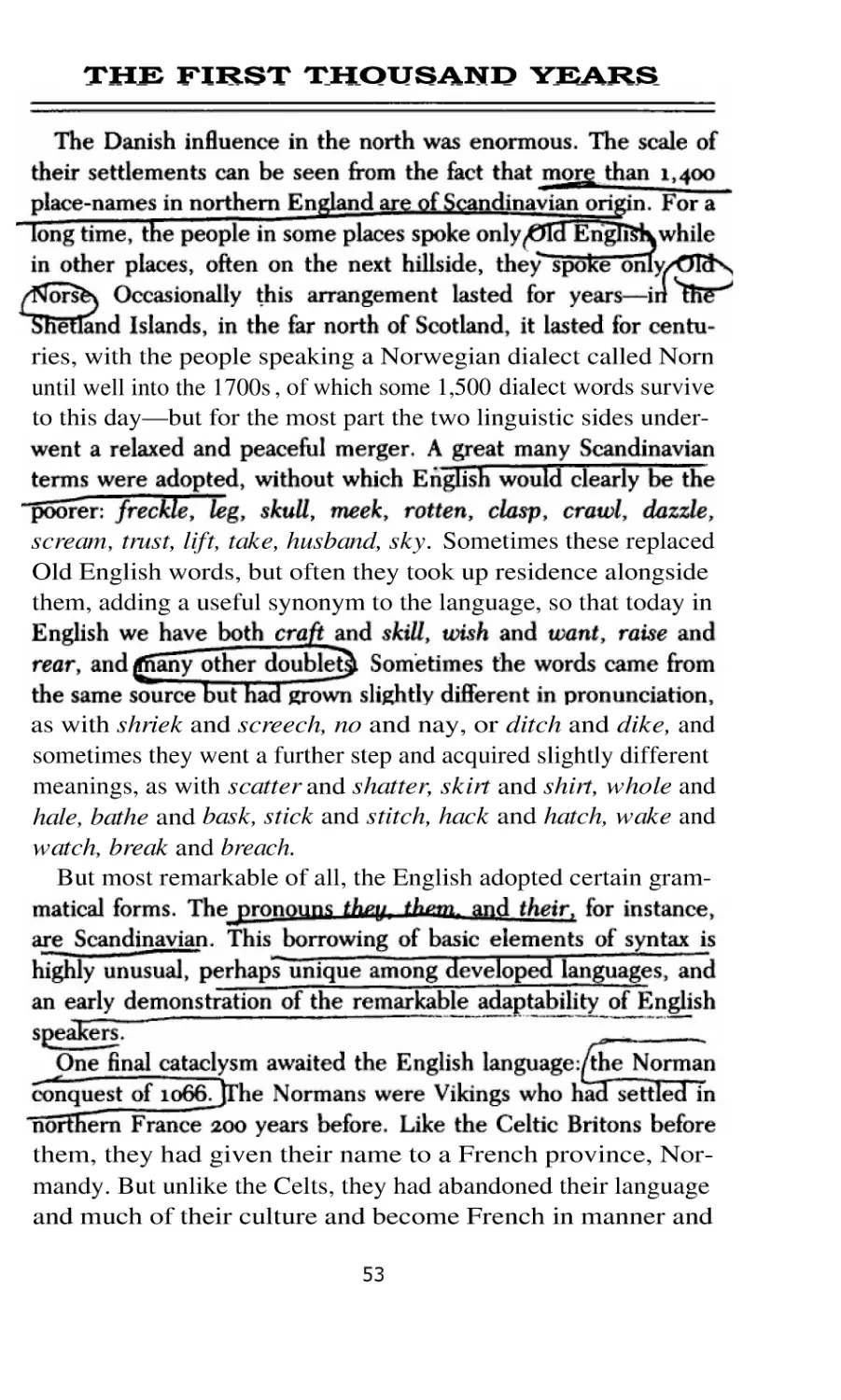
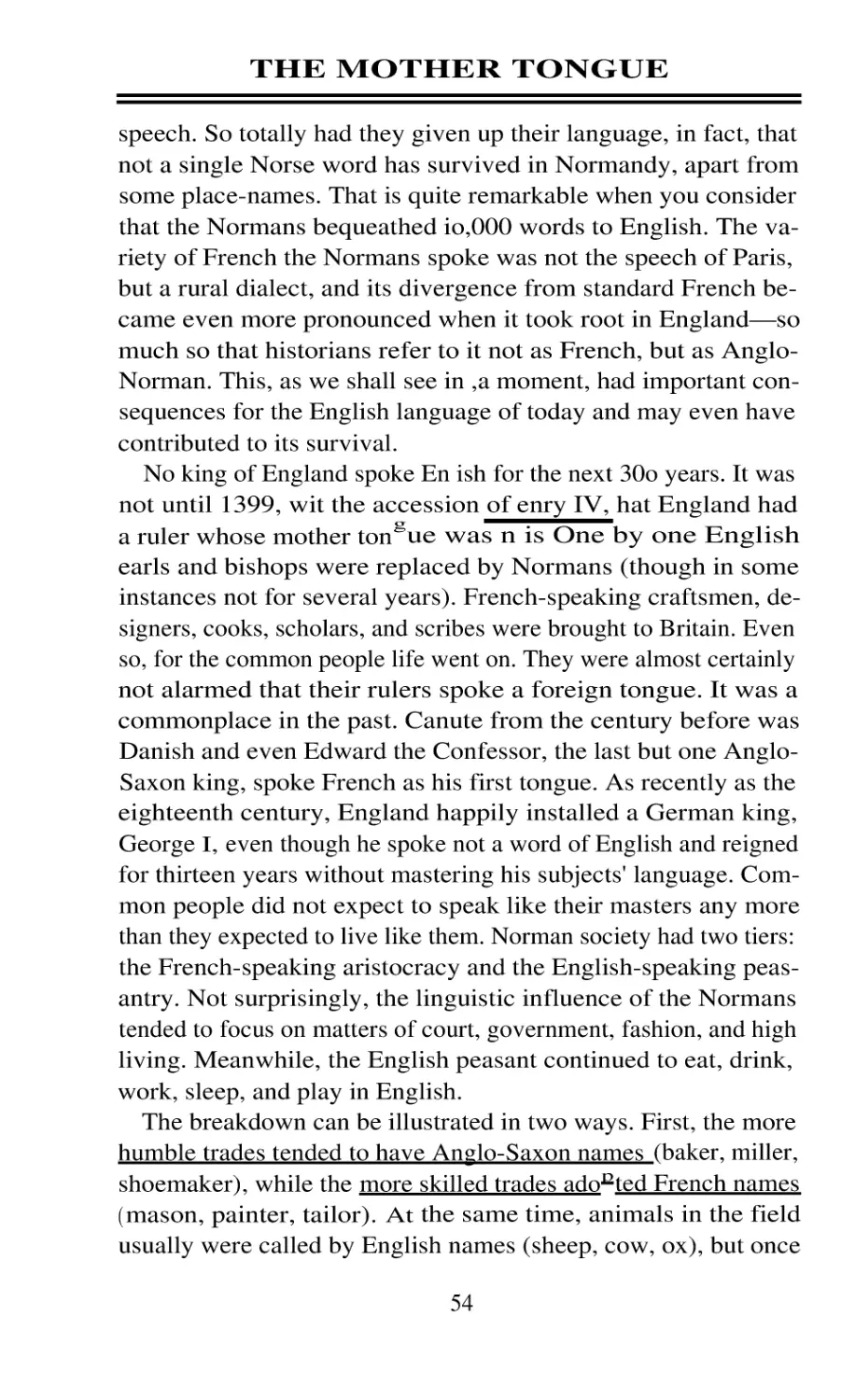
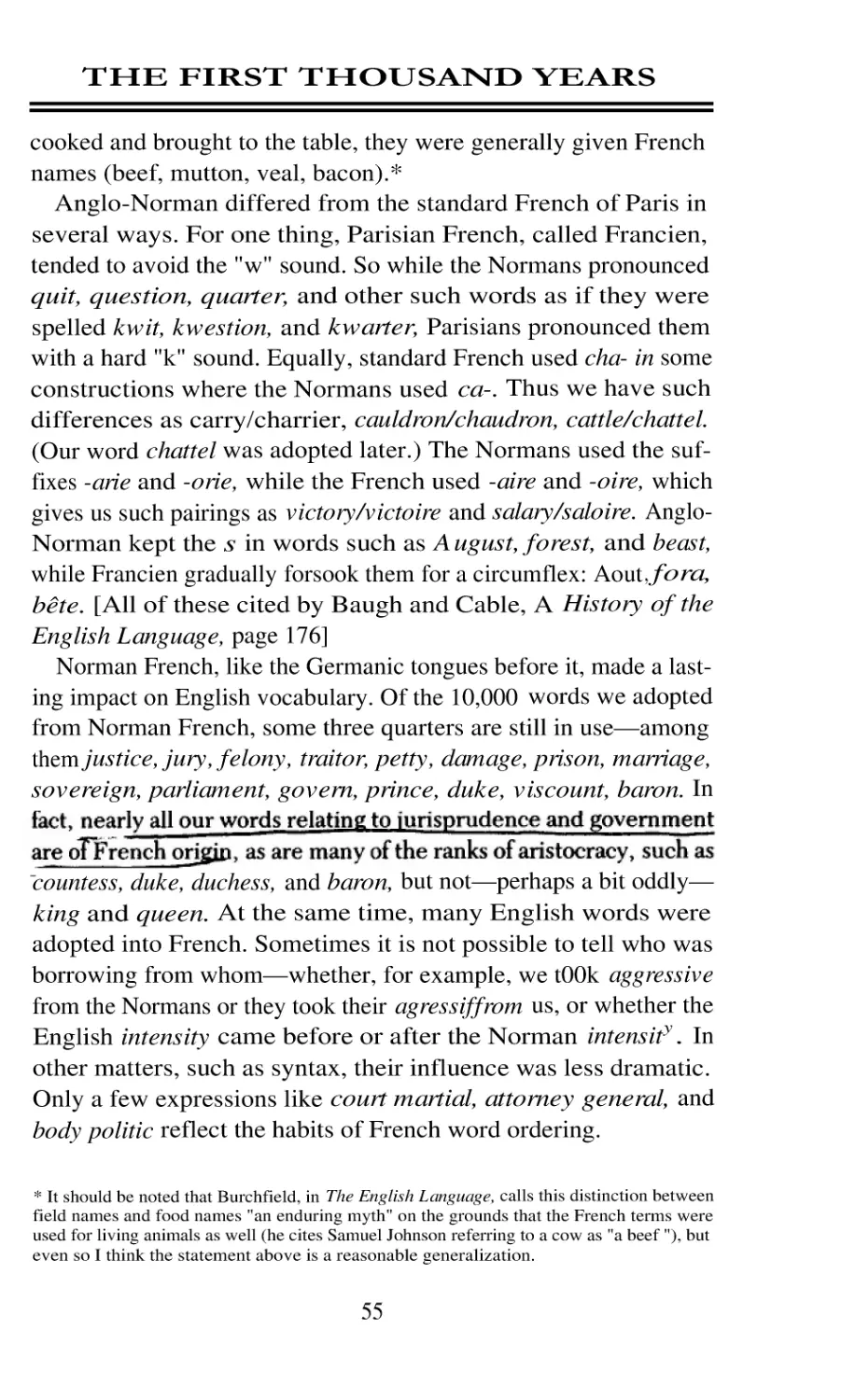
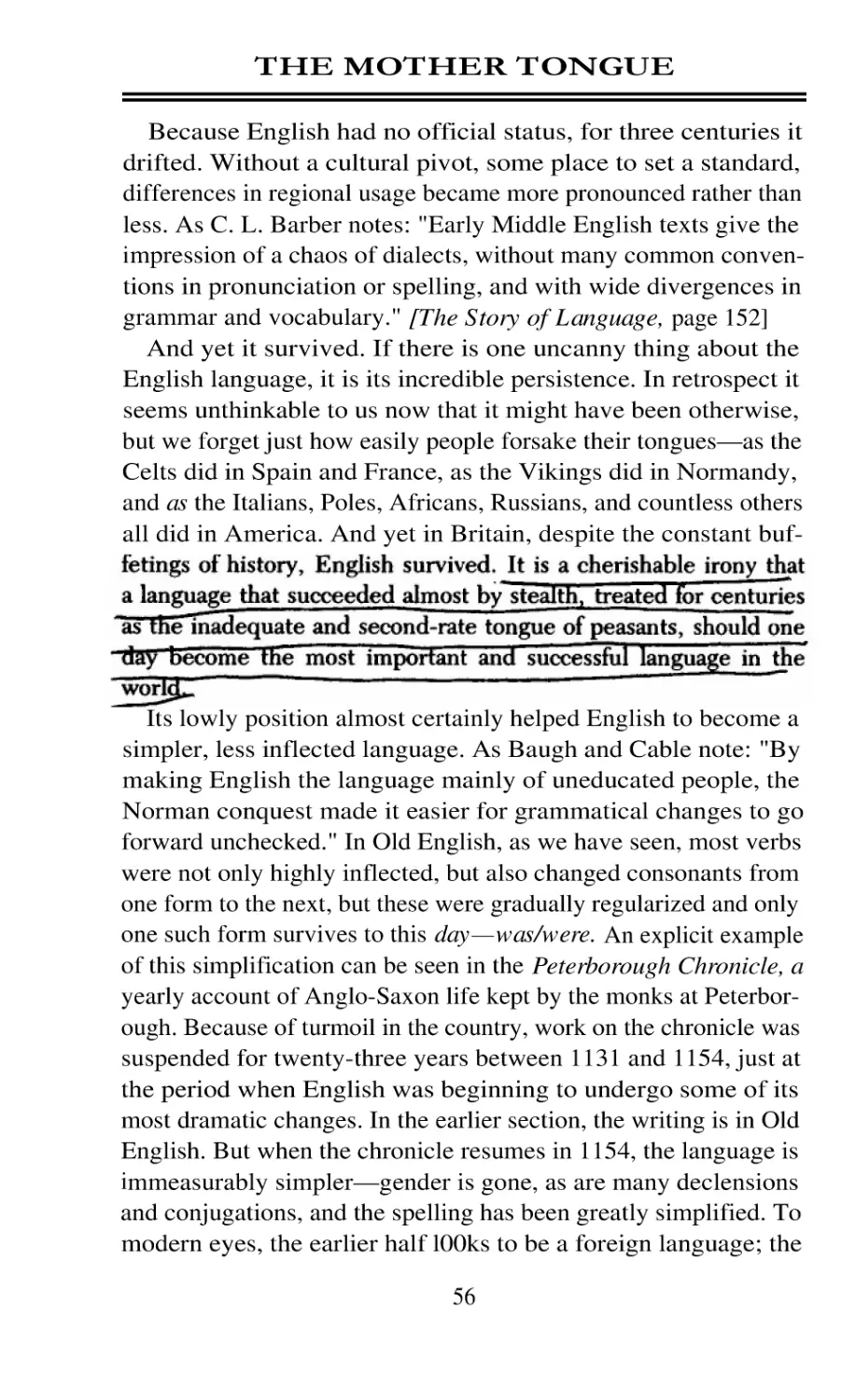
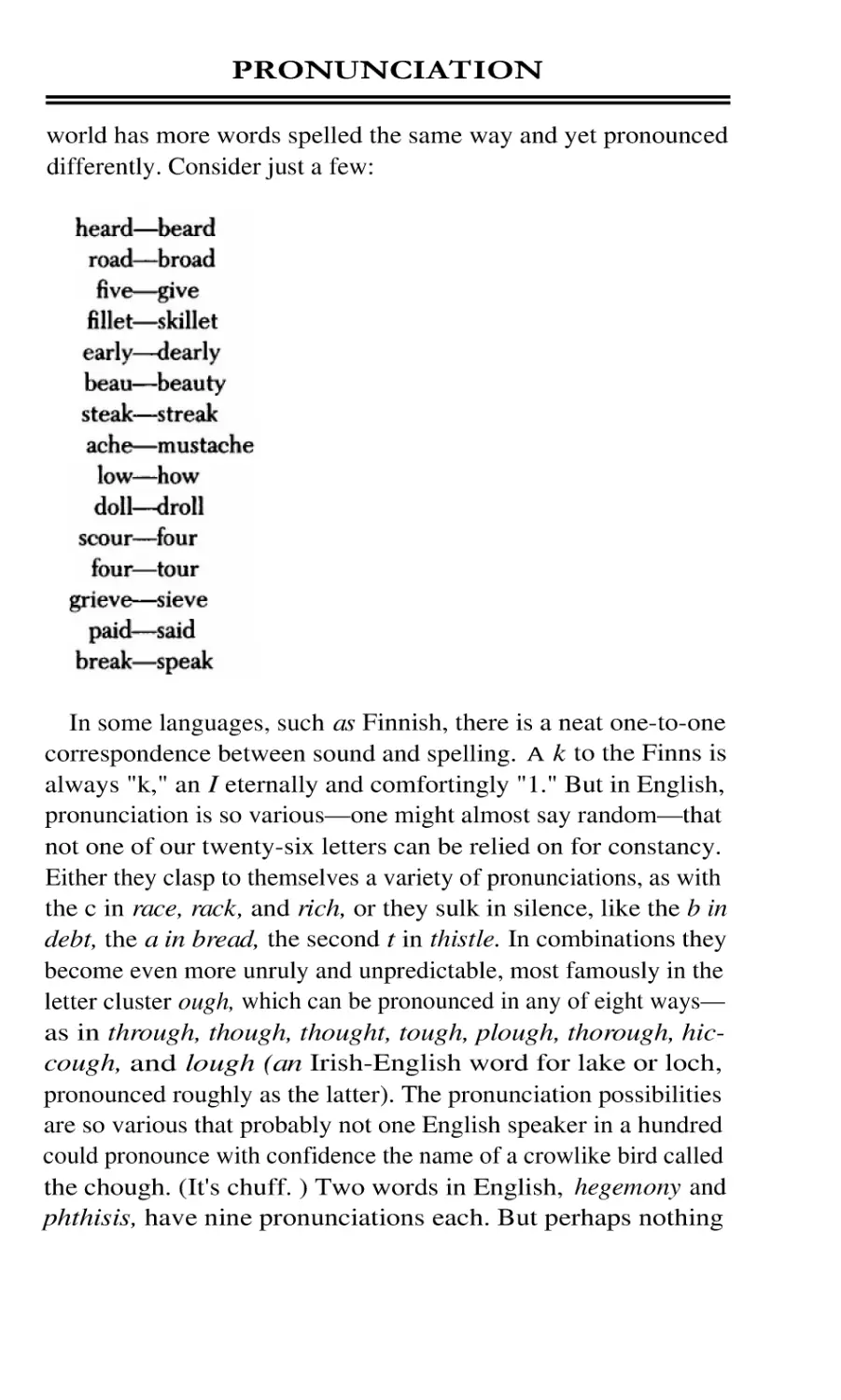
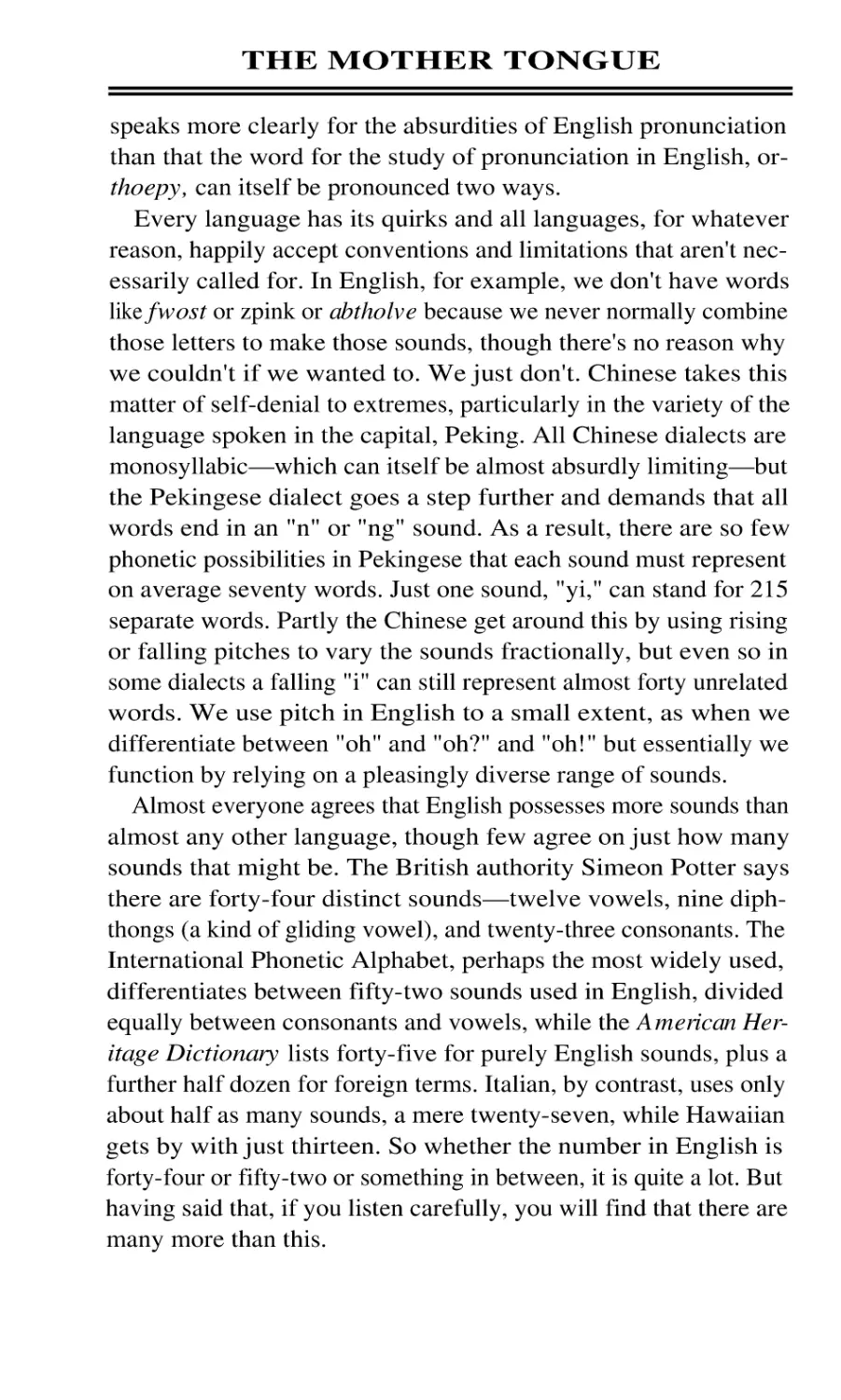
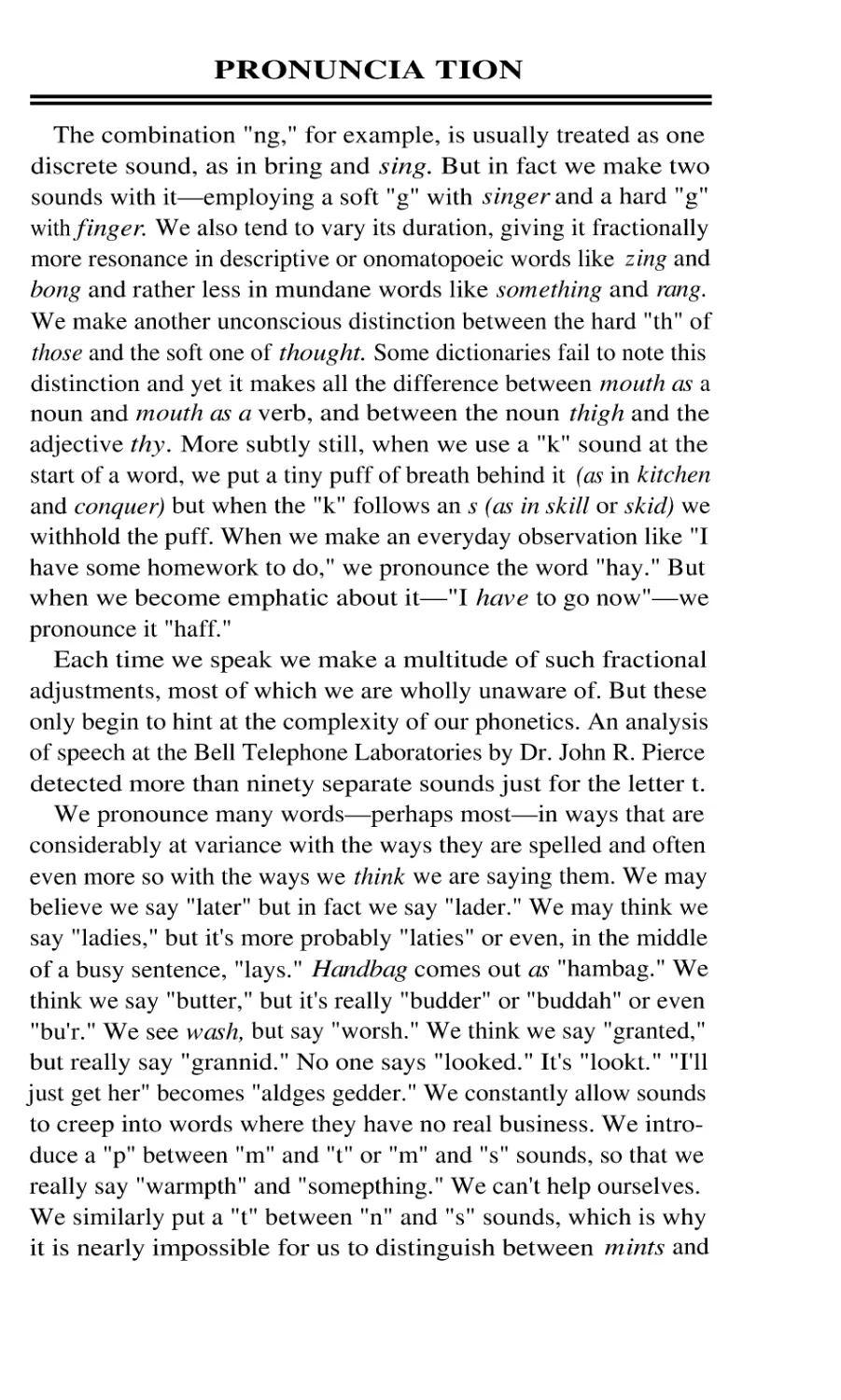
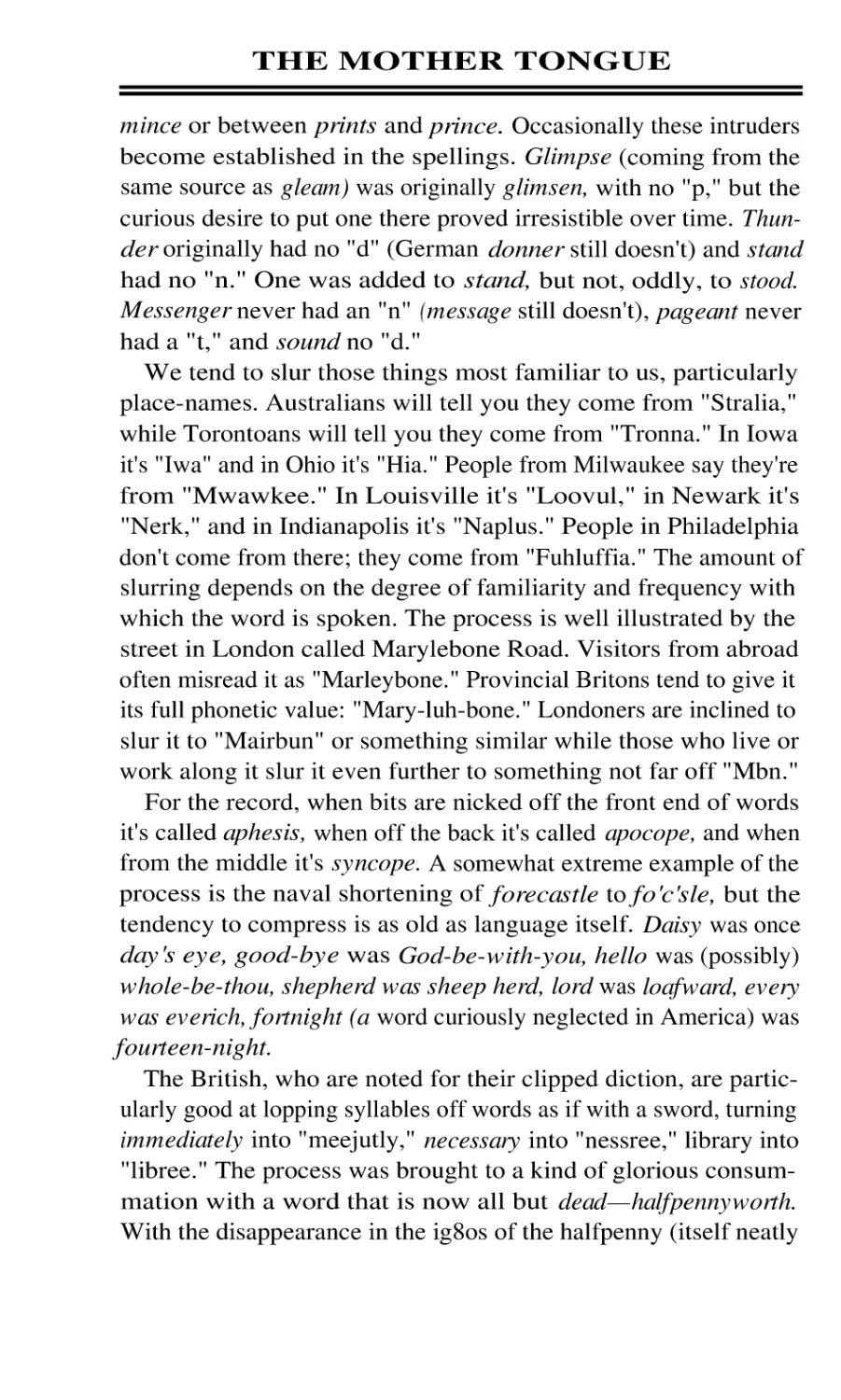
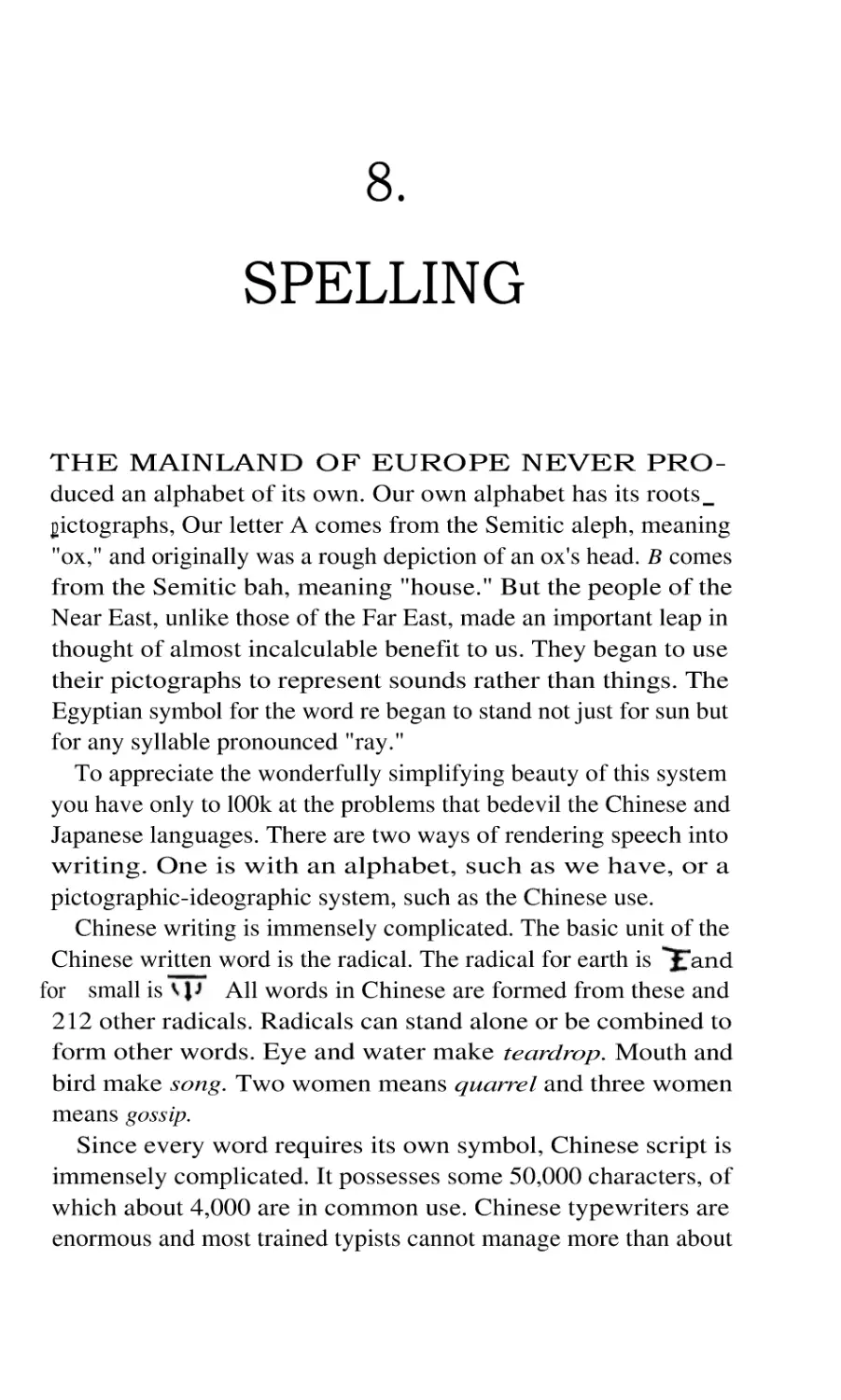
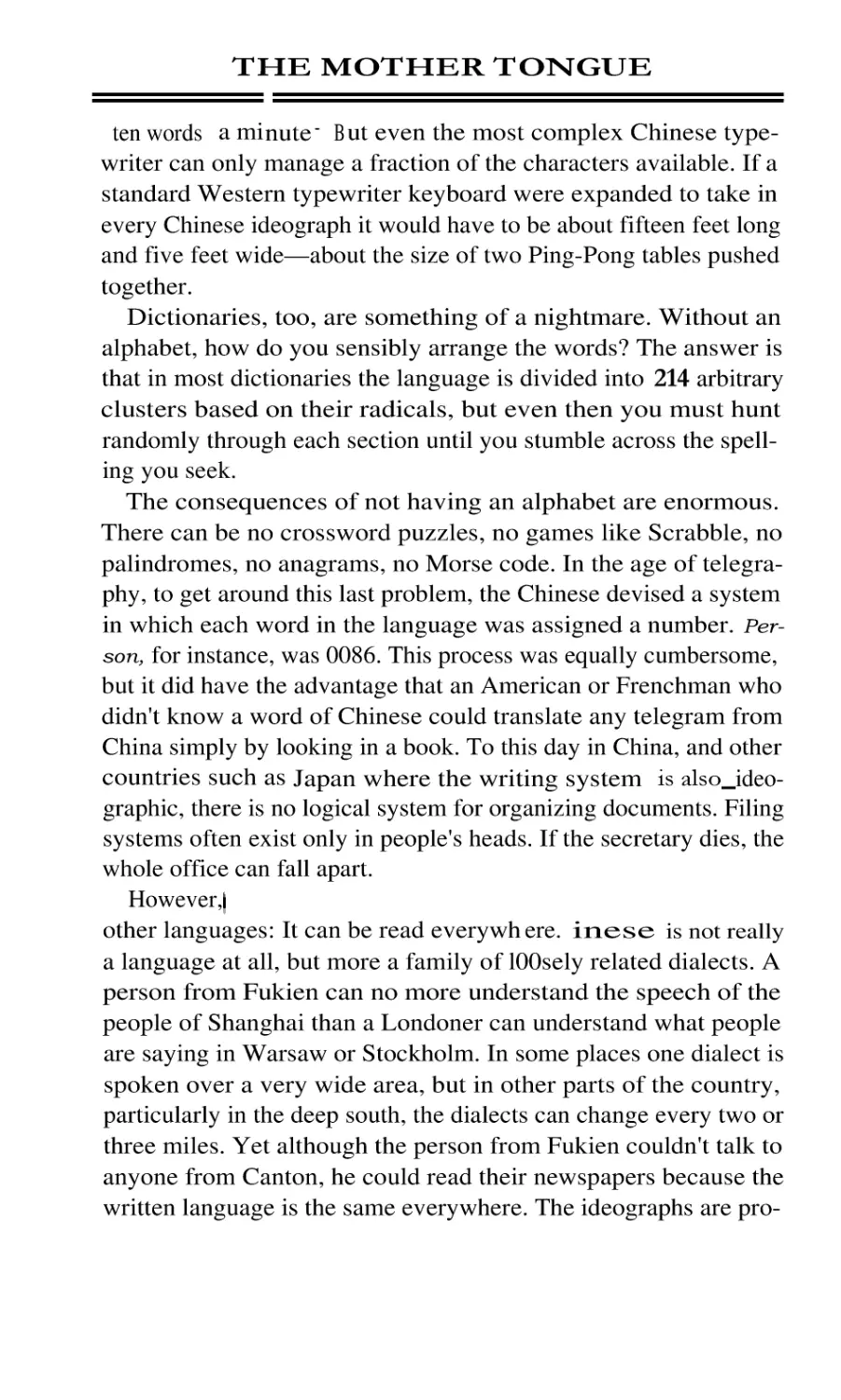
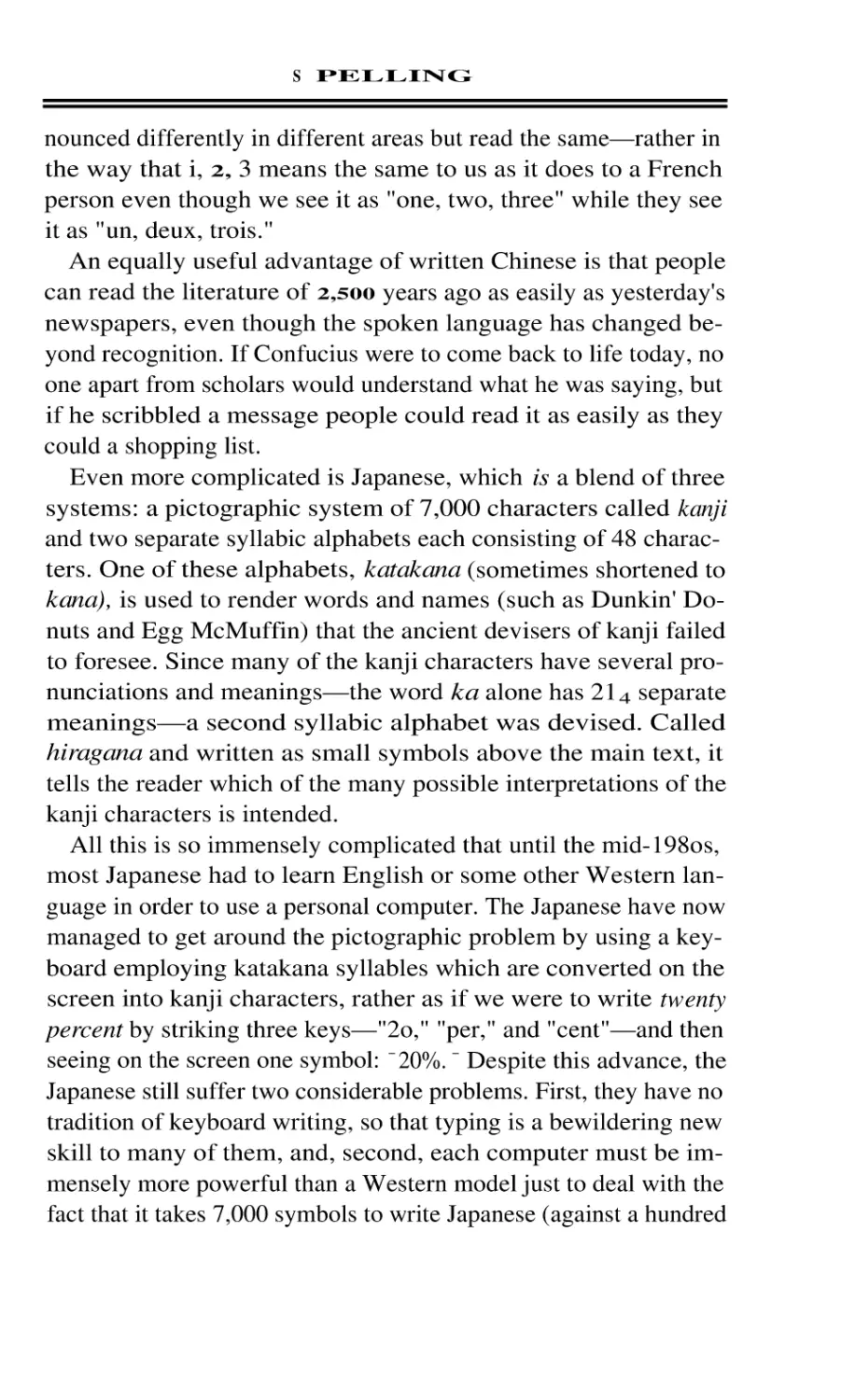
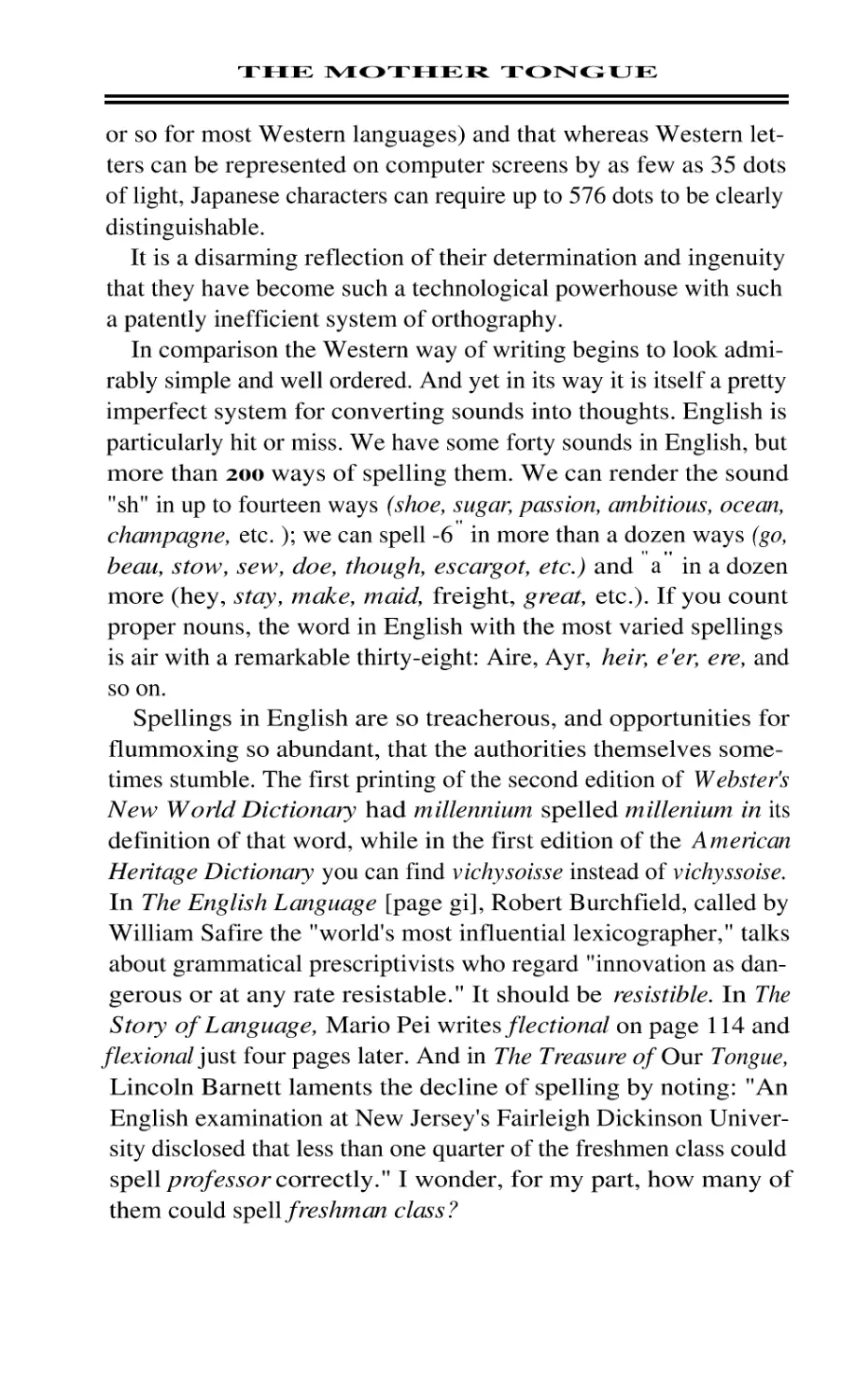
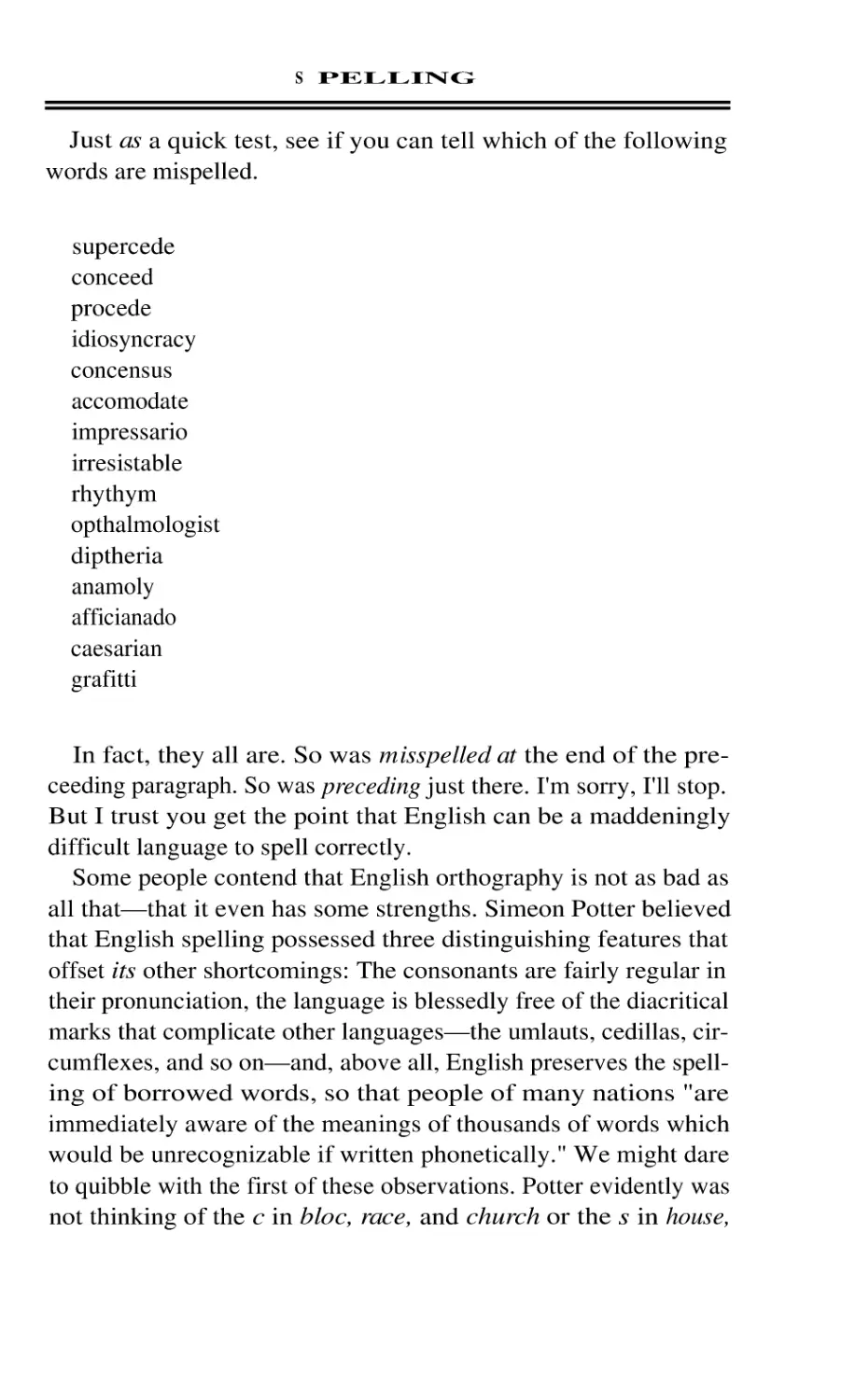
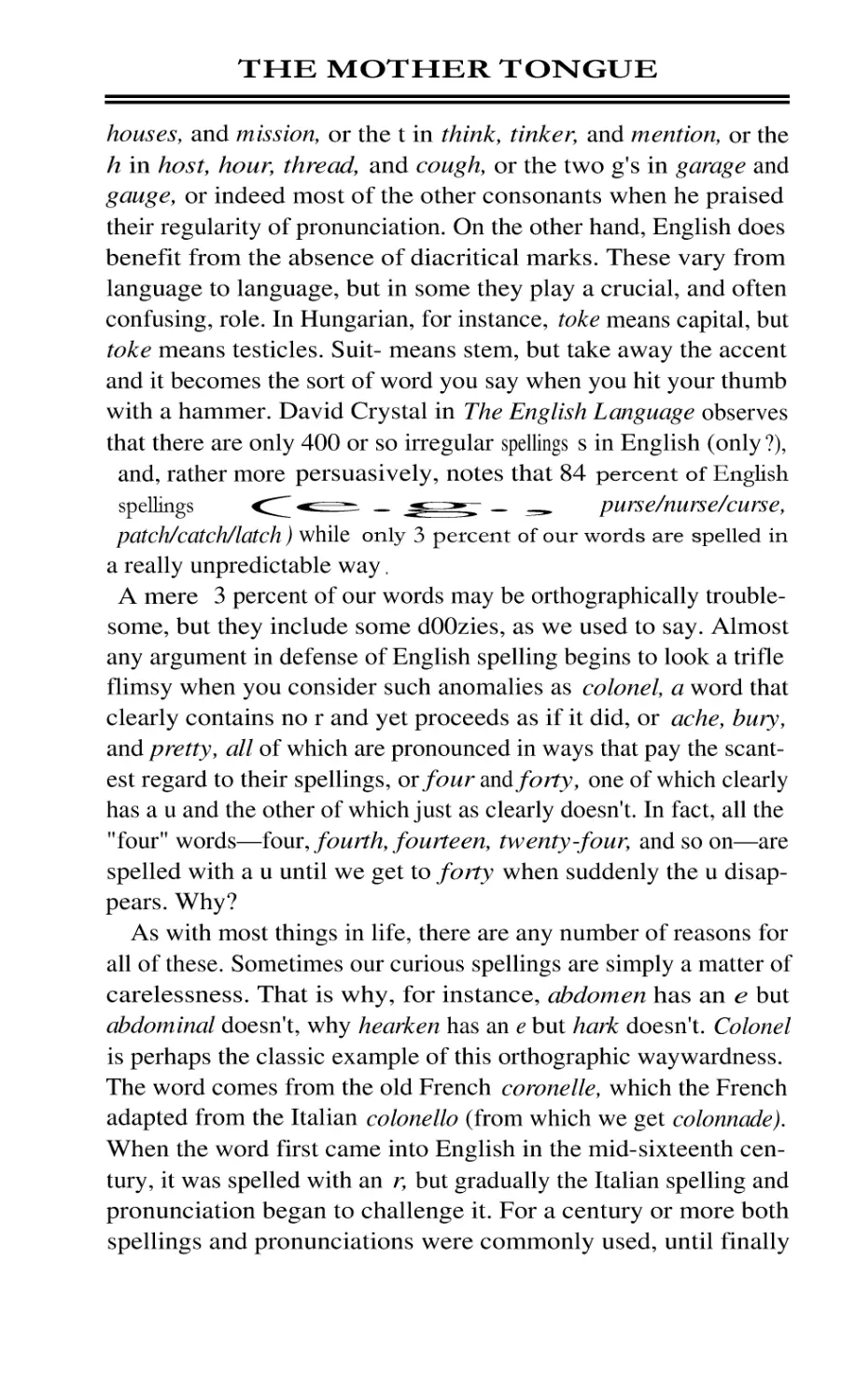
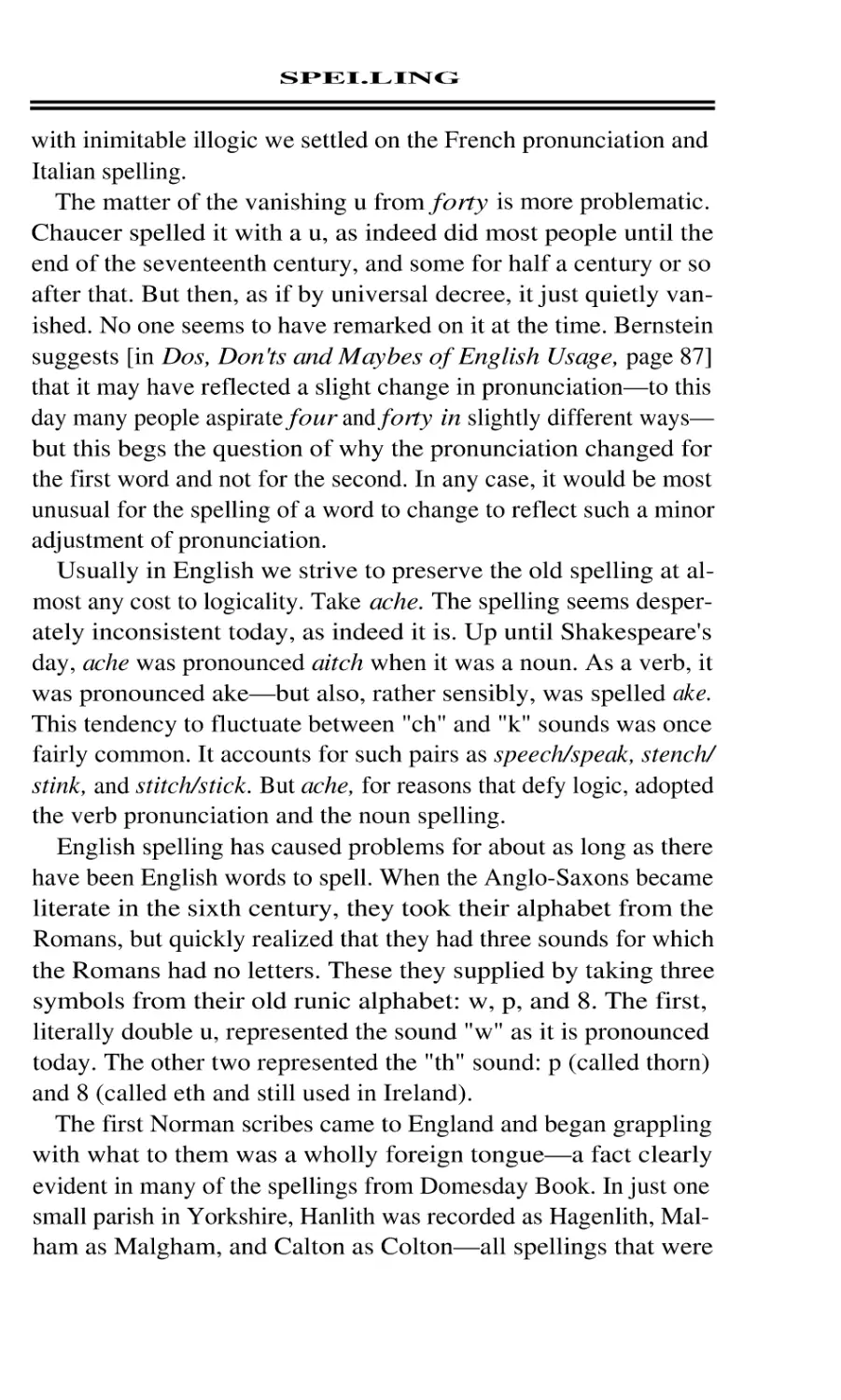
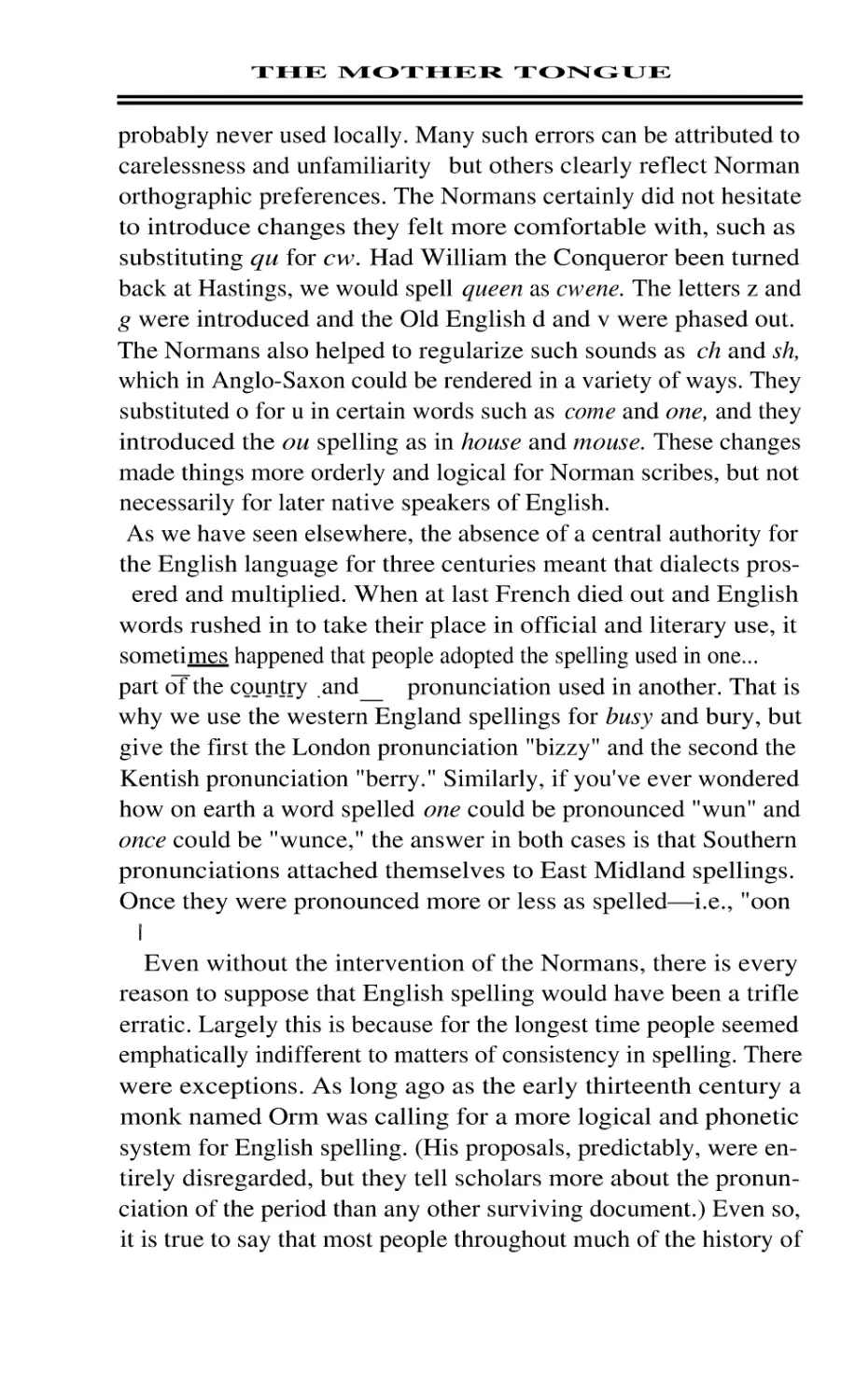
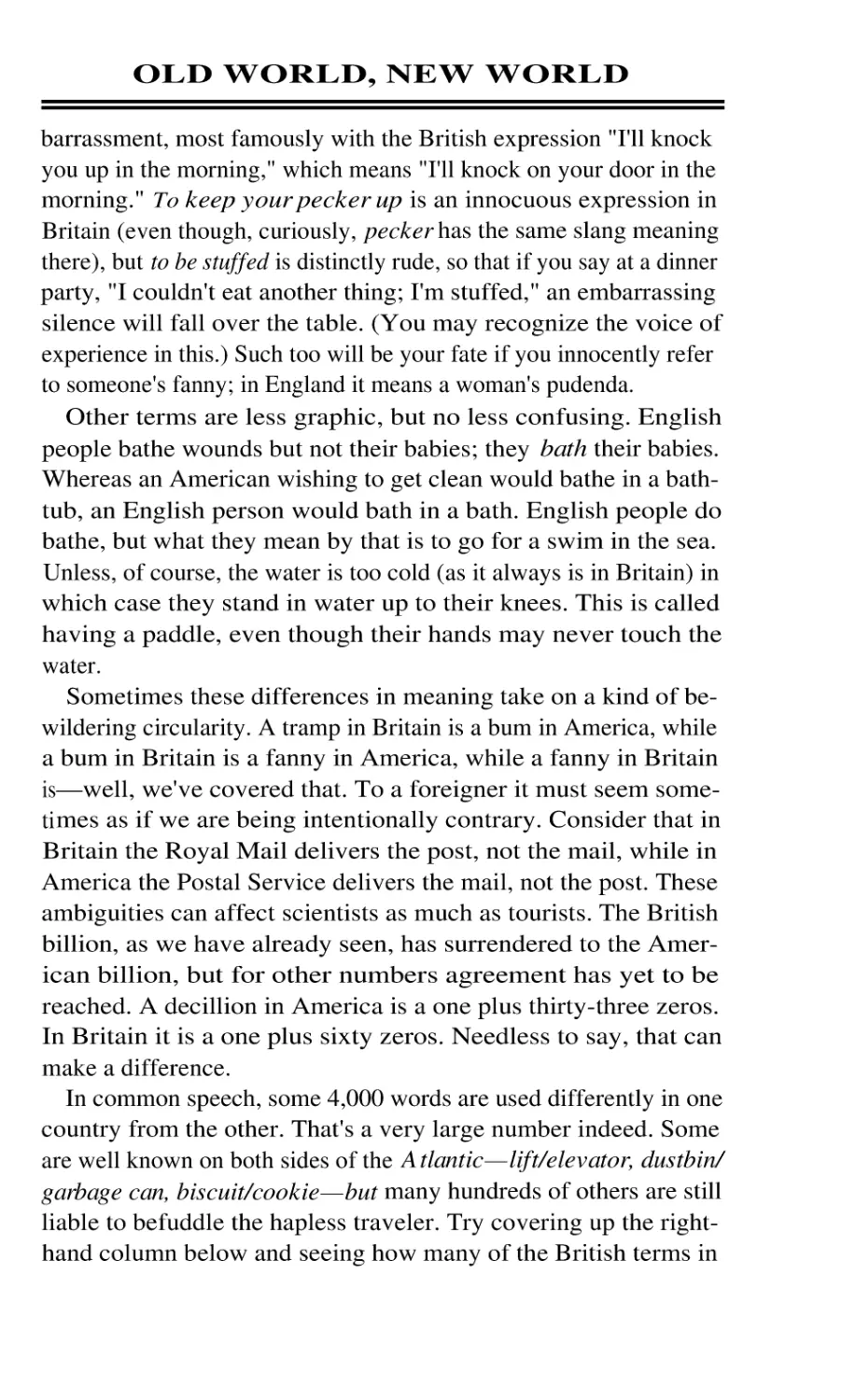
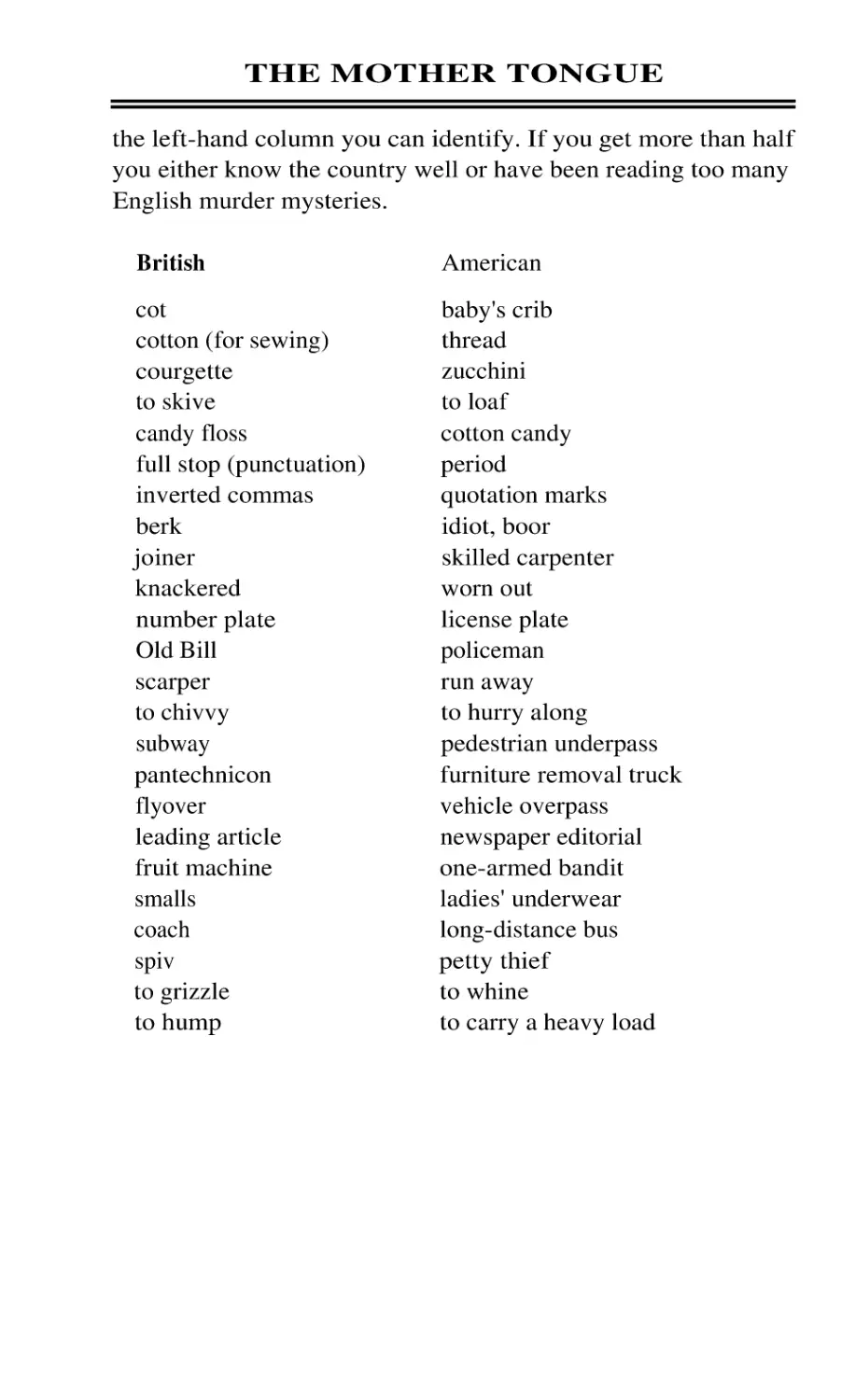
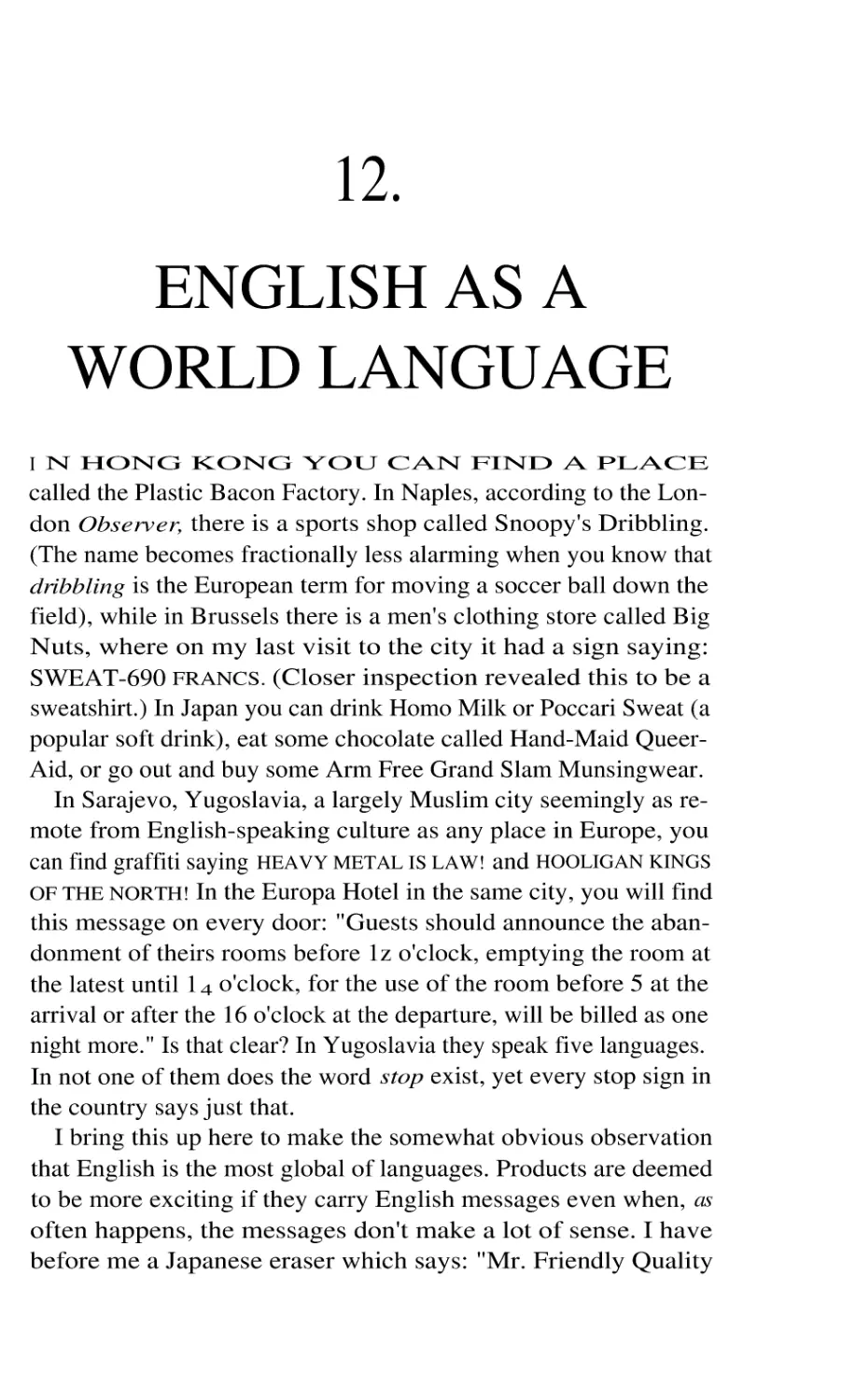
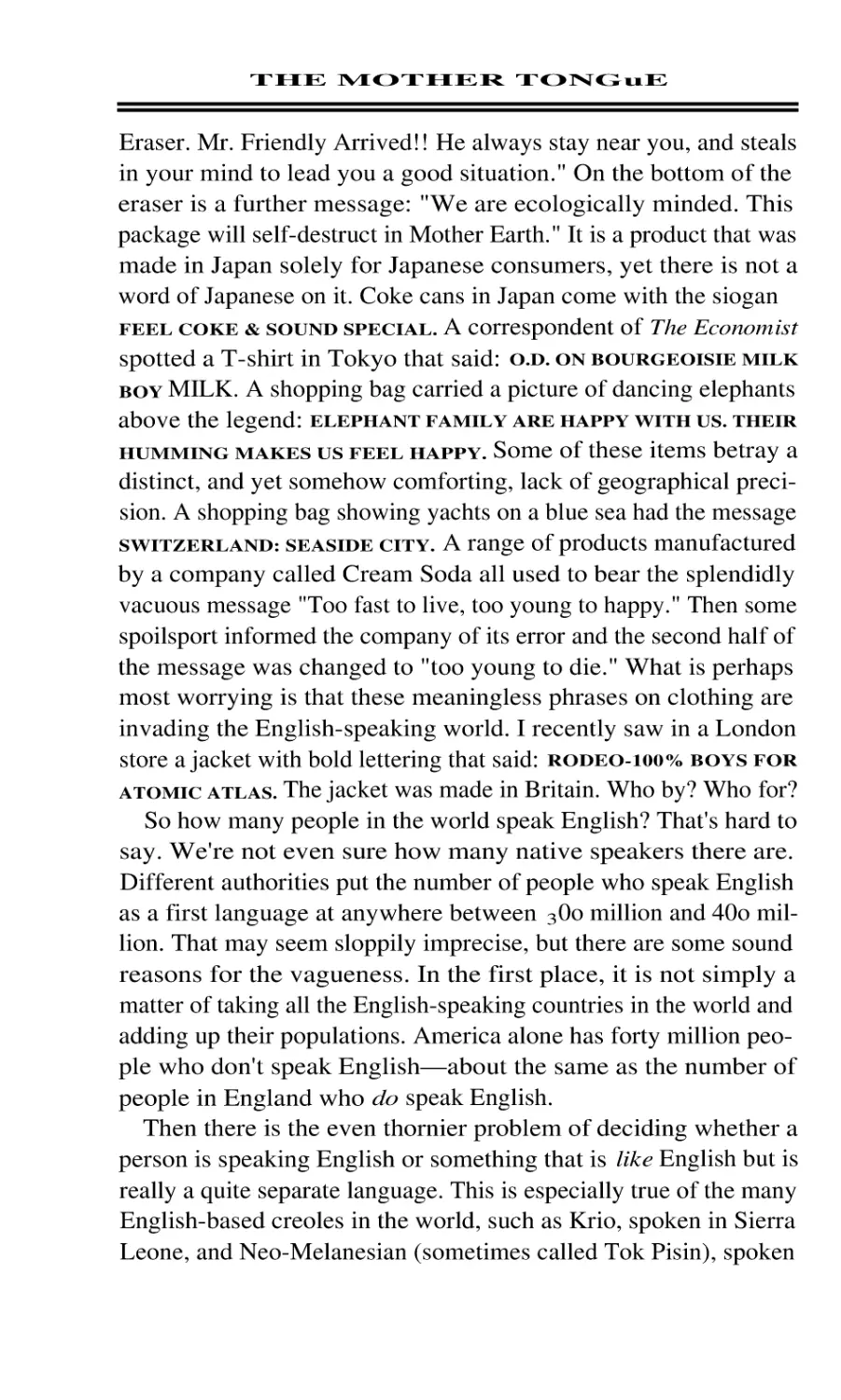
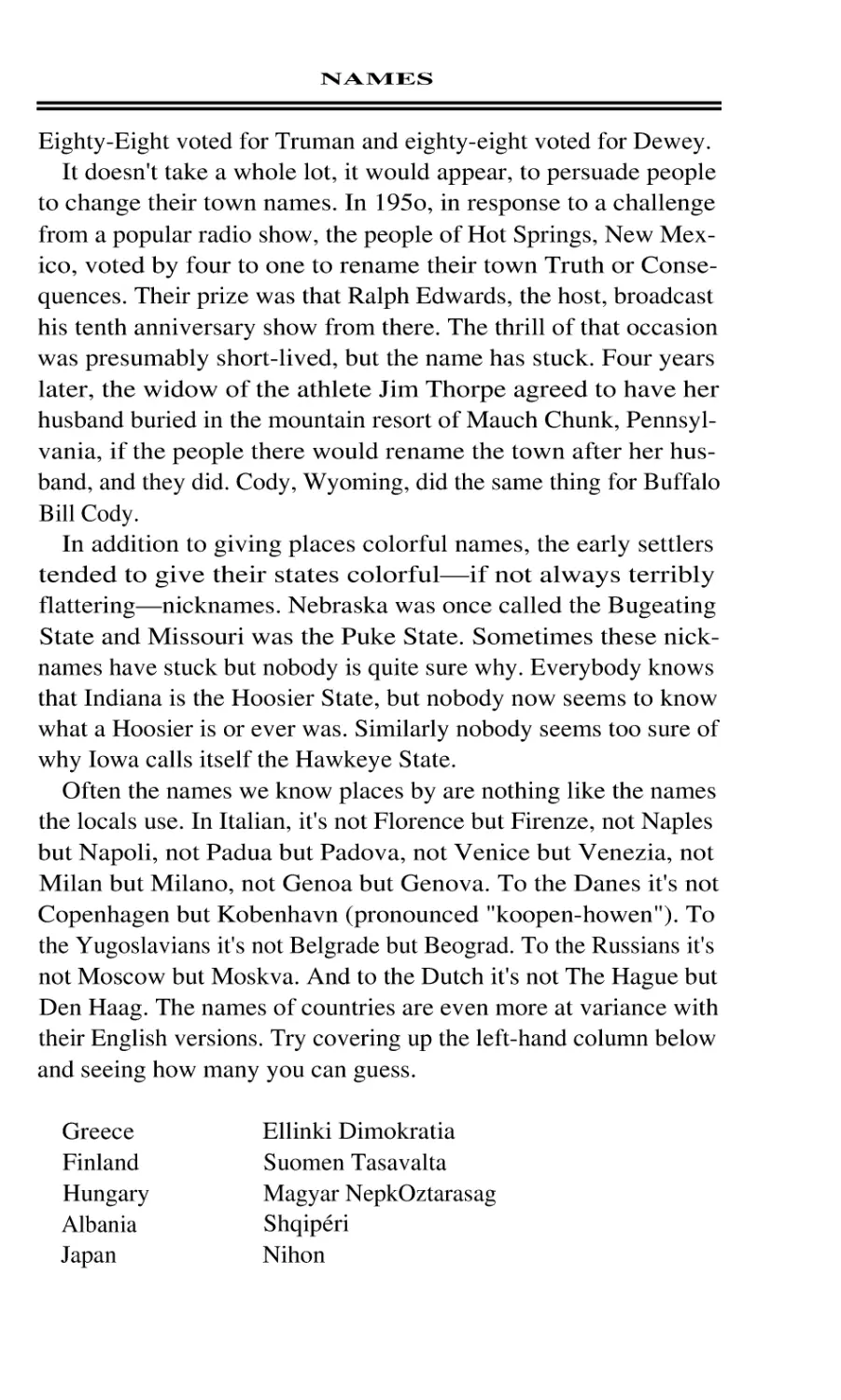
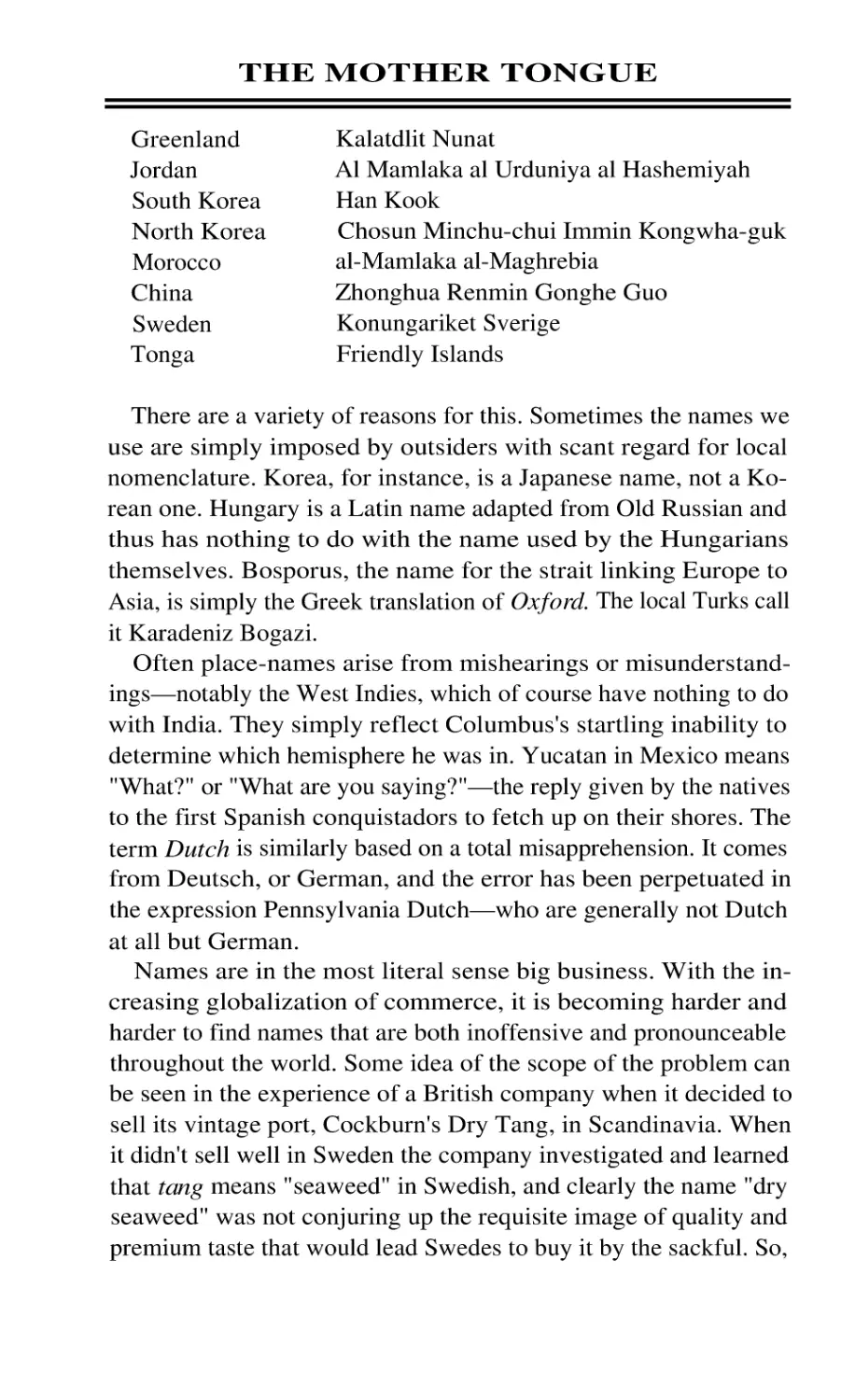
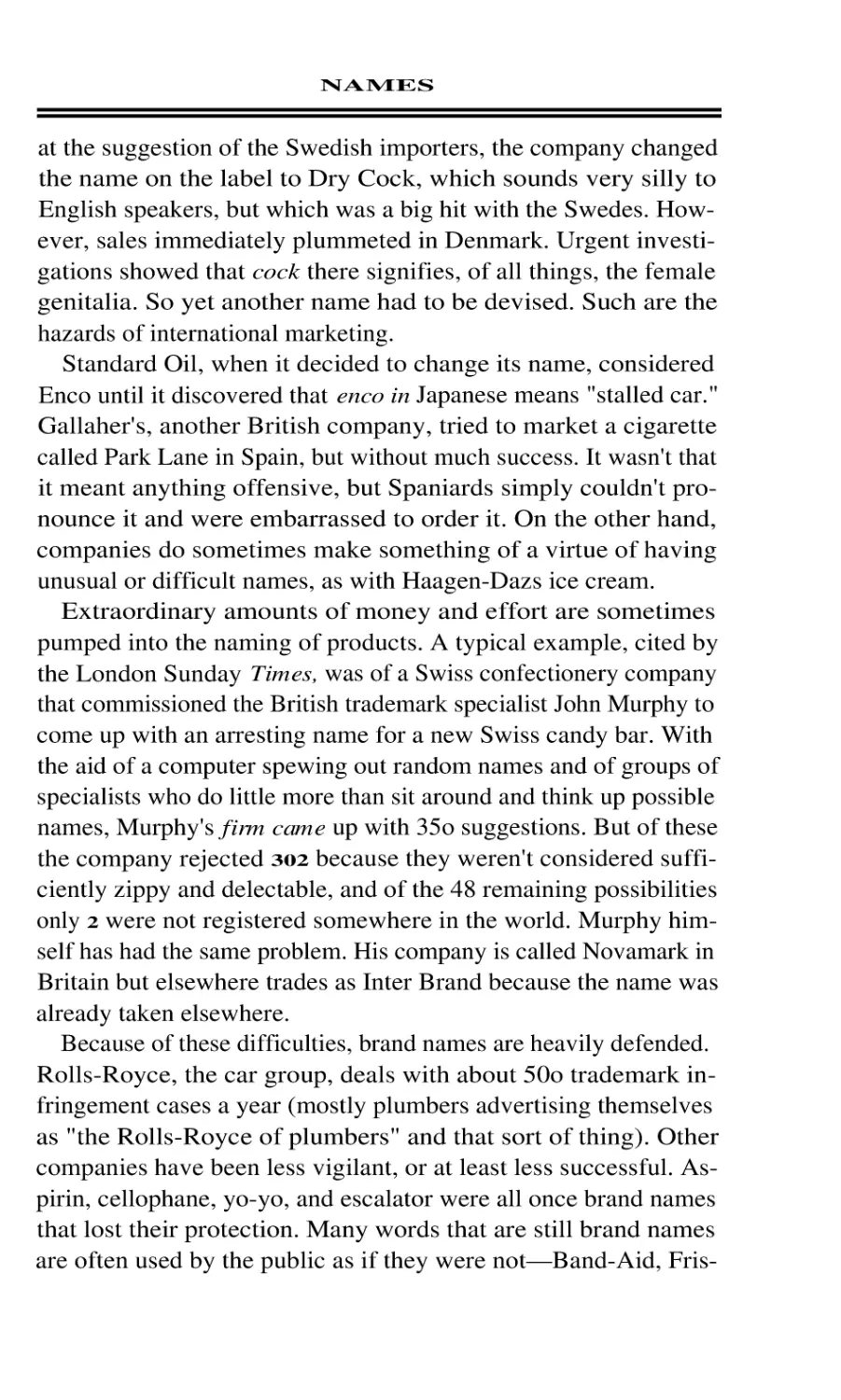
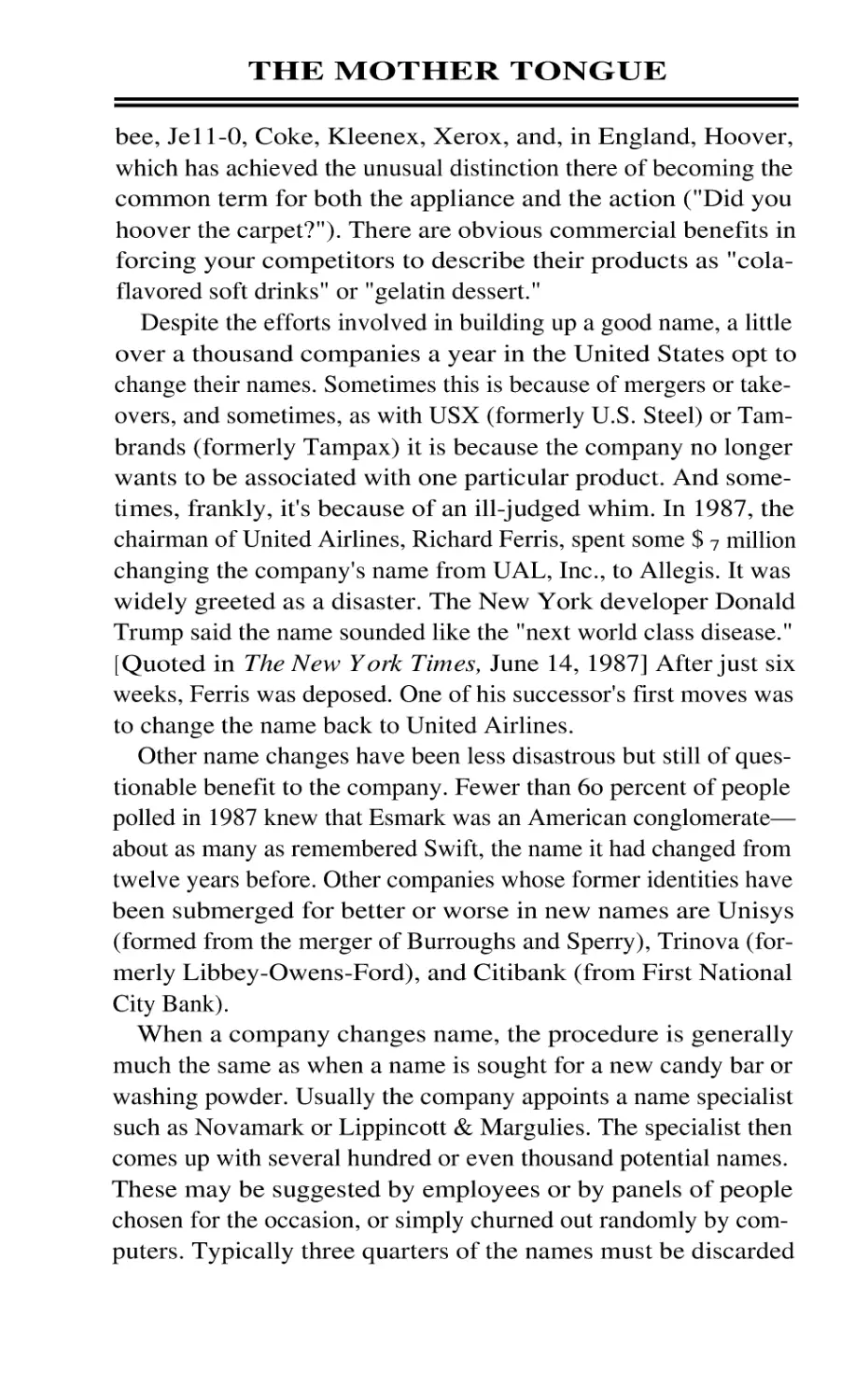

Текст
                    MORE THAN

3

00 MILLION PEOPLE IN

the world speak English and the rest, it sometimes seems, try to.
It would be charitable to say that the results are sometimes mixed.
Consider this hearty announcement in a Yugoslavian hotel: "The
flattening of underwear with pleasure is the job of the chambermaid. Turn to her straightaway." Or this warning to motorists in
Tokyo: "When a passenger of the f00t heave in sight, t00tle the
horn. Trumpet at him melodiously at first, but if he still obstacles
your passage, then tootle him with vigor." Or these instructions
gracing a packet of convenience f00d from Italy: "Besmear a backing pan, previously buttered with a g00d tomato sauce, and, after,
dispose the cannelloni, lightly distanced between them in a only
couch."
Clearly the writer of that message was not about to let a little
ignorance of English stand in the way of a g00d meal. In fact, it
would appear that one of the beauties of the English language is
that with even the most tenuous grasp you can speak volumes if
you show enough enthusiasm—a willingness to t00tle with vigor, as
it were.
To be fair, English is full of b00by traps for the unwary foreigner.
Any language where the unassuming word fly signifies an annoying
insect, a means of travel, and a critical part of a gentleman's apparel
is clearly asking to be mangled. Imagine being a foreigner and
having to learn that in English one tells a lie but the truth, that a
person who says "I could care less" means the same thing as someone who says "I couldn't care less," that a sign in a store saying ALL
ITEMS NOT ON SALE doesn't mean literally what it says (that every
11

THE MOTHER TONGUE

item is not on sale) but rather that only some of the items are on
sale, that when a person says to you, "How do you do?" he will be
taken aback if you reply, with impeccable logic, "How do I do
what?"
The complexities of the English language are such that even
native speakers cannot always communicate effectively, as almost
every American learns on his first day in Britain. Indeed, Robert
Burchfield, editor of the Oxford English Dictionary, created a stir
in linguistic circles on both sides of the Atlantic when he announced
his belief that American English and English English are drifting
apart so rapidly that within 200 years the two nations won't be able
to understand each other at all.
That may be. But if the Briton and American of the twentysecond century baffle each other, it seems altogether likely that
they won't confuse many others—not, at least, if the rest of the
world continues expropriating words and phrases at its present
rate. Already Germans talk about ein Image Problem and das CashFlow, Italians program their computers with il software, French
motorists going away for a weekend break pause for les refueling
stops, Poles watch telewizja, Spaniards have a flirt, Austrians eat
Big Macs, and the Japanese go on a pikunikku. For better or
worse, English has become the most global of languages, the lingua
franca of business, science, education, politics, and pop music. For
the airlines of 157 nations (out of 168 in the world), it is the agreed
international language of discourse. In India, there are more than
3,000 newspapers in English. The six member nations of the European Free Trade Association conduct all their business in English, even though not one of them is an English-speaking country.
When companies from four European countries—France, Italy,
Germany, and Switzerland—formed a joint truck-making venture
called Iveco in 1977, they chose English as their working language
because, as one of the founders wryly observed, "It puts us all at an
equal disadvantage." For the same reasons, when the Swiss company Brown Boveri and the Swedish company ASEA merged in
1 988, they decided to make the official company language English,
and when Volkswagen set up a factory in Shanghai it found that
there were too few Germans who spoke Chinese and too few Chi-

THE WORLD'S LANGUAGE

nese who spoke German, so now Volkswagen's German engineers
and Chinese managers communicate in a language that is alien to
both of them, English. Belgium has two languages, French and
Flemish, yet on a recent visit to the country's main airport in
Brussels, I counted more than fifty posters and billboards and not
one of them was in French or Flemish. They were all in English.
For non-English speakers everywhere, English has become the
common tongue. Even in France, the most determinedly nonEnglish-speaking nation in the world, the war against English encroachment has largely been lost. In early 1989, the Pasteur
Institute announced that henceforth it would publish its famed
international medical review only in English because too few people were reading it in French.
English is, in short, one of the world's great growth industries.
"English is just as much big business as the export of manufactured
goods," Professor Randolph Quirk of Oxford University has written. "There are problems with what you might call 'after-sales
service'; and 'delivery' can be awkward; but at any rate the production lines are trouble free." [The Observer, October 26, 19801
Indeed, such is the demand to learn the language that there are
now more students of English in China than there are people in the
United States.
It is often said that what most immediately sets English apart
from other languages is the richness of its vocabulary. Webster's
Third New International Dictionary lists 4 50,00o words, and the
revised Oxford English Dictionary has 615,000, but that is only
part of the total. Technical and scientific terms would add millions
more. Altogether, about 200,000 English words are in common
use, more than in German (184,000) and far more than in French
(a mere 100,000). The richness of the English vocabulary, and the
wealth of available synonyms, means that English speakers can
often draw shades of distinction unavailable to non-English speakers. The French, for instance, cannot distinguish between house
and home, between mind and brain, between man and gentleman,
between "I wrote" and "I have written." The Spanish cannot differentiate a chairman from a president, and the Italians have no
equivalent of wishful thinking. In Russia there are no native words

THE MOTHER TONGUE
for efficiency, challenge, engagement ring, have fun, or take care
[all cited in The New York Times, June 18, 198g]. English, as
Charlton Laird has noted, is the only language that has, or needs,
books of synonyms like Roget's Thesaurus. "Most speakers of other
languages are not aware that such books exist." [The Miracle of
Language, page 54]
On the other hand, other languages have facilities we lack. Both
French and German can distinguish between knowledge that results from recognition (respectively connaitre and kennen) and
knowledge that results from understanding (savoir and wissen).
Portuguese has words that differentiate between an interior angle
and an exterior one. All the Romance languages can distinguish
between something that leaks into and something that leaks out of.
The Italians even have a word for the mark left on a table by a moist
glass (culacino) while the Gaelic speakers of Scotland, not to be
outdone, have a word for the itchiness that overcomes the upper
lip just before taking a sip of whiskey. (Wouldn't they just?) It's
sgriob. And we have nothing in English to match the Danish hygge
(meaning "instantly satisfying and cozy"), the French sang-froid,
the Russian glasnost, or the Spanish macho, so we must borrow the
term from them or do without the sentiment.
At the same time, some languages have words that we may be
pleased to do without. The existence in German of a word like
schadenfreude (taking delight in the misfortune of others) perhaps
tells us as much about Teutonic sensitivity as it does about their
neologistic versatility. Much the same could be said about the
curious and monumentally unpronounceable Highland Scottish
word sgiomlaireachd , which means "the habit of dropping in at
mealtimes." That surely conveys a world of information about the
hazards of Highland life—not to mention the hazards of Highland
orthography.
Of course, every language has areas in which it needs, for practical purposes, to be more expressive than others. The Eskimos, as
is well known, have fifty words for types of snow—though curiously
no word for just plain snow. To them there is crunchy snow, soft
snow, fresh snow, and old snow, but no word that just means snow.
The Italians, as we might expect, have over 50o names for different

THE WORLD'S LANGUAGE
types of macaroni. Some of these, when translated, begin to sound
distinctly unappetizing, like strozzapreti, which means "strangled
priests." Vermicelli means "little worms" and even spaghetti means
"little strings." When you learn that muscatel in Italian means
"wine with flies in it," you may conclude that the Italians are
gastronomically out to lunch, so to speak, but really their names for
foodstuffs are no more disgusting than our hot dogs or those old
English favorites, toad-in-the-hole, spotted dick, and faggots in
gravy.
The residents of the Trobriand Islands of Papua New Guinea
have a hundred words for yams, while the Maoris of New Zealand
have thirty-five words for dung (don't ask me why). Meanwhile,
the Arabs are said (a little unbelievably, perhaps) to have 6,000
words for camels and camel equipment. The aborigines of Tasmania have a word for every type of tree, but no word that just means
"tree," while the Araucanian Indians of Chile rather more poignantly have a variety of words to distinguish between different
degrees of hunger. Even among speakers of the same language,
regional and national differences abound. A Londoner has a less
comprehensive view of extremes of weather than someone from
the Middle West of America. What a Briton calls a blizzard would,
in Illinois or Nebraska, be a flurry, and a British heat wave is often
a thing of merriment to much of the rest of the world. (I still
treasure a London newspaper with the banner headline: BRITAIN
SIZZLES IN THE SEVENTIES!)

A second commonly cited factor in setting English apart from
other languages is its flexibility. This is particularly true of word
ordering, where English speakers can roam with considerable freedom between passive and active senses. Not only can we say "I
kicked the dog," but also "The dog was kicked by me"—a construction that would be impossible in many other languages. Similarly, where the Germans can say just "ich singe" and the French
must manage with "je chante," we can say "I sing," "I do sing," or
"I am singing." English also has a distinctive capacity to extract
maximum work from a word by making it do double duty as both
noun and verb. The list of such versatile words is practically endless: drink, fight, fire, sleep, run, fund, look, act, view, ape, si-

THE MOTHER TONGUE
lence, worship, copy, blame, comfort, bend, cut, reach, like,
dislike, and so on. Other languages sometimes show inspired
flashes of versatility, as with the German auf, which can mean
"on," "in," "upon," "at," "toward," "for," "to," and "upward," but
these are relative rarities.
At the same time, the endless versatility of English is what
makes our rules of grammar so perplexing. Few English-speaking
natives, however well educated, can confidently elucidate the difference between, say, a complement and a predicate or distinguish
a full infinitive from a bare one. The reason for this is that the rules
of English grammar were originally modeled on those of Latin,
which in the seventeenth century was considered the purest and
most admirable of tongues. That it may be. But it is also quite
clearly another language altogether. Imposing Latin rules on English structure is a little like trying to play baseball in ice skates.
The two simply don't match. In the sentence "I am swimming,"
swimming is a present participle. But in the sentence "Swimming
is good for you," it is a gerund—even though it means exactly the
same thing.
A third—and more contentious—supposed advantage of English
is the relative simplicity of its spelling and pronunciation. For all its
idiosyncrasies, English is said to have fewer of the awkward consonant clusters and singsong tonal variations that make other languages so difficult to master. In Cantonese, hae means "yes." But,
with a fractional change of pitch, it also describes the female pudenda. The resulting scope for confusion can be safely left to the
imagination. In other languages it is the orthography, or spelling,
that leads to bewilderment. In Welsh, the word for beer is cwrw-an impossible combination of letters for any English speaker. But
Welsh spellings are as nothing compared with Irish Gaelic, a language in which spelling and pronunciation give the impression of
having been devised by separate committees, meeting in separate
rooms, while implacably divided over some deep semantic issue.
Try pronouncing geimhreadh, Gaelic for "winter," and you will
probably come up with something like "gem-reed-uh." It is in fact
"gyeeryee." Beaudhchais ("thank you") is "bekkas" and 6 Seaghda
i6

THE WORLD'S LANGUAGE
("Oh-seeg-da?") is simply "O'Shea." Against this, the Welsh pronunciation of cwrw—"koo-roo"—begins to look positively selfevident.
In all languages pronunciation is of course largely a matter of
familiarity mingled with prejudice. The average English speaker
confronted with agglomerations of letters like tchst, sthm, and
tchph would naturally conclude that they were pretty well unpronounceable. Yet we use them every day in the words matchstick,
asthma, and catchphrase. Here, as in almost every other area of
language, natural bias plays an inescapable part in any attempt at
evaluation. No one has ever said, "Yes, my language is backward
and unexpressive, and could really do with some sharpening up.We tend to regard other people's languages as we regard their
cultures—with ill-hidden disdain. In Japanese, the word for foreigner means "stinking of foreign hair." To the Czechs a Hungarian
is "a pimple." Germans call cockroaches "Frenchmen," while the
French call lice "Spaniards." We in the English-speaking world
take French leave, but Italians and Norwegians talk about departing like an Englishman, and Germans talk of running like a Dutchman. Italians call syphilis "the French disease," while both French
and Italians call con games "American swindle." Belgian taxi drivers call a poor tipper "un Anglais." To be bored to death in French
is "etre de Birmingham," literally "to be from Birmingham" (which
is actually about right). And in English we have "Dutch courage,"
"French letters," "Spanish fly," "Mexican carwash" (i.e., leaving
your car out in the rain), and many others. Late in the last century
these epithets focused on the Irish, and often, it must be said, they
were as witty as they were wounding. An Irish buggy was a wheelbarrow. An Irish beauty was a woman with two black eyes. Irish
confetti was bricks. An Irish promotion was a demotion. Now almost the only slur against these fine people is to get one's Irish up,
and that isn't really taken as an insult.
So objective evidence, even among the authorities, is not always
easy to come by. Most books on English imply in one way or
another that our language is superior to all others. In The English
Language, Robert Burchfield writes: "As a source of intellectual

THE MOTHER TONGUE
power and entertainment the whole range of prose writing in English is probably unequalled anywhere else in the world." I would
like to think he's right, but I can't help wondering if Mr. Burchfield
would have made the same generous assertion had he been born
Russian or German or Chinese. There is no reliable way of measuring the quality or efficiency of any language. Yet there are one
or two small ways in which English has a demonstrable edge over
other languages. For one thing its pronouns are largely, and mercifully, uninflected. In German, if you wish to say you, you must
choose between seven words: du, dich, dir, Sie, Ihnen, ihr, and
euch. This can cause immense social anxiety. The composer Richard Strauss and his librettist, Hugo von Hofmannsthal, were partners for twenty-five years and apparently adored each other and
yet never quite found the nerve to address each other as anything
but the stiff "Sie." In English we avoid these problems by relying
on just one form: you.
In other languages, questions of familiarity can become even
more agonizing. A Korean has to choose between one of six verb
suffixes to accord with the status of the person addressed. A speaker
of Japanese must equally wend his way through a series of linguistic levels appropriate to the social position of the participants.
When he says thank you he must choose between a range of
meanings running from the perfunctory arigato ("thanks") to the
decidedly more humble makotoni go shinsetsu de gozaimasu,
which means "what you have done or proposed to do is a truly
and genuinely kind and generous deed." Above all, English is
mercifully free of gender. Anyone who spent much of his or her
adolescence miserably trying to remember whether it is "la
plume" or "le plume" will appreciate just what a pointless burden masculine and feminine nouns are to any language. In this
regard English is a godsend to students everywhere. Not only
have we discarded problems of gender with definite and indefinite articles, we have often discarded the articles themselves. We
say in English, "It's time to go to bed," where in most other
European languages they must say, "It's the time to go to the bed."
We possess countless examples of pithy phrases—"life is short,"
i8

THE WORLD

'

S LANGUAGE

"between heaven and earth," "to go to work"—which in other
languages require articles.
English also has a commendable tendency toward conciseness,
in contrast to many languages. German is full of jaw-crunching
words like Wirtschaftstreuhandgesellschaft (business trust company), Bundesbahnangestelltenwitwe (a widow of a federal railway
employee), and Kriegsgefangenenentschadigungsgesetz (a law pertaining to war reparations), while in Holland companies commonly
have names of forty letters or more, such as Douwe Egberts Koninlijke Tabaksfabriek-Koffiebranderijen-Theehandal Naamloze
Vennootschap (literally Douwe Egberts Royal Tobacco FactoryCoffee Roasters-Tea Traders Incorporated; they must use fold-out
business cards). English, in happy contrast, favors crisp truncations: IBM, laser, NATO. Against this, however, there is an occasional tendency in English, particularly in academic and political
circles, to resort to waffle and jargon. At a conference of sociologists
in America in 1977, love was defined as "the cognitive-affective
state characterized by intrusive and obsessive fantasizing concerning reciprocity of amorant feelings by the object of the amorance."
That is jargon—the practice of never calling a spade a spade when
you might instead call it a manual earth-restructuring implement—
and it is one of the great curses of modern English.
But perhaps the single most notable characteristic of English—
for better and worse—is its deceptive complexity. Nothing in English is ever quite what it seems. Take the simple word what. We
use it every day—indeed, every few sentences. But imagine trying
to explain to a foreigner what what means. It takes the Oxford
English Dictionary five pages and almost 15,000 words to manage
the task. As native speakers, we seldom stop to think just how
complicated and illogical English is. Every day we use countless
words and expressions without thinking about them—often without having the faintest idea what they really describe or signify.
What, for instance, is the hem in hem and haw, the shrift in short
shrift, the fell in one fell swoop? When you are overwhelmed,
where is the whelm that you are over, and what exactly does it look
like? And why, come to that, can we be overwhelmed or under-

THE MOTHER TONGUE
whelmed, but not semiwhelmed or—if our feelings are less
pronounced—just whelmed? Why do we say colonel as if it had an
r in it? Why do we spell four with a u and forty without?
Answering these and other such questions is the main purpose of
this book. But we start with perhaps the most enduring and mysterious question of all: Where does language come from in the first
place?

2.
THE
DAWN OF LANGUAGE
WE HAVE NOT THE FAINTEST IDEA

whether the first words spoken were uttered 20,000 years ago or
200,000 years ago. What is certain is that mankind did little except
procreate and survive for 100,000 generations. (For purposes of
comparison, only about eighty generations separate us from
Christ.) Then suddenly, about 30,000 years ago, there burst forth
an enormous creative and cooperative effort which led to the cave
paintings at Lascaux, the development of improved, lightweight
tools, the control of fire, and many other cooperative arrangements. It is unlikely that any of this could have been achieved
without a fairly sophisticated system of language.
In 185 7 , an archaeologist examining a cave in the Neander Valley
of Germany near Dusseldorf found part of an ancient human skull
of a type never before encountered. The skull was from a person
belonging to a race of people who ranged across Europe, the Near
East, and parts of northern Africa during the long period between
30,000 and 150,000 years ago. Neanderthal man (or Homo sapiens
neanderthalensis) was very different from modern man. He was
short, only about five feet tall, stocky, with a small forehead and
heavyset features. Despite his distinctly dim-witted appearance,
he possessed a larger brain than modern man (though not necessarily a more efficient one). Neanderthal man was unique. So far as
can be told no one like him existed before or since. He wore
clothes, shaped tools, engaged in communal activities. He buried
his dead and marked the graves with stones, which suggests that he
may have dealt in some form of religious ritual, and he looked after
infirm members of his tribe or family. He also very probably en-

THE MOTHER TONGUE
gaged in small wars. All of this would suggest the power of speech.
About 30,000 years ago Neanderthal man disappeared, displaced
by Homo sapiens sapiens, a taller, slimmer, altogether more agile
and handsome—at least to our eyes—race of people who arose in
Africa ,000
years ago, spread to the Near East, and then were
drawn to Europe by the retreating ice sheets of the last great ice
age. These are the Cro-Magnon people who were responsible for
the famous cave paintings at Lascaux in France and Altamira in
Spain—the earliest signs of civilization in Europe, the work of the
world's first artists. Although this was an immensely long time
ago—some 20, 000 years before the domestication of animals and
the rise of farming—these Cro-Magnon people were identical to
us: They had the same physique, the same brain, the same looks.
And, unlike all previous hominids who roamed the earth, they
could choke on food. That may seem a trifling point, but the slight
evolutionary change that pushed man's larynx deeper into his
throat, and thus made choking a possibility, also brought with it the
possibility of sophisticated, well-articulated speech.
Other mammals have no contact between their airways and
esophagi. They can breathe and swallow at the same time, and
there is no possibility of food going down the wrong way. But with
Homo sapiens food and drink must pass over the larynx on the way
to the gullet and thus there is a constant risk that some will be
inadvertently inhaled. In modern humans, the lowered larynx isn't
in position from birth. It descends sometime between the ages of
three and five months—curiously, the precise period when babies
are likely to suffer from Sudden Infant Death Syndrome. At all
the descended larynx explains why you can speak and your
dog cannot. ,
According to studies conducted by Philip Lieberman at Brown
University, Neanderthal man was physiologically precluded from
uttering certain basic sounds such as the /é/ sound of bee or the /oo/
sound of boot. His speech, if it existed at all, would have been
nasal-sounding and fairly imprecise—and that would no doubt have
greatly impeded his development.
It was long supposed that Neanderthal was absorbed by the
more advanced Homo sapiens. But recent evidence indicates that

THE DAWN OF LANGUAGE
Homo sapiens and Neanderthals coexisted in the Near East for
30,000 years without interbreeding—strong evidence that the
Neanderthals must have been a different species It is interesting
to speculate what would have become of these people had they
survived. Would we have used them for slaves? For sport? Who
can say?
At all events, Neanderthal man was hopelessly outclassed. Not
only did Homo sapiens engage in art of an astonishingly high quality, but they evinced other cultural achievements of a comparatively high order. They devised more specialized tools for a wider
variety of tasks and they hunted in a far more systematic and
cooperative way. Whereas the food debris of the Neanderthals
shows a wide variety of animal bones, suggesting that they took
whatever they could find, archaeological remnants from Homo sa
piens show that they sought out particular kinds of game
g.Atarlecsokfdnhimuy
possessed
alingustcyemuficntlysophicatedo lwith
concepts such as: "Today let's kill some red deer. You take some
big sticks and drive the deer out of the woods and we'll stand by the
riverbank with our spears and kill them as they come towards us."
By comparison Neanderthal speech may have been something
more like: "I'm hungry. Let's hunt."
It may be no more than intriguing coincidence, but the area of
Cro-Magnon's cave paintings is also the area containing Europe's
oldest and most mysterious ethnic group, the Basques. Their language, called Euskara by its speakers, may be the last surviving
remnant of the Neolithic languages spoken in Stone Age Europe
and later displaced by Indo-European tongues. No one can say.
What is certain is that Basque was already old by the time the Celts
came to the region. Today it is the native tongue of about 600,000
in France in an area around the Bay
people in Spain and ,000
of Biscay stretching roughly from Bilbao to Bayonne and inland
over the Pyrenees to Pamplona. Its remoteness from IndoEuropean is indicated by its words for the numbers one to five: bat,
bi, hirur, laur, bortz. Many authorities believe there is simply no
connection between Basque and any other known language.
One of the greatest mysteries of prehistory is how people in

THE MOTHER TONGUE

widely separated places suddenly and spontaneously developed
the capacity for language at roughly the same time. It was as if
people carried around in their heads ( genetic alarm clock that
suddenly went off all around the world and led different groups in
widely scattered places on every continent to create languages.
Even those who were cut off from the twenty or so great language
families developed their own quite separate languages, such as the
Dravidian languages of southern India and northern Sri Lanka, or
the Luorawetlan languages of eastern Siberia, or the even stranger
Ainu language spoken on the northern island of Hokkaido in Japan
by people who have clear Caucasian racial characteristics and
whose language has certain (doubtless coincidental) similarities
with European languages. (For instance, their word for eighty is
"four twenties.") How they and their language came to be there is
something no one knows. But then Japanese itself is a mystery.
Although its system of writing and some of its vocabulary have
been taken from Chinese, it is otherwise quite unrelated to any
other known language. The same is true of Korean.
Or perhaps not. There is increasing evidence to suggest that
languages widely dispersed geographically may be more closely
related than once thought. This is most arrestingly demonstrated
by the three language families of the New World: Eskimo-Aleut,
Amerind, and Na-Dene. It was long supposed that these groups
were quite unrelated to any other Ian age families, including each
other. But recent studies of cognate that is, words that have
similar spellings and meanings in two or more languages, such as
the French tu, the English thou, and the -Hittite tuk, all meaning
"you"—have found possible links between some of those most unlikely language partners: for instance, between Basque and NaDene, an Indian language spoken mainly in the northwest United
States and Canada, and between Finnish and Eskimo-Aleut. No
one has come up with a remotely plausible explanation of how a
language spoken only in a remote corner of the Pyrenees could
have come to influence Indian languages of the New World, but
the links between many cognates are too numerous to explain in
termsof implecoin denc.Somecognatesmayevnbeuniversal.Thewordf dogfrinstace,is upicously imlarinAm24

THE DAWN OF LANGUAGE
erind, Uralic, and Proto-Indo-European, while the root form "tik,"
signifying a finger or the number one, is found on every continent .
As Merrit Ruhlen noted in Natural History magazine [March 1987]:
"The significant number of such global cognates leads some linguists to conclude that all the world's languages ultimately belong
to a single language family."
There are any number of theories to account for how language
began. The theories have names that seem almost to be begging
ridicule—the Bow-Wow theory, the Ding-Dong theory, the PoohPooh theory, the Yo-He-Ho theory—and they are generally based
in one way or another on the supposition that languages come
ultimately from spo ntaneous utterances of al
arm,joypain, dso
on, or that they are somehow imitative , onomatopoeic of sounds in
hw real world. Thus, for instance, the Welsh word f or owl, gwdithe
pronounced "goody-hoo," may mimic the sound an owl makes.
There is, to be sure, a slight tendency to have words cluster
around certain sounds. In English we have a large number of spwords pertaining to wetness: spray, splash, spit, sprinkle, splatter,
spatter, spill, spigot. And we have a large number of fl- words to do
with movement: flail, flap, flicker, flounce, flee. And quite a number of words ending in -ash describe abrupt actions: flash, dash,
crash, bash, thrash, smash, slash. Onomatopoeia does play a part
in language formation, but whether it or any other feature alone
can accounts for how languages are formed is highly doubtful.
It is intriguing to see how other languages hear certain sounds—
and how much better their onomatopoeic words often are. Dogs go
oua-oua in France, bu-bu in Italy, mung-mung in Korea, wan-wan
in Japan; a purring cat goes ron-ron in France, schnurr in Germany; a bottle being emptied goes gloup-gloup in China, tot-tot-to
in Spain; a heartbeat is doogan-doogan in Korea, doki-doki in Japan; bells go bimbam in Germany, dindan in Spain. The Spanish
word for whisper is susurrar. How could it be anything else?
Much of what we know, or think we know, about the roots of
watching children learn to speak. For a long
language comes from
time it was believed that language was simply learned. Just as we
learn, say, the names and locations of the fifty states or our multiplication tables, so we must learn the "rules" of speech—that we
7 25

THE MOTHER TONGUE

don't say "house white is the," but rather "the house is white." The
presumption was that our minds at birth were blanlk slates onto
which the rules and quirks of our native languages were written.
But then other authorities, notably Noam Chomsky of the Massachusetts Institute of Technology, began to challenge this view,
arguing that some structural facets of language—the ground rules
speech, if you like—must be innate. That isn't to suggest that
of speech,
you woul d have learned English spontaneously had you been
brought up among wolves. But perhaps you are born with an instinctive sense of how language works, as a general thing. There
are a number of reasons to suppose so. For one thing, we appear
to have an innate appreciation of language. By the end of the first
month of life infants show a clear preference for speechlike sounds
over all others. It doesn't matter what language it is. To a baby no
language is easier or more difficult than any other. They are all
mastered at about the same pace, however irregular and wildly
inflected they may be. In short, children seem to be programmed
to learn language, just as they seem to be programmed to learn to
walk. The process has been called basic child grammar. Indeed,
children in the first five years of life have such a remarkable facility
for language that they can effortlessly learn two structurally quite
different languages simultaneously—if, for instance, their mother
is Chinese and their father American—without displaying the
slightest signs of stress or confusion.
Moreover, all children everywhere learn languages in much the
same way: starting with simple labels ("Me"), advancing to subjectverb structures ("Me want"), before progressing to subject-verbemphatics ("Me want now"), and so on. They even babble in the
same way. A study at the John F. Kennedy Institute in Baltimore
[reported in Scientific American in January 1984] found that children from such diverse backgrounds as Arabic, English, Chinese,
Spanish, and Norwegian all began babbling in a systematic way,
making the same sounds at about the same time (four to six months
before the start of saying their first words).
The semantic and grammatical idiosyncrasies that distinguish
one language from another—inflections of tense, the use of gender,
and so on—are the things that are generally learned last, after the

THE DAWN OF LANGUAGE

child already has a functioning command of the language. Some
aspects of language acquisition are puzzling: Children almost always learn to say no before yes and in before on and all children
everywhere go through a phase in which they become oddly fascinated with the idea of " gone" and "all gone."
The traditional explanation is that all of this is learned at your
mother's knee. Yet careful examination suggests that that is unlikely. Most adults tend (even when they are not aware of it) to
speak to infants in a simplified, gitchy-goo kind of way. This is not
a sensible or efficient way to teach a child the difference between,
say, present tense and past tense, and yet the child learns it.
Indeed, as he increasingly masters his native tongue, he tries to
make it conform to more logical rules than the language itself may
possess, saying "buyed," "eated," and "good - because, even
though he has never heard such words spoken, they seem more
logical to him—as indeed they are, if you stopped and thinked
about it.
Where vocabulary is concerned, children are very reliant on
their mothers (or whoever else has the role of primary carer). If she
says a word, then the child generally listens and tries to repeat it.
But where grammar is concerned, children go their own way.
According to one study [by Kenneth Wexler and colleagues at the
University of California at Irvine, cited by The Economist, April
28, 1984], two thirds of utterances made by mothers to their infants
are either imperatives or questions, and only one third are statements, yet the utterances of children are overwhelmingly statements. Clearly they don't require the same repetitive teaching
because they are already a step ahead where syntax is concerned.
Some of the most interesting theories about language development in recent years have been put forward by Derek Bickerton,
an English-born professor at the University of Hawaii, who noticed
that creole languages all over the world bear certain remarkable
similarities. First, it is important to understand the difference between pidgins and creoles. Pidgins (the word is thought to be a
Chinese rendering of the English word business) are rudimentary
languages formed when people from diverse backgrounds are
thrown together by circumstance. Historically, they have tended

THE MOTHER TONGUE
to arise on isolated plantation-based islands which have been ruled
by a dominant Western minority but where the laborers come from
a mixed linguistic background. Pidgins are almost always very basic
and their structure varies considerably from place to place—and
indeed from person to person. They are essentially little more than
the language you or I would speak if we found ourselves suddenly
deposited in some place like Bulgaria or Azerbaijan. They are
makeshift tongues and as a result they seldom last long.
When children are born into a pidgin community, one of two
things will happen. Either the children will learn the language of
the ruling class, as was almost always the case with African slaves
in the American South, or they will develop a creole (from French
creole, "native"). Most of the languages that people think of as
pidgins are in fact creoles. To the uninitiated they can seem primitive, even comical. In Neo-Melanesian, an English-based creole of
Papua New Guinea, the word for beard is B ras belong fes (literally
"grass that belongs to the face") and the word for a vein or artery
is rop belong blut ("rope that belongs to the blood"). In African
creoles you can find such arresting expressions as bak sit drayva
("back seat driver"), wesmata ("what's the matter?"), and bottombottom wata waka ("submarine"). In Krio, spoken in Sierra Leone,
stomach gas is bad briz, while to pass gas is to pul bad briz. Feel
free to smile. But it would be a mistake to consider these languages
substandard because of their curious vocabularies. They are as
formalized, efficient, and expressive as any other language—and
often more so. As Bickerton notes, most creoles can express subtleties of action not available in English. For instance, in English
we are not very good at distinguishing desire from accomplishment
in the past tense. In the sentence "I went to the store to buy a
shirt" we cannot tell whether, the shirt was bought or not. But in all
creoles such ambiguity is impossible. In Hawaiian creole the person who bought a shirt would say, bin go store go buy_ shirt
while the person who failed to buy a shirt would say, "I bin go store
for buy shirt." The distinction is crucial.
So creoles are not in any way inferior. In fact, it is worth remembering that many full-fledged languages -- the Afrikaans of
28

THE DAWN OF LANGUAGE

South Africa, the Chinese of Macao, and the Swahili of east Africa—
were originally creoles.
In studying creoles, Bickerton noticed that they are very similar
in structure to the language of children between the ages of two
and four. At that age, children are prone to make certain basic
errors in their speech, such as using double negatives and experiencing confusion with irregular plurals so that they say "feets" and
"sheeps." At the same time, certain fairly complicated aspects of
grammar, which we might reasonably expect to befuddle children,
cause them no trouble at all. One is the ability to distinguish
between stative and nonstative verbs with a present participle.
Without getting too technical about it, this means that with certain
types of verbs we use a present participle to create sentences like
"I am going for a walk" but with other verbs we dispense with the
present participle, which is why we say "I like you" and not "I am
liking you." Very probably you have never thought about this before. The reason you have never thought about it is that it is
seemingly instinctive. Most children have mastered the distinction
between stative and nonstative verbs by the age of two and are
never troubled by it again. Intriguingly, all creole languages make
precisely the same distinction.
Al of would seem to suggest that certain properties of language are innate. Moreover, as we have seen, it appears that the
earth's languages may be more closely related than once thought.
The links between languages—between, say, German bruder, English brother, Gaelic bhrathair, Sanskrit bhrata, and Persian
biradar—seem self-evident to us today but it hasn't always been
so. The science of historical linguistics, like so much else, owes its
beginnibgs to the work of an amateur enthusiast, in this case to an
Englishman named Sir William Jones.
Dispatched to India as a judge in 1783, Jones whiled away his
evenings by teaching himself Sanskrit. On the face of it, this was an
odd and impractical thing to do since Sanskrit was a dead language
and had been for many centuries. That so much of it survived at all
was in large part due to the efforts of priests who memorized its
sacred hymns, the Vedas, and passed them on from one generation

THE MOTHER TONGUE
to the next for hundreds of years even though the words had no
meaning for them. These texts represent some of the oldest writany Indo-European language
. Jones, noticed many striking
similarities between Sanskrit and European languages the Sanord
bTifsnhetkaScruo,wj.
king,. raja, is close to the Latin rex. The Sanskrit for ten, dasa, is
reminiscent of the Latin decem and so on. All of these clearly
suggeste a common historical parentage. Jones l00ked at other
languages and discovere rt er simi arities. In a landmark speech
to the Asiatick Society in Calcutta he proposed that many of the•
classical languages—among them Sanskrit, Greek Latin, Gothic,
"Celtic, and Persian—must spring from the same source. This was
a bold assertions since nothing in recorded history would encourage
such a conclusion, and it excited great interest among scholars all
over Europe. The next centu saw a feverish effort to track down
'the parent language, Indo-European as it was soon called. Scores
of people became involved, including noted scholars such as the
Germans Friedrich von Schlegel and Jacob Grimm (yes, he of the
fairy tales, though philology was his first love) and the splendidly
named Franz Bopp. But, once again, some of the most important
breakthroughs were the work of inspired amateurs, among them
Henry Rawlinson, an official with the British East India Company,
who deciphered ancient Persian more or less single-handed, and,
somewhat later, Michael Ventris, an English architect who deciphered the famously difficult Linear B script of ancient Minoa,
which had flummoxed generations of academics.
These achievements are all the more remarkable when you consider that often they were made using the merest fragments—of
ancient Thracian, an important language spoken over a wide area
until as recently as the Middle Ages, we have just twenty-five
words—and in the face of remarkable indifference on the part of
the ancient Greeks and Romans, neither of whom ever bothered to
note the details of a single other language. The Romans even althat had greatly contributed to their
lowed ETruscan
own, to be lost, so that today Etruscan writings remain tantalizingly untranslated .
Nor can we read any Indo-European writings, for the simple

THE DAWN OF LANGUAGE

THE MOTHER TONGUE

THE DAWN OF LANGUAGE

nation state, so they were easily divided and conquered. Even now
the various branches of Celtic are not always mutually comprehensible. Celtic speakers in Scotland, for instance, cannot understand
the Celtic speakers of Wales a hundred miles to the south. Today
Celtic survives in scattered outposts along the westernmost fringes
of Europe—on the bleak Hebridean Islands and coastal areas of
Scotland, in shrinking pockets of Galway, Mayo, Kerry, and Donegal in Ireland, in mostly remote areas of Wales, and on the Brittany
peninsula of northwest France. Everywhere it is a story of inexorable decline. At the turn of the century Cape Breton Island in
Nova Scotia had 10o,000 Gaelic speakers—most of them driven
there by the forced clearances of the Scottish Highlands—but now
Gaelic is extinct there oafsdilymceurn.
Latin,idni'rtescomuha,l ve.It
became the Romance anguages. I is not too much to say that
French, Italian, Spanish, Portuguese, and Romanian (as well as a
dozen or so minor languages/dialects like Provençal and Catalan)
are essentially modern versions of Latin. If we must fix a date for
when Latin stopped being Latin and instead became these other
.languages, 8
13 is a convenient milestone. It was then that
Charlemagne ordered that sermons throughout his realm be deliverd in the "lingua romana rustica" and not the customary "lingua Latina." But of course you cannot draw a line and say that the
language was Latin on this side and Italian or French on that. As
late as the thirteenth century, Dante was still regarding his own
Florentine tongue as Latin. And indeed it is still possible to construct long passages of modern Italian that are identical to ancient
Latin.
The Romance languages are not the outgrowths of the elegant,
measured prose of Cicero, but rather the language of the streets.
and of the common person, the Latin vulgate. The word for horse
in literary Latin was equus, but to the man in the street it was
caballus, and it was from this that we get the French cheval, the
Spanish caballo, and the Italian cavallo. Similarly, the classical
term for head was caput (from which we get capital and per capita), but the street term was testa, a kind of pot, from which comes
the French la tete and the Italian la testa (though the Italians also

THE MOTHER TONGUE
use il capo). Cat in classical Latin was feles (whence feline), but in
the vulgate it was cattus. Our word salary comes literally from the
vulgar Latin salarium, "salt money"—the Roman soldier's ironic
term for what it would buy. By the same process the classical
pugna (from which we much later took pugnacious) was replaced
by the slangy battualia (from which we get battle), and the classical
urbs, meaning "city" (from which we get urban), was superseded
by villa (from which the French get their name for a city, Mlle, and
we take the name for a place in the country).
The grammar of the vulgate also became simplified as Latin
spread across the known world and was adopted by people from
varying speech backgrounds. In Classical Lati
wordenigs
constantly changing to reflect syntax: A speaker could distinguish
between, say, "in the house" and "to the house" by varying the
ending on house. But gradually people decided that it was simpler
to leave house uninflected and put ad in front of it for "to," in for
by this means the
"in," and so on through all the prepositions,
case endings disappeared. An almost identical process happened
with English later.
Romanians often claim to have the language that most closely
resembles ancient Latin. But in fact, according to Mario Pei, if you
wish to hear what ancient Latin sounded like, you should listen to
Lugudorese, an Italic dialect spoken in central Sardinia, which in
many respects is unchanged from the Latin of 1,500 years ago.
Many scholars believe that classical Latin was spoken by almost*
_
no one—that it was used exclusively as a lite rary and scholarly
language. Certainly such evidence as we have of everyday
writing—graffiti on the walls of Pompeii, for example—suggests
that classical Latin was effectively a dead language as far as com
mon discourse was concerned long before Rome fell. And, as we
shall see, it was that momentous event—the fall of Rome—that
helped to usher in our own tongue .

3.

OSLO AL LANGUAGE
*ALL

LANGUAGES

HAVE

THE

SAME

purpose—to communicate thoughts—and yet they achieve this single aim in a multiplicity of ways. It appears there is no feature of
grammar or syntax that is indispensable or universal. The ways of
dealing with matters of number, tense, case, gender, and the like
are wondrously various from one tongue to the next. Many languages manage without quite basic grammatical or lexical features,
while others burden themselves with remarkable complexities. A
Welsh speaker must choose between five ways of saying than: na,
n', nag, mwy, or yn fwy. Finnish has fifteen case forms, so every
noun varies depending on whether it is nominative, accusative,
allative, inessive, comitative, or one of ten other grammatical conditions. Imagine learning fifteen ways of spelling cat, dog, house,
and so on. English, by contrast, has abandoned case forms, except
for possessives, where we generally add 's, and with personal pronouns which can vary by no more than three ways (e.g., they,
their, them), but often by only two (you, your). Similarly, in English ride has just five forms (ride, rides, rode, riding, ridden); the
same verb in German has sixteen. In Russian, nouns can have up
to twelve inflections and adjectives as many as sixteen. In English
adjectives have just one invariable form with but, I believe, one
exception: blond/blonde.
*Sometimes languages fail to acquire what may seem to us quite
basic terms. The Romans had no word for gray. To them it was
another shade of dark blue or dark green. Irish Gaelic possesses no
equivalent of yes or no. They must resort to roundabout expressions such as "I think not" and "This is so." Italians cannot distin-

THE MOTHER TONGUE
guish between a niece and a granddaughter or between a nephew
and a grandson. The Japanese have no definite or indefinite articles
corresponding to the English a, an, or the, and they do not distinguish between singular and plural as we do with, say, ball/balls
and child/children or as the French do with chateau/chateaux. This
may seem strange until you reflect that we don't make a distinction
with a lot of words—sheep, deer, trout, Swiss, scissors—and it
scarcely ever causes us trouble. We could probably well get by
without it for all words. But it is harder to make a case for the
absence in Japanese of a future tense. To them Tokyo e yukimasu
means both "I go to Tokyo" and "I will go to Tokyo." To understand
which sense is intended, you need to know the context. This lack
of explicitness is a feature of Japanese—even to the point that they
seldom use personal pronouns like me, my, and yours. Such words
exist, but the Japanese employ them so sparingly that they might
as well not have them. Over half of all Japanese sentences have no
subject. They dislike giving a straightforward yes or no. It is no
wonder that they are so often called inscrutable.
Not only did various speech communities devise different languages, but also different cultural predispositions to go with them.
Speakers from the Mediterranean region, for instance, like to put
their faces very close, relatively speaking, to those they are addressing. A common scene when people from southern Europe and
northern Europe are conversing, as at a cocktail party, is for the
latter to spend the entire conversation stealthily retreating, to try
to gain some space, and for the former to keep advancing to close
the gap. Neither speaker may even be aware of it. There are more
of these speech conventions than you might suppose. English
speakers dread silence. We are all familiar with the uncomfortable
feeling that overcomes us when a conversation palls. Studies have
shown that when a pause reaches four seconds, one or more of the
conversationalists will invariably blurt something—a fatuous comment on the weather, a startled cry of "Gosh, is that the time?"—
rather than let the silence extend to a fifth second.
vital adjunct to language is the gesture, which in some cultures
A
can almost constitute a vocabulary all its own. Modern Greek has
more than seventy common gestures, ranging from the chopping

GLOBAL LANGUAGE
off the forearm gesture, which signifies extreme displeasure, to
several highly elaborate ones, such as placing the left hand on the
knee, closing one eye, looking with the other into the middle
distance and wagging the free hand up and down, which means "I
don't want anything to do with it." According to Mario Pei, the
human anatomy is capable of producing some 700,000 "distinct
elementary gestures" of this type. We have nothing remotely like
that number in English, but we have many more than you might at
first think—from wagging a finger in warning at a child, to squeezing the nose and fanning the face to indicate a noisome smell, to
putting a hand to the ear as if to say, "I can't hear you."
Estimates of the number of languages in the world usually fix on
a figure of about 2,7oo, though almost certainly no one has ever
made a truly definitive count. In many countries, perhaps the
majority, there are at least two native languages, and in some
cases—as in Cameroon and Papua New Guinea—there are hundreds. India probably leads the world, with more than 1,600 languages and dialects (it isn't always possible to say which is which).
The rarest language as of 198 4 was Oubykh, a highly complex
Caucasian language with eighty-two consonants but only three
vowels, once spoken by 50,000 people in the Crimea. But as of July
198 4 there was just one living speaker remaining and he was eightytwo years old.
The number of languages naturally changes as tribes die out or
linguistic groups are absorbed. Although new languages, particularly creoles, are born from time to time, the trend is towards
absorption and amalgamation. When Columbus arrived in the New
World, there were an estimated 1,000 languages. Today there are
about boo.
Almost all languages change. A rare exception is written Icelandic, which has changed so little that modern Icelanders can read
sagas written a thousand years ago, and if Leif Ericson appeared on
the streets of Reykjavik he could find his way around, allowing for
certain difficulties over terms like airport and quarter-pound
cheeseburger. In English, by contrast, the change has been much
more dramatic. Almost any untrained person looking at a manuscript from the time of, say, the Venerable Bede would be hard

THE MOTHER TONGUE
pressed to identify it as being in English—and in a sense he or she
would be right. Today we have not only a completely different
vocabulary and system of spelling, but even a different structure.
,Nor are languages any respecters of frontiers. If you drew a map
of Europe based on languages it would bear scant resemblance to
a conventional map. Switzerland would disappear, becoming part
of the surrounding dominions of French, Italian, and German but
for a few tiny pockets for Romansh (or Romantsch or RhaetoRomanic as it is variously called), which is spoken as a native
language by about half the people in the Graubunden district (or
Grisons district—almost everything has two names in Switzerland)
at the country's eastern edge. This steep and beautiful area, which
takes in the ski resorts of St. Moritz, Davos, and Klosters, was once
effectively isolated from the rest of the world by its harsh winters
and forbidding geography. Indeed, the isolation was such that even
people in neighboring valleys began to speak different versions of
the language, so that Romansh is not so much one language as five
fragmented and not always mutually intelligible dialects. A person
from the valley around Sutselva will say, "Vagned na qua" for
"Come here," while in the next valley he will say, "Vegni neu
cheu." [Cited in The Economist, February 27, 1988] In other places
people will speak the language in the same way but spell it differently depending on whether they are Catholic or Protestant.
German would cover not only its traditional areas of Germany,
Austria, and much of Switzerland, but would spill into Belgium,
Czechoslovakia, Romania, Hungary, the Soviet Union, and Poland, and it could be further divided into high and low German,
which have certain notable differences in terms of vocabulary and
syntax. In Bavaria, for instance, Samstag is the name for Saturday,
but in Berlin it is Sonnabend; a plumber in Bavaria is a spengler,
but a klempner in Berlin.
Italy, too, would appear on the map not as one language entity
but as a whole variety of broadly related but often mutually incomprehensible dialects. Italian, such as it is, is not a national language, but really only the dialect of Florence and Tuscany, which
has slowly been gaining preeminence over other dialects. Not until

GLOBAL LANGUAGE
1979 did a poll show for the first time that Italian was the dialect
spoken at home by more than 5 o percent of Italians.
Much the same would be the position in the Soviet Union, which
would dissolve into 1 49 separate languages. Almost half the people
in the country speak some language other than Russian as a native
tongue, and a full quarter of the people do not speak Russian at all.
Such pockets would be everywhere. Even Latin would make an
appearance: It is still the official language of Vatican City.
All these languages blend and merge and variously affect each
other. French normally puts the adjective after the noun it is modifying (as in l'auto rouge rather than le rouge auto), but in Alsace
and other Rhineland regions influenced by Germany, the locals
have a tendency to reverse the normal order. In a similar way, in
the Highlands of Scotland, English speakers, whether or not they
understand Gaelic, have developed certain speech patterns clearly
influenced by Gaelic phrasings, saying "take that here" rather than
"bring that here" and "I'm seeing you" in preference to "I see
you." In border areas, such as between Holland and West Germany or between West Germany and Denmark, the locals on each
side often understand each other better than they do their own
compatriots.
k Some languages are not so distinct as we are sometimes led
to believe. Spanish and Portuguese are closely enough related
that the two peoples can read each other's newspapers and
books, though they have more difficulty understanding speech.
Finns and Estonians can freely understand each other. Danes,
Swedes, and Norwegians often insist that their languages are
quite distinct and yet, as Mario Pei puts it, there are greater differences between Italian dialects such as Sicilian and Piedmontese
than there are between any of the three main Scandinavian languages. Romanian and Moldavian, spoken in the Soviet Union, are
essentially the same language with different names. So are Serbian
and Croatian, the only real difference being that Serbian uses the
Cyrillic alphabet and Croatian uses Western characters.
In many countries people use one language for some activities
and a second language for others. In Luxembourg, the inhabitants

THE MOTHER TONGUE
use French at school, German for reading newspapers, and' Luxemburgish, a local Germanic dialect, at home. In Paraguay, people
conduct business in Spanish, but tell their jokes in Guarani, the
native Indian tongue. In Greece, for a long time children were
schooled only in Katharevousa, a formal language so archaic that it
was (and indeed still is) no longer spoken anywhere in the country.
The language for common discourse was Dhimotiki, yet perversely
this everyday language was long held in such low esteem that when
the Old Testament was published in Dhimotiki for the first time in
1go3, riots broke out all over the country. [Peter Trudgill, Sociolinguistics, page 115 + ]
In countries where two or more languages coexist, confusion
often arises. In Belgium, many towns have two quite separate
names, one recognized by French speakers, one by Dutch speakers, so that the French Tournai is the Dutch Doornik, while the
Dutch Luik is the French Liege. The French Mons is the Dutch
Bergen, the Dutch Kortrijk is the French Courtrai, and the city that
to all French-speaking people (and indeed most English-speaking
people) is known as Bruges (and pronounced "broozsh") is to the
locals called Brugge and pronounced "broo-guh." Although Brussels is officially bilingual, it is in fact a French-speaking island in a
Flemish lake.
Language is often an emotive issue in Belgium and has brought
down many governments. Part of the problem is that there has
been a reversal in the relative fortunes of the two main language
groups. Wallonia, the southern, French-speaking half of Belgium,
was long the economic powerhouse of the country, but with the
decline of traditional heavy industries such as steel and coal, the
economic base has moved north to the more populous, but previously backward, region of Flanders. During the period of the Walloon ascendancy, the Dutch dialect, Flemish, or Vlaams, was
forbidden to be spoken in parliament, courts, and even in schools.
This naturally caused lingering resentment among the Dutchspeaking majority.
The situation is so hair-triggered that when a French-speaking
group of villages in Flanders known as the Fourons elected a
French-speaking mayor who refused to conduct his duties in

GLOBAL LANGUAGE
Dutch, the national government was brought down twice and the
matter clouded Belgian politics for a decade.
Even more bitter has been the situation in French-speaking
Canada. In 1976, the separatist Parti Quebecois, under the leadership of Rene Levesque, introduced a law known as Bill 101,
which banned languages other than French on commercial signs,
restricted the number of admissions to English schools (and required the children of immigrants to be schooled in French even if
both parents spoke English), and made French the language of the
workplace for any company employing more than fifty people. The
laws were enforced by a committee with the ominous name of
Commission de Surveillance de la Langue Francaise. Fines of up to
$76o were imposed by 400 "language police." All of this was a trifle
harsh on the 800,000 Quebec citizens who spoke English, and a
source of considerable resentment, as when "Merry Christmas"
greetings were ordered to be taken down and 15,000 Dunkin'
Donuts bags were seized. In December 1988, the supreme court of
Canada ruled that parts of Bill 101 were illegal. According to the
court, Quebec could order that French be the primary language of
commerce, but not the only one. As an immediate response, 15,000
francophones marched in protest through the streets of Montreal
and many stores that had bilingual signs were vandalized, often by
having the letters FLQ (for Front de Liberation de Quebec) spraypainted across their windows. One was firebombed.
But even a thousand miles from Quebec linguistic ill feeling
sometimes surfaces. Because Canada is officially bilingual, a national law states that all regions of the country must provide services in both French and English, but this has caused sometimes
bitter resentment in non-French-speaking areas such as Manitoba,
where there are actually more native speakers of German and
Ukrainian than of French. French Canadians are a shrinking proportion of the country, falling from 29 percent of the total population in 1961 to 24 percent today and forecast to fall to 2o percent by
early in the next century.
People can feel incredibly strongly about these matters. As of
February 1989, the Basque separatist organization ETA (short for
Euskadi to Azkatasuna, "Basque Nation and Liberty") had com-

THE MOTHER TONGUE
mitted 672 murders in the name of linguistic and cultural independence. Even if we are repelled by the violence it is easy to
understand the feelings of resentment that arise among linguistic
minorities. Under Franco, you could be arrested and imprisoned
just for speaking Basque in public. Catalan, a language midway
between Spanish and French, spoken by 25o,000 people principally in Catalonia but also as far afield as Roussillon in France, was
likewise long banned in Spain. In France, for decades letters addressed in Breton were returned with the message Addresse en
Breton interdite ("Address in Breton forbidden"). Hitler and Mussolini even went so far as to persecute Esperanto speakers.
XSuppression is still going on. In the Soviet Union in the 198os,
Azerbaijanis and other linguistic minorities rioted, and sometimes
lost their lives, for the right to have newspapers and schoolbooks in
their own language. In Romania there exists a group of people
called Szeklers who speak what is said to be the purest and most
beautiful form of Hungarian. But for thirty years, until the fall of
Nicolae Ceausescu, the Romanian government systematically eradicated its culture, closing down schools, forcing the renowned
Hungarian-language Bolyai University to merge with a lesserknown Romanian one, even bulldozing whole villages, all in the
name of linguistic conformity.
On the whole, however, governments these days take a more
enlightened view to their minority languages. Nowhere perhaps
has this reversal of attitudes been more pronounced than in Wales.
Once practically banned, the Welsh language is now officially protected by the government. It is a language of rich but daunting
beauty. Try getting your tongue around this sentence, from a parking lot in Gwynedd, the most determinedly Welsh-speaking of
Wales's eight counties: "A ydycg wedi talu a dodi eich tocyn yn y
golwg?" It translates roughly as "Did you remember to pay?" and,
yes, it is about as unpronounceable as it looks. In fact, more so
because Welsh pronunciations rarely bear much relation to their
spellings—at least when viewed from an English-speaking perspective. The town of Dolgellau, for instance, is pronounced "dollgeth-lee," while Llandudno is "klan-did-no." And those are the
easy ones. There are also scores of places that bring tears to the

GLOBAL LANGUAGE
eyes of outsiders: Llwchmynydd, Bwlchtocyn, Dwygyfylch, Cwmystwyth, Pontrhydfendigaid, and Cnwch Cock
Given such awesome phonics it is perhaps little wonder that
Prince Charles had endless difficulties mastering the language before his investiture as Prince of Wales in 1 969. In this he is not
alone. Almost 8o percent of all Welsh people do not speak Welsh.
Although the country is officially bilingual and all public signs are
in Welsh as well as English, the Welsh language is spoken hardly
at all in the south, around the main industrial cities of Swansea,
Cardiff, and Newport, and elsewhere it tends to exist only in pockets in the more remote inland areas.
That it has survived at all is a tribute to the character of the
Welsh people. Until well into this century Welsh was all but illegal. It was forbidden in schools, in the courts, and at many places
of work. Children who forgot themselves and shouted it on the
playground were often forced to undergo humiliating punishments.
Now all that has changed. Since the 196os the British government
has allowed Welsh to become an official language, has permitted its
use in schools in predominantly Welsh-speaking areas, allowed
people to give court evidence in Welsh, and set up a Welsh television station. Welsh, according to The Economist, is now "the
most subsidised minority language in the world." Discussing the
advent of 5 4 C, the Welsh-language television station, it observed:
"Never mind that it costs £ 43 million a year to broadcast to the 20
percent of the population of Wales who speak Welsh, who in turn
make up only 1 percent of the population of Britain."
All of this was secured for the Welsh people only after a long
campaign of vandalism, in which road signs were painted over,
television masts torn down, and weekend cottages owned by English people set alight. More than a hundred people were imprisoned during the campaign. Today, although still very much a
minority tongue, Welsh is more robust than many other small
European languages—certainly in much better health than the
Breton language of France, its closest relation. (Breton and Welsh
are so close that speakers from the two regions can converse,
though they have lived apart for 1,50o years.) Its numbers are
falling, but it is still spoken by half a million people.

THE MOTHER TONGUE
The position is somewhat less buoyant for the Gaelic of Ireland.
There too the government has been a generous defender of the
language, but with less visible success. Ireland is not even officially
an English-speaking country. Yet 94 percent of her citizens speak
only English and just i percent use Gaelic as their preferred language. Ireland is the only member of the Common Market that
does not insist on having its own language used in community
business, largely because it would be pointless. The dearth of
Gaelic speakers does convey certain advantages to those who have
mastery of the tongue. The Spectator magazine noted in 1986 how
Dr. Conor Cruise O'Brien would respond to an awkward question
in the Dail, or lower house of parliament, by emitting a mellifluous
flurry of Gaelic, which most of the members of his audience could
but admire if not even faintly understand.
The Irish-speaking area of Ireland, called the Gaeltacht, has
been inexorably shrinking for a long time. Even before the potato
famine of 1845 drove hundreds of thousands of people from the
land, only about a quarter of the population spoke Gaelic. Today
Gaelic clings to a few scattered outposts, mostly along the rocky
and underpopulated west coast. This has long been one of the most
depressed, if fabulously scenic, areas of Europe. The government
has tried to shore up the perennially faltering economy by bringing
in tourists and industry, but this has put an inevitable strain on the
local culture. In the 197os the population of Donegal, the main
Irish-speaking area, increased by a fifth, but the incomers were
almost entirely English speakers who not only cannot speak Gaelic
but have little desire to learn a language that is both difficult and
so clearly doomed.
*All the evidence suggests that minority languages shrink or
thrive at their own ineluctable rate. It seems not to matter greatly
whether governments suppress them brutally or support them lavishly. Despite all the encouragement and subsidization given to
Gaelic in Ireland, it is spoken by twice as many people in Scotland,
where there has been negligible government assistance. Indeed,
Scottish Gaelic is one of the few minority languages in the world to
be growing. Gaelic was introduced to Scotland by invaders from
Ireland thirteen centuries ago and long held sway in the more

GLOBAL LANGUAGE
remote islands and glens along the western side of the country.
From 8o,000 speakers in 1 9 6o the number has now crept up to a
little over 9o,000 today. Even so, Gaelic speakers account for just
2.5 percent of the Scottish population.
ABut almost everywhere else the process is one of slow, steady,
and all too often terminal decline. The last speaker of Cornish as a
mother tongue died 200 years ago, and though constant efforts are
made to revive the language, no more than fifty or sixty people can
speak it fluently enough to hold a conversation. It survives only in
two or three dialect words, most notably emmets ("ants"), the word
locals use to describe the tourists who come crawling over their
gorgeous landscape each summer. A similar fate befell Manx, a
Celtic language spoken on the Isle of Man, whose last native speakers died in the 196os.
The Gaelic of Ireland may well be the next to go. In 1 98 3 , Bord
na Gaelige, the government body charged with preserving the
language, wrote: "There is very little hope indeed that Irish will
survive as a community language in the Gaeltacht beyond the end
of the century"—an uncharacteristically downbeat, if sadly realistic, assessment.
;{We naturally lament the decline of these languages, but it is not
an altogether undiluted tragedy. Consider the loss to English literature if Joyce, Shaw, Swift, Yeats, Wilde, Synge, Behan, and
Ireland's other literary masters had written in what is inescapably
a fringe language. Their works would be as little known to us as
those of the poets of Iceland or Norway, and that would be a
tragedy indeed. No country has given the world more incomparable literature per head of population than Ireland, and for that
reason alone we might be excused a small, selfish celebration that
English was the language of her greatest writers.

4.
THE IFS ST
THOUSAND YEA S
I D'

I N THE COUNTRY INNS OF A SMALL

corner of northern Germany, in the spur of land connecting
Schleswig-Holstein to Denmark, you can sometimes hear people
talking in what sounds eerily like a lost dialect of English. Occasional snatches of it even make sense, as when they say that the
"veather ist cold" or inquire of the time by asking, "What ist de
clock?" According to Professor Hubertus Menke, head of the German Department at Kiel University, the language is "very close to
the way people spoke in Britain more than i,000 years ago."
[Quoted in The Independent, July 6, 1g87.1 This shouldn't entirely
surprise us. This area of Germany, called Angeln, was once the seat
of the Angles, one of the Germanic tribes that 1,5oo years ago
crossed the North Sea to Britain, where they displaced the native
Celts and gave the world what would one day become its most
prominent language.
Not far away, in the marshy headlands of northern Holland and
western Germany, and on the long chain of wind-battered islands
strung out along their coasts, lives a group of people whose dialect
is even more closely related to English. These are the 300,000
Frisians, whose Germanic tongue has been so little altered by time
that many of them can, according to the linguistic historian Charlton Laird, still read the medieval epic Beowulf "almost at sight."
They also share many striking similarities of vocabulary: The Frisian for boat is boat (as compared to the Dutch and German boot),
rain is rein (German and Dutch regen), and goose is goes ( Dutch
and German gans).
In about A.D. 450, following the withdrawal of Roman troops

THE FIRST THOUSAND YEARS
from Britain, these two groups of people and two other related
groups from the same corner of northern Europe, the Saxons and
Jutes, began a long exodus to Britain. It was not so much an invasion as a series of opportunistic encroachments taking place over
several generations. The tribes settled in different parts of Britain,
each bringing its own variations in speech, some of which persist in
Britain to this day—and may even have been carried onward to
America centuries later. The broad a of New England, for instance,
may arise from the fact that the first pilgrims were from the old
Anglian strongholds of Norfolk, Suffolk, and Essex, while the pronounced r of the mid-Atlantic states could be a lingering consequence of the Saxon domination of the Midlands and North. In any
case, once in Britain, the tribes variously merged and subdivided
until they had established seven small kingdoms and dominated
most of the island, except for Wales, Scotland, and Cornwall, which
remained Celtic strongholds.
That is about as much as we know—and much of that is supposition. We don't know exactly when or where the invasion began or
how many people were involved. We don't know why the invaders
gave up secure homes to chance their luck in hostile territory.
Above all, we are not sure how well—or even if—the conquering
tribes could understand each other. What is known is that although
the Saxons continued to flourish on the continent, the Angles and
Jutes are heard of there no more. They simply disappeared...al
though the Saxons were the dominant group, the new nation gradually came to be known as En • land and its language as English,
after the rather more obscure Angles. Again, no one knows quite
why this should be.
The early Anglo-Saxons left no account of these events for the
simple reason that they were, to use the modern phrase, functionally illiterate. They possessed a runic alphabet, which theyused to
scratch inscriptions on ceremonial stones called runes (hence the
term runic) or occasionally as a means of identifying valued items,
but they never saw their alphabet's potential as a way of communicating thoughts across time. In 1982, a gold medallion about the
size of an American fifty-cent piece was found in a field in Suffolk.
It had been dropped or buried by one of the very earliest of the

`TU

THE MOTHER TONGUE
languages, Spanish and French, but in Britain they left barely five
words [according to Baugh and Cable, page 8o], while the Celts left
no more than twenty—mostly geographical terms to describe the
more hilly and varied British landscape.
This singular lack of linguistic influence is all the more surprising
when you consider that the Anglo-Saxons had freely, and indeed
gratefully, borrowed vocabulary from the Romans on the continent
before coming to the British Isles, taking such words as street,

No one, of course, can say at what point English became a
separate language, distinct from the Germanic dialects of mainland
Europe. What is certain is that the language the invaders brought
with them soon began to change. Like the Indo-European from
which it sprang, it was a wondrously complex tongue. Nouns had
three genders and could be inflected for up to five cases. As with
modern European languages, gender was often arbitrary. Wheat,
for example, was masculine, while oats was feminine and corn
neuter [cited by Potter, page 25], just as in modern German police
is feminine while girl is neuter. Modern English, by contrast, has
essentially abandoned cases except with personal pronouns where
we make distinctions between I/me/mine, he/him/his , and so on.
Old English had seven classes of strong verbs and three of weak,
5o

THE FIRST THOUSAND YEARS
and their endings altered in relation to number, tense, mood, and
person (though, oddly, there was no specific future tense). Adjectives and pronouns were also variously inflected. A single adjective
like green or big could have up to eleven forms. Even something
as basic as the definite article the could be masculine, feminine, or
neuter, and had five case forms as a singular and four as a plural.
It is a wonder that anyone ever learned to speak it.
And yet for all its grammatical complexity Old English is not
quite as remote from modern English as it sometimes appears.
Scip, boed, bricg, and poet might look wholly foreign but their
pronunciations—respectively "ship, "bath, "bridge," and " that"—
have not altered in a thousand years. Indeed, if you take twenty
minutes to familiarize yourself with the differences in Old English
spelling and pronunciation—learning that i corresponds to the
modern "ee" sound, that e sounds like "ay" and so on— ou can
begin to pick your way through a great deal of abstruse lo king
text. You also find that in terms of sound values, Old English is a
much simpler and more reliable language, with every letter distinctly and invariably related to a single sound. There were none of
the silent letters or phonetic inconsistencies that bedevil modern
English spelling.
There was, in short, a great deal of subtlety and flexibility built
into the language, and once they learned to write, their literary
outpouring was both immediate and astonishingly assured. This

Renaissance. "The light of learning then shone more brightly in
Northumbria than anywhere else in Europe," Simeon Potter noted
without hyperbole in his masterly study, Our Language. Had it not
been for Alcuin much of our ancient history would almost certainly
have been lost. "People don't always realise," wrote Kenneth Clark
[in Civilisation, page i8], "that only three or four antique manu51

THE MOTHER TONGUE
scripts of the Latin authors are still in existence: our whole knowledge of ancient literature is due to the collecting and copying that
began under Charlemagne."

In fact, they were so closely related that they could probably
broadly understand each other's languages, though this must have
been small comfort to the monks, farmers, and ravaged women
who suffered their pillaging. These attacks on Britain were part of
a huge, uncoordinated, and mysterious expansion by the Vikings
(or Norsemen or Danes, as history has variously called them). No
one knows why these previously mild and pastoral people suddenly
became aggressive and adventurous, but for two centuries they
were everywhere—in Russia, Iceland, Britain, France, Ireland,
Greenland, even North America. At first, in Britain, the attacks
consisted of smash-and-grab raids, mostly along the east coast.
The famous monastery of Lindisfarne was sacked in 793 and the
nearby monastery of Jarrow, where Bede had labored, fell the
following year.
Then, just as mysteriously, the raids ceased and for half a century the waters around the British Isles were quiet. But this was,
to dust off that useful cliché, the quiet before the storm, a period
in which the inhabitants must have watched the coast with unease.
In 85o their worst fears were confirmed when some 350 heavily
laden Viking ships sailed up the Thames, setting off a series of
battles for control of territory that went on for years, rolling across
the British landscape rather like two wrestlers, with fortune favoring first one side and then the other. Finally, after an unexpected
English victory in 878, a treaty was signed establishing the
Danelaw, a line running roughly between London and Chester,
dividing control of Britain between the English in the south and
the Danes in the north. To this day it remains an important linguistic dividing line between northern and southern dialects.
52

THE FIRST THOUSAND YEARS

ries, with the people speaking a Norwegian dialect called Norn
until well into the 1700s , of which some 1,500 dialect words survive
to this day—but for the most part the two linguistic sides under-

scream, trust, lift, take, husband, sky. Sometimes these replaced
Old English words, but often they took up residence alongside
them, adding a useful synonym to the language, so that today in

as with shriek and screech, no and nay, or ditch and dike, and
sometimes they went a further step and acquired slightly different
meanings, as with scatter and shatter, skirt and shirt, whole and
hale, bathe and bask, stick and stitch, hack and hatch, wake and
watch, break and breach.
But most remarkable of all, the English adopted certain gram-

them, they had given their name to a French province, Normandy. But unlike the Celts, they had abandoned their language
and much of their culture and become French in manner and
53

THE MOTHER TONGUE
speech. So totally had they given up their language, in fact, that
not a single Norse word has survived in Normandy, apart from
some place-names. That is quite remarkable when you consider
that the Normans bequeathed io,000 words to English. The variety of French the Normans spoke was not the speech of Paris,
but a rural dialect, and its divergence from standard French became even more pronounced when it took root in England—so
much so that historians refer to it not as French, but as AngloNorman. This, as we shall see in ,a moment, had important consequences for the English language of today and may even have
contributed to its survival.
No king of England spoke En ish for the next 30o years. It was
not until 1399, wit the accession of enry IV, hat England had
g
a ruler whose mother ton ue was n is One by one English
earls and bishops were replaced by Normans (though in some
instances not for several years). French-speaking craftsmen, designers, cooks, scholars, and scribes were brought to Britain. Even
so, for the common people life went on. They were almost certainly
not alarmed that their rulers spoke a foreign tongue. It was a
commonplace in the past. Canute from the century before was
Danish and even Edward the Confessor, the last but one AngloSaxon king, spoke French as his first tongue. As recently as the
eighteenth century, England happily installed a German king,
George I, even though he spoke not a word of English and reigned
for thirteen years without mastering his subjects' language. Common people did not expect to speak like their masters any more
than they expected to live like them. Norman society had two tiers:
the French-speaking aristocracy and the English-speaking peasantry. Not surprisingly, the linguistic influence of the Normans
tended to focus on matters of court, government, fashion, and high
living. Meanwhile, the English peasant continued to eat, drink,
work, sleep, and play in English.
The breakdown can be illustrated in two ways. First, the more
humble trades tended to have Anglo-Saxon names (baker, miller,
shoemaker), while the more skilled trades adop ted French names
(mason, painter, tailor). At the same time, animals in the field
usually were called by English names (sheep, cow, ox), but once
54

THE FIRST THOUSAND YEARS
cooked and brought to the table, they were generally given French
names (beef, mutton, veal, bacon).*
Anglo-Norman differed from the standard French of Paris in
several ways. For one thing, Parisian French, called Francien,
tended to avoid the "w" sound. So while the Normans pronounced
quit, question, quarter, and other such words as if they were
spelled kwit, kwestion, and kwarter, Parisians pronounced them
with a hard "k" sound. Equally, standard French used cha- in some
constructions where the Normans used ca-. Thus we have such
differences as carry/charrier, cauldron/chaudron, cattle/chattel.
(Our word chattel was adopted later.) The Normans used the suffixes -arie and -orie, while the French used -aire and -oire, which
gives us such pairings as victory/victoire and salary/saloire. AngloNorman kept the s in words such as August, forest, and beast,
while Francien gradually forsook them for a circumflex: Aout, fora,
bête. [All of these cited by Baugh and Cable, A History of the
English Language, page 176]
Norman French, like the Germanic tongues before it, made a lasting impact on English vocabulary. Of the 10,000 words we adopted
from Norman French, some three quarters are still in use—among
them justice, jury, felony, traitor, petty, damage, prison, marriage,
sovereign, parliament, govern, prince, duke, viscount, baron. In

-

countess, duke, duchess, and baron, but not—perhaps a bit oddly—
king and queen. At the same time, many English words were
adopted into French. Sometimes it is not possible to tell who was
borrowing from whom—whether, for example, we t00k aggressive
from the Normans or they took their agressiffrom us, or whether the
English intensity came before or after the Norman intensit y . In
other matters, such as syntax, their influence was less dramatic.
Only a few expressions like court martial, attorney general, and
body politic reflect the habits of French word ordering.
* It should be noted that Burchfield, in The English Language, calls this distinction between
field names and food names "an enduring myth" on the grounds that the French terms were
used for living animals as well (he cites Samuel Johnson referring to a cow as "a beef "), but
even so I think the statement above is a reasonable generalization.

55

THE MOTHER TONGUE
Because English had no official status, for three centuries it
drifted. Without a cultural pivot, some place to set a standard,
differences in regional usage became more pronounced rather than
less. As C. L. Barber notes: "Early Middle English texts give the
impression of a chaos of dialects, without many common conventions in pronunciation or spelling, and with wide divergences in
grammar and vocabulary." [The Story of Language, page 152]
And yet it survived. If there is one uncanny thing about the
English language, it is its incredible persistence. In retrospect it
seems unthinkable to us now that it might have been otherwise,
but we forget just how easily people forsake their tongues—as the
Celts did in Spain and France, as the Vikings did in Normandy,
and as the Italians, Poles, Africans, Russians, and countless others
all did in America. And yet in Britain, despite the constant buf-

Its lowly position almost certainly helped English to become a
simpler, less inflected language. As Baugh and Cable note: "By
making English the language mainly of uneducated people, the
Norman conquest made it easier for grammatical changes to go
forward unchecked." In Old English, as we have seen, most verbs
were not only highly inflected, but also changed consonants from
one form to the next, but these were gradually regularized and only
one such form survives to this day—was/were. An explicit example
of this simplification can be seen in the Peterborough Chronicle, a
yearly account of Anglo-Saxon life kept by the monks at Peterborough. Because of turmoil in the country, work on the chronicle was
suspended for twenty-three years between 1131 and 1154, just at
the period when English was beginning to undergo some of its
most dramatic changes. In the earlier section, the writing is in Old
English. But when the chronicle resumes in 1154, the language is
immeasurably simpler—gender is gone, as are many declensions
and conjugations, and the spelling has been greatly simplified. To
modern eyes, the earlier half l00ks to be a foreign language; the
56

THE FIRST THOUSAND YEARS
later half is unmistakably English. The period of Middle English
had begun.
Several events helped. One was the loss by the hapless King
John of Normandy to the French crown in 120 4 . Isolated from the
rest of Europe by the English Channel, the Norman rulers gradually came to think of themselves not as displaced Frenchmen but
as Englishmen. Intermarrying between Normans and British contributed to the sense of Englishness. The children of these unions
learned French from their fathers, but English from their mothers
and nannies. Often they were more comfortable with English. The
Normans, it must be said, were never hostile to English. William
the Conqueror himself tried to learn it, though without success,
and there was never any campaign to suppress it.
Gradually, English reasserted itself. French remained, until
1 362, the language of Parliament and, for somewhat longer, of the
courts, but only for official purposes—rather like Latin in the Catholic church. For a time, at least up until the age of Chaucer, the
two coexisted. Barnett notes that when the Dean of Windsor wrote
a letter to Henry IV the language drifted unselfconsciously back
and forth between English and French. This was in 1403, three
years after the death of Chaucer, so it is clear that French lingered.
And yet it was doomed.
By late in the twelfth century some Norman children were having to be taught French before they could be sent away to school.
[Crystal, The English Language, page 173 ] By the end of the fourteenth century Oxford University introduced a statute ordering
that students be taught at least partly in French "lest the French
language be entirely disused." In some court documents of this
period the syntax makes it clear that the judgments, though rendered in French, had been thought out in English. Those who
could afford it sent their children to Paris to learn the more fashionable Central French dialect, which had by this time become
almost a separate language. There is telling evidence of this in The
Canterbury Tales, when Chaucer notes that one of his pilgrims,
the Prioress, speaks a version of French known only in London,
"For Frensh of Paris was to hir unknowe. The harsh, clacking, guttural Anglo-French had become a source
57

THE MOTHER TONGUE
of amusement to the people of Paris, and this provided perhaps the
ultimate—and certainly the most ironic—blow to the language in
England. Norman aristocrats, rather than be mocked for persevering with an inferior dialect that many of them ill spoke anyway,
began to take an increasing pride in English. So total was this
reversal of attitude that when Henry V was l00king for troops to
fight with him at Agincourt in 1415, he used the French threat to
the English language as a rallying cry.
So English triumphed at last, though of course it was a very
different language—in many ways a quite separate language—from
the Old English of Alfred the Great or Bede. In fact, Old English
would have seemed as incomprehensible to Geoffrey Chaucer as it
does to us, so great had been the change in the time of the Normans. It was simpler in grammar, vastly richer in vocabulary.
Alongside the Old English 'motherhood, we now had maternity,
with friendship we had amity, with brotherhood, fraternity, and
so on.
Under the long onslaught from the Scandinavians and Normans,
Anglo-Saxon had taken a hammering. According to one estimate
[Lincoln Barnett, page 97], about 85 percent of the 30,000 AngloSaxon words died out under the influence of the Danes and Normans. That means that only about 4,500 Old English words
survived—about i percent of the total number of words in the
Oxford English Dictionary. And yet those surviving words are
among the most fundamental words in English: man, wife, child,
brother, sister, live, fight, love, drink, sleep, eat, house, and so on.
They also include most of the short "function" words of the language: to, for, but, and, at, in, on, and so forth. As a result, at least
half the words in almost any sample of modern English writing will
be of An lo-Saxon ori in. Accordin to another study cited by
g

g

g

day we have an almost instinctive preference for the older AngloSaxon phrases. As Simeon Potter has neatly put it: "We feel more
at ease getting a hearty welcome than after being granted a cordial
reception."
It is sometimes suggested that our vocabulary is vast because it
58

THE FIRST THOUSAND YEARS
was made to be, simply because of the various linguistic influences
that swept over it. But in fact this love of variety of expression runs
deeper than that. It was already evident in the early poetry of the
Anglo-Saxons that they had an intuitive appreciation of words sufficient to ensure that even if England had never been invaded
again her language would have been rich with synonyms. As Jespersen notes, in Beowulf alone there are thirty-six words for hero,
twelve for battle, eleven for ship—in short, probably more than
exist today.
It is true that English was immeasurably enriched by the successive linguistic waves that washed over the British Isles. But it is
probably closer to the truth to say that the language we speak today
is rich and expressive not so much because new words were imposed on it as because they were welcomed.

proliferation of English dialects during the period
of Norman rule, by the fifteenth century people in one part of
England often could not understand people in another part.
William Caxton, the first person to print a book in English, noted
the sort of misunderstandings that were common in his day in the
preface to Eneydos in 1 490 in which he related the story of a group
of London sailors heading down the River "Tamyse" for Holland
who found themselves becalmed in Kent. Seeking food, one of
them approached a farmer's wife and "axed for mete and specyally
he axyd after eggys" but was met with blank looks by the wife who
answered that she "coude speke no frenshe." The sailors had traveled barely fifty miles and yet their language was scarcely recognizable to another speaker of English. In Kent, eggs were eyren
and would remain so for at least another fifty years.
A century later the poet George Puttenham noted that the English of London stretched not much more than sixty miles from the
city. But its influence was growing all the time. The size and
importance of London guaranteed that its dialect would eventually
triumph, though other factors helped—such as the fact that the
East Midlands dialect (its formal name) had fewer grammatical
extremes than other dialects and that the East Midlands area was

THANKS TO THE

59

THE MOTHER TONGUE
the seat of the two main universities, Oxford and Cambridge,
whose graduates naturally tended to act as linguistic missionaries.
Chaucer's was the language of London—and therefore comparatively easy for us to follow. We may not instantly apprehend all
the words, but when we see the prologue of The Canterbury Tales
we can at the very least recognize it as English:
When that Aprille with his shoures sote
The droghte of Marche hath perced to the rote,
And bathed every veyne in swich licour,
Of which vertue engendred is the flour.
Compare that with this passage in the Kentish dialect written at
about the same time: "And vorlet ous oure yeldinges: ase and we
vorleteb oure yelderes, and ne ous led na3t, in-to vondinge, ac vri
ous vram queade." Recognize it? It's the last sentence of the Lord's
Prayer, beginning, "And forgive us our trespasses. . . ." As the
Chaucer authority David Burnley notes, many of the poet's contemporaries outside London were still using spellings and phrasings that "make their works scarcely intelligible to us without
special study." [Chaucer's Language, page lo] Some of the dialects
of the north were virtually foreign languages—and indeed can
sometimes still seem so.
This was a period of the most enormous and rapid change in
English, as Caxton himself noted when he wrote: "And certaynly
our langage now used varyeth ferre [far] from that which was used
and spoken when I was borne." Caxton was born just twenty-two
years after Chaucer died, yet in the space of that time the English
of London moved from being medieval to modern. The difference
is striking. Where even now we can understand Chaucer only with
a fair lavishing of footnotes, Caxton can be as easily followed as
Shakespeare. Caxton's spellings often look curious to us today, but
the vocabulary is little changed, and we can read him at more or
less normal speed, as when he writes: "I was sittyng in my study
[when] to my hande came a lytle booke in frenshe, which late was
translated oute of latyn by some noble clerke of fraunce. . . .
Even so, English by Chaucer's time had already undergone
6o

THE FIRST THOUSAND YEARS
many consequential changes. The most notable is that it had lost
most of its inflections. Gender had disappeared in the north of
England and was on its knees in the south. Adjectives, which had
once been inflected up to eleven ways, now had just two inflections, for singular and plural (e.g., a fressh floure, but fresshe
floures), but even here there was a growing tendency to use one
form all the time, as we do today.
Sometimes words were modified in one grammatical circumstance but left untouched in another. That is why we have knife
with an f but knives with a v. Other such pairs are half/halves,
grass/ graze, grief/grieve, calflcalves. Sometimes there was a spelling change as well, as with the second vowel in speech and speak.
Sometimes the pronunciation changed, as between bath and bathe
and as with the "s" in house becoming a "z" in houses. And sometimes, to the eternal confusion of non-English speakers, these
things happened all together, so that we have not only the spelling
doublet life/lives but also the pronunciation doublet "lives" and
"lives" as in "a cat with nine lives lives next door." Sometimes, too,
conflicting regional usages have left us with two forms of the word,
such as fox with an f, but vixen with a v, or given us two spellings
for words, such as phial and vial. And sometimes, as we shall see
later, they left us with some of the mostly wildly unphonetic spellings of any language in the world.
Although East Midlands was the preeminent dialect, not all East
Midlands forms triumphed. The practice in London of placing -n or
-en on the end of present indicative verbs was gradually driven out
by the southern practice of using -th, so that loven became loveth,
for instance, and this in turn was eventually driven out by the
northern -s or -es ending, as in the modern form loves. Why this
northern provincialism should gradually have taken command of a
basic verb form is an enduring mystery. It may simply be that the
-s form made for smoother spoken English. In any case, by
Shakespeare's time it was much more common in speech than in
writing, though Shakespeare himself freely used both forms, sometimes employing goes, sometimes goeth.
Casualness of usage and style was a hallmark of the Middle and
early modern English periods. Chaucer sometimes used doughtren
6i

THE MOTHER TONGUE
for the plural of daughters and sometimes doughtres, sometimes
yeer and sometimes yeres. Like other writers of the period, he appeared to settle on whichever form first popped into his head, even
at the risk of being inconsistent from one paragraph to the next.
But, I must quickly interject, a problem with interpreting Chaucer is that none of his original manuscripts survive. Everything we
have of his was copied by medieval scribes, who sometimes took
extraordinary liberties with the text, seeing themselves more as
editors than as copyists. At the same time, they were often strikingly careless. For example, the Clerk's Tale contains the line
"They stood a throop of site delitable," but in various manuscripts
site is rendered as sighte, syth, sigh, and cite. It is impossible at
this remove to know which was the word Chaucer intended. Literally scores of such confusions and inconsistencies clutter the
manuscripts of most poets of the age, which makes an analysis of
changes in the language problematic. It is often noted that Chaucer's spelling was wildly inconsistent: Cunt, if you will forgive an
excursion into crudity (as we so often must when dealing with
Chaucer), is spelled in at least five ways, ranging from kent to
quainte. So it isn't possible to say whether the inconsistency lies
with Chaucer or his copyists or both.
Other forms, such as plural pronouns, had yet to settle. Chaucer
used hi, hem, and her for they, them, and their (her for their
survived up to the time of Shakespeare, who used it at least twice
in his plays). Similarly his, where we now use its, was the usual
form until about i600, which is why the King James Bible is full of
constructions like "If the salt has lost his savour, wherewith shall it
be salted?" Similarly which was until about the same time often
used of animate things as well as inanimate, as in the form of the
Lord's Prayer still used in England: "Our Father which art in
heaven."
In Old English there were at least six endings that denoted
plurals, but by Shakespeare's time these had by and large shrunk
to two: -s and -en. But even then the process was nowhere near
complete. In the Elizabethan Age, people sometimes said shoes
and sometimes shoen, sometimes house and sometimes housen. It
is interesting to reflect that had the seat of government stayed in

THE FIRST THOUSAND YEARS

Winchester, rather than moved the sixty miles or so to London, we
would today very probably be talking of six housen and a pair
of shoen. Today there are just three of these old weak plurals:
children, brethren, and oxen. However, even though -s (or -es
after an -sh spelling) has become the standard form for plurals,
there are still traces of the complex Old English system lurking
in the language in plurals such as men, women, feet, geese, and
teeth.

Similarly verbs have undergone a long and erratic process of
regularization. Chaucer could choose between ached and oke,
climbed and clomb, clew or clawed, shaved and shove. In Shakespeare's time forgat and digged were legitimate past tenses. In fact,
until well into the seventeenth century digged was the more common (as in Shakespeare's "two kinsmen digg'd their grave with
weeping"). As recently as 1 7 51, Thomas Gray's famous poem was
published as "Elegy Wrote in a Country Churchyard." Seventy
years later the poet John Keats could write, "Let my epitaph be:
here lies one whose name was writ on water." So the inavariable
pattern we use today—write, wrote, written—is really quite recent.
The common pattern in these changes was for the weak verbs to
drive out the strong ones, but sometimes it worked the other way,
so that today we have torn instead of teared and knew rather than
knowed. Many of these have become regularized, but there are
still 250 irregular verbs in English, and a surprising number of
these are still fluid—so that even now most of us are not always
sure whether we should say dived or dove, sneaked or snuck, hove
or heaved, wove or weaved, strived or strove, swelled or swollen.
Other words underwent changes, particularly those beginning
with n, where there was a tendency for this letter to drift away from
the word and attach itself to the preceding indefinite article. The
process is called metanalysis Thus a napron became an apron, a
nauger became an auger, and an ekename became (over time) a
nickname. By a similar process, the nicknames Ned, Nell, and Nan
are thought to be corruptions of "mine Edward," "mine Ellen,"
and "mine Ann." [Cited by Barber, page 183]
But there were losses along the way. Today we have two demonstrative pronouns, this and that, but in Shakespeare's day there

THE MOTHER TONGUE

hair and hairs that is effectively lost to us today when he wrote,
"Shee hath more haire than wit, and more faults than hairs."
(Other languages possess even further degrees of thatness. As
Pei notes, "The Cree Indian language has a special that [for] things
just gone out of sight, while Ilocano, a tongue of the Philippines,
has three words for this referring to a visible object, a fourth for
things not in view and a fifth for things that no longer exist.") [Pei,
The Story of Language, page 128]
Some of the changes since Shakespeare's time are obvious. Thee
and thou had already begun a long decline (though they still exist
in some dialects of northern England). Originally thou was to you

forms can present a very real social agony. As Jespersen, a Dane
who appreciated these things, put it: "English has thus attained the
only manner of address worthy of a nation that respects the elementary rights of each individual." [The Growth and Structure of
the English Language, page 251]
The changing structure of English allowed writers the freedom
to express themselves in ways that had never existed before, and
none took up this opportunity more liberally than Shakespeare,
who happily and variously used nouns as verbs, as adverbs, as
substantives, and as adjectives— often in ways they had never been
employed before. He even used adverbs as adjectives, as with
"that bastardly rogue" in Henry IV, a construction that must have
seemed as novel then as it does now. He created expressions that
could not grammatically have existed previously--such as "breathing one's last" and "backing a horse."
No one in any tongue has ever made greater play of his language.
He coined some 2,000 words—an astonishing number—and gave
64

THE FIRST THOUSAND YEARS
us countless phrases. As a phrasemaker there has never been anyone to match him. Among his inventions: one fell swoop, in my
mind's eye, more in sorrow than in anger, to be in a pickle, bag and
baggage, vanish into thin air, budge an inch, play fast and loose, go
down the primrose path, the milk of human kindness, remembrance of things past, the sound and the fury, to thine own self be
true, to be or not to be, cold comfort, to beggar all description,
salad days, flesh and blood, foul play, tower of strength, to be cruel
to be kind, and on and on and on and on. And on. He was so wildly
prolific that he could put two catchphrases in one sentence, as in
Hamlet's observation: "Though I am native here and to the manner
born, it is a custom more honored in the breach than the observance." He could even mix metaphors and get away with it, as
when he wrote: "Or to take arms against a sea of troubles."
It is terrifying to think that had not two faithful followers, the
actors John Hemming and Henry Condell, taken the considerable
trouble of assembling an anthology of his work, the famous First
Folio, in 162 3 , seven years after his death, sixteen of his plays
would very probably have been lost to us forever. As it is two have
been: Cardenio and Love's Labour's Won.
Not a single Shakespeare manuscript survives, so, as with Chaucer, we cannot be sure how closely the work we know is really
Shakespeare's. Hemming and Condell consulted any number of
sources to produce their folio—printers' manuscripts, actors'
promptbooks, even the memories of other actors. But from what
happened to the work of other authors it is probable that they have
been changed a lot. One of Shakespeare's publishers was Richard
Field and it is known from extant manuscripts that when Field
published the work of the poet John Harrington he made more
than a thousand changes to the spelling and phrasing. It is unlikely
that he did less with Shakespeare, particularly since Shakespeare
himself seemed singularly unconcerned with what became of his
work after his death. As far as is known, he did not bother to save
any of his poems and plays—a fact that is sometimes taken as
evidence that he didn't write them.
There have been many other more subtle changes in English
since Shakespeare's day. One has been the rise of the progressive

THE MOTHER TONGUE
verb form. Where we would say, "What are you reading?, Shakespeare could only say, "What do you read?" He would have had
difficulty expressing the distinctions contained in "I am going," "I
was going," "I have been going," and "I will (or shall) be going."
The passive-progressive construction, as in "The house is being
built," was quite unknown to him. Yet it goes without saying that
this scarcely slowed him down.
Even in its greatest flowering English was still considered in
many respects a second-rate language. Newton's Principia and Bacon's Novum Organum were both published in Latin. Sir Thomas
More wrote Utopia in Latin. William Harvey wrote his treatise on
the circulation of blood (written in 1616, the year of Shakespeare's
death) in Latin. Edward Gibbon wrote his histories in French
and then translated them into English. As Baugh and Cable note,
"The use of English for purposes of scholarship was frankly experimental."
Moreover in Shakespeare's day English had yet to conquer the
whole of the British Isles. It was the language of England and
lowland Scotland, but it had barely penetrated into Wales, Ireland,
and the Scottish Highlands and islands—and would not for some
time. (As recently as this century Britain was able to elect a prime
minister whose native tongue was not English: to wit, the Welshspeaking David Lloyd George.) In 1582, the scholar Richard Mulcaster noted glumly: "The English tongue is of small account,
stretching no further than this island of ours, nay not there over all."
He had no way of knowing that within less than a generation
English would be transported to the New World, where it would
begin its inexorable rise to becoming the foremost language of the
world.

5.
WHE E WO 1 ' DS
COMB FROM
I F YOU HAVE A MORBID FEAR OF PEAnut butter sticking to the roof of your mouth, there is a word for
it: arachibutyrophobia. There is a word to describe the state of
being a woman: muliebrity. And there's a word for describing a
sudden breaking off of thought: aposiopesis. If you harbor an
urge to look through the windows of the homes you pass, there
is a word for the condition: crytoscopophilia. When you are just
dropping off to sleep and you experience that sudden sensation of
falling, there is a word for it: it's a myoclonic jerk. If you want to
say that a word has a circumflex on its penultimate syllable, without saying flat out that is has a circumflex there, there is a word
for it: properispomenon. There is even a word for a figure of
speech in which two connotative words linked by a conjunction
express a complex notion that would normally be conveyed by an
adjective and a substantive working together. It is a hendiadys.
(But of course.) In English, in short, there are words for almost
everything.
Some of these words deserve to be better known. Take velleity,
which describes a mild desire, a wish or urge too slight to lead to
action. Doesn't that seem a useful term? Or how about slubberdegullion, a seventeenth-century word signifying a worthless or
slovenly fellow? Or ugsome, a late medieval word meaning loathsome or disgusting? It has lasted half a millennium in English, was
a common synonym for horrid until well into the last century, and
can still be found tucked away forgotten at the back of most unabridged dictionaries. Isn't it a shame to let it slip away? Our
dictionaries are full of such words—words describing the most
67

THE MOTHER TONGUE
specific of conditions, the most improbable of contingencies, the
most arcane of distinctions.
And yet there are odd gaps. We have no word for coolness
corresponding to warmth. We are strangely lacking in middling
terms—words to describe with some precision the middle
ground between hard and soft, near and far, big and little. We
have a possessive impersonal pronoun its to place alongside his,
her, and their, but no equivalent impersonal pronoun to contrast with the personal whose. Thus we have to rely on inelegant constructions such as "The house whose roof" or resort to
periphrasis. We have a word to describe all the work you find
waiting for you when you return from vacation, backlog, but
none to describe all the work you have to do before you go.
Why not forelog? And we have a large number of negative
words—inept, disheveled, incorrigible, ruthless, unkempt—for
which the positive form is missing. English would be richer if
we could say admiringly of a tidy person, "She's so sheveled,"
or praise a capable person for being full of ept or an energetic
one for having heaps of ert. Many of these words did once have
positive forms. Ruthless was companioned by ruth, meaning
compassion. One of Milton's poems contains the well-known
line "Look homeward, Angel, now, and melt with ruth." But, as
with many such words, one form died and another lived. Why
this should be is beyond explanation. Why should we have lost
demit (send away) but saved commit? Why should impede have
survived while the once equally common and seemingly just as
useful expede expired? No one can say.
Despite these gaps and casualties, English retains probably the
richest vocabulary, and most diverse shading of meanings, of any
language. We can distinguish between house and home (as, for
instance, the French cannot), between continual and continuous,
sensual and sensuous, forceful and forcible, childish and childlike,
masterful and masterly, assignment and assignation, informant and
informer. For almost every word we have a multiplicity of synonyms. Something is not just big, it is large, immense, vast, capa68

WHERE WORDS COME FROM
cious, bulky, massive, whopping, humongous. No other language
has so many words all saying the same thing. It has been said that
English is unique in possessing a synonym for each level of our
culture: popular, literary, and scholarly—so that we can, according
to our background and cerebral attainments, rise, mount, or ascend a stairway, shrink in fear, terror, or trepidation, and think,
ponder, or cogitate upon a problem. This abundance of terms is
often cited as a virtue. And yet a critic could equally argue that
English is an untidy and acquisitive language, cluttered with a
plethora of needless words. After all, do we really need fictile as a
synonym for moldable, glabrous for hairless, sternutation for sneezing? Jules Feiffer once drew a strip cartoon in which the downat-heel character observed that first he was called poor, then
needy, then deprived, then underprivileged, and then disadvantaged, and concluded that although he still didn't have a dime he
sure had acquired a fine vocabulary. There is something in that. A
rich vocabulary carries with it a concomitant danger of verbosity, as
evidenced by our peculiar affection for redundant phrases, expressions that say the same thing twice: beck and call, law and order,
assault and battery, null and void, safe and sound, first and foremost, trials and tribulations, hem and haw, spick-and-span, kith
and kin, dig and delve, hale and hearty, peace and quiet, vim and
vigor, pots and pans, cease and desist, rack and ruin, without let
or hindrance, to all intents and purposes, various different.
Despite this bounty of terms, we have a strange—and to foreigners it must seem maddening—tendency to load a single word
with a whole galaxy of meanings. Fine; for instance, has fourteen
definitions as an adjective, six as a noun, and two as an adverb. In
the Oxford English Dictionary it fills two full pages and takes 5,000
words of description. We can talk about fine art, fine gold, a fine
edge, feeling fine, fine hair, and a court fine and mean quite separate things. The condition of having many meanings is known as
polysemy, and it is very common. Sound is another polysemic
word. Its vast repertory of meanings can suggest an audible noise,
a state of healthiness (sound mind), an outburst (sound off), an
inquiry (sound out), a body of water (Puget Sound), or financial
69

THE MOTHER TONGUE
stability (sound economy), among many others. And then there's
round. In the OED, round alone (that is without variants like
rounded and roundup) takes 7V2 pages to define or about 15,0oo
words of text—about as much as is contained in the first hundred
pages of this book. Even when you strip out its obsolete senses,
round still has twelve uses as an adjective, nineteen as a noun,
seven as a transitive verb, five as an intransitive verb, one as an
adverb, and two as a preposition. But the polysemic champion
must be set. Superficially it looks a wholly unseeming monosyllable, the verbal equivalent of the single-celled organism. Yet it has
58 uses as a noun, 126 as a verb, and io as a participial adjective.
Its meanings are so various and scattered that it takes the OED
6o,000 words—the length of a short novel—to discuss them all. A
foreigner could be excused for thinking that to know set is to know
English.
Generally polysemy happens because one word sprouts a variety
of meanings, but sometimes it is the other way around—similar but
quite separate words evolve identical spellings. Boil in the sense of
heating a pan of water and boil in the sense of an irruption of the
skin are two unrelated words that simply happen to be spelled
the same way. So are policy in the sense of a strategy or plan and the
policy in a life insurance policy. Excise, meaning "to cut," is quite
distinct in origin from excise in the sense of a customs duty.
Sometimes, just to heighten the confusion, the same word ends
up with contradictory meanings. This kind of word is called a contronym. Sanction, for instance, can either signify permission to do
something or a measure forbidding it to be done. Cleave can mean
cut in half or stick together. A sanguine person is either hotheaded
and bloodthirsty or calm and cheerful. Something that is fast is
either stuck firmly or moving quickly. A door that is bolted is
secure, but a horse that has bolted has taken off. If you wind up a
meeting you finish it; if you wind up a watch, you start it. To ravish
means to rape or to enrapture. Quinquennial describes something
that lasts for five years or happens only once in five years. Trying
one's best is a good thing, but trying one's patience is a bad thing.
A blunt instrument is dull, but a blunt remark is pointed. Occasionally when this happens the dictionary makers give us different
70

WHERE WORDS COME FROM

spellings to differentiate the two meanings—as with flour and
flower, discrete and discreet—but such orthological thoughtfulness
is rare.
So where do all these words come from? According to the great
Danish linguist Otto Jespersen words are for the most part formed
in one of four ways: by adding to them, by subtracting from them,
by making them up, and by doing nothing to them. Neat as that
formula is, I would venture to suggest that it overlooks two other
prolific sources of new words: borrowing them from other languages and creating them by mistake. Let us look at each in turn.
1. WORDS ARE CREATED BY ERROR. One kind of these is called
ghost words. The most famous of these perhaps is dord, which
appeared in the 1934 Merriam-Webster International Dictionary
as another word for density. In fact, it was a misreading of the
scribbled "D or d," meaning that "density" could be abbreviated
either to a capital or lowercase letter. The people at MerriamWebster quickly removed it, but not before it found its way into
other dictionaries. Such occurrences are more common than you
might suppose. According to the First Supplement of the OED,
there are at least 350 words in English dictionaries that owe their
existence to typographical errors or other misrenderings. For the
most part they are fairly obscure. One such is messuage, a legal
term used to describe a house, its land, and buildings. It is thought
to be simply a careless transcription of the French menage.
Many other words owe their existence to mishearings. Buttonhole was once buttonhold. Sweetheart was originally sweetard, as
in dullard and dotard. Bridegroom was in Old English bryd-guma,
but the context made people think of groom and an r was added.
By a similar process an 1 found its way into belfrey. Asparagus was
for zoo years called sparrow-grass. Pentice became penthouse.
Shamefaced was originally shamefast (fast here having the sense of
lodged firmly, as in "stuck fast"). The process can still be seen
today in the tendency among many people to turn catercorner into
catty-corner and chaise longue into chaise lounge.
Sometimes words are created by false analogy or back-formation.
One example of this is the word pea. Originally the word was
71

THE MOTHER TONGUE
pease, as in the nursery rhyme "pease porridge hot, pease porridge
cold." But this was mistakenly thought to signify a plural and the
word pea was back-formed to denote singularity. A similar misunderstanding gave us cherry (from cerise). Etymologically cherries
ought to be both singular and plural—and indeed it once was. The
words grovel and sidle similarly came into English because the
original adverbs, groveling and sideling, were assumed to contain
the participle -ing, as in walking and seeing. In fact, it was the
suffix -ling, but this did not stop people from adding a pair of useful
verbs to the language. Other back-formations are laze (from lazy),
rove, burgle, greed (from greedy), beg (from beggar), and difficult
(from difficulty). Given the handiness and venerability of the process, it is curious to note that language authorities still generally
squirm at the addition of new ones to the language. Among those
that still attract occasional opprobrium are enthuse and donate.
Finally, erroneous words are sometimes introduced by respected
users of the language who simply make a mistake. Shakespeare
thought illustrious was the opposite of lustrous and thus for a time
gave it a sense that wasn't called for. Rather more alarmingly, the
poet Robert Browning caused considerable consternation by including the word twat in one of his poems, thinking it an innocent
term. The work was Pippa _Passes , written in 1.8 4 1 and now remembered for the line "God's in His heaven, all's right with the
world." But it also contains this disconcerting passage:
Then owls and bats,
Cowls and twats,
Monks and nuns in a cloister's moods,
Adjourn to the oak-stump pantry!
Browning had apparently somewhere come across the word
twat—which meant precisely the same then as it does now—but
pronounced it with a flat a and somehow took it to mean a piece
of headgear for nuns. The verse became a source of twittering
amusement for generations of schoolboys and a perennial embarrassment to their elders, but the word was never altered and
Browning was allowed to live out his life in wholesome ignorance
72

WHERE WORDS COME FROM

because no one could think of a suitably delicate way of explaining
his mistake to him.
This is of course one of the glories of
English—its willingness to take in words from abroad, rather as if
they were refugees. We take words from almost anywhere—
shampoo from India, chaparral from the Basques, caucus from the
Algonquin Indians, ketchup from China, potato from Haiti, sofa
from Arabia, boondocks from the Tagalog language of the Philippines, slogan from Gaelic. You can't get much more eclectic than
that. And we have been doing it for centuries. According to Baugh
and Cable [page 227] as long ago as the sixteenth century English
had already adopted words from more than fifty other languages—a
phenomenal number for the age. Sometimes the route these words
take is highly circuitous. Many Greek words became Latin words,
which became French words, which became English words. Garbage, which has had its present meaning of food waste since the
Middle Ages, was brought to England by the Normans, who had
adapted it from an Italian dialectal word, garbuzo, which in turn
had been taken from the Old Italian garbuglio (a mess), which
ultimately had come from the Latin bullire (to boil or bubble).
Sometimes the same word reaches us at different times, having
undergone various degrees of filtering, and thus can exist in English in two or more related forms, as with canal and channel,
regard and reward, poor and pauper, catch and chase, cave and
cage, amiable and amicable. Often these words have been so modified in their travels that their kinship is all but invisible. Who
would guess that coy and quiet both have the same grandparent in
the Latin quietus, or that sordid and swarthy come jointly from the
Latin sordere (to be soiled or dirty), or that entirety and integrity
come from the Latin integritus (complete and pure)?
Occasionally a single root gave birth to triplets, as with cattle,
chattel, and capital, hotel, hostel, and hospital, and strait, straight,
and strict. There is at least one quadruplet—jaunty, gentle, gentile, and genteel, all from the Latin gentais—though there may
be more. But the record holder is almost certainly the Latin discus, which has given us disk, disc, dish, desk, dais, and, of
2. WORDS ARE ADOPTED.

73

THE MOTHER TONGUE
course, discus. (But having said that, one native Anglo-Saxon
root, bear, has given birth to more than forty words, from birth
to born to burden.)
Often words change meanings dramatically as they pass from one
nation to another. The Latin bestia has become variously biscia
(snake) in Italy, bitch (female dog) in England, biche (female deer)
in France, and bicho (insect) in Portugal. [Cited by Pei, page 151]
We in the English-speaking world are actually sometimes better
at looking after our borrowed words than the parents were. Quite
a number of words that we've absorbed no longer exist in their
place of birth. For instance, the French do not use nom de plume,
double entendre, panache, bon viveur, legerdemain (literally "light
of hand"), or R.S.V.P. for repondez s'il vous plait. (Instead they
write: "Priere de repondre.") The Italians do not use brio and
although they do use al fresco, to them it signifies not being outside but being in prison.
Many of the words we take in are so artfully anglicized that it can
be a surprise to learn they are not native. Who would guess that
our word puny was once the Anglo-Norman puis ne or that curmudgeon may once have been the French coeur mechant (evil
heart), or that breeze, so English-sounding, was taken from the
Spanish briza, or that the distress signal mayday was lifted from
the French cry m'aidez ( meaning "help me") or that poppycock
comes from the Dutch pappekak, meaning "soft dung"? Chowder
came directly from the French chaudiere (cauldron), while bankrupt was taken literally from the Italian expression banca rotta,
meaning "broken bench." In the late Middle Ages, when banking
was evolving in Italy, transactions were conducted in open-air markets. When a banker became insolvent his bench was broken up.
Sometimes the foreign words came quietly, but other times they
needed a good pummeling before they assumed anything like a
native shape, as when the Gaelic sionnachuighim was knocked into
shenanigan and the Amerind raugroughcan became raccoon.
This tendency to turn foreign sounds into native speech is common. In New York, Flatbush was originally Vlacht Bos and
Gramercy Park was originally De Kromme Zee. British soldiers in
World War I called Ypres Wipers and in the 195os, American

WHERE WORDS COME FROM
soldiers in Japan converted the song "Shi-i-Na-Na Ya-Ru" into
" ne Ain't Got No Yo-Yo."
One of our more inexplicable habits is the tendency to keep the
Anglo-Saxon noun but to adopt a foreign form for the adjectival
form. Thus fingers are not fingerish; they are digital. Eyes are not
eyeish; they are ocular. English is unique in this tendency to marry
a native noun to an adopted adjective. Among other such pairs are
mouth/oral, book/literary, water/aquatic, house/domestic, moon/
lunar, son/filial, sun/solar, town/urban. This is yet another perennial source of puzzlement for anyone learning English. Sometimes,
a Latinate adjective was adopted but the native one kept as well, so
that we can choose between, say, earthly and terrestrial, motherly
and maternal, timely and temporal.
Although English is one of the great borrowing tongues—
deriving at least half of its common words from non-Anglo-Saxon
stock—others have been even more enthusiastic in adopting foreign terms. In Armenian, only 23 percent of the words are of native
origin, while in Albanian the proportion is just 8 percent. A final
curious fact is that although English is a Germanic tongue and the
Germans clearly were one of the main founding groups of America,
there is almost no language from which we have borrowed fewer
words than German. Among the very few are kindergarten and
hinterland. We have borrowed far more words from every other
European language, and probably as many from several smaller
and more obscure languages such as Inuit. No one has yet come up
with a plausible explanation for why this should be.
3. WORDS ARE CREATED. Often they spring seemingly from nowhere. Take dog. For centuries the word in English was hound (or
hund). Then suddenly in the late Middle Ages, dog-----a word etymologically unrelated to any other known word—displaced it. No
one has any idea why. This sudden arising of words happens more
often than you might think. Among others without known pedigree
are jaw, jam, bad, big, gloat, fun, crease, pour, put, niblick (the
golf club), noisome, numskull, jalopy, and countless others. Blizzard suddenly appeared in the nineteenth century in America (the
earliest use is attributed to Davy Crockett) and rowdy appeared at

THE MOTHER TONGUE
about the same time. Recent examples of this phenomenon are
yuppie and sound bites, which seem to have burst forth spontaneously and spread with remarkable rapidity throughout the Englishspeaking world.
Other words exist in the language for hundreds of years, either
as dialect words or as mainstream words that have fallen out of use,
before suddenly leaping to prominence—again quite mysteriously.
Scrounge and seep are both of this type. They have been around for
centuries and yet neither, according to Robert Burchfield [The
English Language, page 46], came into general use before 1900 .
Many words are made up by writers. According to apparently
careful calculations, Shakespeare used 17,6 77 words in his writings, of which at least one tenth had never been used before.
Imagine if every tenth word you wrote were original. It is a staggering display of ingenuity. But then Shakespeare lived in an age
when words and ideas burst upon the world as never before or
since. For a century and a half, from 1500 to 1650, English flowed
with new words. Between io,000 and iz,000 words were coined,
of which about half still exist. Not until modern times would this
number be exceeded, but even then there is no comparison. The
new words of today represent an explosion of technology—words
like lunar module and myocardial infarction—rather than of poetry and feeling. Consider the words that Shakespeare alone gave
us, barefaced, critical, leapfrog, monumental, castigate, majestic,
obscene, frugal, radiance, dwindle, countless, submerged, excellent, fretful, gust, hint, hurry, lonely, summit, pedant, and
some 1,685 others. How would we manage without them? He
might well have created even more except that he had to bear in
mind the practicalities of being instantly apprehended by an audience. Shakespeare's vocabulary changed considerably as he aged.
Jespersen notes that there are some zoo to 30o words to be found
in the early plays that are never repeated. Many of these were
provincialisms that he later shed, but which independently made
their way into the language later—among them cranny, beautified,
homicide, aggravate, and forefathers. It has also been observed by
scholars that the new terms of his younger years appeal directly to
the senses (snow-white, fragrant, brittle) while the coinages of the

WHERE WORDS COME FROM
later years are more often concerned with psychological considerations.
Shakespeare was at the center of this remarkable verbal outburst
but not alone in it. Ben Jonson gave us damp, defunct, clumsy, and
strenuous among many other useful terms. Isaac Newton coined
centrifugal and centripetal. Sir Thomas More came up with absurdity, acceptance, exact, explain, and exaggerate. The classical
scholar Sir Thomas Elyot fathered, among others, animate,
exhaust, and modesty. Coleridge produced intensify, Jeremy
Bentham produced international (and apologized for its inelegance), Thomas Carlyle gave us decadent and environment. George
Bernard Shaw thought up superman.
Many new coinages didn't last—often for obvious reasons. Jonson's less inspired efforts included ventositous and obstupefact.
Shakespeare gave us the useful gloomy, but failed with barky and
brisky (formed after the same pattern but somehow never catching
on) and failed equally with conflux, vastidity, and tortive. Milton
found no takers for inquisiturient, while, later still, Dickens tried
to give the world vocular. The world didn't want it.
Sometimes words are made up for a specific purpose. The U.S.
Army in 197 4 devised a food called funistrada as a test word during
a survey of soldiers' dietary preferences. Although no such food
existed, funistrada ranked higher in the survey than lima beans and
eggplant (which seems about right to me, at least as far as the lima
beans go).
According to Mary Helen Dohan, in her absorbing book Our
Own Words, the military vehicle the tank got its name because
during its secretive experimental phase people were encouraged to
think it was a storage receptacle—hence a tank. The curiously
nautical terminology for its various features—hatch, turret, hull,
deck—arises from the fact that it was developed by the British
Admiralty rather than the Army.
That is, the word stays the
same but the meaning changes. Surprisingly often the meaning
becomes its opposite or something very like it. Counterfeit once
meant a legitimate copy. Brave once implied cowardice—as indeed

4. WORDS CHANGE BY DOING NOTHING.

THE MOTHER TONGUE
bravado still does. (Both come from the same source as depraved.)
Crafty, now a disparaging term, originally was a word of praise,
while enthusiasm which is now a word of praise, was once a term
of mild abuse. Zeal has lost its original pejorative sense, but zealot
curiously has not. Garble once meant to sort out, not to mix up. A
harlot was once a boy, and a girl in Chaucer's day was any young
person, whether male or female. Manufacture, from the Latin root
for hand, once signified something made by hand; it now means
virtually the opposite. Politician was originally a sinister word (perhaps, on second thought, it still is), while obsequious and notorious
simply meant flexible and famous. Simeon Potter notes that when
James II first saw St. Paul's Cathedral he called it amusing, awful,
and artificial, and meant that it was pleasing to look at, deserving
of awe, and full of skillful artifice.
This drift of meaning, technically called catachresis, is as widespread as it is curious. Egregious once meant eminent or admirable. In the sixteenth century, for no reason we know of, it began to
take on the opposite sense of badness and unworthiness (it is in this
sense that Shakespeare employs it in Cymbeline) and has retained
that sense since. Now, however, it seems that people are increasingly using it in the sense not of bad or shocking, but of simply
being pointless and unconstructive.
According to Mario Pei, more than half of all words adopted into
English from Latin now have meanings quite different from their
original ones. A word that shows just how wide-ranging these
changes can be is nice, which was first recorded in 12 90 with the
meaning of stupid and foolish. Seventy-five years later Chaucer
was using it to mean lascivious and wanton. Then at various times
over the next 40o years it came to mean extravagant, elegant,
strange, slothful, unmanly, luxurious, modest, slight, precise, thin,
shy, discriminating, dainty, and—by 1769—pleasant and agreeable. The meaning shifted so frequently and radically that it is now
often impossible to tell in what sense it was intended, as when Jane
Austen wrote to a friend, "You scold me so much in a nice long
letter . . . which I have received from you."
Sometimes the changing connotations of a word can give a new
and startling sense to literary passages, as in The Mayor of Cas-

WHERE WORDS COME FROM
terbridge where Thomas Hardy has one of his characters gaze upon
"the unattractive exterior of Farfrae's erection" or in Bleak House
where Dickens writes that "Sir Leicester leans back in his chair,
and breathlessly ejaculates." [Taken from "Red Pants," by Robert
M. Sebastian, in the Winter 198 9 issue of Verbatim]
This drift of meaning can happen with almost anything, even our
clothes. There is a curious but not often noted tendency for the
names of articles of apparel to drift around the body. This is particularly apparent to Americans in Britain (and vice versa) who
discover that the names for clothes have moved around at different
rates and now often signify quite separate things. An American
going into a London department store with a shopping list consisting of vest, knickers, suspenders, jumper, and pants would in each
instance be given something dramatically different from what he
expected. (To wit, a British vest is an American undershirt. Our
vest is their waistcoat. Their knickers are our panties. To them a
jumper is a sweater, while what we call a jumper is to them a
pinafore dress. Our suspenders are their braces. They don't need
suspenders to hold up their pants because to them pants are underwear and clearly you don't need suspenders for that, so instead
they employ suspenders to hold up their stockings. Is that clear?)
Sometimes an old meaning is preserved in a phrase or expression. Neck was once widely used to describe a parcel of land, but
that meaning has died out except in the expression "neck of the
woods." Tell once meant to count. This meaning died out but is
preserved in the expression bank teller and in the term for people
who count votes. When this happens, the word is called a fossil.
Other examples of fossils are the italicized words in the following
list:
short shrift
hem and haw
rank and file
raring to go
not a whit
out of kilter
newfangled
79

THE MOTHER TONGUE
at bay
spick-and-span
to and fro
kith and kin
Occasionally, because the sense of the word has changed, fossil
expressions are misleading. Consider the oft-quoted statement "the
exception proves the rule." Most people take this to mean that the
exception confirms the rule, though when you ask them to explain
the logic in that statement, they usually cannot. After all, how can
an exception prove a rule? It can't. The answer is that an earlier
meaning of prove was to test (a meaning preserved in proving
ground) and with that meaning the statement suddenly becomes
sensible—the exception tests the rule. A similar misapprehension
is often attached to the statement "the proof of the pudding is in
the eating."
Sometimes words change by becoming more specific. Starve
originally meant to die before it took on the more particular sense
of to die by hunger. A deer was once any animal (it still is in the
German tier) and meat was any food (the sense is preserved in
"meat and drink" and in the English food mincemeat, which contains various fruits but no meat in the sense that we now use it). A
forest was any area of countryside set aside for hunting, whether or
not it was covered with trees. (In England to this day, the Forest
of Bowland in Lancashire is largely treeless, as are large stretches
of the New Forest in Hampshire.) And worm was a term for any
crawling creature, including snakes.
5. WORDS ARE CREATED BY ADDING OR SUBTRACTING SOMETHING.

English has more than a hundred common prefixes and suffixes-able, -ness, -ment, pre-, dis-, anti-, and so on—and with these it
can form and reform words with a facility that yet again sets it apart
from other tongues. For example, we can take the French word
mutin (rebellion) and turn it into mutiny, mutinous, mutinously,
mutineer, and many others, while the French have still just the one
form, mutin.
We are astonishingly indiscriminate in how we form our corn8o

WHERE WORDS COME FROM
pounds, sometimes adding an Anglo-Saxon prefix or suffix to a
Greek or Latin root (plainness, sympathizer), and sometimes vice
versa (readable, disbelieve). [Examples cited by Burchfield, The
English Language, page 112]. This inclination to use affixes and
infixes provides gratifying flexibility in creating or modifying words
to fit new uses, as strikingly demonstrated in the word incomprehensibility, which consists of the root -hen- and eight affixes and
infixes: in, -corn-, -pre-, -s-, -ib-, -il-, -it-, and -y. Even more
melodic is the musical term quasihemidemisemiquaver, which describes a note that is equal to 128th of a semibreve.
As well as showing flexibility it also promotes confusion. We
have six ways of making labyrinth into an adjective: labyrinthian,
labyrinthean, labyrinthal, labyrinthine, labyrinthic, and labyrinthical. We have at least six ways of expressing negation with prefixes: a-, anti-, in-, , im- , it-, un-, and non-. It is arguable whether
this is a sign of admirable variety or just untidiness. It must be
exasperating for foreigners to have to learn that a thing unseen is
not unvisible, but invisible, while something that cannot be reversed is not inreversible but irreversible and that a thing not
possible is not nonpossible or antipossible but impossible. Furthermore, they must learn not to make the elementary mistake of
assuming that because a word contains a negative suffix or prefix it
is necessarily a negative word. In-, for instance, almost always
implies negation but not with invaluable, while -less is equally
negative, as a rule, but not with priceless. Things are so confusing
that even native users have shown signs of mental fatigue and left
us with two forms meaning the same thing: flammable and inflammable, iterate and reiterate, ebriate and inebriate, habitable
and inhabitable, durable and perdurable, fervid and perfervid,
gather and forgather, ravel and unravel.
Some of our word endings are surprisingly rare. If you think of
angry and hungry, you might conclude that -gry is a common
ending, but in fact it occurs in no other common words in English.
Similarly -dous appears in only stupendous, horrendous, tremendous, hazardous, and jeopardous, while -lock survives only in wedlock and warlock and -red only in hatred and kindred. Forgiveness
is the only example of a verb + -ness form. Equally some common-

THE MOTHER TONGUE
seeming prefixes are actually more rare than superficial thought
might lead us to conclude. If you think of forgive, forget, forgo,
forbid, forbear, forlorn, forsake, and forswear, you might think
that for- is a common prefix, but in fact it appears in no other
common words, though once it appeared in scores of others. Why
certain forms like -ish, -ness, -ful, and -some should continue to
thrive while others like -lock and -gry that were once equally
popular should fall into disuse is a question without a good answer.
Fashion clearly has something to do with it. The suffix -dom was
long in danger of disappearing, except in a few established words
like kingdom, but it underwent a resurgence (largely instigated in
America) in the last century, giving us such useful locutions as
officialdom and boredom and later more contrived forms like bestsellerdom. The ending -en is today one of the most versatile ways
we have of forming verbs from adjectives (harden, loosen, sweeten,
etc.) and yet almost all such words are less than 30o years old.
Nor is there any discernible pattern to help explain why a particular affix attaches itself to a particular word or why some creations have thrived while others have died of neglect. Why, for
instance, should we have kept disagree but lost disadorn, retained
impede but banished expede, kept inhibit but rejected cohibit?
[Cited by Baugh and Cable, page 225]
The process is still perhaps the most prolific way of forming new
words and often the simplest. For centuries we had the word
political, but by loading the single letter a onto the front of it, a
new word, apolitical, joined the language in 1952.
Still other words are formed by lopping off their ends. Mob, for
example, is a shortened form of mobile vulgus (fickle crowd). Exam,
gym, and lab are similar truncations, all of them dating only from
the last century when syllabic amputations were the rage. Yet the
impulse to shorten words is an ancient one.
Finally, but no less importantly, English possesses the ability to
make new words by fusing compounds—airport, seashore, footwear, wristwatch, landmark, flowerpot, and so on almost endlessly. All Indo-European languages have the capacity to form
compounds. Indeed, German and Dutch do it, one might say, to
excess. But English does it more neatly than most other languages,

WHERE WORDS COME FROM
eschewing the choking word chains that bedevil other Germanic
languages and employing the nifty refinement of making the elements reversible, so that we can distinguish between a houseboat
and a boathouse, between basketwork and a workbasket, between
a casebook and a bookcase. Other languages lack this facility.

6.

PRONUNCIATION
WHAT IS THE MOST COMMON VOWEL
sound in English? Would you say it is the o of hot, the a of cat, the
e of red, the i of in, the u of up? In fact, it is none of these. It isn't
even a standard vowel sound. It is the colorless murmur of the
schwa, represented by the symbol [a] and appearing as one or
more of the vowel sounds in words without number. It is the sound
of i in animal, of e in enough, of the middle o in orthodox, of the
second, fourth, fifth, and sixth vowels in inspirational, and of at
least one of the vowels in almost every multisyllabic word in the
language. It is everywhere.
This reliance of ours on one drab phoneme is a little odd when
you consider that English contains as lush a mixture of phonics as
any language in the world. We may think we're pretty tame when
we encounter such tongue twisters as the Czech vrch pin mlh
(meaning "a hill in the fog") or Gaelic agglomerations like pwy
ydych chi ( Welsh for "how are you?"), but on the other hand we
possess a number of sounds that other languages find treacherous
and daunting, most notably the "th" sound of the and think, which
is remarkably rare in the world at large, or the "1" sound that
Orientals find so deeply impossible. (I once worked with a Chinese
fellow in England who when things went wrong would mutter
darkly, "Bruddy hairo!" which I took to be some ancient Cantonese
invective; it was not until many months later that I realized he was
just saying, "Bloody hell.")
If there is one thing certain about English pronunciation it is that
there is almost nothing certain about it. No other language in the

PRONUNCIATION
world has more words spelled the same way and yet pronounced
differently. Consider just a few:

In some languages, such as Finnish, there is a neat one-to-one
correspondence between sound and spelling. A k to the Finns is
always "k," an I eternally and comfortingly "1." But in English,
pronunciation is so various—one might almost say random—that
not one of our twenty-six letters can be relied on for constancy.
Either they clasp to themselves a variety of pronunciations, as with
the c in race, rack, and rich, or they sulk in silence, like the b in
debt, the a in bread, the second t in thistle. In combinations they
become even more unruly and unpredictable, most famously in the
letter cluster ough, which can be pronounced in any of eight ways—
as in through, though, thought, tough, plough, thorough, hiccough, and lough (an Irish-English word for lake or loch,
pronounced roughly as the latter). The pronunciation possibilities
are so various that probably not one English speaker in a hundred
could pronounce with confidence the name of a crowlike bird called
the chough. (It's chuff. ) Two words in English, hegemony and
phthisis, have nine pronunciations each. But perhaps nothing

THE MOTHER TONGUE
speaks more clearly for the absurdities of English pronunciation
than that the word for the study of pronunciation in English, orthoepy, can itself be pronounced two ways.
Every language has its quirks and all languages, for whatever
reason, happily accept conventions and limitations that aren't necessarily called for. In English, for example, we don't have words
like fwost or zpink or abtholve because we never normally combine
those letters to make those sounds, though there's no reason why
we couldn't if we wanted to. We just don't. Chinese takes this
matter of self-denial to extremes, particularly in the variety of the
language spoken in the capital, Peking. All Chinese dialects are
monosyllabic—which can itself be almost absurdly limiting—but
the Pekingese dialect goes a step further and demands that all
words end in an "n" or "ng" sound. As a result, there are so few
phonetic possibilities in Pekingese that each sound must represent
on average seventy words. Just one sound, "yi," can stand for 215
separate words. Partly the Chinese get around this by using rising
or falling pitches to vary the sounds fractionally, but even so in
some dialects a falling "i" can still represent almost forty unrelated
words. We use pitch in English to a small extent, as when we
differentiate between "oh" and "oh?" and "oh!" but essentially we
function by relying on a pleasingly diverse range of sounds.
Almost everyone agrees that English possesses more sounds than
almost any other language, though few agree on just how many
sounds that might be. The British authority Simeon Potter says
there are forty-four distinct sounds—twelve vowels, nine diphthongs (a kind of gliding vowel), and twenty-three consonants. The
International Phonetic Alphabet, perhaps the most widely used,
differentiates between fifty-two sounds used in English, divided
equally between consonants and vowels, while the American Heritage Dictionary lists forty-five for purely English sounds, plus a
further half dozen for foreign terms. Italian, by contrast, uses only
about half as many sounds, a mere twenty-seven, while Hawaiian
gets by with just thirteen. So whether the number in English is
forty-four or fifty-two or something in between, it is quite a lot. But
having said that, if you listen carefully, you will find that there are
many more than this.

PRONUNCIA TION
The combination "ng," for example, is usually treated as one
discrete sound, as in bring and sing. But in fact we make two
sounds with it—employing a soft "g" with singer and a hard "g"
with finger. We also tend to vary its duration, giving it fractionally
more resonance in descriptive or onomatopoeic words like zing and
bong and rather less in mundane words like something and rang.
We make another unconscious distinction between the hard "th" of
those and the soft one of thought. Some dictionaries fail to note this
distinction and yet it makes all the difference between mouth as a
noun and mouth as a verb, and between the noun thigh and the
adjective thy. More subtly still, when we use a "k" sound at the
start of a word, we put a tiny puff of breath behind it (as in kitchen
and conquer) but when the "k" follows an s (as in skill or skid) we
withhold the puff. When we make an everyday observation like "I
have some homework to do," we pronounce the word "hay." But
when we become emphatic about it—"I have to go now"—we
pronounce it "haff."
Each time we speak we make a multitude of such fractional
adjustments, most of which we are wholly unaware of. But these
only begin to hint at the complexity of our phonetics. An analysis
of speech at the Bell Telephone Laboratories by Dr. John R. Pierce
detected more than ninety separate sounds just for the letter t.
We pronounce many words—perhaps most—in ways that are
considerably at variance with the ways they are spelled and often
even more so with the ways we think we are saying them. We may
believe we say "later" but in fact we say "lader." We may think we
say "ladies," but it's more probably "laties" or even, in the middle
of a busy sentence, "lays." Handbag comes out as "hambag." We
think we say "butter," but it's really "budder" or "buddah" or even
"bu'r." We see wash, but say "worsh." We think we say "granted,"
but really say "grannid." No one says "looked." It's "lookt." "I'll
just get her" becomes "aldges gedder." We constantly allow sounds
to creep into words where they have no real business. We introduce a "p" between "m" and "t" or "m" and "s" sounds, so that we
really say "warmpth" and "somepthing." We can't help ourselves.
We similarly put a "t" between "n" and "s" sounds, which is why
it is nearly impossible for us to distinguish between mints and

THE MOTHER TONGUE
mince or between prints and prince. Occasionally these intruders
become established in the spellings. Glimpse (coming from the
same source as gleam) was originally glimsen, with no "p," but the
curious desire to put one there proved irresistible over time. Thunder originally had no "d" (German donner still doesn't) and stand
had no "n." One was added to stand, but not, oddly, to stood.
Messenger never had an "n" (message still doesn't), pageant never
had a "t," and sound no "d."
We tend to slur those things most familiar to us, particularly
place-names. Australians will tell you they come from "Stralia,"
while Torontoans will tell you they come from "Tronna." In Iowa
it's "Iwa" and in Ohio it's "Hia." People from Milwaukee say they're
from "Mwawkee." In Louisville it's "Loovul," in Newark it's
"Nerk," and in Indianapolis it's "Naplus." People in Philadelphia
don't come from there; they come from "Fuhluffia." The amount of
slurring depends on the degree of familiarity and frequency with
which the word is spoken. The process is well illustrated by the
street in London called Marylebone Road. Visitors from abroad
often misread it as "Marleybone." Provincial Britons tend to give it
its full phonetic value: "Mary-luh-bone." Londoners are inclined to
slur it to "Mairbun" or something similar while those who live or
work along it slur it even further to something not far off "Mbn."
For the record, when bits are nicked off the front end of words
it's called aphesis, when off the back it's called apocope, and when
from the middle it's syncope. A somewhat extreme example of the
process is the naval shortening of forecastle to fo'c'sle, but the
tendency to compress is as old as language itself. Daisy was once
day's eye, good-bye was God-be-with-you, hello was (possibly)
whole-be-thou, shepherd was sheep herd, lord was loafward, every
was everich, fortnight (a word curiously neglected in America) was
fourteen-night.
The British, who are noted for their clipped diction, are particularly good at lopping syllables off words as if with a sword, turning
immediately into "meejutly," necessary into "nessree," library into
"libree." The process was brought to a kind of glorious consummation with a word that is now all but dead—halfpennyworth.
With the disappearance in the ig8os of the halfpenny (itself neatly

PRONUNCIATION
hacked down in spoken British to hapenee), the English are now
denied the rich satisfaction of compressing halfpennyworth into
haypth. They must instead content themselves with giving their
place-names a squeeze—turning Barnoldswick into "Barlick," Wymondham into "Windum," Cholmondeston into "Chumson." (Of
which much more in Chapter 13. )
We Americans like to think our diction more precise. To be sure,
we do give full value to each syllable in words like necessary,
immediate, dignatory, lavatory, and (very nearly) laboratory. On
the other hand, we more freely admit a dead schwa into -ile words
such as fragile, hostile, and mobile (though not, perversely, into
infantile and mercantile) where the British are, by contrast, scrupulously phonetic. And both of us, I would submit, are equally
prone to slur phrases—though not necessarily the same ones.
Where the British will say howjado for "how do you do," an American will say jeetjet for "have you taken sustenance recently?" and
lesskweet for "in that case, let us retire to a convivial place for a spot
of refreshment."
This tendency to compress and mangle words was first formally
noted in a i94g New Yorker article by one John Davenport who
gave it the happy name of Slurvian. In American English, Slurvian
perhaps reaches its pinnacle in Baltimore, a city whose citizens
have long had a particular gift for chewing up the most important
vowels, consonants, and even syllables of most words and converting them into a kind of verbal compost, to put it in the most
charitable terms possible. In Baltimore (pronounced Balamer), an
eagle is an "iggle," a tiger is a "tagger," water is "wooder," a power
mower is a "paramour," a store is a "stewer," clothes are "clays,"
orange juice is "arnjoos," a bureau is a "beero," and the Orals are
of course the local baseball team. Whole glossaries have been composed to help outsiders interpret these and the many hundreds of
other terms that in Baltimore pass for English. Baltimoreans may
be masters at this particular art, but it is one practiced to a greater
or lesser degree by people everywhere.
All of this is by way of coming around to the somewhat paradoxical observation that we speak with remarkable laxness and imprecision and yet manage to express ourselves with wondrous

THE MOTHER TONGILE
subtlety—and simply breathtaking speed. In normal conversation
we speak at a rate of about 30o syllables a minute. To do this we
force air up through the larynx—or supralaryngeal vocal tract, to
be technical about it—and, by variously pursing our lips and flapping our tongue around in our mouth rather in the manner of a
freshly landed fish, we shape each passing puff of air into a series
of loosely differentiated plosives, fricatives, gutturals, and other
minor atmospheric disturbances. These emerge as .a more or less
continuous blur of sound. People don't talk like this, theytalklikethis. Syllables, words, sentences run together like a watercolor
left in the rain. To understand what anyone is saying to us we must
separate these noises into words and the words into sentences so
that we might in our turn issue a stream of mixed sounds in response. If what we say is suitably apt and amusing, the listener will
show his delight by emitting a series of uncontrolled high-pitched
noises, accompanied by sharp intakes of breath of the sort normally
associated with a seizure or heart failure. And by these means we
converse. Talking, when you think about it, is a very strange business indeed.
And yet we achieve the process effortlessly. We absorb and
interpret spoken sounds more or less instantaneously. If I say to
you, "Which do you like better, peas or carrots?" it will take you on
average less than a fifth of a second—the length of an eye blink—to
interpret the question, consider the relative merits of the two
vegetables, and formulate a reply. We repeat this process hundreds of times a day, generally with such speed that often we have
our answer ready before the person has even finished the question.
As listeners we can distinguish between the most subtle gradations of emphasis. Most people, if they are reasonably attentive,
can clearly detect the difference between that's tough and that
stuff, between I love you and isle of view, and between gray day
and Grade A even though the phonics could hardly be more similar. Sometimes, however, precise diction proves elusive, particularly when there is no direct eye contact. (It is remarkable the
extent to which we read lips—or at least facial expressions.) Every
newspaper person has his or her favorite story involving slipups
resulting from misheard dictation. I remember once while working

PRONUNCIATION
on an evening newspaper in southern England receiving a wire
service story that made absolutely no sense until a correction was
sent a few minutes later saying: "In the preceding story, for 'Crewe
Station' read 'crustacean.' In a similar way, pilots long had difficulty in distinguishing between five and nine until someone
thought to start using the more distinct fiver and niner. Germans,
suffering a similar problem with zwei and drei, introduced the
nonce word zwo, for two, to deal with such misunderstandings.
Despite these occasional drawbacks, listening is something we
do remarkably well. Speech, by contrast, is a highly inefficient
process. We are all familiar with the feeling of not being able to get
the words out fast enough, of mixing up sounds into spoonerisms,
of stumbling over phonetically demanding words like statistics and
proprietorial. The fact is that we will never be able to speak as
quickly as we can hear.
Hence the tendency to slur. There has been a clear trend
over time to make our pronunciations less precise, to let letters
lapse into silence or allow sounds to merge and become less
emphatic. This happened with -ed endings. In Chaucer's day,
helped was pronounced not "helpt" but "hel-pud," with the two
syllables clearly enunciated. By Shakespeare's time, poets could
choose between the two to suit their cadence—writing helped
to indicate the historic pronunciation or help'd to signify the
modern one.
Such pronunciation changes are a regular feature of language.
Sometimes they occur with the speed of centuries, sometimes
with seemingly hell-for-leather haste. They appear from time to
time in all languages for reasons that no one really understands.
German had one not long after the departure of the Angles and
Saxons to Britain, which resulted in the division of German into High and Low varieties. In the German shift, northern
speakers came to place s's where before they had put t's, and to
put f's where previously they had employed p's. These changes
were of course too late to affect English, and thus explain the
differences in many modern English and German words, such
as water and wasser and open and offen. Such changes are by
no means unique to English or even the Germanic languages.

THE MOTHER TONGUE
Latin underwent a prolonged series of changes. In the fourth
century, to take one example, the Latin centum (hundred)
began to be pronounced in various ways—a fact reflected in
the modern French cent, "sent," Spanish ciento, "thiento," and
Italian cento, "chento." By such means did the Romance languages grow.
In England the Great Vowel Shift, as it is generally and
somewhat misleadingly called, happened later, roughly around
the time of Chaucer. Textbook discussions of the shift can sometimes leave us with the impression that people pronounced
their vowels in one way up to a certain date and then suddenly,
as if on a whim, began pronouncing them in an altogether different way. But of course it was never as simple as that. Many
of the pronunciation changes reflected changes that had begun
centuries before in the time of King Alfred and some of them
are not complete to this day. (Shove and move may one day be
pronounced in the same way; it would make sense.) So, although it is true to say that these constituted some of the most
sudden and dramatic changes English had ever undergone, we
should not lose sight of the fact that we are talking about a
period that spanned, even at its most rapid, a couple of generations. When Chaucer died in 1400 , people still pronounced the
e on the end of words. One hundred years later not only had it
become silent, but scholars were evidently unaware that it ever
had been pronounced. In short, changes that seem to history to
have been almost breathtakingly sudden will often have gone
unnoticed by those who lived through them.
No one knows why this vowel shift happened. As Charlton Laird
has succinctly put it: "For some reason, Englishmen started shoving tense vowels forward in their mouths. Then they stopped. And
they have remained stopped. Nobody knows why they started or
why they stopped." For whatever reasons, in a relatively short
period the long vowel sounds of English (or tense vowels as Laird
called them) changed their values in a fundamental and seemingly
systematic way, each of them moving forward and upward in the
mouth. There was evidently a chain reaction in which each shifting
vowel pushed the next one forward: The "o" sound of spot became

PRONUNCIATION
the "a" sound of spat, while spat became speet, speet became
spate, and so on. The "aw" sound of law became the "oh" sound of
close, which in turn became the "oo" sound of food. Chaucer's lyf,
pronounced "leef," became Shakespeare's life, pronounced "lafe,"
became our life. Not all vowels were affected. The short e of bed
and the short i of sit, for instance, were unmoved, so that we
pronounce those words today just as the Venerable Bede said them
1,20o years ago.
There were other changes as well—most notably the loss of
the Old English sound x, the throat-clearing sound of the ch in
the Scottish loch or the German ach. The loss of this sound from
English meant that others rushed to fill the vacuum, as in the Old
English word burh (place) which became variously burgh as in
Edinburgh, borough as in Gainsborough, brough as in Middlesbrough, and bury as in Canterbury.
Before the shift house was pronounced "hoose" (it still is in
Scotland), mode was pronounced "mood," and home rhymed
with "gloom," which is why Domesday Book is pronounced and
sometimes called Doomsday. (The word has nothing to do with
the modern word doom, incidentally. It is related to the domesin domestic.) But as with most things, shifting vowel sounds
were somewhat hit or miss, often because regional variations
disrupted the pattern. This is most notably demonstrated with
the "oo" sound. In Chaucer's day in London, all double o words
were pronounced to rhyme with the modern word food. But
once the pattern was broken, all kinds of other variations took
hold, giving us such anomalies as blood, stood, good, flood, and
so on. Most of these words were pronounced in different ways
by different people from different places until they gradually
settled into their modern forms, although some have never
truly settled, such as roof and goof, which some people rhyme
with goof and others pronounce with the sound in foot. A similar drift with "ove" accounts for the different sounds of shove,
move, and hove.
Since obviously there is no one around who heard English as it
was spoken in the time of Chaucer and Caxton, how do we know all
this? The answer is that for the most part we cannot know for sure.

THE MOTHER TONGUE
Most of it is based on supposition. But scholars can get a good idea
of what English must have sounded like by looking at the rhymes
and rhythms of historic verse and by examining the way words
were spelled in letters and other snatches of informal writing. In
this respect we owe a huge debt to bad spellers. It is from misspellings in letters of the seventeenth, eighteenth, and nineteenth
centuries that we can be pretty certain that boiled was pronounced
byled, that join was gine, that merchant was marchant, and so on.
From the misspellings of Queen Elizabeth we know that work was
once pronounced "wark," person was "parson," heard was "hard,"
and defer was "defar," at least at court. [Cited by Lincoln Barnett,
page 175] In the same period, short vowels were often used interchangeably, so that not was sometimes written nat and when sometimes appeared as whan. Relics of this variability include strap and
strop, taffy and toffy, God and gad.
Rhymes too tell us much. We know from Shakespeare's rhymes
that knees, grease, grass, and grace all rhymed (at least more or
less) and that clean rhymed with lane. (The modern pronunciation
was evidently in use but considered substandard.) Shakespeare
also made puns suggesting a similar pronunciation between food
and ford and between reason and raising. The k in words like
knight and knave was still sounded in Shakespeare's day, while
words like sea and see were still pronounced slightly differently—
sea being something roughly halfway between see and say—as
were other pairs involving ee and ea spellings, such as peek and
peak, seek and speak, and so on. All of this is of particular interest
to us because it was in this period that America began to be colonized, so it was from this stock of pronunciations that American
English grew. For this reason, it has been said that Shakespeare
probably sounded more American than English. Well, perhaps.
But in fact if he and his compatriots sounded like anything modern
at all it was more probably Irish, though even here there are so
many exceptions as to make such suggestions dubious.
For example, the Elizabethans, unlike modern English speakers, continued to pronounce many er words as ar ones, rhyming
serve with carve and convert with depart. In England, some of
these pronunciations survive, particularly in proper nouns, such as

PRONUNCIATION
Derby, Berkeley, and Berkshire, though there are many exceptions and inconsistencies, as with the town of Berkamsted, Hertfordshire, in which the first word is pronounced "birk-," but the
second is pronounced "hart-." It also survives in a very few everyday words in Britain, notably derby, clerk, and—with an obviously
modified spelling—heart, though not in jerk, kerb (the English
spelling of curb), nerve, serve, herd, heard, or almost any others
of the type. In America, it has been even more consistently abandoned and survives only in heart. But the change is more recent
than you might suppose. Well into the nineteenth century, Noah
Webster was still castigating those who would say marcy for mercy
and merchant for merchant. And then of course there's that favorite word of Yosemite Sam's, varmint, which is simply a variant of
vermin. In both Britain and America the problem was sometimes
resolved by changing the spelling: Thus Hertford, Connecticut,
became Hartford, while in Britain Barclay and Carr became acceptable variants for Berkeley and Kerr. In at least three instances
this problem between "er" and "ar" pronunciation has left us with
modern doublets: person and parson, university and varsity, and
perilous and parlous.
It is probable, though less certain, that words such as herd,
birth, hurt, and worse, which all today carry an identical "er"
sound—which, entirely incidentally, is a sound that appears to be
unique to English—had slightly different pronunciations up to
Shakespeare's day and perhaps beyond. All of these pronunciation
changes have continued up until fairly recent times. As late as the
fourth decade of the eighteenth century Alexander Pope was rhyming obey with tea, ear with repair, give with believe, join with
devine, and many others that jar against modern ears. The poet
William Cowper, who died in i800, was still able to rhyme way
with sea. July was widely pronounced "Julie" until about the same
time. Gold was pronounced "gould" until well into the nineteenth
century (hence the family name) and merchant was still often
marchant" long after Webster's death.
Sometimes changes in pronunciation are rather more subtle and
mysterious. Consider, for example, changes in the stress on many
of those words that can function as either nouns or verbs—words
it

THE MOTHER TONGUE
like defect, reject, disguise, and so on. Until about the time of
Shakespeare all such words were stressed on the second syllable.
But then three exceptions arose—outlaw, rebel, and record—in
which the stress moved to the first syllable when they were used as
nouns (e.g., we re bel' against a rebel; we re ject' a re'ject). As
time went on, according to Aitchison [Language Change, page 96],
the number of words of this type was doubling every hundred years
or so, going from 3 5 in 1700 to 70 in i800 and to 150 by this
century, spreading to include such words as object, subject, convict, and addict. Yet there are still a thousand words which remain
unaffected by this 400-year trend, among them disdain, display,
mistake, hollow, bother, and practice. Why should this be? No one
can say.
What is certain is that just as English spellings often tell us
something about the history of our words, so do some of our pronunciations, at least where French terms are concerned. Words
adopted from France before the seventeenth century have almost
invariably been anglicized, while those coming into the language
later usually retain a hint of Frenchness. Thus older ch- words have
developed a distinct "tch" sound as in change, charge, and chimney, while the newer words retain the softer "sh" sound of champagne, chevron, chivalry, and chaperone. Chef was borrowed
twice into English, originally as chief with a hard ch and later as
chef with a soft ch. A similar tendency is seen in -age, the older
forms of which have been thoroughly anglicized into an "idge"
sound (bandage, cabbage, language) while the newer imports keep
a Gallic "ozh" flavor (badinage, camouflage). There has equally
been a clear tendency to move the stress to the first syllable of
older adopted words, as with mutton, button, and baron, but not
with newer words such as balloon and cartoon. Presumably because of their proximity to France (or, just as probably, because of
their long disdain for things French) the British have a somewhat
greater tendency to disguise French pronunciations, pronouncing
garage as "garridge," fillet as "fill-ut," and putting a clear firstsyllable stress on café, buffet, ballet, and pâté. (Some Britons go so
far as to say "bully" and "bally.")
Spelling and pronunciation in English are very much like trains

PRONUNCIATION
on parallel tracks, one sometimes racing ahead of the other before
being caught up. An arresting example of this can be seen in the
slow evolution of verb forms in the sixteenth and seventeenth
centuries that turned hath into has and doth into does. Originally
-th verbs were pronounced as spelled. But for a generation or two
during the period from (roughly) 1600 to 1650 they became pronounced as if spelled in the modern way, even when the spelling
was unaltered. So, for example, when Oliver Cromwell saw hath or
chooseth, he almost certainly read them as "has" or "chooses"
despite their spellings. Only later did the spellings catch up. [Cited
by Jespersen, page 213]
Often, however, the process has worked the other way around,
with pronunciation following spelling. We will see how the changes
of spelling in words like descrivel describe and parfet/perfect resulted in changes in pronunciation, but many other words have
been similarly influenced. Atone was once pronounced "at one"
(the term from which it sprang), while atonement was "at onement." Many people today pronounce the t in often because it's
there (even though they would never think to do it with soften,
fasten, or hasten) and I suspect that a majority of people would be
surprised to learn that the correct (or at least historic) pronunciation of waistcoat is "wess-kit," of victuals is " vittles, " of forehead is
"Torrid," and of comptroller is "controller" (the one is simply a
fancified spelling of the other). In all of these the sway of spelling
is gradually proving irresistible.
Quite a few of these spelling-induced pronunciation changes are
surprisingly recent. At the time of the American Revolution, husband was pronounced "husban," soldier was "sojur," and pavement
was "payment," according to Burchfield [page 4 1]. Until well into
the nineteenth century, zebra was pronounced "zebber," chemist
was "kimmist," and Negro, despite its spelling, was "negger"
(hence the insulting term nigger). Burchfield goes on to point out
that until the nineteenth century swore was spoken with a silent w
(as sword still is) as were Edward and upward, giving "Ed'ard" and
"up'ard."
Much of this would seem to fly in the face—indeed, does fly in
the face—of what we were saying earlier, namely that pronuncia-

THE MOTHER TONGUE
tions tend to become slurred over time. Although that is generally
true, there are constant exceptions. Language, never forget, is
more fashion than science, and matters of usage, spelling, and
pronunciation tend to wander around like hemlines. People say
things sometimes because they are easier or more sensible, but
sometimes simply because that's the way everyone else is saying
them. Bounteous, for instance, was in Noah Webster's day pronounced "bountchus"-a clear case of evolutionary slurring—but
for some reason purists took exception to it and bountchus quickly
became a mark of ignorance. It is for the same reason precisely that
in modern England it is considered more refined to pronounce ate
as "et."
But without doubt the most remarkable example of pronunciation change arising purely as a whim of fashion was the sudden
tendency in eighteenth-century upper-class southern England to
pronounce words like dance, bath, and castle with a broad a, as if
they were spelled dahnce, bahth, and cahstle. In the normal course
of things, we might have expected the pronunciations to drift back.
But for some reason they stuck (at least they have so far), helping
to underscore the social, cultural, and orthoepic differences between not only Britons and Americans but even between Britons
and Britons. The change was so consequential and far-reaching that
it is not so much a matter of pronunciation as of dialect. And that
rather neatly takes us to the topic of our next chapter.

7.

V RUMMIES OF ENGLISH
WHETHER YOU CALL A LONG CYLINDRI-

cal sandwich a hero, a submarine, a hoagy, a torpedo, a garibaldi,
a poor boy, or any of at least half a dozen other names tells us
something about where you come from. Whether you call it cottage
cheese, Dutch cheese, pot cheese, smearcase, clabber cheese, or
curd cheese tells us something more. If you call the playground toy
in which a long plank balances on a fulcrum a dandle you almost
certainly come from Rhode Island. If you call a soft drink tonic, you
come from Boston. If you call a small naturally occurring object a
stone rather than a rock you mark yourself as a New Englander. If
you have a catch rather than play catch or stand on line rather than
in line clearly you are a New Yorker. Whether you call it pop or
soda, bucket or pail, baby carriage or baby buggy, scat or gesundheit, the beach or the shore—all these and countless others tell us
a little something about where you come from. Taken together
they add up to what grammarians call your idiolect, the linguistic
quirks and conventions that distinguish one group of language users from another.
A paradox of accents is that in England where people from a
common heritage have been living together in a small area for
thousands of years, there is still a huge variety of accents, whereas
in America, where people from a great mix of backgrounds have
been living together in a vast area for a relatively short period,
people speak with just a few voices. As Simeon Potter puts it: "It
would be no exaggeration to say that greater differences in pronunciation are discernible in the north of England between Trent
and Tweed [a distance of about 100 miles] than in the whole of

THE MOTHER TONGUE

North America." [ Our Language, page 168] Surely we should expect it to be the other way around. In England, the prolonged
proximity of people ought to militate against differences in accent,
while in America the relative isolation of many people ought to
encourage regional accents. And yet people as far apart as New
York State and Oregon speak with largely identical voices. According to some estimates almost two thirds of the American population, living on some 8o percent of the land area, speak with the
same accent—a quite remarkable degree of homogeneity.
Some authorities have suggested that once there was much
greater diversity in American speech than now. As evidence, they
point out that in Huckleberry Finn, Mark Twain needed seven
separate dialects to reflect the speech of various characters, even
though they all came from much the same area. Clearly that would
not be necessary, or even possible, today. On the other hand, it
may be that thousands of regional accents exist out there and that
we're simply not as alert to them as we might be.
The study of dialects is a relatively recent thing. The American
Dialect Society was founded as long ago as 1889, and the topic has
been discussed by authorities throughout this century. Even so,
systematic scientific investigation did not begin until well into this
century. Much of the most important initial work was done by
Professor Hans Kurath of the University of Michigan, who produced the seminal A Word Geography of the Eastern United States
in 1949. Kurath carefully studied the minute variations in speech to
be found along the eastern seaboard—differences in vocabulary,
pronunciation, and the like—and drew lines called isoglosses that
divided the country into four main speech groups: Northern, Midland, Southern, and New England. Later work by others enabled
these lines to be extended as far west as Texas and the prairie
states. Most authorities since then have accepted these four broad
divisions.
If you followed Kurath's isoglosses carefully enough, you could
go to a field in, say, northern Iowa and stand with one foot in the
Northern dialect region and the other foot in the Midland region.
But if you expected to find that people on one side of the line spoke
a variety of American English distinctively different from people on
100

VARIETIES OF ENGLISH

the other side, you would be disappointed. It is not as simple as
that. Isoglosses are notional conveniences for the benefit of geographical linguists. There is no place where one speech region
begins and another ends. You could as easily move the line in that
Iowa field 200 yards to the north or 14 miles or perhaps even loo
miles and be no less accurate. It is true that people on the Northern side of the line tend to have characteristics of speech that
distinguish them from people on the Midland side, but that's about
as far as you can take it. Even within a single region speech patterns blur and blur again into an infinitude of tiny variations. A
person in Joliet sounds quite different from a person in Texarkana,
yet they are both said to live in the Midland speech area. Partly to
get around this problem, Midland is now usually subdivided into
North Midland and South Midland, but we are still dealing with
huge generalities.
So only in the very baldest sense can we divide American speech
into distinct speech areas. Nonetheless these speech areas do have
certain broad characteristics that set them apart from one another.
People from the Northern states call it frosting. To southerners it's
icing. Northerners say "greesy." Others say "greezy." In the East
groceries are put in a bag, in the South in a poke, and everywhere
else in a sack—except in one small part of Oregon where they
rather mysteriously also say poke. Northerners tend to prefer the
"oo" sound to the "ew" sound in words like duty, Tuesday, and
newspaper, saying "dooty" instead of "dewty" and so on. The
Northern and Northern Midland accents are further distinguished
by a more clipped pattern, as evidenced by a pronounced tendency
to drop words at the beginning of sentences, as in "This your
house?" and "You coming?" People from the same area have less
ability to distinguish between rounded vowel sounds like - 6 - and
"ah" such as exist between cot and caught. In the South, on the
other hand, there is a general reluctance or inability to distinguish
clearly between fall and foal, oil and all, poet and pour it, morning
and moaning, peony and penny, fire and far, sawer and sour,
courier and Korea, ahs and eyes, are and hour, and many others.
Sometimes these speech preferences can pinpoint speakers to a
fairly precise area. People in South Carolina, for instance, say
101

THE MOTHER TONGUE
44

vegetubbles," but in North Carolina it's "vegetibbles." North Carolinians also give themselves away when they say, "She's still in the
bed" and "Let's do this one at the time." People in Philadelphia
don't say attitude, they say "attytude," and they don't have a downtown, they have a center city, which is divided not into blocks but
squares. In one small area of eastern Virginia people tend to say
about and house as Canadians do, saying (roughly) "aboot" and
"house." These linguistic pockets are surprisingly numerous. In
southern Utah, around St. George, there's a pocket where people
speak a peculiar dialect called—no one seems quite sure why—
Dixie, whose principal characteristics are the reversal of "ar" and
"or" sounds, so that a person from St. George doesn't park his car
in a carport, but rather porks his core in a corepart. The bright
objects in the night sky are stores, while the heroine of The Wizard
of Oz is Darthy. When someone leaves a door open, Dixie speakers
don't say, "Were you born in a barn?" They say, "Were you barn
in a born?"
Add all these regional peculiarities together and it might be
possible to trace any one person with considerable precision. A
sufficiently sophisticated computer could probably place with reasonable accuracy, sometimes to within a few miles, almost any
English-speaking person depending on how he pronounced the
following ten words: cot, caught, cart, bomb, balm, oil, house,
horse, good, and water. Just four of these words—bomb, balm, cot,
and caught—could serve as regional shibboleths for almost every
American, according to the dialectologist W. Nelson Francis.
When an American airline received anonymous telephone threats,
the linguistics authority William Labov of the University of Pennsylvania was able to identify the caller as coming from within a
seventy-five-mile radius of Boston. His testimony helped to clear a
man from greater New York accused of the crime. [Cited in American Talk, page 2]
Although the main dialect boundaries run from east to west,
dividing America into a kind of linguistic layer cake, some important speech differences in fact run from north to south. People
along the East Coast tend to pronounce words such as foreign and
horrible as "fahrun" and "harruble," whereas people further west,
102

VARIETIES OF ENGLISH

whether from the North or South, tend to say 'Torun - (or "forn")
and "horruble." People along much of the eastern seaboard can
distinguish between words that are elsewhere in America strictly
homonyms: horse and hoarse, morning and mourning, for and
four. [All cited by Pyles, page 270]
Kurath was aware that his four main speech divisions were not
adequate. He subdivided the four regions into eighteen further
speech areas, and we should remember that he was only dealing
with the eastern states as far south as South Carolina. If we were to
project those divisions onto the rest of the country (and bearing in
mind that regional differences tend to diminish as we move west),
we could expect to find perhaps fifty or sixty subareas. But it may
be that a really thorough study would show that there are hundreds, even thousands, of regional speech divisions.
We have really only just begun to look at the matter seriously.
The most famous large-scale study of American dialects, the Dictionary of American Regional English (DARE), began work only in
1963, under the direction of Frederic Cassidy. A hundred fieldworkers, armed with stacks of questionnaires, were sent to 1,000
carefully selected communities to interview 2,777 informants. Each
questionnaire contained 1,847 questions divided into forty-one categories designed to tease out local or regional names for practically
everything, from household utensils to feelings of affection to slang
words for passing gas. The researchers collected a phenomenal 2.5
million items. They found more than 100,000 variations in terminology and pronounciation throughout the country, including 79
names for dragonfly, 130 names for oak trees, and 176 names for
dust balls under the bed. (We just called them dust balls under the
bed.) Something of the colossal scale of the undertaking is indicated by the fact that nearly a century elapsed between the book's
being proposed and the publication of Volume 1 (A to C) in 1985,
which itself takes up 1,056 pages. Five volumes altogether are
planned.
It seems churlish to say it when so many years of dedicated work
have gone into DARE, but it is hard to escape the conclusion that
it is not truly comprehensive. In Iowa not one informant was from
Des Moines, the state capital, and not one was black. Yet the
103

THE MOTHER TONGUE

speech patterns and vocabulary of people raised in Des Moines are
quite distinct from those of people brought up in rural areas of the
state, and this division is almost certainly even more pronounced
among black people. However, a more exhaustive approach would
not necessarily guarantee a more accurate survey. Since 1 93 1 diligent scholars have been collecting data for the much more thorough Linguistic Atlas of the United States and Canada, but they
are not finished yet. In 1939, the first volume, the Linguistic Atlas
of New England, was produced and the work has been proceeding
west-ward ever since. The problem is that by the time the westernmost states are dealt with more than half a century will have
elapsed and the early volumes will be largely out of date.
Why do we have all these regional variations? Why do people in
Boston and New York call white coffee "regular" when everywhere
else regular coffee is black? Why do people in Texas say "arn" for
iron? Why do so many people in New York say "doo-awg" for dog,
"oo-awf" for off, "kee-ab" for cab, "thoid" for third, "erster" for
oyster? There is certainly no shortage of theories, some of which
may be charitably described as being less than half-baked. Charlton Laird, generally a shrewd and reliable observer of the vagaries
of English, writes in The Miracle of Language: "The New York City
variant of doy for die, boy for buy, thoid for third suggests forms in
Yorkshire, which are reflections of the strong influence of old York
upon the New York." That is just nonsense; people in Yorkshire
simply do not speak that way and never have. Robert Hendrickson
in American Talk cites the interesting theory, which he attributes
to a former professor of Hofstra University, that the New York
accent may come from Gaelic. The hallmark of the New York
accent is of course the "oi" diphthong as in thoidy-thoid for thirtythird and moider for murder, and Hendrickson points out that oi
appears in many Gaelic words, such as taoiseach (the Irish term for
prime minister). However, there are one or two considerations
that suggest this theory may need further work. First, oi is not
pronounced "oy" in Gaelic; taoiseach is pronounced "tea-sack."
Second, there is no tradition of converting "ir" sounds to "oi" ones
in Ireland, such as would result in murder becoming moider. And
104

VARIETIES OF ENGLISH

third, most of the Irish immigrants to New York didn't speak Gaelic
anyway.
But there are other factors at work, such as history and geography. The colonists along the eastern seaboard naturally had closer
relationships with England than those colonists who moved inland.
That explains at least partly why the English of the eastern seaboard tends to have so much in common with British English—the
tendency to put a "yew" sound into words like stew and Tuesday,
the tendency to have broader and rounder "a" and "o" sounds, the
tendency to suppress "r" sounds in words like car and horse. There
are also similarities of vocabulary. Queer is still widely used in the
South in the sense of strange or odd. Common still has a pejorative
flavor (as in "She's so common") that it lacks elsewhere in America.
Ladybugs, as they are known in the North, are still called ladybirds
in the South and sidewalks in some areas are called pavements, as
they are in Britain. All of these are a result of the closer links
between such East Coast cities as Boston, Savannah, and Charleston and Britain.
Fashion comes into it too. When the custom arose in eighteenthcentury Britain of pronouncing words like bath and path with a
broad a rather than a flat one, the practice was imitated along the
eastern seaboard, but not further inland, where people were
clearly less susceptible to considerations of what fashionable society thought of them. In Boston, the new fashion was embraced
to such an extent that up to the middle of the last century, according to H. L. Mencken, people used the broad a in such improbable words as apple, hammer, practical, and Saturday.
Related to all these factors is probably the most important, and
certainly the least understood, factor of all, social bonding, as revealed in a study by William Labov of the University of Pennsylvania, probably America's leading dialectologist. Labov studied the
accents of New York City and found that they were more complicated and diverse than was generally assumed. In particular he
studied the sound of r's in words like more, store, and car. As
recently as the 193os such r's were never voiced by native New
Yorkers, but over the years they have come increasingly to be
105

THE MOTHER TONGUE
spoken—but only sometimes. Whether or not people voiced the r
in a given instance was thought to be largely random. But Labov
found that there was actually much more of a pattern to it. In a
word, people were using r's as a way of signaling their social standing, rather like the flickerings of fireflies. The higher one's social
standing, the more often the r's were flickered, so to speak. Upper
middle-class speakers pronounced the r about zo percent of the
time in casual speech, about 3o percent of the time in careful
speech, and 6o percent of the time in highly careful speech (when
asked to read a list of words). The comparable figures for lowerclass speakers were 10 percent for the first two and 3o percent for
the third. More than that, Labov found, most people used or disregarded r's as social circumstances demanded. He found that sales
assistants in department stores tended to use many more r's when
addressed by middle-class people than when speaking to lowerclass customers. In short, there was very little randomness involved.
Even more interestingly, Labov found that certain vowel sounds
were more specific to one ethnic group or another. For instance,
the tendency to turn bag into something more like "be-agg" and
bad into "be-add" was more frequent among second-generation
Italians, while the tendency—and I should stress that it was no
more than that—among lower-class Jewish speakers was to drawl
certain "o" sounds, turning dog into "doo-awg," coffee into "cooawfee." The suggestion is that this is a kind of hypercorrection. The
speakers are unconsciously trying to distance themselves from their
parents' foreign accents. Yiddish speakers tended to have trouble
with certain unfamiliar English vowel sounds. They tended to turn
cup of coffee into "cop of coffee." The presumption is that their
children compensated for this by overpronouncing those vowels.
Hence the accent.
So while certain distinctive pronunciations like "doo-er" (or
"doo-ah") for door, "oo-off" for off, "kee-ab" for cab, "moider" for
murder, and so on are all features of the New York accent, almost
no native New Yorker uses more than a few of them.
Outside New York, regional accents play an important part in
binding people together—sometimes in unexpected ways. On Mario6

VARIETIES OF ENGLISH

tha's Vineyard the "ou" sound of house and loud was traditionally
pronounced "haus - and "laoud." With the rise of tourism, the
normal, sharper American "house" pronunciation was introduced
to the island and for a while threatened to drive out the old sound.
But a study reported by Professor Peter Trudgill in Sociolinguistics
[page 23 ] found that the old pronunciation was on the increase,
particularly among people who had left the island to work and later
come back. They were using the old accent as a way of distinguishing themselves from off-islanders.
Dialects are sometimes said to be used as a shibboleth. People in
Northern Ireland are naturally attentive to clues as to whether a
person is Catholic or Protestant, and generally assume that if he
has a North Down or east Belfast accent he is Protestant, and that
if he has a South Armagh or west Belfast accent he is Catholic. But
the differences in accent are often very slight—west Belfast people
are more likely to say "thet" for that, while people in east Belfast
say "hahn" for hand—and not always reliable. In fact, almost the
only consistent difference is that Protestants say "aitch" for the
eighth letter of the alphabet while Catholics say "haitch," though
whether this quirk "has been used by both the IRA and the UDR
to determine the fate of their captives," as the Story of English
suggests, is perhaps doubtful. It is after all difficult to imagine
circumstances in which a captive could be made to enunciate the
letter h without being aware of the crucial importance for his survival of how he pronounced it.
Dialects are not just matters of localities and regions. There are
also occupational dialects, ethnic dialects, and class dialects. It is
not too much to say, given all the variables, that dialects vary from
house to house, indeed from room to room within each house, that
there are as many dialects in a language as there are speakers. As
Mario Pei has noted, no two people in any language speak the same
sounds in precisely the same way. That is of course what enables us
to recognize a person by his voice. In short, we each have our own
dialect.
National accents can develop with considerable speed. Within
only a generation or so of its colonization, visitors to Australia were
beginning to notice a pronounced accent. In 1965, one "Afferbeck
107

THE MOTHER TONGUE
Lauder" published a book called Let Stalk Strine which wittily
celebrated the national accent. Among the words dealt with were
scona, a meteorological term, as in "Scona rine"; dimension, defined as the customary response to "thank you"; and air fridge, a
synonym for ordinary, middling. Other Strinisms noted by Lauder
and others are Emma chisit for "How much is it?" emma necks for
what you have for breakfast, and fairairs for "a long time," as in "I
waited fairairs and airs." A striking similarity between Australia
and America is the general uniformity of speech compared with
Britain. There are one or two differences in terminology across the
country—a tub of ice cream is called a bucket in New South Wales
and a pixie in Victoria—but hardly more than that. It appears that
size and population dispersal have little to do with it. It is far more
a matter of cultural identity. *
When the first inhabitants of the continent arrived in Botany Bay
in 1 7 88 they found a world teeming with flora, fauna, and geographical features such as they had never seen. "It is probably not
too much to say," wrote Otto Jespersen, "that there never was an
instance in history when so many new names were needed.'
Among the new words the Australians devised, many of them borrowed from the aborigines, were billabong for a brackish body of
water, didgeridoo for a kind of trumpet, bombora for a navigable
stretch of river containing dangerous rocks, and of course boomerang, koala, outback, and kangaroo. The new natives also quickly
showed a gift for colorful slang: tucker for food, slygrogging for
sneaking a drink, bonzer for excellent, nong for an idiot, having the
shits for being irritable, and, more recently, technicolor yawn for
throwing up. Often these are just everyday words shortened: postie
for postman, footy for football, arvo for the afternoon, roo for
kangaroo, compo for compensation. And then of course there are
all those incomparable Australian expressions: scarce as rockinghorse manure, about as welcome as a turd in a swimming pool,
* However, unlike America, Australia has three layers of social accent: cultivated, used by
about so percent of people and sounding very like British English; broad, a working-class
accent used by a similar number of people (notably Paul Hogan); and general, an accent
falling between the two and used by the great mass of people:

VARIETIES OF ENGLISH

don't come the raw prawn (don't try to fool me), rattle your dags
(get a move on).
Although historically tied to Britain, linguistically Australia has
been as receptive to American influences as to British ones. In
Australia, people eat cookies, not biscuits; politicians run for office,
not stand as in Britain; they drive station wagons rather than estate
cars; give their money to a teller rather than a cashier in a bank;
wear cuffs on their pants, not turnups; say mail, not post; and cover
small injuries with a Band-Aid rather than a plaster. They spell
many words in the American way—labor rather than labour, for
instance—and, perhaps most significantly, the national currency is
the dollar, not the pound.
Canada, too, exhibits a fair measure of hybridization, preserving
some British words—tap (for faucet), scones, porridge, zed as the
pronunciation for the last letter of the alphabet—that are largely
unknown in America. At least one term, riding, for a political
constituency, is now pretty well unknown even in Britain. There
are said to be ro,000 Canadianisms—words like skookum (strong)
and reeve (a mayor), though the bulk of these are used only in small
areas and are not necessarily familiar even to other Canadians.
No place in the English-speaking world is more breathtakingly
replete with dialects than Great Britain. According to Robert Claiborne in Our Marvelous Native Tongue, there are "no less than 13"
separate dialects in Britain. Mario Pei puts the number of dialects
as nine in Scotland, three in Ireland, and thirty in England and
Wales, but even that is probably an underestimate. If we define
dialect as a way of speaking that fixes a person geographically, then
it is scarcely an exaggeration to say that in England there are as
many dialects as there are hills and valleys. Just in the six counties
of northern England, an area about the size of Maine, there are
seventeen separate pronunciations for the word house.
Professor Higgins boasted in Pygmalion that he could place any
man in London within two miles, "sometimes within two streets."
That isn't as rash an assertion as it sounds. Most native Londoners
can tell whether someone comes from north or south of the
Thames. Outside London even greater precision is not uncommon.
109

THE MOTHER TONGUE

I live in a dale in Yorkshire that is just five miles long, but locals can
tell whether a person comes from up the dale or down the dale by
how he speaks. In a nearby village that lies half in Lancashire and
half in Yorkshire, people claim to be able to tell which side of the
main street a person was born on. There may be some hyperbole
attached to that, but certainly Yorkshire people can tell in an instant whether someone comes from Bradford or Leeds, even
though the two cities are contiguous. Certain features of British
dialects can be highly localized. In Trust an Englishman, John
Knowler notes that he once knew a man whose odd pronunciation
of the letter r he took to be a speech impediment until he happened
to visit the man's childhood village in an isolated part of Northumberland and discovered that everyone there pronounced r's in the
same peculiar way.
In England, dialects are very much more a matter of class and
social standing than in other countries, as George Bernard Shaw
well understood when he wrote that "it is impossible for an Englishman to open his mouth without making some other Englishman despise him." At the top end of the social range is the dialect
called Frailly, also largely the work of the tireless Afferbeck
Lauder, based on the aristocratic pronunciation of frightfully, as in
"Weh sue frailly gled yorkered calm" ("We're so frightfully glad
you could come"). The main distinguishing characteristic of the
speech is the ability to talk without moving the lips. (Prince Charles
is an ace at this. ) Other examples of Frailly, or Hyperlect as it has
also been called, include "Aim gine to thice naiow" ("I'm going to
the house now"), "Good gawd, is thet the tame?" ("Good God, is
that the time?"), and "How fay caned a few" ("How very kind of
you").
At the other extreme is Cockney, the working-class speech of
London, which has never been more painstakingly recorded than
by Shaw in the opening pages of Pygmalion. A brief sampling:
"Ow, eez ya-ooa san, is e? Wal, fewd dan y' da-ooty bawmz a
mather should, eed now bettern to spawl a pore gel's flahrzn than
ran awy athaht pyin." This translates as "Oh, he's your son, is he?
Well, if you'd done your duty by him as a mother should, he'd
know better than to spoil a poor girl's flowers, then run away
110

VARIETIES OF ENGLISH
without paying." Even Shaw could keep this up for no more than
a few pages, and reverted to normal English spelling for the flower
girl with the parenthetical remark "Here, with apologies, this desperate attempt to represent her dialect without a phonetic alphabet
must be abandoned as unintelligible outside London.In England, as in America, the systematic study of dialects is a
recent phenomenon, so no one can say just how many rich and
varied forms of speech died before anyone got around to recording
them. One of the first persons to think to do so was, perhaps
somewhat surprisingly, J. R. R. Tolkien, later to become famous as
the author of the Hobbit trilogy, but at the time a professor of
English at the University of Leeds. His idea was to try to record,
in a comprehensive and systematic way, the dialect words of England before they disappeared forever. Tolkien moved on to Oxford before the work got underway, but he was succeeded by
another enthusiast, Harold Orton, who continued the painstaking
work. Fieldworkers were sent to 3 1 3 mainly rural areas to interview people who were elderly, illiterate, and locally born (i. e., not
contaminated by too much travel or culture) in an effort to record
the everyday terms for practically everything. The work took from
1948 to 1961 before The Linguistic Atlas of England was produced.
The research turned up many surprising anomalies. The Berkshire villages of Kintbury, Boxford, and Cold Ash are within about
eight miles of each other, yet in each they call the outer garment
of clothing by a different name—respectively greatcoat, topcoat,
and overcoat. In the whole of the north topcoat is the usual word,
but in Shropshire there is one small and inexplicable island of
overcoat wearers. In Oxfordshire, meanwhile, there is a lozengeshaped linguistic island where people don't drink their drinks, they
sup them. Sup is the northern word for drink. Why it should end
up being used in an area of a few square miles in a southern county
by people who employ no other northern expressions is a mystery
to which there is no logical answer. No less mysterious is the way
the terms twenty-one and one-and-twenty move up the country in
alternating bands. In London people say "twenty-one," but if you
move forty miles to the north they say "one-and-twenty." Forty
miles north of that and they say "twenty-one" again. And so it goes

THE MOTHER TONGUE

right the way up to Scotland, changing from one to the other every
forty miles or so. Just to complicate things, in the Lincolnshire
town of Boston they say that a person is twenty-one years old, but
that he has one-and-twenty marbles, while twenty miles away in
Louth, they say the very opposite.
Sometimes relatively obscure English dialect words have been
carried overseas where they have unexpectedly prospered. The
usual American word for stealing a look, peek, was originally a
dialect word in England. The English say either peep or squint;
peek exists only in three pockets of East Anglia—but that was the
area from which many of the first immigrants came. In the same
way, the word in England for the cylinder around which thread is
wound is either reel or bobbin. Spool, the main American word, is
limited to two compact areas of the Midlands. The casual affirmative word yeah was also until fairly recently a quaint localism confined to small areas of Kent, Surrey, and south London. The rest of
Britain would say yes, aye, or ar. Much the same thing seems to
have happened elsewhere in the British Empire. Three of the most
pervasive Australianisms, fair dinkum, cobber, and no worries,
appear to have their roots in English dialectal expressions.
Some idea of the isolation and antiquity of certain dialects is
shown in the fact that in the Craven district of Yorkshire until well
into this century, shepherds still counted their sheep with Celtic
numbers that predated the Roman occupation of the islands. Even
today it is possible to hear people using expressions that have
changed little from the Middle Ages. The Yorkshire query "Weeah
to bahn?" meaning "Where are you going?" is a direct contraction
of "Where art thou bound?" and its considerable age is indicated by
the absence of a d on bahn. In South Yorkshire, around Barnsley,
people still use thee and thou as they did in Shakespeare's day,
though the latter has been transformed over the centuries into tha'.
Complex unwritten rules govern the use of these words both grammatically and socially. Tha' is used familiarly and is equivalent to
the French tu. Thee is used in the objective case. Thus a Barnsley
youngster might say to his brother, "Tha' shurrup or Ah'll thump
thee," which translates as "You shut up or I'll punch you." Tha' and
thee have sprouted the further forms thissen and missen, which are

VARIETIES OF ENGLISH

equivalent to yourself and myself. These forms are used all the
time, but only in well-defined situations. Parents and other elders
use them with children, but children never use them with their
parents or elders, only with other children, while teenagers use
them among their own sex, but not with the opposite sex.
With all their grammatical intricacies and deviations from standard vocabulary, dialects can sometimes become almost like separate languages. Indeed, a case is sometimes made that certain
varieties are separate languages. A leading contender in this category is Scots, the variety of English used in the Lowlands of
Scotland (and not to be confused with Scottish Gaelic, which really
is a separate language). As evidence, its supporters point out that
it has its own dictionary, The Concise Scots Dictionary, as well as
its own body of literature, most notably the poems of Robert Burns,
and it is full of words that would leave most other English speakers
darkly baffled: swithering for hesitating, shuggle for shake, nifflenaffle for wasting time, gontrum niddles for a cry of joy, and countless others. Although Scots, or Lallans as it is sometimes also called,
is clearly based on English, it is often all but incomprehensible to
other English speakers. A few lines from Burns's poem To a Haggis
may give some idea of its majestic unfathomability:
Fair fa' your honest sonsie face,
Great chieftain o' the puddin'-race!
Aboon them a' ye talc your place,
Painch, trip, or thaim:
Weel are ye wordy o' a grace
As lang's my arm.
In America, a case is sometimes made to consider Cajun a separate tongue. Cajun is still spoken by a quarter of a million people
(or more, depending on whose estimates you follow) in parts of
Louisiana. The name is a corruption of Acadian, the adjective for
the French-speaking inhabitants of Acadia (based on Nova Scotia,
but taking in parts of Quebec and Maine) who settled there in 1604
but were driven out by the British in the 1750s. Moving to the
isolated bayous of southern Louisiana, they continued to speak

THE MOTHER TONGUE

French but were cut off from their linguistic homeland and thus
forced to develop their own vocabulary to a large extent. Often it
is more colorful and expressive than the parent tongue. The Cajun
for hummingbird, sucfleur ("flower-sucker"), is clearly.an improvement on the French oiseaumouche. Other Cajun terms are rat du
bois ("rat of the woods") for a possum and sac a lait ("sack of milk")
for a type of fish. The Cajun term for the language they speak is
Bougalie or Yats, short for "Where y'at?" Their speech is also
peppered with common French words and phrases: merci, adieu,
c'est vrai ("it's true"), qu'est-ce que c'est ("what is it"), and many
others. The pronunciation has a distinctly Gallic air, as in their way
of turning long " a" sounds into "eh" sounds, so that bake and lake
become "behk" and "lehk." And finally, as with most adapted languages, there's a tendency to use nonstandard grammatical forms:
bestest and don't nobody know.
A similar argument is often put forward for Gullah, still spoken
by up to a quarter of a million people mostly on the Sea Islands of
Georgia and South Carolina. It is a peculiarly rich and affecting
blend of West African and English. Gullah (the name may come
from the Gola tribe of West Africa) is often called Geechee by those
who speak it, though no one knows why. Those captured as slaves
suffered not only the tragedy of having their lives irretrievably
disrupted but also the further misfortune of coming from one of the
most linguistically diverse regions of the world, so that communication between slaves was often difficult. If you can imagine yourself torn from your family, shackled to some Hungarians, Russians,
Swedes, and Poles, taken halfway around the world, dumped in a
strange land, worked like a dog, and shorn forever of the tiniest
shred of personal liberty arid dignity, then you can perhaps conceive the background against which creoles like Gullah arose. Gullah itself is a blend of twenty-eight separate African tongues. So it
is hardly surprising if at first glance such languages seem rudimentary and unrefined. As Robert Hendrickson notes in his absorbing
book American Talk, "The syntactic structure, or underlying grammar, of Gullah is . . . extraordinarily economical, making the language quickly and readily accessible to new learners." But although

VARIETIES OF ENGLISH

it is simple, it is not without subtlety. Gullah is as capable of poetry
and beauty as any other language.
One of the first serious investigations into Gullah was undertaken by Joel Chandler Harris, known for his Uncle Remus stories.
Harris, born in 1848 in Eatonton, Georgia, was a painfully shy
newspaperman with a pronounced stammer who grew up deeply
ashamed that he was illegitimate. He became fascinated with the
fables and language of former slaves during the period just after the
Civil War and recorded them with exacting diligence in stories that
were published first in the Atlanta Constitution and later compiled
into books that enjoyed a considerable popularity both in his lifetime and after it. The formula was to present the stories as if they
were being told by Uncle Remus to the small son of a plantation
owner. Among the best known were Nights with Uncle Remus
(1881), The Tar Baby (190 4 ), and Uncle Remus and Br'er Rabbit
(igo6). All of these employed the patois spoken by mainland blacks.
But Harris also produced a series of Gullah stories, based on a
character called Daddy Jack. This was a considerably different dialect, though Harris thought it simpler and more direct. It had—
indeed still has—no gender and no plurals. Dem can refer to one
item or to hundreds. Apart from a few lingering West African terms
like churrah for splash, dafa for fat, and yeddy or yerry for hear,
the vocabulary is now almost entirely English, though many of the
words don't exist in mainstream English. Dayclean, for instance,
means "dawn" and trut mout (literally "truth mouth") means "a
truthful speaker." Other words are truncated and pronounced in
ways that make them all but unidentifiable to the uninitiated. Nead
is Gullah for underneath. Learn is lun, thirsty is tusty, the other is
turrer, going is gwan.
Without any doubt, the most far-flung variety of English is that
found on Tristan da Cunha, a small group of islands in the midAtlantic roughly halfway between Africa and South America.
Tristan is the most isolated inhabited place in the world, 1,500
miles from the nearest landfall, and the local language reflects the
fact. Although the inhabitants have the dark looks of the Portuguese who first inhabited the islands, the family names of the

THE MOTHER TONGUE
S oo-odd

islanders are mostly English, as is their language—though
with certain quaint differences reflecting their long isolation from
the rest of the world. It is often endearingly ungrammatical. People
don't say "How are you?" but "How you is?" It also has many
wholly local terms. Pennemin is a penguin; watrem is a stream. But
perhaps most strikingly, spellings are often loose. Many islanders
are called Donald, but the name is always spelled Dondall. Evidently one of the first users misspelled it that way generations ago
and the spelling stuck.

8.

SPELLING
THE MAINLAND OF EUROPE NEVER PROduced an alphabet of its own. Our own alphabet has its roots
pictographs, Our letter A comes from the Semitic aleph, meaning
"ox," and originally was a rough depiction of an ox's head. B comes
from the Semitic bah, meaning "house." But the people of the
Near East, unlike those of the Far East, made an important leap in
thought of almost incalculable benefit to us. They began to use
their pictographs to represent sounds rather than things. The
Egyptian symbol for the word re began to stand not just for sun but
for any syllable pronounced "ray."
To appreciate the wonderfully simplifying beauty of this system
you have only to l00k at the problems that bedevil the Chinese and
Japanese languages. There are two ways of rendering speech into
writing. One is with an alphabet, such as we have, or a
pictographic-ideographic system, such as the Chinese use.
Chinese writing is immensely complicated. The basic unit of the
Chinese written word is the radical. The radical for earth is
and
for small is
All words in Chinese are formed from these and
212 other radicals. Radicals can stand alone or be combined to
form other words. Eye and water make teardrop. Mouth and
bird make song. Two women means quarrel and three women
means gossip.
Since every word requires its own symbol, Chinese script is
immensely complicated. It possesses some 50,000 characters, of
which about 4,000 are in common use. Chinese typewriters are
enormous and most trained typists cannot manage more than about

THE MOTHER TONGUE
ten words a minute. But even the most complex Chinese typewriter can only manage a fraction of the characters available. If a
standard Western typewriter keyboard were expanded to take in
every Chinese ideograph it would have to be about fifteen feet long
and five feet wide—about the size of two Ping-Pong tables pushed
together.
Dictionaries, too, are something of a nightmare. Without an
alphabet, how do you sensibly arrange the words? The answer is
that in most dictionaries the language is divided into 214 arbitrary
clusters based on their radicals, but even then you must hunt
randomly through each section until you stumble across the spelling you seek.
The consequences of not having an alphabet are enormous.
There can be no crossword puzzles, no games like Scrabble, no
palindromes, no anagrams, no Morse code. In the age of telegraphy, to get around this last problem, the Chinese devised a system
in which each word in the language was assigned a number. Person, for instance, was 0086. This process was equally cumbersome,
but it did have the advantage that an American or Frenchman who
didn't know a word of Chinese could translate any telegram from
China simply by looking in a book. To this day in China, and other
countries such as Japan where the writing system is also ideographic, there is no logical system for organizing documents. Filing
systems often exist only in people's heads. If the secretary dies, the
whole office can fall apart.
However,Conheigrsawtdvp
other languages: It can be read everywh ere. inese is not really
a language at all, but more a family of l00sely related dialects. A
person from Fukien can no more understand the speech of the
people of Shanghai than a Londoner can understand what people
are saying in Warsaw or Stockholm. In some places one dialect is
spoken over a very wide area, but in other parts of the country,
particularly in the deep south, the dialects can change every two or
three miles. Yet although the person from Fukien couldn't talk to
anyone from Canton, he could read their newspapers because the
written language is the same everywhere. The ideographs are pro-

S PELLING

nounced differently in different areas but read the same—rather in
the way that i, 2, 3 means the same to us as it does to a French
person even though we see it as "one, two, three" while they see
it as "un, deux, trois."
An equally useful advantage of written Chinese is that people
can read the literature of 2,500 years ago as easily as yesterday's
newspapers, even though the spoken language has changed beyond recognition. If Confucius were to come back to life today, no
one apart from scholars would understand what he was saying, but
if he scribbled a message people could read it as easily as they
could a shopping list.
Even more complicated is Japanese, which is a blend of three
systems: a pictographic system of 7,000 characters called kanji
and two separate syllabic alphabets each consisting of 48 characters. One of these alphabets, katakana (sometimes shortened to
kana), is used to render words and names (such as Dunkin' Donuts and Egg McMuffin) that the ancient devisers of kanji failed
to foresee. Since many of the kanji characters have several pronunciations and meanings—the word ka alone has 21 4 separate
meanings—a second syllabic alphabet was devised. Called
hiragana and written as small symbols above the main text, it
tells the reader which of the many possible interpretations of the
kanji characters is intended.
All this is so immensely complicated that until the mid-198os,
most Japanese had to learn English or some other Western language in order to use a personal computer. The Japanese have now
managed to get around the pictographic problem by using a keyboard employing katakana syllables which are converted on the
screen into kanji characters, rather as if we were to write twenty
percent by striking three keys—"2o," "per," and "cent"—and then
seeing on the screen one symbol: - 20%. - Despite this advance, the
Japanese still suffer two considerable problems. First, they have no
tradition of keyboard writing, so that typing is a bewildering new
skill to many of them, and, second, each computer must be immensely more powerful than a Western model just to deal with the
fact that it takes 7,000 symbols to write Japanese (against a hundred

THE MOTHER TONGUE

or so for most Western languages) and that whereas Western letters can be represented on computer screens by as few as 35 dots
of light, Japanese characters can require up to 576 dots to be clearly
distinguishable.
It is a disarming reflection of their determination and ingenuity
that they have become such a technological powerhouse with such
a patently inefficient system of orthography.
In comparison the Western way of writing begins to look admirably simple and well ordered. And yet in its way it is itself a pretty
imperfect system for converting sounds into thoughts. English is
particularly hit or miss. We have some forty sounds in English, but
more than 200 ways of spelling them. We can render the sound
"sh" in up to fourteen ways (shoe, sugar, passion, ambitious, ocean,
champagne, etc. ); we can spell -6 " in more than a dozen ways (go,
beau, stow, sew, doe, though, escargot, etc.) and " a " in a dozen
more (hey, stay, make, maid, freight, great, etc.). If you count
proper nouns, the word in English with the most varied spellings
is air with a remarkable thirty-eight: Aire, Ayr, heir, e'er, ere, and
so on.
Spellings in English are so treacherous, and opportunities for
flummoxing so abundant, that the authorities themselves sometimes stumble. The first printing of the second edition of Webster's
New World Dictionary had millennium spelled millenium in its
definition of that word, while in the first edition of the American
Heritage Dictionary you can find vichysoisse instead of vichyssoise.
In The English Language [page gi], Robert Burchfield, called by
William Safire the "world's most influential lexicographer," talks
about grammatical prescriptivists who regard "innovation as dangerous or at any rate resistable." It should be resistible. In The
Story of Language, Mario Pei writes flectional on page 114 and
flexional just four pages later. And in The Treasure of Our Tongue,
Lincoln Barnett laments the decline of spelling by noting: "An
English examination at New Jersey's Fairleigh Dickinson University disclosed that less than one quarter of the freshmen class could
spell professor correctly." I wonder, for my part, how many of
them could spell freshman class?

S PELLING

Just as a quick test, see if you can tell which of the following
words are mispelled.
supercede
conceed
procede
idiosyncracy
concensus
accomodate
impressario
irresistable
rhythym
opthalmologist
diptheria
anamoly
afficianado
caesarian
grafitti
In fact, they all are. So was misspelled at the end of the preceeding paragraph. So was preceding just there. I'm sorry, I'll stop.
But I trust you get the point that English can be a maddeningly
difficult language to spell correctly.
Some people contend that English orthography is not as bad as
all that—that it even has some strengths. Simeon Potter believed
that English spelling possessed three distinguishing features that
offset its other shortcomings: The consonants are fairly regular in
their pronunciation, the language is blessedly free of the diacritical
marks that complicate other languages—the umlauts, cedillas, circumflexes, and so on—and, above all, English preserves the spelling of borrowed words, so that people of many nations "are
immediately aware of the meanings of thousands of words which
would be unrecognizable if written phonetically." We might dare
to quibble with the first of these observations. Potter evidently was
not thinking of the c in bloc, race, and church or the s in house,

THE MOTHER TONGUE
houses, and mission, or the t in think, tinker, and mention, or the
h in host, hour, thread, and cough, or the two g's in garage and
gauge, or indeed most of the other consonants when he praised
their regularity of pronunciation. On the other hand, English does
benefit from the absence of diacritical marks. These vary from
language to language, but in some they play a crucial, and often
confusing, role. In Hungarian, for instance, toke means capital, but
toke means testicles. Suit- means stem, but take away the accent
and it becomes the sort of word you say when you hit your thumb
with a hammer. David Crystal in The English Language observes
that there are only 400 or so irregular spellings s in English (only ?),
and, rather more persuasively, notes that 84 percent of English
(e.g.,
purse/nurse/curse,
spellings
patch/catch/latch ) while only 3 percent of our words are spelled in
a really unpredictable way .
A mere 3 percent of our words may be orthographically troublesome, but they include some d00zies, as we used to say. Almost
any argument in defense of English spelling begins to look a trifle
flimsy when you consider such anomalies as colonel, a word that
clearly contains no r and yet proceeds as if it did, or ache, bury,
and pretty, all of which are pronounced in ways that pay the scantest regard to their spellings, or four and forty, one of which clearly
has a u and the other of which just as clearly doesn't. In fact, all the
"four" words—four, fourth, fourteen, twenty-four, and so on—are
spelled with a u until we get to forty when suddenly the u disappears. Why?
As with most things in life, there are any number of reasons for
all of these. Sometimes our curious spellings are simply a matter of
carelessness. That is why, for instance, abdomen has an e but
abdominal doesn't, why hearken has an e but hark doesn't. Colonel
is perhaps the classic example of this orthographic waywardness.
The word comes from the old French coronelle, which the French
adapted from the Italian colonello (from which we get colonnade).
When the word first came into English in the mid-sixteenth century, it was spelled with an r, but gradually the Italian spelling and
pronunciation began to challenge it. For a century or more both
spellings and pronunciations were commonly used, until finally

SPEI.LING

with inimitable illogic we settled on the French pronunciation and
Italian spelling.
The matter of the vanishing u from forty is more problematic.
Chaucer spelled it with a u, as indeed did most people until the
end of the seventeenth century, and some for half a century or so
after that. But then, as if by universal decree, it just quietly vanished. No one seems to have remarked on it at the time. Bernstein
suggests [in Dos, Don'ts and Maybes of English Usage, page 87]
that it may have reflected a slight change in pronunciation—to this
day many people aspirate four and forty in slightly different ways—
but this begs the question of why the pronunciation changed for
the first word and not for the second. In any case, it would be most
unusual for the spelling of a word to change to reflect such a minor
adjustment of pronunciation.
Usually in English we strive to preserve the old spelling at almost any cost to logicality. Take ache. The spelling seems desperately inconsistent today, as indeed it is. Up until Shakespeare's
day, ache was pronounced aitch when it was a noun. As a verb, it
was pronounced ake—but also, rather sensibly, was spelled ake.
This tendency to fluctuate between "ch" and "k" sounds was once
fairly common. It accounts for such pairs as speech/speak, stench/
stink, and stitch/stick. But ache, for reasons that defy logic, adopted
the verb pronunciation and the noun spelling.
English spelling has caused problems for about as long as there
have been English words to spell. When the Anglo-Saxons became
literate in the sixth century, they took their alphabet from the
Romans, but quickly realized that they had three sounds for which
the Romans had no letters. These they supplied by taking three
symbols from their old runic alphabet: w, p, and 8. The first,
literally double u, represented the sound "w" as it is pronounced
today. The other two represented the "th" sound: p (called thorn)
and 8 (called eth and still used in Ireland).
The first Norman scribes came to England and began grappling
with what to them was a wholly foreign tongue—a fact clearly
evident in many of the spellings from Domesday Book. In just one
small parish in Yorkshire, Hanlith was recorded as Hagenlith, Malham as Malgham, and Calton as Colton—all spellings that were

THE MOTHER TONGUE

probably never used locally. Many such errors can be attributed to
carelessness and unfamiliarity but others clearly reflect Norman
orthographic preferences. The Normans certainly did not hesitate
to introduce changes they felt more comfortable with, such as
substituting qu for cw. Had William the Conqueror been turned
back at Hastings, we would spell queen as cwene. The letters z and
g were introduced and the Old English d and v were phased out.
The Normans also helped to regularize such sounds as ch and sh,
which in Anglo-Saxon could be rendered in a variety of ways. They
substituted o for u in certain words such as come and one, and they
introduced the ou spelling as in house and mouse. These changes
made things more orderly and logical for Norman scribes, but not
necessarily for later native speakers of English.
As we have seen elsewhere, the absence of a central authority for
the English language for three centuries meant that dialects prosered and multiplied. When at last French died out and English
words rushed in to take their place in official and literary use, it
sometimes
happened that people adopted the spelling used in one...
__
part of the country
-- - -- .and ___ pronunciation used in another. That is
why we use the western England spellings for busy and bury, but
give the first the London pronunciation "bizzy" and the second the
Kentish pronunciation "berry." Similarly, if you've ever wondered
how on earth a word spelled one could be pronounced "wun" and
once could be "wunce," the answer in both cases is that Southern
pronunciations attached themselves to East Midland spellings.
Once they were pronounced more or less as spelled—i.e., "oon
"andos.
Even without the intervention of the Normans, there is every
reason to suppose that English spelling would have been a trifle
erratic. Largely this is because for the longest time people seemed
emphatically indifferent to matters of consistency in spelling. There
were exceptions. As long ago as the early thirteenth century a
monk named Orm was calling for a more logical and phonetic
system for English spelling. (His proposals, predictably, were entirely disregarded, but they tell scholars more about the pronunciation of the period than any other surviving document.) Even so,
it is true to say that most people throughout much of the history of

S PELLING

the English language have seemed remarkably unconcerned about
niceties of spelling—even to the point of spelling one word two
ways in the same sentence, as in this description of James I by one
of his courtiers, in which just eight words come between two spellings of clothes: "He was of a middle stature, more corpulent though
in his clothes than in his body, yet fat enough, his cloathes being
ever made large and easie. . . ." Even more remarkably perhaps,
A Table Alphabeticall of Hard Words by Robert Cawdrey, published in 160 4 and often called the first English dictionary, spelled
words two ways on the title page. [Cited by Crystal, The English
Language, page 204]
Throughout this period you can find names and words spelled in
many ways—where, for instance, has been variously recorded as
wher, whair, wair, wheare, were, whear, and so on. People were
even casual about their names. More than eighty spellings of
Shakespeare's name have been found, among them Shagspeare,
Shakspere, and even Shakestaffe. Shakespeare himself did not spell
the name the same way twice in any of his six known signatures and
even spelled it two ways on one document, his will, which he
signed Shakspere in one place and Shakspeare in another. Curiously, the one spelling he never seemed to use himself was Shakespeare. Much is often made of all this, but a moment's reflection
should persuade us that a person's signature, whether he be an
Elizabethan playwright or a modern orthodontist, is about the least
reliable way of determining how he spells his name. Many people
scrawl their signatures, and Shakespeare was certainly one of history's scrawlers. In any case, whether he used the spelling himself
or not, Shakespeare is how his name appears on most of the surviving legal documents concerning him, as well as on the title
pages of his sonnets and on twenty-two of the twenty-four original
quarto editions of his plays.
Still, there is no gainsaying that people's names in former times
were rendered in a bewildering variety of ways—some of which
bore scant resemblance to the owner's preferred name. Christopher Marlowe was sometimes referred to by his contemporaries as
Marley. The foremost printer of the Elizabethan age variously
signed himself, in print, John Day or Daye or Daie. Charlton Laird

THE MOTHER TONGUE
in The Word cites a man of the period whose name is variously
recorded as Waddington, Wadigton, Wuldingdoune, Windidune,
Waddingdon, and many others.
An odd fact of spelling from earlier times is that although writing
must have been a laborious affair there was little inclination to
compress words or simplify spellings—indeed, by all evidence, the
opposite was the case. Cromwell habitually spelled it as itt, not as
nott, be as bee, and at as atte, and such cumbersome spellings can
be found in manuscripts right up until the modern period. It seems
curious indeed that people were not driven to more compact spellings by writer's cramp if not by urgency.
Before 1400, it was possible to tell with some precision where in
Britain a letter or manuscript was written just from the spellings.
By 1500, this had become all but impossible. The development
that changed everything was the invention of the printing press.
This brought a much n eeded measure of uniformity to English
spaemlingt—burhdweolinrt
one of the most bewilderingly inconsistent spelling systems in the
world.
The printing...press, as every schoolchild knows
J,owhasnivGeutdbryg.Ifc,hsomaveginGutbr
more credit than he deserves. There is reason to believe that movable type was actually invented by a Dutchman named Laurens
Jansz00n Koster (or-Coster) and that Gutenberg—about whom we
know precious little—learned of the process only when one of
Koster's apprentices ran off to Mainz in Germany with some of
Koster's blocks and the two struck up a friendship. Certainly it
seems odd that a man who had for the first forty years of his life
been an obscure stonemason and mirror polisher should suddenly
have taken some blocks of w00d and a wine press and made them
into an invention that would transform the world. What is certain
is that the process t00k off with astonishing speed. Between 1455,
when Gutenberg's first Bible was published, and 1500 more than
35,000 b00ks were published in Europe. None of this benefited
Gutenberg a great deal—he had to sell his presses to one Johann
Fust to pay his debts and died in straitened circumstances in

S PELLING

1 4 68 but it did attract the attention of an expatriate Englishman
living in northern Belgium.
William Caxton (1 4 22-91) was a rich and erudite English businessman based in Bruges, then one of the great trading cities of
Europe. In the late fifteenth century, intrigued by the recent development of printing in Germany and sensing that there might be
money in it, Caxton set up his own publishing house in his adopted
city and there in 1 47 5 he published Recuyell of the Historyes of
Troy. So, a little ironically, the oldest publication in English was
not printed in England, but in Flanders.
Returning to England and setting himself up in the precincts of
Westminster Abbey in London (which explains, incidentally, why
printing unions to this day use such quaint terms as chapel for
union branch and father for the head of the chapel), Caxton began
to issue a torrent of books of all types—histories, philosophies, the
works of Chaucer and Malory, and much else—and became richer
still. The possibilities for quick and easy wealth led others to set up
presses in competition.'
By 1640, according to Baugh and Cable, more than zo,000 titles
were available in Britain—that's not simply books, but titles. With
the rise of printing, there was suddenly a huge push towards regularized spelling. London spellings became increasingly fixed,
though differences in regional vocabulary remained for some
time—indeed exist to this day to quite a large extent. But just as a
Yorkshireman or Scottish Highlander of today must use London
English when he reads, so in the sixteenth century the English of
the capital became increasingly dominant in printed material of all
types. Although many irregularities persisted for some time, and
Caxton himself could note in his famous aforenoted anecdote that
a Londoner seeking eggs in nearby Kent could scarcely make himself understood, the trend was clearly towards standardization,
which was effectively achieved by about 1650.
Unluckily for us, English spellings were becoming fixed just at
the time when the language was undergoing one of those great
phonetic seizures that periodically unsettle any tongue. The result
is that we have today in English a body of spellings that, for the

THE MOTHER TONGUE
most part, faithfully reflect the pronunciations of people living 400
years ago. In Chaucer's day, the k was still pronounced in words
like knee and know. Knight would have sounded (more or less) like
"kuh-nee-guh-tuh," with every letter enunciated. The g was pronounced in gnaw and gnat, as was the 1 in words like folk, would,
and alms. In short, the silent letters of most words today are shadows of a former pronunciation. Had Caxton come along just a
generation or so later English would very probably have had fewer
illogical spellings like aisle, bread, eight, and enough.
But it didn't end there. When in the seventeenth century the
English developed a passion for the classical languages, certain
well-meaning meddlers began fiddling with the spellings of many
other words in an effort to make them conform to a Latin ideal.
Thus b's were inserted into debt and doubt, which had previously
been spelled dette and doute, out of deference to the Latin originals, debitum and dubitare. Receipt picked up a p by the same
method. Island gained its s, scissors its c, anchor its h. Tight and
delight became consistent with night and right, though without any
etymological basis. Rime became rhyme. In several instances our
spelling became more irregular rather than less. Sometimes these
changes affected the pronunciation of words, as when descrive (or
descryve) became describe, perfet (or parfet) became perfect, verdit became verdict, and aventure had a d hammered into its first
syllable. At first all these inserted letters were as silent as the b in
debt, but eventually they became voiced.
A final factor in the seeming randomness of English spelling is
that we not only freely adopt words from other cultures, but also
tend to preserve their spellings. Unlike other borrowing tongues,
we are generally content to leave foreign words as they are. So
when, say, we need a word to describe a long counter from which
food is served, we absorb buffet, pronounced "buffay," unconcerned that it jars with the same word meaning to hit but pronounced "buffet." In the same way it seldom bothers us that words
like brusque, garage, and chutzpah all flout the usual English
pattern. Speakers of many other languages would not abide such
acoustic inconsistency.
As time went on, many English speakers grew to feel the same

S PELLING

way. By the end of the eighteenth century people were beginning
to call for a more orderly and reliable system of spelling. Benjamin
Franklin spoke for many when he complained that if spelling were
not reformed "our words will gradually cease to express Sounds,
they will only stand for things, as the written words do in the
Chinese Language. - [Quoted in State of the Language, page 149]
In 1768, he published A Scheme for a New Alphabet and a Reformed Mode of Spelling, but since this required the creation of six
additional letters, it can hardly be called a simplification.
People began to feel passionate about it. Noah Webster not only
pushed for simplified spelling, but lobbied Congress to make it a
legal requirement—turning America into the only country in history where deviant spelling would be a punishable offense.
Another enthusiast for simplified spelling was Mark Twain, who
was troubled not so much by the irregularity of our words as by the
labor involved in scribbling them. He became enamored of a "phonographic alphabet" devised by Isaac Pitman, the inventor of shorthand (which Pitman called Stenographic Soundhand, thus proving
once again that inventors are generally hopeless at naming their
inventions). *
"To write the word 'laugh,' " Twain noted in A Simplified Alphabet, "the pen has to make fourteen strokes. To write laff,' the
pen has to make the same number of strokes—no labor is saved to
the penman." But to write the same word with the phonographic
alphabet, Twain went on, the pen had to make just three strokes.
To the untrained eye Pitman's phonographic alphabet looks rather
like a cross between Arabic and the trail of a sidewinder snake, and
of course it never caught on.
But that isn't to say that the movement flagged. Indeed, it gathered pace until by late in the century it seemed as if every eminent
person on both sides of the Atlantic—including Darwin, Tennyson,
Arthur Conan Doyle, James A. H. Murray (the first editor of the
Oxford English Dictionary), and of course Twain—was pushing for
* Further, and possibly conclusive, evidence of this was shown in 1874 when Major Walter
Clopton Wingfield, an Englishman, invented an outdoor game that he called sphairistike. It
only caught on when his friend Arthur Balfour, the future prime minister, suggested he call
it lawn tennis.

THE MOTHER TONGUE
spelling reform. It is hard to say which is the more remarkable, the
number of influential people who became interested in spelling
reform or the little effect they had on it.
Spelling reform associations began to pop up all over. In 1876,
the newly formed American Philological Association called for the
urgent" adoption of eleven new spellings—lie, tho, thru, wisht,
catalog, definit, Bard, giv, hay, infinit, and ar—though how they
arrived at those particular eleven, and what cataclysm they feared
would arise if they weren't adopted, is unknown. In this same year,
doubtless inspired by America's centennial celebrations, the Spelling Reform Association was formed, and three years later a British
version followed.
In 1906, the philanthropist Andrew Carnegie gave $250,000, a
whopping sum, to help establish the Simplified Spelling Board.
One of the board's first acts was to issue a list of 30o words commonly spelled in two ways—ax and axe, judgement and judgment,
and so on—and to give endorsement to the simpler of the two. By
this means, and with the support of other influential bodies such as
the National Education Association, it helped to gain acceptance
for the American spellings of catalog, demagog, and program and
very nearly, according to H. L. Mencken [page 4 911, succeeded in
getting tho established. President Theodore Roosevelt was so taken
with these easier spellings that he ordered their adoption by the
Government Printing Office in all federal documents. For a time
simplified spelling seemed to be on its way.
But then, as so often happens, the Simplified Spelling Board
became altogether carried away with its success and began to press
for more ambitious—some would say more ridiculous—changes. It
called for such spellings as tuf, def, troble (for trouble), yu (for
you), filosofy, and several dozen others just as eye-rattling. It encountered a wall of resistance. Suddenly simplified spelling went
out of fashion, a process facilitated by the eruption of World War
I and the death of its wealthiest benefactor, Andrew Carnegie. Its
friends abandoned it, and the Simplified Spelling Board began a
long slide into obscurity and eventual death.
Yet the movement lived fitfully on, most notably in the hands of

SPELLING

George Bernard Shaw who wrote archly: "An intelligent child who
is bidden to spell debt, and very properly spells it d-e-t, is caned for
not spelling it with a b because Julius Caesar spelled it with a b.Shaw used a private shorthand in his own writing and insisted upon
certain mostly small simplifications in the published texts of his
own plays—turning can't, won't, and haven't into cant, wont, and
haunt, for example. At his death in 1950, he left the bulk of his
estate to promote spelling reform. As it happened, death duties ate
up almost everything, and the whole business would likely have
been forgotten except that his play Pygmalion was transformed into
the smash hit My Fair Lady and suddenly royalties poured in. But,
as you won't have failed to notice, this did not lead to any lasting
change in the way the world spells English.
One of the last-gasp holdouts against old-fashioned spellings was
Colonel Robert R. McCormick (1880-1955), editor and publisher
of the Chicago Tribune, who for two generations insisted on such
spellings as nite for night, frate for freight, iland for island, cigaret
for cigarette, and some 300 others—though never all at once. After
his death most of the more jarring spellings were quietly dropped.
Oddly, McCormick never called for two of the most common shortenings, tho and thru. He just didn't like them, which of course is
all the reason that is necessary when it's your newspaper.
So while spelling reform has exercised some of our finest minds
for nearly two centuries, the changes attributable to these efforts
have generally been few and frequently short-lived. The one notable exception is Noah Webster (about whom more in a later
chapter), though even his changes were not nearly as far-ranging as
he dreamed.
What is less often noticed is that spelling reform has been quietly
going on for centuries, in a small but not insignificant way, and
without the benefit of any outside agencies. In that splendidly
random way that characterizes most facets of English development,
it just happened. Many words have shed a pointless final edeposite, fossile, and secretariate, for instance. Musick and physick
similarly gave up their needless k's. The tendency continues today
with simplified spellings like catalog, dialog, and omelet gradually

THE MOTHER TONGUE

easing out the old spellings of catalogue, dialogue, and omelette, at
least in America. Two hundred years ago there were scores of
words that could be spelled in two or more ways, but today the list
has shrunk to a handful—ax/axe, gray/grey, inquire/enquire, and
(outside North America) jail/gaol—but even here there is a clear
tendency in every English-speaking country to favor one form or
the other, to move towards regularity.
Even so, there is still, on the face of it, a strong case for spelling
reform. Anyone who has tried to explain to an eight-year-old, or
even a teenager, the difference between wring and ring or between meet, meat, and mete, or why we spell hinder with an e but
hindrance without, or why proceed has a double e but procedure
doesn't, or why we spell enough, biscuit, and pneumonia in the
very peculiar ways that we do will very probably appreciate that.
But calls for spelling reform inevitably overlook certain intractable
problems. One is that the old spellings are well established—so
well established that most of us don't notice that words like bread,
thought, and once are decidedly unphonetic. Attempts to simplify
and regularize English spelling almost always hav a sumwut strinj
and ineskapubly arbitrary hak abowt them, and ov cors they kawz
most reederz to stumbl. There is a great deal to be said for the familiarity of our spellings, even if they are not always sensible.
What simplified spelling systems gain in terms of consistency
they often throw away in terms of clarity. Eight may be a peculiar way of spelling the number that follows seven, but it certainly helps to distinguish it from the past tense of eat. Similarly,
the syllable seed can be spelled a variety of ways in English—
seed, secede, proceed, supersede—but if in our quest for consistency we were to fix on the single spelling of, say, seed, we
-wouldn't be able to distinguish between reseed and recede. Fissure would become fisher; sew and sow would be so. There
would be no way to distinguish between seas and seize, flees and
fleas, aloud and allowed, chance and chants, air and heir, wrest
and rest, flu, flue, and flew, weather, whether, and wether, and
countless others. Perplexity and ambiguity would reign (or rain
or rein).
And who would decide which pronunciations would be supreme?

S PELLING
Would we write eether or eyther? As we have already seen, pronunciations often bear even less relation to spellings than we
appreciate. In spoken American English, many millions of people—
perhaps the majority—say medal for metal, hambag for handbag,
frunnal for frontal, tally for totally, forn for foreign, and nookular
for nuclear. Shall our spellings reflect these? The fact is, especially
when looked at globally, most of our spellings cater to a wide variation of pronunciations. If we insisted on strictly phonetic renderings, girl would be gull in most of America (though perhaps goil in
New York), gel in London and Sydney, gull in Ireland, gill in South
Africa, gairull in Scotland. Written communications between nations, and even parts of nations, would become practically impossible. And that, as we shall see in the next chapter, is a problem
enough already.

9.

GOOD ENGLISH
AND BAD
CONSIDER THE PARTS OF SPEECH. IN
Latin, the verb has up to 120 inflections. In English it never has
more than five (e.g., see, sees, saw, seeing, seen) and often it gets
by with just three (hit, hits, hitting). Instead of using loads of
different verb forms, we use just a few forms but employ them in
loads of ways. We need just five inflections to deal with the act of
propelling a car—drive, drives, drove, driving, and driven—yet
with these we can express quite complex and subtle variations of
tense: "I drive to work every day," "I have been driving since I was
sixteen," "I will have driven 20,000 miles by the end of this year."
This system, for all its ease of use, makes labeling difficult. According to any textbook, the present tense of the verb drive is
drive. Every junior high school pupil knows that. Yet if we say, "I
used to drive to work but now I don't," we are clearly using the
present tense drive in a past tense sense. Equally if we say, "I will
drive you to work tomorrow," we are using it in a future sense. And
if we say, "I would drive if I could afford to," we are using it in a
conditional sense. In fact, almost the only form of sentence in
which we cannot use the present tense form of drive is, yes, the
present tense. When we need to indicate an action going on right
now, we must use the participial form driving. We don't say, "I
drive the car now," but rather "I'm driving the car now." Not to
put too fine a point on it, the labels are largely meaningless.
We seldom stop to think about it, but some of the most basic
concepts in English are naggingly difficult to define. What, for
instance, is a sentence? Most dictionaries define it broadly as a
group of words constituting a full thought and containing, at a

GOOD ENGLISH AND BAD
minimum, a subject (basically a noun) and predicate (basically a
verb). Yet if I inform you that I have just crashed your car and
you reply, "What!" or "Where?" or "How!" you have clearly expressed a complete thought, uttered a sentence. But where are
the subject and predicate? Where are the noun and verb, not to
mention the prepositions, conjunctions, articles, and other components that we normally expect to find in a sentence? To get
around this problem, grammarians pretend that such sentences
contain words that aren't there. "What!" they would say, really
means "What are you telling me—you crashed my car?" while
"Where?" is a shorthand rendering of "Where did you crash it?"
and "How?" translates as "How on earth did you manage to do
that, you old devil you?" or words to that effect. The process is
called ellipsis and is certainly very nifty. Would that I could do
the same with my bank account. Yet the inescapable fact is that
it is possible to make such sentences conform to grammatical precepts only by bending the rules. When I was growing up we
called that cheating.
In English, in short, we possess a language in which the parts of
speech are almost entirely notional. A noun is a noun and a verb is
a verb largely because the grammarians say they are. In the sentence "I am suffering terribly" suffering is a verb, but in "My
suffering is terrible," it is a noun. Yet both sentences use precisely
the same word to express precisely the same idea. Quickly and
sleepily are adverbs but sickly and deadly are adjectives. Breaking
is a present tense participle, but as often as not it is used in a past
tense sense ("He was breaking the window when I saw him").
Broken, on the other hand, is a past tense participle but as often as
not it is employed in a present tense sense ("I think I've just
broken my toe") or even future tense sense ("If he wins the next
race, he'll have broken the school record"). To deal with all the
anomalies, the parts of speech must be so broadly defined as to be
almost meaningless. A noun, for example, is generally said to be a
word that denotes a person, place, thing, action, or quality. That
would seem to cover almost everything, yet clearly most actions
are verbs and many words that denote qualities—brave, foolish,
good—are adjectives.

THE MOTHER TONGUE
The complexities of English are such that the authorities themselves often stumble. Each of the following, penned by an expert,
contains a usage that at least some of his colleagues would consider
quite wrong.
"Prestige is one of the few words that has had an experience
opposite to that described in 'Worsened Words.' " (H. W.
Fowler, A Dictionary of Modern English Usage, second edition)
It should be "one of the few words that have had."
"Each of the variants indicated in boldface type count as an
entry." (The Harper Dictionary of Contemporary Usage) It
should be "each . . . counts."
"It is of interest to speculate about the amount of dislocation
to the spelling system that would occur if English dictionaries
were either proscribed or (as when Malory or Sir Philip Sidney
were writing) did not exist." (Robert Burchfield, The English
Language) Make it "was writing."
"A range of sentences forming statements, commands, questions and exclamations cause us to draw on a more sophisticated
battery of orderings and arrangements." (Robert Burchfield, The
English Language) It should be "causes."
"The prevalence of incorrect instances of the use of the apostrophe . . . together with the abandonment of it by many business firms . . . suggest that the time is close at hand when this
moderately useful device should be abandoned." (Robert Burchfield, The English Language) The verb should be suggests.
"If a lot of the available dialect data is obsolete or almost so, a
lot more of it is far too sparse to support any sort of reliable
conclusion." (Robert Claiborne, Our Marvelous Native Tongue)
Data is a plural.
"His system of citing examples of the best authorities, of indicating etymology, and pronunciation, are still followed by lex-

GOOD ENGLISH AND BAD

icographers." (Philip Howard, The State of the Language) His
system are?
"When his fellowship expired he was offered a rectorship at
Boxworth . . . on condition that he married the deceased rector's
daughter." (Robert McCrum, et al., The Story of English) A
misuse of the subjunctive: It should be "on condition that he
marry."
English grammar is so complex and confusing for the one very
simple reason that its rules and terminology are based on Latin—a
language with which it has precious little in common. In Latin, to
take one example, it is not possible to split an infinitive. So in
English, the early authorities decided, it should not be possible to
split an infinitive either. But there is no reason why we shouldn't,
any more than we should forsake instant coffee and air travel because they weren't available to the Romans. Making English grammar conform to Latin rules is like asking people to play baseball
using the rules of football. It is a patent absurdity. But once this
insane notion became established grammarians found themselves
having to draw up ever more complicated and circular arguments
to accommodate the inconsistencies. As Burchfield notes in The
English Language, one authority, F. Th. Visser, found it necessary
to devote 200 pages to discussing just one aspect of the present
participle. That is as crazy as it is amazing.
The early authorities not only used Latin grammar as their
model, but actually went to the almost farcical length of writing
English grammars in that language, as with Sir Thomas Smith's De
Recta et Emendata Linguae Anglicae Scriptione Dialogus (1568),
Alexander Gil's Logonomia Anglica (1619), and John Wallis's
Grammatica Linguae Anglicanae of 1653 (though even he accepted
that the grammar of Latin was ill-suited to English). For the longest time it was taken entirely for granted that the classical languages must serve as models. Dryden spoke for an age when he
boasted that he often translated his sentences into Latin to help
him decide how best to express them in English.

THE MOTHER TONGUE
In 166o, Dryden complained that English had "not so much as a
tolerable dictionary or a grammar; so our language is in a manner
barbarous." He believed there should be an academy to regulate
English usage, and for the next two centuries many others would
echo his view. In 1664, the Royal Society for the Advancement of
Experimental Philosophy formed a committee "to improve the English tongue," though nothing lasting seems to have come of it.
Thirty-three years later in his Essay Upon Projects, Daniel Defoe
was calling for an academy to oversee the language. In 1712,
Jonathan Swift joined the chorus with a Proposal for Correcting,
Improving and Ascertaining the English Tongue. Some indication
of the strength of feeling attached to these matters is given by the
fact that in 1780, in the midst of the American Revolution, John
Adams wrote to the president of Congress appealing to him to set
up an academy for the purpose of "refining, correcting, improving
and ascertaining the English language" (a title that closely echoes,
not to say plagiarizes, Swift's pamphlet of sixty-eight years before).
In 1806, the American Congress considered a bill to institute a
national academy and in 182o an American Academy of Language
and Belles Lettres, presided over by John Quincy Adams, was
formed, though again without any resounding perpetual benefits to
users of the language. And there were many other such proposals
and assemblies.
The model for all these was the Academie Francaise, founded by
Cardinal Richelieu in 1635. In its youth, the academy was an ambitious motivator of change. In 1762, after many years of work, it
published a dictionary that regularized the spellings of some 5,000
words—almost a quarter of the words then in common use. It took
the s out of words like estre and fenestre, making them etre and
fenetre, and it turned roy and boy into roi and loi. In recent decades, however, the academy has been associated with an almost
ayatollah-like conservatism. When in December 1988 over 90 percent of French schoolteachers voted in favor of a proposal to introduce the sort of spelling reforms the academy itself had
introduced zoo years earlier, the forty venerable members of the
academy were, to quote the London Sunday Times, "up in apoplectic arms" at the thought of tampering with something as sacred

GOOD ENGLISH AND BAD
as French spelling. Such is the way of the world. Among the
changes the teachers wanted and the academicians did not were
the removal of the circumflex on etre, fenetre, and other such
words, and taking the -x off plurals such as bureaux, chevaux, and
chateaux and replacing it with an -s.
Such actions underline the one almost inevitable shortcoming of
national academies. However progressive and far-seeing they may
be to begin with, they almost always exert over time a depressive
effect on change. So it is probably fortunate that the Englishspeaking world never saddled itself with such a body, largely because as many influential users of English were opposed to
academies as favored them. Samuel Johnson doubted the prospects
of arresting change and Thomas Jefferson thought it in any case
undesirable. In declining an offer to be the first honorary president
of the Academy of Language and Belles Lettres, he noted that had
such a body been formed in the days of the Anglo-Saxons English
would now be unable to describe the modern world. Joseph Priestley, the English scientist, grammarian, and theologian, spoke perhaps most eloquently against the formation of an academy when he
said in 1761 that it was "unsuitable to the genius of a free nation. . . . We need make no doubt but that the best forms of
speech will, in time, establish themselves by their own superior
excellence: and in all controversies, it is better to wait the decisions
of time, which are slow and sure, than to take those of synods,
which are often hasty and injudicious." [Quoted by Baugh and
Cable, page 269]
English is often commended by outsiders for its lack of a stultifying authority. Otto Jespersen as long ago as 1905 was praising
English for its lack of rigidity, its happy air of casualness. Likening
French to the severe and formal gardens of Louis XIV, he contrasted it with English, which he said was "laid out seemingly
without any definite plan, and in which you are allowed to walk
everywhere according to your own fancy without having to fear a
stern keeper enforcing rigorous regulations." [Growth and Structure of the English Language, page 16]
Without an official academy to guide us, the English-speaking
world has long relied on self-appointed authorities such as the

THE MOTHER TONGUE

brothers H. W. and F. G. Fowler and Sir Ernest Gowers in Britain
and Theodore Bernstein and William Safire in America, and of
course countless others. These figures write books, give lectures,
and otherwise do what they can (i.e., next to nothing) to try to
stanch (not staunch) the perceived decline of the language. They
point out that there is a useful distinction to be observed between
uninterested and disinterested, between imply and infer, flaunt
and flout, fortunate and fortuitous, forgo and forego, and discomfort and discomfit (not forgetting stanch and staunch). They point
out that fulsome, properly used, is a term of abuse, not praise, that
peruse actually means to read thoroughly, not glance through, that
data and media are plurals. And from the highest offices in the land
they are ignored.
In the late 1970s, President Jimmy Carter betrayed a flaw in his
linguistic armory when he said: "The government of Iran must
realize that it cannot flaunt, with impunity, the expressed will and
law of the world community." Flaunt means to show off; he meant
flout. The day after he was elected president in 1988, George Bush
told a television reporter he couldn't believe the enormity of what
had happened. Had President-elect Bush known that the primary
meaning of enormity is wickedness or evilness, he would doubtless
have selected a more apt term.
When this process of change can be seen happening in our lifetimes, it is almost always greeted with cries of despair and alarm.
Yet such change is both continuous and inevitable. Few acts are
more salutary than looking at the writings of language authorities
from recent decades and seeing the usages that heightened their
hackles. In 1931, H. W. Fowler was tutting over racial, which he
called "an ugly word, the strangeness of which is due to our instinctive feeling that the termination -al has no business at the end
of a word that is not obviously Latin." (For similar reasons he
disliked television and speedometer.) Other authorities have
variously—and sometimes hotly—attacked enthuse, commentate,
emote, prestigious, contact as a verb, chair as a verb, and scores of
others. But of course these are nothing more than opinions, and, as
is the way with other people's opinions, they are generally ignored.
So if there are no officially appointed guardians for the English

GOOD ENGLISH AND BAD

language, who sets down all those rules that we all know about
from childhood—the idea that we must never end a sentence with
a preposition or begin one with a conjunction, that we must use
each other for two things and one another for more than two, and
that we must never use hopefully in an absolute sense, such as
"Hopefully it will not rain tomorrow"? The answer, surprisingly
often, is that no one does, that when you look into the background
of these "rules" there is often little basis for them.
Consider the curiously persistent notion that sentences should
not end with a preposition. The source of this stricture, and several
other equally dubious ones, was one Robert Lowth, an eighteenthcentury clergyman and amateur grammarian whose A Short Introduction to English Grammar, published in 1762, enjoyed a long
and distressingly influential life both in his native England and
abroad. It is to Lowth we can trace many a pedant's most treasured
notions: the belief that you must say different from rather than
different to or different than, the idea that two negatives make a
positive, the rule that you must not say "the heaviest of the two
objects," but rather "the heavier," the distinction between shall
and will, and the clearly nonsensical belief that between can apply
only to two things and among to more than two. (By this reasoning,
it would not be possible to say that St. Louis is between New York,
Los Angeles, and Chicago, but rather that it is among them, which
would impart a quite different sense.) Perhaps the most remarkable and curiously enduring of Lowth's many beliefs was the conviction that sentences ought not to end with a preposition. But
even he was not didactic about it. He recognized that ending a
sentence with a preposition was idiomatic and common in both
speech and informal writing. He suggested only that he thought it
generally better and more graceful, not crucial, to place the preposition before its relative "in solemn and elevated" writing. Within
a hundred years this had been converted from a piece of questionable advice into an immutable rule. In a remarkable outburst of
literal-mindedness, nineteenth-century academics took it as read
that the very name pre-position meant it must come before
something—anything.
But then this was a period of the most resplendent silliness,

THE MOTHER TONGUE

when grammarians and scholars seemed to be climbing over one
another (or each other; it doesn't really matter) in a mad scramble
to come up with fresh absurdities. This was the age when, it was
gravely insisted, Shakespeare's laughable ought to be changed to
laugh-at-able and reliable should be made into relionable. Dozens
of seemingly unexceptionable words—lengthy, standpoint, international, colonial, brash—were attacked with venom because of
some supposed etymological deficiency or other. Thomas de
Quincey, in between bouts of opium taking, found time to attack
the expression what on earth. Some people wrote mooned for
lunatic and foresayer for prophet on the grounds that the new
words were Anglo-Saxon and thus somehow more pure. They
roundly castigated those ignoramuses who impurely combined
Greek and Latin roots into new words like petroleum (Latin petro
+ Greek oleum). In doing so, they failed to note that the very word
with which they described themselves, grammarians, is itself a
hybrid made of Greek and Latin roots, as are many other words
that have lived unexceptionably in English for centuries. They
even attacked handbook as an ugly Germanic compound when it
dared to show its face in the nineteenth century, failing to notice
that it was a good Old English word that had simply fallen out of
use. It is one of the felicities of English that we can take pieces of
words from all over and fuse them into new constructions—like
trusteeship, which consists of a Nordic stem (trust), combined with
a French affix (ee), married to an Old English root (ship). Other
languages cannot do this. We should be proud of ourselves for our
ingenuity and yet even now authorities commonly attack almost
any new construction as ugly or barbaric.
Today in England you can still find authorities attacking the
construction different than as a regrettable Americanism, insisting
that a sentence such as "How different things appear in Washington than in London" is ungrammatical and should be changed to
"How different things appear in Washington from how they appear
in London." Yet different than has been common in England for
centuries and used by such exalted writers as Defoe, Addison,
Steele, Dickens, Coleridge, and Thackeray, among others. Other

GOOD ENGLISH AND BAD
authorities, in both Britain and America, continue to deride the
absolute use of hopefully. The New York Times Manual of Style
and Usage flatly forbids it. Its writers must not say, "Hopefully the
sun will come out soon," but rather are instructed to resort to a
clumsily passive and periphrastic construction such as "It is to be
hoped that the sun will come out soon." The reason? The authorities maintain that hopefully in the first sentence is a misplaced
modal auxiliary—that it doesn't belong to any other part of the
sentence. Yet they raise no objection to dozens of other words
being used in precisely the same unattached way—admittedly,
mercifully, happily, curiously, and so on. No doubt the reason
hopefully is not allowed is that somebody at The New York Times
once had a boss who wouldn't allow it because his professor had
forbidden it, because his father thought it was ugly and inelegant,
because he had been told so by his uncle who was a man of great
learning . . . and so on.
Considerations of what makes for good English or bad English
are to an uncomfortably large extent matters of prejudice and conditioning. Until the eighteenth century it was correct to say "you
was" if you were referring to one person. It sounds odd today, but
the logic is impeccable. Was is a singular verb and were a plural
one. Why should you take a plural verb when the sense is clearly
singular? The answer—surprise, surprise—is that Robert Lowth
didn't like it. "I'm hurrying, are I not?" is hopelessly ungrammatical, but "I'm hurrying, aren't I?"—merely a contraction of the
same words—is perfect English. Many is almost always a plural (as
in "Many people were there"), but not when it is followed by a, as
in "Many a man was there." There's no inherent reason why these
things should be so. They are not defensible in terms of grammar.
They are because they are.
Nothing illustrates the scope for prejudice in English better than
the issue of the split infinitive. Some people feel ridiculously
strongly about it. When the British Conservative politician Jock
Bruce-Gardyne was economic secretary to the Treasury in the early
ig8os, he returned unread any departmental correspondence containing a split infinitive. (It should perhaps be pointed out that a

THE MOTHER TONGUE
split infinitive is one in which an adverb comes between to and a
verb, as in to quickly look.) I can think of two very good reasons for
not splitting an infinitive.
1. Because you feel that the rules of English ought to conform to
the grammatical precepts of a language that died a thousand
years ago.
2. Because you wish to cling to a pointless affectation of usage
that is without the support of any recognized authority of the
last zoo years, even at the cost of composing sentences that
are ambiguous, inelegant, and patently contorted.
It is exceedingly difficult to find any authority who condemns the
split infinitive—Theodore Bernstein, H. W. Fowler, Ernest Gowers, Eric Partridge, Rudolph Flesch, Wilson Follett, Roy H. Copperud, and others too tedious to enumerate here all agree that
there is no logical reason not to split an infinitive. Otto Jespersen
even suggests that, strictly speaking, it isn't actually possible to
split an infinitive. As he puts it: " 'To' . . . is no more an essential
part of an infinitive than the definite article is an essential part of
a nominative, and no one would think of calling 'the good man' a
split nominative. - [Growth and Structure of the English Language,
page 222]
Lacking an academy as we do, we might expect dictionaries to
take up the banner of defenders of the language, but in recent
years they have increasingly shied away from the role. A perennial
argument with dictionary makers is whether they should be prescriptive (that is, whether they should prescribe how language
should be used) or descriptive (that is, merely describe how it is
used without taking a position). The most notorious example of the
descriptive school was the 1961 Webster's Third New International
Dictionary (popularly called Webster's Unabridged), whose editor,
Philip Gove, believed that distinctions of usage were elitist and
artificial. As a result, usages such as imply as a synonym for infer
and flout being used in the sense of flaunt were included without
comment. The dictionary provoked further antagonism, particularly among members of the U.S. Trademark Association, by refusing to capitalize trademarked words. But what really excited

GOOD ENGLISH AND BAD
outrage was its remarkable contention that ain't was "used orally in
most parts of the U.S. by many cultivated speakers."
So disgusted was The New York Times with the new dictionary
that it announced it would not use it but would continue with the
1934 edition, prompting the language authority Bergen Evans to
write: "Anyone who solemnly announces in the year 1962 that he
will be guided in matters of English usage by a dictionary published in 1934 is talking ignorant and pretentious nonsense," and
he pointed out that the issue of the Times announcing the decision
contained nineteen words condemned by the Second International.
Since then, other dictionaries have been divided on the matter.
The American Heritage Dictionary, first published in 1969, instituted a usage panel of distinguished commentators to rule on contentious points of usage, which are discussed, often at some length,
in the text. But others have been more equivocal (or prudent or
spineless depending on how you view it). The revised Random
House Dictionary of the English Language, published in 1987,
accepts the looser meaning for most words, though often noting
that the newer usage is frowned on "by many"—a curiously timid
approach that at once acknowledges the existence of expert opinion
and yet constantly places it at a distance. Among the looser meanings it accepts are disinterested to mean uninterested and infer to
mean imply. It even accepts the existence of kudo as a singular—
prompting a reviewer from Time magazine to ask if one instance of
pathos should now be a patho.
It's a fine issue. One of the undoubted virtues of English is that
it is a fluid and democratic language in which meanings shift and
change in response to the pressures of common usage rather than
the dictates of committees. It is a natural process that has been
going on for centuries. To interfere with that process is arguably
both arrogant and futile, since clearly the weight of usage will push
new meanings into currency no matter how many authorities hurl
themselves into the path of change.
But at the same time, it seems to me, there is a case for resisting
change—at least slapdash change. Even the most liberal descriptivist would accept that there must be some conventions of usage.

THE MOTHER TONGUE

We must agree to spell cat c-a-t and not e-l-e-p-h-a-n-t, and we
must agree that by that word we mean a small furry quadruped that
goes meow and sits comfortably on one's lap and not a large lumbering beast that grows tusks and is exceedingly difficult to housebreak. In precisely the same way, clarity is generally better served
if we agree to observe a distinction between imply and infer, forego
and forgo, fortuitous and fortunate, uninterested and disinterested,
and many others. As John Ciardi observed, resistance may in the
end prove futile, but at least it tests the changes and makes them
prove their worth.
Perhaps for our last words on the subject of usage we should turn
to the last words of the venerable French grammarian Dominique
Bonhours, who proved on his deathbed that a grammarian's work
is never done when he turned to those gathered loyally around him
and whispered: "I am about to—or I am going to—die; either
expression is used."

1 0.
ORDER OUT OF CHAOS
HOW BIG IS THE ENGLISH LANGUAGE?

That's not an easy question. Samuel Johnson's dictionary contained
000
words. The unabridged Random House of 1987 has 315,000.
43,
Webster's Third New International of 1961 contains 450,000. And
the revised Oxford English Dictionary of 1989 has 615,000 entries.
But in fact this only begins to hint at the total.
For one thing, meanings in English are much more various than
a bald count of entry words would indicate. The mouse that scurries across your kitchen floor and the mouse that activates your
personal computer clearly are two quite separate entities.
Shouldn't they then be counted as two words? And then what
about related forms like mousy, mouselike, and mice? Shouldn't
they also count as separate words? Surely there is a large difference
between something that is a mouse and something that is merely
mousy.
And then of course there are all the names of flora and fauna,
medical conditions, chemical substances,* laws of physics, and all
the other scientific and technical terms that don't make it into
ordinary dictionaries. Of insects alone, there are 1.4 million named
species. Total all these together and you have—well, no one knows.
But certainly not less than three million.
So how many of these words do we know? Again, there is no
simple answer. Many scholars have taken the trouble (or more
* One of which, incidentally, is said to be the longest word in the English language. It
begins methianylglutaminyl and finishes 1, 9 1 3 letters later as alynalalanylthreonilarginylserase. I don't know what it is used for, though I daresay it would take some rubbing to get
it out of the carpet.

THE MOTHER TONGUE

probably compelled their graduate students to take the trouble) of
counting the number of words used by various authors, on the
assumption, one supposes, that that tells us something about human vocabulary. Mostly what it tells us is that academics aren't
very good at counting. Shakespeare, according to Pei and McCrum, had a vocabulary of 30,000 words, though Pei acknowledges
seeing estimates putting the figure as low as 16, 000. Lincoln Barnett puts it at 20,000 to 25,000. But most other authorities—
Shipley, Baugh and Cable, Howard—put the number at a
reassuringly precise 17,677. The King James Bible, according to
Laird, contains 8,000 words, but Shipley puts the number at 7,000,
while Barnett confidently zeroes in on a figure of 10, 44 2. Who
knows who's right?
One glaring problem with even the most scrupulous tabulation is
that the total number of words used by an author doesn't begin to
tell us the true size of his vocabulary. I know the meanings of
frangible, spiffing, and cutesy-poo, but have never had occasion to
write them before now. A man of Shakespeare's linguistic versatility must have possessed thousands of words that he never used
because he didn't like or require them. Not once in his plays can
you find the words Bible, Trinity, or Holy Ghost, and yet that is not
to suggest that he was not familiar with them.
Estimates of the size of the average person's vocabulary are even
more contentious. Max Muller, a leading German philologist at the
turn of the century, thought the average farm laborer had an everyday vocabulary of no more than 3 00 words. Pei cites an English
study of fruit pickers, which put the number at no more than 500,
though he himself thought that the figure was probably closer to
30,000. Stuart Berg Flexner, the noted American lexicographer,
suggests that the average well-read person has a vocabulary of
about 20,000 words and probably uses about 1,500 to 2,000 in a
normal week's conversation. McCrum puts an educated person's
vocabulary at about 15,000.
There are endless difficulties attached to adjudging how many
words a person knows. Consider just one. If I ask you what incongruent means and you say, "It means not congruent," you are
correct. That is the first definition given in most dictionaries, but

ORDER OUT OF CHAOS
that isn't to say that you have the faintest idea what the word
means. Every page of the dictionary contains words we may not
have encountered before—inflationist, forbiddance, moosewood,
pulsative—and yet whose meanings we could very probably guess.
At the same time there are many words that we use every day
and clearly know and yet might have difficulty proving. How would
you define the or what or am or very? Imagine trying to explain to
a Martian in a concise way just what is is. And then what about all
those words with a variety of meanings? Take step. The American
Heritage Dictionary lists a dozen common meanings for the word,
ranging from the act of putting one foot in front of the other to the
name for part of a staircase. We all know all these meanings, yet if
I gave you a pencil and a blank sheet of paper could you list them?
Almost certainly not. The simple fact is that it is hard to remember
what we remember, so to speak. Put another way, our memory is
a highly fickle thing. Dr. Alan Baddeley, a British authority on
memory, cites a study in which people were asked to name the
capital cities of several countries. Most had trouble with the capitals of countries like Uruguay and Bulgaria, but when they were
told the initial letter of the capital city, they often suddenly remembered and their success rate soared. In another study people
were shown long lists of random words and then asked to write
down as many of them as they could remember. A few hours later,
without being shown the list again, they were asked to write down
as many of the words as they could remember then. Almost always
the number of words would be nearly identical, but the actual
words recalled from one test to another would vary by 5o percent
or more. In other words, there is vastly more verbal information
locked away in our craniums than we can get out at any one time.
So the problem of trying to assess accurately just how much verbal
material we possess in total is fraught with difficulties.
For this reason educational psychologists have tended to shy
away from such studies, and such information as exists is often
decades old. One of the most famous studies was conducted in
194o. In it, two American researchers, R. H. Seashore and L. D.
Eckerson, selected a random word from each left-hand page of a
Funk & Wagnalls standard desktop dictionary and asked a sam-

THE MOTHER TONGUE

pling of college students to define those words or use them in a
sentence. By extrapolating those results onto the number of entries
in the dictionary, they concluded that the average student had a
vocabulary of about 150,000 words—obviously very much larger
than previously supposed. A similar study carried out by K. C.
Diller in 1978, cited by Aitchison in Words in the Mind, put the
vocabulary level even higher—at about 25o,000 words. On the
other hand, Jespersen cites the case of a certain Professor E. S.
Holden who early in the century laboriously tested himself on
every single word in Webster's Dictionary and arrived at a total of
just 33,456 known words. It is clearly unlikely that a university
professor's vocabulary would be four to six times smaller than that
of the average student. So such studies would seem to tell us more
about the difficulties of framing tests than about the size of our
vocabularies.
What is certain is that the number of words we use is very much
smaller than the number of words we know. In 1923 a lexicographer named G. H. McKnight did a comprehensive study of how
words are used and found that just forty-three words account for
fully half of all the words in common use, and that just nine account
for fully one quarter of all the words in almost any sample of written
English. Those nine are: and, be, have, it, of, the, to, will, and
you.
By virtue of their brevity, dictionary definitions often fail to
convey the nuances of English. Rank and rancid mean roughly the
same thing, but, as Aitchison notes, we would never talk about
eating rank butter or wearing rancid socks. A dictionary will tell
you that tall and high mean much the same thing, but it won't
explain to you that while you can apply either term to a building
you can apply only tall to a person. On the strength of dictionary
definitions alone a foreign visitor to your home could be excused
for telling you that you have an abnormal child, that your wife's
cooking is exceedingly odorous, and that your speech at a recent
sales conference was laughable, and intend nothing but the warmest praise.
The fact is that the real meanings are often far more complex
than the simple dictionary definitions would lead us to suppose. In

ORDER OUT OF CHAOS

1985, the department of English at the University of Birmingham
in England ran a computer analysis of words as they are actually
used in English and came up with some surprising results. The
primary dictionary meaning of words was often far adrift from the
sense in which they were actually used. Keep, for instance, is
usually defined as to retain, but in fact the word is much more „often
employed in the sense of continuing, as in "keep cool" and "keep
smiling." See is only rarely required in the sense of utilizing one's
eyes, but much more often used to express the idea of knowing, as
in "I see what you mean." Give, even more interestingly, is most
often used, to quote the researchers, as "mere verbal padding," as
in "give it a look" or "give a report." [London Sunday Times,
March 31, 1985]
In short, dictionaries may be said to contain a certain number of
definitions, but the true number of meanings contained in those
definitions will always be much higher. As the lexicographer J. Ayto
put it: "The world's largest data bank of examples in context is
dwarfed by the collection we all carry around subconsciously in our
heads. "
English is changing all the time and at an increasingly dizzy
pace. At the turn of the century words were being added at the rate
of about i,000 a year. Now, according to a report in The New York
Times [April 3, 1989], the increase is closer to 15,000 to zo,000 a
year. In 1987, when Random House produced the second edition
of its masterly twelve-pound unabridged dictionary, it included
over 5o,000 words that had not existed twenty-one years earlier
and 75,000 new definitions of old words. Of its 315,000 entries,
210,000 had to be revised. That is a phenomenal amount of change
in just two decades. The new entries included preppy, quark,
flexitime, chairperson, sunblocker, and the names of 80o foods that
had not existed or been generally heard of in 1966—tofu, piña
colada, chapati, sushi, and even crêpes.
Unabridged dictionaries have about them a stern, immutable
air, as if here the language has been captured once and for all, and
yet from the day of publication they are inescapably out of date.
Samuel Johnson recognized this when he wrote: "No dictionary of
a living tongue can ever be perfect, since while it is hastening to

THE MOTHER TONGUE

publication, some words are budding, and some are fading away."
That, however, has never stopped anyone from trying, not least
Johnson himself.
The English-speaking world has the finest dictionaries, a somewhat curious fact when you consider that we have never formalized
the business of compiling them. From the seventeenth century
when Cardinal Richelieu founded the Academie Francaise, dictionary making has been earnest work indeed. In the Englishspeaking world, the early dictionaries were almost always the work
of one man rather than a ponderous committee of academics, as
was the pattern on the Continent. In a kind of instinctive recognition of the mongrel, independent, idiosyncratic genius of the
English tongue, these dictionaries were often entrusted to people
bearing those very characteristics themselves. Nowhere was this
more gloriously true than in the person of the greatest lexicographer of them all, Samuel Johnson.
Johnson, who lived from 17og to 178 4 , was an odd candidate for
genius. Blind in one eye, corpulent, incompletely educated, by all
accounts coarse in manner, he was an obscure scribbler from an
impoverished provincial background when he was given a contract
by the London publisher Robert Dodsley to compile a dictionary of
English.
Johnson's was by no means the first dictionary in English. From
Cawdrey's Table Alphabeticall in 160 4 to his opus a century and a
half later there were at least a dozen popular dictionaries, though
many of these were either highly specialized or slight (Cawdrey's
Table Alphabeticall contained just 3 ,000 words and ran to barely a
hundred pages). Many also had little claim to scholarship. Cawdrey's, for all the credit it gets as the first dictionary, was a fairly
sloppy enterprise. It gave the definition of aberration twice and
failed to alphabetize correctly on other words.
The first dictionary to aim for anything like comprehensiveness
was the Universal Etymological Dictionary by Nathaniel Bailey,
published in 1721, which anticipated Johnson's classic volume by
thirty-four years and actually defined more words. So why is it that
Johnson's dictionary is the one we remember? That's harder to
answer than you might think.

ORDER OUT OF CHAOS
His dictionary was full of shortcomings. He allowed many spelling inconsistencies to be perpetuated—deceit but receipt, deign
but disdain, hark but hearken, convey but inveigh, moveable but
immovable. He wrote downhil with one 1, but uphill with two;
install with two l's, but reinstal with one; fancy with an f, but
phantom with a ph. Generally he was aware of these inconsistencies, but felt that in many cases the inconsistent spellings were
already too well established to tamper with. He did try to make
spelling somewhat more sensible, institutionalizing the differences
between flower and flour and between metal and mettle—but essentially he saw his job as recording English spelling as it stood in
his day, not changing it. This was in sharp contrast to the attitude
taken by the revisers of the Academie Frangaise dictionary a decade
or so later, who would revise almost a quarter of French spellings.
There were holes in Johnson's erudition. He professed a preference for what he conceived to be Saxon spellings for words like
music, critic, and prosaic, and thus spelled them with a final k,
when in fact they were all borrowed from Latin. He was given to
flights of editorializing, as when he defined a patron as "one who
supports with insolence, and is paid with flattery" or oats as a grain
that sustained horses in England and people in Scotland. His etymologies, according to Baugh and Cable, were "often ludicrous"
and his proofreading sometimes strikingly careless. He defined a
garret as a "room on the highest floor in the house" and a cockloft
as "the room over the garret." Elsewhere, he gave identical definitions to leeward and windward, even though they are quite obviously opposites.
Even allowing for the inflated prose of his day, he had a tendency to write passages of remarkable denseness, as here: "The
proverbial oracles of our parsimonious ancestors have informed us,
that the fatal waste of our fortune is by small expenses, by the
profusion of sums too little singly to alarm our caution, and which
we never suffer ourselves to consider together." Too little singly?
I would wager good money that that sentence was as puzzling to his
contemporaries as it is to us. And yet at least it has the virtue of
relative brevity. Often Johnson constructed sentences that ran to
25o words or more, which sound today uncomfortably like the

THE MOTHER TONGUE
ramblings of a man who has sat up far too late and drunk rather too
much port.
Yet for all that, his Dictionary of the English Language, published in two volumes in June 1755, is a masterpiece, one of the
landmarks of English literature. Its definitions are supremely concise, its erudition magnificent, if not entirely flawless. Without a
nearby library to draw on, and with appallingly little financial backing (his publisher paid him a grand total of just £1,575, less than
£zoo a year, from which he had to pay his assistants), Johnson
worked from a garret room off Fleet Street, where he defined some
43,000 words, illustrated with more than 114,000 supporting quotations drawn from every area of literature. It is little wonder that
he made some errors and occasionally indulged himself with barbed
definitions.
He had achieved in under nine years what the forty members of
the Academie Francaise could not do in less than forty. He captured the majesty of the English language and gave it a dignity that
was long overdue. It was a monumental accomplishment and he
well deserved his fame.
But its ambitious sweep was soon to be exceeded by a persnickety schoolteacher/lawyer half a world away in Connecticut. Noah
Webster (1758-1843) was by all accounts a severe, correct, humorless, religious, temperate man who was not easy to like, even by
other severe, religious, temperate, humorless people. A provincial
schoolteacher and not-very-successful lawyer from Hartford, he
was short, pale, smug, and boastful. (He held himself superior to
Benjamin Franklin because he was a Yale man while Franklin was
self-educated.) Where Samuel Johnson spent his free hours drinking and discoursing in the company of other great men, Webster
was a charmless loner who criticized almost everyone but was
himself not above stealing material from others, most notably from
a spelling book called Aby-sel-pha by an Englishman named
Thomas Dilworth. In the marvelously deadpan phrase of H. L.
Mencken, Webster was "sufficiently convinced of its merits to imitate it, even to the extent of lifting whole passages." He credited
himself with coining many words, among them demoralize, appreciation, accompaniment, ascertainable, and expenditure, which in

ORDER OUT OF CHAOS
fact had been in the language for centuries. He was also inclined to
boast of learning that he simply did not possess. He claimed to
have mastered twenty-three languages, including Latin, Greek, all
the Romance languages, Anglo-Saxon, Persian, Hebrew, Arabic,
Syriac, and a dozen more. Yet, as Thomas Pyles witheringly puts it,
he showed "an ignorance of German which would disgrace a freshman," and his grasp of other languages was equally tenuous. According to Charlton Laird, he knew far less Anglo-Saxon than
Thomas Jefferson, who never pretended to be an expert at it. Pyles
calls his Dissertations on the English Language "a fascinating farrago of the soundest linguistic common sense and the most egregious poppycock." It is hard to find anyone saying a good word
about him.
Webster's first work, A Grammatical Institute of the English
Language—consisting of three books: a grammar, a reader, and a
speller—appeared between 1783 and 1785, but he didn't capture
the public's attention until the publication in 1788 of The American
Spelling Book. This volume (later called the Elementary Spelling
Book) went through so many editions and sold so many copies that
historians appear to have lost track. But it seems safe to say that
there were at least Soo editions between 1788 and 1829 and that by
the end of the nineteenth century it had sold more than sixty
million copies—though some sources put the figure as high as a
hundred million. In either case, with the possible exception of the
Bible, it is probably the best-selling book in American history.
Webster is commonly credited with changing American spelling, but what is seldom realized is how wildly variable his own
views on the matter were. Sometimes he was in favor of radical and
far-reaching changes—insisting on such spellings as soop, bred,
wimmen, groop, definit, fether, fugitiv, tuf, thum, hed, hilt, and
tung—but at other times he acted the very soul of orthographic
conservatism, going so far as to attack the useful American tendency to drop the u from colour, humour, and the like. The main
book with which he is associated in the popular mind, his massive
American Dictionary of the English Language of 1828, actually said
in the preface that it was "desirable to perpetuate the sameness" of
American and British spellings and usages.

THE MOTHER TONGUE
Many of the spellings that he insisted on in his Compendious
Dictionary of the English Language (1806) and its later variants
were simply ignored by his loyal readers. They overlooked them,
as one might a tic or stammer, and continued to write group rather
than groop, crowd rather than croud, medicine rather than median, phantom for fantom, and many hundreds of others. Such
changes as Webster did manage to establish were relatively
straightforward and often already well underway—for instance, the
American tendency to transpose the British re in theatre, centre,
and other such words. Yet even here Webster was by no means
consistent. His dictionaries retained many irregular spellings, some
of which have stuck in English to this day (acre, glamour) and some
of which were corrected by the readers themselves (frolick, wimmen). Other of his ideas are of questionable benefit. His insistence
on dropping one of the l's in words such as traveller and jeweller
(which way they are still spelled in England) was a useful shortcut,
but it has left many of us unsure whether we should write excelling
or exceling, or fulfilled, fulfilled, or fulfiled.
Webster was responsible also for the American aluminum in
favor of the British aluminium. His choice has the fractional advantage of brevity, but defaults in terms of consistency. Aluminium
at least follows the pattern set by other chemical elements—
potassium, radium, and the like.
But for the most part the differences that distinguish American
spelling from British spelling became common either late in his life
or after his death, and would probably have happened anyway.
In terms of pronunciation he appears to have left us with our
pronunciation of schedule rather than the English "shedjulle" and
with our standard pronunciation of lieutenant which was then
widely pronounced "lefftenant" in America, as it still is in England
today. But just as he sometimes pressed for odd spellings, so he
called for many irregular pronunciations: "deer ' for deaf, "nater"
for nature, "heerd" for heard, "booty" for beauty, "voloom" for
volume, and others too numerous (and, I am tempted to add, too
laughable) to dwell on. He insisted that Greenwich and Thames be
pronounced as spelled and favored giving quality and quantity the
short "a" of hat, while giving advance, clasp, and grant the broad

ORDER OUT OF CHAOS
"ah" sound of southern England. No less remarkably, Webster
accepted a number of clearly ungrammatical usages, among them
"it is me," "we was," and "them horses." It is a wonder that anyone
paid any attention to him at all. Often they didn't.
Nonetheless his dictionary was the most complete of its age, with
70,000 words—far more than Johnson had covered—and its definitions were models of clarity and conciseness. It was an enormous
achievement.
All Webster's work was informed by a passionate patriotism and
the belief that American English was at least as good as British
English. He worked tirelessly, churning out endless hectoring
books and tracts, as well as working on the more or less constant
revisions of his spellers and dictionaries. In between time he wrote
impassioned letters to congressmen, dabbled in politics, proffered
unwanted advice to presidents, led his church choir, lectured to
large audiences, helped found Amherst College, and produced a
sanitized version of the Bible, in which Onan doesn't spill his seed
but simply "frustrates his purpose," in which men don't have testicles but rather "peculiar members," and in which women don't
have wombs (or evidently anything else with which to contribute to
the reproductive process).
Like Samuel Johnson, he was a better lexicographer than a businessman. Instead of insisting on royalties he sold the rights outright and never gained the sort of wealth that his tireless labors
merited. After Webster's death in 18 43 , two businessmen from
Springfield, Massachusetts, Charles and George Merriam, bought
the rights to his dictionaries and employed his son-in-law, the
rather jauntily named Chauncey A. Goodrich, to prepare a new
volume (and, not incidentally, expunge many of the more ridiculous spellings and far-fetched etymologies). This volume, the first
Merriam-Webster dictionary, appeared in 18 4 7 and was an instant
success. Soon almost every home had one. There is a certain neat
irony in the thought that the book with which Noah Webster is now
most closely associated wasn't really his work at all and certainly
didn't adhere to many of his most cherished precepts.

THE MOTHER TONGUE
In early February 188 4 , a slim paperback book bearing the title
The New English Dictionary on Historical Principles, containing all
the words in the language (obscenities apart) between A and ant
was published in Britain at the steepish price of twelve shillings
and six pence. This was the first of twelve volumes of the most
masterly and ambitious philological exercise ever undertaken,
eventually redubbed the Oxford English Dictionary. The intention
was to record every word used in English since 115o and to trace
it back through all its shifting meanings, spellings, and uses to its
earliest recorded appearance. There was to be at least one citation
for each century of its existence and at least one for each slight
change of meaning. To achieve this, almost every significant piece
of English literature from the last 7 ./z centuries would have to be
not so much read as scoured.
The man chosen to guide this enterprise was James Augustus
Henry Murray (18 3 7-1915), a Scottish-born bank clerk, schoolteacher, and self-taught philologist. He was an unlikely, and apparently somewhat reluctant, choice to take on such a daunting
task. Murray, in the best tradition of British eccentrics, had a
flowing white beard and liked to be photographed in a long black
housecoat with a mortarboard on his head. He had eleven children,
all of whom were, almost from the moment they learned the alphabet, roped into the endless business of helping to sift through
and alphabetize the several million slips of paper on which were
recorded every twitch and burble of the language over seven centuries.
The ambition of the project was so staggering that one can't help
wondering if Murray really knew what he was taking on. In point
of fact, it appears he didn't. He thought the whole business would
take a dozen years at most and that it would fill half a dozen
volumes covering some 6,400 pages. In the event, the project took
more than four decades and sprawled across 15,000 densely printed
pages.
Hundreds of volunteers helped with the research, sending in
citations from all over the world. Many of them were, like Murray,
amateur philologists and often they were as eccentric as he. One of
the most prolific contributors was James Platt, who specialized in

ORDER OUT OF CHAOS

obscure words. He was said to speak a hundred languages and
certainly knew as much about comparative linguistics as any man of
his age, and yet he owned no books of his own. He worked for his
father in the City of London and each lunchtime collected one
book—never more—from the Reading Room of the British Museum, which he would take home, devour, and replace with another volume the next day. On weekends he haunted the opium
dens and dockyards of Wapping and Whitechapel looking for native
speakers of obscure tongues whom he would query on small points
of semantics. He provided the histories of many thousands of
words. But an even more prolific contributor was an American
expatriate named Dr. W. C. Minor, a man of immense erudition
who provided from his private library the etymologies of tens of
thousands of words. When Murray invited him to a gathering of the
dictionary's contributors, he learned, to his considerable surprise,
that Dr. Minor could not attend for the unfortunate reason that he
was an inmate at Broadmoor, a hospital for the criminally insane,
and not sufficiently in possession of his faculties to be allowed out.
It appears that during the U.S. Civil War, having suffered an attack
of sunstroke, Dr. Minor developed a persecution mania, believing
he was being pursued by Irishmen. After a stay in an asylum he was
considered cured and undertook, in 1871, a visit to England. But
one night while walking in London his mania returned and he shot
dead an innocent stranger whose misfortune it was to have been
walking behind the crazed American. Clearly Dr. Minor's madness
was not incompatible with scholarship. In one year alone, he made
12,000 contributions to the OED from the private library he built
up at Broadmoor.
Murray worked ceaselessly on his dictionary for thirty-six years,
from his appointment to the editorship in 18 79 to his death at the
age of seventy-eight in 1915. (He was knighted in 1908.) He was
working on the letter u when he died, but his assistants carried on
for another thirteen years until in 1928 the final volume, Wise to
Wyzen, was issued. (For some reason, volume 12, XYZ, had appeared earlier.) Five years later, a corrected and slightly updated
version of the entire set was reissued, under the name by which it
has since been known: the Oxford English Dictionary. The com-

THE MOTHER TONGUE
pleted dictionary contained 4 1 4 ,825 entries supported by
1,827,306 citations (out of 6 million collected) described in 44 million words of text spread over 15,487 pages. It is perhaps the
greatest work of scholarship ever produced.
The OED confirmed a paradox that Webster had brought to light
decades earlier—namely, that although readers will appear to treat
a dictionary with the utmost respect, they will generally ignore
anything in it that doesn't suit their tastes. The OED, for instance,
has always insisted on -ize spellings for words such as characterize,
itemize, and the like, and yet almost nowhere in England, apart
from the pages of The Times newspaper (and not always there) are
they observed. The British still spell almost all such words with -ise
endings and thus enjoy a consistency with words such as advertise,
merchandise, and surprise that we in America fail to achieve. But
perhaps the most notable of all the OED's minor quirks is its
insistence that Shakespeare should be spelled Shakspere. After
explaining at some length why this is the only correct spelling, it
grudgingly acknowledges that the commonest spelling "is perh.
Shakespeare." (To which we might add, it cert. is.)
In the spring of 1 989 , a second edition of the dictionary was
issued, containing certain modifications, such as the use of the
International Phonetic Alphabet instead of Murray's own quirky
system. It comprised the original twelve volumes, plus four vast
supplements issued between 1972 and 1989. Now sprawling over
twenty volumes, the updated dictionary is a third bigger than its
predecessor, with 615,000 entries, 2,412,000 supporting quotations, almost 6o million words of exposition, and about 35o million
keystrokes of text (or one for each native speaker of English in the
world). No other language has anything even remotely approaching it in scope. Because of its existence, more is known about the
history of English than any other language in the world.

16o

11.
OLD WORLD,
NEW WORLD
THE FIRST AMERICAN PILGRIMS HAPpened to live in the midst of perhaps the most exciting period in
the history of the English language—a time when 12,000 words
were being added to the language and revolutionary activities were
taking place in almost every realm of human endeavor. It was also
a time of considerable change in the structure of the language. The
10 4 pilgrims who sailed from Plymouth in 1620 were among the
first generation of people to use the s form on verbs, saying has
rather than hath, runs rather than runneth. Similarly, thee and
thou pronoun forms were dying out. Had the pilgrims come a
quarter of a century earlier, we might well have preserved those
forms, as we preserved other archaisms such as gotten.
The new settlers in America obviously had to come up with new
words to describe their New World, and this necessity naturally
increased as they moved inland. Partly this was achieved by borrowing from others who inhabited or explored the untamed continent. From the Dutch we took landscape, cookie, and caboose. We
may also have taken Yankee, as a corruption of the Dutch Jan Kees
("John Cheese"). The suggestion is that Jan Kees was a nonce name
for a Dutchman in America, rather like John Bull for an Englishman, but the historical evidence is slight. Often the new immigrants borrowed Indian terms, though these could take some
swallowing since the Indian languages, particularly those of the
eastern part of the continent, were inordinately agglomerative. As
Mary ,Helen Dohan notes in her excellent book on the rise of
American English, Our Own Words, an early translator of the
Bible into Iroquoian had to devise the word kummogkodonattoo-

THE MOTHER TONGUE
tummooetiteaonganunnonash for the phrase "our question." In
Massachusetts there was a lake that the Indians called Chargoggagomanchaugagochaubunagungamaug, which is said to translate
as "You fish on that side, we'll fish on this side, and nobody will fish
in the middle." Not surprisingly, such words were usually shortened and modified. The English-sounding hickory was whittled
out of the Indian pawcohiccora. Raugraoughcun was hacked into
raccoon and isquonterquashes into squash. Hoochinoo, the name
of an Indian tribe noted for its homemade liquor, produced hooch.
Some idea of the bewilderments of Indian orthography is indicated by the fact that Chippewa and Ojibway are different names
for the same tribe as interpreted by different people at different
times. Sometimes words went through many transformations before they sat comfortably on the English-speaking tongue. Manhattan has been variously recorded as Manhates, Manthanes,
Manhatones, Manhatesen, Manhattae, and at least half a dozen
others. Even the simple word Iowa, according to Dohan, has been
recorded with sixty-four spellings. Despite the difficulties of rendering them into English, Indian names were borrowed for the
names of more than half our states and for countless thousands of
rivers, lakes, and towns. Yet we borrowed no more than three or
four dozen Indian words for everyday objects—among them canoe,
raccoon, hammock, and tobacco.
From the early Spanish settlers, by contrast, we took more than
50o words—though many of these, it must be said, were Indian
terms adopted by the Spaniards. Among them: rodeo, bronco,
buffalo, avocado, mustang, burro, fiesta, coyote, mesquite, canyon, and buckaroo. Buckaroo was directly adapted from the Spanish vaquero (a cowboy) and thus must originally have been
pronounced with the accent on the second syllable. Many borrowings are more accurately described as Mexican than Spanish since
they did not exist in Spain, among them stampede, hoosegow, and
cafeteria. Hoosegow and jug (for jail) were both taken from the
Mexican-Spanish juzgado, which, despite the spelling, was pronounced more or less as "hoosegow." Sometimes it took a while for
the pronunciation to catch up with the spelling. Rancher, a term
borrowed from the Spanish rancho, was originally pronounced in

OLD WORLD, NEW WORLD
the Mexican fashion, which made it something much closer to
"ranker."
From the French, too, we borrowed liberally, taking the names
for Indian tribes, territories, rivers, and other geographical features, sometimes preserving the pronunciation (Sioux, Mackinac)
and sometimes not (Illinois, Detroit, Des Plaines, Beloit). We took
other words from the French, but often knocked them about in a
way that made them look distinctively American, as when we
turned gaufre into gopher and chaudiere into chowder. Other New
World words borrowed from the French were prairie and dime.
Oftentimes words reach us by the most improbable and circuitous routes. The word for the American currency, dollar, is a
corruption of Joachimsthaler, named for a sixteenth-century silver
mine in Joachimsthal, Germany. The first recorded use of the word
in English was in 155 3 , spelled daler, and for the next two centuries it was applied by the English to various continental currencies.
Its first use in America was not recorded until 1782, when Thomas
Jefferson, in Notes on a Money Unit for the United States, plumped
for dollar as the name of the national currency on the ground that
"the [ Spanish] dollar is a known coin and the most familiar of all to
the mind of the people." That may be its first recorded appearance,
but clearly if it was known to the people the term had already been
in use for some time. At all events, Jefferson had his way: In 1785
the dollar was adopted as America's currency, though it was not
until 1794 that the first dollars rolled off the presses. That much we
know, but what we don't know is where the dollar sign ($) comes
from. "The most plausible account," according to Mario Pei, "is
that it represents the first and last letters of the Spanish pesos,
written one over the other." It is an attractive theory but for the
one obvious deficiency that the dollar sign doesn't look anything
like a p superimposed on an s.
Perhaps even more improbable is how America came to be
named in the first place. The name is taken from Americus Vespucius, a Latinized form of Amerigo Vespucci. A semiobscure Italian navigator who lived from 1454 to 1512, Vespucci made four
voyages to the New World though without ever once seeing North
America. A contemporary mapmaker wrongly thought Vespucci

THE MOTHER TONGUE
discovered the whole of the continent and, in the most literal way,
put his name on the map. When he learned of his error, the
mapmaker, one Martin Waldseemuller, took the name off, but by
then it had stuck. Vespucci himself preferred the name Mundus
Novus, "New World."
In addition to borrowing hundreds of words, the Mundus
Novians (far better word!) devised many hundreds of their own.
The pattern was to take two already existing English words and
combine them in new ways: bullfrog, eggplant, grasshopper, rattlesnake, mockingbird, catfish. Sometimes, however, words from
the Old World were employed to describe different but similar
articles in the New. So beech, walnut, laurel, partridge, robin,
oriole, hemlock, and even pond (which in England is an artificial
lake) all describe different things in the two continents.
Settlers moving west not only had to find new expressions to
describe features of their new outsized continent—mesa, butte,
bluff, and so on—but also outsized words that reflected their
zestful, virile, wildcat-wrassling, hell-for-leather approach to life.
These expressions were, to put it mildly, often colorful, and a
surprising number of them have survived: hornswoggle, cattywampus, rambunctious, absquatulate, to move like greased lightning,
to kick the bucket, to be in cahoots with, to root hog or die. Others
have faded away: monstracious, teetotaciously, helliferocious, conbobberation, obflisticate, and many others of equal exuberance.
Of all the new words to issue from the New World, the quintessential Americanism without any doubt was O.K. Arguably
America's single greatest gift to international discourse, O.K. is the
most grammatically versatile of words, able to serve as an adjective
("Lunch was O.K."), verb ("Can you O.K. this for me?"), noun ("I
need your O.K. on this"), interjection ("O.K., I hear you"), and
adverb ( 'We did O.K."). It can carry shades of meaning that range
from casual assent ("Shall we go?" "O.K."), to great enthusiasm
("O. K.!"), to lukewarm endorsement ("The party was O.K."), to a
more or less meaningless filler of space ("O.K., can I have your
attention please?").
It is a curious fact that the most successful and widespread of all
English words, naturalized as an affirmation into almost every Ian-

OLD WORLD, NEW WORLD
guage in the world, from Serbo-Croatian to Tagalog, is one that has
no correct agreed spelling (it can be O.K., OK, or okay) and one
whose origins are so obscure that it has been a matter of heated
dispute almost since it first appeared. The many theories break
down into three main camps:
1. It comes from someone's or something's initials—a Sac Indian
chief called Old Keokuk, or a shipping agent named Obadiah
Kelly, or from President Martin Van Buren's nickname, Old
Kinderhook, or from Orrins-Kendall crackers, which were
popular in the nineteenth century. In each of these theories
the initials were stamped or scribbled on documents or crates
and gradually came to be synonymous with quality or reliability.
2. It is adapted from some foreign or English dialect word or
place name, such as the Finnish oikea, the Haitain Aux Cayes
(the source of a particularly prized brand of rum), or the
Choctaw okeh. President Woodrow Wilson apparently so
liked the Choctaw theory that he insisted on spelling the
word okeh.
3. It is a contraction of the expression "oll korrect," often said to
be the spelling used by the semiliterate seventh President,
Andrew Jackson.
This third theory, seemingly the most implausible, is in fact very
possibly the correct one—though without involving Andrew Jackson and with a bit of theory one thrown in for good measure.
According to Allen Walker Read of Columbia University, who
spent years tracking down the derivation of O.K., a fashion developed among young wits of Boston and New York in 1838 of writing
abbreviations based on intentional illiteracies. They thought it
highly comical to write O.W. for "oll wright," O.K. for "oll korrect," K.Y. for "know yuse," and so on. O.K. first appeared in print
on March 23, 1839, in the Boston Morning Post. Had that been it,
the expression would no doubt have died an early death, but coincidentally in 1840 Martin Van Buren, known as Old Kinderhook
from his hometown in upstate New York, was running for reelec-

THE MOTHER TONGUE
tion as president, and an organization founded to help his campaign
was given the name the Democratic O.K. Club. O.K. became a
rallying cry throughout the campaign and with great haste established itself as a word throughout the country. This may have been
small comfort to Van Buren, who lost the election to William Henry
Harrison, who had the no-less-snappy slogan "Tippecanoe and
Tyler Too."
Although the residents of the New World began perforce to use
new words almost from the first day they stepped ashore, it isn't at
all clear when they began pronouncing them in a distinctively
American way. No one can say when the American accent first
arose—or why it evolved quite as it did. As early as 1 79 1, Dr.
David Ramsay, one of the first American historians, noted in his
History of the American Revolution that Americans had a particular
purity of speech, which he attributed to the fact that people from
all over Britain were thrown together in America where they
"dropped the peculiarities of their several provincial idioms, retaining only what was fundamental and common to them all."
But that is not to suggest that they sounded very much like
Americans of today. According to Robert Burchfield, George
Washington probably sounded as British as Lord North. On the
other hand, Lord North probably sounded more American than
would any British minister today. North would, for instance, have
given necessary its full value. He would have pronounced path and
bath in the American way. He would have given r's their full value
in words like cart and horse. And he would have used many words
that later fell out of use in England but were preserved in the New
World.
The same would be true of the soldiers on the battlefield, who
would, according to Burchfield, have spoken identically "except in
minor particularities." [The English Language, page 36] Soldiers
from both sides would have tended not to say join and poison as we
do today, but something closer to "jine" and "pison." Speak and tea
would have sounded to modern ears more like "spake" and "tay,"
certain and merchant more like "sartin" and "marchant."
It has been said many times that hostility towards Britain at the
end of the Revolutionary War was such that America seriously

OLD WORLD, NEW WORLD
considered adopting another language. The story has been repeated many times, even by as eminent an authority as Professor
Randolph Quirk of Oxford,* but it appears to be without foundation. Someone may have made such a proposal. At this remove we
cannot be certain. But what we can say with confidence is that if
such a proposal was made it appears not to have stimulated any
widespread public debate, which would seem distinctly odd in a
matter of such moment. We also know that the Founding Fathers
were so little exercised by the question of an official language for
the United States that they made not one mention of it in the
Constitution. So it seems evident that such a proposal was not
treated seriously, if indeed it ever existed.
What is certain is that many people, including both Thomas
Jefferson and Noah Webster, expected American English to evolve
into a separate language over time. Benjamin Franklin, casting an
uneasy eye at the Germans in his native Pennsylvania, feared that
America would fragment into a variety of speech communities. But
neither of these things happened. It is worth looking at why they
did not.
Until about 1840 America received no more than about zo,000
immigrants a year, mostly from two places: Africa in the form of
slaves and the British Isles. Total immigration between 1607 and
1840 was no more than one million. Then suddenly, thanks to a
famine in Ireland in 1845 and immense political upheaval elsewhere, America's immigration became a flood. In the second half
of the nineteenth century, thirty million people poured into the
country, and the pace quickened further in the early years of the
twentieth century. In just four years at its peak, between 1901 and
1905, America absorbed a million Italians, a million AustroHungarians, and half a million Russians, plus tens of thousands of
other people from scores of other places.
At the turn of the century, New York had more speakers of
German than anywhere in the world except Vienna and Berlin,
more Irish than anywhere but Dublin, more Russians than in Kiev,
* "At the time when the United States split off from Britain, for example, there were
proposals that independence should be linguistically acknowledged by the use of a different
language from that of Britain." [The Use of English, page 3]

THE MOTHER TONGUE
more Italians than in Milan or Naples. In 1890 the United States
had 800 German newspapers and as late as the outbreak of World
War I Baltimore alone had four elementary sch00ls teaching in
German only.
Often, naturally, these people settled in enclaves. John Russell
Bartlett noted that it was possible to cross Oneida County, New
York, and hear nothing but Welsh. Probably the most famous of
these enclaves—certainly the most enduring—was that of the
Amish who settled primarily in and around Lancaster County in
southern Pennsylvania and spoke a dialect that came to be known,
misleadingly, as Pennsylvania Dutch. (The name is a corruption of
Deutsch, or German.) Some 300,00o people in America still use
Pennsylvania Dutch as their first language, and perhaps twice as
many more can speak it. The large number is accounted for no
doubt by the extraordinary insularity of most Amish, many of whom
even now shun cars, tractors, electricity, and the other refinements
of modern life. Pennsylvania Dutch is a kind of institutionalized
broken English, arising from adapting English words to German
syntax and idiom. Probably the best known of their expressions is
"Outen the light" for put out the light. Among others:

Pennsylvania Dutch speakers also have a tendency to speak with
semi-Germanic accents—saying "chorge" for George, "britches"
for bridges, and "tolt" for told. Remarkably, many of them still
have trouble, despite more than two centuries in America, with "v"
and "th" sounds, saying "wisit" for visit and "ziss" for this. But two
things should be borne in mind. First, Pennsylvania Dutch is an
anomaly, nurtured by the extreme isolation from modern life of its
speakers. And second, it is an English dialect. That is significant.

OLD WORLD, NEW WORLD
Throughout the last century, and often into this one, it was easy
to find isolated speech communities throughout much of America:
Norwegians in Minnesota and the Dakotas, Swedes in Nebraska,
Germans in Wisconsin and Indiana, and many others. It was natural to suppose that the existence of these linguistic pockets would
lead the United States to deteriorate into a variety of regional
tongues, rather as in Europe, or at the very least result in widely
divergent dialects of English, each heavily influenced by its prevailing immigrant group. But of course nothing of the sort happened. hi fact, the very opposite was the case. Instead of becoming
more divergent, people over the bulk of the American mainland
continued to evince a more or less uniform speech. Why should
that be?
There were three main reasons. First, the continuous movement
of people back and forth across the continent militated against the
formation of permanent regionalisms. Americans enjoyed social
mobility long before sociologists thought up the term. Second, the
intermingling of people from diverse backgrounds worked in favor
of homogeneity. Third, and above all, social pressures and the
desire for a common national identity encouraged people to settle
on a single way of speaking.
People who didn't blend in risked being made to feel like outsiders. They were given names that denigrated their backgrounds:
wop from the Italian guappo (a strutting fellow), kraut (from the
supposed German fondness for sauerkraut), yid (for Yiddish speakers), dago from the Spanish Diego, kike (from the -ki and -ky
endings on many Jewish names), bohunk from BohemianHungarian, micks and paddies for the Irish. As we shall see in the
chapter on dialects, the usual pattern was for the offspring of immigrants to become completely assimilated—to the point of being
unable to speak their parents' language.
Occasionally physical isolation, as with the Cajuns in Louisiana
or the Gullah speakers on the Sea Islands off the East Coast, enabled people to be more resistant to change. It has often been said
that if you want to hear what the speech of Elizabethan England
sounded like, you should go to the hills of Appalachia or the Ozarks,
where you can find isolated communities of people still speaking

THE MOTHER TONGUE

the English of Shakespeare. To be sure, many of the words and
expressions that we think of today as "hillbilly" words—afeared,
tetchy, consarn it, yourn (for yours), hisn (for his), et (for ate),
sassy (for saucy), jined (for joined), and scores of others—do indeed reflect the speech of Elizabethan London. But much the
same claim could be made for the modern-day speech of Boston or
Charleston or indeed almost anywhere else. After all, every person
in America uses a great many expressions and pronunciations familiar to Shakespeare but which have since died out in England—
gotten, fall (for the season), the short a of bath and path, and so on.
The mountain regions may possess a somewhat greater abundance
of archaic expressions and pronunciations because of their relative
isolation, but to imply that the speech there is a near replica of the
speech of Elizabethan England is taking it too far. Apart from
anything else, most of the mountain areas weren't settled for a
century or more after Elizabeth's death. H. L. Mencken traced this
belief to an early authority, one A. J. Ellis, and then plunged the
dagger in with the conclusion that "Ellis was densely ignorant of
the history of the English settlements in America, and ascribed to
them a cultural isolation that never existed." Still, it is easy to find
the belief, or something very like it, repeated in many books.
It is certainly true to say that America in general preserved many
dozens of words that would otherwise almost certainly have been
lost to English. The best noted, perhaps, is gotten, which to most
Britons is the quaintest of Americanisms. It is now so unused in
Britain that many Britons have to have the distinction between got
and gotten explained to them—they use got for both—even though
they make exactly the same distinction with forgot and forgotten.
Gotten also survives in England in one or two phrases, notably
"ill-gotten gains." Sick likewise underwent a profound change of
sense in Britain that was not carried over to America. Shakespeare
uses it in the modern American sense in Henry V ("He is very sick,
and would to bed"), but in Britain the word has come to take on the
much more specific sense of being nauseated. Even so, the broader
original sense survives in a large number of expressions in Britain,
such as sick bay, sick note, in sickness and in health, to be off sick
(that is, to stay at home from work or school because of illness),

OLD WORLD, NEW WORLD

sickbed, homesick, and lovesick. Conversely, the British often use
ill where Americans would only use injured, as in newspaper accounts describing the victim of a train crash as being "seriously ill
in hospital."
Other words and expressions that were common in Elizabethan
England that died in England were fall as a synonym for autumn,
mad for angry, progress as a verb, platter for a large dish, assignment in the sense of a job or task (it survived in England only as a
legal expression), deck of cards (the English now say pack), slim in
the sense of small (as in slim chance), mean in the sense of unpleasant instead of stingy, trash for rubbish (used by Shakespeare),
hog as a synonym for pig, mayhem, magnetic, chore, skillet, ragamuffin, homespun, and the expression I guess. Many of these
words have reestablished themselves in England, so much so that
most Britons would be astonished to learn that they had ever fallen
out of use there. Maybe was described in the original Oxford English Dictionary in this century as "archaic and dialectal." Quit in
the sense of resigning had similarly died out in Britain. To leaf
through a book was first recorded in Britain in 161 3 , but then fell
out of use there and was reintroduced from America, as was frameup, which the Oxford English Dictionary in 1901 termed obsolete,
little realizing that it would soon be reintroduced to its native land
in a thousand gangster movies.
America also introduced many words and expressions that never
existed in Britain, but which have for the most part settled comfortably into domestic life there. Among these words and phrases
are—and this really is a bare sampling—commuter, bedrock, snag,
striptease, cold spell, gimmick, baby-sitter, lengthy, sag, soggy,
teenager, telephone, typewriter, radio, to cut no ice, to butt in, to
sidetrack, hangover, to make good (to be successful), fudge, publicity, joyride, bucket shop, blizzard, stunt, law-abiding, department store, notify, advocate (as a verb), currency (for money), to
park, to rattle (in the sense of to unnerve or unsettle), hindsight,
beeline, raincoat, scrawny, take a backseat, cloudburst, graveyard, know-how, to register (as in a hotel), to shut down, to fill the
bill, to hold down (as in keep), to hold up (as in rob), to bank on, to stay put, to be stung (cheated), and even stiff upper lip. In a

THE MOTHER TONGUE

rather more roundabout way, so to speak, the word roundabout,
their term for traffic circles, is of American origin. More precisely,
it was a term invented by Logan Pearsall Smith, an American living
in England, who was one of the members in the 19205 of the BBC
Advisory Committee on Spoken English. This lofty panel had the
job of deciding questions of pronunciation, usage, and even vocabulary for the BBC. Before Smith came along, traffic circles in Britain were called gyratory circuses.*
Of course, the traffic has not been entirely one way. Apart from
the several thousand words that the British endowed Americans
with in the first place, they have since the colonial exodus also
given the world smog, weekend, gadget, miniskirt, radar, brain
drain, and gay in the sense of homosexual. Even so, there is no
denying that the great bulk of words introduced into the English
language over the last two centuries has traveled from west to east.
And precious little thanks we get. Almost from the beginning of the
colonial experience it has been a common assumption in Britain
that a word or turn of phrase is inferior simply by dint of its being
American-bred. In dismissing the "vile and barbarous word talented," Samuel Taylor Coleridge observed that "most of these
pieces of slang come from America." That clearly was ground
enough to detest them. In point of fact, I am very pleased to tell
you, talented was a British coinage, first used in 1 4 22. Something
of the spirit of the age was captured in Samuel Johnson's observation in 1769 that Americans were "a race of convicts and ought to
be thankful for any thing we allow them short of hanging. - [ Quoted
by Pyles, in Words and Ways of American English, page ick6] A
reviewer of Thomas Jefferson's Notes on the State of Virginia (1787)
entreated Jefferson to say what he would about the British character, but - 0 spare, we beseech you, our mother-tongue." Another, noting his use of the word belittle, remarked: "It may be an
elegant [word] in Virginia, and even perfectly intelligible; but for
our part all we can do is to guess at its meaning. For shame, Mr.
Jefferson!" [Quoted by Pyles, Words and Ways of American En.

Smith also wanted traffic lights to be called stop-and-goes and brainwave to be replaced by
mindfall, among many other equally fanciful neologisms, but these never caught on.

OLD WORLD, NEW WORLD
glish, page 17] Jefferson also coined the word Anglophobia; little
wonder.
As often as not, these sneerers showed themselves to be not only
gratuitously offensive but also etymologically underinformed because the objects of their animus were invariably British in origin.
Johnson disparaged glee, jeopardy, and smolder, little realizing
that they had existed in England for centuries. To antagonize,
coined by John Quincy Adams, was strenuously attacked. So was
progress as a verb, even though it had been used by both Bacon
and Shakespeare. Scientist was called "an ignoble Americanism"
and "a cheap and vulgar product of trans-Atlantic slang."
Americans, alas, were often somewhat sniveling cohorts in this
caviling—perhaps most surprisingly Benjamin Franklin. When the
Scottish philosopher David Hume criticized some of his Americanisms, Franklin meekly replied: "I thank you for your friendly admonition relating to some unusual words in the pamphlet. It will
be of service to me. The pejorate and the colonize . . . I give up as
bad; for certainly in writings intended for persuasion and for general information, one cannot be too clear; and every expression in
the least obscure is a fault; The unshakable too, tho clear, I give up
as rather low. The introducing new words, where we are already
possessed of old ones sufficiently expressive, I confess must be
generally wrong. . . . I hope with you, that we shall always in
America make the best English of this island our standard, and I
believe it will be so." And yet he went right on introducing words:
eventuate, demoralize, constitutionality. This servility persisted
for a long time among some people. William Cullen Bryant, the
editor of the New York Evening Post and one of the leading journalists of the nineteenth century in America, refused to allow such
useful words as lengthy and presidential into his paper simply
because they had been dismissed as Americanisms a century earlier. Jefferson, more heroically, lamented the British tendency to
raise "a hue and cry at every word he [Samuel Johnson] has not
licensed."
The position has little improved with time. To this day you can
find authorities in Britain attacking such vile "Americanisms" as

THE MOTHER TONGUE
maximize, minimize, and input, quite unaware that the first two
were coined by Jeremy Bentham more than a century ago and the
last appeared more than boo years ago in Wycliffe's translation of
the Bible. Loan as a verb (rather than lend) is often criticized as an
Americanism, when in fact it was first used in England a full eight
centuries ago. The stylebook of the Times of London sniffily instructs its staff members that "normalcy should be left to the Americans who coined it. The English [italics mine] is normality." In
point of fact normalcy is a British coinage. As Baugh and Cable put
it, "The English attitude toward Americanisms is still quite frankly
hostile."
Indeed, it occasionally touches new peaks of smugness. In 1930,
a Conservative member of Parliament, calling for a quota on the
number of American films allowed into Britain, said: "The words
and accent are perfectly disgusting, and there can be no doubt that
such films are an evil influence on our language." [Quoted by
Norman Moss in What's the Difference, page 12] More recently,
during a debate in the House of Lords in 1978 one of the members
said: "If there is a more hideous language on the face of the earth
than the American form of English, I should like to know what it
is." (We should perhaps bear in mind that the House of Lords is a
largely powerless, nonelective institution. It is an arresting fact of
British political life that a Briton can enjoy a national platform and
exalted status simply because he is the residue of an illicit coupling
300 years before between a monarch and an orange seller.)
Even when they have not been actively hostile, the British have
often struck an aloof, not to say fantastical, attitude to the adoption
of American words. In The King's English (1931), the Fowler brothers, usually paragons of common sense in matters linguistic, take
the curious and decidedly patronizing view that although there is
nothing wrong with American English, and that it is even capable
of evincing occasional flashes of genius, it is nonetheless a foreign
tongue and should be treated as such. "The English and the American language and literature are both good things; but they are
better apart than mixed." They particularly cautioned against using
three vulgar Americanisms: placate, transpire, and antagonize.
Putting aside the consideration that without America ' s contribu-

OLD WORLD, NEW WORLD
tion English today would enjoy a global importance about on a par
with Portuguese, it is not too much to say that this attitude is
unworthy of the British. It is at any rate an arresting irony that the
more dismissive they grow of American usages, the more lavishly
they borrow them—to the extent of taking phrases that have no
literal meaning in British English. People in Britain talk about
doing something on a shoestring even though the word there is
shoelace. They talk about the 6 4 ,000-dollar question, looking like a
million bucks, having a megabucks salary, stepping on the gas
(when they fuel their cars with petrol), and taking a raincheck even
though probably not one Briton in a hundred knows what a
raincheck is. They have even quietly modified their grammar and
idiom to fit the American model. Ernest Gowers, in the revised
edition of A Dictionary of Modern English Usage, noted that under
the influence of American usage the British had begun to change
aim at doing into aim to do, haven't got to don't have, begun using
in instead of for in phrases like "the first time in years," and started
for the first time using begin to with a negative, as in "This doesn't
begin to make sense." And these changes go on. Just in the last
decade or so, truck has begun driving out lorry. Airplane is more
and more replacing aeroplane. The American sense of billion
(1,000,000,000) has almost completely routed the British sense
( 1, 000, 000 000 , 000 ).
American spelling, too, has had more influence on the British
than they might think. Jail rather than gaol, burden rather than
burthen, clue rather than clew, wagon rather than waggon, today
and tomorrow rather than to-day and to-morrow, mask rather than
masque, reflection rather than reflexion, and forever and onto as
single words rather than two have all been nudged on their way
towards acceptance by American influence. For most senses of the
word program, the British still use programme, but when the
context is of computers they write program. A similar distinction is
increasingly made with disc (the usual British spelling) and disk for
the thing you slot into your home computer.
Although the English kept the u in many words like humour,
honour, and colour, they gave it up in several, such as terrour,
horrour, and governour, helped at least in part by the influence of

THE MOTHER TONGUE
American books and journals. Confusingly, they retained it in some
forms but abandoned it in others, so that in England you write
honour and honourable but honorary and honorarium; colour and
colouring but coloration; humour but humorist; labour and labourer but laborious. There is no logic to it, and no telling why
some words gave up the u and others didn't. For a time it was
fashionable to drop the u from honor and humor—Coleridge for
one did it—but it didn't catch on.
People don't often appreciate just how much movies and television have smoothed the differences between British and American
English, but half a century ago the gap was very much wider. In
1922, when Sinclair Lewis's novel Babbitt was published in Britain
it contained a glossary. Words that are commonplace in Britain
now were quite unknown until the advent of talking pictures—
among them grapevine, fan (in the sense of a sports enthusiast),
gimmick, and phoney. As late as 1955, a writer in the Spectator
could misapprehend the expression turn of the century, and take it
to mean midcentury, when the first half turns into the second. In
1939, the preface to An Anglo-American Interpreter suggested that
"an American, if taken suddenly ill while on a visit to London,
might die in the street through being unable to make himself
understood." [Quoted in Our Language, page 169] That may be
arrant hyperbole, designed to boost sales, but it is probably true
that the period up to the Second World War marked the age of the
greatest divergence between the two main branches of English.
Even now, there remains great scope for confusion, as evidenced by the true story of an American lady, newly arrived in
London, who opened her front door to find three burly men on
the steps informing her that they were her dustmen. "Oh," she
blurted, "but I do my own dusting." It can take years for an
American to master the intricacies of British idiom, and vice
versa. In Britain homely is a flattering expression (equivalent to
homey); in America it means "ugly." In Britain upstairs is the first
floor; in America it is the second. In Britain to table a motion
means to put it forward for discussion; in America it means to put
it aside. Presently means "now" in America; in Britain it means
"in a little while." Sometimes these can cause considerable em-

OLD WORLD, NEW WORLD
barrassment, most famously with the British expression "I'll knock
you up in the morning," which means "I'll knock on your door in the
morning." To keep your pecker up is an innocuous expression in
Britain (even though, curiously, pecker has the same slang meaning
there), but to be stuffed is distinctly rude, so that if you say at a dinner
party, "I couldn't eat another thing; I'm stuffed," an embarrassing
silence will fall over the table. (You may recognize the voice of
experience in this.) Such too will be your fate if you innocently refer
to someone's fanny; in England it means a woman's pudenda.
Other terms are less graphic, but no less confusing. English
people bathe wounds but not their babies; they bath their babies.
Whereas an American wishing to get clean would bathe in a bathtub, an English person would bath in a bath. English people do
bathe, but what they mean by that is to go for a swim in the sea.
Unless, of course, the water is too cold (as it always is in Britain) in
which case they stand in water up to their knees. This is called
having a paddle, even though their hands may never touch the
water.
Sometimes these differences in meaning take on a kind of bewildering circularity. A tramp in Britain is a bum in America, while
a bum in Britain is a fanny in America, while a fanny in Britain
is—well, we've covered that. To a foreigner it must seem sometimes as if we are being intentionally contrary. Consider that in
Britain the Royal Mail delivers the post, not the mail, while in
America the Postal Service delivers the mail, not the post. These
ambiguities can affect scientists as much as tourists. The British
billion, as we have already seen, has surrendered to the American billion, but for other numbers agreement has yet to be
reached. A decillion in America is a one plus thirty-three zeros.
In Britain it is a one plus sixty zeros. Needless to say, that can
make a difference.
In common speech, some 4,000 words are used differently in one
country from the other. That's a very large number indeed. Some
are well known on both sides of the Atlantic—lift/elevator, dustbin/
garbage can, biscuit/cookie—but many hundreds of others are still
liable to befuddle the hapless traveler. Try covering up the righthand column below and seeing how many of the British terms in

THE MOTHER TONGUE
the left-hand column you can identify. If you get more than half
you either know the country well or have been reading too many
English murder mysteries.
British

American

cot
cotton (for sewing)
courgette
to skive
candy floss
full stop (punctuation)
inverted commas
berk
joiner
knackered
number plate
Old Bill
scarper
to chivvy
subway
pantechnicon
flyover
leading article
fruit machine
smalls
coach
spiv
to grizzle
to hump

baby's crib
thread
zucchini
to loaf
cotton candy
period
quotation marks
idiot, boor
skilled carpenter
worn out
license plate
policeman
run away
to hurry along
pedestrian underpass
furniture removal truck
vehicle overpass
newspaper editorial
one-armed bandit
ladies' underwear
long-distance bus
petty thief
to whine
to carry a heavy load

12.
ENGLISH AS A
WORLD LANGUAGE
I N HONG KONG YOU CAN FIND A PLACE

called the Plastic Bacon Factory. In Naples, according to the London Observer, there is a sports shop called Snoopy's Dribbling.
(The name becomes fractionally less alarming when you know that
dribbling is the European term for moving a soccer ball down the
field), while in Brussels there is a men's clothing store called Big
Nuts, where on my last visit to the city it had a sign saying:
SWEAT-690 FRANCS. (Closer inspection revealed this to be a
sweatshirt.) In Japan you can drink Homo Milk or Poccari Sweat (a
popular soft drink), eat some chocolate called Hand-Maid QueerAid, or go out and buy some Arm Free Grand Slam Munsingwear.
In Sarajevo, Yugoslavia, a largely Muslim city seemingly as remote from English-speaking culture as any place in Europe, you
can find graffiti saying HEAVY METAL IS LAW! and HOOLIGAN KINGS
OF THE NORTH! In the Europa Hotel in the same city, you will find
this message on every door: "Guests should announce the abandonment of theirs rooms before 1z o'clock, emptying the room at
the latest until 1 4 o'clock, for the use of the room before 5 at the
arrival or after the 16 o'clock at the departure, will be billed as one
night more." Is that clear? In Yugoslavia they speak five languages.
In not one of them does the word stop exist, yet every stop sign in
the country says just that.
I bring this up here to make the somewhat obvious observation
that English is the most global of languages. Products are deemed
to be more exciting if they carry English messages even when, as
often happens, the messages don't make a lot of sense. I have
before me a Japanese eraser which says: "Mr. Friendly Quality

THE MOTHER TONGuE

Eraser. Mr. Friendly Arrived!! He always stay near you, and steals
in your mind to lead you a good situation." On the bottom of the
eraser is a further message: "We are ecologically minded. This
package will self-destruct in Mother Earth." It is a product that was
made in Japan solely for Japanese consumers, yet there is not a
word of Japanese on it. Coke cans in Japan come with the siogan
FEEL COKE & SOUND SPECIAL. A correspondent of The Economist
spotted a T-shirt in Tokyo that said: O.D. ON BOURGEOISIE MILK
BOY MILK. A shopping bag carried a picture of dancing elephants
above the legend: ELEPHANT FAMILY ARE HAPPY WITH US. THEIR
HUMMING MAKES US FEEL HAPPY. Some of these items betray a
distinct, and yet somehow comforting, lack of geographical precision. A shopping bag showing yachts on a blue sea had the message
SWITZERLAND: SEASIDE CITY. A range of products manufactured
by a company called Cream Soda all used to bear the splendidly
vacuous message "Too fast to live, too young to happy." Then some
spoilsport informed the company of its error and the second half of
the message was changed to "too young to die." What is perhaps
most worrying is that these meaningless phrases on clothing are
invading the English-speaking world. I recently saw in a London
store a jacket with bold lettering that said: RODEO-100% BOYS FOR
ATOMIC ATLAS. The jacket was made in Britain. Who by? Who for?
So how many people in the world speak English? That's hard to
say. We're not even sure how many native speakers there are.
Different authorities put the number of people who speak English
as a first language at anywhere between 30o million and 40o million. That may seem sloppily imprecise, but there are some sound
reasons for the vagueness. In the first place, it is not simply a
matter of taking all the English-speaking countries in the world and
adding up their populations. America alone has forty million people who don't speak English—about the same as the number of
people in England who do speak English.
Then there is the even thornier problem of deciding whether a
person is speaking English or something that is like English but is
really a quite separate language. This is especially true of the many
English-based creoles in the world, such as Krio, spoken in Sierra
Leone, and Neo-Melanesian (sometimes called Tok Pisin), spoken

ENGLISH AS A

WORLD

LANGUAGE

in Papua New Guinea. According to Dr. Loreto Todd of Leeds
University in England, the world has sixty-one such creoles spoken
by up to zoo million people—enough to make the number of English speakers soar, if you consider them English speakers.
A second and rather harsher problem is deciding whether a
person speaks English or simply thinks he speaks it. I have before
me a brochure from the Italian city of Urbino, which contains a
dozen pages of the most gloriously baroque and impenetrable English prose, lavishly garnished with misspellings, unexpected hyphenations, and twisted grammar. A brief extract: "The integrity
and thus the vitality of Urbino is no chance, but a conservation due
to the factors constituted in all probability by the approximate
framework of the unity of the country, the difficulty od [sici communications, the very concentric pattern of hill sistems or the
remoteness from hi-ghly developed areas, the force of the original
design proposed in its construction, with the means at the disposal
of the new sciences of the Renaissance, as an ideal city even." It
goes on like that for a dozen pages. There is scarcely a sentence
that makes even momentary sense. I daresay that if all the people
in Italy who speak English were asked to put up their hands, this
author's arms would be one of the first to fly up, but whether he
can fairly be said to speak English is, to put it charitably, moot.
So there are obvious problems in trying to put a figure to the
number of English speakers in the world. Most estimates put the
number of native speakers at about 3,3o million, as compared with
26o million for Spanish, 150 million for Portuguese, and a little
over loo million for French. Of course, sheer numbers mean little.
Mandarin Chinese, or Guoyo, spoken by some 750 million people,
has twice as many speakers as any other language in the world, but
see how far that will get you in Rome or Rochester. No other
language than English is spoken as an official language in more
countries—forty-four, as against twenty-seven for French and
twenty for Spanish—and none is spoken over a wider area of the
globe. English is used as an official language in countries with a
population of about i.6 billion, roughly a third of the world total.
Of course, nothing like that number of people speak it—in India,
for instance, it is spoken by no more than 40 or 5o million people

THE MOTHER TONGUE
out of a total population of loo million—but it is still used competently as a second language by perhaps as many as 40o million
people globally.
Without any doubt, English is the most important language in
the world, and it is not hard to find impressive statistics to prove it.
"Two thirds of all scientific papers are published in English," says
The Economist. "Nearly half of all business deals in Europe are
conducted in English," says The Story of English. "More than
seventy percent of the world's mail is written and addressed in
English," says Lincoln Barnett in The Treasure of Our Tongue." It
is easy to let such impressive figures run away with us. The Story
of English notes that the main television networks of the United
States, Britain, and Canada enjoy audiences that "regularly exceed
one hundred million." Since the population of the United Kingdom
is 56 million and that of Canada only a little over 25 million, that
claim would seem to be exaggerated. So too almost certainly is the
same book's claim that "in total there are probably more than a
billion speakers of English, at least a quarter of the world's population."
The simple fact is that English is not always spoken as widely or
as enthusiastically as we might like to think. According to U.S.
News & World Report [February i8, 1985], even in Switzerland,
one of the most polyglot of nations, no more than io percent of the
people are capable of writing a simple letter in English.
What is certain is that English is the most studied and emulated
language in the world, its influence so enormous that it has even
affected the syntax of other languages. According to a study by
Magnus Ljung of Stockholm University, more than half of all
Swedes now make plurals by adding -s, after the English model,
rather than by adding -ar, -or, or -er, in the normal Swedish way.
The hunger for English is gargantuan. When the BBC Englishteaching series Follow Me was first broadcast in China, it drew
audiences of up to one hundred million people. (This may also tell
us a little something about the quality of alternative viewing in
China.) The presenter of the program, Kathy Flower, an unknown
in England, is said to be the most familiar British face in China
after the queen. At all events, there are more people learning

ENGLISH AS A WORLD LANGUAGE

English in China than there are people in the United States. The
teaching of English, according to The Economist, is worth £6 billion a year globally. It is estimated to be Britain's sixth largest
source of invisible earnings, worth some £5043 million a year.
English words are everywhere. Germans speak of die Teenagers
and das Walkout and German politicians snarl "No comment" at
German journalists. Italian women coat their faces with col-cream,
Romanians ride the trolleybus, and Spaniards, when they feel
chilly, don a sueter. Almost everyone in the world speaks on the
telephone or the telefoon or even, in China, the to le fung. And
almost everywhere you can find hamburgers, nightclubs, and television. In 1986, The Economist assembled a list of English terms
that had become more or less universal. They were: airport, passport, hotel, telephone, bar, soda, cigarette, sport, golf, tennis,
stop, O.K., weekend, jeans, know-how, sex appeal, and no problem. As The Economist put it: "The presence of so many words to
do with travel, consumables and sport attests to the real source of
these exports—America."
Usually English words are taken just as they are, but sometimes
they are adapted to local needs, often in quite striking ways. The
Serbo-Croatians, for instance, picked up the English word nylon
but took it to mean a kind of shabby and disreputable variation, so
that a nylon hotel is a brothel while a nylon beach is the place
where nudists frolic. Other nations have left the words largely
intact but given the spelling a novel twist. Thus the Ukrainian
herkot might seem wholly foreign to you until you realized that a
herkot is what a Ukrainian goes to his barber for. Similarly, unless
you heard them spoken, you might not instantly recognize ajskrym,
muving pikceris, and peda as the Polish for ice cream, the Lithuanian for moving pictures, and the Serbo-Croatian for payday. The
champion of this naturalization process must be the Italian schiacchenze, which is simply a literal rendering of the English shake
hands.
The Japanese are particular masters at the art of seizing a foreign
word and alternately beating it and aerating it until it sounds something like a native product. Thus the sumato (smart) and nyuu
ritchi (newly rich) Japanese person seasons his or her conversation

THE MOTHER TONGUE
with upatodatu expressions like gurama foto (glamour photo), haikurasu (high class), kyapitaru gein (capital gain), and rushawa
(rush hour). Sebiro, for a suit of clothes, looks convincingly native
until you realize that it is a corruption of Savile Row, the London
street where the finest suits are made. Occasionally the borrowed
words grow. Productivity was stretched and mauled until it
emerged as purodakuchibichi, which, despite its greater length,
sits more comfortably on the Japanese tongue. But for the most
part the Japanese use the same sort of ingenuity miniaturizing
English words as they do in miniaturizing televisions and video
cameras. So modern girl comes out as moga, word processor becomes wa-pro, mass communications becomes masu-komi, and
commercial is brusquely truncated into a short, sharp cm. No-pan,
short for no-panties, is a description for bottomless waitresses,
while the English words touch and game have been fused to make
tatchi geimu, a euphemism for sexual petting.
This inclination to hack away at English words until they become
something like native products is not restricted to the Japanese. In
Singapore transvestites are known as shims, a contraction of shehims. Italians don't go to a nightclub, but just to a night (often
spelled nihgt), while in France a self-service restaurant is simply le
self. European languages also show a curious tendency to take
English participles and give them entirely new meanings, so that
the French don't go running or jogging, they go footing. They don't
engage in a spot of sunbathing, but rather go in for le bronzing. A
tuxedo or dinner jacket in French becomes un smoking, while in
Italy cosmetic surgery becomes il lifting. The Germans are particularly inventive at taking things a step further than it ever occurred
to anyone in English. A young person in Germany goes from being
in his teens to being in his twens, a book that doesn't quite become
a best-seller is instead ein steadyseller, and a person who is more
relaxed than another is relaxter.
Sometimes new words are made up, as with the Japanese salryman for an employee of a corporation. In Germany a snappy dresser
is a dressman. In France a recordman is not a disc jockey, but
an athlete who sets a record, while an alloman is a switchboard operator (because he says, "alto? alto?"). And, just to confuse things,

ENGLISH' AS A

WORLD

LANGUAGE

sometimes English words are given largely contrary meanings, so
that in France an egghead is an idiot while a jerk is an accomplished
dancer.
The most relentless borrowers of English words have been the
Japanese. The number of English words current in Japanese has
been estimated to be as high as zo,000. It has been said, not
altogether wryly, that if the Japanese were required to pay a license fee for every word they used, the American trade deficit
would vanish. A count of Western words, mostly English, used in
Japanese newspapers in 1964 put the proportion at just under lo
percent. It would almost certainly be much higher now. Among
the Japanese borrowings:
erebata—elevator
nekutai—necktie
bata—butter
beikon—bacon
sarada—salad
remon—lemon
chiizu—cheese
bifuteki—beefsteak
hamu—ham
shyanpu setto—shampoo and set
Not all languages have welcomed the invasion of English words.
The French have been more resistant than most. President Francois Mitterrand declared in 1986, perhaps a trifle excessively:
"France is engaged in a war with Anglo-Saxon." The French have
had a law against the encroachment of foreign words since as early
as 1911, but this was considerably bolstered by the setting up in
1970 of a Commission on Terminology, which was followed in 1975
by another law, called the Maintenance of the Purity of the French
Language, which introduced fines for using illegal anglicisimes,
which in turn was followed in 1984 by the establishment of another
panel, the grandly named Commissariat General de la Langue
Francaise. You may safely conclude from all this that the French
take their language very seriously indeed. As a result of these

THE MOTHER TONGUE
various efforts, the French are forbidden from saying pipeline (even
though they pronounce it "peepleun"), but must instead say oleoduc. They cannot take a jet airplane, but instead must board an
avion a reaction. A hamburger is a steak hache. Chewing gum has
become pate a ma cher. The newspaper Le Monde sarcastically
suggested that sandwich should be rendered as "deux morceaux de
pain avec quelque chose au milieu"—"two pieces of bread with
something in the middle."
Estimates of the number of anglicisimes in French have been
put as high as 5 percent, though Le Monde thinks the true total is
nearer a percent or less. (Someone else once calculated that an
anglicisime appeared in Le Monde once every 166 words—or well
under i percent of the time.) So it is altogether possible that the
French are making a great deal out of very little. Certainly the
incursion of English words is not a new phenomenon. Le snob, le
biftek, and even le self-made man go back a hundred years or more,
while ouest (west) has been in French for loo years and rosbif
(roast beef) for 350. More than one observer has suggested that
what really rankles the French is not they are borrowing so many
words from the rest of the world but that the rest of the world is no
longer borrowing so many from them. As the magazine Le Point
put it: "Our technical contribution stopped with the word chauffeur."
The French, it must be said, have not been so rabidly anglophobic as has sometimes been made out. From the outset the
government conceded defeat on a number of words that were too
well established to drive out: gadget, holdup, weekend, blue jeans,
self-service, manager, marketing, and many others. Between 1977
and 1987, there were just forty prosecutions for violations of the
language laws, almost always involving fairly flagrant abuses. TWA,
for instance, was fined for issuing its boarding passes in English
only. You can hardly blame the French for taking exception to that.
The French also recognize the global importance of English. In
1 988, the elite Ecole Centrale de Paris, one of the country's top
engineering academies, made it a requirement of graduation that
students be able to speak and write fluent English, even if they
have no intention of ever leaving France.

ENGLISH AS A WORLD LANGUAGE

It would be a mistake to presume that English is widely spoken
in the world because it has some overwhelming intrinsic appeal to
foreigners. Most people speak it not because it gives them pleasure
to help out American and British monoglots who cannot be troubled to learn a few words of their language, believe it or not, but
because they need it to function in the world at large. They may
like a few English words splashed across their T-shirts and shopping bags, but that isn't to say that that is what they want to relax
with in the evening.
Go to Amsterdam or Antwerp or Oslo and you will find that
almost everyone speaks superb English, and yet if you venture into
almost any bookstore in those cities you will usually find only a
small selection of books in English. For the most part, people want
to read works in their own language. Equally they want to watch
television in their own language. In the coastal areas of Holland
and Belgium, where most people can both speak English and receive British television broadcasts, most still prefer to watch local
programs even when they are palpably inferior to the British product (i.e., almost invariably). Similarly, two English-language satellite networks in Europe, Sky TV and Super Channel, had some
initial success in West Germany, but as soon as two competing
satellite networks were set up transmitting more or less the same
programs but dubbed into German, the English-language networks' joint share slumped to less than i percent—about as much
as could be accounted for by English-speaking natives living in
West Germany. The simple fact is that German viewers, even
when they speak English well, would rather watch Dallas dubbed
badly into German than in the original English. And who can
blame them?
In many places English is widely resented as a symbol of colonialism. In India, where it is spoken by no more than 5 percent of
the population at the very most, the constitution was written in
English and English was adopted as a foreign language not out of
admiration for its linguistic virtues but as a necessary expedient. In
a country in which there are 1,652 languages and dialects, including 15 official ones, and in which no one language is spoken by
more than 16 percent of the population, a neutral outside language

THE MOTHER TONGUE
has certain obvious practicalities. Much the same situation prevails
in Malaysia, where the native languages include Tamil, Portuguese, Thai, Punjabi, twelve versions of Chinese, and about as
many of Malay. Traditionally, Malay is spoken in the civil service,
Chinese in business, and English in the professions and in education. Yet these countries are almost always determined to phase
English out. India had hoped to eliminate it as an official language
by 1 98o and both Malaysia and Nigeria have been trying to do
likewise since the 1970s.
There is certainly a good case for adopting an international language, whether it be English or Malaysian or Thraco-Phrygian.
Translating is an enormously costly and time-consuming business.
An internal survey by the European Community in 1987 found that
it was costing it $15 a word, $500 a page, to translate its documents.
One in every three employees of the European Community is
engaged in translating papers and speeches. A third of all administration costs—$7oo million in 1987—was taken up with paying for
translators and interpreters. Every time a member is added to the
EC, as most recently with Greece, Spain, and Portugal, the translation problems multiply exponentially. Under the Treaty of Rome
each member country's language must be treated equally, and it is
not easy even in multilingual Brussels to find linguists who can
translate from Dutch into Portuguese or from Danish into Greek.
A more compelling reason for an international language is the
frequency and gravity of misunderstandings owing to difficulties of
translation. The 1905 draft of a treaty between Russia and Japan,
written in both French and English, treated the English control
and French controler as synonyms when in fact the English form
means "to dominate or hold power" while the French means simply "to inspect." The treaty nearly fell apart as a result. The Japanese involvement in World War II may have been inadvertently
prolonged when the Domei news agency, the official government
information service, rendered the word mokusatsu as "ignore"
when the sense intended was that of "reserving a reply until we
have had time to consider the matter more carefully."
That may seem a remarkably wide chasm between meanings,
but Japanese is particularly susceptible to such discrepancy be-

ENGLISH AS A WORLD LANGUAGE

cause it is at once so dense and complex and yet so full of subtlety.
It has been suggested, in fact, that it is probably not possible to
give accurate simultaneous Japanese-English translations because
of the yawning disparity between how the two languages function.
To take just one instance, in Japanese it is considered impolite to
end a sentence with an unexpected flourish; in English it is a sign
of oratorical dexterity of the first order. English speakers, particularly in the context of business or political negotiations, favor
bluntness. The Japanese, by contrast, have a cultural aversion to
directness and are often reluctant to give a simple yes or no answer. When a Japanese says "Kangae sasete kudasai" ("Let me
think about it") or "Zensho shimasu" ("I will do my best") he
actually means "no." This has led many business people, and on at
least one occasion the president of the United States, to go away
thinking they had an agreement or understanding that did not
actually exist.
This problem of nuance and ambiguity can affect the Japanese
themselves. According to John David Morley in Pictures from the
Water Trade, when Emperor Hirohito went on the radio to announce the Japanese surrender at the end of World War II, he
used such vague and arcane language that most of his audience,
although listening attentively, didn't have the first idea what he
was talking about. In 1988, a member of parliament, Kazuhisa
Inoue, began pressing the government to form a committee to
come up with ways of making parliamentary debate less dense,
suggesting that the Japanese habit of hiding behind rhetoric was
heightening the reputation of the "sneaky Japanese. - [New York
Times, May 2 7 , 1988]
Having said all that, we have a well-practiced gift for obfuscation
in the English-speaking world. According to U.S. News & World
Report [February 18, 1985], an unnamed American airline referred
in its annual report to an "involuntary conversion of a 7 2 7 . It
meant that it had crashed. At least one hospital, according to the
London Times, has taken to describing a death as "a negative
patient-care outcome." The Pentagon is peerless at this sort of
thing. It once described toothpicks as "wooden interdental stimulators" and tents as "frame-supported tension structures." Here is

THE MOTHER TONGUE

an extract from the Pentagon's Department of Food Procurement
specifications for a regulation Type z sandwich cookie: "The cookie
shall consist of two round cakes with a layer of filling between
them. The weight of the cookie shall be not less than 21.5 grams
and filling weight not less than 6.4 grams. The base cakes shall be
uniformly baked with a color ranging from not lighter than chip
27885 or darker than chip 13711. . . . The color comparisons shall
be made under north sky daylight with the objects held in such a
way as to avoid specular refractance." And so it runs on for fifteen
densely typed pages. Every single item the Pentagon buys is similarly detailed: plastic whistles (sixteen pages), olives (seventeen
pages), hot chocolate (twenty pages).
Although English is capable of waffle and obfuscation, it is nonetheless generally more straightforward than eastern languages and
less verbose than other western ones. As Jespersen notes, where
we can say "first come, first served," the Danes must say "den der
kommer first til mollem far forst malet." [The Growth and Structure of the English Language, page 6]
Because of the difficulties inherent in translation, people have
been trying for over a century to devise a neutral, artificial language. At the end of the nineteenth century there arose a vogue for
made-up languages. Between 188o and 1907 [Baugh and Cable A
History of the English Language, page 7], fifty-three universal
languages were proposed. Most were enthusiastically ignored, but
one or two managed to seize the public's attention. One of the
more improbable of these successes was Volapuk, invented in 1880
by a German priest named Johann Martin Schleyer. For a decade
and a half, Volapuk enjoyed a large following. More than 28o clubs
sprang up all over Europe to promote it. Journals were established
and three international congresses were held. At its peak it boasted
almost a million followers. And yet the language was both eccentric
and abstruse. Schleyer shunned the letter r because he thought it
was too difficult for children, the elderly, and the Chinese. Above
all, Volapuk was obscure. Schleyer claimed that the vocabulary was
based largely on English roots, which he said made it easy to learn
for anyone already familiar with English, but these links were often
nearly impossible to deduce. The word Volapuk itself was sup-

ENGLISH AS A WORLD LANGUAGE

posed to come from two English roots, vole for world and puk for
speak, but I daresay it would take a linguistic scholar of the first
mark to see the connection. Schleyer helped to doom the language
by refusing to make any modifications to it, and it died with almost
as much speed as it had arisen.
Rather more successful, and infinitely more sensible, has been
Esperanto, devised in 1887 by a Pole named Ludovic Lazarus
Zamenhoff, who lived in an area of Russia where four languages
were commonly spoken. Zamenhoff spent years diligently concocting his language. Luckily he was a determined fellow because at an
advanced stage in the work his father, fearing his son would be
thought a spy working in code, threw all Ludovic's papers on the
fire and the young Pole was forced to start again from scratch.
Esperanto is considerably more polished and accessible than Volapiik. It has just sixteen rules, no definite articles, no irregular
endings, and no illogicalities of spelling. Esperantists claim to have
eight million adherents in 1 10 countries and they say that with
three hours of study a week it can be mastered in a year. As
evidence of its success as a living language, its proponents point out
that it has developed its own body of slang (for example, luton for
hello, a devil-may-care shortening of the formal word saluton) and
even its own swear words (such as merdo, derived from the French
merde). Esperanto looks faintly like a cross between Spanish and
Martian, as this brief extract, the first sentence from the Book of
Genesis, shows: "En la komenco, Dio kreis le cielon kaj la teron."
Esperanto has one inescapable shortcoming. For all its eight million claimed speakers, it is not widely used. In normal circumstances, an Esperanto speaker has about as much chance of
encountering another as a Norwegian has of stumbling on a fellow
Norwegian in, say, Mexico.

result of these inevitable shortcomings, most other linguistics authorities, particularly in this century, have taken the view
that the best hope of a world language lies not in devising a synthetic tongue, which would almost certainly be doomed to failure,
but in making English less complex and idiosyncratic and more
accessible. To that end, Professor C. K. Ogden of Cambridge University in England devised Basic English, which consisted of parAs a

191

THE MOTHER TONGUE

ing the English language down to just 85o essential words,
including a mere i8 verbs—be, come, do, get, give, go, have, keep,
let, make, may, put, say, see, seem, send, take, and will—which
Ogden claimed could describe every possible action. Thus simplified, English could be learned by most foreigners with just thirty
hours of tuition, Ogden claimed. It seemed ingenious, but the
system had three flaws.
First, those who learned Basic English might be able to write
simple messages, but they would scarcely be able to read anything
in English—even comic books and greeting cards would contain
words and expressions quite unknown to them. Second, in any
language vocabulary is not the hardest part of learning. Morphology, syntax, and idiom are far more difficult, but Basic English did
almost nothing to simplify these. Third, and most critically, the
conciseness of the vocabulary of Basic English meant that it could
become absurdly difficult to describe anything not covered by it, as
seen in the word watermelon, which in Basic English would have
to be defined as "a large green fruit with the form of an egg, which
has a sweet red inside and a good taste. - Basic English got nowhere.
At about the same time, a Professor R. E. Zachrisson of the
University of Uppsala in Sweden devised a form of English that he
called Anglic. Zachrisson believed that the stumbling block of English for most foreigners was its irregular spelling. He came up
with a language that was essentially English but with more consistent spellings. Here is the start of the Gettysburg Address in Anglic: "Forskor and sevn yeerz agoe our faadherz braut forth on this
kontinent a nue naeshon. . . ." Anglic won some influential endorsements, but it too never caught on.
Perhaps the most promising of all such languages is Seaspeak,
devised in Britain for the use of maritime authorities in busy sea
lanes such as the English Channel. The idea of Seaspeak is to
reduce to a minimum the possibilities of confusion by establishing
set phrases for ideas that are normally expressed in English in a
variety of ways. For instance, a partly garbled message might
prompt any number of responses in English: "What did you say?"
"I beg your pardon, I didn't catch that. Can you say it again?"

ENGLISH AS A WORLD LANGUAGE

"There's static on this channel. Can you repeat the message?"
and so on. In Seaspeak, only one expression is allowed: "Say
again." Any error, for whatever reason, is announced simply as
"Mistake," and not as "Hold on a minute, I've given you the
wrong bearings," and so on.
Computers, with their lack of passion and admirable ability to
process great streams of information, would seem to he ideal for
performing translations, but in fact they are pretty hopeless at it,
largely on account of their inability to come to terms with idiom,
irony, and other quirks of language. An oft-cited example is the
computer that was instructed to translate the expression out of
sight, out of mind out of English and back in again and came up
with blind insanity. It is curious to reflect that we have computers
that can effortlessly compute pi to 5,000 places and yet cannot be
made to understand that there is a difference between time flies
like an arrow and fruit flies like a banana or that in the Englishspeaking world to make up a story, to make up one's face, and to
make up after a fight are all quite separate things. Here at last
Esperanto may be about to come into its own. A Dutch computer
company is using Esperanto as a bridge language in an effort to
build a workable translating system. The idea is that rather than,
say, translate Danish directly into Dutch, the computer would first
translate it into Esperanto, which could be used to smooth out any
difficulties of syntax or idiom. Esperanto would in effect act as a
kind of air filter, removing linguistic impurities and idiomatic
specks that could clog the system.
Of course, if we all spoke a common language things might work
more smoothly, but there would be far less scope for amusement.
In an article in Gentleman's Quarterly in 1987, Kenneth Turan
described some of the misunderstandings that have occurred during the dubbing or subtitling of American movies in Europe. In
one movie where a policeman tells a motorist to pull over, the
Italian translater has him asking for a sweater (i.e., a pullover). In
another where a character asks if he can bring a date to the funeral,
the Spanish subtitle has him asking if he can_ bring a fig to the
funeral.
In the early 197os, according to Time magazine, Russian diplo-

THE MOTHER TONGUE
mats were issued a Russian/English phrasebook that fell into Western hands and was found to contain such model sentences as this
instruction to a waiter: "Please give me curds, sower cream, fried
chicks, pulled bread and one jellyfish." When shopping, the wellversed Soviet emissary was told to order "a ladies' worsted-nylon
swimming pants."
But of course it works the other way. A Braniff Airlines ad that
intended to tell Spanish-speaking fliers that they could enjoy sitting in leather (en cuero) seats, told them that they could fly
encuero—without clothes on.
In 1977, President Carter, on a trip to Poland, wanted to tell the
people, "I wish to learn your opinions and understand your desires
for the future," but his interpreter made it come out as "I desire
the Poles carnally." The interpreter also had the president telling
the Poles that he had "abandoned" the United States that day,
instead of leaving it. After a couple of hours of such gaffes, the
president wisely abandoned the interpreter.
All of this seems comical, but in fact it masks a serious deficiency. Because the richest and most powerful nation on earth
could not come up with an interpreter who could speak modern
Polish, President Carter had to rely on Polish government interpreters, who naturally "interpreted" his speeches and pronouncements in a way that fit Polish political sensibilities. When, for
instance, President Carter offered his condolences to dissident
journalists who "wanted to attend but were not permitted to
come," the interpreters translated it as "who wanted to come but
couldn't" and thus the audience missed the point. In the same way,
President Nixon in China had to rely on interpreters supplied by
the Chinese government.
We in the English-speaking world have often been highly complacent in expecting others to learn English without our making
anything like the same effort in return. As of 1986, the number of
American students studying Russian was 25,00o. The number of
Russian students studying English was four million—giving a ratio
of 160 to one in the Soviet's favor. In 1986, the Munich newspaper
Siiddeutsche Zeitung investigated the studying of German as a
foreign language around the world. In the United States, the num-

ENGLISH AS A WORLD LANGUAGE

ber of college students taking a German course was 120,000, down
from 216,000 in 1966. In the Soviet Union, the number was nine
million. The problem is unlikely to get better. Between 1966 and
1986, 15o American colleges and universities canceled their German programs. In 1989, some 77 percent of all new college graduates had taken no foreign language courses.
A presidential commission under Ronald Reagan called the situation scandalous. In 1987, in an effort to redress the balance
Congress voted into law the Education for Economic Security Act,
which provided an extra $2.45 million to promote the study of
foreign languages—or a little over one cent per person in the country. That should really turn the tables. There is evidence to suggest
that some members of Congress aren't fully sympathetic with the
necessity for a commercial nation to be multilingual. As one congressman quite seriously told Dr. David Edwards, head of the
Joint National Committee on Languages, "If English was good
enough for Jesus Christ, it's good enough for me," [Quoted in the
Guardian, April 30, 1988]
Not only are we not doing terribly well at foreign languages,
we're not even doing terribly well at English. The problem was
well voiced by Professor Randolph Quirk, president of the British
Academy and one of that country's leading linguistic scholars, when
he wrote: "It would be ironic indeed if the millions of children in
Germany, Japan and China who are diligently learning the language of Shakespeare and Eliot took more care in their use of
English and showed more pride in their achievement than those
for whom it is the native tongue."
We might sometimes wonder if we are the most responsible
custodians of our own tongue, especially when we reflect that the
Oxford University Press sells as many copies of the Oxford English
Dictionary in Japan as it does in America, and a third more than in
Britain.

13.
NAMES
THE ENGLISH, IT HAS ALWAYS SEEMED
to me, have a certain genius for names. A glance through the
British edition of Who's Who throws up a roll call that sounds
disarmingly like the characters in a P. G. Wodehouse novel: Lord
Fraser of Tullybelton, Captain Allwyne Arthur Compton Farquaharson of Invercauld, Professor Valentine Mayneord, Sir Helenus
Milmo, Lord Keith of Kinkel. Many British appellations are of
truly heroic proportions, like that of the World War I admiral
named Sir Reginald Aylmer Ranfulry Plunkett-Ernel-Erle-Drax.
The best ones go in for a kind of gloriously silly redundancy
toward the end, as with Sir Humphrey Dodington Benedict Sherston Sherston-Baker and the truly unbeatable Leone Sextus Denys
Oswolf Fraduati Tollemache-Tollemache-de Orellana-PlantagenetTollemache-Tollemache, a British army major who died in World
War I. The leading explorer in Britain today is Sir Ranulph
Twisleton-Wykeham-Fiennes. Somewhere in Britain to this day
there is an old family rejoicing in the name MacGillesheatheanaich.
In the realms of nomenclature clearly we are dealing here with
giants.
Often, presumably for reasons of private amusement, the British
pronounce their names in ways that bear almost no resemblance to
their spelling. Leveson-Gower is "looson gore," Marjoribanks is
"marchbanks," Hiscox is "hizzko," Howick is "hoyk," Ruthven is
"rivven," Zuill is "yull," Menzies is mingiss." They find particular
pleasure in taking old Norman names and mashing them around
until they become something altogether unique, so that Beaulieu
becomes "bewley," Beauchamp turns into "beecham," Prideaux

NAMES
into "pridducks," Devereux to "devrooks," Cambois to "cammiss,"
Hautbois to "hobbiss," Belvoir somehow becomes "beaver," and
Beaudesert turns, unfathomably, into "belzer."
They can perform this trick with even the simplest names, turning Sinclair into "sinkler," Blackley into "blakely," Blount into
"blunt," Bethune into "beeton," Cockburn into "coburn," Coke
into "cook." Lord Home becomes "lord hume," the novelist
Anthony Powell becomes "pole," P. G. Wodehouse becomes
"woodhouse," the poet William Cowper becomes "cooper."
Caius College, Cambridge, is "keys," while Magdalen College,
Oxford, and Magdalene College, Cambridge, are both pronounced
"mawdlin."
I could go on and on. In fact, I think I will. Viscount Althorp
pronounces his name "awltrop," while the rather more sensible
people of Althorp, the Northamptonshire village next to the viscount's ancestral home, say "all-thorp." The Scottish town of Auchinleck is pronounced "ock-in-leck," but the local baron, Lord
Boswell of Auchinleck, pronounces it "affleck." There are two Barons Dalziel. One pronounces it "dalzeel," the other "dee-ell." The
family name Ridealgh can be pronounced "ridalj" or "riddi-alsh."
Some members of the Pepys family pronounce it "peeps" as the
great diarist Samuel Pepys did, but others say "peppiss" and still
others say "pips." The family name Hesmondhalgh can be "hezmondhaw," "hezmondhalsh," or "hezmondhawltch." The surname
generally said to have the most pronunciations is Featherstonehaugh, which can be pronounced in any of five ways: "featherstun-haw," "feerston-shaw," "feston-haw," "feeson-hay," or (for
those in a hurry) "fan-shaw." But in fact there are two other names
with five pronunciations: Coughtrey, which can be "kotry," "kawtry," "kowtry," "kootry," and "kofftry," and Wriotheseley, which
can be "rottsly," "rittsly," "rizzli," "rithly," or "wriotheslee."
The problem is so extensive, and the possibility of gaffes so
omnipresent, that the BBC employs an entire pronunciation unit,
a small group of dedicated orthoepists (professional pronouncers)
who spend their working lives getting to grips with these illogical
pronunciations so that broadcasters don't have to do it on the air.
In short, there is scarcely an area of name giving in which the

THE MOTHER TONGUE
British don't show a kind of wayward genius. Take street names.
Just in the City of London, an area of one square mile, you can find
Pope's Head Alley, Mincing Lane, Garlick Hill, Crutched Friars,
Threadneedle Street, Bleeding Heart Yard, Seething Lane. In the
same compact area you can find churches named St. Giles Cripplegate, St. Sepulchre Without Newgate, All Hallows Barking,
and the practically unbeatable St. Andrews-by-the-Wardrobe. But
those are just their everyday names: Oftentimes the full, official
titles are even more breathtaking, as with The Lord Mayor's Parish
Church of St. Stephen Walbrook and St. Swithin Londonstone, St.
Benet Sheerhogg and St. Mary Bothall with St. Laurence Pountney, which is, for all that, just one church.
Equally arresting are British pub names. Other people are content to dub their drinking establishment with pedestrian names
like Harry's Bar and the Greenwood Lounge. But a Briton, when
he wants to sup ale, must find his way to the Dog and Duck, the
Goose and Firkin, the Flying Spoon, or the Spotted Dog. The
names of Britain's 70,000 or so pubs cover a broad range, running
from the inspired to the improbable, from the deft to the daft.
Almost any name will do so long as it is at least faintly absurd,
unconnected with the name of the owner, and entirely lacking in
any suggestion of drinking, conversing, and enjoying oneself. At a
minimum the name should puzzle foreigners—this is a basic requirement of most British institutions—and ideally it should excite
long and inconclusive debate, defy all logical explanation, and
evoke images that border on the surreal. Among the pubs that
meet, and indeed exceed, these exacting standards are the Frog
and Nightgown, the Bull and Spectacles, the Flying Monk, and the
Crab and Gumboil.
However unlikely a pub's name may sound, there is usually
some explanation rooted in the depths of history. British inns were
first given names in Roman times, 2., 000 years ago, but the present
quirky system dates mostly from the Middle Ages, when it was
deemed necessary to provide travelers, most of them illiterate,
with some sort of instantly recognizable symbol.
The simplest approach, and often the most prudent, was to adopt
a royal or aristocratic coat of arms. Thus a pub called the White

NAMES
Hart indicates ancient loyalty to Richard II (whose decree it was,
incidentally, that all inns should carry signs), while an Eagle and
Child denotes allegiance to the Earls of Derby and a Royal Oak
commemorates Charles II, who was forced to hide in an oak tree
after being defeated by Cromwell during the English Civil War. (If
you look carefully at the pub sign, you can usually see the monarch
hiding somewhere in the branches.) The one obvious shortcoming
of such a system was that names had to be hastily changed every
time a monarch was toppled. Occasionally luck would favor the
publicans, as when Richard III (symbolized by a white boar) was
succeeded by the Earl of Oxford (blue boar) and amends could be
simply effected with a pot of paint. But pubkeepers quickly realized that a more cost-effective approach was to stick to generic
names, which explains why there are so many pubs called the
Queen's Head (about 300), King's Head ( 400), and Crown (the
national champion at more than i,000).
Many pubs owe their names to popular sports (the Cricketers,
the Fox and Hounds, the Cockpit), or to the workaday pursuits of
the people who once drank in them. Pubs like the Plough, the
Fleece, the Woo/pack, and the Shepherd's Rest were clearly designed for farmers and farmworkers. The Boot was for cobblers, the
Anchor for sailors, and the Shoulder of Mutton for butchers. Not all
references are so immediately evident. The Beetle and Wedge in
Berkshire sounds hopelessly obscure until you realize that a beetle
and wedge were basic tools of carpenters zoo years ago.
Many of the very oldest pub names represent religious themes—
the Crossed Keys, the Seven Stars, the Hope and Anchor. The
Lamb and Flag, a fairly common name in Britain still, was the
symbol of the Knights Templar, who rode to the Crusades, and
the Saracen's Head and Turk's Head commemorate their enemies'
fate. Still other pub names are built around catchphrases, homilies,
puns, and bits of philosophy, or are simply of unknown provenance. Names such as the Tumbledown Dick, First and Last, Mortal Man, Romping Donkey, Ram Jam Inn, Live and Let Live, and
Man with a Load of Mischief (the sign outside depicts a man with
a woman slung over his shoulder) all fall resoundingly into this
category.

THE MOTHER TONGUE
The picture is further clouded by the consideration that many
pub names have been corrupted over the centuries. The Pig and
Whistle is said to have its roots in peg (a drinking vessel) and
wassail (a festive drink). The Goat and Compasses is sometimes
said to come from "God Encompasseth Us." The Elephant and
Castle, originally a pub and now a district of London, may have
been the Infanta de Castille. The Old Bull and Bush, a famous pub
on Hampstead Heath, is said to come from Boulogne Bouche and
to commemorate a battle in France. Some of these derivations may
be fanciful, but there is solid evidence to show that the Dog and
Bacon was once the Dorking Beacon, that the Cat and Fiddle was
once Caterine la Fidele (at least it is recorded as such in the
Domesday Book), and that the Ostrich Inn in Buckinghamshire
began life as the Hospice Inn.
All this is by way of introducing, in a decidedly roundabout
manner, how we came to acquire our own names. The study of
names is onomastics. For much of history, surnames, or last names,
were not considered necessary. Two people named, say, Peter
living in the same hamlet might adopt or be given second names to
help distinguish them from each other—so that one might be called
Peter White-Head and the other Peter Son of John (or Johnson)—
but these additional names were seldom passed on. The business of
acquiring surnames was a long one that evolved over centuries
rather than years. As might be expected it began at the top of the
social scale and worked its way down. In England last names did
not become usual until after the Norman conquest, and in many
other European countries, such as Holland, they evolved much
later still. Most surnames come ultimately, if not always obviously,
from one of four sources: place-names (e.g., Lincoln, Worthington), nicknames (Whitehead, Armstrong), trade names (Smith,
Carpenter), and patronymics, that is names indicating a familial
relationship (Johnson, Robertson). In his lifetime a person might
be known by a variety of names—for instance, as Peter the Butcher
Who Lives by the Well at Putney Green or some such. This would
eventually transmute into Peter Butcher or Peter Green or Peter
Wells. Often in such cases the person would take his name from
the figure on a nearby inn sign. In the Middle Ages, when the

NAMES
ability to read could scarcely be assumed, it was common for certain types of businesses to have symbols outside their doors. The
striped barber pole is a holdover from those days. A wine merchant
would always have a bush by his front door. Hence his neighbor
might end up being called George Bush.
Two events gave a boost to the adoption of surnames in England.
The first was the introduction of a poll tax in 1379, which led the
government to collect the name of every person in the country
aged sixteen or over, and the second was the enactment of the
Statute of Additions in 1413, which required that all legal documents contain not just the person's given name, but also his or her
occupation and place of abode. These two pieces of medieval bureaucracy meant that virtually everyone had to settle on a definite
and fixed surname.
It's surprising how many medieval occupations are embedded in
modern family names. Some are obvious: Bowman, Archer, Carpenter, Shepherd, Forrester. But many others are not, either because the craft has died or become rare, as with Fuller (a cleanser
of cloths) and Fletcher (a maker of bows and arrows) or because the
spelling has been corrupted in some way, as with Bateman (a
corrupted form of boatman) or because the name uses a regionalism, as with Akerman (a provincial word for a plowman). It mustn't
be forgotten that this was a time of great flux in the English language, when many regional spellings and words were competing
for dominance. Thus such names as Hill, Hall, and Hull could all
originally have meant Hill but come from different parts of the
country. Smith is the most common name in America and Britain,
but it is also one of the most common in nearly every other European language. The German Schmidt, the French Ferrier, Italian
Ferraro, Spanish Herrero, Hungarian Kovacs, and Russian Kusnetzov are all Smiths.
English names based on places almost always had prepositions to
begin with but these gradually disappeared, so that John of Preston
became just John Preston, though occasionally they survive in
names like Atwater and Underwood or as remnants in names like
Noakes (a contraction of atten Oakes, or "by the oak trees") or Nash
(for atten Ash, "by the ash tree"). A curious fact about names based

THE MOTHER TONGUE

on places is that they are so often obscure—mostly from places that
few people have heard of. Why should there be so many more
Middletons than Londons, so many more Worthingtons than Bristols? The main cities of medieval Britain—London, York, Norwich,
Glasgow—are relatively uncommon as surnames even though
many thousands of people lived there. To understand this seeming
paradox you must remember that the purpose of surnames is to
distinguish one person or family from the great mass of people. If
a person called himself Peter of London, he would be just one of
hundreds of such Peters and anyone searching for him would be at
a loss. So as a rule a person would become known as Peter of
London only if he moved to a rural location, where London would
be a clear identifying feature, but that did not happen often. In the
same way, those people named Farmer , probably owe their name to
the fact that an ancestor left the farm, while names like French,
Fleming, Welch, or Walsh (both from Welsh) indicate that the
originator was not a resident of those places but rather an emigrant.
Another superficially puzzling thing is why many people have
ecclesiastical names like Bishop, Monk, Priest, and Prior when
such figures were presumably celibate and unable to pass on their
names. The reason here is that part of the original name has probably been lost. The full name may once have been the "Bishop's
man" if he was a servant or "Priest's Hill" if that was where he
lived.
The origins of other names are not immediately apparent because they come from non-English sources. Russell was from the
medieval French roussell, "red-haired," while Morgan is Welsh for
white-haired. Sometimes strange literal meanings are hidden in
innocuous-sounding names. Kennedy, means "ugly head" in
Gaelic, Boyd means "yellow-faced or sickly," Campbell means
"crooked mouth." The same is equally true of other languages. As
Mario Pei notes, Gorky means "bitter," Tolstoy means "fat," and
Machiavelli means "bad nails." Cicero is Roman slang for a wart on
the nose (it means literally "chickpea").
In America, the situation with surnames is obviously complicated by the much greater diversity of backgrounds of the people.

NAMES
Even so, 183 of the zoo most common last names in America are
British. However, a few names that are common in America are
noticeably less common in Britain. Johnson is the second most
common name in the United States (after Smith), but comes much
further down the list in Britain. The reason for this is of course the
great influx of Swedes to America in the nineteenth century—
though in fact Johnson is not a native Swedish name. It is an
Americanizing of the Swedish Jonsson or Johansson. Another name
much more often encountered in America than Britain is Miller. In
Britain, millers were unpopular throughout much of history because of their supposed tendency to cheat the farmers who brought
them grain. So it was not a flattering name. A modern equivalent
might be the name Landlord. Most Millers in America were in fact
originally Muellers or Miillers. The German word had the same
meaning but did not carry the same derisory connotations.
Many, perhaps most, immigrants to America modified their
names in some way to accommodate American spellings and phonics. Often, with difficult Polish or Russian names, this was involuntary; immigrants simply had new names given to them at their
port of entry. But more often the people willingly made changes to
blend into their adopted country more smoothly and to avoid the
constant headache of having to spell their name to everyone. Far
easier to change Pfoersching to Pershing, Wistinghausen to Westinghouse, Pappadimitracoupolos to Pappas, Niewhuis to Newhouse, Kuiper to Cooper, Schumacher to Shoemaker, Krankheit to
Cronkite, Syigren to Seagren, Lindqvist to Lindquist, and so on. It
wasn't just difficult Slavic and Germanic names that this happened
with. Scots named McLeod generally changed the spelling of their
name to make it conform with its pronunciation, McCloud, and
those named McKay usually gave up telling people that it rhymed
with sky (as it still does in Britain).
Sometimes people took the opportunity to get rid of undesirable
surnames which had been imposed on their ancestors during periods of subjugation. Often these were offensive—either because
the giver had a wayward sense of humor or because he hoped to be
bribed into making it something less embarrassing. For instance,

THE MOTHER TONGUE
the Greek name Kolokotronis translates as "bullet in the ass." But
others kept their names—for instance, the Goldwaters, even
though that name was long a synonym for urine.
Another change names sometimes underwent in America was to
have the stress altered. For some reason, in American speech there
is a decided preference to stress the last or next to last syllable in
a person's name. Thus Italians coming to America who called themselves "Es-PO-si-to" had the name changed to "Es-po-SI-to."
Again, this happened with British names as well. Purcell, Bernard,
and Barnett, which are pronounced in Britain as "persul,"
"bernurd," and "barnutt," became in America "pur-SELL," "berNARD," and "bar-NETT." But this process wasn't extended to all
names: Mitchell and Barnum, for instance, were left with the stress
on the first syllable.
Over time most names have been variously battered and knocked
about. We have already seen how the name Waddington was variously rendered as Wadigton, Wuldingdoune, Windidune, and so
on. Shakespeare's grandfather usually called himself Shakestaff. *
Snooks might have started life as Sevenoaks, the name of a town in
Kent. Backus might have been Bakehouse. James K. Polk, the
eleventh U.S. president, was descended from people named Pollock. Few names haven't been changed at some time or other in
their history. This is often most vividly demonstrated in placenames.
Cambridge, for instance, was called Grantanbrycge in the tenth
century. But the conquering Normans found that a mouthful—
they particularly had trouble with gr combinations—and began to
spell it Cantebrigie. Then it became successively Caumbrigge,
Cambrugge, and Caunbrige before finally arriving at its modern
spelling. Centuries from now it may be something else again. By a
similarly convoluted process Eboracum eventually metamorphosed
into York.
These verbal transformations can be remarkably convoluted.
Brightlingsea, according to P. H. Reaney's The Origin of English
* Entirely incidentally, a little-known fact about Shakespeare is that his father moved to
Stratford-upon-Avon from a nearby village shortly before his son's birth. Had he not done
so, the Bard of Avon would instead be known as the rather less ringing Bard of Snitterfield.

NAMES

Place Names, has been spelled 404 ways since the first interloper

began to tinker with the Celtic Brictrich. Moreover, because of
varying influences a single root may have evolved into a variety of
words—Brighton, Brixton, Brislington, and Bricklehampton, improbable as it seems, all began life with the same name: Beorhthelmes.
The successive waves of invading Celts, Romans, Danes, Vikings, Angles, Saxons, Jutes, and Normans all endlessly shaped
and reshaped British place names. The result is that England possesses some of the most resplendent place-names in the world—
names that roll around on the tongue and fill the mouth like fine
claret: Wendens Ambo, Saffron Walden, Gussage All Saints, Stocking Pelham, Farleigh Wallop, Dunton Bassett, Husbands Bosworth. There are 30,000 place-names in Britain and at least half of
them are arresting and distinctive—far more than can be accounted
for by random activity. They are as integral a part of the glory of the
British countryside as thatched cottages, wandering hedgerows,
and meadows full of waving buttercups and darting butterflies. As
with family names, it is difficult to escape the conclusion that the
British have such distinctive place-names not because they just
accidentally evolved, but rather because the British secretly like
living in places with names like Lower Slaughter and Great
Snoring.
Certainly their spellings and pronunciations are often as unfathomable as those of family names. Occasionally the spellings seem to
defy pronunciation—as with Meopham, a town in Kent pronounced "meppam," or Auchtermuchty, a Scottish town pronounced "awk-ter-muck-tee --but more often it is the other way
around: The spellings look simple and straightforward, so that the
innocent traveler is lulled into a sense of security, little realizing
what treacheries they hide, so that Postwick is "pozzick," Puncknowle is "punnel," Keighley is "keethley," Holnicote is "hunneycut." Cholmondeston is "chumson," Wyardisbury is "razebry,"
Wymondham is "windhum," Flawith is "floyth." Dent-de-Lion, a
town in Kent, is pronounced "dandelion"—thus combining the old
spelling and modern pronunciation of that pernicious weed.
Sometimes syllables are dropped out or blithely ignored, so that

THE MOTHER TONGUE

Browsholme is pronounced "brewsum," Wavertree becomes
"wawtree," Ludgvan is "ludge-un," Darlingscott is "darskut," and
Culzean Castle is "cullayne." Lots of names have two or more
pronunciations. Harewood in West Yorkshire has two pronunciations: "harwood" for the stately home and "harewood" for the
village that surrounds it. Hednesford, Staffordshire, can be pronounced either "hedjford" or "henssford." Shrewsbury can be
"shrooz-bree" or "shroze-bree." Athelstaneford in Scotland can be
pronounced as spelled or as "elshanford." And at least one place
has two spellings and two pronunciations—Frithsden/Friesden,
Hertfordshire, which can be pronounced "frizdun" or "freezdun."
England has three villages called Houghton and each has a different pronunciation—respectively "hoton," "hawton," and "howton." Oughtibridge, South Yorkshire, has four: "owtibrij,"
"awtibrij," "ootibrij," and otibrij." Dittisham, Devon, has three
pronunciations: "dittisham," "dittisum," -"ditsum."Awalon,
West Yorkshire, is sometimes pronounced "Atherton" because the
town was formerly called Heather Town. But perhaps the strangest
of all is Okeford Fitzpaine, Dorset, which many locals pronounce—
for reasons no one can begin to guess at—"fippeny ockford."
Sadly, it appears that names are more and more being pronounced as spelled—perhaps a consequence of increased mobility
among the British. Pontefract, in West Yorkshire, was once pronounced "pumfrit," but now it is always pronounced as spelled.
The same fate has befallen Cirencester, which once was "sissiter"
but now is usually just "siren-sester." Grantham and Walthamstow
are both pronounced with "th" sounds even though etymologically
they were Grant-ham and Walt-hamstow, in which ways they were
once pronounced. Curiously this does not hold true for the obscure
town in Nottinghamshire called Gotham, from which New York
City takes its nickname; the locals pronounce it -Gott-hum."
And all of this isn't even to begin to mention Wales where you
can find towns and villages with names that look like Scrabble
leftovers, among them Bwlchtocyn, Llwynddyrys, Cwmtwrch,
Mwnt, Pwllheli, which are pronounced respectively—oh, to hell
with it.
In America, obviously, there has been less time to knock the

NAMES

names around, but even so it has sometimes happened, usually as
a result of making foreign names more palatable—changing the
Ojibway Missikamaa into Michigan or the Dakota Indian gahiyena
into Cheyenne. But occasionally it has happened for no real reason,
rather in the English manner, as when Ricksburg, Idaho (named
for one Thomas Ricks), transmogrified into Rexburg.
Nor has America had the time to come up with unpronounceable
names, though there are a few around—notably Schohomogomoc
Hill, New Hampshire (Algonquian for "place with fire markings
near"), Natchitoches, Louisiana (pronounced "nak-uh-tosh"), and
Schaghticoke, New York (pronounced "skat-uh-kohk"). However,
there are many names that most Americans think they know how
to pronounce that are actually pronounced differently by the locals.
If you get fifteen of the following twenty names right you can
consider yourself a leading authority:
Boise, Idaho
Gettysburg, Pennsylvania
Pierre, South Dakota
Quincy, Massachusetts
Monticello, Virginia
Lancaster, Pennsylvania
Biloxi, Mississippi
Yakima, Washington
St. Ignace, Michigan
Concord, Massachusetts and
New Hampshire
Arkansas River
Gloucester, Massachusetts
Milan, Michigan
Lima, Ohio
Nevada, Iowa
Versailles, Tennessee
Vienna, Georgia
Houston, Ohio
Montevideo, Minnesota
Cairo, Illinois

Boyce-ee
Gettizburg
Peer
Quinzy
Montisello
Lankus-ter
Buh-lux-ee
Yak-im-uh
Saint Ig-nuss
Conk-urd (or Conkit)
Ar-kan-zus
Gloss-ter
Mile-un
Lye-muh
Nuh-vay-da
Vur-sales
Vye-enna
How-stun
Monna-video
Kay-ro

THE MOTHER TONGUE

Often Americans of earlier generations found it easier to change
the spellings of names rather than the pronunciations of outsiders.
Thus Worcester, Ohio, became Wooster and Hertford, Connecticut, became Hartford. Many French names were quite naturally
Americanized—as with Notre Dame, Detroit, Des Plaines, and St.
Louis. Dutch names were equally problematic. Sometimes they
required only a minor spelling adjustment, converting Haarlem to
Harlem and Cape Mey to Cape May, but often they had to be
pulled about like taffy until they became something altogether
more palatable, so that De Kromme Zee became Gramercy and
Vlacht Bos ("level forest") became Flatbush. In Florida by a similar
process the Spanish Cayo Hueso ("bone island") became Key West.
However, what America does possess in abundance is a legacy of
colorful names. A mere sampling: Chocolate Bayou, Dime Box,
Ding Dong, and Lick Skillet, Texas; Sweet. Gum Head, Louisiana; Whynot, Mississippi; Zzyzx Springs, California; Coldass
Creek, Stiffknee Knob, and Rabbit Shuffle, North Carolina;
Scratch Ankle, Alabama; Fertile, Minnesota; Climax, Michigan;
Intercourse, Pennsylvania; Breakabeen, New York; What Cheer,
Iowa; Bear Wallow, Mud Lick, Minnie Mousie, Eighty-Eight,
and Bug, Kentucky; Dull, Only, Peeled Chestnut, Defeated, and
Nameless, Tennessee; Cozy Corners, Wisconsin; Humptulips,
Washington; Hog Heaven, Idaho; Ninety-Six, South Carolina;
Potato Neck, Maryland; Why, Arizona; Dead Bastard Peak,
Crazy Woman Creek, and the unsurpassable Maggie's Nipples,
Wyoming.
Many of these names, alas, have been changed, but quite a few
still exist, and some places make a living out of their curious cognomens, most notably Intercourse, Pennsylvania, which does a
brisk trade in double entendre postcards. Others draw crowds only
occasionally, as with Eighty-Eight, Kentucky, on which attention
naturally focused during 1988. One couple came all the way from
Casper, Wyoming, to be married on the eighth day of the eighth
month of 1988 at 8:o8 P.M. in Eighty-Eight. The story goes that the
town got its unusual name when the founder, one Dabnie Nunnally, reached in his pocket and found he had eighty-eight cents
there. In 1948, for what it's worth, eighty-eight people from
zo8

NAMES

Eighty-Eight voted for Truman and eighty-eight voted for Dewey.
It doesn't take a whole lot, it would appear, to persuade people
to change their town names. In 195o, in response to a challenge
from a popular radio show, the people of Hot Springs, New Mexico, voted by four to one to rename their town Truth or Consequences. Their prize was that Ralph Edwards, the host, broadcast
his tenth anniversary show from there. The thrill of that occasion
was presumably short-lived, but the name has stuck. Four years
later, the widow of the athlete Jim Thorpe agreed to have her
husband buried in the mountain resort of Mauch Chunk, Pennsylvania, if the people there would rename the town after her husband, and they did. Cody, Wyoming, did the same thing for Buffalo
Bill Cody.
In addition to giving places colorful names, the early settlers
tended to give their states colorful—if not always terribly
flattering—nicknames. Nebraska was once called the Bugeating
State and Missouri was the Puke State. Sometimes these nicknames have stuck but nobody is quite sure why. Everybody knows
that Indiana is the Hoosier State, but nobody now seems to know
what a Hoosier is or ever was. Similarly nobody seems too sure of
why Iowa calls itself the Hawkeye State.
Often the names we know places by are nothing like the names
the locals use. In Italian, it's not Florence but Firenze, not Naples
but Napoli, not Padua but Padova, not Venice but Venezia, not
Milan but Milano, not Genoa but Genova. To the Danes it's not
Copenhagen but Kobenhavn (pronounced "koopen-howen"). To
the Yugoslavians it's not Belgrade but Beograd. To the Russians it's
not Moscow but Moskva. And to the Dutch it's not The Hague but
Den Haag. The names of countries are even more at variance with
their English versions. Try covering up the left-hand column below
and seeing how many you can guess.
Greece
Finland
Hungary
Albania
Japan

Ellinki Dimokratia
Suomen Tasavalta
Magyar NepkOztarasag
Shqipéri
Nihon

THE MOTHER TONGUE
Greenland
Jordan
South Korea
North Korea
Morocco
China
Sweden
Tonga

Kalatdlit Nunat
Al Mamlaka al Urduniya al Hashemiyah
Han Kook
Chosun Minchu-chui Immin Kongwha-guk
al-Mamlaka al-Maghrebia
Zhonghua Renmin Gonghe Guo
Konungariket Sverige
Friendly Islands

There are a variety of reasons for this. Sometimes the names we
use are simply imposed by outsiders with scant regard for local
nomenclature. Korea, for instance, is a Japanese name, not a Korean one. Hungary is a Latin name adapted from Old Russian and
thus has nothing to do with the name used by the Hungarians
themselves. Bosporus, the name for the strait linking Europe to
Asia, is simply the Greek translation of Oxford. The local Turks call
it Karadeniz Bogazi.
Often place-names arise from mishearings or misunderstandings—notably the West Indies, which of course have nothing to do
with India. They simply reflect Columbus's startling inability to
determine which hemisphere he was in. Yucatan in Mexico means
"What?" or "What are you saying?"—the reply given by the natives
to the first Spanish conquistadors to fetch up on their shores. The
term Dutch is similarly based on a total misapprehension. It comes
from Deutsch, or German, and the error has been perpetuated in
the expression Pennsylvania Dutch—who are generally not Dutch
at all but German.
Names are in the most literal sense big business. With the increasing globalization of commerce, it is becoming harder and
harder to find names that are both inoffensive and pronounceable
throughout the world. Some idea of the scope of the problem can
be seen in the experience of a British company when it decided to
sell its vintage port, Cockburn's Dry Tang, in Scandinavia. When
it didn't sell well in Sweden the company investigated and learned
that tang means "seaweed" in Swedish, and clearly the name "dry
seaweed" was not conjuring up the requisite image of quality and
premium taste that would lead Swedes to buy it by the sackful. So,

NAMES

at the suggestion of the Swedish importers, the company changed
the name on the label to Dry Cock, which sounds very silly to
English speakers, but which was a big hit with the Swedes. However, sales immediately plummeted in Denmark. Urgent investigations showed that cock there signifies, of all things, the female
genitalia. So yet another name had to be devised. Such are the
hazards of international marketing.
Standard Oil, when it decided to change its name, considered
Enco until it discovered that enco in Japanese means "stalled car."
Gallaher's, another British company, tried to market a cigarette
called Park Lane in Spain, but without much success. It wasn't that
it meant anything offensive, but Spaniards simply couldn't pronounce it and were embarrassed to order it. On the other hand,
companies do sometimes make something of a virtue of having
unusual or difficult names, as with Haagen-Dazs ice cream.
Extraordinary amounts of money and effort are sometimes
pumped into the naming of products. A typical example, cited by
the London Sunday Times, was of a Swiss confectionery company
that commissioned the British trademark specialist John Murphy to
come up with an arresting name for a new Swiss candy bar. With
the aid of a computer spewing out random names and of groups of
specialists who do little more than sit around and think up possible
names, Murphy's firm came up with 35o suggestions. But of these
the company rejected 302 because they weren't considered sufficiently zippy and delectable, and of the 48 remaining possibilities
only 2 were not registered somewhere in the world. Murphy himself has had the same problem. His company is called Novamark in
Britain but elsewhere trades as Inter Brand because the name was
already taken elsewhere.
Because of these difficulties, brand names are heavily defended.
Rolls-Royce, the car group, deals with about 50o trademark infringement cases a year (mostly plumbers advertising themselves
as "the Rolls-Royce of plumbers" and that sort of thing). Other
companies have been less vigilant, or at least less successful. Aspirin, cellophane, yo-yo, and escalator were all once brand names
that lost their protection. Many words that are still brand names
are often used by the public as if they were not—Band-Aid, Fris-

THE MOTHER TONGUE
bee, Je11-0, Coke, Kleenex, Xerox, and, in England, Hoover,
which has achieved the unusual distinction there of becoming the
common term for both the appliance and the action ("Did you
hoover the carpet?"). There are obvious commercial benefits in
forcing your competitors to describe their products as "colaflavored soft drinks" or "gelatin dessert."
Despite the efforts involved in building up a good name, a little
over a thousand companies a year in the United States opt to
change their names. Sometimes this is because of mergers or takeovers, and sometimes, as with USX (formerly U.S. Steel) or Tambrands (formerly Tampax) it is because the company no longer
wants to be associated with one particular product. And sometimes, frankly, it's because of an ill-judged whim. In 1987, the
chairman of United Airlines, Richard Ferris, spent some $ 7 million
changing the company's name from UAL, Inc., to Allegis. It was
widely greeted as a disaster. The New York developer Donald
Trump said the name sounded like the "next world class disease."
[Quoted in The New York Times, June 14, 1987] After just six
weeks, Ferris was deposed. One of his successor's first moves was
to change the name back to United Airlines.
Other name changes have been less disastrous but still of questionable benefit to the company. Fewer than 6o percent of people
polled in 1987 knew that Esmark was an American conglomerate—
about as many as remembered Swift, the name it had changed from
twelve years before. Other companies whose former identities have
been submerged for better or worse in new names are Unisys
(formed from the merger of Burroughs and Sperry), Trinova (formerly Libbey-Owens-Ford), and Citibank (from First National
City Bank).
When a company changes name, the procedure is generally
much the same as when a name is sought for a new candy bar or
washing powder. Usually the company appoints a name specialist
such as Novamark or Lippincott & Margulies. The specialist then
comes up with several hundred or even thousand potential names.
These may be suggested by employees or by panels of people
chosen for the occasion, or simply churned out randomly by computers. Typically three quarters of the names must be discarded

NAMES

because they are already trademarked or because they mean something offensive or inappropriate somewhere in the world.
If you are thinking of launching a new product yourself, I can tell
you that among the names you cannot use are Sic, Pschitt, Plopp,
and Super Piss. The first two are the names of soft drinks in France,
the third is a candy bar in Taiwan, and the fourth is a Finnish
deicer. Sorry.

14.
SWEARING
AMONG THE CHINESE, TO BE CALLED A
turtle is the worst possible taunt. In Norwegian, devil is highly
taboo—roughly equivalent to our fuck. Among the Xoxa tribe of
South Africa the most provocative possible remark is hlebeshakoyour mother's ears." In French it is a grave insult to call someone
a cow or a camel and the effect is considerably intensified if you
precede it with espece de ("kind of") so that it is worse in French
to be called a kind of a cow than to be called just a cow. The worst
insult among Australian aborigines is to suggest that the target have
intercourse with his mother. Incest is in fact so serious in many
cultures that often it need be implied in only the vaguest terms, as
with to madre in Spanish and your mama among blacks in America.
Often national terms of abuse are nonsensical, as in the German
schweinehund, which means "pig-dog."
Some cultures don't swear at all. The Japanese, Malayans, and
most Polynesians and American Indians do not have native swear
words. The Finns, lacking the sort of words you need to describe
your feelings when you stub your toe getting up to answer a wrong
number at 2:0o A.M., rather oddly adopted the word ravintolassa.
It means "in the restaurant."
But most cultures swear and have been doing so for a very long
time. Dr. J. N. Adams of Manchester University in England studied swearing by Romans and found that they had Boo "dirty" words
(for want of a better expression). We, by contrast, have only about
twenty or so, depending on how you define the term. The Rating
Code Office of Hollywood has a list of seventeen seriously objectionable words that will earn a motion picture a mandatory R rat-

S WEARING

ing. If you add in all the words that are not explicitly taboo but are
still socially doubtful—words like crap and boobs—the number
rises to perhaps fifty or sixty words in common use. Once there
were many more. More than 1,200 words just for sexual intercourse have been counted.
According to Dr. Adams's findings, certain things have not
changed in 1,500 years, most notably a preoccupation with the size
of the male member, for which the Romans provided many names,
among them tool, dagger, sickle, tiller, stake, sword, and (a little
oddly perhaps) worm. Even more oddly, the two most common
Roman slang words for the penis were both feminine, while the
most common word for female genitalia was masculine.
Swearing seems to have some near-universal qualities. In almost
all cultures, swearing involves one or more of the following: filth,
the forbidden (particularly incest), and the sacred, and usually all
three. Most cultures have two levels of swearing—relatively mild
and highly profane. Ashley Montagu, in The Anatomy of Swearing,
cites a study of swearing among the Wik Monkan natives of the
Cape York Peninsula. They have many insults which are generally
regarded as harmless teasing—big head, long nose, skinny arms—
and a whole body of very much more serious ones, which are
uttered only in circumstances of high emotion. Among the latter
are big penis, plenty urine, and vagina woman mad.
English is unusual in including the impossible and the pleasurable in its litany of profanities. It is a strange and little-noted
idiosyncrasy of our tongue that when we wish to express extreme
fury we entreat the object of our rage to undertake an anatomical
impossibility or, stranger still, to engage in the one activity that is
bound to give him more pleasure than almost anything else. Can
there be, when you think about it, a more improbable sentiment
than "Get fucked!" We might as well snarl, "Make a lot of money!or "Have a nice day!"
Most of our swear words have considerable antiquity. Modern
English contains few words that would be unhesitatingly understood by an Anglo-Saxon peasant of, say, the tenth century A. D. but
tits is one of them. So is fart, believe it or not. The Anglo-Saxons
used the word scitan, which became shite by the 1300s and shit by

THE MOTHER TONGUE

the 1500s. Shite is used as a variant of shit in England to this day.
Fuck, it has been suggested, may have sprung from the Latin
futuo, the French foutre, or the German ficken, all of which have
the same meaning. According to Montagu the word first appears in
print in 1503 in a poem by the Scottish poet William Dunbar.
Although fuck has been around for centuries, possibly millennia,
for a long period it fell out of general use. Before 150 3 , the vulgar
word for sex was to swine.
Pussy, for the vagina, goes back at least to the 1600s. Arse is Old
English. Common names for the penis, such as dick, peter, and
Percy (used variously throughout the English-speaking world), go
back at least 150 years, though they may be very much older. Jock
was once also common in this respect, but it died out, though it
survives in jockstrap.
It is often hard to trace such terms reliably because they weren't
generally recorded and because they have, for obvious reasons,
seldom attracted scholarly investigation. Buttocks, for instance,
goes back to at least the thirteenth century, but butt, its slangy
diminutive form, is not recorded until 1859 in America. As Stuart
Berg Flexner observes, it seems highly unlikely that it took 600
years for anyone to think of converting the former into the latter.
Similarly, although shit has been around in various forms since
before the Norman Conquest, horseshit does not appear before the
19 3 os. Again, this seems improbable. The lack of authoritative
guidance has sometimes encouraged people to come up with fanciful explanations for profanities. Fuck, it was suggested, was originally a police blotter acronym standing for "For Unlawful Carnal
Knowledge." It is nothing of the sort.
After O. K. , fuck must be about the most versatile of all English
words. It can be used to describe a multitude of conditions and
phenomena, from making a mess of something (fuck up) to being
casual or provocative (fuck around), to inviting or announcing a
departure (fuck off), to being estimable (fucking-A), to being baffled (I'm fucked if I know), to being disgusted (fuck this), and so on
and on and on. Fuck probably reached its zenith during the Second
World War. Most people are familiar with the army term snafu
(short for "situation normal—all fucked up"), but there were many

S WEARING

others in common currency then, among them fubar ("fucked up
beyond all recognition") and fubb ("fucked up beyond belief").
Piss goes back at least to the thirteenth century, but may be even
older. It has been traced to the Vulgar Latin pissiare and thus
could conceivably date from the Roman occupation of Britain. As
piss became considered indecent, the euphemism pee evolved,
based simply on the pronunciation of the first letter of the word. In
America, piss has been documented since 176o and pee since 1788.
The emotional charge attached to words can change dramatically
over time. Cunt was once relatively harmless. Chaucer dropped it
casually and severally into The Canterbury Tales, spelling it variously queynte, queinte, and even Kent. The City of London once
had an alley favored by prostitutes called Gropecuntlane. It was
not until the early eighteenth century that the word became indecent. Shit was considered acceptable until as recently as the early
nineteenth century. Prick was standard until the eighteenth century. Piss was an unexceptionable word from about 12.5o to 1750, a
fact still reflected in the common French name for urinals: pissoirs.
On the other hand, words that seem entirely harmless now were
once capable of exciting considerable passion. In sixteenth-century
England, zooterkins was a pretty lively word. In nineteenthcentury England puppy and cad were highly risque.
Today the worst swear words in English are probably fuck, shit,
and cunt. But until about the 18 7 os it was much more offensive to
be profane. God damn, Jesus, and even Hell were worse than fuck
and shit (insofar as these things are quantifiable). In early swearing
religion played a much more prominent role—so much so that in
the fifteenth century a common tag for Englishmen in France was
goddams. Swearing by saints was also common. A relic of this is our
epithet by George, which is a contraction of "by St. George"and
has been around for centuries. Cock was for a long time not only a
slang term for penis but also a euphemism for God. Thus in Hamlet
Ophelia could pun: "Young men will do't, if they come to't; By
cock, they are to blame." Some of these were surprisingly
explicit—"by God's bones," "by God's body"—but as time went on
they were increasingly blurred into more harmless forms, such as
zounds (for "God's wounds"), gadzooks (for "God's hooks," the

THE MOTHER TONGUE
significance of which is obscure), and God's bodkins or other variants like odsbodikins and gadsbudlikins, all formed from "God's
body."
This tendency to transform profanities into harmless expressions
is a particular characteristic of English swearing. Most languages
employ euphemism (from the Greek, meaning "to speak well of')
in some measure. Germans say the meaningless Potz blitz rather
than Gottes Blitz and the French say par bleu for par Dieu and
Ventre Saint Gris instead of Ventre Saint Christ. But no other
language approaches English for the number of delicate expletives
of the sort that you could safely say in front of a maiden aunt: darn,
durn, drat, gosh, golly, goodness gracious, gee whiz, jeepers,
shucks, and so on. We have scores, if not hundreds, of these terms.
However, sometimes even these words are regarded as exceptionable, particularly when they are new. Blooming and blasted, originally devised as mild epithets, were in nineteenth-century
England considered nearly as offensive as the more venerable expletives they were meant to replace.
But then of course the gravity of swear words in any language has
little to do with the words themselves and much more to do with
the fact that they are forbidden. It is a circular effect. Forbidden
words are emotive because they are forbidden and they are forbidden because they are emotive.
A remarkable example of this is bloody in England, which to
most Britons is at least as objectionable a word as shit and yet it is
meaningless. A number of explanations have been suggested, generally involving either a contraction of an oath such as "by Christ's
blood" or "by our Lady" or else something to do with menstruation. But there is no historical evidence to favor one view over the
other. The fact is that sometime around the sixteenth century people began to say bloody and to mean a curse by it. It's now often
hard to tell when they meant it as a curse and when they meant it
to be taken literally, as when in Richard II Richmond says, "The
bloody dog is dead."
Although Shakespeare had a weakness for double entendre puns,
on the whole he was a fairly restrained and not terribly inventive
swearer. Damned appears 105 times in his thirty-seven plays, but

S WEARING

for the rest he was content to insert the odd "for God's sake," "a
pox on't," "God's bread," and one "whoreson jackanapes." Julius
Caesar, unusually for the period, has not a single instance of swearing. By contrast, in the same year that Julius Caesar was first
performed, Ben Jonson's Every Man in His Humour offered such
colorful phrases as "Whoreson base fellow," "whoreson coneycatching rascal" (coney being a synonym for pudendum), "by my
fackins faith," and "I am the rankest cow that ever pissed." Other
of his plays contain even richer expressions: "I fart at thee," "Shit
o' your head," "Turd i' your teeth." Another play of the period,
Gammer Gurton's Needle, first performed about 1550, contained
literally dozens of instances of swearing: "By Jesus," "dirty bastard," "bawdy bitch," "for God's sake," and many more in the same
vein. It even had a parson describing someone as "that shitten
lout." Other oaths of the period included such memorable expressions as "kiss my blindcheeks" and "stap my vitals."
Soon after Shakespeare's death, Britain went through a period of
prudery of the sort with which all countries are periodically seized.
In 1623 an Act of Parliament was passed making it illegal to swear.
People were fined for such mild oaths as "upon my life" and "by my
troth"—mild utterances indeed compared with the "God's
poxes"and "fackins faiths" of a generation before. In 1649 the laws
were tightened even further—to the extent that swearing at a parent became punishable by death.
But the greatest outburst of prudery came in the nineteenth
century when it swept through the world like a fever. It was an age
when sensibilities grew so delicate that one lady was reported to
have dressed her goldfish in miniature suits for the sake of propriety and a certain Madame de la Bresse left her fortune to provide
clothing for the snowmen of Paris. Prudery, so often associated
with the reign of Queen Victoria (1837-1901), actually considerably predated it. One of the great names in the field was that of
Thomas Bowdler, an Edinburgh physician who purified the works
of writers such as Shakespeare and Gibbon, boasting that it was his
practice to add nothing new to the work, but simply to remove
those words that "cannot with propriety be read aloud in a family."
His ten-volume Family Shakespeare appeared in 1818, a year be-

THE MOTHER TONGUE
fore Victoria was born, so it is clear the queen didn't establish the
trend, but simply helped to prolong it. In fact, almost a century
before she reigned Samuel Johnson was congratulated by a woman
for leaving indecent words out of his dictionary. To which he devastatingly replied: "So you've been looking for them, have you,
Madam?"
It has sometimes been said that prudery reached such a height
in the nineteenth century that people took to dressing their piano
legs in little skirts lest they rouse anyone to untimely passion.
Thomas Pyles in his outstanding Words and Ways of American
English tracked the story to a book called Diary in America, written in 1837 by an English traveler, Captain Frederick Marryat, and
concluded that the story was told for comic effect and almost certainly was untrue. Rather more plausible was the anecdote recorded in the same book in which Marryat made the serious gaffe
of asking a young lady if she had hurt her leg in a fall. The woman
blushingly averted her gaze and told him that people did not use
that word in America. "I apologized for my want of refinement,
which was attributable to having been accustomed only to English
society," Marryat drolly remarked, and asked the lady what was
the acceptable term for "such articles." Limbs, he was told.
It was an age in which the most innocuous words became unacceptable at a rate that must have been dizzying. Stomach became
a euphemism for belly and in its turn was considered too graphic
and was replaced by tummy, midriff, and even breadbasket. The
conventional terms for the parts of a chicken, such as breast, leg,
and thigh, caused particular anxiety and had to be replaced with
terms like drumstick, first joint, and white meat. The names for
male animals, such as buck and stallion, were never used in mixed
company. Bulls were called sires, male animals, and, in a truly
inspired burst of ridiculousness, gentleman cows. But it didn't stop
there. Euphemisms had to be devised for any word that had cock
in it—haycock became haystack, cockerel became rooster—and for
the better part of a century people with cock in their names, such
as Hitchcock or Peacock, suffered unspeakable embarrassment
when they were required to make introductions. Americans were

S WE ARING

rather more squeamish in these matters than the British, going so
far as to change the old English titbit to tidbit.
Against such a background one can easily imagine the shock that
must have gripped readers of The Times of London, who turned to
their paper one morning in January 1882 and found a lengthy
report on a parliamentary speech by the attorney general concluding with the unexpectedly forthright statement: "The speaker then
said he felt inclined for a bit of fucking." Not surprisingly, it caused
a sensation. The executives of The Times were so dumbstruck by
this outrage against common decency that four full days passed
before they could bring themselves to acknowledge the offense.
After what was doubtless the most exhaustive internal investigation
ever undertaken at the newspaper, it issued this apology: "No
pains have been spared by the management of this journal to discover the author of a gross outrage committed by the interpolation
of a line in the speech by Sir William Harcourt reported in our
issue of Monday last. This malicious fabrication was surreptitiously
introduced before the paper went to press. The matter is now
under legal investigation, and it is to be hoped that the perpetrator
will be brought to punishment." But if they hadn't caught him after
four days I doubt if they ever did. In any case, he or someone of
like sensibilities struck again six months later when an advertisement appeared promoting a book about "Every-day Life in our
Public Schools. Sketched by Head Scholars. With a Glossary of
Some Words used by Henry Irving in his disquisition upon fucking." Whatever soul or souls were responsible for this sequel, they
kept their peace thereafter—though I have been told that when
Queen Victoria opened the Clifton Suspension Bridge the sentence "Her Majesty then passed over the bridge" came out in The
Times as "Her Majesty then pissed over the bridge." Whether this
embellishment of the facts was intentional or fortuitous (or even
possibly apocryphal) I could not say.
The Victorian horror at the thought of swearing in print has
lingered up to our own day. According to Ashley Montagu, as
recently as 1947 Technology Review, a publication of the Massachusetts Institute of Technology read almost exclusively by scien-

THE MOTHER TONGUE

tists and technocrats, changed the expression "doing his
damnedest" to "doing intensely his very best." Ten years later the
same author used the same phrase in a book and again had it cut.
Montagu also cites the instance in 19 4 1 of a federal judge threatening a lawyer with contempt for using a base and indecent word
in his court. The word was darn. In 1988, Burges Johnson actually
managed to write a book on swearing, The Lost Art of Profanity,
without once mentioning any of the four-letter words. He would
not have gotten it published otherwise. And as late as 194g, the
Hollywood Production Code banned the word dames. In that year,
as Mario Pei notes, a movie called Dames Don't Talk had its title
changed to Smart Girls Don't Talk.
The editors of the Random House Dictionary of 1966 decided,
after considerable agonizing, not to insert any four-letter words.
They did not appear until the publication of RHD-II in 1 9 8 7 . The
original Oxford English Dictionary, despite its determination to
chart every word in the language, contained none of the four-letter
words, though they did appear in the supplements to the OED,
which began to appear in 1972. They also appeared in the Concise
Oxford Dictionary from about the same time.
In 1988, William Safire managed to write a column in The New
York Times Magazine about the expression the shit hit the fan
without actually mentioning shit. The closest he came was to talk
about the use of "a scatological noun just before the familiar hit the
fan. - During the Watergate hearings, the Times did print the term
candyass, used by Richard Nixon, but did so only reluctantly. The
paper's stylebook continues to say that goddamn "should not be
used at all unless there is a compelling reason." And the National
Transportation Safety Board displayed extraordinary delicacy when
it published a transcript of cockpit voice recordings during the
crash of a United Airlines jet in Sioux City, Iowa, in 198 9 . An
example: "We're not going to make the runway, fellows. We're
going to have to ditch this son of a [word deleted] and hope for the
best.''*
The British are relatively broad-minded about language, even in
* Published in The New York Times, September in, 1989.

S WEARING
their advertisements. In 198 9 Epson, the printer company, ran a
lighthearted ad in British newspapers about the history of printing,
which contained the statement that "a Chinese eunuch called Cai
Lun, with no balls but one hell of an imagination, invented paper."
I doubt very much that any American newspaper would accept an
ad referring explicitly to the testicular condition of the inventor of
paper.
Most of the quality newspapers in Britain have freely admitted
expletives to their pages when the circumstances were deemed to
warrant it. Their first opportunity to do so was in 196o when a court
decided that Lady Chatterley's Lover could be printed in full without risk of doing irreversible damage to society's well-being. Three
British publications, the Observer, the Guardian, and the Spectator, took the opportunity to print fuck themselves and were
promptly censured by the Press Council for doing so. But the word
has appeared many times in the British press since then, generally
without any murmur of complaint. (Ironically, the tabloid newspapers, though usually specializing in matters of sex and prurience,
are far more skittish when it comes to printing swear words.)
In 1988 British papers were given an outstanding opportunity to
update their position on obscenities when the captain of the England cricket team, Mike tatting, reportedly called the umpire of
an important match "a flicking, cheating cunt." Only one newspaper, The Independent, printed all the words without asterisks. It
was the first time that cunt had appeared in a British newspaper.
Some words are less innocent than they seem. Bollix is commonly used in America to describe a confused situation, as in this
quotation from the Philadelphia Inquirer [October 7, 1 98 7 1: "It
was the winless Giants' third loss of the bollixed strike-torn season." Or this one from American Airlines' inflight magazine, American Way [ May 1, 19881: "Our faux pas of the month for February
was the crossword puzzle titled Heavy Stuff, which was all bollixed
up." It is probably safe to assume that neither writer was aware that
bollix is a direct adaptation of bollocks (or ballocks), meaning "testicles." It is still used in England to describe the testicles and also
as a cry to express disbelief, similar to bullshit in American usage.
As Pyles notes, Barnacle Bill the Sailor was originally Ballocky Bill

THE MOTHER TONGUE

and the original words of his ballad were considerably more graphic
and sexual than the innocent phrases beloved by generations of
children. The American slang word nuts also means "testicles"—
though oddly when used as an exclamation it becomes wholly innocent. Other words concealing unsavory origins include bumf,
which is short for bumfodden or "toilet paper" in German, and
poppycock, an adaptation of a Dutch word meaning "soft dung."
(In answer to the obvious question, yes, they also have a word for
firm dung—in fact two: poep and stront.)
A few swear words have evolved different connotations in Britain
and America. In America, a person who is pissed is angry; in
Britain he's drunk. Bugger, a wholly innocent word in America, is
not at all welcome in polite conversation in Britain. As Pyles notes,
until 1934 you could be fined or imprisoned for writing or saying it.
A bugger in Britain is a sodomite. Although bugger is unacceptable, buggery is quite all right: It is the term used by both the legal
profession and newspapers when someone is accused of criminal
sodomy.

15.
W ORDPLAY
SIX DAYS A WEEK AN ENGLISHMAN
named Roy Dean sits down and does in a matter of minutes something that many of us cannot do at all: He completes the crossword
puzzle in the London Times. Dean is the, well, the dean of the
British crossword. In pro, under test conditions, he solved a Times
crossword in just 3 minutes and 45 seconds, a feat so phenomenal
that it has stood unchallenged for twenty years.
Unlike American crosswords, which are generally straightforward affairs, requiring you merely to fit a word to a definition, the
British variety are infinitely more fiendish, demanding mastery of
the whole armory of verbal possibilities—puns, anagrams, palindromes, lipograms, and whatever else springs to the deviser's devious mind. British crosswords require you to realize that carthorse
is an anagram of orchestra, that contaminated can be made into no
admittance, that emigrants can be transformed into streaming,
Cinerama into American, Old Testament into most talented, and
World Cup team into (a stroke of genius, this one) talcum powder.
(How did anyone ever think of that?) To a British crossword enthusiast, the clue "An important city in Czechoslovakia" instantly
suggests Oslo. Why? Look at Czech(OSLO)vakia again. "A seed
you put in the garage" is caraway, while "HIJKLMNO" is water
because it is H-to-O or H 20. Some clues are cryptic in the extreme. The answer to "Sweetheart could take Non-Commissioned
Officer to dance" is flame. Why? Well, a noncommissioned officer
is an NCO. Another word for sweetheart is flame. If you add NCO
to flame you get flamenco, a kind of dance. Get it? It is a wonder
to me that anyone ever completes them. And yet many Britons

THE MOTHER TONGUE
take inordinate pride not just in completing them but in completing them quickly. A provost at Eton once boasted that he could do
The Times crossword in the time it took his morning egg to boil,
prompting one wag to suggest that the school may have been Eton
but the egg almost certainly wasn't.
According to a Gallup poll, the crossword is the most popular
sedentary recreation, occupying thirty million Americans for part
of every day. The very first crossword, containing just thirty-two
clues, appeared in the New York World on December 21, 1 9 13. It
had been thought up as a space filler by an expatriate Englishman
named Arthur Wynne, who called it a word-cross. (Remember
what I said about inventors never quite getting the name right?) It
became a regular feature in the World, but nobody else picked it
up until April 1924 when a fledgling publishing company called
Simon and Schuster brought out a volume of crossword puzzles,
priced at $1.35. It was an immediate hit and two other volumes
were quickly produced. By the end of the first year the company
had sold half a million copies, and crossword puzzles were a craze
across America—so much so that for a time the Baltimore and Ohio
Railroad installed dictionaries in each of its cars for the convenience of puzzle-solving travelers who had an acute need to know
that Iliamna is the largest lake in Alaska or that oquassa is a kind of
freshwater fish.
Despite this huge popularity, the most venerable papers on both
sides of the Atlantic refused for years to acknowledge that the
crossword was more than a passing fad. The Times of London held
out until January 193o, when it finally produced its first crossword
(devised by a Norfolk farmer who had never previously solved one,
much less constructed one). To salve its conscience at succumbing
to a frivolous game, The Times printed occasional crosswords in
Latin. Its namesake in New York held out for another decade and
did not produce its first crossword until 1942.
Only one other word game has ever challenged the crossword
puzzle for popularity and respectability, and that's
Scrabble was introduced by a games company called Selchow and
Righter in 1953, though it had been invented, by one Alfred Butts,
more than twenty years earlier in 1931. Butts clearly didn't have

WORDPL AY

too much regard for which letters are used most often in English.
With just ninety-eight tiles, he insisted on having at least two of
each letter, which means that q, j, and z appear disproportionately
often. As a result, success at Scrabble generally involves being able
to come up with obscure words like zax (a hatchetlike tool) and xi
(the fourteenth letter of the Greek alphabet). Butts intentionally
depressed the number of s's to discourage the formation of plurals,
though he compensated by increasing the number of i's to encourage the formation of suffixes and prefixes. The highest score, according to Alan Richter, a former British champion writing in The
Atlantic in 1987, was 3,881 points. It included the word psychoanalyzing, which alone was worth 1,539 points.
Wordplay is as old as language itself, and about as various. As
Tony Augarde notes in his scholarly and yet endlessly absorbing
Oxford Guide to Word Games, many verbal pastimes go back to
the furthest reaches of antiquity. Palindromes, sentences that read
the same backwards as forwards, are at least z,000 years old. The
ancient Greeks often put "Nis on anomimata mi monan opsin" on
fountains. It translates a "Wash the sin as well as the face". The
Romans admired them, too, as demonstrated by "In girum imus
nocte et consumimur igni" ("We enter the circle after dark and are
consumed by fire"), which was said to describe the action of moths.
The Romans also like anagrams - scrambling the letters o f a word
or phrase to form new wore s or phrases—and turned "Quid est
veritas?" ("What is truth?") into "Est vir qui adest" ("It is this man
here").
Among the earliest instances of wordplay, Augarde cites a Greek
anagram dating from the third century B.c. and, earlier still, a
lipogram by the Greek Lasus from the fifth century B.C. in which
the poet intentionally avoided using the letter s. So it is safe to say
that wordplay is very old and effectively universal. Even Christ
reputedly made a pun when He said: "Thou art Peter: upon this *
rock I shall build my Church." It doesn't make a lot of sense from
the wordplay point of view until you realize that in ancient Greek
the word for Peter and for rock was the same,
Wordplay in English is as old as our literature. In the eighth
century A.D., Cynewulf, one of the first English poets, wrote four

6

THE MOTHER TONGUE

otherwise serious religious poems into each of which he artfully
wove acrostics of his own name, presumably for no other reason
than that it amused him. Verbal japes of one type or another have
been a feature of English literature ever since. Shakespeare so
loved puns that he put 3,000 of them—that's right 3,000—into his
plays, even to the extent of inserting them in the most seemingly
inappropriate places, as when in King Henry IV, Part I, the father
of Hotspur learns of his son's tragic death and remarks that Hotspur
is now Coldspur. The most endearing names in English literature,
from Lewis Carroll to James Joyce, have almost always been associated with wordplay. Even Samuel Johnson, as we have seen,
managed to insert a number of jokes into his great dictionary—an
action that would be inconceivable in other languages.
The varieties of wordplay available in English are almost without
—npus,mtogbe-wirans,dlecyptogram
palindromes, clerihews, rebuses, crossword puzzles, spelling bees,
and so on ad infinitum. Their effect can be addictive. Lewis Carroll, an obsessive deviser and player of wordgames, once sat up all
night trying to make an anagram of William Ewart Gladstone before settling on "Wild agitator, means well." Some diligent scholar,
whose identity appears now to be lost, set his attention on that
famous Shakespearean nonce word in Love's Labour's Lost, honorificabilitudinitatibus, and concluded that it must contain an anagram proving that Shakespeare didn't write the plays, and came up
with "Hi ludi F. Baconis nati tuiti orbi," which translates as "These
plays, born of F. Bacon, are preserved for the world,: Think of the
hours of labor that that must have involved. According to the
Guinness Book of Records, a man in the English county of Hereford & Worcester wrote a palindrome of 65,000 words in 1983.
Whether or not it makes much sense—and I would almost bet my
house that it doesn't—we can but admire the dedication that must
have gone into it.
Possibly the most demanding form of wordplay in English—or
indeed in any language—is the palindrome. The word was first
used in English by Ben Jonson in 1629. A good palindrome is an
exceedingly rare thing. Most of them require a generosity of spirit
to say that they make much sense, as in "Mad Zeus, no live devil,

WORDPL AY
lived evil on Suez dam" or "Stiff, 0 dairyman, in a myriad of fits"
or "Straw? No, too stupid a fad. I put soot on warts," all three of
which deserve an A+ for length and a D— for sensibility. Or else
they involve manipulations of spelling, as the short but notable
"Yreka Bakery" or the rather more venerable "Lewd I did live, &
evil did I dwel." This last, according to Willard R. Espy in The
Game of Words, was written by the English poet John Taylor and
is the first recorded palindrome in English, though in fact it isn't
really a palindrome since it only works if you use an ampersand
instead of and.
The reason there are so many bad palindromes, of course, is that
they are so very difficult to construct. So good ones are all the more
cherishable for their rarity. Probably the most famous palindrome
is one of the best. It mansesiuCust seven words to tell an entirely
sensible story: "A man,aptma canal, Panama!" That is simply
inspired. Others that have the virtue of making at least some kind
of sense:
Norma is as selfless as I am, Ron.
Was it Eliot's toilet I saw?
Too far, Edna, we wander afoot.
Madam, I'm Adam.
Sex at noon taxes.
Are we not drawn onward, we few, drawn onward to new era?
Able was I ere I saw Elba.
Sums are not set as a test on Erasmus.
Satan, oscillate my metallic sonatas.
This last, I realize, does not even begin to pass the plausibility
test, but so what? Anyone ingenious enough to work oscillate,
metallic, and sonatas into one palindrome is exempt from all requirements bearing on sense. The Greeks and Romans also had a
kind of palindrome in which it is the words rather than the letters
that are read in reverse order—rather as if the English sentence
"Jack loves Jill, not Jane" had its word order reversed to read
"Jane, not Jill, loves Jack," giving an entirely new sense. This kind
of palindrome has never caught on in the English-speaking world,

THE MOTHER TONGUE

largely because English doesn't lend itself to it very well. I've been
working on it most of the afternoon (I told you wordplay is addictive) and the best I can come up with is "Am I as stupid as you
are?" which reads backwards as well as forwards but, alas, keeps
the same sense in both directions.
Not far removed from the palindrome is the anagram, in which
the letters of a word or name are jumbled to make a new, and
ideally telling, phrase. Thus "Ronald Wilson Reagan" becomes
"Insane Anglo Warlord"; "Spiro Agnew" becomes - Grow a Penis."
Again, one can but gasp at the ingenuity and dedication that have
gone into some of them. What kind of mind is it that can notice that
"two plus eleven" and "one plus twelve" not only give the same
result but use the same letters? Other famous or notable anagrams:
Western Union = no wire unsent
circumstantial evidence = can ruin a selected victim
a stitch in time saves nine = this is meant as incentive
William Shakespeare = I am a weakish speller (or) I like Mr.
W. H. as a pal, see? (or) We all make his praise
funeral = real fun
The Morse Code = Here come dots
Victoria, England's Queen = governs a nice quiet land
parishioners = I hire parsons
intoxicate = excitation
schoolmaster = the classroom
mother-in-law = woman Hitler
Another form of wordplay is the rebus, a kind of verbal riddle in
which words and symbols are arranged in a way that gives a clue to
the intended meaning. Can you, for example, guess the meaning of
this address?
Wood
John
Mass
It is "John Underwood, Andover, Massachusetts." Many books
and articles on word games say that such an address was once put

WORDPLAY

on an envelope and that the letter actually got there, which suggests either that the postal service was once a lot better or writers
more gullible than they are now. These days the rebus is a largely
forgotten form, except on American license plates, where owners
sometimes feel compelled to tell you their name or what they do
for a living (like the doctor who put SAY AH), pose a metaphysical
question (Y ME) or a provocative one (RUNVS), or just offer a
friendly farewell (ALLBCNU). My favorite was the license plate on
a truck from a McDonald's Farm that just said EIEIO. If nothing
else, these vanity plates tell us something about the spirit of the
age. According to a 1984 report in the Los Angeles Times,* the
most frequently requested plate in 1970 was PEACE. By 198 4 that
had been replaced by GO FOR IT.
The French, in accordance with their high regard for the cerebral, have long cultivated a love of wordplay. In the Middle Ages,
they even had a post of Anagrammatist to the King. One of the
great French wordplayers was the novelist Georges Perec, who
before his early death in 1982 was a guiding force in the group
called OuLiPo (for Ouvroir de Litterature Potentielle) whose members delighted in setting themselves complex verbal challenges.
Perec once wrote a novel without once using the letter e (such
compositions are called lipograms) and also composed a 5,000letter palindrome on the subject of, you guessed it, palindromes.
An example of a French rebus is "Ga = I am very hungry." To
understand it you must know that in French capital G ("G grand")
and small a ("a petit") are pronounced the same as "J'ai grand
appetit." N'est-ce-pas? But the French go in for many other games,
including some we don't have. One of the more clever French
word games is the holorime, a two-line poem in which each line is
pronounced the same but uses different words. As you will quickly
see from the following example, sense often takes a backseat to
euphony in these contrivances:
"Par le bois du Djinn, ou s'entasse de l'effroi,
"Parle! Bois du gin, ou cent tasses de lait froid!"
* Quoted in Verbatim, Vol. XIV, No . 4.

THE MOTHER TONGUE

It translates roughly as "When going through the Djinn's woods,
surrounded by so much fear, keep talking. Drink gin or a hundred
cups of cold milk." We have the capacity to do this m English—"I
love you" and "isle of view" are holorimic phrases and there must
be an infinity of others. William Safire cites the American grandmother who thought that the line in the Beatles' song about "the
girl with kaleidoscope eyes" was "the girl with colitis goes by,"
which would seem to offer rich potential to budding holorimistes.
A rare attempt to compose an English holorime was made by the
British humorist Miles Kington (from whom the previous example
is quoted) in 1988 when he offered the world this poem, called A
Lowlands Holiday Ends in Enjoyable Inactivity:
"In Ayrshire hill areas, a cruise, eh, lass?
"Inertia, hilarious, accrues, helas."
From this I think we can conclude that the definitive English
holorime has yet to be written. However, an old children's riddle
does seem to come close. It is the one that poses the question
"How do you prove in three steps that a sheet of paper is a lazy
dog?" The answer: (1) a sheet of paper is an ink-lined plane; (2) an
inclined plane is a slope up; (3) a slow pup is a lazy dog.
We may not have holorimes in English, but we do have tricks
that the French don't have. Clerihews, for instance. Named after
their deviser, one E. Clerihew Bentley, an English journalist, they
are pithy poems that always start with someone's name and purport, in just four lines, to convey the salient facts of the subject's
life. To wit:
Sir Humphry Davy
Detested gravy.
He lived in the odium
Of having invented sodium.
The closest America has come to producing an equivalent to
clerihews were the Burma-Shave signs that graced U.S. highways
for half a century. Devised in 1926 by Allan Odell, son of the

WORDPLAY
founder of the Burma-Shave company, these consisted of five or six
signs spaced one hundred feet apart which give a witty sales jingle
for Burma-Shave shaving cream. Some examples: "A peach / l00ks
good / with lots of fuzz / but man's no peach / and never was. /
BURMA-SHAVE." Or "Don't take a curve / at 6o per. / We hate
to lose / a customer. / BURMA-SHAVE." Some of the best ones
never made it to the roadside because they were considered t00
risque for the time. For instance: "If wifie shuns / your fond
embrace / don't shoot / the iceman / feel your face." As recently as
the 196os, there were still 7,000 sets of Burma-Shave signs along
American roadsides. But the Highway Beautification Act of 1965
put an end to the erection of any new ones, and the old ones were
quickly whisked away by souvenir hunters. Now they are so much
a thing of the past that a publicity woman at American Safety
Razor, the company that now owns the Burma-Shave name, had
never even heard of them.
We have a deep-rooted delight in the comic effect of words in
English, and not just in advertising jingles but at the highest level
of endeavor. As Jespersen notes: "No literature in the world
abounds as English does in characters made ridiculous to the reader
by the manner in which they misapply or distort 'big' words,"* and
he cites, among others, Sheridan's Mrs. Malaprop, Fielding's Mrs.
Slipslop, Dickens's Sam Weller, and Shakespeare's Mrs. Quickly.
All of these were created for comic effect in plays and novels, but
sometimes it comes naturally, as with that most famous of word
muddlers, the Reveren William Spooner, warden of New College
at Oxford University from 1903 to 1924, whose habit ualtransposition of sounds—metaphasis is the technical term—mad him famous in his own lifetime and gave the world a word, spoonerism.
A little-known fact about Sp00ner was that he was an albino . He
was also famously boring, a shortcoming that he himself acknowledged when he wrote plaintively of his sermons in his diary: "They
are so apt to be dull." In a profile in the London Echo in 1905, the
reporter noted that Spooner "has been singularly unsuccessful in
making any decided impression upon his own college." But his
• The Growth and Structure of the English Language, page 150.

THE MOTHER TONGUE
most outstanding characteristic was his facility for turning plarases
on their heads. Among the more famous utterances invariably attributed to him are "Which of us has not felt in his heart a halfwarmed fish?" and, to a delinquent undergraduate: "You have
hissed my mystery lectures. You have tasted a whole worm. You
will leave Oxford on the next town drain." At an optician's he is said
to have asked, "Have you a signifying glass?" and when told they
did not, replied, "Oh, well, it doesn't magnify." But as his biographer William Hayter notes, Spooner became so well-known for
these transpositions that it is sometimes impossible to know which
he really said and which were devised in his name. He is known to
have said(in a dark glassly,nd-to have announced at a wedding
ceremony that a couple were now "loifully jawned," but it is altogether possible that he actually said very few of the spoonerisms
attributed to him and that the genuine utterances weren't nearly as
comical as those he was credited with, like the almost certainly
apocryphal "Please sew me to another sheet. Someone is occupewing my pie."
What is certain is that Spooner suffered from a kind of metaphasis of thought, if not always of word. These are generally well
attributed. Outside the New College chapel he rebuked a student
by saying: "I thought you read the lesson badly today."
"But, Sir, I didn't read the lesson," protested the student.
"Ah," said Spooner, "I thought you didn't," and walked on.
On another occasion he approached a fellow don and said, "Do
come to dinner tonight to meet our new Fellow, Casson."
The man answered, "But, Warden, I am Casson."
To which Spooner replied, "Never mind, come all the same."
Another colleague once received a note from Spooner asking him
to come to his office the next morning on a matter of urgency. At
the bottom there was a P. S. saying that the matter had now been
resolved and the colleague needn't bother coming after all.
Spooner well knew his reputation for bungling speech and hated
it. Once when a group of drunken students called at his window for
him to make a speech, he answered testily, "You don't want to hear
me make a speech. You just hope I'll say one of those . . . things."
In addition to mangling words in amusing ways, something else

WORDPLAY

we can do in English that they cannot always do in other languages
is construct intentionally ambiguous sentences that can be taken in
either of two ways, as in the famous, if no doubt apocryphal, notice
in a restaurant saying: "Customers who think our waiters are rude
should see the manager. - There_is_a technical term for this (isn't
there always?). It's calle amphibology. An admirable example of
this neglected art was Benjamin Israeli's airy note to an aspiring
author: "Thank you so much for the book. I. shall lose no time in
reading it." Samuel Johnson didn't quite utter an amphibology, but
he neared it in spirit, when he wrote to another would-be author,
"Your work is both good and original. Unfortunately, the parts that
are good aren't original, and the parts that are original aren't good."
Occasionally people grow so carried away with the possibilities of
wordplay that they weave it into their everyday langue.Th
most famous example of this in America is b omnatdlieg-up
language once spoken widely in and around Boonville,C alifornia.
According to one story on how it began (and there are several to
choose from)two sets of brothers, the Duffs and the Burgers,-were
sitting around the Anytime Saloon in Boonville one day in 1892
when they decided for reasons of amusement to devise a private
language based partly on their common Scottish-Irish heritage,
partly on words from the Porno Indians living nearby, but mostly
on their own gift for coming up with colorful secret words. The idea
was that no one would be able to understand what they were
talking about, but as far as that went the plan was a failure because
soonpretywlvoni astlkgBoni,
tohreyapuinblc,sdfteaoryibcmthe
common linguistic currency in the isolated town a hundred miles
north of San Francisco. It became so much a part of the local
culture that some people sometimes found it took them a minute or
two to readjust to the English-speaking world when they ventured
out of their valley. With time, the languagerew to take in about
1,200 words, a good many of them salacious, as you might expect
with a private language.
Many expressions were taken from local characters. Coffee was s
called zeese after the initials of a camp cook named Zachariah Clifton who made coffee you could stand a spoon up in. A hardworking

,

THE MOTHER TONGUE
German named Otto inspired the term otting for diligent work. A
goatee became a billy ryan. A kerosene lantern was a floyd hutsell.
Pie was called charlie brown because a local of that name always
ate his pie before he ate the rest of his meal. A prostitute was a
was a shoveltooth on account of the protruding
madge .
teeth of an early GP. Other words were based on contractionsforbs for four bits, toobs for two bits, hairk for a haircut, mulch for
small change. Others contained literary or biblical allusions. Thus
an illegitimate child was a bulrusher. Still others were metaphor' ical. A heavy rain was a trashlifter and a really heavy rain was a
loglifter. But many of the most memorable terms were onomatoricky chow,
poeic, notably one of the terms for
said to be the noise be springs m e w en presse into urgent
service. A great many of the words had sexual provenance, such as
burlapping, a euphemism for the sexual act, based on a local anecdote involving a young couple found passing an hour in that
time-honored fashion on a stack of old gunny sacks at the back of
the general store.
Although some people can still speak B00ntling, it is not as
widely used as it once was. In much better shape is cockney rhyming slang, as spoken in the East End of London. Rhyming slang
isn't a separate language, but simply a liberal peppering of mysterious and often venerable slang words.
Cockneys are among the most artful users of English in the world.
A true cockney (the word
comes from Middle English slang for a townsperson) is said to have been born
within the sound of Bow Bells—these being the famous (and famously noisy) bells of St. Mary-le-Bow Church on Cheapside in
the City of London. However, for a generation or so no one has
been born within their sound for the elemental reason that they
were destroyed by German bombs in World War II. In any case,
the rise of the City of London as the capital's financial district
meant that cockneys had long since been dispersed to more outlying districts of the East End where the bells of Bow rang out
exceedingly faintly, if at all.
The East End of London has always been a melting pot, and
they've taken terms from every wave of invaders, from French

WORDPLAY
Huguenot weavers in the sixteenth century to Bangladeshis of today. Many others have come from their own eye-opening experiences overseas during the period of empire and two world wars.
Shufti, for "have a look at," and buckshee, for "something that is
free," both come from India. "Let's have a paryy o"(meanig
chat") comes obviously from the French parlez-vous. Les s obvious
don't mention
is the East End expression san fairy ann,
it, no problem," which is a corruption of the French "ca ne fait
rien." The cockneys have also devised hundreds of terms of their
own. "Hang about" means "wait a minute." "Leave it out" means
"stop, don't keep on at me." "Straight up" means "honestly, that's
the truth." Someone who is misbehaving is "out of order" or "taking liberties."
But without a doubt their most singular contribution to English
has been rhyming slang. No one knows when cockney rhyming
slang began, but it has certainly been popular since the midnineteenth century. As with general slang, some of the terms exist
only for a short while before dying out, while others live on for
scores of years, sometimes moving out into the wider world where
their low origins and true meanings are often mercifully unappreciated.
The two most often cited examples of rhyming slang are apples
and pears = stairs and trouble and strife = wife. In point of fact,
you could live a lifetime on the Mile End Road and not once hear
those terms. But there are scores of others that are used daily, such
as "use yer loaf" (short for loaf of bread = head), "have a butcher's" (short for butcher's hook = look), or "how you doin', my old
china?" (short for china plate = mate). A complicating factor is
that the word that rhymes is almost always dropped, and thus the
etymology is obscure. Titfer means "hat"; originally it was titfor-tat = hat. Tom means "jewelry." It's short for tomfoolery = jewelry. There's a technical term for this process as well:
hemiteleia.
A further complication is that cockney pronunciation is often
considerably at variance with conventional British pronunciation,
as evidenced by rabbit (to chatter mindlessly) coming from rabbit
and pork = talk. In the East End both pork and talk rhyme (more
237

THE MOTHER TONGUE
or less) with soak. (Something of the flavor of cockney pronunciation is found in the old supposed cockney spelling of the London
district of Ealing: "E for `eaven, A for what `orses eat, L for where
you're going, I for me, N for what lays eggs, and G for God's sake
keep yer ears open.")
Sometimes these words spawn further rhymes. Bottle, for instance, has long meant "ass" (from bottle and glass = ass). But at
some point that in turn spawned Aristotle, often shortened to Aris'
(as in "Oo, I just fell on my Aris"') and that in turn spawned plaster
(from plaster of Paris). So you have this convoluted genealogy:
plaster = plaster of Paris = Aris = Aristotle = bottle = bottle
and glass = ass. (I have Americanized the spelling; the last word
is actually arse, pronounced "ahss" to rhyme with "glahss.")
Several cockney rhyming slang terms have taken residence in
America. In nineteenth-century London, dukes meant "hands"
(from Duke of Yorks = forks = hand), but in America it came to
mean "fist," and lives on in the expression "put up your dukes."
Bread as a slang synonym for money comes from bread and honey.
To chew the fat comes from have a chat and brass tacks comes from
facts. And if you've ever wondered why a Bronx cheer is called a
raspberry, you may wish to bear in mind that a popular dessert in
Britain is called a raspberry tart.

16.
THE FUTURE
OF ENGLISH
7 8 7 , WHEN REPRESENTATIVES OF
the new United States gathered in Philadelphia to draw up a Constitution that could serve as a blueprint for the American way of life
forever, it apparently did not occur to them to consider the matter
of what the national language should be. Then, and for the next two
centuries, it was assumed that people would speak English. But in
the 198os a growing sense of disquiet among many Americans over
the seepage of Spanish, Vietnamese, and other immigrant languages into American society led some of them to begin pressing
for laws making English the official language.
According to the Census Bureau, 11 percent of people in America speak a language other than English at home. In California
alone, nearly one fifth of the people are Hispanic. In Los Angeles,
the proportion of Spanish speakers is more than half. New York
City has 1.5 million Hispanics and there are a million more in the
surrounding area. Bergenline Avenue in New Jersey runs for
ninety blocks and throughout most of its length is largely Spanishspeaking. All told in America there are zoo Spanish-language newspapers, 200 radio stations, and 30o television stations. The
television stations alone generated nearly $30o million of Spanishlanguage advertising in 1987.
In many areas, English speakers are fearful of being swamped.
Some even see it as a conspiracy, among them the former U.S.
Senator S. I. Hayakawa, who wrote in 1987 that he believes that "a
very real move is afoot to split the U.S. into a bilingual and bicultural society." [Education Digest, May 1987] Hayakawa was instrumental in founding U.S. English, a pressure group designed to
I N 1

THE MOTHER TONGUE

promote English as the lone official language of the country. Soon
the group had 350,000 members, including such distinguished "advisory supporters" as Saul Bellow, Alistair Cooke, and Norman
Cousins, and was receiving annual donations of $7.5 million. By
late 1988, it had managed to have English made the official language of seventeen states—among them Arizona, Colorado, Florida, Nebraska, Illinois, Virginia, Indiana, Kentucky, Georgia, and
California.
It is easy to understand the strength of feeling among many
Americans on the matter. A California law requiring that bilingual
education must be provided at schools where more than twenty
pupils speak a language other than English sometimes led to chaos.
At one Hollywood high school, on parents' night every speech had
to be translated from English into Korean, Spanish, and Armenian.
As of December 1986, California was employing 3,36 4 state workers proficient in Spanish in order to help non-English speakers in
matters concerning courts, social services, and the like. All of this,
critics maintain, cossets non-English speakers and provides them
with little inducement to move into the American mainstream.
U.S. English and other such groups maintain that linguistic divisions have caused unrest in several countries, such as Canada and
Belgium—though they generally fail to note that the countries
where strife and violence have been most pronounced, such as
Spain, are the ones where minority languages have been most
strenuously suppressed. It is interesting to speculate also whether
the members of U.S. English would be so enthusiastic about language regulations if they were transferred to Quebec and found
their own language effectively outlawed.
U.S. English insists that a national English-language law would
apply only to government business, and that in unofficial, private,
or religious contexts people could use any language they liked. Yet
it was U.S. English that tried to take AT&T to court for inserting
Spanish advertisements in the Los Angeles Yellow Pages. That
would hardly seem to be government business. And many Hispanics feel that there would be further encroachments on their civil
liberties—such as the short-lived 1985 attempt by Dade County in
Florida to require that marriage ceremonies be conducted only in

THE FUTURE OF ENGLISH
English. U. S. English says that it would not ban bilingual education, but would insist that its aim be transitional rather than encouraging entrenchment.
The most unpleasant charge is that all of this is a thinly veiled
cover for racism, or at least rampant xenophobia. As an outsider, it
is difficult not to conclude sometimes that there is a degree of
overreaction involved. What purpose, after all, is served by making
Nebraska officially English? Nor is it immediately evident how the
public good would be served by overturning a New York law that
at present stipulates that the details of consumer credit transactions
be printed in Spanish as well as English. If U.S. English had its
way, they would be printed only in English. Would such a change
really encourage Hispanics to learn English or would it simply lead
to their exploitation by unscrupulous lenders?
There is little evidence to suggest that people are refusing to
learn English. According to a 1985 study by the Rand Corporation,
95 percent of the children of Mexican immigrants can speak English. By the second generation more than half can speak only
English. There is after all a huge inducement in terms of convenience, culture, and income to learn the prevailing language. As
the Stanford University linguist Geoffrey D. Nunberg neatly put it:
"The English language needs official protection about as much as
the Boston Celtics need elevator shoes."
Perhaps a more pressing concern ought to be not with the English used by Hispanics and other ethnic groups so much as the
quality of English used in America generally. A great deal of newsprint has been consumed in recent years with reports of the decline
in American educational attainments, particularly with regard to
reading and writing. According to U.S. News & World Report
[February 18, 1985], between 1973 and 1983, the proportion of
high school students scoring boo or higher on their Scholastic Aptitude Tests dropped from lo percent to 7 percent. Between 1967
and 1984 verbal scores on the SAT exams slumped from an average
of 466 to 424, a decline of nearly 10 percent. It is perhaps little
wonder. Over the same period, the proportion of high school students receiving four years of English instruction more than halved
from 85 percent to 41 percent. U.S. News & World Report put the

THE MOTHER TONGUE
number of functionally illiterate adults in America at twenty-seven
million—that is about one in every six people aged twenty-one or
over. These illiterate adults account for an estimated three quarters
of the American unemployed and their numbers are growing by
two million a year.
What has been generally overlooked in all the brouhaha about
declining educational standards is that there is nothing new in all
this. As long ago as 1961, a body called the Council for Basic
Education, in a report called Tomorrow's Illiterates, estimated that
more than a third of all American students were "seriously retarded
in reading." In his 1964 book The Treasure of Our Tongue, Lincoln
Barnett noted that a professor at Columbia University tested 170
history graduate students on whether they could correctly identify
twenty common abbreviations, such as B.C., A.D., ibid., i.e., and
the like, and one large Roman numeral. "Of the 170," Barnett
wrote, "only one understood all zo abbreviations, only 17 understood more than 15, about half the class understood no more than
four, and of that half not one could translate MDCLIX into 1659."
These, remember, were graduate students in history at an Ivy
League university.
It must be said that it seems a trifle harsh to ask our youngsters
to master their native language when we fail to demand the same
of our national leaders. Consider for a moment President George
Bush explaining why he would not support a ban on semiautomatic
weapons: "But I also want to have—be the President that protects
the rights of, of people to, to have arms. And that—so you don't go
so far that the legitimate rights on some legislation are, are, you
know, impinged on." As Tom Wicker noted in an article in The
New York Times [February 24, 1988] critically anatomizing the
president's speaking abilities, "could he not express himself at least
in, like, maybe, you know, sixth- or seventh-grade English, rather
than speaking as if he were Dan Quayle trying to explain the
Holocaust?" But compared with the vice-president, Mr. Bush is an
extemporaneous speaker of the first mark. Here is Vice-President
Quayle speaking off the cuff to a Thanksgiving festival in Charles
City, Virginia: "I suppose three important things certainly come to
my mind that we want to say thank you. The first would be our

THE FUTURE OF ENGLISH
family. Your family, my family—which is composed of an immediate family of a wife and three children, a larger family with
grandparents and aunts and uncles. We all have our family, whichever that may be." [Quoted in the Des Moines Register, November
23, 1988] And they said oratory was dead.
But perhaps the most important question facing English as it
lumbers toward the twenty-first century is whether it will remain
one generally cohesive tongue or whether it will dissolve into a
collection of related but mutually incomprehensible sublanguages.
In 1978, in a speech to Boo librarians in Chicago, Robert Burchfield, then the chief editor of the Oxford English Dictionaries,
noted his belief that British English and American English were
moving apart so inexorably that within zoo years they could be
mutually unintelligible. Or as he rather inelegantly put it: "The
two forms of English are in a state of dissimilarity which should
lead to a condition of unintelligibility, given another two hundred
years." (And this from the man chosen to revise Fowler's Modern
English Usage!) The assertion provoked a storm of articles on both
sides of the Atlantic, almost all of them suggesting that Burchfield
was, in this instance, out of his mind.
People, it must be said, have been expecting English to fracture
for some time. Thomas Jefferson and Noah Webster, as we have
seen, both expected American English to evolve into a discrete
language. So did H. L. Mencken in the first edition of The American Language, though by the 1936 edition he had reversed this
opinion, and was suggesting, perhaps only half in jest, that British
English was becoming an American dialect. The belief was certainly not uncommon up until the end of the nineteenth century.
In the 188os, Henry Sweet, one of the most eminent linguistic
authorities of his day, could confidently predict: "In another century . . . England, America and Australia will be speaking mutually
unintelligible languages." But of course nothing of the sort
happened—and, I would submit, is not likely to now.
Following the controversy aroused by his speech, Burchfield
wrote an article in the London Observer defending his lonesome
position. After expressing some surprise at the response to his
remarks, which he said had been made "almost in passing," he

THE MOTHER TONGUE
explained that he felt that "the two main forms of English separated
geographically from the beginning and severed politically since
1776, are continuing to move apart and that existing elements of
linguistic diversity between them will intensify as time goes on."
This is not quite the same thing as saying they are becoming separate languages, but it is still a fairly contentious assertion.
The main planks of Burchfield's defense rest on two principal
beliefs. The first is that the divergence of languages is a reasonable
historical presumption. In the past, most languages have split at
some point, as when the mutually intelligible North Germanic
dialects evolved into the mutually unintelligible languages of German, Dutch, and English. And, second, Burchfield observed that
English already has many words that cause confusion. "It is easy to
assemble lists of American expressions that are not (or are barely)
intelligible to people in this country," he wrote in the Observer,
and cited as examples: barf, boffo, badmouth, schlepp, and
schlock. That may be true (though in point of fact, most Britons
could gather the meaning of these words from their context) but
even so the existence of some confusing terms hardly establishes
permanent linguistic divergence. An Iowan traveling through
Pennsylvania would very probably be puzzled by many of the items
he found on menus throughout the state—soda, scrapple, subs,
snits, fat cakes, funnel cakes, and several others all would be known
either by other names or not at all to the Iowan. Yet no one would
suggest that Iowa and Pennsylvania are evolving separate languages. The same is surely no less true for American and British
English.
In the late igos, the London Daily Mail ran an article discussing American expressions that would be "positively incomprehensible" to the average English person. These included commuter,
seafood, rare as applied to meat, mean in the sense of nasty, dumb
in the sense of stupid, intern, dirt road, and living room. Putting
aside the consideration that the Daily Mail must have had a very
low opinion of its readers to conclude that they could not surmise
the meaning of seafood and dirt road even if they hadn't heard
them before, the simple fact is that all those terms are now known
throughout Britain and several of them—seafood, commuter, rare

THE FUTURE OF ENGLISH
meat—are now established as the invariable words for those items.
There will no doubt always be a substantial pool of words that will
be largely unshared by the two countries. But there is absolutely
no evidence to suggest that the pool is growing. As the Daily Mail
example shows, what happens is that the unfamiliar words tend to
become familiar over time and then are replaced by other new
words.
The suggestion that English will evolve into separate branches in
the way that Latin evolved into French, Spanish, and Italian seems
to me to ignore the very obvious consideration that communications have advanced a trifle in the intervening period. Movies,
television, books, magazines, record albums, business contacts,
tourism—all these are powerfully binding influences. At the time
of writing, a television viewer in Britain could in a single evening
watch Neighbours, an Australian soap opera, Cheers, an American
comedy set in Boston, and EastEnders, a British program set
among cockneys in London. All of these bring into people's homes
in one evening a variety of vocabulary, accents, and other linguistic
influences that they would have been unlikely to experience in a
single lifetime just two generations ago. If we should be worrying
about anything to do with the future of English, it should be not
that the various strands will drift apart but that they will grow
indistinguishable. And what a sad, sad loss that would be.