/
Похожие

Текст
NATIONAL AUDUBON SOCIETY
The SIBLEY
Guide to Birds
....
'.
,.....
l>
'''"'
-
I
. . "
t .
\
f' ' -;.
t ! ,1
.(
..
\ \
(.. " - " .....
, i -'
"\, A
,
.
'
. .
t ;-.
? ",!j
.
,
, , " "
,,,"
..,\-
\. .
l
.
..
.. ..
....
"'\.
\
'-
A Chanticleer Press Edition
NATIONAL AUDUBON SOCIETY
The SIBLEY
Guide to Birds
Written and Illustrated by
DAVID ALLEN SIBLEY
:It/",
.I.
. . .
. po. \ '
.,," ,
......-
- '"
- , ,
Alfred A. Knopf, New York
For Joan, Evan, and Joel
This is a Borzoi Book.
Published by Alfred A. Knopf, Inc.
Copyright <9 2000 by Chanticleer Press, Inc.
All rights reserved under International and Pan-American Copyright Conventions. Published in
the United States by Alfred A. Knopf, Inc., New York, and simultaneously in Canada by Random
House of Canada Limited, Toronto. Distributed by Random House, Inc., New York.
www.randomhouse.com
Knopf, Borzoi Books, and the colophon are registered trademarks of Random House, Inc.
Prepared and produced by Chanticleer Press, Inc., New York.
Printed and bound by Dai Nippon Printing Co., Ltd., Hong Kong.
First Edition
Published October 2000
First Printing
Library of Congress Cataloging-in-Publication Data
Sibley, David Allen, 1961-
National Audubon Society The Sibley Guide to Birds / written
and illustrated by David Allen Sibley. - 1st ed.
p. cm.
ISBN 0-679-45122-6
1. Birds-North America-Identification. I. Title.
QL681.S4972000
598'.097-dc21 00-041239
National Audubon Society«' is a registered trademark of National Audubon Society, Inc.,
all rights reserved.
CONTENTS
Preface 7
Acknowledgments 8
9 Introduction
Classification of Birds 9
Learning to Identify Birds 9
Variation in Appearance 11
Learning Songs and Calls 13
Finding Rare Birds 14
Ethics 14
Extinct Species 14
15 Bird Topography
Parts of a Passerine 15
Head Feathers 16
Body Feathers 17
Wing Feathers 18
Parts of a Shorebird 19
Parts of a Duck 20
Parts of a Gull 20
Molt and Plumage 22
North American Birds
Species Accounts
23 Loons
26 Grebes
30 Albatrosses, Petrels,
and Shearwaters
41 Storm-Petrels
46 Pelecaniformes
Anhinga, Boobies, Cormorants,
Frigatebirds, Gannets, Pelicans, Tropicbirds
Connorants and Anllinga SO
Identification of Sulids 54
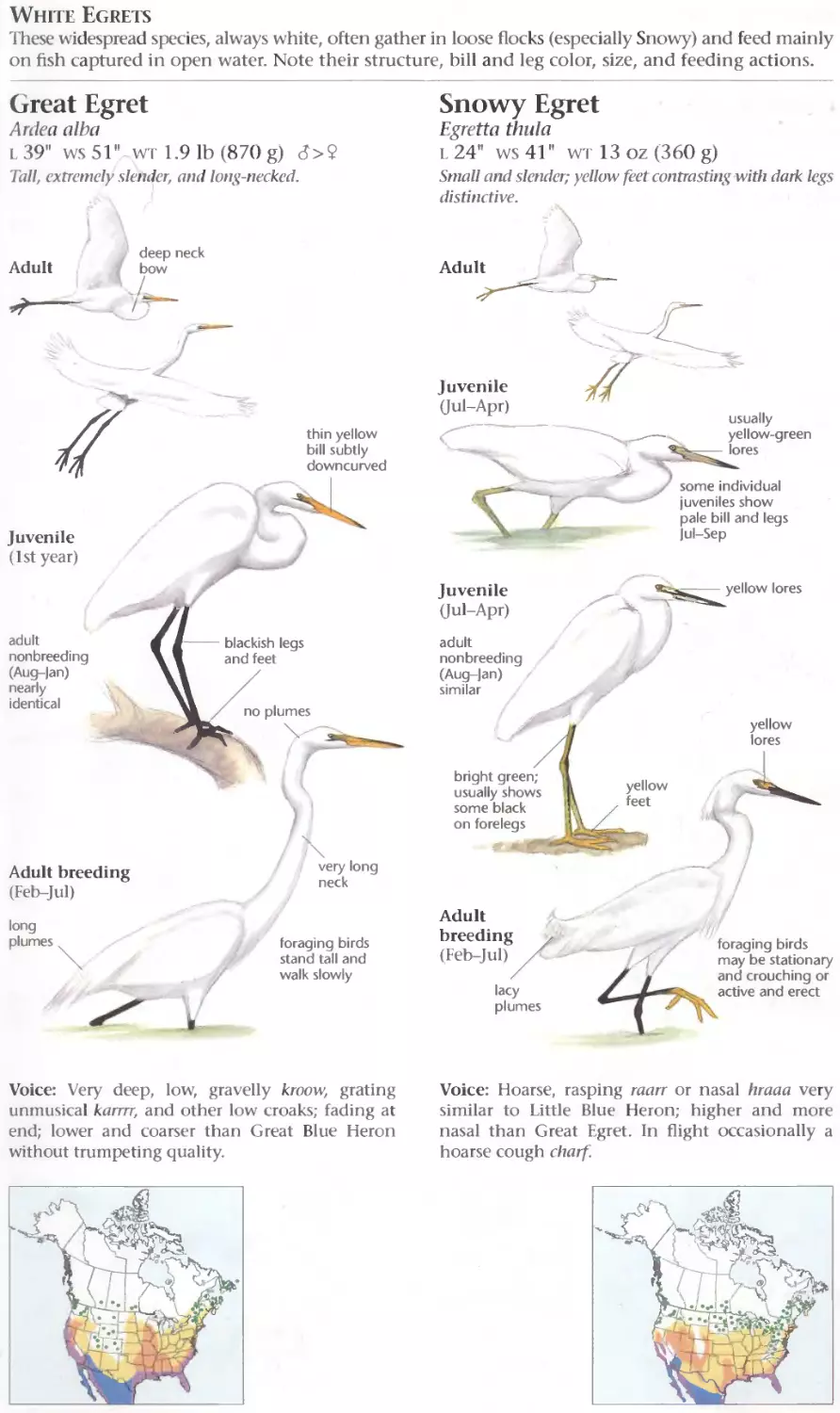
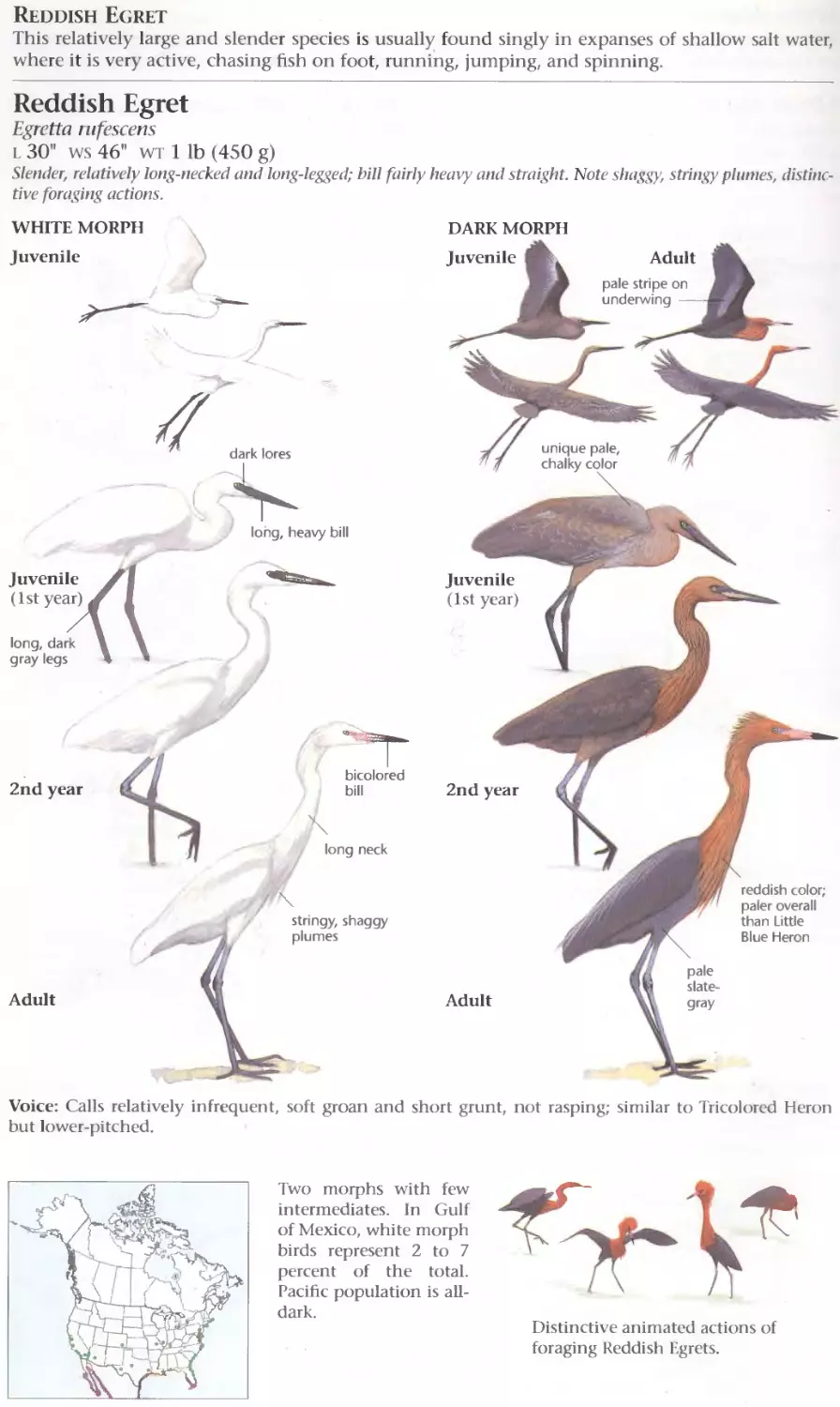
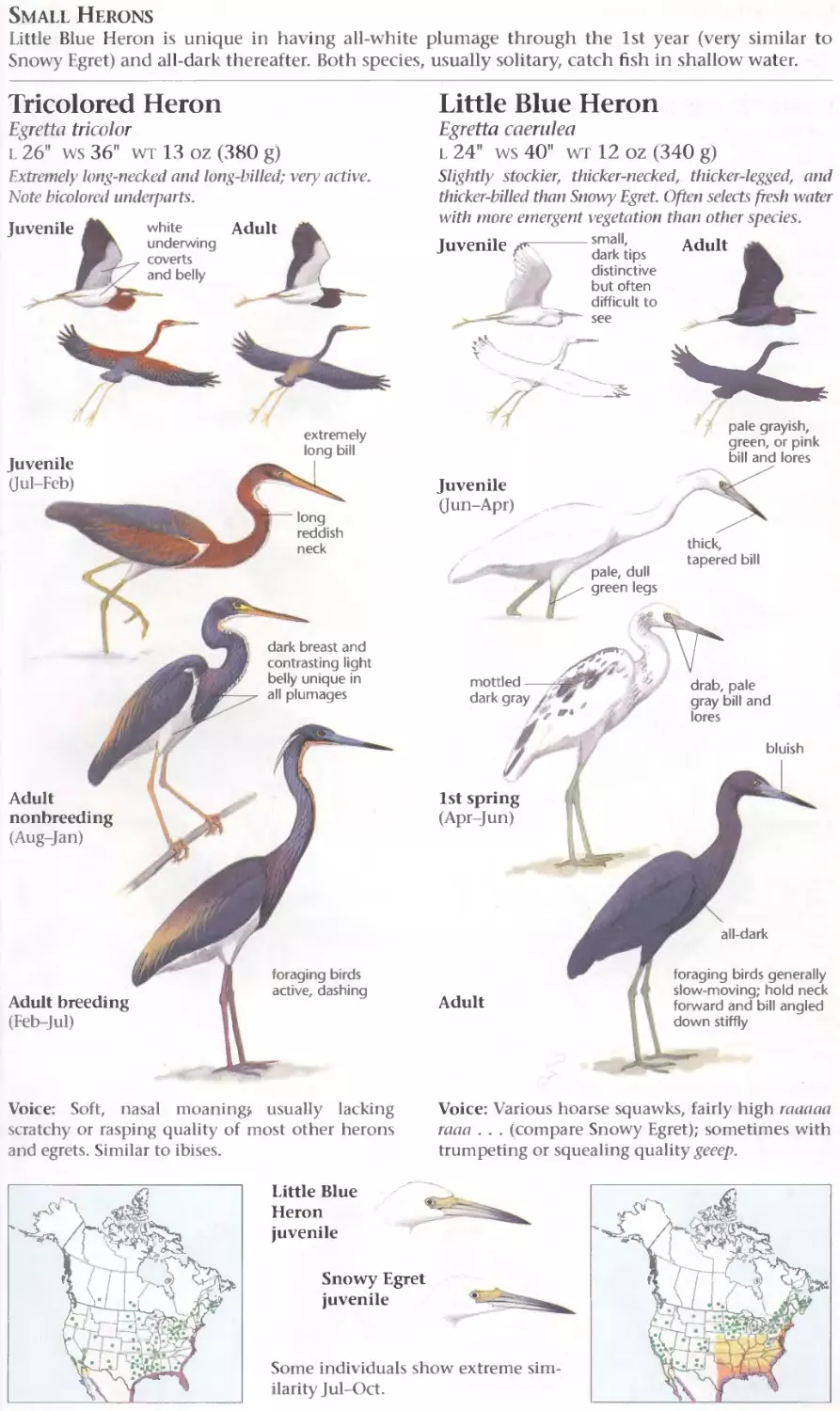
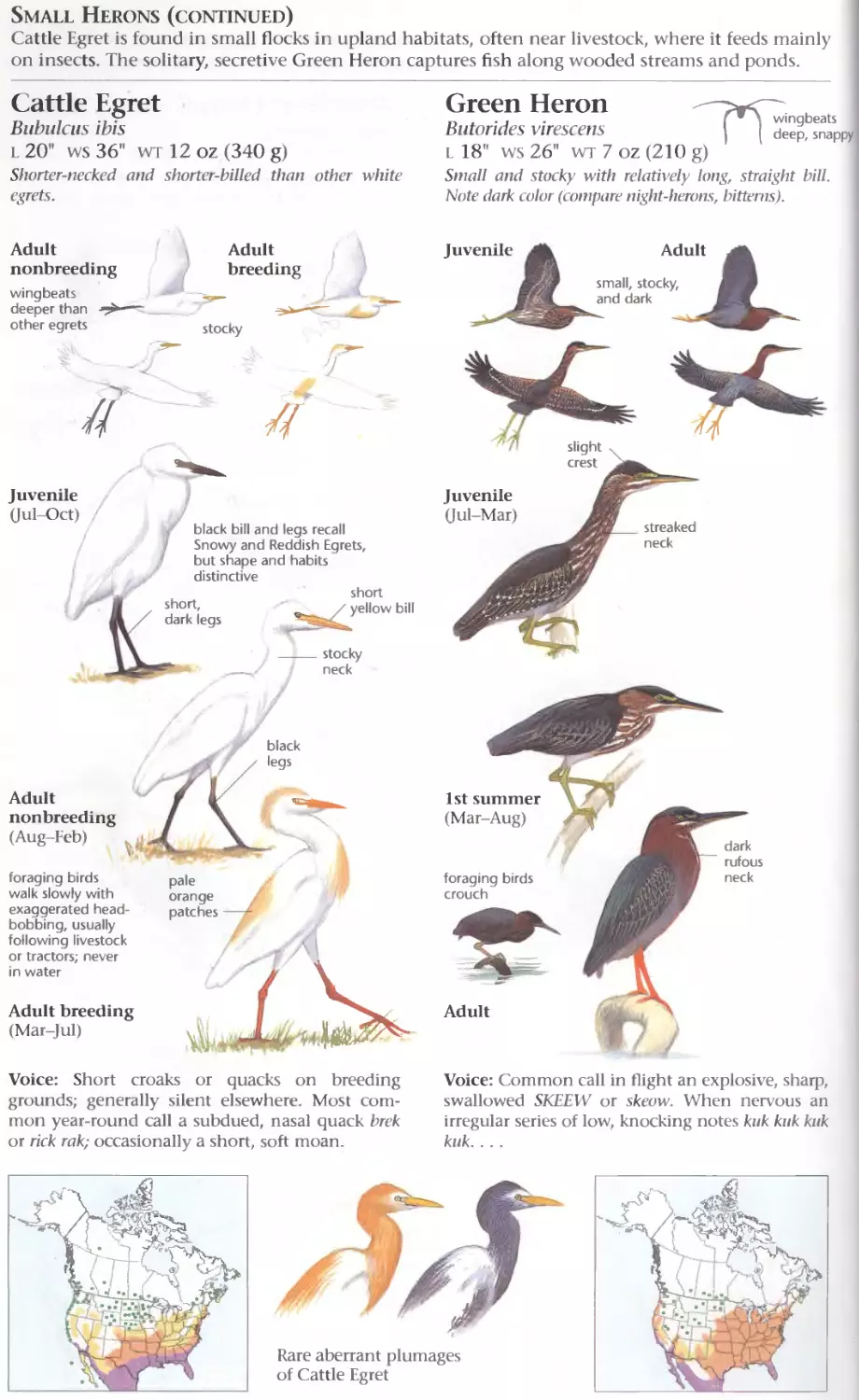
57 Wading Birds
Bitterns, Egrets, Flamingos, Herons, Ibises,
Spoonbills, Storks
Identification of White Herons 59
Identification of Dark Ibises 66
70 Swans, Geese, and Ducks
Identification of Swans 73
Geese Head and Bill Shapes 79
Domestic Waterfowl 89
Exotic Waterfowl 89
Identification of Scaup 93
Identification of Eiders 93
Diving Motions 97
Identification of Scoters 99
Identification of Goldeneyes 99
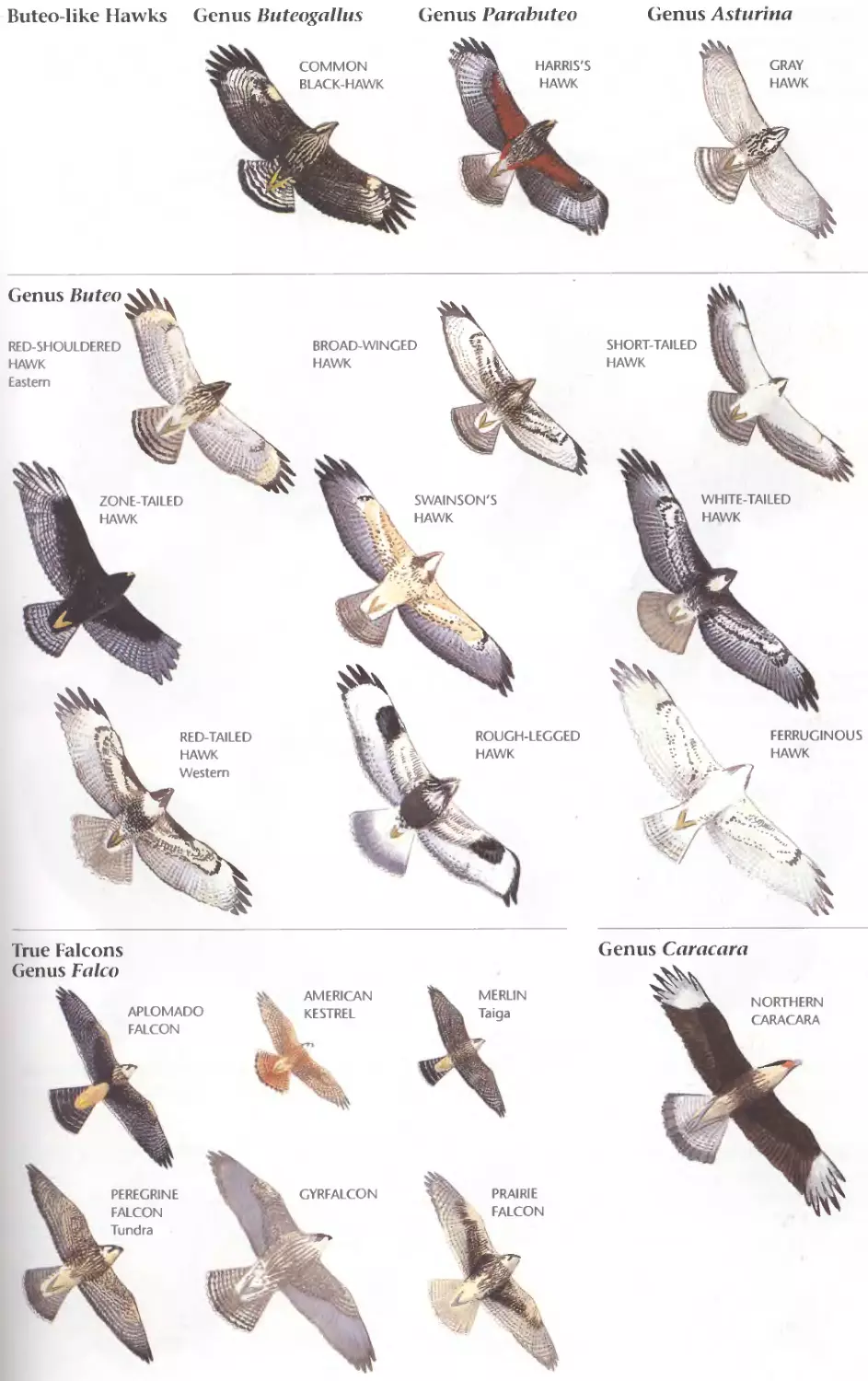
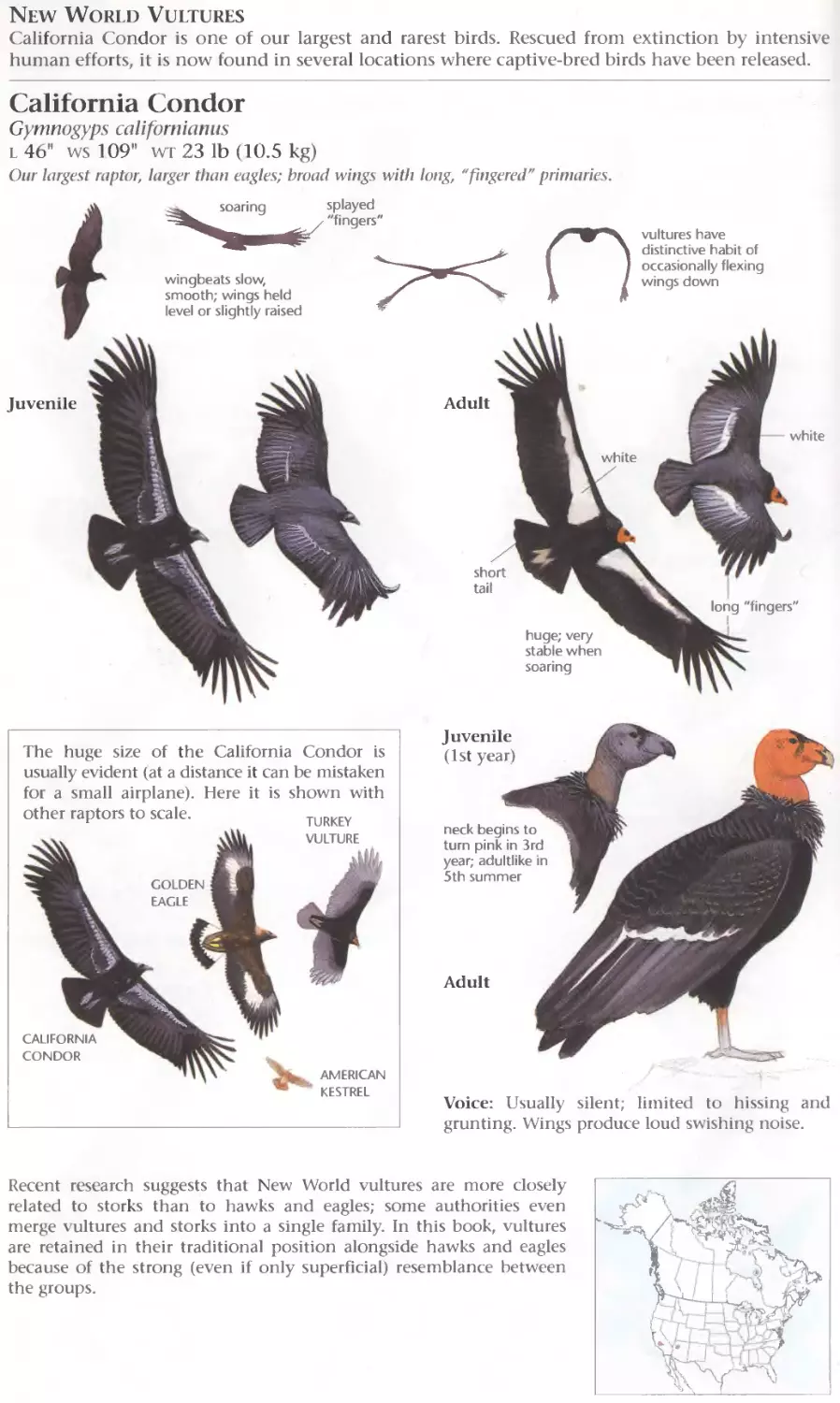
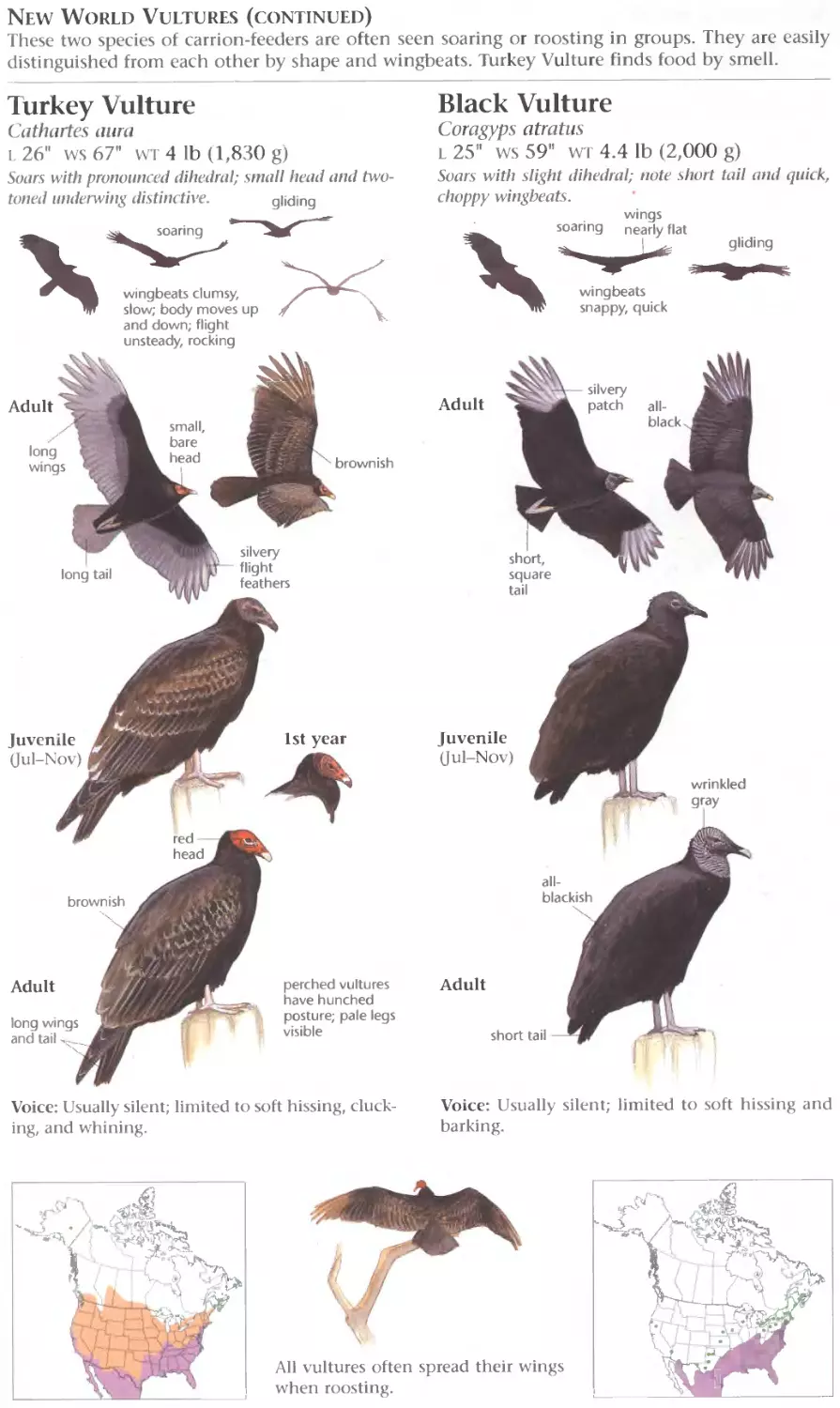
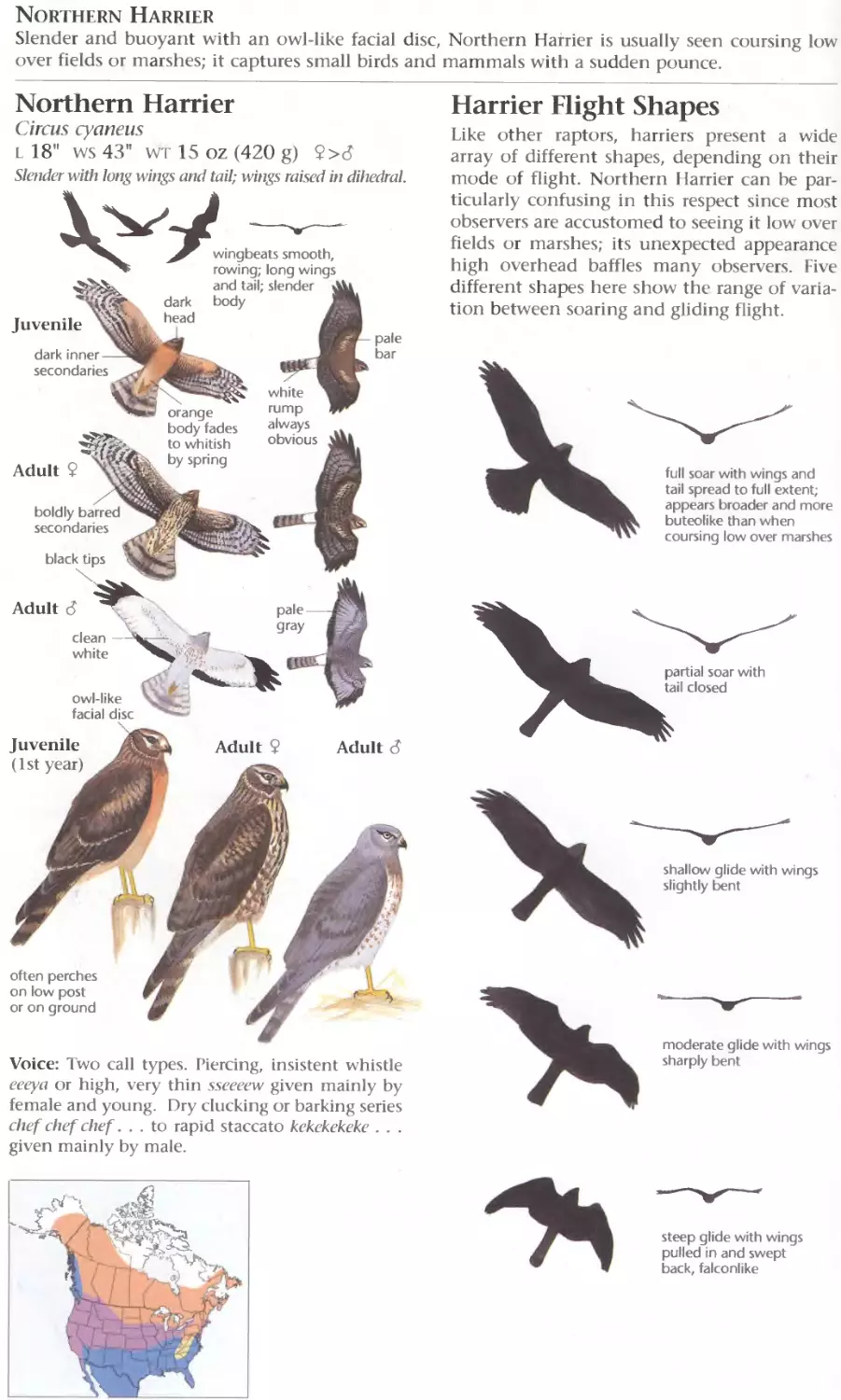
104 Diurnal Raptors
Eagles, Falcons, Hawks, Vultures
Harrier Flight Shapes 108
Raptor Hunting Techniques 109
Identification of Accipiters 113
Identification of Buteos 114
Identification of Falcons 128
134 Upland Game Birds
Chachalacas, Grouse, Partridges,
Pheasants, Prairie-Chickens,
Ptarmigan, Quail, Turkeys
Exotic Game Birds 135
150 Gruiformes
Coots, Cranes, limpkin, Moorhens, Rails
Habits of Rails 153
158 Shorebirds
Avocets, Curlews, Dowitchers, Godwits,
Jacanas, lapwings, Oystercatchers,
Phalaropes, Plovers, Ruff, Sandpipers,
Snipe, Stilts, Turnstones, Willet,
Woodcocks, Yellowlegs
Rare Shorebirds 161
Aging and Identification of Shorebirds 181
Identification of Peeps 187
Aerial Displays of Snipe and Woodcock 193
Identification of Phalaropes 194
196 Jaegers and Skuas
Jaeger Bill Shapes 196
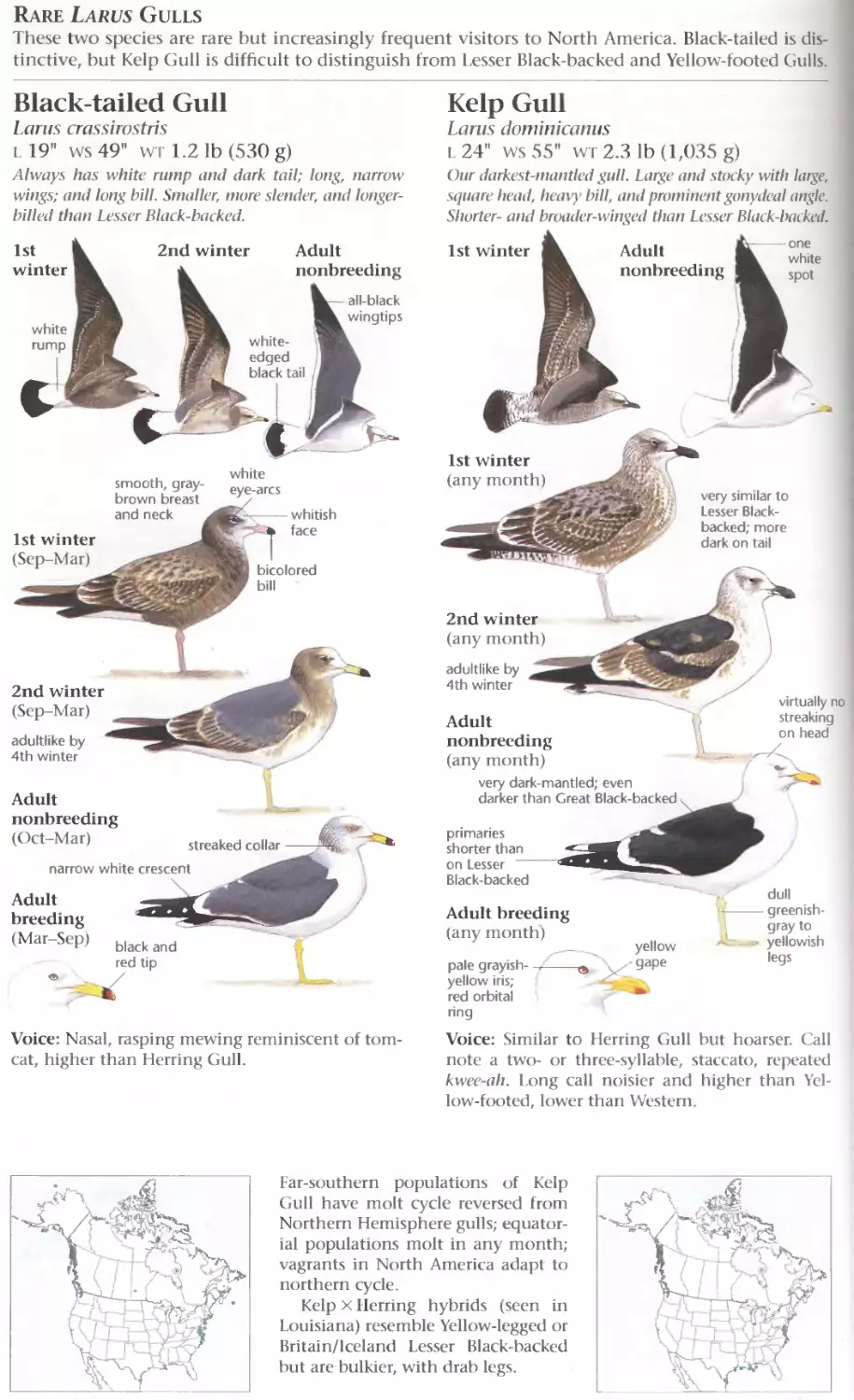
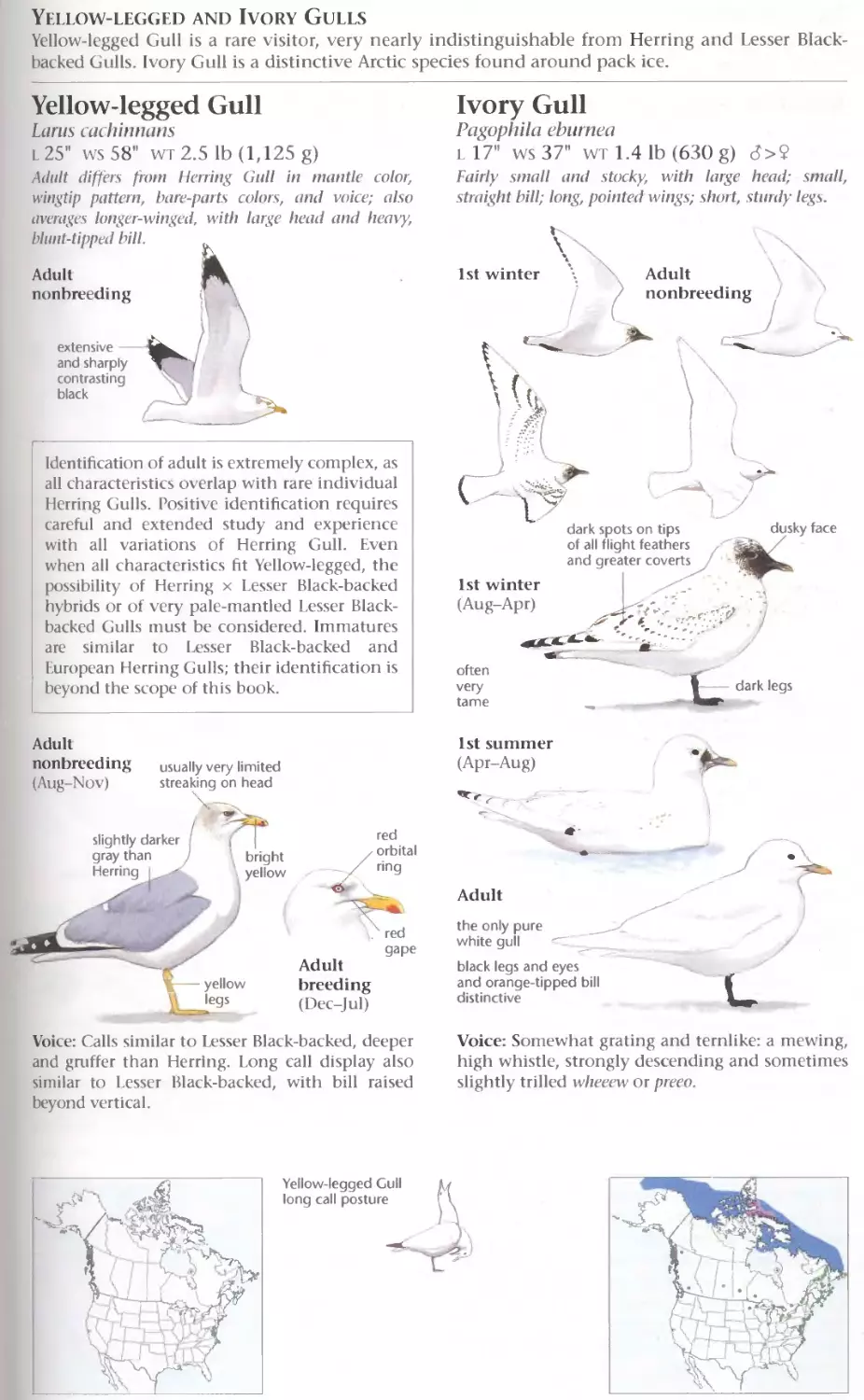
202 Gulls, Terns, and Skimmers
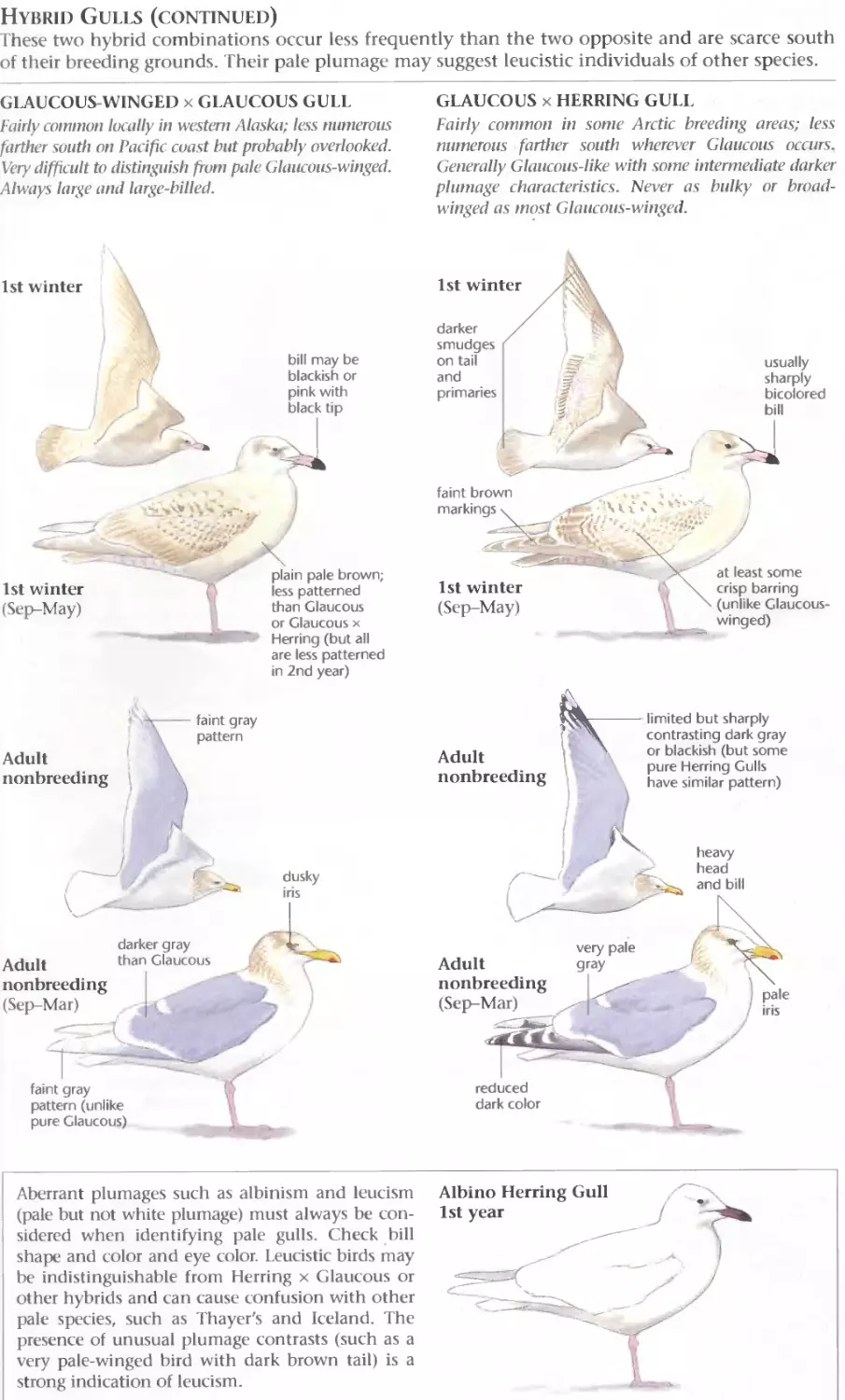
Hybrid Gulls 204
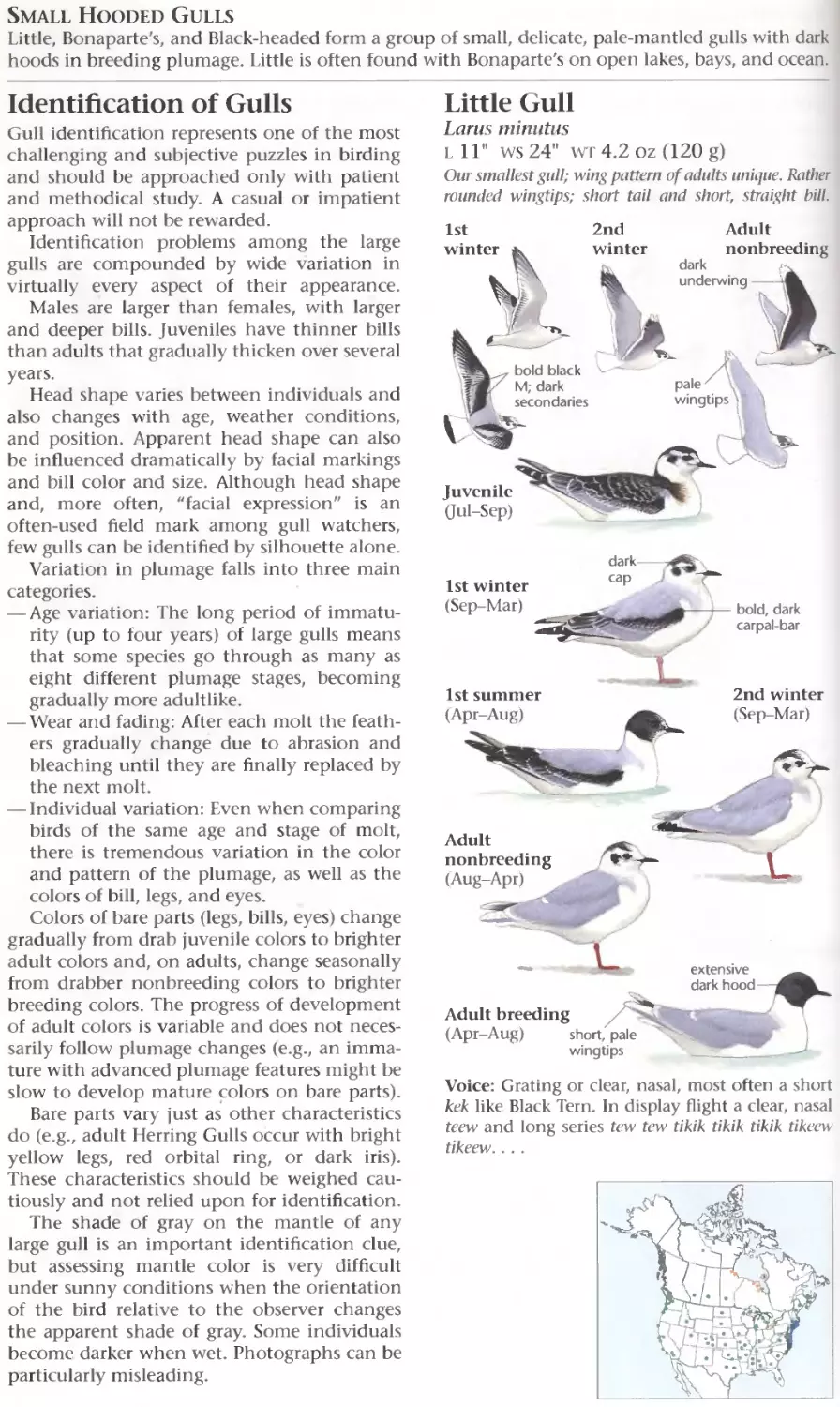
Identification of Gulls 208
241 Alcids
Auklets, Dovekie, Guillemots, Murrelets,
Murres, Puffins
Identification of Mlmes 243
254 Pigeons and Doves
262 Parrots and Their Allies
267 Cuckoos and Their Allies
Anis, Cuckoos, Roadrunners
271 Owls
284 Goatsuckers and Swifts
292 Hummingbirds
Identification of Hummingbirds 302
303 Trogons
304 Kingfishers
306 Woodpeckers
Drumming Sounds 306
320 Tyrant Flycatchers
Flycatchers, Kingbirds, Pewees, Phoebes,
Wood-Pewees
340 Shrikes and Vireos
350 Jays, Crows, and Their Allies
Crows, jays, Magpies, Ravens, Scrub-jays
362 larks
Open-Ground Birds 362
364 Swallows
Molt in Swallows 364
371 Chickadees and Their Allies
Bushtit, Chickadees, Titmice, Verdin
Drab Gray Birds of the Arid Southwest 378
380 Nuthatches and Creepers
384 Wrens
Scold Notes 384
Sedge Wren and Grass Sparrows 388
392 Old World Warblers, Thrushes,
and Their Allies
Bluebirds, Dippers, Gnatcatchers, Kinglets,
Robins, Thrushes, Warblers, Wrentit
Identification of Gnatcatchers 398
Typical Thrushes 402
Robinlike Songs 403
410 Mimids
Catbirds, Mockingbirds, Thrashers
416 Starlings and Mynas
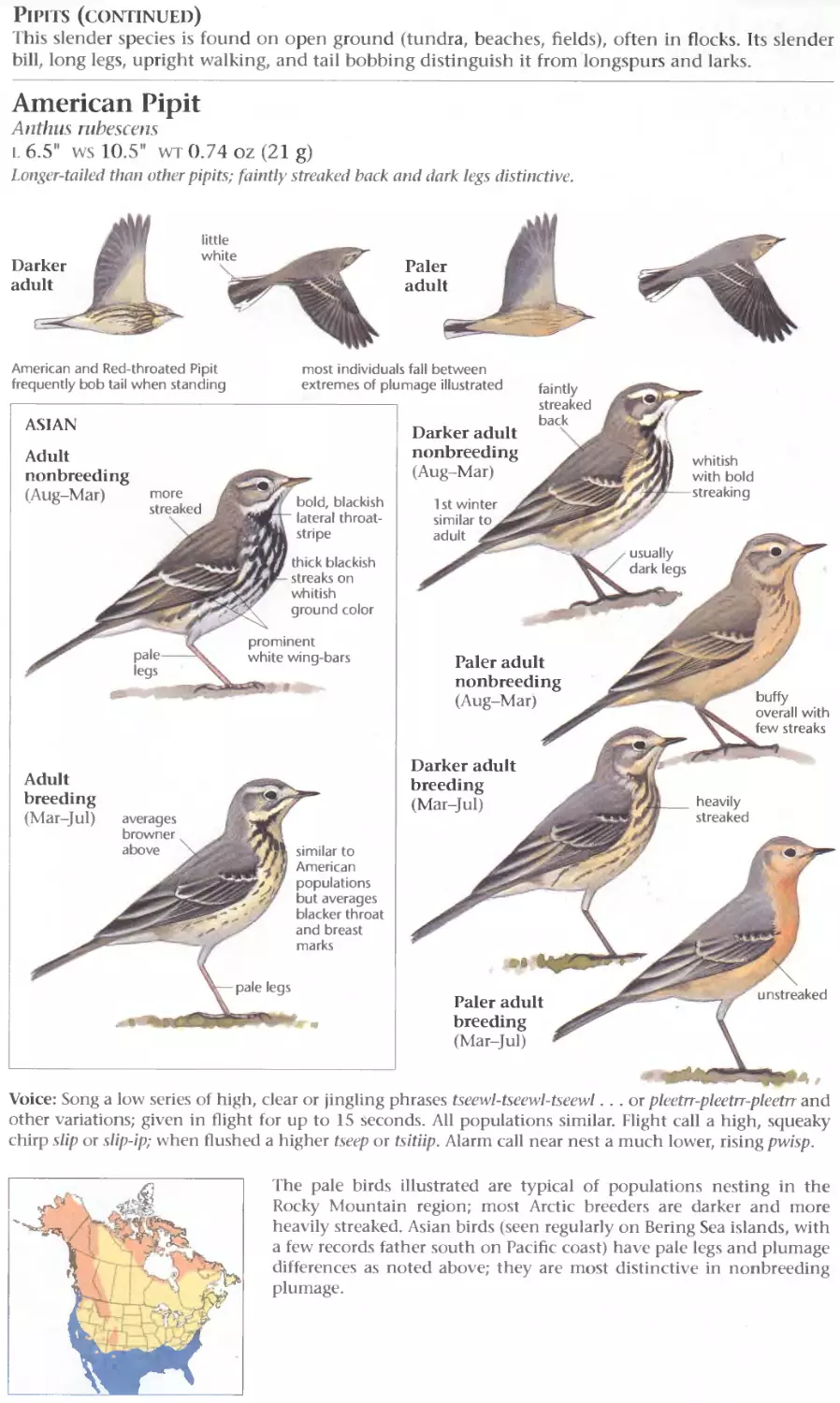
418 Wagtails and Pipits
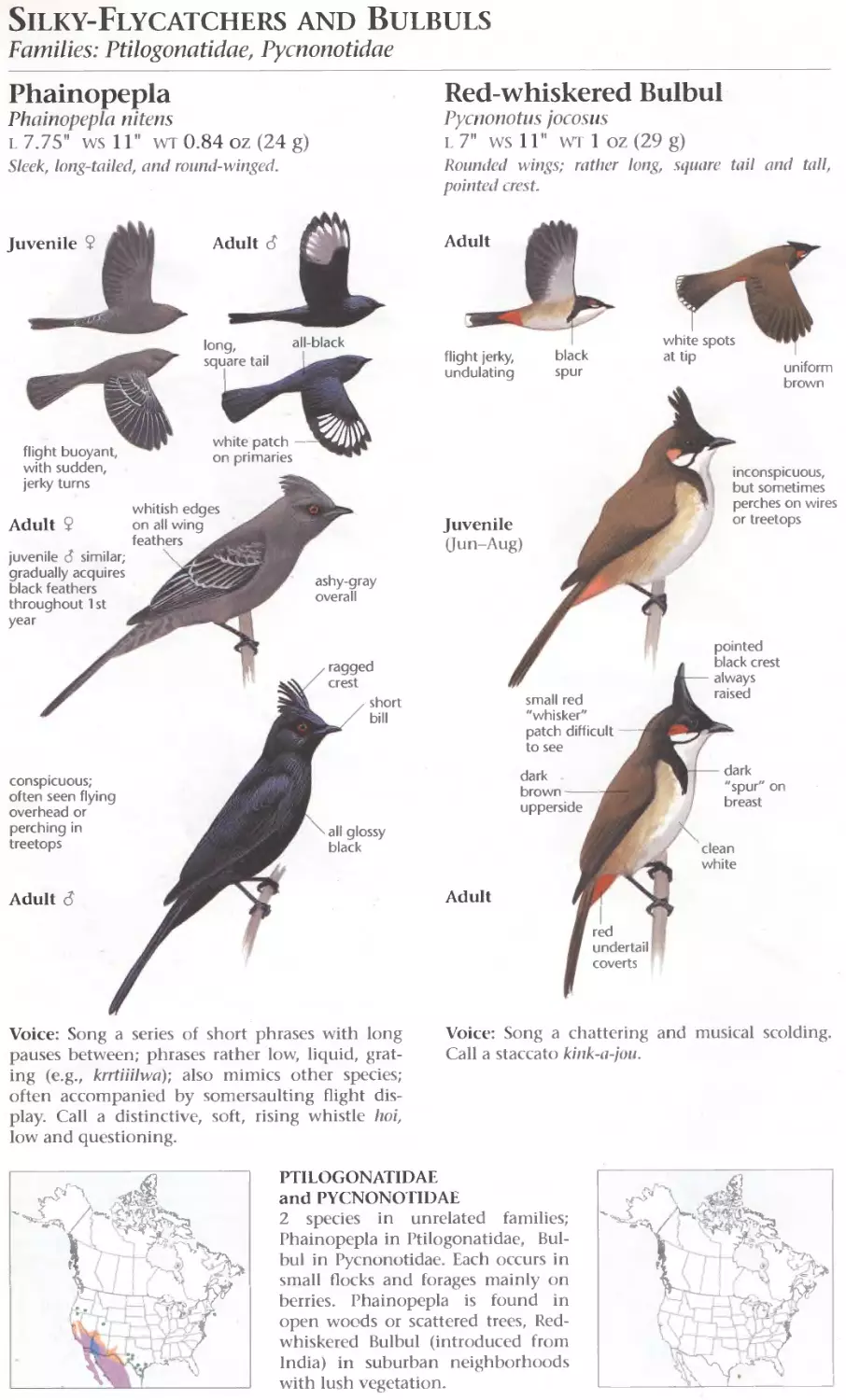
422 Silky-Flycatchers and Bulbuls
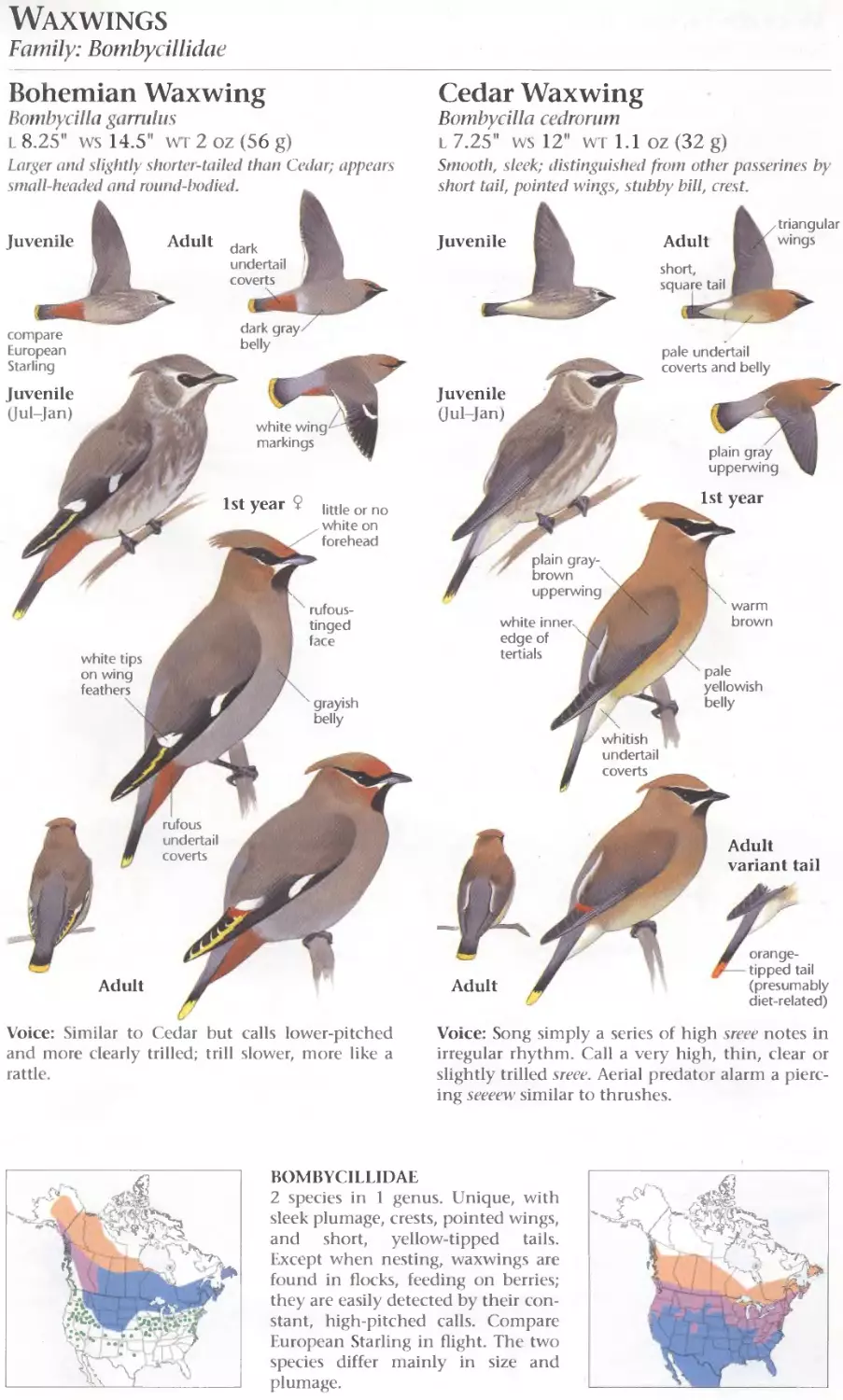
423 Waxwings
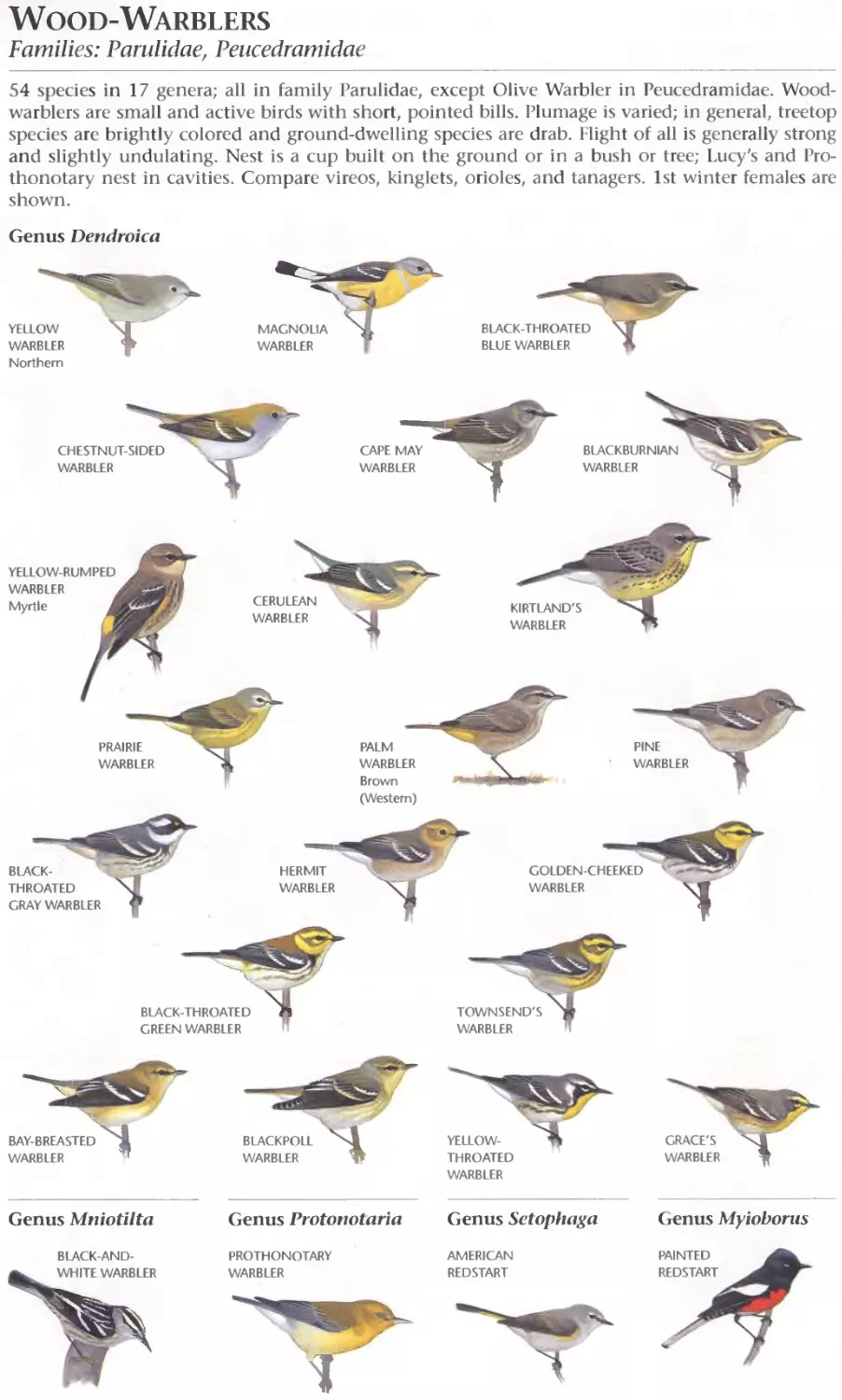
424 Wood-Warblers
Parulas, Redstarts, Warblers, Waterthrushes
Blue-winged x Golden-winged Hybrids 428
Warbler Plumages 437
Identification of Fall Warblers 442
Identifying Songs 447
Aberrant Passerines 458
459 Tanagers, Cardinals, and
Their Allies
Bananaquit, Cardinaline Buntings,
Cardinals, Dickcissel, Grosbeaks, Tanagers
Identification of Tanagers 461
Identification of Grosbeaks 467
Identification of Cardinaline Buntings 470
472 Emberizine Sparrows and
Their Allies
Emberizine Buntings, juncos, Longspurs,
Sparrows, Towhees
Identification ofSpizella Sparrows 484
Sparrowlike Birds 492
Identificatiun uf Emberizine Buntings 503
507 Icterids
Blackbirds, Bobolink, Cowbirds, Grackles,
Meadowlarks, Orioles
Identification of Meadowlarks 509
Identification of Orioles 518
523 Finches and Old World Sparrows
Crossbills, Finches, Goldfinches, Grosbeaks,
Old World Sparrows Redpolls, Siskins
Red Crossbill Types 530
Identification of Red Crossbills 531
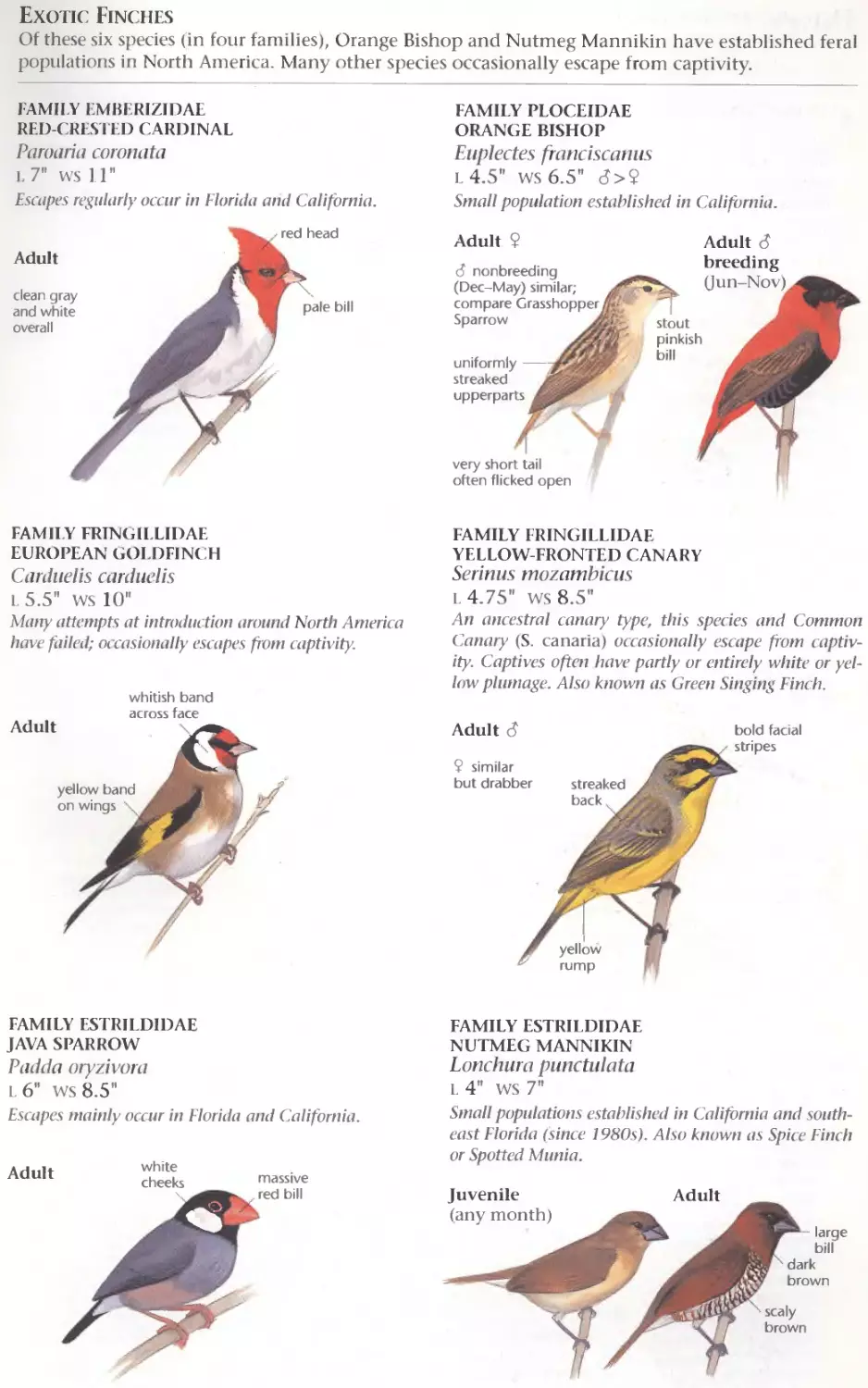
Exotic Finches 537
538 Species Index
PREFACE
In the narrow view, this book is the prod-
uct of about five years of work, but the
larger volume of work was done before
that. In the broader view, the project goes
back to the 1970s, when I first started play-
ing with the idea of producing a field guide
As I traveled around the continent during
the 1980s-studying, sketching, and watch-
ing birds-ideas began to form about just
how my field guide would be different.
I wanted a book that would show every
plumage and every subspecies, at rest and
in flight. A book that would give details
on the plumages and habits of each
species, describe songs and calls, and show
the complete distribution of each species,
all on the same page and all in a format
that would allow easy comparisons be-
tween species.
For more than five years (1988-1993) I
worked sporadically on a field guide, and
even though I was unhappy with the lay-
out and ultimately repainted all of the
work from that period, the time was well
spent researching the birds, refining my
painting technique, and working out some
of the inevitable compromises of the book
(no single book could accommodate every-
thing I wanted to include). The ideas that
finally crystallized into this book came to
me during a trip to Europe in the fall of
1993, and by July 1994 I had started paint-
ing the final draft.
From then on it was five years of desk
work. People often ask how I was able to
keep at it for so long. Well, I would hesitate
to do it again, but the work has been im-
mensely satisfying. The rewards have been
in the process more than in the product, as
I studied each species and compiled my
notes and sketches into a concise presenta-
tion. This was merely the finish work after
twenty years of watching.
I kept on bird-watching for those two
decades for all the reasons that anyone
watches birds. Birds are beautiful, in spec-
tacular as well as subtle ways; their colors,
shapes, actions, and sounds are among the
most aesthetically pleasing in nature Then
there is the adventure of seeking out scarce
species in remote wilderness or in special-
ized habitats close to home; the wonder of
seeing thousands of birds pass by on migra-
tion; the excitement of finding a stray from
some far corner of the globe. The pre-
dictable and the unpredictable events in
birding make every day unique.
On top of everything else is the intellec-
tual challenge of identifying birds, which
offers rewards at every level and draws on
so many disciplines. For the neophyte there
is the challenge of making sense of the
birds in the garden; for the expert there are
complex identification problems and distri-
butional patterns to be unraveled. Making
a contribution to the field requires nothing
more than careful observation. I still learn
new things every time I go birding, and I
am certain that the opportunities for learn-
ing will never end.
David Sibley
March 2000
Concord, MA
National Audubon Society
The mission of NATIONAL AUDUBON SOCIETY is to comerve and restore natural ecosys-
tems, focusing 011 birds, other wildlife, and their habitats, for the benefit of humanity and the
earth's biological diversity.
One of the largest environmental organizations, Audubon has 550,000 members, 100
sanctuaries and nature centers, and 508 chapters in the Americas, plus a professional
staff of scientists, educators, and policy analysts.
The award-winning Audubon magazine, sent to all members, carries outstanding articles
and color photography on wildlife, the environment, and conservation. Audubon also
publishes Audubon Adventures, a children's newspaper reaching 450,000 students. Audubon
offers nature education for teachers, families, and children through camps and work-
shops, plus unique, traveling degree programs through Audubon Expedition Institute.
Audubon sponsors books, on-line nature activities, and travel programs to exotic places
like Antarctica, Africa, Baja California, and the Galapagos Islands. For information about
Audubon, please contact: NATIONAL AUDUBON SOCIETY Membership Dept., 700 Broad-
way, New York, NY 10003-9562; (800) 274-4201 or (212) 979-3000; www.audubon.org
ACKNOWLEDGMENTS
I should begin by thanking everyone who
has ever taken the time to talk with me
about birds, and especially everyone who
has published anything about bird identifi-
cation. Their ideas, in one form or another,
have been incorporated into this book. I
wish it were possible to name more of
them, as this book represents the combined
work of many hundreds of people. Below, I
name only the people who were directly
consulted on this project, but the contribu-
tions of all the others are no less significant.
I have been fortunate to have lived at
Point Reyes, California, and Cape May, New
Jersey, and to have worked for WINGS,
Inc., making friends and sharing ideas with
many of the best birders in North America.
Thanks to all.
For answering queries, reviewing drafts,
and providing photos, reprints, and other
material assistance, thanks to Per Alstrom,
John Arvin, Richard C. Banks, Bob Behr-
stock, Chris Benesh, Craig Benkman, Louis
Bevier, Bryan Bland, Tony Bledsoe, Rick Bow-
ers, Eric Breden, Ned Brinkley, Rick Cech,
Patrick Comins, Richard Crossley, Mike
Danzenbaker, Jon Dunn, Pete Dunne, Barny
Dunning, Vince Elia, Chris Elphick, Ted Eu-
banks, Shawneen Finnegan, Kimball Garrett,
Frank Gill, Bob Hamlin, Keith Hansen, Paul
Holt, Steve N. G. Howell, Alvaro Jaramillo,
Kevin Karlson, Kenn Kaufman, Greg Lasley,
Sheila Lego, Paul Lehman, Tony Leukering,
Ian Lewington, Jerry Liguori, Bruce Mac-
tavish, Bob Maurer, Killian Mullarney, Mar-
leen Murgitroyde, Frank Nicolletti, Michael
O'Brien, Brian Patteson, Ron Pittaway, Noble
Proctor, Peter Pyle, Gary Rosenberg, Margaret
Rubega, Will Russell, Ray Schwartz, Debra
Love Shearwater, Mitchell Smith, P. William
Smith, Rich Stallcup, Clay and Pat Sutton,
Thede Tobish, Joe, Sandy, Catherine, and
Michelle Usewicz, John Vanderpoel, Dave
Ward, Paige Warren, Sophie Webb, Sheri
Williamson, Tom Wood, Gail Diane
Yovanovich, and John Cameron Yrizarry.
Staff at the following institutions provided
logistical support and/or access to collec-
tions: California Academy of Sciences, San
Francisco; VIREO and the Academy of Nat-
ural Sciences, Philadelphia; American Mu-
seum of Natural History, New York; United
States National Museum, Washington, D.C.;
Peabody Museum, Yale University, New
Haven, Connecticut; University of Califor-
nia, Berkeley and Irvine; North Carolina
State Museum, Raleigh; Louisiana State Uni-
versity, Baton Rouge; Cornell University, Ith-
aca, New York; Library of Natural Sounds,
Cornell University Laboratory of Ornithol-
ogy; University of Alaska, Fairbanks; New
Jersey Audubon Society's Cape May Bird
Observatory; Point Reyes Bird Observatory,
Stinson Beach, California; Manomet Bird
Observatory, Manomet, Massachusetts; Uni-
versity of Georgia, Athens; Savannah River
Ecology Laboratory, Aiken, South Carolina;
and University of Arizona, Tucson.
My family has supported my desire to
draw birds since preschool days; the love and
support of my parents, Fred and Peggy Sib-
ley, has carried me through all these years,
and the practical benefits of having an or-
nithologist father cannot be overstated.
I thank my agent, Russell Galen, for
smoothing the way.
Thanks to the editing and design team at
Chanticleer Press (Amy K. Hughes, George
Scott, Lisa R. Lester, Drew Stevens, Anthony
Liptak, Melissa Martin, Vincent Mejia, and
Bernadette Vibar) and Thumb Print (Areta
Buk, James Waller, and Jeffrey Edelstein) for
their careful and expert handling of what
must have seemed like an endless task.
I thank John Cameron Yrizarry for re-
viewing all the original artwork (sometimes
more carefully than I did myself) and for
offering many helpful suggestions.
Thanks to Vince Elia and Shawneen
Finnegan for help in preparing the range
maps, to Paul Lehman for reviewing all the
maps, and to Gary Antonetti and Ortelius
Design for creating the final maps.
Thanks to technical reviewers Will Rus-
sell, Kimball Garrett, Jon Dunn, Steve N. G.
Howell, Chris Elphick, and Frank Gill. Will
Russell provided generous support and ad-
vice at all stages of this project, from in-
dulging my wanderings in the early years to
the careful reading of the entire manuscript.
I must single out the influence of the
late Ray Schwartz, whose companionship
and support through the formative years of
this project were a constant source of
strength.
Last, I thank my wife, Joan Walsh, and
my sons, Evan and Joel, who really made
me believe that I could do this-and then
managed to put up with the lifestyle that
developed as a result. It's done!
INTRODUCTION
This book covers the identification of 810
species (plus 350 regional forms) found in
the continent of North America north of
Mexico, including the United States and
Canada and all adjacent islands, but ex-
cluding Hawaii, Bermuda, and Greenland.
Offshore waters are included to a distance
of 200 miles (320 km) or halfway to the
nearest land that is not part of the North
American region, whichever is closer. These
boundaries conform to the American Bird-
ing Association's established definition of
the North American region.
I have included species and identifiable
populations that occur regularly within this
area, including most rare but regular visitors.
Rare but regular visitors included in this book
are defined loosely as those species recorded
10 or more times in the last 25 years, but
some arbitrary decisions were made to in-
clude less frequently recorded species or to
exclude a few that are seen more frequently.
Some species that occur regularly only in
western Alaska, and nowhere else in North
America, are excluded. Established intro-
duced species such as the Rock Dove and
Chukar are included, as are frequently seen
exotic species. Escaped exotic species' in-
clude many waterfowl, upland game birds,
parrots, mynas, and finches; some of these
have established small feral populations.
Classification of Birds
Birds, like all other living things, are classi-
fied by scientists in a system of groups and
subgroups, each with a unique scientific
name. Birds make up the class Aves. The
class is subdivided into orders, each order
into families, each family into genera, each
genus into species, and many species into
subspecies. The Red-tailed Hawk is classi-
fied as class Aves, order Falconiformes,
family Accipitridae, genus Buteo, species
jamaicensis. There are several subspecies,
including the western caiurlis subspecies
(full name Buteo jamaicensis calurus).
The taxonomy of families, genera, and
species as well as all common and scientific
names used in this book follow the seventh
edition (1998) of the American Ornitholo-
gists' Union (AOU) Check-list of North Amer-
ican Birds, and the 42nd supplement (2000)
to the Check-list. Only the sequence of
species has been altered to allow better
comparisons for identification.
I have intentionally avoided using scien-
tific names for subspecies, as these can be
more confusing than helpful to the non-
specialist. Instead, recognizable subspecies
populations are named by the geographic
region in which they breed (and sometimes
by established English names). These re-
gional populations as defined here may in-
clude one or several named subspecies.
Most subspecies variation is determined by
climate and follows a few simple rules; thus
the boundaries between regional popula-
tions are surprisingly consistent (shown on
the map below). For more details on the
distribution, identification, and nomencla-
ture of subspecies, refer to the AOU's 1957
Check-list (fifth edition) and Peter Pyle's
Identification Guide to North American Birds
(Slate Creek Press, Bolinas, CA, 1997).
Among ornithologists there is an on-
going debate about the definition of a
species, and related debate over the status
of certain species. Rumors of splitting (one
species into more) and lumping (two or
more species into one) are constantly circu-
lating among birders, who are concerned
almost entirely with species. The check-list
committee of the AOU makes final deci-
sions in such matters, but even its deci-
sions reflect prevailing opinion (albeit
based on published and carefully consid-
ered scientific research), and the list will al-
ways be a work in progress.
In this book I have tried to illustrate all
distinctive regional populations, emphasiz-
ing variation rather than the species unit,
on the premise that any distinguishable
population is noteworthy, whether classi-
fied as a species or not. Many of these re-
gional populations are not safely identified
outside their known range, or are identifi-
able with only a low level of confidence;
further study will increase those levels in
many cases, and some populations will un-
doubtedly be elevated to full species status.
Learning to Identify Birds
If you are reading this book, you presum-
ably have an interest in learning how
to identify birds. A few suggestions for get-
ting started are outlined below, but all
build on the same theme: to become an ex-
pert birder, you must study birds. Sketch-
ing and taking notes in the field are
exercises that will force you to look more
INTRODUCTION
closely, reinforce your memory, and greatly
increase the rate at which you learn. The
joy of small discoveries is part of the great
appeal of birding, and patient study is al-
ways rewarded.
The first rule is simple: Look at the bird.
Don't fumble with a book, because by the
time you find the right picture the bird will
most likely be gone. Start by looking at the
bird's bill and facial markings. Watch what
the bird does, watch it flyaway, and only
then try to find it in your book.
Practice seeing details. Much of the skill in-
volved in identifying birds is being able to
sort out the details of the bird's appearance
at a distance. To build an understanding of
how plumage patterns work, practice with
the Bird Topography diagrams below. Study
details at close range whenever possible.
. >-pribilofs
,
.... ...
.r:
Aleutian ...."...
'it'
Queen
Charlotte
Islands \. .J
Pacific
Northwest
" MEXICAN!
Recognize patterns. There is order in the
universe, and birds are no exception. All
the minutiae of variation (appearance, be-
havior, occurrence, etc.) fit into predictable
patterns, and as you gain experience these
patterns coalesce into a framework of
knowledge.
Use multiple field marks wilen trying to iden-
tify a bird. Birds are variable, and there are
exceptions to every rule. Don't be discour-
aged by this, but do look for several differ-
ent field marks on any bird. If one doesn't
match up, the bird may require more study.
Experience will allow you to judge the relia-
bility of different characteristics.
Study shapes. Experienced birders use
shape as an important clue for identifying
broad groups, such as genera, as well as in-
dividual species. Paying attention to shape
: ....
clt.i , \.
". Greenland
"
I ....
r..
ARCTI .
: .
Newfo \ / nd
. ..
f...........
@
-
)
--
)
:...X--Florida
::" ... Florida Keys
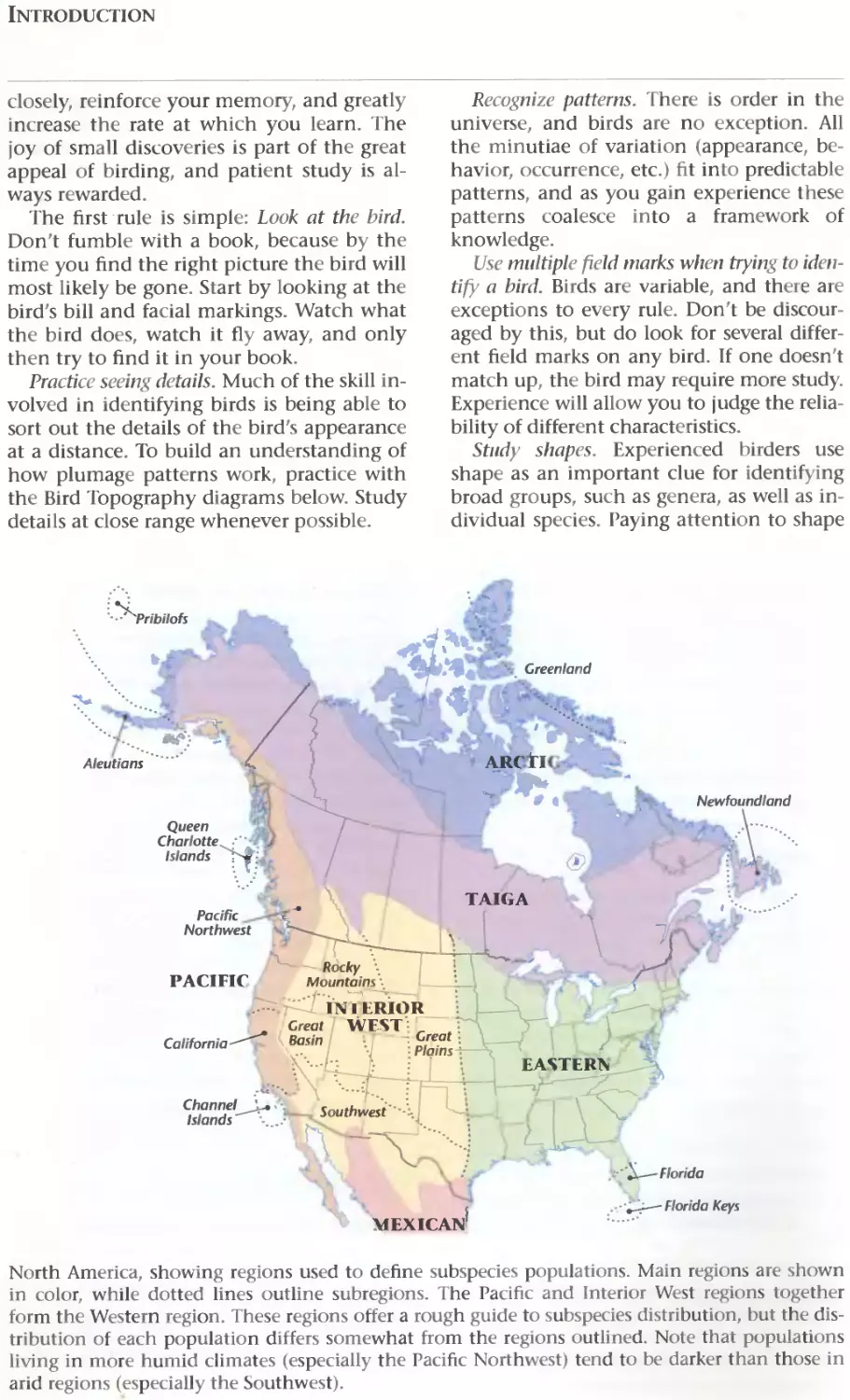
North America, showing regions used to define subspecies populations. Main regions are shown
in color, while dotted lines outline subregions. The Pacific and Interior West regions together
form the Western region. These regions offer a rough guide to subspecies distribution, but the dis-
tribution of each population differs somewhat from the regions outlined. Note that populations
living in more humid climates (especially the Pacific Northwest) tend to be darker than those in
arid regions (especially the Southwest).
INTRODUCTION
may also reveal differences in posture, ac-
tions, and even plumage.
Study habits. Although behavior is never
absolutely reliable for identification, habits
provide strong supporting clues. Birds
spend virtually all their active moments
searching for food, so almost all their ac-
tions and habitat choices relate to food.
Beware of misjudging size. Size is very dif-
ficult to judge at a distance, and for the
beginner, size is nearly useless for identifi-
cation except when making direct compar-
isons. Experienced observers do find size a
helpful indicator, but only in familiar sur-
roundings or with reference points that
allow an accurate judgment of distance.
Meet other birders. Your best source of in-
formation on local birds and birding will
be other birders. In many areas, nature cen-
ters, sanctuaries, local Audubon Society
chapters, and bird clubs offer regular field
trips and meetings, and these can be ex-
tremely useful sources of information and
camaraderie. The American Birding Associ-
ation (2812 W. Colorado Ave., Colorado
Springs, CO 80904), which publishes the..
bimonthly magazine Birding, is a national
organization serving avid birders. The
ABA's sales department stocks regional bird
guides for virtually every state and for
many local areas.
Variation in Appearance
You should not expect any bird seen in the
field to match exactly the picture of its
species in this field guide. Every bird is an
individual, and each species is variable
(and no field guide's pictures are absolutely
accurate). Variation occurs in every aspect
of a bird's appearance, behavior, and voice,
and only experience can teach you to rec-
ognize the normal range of variation
within a species.
Many characteristics are presented in
this book as average differences. It is impor-
tant to understand this concept. Average
differences are noticeable in a series of in-
dividuals but can be contradicted (some-
times dramatically so) by single individu-
als. One good example involves the bill
length of Semipalmated and Western Sand-
pipers. On average, Western Sandpipers are
longer-billed than Semi palma ted, but there
is some overlap, so while very long-billed
and very short-billed birds can be safely
identified, a large number of individuals
have ambiguous bill length. Likewise,
among the large gulls, most species show
average differences in shape and size-for
example, Iceland Gulls average smaller and
shorter-billed than Herring Gulls, but some
Herring Gulls are quite small and short-
billed, and some Icelands are large and
long-billed. This extensive overlap makes it
unwise to attempt an identification based
solely on silhouette.
The overall impression you receive from
the combination of subtle differences is
often referred to as gestalt or jizz (from
G.I.S.-Ugeneral impression and shape"). It
is a useful concept to understand-that the
sum of several vague average differences
can together make for a fairly reliable iden-
tification-but it is a Usoft" characteristic
and should not be overemphasized. Ob-
servers should beware of using jizz as a sub-
stitute for careful study and thought.
Most variation in birds' appearance can
be accounted for by the age and sex of in-
dividual birds and the subspecies to which
they belong. Typical examples showing the
range of these variations are illustrated in
this book. Within this basic range, how-
ever, there are many other variations that
observers should be aware of.
Geographic Variation and Subspecies
Many regional variations within species are
illustrated in this book. These cover the
spectrum from distinctive populations that
may eventually be considered full species
themselves to subtle and inconsistent varia-
tions that are evident only upon careful
comparison. Much of the variation in sub-
species populations is gradual, or clinal,
across a species' range. Such clinal variation
makes it impossible to divide a species into
well-defined subspecies populations, even
though the birds at the ends of the clines
may be strikingly different in appearance.
For example, the white spotting on the
wing coverts of Downy and Hairy wood-
peckers is most extensive in the east, and
least extensive in the Pacific Northwest. The
extremes are easily recognized, and large re-
gions are occupied by birds of relatively
uniform appearance; but between each of
these regions there is a broad area of clinal
change. Within the transitional areas many
intermediate birds occur that cannot be as-
signed to any specific population.
INTRODUCTION
Polymorphism
Some species, particularly some herons,
geese, hawks, and jaegers, occur in a variety
of plumage colors that have no relation to
age or sex. Typically, color morphs are not
evenly distributed throughout the range 6f
a species but are found mainly or exclu-
sively in certain populations.
Wear and Fading
From the moment they grow, a bird's feath-
ers are constantly subjected to the com-
bined effects of abrasion and bleaching.
Given how much wear and tear feathers
sustain, it is remarkable that many species
keep most of their body feathers for a full
year, and some for even longer.
With practice it is possible to recognize
worn plumage even when the species is
unknown. Several important effects of
plumage wear on a bird's appearance can be
considered and may aid in identification:
- Worn plumage looks frayed, ragged, and
colorless; paler than fresh plumage.
-Light-colored feathers wear more quickly
than dark, because melanin (dark pig-
ment) actually strengthens the feather.
- The delicate cinnamon wash seen on
many juvenile shorebirds, terns, and
hawks fades to white within weeks.
- Juvenal feathers are particularly weak
and wear faster and fade more than adult
feathers under the same conditions. The
most faded and worn gulls are 1st sum-
mer birds, which still retain some juve-
nal plumage.
Changes in Posture and Head Shape
Shape is a very important clue for identifi-
cation. In most species, all individuals have
the same general shape regardless of age,
sex, or season. But while certain aspects of
shape are consistent, others are extremely
variable. Shapes of bills and feet exhibit lit-
tle variation, and primary projection and
spacing, tail shape, and tail length are all
relatively constant features of plumage.
Body and head shape, however, depend
largely on the position of the overlying
feathers and can change dramatically as a
bird ruffles or smooths its feathers.
Light and Atmospheric Conditions
Light-its variation at different times of
day and under different atmospheric con-
ditions-can play tricks on the birder. Col-
ors and contrasts appear to change, and
even the size and proportions of a bird may
seem to alter as it passes from a back-lit sil-
houette to a well-lit portrait. Strong light
washes out colors. Birds in fog appear
larger than normal; birds flying at twilight
appear smaller.
Cosmetic Coloration and Staining
Certain gulls and terns show a variable
pinkish blush on body feathers, apparently
related to diet. Geese and cranes (and other
waterbirds in some situations) often be-
come stained with iron, which gives their
feathers a rusty or orange color. Occasional
birds are seen with chemical stains-most
often waterbirds with dark brown or black-
ish oil stains on their undersides.
In some research studies, birds are
trapped and dyed (usually yellow-orange)
or otherwise marked so that large-scale
movement patterns can be monitored.
These markers are usually brightly colored
and very conspicuous and should rarely
cause any identification problems.
Aberrant Plumages
From time to time you may encounter
birds that are truly aberrant. Though rare, a
few plumage conditions appear with some
regularity:
- In albinism and partial albinism all or
some feathers are pure white. Partial al-
binism often follows feather groups, so
that white spectacles or an entirely white
head might appear. Certain species, in-
cluding Red-tailed Hawk, Willet, gulls,
American Robin, blackbirds, and grackles,
seem more prone to albinism than others.
.
"
t
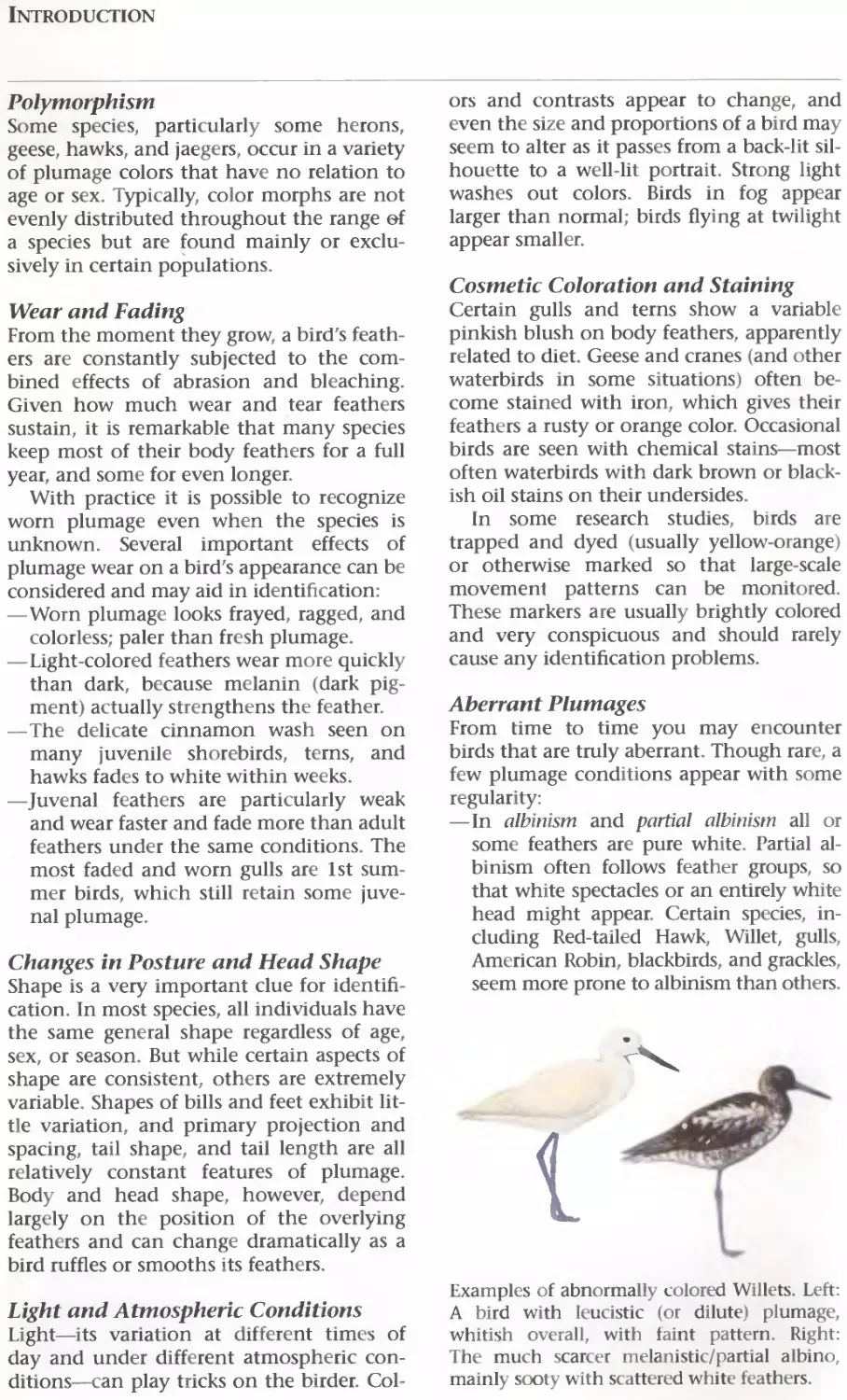
Examples of abnormally colored Willets. Left:
A bird with leucistic (or dilute) plumage,
whitish overall, with faint pattern. Right:
The much scarcer melanistic/partial albino,
mainly sooty with scattered white feathers.
INTRODUCTION
-In leucism (also referred to as dilute
plumage) normal patterns are visible, but
all plumage is paler than normal, usually
pale, creamy brown.
-Melanism is caused by an excess of dark
(brown or black) pigment. It is less fre-
quent than albinism and leucism and
may occur in combination with partial
albinism.
Other color aberrations, involving an ex-
cess or absence of particular pigments, are
very rare.
Bill Defonnities
Birds' bills are constantly growing-like
human fingernails-but they are subjected
to constant wear, which maintains them at
their proper length. An injury or slight de-
formity can result in abnormal growth or
an unusually long or twisted bill.
Hybrids
Hybrids are the offspring of parents of two
different species. The offspring of parents
of two different subspecies (of the same
species) are known as intergrades rather
than hybrids (e.g., Yellow-rumped Warbler).
Hybrids occur frequently between cer-
tain closely related species and are often
overlooked by birders. The most regularly
seen crosses are illustrated in this book, but
many other crosses are nearly as frequent,
and a great number of other hybrids have
been recorded. The groups most prone to
hybridization are geese, ducks, grouse,
gulls, and hummingbirds.
It is important to point out that hybrids
are extremely variable-even siblings
within a single brood of hybrids can look
quite different from one another-and the
illustrations included in this book only
begin to cover the subject. Most hybrid
birds are fertile, and mate with one of their
parent species or with another hybrid to
produce backcrosses, which can then go on
to produce more backcrosses, etc., leading
to a complete spectrum of variation be-
tween the two pure parental types (e.g.,
Western and Glaucous-winged Gulls).
Hybrids can show unexpected character-
istics not present on either parent, and it is
often impossible to determine whether an
individual bird is in fact a hybrid or to say
with certainty which species are the par-
ents. The standard terminology applied to
all such cases is apparent hybrid.
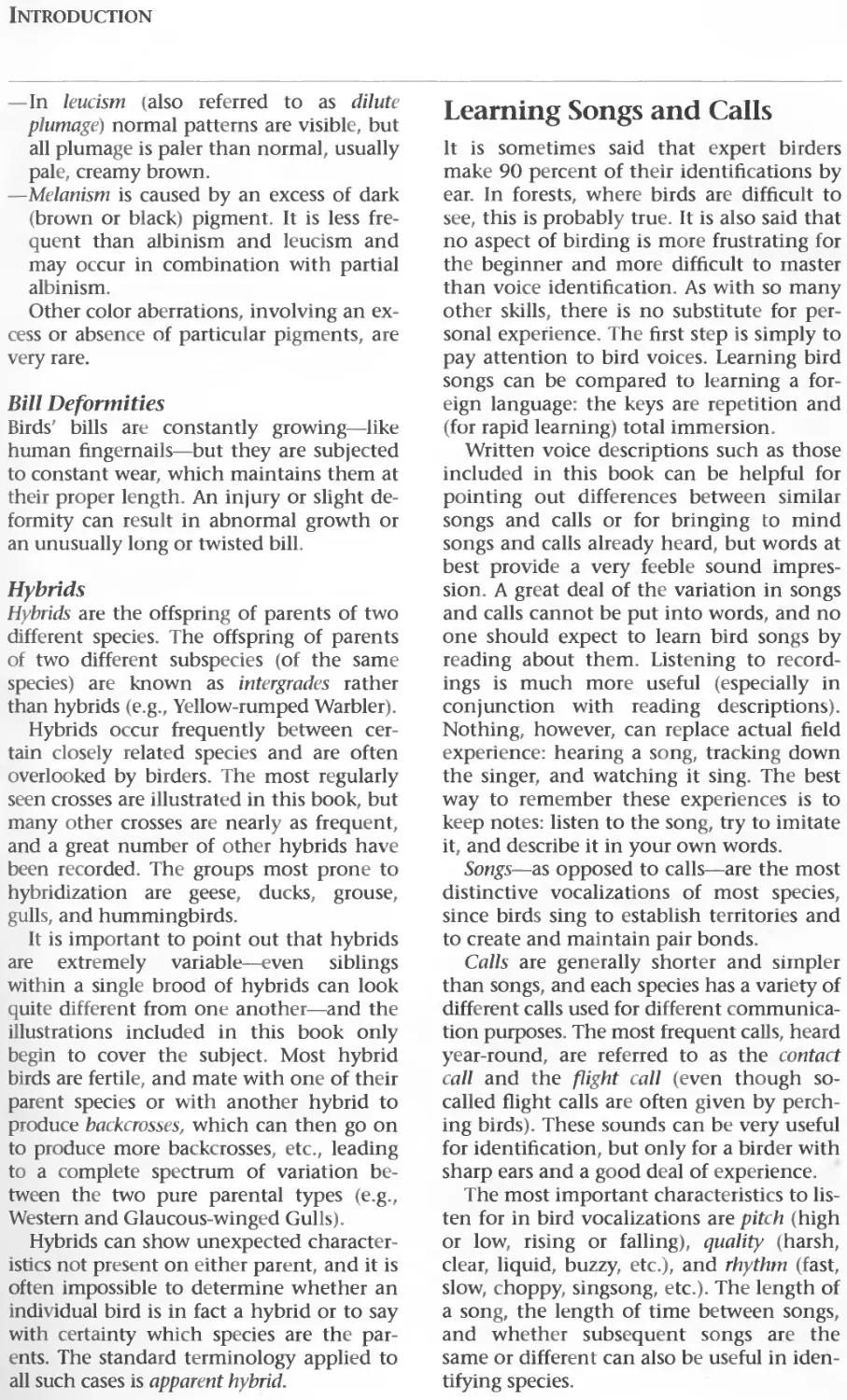
Learning Songs and Calls
It is sometimes said that expert birders
make 90 percent of their identifications by
ear. In forests, where birds are difficult to
see, this is probably true. It is also said that
no aspect of birding is more frustrating for
the beginner and more difficult to master
than voice identification. As with so many
other skills, there is no substitute for per-
sonal experience. The first step is simply to
pay attention to bird voices. Learning bird
songs can be compared to learning a for-
eign language: the keys are repetition and
(for rapid learning) total immersion.
Written voice descriptions such as those
included in this book can be helpful for
pointing out differences between similar
songs and calls or for bringing to mind
songs and calls already heard, but words at
best provide a very feeble sound impres-
sion. A great deal of the variation in songs
and calls cannot be put into words, and no
one should expect to learn bird songs by
reading about them. Listening to record-
ings is much more useful (especially in
conjunction with reading descriptions).
Nothing, however, can replace actual field
experience: hearing a song, tracking down
the singer, and watching it sing. The best
way to remember these experiences is to
keep notes: listen to the song, try to imitate
it, and describe it in your own words.
Songs-as opposed to calls-are the most
distinctive vocalizations of most species,
since birds sing to establish territories and
to create and maintain pair bonds.
Calls are generally shorter and simpler
than songs, and each species has a variety of
different calls used for different communica-
tion purposes. The most frequent calls, heard
year-round, are referred to as the contact
call and the flight call (even though so-
called flight calls are often given by perch-
ing birds). These sounds can be very useful
for identification, but only for a birder with
sharp ears and a good deal of experience.
The most important characteristics to lis-
ten for in bird vocalizations are pitch (high
or low, rising or falling), quality (harsh,
clear, liquid, buzzy, etc.), and rhythm (fast,
slow, choppy, singsong, etc.). The length of
a song, the length of time between songs,
and whether subsequent songs are the
same or different can also be useful in iden-
tifying species.
INTRODUCTION
With experience you will begin to recog-
nize the basic qualities- of birds' voices-for
example a thrushlike or other quality. This
kind of broad determination can be a very
helpful first step toward identification.
Finding Rare Birds
Most birders who find rare birds are look-
ing for rare birds. This is not to say that
one can find a rarity simply by looking for
it, but the observer who is prepared will
find rare species far more often than the
observer who is not. An intimate knowl-
edge of the common species is essential (an
equivalent knowledge of the rare species al-
ways helps, of course). The expert will keep
an open mind, so that a mere flash of color,
a slightly different shape, or just an impres-
sion of "something not quite right" may
focus attention and lead to the detection of
a rare bird. Knowing patterns of occurrence
also improves your chances, as rare species
tend to occur in specific habitats and at
certain seasons.
While rarity-hunting is one of the most
exciting aspects of bird-watching, it does
carry a measure of responsibility. You must
be prepared to defend your identification,
and to this end it is worthwhile to take ex-
tensive notes and attempt to photograph
or tape-record a bird you think may be a
rarity. Use extra care when identifying rare
birds, considering alternatives such as aber-
rant plumages of common species. Contact
other birders as soon as possible so that
they have an opportunity to see the bird.
Don't be afraid to propose an identification
or to question the identifications of others;
everyone makes mistakes (even the ex-
perts). Do be cautious, be honest with
yourself and others, and when mistakes are
made try to learn from them.
Ethics
.
As more and more people take up bird-
watching, the behavior of every individual
birder becomes more important. In all situ-
ations you must first consider the welfare
of the birds. Avoid making a disturbance,
especially at roosting and nesting sites.
Tread lightly and encourage others to do
the same. Be respectful and helpful to oth-
ers, especially to nonbirders (who may n01
appreciate someone trampling lawns or
blocking traffic just to see a bird).
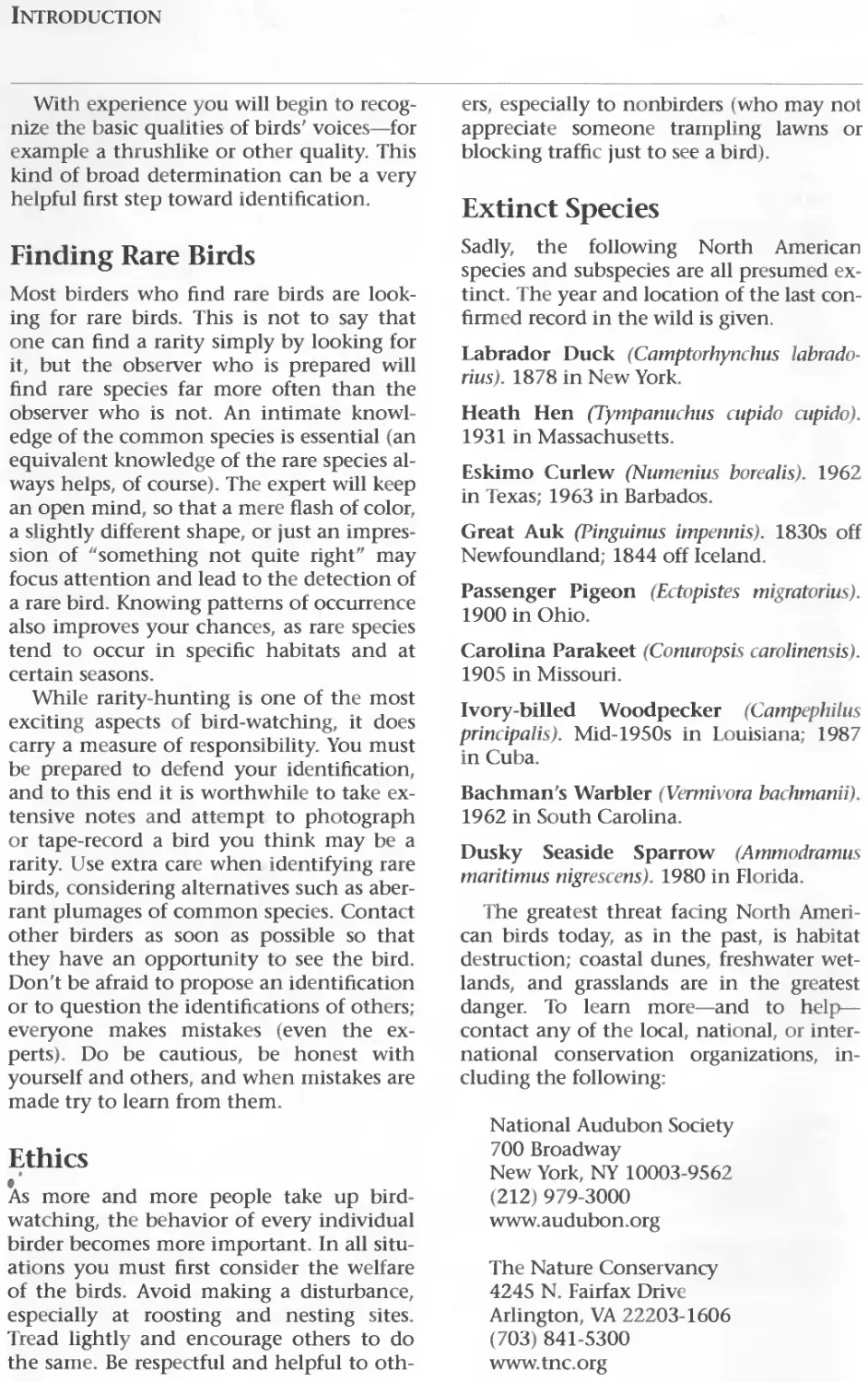
Extinct Species
Sadly, the following North American
species and subspecies are all presumed ex-
tinct. The year and location of the last con-
firmed record in the wild is given.
Labrador Duck (Camptorhynchus labrado-
rius). 1878 in New York.
Heath Hen (Tyrnpanuchus cupido cupido).
1931 in Massachusetts.
Eskimo Curlew (Numenius borealis). 1962
in Texas; 1963 in Barbados.
Great Auk (pinguinus impennis). 1830s off
Newfoundland; 1844 off Iceland.
Passenger Pigeon (Ectopistes migratorius).
1900 in Ohio.
Carolina Parakeet (Conuropsis carolinensis).
1905 in Missouri.
Ivory-billed Woodpecker (CampephiLus
principalis). Mid-1950s in Louisiana; 1987
in Cuba.
Bachman's Warbler (Vermivora bac11manii).
1962 in South Carolina.
Dusky Seaside Sparrow (Ammodramus
maritimus nigrescens). 1980 in Florida.
The greatest threat facing North Ameri-
can birds today, as in the past, is habitat
destruction; coastal dunes, freshwater wet-
lands, and grasslands are in the greatest
danger. To learn more-and to help--
contact any of the local, national, or inter-
national conservation organizations, in-
cluding the following:
National Audubon Society
700 Broadway
New York, NY 10003-9562
(212) 979-3000
www.audubon.org
The Nature Conservancy
4245 N. Fairfax Drive
Arlington, VA 22203-1606
(703) 841-5300
www.tnc.org
BIRD TOPOGRAPHY
Birders deal with feathers. The actual flesh
and bones of a bird's body are barely visi-
ble, and the varied shapes and colors of
birds are almost entirely created by the
feathers. Even though the colors and
shapes of individual feathers are so vari-
able, the arrangement of feathers on a
bird's body is similar across all species.
Birds' bodies are not uniformly covered
with feathers. The feathers grow in discrete
groups (within several tracts), leaving other
parts of the body bare. Knowing the basic
feather groups and how the feathers in
each group are arranged may be the most
important tools a birder can possess when
trying to identify a bird by its appearance.
Even on a uniformly black species, such as
a crow, one can identify all the basic
feather groups described below. Studying a
common bird-a House Sparrow, a gull,
even a pet parakeet-is one way to famil-
iarize yourself with feather groups.
Within each group, feathers grow in or-
derly rows, overlapping like shingles on a
roof. The shape and arrangement of all
feathers is perfectly coordinated to cover
the bird's entire body with a streamlined
and waterproof insulating jacket.
Plumage patterns almost invariably fol-
low the contours of feather groups, and
most markings can be described by refer-
ence to the relatively simple framework
that feather groups provide. Learning the
basis of common markings (e.g., wing-bars,
eye-ring, etc.) will greatly enhance your
understanding of birds' appearance.
One of the most frequent patterns seen
on feathers is a simple dark streak along
the shaft of each feather. Such streaks on
the breast and flank feathers line up to
form the long rows of streaked feathers
characteristic of many songbirds. Differ-
ences among species are entirely the result
of differences in the color and shape of
feather markings, not of any difference in
the shape or arrangement of feathers.
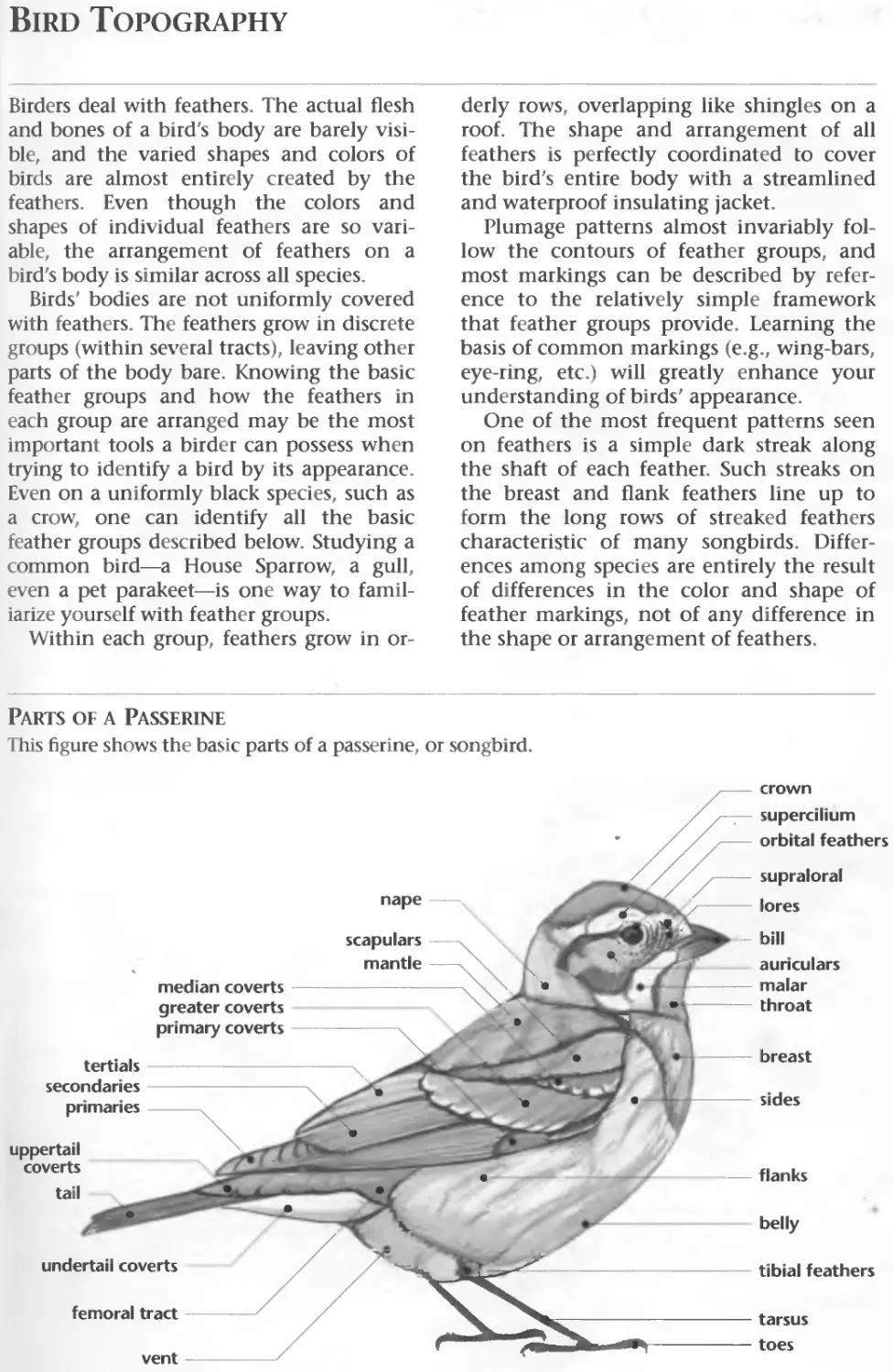
PARTS OF A PASSERINE
This figure shows the basic parts of a passerine, or songbird.
nape -
. :' i :."
supraloral
__ lores
'-.
- bill
scapulars
mantle "" "-
"\ .
. '"
auriculars
- malar
e - throat
median coverts
greater coverts
primary coverts
tertials
secondaries
primaries
uppertail
coverts
"
..
'\.
".
tail
e.
.
e
.
unde ail coverts /
femoral tract -.-/ /
vent
.. ..
....,
""
e
- breast
-.
.
- sides
.
- flanks
"
belly
tibial feathers
tarsus
toes
BIRD TOPOGRAPHY
HEAD FEATHERS
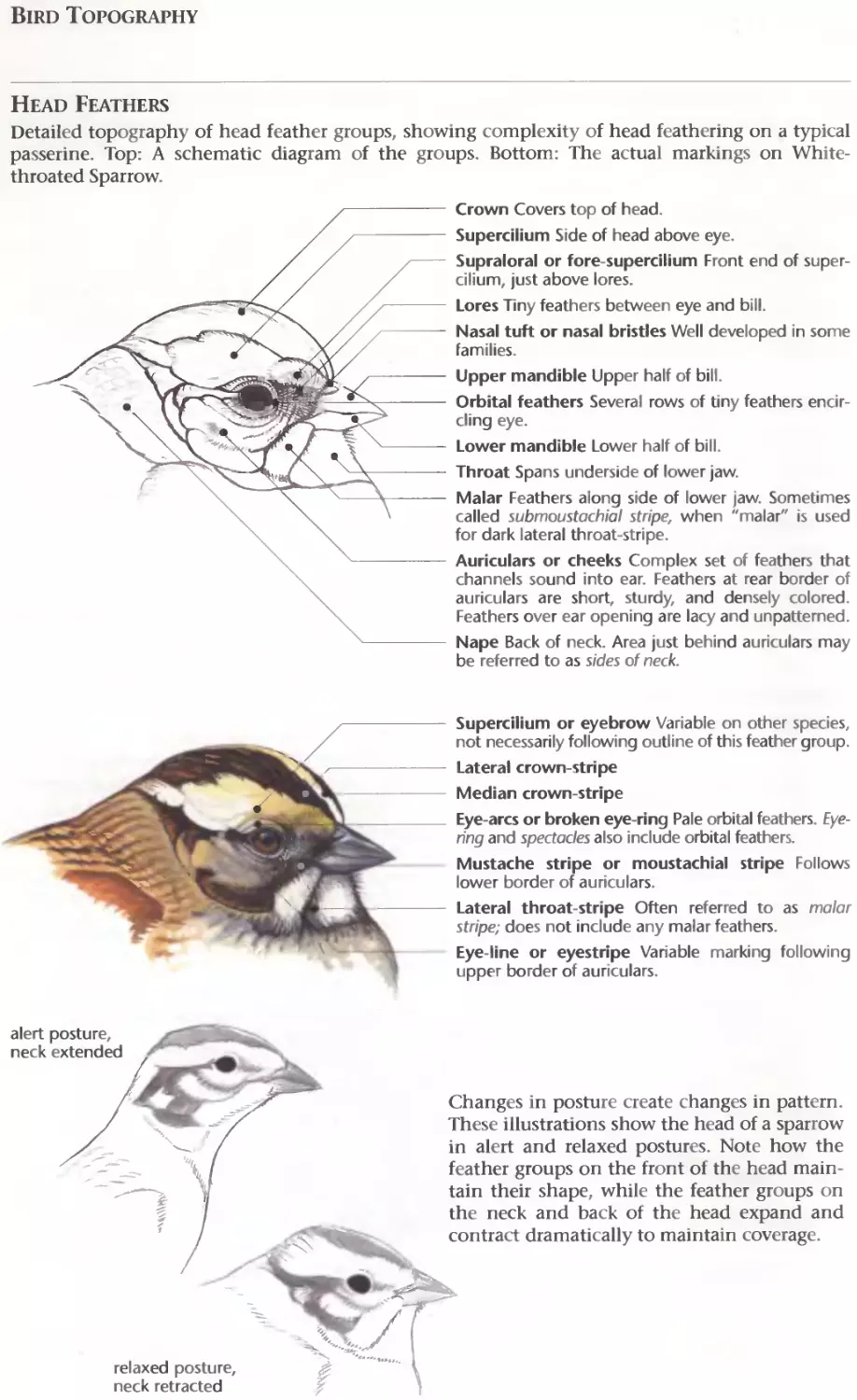
Detailed topography of head feather groups, showing complexity of head feathering on a typical
passerine. Top: A schematic diagram of the groups. Bottom: The actual markings on White-
throated Sparrow.
;::-
, /
/
.
.
..
,.J,
. .
--
,
,
alert posture,
neck e 2 xtended, ""
_.
- -- '('1 .
--- --==-- "
f
-
,
- t
,"'
- ... /
..... I,.
''' .
........ .........."..
t ....
r
"::::.
relaxed posture,
neck retracted
Crown Covers top of head.
Supercilium Side of head above eye.
Supraloral or fore-supercilium Front end of super-
cilium, just above lores.
lores Tiny feathers between eye and bill.
Nasal tuft or nasal bristles Well developed in some
families.
Upper mandible Upper half of bill.
Orbital feathers Several rows of tiny feathers encir-
cling eye.
lower mandible Lower half of bill.
Throat Spans underside of lower jaw.
Malar Feathers along side of lower jaw. Sometimes
called submoustachial stripe, when "malar" is used
for dark lateral throat-stripe.
Auriculars or cheeks Complex set of feathers that
channels sound into ear. Feathers at rear border of
auriculars are short, sturdy, and densely colored.
Feathers over ear opening are lacy and unpatterned.
Nape Back of neck. Area just behind auriculars may
be referred to as sides of neck.
Supercilium or eyebrow Variable on other species,
not necessarily following outline of this feather group.
lateral crown-stripe
Median crown-stripe
Eye-arcs or broken eye-ring Pale orbital feathers. Eye-
ring and spectacles also include orbital feathers.
Mustache stripe or moustachial stripe Follows
lower border of auriculars.
lateral throat-stripe Often referred to as malar
stripe; does not include any malar feathers.
Eye-line or eyestripe Variable marking following
upper border of auriculars.
Changes in posture create changes in pattern.
These illustrations show the head of a sparrow
in alert and relaxed postures. Note how the
feather groups on the front of the head main-
tain their shape, while the feather groups on
the neck and back of the head expand and
contract dramatically to maintain coverage.
BIRD TOPOGRAPHY
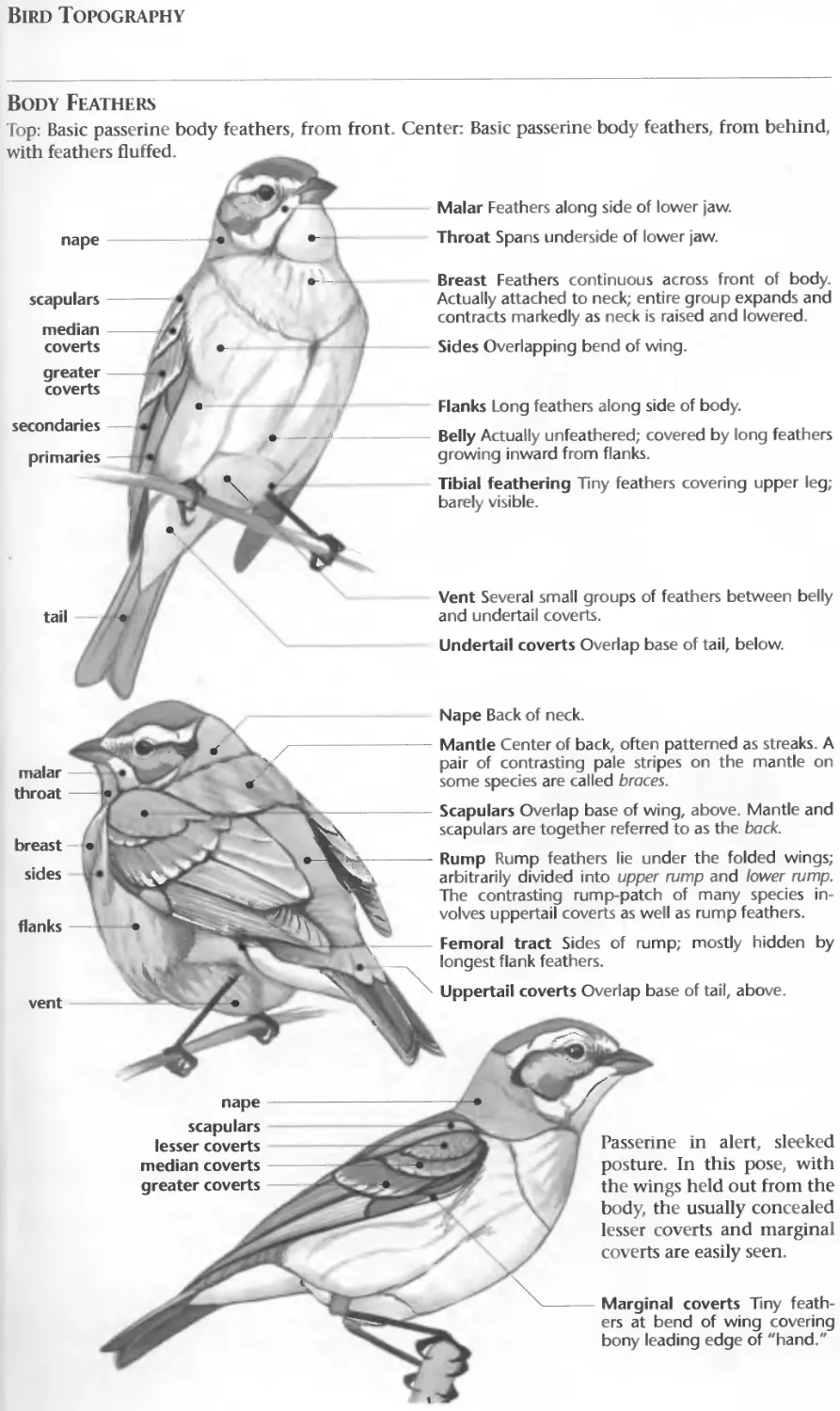
BODY FEATHERS
Top: Basic passerine body feathers, from front. Center: Basic passerine body feathers, from behind,
with feathers fluffed.
nape .. e-
\
e--
scapulars -
median -
coverts e-
greater -
coverts
.
secondaries -
e--
primaries -
"
--
"
tail- ..
Malar Feathers along side of lower jaw.
Throat Spans underside of lower jaw.
Breast Feathers continuous across front of body.
Actually attached to neck; entire group expands and
contracts markedly as neck is raised and lowered.
Sides Overlapping bend of wing.
Flanks Long feathers along side of body.
Belly Actually unfeathered; covered by long feathers
growing inward from flanks.
Tibial feathering Tiny feathers covering upper leg;
barely visible.
Vent Several small groups of feathers between belly
and undertail coverts.
Undertail coverts Overlap base of tail, below.
.......
Nape Back of neck.
Mantle Center of back, often patterned as streaks. A
pair of contrasting pale stripes on the mantle on
some species are called braces.
Scapulars Overlap base of wing, above. Mantle and
scapulars are together referred to as the back.
Rump Rump feathers lie under the folded wings;
arbitrarily divided into upper rump and lower rump.
The contrasting rump-patch of many species in-
volves uppertail coverts as well as rump feathers.
, - Femoral tract Sides of rump; mostly hidden by
longest flank feathers.
Uppertail coverts Overlap base of tail, above.
" \ . .... /
malar -
throat - . .
.
breast - ..
sides \.
- ..I
flanks - .. "-.
"
vent ..
'\
.
nape
scapulars
lesser coverts
median coverts - ....
greater coverts - _ -e
-
/
---.
Passerine in alert, sleeked
posture. In this pose, with
the wings held out from the
body, the usually concealed
lesser coverts and marginal
coverts are easily seen.
Marginal coverts Tiny feath-
ers at bend of wing covering
bony leading edge of "hand."
BIRD TOPOGRAPHY
WING FEATHERS
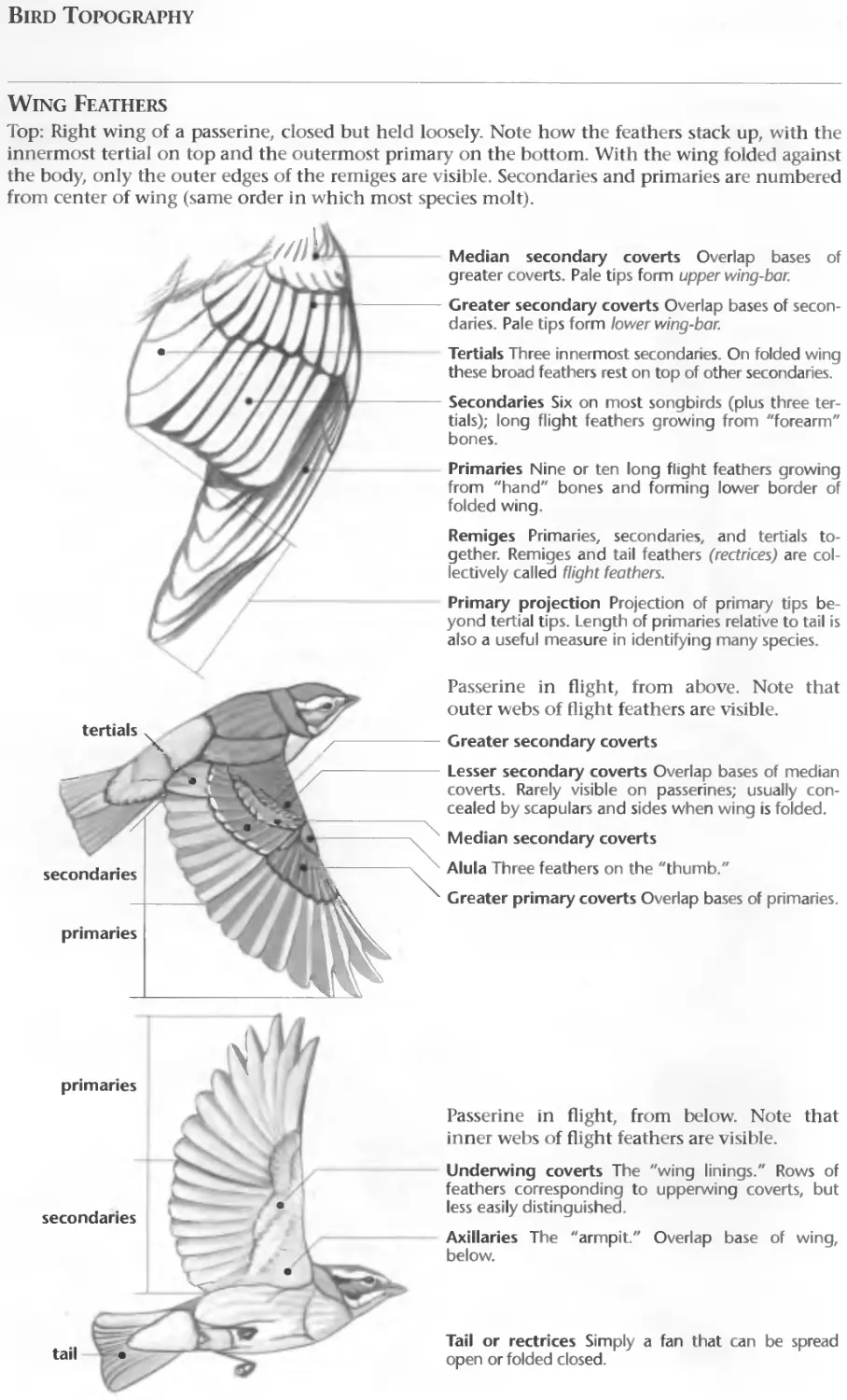
Top: Right wing of a passerine, closed but held loosely. Note how the feathers stack up, with the
innermost tertial on top and the outermost primary on the bottom. With the wing folded against
the body, only the outer edges of the remiges are visible. Secondaries and primaries are numbered
from center of wing (same order in which most species molt).
11/)
Median secondary coverts Overlap bases of
greater coverts. Pale tips form upper wing-bar.
Greater secondary coverts Overlap bases of secon-
daries. Pale tips form lower wing-bar.
Tertials Three innermost secondaries. On folded wing
these broad feathers rest on top of other secondaries.
Secondaries Six on most songbirds (plus three ter-
tials); long flight feathers growing from "forearm"
bones.
Primaries Nine or ten long flight feathers growing
from "hand" bones and forming lower border of
folded wing.
Remiges Primaries, secondaries, and tertials to-
gether. Remiges and tail feathers (rectrices) are col-
lectively called flight feathers.
Primary projection Projection of primary tips be-
yond tertial tips. Length of primaries relative to tail is
also a useful measure in identifying many species.
.
tertials "
/
Passerine in flight, from above. Note that
outer webs of flight feathers are visible.
Greater secondary coverts
Lesser secondary coverts Overlap bases of median
coverts. Rarely visible on passerines; usually con-
cealed by scapulars and sides when wing is folded.
'" Median secondary coverts
Alula Three leathers on the "thumb."
Greater primary coverts Overlap bases of primaries.
. '
l
\
"
/
........
primaries
secondaries
primaries
.
Passerine in flight, from below. Note that
inner webs of flight feathers are visible.
Underwing coverts The "wing linings." Rows of
feathers corresponding to upperwing coverts, but
less easily distinguished.
Axillaries The "armpit." Overlap base of wing,
below.
secondaries
.
tail
.
Tailor rectrices Simply a fan that can be spread
open or folded closed.
BIRD TOPOGRAPHY
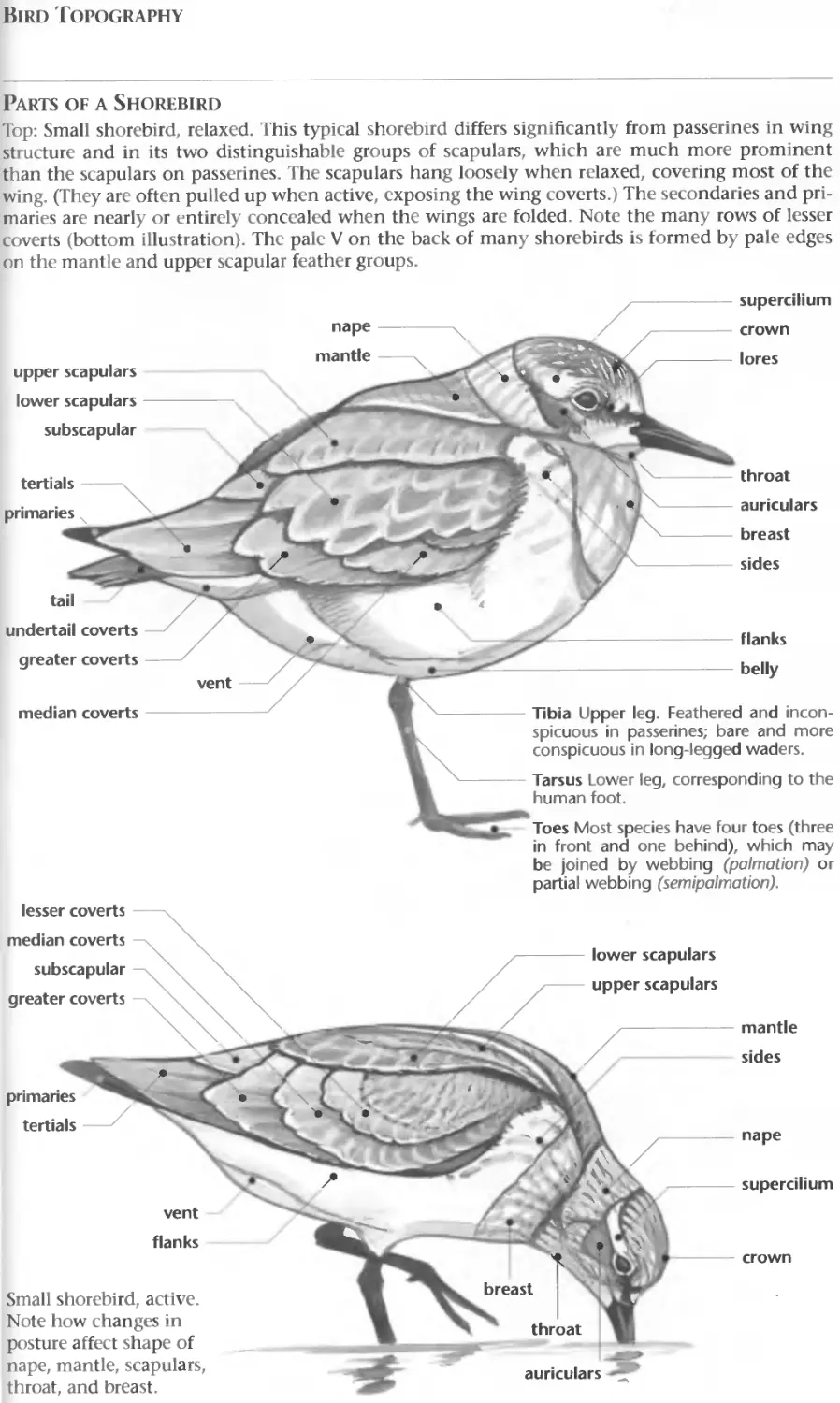
PARTS OF A SHOREBIRD
Top: Small shorebird, relaxed. This typical shorebird differs significantly from passerines in wing
structure and in its two distinguishable groups of scapulars, which are much more prominent
than the scapulars on passerines. The scapulars hang loosely when relaxed, covering most of the
wing. (They are often pulled up when active, exposing the wing coverts.) The secondaries and pri-
maries are nearly or entirely concealed when the wings are folded. Note the many rows of lesser
coverts (bottom illustration). The pale V on the back of many shorebirds is formed by pale edges
on the mantle and upper scapular feather groups.
upper scapulars
lower scapulars
subscapular
/ supercilium
nape ""- crown
mantle - ,." , / lores
-. . ,\ \ /
. -'-'
" "-
"-
". . """ " throat
. . . "" auriculars
"'- breast
/' ,... "- sides
tertials
primaries '-
"
tail /
undertail coverts / .
greater coverts
vent
median coverts
.
flanks
belly
Tibia Upper leg. Feathered and incon-
spicuous in passerines; bare and more
conspicuous in long-legged waders.
Tarsus lower leg, corresponding to the
human foot.
Toes Most species have four toes (three
in front and one behind), which may
be joined by webbing (palmation) or
partial webbing (semi palmation).
lesser coverts
median coverts
g":::::: :
r= lower scapulars
/ / up per scapulars
/
mantle
sides
primaries
tertials
t '
.
"
-.
-.
nape
)'
, $\ /
- supercilium
'"
vent
flanks
,
-i'
"-"
Small shorebird, active.
Note how changes in
posture affect shape of
nape, mantle, scapulars,
throat, and breast.
breast f' ·
throat
)"
- crown
r
auriculars
BIRD TOPOGRAPHY
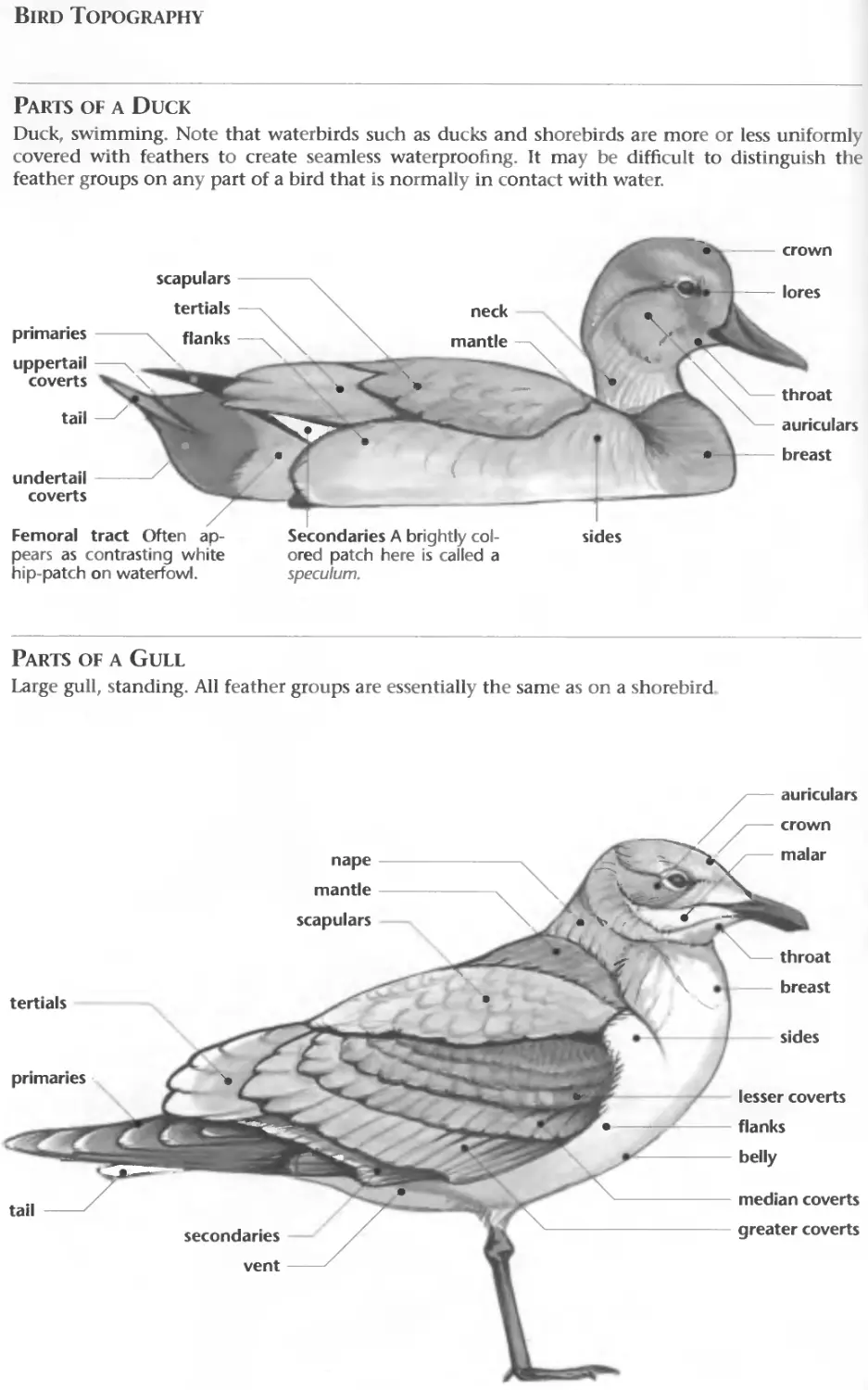
PARTS OF A DUCK
Duck, swimming. Note that waterbirds such as ducks and shorebirds are more or less uniformly
covered with feathers to create seamless waterproofing. It may be difficult to distinguish the
feather groups on any part of a bird that is normally in contact with water.
-. - crown
scapulars
tertials
primaries flanks
uppertail
coverts "" ..
- lores
neck
mantle
).
.
' throat
auriculars
. - breast
,
"
..
tail ---./
.
'.
.
(
undertail ----./
coverts
/
Femoral tract Often ap-
pears as contrasting white
hip-patch on waterfowl.
I
Secondaries A brightly col-
ored patch here is called a
speculum.
sides
PARTS OF A GULL
Large gull, standing. All feather groups are essentially the same as on a shorebird
"'" '" , .
/ auriculars
/ r crown
-';: malar
.-
" ,
nape
mantle
scapulars
"
'1'
""-- throat
tertials
.
,
'-
- breast
sides
primaries.
-..
-
.
lesser coverts
flanks
belly
.
-.-:
tail
.
'"
median coverts
greater coverts
secondaries
vent
'"
BIRD TOPOGRAPHY
PARTS OF A GULL
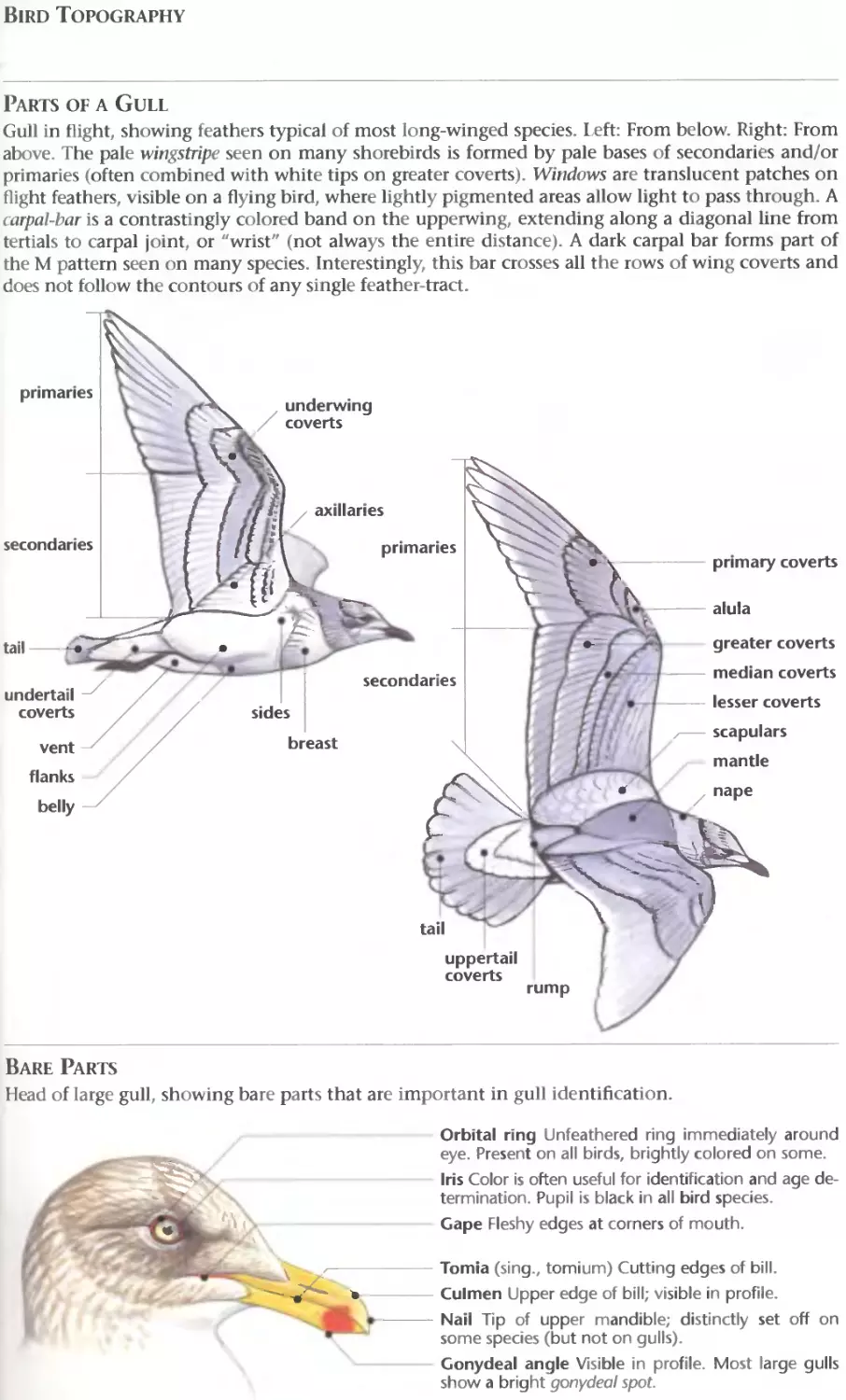
Gull in flight, showing feathers typical of most long-winged species. Left: From below. Right: From
above. The pale wingstripe seen on many shorebirds is formed by pale bases of secondaries and/or
primaries (often combined with white tips on greater coverts). Windows are translucent patches on
flight feathers, visible on a flying bird, where lightly pigmented areas allow light to pass through. A
carpal-bar is a contrastingly colored band on the upperwing, extending along a diagonal line from
tertials to carpal joint, or "wrist" (not always the entire distance). A dark carpal bar forms part of
the M pattern seen on many species. Interestingly, this bar crosses all the rows of wing coverts and
does not follow the contours of any single feather-tract.
primarie,
'-
/ underwing
coverts
primary coverts
\:-
'£
-alula
tail-.....
.-
greater coverts
- median coverts
- lesser coverts
u :,: / /
vent
flanks
belly
I
sides
breast
secondaries
scapulars
mantle
. -" \ /:ape
tail
uppertail
coverts
rump
BARE PARTS
Head of large gull, showing bare parts that are important in gull identification.
.
t\ I
Orbital ring Unfeathered ring immediately around
eye. Present on all birds, brightly colored on some.
Iris Color is often useful for identification and age de-
termination. Pupil is black in all bird species.
Gape Fleshy edges at corners of mouth.
----------
-
-
'
\ '
-..
Tomia (sing., tomium) Cutting edges of bill.
.. - Culmen Upper edge of bill; visible in profile.
- Nail Tip of upper mandible; distinctly set off on
some species (but not on gulls).
Gonydeal angle Visible in profile. Most large gulls
show a bright gonydeal spot.
BIRD TOPOGRAPHY
Molt and Plumage
For birds, molting is the process of dropping
old feathers and growing new ones in their
place, and most birds molt at least once a
year. Observers can nearly always identify a
bird without reference to molt, but a basic
understanding of molt can be helpful for
determining the age of a bird, for assessing
plumage variation, and for identification.
The process of growing an entirely new
set of feathers is so demanding that it can-
not coincide with other activities such as
nesting or migrating. Each species (or sub-
species) has evolved a schedule that allows
it to molt at a time when food is readily
available and other demands are not too
high. In general, long-distance migrants
molt after fall migration, other species
molt before; this schedule differs among
some closely related species (e.g., peeps,
nighthawks, swallows, etc.).
Age terminology can be confusing, as
several different systems are used by bird-
ers. In this book, age of immature birds is
described using the life-year system, which
calculates age in the same way that we fig-
ure our own ages. 1st year applies to a bird
during its first year of life, from fledgling
through the 1st winter and 1st summer,
ending around its first "birthday," as it be-
gins the molt to 2nd year plumage. Most
passerines molt into adult plumage at one
year of age, but many nonpasserines have
distinguishable 2nd, 3rd, and even 4th year
plumages before reaching adulthood.
Seasonal plumages of adults are described
in this book as breeding and non breeding. A
few species have a third plumage either be-
fore or after breeding, called a supplemental
plumage.
It is important to realize that the labels
used in this book describe the bird's ap-
pearance and do not always have a connec-
tion to molt. For example, a 1st summer
appearance or adult breeding appearance
(e.g., Snow Bunting) may simply result
from the alteration of feathers grown in a
previous molt, and not from any new molt.
Alternative terminologies include the
calendar-year system, which describes imma-
ture birds as 1 st calendar year (or hatching
year) until December 31, 2nd calendar year
until the next December 31, etc.
Ornithologists who study molt use a
third set of terms, the Humphrey-Parkes sys-
tem, which is purposely devoid of references
to calendars and breeding cycles. Plumages
are described based on the molt bv which
they are acquired. Although initially some-
what difficult to understand, this terminol-
ogy is essential for any in-depth study of
molt. For further details consult Pyle's Iden-
tification Guide (see page 9, above).
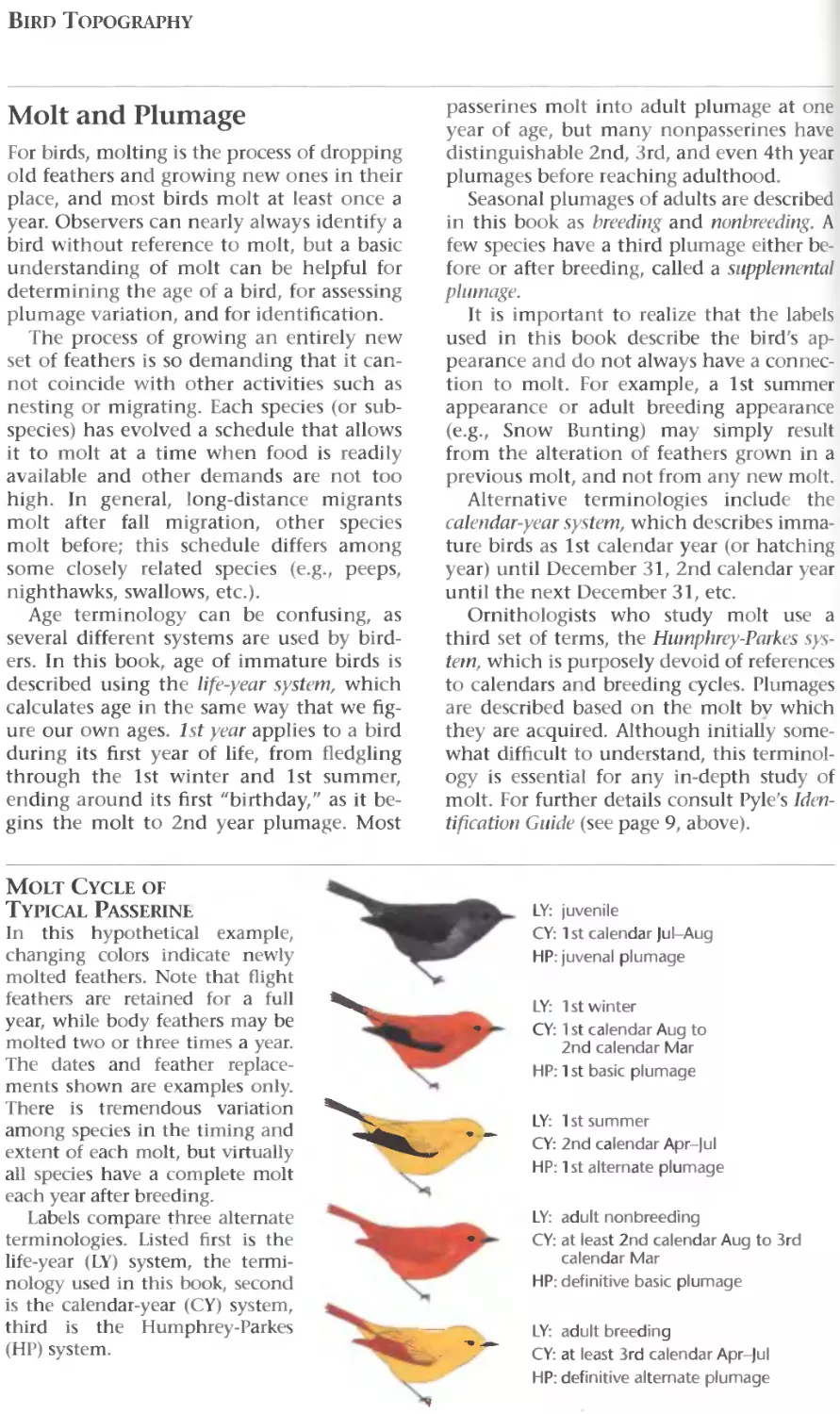
MOLT CYCLE OF
TYPICAL PASSERINE
In this hypothetical example,
changing colors indicate newly
molted feathers. Note that flight
feathers are retained for a full
year, while body feathers may be
molted two or three times a year.
The dates and feather replace-
ments shown are examples only.
There is tremendous variation
among species in the timing and
extent of each molt, but virtually
all species have a complete molt
each year after breeding.
Labels compare three alternate
terminologies. Listed first is the
life-year (LY) system, the termi-
nology used in this book, second
is the calendar-year (CY) system,
third is the Humphrey-Parkes
(HP) system.
......... "'-
"-
LY: juvenile
CY: 1 st calendar jul-Aug
HP: juvenal plumage
LY: 1 st winter
CY: 1 st calendar Aug to
2nd calendar Mar
HP: 1 st basic plumage
LY: 1 st summer
CY: 2nd calendar Apr-jul
HP: 1 st alternate plumage
LY: adult nonbreeding
CY: at least 2nd calendar Aug to 3rd
calendar Mar
HP: definitive basic plumage
LY: adult breeding
CY: at least 3rd calendar Apr-jul
HP: definitive alternate plumage
.,
LOONS
Family: Caviidae
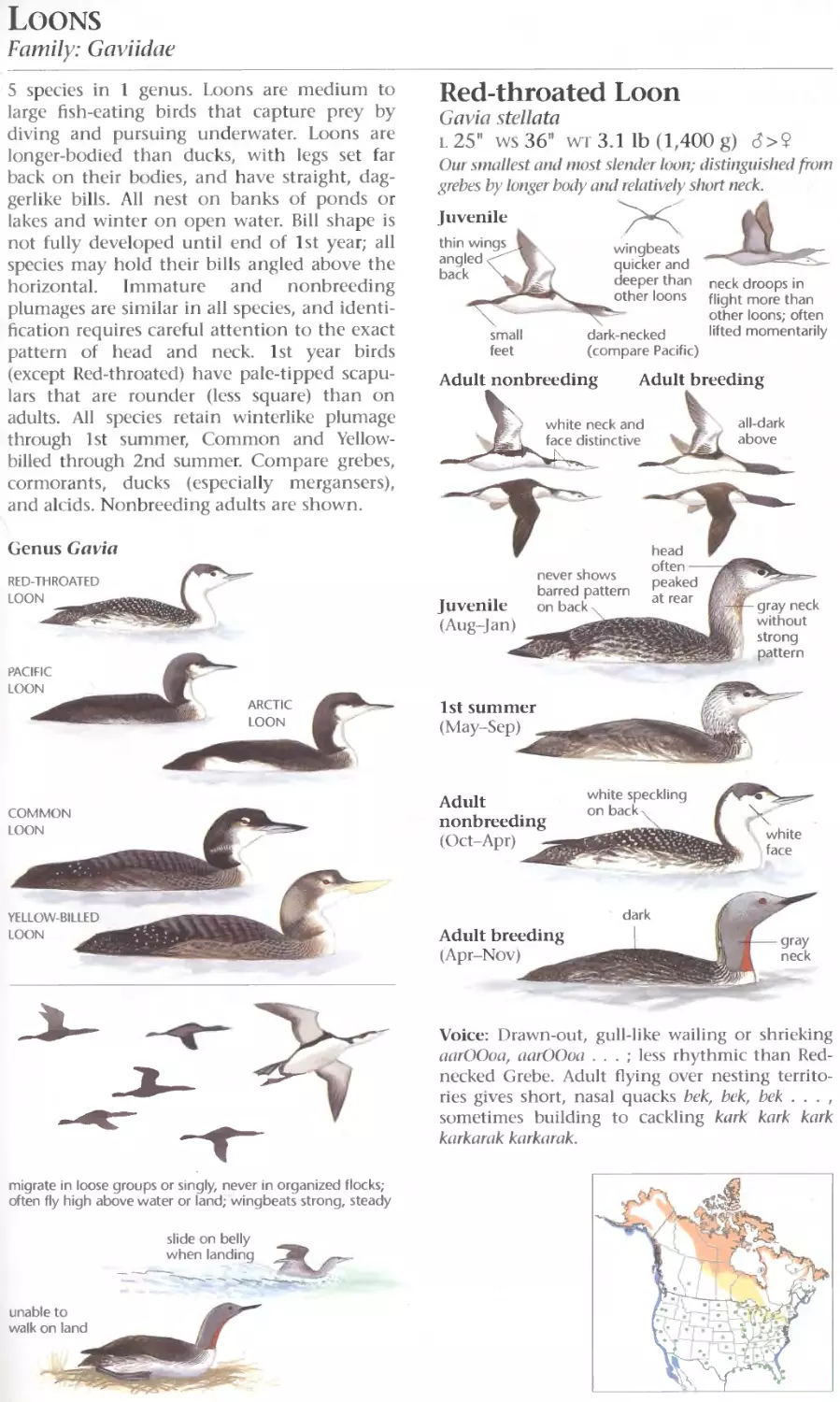
5 species in 1 genus. Loons are medium to
large fish-eating birds that capture prey by
diving and pursuing underwater. Loons are
longer-bodied than ducks, with legs set far
back on their bodies, and have straight, dag-
gerlike bills. All nest on banks of ponds or
lakes and winter on open water. Bill shape is
not fully developed until end of 1 st year; all
species may hold their bills angled above the
horizontal. Immature and nonbreeding
plumages are similar in all species, and identi-
fication requires careful attention to the exact
pattern of head and neck. 1st year birds
(except Red-throated) have pale-tipped scapu-
lars that are rounder (less square) than on
adults. All species retain winterlike plumage
through 1st summer, Common and Yellow-
billed through 2nd summer. Compare grebes,
cormorants, ducks (especially mergansers),
and alcids. Nonbreeding adults are shown.
Genus Cavia
RED-THROATED
LOON
PACIFIC
LOON
ARCTIC
LOON
COMMON
LOON
YELLOW-BILLED
LOON
.: ;
. . , : .' .
/-
migrate in loose groups or singly, never in organized flocks;
often fly high above water or land; wingbeats strong, steady
slide on belly
when landing
- - ------=--
unable to
walk on land
Red-throated Loon
Cavia stellata
L 25" ws 36" WT 3.11b 0,400 g) o>
Ollr smallest alld most slender luoll; distinguished from
grebes by longer body alld relatively short neck.
X
Juvenile
thin wings
angled
back "'"
wingbeats
quicker and
deeper than
other loons
-..-:
neck droops in
flight more than
other loons; often
lifted momentarily
"-
smail
feet
dark-necked
(compare Pacific)
Adult nonbreeding
Adult breeding
all-dark
above
.........
Juvenile
(Aug-]an)
never shows
barred pattern
on back
head
often
peaked
at rear
gray neck
without
strong
pattern
- -_ c.
-
".
.:-..."-
-
1st summer
(May-Sep)
Adult
nonbreeding
(Oct-Apr)
white speckling
on back ,
f>\ h "
w Ite
face
.. '. ;;:;":i;:" ! .
Adult breeding
(Apr-Nov)
dark
I
gray
neck
I
)
Voice: Drawn-out, gull-like wailing or shrieking
aarOOoa, aarOOoa . . . ; less rhythmic than Red-
necked Grebe. Adult flying over nesting territo-
ries gives short, nasal quacks bek, bek, bek . . . ,
sometimes building to cackling kark kark kark
karkarak karkarak.
LOONS
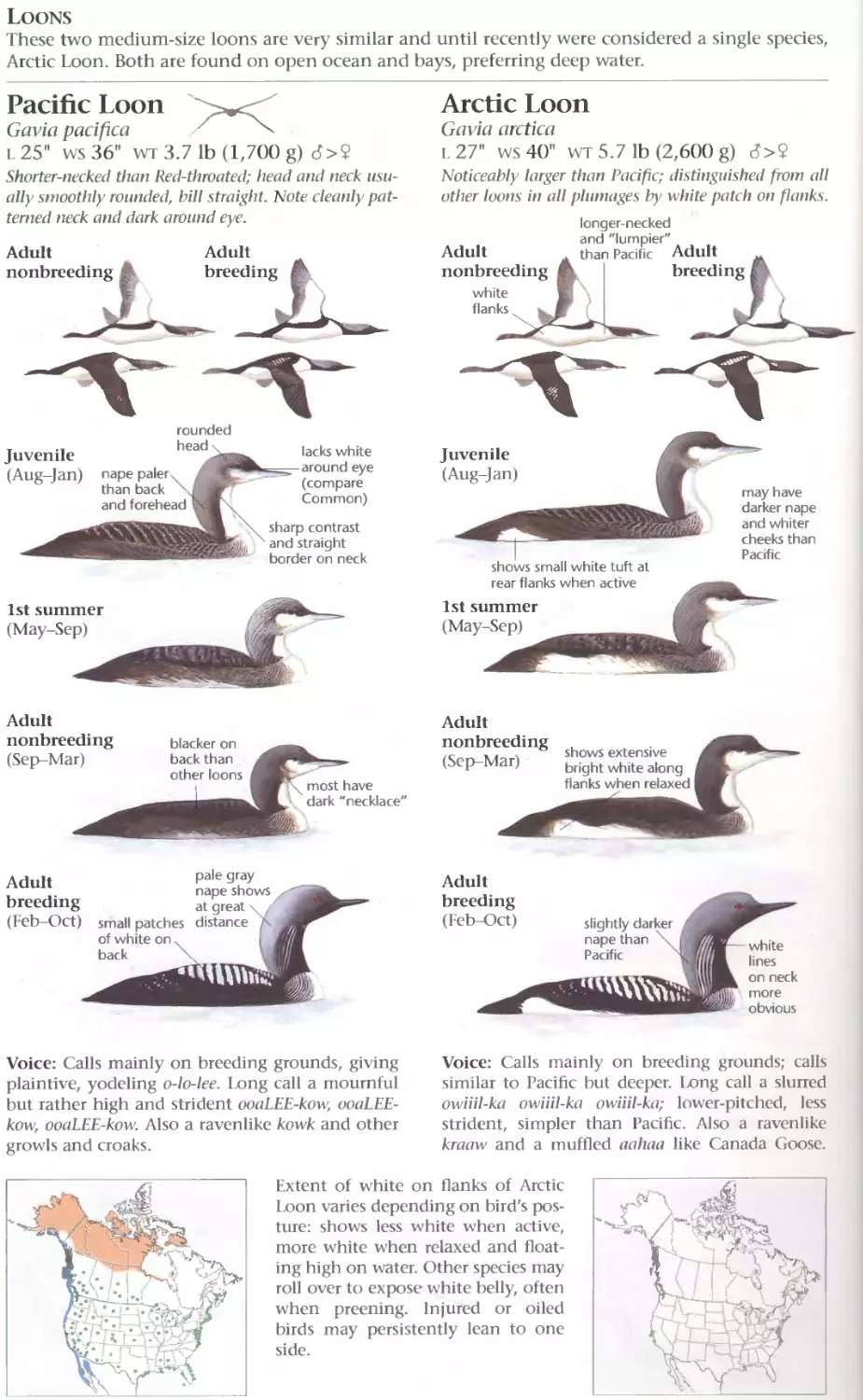
These two medium-size loons are very similar and until recently were considered a single species,
Arctic Loon, Both are found on open ocean and bays, preferring deep water.
Pacific Loon
Gavia pacifica "
L 25" ws 36" WT 3.7 lb (1,700 g) 0>2
Shorter-necked than Red-throated; head and neck llSU-
ally smoothly rounded, bill straight. Note cleanly pat-
temed neck and dark around eye.
Adult
nonbreeding
Adult
breeding
-y
Juvenile
(Aug-]an)
rounded
head
nape paler
than back
and forehead
" '. '.",
1st summer
(May-Sep)
Adult
nonbreeding
(Sep-Mar)
blacker on
back than
other loons
Adult
breeding
(Feb--Oct)
pale gray
nape shows
at great
small patches distance
of white on" II;
back " U /
-. ". "- ,\"",..: f4J }I
\
lacks white
around eye
(compare
Common)
sharp contrast
and straight
border on neck
" most have
dark "necklace"
Voice: Calls mainly on breeding grounds, giving
plaintive, yodeling o-lo-lee. Long call a mournful
but rather high and strident ooaLEE-kow, ooaLEE-
kow, ooaLEE-kow. Also a raven like kowk and other
growls and croaks.
Arctic Loon
Gavia arctica
L 27" ws 40" WT 5.7 lb (2,600 g) 0>2
Noticeably larger than Pacific; distinguished from all
other loom ;n all plumages by white patch on flanks.
longer-necked
and "lumpier"
than Pacific Adult
I I breeding
,
Adult
nonbreeding
white
flanks
"-
Juvenile
(Aug-]an)
may have
darker nape
and whiter
cheeks than
Pacific
shows small white tuft at
rear flanks when active
1st summer
(May-Sep)
Adult
nonbreeding
(Sep-Mar)
Adult
breeding
(Feb--Oct)
shows extensive
bright white along
flanks when relaxed
/'
gp t rker "'
Pacific (
.'.'. \\\\""\11.: I
- white
lines
on neck
more
obvious
Voice: Calls mainly on breeding grounds; calls
similar to Pacific but deeper. long call a slurred
owiiil-ka owiiil-ka owiiil-ka; lower-pitched, less
strident, simpler than Pacific. Also a raven like
kraaw and a muffled aa/Illa like Canada Goose.
Extent of white on flanks of Arctic
Loon varies depending on bird's pos-
ture: shows less white when active,
more white when relaxed and float-
ing high on water. Other species may
roll over to expose white belly, often
when preening. Injured or oiled
birds may persistently lean to one
side.
_ <f
_ r> ( ,- {{-.1
. , ' 4'Y.t
jt. A
, I J:>
I
h J'
t -r
LARGE LOONS
These two species are very similar to one another; they can be distinguished from all other loons
by their very large size; thick, boldly patterned necks; heavy bills; and relatively large feet.
Most are easily identified, but some
individuals of these two species can
be very similar (hybrids have been
recorded, but rarely). Bill shape and
color are the most reliable clues at
close range: Yellow-billed is longer-
billed with nearly straight culmen,
the culmen pale on the outer half.
Common Loon
Gavia immer / -
L 32" ws 46" WT 9 Ib (4,100 g) 0>2
Heavy and gooselike in fligllt; thick-necked and
thick-billed. Feet appear large.
Adult
nonbreeding
Adult \
bre
I
large
feet
"-
thick, dark
neck with
jagged
pattern
white
around
eye dark
, culmen
Juvenile
(Aug-Feb)
jagged neck
markings '"
- -white
partial
, '\ collar
1st summer
(Mar-Sep)
neck pale
when worn "
..
Adult
nonbreeding
(Sep-Mar)
. "
.0 ....
Adult
breeding
(Mar-Oct)
extensive white
checkering on
back
'-J
black
head
and bill
I
. . "' -.
:.l 1 : . ."-' \
Voice: Low, melancholy yodeling or wailing cries.
Tremolo of five to ten notes on even pitch halza-
lzahalzalla heard year-round, often in flight; some-
times a short kuk or gek in flight. In summer an
undulating whe-ooo 'luee and rising wail Iwooo-lii.
r
'lf
" I --
-...0ii<'l, .
¥........
Yellow-billed Loon
Gavia adams;;
L 35" ws 49" WT 11.8 Ib (5,400 g) 0>2
Obviously larger and heavier than Common; rela-
tively tllick-necked and long-billed; bill angled up;
appears small-eyed. Peak o(back at mid-body.
Adult
nonbreeding
Adult
breeding \
(
pale
primary
shafts
Juvenile
(Aug-Apr)
/
pale head whiter
II and bill than
Common
I
pale
bill
pale neck
and head
with dark
patch on
auriculars
obvious
pale
barring
on back
I
I
outer half of
bill entirely
pale
\
1st summer
(May-Sep)
Adult
nonbreeding
(Sep-Mar)
darker than
juvenile (more
like Common)
I
..: ;
e, ;. : ,I .
Adult
breeding
(Mar-Oct) more white
on back
I ...
.... ""', '. Ilnlll"'"
. ; !..;:. . . ,. . \
:';:.#.:: :"'::. .-:. . .
obvious pale bill
(beware some
Commons have
pale tip on bill)
I
compare
- shape of
white
collar
Voice: Voice like Common but lower-pitched,
harsher, delivered more slowly.
, i
_ r ;; .
. .
\ I " .
"J. ... . i ....(t""
..
.--r :
t1 .... . =-f
" \
,,",
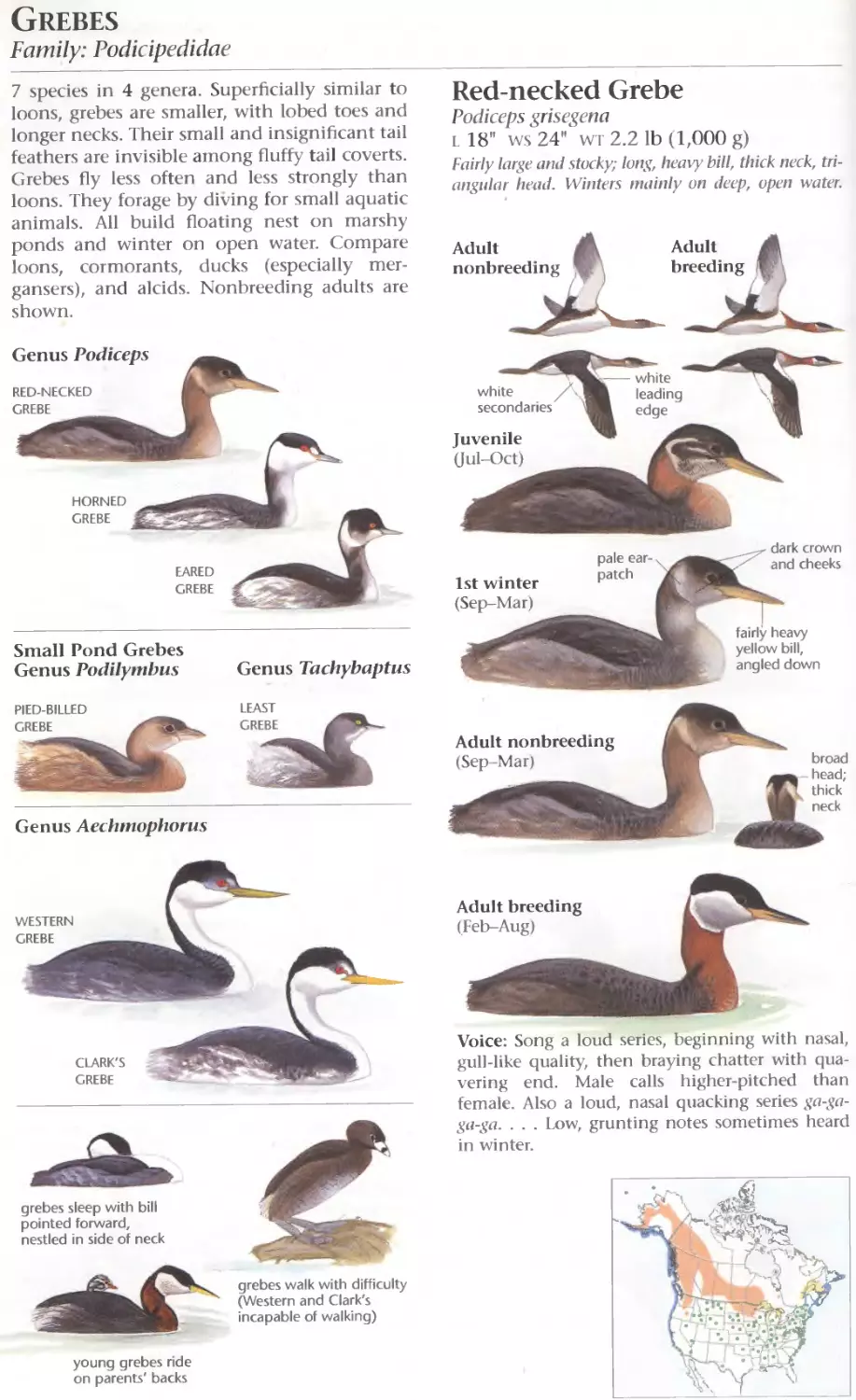
GREBES
Family: Podicipedidae
7 species in 4 genera. Superficially similar to
loons, grebes are smaller, with lobed toes and
longer necks. Their small and insignificant tail
feathers are invisible among fluffy tail coverts.
Grebes fly less often and less strongly than
loons. They forage by diving for small aquatic
animals. All build floating nest on marshy
ponds and winter on open water. Compare
loons, cormorants, ducks (especially mer-
gansers), and alcids. Nonbreeding adults are
shown.
Genus Podiceps
RED-NECKED
GREBE
"
HORNED
GREBE
EARED
GREBE
Small Pond Grebes
Genus Podilymbus
Genus Tacllybaptus
PIED-BillED
GREBE
lEAST
GREBE
Genus AeclllnopllOrus
WESTERN
GREBE
--
CLARK'S
GREBE
grebes sleep with bill
pointed forward,
nestled in side of neck
grebes walk with difficulty
(Western and Clark's
incapable of walking)
young grebes ride
on parents' backs
Red-necked Grebe
Pod;ceps gr;segella
L 18" WS 24" WT 2.2 Ib (1,000 g)
Fairly large and stocky; 10llg, heavy bill, thick lIeck, tri-
allgular head. Willters maillly 011 deep, opell water.
Adult
nonbreeding
Adult
breeding
'--
white /'-
secondaries
- - white
leading
edge
'\
Juvenile
Oul-Oct)
1st winter
(Sep-Mar)
pale ear-
patch
dark crown
---;:?' and cheeks
fairly heavy
yellow bill,
angled down
Adult nonbreeding
(Sep-Mar)
broad
- head;
thick
neck
Adult breeding
(Feb-Aug)
Voice: Song a loud series, beginning with nasal,
gull-like quality, then braying chatter with qua-
vering end. Male calls higher-pitched than
female. Also a loud, nasal quacking series ga-ga-
ga-ga. . . . Low, grunting notes sometimes heard
in winter.
(',.,
,
I t .\'-\,
.,;..", T
.7 ..:<;'.....:
. -. -; ;-(
, " '\
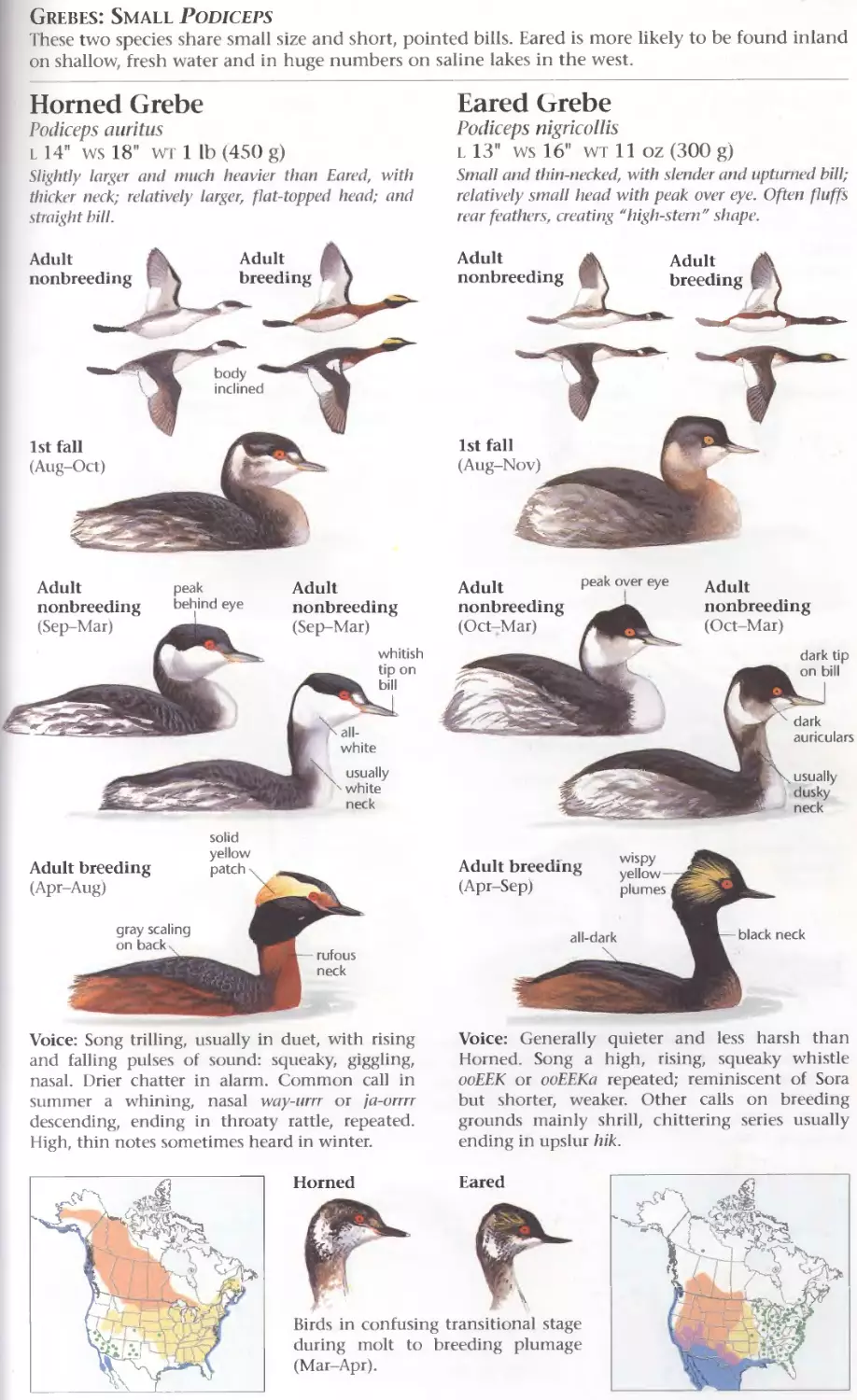
GREBES: SMALL PODICEPS
These two species share small size and short, pointed bills. Eared is more likely to be found inland
on shallow, fresh water and in huge numbers on saline lakes in the west.
Horned Grebe
Podiceps aurUllS
L 14" ws 18" wr 1 lb (450 g)
Slightly larger and milch heavier than Eared, with
thicker neck; relatively larger, flat-topped head; and
straight bill.
Adult
nonbreeding
Adult
breeding
---
----
i
\
\.
body
inclined
1st fall
(Aug-Oct)
Eared Grebe
Pudiceps nigricollis
L 13" ws 16" WT 11 oz (300 g)
Small and thin-necked, with slender and uptllmed bill;
relatively small head with peak over eye. Often fluffs
rear feathers. creating "high-stem" shape.
Adult
nonbreeding
Adult
br
1st fall
(Aug-Nov)
o
Adult peak Adult Adult peak o er eye Adult
nonbreeding be ind eye nonbreeding nonbreeding nonbreeding
(Sep-Mar) (Sep-Mar) (Oct-Mar) 0 (Oct-Mar)
whitish dark tip
tip on .....- --- ....... on bill
bill I
-
--- dark
" all- auriculars
white
"""" usually "" usually
" white dusky
- neck neck
solid
Adult breeding yellow Adult breeding wispy
patch yellow-
(Apr-Aug) (Apr-Sep) plumes 0
gray scaling all-dark - black neck
on back
- rufous "-
neck
Voice: Song trilling, usually in duet, with rising
and falling pulses of sound: squeaky, giggling,
nasal. Drier chatter in alarm. Common call in
summer a whining, nasal waY-llrrr or ia-onn
descending, ending in throaty rattle, repeated.
High, thin notes sometimes heard in winter.
0- t -.... ""' ,"'
'\:.., 1'{"
W
irr
Horned
. -
Voice: Generally quieter and less harsh than
Homed. Song a high, rising, squeaky whistle
ooEEK or ooEEKa repeated; reminiscent of Sora
but shorter, weaker. Other calls on breeding
grounds mainly shrill, chittering series usually
ending in upslur hik.
Eared
\.
J - "'1
11('''''''''::J
5. 'i'il ,,
ow '- .?1"'
(o E ' -.' .
t , W'I'
f .!
<'\: 1 -
--' \ 00 O . 0
...--- . --:"
\j
Birds in confusing transitional stage
during molt to breeding plumage
(Mar-Apr).
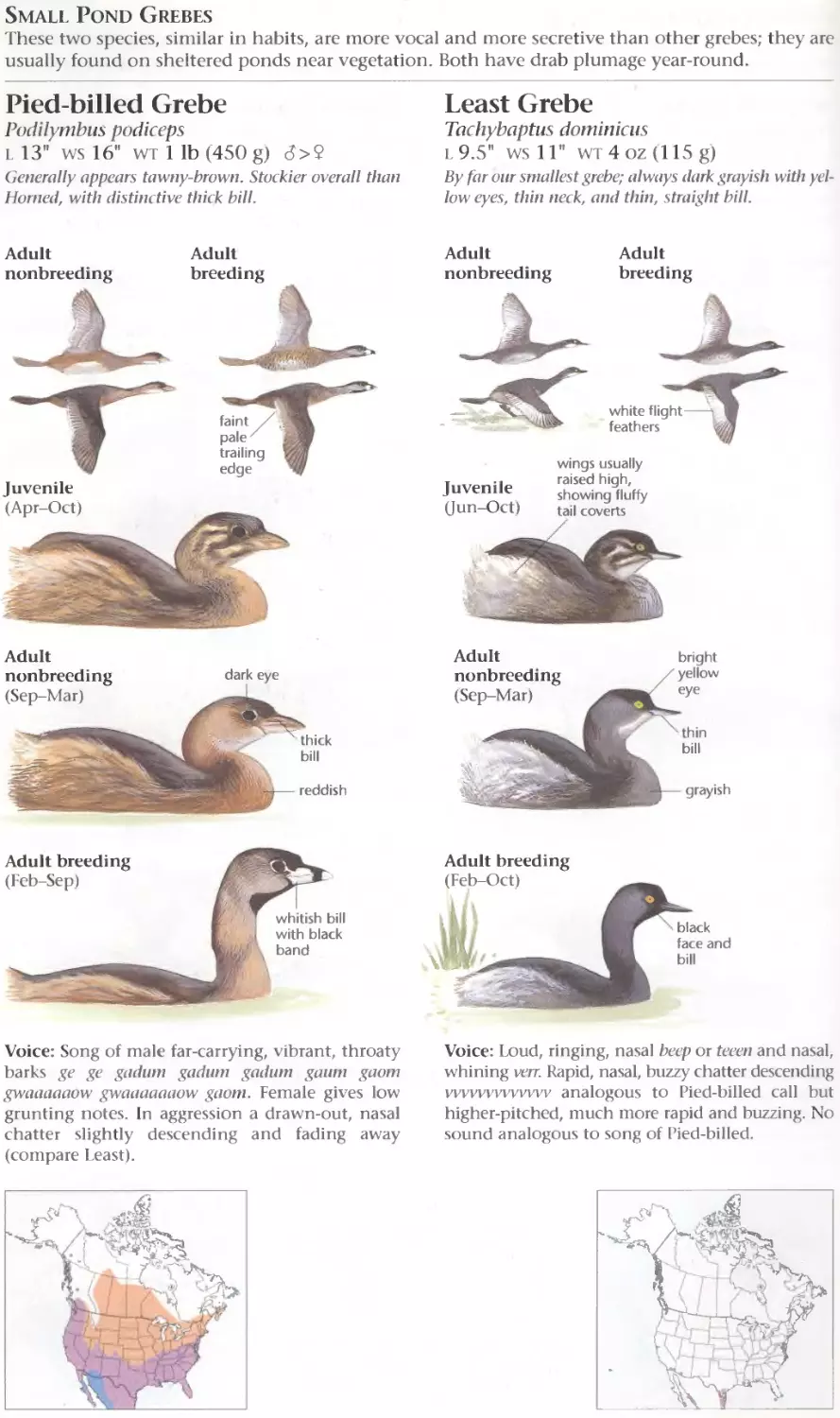
SMALL POND GREBES
These two species, similar in habits, are more vocal and more secretive than other grebes; they are
usually found on sheltered ponds near vegetation. Both have drab plumage year-round
Pied-billed Grebe
Podilymbus podiceps
L 13" WS 16" WT lIb (450 g) 0>2
Generally appears tawny-brown. Stockier overall than
Homed, with distinctive thick bill.
Adult
nonbreeding
Adult
breeding
faint / .
pale
trailing
edge
Juvenile
(Apr-Oct)
.'
Adult
nonbreeding
(Sep-Mar)
dark eye
I
.
-
-
" th ick
bill
reddish
Adult breeding
(Feb-Sep)
.
I
whitish bill
with black
band
Voice: Song of male far-carrying, vibrant, throaty
barks ge ge gadwlI gad/l11l gad/l11l gawn gaol11
gwaaaaaow gwaaaaaaow gao11l Female gives low
grunting notes. In aggression a drawn-out, nasal
chatter slightly descending and fading away
(compare Least).
"
'
..-> . ff 'J:'J.
." I J \ ..,..
r./ <'"'
.,....
Least Grebe
Tachybaptus dominicus
L9.5" ws 11" wT4oz(115g)
By far ollr smallest grebe; always dark grayish with yel-
low eyes, thin neck, and thill, stmigllt bill.
Adult
nonbreeding
Adult
breeding
'-
white flight---"
feathers
Juvenile
Uun-Oct)
wings usually
raised high,
showing fluffy
tail coverts
'"':!.
Adult
nonbreedmg
(Sep-Mar)
bright
/ yellow
eye
o
" thin
bill
grayish
Adult breeding
(Feb-Oct)
o
\
black
face and
bill
Voice: Loud, ringing, nasal beep or teem and nasal,
whining verr. Rapid, nasal, buzzy chatter descending
vvvvvvvvvvvvv analogous to Pied-billed call but
higher-pitched, much more rapid and buzzing. No
sound analogous to song of Pied-billed.
, 1r--
'- ('>if :r"
. it\Ji
.7)"::)
r
GREBES: GENUS AECHMOPHORUS
These large, long-necked grebes were recently considered a single species, Western Grebe. Their
ranges overlap broadly; Western is much more numerous than Clark's to the north and east.
Western Grebe
AechmopllOflls occidentalis
L 25" ws 24" WT 3.3 lb (1,500 g)
Large alld very slmder withlollg lIeck and long, thin bill.
Clean dark :gray alld white plumage.
Adult
?-
indistinct
- white
stripe
Adult
sleeping
r
both species
often together
in large rafts,
most birds
sleeping
Adult
non breeding
( ep-Feb)
dark
surrounds
/eye
Adult breeding
(Feb-Sep)
yellowish
to dull
olive bill
Clark's Grebe
Aechmophoflls clarkii
L 25" ws 24" WT 3.11b (1,400 g)
Stnlcturally identical to Western but averages a little
smaller. Best distinguished by bill color; most can be
idelltified by race pattern. Averages paler overall.
Adult
extensive ----\-
white flight
feathers
Adult
sleeping
na row bla 1 k "
stripe on
hindneck
....,
nonbreeding birds of both
species similar in face
pattern, distinguished by
bill color
Adult
nonbreeding
(Sep-Feb)
white
surrounds
Adult breeding
(Feb-Sep)
¥
bright
yellow to
orange-
yellow bill
averages more
white on flanks
and grayer back
-.
Voice: Both species give high. creaking, far-carrying calls. Most common year-round call a two-part kreed-
kreet by Western and a simpler kreeeed or kreee-eed by Clark's. Courting female gives long series of begging
notes: Western gives krDEE krDEE . . . ; Clark's may give higher, scratchier kweea kweea. . or weeweewee-
wee. . . . Various other calls un breeding grounds include a high, thin whistle.
J"'I c
<:}' 1
, {---L{ ll
\ \'t.
'-- --------..- . 0
.
1.' '.'
- .' /,
\ 1. :},j
1< \
:"V . '''11
-... f '¥-ft>'; '.
L 'r<
, " (y
\ ' :J /Yi ,;;
.
. I
Intermediate bird,>, seen regularly,
especially during winter, are un-
identifiable. Some may be hybrids.
ALBATROSSES, PETRELS, AND SHEARWATERS
Families: Diomedeidae, Procellariidae
20 species in 5 genera; all in family Procellariidae, except albatrosses in Diomedeidae. These
medium to large, long-winged seabirds come to land only when nesting. All fly with stiff wing-
beats and long, arcing glides. They feed on small animals and carrion found at the water's surface;
some species make shallow dives to capture submerged prey. All are characterized by tubular nos-
trils (also on storm-petrels). Most can be found in large numbers where prey is concentrated, rest-
ing on the water in tight flocks. All nest on islands; most are visitors to North America, nesting
elsewhere. Compare Northern Gannet, boobies, jaegers, gulls, and terns. Adults are shown.
Genus PllOebastria Genus Fulmarus
,
BLACK- 1 1 11 11I11 NORTHERN
FOOTED LA YSAN FULMAR
ALBATROSS ALBATROSS Pacific
"
SHORT-TAILED
ALBATROSS
"1'\
Gadfly Petrels
Genus Pterodroma
COOK'S
PETREl
MOTTLED
PETREl
"'-
.....
FEA'S
PETREl
BLACK-CAPPED
PETREL
Genus PUf{i'lllS
....
GREATER
SHEARWATER
BULLER'S
SHEARWATER
PINK-FOOTED
SHEARWATER
FLESH-FOOTED
SHEARWATER
t \ +
MANX AUDUBON'S
SHEARWATER SHEARWATER
BLACK-VENTED
SHEARWATER
Genus Calonectris
'-
SOOTY
SHEARWATER
SHORT-TAILED
SHEARWATER
CORY'S
SHEARWATER
Atlantic
MURPHY'S
PETREL
HERALD
PETREl
Short-tailed Albatross
Phoebastria albatrus
L 36" ws 87" WI' unknown
Sliglltly lmger th(m Black-footed; broader wings held
straighter, broader tail. massive pink bill.
flight more
ponderous, less
agile than other
albatrosses
Juvenile
(] st year)
..;::
huge
bright
p;n' 1"
all-brown
plumage held
for several years
Sub-
adult
\
\ white
back
/
/
uniform
dark
brown
'Irrl
"
"
/
broad,
straight
wings
J
Voice: Generally silent at sea.
Groaning sounds in display.
:" .l'Qc,
.." - -r-
!
...
{f;\#&
r
L . ff
=1
"',
full adult plumage
(with yellowish head
and nape) acquired
after 12 to 20 years;
subadult stages have
sharp contrast of
dark crown and
white throat
rc
ALBATROSSES
Albatrosses are distinguished from all other seabirds by their large size, large bills, and long, slen-
der wings. Their flight is ponderous and steady, with slow turns and endless gliding on stiff wings.
Laysan Albatross
PllOebl1stril1 i11l11l11tabilis
L 32" ws 78" WT 6.6 Ib (3,000 g) 0'>«
Slightly smaller and slimmer than Black-footed; gull-
like plumage, but note dark eye-smudge and dark tail.
Black- footed Albatross
Phoebl1stril1 nigripes
L 32" ws 84" WT 7 Ib (3,200 g) 0'>«
Huge and long-winged. but at times looks rather stocky
in flight.
Juvenile
(1st year)
Adult
Juvenile
(1st year)
Adult
underwing
pattern varies
from dark to pale;
not age-related
uniform
brown
pale
"
dark
bill
-..,;, dark
C upper
rump
,
'; I
dark
tail
dark eye-
swimming smudge"
albatrosses have ,
distinc ive hump ,
-,
Adult
pinkish
bill
""-
--
?/
!
white tail
coverts
Light
adult
I
1
dusky
pink
rare; can be
confused with
other albatross
species or
with rare
Black-footed x
Laysan hybrids
" dark
collar
pale
gray-
brown
pale
face
gray-
brown
overall
Adult
Voice: Voice quieter, higher, and less harsh and
nasal than Black-footed; otherwise similar.
Courtship dance at nest site more elaborate and
with slower tempo than Black-footed.
Voice: Noisy in groups at sea: groaning or squeal-
ing noises, also bill-snapping. Courtship display
at nest site involves melancholy groaning and
bill-snapping in a simple dance.
Black-footed Albatross
41
C("' 1
, "("-Sf"!,>;
i-';.
-S'i
'
ff\
Typical silhouettes in flight.
NORTHERN FULMAR
Two populations are distinguished from shearwaters and gulls by their overall shape and propor-
tions and stout, pale bills. Their plumage varies from pale gray (like gulls) to dark brownish-gray.
Northern Fulmar
FlilmarliS glacialis
L 18" ws 42" WT 1.3 lb (600 g) o>¥'
Stocky and thick-necked, with rather short, rounded wings; short, thick, pale bill; and shurt, rounded tail. All have
pale patch on inner primaries, dark eye-smudge. Upperwing lacks M pattem of shearwaters and petrel. .
PACIFIC
Very \ Light
light adult
adult \
--).
A
dark
speckled
.. "
"..
. ..
r
dark tail
pale inner
primaries
-A
Very
light ...)
adult
'\ \
Light ...
adult
Dark
adult
-- wing beats shallow and
stiff; glides on nearly flat
wings
ATLANTIC
Dark
adult
Light
adult
Dark
adult
uniform
gray-
brown
/
thick
neck
l dark eye-
smudge
/
1
short,
thick
bin
t
stubby,
pale
bill
mostly
white -
underwing
"
light
tail
I
smooth
gray
uniform
grayish
pale inner
primaries
Light
adult
\
}
-
,
Dark
adult
Voice: Feeding flock at sea rather noisy: a hoarse, throaty cackling and grunting. At nest site loud cack-
ling of variable pattern AARK aaw or aak aak aak. . . . Pacific apparently similar to Atlantic.
"\ j"il
a
1 -( "\ t
, I '-Y
<;''>-'_' f
.
,I,
--M T .
\
Pacific birds are similar to Atlantic in shape and habits but average a
little thinner-billed. Best distinguished by tail color: always contrast-
ingly dark on Pacific but pale gray (like the rump) on Atlantic. Pacific
also has lighter and darker extremes than Atlantic. and the upperparts
are usually more mottled. Percentage of dark and light morph birds
varies between colonies, dark generally most numerous in Aleutian
and Labrador breeders.
PACIFIC GADFLY PETRELS
These two species, like most gadfly petrels, are scarce and irregular visitors found in very small
numbers over deep water. Identification is based on underwing pattern, head pattern, and size.
Mottled Petrel
Pterodroma illexpectatll
L 14" ws 32" WT 11 oz (320 g)
Heavy-bodied al/d stollt-billed; very powerful al/d fast
(lieI'. Vmk gray belly col/trastil/g with white vent al/d
lmderwil/g is distil/ctive, as is bold /JIack bar 01/ lI1lder-
wil/g.
Adult
dark gray belly
contrasts with
white vent and
underwing
gray belly
can be paler
or mottled
- strong
black bar
,
dark gray
back with
- fairly strong
M pattern
---.
pale gray
uppertail
coverts
M pattern on the upperwing
of this and other species
is dependent on lighting;
conspicuous at certain
angles, invisible at others
Adult
gray
flanks
Voice: Generally silent at sea.
: .. - <
1:! --V &
jt:.\
r I "db
:. '. r; ( -'
.\ .
; I }
t"i ,.'-
. 0"
stout
bill
)
Cook's Petrel
Pterodroma cookii
L 13" ws 30" WT 7 oz (190 g)
Distillctly small alld lightweight with relatively IOllg,
thill bill; flight rapid alld erratic with qllick tllms alld
jerky movemellts. Mostly white wulerwillg 1I1llike other
Pterodroma petrels.
Adult
Fresh adult
white outer
tail feathers
not always
obvious
I
dark tip
on tail
Adult
.....-
.......,
"
mostly
white
underwing
) "
Worn adult
;:t
pale gray
crown
",,'"
pale gray
back
contrasts
with dark
wings
pale gray
back with
bold, dark M
gray
crown
white
flanks
-l-
- thin
t-b;II
- -------
Voice: Generally silent at sea.
Note that several other Pterodmma
species have been recorded rarely off
our Pacific coast, including Stej-
neger's Petrel (P. IOllgirostrisJ, which
is very similar to Cook's. Identifica-
tion requires careful study of size
and biII shape and patterns of
underwing, head, rump, and tail.
. "t.1
GADFLY PETRELS
These two dark species can be confused with shearwaters or jaegers, but note their short black bills
and underwing pattern. Murphy's is found over deep water, Herald over warm Gulf Stream water.
Murphy's Petrel
Pterodroma ultima
LIS" WS 35" WT 13 oz (360 g)
Slender and fast-flying, like Sooty Shearwater; note
overall grayish cast with faint M pattem above, pale
chin, and pale flash at base of primaries.
Herald Petrel
pterodroma arm;lljoll;alltl
LIS" ws 35" WT 12 oz (330 g)
More slender and longer-winged than other Ptero-
droma petrels. Vistingl/ished fro", jaegers by flight
actions and strl/(("l/rc.
Adult
Adult
Dark
adult
Intermediate
adult
Light
adult
..'
...
short
bill
I
smudgy
gray breast
and flanks
- pale flash
depends
on lighting
dark /
underwing
coverts
small
/ black bill
pale
chin
all show
pale on
base of
primaries
and
greater
coverts
dark
gray
most North
American
records are
dark morph
uniform
dark above
in certain lighting, and
perhaps only in fresh
plumage, shows distinctive
cold gray sheen to upperparts
Dark adult
all-dark
Adult
,
-
Light adult
"
:1
Voice: Generally silent at sea.
Voice: Generally silent at sea.
smudgy
flanks
Both of these species resemble Sooty
Shearwater. At a distance note high,
arcing flight, more angled wings,
longer tail, shorter head, dark under-
wing coverts, and pale remiges;
closer views reveal short black bill
and rounded head.
.M
,1ji.
.
.
Ir.\
- f
I- T 1- l...-
F '
ATLANTIC GADFLY PETRELS
These two strong and dynamic fliers, found in warm Gulf Stream water, are always white-bellied.
Rare individuals are similar in underwing pattern but are always distinguishable by tail color.
Fea's Petrel
pterodroma reae
LIS" ws 34" WI' unknown
Shape like Black-capped bllt smaller; dark IInderwing,
pale gray rump and tail, and gray nape distinctive.
Lighter
adult
Adult
rare
gray partial
breastband
/
...
--.----
/
mostly dark
underwing
Adult
gray back
- with fairly
strong
M pattern
....
pale tail
and coverts
Adult
gray
nape
Voice: Generally silent at sea.
Black-capped Petrel
pterodroma hasitata
L 16" ws 37" WI' unknown
Like shearwaters bllt with relatively 101lger, poilltier willgs;
short, thick bill; alld 101lg, poillted tail. Striking white
Ilppertail coverts alld black bar on lI1ulerwillg distillctive.
Darker
adult
Adult
rare
wingbeats
snappy
but deep
,
""-
very obvious
white uppertail
, coverts
dark gray
with faint
M pattern
Adult
dark
gray
white neck
with small
black cap
Voice: Generally silent at sea.
Darker Black-capped Petrels can be
confused with the very similar
Bermuda Petrel (p. cahow) recorded
several times off North Carolina.
Bermuda Petrel is smaller with
grayer uppertail coverts.
., ro . i
'.J;h
-i" "!i:'
'\
.. 1"',)
I r '
'
7' I
, -.2'- .
- black
bar
clean
white
small
black cap
I
-
"'.....
white
collar
"
)
.
... I ii?i
I{" '
/ ( -
A- jrf
ATLANTIC SHEARWATERS
Our largest Atlantic shearwaters, these two species are quite different in overall shape and flight
style. Habitat overlaps broadly, but Cory's generally prefers warm water, Greater cold.
Cory's Shearwater
Calonectris diomedea
L 18 11 ws 44" WT 1.8lb (800 g) 0>2
Large and heavy; broad and blunt-tipped wings held
hunched and bowed down. Yellow bill, dusky head, pale
back, and clean white underparts distinctive.
Adult
Atlantic
Adult
Mediterranean
- broad
wings
dark
head
I
, e - \ \
t \.
Greater Shearwater
PlIffmlls gravis
L 18" ws 42" WT 1.8 lb (840 g)
Heavy but sleek with straight, narrow, pointed wings.
Neat, dark cap and dark mmkit1gs on /lnderwings dis-
tinctive.
Lighter adult
smudgy
brown
belly (may
be faint)
Darker adult
short,
dark
collar : '
/cap
"
dark
pale \' gray-
sandy- I - brown thin <-.
brown black
variable bill
white
uppertail
coverts straight,/
r white narrow
collar wings
yellow narrow \\
broad! bill white
band
hunched
wings
heavy neat,
dark
dusky head yellow dark cap thin
Adult bill Adult undertail mostly black
Atlantic and nape I / coverts white bill
neck "'-.. I
" . "- -
'""",,-. '\
""-
Voice: Generally silent at sea. Occasionally a rau-
cous, descending bleating similar to Greater.
.J:I
..
Voice: Generally silent at sea. Vocal in feeding
groups. often bleating wtltltlnlike a lamb.
Two populations of Cory's Shearwa-
ter both disperse to North America
and are sometimes considered sepa-
rate species but may be indistin-
guishable in the field. Mediterranean
breeders average smaller and
smaller-billed than Atlantic. They
may also have more white on the
inner webs of the primaries and
average paler brown on the back.
kJ
,
1fu
I '
II ,
- , $
\ -E1Y-?
"\ \
-, ..
PACIFIC SHEARWATERS
These two species are the only large white-bellied shearwaters off our Pacific coast, although Pink-
footed resembles the much smaller Black-vented. Buller's is present only Aug-Nov.
Buller's Shearwater
PliffillllS bliller;
L 16" WS 40" vH 13 oz (370 g)
Slender and buoyant, with long tail but rather broad-
based wings; gracef;'1 soaring flight and slow, eas)'
willgbeats. Stl iking plumage with dean white under-
parts and neatly patterned uppers ide.
Pink-footed Shearwater
PlIffrnlis creatopliS
L 19" ws 43" W1 1.6 Ib (720 g)
Stocky and rather broad-winged, with heavy, labored
wingbeats. Dusky head, smudgy markings on under-
parts, pale belly.
Adult
) entirely clean
white with
narrow, dark
border
gray
bill
Adult
N
Adult
white
flanks
gray
Voice: Generally silent at sea.
.... - -",,
t -"'0r J
- i\' G
..".;e
r ""
'"\
hJ 'X'! -
..,.
\
L :;x--
Adult
Darker adult
Lighter adult
neat,
dark cap
n.
/ mottled
underwing
dusky
head
I
(
pale
bill
'1.
striking
pattern of
blackish and
pale gray
Adult
uniform
dark
brownish
typical
plumage
I
smudgy
brownish
head
pattern
I
neat
head
pat ern
Adult
smudgy
flanks
I
brown
"
pinkish
bill
'" ,
Voice: Generally silent at sea. Vocal in feeding
groups, giving a nasal, descending whinny.
Some shearwaters and gadfly petrels
undergo rapid molt of wing feathers
May-Jul, in which missing feathers
produce striking white bars on
coverts, white patches in primaries,
and odd wing shapes.
, 41
j
:' '.
:7
,,,'\,
PACIFIC SHEARWATERS (CONTINUED)
Flesh-footed Shearwater, a scarce visitor nearly always seen singly, is closely related to Pink-footed.
Black-vented, related to Manx, is found on warm water, usually close to land.
Flesh-footed Shearwater
PlIffl1llls cameipes
L 17" ws 40" WT 1.4 lb (620 g)
Structure like Pink-footed; distinctly broader-winged
than Sooty, with slower and more labored wingbeats.
Adult
pale silvery /
remiges
(dependent
on lighting)
- uniform
dark
Adult
Black-vented Shearwater
PlIffmlls opistilOmeias
L 14" ws 34" WT 9 oz (270 g)
Our smallest Pacific shearwater; rdatively short-
winged, with quick, choppy willgbeats. Plumage close
to Pink-footed. Note dark bill.
Darker
adult
Lighter
adult
rare
pale
pinkish
bill
L
dark
undertail
coverts
- uniform
dark
underwing
coverts
-dull
brown
above
Darker
adult
smudg
flanks
Lighter
adult
indistinctly
patterned,
dusky face'
)
Voice: Generally silent at sea. Sometimes utters
high-pitched bark.
- r .. ' t
. :. I :j!;;"fV'"
,
., ( \'i f '
" f''f
'f -J '
t ,
" ,
Voice: Generally silent at sea. Voice at nest site
undescribed.
Foot color is not an important field
mark for Flesh-footed Shearwater, as
Sooty and Short-tailed can also show
pale flesh-colored feet. Furthermore,
all shearwaters (and many other
species) often fold the legs up
beneath the flank feathers while fly-
ing, concealing the feet entirely.
, «
L"Jt
\ t
I ,.,
<" r
'J
'7<'f
. -..1
\.",
SMALL ATLANTIC SHEARWATERS
Closely related to Black-vented, these two small, contrastingly colored species differ in shape and
plumage details. In addition, Manx prefers cold water, Audubon's warm.
Manx Shearwater
Pli ffl1lllS pll ffl1lll S
L 13.5" ws 33" WT lIb (450 g)
Small, bllt plOportiolls doser to large shearwaters them
to Allduboll's. Note dark allriwlars with pale crescent
behilld, white 1l1ldertai/ coverts.
Darker
adult
white
undertail
coverts
"
wingbeats
fairly quick,
choppy
Darker
adult
white
undertail
coverts
'---I _
Lighter
adult
clean
white
flanks
""
Lighter
ad ult
- blackish
above
(may appear
brownish
when worn)
pale
crescent
behind
auriculars
dark lores and
auriculars
/
}
Voice: Generally silent at sea. At nest site at night
a cackling then crooning series (Clck ((/ck (Clck carrr
110. From ground a squalling sound rising to a
crescendo of crowing when excited.
"r-\i. , t.
c <
, ':"7'}.
, ,':)0
/ 'i)"" J1!
, :i
Audubon's Shearwater
PUffillllS Iherminieri
L 12" ws 27" WT 6 oz (180 g)
Ollr smallest sllearwater; relatively short-willged alld
IOllg-tailed. Flight and plumage may recall large alcids;
white markillgs around eye; partly dark 1II1dertaii coverts.
Darker
adult
dark
undertail
coverts
Darker
adult
Lighter
adult
Lighter
adult
relatively
long tail
- relatively
short
wings
wingbeats
quicker than
Manx; flight
lower with
less gliding
-
-appears
blackish
above
- averages
browner
above
than
Manx
partly dark
undertail
coverts not
/ always obvious
pa rtly
white
auriculars
I
white
spot in
- front
of eye
,
tail projects
beyond
/ wingtips
Voice: Generally silent at sea. Sometimes gives a
high, na al whining.
eparation of the small shearwaters
can be difficult; at close range check
face pattern. Manx and Black-vented
have similar shape, and rare lighter
Black-vented individuals may appear
similar to Manx. Audubon's has dif-
ferent shape and flight actions and
can be distinguished at a distance
with experience.
DARK SHEARWATERS
In the Pacific these two very similar species are the most numerous shearwaters, sometimes occur-
ring in flocks of millions and often visible from land. Short-tailed is scarce south of Alaska
Short -tailed Shearwater
PliffillliS tenllirostris
L 16" ws 38" WT 1.2lb (550 g)
DistinctLy smaller-billed and rollnder-headed than
Sooty. Averages smaller with narrower and more
angled wings; these and most pillmage differences
sllbtLe and overlapping.
Lighter
adult
slightly
shorter
neck
I round
head
I
usually darker
and more
uniform -
underwing
coverts
I
short
bill
se(.ondaries
often appear
silvery white
because of
reflections
(same on all
shearwaters) ,
Adult
Adult
Darker
adult
I
some have
paler throat
and darker
cap than
Sooty
Adult
short
bill
I
round
head
Voice: Generally silent at sea. Calls at nest higher,
more screeching than Sooty.
W
,'>i .
,,11.c
'3R
j \
'\
-'yj
r J$#
Sooty Shearwater
PliffinliS grisells
L ] 7" ws 40" WT]. 7 lb (780 g)
Slender and Ilarrow-willged with deep, slicing willgbeats.
Dark body and silvery IIIlCierwillg coverts distinctive.
Lighter
adult
feet may
be pinkish
(compare
Flesh-footed)
"'
usually -
obvious
silvery
panel
Adult
Adult
Darker
adult
uniform
dark body
/
uniform
dark
Adult
longer
bill
I
Voice: Generally silent at sea. In feeding group
occasionally gives raucous cry: a relatively high,
nasal aaaa.
Underwing color of these species dif-
fers on average. Sooty flashes brighter
and more contrasting patches on the
underwing coverts, while Short-tailed
is duller brownish and more uniform.
In practice this difference is overlap-
ping and very light-dependent.
1'!'''
-
I-
)?
f '{
'
" -f.
,- .i
'». .
STORM-PETRELS
Family: Hydrobatidae
8 species in 3 genera. These small oceanic birds
come to land only at night when nesting.
There are two main groups: Southern Hemi-
sphere breeders have relatively short "arms"
and long legs; Northern have longer "arms"
(more angled wings) and shorter legs. All for-
age on minute prey captured by picking at the
water's surface, usually while flying. Flight
actions of storm-petrels depend on many fac-
tors such as wind conditions and the motiva-
tion of the bird. Watch for differences
between foraging and traveling flight of each
species as well as the less often seen escape
flight (as when alarmed by an approaching
boat). In judging tail shape, note that the
outer tail feathers of all species flex upward in
tlight, creating the illusion of a notched tail
when viewed from most angles. Also note that
the toes of long-legged species can look like
the fork of a tail. Compare shearwaters, swal-
lows, and nighthawks. Adults are shown.
Southern Hemisphere
Genus Pelagotlroma Genus Ocem,;tes
J.
WHITE-FACED
STORM-PETREL
WILSON'S
STORM-PETREL
Northern Hemisphere Genus OccmlOdrollla
.
BAND-RUMPED
STORM-PETREL
LEACH'S
STORM-PETREL
White-rumped
BLACK
STORM-PETREL
\
LEAST
STORM-PETREL
FORK-TAILED
STORM-PETREL
ASHY
STORM-PETREL
Wilson's Storm-Petrel
molting adult
Typical of adult May-jul
in the northern Atlantic.
Watch for differences in
molt timing among species
and age classes (e.g., 1 st
year Wilson's and adult
Leach's molt Nov-Apr in
Southern Hemisphere).
White-faced Storm-Petrel
Pelagodroma marina
L 7.5" ws 19" WT 1.6 oz (46 g)
Sizort-winged and rOll1zd-tailed, with very long legs.
Nomwl flight stiff-winged like Spotted Sandpiper.
Adult
very long
legs
unique
foraging flight-
holds wings
stiffly and
bounces
along, hitting
water with feet
r
Adult
-
white
underwing
/ coverts
dark crown
a d eye-patch
"'
/ short, paddle-
shaped wings
pale
rump
"\.
pale gray-
/ brown back
-.....
"
distinctive head
pattern (compare
phalaropes)
"
Voice: Generally silent at sea.
r'
"j\, \
I '
I_tt'.\
$j
;?zr
N 1'
x ..)
",\
WHITE-RUMPED STORM-PETRELS
Though similar in plumage, these two species differ in size and especially in wing and tail shape
and leg length. Band-rumped is scarce and prefers warm water; Wilson's is widespread.
Wilson's Storm-Petrel
Oceanites oceanicliS
L 7.25" ws 18" WT 1.2 oz (34 g)
Shurt inner wing creates relatively straight-edged tri-
al/gular wing shape. Tail square; legs very long with feet
projecting beyond tip of tail.
Band-romped Storm-Petrel
Oceallodroma castro
L 9" ws 19" WT 1.5 oz (42 g)
Larger and longer-winged thaI/ Wilsun's; bruader-
winged and shorter-tailed thaI/ Leach's. Note white
on ul/dertail coverts, dark IIpperwil/g.
Adult wing beats shallow Adult flight relatively steady with
and stiff; flight low, banking turns; less
swallowlike bounding than Leach's
faint pale --
center of ........
underwing" some white
on undertail
glides with coverts ""
toes glides with
project - wings slightly wings bowed
beyond pressed down
"-
tail tip extensive very dark short legs dark brown
white on blackish do not reach overall
undertail overall beyond tail
coverts
Fresh Worn Fresh Worn
adult adult adult adult
square tail larger slightly
often appears white
notched patch notched
than tail
Band- a-
rumped
I
" 4L
narrow
whitish tips weak carpal- -
on greater / bar does not
coverts obvious reach leading
pale edge of wing
greater (compare
coverts Leach's)
Adult Adult
obvious /
white patch
Voice: Generally silent at sea. At close range a
peeping or chattering sound may occasionally be
heard from feeding groups.
Wilson's Storm-Petrel
-
some white
visible
Voice: Generally silent at Sl'd. At nl'st site a squeak
like a fingl'r across a wet pane of glass, followed by
low purring.
\\
:t
L i
I i; -
L"t''' '
r -Jt>
( f
,, . - 0
,:lO 0
-
All species perform IIfoot-pattering"
action while feeding, longer-legged
Wilson's more frequently than others.
,-.1......
," .
,, ,
LEACH'S STORM-PETREL
Both white- and darl,-rumped forms are distinguished from other species by wing and tail shape,
details of upperwing, and rump pattern. They are usually found singly over warm or cold waters.
Leach's Storm-Petrel
Oceallodroma lelicorllOCl
L 8" ws 20" WT 1.4 OZ (40 g)
Slender and very IOllg-winged; willS.\ poillte,l, angled, and swept back; long, notched tail. Note bold, pale carpal
bar, dark lI1ldertail coverts.
DARK-
RUMPED
Adult
Adult
complete range of
variation from dark-
to white-rumped
Adult
wingbeats deep and
springy; flight bounding
and arcing like nighthawks
WHITE-
RUMPED
glides with
wings bowed
slightly paler
overall than
Wilson's or
/ Band-rumped
Adult
no white
on undertail
coverts
Adult
white primary
- shafts shown by
a few individuals
of all storm-
petrels
deep
notch
/
dark
median
streak on
uppertail
coverts
'/
,
obvious pale
carpal-bar
reaches leading
edge of wing
Adult
little or
no white
/visible
"'-
-
Voice: Generally silent at sea. At nest site a musical purring three to four seconds long, rising slightly in
pitch and interspersed with inhaled whee. In flight over colony a chuckling chatter pwa plltaDEEPto-
ditado. Winter breeding population of Guadalupe Island (not proven to occur in North America) has
slightly different vocalizations.
All Atlantic and northern Pacific birds are white-rumped; the percent-
age of dark-rumped individuals increases abruptly off southern Califor-
nia. Birds breeding in southern California average smaller with
rounder wingtips, and shorter "arms" than northern birds, but these
differences are very subtle. Southern California breeding birds are 80
to 90 percent white-rumped, but those breeding just south of Mexican
border are 90 to 100 percent dark-rumped. Dark-rumped birds tend to
forage over shallow, warm water close to shore, white-rumped over
deeper, cooler water far offshore. Two other (more distinctive) popula-
tions breed on Guadalupe Island off Mexico and could wander to Cali-
fornia waters. More study is needed.
DARK-RUMPED STORM-PETRELS
These two lanky, all-dark species can be difficult to identify. Both are normally found in small
numbers far offshore but gather in large numbers in Monterey Bay, California, Aug-Oct.
Ashy Storm-Petrel
Oceanodroma JlOmochroa
L 8" ws 18" WT 1.3 oz (37 g)
Smaller thall Black, bllt relatively IOllger-tailed; paler
alld grayer overall thall Black.
Adult
pale
underwing
coverts
/
long, rather
stiff, straight
wings
long,
upswept
tail
pale gray
edges of
uppertail
coverts
"
-
Adult
,
-....... -
wing beats
shallower and
quicker with
less gliding;
less direct path
paler and
grayer
overall
Voice: Generally silent at sea. At nest site a purring
like Leach's, rising and falling with inhaled gasp.
In flight over colony a harsh, squeaky chuckling.
. 1l
'-t..,1>t
,¥-'ii:' '
t:
--.....\ -J1":)1
, r
<. \\
Black Storm-Petrel
Oceallodruma melall;a
L 9" ws 22" WT 2.1 oz (59 g)
Ollr largest st01m-petrel. Large ami lallky with 10llg
willgs alld tail.
Adult
\
wingbeats
deep,
languid,
with
frequent
glides; fairly
smooth
progress
long
tail
I
very dark
sooty overall
(similar to
Leach's)
/ fairly
prominent
carpal-bar
very long,
n rrow "-
wings "-
Adult
Voice: Generally silent at sea. At nest site a
purring or rattling 10 to 12 seconds long. In flight
over colony a loud, screechy chattering [JlIkaree
pllck -pllckaroo.
Four species of all-dark storm-petrels
occur off California: Ashy, Black,
Least, and some Leach's. Identifica-
tion requires experience, but differ-
ences in tail length, wingbeats, and
overall color should allow quick sep-
aration of even distant birds.
.
Q 'I
l 'if
j,
,
I.L -*'.l&'
;\..., l
f
.J
'\( ..r- \
LEAST AND FORK-TAILED STORM-PETRELS
The tiny and all-dark Least Storm-Petrel disperses irregularly north to warm offshore waters
mainly Aug-Oct. The distinctively colored Fork-tailed is found over cold water.
Least Storm-Petrel
OcemlOdrolllCl III icrosOIllCl
L 5.75" ws IS" WT 0.74 oz (21 g)
Ollr smallest storm-petrel. Tiny with vel)' short,
wedge-shaped tail and long, thin wings.
Adult
long, narrow
wings pushed
forward
short
tail
I
wingbeats deep
like Black but
quicker, snappier
(with less gliding);
flight erratic,
batlike
short,
wedge-
shaped
tail,
weak
carpal-bar
/
darker
overall
/ (like Black)
Fork-tailed Storm-Petrel
Oceanodroma tureata
L 8.5" ws 19" WT 1.9 oz (54 g)
Rather stocky and broad-winged with distinctive gray
pillmage (compare Red PhalalOpe).
Adult
-- ----
wingbeats
shallow; flight
fairly direct
dark
underwing
coverts
I
upswept
tail
1\
smooth,
pearly gray
striking
- pale gray
carpal-bar
pale
gray
...,
-:;:....
Adult Adult '-
,
Beware that albinism and leucism
(pale but not white plumage) are
occasionally shown by storm-petrels,
and these aberrant birds are easily
confused with the paler species (Fork-
tailed and White-faced).
Voice: Generally silent at sea. At nest site a soft,
rapid purring call, three to four seconds long with
occasional inhaled notes. In flight over colony a
harsh, accelerating chatter like Black but weaker.
"ij- , .
i _
I '
, "";. <+. r -t' '.Jt.
, .
I
-L./ I
" r--
..
\..
Voice: Generally silent at sea. At nest site a soft
twittering or high, complaining, rasping notes
skveeeee skwe skwe.
_0; "\ dI
'I!" 1S'I!h.' ,,'
.-.&,
j Jd
't.
, . \ ':7t':)
(
PELECANIFORMES
Families: Allhillgidae, Fregatidae, Pelecallidae, Phaetholltidae, Phalaaocoracidae, Sulidae
17 species in 7 genera (including cormorants
and Anhinga, shown on page 50); pelicans in
family Pelecanidae, Magnificent Frigatebird in
Fregatidae, tropicbirds in Phaethontidae, North-
ern Gannet and boobies in Sulidae, cormorants
in Phalacrocoracidae, Anhinga in Anhingidae.
All are fish-eating waterbirds with four toes
joined by webbing, but beyond that there are
few similarities. Juveniles are shown.
Genus Pelecullus
AMERICAN WHITE
PELICAN
BROWN PELICAN
Pacific
---------
'-
Genus Fregutu
MAGNIFICENT
FRIGATEBIRD
Genus Phuetholl
RED-BILLED
TROPICBIRD
WHITE-TAILED "-
TROPICBIRD
Genus Sulu
MASKED
BOOBY
\
1
t
BROWN
BOOBY
RED-
FOOTED
BOOBY
Genus
MortIS
BLUE-
FOOTED
BOOBY
NORTHERN
GANNET
American White Pelican
Pelecall11S erythrorhyncllOs
L 62" ws 108" WT 16.4 Ib (7,500 g) 0><2
Immense, always white with black flight feathers and
pinkish or yellow-orange bill.
A
Juvenile
Oul-Mar)
Adult
nonbreeding
(Sep-Feb)
compare
Wood
Stork
......
soars
often
catches fish while
swimming in
small groups
\
.
Adult
summer
Oun-Aug)
Adult
breeding
(Feb-Jun)
Voice: Generally silent away from breeding
grounds. At nest utters quiet, low grunting or
croaking sounds. Young give whining grunt or
weak, sneezy hark.
BROWN PELICAN
Large and well known, pelicans are unmistakable. Brown Pelican is found along ocean shores and
bays. White on lakes and shallow lagoons. The two species differ dramatically in foraging methods.
Brown Pelican
Pelecmllls occidentalis
lSI" ws79" wT8.2Ib(3,740g) 0>2
Smaller and mure slender thelll White Pelican clnd more agile in fliglzt, bllt still a veT}' large and ponderous bird
Wit/I trademark pelican bill.
Juvenile
PACIFIC
Juvenile
(1st year)
Adult nonbreeding
(Aug-Jan)
Adult breeding
(Dec-Aug)
relaxed,
gliding
flight
2nd year
Adult
nonbreeding
ATLANTIC
Juvenile
(1st year)
\
Adult nonbreeding
(Aug-Jan)
Adult breeding
(Dec-Aug)
Voice: Generally silent after fledging. Young in nest give grodning or screeching calls
,
Atlantic birds average smaller than
Pacific, with darker gray or brown
pouch (olive to red on Pacific), and
breeding adults have slightly paler
brown hindneck. Reliability of these
characteristics is unknown. Interior
records of this species at least as far
west as Colorado and Wyoming are
apparently of Atlantic birds.
'"
'\
hunts fish with
spectacular twisting
plunge-dives from
the air
'\
MAGNIFICENT FRIGATEBIRD
A distinctive aerial pirate, with the longest wings relative to weight of any bird this species end-
lessly soars high over the water, never landing on its surface.
Magnificent Frigatebird
Fregata magllificells
L 40" WS 90" WT 3.3 Ib (1,500 g) 9 >0
Strikingly long, pointed black wings look sllarp-edged and angular.
soars effortlessly
with head pulled
between shoulders
->r steals food
from other
seabirds or
plucks fish
from water
wingbeats deep,
loose, slow
Juvenile
angular
black
wings
.
- -
Juvenile
(1st year)
long,
forked tail
usually
closed
/
/
II
2nd year
gradual change to
adult plumage by
5th year; 0 and S'
differ in 3rd year
and later
/
Adult 9
"I, '
Adult 9
--..
Adult 0
Adult c3'
Voice: Generally silent away from colony. Displaying male gives rapid bill-clattering and resonant,
knocking sounds; female and young give high, wheezy sounds. Short, wheezy or grating calls in interac-
tions: wik wik wikikik, etc.
Adult 0
Displaying
at nest site.
TROPIC BIRDS
These two species of oceanic birds, found far offshore over warm water, are often seen resting on
the water. Their flight is high and steady, and they plunge into the water to catch fish.
Red-billed Tropicbird
PIllletilO1l aetherells
L 18" (adult to 36") ws 44" wr 1.6 lb (750 g)
Larger and larger-billed tl1an White-tailed; black pri-
mary covert always distinctiw bllt can be diffiCIIlt to
ascertain.
juvenile
..,
juvenile
'"'0/ ,
barred
black meets
across nape
/
\ ,"'-
black
primary
coverts
Adult
-.....
Adult
\
juvenile
(1st year)
--.....
ss ......'
' l 1i;
-. '\f ?H"4\\ \-
\ (I . ; ;,\, \\ t\.
.. ii .\. --..;;\t
Adult
reddish
bill
I
\I\\,lm -1
\ ,II \if. 'i
. - , '.' J
Voice: Generally silent at sea. Sometimes gives
shrill grating or rattling notes. In display, shrill,
harsh screams, recalling Common Tern in quality.
Q <t
- " . I ffi
I\
r i#
r r'ft 11
".\. i 1/
i
White-tailed Tropicbird
Phaetholl lepturus
L 15" (adult to 29") ws 37" Wl 11 oz (300 g)
Smaller and more buoyant than Red-billed, with smaller
bill; wingbeats quicker and more {licking. Note sl1ort,
dark eye-line.
juvenile Adult \.
) ---
..... . -
-........
juvenile
", short
coarsely \ grayish
barred '\ (eye-line
above II
<:.......:. , :.....
T white
primary
coverts
juvenile
(1st year)
Adult
--
floats high on
water with tail
streamers raised
Adult
,
/'
" 1 '
striking y
patterned ,
-
---.,.
\ .
............. '".P--- . ,
yellowish
bill
L
-
Voice: Generally silent at sea. Voice harsh, squeaky,
and ternlike.
Royal [ems (and other terns) are
often mistaken for tropicbirds. Tropic-
birds have more direct, less buoyant
flight with shallower, quicker, stiffer
wingbeats, clean white secondaries,
dark tertials, and front-heavy propor-
tions. Note that Red-tailed Tropicbird
(P. rubricauda) is a rare visitor to
waters far off California.
TRUE CORMORANTS
Great Cormorant is closely related to Double-crested and Neotropic but is found mainly on salt
water, especially along rocky shores, and occasionally on fresh water.
Cormorants and Anhinga
Identification is usually easy given good views.
Useful clues are color and pattern of throat and
bill, proportions of bill, neck, and tail, and
habits. True cormorants usually fly high, often
over land, with slower wingbeats and necks
kinked, unlike Pacific cormorants (also called
shags). Anhinga is unique. Juveniles are shown.
True Cormorants
Genus Phalacrocorax
, t: road
ead
-x
GREAT
CORMORANT
DOUBLE-CRESTED
CORMORANT
NEOTROPIC
CORMORANT
Pacific Cormorants
j arrow
head
Genus Phalacrocorax
x
BRANDT'S
CORMORANT
PELAGIC
CORMORANT
RED-FACED
CORMORANT
Genus Anhinga
x
-
I '
ANHINGA
Anhinga in flight (compare
soaring cormorant)
}(' soaring cormorant: compared to
Anhinga, cormorants have shorter and
bowed wings, shorter tails, and exhibit
much flapping
. -. . cormorants fly in untidy, wavering lines;
. .......T;.. generally much less organized than
+ 5 7'+ +. geese, and individuals often glide (geese
_ . +.,r never do)
their feathers are not water-repellent, so
cormorants and Anhinga enter water
only to feed and bathe, then spend much
time on exposed perches drying their
plumage with wings spread
Great Cormorant
Phalacrocorax carbo
L 36" ws 63" WT 7.21b (3,300 g)
Ollr largest cormorant. Rest distingllished from DOll-
hie-crested by pillmage marks, altlwugh larger size
and heavier bill are often evident.
Juvenile
Adult
breeding
white belly /
white hip-patch distinctive
when present
Juvenile
(1st year)
Juvenile
(1st year)
blocky
head
gray
'" yellow
" chin
white
throat
'\..
brown
neck
" white belly
Juvenile
(1st year)
Adult
nonbreeding
Oun-Jan)
Adult
breeding
Oan-May)
--.=r--
"
If,';';
}'4.;.,?
"
white
throat
,
Voice: Usually silent away from nest site. Gut-
tural, grunting notes; loud, raucous tuck gock guck;
subdued, hoarse {IIi {IIi {1Ii.
TRUE CORMORANTS (CONTINUED)
These two species are found on any open water from ponds to ocean, often in flocks. No other cor-
morants are commonly found on fresh water. Flocks fly high and form lines or V shapes like geese.
Double-crested Cormorant
Phalacrocorax aliTitus
L 33" ws 52" WT 3.7 Ib (1,700 g) 0>9
Larger and shorter-tailed than Neotropic; distinguished
from Brandt 'i by orange chin, longer tail, and more
buoyant fliglIt, usually higher and often over land.
Flies with neck kinked.
Juvenile
Adult
variation in color
of juveniles
Juvenile
(1st year)
orange
lores
Juvenile
(l st year)
.
"-
orange
"
usually
pale
breast
'"
rounded
border of
bare skin
dark belly
Juvenile
(1st year)
Adult
nonbreeding
Oun-Feb)
Adult
breeding
(Mar-May)
plumes black in -
southeastern
birds; average
whiter to north
and west
,
Voice: Usually silent away from nest site. Hoarse,
bullfroglike grunting; clear-spoken yaaa yaa ya.
Neotropic Cormorant
Phalacrocorax brasilianus
L 25" ws 40" WT 2.61b (1,200 g) 0>9
Smaller and thinner than Double-crested with relatively
longer tail, shorter wings, shorter bill. In flight neck
about as long as tail (noticeably longer than other
cormorants'tails).
Juvenile
long tail
(as long
as neck)
\
Juvenile
(Ist year)
dark lores
/
pointed
border
long tail
Juvenile
(1st year)
Adult
nonbreeding
Oun-Mar)
Adult
Juvenile
(1st year)
small head,
short bill
/"-.
"-
gray
usually
dark
brown
breast
-
Adult
breeding
(Apr-May)
"'"
white V
..
Voice: Usually silent away from nest site. Low,
short, froglike grunts and baritone croaking.
Juvenile plumage is variable in cor-
morants. Great Cormorant is distinc-
tive with dean white belly (although
some juveniles reportedly have all-
black plumage). Double-crested varies
from nearly white-breasted (espe-
cially when worn in spring) to dark
brownish-black. Neotropic averages
darker but varies from blackish to
pale brown.
T\
PACIFIC CORMORANTS (SHAGS)
These two species are found exclusively along rocky ocean shores. They roost and nest on narrow
cliff ledges and forage close to rocks. Both are usually solitary or in very small groups.
Red-faced Cormorant
Phalacrocorax uTile
L 29" ws 46" WT 4.6 lb (2,100 g)
Stockier than Pelagic; usually thicker-billed but some
overlap; averages thicker- and shorter-necked.
Pelagic Cormorant
Phalacrocorax pelagiClis
L 28" ws 39" WT 3.9 lb (1,800 g) N > S
Ollr smallest and thinllest COn1l0mllt with IOllg, illcred-
ibly slender "broomstick" neck alld very thin bill.
Juvenile Adult wingbeats of juvenile Adult
breeding both species breeding
quicker,
choppier straight small
than other neck head
cormorants /
. .
.,
juvenile
(1st year)
juvenile
(1st year)
"'" yellowish
face
juvenile
(1st year)
adults of both
species have varied
green and violet
iridescence
bright
face
Adult
non-
breeding
Oun-Mar)
Adult
breeding
(Apr-May)
juvenile juvenile
(1st year) (1st year)
"-
ail-dark
face
"
juvenile dark,
bill always (1st year) often
pale very
yellowish stretches neck thin bill
at awkward
face usually angles
, brownish appears blackish
blackish breast
breast I
Adult
non-
breeding short
(Jun-Mar) legs
"- long
tail
/
"
Adult
breeding
(Feb-May)
Voice: Usually silent away from nest site. Low,
droning, guttural croak.
Voice: Usually silent away from nest site. Varied
low grunts, painful groaning, also hissing.
Pelagic Cormorant showing variation
in bill size: Bering Sea population
averages larger with thicker bill, but
large individuals occur throughout
range.
\\
"
'/.
I .
:jt;,'t
\; v
_,J1
rt'
i
PACIFIC CORMORANTS (CONTINUED) AND ANHINGA
The gregarious, marine Brandt's Cormorant roosts and nests in large groups on rocks and forages on
open ocean. Anhinga, found in swamps and wooded ponds, differs fundamentally from cormorants.
Brandt's Cormorant
Pha!aaocorax peflicillatlls
L 34" ws 48" wr 4.61b (2,100 g)
Larger than Pelagic with relatively short tail, round
head, more graceful neck, and more uprig/lt stance. Also
more gregarious, oftcn feeding and flying in flocks.
juvenile
Adult
often flies low
over water in
line; unique
short tail
juvenile
(1st year)
juvenile
(1 st year)
juvenile
(1st year)
rounded
crown
Adult
non-
breeding
Oun-Mar)
black'\.
short
tail
Adult
breeding
(Apr-Jun)
neck thicker and
not as straight
as Pelagic; head
larger
/'.
dark bill
pale
feathering
- tan breast
Voice: Usually silent away from nest site. Hoarse
guttural croak or growl given in aggression
Anhinga
Aflhinga allhinga
L 35" ws 45" wr 2.7 lb (1,250 g)
Unique, with heron like neck and bill; long, fan-shaped
tail; and long, pointed wings. Swims with only head
exposed.
Adult
Adult 0'
soars well
and often
wingbeats
falconlike
silvery
white
coverts
Juvenile
(1st year)
sexes alike
until 3rd
winter
rl ""
"
, "
Adult
",
/
Adult
swimming
:
I
t'
Adult 0'
breeding
(Feb-jun)
Adult 0'
nonbreeding
...
Voice: Quite vocal when perched. A descending
series of mechanical croaks, almost clicking: krr kr
krr kr kr krrrr krr; also low, nasal, froglike grunts.
NORTHERN GANNET
This species is found over open ocean often close to shore and in loose groups. Like boobies it
often rests on water but unlike them virtually never rests on land away from nest site.
Northern Gannet
Moms bassall11s ./ "'" ----...........
L 37" ws 72" WT 6.6 lb (3,000 g)
Large, angular, and long-winged with pointed head
and tail; larger and relatively longer-winged than boo-
bies. Juvenile has distinctive white uppertail coverts.
migrating Northern Gannets
travel in short lines _
juvenile
2nd year
3rd year
"-
-c \
1
-, .
. A" .:..". _
:.: . .,......,.
\
"
mostly dark
underwing
.,
I
white
uppertail
coverts
t
AdU.'
-
\\
----
\
black "
wingtips - .,
.'
Identification of Sulids
Northern Gannet differs from boobies in
bill structure, with feathering extending
well forward of the eye both above and
below and a long, pointed gape-line to the
rear. Boobies have broadly rounded facial
skin, with little feathering forward of eye.
juvenile
(1st year)
. \
.;;/ .' I
:.: i;j'
juvenile
(1st year)
...
r
Northern Gannet
Adult
Adult
.............
,
Voice: Generally silent away from breeding
grounds. Groups at sea give grating, descending,
growling urrrrah. In colony gives loud, harsh, gur-
gling call.
Brown Booby often
flies low, fanning tail
when turning and
executing very low-
angle plunge-dives
Masked Booby
"
all sui ids catch fish
in spectacular
plunge-dives,
piercing the water
with almost no
splash
BOOBIES
These two warm-water species are usually found far offshore. Brown Booby often perches on trees
or navigational towers; Masked Booby usually perches on the ground.
Masked Booby
Sliia dactylatra
L 32" ws 62" WT 3.3 lb (1,550 g) 2>0
Slightly smaller thall Northem Gallllet; larger alld rel-
atively shorter-tailed thall other boobies. All-dark
rt'Iniges alld greater coverts with mostly white under-
wing distinctive in all plumages. "-
Juvenile Adult ,
white \ ( adult
underwing landing
--
\
t )
, T
'" yellow
white bill
collar
dark -
head
white
rump
juvenile
(1st year)
\
clean white neck
and underside
Juvenile
(1st year)
Adult
Adult
Voice: Generally silent away from breeding colony.
lmmatures and adult female give loud honking or
braying; adult male gives piping or wheezy whistle.
Pacific Brown
Booby adult 0
Brown Booby
Sliia lellcogaster / "'-
L30" ws57" wT2.4lb(1,100g) 2>0
Smaller than Northem Ganllet and Masked Booby with
relatively short wings and long tail; size and shape dif-
ferences surprisingly difficult to judge.
Juvenile
wingbeats
slightly deeper
than Northern
Gannet
all-
dark
uniform
dull brown
juvenile
(1st year)
feet drab
/ yellowish
juvenile
(1st year)
Adult 2
2 has yellow
face like bill
color; 0 dark
slaty face
Adult 0
Atlantic
dark brown
p and clean
/ white
bright
yellow
feet
Voice: Generally silent away from breeding colony.
lmmatures and adult female give strident honking
and grunting; male gives quieter, high, whistled
scl1weee; in aggression a nasal croaking gaan gaan.
Adult males of eastern Pacific popu-
lation have very pale, frosty gray
head.
BOOBIES (CONTINUED)
These species are normally found on warm offshore waters, although many records of Blue-footed
come from interior lakes. Red-footed usually perches in trees, Blue-footed on rocks.
Blue-footed Booby
5111a nebOllxii
L 32" ws 62" WT 3.4 Ib (1,550 g) 2 >0'
Shape like Brown Booby bllt slightly larger and lankier;
note wlderwing pattern, pale tail, gray bill.
juvenile
mostly dark
underwing
I"
pale
tail
juvenile
(1st year)
-> dark overall with
white belly
. ./ dull grayish-
....... blue feet
pale
head
Adult
Adult
white
rump
whitish
head
-I
dark
gray bill
juvenile
(1st year)
gray bill
bright
blue feet
Voice: Generally silent away from breeding
colony. Juvenile and adult female give resonant
trumpeting or honking; adult male gives weak,
plaintive whistles; both calls slightly deeper than
Brown Booby.
Red-footed Booby
5111a sliia I \
L 28" ws 60" WT 2.21b (1,000 g) 2>0
Gllr smallest booby, relatively sllOrt-necked and long-
tailed witll slender bill, rOlluded head.
juvenile
all-dark -
underwing
coverts
juvenile
(Ist year)
dull /'
reddish
feet
Dark adult
White adult
White adult
-
Dark adult
White adult
dark
primary
coverts
white
tertials (
-::;z
worn
birds
develop
pale >:
wrist-
patch I
above
)
b wingbeats deeper and
bouncier than other
grayish b b " " b
bOil 00 les; flight uoyant
"" I with wings swept back
drab grayish-
brown overall juvenile
with faint, dusky (1st year)
breastband
gray bill and
pinkish face
"" pale buffy-
brown
bright
red feet
.....
Voice: Generally silent dWdY from breeding colony
Both sexes give guttural screeching or rattling
squawks.
Adult Red-footed Boobies are poly-
morphic (but all juveniles are dark).
Caribbean birds are illustrated; east-
ern Pacific adults are all dark-tailed
with white or dark body.
'.£ r fu
_ jt;.,\\l'\-
r }>
.' J)#
I .;f
'f
WADING BIRDS
Families: Ardeidae, Ciconiidae, Phoenicopteridae, Threskiornithidae
20 species in 13 genera; bitterns, herons, and egrets in family Ardeidae, ibises and Roseate Spoon-
bill in Threskiornithidae, Wood Stork in Ciconiidae, Greater Flamingo in Phoenicopteridae. All
are long-legged waders. Bitterns, herons, and egrets have long necks and long, pointed bills used
to spear fish or other prey. Ibises have curved bills used to probe in mud. Roseate Spoonbill, Wood
Stork, and Greater Flamingo have specialized bill shapes and correspondingly specialized foraging
methods. Compare cranes. Adults are shown.
0. _
Genus Egretta
REDDISH
EGRET
White
LITTLE
EGRET
SNOWY
EGRET
............. TRICOLORED
HERON
LITTLE BLUE
HERON
t
'-(-
L-(-
1.
\
Genus Ardea
Genus BotallniS
GREAT
BLUE
HERON
GREAT
EGRET
AMERICAN
BITTERN
Genus IxobrychllS
/'
LEAST
BITTERN
Genus Bllblllc"s Genus Blltorides
.-
CATTLE GREEN
EGRET HERON
Genus Mycteria
WOOD
STORK
Genus Nycticorax Genus Nyctatlassa f>-
BLACK- YElLOW- ,{
CROWNED CROWNED
NIGHT- NIGHT-
HERON HERON /
L
-
Genus Plegad;s Gen us
WHITE- \ GLOSSY " Phoenicopterlls
FACED IBIS GREATER
IBIS FLAMINGO
American
Genus E"doci","s
"
Genus Aia;a
ROSEATE
SPOONBILL
WHITE
IBIS
1..
L
BITIERNS
These secretive, cryptically colored marsh birds are unique among herons in being more easily heard
than seen. They move slowly through dense marsh grass (compare night-herons and Green Heron).
American Bittern
BotallrLls lentigitlOslis
L 28" ws 42" WT 1.5 Ib (700 g)
Large and heavy-bodied with relatively long neck taper-
ing to pointed bill. Distinguished from night-herons
by longer bill, tapered neck, habits, and plumage.
Adult
hunchbacked, long-headed
flight
usually
low and
direct
relatively
pointed wings
(compare
night-herons)
juvenile
Qul-Sep)
smudgy
brown
l
,
Jf
)
Adult
./ ./
dark flight
feathers contrast
") with pale coverts
'"
dark
malar
-",
bold
stripes
..,..
agonizingly
slow gait
Voice: Song a deep, gulping, pounding BLOONK-
Adoonk repeated. When flushed a rapid, throaty
kok kok kok. In flight a loud, hoarse, nasal squark
intermediate between night-herons and Mallard.
&"
I .
of' V
Least Bittern
IxobrychliS exilis
L 13" ws 17" WT 2.8 oz (80 g)
Our smallest heron; relatively long-necked but usually
seen crouched in reeds. Distinctive briSht, buffy color.
juvenile
bright,
pale buff
overall
Adult 0
white
---
---
--
wingbeats
rapid, flight
direct dark
remiges
bright
- buffy
coverts
(?r
juvenile
QuI-Oct)
...
dark with
white lines
pale
yellow-buff
I
<:>
Adult <j?
clambers
through
reeds
Adult 0
.4
,
Voice: Song a low, cooing poopoopoo descending,
like Black-billed Cuckoo but lower-pitched with
wooden, not whistled, qUdlity. Common call
(year-round) loud, harsh, quacking, rail-like rick-
rick-rick-rick. In flight short. flat kllk or gik.
., ....'! 41
\ {; ,*,''''E.
.. t .
1 ':?t:o
f 1' \ '"".
. :c qr J;,
'-.... ..,{:: ',K>
F"i' .
:. :.
, .
"
Least Bittern dark morph
(Cory's Least Bittern) adult 0
Rare, unrecorded since 1928.
LITILE EGRET
This rare but perhaps increasing visitor is the Eurasian counterpart of Snowy Egret. It forages in
shallow water, often with Snowy; the two species are always difficult to distinguish.
Identification of White Herons
The seven species of white herons (Little Egret,
Great Blue Heron, Great Egret, Snowy Egret,
Reddish Egret, Little Blue Heron, and Cattle
Egret) can be confusing to identify, and some
individuals can be extremely difficult to sepa-
rate even with close views. This is particularly
true of recently fledged Gul-Oct) Snowy Egret,
Little Blue Heron, and Little Egret juveniles.
Aging can be an important first step in
identification. Characteristics of very young
juveniles include: fluffy down retained on
rounded head, short bill, clumsy actions, and
uniformly fresh feathers lacking all plumes. At
close range a pattern of neatly arranged, short,
rounded feathers may be seen on the neck
and scapulars. Adults in fall show signs of
molt and often show old, worn, and stained
plumes.
Foraging postures and actions provide one
of the best clues for identification of white
herons. Great Blue Heron and Great Egret are
stately and slow-moving. Snowy Egret may be
active or crouch quietly but generally holds its
neck tightly coiled before striking. Little Blue
Heron, in contrast, walks slowly with neck
outstretched and bill pointed down, striking
downward somewhat awkwardly. Reddish
Egret is very active and animated, dancing
and spinning as it chases fish. Cattle Egret for-
ages in upland fields, walking slowly with
exaggerated strutting actions. Note, however,
that any species may alter its habits somewhat
to take advantage of abundant food.
Some juvenile Snowy Egrets have dark gray-
ish lores at fledging Gul-Sep), changing
within days or weeks to dull greenish. These
very young birds may be indistinguishable
from Little Egret; check for signs of very
young age. Little Egret has, on average, a
longer and less tapered bill, feathering extend-
ing farther forward on chin and forehead
(longer face), and more black on legs, but
none of these characteristics are definitive.
Snowy Egret
juvenile
.
Little Egret
juvenile
Little Egret
Egretta garzetta
L 25" ws 42" WT 15 oz (420 g)
Slightly more slender overall than Snowy. Note dark
lores, mostly black legs, and stringy breast plumes.
Certain foraging poses are more reminiscent of Great
Egret than of Snowy.
Juvenile
OUI-APr }
mostly
black legs
Adult
)
l
Adult
nonbreeding
Oul-Mar)
Adult
breeding
(Mar-Jul)
/
nearly straight
back plumes
---
foraging
posture
\ /
r---
dark
lores
dark gray
lores
/
""
stringy
breast
plumes
lores briefly
yellow-orange
(Apr-May)
I
/(
two long i J I ) 1
head
plumes
stringy
breast
plumes
-
Voice: Presumably similar to Snowy Egret.
GREAT BLUE HERON
Our largest and heaviest heron is one of the most vocal, calling frequently in flight. Generally
solitary and nocturnal, it hunts fish and other animals while wading slowly in quiet waters.
Great Blue Heron
Ardea herodias
L 46" ws 72" WT 5.3 Ib (2,400 g) 0'>'(
Large, sturdy; heavy bill. White morph resembles Great Egret, but note greater size and bulk, overall off-white
color, heavy bill with straight culmen, paler legs.
DARK MORPH
WHITE MORPH (GREAT WHITE HERON)
juvenile
Adult
Adult
"
wingbeats
slow,
steady
two-ton.ed
upperwang
differs from
Sandhill Crane
by coiled neck,
dark morph has
more patterned
plumage
-
:.--
<--
pale "headlights"
- dark crown
juvenile
(1st year)
----------
I.
juvenile
(Ist year)
off-white
overall
gray
overall
very heavy bill
with straight
culmen
'"
black
PlUmy
i '" buffy-
, gray
legs
Adult
Adult
I"
short
plumes ""
white morph is common
in Florida Keys; both white
and dark morph there
average 1 0 percent larger
than other Great Blues and
have heavier bills; white
morph has distinctly
shorter head plumes
foraging birds
stand tall, mostly
stationary
Voice: Voices of all forms similar. Flight call a very deep, hoarse, trumpeting fraaallllk or brallk. In aggres-
sion a slow series fraank fraank fraank taaaaw taaaaw; last notes lower, croaking.
"
"" -'J
'C' "1t
....J L! ' . '){ . .
r , .;..>-r
, " i?,;
, i- ?
1 ';j.
Intermediate morph
(Wiirdemann's Heron) adult
Frequent in southern Florida.
41
- . r
. o. >-n..
, " (V.!'
, ..'
<'-,
WHITE MORPH
WHITE EGRETS
These widespread species, always white, often gather in loose flocks (especially Snowy) and feed mainly
on fish captured in open water. Note their structure, bill and leg color, size, and feeding actions.
Great Egret
Ardea alba
L 39" ws 51" WT 1.9lb (870 g) <5'>2
Tall, extremely slender, and long-necked.
Adult
deep neck
bow
J
juvenile
(1st year)
adult
nonbreeding
(Aug-)an)
nearly
identical
- blackish legs
and feet
plumes
"\.
Adult breeding
(Feb-jul)
long
plumes "'"
thin yellow
bill subtly
downcurved
"'-
very long
neck
foraging birds
stand tall and
walk slowly
Voice: Very deep, low, gravelly kroow, grating
unmusical karrrr, and other low croaks; fading at
end; lower and coarser than Great Blue Heron
without trumpeting quality.
....
Snowy Egret
Egretta t/lllla
L24" ws41" wTI30z(360g)
Small and slender; yelluw feet contrasting with dark legs
distinctive.
Adult
Juvenile
Oul-Apr)
--
"
juvenile
Oul-Apr)
adult
non breeding
(Aug-)an)
similar
/
bright green;
usually shows
some black
on forelegs
Adult
breeding
(Feb-jul)
lacy
plumes
\
J-
-/r
/
<;>
usually
......---- _ yellow-green
lores
some individual
juveniles show
pale bill and legs
)ul-Sep
- y ellow lores
/
yellow
feet
yellow
lores
I
-1
foraging birds
may be stationary
and crouching or
active and erect
Voice: Hoarse, rasping raan or nasal hraaa very
similar to Little Blue Heron; higher and more
nasal than Great Egret. In flight occasionally a
hoarse cough charf
REDDISH EGRET
This relatively large and slender species is usually found singly in expanses of shallow salt water,
where it is very active, chasing fish on foot, running, jumping, and spinning.
Reddish Egret
Egretta rufescens
L 30" ws 46" WT lIb (450 g)
Slender, relatively long-necked and long-legged; bill fairly heavy and straight. Note shaggy, stlingy plumes, distinc-
tive foraging actions.
WHITE MORPH
DARK MORPH
juvenile
juvenile
Adult
r--
pale stripe on
underwing -
....\.
\.
4
dark lores
unique pale,
chalky color
long, heavy bill
jUVenil ?(
(Ist year)
long, dark
gray legs
juvenile
(Ist year)
(
--
2nd year
0
bicolored
bill
-
2nd year
long neck
,
stringy, shaggy
plumes
"-
reddish color;
paler overall
tha n Little
Blue Heron
Adult
(
""
Adult
pale
slate-
gray
\
Voice: Calls relatively infrequent, soft groan and short grunt, not rasping; similar to Tricolored Heron
but lower-pitched.
Two morphs with few
intermediates. In Gulf
of Mexico, white morph
birds represent 2 to 7
percent of the total.
Pacific population is all-
dark.
r
J
Distinctive animated actions of
foraging Reddish Egrets.
SMALL HERONS
Little Blue Heron is unique in having all-white plumage through the 1st year (very similar to
Snowy Egret) and all-dark thereafter. Both species, usually solitary, catch fish in shallow water.
Tricolored Heron
Egretta tricolor
L 26" ws 36" WT 13 oz (380 g)
Extremely IOllg-llecked alld lOlls-billed; very active.
Note bicolored ullderparts.
Juvenile
white Adult
underwing
_ coverts
and belly
\
juvenile
Oul-Feb)
Adult
nonbreeding
(Aug-]an)
\
Adult breeding
(Feb-jul)
\
extremely
long bill
I
long
reddish
neck
dark breast and
contrasting light
belly unique in
all plumages
foraging birds
active, dashing
\
Voice: Soft, nasal moaning usually lacking
scratchy or rasping quality of most other herons
and egrets. Similar to ibises.
Little Blue
Heron
juvenile
Snowy Egret
juvenile
Little Blue Heron
Egretta caerulea
L 24" ws 40" WT 12 oz (340 g)
Slightly stockier, thicker-necked, thicker-legged, alld
thicker-billed than Snowy Egret. Often selects fresh water
with more emergent vegetatioll than other species.
juvenile small,. Adult
, . dark tipS
distinctive
but often
difficult to
---:.--,....... see
\
.,.-.
"--
pale grayish,
green, or pink
bill and lores
juvenile
Oun-Apr)
pale, dull
../ green legs
,/
thick,
tapered bill
V'
mottled
dark gray
,
drab, pale
gray bill and
lores
, ,a
1st spring
(Apr-jun)
bluish
J
"'-
ail-dark
Adult
foraging birds generally
slow-moving; hold neck
forward and bill angled
down stiffly
Voice: Various hoarse squawks, fairly high maaaa
maa . . . (compare Snowy Egret); sometimes with
trumpeting or squealing quality geeep.
Some individuals show extreme sim-
ilarity jul-Oct.
SMALL HERONS (CONTINUED)
Cattle Egret is found in small flocks in upland habitats, often near livestock, where it feeds mainly
on insects. The solitary, secretive Green Heron captures fish along wooded streams and ponds.
Cattle Egret
BlIblllclis ibis
L 20" ws 36" WT 12 oz (340 g)
Shorter-necked and shorter-billed thall other white
egrets.
Adult
nonbreeding
wingbeats
deeper than -+--
other egrets
Adult
breeding
stocky
-
J
Ii
II
.............
juvenile
Oul-Oct)
black bill and legs recall
Snowy and Reddish Egrets,
but shape and habits
distinctive
/
short,
dark legs
short
/ yellow bill
_ stocky
neck
Green Heron
. . wingbeats
Blitorzdes VlreSCellS deep, snappy
L 18" ws 26" WT 7 oz (210 g)
Small and stocky with relatively IOllg, straight bill.
Note dark color (compare night-herons, bittems).
juvenile
Adult
small, stocky,
and dark
............
""
....
slight '"
crest
II
juvenile
Oul-Mar)
streaked
neck
: \
black
legs
Adult Ist summer
non breeding (Mar-Aug)
(Aug-Feb) I -. \ dark
rufous
foraging birds pale foraging birds neck
walk slowly with orange crouch
exaggerated head- patches
bobbing, usually
following livestock
or tractors; never -
in water
Adult breeding Adult
(Mar-Jul) \
Voice: Short croaks or quacks on breeding
grounds; generally silent elsewhere. Most com-
mon year-round call a subdued, nasal quack brek
or rick raki occasionally a short, soft moan.
- .
",,<t
-..;:
.. \
0' .
t "\ <J
<....
J <- ---/1
--., .- i.-"........
ro ... '
o(
Rare aberrant plumages
of Cattle Egret
Voice: Common call in flight an explosive, sharp,
swallowed SKEEW or skeow. When nervous an
irregular series of low knocking notes kllk kllk kllk
kuk. . . .
0:::::'
-, .;"
q.:,
- i -
t ,1-1 o.
\) J.'
'I.
NIGHT-HERONS
These two species of stocky, nocturnal herons roost during the day in trees or marshes. At night they
forage in shallow ponds and marshes; Black-crowned eats mainly fish, Yellow-crowned mainly crabs.
Black-crowned Night-Heron
Nycticorax Ilycticorax
L 25" ws 44" WT 1.9 lb (870 g)
Very stoL"ky, large-headed, and sllOrt-llecked.
Juvenile
Adult
only part of
foot projects
beyond tail
----
very
stocky,
chunky
-
Juvenile
Uul-Jan)
':) heavy but
..... . - sharply
pointed,
extensively
yellowish bill
I. . I '{'
i
broad, blurry streaks
large white spots
on wing coverts
"-
1 st summer
(Feb-Aug)
foraging birds
crouch
Adult
Voice: Common call in flight a flat, barking quok
or quark. Other calls of similar quality given in
nesting colony
. - .
or'''' (it
-.J ('f
t .. . ¥l
. ,.:
\
Yellow-crowned Night-Heron
Nyctallassa violacea
L 24" ws 42" WT 1.5 lb (690 g)
Stout-billed but rather slender alld IOllg-necked; more
strictly Iloctllmal them B1ack-crowlled.
Juvenile
Adult
entire foot
projects
beyond tail
darker and
more slender
overall than
Black-
crowned
dark gray
flight feathers
Juvenile
Oul-Feb)
. ,;;
,\
dark, thick bill
relatively
narrow,
distinct
strea ks
I( '" .
. fi
J#
"-
tiny white
spots and thin
'" white edges
long legs
long
neck
1st summer
(Mar-Aug)
\
bold head
pattern
with white
cheek
(
foraging birds
usually walk slowly
Adult
-
Voice: Common call in flight a high, squawking
bark kowk or kaow similar to Black-crowned but
higher, more crow like; approaching Green Heron
but deeper and less sharp.
\
Typical sleeping pos-
ture of Black-crowned,
with bill tucked into
breast feathers.
\ .
IBISES
All ibises forage in groups by walking slowly with heads down, probing mud with their long,
curved bills. They fly in lines with necks extended and rather weak, shallow wingbeats.
White Ibis
Eudocimus a/bus
L 25" ws 38" WT 2 lb (900 g) o>
Larger and heavier than other ibises with thicker bill,
broader wings.
Juvenile f Adult
white
underwing
-- -;7 and belly
./
.
'j
' .
white with
tiny black
wingtips
white
rump
Young
juvenile
Oun-Jul)
Juvenile
Oul-Dec)
orange
bill
white feathers
appear on back
beginning Dec
{
;t
Ist summer
(Mar-Aug)
\t
gradual molt
to white adult
plumage
1t '
Adult
Voice: In flight a harsh, nasal llmk llmk llmk
lower than other ibises. Scarlet identical to white.
" " -
- r < (fJ . .
.. I if"; :
1 f:'P:
\ I. "'_
. .j ;.
. I , J{:
Scarlet Ibis
Eudocimus ruber
L 25" ws 38" WT 2 Ib (900 g) o>
Identical to White Ibis except iI/ color. ac-casiol/ally
seen in sOllthem Florida (il/trodllced al/d/or eSC17pedJ.
Adult
'" bright red
with tiny
black
wingtips
Adult
entirely
brilliant red
Scarlet x White Ibis
hybrid adult
\
--
"'-
variable
rosy-pink
Identification of Dark Ibises
Variation in face pattern of breeding adults
is shown here; note that the face pattern of
White-faced can nearly duplicate Glossy,
but most are easily separated by face color
and eye color. The intermediate individual
shown below is infrequent and may repre-
sent a hybrid; some are not safely identified.
White-faced Ibi
Glossy Ibis
\
Bright
adult
fypical
adult
Drab
adult
Pale
adult
Intermediate
DARK IBISES
These two species arc distinctive as a pair but are nearly identical at all ages. Their habits are simi-
lar to White Ibis, but the species rarely mix. They nest and roost in trees with other wading birds.
White-faced Ibis
Plegadis chihi
L 23" ws 36" wr 1.3 lb (610 g) 0'>9
Identical to Glossy in shape bllt averagcs slightly
larger; averages paler overall, hilt reliably distin-
guished only by eye and filcc color.
Juvenile
Adult
breeding
I
all-dark
o has longer
bill and legs
than «
Juvenile
Oul-Nov)
1st winter
(Sep-Mar)
paler
iris red
by Feb
averages paler"
golden-rosy
gloss
red iris
Adult
nonbreeding
(Sep-Feb)
gray
bill
1 st summer
(Mar-Aug) ,
similar
white
border
around
reddish
face
Adult
breeding
(Mar-Aug)
- brighter
red legs
Glossy Ibis
Plegadis falcinellus
L 23" ws 36" WT 1.2 lb (550 g) 0'>9
Smaller and thinner than White; plumage always
entirely dark. Adults distinguished from White-faced
by eye color. Subadu/ts more difficult to identify, but
subtle differences in color of body and bill may allow
separation at dose range.
-...
both species identical in flight; flocks
flying in lines can be confused with
cormorants but are more spindly,
lighter, with less steady flight
Juvenile
Oul-Nov)
1st winter
(Sep-Mar)
"" darker
underparts
averages darker
blue-green
gloss
\
dark iris
Adult
nonbreeding
(Sep-Feb)
brownish
bill
pal'
on d es ,
face
1 st summer
(Mar-Aug)
similar
Adult
breeding
(Mar-Aug)
Voice: Voices of White-faced and Glossy apparently identical: when flushed a nasal, moaning umll umn
limn or a rapid series of nasal quacks waa waa waa waa. . . . Birds in feeding flock give soft, nasal, often
doubled grunt wehp-ehp.
ROSEATE SPOONBILL AND WOOD STORK
Both these distinctive large waders forage in shallow water by specialized methods. Roseate
Spoonbill is related to ibises; Wood Stork, with many distinctive habits, is in a separate family.
Roseate Spoonbill
Ajaia ajaja
L 32" ws 50" WT 3.3 lb (1,500 g)
Spatulate bill and, as a result, distinctive foraging
actiollS. Larger than ibises; color unique.
jUVenile.., \ Adult
F\' dusky
tips
pale
whitish - wingbeats slower
than ibises; rarely
glides
--- --- --..............
-----
/'
juvenile
(1st year)
foraging birds walk
slowly while sweeping
bill side to side in
shallow water
.-:::;
"'
(f \
2nd year
distinctive
\ spoon-shaped
/ bill; often not
obvious
'-
x
Adult
\L
Voice: Low, ibislike grunting /lIIh-/lIIh-huh-/lllh
without change in pitch or volume. Also a fairly
rapid, dry, rasping rrek-ek-ek-ek-ek-ek, much lower,
rougher. faster than ibises.
- r-<
- t'r:
(.J< ' "
':>" ::( "
: .
,-
Wood Stork
Mycteria americana
L 40" ws 61" WT 5.3 lb (2,400 g)
Large, slow-moving, awl heavy-billed.
Adult
soars well
and often "
juvenile
(lst year)
JUVeDH f
foraging birds stand
(sometimes walk) with
open bill in water
2nd year
,
o>S'
,
Adult
11"'"
.
\
"
Adult
\
Voice: Usually silent after] st year except for hiss-
ing and bill-clattering in nest displays. Young bird
occasionally gives ndsal, barking nyah nyall "yall.
Wood Stork and American White
Pelican share white body with black
remiges; both also regularly soar.
They are usually easily distinguished
by legs and bill; note also that peli-
cans often fly in lines or V forma-
tions and that soaring flocks of
pelicans turn in unison, while storks
form an uncoordinated "kettle" of
soaring birds.
.['
-.
. -
" 2 .\......
c
. . , ,. il
.. : :::.:.' < :;;t'
. '. '. .::".
* "I>'" .
. .'
l'
FLAMINGOS
These extremely tall, slender birds are found on broad expanses of shallow water. American Greater
occurs naturally in North America; the others have been recorded as escapes from captivity
Greater Flamingo
PllOenicopterus ruber
AMERICAN
PhoenicoptelllS ruber ruber
L 46" ws 60" WT 5.6 lb (2,550 g) 0'>2
Taller and more slender tlwn Roseate Spoonbill and
other waders; foraging motions different.
Juvenile t I, Adult
flight seems slow;
wingbeats steady
---- \
z
"
runs when
taking off
and landing
L
Juvenile
(Aug-Nov)
Subadult
(all year)
pale bill
with pink
,nd biT tip
transition
to adult
plumage
gradual
over 3 to 4
yea rs
y
a.
foraging birds walk
in shallow water
with heads down,
swinging bills
rhythmically side
to side
" uniform
pink
dull pink
legs; ,
brightest
on joints
'-
Adult
Voice: In flight honk like barnyard geese but
deeper. Flock gives low, conversational gabble
while feeding. Courting pair gives eep eep cak cak
eep eep cak cak. .; higher eep notes hy female.
lower cak notes by male.
EURASIAN
Phoenicopterus ruber roseus
L 46" ws 60" WT 6.3 lb (2,900 g) 0'>2
Bill pink with small
black tip; legs brighter
pink; plumage mostly
whitish.
Adult
CHILEAN FLAMINGO
Phoenicopterus chilensis
L 44" ws 57"
WT 5 lb (2,300 g) 0'>2
Bill whitish with exten-
sive black on tip; legs
relatively short and
grayish with contrast-
ing pink joints; plum-
age whitish with faint
pink tinge.
""
f
Adult
LESSER FLAMINGO
PllOenicollaias millor
L 37" ws 48"
WT 4.21b (1,900 g) 0'>2
Averages smaller over-
all with shorter bill;
bill much darker; legs
bright red; plumage
strongly washed pink.
Adult
Typical adults are shown, but note that captive adults given improper
diet may lose pink color. Immatures of all species are whitish, gradu-
ally acquiring pink adult color. Two other species-Andean (phoenico-
parrus alldill/ls) and Puna (PllOenicoparrus jamesi)-are very rare in
captivity; both have dark bills and black surrounding their eyes.
I - fJ
I <,,' ... N
'-'; 1 -'i
... "L"!!f"'J;
,.,3:v.-.....
t .
,
I -_ r1'
j
, "....
'1 \)
SWANS, GEESE, AND DUCKS
Family: Anatidae
SWANS AND GEESE 11 species in 4 genera.
Generally larger than ducks swans and geese
are long-necked and feed by tipping up or
grazing. Usually found in flocks, they call
loudly in flight. Adults are shown.
.--
Genus Cygnlls
'"'"
MUTE SWAN
- ----
..
'"
TUNDRA SWAN
American (Whistling)
TRUMPETER
SWAN
.
Genus Branta
r
CANADA GOOSE
Common
"'-
'"
-\ \\\\
BRANT
Black
BARNACLE GOOSE
Genus AIl. er
\\\\ '\
GREATER WHITE-FRONTED GOOSE
Tundra
Genus Chen
---:"
'"
EMPEROR GOOSE
SNOW GOOSE
Lesser
ROSS'S GOOSE
DABBLING DUCKS 16 species in -l genera.
Dabbling ducks rarely dive; they feed mainly
by dabbling their bills in water or by tipping
forward. All take off directly, without running.
Adult females are shown.
Genus Atlas
--
MALLARD
Northern
MOTTLED DUCK
:-:-
.,-
£ . c , ...
AMERICAN BLACK DUCK
NORTHERN PINTAIL
...
... -
GADWALL
.
-
AMERICAN WIGEON
EURASIAN WIGEON
::- --:
NORTHERN SHOVELER
- ..--
-
...''lte.
GARGANEY
CINNAMON TEAL
.....
6 ...
,
BLUE-WINGED TEAL
"
GREEN-WINGED TEAL
American
Genus Cairiml
--
MUSCOVY DUCK
Genus Ah
WOOD DUCK
Genus Delldrocygl'"
FULVOUS
WHISTLING-DUCK
BLACK-BELLIED
WHISTLING-DUCK
DIVING DUCKS 23 species in 11 genera. A more diverse group than dabblers, diving ducks frequent
deeper water and normally dive underwater for food, but beware that dabblers are capable of diving,
and divers will dabble in shallow water (some species often do so). Diving ducks are generally
relatively heavier-bodied with smaller wing areas (higher wing-loading) than dabblers, so they fly
faster with quicker wingbeats and usually run along surface of water before bemming airborne. Other
ducklike swimming birds include loons, grebes, cormorants, American Coot, Common Moorhen, and
alcids. Adult females are shown.
Genus Aytllya
Genus Somateria
Genus Melanitta
- \,\\' t.
III' . ,
CANVASBACK
WHITE-WINGED SCOTER
COMMON EIDER
West Arctic
.
..c.f <
... -
<"
REDHEAD
SURF SCOTER
KING EIDER
TUFTED DUCK
SPECTAClED EIDER
BLACK SCOTER
Genus Polysticta
Genus Bucepllala
RING-NECKED DUCK
STElLER'S EIDER
COMMON GOLDENEYE
Genus Histrionicus
LESSER SCAUP
BARROW'S GOLDENEYE
HARLEQUIN DUCK
GREATER SCAUP
Genus Clangula
BUFFLEHEAD
Genus OxYUrtl
Genus LopllOdytes
LONG-TAILED DUCK
RUDDY DUCK
HOODED MERGANSER
Genus Mergus
Genus Nomonyx
s.
COMMON MERGANSER
MASKED DUCK
RED-BREASTED MERGANSER
SWANS
Mute Swan, introduced from Europe, is found in ponds and bays, usually near people. Trumpeter
is often seen with Tundra Swan but usually prefers more wooded ponds and rivers.
Mute Swan
Cygnus olor
L 60" ws 75" WT 22lb (10 kg) o>
LOllger-tailed thall other swans and relatively heavy;
gently curved Ileck alld pale bill with dark base dis-
tinctive.
Dark
juvenile
Adult
- ----",.
- "-
White
juvenile
Uun-Sep)
" long,
pointed
f(" tail
common,
outnumbers
dark
Dark
juvenile
Uun-Sep)
common
,
\
\ \
1st fall
(Aug-Nov)
mostly white
by Nov
orange
bill
unique
..--- I
\.
--------
Adult
----J
Voice: Not mute; gives a variety of calls. In
aggression an explosive, exhaling kheorrrr with
rumbling end; sometimes a clear, bugling kloorrr
reminiscent of Tundra Swan, also hissing and
snorting. Immature gives higher gurgling note.
Wings produce loud, resonant, throbbing hum in
flight, unlike other swans.
j
or
i1
' :f:'1
I L., \{ '.:-.),...., f r....
- . ......
r j \':"' '"b
, ,,-+--, r
'\1 ' -\ -
Trumpeter Swan
Cygnus buccinator
L 60" ws 80" WT 23 lb (10.5 kg) o>
Gllr largest swan; larger overall with longer Ileck and
bill than TlIlldra. Overlaps little in size; identification
best based on voice ami bill slwpe. 1st year retains
gray-brown IIpperpart throllgh Jllne.
Juvenile
Adult
"- "-
.....
"
--.I'
White
juvenile
(Aug-Dec)
\
rare recorded
in Wyoming
bill always
black at
base
Dart<
juvenile
(Aug-Dec)
1st summer
(Oct-Jul)
gray-brown
a
back tends to be
more evenly rounded
than Tundra "'
/'-'r-
long,
straight
bill
Adult
.
Voice: Less vocal and voice much lower-pitched
than Tundra Swan. Gentle nasal honking, slightl}
hoarse Imrp or Imr di di, like the honk of a Euro-
pean taxi; lower-pitched and less urgent than
Canada Goose. Immature gives higher-pitched
toy-trumpet-like calls, changing to hoarse version
of adult calls during 1st winter.
EO
('i -.,
..s: ( J-.....£:,Y1\1 .
.. ¥f(\J'i
j!
, III..- t
. . " . "'
f . ....... =t: . .
w :J _:..., {
. ,- ,
" '
.....
.
Mute Swan adult in distinctive
aggressive posture
SWANS (CONTINUED)
Tundra, our smallest and most numerous swan, nests on tundra ponds. Other seasons it is found
on marshes, rivers, and shallow ponds, often in large flocks and grazing like geese on open fields.
Tundra Swan
Cygnus colll1nbimlllS
L 52" ws 66" wr 14.4 Ib (6,600 g) o><J?
Ollr smallest swan; relatively short-necked and gooselike.
AMERICAN (WHISTLING)
juvenile
\
.r
some acquire mostly white 1 st
summer plumage by Dec, all by
Apr (compare Trumpeter)
juvenile
(Aug-Mar)
1st summer
(Dec-Jul)
whiter than
Trumpeter
- -
..
--
Adult
..
Adult
""
\
\
\
bill pink
at base,
becoming
black
o
grayish head
and neck
(""
\
Voice: A melancholy, clear, singing klooo or kwooo
with hooting or barking quality. Distant flock
sounds like baying hounds, rather gooselike; rest-
ing flock gives gentle, musical murmuring.
Immature calls wheezier, becoming adultlike by
2nd year.
. .
'; ;J'o<
' Ii;
i# _
l-f"
i _ fr>
I "£rl ____f1rI
L 3! . ' 11-
" . .' . y.!.-"
.. . '(' 'i
' "i. '. J :<':
. ..
Identification of Swans
Trumpeter Swan is best distinguished from
Tundra by its longer bill with straighter base
(lacking sharp curve at gape).
...---.......
'"
I
Adult
Trumpeter
-....
never
yellow
on lores
I
'---
straighter
edge
...---
Adult Tundra variant with
American all-black bill
(Whistling) (uncommon)
;' - --"....J
---
American
population of
Tundra Swan at gape
(Whistling Swan)
shows less yellow
on lores than
Eurasian
population
(Bewick's Swan)
curve
Adult Tundra
Eurasian
(Bewick's)
--....
rare visitor to
western North
America
juvenile Tundra
Eurasian
(Bewick's)
.-
shows adult
bill pattern as
early as Dec
Whooper Swan
Cygnus cygnus
Adult
( >
r (
rare visitor to
western North
America (escapes
are occasionally
seen elsewhere);
larger than Tundra
pointed
border
rounded
border
/
with
maximum
yellow
./
------
long
bill
I
yellow
extends
forward to
point
GEESE
Canada, our most widespread goose and one of our most familiar birds, is found on ponds,
marshes, and farmland. Barnacle is a closely related but rare visitor; many records refer to escapes.
Barnacle Goose
Branta lelicopsis
L 27" WS 50" WT 3.7 Ib (1,700 g) 0'>9
Small with relatively IOllg willgs alld very short bill.
Note black breast alld bicolored Illlderwillg.
bicolored
underwing
Adult
4e:
Juvenile
(Aug-]an)
juveniles of all geese
have narrower and
rounder-tipped body
feathers than adults,
creating a smudgy, less
neatly barred pattern
Adult
pale gray with
dark barred
pattern
pale gray
,
'"
L
'"
white
face
"'-
black
'" breast
whitish
Adult
"
\\\
Voice: Hoarse, monosyllabic bark hellk; generally
higher than Snow Goose; sometimes rapidly
repeated and resembling shrill yapping of small
dog. Wings produce creaking noise.
01'--'" 4
\, \
-- -,.
-.r",\ \'!J...
l:r. .
{.' I \1 ';
\ r--; <"-1
.
r"- '(
"
'f
\ '1
-(..
. ,
Canada Goose
Branta canadensis
L 25-45" ws 43-60"
WT 3.5-9.8 Ib (1,600-4,500 g) 0'>9
This variable species includes ollr largest alld Ilearly
Ollr smallest geese. All have black Ilccks, brownish
breasts, alld white cheeks.
COMMON
Adult
Juvenile
(Aug-]an)
4/JIIII"
L
Adult
brownish
'" ...
..
Adult
. I
, ,
Voice: Familiar call a loud, resonant, and musical
honk h-rollk and h-Iellk; tlock chorus gentle, slow-
paced, mellow; no harsh or sharp notes. Other
soft, grunting calls.
l
" ,
-...'j:'-I\
'- > -Y':G
\\
-
-,
Barnacle x Canada Goose
hybrid adult
Snow x Canada Goose hybrids are
also seen occasionally_
"
i\.\
GEESE: SUBSPECIES OF CANADA GOOSE
Canada Geese are extremely variable in size, with at least six recognizable populations, all with
similar habits. All populations are variable; many intermediate birds cannot be identified.
Canada Goose
Brallta COllade1lS;S
Smaller birds are relatively small-billed and sllOrt-llecked. Pacific breeders are darker than all others, and north-
ern breeders are smaller than southern. Adults are shown.
Dusky
ALEUTIAN
L 27" ws 48"
WI 5 Ib
(2,300 g)
\\
----
....
CACKLING
L 25" ws 43"
WI 3.5 Ib
(1,600 g)
\\ '
DUSKY
L 38" ws 55"
WI 7.7 Ib
(3,500 g)
Cackling
wingbeats
quicker, with
wings pushed
forward
\.
slightly squarer
head and longer
bill than Cackling
Lesser
occasional
variants of all
r populations have
dark cheeks or
white forehead
short
bill
pale breast
slightly grayer
than larger
forms
e,",ed;'"
J ?::
pale
breast
long
bill
- white neck-ring
typical of this
population but
occurs infrequently
in all populations
dark
brownish
round
head
very
short bill
RICHARDSON'S
L 27" ws 47"
WT 5 Ib
(2,300 g) '\'\
LESSER
L 36" ws 53"
WT 6 Ib
(2,750 g)
L
L
II
dark with
purplish
sheen
white cheeks-
reduced, but can
be reduced or
lacking in other
populations
J
averages smaller
and darker to
the west,
approaching
Cackling
COMMON
L 45" ws 60"
WI 9.8 Ib
(4,500 g)
long-
neck
pale
breast
1.1
very dark
brown
L
Voice: Voice very similar in most populations; averages higher-pitched in smaller birds, but even
Richardson's sounds quite similar to Common. Cackling, however, gives distinctly high-pitched, squeak-
ing yeek or uriik.
, .
..r ( '-" j
.-'. 'YiF'
-: -""
'. CY 1
,\:. '
",-
ALW nAN/CACKliNG
r' >,
.y;-. fu
I t \ -., '-
\. . ",'
¥
,
,;:-'"'\ r' \.
DUSKY
or :\1
l - (" j
tf ').
> .,,
, ">'"b
Ii h
/. .'I.
- J
'1
- \';
LFSSI:.R
c '
'I!'" ' . j1{"
t ..,,:;.
( I'
..\-, .
, '1
;r
'J
\
....': - -\\
RICHARDSON'S
GEESE (CONTINUED)
Brant, which is almost exclusively coastal, is found in flocks on shallow bays and marshes. Its
flight is usually low and fast, with swept-back wings.
B
ran t flock adopts more irregular
Bmnta bernicla ... ..: o shapes than other geese
L 25" ws 42" WT 3.1 lb (1,400 g) 0'>9 - ...: ...:'""= ...::>-
Small and dark with bright white around tail. Note small bill; black head, neck, and breast; dark wings.
juvenile Black Adult Black Adult
Pale-bellied
'11
long white tail "i
coverts conceal
dark tail dark belly
BLACK INTERMEDIATE PALE-BELLIED
juvenile Juvenile juvenile
(Aug-Nov) (Aug-Nov) (Aug-Nov)
,.......
- .......... -
"-
."
1st summer 1st summer
(May-Jul) (May-Jul)
411'"' .."
very worn birds
can be similar to L
Pale-bellied L
---- - white "necklace"
Adult Adult Adult -
( (r'
<::
-- ----.....
.",
-----
Adult lr
bright white /
tail coverts
Voice: All populations identical; a soft, gargling rrot or cronk and a hard ClIt-ClIt in flight. Flock chorus a
constant, low, murmuring, gargling sound with little variation.
111:-...'
;--; .
I ( "\ A
; .; : ,.;-: :\ ;>
. - . '- .-
o . _, .. ..
_.. :.. : .:.:
i'. . :-._c;......t.
',-- 'J
Three populations are distinguished by plumage, with little range
overlap in winter, but intergrade freely where breeding ranges meet.
Black nests in western part of breeding range and winters on Pacific
coast of California and Mexico; Intermediate nests on Melville Island
and winters in Puget Sound; Pale-bellied nests in eastern part of breed-
ing range and winters on our Atlantic coast and Ireland. All forms are
rare visitors inland and on opposite coast. Black is darkest overall, with
little contrast between breast and belly and white "necklace" continu-
ous across foreneck. Black x Pale-bellied intergrades are apparently
identical to the stable Intermediate population of Melville Island.
GEESF (CONTINUED)
This species, found on marshes and fields, nests on marshy ponds in the tundra or taiga, depend-
ing on subspecies. Beware confusion with the superficially similar domestic Graylag Goose.
Greater White-fronted Goose
Allser albifrollS
[ 28" ws 53" WT 4.8 lb (2,200 g) 0>9
Slender and agile, witlliollg, Ilarrow willgs; l10te bright orange legs, white tip Ull tail, gray lIpperwillg.
juvenile
Adult
flight
agile
white ,
tail tip
juvenile Tundra
(Aug-Dec)
"
Adult Tundra
-" "
Adult Tundra
\ \\ "
Greater White-
fronted x Canada
Goose hybrid
Greater White-
fronted x Snow
Goose hybrid
..tll'-
1UW"
-
./ gray
these hybrids
seen occasionally
,
juvenile has drab
yellowish bill becoming
pinkish like adult by Oct
juvenile Greenland
(Aug-Dec)
white frontal feathering
begins to appear by Sep;
most immatures are
white-fronted by Apr
/ white
front
Adult Taiga white
flank-
line
r
b: kiSh Adult Greenland
'\ \ \\ X
\ ' ,
t \,
,.
"-
speckled
belly
(variable)
bright orange legs very
conspicuous among
other geese
Voice: Common honk a distinctive quick, high-pitched laughing or yelping of two or three rising sylla-
bles /w-Ieeleek or kilik. Flock noise higher, dearer, with more rapid syllables than other geese; feeding
flock gives low, buzzing chorus.
<I
,-,,,,,,",
.. .. } ---( . ' a
I-.,,
, .. ';1!-.
..
'.J.."
r " ir
, .. '! :-""':
, to ( . . .1
t . ,, ,,:. .-
. ." .. ..
=.; :: -..i
-..
Three populations are distinguished, but differences are rather slight
and many birds are intermediate. Tundra breeders are smallest and
palest. Taiga breeders, especially Tule Goose (nesting in south-central
Alaska, wintering in northern California), are 10 percent larger, 15 per-
cent longer-billed, darker brown, often showing yellow orbital ring,
and average less black on belly and more white on face than Tundra.
Greenland breeders (wintering in Ireland, rare on our Atlantic coast)
are medium-size, darkest overall with slaty cast, and have long orange
bill (more pinkish on others), narrow pale edges on back feathers, and
more black on belly.
GEESE (CONTINUED)
Emperor Goose is found mainly on sheltered coastal lagoons. Ross's is very similar to Snow Goose
and is often found with that species, although it forms separate flocks in its main winter range.
Emperor Goose
Chen canagica
L 26" ws 47" WT 6.1 Ib (2,800 g)
Small and stocky; very round-bodied with short neck,
small bill, broad wings
Juvenile Adult
uniform
gray
unique dark
tail coverts
with white r
tail
Juvenile
(Aug-Nov)
7-
white /
tail
dark
coverts
- -.. .,.,
- '.': " f
,'...
f ......
.. ,
, "i ',
yellow
legs
Adult
- ,-
'- t, {
""/ I "
, "
orange legs ./'
Adult
\\
small
pinkish bill
silvery gray
overall with
white head
and tail
r-:'\
l
f}j. '}
"
Voice: High-pitched, rapid, triple- or double-note
tinny honk kla-Illl like Snow Goose; also high,
clear, trumpeting tedidi. Low grunting from
ground.
"\ £
-4; 1fl
I '\\J'>:,-
--:: -
'- Rj' f"
f (
'-
Ross's Goose
Chen rossii
L 23" ws 45" WT 2.7 lb (1,250 g)
Smaller than Snow Goose, with tiny bill; best distin-
guished by hill shape.
Dark Dark
juvenile adult
....
,}
Dark juvenile
(Aug-]an)
Dark
adult
white
coverts
Dark adult
--
White adult
White
juvenile
t narrow
wings
relatively
short neck
/....
White
adult
-
...
"
,j
White juvenile
(Aug-]an)
\
I
.-//
much whiter
than juvenile
Snow
blacker
White
ddult
.
--:-
clean white (Snow
usually stained
rusty)
I
,
Voice: Generally quiet, less vocal than Snow
Goose; calIs a squealing keek-keek and a grunting
low kowk; higher-pitched and more rapid than
Snow.
Dark morph of Ross's is rare; many
dark birds may be Ross's x Snow
Goose hybrids. Differs from dark
Snow Goose in blacker scapulars and
neck, whiter coverts and tertials, and
all-dark neck with restricted white
face. The combination of dark neck
and white belly is not shown by
Snow Goose
';f.... \
'...J.
"' .
GEESE (CONTINUED)
This species nests colonially on Arctic tundra; it winters on marshes and open fields. The dark morph,
which has increased in occurrence, was formerly considered a separate species, Blue Goose.
Snow Goose
Chell caerulescens
LESSER L 28" ws 53" WT 5.3 lb (2,420 g) 0>9
GREATER L31" ws56" WT7.4lb(3,400g) 0>9
RatllfT stucky, slwrt-llecked, alld large-lleaded. Vark l1Iorplz lias bicolored 1l1lderw;lIg.
LESSER t
Dark Dark White White
juvenile adult juvenile adult
-">
J ___
------>
,)
,-f
,
Dark juvenile
(Aug-jan)
White juvenile
(Aug-]an)
variable; always dingy
gray on upperside, darker
than juvenile Ross's
variable; dark
gray-brown
overall
----
--
.
Dark adult
White adult
Dark adult
White adult
-t
- ...
\
GEESE HEAD AND
BILL SHAPES
--
.
"-
Ross's Goose
small with rounded head
and stubby bill; little or
no "grin patch"; border
at base of bill straight and
vertical; bluish on base of
bill; dark morph rare
.
Ross's x Lesser Snow
Goose hybrid
intermediate in size and
bill structure
----.....
.
Lesser Snow Goose
larger than Ross's with more
wedge-shaped head; obvious
black "grin patch"; strongly
curved border at base of bill;
dark morph common in east,
scarce in west
.
-
Greater Snow Goose
averages 20 percent longer-
billed than Lesser; looks
longer-faced with head
even more strongly wedge-
shaped; dark morph rare
Voice: Common call a harsh, monosyllabic, descending wllOllk or higher lIeenk; harsher and more rau-
cous than other geese, recalling Great Blue Heron. Flock chorus slow-paced with single honks on varied
pitches; whole pitch range greater than other geese. Also lower, grunting hll-hll-Illlr from foraging birds.
Voice of Greater Snow Goose slightly lower-pitched and more resonant than Lesser.
,'</----- d!.
) ,-,._.,;,
re
t.
.,, " i
,,- " .-41
" ' '" "
\ -.>t; _
...-"
, -f "_
jJ
1
GREATER
' ,\
A complete range of intermediate birds occurs
between white and dark morpho
WHISTLING-DUCKS
These oddly gooselike ducks are found in flocks, grazing in open fields or tipping up in shallow
ponds. They call constantly in flight, when their broad, rounded wings and long legs are apparent.
Downy young Black-bellied is sImI-
lar to Fulvous (compare Masked
Duck).
Black-bellied Whistling-Duck
Dendrocygna autll1nllalis
L 21" ws 30" WT 1.8 lb (830 g)
Striking white upperwing and dark body.
juvenile
Adult
--x
"\ all blackish
--
bold
white
, stri pe
--.
juvenile
Oun-Nov)
red bill
gray face
with pale
eye-ring
- black
belly
Adult
- pink legs
unmistakable
Adult
Voice: Wheezy hut sharp whistle, softer and more
musical than Fulvous and typically five or six syl-
lables pit pit pit WEEE do deew. Also high, weak yip
singly or in series when flushed.
.
'- -(>"'Q." "'
I ¥'
tP.\
I "/r:..."
\) .. '"'
.. !1
. '. i
_.e .
.
.
Fulvous Whistling-Duck
DelldrocygllCl hic%r
L 19" ws 26" wr 1.S lb (670 g)
Sliglltly smaller with tl,itll,er wings and shorter neck
and legs than Black-bellied.
juvenile
Adult
o
black
contrasts
'> buffy
all-dark
" white
band
juvenile
Oun-Sep)
1 '
stretches neck
and legs down
when landing
uniform
pale buffy
-
.....
I
, dark bill
white
flank-stripes
"
Adult
dark legs
Adult
Voice: A thin, squeaky whistle pi-piTEEEEW or
pitheeew. Also a soft, conversational ClIp-ClIp-ClIp.
Male calls distinctly higher-pitched than female.
-
<" '\ .£j
"' . .$
)' _:tu: _I
-.. C'>!i4'r,.t
S' --sf'$:-.d.
l' -\,
; ., f )j'
-.. ,
. .:. ;
.. . .
,-,%
,- 4\
"
;
PERCHING DUCKS
Both these species are short-legged and long-tailed, and both prefer sheltered water with trees-
rivers, ponds, wooded swamps-but they share few other similarities.
Muscovy Duck
Cailina moscJlllta
o L 31" ws 48" WT 6.61b (3,000 g)
2 L 25" ws 38" WT 3.3 Ib (1,500 g)
Large (especially male), hemy, broad-tailed, alld broad-
winged. Conllorcmt-like ill {ligllt.
Juvenile <i?
Adult 0
some lack
white
distinguished from
cormorants by thicker,
straighter neck
slight -
crest
Juvenile <i?
(1st year)
d larger
Adult <i?
white wing-patches
sometimes visible
when perched
-----
Adult 0
bright
white
long,
broad tail
rounded
wings
short, dark legs
prominent
crest
warty
face
Voice: Rarely heard. female give<; a soft quack.
Male gives rhythmic puffs in display, also his es.
"i'!
> ,, .....,
- Co t if'Y
il V'-....
, 1-
' 1t\
r l
.5
.JC'
Wood Duck
Aix sponsa
L 18.5" ws 30" WT 1.3 Ib (600 g) o><i?
Small-billed alld IUllg-tailed, with bushy malle. White
eye-patch of female alld white "bridle" of male dis-
ti llctive.
Adult <i?
Adult 0
speckled
gray
all-dark
above
""..
head
raised
blackish with
white throat
and belly
'- long
tail
white primary
edges unique
I
Juvenile
Oul-Aug)
--:
;.-
Adult <i?
grayish with pale
spotted flanks
I
""-.
'- . .
Adult 0
nonbreeding
Oun-Sep)
--
Adult 0
breeding
(Sep--]un)
long tail
compare
Mandarin
Duck
(
-n
,
.
" small bill
, ..
.
short
yellowish
legs
white
around
eye
,;.
,',t,";
Ii
r-
-<1-"
I,
round
head with
drooping
crest
/
" bright
white
"bridle"
Voice: Mainly thin, squeaky whistles. Female a
penetrating squeal uuEEK DuEEK . ; also a rau-
cous quack, rarely heard. Male a thin, high,
drawn-out jeweeep or sweeuuou, kip kip kip. Male
wing whistle similar to Mallard.
The domestic Muscovy has estab-
lished feral populations in Florida,
Texas, and elsewhere. These birds are
usually heavier than the wild Mus-
covy and show patches of white on
head and body and redder face;
ome are entirely white with red face
(see Domestic Waterfowl).
, 1. j
r ( '
.I '"'!:-. _
I 1" -""''---r-,
, "'I-
. ""'i
\ f"'\ .:.
-:..'\ . . .:
'\: W
DUCKS: MALLARD GROUP
Our largest dabbling duck, the familiar Mallard is found in any wet habitat from city parks to tun-
dra ponds. The Mexican population, formerly a separate species, is found in marshy ponds.
Mallard
Anas platyrhynchos
L 23" ws 35" WT 2.4 Ib (1,100 g) 0>2
Large and heavy, with broader wings and slower wingbeats than other dabbling dllcks. Note fcmale's long orall e
and black bill, dark eye-line, orange legs, and IIpperwing pattern.
NORTHERN
MEXICAN
Adult 2
averages 1 0
percent smaller
than Northern;
darker overall,
) lacking bright
male plumage
Adult 0
Adult 2
wingbeats slower,
shallower than
other ducks
-
whitish
tail
bold
white
bars
narrow
white bars
dark. rich
brown
overall
Juvenile
Oul-Sep)
Juvenile
Oul-Sep)
-"\
whitish
"-
pale
belly
orange bill
with dark
center
I
dark tail and
undertail coverts
-
Adult 2
finely
streaked
neck "'"
' ""'-
Adult 2
Adult 0 nonbreeding
Oun-Sep)
Adult 0 breeding
(Oct-May)
,.
dark
head
Adult 0
Adult 0
distinguished
from Mottled
Duck by darker
crown and eye-
line; white
border in front
of speculum;
slightly more
grayish-streaked
face; most show
intergradation
with Northern
dark crown
I
olive-drab to
orange bill
...
I
yellow
bill
-+
pale body
Voice: Female gives familiar, loud quacking calls; also deep, reedy laughing; similar calls by other dab-
blers are shorter, harsher, often higher. Also single loud quacks in a variety of situations (c.g., when
flushed a series of single rising quacks brehk, brehk . . . ). Male gives a similar short, rasping qllellp. Dis-
playing male gives short whistle pill similar to teals but weaker. Wings whistle faintly in flight.
Mexican x Northern Mallard
intergrade adult 0 breeding
Virtually no pure Mexican Mallards
occur in North America.
L .
i:!"
} . 41
-' 1 _
. r. ",--
.f .A>
"
?Jr
-.. 'ib-..
¥.S( ':td
t. -
- ,
'1' '
J
, \,
MEXICAN
\ .
,
'\;
DUCKS: MALLARD GROUP (CONTINUED)
These two very dark species are closely related to the Mallard and are sometimes considered con-
specific. They can be found in any pond or marsh habitat but are especially fond of saltmarshes.
Mottled Duck
Atlas fulvigula
L 22" ws 30" WT 2.2 Ih (1,000 g) 0'>«
Averages slightly smaller alld thillller-llecked thall Mal-
lard; always darker thall Mallard, paler alld buffier
than American Black Duck.
Adult <j'
all-dark
/ upperwing
V
very narrow
white bars
Juvenile
U un-Sep)
dark
tail
Pale adult <j'
Adult 0
'"
both species have
dark body and
striking white
underwing
I
'"
" dark
belly
distinguished
from American
Black Duck by
overall warmer
color with pale
markings on most
body feathers;
clean buffy throat;
paler crown and
supercilium; black
spot on gape
pale crown
olive-drab to
orange bill
I. "-
, black
spot on
gape
buffy bright
chevrons yellow
warm brown
markings unmarked
buffy throat
11 0 1,
Adult 0
Voice: Voice like Mallard, but female quack may
be a little weaker and softer on average.
r 4
r "'" "' -
..J- - ,r i'\<
...4, \ ' "'J\
I
t 1"'>
; ---. tvT
Z f
..r
American Black Duck
Anas rubripes
L 23" ws 35" WT 2.6 Ih 0,200 g) 0'>«
Stmcture like Mallard but much darker with cold gray-
ish tOiles; body feathers essentially all-dark with thill,
pale fringes.
Adult <j'
Adult 0
no white
Juvenile
Uul-Sep)
dark
olive bill
Adult <j'
I
all-dark
greenish-
yellow
Adult 0
- streaked
grayish
throat
Voice: Voice like Mallard, but female quack aver-
ages slightly lower-pitched.
f ,: .
- 1: '-'(j;lff!'
., '
. :.,\>
,. ..,
. :J I -
. .
American Black Duck x Mallard
hybrid adult 0 breeding
Seen regularly. Mottled Duck x Mal-
lard is rarely recorded.
p-,'
GADWALL AND NORTHERN PINTAIL
These fairly large dabbling ducks are found in shallow ponds and marshes. Pintail is abundant in
the west and flies in line formation; Gadwall flight is direct in smaller, compact flocks.
Gadwall
Anas strepera
L 20" ws 33" WI' 2 Ib (910 g) O'><i?
Stocky alld Mallard-like ill sl1ape, witl1 rolllld l1ead alld
tl1ill bill. F1oat l1igh 011 watel pickillg food like wigeolls.
Adult <i?
/ all-white
coverts
rather
broad-winged
....
white secondaries
(lacking in some (2)
Juvenile
(Aug-Sep)
plain
face ..
gray-brown
overall
! )
dark tail
Adult <i?
411-"'-;-
,..
Adult 0'
nonbreedin
Oun-Aug)
white secondaries
usually visible
< ,.-
1
silvery
tertia Is
Adult 0
breeding
(Sep-May)
/
black
Adult 0
high
/ forehead
/ thin bill;
" orange only
on sides
yellow legs
...
,..,.. ::..
.
,
puffy
/ head
Voice: Female quad similar to Mallard but
coar er, more nasaL Male in courtship gives low,
nasal burp mepp; often combined with quiet,
high squeak tiMEPP.
":\1""", 1:
.,r->' t!. \
...J" ":"". ',-,...:.;: J
- .. · -'V'> "';.
'"'.,
. f:)Je
Northern Pintail
Anas aClita
I 21" (0' to 25") ws 3-!" WT 1.81b (800 g) O'><i?
Slellder alld elegallt, tile "greyJIO/IIui of dllcks," witl1
IOllg, lIanDW willgs alld IOllg lIeck alld tail.
Adult <j?
Adult 0
pale
bars
broad
white -
edge
long neck
long,
slender
wings
j
pointed tail
plain
head
dark gray
bill
Juvenile
(Aug-Sep)
buffy-brown
overall
..(.:4.,'1::
I.: :"'\"
&
long tail
-
- . -=:- -
gray legs
Adult <i?
... - rr
--# --; £4..c.<c..<ri .., .
..... .:2i Z- £ if!
___long
neck
Adult 0'
nonbreeding
au I-Oct)
.....
«<f'(1' .
white
neck-stripe-
Adult 0
breeding
(Nov-Jun)
white
breast
/
Voice: Female qUdck quieter, hoarser than Mal-
lard. Courting male gives high, wiry, drawn-out
zoeeeeeaa and short, mellow whistle toop or
prudlld; lower-pitched and more melodious than
Green-winged Teal, often doubled.
Most species of ducks hybridize with
others. Some of the combinations
seen occasionally are Mallard x
Northern Pintail, Gadwall x American
Wigeon, Northern Shoveler x Blue-
winged TeaL Many other combina-
tions have been recorded rarely, as
have aberrant plumages not caused
by hybridization.
'I'.' .{
?>.., J
.... I ";;r,
". -
b
I
\
WIGEONS
These two species are very closely related. They pick food from the surface of shallow ponds and
marshes or graze gooselike in open fields. Their flight is agile, in compact groups or uneven hnes.
American Wigeon
Allos omericollo
L 20" ws 32" wr 1.61b (720 g) 0>2
Shurt bluish bill, roullded head, rather IUllg, puillted ulil.
Nute dark eye-patch, white ullupperwillg.
Adult 2 "
't
Adult 0
white -
center
pointed
tail
"-
white bar
/ (lacking on
juvenile)
, white
grayish head
contrasts with
Juvenile warmer orange-
(Aug-Nov) toned flanks
round
head
/ dark smudge
,- - ,
small
gray bill
-----"i:...;f f
juveniles and some
adult <j!<j! of both
species are extremely
similar; best
distinguished by
underwing color:
white on American,
grayish on Eurasian
dark gray-
Adult 2
narrow black border at gape
not shown by Eurasian
- -.
....--#.. ....
-T
Adult 0
nonhreeding
Uul-Sep)
-....
v- .
- I
pinkish-
brown
white or "-
buffy ,
Adult 0
breeding
(Oct-lun)
-
Voice: Female quack low, harsh, growling rred or
warr warr warr similar to Aythya ducks. Male a dis-
tinctive airy whistle of two or three syllables wi-
WIW-weewor Wiwhew.
-., '\
\- w0.1
'- . r,2Q:;:
!-
' Jt>
"
Eurasian Wigeon
AIlClS pellelope
L 20" ws 32" WT 1.5 lb (690 g) 0>2
Nearly idelltical tu Americall. Female usually warmer
browll Oil head; best distillguished by ullderwing color.
Adult 2
Adult 0
, grayish
,)
Juvenile
(Aug-Nov)
warmer brown head
and grayer flanks than
American; no head-
body contrast
browner, more
uniform head
L
averages grayer and
less patterned above
than American
warmer
head
Adult 2
, --:
-".,.
.......
, often
unmarked
throat
Adult 0
nonbreeding .....".
Uul-Sep)
'"
rufous
overall
dark rufous
buffy
forehead
-....
Adult 0
breeding
(Oct-lun)
" pale gray
Voice: Female quack may be ev n harsher than
American. Male whistle distinctive, similar to
American but higher, stronger, more vibrant
descending single note hwEEEEEEr.
-rt<'
,.:
/ I
"¥-if>:;. .
. oJ <
'(';')
: ..:.;:/ f '" .
.'{!p-
.. ;
;,'
American x Eurasian Wigeon
hybrid adults 0 hreeding
Variable.
BLUE-WINGED DUCKS
These species (and Cinnamon and Blue-winged Teals), found in shallow marshy ponds, rarely tip
up but filter mud with their bills. All fly low in compact bunches, weaving like shorebirds.
Northern Shoveler
Atlas clypeata
L 19" ws 30" WT 1.3 lb (610 g) 0'>«
Medium-size, slender, with strikingly long spatulate bill.
Feed. by skimming water with bill.
Adult <j?
Adult 0'
contrasting
white
>-.
long bill
/ gray
"-
white bar
Juvenile
(Aug-Sep)
-
,. -
.,.
pale buffy
overall
orange legs
Adult «
- --
... ..... ....-- "-
_«3C! -... ..
.. ......
- '
I
large
bill
broad pale edges
Adult 0'
nonbreeding
(May-Aug)
"'It.
Q'
Adult 0'
fall
(Sep-Nov)
;
<:.
--
Adult 0'
breeding
(Dee-May)
rufous flanks
white breast
Voice: Female quack deep and hoarse kwarsh and
short gack gack ga ga ga. Male in courtship gives
nasal, unmusical tlwk-thUK and in fall a loud,
nasal paay. Male's wings produce rattling sound
on takeoff.
(Q:-
Garganey
Atlas qllerqlledliia
L 15.5" ws 24" WT 13 oz (375 g) 0'>«
Small; relatively .\quare-headed, thick-necked, and
heavy-billed. Note dark cheek-line, pale gray upper-
wing.
Adult «
Adult 0'
'-,
black
/ leading
edge
/ gray
silvery
J- -
/
conspicuous white
trailing edge (compare
Green-winged Teal)
Juvenile
(Aug-Nov)
white edges
distinctive head
pattern: bold pale
supercilium, dark patch
around eye, dark line
from gape across cheek
-... «
.... f...
, 40: 4 .. -
warm
reddish
- - gray legs
Adult <j?
non breeding
Oun-Feb)
-...
-",,-
<" .
Adult 0'
non breeding
Oun-Feb)
'"
-
.. ...
.. :
Adult 0'
breeding
(Feb-May)
--= ---
r
Voice: Female gives a feeble, shrill croak like
Green-winged real; some calls like Blue-winged
real or Northern Shoveler. Male in display gives a
drawn-out, dry clicking like winding of a fishing
reel, similar to Cinnamon Teal.
.(>1
BLUE-WINGED DUCKS (CONTINUFD)
These two species are very similar; adult males are distinctive but other plumages are nearly iden-
tical. They are found in shallow water with emergent vegetation and filter mud with their bills.
Cinnamon Teal
AllaS cyanoptem
I 16" ws 22" WT 14 oz (400 g) O'><j?
Averages slightly Im:ger, IOllger- and heavier-billed,
thicker-necked, and shorter-winged than Bille-winged
bllt differences sllbtle.
Adult <j?
Juvenile
(Aug-Oct)
-
yellowish
legs
Adult <j?
Adult a
thick
/ neck
all-dark
dull blue
pale blue
juveniles of these
species can be
nearly identical;
juveniles of both
species (especially
Cinnamon) often
bleach to pale
straw-colored
overall Sep-Nov
longer, more
Northern
Shoveler-like
plainer I
face -
slightly longer- - -=--; :
headed, thicker- --.::': . .4. '
necked, longer-tailed
Adult a
nonbreeding
Uul-Sep)
Adult a
breeding
(Oct-Jun)
" plainer, warmer
red eye
;."
,
It
reddish overall
Voice: Female quack like Blue-winged. Male in
display gives a dry, chattering or rattling gredek
gredek . . . ; vaguely reminiscent of Northern
Shoveler, unlike the whistle of Blue-winged.
,"Ii
'C
,J.
.
!':;j
-"t" _
I "fT""
( \) i:
'n . .-t.. . - 1)"
..... }l'» ?I'J
. . '.;' .,... J..;,!'j . 1 1'
'5.;. .-. '-
.: r;k"
r ." ",,
-
Blue-winged Teal
Anas disco,s
L 15.5" ws 23" WT 13 oz (380 g) O'><j?
Small, rather long-budied, and lung-billed.
Adult <j?
Juvenile
(Aug-Oct)
Adult <j?
Adult a
nonbreeding
Oul-Oct)
Adult 0
breeding
(Nov-Jun)
Adult a
r
..
-
dark eye-line;
white eye-arcs
-
-t
grayer; more
patterned
I
white at base of bill
joins white throat
in vague crescent
.... '"
.. <'
white
crescent
white
hip-patch
I
- -"-
)
Voice: Female quack coarse, high, less nasal than
Green-winged; higher than Northern Shoveler.
Courting male gives a rather thin, high whistle
pwis or peeew; sometimes a nasal paay like North-
ern Shoveler.
Blue-winged x Cinnamon Teal
hybrid adult a breeding
Seen occasionally.
'-J
-...1:"
.,,4l
) "' J
ijI\'
lt
. l\.
II r
GREEN-WINGED TEAL
This small, compact species is active and agile. Found in tight flocks on shallow marshy or
muddy ponds, it feeds mainly by dabbling its bill at the surface of water or mud.
Green-winged Teal
Atlas crecca
L 14" ws 23" WT 12 oz (350 g) 0'>2
Ollr smallest dabbling duck; smaller and more compact than other teals. Note round head, narrow bill, short
body. Always shows dean buffy streak onundertail cove,ts.
AM ERIC AN
Adult 2
Adult a
white
belly
/ dark gray
/
bold whitish
or buffy bars
EURASIAN (COMMON TEAL)
(-{
Adult 2
Adult a
dark
head
flight fast,
twisting;
in compact
bunches; head
raised;
wingbeats
deep
Juvenile
(Aug-Sep)
never
glossed
green
"
small, compact,
dark overall round
/ head
I
whiter bar on average
than American, but
much overlap
"
prominent
buffy streak
Adult 2
4.
buffy streak
head rather dark, indistinctly marked;
taint eye-ring; dark line across cheek
Adult a
nonbreeding
Uul-Sep)
...
--- . -
Adult a
breeding
(Oct-Jun)
/small,
thin bill
..,
Eurasian population differs from American
only in plumage details as noted, although
birds from east Asia (found in western North
America) average slightly larger overall.
gray legs
Adult 2
basically identical to
American but averages
plainer cheeks lacking
dark line
,.
«
more
contrastingly
marked
bold
horizontal
stripe
I
paler brown
/ with bolder
pale lines
, dark rufous
/ head
Adult a
breeding
(Oct-Jun)
""
V
whitish
no vertical
white bar
white
bar
paler overall
with coarser
vermiculations
Voice: Female voice shriller, feebler than other ducks: high, nasal, scratchy SKEEE we we we; quality like
snipes. Courting male gives a shrill, ringing whistle kreed or krick like Spring Peeper, sometimes in series
of short phrases te till ti, etc.; males in fall give hoarser whistle.
l
11 i1
'-1..(-i'</j'''39.
:'
\. ;>.
...,
( >'
\
-r{" \"
;. {:: -<' i
-.. jfT<'...
t .; ., -
..' 4iJ
\ - ,;;
\:. .c- ."
-\
American x Eurasian intergrad
adult a breeding
Combines white bar on breast and
white stripe on scapulars.
ELRASIAN
DOMESTIC W ATFRFOWL
The common domestic forms below are found on farm ponds and in city parks. Interbreeding pro-
duces a bewildering variety of plumages and sizes; some bear little resemblance to the parent species.
DOMESTIC MALLARD
Anas platyrllyncllos
L 24"
')
DOMFSTIC MUSCOVY
Ca;r;na rnoschata
L 28"
Adult
Adult
('
.......
often all-white with
yellow-orange bill and
legs (also called Pekin
Duck)
varies from all-white
to nearly all-black
...
deep belly
....
GRAYLAG(BARNYARD)GOOSE
Anser anser
L 34"
Adult
,.
(
\.'"
........
SWAN (CHINESE) GOOSE
Anser cygno;des
L 45"
Adult
""'-' ,.
t-
....... ;:.-':
larger and bulkier,
head paler than
Greater White-fronted
deep - .
belly
often partly or
mostly white
overall
EXOTIC WATERFOWL
Exotic species frequently escape from zoos and private collections; virtually any of the world's water-
fowl species can occasionally be seen free-flying in North America. (Illustrations below are not to scale.)
MANDARIN DUCK
A;x galer;Clllata
I 18"
Adult a
WHITE-CHEEKED PINTAIl
Anas bahanzens;s
L 17"
RED-CRESTED POCHARD
Netta ru{ina
L 21"
Adult S'
Adult
Adult S'
-.
compare
Wood Duck
shorter
crest
less white
Adult a
streaked
large
spots
" 40 -
"",AIo -.
small numbers
feral in California
some records in
Florida could be
natural vagrants
EGYPTIAN GOOSE
Alopochen aegyptiaClls
L 27"
...
RUDDY SHELDUCK
Tadoma ferrllg;nea
L 26"
COMMON SHELDUCK
Tadoma tadoma
L 25"
Adult
Adult
."
,
Adult
small numbers
feral in southern
California
)
.....
L
L
BLACK SWAN
Cygnus atratlls
L60"
BAR-HEADED GOOSE
Anser ;ndiclls
L 30"
L
l.
-'
Adult
Adult
DUCKS: GENUS AYTHYA
These two species differ dramatically in head shape. Both nest on marshy lakes and ponds and
winter in large flocks on sheltered bays and lakes, often mixed with each other and with scaup.
Canvasback
Aytlzya valisineria
L 21" ws 29" WT 2.7 lb (1,220 g) 0'>2
Unique head shape with long black bill and flat fore-
head. Note female's overall pale color.
Adult <j?
long,
straight
neck flight fast
and direct
little contrast
Juvenile
(Aug-Oct)
Adult <j? breeding
(Oct-Apr)
Adult 0'
nonbreeding
Oul-Sep)
Adult 0'
breeding
(Oct-lun)
white
tertials
Adult 0'
extensive
/' white
.
extensive
white ,, ---
smooth
/' slope; long,
pointed bill
long,
stout
neck
black
pale gray-brown
white
body
I
black
I
"-
limited black
Voice: Female gives a low, rough, growling gmt
grrrt . . . like other Aythya ducks; also a repeated
kuck. Male in display gives eerie hooting go-
11WOOO-O-o-o with weird, squeaky overtones.
-
.41
. t l
\) i
Redhead
Aytlzya americallCl
L 19" ws 29" WT 2.3 lb (1,050 g) 0'>2
Overall round; higll, rounded back; puffy, round head.
Note female's overall brown color.
Adult 2
Adult 0'
wing beats
relatively slow,
shallow
round
head
I
rather
broad-
winged
pale gray
contrasts with
dark forewing
Juvenile
(Aug-Oct)
plain, soft
brown
Adult 2 breeding
(Oct-Apr)
round
head
Adult 0'
non breeding
Uul-Sep)
brownish-tawny
overall; paler
than scaup
..
bright rufous
Adult 0'
breeding
(Oct-lun)
rounded back
bluebill
.../
.
dark
I
gray
more
- black
Voice: Female gives a rather soft, low, nasal grehp
or harsher squak. Courting mdlc gives distinctive
and far-carrying catlike, nasal waow.
The six species in the genus Aytllya
all hybridize occasionally. Tufted
Duck x Scaup is shown opposite;
other combinations include Ring-
necked Duck x Scaup and Canvas-
back x Redhead. Only male hybrids
are readily identified; many are prob-
ably overlooked.
l . c l1
-r '-,. -('" J""
v . \1)'
,..( -4. -$...._.
, 1'
t ' , I b
,,{ I .' "
f _J)
DUCKS: GENUS AYTHYA (CONTINUED)
fhese two dark-backed species are similar to other Aythya ducks. Tufted is found on sheltered
ponds and bays, usually with Lesser Scaup; Ring-necked prefers smaller, often wooded ponds.
Tufted Duck
Aythya fliliguia
L 17" ws 26" WI' 1.6 Ih (740 g) 0>9
ROl/lld head with distil/ctive tllft; IInifOlm dark back;
extensive whitt' wingstripe.
Adult 9
whiter
than
scaup
/
extensive
white
Adult 0
.-,
tuft always round
present but -
sometimes
very small
uniform
juvenile dark
(Aug-Oct)
very dark,
deep br wn
Adult <2 breeding
(Oct-Mar)
"
pale gray-
brown flanks
Adult 0 tuft molted
nonbreeding Oct-Dee
Uun-Oct}
Adult 0
breeding
(Nov-May)
long, -
black loose tuft
usually
/ little or no
white
.
rich, dark
- maroon-
tinged
" flanks all-white
Voice: Female gives a soft, growling kerrb. Court-
ing male produces a rapid, whistled giggle WHA-
wa-whew; also a hoarse wheeoo and high peeping
during display.
;
0jj \,
¥q' .
:jl , ' \ .\.,
- ' b
A Y
('Vi
..r \
Ring-necked Duck ?-\
Aythya collaris
L 17" ws 25" WT 1.5 Ib (700 g) 0>9
Compact; distinctive peaked head, dark back, pale
"spur" un breast sides. Rises ea5i1y from water; fligltt
more erratic and twisting tlwn other Aythya ducks.
Adult <2 grayer Adult 0
/ than
scaup
gray
juvenile
(A':'ug-Oct)
uniform
dark
Adult <2 breeding
(Oct-Mar)
--
Adult 0
nonbreeding
Uul-Sep)
-
Adult 0
breeding
(Oct-jun)
tall
rear-
crown
gray
cheeks
"
dark cap
white
ring
J.
. faint, pale
"spur"
..
white
outline
on bill
.
gray
white "spur"
Voice: Female gives a purring or rough growl kerp
kerp. . . . Male usually silent; during display gives
a low-pitched hissing whistle like a person blow-
ing through a tube.
'--..
Tufted Duck x Scaup hybrid
adult 0 breeding
Seen occasionally.
-" ...11
.J: ) ffi
f' .
.
DUCKS: GENUS AYTHYA (CONTINUED)
The two scaup are very similar in all plumages. In winter Lesser prefers fresh water and smaller
ponds, and Greater prefers more open salt water, but there is complete overlap in habitat choice.
Greater Scaup
Aytlzya marila
L 18" ws 28" WT 2.3 lb (1,050 g) o>
Larger than Lesser with mure wlInded head, longer
white wingstripe.
Adult
Adult 0
breeding
sloped
---
Juvenile
(Aug-Nov)
more
white
longer,
broader
bill
Lesser Scaup
Aytlzya aftillis
L 16.5" ws 25" WT 1.8 lb (830 g) o>
Smaller than Greater with thillllt'f and straighter hill,
thinner neck, smaller head with taller Cluwn and more
obviollS, mon: Vt'rtical comer at rear cruwn.
Adult
Adult 0
breeding
flat
Juvenile
(Aug-Nov)
thinner
neck ""
less
white
" smaller,
straighter
bill
Adult Adult 2 taller
nonbreeding nonbreeding . head with
(Mar-Sep) head (Mar-Sep) more
/ lower, obvious
more corner at
rounded rear
Adult Adult .......
breeding breeding
(Sep-Mar) (Sep-Mar)
Adult 0 Adult 0
nonbreeding nonbreeding
Uul-Sep) Uul-Oct)
Adult 0
breeding
(Oct-Jun)
Voice: Female gives very rough, hoarse karr karr
. . . ; more rasping than other Aythya ducks; also
softer, muffled garrp garrp. . . . Male in display
often silent; sometimes produces a soft, hollow,
bubbling hoot billp BIDIVooo.
Adult 0
breeding
(Nov-Jun)
averages
heavier,-
coarser
barring
Voice: Female gives rough, grating gatf garf. . . ;
possibly slightly higher and thinner than Greater.
Male in display produces a husky whistled phrase
higher-pitched and less hollow thdn Greater so
that the effect is more peeping than bubbling;
also a quiet whistle pitt.
.
D"'r"""-
<
.J .J .
The oft-discussed head color differ-
ences in scaup are essentially useless
in the field. Both species can show
bright green or purple gloss, depend-
ing on the bird's behavior and the
observer's viewing angle.
.
,." \ a<f ..
r' . . -",'
-.
\ :;t- .--, ....
. ">' ......r;
, //,t>
""or
--- t
,
\
Identification of Scaup
The head shape of both species of scaup varies
depending on activity, from active diving (top)
to relaxed (bottom). Differences between the
species are most apparent when relaxed and
largely disappear when birds are active.
(Watch for similar changes in the head shape
of other ducks, e.g., goldeneyes.) Note the
more rounded nape contour and the peak of
the head farther forward on Greater.
Greater Scaup
Lesser Scaup
o
o
o
o
o
o
_I
Lesser has a taller and narrower head (most ev-
ident when relaxed), with narrower, more
straight-sided bill. Black nail at tip of bill averages
smaller on Lesser, but there is much overlap.
Greater Scaup
Lesser Scaup
Differences in head shape are easily seen on
sleeping birds in fully relaxed state. Scaup are
often more easily identified when sleeping
than when awake.
..I
GREATER SCAUP
LESSER SCAUP
TUFTED DUCK
RING-NECKED DUCK
...
,
CANVASBACK
REDHEAD
Identification of Eiders
The exact shape and structure of the bill can be
an important identification clue on eiders. Note
especially the pattern of feathering around
the base of the bill. The four populations of
Common Eider shown here differ only on av-
erage, with many intermediate individuals. Fe-
males are shown; the bill shapes of adult male
Common and King Eiders are quite different.
Common Eider
West Arctic
Common Eider
Hudson Bay
Common Eider
East Arctic
Common Eider
Atlantic
King Eider
Spectacled Eider
,
-----
--
.
-----........
.,
.....
------
,
---.....
. '\.......
All eiders take two years to acquire adult male
plumage, with a long and variable transition
from the all-dark juvenile plumage to the
white and black adult male plumage. Some in-
dividuals acquire a fairly striking pied face pat-
tern, as shown.
Common Eider
1st spring 0
(about lun)
EIDERS: GENUS SOMATERIA
Somateria eiders nest on tundra ponds and rocky shores but in other seasons are found on open
ocean. Males are strikingly patterned; females are best identified by head and bill shape.
Common Eider
Somateria nlOllissima
L 24" ws 38" WT 4.7 lb (2,150 g) 0>2
Ollr largest sea duck; large, wedge-sl1aped l1ead witl1101lg bill, broad wings, l1eavy body.
Ist winter 0
Adult 2
.....
WEST ARCTIC
Ist winter 2
(Sep-Dec)
" . l
.f::o\..... .
...' "
Adult 2
breeding
Adult 0
white
back
I
"
EASTERN GROUP
large
bill and
head
Adult 2
breeding
Hudson Bay
\"
"l (;i
. )
\ --
- barred
pattern
"" ,
I J
Adult 2
breeding
Atlantic
gray
bill
(Oct-Apr)
'L ' \ .'._
I
'\:\ '"
1st winter 0
(Nov-May,
variable)
white on back
always present
with white breast
-........
-. "'""""""-,-\
Adult 0
nonbreeding
Oul-Sep)
Adult 0
breeding
(Oct-]un)
/
;
Adult 2 1st winter 0
nonbreeding Atlantic
East
Arctic \)}) --..
"
It(ll{
Adult 0 Adult 0
breeding breeding
Hudson East
Bay Arctic
black -. ..
/cap
Adult 0
breeding
Atlantic
white
back
I
Voice: Female gives hoarse, guttural croaking or groaning sounds, from single grog to rapid clucking se-
ries kokokokok. Courting male gives a very low, hollow, ghostly moan 011-00000000.
.i.1."" '
: .
TI
. .
:3 . { .l<
J,'
_ -r
..x-
Populations vary in bill shape and overall color of females. West Arctic
birds are most distinctive: largest with narrow, pointed bill lobes and
broad, rounded point of feathering or. lores (all others have loral feath-
ering tapered to a point); female averages plain hrownish. Hudson Bay
birds have broad bill lobes; female averages pale silvery gray. East Arc-
tic have short, narrow, pointed bill lobes; female averages grayer in
color. Atlantic have long, broad bill lobes with rounded tip; female av-
erages dark rufous. All females average grayer in summer and browner
in winter, and color varies considerably within populations. Identifica-
tion at this level is often impossible.
EIDERS: GENUS SOMATERIA (CONTINUED)
Both these species are closely related to Common Eider. Some join flocks of other species, but in
general eiders do not mix freely. They fly in long lines, bunched at the front, low over water.
King Eider
Somateria spectabilis
L 22" ws 35" WT 3.7 Ib (1,670 g) 0>9
Slightly smaller than Common; oblong head and rela-
tively small bill. Dark bill contrast, with pale featllering.
1st winter 0
1st winter 9
(Sep-Dec)
Adult 9
breeding
(Nov-Apr)
nonbreeding
averages buttier,
paler
1st winter 0
(Nov-Apr,
variable)
Adult 0
nonbreeding
Uul-Nov)
Adult 0
breeding
(Dee-] un)
Adult 9
small head
and bill
:..&-
<
r ,:fl,
Adult 0
.,
black
. ..... "".
short-lobed,
dark bill and
upturned gape
create
"grinning"
expression
Spectacled Eider
Somateria fischeri
L 21" ws 33" WT 3.41b (1,570 g) 0>9
Smallest of the genlls; IIniqlle pale "goggles" ami dark
forehead. Short bill extensively feathered at base.
1st winter 0
Ist winter 9
(Sep-Dec)
Adult 9
Adult 0
scaly
pattern
--<:...
I
Voice: Female gives low, wooden gogogogogo . . . ;
deeper than Common Eider Courting male gives
a low, hollow, quavering moan in crescendoing
series broo bro(J()(J br()()()()() bmo.
'\
"
"'-
axillaries
'" pale
gray, -'
not white "'-
white
pale
"goggles"
I / dark
..:. forehead
Adult 9 '"
pale line more breeding round
prominent than (Nov-Apr) back
on Common
.i' .. . \ I -,f- thick ....-.- \ \
<. ...'C neck
"'Z( -« "... . if
<. ( .. HI\
no white 1st winter 0 bold bars
on back (Nov-Apr,
variable)
I.. orange
':, \ bill
........
---
..r'>- ;t .
( I
,. !f,,,,,
. . ¥ .
, . . ;.
.. '"
-
Adult 0
nonbreeding
(jul-Nov)
Adult 0 breeding
<Dec-Jun)
long,
thin
neck
gray cast
.
gray
- breast
Voice: Generally silent. Female gives gogogo . . .
like other eiders; croaking and clucking sounds at
nest. Male in display gives faint Iw-H()(); weaker
than similar call of Common Eider.
Overall color can be useful for sepa-
ration of female King and Common
Eiders. King Eider is consistently
grayish to buffy-brown throughout
its range (averaging grayer in sum-
mer). West and East Arctic Common
Eiders average slightly darker and
duller brown than King; Hudson Bay
birds paler and grayer; Atlantic birds
darker and more rufous.
. {
" L{ . . . -
I .:j!;:., 1
t "/.:-..- _
t -.Y--'j?-
f\iJ . 0;;;, :
t' 7f-
'- t!:: I
-y \\
DISTINCTIVE SEA DUCKS
Eiderlike in plumage but with unique shape and habits, Steller's Eider is found mainly in sheltered
lagoons and bays. The small and agile Harlequin Duck favors extremely turbulent water.
Steller's Eider
Polysticta stelleri
L 17" ws 27" WT 1.9 lb (860 g) 0'>2
Smaller thall other eiders with square head, "lIormal"
bill structure, 10llger tail.
Juvenile
Adult 2
Adult 0
bright
white
extensive
---};.hite
.
orange belly
---
/, .
broad
white
edges
heavy
bill
Juvenile
(Aug-Dec)
- worn
. and faded
-' . gray-brown
.-"C
....".
pale
eye-ring
Adult 2
/
long
tail
square -
head
bill
always
gray
1st winter 0
(Mar-jul variable)
very dark
brown overall
.A.
\'
Adult 0
nonbreeding
Oul-Sep)
white
/ head
. .
Adult 0
breeding
(Oct-jun)
Voice: Generally quiet. Female gives rapid, guttural
calls and loud cooay in winter flocks; lacks gog call
of Somateria eiders. Male essentially silent. Wings
produce whistle in flight, louder than goldeneyes.
. ....
r ( '--,,£'0/
.¥-it G
"1' ,
t '
l - r
' rYr»'
..
, "
Harlequin Duck
HistriunicliS lzistriunicliS
l 16.5" ws 26" WT 1.3 Ib (600 g) 0'>2
Small with .\111011 bill, thick lIeck, IOllg tail; (emale re-
sembles Surf Scvtel but size alld bill shape obvious.
Adult 2
juvenile
(Aug-Sep)
Adult 2
Adult 0
non breeding
Oul-Sep)
1 st winter 0
(Nov-May)
similar
Adult 0
breeding
(Oct-]un)
Adult 0
/all- white
dark bars
long tail ;1
I
... ...
/all-
dark round
head
white
round .. /small
white - . bill
spot
-c:;;
long
tail
/
.
I
"'-
precise
- pattern
Voice: Female gives an dgitated, nasal ekekekekek
. ; also smooth quacking. Male gives a high,
squeaky whistle tiiv, sometimes rapidly repeated;
reminiscent of Spotted Sandpiper alarm note.
r i'f!>
/\-........\ ..I' -
'-'i!Sf' '"
J _
t''''
.-.. ....
. .. .. 1':.: "1,,;1
: . ;:.'?'.
..;."
\\
t
\\ "'"'
DISTINCTIVE SEA DUCKS (CONTINUED)
This distinctive, heavy-bodied sea duck has a small bill and is very vocal. It nests on shallow tun-
dra ponds and winters in small groups on shallow open ocean over sandy bottom.
Long-tailed Duck
Clclllgllia l1yemalis
L 16.5" (adult 0' to 21 ") ws 28"
WT 1.6 lb (740 g) O'>
RUllnd body; short, pointed, clark wings distinctive in
all pillmages. Formerly known £l Oldsqll£lW.
o landing
Adult 0'
spring
black
breast /
.,
flight rapid. rising and falling,
twisting, low over water;
wingbeats below horizontal
Adult
winter
Adult 0'
winter
broad,
/ dark
wings
white
-:\.
white
Juvenile
(Aug-Oct)
round
body
Adult spring
(May-Jun)
I
small
bill
always
white
/ white
. face
Adult
winter
(Nav-Apr)
DIVING MOTIONS
Diving motions of birds can he useful for
identification at great distance.
Most diving ducks (and other diving birds) use
only their feet for underwater propulsion and
dive with wings closed tightly against the body.
Some ducks use their wings and feet for
propulsion underwater and dive with a notice-
able wing flick: Long-tailed Duck, Harlequin
Duck, seaters (except Black), and eiders.
Alcids use only their wings for propulsion
underwater and dive by simply tipping their
bodies forward with their wings open and feet
up and held loosely.
€
Adult 0' spring
(May-Jun)
--- .'- ..
"'-
white
face
white
long crown'
tail white
I back"""'"
-J dark
Adult 0 cheek
winter", -_
(Nov-Api
Voice: Very vocal Feb-Jun. Female calls vary: soft grunting/quacking IIrk IIrk or kak kak kak kak. Male gives
a melodious yodeling with clear, baying quality IIpUp OW OweLEP.
Most ducks undergo two molts each year: a molt in early summer to
nonbreeding or "eclipse" plumage, followed by a molt in fall back to
bright breeding plumage. Long-tailed Duck begins molt earlier in
spring and has a more complex schedule of interrupted and partial
molts. such that an individual bird molts almost continuously
Apr-Oct, undergoing a series of four different plumages (only two are
illustrated above).
t'
SeOTERS
These two dark-winged species differ from each other in head and bill shape and head pattern.
They are often found in mixed flocks, and large numbers migrate along both coasts
Surf Seoter
Melanitta perspicillata
L 20" ws 30" WT 2.11b (950 g) O'><j?
Square head alld deep-based triallgular bill most obvi-
ous 011 adult male; willgs a little more poillted alld body
thillller thall Black.
Immature
Adult <j?
Adult 0'
Juvenile/lst winter
(Aug-Mar)
Blaek Seoter
Melanitta nigra
L 19" ws 28" WT 2.11b (950 g) O'><j?
Slightly smaller alld stockier thall Surf with roulld head
alld small bill.
Immature
Adult <j?
Adult 0'
Juvenile/1st winter
(Aug-Mar)
..'
/ dark cap
white-
1st spring <j? patches 1st spring <j?
(Mar-Jul) (Mar-Jul)
vertical
/ white thin
Adult <j? patch dark cap bill
Adult <j?
clean
pale
cheeks
1st winter a 1st winter a
(about Feb) (about Feb)
multicolored
bill
I yellow
/knob
white head-patches - all-black
Adult a Adult a
Voice: Usually silent. Female gives a croaking kr-
nmak knmak. Male produces a low clear whistle
or liquid, gurgling puk puk. Adult male's wings
produce a low, hollow, whistling.
-
Voice: Most vocal scoter. Female calls low, hoarse,
growling kmaaa. Male gives slurred, mellow, pip-
ing peeeew and plaintive whistle aee. Adult male's
wings produce quiet, shrill whistling.
Black Scater throws head downward
when exercising wings, a distinctive
motion.
SCOTERS (CONTINUED)
The three scoters are often found together in mixed flocks, but White-winged seems to prefer more
sandy shores (less rocky). All nest on freshwater ponds and lakes.
White-winged Scoter
Melallitta {llsea
L 21" ws 34" WT 3.7 lb (1,670 g) 0>2
Ollr largest scoter; sloping forehead al/d white seC01l-
daries distil/ctive.
Immature
Adult 2
Adult a
juvenilc/lst winter
(Aug-Mar)
" white
wing-
patch
white secondaries
1st spring 2 often visible
(Mar-Jul)
extensive
white
l5'res
oval
white
/ patch
Adult 2
1st winter a
(about Feb)
white "comma"
below eye
I
Adult 0
---
Voice: Usually silent; calls brief, crude. Female and
male give harsh, guttural croak/quack. Male in dis-
play gives thin whistle wher-er. Male's wings produce
quiet, whistling sound in certain flight displays.
"\ j't
\ q
'- ?-{. "\\
-\) J
.. -
.i: .. : . , r. :o
. .. :.: .0..: '.
"' "
Identification of Scoters
Note the dramatic differences in patterns of
feathering around the base of the bill, with no
overlap between species. Differences in bill
shape are most pronounced in adult males and
least in juvenile females, but differences in
feathering do not vary. The forward extension
of feathering on White-winged is often pale or
whitish, while the same area on Surf and Black
is always unfeathered and dark.
White-winged
Seater
, - ,
Surf Scoter
Black Seater
b
Identification of Goldeneyes
Note that Barrow's has a steeper forehead,
shorter and relatively deeper bill, and the nail
on the tip of the bill is relatively larger and
slightly raised. This all contributes to the im-
pression of a shorter and more stubby bill than
Common. These differences may not be ap-
parent in very young birds, and intermediate
shapes are found on adult birds, but most in-
dividuals show noticeably different bill
shapes.
Common
Goldeneye
b
b
Barrow's
Goldeneye
GOLDENEYES
These two closely related species nest in tree cavities near ponds and lakes and winter in small
flocks on bays, lakes, rivers. Similar in all plumages and best distinguished by bill and head shape.
Common Goldeneye ;-::::
Bllcephala clallg111a
L 18.5" ws 26" WT 1.9 lb (850 g) 0>9
Stocky; rather large-headed like Barrow's. Flies in
small bunches with deep wingbeats.
Barrow's Goldeneye
Bllcephala islalldica
L 18" ws 28" WT 2.11b (950 g) 0>9
Slightly larger than Common. Bill shorter, deeper with
higher nail. Forehead steeper, mane longer; head appears
lower, forward-leaning; most obvioll on adult male.
Adult 9 Adult 0 dark Adult 9 Adult 0
underwing
large, dark steep
- head forehead
....
\,\ \
narrower
white
patch
Juvenile
(Aug-Oct)
juvenile goldeneyes
distinguished only
by shape and wing
pattern; bill color
evident by Dec
Adult breeding
(Nov-Iun)
usually
mostly
black
.
1st winter 0
(Nov-Iun, variable)
can resemble
adult <3
Barrow's, but
markings not
well defined
mostly
white
- tall, peaked
.
Adult 0
breeding
(Oct-Iu
" rou nd
Voice: Female gives low, grating arr arr. . like
Aythya ducks, often in flight. Male in display gives
rasping, buzzy whistle jip JEEEEV and low, hollow
rattle. Wings produce low, metallic whistle in
flight; loudest in adult male, female nearly silent.
... j"\
.
Juvenile
(Aug-Oct)
....
Adult breeding
(Nov-Iun)
darker
brown"
usually
/ mostly
yellow
Ist winter 0
(Nov':"lun, variable)
/ low, flat
Adult 0
breeding
(Oct-Iun)
long
mane
GJ crescent
white
spots
, "'-
- I..
- black "spur"
Voice: Female call like Common but po sibly a
little higher-pitched. Male in display gives weak,
grunting kaKAA, unlike Common. Wings produce
low whistle in flight; possibly quieter and less
metallic than Common.
- --"Q' ,
r ...
Common x Barrow's Goldeneye
hybrid adult 0 breeding
Intermediate shape and pattern with
maroon head gloss.
v
,
BUFFLEHEAD AND HOODED MERGANSER
Bufflehead is similar to goldeneyes but smaller; Hooded Merganser is distinctive. Both nest in tree
cavities and winter in small flocks on lakes and bays; Hooded prefers smaller, often wooded ponds.
Bufflehead
Bllcephala albeola
L 13.5" ws 21" WT 13 oz (380 g) O'>
Our smallest duck; tiny, compact, and short-billed
with relatively large head.
Adult 2
Adult 0
0..
head raised; "-
body angled up
Juvenile
(Aug-Oct)
dark gray-
brown
I
small,
round
Adult
1st winter 0
(Nov-Jul, variable)
Adult 0
nonbreeding
Oun-Sep)
Adult 0
breeding
(Oct-May)
very white
overall
white back -
of head
"
n
V- wingbeats
very rapid
-.)
hite
patch
small
gray bill
oval white
patch
distinctive
.
white
- body
Voice: Usually silent. Female gives a low, hollow
prrk prrk . . . similar to golden eyes but weaker,
softer. Male produces a squealing or growling call.
l r '
,$"'
'- -
,
,(y
1 '
;.'
J
\
Hooded Merganser
Lophodytes cucullatus
L 18" ws 24" WT 1.4 lb (620 g) 0'>2
Our smallest merganser; long-bodied and long-tailed
with unique "hammerhead" crest.
Adult
Adult a
x
,
"
wingbeats
very fast,
shallow;
appears to
be flying
with
wingtips
I
long
tail
he.ddT
" narrow
wings
Juvenile
(Aug-Sept)
thin
bill
long
tail
frosted
brown
crest
Adult
--:::::
1st spring 0
(Nov-Jun, variable)
dark gray
overall
Adult 0
nonbreeding
Uul-Sep)
\
white
strir:e
crest
raised
two
-/ black
spu rs
///
Voice: Female gives a soft croak wrrep; sometimes
ca ca ca ca ca . . . in flight. Male in display gives a
low, purring croak, descending and slowing pah-
hwaaaaaa. Wings produce high, cricketlike trill in
flight; loudest in adult male.
There are numerous records of ap-
parent Hooded Merganser x Com-
mon Goldeneye (and some apparent
Hooded Merganser x Bufflehead) hy-
brids. Size and bill shape are inter-
mediate; males show all-dark head
with reduced crest.
. " '.'r _
. ;- /C<l'
!r.;r. J : ,
'!:I" .. ""
":"
".""
LARGE MERGANSERS
These two saw-bills are long-bodied and ride low in the water. Both are found on open water: Com-
mon prefers deep, clear lakes and rivers; Red-breasted prefers shallow, sheltered salt water.
Adult a long and slender, Adult « Adult a
mergansers fly
in lines with
clean- ') bodies and necks
cut straight
-
--
\. 'white with more
pinkish-orange spindly
wash below
-
Juvenile
(Aug-Sep)
Common Merganser _____
Mergus merganser
L 25" ws 34" WT 3.4 lb (1,530 g) 0'>«
Distinctly larger alld heavier than Red-breasted; sllOrter
crest creates smootller head shape. Bill relatively deep-
based, tapered.
Adult «
"
\."
Juvenile
(Aug-Sep)
Adult «
breeding
(Oct-Jul)
more rounded
head with
shorter crest
darker
brown
adult CjJ
non breeding
(Jul-Oct) similar
but head pattern
like juvenile
eeper bill
cleaner
gray
contrasting
white
Adult a
nonbreeding
Oul-Oct)
Adult a breeding
(Nov-Jul)
...
all-
white
Voice: Female call a deep, harsh, croaking kar-r-r
in flight, sometimes accelerating to cackling
kokokokok. Male also gives hoarse croaking notes;
in display faint twanging or bell-like single notes.
r .
- '-,.' ' J :re
-.. .
''\... _J.....,.
\
"
\ o:..-A
'\\,\.. . 00
Red-breasted Merganser
Mergus serra tor
L 23" ws 30" WT 2.3 lb (1,060 g) 0'>«
Smaller and more spilldly thall Commoll with ragged
crest. Compare 100llS, cormurallts.
Adult «
breeding
(Oct-Mar)
orange-
brown
I
wispy
crest "
thin bill
I
, I
""'...... -:
blended
pale
Adult a
nonbreeding
(May-Oct)
Adult a breeding
(Nov-May)
...
..
- dark
Voice: Female gives prek prek . . . in flight, similar
to Common Merganser but slightly higher-
pitched. Male mostly silent; in display a purring
or scraping ja-aal1 and wheezy, metallic yeow.
.
i.Jg
STIFFfAILS
These small ducks both have long, spiky tails. Ruddy is found on open ponds and bays, often in
tight flocks. The secretive Masked is found in marshy ponds and seldom ventures far from cover.
Masked Duck
Nomunyx dominicus
L 13.5" ws 17" wr 13 oz (380 g) 0'>9
Smaller tllall Ruddy witll relatively shorter bill, flatter
crOWIl. Note striped face alld barred back of female.
Adult 9
.\dult a
breeding
/
small
white
patch
-..
Juvenile
(Aug-Feb)
"
" ,
" .
Adult 9
nonbreeding
(Oct-May)
Adult 9 breeding
Oun-Oct)
· :;;-..
":..
Adult a
breeding
Oun-Oct) \\
>\
L
takes off with
vertical leap;
rarely seen in
flight
Adult 9
barred
back
pale, thin
supercilium
:!\ ,
adult 0
nonbreeding
(Oct-May)
similar,
drabber
Voice: Generally silent. Female gives a short hiss-
ing noise. Male in display gives a long series kirri
kirroo kirri kirroo kirroo kirroo kirrrr; also quiet,
throaty. puffing sounds 00-00-00, apparently non-
vocal; also a short, low bark bek.
{. '
'- 1'
J
\{ .
:r .
-j : .
I ,...(
Ruddy Duck
OXYUTa jamaicensis
L 15" ws 18.5" WT 1.2 Ib (560 g) 0'>9
Small and compact with large head alld long tail.
Note dark cap alld pale cheeks.
Adult 9
Adult 0'
breeding
-x
wingbeats
rapid,
buzzing
/
all-
dark
Juvenile
(Aug-Dec)
very awkward
on land
dark line
/ across
cheek
Adult 9
/
long tail
often
raised
Adult a nonbreeding
(Sep-Mar)
- dark cap
white
cheeks
Adult 0'
breeding
(Mar-Aug)
Voice: Female gives a low, nasal manh; also a high,
sharp squeak and falsetto queer. Male essentially
silent except during display: muffled popping series
jifiifiifiifii ji ji ji jijijijijijwirrrrr; also series of staccato
pops produced by feet running on surface of water.
.
::\'
1 , \
I .
I I..{ .'It
""\ /A'
L.....
;-
Rare dark Ruddy Duck adult 0' has
mostly or entirely black head.
DIURNAL RAPTORS
Families: Accipitridae, CatJwrtidae, Falconidae
34 species in 19 genera; all in family Accipitridae, except New World vultures in Cathartidae and
true falcons and Crested Caracara in Falconidae. The varieties of wing shapes and body propor-
tions are related to hunting style and preferred prey. Species with similar shapes tend to have sim-
ilar habitats. Most raptors are very aerial and soar for long distances in search of food. Soaring rap-
tors can be confused with unrelated soaring species: pelicans, Magnificent Frigatebird, Anhinga,
Wood Stork, cranes, gulls, swallows, and ravens. Compare owls. Juveniles are shown (except vul-
tures).
Genus Haliaeetus
Genus Aquila
New World Vultures
Genus Cat/wrtes Genus Coragyps
\\
BALD EAGLE
GOLDEN
EAGLE
TURKEY
VULTURE
'\
,
BLACK
VULTURE
\\
J1. .
,.
-
'f. ""
....
\
Genus Accipiter t Genus Circus
SHARP-SHINNED COOPER'S NORTHERN NORTHERN
HAWK HAWK { GOSHAWK HARRIER
\ .. '"
.:.... \ .,.
\.
'? I
, "4
Genus C/lOndroilierax
Genus Elanus
Genus Elanoides
'-
,
SWALLOW-
TAILED KITE
HOOK-BILLED
KITE
WHITE-
TAILED KITE
>
\.r.
....'
Genus Rostrllamus
Genus Ictinia
Genus PtlIltlion
\ I ,;[.
SNAIL KITE
MISSISSIPPI
KITE
.
OSPREY
\.
" ...
----
.'" .
.
Buteo-like Hawks Genus Ruteogallus
Genus Parabuteo
,( ,
'1,
,
COMMON
BLACK-HAWK
'.
HARRIS'S
HAWK
::. .
Genus Asturina
t\ K
\.
I_'Z
Genus Buteo
.: 'f'
RED-SHOULDERED ' \
HAWK
Eastern "';.,.
,0( ;...
r..
." \
'.'
. "..
(
II
\, '
, ' .
lONE-TAILED
HAWK
\ .
RED-TAILED
HAWK
Western
BROAD-WINGED
HAWK
G
.'"
" e-1 .
\....
....... SWAINSON'S
....0. \ HAWK
\:& , \
-.:. :
: ,.' . ;.:"
-. -- .. '
\
;
:%\
ROUGH-LEGGED
HAWK
True Falcons
Genus Falco
APLOMADO
FALCON
',:;,\
-.
PEREGRINE
FALCON
Tundra
II"
'"
-:
\,
\.
AMERICAN
KESTREl
. \'
GYRFALCON
MERLIN
Taiga
PRAIRIE
FALCON
7"-
SHORT-TAILED
HAWK
.. (
'\.
\
WHITE-TAILED
! HAWK
-t
. t,
"'L....
' .f..
"".,
\\t...
.' '. :...."" /
'1
\ " I " ' ..,:: .
. "-''I,."::J',
'"
'"
FERRUGINOUS
HAWK
Genus Caracara
'\
NORTHERN
CARACARA
----
NEW WORLD VULTURES
California Condor is one of our largest and rarest birds. Rescued from extinction by intensive
human efforts, it is now found in several locations where captive-bred birds have been released.
California Condor
Gymnogyps califomiall11S
L 46" ws ]09" WT 23 lb 00.5 kg)
Ollr largest mptor, larger thall eagles; broad willgs withlollg, "fingered" primaries.
s oaring splayed
- tt/ "fingers " " n
wingbeats slow,
smooth; wings held
level or slightly raised
vultures have
distinctive habit of
occasionally flexing
wings down
Juvenile
Adult
white
\
white
/
(
'\
short
tail
long "fingers"
I
huge; very
stable when
soaring
The huge size of the California Condor is
usually evident (at a distance it can be mistaken
for a small airplane). Here it is shown with
other rap tors to scale.
Juvenile
(1st year)
TURKEY
VULTURE
neck begins to
turn pink in 3rd
year; adultlike in
5th summer
\
GOLDEN
EAGLE
"
Adult
CALIFORNIA
CONDOR
AMERICAN
KESTREl
Voice: Usually silent; limited to hissing dnd
grunting. Wings produce loud swishing noise.
Recent research suggests that New World vultures are more closely
related to storks than to hawks and eagles; some authorities even
merge vultures and storks into a single family. In this book, vultures
are retained in their traditional position alongside hawks and eagles
because of the strong (even if only superficial) resemblance between
the groups.
fJ'. 11
( jl'
-k-;;
r ii (f
.,I 1
\
-'s'
NEW WORLD VULTURES (CONTINUED)
These two species of carrion-feeders are often seen soaring or roosting in groups. They are easily
distinguished from each other by shape and wingbeats. Turkey Vulture finds food by smell.
Turkey Vulture
Cathm tes aura
L 26" ws 67" wr 4 Ib (1,830 g)
Soars with plOllO/lIICed dihedral; s11lallhead alld two-
tOiled /llIderwillg distillclive. gliding
X
'"
Adult
long
wings
Juvenile
Oul-Nov)
Adult
long wings
and tail ',_ _
wingbeats clumsy,
slow; body moves up
and down; flight
unsteady, rocking
"-
-......
small,
bare
head
I
long tail
l_
red
head
brownish
-\..'
brownish
silvery
\ - flight
feathers
1st year
'.
perched vultures
have hunched
posture; pale legs
visible
Voice: Usually silent; limited to soft hissing, cluck-
ing, and whining.
',""",
11.
-.. ('»rr JI<
¥ Vrr-
:;!- - :;...
, --f).
y
-fl- __
Black Vulture
Coragyps atratus
L 25" ws 59" WT 4.4 Ib (2,000 g)
Soars with slight dihedral; IIvte short tail alld q/lick,
choppy wingbeats.
"
wings
soaring nearly flat
I
...
wingbeats
snappy, quick
gliding
""
\ ,
Adult
- silvery
patch all-
black
I
short,
square
tail
....
Juvenile
Oul-Nov)
wrinkled
gray
all-
blackish
"
Adult
short tail
Voice: Usually silent; limited to soft hissing and
barking.
" 'i.,!,
, 'I;J:9
L -" a_
r
t r
I. . (t :
\.. . . .
All vultures often spread their wings
when roosting.
NORTHERN HARRIER
Slender and buoyant with an owl-like facial disc, Northern Harrier is usually seen coursing low
over fields or marshes; it captures small birds and mammals with a sudden pounce.
Northern Harrier
Circlls cyanells
L 18" ws 43" WT lS oz (420 g) 2>0'
Slender with long wings and tail; wings raised in dihedral.
\ V ;ng::::::::
rowing; long wings
and tail; slender
( dark body
Juvenile' head
dark inner
secondaries o.
" - ._-
""- orange
_ body fades
r1t. to whi.tish
Adult 2 \ ..... by spnng
/
boldly barred
secondaries
white
rump
always
obvious
if;
.. )'III
'" .; .
,.....J
black tips \
""'- "-
Adult 0 ...
:J
'L
pale - -
gray
clean - "-...
white "'
'"
owl-like
facial disc
Juvenile
(1st year)
'\.
Adult a
Adult 2
I
11
J
'. .
often perches
on low post
or on ground
Voice: Two call types. Piercing, insistent whistle
eeeya or high, very thin sseeeew given mainly by
female and young. Dry clucking or barking series
dlef chef chef. . . to rapid staccato kekekekeke . .
given mainly by male.
lL-'
...
,A!>"
\
4«'
. h..
'-,
'-- ]">:'\
<!
\
Harrier Flight Shapes
Like other raptors, harriers present a wide
array of different shapes, depending on their
mode of flight. Northern Harrier can he par-
ticularly confusing in this respect since most
observers are accustomed to seeing it low over
fields or marshes; its unexpected appearance
high overhead baffles many observers. Five
different shapes here show the range of varia-
tion between soaring and gliding flight.
pale
bar
full soar with wings and
tail spread to full extent;
appears broader and more
buteolike than when
coursing low over marshes
partial soar with
tail closed
shallow glide with wings
slightly bent
........
moderate glide with wings
sharply bent
steep glide with wings
pulled in and swept
back falconlike
KITES
The distinctive Hook-billed Kite is found in dense, brushy woods, where it feeds on tree snails it
acquires by clambering parrotlike through trees. It is usually seen in family groups year-round.
Raptor Hunting Techniques
Hunting techniques of raptors are extremely
varied, and all species are opportunistic to
some extent, taking advantage of easily cap-
tured prey by whatever method possible. Nev-
ertheless, the actions of a foraging bird can
provide some general clues to identification.
Some highly specialized species feed exclusive-
ly on one type of prey by one method (e.g.,
Hook-billed Kite, Snail Kite, Osprey); other-
wise there are few absolute rules. Experience in
one's local area is most important. Often an
observation that a bird is acting "weird" pro-
vides the first clue of a different species, but
these impressions should always be backed up
by other characteristics. Common hunting
techniques include:
Perching: just sitting and waiting
Hovering: holding position over the ground
with quick, shallow wingbeats
Kiting: holding position over the ground sim-
ply by hanging in the wind
Pursuing: level, flapping flight
Coursing: low, patrolling flight over grassy or
weedy areas
Stooping: spectacular dive from high altitude
Flycatching: grabbing flying insects in midair
with feet
Mississippi
Kite
flycatching
Species that feed on big prey items eat a large
amount of food at once. Excess is stored in the
crop and can be seen as a bulge on the throat
in flight. A raptor with a full crop can be mis-
taken for a very large-headed bird.
Cooper's Hawk
full crop
Hook-billed Kite
Chondrohierax 1l11cinatus
L 18" WS 36" WT 10 oz (280 g)
Strikingly broad, paddle-shaped wings; flight shape most
like Harris's Hawk and Red-sllOllldered Hawk.
:;;--: -;>-<:;:
wingbeats loose,
deep; flight
buoyant \
- very broad
1\;ngt;p,
x .
pinched-in - ...-
wings
Juvenile
'"
Adult 'i
..;:.i.=__
barred, - ,.
translucent \ ..;.
primaries ,\,
boldly-
barred \ ..
body
...
I'
......:-.J} 1\
.\..
""",,,,,
broad
tail-bands
\-
Adult 0 . ,:
dark
morph
recorded
once in
Texas
:;
"
_,.t:
,
Juvenile
(1st year)
small
head;
heavy
bill
Adult 'i
Adult 0
larg1 bill
0,"
'"
. whitish
cheeks
orange
cheeks
gray
{
"-
:'
short
legs
Voice: A clucking or rattling chatter kekekekeke-
kekekekeke; highest in middle, quality like North-
ern Flicker but more rapid; also a soft, conversa-
tional hlley. Juvenile call similar to adult.
KITES ( CONTINUED)
These two species are distinctive. Snail Kite feeds on water snails it plucks from marsh grass in
flight. White-tailed Kite hunts rodents in open areas by hovering and dropping to the ground.
Snail Kite
RostrhamliS sociabilis
L 17" WS 42" WT 15 oz (420 g)
Broad-willged alld short-tailed; slow, floatillg flight.
juvenile \\:' short, square
tail; white
broad, at base
floppy
wings
. }
Adult 9 (
,
Adult 0
dark
overall
juvenile
(1 st year)
Adult 9
Adult 0
-extremely
slender
bill
bright
yellow to
,/ orange
legs
( j
l ' .
Voice: Usudlly silent. Gives a harsh, cackling ka-
ka-ka-ka-ka . . . or grating krrkrr . . . ; harsh ker-
wuck repeated. Juvenile gives a harsh, coarse
scream.
'tf'
'
White-tailed Kite
Elanlls lellCllfllS
LIS" WS 39" WT 12 oz (340 g)
Temlike plumage; poillted willgs usually held ill dihedral.
- P?inted X
wings
dark wrist
spot
juvenile
white - black
overall shoulders
white -.-
tail ,
.
Adult
'"
..
,
juvenile
Ost year)
Adult
pale gray
with black
shoulders
1
"
""-
buffy wash
fades within
weeks
Voice: Varied: mellow whistle/yelp eerk, eerk . . .
high, thin, rising whistle followed by low, dry,
harsh notes sweeekrrkrr. In aggression a low, grat-
ing karrrrr. Juvenile gives an Osprey-like whistle
teewp.
,
s!;'i"l<"' ""'"
"f.'lf' :
I t!>ti
-, ..7b
.
:.- :r:;
If
.")
.'(
...r-
KITES (CONTINUED)
These two highly aerial species have long, pointed wings and very buoyant flight. Both capture and eat
insects in midair; Swallow-tailed also plucks prey from treetops Both are found over edges of woods.
Adult
"-
Adult 0
white white
secondaries
head
./
-r f .
Adult pale head Juvenile Adult
with dark Oul-Feb)
eye-patch
buffy I
plain wash fades
gray in weeks
Mississippi Kite
lctinia mississippiensis
I 14" ws 31" WT 10 oz (280 g)
Falcolllike shape bllt more blloyant fliglzt; wings broad-
est at wrist; short olltemlOst primary distinctive.
Oaring
wmgbeats .... "-
deep, loose
juvenile
tail
flared at
corners
overall color "'-
variable
- short
outermost
primary
"
\
,'J.
1st summer
(Apr-Feb)
Adult 2
unpauerned
gray overall
\
dark-
tail
juvenile
(Aug-Mar)
,,'
white
edges '-" ,.
. '
J
long
wings
"
Voice: A high, thin whistle pe-teew or pee-teeeer,
similar to Broad-winged Hawk but descending;
sometimes a. more excited pee-tititi. juvenile call
similar to adult.
-r,;"Ii ... 1'!
.(
1,
I
""1,J .l .
r . . .t6 :1
\:-:.t . 1"
\ .A
.
,
Swallow-tailed Kite
Elanoides forficatus
L 22" ws 51" WT 15 oz (420 g)
Unmistakable; incredibly graceflll, flowing flight. Plllcks
lizards and insects from treetops.
I
Voice: Short, weak, high whistles 11lI-kli-kli-kli;
high, clear, rising eeep or eeeip repeated. Juvenile
call simHar to adult.
HAWKS: GENUS ACCIPITER
Sharp-shinned and Cooper's are very similar to Northern Goshawk in shape, habits, and plumage,
long-tailed and short-winged, all are agile in pursuing small birds through trees and bushes.
Sharp-shinned Hawk
Accipiter striatlls
L 11" ws 23" WT 5 oz (140 g) >O'
Ollr smallest accipiter; relatively small-headed, small-
billed, and broad-winged.
-f
gliding
-J --
wingbeats quick
and flicking
,
/ wings
pushed
forward
-small
head
dark
brown
"
Juvenile
coarsely .'
streaked - ,-
and
barred
'.,,11 -,'"
-r ".
,
narrow-
white tip
Adult .'
shorter, ,.. ....
square " '!. ...... ,. i..
tall - "'::"':'''
-.....
Juvenile
(1st year)
Adult
Adult a
11
"
"-
coarse
brown
strea ks
legs thinner
than Cooper's
Voice: Adult at nest gives a series of short, sharp
notes kiw kiw kiw . . . ; sometimes a high, thin
keeeeeep. juvenile gives a clear, light chip tewp in
fall; juvenile begging call a high-pitched eee.
L \
. 1>1 J'"
-.. . 't:i
..
a r
'"\' -,
Cooper's Hawk
Accipiter cooperii
L 16.5" ws 31" WT lIb (450 g) >o' E >W
Medillm-size accipiter with relatively large head, long
tail; holds wings straight when soaring.
-J -\ soaring
---....-- wingbeats stiff
and choppy
;-..
Juvenile
wings
/ straight
-,
pale
buffy
tips
white
with fine
br: eaks \
white tip
large
head
--'"\
....
Adult " ;
longer,
rounded
tail
"':..::" -. .-,}!h....
,-,:,:,:;;o'
Juvenile
(1st year)
Adult <j:>
Adult 0
orange-
buff head
pale
nape
. i \
I
i I I "-
thin,
dark ')
strea ks ) .I
"
Voice: Adult at nest gives a series of flat, nasal,
barking notes pek pek . . . ; also long keeee (male)
or wlzaaaaa (female); male also gives a single kik.
juvenile begs with repeated squeaky whistle kleeer
(sometimes low and nasal, like sapsuckers' call).
juvenile also gives high, rapid kill kih kih.
i3:;
.. j
" '
\
HAWKS: GENUS ACCWITER (CONTINUED)
This species, our largest accipiter, is at times confused with buteos. It is found in and at the edges of
mixed or coniferous forests, hunting medium-size birds in ambush attacks through dense cover.
Northern Goshawk
Accipiter gentilis
L 21" ws 41" WT 2.11b (950 g) 'i?>0'
Large, relatively stocky with broad body; slzOft, broad
tail; long, fClirly pointed wings.
-t f e lt nd stiff;
.-, ;ght "..dy
, - fairly pale bar
, ", pointed on greater
J . 1 \ \t wings coverts
uvem e \'
\ ..... \....
" . broad
\ body
buffy with - ......_
dense \ \ ' . .,:; ".)0
,ue..ng
'-. broad,
whitish
body two-toned-
h upperwing
,
Adult
weakly
barred
secondaries
and tail
white
supercilium
Juvenile
(Ist year)
speckled.
white
supercilium
Adult a
o
<j? larger
with
coarser
barring
below
4". I
..,,
....
"-
fine
gray
barring
"'\
Jt
buffy
..
I
(
..,
\
t
uneven
tail-bands
Voice: Adult at nest gives a loud cackling kye kye
kye . . . ; wilder-sounding, slower, and higher-
pitched than Cooper's. Display call of adult a
wailing, gull-like KREE-alz repeated regularly. Male
gives wooden gllck near nest. Juvenile begging call
a plaintive scream kree-al1.
<I ,
( -
,¥-'it" .
-f.".
. : :..
\-.. .r.. '7.:. j
N . .. L,
't
Identification of Accipiters
All three accipiters are relatively short-winged
and long-tailed; although some buteos have
similar proportions, it is normally easy to clas-
sify a bird as an accipiter. Distinguishing one
accipiter species from another, however, can
be very difficult. Overall plumage is of little
use; only the adult Northern Goshawk is dis-
tinctive. Identification depends on careful
study of plumage details and proportions;
wingbeats are one of the most useful clues for
experienced observers. Sightings of accipiters
are often very distant or very brief, and many
birds must go unidentified.
- On flying birds look at shape, wingbeats,
and overall color and pattern of underparts.
- On perched birds study color and pattern of
head, nape, and underparts and leg thickness.
- Size is useful, but as male of all species aver-
ages much smaller than female, this varia-
tion within each species can obscure the
size differences between species. Adults
average heavier, stockier, shorter-winged
and -tailed than juveniles.
Northern Goshawk is the largest and bulki-
est accipiter (often mistaken for a buteo in
flight). Adults appear whitish below with bold-
ly patterned head. Juveniles are washed buffy
overall with thick, spotty streaks below and
bold white supercilium. Upperside is paler
overall and more patterned than other accip-
Hers, with unique spotted pattern and obvious
pale bar on greater coverts.
Cooper's and Sharp-shinned Hawks are
nearly identical in all plumages. Cooper's is
the lankiest accipiter, with large head, long
neck and tail, and relatively narrow, straight-
edged wings. Sharp-shinned is small-headed
with relatively long, broad wings that are
hunched, pushed forward, and slightly more
fingered at the tips. Cooper's wingbeats are
stiffer and shallower, while Sharp-shinned's are
deeper, with more flicking "wrist action." This
characteristic can be useful in identifying very
distant birds.
In all plumages Cooper's tail tip is more
rounded, with feathers of graduated lengths
and rounded corners; Sharp-shinned's is more
square-tipped with sharper corners, but this
should be used only as a supporting character-
istic. In fall Cooper's has a broader, more obvi-
ous white tail tip (often worn off by spring).
Bill size and leg thickness (relatively larger
on Cooper's) can be useful on perched birds
but are difficult to see. Although habits and
habitat overlap entirely, Cooper's often perches
on fence posts or poles, as well as tree branches,
while Sharp-shinned almost always perches on
tree branches.
Identification of Buteos
Identification of buteos is complicated by
extensive variation in plumage and shape
within each species. Also troubling is the fact
that most buteos are seen only in flight at a
distance. A good understanding of flight char-
acteristics and some experience is necessary to
identify these birds.
For flying birds, concentrate on wing shape,
the pattern of the underside of the flight feath-
ers and underwing coverts, and tail pattern. In
all species female averages larger than male,
and juvenile averages narrower wings and
longer tail than adult. A small, slender juve-
nile male and a large, bulky adult female can
be mistaken for two different species based on
shape alone. Wing shape appearance is strong-
ly influenced by the wing postures of different
species. Be sure to study the flying bird from
different angles, as very distinctive shapes
might appear momentarily as the bird turns in
flight. Wingbeats vary depending on weather,
motivation of the bird, and even the age and
sex of the bird (adults with their broader wings
tend to have stiffer wingbeats than juveniles
of the same species).
All species have a distinct juvenal plumage
worn throughout the 1st year. Some species
have a recognizable 2nd year plumage as well.
Six species are polymorphic, with dark, light,
and intermediate morphs shown by all ages.
t
...
't
"1
white-
" speckled V
on scapulars
.
'..
- dark-streaked
belly-band
Red-tailed
Hawk
It is usually possible to age buteos (and
other hawks) by feather characteristics, even
without knowing the species, and correct
aging can simplify identification. Juveniles
have narrower and more pointed flight feath-
ers; the trailing edge of the wing and tip of the
spread tail have a saw-tooth edge, unlike the
smoother edge of an adult's wing. In addition,
the markings on flight feathers of juveniles
tend to be paler, less distinct, and more
translucent than on adults; juveniles in fall
and winter look clean and neat, with all flight
feathers the same age, while adults usually
show a mixture of old and new feathers. Since
the juvenal remiges are shorter and more
pointed than adults, and tail feathers longer
and more pointed, 2nd year buteos can often
be identified by the presence of hoth juvenal
and adult feathers on a single bird. Any buteo
showing signs of molt (active or not) is at least
ten months old.
Identifying perched buteos can be challeng-
ing, since the important clues of wing shape
and markings are not visible. Concentrate on
structural details, such as bill size and wingtip,
tail, and leg length. In most areas, Red-tailed
Hawk is the most frequently seen roadside
buteo. Familiarity with the blocky shape,
speckled white scapular V, streaked belly-band,
and off-white breast (light morphs) of this
species will simplify the identification of
many perched birds.
often perches
on utility wires
in upright
posture, like
Broad-winged
but unlike all
other buteos
often perches
on tiny twigs,
unlike other
buteos
"
'-
'
,
"
Red-shouldered
Hawk
Rough-legged
Hawk
BUTEO-LIKE HAWKS
These two species belong to separate genera. Common Black-Hawk hunts amphibians from
perches along streams. Harris's Hawk, usually in pairs or trios, hunts birds and mammals in brush
Common Black-Hawk
Bllteog£11111s £llltlzmcillllS
L 21" ws 46" WI' 2.1 lb (950 g)
LOllg legs alld extremely broad willgs.
Harris's Hawk
Pambuteo 1l11icinctlls
L 20" ws 42" WT 2 lb (900 g) 2 >0
Accipiter-like prupurtiullS bllt broader-winged, stuckier.
wingbeats
slow and
smooth
Juvenile
,
pale
primaries
and coverts
\ l$. I..
-
-\
gliding
buffy
patch
I
.,. -.......
_ '" / b oad
wings
: /' dark
Juvenile coverts
wavy
bands
I
f
-{/
""-
bold
pattern
:::?
white
tinged
- white brown
"comma" obvious ""-
Adult white
band'(
Juvenile
(1st year),
,1
,.....
H
;
long legs
very broad
wings
.\)
/' "'" blackish
thick overall
blackish
malar-
stripe
white
uppertail
coverts
and ta 1 tip
rufous
shoulders
Adult
all-dark -
wings
\ -
'\ .
long
tertia Is-
Adult
Adult
often
stands
in water
Juvenile
(1st year)
dark
brown
short
wi s
long
legs
erect
posture
long
legs
"'"
long tail
Voice: Adult gives a series of high sharp whistles/
screams kle KLEE KLEE klee kle kle kle kle kle,
increasing abruptly then trailing off in intensity.
Juvenile gives rapid, high whistles.
Voice: Very raucous, harsh raaaak lasting up to
three seconds; from nest a low, grating, toneless
keh keh keh keh keh keh keh kel1. Juvenile gives slow,
squealing skeeei skeeei . . ". or kweeelirr.
Common Black-Hawk can be diffi-
cult to distinguish from Zone-tailed
Hawk when perched. Note yellow
lores, long tertials.
.
.......,
BUTEO-LIKE HAWKS (CONTINUED) AND ZONE-TAILED HAWK
Gray Hawk hunts small prey in riparian woods and edges. Zone-tailed, found in wooded canyons
and riparian woods, hunts birds and small mammals from high in the air.
Gray Hawk
Asturina nitida
L 17" ws 34" WT 1.2 Ib (540 g) 2>0'
Rather small and accipiter-like; relatively long-tailed.
-.I soaring
T -
wing beats qUiC
.nd moppy -,-
Juvenile \\ '
.1
pale-':
\ ..
,'" IO g
' tail
white band
on uppertail
coverts
short,
rounded
wings
........
- limited
Adult dark tips
/
very pale; - all-gray
all remiges
translucent «<
"
white cheeks with
Juvenile bo!d stripes Adult
(1st year) - smooth
I' \ ""- gray
large
bill
J) " .'
"
: spotted .
F
)1 (" .,
,
Voice: Display call a series of long, plaintive whis-
tles IlOooooweeo IlOooooweeo . . . or higher pidi-
weeeeeeerh pidiweeeeeeerh. . . . Juvenile call a high,
squeaky KEE-errrrrrrrrrr; adult gives similar scream
when alarmed.
Zone-tailed Hawk
Buteo albonotatus
L 20" ws 51" WT 1.8 Ib (810 g) 2>0
Overall incredibly similar to Turkey Vulture, with which
it often soars; distinguished only by details.
'\ J
Juvenile t
rela ively \ , (
straight '
trailing edge .
feathered
head
I
yellow
cere
yellow -
feet
...... .....
barred
remiges
Adult
one
broad ,
white '\'
band "
dark
trailing edge
Juvenile
(1st year)
- "),
differs from other dark
buteos by shape, all-black
color, uniformly barred remiges
all-
blackish
- above
gray
baQds
Adult
r
Voice: High scream koweeeeeur clearer and lower
than Red-tailed; nearly level but variahle. Juvenile
call a high, clear, nasal tleeeeer; also high, squeal-
ing series hwee hwee I,wee hwEEEeeeer.
,,-,
....>- L: ! ¥
, "')
- "...., t'
f
T
, ,
1-
'\
...!....1'-"
BUTEOS (CONTINUED)
This small forest buteo, usually found near water, hunts mainly mammals and some reptiles and
amphibians from perches. California birds differ significantly from the two eastern types.
Red-shouldered Hawk
Buteo lilleatlls
L L7" ws -10" wr LA lb (630 g) 2>3
Ratlzer compact, stocky, and accipiter-like witlz relat ively slzort, broad wings; all slzow tramlucent pale crescent
W q a ;;.: ( ; p :; y ; ' -\ ....-- t;i : gS d
gli es with wings
California) bowed
CALIFORNIA F ASTERN FLORIDA
juvenile
t,
I- ...
translucent
\ - white
crescent
dark
..
.....{
. .;.......:./::;::
,
,, orange
Adult
\\\.,
, .
'.
,
narrow
white":=:::',
bands
C \'"
.,
juvenile
(1st year)
/ bib of dark
streaks
I barred
./
"
, \\.
I I L .. j
,. .
...
" \
t'-
....
.
,.
t' .
, ....' "1
.11;,-
r
Adult
,
f.:
juvenile
);. translucent
\
juvenile
t>
'
)
\ very
, , ir\ pale,
\\\\,\
- buffy
crescent
\ pale
""f
, ';;
","
-.;, .
\
reddish
)- wash
).
white
crescent
.
,
pale
Adult \ o<on9' III
.......
red
shoulders
'.
..
Juvenile
(1st year)
Juvenile
(1st year)
- / evenly
.A streaked
i?l
)
f
I'
pale gray
'+,
,\"
....
"
solid
orange
tt-
, ",'
"
orange
bars
I
..
-1
Adult
Adult
Voice: Very vocal, with distinctive, far-carrying calls. Adult territorial call a high, clear, squealing keeYllllr
keeYllllr. . . repeated steadily; often imitated by Blue jay and Steller's jay. Also a single or slowly repeated
high, sharp kilt. Juvenile similar to adult. Calls of California may be a bit shorter, higher, and sharper than
Eastern and Florida but very similar.
. '!
.. ,
. "
-,r-P
. .
'
;.
\,::s
l"
..
All eastern birds are similar, although southern Florida adult is much
paler. California adult is more richly colored with solid orange breast
lacking dark streaks, tibia feathers darker orange than belly, and fewer
and broader white tail-bands. Juvenile is more like adult than eastern
juveniles, with black and white wings and tail and dark rufous under-
wing coverts.
BUTEOS (CONTINUED)
This rather retiring forest buteo hunts small prey from a perch within woods. It occurs in two morphs
with no intermediates; the dark morph is rare. Migrants gather in large flocks along favored routes.
Broad-winged Hawk
Buteo platypterus
L 15" ws 34" WT 14 oz (390 g) 2>0'
Our smallest buteo; wings fairly pointed with smooth contours, lacking bulging secondaries or long primaries of
other buteos; tail relatively short.
wingbeats -I
relatively quick,
stiff, deep
-\
Light
juvenile
t.
'\-i\
pale
secondaries
'-
Light
adult
pale with
dark border
one white -
band
Light juvenile
(1st year)
lightly
marked
Light juvenile
(Ist year)
heavily
marked
1
,)
/
. fli
"'-
"'"
1/
....
)')
juvenile differs from Red-shouldered by
unbarred secondaries, mostly unmarked
coverts, relatively unmarked center of
breast, short legs
soaring
------
----
glides with wings
angled down
heavily
marked
uniform
brown
Dark
juvenile
;'
\"-:;
uniform
whitish
l'
\ .
'--
- pointed
wings
Dark
adult
all-
brown
(
one
white -
band
Light adult
Dark juvenile
(1 st year)
Dark adult
'
\ "" r
.,#
wingtips
short of
tail tip '"
dark morph rare; breeds only on western edge of
range; migrants very rare east of Great Plains
Voice: A piercing, thin, high whistle teeteeeeee on one pitch; male higher than female but no other signif-
icant call known. Juvenile similar to adult. Compare Mississippi Kite.
L);-f;t.
\\ .',
l'/ '_
, ..r
Molting juvenile
For a brief period May-Jun (age 10-12 months) molt-
ing outer primaries create translucent crescent superfi-
cially similar to Red-shouldered.
BUTEOS (CONTINUED)
This retiring forest buteo perches invisibly within the forest canopy. It hunts mainly small birds,
kiting high above woods. Of the two morphs (no intermediates), dark predominates.
Short-tailed Hawk
Buteo bmchyurtls
L 16" ws 37" WT IS oz (420 g) 2>0
Superficially similar to Broad-winged, bllt wings longer and less pointed; dark secondaries distinctive.
wingbeats relatively
shallow and slow
-\
often seen kiting
high overhead with
wingtips upswept
Light
juvenile
primaries long, but
wings less pointed
than Broad-winged
Dark
juvenile
'(f;
\ J .
dark
secondaries
all-
f white ,
"'- .
"- white
., oval
........."
.. :.
\: ' .
....: .a- t
.
Light
adult
'- - whitish
patch
Dark
adult
dark
secondaries
weakly
patterned - \.
tail '''-.
, '-..J
,, .....::;,
Light juvenile
(1st year)
Light adult
Dark juvenile
(Ist year)
Dark adult
"'-$1
IU
/
clean
whitish
)
'. .
",
. ,i,
" .
"
,'{'
t .
wingtips
reach tail tip-
Florida population
up to BO percent
dark morph
Voice: High, clear keeeea long and drawn-out, sometimes quavering; also high keee or kleee, often in slow
series; nearly as high as Broad-winged but with harsher, less thin quality. Juvenile similar to adult.
" ;;
' ? 'l
' .
t '(_
\
I _;;
\ ...r i
Wings actually broader than Broad-winged, with longer primaries often
swept back to point or curving up. Longer secondaries create a bulge
on trailing edge of wing more like Red-tailed, rather than the smoother
lines of Broad-winged. Wing coloration suggests Swainson's Hawk, but
note wing shape and the more extensive white on outer primaries.
BUTEOS (CONTINUED)
This slender prairie buteo hunts small mammals and insects in grassland-kiting, coursing, perched,
or walking. Migrants gather in large flocks along favored routes. Light morph is most common
Swainson's Hawk
Buteo swaillsoni
L 19" ws 51" WT 1.9 lb (855 g) 2>0'
Ollr most slender bllteo; relatively IOllg tail, IOllg alld fairly poillted willgs; Ilote dark remiges.
wingbeats deep, f
loose, somewhat soars with wings
harrierlike raised in dihedral
Light juvenile Intermediate juvenile
- long, fairly
pointed
wings
smooth
edges
C:"<' - ,
" ,. "-
.
Light adult
dark/
remiges
dark
" chest
'
<-
Light
juvenile
(1st year)
1t
worn juvenile
in spring looks
white-headed
. ,
white face
J
....
,
,
. I
, . .
j,
t.-'- -
..
Light
adult
""
.......------
gliding shape
similar to Osprey
Dark juvenile
I,
.,'
-.-
\
\
Intermediate adult
Dark adult
.\
(.
-.....
light
undertail - . '\'
coverts '0:.
Intermediate
juvenile
(1st year)
dark
breast
Dark
juvenile
(Ist year)
/-... '"
.I;,
. ...;;-, I:
... ........ , I
J; .,"
....v,;""
/,
. ,
Intermediate
adult
Dark
adult
rather falconlike
shape when perched
combined dark and intermediate
morphs less than 10 percent of most
populations, more in far west
Voice: Long, high scream like Red-tailed but higher, clearer, weaker; may be short dleeeeew or long, drawn-out
kweeaaaaaa/,. sometimes a series of whistled notes pi tip, pi tip. . _ . Juvenile gives soft, plaintive whistle or mew.
..£: \ "i1
..
( f rJ
rr ..
I #,;,
\. "':1
r.: .
\
2nd year Swainson's has body plumage similar to juvenile. These birds
(age over one year) are distinguished from juveniles (age under one
year) during late summer/fall by a mixture of fresh and worn (retained
juvenile) remiges. Age of other 2nd year buteos can also be determined
by the same molt characteristics, even though their body plumage is
essentially like adults. White-tailed Hawk is the only buteo with an
easily recognizable 2nd year plumage.
BUTEOS (CONTINUED)
This species of the Texas coastal savanna hunts small mammals and birds, usually while hovering
or kiting high in the air. Juvenile shows much darker plumage than adult.
White-tailed Hawk
Buteo nlbicaudntus
L 20" ws 51" WT 2.3 lb 0,035 g) <i >0-
Distinctive; rather stocky, but with/ollg, fairly poillted willgs.
juvenile has thinner wings
and longer tail than adult \
(typical in all buteos but
most obvious in this species)
Light juvenile Dark juvenile
pale bars white dark gray
uppertail overall
-' on coverts 1
;.. coverts /
'.'. white slender,
breast - "- pointed
patch wings
"-
., . pale gray
tail without
bands
2nd year Adult
flies with strong dihedral
especially adults
all juveniles and 2nd year
birds differ from
Swainson's by light tail,
white breast, dark
leading edge of wing; all
other buteos have light
remiges
differs from
Red-tailed by
more pointed
wings, dark
remiges. light
tail
dark
gray
\
\
\
(
dark /
inner
primaries ;...-?
/"-.
white
tail
wings broad-
based but
pointed
white
rump
and tail
pale
gray
!.-
lighttail/C, ...'
with dark tip
Juvenile
(Ist year)
white marks
on head
I
gray head
2nd year
Adult
,/
-'\
- white
breast
:
-'-- clean
white
,"fj
. t' f
l"f"'j
,-'"
wingtips
project
beyond tail
Voice: Rather high, laughing reeeEEE ke-HAK ke-HAK keHAK (female call differently accented); also a
high, harsh kareeeev, sneezy tseef. Juvenile (through 1st winter) begs with high, mewing squeal meeeii.
>f
1
-
1 - \V>
f
y
--\,
.\
Swainson's, Broad-winged, and White-tailed Hawks have four notched
primaries ("fingers"). All other buteos have five. These feathers can
often be counted in close views of soaring birds and create the impres-
sion of more pointed wings on these three species.
BUTEOS (CONTINUED): RED-TAILED HAWK
The buteo to which all others are compared, this large, conspicuous hawk often perches along
roadsides. It hunts mainly mammals from a perch or by kiting.
Red-tailed Hawk
Buteo jamaicellsis
L 19" ws 49" WT 2.4 lb 0,080 g) 'i?>o
Stocky, broad-winged, with blliging secondaries. Adllit has distinctive red tail; jllvenile ha\ distinctive pale primaries and
coverts (lIpperside). Western populations vary from dark to light morpho
wing beats
rather_stiff,
pumping
WFSTERN
Light juvenile pale
outer
wing -
dark mark on (.
leading edge
.
Light adult
"
'0/
i
pale breast;
dark head
red tail
-"
Light
juvenile
(1st year)
<\' ' , '
,. ,
iJ\:
white -
spotted
Yon
scapulars
..
. .
'
::c
)""
Light adult
with wings in slight
hedral or broad U
/
gliding
kiting
Intermediate juvenile
"
.
\ " 'll-
\ ",
\;.... ..' V'"
Dark juvenile
\; 1.
'.
1'-
\ .. '" "" ") "
[ntermediate adult
\\ -//,.
Dark adult
"
'.
"
.
t.
.
Intermediate
juvenile
(1st year)
Dark
juvenile
(1st year)
...,\
\ t_
'(. :-
.: " a
\\
,.
\...
"-
streaked
belly-
band
,,,
)
( ...'"
."
Intermediate
adult
Dark adult
Voice: A distant-sounding, rasping, scraping scream, falling in pitch and intensity cl1eeeeeeewv; also a shorter
scream that may be repeated in series. Juvenile begs with measured, insistent whistles pweee, pweee. . .
......0..
-...j
'\
-1
'-'.£"'l (J ,
\;;<!.
" '" -
---z ...
' :
-.
\
Pale outer upperwing of juvenile shows from below as a translucent
square on the inner primaries. Patterns of wing translucence vary
between species and, with experience, can be useful for identification.
Western population is the most variable population of Red-tailed
Hawk, with complete range from light to dark plumage. Note rufous
wash on underparts, finely barred tail, dark throat (but see Eastern),
Dark and intermediate morphs account for 10 to 20 percent of West-
ern population with scattered records east to Atlantic states.
BUTEOS: RED-TAIl ED HAWK (CONTINUED)
Red-tailed Hawk shows much geographic variation, all relatively minor except for the distinctive
Harlan's. All subspecies are similar in shape and habits; most are similar in plumage.
Red-tailed Hawk
Buteo jmlla;cClls;s
SOUTHWFSTERN
Prop01tiol/s like Westem; belly raintly streaked or
clean, tail often pale.
Juvenile
f'\
" 'I .
(/Tf" # ,'--
; . "-
j
Adult
t
(\.
'-
EASTERN
Slightly shorter-wil/ged thaI/ Westem; white throat,
well-defil/ed belly-bal/d al/d whitish breast. Populations
iI/ Florida and eastem Cal/ada show characteristics or
Westem.
Juvenile
I
)
, .
. I, .\
. '.'
'
.
-""'
-i.
Adult
\
\ ,- '
"..,, ...:"".
...."-'......
KRIDER'S
This scarce, pale Prairie vmial/t is always outnumbered
by I/ormal light-morph birds. UI/derparts white Wittl
tilil/t or 110 belly-bal/d, tail whitish, mudl wllite Oil
upper parts, oft('l/ white-headed, Compare Ferrugillous
Hawk.
Juvenile
\\
't , :: ,"". "
.: \.
\'. (7
. '-
....
.I.
'
-,
Adult
t
.:,"'\
-r"1
,
.\
The subspecies shown above are typical of
their respective regions but blend with adja-
cent subspecies where ranges meet. Large
areas (e.g.. much of western Canada) are
occupied by intergrades. Albino Red-tailed is
rare but regular throughout entire species
range.
HARLAN'S
Plumage blackish alld white, lackillg brown tOiles.
Illtergrades with Westem Red-tailLd where ranges
overlap.
Dark ...-,
juvenile / \\\L, \ checkered
;-;e ies \0;: ' t.,-:, (t,
to tips
Light
adult
light morph
less than
1 percent of
population
t( " <", ,
clean white
_) without buffy
i \ wash
dUSkY
_: ',' w ite
-, . '. tall"
". ...
. "
,"-
uniform
- dark
Dark
adult
\
banded tail
infrequent
tail
lacks
red
- "
Dark juvenile
(1st year)
Dark adult
blackish
""
,\
'! If\
11,
"
variable
white
streaks
on
breast
'
'\)J
'I-.J
.-, ."-
,,':\'
.,\
"" ,....
wingtips
do not /
reach tail
tip (compare
Western)
>£V .
t: - , 'f;Sf
. :/ -v.
, I
..' - J>!
.. , .?
' ,:.i""
HARLAN'S
BUTEOS (CONTINUED)
This buteo of arid grasslands hunts small mammals from a perch or by kiting; it often perches on
poles or the ground. Two morphs occur with no intermediates; the dark is less frequent.
Ferruginous Hawk
Buteo regalis
L 23" ws 56" WT 3.5 lb (1,600 g) «>0
Large and heavy, with long, fairly pointed wings and large bill; all show light patch 0I1llppn p,imaries.
w;ngbea" ""h., '-
shallow and stiff "
Light
juvenile" . ,
""'}' P':eaJ -'{: ;;>""I
whitish
remiges
.,' ,,,:;:: ,
. j ' "'"' ::"< :}
':'.' . . -. ...... \..
,
Light t'''''
adult " (>..."\
\\\
dark leg- " K.. r
feathering .
light
tail
Light
juvenile
(1st year)
...... ... " J
'-- N.._; '\
large bill
and long
gape
,
mostly
white
.,. ,
. ; i'
rufous
I.J
......
narrow- _
tipped,
pointed
wings
mostly
dark
.
.
J soars with dihedral
.
\ - white
streaks
,
:a-.
gliding
ark.
JuvenIle' r
\
,:
Light
adult
pale head
with gray
cheeks
snowy
white
/
\.
,t'
"' ' l feathered
. / legs
- large feet
narrow
- white
crescent
;:::::
Dark "-
adult ,
': :,, (.:.:) '\..
", -.. -... ,,
,
}
Dark
juvenile
(] st year)
Dark
adult
J
dark morph less
than 1 0 percent
of population
Voice: A melancholy whistle k-hiiiiiiiiw or geeer; lower-pitched and less harsh than other buteos. Juvenile
gives high scream.
CJ
..."
(
, .
,
f " f
" ,
" "..,
r
Z " \::
On average our largest buteo, this species has a broad hedd and distinc-
tively tapered and narrow-tipped wings. Very clean white under'iide of
remiges with tiny, dark tips is not matched by any other buteo. White
inner webs of primaries and sometimes secondaries also show on
upperside of spread wing. Only juvenile Rough-legged has a similar
upperwing pattern.
BUTEOS (CONTINUED)
This large, lanky buteo of wide-open marshes, fields, or tundra hunts small rodents from the air,
hovering easily. Two morphs occur with few intermediates; light outnumbers dark.
Rough-legged Hawk
Buteo lagoplls
L 21" ws 53" WT 2.2 Ih (990 g) 9>0
Relatively IOllg-willged witl1 small billlllld feet.
.
'\'., ">,
"')"" :'1:
;. ..! 11/
(".. ' v.
.' \ .
. ""
Light
juvenile
f"
. 7 dark
Light '\
adult 9
distinctive pattern "",
of dark wrists ,
and belly almost ':'-. '
always evident
Light
adult 0
pale
head
Light
juvenile
(1 st year)
I
,\ i
\ t
dark
belly
\
II
\ ,J,,
Dark pale
juvenile upperwing-
patch
wings long but
broad-tipped
t.
underside of
primaries always
clean white
....
,
-
Light
adult 9
Light
adult 0
wing beats
shallow, smooth,
loping; soars with
slight dihedral
"
'"
",
Dark t" / all-dark
adult 9 \' wrist
\ ,
,
.J
:.:....
il
\ < \ ij
"
.......,
:;, 0 :\ ;
dark '.\. I
band. "',. \:
" \,,, .... ':''-'
....'" :'::.,::;
pale _..'
head.
dark
uppertail
J .t
... ,
'\
:' \ . feathered
,legs
small
feet
Dark
juvenile
(1st year)
,
Dark
adult 0
-.)....
dark morph
10 percent in west,
up to 40 percent in east
Voice: A simple, high squeal keert or keeeeeer, less rasping than Red-tailed. Juvenile begs with thin, rising
skwee, skwee. . .
",4"
.. ..,
- '\I...-:!
--. -
'- ..;.:.
:: .:- \
,\ . ... 4'"
'\. -.t.: -.
Fluffy plumage, small bill, and small feet are all adaptations to Arctic
life, giving this species a distinctive appearance. [n flight the long
rounded wings, smooth wingbeats, and very pale underside of remiges
are distinctive. This species has the most different male and female
plumages of all our buteos; the sex of most adults can be determined
readily by plumage patterns, but intermediates occur and variation is
complex.
_ ,l-
GOLDEN EAGLE
This majestic species is closely related to buteos but much larger with longer wings. Found in
mountainous areas, it hunts mammals and birds mainly from the air, often in spectacular stoops.
Golden Eagle
Aquila chrysaetus
L 30" ws 79" WT 10 Ib (4,575 g) 9>0'
Very large and dark; "broad-/lllllded." Head relatively small. goldellllape showlI ill all pl1mlCll;eS.
wingbeats 4
relatively smooth
and shallow
soars with
slight dihedral
--
Juvenile
often lacks
white patch
above "
relatively
small
head;
golden
nape
/
2nd year
Adult
white
"'-..
all-dark
*,
-pale
bar
I,
uniform
dark
brown
bulging /
secondaries
/
white (not
always present)
buffy /
Juvenile
(lst year)
2nd year
Adult
,
feathered
legs
r'
\,
,)
'-
Voice: Rather weak, high yelping. Adult gives two-syllable kee-yep or chillp in slow, measured series. Juve-
nile begs with piercing, insistent sseeeeeee-chk or chittering kikikikikikiki-yelp.
-. .
. N \ ffi
tzr-
\ ,'Y
';":i(?.s
J.:rj
Golden Eagle could be mistaken for Turkey Vulture and even some dark
buteos, but note much larger size, relatively long wings, steady flight.
Separation from Bald Eagle is usually easy. based on wing and tail pat-
tern, but occasional Golden Eagles have white markings on the under-
wing coverts. Check other plumage marks, shape, and proportions.
BALD EAGLE
This species is not closely related to Golden Eagle. Usually found near water (in large numbers where
prey is abundant), it feeds mainly on fish (often scavenged) and waterfowl captured in pursuit.
Bald Eagle
Haliaeetlls lelicocephaLlis
L 31" ws 80" WT 9.5 Ib (4,325 g) >o
Less bllteolike than Golden Eagle. Relatively large head and bill; broad, straight-edged wings with relatively nar-
row "lul1lds."
wingbeats rather
stiff and shallow
\f
Juvenile
wings a bit straighter
than Golden Eagle
\
....
i:.
white
'" axillaries
'to- - and coverts
-
-
soars with
wings nearly flat
-rc
2nd year
Adult
distinctive
I']
pale
/ back
\
'white
triangle
..
_ white belly and
extensive white
f... on wings
.l.
Juvenile 2nd year 3rd year Adult
(1 st year) large
bill '. dark
eyestripe -
/
, "- white
.-.
\' ,,' mottling /.--( "
... r
t .\
"
,
r 1
.1 ,.
Voice: Call rather weak, flat. chirping whistles, stuttering, variable. Immature calls generally harsher,
more shrill than adult until three to four years old.
. '\ «
.(!"'
"J _
- -
-",.
,
'\\ -;
..... .,.
-.
Southern breeders smaller, average 10 percent shorter-winged and 20
percent shorter-tailed than northern breeders; differences are broadly
clinal. Southern juveniles fledge in Mar; northern juveniles are not
independent until Aug. Southern juveniles wander north to Canada
May-Sep and can sometimes be distinguished from the northern by
date and relatively worn plumage.
Juveniles of both Bald and Golden Eagles have broader wings and
longer tails than adults. 2nd year birds retain longer juvenile feathers
among shorter new ones.
OSPREY
This unique species, sometimes placed in its own family, feeds on fish it captures by hovering, then
plunging feet-first into water. Flying birds are more often confused with gulls than with hawks.
Osprey
Pandion haliaetus
L 23" ws 63" WT 3.5 lb (1,600 g)
Long, narrow wings always angled and bowed down;
gull-like. Slzape and ll1lderwing pattern distinctive.
,
Juvenile
:,
long wings
always crooked
,
-,
............
.
".,
(
';, \
Adult
. dark
/f wrist and
..' secondaries
. \ ,.,
white body-
and coverts
\l,
all-dark
except
white
crown
...........
\ :.
dark
eyestripe
Juvenile
aul-Jan)
Adult
white ",
scaling - "I
'" ..L.:.
...
if
buffy breast
fades within
weeks
. .
.
""
gray
feet
,.
\,
,
long
wings
Voice: Quite vocal; all calls short, shrill whistles
tewp, tewp, tewp, teelee, teelee, tewp; commonly
single loud, shrill, slightly slurred whistle teeeeaa.
Juvenile similar to adult.
\ . L
ii
r : '\'>
(h
"'r t
Identification of Falcons
The family Falconidae is represented in North
America by two subfamilies: Caracara and true
falcons. Northern Caracara has a long neck
and legs and long, rounded wings; its flight
and shape are unlike any other raptor. True
falcons are characterized by long, pointed
wings, round heads, and fast flight.
Nesting habits vary: Northern Caracara
builds an open nest of sticks, while the true
falcons make do with whatever they find;
American Kestrel uses cavities such as old
woodpecker holes; Aplomado Falcon and Mer-
lin use abandoned nests in trees or bushes; the
three large falcon species usually nest on cliff
ledges.
Falcons are generally easily distinguished
from other raptors. They are more frequently
confused with nonraptors:
- Jaegers flying low over the water have the
purposeful flight and dark, pointed wings
typical of falcons; they are more slender,
however, with relatively longer wings and
different plumage patterns.
-Gulls (especially soaring) have a falconlike
shape but are more slender and much less
powerful.
- Pigeons can be deceptively falconlike, as
they have fast and powerful flight, but their
wingbeats are more erratic, without steady
pumping, and they differ in shape and
plumage.
-Swallows (especially Purple Martin) are very
similar in shape to Merlin and can easily be
mistaken despite the difference in size. A
few moments studying flight actions should
eliminate any confusion.
Parasitic
Jaeger
California
Gull
....
G
,
. .,...
Rock
Dove
Purple
Martin
FALCONS
Northern Caracara, found in open savanna or desert, feeds mainly on carrion it locates by patrolling
at low altitude. Aplomado Falcon, found in a yucca/grassland habitat, hunts small birds and insects.
Northern Caracara
Caracara cheriway
L 23" ws 49" WT 2.2 lb (990 g)
Distillctive shape, IOllg Ileck alld legs; dark with white
ellds. .\
wingbeats
steady, soars with wings
rowing slightly bowed down
'\ \.\
juvenile
'"
long ",'
head
Adult / I
straight (
wings .'
...:/l
white head, tail,
and wingtips
black cap
juvenile
(Ist year)
Adult
color of
facial skin
can change
in seconds
.:....""..
.......... ,."
long legs
.\
, ;,
.
,. l-v.
,..,.
,"'\
Voice: Usually silent; low, toneless, croaking
grrrrk or more complex call of several syllables.
Juvenile begs with hoarse or wheezy scream.
Aplomado Falcon
Falco femoralis
L 16" ws 35" WT 12 oz (335 g) 9>0'
Very IOllg-tailed alld long-winged; strikingly patterned.
flight buoyant
and agile
juvenile
long, .
dark tail \ .
I
Adult
bold white
supercilium
Juvenile
(1st year)
white-tipped "-
secondaries "-
all-dark
above
.. >07'>
\\
. .- black
I '>.-:::.
buffy
orange
'.
'"
, I '.
,! . .
rT"
\\\ ) .
"': .;: "&,
)J)
Adult
r
)
J
'".
') )
beware Prairie Falcon with dark
belly; note very different shape,
back color, head pattern
Voice: Alarm a harsh series kek kek kek _ . faster
and higher than Prairie or Peregrine; also a sharp
chip; female gives plaintive wailing. Juvenile begs
with high-pitched chittering.
Aplomado Falcon formerly (pre-
1910) nested in desert grasslands
from Arizona to Texas, but few have
been recorded since. It is now being
reintroduced in southern Texas.
Northern Caracara was formerly
known as Crested Caracara.
FALCONS (CONTINUED)
This small, very fast falcon is found in wide-open space and open woods; it captures birds and insects
in midair by a level sprint, finishing with abrupt turns. Three populations differ in overall color.
Merlin
Falco collimbarilis
L 10" ws 24" WT 6.5 oz (190 g) S?>o
Small, compact, powerfill, and very aggressive; wings short and pointed, always angular; most appear dark.
TAIGA PRAIRIE
white r':
dark - " throat
I
". ..."
juvenile juvenile
d/rk \ I , all- ';
. -
pale dark
buffy
flight faster and
stronger than
American Kestrel
---
PACIFIC (BLACK)
juvenile
very
dark
Adult 0
Adult 0
Adult 0
"- !
bluish
Adult <?
weak
t j "mustache"
Adult 0
'h "/'1 ,)
,
IS
'-
)
-"
Adult <?
Adult <?
juvenile of all
populations
resembles
adult
J
-'
,
I ..
Adult 0
\
)
:".li
, .. ..,
",
,:"
!'
"
.
', I
) Adult 0
.
..
,." )...
J
."
Voice: Alarm call rapid, accelerating series of strident notes, rising then faIling, with qUdlity like Killdeer
but harsher twi twitwitwititititititit; female lower, slower, harsher than male; also single hard peek reminis-
cent of Black-headed Grosbeak. Juvenile call similar to adult.
Three different populations differ in overall color, reflected in the
prominence of the dark "mustache," width of dark tail-bands, extent
of flank and underwing covert markings, and back color. Typical indi-
viduals are readily identified, but intermediates occur where ranges
meet. Occasional Taiga birds from the east apparently resemble Black.
Taiga population is widespread, wintering along both coasts. Prairie
birds winter from Canada to Mexico, occasionally west to
California. Black population winters along Pacific coast south to Cali-
fornia, rarely east to New Mexico.
'\ 4
-
--. .. -.,...
";,, 1.
]
130
FALCONS (CONfINUED)
American Kestrel is often seen hovering or perched on wires in open areas, hunting insects and
small mammals. Prairie Falcon is found in arid open country; it hunts birds and small mammals.
American Kestrel
Falco sparVt:'rilis
L 9" ws 22" wr 4.1 oz (117 g) 9>0'
Gllr smallest alld most delicate filleOIl; IOllg-willged
alld IOllg-tailed. Willgtips blllllt when spread, often
swept back. -} -I
wingbeats weak
and shallow; flight
light and buoyant
pale
all-
rufous
Adult 9
-?
"
\,
-.,\
Adult a
.
\
blue-gray
wings
/"'-. rufous \"
\\
boldly
patterned -
head
rufous -
barred __
Adult 9
.Ii
Adult a
habitually
bobs tail
when perched
.
....- ...
.;:' ...' j
..,.:-._ w.l:
.. ,t .'
'. 11'"
w. ·
juvenile 0 and
<jJ resemble
respective adult
Voice: Common call a shrill, clear screaming kli
kli kli kIi kli kli kli kli or killy killy killy, higher and
weaker than other Taptors. Juvenile call similar to
adul t.
/ .@ I
.
I --'t:.
r , '-"JP
,.,
Prairie Falcon
Falco mexicanlls
L 16" ws 40" WT 1.6 lb (720 g) 9 >0'
Size alld shape similar tJ Perl' grille Falcoll: willgtips less
poillted, taillollger, paler browll above with diagllostic
dark axillaries.
flight often
fast and low
/
rather
blunt
JuVenile (
pale flight
feathers
Adult
Juvenile
(1st year)
black
A coverts and
(/ axillaries
;.
7""
fairly
pale
brown
above
if.
f)
I
Adult
white
behind
eye
.
.
.
'J..
I,
" "
0' I,
0.'"
\ I
X
"
. , ,
.,,,
wingtips
do not reach/
tail tip
Voice: Generally similar to Peregrine. Alarm an
angry, harsh ree-kree-kree-kree . . . similar to Pere-
grine but higher; also a high, rising scream keeeee
repeated.
i "\ t
i yt
- r ' ' f? 'O .
'. \. I
:
\ l"ff<
FALCONS (CONTINUED)
Our largest falcon, this powerful, deceptively fast species is found on Arctic tundra or similar habi-
tat. It hunts birds mainly in level chase. Most are gray, but white and dark morphs occur.
Gyrfalcon
Falco rusticoilis
L 22" ws 47" WT 3.11b (1,400 g) S:»o
Stocky, broad body; broad wings with blunt tips, relatively long-tailed.
Gray
juvenile
Three color morphs
with many intermediates;
majority are gray. White
morph nests primarily
in northern Greenland;
dark morph primarily in
Labrador; gray morph is
widespread.
long,tail
, '
':.
n:!h'
, .It
, -.
White
adult
unmistakable,
but beware 'v
occasional ;
albino Red- $
tailed Hawk ;;0
Gray
adult
pale
gray
remiges
Dark
adult
:-...
"
'\
"%.
If/!!.I:
20-
, ((
-.
'I , -
.\. -
, ",-,--- . --
-
"
, . .. j:J -
l
\
,
'\
.:.
\
.
,.\.
',
White
adult
"
Gray
juvenile
(1st year)
Gray
adult
Dark
adult
dark
brownish
overall
- dark
hood
-
41
;
g --=:.-- ,, .
.
-
N ('
" weak
"mustache"
.I ;"h
. P \I
3j
,.
.
,, .
I,
J'
,
'"
""
J (
" "\
,
))
j'
-").,
:;:
"".
::
wingtips
do not
reach tail
tip
Voice: Alarm a hoarse, nasal KYHa KYHa KYHa . . . ; a deep, hoarse kwah kwah kwah . . . lower, gruffer, with
more trumpeting quality than Peregrine. Juvenile begs with wailing call and gives hoarse series like adult.
..,'1. '
..."'"
Gyrfalcon's blunt wingtips suggest Northern Goshawk or even buteos;
note face pattern, more uniform plumage. Northern Goshawk is usu-
ally found in the woods, whereas Gyrfalcon stays in the open. Gyrfal-
con is distinguished from Peregrine by broader, blunter wings, weaker
"mustache," longer tail, more uniform plumage, and underwing
coverts darker than remiges.
FALCONS (CONTINUED)
This sleek, powerful falcon has long been considered the embodiment of speed and power Found
in open areas, it hunts mainly medium-size birds from high above in spectacular stoops.
Peregrine Falcon
Falco peregr;lllls
L 16" ws 41" WT 1.6lb (720 g) 2>0
Relatively large and stocky, witll pointed wings and sllort tail; note dark "mllstacl,e" and Ilniformly patterned
Ilnderwing.
wing beats smooth ?;
and powerful
PACIFIC (PEALE'S)
Juvenile
"'<.
.\
. ./
/
'¥
Adult
\\ J i .
'.' ,,' ",'"
, \, " "\.1 """,
\ . '
" .
"
Juvenile
(Ist year)
dark
"helmet"
_ (J
..J
...'"
f TImD \
Juvenile
underwing
always uniform
spotted or
barred
uniform
dark gray-
brown,
i;.;'
,;
....
.
.
\
l \
Adult
. white
,I. . ' t breast
",'i'M
\\\ . ,\...'
. I' ,I ' \\''-'. "-
:..: ,
.
A
-
Juvenile
(Ist year)
pale
crown
Adult
Adult
"-
dark
"mustache"
v
.'
"f ",
f ,1.\
I,';
U..\o.'-
/',
c
"
:\.
"-
I
!
I,.l}( ""I "\
.,."
......'"'1
wingtips -
reach tail tip
Voice: Alarm a slow, scolding rellk rellk rellk . . . ; harsh, raucous, each note rising. In aggression a hard,
mechanical wiSHEP koCHE koCHE koCHEcheche. Peale's calls possibly lower, more throaty, less mechani-
cal than Interior West population (see below). Juvenile call similar to adult.
\ <441.
'"-- , .
, " 0
\ ..Y
-
, :'
+-
Tundra breeding population is widespread in migration and winter.
The Interior West population (not shown) is similar to Peale's but
with unmarked, pale breast and cheeks. Peale's is mainly resident
coastally from Washington to Alaska. Recent reintroductions in many
areas involve captive-bred form similar to Peale's, and Peale's-like
birds are now found across North America.
UPLAND GAME BIRDS
Families: Cracidae, OdontopllOridae, Phasianidae
22 species in 15 genera; all in family Phasianidae, except quail and Northern Bobwhite in Odon-
tophoridae and Plain Chachalaca in Cracidae. All are chickenlike ground-dwelling birds that for-
age quietly on plant matter and some insects; they are usually quite secretive and often found in
small flocks called coveys. Their explosive takeoff with stiff beats of rounded wings is characteris-
tic. Note that in all species, downy young develop functional flight feathers when only a week old
and about a third the size of adults; beware mistaking these birds for smaller species. Compare
rails, American Coot, and doves. Adult females are shown.
Genus Oreortyx
Genus Cyrtonyx
Genus Colimls
MOUNTAIN
QUAIL
MONTEZUMA
QUAIL
NORTHERN
BOBWHITE
Genus Ortalis
..-
,
,
PLAIN
CHACHALACA
Genus Callipepla
SCALED
QUAIL
CALIFORNIA
QUAIL
GAMBEL'S
QUAIL
/
,.r,
"("
Genus Alectoris
Genus Perdix
Genus Dendragaplls
BLUE
GROUSE
Genus Falcipennis
CHUKAR
GRAY
PARTRIDGE
SPRUCE
GROUSE
f
d«l\
\
','
,\'
Genus Lagoplls
WILLOW
PTARMIGAN
ROCK
PTARMIGAN
WHITE-TAILED
PTARMIGAN
Genus PlrasianllS
RING-NECKED
PHEASANT
. "
;\.\\
:1I1M
"(1 \ ft f ,l'
.,"
"\. 0-
I
i
,;..
. .c
Genus TympanllcilUS
SHARP-TAILED
GROUSE
,
GREATER
PRAIRIE-
CHICKEN
,
I
. . '\ i
, :
,
LESSER
PRAIRIE-
CHICKEN
----
...
,':
\. ,
Genus Meleagris
, \. \ \
Genus Bonasa
Genus Centrocerclls
RUFFED
GROUSE
GREATER
SAGE-GROUSE
'-
.
.
It'-
WILD
TURKEY
Eastern
EXOTIC GAME BIRDS
Many species of upland game birds have been released in North America. Most releases have been
organized by hunting groups and have failed to establish feral populations.
RED-LEGGED PARTRIDGE
Alectoris mfa
L 14" 0'>9
No established pop"latiolls, bllt frequelltly released.
Voice: Rapid series of hard clucking notes similar
to Chukar.
compare
Chukar
Adult
( '
- black
spots
HELMETED GUlNF AFOWL
Nllmida meleagris
L 23"
Commoll i1l zoos alld farmyards; a feral poplliation
may exist ill sOllthem Florida.
Voice: Raucous notes in rhythmic series.
Adult
.. :
' ':'i=% :;4 :: ::..
.......
.:..: - ..-:::..-
.:--:- ..
:.::jL
BLACK FRANCOLIN
Francolill11S frallcolillllS
L 14" 0'>9
Small poplliations in LOllisialla and Florida, appar-
ently no longer persisting.
Voice: Male gives harsh, rhythmic series kok, KEEK
kee-kee-ka ke-KEEK.
Adult 9
Adult 0'
...
/
s'
;"r
HIMALAYAN SNOWCOCK
Tetraogalllls himalayensis
L 28"
A small population is established in the Ruby Moun-
tains of Nevada.
Voice: A curlewlike whistle in display; low cluck-
ing and shrill cackles.
Adult
...
'I
"
mostly white
primaries
conspicuous
in flight
COMMON PEAFOWL
Pavo cristatlls
L 40" (adult 0' to 90")
Common in zoos; small feral pop"lations exist in sOllthem Califomia
Voice: Male gives very loud, wailing cries.
Adult 9
I '"
,/
41
Adult 0'
,.
\\ \
'. '
'"
PLAIN CHACHALACA AND MONTEZUMA QUAIL
The noisy Plain Chachalaca is found in small groups in dense, brushy woods, often climbing in
trees. Montezuma Quail is usually found in pairs, hiding in dense grass among scattered oak trees.
Plain Chachalaca
Ortalis vetliia
L 22" ws 26" WT 1.21b (550 g) 0'>2
Noisy but otherwise inconspicuous. Fairly large; long-
necked with long, rounded tail; drab color.
Adult
Adult
roosting
-long, broad,
white-tipped tail
""J
-
-;1
.-I
Adult
--
I
long tail
uniform
drab olive-
brown
buffy
belly
small
rather head
long neck-
"'-
conspicuous
red gular-
stripe when
displaying
Adult
Voice: Incredibly raucous, loud REEK a der given by
many birds in synchronized chorus. Lead bird low-
pitched gra da da joined by others giving squeakier,
higher-pitched gree de de. A muffled, toneless krrrr
given when nervous, leading into raucous clatter-
ing KLOK aTOK aTOK aTOK as birds take flight.
Montezuma Quail
Cyrtonyx montezllmae
L 8.75" ws 15" WT 6 oz (180 g) 0'>2
Roul/d body with very short tail and rollnd head; note
dOll-'l/ish face pattem, intricately pattemed body.
Adult 2
Adult a
',F
, . :4": %[!liI" ':f'
....---,
, . <.::. '
'
short . :::: \
tail round
body
': ,"i ! $t;
- patterned
wings
{ ir
Adult a
crouching
\ fl
. , .. \ '-\
f; :!::. .:..
\t :; : ;. 'jJ
dark center
of underside
indistinct head
pattern like 0-
'
/ short
bluish
bill
Adult 2
'"
intricately -
patterned
but without
bold
markings
clownish
harlequin
head pattern
I
"-
.....,-
-..!!
Adult a
."'4' .':' ,'."
' ..y.o ....r:
, f-':::'
buffy .fl1 .......
streaks - I I- , ' .+iI' .\. :
and bars I J" ...", '":, {.-.
I, ,, "'.!:.....
t.3' v.. '.- .'.,. "-
. \ .i"\¥\"'" white
I .. \ dots
Voice: Male song an eerie, melancholy, vibrant,
descending whistle vwirrrrr; also gives piping qllerp
or louder querp-qlllleeep. Other calls include low
wep wep . . . and soft, low pwew; assembly call a
low, whistled series of six to nine notes descend-
ing in pitch. Flush with loud. popping wing noise.
QVAIL (CONTINUED)
Northern Bobwhite is the only quail over most of its range. Secretive, it is more often heard than
seen and is found in brushy woods and fields in coveys of up to 20 birds.
Northern Bobwhite
COlillllS virgilliallllS
L 9.75" ws 13" WT 6 oz (170 g)
Small anti rOlllld-bodied, with short tail and neck; redtiish and gray plumage distinctive. Unmistakable in most
areas, often the ollly quail-size bird but bewme small juveniles of larger species such as pheasants.
Adult 0'
Eastern
MASKED (SOUTHWESTERN)
-- plain
gray
Adult 0'
'I'i1 ;..,
"'-
pale
throat
gray
tail
-
Adult
obvious pale
supercilium "-
and throat \'
Rufous adult 0'
uniform
rufous
,r-.5''-
('
extremely
rare
Adult 0'
all forms
similar
.\ .
0.:;."
, all-
black
..\.
,
..
. '. .......
; \.;
"-
pale rufous
overall
uniform
rufous
<j> resembles
Northern <j>
Adult 0'
Eastern
striking
head-
pattern
."f >(
, white
· throat
Adult 0'
Great Plains
and Texas
Adult 0'
Florida
: I .',. .
-':..... .:
."
"'R'.
..
--. ., :
...---,$i
'.."
,\,'-
pale rufous
breastband
\
I'
,..
..
Voice: Male song a strong, clear whistle pup WAAAYK or bob WHITE (often imitated by starlings, mock-
ingbirds, etc.); also a loud, harsh quaysh or quEEEak. Covey calls include hoy, 11OYpOO, and koilee; contact
calls a soft took and pitoo. Ground predators elicit soft, musical tirree, changing to ick-ick-ick or toil-ick-ick-
ick; avian predators elicit throaty errrk. Male in southern Texas gives harsher bob WHIISH than northern
birds.
(t'- l (J
( fu.
l:r.
, I ,\ b
#
'., ,
f1'--- ,-i r"i'
r_
Regional variation in male plumage is considerable but nearly all cli-
nal, with many intermediates; smaller and darker to the southeast,
paler and grayer to the west. Females are less variable. The disjunct
Masked population is found in grasslands of southeastern Arizona.
Male is strikingly colored, but female is virtually identical to Northern
female. Voice is apparently identical.
\.
. ".
'!:;\
QUAIL (CONTINUED)
These two species are very closely related but have little range overlap. Both are found III dense,
brushy cover, often in large groups, most often seen walking across open areas.
California Quail
Callipepla californ;ca
L 10" ws 14" WT 6 oz (180 g)
Rather slellder alld IOllg-tailed for a qllail; distin-
guished from Cambel's by darker overall color, Ilape
pattem, belly pattem, and other pillmage details.
Adult <j?
/"
'
- I
"
---
-=--
strongly
scaled
i,
Adult <j?
darker and
browner than
Gambel's
.....:::--).
_ «1r" CIJ dark gray
--:;1-".-
-- 4.; "'",
,J:' scaled
darker crown - -
than Gambel's
Adult 0
scaled
Voice: Male song a repeated, nasal pllt way doo
similar to Gambel's, but final note longer and
descending, individually variable. Other calls
include relaxed waaaaw or waay; rapid spitting
spwik wik wiw; sharp, metallic alarm pit-pit; soft
clucking lit, lit. . . .
Gambel's Quail
Callipepla gambelii
L 10" ws 14" WT 6 oz (180 g)
Very similar overall to Califomia; IOllger-tailed tllall
Scaled, with very different pillmage.
Adult <j?
uniform
grayish
walking
away
rather
long,
gray tail
pale
forehead
weakly
patterned
I
Adult <j?
paler and grayer
overall than
California
.-""
pale
with fine
streaks
--
unmarked
creamy
,---
dark
forehead
Adult 0
,-
--
-
unmarked
"-
dark
patch
Voice: Male song a repeated, nasal pllp waay pop
or pllp waay pop pop with short, clipped final note.
Other calls include a descending or moaning
where or IIweeea; high, sharp spik notes; hoarse,
trumpeting krrt; soft clucking notes. Some quite
distinct from California.
California and Gambel's hybridize in
the few areas where their ranges
overlap.
\
\
QUAIL (CONTINUED)
Scaled Quail, found in small coveys in arid, brushy grasslands, is related to California and Gambel's
Quails, despite different appearance. Mountain is distinctive and found in montane chaparral.
Scaled Quail
Callipepla sqllamata
L 10" ws 14" WT 6 oz (180 g)
Stockier and shorter-tailed than Gambel's, with short
white tllft rather than black plume 011 head.
Adult
"":"-.
pale gray
overall
'"
Adult
I ,
,. ,ttt
- t :.:t\
-,"'
.::.. \
) '.
- ) (
--- ...;.,,( t \...
Adult 0
---
------
pale
gray
tail
white
tuft
plain gray-
brown face
'"
intricately
scaled
.- \
I
,. f ,
- ,
- ,(
- .. ,
Voice: Male song a high, raucous outburst
QUEESH or BElSH; also slow, rhythmic, coarse
clucking kek kut, kek kut . . . or kek kyurr, kek kyurr.
. . . Other calls include high, sharp chip or trill of
sharp notes reminiscent of passerines.
J
- ((i '::,
f ¥ "' :
, t ' 1 -'
'<4 '
,..
.J,
... -I
\
\
Scaled x Gambel's
Quail hybrid adult 0
Recorded rarely where
ranges overlap.
Mountain Quail
Oreortyx pictllS
L 11" ws 16" WT 8 oz (220 g)
Larger and shorter-tailed than California, with
numerous plumage differences, induding bold white
bars on flanks.
Adult
short
tail J)"
((III(
-long,
straight
plume
plain gray
crown and
nape
chestnut
throat
Adult
short ' \ 'd
tail
white
bars
rufous
undertail
coverts
Adult 0
/t \
Voice: Male song loud, raucous, two-syllable
QUEark, like Scaled Quail but lower, descending
(and no range overlap). Loud de-de-de or kow
kow kow series reunites covey. Other soft clucking
and trilled notes given by both sexes.
-
-... "...
. ....". .."
PARTRIDGES
These two Eurasian species have been introduced widely in North America. Both are usually seen
in small groups: Chukar in rocky desert canyons, Gray Partridge in flat agricultural land.
Chukar
Alectoris chukar
L 14" ws 20" wr 1.3 lb (590 g) 0>9
Larger than quail, sllOrt-tailed; pale but strikingly pat-
terned, with red bill and legs.
Adult
pale gray
above
«(((({
I
black
border on
pale throat
pale gray
overall
/I
red
/bill
tt jl
II wit black
, outline
'" boldly
barred
flanks
Adult 9
Adult 0
(\\
Voice: A series of nasal, clipped clucks kakakaka-
kakakacJlllkAR cJlllKAR cJluKAR. [n flight quiet
clucking sounds and loud, harsh note followed
by softer notes PITCH-oo-whidoo.
Gray Partridge
Perdix penlix
L 12.5" ws 19" WT 14 oz (390 g)
Size and shape like ClllIkar; larger than quail, but
smaller tllall grouse.
Adult 0
Adult 9
, \.
Adult 0
distinctive habit of
flicking tail open to
show orange-rufous
outer feathers
II
rufous
tail
dark belly-
patch
plain
gray-
brown
overall
9 .....
gray
bill
" rufous bars
and pale
streaks on
flanks
.
I'
II'
.
""
bland
gray and
rufous
t
"-
dark belly-
patch
Voice: Male gives repeated scratchy Kishm or
ksllEEErik; quality reminiscent of guineafowl.
Both sexes give keeeah and clucking notes. Covey
flushes with wing noise and loud, high keep,
keep. . . in cackling chorus.
Chukars are released regularly in all
states for hunting and other purposes,
so are frequently seen outside of the
mapped range. Compare Red-legged
Partridge, which is also released in
many areas.
...$'f '1 .d!. kJ
Z
- (! ffi
'.Sf"'rf'c;
-;b.
"1- '-1"
, I
!' -z:-...: . j ':i
{, J L(
,
PHEASANTS
Widely introduced from Eurasia, pheasants occur in open fields and along brushy, weedy hedgerows
and forest edges. Many North American populations are maintained by continued introduction.
Ring-necked Pheasant
PhasimlliS colchiClis
L 21" (adult d to 35") ws 31" WT 2.5 lb (1,150 g) d><t
A mediulll-size to large game bird with long, pointed tail in all plumages. Male strikingly colored and vel}' long-
tailed; female brownish and IIniformly patterned.
Adult <t
Adult d
long,
pointed
tail
drab
buffy-
brown
overall
'
" ..
barred
flight
feathers
'-
'''...
.:.: ......
",'
------ ,,\' \
" :.
:...,., .l.:.
Adult <t
pale
head
Adult d
White-winged
(Afghanistan)
white
upperwing
coverts
no neck-
ri ng "-
all forms similar
long,
pointed
tail
....
. ;:',
", ' i .
.-..: \'h
'J> ' .
J . /'
i' ,.f....
pale drab
buff with
dark spots
and bars
. .
, .
red
facial
skin"
Adult d
European
(Eastern
Europe)
buffy
upperwing
coverts
no neck-
riQ?
Adult d
Ring-necked (Asia)
most numerous type,
widespread
"
..- .-.
.. ..
I .-,\".,
dark
rump "
"-
" dark
reddish
flanks
broad white "-
neck-ring
pale grayish
rump
.... ..
. ' .
1- \
, ."
/ ., . '.
:..* ....
, 'tt,.
,': ....
,
I
neatly barred,
long, orange-
brown tail
bright
orange- /
rufous flanks
JAPANESE GREEN PHEASANT
Phasimlll'\ versicolor
Adult d
Voice: Male display a loud, harsh, hacking ullrk-
iik followed by short burst of noisy wingbeats.
Both sexes give loud, harsh cackle when flushed;
also a variety of low, clucking notes, some very
similar to domestic hen.
"
hybridizes
where
introduced
\
.
The North American population is an amalgam of many different sub-
species. Typical examples are shown, but many intermediates occur.
New varieties are continually being bred and released for sport hunt-
ing. White-winged birds are established in parts of the west. European
birds and intergrades with Ring-necked are found in scattered loca-
tions. Japanese Green Pheasant, often considered a separate species,
has been introduced locally in Virginia and Delaware. Females of all
forms are similar, although female Japanese Green averages more
densely spotted with black on the breast.
-"It"' 1Ji oiJ
--\z
GROUSE
Found singly in dense spruce woods with mossy ground, this species is noted for its tameness,
often feeding on berries or spruce needles without concern just a few feet from observers
Spruce Grouse
Falcipennis canadensis
L 16" ws 22" WT lIb (460 g) 0'>9
Medium-size, stocky, sllOrt-necked, and sllOrt-tailed. Male distinctively pattemed; Oil female note overall color alld
barred pattem.
Adult 9 Adult a Adult a
Franklin's Taiga
,t"
II"
f fl. . . . "."..
"".": .
,I.
,;
Rufous ,,'" « color varies Gray
adult 9 slightly between adult 9 \
subspecies, but
\ all populations ..
have gray and V'-
, " "'- rufous morphs '
short " \\\" i\.
. . strongly ..
tail barred ."\.
overall
Adult a
Franklin's
in display
...
square-tipped,
all-black tail
feathers
..(
obvious white
tips on uppertail
- coverts
Adult a
raiga in
display
#
/
round-tipped
tail feathers;
pale rufous tips
:J
.. '-
'--
- black
neck
white tips I -
on uppertail . .
coverts . t ..
" .. . ,, ;'J"'
,' r . ' '!F., . .\
f. , ?1t . , , .I-" .
"",r ,j t' i white
fo spots
Adult a
Franklin's
, f\"
t- . '\' ..
ti \.
. , ..-..,.-
I'. f I,
Adult a
Taiga
\..
Voice: Male in display gives extremely low hoot or series of hoots. Both sexes give guttural notes and
clucks. Display of male differs between populations: Taiga display involves gliding from 10 to 20 feet up
in tree, turning body vertically and hovering to ground; Franklin's display involves gliding SO to 100
yards from perch and producing two loud wing claps (like gunshots) before settling on ground.
"\ "NIi1
... , .-
i /' ("
-- .
,-- ib '
J D'r-
"
) - . ,
1 ,
-.
Two populations are distinctive in plumage and display, but with
intergrades found in a broad ared where ranges meet. Franklin's is
found south of a line from southernmost Alaska to central Alberta.
Male Franklin's (compared to Taiga) has obvious white tips on tertials
and uppertail coverts, larger white tips on flank feathers, less white on
head and breast, and square-tipped tail feathers that are black to their
tips. Differences in display are described ahove. Females in both popu-
lations vary from gray to rufous; tail pattern is variable but differs on
average between populations (pale rufous tips on Taiga).
GROLSE (CON nNUED)
This large grouse is found singly in mature pine or fir forests, generally in open woods or clear-
ings. It is larger and more wary than Spruce Grouse.
Blue Grouse
LJmdragaplis ObSCUfliS
L 20" ws 26" WI' 2.3 lb (1,050 g) d>
Olle of ollr larg('st grollse; relatively IOllg-llecked and long-tailed. All pillmages fairly lmifonn grayish or gray-brown
withollt strollg pillmage contrasts.
Adult
Adult d
Interior
Adult
'{-
\.
all populations
similar, variable
gray-brown
and speckled-
overall
/
dark tail
- ...--
f-- I
PACIFIC (SOOTY)
Darker adult d in
display
INTERIOR (DUSKY)
Darker adult d in
display
.
/'
/ narrow, light dark gray
, gray tips tips
.
Paler adult d in Paler adult d in
display display
o .
\ ../ rl
r..
r
4-..... .. ...
- dark
gray
Adult d Adult d
Voice: Male in display gives single low hoot; advertising call a series of very low, pulsing hoots whoof
WllOOfwllOOfwllOOfwllOOfwllOOf rising then falling slightly (compare Great Gray Owl). Both sexes give a
low gr gr gr gr and soft clucking or barking sounds. Male hooting series differs between populations: usu-
ally six syllables, higher-pitched, and audible at a quarter mile in Pacific; usually five syllables, lower-
pitched, and audible at only SO yards in Interior.
.. t
'"'.r
"\ <i.1....
?!4' f'
( ¥ .
Ilr
:
or+'
l..." y ,
Two populations intergrade broadly where ranges meet. Both are
darker in the north, paler in the south. Male Pacific averages darker
overall; tail is slightly rounded or wedge-shaped (vs. square) and tail
feathers are round-tipped (vs. square) with narrow, light gray tips (but
note that 1st year males of both populations have narrower, rounded
tail feathers); also usually has 18 tail feathers (vs. 20). In display Pacific
male shows warty, bright yellow air sacs on neck with less extensive
white-feathered border; Interior has fleshy purple air sacs with
smoother surface and broader white border. Differences in display are
described above.
GROUSE (CONTINUED): PTARMIGAN
Ptarmigan have feathered feet and other adaptations for Arctic life. They are found on tundra:
White-tailed in barren, rocky areas; Willow usually in low, dense vegetation at treeline.
White-tailed Ptarmigan
Lagoplls lellCllrllS
L 12.5" ws 22" WT 13 oz (360 g) 0'>2
Ollr smallest ptamzigan, witlz small bill. Wizite tail
distinctive bllt diftiClilt to confirm (black featlzers of
: ::peC j ies Oftell l COtlCCOled). Adult ;f'-!>,\
nonbreeding breeding
white tail white tail
.I'
I
CA\
\ AJ
Adult
late summer
Gul-Oct)
grayish
III I
Adult 2
breeding
(May-Jul)
e'
"'
, fairly
..... cold
, . ". yellowish
' j - . / speckled
. ' . ' l '
_ .oJ,' '11.(1<\ {t \
, -.J
\
\
Adult
nonbreeding
(Oct-Apr)
Adult a
breeding
(Apr-Jul)
.... ;
.'
speckled
. black on
\ white
"
, .
..
.
Voice: Male in display gives rapid clucking pik pik
pik pik piKEEA and low, hoarse pwirrr while alter-
nating fast and slow strutting; no flight display.
Both sexes give clucking notes.
, if,:l:1
.
Willow Ptarmigan
Lagoplls lagoplls
L 15" ws 24" WT 1.2 Ib (550 g) 0'>2
Ollr largest ptamzigan, witlz distinctively tlzick bill. Rich
mfolls Izead and neck of breeding male di.\tillctive.
Adult
nonbreeding
{
t
Adult 2
breeding
'
Adult a
courtship
plumage
(Apr-Jun)
\, V
e ..
Adult
nonbreeding
(Oct-Apr)
.""'-
stout
bill
.--
.
. ,
..."
Adult 2
breeding
(May-Jul)
.;..' -
Adult a
breeding
(May-JuI)
tf:
i
... . .. . - warm
,. '"
l brown
l
.} I
. . .. '" \ ,
1\,\1 I
solid
rufous
head
and
neck
(
',.
. t.
,.,-' '---
Voice: Male in display gives comical, nasal bark-
ing calls in series goREK goBEK goBEK, poDAYdo
poVAYdo . . . and a smoothly accelerating laugh.
Female gives barking dyaw; both sexes give cluck-
ing notes.
Identification of ptarmigan in plum-
ages other than adult male breeding
can be very difficult. Check bill size,
overall color, and habitat.
'\1.4i
\ Stf
GROUSE (CONTINUED): PTARMIGAN
Closely related to White-tailed and Willow, this species is found on barren, rocky tundra (except
Aleutian populations). All ptarmigan are found singly in summer and in small flocks in winter.
Rock Ptarmigan
Lagopus IIllltll'!
L 14" ws 23" WT 15 oz (420 g) 0'>«
Slightly smaller thall Willow alld huger thall White-tailed, with relatively thill bill. COllrtillg male still has
mostly white willter pillmage; lIever as ",(oils-colored as male Willow.
Juvenile
Adult
nonbreeding }
Adult « ( .....
breeding
juveniles (Jul-Aug) of
all ptarmigan similar,
with gray-brown flight
feathers
- two outermost
) primaries white
>
,
<
!l
-'.
Adult «
nonbreeding
(Oct-Apr)
all populations
similar
small
bill
"I
.
Adult 0'
nonbreeding
(Oct-Apr)
.-..
...
.
,
/
white head
and neck '.
(compare .
WiIlOW
distinctive
black
eyestripe
Ad ult 0'
courtship
plumage
(Apr-jun)
.-J
---
..
.
Adult « breeding
(May-Jul)
Adult 0' brccding
(May-Jut)
Adult 0' brccding
Western Aleutian
(Apr-jul)
Adult 0' breeding
Ccntral Aleutian
(Apr-jul)
very similar
to Willow
"..
". . .......'"
,
small
bill
variegated
brown
and '
white
strikingly
blackish
pale orange-
toned overall
:-,\.
,$- - ;
-I\ '
......
r
"I
.
\ .
,
I....
.
' \'"
,......'....
......
Voice: Male in display gives guttural, croaking rattle followed by quiet hiss krrrr-Karrrrr, wsshhh very
unlike Willow. Displays mainly on ground: sliding on breast, rolling, leaping. Flight display ending with
croaking call may be more common in Aleutian populations. Both sexes give clucking notes.
r -
Oo'r-r<> -);
., f"
.,
(
Aleutian populations average larger with heavier bill than continental
birth. They are found in grassy lowlands rather than rocky tundra,
with possibly different courtship habits. Note striking differences in
male breeding plumage.
All ptarmigan have three molts each year: in autumn a complete
molt to all-white nonbreeding plumage; in spring a partial molt to
strongly patterned breeding plumage; and another partial molt to
more cryptically patterned late-summer plumage. Timing and extent
of molts are influenced by climate: in warmer climates molts occur ear-
lier in spring and later in fall.
....
GROUSE (CONTINUED)
The distinctive Ruffed Grouse is found singly in mixed woods. Sharp-tailed is closely related to
prairie-chickens and is found in open prairie with patches of trees or in aspen parkland.
Ruffed Grouse
Bunasa 11mbellllS
L 17" ws 22" WT 1.3 lb (580 g) 0'>2
Slender with relatively long, rounded tail; long neck;
sliglltly crested head.
Adult
boldly
barred
flanks
II' ,
.1 I
Gray
adult
Rufous
adult
dark
Adult 0' tail-ban.
" drumming"
Adult 0'
in display
'I
( .
I
\
Gray
adult
1,.:
.... -
. .'f
I .
, , t
crested
/
I-\..
dark
neck ruff
I,
complete range
of variation
between rufous
Rufous and gray morphs
adult
.
'.
l '= bold, dark
bars on
flanks
dark tail-
band
......
\.
Voice: Male display is a series of accelerating,
muffled thumps, produced by beating wings
rapidly while standing, that sound like a distant
motor starting (this low-pitched "drumming" is
often felt rather than heard). Both sexes give
clucking notes and higher squeal when alarmed.
Sharp-tailed Grouse
Tympall11cllllS phasiallellllS
L 17" ws 25" WT 1.9 lb (880 g) 0'>2
Similar in size and shape to prairie-chickem bllt with
ligllt-colored, sharply pointed tail.
Adult
If
l'
wing beats
typical of
most grouse:
short bursts
interspersed
with long,
sailing glides
pale,
pointed
tail
Adult 0
in display
. \ ;:
slightly
crested
Adult
white-spotted
wing coverts !,\..
'" ",.
'.. . ... ""
# 4 ..... A
.r._". - ,I "'-
" t :
t ,
. '"
pale below
with dark
chevrons
/
Voice: Male display includes weird, unearthly
hoots yuuowm, gyowdowclyom, gloooowm . . . ;
higher-pitched, more varied than prairie-chickens;
hoots are interspersed with quacking wek and
soft, dry chatter produced by stamping feet on
ground. Both sexes give clucking notes.
h £j
\
q. K
-it !;-
- -t 't
...
Sharp-tailed Grouse occasionally
hybridizes with Greater Prairie-
Chicken where ranges overlap.
Prairie-chickens, Sharp-tailed Grouse,
and sage-grouse each gather at com-
munal display grounds called leks.
1 _
J -J fu!j;
\
L "\
J. j "'-'
1-0. /- '>/(i(!',
-.. ' if .
\ 1J
, c.. . ""
)$# ,
, .
.... ,
j l '"
t IT
\ ,L3-
-., \
GROUSE (CONTINUED): PRAIRIE-CHICKENS
These species are very closely related, but their ranges and habitats do not overlap. Both are found
in small groups in native prairie habitats: Lesser in arid prairie, Greater in wetter areas.
Lesser Prairie-Chicken
TympallucllllS pallidicillctlls
L 16" ws 25" WT 1.6 Ib (750 g) 0,>9
Stocky, oval shape; small head; short, rounded tail.
Note uniformly barred plumage, dark eyes tripe.
Adult 9
Adult 0
in display
reddish
\ '"
, l \ (
paler and
grayer
overall .;;:
-....
Adult 9
..... .
o '\
"
"
,,-
1\
,
,
......
weakly
barred belly
Adult 0
.
"-'
Voice: All calls higher-pitched and shorter than
Greater. Male display a bubbling, hooting wamp
wamp wodum wodllln and wild clucking in
descending series; also a sharp pike in presence of
fem le. Both sexes give clucking notes.
, "
Greater Prairie-Chicken
Tympall11chus cupido
L 17" ws 28" WT 2Ib (900 g) 0>9
Virtually idelltical to Lesser ill appearance but slightly
darker and browner; most populations average larger.
Adult 9
short,
rounded tail
1/11, .'
I '1tI.\.. ,. "completely
barred
yellow-
orange
Adult 0
in display
Adult 9
Adult 0
Northern
'--
,
, ((W t
1
\
dark
eye-line
/
'I "-
darker and .... '" pale
warmer." ..... throat
overall" _ , "
, t
'\ \ ' ete
body
Adult 0
Texas (Attwater's)
L
pinnae"
..:
.....
-
-
Attwater's averages 10
percent smaller than
Greater (smaller than
Lesser); averages more
warmly colored; pinnae
of 0 average 30
percent shorter
Voice: Male display includes long, low, hooting
moan oooa-hooooooom about two seconds long
(like air blown across the top of a bottle); also
high, wild clucking sounds, Izoaa notes, foot
stamping, and a pwoik in presence of female.
Both sexes give clucking notes.
Display pattern differs between these
species. During display male Greater
fans tail several times at beginning
and end; Lesser fans tail only at
beginning of display sequence.
GROUSE (CONTINUED)
These two similar species are heavy, with long, spiky, pointed tails. Both are found almost exclusively
in dry sagebrush plains, usually in small groups. Formerly considered a single species: Sage Grouse.
Gunnison Sage-Grouse
Centrocerclls minimliS
o L 22" ws 30" WT 4.6 lb (2,100 g)
<j? L 18" ws 26" WT 2.4lb (1,100 g)
Similar to Greater bllt smaller, with different displa)'
and paler tail; no range overlap.
Greater Sage-Grouse
Centrocercus lIroplUlsiallllS
o L 28" ws 38" WT 6.31b (2,900 g)
<j? L 22" ws 33" WT 3.3 lb (1,500 g)
Large, lleavy; small-headed and IOllg-tailed Note Mack
belly and clean white lIIulclwing coverts.
7l
Adult <j?
pointed
tail
bright white Adult 0
underwing
./ coverts
,;Y
paler
tail
\
'\
\\
\\
.
",
"'-
"-
much more
prominent
/ filoplumes
,
""
dark belly
\\
Adult 0
in display
Adult 0
in display
drab gray
and speckled 1"....\
. _... overall
\..., .... . tI ,
Adult <j? .... - Adult <j? . '.
, -.-'.,
....4'...Z .
.'k- ,.
" ..., .1tr'
. . " ...... - black
belly
tail paler than pointed I
" black
uppertail tail throat
coverts; light
bars as broad
as dark bars ,,\'\ , It/. "-
l \ \1\'\:"'..... t" ' I
.,: "') .- \ ' \.. ot
'ff/Y' . )A
Adult <3 ..,' ;t. " Adult 0 "".if "'" f(t. white
. breast
.",
.......
\\.. -
Voice: Display of Greater male includes two swishing sounds as wings brush against body, then two
weird hooting, popping sounds oo-WIdoo-Wldoo-wllp. Display of Gunnison male very different, with
nine lower-pitched hooting or popping sounds; three faint wing-swish sounds in middle of display (very
little wing movement); the whole display low-pitched and monotonic. Gunnison also constantly raises
thicker filoplumes above head, and its display often ends with a tdil-shaking motion (with the tail still
raised) absent in Greater. All give gutteral clucking and cackling notes.
- 'r
f .\
r _ _ «;
.[ I
. -J
.
''<
'l"'
-'-:'
. :.@
'-to N1 J
""7:i
$-
r ,""-,
b
"'(T'"'-' j'
\' I -j
" \( \:.
WILD TURKEY
One of our largest birds, Wild Turkey is found in flocks in open woods with fields or clearings,
usually in oak or beech woods. It is often seen strolling across open ground in flocks of up to 60
Wild Turkey
Meleagris gllllopllVO
o L 46" ws 64" WT 16.2 Ib (7,400 g)
« L 37" ws 50" WT 9.2 lb (4,200 g)
Very large alld dark, witl1l1eavy, dark body incongnw/lsly joined to thin neck, small head, and long legs.
Adult «
Southwestern
foraging
group
\ !
'-
"
'f
/
barred
remiges
all feathers tipped
whitish when fresh
(compare Eastern)
dark overall
-
, -'-,..
_ , 'I
\\.
,"
(
-...\
---.....: .'(11'
,/
{
I
I
,
.\\
.:\:.
..
Adult «
Eastern
-
\ l
.
" I
Adult 0'
Eastern
Adult «
Southwestern
. -- ........... ,
"
Adult 0'
Southwestern
in display .' .
"-'
\
Voice: Male in display gives familiar descending gobble. Female gives loud, sharp t/lk and slightly longer,
whining yike, yike . . . repeated in slow series. Both sexes give a variety of other soft clucks and rolling
calls.
Southwestern populations have tail and uppertail coverts tipped pale
buffy or whitish, creating a strikingly different appearance than the
darker, rufous-tipped Eastern birds, but the change is broadly clinal.
Domestic turkeys, often escaped or released, average heavier than Wild
Turkey and have white-tipped tail feathers similar to Southwestern
birds. Furthermore, birds of mixed ancestry have been widely intro-
duced, and the species is now found farther north and much farther
west than ever before.
"{",,'oJ
} ( '--' " \!
I ,c ' c .
, ?'
!
; \..... .ot. 1'\
\\.\
GRUIFORMES
Families: Aramidae, Gruidae, Rallidae
12 species in 9 genera; all in family Rallidae,
except cranes in Gruidae and Limpkin in Arami-
dae. All inhabit marshy wetlands, where they
feed on plants and small animals, although the
foraging habits of genera differ greatly. Cranes
are conspicuous, foraging in flocks and flying
in gooselike formations; compare herons and
geese. Limpkin is solitary and secretive; com-
pare herons. Rails are very secretive, while
Purple Gallinule, American Coot, and Com-
mon Moorhen are more ducklike; compare
ducks and shorebirds. Adults are shown.
Genus Grus
Crane5, Limpkin
not 5hown to
5cole with
Rallidae
WHOOPING
CRANE
SANDHILL
CRANE
Greater
Genus Aramus
LIMPKIN
"I',',
/J"I,,:f;" ;
Genus Rallus
VIRGINIA
RAIL
CLAPPER RAIL
California
KING RAIL
"
Genus Coturnicops
YELLOW RAIL
Genus Laterallus
BLACK RAIL
Genus Gallinula
COMMON MOORHEN
Genus Porzana
SORA
Genus Fulica
AMERICAN COOT
Genus Porplzyrula
PURPLE
GALLINULE
Purple Gallinule
Porplzyrula martinica
L 13" ws 22" WT 8 oz (235 g) o>S?
Relatively long-willged and especially IUllg-legged;
usually walks 011 floatillg vegetatiun or climbs through
brush rather thall swimming.
Juvenile
"
Juvenile
Gul-winter)
Ist spring
Gan-Apr)
/
entirely
white
undertail
coverts
Adult
compare Purple
Swamphen
(p. 154)
Adult
bright
yellow
legs
blue
/
wings longer and
more pointed than
Common Moorhen
pale broyvn .
molts gradually
to adult plumage
yellow
/
bright
yellow
legs
pale blue
shield
I
Voice: Varied, but never whining notes. Long
rhythmic series distinctive: rather slow, nasal,
honking pep pep pep pePAA pePAA . . . or tu to to terp
to terp tu tu terp. . . . Also a deep grunting series simi-
lar to King Rail and a variety of sharp, single notes:
low pep; short, high kit; and high, sharp kidk.
1.1"\ .
i tJ " '\"
\I tL
#
7 J . . "l .
.. t. .!.I ".:
' ' ..! ..'
ti .....:;. .; ,-
'<I\ " .
COMMON MOORHEN AND AMERICAN COOT
These two superficially ducklike species have conical bills. Generally solitary, Common Moorhen walks
or swims, gleaning small animals from plants. The gregarious American Coot dives for aquatic plants.
Common Moorhen
Gallill11la chlvropllS
L 14" ws 21" WT 11 oz (315 g) 0>9
Smaller a1ld more slet/der tlla1l America1l Coot;
actiullS mure delicate.
Juvenile
Adult
more
nimble
than
American
Coot
wingbeats
quick; flight
direct
......
'--
flies more easily
and more readily
than American
Coot
.
Juvenile
Uul-Feb)
white undertail
coverts with dark
center stripe
drab
gray
white
flank-stripe
Adult nonhreeding
(Sep-Feh)
,
extensive
white
I
red
shield
Adult
breeding
(Feb-Sep)
1!,
"-
white flank-stripe
Voice: Varied; a slowing series of clucks ending
with distinctive long, whining notes pep pep pep
pellf pellr peellf peeellr pellf. Quality varies from
low and nasal to higher and creaking. Other
whining, creaking notes; also varied short clucks
from low, heavy kllip to high. sharp keek.
American Coot
variant adult 0
r:: ( -- ; .
-
"
\)
. -- -1-)f
. rc., J
American Coot
Flilica americalla
L 15.5" ws 24" WT 1.41b (650 g) 0>9
Stocky, witll relatively tllick 1leck a1ld stout bill. Floats
like a cork.
Juvenile
runs to
take off
Adult
walks often
but appears
clumsy
"
/
white tips on
secondaries
.
.
Juvenile
a ul-Oct)
flocks often
graze on
lawns
----
,
dull
grayish
lobed toes
I
1st winter
(Oct-Mar)
I"
white
bill
dar gray
black head
1
Adult
/
small
white
marks
...,
Voice: A variety of short, clucking notes: most with
hollow, trumpeting quality and coarse, rattling
undertone; usually lower than Common Moorhen.
Most commonly a short single note krrp or prik,
often strung together in long series priKI priKI. . . .
Voice of female low and nasal, male high and clear.
""o....l.,
r '
o'l
r -.Y l
>#
Swollen white frontal shield is shown
by occasional males throughout range
(more often in the south); similar to
Caribbean Coot (F. caribaea), which
is unrecorded in North America.
,. .
11
LARGE RAILS
This species and King Rail are very closely related and sometimes considered con specific. Both are
large, long-billed, long-necked rails found in grassy marshes; they differ in plumage and voice.
Clapper Rail
RallllS longirostris
L 14.5" WS 19" WT 10 oz (290 g) 0>9
Large, IOllg-billed, alld IOflg-flecked; IlIlidz larger alld less richly colored thafl Virgiflia Rail. Eastern birds slightly
smaller alld drabber thall Killg Rail.
CALIFORNIA GULF COAST ATLANTIC
Adult Adult Adult
--...... c..,
\
\
flight over long .......
distances direct with
shallow wingbeats
juvenile \
Oul-Sep) drab olive-
brown
upperwing
--.... juvenile juvenile
Oul-Sep) Oul-Sep)
Adult
-; ,
'-
I \ t
\ \\
heavy-
billed
Adult
Adult
orange
cheeks
not as neatly
streaked as
King
grayish
,
gray
cheeks
1
'\,...,
'r {) "
breast and
foreneck
drab grayish
drab
overall
0' averages larger and brighter
than <j.> in all populations
Voice: Atlantic and Gulf Coast birds give clappering series (-1-5 notes/see); grunting series (4-7 notes/
see). California gives clappering series (5-6 notes/see); grunting call undescribed, may be rare. See King Rail.
Subspecies differ in plumage color dnd subtly in size and proportions.
California birds, sometimes considered a subspecies of King Rail, dre
relatively large and brightly colored like King, with orange cheeks
unlike other Clappers. Atlantic coast birds are smaller and much drab-
ber, without blackish or rufous markings. Gulf Coast birds are similar
to Atlantic but more richly colored. King Rail hybridizes with Clapper
Rail on Atlantic coast; these hybrids appear very similar to Gulf Coast
Clapper Rails. King presumably also hybridizes with Clapper Rail along
Gulf Coast, but such hybrids would be almost impossible to detect
given the similarity of male Clapper and female King.
LARGE RAILS (CONTINUED)
This species is found in freshwater marshes with grassy or reedy vegetation. [t is usually segre-
gated from Clapper Rail by salinity, overlapping only narrowly in brackish marshes.
King Rail
RallllS elegalls
LIS" ws 20" WT 13 oz (360 g) 0'>2
Averages slightly larger thall eastern Clapper Rails, bllt idelltificatioll mllst be ba ed Oil pillmage details, espe-
cially colltrast of streakillg 011 IIpperparts.
Adult
Juvenile
Uul-Sep)
....
wing coverts
bright, like
adult
Adult 2
l
J
.:
rufous
upperwing
HABITS OF RAILS
Shy and secretive, rails are found in dense,
marshy vegetation. Calls are usually the best
clue to their presence, but patiently watching
the edges of marshy ponds may yield views.
They may be seen running rapidly across
openings in the marsh, and they often swim
short distances rather than fly. Rails' bodies
are laterally compressed-hence the expres-
sion "thin as a rail"-which allows them to
escape into dense grass or reeds.
.....
dark
crown
/
r
running
\
,
,.
whitish with
dark speckling
swimming
"thin as a rail"
centers of scapulars
and uppertail coverts
contrasting blackish;
more neatly streaked
Adult 0 than Clapper
-
--
clear
orange
foreneck
\
""-
neat rows of
"deep dark spots on
orange sides of breast
""- color
boldly contrasting with
relatively broad white bars
2 averages
smaller, drabber,
and paler than 0,
approaching °
Gulf Coast Clapper
Rail
.....
,,-.
Voice: Clappering series and grunting series (usually 2 notes/see). All calls average deeper and more reso-
nant than Clapper, but quality overlaps extensively; slower tempo is more reliable for identification.
..cV1<
-'=
4J
.r ;'" _"1
IJ .')
I It,) .
King and Clapper Rail share basic vocal repertoire. Clappering call a
series of unmusical kek notes, slower at beginning and end; the tempo
of the fastest portion is useful for species identification. Grunting
series is of steady tempo but falling pitch. Individuals may give faster
or slower calls depending on mood, but such departures are usually
hrief. Long, consistent bouts of typical calls can he reliably identified.
Males of both species give single hard ket notes repeated monoto-
nously (about 2 notes/see). Females of both species give dry, clattering
ket ket karrrrr. Other calls include rapid, high kek notes and a raucous
squawk like a startled chicken.
SMALL RAILS
These two species are found in marsh habitats (usually freshwater). Both species, especially Sora,
can be quite bold, sometimes walking or feeding in full view.
Virginia Rail
RaliliS limicola
L 9.5" ws 13" WT 3 oz (85 g) 0'>9
Rounded wings and long bill. Like a miniature King
Rail but easily distinguished by size.
juvenile
Adult
(I' ','.
I,. ,II
A
/
appears
dark
juvenile
Oul-Sep)
.,
....
"-
.
" dark
blotches
'0
gray
face
Adult
rich
reddish
Voice: Wheezy, piglike grunting series wep wep
wep wepwepwepwepweppppm descending and usu-
ally accelerating; higher-pitched than Clapper
Rail. Female gives sharp, metallic notes followed
by rich churring chi chi chi chi treenr. Male gives a
hard, mechanical gik gik gik gidik gidik gidik gidik;
also squealing or clattering, hard skew, kweek or
kikik ik-ik in dispute or in alarm; most calls
harsher or more nasal than Sora.
PURPLE SWAMPHEN
Porphyrio porphyrio
L 16" ws 35"
wr 1.5 lb (700 g)
Introduced locally
in Florida.
"fi'"
or' \
-.'}.- f ""(!(>
"\ ¥! ;, .
I 4,
I 7'J.----...
t b
\ .... .
v
"';
\
juvenile
Sora
Porza1la caroli1la
L 8.75" ws 14" WT 2.6 oz (75 g) 0'>9
Relatively long wings and tail, short bill.
juvenile
Adult
II
long
wings
-"
pale trailing
edge
\
:,.."....
--:
juvenile
Oul-Nov)
dull
buffy
white-
speckled
-"
':'.': \\..
Adult
nonbreeding
(Aug-Feb)
.,; i
i'
ft\
Adult
breeding
(Mar-Aug)
""'--
Voice: A long, hign, squealing whinny, descend-
ing and slowing at end ko-WEEeee-e-e-e-e-e, ee, ee
given by both sexes; high, clear, sharp, whistled
kooEE. In alarm a surprisingly loud, sharp keek
and a variety of other notes; some fairly mellow,
some with plaintive quality (keeeoo). Also a sharp,
staccato kiu like Virginia Rail, but other calls usu-
ally clearer, more whistled.
(11'
or
- 4
....
/ '-1. .... j
:;: b."'"M
, ¥'.. 4 ' .
."
.
Adult
\
11;A
SMALL RAILS (CONnNUFD)
These two tiny, extremely secretive species are as hard to see as mice; very difficult to flush, they
never willingly give good views of themselves. They are found in damp areas with dense grass
Virginia Rail Sora
Yellow Rail
Cotllm;cops Iloveboracells;s
L 7.25" ws 11" WT 1.8 oz (50 g)
Small, slwrt-tailt'ti, and sllOrt-billed; buffy back stripes
and white secondaries distinctive.
Adult
striped
back
I
l white
secondaries
Juvenile
(Aug-Feb)
adult
nonbreeding
similar
compare larger
juvenile Sora,
which is much
more likely
to be seen
in the open
bright,
buffy
stripes
"""--;
.,
1:\" ,
.Ii. I . .' .
',," . I \
....
speckled
V'
Adult
breeding
(Mar-Aug)
...u:."
.......--
yellow-
buff
Voice: Territorial song of male (given at night) a
mechanical clicking sound (easily imitated by
tapping two pebbles together) usually in distinc-
tive rhythm tic-tic tictictic, tic-tic tictictic . . . ; click-
ing sound nearly duplicated by Cricket Frog but
rhythm unique to Yellow Rail. Other calls include
descending cackle of about ten notes, with three
to four notes that sound like distant knocking on
door; quiet croaking; also soft wheezing or cluck-
ing notes.
'!" j.
C -r
"' . ) ... "'t..;;;1
I ""I" J,
..;I.. .......
r;.....
t '
.
I. J.W
...., (
I" '.... . ..\..
\:.,' '.'. ;;.::,
. .\0.'(:::.. .
Black Rail
LateraliliS jamaicells;s
L 6" ws 9" WT 1.1 oz (30 g)
Tiny and dark; distillctive.
Adult
all-dark
Juvenile
(Aug-Feb)
rufous
nape
I
speckled
white
I
stubby
bill
1>9 ',. , ..
j (;. . ) H :
'. .1,'. ! \
fJ # I
black
bill
dark gray
Adult 0
I ,', (:-i 1/'-
,.,\,1/ 1
" (i.;. /1
.[ !
Voice: Territorial call of male (given mainly at
night) a rich, nasal keekeedm or deedeedllllk; typi-
cally two high notes followed immediately by
one lower solid note, but number of notes vari-
able; when agitated a growling krr-krr-krr. Female
(rarely) gives a quick, low, cooing croocroocroo of
two or three notes similar to Least Bittern. Adult
also gives soft, nasal barking churt or scolding
notes illk-illk-illk-illk.
Downy young of all rails are black
and similar in size to adult Black Rail.
.41
'\'<,
. .
I "1 -'\
'" .::.11
LIMPKIN AND WHOOPING CRANE
The inconspicuous Limpkin is found in wooded and brushy swamps, where it feeds on shellfish.
Whooping Crane is found in marshy habitats, traveling in family groups year-round.
Limpkin
AmmliS gllamlllla
L 26" ws 40" WT 2.4 Ib (1,100 g)
Tall with relatively long and heavy bill; broad-winged.
Brown plumage with white streaks unique.
Adult
wingbeats floppy
with quick, flicking
upstroke
dark brown with
white spots
:"
juvenile
(Ist year)
r I
. ,.
.I i
I'::. '.
,,,',,,' ,
, # J, 11
Adult
slow,
strolling
gait
j
1.....-
Voice: Loud, anguished, wild-sounding
scream/wail, clear with some rattling overtones,
higher-pitched than cranes; kwEEEeeer or klAAAar
with quieter wooden clicking t-t-t-t-t-t-tkIAAAaar.
Unmistakable.
Whooping Crane
Gms americana
L 52" ws 87" wr 15 Ib (6,850 g)
Ollr tallest bird; distinctly larger than Sandhill. Always
essentially white plumage with black primaries.
juvenile
Adult
---
,
'
red
crown
I
juvenile
( 1 st year)
'"
red
malar
brown fades
away during
1 st winter
"'"
all-white
Adult
Voice: A loud, clear, bugling bKAAAH, clearer,
higher-pitched, and longer than Sandhill. Juve-
nile gives a high, whistling ddeer or persistent,
high, clear whistle swee, swee. _ . . In dancing dis-
play female calls shorter, more rapid, and slightly
higher-pitched than male.
The total world's population of
Whooping Crane numbers about 200
individuals, most of which migrate
between Canada and Texas. Experi-
mental introduced populations in
Idaho, New Mexico, and Floridd
account for' only a few individuals.
J ( -,,{ ,, , j
\T\'
I 4..
t ( :
'
, 7Irtj' .
-
:., -'1- ,
.,r-;:«
....J
j'/"'
'- -{:;"1 :J
"f!-if
I 1"... \,""-.
J.
, fn."'iJ
(C
H tI'
. ":
-
", \.[ \
SANDHILL CRANE
Gregarious, noisy, and conspicuous, Sandhill Crane is found in open fields or meadows, often in
large flocks. Cranes differ from herons in many characteristics of posture and behavior.
Sandhill Crane
Grus [(llladens;s
GREATER L 46" ws 77" WT 10.61b (4,850 g) 0>)>
LESSER L 41" ws 73" WI' 7.3 lb (3,350 g) 0>)>
Always smaller tl1all Wlioopillg Cmlle /Jilt ..imilar in proportions; elltirely gray plllmage distinctive.
GRF ATER (SOUTHERN) LESSER (NORTHERN)
cranes run a cranes fly with slow, rolling
few steps when downbeat and quick upbeat
taking off
Juvenile
Adult
Juvenile
Adult
all-gray
Juvenile
(1 st year)
red crown
I
Juvenile
(1st year)
brown color
fades by
1st winter
cranes pick
food from
ground
Winter
adult
brown color
fades by
1 st winter
fresh
plumage
typical
Summer
adult
Winter
adult
gray"
rust-stained
plumage typical
fresh
plumage
typical
I
\
Voice: A loud, resondnt, wooden rattle I1kkkkkk or "karrrr, variahle; a rolling bugle, typically a long,
slightly descending roll, but some variation. Juvenile until at least Apr (age ten months) gives high,
squeaky or trilled tweer. Dancing display of adults accompanied by complex duet, female giving more
rapid, higher-pitched calls than male. Greater adult call deeper, slower, and more resonant than Lesser;
Greater juvenile gives lower and more husky cliwerrr.
Lesser breeds in far north; it is small, short-billed, and short-legged,
with relatively long wings. Greater breeds from central Canada south-
ward; it is larger and up to 50 percent longer-billed than Lesser, with lit-
tle overlap, and is relatively short-winged. Greater also has paler
primaries with whitish shafts. Extremes are easily identified, but much
of central Canada is occupied by an intermediate population. Most of
the intermediate birds winter midcontinent, and in those areas many
individuals are difficult to assign to subspecies.
I 1'
I"""" - -
l ..,..........
,b
r i t
\. :,'" .\'1f
'- . , :""--;
. \'"""
SHOREBIRDS
Families: Charadriidae, Haematopodidae, Jacanidae, RecllIvirostridae, 5colopacidae
62 species in 23 genera; all in family Scolopacidae, except plovers in Charadriidae, oystercatchers
in Haematopodidae, American Avocet and Black-necked Stilt in Recurvirostridae, and rare North-
ern Jacana in Jacanidae. All are small to medium-size with relatively thin bills and long legs; they
frequent open shoreline habitats, where they forage on small aquatic insects, worms, and other
animals by picking or probing. Habitat choice and foraging motions often provide identification
clues. Bill shape and body proportions are important for identification. Nonbreeding adults are
shown.
Genus C1laradrills
SEMIPALMATED
PLOVER
SNOWY
PLOVER
...-
KILLDEER
MONGOLIAN
PLOVER
.... l
MOUNTAIN
PLOVER
... .... BLACK-
BELLIED ......
PLOVER
......
l
WILSON'S
PLOVER
{).
PIPING
PLOVER
\..
Genus Pillvialis
-.
......
PACIFIC
GOLDEN-
PLOVER
-
AMERICAN
GOLDEN-
PLOVER
EUROPEAN
GOLDEN-
PLOVER
'I-.t. .
I ·
Genus HaematopllS
Genus Recllrvirostra
BLACK
OYSTERCATCHER
'"
--...
Genus HimantopllS
BLACK-NECKED
.
(( "
AMERICAN
OYSTERCATCHER
Atlantic
AMERICAN
AVOCET
....
Genus Actitis
Genus Tringa
GREATER
YELLOWLEGS
'-
SPOTTED
REDSHANK
\
SPOTTED
SANDPIPER
.............
<J
........
Genus
CatoptropllOniS
<':::-"t' ."
LESSER <: ,
YELLOWLEGS 'J..
SOLITARY
SANDPIPER
\.
WILLET
Western
''''
Genus NllJnenillS
BRISTLE- THIGH ED
CURLEW
I
LONG-BILLED
CURLEW
........
.I.
Genus Bartramia
WHI BREL (I(
Am," " <- L
--
UPLAND
SANDPIPER
.\>
...y
I-:
, \1,,'-
l ·
Genus Limosa
BLACK-
TAILED
GODWIT
L
BAR-TAILED
GODWIT
Siberian
'\
1'J .l' .,."r-
"
\
- . l
L l \ HDDIDNIAN
GODWIT
MARBLED
GODWIT
Genus Heteroscel,n
Genus Apl,riza
SURFBIRD
Genus Arellaria
RUDDY
TURNSTONE
BLACK
TURNSTONE
WANDERING
TATTLER
\
,
L
L
Genus Ca/itiris
SEMIPALMATED
SANDPIPER
LEAST
SANDPIPER
SANDERLING
"-
WESTERN
SANDPIPER \
PECTORAL
SANDPIPER
':;.
STILT
SANDPIPER
L-\
\
SHARP-TAILED
SANDPIPER
DUNLIN
CURLEW
SANDPIPER
ROCK
SANDPIPER
Aleutian
[
( ,
\
\
( I
BAIRD'S
\ SANDPIPER.
l'- \
WHITE-RUMPED
SANDPIPER
RED KNOT PURPLE
SANDPIPER
"
,
L
Genus PIJalaroplls
WILSON'S
PHALAROPE
""---
RED
PHALAROPE
-
,
RED-NECKED
PHALAROPE
-..........
Genus PI,ilomacims
RUFF
'--.-
... ... ",,'
"
Genus Trytlgites
BUFF-BREASTED
SANDPIPER
Genus Scolopax
AMERICAN
WOODCOCK
"
:;, ,
.,.
\
,
Genus Lill",Otiromll
SHORT-BILLED
DOWITCHER
/ ,
::'
LONG-BILLED
DOWITCHER
Genus Gallillago
COMMON
SNIPE
American
"
\
,t
- ,,( r.iidi
( (
RARE SHOREBIRDS
Northern Jacana, although superficially gallinule-like, is more closely related to shorebirds. It is found
on ponds with emergent vegetation; Northern Lapwing is found on open fields and mudtlats.
Northern Jacana
Iacona spinosa
L 9.5" ws 20" WT 3.3 oz (95 g) »>0'
Slender and dainty; uses its incredibly IOllg toes to walk
across floating vegetatioll.
Northern Lapwing
Vanelllls vanelllls
L 12.5" ws 33" WI' 7 oz (210 g)
A large, stocky plover with strikingly broad, roullded
willgs and pigeon like fl llt. Black brea t a/lti pale head
distillctive.
juvenile Adult juvenile Adult Adult <3
startlingly
yellow flight" white
feathers
underwing
coverts - ,
li> eo-
black
.' breast thin crest
I
white broad
tail with wings
black tip ,
pale
face
black
breast
1UZ ; I juvenile L
(Aug-Mar) orange
sharply undertail
bicolored coverts
plumage
...
\\ ..
incredibly long '.\
..
toes and claws '-..
r Adult
rufous yellow nonbreeding l
body bill (Aug-Mar)
Adult
"
Voice: High, harsh squawking (usually in flight)
scraa scraa scraa . . . ; usually with sharp keek
notes interspersed.
4
, ,, ,
'-t (
VJf" .
4.. .
I r
'i\ ._ )
"-
Adult
breeding
(Mar-Aug)
Voice: High, thin whistles with quality of kitten
mewing chee or peewi, .md short, sharp peet. Song
given in roller-coaster flight ain willucllO weep
weep weep ee yo weep.
:tf
:;: .
I
' !l
£J{l
, --i-v \j
'\
"',;,
RARE SHOREBIRDS (CONTINUED)
Common Ringed Plover is virtually identical to Semipalmated Plover in appearance and habits It
is often impossible to distinguish in the field; only the voice is diagnostic.
Common Ringed Plover
Clwradrius l1iatiClila
I. 7.S" ws 20" WT 2.1 oz (60 g)
Averages larger thall Semipalmated, witl, IOllger, less
tapered bill; 10llger willgs; wl,ite willgstripe broader,
more obvious ill flight. Difference ill toe webbillg
(semipalmatioll) impossible to see ill the field. All
characteristics subtle; voice oveffides all other.\ for
idelltificatioll.
COMMON RINGED
SEMIPALMATED
(\
dark
) lores
reach
gape
Juvenile
(Aug-Oct)
averages brighter yellow
legs than 1 st year
Semipalmated
Juvenile
(Aug-Oct)
..........
Adult Cj?
breeding
(Mar-Sep)
Adult Cj?
hreeding
(Mar-Sep)
obvious
white
supercilium
usually
blackish
orbital black
ring down
I to
\ ./ gape
blacker rear
auriculars
'..
Adult 0
breeding
(Mar-Sep)
\
Adult 0
breeding
(Mar-Sep)
broader black
breastband,
on average
Voice: Common call a soft tOOl' or toolip; lower and
more wooden than Semipalmated (quality more
like Piping) with emphasis on first rather than
second syllable. Threat call a rapid, low, mellow
towidi towidi towidi . . . reminiscent of Lesser Yel-
lowlegs. Display song TOO-widee- TOO-widee. . . .
,"",!,"
. ...,
:jt:'f
I '-- Jb f '
r .
' -Fr
':\ ---'
\, \J
Rare Shorebirds
Shorebirds are well known for long-distance
vagrancy. This book covers the species of
shorebirds that have occurred at least five
times in North America outside of western
Alaska. The following eight species occur in
western Alaska (especially Saint Lawrence
Island, the Pribilof Islands, and the western
Aleutians); most have been recorded several
times farther south and east in North America.
Wood Sandpiper (Tringa glareola L 8" ws 21"
WT 2.3 oz, 65 g) Superficially resembles Lesser
Yellowlegs but about the size of Solitary Sand-
piper. Note whitish tail, pale supercilium, dark
cap, and yellow-green legs. Call a sharp chif-chif
Common Greenshank (Trillga neblilaria L 14"
ws 28" WT 6 oz, 170 g) Very similar to Greater
Yellowlegs but legs greenish and rump entirely
white, creating dowitcher-like white stripe up
back. Call similar to yellowlegs.
Terek Sandpiper (Xenlls cinerells L 9" ws 22"
WT 2.8 oz, 80 g) Very distinctive and active.
Shape somewhat similar to Spotted Sandpiper
but slightly larger; pale grayish above, with a
long, upturned bill. Call a series of clear whis-
tles reminiscent of Wandering Tattler.
Common Sandpiper (Actitis hypolellcos L 8"
ws 16" WT 1.6 oz, 46 g) Very similar to Spotted
Sandpiper but slightly longer-tailed, lacking
spots in breeding plumage; bill and leg colors
average duller at all seasons. Flight call
sharper than Spotted.
Gray-tailed Tattler (Heterosceilis brevipes L 10"
ws 25" WT 1.6 oz, 46 g) Very similar to Wan-
dering Tattler but paler overall, with a prefer-
ence for wet flats rather than rocks. Call a
clear, slurred whistle like Pacific Golden-Plover.
Great Knot (Calidris tellllirostris L 11" ws 26"
WT 6 oz, 170 g) Similar to Red Knot but larger,
relatively longer-billed, and white uppertail
coverts contrast with darker tail. Breeding
plumage of adult resembles breeding plumage
of Surfbird. Generally silent.
Long-toed Stint (Calidris sllbminllta L 6.25"
ws 13.5" WT 0.74 oz, 21 g) Variation within
very similar Least Sandpiper renders identifi-
cation extremely difficult: slightly larger and
relatively longer-toed, straighter bill with pale
base of lower mandible, details of face pattern
differ. Flight call averages lower-pitched.
Temminck's Stint (Calidris temminckii L 6.25"
ws 13" WT 0.77 oz, 22 g) Most closely resem-
bles Least Sandpiper, with gray-brown breast,
thin bill, yellowish legs; distinctively long-
tailed with white outer tail feathers. Rattling
flight call.
LARGE PLOVERS
These sturdy plovers have long, narrow wings; adults are black-bellied in breeding plumage. All
are found on open ground (tundra, mudflats, pastures) and have evocative, whistled flight calls.
Black-bellied Plover
Pilivialis sqllatarola
L 11.5" ws 29" WT 8 oz (240 g)
Our largest plover, with relatively large head and large,
heavy bill; white tail and black axillaries distinctive.
Adult
nonbreeding L
black axillaries -
unique
.
\...
white tail
and bold
wingstripe
JI\
Adult
breeding ) < ?
""""II!:.
.r
-
pale cap
-. .
)1¥ }
.
streaked
breast
Juvenile
Uul-Nov)
Adult
nonbreeding
(Aug-Apr)
1\ "r hite
L ellY
I
I
white
Adult 0 breeding
(Apr-Sep)
.
...
}
t
" "
'\\
Voice: Flight call distinctive: high, clear whistles;
melancholy and gently slurred PLEEooee or
peeooEEE; variations with first or last syllable
highest. Flight display song a melodious, ringing
klldiloo or trillii repeated,
European Golden-Plover
Pilivialis apricaria
L 10.5" ws 26" WT 7 oz (210 g)
Similar to other gulden-plovers but distinctly shorter-
winged, stuckier, and relatively large-headl'd and shoTt-
billed. Best distinguished by white lmdenving.
Adult
nonbreeding
white
underwing
coverts
Juvenile
Uul-Nov)
.. . ..
T
wingtips
barely extend
beyond tail
Adult
breeding 0
relatively -
short wings
"breastband
r
obvious
-' , - white bases
" of primaries
"
/ large,
square head
o\I$-. tt:
.. .
short
bill
.,
Adult .t,/ .:" .
non breeding -P4 '; ,\,,\;... :.
(Aug-Apr) i1 <. · i\
Adult <j>
breeding
(Mar-Oct)
"
Adult 0 breeding
(Mar-Oct)
fairly well-
defined
breastband
'-
.,0
""..,r
',.
-:1..
,6..... I ,
1.
r .
white -
undertail ""
coverts
. white
flanks
Voice: Flight calls generillly lower and simpler
than American or Pacific: a plaintive, liquid tlui;
soft, piping wheep wheep; and short, single notes
teep. Flight song perPEEuu repeated.
Some juvenile Black-bellied Plovers
in fresh plumage have strong yellow
wash above, matching golden-
plovers; average differences in inten-
sity of yellow should be used only as
a supporting characteristic. Yellow
color in all species fades as feathers
wear.
r
LARGE PLOVERS (CONTINUED)
Formerly a single species (Lesser Golden-Plover), these plovers prefer pastures to mudflats (unlike
Black-bellied). Pacific nests on wetter lowland tundra, American on drier slopes.
Pacific Golden-Plover
Plllvialis fillva
L 10.25" ws 24" WT 4.6 oz (130 g)
Similar to American, but averages slightly shorter
wings, longer bill ami legs. Averages more boldly span-
gled yellow above Imt some overlap.
Adult
nonbreeding
Adult
breeding
'\
'.
' ,
'\\
Juvenile
Uul-Nov)
Ii,
'I more
prominent
ear-spot
distinctly ""-
spotted .. ........
nape .
1\ = '" yellow
wash
on face
shorter
wings
slightly
longer
legs
t
Adult nonbreeding
(Sep-Apr, but
some all year)
yellow. ' "
spots
I . .
.s
Adult <.?
breeding
(Mary
. ,
, narrower
white
' .
., f'.
. ; .' I
spotted
"-.white on
flanks
Adult 0 breeding
(Mar-Sep)
4.w
.
Voice: Flight call a rising quit, koWIT, or kowidl;
lower, simpler than American; sharply accented
on rising second syllable like Semipalmated
Plover. Flight song relatively slow, slurred whis-
tles with long pauses between phrases tuee
tooEEEE; tuee tooEEEE. . . .
American
American Golden-Plover
Plllvialis duminica
L 10.5" ws 26" WT 5 oz (145 g)
Distinguished from Black-bellied by smaller size, smaller
head and bill, dark rump and wings, gray llllderwing.
Adult
nonbreeding
dark
rump
and tail
Juvenile
Uul-Nov)
best distinguished
from Pacific by
relative length of
primaries, tertia Is,
and tail
Adult
nonbreeding
(Sep-Apr)
Adult <.?
breeding
(Apr-Sep)
Adult a breeding
(Apr-Sep)
Adult
gray breeding
underwing
9....
)0-
."
faint
/ wingstripe
I
dark cap contrasts 1\\\
with supercilium
.....
long
wings
/
indistinct
gray bars
,
-
. ...,
( ray
t elY
"
.,
. f'
\.
""" :..
/
black
., !\
\.
Voice: Flight call a sad-sounding, urgent queedle;
higher than Black-bellied with little pitch change.
Varies from high, sharp quit to koweeaw; but
always with vibrant, urgent tone. Flight song
endlessly repeated koweedl or tlueek notes or a
repeated wit wit weee wit wit weee. . . .
Pacific
Shorter wings of Pacific project just
beyond tail tip, showing three pri-
mary tips beyond tertials; wings of
American well beyond, showing four
primaries. Beware worn tertials of
fall adults.
SMALL BELTED PLOVERS
These two species are closely related, with whistled flight calls and stubby orange bills. Piping is
found on sandy beaches, often well above the water line, Semipalmated on mudflats or beaches.
Piping Plover
CharadriliS melodliS
L 7.25" ws 19" WT 1.9 oz (55 g)
Stockier than other small plovers; pale llpperparts and
plain face distinctive.
.........
juvenile
/
very pale
underwing
Adult
breeding )
-...,-
\ .0-
, I . very pale
' above
white
uppertail
coverts
juvenile
Oul-Sep)
stubby
bill
. ,I
plain
face
, yellowish
Iegs
.
......
Adult
nonbreeding
(Sep-Feb)
pale
breastband
\.
orange
bill
L
Adult 0' breeding
(Feb-Aug)
<.i? slightly drabber
"
narrow
breastband
usually
broken
Voice: Clear, mellow whistles peep, peeto, or peep-
10; low-pitched and gentle. When agitated endless
series of low, soft whistles pehp, pehp, pe/zp,
pehp. . . . Display song a steadily repeated, whis-
tled poocep pooeep . . . and variations.
Semipalmated Plover
Semipalmated Plover
CharadriliS semipalmatlls
L 7.25" ws 19" WT 1.6 oz (45 g)
Relatively long-winged allli large-headed; dark brown
back and yellow-orwzge legs distinctive (compare Com-
mon Ringed Plover).
juvenile
long/
wings
Adult
breeding
.
----
dark-tipped tail
shown by most
Charadrius plovers
dark
'I, brown
juvenile
(Aug-Oct)
long
wings
complete
dark
breastband
yellowish
leos
Adult
nonbreeding
(Sep-Mar)
,
Adult 0' breeding
(Mar-Sep)
<.i? slightly drabber
Voice: Flight call a short, husky whistle c/llIWEE
or kweet and variations. In aggression a low,
husky kwiip. Threat call d rapid, descending series
wyeep wyeep yecp yip yipyiyiyiyiyi. Flight song a
repeated husky whistled too-ee, too-ee . . . and var-
ious other calls.
-,
"--
.,
Size and shape of breast band changes
with posture.
SMALL BELTED PLOVERS (CONTINUED)
These closely related species have pointed black bills, relatively long legs and bills, and short wings.
They are found on sandy beaches, barren salt pans, or dry mudflats, rarely on wet mudflats.
Snowy Plover
Clwmdrius aleX£llldrillllS
L 6.25" ws 17" wr 1.4 oz (40 g)
Relatively long legs and short wings; appears frollt-heavy
when standillg.
juvenile
,
Adult "'-
breeding "_\
-...- , .......
v--
'-
very pale above, usually
slightly darker and grayer
than Piping (Gulf Coast
breeders as pale as Piping)
I
white
edges
.
short wings
I
thin,
always
black
bill
juvenile
(Jul-Oct)
distinguished from
Piping Plover by leg
color, overall shape,
dark cheeks
L gray
L. legS
....
......
Adult
nonbreeding
(Sep-Feb)
pale side
patches
......
.......
Adult <3 hreeding
(Feb-Aug)
<j> slightly drabber
.'" black side
patches
"-
Voice: Flight call koorWlf; more nasal, husky, and
complex than the whistle of Semipalmated; also
rather hard quip or slightly rough krip or quirr.
Display song (from ground) a repeated whistled
tuEEoo.
Wilson's Plover
alert posture
Wilson's Plover
Chamdrills wi/sonia
L 7.75" ws 19" WT 2.1 oz (60 g)
Larger thall other belted plovers; disproportiollately 10llg,
heavy bill distinctive.
juvenile
Adult
breeding
, ....
"
-
lh
-,
long, thick,
always
black bill
juvenile
Oun-Oct)
t dull leg
color
..
Adult
nonbreeding
(Sep-Feb)
\
Adult <3 breeding
(Feb-Aug)
<j> slightly drabber
"'-
black
band
L'-
Voice: Flight call loud, sharp, high, and liquid
quit or queet. When flushed a high, hard dik or
kid; also a higher, squeakier keest. Grating or rat-
tling, rasping notes in flight display and when
agitated jrrrrrid jrrrrrrid. . . .
L
RARE PLOVERS
These two species are rare visitors from Asia. Mongolian is related to and often seen with Semi-
palmated. Eurasian Dotterel prefers barren upland habitats (rocky tundra, dunes, pastures).
Mongolian Plover
Charadr;lIs mongo/lis
L 7.5" ws 22" WT 2.5 oz (70 g)
Slightly larger, longer-legged, and longer-billed than
Semipalmated; lack of white collar distinctive il1 all
plumages.
Adult
nonbreeding
Adult
breeding
.
..-
little
white
weak
wingstripe
brown
nape
,
1\
,
stout
black bill
juvenile
(Aug-Nov)
grayish --\
legs
"
'"
Adult
nonbreeding
(Sep-Mar)
l
""-,,
white
throat
'"
rufous
Adult breeding
(Apr-Aug)
\
Voice: Flight call a short, hard rattle drrit or ddddd
slightly rising; reminiscent of longspurs or turn-
stones.
...1
<
f'\
./ f
" .
Eurasian Dotterel
Charadr;lIs mor;nelllls
L 8.25" ws 23" WT 3.9 OZ (110 g) >o
Typical plover shape and actious; small bill; long, pale
supercilium always obvious.
"""-....
'"
'"
juvenile
gray
underwing
Adult
breeding
.,
plain
wings
hite
corners
long, pale
supercilium
'"
.
juvenile
(Aug-Oct)
"
faint
breastband
yellowish
legs ,
Adult
nonbreeding
(Oct-Apr)
Adult breeding
(Apr-Oct)
o slightly drabber
.
.
,4"
Voice: Most common call a Dunlin-like keerrr
when taking off; also a soft pllt put or other soft or
grating notes. Flight song a high, rapidly repeated
pwit pwit pwit. . . .
r ' "t1 :1! 11,
'-1,.C0.1 11 J
"' r1' -1\'\;jr1d
I'\
JV
. u
f. '!
5
y
UPLAND PLOVERS
These two species are found in upland habitats often far from water, especially Mountain Plover,
seen on dry, barren fields. Killdeer is widespread on farmland, ballfields. and the like.
Mountain Plover
Clzaradrills muntallllS
L 9" ws 23" WT 3.7 oz (105 g) 2>0
LOllger-Iegged alld slwrter-taileLi tl1ml Killdeer; distinc-
tively plain in all plumages.
Adult
nonbreeding
flight low
and rapid
'"
dark
patch
/ \\
white in
primaries
"'
Juvenile
(Aug-Oct)
I --\
,
Adult
nonbrecding
(Aug-Mar)
black
lores
I
Adult 0 breeding
(Mar-Aug)
slightly drabber
\...
Voice: Flight call a coarse grrrt; lower single note
dirp like Western Meadowlark; also a coarse, grat-
ing ji ji ji ji ji. In courtship a low, soft moan very
similar to distant cow mooing. Flight song a
rapidly repeated, wild, harsh whistle we we we we
we... .
"oj
('.
( .
, .,r
,' f- 1-.,. 1 1 :.'1,1-
- .
Killdeer
Charadrius vociferus
L 10.5" ws 24" WT 3.3 oz (95 g) 2>0
Lanky, witl1 slender wings and very long tail; orange
rump and double breastband distinctive.
Adult flight leisurely,
'i? buoyant
\
" - long l tail;
orange rump
long wings -
with broad
wingstripe
lIt I
Juvenile
Oun-Sep)
two dark
bands
unique
long tail
pinkish
legs
Adult
..
Adult with
rufous coverts
\
common in south
Voice: Calls high, strident piping, often drawn-out
deee, deeeyee, tyeeeeeee deew deew, Tewddew (or "kill
deer"). When agitated a strident, clear teeeee di di
repeated; high, rapid trill ttttttttttt when very ner-
vous. Display song a rapid, high, rolling didideeerr
didideeerr. . . with high, thin quality like other calls.
"1 i1
- -A
"- :/" ---..,-...
I - '\ ." "'"
t ,
(l
Downy young Killdeer has single
breastband, like small plovers.
OYSTERCATCHERS
These two closely related species have distinctive stocky shapes, heavy red bills, and piping calls.
Exclusively coastal, Black is found on rocks, American on beaches and shell bars.
Black Oystercatcher
Haematopus bachmani
L 17.5" WS 32" WT 1.4 lb (650 g) 2>0'
Stocky, sllOrt-tailed, and broad-winged.
American Oystercatcher
Haematoplls palliatlls
L 17.5" WS 32" WT 1.41b (630 g) 2>0'
Size and shape identical to Black Oystercatclzer.
ATLANTIC
juvenile
Adult
Adult
flight direct
with bowed
wings
-
white
underparts
/
white
wingstripe
,
-........
---
o
juvenile
(Aug-Feb)
juvenile
(Aug-Feb)
,
all-black with
pale legs and eye,
red-orange bill
Adult
Adult
,
these species hybridize
occasionally in western
Mexico; hybrids have
been recorded in
California
Voice: Voices of Black and American apparently identical: loud whistled yelps or high, clear, piping whis-
tles queep, weeyo, etc. In display a long accelerating series queep queep quee deedeedeedeedeededededed-
dddddm rising and then descending. Alarm a clear kleep, kleep, klidik-klideeew; falcon alarm a rapid
whididididew.
-
American
Oystercatcher
adult
Pacific
,
if 2"; .
I 'f->;,
;, :r.>
Rare in California; has less white on
wings and rump than Atlantic birds.
AMERICAN AVOCET AND BLACK-NECKED STILT
These two striking species are found in shallow, marshy or muddy ponds. American Avocet feeds
by sweeping its bill side-to-side through mud or water; Black-necked Stilt feeds by picking.
American Avocet
Recurvirostra americana
L 18" ws 31" \\ T 11 OZ (315 g)
Elegal/t yet sturdy, with vel}' thil/, lIpmrved bill;
broad black al/d white stripes Oil back distil/ctive.
Black-necked Stilt
HimantopliS mexicanlls
L 1-1" ws 29" WT 6 oz (160 g)
Extraordinarily tall and slender; unique black and white
plumage and IOllg red legs.
1st winter Adult Juvenile - Adult
breeding
/ -
" --
----- ------
bold ---- -
pattern -
broad /
wings ./
white
scapulars r 1:t
long "-
wings
thin, I
upturned
Juvenile bill Juvenile
Uul-Sep) pale Uul-Nov)
bluish
legs pale
head
1
-............. ..
"-
Adult CjJ bill more strongly Adult 9
upturned; 0 bill
nonbreeding 9 straighter on average ( f- red
(Sep-Feb) legs
'---
Adult
breeding 0
(Mar-Aug)
Voice: Less vocal than Black-necked Stilt. Mainly
single note calls ranging from high sharp kweep
to lower pwik or sharp pleek; all higher than simi-
lar calls of Black-necked Stilt. Some calls reminis-
cent of yellow legs.
' \
«1i
.. ,
;-4£ l . ;"'t..
¥-ff '!i .Q
I :j!-;.\
, ./D
\) _ .f);f
"ft
,
_\
Adult 0
Voice: Common call a loud, sharp taawh or pleek
often repeated incessantly; ranges from short kik
kik . . . to complaining keef keef. . . and harsher
wreek wreek . . . ; lower and louder than American
Avocet. Juvenile often gives a high. sharp peek or
pidi similar to Long-billed Dowitcher.
Q '\
{
I
LONG-LEGGED WADERS: GENUS TRINGA
These two slender, elegant waders are found in a variety of shallow-water habitats. They forage
actively, even running after small fish, and bob the head and body emphatically when alarmed.
Greater Yellowlegs with molting pri-
maries is a common sight Aug-Sep.
Lesser molts later, after migration.
Greater Yellowlegs
Tringa melanoleuca
L 14" ws 28" WT 6 oz (160 g)
Like Lesser Yellowlegs: tall and active, thin neck, long
yellow legs. Distinguished by structure and voice.
juvenile
'"
Adult
breeding
.
'-
white
tail
bill much
longer
than head
plain
wings
.. pale
"" crisply
streaked
juvenile
Oul-Nov)
..t..
"
-.I
4'1'"
-.:'"
,
-.
".; :..'"
.. ,"
...tA&fJII
. t,
Adult
nonbreeding
(Aug-Mar)
:
bill usually
.: toI.. appears
. , slightly
upturned
. : :It."
, ..
, ,
\'
el-
f 1 ,
. '" more
extensive
dark bars
on flanks
Adult breeding
(Mar-Aug)
Voice: Flight call a loud ringing deew deew deew;
typically three or four notes; higher than Lesser
with strident overtones. In agitation an endlessly
repeated single note tew, tew. . . . Feeding bird
gives soft, single notes. Display song a melodious,
rolling kleewee kleewee. . . .
<f. 1!1
t
-" <
I 1 "r\
r '...11:>
f&l
' ("rT£ .
.,-
Greater Yellowlegs
adult
Lesser Yellowlegs
Tringa flavipes
L 10.5" WS 24" WT 2.8 oz (80 g)
Smaller with shorter bill but relatively longer le,gs and
wings; appears more elongated ami delicate.
juvenile
Adult
breeding
\
---=-
.
Wi;
--
bill just
longer
than head
juvenile
Oul-Nov)
..,
-..
-..
""-
grayer, less
distinctly
marked
Adult
nonbreeding
(Oct-Mar)
yellowlegs feed
actively, picking
and jabbing at
prey; often run
through water
t'
Adult breeding
(Apr-Sep)
.
Voice: Flight call of short whistles tip or too-too typ-
ically Hatter and softer than Greater; usually only
one or two notes. In agitation a repeated tiw, tiw.
. . Alarm a rising, trilled kleet. Threat a low, rolling
trill. Display song a rapid, rolling towidyawid,
towidyawid. . . ; lower-pitched than Hight call.
<;.
......,..
----
('
LONG-LEGGED WADERS: GENUS TRINGA (CONTINUED)
Related to yellowlegs, these species are subtly distinctive. Spotted Redshank, a rare visitor, is usu-
ally found with yellowlegs, Solitary Sandpiper in muddy, vegetation-enclosed ponds and creeks.
Spotted Redshank
Trillgll erythruplls
L 12.5" ws 25" WT 6 oz (165 g)
Size illtermediate betweell tile two yellowlegs, but rel-
atively sllOrt-willged and IOllg-billed. Note entirely
white rump.
Adult
nonbreeding
Adult
breeding
" white
underwing
wingbeats
deep, flicking
dark tail
..10...-
-
white upper rump
"'
Juvenile
Oul-Oct)
long, thin bill
with slight
barred droop at tip
gray
......
... ... -.: ,I....".
. .:'(
."
.'
prominent
supercilium
\
relatively
short wings
- yellow or
orange legs
typical feeding posture,
with neck forward and
bill pointed down
Adult
nonbreeding
(Aug-Mar)
<r l
,J: \/,:f:.
l' ,1_' "'"
C'
has much
white barring
l
. f l , \
.,. t"':
4.1-'!:: :,'.1/ 1
"-
black
Adult 0' breeding
(Apr-Aug)
unmistakable
Voice: Flight call a husky dlllwit or kawit; very sim-
ilar to Semi pal mated Plover but harder, stronger,
deeper. On rising sometimes gives a chuckling
dill, elw or loud, slightly husky kweep kip kip. Dis-
play song varied; includes shrill, grinding krr-
WEEa phrases and short bouts of sharp notes.
Solitary Sandpiper
Tringa solitaria
L 8.5" ws 22" WT 1.8 oz (50 g)
Smaller thall yellowlegs; shorter-legged and shorter-
necked like Spotted Redshank. Relatively dark
plumage with small white dots distinctive.
Juvenile
Adult
- very dark
underwing
wingbeats
flicking
dark rump -' - all-dark
and central upperside
tail feathers
Juvenile
Oul-Nov)
dark brown
with small
white spots
I
white
"spectacles"
/
- :;: ; ;f .:: -. .
dark
"'" breast
. -c very dark
greemsh shoulders
legs
- ' :_:4;.:'._ :."
......
,
Adult
nonbreeding
(Oct-Mar)
{
('"--
- .
. ..::....';t;.: :.;:;:....'. r.:'
". ...4....:-::.:.::.:..:5:.:.;...
--............
.\
Adult breeding
(Apr-Sep)
L
Voice: Flight call a clear, high, rising whistle peet-
WEET or peet weet weet; higher and more urgent
than Spotted Sandpiper. Alarm from ground a
very hard, sharp plik. Display song a series of
short phrases reminiscent of flight call but more
complex, with startling, bell-like quality.
Yellowlegs can rarely have bright
orange legs; beware of confusing
such birds with Spotted Redshank.
or "
f;?\,
,
'. (.
I_. #
\!, 'J .
)
1\
- (.
.. .
'1 ..;.
I "'>i f ; -T};;t
,
WILLET
This species is a large, rather heavyset wader with a striking wing pattern revealed in flight Found
in many habitats-from marshes to rocky shores-it is often seen singly on beaches.
Willet
Catoptrophorlls semipalmatlls
L 15" ws 26" WT 8 oz (215 g)
Stockier than yellowlegs, with relatively large head and thick bill; broad, roill/ded wil/gs.
WESTERN
Adult ..
nonbreeding (
"'-
Juvenile
Qul-Nov)
k:.-
more crisply
marked
coverts than
Eastern
L
Adult
nonbreeding
(Sep-Mar)
often wades
in deep water,
unlike Eastern
Adult breeding
(Apr-Aug)
Adult .......
breeding ,
EASTERN
Adult It.-
nonbreeding ,
Adult
breeding
'-
whitish
forehead
J
\
rounded wings,
broad white
wingstripe, and
grayish tail distinctive
(compare Hudsonian
Godwit)
Juvenile
Qul-Nov)
stout
bill
-whitish
center of
breast
plain
gray
larger and
heavier than
yellowlegs
l gray
L
Adult
non breeding
(Sep-Mar)
I
:,1:
"
1,-. '\.
4 l\t . '\.
'" I paler buffy
'- 1 \ with parse
'n
. · } l
. i!::- l! '\ '
I %
I(, "h '
\ \I-
Adult breeding
(Apr-Aug)
'-
Voice: Flight call a clear, loud, ringing kyaah yah or kleee Iii or simply a descending IllIaaa. When flushed
kleeliilii and variations; in alarm a monotonously repeated wik, wik . . . or more intense kliK, kliK. . . . Ter-
ritorial song a rolling, clear chant pilly WILL WILLET repeated steadily. Voices of subspecies similar but
all calls of Western birds average lower-pitched than Eastern. Western call on nushing a more raucous
rolled krrri Iii liit; territorial song of Western birds lower-pitched and longer with relatively long will note.
Eastern birds strictly coastal all year; Western breeds inland and
migrates to both coasts, but rare north of New Jersey. Western birds are
10 percent larger with IS percent longer bill and legs and little overlap;
bill is relatively slender and often slightly upturned; wingtips may pro-
ject slightly farther beyond tail tip. Western's more godwitlike feeding
habits are related to its structure. [t is paler overall and its white
wingstripe averages broader; other plumage characteristics noted above.
DISTINCTIVF SANDPIPERS
These two species are distinctive. Spotted is found singly at water's edge, often on the steep banks
of ponds or creeks. Upland, related to curlews but smaller, is found in dry, open grassland.
Spotted Sandpiper
Actitis macula ria
L 7.S" ws IS" WT 1.4 oz (40 g)
Oddly .\llOrt-IIecked Lllld 10llg-tailed for a salldpiper,
with all exaggerated bolJbillg motioll.
Adult
nonbreeding
J;
Adult
breeding
I
...-"';' :,::.
short flight of
brief bursts
of shallow,
fluttering
wingbeats
followed by
glide
long tail
long-distance
flight stronger;
similar to other
shorebirds
/
stubby wings
with short
wingstripe
long tail
..
-'-
brown sides
of breast
juvenile
Uul-Oct)
pale, fleshy
legs
plain
brown
Adult
nonbreeding
(Aug-Mar)
walks along briskly with
constant bobbing motion
of body, darting after insects
" ,
u.
..
.
..........
Adult breedin
(Apr-Aug)
,
.' ,
.-.
"-
spotted
Voice: Flight call a high, clear, whistled twii twii or
a descendin series peet weet weet; lazier and lower-
pitched than Solitary; often a single note peet or
repeated whistle pweet, pweet. . . . Display song a
rolling, clear, whistled tototowee, tototowee. . . .
\
<01.
-; "'-'
,
J-I;; """
Upland Sandpiper
Bartramia longicalula
L 12" ws 26" WT 6 oz (170 g) 2>0'
Habits, voice, alld structure similar to Cllrlews; 10llg
tail, short bill, and thilllleck distinctive. Oftell perches
on fellce posts on breedillg groullds.
juvenile
Adult
pale inner
wing
bright white
'. - outer primary
shaft (like
curlews)
often raises
wings after
landing
small
head
thin
neck"
short
bill
pale
face
'\ I
juvenile ""'-"- '; 111.\t
O ul-Nov) ....."u\;
7 '" (;'!J H' \-\"
-. 1/ i tPO
- 'f, Il
I
long tail
.
walks slowly
\ ":.
ITr' ,
"'., "# &:
l. '
l.... "
t l -'::
"I
Adult
Voice: Flight call a low, strong, liquid qui-di-di-du;
last note lower and weaker; distinctively loud and
clear. Alarm a nasal, growling grrgrrgrrgrrgrr. Flight
song a weird, unearthly, bubbling whistle, slowly
rising then falling bububuLEE-hLEEyooooooo.
11;
- 1I'l
"" ' .-
l ' ?
f 1 1.
--r
'4""'
CURLEWS
This primarily coastal species is found on marshes, beaches, and rocky shores, often in flocks, but
it forages singly. It feeds more by picking, less by probing, than Long-billed Curlew and godwits.
Whimbrel
Nlimenilis plweoplls
L 17.5" ws 32" WT 14 oz (390 g) 9>0
Sturdy alld sleek with puillted willgs. LUllger-bodied alld slwrter-billed thel/l LUllg-hilled ClIIlew; similar to Mm-
bled Godwit. Americall populatioll grayish-browll overall.
Adult
American
grayish-
brownish
overall
all curlews have
obvious white shaft
on outermost primary
AMERICAN
...)-
, I'
I'
Juvenile
(Aug-Feb)
((
IS.
Fresh adult
(Nov-Mar)
L
t'
(ll, \
Worn adult
(Apr-Oct)
Adult
Siberian
Adult
European
--.....
white upper
dark rump
tail I
..,
whitish
tail
.:l
-c;..-' 'j
striped
head --
I
t
,I" "I
barred
underwing
mostly
white
underwing
SIRERIAN/rUROPEAN
./
gray
legs
",.;J (I .,
; v;""n .
'. ,,',It:
-;-
Juvenile
(Aug-Feb)
l
Adult .
all populations
show pale median
crown-stripe
f e \Ul \ ,I
Worn adult
(Apr-Oct)
Voice: Flight call a rapid, forceful, liquid lJuiquiquiquiqui with no change in pitch. Chase call, given in
flight, a series of short, varied whistles and trilled notes. Display song a low, clear whistle oouk repeated,
followed by three trills; also a low, vibrato whistle followed by slightly higher trill given frequently on
nesting grounds (e.g., when landing). European and Siberian flight call possibly a little weaker and
wilder-sounding than American; display flight apparently begins with whistle call during climb (Ameri-
can is silent during climb).
Three populations occur: American throughout; Siberidn a rdre visitor
to Alaska with a few records farther south on Pacific coast; European a
very rare visitor to Atlantic coast. They differ only in plumage, espe-
cially the whitish ground color of the underparts and rump of Euro-
pean and Siberian birds (vs. buffy-brown of American). Siberian birds
are barred dark on underwings and rump, while European birds are
cleaner white, but variable. Perched European and Siberian birds may
appear grayer overall than American, with more contrastingly pale
wing coverts, but there is some overlap.
CURLEWS (CONTINUED)
Bristle-thighed Curlew is similar to Whimbrel but favors drier habitats year-round. Long-billed
Curlew, our largest sandpiper, is found on fields and dry prairie as well as mudflats.
BristIe-thighed Curlew
NwneniliS tahitiensis
L 17" ws 32" WT 1.1lb (490 g) 9>0'
Identical to Whimbrel in shape and size; pale rump and
voice distinctive.
Adult
obvious pale
buffy rump ').
and tail ,
distinctive
juvenile
(Aug-jan)
larger buffy spots
than Whimbrel
I
,.".
." -
flanks less boldly
marked than
Whimbrel
'-
, }
"-
streaked breast
contrasts
abruptly with
clean belly
./'-"'
" -,
'-
Fresh adult
(Nov-Mar)
Worn adult
(Apr-Oct)
\ t . 1
, .
Voice: Flight call a clear, insistent whistle of even
emphasis teeoip; remarkably like human attention
whistle; lower than Black-bellied Plover and quite
different in character. Display flight soaring;
begins with about five wiiteew notes, then
repeated, complex phil WHlVyooooo.
Long-billed Curlew
N limen illS americanlls
L 23" ws 35" WT 1.3 Ib (590 g) 9>0'
Distinctively colored; milch larger and broader-winged
thall other wrlews. Pilimage pattem like Marbled Godwit
Adult \ Adult
buffy body '" ; 7
and cinnamon ,\ \m ,-'
underwing
striking (
-
:, extremely long bill
broad-winged but some juveniles
orange- with gooselike close to Whimbrel
brown wingbeats
plain
crown
.,'
..-JJ t'
......11'
juvenile
(Aug-Dec)
pale
gray
legs
Adult
"
often wades,
unlike other
curlews; foraging
movements
graceful
--
plain
buffy
Voice: Flight calls clear whistles, most commonly
a short, rising coooL! with sharp rise at end. Also
kwid wid wid wid, a loud, whistled wrrreeep, and
variations. Song of low, rich, whistled notes
building to long, slurred whistle pr pr pr pr pr
prrreeeep prrrreeeeeerrr.
At a distance, when bill shape and
size are not apparent, Long-billed
Curlew (and sometimes Whimbrel)
can be confused with Marbled God-
wit. Curlews have pale gray legs and
forage with more graceful move-
ments than godwits.
,
GODWITS
The four godwits are all large, with long, upcurved bills. Bar-tailed, strictly coastal, is found on
beaches and mudflats; Black-tailed prefers a marshy habitat, often freshwater.
Bar-tailed Godwit
Limosa lapponica
L 16" ws 30" WT 12 oz (3-10 g) 2>0
Relatively short-legged and narrow-winged; forages with
back flat.
SIBERIAN
heavily barred
rump and
underwing
Adult
nonbreeding
Adult
breeding
-00.--
no obvious
wingstripe
dark primary
- coverts most like
Marbled
strongly
patterned
back "
:
Juvenile
(Aug-Nov)
;/
, "l"r
,
,
streaked
back
, .
Adult L l
nonbreeding
(Sep-Mar)
Adult 2 breeding
(Apr-Sep)
? p
L
" clean
rufous
Adult 0 breeding
(Apr-Sep)
lL
Voice: Calls creaking, nasal. Flight call kee kee kaa
or kooy kooy kooy very similar to Hudsonian but
slightly lower-pitched and with more even pitch.
Display song more melodic and varied in rhythm
and pitch than other godwits.
European Bar-tailed
Godwit
Black-tailed Godwit
Limosa limosa
L 16.5" ws 29" WT 11 oz (300 g) 2>0
Tall with long legs and neck, broad wings, bill nearly
straight; forages with body tilted.
Adult
nonbreeding . .
clean white
underwing -
1
black tail
and white
coverts
Juvenile
(Aug-Nov)
Adult
nonbreeding
(Oct-Mar)
Adult 2 breeding
(Apr-Sep)
1
Adult 0 breeding
(Apr-Sep)
Adult
breeding
wings broader
and more
rounded than
Bar-tailed or
Hudsonian
....... -
.. .
... ;. "':'''1:;
,.....1. .- 6 .
I
l'-
...
,","
, (tt
" 'L
-c
---
)
-
r
bill nearly
straight
plain gray
,
\
"" orange
neck
Voice: Calls rather strident, nasal, mewing; most
commonly weeka weeka weeka; variety of other
short notes includes soft kaa with mewing qual-
ity and sharper kip. Display song of repeated two-
or three-syllable phrases.
4: .
A rare visitor to the Atlantic coast;
similar to Siberian but with clean
white upper rump and underwing.
GODWITS (CONTINUED)
Both of these species nest near gras y marshes. At other seasons they are found on beaches mud-
flats, and shallow pools, walking and probing the mud with their long bills, often in flocks.
Hudsonian Godwit
Limusa Iwemastica
L 15.5" ws 29" WT 11 oz (300 g) 2>0'
O/lr smallest godwit, Ilot much larger them Greater
Yellowlegs; black 1II1derwit1g coverts ullique.
Adult
nonbreeding
Adult
breeding
black
-, underwing
--
distinguished
from Willet
by black tail,
narrow white
wingstripe,
and pointed
wings
distinct
supercilium
Juvenile
(Aug-Nov)
plain
gray
Adult
nonbreeding
(Oct-Mar)
l'-
Adult 2 breeding
(Apr-Sep) '--
- . .
. "" gray
neck
_ .'1
'" dark
rufous
Adult 0 breeding
(Apr-Sep)
:..
Voice: Flight call high falsetto kwidWID or kweh-
well and variations, each syllable rising; higher-
pitched than other god wits; also high week or
kwee like Black-necked Stilt but softer. Display
song a repeated three-syllable phrase.
Marbled Godwit
Limosa fedoa
L 18" ws 30" WT 13 oz (370 g) 2>0'
Larger alld broader-willged them Hudsolliall witll
very differellt plumage (compare LOllg-billed Curlew).
Adult
nonbreeding
cinnamon
underwing
Juvenile
Oul-Sep)
Adult
nonbreeding
(Oct-Mar)
Adult breeding
(Apr-Sep)
plain
rump
'.
clean -
orange
..
- darker
legs than
curlews
11;J1",'1
......
,.,.,
"
buffy
I
"
,
,)
., .
III Uf\
L
Voice: In flight tentative, hoarse, trumpeting kwell
or kaaWEK like Laughing Gull; lower-pitched than
other godwits. Rolling series with nasal quality
kowEto kowEto . . . and soft ked ked. . . combined
into long, alternating series in territorial chase.
females of all godwits and curlews
are longer-billed than males, with lit-
tle overlap; females are only slightly
larger in other measurements.
TURNSTONES
These closely related species are found mainly on rocky shores, Ruddy also on beaches (sometimes
mudflats). Both use their short, upturned bills to flip over rocks and debris in search of food.
( ('t J I
Adult L
nonbreeding
(Aug-Apr)
, ,-
#
;/ U'- . -...
--=: /' I I
Adult breeding LL
(Apr-Aug)
Ruddy Turnstone
Arenaria interpres
L 9.5" ws 21" WT 3.9 oz (110 g) 9>0'
Both tllrnstones are short-legged with short, pointed
bills; orange legs and calico pattern distinctive.
reed;nj :>'"
---
c.:......
calico
pattern
strongly
patterned head
"
all feathers
Juvenile t d d
rus y-e "ge
(Aug-Nov) "
"'-
pale
throat
_I
orange
legs
rounded
dark
patches
Adult
non breeding
(Sep-Apr)
Adult 0' breeding
(Apr-Sep)
2 duller
L'-
Voice: Flight call a relatively low, mellow, bounc-
ing rattle; more nasal, harder than Short-billed
Dowitcher. Also a single, sharp klew or hard, nasal
gaerrt. Threat a long, low rattle k-k-k-k-k-k-k-k.
Flight song a long, rolling rattle.
Black Turnstone
Arenaria melanocephala
L 9.25" ws 21" WT 4.2 oz (120 g) 9>0'
Slightly bulkier thelfl Ruddy; darker with darker legs and
higher-pitched calls.
Adult \ "
nonbre£<U J . >
---.
............
turnstones
always have
striking pattern
on upperside
and clean white
underwing
sooty dark
head with
faint pattern
blackish
"
Juvenile
QuI-Oct)
dark
throat
dusky legs L Straight
(can be dull- border
orange-brown)
Voice: Flight call a shrill, high chatter keerrt simi-
lar to high call of Belted Kingfisher; higher and
more clicking than Ruddy. Threat a long, low rat-
tle with slight pitch changes krkrkrkrkrkrkr . . . ;
also clear, nasal WEEpa WEEpa WEEpa. . . . Song a
long trill or rattle, changing pitch a few times.
WANDERING TATILER AND SURFBIRD
These two distinctive species winter along rocky coasts, Wandering Tattler singly and Surfbird in
flocks. Wandering Tattler nests along mountain streams, Surfbird on rocky alpine ridges.
Wandering Tattler
Heteroscelus incmllls
L 11" ws 26" WT 3.9 oz (110 g)
SllOrt-legged, IOllg-willged, alld fairly IOllg-billed; Ilfli-
fonn gray plumage alld bobbillg movements distillctive.
Adult
nonbreeding
plain gray
wings and
tail unique
flight low,
weaving
plain
gray "'"'
Juvenile
Oul-Nov)
active, abrupt
movements
gray
flanks
( t
Adult
nonbreeding
(Oct-Mar)
, : \
Adult breeding
(Apr-Oct)
Adult
breeding
. I
yellow
legs
'--
-
\
,,:
.
{ t \ "
. heavily
barred
Voice: Flight call a high, clear plpmg on one
pitch, a rapid, almost unbroken trill lidididi; also
a sharp, high klee-ik. Flight song a ringing, whis-
tled deetile-tieetile-deedle-dee.
Surfbird
Aphrizn virgntn _ _ \
L 10" ws 26" WT 7 oz (190 g) 9>0'
Stocky and stout-billed with sllOrt legs and striking tail
;;;;:: "7 ; ._:,,
striking ,
white tail
with black tip
Juvenile
o ul-Sep)
Adult
nonbreeding
Oul-Apr)
Adult breeding
(Mar-Aug)
very ,
stocky
plain
gray
stout
bill
..... - -=::=:
"'-
finely
spotted
yellow ---<
legs
. - ,:>
-. \
.
rufous
markings -
¥"",{, . .
.... ..'
to.. .
'" <if... <Ii #' ( I"'-
. - f It C-:.. f . dark
. spots
Voice: Generally quiet. Flight call a soft iif iif iff.
. . Feeding flock gives constant chatter of high,
nasal squeaks. Flight song nasal, buzzy notes in
series kwii kwii kwii kwirr kwirr kwirr kwirr skrii skrii
skrii kikrrri kikrrri kikrrri kikrrri; similar phrases
given in other situations (e.g., alarm).
These two species, along with turn-
stones and Rock Sandpiper, form a
group of species often found
together on rocky Pacific shores and
referred to as "rock-pipers." All feed
on invertebrates gleaned from rocks
in the intertidal zone. On the
Atlantic coast the same niche is
occupied by Ruddy Turnstone and
Purple Sandpiper.
ROCK SANDPIPER
This species is very closely related to Purple Sandpiper. Both are chubby, hardy sandpipers found
in small flocks gleaning food from coastal rocks, often with other "rock-pipers."
Rock Sandpiper
Calidris ptilocnemis
L 9" ws 17" WT 2.5 oz (70 g) 2>0
Short-winged and sllOrt-legged with medium-length, drooping bill; Dunlin-Iike but stockier.
PRIBILOF
Adult
nonbreeding
mostly white
underwing
whiter
tail-
very broad
white
wingstripe
Adult
breeding
mantle and
scapulars
broadly
edged buffy
Juvenile _ ,,\
Oul-Oct) ... _. .
.." .
- .. . -
Adult
nonbreeding
(Sep-Apr)
/
flanks and undertail
coverts weakly
marked
extensively
pale rufous- -
buff above
Adult
breeding /
(Apr-Aug)
white
with dark
strea ks
paler
gray
:.
,
,.,-::. ....
' "
ALEUTIAN
Adult
nonbreeding
Adult
breeding
<::
'"
"
<:"'--. --
"
wingstripe
narrower than /
Pribilof but
slightly broader
than Purple
mantle and
scapulars
narrowly
edged rufous
I
larger with
longer bill than
Aleutian
Juvenile
Oul-Oct)
buffy
much paler than
Aleutian and
Purple, with
finer streaking
below
<II
legs and base of
bill typically greenish,
sometimes with orange
tinge like Purple
distinct
white
- marks
Adult
nonbreeding
(Sep-Apr)
"
,
", ....
..t
,. .....
" . .
distinctly
spotted
-If -1
,,'
pale head;
unmarked
throat
extensively
darker reddish
above
'-
'"
heavily
streaked
bold
-..- -,," - blackish
. belly-patch
, legs and bill darker
l-,:han in winter
Adult
breeding
(Apr-Aug)
"'-
irregular black
smudging on
belly
--
..
.-
bold, dark
spots
Voice: Voice not known to differ from Purple Sandpiper, though flight calls may be slightly higher-
pitched. Pribilof's flight call a coarse, husky cllerk sometimes more whistled; flight song of low, growling
trills, a series of about ten rising grreee notes followed by similar low grrdee notes.
Pribilof and Aleutian populations represent extremes of variation.
Many intermediates may not be safely identified. Pribilof population
winters south to southeastern Alaska and is distinctively large and pale
in all plumages. Aleutian birds are resident, small and dark. Birds nest-
ing along Bering Sea coast (not shown) winter south to California;
they average slightly larger and paler than Aleutian, and their breeding
plumage is patterned more like Pribilof but darker
LARGE CALIDRIS SANDPIPERS
This species is virtually identical to Aleutian Rock Sandpiper but does not overlap it in range. It is
named for a purple gloss on the back feathers, visible at very close range.
Purple Sandpiper
Calidris maritima
L 9" ws 17" WT 25 oz (70 g) 2>0'
Best distinguished from Aleutial1 Rock Sandpiper by
ral1ge; differs subtly ill plumage and leg color. Distin-
guished from DUI1/in by chunky shape, dark gray color,
alld orange legs and bill.
Adult
nonbreeding
Adult
breeding
dark
gray
""
C::;-.6'
Juvenile
Oul-Oct)
mantle and
scapulars narrowly
edged white or
buffy
I
"
., .
.... ...- .
iii.
,I
- ...:. ,- usually no
-,,: :'.,:, buffywash
legs and base
of bill distinctly
orange-tinged
Adult
non breeding
(Sep-Apr)
less distinct
markings
than
Aleutian
Rock
Adult
breeding
(Apr-Aug)
'-
little or
no rufous - ......
above
;,
spotted
black, but
- no black
belly-patch
,
---;-
- legs darker olive
than in winter
Voice: Flight call a scratchy, low keesh or sharper
kwititit-kwit. Feeding birds give soft, scratchy
notes. Chase call a higher-pitched kif-kif-kif, not
very aggressive. Display song a Dunlin-like
wheezing and trilling with several changes in
rhythm; also rapid laugh pupupupupu. . . .
-....
Aging and Identification
of Shorebirds
Shorebirds undergo a series of plumage
changes from juvenile to adult. Identification
in the fall is often simplified by first correctly
aging a bird as juvenile or adult. Fresh juvenal
plumage is characterized by uniform feathers,
often with bright pale fringes, and scapulars
and wing coverts that are shorter and more
rounded than the same feathers on adults.
Plumage changes of Western Sandpiper are
shown.
Fresh
juvenile
Oul-Aug)
'-
...-. - ..I'''&-
L
Worn
juvenile
(Aug-Sep)
.
..
...-.- ./ -- ,.,.. /
1st winter
(Sep-Apr)
"
L
L
1st summer
(Apr-Aug)
-.",..
Adult
nonbreeding
(Sep-Mar)
L
L
Fresh adult
breeding
(Mar-Jun)
.:
,
....-... 't
:'1
,
.' "a
----
Worn adult
breeding
Oul-Aug)
L
'"F
110 I ,
..-. :.:..
L
LARGE CALIDRIS SANDPIPERS (CONTINUED)
These two species are distinctive and short-billed. Red Knot feeds deliberately on beaches and
mudflats. Sanderling is the familiar "clockwork toy" bird seen chasing waves on sandy beaches.
Red Knot
Calidris CatllltliS
L 10.5" ws 23" WT 4.7 oz (135 g) 2>0
Large, sturdy, sllOrt-billed, and long-winged.
Adult
nonbreeding
gray
underwing
Adult
breeding
-
pale gray
rump and
tail unique
long-winged and
streamlined; very
strong flier
fine scaly
pattern
I
'.
-...
-"!!J.(
Juvenile
(Aug-Oct) 1n J t ,.
I
relatively
short,
straight bill
dull yellow-
olive legs
.,.
Adult
nonbreeding
(Sep-Apr)
" whitish
flanks with
dark barring
.- ... -:Jj.:
.=;
I'
"-
unique pale
salmon color
contrasts with
gray back
. '-;'<r :,
. .
Adult breeding
(May-Aug)
Voice: Usually silent; sometimes a low, husky wett-
wet. Threat call a godwitlike kuwet-kuwet. Display
song a low, husky, whistled kwa-wee, kh-where, kh-
where. . . .
,
Sanderling
Calidris alba
L 8" ws 17" WT 2.1 oz (60 g) 2>0
LOlger than peeps, shOlt-billcd; smooth nmning action
mOle persistent and rapid than other sandpipers.
Adult
nonbreeding
very pale
Juvenile
Oul-Nov)
Adult
nonbreeding
(Sep-Apr)
Adult 2
breeding
(May-Aug)
..,".... .
Adult 0 breeding
(May-Aug)
Adult
breeding
clean
white
underwing
......
- black leading
edge with broad
white wingstripe
sp:gled
""","
- -" ;:'
'"
LWMe
very
pale
gray
/
pure
white
.
,
L
......
iE
"-
rufous
neck
Voice: Common call a short, hard k1it or kwit.
Feeding flock gives high, scratchy tiv calls. Threat
a high, thin, relatively slow twee twee twee. , . .
Flight song complex: short bursts of churring and
trilling with croaking or hissing sounds.
LARGE CALlDRlS SANDPIPERS (CONTINUED): LONG-BILLED
Both of these long-billed species wade in shallow water and probe rapidly. Dunlin is found on
beaches and mudflats, often in huge flocks. Curlew Sandpiper prefers freshwater pools.
Dunlin
Calidris a/pilla
L 8.5" ws 17" WT 2.1 oz (60 g)
Stocky, relatively large-headed, with 10llg drooping
bill. Nonbreeding pillmage relatively dark brownish-
gray, especially on breast.
juvenile
Adult
nonbreeding
--
,
juvenile
U ul-Sep )
rarely seen south of
breeding grounds
dull
brown
Adult
non breeding
(Aug-Mar)
rufous
Adult breeding
(Apr-Aug)
Adult
breeding
,
... .a.
"-
speckled
black
brownish
head
..
,
"'"
brownish breast
"
17
..
"
black
patch
Voice: Flight call distinctive, buzzy, rasping p;eev.
Threat call a low, hoarse gwrr-drr-drr-drr. Display
song (often heard on migration) a series of rolling,
harsh trills ;rrre ;rrre ;rrrrijijijiji;;;i jijrrr jrrr jrrr.
CurJew Sandpiper
Calidris ferrllginea
L 8.5" ws 18" WT 2.1 oz (60 g) 9>6
More elegant thel1l Dllnlin, with longer wings, legs,
and neck; bill shape similar. More slender than Stilt
Sandpiper, with shorter black legs.
Adult
nonbreeding
-
white rump
and wingstripe
broader than
White-rumped
----
juvenile
Oul-Nov)
Adult
nonbreeding
(Aug-Mar)
Adult 9
breeding
(Apr-Aug)
[l
Adult <3 breeding
(Apr-Aug)
Adult
breeding
'" !
, .
scaly ,
I
..'II\
.. ...-
\..0.
t ong,
dark legs
paler
gray than
Dunlin
p,,\
breast
, . i..
( I
'". f,# ,
dark
rufous
LL
Voice: Flight call a soft, musical chimlp; more liquid
than Dunlin, recalls Pectoral Sandpiper. Feeding
flock gives constant chorus of low, soft notes. Song
complex: chatter followed by harsh two-note
phrases ending with several clear, rising whaaay
notes; fundamentally similar to Stilt Sandpiper.
Dunlin Pacific coast populations are
similar to Atlantic but lack fine
streaks on rear flanks. Greenland
breeding populations (recorded sev-
eral times on Atlantic coast) are
smaller and shorter-billed than
American, drabber in breeding
plumage, and paler-breasted and
grayer in non breeding; they molt
during or after fall migration.
LARGE CALIDRIS SANDPIPERS (CONTINUED)
These two similar species are found on mudflats with short grass or weedy vegetation, not often
in water. They are found in small flocks and often crouch among vegetation when alarmed
Pectoral Sandpiper
Calidris melanotos
L 8.75" ws 18" WT 2.6 oz (73 g) 0'>2
Resembles a large Least Sandpiper in appearance and
habits but longer-winged; contrasting streaked breast
distinctive in all plumages.
juvenile 2
"'"'
"'-
......
- very weak
wingstripe
----
."
juvenile
(Jul-Nov)
yellowish
""'"'-- -
Adult
nonbreeding
(Nov-Mar)
Adult breeding
(Apr-Oct)
.-
Adult a
breeding
much larger
than 9
"'-
densely streaked
breast with
relatively abrupt
lower border
.. f;'.l II
",.. II . .., I
411' ..W .
J'
Voice: Flight call a rather low, rich, reedy, harsh
trill drrllp or jrrff. Threat a low, soft goit goit goit.
Display song in low flight a remarkable, rapid,
foghornlike hooting ooal, ooah . . . continuing 10
to IS seconds; more complex harsh and hooting
calls from ground.
_ r i
Sharp-tailed Sandpiper
Calidris aClImillata
L 8.5" ws 18" WT 2.4 oz (68 g) 0'>2
Rare visitor from Asia; sigl1tings me mostly of juvenile
(Aug-Nov). Best distinguished from Peaoral by breast
pattern.
juvenile 2
"
juvenile
(Jul-Dec)
Adult
nonbreeding
(Sep-Mar)
both species
have olive to
orange bill base,
unlike all smaller
sandpipers
Adult breeding
(Apr-Aug)
averages
brighter than
Pectoral
- ......-
Adult 0
breeding
.....,..;. l.:{
rufous
bold cap
supercilium I
"'.
distinct
eye-ring
buffy breast
with few
streaks
;
I. ...\.
I
"-
pale breast
rufous
/ cap
"-
'"
. white
· _ .. eye-ring
I,t:;\_,"
1....,
l'
t.'tl'J. '
(' < d c. boldly
spotted and
scalloped
Voice: Flight call a sott weep or cheewt; higher,
more musical than Pectoral; also high trills, often
in short, twittering sequence. Flight song in-
cludes long, rhythmic trill and short, low-pitched
hoot.
Male of both species is larger than
female, especially Pectoral, in which
male averages SO percent heavier
and 10 percent longer-winged than
female. Other measurements are less
dimorphic, so the size difference is
much more obvious in flight than
on the ground
0i .d
-r ( 'J""
-v-"
'_ ii'
-;>'i r /c"
..,. . ,.
.
'J
LARGE CALIDRI.\ SANDPIPERS (CONTINUED): LARGE PEEPS
These long-winged species Cdn be considered large peeps. White-rumped feeds with peeps, wading
in deeper water and probing. Baird's picks food on dry mudflats, often separate from peeps.
White-romped Sandpiper
Calidris fuscicollis
L 7.5" ws 17" WT 1.5 oz (42 g) 9>0'
More robust thall Baird's; willgtips project beyond tail
tip. White rwnp always distinctive.
Adult long Adult -.........
nonbreeding wings breeding
--- "- --, """
C
white brightly
rump patterned
I
:w " t
-..-.
-,:
Juvenile ;"
(Aug-Nov) "-
obvious
white
gray supercilium
I
.- -- ,
...........
Adult -
nonbreeding .........
(Aug-Apr)
all ages have small gray and \\
reddish area on base "-
of lower mandible, rufous
diagnostic if visible I
_ .l( *IJ .J
--""! *....
-- -
Adult breeding ( :I ed
(Apr-Sep) L
Voice: Flight call distinctive, a very high, thin,
mouselike squeak tzeek or t.'ieet. Threat a very
high, insectlike rattle t-k-k-k-k-k. Flight song
extremely high, mechanical, and insectlike.
,,
J
f '
i7yJ$!!
f
Baird's Sandpiper
Calidris bairdii
L 7.5" ws 17" WT 1.3 oz (38 g) 9>0'
Slender, with willgtips prujecting well beyulld tail tip;
thin, straight bill.
Adult long
nonbreeding wings
<C
"'"
weak
wingstripe -
pale,
scaly
I
.
-- ...
7J' . ;...
- - . ' _ -!
_ .8 W.. "
b'uffy
breastband
Juvenile
(Aug-Nov)
gray-
brown
- ""-..,
-
-
Adult
nonbreeding '-
(Oct-Apr) "'--
..
silvery with
black spots
"
.....
....
Adult breeding
(Apr-Sep)
Voice: Flight call a rough kreep; reminiscent of
Pectoral Sandpiper but higher-pitched, drier,
more distinctly trilled. Flight song a series of
buzzy, rising notes and long, level rattling.
11:
r ,.s
'.4&.
( Co\O f
-..... }<" ,
.. .
Yfr.f" : '
:i: .
: ,
SMALL CALIDRIS SANDPIPERS: PEEPS
These two species, similar in all plumages, are found on mudflats and beaches. Western tends to
wade in deeper water and probe more methodically than Semipalmated.
Western Sandpiper
Calidris mallri
L 6.5" ws 14" wr 0.91 oz (26 g) 9>0'
Usually longer-billed than Semipalmated; averages
heavier with relatively shorter wings and longer legs,
let/ding a subtly front-heavy appearance.
Adult
non breeding
Adult
breeding
<Z
--- ::
......
......
lower
scapulars
gray with
black
"anchor"
I
uppe' ="" ")
edged bright /
rufous
I
,,
. . long bill,
. .. slightly
e ":,,...d ooped
.,1 ; _ '
pale face
L. and breast
Juvenile
Oul-Sep)
Adult
nonbreeding
(Sep-Mar)
average paler face
than Semipalmated,
but not always
distinguishable
in winter
"
f \. whitish'
L ast
-,
---, ,
., S'
/ ".# ....(1. II,
......... "",. .
Adult breeding
(Mar-Aug)
( \ ily
ted
pale rufous
on crown,
auriculars,
and scapulars
Voice: Call typically a thin, high, harsh (heet.
Feeding flock emits a constant twitter of quiet,
scratchy notes. In high aggression gives peevish,
weak, rising twee twee twee twee. Display song
scratchy, weak, thin; shorter and simpler than
Semipalmated's song, with higher, weaker quality.
Semipalmated Sandpiper
Calidris pllsilla
L 6.25" ws 14" WT 0.88 oz (25 g) 9>0'
Structure similar to We.\tem Sandpiper. Heavier than
Least Sandpiper, with louger wings aud legs, heavier
bill.
Adult
nonbreeding
-
,
Juvenile
Oul-Nov)
overall
color
variable
Adult
nonbreeding
(Oct-Mar)
Adult breeding
(Mar-Sep)
Adult
breeding
,
......
-......
upperside
relatively
uniform scaly,
not rufous
I
....
dark
ap
shorter,
straighter
_,_, bill
; d'ark
"-.. y cheeks
L st
. \.. ".'
\
,..
:;#
"
" "
plain gray-brown
color (can be
more rufous)
Voice: Typical flight call a short, husky dzrup or
chrf; also give sharp, thin cheet similar to West-
ern. Feeding flock very vocal with rapid, gig-
gling/arguing twee do do do Llo. Display song a
continuous rolling trill of varying pitches gmidi-
grmidi. . . .
SMALL CALIDRIS SANDPIPERS: PEEPS (CONTINUED)
This species, the world's smallest sandpiper, is found on mudflats in or near grassy or weedy vege-
tation, rarely wading. It is found in smaller flocks and on smaller wetlands than other peeps.
Least Sandpiper
Calidris mill11tilla
L 6" ws 13" WT 0.7 oz (20 g)
Very small; relatively small-headed with thill, puillted
bill. Short legs; crulld,illg postllre.
Adult
non breeding
Adult
breeding
x
wings shorter,
darker, less
extended than
other peeps
bright
rufous
fine-tipped,
slightly
drooped bill
' ..';{
-
Juvenile
Oul-Oct)
-.!
greenish legs
unique among
peeps
relatively dark
and brownish
Adult
nonbreeding
(Oct-Mar)
-
..#
brownish'
breast
,, ..-:... .
. .&.rL ..."
".....
I
Adult breeding
(Apr-Sep)
Voice: Typical night call a high, trilled prreep; gen-
tle, rising, and musical. Flock in wheeling flight
gives short, weak, high notes in rapid twittering
chorus. Threat rapid, giggling, high didididi. Dis-
play song similar to dowitchers: b-b-b-trree-trree-
trree; each phrase rising but the series level.
. !>.Jr
or" d1"11.f,
, q re
r"f'-
'"
Identification of Peeps
Often occurring in distant mixed flocks, active
and variable, Semipalmated, Western, and
Least Sandpipers are always challenging to
identify. Add to this the frustration of trying
to pick out a reported stint or other rarity, and
it is no wonder that many birders simply pass
them all off as peeps. Experience and careful
study of plumage and shape is the surest way
to identify peeps.
In the fall, molt provides a very useful clue.
Western molts earlier, with many in pale gray
nonbreeding plumage by Sep. Semipalmated
molts later, retaining some breeding or juve-
nal plumage into Nov. A flock of uniform gray
peeps Sep-Oct are probably Western Sand-
pipers; a flock of patchy worn birds Sep-Oct
are probably Semipalmated.
The darker brownish Least shows little con-
trast between breeding and nonbreeding
plumage and generally appears uniform
brownish above. A contrasting salt-and-pepper
pattern indicates Western or Semipalmated.
The plumages of juvenile peeps are far
more variable than illustrated in this book.
Semipalmated is especially variable, with overall
color ranging from grayish to golden to rufous-
buff. Details of feather pattern and body pro-
portions are more reliable for identification.
Bill length and shape is variable within
each species of peep, but differs on average
between species. The range of variation in
Western and Semipalmated, and the typical
bill shape of Least, are shown below. Bill of
Western averages longest, with a slight droop
and relatively thin tip. Semipalmated averages
shorter and straighter than Western but over-
laps and tends to be thicker-tipped. Least has
a thinner bill overall, with a slight droop and
very thin tip.
Semipalmated Sandpiper
.
Western Sandpiper
,-
--
Least Sandpiper
SMALL CALIDRIS SANDPIPERS: PEEPS (CONTINUED)
These two species, rare visitors from Eurasia, are usually seen with other peeps. Only breeding
adults are readily identified; identification of other plumages requires very careful study.
Red-necked Stint
Calidris ruficollis
L 6.25" ws 14" WT 0.88 oz (25 g) 2>0
Relatively IOllg-willged alld sllOrt-legged; bill a little
tlzimzer tlzmz Semipalmated Salldpiper.
Adult
nonbreeding
.......
---
plain grayish
wing coverts
contrast with
darker reddish
scapulars
Juvenile -==s.. I
Oul-Oct) ............
juvenile plumage
overlaps Semipalmated
Sandpiper and Little Stint
- ""
-. . -
Adult
nonbreeding
(Sep-Mar)
scapulars bright rufous
but few bright wing
coverts or tertials
::::....
Adult breeding
(Mar-Aug)
\L
Adult
breeding
cap paler on
sides (unlike
Semipalmated)
",
"-
drab
breast
\
"
· '10,1
.;
,,'
"'-
reddish neck
and throat
bordered by
dark spots
Voice: Flight call a high, scraping quiit most like
Western Sandpiper but huskier; variable and may
overlap with other species. Threat unknown. Dis-
play song a long, steady repetition of short yek notes
or low, almost whistled Illlee Illlee Illlee . . . series.
j;I,.,
L('.... .
\!1
,t -
\) otW
'ff.1 r )-
..J '-'t
.- I I
'\ 04""
'.,\
Little Stint
Calidris millllta
L 6" ws 14" WT 0.8ol oz (24 g) 2>0
Relatively sllOrt-willged mullollg-legged witlz tlzill bill;
small alld active with dmtillg movements.
Adult
nonbreeding
"-
dark-centered
and bright-edged
wing coverts.
"
"
Juvenile
Oul-Nov)
juvenile plumage
overlaps Semipalmated
Sandpiper and
Red-necked Stint
Adult
nonbreeding
(Sep-Mar)
bright orange overall,
including wing
coverts and tertials
Adult breeding
I Mar-Aug)
Adult
breeding
(
......
.........
prominent
white "braces"
I
'- -
- _r,-'..
.,
"
h-
few neat
streaks on
sides of breast
--
\
"
......,. -,
./"." ,
white
throat
\\J breast washed
with orange
over dark spots
Voice: Flight call a thin, short tit or stit; other vari-
ations similar to Red-necked. Threat a high, weak,
level tee tee tee tee. Display song includes series of
high. thin, squeaky notes tsee-tsee-tsee . . . ; recalls
distant Arctic Tern courtship.
Stint identification is very challeng-
ing, with many pitfalls for the over-
eager. It is essential to understand
variation in these two species as well
as the wide variation among common
sandpipers. Beware of confusion with
breeding-plumaged Sanderling and
especially with fresh juvenile sand-
pipers (e.g., Least) appearing in Jul
among worn adults.
. o> "', !"
... r , , _ , _
:T-:-
r /D
;
I ".
\Q 1
. -r
RUH
This rare but regular Eurasian visitor is found in grassy or muddy pools, often with dowitchers or
Pectoral Sandpiper, but is taller, more active, and often wading, recalling Tr;nga sandpipers.
Ruff
PhilomacllllS pllglltlX
L 11" ws 21" WT 5 oz (150 g)
Plumage wILl size tJuite mriable; male averages 20 percent larger than female. Stfllcture is subtly distinctive: plump
body with long legs, relatively small head, and short bill.
Adult
nonbreeding
'r
flight often
lazy and
erratic
white U on
uppertail
coverts
unique
scaly buff
, -
...... -.... .
..-:.. '\
;Jk -- J .
=o 1J
Juvenile
Uul-Nov)
'"
buffy
belly
boldly barred
tertials
,
" ,
___ fl. .
Adult <j' breeding
(Mar-Aug)
Adult 0'
breeding
?
Adult 0'
late summer
Uun-Aug)
-')
White-necked
variant
adult
nonbreeding
long wings -
with weak
wingstripe
pale buffy
head always pale
around
"' / base of bill
-.
short bill
'"
unmarked
breast
"
\\ '
,
blotchy
black breast
orange bill and legs
unique, but many
have greenish legs
-
-.-.-
". .
Adult 0'
late summer
-=
:....
'
"
'-
CL
head and neck
molted to
nonbreeding,
but body still
nearly complete
breeding
plumage
loose,
floppy
tertials
scapulars often
stick up over
round back
r ding :t plain
(Aug-Feb) drab
<j' similar but smaller;
some have barred tertials
,
.
"
j
Adult 0' breeding
(Mar-Jun)
Voice: Essentially silent. Flight call (rarely heard) a muffled croak or low grunt; sometimes a shrill rising
/wo-ee.
' \ . '
¥f!!J{
f"''' 'l \
...
.. . w
h 1\.. - ,. .:
. . ........
, ,
\.
....: . r. .'.. {
.
-, .. ... /:;:'
I
,-'i
0\
L
Adult 0' breeding in display posture,
showing plumage variation.
STILT SANDPIPER AND LONG-BILLED DOWITCHER
Stilt Sandpiper combines features of dowitchers and Trillgl1 sandpipers. It wades in sheltered
muddy pools, often with dowitchers. Long-billed Dowitcher is very similar to Short-billed.
Stilt Sandpiper
Calidris himalltoplls
L 8.5" ws 18" WT 2 oz (58 g) >o
Smaller than dowitchers, with long legs and shorter,
drooping bill; appears large-headed.
white center of
gray underwing
Adult
nonbreeding
Adult
breeding
---
---.....
plain /
upperwing
very /"
long legs
Juvenile
Oul-Sep)
feeds by
irregular rapid
probing like
Dunlin
relativelY
large '
scaly head
"" .,111.# f
".-.:: "
"' .i rather heavy,
'" _ , slightly
drooping bill
t :f ;V-
paler gray
above than
dowitchers
Adult
nonbreeding
(Sep-Apr)
dark ,
blot es .. '. .' ""
." :.. - )j
, l'\
· "c. n ' ""
L
Voice: Flight call a low, soft, muffled, husky toof
or jeew, a quiet background noise among Lesser
Yellowlegs; also a sharper, wheezy keewf or a
clearer, godwitlike koooWI. Display song a
remarkable series of nasal, dry, buzzy trills (qual-
ity like Surfbird).
Adult
breeding
(Apr-Aug)
,
Long-billed Dowitcher
Linmodronms scolopacells
L 11.5" ws 19" WT 4 oz (115 g) >o
Dowitchers are stocky, long-billed, with white upper
rump. Compare SllOrt-billed; the two species best dis-
tinguished by flight call.
Adult
nonbreeding
Adult
breeding
.'"'
\.:
dark tail
tertia Is grayish
with narrow,,-
rusty edges
"
"'"
gray breast
dull overall
't,' '. .
Juvenile " · .
Oul-Nov)
Adult .....::
nonbreeding
(Sep-Apr)
(--
dark scapulars
with narrow
rufous bars and -
white tips
,'l
..,
If
((' ,\
streaked dark
I (plain rufous
when worn)
barred dark
and white
most similar to Prairie
Short-billed, particularly in
worn plumage Jul-Aug
I'tt(
Adult
breeding
(Apr-Aug)
entirely _,
rufous
belly
Voice: Flight call a high, sharp keek or pweek,
sometimes repeated in accelerating quick, sharp
series kik-kik-kik-kik. Flock gives constant, soft
chatter while feeding (Short-billed flock is quiet).
Display song rapid and buzzy; sharper and higher
than Short -hilled.
When feeding, Stilt Sandpiper's (left)
longer legs and shorter bill force it to
lean farther forward than dowitchers
(right).
SHORT-BILLED DOWITCHER
The two dowitchers are found in large flocks on mudflats and shallow ponds. Short-billed favors
beaches and mudflats, Long-billed grassy freshwater pools, but there is much overlap.
Short -billed Dowitcher
Limnodromlls grisells
L 11" ws 19" WT 3.9 oz (110 g) <i?>&
Vel}' similar to Long-billed and best identified by flight call; averages smaller, slimmer, longer-winged, shorter-
legged, and shorter-billed but much overlap; only the longest-billed Long-billed individuals are reliably identified
by strllctllre. Breeding adult identified by breast pattem, juvenile by tertia I pattem.
Adult \
nonbreeding
, \
4)0. 1;
Juvenile Pacific
(Jul-Nov)
white upper
rump and pale
secondaries
unique to
dowitchers
tertials dark with
contrasting rufous-
buff edges
and bars
I
?
.t
.
:
..... II.....
Short-billed molts remiges only on
wintering grounds, while Long-billed
often molts during migration (Jul-Sep)
Adult breeding Pacific
(Apr-Aug)
upperside dark,
approaching" "
Long-billed " ...:_ $, 7r'
)j.
_ I :.f.'1i" "(tl\\ "
\.. t j\U,1.\..t )
usually
white belly
Adult
breeding
Pacific/
Atlant .. . {/ !
Adult
breeding
Prairie
Adult nonbreeding
(Sep-Apr)
all
populations
similar
flat
back
-\'
;0..
.7"-
"t"' Jr .
I i
.. \
Juvenile Prairie/Atlantic
(Jul-Nov)
£
;- ";i.'1-
"r.1o - Q
. : .
'"
dark, barred
flanks unlike
other sandpipers
generally pale
with streaked
face, speckled
breast, and
paler flanks than
Long-billed
relatively broad,
buffy fringes
and bars
I
buffy
breast
bright
overall
dowitchers feed by rapid,
rhythmic, vertical, sewing-
machine-like probing
Adult breeding Atlantic
(Apr-Aug)
..,
A
.. ( "
(l (\.O".
(ft' -'
, 't\. .
J .( l' \ . .'"
.. I " ""
white
belly
orange
neck,
heavily
spotted
Adult breeding Prairie
(Apr-Aug)
boldly barred,
golden '"
-.. . "alwa y s
d.fi t.\ ': clean
A trr""l orange
f1'4,r.:,J'.,. ' " ' I
...,1 4 H'
6 I..' ." 'f . spotted
almost
entirely
orange
orange
with dense
spotting
Voice: All calls lower than Long-billed. Flight call liquid, rapid kewtlltll or tilltlltll, slightly descending;
also harder, level kitititi; always faster than Lesser Yellowlegs; cadence recalls Ruddy Turnstone. Feeding
flock is normally silent, but occasionally a single tll is heard (feeding Long-billed flock gives constant
chatter of soft, high notes). Display song similar to Long-billed Dowitcher and Least Sandpiper: gidiLti
d"eee tl"ooo, each phrase slightly rising but the series falling (Least Sandpiper series is level).
Three populations largely separated by range, but some overlap and
some intergrades. In breeding plumage Pacific and Atlantic popula-
tions are very similar, with white belly, heavily spotted neck and
breast, and narrow reddish fringes on upperparts (Pacific averages
darker overall). Prairie population is brighter, with little or no white on
belly, limited dark spotting on breast, and broader buff fringes on
upperparts. Juvenile Pacific averages darker on the breast, with nar-
rower and darker rufous fringes above than Prairie and Atlantic.
BUFF-BREASTED SANDPIPER AND AMERICAN WOODCOCK
Buff-breasted Sandpiper is found mainly on dry, short-grass habitats. American Woodcock is
found in damp, brushy woods; displaying birds choose grassy or brushy fields nearby.
Buff-breasted Sandpiper
Tryngites sllbrllficullis
L 8.25" ws 18" WT 2.2 oz (63 g) o>
Slellder alld delicate; very IOllg-willged. Plaill upper-
side alld c1eall bllffy breast distillctive; compare Ruff
alld Pectoral Salldpiper.
'(
t
Juvenile
----
Adult
"'
.......
dark rump;
plain
upperside
-
.......
scaly
pa tern
/1£4. '1fi!
e; I
short
. bill
l'
plain pale face with
obvious dark eye
..
-J,-
1r
""
b pale buffy breast
with dark spots
yellow
legs
Juvenile
(Aug-Nov)
...'-'-
-
-, '"
.
Adult
nonbreeding
(Oct-Mar)
,
.
...........
'--
-'-'
Adult
breeding
(Apr-Oct)
; -;:;
'';'( .
;,/ ....
I
Voice: Flight call a quiet greet similar to Pectoral
and Baird's Sandpipers but dry, rattling; also a
short clllIp and quiet tik. Display includes rapid
clicking noises.
,fl
%
''''f'l
r . O ( -
o '1 0 . . r.! -
J:- : '"; , -
( I';-t or\: 00
",or. 1-. t:.
:, .
American Woodcock
Scolopax rninur
L 11" ws 18" vVT 7 oz (200 g) >o
Plump with IOllg bill; large head; bromi, rollllded willgs;
short legs. Solitary alld secretive with cryptic patte17l,
IIlllike allY other shorebird.
Adult
flight relatively slow
and erratic on quick,
fluttering wingbeats
\
pale upper
primary
coverts
uniform
orange-buff
;',
/
plain
wings
Adult
. ,
feeding
posture
Adult
all birds similar
year-round
,
,,
-"'0 ."
pale orange-buff
walks slowly with
constant rocking
and bobbing
motion of body
Voice: Flight call absent. Wings produce a high
twittering on takeoff and when making sharp
turns in flight; higher-pitched and clearer than
Mourning Dove. Displaying bird on ground gives
explosive, very nasal beetlt similar to Common
Nighthawk but level, less harsh.
-
'0- ...)
.. I >r '
'f
r ( '.j Jb.
I . ""'-
I .
t 0 -J 0:-;.00
'
\
COMMON SNIPE
This cryptically patterned, usually solitary, and somewhat secretive species is found in any damp,
muddy habitat where vegetation provides some cover; it is usually seen at edges of shallow ponds.
Common Snipe
Gallillago gallillago
L 10.5" ws 18" WT 3.7 oz (105 g) '(>0
Very stocky, sllOrt-winged, and sllOrt-legged but long-billed. Stockier and less active than d(Jwitchers, with boldly
striped back.
AMERICAN
Adult
dark
underwing
short
wings
'"
"
flight fast
and twisting,
often high
contrasting
white belly
orange
tail
Adult
'"'
,
singing from
treetop
Juvenile
Uul-Oct)
\
'oo;::"
boldly
striped striped
back head
/ /
.
,
..
4
II
- barred
flanks
feeds by
rhythmic, jerky,
vertical probing
Adult
"
i\
\i
Voice: Flight call a dry, harsh, scraping scresh or
kesh. Display song from perch a loud TIKa TIKa
TIKa . . . or kit kit kit. . . . In winnowing flight dis-
play outer tail feathers produce hollow, low whis-
tle 11II11II11II11II11II11II11II11lI11lI11lI very similar to Boreal
Owl's song.
"
r
,-L",/,
- .
..
''C' J 1i
\ ( "''.'i
< >i"'"1':.d
7 if ,-
r ' (.Jo
. .... . . . hY
, ",:rf.'
/
',0 "
EURASIAN
EURASIAN
Very similar to American: differs in wing markings.
Also has broader outer tail feathers and usually 14
tail feathers (vs. 16), but these tail features rarely vis-
ible in the field.
Adult
/ white bars on
underwing
coverts
"
\,\-
/
broad white
tips on
secondaries
Voice: Calls may average slightly higher-pitched
than American but similar. Winnowing flight dis-
play, by virtue of broader outer tail feathers, is
much lower-pitched, a resonant pulsing sound,
bearing little resemblance to the hollow whistle
of American birds.
AERIAL DISPLAYS OF
SNIPE AND WOODCOCK
Winnowing flight display of
Common Snipe is per-
formed day or night by
birds circling high in the air,
then suddenly diving down
at high speed. The rush of
Common Snipe air past the outspread outer
winnowing flight tail feathers produces a low,
display pulsing, whistling sound.
Flight display of American
Woodcock is performed at night over open,
brushy fields. The movement of air over the
narrow outer primaries produces a high twit-
ter. It begins with steady twittering as the bird
rises, becoming well-spaced bursts of twitter-
ing while bird circles at top of climb. Finally,
as the bird plunges toward the ground with
sharp changes in direction, a series of louder
and more varied chirps results: tewp tilp tip-
tooptip. . . .
PHALAROPES
Though closely related to other phalaropes, the distinctive Wilson's Phalarope is superficially more
like Tr;llga sandpipers. It is found on shallow, muddy or grassy pools and mudflats, never at sea.
Identification of Phalaropes
The three species in this genus have lobed toes
and other distinctive features and at times have
been considered a separate family. Females,
which are larger and more brightly colored than
males, leave after egg-laying, and the males
incubate the eggs and raise the young alone.
Phalaropes feed by picking minute food
items from the surface of the water. They are
very active and nervous, darting and jabbing
constantly. They often swim (other sandpipers
do so only occasionally) and when swimming
often spin rapidly in tight circles to create an
upwelling that raises food items to the surface.
--
Red-necked Phalarope spinning
Stilt Sandpiper and Lesser Yellowlegs are
superficially similar to Wilson's Phalarope in
nonbreeding plumage but have very different
foraging actions. Wilson's Phalarope is very
active, with nervous picking actions, often
leaning, crouching, and darting; it is also
brighter white and pale gray (other species are
drabber). Stilt Sandpiper has much more
methodical probing actions. Lesser Yellowlegs
is often quite active, dashing and jabbing at
prey, but is more elegant and graceful and less
erratic than Wilson's Phalarope.
\ Wilson's
Phalarope
.,
"""-
,
....,..
L
Stilt Sandpiper
\
t
<{
Lesser Yellowlcgs
Wilson's Phalarope
PhalaroPlis trieulur
L 9.25" ws 17" WT 2.1 oz (60 g) 2>0'
Overall slender; long-leggett, small-headed with thin,
needlelike bill. Shape and habits more like Tringa
sandpipers than other phalaropes.
Adult
nonbreeding
Adult
breeding
.......:=-
Y---.
--
white
rump
- plain gray
wings
!\
'i
- ........
very
thin bill
Juvenile
Oul-Aug)
pale
yellow
legs
pale
gray
white
face
Adult
nonbreeding
(Aug-Mar)
Adult 0'
breeding
(Apr-Jul)
black legs-
dark
stripe
,,-........
white
throat
Adult 2
breeding
(Apr-Jul)
Voice: Flight call a low, muffled, nasal grunting
or moaning wonf, vint, or vimp; soft but distinc-
tive, reminiscent of muffled Black Skimmer.
,
r r--., i1 -
"''1\ t .. L
,- /4
. I ......'Jij'
'f -:r(iW .. "
'f "r. 'Y
t ,.' ..,
. 'l
, /
1,\ 'i -..;
PHALAROPFS (CONTINUED)
These two species nest on tundra ponds and winter in small flocks along weed lines on open
ocean. Red is always rare inland; Red-necked occurs in large numbers on western lakes in the fall.
Red Phalarope
Plwlaroplls fillicaria
I 8.5" ws 17" wr 1.9 oz (55 g) 9>0
Larger, longer-winged, shorter-legged, larger-headed, and
I1Il/ch thicker-billed than Red-necked.
Adult Adult,'
nonbreeding breeding
mostly white
underwing
Molting
'"...... adult
:0:-
'"-
""
:;?
'if
._,
Juvenile
Uul-Oct)
heavy
bill, pale
at base
t - relatively
",--short legs
......
"'
paler gray
Adult nonbreeding
(Sep-Apr)
Adult 0
breeding
(Apr-Sep)
white
cheeks
1I1IC
Adult 9 breeding
(Apr-Sep)
rufous
Voice: Flight call a distinct, high piik; higher and
clearer than Red-necked; like flat long-billed
Dowitcher; also a softer dreet. On breeding grounds
a high, rising sweeep, a bit tinny and nasal at start
but finishing high and clear; also often a high,
rough, buzzy jeeer and pity pity pity pity.
"'
I' 1? .
-:t.p.,
, :.::.. - t
:\. ... r... . i::-.(J
'.. ......... &- . JL :.l. ,",
..» ........ .... ;" 1-?< ¥
t \..:':.:.:".-1 ;...:'. .--;)
.... ...... '-.- ....-) ,
..:of .::..:if..-:I:.. .i.
. . . .
Red-necked Phalarope
Plwlaroplls lobatlls
L 7.75" ws 15" WT 1.2 oz (35 g) 9>0
Small and compact; much thinner-billed than Red.
Many plumage features diffe,;
AdUlt :h Adult 2l
nonbreedin g . breeding
dark
markings
...,
--..
""
boldly
striped back .,.., I-
"'- '
___a
needlelike
bill
Juvenile
Uul-Oct)
l
both species have
whitish heads
with dark masks
'-
Adult nonbreeding
(Aug-Apr)
streaked gray
I
Adult 0
breeding
(Apr-Jul)
Adult 9 breeding
(Apr-Jul)
"'-
white
throat
Voice: Flight call a short, hard kett; sharper,
higher, and harder than Sanderling; flatter than
Red; at times strongly reminiscent of icterids
(e.g., Brewer's Blackbird). Various other buzzy
calls given on breeding grounds.
l \
.. -r--\!.' _
,_ I .. ' D
.... ,. .
. ;j; .I:* ::
... ., .;....'fi!l u
. ,.., .. ... t '"
. ; J.{..;:.
\ . ...:'-1.
'I> ....
JAEGERS AND SKUAS
Family: Laridae
5 species in 1 genus. Closely related to gulls and in the same family, these species are primarily
oceanic, coming to land only when nesting. On nesting grounds they are predatory, feeding on
lemmings, small birds, and other animal prey. At other seasons they acquire much of their food
by piracy, forcing other seabirds to relinquish fish they have captured. The actions of a jaeger or
skua chasing its victim are characteristic, although certain gulls (especially Laughing and Heer-
mann's) engage in the same pirating behavior. Adults are distinctive, but subadult jaegers and
skuas can be very difficult to identify, and many birds seen distantly or briefly must be left
unidentified. The complex variation of color morphs and ages of all species renders plumage char-
acteristics confusing and subjective, although certain details of pattern and color are fairly reliable.
Wing, tail, and bill proportions are always important but should not be relied upon. Identification
should be approached cautiously and based on a combination of characteristics. Compare gulls,
terns, falcons, shearwaters, and gadfly petrels. Juveniles are shown.
Genus Stercorar;lls
......
JAEGER BILL SHAPES
LONG-TAILED
JAEGER
I
.ff
I?
.. !I
PARASITIC
JAEGER
Long-tailed Jaeger
nail covers
about half
'
short and
relatively thick
POMARINE
JAEGER
/'
k
gonydeal angle
about midbill;
inconspicuous
Parasiti<: Jaeger
GREAT
SKUA
SOUTH
POLAR
SKUA
nail less
than half
of bill
'I
slender
and weakly
hooked
I
gonydeal
angle near tip
Pomarine Jaeger
typical flight views
of P"",;tic J..g"
large and heavy;
strongly hooked
'\
\
n
>:::
x
deep wingbeats
of attacking
jaeger
typical wingbeats of jaegers during normal
flight: Long-tailed (left) tends to have
motion mainly above horizontal; Parasitic
and Pomarine (right) more even
JAEGERS
This smallest and scarcest jaeger is relatively delicate in build. It is less aggressive than other
jaegers, occurrin mainly far offshore, and its migration tends to follow that of Arctic Tern.
Long-tailed Jaeger
Stercorarills IOllgicalldliS
LIS" (adult breeding to 23") ws 43" WT 11 oz (300 g) <j? >0'
Usually appears slender and buoyant with .\lender belly; narrow wings with narrow "Iland"; long-tailed, with the
projection of tail behind wings greater than width of wing base; rounded head; short, stout bill. Adult has strik-
ingly long, flowing central tail feathers in breeding season; juvenile usually has blunt-tipped central tail feathers
projecting well beyond otller tail feathers.
Dark
juvenile
Intermediate
juvenile
Light
juvenile
cold grayish-
brown overall
coverts
barred
white, paler
than flanks
I
I
"
I
bold, neat
barring
Adult
nonbreeding
uniform dark
underwing
"""
juveniles vary from dark
to light; dark less
numerous than light
,..... ".
.
IJI
round"
head
crisp
whitish
barring,
'-"-7
- -
-
stubby
, bill at least
half black
Dark juvenile
(Aug-Mar
"broad grayish
breastband
"
pale
upper
belly
small or
no pale
ti s
,J
\1
Intermediate juvenile
(Aug-Mar)
Light juvenile
(Aug-Mar)
..
adults always
light, with little
variation
I ,
Adult nonbreeding
(Nov-Mar)
crisp white
blunt-tipped edges
central tail I
feathers
project
I
,(\\«.
I
whitish
head
"
Adult
breeding
coverts
paler than -
secondaries
""'-
very long central I
tail feathers often pa e gray
broken or missing belly
Aug-Nov
whitish --
head
,
, '. ....... \.
f:S --
'<.:. f
11-', If
very neat - ..........
black cap (
paler
back-
Adult breeding
(Mar-Oct)
gray legs
..
Voice: Generally silent away from breeding grounds. All calls higher than other jaegers. Common call a
short, trilled krrip; also a nasal kee-ur like Red-shouldered Hawk, and sharp kl-dew. Long call a rattling fol-
lowed by long, plaintive feeeeoo notes.
"
' .
.)'
, -... ;t
. I . .
. .....
.;1 f; ' " r
.. . ... .,J.
I --- ,_. fi..
. .' \
,' :.. .'
Structure is important for identification. Normally shows two to three
white primary shafts. Adults are fairly distinctive, unique in lacking
white wing-patches on underwing. Juveniles are generally grayish-
toned, with crisp, pale feather edges. The tail coverts and underwing
coverts are very boldly and neatly barred black and white, so that the
underwing coverts are paler than the flanks, and the uppertail coverts
often appear paler than the rest of the upperside. Some are strikingly
pale with whitish head and clean white belly unlike other species. On
most juveniles the unpatterned grayish breast and white patch on
upper belly is distinctive.
JAEGERS (CONTINUED)
In most coastal locations this is the most frequently seen jaeger, but it is relatively scarce far off-
shore. It is often seen in prolonged, twisting pursuit of terns or other seabirds.
Parasitic Jaeger
Stercora rills parasiticlls
L 16.5" (adult breeding to 20") ws 46" WT lIb (470 g) 'i?>o
More sle1lder tha1l Pomari1le; a bit bulkier, broader-wi1lged, a1ld shorter-tailed tllClIl L01lg-tailed. Small-headed
with peaked crOW1l a1ld slender bill. Central tail feathels poi1lted, uS/lally projecti1lg little 01l j/lveuile.
Dark
juvenile
four to five
white shafts
J
"
coverts usually
washed rufous,
like flanks
Dark adult
breeding
about 80 percent of juveniles
are intermediate morph (only
10 percent dark or light);
continuous variation with rare
extremes even darker and
lighter than shown
Dark juvenile
(Aug-Mar)
Dark adult
breeding
(Mar-Nov)
percentage of dark adults
varies regionally; up to
50 percent in southern Alaska
Intermediate
juvenile
Light
juvenile
\
short, pointed
central tail
feathers
I
C'-
"
coverts
as dark
as flanks
Light adult
nonbreeding
(\/". I '"
eakly
barred
.......---- some show white
flash above (rare
on other jaegers)
Light adult
breeding
pointed
central tail
feathers
streaked
nape
small,
peaked head
i
slender bill
one-third
black
I
gray-brown
broad, vent
buffy, ' " \
tips \. '
=. - ':'::<-':-
,-
Intermediate
juvenile
(Aug-Mar)
pale
tips Light juvenile
(Aug-Mar)
,
Light adult
nonbreeding
(Nov-Mar)
Intermediate
adult breeding
(Mar-Nov)
dark
brown
cap
I pale
crescent
I
C
"
Light adult
breeding
(Mar-Nov)
intermediate L
back color
Voice: Generally silent away from breeding grounds. Pitch intermediate between other jaegers. Common
call a nasal KEwet, KEwet . . . similar to Gull-billed Tern, a little higher than Pomarine Jaeger; also short
barking gek notes. Long call includes nasal whining or crowing feee-leerrrr.
Structure is important for identification. Normally shows three to five
white primary shafts. All juveniles except dark morph are distin-
guished by having warm cinnamon tones to the plumage. The nape is
pale cinnamon and distinctly streaked (in close views). The tail coverts
and underwing coverts are less boldly and neatly barred than on the
other jaegers and are washed with cinnamon so that the underwing
coverts are about the same color as the flanks, and the uppertail
coverts usually do not contrast strongly with the rest of the upperside.
Only pale-headed juveniles show pale uppertail coverts (compare
other species).
JAEGERS (CONTINUED)
This stocky and powerful jaeger, found mainly well offshore, chases even the largest shearwaters
and gulls. The chases are generally less prolonged and less acrobatic than Parasitic's.
Pomarine Jaeger
Stercora rills pomarillils
L 18.5" (adult breeding to 23") ws 52" WT 1.5 lb (700 g) 2>3
Heavy body, broad wings witll broad "anll, /I sllort tail; large, rounded Ilead w;tllileavy bill. Adult's central tail featll-
ers are IOllg, broad, rounded, and twi ted 90 degrees; juvenile Ilas rounded central tail featllers tllat barely project.
Dark
juvenile
Intermediate
juvenile
;
1,(",
1t:: :
Dark adult
breeding
virtually all juveniles are dark
or intermediate; light-headed
birds are rare and never as
pale as the extremes of
other species
.4(9, ,
Dark juvenile
(Aug-Feb)
\ ( \',
Dark adult breeding
(Apr-Oct)
I'
pale base
of primary
- coverts
coverts paler
- than flanks
Light
juvenile
dark overall with
light uppertail
coverts
'\
.. .
", {,
/ ;r.":'
strongly l" M '" .'
barred J :/
I II! I',
,((at
«i
sharply
dull brown, bicolored bill
never
cinnamon
Light adult
nonbreeding
Light
adult
breeding
dark
brown
vent
/
long central tail-
feathers twisted
90 degrees
narrow,
pale tips'-
- - broad, rounded,
uniform dark
I head
heavy bill one-
third black,
contrasting
< Cll\,
Intermediate
juvenile
(Aug-Feb)
extensive
blackish from
cap to malar
contrasts
with paler bill
1 "
I.., 4.
Light adult
nonbreeding
(Oct-Mar)
very dark
brown
about 90 percent
of adults are light
some adult
Light adult breeding 00 nearly all-
(Apr-Oct) white below,
lacking breast-
band
Voice: Occasionally gives barking calls in winter. On breeding grounds a yelping vee-veef; also a short,
barking geck Or complaining and wavering ellwewewewe. Long call a series of rising, nasal weeek notes,
unlike the rising and falling notes of other jaegers.
.".s
Structure is important for identification. Normally shows four to six
white primary shafts. Whitish bases of underprimary coverts create a
small, pale crescent more prominent than on other species. Juveniles
are characterized by dull brown color with uniform head and nape.
The tail coverts and underwing coverts are boldly and neatly barred
and paler than the adjacent feathers, as on Long-tailed, Combination
of dark head and light uppertail coverts is typical of Pomarine and is
never shown by Parasitic. The large bill is sharply bicolored and con-
trasts with the dark face, often conspicuous at a distance.
SKUAS
This species nests in the Antarctic, visiting North American waters during the southern winter
(May-Oct). Most are distinguished from Great Skua by their cold grayish body color.
South Polar Skua
Stercorarius maccormicki
L 21" ws 52" WT 2.5 Ib (1,150 g) 2>0'
Larger and bulkier than Pomarine Jaeger and most gulls, with relatively broader wings and shorter tail
blackishll1lderwing coverts, white flash on primaries,
All have
/
most skuas have
obvious white
on upperwing,
unlike jaegers
Juvenile
(Apr-jul)
juveniles of both
skuas have neat and
uniform scapulars
and wing coverts
with narrow, pale
edges and thin bill
with gray base
Juvenile
all-dark
\ I
cold gray-
- brown
overall
Molting
adult
(May-jun)
Dark adult
.. : ;
uniform
dark above
pale
nape"
pale
/ crescent
Dark
adult
- gray-
brown
l'
- blackish
coverts
yellowish
nape
I
Light adult
narrow whitish
streaks and edges
I
--
",
) ,
Light
adult
1
tI_'" .
-I..
(( .
} '.,
pale grayish
contrasts with
dark upperside
pale with blackish
underwing coverts
-
Voice: Generally silent away from breeding grounds. Sometimes gives a weak, nasal. gull-like haaasi.
. M
"\ 1J,
) '"
}. ,
':;)
' j ,
Typical light and dark birds are shown here. There are many interme-
diates, some even darker or lighter than shown. Most seen in North
America are dark Females average lighter than males.
SKUAS (CONTINUED)
Both skuas are large and imposing, appearing hunchbacked and broad-winged with striking white
patches at the base of the primaries. Great Skua nests on islands in the northeast Atlantic.
Great Skua
Stercora rills skllQ
L 23" ws 55" WT 3.2 lb (1,450 g) 2>0'
Averages slightly larger, broader-winged, and larger-billed than South Pular Skua, bllt these differences not suffi-
cient for identification. With the exception uf .\ome juvcuiles, all have distinct wantz tones to plumage.
some juveniles are uniform dark brown
without cinnamon feather edges and may be
indistinguishable from
juvenile or dark adult
South Polar Skua
Juvenile
Adult
/ brownish
coverts
Lighter
adult
Juvenile
(Sep-Feb)
usually
obvious
- cinnamon
tones
--
cinnamon
edges
1
Adult
poorly
defined
dark cap
large pale
7 Srt nd
scapulars
cinnamon-
yellow feather
tips and large
pale spots
I
pale spot
behind eye
.....,.. .... .,.
- warm
brown
Lighter adult
,-
rare
. ..
"-
streaked
and blotched
underparts with
warm cinnamon
tones
.."
Voice: Generally silent away from breeding grounds. Short call a hek. Long call a series of short, nasal
pyeh notes.
. <!.
LC ' <- ,
- . . .
:jt: '\ '
, I <.. . :
- A(h1>'
. ,.,h l
\ _\( J; , .
Molt patterns of primaries may provide a clue to identification and age
of skuas. Adult South Polar molts primaries very rapidly May-Jul. Juve-
nile Great molts at about the same time (Apr-Aug) but more slowly,
with fewer feathers growing at one time. Adult Great and juvenile
South Polar both begin primary molt in Aug, but Great proceeds
slowly (Aug-Mar). 2nd year and later molts gradually shift to adult
timing over several years.
GULLS, TERNS, AND SKIMMERS
Family: Laridae
GULLS 27 species in 5 genera. These generally conspicuous and gregarious species prefer open
areas (beaches, lakes, etc.) and are often attracted to dumps, dams, restaurants, and other man-
made concentrations of food. Most species belong to the genus Lams; all are similar, but within
the genus the small hooded species form a distinct group. Large species are omnivorous and all
mix freely where food is abundant. Smaller species form large flocks but do not mix as freely with
other species. Many species are difficult to identify, and some hybridize frequently. Most nest
colonially on the ground, in a sand scrape or a mound they build of seaweed and grasses. Kitti-
wakes nest on cliff ledges; Bonaparte's Gull builds a stick nest in spruce trees. Nonbreeding adults
are shown.
SABINE'S
GULL
Arctic and Pelagic Gulls
Genus Xema Genus RllOdostethia Genus Rissa
RED-LEGGED
KITTIWAKE
............
-
ROSS'S
GULL
, ..
L
::s---
.
L
L
Small Hooded Gulls
Genus Larus
L
LITTLE
GULL
-.
...-
L
BLACK-LEGGED
KITTIWAKE \. .
Genus Pagopllila
IVORY
GULL
.--.
Medium Hooded Gulls
Genus Larus
.....
MEW GULL
Short-billed . _
(American)
MEW GULL
Common
(European)
BONAPARTE'S
GULL
BLACK-
HEADED
GULL
'ilil .--..
FRANKLIN'S
GULL
LAUGHING
GULL -
l
RING-BILLED
GULL
-
l
LESSER BLACK-
.::a. BACKED GULL
Britain/Iceland
. . . ..
L
GLAUCOUS-
WINGED GULL
..-
--
fl
\L
White-headed Gulls
Genus Larus
HEERMANN'S
GULL
CALIFORNIA GULL
Great Basin
SLATY-BACKED
GULL
-
HERRING GULL
American
,
-L.
,
THAYER'S
GULL
::0.,
ICELAND
GULL
Kumlien's
L
-
L
YELLOW- WESTERN
... FOOTED GULL
GULL Northern
L L
HERRING GULL GLAUCOUS
Vega GULL
dB..
t
GREAT BLACK-
BACKED GULL
..
TERNS AND SKIMMERS 18 species in 4 genera. These species are in the same family as gulls but
are generally smaller and more slender, with straight, pointed bills. Most species feed exclusively
on small fish, Gull-billed mainly on insects and crabs. The crested and medium-size terns, as well
as Roseate and Least, forage mainly by plunge-diving headfirst into water from flight, often from a
hovering position; Aleutian and Gull-billed Terns, marsh and tropical terns, and noddies pluck
food from the water's surface (Gull-billed dnd marsh terns also pluck food from mud); Black Skim-
mer captures fish by skimming the water's surface. Foraging groups may be large and dense where
prey is concentrated; all species also roost in large groups on the shoreline. They nest colonially
on the ground, most in shallow sand scrapes; marsh terns nest on a floating platform of weeds,
and noddies build stick nests in bushes. Nonbreeding adults are shown.
Crested Terns
Genus Sterna
CASPIAN
TERN
L
ROYAL TERN ELEGANT SANDWICH
...... -- TERN TERN
.;a. ""--
..............
L L
Medium-size Terns
Genus Sterna
COMMON
TERN
-
ARCTIC
TERN
FORSTER'S
TERN
""-
--
L
L
Distinctive Terns
Genus Sterna
ROSEATE
TERN
LEAST
TERN
ALEUTIAN
TERN
GULL-BILLED
TERN
---
.,..-
1'-
-
L
L
l
Tropical 1 erns
Genus Stertltl
SOOTY TERN
BRIDLED
TERN
--
L
L
Marsh Terns
Genus Clliitionias
WHITE-WINGED
TERN
BLACK
TERN
1\--
,,"-
-1..
L
Noddies
Genus Al'lOllS
Genus Rynchops
BROWN
NODDY
BLACK
NODDY
BLACK
SKIMMER
,
r,
'------
L
HYBRID GULLS
All large gulls are very closely related; some hybridize frequently. These two hybrid combinations
are particularly common and may outnumber their pure parental types in some areas.
GLAUCOUS-WINGED x HERRING GULL
Fairly common from Alaska to California; mainly
coastal. Variable in plumage and stmcture. Head
shape may be blocky like Glaucous-winged or slender
and angular like Heffing. Most are larger, bulkier, and
heavier-billed than Thayer'5, hut some may be indis-
tinguislzable from Thayer's.
1st winter
upperwing
pattern like
Herring but
paler
small individuals
often separated
from Thayer's by
messier or finely
marbled (less
checkered) pattern,
heavier proportions,
but some birds may
be indistinguishable
\
'I
.-,
blackish
bill
-'- ,
"'-
hints of fine marbled
pattern on breast
and/or tertials (like
Glaucous-winged)
1st winter
(Sep-May)
Adult
nonbreeding
limited but
contrasting dark
gray markings
',-
-----,
head streaking
may be like
either parent
Adult
nonbreeding
(Sep-Mar)
paler gray than
Glaucous-winged x
Western
f
.....
dark gray to
blackish
GLAUCOUS-WINGED x WESTERN GULL
Common coastally from British Coillmbia to Califor-
nia. Some populatiollS in Washington are mostly
hybrids and backcrosses with very few pure birds.
Always bulky, broad-winged, and heavy-billed like
the parent species.
1st winter
paler overall
than Western
fairly uniform
medium
brown
blocky
head
and bill
"
.....
medium
brown
wingtips
I
blackish
bill
1st winter
(Sep-May)
......
\\
blending to dark
gray wingtips
Adult
nonbreeding
Y:;;.
extensive head
markings (never
on Western)
Adult
non breeding
(Sep-Mar)
medium
gray
............
---
I
dark gray
to blackish
L
Identification of hybrid gulls is difficult and often conjectural. Most hybrids are intermediate between l
parent species, but individual variation and backcrosses produce a continuum of variation. In cases of
frequent hybridization, such as those illustrated on thes pages, it is often necessary to use vague
titles such as "Herring tending toward Glaucous-winged." Other combinations occur rarely (e.g., Herring
x Great Black-backed) or never (Herring x Iceland). Small gulls hybridize much less frequently, but
Black-headed Gull occasionally crosses with Laughing and Ring-billed Gulls.
HYBRID GULLS (CONTINUED)
These two hybrid combinations occur less frequently than the two opposite and are scarce south
of their breeding grounds. Their pale plumage may suggest leucistic individuals of other species.
GLAUCOUS-WINGED x GLAUCOUS GULL
Fairly common locally in westem Alaska; less IIumerous
farther south Oil Padfic coast but probably overlooked.
Very difftwlt to distinguish from pale Glaucous-winged.
Always large and large-billed.
GLAUCOUS x HERRING GULL
Fairly common in some Arctic breeding areas; less
numerous farther south wherever Glaucous occurs.
Generally Glaucou -Iike with some intermediate darker
plumage characteristics. Never as bulky or broad-
winged as mC}st Glaucous-winged.
1st winter 1st winter
darker
bill may be smudges
on tail usually
blackish or and sharply
pink with primaries bicolored
:J
black tip 1 bill
. " I '" .. .
.
--
faint brown
'- marking '\\ {.',
--- -J ...
"'-
plain pale brown; ,t I.." ",me
Ist winter less patterned 1st winter crisp barring
(Sep-May) than Glaucous (Sep-May) (unlike Glaucous-
or Glaucous x winged)
Herring (but all
are less patterned
in 2nd year)
faint gray limited but sharply
pattern \. wn'",Ung da<k g",
Adult Adult or blackish (but some
nonbreeding nonbreeding pure Herring Gulls
have similar pattern)
,
"- heavy
dusky r head
. and bill
\ iris
'- L
darker gray very pale
Adult than Glaucous Adult gray
non breeding nonbreeding I
(Sep-Mar) (Sep-Mar) ) p le
IriS
-{
....
T
faint gray reduced
pattern (unlike dark color
pure Glaucous)
Aberrant plumages such as albinism and leucism
(pale but not white plumage) must always be con-
sidered when identifying pale gulls. Check bill
shape and color and eye color. Leucistic birds may
be indistinguishable from Herring x Glaucous or
other hybrids and can cause confusion with other
pale species, such as Thayer's and Iceland. The
presence of unusual plumage contrasts (such as a
very pale-winged bird with dark brown tail) is a
strong indication of leucism.
Albino Herring Gull
1st year J
.,..--------
==<. --
-
RARE LARUS GULLS
These two species are rare but increasingly frequent visitors to North America. Black-tailed is dis-
tinctive, but Kelp Gull is difficult to distinguish from Lesser Black-backed and Yellow-footed Gulls.
Black-tailed Gull
Larus crassirostris
L 19" ws 49" WT 1.2lb (530 g)
Always has white rump and dark tail; long, narrow
wings; and long bill. Smaller, more slender, and longer-
billed than Lesser Black-backed.
1st
winter
2nd winter
1\
white I
rump 1
I .'
,-
smooth, gray-
brown breast
and neck
1st winter
(Sep-Mar)
2nd winter
(Sep-Mar)
adultlike by
4th winter
Adult
nonbreeding
(Oct-Mar)
streaked collar
narrow white crescent
Adult
breeding
(Mar-Sep)
black and
red tip
/
e
Adult
nonbreeding
- all-black
wingtips
white-
edged
black tail
I
. c .
..?--
white
eye-arcs
/
whitish
T face
bicolored
bill
.:::...
\
Voice: Nasal, rasping mewing reminiscent of tom-
cat, higher than Herring Gull.
"' ,
(--. 41
'i,;
-J < _
7'":; 0"-
"t>
" ;J;>. .
t;J+ "
n ,
/
.\
\:
Kelp Gull
Larus dominicmllls
L 24" ws 55" WT 2.3 lb (1,035 g)
Our darkest-mantled gull. Lmge and stocky with large,
square head, heavy bill, and prominent gonydcal allgle.
Silorter- and broader-winged t/lall Lessel Black-backed.
1st winter
-one
white
spot
Adult
nonhreeding
J
I
-"
,\
>a
--...
---
1st winter
(any month)
---
1;-.:
very similar to
lesser Black-
backed, more
dark on tail
\ .
. ,
---......,.
.
2nd winter
(any month)
adultlike by
4th winter
/
--
virtually no
streaking
on head
--Z
Adult
nonbreeding
(any month)
very dark-mantled; even
darker than Great Black-backed
... '-
primaries
shorter than
on lesser -
Black-backed
Adult hreeding
(any month)
dull
- greenish-
gray to
yellowish
legs
yellow
pale grayish- y gape
yellow iris;
red orbital
ring
Voice: Similar to Herring Gull but hoarser. Call
note a two- or three-syllable, staccato, repeated
kwee-ah. Long call noisier and higher than Yel-
low-footed, lower than Western.
Far-southern populations of Kelp
Gull have molt cycle reversed from
Northern Hemisphere gulls; equator-
ial populations molt in any month;
vagrants in North America adapt to
northern cycle.
Kelp X Herring hybrids (seen in
Louisiana) resemble Yellow-legged or
Britain/Iceland Lesser Black-backed
but are bulkier, with drab legs.
t1:
£J,1'\ir13
-f" "-G.
i r" ' -\
(ry
\ j
- '
,\). - 'f.. a,,- ,
YELLOW-LEGGED AND IVORY GULLS
Yellow-legged Gull is a rare visitor, very nearly indistinguishable from Herring and Lesser B1ack-
backed Gulls. Ivory Gull is a distinctive Arctic species found around pack ice.
Yellow-legged Gull
LlUliS cacl1i1l1111IlS
L 25" ws 58" WT 2.5 Ib (1,125 g)
Adult differs finm Herrillg Gull ill mall tIe COI01
wingtip pattern, bate-parts colors, alld voice; also
{/inages IOllger-willged, with latse head alld Ileavy,
blunt-tipped bill.
Adult
nonhreeding
extensive -
and sharply r-
contrasting
black
(
\.....
----->
Identification of adult is extremely complex, as
all characteristics overlap with rare individual
Herring Gulls. Positive identification requires
careful and extended study and experience
with all variations of Herring Gull. Even
when all characteristics fit Yellow-legged, the
possibility of Herring x Lesser Black-backed
hybrids or of very pale-mantled Lesser Black-
backed Gulls must be considered. Immatures
are similar to ( esser Black-backed and
European Herring Gulls; their identification is
beyond the scope of this book.
Adult
nonbrecding
(Aug-Nov)
usually very limited
streaking on head
,,-
"
slightly darker
gray than
Herring
I
bright
yellow
red
/ rbital
ring
G
-..
\-- yellow
legs
Adult
breeding
(Dec-Jul)
Voice: Calls similar to Lesser Black-backed, deeper
and gmffer than Herring. Long call display also
similar to Lesser Hlack-backed, with bill raised
beyond vertical.
Yellow-legged Gull
long call posture
-.r'. 11
J ( '-1. ?,"" l\
£t\. . ,
if"
. 7,-
t oJ ; ',\":)-
-t.-
"'h[
,y
Ivory Gull
Pagopl1ila ebllmea
L 17" ws 37" WT 1.4 Ib (630 g) 0>2
Fairly small and stocky, with /ellge head; small,
straight bill; lOllS, poillted willgs; short, sturdy legs.
1st winter
,
\
\\
(
Adult
nonbreeding
)
.........
L.........
r_
t
\ \{
-. (
.....
{ l
dark spots on tips
of all flight fea he /--
and greater co/ -
1st winter I .;-
(AUg-AP:LL ?::: .. t. :. ::(J
.. :::.. .
)
I
..........
dJSky face
often
very
tame
dark legs
1st summer
(Apr-Aug)
"'r
..
.\
<
Adult
-----
red
gape
the only pure .---/
white gull
black legs and eyes
and orange-tipped bill
distinctive
L
Voice: Somewhat grating and ternlike: a mewing,
high whistle, strongly descending and sometimes
slightly trilled wheeew or preeo.
--
,
'£ 1l " . .'
. . . /
t I -
.. \)
" , ", : 1'i . .. . q
LI/
. '>''"\:
"",
SMALL HOODED GULLS
Little, Bonaparte's, and Black-headed form a group of small, delicate, pale-mantled gulls with dark
hoods in breeding plumage. Little is often found with Bonaparte's on open lakes, bays, and ocean.
Identification of Gulls
Gull identification represents one of the most
challenging and subjective puzzles in birding
and should be approached only with patient
and methodical study. A casual or impatient
approach will not be rewarded.
Identification problems among the large
gulls are compounded by wide variation in
virtually every aspect of their appearance.
Males are larger than females, with larger
and deeper bills. Juveniles have thinner bills
than adults that gradually thicken over several
years.
Head shape varies between individuals and
also changes with age, weather conditions,
and position. Apparent head shape can also
be influenced dramatically by facial markings
and bill color and size. Although head shape
and, more often, "facial expression" is an
often-used field mark among gull watchers,
few gulls can be identified by silhouette alone.
Variation in plumage falls into three main
categories.
- Age variation: The long period of immatu-
rity (up to four years) of large gulls means
that some species go through as many as
eight different plumage stages, becoming
gradually more adultlike.
- Wear and fading: After each molt the feath-
ers gradually change due to abrasion and
bleaching until they are finally replaced by
the next molt.
- Individual variation: Even when comparing
birds of the same age and stage of molt,
there is tremendous variation in the color
and pattern of the plumage, as well as the
colors of bill, legs, and eyes.
Colors of bare parts (legs, bills, eyes) change
gradually from drab juvenile colors to brighter
adult colors and, on adults, change seasonally
from drabber nonbreeding colors to brighter
breeding colors. The progress of development
of adult colors is variable and does not neces-
sarily follow plumage changes (e.g., an imma-
ture with advanced plumage features might be
slow to develop mature colors on bare parts).
Bare parts vary just as other characteristics
do (e.g., adult Herring Gulls occur with bright
yellow legs, red orbital ring, or dark iris).
These characteristics should be weighed cau-
tiously and not relied upon for identification.
The shade of gray on the mantle of any
large gull is an important identification clue,
but assessing mantle color is very difficult
under sunny conditions when the orientation
of the bird relative to the observer changes
the apparent shade of gray. Some individuals
become darker when wet. Photographs can be
particularly misleading.
Little Gull
Laws milllltlis
L II" ws 24" wr 4.2 oz (120 g)
Ollr smallest gllll; willg pattem of adllits IIllique. Rather
rolillded willgtips; short tail alld short, straight bill.
1st
winter
2nd
winter
Adult
nonbreeding
dark f"
underwing - "
-.
I
-
b L-
"'-'- ,/ bold black
M; dark pale
secondaries wingtips
\--' ",,_e-
--.;...
'-
Juvenile
Uul-Sep)
dark-
1st winter cap
(Sep-Mar)
bold, dark
carpal-bar
--=
1st summer
(Apr-Aug)
2nd winter
(Sep-Mar)
....
-z-
Adult
nonbreeding
(Aug-Apr)
----
..... -
L
...
extensive
dark hood-
Adult breeding / '3et,
(Apr-Aug) short, pale
wingtips
Voice: Grating or clear, nasal, most often a short
kek like Black Tern. In display flight a clear nasal
teew and long series tew tew tikik tikik tikik tikeew
tikeew. . . .
SMALL HOODED GULLS (CONTINUED)
These two small species differ mainly in size, bill color, and wing pattern. Bonaparte's rarely mixes
with larger species, but Black-headed often consorts with Laughing and Ring-billed Gulls.
Variation in structure and plumage
in these species, as in all other gulls,
is dramatic. Careful study of flocks
will reveal exceptionally large, small,
light, and dark individuals that may
cause confusion when seen singly.
Bonaparte's Gull
Lams philadelphia
L 13.5" ws 33" WI' 7 oz (190 g)
Small and tell/like. Rill slender, straight, and pointed;
wings mtller nllrrow Ilnd straight.
1st
winter i "-
d:'" t\ ,
tiPS' \
\ \
Adult
_ nonb\;;n\ ;"
'-'
-
"""-
Juvenile - --:::: ....-.
Uul-Aug) "--.
....
\'.-....
1st winter
(Sep-Mar)
-.;;;;;-
,. .
"1t= pink legs
Ist summer' ...:::
(Apr-Aug)
,
dark r:-
ear-spot --f" .. r--.
black
bill
...
Adult
nonbreeding
(Aug-Apr)
if
Adult
breeding
(Apr-Aug)
Voice: Low, wooden, grating or rasping gerrrr or
reeek; ternlike but lower-pitched than most terns.
Also clear kew notes from flock. Juvenile gives
high, somewhat nasal squeal peeellr.
Black-headed Gull
Lams ridibll11dus
L 16" ws 40" WI' 9 oz (270 g)
Distinctly larger, longer- and heavier-billed, and broader-
winged than Bonaparte's.
1st
winter 'V
Adult
nonbreeding
dark
primaries
/
,- -
_ ,- d rk in.ner
f I primaries
\. ..-.., ,"-
( ,
',,-
'-
-
,-
Juvenile ... -
Uul-Sep)
"-
pale
bill
1st winter
(Sep-Mar)
\ orange-
I red bill
Istsummer
(Apr-Aug) ...............-
orange
legs
)
differs from Bonaparte's
by larger size, heavier red
bill, paler gray mantle,
darker red legs
hood
browner, less
extensive than
Bonaparte's;
often acquired
earlier in spring
-=-
Adult
nonbreeding
(Aug-Mar)
\L
Adult
breeding
(Feb-Aug)
'-
Voice: Harsh grating similar to Bonaparte's but
lower, with richer quality like Laughing Gull.
MEDIUM HOODED GULLS
This small and relatively dark-mantled gull is closely related to Laughing Gull but differs in struc-
ture, wing pattern, and other details. In North America, it is seen mainly inland on ponds and fields.
Franklin's Gull
Lams pipixcan
L 14.5" ws 36" WT 10 oz (280 g) d>
Smaller clnd more delicate than Lallghing Gllll. Bill shorter and less drooped; wings shorter and less pointed;
lIuderwing always clean white with limited black tips on primaries; hindncck clean white.
1st winter
dean wMe
underwing J
l
.
Juvenile
(Aug-Sep)
"
.......
-..-
---..-
tail grayish; dark tail-
band does not extend
to outermost feathers
dark half-hood
neater and more -
extensive than most
Laughing Gulls
---...
wing pattern
can approach
Laughing Gull
but less extensive
black, especially
on underside
1st winter
(Sep-Apr)
l
,
hindneck
whitish
1st summer
1st summ
(Apr_Aug;er
.......
Adult nonbreeding
,
t
\
\
/ white
band
limited
black tips \
2nd winter
(Sep-Apr)
probably indistinguishable
from adult; may average
more black on wingtips
L
..-
r---..\
.-
...,)
Adult
nonbreeding
(Aug-Mar)
extensive -
hood
I"
small
bill
Voice: Voice nasal and laughing but hollow-
sounding and less penetrating than Laughing
Gull. Common call a short, hollow kowii or qlleel.
Long call descending and accelerating, each note
rising; the series with much greater pitch change
than Laughing Gull.
..........
.
L
often
tinged
pink
Adult breeding
(Apr-Aug)
r
large white
primary tips
broad white _
eye-arcs
This is the only gull that undergoes two complete molts each year.
Thus, the plumage is always fresh (other gulls molt in late summer and
appear worn in the following summer); compare 1 st summer with
same age Laughing Gull.
MEDIUM HOODED GULLS (CONTINUED)
Found around any open shoreline habitat, this species is a frequent visitor to parking lots and parks.
It often chases other waterbirds to steal food, and 1st year birds are often mistaken for jaegers.
Laughing Gull
Lams atricilla
L 16.5" ws 40" WT 11 oz (320 g) 0'>'(
Overall slender; long bill droops at tip. Relatively longer-winged than any other gull; flight graceful with wings
swept back and pointed.
1st winter
Juvenile
(Aug-Nov)
dusky brownish
,
;;
- mottled
underwings
-'00..
..........
/
broad,
dark band
1st winter
(Oct-Mar)
'-
-
gray-brown
hindneck
and breast
(compare
Franklin's)
1st summer
(Mar-Aug)
l
2nd winter
- extensive
black
,
'-
"
- .,
..,:'
wingtips all-
black with
extensive
black on
, underside of
primaries
2nd winter
(Sep-Mar)
-........
Adult nonbrccding
\
\
-
;--.
U ra y wash on
hindneck and
sides of breast
Adult
non breeding
(Sep-Mar)
usually limited
gray streaking
on back of head
......
Voice: Nasal laughing; common call of adults a
two-syllable laugh kiiwa or kahwi. Long call rapid
then slowing.
Adult breeding
(Mar-Sep)
narrower white
eye-arcs
I
small white
primary tips
L
bill reddish"
relatively
long and
drooped
at tip
WHITE-HEADED GULLS: MEW GULL
Divided here into American and European populations, our smallest white-headed gull is closely
related to Ring-billed but delicate, with a gentle expression.
Mew Gull
Larus canus
L 16" ws 43" WT 15 oz (420 g) o>
SHORT-BILLED (AMERICAN)
Slightly smaller and more slender than Ring-billed, with shorter and thinner bill, rollnder head; eyes appear large.
Wings narrower and less pointed than Ring-billed.
1st winter
Juvenile
Oul-Sep)
.
-
...........
underwing
coverts mostly
brownish,
unpatterned
all-
brown
tail
"
1st winter
(Oct-Apr)
brownish
remiges
r
small,
\ dull pink
bill with
dark tip
, t
.
. ., ,
2nd winter
profuse
brown
barring on
tail coverts
1st summer
(Apr-Aug)
fairly uniform
pale brown;
low contrast
with smudgy
brown on belly
often becomes very
pale and worn
-
I
I
,.
'"
large white
spots
usually /
limlt d b ack-
on wlngtlps;
especially on
8th primary
2nd winter
(Aug-Apr)
Adult
nonbreeding
.,
,
)
l
\-.
often has dark
markings on
tertials and tail
r
Adult
non breeding
(Sep-Apr)
broad and
contrasting
white crescents
extensive smudgy dark
brown on head ./ eye
and neck
fT
faint
dark
ring
Voice: Voice high and squealing with strident
nasal quality, less harsh and more mewing than
Ring-billed. Long call falsetto, ending with rapid
series of short notes.
""
<:;....
"
darker
gray back
"'\ 41
--, t .
' ( r . .; . . . ."
: r r .In
. '. }
:J J : (
"\ 'i
Adult breeding
(Apr-Sep)
_. / sky
v IriS
.
/ r
red ,
orbital/unmarked
ring red gape yellow bill
Short-billed recorded east
to Atlantic coast
WHITE-HEADED GULLS: MEW GULL (CONTINUED)
European populations of Mew Gull differ from American birds most obviously in 1st year plumage;
they are similar in size, structure, and habits. They are often found with Ring-billed Gulls.
Mew Gull
Lams WilliS
COMMON (EUROPEAN)
Stmcture virtually idelltical to SllOrt-billed; plumage illtemzediate between SllOrt-billed alld Rillg-billed.
1st winter
\' .
underwing 18 , :.
coverts white, ; :",
patterned 0=';'-
J '.
2nd winter
Adult
nonbreeding
less contrast
on upperwing
th.n ffing-b ,-==
r
clean white
tail coverts
and base of
tail
I
I
-
large white
spots
usually
exte sive dark -
on wmgtlps; ,
8th primary 1
mostly black
(
.-----r
)
(
'----
Voice: Voice may be lower and hollower-sounding
than Short-billed; more mewing than Ring-hilled.
Long call begins with high squeals, then rapid
phrases (about 4/sec); higher and weaker than
Herring Gull. Alarm a rapid, nasal, yapping
yadadadada.
fre
to>'f\ .
';>
, ,jrf
long call
posture
,/" .
Juvenile
Oul-Sep)
"'-
'-
.i
-- ?..__ 4' .. .
.. - ..
,...
paler brown markings
overall than Ring-billed,
with paler tertials
I
...
..
brown-
centered
coverts
without
strong
pattern
6 _ ;/
1st winter . .
(Sep-Apr) averages cleaner
underparts than
Ring-billed
-
-
1st summer --.
(Apr-Aug)
.
-
2nd winter generally lacks
A ) dark markings on
(Aug- pr tertia Is and tail
...
limited fine
streaking
slightly on head
darker and neck
back than
Ring-billed
small
greenish
bill with
dark ring
I
broad and
contrasting
white crescents
r
t
"'-
dark
eye
Adult
nonbreeding
(Sep-Apr)
Adult breeding
(Apr-Sep)
red
orbital
ring
dark iris
/
. J red gape
unmarked
yellow bill
Atlantic coast records are of the European Common population.
Records in Alaska are of the Siberian Kamchatka population (not
shown): similar to Common but averages larger, with longer bill and
more angular head shape; adults are normally pale-eyed. 1st year birds
have more heavily marked plumage, tending toward Short-billed.
WHITE-HEADED GULLS (CONTINUED)
In most areas this is our most commonly seen gull, found near any water as well as around parking
lots, parks, and restaurants continent-wide Next to Mew Gull, it is our smallest white-headed gull.
Ring-billed Gull
Larus delawarensis
L 17.5" ws 48" WT 1.11b (520 g) 0>9
Smaller than Herring and Califomia Gulls, with relatively shorter bill, thinner and more pointed wings. Slightly
larger and bulkier than Mew Gull.
Darker
1st winter
JII' Jf ..
Paler
1st winter
/'
pale
underwing
.......
-. "
.,
' I
dark
'. band
variable
)
2nd winter
,..,
l----
t
\-
boldly
patterned
upperwing
.
'"
..... -..
small- "
white - sharply
spot contrasting
\ black tips /
primaries !
paler than
mantle
Adult
nonbreeding
--
.....
.",; .
Voice: High and rather hoarse with wheezy,
scratchy quality; higher than California; higher,
harsher, less nasal than Mew. Long call level and
rather slow; begins with long, high squeals, then
rapid phrases (about 3/sec); ends with long,
slurred notes. Also a high k/lleeeellk repeated, and
kleeeea or k-heeer. Flight call a high, thin keeel.
r
. </,'>1
it" ,
. fJR "
: ' \'
I .
,.. / I ' .r
long call
postu
Juvenile
Oul-Sep,
some to
Dec)
1st winter
(Sep-Apr)
may resemble 2nd
year Herring but
smaller; note wing
and tail pattern
pink bill
with clean-
cut black tip
1
...
-
-=r,.
, '"
-
, ;- dark
..l, bars
"\. I
sharply
contrasting
dark centers
on coverts
1st summer
(Apr-Sep)
"
..
2nd winter
(Aug-Apr)
-.'
..,
Adult
nonbreeding
(Sep-Apr)
pale iris
pale mantle
like Herring
..
faint white
crescents
broad black
ring on bill
_\
yellow
legs
Adult
breeding
(Apr-Sep)
pale iris
red -
orbital
ring
t -broad
"" black ring
red
gape
WHITE-HEADED GULLS (CONTINUED)
Intermediate in size between Ring-billed and Herring, California is subtly distinctive in structure
and plumage. Juvenile is similar to Western and Herring, adult more like Herring and Ring-billed
California Gull
LarllS califom;cllS
L 21" ws S-!" WT 1.3 lb (610 g) 0>2
Smaller them Herrillg Gull, with roulld head, relatively IOllg bill and long wings. Differs from Rillg-billed in larger
size, IOllger bill, relatively Ilarrower willgs.
all-dark
primaries -
dark
greater _ ,.
coverts
1st winter
""-
brown
tail
Worn 1st winter
2nd winter
develops
pale patch
on lesser
coverts
\ .
Adult
nonbreeding
extensive -
clean-cut
black
+... .-.\
Juvenile
(Aug-Sep)
.......
varies from dark to pale, often
with cinnamon tones; often
pale-breasted
:...
pattern less
barred than
Herring
1st winter I
(Sep-Apr)
bill
pink-
based
by Oct
r ale face 1st summer
K
) (Apr-Aug)
.:. long pink bill
with black tip
.........
..
.
4 ,
'.j
,,-.-., ,"
dark greater
coverts
2nd winter
(Aug-Apr)
3rd winter
(Aug-Apr)
resembles 3rd winter Herring
or 1 st winter Ring-billed,
but iris dark, legs usually
bluish-tinged,
mantle darker
gray
\
1
----
......'"
Adult
nonbreeding
Great Basin
(Oct-Apr)
Adult
nonbreeding
Northern
Great Plains
(Oct-ApT)
dark iris
L
)
(
darker
gray
4
streaks
mainly
on nape
. .
'-
yellow- --=r
green legs 1
Voice: Hoarse, scratchy, somewhat deeper than
Ring-billed; harsher and higher than Herring;
never clear tones. One common single note gaaal
similar to Great Black-backed. Long call rapid,
high, wheezy.
> \
:'t
.' -V;J
.. .. ' Jt
( - i? 1"'l 1
. \) .
. '(, .,
. . -", . \I, .. ...-
-J -..
.'!x-\J
Adult
breeding
(Apr-Sep)
red ---
orbital 7
ring
dark iris
red and black
marks
red gape
''':JuO;:'' J1
PO
Northern Great Plains breeders average larger than Great
Basin, and adults average paler-mantled, approaching
Herring Gull. These differences are broadly overlapping,
however, and only extreme individuals are identifiable
WHITE-HEADED GULLS (CONTINUED): HERRING GULL
Our most widespread large gull, Herring Gull is one of our most variable species. Variation in its
size, structure, and plumage can create confusion with almost every other large gull species.
Herring Gull
Lants argentatlls
L 25" ws 58" WT 2.5 lb (1,150 g) o>S?
AMERICAN
Relatively slender compared to other large gulls. LOllg-billed with peak all rear crOWII alld fclirly IOllg, lIarrow willgs.
All-brown plumage of 1st year ullique ill east. Juvenile
(Aug-Nov) .......
fairly uniform
dark brown
1st winter
pale inner -
primaries
.-'E ::r 'T
''-, .-'
I.
""
1st winter
(Sep-Apr)
variable in
overall color
1st summer
(Apr-Aug)
patchy and worn (as many 1 st
summer gulls); some have
bleached brown primaries
I
relatively
brown rump
and tail
,.«"
It
...
coarsely / .
patterned
uniform or
blurry streaks
-- ...
/
uniform
brown body
2nd winter ..
\...
,
2nd winter
many are similar to (Aug-Apr)
1 st winter but with
less neatly patterned
coverts; others 'It... ,-,
have some
gray on
mantle, whiter
head, as shown tor Vega
3rd winter
(Aug-Apr)
I:i.i', ,
Adult
nonbreeding
Paler adult
nonbreeding
Adult
nonbreeding
(Sep-Apr)
- limited dark
tips, not
sharply
contrasting
\
I
f
\
r-----'
'\
about 1 percent
in east show
very limited
black in
wingtips like
Thayer's Gull
usually
extensive
streaking
..::.;.
.-;..
..:". ,
Voice: Clear, flat bugling. Long call higher, clearer,
and more two-syllabled than Western; also single
notes klooh, klaaw, and short. low, hollow kaaw.
FJight call trumpeting, lower than Ring-billed.
pink
legs
r.t \
r
Adult
breeding
(Feb-Sep)
pale iris
"-'1 -1
- 'IJ'::.>
-
,
orange- .
yellow
orbital
ring
yellow
gape
L.- \
( ,
1st winter birds are extremely variable; no two are alike. Nevertheless,
patterns do exist. A slender, paler, neatly patterned, and pale-headed
type (often retaining juvenal plumage through lan) predominates in
the west, while a bulkier, browner, dark-headed type (losing most juve-
nal plumage by Nov) predominates on the Atlantic coast.
f
\..
\
WHITF-HEADED GULLS: HERRING GULL (CONTINUED)
Typical individuals of these Eurasian populations of Herring Gull are fairly distinctive, although
variation within North American Herring Gulls makes positive identification nearly impossible.
Herring Gull
Lams argelltatlls
VEGA (SIBERIAN)
A reglliar visitor to w('stem Alaska. Averages sleeker and liglltly lmger tllt/n American birds, but much overlap.
Juvenile
.....
Oul-Sep)
't" \
./{ I ".
1st winter
paler gray
inner
primaries
broad,
dark tail-
band
"
2nd winter
Adult
nonbreeding
white -
subterminal . '
spots usually
obvious
"
Voice: Presumably similar to
American Herring. long call
posture like American.
f'>. "t'l1>'
' l '
I ,-/
r o'b
I i?'i>' j
1 '
\. r .>; , \
... . ;;'
i: I'
I
1st winter
(Sep-Apr)
"'1
averages paler and
more crisply
marked than
American with
distinct tail-band,
but some American birds
have similar markings
mostly
white rump
and tail
coverts
1st summer
(Apr-Aug)
often very pale
with dark outer
primaries and tail
-- " :
'-J't " :-:: t:, ,\ , .
. 4cf,' ...
-
2nd winter
(Aug-Apr) barred coverts
Adult
nonbreeding
(Sep-Apr)
did..
\
4
I..-
distinguished L
from American
by darker
mantle and
different bare-
parts colors
barred
scapulars', \
l ':t I
, \.. '-.
::.;r':j :::::::. .t.!!:a
-..", .::-; -'--:
----
streaked
checkered
coverts
-" ,
-..... -
-"".
r :
.
. - ......
'1 ' \
.... -
Adult breeding
(Apr-Sep)
brownish-
yellow iris
(" ye" g.pe
orange-red (unconfirmed)
orbital ring
EUROPEAN
A rare visitor to Newfound-
land and perllaps fartller
sOlltll on ollr Atlantic coast.
Averages smaller and sleeker
(less bulky) than American
birds, but milch overlap.
Adlllts indistinguisllable from
Amelicall.
Voice: Some short call
notes hoarser than <\meri-
can. Long call posture like
American.
1st
winter
-:"1lti
. ,11.
0"
1st winter
(Sep-May)
like Vega overall;
paler and more
crisply marked than
American, with even
narrower dark tail-
band, but all these
features matched by
some American birds
"Y_
......
i\ \t\. .
., ";. .- o{"
.. .
WHITE-HEADED GULLS (CONTINUED)
Thayer's is very closely related to Iceland Gull; they are often considered a single species that
ranges from the slightly longer, darker Thayer's in the west to the smaller, paler Iceland in the east.
Thayer's Gull
Lams thayeri
l23" ws 55" WT 2.2 Ib (1,000 g) 0'>«
Stmcture like Iceland Gull; averages slightly larger and longer-billed, with larger birds overlapping small Herring Gulls
but most indistinguishable from Iceland by stmcture. (Compare hybrids, especiall)' Glaucous-winged X Herring).
neatly
marked
I
Juvenile
dark outer -
webs of
primaries
pale -----"--
underside
"
dark-
secondaries
.. .
dark tail
Darker 2nd winter
Paler 2nd winter
-...:-
Adult
nonbreeding
mo.stly -1 \
white
black mainly
su r J '
primaries
--<:::..
muted
colors
overall
---.....
I
I
.......
1
\
\.- -......
Voice: Lower and flatter than Herring Long call
muffled, lower than Herring Gull; notes simple
and flat, monotone. Rarely heard in winter.
Juvenile
(Aug-Apr) -
/
dark brown
primaries
edged pale
. "
\\.;.\"
"
Paler juvenile
(Dec-Apr)
dark-
centered
tertials
I
primaries
darker
than body
,.....
1st summer
(Apr-Aug)
2nd winter
(Aug-Apr)
pale fringes
on primaries
"-
=!"'"
variable: some have whitish
wingtips, others blackish
3rd winter
(Aug-Apr)
Adult
nonbreeding often darker
gray mantle
(Sep-Apr) than Iceland
(
.i.
<-
purplish-red
orbital ring "
deep L
pink
legs
Adult
breeding
(Apr-Sep)
"
.'
-.....
smooth
gray-
brown
.,...
7'
,
"-
- ,.
'-
?*
round
head
>--.
T\
small
yellow-
green bill
"-
often
extensive
smudgy
streaking
usually dark iris
(up to 10
percent have
clear yellow
iris)
pink
gape
WHITI:.-HEADED GULLS (CONTINUED)
This small Arctic species is usually subtly distinctive in structure and plumage, but some darker
individuals (possibly Iceland x Thayer's hybrids) are indistinguishable from Thayer's Gull.
Iceland Gull
Lams glallcoides
L 22" ws 5-1" WT L.81b (820 g) 0>9
Relatively small with fUund head ami short bill, creating get/tie expression. Round body, short bill, short legs, and rel-
atively broad but pointed wings create overall stocky appearance.
KUMLIEN'S
Paler
juvenile
Darker
juvenile
Darker
juvenile
(Aug-Apr)
primaries
not darker
Paler than body
juvenile I
(Aug-Apr)
/
li'\
relatively
broader
wings than
Herring Gull
usually
patterned
tertia Is
small,
usually
all-dark
bill
" '
'../
Paler
2nd winter
Darker
2nd winter
variable from whitish like
Glaucous to gray-brown
like paler Thayer's
1st summer
(May-Aug)
......
2nd winter
(Aug-Apr)
f
Adult
non breeding
very little \
da.rk way on
pnmanes
-
variable
""?:,
(
'-.ioo.
3rd winter
(Aug-Apr)
'-
limited
streaking "x
(;
perched birds can show
dark wingtips very similar
, to Herring and Thayer's;
in flight show much less
dark on wingtip
Paler adult
non breeding
some have
I I no visible
dark marks
on primaries
Darker adult
non breeding
(Sep-Apr)
/
t
1
--\ Y
yellow-
9Jb;"
Voice: Similar to Herring but said to be shriller;
presumably similar to Thayer's. Rarely heard in
winter.
Paler adult
nonbreeding
(Sep-Apr)
Adult breeding
(Apr-Sep)
pale yellow to
brownish iris;
averages paler
than Thayer's
purplish-red
. orbital ring
-:.
r'" \
pink gape
True Iceland population (not shown) nesting in Greenland may reach
our area in small numbers; averages smaller and paler than Kumlien's,
but some Kumlien's appear similar and may not be separable.
WHITE-HEADED GULLS (CONTINUED)
One of our largest, palest gulls, Glaucous may be confused only with Iceland and Glaucous-
winged. This Arctic species hybridizes with Glaucous-winged and Herring.
Glaucous Gull
Larus hyperborells
L 27" ws 60" WT 3.11b (1,400 g) d'>
Large alld powel fill with very IOllg alld straight bill, flat crOWIl, alld slight b/llge Oil fine/wad.
IOllger-billed alld flatter-headed thall Icelalld, with shorter primary projectioll.
Juvenile .i'
Darker juvenile
(Aug-Apr)
pale fawn-colored overall;
less patterned than most
Iceland Gulls
Paler
juvenile
(Aug-Apr)
U /lall}' lellser,
long
bicolored
bill I
,
..
narrower
wings
(compare
Iceland)
"-
.
white
Tn",
appears
small-eyed
1st summer
(May-Aug)
some develop dark
sooty patches __
on sc pulars
..
2nd winter
2nd winter
(Aug-Apr)
»,
3nl winter
(Aug-Apr)
I
(
wingtips
unmarked
white at all
ages
r
Adult
nonbreeding
Adult
nonbreeding
(Sep-Apr)
limited . .
streaking I
yellowish
bill
---..-J
'"",
unmarked
white
wingtips '"
;:...
r--
primaries extend
beyond tailless
than Iceland
Voice: Long call similar to Herring but slightly
hoarser; lower-pitched than Iceland. Call note
k-leee sharply two-part, with clucking first sylla-
ble, distinctive; higher and weaker than Herring.
Adult breeding
(Mar-Sep)
0-
. I
....
J
-I)
long call
P:U
clear
yellow
iris
usually bright
../ yellow orbital ring
'>0
'"
: :.:... .!
;(-F\)/
: W-'
...
;
note variation
in bill size
yellow gape
'"
small adults distinguished
from Iceland by slightly
bulkier proportions, always
clear yellow iris, and
unmarked white wingtips
some have
/ r d orbital
nng
<=)
WHITE-HEADED GULLS (CONTINUED)
This large and stocky gull is extremely variable in size, proportions, and plumage. The variation is
enhanced by hybridization with Herring, Glaucous, and Western Gulls.
Glaucous-winged Gull
Lams glaLlcescells
L 26" ws 58" WT 2.21b (1,000 g) o><i'
Most are structurally similar to Western with bulk)' body and large bill, but extremely variable: some more slender
with f1at-toppcci head. matchillg HeITillg; some small and smal/-billed close to Thayer's. 011 pure birds the rela-
tively lCIzpatte11led cwd IOW-cOlztlast plumage distinctive.
Voice: Slightly flatter, more hollow-sounding than
Western. Long call of Washington populations
much like Western but slightly higher-pitched
with longer notes. Long call of Siberian popula-
tions lower, slower (more like Slaty-backed). More
study is needed.
1st winter
uniform
pale
brownish
)
2nd winter
white
subterminal
spots
Adult
nonbreeding
. £J
:\ .
. /
-\i.
Y' '
">i .,.
j
Juvenile
(Aug-Oct)
1st winter
(Sep-Apr)
.
all-
dark
bill
overall darkness variable, but
all markings same shade of
gray-brown
'\.
primaries
same color
as body
b
1st summer
(Apr-Aug)
often bleached to
whitish but some
have dark, sooty
scapulars
-::::.
2nd winter
(Aug-Mar)
3rd winter
(Aug-Mar)
-....
medium
gray
markings
.1
{
Adult
nonbreeding
(Sep-Mar)
faintly barred
pattern of
brown neck
markings
distinctive -
f
\
--'
..
-
# .
wingtips patterned in
gray, about the same
color as mantle
L
Adult
breeding
(Feb-Sep)
pinkish
orbital
ring
"
generally dark
brown iris,
sometimes paler
dirty yellow
long call
4
.
pinkish
gape
WHITE-HEADED GULLS (CONTINUED)
Most similar to Western Gull and Vega Herring Gull, this species can usually be distinguished by
wingtip pattern and mantle color; 1st year birds are very difficult to identify.
Slaty-backed Gull
Larus schistisagus
L 25" ws 58" WT 3 lb (1,350 g) 0'>2
Rather large and blilky like Western bllt slightly thinner-billed; stockier and broader-winged thmz Vega Herring. At
all ages, dark color on primaries is mostly on ollter webs.
1st winter
\ - dark outer
, \ webs of
_.' primaries
...
Juvenile
(Aug-Nov)
similar to
Western and
Vega Herring
,
-":, .
1st winter
(Sep-Apr)
---
.. .:.
.......-
less neatly
patterned
overall than
Vega Herring
,
. .
"
1st summer
(Apr-Aug)
-----
-7 ',
--
""'"
all-dark
tail
can be virtually
all whitish with dark
outer primaries.
secondaries, and tail
,
2nd winter Iff
j
2nd winter acquires dark gray mantle,
(Au g -Apr) contrasting with pale wings
(very pale wings in 2nd
summer) ..
-.....
3rd winter
(Aug-Apr)
-1
limited
black visible
from below"
Adult
nonbreeding
\
white _ ' - black only
subterminal : ... on outer
webs of
spots usually primaries
obvious
Adult
nonbreeding
(Sep-Mar)
streaked
head and
neck
.,
da rk strea k
through eye
broad
white tips
-.
. :::;;,
.-/
?
1:: often
bright
pink legs
Voice: Virtually identical tu Siberian populations
of Glaucous-winged. Long call lower and slower
overall than Western.
Adult
breeding
(Feb-Sep)
usually
clear iris,
sometimes
dirty
yellow
pinkish-red
/ orbital ring
;
""
$:
- .
I 7''''0. '-"' fr '-J
I I 1,J .
I _ A.." ! u
T :r
...--..i J1S
long call
posture
Q
gape color
unknown
...-\,
Individuals without white subterminal spots on primaries are distin-
guished from Western by streaked head (in winter), black only on outer
webs of primaries, paler underside of primaries, slightly more slender struc-
ture. Hybridizes with Glaucous-winged Gull in Siberia' adult hybrids are
paler-mantled but otherwise difficult tu distinguish from pure birds.
....
.
WHITE-HEADED GULLS (CONTINUED)
This large, stocky "pecies is rarely seen away from the Pacific Ocean. Hybridizes extensively with
Glaucous-winged Gull along the Washington coast, where hybrids may outnumber pure birds.
Western Gull
Larus occidentalis
L 25" ws SR" WT 2.21b (1,000 g) 0>9
Very stocky and heavy-billed, the bill slightly drooping and thick-tipped. Peak un head above eye with sloping rear
crown. Lung secondaries produce broad willgs and, when perched, broad tertia Is alld drouping "skirt" along lower
edge of folded wing.
Juvenile
(Aug-Oct)
uniform dark,
sooty brown
- ........ .
.. .. ..
:.-'..
1st winter
1st winter
(Sep-May)
1st summer
(Apr-Sep)
yo
.
pale base of
J lower mandible
.....,. .-
all-dark tail
and paler
rump
'I
,
3rd winter
(Aug-Mar)
2nd winter
"
...
2nd winter
(Aug-Mar)
..
J
Adult
nonbreeding
extensive
but poorly
defined' ,
black
-l
Adult nonbreeding
Northern
(Sep-Mar)
(-
Adult
nonbreeding
Southern
(Sep-Mar)
virtually
unstreaked
I '
-::.:.
J
. . .
--
.:a.
broad tertials and " L
drooping "skirt"
Voice: Generally similar tu Herring but notes a
little more clipped, less drawn-out, lower, and
less clear. Long call fairly flat, simple, and low.
Adult in flight over roost gives deep, gruff uuuwa
or kwaow unlike high, clear notes of Herring.
Adult
breeding
(Feb-Sep)
iris varies from
dark (mostly
Northern) to
pale clear
yellow (mostly
Southern)
orange-yellow
/ orbital ring
---.....
pinkish gape
.
.
11
I . _
" 'l
I 'rj '
h ;f;'t
r 1)
)
\\
long call
posture
o
Northern birds paler-mantled than Southern with average darker eye, more
head-streaking in winter. Variation is clinal, with step in central California.
WHITE-HEADED GULLS ( CONTINUED)
Closely related to Western and Glaucous-winged but quite distinctive, this large-billed, long-
necked species reaches adultlike plumage by its 3rd winter (4th winter for other large gulls).
Yellow-footed Gull
LaTus livens
L 27" ws 60" WT 2.8 Ib (1,260 g)
Similar to Westem Gllll bllt heavier-billed, with strong gonydeal angle, relatively longer neck, and blockier head.
Juvenile
1:- . .
-
white
belly
---.
i\-i. t --
'
mostly white
rump
2nd winter
"
Adult
nonbreeding
'.
l
Juvenile
Oun-Sep)
I st winter
(Oct-Jan)
"
:-..i
""-
, ':
:if-'.
.... ..
. ...
(
}':,1
,i 1
.11- 4 .,#
--.
1st summer
(Feb-Jul)
clean
white
belly
(unlike
Western)
..
-::Ja.
(: . c -
f "
------
2nd winter
(Aug-Dec)
Adult
non breeding
(Aug-Dec)
unstreaked .
white head -
dark
gray "
&
,
bright
yellow legs
Voice: Controlled and low with nasal, talking qual-
ity, not strident or squeaking; much lower and
more nasal than Western. Long call of rapid one-
syllable notes; differs from Western in lower pitch
and lack of rough first segment of each phrase.
-
Q¥4" ,
'¥lr :
1 r '\'V
... , f 'lb>
.
,
;' 1 '_
Adult breeding
Oan-Jul)
clear
yellow
iris
\
bright yellow
orbital ring
long call
q
----
"
yellow gape
Dark-mantled like Southern Western Gull, but with bright yellow legs;
distinguished from Lesser Black-backed by much heavier structure,
lack of head-streaking, yellow orbital ring; from Kelp Gull by different
head shape, brighter legs, yellow orbital ring, slightly paler back.
WHITE-HEADED GULLS (CONTINUED)
This sleek European species has increased dramatically as a visitor to North America. Most are
readily identified by slender shape and other details, but larger individuals can be confusing.
Lesser Black-backed Gull
Lams fUSCllS
L 21" ws 54" WT 1.8 Ib (800 g) 0'>9
Overall very sleek alld sle1lder; especially IOllg and narrow wings, recalling Laug/ling Gull. Small, fairly rounded
head with relatively short, thill bill; head and bill structure overlaps broadly with Herrillg Gull.
1st winter
dark brown
underwing
dark inner
primaries -
-......
/'
broad,
dark tail- - 1
band I
2nd winter
- dark
upperwing
,-
Adult
nonbreeding
\
" ----
...,
Juvenile
(Aug-Oct)
1st winter
(Oct-Apr)
always
black bill
.
.: I
.....
< a.
. --.
. -
..
- dark
greater
coverts
dark upperwings
and back with
paler head and
underparts
streaked
breast
,
1st summer
(Apr-Aug)
""-
--
pale
uppertail
coverts
.
2nd winter
(Aug-Apr)
3rd winter
(Aug-Apr)
dark streaks
" around eye
( ;,.;;t
" pale base
of lower
mandible
c
. .
dark gray mantle
with dark brown
wings
most have
yellow legs
by 3rd winter
dense dark
streaking
concentrated
around eye
J
-small
white
spot
Adult
nonbreeding
Denmark
(Sep-Mar)
Adult
nonbreeding
Britain/
Iceland
(Sep-Mar)
bright
yellow bill
dark gray
slender
shape
. .
4C:. .
. . .
t bright
yellow
legs
L
Voice: Guttural; slightly deeper and more nasal
than Herring, but not as gruff as Great B1ack-
backed. Long call begins with long, low note, then
rapid. short, rising notes (about 4/sec). low and
gruff. Some short calls nasal, hollow-sounding.
't1
ffi
r'l
.1. ' Jr '.'
. .:.' :-. .11 -.
r",., -- . ''''-:.''.
' . :I':
\.
Adult
breeding
(Mar-Aug)
red orbital
/ring
always - 0
clear
yellow " '" .
iris red-orange
gape
long call
posture
Nearly all North American records are of the paler-mantled Britain/
Iceland population. A few records apparently refer to the darker Den-
mark population, which has same mantle color as Great Black-backed
and relatively longer wings.
WHITE-HEADED GULLS (CONTINUED)
Our largest gull, this North Atlantic species can often be recognized simply by its bulk. Immature
has a coarsely checkered pattern above and a pale head; adult has a blackish back.
Great Black-backed Gull
Lams marin liS
L 30" ws 65" WT 3.6 lb (1,650 g) 0>2
On average our largest gull, but size overlaps with Glaucous, Hen-illg, and others. Long- and broad-winged with
lumbering flight; massive head and bill.
marbled
underwing
coverts
/
Juvenile
(Aug-Oct)
-,
, . . ...
- ": ..
,:.x: .
1st winter
(Oct-Mar)
1st winter
- ..
.\
.
l'
large
black
bill
I
'\
1
whitish
with
fine
streaks
"'
white ------r-
head
Ii;. (. }.
__ . ",..: "-= r
"(,C! a' a . '.,
narrow,
dark tail-
...... band
1st summer
(Mar-Sep)
checkered
coverts
t
-
white
rump
\)\ ..
C$!. -"'#.,
2nd winter
2nd winter
(Aug-Mar)
3rd winter
(Aug-Mar)
-
-
,......
\'
, " -i '
... ;.
. . . ,
large -
white
spots
Adult
nonbreeding
Adult
nonbrceding
(Sep-Feb)
faintly streaked or
unstreaked nape
-- '\
----
very dark-mantled;
our darkest regularly
occurring gull
)
c:-
.
Voice: Very deep. swallowed, hoarse; much lower
than Herring. Long call slow and hoarse phrases
(less than 3/sec); phrases poorly defined, each
one fading. Common flight calls deep, gruff gowl
or gawp.
L- pale
pink legs
-
--7
c A
Adult
breeding
(Mar-Sep) red orbital
usually dirty / ring
yellow iris; ------e(
varies from
clear yellow "'-
to dark "'-
red gape
-" /
t"< _
-f "\ '..,
'- ."
..,
. .
. '- ...,4.,r'
'.IL
long call
posture
. -
1.\ .'.
#:"-
WHITE-HEADED GULLS (CONTINUED)
This unique Pacific species is almost exclusively coastal. With its dark plumage, pointed wings,
and habit of chasing other seabirds to steal food, it is often mistaken for a jaeger.
Heermann's Gull
Lams lleermmmi
I 19" ws 51" WT 1.Ilb (500 g) 0'>9
A distinctive species: dark ami Ill/patterned. About the size of Rill<;;-bifled Gull bllt stuckiet, broader-willged,
IOllger-billed; wil/gs broad but poillted.
] st winter
Juvenile
Uul-Oct)
1st winter
(Oct-May)
dark
, head
....
all-dark
wings
pale
bill
uniform
dark brown
ist summer
(May-Aug)
2nd winter
2nd winter
(Sep-Mar)
..
"-
red
bill
uniform dark,
sooty brown
Adult
nonbreeding
Adult
nonbreeding
aberrant bird
with white
primary coverts
(up to 1 in 200)
Adult
nonbreeding
(Aug-Feb)
-
..
'........
this species may
have a 3rd year
plumage similar
to nonbreeding
adult
L
Voice: Low, hollow trumpeting. Common call a
nasal yuww; also a short yek and series ye ye ye
ye. . . . Long call like other large gulls but quality
strikingly different.
\ ,,
"t
-- LC...w
I jt'j G_
"-
$
:"t'1"
Adult breeding
(Dec-Aug)
gray body
and white
head unique
SMALL ARCTIC GULLS
These two distinctive small gulls nest on tundra ponds. Ross's winters in the Arctic; vagrants
southward are usually found with Bonaparte's Gull. Sabine's is pelagic when not breeding.
Ross's Gull
Rhvdostethia rosea
L 13.5" ws 33" WT 6 oz (180 g)
Slightly smaller thal1 Bonaparte's but wings longer and
thinner, held more arched and p"shed forward. Head
distinctly peaked with very short bill. Wedge-shaped
tail difficult to see, appears long.
"',
'> : g-
, edge
I '
-c . -__
bold wing .(
pattern like
Black-legged
Kittiwake
'"- "'::- '''\
juvenile -
Gul-Aug)
\ 1st winter
\
t._
1st winter
(Sep-Apr)
-
1st summer,," ..
(Apr-Aug) ".
most show strong
pink color
Adult
nonbreeding
(Sep-Apr)
very pale
gray above;
unmarked
wings "\.
-==----
Adult breedin0
(Apr-Aug)
Adult
nonbreeding
gray
underwing
I
--
"-
-j--
. '--
\.--
--\
\ '--
\
--
dark
collar
unique
Voice: High and melodious. Some calls with hol-
low barking quality like Black-legged Kittiwake;
soft, mellow barking p-dew or prrew and ternlike
kik-kik-kik-kik-kik. Generally silent in winter.
Sabine's Gull
Xema sabin;
L 13.5" ws 33" WT 6 oz (180 g) 0>2
Milch smaller thall kittiwakes. Strikillg wing pattem and
graceful, temlike fligllt distinctive. Size like Bonaparte's
bllt wings longer alld broad-based, bill shorter.
Juvenile
\
Adult
nonbreeding
,
- ,
pied wing ,
pattern
resembles ,j
dark M of .
other species
juvenile
(Aug-Dec)
t..
brownish
back and
neck
\.
.........
1st winter
Gan-Apr)
rarely seen in
North America
1st summer
(May-Sep) "
/'
\
\
Adult partial gray hood
like laughing
nonbreeding Gull
(Oct-Mar)
'''',
black bill
with
yellow tip
---
Adult ,
breeding
(Apr-Sep)
l
, gray hood
with black
lower
border
unique
Voice: Grating, buzzy or trilling ternlike kyeer,
kyeer. . . or grating krrr. juvenile call a high, clear
trill dedededededer slightly descending at end.
The pink suffusion shown by most
Ross's Gulls is related to diet and can
be shown (faintly or intensely) by
individuals of other small gull
species. It is most consistently shown
by Ross's and Franklin's, less often by
Laughing and Black-headed, least
often by Sabine's, Bonaparte's, and
Little.
GULLS: KITIIWAKES
These two species nest colonially on narrow cliff ledges; away from the nest they are found at sea.
Black-legged is often visible from land; Red-legged forages mainly at night over deep water.
Black-legged Kittiwake
Rissa tridactyla
L 17" ws 36" WT 14 oz (400 g) o><J?
Slightly l1laller than Mew Gull; large-headed, long-
winged, with narrow "hand," alld short-legged. Flight
buoyant and dashing, but willgbt'ats rather stiff.
""Juvenile
t- 'I. Adult
\ nonbreeding
small
black tip
t
11.- ,
pale /
primaries I
\ \1'-
1--..
"-
bold
black M
.,/
Juvenile/
1st winter
(Aug-Apr)
- ;
6.
l::- black legs
-
1st summer -
(Mar-Sep)
,
\.
Adult
nonbreeding
(Aug-Mar)
both
kittiwakes
stand
awkwardly
with body
angled up
c
L
Adult .......
breeding
(Apr-Sep)
.
J r lIow
bill
Voice: Hollow, nasal quality like Heermann's
Gull. Rhythmic, repeated kitti-weeeik _ _ _ given
frequently at or near nest site, often in chorus.
Generally silent in winter.
Red-legged Kittiwake
Rissa brevirostris
L 15" ws 33" WT 13 oz (380 g) o><J?
Slightly smaller than Black-legged, relatively longer-
and thinner-winged. Head large and broad, bill vel}'
short and thick witll distinct ClIrve, red legs shorter.
1st winter
Adult
nonbreeding
gray
under- /
primaries
,
'-
"t.
white /
triangle I
recalls
Sabine's
Gull
in flight note darker
gray back, broad
white trailing edge,
dark gray underside
of primaries
darker
gray \
short
bill
..!
1st winter
(Aug-Apr)
short
reddish
Iegs
1 st summer
(Mar-Sep)
--'.' A
)
..
Adult
nonbreeding
(Aug-Mar)
coral-
\;;:- red
legs
Adult ,
breeding
(Apr-Sep)
\
Voice: Much higher than Black-legged; a high,
falsetto squeal suWEEEEr repeated. Generally
silent in winter.
' /':f _ <
-:.; ' 'r"
. /. -f. - '-v
':. . , .: I. "'. ..
. ',-':
. ':-; ':" i; '"
.? ' :fJfft:;; - .:
to . -I.....- I
\ ... -. . \).
\.
As always, beware of basing an iden-
tification on a single field mark.
Black-legged Kittiwakes with pink,
yellow, and even orange-red legs are
recorded rarely (mainly 1st year
birds) and should not be mistaken
for Red-legged Kittiwake. Bill shape,
mantle color, and wing pattern are
more easily seen field marks.
LARGE CRESTED TERNS
Our two largest terns are often seen flying steadily 20 to SO feet above the water patrolling for
fish. Caspian is heavy and gull-like; Royal is more closely related to Elegant and Sandwich Terns.
Caspian Tern
Sterna caspia
L 21" ws 50" wr 1.4 Ib (660 g) 0'>9
Heavier, broader-willged, shorter-tailed, alld more gllll-
like than Royal. Neck and bill thicker.
Juvenile V
plain grayish
more dark
under
primaries
I
wingbeats
stiff and
shallow
1st
winter
)
"
Adult
nonbreeding
-------
dark under
primaries
variable
'') I
"
Adult
breeding
----
>
;:r_
Juvenile
Oul-Oct)
.
-::
whole crown streaked
dark; rarely some -
white on forehead
Adult
nonbreeding
(Oct-Feb)
.......
L
all-black cap retained -
longer than Royal
-
dark red
bill with
dusky tip
Adult breeding
(Feb-Oct)
L
-
Voice: Call a deep, very harsh, heron like scream
aaayayall1n. Juvenile call a high, thin, wheezy
whistle sweeeea or fweeeee-er (heard Jul-Apr).
Royal Tern
Sterna maxima
L 20" ws -11" wr lIb (470 g) 0'>9
Slellder and IOllg-willged; bill IOllg alld rather hecny.
Streamlilled alld sleek, with powerful, direct (light.
limited
da.rk u der
.:I pnmanes
Juvenile .
obvious
dark bars
--'-
1st'
winter I }
""'''--
Adult - Adult "
nonbreeding I )" breeding i ()
---- --
----- ::E:---- __.
----
-- -..
-
Juvenile .
Oul-Nov)
7i
) yellowish
bill
narrow
black band -
AdU'
nonbreeding
Oun-Mar)
4r"""
Adult breeding
(Mar-Jun)
-
L
/"
L
bright orange-
red bill (never
as dark red as
many Caspians)
Voice: Call loud, throaty, rolling kerrra or lower
koomick; lower, longer than Sandwich; also soft
yown or yeek. Juvenile begging call two to three
piping whistles; also high, ringing kerreeep.
Leg color is variable in the crested
terns: always black in Sandwich,
often yellow in juveniles of the
other three species. Only Elegant
Tern regularly shows yellow legs as
an adult.
r
f . . '<- :J
........ j ''f') .,, _
\
r . . .1
:' . 't.) H '
.. .
.. ......
.. . ;.1..,-
;-."
.:: ..
-::.i: !.::
CJ
«i'
"l'" \i>
'¥Sf "
. :j!: "..
'
'oJ -h#
-.".,. rl
.:
SMALL CRESTED TERNS
Closely related to Royal Tern, these species can be distinguished at a distance from smaller terns
by their more powerful flight; long, narrow, angular wings; and longer head and bill.
Elegant Tern
Sterna elegalls
L 17" ws 34" WT 9 oz (260 g) 0'>2
Smaller thall Royal, with relatively lll1;ger head alld
shorter tail; appears frollt-heavy. Best distillgllished by
relatively longer and tllillller bill witll distillct dowll-
cllrve, "lid by IOllger, drooping crest.
Juvenile 1st
) winter
I
--- -
Adult '-. Adult
nonbreeding \ breeding
-----
'\
--...
'\
Juvenile
Uul-Oct)
rr
bill shorter
than adult,
yellowish
broader black
patch than Royal - _____
Adult
nonbreeding
(Aug-J<eb)
L
" often
tinged
pink
long,
shaggy
crest
-
r I
long,
drooping,
red to
orange bill,
paler at tip
-
Adult breeding
(Mar-Aug)
L
Voice: Call a short, low, loud kC/'Iik; very similar
to Sandwich but deeper. Juvenile gives insistent,
thin, whistled sip sip sip. . . similar to Royal.
Sandwich
Tern
4
... -. -'of t;::
-.r -r'-f( '
\ .J" '\
r t
W
; f
,
Elegant
Tern
Royal
Tern
{
Sandwich Tern
Sterna salldvicellsis
L 15" ws 34" WT 7 oz (210 g) 0'>2
Similar to Royal bllt smaller alld a little more slender
overall, witll tllinller black bill.
Juvenile
faint
pattern
1st
winter
\"-,
,
----
----
white
secondaries
Adult / Adult
nonbreeding / \ breeding
\
----
------
""'"""':::::
Juvenile
Uul-Sep)
- .
. '
bill dull orange
before fledging;
quickly becomes
blackish with
pale tip
-<-
""
L
very pale gray
above; noticeably
paler than Royal "'---.
I
Adult
nonbreeding
(Aug-Feb)
c
Adult breeding
(Mar-Aug)
, .&.
I
black bill
with pale
tip
L
Voice: Call keerik or krjik; higher, more abrupt,
and more grating than Royal (reminiscent of
Roseate Tern). Juvenile begging call a high see see
see like Royal; also a high, ringing kreep.
I
.
-,. 0M:fj. J .
<
i 0 '
'. ...
&"
A. ,_,?
-
Note position of gonydeal angle.
MEDIUM-SIZE TERNS
Common, Arctic, and Forster's Terns form a well-defined group with similar habits, plumage, and
voice. Common Tern, the most widespread of the group, is found on lakes, rivers, and oceans.
Common Tern
Sterna hinmdo
L 12" ws 30" WT 4.2 oz (120 g)
The "typical" tern; very streamlined with direct but buoyallt flight. More slender and buoyant thell/ Forster's, but
broader and more powerful than Arctic. Willg pattern is best field mark: dark secondaries alld outer primaries
frame a trclllslucent triangle 011 illller primaries.
Juvenile
dark
secondaries
broad, dark
tips on
primaries
L translucent
"_ inner
primaries
Fresh juvenile
a ul-Aug) -c:o:....
brownish
,
"
)
orange
bill
---.-..
1st winter
l'
Worn juvenile
(Aug-Nov)
" dark
. carpal-
bar
---
L
most show
obvious dark
/ wedge on
Adult primaries
nonbreeding
1st year
outer primaries
become very worn
and blackish
"--....-
)
white tail
with dark
outer webs
(compare
Forster's)
.
-
L
-...........
Adult
breeding
"
Adult
nonbreeding
(Oct-Mar)
L
, dark
carpal-bar
---- longer bill
and head
gray body than Arctic
orange-red bill
with dark tip
(dark tip often
" lost Jul-Sep)
gray body
blends with
gray back
Voice: All calls like Arctic and Forster's but richer, more musical, with slurred, two-syllable pattern. Com-
mon call a rich, high keeeyurr with obvious drop in pitch; a high kit or tyik and longer, deeper kiiw. Adult
courtship call a begging kerri kerri kerri. . . . Attack call a hacking, dry k-k-k-k.
Adult
breeding
(Apr-Nov)
r
tail usually shorter
than wingtips
L
. .-,
.:
j;t
"3',j
"
-- ('\ --\, '-r-
\
Records in western Alaska are of the Siberian population (not shown),
which is identical to American populations except breeding adults have
darker gray body plumage (more like Arctic Tern). all-black bill (but a
small percentage have red bill base), and dark reddish-brown legs.
MEDIUM-SIZE TERNS (CON flNUED)
This slender, elegant species is very similar to Common Tern. It nests on marshes and shorelines;
at other times it is almost exclusively pelagic, rarely seen on land except near nests.
Arctic Tern
Stenia paradisaea
LIZ" ws31" WT3.9 oz (110 g)
Slightly smaller thaI/ Commul/ with It/llcll sllorter legs; smaller, roul/der Ilead; shurter, tllil/I/er bill; relatively
longer, thinner, alld more .\ wept-back wil/gs. Willgbeats deeper and snappier thml CUltll1lUll. Willg pattem is best
field mark at all ages; note wllite secondaries and lmifonn trans/ucel/t primaries with narrow, dark tips.
Juvenile "
white
secondaries
and tips of
greater
coverts
.... -
Fresh juvenile
Oul-Aug)
generally paler
and colder gray
than Common
little or no
brown
all-black or
mostly black bill
--L
,
\ .........,----- dark
. carpal-
bar less
obvious
/ tr nslu ent
pnmanes
with very
l' narrow,
dark tips
1st year
>
Worn
juvenile
(Aug-Dec)
primaries
dark only
on tips
1'-
"-
\-
.-
1st year
always
pale gray
primaries
I
dark on head usually
more extensive than
on Common- "
--
Adult
nonbreeding
always uniform
- gray above
---
\-
dark carpal-bar
becomes more
prominent in
1 st summer
(Apr-Aug)
round
head
/ /shortbill
--
1 -
/
,/
Adult
nonbreeding
(Nov-Feb)
uniform pale
gray primaries
I
Adult
breeding
'\ / small head
-.....
rarely seen
in North
America
....--/
-"-- dark carpal-
bar less
obvious than
Common
long tail gray
body
short
bill
Adult
breeding
(Mar-Oct)
black cap a little more
extensive than Common,
nearly reaching gape
plunge-dives less
often and less
vigorously than
similar species
tail usually /
projects slightly
beyond wingtips
small dark
red bill
L very
short legs
Voice: All calls like Common but higher, squeakier, drier. Common calls rather harsh and buzzy keeeyurr;
often clipped with sharper pitch change than Common; also kit or keek notes like Long-billed Dowitcher.
Agitated bird gives rhythmic series titikerri titikerri. . . . Attack a dry, nasal ftlaaz.
All juvenile terns give high, squeaky renditions of adult calls, gradually
acquiring adult voice, but even 1st summer (one-year-old) birds sound
higher and squeakier than adults.
'C'
'
11......
\.'
f ur;
\) ..I
;
. g
'. r\(" \).
MEDIUM-SIZE TERNS (CONTINUED)
This species is very closely related to Common and Arctic Terns but is larger and bulkier and often
found on more sheltered waters-ponds, bays, marshes, and ocean-rarely far offshore.
Forster's Tern
Sterna forster;
L 13" ws 31" WT 6 oz (160 g)
Slightly larger alld bulkier thall Com mOil, with broader willgs, thicker bill, longer legs; flight less graceful with hal-
lower, strollger willgbeats. Dark eye-patch of Ilollbreedillg birds distinctive. All except very wom 1st year birti have
flashillg white upper primary coverts.
Juvenile
dark
secondaries -
broad dark
tips on
primaries
y
1st winter
Adult
nonbreeding
'-
gray tail
with white
outer web
Adult
breeding
silvery-white
primaries
long / 7
tail /
less contrast
between
back and
rump than
Common
----
t
white
body
ginger-brown markings
above disappear
quickly with wear
....
r--
I
Fresh juvenile
Oul-Aug)
----
-
L
lacks dark
markings on
upperparts
'"
all primaries
somewhat
translucent
dark-
centered
tertia Is
--.....
,
t'
Worn juvenile
(Aug-Dec)
-......
--
dark outer
primaries
when worn
L
.-
Ist year
t)
L
dark mask (pale
nape) unique ..
--.-.
-<"
"
Adult nonbreeding
(Aug-Feb)
L
large
orange bill
black cap molted with black
earlier in fall than tip
Common or Arctic - I
long
bill
tail often
projects
beyond
wingtips"'.............
'\.
"-
underparts ali-
white, contrasting
with mantle
pale gray
primaries
Adult breeding
(Mar-Aug)
L
Voice: All calls similar to Common and Arctic but lower, more wooden and rasping, one syllable. Com-
mon call a simple, descending kerrr; lower and more wooden-sounding than Common; <1lso kit or kuit.
Adult courtship begging kerr kerr kerr. Attack a very low, rasping zaaaar.
41
- i
{ ' .
' I I '\ \..\ >
"" j.'
I- .-'"
!
"Y;5
The upperwing patterns of terns illustrated in this book show the typi-
cal fresh condition (paler primaries) on adult breeding birds and the
typical worn condition (darker primaries) on adult nonbreeding birds.
[n reality fresh-looking primaries are not strictly related to breeding
plumage and can be seen at any time of year. The extent of dark color
on the upperside of the primaries is a useful identification clue for
some species. Worn 1st year birds of most species develop mostly dark
remiges above. The notable exception is Arctic Tern, which always has
pale gray and translucent primaries, regardless of age or wear.
DISTINCTIVE TERNS
These species are often confused with other medium-size terns, but they are fundamentally differ-
ent in structure and voice. Both are primarily pelagic, coming to land only to nest and roost.
Roseate Tern
Sterna dOllgallii
L 12.5" ws 29" WT 3.9 oz (110 g)
Stmcture differs from otlzer medium-size tems:
rounded Izead; 10llg, tl1in bill; slellder, tubular body;
and long tail. Willgs lIarrow alld relatively sllOrt and
straigl1t; willgbeat'i stiff and quick, most like Least.
'"
Juvenile
no dark
tips
t'
:::1- secondaries
--...... and inner
primaries
translucent
........
1st
winter
plunge-dives
at an angle,
flapping to
the water
I
/-
Adult "
nonbreeding
'"
whitish
overall
Adult
breeding
t'\.
all-white
tail
"'-
--.......
Juvenile
Oul-Aug)
dark, scaly pattern
above (without
brown tones) .... ,
_ -c rC L -
E '-' . .
- - -...-
- :::::.....
)
- dark
forehead
L
only two or white inner
th ee ark edges of
pnmanes primaries
Adult -------
nonbreeding
(Sep-Mar)
r-
L
rounded
/ head
thin
black bill
L "" faint pink
tone
tail projects well
beyond wingtips
1
pale gray
I
Adult breeding
(Apr-Oct)
Voice: Distinctive; abrupt, harsh, two-syllable
calls: a rather soft and ploverlike CHlvik or cI,ewVI
or a more insectlike skivvik. Alarm a high, clear
keer. Attack a very harsh, rasping zlzmaaaaaclz.
Juvenile gives higher, more trilled dreewici.
Aleutian Tern
Sterna alelltica
L 12" ws 29" WT 3.9 oz (110 g)
Similar to Arctic but broader-winged. Slwrt-tailed and
very deep-chested; slwrt-llecked in fliglzt. Note dark
secondaries in all plumages.
Juvenile
dark
coverts
/
,
apparently
never plunge-
dives
grayish
tail ""
Adult "-
nonbreeding '"
translucent
inner
Primr
Adult
breeding
""-
dark-backed with
bright cinnamon
edges '"
dark bar on
secondaries
Juvenile
lAug-Sep)
-==-- :- ;...
-=::::.- '.,.;
-..:::::::-
1 cinnamon
- wash on
breast
and flanks
dark outer primaries
when worn
r
Adult
nonbreeding
(Sep-Apr)
L
darker gray above and
below than Common
and Arctic
white
forehead
black
bill
Adult breeding
(Apr-Sep)
L
Voice: Common call a soft, whistled wl,idid or
whididid slightly descending; reminiscent of
shorebird or even House Sparrow rather than
tern. Slightly harsher wlzirrr near nest.
Roseate Tern
adult breeding
late summer
Uul-Sep)
-
'\
,
, bill becomes red
at base like
Common Tern
but less extensive
and less orange
? ;
c
b-
\
"
DISTINCTIVE TERNS (CONTINUED)
Despite its small size, Least Tern mixes freely with other terns at foraging and roosting sites. Gull-
billed keeps to itself, plucking food from mudflats or grassy fields, never plunge-diving.
Least Tern
Stema antillaruln
L 9" ws 20" WT 1.S oZ (42 g)
Ollr smallest tem. Relatively long, very narrow wings;
sllort tail; long, slightly deCllrved, tapered bill.
dark M
/ pattern .on
upperwlng
juvenile
i
. -
1st "'\-
winter 7
---
diving
actions
quick
two dark
maries
Adult
breeding '"
Adult
nonbreeding
"'-
--
juvenile
Oul-Sep)
faintly
barred
on back
S- .
.c:..... "'.. . :
1st year
(Sep-Jul)
............
Adult nonbreeding
(Sep-Mar)
.........
\
Adult breeding
(Mar-Aug)
L white
forehead
fC! -
yellow
bill
unique
/
two dark
primaries
...-.
Voice: Common calls include a rapid, shrill,
sharp piDEEK-adik or keDEEK. Also a weak, nasal
wllididi; high, sharp squeaks kweek or kwik. Alarm
a sharp, rising zreek.
Gull-billed Tern
molting adult
Gull-billed Tern
Sterna nilotica
L 14" ws 34" WT 6 oz (170 g)
Sliglltly larger tllall Forster's. LOllg legs; sllort, tllick
bill; IOllg wings with very IOllg ollter primaries creat-
illg gracefiil ClIrvillg poillt.
'" pale
" ____ gray
Juvenile' .
1st
winter
"
Adult '- AdU
nonbreeding , breeding "
......
"
plain
grayish
-
--
juvenile
Oul-Sep) l
pale-headed with gray -
eye-patch, usually
much less obvious
than Forster's
Adult
nonbreeding
(Sep-Mar)
l
) thick
black
bill
Adult breeding
(Mar-Aug)
I - long
L black legs
Voice: Common call a distinctive, nasal yapping
kayWEK; higher and sharper than Black Skimmer
Alarm a rattling, rasping aach. Juvenile begs with
high, thin, two-syllable whistle see-lee.
,-t:
Gull-billed Tern molts scattered head
feathers simultaneously, producing
speckled pattern Jul-Aug. Other
terns molt front to back, producing
white forehead.
MARSH TERNS
With buoyant flight, these two broad-winged species swoop to pluck their food from the surface
of marshy ponds. They rarely plunge-dive. Migrants are often far offshore over open ocean.
Black Tern
Chlidonias niger
L 9.75" ws 24" WT 2.2 oz (62 g)
Small, broad-winged, small-billed, very sllOrt-tailed;
always dark grayish above with gray 1II1derwing.
Wingbeats deep; fliglzt buoyant and erratic with fre-
quent dips to water.
dark gray
- wings
Juvenile
1st
winter
gray
underwing
- ----......
----
AduU
nonbreeding
Adult
breeding
,
dark
spot
--
Juvenile
Vul-Nov)
--
!
\
Adult
nonbreeding
(Aug-Feb)
L
gray
wings
AduU breeding
(Mar-Aug)
I
white
vent
black
body
Voice: Call a harsh, sharp, scraping, complaining
kef( or keef and higher kyip; reminiscent of Black-
necked Stilt but higher.
r
""\
-
.
Ir:
I ___. './
1 1
rl, '
.x>"
, \
White-winged Tern
Chlidonias leucopterus
L 9.5" ws 23" WT 2.2 oz (63 g)
Overall a little stockier than Black Tem, with straighter,
broader wings and shorter bill. Nonbreeding plumage
pale, more like Forster's than Black.
Juvenile
1st
winter
.....
......
......
-... all-whitish
Adult flanks and
b d . breast
ree II1g
"
Adult
nonbreeding
white
rump
'"
I J
.
-------- ......
dark, brownish back
contrasts with
pale upperwing .
coverts )
Juvenile "-
Vul-Nov)
limited
black on
head
.---
paler than
Black; more
Adult like Forster's
nonbreeding -........ in overall
(Aug-Apr) L color
striking pattern:
wings whitish
above, black below
"
red
bill
Adult breeding
(Apr-Aug) .-...
black
body
Voice: Calls short kesch and kek; deeper and
harsher than Black Tern.
TROPICAL TERNS
These two species are found over warm water. Bridled is usually found along weed lines, where it
habitually perches on floating debris; Sooty virtually never perches except at the nest site.
Bridled Tern
Sterna anaethetlls
LIS" ws 30" WT 3.5 oz (100 g)
Size similar to Common Tem but more slender, longer-
billed, and longer-legged.
all-
dark
juvenile
-----
Adult
nonbreeding
Adult
breeding
-
narrow ---'
gray stripe '\ extensive
white
juvenile
Oun-Oct)
"-:::::-
L
upperparts may
be quite pale
when worn
1st summer
(Mar -Sep)
Adult non breeding
(Oct-Feb)
closed tail appears as
long w <eam'"
Adult
breeding
(Mar-Sep)
1st
winter
r =-..:-..
dark-
tipped
primaries
----
........
white-
_ headed
-----..
r
L
-.......
L
white
forehead
extends
narrowly
back over
eye
L "" dark grayish
on back
Voice: Common call a rather soft, mellow whis-
tle: a rising, nasal weeeep; quality like Sooty but
higher, softer.
Sooty Tern
Sterna fllscata
L 16" ws 32" WT 6 oz (180 g)
Larger, stockier, and shorter-tailed than Bridled with
broader, stiffer wings and noticeably stronger flight.
white
underwing
coverts
I
juvenile
;
i :.'
...1./
Adult
blackish
above -
juvenile
Oun-Dec)
Adult nonbreeding
(Sep-Jan)
closed tail appears shorter
and darker than Bridled
1
Adult
breeding
o an-Sep)
2nd
year
'" mostly blad tail
with narrow
white edge
- all-dark primaries
below, contrast
sharply with
white coverts
. ,':''' 4.: .;...:.
........ . ;f
'-.. II ", -
.. " ... _ ""' f't'
,:.< ::: '
"-
dark sooty-
brownish
L
pale collar and broken "-
loral-line suggests "
Bridled
L
L
"\.. blackish
above
Voice: Calls nasal, laughing ka weddy weddy or
rapid ka WEEda WED; higher than Gull-billed.
Threat a nasal, rasping moan draaaaa. Juvenile
gives high, shrill wlleeef.
These two species can be difficult to
distinguish at sea. Note that Bridled
has more buoyant, graceful, and
erratic flight, showing off its exten-
sively white tail when banking.
Sooty has more powerful. direct
flight, and the limited white on its
tail is not visible at a distance.
,i1
, .
t o
:R'
.\ff
, ,
:::-::.."t
\
'" '1 ,-
'!II I
,
TERNS: NODD[ES
Unlike other terns in many characteristics, noddies are found over warm ocean water, where they
feed by swooping or gently dipping to the surface. They nest and roost in trees.
Brown Noddy
Anolls stolidlls
L 15.5" ws 32" WT 7 oz (200 g)
Distil/ctive strllctllre: size close to Sooty Terti bllt wil/gs
relatively short al/d rollnde/l; tail shorter and dOllble-
rolll/ded (not forked). Plllmage resembles jllvenile Sooty
Ten! bllt with dark lIuderwing /lnd vent.
dipping
to feed
Juvenile
Adult
wingbeats rather
stiff and purposeful
Juvenile
(1st year)
1st summer
(Mar-Aug)
"-
worn
wing
coverts
Adult
white forehead -
blends to gray
hindneck
Voice: All calls of adults low, grunting, grating, or
buzzing; a deep, rattling gam and a rising croak
brraak. In courtship flight a grating, low I/ek nek
nek lIek I/t'k nt'krrr. 1st year birds give high whistle
tsooeek and high, clear squawk kweeer.
.
; 13.:-il
" <;I.!
\ . _r Jd
'"
l y ''J
.
"" . -
r.\:h[ .F
. '1..
, :
,\}
Black Noddy
Anolls milllltus
L 13.5" ws 30" WT 3.9 oz (110 g)
Similar to Brown Noddy bllt smaller overall, with
longer neck, rollnder crown, relatively longer,
straight, thin bill; looks smaller-headed. Wings and
tail both relatively short; wingtips less pointed.
Juvenile
Adult
darker -
overall
grayish
tail
sharply defined
white cap
" colder
blackish
Juvenile
(1st year)
1st summer
(Mar-Aug)
thin,
straight
bill
similar to
juvenile but with
worn wing
coverts
white cap blends
to gray neck
-/
Adult
rarely seen
in North
America
cleaner and grayer
than immature
darker and
colder overall
than Brown
Noddy
Voice: All calls similar to Brown Noddy but
higher and sharper. A low, grating, stuttering
krkrkrkr. Call of 1st year birds a high, thin, piping
sllwee.
£J
BLACK SKIMMER
Black Skimmer is unmistakable. It forages for small fish mainly at night, flying over shallow water
with its lower mandible slicing the surface.
Black Skimmer
RyncllOps niger
L 18" ws 44" WT 11 oz (300 g) 0>2
Very IOllg-willged alld tather broad-willged, with graceful alld buoyant flight. Willgbeats maillly above the body;
head always held lower thall tail. ExeClltes hairpin tUnlS and smooth ballks while foragillg; flock wheels ill llllisOIl.
Juvenile Adult Adult Adult
nonbreeding breeding
',-
, ' ,...
skimming
- . ) \
-
,
, "
Juvenile
Gul-Dec)
1st winter/lst summer
(Dec-Jul)
often rests with
head stretched
forward on ground
'.
r
c
Adult nonbreeding 0
(Sep-Mar)
Adult breeding 2
(Mar-Sep)
(
'-------
)
"
---...
L
o larger, with
longer, deeper
bill than cr
\....
Voice: Call a distinctive, hollow, soft, nasal barking yep or yip. Alarm a longer Aaaaw' quality like Old-
squaw. Juvenile call a higher-pitched iip, more squawky than adult.
Ej
j.. S;J
.'.".;_..';::::I
l _
I t"i'\ \h
VJ4>
ALCIDS
Family: Alcidae
21 species in 10 genera. These oceanic species come to land only to nest. Most nest colonially in
crevices or burrows; species choose specific sites. Juveniles of a few species leave the nest before
fully grown and complete their development at sea accompanied by one parent. Some species
form feeding aggregations where food is abundant but don't strongly flock; certain species are vir-
tually never seen more than two at a time. All use wings to dive underwater (see Long-tailed
Duck). Their specialized wing shape makes flight more difficult, and all species have fast, buzzing
wingbeats. Specialized bill shapes are related to feeding habits; some have elaborate bill ornamen-
tation in breeding season. Compare loons, grebes, and ducks. Nonbreeding adults are shown.
all alcids often fly and
swim in lines
all alcids except some murrelets churn
or run across the water before takeoff
...c-
....r-
Genus Aile
Genus Cepplllls
DOVEKIE
PIGEON
GUILLEMOT
-
BLACK
GUILLEMOT .... _
Atlantic
,.
-
Genus Uria
Genus Aka
COMMON
MURRE
THICK-BILLED
MURRE
RAZORBILL
---
Genus Sy"thlibommpl",,,
XANTUS'S
MURRE LET
Southern
CRAVERI'S
MURRELET
ANCIENT
MURRELET
Genus Bracllyramplllls
KITTLlTZ'S
MURRELET
MARBLED
MURRELET
LONG-BILLED
MURRELET
\..
Genus Ptydwmmpl",s
Genus Aethia
CASSIN'S
AUKLET
PARAKEET
AUKLET
LEAST
AUKLET
WHISKERED
AUKLET
CRESTED
AUKLET
Genus Cerorllillea
Genus Fratercula
RHINOCEROS
AUKLET
TUFTED
PUFFIN
HORNED
PUFFIN
ATLANTIC
PUFFIN
MURRES: GENUS URIA
These large alcids are very similar in all respects Found singly or in small groups at sea, the) nest
on open ledges on rocky cliffs, Thick-billed on narrower ledges, seen standing single file.
Common Murre
Uria aalge
L 17.5" ws 26" WT 2.21b (990 g)
More slender thall other large aldds, with long, straight
bill; thinner overall with thinner neck alld smaller
head than Thick-billed.
1st year
Adult
breeding
dusky -
markings
1 st year
white
behind eye
."'-
white,
nape
\.
--l
streaked
flanks
Adult nonbreeding
(Sep-Mar)
long,
straight
bill
'-
Adult breeding
(Oct-Aug in California; browner
Mar-Aug in east)
\
............. -
Fledgling
Oul-Sep)
murre fledglings go
to sea with adult
when about half-
grown (dark
individuals shown,
some have plumage
like 1 st year)
Voice: Silent at sea. Call a moaning, nasal aa",r;
higher-pitched and more pleasant-sounding than
Thick-billed. Juvenile at sea begs with insistent,
short. low whistle pidoo- WHldoo while following
adult.
l\ :U,
;; 1'
;i .
I r'I. '.
. II (
'-
T -, r:Jf t.
(" f? f
' ,
't' '1
Common
Thick-billed Murre
Uria lomvia
L 18" ws 28" WT 2.1 lb (970 g)
Stockier thall Commoll; has shorter bill with demrved
mlmell, thicker lleck, blockier head, alld broader wings;
more Ill11lched in flight.
1st year
Adult
hreeding
clean
white
more dark
than Common
- darker
wings
] st year
dark
cheeks and '\.
hindneck
/ small
bill
- L-- limited
white
throat
white flanks
short
b'iII
Adult
nonbreeding
(Oct-Mar)
"
white
gape-
line
(
Adult
breeding
(Mar-Sep)
bluish crown
contrasts with
deep brown
sides of head
blackish-
brown back
I
Fledgling
(Aug-Sep)
Voice: Silent at sea. Call a roaring, groaning,
angry-sounding aoorrr. Juvenile at sea gives whis-
tle call like Common.
Thick-hilled
,'\ 111 i;J.
?r\.'
'-i'"
'- ..
, "\;;
'f "'y
"..:
I'\.
Stance differs slightly: Common more
upright and graceful; walks more
easily than Thick-billed.
RAZORBII L
Razorbill is closely related to murres and similar in habits and appearance, but has a deep bill and
long tail. It nests in rock crevices, boulder fields, and occasionally rock ledges.
Identification of Murres
Adult bill length of both murres varies region-
ally: Pacific populations of Common average
8 percent longer-billed than Atlantic, and Pacific
Thick-billed averages 20 percent longer-billed
than Atlantic. In both species the Pacific birds
average about S percent larger overall than
Atlantic. Note that Common is always longer-
billed than Thick-billed: by about 12 percent in
Pacific and 2S percent in Atlantic.
Thick-billed Murre 1st winter
bill much smaller than adult;
smaller than any Common Murre
Thick-billed Murre adult
culmen decurved and
gonydeal angle near midpoint
Common Murre adult
culmen relatively straight and
gonydeal angle close to base;
note that some show faint, pale
gape-line like Thick-billed
Color of upperparts varies in murres, with
Common averaging paler and browner than
Thick-billed. This may be useful at times, but
Atlantic Common averages darker than Pacific,
and 1st year of both species are browner than
adult, especially when worn Jan-Jun.
Transitional Common Murre molting
between breeding and nonbreeding plumage
never acquires the dark hood and white
throat of nonbreeding Thick-billed; instead
molting of scattered feathers over entire head
creates a speckled pattern.
Thick-billed Murre
1st summer
some in Alaska show
white behind eye like
nonbreeding Common
I
dark
hindneck
" heavy
bill
Bridled Common
Murre adult
1 0 to 25 percent of
Atlantic population;
absent in Pacific
Dark Common
Murre adult
up to 1 in 1,000 in California,
unrecorded elsewhere; extreme
dark morph shown (many are
intermediate between this and
typical)
1
Razorbill
Alca torda
L 17" ws 26" WT 1.6tb (720 g)
Deep bill and long, pointed tail distinctive; relatively
large-headed and thick-necked witll streamlined body
shape in flight, IInlike 11lllrres. Always black above and
clean white below.
1st winter
Adult
breeding
long tail
l..
clean white -
underwing
body contours
smoother
than murres
1st winter
(Aug-May)
small but
deep bill
/
black
I
long tail/
often
raised
I
white flanks
white -
behind
eye
I
deep bill
with vertical
white line
Adult nonbreeding
(Sep-Feb)
Adult breeding
(Mar-Aug)
white
loral-line
/
black
above
Adult breeding
(Mar-Aug)
fledgling (not
shown) similar to
Thick-billed Murre
Voice: Silent at sea. Call a grunting IIrrr with dry,
rattling quality; more mechanical than murres,
with melancholy sound. Juvenile at sea begs with
whistled call similar to murres.
DOVEKU, AND PIGEON GUILLEMOT
The distinctive Dovekie is superficially like a diminutive murre; it is found on open ocean except
when nesting in rocky crevices. Pigeon Guillemot is very closely related to Black Guillemot.
Dovekie
Aile aile
L 8.25" ws 15" WT 6 oz (160 g)
Small, thick-necked, and large-headed. Short, StOllt bill;
fairly long wings.
Adult nonbreeding
Adult breeding
dark
underwing -
large
head
I
short
bill
"-
dark
neckband
I
dark head
(like murres)
white
/ behind eye
juvenile
(Aug-May)
a few have black
heads, resembling
breeding adults
"-
stubby
bill
"
--
Adult nonbreeding
(Oct-Mar)
usually swims
with head low;
looks neckless
;
Adult breeding
(Apr-Sep)
white on sides of
breast often appears
as a triangle
.::'".
Adult breeding
(Apr-Sep)
II
.........
Voice: Silent at sea. Call a high, screaming trill,
rising and falling, lasting one to three seconds.
Juvenile at sea gives shrill peeping calls
Pigeon Guillemot
Cepplllls columba
L 13.5" ws 23" WT 1.1 Ib (490 g)
Stocky, with IOlllld body. Broad, rollnded win,\s; thin,
straight bill.
juvenile
bright
red
feet
k
Adult breeding
dull gray
/ underwing
in all
plumages
/ small
head
black body/
--\
dark bar across /
upperwing patch
juvenile
(Aug-Apr)
variable: some very
heavily speckled,
others similar to
adult nonbreeding
' \)\
"-
'--
Adult nonbreeding
(Oct-Mar)
mostly
white
head
""{\, Ii .'
",<:'-
"
Adult breeding
(Mar-Sep)
all-black
dark bar
across bases of
great r coverts
Adult breeding
(Mar-Sep)
bright
red feet
Voice: Similar to Black Guillemot; no differences
known.
.
It>'\"7
\1 )j;
I ' i1:; f
,,-
BLACK GUll LEMOT
The two guillemots dre very similar; both are chunky and round-winged. Found close to rocky
shores, both nest in rock crevices and are often seen sitting on exposed rocks.
Black Guillemot
Cepplllls glylle
L 13" ws 21" WI' 15 oz (430 g)
Slightly smaller al/d smaller-billed thaI/ Pigeol/ Guillemot, withllarrower wil/gs; always distillguished by Ullel( rwillg color.
ARCTIC
ATLANTIC
Adult nonbreeding
/: mo" wh;t,
t +-- underwing
Juvenile
Adult breeding
bright white "-
underwing
distinctive in
all plumages
-
"" en ti rely
whitish
body
- black with
oval white
wing-patch
Juvenile
(Aug-May)
variable, but
averages paler
than Pigeon
Guillemot
dark bars on
upperwing coverts
retained through
1 st summer
(May-Sep)
, , -, ,
,., Wk';-=
II "- J
.,
Juvenile
(Aug-May)
whitish
head
........' -'-..
Adult nonbreeding
(Oct-Feb)
, .
Adult nonbreeding
(Oct-Mar)
Adult breeding
(Feb-Sep)
all-black
bright red
mouth-lining
displayed
when calling
dark flight
feathers ---l
Adult breeding
(Feb-Sep)
"
Voice: Calls frequently nedf breeding area : extremely high-pitched, thin, squeaky, or piping whistles; a
drawn-out screaming whistle see-oo or swweeeeeer up to two seconds long. Also 'ihort it sit it . _ _ notes
often leading into series, rising and accelerating then falling at end. Courting group sits on rocks or
water and calls while displaying red mouth-lining.
Arctic populations average shorter-billed and paler than Atlantic in all
plumages; underwing is more extensively white and many have white
bar across upper primary coverts. 1st year Arctic averages paler than
Atlantic (especially head, scapulars, rump, and upperwing coverts) and
has white-tipped secondaries when fresh. Adult nonbreeding Arctic
birds can be nearly all-white with dark flight feathers. There is consid-
erable variation within each population, however, and not all birds
can be identified.
,,.-
MURRELETS: GENUS SYNTHLIBORAMPHUS
Found far offshore in warm water, this species nests In crevices and is closely related to Craveri's
Murrelet. Both are found in low densities at sea but are often seen in pairs year-round.
Xantus's Murrelet
Synthliburamphlls /zypulellclls
L 9.75" ws 15" WT 6 oz (170 g)
Relatively slender and thin-billed, with clean black and white pattern.
NORTHERN
Adult
bright white
underwings
Adult
dark above with
grayish sheen
Adult
short tail
often raised
I
Fledgling
(Apr-Aug)
Adult
clean black
and white
plumage
Synthliboramphus
murrelets are
able to leap
directly into flight
without running
on water
SOUTHERN
"}
two poses (shown below
for both populations)
illustrate subtle variation
in face pattern; juveniles
similar to adults
small white
wedge in
front of eye
J
.:!'
all-white
below
gape
:::
::
both populations
go to sea with adult
one to two days
after hatching
Adult
white extends
above eye, often
isolating eye
I
juvenile
similar
Adult
Two populations readily distinguished by face
pattern. Southern breeders average ahout 8
percent longer-billed and S percent thinner-
billed; also have white extending up in front
of and above eye, white above gape, broader
white crescent below eye, and paler grayish
auriculars. Few intermediates have been
recorded.
Voice: Call of Northern birds a series of three to eight high-pitched peeping notes seep seep seep seep
unlike Craveri's. Call of Southern birds a rattle similar to Craveri's. Juvenile gives a thin peer.
1
.
;jr
{
. ....4j
r ( '- :"",.., ""'",-
'2.. . . .
:J>
! I ?'1";)J
t.
" -, M{"
." 'f':"
.' -,
I
\ ,..-4-'::: \ \
NORTHERN
. :(..
C: '£; ?
.;t q.
. t'
, .' ry..,).
.' . #
rr't ,;;.
l ,
,\J"
UUTli£RN
MURRELETS: GENUS SYNTHLIBORAMPHVS (CONTINUED)
Craveri's Murrelet is a warm-water species very closely related to Xantus's. Ancient Murrelet,
found at sea in cold water, is often visible from shore; it nests in burrows and crevices.
Craveri's Murrelet
Synthliboramplllls craveri
L 9.5" ws 15" WT 5 oz (150 g)
Very similar to Xanhls's, slightly .\l1wller; bill abuut m
long as SUllthem Xanhls's bllt 10 percent thillller thall
allY Xantlls's. Rest distillgllished by IInderwing color.
Adult
grayish
underwing
dark patch on
sides of breast
(compare
Xantus's)
Adult
extensive black on
head with relatively
straight border
blackish above ""-
with brownish cast
""
black
on chin
Adult
slightly longer
tail, raised more
often than
Xantus's
fledgling (not shown) similar
to Xantus's; identified by
face pattern and
accompanying adult
two poses (shown above)
illustrate subtle variations
in face pattern; juvenile
similar to adult
Voice: Poorly known. Adult at sea gives a high,
cricket-like rattle or trill sreeeeer. Other calls unde-
scribed.
Ancient Murrelet
Synthliboramphus antiqlllls
L 10" ws 17" wr 7 oz (205 g)
Heavier-bodied and shorter-billed than other ftlllrrelets.
White patch Oil sides of neck distinctive at great distance.
bright white
underwing
Adult
nonbreeding
gray flanks
Adult
breeding
uniform
gray back
white patch
on sides
of neck
Juvenile
(Aug-]an)
bright white
sides of neck
very striking
uniform
gray back
pale bill
. -... -
scalloped
gray on flanks
Adult nonbreeding
(Sep-Dec)
::..
......
Adult breeding
Oan-Sep)
"
-
- black
throat
Fledgling
(May-Aug)
goes to sea
with adult
one to two
days after
hatching
,---
Voice: Adult at sea gives a short, whistled teep.
Variety of calls at nest site include a short chirrup
and varied chips, trills, and rasping sounds.
."
Beware fledgling murres, which go to
sea at about age 20 days, when just
murrelet-size. These birds can travel
long distances from colonies, usually
closely accompanied by a parent.
'\.
f
.....
'-'
l- J
\ .!
y
,,},.....A1 L .
" f
-I
\
, A-
,J
,
" "
MURRELETS: GENUS BRACHYRAMPHUS
These two species and Long-hilled Murrelet are closely related. Seen on the ocean in pairs or small
groups, they nest singly on the ground or (Marbled) on mossy tree branches up to 4S miles inland.
Kittlitz's Murrelet
Bmchyrmnphlls brevirostris
L 9.5" ws 17" WT 8 oz (220 g)
Shorter-billed than Marbled; more extensive feather-
illg covers hase of bill. White ollter tail feathers diag-
Ilostic bllt rarely visible. Pale face colltrasts with dark
eye.
flight of all murrelets low,
rapid, with very fast beats
of long, pointed wings
Adult nonbreeding
Adult breeding
dark
underwing -
white-faced,
usually with
complete
dark collar
/
<
white .:.
undertail
coverts
pale golden
Juvenile
(Aug-Oct)
\ ,
.-
Adult
nonbreeding
(Oct-Mar)
white
above eye -
white face
with narrow
/ dark crown
very
short bill
Adult breeding
(Apr-Sep)
golden-
speckled
I
white
undertail- .
coverts
, \"
- \
, .'
Voice: Less vocal than Marbled. Call a quiet, low
groan llrrrh/m, similar to rarely heard groan call of
Marbled. Also a short quack wgh.
Marbled Murrelet
-il
-
1-.'\
# )j# .rAt
Ah t'
.."" J
y'
\... .,j.
, ....
active
Marbled Murrelet
BmcJzy' (l11lpllllS 11l(lr11l0mtlls
L 9.75" ws 16" WT 8 oz (220 g)
T pical oft/I£' gelllls: slflldn-billed, wit/Illanow, poillted
willgs; broWllish ill breedillg pillmage; Mack alld white
with white scaplliars ill Ilollbreedillg.
Adult nonbreeding
extensive
white on
sides of
rump
Juvenile
(Aug-Oct)
Adult
nonbreeding
(Oct-Mar)
Adult breeding
(Apr-Sep)
overhead at
nest site at
dawn
Adult breeding
white and dark
collars usually
incomplete
A
d. I.
all dark-sooty /
with faint pale
buffy patches on
sides of rump
'1
white
collar
....'"
all dark
brownish
........
. ...
Voice: Quite vocal in flight near nest site as well
as at sea. Flight call a squealing, gull-like but
high-pitched, slightly descending series kleeer
kleeeer kleeeel: . . . Also a high. clear qllip.
relaxed
Overall extent of white changes dra-
matically when active (diving, wings
exposed) or relaxed (wings con-
cealed by white flanks).
. ..
'-
,.
(7''''
1 1
MURRELETS (CONTINUED) AND CASSIN'S AUKLEl
Long-billed Murrelet, a rare visitor from Siberia, was formerly considered a subspecies of Marbled
Murrelet. The distinctive Cassin's Auklet, seen in large groups at sea, nests in burrows or crevices.
Long-billed Murrelet
Braclzyramplllls perdix
L 10" WS 17" WI' 10 oz (290 g)
Slightly larger and 20 pact'llt longer-billed tllan M£l1bled,
but diffiwlt to ;I/t( e. Head and neck pattem distinctive.
Adult
nonbreeding
Adult
breeding
- some light
underwing
coverts
',,-
no dark
collar
Juvenile
(Aug-Oct)
(:
entirely
dark nape
"
prominent
white eye-arcs
I
Adult
nonbreedin \.
(Oct-Mar)
long
bill
Adult
breeding
(Apr-Scp)
more uniformly dark than
Marbled (fewer rusty and
buffy markings)
white
eye-arcs
c
pale
throat
Voice: Undescribed.
J " 1i
r. -.. ('<j,' j
]1
I "1'" l
t
r
.... : '
'
" .,
.
Cassin's Auklet
Ptyclwramplllls alellticlls
L 9" ws 15" WT 6 oz (185 g)
Small and chunky, with 1£l1;ge head and short, triangu-
lar bill. Grayish ovewl/; wllite eye of adult surpris-
ingly conspicuous.
Adult
non breeding
Adult
breeding
dark underwing
with pale
central stripe
pale gray
crescent
just behind
wings '"
white
/ eye-spot
dark gray
overall with
pale belly
Juvenile
(Aug-Feb)
dark
gray
back
white
e e-spot
nonbreeding
adult
(Sep-Feb)
similar but
usually has
pale iris
pale
throat
gray flanks
pale iris and
white eye-spot
Adult
breeding
(Mar-Sep)
gray overall
(I
pale base
of bill
gray
overall
Adult
breeding
(Mar-Sep)
rarely seen on
land in daylight
Voice: Silent at sea. Adults in colony at night give
chorus of hoarse, rhythmic calls RREP-nerreer
with many variations (similar to calls of Parakeet
Auklet); also a short, harsh skreer.
.....,)."
... 1
\ I_,: . d
--'.LF..' r
4\ .
r
\)/f:j}
\ t' ?f-
J
or: .
AUKLETS (CONTINUED)
Both these distinctive species nest in crevices, Least mainly in boulder fields; otherwise they are
found at sea. Parakeet Auklet is almost always seen singly, but Least is often found in flocks.
Parakeet Auklet
Aethia psittacula
L 10" ws 18" WT 11 oz (315 g)
Stocky and round-headed, with upturned, nearly cir-
cular bilI; wings rather broad ami rounded.
juvenile
Adult breeding
underwing dark
with narrow,
pale line
/ head
." raised
black
head
I
....--.
uniform
blackish bright
upperside white
belly
"-
orange
bill
/'
wing beats slower
than other auklets
juvenile
(Aug-Mar)
r- 0
"-
stubby
bill
Adult nonbreeding single
(Oct-Apr) white - -
plume
all-dark
o
white
\ throat
Adult breeding
(Apr-Sep)
,
white flanks
o
orange
bill
,r'
Adult
breeding
(Apr-Sep)
Voice: Silent at sea. Adults in colony give rhyth-
mic, hoarse calls similar to Cassin's Auklet; also a
quavering, descending squeal.
,
:;t'
t.'}D
ff
';, -i-\ rOA-tt '
J {
,
Least Auklet
Aetlzia pllsilla
L 6.25" ws 12" WT 3 oz (85 g)
Our smallest aIciti; tiny and compact, with small bilI.
juvenile
Adult breeding
pale
center of
- underwing
speckled
dark
/ below
..i\., .
black above
x.. bright white
below
I
white
throat
juvenile
(Aug-Mar)
blackish above
with white
scapular-stripe
I
extensive
bright
white below
Adult nonbreeding
(Oct-Apr)
white flanks
"
..
--'-- extensive
white on
foreneck
Adult breeding
(Apr-Sep)
dark bill with
/ reddish tip
- dark-speckled
with well-defined
white throat
.-/0'
I
Pale adult
breeding
(Apr-Sep)
Dark adult
breeding
(Apr-Sep)
Voice: Silent at sea. Adults in colony vocal; varied
repertoire not similar to other auklets; mainly a
high, grating or churring trill or chatter in puls-
ing series reminiscent of White-throated Swift.
-t
If .
1.p
. '{
'h)f
j
.. .1
DARK AUKLETS
These two small, dark a1cids are found in large groups at sea and nest colonially in crevices
Whiskered Auklet forages in powerful tidal rips. Both species have a distinctive citruslike odor.
Whiskered Auklet
Aetlzia pygmaea
L 7.75" ws 14" WI' 4.2 oz (120 g)
Small (close to Lea t Auklet), with small bill; smaller
and HlOre slender than Cassin's Aukld.
Juvenile
Adult breeding
dark like
Crested
but with /
pale /
undertail
coverts
and vent
-
pale stripe
on cheeks
'"
small
bill
/
Juvenile
(Aug-Feb)
o
Crested Auklet
Aetlzia cristatella
L 10.5" ws 17" WT 10 oz (285 g)
Heavy-bodied with rather long, thin wings; large head and
deep bill.
Juvenile
Adult breeding
dark gray
overall
faint paler
crescent on
sides of rump
short
crest
Juvenile
(Aug-Mar)
o
0
Adult ..,..-0 Adult dark gray
nonbrceding " two white nonbreeding overall white iris
(Oct-Feb) (Oct-Apn
lines on face
shaggy
thin, dark crest crest curls
curls forward / over bill
Adult Adult single" ,
breeding dark breeding white 0 bright
white V - 0 orange plume ( orange bill
(Feb-Scp) on face bill (Apr-Sep)
Adult
breeding
(Feb-Sep)
Voice: Silent at sea. Adults in and near colony give
plaintive, high, kitten like l1Ieew and rapid series
of sharp, two-syllable notes beedeer beedet'T beedeer
beedeer bideer bideer bideer bidi bidi bidi bidC'C'.
o 0 \ 0,. ....
j!'!v
I "t ,<.:..
!;.\
r
f t<!j'
\ J'1y;i
. ') '
Adult
breeding
(Feb-Sep)
Voice: Silent at sea. Adults in and near colony give
a variety of low barking and hooting calls; a nasal,
barking kyow like a small dog is frequently heard.
Also a short, accelerating series of honking notes.
..'
..
,
: ;> -
< It
:f
of
\
RHINOCEROS AUKLET AND TUff ED PUFFIN
These two large, dark species are usually found singly at sea and nest in burrows or crevices. Rhi-
noceros Auklet is related to puffins but thinner, with distinctive bill shape and narrow wings.
Rhinoceros Auklet
Cerorhillca monocerata
LIS" ws 22" WT 1.1 Ib (520 g)
Dill' lmgest auklet; distil/ctly smaller thml mllrres. Rel-
atively IOl/g-billed with aI/gular head shape.
juvenile
head raised Adult breeding
(unlike Tufted
Puffin)
I dull
/ yellow
bill
dark
underwing -
"" dull white
belly
drab
grayish
overall
angular
head
shap
juvenile
(Ist year)
drab
grayish
I
white
undertail -
coverts
Adult nonbreeding
(Oct-Mar)
Adult breeding
(Apr-Sep)
!
Adult
breeding
(Apr-Sep)
less upright stance
than other alcids;
rarely seen on land
in daytime
two white
stripes on
face
stout,
dark bill
"-
stout
yellowish
bill
- dull yellow bill
with short
whitish "horn"
/"
Voice: Generally silent at sea. Adult near colony
at night gives a building and fading series of
about ten low, mooing notes; also short barks
and single groaning calls.
. -,,' £J
",,; 1 i:.. J
........_ . ! J-,. (: ...... .
-- J iI'\P
jt.
i-..y,
. r!ff
&t ('
J
, "
Tufted Puffin
Fratercula cirrJwta
LIS" ws 25" wr 1.7 Ib (7HO g)
Dill' lmgest pllffil/. Top o( head very rOlli/deli dome-
shaped; wil/gs rolll/ded with Imwd "/ulIld. /I
juvenile
all-dark
1
orange
feet
Adult breeding
deep bill
and large,
rounded
head
white
face
I
......
domed
head
"
juvenile all-dark, but pale-
O st year> bellied by 1 st
summer (Mar-Au g)
Adult nonbreeding
(Oct-Mar)
Adult breeding
(Apr-Sep)
unmistakable:
black with white
face, orange bill,
loose yellow tufts
,
large
bill
o
.
Adult
breeding
(Apr-Sep)
Voice: Silent at sea. Adult near colony not very
vocal; only a low, rumbling, groaning sound
heard.
Alcids fly in lines, often of mixed
species, with the slowest birds lead-
ing the way. Puffins fly more slowly
than murres, so one or more puffins
often briefly lead a line of munes.
,
1;
-
11"'
)(
. .):
- r
' -)
HORNFD AND ATLANTIC PUFFINS
Puffins are unmistakable, with their clownlike faces, very deep bills, and broad wings. All puffins
are generally solitary at sea and are rarely seen from land except around nesting burrows.
Horned Puffin
Fmtercula com;culata
LIS" WS 23" WT 1.4 lb (620 g)
Larger al/d IOl/ger-taileti tllal/ Atlal/tic Puffin; Iligll
wllllt'll ridge slopes down to forellead.
juvenile
rather
broad -
wings
dark
- underwing
orange
feet
clean white
underparts
juvenile
(1st year)
Adult non breeding
(Sep--Feb)
Adult breeding
(Mar-Aug)
A:dult
hreeding
(Mar-Aug)
Adult breeding
"-
deep
bill
)
yellow
bill base
- dark throat
Voice: Silent at sea. Adults in colony give low
groaning or growling calls, often in rhythmic pat-
tern unlike the continuous moaning of Atlantic
Puffin.
\
/":"..f"1t1;' 8
I; ' 'r....,
-,'" - .
I 1'-?
.. IAt
"1 ' .
, } -r;'#'
"!"=. . I It-k?
' (
:'( 7i
"i"i .
.. 4 \
, "
Atlantic Puffin
Fmtercula arctica
L 12.5" ws 21" WT 13 oz (380 g)
Tile smallest puffin, mucll smaller tllal/ mll1 res. Note
pale face, dark collar al/d underwings.
juvenile
Adult breeding
orange
feet
"
"
dark
- underwing
white
face
juvenile
(1st year)
"'-
triangular
bill
Adult nonbreeding
(Sep-Feb)
Adult breeding
(Mar-Aug)
/ dark slaty-blue
bill base
.--.
, gray
\ throat
)
)
puffins walk
more easily than
other alcids
Adult
breeding
(Mar-Aug)
Voice: Silent at sea. Adults in colony give varia-
tions on a low, unmusical moaning or bellowing
with slight pitch changes, like the sound of a dis-
tant chain saw.
Puffins tend to fly higher than other
alcids, up to 30 feet above the water
(other alcids usually fly less than 5
feet above surface).
"C'«
...
'-1.'-{'''' lfi:
J \
I ?t;
r
t' ir.Y .
t- ,L ".
f---'7- {
, _ r
..\\: )..-.1....."
\
PIGEONS AND DOVES
Family: Columbidae
14 species in 6 genera. Most pick food (seeds and fruit) from ground, walking with mincing steps
and bobbing head; wild pigeons forage in treetops. Flight is strong and direct with flicking wing-
beats. Doves are usually found in smal1 groups or singly, pigeons often in larger groups. Al1 give
low, cooing calls. Nest of all species is a flimsy platform of twigs, placed on a horizontal tree
branch. Compare falcons in flight and game birds on the ground. Adults are shown.
Genus Geotrygon
Genus Zenaida
KEY WEST
QUAIL-DOVE
MOURNING
DOVE
"'"
"..
- " -
Genus Leptotila
WHITE-TIPPED
DOVE
..
"
WHITE-WINGED
DOVE
Genus Streptopelia
EURASIAN RINGED SPOTTED
COLLARED-DOVE TURTLE-DOVE . DOVE
....... .......
..... ...., .
t
Genus Collllnbina
INCA DOVE COMMON RUDDY
GROUND-DOVE GROUND-DOVE
.-... Western Western
It I .
'--
Genus Columba
ROCK DOVE RED-BILLED
(FERAL PIGEON) PIGEON
'-
WHITE- \
CROWNED
.. PIGEON
BAND-TAILED
PIGEON
DOVES: GENUS ZENAIDA
These two species are closely related but quite different in appearance. Found in brushy, open
habitats and suburbs, both are easily identified by tail shape and pattern and by wing pattern.
Mourning Dove
Zenaida macrullfll
L 12" ws 18" WT 4.2 oz (120 g) 0'>2
Ollr must sle/lder duve, witll IOllg, pui/lted tail; fairly
narrow, poi/lted wi/lgs Ileld close wllile flapping.
Adult
gray
underwing
wings uniform
brownish
above
small raised
head typical
of all doves
I
--
buffy
belly
wingbeats
lighter than
other doves
tapered tail
with white
tips and black
subterminal
bands
Juvenile
(any month, mainly
Feb-Nov)
patterned
face
often appears
smaller than adult
" faintly
spotted
breast
.
.
sometimes
confused with
Ground Dove
pale bluish
orbital ring
.
Adult
gray-
brown
overall
black
spots
I
long,
pointed
tail
"
slender
body
. .
., ..
Voice: Song a mournful hooting ooAAH cooo coo
coo; often mistaken for an owl by inexperienced
listeners. Much minor individual variation in pat-
tern. Sometimes a strong, single poouoo. Wings
produce light, airy whistling on takeoff.
-r: -. <
""'"" f" :. : 1
. . -f .
:: -. If" 'f J
.f.. I "1(.)J
. - .. . .
White-winged Dove
Zenaida asiatica
L 11.5" ws 19" WT 5 oz (150 g)
Larger and Ilea vier tllall MUllmillg Duve; sllort, sqllare
tail and broad wings.
Adult
white patch on
upperwing
contrasts with
very dark remiges
gray belly
and undertail
coverts
wingbeats
heavy,
pigeonlike
\. white rim
on square
tail
Juvenile
(Mar-Oct)
blue orbital
ring; orange-
red iris
I
Adult
striking white
wing-patch
always visible as
narrow strip
along lower
edge of folded
wing
..,
grayish to
orange-brown
overall
---
Voice: Song a rhythmic hooting 1llll,HEPEP pOll
poouoo (It who cooks for you It), reminiscent of
Barred or Spotted Owl, and a slow, measured
series pep pair pooa paair puua paair pooa. . . .
Wings produce weak whistle on takeoff; lower
and softer than Mourning Dove.
<
- '1'
C > ,;!,
. r'" u ] I
COLLARED-DoVES
These large but slender doves have long, square to rounded tails. Found in suburbs, often perched
on utility poles or rooftops, three species in the genus have been introduced to North America
Eurasian Collared-Dove
Streptopelia democto
L 13" ws 22" WT 7 oz (200 g)
Much larger and heavier than Mourning Dove, with
square tail; pale overall.
Adult
pale gray-tan
overall
1 .....
gray
undertail
coverts
broad,
square
tail
t
Juvenile
(Feb-Nov)
,
gray band
across wing
coverts
.
--.
'" gray
" coverts
( dark
outer .
web
Adult
dark
primaries
Voice: Song a rhythmic, three-syllable hooting cou
cava ClIp steadily repeated: slightly lower-
pitched than Mourning Dove. Display call shorter
COO COO co; also a rather harsh, nasal krreeew
during display flight, reminiscent of Catbird but
low and hollow. No wing whistle in flight.
Ringed Turtle-Dove
Streptopelia risoria
L 11" ws 20" WT 6 oz (160 g)
Smaller thatl Eurasian Cullared-DU!'e but still slightly
larger than MUllming Dove. Usually very pale; white
lI1ufertaii coverts diagnustic.
Adult
I
white
undertail
coverts
Fawn-colored
variant adult
pale buffy overall;
some lack dark
collar; many other
variations occur
(peach, white, etc.)
Juvenile
(Feb-Nov)
white
outer
web
""./'
Adult
,-;.:,.."
.
"
-....
.
"
---
'\ white
coverts
paler primaries
not contrasting
strongly with
"'" r w;ng
4('
""
some individuals show
"natural" colors very
similar to Eurasian
Collared-Dove;
check undertail
coverts and tail
pattern
Voice: Song a soft, rolling, cooing cooeh-crrrrooa
not repeated quickly; also a soft, nasal laugh
given from perch: a low, hollow Iwdo-llOV-llOO-
l1Ou-IIOU.
Eurasian Collared-Dove was intro-
duced from Europe and is rapidly
colonizing in North America. Ringed
Turtle-Dove is a domestic variety,
not a naturally occurring species,
and fares poorly in the wild. Small
populations may persist in some
southern cities, while escapes are
seen regularly throughout North
America.
\ til
- \ \ 1 .
7' '\ '7b
<J
,. (
I --'>--1
l-'''p\
l'-\ "
SPOTTED AND WHI fE-TIPPED DOVES
Spotted Dove, closely related to collared-doves, is found in suburbs. The stocky and secretive
White-tipped Dove is found in dense, shady woods, usually walking on the ground.
Spotted Dove
Streptopelia cllillellsis
L 12" ws 21" WT 6 oz (160 g)
Larger, heavier thall MOllmillg Dove, with 10llg, gradu-
ated tail; shape ami size similar to Eurasiall Collared-
Dove but slightl}' IOllger-tailed alld milch darker.
Adult
dark
underwing
coverts
dark brown
overall
long,
rounded
tail \
c....---- contrasting
white tips
lacks
spotted
nape"
<ilt
Juvenile
(any month,
mainly
Mar-Nov)
Adult
dark nape
with small
white spots
distinctive
" ....."-
dark brown ';'i
with scaly
pattern
dark reddish-
brown overall
Voice: Song a forceful poo pooorr or coo CRRRRRoo
Clip; middle note very rough, rolling; final note
separate; higher and louder than Mourning Dove.
Wings do not whistle in flight.
White-tipped Dove
Leptotila verreallxi
L 11.5" ws 18" WT 5 oz (150 g)
Large, very stocky alld rotUlld, with short tail and
short, broad willgs.
Adult
flight fast, barreling across open
spaces and into woods; never
above treetops; body angled up
---
pale body
contrasts
with rufous
underwing
coverts
" short, square
tail with white
corners
Juvenile
(May-Oct)
dark wings
contrast with
pale underparts
4\
"
exaggerated
tail-lifting
when alarmed
red
orbital
ring
pale
whitish
face
,.
"
Adult
bem used
expression
pale
grayish-tan
overall
red legs often
conspicuous
Voice: Song a low, hollow moaning or cooing
oh-ool1Ooooooooo, like the sound made when one
blows across the top of a bottle. Wings produce
high, thin, sharp whistle (higher than Mourning
Dove) on takeoff.
I\
-
KEY WEST QUAIL-DoVE AND INCA DOVE
Key West Quail-Dove resembles White-tipped Dove in shape and habits; it is very secretive. Inca
Dove, closely related to ground-doves, is found on lawns and gardens, rarely far from buildings.
Key West Quail-Dove
Geotrygofl chrysia
L 12" ws 19" WT 6 oz (170 g)
Very rare visitor from West Indies. Very stocky and
rotund like White-tipped Dove; looks small-headed.
Adult
reddish-
brown
Juvenile
(Apr-Aug)
bold
facial
stripe
dark rufous-
brown back
and wings
.......
Adult
'-
...
Voice: Song a low, moaning 00000 slightly descend-
ing, or oooowoo with second part accented and
slightly higher; very similar to White-tipped
Dove. Though not loud, call is far-carrying. Calls
from low branches (4-6 feet high) within forest.
Inca Dove
COllllflbillo inca
L 8.25" ws] I" WT 1.6 oz (47 g)
Small, slellder, alld petite, with IOllg, square tail.
Adult
wings held
close to body;
wingbeats
flicking
Juvenile
(Mar-Nov)
Adult
Adult 0'
very pale
grayish
overall
rufous
primaries like
/ ground-doves
.
white
sides on
long tail
\
iii '\
,I
. '\ .
lL
\(
r
averages
slightly
drabber
than <3
long
tail
very
pale
dark-edged, face
creating sca . y
pattern " .
('\ .
It.' l\..L '
..c.- - t L \'-\..-'--"
\. _ \. l
I \ \-\. \)\.
. \I I \'
all feathers
Voice: Song a fairly high, forceful cooing POO-
pup (" no hope") repeated monotonously, less
than once per second; also a more intense, hoarse
growling krooor with soft, burry quality. Wings
produce distinctive quiet. dry rattle on takeoff.
( -it:. .
( ' (Y- . ""
\ .r
.
,-.4: -. ; J
" II,\
GROUND-DoVES
Our smallest, most compact doves, these similar species are found in dry, brushy areas, foraging
on sandy ground (Ruddy prefers wetter habitat like Inca). They are often seen in small groups.
Ruddy Ground-Dove
COlllmbilla talpacoti
L 6.75" ws 11" WI' 1.4 oz (40 g)
4}imilar to Common bllt slightly larger and longer-
tailed; often looks IOllger-necked. Rest distillgllished
by Illlpattemed breast alld /lape, spotted scap"lars.
Adult <.?
Adult d
blackish -
underwing
coverts
.....
slightly -
more black
on tail
adult <5
Eastern has
rufous tail corners
often shows
white tips on
greater coverts
narrow blackish
marks on tertials
and scapulars but
few marks on
lesser coverts
Adult <.?
Western
,;,
.( J....
Adult d Western/
<.? Fastern
superficially
similar to 0
Eastern
Common, but
note unmarked
breast and
nape, dark bill
plain pinkish-brown
with grayish crown
( /' //' ":'
,
striking cinnamon-
rufous with blue-
gray crown
Adult d
Eastern
//'
-
gray
bill
/
pale sandy
brown,
unmarked
breast and
nape
. I
'.
Voice: Song lower, faster, more complex than
Common Ground-Dove: pidooip repeated rapidly
about twice per second.
Common Ground-Dove
Columbilla passerilla
L 6.5" ws 10.5" WT 1.1 oz (30 g)
TillY alld stocky with short tail and neck, stllbby wings,
rufom primaries.
Adult <.?
flight fast and low;
wingbeats quick, flicking
Juvenile
(Mar-Nov)
compare
juvenile
Mourning
Dove
Adult <.?
Western
pale sandy
brown overall
Adult d Western/
<.? Eastern
Adult d
Eastern
rufous
underwing
Adult d
bright
rufous
primaries
.
I
dark tail with
small white
corners
.,;.
1''-'
I . _
dark brownish
spots on coverts;
unmarked
scapulars
pinkish
bill base
,I
.
scaled breast
and nape
(may be faint)
I' ':: .
<..
1 , .......
"
red bill
base
, :--...
Voice: Song a series of simple, rising coos hoooip,
hoooip, 11000ip . . . repeated slowly about once per
second; a little higher and clearer than Mourning
Dove. Wings rattle slightly on takeoff; not as
clicking as Inca Dove.
Both these species vary geographi-
cally: Western birds are paler and
grayer, and Eastern richer rufous,
such that males of the pale Western
populations resemble females of the
brighter Eastern. For Common
Ground-Dove the division between
Eastern and Western occurs in east
Texas, for Ruddy Ground-Dove in
west Texas.
PIGEONS: GENUS COLUMBA
Rock Dove is the familiar city pigeon, introduced and ubiquitous in North America Band-tailed
Pigeon is found in tall coniferous trees in mountainous areas, usually in flocks.
Rock Dove (Feral Pigeon)
Columba livia
L 12.5" ws 28" WT 9 oz (270 g)
Longer wings and pointier wingtips thatl other pigeons
(more falconlike); stockier, shorter-necked and -tailed.
Natural
adult
Dark
underwing adult
whitish with
dark border
except on
darkest birds
triangular
wings with
sharply
pointed tips
.
white rump
on all but
darkest birds
Natural
adult
pale gray with
two black bars
II
all ages similar
Checkered
adult
\:
Brown adult
all-brown
(sca rce)
Band-tailed Pigeon
Columba fasciata
L 14.5" ws 26" WT 13 oz (360 g) 0'>9
Large and lanky, with relatively IOllg tail; our lar est
pigeon.
Pied Adult pale gray
bicolored
adult underwing
[ pointed
wings
I
long pale
tail
belly
pale
grayish
tail
......
white Juvenile I'
cere (any month,
/ mainly Jun-Nov) yellow
bill
uniform pale
brownish-gray
Dark adult
all-blackish with
white cere
Pied adult
: '.
Voice: Song a low, muffled, almost humming bm-
11-000 or p-p-p-proo; also a slow series of low hoots.
In display takeoff, wingbeats produce a series of
slapping clicks T- T- T-t-t-t-t-t. In normal takeoff
wings produce soft, humming whistle.
r
- '-
.l J
- 1 1 ..
.. <P
yellow
legs
light gray
tail tip
Adult
dark eye and
yellow bill and
legs unique
among pigeons
shades
of gray
overall
white
collar
'"
...
Voice: Song a deep, somewhat hoarse, repeated,
owl-like hooting Iw WIIOO, Iw wlwo. . _ _ Also a
nasal, grating raallallllll. Wings produce loud clap-
ping on takeoff and muffled but far-carrying
swoosh in fast descent.
True Rock Doves nest on cliffs in
Britain and Europe; their widespread
introduction and domestication has
created the great variety of plumages
we see today. Most can be classified
into one of four main plumage
types: natural, checkered, dark, or
brown. Birds with scattered white
feathers (pied) occur frequently in
all types; fully white birds are scarce.
.
- {;. (!
.
· \".I.t
.Z ., .. .- :r
. Jl. r {.i .
.. r
\\ :.: '"-i
PIGEONS: GENUS COLUMBA (CONTINUED)
Like Band-tailed Pigeon (but unlike Rock Dove), these two species are wary, staying hidden in
treetops and usually flushing without giving clear views.
Red-billed Pigeon
Colll1nba (lllvirostris
L 14.5" ws 24" WT 11 oz (315 g)
Shape similar to White-crowned but with bulging fore-
head; longer-necked and rounder-winged than Rock Dove.
Adult
pale gray
underwing
Juvenile
(May-Sep)
grayish overall,
rather pale
pale iris
short red
bill with
pale tip
"
Adult
reddish-
gray neck
dark
grayish
overall
Voice: Song a hoarse cooing 11lIp-lllIpA-hwooooo;
often in long series introduced by single, low,
hoarse note HllOOO; hwooo hwooooo Imp hupA
hwoooo, 11lIp 11lIpA hwooooo. . . .
('{ \
\D! ';:
f'
r
c
--, , /l'
J I -u I
-.1-
)
White-crowned Pigeon
Colll1nbll lelicocephlllll
L 13.5" ws 24" WT 10 oz (290 g)
Differs from Rock Dove in relatively longer neck and
tail, shorter and mure rounded wings; tail tip projects
much farther beyond wingtips.
Adult
blackish
underwing
uniform dark,
slaty gray (often
appears black)
dark gray
rump and tail
Juvenile
(May-Nov)
differs from Red-
billed (no range
overlap) by darker
color, flatter
forehead with
some whitish
feathers
brilliant - \
white crown
and iris
Adult
red bill
with pale
tip
uniform dark
slaty gray
Voice: Song slow, well spaced, fairly high-pitched
like Mourning Dove: woopup wooooo, woopop
wuoooo.. . Rhythmic high, hoarse 'llIdi-llO-
Haaaa repeated.
>f\
-
-
L
;J
PARROTS AND THEIR ALLIES
Family: Psittacidae
27 imported and 1 extirpated native species in 13 genera. There are no longer any native parrots in
North America, but the imported species illustrated here are seen regularly. Some have established
feral populations, especially in southern cities where exotic plantings create suitable habitat. Many
other species can be encountered; more than 65 species have been recorded in Florida alone.
Red-crowned Parrot
Amazona viridigenalis
L 12" ws 25" Adult
WT 11 oz (300 g)
FOllnd in many sOllthem
cities; some in sOllthem
Texas collld be natural
vagrants from Mexico.
Voice: Common call
a high squeal weeeoo
followed by harsh,
pounding daak daak
daak daak. red
forehead
I
broad
yellow
tip on
tail
bluish
nape
red
crown
(!)
o
1st year
Adult
Lilac-crowned Parrot
Amazona finsehi pale lilac
L 12.5" ws 24" crown
WT 11 oz (300g)
Found mainly in Flurida
and Califomia.
Voice: Similar to
Red-crowned.
dark
reddish
forehead
long
tail
Adult
Yellow-headed Parrot
Amazona oratrix
L 14" ws 28"
WT lIb (450 g)
Adult
Found mainly in Florida
and Califomia.
Voice: Generally mel-
low and human-voiced
herra or long, descend-
ing yadadadadada.
little or no
yellow on head
I
I
<i'
1
yellow
sides
of tail
yellow
head
-- )
t
pale
bill
Juvenile
(any month)
Adult
The four species below are encountered fre-
quently in Florida and/or California. Other
Amazona species escape occasionally; also
beware of hybrids.
RED-LORED PARROT
Amazona alltlllnllalis
L 12.5"
Adult
red forehead with dark bill;
some lack yellow on cheeks
BLUE-FRONTED PARROT
Amazolla aestiva
LIS"
___e_.
Adult
yellow face with
blue forehead
MEALY PARROT
Amazo1la farillom
L 15.5"
()
Adult
dull green; obvious
white orbital ring
ORANGE-WINGED PARROT
Amazo1la amazo1lica
L 12.5"
'\!>
Adult
yellow forehead with
blue eye-line
Two species closely related to Yellow-headed
occasionally escape; compare bill color and yel-
low pattern on head. Taxonomy of the Yellow-
headed group is uncertain and identification
complex.
YELLOW-NAPEU PARROT
Amazona allropalliata
L 14"
o
Adult
dark bill; some have
yellow on forehead
YELLOW-CROWNFD PARROT
Amazolla oehmcepllala
L 14"
Adult
darkish bill; some have
reddish upper mandible
PARROTS (CONTINUED) AND CHESTNUT-FRONTED MACAW
Amazona parrots are stocky, broad-winged, and short-tailed. Chestnut-fronted Macaw and Thick-
billed Parrot are large-billed and long-tailed, with long, pointed wings.
Three species of Amazona parrots shown here are smaller than those opposite and lack red on their
secondaries. White-fronted Parrot is found in Florida and California; Hispaniolan and Yellow-Iored
Parrots are found mainly in Florida.
WHITE-FRONTED PARRO r Adult 0
Amazona albifro1ls
L 9.5" ws 23"
WT 7 oz (200 g)
Voice: Varied, includes
some high, squeaky
notes.
I Adult 2
Adult 0
red
primary
coverts
blue -
remiges
Adult 2
, white
forecrown
red
lores
YELLOW-LORED PARROT
Amazona x£l1ztholora
L 10"
wing
pattern like whitish
White- orbital ring
fronted I
Adult 2
bluish
forehead
/
-fJ
yellow
lores
Adult 0
dark
auriculars -
(J) .
I
yellow
lores
HISPANIOLAN PARROT
Amazo1la ventralis
L II"
Adult
dark
auriculars
blue
primaries
and
primary
coverts
.
"-
white
forehead
Adult
Thick-billed Parrot
RllyncJlOpsitta pacJzyrlly"clla
lIS" ws 32"
wr IS oz (440 g)
Native; formerly a rare
vhitor from Mexico to
mowztains of Arizolla,
last recorded in 1938.
Reintroduction attempts
in 19805 (ailed.
Voice: All calls talky,
dear, not grating; may
recall flock of Snow
Geese.
1st year
Adult
blackish -
flight
feathers
yellow band
of greater
coverts
I
longish
tail
pointed
wings
red forehead
reaches
behind eye
bright
green
black
bill
"-
red
bend
of wing
Adult
Chestnut-fronted Macaw
Ara severa
L 18" ws 30"
WT 15 oz (430 g)
Found mainly in Florida.
Voice: Very loud, harsh
screeching; sometimes chestnut reddish -
like braying donkey. forehead underwing
Adult
Adult
@ . .
bare
whitish
face-
patch
massive
black
bill
blue
primaries
I
all:green
underparts
long,
pointed
tail
PARAKEETS: GENUS ARATINGA
The species in this genus (often called conmes) are mainly green, with long, pointed tails. Identi-
fication is complicated by the existence of several other similar species (not shown here).
Green Parakeet
Aratinga holochlora
L 13" ws 21" WT 8 oz (230 g)
FOllnd in sOllthern Texas, where at least some may be
natllral vagrants from Mexico.
Voice: A rather high, shrill, raucous chattering.
Adult
1st year
all-green
Adult
'III
"-
ail-
green
gray
orbital
ring
..
some have
scattered
orange
feathers
Red-masked Parakeet
Aratinga erythrogellYs
L 13.5" ws 22" WT 6 oz (170 g)
FOllnd mainly in Florida and California
Voice: Less harsh than Mitred.
Adult
1st year
large red
patch
/
soon develops
scattered red
feathers all over
head and
underwing
coverts
Adult
all-
green /
o
entirely
red head
o
I)
more
pinkish bill
than Mitred
""-
red bend
of wing
Mitred Parakeet
Aratinga rnitratll
LIS" ws 25" WT 7 oz (205 g)
FOllnd mainly in Florida and California.
Voice: A loud, harsh series and rising kreeep.
limited
red on head
Adult
1 st year
o
green -
all-
green
I
brownish-
red
forehead
/
red on
crown an.
around eye
o
Adult
"-
scattered
red
feathers
on
cheeks
"
Blue-crowned Parakeet
Aratinga aCliticalidata
L 14.5" ws 24" WT 7 oz (200 g)
FOllnd mainly in Florida and Califomia, hilt capable
of sllrviving farther north as well.
Voice: A relatively low, hoarse, rapidly repeated
reedy reedy reedy.
Adult
1st year
()
blue
forehead
I
orange-
toned
underside
of flight
feathers
dark
iris
o
Adult
pink upper
mandible;
dark lower
all-
green
PARAKEETS (CONTINUED)
These pointed-tailed parakeets are not as confusingly similar as those shown opposite. Brotogeris
parakeets are smaller and fly rapidly with wings pulled in close to their bodies.
Dusky-headed Parakeet
Amtingn weddellii
L 11" ws 18" WT 3.9 oz (110 g)
Found mainly in Florida.
Voice: Rather nasal; less grating than similar species.
Adult
black
flight
feathers
Adult
scaly gray
head
dark blue -
secondaries
large
white
orbital
ring
bright -
green
I
black
bill
(;
,
Black-hooded Parakeet
NandnYlis nendny
L 12" ws 23" WT 4.5 oz (128 g)
Found mainly in Florida and Califomia; smallnum-
bers elsewhere.
Voice: Higher than Blue-crowned; a more screech-
ing gmllli gmaci. _ . .
Adult
- black
flight
feathers
Adult
blackish
head
I
dark blue
secondaries
contrast
with green -
coverts
black
bill
bright
yellow-
green
underparts
I
pale yellow-
green rump
Monk Parakeet
Myiopsittn monnchlls
L 11.5" ws 19" wr 3.5 oz (100 g)
Nesting colonies in Connecticut, New York, Florida,
Texas, Illinois, Oregon, and other states.
Voice: A varied, throaty rattling gmaa and higher,
rasping skveet; both slightly rising.
Adult
pale gray
forehead
Adult
dark blue-black
underwing
very
bright
green
.
, pale
gray
breast
dark
blue
nest a large mass of sticks with
separate entrances for multiple
pairs; all other parrots nest in
tree cavities
Yellow-chevroned Parakeet
Brotogeris chiriri
L 8.75" ws 15" WT 2.1 oz (60 g)
Found mainly in Florida and California.
Voice: A rather high, scratchy krere-krere.
Adult
Adult
brighter
green
yellow
greater
coverts
dark/
remiges
,
White-winged Parakeet
Brotogeris versicolurliS
L 8.75" ws 15" WT 2.1 oz (60 g)
Found mainly in Florida and Califomia; formerly
common but now outnumbered by Yellow-chevroned.
Voice: Similar to Yellow-chevroned but mellower.
Adult
yellow
greater
coverts ----l-
Adult
.
/'
white secondaries
and inner primaries
\.
265
OLD WORLD PARROTS
These species are distinctive. Budgerigar and Rose-ringed Parakeet are locally established; the other
species are common in captivity and often escape, but as yet there are no stable feral populations.
Budgerigar
MelopsittacliS 1lI1dlllatlis
L 7" ws 12" WT 1 oz (29 g)
TIle most commonly sold panot. Found in smallllllm-
bers locally in Florida; frequent escapes nationwide.
Domestic varieties mnge from green (the normal wild
form) tn blue, yellow, or white.
Voice: High, dry, chattering warbles with squeaky
and scratchy quality chirrup.
Adult
Juvenile
(any month)
I
,\\' 'e
. .
a..
.@
.
\
yellow
face
long,
pointed-
wings
yellow
wingstripe
"-
green
--r
long,
pointed
tail
scalloped
back
Adult
Rose-ringed Parakeet
Psittacliia krameri
L 16" ws 18.5" WT 4.1 oz (117 g)
Found in Florida and California.
Voice: Includes high, clear squeal keeew like Northern
Flicker; in series when excited.
Adult 0
Adult
dark remiges-
juvenile
similar
black
loral-line
acquires dark
collar after
2nd year
,e'
very long,
thin tail
" bright
green
Adult 0
several similar
species in this
genus occasionally
escape
Sulphur-crested Cockatoo
Cac tlla gllierita 1/1 /
L 18 yellow f\\\
Voice: Extremely loud crest
usually
and harsh, toneless. concealed
.
several other
species of white
cockatoos may
also occur
all-
white
broad,
rounded
wings
'"
I
Adult
short,
square
tail
Cockatiel
Nymplziclls IlOllalldicus
L 12.5"
Voice: Loud, clear whistles.
.- yellow
. head
" white
upperwing
coverts
long,-
narrow
wings
Adult 0
long-
tail
red
bill
Peach-faced Lovebird
Agllpomis roseicollis
L 6.5"
Voice: A short, sharp
skreet.
co )
"-
pinkish-red
face
short,
pointed
wings
I
several similar
species of
lovebirds may short
also occur tail
Adult
Other species of parrots seen regularly in recent
years but not established include Senegal Par-
rot, Patagonian ConUTc, Green-cheeked
Parakeet, Orange-fronted Parakeet, Orange-
chinned Parakeet, Red-shouldered Macaw, and
several species of large macaws. Parrots are
long-lived, and a single release or series of
releases may create a local population that
persists for many years without ever reproduc-
ing in the wild.
CUCKOOS AND THEIR ALLIES
Family: Cllcillidae
6 species in 3 genera. There are three distinc-
tive groups, each with different habits and
food preferences. Cuckoos forage in dense,
leafy trees and shrubs, plucking caterpillars;
flight is smooth and flowing like kingbirds;
calls are guttural cooing. Anis are found in
weedy or brushy areas, teeding on insects and
some fruit; usually very inconspicuous, they
perch prominently at times; tlight is weak and
flopping with sailing glides; calls are squeaky
whistles. Greater Roadrunner is found in open
desert, brushland, and open pine forests, feed-
ing on lizards, snakes, large insects, and other
animal prey; flight is mainly low glides; runs
smoothly and rapidly, using tail for balance.
Nest of all species is a sloppy or tlimsy plat-
form of twigs in bush or low tree. Adults are
shown.
Genus Coccyzus
MANGROVE YELLOW-
CUCKOO BILLED
CUCKOO
BLACK-
BILLED
CUCKOO
11
"
....
'"
...
Genus Crotoplwgtl
GROOVE-
BILLED
ANI
SMOOTH-
BILLED
ANI
...
Genus Geococcyx
'. :- "'.., "'.
GREATER I '
ROADRUNNER _ __ J Y.
Mangrove Cuckoo
COCCYZllS millor
L 12" ws 17" wr 2.3 oz (65 g)
Stouter-billed thall other Cllckoos, with huffy belly.
Combinatioll or large white tail spots and plain
brown primaries distinctive.
Adult
\
buffy
-bold
white /
spots no
rufous
buoyant, flowing
flight and shallow
wingbeats typical
of all cuckoos
Juvenile
lJun-Nov)
stout
bill
(' /
yellow on lower
mandible only
dark
mask
'"
""-
buffy
wash
("
large white
spots (more
sharply
defined on
adult)
/)
tJ
"
"-
dark
edge
Adult
Voice: Very nasal. unmusical aan aan aan aan aan
aan aan llrt1lm urmm, slightly accelerating; last
two notes lower and longer.
'
- L{! .
, I J
\
,,- 1
-11 . J
CUCKOOS (CONTINUED)
All three cuckoos are slender, long-tailed, and inconspicuous; they move furtively through dense
foliage of bushes and trees in search of caterpillars.
Yellow-billed Cuckoo
COCcyZllS americanlls
L 12" ws 18" WT 2.3 oz (65 g)
Larger and stronger-billed than Black-billed, but less so
than Mangrove. Clean white underparts, large white tail
spots, and bright "'foils primaries distinctive.
Adult
I
white
I
bold
white
spots
/
rufous
Young
juvenile
Oun-Aug)
briefly lacks
yellow on bill
Juvenile
Oun-Sep)
stout,
mostly
yellow bill
"'-
whitish throat
contrasts sharply
with dark
upperside
yellow
orbital
ing
---....
Iarge white
spots and
edge
\)
'"
0ah n d
Mangrove)
" large white
tips on black
feathers
Voice: Song a guttural, hard. knocking series kll-
kll-kll-kll-kll-kll-kddowl-kddowl . . . ; sometimes sin-
gle kddowl notes. Also deep, swallowed, dovelike
cooing duum repeated with long pauses; a slow
cooing series descending and weakening too too
too too to to to; a fairly rapid series of single, hard
tok notes on one pitch tok tok tok tok. . . .
Adult
\
41
1 .
1 (". ...
I I r.:i;
. ..
Black-billed Cuckoo
COCcyZllS erythrupthalmlls
L 12" ws] 7.5" WT 1.8 oz (52 g)
More slender than other C/lckoos, with weaker bill.
Much smaller, with less contrasting tail spots.
Adult
I
off-white
small
white tips
little or
no rufous
pale
greenish
orbital ring
slender,
partly
/ gray bill
Juvenile
Oun-Sep)
drab overall;
low contrast
.
""
buffy
throat
red
orbital
ring
pale
fringes
l
l
"-
smail, pale
tips on gray
feathers
_ small,
distinct
.. white tips
Voice: Song a hollow, whistled po po po repeated;
sometimes a long, rapid series gradually falling
into triplet pattern (see I east Bittern). A rolling
call of kdduw notes higher-pitched, quicker, and
not as guttural as Yellow-hilled; heginning rapidly
and ending with decelerating cloo notes. Also a
rapid, hard, descending k-k-k-k or two-part,
descending krll-drll.
Adult
or ... r i1
't"> 'i .
I r
'I .
. '1-,
{ . .'
"" . ,
rJ." I ._1 -
'I A, !
'\
ANIS
Rather retiring in brushy or weedy fields, anis often look disheveled, with wings drooping and
tails spread. The two species are very similar and are best distinguished by voice.
Groove-billed Ani
Crotoplzaga slilcirostris
L 13.5" ws 17" WT 3 oz (85 g) 0'>9
Averages slightly smaller alld relatively IUllger-tailed
thall Smooth-billed bllt milch overlap; smaller thall
Smouth-billed with smaller bulge at base of ClIlmell
bllt sume overlap.
Adult
Juvenile
(Apr-Sep)
virtually
identical to
juvenile
Smooth-
billed
bill
smaller
and
plumage
browner
than
adult
tends to have
narrower, more
bronze-colored
glossy edges on
head feathers"
than Smooth-
billed
tends to have
broader bare skin
around eye than
Smooth-billed
I
Typical
adult
,
sunning
relatively low,
flat culmen and
evenly spaced
grooves on bill
Large-
billed
adult
bill shape
matches
many
Smooth-
billeds but
shows
distinct
grooves
Voice: Common call a sharp, high whistle with
slurred whining ending PEET-uaay or PEE-Iw.
Often simply a sharp, inhaled PEEt; also a sharp,
hollow pep, pep . . . or low, grating krr krr. . . .
Groove-billed
Sm.ooth-billed Ani
Crotophaga ani
L 14.5" ws 18.5" WT 3.7 oz (105 g) 0'>9
Stmctllre very similar to Groove-billed; both allis dis-
tinguished from grackles by deep bill, shaggy plumage,
very different flight and habits.
Adult
all-black
Juvenile
(Apr-Sep)
-'-
-------
wingbeats of anis
quick and choppy;
glide with wings
flat
Small-
billed
adult
may show weak
grooves on basal half
of bill; very difficult to
distinguish from
Groove-billed
high, flared
culmen ridge
distinctive
(shown only
by a minority
of individuals)
Large-
billed
adult
numbers
declining;
rare in
Florida
Voice: Common call a whining, metallic, ascend-
ing whistle queee-ik; also a thin, descending teeew.
Other whistles and clucks less melodious than
Groove-Billed.
Smooth-billed
9
Lower mandible of Smooth-billed
much stronger with more pro-
nounced gonydeal angle; this fea-
ture may be more reliable for
identification than upper mandible
chdracteristics.
GREATER ROADRUNNER
This well-known bird is found in any dry, open habitat, from rocky desert to grassland; it is often
seen perched on fence posts or rocks. It feeds on a variety of small prey, mainly lizards and snakes.
Greater Roadrunner
Geococcyx californimllis
L 23" ws 22" WT 13 oz (380 g)
Distinctive; large and long-tailed, with shaggy, streaked appearance; short, ragged (re..t often raised. Running
action smooth and strong, but standing bird adopts a variety of comical poses.
Adult
flies infrequently,
usually just a low
glide
...
....
",\\'
.
..
\ \.\
dark wings -
,
\
\
running
sunbathing
slight crest
Adult
streaked
shaggy -
brown
. 1 ",
, },.'.
{ i
crest raised
I
":';"
'J':
all ages
similar
, ,
........._ long
' Iegs
Adult
long
tail
,;
'
,
often raises tail
high, then slowly
lowers it
Voice: Song a slow, descending series of about six resonant, low-pitched coos: conn cooo woo cooo coo coo;
weaker at end. Also a low, hollow, wooden clatter or rattle trrrt produced by bill.
OWLS
Families: Strigidae, Tytonidae
19 species in 11 genera; all in family Strigidae, except Barn Owl in Tytonidae. Owls are mainly
nocturnal predators, with hooked bills and needle-sharp talons; their large eyes and facial discs
are distinctive (compare hdwks, especially Northern Harrier). Voice is a hooting, screeching, or
whistling (compdfe cooing calls of doves). All forage mainly by perching and watching for prey.
Different species specialize in different prey: many smaller species are insectivores; larger species
eat mainly rodents and other small mammals. Most species nest in cavities (natural, man-made,
or old tree cavities of other species); some usurp old tree nests from rap tors or crows; Burrowing
Owl nests and roosts in burrows. Adults are shown.
Genus Tyto
Genus Asio
BARN
OWL
\..J
lONG-EARED
OWL
SHORT-EARED
OWL
Northern
....
AJ
f
jt
''>-
Genus Bilbo Genus lvycteCl Genus Strix
GREAT SNOWY SPOTTED OWL BARRED GREAT 0
) t!>
HORNED oJ OWL . Interior West OWL GRAY
OWL J (Mexican) '. OWL
Pacific '\ .
., " .... . .
.. , .
..... .: . .
'- : ,- '''' .;:
'" '
\. ... ''i ( t ,
l
l.
Genus Aegolills
Genus AthelJe
BOREAL
OWL
NORTHERN
SAW-WHET
OWL
BURROWING
OWL
Western
f ,
Genus OtllS
Genus MicrathelJe
FLAMMULATED
OWL
, ,/
WHISKERED
SCREECH-
OWL
WESTERN
SCREECH-
OWL
Pacific
EASTERN
SCREECH-
OWL
ElF
OWL
Genus Giallcitiilllll
Genus Sumia
\
I
NORTHERN
PYGMY-OWL
Pacific
FERRUGINOUS
PYGMY-OWL
NORTHERN
HAWK
OWL
" -
'":;--
')71
MEDIUM-SIZE OWLS
These two species hunt mainly on the wing at night, patrolling open areas in search of rodents.
Barn Owl is distinctive; Long-eared superficially resembles the much larger Great Horned
Barn Owl
Tyto alba
L 16" ws 42" WT 1 lb (460 g) 2>0
Broad but fairly pointed wings, large head, long legs;
pale tawny and white plumage and lleart-shaped face
distinctive.
Adult 2
Adult 0
very pale,
0' . . ghostly
';r /
t
-r
--
..
Fledgling
(any month)
Adult 9
Adult 0
:.\-
heart-
shaped
face; dark
eyes
""""'
,.
pale
tawny
"
""-
white
long
legs
Voice: Common call year-round simply a long
hissing shriek csssssshlzH. Female call averages
softer than male and juvenile averages less
hoarse, but overall little variation.
Long-eared Owl
Asio otliS
LIS" ws 36" WT 9 oz (260 g) 2>0
Fairly long-winged and slellder; wings sllOrter and
broader than SllOrt-eared.
Adult
.:- ...
t.'
II
y
.,1.,
,.
uniform
streaks
Fledgling
(Apr-Sep)
Adult 9
camouflage
posture
dark /
vertical
stri pe
through
eye
flying away
plain gray
above
I
- more finely
barred than
Short-eared
long
/ ear-tufts
Adult 0
active
posture
tawny-
orange
face
0V-
'l
- dark
streaking
and
barring
f
.
....-
Voice: Male gives a low, soft hoot wooip about
every three seconds. Female call higher and softer
slJeoof. Alarm (both sexes) variable soft, nasal
barks bwah bwah bwalz; also a quiet moan and
squealing or mewing calls. Juvenile gives a high,
squeaky wee-ee like rusty hinge.
..r9' {c / ,
- W _
..
r '7 ';.
,:1.. '_'
" I t. .'-
...
Both sexes of Long-eared Owl wing-
clap during display flight, producing
a sound like cracking whip given
singly at irregular intervals. Com-
pare wing-clapping display of Short-
eared Owl.
\
.
- .. .. . Sffi_
. .. :f:.
r -. I , b
'.
.
\
MEDIUM-SIZE OWLS (CONTINUED)
Short-eared Owl-our most aerial owl-can be confused with Northern Harrier. It is found in any
open expanse (marshes, fields, prairie, tundra), coursing in search of rodents, often in daylight.
Short-eared Owl
Asio flammells
LIS" ws 38" WT 12 oz (350 g) 2>0'
LOllg, lIarrow willgs; easy, {loatillg (light; willgbeats stiffer than Northern Harrier, with usually bowed wing!>. Also
lIote plumage al/d large head.
NORTHERN
Adult »
patterned
I "
pale
coverts
,P
1
breast darker
than belly
Fledgling
(May-Sep)
((C
Adult »
spotted
upperside -
Cj:> averages darker
and buffier than 0
(as in other owls)
CARIBBEAN
Adult a
Adult
.....,..-
'
-------
, \
fIr..
fA\
\
\
\ .- - ',..
f'
gliding
'" very pale
bold below
buffy
patch
- boldly
barred
wingtips
t\.
\
';
X
flapping
t-
I
U
'.
.
dropping
on prey
short
ear-tufts
/
back mostly
dark with
distinct buffy
spots on
scapulars
Adult "",
, f
- dark
eye-patch
.'
Adult a
f
...,
4..
very tine
streaks
below, not
reaching
legs
.
..
\-
streaked
below
, '
Voice: Silent except in nesting season. Male gives muffled poo poo poo . . . (S-6/sec in series 2 sec long).
Alarm (both sexes) high, nasal barks and wheezy notes cheef cheef and dzeewaaay. Wing-clapping sounds
like cracking whip, given in rapid, rattling series. Voice of Caribbean birds not known to differ from
Northern.
..
1t i1
, --n 1
-{-; , \:
I "0'
. I. :..... ..
-::'..' .
.-.
,.
Caribbean Short-eared Owl is a rare visitor from the West Indies to
Florida, mainly Apr-Jul. Most records are from the Florida Keys, where
Northern subspecies is very rare or unrecorded. Averages smaller than
Northern. Both sexes resemble female Northern but are even darker,
with streaks on the belly reduced to very fine lines not reaching the legs.
Caribbean also has a bolder frame of dark feathers around the face, and
the mantle and scapulars are dark with bold buffy spots, rather than the
more patterned upperside of Northern. Check also for dark uppertail
coverts (usually conspicuously pale on Northern); it is also possible that
remiges average more neatly barred, though this may be age-related.
'1 :
GREAT HORNED OWL
Our most widespread owl, Great Homed is found in many wooded habitats and is often seen on
prominent perches at dusk. It hunts mammals (up to rabbit-size) from a perch.
Great Horned Owl
Bubo virginionlls
L 22" ws 44" WT 3.11b (1,400 g) '(>0
Large (like Red-tailed Hawk) and bulky, with broad body and large head; stout ear-tufts create catlike head shape.
/ wing beats Adult "" .
steady, stiff, Eastern r, . ,
mostly below
horizontal
. .
')
Adult Fledgling Eastern Adult
West Taiga ': (Mar-Aug) Eastern
some birds -- .- color of
so pale as to fledgling is
resemble . geographically ,
immature variable,
Snowy, but 1 paralleling
note ear- I , variation
tufts and in adults
gray face ( , ,
'- '1
large
ear-tufts
/
Adult 0) 3- Adult oJ Adult ')
Pacific ( Southwest Eastern
very dark .:J. "gray to ""
overall \ · rusty face
\ tawny-
,,-. orange
" '- face
..., "-
.:
-
,,,...... ...... --..... ,' ",
".... densely
barred
, below
\..:
\....
Voice: Song a deep, muffled hooting in rhythmic series 1100 hoodoo 110000 1100 or longer 110 1100 1/00
hoododo FIOOUOU Fwo; only slightly deeper than Mourning Dove. Female voice higher-pitched than male;
courting female answers male with low, nasal, barking guwaay. Juvenile begs with high, wheezy, scratchy,
or hoarse bark reeeek or sheew or cheeoip; variable, usually shorter and less rasping than Barn Owl but
some very similar.
--....
"'
) d
£'0
"
Variation is c1inal, with many intermediate subspecies and intergrades
between subspecies, but within a given region typical individuals of
different subspecies are identifiable. As in other owls, females average
browner and more heavily marked than males. Fastern birds are richly
colored. Birds in the western interior region are generally pale and
grayish in tone, varying c1inally from the darker Southwest population
to the very pale West Taiga. Pacific populations are very dark; this
same darkness is approached by populations in Labrador.
LARGE NORTHERN OWLS
Snowy, our heaviest owl, perches prominently in open areas; more agile in flight than other owls,
it often catches birds. Great Gray, our longest owl, is found in woods near open meadows.
Snowy Owl
Nyctea scalldiaca
L 23" ws 52" wr 4 lb (1,830 g) 2>0'
Very large and sleeker than other owls, with relatively
small head, smooth plumage.
Ist year 2
- .",
q
)
q'\\i:
' l
' ;c, t )
ii;:\ 1
f
\\1'
Fledgling
(Jul-Sep)
gray
with
white
face
1st year 2
"-
....
Adult a
some are nearly
pure white
adult 9 and 1 st year 0'
intermediate between
plumages shown
Adult a
all-
\ white ,
relatively [
narrow,
pointed
wings;
wingbeats --....
stiff
(
"'"".-' 1
'
. : face
.- -! al":ays
':. . white
; . '"
.,., dense,
.. ,,:. ,'0 dark bars
on white
,
,
.
( \
\.
.
.....--
'"
..
..
. .
...
.... ,- -
'-
1."'-' \t
\.
\.
\..
"
Voice: Common call a high-pitched, drawn-out
scream heard in territorial disputes year-round.
Song of male a deep, muffled hoot brooo repeated.
Barking (female) or quacking (male) sounds in
alarm; also a slurred whistle.
11....
/1.' . '. """
:r.'.r. (';wi-. it{ . 'Ii,
L-! 1".::.1:;") .. :
J..I ,:: .,.\ '
I
Great Gray Owl
Strix nebulosa
L 27" ws 52" WT 2.4 lb (1,080 g) 2>0'
Related to Spotted and Barred Owls. Very large size,
disproportionately large head, and rather long tail.
Adult
very large
head
broad
wings
relatively
long tail
%.
I
hunts rodents,
stalling in midair
and plunging
head-first
\ .'''''
Fledgling
(May-Sep)
buffy at base
of outer
primaries
Adult
""':'...,. ..;
- large gray
facial disc
() 0
Adult
black and
white
"bow tie"
flat face;
half-
domed
head
muted gray
pattern
overall
f
imposing
presence
Voice: Courtship call of male five to ten very
deep, muffled, pumping hoots, slightly lower and
weaker at end; higher-pitched than Blue Grouse
and longer. Female answers with emphatic, mel-
low whistle iihWEW; also a low, hooting 11Ooaahp.
Juvenile gives muted, trumpetlike bweek.
Individuals of both species seen far
to the south of normal range are
often starved and stressed for food,
and thus active in daylight. Healthy
birds are mainly nocturnal, like
other owls.
>.{\ <I'
.....i \ : '- -=-'
, -
\:J:
't- . -
.. \ .
. -'
1- t." :.:
."
i-t-
'. ..
WOOD-OWLS: GENUS STRIX
These two species are similar in all respects, with brown plumage, dark eyes, and barking calls.
Both are found in mixed woods, where they hunt rodents from perches.
Spotted Owl
Strix occidentalis
L 17.5" ws 40" WT 1.31b (610 g) 9>0'
Slightly smaller than Barred Owl but proportiotl5 sim-
ilar; best distinguished by spotted flanks and voice.
Adult
.,.....-..
. ..."
, .
'. ..
...
dark brown
with whitish
spots
,. ..; .
. '''A
narrowly
barred
Fledgling
(May-Oct)
Adult
Pacific
(Northern)
t
...-" .....
, -
.. .... -
I ,
.: f-
.. ,,-
.,. ...:
, "
.."
'11.-'-.
;,.....
It
.1
dark
eyes
greenish
bill
Adult
Interior West
(Mexican)
,/
, -
. ... :
.. ."
.
...-
II,
I
-.
... ..
.:
;-:
t
Voice: Strong resonant hooting/barking with dis-
tinctive rhythm wimp, 1100-1100, Iwooo(J or longer
series; slightly higher-pitched than Barred Owl,
notes more monotone with longer pauses. Also a
rising, nasal whistle toweeeeeeip given by female
and a more hissing, rasping kssssshhip by begging
juvenile.
--'
,L.:A.- \v
Barred Owl
Strix varia
L 21" ws 42" wr 1.6 Ib (720 g) 9>0'
Stocky, rowld-headed, broad-winged, and sllOrt-tailed.
Adult
flight heavy
and direct
coarsely
barred
"
Fledgling
(May-Sep)
Lighter
adult
C ",
,\
I :'
,
-
dark
eyes
...- .
-
I I
,\
.
- '-
"Ito";.'
\,
\.
..
:- -
\.:
-.........
- - yellowish
bill
-.
"
Darker
adult
.'
" . /
, ' ) -
.
, ,
. '
.
-
" '\. -.
distinguished from Spotted
by larger size, streaked
belly, orange-yellow bill,
paler face; paler overall
than Pacific (Northern)
Spotted Owl
Voice: Clear-voiced, expressive, hooting/barking
1100 lzoo 11O-lzo, lzoo lzuo lzo-Izvooovaw ("who cooks
for you, who cooks for you all") ending with
descending and rolling IlOooaaaw note. In chorus
a tremendous variety of barking, cackling, and
gurgling notes. Juvenile begs with rising hiss
kssssssll/zip like Spotted.
Barred and Spotted Owls hybridize
occasionally where ranges overlap.
Two populations of Spotted Owl do
not overlap in range, differing only
in plumage: Pacific (Northern) darker
overall than Interior West (Mexican),
with rufous-buff wash on vent and
smaller white marks on scapulars
and flanks; pale bars on flight feath-
ers narrower and brownish.
oF".('V. - ",,'f
"' ,'tj_3
-. -if
.. ,"" j!-
r' h
t
'-''I.-
SMALL OWLS: GENUS AEGOLIVS
These two small northern species are found in mixed coniferous-deciduous woods. They roost in
cavities or in dense vegetation and hunt rodents from perches.
Boreal Owl
Aego/ius flmams
L 10" ws 21" WT 4.7 oz (135 g) 2><3'
Relatively Im:ge-headed, IOl/g-wil/ged, al/d IOllg-tailed.
Adult
,,
"':'. . \:..
.....
\. ": '.;i
similar to
Northern f
Saw-whet \/
but larger
white
"eyebrows" -
o
o
uniform
sooty
brown
Fledgling . i ·
Uun-Sep) :. .
angry expression;
broken dark
frame on face
large, fluffy
head
.... / /small
. eyes
'"
Adult
Adult
, ; / p le
, t bill . _ ';. '>,.
.. .1:'....
.. \......
. I 0 ' 0
.' .'
... ."..:..
.. ,.e .
. .
evenly -
spotted
above
,.....-
... "..
"'/1'"
. .
t
;,
.
..
J
.
, \
/
I
underparts
spotted/
streaked
Voice: Song a rapid series of low, whistled toots
po po po po po po po po po, slightly louder, clearer at
end, two seconds long; similar to Common Snipe
winnowing but does not fade at end. Also a low,
nasal 11000A falling at end and a short, sharp
skiew. Juvenile gives a rather high, clear chirp and
occasionally a short chatter.
Northern Saw-whet Owl
Aegolills acadiclls
L 8" ws 17" WT 2.8 oz (80 g) 2><3'
Like Boreal bllt smaller, with slightly sllOrtei tail.
Smaller thall screech-owls, withlollger willgs.
Adult
flight generally
low and direct;
wingbeats quick
and entirely
below horizontal
(reminiscent of
American
Woodcock)
\
\
o 0
t
.
Fledgling
(May-Sep)
Adult
pale buffy
facial disc
""
- j. r" -, )
; ,-
.
distinct
white
braces on
back
/ ,I
.. f
,
.
,,1IJ:
.
.
"
- white
triangle on
forehead
bright buffy
underparts
Adult
..' I
.. lJ /'
; "<!} fV
...
"
.
brown - .'
streaking
below -t I)
Voice: Song repeated, low, whistled toots (about
2/sec) poo poo poo . . . or to it toit to it . . . very simi-
lar to Northern Pygmy-Owl but with regular
rhythm. Also wheezy, rising, catlike screech
s/nveeee; soft, nasal barks keew or pew very similar
to Elf Owl; whining, soft whistle eeeooi.
('.I
'..J. ..
i1 j
. 'I" If''
\¥Ij'
'- (' , \J.....
t "
, .
Northern Saw-whet Owl population
resident on Queen Charlotte Islands
is darker overall than mainland pop-
ulations, with buffy wash on under-
parts and face, white only on
eyebrows.
.r->'14 , ,,
{ ( '- .....'i\'t. """' .
'" . \'!;:
:j!;'
r.. I - I
I ;:JI"
/t- ;
. ....
tI
'.
"l ..,
'1
..1
, '\ 1,\
... .
-0 1/"; t. ' ;
<.\ ' """"'\J
.,;, · 'i
BURROWING OWL
This distinctive species is found in open grassland and similar habitat; it nests and roosts in aban-
doned animal burrows or other crevices. It is often seen perched on the ground or on fence posts
Burrowing Owl
Athene cliniclilaria
L 9.5" ws 21" WT 5 oz (l55 g)
Long-legged and sllOrt-tailed, with relatively long, narrow wings and flat head. 01l1y small owl likely to be see1l
perched in tile ope1l i1l daylight.
WESTERN whole upperside FLORIDA
evenly barred, spotted
pale brown and buffy
Juvenile Adult Adult .\
flight smooth
...., and low, speckled
swooping up
to low perch I underwing
coverts
pale
buffy
patch pale
upperwing lacks pale -{..
Fledgling coverts Fledgling coverts
(Apr-Sep) (Feb-Sep) "
pale
"eyebrows"
Adult
u
...
....'.:'
. ..-
..'; ...--
"'"
spotted dark
brown and
buffy breast
\
pale brown
with whitish
spots
Worn adult 0
(Mar-jul)
'"
unmarked
buffy belly
"
underparts
distinctly
marked with
scattered
dusky bars
bobbing
" deep
knee-bend"
motion of
agitated
birds
distinctive
Adult ,-\'
.
white
throat
"
&, . ,.
...... .. - ,.
... .....,,1
" ---
.
'-
streaked
crown
narrower pale
band across
forehead
I
o
......,....,
'"
'-
"'"
darker
brown with
white spots
,
.....
-
- ,
, .
. .
..,
.'" "-
, 1 may have
brighter
yellow bill
long-
legs
Worn adult 0
(Mar-jut)
, "-'" more heavily
'- marked below
with complete
breastband
spotted white
"I
Voice: Male gives high, nasal, trumpeting coo-coon call on one pitch; female answers with short, clear
eeep or harsher, rasping kssl111. Rasping call given by both sexes in alarm. Short, sharp, husky cI/lIk or bark-
ing series of cI/lIk notes, often with a rasping scream kweee-cl1-cl1-cl1-cll or clleee-twikit-twik heard year-
round. Other smacking or warbling calls rarely heard. juvenile begs with short, har h, rasping calls.
Florida male song may differ from Western: co-codooo higher-pitched than Western with very short first
note and two-part second note; sounds more hurried than Western.
.
f <'Jt,.
-' ? "
r. .\ I <'- . .
.".
," ill. ,.
: .: .
\
Two populations with no range overlap (except vagrants of both popu-
lations along Atlantic coast). Florida adults are darker brown overall;
details are shown above. Florida birds have feathering on tarsi reduced
to sparse hairlike shafts (Western more feathered hut variable and can
become worn by spring). Spotted underwing coverts of Florida birds
reliable but difficult to see in the field.
TINY OWLS
Our two smallest owls are almost exclusively insectivorous and migrate south in winter. Elf Owl is
found in the desert and riparian woods, Flammulated in mountain pine-oak forests.
Elf Owl
M;crathene whitney;
L 5.75" ws 13" WT 1.4 oz (40 g)
Tiny-ollr smallest owl-a lid relatively small-Izeaded.
Fillely speckled gmy overall.
Adult
)
. '.
,
-;.,-
Fledgling
(May-Sep)
I -11
brown facial disc
without bold "
markings
<j> averages
slightly more
rufous than 0
speckled
gray""
Adult
.
.
Adult
'"
blurry
streaks
below
o ·
'\
l
",
,
.
\ '-
J}
Voice: Common call a fairly sharp, high bark pew
or peew; slightly squeaky series with steady rhythm
pe pe pe pe pe pe pe pe pe highest in middle. Also
soft, high, quiet, whistled meeeew descending
---r l . tltJ'"
'" \
t 11
I \)-W
) ?
j
\- ,r'';X-'
-',
Flammulated Owl
Otus flmmneoilis
L 6.75" ws 16" WT 2.1 oz (60 g)
III tlze same gmlts as screecll-uwls bitt smaller witlz
shurter ear-tufts alld relatively longer and pointier wings.
Dark eyes distinctive.
Adult
/
=-
long,
pointed .: ' ! .
wings
Fledgling
Oun-Aug)
Red adult
vermiculated
gray with
flashes of
rufous
camouflage
posture adopted
by all screech-
owls in daylight
..
' ..
.
'\
barred like other
screech-owls but
with dark eyes
\'
short
- ear-tufts
Gray adult
dark
eyes "
,
.
: ':-
..
. I .
, "-
f""i'"
Voice: Song a low, soft hoot po up or pouip, some-
times podu puut repeated once every two to three
seconds; lower-pitched than other screech-owls.
Female call dissimilar; higher-pitched with qua-
vering, whining quality.
279
-
-.."(¥;
=t!-if"'1 ': .
_c
7' . ...--
" \ '
I ..
\ ' -
. 1- r(
..
-J
'J
\,,,"
-30;. \
SCREECH-OWLS: GENUS DTUS
These small, "eared" owls are found in open woods at forest edges; they hunt rodents and insects
from perches. All species have similar plumage and are best identified by voice.
Whiskered Screech-Owl
OtliS trichopsis
L 7.25" ws 17.5" WT 3.2 oz (90 g) 2>0
Smaller thall Western, with small feet.
Adult
[ ., .,
Fledgling
(May-Aug)
Adult
more coarsely
marked above "
than Western
Adult
bill color varies -
from dark gray
to yellowish,
usually paler
than Western
overlaps with
Mexican population
of Western
).
Io. . ...J
. ..)
'''
. \.
f.
l. ....
; /'i
t.r
!T'_
f
. --....
found in oaks,
usually at higher
elevation than
Western, but
much overlap
."
more coarsely barred
than other screech-owls;
best distinguished from
Western by size, foot
size, bill color
only gray morph
occurs in North
America
/ eyes tinged
orange
- short, thick
dark streaks
below look
somewhat
spotted
"".
relatively
small feet
Voice: Common call a steady series of four to
eight evenly spaced notes po po po po po po higher
in middle, slightly slower at end. Syncopated,
rhythmic pidu po po, pidu po po, pidu po po, po
(pitch same as Western Screech-Owl). Female
voice slightly higher than male. Also a descend-
ing soft whistle 0000, higher than other calls.
Q
...
, 7:4
r- :
;t,
If. '.
.'.
.:'};-;. Jl1
11t r
1
.
I
-
Western Screech-Owl
OtliS kellllicottii
L 8.5" ws 20" WT 5 oz (150 g) 2>0
Larger thall Whiskered, with huger feet alld more
streaked plumage pattern (see Eastern).
Fledgling
(May-Aug)
Brown similar to
gray
adult morph
Pacific . . Eastern
but with
dark bill
.h
Adult
Great
Plains
Gray
adult
Pacific
',,' .'
(: ,1 ?1 . ' Ii
J::. 'f
- i:
¥ r
;
, -r '-'
" " --I' .
,.: '\
. :t
,
If ,.
Adult
Mojave
1 "
"
Adult
Mexican
dark
bill
I
prominent
dark streaks
and weak '
cross bars
'.t
.-i)
.
Voice: Primary song an accelerating series of
short whistles (bouncing-ball song) pwep pwep
pwep pwep pwepwepwepepepep slightly lower at
end. Tremolo song a two-part whistled trill dddd-
dddddddr slightly falling at end; notes a little
more distinct than Eastern. Other calls barking
and chuckling; similar to Fastern.
Subtle regional variation in size and
color of Western Screech-Owl is cli-
nal. Up to 7 percent of Pacific popu-
lation is brown; the rest are gray;
there is no red morpho
, 1
-.. ("\
-t'-'if'-Oj'I'''
, ..:. .
. -r \"'-
v
.;" .fW
. 1 ;
1
l
-d""- I, \
SCREECH-OWLS: GENUS OTUS (CONTINUED)
This species is nearly identical to Western Screech-Owl in appearance and habits. Their ranges
overlap only sli htly, and in those areas birds are reliably identified only by voice.
Eastern Screech-Owl
OtllS asia
L 8.5" ws 20" WT 6 oz (180 g) 2>0'
III gelleral, ullderparts relatively strollgly baITed (lI1zderpmts pattern 011 Western is ofstrullg, dark streaks with less
distinct, fille crossbars); pale greellislz bill (Western usually dark gray; botlz Izave wlzitislz bill tip).
! '
,
{:
;
.::;..
Red
fledgling
(May-Aug)
Gray
adult
Red
adult
Q
'.:::
small variations
in plumage of
downy young
parallel variations
in adults; gray
birds differ from
Western only in
bill color
Adult
Great
Plains
\ .
11
:j ..,
Rcd
adult
Q!>
- faint buffy
tones
""
.,
.
.. ..
...
The three color morphs
shown represent a contin-
uum of variation. All three
morphs occur in most pop-
ulations, but their relative
frequency varies: up to 60
percent are red in mideast-
ern states (Ohio to Virginia),
but only 7 percent in Great
Plains, and none in Mexi-
can population.
- greenish
bill
..
..
>...-
.
, I
Adult
Mexican
Jilt
l'.t
7"
Brown
adult
''.i!
Gray
adult
f
.,
-.
""""
...
.. '1
in most areas the most
numerous morph
Voice: Primary song a strongly descending whinny with husky falsetto quality reminiscent of whinnying
horse. Tremolo song a long, whistled trill on one pitch, up to three seconds long. All calls given by both
sexes, but female voice slightly high r-pitched than male. Juvenile begs with short, harsh rasp usually
falling in pitch. Other calls infrequently heard include soft bark and short chuckle. MEXICAN: Voice differs
slightly from northern populations: whinny call short, weak, and infrequently given; tremolo call more
rapid, wooden-sounding, with more distinct notes and uneven tempo.
Most Eastern Screech-Owls are much browner than Western, but the
two species look nearly identical where their ranges meet (compare
Great Plains and Mexican populations of both); hybrids have been
recorded, and not all individuals can be safely identified.
Regional variation in Eastern Screech-Owls is fairly striking but cli-
nal, with many intermediate populations. In general, northern birds
are larger, paler, and fluffier than southern. Mexican birds are most dis-
tinctive, always gray with markings tending toward Western Screech-
Owl and slightly different voice.
, ."1
. '1 t;
." ' L .
\ 1
r h
. .'
; " z.-" .t° L
PYGMy-OWLS
Northern and Ferruginous Pygmy-Owls are very aggressive diurnal bird-hunters. Northern is
found in oak-conifer woods and has been known to take prey as large as a Mourning Dove.
Northern Pygmy-Owl
Glallcidillm gnoma
L 6.75" ws 12" WT 2.5 oz (70 g) '(>0'
A compact, small owl; relatively 10llg-tailed alld sllOrt-winged. Usually perched illcoIIspiwoll.\ly withill tree canopy,
pygmy-owls can often be located by watching for scolding sOllgbirds.
Adult
....
""
white throat
obvious on
calling bird
Fledgling -4..
Pacific 0..0
(Apr-Aug) ---"
. ..'
. ,
,..,
... .,..
,
....
.....
spotted
crown
Reddish . . : :
adult
Pacific .
'\.
. spotted
,,' sides
tail often
jerked . \
sideways
'" , narrow
, - blackish
....... streaks
on belly
undulating
flight with
bursts of quick
wingbeats
Adult
mottled
underwing
\ .
I
dark
tail
Adult
Pacific
false eye-spots -
typical of all
pygmy-owls ,
Adult
Interior
West
"'-
reddish
collar
.. ... ....
-.;
...
-..
-,
Grayish
adult
Pacific
.,.' : ¥ ; .;"
o " .
v I.:'t:' ,
0;.,0,
Adult
Interior
West
gray-
brown -
overall
.., .
'"
dark
brown
overall
.
.
,.
,
.
...
..I .
... 'JoJl" I
- "':.
(" .;-.tj.;
. -
"
If. , .
.,#. .......,
. " ':. 5 1. ". -
\ - -.,.'
narrow
white bars
Voice: Song of monotonously repeated single or double toots; pattern and rate of delivery varies region-
ally (see below). Always lower-pitched and slower than Ferruginous Pygmy-Owl; most populations slower
than Northern Saw-whet, but Mexican populations virtually identical. Sometimes begin with a low,
descending series of rapid toots followed by normal series pupopupupu, tno-tuu too. . All populations give
a very high rattle or trill tsisisisisisisi.
"
S . '- .
..... ' ,
. I ..
'- -'- -J-- -£fr .rl/v
\. j
\" )-.
i\ \
Two or three populations differ in overall color and voice; more study
is needed. Pacific birds are darkest and brownest. They give very slow
single toots (1 note every 2 or more sec). Interior West birds are grayer
overall, and the pale spots on breast and crown are often broadened
into short bars. They give mainly single toots with some paired notes,
resulting in irregular rhythm too, too-too, tuo, too, too-too, too. . . (about
] note every 1.4 see or ] pair every 2 sec). Mexican population (not
shown), found in southeastern Arizona, averages smaller and darker
than Interior West birds; Mexican birds give mainly paired notes more
rapidly (about 1 pair every sec).
PYGMy-OWLS (CONTINUED) AND NORl HERN HAWK OWL
Ferruginous Pygmy-Owl is found in woods or saguaro deserts. Northern Hawk Owl hunts rodents
in daylight from treetops in open spruce or aspen woods and burned areas.
Ferruginous Pygmy-Owl
Glallcidillm brasiliCllllllll
I 6.75" ws 12" WT 2.5 oz (70 g) 2>0
Similar tu Northern Pygmy-Owl, bllt rallge alld lwbi-
tat llon1l£llly do Ilut uverlap; fUlllld ad;llceut tu grayest
populatioll of Northem Pygmy-Owl.
Adult
pale
underwing
nge \
'.. .
Hedgling
(Apr-Aug)
'\'1',
0.',0
.
Adult
..
..
,\
.,
streaked
/ crown
"r.' ...
Adult
.1
" \ 'I
(.I .",
I
I
- unmarked
sides
Adult
, .
,','1' .
pale orange- _ ,,:, ':\\
brown
overall 0 . ; 0
"
tit
f
"
II
brown
streaks
-# ,
.....
...
$: ......
.-ro'..
broad,
pale bars
pale tips on
secondaries
Voice: Song rapidly repeated whistled notes (about
3/sec), each note slightly rising pwip pwip pwip . . . ;
often a few higher, weaker notes dt beginning; usu-
ally higher-pitched than Northern Pygmy-Owl
but variable in pitch and quality. When agitated
may give a sharper, more barking whistle.
Northern Hawk Owl
Slimia lllllia / \
L 16" ws 28" WT 11 oz (320 g) 2>0
Very distillctive shape withlollg, poillted tail.
Adult
pointed
wings
flight accipiter-
like: low and
fast with quick,
stiff wingbeats;
swoops up to
perch; often
hovers
.,." ,.'
Hedgling
(May-Sep)
Adult
black
frame on
whitish
face
.I.;T' /
o 0
1 st year
similar
...
..' . / finely
, barred
:J( .'- belly
Q 0
i.
..'
of
,. .
thin, /
pointed
tail
,..a _;:....
A \ " .,:- r
,...,. ..r h t) ..
f ..' ).."
o ...... 0
Adult
- dark
pattern
on sides
of head
{ .
., -- --
t, -=--
,
............
-=-""---
\
long tail
Voice: Courtship call (heard mainly at night) a
series of popping whistles up to six seconds long
pupopupupu . . . ; reminiscent of Boreal Owl but
higher, sharper, and longer. Female and juvenile
give weak, screeching tslwuolP. Also a thin, rising
whistle feeeee. Alarm a shrill, chirping qlliqlliqlliqlli.
A much brighter rufous morph of
Ferruginous Pygmy-Owl is found in
Mexico and could occur in North
America.
-
L::'
r !?
{J i
\
' , 1 ;'\':'"
}
;'. '. 'if!
o:o:, o';.jl
. -,
GOATSUCKERS AND SWIFTS
Families: Caprimlilgidae, Apodidae
GOATSUCKERS 8 species in 4 genera; all in
family Caprimulgidae. Night jars and night-
hawks are both very cryptically colored.
Night jars have a relatively large head and
rounded wings; they forage exclusively at
night by perching and watching for flying
insects in woodland clearings and open
desert. Nighthawks have long, pointed wings
and are sometimes seen in daylight flying
over open areas to catch insects in flight. All
species roost on the ground or on low
branches within woods. Most are active pri-
marily at night. Nest is a simple scrape on leafy
or gravelly ground. Nestlings are capable of
flight at just 10 days old, when much smaller
than adults. Adults are shown.
Night jars
Genus Nyctidromlls Genus Pllaiaenoptillls
COMMON
PAURAQUE
COMMON
POORWILL
.... ,....
'"
"'" .
Genus Caprimlligus
BUFF-COLLARED
NIGHTJAR
WHIP-POOR-WILL
Eastern
"Y1'.
CHUCK-WILL'S-WIDOW
.' .
Nighthawks
Genus CllOrdeiles
COMMON
NIGHTHAWK
ANTILLEAN
NIGHTHAWK
'i"" ...
tJ: ....".",'
LESSER
NIGHTHAWK
...'-
SWIFfS 4 species in 3 genera; all in family
Apodidae. Swifts are related to hummingbirds,
with similar wing structure but obvious differ-
ences in bill shape, habits, and flight style.
Entirely aerial insectivores, they are seen only
in flight, never perched. All species roost and
nest on concealed vertical walls inside chim-
neys, hollow trees, or cliff crevices; Black Swift
on cliff ledges behind waterfalls. During
inclement weather swifts are often seen at low
elevation with swallows but forage at very
high altitude in fair weather. They are superfi-
cially similar to swallows but have different
wing shape with short "arm" and shorter tails;
their wingbeats are much stiffer and flight is
fast and direct, without the huoyant floating
action of swallows. Adults are shown (except
juvenile Black).
Genus ClwetllTtl
swifts not to
scale with
goatsuckers
CHIMNEY
SWIFT
VAUX'S
SWIFT
Genus Cypseloules
BLACK
SWIFT
l'
. \
I t( \
I"
f
I'
Genus Aenmallte.\
WHITE-THROATED
SWIFT
'",,-
DISTINCTIVE NIGH'I]ARS
Common Pauraque is found in dense, brushy cover within woods. Common Poorwill is found in
open, arid habitat with scattered bushes and trees and is known to hibernate in winter.
Common Pauraque
Nyctidru11l11S albicollis
L 11" ws 24" WT 1.8 oz (52 g)
LOllg, rulll/ded tail alld wings.
Adult <j?
little white
in tail
\
\\
\'n
I(
buffy bar
acros
primaries
flight floppy, bouncy,
wafting; wing beats
deep with wings
raised high over back
Rufous adult
rare or absent in
North America
Gray adult
long tail
/
Adult a
pale buffy, . ) .
underwing
.. . .,
. .
\t,"\;
extensive white
in tail (less in
1 st year) /
white bar
across
primaries
.
'- '
... .or_". -:..
1'"" I \ '" . """--
pale-edged
scapulars form
narrow lines
pale brown
cheeks
-. -
" "
- . ;
Voice: Song a sharp, wild, buzzy whic;tle poWlz-
heeeeeer; year-round call more slurred, builds
slowly to crescendo pu po pu pu . . . pu pllp pllrrEEy-
eeeeeeeerrrr. Also a simple, husky, buzzy
IIrrREEErrr. When fluc;hed gives a low, soft, liquid
l]llllp.
Common Poorwill
Phalat'1l0ptillis ll11ttallii
L 7.75" ws 17" WT 1.8 oz (50 g)
Short wings and tail; very lar,ge head.
Adult <j?
Adult a
averages
slightly smaller
and buffier tail
tips than <3
flight floppy and mothlike
on soft, deep wingbeats;
wings held stiffly
..
(:
I
( 'II!L
"
small white
corners on tail
glides on
raised wings
both species usually
perch on the ground
relatively
large head
I
Dark adult
speckled gray
and brown
with no distinct
pattern
,
short tail
Light adult
, :'
. '4 l '
'- ,
Voice: Song a gentle, low whistle poowJEEwlIP;
from distance sounds like simple, soft whistle
"poor will." Also a rough, low wep or gwep
slightly rising, lower than any part of normal call,
and soft clucks.
Color of Common Poorwill varies
regionally, but light and dark indi-
viduals are found in all populations:
darkest and brownest birds in
Pacific; palest in Mojave region.
,
i ..
¥ if '
:J-
- i
. ,;fr'
.,
\
.
,
, --1 I.
-
r
)-
d<'l
'",
"\J .
i"' f'"
\ '-f
..(' J
rX" -J
NIGHTJARS: GENUS CAPRIMULGUS
Buff-collared Night jar is found in brushy, desert canyons, overlapping with Common Poorwill.
Chuck-will's-widow, our largest night jar, is found in mixed woods and usually roosts in trees.
Buff-collared Night jar
Caprimlllglls ridgwayi
L 8.75" ws 18" WT 1.7 oz (48 g)
Slightly smaller than Whip-poor-will with slightly
shorter tail and more rollnded wings; larger and longer-
tailed than Common Poorwill.
Adult
Adult 0
/
buffy tips on
outer tail
feathers
extensive
white
on tail
\
. , .
often hunts from
perch at top of
small bush
1 st year 0 shows
white only on outer
two tail feathers
relatively
short tail with
extensive
white corners
Adult
paler, grayer, and
less patterned
overall than
Whip-poor-will
complete,
bold, buffy
collar "
...
Whip-poor-will
shows a faint,
buffy collar
rounded
wings
\
.
i. ...,
"
.,
lacks bold
median
crown-stripe
. '''r--
grayish
underparts
Voice: Song of rapid, sharp, dry chips in crescen-
doing series tllp to to tll tll ti ti trridip accelerating
and rising to flourish at end; pattern similar to
song of Cassin's Kingbird but notes sharper and
drier. Also rapid, dry, clicking notes.
-.., . "
I ' 4
"""O'f
(J -\\
, '- !"i'tf
I
Chuck-will's-widow
Caprimlllglls carolillellSis
L 12" ws 26" WT 4.2 oz (120 g)
Milch larger thall Whip-poor-will, with longer alld
pointier willgs. MallY are more rufolls overall than
Whip-poor-will.
Adult
1 st year
o similar
small, buffy
tips on tail
flight strong,
not wafting like
other night jars
Rufous
adult
Gray
adult
Adult 0
pointed
... wings
"'
white inner webs of
outer tail feathers
rufous tail
(grayish on
Whip-poor-will)
dark streaks
on crown but
not in bold -
median stripe .... ,(
iI'
,
. ..
. .
Voice: Song a loud, repeated, emphatic whistle
CHIP wido WIDO; also low, nasal, froglike croak-
ing or growling wlIkrr w/lkrr-w/lkrr . . . and hard,
tongue-clicking cluck. When flushed often gives
several muffled, low, gruff barks grof, grof, grot
Goatsuckers often rest in the open on
quiet roads just after sunset and just
before sunrise. Their eyes reflect light
directly back toward the source, so
they can be located at a great distance
by watching for the telltale points of
reflected light (usually orange or red).
This is a very useful technique, but
beware that all birds' and mammals'
eyes (even spiders' eyes) reflect light.
NIGHTJARS: GENUS CAPRIMULGUS (CONTINUED)
Whip-poor-will is found in open, mature woods: hardwood forests in the east and montane pine-
oak in the southwest. Like similar species, it perches quietly, flying out to catch passing insects.
Whip-poor-will
Caprimlllgils vvciferus
L 9.75" ws 19" WT 1.9 oz (54 g)
Smaller thaI/ C//Ilck-will's-widvw, withl1lvre rolll/ded wil/gs.
MEXICAN
Adult 0
flight buoyant
and floppy;
usually roosts on
low branches
EASTERN
Adult <.i?
Adult a
"
buffy corners
on tail
\'
rounded -
wings
}, t I-
juveniles of all night jars pale buffy or sandy-colored
and faintly patterned; they can fly before fully grown,
resembling shape of Common Poorwill, but are rarely
seen
obvious white
corners on tail
Juvenile
o un-Sep)
Rufous
adult
/ bold, dark
median
crown-stripe
typical of both
populations
. .
obvious pale
gray braces -
on back
}' '
, ,
...... .
Adult
Gray
adult
')
.
"'
'....
II ,
'0
Voice: MEXICAN: Song a rolling, trilled g-prrip prrEE; lower, rougher, and with different rhythm than East-
ern. When flushed gives rather deep, muffled, rising gwirp like start of song. EAsrERN: Song a loud, clear
emphatic whistle WHIP pllwiw WEEW ("whip poor will"); also a single, liquid pwip like Swainson's Thrush.
-r'-
< _ CC 6-..
-.. j . ...
Jf'p
',J . .
(. L...... ..
.}.
The two populations, which normally do not overlap, are easily distin-
guished by voice (see above) but are essentially indistinguishable in
appearance. Mexican birds average slightly larger and paler, and adult
males have less white on tail, but these characteristics overlap and are
difficult to judge.
NIGHTHAWKS
Nighthawks are often seen in daylight, especially evening, flying over woods, fields, or towns
catching insects. Their slender shape and erratic, bounding flight is distinctive.
Common Nighthawk
Chordeiles minor
L 9.5" ws 24" WT 2.2 oz (62 g)
Larger and longer-winged tllan otller niglltllawks. Primaries project beyond tail tip at rest. Most lire wllite-bellied,
but some are as buffy as otller nightllawk species.
Adult 9
Adult 0 white bar
near base of
.. primaries
...... ....
). I, .' \.
..
h.{
\.
o4IIa
Juvenile
Pacific/Eastern
o ul-Sep)
Juvenile
Southwest
Oul-Sep)
dark
grayish
.....
- ..... ,.'\. . ..
"', ;::
".
- \.
cinnamon overall; often shows
buffy spots on secondaries and
inner primaries (compare Lesser)
Rufous
adult 9
Gray
adult 9
infrequent;
found in
southeast
..;
'.
.-
'..iF ;:J:
--=-
flight of all nighthawks erratic, with
deep wingbeats; glide on raised wings
)-I
Juvenile
Northern Plains
Oul-Sep)
palest
subspecies ..;' .. " '
,
.- .
tt#" .
".
Adult 0
"".. "'"..
.; ._,,
. " - 'y;':
.....
....
conspicuous white
feather unique to
nighthawks
pale bar diagonal
and hidden
beneath tertials
Voice: Territorial male gives rasping, nasal, descending buzz BEEErzll; given in flight with several quick
"stutter flaps." Occasionally gives rapid, clucking quit-quit-quit-quit in chase; not dS staccato as Antillean.
At nest site female gives low clucks and purring or hissing growls. Display dive of male produces hum-
ming, whooshing Hoooov at bottom of dive.
Color of Common Nighthawk varies regionally, but all variation is c1i-
nal (most conspicuous in juveniles, as illustrated). Variation overshad-
ows any plumage differences between Common dnd Antillean
Nighthawks. Lesser Nighthawk differs from Common in having the
pale primary bar placed about midway along the primaries and tapered
to the rear; the bar is small and buffy on Lesser females. On the folded
wing the pale bar of Lesser is straight across the primdries dnd extends
beyond the tertial tips. Lesser also has buffy spots on the primaries
(shown by some Common Nighthawks).
./
-, '4'.
t, )
----.......- \.
\/
-0. '1
NIGHTHAWKS (CONTINUED)
Antillean Nighthawk is very closely related to Common and usually distinguishable only by
voice. I esser is more distinctive, but identification still requires careful study of wing pattern.
Antillean Nighthawk
CllOrdeiles gll1ldladlii
L 8.5" ws 21" WT 1.8 oz (50 g)
Proportiom like Common but about 12 percent smaller;
primary tips reach tail tip.
Lesser Nighthawk
Cizordeiles aClitipennis
L 9" ws 22" WT 1.8 oz (50 g)
Relatively longer-tailed than other nighthawks. Wingtips
less pointed than Common; broadest at wnst/outer
secondaries. Primary tips reach tail tip.
Adult Adult d "- Adult Adult d X
-
buffy spots pale bar
on remiges- / close to /
wingbeats wingtip
stiffer, more " :
cramped,
" q ,\ II:, with wings '\
more bowed
down than
Common small, buffy-
.... primary bar . ;:." .
.1
juvenile
Oul-Sep)
\'
--
.
. juvenile
.. ...
Oun-Sep)
",
. .. ..:'
Rufous
adult
.-
,. I
-'" .......- ,"":
. .
.
\ _:1. ,I
I'. "" ," ..
. \
Adult d
contrasting
pale tertia Is
'.
";
".>6t .
Gray
adult
: .
. .
'.
.
.. ' " "
buffy belly
but whitish
breast
(Common
with buffy
belly has
buffy breast
as well)
Voice: Male gives two to six very rapid, staccato
syllables in descending series bztbztbzt; pitch and
quality similar to Common but rapid, hard, sput-
tering. Display dive of male produces humming
whoosh similar to Common but much quieter,
usually inaudible.
Adult
"..
..
uniform sandy-gray
pattern above; lacking
bold dark areas of
Common
'-
"'.....
Adult d
pale bar on
primaries nearly
straight across
and beyond
tips of tertials
"
..
small buffy spots
on primaries
Voice: Song up to ten seconds long: a low, whis-
tled trill on one pitch like tremolo of Eastern
Screech-Owl but longer, notes more distinct. Also
a nasal laughing or bleating mememeng. Lacks
diving display; silent in flight.
Lesser Nighthawk molts on breeding
grounds jun-Sep; other nighthawks
molt flight feathers on wintering
grounds Nov-Mar. A nighthawk molt-
ing flight feathers in summer is
likely to be adult Lesser; a night-
hawk with worn flight feathers dur-
ing fall migration is likely to be
adult Common or Antillean.
SWIFfS
These two species of small, short-tailed swifts are aptly described as "cigars with wings." Both
roost and nest in cavities with a vertical entry, such as hollow trees or chimneys.
Vaux's Swift
Chaetllra vallxi
L 4.75" ws 12" WT 0.6 oz (17 g)
Slightly smaller than Chimney Swift, with relatively
shorter wings and tail, quicker wingbeats. Averages
paler on breast and rump, but color overlaps.
gliding
Adult
Vaux's is smaller-billed and
may differ subtly in face
pattern as shown, but these
details usually not visible in
the field; best distinguished
by structure and voice
1
,/
Darker
adult
juveniles of both species
similar to adults
Adult
shorter
wings
and tail
I
paler
rump
Voice: Sharp chips higher than Chimney Swift;
full call is several sharp chips followed by buzzy
trills tip tip tip tipto tipto tzeeeerip. Chipping notes
higher and final buzz much higher and finer than
Chimney; reminiscent of Eastern Kingbird.
clinging
to wall
Chimney Swift
Chaetllra pelagica
L 5.25" ws 14" WT 0.81 oz (23 g)
Very similar to vtlllX'S; smaller and shorter-tailed
than Black and White-throated. Wings relatively nar-
row-based.
Adult
Darker
adult
Adult
V
longer
wings
and tail
darker
rump
Voice: Single high, hard chips run together into
rapid, uneven, twittering, chattering series: a rol-
ling, descending twitter. Single chips often heard
are similar to some warblers.
Chimney Swift
adult
f L .
.. r' .
-l'
, ) 1;..s 'l'4.
.
- y
Swifts cannot perch;
they cling to vertical
surfaces at nest and
roost sites.
SWIFfS (CONTINUED)
These two large swifts differ from Vaux's and Chimney in having longer square or notched tails
and broad-based wings. Both ne t in crevices on cliffs, Black Swift near waterfalls.
All swifts carry food for their young in
an expandable throat pouch, which
can be very conspicuous when full.
Black Swift
Cypseloides niger
L 7.25" ws 18" WT 1.6 oz (45 g)
Ollr largest swift; all-dark. IVillS's broad-based, long,
and cllrved. Tail broad, often femlled; distinctly notched
only on adllit male.
wingbeats
slow, shallow /
Adult <i'
Adult 0
foraging flight
rather slow
and erratic
Juvenile
Oul-Nov)
all-dark
broad- -
based
wings
Adult 0
broad
tail I,
,.f"
\',
Voice: Low, Hat, twittering chips, often a rapid
series of chips slowing at end; lower-pitched than
Chimney Swift. Individual notes reminiscent of
higher, clearer notes of Red Crossbill.
.
\'''"""'
.
I. Jb
r«1
lrL -j
il (
'"
White-throated
Swift
White-throated Swift
Aeronautes saxatalis
L 6.5" ws 15" WT 1.] oz (32 g)
Slender overall, with 10llg, straight wings and narrow
tail Ilsllally held closed and pointed. White markings
distinctive bllt can be surprisingly difficlllt to see.
Adult
juvenile
similar
white throat
and belly
I
white tips on \
secondaries \
"
Adult
\
\
long,
thin tail
""
.......
'<.
Adult
'-
'.
white sides
of rump
Voice: Common call a long, descending series of
scraping notes ki ki ki kir kir kiir kiir kirsh krrsl1, krrsh;
begins high and twittering, ends lower and rasping;
often given in chorus by small, wheeling Hocks.
'"
full throat
pouch
HUMMINGBIRDS
Family: Trochilidae
18 species in 12 genera. These unmistakable, small to tiny birds are long-billed and short-tailed,
with overdeveloped primaries and hovering flight. Habitat preferences are real but of little use for
identification, since all species congregate at feeders or flowering plants. All feed primarily on nec-
tar from flowers but also take many tiny insects, either picking them from vegetation or capturing
them in flight. Nest is a small cup built of spiderwebs and usually decorated with lichens, placed
on top of a horizontal branch or in a fork. Adult females are shown.
Genus Heliomaster
Genus Colibri
Genus CalotllOrax
Genus Cymmtlllls
PLAIN-CAPPED
STARTHROAT
.--
GREEN
VIOLET-EAR
LUCIFER
HUMMINGBIRD
BROAD-BILLED
HUMMINGBIRD
Genus Hyloclwris
Genus Lampornis
Genus ElIgcncs
WHITE-EARED
HUMMINGBIRD
BLUE-THROATED
HUMMINGBIRD
MAGNIFICENT
HUMMINGBIRD
Genus Amazilia
VIOLET-CROWNED
HUMMINGBIRD
BERYLLINE
HUMMINGBIRD
BUFF-BELLIED
HUMMINGBIRD
Genus Calypte
Genus ArclrUoclllls
ANNA'S
HUMMINGBIRD
r
COSTA'S
HUMMINGBIRD
BLACK-CHINNED _______ RUBY-THROATED
HUMMINGBIRD HUMMINGBIRD
Genus Stellllia
CALLIOPE
HUMMINGBIRD
Genus SelaspllOrlis
BROAD-TAILED
HUMMINGBIRD .,.....--
ALLEN'S
HUMMINGBIRD
-----
RUFOUS
HUMMINGBIRD
--
\
,
RARE HUMMINGBIRDS
These relatively large, distinctive species are rare visitors from Mexico. Plain-capped Starthroat
might be confused with Magnificent Hummingbird; note white markings on head and back.
Plain -capped Starthroat
Helio11l11ster CUnstlllltii
L 5" WS 7" WT 0.26 oz (7.3 g) 2>0'
Large alld lallky; IUllg-llecked, vel}' IOllg-billed.
Juvenile
Uun-Sep)
striped
head
I
long
bill
white on -
flanks
- gray
below
Drabber
adult
Brighter
adult
white - i
rump
,
J
red
throat
I
bronzy
upperside
\."-
'"
\.
,.
.
Juvenile
Uun-Sep)
Adult
. ,
' "J
(
"
Voice: Call strong sharp chips like Magnificent
Hummingbird but huskier. Song a series of sharp
chips with occasional two-syllable chips c/zip c/zip
c/zip pic/zip chip. . . .
' l:! "' I ': ..
:jf., I'"
t \') r .
- (r . :,<>,
t )-
. jr rr
, -X"'I,J
.\;
Green Violet-ear
Colibri thalassinus
L 4.75" WS 7" WT 0.21 oz (5.9 g) 0'>2
Large alld fairly stocky; long, broad tail.
Juvenile
U un-Sep)
curved
bill
I
Drabber
adult
- violet
ear-patch
Brighter
adult
dark
green
overall
green
throat
broad
bluish tail
buffy
undertail "-
coverts "-
',,- dark blue
breast
/
black
band
broad,
rounded
blue tail
Juvenile
Uun-Sep)
Adult
Voice: Call a sharp, dry chip (usually in rapid
series of 2-4 notes), quality reminiscent of Violet-
crowned Hummingbird. Song a series of dry,
metallic chips cllitik-chitik, cllitik-cllitik . . . with
irregular rhythm.
-
HUMMINGBIRDS: GENERA CALOTHORAX AND AMAZILIA
These two distinctive species have patchy distribution and are found regularly in only a few loca-
tions. Lucifer is found mainly in desert with agave plants, Violet-crowned in riparian trees.
Lucifer Hummingbird
Calot/wrax llicifer
L 3.5" ws 4" WT 0.11 oz (3.1 g) 2>0'
Tiny, relatively lar;ge-headed, with di tinctly curved
bill; female distinguished from similar species by bill
shape, head pattern, buffy ullderparts.
juvenile
(May-Oct)
long,
curved bill
drab
gray-
green
- appears
long-
necked
"-
"-
pale
buffy
Adult 2
dull rufous
outer webs
I
forked
tail
Adult 2
curved
bill
buffy
supercilium
and
breastband
I
short
wings
- tail folds
to narrow
point
Subadult a
(Aug-Nov)
Adult a
long
- magenta
gorget
Adult a
\'
Voice: Call a dry, sharp, twittering chip, often
doubled. Chase call louder, sharper chips in
series. Shuttle display of male produces fluttering
rattle like shuffling of a deck of cards; a quieter
fluttering sound produced at end of dive display.
\ "t
- ( ffi
' I;.
t I I .. 'y
- ;rf-
. 1 '}
t \
Violet-crowned Hummingbird
Amazilia violiceps
L 4.5" ws 6" WT 0.19 oz (5.5 g) 0'>2
Large and rat/ler IOllg-bodied; our unly Illlmmillgbird
that is plain brownish above alld deall white below.
juvenile
Uun-Aug)
plain
brownish
above
clean
white
*
Drabber
adult
Brighter
ad uIt
plain
tail
juvenile
Uun-Aug)
Adult
r--
I
red
bill
Voice: Call a rather dry tak or chap; sometimes a
drier tek like Broad-billed. Chase call a squeaky,
laughing series kweesh twik twik twik wik wik. Song
a series of very high, thin, descending notes seew
seew seew seew sccw.
The strongly curved bill of Lucifer
Hummingbird is an excellent field
mark, but beware that many other
species have slightly curved bills, par-
ticularly Black-chinned, and that the
curvature can be exaggerated at cer-
tain angles, such as head-on views.
<i
'i1"
t <t"--
!:;., " .
-r--ii' _
-r >
. #
':i '-f
,
(
\..
\-.
\ .
(,
,
HUMMINGBIRDS: GENUS AMAZILlA (CONTINUED)
These two species are quite similar, but their ranges do not overlap. Unlike all other hummingbirds,
they are dark green overall with rufous tails. They differ from each other in plumage and voice.
Berylline Hummingbird
Anzazilia beryllill11
L 4.25" ws 5.75" WT 0.16 oz (4.6 g) 0'>9
Found in oak woods; distinguished frum Buff-bellied by
mfous wings, (lark uppertail coverts, and gray belly.
Juvenile
Uun-Aug)
Buff-bellied Hummingbird
Amazilia Yllcatallellsis
L 4.25" ws 5.75" WT 0.13 oz (3.8 g) 0'>2
Easily distinguished from must other hummingbirds by
size, red bill, rufous tail, and overall dark color.
Juvenile
(May-Sep)
",,--
gray buffy
belly belly
Adult 9 Adult 9
Adult 0 Adult 0
purple-black "- bronze-green
uppertail ' uppertail -
coverts coverts
reddish
wings ..
rufous
tail
Juvenile Adult Juvenile Adult
Uun-Aug) (May-Sep) I
all-
green red bill
\
rufous
wings
Voice: Call a hort, buzzy rattle trrrk. Chase call a
high, thin seek like Blue-throated. Song scratchy
and squeaky urr-tuPIKoPIKoPIKo and variations.
r. -il:
".
\ .
'v
Voice: Call a very high, sharp, metallic smack;
nearly always given in short series of two to four
notes; weaker single notes when perched. Chase
call a dry. sharp buzz jjjjjjj; a piercing seek-seek
when chasing predator.
0i \
_ -r> < (
\ '+ I.
" . ;f
'-to . ..
\
BROAD-BILLED AND WHITE-EARED HUMMINGBIRDS
These species have dark plumage, broad red bills, and broad, dark tails. White-eared prefers higher-
elevation pine-oak forests, Broad-billed lower riparian woods, but ranges completely overlap.
Broad-billed Hummingbird
Cynanthlls latirostris
L 4" ws 5.75" WT 0.1 oz (2.9 g)
Stocky and broad-tailed; female appears dingy gray
with dark cheek-patch, dark bluish tail.
Juvenile
(Mar -Aug)
flat
crown
Subadult 0
(Aug-Oct)
.-...--......
I
long,
curved bill
Adult 0
Adult <2
uppertail
dark,
/ notched
tail
Adult <2
dingy
gray
Adult 0
Adult 0
,
note broad,
notched tail
bluish-black
I _ tail with
gray tips
Voice: Call a dry tek or tetek like Ruby-crowned
Kinglet but sharper; also high, sharp seek and
thin tseeew. Chase call staccato chips followed by
dry laughing: tsik tsitik tilk-ilk-ilk-ilk. Song high,
tinkling with buzzy end situ ti ti ti ti ti ti zreet zreet
zreet. Male dive display produces a high zing.
White-eared Hummingbird
Hylocharis lellcotis
L 3.75" ws 5.75" WT 0.12 oz (3.3 g)
Similar to Broad-billed but slightly stockier with rounder
head; shorter, straighter bill; less deeply forked tail.
Juvenile
(May-Aug)
white
supercilium
always
striking
Subadult 0
(Aug-Oct) round
head
short,
straight bill
Adult 0
Adult <2
uppertail
dark
square
tail
,
\
Adult <2
green
central tail
feathers
<
rows of
green
spots
Adult 0
(
"-
brilliant white
supercilium
Voice: Call a high, tlat chip similar to Magnificent;
often doubled or tripled with the series slightly
descending (rising in Magnificent). Chase call a
very rapid series of about five sharp, high chips.
Song a series of high chips alternating with short,
staccato rattles.
:7
" &
LARGE HUMMINGHIRDS
These largest hummingbirds dwarf other species when seen together, but size may not be obvious with
lone birds. Blue-throated is found in shady wooded canyons, Magnificent in pine-oak forests.
Blue-throated Hummingbird
Lampomis clemenciae
L 5" ws 8" WT 0.27 oz (7.6 g) 0>9
Our largest Illlmmillgbird. Oftell fam its veT}' 101lg,
broad tail.
juvenile
(May-Oct)
bronze
rump
Adult 0
blackish
""
oversize
tail X
,
Adult 9
L
I
shorter
bill
"""
uniform
gray below
Adult 9
uppertail
dark gray-
coverts
f-
blackish tail
with large
white corners
Adult 0
Voice: Call a penetrating, high, clear seek (given
endlessly by perched male). Cha..e call not well-
developed; sometimes a loud, popping chip or
seek krrkr. Both calls similar to some Magnificent
vocalizations. Song a quiet, mechanical rattle
with hissing quality sitlltee t"""", repeated.
r lf j . .
( I'"\) (;.
. u
f1 .
' ,. -- \j
Magnificent Hummingbird
Ellgenes fit/gens
L 5.25" ws 7.5" WT 0.25 oz (7 g) 0>9
Large, strikillgly IOllg-billed, relatively slender. Hovers
with back straight; fans tailless than BIlle-throated.
juvenile 9
Oun-Sep)
Adult 0
all-dark
tail
"
))
juvenile 0
Oun-Sep)
I
very long
bill
all-green
""
green
spots
Adult 9
u ppertail
black
bdly I
dark green
tail with
small white
corners
dark
green
coverts
..J
Adult 9
Adult 0 crest often
raised
.
appears
blackish
overall
.11
Voice: Call a sharp chip; varies from high chip
like Anna's to low, solid chip or flat, squeaky tiip.
Chase call variable: a rapid, laughing series twik
twik wik wik wik wik ik ik ikikikikikik rising; a
steady whining twee kwee kwee kwee kwee kwee;
and a crackling chip krr krr.
Blue-throated has the slowest wing-
beats of North American humming-
birds, visibly and audibly slower
than Magnificent. Differences in
wingbeat rates exist between many
smaller species as well and may be
detectable with experience and care-
ful observation, or with a measuring
device. More study is needed.
HUMMINGBIRDS: GENUS CALYPTE
Males of this genus are distinctive, with elongated gorgets and iridescent crowns. Females are sim-
ilar to Archilodllls hummingbirds but distinguished by details of plumage, structure, and voice.
Inner primaries on SelaspllOrlIs and
Calypte hummingbirds are not as
narrow as on ArchilocJlllS.
Anna's Hummingbird
Calypte anna
L 4" ws 5.25" WT 0.15 oz (4.3 g)
Large and stllrdy-looking; tubular body with tail held
stationary and ill line with body. Short, straight bill
and IOllg, sloping forehead.
Juvenile 2
(Feb-Sep)
short,
straight bill
Subadult a
Oun-Sep)
""-
grayish with
green spots
Adult 2
red crown
and throat
r
Adult a
_\
broad
tail
gray-edged
feathers
dark head
with pale
eye-ring
/
white
over eye
Adult 2
Adult 0
n
"'-
red
central
patch
Voice: Call a very high, sharp stit. Chase call a
rapid, dry chatter zrrr jika jika jika jika jika. Song
from perch scratchy, thin, and dry sturee stllree
stllree, sc""' zveeee, street street. Male dive display
ends with explosive buzz/squeak tewk very simi-
lar to some Ground Squirrel alarm calls.
Calypte
wing shape
'
r"')
l 1ib
. Jil
\'v ?l '
"-I '.
Costa's Hummingbird
Calypte costae
L 3.5" ws 4.75" WT 0.11 oz (3.1 g) 2>0
Small and dumpy; /lOrt-tailed and rOlllld-headed with
short, thick neck.
Juvenile 2
(Mar-Sep)
slightly
curved,
short bill
.J-
Subadult a
Oun-Sep)
lightly
marked
throat
....l.-
II
short
L-- tail
whitish
underparts
Adult 2
purple
crown
and throat
Adult a
short,
paddle-
shaped tail
''\
short
tail
Adult 2
relaxed
posture
completely pale
supercilium
isolates pale
gray auriculars
white
Adult a "eyebrow"
wingtips
project
just
beyond
tail tip
'"
white
patch
"
long,
flared
gorget
Voice: Call a light, dry tillk somewhat like cardi-
nals. Chase call a very sharp, high twitter stirn,
stirrr or rapid series of tillk notes followed by lower,
scratchy squeal. Song an extremely thin, high
buzz szeeeee-eeeeeeeeeew rising then falling. Male
dive display produces continuous shrill whistle.
inner
primaries
HlTMMINGBIRDS: GENUS ARCHILOCHUS
These species are very similar in all plumages. Males are distinguished by throat color, but identifi-
cation of females requires very close study, and even then some are unidentifiable.
Black-chinned Hummingbird
ArclzilodlllS alextllldri
L 3.75" ws 4.75" WT 0.12 oz (3.3 g) 2>3
Stmcture like Ruby-throatetl: slender, small-headed, and
thin-necked. Female distinguished from similar species
by overall shape, long bill, flat forehead, drab grayish
color.
Juvenile grayer crown and
auriculars contrast
(May-Oct) less with throat
I
long
bill
Adult 2
pumps tail
frequently
when
hovering
,----
Adult 2
alert
posture
usually
grayish
crown
I
tail
projects
slightly
beyond
wingtips
Subadult 3
(Sep-DeC)
Adult 0'
purple
band
"
black
chin
Adult 3
"-
looks
black-
headed
\
Voice: Call a soft, husky tiup or tivor tipip. Chase
call sharp, sputtering, cascading spi'" spididddr
and variations. Song a high, weak warble. Male
dive display produces soft, stuttering dididididit.
Adult male's wings produce soft, low whistle in
flight.
f,.
\
Black-chinned
wing shape
Ruby-throated Hummingbird
ArchilochliS collibris
L 3.75" ws 4.5" WT 0.11 oz (3.2 g) 2>3
Nearly identical to Black-chi1l1zed; averages shorter
billed, longer tailed. Female averages more brightly
colored; best distinguished by primary shape, bllt
some individllals are intermediate.
Juvenile 2
Oun-Dec)
Adult 2
averages
brighter
golden-
green
Adult 2
tail
projects
beyond
wingtips
I
more
contrasting
head pattern
I
Subadult 3
(Sep-Dec)
I
shorter
bill
....
holds tail
fairly still
when
hovering
Adult 3
" black
" chin
\
...)
"'-
red
throat
,\
usually
green
crown
L
longer tail with
deeper notch
Adult 3
\
Voice: Call soft and husky like Black-chinned but
may average slightly sharper and higher. Chase
call sharp, sputtering zeeek ididididid like Black-
chinned, often repeated. Song from perch faint,
high rattling t t t t. Adult male's wings produce
very faint, high buzz in tlight.
Ruby-throated
wing shape
tips narrow
and
straight
I
-,
- "' (3f,P
I >:;,
, -
, / . {..
" I .'t.) -,
- '\
r
HUMMINGBIRDS: GENERA STELLULA AND SELASPHORUS
Calliope Hummingbird, our smallest bird, is generally quiet and inconspicuous. Females of both
these species can be difficult to distinguish from Rufous and Allen's Hummingbirds.
Calliope Hummingbird
Stellllia calliope
L 3.25" ws 4.25" WT 0.] oz (2.7 g) >O'
Tiny and sllOrt-tailed with short, thin bill.
Juvenile
Oun-Oct)
Subadult 0'
(Oct-Dee)
short,
square
tail
"
.
Adult
Adult
UP I .
spatulate central
feathers distinctive
but difficult to see
"i;
7_
/
short, square
tail with little
or no rufous
Adult <3
Adult
thin white short,
line over thin
gape bill
""
streaked
rosy
gorget
white line from
Adult 0' k
g pe to nec
uniform
pale
buffy
w;ngti", ,
reach just
beyond tail tip
Voice: Call a quiet, very high, musical chip.
Chase call alternates rattle and buzz tototo zeee
tototo zeeee. . . . Song a very high, thin whistle
tseeeee-ew. Male dive display produces short,
high, muffled pvrrr.
"-
streaked
throat
\
\
\
Broad-tailed
adult 0' wing
shape
{
Broad-tailed Hummingbird
Selasphorlls platycerclls
L 4" ws 5.25" WT 0.]3 oz (3.6 g) >O'
Rather 10Ilg-bodied; 10llg, broad tail compicllollsly
larger thall RlIfoll alld Allell .
Juvenile
Oun-Nov)
..
long,
sturdy tail
Adult
long,
broad tail
Adult
all-gree
Subadult a
(Nov-Jan)
.
- neatly
spotted
throat
Adult 0'
rosy
- red
rufous
mainly on
outer tail
feathers
.--
pale
eye-ring
typical
perched
posture
distinctive
" .'I
Adult 0'
spotted
cheeks
white line
from chin
to eye-ring
to neck
"
buffy
flanks
"-
green
and
buffy
tail projects
well beyond
wingtips
Voice: Call a sharp, high, chip similar to Rufous but
slightly higher. Chase call tipllti tipllti . . . like Rufous
but lower, variable. Male dive display produces
loud wing buzz. Wings of adult male produce
high trill in flight like Cedar Waxwing call; lower
and more musical than Rufous and Allen's.
/'
f
Narrow tips of outer primaries pro-
duce trill in flight. Trill may be faint
or absent if tips are worn (often Nov-
Jan).
I
''\
; 1
, ., -::
r '\ \.
;
-
-"'"1 r
. \
,.
\....
HUMMINGBIRDS: GENUS SELASPHORUS (CONTINUED)
Barely distinguishable from each other, these two small, aggressive species differ from all other
hummingbirds in their compact shape, buffy orange flanks, and usually extensively orange tails.
Allen's Hummingbird
SelaspJwrlls sasin
L 3.75" ws 4.25" WI' 0.11 oz (3 g) 9>0'
Nearly identical to Rufous; averages slightly smaller
with smaller tail alld relatively IOllg bill.
Juvenile 9
(Feb-Aug)
Adult 9
Adult 0'
"-
narrow
outer tail
feathers
I
lanceolate
next-to-central
tail feather
(compare Rufous)
orange
"eyebrow"
.
Adult 9
)t---
narrow,
lanceolate
very narrow,
pinlike outer
tail fE::athers
-orange-
red central
" spot
white
breast
Adult 0'
Orange-
rumped
adult 0'
back always
solid green;
rump may
be partly
orange
Voice: Calls apparently all like Rufous. Male dive
display produces high, humming whistle, not
stuttering like Rufous. Wing of adult male pro-
duce high, buzzy trill, faster and higher than
Broad-tailed; like Rufous but may average slightly
higher -pi tched.
Rufous Hummingbird
Selasphorlls rllflls
L 3.75" ws 4.5" WT 0.12 oz (3.4 g) 9>0'
Small alld compact; rather sllOrt-willged. Outer tail
featlzers average broader tlzall Allen's (comparillg birds
of like age alld sex); Ilotch Ilear tip of secolld tail
feather lIearly diagllostic.
Juvenile 9
Oun-Nov)
Adult 9
slightly
notched
Adult 9
tail projects
slightly
beyond
wingtips
"-
Adult 0'
Subadult 0'
(Aug-Dec)
tail folds to
tapered point
Adult 0'
usually obvious
" rufous at base
.J' of tail, including
) - central feathers
. t,.
broader
/
------
"-
broader,
notched tip
"-
orange-red
central
spot
Green-
backed
adult 0'
o
up to 5
percent show
mostly green
back
(PO
Voice: Call a high, hard chip tyuk. Chase call a
sharp buzz followed by three-syllable phrases
tzzew tZllpity tZllpity tZllp; also zeee chew chew chew
or zeelk zeelk. Male dive display produces stutter-
ing, humming vi vi vi virrr. Wings of adult male
produce high, buzzy triIllike Allen's.
-
!
t '7
. ., . .
\ .... ,
r i ; . .;>
l!f: .. _:
, ::.:.
Identification of Hummingbirds
Male hummingbirds of some species perform elaborate swooping or diving aerial displays for females.
The paths followed during these display flights differ among species. A distinctive sound is produced at
the bottom of the dive (described under voice of individual species). Most species alc;o perform a low,
short (2- to lO-foot) back-and-forth movement called a shuttle display, often dccompanied by tail-
pumping and buzzing sounds. The display paths of a few species are diagrammed here: dotted lines indi-
cate a slow, upward movement; solid lines indicate a rapid descent. In addition to those shown below,
Ruby-throated and Black-chinned perform a series of relatively low, shallow, V-shaped arcs; Broad-tailed
a simple ]-shaped dive; and Lucifer an L-shaped dive with swerving horizontal path at end.
'JC
Rufous Hummingbird
series of steep, I-shaped dives; all ending
at same point but with starting points
progressing around a circle
)(-
Allen's Hummingbird
dive similar to Rufous but not in series
and begins with shuttle display; dive
sounds differ
Costa's Hummingbird
single, very broad, U-shaped dive
.'
:
Anna's Hummingbird
steep, I-shaped dive, curling around at
the bottom; often repeated on same
path
'I(
Calliope Hummingbird
series of U-shaped dives
Anna's Hummingbird
juvenile 0
Hummingbirds feeding on flower nectar often
become dusted or stained with pollen on their
throats and/or foreheads (different species of
flowers deposit pollen in different locations).
This creates a yellow to orange patch that can
be quite conspicuous but should not cause
identification problems (beyond momentary
surprise) as no hummingbird species is nor-
mally yellow on the head.
I:
I.
,
dusted with
pollen
TROGONS
Family: Trogollidae
Eared Trogon
Euptilotis Ileoxellll)
L 14" ws 24" WT unknown
Larger tllall Elegallt Trogoll alld IlOt very dosel)' related,
with oddly smal/Ilead alld bill, very broad tail.
Adult C?
small
head
uniform
dark green
Juvenile
Oul-Jan)
Adult C?
uniform dark
greenish
Adult d
\
small,
dark
bill
ear-tufts
usually not
visible
I
uniform
dark
gray
'-
bright
red
L
A-
- very broad tail
with convex
sides; large
white spots
Voice: Call a high, squealing kweeeeeeee-ellk
strongly rising with sharp cluck at end. Series of
high whistles rising in pitch and intensity {wee
{wee {wee. . . {wEErk fwEElk. Toneless descending
cackle given in tlight ellikikikik similar to some
calls of Steller's Jay but harder.
..A:'»
' =-J
'- \.'
I -4.
I-C>'
i}:>-
}> 7-
\ 1 if:.- (
Elegant Trogon
Trogoll eleg{l1ls
L 12.5" ws 16" WT 2.5 oz (70 g)
Ullique; stout-billed witll IOllg, square-tipped tail,
/Illus/wl willg sllape.
Adult C?
. "
Juvenile
Oul-Sep)
I gray
upperwing
I coverts
Adult d
/
Adult d
,.
.---
1\
. ,
white mark
behind eye
'\
k J
stout
yellow
bill
Adult C?
"
contrasting
f whitish
\ belly
white # / reddish
band - undertail
J coverts
fine
barring
bright
red square
tail
Voice: Common call of both sexes soft, hoarse,
croaking brr brr brr brr . _ . or stronger bwarr bwarr
bwarr . . . ; sometimes a hoarse, spitting week week
week . . . (in series of 5-15 notes). Alarm call a
rapid. hoarse bekekekekekek. Also gives low, soft,
hooting or clucking notes.
TROGONIDAE
2 species in 2 genera. Trogons are
peculiar birds, perching quietly, tilt-
ing their heads, and suddenly flying
out to pluck fruit or insects. Eared is
found in pine-oak forests, Elegant at
lower elevations in sycamores. Both
trogons perch with rump out and
tail straight down and nest in tree
cavities.
KINGFISHERS
Family: Alcedillidae
3 species in 2 genera. North American king-
fishers are fish-eating birds found on sheltered
waters. They use trees or wires for lookout
perches and catch fish by plunge-diving head-
first, often after hovering. Belted and Ringed
are large, conspicuous, and loud; they are
found on open water, perch prominently, and
hover frequently. Green is small, inconspicu-
ous, and quiet; it is found on sheltered creeks
and pools, perches low on twigs, flies low over
water, and rarely hovers. All species nest in
holes excavated in dirt banks. Adult females
are shown.
Genus Ceryle
BELTED
KINGFISHER
RINGED
KINGFISHER
Genus Chloroceryle
GREEN
KINGFISHER
S: '"
wingbeats deep, rowing
-rr-
hovering
diving
" .
f:-
....
Belted Kingfisher
Ceryle alcyon
L 13" ws 20" wr 5 oz (150 g)
Familiar alld widespread. Like otller killgfishers; very
large-headed witiliollg, lleavy bill alld sllort tail; legs
very sllort.
Adult <j>
Adult 0
,::,.
---
"-
extensively
white below
.'
slate blue
above with
white wing-patch
'.
I t
Juvenile
(May-Sep)
white
collar
. .'
"-
dark
breastband
- shaggy
crest
Adult <j>
chooses conspicuous
perch or hovers over
streams and ponds
Adult 0
'!'--....-
....
Voice: Common territorial call a long, uneven
rattle most similar to Hairy Woodpecker rattle
but harsher, unsteady, clattering. Also a higher,
shorter, more musical, rapid trill tirrrrr.
..rif
"l ;.
,
\
KINGFISHERS (CONTINUED)
Ringed, our largest kingfisher, is loud and conspicuous like Belted. The much smaller and less con-
spicuous Green is usually seen perched or flying just above the water's surface.
Ringed Kingfisher
Ceryle torqllata
I 16" ws 25" WT 11 oz (315 g)
HI/ge and commanding; larger than Belted Kingfisher,
with mfol/s belly.
Adult <j> '( Adult 0
rufous
( underwing (
coverts
\
" '
".
-
solid
.......... rufous
belly
.
massive
bill
Adult <j>
rufous
belly
"
.t'
Adult 0
:
:
Voice: Common call in flight a loud, double-note
ktok similar to (but deeper than) some calls of
Great-tailed Grackle. Rattle call a loud, very hard
"machine-gun" rattle all on one pitch ke ke ke ke
ke ke ke ke . . . ; much slower and lower-pitched
than Belted Kingfisher rattle.
Green Kingfisher
Chloroceryle americatla
L 8.75" ws 11" WT 1.3 oz (36 g)
Small and relatively large-billed, with obvious white
collar.
Adult <j>
JJ-
Adult 0
')
/'
white
outer tail
conspicuous
'" white
collar
Adult <j>
\
.,\. . .:.. .
vigorously
pumps hea
and tail
Adult <j> white
collar
blackish
" . .., "
-
:.
very
long bill
., ,
Adult 0 . I
Voice: Common call a dry, quiet, staccato click-
ing like tapping pebbles together, usually single
or double; also a short, mushy, descending buzz
tsheeersh. Other calls during interactions include
a high, squealing tseelp and grating sounds.
WOODPECKERS
Family: Picidae
22 species in 5 genera. All woodpeckers have stiff tails that are used as props while the birds cling
to tree bark and stout chisel-like bills that are used to peel bark or excavate wood to uncover
insects. Woodpeckers nest in excavated tree cavities; the size and shape of the hole differs slightly
among species. These birds are generally found singly in wooded areas. Flight of most species is
deeply undulating. Compare Brown Creeper (nuthatches have different feeding motions). Adult
females are shown.
Genus Melanerpes
,,\y 'j
....
ACORN , , ,
RED- GOLDEN- , RED-
HEADED LEWIS'S GILA FRONTED BElLIED
WOODPECKER WOODPECKER WOODPECKER WOODPECKER WOODPECKER WOODPECKER
Genus Picoides
\K
DOWNY
WOODPECKER
Eastern
../
.J
°l
THREE-TOED
WOODPECKER
East Taiga
RED-
COCKADED
WOODPECKER
e
ARIZONA
WOODPECKER
HAIRY
WOODPECKER
Eastern
I
(
x
BLACK-BACKED
WOODPECKER
,
LADDER-
NUTTALL'S BACKED
WOODPECKER WOODPECKER
.-"
,
WHITE-
HEADED
WOODPECKER
Genus Sphyrapiclls
\\
\ .
"'"
WILLIAMSON'S
SAPSUCKER
RED-BREASTED
SAPSUCKER
Southern
RED-NAPE
SAPSUCKER
YElLOW-
BElLIED
SAPSUCKER
Genus Colaptes
Genus Dryocopus
..,
..---' -.::
q; : .
y :
. ,
NORTHERN
FLICKER
Yellow-shafted
..
:\:'i f'
o;r A
,, r
GILDED 1
FLICKER
I
PILEATED
WOODPECKER
DRUMMING SOUNDS
All woodpeckers tap their bills rapidly against
wood to proclaim territory and attract mates;
this "drumming" replaces the ong in most
species. Within a region, species can often be
identified by their drumming; listen especially
for the length and speed of the drumming as
well as changes in tempo, frequency, or intensity.
Sapsuckers have a distinctive rhythmic pattern;
all other species give d continuous burst. Pileated
Woodpecker usually sounds "bigger" than
Downy and other small woodpeckers, but the
quality of the sound depends more on the reso-
nance of the drumming post than on the species
doing the drumming, and consequently is not
very useful for identification.
WOODPECKERS
These strikingly colored species and Lewis's Woodpecker all fly with rowing, jaylike wingbeats.
All store food (especially Acorn Woodpecker), and all will fly out to catch insects in midair.
Acorn Woodpecker
Mel{l1lerpes formicivorus
L 9" ws 17.5" WT 2.8 oz (80 g)
Noisy alld glegariolls witlz complex social system alld
distitlctive voice; strikitlgly patterned.
Adult
','
- white
wing-patch
white
rump
white
belly
clownish
face pattern
Adult I
1 black-
o streaked
I
glossy
black
\ I
,
K
I,
I
Adult 0
...
, "
stores
acorns in
trees and
telephone
poles
0'
. .
"
t
Voice: Very vocal. Raucous laughing; most com-
mon call a nasal wlzeka wheka . . . or RACK-lip
RACK-lip. . . . Also nasal, vihrant, trilled ddddrri-
tirr or high, burry ddrreeerr; nasal wLlayk, waaayk
or rising qllLlay. Close contact a high squeaky Ik a
Ik a Ik a. Drum short, slow, accelerating, variable.
..r'!
, "",,"" ""
( - ;\
, \'\'G-
t )r
.-I
- .--r ,.
,: .J
Red-headed Woodpecker
Melanerpes erythrocephailis
L 9.25" ws 17" WT 2.5 oz (72 g)
Quiet alld inconspiCllolIS; strikitlg white rump and sec-
otldaries. Flight actiotls very similar to Blue Jay
Juvenile Adult
I (
,,-- ,--
white
. ....
V
Juvenile broad
Oul-Feb) white area
brown -
head JI\
'f
red
head
/
f
white /
secondaries
'
/
prominent
white patch
Adult
Voice: Contact call a wheezy qlleealz or qlleerp;
weaker and less vibrant than Red-bellied vari-
able. In flight a low, harsh elmg like Red-bellied.
Close contact call a gentle, dry rattle krrrrrr. Drum
short, weak, fairly slow.
Pacific populations of Acorn Wood-
pecker average 15 to 20 percent
longer-billed than interior popula-
tions, with little overlap. They are
also less streaked on flanks, but iden-
tifying individual birds in the field is
difficult.
l \ ,
t '
t I "
. .\.:' I :
h 1 ...,' -
' /
\
1..",\ .4
WOODPECKERS (CONTINUED)
Lewis's Woodpecker, related to Acorn and Red-headed, is often seen on a prominent perch, sally-
ing out to catch flying insects. Gila is related to Golden-fronted and Red-bellied.
Lewis's Woodpecker
Melanerpes lewis
L 10.75" ws 21" WT 4 oz (115 g)
Large, long-winged, and long-tailed, with
crowlike wingbeats; IIsllally appears all-dark.
Adult / p;ng
long, dark ..... ./
wings _
gliding
smooth
-pale
collar
looks all-black in flight
all-black
above
--
dark
red face
Juvenile
Oul-Nov)
pale
gray
/ collar
long wings
held loosely
/
all-black
glossed
green
Adult
Voice: Contact call a weak, sneezy teet or kitsif;
also a high, squeaky, descending rik rik rik. Dry,
rattling chase series reminiscent of European Star-
ling. Song a series of short, harsh ellr calls. Drum
short, weak, medium speed; followed by several
individual taps.
Gila Woodpecker
Melanerpes lIropygialis
L 9.25" ws 16" WT 2.3 oz (66 g) o><?
Shape and size like Red-bellied; note barred rump, head
patte",.
Adult <?
whitish
- patch
barred , "
run: p ,, ':
.
..
. . . \
'- -
.;:
- .,
""
'. i!o
all-brown
head
Juvenile
Oun-Jul)
.
.
1.
,,
red
crown
Adult <?
.;'
J
')
.
jp)
/:,1-
I ?f: I
__1; j
--- .f;
brown ;j
nape f
I
barred
rump
Adult d
.
I'
,"'"
barred
central tail
feathers
Voice: Contact call a loud, harsh qllirrr slightly
rising like Red-bellied. Also raucous, laughing,
well-spaced geet geet geet geet geet and high, nasal,
squeaky kee-II kee-II kee-II . . . higher and clearer
than comparable calls of Red-bellied and Golden-
fronted. Drum long and steady.
- c:: '" "' fu
r (', " . -\,.h:
. '
- "
- J,
'- I I ..I r .
\ - ,J-JL'
WOODPECKERS (CONTINUED)
These two species and Gila are all closely related, with brown bodies, barred backs and wings,
deeply undulating flight, and similar voices. They are found in wooded areas.
Golden-fronted Woodpecker
Melanerpes £lllrifrolls
L 9.5" ws 17" WT 2.9 oz (82 g) O'>
Fractionally larger tl1an Red-bellied and Gila. Most
are easily idmtified by l1ead pattern; rump and tail
pattern diagnostic.
Adult
Il "
l.::' ,,'-
II" . :"1". I
,'14
Adult
/
orange-
yellow
nape
#l
r
. - .
'-J .:'
. .,
Red-bellied rarely has red
replaced by yellow; then
distinguished from Golden-
fronted by rump and tail
pattern
-
white
rump 'oi '"
--
.... "'''';-:' ,<''l -'
. j ..
...:- .......
,... :: .
1
black
tail
Juvenile
Oun-Jul)
.
red
crown
Adult 0'
.
1i 1
all-white- 1
rump
black-
central tail
feathers
Voice: Contact call a loud, harsh, level kirrr; all
calls harder and harsher than Red-bellied and
Gila. Also slow, strained kil1-wrr kil1-wn . . . ; tig tig
. . . calls harder than Red-bellied; a grating krrr
krrr. . . . Drum medium speed, short, much slower
than Ladder-backed.
Red-bellied Woodpecker
Melallerpes carolill11S
L 9.25" ws 16" WT 2.2 oz (63 g) O'>
Medium-size; fairly long bill, slzort wings, and lzeaV}'
body.
Adult
/"",r'
Adult
red
nape
Adult 0'
South Florida
.
j
.
'.. "
, '"
speckled ..
rump , .
all-black-
central
tail
feathers
1':
' d
- white
patch
barred
upperside
appears
gray
I
.' :,;, ...\.. .
Juvenile
Oun-Jul)
.
Adult 0'
Northern
/ i" .
(I!,
/)
.//f '
-V'
. r. .;;:J .
(t
speckled \ .
./. ,
rump- ..'
- .
mostly white
central tail
feathers
Voice: Contact call a loud, harsh, but rich quirrr
slightly rising; in flight a single, low clzug. Also a
harsh clzig-clzig, a series of cl1ig notes delivered
slowly, or a rapid, chuckling series clzig clziglz-
cllcllClzcllClzcllcll descending. Drum medium speed
and length with steady tempo.
.,..s,..... 1<1 1l
' 1- 1
f a
-r'
'1 "1 r '
V11
South Florida Red-bellied averages
smaller with less white in tail, smaller
white wing-patch; males have brown
foreheads. Voice may be higher-
pitched and laughing call slower
than Northern. Plumage differences
are clinal and variable.
Red-bellied and Golden-fronted
hybridize where ranges overlap in
Texas and Oklahoma.
.
,',
'Ifv
'\
1./
. . >-
:r:
\\
WOODPECKERS: SAPSUCKERS
These four species of long-winged, rather delicate woodpeckers are quiet and inconspicuous. They
drill rows of shallow holes in tree bark, returning to drink sap and eat insects.
Williamson's Sapsucker
Sphyrapiclls thyroidells
L 9" ws 17" WT 1.8 oz (50 g)
The largest sapsucker. Very distinctive plumage; strik-
ing differeuce betweeu male and female.
Adult
Adult 0 ,I
\\1
"
black
breast
./
.t }'
-t-
white
rump
,
"
black
tail
"
'"
..
,"
- plain
wings
Juvenile
Oul-Aug)
Adult
.'
black
breast
/
-
1 - ./:/."'
".'. )
, 1£,'
...14
brown !r l'
head t -'.1\
":...'!,.
,\.
r7
" l\
finely
barred
overall
all-black
back
Adult 0
4
I
. .!
flight of sapsuckers
buoyant and
strongly undulating
in open; agile
swooping in forest
Juvenile 0
Oul-Aug)
(, l
"
Voice: Contact call a strong, clear queeah; less
mewing than other sapsuckers. Initial burst of
drumming faster than other sapsuckers, followed
by loud taps with fading vibration; pauses
between these latter bursts longer than other sap-
suckers.
Red-breasted Sapsucker
Sphyrapiclls ruber
L 8.5" ws 16" WT 1.8 oz (50 g)
Structure identical tu Red-noped. Plumage less white
and mure red.
Adult 0
Southern
-long
wings
f.
:
long bill
white tilted up
coverts
_.
I
'. i l /lIl!'
Juvenile
Southern
Oul-Aug)
.\
,\
'\j
Adult
Northern
\,
narrow if
rows of .
gold spob .. .. \/1
,W,
\ .
. . .. no black
\ .. " ..., on rear
. . crown
. .. / no black
{I " , on breast
:: rn ca t ,.,\ / ..
approach ·
Red-naped, \.
especially
when worn
(May-Jul)
Adult
Southern
.
tI'
usually less , I" . .
white on , It .
back than
Red-naped .' .
Adult 0 ...
Southern
Voice: All calls and drum similar to Yellow-beIlied
and Red-naped. Contact call may average lower
and hoarser than Yellow-beIlied, but variable. All
sapsuckers are quiet in winter.
Red-breasted Sapsucker subspecies
are divided sharply in southern Ore-
gon. Northern populations are
slightly larger, with brighter and
more extensive red ending abruptly
against yellow belly, little white on
head, and narrow rows of yellow
spots on back (vs. more white spotS);
sexes are alike. Juvenile has all-dark
back.
iJ1. '- "
(''1'''\ (f
'¥'-4"
:;t "
r '-r
f I '}-
....
Yh
j
i
-+
\.
. J
-
WOODPECKERS: SAPSUCKERS (CONTINUED)
These two species and the Red-breasted are very closely related. Together they form a cline from
more red and less white in the west to less red and more white in the east.
Red-naped Sapsucker
SpllympicllS ll11cllalis / "
L 8.5" ws 16" WT 1.8 oz (SO g)
Plumage illtellllediate betweell Yellow-bellied alld Red-
breasted.
Adult 0
,
.
.£ ..
,.,
,:t.
uniform
dark
Juvenile
Uul-Oct)
<'.1
\f
white chin; ,\
sometimes all-red ',.\
(such birds very
similar to 0
Yellow-bellied)
I
n4e . \ , ..,
usually
red, "
so etimes I'
white
, ..
I
Adult 9 '
white markings on
back are most
extensive in winter,
least extensive when
worn in summer; 0
averages less white
than <jJ
'"
"
"-. '\..
\s:.
.
\ ,
. t...
'oII
,,
" .
.' ''f: \'"
,.
'<
...::.:-:.;:.
brown breast
often retained
until Dec;
darker overall
than juvenile
Yellow-bellied;
paler than all
juvenile
Red-breasted
extensive red with
incomplete black
/ border
. .
""r.t., \t
y. '
I tI
,. 01
/ . \ .",
white 41....
markings "'
in two :::-,
rows ...."J
Adult 0
Yellow-bellied Sapsucker
Spllympiclls variliS
L 8.5" ws 16" WT 1.8 oz (SO g)
Very similar to Red-llaped; some overlap ill plumage.
Juvenile
,.
..:
.::! ,'....>: ;'
.=: ="': .:
.1
Adult 0
Juvenile
Uul-Mar)
white
-throat
, - $.. oope "",,",
" white,
" I'< occasionally
.. red
I I
...'
yf'
-;»
.J '.
:-- ':
I I',
,"i;;(,{1/..
'/-t- -=- ...-
.1/
.
.:K:..O:-
<.."':-....,
"'.. ;:-.;, i \ ... . :
.... , ......
relatively
narrow
black stripes
on head
I
extensive/
white
barring
Adult 9
/
extensive
white
barring
Adult 0
;
'I,
.I
:;:
-'"
limited
red with
complete
- black border
'.
. . ' ''''
\,'
t.
, ,
\III"
'
,.N ..
:t .
" .. '.
Voice: Essentially identical in these two species and Red-breasted. Contact call a nasal squealing or mew-
ing Ileeall; on territory an emphatic QUEEall. Close contact call wik-a-wik-a . . . series, hoarse and uneven.
In flight sometimes gives nasal geert. Drum a burst of about five rapid taps followed by gradual slowing
with occasional double taps.
,!.-S" .
'-- '1:-r:: : . :'"\... .
=.. '9-!-ii'Y':
) '\
') ':Jb
, (h
\:, ,
"
Plumage variation within each of
the three closely related sapsuck-
ers-and interbreeding where ranges
overlap-produces a small number
of individuals not safely identified.
Note that any hybrid combination
of the three species is possible. All
plumage features (and molt on 1st
winter birds) should match before
an identification is made.
-
1-
t \. '-_':;)
J
e.
-.;
TYPICAL WOODPECKERS
This species is distinguished from all woodpeckers except Hairy by white or whitish back and usu-
ally unmarked flanks. Found near or in woods, it often forages along small twigs or weed stalks.
Downy Woodpecker
Picoides pubescens
L 6.75" ws 12" WT 0.95 oz (27 g) 0'>«
Ollr smallest woodpecker; dainty with very shott bill.
Adult «
Eastern
. n
Juvenile
Uul-Aug)
Adult a
Eastern
conspicuous
tuft
I
small bill
,
/
, '
"
x
. .
'\." ....
-....... .........
":.'-- ;,..
...-.
';"
dark bars
,1
.
Adult «
Pacific
black mark
smaller than
on Hairy
ots, not
/ / treaks
/
Adult «
Interior West
Adult «
Eastern
,
, \
,
'j
?
;A
": I.
K
black mark
smaller than
on Hairy
"
.
...' ,
, ,'"
" "
"
,
- average more -
white on wing
coverts than
Hairy, but some
overlap
/ " ,
I .
I ,
.t
r
.
...'
.......
Voice: Contact call a short, gentle, flat pik. Rattle call slow, similar in quality to pik note; beginning slow
and squeaky, ending lower, faster; varies from kikikikiki . . . to slow, squeaky twi twi twi . . . ; variable cl1ik
or kweek notes in spring. Rattle call of Pacific and Interior West birds often level or lacks low ending: a
shorter, cut-off kikikikikikikik. Drum almost slow enough to count, short; usually several drums in fairly
rapid sequence (9-16 per minute, only a few seconds pause between drums).
"J '
\ "
<I," '-7
Geographic variation is significant but mostly parallels variation in
Hairy Woodpecker. The two species are best separated by Downy's
smaller overall size and relatively smaller bill. Rill size is slightly larger
in males than females. so male Downy and female Hairy are the most
similar. Also note more conspicuous tuft of nasal bristles on Downy.
Downy usually has dark bars on outer tail feathers, but these are some-
times lacking and can be shown by Hairy populations in Newfound-
land and the northwest. Other regional clues are noted dbove.
-.\ $ .
....J N :L!
.. . i it\ '''' .
, ! '\ \- 'r:..
-
TYPICAL WOODPECKERS (CONTINUED)
This species is very similar to Downy Woodpecker but larger, with a stronger voice. Hairy Wood-
pecker favors more mature woods and larger branches; it never forages on weed stalks.
Hairy Woodpecker
Picoides villosm
I 9.25" ws 15" WI' 2.3 oz (66 g) 0'>9
Large alld trollg, witl, relatively 10llg alld sturdy bill.
i
juvenile rarely has
red plumage
replaced by yellow
(compare Three-
toed Woodpecker)
Juvenile
Oul-Aug)
Adult 0'
Eastern
inconspicuous
tuft
I
-"-
long
bill
Adult 9
Edstern
-:
...
Ii
.,
.. .
...
, .,' _1'"
. ."'-
..l'
· , . all-
white
. ....: .( .
..... :: -:Jj
Adult 9
Pacific
Adult 9
Interior West
Adult 9
Eastern
,/
.....
..
.'
, " ,
, II
, f."
\,
,
f
,
\, A
\'!.J,
.;-,
tJ
"
,
,
)
Voice: Contact call a sharp, strong peek or peech, sharper, louder, and higher-pitched than Downy. When
agitated a stuttering peek rr kIT. Rattle call sharp and high like contact call: a rapid series of notes on one
pitch; variable high kweek . . . notes in spring. Pacific and Interior West calls may be harsher than East-
ern. Drum very fast buzzing usually slowing at end; notes indistinguishable. fairly long, usually long
pause between drums, four to nine per minute.
.r,sJ '!
\ -
:; - \"-h
\-, I
Variation, as in Downy, is marked but clinal. Pacific populations are
dark and heavily marked. Interior West populations are whitish below
but extensively black above. Most others (Taiga and Eastern) are
whitish below with extensive white on back and wing coverts. New-
foundland population is darker, resembling Interior West birds.
1'1 .
)\
TYPICAL WOODPECKERS (CONTINUED)
Three-toed and Black-backed Woodpeckers lack inner rear toes. They can be found in high density
where large numbers of recently dead trees (as from a fire or insect outbreak) provide food.
Three-toed Woodpecker
Picoides tridllctylus
L 8.75" ws 15" WT 2.3 oz (65 g)
Size and sllape similar to Hairy Woodpecker, bllt stockier, s/lOrt-billed, tllld s/lOrtel-tailed. Smaller, s/uJlter-necked,
and s/lOlter-billed tllan Black-backed.
Adult «
stocky and
large-headed '
-
Juvenile
(jul-Aug)
. .: .
. .;
. ,,IXl
t, '.1\'
barred
flanks
Adult <5
Rocky Mountains
/ speckled crown
._:. 7'
f.'
' .
\,,'
r(.
irregularly . t\
barred
\.
,. .
,"
:/
J
white back
similar to
Downy and
Hairy
..... .
""'.....,:. .
.,..J "
- J.\
,.
(.
white -
speckles
Adult «
Fast Taiga
narrow white
supercilium
'0."'''
t
,.
.:t
.. :
01
shoulders
brownish, not
glossy bluish /
white
bars
i
if ".;;,
.... :'"
)': I
ri.:
Adult 0
East Taiga
Adult <5
West Taiga
? '.' "
/
some bars
on tail
[
4'.;
--", '....
...'.
.....
:0;
",.
I.
''';;..
.;.#:
t"' '
..'
barred
flanks
. ,J
..., . ,.." It
",'" :,\
,
f, , \
, .
'.,
.
. .
) ,
:'\ .
"
.'\r
Voice: Contact call a relatively low, flat pwik; similar to Downy but deeper, more hollow or wooden;
weaker than Black-backed. Rattle call short, shrill kli kli kli kli kli; varied twiit hviit, etc. Drum short, slow,
speeding up and trailing off at end, two per minute; slower and shorter than Black-hacked.
;t'! i1
\ 1('1
) ::
I
..
I
. 1 r
.., Ii .
Tr
,.i
l
\
'v
r
This species and Black-bdcked fldke bark rather than excavating wood.
This produces a quiet scraping and tapping sound and results in large
patches of flaked bark on favored trees. Hairy Woodpecker uses the
same foraging technique at times. Subspecies differ in plumage, but
there is extensive variation and many intermediates. fast Taiga birds
are darkest, with limited white markings on back and forehead (equally
dark birds occur in southern British Columbia). West Taiga populations
are intermediate, and Rocky Mountain birds average slightly IdTger and
have almost entirely white backs like Hairy Woodpecker.
TYPICAL WOODPECKERS (CONTINUFD)
Black-backed Woodpecker is clusely related to Three-toed. The rare and declining Red-cockaded is
found only in mature pine forests, where small social groups (clans) nest and forage together
Black-backed Woodpecker
Picoides arcticlls
L 9.5" ws 16" WT 2.5 oz (70 g)
Relatively large alld strullg; Cl'CIl larger tllall Hairy
lVoodpecker; appears large-Ileaded, sllOrt-tailed.
Adult Cj?
1....
V. ,.\
: \ ''.
. \\ \ ". \\ - . "
, barred
Adult Cj? flanks Juvenile
-all- Uul-Aug)
black
crown -
all-black
with
bluish
gloss
.
.
'"'
'401!
" ...
'" ,
.... ,
\i
...
II II
....
....
\
Adult 0
Voice: Contact call reminiscent of Hairy but
much deeper, hollow, wooden. Rattle call a pecu-
liar grating, clicks, then a rasping snarl. Appar-
ently no wicka type notes as in other Piwides.
Drum fairly long, slow but distinctly accelerating.
'f!"'''
-
1
-.. £"i\"J Ij
"i!-ft .
-{c..
"
\
L
\
'. .'':"t ::f
-{
.2. \'
"
Red-cockaded Woodpecker
Picoides borealis
L 8.5" ws 14" WT 1.5 oz (44 g)
Relatively slellder, IOllg-tailed, alld small-billed.
Adult ..L
' J . . ,:? . .
Adult Cj?
/
white
cheek
spotted
and
barred
1:,\ I
. '.
,.-. ,,1
.t '
/) \ ,
"':'
.\
,
!
/
coarsely
barred
nest hole
surrounded by
running sap
distinctive
/
relatively
long tail
,
. .
{ . \ ,
""':" .
.,' "\.. ,
.... .....
Juvenile
Uul-Aug)
1','
, \ \
red "cockade" at
upper edge of
white auriculars
virtually invisible
.',.
lt
,
;, \
I
" I
\
Adult 0
1
1
Voice: Rather vocal in groups. Contact call a
unique sharp, nasal, buzzy/squeaky sllirrp or
shrrit. Rattle call infrequent sllirrp-clzrcllrclzrcllr. . . .
Varied notes low and short to high clear wica
wica. . . . Drum infrequent and rather quiet.
...
..... ..,
¥ ii ' ,
1)1/
j
,\
t"i
....
TYPICAL WOODPECKERS (CONTINUED)
These two species resemble Downy Woodpecker but have barred backs, spotted underparts, and black
enclosing the white "mustache" stripe. Nuttall's is found in oak woods, I adder-hacked in desert.
Nuttall's Woodpecker
Picoides lluttallii
L 7.5" ws 13" WT 1.3 oz (38 g)
Averages slightly larger thall Ladder-backed; best distin-
guis/led by head and back pattern, voice.
Ladder-backed Woodpecker
Picoides scalaris
L 7.25" ws 13" WT 1.1 oz (30 g)
Averages slightly lm;ger than Downy Woodpecker.
Adult 2 .. Adult 2
rr: ;i.-
::... ;. --: . I .
\. IJi; , ": . -" .'
'. "t t. ,, . \
ii" , ':;J. ,,,i ;"1i'4-
'J .1. I" I
Adult 2 Juvenile Darker Juvenile
Oul-Aug) adult 2 Oul-Aug)
white buffy
"
usually
buffy with Paler
streaks adult 2
/ - ,
narrow . ,. .
white . .'\..,
, .
stripes :
red only i-- ,
," \'\
on hind .;.I ..."
crown "-
/ ..'
'" ,...
red crown '
('.' extends
to ey
. . - 1#
· 't
solid .,'" J \.,;J ........
.....
black JI. -
i 1
on t )t ;f4.
uppe '
back -'1':. ' ,.
;;:r;' '\ -
.
-------- . /A
f
Adult 0 Adult 0
Adult 2 ;:..e Adult 2
Voice: Contact call a sharp, rising, two- or three-
note pitik (occasionally a single-note pik); quality
like Hairy. Rattle call level and steady pitikikik. . . .
Drum steady, medium speed, relatively long;
noticeably longer and faster than Downy.
.. ....
. "I, "E?
:£: .'\ "'::,
'fit"''!).'
j;. - .
.
r . .".(#
-xV<J
Ii, ?
] J
..7, '(
tj
Voice: Contact call a sharp pwik slightly lower-
pitched and more musical than Downy Rattle
call always ends with low, grating notes kweek-
weekweekweekweechrc/ll. Drum very rapid buzzing,
medium length (about 1 see long); shorter and
faster than Nuttall's.
Nuttall's Woodpecker occasion all)
hybridizes with Downy and Ladder-
backed where ranges overlap.
or":"
' c q
.,-
, l'\
,
r};o;.$
-{
\
c t-
TYPICAL WOODPECKERS (CONTINUED)
These species both have distinctive plumage, but their habits and voice are typical of the genus
Picoides. Arizona is found in oak woods, White-headed.in mountain conifers.
Arizona Woodpecker
Picoides arizullae
L 7.5" ws 14" WI' 1.6 oz (-17 g) 0'>2
Our only brown-backed woodpecker; stocky and dark.
Formerly known as Strickland's Woodpecker.
Adult 2
stocky and
short-tailed
\ .,
, ".
:. fl
l,,!
I . .;;a\ I
white
neck
/
dark
Adult 2
.
'.
....
'11"
\.
"
\
,
all-brown
back
Adult a
" .......
.........
''''.
Juvenile
(lul-Aug)
heavily barred
and spotted
brown
large white
_ - neck-patch
'
\... V
.11-
....
\,
\.
\, .
"
Voice: Contact call a sharp keech 'iimilar to Hairy
but higher, distinctly long and squeaky Rattle
call of grating notes, descending keedzrchrdzrchr.
Drum long, three to four per minute.
...
0/ "-.
. 4 ¥ii" ','ld.
1-D'\ ,
t ...' 'D
\{ -t.J:.;j
\ /({
\(
r->;
\'\
White-headed Woodpecker
Picoides albularvatus
L 9.25" ws 16" WT 2.1 oz (6] g) 0'>2
Unique plumage; the only North American bird with
black body and white head.
Adult 2
white patch
- (compare
Acorn)
.,
--
11\
Adult 2 white
/ head
Juvenile
Oul-Aug)
.
/
all-black
,
Adult a
Voice: Contact call a sharp, two- or three-note
pitik very similar to Nuttall's but higher, more
metallic and usually descending. Rattle call an
extended contact call peekikikikikkikik. Drum
medium speed. fairly long, with increasing or
decreasing tempo.
/
re_
T 1 '\
I I'f,)
'. _ ;1:" .f&}
-l I 'l /'
, , ' '-'; ?
WOODPECKERS: FLICKERS
Flickers are large, distinctive woodpeckers often seen on the ground in open areas, eating ants.
Their bright flight feathers and white rumps are instantly recognizable in flight.
Gilded Flicker
Colaptes chrysoides
L 11" ws 18" WT 3.9 oz (111 g)
Very similar to Northern Flicker but averages smaller
and shorter-winged and differs ill plumage details.
Adult <j:>
yellow
. '-:.. :
L. II
Adult <j:>
brighter
cinnamon
forehead
I
all-brown _
crown
and nape
gray face like
Red-shafted
Northern
paler with
narrower
dark bars
broader black tips on
underside of tail
feathers than Northern
(half black vs. one-third)
Adult 0- .
. ,. .' .
. .-"
'.',' # f'
.
:;:
flight of all
flickers steadier,
less undulating
than most
woodpeckers
Northern Flicker
Colaptes allratlls
L 12.5" ws 20" WT 4.6 oz (130 g)
Large, with IOllg, slightly dowllCllrved bill, fairly IOllg
tail, broad willgs. Strikillg plumage always tiistillctive.
RED-SHAFf ED
(WESTERN)
Adult <j:>
broad
wings
YELLOW-SHAFf ED
(TAUrA/FASTERN)
Adult <j:>
reddish
yellow
.
;. ."
"",-
ail flickers
show flashing
white rump
spots tend
toward bars
- red malar
- more oval-
shaped patch
than Northern
-
,
Adult <j:> Adult <j:>
brown gray .
. crown brown
crown - gray
face face
- \ .
.
'Z2,'i:"':' ,
J\"'.'\
r;, " .
- . .,,'\:
.." .. \,'
bttt,..
...
flickers are _" .\
brownish ,- ?'
overall
Adult 0-
...
:.""" f'
,_. .
red nape
crescent
..,
..'. "
---.:; ".'"
t :1
..,,:,
--" . "'-"
... .... ..
.: ' .
'i
,
'"
..
.
.
Adult 0-
'",,-
black
malar
. .
.-.
'. .,,'':,
- ..: .'
. '..,:
, - .
Voice: Both species essentially identical but calls of Gilded average higher-pitched. Contact call a high,
piercing, clear keew; when flushed a soft, muffled bwin. Close contact a soft, lilting wik-a-wik-a-wik-a. . .
Song a long, strong, relatively low-pitched series kwikwikwikwi . . . continued steadily for up to IS sec-
onds. Drum averages moderate to fast speed, but variable, overlapping many species.
t " 1.1
-{ 't:' ..."i(j
..--:
r' \-
f 'Jb
;-
\1' 1"'1
I. j
ir'
Hybrid between Red-shafted North-
ern and Gilded occur regularly in the
narrow range overlap. Red-shafted
and Yellow-shafted Northern inter-
grade broadly in the Great Plains and
western Canada, with intermediate
birds frequent over most of the con-
tinent.
'1f'::<.i
..J-;wr
"t<f'
" (''''( :!
-r: >'f !i. .
-v-.....
,\
PILEATED WOODPECKER
Our largest woodpecker, this spectacular crow-size species is found in mature forests where it
searches for its favorite food-carpenter ants-by excavating large rectangular holes.
Pileated Woodpecker
Dryucup"s pileatlls
l 16.5" ws 29" WT 10 OZ (290 g) 0'>«
LOllg-llecked, blOad-willged, alld IOl/g-tailed, with promil/ent crest. UI/mistakable, althollgh crows with white iI/
wil/gs (o(((/ iollal) ma,l' calise momt'lltary col/fllsiol/ iI/ flight.
Adult <j!
r
flight crowlike; level, Wit '
smooth, rowing wingbeats
at irregular intervals
/1;
Adult <j!
Adult 0
red crest
o
juvenile similar
but with dark
eye
excavates oblong
holes when feeding;
nest hole round
F
::;
all-black
,
Voice: Contact call single, loud, deep, re'ionant wek or kllk notes, often given in flight, with higher-
pitched calls on landing; often a slow series of wek notes; like flickers but slower, with irregular rhythm
and deeper, wilder sound. Main territorial call higher-pitched kllk kllk keekeekeekeekeekeekeekllk kllk. Drum
slow, powerful, accelerating and trailing off at end; short or up to three seconds long with slight varia-
tions in tempo and intensity throughout, only one or two per minute
d >.\i i
.oj. . ...o
t ....
f"'if"2i ..
'>-"''-J
_ ,7)t
\
.-{
TYRANT FLYCATCHERS
Family: Tyrannidae
37 species in 10 genera. Most have drab plumage and short, rather broad-based, flattened bills.
Small species are found mainly in brushy woods. Larger species are more conspicuous and
aggressive. All feed mainly on insects captured in flight; flight is strong, buoyant, and agile, with
quick turns and abrupt movements as birds pursue insects. Flycatching habits are also employed
by warblers, kinglets, gnatcatchers, hummingbirds, and others. Most species sort out into well-
defined groups; plumage and structure are so similar within groups that voice is the primary field
mark. Nest structure and placement offer useful clues. Adults are shown.
Genus
COlltOpllS GREATER OLIVE-SIDED WESTERN EASTERN
PEWEE FLYCATCHER WOOD- WOOD-
PEWEE PEWEE
"
Genus ACADIAN YELLOW-BELLIED PACIFIC-SLOPE CORDILLERAN WILLOW
Elllpidollax FLYCATCHER FLYCATCHER FLYCATCHER FLYCATCHER FLYCATCHER
Mainland .. Eastern
ALDER LEAST HAMMOND'S DUSKY GRAY BUFF-BREASTED
FLYCATCHER FLYCATCHER FLYCATCHER FLYCATCHER FLYCATCHER FlYCATCHER
")0, '>\ "\.
Genus BLACK EASTERN SAY'S & nuS VERMILION
Sayorllis PHOEBE PHOEBE PHOEBE Pyrocephaills FLYCATCHER
t
Genus
Myiarclllls
BROWN-
CRESTED
FLYCATCHER
Eastern
GREAT
CRESTED
FLYCATCHER
ASH-
THROATED
FLYCATCHER
DUSKY-
CAPPED
FLYCATCHER
LA SAGRA'S
FLYCATCHER
Genus
Tyra 11 11 liS
THICK-BILLED
KINGBIRD
COUCH'S
KINGBIRD
TROPICAL
KINGBIRD
GRAY
KINGBIRD
SCISSOR-TAILED
FLYCATCHER _
WESTERN
KINGBIRD
CASSIN'S
KINGBIRD
EASTERN
KINGBIRD
-;;tJII""
FORK-TAILED
FLYCATCHER
Genus
Pachyralllphlls
Genus
Call1ptostoma
Genus
Pitallglls
r-
Genus
Myiody"astes
ROSE-
THROATED
BECARD
NORTHERN
BEARDLESS-
TYRANNULET
GREAT
KISKADEE
SULPHUR-
BELLIED
FLYCATCHER
J
SMALL TROPICAL FLYCATCHERS
These tropical species are not closely related to other flycatchers or to each other. Rose-throated Becard
is found in riparian woods, 13eardless-Tyrannulet in dense brush and low trees, usually near water.
Rose-throated Becard
PachYlamplllls aglaiae
l7.25" ws 12" WT 1.1 oz (30 g)
Stocky, stout-billed, alld slwrt-tailed.
Northern Beardless- Tyrannulet
Camptostoma imberbe
L 4.5" ws 7" WT 0.26 oz (7.5 g)
Very small witll sllOrt, Ilarrow tail; tall, busily crest;
alld very sllort, blullt-tipped bill.
juvenile
Adult d'
short
ninth
primary
Adult
rufous
tail
nest large
and globular,
suspended
near tip of
long branch
nest
globular
with side
entrance
in tree
more
active than
Empidonax
flycatchers
juvenile
Oun-Aug)
rufous
dark cap
, Adult d'
bushy
crest
juvenile
(May-Sep)
Adult
'"
buffy
Adult 2
Adult d'
all-gray
with dark
crown
Adult
1 st year 0
similar
drab grayish
wing-bars
short, pale
/ supercilium
..
inconspicuous
rose th roat-
patch
short,
blunt-
tipped
bill,
orange
at base
gray
Voice: Common call a very high, thin whistle
sweet.mn or seeelee. Also a high, squeaky, nasal
chatter often ending with thin, descending note
kit-kiddleit-ti-ti-teew; a very high, ringing tzeeeeew.
Voice: Song lazy, clear, plpmg whistles in
descending series usually introduced by short, ris-
ing series piti pi pi PEEE dee clee or slow series peell
peeell peell peell peell peell peell gradually descend-
ing. Common call a clear, piping peeellk; also a
descending peeewk and a chuckling piklklzlk.
, 't .
>f' .
7'
I
f7
. f
,{ "'
Northern Beardless-Tyrannulet is
named for its lack of rictal bristles
(around the base of the bill); other
flycatchers have rictal bristles.
. i3- '
"""'-.. \ /-." '
fA.
, !
11
'1 5
or'
,-,
LARGE PEWEES
These two species are similar to but larger and heavier than wood-pewees. Both nest in coniferous
forests and choose a conspicuous treetop perch from which they chase large insects.
Greater Pewee
Contopus pertinax
L 8" ws 13" WT 0.95 oz (27 g)
Differs from Olive-sided by 10llger tail, rounder wingtips,
thinner bill, and pointed crest.
Adult
long,
notched
tail
1111'=
rather
rounded
wings
Adult
plain
- - grayish
i
"
Juvenile
Oun-Nov)
t in, pointed crest Adult
/ pale lores
gray-buff
wing-bars
plain
grayish
underparts
/
Voice: Song a lazy, clear whistle soo .may sooweeoo
("Jose Maria") usually introduced by several gen-
tle lzoo didip phrases; phrase often repeated with-
out song. Call a soft, low pip or pip-pip-pip; higher,
softer, and slower than Olive-sided.
Olive-sided Flycatcher
Contopus cooperi
L 7.5" ws 13" WT 1.1 oz (32 g)
Large and sturdy, with tapered body, large head,
pointed wings, SII01 t tail, and obvious dark "vest."
Adult
short
tat l
"
Adult
compare
juvenile
waxwings
Juvenile
Oun-Nov)
white tufts on
sides of rump
occasionally
exposed when
relaxed (faint
pale patches
shown by
Greater
Pewee)
"
white throat
and belly with
contrasting
dark flan ks
pointed-
wings
dark
"vest"
dark head
Adult
Voice: Song a sharp, penetrating whistle whip
WEEDEEER or "quick, three beers" (Pacific hirds
sing subtly different "what peeve yoou" with
equal emphasis on all syllables). Call a low, hard
pep pep pep with variations from soft, rapid piw-piw-
piw to harder pew, pew to single note pep or quip.
Greater Pewee is the only Contopus
pewee that molts remiges on the
breeding grounds (adults only, Jul-
Aug). Other species molt entirely on
the wintering grounds (Oct-Mar), so
fall adults are very worn.
;1.
.. / '\
>-,"<''''1' : .
1 ...r>,"
::i,- _
---'._ .
r" '\
. ,!:
£t'
, "f.? .. i-
t , J
c
or
- - -
.11
-
'-to ..' J" J fu
'if,.c;r.,.
4
-T
" .
f .
,,'-v
WOOD-PEWEES
These two species are very similar in all respects and are usually distinguishable only by voice.
Found in and along edges of woods, they choose fairly high and conspicuous perches.
Western Wood-Pewee
COil top liS sordidlllllS
L 6.25" ws 10.5" WT 0.46 oz (13 g)
Appearance essentially idel/tical to Eastem; averages
darker, slightly shorter-tailed, al/d longer-wil/ged, bllt
differences are slIbtle and overlappil/g (see Voice).
Adult
"
grayish throat
nest of both wood-
pewees a neat cup
decorated with
lichens on horizontal
branch
Juvenile
Gun-Nov)
dull, not very
contrasting
buffy-grayish -=-
wing-bars;
upper weaker
than lower
///
(I
narrow
grayish
wing-bars
long,
pointed
wings
(compare
Empidonax)
Adult
Voice: Song a burry, nasal whistle DREE-Yltrl or
breerrr or brreeee with distinctive rough quality.
Also gives a variety of clear, whistled phrase vir-
tually identical to Eastern: a thin, clear peee-didip
or pee-ee or peeaa. Call a Hat, sneezy brrt or dllp;
varied sputtering notes in aggression.
I J
,
'-. r',;
,
-:-;r:W - )1
'f
. :..1-'"'-
,,"' 'f "
Eastern Wood-Pewee
ContopliS virens
L 6.25" ws 10" WT 0.49 oz (1-1 g)
Like Westem; smaller and more slender with longer
wings and tail than Greater Pewee and Olive-sided
Flycatcher.
Both wood-pewees are dis-
tinguished from all Empi-
donax flycatchers by longer
wings, long primary projec-
tion, and relatively short
legs; also by dark face with
weak partial eye-ring, dusky
"vest," and grayish smudges
on undertail coverts. Wood-
pewees do not flick their
tails when perched; foraging
birds choose a prominent,
high perch and return to it
repeatedly.
Eastern
adult dusky
livest"
l
t
"
smudged
undertail
coverts
Western virtually
identical
dark head
with weak
eye-ring "
Juvenile
Gun-Oct)
clean,
buffy--
wing-
bars
1'('
Adult
relatively
broad
whitish
wing-bars
t
Voice: Song plaintive, slurred, high, clear whis-
tles PEEaweee and peeyoooo; also short, upslurred
pawee (given by migrants), down slurred peeaaa,
and others. Dawn song alternates regular song
phrases with peee-didip. Call a flat, dry chip plit;
sputtering notes in aggression.
Wing-bar patterns noted above may
be the best way to distinguish these
two species visually, but these char-
acteristics overlap and are variable
with age and wear. Western averages
darker overall, evident in complete
grayish breastband, darker centers of
undertail coverts, less greenish color
on back, and mostly dark lower
mandible.
t 41
, ,
- - Lc¥"'-'<J"' . :--
.. .,
. -
1-
f .:};
.>
(.:,' .
y \
FLYCATCHERS: GENUS EMPIDONAX
Western Flycatcher, very similar to Yellow-bellied, was recently split into these two species. They
are found in shaded forests, often along streams; only males can be identified, by voice only.
Pacific-slope Flycatcher
Empidoll11X difficilis
L 5.5" ws 8" WT 0.39 oz (11 g)
Averages 5 percmt smaller them Cordillerall, with 10
percellt hol ter bill, slightly 1II00e mllllded wings, alld
palel, dllllel pillmage, bllt llem Iy complete overlap.
Adult
\'
Identification of Empidollax flycatchers is very
difficult. Differences in overall color and pattern
are subtle and easily misjudged as well as being
subject to fading and other variation. Structural
differences are subtle and overlapping. Identifi-
cation should be based on a combination of
characteristics including, most important, voice.
Adult
Channel Islands
relatively gray
with whitish
wing-bars
(similar
individuals
occur in all
populations)
---
nest on
ledge or
steep
bank
Adult
Mainland
averages drabber
than Cordilleran
but essentially
identical
Voice: Song higher-pitched and thinner than
other Empidollax. Three phrases repeated in
sequence: a high, sharp tsip; a thin, high, slurred
klseewii; and an explosive ptik. Female call a very
high, short tseet. Male position note a very high,
thin whistle; Mainland gives a slurred tseeweep.
Juvenile call a husky squeak wiveet.
Cordilleran Flycatcher
Empidoll11X occidCllt£llis
L 5.5" ws 8" WT 0.39 oz (11 g)
Similar to Padfic-slope. Very similar to Yellow-bellied
bllt Ins cn/llpact; slightly longer-tailed, shortcr-
willged, IOllger-billed; crest slightly ragged; browner
overall with drabber willg mmkillg.\.
Adult
\'
o\dult
yellowish-
olive with
darker
breastband
fairly , .....
long,
narrow
tail
nest on
ledge or
steep bank
1st winter
(Jul-Nov)
distinct, slightly
ragged crest
wing-bars
and tertial
edges less
contrasting
than
Yellow-
bellied
.--
eye-ring
typically
narrow at top,
extended at
rear
"-
"-
short
primary
projection
some
individuals lack
yellow almost
entirely
Adult
brownish-olive
overall; brownest
on rump
Voice: Barely differs from Pacific-slope. In song,
ptik note has first syllable higher than second
(reverse of Pacific-slope). Male.' position note vari-
able; two-part tee-seet distinctive, but other birds
give rising t. weep like Channel Islands or slurred
tseeweep like Mainland. Other calls very similar.
r vi
" J"".:......
-.... I ,, .....:'> ..
>fl .
-""""""p-..
[1t
< .!f
.-,
Pacific-slope Channel Islands popu-
lation averages drabber than Main-
land. Differs also in voice: tsip note
of 'iong is downward-inflected rather
than upward, and entire song is
lower in pitch; male position note is
a simple, rising tsweep.
11
-" t '
'!i , .
., '\!,::
, ....
, t\"')J
, (b/:'
.' f
J
.. >
...
.
"V
..r-
FLYCATCHERS: GENUS EMPIDONAX (CONTINUED)
Acadian Flycatcher is found in broad leaf trees usually near water or high in trees within forests.
Yellow-bellied nests in spruce woods; migrants are often found low within shady woods.
Acadian Flycatcher
Empidollnx vires CellS
I 5.75" ws 9" WI' 0.46 oz (13 g)
Large alld 10Ilg-willged. Flat fore/lead wit/I distillct
peak 011 rear CroWII alld broad bill.
Yellow-bellied Flycatcher
Empidollnx f!nviventris
L 5.5" ws 8" WT 0.4 oz (11.5 g)
Small alld compact with relativelylollg WillgS, short
tail, alld roullded head. Bright olive overall with
sharply colltra tillg willg pattem.
Adult
Adult
\'
broad,
pale
bill
yellow-olive
below with
darker
breastband
Adult
Adult
nest a shaggy
cup in fork of
horizontal
branch
nest on
ground
in steep,
mossy
banks in
spruce
woods
pale
underparts
,
broad, ,
straight - f
sided'
tail
short,
narrow
tail-
narrow, pale yellow
eye-ring
pale malar
contrasts
little with
whitish
throat
slight but not
raggfd crest / bold, complete
eye-ring
Juvenile/
Ist winter
Uul-Feb)
1st winter greenish
Uun-Feb) above
olive malar blends to
yellow-olive throat
(low contrast useful
even on birds with
little yellow)
greenish overall
sharply contrasting
bright yellowish-
buff wing-bars
long
primary
projection
Adult
Adult
moderate
primary
projection
/
"
some worn birds
lack yellow color;
distinguished from
Least by voice,
structure, low-
contrast throat
often seen in
treetops
Voice: Song an explosive, loud, high, rising spit a
KEET; recalls some phrases of Red-eyed Vireo but
always more explosive. Call a loud, flat peek and
strong, squeaky pweest; sharper and higher than
other Empidollax flycatchers. Common call on
nesting grounds a relatively long, low wheeeew;
also a slow, whistled pwipwipwipwipwipwipwi.
Voice: Song a hoarse chebll11k or dzeberk very simi-
lar to Least Flycatcher but lower, buzzier, softer,
without strong emphasis. Call a short, clear, ris-
ing whistle tuwee reminiscent of wood-pewees.
Also shorter versions pwee or peee; a sharp,
descending pyew (given by migrants); somewhat
plaintive, long peehk; a sharp monotone wsee.
Some Empidollax flycatchers (Aca-
dian, Hammond's, Buff-breasted, and
occasionally Least) molt on the
breeding grounds and migrate south
in fresh plumage. Any Empidollax fly-
catcher seen molting in North Amer-
ica is likely to be one of these species;
any worn adult seen in fall is likely
to be one of the other species, which
molt on the wintering grounds.
>i j-1"'
( -
'r
t I ..t- t
., \).
c r""'f
<t
- '1 1!
.. !¥ d.
1....'" ........\..,.h--
t ( .
I
FLYCATCHERS: GENUS EMPIDONAX (CONTINUED)
The most peweelike Empidonax flycatcher, this species is usually indistinguishable from Alder Fly-
catcher except by voice. It is found in low, brushy habitats, often near water.
Willow Flycatcher
Empidonax traillii
L 5.75" ws 8.5" WT 0.47 oz (13.5 g)
One of ullr largest Empidonax, with relatively flat forehead and distin( t peak on rear cruwn; lung, broad bill;
moderate primary projection; and broad, straight-sided tail.
EASTERN
broad,
pale bill
Adult
Adult
,
nest a neat
cup close to
the ground
among
vertical stems
broad,
- straight-
sided tail
little or no
eye-ring
narrow, pale
loral-line
WESTERN
1st winter
Oul-Feb)
1st winter
(Jul-Feb)
dark brownish
with indistinct
brown wing
markings
J
fairly contrasting
wing markings
, brownish-
olive with
contrasting
white
throat
short to
moderate - , l
primary
projection
moderate - \
primary
projection
Adult
Adult
..
dark and
brownish
slightly paler
than Western,
more gray
and olive
Voice: Song a harsh, burry RITZbew or RRRITZbeyew or rrrEEP-yew, often alternating among these varia-
tions: sometimes merely a strong rrrrrlP rough and low with emphatic rising ending (similar calls of
Alder are not sharply rising); also zweeoo, dum, and dlllrr-weeuo, suggesting Alder. Call a thick, liquid whit
unlike Alder; averages lower and fuller-sounding than similar calls of other Empidunax.
""'J ( -'1
'C" "':
' ' ::::>' .
.
r r' " ,
I
..e
.r
Eastern populations appear similar to Alder but average paler gray on
the face, contrasting less with the throat. Western birds are slightly
browner overall and most are also darker (but southwestern birds are
pale); they have dingy whitish and less contrasting wing-bars and ter-
tial edges, and the dingy eye-ring is less conspicuous than on Eastern
birds. Western birds also average slightly shorter and more rounded
wings with shorter primary projection than Eastern.
,i
\
FLYCATCHERS: GENUS EMPIDONAX (CONTINUED)
Alder Flycatcher is similar to Willow and is found in the same wet, brushy habitats. Least is found
in forest clearings and edges, nesting in mature hardwood trees.
Alder Flycatcher
Empidol1ax alnorum
L 5.75" ws 8.5" WT 0.47 oz (13.5 g)
Virtually identical to Eastem Willow Flycatcher: frac-
tionally IOllger-winged and -tailed, slightly shorter-
billed, and possibly TOlItllier-headed; averages gret'ller-
backed and darker-headed. Identify by voice.
Adult
Least Flycatcher
Empidollax rninimus
L 5.25" ws 7.75" WT 0.36 oz (10.3 g)
Small and compact, with short wings, relatively large
head, short bill, alld short, Ilarrow tail.
Adult
---
- medium-width bill,
\ mostly pale but
sometimes up to
half dark
Adult
Adult
very similar
to Willow
nest like Willow
but shaggier
nest a neat cup
usually on
horizontal branch
round body
with thin tail
II
,
bold,
distinct but complete
1st winter / narrow eye-ring 1st winter eye-ring
Uul-Feb) Uul-Feb)
averages darker contrasting
and more
olive than dark tertials
Willow and coverts
with light
/ edges grayish
overall
with
""- olive .
""- short back
moderate primary
primary projection
projection //
'i'
I' 1.
Adult \ Adult
Voice: Song a harsh, burry rreeREEa; sometimes
merely an ascending rrreep or rrreeea similar to
Willow but not as sharp or rising. Also low, clear,
whistled pew and peewi. Call a flat pip reminiscent
of single note of Olive-sided, unlike the whit of
Willow and other Empidonax.
Voice: Song an emphatic, dry CHEbek or cheBIK
repeated rapidly. Call a sharp, dry pwit or pit;
shorter, drier, and sharper than Willow. Also gives
high wees wees wees . . . interspersed with pit
notes.
I -\
I 1- .
"f"'
I
Willow and Alder were formerly con-
sidered a single species (Traill's Fly-
catcher), and since few individuals
can be identified, that name is still
often used by birders.
Some Empidonax flycatchers (fewer
as one gains experience) seem to
show intermediate characteristics and
should not be identified beyond the
genus.
-.
l ,
-t
x-&
FLYCATCHERS: GENUS EMPIDONAX (CONTINUED)
Although very similar in plumage, these two species differ in habitat, structure, and voice. Ham-
mond's is usually found high in tall conifers, Dusky in low chaparral, brush, and small trees.
Hammond's Flycatcher
EmpidollClX Izm1l11lulldii
L 5.5" ws 8.75" WT 0.35 oz (10 g)
Small alld compact, with short tail alld 10llg primary
projectioll; bill very small alld dark.
Adult
pc:
Adult
short,
narrow,
mostly
dark bill
distinct
"vest"
long
wings - f\ 'J't
shorter, , .
narrow
tail, always _ slight
notched crest
1st winter
Oul-Feb)
long
primary"
projection
Adult
.......
nest high on
horizontal branch
e
/ tiny, dark bill
rather dark olive
breast and back
contrasts with
gray head
e
Voice: Song of three phrases (usually in this
sequence): tsi-pik suggesting Least; swi-vrk high
then scratchy; gIT-vik lower and rougher than any
phrase of Dusky. Phrases more strongly two-sylla-
bled than Dusky; never includes high, clear
notes. Call a sharp peek; sharper and higher than
Alder. Also a low, whistled weew.
f'
- r'
.
.,.'1 .
?..;' ,
¥ \i{'\
° /;- .
'
1 'q-c" ;f'
,O! }
f\
{.
" "
Dusky Flycatcher
EmpidullllX uber/wlseri
L 5.75" ws 8.25" WT 0.36 oz (10.3 g)
Small bitt 1I0t as compact as Hammolld's: IOl1ger-
tailed, shorter-willged, IOllger-billed; rol/llded head.
Adult
Adult
s ort - ,
wmgs
1st winter
Oul-Feb)
short primary
projection
,
- narrow, usually
mostly dark bill
r
rather long,
narrow,
square or
I notched tail
nest in forked branch
in low bush
rounded
head
"),
low-contrast
edges on
wing feathers Ad It
(compare u
Least)
" appears
long-tailed
Voice: Song of three phrases (usually in this
sequence): a short, high, quick si/Jip; a rough,
nasal qltwemp; a clear, high pSl/weet similar to
Pacific-slope Flycatcher position note. Call a soft,
dry whit or fuller twip similar to Willow, Least,
and Gray. Male call a soft, plaintive whistle deew
or dew-hidi repeated at regular intervals.
These twu species are distinguished
from Least Flycatcher by their grayer
throat, gray head contrasting with
greenish breast and back, narrower
bill with mostly dark lower mandihle,
and weak contrast on wing coverts
and tertials. Best distinguished by
voice.
· i'.
"If' "-'
- c
1'" .., ..t-......
f ( b
t
',' ' ,-'f
FLYCATCHfRS: GENUS EMPIDONAX (CONTINUED)
Gray, our longest El1lpidollllX, is found in sagebrush and similar arid, bushy habitats. Buff-breasted,
our smallest El1lpidollllX, is found in open pine forests with some bushes.
Gray Flycatcher
Empidonax wrightii
L 6" ws 8.75" WT 0.44 oz (12.5 g)
Large, with IVllg, Ilarrow billlllld IVllg tail. Pale over-
all with distillctive tail-dippillg activll.
Adult
\ I
Adult
- narrow,
pale bill
with
sharply
defined
dark tip
nest in
fork low
in brush
or small
tree
pale
below
long, rath r ' I .,)t
narrow tall
with obvious
white outer
edges --
pale band
./ : ; ad
.
1st winter
Uul-Feb)
pale
overall
\
.
wing-bars
and tertial
edges
contrast
little with
rest of Adult
wings
wags tail
gently down,
phoebelike
short
primary
projection
Voice: Song of two phrases: mostly a rough,
emphatic jr-vrip (or similar rough jlmr) with a
high, whistled tidoo inter persed; the two phrases
are so different they seem unrelated. Also gives
abrupt chivip and low, whistled weew. Common
call a sharp, dry whit similar to Dusky, Least, and
Willow Flycatchers.
Buff-breasted Flycatcher
Empidonax fulvifrol1S
L 5" ws 7.5" WT 0.28 oz (S g)
Small lllld dumpy, with Ilarrow tail alld very' short
bill.
Adult
Adult
rich nest on
buff horizontal
color- branch
near trunk
of tree
, 3'
narrow
tail-
. short
1 st winter -bill
Uul-Feb) rich
orange-
buff on
underparts
.
Adult
/
buffy color below
can be reduced
or nearly absent
when worn
Uul-Aug)
Voice: Song of two similar phrases: sharp and
musical, often alternating PIdew, piDEW, Pldew,
piDEW . . . ; also gives rolling prrrew or pijrr. Com-
mon call a hard, dry pit sharper and higher than
the whit calls of other Empidollax.
l1t
'-t..' 'j" . J
-iI'\;
r
A.
,
The gentle downward tail wag of
Gray Flycatcher is unique among
Empidollax flycatchers. All other
species flick their tails quickly
upward. although Least occasionally
gives a weak downward flick.
I
7
..:t
;r-
,
PHOEBES
These two species are similar in shape, habits, and voice. Both are found in open areas, usually
near water; they choose low, conspicuous perches and dip their tails in a characteristic motion.
Black Phoebe
Sayornis Iligricans
L 7" ws 11" WT 0.67 oz (19 g)
Averages slightly longer-winged and longer-tailed
than Eastern, with peaked head and very different
plumage.
Adult
-
\ (
nest of all phoebes a
mud cup under eaves,
bridges, and the like
Juvenile
(Apr-Sep)
all-dark
"
""
white
belly
Adult
Adult
typical tail
motion
quicker and
higher than
Eastern
Voice: Song of two high, thin, whistled phrases
usually alternated sisee, sitsew, sisee, sitsew . . . ;
also gives high, thin, whistled tseew year-round.
Common call a simple, high, clear chip like East-
ern but flatter and more whistled.
...
' ( -
I v.:.
t \ I ' <'( .
."-i\ L '"
, .
Eastern Phoebe
Sayonzis phoebe
L 7" ws 10.5" WT 0.7 oz (20 g)
Larger than Empidonax a1ll1 woud-pewees; relatively
longer-tailed, with dark head and tail, black bill,
weak wing-bars.
Adult
long,
dark
tail"
dark
head
Juvenile
Oun-Nov)
smudge
_ - on sides
of breast
dark
tail"
"
yellow
belly
Adult
Adult
Voice: Song of two rough, whistled phrases usu-
ally alternated seeeritidip, sccbn7, seeeriddip,
seebn7 . _ . ; also gives clear, whistled weew or tiboo
and abrupt wijik year-round. Common call a dis-
tinctive simple chip: high, clear, and descending
(sharper than Black).
j<t
, t'-!J
.. \: \
,. .
t .... .,.,.
. ""\) -: r
. .\ '"".
. .
-. .-..
..i
.
PHOEBES (CONTINUED) AND VERMILION FLYCATCHER
These species are distinctively colored. Say's Phoebe is found in open expanses: tundra, prairie,
desert, fields. The smaller Vermilion Flycatcher is found in open bushes and trees near water.
Say's Phoebe
Sayomis saya
L 7.5" ws 13" WT 0.74 oz (21 g)
Slender and relatively small-headed; wings and tail
longer than other phoebes.
Adult
black
tail
very pale,
translucent
remiges
. Vermilion Flycatcher
Pyrocephailis rubill11S
L 6" ws 10" WT 0.51 oz (14.5 g)
Small and sJlOrt-tailed, with small bill; dips and
spreads taillike phoebes.
rounded
wings
1st year <j?
__ Adult 0'
/
short
dark
tail
Juvenile pale Juvenile 1st year <j?
(Apr-Aug) gray (May-Sep)
back
Yj: dark
m.
'\.. ;," streaked
pale ..:- .." .. ' / / I underside
black rufous yellow
tail belly wash
wags tail
like other - dark tail
phoebes
Adult Adult <j? Adult 0'
Voice: Song of two relatively low, whistled
phrases, usually alternated pidiweew, pidireep, pidi-
weew, pidireep. _ . . Common call a low, plaintive,
clear whistle pdeeer or tueeee.
.'
/'
pinkish
vent
unmistakable
Voice: Song of high, sharp, flat notes and a
higher, rolling trill, falling at end pit pit pit pidddr-
meed"; given from prominent perch or in flop-
ping song flight with breast expanded. Common
call a high, sharp pees.
Vermilion Flycatcher
1st year 0'
Variable.
-
'\ ,..
\ f!.-7- :J
, " \
" ""
::
_0f'--"" a"
- ' -
1 ? ,
r -:-- ) _
\{ .
) I
"-- "
"( · -r"".
\
.,.
FLYCATCHERS: GENUS MYIARCHUS
Dusky-capped is found mainly in shady oak woods, Ash-throated often in more open, arid habi-
tats. All My;ardllls species nest in cavities, unlike other flycatchers, and are difficult to identify.
Dusky-capped Flycatcher
Myiarclllls tliberClilifer
L 7.25" ws 10" WT 0.7 oz (20 g)
Smaller thall Ash-throated and relatively slender, with
thin, straig/1t bill alld rounder head. Note browllish
head and Ilear lack of rufous ill tail.
Adult
similar to some other flycatchers (e.g., Eastern Phoebe)
but note lankier shape, reddish primaries
Juvenile
o un-Sep)
rufous edges
on tail can be
conspicuous
, ,
brown
auriculars
Adult
inconspicuous
wing-bars,
about the
same color
as back
brighter
yellow
below
than Ash-
throated
rufous -
edges on
secondaries
little or no
rufous
Voice: Song pidi pew pew pedrmII rrr with long trill
or an impatient, rhythmic pididi-peeeeeer ("I'm
over here"); higher-pitched than other MyiarcJllIs.
Call prolonged, soft whistles: a melancholy
hweeeeeew or pwE-Deeeeeeeeew. Also a c;harp whit
like other Myiarc/llI'i flycatchers and a rapid, com-
plaining treedr treerdr teeer teer.
". .
_ 5 { ' . j
"" 'YT' a.
:;!; ,"'"'-
, 1
'iJ
l _}_ 1;;
\' ,._ ",.f
\ 5
\,
Great Crested
adult
Ash-throated Flycatcher
Myiarclllls cillerascellS
L 8.5" ws 12" WT 0.95 oz (27 g)
Just slightly smallel than Great Crested; bill 4 percent
shorter alld relatively tllil/ller. Distinguished by paler
plumage (but beware ftlded Great Crested).
Adult
-
Juvenile
Oun-Sep)
tertia I edges
not sharply
contrasting
.
whitish
throat
Adult
whitish
wing-bars - ------
very
pale
yellow
below
whitish -
edges on
secondaries
dark color
usually extends
across tip of tail
feathers (not on
juvenile) .
Voice: Song a series of repeated phrases kibrr, kibrr
. . , or short, musical kaBRIK. All calls have low,
flat quality; mostly short, ahrupt, two-syllable
phrases; always higher-pitched and lighter than
Brown-crested; never rdUCOUS level notes. Com-
mon call a sharp bik; also ki-brmk-brr. In fall and
winter simply a soft plft.
-,r-< · r-
- C '
.!;.. .
r .....""-.-
'. . ..;\
-p .-1(..,#
. . J' J
.. -'11
.
.....
All Myiarc/llIs flycatchers lean for-
ward and bob their heads up and
down when agitated.
.t
\
\,>
\
FLYCATCHERS: GENUS MY1ARCHUS (CONTINUED)
Brown-crested Flycatcher is found mainly in riparian woods, Great Crested in hardwood forests.
These two large species can be difficult to distinguish; note breast color, tertial pattern, and voice.
Brown-crested Flycatcher
Myiarclllls tym1l11l1111S
L 8.75" ws 13" WT 1.5 oz (44 g)
Heavier than Great Crested a"d A /l-throated; rela-
tively s/lOrt-wi"ged a"d lo"g-tailed, with very heavy
bill and feet. Eyes luuk small.
Adult
...-.
Juvenile Eastern
(May-Sep)
drab
tertial
edg s
..
Adult
Western
Adult
Eastern
large bill
(10 percent
longer than
Gr at Crested)
color like Ash-
throated but
averages slightly
brighter yellow
below (paler than
Great Crested)
slightly larger,
with very large
bill (20 percent
longer than
Great Crested)
Voice: Song of low, rolling, alternating phrases
prEErrr-prdrdm, wrrp-didider . . . lower than Ash-
throated; low tmp, strong kteep less rough and
more nasal than Great Crested. Loud, raucous,
descending keeerp often in series (e.g., keeerp keeerp
keeerp breeek brit brU bik . . . ). Low, strong, liquid
whip often followed by a rolling brrrg.
fairly
extensive
rufous
.
( t!
,
J-'
, ! P
..... -;
Great Crested Flycatcher
Myiarclllls crillitliS
L 8.75" w'\ 13" WT 1.2 oz (3-1 g)
Large a"d fairly helHY; jllst slightly larger a"d heavier-
billed tho" Ash-throated, with lu"ger wi"gs. Note
brighter colors tho" a"y other Myiarchus.
Adult
-
?
Juvenile
(Apr-Sep)
broad
white
tertia I
edges
..
" more extensively
pale on base of
bill than other
Myiarchus
Adult
..
dark
olive
back
... dark
gray
face
and
breast
dark flight feathers
with sharply contrasting -
whitish tips and edges,
especially bright white
edges on tertials
'yellow
brighter
and
extends
farther
forward
than other
Myiarchus
"
extensive
rufous
Voice: Song of alternating phrases qllitta, qlleeto,
qllitta. . . . Distinctive call a strong, clear, rising
wheeeep or qlleEEEEP. Other calls include a very
rough, level KRREEEP; lower, softer knrriip; low,
sharp, dry kwip; all often combined into excited
series (e.g., KRREEEp, KRREEp, kwip-kwip-kwip-
kwip-kwip kweep kweep, klrriip).
Western populations of Brown-
crested Flycatcher average 7 percent
larger overall with 12 percent larger
bill than Eastern. Plumage and voice
are identical.
..r''''' "'"i1
-....5 C !;& ! .
... L '>'\,I"
. .-
Ir
t i
,./ ..............."
. ;.
r .
,
FLYCATCHERS (CONTINUED) AND THICK-BILLED KINGBIRD
La Sagra's Flycatcher, related to Brown-crested and Great Crested, is found low in woods. Thick-
billed Kingbird is found locally in mesquite and cottonwoods near water.
La Sagra's Flycatcher
Myiarclllls sagrae
L 7.25" ws 10.5" WT 0.63 oz (18 g)
Most simil£ll ill appearallce to A h-thruated; note
smaller size, relatively larger head al/(# longer bill,
shUl ter willgs, whitish wuiel pm ts, alld limited rufolls
ill tail.
Adult
Juvenile
(May-Nov)
contrasting
tertia I
edges
short
primary
projection
bulky crest
on large
head
Adult
very pale
- below with
little or no
yellow
little
rufous
on tail
Voice: CalI a high, rising, clear, whistle weeek or
weeeit like high-pitched Great Crested; a series
becoming lower and rougher weeek weeep kreeep
kreep krip; a clear whidip and sharp, buzzy keee or
keew. Also weep wida-weer like Dusky-capped but
higher and more rapid.
Thick-billed Kingbird
Tym1l11lls crassirostris
L 9.5" ws 16" wr 2 oz (56 g)
Tllick-Ilecked, with VCI)' lmse bill. Distillct pcak Ull
rear crOWIl.
\dult
\\
"-
'. all-dark,
square tail
Juvenile
Oul-Sep)
rufous edges
on wing
coverts
massive
bill
pale yellow
below
Adult
dark
dusky
above
whitish
below
Voice: CalI a buzzv or dry. metallic tzwee-eerrr
or to to to zweeerrr. Also a dry, clicking ket ket-ket
ket or a buzzy, nasal kntoREEEF, sharply
ascending, quealed, burry, with emphatic qucs-
tioning end.
Each Tymlllllls species builds a stick
nest in the outer branches of a tree.
ir
"'->:}, { "- . , 'S
. r--:if ':. -Q.
i" ",I"-
t . !
J J>'#
. . Pq-.. .;
1
I,
-..J.-,;
;;;-
i '
""-:' t ' 1r . '
$' "'
t 1\.,..
. .... t
.- -....)!!
k- .A/"
r - r
, ' \
\1 '
,j,
... 'f
KINGHIRDS (CONTINUED)
Like other kingbirds, these two conspicuous gray and white birds are found in open areas with
scattered trees and bushes, perching on wires or treetops to watch for flying insects.
Eastern Kingbird
Tyrall1111S tyra1l1111S
L 8.5" ws 15" WT 1.4 oz (40 g)
Smaller witll Illllwwer and mure puinted wings tllan
other kingbirds.
Gray Kingbird
Tyralllllls domillicC!llsh
L 9" WII 14" WT 1.5 oz (44 g)
Distingllished finl1l Eastern by I1Il1chlcllser bill, Izeav-
ier body, longer tail, and shorter wings.
relatively
pointed
wings
short
wings
Adult
Adult
,\
\
long, mostly dark
notched all gray- underwing black tail
tail brown distinctive with white
... tip I
Juvenile black
gray Oul-Oct)
crown head
dark
gray
long ."
bill
'white gray
, breast
breast
..
dark
mask
Adult
pale
underwing
Juvenile
Oun-Nov)
Adult
paler and
colder gray
than Eastern
white
tip"
Voice: Song of sharp, electric, rasping or sputter-
ing notes in series ending with emphatic,
descending huzz kdik kdik kdil<. PIKa PIKa PIKa
kzeeeer; elements often given eparately. Most fre-
quently heard call a sharp, buzzy kzeer. Dawn
song a high, rapid, electric rattling building to
crescendo kill kittttttttttttill ditide.
Voice: Common call a high, sharp, twittering
chatter tik-teeelT or preeelT-k".r; similar to Tropical
Kingbird hut fuller dnd rougher.
All species in the genus TVTllllllllS
have an orange or red median
crown-stripe usually concealed by
the dark crown feathers; the stripe is
brightest in adult male and exposed
only during displays.
P,
-..j<l!...Jt5
- :('............
...... \ 'tc ' '1-.;;;;l
--. ........ .
r' """'--,.-..
f , .};)
- \.
..-;
. .-.
'",
',.y"
@
'_:,c(> {\<
\ "r' jt _
"""-:r
r ;
k r--;?
X
i
-.......Ior
KING BIRDS (CONTINCED)
These two species are very closely related and are reliably distinguished only by voice. More
brightly colored than other kingbirds, both are found in open areas with trees near water.
Note that worn adult Western King-
bird (Aug-Oct) can have brownish-
black tail without white sides;
compare Tropical and Couch's King-
birds.
Tropical Kingbird
Tyralllllls me/alldwlicus
1 9.25" ws 14.5" WT 1.4 oz (40 g)
Compared to otller killgbirds lIas relatively sllort,
100lllded willgs, IOllg tail witll distillct Ilotcll, large
Ilead, alld IOllg bill. short
w;-ngs
Adult
short, /
rounded
wings
long,
notched
tail
brownish
tail
dark
mask'
Juvenile
(May-Oct)
green
back
I
long
bill
brownish
wings
and tail
'" green
breast
" bright
yellow
Adult
Voice: Song of Arizona birds has sharp, metallic
quality; rapid, rising, tinkling tr tr twididid nvidi-
did twididi. Song may differ in Texas: shorter (1
sec vs. 2), more varied and complex, beginning
with wit notes. Common call of all populations a
high, sputtering twitter of sharp, metallic notes
hvibTr or tzitzitzitzi,. never a single note like Couch's.
-... 2"11 j
"'1:\:
f' :
7rr
Couch's Kingbird
Tyrmlllus wudlii
L 9.25" ws 15.5" WT 1.5 oz (43 g)
Very similar to Tropical, bllt bill averages sllorter alld
tllicker witll wrved wlmell.
Adult
Juvenile
(May-Aug)
shorter,
heavier
bill
Adult
slightly paler brown
wings and tail than
Tropical with less
contrasting buffy
edges; averages
brighter colors
overall
Voice: Song of high, thin, nasal squeals towi towi
toWITltoo or gewit ge\vit geWEETvo. Dawn song a
series of long, slow phrases pleerrr pleenr pleerrr
plit)' plity plitt' plitt' ellew. Common call a high,
sharp dik (like Western) and an insectlike, trailing
buzz kweeeerz or dik dik dikweeeerz; also a sharp,
dry ell-eek.
"r
f -.. (;..1
t <-.i ..'
I"
, ':);
'p
-j};; ;.
5
\. . .j"'* 1'
KING BIRDS (CONTINUED)
These two widespread, yellow-bellied kingbirds are relatively long-winged and have square dark
tails. Both are found in a variety of open habitats; Cassin's prefers areas with scattered trees.
Cassin's Kingbird
Tyrml1l11S vodfemns
L 9" ws 16" WI' 1.6 oz (46 g)
Similar to Wcstcm; darker overall with difrerent tail
pattem, slightly heavier bill, more rollnded wings,
blOadcr and more flated tail.
Adult
blackish
tail with
pale tip
-...
Juvenile
Oun-Aug)
.
----
dark gray
head and
breast
Adult
"'-
contrasting
white malar
pale-edged
wing "'-
coverts
Voice: Song of clear, nasal notes and hoarse dUITf
notes rising to crescendo tcew, teew, teew tewdi
tidadidew. Call a husky CHI- Vrrrr. Also clearer,
nasal keew notes in series; rough, burry, descend-
ing ch-qlleeer; and nasal gdeerr-gdeerr . . . in rapid
series of up to ten notes, lower and more nasal
than Western.
Western Kingbird
1t 11
;-
¥l,f!i_
if'r
-, 1b
I !;
\. ' r:!'
'- .j -,
. . I \ -t
... ..... .s-- \A
Western Kingbird
Tymmllls verticalis
L 8.75" ws 15.5" WT 1.4 oz (40 g)
Longer-winged, shorter-tailed, and smaller-billed than
Tropical; sqllare tail and pale gray breast.
Adult
black tail
with white
sides
-
Juvenile
Oun-Oct)
paler
gray
Adult
dark wing
coverts
"
white tail edges may
disappear when worn
(Aug-Oct)
whitish
throat
and breast
Voice: Song high, hard, squeaky pidik pik pidik
PEEKado. Calls lower-pitched than Eastern;
higher and clearer than Cassin's. Calls include a
rapid, rising series of shrill, sputtering notes widik
pik widi pik pik pik; very hard, sharp kit often in
accelerating rising series or long, sputtering
series; also a lower series kdew kdew kdew kdew.
,......,....
{,' "'\ .
' . .' % -
1 r ' ;> ,
r \. I V.
, ;r
\ - _1:::1
I:..' -Y 't
'
..J
'<=0.
\
coasting to
a landing
LONG-TAILED FLYCATCHERS
These spectacularly long-tailed species are found in open areas with scattered bushes. Both are
closely related to kingbirds and have similar habits but forage mainly close to the ground.
Fork-tailed Flycatcher juvenile
Tyramllls savana
L 10" (adult 0' to 16") ws 14" WT 1 oz (29 g)
Smaller than Scissor-tailed and kingbirds; adult male even
longer-tailed than Scissor-tailed.
juvenile
Gan-Jun
distinguished from
Eastern Kingbird by
size, underwing
color, breast color
long black
tail I
Adult 0
any can have broken
tail feathers (especially
when worn, Apr-Jun)
./'
" extremely long black
tail relatively loose
and floppy; tends to
curve inward and
down
adult <;> averages
30 percent
shorter-tailed
Voice: Rarely heard in North America. Call of very high, hard chips
and twittering, staccato, and hummingbird-like tik tik krkrkr. . . .
-
\
white
underwing
coverts
(compare
Eastern
Kingbird)
Adult
white
breast
flight more
undulating than
kingbirds or
Scissor-tailed
Scissor-tailed Flycatcher Juvenile
Tyranll11s forficatlls
L 10" (adult 0 to IS") ws 15" WT 1.5 oz (43 g)
Size and shape similar to Westem Kingbird; adult much
longer-tailed. Flight may recall cuckoos.
"
juvenile
(May-Dee)
very pale
gray with
dark wings
..""
\. long black and
white tail (compare
Western Kingbird)
nearly
white
head
Adult 0
unmistakable
pale color and
very long tail
.:;....r-
i'- .
..-'
adult <;> averages
30 percent
shorter-tailed
Voice: Song lower-pitched and flatter than Western Kingbird, with
slightly different pattern pidik pek pik pik pidEEK. Dawn song pup pup
pup pup pup perek. Common call a relatively low, flat pik; lower than
Western Kingbird. Also pik-prrr or kopik or higher, sharper kid.
"faint pink
on belly
'\ Adult
'\
bright pink
underwing
coverts
-----
---
very pale
gray head
and back
"
very long
black and
white tail
no other North American songbird
is as long-tailed as these flycatchers,
but beware escaped whydas (Vidua
species)
if
i ; 1 .
t:
'I '.. '. . ': ,. . .:1
l' I. - '.
I. : . -.t "!r .
\ '.1 ' '.1
"'.... \
LARGE TROPICAL FLYCATCHERS
These strikingly patterned species are unlike any other of our flycatchers. Sulphur-bellied is found
in broadleaf trees along mountain streams, Great Kiskadee in dense, brushy woods near water.
Sulphur-bellied Flycatcher
My;odynastes Illte;ventr;s
L 8.5" ws 14.5" WT 1.602 (46 g)
Sturdy, lmge-headed, alld sllOrt-tailed.
Adult
flight strong
and quick on
pointed wings
/
rufous
tail
nest in
tree
cavity
boldly striped
head (compare
grosbeaks)
Juvenile
Uun-Nov)
"
long
bill
..
fine
streaks
/
bright
wfous
tail
,
(
Adult
Voice: Common calls high, squeaky, whistled
phrases. penetrating squeaks like a child's toy
toolVI tlrrdip or wee-dee-yoo; a forceful eedeeyee; a
lower, nasal kweeda kweeda . . . ; a rather low, hol-
low, nasal ket often in series, suddenly exploding
into loud, high squealing.
,
.']
...
-.. N
-i!->r"'J ;
$-- '":.,J.......
' Jt
v :\;.
(/
.ry,r
J' -t
J
I '
"
{
r- \
Great Kiskadee
P;tangus sulphllratlls
L 9.75" ws 15" WT 2.1 02 (60 g)
Stocky, short-tailed, round-winged, and large-headed
with heavy bill.
Adult
plain striped
rufous head
above" "
short
tail
,
nest a large ball
of twigs and
grasses with
side entrance in
tree
bright
yellow
below
short, /
rounded
wings
--- "
Juvenile
(May-Aug)
striped
head
Adult
reddish-
brown
above
.
(
"'-
'white
throat
"'-
yellow
belly
Voice: Song a raucous, high, repeated KREEtaperr
("Kiskadee" or "Christopher"); often repeated in
chorus with several individuals. All calls loud,
clear, raucous, repeated; most common a rather
long, level squeal weee; also a high, rough grrt.
"J '
- '0.:
¥.if .
.t-'?\\.,........'"
,. ?
{
SHRIKES AND VIREOS
Families: Laniidae, Vireonidae
SHRIKES 2 species in 1 genus; all in family Laniidae. Shrikes are found singly in open, brushy
fields, hedgerows, and the edges of woods. They are predatory songbirds with strong, hooked bills
they use to kill and dismember prey (insects or small vertebrates, including birds, small mammals,
and reptiles). The Loggerhead Shrike has been observed attacking prey much larger than itself,
although its normal diet is insects. When foraging, both species perch conspicuously on fences,
wires, and treetops. Captured prey may be hung on thorns for later consumption. Compare
Northern Mockingbird, Blue Jay, and American KestreL Adults are shown.
Genus Lanius
flight low,
undulating
Identification of shrikes depends on assess-
ment of size and bill shape and careful study
of face pattern.
NORTHERN
SHRIKE
)
Northern
adult
white on lores
constricts dark mask
narrow,
dark mask
"-
"'-
white
markings
under eye
- longer and
more strongly
hooked bill
LOGGERHEAD
/"
Loggerhead
adult
/'
swooping up to
a perch on a
prominent lookout
VIREOS 15 species in 1 genus; all in family Vireonidae. Vireos are small, relatively stocky song-
birds with large, hooked bills and short, strong legs. Plumage of all species is mostly drab with sub-
tle markings. Found in dense brush and leafy trees, vireos feed on berries and insects and larvae
gleaned from leaves. They habitually fly to perch and sit still for a minute or two (warblers move con-
tinuously). Nest is a neat, compact cup suspended in a horizontal fork. Songs and calls are remarkablv
similar among some species. Compare flycatchers, kinglets, and warblers. Adults are shown.
Genus Vireo
RED-EYED
VIREO
YElLOW-
GREEN
VIREO
BLACK-
WHISKERED
VIREO
HUTTON'S
VIREO
Mexican
WARBLING
VIREO
Western
PHILADElPHIA
VIREO
--
---
GRAY
VIREO
--
BElL'S
VIREO
Eastern
WHITE-EYED
VIREO
BLACK-CAPPED
VIREO
'>-
PLUMBEOUS
VIREO
CASSIN'S
VIREO
BLUE-HEADED
VIREO
Northern
YElLOW-
THROATED
VIREO
"')..
340
SHRIKES
The two species of shrikes are quite similar to each other. Their ranges overlap only in winter.
Identification is based on details of size, shape, and head pattern.
Northern Shrike
Lanius eXCllbitur
L 10" ws 14.5" WT 2.3 oz (65 g)
Larger thall Loggerhead, with relatively IUllger alld
more strongly hooked bill, relatively smaller head, and
10llger willgs alld tail. Often huvers when hunting.
juvenile
Adult
- little
white on
wings
-.,.
Brown 1st winter
Qul-Apr)
brownish overall
" pale
bill
" distinctly
scaled
Gra y 1st winter thin,
dark
Qul-Apr) mask
white
eye-ring
.
Adult
narrow
mask
Voice: Song of repeated short phrases like Logger-
head, but lower-pitched with mellower, more liq-
uid quality kcildi or plid-plid. Can sound soft and
thrasherlike. Calls include a very nasal, complain-
ing fay fay. . . , a harsher reed reed reed . . . , and a
very harsh, dry shmaaa.
Loggerhead Shrike
Lanius ludoviciallus
L 9" ws 12" WT 1.7 oz (48 g)
Large-headed with stout, cUllical bill; shorter-winged
alld -tailed thall Northem, with quicker willgbeats
and less buoyallt flight.
juvenile
juvenile
(Apr-Sep)
Darker adult
Southern
California
Adult
-
>
Lighter
adult
"
all
populations
similar
Lighter widespread
adult
broad
black "-
mask
darker
gray
stubby
bill I
finely
barred
""-
white
throat
contrasts
with gray
back and
faintly
gray breast
Adult
San Clemente
Island short
bill
I
.>( pale
below
Voice: Song generally sharp, precise, mechanical
twu-syllable phrases krrDlor IEEuk (etc.) with the
phrase often repeated over and over at short
intervals. Calls include a harsh, scolding jaaa,
grating teem mad mad mad mad raad, and other
variations similar to song phrases.
'--.r
.,
IJ-. q;';,r:s;.;:'::, .
it- "i
--t,,\ -...,
Jo_.ti>
C./"'
'\: C
"- y
Regiunal vanatlon in darkness of
Loggerhead Shrike plumage is subtle
and complex. Dark-rumped birds are
found in the southeast and Califor-
nia, variably white-rumped birds
elsewhere; darkest overall birds in
southern California. Channel Islands
populations, including San Clemente
Island, have less white in primaries
and are darker above and paler below.
S d
( ('j;
¥!.f' .",
I J
'(>.t;.
r ( \.;
. , / .I
-r..:: .
r.T
GRAY AND RED-EYED VIRFOS
Gray Vireo is found almost exclusively on dry hillsides with scattered junipers. Red-eyed is found
in broadleaf forests; it forms a well-defined group with Yellow-green and Black-whiskered
Gray Vireo
Vireo vicinior
L 5.5" ws 8" WT 0.46 oz (13 g)
Plain gray, long-tailed, and small-billed; superficially
similar to Plumbeous but differs in shape, habits,
call, and mall)' pillmage details.
Adult
long
tail
pale lores, blank face, complete
eye-ring (compare Plumbeous)
Fresh adult
(Sep-Mar)
one weak
wing-bar
vague white
edges on "-
tertials
.
no overall
plumage
contrasts
dull
" grayish
white
throat
short
primary
projection
-pale
flanks
without
olive
round
head
tail raised and
flipped about
.
Worn adult
(Apr-Aug)
Voice: Song very similar to Plumbeous but
phrases average shorter, simpler, delivered more
rapidly (average one phrase every 1.5 sec); less
varied tiree pwidcer dew tiree pwideer dew. . . . Call a
low, harsh charrr similar to Bewick s Wren; also a
short, harsh chik, a rapid series of popping whis-
tles, and a harsh descending series.
r ',-.fl "'.,
' :
., i -
ji:.
, I r1!":>-
f - To r , ": 1r
\ . 'j
. '0'
'\"'11 - -;.-'
", '
Red-eyed Vireo
Vireo olivacells
L 6" ws 10" WT 0.6 oz (17 g)
Fairly large alld relatively IOllg-billed; willgs llIzpat-
temed.
t\dult
dingy underwing coverts
rather large head,
/ angled down
relatively long-winged /
Bright adult
gray crown with
distinct dark border
green back
(1\
( I
" white
breast
/
pale
yellow
long bill and
long, flat crown
accentuated by
eye-line
-----
Drab adult
dark red iris of adult
difficult to see in field (also
shown by Yellow-green
and Black-whiskered)
Voice: Song of simple, hurried, whistled phrases
here-I-am, ill-the-tree, look-lip, at-the-top . . . ; aver-
ages one phrase every two seconds. Call a nasal,
fairly soft, mewing mea,- or zJzerr; a longer, more
whining, descending rreeea when agitdted; also
chatter and gwit note similar to Hlack-whiskered
but rarely heard.
"'\ 1 i1
, - f M
., ...
( />
, 1),-
\\ -,iJo
rI .'.
'i! : o L
,WIt o' )j.
,o I
\
LARGE VIREOS
These closely related species, along with Red-eyed, share long bills, dark eye-lines, and similar
voices. Found in broad leaf trees, they are distinguished by details of head pattern and song.
Black-whiskered Vireo Caribbean
subspecies (vagrant to Florida and
Louisiana, not shown) is IS percent
longer-billed than Florida popula-
tion and browner overall, with an
indistinct supercilium.
Yellow-green Vireo
\Tireo flavoviridis
L 6.25" ws 10" WT 0.63 oz (18 g)
Rill averages heavier and 15 percent I()n er them Red-
eyed; wings more rounded. Plumage suffilsed with
yellow; head pattern drab.
Adult
yellow
underwing
coverts
extensively
yellow
flanks '"
,\
grayish crown
without
contrasting
dark border
large,
pale
bill
I
Bright adult
bright
yellow
undertail I
coverts
"-
cheeks and
sides of neck
yellowish
Drab adult
(If
Voice: Song similar to Red-eyed but shorter, less
musical, and delivered more rapidly, averaging
one phrase every 1.5 seconds; overall impression
very similar to House Sparrow chirping. Call
mewing and chatter similar to Red-eyed.
,11
. "V3
.
, 1.,o.
< " ,,f:>
'Jt 1
1
j
Black-whiskered Vireo
Vireo aitiloqlllls
L 6.25" ws 10" \\'1' 0.63 oz (18 g)
Similar to Yellow-green; larger-billed and browner
overall then Red-eyed. Dark "whisker" diagnostic but
can be difficult to see.
Adult
dull
gray
crown
large
bill
I
Bright adult
brown-
tinged
pale/
yellow
dark
"whisker"
(lateral
throat-
stripe)
Drab adult
Voice: Song of three- or four-syllable phrases chip
jOl111 pllillip, chUp phillip. . . , chillip phillip; sharper
with more abrupt pitch changes than Red-eyed,
averaging one phrase every two seconds. Call
varies from nasal mew like Red-eyed to soft, low
vwirr like Veery; also a rapid. nasal chatter and a
short, low gwit.
SMALL PLAIN-WINGED VIREOS
Although similar to large vireos, these species are smaller and stockier, with relatively shorter bills,
rounder heads, and subtly different plumages. They are found mainly in broadleaf trees
Warbling Vireo
Vireo gilVllS
L 5.5" ws 8.5" WT 0.42 oz (12 g)
Always paler thau Red-eyed; grayish, with plaiu, pale
lores creatiug a "blauk-faced" look.
Philadelphia Vireo
Vireo piziladelpiziclis
L 5.25" ws 8" WT 0.42 oz (12 g)
A little smaller, shorter-tailed, aut! rOlluder-headcd
than Wm bling; uote dark lores aut! yellow throat.
Adult
Adult
.
.....
Drab adult
Eastern
Drab adult
pale lores
create
"blank-
faced"
/ look
dark lores
can be very
similar to
Warbling
yellow
throat,
brightest
in center
dark
remiges '"
.
"-
, short
tail
Bright adult
Eastern
'" brightest
yellow
on sides
contrasting
dark crown
/
Bright adult
darker crown
contrasts slightly
with back
" bright
yellow
throat
Bright adult
Western
.
smaller
bill
"
dingier
underparts
Voice: Song a rapid, run-on warble viderveedeev-
iderveedeeviderVEET without pause and with dis-
tinctive, husky vireo quality. Call a harsh, nasal
mewing meeerish (slightly two-syllabled) or a
swelling meeezh; also a short, dry git or gwit; a
high, slightly nasal chatter rising then falling.
Voice: Song very similar to Red-eyed but higher-
pitched on average, weaker and choppier, with
longer pauses averaging one phrase every three
seconds (but Red-eyed can match these character-
istics). Call nasal and soft like Red-eyed but three
to five short notes in slightly descending series
weeej weeezh weeczh weeezh.
Western population of Warbling dif-
fers from Fastern as shown. Song of
Western averages slightly higher-
pitched, choppier, and buzzier, often
ending with a descending buzzy
note. Eastern song lower, clearer
with singsong rhythm; usually ends
with emphatic high note, the high-
est note of the song. Calls may also
differ subtly between populations.
,- i1
-->- / (f
q" "!;.
_' :r P ,
I ' b
"4
.....,..., ;'
'\I ... ...
) -r' ''-l-? .
. L jt'!1 .
. I . " '-J
,.( ....
y'
:1
-i
t. ........-.
. ""
'''f
SMALL BARRED-WINGED VIREOS
This small, barred-winged, active species is found in dense, low brush near water (e.g., willows or
mesquite). It is distinguished by its faint wing-bars and faintly "spectacled" head pattern
Bell's Vireo
Vireo bellii
I 4.75" ws 7" WT 0.3 oz (8.5 g)
Vel}' small; flicks and bobs rdatively lon,\ tail. Tllis and otller small vireos are superficially like kinglets or war-
blers; note stout bill and legs.
WESTERN
Adult
plain
gray
Drab adult
Arizona
EASTERN
Adult
small
/bill
....
,
'" broken
eye-ring
Drab adult
.
Bright adult .. Bright adult
Arizona
thin,
dark
long ey;-line
tail
Bright adult -.
California . / I pale
bill
(Least) bright
... yellow one
- bright
wing-bar
Voice: Song husky, chatty, musical cllewede jecllewide elleedle jeeew; slight emphasis on ending but basi-
cally flat; variations in details, but quality distinctive. Call fairly high, soft, nasal biiv biiv . . . or ellee chee.
Similar call also given singly: nasal, rising mreee repeated.
",,<;,.." 1f'''
_ f'.i1,!''i<
.. ;1r
"1' "\ ...,
' ':)
f
J ° 0 .
- _.A-,=;..
,. 0-t" ;..": :
I . °
I -......i- . . . t
- :,
"
'
Two populations are normally distinguishable in the field, but inter-
mediate birds are found in west Texas. Eastern population birds are
brighter and shorter-tailed than Western. Eastern birds bob tail like
Palm Warbler; Western birds tlip longer tail up and sideways like gnat-
catchers. Eastern may have brighter blue legs than Western. Western
population is subdivided into Arizona and California (latter also called
Least: smaller with virtually no yellow tones). There is no known dif-
ference in voice.
SMALL BARRED-WINGED VIREOS (CONTINUED)
Hutton's is found in oak woods, moving through the trees with flocks of other small birds. Black-
capped, related to White-eyed, is found in brushy vegetation in oak-juniper habitats.
Hutton's Vireo
Vireo hllttoni
L 5" ws 8" WT 0.39 oz (11 g)
Small, stocky, and active. Strikingly similar to Ruby-
crowned Kinglet but stockier (also compare Empidonax
flycatcllers).
Adult
Black-capped Vireo
Vireo atricapilllls
L 4.5" ws 7" WT 0.3 oz (8.5 g)
Very small and relatively tllin-billed; dark cap ami
entirely pale lores distinctive.
Adult <j'
\.
(a..
Juvenile pale edges reach 1st winter <j'
base of secondaries
Pacific (compare kinglets) (Aug-Mar)
(Apr-Aug)
thick,
---= hooked
bill
heavy
round bluish
head legs
Adult
Pacific ,- dark
dark head
lower / white
- mandible / lores
u...
" drab Adult <j' "
olive "-
pale white
'" lores
. or
Adult
Mexican
Voice: Song of simple whistled phrases repeated
everyone to two seconds, each phrase repeated
many times before switching to another phrase
trrweer trrweer trrweer _ . . tsuwiif tsuwiif. . . . Call a
nasal, rising reeee dee de or laughing rrrreeeee-dee-
dee-dee-dee. Also a high, harsh mewing slllllllllzrii
slllzllri slllzr sllllr and a dry pik like Hermit Thrush.
Adult 0
...;-
=
Voice: Song of well-spaced complex phrases
grrtzeepididid, prididzeegrrt . . . , with husky chat-
tering quality. Call a long, harsh, rising zlzreee
similar to Bewick's Wren scold; many variations.
Also a short, dry tidik like Ruby-crowned Kinglet.
Two populations of Hutton's Vireo-
Pacific and Mexican-differ slightly
and are perhaps not identifiable.
Mexican birds average about 10 per-
cent larger and are grayer with more
distinct whitish eye-ring and wing-
bars, while Pacific birds are washed
with yellow-olive. Minor differences
in voice need further study.
- C "I .
r } c.... b 1
- .
, .
.
SMALL BARRED-WINGED VIREOS (CONTINUED)
These two species, similar in all respects, with bold "spectacles" and complex, harsh songs, are
related to Black-capped. Somewhat secretive, both are found in dense, brushy tangles within woods.
White-eyed Vireo
Vireo grisells
L 5" ws 7.5" WT 0.4 oz (11.5 g)
5111all and stocky; short-necked and short-tailed. White
wing-bars and yellow "spectacle"" di"tinctive.
Adult
Worn juvenile
(Aug-Sep)
can become
very pale
and gray
(compare
Bell's)
"'--
-
,
Ist winter
Uul-Feb)
Adult
/
pale
yellow
flanks
"
dark iris becomes
pale during winter
(some retain grayish
iris through spring;
beware confusion
with Thick-billed)
white
iris
unique
bright
yellow
"spectacles"
gray
nape
"-
whitish
throat
Voice: Song rapid, nasal, harsh; typically begins
and/or ends with sharp cllik notes and includes at
least one long, whining note: tik-a-purrreeer-chik
or chik-errrr-topikerreerr-chik; many variations. Call
a harsh meerr level or slightly descending; com-
monly a level series rikrikrikrik rik rik rik rik; some-
times a single rising rik.
t<f' '
... ..,
- : $;d-
, r' o. "':!r.>
" , 9r
. . -.1
. '. . \
. I. 1
'!
....
, ,
Thick-billed Vireo
'/ireo crassirostris
L 5" ws 7.25" WT 0.46 oz (13 g)
Slightly thicker-billed than White-eyed; best distin-
guished by pattern of eye markings and dull yellow
throat.
Drabber
ddult
nearly
uniform
olive from
crown to
back
yellow lores
contrast "spectacles"
with white broken
eye-ring above eye
1/
-- '--
- thick,
'" pale bill
dark
iris
"'-
dingy
yellow
overall;
buffy
below
Brighter
adult
"{",
-"--
-
..
Voice: Song very similar to White-eyed; averages
harsher (but given variation in White-eyed this is
of limited use). Call a slow series of harsh scold
notes; notes longer and series slower than White-
eyed.
White-eyed Vireo often incorporates
imitations of other species' call
notes into its song. Commonly used
are call notes of Downy Wood-
pecker, Great Crested Flycatcher,
Wood Thrush, Summer Tanager,
Eastern Towhee, and others.
t! ' f ,,
.t'"
' »
-
'_I W
L1
-r}
r-- \\
.J
LARGE SPECTACLED VIREOS
These two species and Cassin's and Blue-headed are closely related, forming a distinctive group
with similar shape, plumage, and voice. All forage in trees in mixed woods.
Yellow-throated Vireo
Vireo flavifrolls
L 5.5" ws 9.5" WT 0.63 oz (18 g)
Large-headed and heavy-billed, even shorter-tailed
than Solitary Vireos; distinctive bright yellow wash
over head and breast (compare Pille Warbler).
Adult
-
,
yellow
"spectacles"
1st fall
Oul-Mar)
" bright
yellow
throat
- whitish
belly
Worn adult
(Mar-Aug)
--==-
Voice: Song of short two- or three-
syllable phrases, most slurred with a burry quality
meeyoo, rreeooee, three-eight . _ . ; averages one
phrase every three seconds; distinct from all
except Plumbeous Vireo. Call of rapid, harsh
notes falling or steady ship shep shep shep shep
shep shep shep very similar to Solitary Vireos.
Plumbeous Vireo
Vireo plll1nbelis
L 5.75" ws 10" WT 0.63 oz (18 g)
Averages a little larger and larger-billed thwl Cassin's,
has broader white willg-bars, alld almost entirely
lacks yellow tOiles.
Adult
1st fall
(Aug-Mar)
gray
overall
Worn adult
(Mar-Aug)
/
short tail;
often raised
but not
flicked
<>
,
faint
yellow
wash
gray
edges on
secondaries
--
Voice: Song of rough, burry phrases similar to
Yellow-throated and Gray; lower-pitched, rougher,
and with slightly shorter phrases on average than
Blue-headed or Clssin's; averages one phrase
every three seconds. Call a harsh series like Yel-
low-throated, often ending with rising zillk note.
Song in vireos is learned. There are
numerous records of Yellow-throated
singing like Blue-headed, and vice
versa; presumably the same phenom-
enon occurs with other species as
well and should be considered when
identifying birds by sound.
"
- C ' .f!
I {, . 'l .....
' """
.'
I ."
"
\. " ]
. \ "\
\
-£ ( - - . .
. ... ¥ft ' _
1" '
, ''b
I I \) -I;..
- J
t" _ A' :{
- "1
LARGE SPECTACLED VIREOS (CONTINUED)
These two species and Plumbeous Vireo were until recently considered a single species, Solitary
Vireo. All three are very similar, with bright white "spectacles," stout bills, and short tails.
Cassin's Vireo
Vireo cassinii
L 5.5" ws 9.5" WT 0.56 oz (16 g)
Pillmage intermediate between Bille-headed and
Pillmbeolls.
Adult
1st fall
(Aug-Mar)
uniform
greenish on
upperside
Bright
adult
(Aug-Mar)
---..;;;;
similar to
Blue-headed
Drab adult
(Mar-Aug)
similar to
Plumbeous
greenish
edges on
secondaries
I \
\
weak contrast
between
throat and
auriculars
\
weak
contrast
,
Voice: Song similar to Plumbeous but slightly
higher-pitched and with more clear phrases,
tending toward Blue-headed; distinctly lower-
pitched and more burry than Blue-headed (but
much overlap). Calls like those of other Solitary
Vireos.
\:" \ ,m
( fffi
4, .
'1 .\......,..,.
t r
I .,) fr...
r/{(f
}
. i
I-J
Blue-headed Vireo
Vireo solitarius
L 5.5" ws 9.5" WT 0.56 oz (16 g)
Shape identical to Cassin's; plumage lIsllally obvi-
ously brighter and more contrasting, but some nearly
overlap.
Adult
1st fall
(Aug-Mar)
Adult
Northern
Adult
Appalachian
typically darker, grayer,
and thicker-billed than
Northern birds
....
-
gray
head
green
back
0-....
/
strong
contrast
l!-
bright
greenish
-
-
Voice: Song of high, clear, sweet phrases with
slurred notes see you, cheerio, be-seein-u, so-long,
seeya . ; sometimes gives hurry phrases, espe-
cially in western portion of range. Averages one
phrase every 2.5 seconds, slightly slower than
Red-eyed. Call like other Solitary Vireos.
The three species in the Solitary
Vireo group are rather poorly differ-
entiated. Variation in song is partly
clinal, and individuals can learn the
"wrong" song. Intermediate birds
(and perhaps hybrids) should be
expected, and not every individual
will be identifiable.
,'" 1 il
- l . .
--. 1 'r:
r ( \,--\\
\ I .
f. r---!-
r \0 I .,. .r
J- ..
\ .. ..
.. \
JAYS, CROWS, AND THEIR ALLIES
Family: Corvidae
20 species in 8 genera. Jays are long-tailed and most are brightly colored; crows and ravens are all-
black. Pinyon Jay, Clark's Nutcracker, and magpies are distinctive. All species are often found in
small groups. They are omnivorous but feed mainly on seeds and nuts; some species' diets are
very specialized. Flight is generally strong and buoyant with rowing wingbeats. Nest is a bulky
cup of sticks in a tree (both magpies build a large conspicuous ball of sticks); ravens usually build
their nests on ledges or telephone poles. They are noisy and aggressive birds but are very incon-
spicuous when nesting. All species mob predators, and owls and hawks can sometimes be found
by following agitated jays and crows. Adults are shown.
Genus
Cyanocitta
Genus
Perisoreus
STELLER'S JAY
Pacific
BLUE JAY
GRAY JAY
Pacific
Genus ISLAND WESTERN FLORIDA MEXICAN
Aphelocoma SCRUB-JAY SCRUB-JAY SCRUB-JAY JAY
Pacific Texas
\.
Genus Genus Genus
Cyanocorax Gymnorhinlls NlIcifraga .-
GREEN BROWN PINYON CLARK'S
JAY JAY JAY NUTCRACKER
Genus
Pica YELLOW- AMERICAN
BILLED MAGPIE ,
MAGPIE Southern
, \..
Genus
Corvus
AMERICAN NORTHWESTERN FISH TAMAU LI PAS
CROW CROW CROW CROW
CHIHUAHUAN
RAVEN
COMMON
RAVEN
\
CRESTED JAYS: GENUS CYANOCITTA
These two crested species are broad-winged and relatively short-tailed. Both are noisy and con-
spicuous residents of woods, often traveling in small groups.
Steller's Jay
CYl11lOcittll stelleri
L 11.5" ws 19" WT 3.7 oz (105 g)
Overall dark color witll paler blue rump distinctive;
shorter-tailed tllan scrub-jays.
Adult
all dark blue
with pale
blue rump
short,
broad
tail
broad, -
rounded
wings
juvenile
(May-Aug)
drab
grayish
Adult
Queen
Charlotte
Islands
Adult
Interior
West
)(
flight of Steller's and
Blue Jays steady on
rowing wingbeats;
wingbeats almost
entirely below
horizontal
Adult
Pacific
blackish
head and
back
/Iong
crest
dark blue
wings
and tail
without
white
/
::--\ '-
white
forehead
marks
Voice: Varied; most common a very harsh,
unmusical, descending sllllaaaar; also a rapid,
popping slick shek sllek slick; generally lower,
harsher than scrub-jays. Also a clear, whistled
whidoo and quiet, thrasherlike song.
, 4J
'-
, /J'
,. . f
,.' {
Blue Jay
CyclIlocitta cristata
L 11" ws 16" WT 3 oz (85 g)
Pale blue uppers ide with flashing white tail and
wing-patches. Our only migratory jay; migrates in
loose flocks during day.
Adult
broad,-
rounded
wings \
juvenile
(May-Aug)
drab;
faintly
barred
Dark
adult
Pale
adult
white
crescent
- under
primaries
\.
'-
v
r-
obvious white tail
spots and white
secondary tips
.
blue crest
blue nape.
and throat
white wing
markings ...........
'"
" dark
"necklace"
" gray
breast
dark birds typical in far
north, pale in south,
but much variation
'-
Voice: Varied; most common a shrill, harsh,
descending scream jaaaay. Many other calls
include clear, whistled phrases toolili; quiet, click-
ing rattle; and rarely a quiet, thrasherlike song.
Short, harsh shkm when attacking predator.
Expert mimic, especially of raptors.
Subspecies of Steller's jay sort out
into two main groups, but variation
is clinal with many intermediate
populations. Interior West birds are
paler overall with white streaks on
the forehead; Pacific populations are
darker overall, with smaller blue
streaks on the forehead; darkest
birds occur on Queen Charlotte
Islands, off British Columbia.
' A
'c>r,'3'?
.. -¥ '
.1. _ -,_ 1 .jf;:.,\:,
r . r _ J\',)
,r. .. 1
.; .tt..
'-.- f
i\ ...
..
..... ,
SCRUB-JAYS: GENUS APHELOCOMA
This species, Island, and Florida Scrub-Jays are very closely related and similar in all respects. All
are found in dense, brushy areas among oak or juniper trees
Western Scrub-Jay
Aphelocoma californica
L ] 1.5" ws ]5.5" WT 3 oz (85 g)
More slender and relatively longer-tailed than Steller's Jay; smaller and more slender tlian Mexican Jay.
Pacific
Interior
flight more undulating than
Steller's Jay; wing beats
quicker and stiffer
..
Juvenile Interior
(Mar-Aug)
thinner,
straighter bill
/
Adult Pacific
brownish
back
Adult Interior
paler, duller
blue color
gray-blue
back
",,-
sharply
defined
blue
breastband
faint blue
breastband
thitish \.
I nderparts "
whitish to bluish
undertail coverts
I grayish
underparts
pale bluish
undertail
coverts
Voice: Generally harsh and angry-sounding. Most common call a harsh, rising slireeeeenk with some
musical quality; often in rapid series wenk wenk wellk wenk or kkew kkew kkew. . . ; also a harsh, pounding
sheeyuk sheey"k . . . in long series. Other calls include a low clucking cllllddllk or clicking sounds. Interior
population averages lower, hoarser. less electric-sounding than Pacific.
-4
t .( I :->
11. 1I.1 1 '
. ......
". , -- TI" i
bt..
Two well-differentiated populatiom, with almost no range owrlap, are
distinguishable by plumage; there are few intermediates. Pacific popula-
tion is thicker-billed and darker overall, with richer colors; distinctive
plumage details are noted above. Pacific birds are generally bold and
conspicuous; Interior birds are shy and inconspicuous, and seem to be
sparsely distributed.
SCRUB-JAYS: GENUS APHELOCOMA (CONTINUED)
Closely related to Western Scrub-Jay but not overlapping in range, these two species have a lim-
ited distribution. All scrub-jays were formerly considered a single species, Scrub Jay.
Island Scrub-Jay
Aphelocoma illslIlllris
L 13" ws 17" WT 4.1 oz (116 g)
AbOllt 10 percent larger and lip to 30 percent longer-
billed tllan Westem; tile only jay in its limited range
(Santa Cruz Island).
Adult
--
Juvenile
(Mar-Aug)
black
cheeks
more black
on nasal
tufts and
forehead
dark brown
back
I
large
bill
deep
blue
Adult
I
blue
undertail
coverts
Voice: Essentially identical to Pacific population
of Western Scrub-Jay.
...'!!'.A
/
. '-.,
t
\.
"
I}
, ..x-
Florida Scrub-Jay
Aphelocoma coerulescens
L 11" ws 13.5" WT 2.8 oz (80 g)
Sliglltly smaller and relatively longer-tailed tllan Bille
lay; lIncrested and witllollt wllite on wings or tail.
Smaller and longer-tailed tllan Westem bllt no range
overlap_
Adult
Juvenile
(Mar-Aug)
whitish
forehead
pale gray-
brown back
'" blue
\ cheeks
.
Adult
/ \
faintly I!>
streaked .
brown
underparts
Voice: Similar to Western Scrub-Jay but distinctly
lower, harsher, flatter, less rising kreesll; also a low,
husky kereep and other variations. All calls very
unlike higher, more expressive voice of Blue Jay.
(<S
'..J: ' { ". .
¥- .
it .
',.
,
l ' WJ(
0j
{I' I ,'
'\,'-
MEXICAN JAY
Closely related to scrub-jays but differing in many ways this large and social species travels in
noisy groups through oak woods.
Mexican Jay
Aphelocoma ultrarnarina
L 11.5" ws 19.5" WT 4.4 oz (125 g)
Large, IOllg-billed, alld short-tailed, with IOllg, broad willgs.
--a--
Juvenile Arizona
(May-Sep)
Texas juvenile also
has yellow bill
Adult Arizona
uniform bluish; ,
slightly
brownish on
back
Adult
gray back
less contrasting
t an Western Scrub-Jay
broad wings
broad
tail
...
1st year Arizona
"'"
Arizona bird takes
up to two years to
lose yellow on bill
Adult Texas
, plain
-r-- gray
smaller, darker,
bluer than
Arizona
population
Voice: Somewhat less varied than other jays; common call a rather soft, musical, rising zhenk or willk
repeated in series willk willk willk . . . ; notes softer and shorter than scrub-jays and with almost finchlike
quality. Also gives a soft thrasherlike song. Texas calls shorter, harsher, and less musical than Arizona:
jillk jillk jillk. . . . Texas birds also give a territorial call: a mechanical rattle; lacking in communal Arizona
populations.
Although Texas and Arizona populations differ in plumage, size, voice,
and habits, they are apparently the ends of a cline, connected by a
series of intermediate populations in Mexico, but more study is
needed. Texas birds are 10 percent smaller, darker overall, and brighter
blue with a whitish throat (vs. grayish like breast); juvenile acquires
black bill just after fledging (Arizona juvenile is yellow-billed for two
years); pairs are territorial (vs. cooperative flocks of six to ten birds
year-round); eggs are speckled (vs. unmarked).
TROPICAL JAYS: GENUS CYANOCORAX
These two species are usually the only jays in their range and are not easily confused with others.
Found mainly within dense, brushy woods, both travel in noisy groups.
Green Jay
Cyallocorax y"eas
L lOS' ws 13.5" WT 3.5 oz (100 g)
Rather small; IIIl11listakabie pale green with flashing
yellow aliter tail (eathers awl black and bille head.
Adult
---
flight rather labored, with
quick wingbeats and r.
short, stiff glides
Adult
juvenile similar
but drabber
black
breast
yellow-
green
Adult
Voice: Varied; common caIl a rapid series of four
to five notes; harsh, electric jeek jeek jeek jeek and
high, mechanical slikslikslikslik. Also a varit'ty of
quiet, squeaky or buzzy croaks: nasal bem; high,
nasal tlIl1leeek-neek or xnem-rreen; drawn-out click-
ing ree IIrrmTrr it.
"<J
'4'-0
.."Nii
'll'''''-
Z .
"1"' '\
f ,).
- 1 ;W"
'77T
Brown Jay
Cyanocorax morio
L 16.5" ws 26" WT 7 oz (200 g) 0'>2
Very large, IOllg-necked, and long-tailed, with large,
floppy wings.
Adult
flight slightly undulating,
with loose, heavy wingbeats
and short glides
dark brown with
whitish belly
1st year
2nd year
yellow bill,
legs, and
orbital ring
dark
I
bill may retain some
yellow for up to
three years
dark brown, velvety
crest on forehead
looks black I
long
tail
Adult
Voice: Common call an intense, clear bugling
keerg or paow often repeated in series and given in
chorus by flock; much likt' Red-shouldt'red Hawk
but higher, more raucous, without upslur at
beginning. Also gives a popping rattle audible at
close range.
GRAY JAY
This rather quiet and fluffy jay of coniferous forests is usually found in small groups. Bold, inquis-
itive behavior has earned this species many nicknames, including "camp-robber."
Gray Jay
Perisorells canadensis
L 11.5" ws 18" WT 2.5 oz (70 g)
Distinctive fluffy plumage, long tail, and short bill; resembles an oversize chickadee.
Juvenile
Adult
very fluffy loose plumage,
all pale gray
plain gray above
I
small
white tips
short bill
Lighter juvenile
(Apr-Sep)
pale
gray bill
/
Darker juvenile
(Apr-Sep)
y
juvenile
plumage may
differ between
populations;
more study is
needed
,
dark slaty gray
with white malar
flight unsteady; bursts of
vigorous, stiff wingbeats
with slow, floating glides
like paper airplane
pale overall
with mostly
white head
.-
extensive
dark on head
""
I ,
short
bill
/
dark head
markings
"'"
dark gray
above
'\
Adult
Pacific
Adult
Rocky
Mountains
Adult
Taiga
""'-
whitish
belly
'\.
gray
belly
Voice: Calls generally soft, whistled or husky notes in short series. Vary from clear weeoo and weef weef
weef weef to musical, husky chuf-chllf-weef to soft, dry cllef chef cllef chef and very rough, dry kreh krelz kreh
krelz. Short, whistled weeoo and variations also common. Also gives screeching jaaay reminiscent of Blue
Jay (may mimic). Voice of all populations similar; calls of Pacific birds may average higher and sharper.
'-
F
\ "
'-..( {
\1i
4; -
r ..
Extensive clinal variation has resulted in three distinguishable popu-
lations, but all are connected by intermediate populations. Rocky
Mountain birds south of Canada have very limited black on head;
Pacific populations are darker overall but with whitish belly, extensively
dark head, lack white on tail and secondaries, and have brownish-
tinged backs with pale shaft streaks. There may be subtle variations in
juvenal plumage and in voice; more study is needed.
SPECIALIZED JAYS
Pinyon Jay is usually found near pinyon pines in nomadic flocks. Clark's Nutcracker is found in
mountain coniferous forests, often seen perching in treetops or flying strongly over head.
Pinyon Jay
Gynlllurllil111S cyalluceplwilis
I 10.5" ws 19" wr 3.5 oz (l00 g)
SllOrt-tailed and plain-colored.
Clark's Nutcracker
Nlicifraga columbiana
L 12" ws 24" WT 4.6 oz (130 g)
Distinctive plumage; short tail, IOllg wings, alld IOllg
primaries.
Adult n
wingbeats stiff;
flight rapid, direct;
flies in tight flocks
Adult
plain
blue
mostly
white
tail
"'-
r
Juvenile
(Mar-Aug)
Juvenile
(Apr-Sep)
Adult
long,
straight
bill
Adult
plain dusty
blue; brightest
on face
dull.
blue
black
wingh
short
tail
I
black and
white tail
)(
flight direct
pale gray
-- black wings
with small
white patch
on secondaries
'-
.
"
.
pale gray
with white
face
Voice: Calls rather nasal and soft for a jay; quality
reminiscent of California and Gambel's Quail.
Calls constantly in flight: a soft, conversational
series Iwi Iwi I/Oi . . . or single I/Oya; also a series of
harsher rising notes kwee kwee kwee . . . and loud,
clear, nasal waoow.
Voice: Varied; common call a long, harsh,
slightly rising shraaaaaaa; hollow and slightly
buzzing. Other calls include a higher, descending
taaar; a very hard, slow rattle k-k-k-k-k; a strong
yelping keeeew; a clear, nasal waaat reminiscent of
Pinyon Jay; and a high, clear, electric deem.
In some respects, these two distinc-
tive species are intermediate between
jays and crows. They have short tails,
straight bills, and direct flight, and
they often walk rather than hop (jays
always hop).
J '\ ",,41.
0 1 { -'
- . "I'! '
o{ 0 >;
l
' o:II. p
!-
.
MAGPIES
These two species are found in small groups year-round in open country with scattered trees,
often on the ground. They have striking pied plumage and long tails.
American Magpie
Pica hudsunia
L 19" ws 25" WT 6 oz (175 g) 0'>9
Fairly large and heavy with long tail, stout bill, broad
wings. Formerly klluwn a Black-billed Magpie.
Adult
W\
long
tail
Juvenile
Uun-Aug)
white
scapulars '"
flashing
white
wing-
patches
J
white
belly
,
Adult Northern
Adult Southern
Voice: Call a nasal, rising jeeeek; harsher, lower rek
rek rek rek or weg weg weg weg weg; rapid shek shek
slzek shek, three to five notes. Also higher, long,
nasal gway gway or gwaaaaay; rather nasal, hard,
querulous ellnk.
Q'.:;' 4l
, ---.' ;f, . f '
. . .
! ,. 1' .
! . ".
.l l..r-
" "
Yellow-billed Magpie
Pica nllttalli
L 16.5" ws 2-1" wr 5 oz (155 g) 0'>9
Differs from American only ill yelluw color of bare
parts alld small size (bllt overlaps with sm£llle t
Americall); vef}' slight differences in voice.
both magpies have
steady, rowing
wingbeats; walk and hop
on the ground
y
-----------
yellow skin
below eye
,
yellow
bill
Juvenile
Uun-Aug)
"
Adult
,
Voice: Nearly identical to American; chatter
call reportedly higher-pitched and clearer than
American.
Southern populations of American
(adjacent to Yellow-billed) average
smaller and smaller-billed than
Northern and show some bare black-
ish skin around the eye, thus
approaching Yellow-billed in appear-
ance.
"'<!
<' 'I.> 'i-.
. . : .
...,.,/ L"I
":L .
-, 1"'
, .(At>
7\' -,.,., f
t'\: ,
J
" ,
RA\'ENS
Ravens are larger and lankier than crows, with heavier bills and deeper voices. Common is found
mainly in mountainous areas, Chihuahuan mainly in flat, arid grassland, but much overlap.
Common Raven
Corvus corax
L 24" ws 53" WT 2.6 Ib (1,200 g) o>
Large, with long, narrow wings; long, wedge-shaped
tail; heavy bill.
ravens often
... U \.J soar, crows
.." everdO
pairs engage in aerial
acrobatics
Adult
"-
long head
and bill
I
wedge-
shaped tail
gray-based
neck feathers
Juvenile
(]un-Aug)
long bill
I
Adult
'very
shaggy
throat
long
wings
Voice: Incredibly varied: from low, deep baritone
croaks to high, bell-like and twanging notes.
Long, hoarse, kraaah; lower, hollow brrronk; and
deep, resonant prruk are typical. Some calls like
Chihuahuan. Juvenile calls higher, more squawk-
ing than adult.
Chihuahuan Raven
Corvus cryptolellclls
L 19.5" ws 44" WT 1.21b (530 g) 8>
Intermediate between Common Raven ami American
Crow; distinctly longer-winged and heavier-billed
than crows.
wingbeats shallower
than crows
Adult
sometimes
found in very
large flocks in
winter
Juvenile
(]un-Aug)
Adult
I
slightly
wedge-
shaped tail
white-based
neck feathers
,
stout bill
with long
nasal bristles
I
"-
slightly
shaggy
throat
\
Voice: Less varied than Common. Typically fairly
high, crow like croak; usually a slightly rising
graak, but this can be matched by Common.
Apparently also gives kre and growling sounds
similar to Common.
Distinguishing Chihuahuan Raven
from small Common individuals can
be extremely difficult. Voice is help-
ful but overlaps. Chihuahuan is sub-
tly more crow like in shape and
relatively thicker-billed, with usually
longer nasal bristles. It is best distin-
guished by the bright white bases of
the body feathers, which are often
exposed by wind or by preening.
. ....
! -
'- ,i .yl
\
1-".
. ...t
CROWS
Familiar and conspicuous, these all-black birds are often seen in small groups, foraging mainly on
the ground. Eurasian Jackdaw is distinctive in plumage, but crows are best identified by voice
American Crow
COrvllS brachyrhynchos
L 17.5" ws 39" WT lIb (450 g)
Large size, black plumage, short tail, alld broad
wings distinguish crows from all other birds.
Adult
broad
wings
short
tail
large head
wingbeats smooth,
rowing; all crows often
glide with wings slightly
raised (ravens with wings
flat)
individuals with
variable white
wing-patches are
rare but regular
foraging
Juvenile
Oun-Aug)
g
Adult
Voice: Call varied; typically the familiar full-
voiced hoarse cam or caaw with great variety of
inflection and pitch. Also a rapid, hollow rattle
tatatato; sometimes soft call prrrk similar to Com-
mon Raven. Juvenile gives higher. hoarser, nasal
calls; usually also longer calls (e.g., carmy.
-
--t;'f"'
t _
..
.
.1:\ .
Northwestern Crow
COrvllS Wllr;nllS
L 16" ws 34" WT 13 oz (380 g)
Averages smaller tllall Americall with sliglltly lower-
pitched and hoarser voice, but all variatioll clillal.
Not idelltifiable except by rallge.
Voice: Some calls a little lower,
hoarser, and more rapid than
adjacent populations of Ameri-
can (note that American Crow
from Pacific region sounds dis-
tinctly lower and hoarser than
eastern birds, thus approach-
ing Northwestern).
Adult
11
' -
L:! { . l')""
...\ -
,J 1\i'
_ A r;
, i )
Eurasian Jackdaw
COrvllS monedliia
L 14.5" ws 29" WT 7 oz (200 g)
Small alld stocky with pigeolllike gait; willgs shorter
alld poilltier thall other crows.
Adult
Adult
pointed
wings
whitish iris
"
short bill
dark
gray
body,
paler cheeks
, and nape
contrast with
black
forecrown
gray neck
stubby
bill
wing beats quick;
flight rapid
Voice: Call a sharp, hard jeck reminiscent of chig
note of Red-bellied Woodpecker.
'r "t; <
' .. r \ 1ffi.
1
)j
llf
'(
. ),
SMALL CROWS
These two species of small crows have restricted ranges and distinctive voices. Both are found in
small groups in open areas, often mixed with other crows.
Fish Crow
Corvus ossifragus
LIS" WS 36" WT 10 oz (280 g)
Averages slightly smaller tllall American witll subtle
differences ill sllape; best distinguislled by voice.
Juvenile
Adult
pointed, swept-
back wingtips
small
head
/
I
long tail
foraging
Juvenile
Oun-Aug)
Adult
long wings
and tail
I
often perches on
wires (American
rarely does)'
/ short legs
Voice: Call a simple, short, nasal call or call-all;
less often a hoarser callrr like some high-pitched
calls of American. Juvenile gives high keeer like
American hut higher, clearer. Throaty rattle grrrr
higher and more nasal than American.
Tamaulipas Crow
Corvus imparatus
L 14.5" ws 30" WT 8 oz (240 g)
Small and slender. The only other crow wit/zin its nor-
mal range is the much larger Chilwalman Raven
(compare male Great-tailed Grackle).
x
Adult
small and sleek
with long wings
and tail
Juvenile
Oun-Aug)
small bill
Adult
very glossy
blue overall
"
Voice: Call a very rough, nasal, flat burp/croak
bmzarp usually in series: brraap brraap brraap.
' ( ',
.fj
1"';.,
1).,
' J- JI
I \1 '.
I -i _ .if'
1st year crows and ravens retain
juvenile flight feathers one full year;
they are slightly shorter, more
pointed, and browner than adult
feathers (much browner by end of
1st year), contrasting with blackish
coverts.
'\:
4 «
. ii..
if
?
LARKS
Family: Alalldidae
2 species in 2 genera. These cryptically col-
ored birds nearly always perch on the ground
or on low fence posts in open areas and are
found in flocks in non breeding season. They
run or walk with a shuffling gait. Flight is gen-
erally smooth and undulating; both species
often fly low over fields. Larks are renowned
for the song given by the male in flight. They
nest on the ground at the base of a bush or
grass tuft. Adult females are shown.
Genus
Alauda
Genus
Eremophila
SKY LARK
HORNED
LARK
Cth
"..
OPEN-GROUND BIRDS
Only a few species of small songbirds are nor-
mally seen on open ground such as golf
courses, plowed fields, and pastures. These
include:
Larks: Flocks stay close together, walk with
shuffling gait; flight low, flowing, swooping,
with chirping or lisping flight calls.
American and Red-throated Pipits: Flocks
disperse on the ground, with individuals
standing upright and walking randomly in all
directions; flight buoyant, rising quickly and
undulating; high, squeaky flight calls.
Longspurs and Snow Bunting: Short legs
and shuffling motions; flight low but less
flowing than larks; individuals can often be
picked out of flocks of larks because they stay
at the edges of the lark flock, both on the
ground and in flight, flying either higher or
lower than larks; rattling or whistled flight
calls. .
Savannah Sparrow (also to some extent Ves-
per Sparrow, Lark Sparrow, and others, but all
sparrows generally seek more cover): Flocks
never tightly organized; move by hopping
actions and fly in a straight line to another
perch, unlike the circling, surveying flight of
the species above; high, thin, weak flight
calls.
AMERICAN PIPIT
Adult
nonbreeding
LAPLAND
LONGSPUR
1 st winter <j?
4J})
SAVANNAH
SPARROW
Adult
Sky Lark
Alallda arvensis
L 7.25" ws 13" WI' 1.4 oz (40 g)
Slightly larger, stockier, alld shorter-tailed thall
Homed. Small illtrodllceLi pop"latioll Ilear VtmwlIver
origillated ill Britaill; records elsewhere are vagrallts
from Asia.
Adult
flight flowing
white trailing
edge on
wings
Juvenile
Oun-Aug)
Fresh adult
(Sep-Mar)
short, dark tail
with pale central
feathers and
narrow white edge
"
brownish
breastband
scaly
pattern
" , ,""'..\.,,",.
S "
..
- breastband of
short streaks
t' Jt - breastband of
-::;;... If', I"., short streaks
./"
distinct
crest
often
- raised
distinguished from longspurs by
thinner bill, different flight, crest
Worn adult
(Apr-Aug)
.
-- .,..
Voice: Song a spectacular varied warble of high,
liquid, rolling notes in long series; often includ-
ing mimicry of other species; given from high in
the air. Flight call a low, rolling chortle drirdrirk.
<
.
I .jt"\
'}"'
I ( _)J# . L.I
.
. \
",\ -y
HORNED LARK
This species is found on barren ground with short grass or scattered bushes. In winter it may form
large flocks, often containing several subspecies and mixed with longspurs and Snow Buntings.
Horned Lark
Eremuphila alpestris
L 7.25" ws 12" WT 1.1 oz (32 g)
Fairly slelltler lllltiiong-willgetl, with short, stout bill and square tail. Note dark mask and dark breastband in all
plumages. Flight buoyant Clntl {lowing.
dark tail with
Adult pale central Adult 0
feathers and
'\ narrow white
pale edge
underparts I
,,;.
"-
dark
breastband
tiny
Juvenile Adult Adult 0 "horns" dark
(Apr-Aug) Western faint I mask
all strea ks -...,.. /
,...... populations Arctic
similar 'it, dark
breastband
L.-
...
Adult 0 Adult 0 Adult 0
Pacific Interior Northeast
Northwest West
" ,
........... ""
.
Adult 0 ....... Adult 0 ---.... Adult 0
Central Southeast South
California Arizona " Texas
Voice: Song rather high and weak: a few weak, lisping chirps followed by a rapid, tinkling, rising warble
reeek trik treet tritilititi treet. flight calls high, rather soft, weak, lisping see-tu or see-tit; and other varia-
tions; some buzzy notes.
.4 -"
f! ,
.. ......
Geographic variation, which is complex and cIinal with many inter-
mediates, mostly involves plumage color and is most evident in sum-
mer males. Certain patterns of variation are evident. Pacific
populations have a dark reddish "shawl," heavy streaking, and bright
yellow face. Interior West populations are pale and grayish, less
streaked, culminating in the very pale Southeast Arizona birds. North-
east and Arctic populations are darker, with pinkish nape and moder-
ate streaks.
-,
\
SWALLOWS
Family: Hirzmdinidae
9 species in 6 genera. These species are often seen lined up on high, open wires by the hundreds
or thousands. Aerial, with smooth, flowing flight, all have pointed wings and forked tails. They
feed almost exclusively on insects captured in flight (Tree Swallow also eats berries). Nest habits
vary by species and between genera. Two genera, Hirlllldo and Petrodlelidoll, build nests out of
mud; while gathering mud, Barn Swallow holds its wings still, and Cliff and Cave Swallows flutter
their wings over their backs. Compare swifts and European Starling. Adult females are shown.
Genus
Progne
Genus
Tachycineta
VIOLET-GREEN
SWALLOW
PURPLE
MARTIN
Eastern
TREE
SWALLOW
BAHAMA
SWALLOW
Genus
Stelgidopteryx
Genus
Riparia
&enus
Hirrmdo
NORTHERN
ROUGH-WINGED
SWALLOW
BANK
SWALLOW
BARN
SWALLOW
American
Genus
Petrochelidon
MOLT IN SWALLOWS
Tree, Violet-green, Northern Rough-
winged, and Cave Swallows molt
remiges in late summer and the fall.
All other swallows molt exclusively on
their wintering grounds outside North
America. rhus, any swallow molting
remiges in North America is likely to
be one of these four species.
CLIFF
SWALLOW
Mexican
Tree
Swallow
adult
CAVE
SWALLOW
Mexican
-,.
active molt in
primaries (old
outermost
feathers);
typical of Sep
migrants
s::-
PURPLE MARTIN
Our largest swallow, this species nests colonially in holes in trees or (mostly) in man-made martin
houses. Males are an unmistakable bluish-black overall; other plumages are also quite dark.
Purple Martin
Progne subis
L 8" ws 18" WT 2 oz (56 g)
Distinctly larger than other swallows. Longer-winged with slower wingbeats (can be confused with European Star-
ling); long-headed and large-billed for a swallow.
EASTERN
large size
clean whitish
/' belly contrasts
with grayish
throat
Adult
Adult 0'
Juvenile
all-dark
(compare
European
Starling)
gray
forehead
Juvenile
(0' May-Feb;
all year)
Adult
gray
colla!
Adult 0'
gray
collar
grayish
throat
uniform
bluish-black;
unmistakable
fine streaks
on underside
dingy gray-
brown below
with smudgy
markings
""
shallow
tail fork
WESTERN
1st summer 0
(about Feb-Jul)
Adult
Adult prominent
whitish "'-
collar
extensive
/ whitish
forehead
acquires variable
number of adult
o feathers
pale cheeks
and throat
,
paler than
Eastern
Voice: Male song a low-pitched, rich, liquid gurgling; female song a mixture of chortle calls and
down slurred whistles. Calls melodious, rich, low whistles; most common call a rich, descending cherr;
also a more complex chortle. Variety of other calls include a harsh, buzzy geerrt in alarm; a dry, rattling
skm when actually stooping on a predator; and a hard gip given by juvenile.
;ii
Western birc1s are similar to Eastern: some populations average smaller;
adult males are identical in plumage; all others average paler (details
noted above). Voice also differs: cherr and chortle calls slightly higher-
pitched and often repeated in rapid series; male song longer (2-6 sec
vs. 1.5-3 see) with longer notes and usually at least three grating
phrases interspersed (Eastern gives grating phrases only at end, if at
all); female song includes more whistles than chortle calls (reverse in
Eastern female).
l
t --.f! 'l
,,'
BROWN SWALLOWS
These two species share many similarities but differ fundamentally in shape and plumage. Both
nest in holes in sandbanks: Northern Rough-winged singly, Bank colonially.
Northern Rough-winged
Swallow
Stelgidopteryx serripennis
L 5.5" ws 14" WT 0.56 oz (16 g)
Larger and stockier than Bank, with broader wings;
shorter, sqllare tail; bllikier body.
juvenile
plain
brown
above "-
square
tail-
juvenile
(May-Nov)
Adult
no contrasting
markings
1
wing beats
smooth;
flight
flowing
Adult
pale bases
of flight
feathers -
translucent
"- plain drab '--"
below with
dusky throat
broad white
undertail
coverts often
visible from
above
buffy
throat
-=::",. bright
cinnamon
wing-bars
plain
brown
with drab,
buffy
throat
Voice: Song simply a steady repetition of rough,
rising notes like call (rrip (rrip (rrip. . . . Call a low,
coar e prriit slightly rising; lower and softer than
Bank.
<i '\ \"
' . l'
! I (':'f" , .
1
\
Bank Swallow
Riparia riparia
L 5.25" ws 13" WT 0.47 oz (13.5 g)
GlIr smallest swallow; small-headed alld sletlder with
thin wings and rather long, notched tail.
Adult
wingbeats
quick and
flicking
thin-
wings
pale rump
and back
long,-
slender
tail
white wraps
around
behind
auriculars,
juvenile
Oun-Dec)
Adult
pale
forehead
back and
rump paler
than wings
white throat and
belly contrast
sharply with dark
auriculars and
breastband
Voice: Song wit wit dreee drr drr drr repeated. Call
a short, dry, scratchy chi" or slll7it; often repeated
in rapid, run-on series. Alarm at colony a longer,
descending buzz and a thin. mewing veeew like
Cliff but higher and longer.
u' -, \
'-.."" ; re
('
r
\. '
'J
SWALLOWS
These two species are similar in all respects. Both have similar bicolored plumage and chirping
voice; both nest singly in cavities in trees, birdhouses, or cliff crevices.
Violet-green Swallow
Taclzycilletl1 t1z111ass;1l11
L 5.25" ws 13.5" WT 0.49 oz (14 g)
Small alld very sllOrt-tailed; willgtips project well beyond
tail tip. Note white sides or rump.
juvenile
Adult 0
short
tail
narrow -
wings
short
tail
'\.
white
sides of
rump
white
face
white /
sides of
rump
juvenile
(May-Oct)
dusky
face
wingtips
project
beyond
tail tip
some
white
above
ey
Drab adult <j!
white
above
eye
many are close
to adult <3
Adult 0
multicolored -
upperside;
emerald-
green back I
Voice: Song a creaking teer twee, tsip-t ip-tsip. . .
Call chirping like Tree Swallow but sharper,
harder chill' or chip-lip; almost swiftlike without
twittering quality of Tree. Also clear, descending
notes in alarm tseer or teewp repeated.
£ ' " "4
. jj,...
, )'-1. <f>: -
V \
r'\ -
m--,' { -
r ___ ,fr"[.
\f .._
Tree Swallow
Tl1chycinetl1 b;color
L 5.75" ws 14.5" WT 0.7 oz (20 g)
Stocky alld broad-winged; wingtips reach tail tip.
juvenile
Adult 0
broad
wings
uniform
upperside
small/
white
crescent
on sides
of rump
juvenile
(Mdy-Sep)
uniform gray-
brown
upperside
sharp contrast on
- sides of head
white tips -
on tertia Is
pale grayish
breastband
(compare Bank)
Drab adult <j!
many are
close to
adult <3
Adult 0
blue-green
back
Voice: Song of clear, sweet whistles twit-weet twit-
weet Iiliweet twit-weet. .; also a clear tSllwi tSIlW
repeated. Call high, liquid chirping or twittering.
Alarm a harsh chatter. Noise from large autumn
flocks mainly thin, scratchy tzeev notes.
fj
-.s,'''' '-,.
:J;: ,
?
l"y
I
SWALLOWS (CONTINUED)
Bahama Swallow is closely related to other Tachycineta swallows; it nests in open pine woods. Cliff
Swallow nests colonially, building an enclosed jug-shaped mud nest on rocks or buildings.
Bahama Swallow
Tachycineta cyaneoviridis
L 5.75" ws 14" WT 0.6 oz (17 g)
Tail long and deeply forked. Slightly longer-winged
and longer-billed than Tree, with striking bicolored
1l1lderwing.
juvenile
contrasting
whitish
underwing
coverts
---
deeply
forked
tail
juvenile
(May-Aug)
some adult
similar all year,
others brighter
lacks white
tips on
tertials ,
Adult 0'
bright green
back contrasts
with bluer wings
long t il
r
clean white
below
Adult 0'
i
mostly
pale
cheeks
- - (compare
Tree)
"-
lacks
breastband
- - - all-white
cheeks
f
Voice: Song liquid gurgling reminiscent of Tree
Swallow but softer; also a high, plaintive seew-
seew-seew-seew given by pair. Calls chilpilp and
killfsofter and chirpier than Tree Swallow.
>i '
'I; t.:..
'(' l! "'-::t
'if\!;'
-rl
-?
Cliff Swallow
Petrochelidon pyrrhollota
L 5.5" ws 13.5" WT 0.74 oz (21 g)
Relatively broad, rounded wings and short, square
tail; broad, square head. Dark till oat and pale buffy
rump.
juvenile
Adult Northern
pale
rump
,
Juvenile
Oun-Dec)
spotted
undertail
coverts
Pale-throated
juvenile
Oun-Dec)
juveniles
extremely variable;
all have dark auriculars
Adult
Northern
bright
- white
forehead
- dark
throat
Adult
Mexican
- dark forehead
pale collar- -
- dark throat
Voice: Song thin, strained, with drawn-out creak-
ing and rattling sounds; shorter and simpler than
Barn Swallow. Call a low, soft, husky verr or lower,
drier, rolled vmt. Alarm at colony a soft, low
veew.
Mexican populations of Cliff Swal-
low average 8 percent smaller than
Northern; adult has dark rufous fore-
head (like throat).
-4;
. if _
'-"\
.\ I
"--
-;.r-
-'"'
" '\
CAVE SWALLOW
Similar in all respects, Cave and Cliff Swallows are stocky and pale-rumped. Cave nests colonially,
building a partly enclosed half cup of mud in caves or culverts.
Cave Swallow
Petrucllelidoll {iI/va
L 5.5" ws 13" WT 0.53 oz (15 g)
Like Cliff bllt slightly smaller (espedally Caribbean birds). Pale throat contrasts with dark cap. Rllmp always
abollt the same color as throat alld forehead; always paler than throat on Cliff Swallow.
MEXICAN
Juvenile
-
rump
color
like Cliff
"
Juvenile
Oun-Dec)
paler than
adult
Adult
CARIBBEAN
,
rufous-
tinged
flanks
Adult
grayish
flanks
)-..
"pale
throat
Adult
1
I
tawny
rump
rufous
rump
- - very pale
throat
Beware Mexican population of Cliff Swallow,
which is small with dark forehead, and
juvenile Cliff Swallow, which can have dark
forehead and pale throat. Note that Cave
Swallow always has pale to rufous auriculars
contrasting with dark cap. Also note that
Cave Swallow molts on br eding grounds,
Cliff Swallow on wintering grounds.
forehead-patch
darker and more
extensive than
Northern Cliff
Dark-throated
adult
a few
individuals in
all populations
have spotted
throat like Cliff
pale throat
- contrasts
with dark
cap
Adult
Voice: Song a disjointed mix of call notes and nasal buzzes and rattles; quieter, higher, and less musical
than Barn Swallow. Common flight call a soft, rising pwid like Barn Swallow but softer, clearer. Alarm a
sharper, higher jeewv higher than Cliff; also a very high, thin teeer.
"\ 4
--- \!",:.
t ' i\''v,l:'' _
7 1 t'f'.'
I .". 'ti , \j . f
'
.
, "
Caribbean populations of Cave Swallow average 10 percent smaller
than Mexican, with darker cinnamon-rufous, especially on rump, fore-
head, throat, and flanks. Juveniles are paler than adults, so juvenile
Caribbean is about as dark as adult Mexican, but color varies in both
populations with some overlap, which may render field identification
impossible. Voice may be softer and less nasal in Mexican birds; more
study is needed.
BARN SWAI LOW
Barn Swallow resembles Cliff Swallow in voice and nesting habits, but its shape and plumage are
unique. Its nest is a half cup built of mud and hidden under eaves of buildings.
Barn Swallow
Hirundu rustica
L 6.75" ws 15" WT 0.67 oz (19 g)
Very elegant withlollg, slellder, pointed wings and IOllg, deeply forked tail. Fligllt easier, more flowillg than other
swallows.
AMERICAN
Juvenile
uniform
dark blue-
black above
Adult <?
Adult 0'
white band
across tail
,
bicolored
underwing -
dark
throat
some are rich
orange below
'/
'-r
?
I
long tail
'"
Juvenile
Oun-Dec)
dark blue-black-
upperside
EURASIAN
Adult <?
Adult <?
averages
whiter below
with shorter
tail than 0
Adult <? throat and
forehead
- darker rufous
Adult 0'
- throat-patch more
restricted; broad,
complete blue-
black breastband
similar to
American but
averages
whiter below
(most are clean
whitish)
"
orange
underside
long
tail,
longer tail
Voice: Song lilting with husky, squeaky quality like call notes; regularly interrupted by dry, creaking rat-
tles. Call a short, husky vit or vit-vit; alarm a stronger and sharper vit- VEET or si- \fLlT.
'C':'i''' .- ,«!\'t.
- . /'-. 1 .
-;r'\
, -
Eurasian birds have been recorded regularly in western Alaska, several
times south to Washington. Although best distinguished by throat pat-
tern, suspects might be picked out by whitish belly and long tail. Note
that shortest-tailed Eurasian juveniles are similar to adult female Amer-
ican; adult female Eurasian has tail length like adult male American;
and adult male Eurasian is longer-tailed than any American.
,',
\.
CHICKADEES AND THEIR ALLIES
Families: Aegitlzalidae, Paridae, Remizidae
13 species in 4 genera; titmice and chickadees
in family Paridae, Verdin in Remizidae,
Bushtit in Aegithalidae. These small, drab (but
often contrastingly patterned) birds have strong
legs and short, strong bills. Found in small
flocks, all species are fairly social and inquisi-
tive. They feed on in"sects and seeds gleaned
from bark and twigs. Flight is rather hesitant
and undulating. Chickadees and titmice nest
in tree cavities or birdhouse . Verdin's nest is
a spherical ball of twigs; Bushtit's nest is a
pendulous, hanging baskH. Adults are shown.
Genus
Baeolop'IlIs
JUNIPER
TITMOUSE
OAK
TITMOUSE
BRIDLED
TITMOUSE
TUFTED
TITMOUSE
Northern
Genus
Poecile
BLACK-CAPPED
CHICKADEE
Eastern
MOUNTAIN
CHICKADEE
Rocky Mountains
CAROLINA
CHICKADEE
MEXICAN
CHICKADEE
CHESTNUT-
BACKED
CHICKADEE
Central
California
Coast
GRAY-HEADED
CHICKADEE
BOREAL
CHICKADEE
Genus
Auripams
Genus
Psaltripams
VERDIN
BUSHTIT
Pacific
Bridled Titmouse
Baeolophus wollweberi
L 5.25" ws 8" WT 0.37 OZ (10.5 g)
Distinctive; smaller tllan otller titmice, witll unique
face pattern. Found mainly ill oak woods.
Adult
"bridled"
pattern
I
Adult
.
juvenile
similar
- black
throat
crest
raised
Adult
Voice: Song a rapid series of six to eight low,
clear, whistled phrases with popping quality: pidi
pidi pidi pitli pidi or pipipipi. . . . Call simply a
rapid series of low, harsh notes in chickadee-like
chatter ji ji ji ji ji or jedededededed; sometimes pre-
ceded by high, clear notes tsi tsi tsi jedededededed.
Q i1
1
-I"'\ ft
-Y
/(J
-/
;r>-
371
TITMICE ( CONTINUED)
Until recently considered a single species-the aptly named Plain Titmouse-these two very drab
species are best distinguished by range and voice. Both are found in open, dry woods.
Oak Titmouse
BaeolophliS inornatlls
L 5.75" ws 9" WT 0.6 oz (17 g)
Smaller and relatively shorter-tailed than Tufted;
marginally smaller and smaller-billed than Juniper.
Adult
---
short
crest
Adult
/ plain face
juvenile
similar
.
plain,
drab
.
Adult
brown-
tinged
overall
Voice: Song of strong, whistled, repeated phrases
tjiboo . . . or paired tuwitllwi . . . and other varia-
tions. Also a rapid, popping trill. Call a few high,
thin notes followed by a single harsh scold si si si
cllfr; the same pattern often given in clear, whis-
tled notes pi pi pi peeew.
Juniper Titmouse
BaeolophliS ridgwayi
L 5.75" ws 9" WT 0.6 oz (17 g)
Essentially identical to Oak in appearance; IIsllally
easily identified by range. In SlIlIImer ami east of
range beware jllvenile Black-crested Tufted.
Adult
---
Adult
.
juvenile
similar
Adult
faint or no
brown tinge
.
Voice: Song averages lower-pitched and more
rapid than Oak with less whistled quality; phrases
often in groups of three, resulting in a pulsing rat-
tle on one pitch jijiji jijiji jijiji. . _ _ Also gives a
rapid, popping trill faster th.m Oak. Call a rapid
sisisi-clz-ch-clz-ch or si-clz-ch-clz and other variations.
Neither of these species is restricted
to its namesake tree; some local pop-
ulations are found in the "wrong"
habitat. Range overlaps only on the
Modoc Plateau of northeastern Cali-
fornia.
.. ,..
-... ' 'J-
f \;;::-.
\:'l.. _
1'
. (Y
'(tj /
-,
......r-,J
I
....
t ,
TITMICE (CONTINUED)
Our largest titmouse, this species is found in broadleaf trees (e.g., oaks). The two populations were
previously considered separate species.
Tufted Titmouse
Bae%plllls him/Of
L 6.5" ws 9.75" WT 0.75 oz (21.5 g)
Larger than other titmice; huger and stockier t/wn chickadees. Plain head, slzort crest, and relatively slzort, broad
tail.
HLACK-CRFSTF D (MEXICAN)
NORTHERN (TUFTFD)
Adult
Adult
..........
.
.
.
-
.
\,
Juvenile
(May-Aug)
.
Juvenile
(May-Aug)
.
'"
pale face
Adult
black crest often
raised higher
i./ than Northern
" /pale
. forehead
Adult
gray crest
and black
forehead
--I
.
two populations
easily distinguished
by head pattern;
Black-crested
averages slightly
smaller
gray
back
"""
orange
flanks
Voice: Song a low, clear whistle peter peter peter peter usually strongly two-syllabled. Call angry, nasal, ris-
ing notes often preceded by very high, thin notes ti ti ti sii sii zlzree zllfee zllfee. Also simple whistled notes
such as see-toit and high, sharp tsip like Field Sparrow. Calls of Black-crested average higher-pitched with
notes delivered more rapidly; song typically consists of five to seven slurred phrases delivered more
rapidly peew peew peew peew peew rather than three to four slower, two-syllable phrases of Northern.
'If' " 1 ...
","""-\.,,, ( --
'r--,
, t t
. f>,y
'-Cji
.....-<
'., -",-4
BLACK-CRESTED
Intergrade
adult
.
, r'. ;t.
ii''''J:i.t>
( , ;it""
. 'f
J
'
Intergrades are frequent in a narrow zone
where ranges meet in central Texas. Such
birds combine characteristics of both popula-
tions; they typically have dark gray crest and
pale forehead, but a complete range occurs.
, I
CHICKADEES
This bold and inquisitive species is our most widespread chickadee. Found in a variety of wooded
habitats, it is similar in appearance and voice to Carolina and Mountain Chickadees.
Black-capped Chickadee
Poecile atricapilla
L 5.25" ws 8" WT 0.39 oz (11 g)
Relatively IOllger-tailed tllel1l otller cllickadees; ratller large-Ileaded and fluffy.
Adult
>
7-
Fresh adult
Rocky Mountains
(Sep-Mar)
Fresh adult
Pacific
(Sep-Mar)
Overall, Black-capped is brighter, more colorful, and more contrast-
ingly marked than Carolina; it is larger, fluffier, larger-headed, and
longer-tailed, with darker tail and wings that hdve brighter white
edges; its cheek-patch is entirely white (Carolina blends to pale gray
at rear), and it has a greenish back and buffy flanks (Carolina is
duller grayish); its song is lower-pitched and its call slower. All these
features are relative and subject to variation, but in combination
they should serve to identify most birds. Hybrids are recorded in
the narrow zone of overlap (there is disagreement over the extent of
hybridization). Song is learned, so not very helpful for identifica-
tion, as individual birds can learn the "wrong" song type.
Worn adult
Eastern
(Apr-Aug)
/
Fresh adult
Eastern
(Sep-Mar)
mostly white "-
nape
bold white edges"
on secondaries
"
Voice: Song of most populations a simple, high, pure whistle (('ebee, with second note lower than first
and relative pitch of two notes constant; sometimes sounds three-noted, second pdrt broken by slight
falter but no real temporal break fee beeyee. Common and familiar call cllikadee del' del' tiel'. Contact call a
sharp cllik or tsik slightly harsh, often leading into cJlik-a-dee call. Gargle call a complex, descending jum-
ble of short notes and alarm a very high, thin series teeteeteeteetee; both similar in dll chickadees. Voice of
Pacific population differs (see below).
" jr
rl
I" '>
- -'p
Populations vary subtly in plumage and size; most variation is clinal,
with many intermediates. Eastern birds dre relatively bright and con-
trastingly marked; Rocky Mountain populations are larger and paler
"frosty" with broad white edges on flight feathers. Pacific populations
are most distinctive, being small and dark, with drab grayish-olive
edges on flight feathers and different voice. Call is slightly more rapid
than other populations; repertoire of several unique calls, including a
rapid, whistled, titmouse-like series peto petn peto. Song of high, clear
whistles like other populations but pattern variable fee tf'ee feel' feel' or
beeyee fee and others. Variable songs also given by birds on islands off
Massachusetts.
CHICKADEfS (CONTINUED)
These two species, closely related to one another and to Black-capped, can be difficult to identify.
All are found in woods and have similar plumage, calls, and whistled song.
Carolina Chickadee
Poecile caroliIlC1lS;S
L -l.75" ws 7.5" WT 0.37 oz (10.5 g)
Sl1Ialler, sl1laller-lieaded, alld sluJlter-tailed tllall Black-
capped; drabber overall witll sliglltly ditter('llt voice.
Adult
1
Worn adult
(Apr-Aug)
Drahher
fresh adult
(Sep-Mar)
much less
buffy; found
to the west
Brighter
fresh adult
(Sep-Mar)
gray edges on
secondaries
the brightest
population
(most like
Black-capped)
found in
Northeast
,\'
mostly
grayish
nape
::::-
--=
Voice: Song three to five notes on different
pitches see bee see bay and other variations; like
Black-capped but higher-pitched; all notes clearly
separated by pauses. Call cllikLldeedeedeedee higher-
pitched and more rapid than Black-capped (5-7
del' notes/see vs. 3-4 in Black-capped).
4'!'
r ( ''-' (';
- '.
r "(
, j}#
-''" (
., L oJ .,;"
......
Mountain Chickadee
Poecile gambeli
L 5.25" ws 8.5" WT 0.39 oz (I I g)
Similar to Black-capped bllt slightly 10llger-billed alld
10Ilger-willged, alld shorter-tailed; 1I0te wllite slIpercil-
illl1l, pla;1I grayish wings.
Adult
"
,..
Worn adult
(Apr-Aug)
white supercilium
/ unique but often
d; ;nct
,I
relatively
plain gray
wings
Fresh adult
Pacific
(Sep-Mar)
Fresh adult
Rocky Mountains
(Sep-Mar)
-----
Voice: Song of clear, high whistles like Black-
capped but with three to six syllables; pattern
variable with many local dialects. Call cllika dzee
dzee similar to Black-capped but dzee notes
slightly harsher, slower, and often descending.
Other calls like Black-capped.
Mountain Chickadees of the Rocky
Mountains average more olive-
tinged with broader white supercil-
ium than more westerly birds, but
variation is subtle and clinal. Promi-
nence of white supercilium is
strongly intluenced by wear, and it is
sometimes lost Jun-Aug; other
species rarely show traces of white
supercilium.
- f
, 1""
'- re
Ik,
o _:'
. .. 'X:f-
. j
NORTHERN CHICKADEES
These fluffy brownish chickadees of the far north have hoarse, wheezy calls. Gray-headed is found
at the treeline in riverside alder and spruce thickets, Boreal in dense coniferous forests.
Gray-headed Chickadee
Poeci{e cincta
L 5.5" ws 8.5" WT 0.44 oz (12.5 g)
On average uur largest and lungest-tailed chickadee;
very fluffy plumage, grayish cruwn, and white-edged
flight feathers distinctive.
Adult
Worn adult
(Apr-Aug)
mostly white
nape
white-edged
wings
long, white--
edged tail
Fresh adult
(Sep-Mar)
-
gray-brown
cap
.:Jf
cinnamon
flanks
=-=
c.
""
limited
dark
bib
Voice: Song unknown; certain short, high
phrases may function as song. Call tsiti ti ti jeew
jeew jeew or simply jeew jeew jeew lower than
Boreal.
Boreal Chickadee
Poecile Illidsonica
L 5.5" ws 8.25" WT 0.35 oz (10 g)
Size and shape like Black-capped bllt a little shurter-
tailed; dark bww1lish a1ld gray overall pillmage ami
very wheezy call distinctive.
Adult
Worn adult
(Apr-Aug)
brown cap
mostly gray
nape
i -
darker overall than
Black-capped; gray
and brown
plain gray wings
and tail
brown
flan ks
Fresh adult
(Sep-Mar)
Alaskan populations (particularly
juveniles) are quite grayish,
resembling Gray-headed; note
wing pattern, nape color
Voice: Song a simple, clear trill with short introduc-
tory note p-twee-titititititititi. Call a labored, wheezy,
nasal tsi-jaaaayor tsi ti jaaaay jaaay (" yes terdaaay");
no other species gives single dt'e note; chit or tchidk
call (harsher, more staccato than Black-capped)
very common year-round in many variations.
Black-capped
Chickadee
adult
11
; .
" "\.....
Strong legs and feet allow chickadees
and titmice to hang upside down
while foraging, a habit shared by
only a few other birds.
. . -I. ) -1 .
. _'\. . t -
--; ... .
r
WESTERN CHiCKADEfS
These two western chickadees are each quite distinctive. Mexican is found in mountain pine
forests, Chestnut-backed in coniferous forests and mixed woods.
Mexican Chickadee
Poecile sclateri
L 5" ws 8.25" WT 0.39 oz (11 g)
Extensive black bib alld dark gray flanks distinctive.
Adult
Worn adult
(Apr-Aug)
white curls up in
front of eye .
I very extensive
Iblack bib
head often
looks peaked
. ./
gray wings with
narrow, indistinct
white wing-bar
dark
gray
flanks
Fresh adult
(Sep-Mar)
beware worn Mountain (Jun-Aug),
which may lack white supercilium
and have grayish flanks; identify by
black bib, range
Voice: Song a series of short, abrupt phrases peeta
peeta peeta; may recall Oak and Juniper Titmice.
Characteristic call note a high, buzzy .mllleeeer
level or slightly descending; also high, buzzy trills
preceding slow, hissing notes tzee tzee tzee sllllllil
sllllllll and a low, husky trill tiididididi.
Chestnut-backed Chickadee
Poecile rufescens
L 4.75" ws 7.5" WT 0.34 oz (9.7 g)
On average our smallest and sllortest-tailed cllick-
adee; dark chestllut back unique.
relatively short-tailed and dark
Adult
Worn adult
(Apr-Aug)
,fY'I
....
'-
...
chestnut .(
back and
flanks
--- ....
..........
narrow
'" white
cheek-
patch
Fresh adult
(Sep-Mar)
Fresh adult
Central California
Coast
(Sep-Mar)
..
birds from
Marin County
southward have
pale grayish
flanks
Voice: Lacks whistled song; an accelerating series
of chips may function as song. Calls generally
higher than other chickadees. Typical call high,
buzzy notes with lower nasal, husky notes: tsidi-
tsidi-tsidi-clleer-clzeer or weaker tsity ti jee jee. Some
buzzy notes like Delldroica warbler flight calls.
Mexican Chickadee is found only in
the Chiricahua Mountains of Ari-
zona and the nearby Animas Moun-
tains of New Mexico, where it is
normally the only chickadee present.
"C'01, '1....
-
t J
'. . #
t l -J, I;
'\. \'
f 41 .
-
j ' t _
-t .\
N
I \ rdr
- tf
J- f
---X'"
VERDIN
Tiny and active, but usually solitary or in pairs, this species is found in arid brush. It forages
chickadee-like, gleaning insects from twigs and flowers.
Verdin
Allriparus flaviceps
L 4.5" ws 6.5" WT 0.24 oz (6.8 g)
Tiny, sllOrt-tailed, with short and sharply pointed bill;
pale grayish plumage.
flight chickadee-like
Adult
short,
rounded
tail
-
Juvenile
(Apr-Aug)
stout but sharply
pointed bill
.
plain gray
overall
active and flitting;
constantly flicks
tail up
/
strong legs
Adult Cj?
slightly
duller
than 0
Adult d
rufous
shoulders
often not
visible
yellow head
dark lores
/
Voice: Call a high, piercing tseewf; also a lower-
pitched, strong whistle tee too too or tee too tee tee.
Contact call a flat, hard kit or tsik often repeated
rapidly, three to four times per second; also high,
sharp, slightly nasal kleeu.
.{
j3.
'-.. £''' '''7.J.
: ,¥-#",'
:jl- ?-..- -
. - - --
\,;
'*'j
\ ..- ....'\'
. "
Drab Gray Birds
of the Arid Southwest
The southwestern region is home to a num-
ber of small grayish birds. For identification,
note shape, habits, and bill shape.
Northern
Beardless-
Tyrannulet
adult
Gray
Flycatcher
adult
.
Bell's Vireo
adult
Arizona
..
Juniper
Titmouse
adult
.
Bushtit
adult Cj?
Interior
Verdin
juvenile
Black-tailed
Gnatcatcher
adult Cj?
'>
Lucy's Warbler
adult Cj?
.
BUSHTIl
This tiny, distinctive species-a disheveled-looking long-tailed ball of fluff-is seen in lively, chat-
tering flocks except when nesting. It is found in chaparral and in open, low woods.
Bushtit
Psaltriparus millimll.\
L 4.5" ws 6" WT 0.19 oz (5.3 g)
aile of Ollr smallest birds, with/ollg tail, short neck, llnd
short, stubby bill.
PACIFIC
Adult <?
juvenile (Apr-Aug)
similar but dark-eyed
Adult 0
drab
color
"
Adult 0
long, thin tail seems
to drag in flight
INTERIOR
Adult <?
.....
plain
he d
Adult 0
plain gray
"" short
bill
Black-eared form is uncommon
in southwestern mountains; seen
mainly in Texas but recorded
rarely (juveniles only) to Col-
orado and eastern California.
Shown mostly by juvenile male,
occasionally by juvenile female or
adult male. Fully black-cared
adults are rare in North America,
common in Mexico.
PartIy black-
eared adult 0
Fully black-
eared adult 0
..--r
complete range
of variation between
typical and black-
eared forms
Voice: Calls include a sharp, scraping buzz ending with several high, clear chips skrrti ti ti; dry spik notes
like Lazuli Bunting; and high, thin, sCfdping tseeez tzee tzee tzee . . . in long, slightly descending series. All
calls given constantly by flock, producing sharp, buzzing, sparkling chatter: a mixture of thin, scratchy
notes and high, clear chips. Aerial predator alarm very high, clear, tinkling, descending tsididididi; usu-
ally given by several birds at once as flock seeks cover.
.J:. <'1i - i!-"
'-. ('-i! , .
J \!;'
""
\) in.
(J
. {
I
. '.' -.:>. -J
Although similar in all other respects, Interior and Pacific populations
differ consistently in plumage; intermediates occur where ranges meet.
Interior birds are paler and grayer overall, with gray crown matching
back color; Pacific birds are browner overall, with dark brownish crown
that contrasts with back. In addition, Pacific birds may have more
obvious dark lores (Interior have paler lores). Calls of Interior birds are
a little lower-pitched and flatter than Pacific.
NUTHATCHES AND CREEPERS
Families: Certhiidae, Sittidae
5 species in 2 genera; nuthatches in family Sit-
tidae, Brown Creeper in Certhiidae. Nut-
hatches are short-tailed and long-billed with a
unique tree-climbing method; they often
climb head down, feeding on insects gleaned
from bark crevices. The cryptically colored
Brown Creeper uses its tail as a woodpecker-
like prop as it forages. Nuthatches nest in cavi-
ties; Brown Creeper nests in a cavity or behind
a sheet of loose hark. Flight of all species is
undulating, similar to woodpeckers. The
smaller species often join flocks of chickadees,
warblers, and other small birds during non-
breeding season. Adults are shown.
Genus
Sitta
RED-
BREASTED
NUTHATCH
": h
\
\.
\
BROWN-HEADED
NUTHATCH
WHITE-BREASTED
NUTHATCH
Eastern
""
.
\..
.
\ \ '
PYGMY
NUTHATCH
Genus
Certhia
'V
\
BROWN U'
CREEPER \
Nuthatches climb trees using only their strong
legs and feet: one foot is placed lower and
used as a brace; the other foot is placed higher
and grips the bark. A similar climbing method
is used by Black-and-white Warbler and, to a
lesser extent, Yellow-throated Warbler. In con-
trast, all woodpeckers and Brown Creeper use
their tails as a brace and are incapable of
climbing head down.
Red-breasted Nuthatch
Sitta canadensis
L 4.5" ws 8.5" WT 0.35 oz (10 g)
Smaller and stubbier them White-breasted; smaller-
headed than Pysmy al/d Browl/-headed.
Adult 0
-
,-
short
tail
nests in
coniferous
forests
Adult
bluish back
\1
pale orange belly
distinctive
white
supercilium
Adult 0
Voice: Song a monotonous series of clear, nasal,
rising calls repeated slowly eeeel/ eeeen eeeen. . . .
Call a weak, nasal il/k or yel/k; when agitated a
longer, rising iiil/k and lower, hoarser series iik iik
iik. . . . Calls generally shorter, more nasal than
Whi te-breasted.
'\ <t -"
J__ {'I:b""'-'
' />-- \
""!i -[d
\". .,
WHITE-BREASTED NUTHATCH
Our largest nuthatch, this species is found in open woods with mature trees, most often oak and
pine trees, where its nasal calls are heard frequently
White-breasted Nuthatch
Sitt£1 carulille1lsis
L 5.75" ws II" WT 0.74 oz (21 g)
Large withlollg, upturned bill. Relatively longer-winged than other IIlIt/zatches; short, broad tai/.
Adult 0 Eastern
flight
undulating
r
-J
PACIHC INTERIOR WEST EASTERN
\
" \ Adult 2 Adult 2 Adult 2
\: \ \
.
'\ i
''I.'
dark
crown-
. stripe .
.
white ,
face ,
...
\
\ ,
\ q
Adult 0 Adult 0 Adult 0
\ , .\
.. - ..
,.
p.
Voice: Songs of all populations a series of soft, slightly nasal, whistled notes on one pitch whi-whi-whi-
whi-whi-whi-whi. All give short, nasal contact calls and soft, high ink notes while foraging. EASTERN: Call a
nasal yeuk or reuk slightly descending; often slightly trilled or rolling, unlike Red-breasted; lower, coarser
when agitated. INTFRIOR WF'iT: Call a short series of rapid, nasa] notes yididididi often grouped in twos or
threes yidi-yidi-yidi-yidi or yididi-yididi-yididi, all with equal emphasis. PACIFIC Call a high, nasal yelping
eeem or beeerf distinctly longer, higher, harsher than Eastern; quiet contact notes huskier than Eastern.
Q
V!-fy
l
,I -)
'. (\)
,
.
\, ).':"!!x \J
\
Three populations differ in voice and subtly in plumage and shape.
Eastern has thickest bill and palest gray back with sharply contrasting
black marks on tertia Is and coverts. Eastern also has a broader dark
crown-stripe than either of the western populations. Pacific and Inte-
rior West both have thinner bills, darker gray backs with less contrast-
ing dark marks on tertia Is and coverts, and narrower dark crown-
stripes. Interior West differs from Pacific in darker back and much
darker flanks. Voice differs between populations; all should be reliably
identified by call. Song differs subtly between populations; more study
is needed.
SMALL NUTHATCHES
These two species differ mainly in voice. Both are tiny and stocky with disproportionately large
bills. They are usually found in pine forests and often join mixed-species flocks in winter.
Pygmy Nuthatch
Sitta pygmaea
L 4.25" ws 7.75" WT 0.37 oz (10.5 g)
Tilly, s/lOrt-tailed, large-headed, and long-billed. Note
plain grayish IIpperside and dark eye-line.
Adult
::
11\
Worn adult
(Apr-Aug)
, I
\
\\
Fresh adult
(Sep-Mar)
Voice: Call high. clear, hard peeping usually
given in chorus by flock: amazing variety of loud
chips, most frequently bip-bip-bip and many
higher squeaks and chips; loud kip on variable
pitch; rather flat, high, strident peet or peeta. In
flight weaker imp imp.
Brown-headed Nuthatch
Sitta pllsilla
L 4.5" ws 7.75" WT 0.35 oz (10 g)
Nearly identical to Pygmy, bllt fW ftlllSC overlap.
Adult
Worn adult
(Apr-Aug)
less white
on primary
edges
Fresh adult
(Sep-Mar)
longer
primary
projection
less white
on tail
I/
./'
'"
brownish
larger white
spot on
average
I
less
buffy
Voice: Call a high, sharp, spunky, slightly nasal
KEWde usually followed by lower. hard, nasal
notes KHVdodododo teew; also a hard pik.
Pygmy Nuthatch along the coast
ranges of central California has
much more rapid vocalizations than
all others. lt averages smaller, with
paler, dusky eye-line and buffier
flanks, but plumage differences are
subtle and overlapping.
"'1 \
. i«
L .jt l
.'ft
\J . f;#
«1', Ff
. .L(l I
r-"-,
"'.
I 1- \ "-')
\) ; .'
-Jl
I .t,
K
\
BROWN CREEPER
This unique species can he difficult to spot; its cryptic colors and tree-hugging creeping motions
blend in with the bark of large trees. It is found in mature woods.
Brown Creeper
Certllia americana
L S.25" ws 7.75" WT 0.29 oz (8.4 g)
TillY witlllollS, tllill tail alld tllill, wrved bill. Creepillg lIabits, mottled browllisll plumage, alld lIigll, lispillg calls
distillctive.
Adult Juvenile
(May-Aug)
flight many are
undulating
indistinguishable I
from adult ,
.
,. ,
bold, buffy band on .
f
wings conspicuous I..,
..... above and below
flies to base "-
of tree and
creeps up thin,
curved
pale -bill
supercilium white
'" throat
\. ..........
,.
r mottled
'1/ c,'\' ' ,
! f brownish - ,
\ ' / ' . back
"
, .. "
\ '1'
Adult
Mexkan
Brown
adult
\
complex
wing I
pattern
Gray
adult long tail -
\
\
Voice: Song a very high. thin series of accelerating, cascading notes. Eastern begins with two long, high
notes followed by irregular jumble ending on a low note seee sooo sideeda sidio; western song usually ends
on a high note seee sitsweeda mwit-see (" trees trees pretty little trees"), overall clearer, simpler, and more
rhythmic with le s qUdwring or trilled quality. Eastern call a very high, thin, quavering seee or sreee simi-
lar to Golden-crowned Kinglet but single, with relaxed, liquid quality; weaker than waxwings; western
call often buzzier, often doubled teeesee. In flight much weaker, extremely high notes tit, titip, or zip
sharper than Golden-crowned Kinglet.
'...,
There is much subtle variation in plumage within this species, hut
regional variation is overshadowed by the presence of reddish, brown,
and gray morphs within many populations. In general. western popula-
tions are relatively small, dark, and long-billed; eastern populations are
slightly larger, paler, buffier, and shorter-billed. Mexican population res-
ident from southeastern Arizona into Mexico is darker, particularly on
the gray belly and chestnut rump, and averages shorter- and rounder-
winged and shorter-billed than other western birds. Regional differ-
ences in voice, some of which are described above, deserve more study.
f
'-
, <
-.. " :.! ...
'/; .
, ff!6-...
"\
WRENS
Family: Troglodytidae
9 species in 7 genera. Wrens are mostly small,
brown, and active but secretive; they creep
through vegetation, foraging for insects and
fruit, often with their tails raised above their
backs. Their flight is quick and erratic on
short, rounded wings. All have narrow heads
and long, slender bills, an adaptation for
probing deep into crevices. Most nest in cavi-
ties, including birdhouses; Cactus, Sedge, and
Marsh Wrens build globular nests of sticks or
grass. Compare sparrows and Palm Warbler.
Adults are shown.
Genus
Thryothorus
CAROLINA
WREN
Northern
Genus
Thryomanes
BEWICK'S
WREN
Pacific
Genus
Troglodytes
HOUSE
WREN
Western
WINTER
WREN
Eastern
Genus
Cistothorus
SEDGE
WREN
\
MARSH
WREN
Western
Genus
Campylorhync1ms
CACTUS
WREN
Interior
.;
.. -.: >:
Genus
Catherpes
CANYON
WREN
Genus
Salpinctes
ROCK
WREN
SCOLD NOTES
Some wrens (including Carolina, Bewick's,
and House) give a tremendous variety of
harsh scold notes, varying within each
species from soft and nasal to loud and rasp-
ing. Other species of birds unrelated to wrens
also give similar harsh notes (White-eyed,
Bell's, and Gray Vireos; Tufted Titmouse;
Black-tailed and California Gnatcatchers).
These sounds can be difficult to distinguish
from one another, hut knowing the limited
number of possibilities in your area will aid in
the identification of many species.
Carolina Wren
Thryothorus 11idoviciallll"i
L 5.5" ws 7.5" WT 0.74 oz (21 g)
Larse-headed, slwrt-billed, "lid stocky overall with
briSht reddish-browII p/lI1l1else.
Adult
Juvenile
(Apr-Sep)
Adult
Northern
rich buffy-
orange
Adult
Mexican
-....
." i-
bright
reddish-
brown
long supercilium
/
..
blackish-bordered
supercilium
duller
brown
.
-"
-. ....
'. .
compared to
Northern, differs
in plumage and
simpler song ""
phrases
{II .--;
mottled
black and
white sides
of neck
some barring
on flanks
Voice: Extremely varied. Song a rolling chant of
rich phrases pic/aro pi dam pic/aro or TWEE plllio
TWEE p/ldo TWEEP and other variations. A long,
buzzing chatter sometimes given with song. Calls
generally richer than other wrens: a harsh, com-
plaining zhwee zhwee zhwee . . _ ; a descending,
musical trill; a low, solid clip or didip.
t
1<'k
I Ji:
I :jb \ "\"'r.
I - t,.; - .
, .' I
t
:
,,-
,,\
WRENS (CONTINUED)
More slender than other wrens, with a long tail flicked expressively up and sideways, this species
is found in a variety of dense, brushy habitats. Color and song vary regionally.
Bewick's Wren
Tllryomal1es bewickii
L 5.25" ws 7" WT 0.35 oz (10 g)
Slet/der, rather long-Ilecked, alld very IOllg-tailed. Relatively cleall, ullmarked plumage alld long white supercilium
distillctive.
Adult
speckled
white
corners
'"
-
--.....
,
- long tail constantly
flipped sideways
Juvenile
(Apr-Aug)
Adult Pacific
.,
Adult Eastern
unmarked
brown
long
supercilium
I
'
..
"" gray belly
I
long
tail
----"------'- gray
sides
of
neck
Adult Southwest
grayish
overall
..... pale
" grayish
belly
.
Voice: Extremely varied. Song varies regionally but always has thin, rising buzzes and slow trills, with
distinctive quality and overall descending pitch: Arizona birds simple (e.g., tllk zweee-drrrrrrr); Pacific
birds more complex (e.g., t-t zree drr-dree tUtlltutlltUtUtU); Eastern birds most complex, recalling Song Spar-
row with high, clear notes and musical trills (e.g., zrink zrillk oozeeee delzeedle-eedle-ooh tsetetetetetete). Call
generally dry, harsh. and unmusical, but also varied soft notes. Scold drawn-out harsh notes shreeee,
zheeeeer or jree jree . . . and other variations; also a soft, dry dzm, harsh jik, soft wijo, or sharp spik. Most
distinctive is a high, rising zrillk with characteristic zippy quality, often incorporated into song.
\ i1
' )-"<-f" '
.. \ 1 I:S:
'1 \
, ">\ .
'\-r7
. 1. !.1]'
, "'. '. .,
.
Regional variation in plumage color is subtle and clinal, but the three
extremes are quite distinctive, as illustrated. Interestingly, song varia-
tion corresponds to plumage variation: simplest songs are given by the
grayest birds (Southwest) and much more complex songs are given by
the reddest birds (Eastern).
....
\
"
WRENS (CONTINUED)
This species is the familiar small grayish-brown wren of gardens, hedgerows, and brushy woods. It
is fairly secretive, but its loud, bubbling song is conspicuous in summer.
House Wren
Troglodytes aedon
L 4.75" ws 6" WT 0.39 oz (11 g)
Small and relatively slender; note drab plumage with weakly marked face pattem.
Adult
. "'""'-.
Rufous juvenile
Western
(May-Aug)
some bright reddish as shown;
most are similar to adult and to
Eastern juvenile
faintly
barred
Adult
Western
Adult
Mexican
(Brown-throated)
".
. .
. ....
9
Juvenile "-
Eastern
(May-Aug)
.
, c., \ \
Gray adult
plain Eastern
gray-brown
weak
/ supercilium
_e
l..
i
drab
gray-brown
Brown adult
Eastern
Voice: Extremely varied. Song a rapid, rolling series of rattles and trills culminating in a descending series
of bubbling liquid trills. Calls generally low, dry, short, often rather soft notes. One call commonly heard
in west but never in east: a rolling, trilled, musical dirrd; other possible differences overshadowed by vari-
ation. Scold a nasal whining or mewing merrrrr reminiscent of gnatcatchers or Gray Catbird; also long,
harsh rising sshhhhp; series of harsh clzrrf notes generally weaker and more hbsing than Bewick's, much
softer and drier than Carolina. Also low clz or cizek notes given singly.
-
- 1
r I
I .y
Western birds average grayer than Eastern with more contrasting red-
dish-brown tail coverts and flanks, but there is extensive overlap. Some
Western juveniles are strikingly rufous. One Western call is unique.
Brown-throated population of southeastern Arizona (mainly Huachuca
and Santa Rita Mountains) averages warmer buff on underparts, with
more barring on flanks and more prominent buffy supercilium, but
Arizona populations are variable and intermediate between northern
birds and the true Brown-throated populations in Mexico. Brown-
throated song is slightly sweeter and more complex than Eastern; calls
are like other western populations.
WRENS (CONTINUED)
Our smallest, darkest wren, this tiny species usually keeps its very short tail cocked up. Found in
wet, shady woods and dense brush, it forages along the ground and through dark crevices.
Winter Wren
Troglodytes troglodytes
L 4" ws 5.5" wr 0.32 oz (9 g)
Tiny, sllOrt-tailed, alld thill-billed. Overall dark brown plumage and slzort bllt well-defilled supercilium distinctive.
Adult Western
movements very quick and
abrupt with flicking of wings
Juvenile Western
(Jun-Aug)
Juvenile Eastern
(Jun-Aug)
.;..
Adult Bering Sea
dark brown
overall
Adult Eastern
distinct
supercilium
short tail
cocked up
Adult Western
dark,
barred
flanks
'..
,
..:..
,
'" .
thin,
dark bill
1,.
Voice: Song long and complex: a remarkable continuous series of very high, tinkling trills and thin
buzzes. Song of Western birds more rapid (36 notes/see vs. 16), more mechanical-sounding, buzzy with
hard tnlls; averages longer than Fastern; individual males have 30 or more song patterns each vs. only
two of Eastern. Song of Bering Sea birds lower-pitched and harsher than southern birds. Call a short, usu-
ally doubled hard note jip-jip (Eastern quality close to Song Sparrow but harder) or clzat-clzat (Western
higher and sharper than Eastern, more like Wilson's Warbler). Agitated birds give a rapid series of
extremely high staccato notes (higher in Western).
,'i1;.:;i:o '- "
"I. ':
\ 00
Three populations are distinguished by plumage dnd especially by
voice. Eastern populations are slightly paler than Western overall,
especially paler (more whitish, less ruddy) on the throat, with more
barring on flanks extending forward to sides of breast and more white
spotting on back. Bering Sea birds (resident on Pribilof and Aleutian
Islands) are similar to Western but paler and up to 20 percent larger.
WRENS (CONTINUED)
Tiny, very secretive, and difficult to see, Sedge Wren is found in damp, tall-grass meadows with
scattered bushes. Like other wrens, it is most easily located when singing.
Sedge Wren
and Grass Sparrows
Sedge Wren is one of several species of small,
secretive birds that spend most of their time
hiding in dense, tall grass. Identifying these
species is difficult only because they usually
flush very close underfoot and flyaway quickly
before dropping back into cover. Knowing
what to expect and being prepared will allow
identification of many of these little brown
blurs, even if the views are not very satisfying.
Pay close attention to tail shape, tail pattern,
back and rump pattern, and overall color.
Although difficult to do, the best hope of
identifying many of these birds is to get a
glimpse of the face pattern. Habitat can also
provide clues; however, remember that not all
can be identified. Note that any species of
sparrow can act secretive, flushing out of
dense grass and dropping quickly back into
cover; the following species do so habitually.
Sedge Wren: Found in damp, dense grass with
scattered bushes; the smallest and weakest-
flying of the group; short, rounded tail and
wings; often gives sharp calls when flushed.
Le Conte's Sparrow: Often sh res habitat with
Sedge Wren; quite similar in overall appearance
but more boldly patterned, with longer tail;
more brightly marked than other grass sparrows.
Henslow's Sparrow: Found in more weedy
habitat with open ground; often flies to bushes
or into woods when flushed; small and dark.
Grasshopper Sparrow: Found in drier habitat
but can occur together with Le Conte's; larger
and relatively plain gray-buff but very difficult
to distinguish from Le Conte's and Baird's in
normal flight views.
Baird's Sparrow: Found in dry grassland, often
with Grasshopper; very difficult to distinguish
from Grasshopper and Savannah.
Nelson's and Saltmarsh Sharp-tailed Spar-
rows: Normally found in wet, marshy grasses,
but migrants can occur in drier habitat; small
and dark with bright orange face.
Savannah Sparrow: Relatively longer-winged
and shorter-tailed with stronger and more
bounding flight than other grass sparrows, but
this is difficult to judge; note clean white belly
revealed in higher flight.
In southwestern grasslands watch for the
heavier and longer-tailed Cassin's and Bot-
teri's Sparrows. The similar Bachman's is
found in southeastern pinewoods. Other
species that flush out of dense grass include
Sprague's Pipit and some longspurs.
Sedge Wren
CistotlwrllS platellsis
L 4.5" ws 5.5" WT 0.32 oz (9 g)
TillY- sJlOrt-billed, alld fairly short-tailed; smaller and
paler than Marsh Wren. Overall color vanes frOI1l
sandy buff to cilllltll1lOn.
Adult
streaked back
,"0, ".
l
I
orange-buff rump
(compare
Le Conte's Sparrow)
Juvenile
Oun-Aug)
boldly
streaked
back
I
streaked crown
--.:'\,--,,-, ;:.
..... &...
pale buffy
barred
wings
bobs forward
and flicks up tail
when agitated
. '....-
Adult
Voice: Song very sharp, staccato chips followed
by a more rapid series chap chap dwtatatat or chap
chap ch jee jee; compare more rapid staccato rattle
of Common Yellowthroat. Common call a very
sharp, staccato, bounc:ng dwdt; less intense chep
sometimes in series like House Wren. Scold a
quiet, nasal, low, buzz krrt.
' :
. -:
\ .
WRENS (CONTINUED)
This small wren, found almost exclusively in tall reeds or similar marsh vegetation is generally
secretive and difficult to see. Its gurgling song is heard day and night in the breeding season.
Marsh Wren
CiStOtilOrtlS pailistris
L S" ws 6" WT 0.39 oz (11 g)
Small alld stocky witl1 relatively IOllg bill. Note relatively brightly pattemed plumage.
dark rufous
rump __
Adult
Western
Adult
Eastern
Juvenile
Western
(May-Aug)
Juvenile
Eastern
(May-Aug)
.....
-.
-..
.
.
.'
Worn adult
Western
(May-Aug)
Adult
Eastern
brown crown;
obvious
supercilium
/
tail usually
raised high
over back
reddish rump
and scapulars
Adult
Western
"
whitish
Adult
Worthington's
resident on coast of
South Carolina and
Georgia; very distinctive
in appearance, essentially
lacking brown tones and
with faintly barred flanks
Voice: Western song a gurgling, rattling trill with distinctive musical and mechanical quality; usually
introduced by a few tek notes tik k jijijijijijiji-j" or tuk t jet-t-t-t-t-t-t-t-trr. Eastern song similar but more musi-
cal, less rattling; often introduced by nasal grail note. Individual Western males sing more than 100 song
types; Eastern males sing only a few song types. Call a low, dry tek similar to some hard, quiet flight calls
of blackbirds. Scold a harsh, descending sl1""; also a low, rolling rattle cl1rddd similar to House Wren.
""
Eastern and Western populations show subtle differences in plumage
but have marked differences in song. Comparing mid-continent popu-
lations where Eastern and Western meet, Western averages paler and
drabber overall, with generally drab reddish-brown scapulars and
flanks; mostly brown crown and nape; smudged brownish sides of
neck (vs. speckled black and white); duller grayish-white throat; off-
white supercilium; dark eye-stripe (not as black as Eastern); paler tail
with fewer dark bars; paler primaries and tertials (becoming very pale
when worn); and usually barred uppertail coverts. However, individual
variation, and the existence of several distinctive local populations
along outhern coasts, renders sight identification very difficult.
.
I : --"
. f l
..
r ) (.7Jt
h.
-\>. ,.'
WRENS (CONTINUED)
Our largest wren, Cactus is bold, inquisitive, and distinctively patterned. It is found in open, arid
brushland or desert and is more likely to be confused with the smaller thrashers than with wrens
Cactus Wren
Campylorhynchlls bnmneicapillllS
L 8.5" ws 11" WT 1.4 oz (39 g)
Large and bulky with long, heavy bill and rounded tail. Note buld supercilium and spotted brea t.
o
..' ",
. " ".." ,
. ..... -. .
;.. J. ..
. ..
,. . '.'
. ; . . ..: '
,'.','.' .
Adult Interior
.. I
..< : :: -:;:-
, ,- .. ..: .:
Juvenile Interior
(Apr-Aug)
often sits up on
conspicuous
perch
--..;;::
Adult Coastal
California
barred tail with
white tips on all
feathers (compare
Sage Thrasher)
I
flight similar to
thrashers but
more flowing
""; ,-
1.4:
Adult Interior
long supercilium
never cocks
taillike
other wrens
J{::
'ra
.
,t,
,#ItI# tI'
, ,
"
'"
dense,
dark
spots
," J
..
",," . ".
'1
.
,.
'4.,:
" li
.ta' i
...\ '
.' .
I. '.Ii
,. .1, ,I t
. .' ....,-,...
,. .
'.'
Voice: Song low, grating, chugging, unmusical krrr krrr krrr krrr krrr krrr krrr krrr slightly lower at begin-
ning but quickly up to speed, with little variation in pitch or tempo. Common call a low, hollow knock-
ing kot or kut repeated in long series. Also a low, coarse, dry trrk trrk . . . or dry, clicking krrrr; deep clleg
notes; series of higher, fairly harsh notes deeu deeu deeu . . . or map map map. . . like a quacking duck.
( -, J1Jg ;) ' .
{ I
\ I .I
. U
-1f.; '- (
, -':t '171
1- { -/
\ ,,-r-"'. J
Population along the coastal plain of southern California differs
slightly but distinctly from Interior populations in having more uni-
form breast pattern with more widely spaced black spots; paler buffy
flanks with larger, rounder black spots; browner back with more con-
tinuous white streaks. Juveniles of both populations are similar, less
densely spotted than adults. Songs of Coastal California birds are
reportedly slower in tempo and lower-pitched, with a raspier quality
than Interior birds.
WRENS (CONTINUED)
These relatively large and long-billed species prefer rocky habitats. Canyon is found on or near
cliffs or steep, rocky slopes; Rock Wren is found around piles of rocks (e.g., talus slopes).
Rock Wren
Salpillctes obsoletus
L 6" ws 9" WI' 0.58 oz (16.5 g)
Overall pale grayisll, witll distinctive pale bllffy tips
on tail featllers.
flight direct on
rapid, steady
wingbeats
Adult
wings
more
pointed
than other
wrens
pale,
buffy tips
Juvenile
(Apr-Aug)
bounces up and
down (deep knee-
bends)
\.-
gray, finely
spe kled
"
Adult
4..'-
"-
pale buffy
Voice: Song of buzzy, trilled, ringing phrases,
each repeated three to six times: clleer clleer clleer
clleer, krjee krjee krjee krjee, preeyerr preeyerr . . . ;
well-spaced in regular rhythm. Call a ringing,
buzzy, trill pdzeeee audible at great distance; also a
fine, buzzy deee-dee and £Ieee der-dr-lfr-dr-dr-dr.
c. , .
'''"'' 1 it .
, 1-( '\
II.?
.:.
. ':.1
&-\\
\
Canyon Wren
Catherpes meXicall11S
L 5.75" ws 7.5" WT 0.37 oz (10.5 g)
Distinctive: unique dark "'fuus belly contrasts witll
white breast and tllfoat; shurt, bruad, "'foils tail; very
long bill.
Adult
Juvenile
(Apr-Aug)
rufous
very long bill
I
Adult
""
white
throat
Voice: Song a cascading series of clear whistles,
falling and slowing down, ending with nasal,
hissing notes twi twi twi tuwi tuwi towi toowi toowi
jeev jeev. Call a high, ringing buzz jiink or jeeeet
given with a quick bob; higher and simpler than
Rock call.
OLD WORLD WARBLERS, THRUSHES, AND THEIR ALLIES
Families: Cinclidae, Regulidae, Sylviidae, Timaliidae, Tllrdidae
28 species in 14 genera (including typical thrushes, shown on page 402); American Dipper in fam-
ily Cinclidae, Wrentit in Timaliidae, Old World warblers and gnatcatchers in Sylviidae, kinglets in
Regulidae, all thrushes in Turdidae. These diverse species are not all closely related. The unique
American Dipper, an aquatic passerine, gleans insects and other prey from rocks under fast-flowing
streams; nest is a ball of moss under a bridge or ledge. The secretive Wrentit, found in dense cover,
has a short, stout bill; nest is a neat cup. Kinglets are tiny and active and have boldly patterned
wings; they feed mainly on tiny insects and often hover at the tips of branches; nest is a small cup
high in an evergreen tree. The drab Arctic and Dusky Warblers represent a large and diverse Old
World family; similar in habits to wood-warblers, they are generally found gleaning insects from
low, dense, brushy vegetation; nest is a neat cup low in a bush. Gnatcatchers are tiny and active
insectivores found in brushy vegetation or woods; all raise, flick, and flash their long tails to scare
prey, then capture the insects in the air in short, sudden flights; nest is a tiny cup placed on top of
a horizontal branch and often decorated, hummingbird-like, with lichens. Thrushes are a diverse
group with varying habits; most species have beautiful, fluting songs and give soft, whistled calls;
they feed mainly on insects, snails, and fruit; flight is strong, smooth, and buoyant; nest is a neat
cup of grass and mud or in a cavity. Adult females are shown.
Genus Cinclus
Genus C1lamaea
Old World Warblers
Genus P1lylloscopus
,
AMERICAN
DIPPER
WRENTIT
\.
ARCTIC
WARBLER
DUSKY
WARBLER
Genus Polioptila
'\..
CALIFORNIA
GNATCATCHER
BLACK-TAILED
GNATCATCHER
BLUE-GRAY
GNATCATCHER t
Eastern .
BLACK-CAPPED
GNATCATCHER
Genus Regulus
GOLDEN-CROWNED
KINGLET
RUBY-CROWNED
KINGLET
':
"
Thrushes
Genus Luscinia
Genus Oenanthe
Genus Myatlestes
BLUETHROAT
NORTHERN
WHEATEAR
TOWNSEND S
SOLITAIRE
.L
-----
Genus Sialia
MOUNTAIN
BLUEBIRD
WESTERN
BLUEBIRD
EASTERN
BLUEBIRD
392
AMERICAN DIPPER AND WRENTIT
Neither of these two distinctive songbirds has any close relatives in North America. American Dip-
per is found only along fast-flowing, rocky streams, the secretive Wrentit in dense chaparral.
American Dipper
Cindus mexicanlls
L 7.5" ws 11" WT 2 oz (58 g) 0>9
Stocky with short tail and long legs. Unique; the ollly
songbird that regularly swims.
1<
Adult
Juvenile
(May-Sep)
uniform
dark gray
'C-
I
Adult
/
short tail
raised
bobs whole
body up
and down
long legs
Adult
swimming
flight low,
buzzing, tilting
white eyelid
obvious when
bird blinks
dark gray
overall
Voice: Song of high, whistled or trilled phrases
repeated two to four times in thrasherlike pattern
k-tee k-tee wij-ij-ij-ij treeoo treeoo tsebrr tsebrr tsebrr
tsebrr. . . ; has steady rhythm and is much higher
and clearer than any thrasher. Call a high, buzzy,
metallic dzeet often doubled or tripled in rapid
series dzik-dzik.
'\ /,j!,-
'- '-0I1 .
. .
,.
r W ");
"
f._
Wren tit
Chamaea fasciata
L 6.5" WS 7 11 WT 0.49 oz (14 g)
This aptly Ilamed species combilles clwracteristics of
wrens and titmice: large head, stout bill, alld a 10llg tail
uften raised. Plain brownish color distinctive
flight quick,
low, erratic,
with flopping
tail
Adult
long tail
Darker
adult
pale iris
ju ile
similar
pinkish
breast
>@
Paler
adult
410'
.
"
Voice: Song of clear, popping whistles pwip pwip
pwip pwip pwip or pwid pwid pwidwidrdrdrdrdr in
accelerating series apparently given by male;
slow, regular, short series by female. Call a dry,
ratcheting trrrk.
Wrentit variation in color is clinal:
darker and redder coastally and
northward in wetter climates; paler
and grayer inland and southward in
drier climates.
i C{ "\ A
.
(..
t . '\$
.; C Y-f
[\: - \
\\. .
KINGLETS
Although in the same genus, these two species of tiny insectivores differ in many respects. Both
are found in mixed woods; Golden-crowned is particularly fond of conifers year-round.
Western populations of Golden-
crowned differ on average from
birds in the east: slightly smaller
overall but longer-billed; brighter
green above; longer white supercil-
ium reaches nape; narrower and
drabber wing-bars. Voice similar, but
song of birds in the west may have
more emphatic ending and calls
may be buzzier on average.
Golden-crowned Kinglet
Regulus satrapa
L 4" ws 7" WT 0.21 oz (6 g)
Noticeably smaller than Ruby-crowned; flight weaker
and more gnatcatcher-like. Often hangs upside down
when gleaning (Ruby-crowned rarely does).
Adult
*
1,1,
"
" '
"
\
"
Juvenile
Oun-Aug)
both kinglets have
bold dark bar across
bases of secondaries
boldly striped
face and
/ crown always
distinctive
-.............'-
Adult 9 "\,
"'-
Adult 0
pale /
grayish
'>
Adult 0
Voice: Song two-part: a nsmg series of very
high, thin notes followed by a lower, tumbling
chickadee-like chatter see see see si si si tititichichi-
chichi. Typical call a very high, thin, slightly
buzzing zree or zee-zee-zee; also very high, weak
tip notes. Juvenile begs with sharp, high chips.
r: . .fj
L't5
- _ / "I'fA[7
/ j .ih
"'''.,
\--
r ,.
)\>:
\\.
Ruby-crowned Kinglet
Regulus calendula
L 4.25" ws 7.5" WI' 0.23 oz (6.5 g)
Tiny and drab with small bill; overall a bit larger al/d
more elongated thaI/ Golden-crowl/ed (compare Hut-
tOI/'S Vireo al/d Empidonax flycatchers).
Adult
both kinglets
frequently hover at
tips of branches to
glean insects
Juvenile
Uun-Aug)
"
both kinglets are
active, flitting;
nervously flick
wings
,\
relatively plain
face with pale
eye-ring
--- ='
Adult 0
crest
raised
crest
raised
Adult
buffy-olive ""'"-
flanks '"
Voice: Song lively, varied, and loud: begins with
high, clear notes and ends with low, whistled chant
sii si sisisi be" be" be" pudi plllli pudi see. Call a low,
husky, dry jidit; often a single jit or in long series
when agitated. Adult in summer gives low, laugh-
ing gido. Juvenile gives very high, trilled sreeet.
f <
-
'i1
. f .'" '.:
"'-
-'--l....
\
OLD WORLD WARBLERS
Representing a diverse Eurasian group, these two species barely reach North America. Both are
rather skulking and active and found in dense, low vegetation (Arctic usually in willows).
Arctic Warbler
PhyllosCOpliS borealis
L 5" ws 8" WT 0.32 oz (9 g)
Small alld active; resembles Tellllessee Warbler. Rela-
tively large-headed, sllOrt-tailed, IOllg-willged, with
IOllg supercilium.
Adult
flight low
and dashing
--...
Bright adult
long
primary
projection
':,
narrow
wing-bar
Drab adult
pale legs
and feet
long, narrow
supercilium
Voice: Song fast, mechanical. and rhythmic: a
hammering trill chrchrchrchrchrchrcllT-chrcllT or
clzillgillgillgillgillgillg with no change in pitch or
rhythm; reminiscent of redpoll trill. Call a short,
penetrating, buzzy jeet or dzrk with little musical
quality; reminiscent of American Dipper.
'--..
. ,f
t - , &
jJ#
"r-
Dusky Warbler
PhylloscOpliS f"Scat"S
L 5.25" ws 7.5" WT 0.31 oz (8.8 g)
Averages shorter-willged alld IOllger-tailed than Arctic;
best distillguished by overall color, wing color, and
call.
Adult
Adult
dark
brownish
overall
plain wings
I
thin
supercilium
thin
bill
short
primary
projection
prominent
white lower
eye-arc
Voice: Song a varied, short series of high, slow
trills. Call a sharp, hard stak like Lincoln's Sparrow
but drier; repeated in rapid rattle when agitated
These two species are superficially
similar to wood-warblers (especially
Tennessee Warbler) but are unre-
lated, having ten primaries rather
than nine and other anatomical dis-
tinctions. In the field, look for their
less pointed bill with yellowish
lower mandible, pale legs, longer
supercilium, voice, and more skulk-
ing habits.
.ere
l;
GNATCATCHERS
These are our smallest gnatcatchers, with little white on their tails. Found low in dry, desert brush
or coastal chaparral, they are usually seen in pairs year-round.
California Gnatcatcher
Polioptila californ;ca
L 4.5" ws 5.5" WT 0.18 oz (5 g)
Structure differs subtly from Blue-gray: small and
compact witlz tlzin, slzort bill, shorter tail, rounded
wings.
Adult Cj>
.-
Adult Cj>
gray-brown
tertial edges
I
very
brownish
overall
pinkish-
brown
Adult 0
nonbreeding
(Aug-]an)
(
little white
on tail
black cap extends
below eye
Adult 0
breeding
(Feb-]ul)
gray
tertial
edges
-0
'" darker gray
underparts
black streak
over eye
.
"" faint
eye-
ring
""-.. dark gray
Voice: Common call a nasal, mewing mee-eeew or
vwee-eeew; kittenlike when relaxed, harsher when
agitated; always with distinctive rising then
falling pattern. Other calls include a soft dear dear
dear. . . ; a harsh tssslzh; and jew jew jew jew simi-
lar to Black-tailed.
Black-tailed Gnatcatcher
Polioptila me/anura
L 4.5" WS 5.5'1 WT 0.18 oz (5 g)
Size and slzape like Califomia, but paler overall, with
more wlzite all tail, differellt voice.
Adult Cj>
Adult Cj>
narrow whitish
tertia I edges
I
round
head
-e
brownish
overall
"" short,
thin bill
==
dull whitish
Adult 0 nonbreeding
Western
(Aug-]an)
mostly black
undertail
7t-- - black streak
over eye
Adult 0
Eastern tail
(Aug-]an)
black
cap-
Adult 0
breeding
(Feb-]ul)
shows less white
than Western
"white (but range does
not overlap with
eye-ring California)
Voice: Calls include dry, hissing pssssiz like
harsher scold of House Wren and jeew jif jif like
Blue-gray but harsher. Male gives a very harsh
series tssh tsslz tsslz tsslz . . . and much more rapid
clz-clz-clz-clz. . Other calls include Verdin-like
chips.
In these two species the series of
short, harsh notes described above
seems to function as song. Both have
a true song more like other gnat-
catchers-a complex jumble of high
chips and warbled notes-but it is
rarely heard.
\ .,.'!....
._ _.
I
-1
{ \)
Ij
\, -1
\\ '\"\. j.
, f
GNATCATCHERS (CONTINUED)
Blue-gray is our most widespread gnatcatcher. It has extensive white on its tail, bright white tertiaI
edges, and a relatively bright, clean color. It is often found high in trees or taller brush.
Blue-gray Gnatcatcher
Polioptila caewlea
L 4.5" ws 6" wr 0.21 oz (6 g)
Tiny and long-tailed, witll fairly long, pale bill and mure puinted wings tllan otller glla tea tehers.
WES fERN
Adult 2
.-
-
'
1st year 2
broad Whi: .
tertial edges -
often washed
brownish
Adult <3
nonbreeding
(Aug-Feb)
I \
nearly all-white
outer tail feathers
Adult <3
breeding
(Mar-Jul)
distinctly
blue-
toned
EASTERN
Adult 2
=-
obvious white
eye-ring
Isty :
.,
.
I
pale bill
1
" whitish
underparts
pale
blue-
adult It of gray
both populations
similar all year
.
Adult <3
nonbreeding
(Aug-Feb)
no black
on head
.
black
forehead
extends
back just
behind eye
I
---
all-white -
outer tail
feathers
.
.
Adult <3
breeding
(Mar-Jul)
bright
blue-
gray
r)
Voice: Song mainly thin, wheezy notes in steady series, interspersed with short bunches of high chips
and slurs zeee zeet zeet zill zill zwee zwee. . . . Western song significantly different: lower, harsher, less var-
ied jeew jeew bid; bilf. . . . Common call a very thin, nasal, variable buzz speee, szeeewv, or zeeewv zeef zeef.
Western birds average lower and harsher calls than Eastern; shorter and more strongly descending jeewf
(vs. szeeee of Fastern); more similar to House Wren and all other gnatcatchers.
\
Western populations average less white on tail than Eastern, with
black usually visible on the base of the outer tail feathers and only
small white tips on the next-to-outermost feathers; drabber overall,
males have gray back with dark bluish crown and broader, shorter
black forehead mark; females are often distinctly brownish above
(Eastern females are always gray); voice is harsher overall. Habitat
choice of breeding birds is also quite different: Eastern birds nest in
swampy woods; Western nest in arid, dense brush, pinyon-juniper, or
open woods.
GNATCATCHERS (CONTINUED)
This rare visitor from Mexico has nested in Arizona in low hackberry thickets along desert
streams. Identification requires careful study of tail and face pattern, bill shape, and voice.
Black-capped Gnatcatcher
Polioptila nigriceps
L 4.25" WS 6" WT 0.2 oz (5.6 g)
Female similar to Bille-gray but with longer bill, more
graduated tail, more rounded wings; voice also differs.
Adult <j?
/
long bill;
averages
darker than
Blue-gray
I
"
often washed
brownish
Adult <j?
.
'>
pale face with
indistinct eye-ring
Adult 0'
nonbreeding
(Aug-Feb)
black streak
/ e ae e t e
e
extensive
white on tail
strongly
graduated tail
black cap
and lores
I
..:.
Adult <3
breeding
(Feb-Aug)
"thin
white
crescent
below
eye
Voice: Song often heard: slow, low-pitched, and
varied; includes hard che che che or trk trk, husky
jip like Wilson's Warbler, and high, sharp tip.
Common call rather harsh with rising then
falling inflection like California je-eew; a variety
of other notes given, including a soft dear-dear-
dear. . . series like California.
i
- '\
.....l{'''11
{ Jt .
'1""
t, l, "Jb
r1
li\ :r 7
Identification of Gnatcatchers
Distinguishing a gnatcatcher from any other
bird is normally a simple task, but separating
gnatcatcher species from one another can be
difficult.
Assessing tail pattern is critical in identify-
ing gnatcatchers. Keep in mind that when the
tail is folded closed, the outer tail feathers are
visible only from below.
Gnatcatchers molt their tail feathers just
once a year Jul-Aug. During that time it is not
unusual to see a gnatcatcher with missing tail
feathers. A Blue-gray Gnatcatcher with the
mostly white outermost tail feathers missing
will show the mostly black next-to-outer feath-
ers and easily could be mistaken for a B1ack-
tailed Gnatcatcher. Also note that in the
summer months before molt begins, the outer
tail feathers can be very worn or broken, again
creating the appearance of a mostly black tail.
Black-capped Gnatcatcher has a more grad-
uated tail than Blue-gray; the distance from
the tip of the outer (shortest) tail feather to
the tip of the central (longest) tail feather
averages 50 percent greater in Black-capped.
Under exceptional conditions this may be vis-
ible in the field.
California Gnatcatcher
little white on tail
(
Western Black-tailed
Gnatcatcher
mostly black undertail
Eastern Black-tailed
Gnatcatcher
shows less white than
Western
-----
Western RIue-gray
Gnatcatcher
nearly all-white outer tail
feathers
Eastern Blue-gray
Gnatcatcher
all-white outer tail feathers
Black-capped
Gnatcatcher
extensive white on tail; more
graduated tail shape
+
(
BLUETHROAT AND NORTHERN WHEATEAR
These two Eurasian species barely enter North America. The secretive Bluethroat is found in dense,
low vegetation. Northern Wheatear is found on the ground in open habitats: tundra, fields, beaches.
Bluethroat
Lllscinia svecica
L 5.75" ws 9" WI' 0.74 oz (21 g)
Snwll and sJlOrt-tailed witll stubby, rounded wings.
Ist winter
Adult
flight low and fast;
dives into cover
rufous base "-
of tail
obvious in
flight as tail
is flicked
open
Juvenile
Uul-Aug)
plain brown
upperside
Adult <.?
blue and
rufous throat
unmistakable
1st winter <.?
{Aug-Mar)
whitish
/ supercilium
-white throat
with "necklace"
of dark spots
/-
.
Adult 0'
Voice: Song begins with a slowly accelerating series
of high, short whistles, then a series of trilled or
buzzy notes; includes imitations of other species and
distinctive, bell-like notes. Call a sharp, dry cJzak
and high, whistled lIeet like Northern Wheatear.
, .,
-- {
it5 ;:' ''
( I '-'-.
, (f
h ?
Northern Wheatear
Oella11tlze oenantlze
L 5.75" ws 12" WT 0.81 oz (23 g)
Relatively long-winged, sJlOrt-tailed, and long-legged.
Ist
winter
\
Juvenile
Uul-Aug)
stands upright
and alert and
gently bobs
tail
Adult <.?
breeding
(Mar-Aug)
pale
gray
blackish
wings
Adult 0'
breeding
flight low, fast,
swooping
.
white rump
and base of tail
always conspicuous
t
Adult <.?
nonbreeding
(Sep-Mar)
1 st winter
similar
broad,
buffy
edges
rich
cinnamon-
buff below
..".
Adult 0'
breeding
(Mar-Aug)
I I
1
Voice: Song an unpatterned, level, rapid war-
bling; overall longs pur like; combines husky, slid-
ing whistles with dry, crackling, toneless phrases.
Call a weak, high whistle lIeet and dry, clicking
tek.
Northern Wheatears found in east-
ern North America nest in eastern
Canada and Greenland; on average,
they are 10 percent larger, longer-
legged, and more richly colored
than birds in Alaska but are not
safely distinguished in the field.
TOWNSEND'S SOLITAIRE AND MOUNTAIN BLUEBIRD
Townsend's Solitaire nests in montane coniferous forests; some move to lower elevations in win-
ter. Mountain Bluebird is found in open areas with scattered trees, often in flocks in winter.
Townsend's Solitaire
Myadestes townsendi
L 8.5" ws 14.5" WT 1.2 oz (34 g)
Long-tailed like mockingbirds; sllOrt-billed and <;mall-
headed. Tail tapered whell closed; posture upright.
Adult
bold, buffy
/ wingstripe
white sides
on tail
-L
-----
/
v . IIH\\
flicks tail open while
flying; flails wings and
tail when landing
.
Juvenile
Oun-Sep)
Drab-
winged
adult
dark and
scaly with
buffy spots
:
. . =- . ". .
-.. ,.
h
:.,
,t
Bright-
winged
adult
'" white
eye-ring
intricate wing
pattern
plain gray
overall
Voice: Song a continuous, disjointed, finchlike
warble; clear, whistled notes with low, husky
notes interspersed but no distinct pattern. Call a
clear, soft whistle heeh, reminiscent of a single
toot of Northern Pygmy-Owl.
Mountain Bluebird
SiaLia Cllmlcoides
L 7.25" ws 14" WT 1 oz (29 g)
Slimmer thall other bluebirds; especially IOllger-
winged alld -tailed, thillller-billed.
Adult <j>
long wings
and tail
often hovers
when foraging
Juvenile
(May-Aug)
unspotted
back
.J.
Rufous
adult <j>
whitish
edging on
coverts
Adult 0
Gray
Adult <j>
pale blue
remiges
gray-
pale brown
blue flanks
tail
plain
ashy-
gray
overall
pale line
f ; ad Adult 0
I / thin,
dark bill
'" pale
chin
plain
sky-
"'" blue
;::..... overall
Voice: Song a series of low, burry whistles like call
jerrf jerrf jewr jipo jerrf Call a soft whistle similar
to other bluebirds but thinner and clearer: feeer or
a mellow, muffled perf, always descending; also a
short, harsh chik or c1zak.
\ =,.41
'
I /:
- ., . :. .1:p.
\ . : __:: G
..l .
01.-
\ ;:
Many Mountain Bluebirds (even
adult males) show a trace of rufous
on throat and breast. Some females
with rufous wash on breast are very
similar to other bluebirds; note long
wings and tail, thin bill with little or
no yellow at base, and plumage
characteristics noted above. Eastern
and Mountain Bluebirds hybridize
occasionally.
_01 "\ d!
( tt':;""7'
, .
f r...l--,
. ;;
¥
..:
\,. I
WESTERN AND EASTERN BLUEBIRDS
These two closely related species are found in small groups in fields or open woods, often perched
on wires or fences. Both constantly give musical calls in flight.
Western Bluebird
Silllia meXiCllIl11
L 7" ws 13.5" WT 1 oz (29 g)
Stocky with rather !lllOrt tail alld willgs, stout bill,
large head (compare Moulltaill).
Adult <?
Adult a
darker
underwing
coverts than
Eastern
Eastern Bluebird
Sialia sialis
L 7" WS 13" WT 1.1 oz (31 g)
Like Western but smaller overall alld slightly thicker-
billed.
Adult «
Juvenile Drab yellow Drab
(May-Aug) adult <? gape Adult <?
/
both species
similar \ gray
spotted throat
back t and
,J auriculars
'" grayish
belly
grayish rufous
flanks flanks
Bright Bright
adult <? some have adult <?
entirely chestnut
back, others
Adult a nearly all-blue
chestnut color
on scapulars .
" blue
throat
" blue
belly
Voice: Song heard infrt'ljut'ntly, mainly at dawn;
simply a series of call notes. Call a fairly hard,
low whistle jewf or pew pew pew shorter and lower
than Eastern; also a short, dry chatter.
,
.:&
'-.. '
.Sf\ .
I ;.t,-
1 .
4
'> - . .rt
Adult a
stout bill
white throat
dark lateral throat-stripe
orange on
sides of neck
"" bright
white belly
Adult a
orange
throat
and
sides
of neck
'\-. white
belly
Voice: Song a pleasing soft phrase of mellow
whistles chiti WEEW wewidou and variations. Call
of similar pleasant musical quality: a soft, husky
whistle jeew or jeew wiwi; also a short, dry chatter.
Eastern Bluebirds resident in south-
eastern Arizona mountains averagt'
slightly targer and distinctly paler
than birds to the east (which are
shown above); males in fresh
plumage often have cinnamon
fringes on scapulars.
.,rS "
-....J.. u <'R
.. "!;.
-5t:. -
, \.m:
Pr
\\
VARIED THRUSH
Varied Thrush is closely associated with the damp, shaded coniferous forests of the Pacific North-
west. Often found in flocks in winter, it is similar in habits to American Robin but more secretive.
Typical Thrushes
Robins are large, boldly colored thrushes; they
are often found in flocks on grassy lawns, etc.,
or seen in high flight. Species in the spotted
thrushes group are medium-size and brown
with spotted breasts; they are found singly
within shaded woods. Spotted thrushes are
identified by face and breast pattern and flank
and overall color. Adult or 1st year females are
shown.
Robins
Genus Tllrdlls
AMERICAN
ROBIN
Eastern
RUFOUS-
BACKED
ROBIN
\.-
CLAY-COLORED
ROBIN
FIELDFARE
.
Genus IxorellS
Gen uS Ridgwayia
VARIED
THRUSH
AZTEC
THRUSH
'"
Spotted Thrushes
Genus Hylocichla
.. ...;;1
. :.
WOOD
THRUSH
Genus Catharus
VEERY BICKNEll'S
Western I THRUSH
Newfoundland
GRAY-CHEEKED
THRUSH
SWAINSON'S
THRUSH
Olive-backed
HERMIT
THRUSH
Taigal
Eastern
,..
,.t
Varied Thrush
IxorellS naevills
L 9.5" ws 16" WT 2.7 oz (78 g)
Potbellied, IOllg-llecked, alld sllOrt-tailed, with intri-
cate wing patte'" alld bold supercilium; call be COII-
fused only with Americall Robill.
Adult
obvious
pale
wingstripe
Adult 0
......
Juvenile
Uun-Aug)
orange
supercilium
""-
gray
breastband
Adult
boldly
patterned
wings
,
Adult 0
'"
relatively long
neck and
slender head
-:......
Voice: Song a single, long whistle on one pitch:
one and a half seconds long and repeated about
every ten seconds; each whistle on a different
pitch; some notes trilled or buzzy. Call a short,
low, dry dlllp very similar to Hermit Thrush but
harder; also a hard, high gipf and a soft, short
tiup. Flight call a short, humming whistle.
.
, ffl
tt'
, ":/:'" . r ''':''
..C::.--' ,....
.1,;1 : r; ' " %t;l
\ . :'} ,( .:: ;
' i. .
AMERICAN ROBIN
Large and conspicuous, this species is one of our most familiar birds. It is commonly seen on
grassy lawns but is found in many habitats from tundra to forests, often in large flocks in winter.
American Robin
TlIrdlis migratorills
L 10" ws 17" WT 2.7 oz (77 g)
Large alld sturdy, with IOllg legs alld fairly IOllg tail;
plaill orallge breast alld grayish back distillctive ill all
plumages.
EASTERN
Adult
Adult 0
ROBINLIKE SONGS
American Robin sings in a pattern of several
short, warbled phrases, followed by a pause
and then another set of phrases, and so on.
This song pattern is shared in varying degrees
by many other species of birds, and refer-
ences to "robinlike songs" are frequent. Songs
most often compared to robins include those
of the Red-eyed Vireo group, tanagers,
PheuctiClis grosbeaks, and some orioles.
wingbeats smooth, flicking;
short glides with wings held
close to body
Juvenile
(May-Sep) . .
il ----
.
i -c.. :;
, -. typical feeding
, motions; shared by
all thrushes '\-
(\
l
Adult 0
,. Atlantic
-
Canada
Pale Adult 0
adult nape and / limited
"- white
upper back
blackish like
crown
1\ -
-- much
individual
'oJ variation
Voice: Song a series of low, whistled phrases with liquid quality typical of thrushes; each phrase delivered
rather quickly but with long pauses between phrases; often two or three phrases alternately repeated over
and over plu",i, kliwi, plu",i, kliwi. . . . Call varies from a low, mellow pup Or a sharp, clucking, often dou-
bled piik to a sharper, rapid, urgent series kli quiquiquiqui koo; also a lower, softer puk puk puk and a harsh,
high, descending shheerr. Flight call a very high, trilled, descending srreel; often combined with other calls
such as srreel puk puk puk. Alarm like other thrushes: a very high, thin tseeew or shorter seew.
4V
...
'. -,.o"\-
Geographic variation is limited and clinal. Most Western populations
average paler and drabber than Eastern and nearly lack white corners
on tail. Breeders of Atlantic Canada are richly colored with extensive
black on nape and mantle.
;tt
-----. h
Adult
Western
Western birds have
very limited white
tail corners
\
RARE THRUSHES
Aztec Thrush, related to Varied, is found in montane pine-oak forests. Rufous-backed Robin,
closely related to American, is found in riparian woods.
Aztec Thrush
Ridgwayia pinicola
L 9.25" ws 16" WT 2.7 oz (78 g)
Distinctive but very inconspicuous; long-necked and
sllOrt-tailed, with boldly patterned plumage (compare
juvenile Spotted Towhee).
Adult 9
Adult 0
white
edges
- white
wingstripe
\.
white
uppertail "'-
coverts ....
\.
dark
eye-line
boldly ..--
spangled
upperparts .
"" : l/ .
Juvenile ,';'1 f l);
(Jul-Sep) " .
#
,......
J"
Adult 9
./
blackish-brown
with distinct
dark hood
brownish
overall
/
I
white
tips
intricate
wing
pattern
Adult 0
\
Voice: Generally silent. Song unknown (possibly
simply a louder, repeated version of call note).
Call a rather harsh, buzzy or whining prreep or
wheeerr; also a soft, upslurred seeep.
Rufous-backed Robin
TllrdllS rllfopalliatlls
L 9.25" ws 16" WT 2.7 oz (77 g)
More secretive than American Robin; wings slightly
shorter and more rounded. Note dark face and mfOll'i
back.
Adult
\
dark face
reddish back and
upperwing coverts
contrast with gray
nape and rump
1st year 9
i'
Adult 0
" long, narrow
streaks on
throat extend
to upper
breast
I'
Voice: Song low-pitched, slow, warbling weedele
100 /00 freerlii . . . with simple, repeated pattern.
Call a short, descending cherrp and a rapid series
che che che che analogous to American. Alarm a
long, mellow, descending whistle. Flight call a
high, short, rising zeep, thinner than American.
CJ
"'1
- - r {£;>'4-
_!<
, -,' r,'" f
. -
RARE THRUSHES (CONTINUFD)
Both these species are closely related to American Robin. Clay-colored is found in dense woods.
Fieldfare prefers woodland edges and is usually found with flocks of American Robin
Clay-colored Robin
TllrdliS gray;
L 9" ws 15.5" wr 2.6 oz (74 g)
More secretive them American Robiw stockier with
shorter, more rounded wings.
Adult
underwing
coverts brighter
than flanks
reddish
iris
uniform buffy-olive;
unique and
distinctive color
dark face
1st year <j>
faintly
streaked
throat
greenish
bill with
dark base
Adult 0
Voice: Song a slow, low-pitched warbling with
steady, monotonous tempo and repeated phrases
such as mellow, slurred tooowiip tooowip. Call a
long, husky, sliding whistle with nasal, mewing
quality teeweeooip; similar to call given frequently
by Long-billed Thrasher. Flight call weaker and
buzzier than American Robin.
ir "t"
, (;"
\j .
- I t11-
3::):,,",
!;,
Fieldfare
Tllrdlls pHaris
L 10" ws 18" WT 3.5 oz (99 g)
Larger and lankier than American Robin but slightly
shorter-billed; plumage distinctive.
Adult
striking
white
/ underwing
coverts
I
black tail
brown back
contrasts with
gray head "-
and rump "-
", "
if
1st year <j>
"-
densely
spotted
tawny
breast
( II
t'
"'-
black tail
:.
Adult 0
. "''''".
?
&-
.
'"
Voice: Song an unmusical, squeaky chatter deliv-
ered without pauses. Call a loud, harsh chr-chr-
chr-chr in descending series like scold of Blue-
headed Vireo feee feee dzr-dzr-chr-chr; often given
in flight. Also a dry rattle reminiscent of Gray
Catbird. Flight call a thin, nasal, rising zreep.
SPOTTED THRUSHES
Wood Thrush is distinctive in shape and plumage; Veery is similar to other Catl1arus thrushes.
Both are found in shady woods with leafy understory, foraging mainly on the ground.
Wood Thrush
Hylucichla mllstelina
L 7.75" ws 13" WT 1.6 oz (47 g)
The largest of the spotted thrushes, with distinctive
shape: potbelly, relatively large bill, and short tail.
Adult
.............
..
..-.b1F
bright orange-
brown nape
1 st year
..'"
bright
white
eye-ring
...
.-'"
"- .
extensive
bold black
spots below
,-
Adult
. :j
.. ...
. ..
-. III "
1....,-
Voice: Song rich, fluting, and varied: begins with
low, soft po po po notes; climbs through short,
gurgling phrase; ends with rich, buzzy or trilled
whistle. Call a gentle, rolling popopopo and explo-
sive, staccato pit pit pit. Flight call like Catharus
thrushes but buzzier, more vibrant and nasal: a
sharp, nasal jeeen.
Veery
Catharus fuscescens
L 7" ws 12" WT 1.1 oz (31 g)
Generally reddish above and weakly spotted Oil
breast.
Adult
1 st year
Eastern
e,
vagu pale
" eye-ring
."-
. weak brownish lateral
hroat-striPe
weakly
spotted
bright
white
belly
pale gray
flanks
e
Adult Western/
Newfoundland
reddish
overall
(I
Adult
Eastern
'-
....=-
Voice: Song smooth, rolling, somewhat nasal,
fluting vrdi vrreed vreeLi vreer vreer descending in
two stages. Call a nasal, rough, braying jem and
calls resembling flight call; also a very rapid,
harsh chuckle llO-ch-cJz-cJz-cJz. Flight call veer,
veerre, or veeyer; relatively gentle and low-pitched;
more variable from the ground.
Western and Newfoundland popula-
tions of Veery average darker, duller
brown above and are more heavily
spotted on breast than Eastern birds,
but differences are subtle. Song of
Western birds may be longer and
more "stuttering" than Eastern.
- 1r
.,. '0/ t :;$ O. .
:. \ '1i
: 0 00
o 0: \)
-,,' .
-
r-; "
SPOTTED THRUSHES (CONTINUED)
Similar to other Catllarus thrushes, Swainson's is found in dense, shady woods; it nests in mixed
coniferous woods. Olive-backed has bolder "spectacles"; Russet-backed is more similar to Veery.
Swainson's Thrush
Catlzams lIstlilatlis
L 7" ws 12" WT 1.1 oz (31 g)
Very similar to otller Catharus tllruslles; flote pale buffy "spectacles."
RUSSET-BACKED
(PACIFIC)
OLIVE-BACKED
(TAIGA/
INTERIOR WEST)
juvenile Russet-
backed similar
but redder
.
....-
Adult
.. . .;.;
Juvenile
Oun-Aug)
typical of all
spotted thrushes:
spotted and
streaked on back
.'"
, ...
.
Ist year
Ist year
cold gray-olive
upperparts with
contrasting buffy
face and bold
"spectacles"
..
olive back
tinged rufous;
sometimes
matches
drab Veery
.
"distinct
"spectacles"
..,'
.
rufous-
tinged
olive
flanks
'" off-white belly
often smudged
pale rusty
olive
flanks
,
.
.
.:i'
Adult
Adult
."
t '
..."
Voice: Song fluting, smooth, and rolling like Veery but rising. Russet-backed song (at least in California)
more nasal, longer, and more complex than Olive-backed birds: po po tu tll tll tllreel tllreel tiree tree tree.
Olive-backed usually gives one introductory note (sometimes none) followed by single-syllable slurred
phrases po rer reer reeer re-e-e-e-e-e. Call a low, liquid pwip or quip; also rough, nasal, braying or chatter usu-
ally introduced by call note qui-brrrrr. Flight call a mostly clear, level, emphatic heep or queev reminiscent
of Spring Peeper (treefrog) call.
-.1"
. I
Russet-backed birds are found in the Pacific region, wintering in Mex-
ico. Olive-backed birds occupy the remainder of the range and winter
in South America. Russet-backed is warmer reddish-brown overall,
with less bold "spectacles" and less distinct spotting on breast, all
tending toward Veery. Song differences are described above Calls are
similar, but Russet-backed calls may be slightly flatter and longer (less
liquid) than Olive-backed; also sometimes gives a burry, descending
vreew like Veery, which is not heard from Olive-backed.
...
-..
..'!
(....
1
--, { \\
.
J
SPOTTED THRUSHES (CONTINUED)
Both formerly known as Gray-cheeked Thrush, these two species have only recently been split;
both nest in low spruce woods. As all characteristics overlap, they are best distinguished by voice.
Gray-cheeked Thrush
CatharllS minimllS
L 7.25" ws 13" WT 1.1 oz (32 g)
Averages slightly larger and longer-winged than other
Catharus thrushes; note plain grayish face.
Adult
cold grayish face,
lacking buffy tones of
Swainson's, with pale
gray area around eye
but no distinct pattern
1st year
.I
t
".t
1- "" more heavily
spotted breast
than other
thrushes
darker and more
" extensively olive
flanks than other
'\ \ spotted thrushes
Adult
.
:,..j
;'
Voice: Song a descending spiral like Veery but
higher, thinner, and nasal with stuttering pauses
eI,-ch zreeew zi-zi-zreeee zi-zreeew; middle phrase
rising. Flight call a high, penetrating, nasal jee-er
or queer; many other variations given by perched
birds; generally higher and more nasal than
Veery.
Bicknell's Thrush
Catharus bicknelli
L 6.75" ws 11.5" WT 1.1 oz (30 g)
Averages about 10 percent smaller tllan Gray-
cheeked, with shorter and more rounded wings. May
appear more chunky in tile field, but all measure-
ments overlap. Overall warmer brown color and dis-
tinctly redllish tail, sometimes obvious but overlap;
extremely difficult to judge under field conditiollS.
size and reddish tail recall
Hermit Thrush, but note
vague grayish eye-ring
(not distinct whitish),
olive flanks, voice
Ist year
.
LM averages plainer
1-11 brown on face
t and sides of neck
:. (vs. streaked and
Ii mottled grayish
on Gray-cheeked)
averages shorter-
winged with
shorter primary
projectiov
"
..;.-
distinctly \
reddish tail
\\
Adult
..j.
:.,
..
Voice: Song similar to Gray-cheeked but higher-
pitched, even more nasal and wiry; middle
phrase descending and last phrase often rising ch-
ell zreee p-zreeew p-p-zreee. Flight call a sharp,
buzzy, descending peeez similar to Gray-cheeked
but higher and less slurred; many other varia-
tions given by perched birds.
'4... ki
t-t'f"l-.i
:jt:, \;........
Some birds intermediate between
Bicknell's and Gray-cheeked occur.
Newfoundland population of Gray-
cheeked (not shown) averages
smaller and redder than other popu-
lations, approaching Bicknell's.
'(f
-
--1-l '\
I .
- r....* \.
?
SporrED THRUSHES (CONTINUED)
This widespread and variable species is the only spotted thrush likely to be encountered in North
America Nov-Mar, often in more open, brushier habitat than other thrushes.
Hermit Thrush
Cat/wms gllttatlls
L 6.75" ws 11.5" WI' 1.1 oz (31 g)
Relatively stucky, shorter-winged, and les!> elongated than other tl1ru l1es; always shows reddish tail and complete
white eye-ring.
PACIFIC
Adult
INTERIOR WEST
Adult
TAIGA/EASTERN
Adult
....
.-
1st year . 1st year 4
, :-/
. I
reddish .
tail .
olive- grayer overall
than any
gray other thrush
flanks
.. ..
distinct white
eye-ring
1st year
..
Adult
-',
Adult
Adult
Ii
,.
bold
spots
/
buffy \
flanks \
.
t'
r. . '"
reddish
tail
.
.j
'"
.l
..
'" .f
flicks wings and
tail (tail flicked
up and slowly
lowered) more
often than other
thrushes
Voice: Song ethereal, fluting, without clear rising or falling trend; begins with a long whistle followed by
two or three higher twirling phrases fading at end; successive songs differ. Taiga/Eastern and Interior
West birds sing liquid pure tones seeeeeee freediila fridla-fridlu. Pacific song a little higher, harsher, more
mechanical-sounding zreeeeew dleedila dlli-dlli-dlli; introductory note often downslurred and buzzy. Call
a low, soft, dry dlllp reminiscent of muffled blackbird call; slightly higher and sharper by Pacific and Inte-
rior West birds; also a whining, rising zhweeee. Flight call a clear, plaintive whistle peew without husky or
buzzy quality of other thrushes.
[ "-' ., !'><
)
r _.
---l....r w !
\
1
Populations sort into three main groups, but there is extensive
intergradation. Pacific birds are small, slender, and thin-billed; they are
dingy brown with olive-gray flanks, white undertail coverts, and more
spotted throat than Taiga/Eastern. Interior West birds are larger,
longer-winged, and thin-billed; they are pale and grayish overall with
gray flanks and limited reddish wash on flight feathers. Taiga/Eastern
birds are medium-size, stocky, and thick-billed; they are clean and
brightly colored overall with buffy flanks and undertail coverts and
have pale buffy tips on the greater coverts at all ages.
MIMIDS
Family: Mimidae
11 species in 4 genera. These medium-size,
long-tailed songbirds are generally solitary.
They forage mainly on the ground, using their
long, sturdy bills to toss leaves and sticks, rak-
ing the dirt in search of food. Most species fre-
quently run on the ground with their tails
raised; they will often run to escape danger
rather than flying. Flight is generally low and
rapid. Nest is a bulky stick cup in a bush. Adults
are shown.
Genus Mimus
NORTHERN
MOCKINGBIRD
Genus Dumetella
GRAY
CATBIRD
BAHAMA
MOCKINGBIRD
,,/
Genus Oreoscoptes
SAGE
THRASHER
/'
Genus Toxostoma
BROWN
THRASHER
Eastern
, )
-/
BENDIRE'S
THRASHER
CALIFORNIA
THRASHER
lE CONTE'S
THRASHER
lONG-BillED
THRASHER
'-
------'
- /
....,.
CURVE-BillED-
THRASHER
Texas
CRISSAl
THRASHER
Gray Catbird
DlI1netella carolillellsis
L 8.S" ws 11" WT 1.3 oz (37 g)
Distillctive; 110 otller species is 1ll1i(onll slaty gray.
Foulld ill dellse tllickets.
Adult
black tail
Adult
blackish
cap"
.
juvenile
similar
dark gray
overall
rufous
undertail-
coverts
.
Adult
Voice: Song a rambling, halting warble with slow
tempo; distinctive mewing quality of low, hoarse
notes with high, sharp chips and squeaks inter-
spersed; little repetition and little mimicry. Call a
hoarse, catlike mewing mwee or meeurr; also a
loud crackling kedekekek when startled and a low
willir( deeper and softer thdn Hermit Thrush.
\ 11
'...i , " t/
itp
" f
," I " ..:/.-:-"
-.
\""
".. : ,
MOCKINGBIRDS
These two long-tailed, short-billed species are found in open areas near dense bushes, often in
suburban neighborhoods. Northern is aggressive and conspicuous; Bahama is more secretive.
Northern Mockingbird
MimliS polyglottos
L 10" ws 14" WT 1.7 oz (49 g)
Slender-bodied with long tail and legs; flashing white
wing and tail patte", distinctive (compare shrikes).
Adult
flight
steady;
wingbeats
rather
slow
large white
wing-patch;
- broad wings
-
""
jerks wings up
over back to scare
insects out of
hiding
Juvenile
Oun-Sep)
faint spots on
breast held
briefly;. .
otherwise like
adult
structure
and wing
and tail
pattern
distinctive
thin, dark
eye-line
I
long
tail
Adult
').
pale gray-
brown above;
whitish below
..
Voice: Song of varied phrases in regimented series:
each phrase repeated two to six times, then an
obvious pause followed by a different series krrDEE-
krrDEE-krrDEE, jellmdi jellmdi jellmdi . . . ; most
phrases musical; many imitations of other species.
Call a harsh, dry chak; harsher and longer than
blackbirds; aggressive call a high, wheezy skeeeh.
'1['-«'
.
'1 {V:'l
--
Bahama Mockingbird
MimliS gllndlachii
L 11" ws 14.5" WT 2.3 oz (67 g)
Larger alld heavier than Northern; more secretive with
more thrasherlike actiom and very different pillmage.
Adult
white tips on
most tail
feathers
""
.._ -
'<
no white
on wings
1st year <j>
dull brown
above
" dark
lateral
throat-
stripe
I £
\
dark streaks
on rear flanks
and undertail
coverts V'
./
-
Adult 0
Voice: Song similar to Northern but less regi-
mented in structure and with less varied phrases;
overall more thrasherlike. Phrases nearly all two-
syllabled; average lower and harsher than North-
ern with shorter pauses and little mimicry. Call a
loud czaak slightly longer and rougher than
Northern.
THRASHERS: GENUS TOXOSTOMA
Rufous above and streaked below, these two species are very similar. Both are found in dense, tan-
gled thickets; they forage on the ground, turning over leaves and debris.
Brown Thrasher
Toxostoma rufum
L 11.5" ws 13" WT 2.4 oz (69 g)
Lung-tailed but relatively sllOrt-billed, with more
pointed wings alld longer primary projection than
Long-billed.
Adult
-':'
Adult Western
bright
rufous
Adult Eastern
superficially similar
to Wood Thrush but
long-tailed and
streaked rather than
spotted below
"
pale
rufous tail
/z "i buffy
IJ ground
'--- 'J color of
Jz '" "ode'),,'"
/ thin, dark
"'" streaks
(!)
- )'1
.,/
"
Voice: Song of rich, musical phrases, each
repeated two or three times with pause between
each set; no other species has such clearly paired
rhythm; often gives partial phrase such as
whichoo-which. Calls include a loud, sharp chak
like Fox Sparrow; a low, toneless growl chhhr; a
sharp tsssuk; a rich, low whistle peeooori or breeeew.
Long-billed Thrasher
Toxostoma IOllgirostre
L 11.5" ws 12" WT 2.5 oz (70 g)
Structure like BrowlI bllt averages slightly heavier
with longer bill.
Adult
.
.._-:.. ?--
"
gray
face
'"
all-blackish
bill
/
Adult
darker
brown
upperside
"'"
whitish
) " j' ground
color of
" - "od"1"'"
blacker streaks,
especially on sides
of breast
o
d
streaked
undertail
coverts
o
Adult
........--".,."
/
Voice: Song of rather rich, musical phrases;
harsher and more rambling than Brown with less
clearly paired phrases; distinguished from Curve-
billed by slower rhythm, more musical overall.
Calls similar to Brown: a loud, sharp chak; a mel-
low, whistled tweeooip or oooeh; also a very rapid,
sharp rattle chtttr.
Western populations of Brown
Thrasher are noticeably larger and
paler than Eastern populations and
have sparser streaking below.
4 41
- - z
.
)
<i.<!.
..... J
li.
. ¥
. 1
K
l' '\J
THRASHERS: GENUS TOXOSTOMA (CONTINl'ED)
These two species are similar in all plumages but differ in structure and voice. Both are found in a
variety of desert habitats: Bendire's prefers grassland; Curve-billed prefers thorny brush.
Bendire's Thrasher
Toxostomll bendirei
L 9.75" ws 13" WT 2.2 oz (62 g)
Similar to Curve-billed bllt smaller; bill shorter with
straight lower mandible. Slight peak on rear crown;
often appears smaller-headed.
Adult
Juvenile
(Apr-Aug)
paler yellow iris
on average
Adult
tail often
raised
/
buffy-brown
flanks
shorter,
straighter
bill, usually
pale at base
I
.)
'" .
buffler
malar
"-
smail triangular
spots on breast
Voice: Song a rapid, husky warble building from
a few short, high whistles to a rapid, jumbled
warble with many husky, whining slurred notes;
most phrases repeated but difficult to discern
individual phrases; husky quality and slurred
delivery with no pauses distinctive. Call a low,
husky dlllk.
3'i
f .
(, -,t r:, r-
\.1 I ( . -,
, '"
- -. ("'; .
'l (
, J
Curve-billed Thrasher
Toxostoma cllrvirostre
L ] 1" ws 13.5" WT 2.8 oz (79 g)
Bulky and large-headed, with thick, curved bill. Juve-
nile has shorter bill and fine spots 011 breast, resem-
bling Bendire's. Note bill color, voice.
Adult
Arizona
Adult
Texas
Juvenile
(Apr-Aug)
Adult
Arizona
""-
round
spots
/
grayish '"
flanks
plain gray-
brown overall
Adult
Texas
,
Voice: Song rather harsh, crisp, and hurried with
many short, sharp notes such as quit-quit and
weet; more rattling or trilled phrases than other
thrashers (e.g., kitkitkitkitkit). Call a very distinc-
tive sharp, liquid whistle wit- WEET-wit; also a
sharp, dry pitpitpitpit and a low, harsh chuck.
Populations of Curve-billed are quite
distinctive in plumage but intergrade
where ranges meet in southeastern
Arizona. Birds to the east of Arizona
are 15 percent shorter-tailed with dis-
tinct white wing-bars and tail spots;
spots on the underparts contrast dis-
tinctly with paler ground color.
THRASHERS: GENUS TOXOSTOMA (CONTINUED)
These two species are similar in shape and habits; they are also similar to Le Conte's Thrasher. Pre-
ferring dense brush and foraging on the ground, they are difficult to find except when singing.
California Thrasher
Toxostoma redivivllm
L 12" ws 12.5" WT 2.9 oz (84 g)
Size and shape like Crissal but thicker-billed,
browner, with more patterned face and paler undertail
cnverts.
Adult
dark iris
Adult
'"" strong, dark
eye-line
buffy underparts;
darker on breast
orange
undertail
coverts
Adult
........
Voice: Song of rather low, harsh notes repeated
two to three times but not strongly patterned;
overall quality husky, slightly scratchy; often
incorporates very high, thin notes like Cedar Wax-
wing. Call a musical dlulit sometimes doubled;
also a hard, somewhat musical djik or djik-djik.
Crissal Thrasher
Toxostoma crissale
L 11.5" ws 12.5" WT 2.2 oz (62 g)
Grayer overall thall California. Larger alld grayer
than Curve-billed.
Adult
light iris
Adult
weakly
patterned
face
,
grayish
underparts
with dark
rusty
undertail
coverts
Adult
Voice: Song relatively soft and musical with a few
quit type notes interspersed; not as harsh as Cali-
fornia or Curve-billed. Call a rather soft, rolling,
rising pjume-dume.
---
THRASHERS: GENERA TOXOSTOMA (CONTINUED) AND OREOSCOPTES
Le Conte's is closely related to California and Crissal, but it is found in extremely barren desert
with scattered vegetation. The aptly named distinctive Sage Thrasher is found in sagebrush.
Le Conte's Thrasher
Toxostorna lecolltei
LIlli WS 12" WT 2.2 oz (62 g)
Slightly smaller, shorter-tailed, alld much paler over-
all thall Califomia alld Crissal; more slellder alld
IOllger-tailed thtlll ClIrve-billed.
Adult
pale sandy
gray
"-
dark
-... tail
usually runs
away, with tail
raised, rather
than flying
"'-
dark lores;
otherwise
faintly
patterned head
Adult
"-
tawny
undertail
coverts
sandy
gray
Adult
Voice: Song similar to other thrashers but rela-
tively soft and husky; fairly high-pitched, long,
slurred notes distinctive; distinguished from
Crissal by more relaxed, smooth rhythm and
husky, slurred notes. Call a simple, questioning
weeip or a quick, husky kooi-dwid, like Crissal but
simpler.
Sage Thrasher
Oreoscoptes montmllls
L 8.5" ws 12" WT 1.5 oz (43 g)
Small and s/lOrt-billed; longer-winged than other
thrashers.
Adult
generally flies low;
often runs from bush
to bush rather than
flying
\
-,,:,,;:.!:.::...
white
corners
Juvenile
Oun-Sep)
j
-
- .... /'"
.--
Very worn
adult
Oul-Aug)
streaking can be virtually
gone; similar to Bendire's
Thrasher but with more
contrasting pattern on
head and traces of
wing-bars
pale
iris
"(!
Adult
\
,,1
obvious
" streaks on
underside
'" isp white
ing-barS
Voice: Song a nlll-on warble of mellow, rolling or
churring whistles with changeable tempo but
very little pitch change; one accented phrase may
be interspersed repeatedly; distinguished from
Bendire's by clearer, less husky quality. Often
gives a sweet, high wheellrr. Call a low cllIlp like
Hermit Thrush but harder.
STARLINGS AND MYNAS
Family: Sturnidae
European Starling
Sturn us vulgaris
L 8.5" ws 16" WT 2.9 oz (82 g) 0'>2
Short, square tail; pointed, triangular wings; straight, pointed bill. III fligllt CClIl be collfused with waxwillgs,
meadowlarks, or Purple Martill.
Juvenile
flight rapid,
direct; flocks oval,
disorganized
- triangular
wings
Adult
/
short,
square tail
translucent -
flight feathers
contrast with
blackish body
;"" pale
throat
drab gray-
brown
overall
Molting
juvenile
Oul-Sep)
..
:.. '\
. ." "
...... t \''.
. ,
. .:
. '.
.& a'
....; : ..
"" retains
pale gray
head
briefly
Juvenile
(May-Aug)
. \
\
\
black lores
- ;.. /
....
,/
I
straight bill
walks with waddling gait;
uses bill to pry open grass
\
yellow
bill
Adult
nonbreeding
(Sep-Feb)
"':.' t }
. ;t
Adult
breeding
(Dec-Aug)
<r ..f,.. _,:
,,- ;"
'
r ('!ytlf!'
...
"oily,
greenish-
black
I
. \I
IJ :,', - intricately
, ... , spotted
.':..)1 , '1
'# "
II ".
,'- '
\.
breeding appearance acquired by wear, as pale tips of fresh
(non breeding) feathers wear off during winter to expose
glossy black
Voice: Song mainly quiet, harsh rattling with some high, thin, slurred whistles; overall a mushy, gur-
gling, hissing chatter with high, sliding whistles. Often includes imitations of other birds' calls. Com-
mon call a harsh chatter clle-che-che-che. Flight call a muffled, dry, buzzing wmll.
- i:.
..0';,
STURNIDAE
4 species in 3 genera. European Starling, introduced from Europe, is
now found in virtually all human-modified habitats, often feeding and
roosting in huge flocks. When disturbed by a raptor, flocks form a very
tight, cohesive ball, visible at a great distance and a good clue as to the
presence of a hawk. European Starling nests in any cavity, often in
man-made structures, and competes aggressively with woodpeckers,
bluebirds, etc., for nest sites. It feeds mainly on berries and insects.
Mynas, introduced from Asia, are found in suburban habitats. Other
similar species of mynas could also escape.
MYNAS
These three species were introduced from Asia and are marginally established. Found in suburban
habitats, they have long yellow legs and white wing-patches and give varied calls.
Hill Myna
Gracu/a religiosa
L 10.5" ws 20" WT 7 oz (205 g)
Smalllllimbers in Florida and California
may be allgmented by freqllent escapes.
Adult
yellow -
wattles -.,
I
stout
orange
bill
Adult
- obvious white
wing-patch
111
'" all glossy
black
larger, heavier-
billed, and shorter-
tailed than other
mynas
Voice: An expert mimic-the famil-
iar talking myna; varied repertoire of
whistles, squawks, and chirps.
Common Myna
Acridotheres tristis
L 9.75" ws 18" WT 3.7 oz (106 g)
Rapidly increasing population in sOllthern
Florida.
Adult
Adult
blackish
head "
white underwing
coverts and base of
primaries
yellow
bill and
orbital
ring
1..
I
white
undertail
coverts
brown
body
"-...
closely related to Crested
but plumage unique
,
white- "-
tips
\
Voice: Varied raucous, harsh chatter
and softer musical phrases.
Crested Myna
Acridotheres cristatellllS
L 9.75" ws 18" WT 4 oz (113 g)
Small and declining population arollnd
Vancouver, British Coilimbia.
Adult
staring
pale eye,
juvenile dark
brown, without
crest or white
tail tip
o
- short,
bushy
crest
Adult
/white
4J.
" all-black
t
'-
Voice: Similar to Common; varied
harsh chattering and musical phrases.
white
tips
WAGTAILS AND PIPITS
Family: Motacillidae
6 species in 2 genera. These rather slender and
long-billed birds walk with dainty steps and
bob their heads pigeonlike. They are ground-
dwelling, feeding on insects and small seeds;
nest is a neat cup on the ground. Flight is
strong but undulating; their sharp flight calls
are distinctive. Wagtails are generally solitary
and found on open ground, often in wet-
lands. The cryptically colored pipits are often
found on dry ground or in grassy areas;
Sprague's Pipit is solitary, but the other two
species are flocking. Compare longspurs, larks,
and sparrows (see Open-Ground Birds, page
362). 1st winter female wagtails and 1st win-
ter pipits are shown.
Genus Motacilla
YELLOW
WAGTAIL
WHITE
WAGTAIL
BLACK-BACKED
WAGTAIL
Genus Antlllls
AMERICAN
PIPIT
>-
L
I
RED-THROATED
PIPIT
.
SPRAGUE'S
PIPIT
Yellow Wagtail
Motacilla flava
L 6.5" ws 9.5" WT 0.56 oz (16 g)
Milch shorter-tailed thall uther wagtails, bllt IOllger-
tailed thau pipits.
1st
winter
shorter tail than
other wagtails
Juvenile
(Jul-Aug)
/"
1st winter
(Aug-Mar)
Adult 2
breeding
(Mar-Jul)
male and female
nonbreeding
similar
Adult 0
breeding
(Mar-Jul)
Adult 0
breeding
=
yellow
"-
dark border
on throat
narrow
supercilium
narrow
wing-bars
,
'plain
breast
most individuals
lack yellow
narrow, pale
supercilium- _
" dark
cheeks
"bright
yellow
Voice: Song repetitious phrases resembling calls
tzem tzeell tzeek. . . . Flight call an explosive.
vibrant, buzzy tzeer; occasionally a higher, clear
t ewee; also a clear, ringing t7eet1 t7eell tzeell.
"'1'''
:{ r,
.,
5f'!1. .
...A_'
- ''?b
fJu.-L "
, I
r
':\
..
.\
"
WAGTAILS
These very similar species are found singly on open expanses, usually near water. Although distinctive
as a pair, separating the two requires careful study; hybrids and intermediates may not be identifiable.
Black-backed Wagtail
Motacil/a 11igellS
l7.25" ws 10.5" WT 0.67 oz (19 g)
Averases sliSlltly larser tllall Wllite witll heavier bill:
best distillS/lished by willg pattertl details.
1st
winter S?
Adult d
breeding
r
1st winter S?
(Aug-Mar)
all wagtails
vigorously
pump tail
while standing
dark rump-
pale base of
primaries may
be evide
" all-white
median
coverts
usually
darker -
backed
"-
white
chin
1st summer S?
(Mar-Jul)
" all-white
median
coverts
Adult S?
nonbreeding
(Aug-Mdr)
some
black on
scapulars
1 st winter 0 similar
bold white wing covert /
panel shown by most
ages and both sexes
(only by adult 0 in
White)
more
black
I
white
black - chin
back
Adult d breeding
(Mar-Jul)
.L-
White Wagtail
Motacilla alba
L 7.25" ws 10.5" WT 0.63 oz (18 g)
Larger and longer-tailed tllan Yellow Wagtail; median
coverts offemale and 1st year show dark bases.
1st winter S?
long, tapered
tail typical of
all wagtails
gray
head
Juvenile
Oul-Aug)
1st summer S?
(Mar-JuO
Adult d
breeding
(Mar-Jul)
Adult d
breeding
all-dark -
remiges
1st winter S?
(Aug-Mar)
two narrow
wing-bars
(not a panel)
pale gray
upper rump
"-
dark bases
ij isible on
median
coverts
Adult S?
nonbreeding
(Aug-Mar)
1 st winter 0
similar
Voice: Both species apparently identical. Song a regular series of high, thin, finchlike phrases of two ur
three syllables, each phrase short and clear with little pitch change. Flight call a staccato, harsh jijik. Call
a musical, finchlike phrase did leer.
4
"'-..' ;!¥ru '\!'k.,
\ sr : ,,"
r /
,- "'-..
"f''i''i' .
\.
V..r
Adult Black-backed is distinctive,
with white-based remiges year-round
(temale has less white than male). 1st
winter White has distinct narrow
wing-bars unlike any Black-backed.
On 1st year Black-backed vs. adult
White, look for all-white median
coverts (vs. dark-based), darker
rump. sometimes dark scapulars, and
pale base of primaries.
------.J
C f: .
It
r t',).
f f'ir..">' r .
I r ,"r.,'
. 1- J-<?
-..-( . (
.R\: .x--
\ I
PIPITS
Sprague's is distinctive, solitary, and secretive and found in short grass with open patches. Red-
throated is a little more secretive than American but is often found with American on open fields.
Sprague's Pipit
AIlt/1llS spragueii
L 6.5" ws 10'1 WT 0.88 oz (25 g)
Relatively stocky, short-tailed, and stout-billed. Often
confused with juvenile Homed Lark; note structure,
tail pattern, voice.
Adult
"necklace"
of streaks
/
'/
extensive
white on outer
tail feathers
Sprague's does
not bob tail,
other pipits do
scaly back "'-
Juvenile "'-
Gul-Nov)
--- """
\
Adult
dark, streaked
crown
dark, streaked back-
white wing-bars -
.
song flight 1 .
performed
high in sky
Red-throated Pipit
AllthliS cervill11S
L 6.25" ws 10.5" WT 0.74 oz (2] g)
Structure like American but slightly shorter-tailed
and -billed; bold streaks above aud beluw distinc-
tive.
Ist winter
short
tail
"-
very little
white
1 st year
.
'''blank'' face
... t)
bold white
wing-bars
Pale adult
oM
." most <j><j>
pale, buffy face pale
- "necklace" of
fine streaks
....
, -
unstreaked
flanks
pale legs
Voice: Song given in flight from high altitude a
rolling, jingling cascade of high, dry whistles hirl
shirl shirrl. . . . Flight call a high, sharp, slightly
nasal squeet often repeated; reminiscent of
sharper calls of Barn Swallow.
Bright adult
most eO'
bright
square-
tipped
wings Adult
--=
\
boldly
striped "'-
back "'-
.
" bold black lateral
throat-stripe
..,-
buffy
underparts
with very
bold streaks
pale legs
..
.
" warm
reddish-butt
--
.--
boldly
streaked
e
""
bright
reddish
/rJ
"
Voice: Song a long series of jingling phrases, all
about the same pitch and rhythm, each one
repeated about five times jrr jrr jrr jrr jrr irr tree tree
tree tree tree tseew tseew tseew. Flight call a very
high, thin, drawn-out psssss reminiscent of Yel-
low Wagtail but thinner, not buzzy.
Sprague's Pipit is difficult to see on
the ground. It flushes close, flies
high, and has a distinctive habit of
simply folding its wings and plum-
meting downward, breaking its fall
with wings spread just a few feet
above the ground, then dropping
into dense grass.
£t
...
{ 1 . .
J .',
r /
\ tf.
I .-
,. -I
1 ., 1,
\"
PIPITS (CONTINUED)
This slender species is found on open ground (tundra, beaches, fields), often in flocks. Its slender
bill, long legs, upright walking, and tail bobbing distinguish it from longspurs and larks.
American Pipit
Antlllls rubescens
L 6.5" ws 10.5" WT 0.74 oz (21 g)
Longer-tailed than other pipits; faintly streaked back and dark legs distinctive.
Darker
adult
American and Red-throated Pipit
frequently bob tail when standing
little
white
'\.
Paler
adult
most individuals fall between
extremes of plumage illustrated
faintly
streaked
back
ASIAN
Adult
nonbreeding
(Aug-Mar)
more
streaked
pale
legs
Adult
breeding
(Mar-Jul)
averages
browner
above
.
Darker adult
nonbreeding
(Aug-Mar)
whitish
with bold
-streaking
bold, blackish
lateral throat-
J stripe
I thick blackish
streaks on
whitish
ground color
I,
1 st winter
similar to
adult
usually
dark legs
.
prominent
white wing-bars
Paler adult
nonbreeding
(Aug-Mar)
buffy
"-.. overall with
few streaks
.
.
Darker adult
breeding
(Mar-Jul)
_ heavily
streaked
,
- , similar to
American
populations
but averages
blacker throat
and breast
marks
.
pale legs
""
u nstreaked
.
Paler adult
breeding
(Mar-Jul)
,
Voice: Song a low series of high, clear or jingling phrases tseewl-tseewl-tseewl . . . or pleetrr-pleetrr-pleetrr and
other variations; given in flight for up to IS seconds. All populations similar. Flight call a high, squeaky
chirp slip or slip-ip; when flushed a higher tseep or tsitiip. Alarm call near nest a much lower, rising pwisp.
@
;.
The pale birds illustrated are typical of populations nesting in the
Rocky Mountain region; most Arctic breeders are darker and more
heavily streaked. Asian birds (seen regularly on Bering Sea islands with
a few records father south on Pacific coast) have pale legs and plumage
differences as noted above; they are most distinctive in nonbreeding
plumage.
SILKY-FLYCATCHERS AND BULBULS
Families: Ptilogonatidae, pycllollotidae
Phainopepla
Plzainopepla nitellS
L 7.75" ws 1]" WT 0.84 oz (24 g)
Sleek, IOllg-tailed, alld roulld-willged.
Juvenile 2
...
long,
sq are tail
flight buoyant,
with sudden,
jerky turns
whitish edges
on all wing
feathers
juvenile 0 similar; "-
gradually acquires
black feathers
throughout 1 st
year
Adult 2
/./
conspicuous;
often seen flying
overhead or
perching in
treetops
Adult 0"
Red-whiskered Bulbul
Pycnonotlls jOCOSliS
L 7" ws 11" VH] oz (29 g)
Roullded willgs; ratller IOllg, square tail alld tall
poillted crest.
Adult 0"
,
Adult
all-black
I
flight jerky,
undulating
white patch -
on primaries
j
Juvenile
Oun-Aug)
ilia
ashy-gray
overall
/ ragged
crest
/ short
bill
small red
"whisker"
patch difficult -
to see
dark
brown -
upperside
" all glossy
black
Adult
black
spur
white spots
at tip
uniform
brown
inconspicuous,
but sometimes
perches on wires
or treetops
pointed
black crest
- always
raised
dark
"spur" on
breast
\
clean
white
I
red
undertail
coverts
Voice: Song a chattering and musical scolding.
Call a staccato killk-a-jou.
Voice: Song a series of short phrases with long
pauses between; phrases rather low, liquid, grat-
ing (e.g., krrtiiilwa); also mimics other species;
often accompanied by somersaulting flight dis-
play. Call a distinctive, soft, rising whistle Iwi,
low and questioning.
{ 11;
- . 1 ,
7"P \,
7 ;l
, r
\
.
PTILOGONATIDAE
and PYCNONOTIDAE
2 species in unrelated families;
Phainopepla in PtiIogonatidae, Bul-
bul in Pycnonotidae. Each occurs in
small flocks and forages mainly on
berries. Phainopepla is found in
open woods or scattered trees, Red-
whiskered Bulbul (introduced from
India) in suburban neighborhoods
with lush vegetation.
..-:>" ....A1
- \ "-.. 0.: ' ffi
""'.......4. l -.;."
.. -, --r-!;f"1 "
, , -:Jf"'-'.
"7' ...
r '
J (};..,
,
, J'
I,,' -V.
WAXWINGS
Family: Bornbycillidae
Bohemian Waxwing
Bombycillll gem II Ills
L 8.25" ws 14.5" wr 2 oz (56 g)
Larger and sliglltly sllOrtel-taikd tllel1l Cedar- appears
small-lleaded and TOlI1zd-bodied.
Juvenile
Adult
compare
European
Starling
Juvenile
Oul-Jan)
white tips
on wing
feathers
I
rufous
undertail
coverts
Adult
dark
undertail
coverts
dark gray
belly
white wing L
markings
1st year « little or no
white on
/' forehead
rufous-
tinged
face
grayish
belly
Voice: Similar to Cedar but calls lower-pitched
and more clearly trilled; trill slower, more like a
rattle.
'C"
.
- \ i
'\ I'
,.:: ",. ..
lIt::. I'" :
::t,-':. ...: .: ,::.,. -)
, ..
.,.,
BOMBYCILLIDAE
2 species in 1 genus. Unique, with
sleek plumage, crests, pointed wings,
and short, yellow-tipped tails.
Fxcept when nesting, waxwings are
found in flocks, feeding on berries;
they are easily detected by their con-
stant, high-pitched calls. Compare
European Starling in flight. The two
species differ mainly in size and
plumage.
Cedar Waxwing
Bornbycillll cedrorum
L 7.25" ws 12" WT 1.1 oz (32 g)
5mootll, sleek; distinguislled from otller passerines by
sllort tail, pointed wings, stubby bill, crest.
Juvenile
Adult
/ tri.angular
wings
short,
square tail
pale undertail
coverts and belly
Juvenile
Oul-Jan)
plain gray
upperwing
1st year
plain gray-
brown ,
upperwing
'\ warm
brown
white inner,
edge of '
tertia Is
" pale
yellowish
belly
whitish
undertail
coverts
Adult
variant tail
Adult
orange-
tipped tail
(presumably
diet-related)
Voice: Song simply a series of high sreee notes in
irregular rhythm. Call a very high, thin, clear or
slightly trilled sreee. Aerial predator alarm a pierc-
ing seeeew similar to thrushes.
jf41
'-. c..11f1i 4
. I" .
( "..
:jt., l ....
""':-r
..
WOOD-WARBLERS
Families: Parulidae, Peucedramidae
S4 species in 17 genera; all in family Parulidae, except Olive Warbler in Peucedramidae. Wood-
warblers are small and active birds with short, pointed bills. Plumage is varied; in general, treetop
species are brightly colored and ground-dwelling species are drab. Flight of all is generally strong
and slightly undulating. Nest is a cup built on the ground or in a bush or tree; Lucy's and Pro-
thonotary nest in cavities. Compare vireos, kinglets, orioles, and tanagers. 1st winter females are
shown.
Genus Dcndroica
"'
YElLOW
WARBLER
Northern
)
MAGNOLIA
WARBLER
BLACK-THROATED
BLUE WARBLER
-
CHESTNUT-SIDED
WARBLER
CAPE MAY
WARBLER
"
BLACKBURNIAN
WARBLER
'1
YElLOW-RUMPED
WARBLER
Myrtle
,.
--
CERULEAN
WARBLER
KIRTLAND'S
WARBLER
"""
-=
PRAIRIE
WARBLER
PALM
WARBLER
Brown
(Western)
PINE
WARBLER
-
BLACK-
THROATED
GRAY WARBLER
HERMIT
WARBLER
GOLDEN-CHEEKED
WARBLER
'1
'---..
\
BLACK-THROATED
GREEN WARBLER
').
TOWNSEND'S
WARBLER
....
BAY-BREASTE:
WARBLER
BLACKPOlL '"
WARBLER ..
YElLOW-
THROATED
WARBLER
GRACE'S
WARBLER
'{
Genus Mniotilta
Genus Protonotaria
Genus Setophaga
Genus Myiobonls
BLACK-AND-
WHITE WARBLER
PROTHONOTARY
WARBLER
AMERICAN
REDSTART
PAINTED
REDSTART
.........
'I
Genus Vennivom
BLUE-
WINGED
WARBLER ,
LUCY'S
WARBLER
GOlDEN-
WINGED
WARBLER
"I
TENNESSEE
WARBLER
'1
----...
.
COLIMA '"
WARBLER ,
ORANGE-
CROWNED
WARBLER
Taiga
'1
Genus Panda
Genus SeiurllS
'"
NORTHER i
PARULA
Genus Hel""tIJeros
WORM-EATING
WARBLER
.......
TROPICAl "\
PARULA
Genus Li",tlothlypis
SWAINSON'S
WARBLER
-J
OVENBIRIJ
NASHVILLE
WARBLER
VIRGINIA'S
WARBLER
'1
.
LOUISIANA
WATERTHRUSH
--
-......
Genus Oporomis
NORTHERN
WATERTHRUSH
KENTUCKY
WARBLER
'---
CONNECTICUT
WARBLER
"
MOURNING
WARBLER
MACGIlliVRAY'S
WARBLER
Genus Wi/sollia
Genus Geotillypis
HOODED
WARBLER
Genus Cardellilla
RED-FACED
WARBLER
.....
WILSON'S
WARBLER
Taiga
CANADA
WARBLER
COMMON
YELLOWTHROAT
Eastern
Genus lcteria
Genus Peucedramus
"
YELLOW-
BREASTED
CHAT
Eastern
OLIVE
WARBLER
Tropical Parula
Pamla pitiaYll1ni
L 4.5" ws 6.25" WT 0.25 oz (7 g)
Structure like Northern but a little smaller with
slightly shurter primary projection; note more exten-
sive yellow throat and breast, dark face.
Adult <j> Adult 0
"
Drab
1st year <j>
Adult <j>
Adult 0
c:-
::-
v
.....
,J
rare variant
/ with pale
eye-arcs
extensive bright yellow
below: yellow sides,
yellow malar
dark face
lacks white
/ eye-arcs
black face
/
brilliant yellow
with orange
breast
,
Voice: Song like Northern but final note usually
buzzy (unlike eastern populations of Northern
but similar to western birds); may be slightly
higher, more insectlike overall. Call and flight
call similar to Northern.
. Il
, tj.
'(J
if\ '
I ;;, r-
)11
'r'J)
Northern Parula
Pan,la americana
L 4.5" ws 7" WT 0.3 oz (8.6 g)
Small, dumpy, and slwrt-necked,
pointed bill and tilir1y short tail.
Adult <j>
C.
bluish
upperside
with sharply
Adult 0
narrow
yellow
throat
'"
"
'11
broad white
wing-bars
greenish-
gray a ove
1st year <j>
Adult <j>
Adult 0
pale eye-arcs
"
"'f
"\. limited yellow on throat
short and breast; gray malar
wing-bars
blue-gray
green above
mantle
'"
yellow lower
mandible blends
with yellow throat
(unique to parulas;
white
/eye-arcs
"'-
black and
rufous
, breastband
'-
"" white belly
sometimes shows
rufous along
flanks
Voice: Song a rdther unmusical, rising buzz with dis-
tinctive, sharp final note zeeeeeeeeeeee-tsup or zid zid
zid zeeeeee tsup (final note often lacking); compare
Cerulean and Black-throated Blue Warblers. Call a
surprisingly strong, clear chip. Flight call a high,
clear, descending, frequently repeated tsif or tsiip.
Populations of Northern Parula nest-
ing west of the Mississippi River
barely differ in appearance (average
smaller and brighter) but end song
with longer, buzzier tzzew unlike the
sharp tSlip of eastern birds.
'r\ . .
- { C ' 2''I'Ir
' ¥ . .
'r' -.,
, / ,.. r..
. .. .'"
.....'...
1 .".
\ . :,i'.
. . .,".
. : :
"
WOOD-WARBLERS: GENUS VERMIVORA
This small, drab species is found at edges of low trees and in weedy habitat. Its drab plumage
causes confusion with many other species; the orange crown-patch is rarely seen in the field.
Orange-crowned Warbler
Vewzivora celata
L 5" ws 7.25" WT 0.32 oz (9 g)
Small with sllarply poillted bill. Relatively IOllger-tailed thmz most other Vermivora warblers; shorter primary
projectioll thall TI'IlIIessee. Note yellow IIl1dertaii coverts and short, dark eye-Iille ill all plumages.
1st winter
TAIGA
1st winter
PACIFIC
Juvenile
Uul-Aug)
Juvenile
Uul-Aug)
\.
broken
eye-ring
slender,
unmarked tail
Ist winter
(Aug-Mar)
1st winter
(Aug-Mar)
blurry olive
streaks below
drab yellow
overall
yellow
undertail
coverts
compare
Yellow
Warbler
Adult 0
1st winter
(Aug-Mar)
gray-headed with
whitish throat and
eye-arcs
thin, dark
eye-line
/
CHANNEL ISLAND
Adult 0
Adult 0
brightest on
undertail coverts
blurry olive
streaks
Voice: Song a fast trill of fairly flat notes; individual notes not very distinct, last few notes on lower pitch
tititititititititlltlltll; notes generally downslurred but so sharp this is hard to hear. Taiga song trill soft and
slow (averages] 1 nutes/sec); Pacific song trill fast and hard (averages 17 notes/sec); Channel Islands song
trill slower and lower-pitched than Pacific. Call distinctive: a simple, clear, high, sharp chip very similar
to Field Sparrow but a little richer. Flight call a short, high, clear or slightly husky, rising seet.
'-..
tr>, 'o<
,¥ \T>-:- .
3t
,d,""
Four populations differ slightly in plumage and song. Pacific is bright-
est overall and yellow in all plumages. Channel Islands is bright but
larger and darker and more heavily streaked olive below. Taiga is
drabbest. Interior West (not shown) is intermediate between Pacific
and Taiga, so few can be safely identified in the field. Song differs
slightly (see above).
WOOD-WARBLERS: GENUS VERMIVORA (CONTINUED)
Tennessee Warbler nests in boggy spruce woods; in winter and spring it is found mainly in flower-
ing trees, where it uses its sharp bill to probe flowers for insects and nectar.
Tennessee Warbler
Vermivora peregrina
L 4.75" ws 7.75" wr 0.35 oz (10 g)
Small, sharp-billed, sllOrt-tailed, alld IOllg-winged,
with IOllg primary projectioll. Note lack of streakillg,
short but promillent supercilium, alld whitish 1l1lder-
tail coverts.
1st winter 2
fairly pointed
wings
Adult 0 breeding
"
1st winter 2
(Aug-Mar)
bright green
above
pale
supercilium
I
undertail coverts /
often yellow-tinged
but always whiter
than breast narrow, pale
wing-bars
Adult 2 breeding
(Apr-Aug)
plain greenish
above with faint
wing-bars
Adult 0 breeding
(Apr-Aug)
.-....
"
white
below
Voice: Song a trill of sharp, spitting, high chips,
usually in three parts with each slightly different
in pitch and tempo tip tip tip tip teepit teepit teepit
teepit ti ti ti ti ti ti ti, the last series generally faster.
Call a sharp, high, smacking stik. Flight call a
slightly husky tseet.
,1t
-4- d
- -:'l
'L 1":)
'.
> ., .' '1 f
i\ .
. . J
, . _;. r
:. -3.
( '
Blue-winged x
Golden-winged Hybrids
These two species hybridize regularly. All 1st
generation hybrids (offspring of pure parents,
originally named as a separate species: Brewster's
Warbler) show dominant traits of black eye-line
and whitish underparts. Hybrids paired with
either species produce a variety of backcrosses
(including the form named Lawrence's Warbler).
Other backcrosses show a continuum of varia-
tion between the two parent species. Song of
hybrids may be like either parent or, more often,
an abnormal song combining characteristics of
both species.
"
'-
Brewster's
1st generation
adult 2
\,
Brewster's
1st generation
adult 0
\\
Brewster's
backcross
adult 0
,-,
shows head pattern
like Blue-winged
white
breast
Lawrence's
backcross
adult 2
\.
\,
shows recessive traits;
head pattern like Golden-
winged but extensive
yellow on belly and two
distinct wing-bars
Lawrence's
backcross
adult 0
"
Rare hybrid
variant adult 0
with partial
face pattern
"
face and throat pattern usually
inherited as a unit; rarely birds
show only part of the black
pattern of Golden-winged
WOOD-WARBLERS: GENUS VERMIVORA (CONTINUED)
Despite striking plumage differences, these two species are very closely related and often hybridize
where ranges overlap (see opposite). They are found in brushy, second-growth and open woods.
Blue-winged Warbler
Vermivura pillus
L 4.75" ws 7.5" WT 0.3 oz (8.5 g)
Small and bright yellow; sllllrp-billed, short-tailed.
1st winter 2
bright yellow
Adult 0
'"
I
,I
1st winter 2
(Aug-Mar)
frequently flicks
tail open, showing
white sides
yellow
forehead
/
"
bright yellow
below with
white undertail
coverts
'-
thin, dark
'- eye-line
narrow white
or yellowish
wing-bars
blue-gray
wings
yellow
/crown
Adult 0
"
\,
Voice: Song a rather harsh, buzzy beeee-BZZZZZ
like a deep sigh; first part high and thin, second
part low and rough. Also a long, high buzz with
stuttering notes at beginning and end tsi tsi tsi tsi
tsi zweeeeeee zt zt zt zt. Call a sharp, dry snik or clzik.
Flight call a short. high, slightly buzzy dzit or zzip.
, \ .
"" ) ( .
, ti-( . "t 1
)t-.\.; .1.. "1. i!J
J.. r../:YfF
l . -.. 1
\ -I .t..
, . . \)
Golden-winged Warbler
Vermivora chrysoptera
L 4.75" ws 7.5" WT 0.31 oz (8.8 g)
Like Bille-winged bllt slightly more elongated, with
bold head pattenz, yellow wing coverts.
1st winter 2
Adult 0
........
'I
0;' ,JJ
Adult 2
unstreaked pale
gray and white
overall
some show yellow
wash on back or belly
but are not hybrids
I
greenish
crown
bright yellow
wing-panel
gray back
bright yellow
forecrown
Adult 0
. black
...:::::". throat and
auriculars
(may
suggest
chickadee)
1 st winter <5
similar
bright
yellow
wing-
panel
Voice: Song a very fine, high buzz zeee zaa-zaa-
zaa with first note higher than following; all
higher and finer than Blue-winged. Also a longer,
varied song like Blue-winged. Calls like Blue-
winged.
WOOD-WARBLERS: GENUS VERMIVORA (CONTINUED)
These two species are very closely related. Gray and yellow with a complete white eye-ring, they
differ slightly in plumage and voice. They are found in brushy areas and low woods, often in oaks.
Virginia's Warbler
Vermivora virginiae
L 4.75" ws 7.5" WT 0.27 oz (7.8 g)
Slightly longer-tailed than Nashville; best distin-
guished br overall gray color, including remiges and
wing coverts.
1st winter 9
Adult 0'
gray wings
yellow around
base of tail
1st year 9
Adult 9
Adult 0'
gray overall
with yellow
breast and tail
coverts
complete
white eye-ring
..
some lack yellow
on breast
..
white
eye-ring
.
Voice: Song a fairly weak, clear warble; unac-
cented, not crisply delivered, usually two-part;
resembles some songs of Western Nashville but
lower and less structured; some also resemble
some songs of Yellow. Often a three-part seedi
seedi seedi seedi silp silp uwi suwi. Calls like West-
ern Nashville.
.
- c
ii-
r
<:, r
(- ' ' ; ." ,
"' . .-
.. I
- ..
'" ,
Nashville Warbler
Verrnivora ruficapi/la
L 4.75" ws 7.5" WT 0.3 oz (8.7 g)
Small, stubby, and active with short tail, round head,
and sharp bill; distingui!,hed from Oporornis war-
blers by smaller size, sharp bill. dmk legs.
1st winter 9
unmarked
greenish above;
brightest
on rump
Drab
1st year 9
Adult 9
Adult 0'
Eastern
Adult 0'
Western
Adult 0'
Eastern
greenish wings
gray
head
I
yellow
undertail
coverts
"
I "white
""'-J eye-ring
pale yellow throat
and breast
..
Adult 0'
Western
e
blue-gray
head
"
green
back
e
yellow
throat
Voice: Song of Eastern a fairly slow, simple, two-
part, musical trill seeta seeta seeta seeta pli pli pli pli
softer than Tennessee. Alternate song a series of sin-
gle or double notes irregularly descending in pitch
tee tee tee tee tar ta}' tar tay tati toti toti to. Call a
sharp, rattling, metallic spink like a small Northern
Waterthrush. Flight call a high, clear swit.
Western Nashville Warbler averages
grayer on the back and brighter on
the rump than Eastern. The slightly
longer tail is pumped constantly
(only occasionally by Eastern). Song
is lower and richer than Eastern with
less structured ending rather than a
simple trill; call is slightly sharper
and more metallic.
.- ....n
.<"". <;n,
( -
'!..lY _
r _ I t_
-;;-r -"'7
-,
WOOD-WARBLERS: GENUS VERMIVORA (CONTINUED)
These two species are related to Virginia's and Nashville. Lucy's is found in mesquite and brushy
woods, often near water. Colima is found only in oak woods in its limited range.
Lucy's Warbler
Verm;vom ludae
L 4.25" ws 7" WI' 0.23 oz (6.6 g)
Our smallest woud-warNer; tillY, slender, vel}' pale,
alld entirely lackillg yellow (compare gllatcatchers).
Juvenile
Adult
pale
/ gray
pale tawny
rump
rufous
rump
Juvenile
(May-Jul)
.
very
pale;
often
pumps
tail
/
white
undertail
coverts
buffy
wing-bars
.
Adult C(
\
pale
face
buffy-tinged /
underparts
Adult 0'
e
nests in
cavities
Voice: Song a simple trill with several pitch
changes; higher-pitched than Virginia's with sim-
pler, sharper notes. More complex songs of clear,
high whistles sweeo SWl'eo sweeo seet seet seet seet
sit it it it it, like unaccented songs of YelIow but
usually simpler, more rapid. Call a slightly husky,
rattling villk. Flight calI a high, clear, weak tsiit.
\
''''t
{-C<i1{ J"""'l.
!-
f!
y?"" -krJ
! /.
J
I.
r
.
Colima Warbler
Verm;vom cr;ssal;s
L 5.75" ws 7.75" WT 0.34 oz (9.7 g)
Larger, sturdier, and relatively longer-tailed thall Vir-
ginia's.
Adult
rather dark, plain
brownish
pale
face
tawny tail
coverts
hesh adult
(Aug-Mar)
white
eye-ring
I
9
orange-
toned
undertail
coverts
brownish
overall,
especially
flanks
never
yellow on
breast
n
Worn adult
(Mar-Aug)
.
bobs tail
Infrequently
(Virginia's and
Western
Nashville
frequently)
Voice: Song a hard, chattering, wavering trill,
sometimes with high, clear tew note at end; notes
clearly upslurred, unlike Orange-crowned and
most other similar species. Song usudlIy rises
slightly near end then drops tetetetetetetetetititi-tew.
Call similar to close relatives (Virginia's, Nashville,
Lucy's) but may be huskier. Flight call unknown.
WOOD-WARBLERS: GENUS DENDROICA
This common and widespread species is found in low trees and woodland edges, especially wil-
lows in wet areas. Note bright yellow plumage, plain pale face, and short tail with yellow spots.
Yellow Warbler
Dendroica petechia
L 5" ws 8" WT 0.33 oz (9.5 g)
Fairly stout but long-bodied; relatively sllOrt-tailed and stout-billed with smooth contours.
NORTHERN GROUP
1st year <j> Adult 0
short,
tapered tail
yellow to tip
pale edges
on tertials
I
Drab
1st year <j>
white
edges
I
low-contrast
plumage
Adult <j>
bright
yellow
overall
bright
yellow- .
green
.
(
Adult 0
Northwest
all-
yellow
GOLDEN (CARIBBEAN)
1st year <j> Adult 0
yellow
tail spots
unique
1/
.
1st year <j>
.
Brownish
1st year <j>
""'-
.
"-
pale
face
some are
plain grayish
without yellow
.
Adult 0
Eastern
1st summer 0
(Feb-Jul)
.
.
-
---
"-
reddish
streaks
bright
yellow
face
e
.
Adult 0
Adult 0
Southwest
Voice: Song of sweet, high, clear notes: sharp upslurs followed by sharp downslurs. then emphatic end-
ing sweet sweet weet ti ti ti to soo or swee swee swee ti ti ti swee; variable in details of phrasing. Alternate
song longer and less structured without emphatic ending seedl seedl seedl seedl sitew sitew sitew; variable,
resembles Chestnut-sided. Call a clear, loud chip; varies from high and sweet to staccato to low and dull.
Flight call a high, clear trill tzip; varies from rough to fine, ascending to descending.
{' "'
$
{' "'\
.
,-
l
Geographic variation within the Northern group is fairly weak and cli-
nal, with drabber plumage to the north and west and paler to the
southwest. The disjunct Golden population (resident in the Florida
Keys) has rounder wings and shorter primary projection; bill averages
thinner with slight decurve. Male is relatively rich golden yellow with
broader red streaks on underparts but darker olive crown; some 1st
winter birds are nearly plain gray, lacking yellow, and 1 st summer
males can have distinctive pattern of gray head and yellow body.
WOOD-WARHLFRS: GENUS DENDROICA (CONTINUED)
These two species are distinctive. Chestnut-sided is closely related to Yellow despite plumage dif-
ferences. It nests in second-growth deciduous woods, Magnolia in mixed coniferous woods.
Chestnut-sided Warbler
Delldroica pensylvallica
L 5" ws 7.75" WT 0.34 oz (9.6 g)
Slightly longcr-tailcd and stuuter-billed t/zall Yel/ow;
ve,y differellt ill plumage. Nearly always /Zolds tail
cocked lip above wingtips.
Ist winter 2
white belly and
underwing
coverts
"
brilliant
green above
1st winter 2
(Aug-Mar)
....::- -""'"'-.
=
- -
clean gray
below
Adult 2
hreeding
(Mar-Aug)
"
\
Adult 0' ' s:-
nonbreeding
(Aug-Mar)
-
-
Adult 0'
breeding
(Mar-Aug)
-
- - =- -:::=..
"
/
chestnut
sides
Adult 0'
hreeding
c::::
"
\\
white eye-ring
.
-....
"pale bill
"gray face
yellowish
wing-bars
<::
.
yellow
crown
-::
'white
cheeks
'" white
underparts
Voice: Song clear, musical with emphatic ending
witew witew witew WEECHEW (compare Hooded).
Alternate song longer, rambling like Yellow. Both
song types average lower-pitched than Yellow;
can be matched by some Yellow. Call a low, flat
chidp. Flight call a rather low, buzzy, nasal jrrt.
Magnolia Warbler
Delldroica magnolia
L 5" ws 7.5" WT 0.3 oz (8.7 g)
Round-/zeaded, small-billed, and long-tailed; w/zite
band and black tip of tail pattem unique.
Ist winter 2
Adult 0'
breeding
black
tip- -==-
boldly
streaked
/
yellow
rump
bright
yellow
. - white wing
coverts
f "-
/
unique white-
banded tail pattern
plain greenish
back gray
/ head
narrow white
wing-bars
1st winter 2
(Aug-Mar)
dark- /
tipped tail /
bright white
undertail
coverts
-
.
pale gray
neckband
broad white
supercilium
compare
Prairie
Adult 2
breeding
(Mar-Aug)
compare
Canada
--
Adult 0'
nonbreeding
(Aug-Mar)
e'
""":9/f
---==::;
Adult 0'
breeding
(Mar-Au g)
white wing-
panel"
.:..
,
"necklace" of
thick black
strea ks
---.
Voice: Song short, musical but rather weak and
simple sweeter sweeter SWEETEST; variable; most
similar to Redstart but much less emphatic. Call a
unique, tinny, hoarse villt or cJlllif. Flight call a
very high, weak, lightly trilled, rather soft zzip.
Other warblers that habitually cock
their tails like Chestnut-sided include
Blackburnian and Cerulean Warblers
and Common Yellowthroat.
.j-"1J " .41
<
r'
, <:0
..
WOOD-WARBLERS: GENUS DENDROICA (CONTINUED)
These two species are distinctive. Cape May favors short-needled conifers or flowering trees; Black-
throated Blue is usually found in dark, shaded understory within forests.
Cape May Warbler
Dendroica tigrina
L 5" ws 8.25" WT 0.39 oz (11 g)
Sharp, slightly decurved bill always dark; short tail.
Vel)' drab 1st winter female can be distinctive.
Black-throated Blue Warbler
Dendroica caerulescens
L 5.25" ws 7.75" WT 0.36 oz (10.2 g)
Rather stocky afld short-flecked. Female has distillc-
tive drab olive color alld face pattern.
1st winter Adult 0 1st year Adult 0
breeding
"-
note flight appears bright
pale sides call yellow below white
greenish of neck yellow below
rump
rump _ white
wing /11
coverts white on
plain curved white primaries
supercilium
1st winter pale-edged pale sides 1st year upperwing
(Aug-Mar) greater coverts of neck white lower
greenish eye-arc
rump "- I
plain drab dark
-- sharp,
dark bill some lack white auriculars
distinctively on primaries
drab grayish
overall with
blurry streaks Adult '-
Adult
breeding
(Mar-Aug)
-
............
Adult 0
breeding
(Mar-Aug)
white
greater
coverts
"
yellow
neck
I
rufous
" auriculars
black streaks
converge on
throat
Voice: Song very high and thin; may sound
slightly buzzy; four to seven un slurred notes
(S/sec) seet seet seet seet seet or slightly lower-
pitched, faster, more complex seeD seev seeD seeD
seeD or witse witse witse wit. Call a very high, hard,
short ti. Flight call a very high, slightly buzzy
tzew or tzee slightly descending.
small white spot at
base of primaries
"
Adult 0
Northern
dark blue
above -
--
snowy white
belly
white wing-patch
Adult 0
Appalachian
-
=-
1 st year 0
similar
Voice: Song a husky but mL"ical buzz, lazy and
drawling; several introductory notes followed by
rather harsh, slow, rising buzz zheew zheew
zheeeeeee or zo zo zo zo zo zo zo zeeeeeee. Call a
very high, sharp smack stip like juncos. Flight call
a sharp, dry tik or twik reminiscent of soft, sharp
notes of cardinals; given frequently.
-A....
;, <V
. .
. '- ""
Male Black-throated Blue Warhlers
of the Appalachian population have
variable black streaks on the mantle;
also shown by occasional Northern
birds.
. ,
. \2.:-}.:., ,!. t
. L:) . :;-' r. - -
r--;.. - :.
\ ...
WOOD-WARBLERS: GENUS DENDROICA (CONTINUED)
These two birds are strikingly colored. Cerulean nests in tall broadleaf trees near water (e.g., along
rivers), Blackburnian in mature mixed coniferous woods, often singing from the highest treetops.
Cerulean Warbler
Delldroica cemleo
L 4.75" ws 7.75" WT 0.33 oz (9.3 g)
Very short-tailed; slwrt-Iegged alld stout-billed, with
very poil/ted willgs. BIlle or bIlle-green upperparts
always distil/ctive.
1st winter
very
pointed Adult 0
wings
short tail"
distinctive tail
pattern with
white spots
across tip
pale yellow
below;
greenish-
blue above
,,,
broad white
wing-bars
unique aqua-
een above
1st year \
clean creamy
yellow below
Adult
unique
blue-green
above
Adult 0
white below
blue with bold
above streaks
, I
broad, pale
supercilium
" dark
eye-
line
sky blue
above;
/ brightest
on crown
\
white below
with narrow,
dark breastband
and dark streaks
Voice: Song a high, musical buzz tzeedl tzeedl
tzeedl ti ti ti tzeeeeee; generally three-part, each
part higher than the preceding one; more musical
than parulas with no slurred notes; pattern very
similar to Blackburnian but with buzzy quality.
Call a clear chip. Flight call a short buzz dzzt.
B1ackburnian
1st winter
(Aug-Mar)
Blackburnian Warbler
Dendroica fusca
L 5" ws 8.5" WT 0.34 oz (9.8 g)
Relatively 101/g, streamlilled body, with poillted willgs
alld 10llger tail thall Ceruleall. Dark allriculars with
pale olltlille distillctive.
1st winter pc.>inted Adult 0
wings breeding
--
white sides
of tail
"
white coverts
(compare Magnolia,
Cape May) " _
Iii
[
pale braces on back
unique among
warblers
I
1st winter
(Aug-Mar)
'--
"dark
auriculars
surrounded
by yellow
-
- '"'--
Adult
"
dark
/ auriculars
Adult 0
breeding
(Mar-Aug)
" flaming-
orange
throat
" white
wing-
panel
----
unmistakable
Voice: Song has sharp, dry quality and usually
includes some incredibly high notes tsi tsi tsi tsi
tsi ti ti ti ti ti seeeeee ending extremely high and
thin. Alternate song very high, slow, rising series
with rattling quality tseekut tseekut tseekut tsee;
compare Golden-crowned Kinglet. Call a sharp
tsick. Flight call a high, thin buzz.
yellowish
patch on
forehead
/ distinctive
Yellow-romped Warbler
Dendrvica corollata
L 5.5" ws 9.25" WT 0.43 oz (12.3 g)
Rather large; long tail flared at tip; round head and stout black bill. Adllit male grayish, bllt all other plumages
washed with brown.
plain head
with relatively
/' small, pale
throat
breast averages
more solid
colored, less
streaked than
Myrtle
\ \yeIiOW patches
on sides
extensive
white edges
, on coverts
AUDUBON'S
1st winter <i'
bright yellow
rump "
\
.wl
1st winter <i'
(Aug-Apr)
yellow,
rump
Adult <i' breeding
(Apr-Aug)
Adult a breeding
(Apr-Aug)
....
-::;::::::> ...---
Adult a
breeding
MYRTU.
Ist winter <i'
Adult a
breeding
f
..
r'i
jJ
",Il
;
dark auriculars outlined
by pale supercilium
Juvenile
(May-Aug)
both
populations
similar
1st winter <i'
(Aug-Apr)
pale
throat
wraps
around
back of
auriculars
"
dark
auriculars
- gray face
bright
yellow
throat
,--
"-
whitish
throat
---
dark
breast
Adult <i' breeding
(Apr-Aug)
f
.....-
Adult a breeding
(Apr-Aug)
"
intergrades frequent
Voice: AUDUBON'S: Song a clear warble, soft and rather flat, usually two-part with last few phrases lower or
higher in pitch sid! sidl sidl sidl sid! seedl seedl seedl seed! with little variation, usually fading at end; another
version stronger, mainly two-syllable phrases usually rising slightly in pitch. Call a dry, husky chwit with
slightly rising inflection. Flight call a clear, rising svit or ssit. MVRTI E: Song like Audubon's but slightly
higher-pitched with shorter phrases; tends to sound faster, more hurried, less musical. Call a low, flat chep
or flat, hard tep; lower and harder than Audubon's without rising inflection. flight call like Audubon's.
'...
(> 0i ".",. ,
'I. .,-'
',-. /t;;
...,,",\. ¥ ""
, <"-\!':'......
'+---
\
<t!N.
) ;-.
- -.
"of ..........h-"-
, J
t
:'.: :. (
\ . : :(
', ,
-. )
.J,""" ""_,,,,,,
AL"DUBON'S
MYRTLE
BtACK-THROArED WOOD-WARBLERS: GENUS DENDROICA
The neatly marked Black-throated Gray, found in dry oak and juniper woods, is closely related to
the following black-throated wdrblers. All are similar in basic appearance and voice.
Warbler Plumages
Many species of warblers have strikingly dif-
ferent male and female, breeding and non-
breeding plumages. In all cases, the adult male
is the brightest, most colorful, and most con-
trastingly patterned, while the 1st year female
is the drabbest and least contrastingly pat-
terned. The adult female and 1 st year male are
intermediate between these two extremes and
are similar to each other during the non breed-
ing season, but 1st year males become nearly
identical to adult males in the breeding sea-
son. This simple rule of thumb holds true
nearly all the time, but there is great variation
in each species and much overlap among ages
and sexes. Field observers should not attempt
to label individual birds without experience
and reference to the detailed literature on
determining the age and sex of birds.
Myrtle x Audubon's
Yellow-rumped intergrade
Adult 0'
breeding
.
Intergrades show intermediate characteris-
tics or a mosaic combination; they are fre-
quent where breeding ranges overlap in the
Canadian Rockies but rarely identified south
of there.
Hermit x Townsend's hybrids
1st winter «
.
'-
'-'-
.
I
pi
Adult d \
Hermit and Townsend's Warblers hybridize
regularly where ranges overlap in Washington
and Oregon, but hybrids are rarely identified
elsewhere. Typical hybrids are shown; many
other variations occur. Hybrids generally have
face and head pattern like Hermit, breast and
tlanks like Townsend's. Female and 1st winter
male hybrids can resemble Black-throated
Green, but note white vent, yellow breast,
pale forehead and streaked back.
Black-throated Gray Warbler
Dendroica nigrescens
L 5" ws 7.75" WT 0.29 oz (8.4 g)
Structure typical of black-tlzroated warblers: stout bill;
ratlzer long, straight-edged tail elltirely wlzite from
below; bold willg-bats; black tlzroat.
1st winter «
Adult 0'
bold white
supercilium
...-L- white
belly
/
1st winter «
(Aug-Mar)
dark auriculars
connect to
gray back
broad white
supercilium
dark
smudge on
sides of
breast
Adult «
'" " ......
, ,
"'-
black band (throat
pattern variable)
".", ..
Adult 0'
....
superficially
chickadee-like
,/
Voice: Song of mostly musical, buzzy notes with
fast tempo and emphatic ending zeea zeea zeea
ZEEE zaa zoo or simple, repeated, buzzy phrases
zidza zidza zidza zidza. Call a low, dull tip or tep
similar to Myrtle Yellow-rumped; lower than
other black-throated warblers. Flight call like
Black-throated Green.
I
-
. 1;1
-.. {' . ..t
-f'- .
.. .
/.' -r"
- , \'- ' J r
. ...... .
- .\';.ft #
J.. _. .1 1 ..
:: .': :!
. . f ',' .1'"
' -r
BLACK-THROATED WOOD-WARBLERS: GENUS DENDROICA (CONTINUED)
These two species are found in coniferous forests and often hybridize where their ranges overlap.
Their structure and voices are typical of the black-throated group.
Townsend's Warbler
Dendroica townsendi
L S" ws 8" WT 0.31 oz (8.8 g)
Structure like Black-throated Green; yellow breast and
contrasting dark auricular-patch distinctive.
1st winter <j?
Adult 0
>:
;;:;-
'-
1st winter <j?
(Aug-Mar)
distinct dark olive
auricular-patch
.
-
" yellow face
and breast
Adult <j?
'"
black
/ auriculars
Adult 0
_--_/1111> .;
}
Voice: Song a rapid series of mainly buzzy notes;
variable in pattern but often rising; higher and
thinner than Black-throated Gray: zoo zoo zoo
zeeee skeea skeea or zi zi zi zi zi zeedl zeedl or weezy
weezy weezy dzeee. Call averages slightly sharper
than other black-throated warblers. Flight call
like Hermit.
\j "\ 41
.....£ }'- w
-. c::}
t , "'>-
\J j- . .,irf
1 q: (
), -.. '.
Hermit Warbler
Dendrvica occidelltalis
L S" ws 8" WT 0.32 oz (9.2 g)
Plain yellow fllce and virtually llllstreaked flallks dis-
tinctive.
1st winter <j?
Adult 0
.
"
,
III
1st winter <j?
(Aug-Mar)
dull plain yellowish
brownish head with pale
back eye-ring
I
.
unstreaked
buffy flanks
bold white
wing-bars
(compare
Olive, Pine)
Adult <j?
'" "'\.."
.
clean
yellow face
and crown
.
Adult 0
grayish
above"
..,.,,-
/-
all-whitish
below
Voice: Song variable: a rapId series of high, buzzy
phrases, typically accelerating and ending with
abruptly higher or lower notes ze ze ze ze ze ze zee
sitew,. some songs similar to Townsend's but gen-
erally softer and clearer; other songs long and
repetitive ze ze ze zeea zeea zeea zeea ZEEA ZEEA
tleep. Calls like Black-throated Green.
... f \
I
.
:, . \
, -
7'-..'\ \,.
j p
- -! f .
c.: I I
BLACK-THROATED WOOD-WARBLERS: GENUS DENDROICA (CONTINUED)
Both these species are similar to other black-throated warblers. Black-throated Green nests in
coniferous woods; Golden-cheeked is found in mixed woods with mature junipers.
Black-throated Green Warbler
Delldroica virens
L 5" ws 7.75" WT 0.31 oz (8.8 g)
Olive auriculars, bright green back, alld yellow wash
across vellt distinctive.
1st winter
Adult <3
- .=if'
""
/
Ist winter
(Aug-Mar)
bright
green
back
........
yellow
across
vent
""-
dull olive
auriculars
Adult
" '"
bright
- yellow
face
Adult <3
yellow
wash
below
,
"'>
Voice: Song a series of short, level buzzes; two
commonly heard patterns: a rather fast zee zee zee
zee zo zeet and a more relaxed zoooo zeee zo zo zeet;
some Townsend's songs similar. Call a sharp tsik
or tek like Hermit; sharper and higher than Myr-
tle Yellow-rumped. Flight call a clear, high, rising
swit; shorter than Yellow-rumped.
Golden-cheeked Warbler
Dendroica chrysoparia
L 5" ws 7.75" WT 0.34 oz (9.8 g)
Yellow auriculars, strong, dark eye-Iille, and dean white
underparts distinctive.
1st winter
Adult <3
iJ
1/
1st winter
(Aug-Mar)
faintly streaked
olive-green back
I
,)
" yellow
auriculars
distinct dark
/ eye-line
/
whitish
vent "
black streaks on
crown and back
'-
---
Adult
"--.
Adult <3
.",...
black crown
and back
/7
,
Voice: Song buzzy like other black-throated war-
blers; slightly harsher than Black-throated Green;
relatively low-pitched, slow, lazy zrr zooo zeedl
zeeee twip or brrr zweee seezle zeeeee titip or zeedl
zeedl zeedl zeedl zweeee tsip. Calls like Black-
throated Green and its other close relatives.
-
WOOD-WARBLERS: GENUS DENDROICA
Kirtland's, one of our rarest birds, is found very locally in sparse, young jack-pine forests. Prairie is
found in low, brushy areas, second-growth woods, and mangroves.
Kirtland's Warbler
Dendroica kirtlondii
L 5.75" ws 8.75" WT 0.48 oz (13.8 g)
Rather large alld stocky; larrse-billed, fairly IOllg tail.
Plaill grayish above alld pale yellow below distinctive.
Ist winter Cj>
;=_.
uniform dark gray-
brown above
:'
\
Ist winter Cj>
(Aug-Apr) thin
wing-bars
gray-
brown
above
Adult 0-
J
broken
white
eye-ring
--
-.....
-:-: .. . :.. . breastband
- .. -of small dark
_'-' _ -;.... spots
-- "pale yellow
underparts
Adult Cj>
!
,""" ,-
".,/ .,.' ;
Adult 0-
.. -..
broken
eye-ring
I
"...
,,,/
Voice: Song of low, rich notes; loud and
emphatic, rising in pitch and intensity flip lip lip-
lip-tip-tip-CHIDIP. Alternate song a short chatter
reminiscent of House Wren. Call a strong, clear,
descending chip like Ovenbird. Flight call a short,
high buzz.
Prairie Warbler
Dendroica discolvr
L 4.75" ws 7" WT 0.27 oz (7.7 g)
Small, rowld-headed; lOllS, Ilarrow tail. Rright yellow
lIndetpll1ts and dmk semicircle wider eye distinctive.
Ist winter Cj>
Ist winter Cj>
(Aug-Apr)
Adult Cj>
"'-
black
lores
Adult 0-
Adult 0-
--
c:::=..
yellowish
wing-bars
'" dark semicircle
under eye
'" bright yellow
below
/"
'"
dark spot on
sides of neck
rufous streak
on back
"-
Voice: Song a series of high, fine, musical buzzes
nearly always steadily rising in pitch; may he fast
or slow; also series with first few notes level and
later notes rising zooo zoo zo zozozo7oZEEEET. Call
a musical chip with a hint of the huskiness of
Palm. Flight call a high, slightly husky, level t'iS.
These two species and Palm persis-
tently pump their tails. This habit
can be useful in identification, but
note that other warblers also pump
their tails (Nashville, Virginia's,
Lucy's, Blackpoll, Bay-breasted),
although they do so either less often
or less conspicuously. Other species
may occasionally pump their tails.
i1. 1!
ire
7 "
1.( . .'
: ,. ...i- -
. I'
\.
. . .
'.
WOOD-WARBLERS: GENUS DENDROICA (CONTINUED)
This species nests in spruce bogs, but at other times it is found in small groups on grassy or weedy
open ground, searching for insects and constantly pumping its tail.
Palm Warbler
Delldroica palmllrlllll
L 5.5" ws 8" WT 0.36 oz (10.3 g)
Relat;vely IOllg-tailed, rmllld-w;llged, and flat-headed; head shape accelltuated by striped patte",. Yellow tail
coverts aim d; t;llct;ve.
BROWN (WFSTERN)
Adult yellow tail
nonbrccding coverts
YELLOW (EASTERN)
Adult
nonbreeding
brownish
yellowish
rump
small white-
corners
J
\
I
I\
"'-
dark
eye-line
Adult nonbreeding
(Aug-Mar) richer orange-
brown above
than Brown
(Western)
yellow
supercilium
Adult nonbreeding
(Aug-Mar)
dull
brownish,
overall '"
long p le supercilium
yellow only
on tail coverts
suffused
yellowish
overall
Adult breeding
(Apr-Aug)
rufous on crown
Adult breeding
(Apr-Aug)
extensive rufous
on crown
I
-
rufous
- streaks
on breast
whitish
belly
Voice: Song a rather dull, uneven, buzzy trill zz;zz;zz;zz;zz;zz; slightly changing in pitch and volume but
overall steady; rather weak and infrequently heard. Further study may reveal differences between songs
of two populations. Call a sharp, husky, distinctive c11;k; closest to Prairie but stronger, deeper. Flight call
a husky sink. Yellow (Eastern) population may average slightly sharper calls than Brown (Western)
.
. fJ
i .
1 'l
r . "', :f!...41
v : 1'(J,
!;,
, ' J 1";- -"';-i'},
:( " "':p
\. "h
. '.
.( ... .....ej -
t.( ? :. r
oro.' 11041
""'-\. ( -. ¥ffl
r :
, t:>
, .!
. A
BROWN
YELLOW
WOOD-WARBLERS: GENUS DENDROICA (CONTINUED)
The aptly named Pine Warbler is found mainly in pine forests. Superficially similar to Bay-
breasted and Blackpoll, it differs in many features of structure, head pattern, and wing pattern.
Identification of Fall Warblers
Identification of wood-warblers can be daunt-
ing Aug-Mar when most species show drab
nonbreeding plumage. 1st year female Pine
Warblers are particularly confusing to inexpe-
rienced birders simply because of their drab-
ness, but it is important to realize that the
drabness itself is distinctive and is matched by
only the drabbest individuals of a few species;
compare Orange-crowned, Yellow, Cape May,
Yellow-rumped, and Olive Warblers. Other
species that are only slightly brighter include
Tennessee, Hermit, Blackburnian, Bay-breasted,
and Blackpoll Warblers.
Distinguishing 1st winter Bay-breasted and
Blackpoll Warblers can be tricky, but given
good views all birds should be readily identifi-
able. Bay-breasted is brighter greenish above
and warmer buffy yellow below, the buffy
color extending to the undertail coverts (vs.
lemon-yellow breast contrasting with whitish
belly and undertail coverts on Blackpoll);
bright green sides of neck (vs. gray); a sugges-
tion of pale "spectacles" that may recall Yellow-
throated Vireo (Blackpoll has a thin, dark
eye-line reminiscent of Tennessee Warbler);
unstreaked breast; broader wing-bars, but
fainter pale edges on greater coverts; thicker
and paler bill; unstreaked back and crown;
always gray legs (vs. dark legs with yellowish
toes or yellow legs on adults); grayer rump.
Tail pattern is a very useful clue for identi-
fying wood-warblers. A good view of the
spread tail in flight or the underside of the tail
on a perched bird can greatly narrow the
choices. On Pine Warbler, Prairie Warbler, and
others the mostly white outer tail feathers cre-
ate white sides on the spread tail from above
and a mostly white surface on the closed tail
from below. Conversely, the smaller white
spots on the outer tail feathers of Bay-breasted
and Blackpoll and others create white comers
on the spread tail, with dark color visible at
the base of the closed tail from below.
Pine Warbler
adult 0
------
>-
white
sides
JJ
BlackpolJ Warbler
1st winter 2
white
corners
Pine Warbler
Dendroica pinus
L 5.5" ws 8.75" WT 0.42 oz (12 g)
Long-tailed with long tail projection (short ulldertail
coverts), stout bill, rollllli head, short primary projec-
tion. Pale neck-patch and dark cheeks distinctive.
1st year 9
Adult 0
rounded wings
e;;e-
"
Ji
1st year 9
pale
neck-
patch
drab
overall
no white tips
on remiges
/ -=
-
-
" dark cheeks
"
'" blurry streaks
low-contrast
wings
Adult 9
yellow
/ "spectacles"
Adult 0
- dark
auriculars
indistinct olive
streaks on sides
of breast
white belly
and undertail
coverts
Voice: Song a rapid trill of simple upslurred notes
(similar to but more musical than Chipping Spar-
row). Also a slower trill of two-syllable, more
musical whistles; whole trill slightly varying in
pitch. Call a high, flat chip. Flight call a high,
clear, descending seet.
....
'or I
If:'
, I 1..\"";.Jb
.: ( 't
l>(fr' ..
.'
WOOD-WARBLERS: GENUS DENDROICA (CONTINUED)
These two relatively large and long-winged species are similar in size and shape but show very dis-
tinctive plumage most of the year. Both nest in spruce woods; migrants are found in any woods.
Bay-breasted Warbler
Dendroica castallea
L 5.5" ws 9" WI' 0.44 oz (12.5 g)
Large and stllrdy; slightly thicker-billed and rollnder-
winged than H1ackpoll.
Ist
wintcr <j?
Adult 0
brecding
""
,
"""""-
'1
1st wintcr <j?
(Aug-Apr)
"'
"' bright green
sides of neck
unstreaked
breast
Adult <j?
brecding
(Apr-Aug)
buffy
undertail
coverts
and flanks
, pale sides
of neck
rufous wash
on flanks
Adult 0
nonbrccding
(Aug-Apr)
bright greenish
head and back
-::
rufous -
on flanks
Adult 0
brceding
(Apr-Aug)
/
dark head and
pale neck-sides
Voice: Song high and thin but musical like Black-
and-white; usually short with poorly defined syl-
lables all on one pitch or slightly rising overall
se-seew se-seew se-seew or teete teete teete tee tee tee.
Call a clear chip. Flight call a short buzz like
other Dendroim warblers.
Blackpoll Warbler
Delldroica striata
L 5.5" ws 9" WT 0.46 oz (13 g)
Large and streamlined witl, long Ilndertail coverts,
short tail, and long, pointed wings.
1st winter <j?
Adult 0
breeding
r
..........
..........
grayish
sides of
neck
/ J
1st winter <j?
(Aug-Apr)
white ./, _
undertall
coverts
faintly
" streaked
sides of
breast
Adult <j?
breeding
(Apr-Aug)
'1
- l
-'
/
bright yellowish
Adult 0 legs and feet
nonbreeding
(Aug-Apr) _
, --...;;: --
, :-- ""'---
distinct lateral
throat-stripe
--
Adult 0
breeding
(Apr-Aug)
I
// ././
note black cap and
unique white cheeks
Voice: Song a very high, rapid series of short
notes all on one pitch, strongest in middle sisisisi-
siSISISISISIsisisisisis. Some give a very rapid, insect-
like trill tttttTITnTtttttt. Call a sharp, clear chip.
Flight call a high, sharp buzz tzzz similar to other
Dendroica warblers.
q,
\
i
" 'i .
f\
I 'f\.----r--r
..: . t- 4'
., . . ;;1 . ' '1
-t ....1
:: .. ':'.:- i
:. \j
WOOD-WARBLERS: GENUS DENDROICA (CONTINUED)
These two species both have gray upperparts, streaked flanks, and yellow throats. Yellow-throated
is found in mixed pine and broadleaf woods near water, Grace's in pine trees in the mountains.
Yellow-throated Warbler
Delldroica domillica
L 5.5" ws 8" WT 0.33 oz (9.4 g)
LOflg withlOflg bill afld head; w/lite fleck spot distiflc-
tive.
Ist winter
_?
"
1st winter
(Aug-Mar)
gray
back '"
"'
Adult
'"
_____--.-f
"'--
Adult 0'
Interior Fast
Adult 0'
Southeast
Adult 0'
----
'?'
I '\\
/J
long white
supercilium
I blackish
auriculars
"'-
- bright yellow
'white throat
neck
spot
often creeps like
a nuthatch,
gleaning from
large branches
-
-
-
./
.-/
Voice: Song a simple and rather gentle series of
sweet, clear whistles teedl teedl teedl teedl teedl teedl
teedl tew tew twee steadily descending with a cou-
ple of rising notes at end; may suggest Louisiana
Waterthrush or Yellow Warbler. Call a soft, clear,
descending chip reminiscent of Eastern Phoebe.
Flight call a high, clear sect.
Grace's Warbler
Delldroica graciae
L 5" ws 8" WI' 0.28 oz (8.1 g)
Small with small bill; rOlllld-/u'aded but IOflg-bodied.
Broad yellow supraloral creates distiflctive tilce pattern.
1st winter
c-
1st winter
(Aug-Mar)
Adult
Adult 0'
compare
Audubon's
Yellow-rumped
Adult 0'
c
""-
"
"
plain-colored;
gray-brown
above
I
broad yellow
supraloral
/
-
.
""
.......... bright yellow
face and
throat
)
"--'- --
...,
---
=-
Voice: Song a slow, choppy trill: usually higher
and faster at end, two- or three-part, down slurred
tew tew tew tew tew tee tee tee tee; resembles some
variations of Audubon's Yellow-rumped and Vir-
ginia's Warblers as well as Dark-eyed Junco. Call a
soft chip. Flight call a very high, thin, short (ss.
Southeast populations (coastal plain
from New Jersey to Alabama) of
Yellow-throated average longer-
billed than Interior East (Texas to
New Jersey) and usually have yellow
lores and chin (usually white on
Interior birds). Song may differ
slightly.
r0i '\
'-= '
:f1.
L). "
'-j! fr'" '
"--
',b
' M
';i {
-(
\
I
. .r.
-. \. "'1
WOOD-WARBLERS: GENERA HELMITHEROS AND PROTONOTARIA
These two distinctive, relatively large species have long bills and short, broad tails. Worm-eating is
found in woods in dense, low and mid-level vegetation; Prothonotary is found in wooded swamps.
Worm-eating Warbler
Helmitlleros vermivom
L 5.25" ws 8.5" WT 0.46 oz (13 g)
Stocky; sl1urt, broad tail; huge bill; flat l1ead. Bllffy-
ulive color {lIld striped l1ead distillctive.
Adult
unmarked
wings and \
tail
buffy-olive
overall
Adult
I
fairly short
square tail
often spread
striped
head
I
large
bill
specializes
in probing
hanging
dead leaves
"'-
caramel-colored
Adult
.;;::
all plumages
similar
Voice: Song a rapid, tlat buzz (like Chipping Spar-
row but usually faster and more insect like); usu-
ally begins softly and builds up, often introduced
by chips. Call a loud, clear chip. Flight call a very
short, sharp, high buzz dzt; repeated rapidly in
series of two or three.
Prothonotary Warbler
Protollotaria citrea
L 5.5" ws 8.75" WT 0.56 oz (16 g)
Large-headed; sllOrt-legged; sl1ort, broad tail; large
bill. Brilliallt golden-yellow culor witl1 wl1ite 1II1dertllil.
1st year
Adult a
, ,
mostly
white
undertail -
-
/II
I/
large eye
on plain
yellow face,
1st year "
white I
undertail
coverts
9.
-.J
deep yellow
head and
breast
plain blue-
gray wings
Adult
e
...
Adult 0
.
'golden-
yellow
nests in
cavities
Voice: Song high, clear, and metallic with
emphatic rising notes tsweet tsweet t. weet hweet
tsweet; little variation. Call a clear, metallic
squeak tsiip. Flight call a loud, clear, high swiit;
rising like American Redstart but less squeaky.
Bill and leg color of warblers are
worth noting, as they often differ
among species. Note that bill color
changes seasonally on many species,
including Prothonotary: blackish in
breeding season (Mar-Jul), paler in
nonbreeding (Aug-Feb).
. <f."'1kJ
''i
j (/ .
J 9
( \)
I:. ?.,
t . I ',' I'
\. . . t- I
. '.
,-\:.-.: - \
0(. \ \i
'C'0i"'"\ d
'-1.. >-0.1 ,l .,
.. f /f .,
r (/.I( ..
{ ';'L !-.' .' -' .
r.... .I..I rn'
J ..!!
. \ F -: . =:: I
>'\, \J
,
WOOD-WARBLERS: GENERA MNIOTILTA AND SETOPHAGA
Two of our most distinctive warblers with distinctive foraging actions, these species are related to
Dendroica warblers Both are found in a variety of broadleaf or mixed forest habitats.
American Redstart, unlike most
other wood-warblers, usually alter-
nates between two different songs
during bouts of singing. Other
species generally sing the same song
repeatedly.
Black-and-white Warbler
Mlliotilta varia
L 5.25" ws 8.25" WT 0.37 oz (10.7 g)
Long, deClirved bill and long toes; fairly short, square
tail; always black and wl1ite striped.
1st winter <j>
Adult 0
breeding
streaked back :
looks surprisingly
bluish at times -
-
"
.
\\
1st winter <j>
(Aug-Mar)
: ; g
reaked
black and
white
striped
. ' , """"'" / head
. ,, creeps like
a nuthatch
. -- I
pale
auriculars
white tertial-stripe
connects to
wing-bars
I
--
....
.....
black- /
spotted
undertail
coverts
Adult <j>
'-
... -=::-
...
black
auriculars
Adult 0
breeding
(Mar-Aug)
"
---<"I
I
I
uneven
black
throat
....._ -
boldly
streaked
overall
Voice: Song a high, thin, simple series of two-
syllable phrases with five to ten repetitions weesa
wee a wee a weesa wee a wena weesa; may be two-
or three-part weesa weesa weetee weetee weetee wee-
tee weet weet weet. Call a sharp, rattling stick.
Flight call a high, hissing, rising fsss.
.",
American Redstart
Setophaga ruticilla
L 5.25" ws 7.75" WI' 0.29 oz (8.3 g)
Long tail; SI101t, broad bill; rounded wings.
1st year <j>
Adult 0
1st summer 0
(Mar-Aug)
yellow base of tail
acquires adult
plumage at one year
of age, after first fans tail and
breeding season flits through
vegetation
\'
"-
-
1st year <j>
.
gray head
Adult <j>
"'-
yellow sides
yellow base
of remiges"
Adult 0 unmistakable
black and
orange
Voice: Song of high and rather sharp notes: one
distinctive pattern with emphatic buzzy, down-
slurred ending tsee tsee tsee tsee tzirr; also a softer,
lower t. eeta t. eeta tseeta tseet and many variations.
Call a clear, high, squeaky chip. Hight call a high,
squeaky, rising tsweet.
-y
- .. i
, " -K:
"of .
'
WOOD-WARBLERS: GENUS MYIOBORUS
This flashing black, white, and red species is found in open pine-oak or oak woods. Very active
and acrobatic, it constantly spreads and flicks its wings and tail.
Identifying Songs
Songs are a very important identification clue
for wood-warblers Mar-Jul, when most species
are more easily heard than seen. Most songs
are distinctive and easily identified with prac-
tice. Identifying species in particular groups of
similar song types can be more challenging.
Compare pattern, rhythm, and pitch and lis-
ten for accented endings or other changes
within the song; even so, some songs will be
indistinguishable.
One of the greatest challenges is provided
by the following widespread species that sing
simple trilled songs (Colima and Grace's War-
blers also give such songs). In every case the
song is a rapid series of short notes on the
same pitch or with small changes in pitch.
Listening for details of the individual notes
that make up the trill is the best hope of iden-
tifying these species, but hearing such details
is a challenging and somewhat subjective
exercise.
Orange-crowned Warbler: Trill of sharp,
downslurred chips; last notes lower-pitched.
Pine Warbler: Trill of simple, upslurred, musi-
cal notes, or slower, two-syllable notes; pitch
and volume unsteady.
Worm-eating Warbler: Trill of sharp, high
notes; very rapid, buzzy; strongest in middle,
weaker at ends.
Wilson's Warbler: Slow trill of sharp,
downslurred notes with chattering quality;
last notes lower and faster.
Chipping Sparrow: Usually rapid trill of
sharp, mechanical notes; ends abruptly; aver-
ages longer than Dark-eyed Junco.
Swamp Sparrow: Trill of two-syllable notes,
sounds like two slow trills superimposed ts-w;-
ts-w;-ts-wi . . . ; usually slow, but some faster
like Chipping Sparrow; fades slightly at end.
Dark-eyed Junco: Rather soft, musical trill of
complex tli or tidl phrases; slower than most
Chipping Sparrows; ends abruptly.
Another challenging group of species sings
very high-pitched songs with a simple repeti-
tive pattern: Magnolia Warbler, Cape May
Warbler, Blackbumian Warbler, Bay-breasted
Warbler, Blackpoll Warbler, Black-and-white
Warbler, and American Redstart.
To aid in the process of identifying singing
birds, try making lists of other groups of similar-
sounding species in your area.
Painted Redstart
Myioborlls pictliS
L 5.75" ws 8.75" WT 0.28 oz (8 g)
Relatively long tail, slightly crested head, small bill.
Plumage and actiollS unique.
Adult
\1
white
sides of
tail
white
-wing-
patch
Juvenile
Oun-Aug)
=------ -
unique; similar
to adult but
lacks red belly
Adult
--.-...
I
flashes white
wing-patches
and tail
...
white
lower
eye-arc
"-
Adult
black
upperside
--' r
"-
brilliant
red belly
unmistakable
Voice: Song a relatively low, soft, musical warble
die-wee die-wee weeta weeta witi wi; phrases given
in pairs but in run-on tempo and with little dif-
ference between phrases. Call a loud, relatively
low dlidi-ew or bdeeyu reminiscent of Pine Siskin;
very dissimilar to other warblers. Juvenile gives
very high, thin, weak, slightly descending tsee.
Swainson's Warbler
Limnuthlypis swainsonii
L 5.5" ws 9" WT 0.67 oz (19 g)
Plain brownish overall with rufous-tinged crown;
massive, straight bill; short, broad tail.
Adult
plain
brown
long
bill
Adult
all plumages
similar
"
compare
Carolina Wren
plain drab
brown
Adult
short,
broad tail
"-
unstreaked
rufous-
tinged "-
crown "-
pale face with
straight, dark
eye-line
I
Voice: Song of strong, clear, slurred notes seew
seew .'Ieee SISTerville; downslurred notes at begin-
ning with emphatic ending (compare Louisiana
Waterthrush, Hooded Warbler). Call varies from
squeaky teep like Hooded to strong, descending
chip like Louisiana Waterthrush. Flight call a very
high, thin sees often repeated.
.
Ovenbird
SeillrllS GlirocapillllS
L 6" ws 9.5" WT 0.68 oz (19.5 g)
Large-eyed and s/wrt-tailed. Tl1rll\l1/ike bllt smaller,
with differeut actions.
Adult
--
1st winter
(Aug-Mar)
alert posture
and jerky
walking gait
Adult
plain
olive
above "
bold white
eye-ring
orange crown-
patch (difficult
to see) bordered
by dark crown-
tripes
"e
'\
" ./}.. black spots
, #" on white
: -- - " underparts
"
.
'''-.,
,. --"
...,.",....-
Voice: Song of explosive two-syllable phrases
increasing in volume chertcc chcrtee cherTEE
CHERTEE CHERTEE CHERTEE; sometimes simpler
dlreet dlreet CHREET CHREET CHREET. Call a
rather hard and unmusical chip: varies from high,
hard chap to low, flat dlllp or dik when agitated.
Flight call a short, high. piercing, rising seek.
Ovenbird has a complex flight song
that is often heard at night over
wooded areas. It consists of a jum-
bled series of chirps and whistles
with a short series of strong tccchcr
phrases inserted. Most other war-
blers also have flight songs, given
infrequently.
0', @
- r> c '
o . >; ,
, (-
'. . or)
0000 01
.' -...
<-..,\
WOOD-WARBLERS: GENUS SEIURUS (CONTINUED)
These two species of large brownish warblers are similar in all respects. Found along wooded
streams and pond edges, they walk along the water's edge, bobbing their tails rhythmically.
Northern Waterthrush
SeillfllS nuveburacellsis
L 6" ws 9.S" WT 0.63 oz (18 g)
Both watertllrllshes are rather IOllg-bodied witl, lIar-
row heads, short tails, alld IOllg legs.
Adult
/ dark
underwing
---...
?
--/
dense streaking on breast broad, square
tail
Louisiana Waterthrush
Seiurus motacilla
L 6" ws 10" WT 0.72 oz (20.S g)
Bulkier thall Northern, with IOllger bill alld heavier
body; broader white supercilium and sparser streakillg
below.
Adult
Whitish Adult
adult
--
whitish
fla n ks
Yellow
adult
- '"
narrow white
rear supercilium
I
---..-.....
"" dense black
streaks across
breast
....---.......
washed
yellow
Voice: Song of loud, emphatic, clear chirping
notes generally falling in pitch and accelerating;
loosely paired or tripled, with little variation. Call
a loud, hard spwik rising with strong k sound.
Flight call a buzzy, high, slightly rising zzip.
\ ...
- -
, -'.. \-
all plumages
similar
Adult
usually buffy
rear flanks
legs tend to be -
brighter pink
(mainly in spring)
- --.
..-.
habits and actions of
waterthrushes are unlike
any other warbler
bold white rear
supercilium
buffy
supraloral
---- .
" usually
unspotted
white throat
"" breast streaks
fewer and
browner, not
dense across
breast
Voice: Song musical, clear, and sweet: beginning
with three or four high, clear, slurred whistles,
then a series of jumbled, descending chips and
chirps. Alternate song similar but much longer
and rambling. Call a loud, strong spiel, not as
hard as Northern. Flight call like Northern.
Very whitish Northern Waterthrush
individuals can cause confusion be-
cause they resemble Louisiana
Waterthrush; characteristics noted
above are useful. More subtle clues
include smaller size and smaller bill,
narrower and darker eye-line, darker
leg color, and different call note and
habits (e.g., Louisiana bobs tail more
slowly and in semicircular pattern).
. .....
, ."
Kentucky Warbler
Oporornis formosus
L 5.25" ws 8.5" WT 0.49 oz (14 g)
Heavy and sllOrt-tailed. Dark mask with yellow
"spectacles" distinctive.
Adult
1st winter <j?
Uul-Mar)
bright, unmarked
greenish-olive
above
tail often
cocked up
Adult <j?
Adult 0
uniform olive and yellow
yellow
"spectacles"
"dark
auriculars
" entirely
yellow below
Voice: Song a rolling series of vaguely two-sylla-
ble phrases prr-reet prr-reet prr-reet prr-reet prr-reet
prr-reet similar to Carolina Wren or Ovenbird; dis-
tinguished by rich quality, steady rolling tempo,
and lack of clearly defined syllables. Call a low,
hollow chok to higher, sharper chuk when agi-
tated. Flight call a short, rough buzz drrt.
1? _
itC.'
. ( JJ '
. ':. 1:'
. J-.....J.-: I
'.
\':)
Connecticut Warbler
Oporornis agilis
L 5.75" ws 9" WT 0.53 oz (15 g)
Sturdy, sleek, and thmshlike; IOllg-billed, short-tailed,
and IOllg-legged.
Ist winter
1st winter
(Aug-Mar)
long
undertail ---
coverts
nearly reach
tail tip
Adult <j?
walks like
Ovenbird
(other
Oporornis
warblers
hop)
Adult 0
Adult 0
pointed
wings
complete
eye-ring
pale, drab \
yellow
below
"
pale gray- e
hood
uniform
loral area
.
whitish or
buffy throat
complete
brownish
hood
e
complete white
eye-ring
,
"'-
pale yellow below
Voice: Song a series of four-syllable phrases with
strong, clear, chirping quality like Northern
Waterthrush tup-a-teepo tllp-a-teepo tupateepo-
tupateepo; accelerating tempo unlike all similar
species. Call rarely heard; a rather soft pwik. Flight
call a rough buzz like many Deudroica warblers.
Connecticut, Mourning, and Mac-
Gillivray's Warblers are generally
sought-after species wherever they
occur. Eager observers can be misled
by other faintly hooded species with
eye-rings, especially Nashville,
Orange-crowned, and Yellow War-
blers and Common Yellowthroat.
Note structure and habits and bill
and leg color.
r"'
f 1
,
ol;: .#
"'J' _ r
. r-il:. \\
'\",
WOOD-WARBLERS: GENUS OPORORNIS (CONTINUED)
These two species, very similar to each other, are both smaller than Connecticut Warbler, with
longer tails .md shorter undertail coverts, less pointed wings, broken eye-rings, and different voices.
Mourning Warbler
Oporomis philadelphia
L 5.25" ws 7.5" WT 0.44 oz (12.5 g)
Shmly, flat-headed, rather sllOrt-tailed, IOllg-bodied;
intenllediate between COllllecticut and MacGillivray's.
1st winter <.?
Adult a
1st winter <.?
Oul-Mar)
narrow. broken
white eye-ring
short tail
projects well
beyond coverts
...
bright /
yellow
below
Adult <.?
----..-
Adult a
yellowish
supraloral
/
usually yellow
throat
" broken
breastband
dark face
Voice: Song short and rhythmic with rich, chur-
ring quality dlllrree dl/lrree dlllrree hlfi hlfi; last
phrases lower, weaker, shorter. Song less variable
than MacGillivray's: usually two-part in eastern
birds and one-part in western. Call a dry, flat,
husk}' pwich. Flight call a dear, high wit.
'"
I"J
.
11.'
-. t... '::'i':)
I .
Mourning Warbler
adult a variant
MacGillivray's Warbler
Oporomis tolmiei
L 5.25" ws 7.5" WT 0.37 oz (10.5 g)
Averages slightly longer-tailed and rollllder-headed
than Mourning; smaller and shorter-winged. Broad,
short white eye-arcs distinctive in all pillmages.
1st winter <.? Adult a
1st winter <.?
Oul-Mar)
strong eye-arcs,
broader and
shorter than
Mourning whitish
supraloral
/
usually
longer tail
with shorter
coverts
"" usually
I whitish
complete throat
grayish
hood
Adult <.?
always bold
white eye-arcs
I
Adult a
- - black
lores
connect
across
forehead
Voice: Song a short, rhythmic series like Mourning
but averages higher-pitched and less rich in qual-
ity, more buzzy and less rolling; final phrases usu-
ally buzzy and not lower than rest of song. Some
songs can be very similar. Call a hard, dry dlik or
twik sharper than Mourning; similar to Common
Yellowthroat. Flight call like Mourning.
eye-ring
l 41
',
,. ,
1" .
;- C"'
.
occasional individuals show narrow
partial eye-ring, never broad eye-
arcs like MacGillivray's
WOOD-WARBLERS: GENUS GEOTHLYPIS
This ubiquitous, rather secretive denizen of marshy or brushy vegetation near water is closely
related to Oporomis warblers but is smaller and stockier and usually lacks yellow on its belly.
Common Yellowthroat
Geuthlypis trichas
L 5" ws 6.75" WT 0.35 oz (10 g)
Small and dumpy; short neck, small bill, round wings, rounded tail. Always SllOWS contra t between dark malar
and pale throat.
1st year S?
WESTERN
GROUP
Ist year S?
Interior
West
pale and
grayish
overall /
gray-
brown
flanks
Adult S?
Interior
West
broad black
mask crosses
forehead "
Adult 0
Pacific
'"
Adult 0
Southwest
plain olive above
flight
low and
halting
Adult 0
.........
rounded wings
and tail
-..
EASTERN
1st year S?
"-
..
pale, creamy
yellow throat
contrasts with
brownish malar
can entirely lack
yellow below
yellow /
undertail
coverts
olive breastband
(compare Oporornis
warblers)
'"""
1st winter 0
Oul-Mar)
brown
forehead
/
, vague,
dark
mask
bright
yellow
throat
Adult 0
Interior
West
Adult S?
.
.........
Adult 0
variant
Adult 0
occasional birds
show yellow
supraloral and/or
broken whitish
eye-ring
Voice: Song a gentle, musical whistle in repeated phrases of three to five syllables wiehet}-' wichety wiehety;
many variations in pattern but pitch, quality, and rhythmic pattern distinctive. Eastern population has
softer, less forceful song and averages more syllables per phrase than all birds to the west (4-5 vs. 2-3 in
west). Staccato rattle on one pitch often heard in breeding season (compare Sedge Wren). Call a dry chedp;
variable from sharp pik to softer, longer, descending jierrk. Flight call a short, nasal, electric buzz dzik.
'" 1 Sl
t
lr
, ,<; ,
The four varieties of adult males shown differ in the following ways.
EAsrERN: Fairly dark brownish with medium extent of yellow; grayish
frontal band. INTERIOR WEST: Paler and grayer with limited yellow on
throat; whitish frontal band. PAClI'IC: Small and dark brown with
whitish frontal band and extensive yellow below. SOUTHWF<;T: Rela-
tively large and bright olive; can be entirely yellow below; black mask
may be reduced behind auriculars with yellow throat wrapping around
rear auriculars; frontal band white with yellow tinge.
WOOD-WARBLERS: GENERA GEOTHLYPIS AND CARDELLINA
Gray-crowned Yellowthroat, closely related to Common, is found in grassy and weedy vegetation. Red-
faced Warbler, related to Wi/milia warblers, is found in mountain canyons among maples and firs.
Gray-crowned Yellowthroat
Geothlypis poliocephala
L 5.5" ws 8" WT 0.51 oz (14.6 g)
Largcr, relatively longer-tailed, and much thicker-
billed than Common; Cllrvcd Cllimen; more graduated
tail.
Adult
sao.-
Ist year 9
broken
averages grayer eye-ring
above than
Common
Adult 0
black on
lores only
I
I
pale lower
mandible
(part of upper
mandible also
pale)
Voice: Song buntinglike: a bright, varied warble
but somewhat halting and undefined. Calls
include a nasal, grating cher-dlee; also a series of
descending, plaintive whistles teeu teeu teeu.
Red-faced Warbler
Cardellina rubrifrons
L 5.5" ws 8.5" WT 0.34 oz (9.8 g)
Rather long and slender; long-tailed; sllOrt, thick bill.
Shares several characteristics with Wilsonia warblers.
Adult
]
long
tail
Ist year 9
Adult 0
white
rump
pale
grayish
"red and
black
head
gray above
with white
rump l
white
nape
"'"
black
crown and
/ auriculars
pale red
face and
throat
long tail
freely flipped
(like Wi/sonia
warblers)
Voice: Song high, thin, sweet towee towee towee
tsew tsew wetoo weeeeew with overall descending
trend. Call a sharp tllk like Canada. Flight call
unknown.
Gray-crowned Yellowthroat is re-
ported annually in southern Texas,
but only two records have been con-
firmed since 1950. Most reports pre-
sumably refer to Common Yellow-
throat; at least one well-studied indi-
vidual was apparently a hybrid Gray-
crowned x Common Yellowthroat.
Identification should be made with
extreme care.
Wilson's Warbler
Wi/sonia pllsilla
L 4.75" ws 7" WT 0.27 oz (7.7 g)
Small alld small-billed; 10llg, thill tail; roullded willgs. Large dark eye Oil plaill yellow face; always briglzt yellow
overa 11.
PACIFIC
TAIGA
1st year
1st year
Adult 0
unmarked bright
yellow and olive
yellow
face
/
thin tail
plain dark
wings and tail
1st year
large,
dark
eye
1st year
often raises and
flips tail
plain yellow lores
and broad
supercilium
olive crown
and forehead
.
'" bright
yellow
overall
I
olive
auriculars set
off yellow
eye-ring
Adult 0
Adult 0
.
.
-......
,
Voice: Song a rapid series of 10 to 15 short, whistled notes chcllChchcllCI1Cl1cll with sharp, chattery quality;
last few notes usually lower and faster, generally downslurred, sometimes two-syllable. Trill slower than
Orange-crowned, notes sharp and clear. Song of Pacific averages higher and sharper notes than Taiga.
Call a husky, sharp jimp or jip like Western Winter Wren. Flight call a clear, abrupt Wk.
"'tI1
»", ...
,,
.
These two populations are distinctive, but the Interior West popula-
tion (not shown) is intermediate in plumage, and therefore few are
identifiable in the field. Pacific has brighter golden-yellow on its face
and breast and always bright yellow on its forehead and auriculars.
Taiga is paler lemon-yellow overall with darker olive auriculars and
forehead; 1st year female can be very drab-faced.
WOOD-WARBLERS: GENUS WILSONIA (CONTINUED)
These two distinctive species dre found low in dense, shady, leafy understory, often near water.
Both are relatively long-tailed and flip their tails conspicuously when foraging.
Canada Warbler
Wi/sonia canadensis
L 5.25" ws 8" WT 0.36 oz (10.3 g)
ROltnd head; IOllg, thin tail. Plaill grayish uppers ide
and clean, simple patte'" distillctive.
1st year
Adult <3
;-
plain gray
above
1st year
uniform gray
upperside
yellow
supraloral
white
undertail
coverts
.
" complete white
eye-ring enhances
large eye
compare Magnolia,
Nashville
faint gray
"necklace"
.
Adult
Q-\
Adult <3
breeding
(Apr-Aug)
"'-
bold black
"necklace"
Voice: Song of high, clear, liquid notes; varied:
sputtery, descending, and ending loudly; all notes
different; tempo sometimes suggests Common
Yellowthroat but erratic with scattered, sharp
chips inserted. Call a sharp, dry, slightly squeaky
tyltp. Flight call a relatively low, liquid plik.
l:::
- (; "'i '
., \ J: .
, - :.
,.. \.,-.0...J ""z. -
° I )
° I i1:
'\ °
( ';\00
Hooded Warbler
Wi/sonia citrina
L 5.25" ws 7" WT 0.37 oz (10.5 g)
Plain ulive and yellow plltmage with bright yellow
face distinctive.
1st year yellow Adult
face
/
plain bright olive above
yellow below
.:::;;=::'
;iY //j
/I \\
white sides
of tail
1st year yellow face outlined in olive
.
"-
dark lores
conspicuous
white tail spots
bright
yellow
overall
long tail often raised
and fanned, exposing
white spots
.
Adult
variable from
no black to
black pattern
like 0
yellow face
framed in
black hood -
.!
Adult <3
1 st year 0
similar
Voice: Song loud, clear, and musical, without sharp
notes: a short series of slurred notes with emphatic
end towee towee towee-teeuo or tew tew tew teew teu
twee tweee teew. Song most like Chestnut-sided,
Magnolia, and Swainson's. Call a flat, squeaky tiip.
Flight call a clear, rising tsiip like American Redstart.
-
\J
WOOD-WARBLERS: GENUS BASILEUTERUS
Rufous-capped is found in scrubby or brushy habitats in or near oak woods; Golden-crowned is
found in dense understory within woods. Both are often found near water.
Rufous-capped Warbler
BasilellterllS rllfifrons
L 5.25" ws 7" WT 0.39 oz (11 g)
Short, stout bill; IOllg legs; IOllg, roullded, slender tail
with unique spindly tail feathers; rounded wings.
Adult
.....r
tail always raised and
flicked sideways
Drab
adult
all plumages
similar
Bright
adult
rufous
crown and
auriculars
'"
,-..-..
white
supercilium
"
plain olive
above
white
- malar
... bright yellow
throat and
breast
Voice: Song a rapid series of chips with jumbled
tempo, often accelerating; reminiscent of Rufous-
crowned Sparrow. Call a hard chik often in series;
also a high tsik.
Golden-crowned Warbler
Basilellterus clilicivurlis
L 5" ws 7.5" WT 0.37 oz (10.5 g)
HeaV}' and fairly IUllg-tailed. Plai" drab plumage and
5triped head pattem distinctive.
Adult
'-
Drab
adult
uniform
gray-olive
above
broken
eye-ring
"
striped head
with narrow, pale
central stripe
/
/'
pale legs
""
drab yellow-olive
(like Orange-
crowned)
Bright
adult
all plumages
similar
Voice: Song of clear, slurred whistles reminiscent
of Hooded but not quite as emphatic. Call a hard,
dry tek, much like Ruby-crowned Kinglet but
more musical; also a long, loose rattle.
Rufous-capped Warblers in the east
average longer-tailed than in the
west, with slightly paler colors over-
all and less extensive rufous on
crown, but differences are subtle and
overlapping.
<!I.,!,,,
-.... , :.J
\ roJ.. J
\ .
It'o' ,
( .
_ -i?
'fr .Jr
. (
WOOD-WARBLERS: GENUS ICTERIA
Arguably our most distinctive wood-warbler, Yellow-breasted Chat is superficially tanagerlike in
appearance, with a somewhat thrasherlike song. It is found skulking in dense but sunny brush.
Yellow-breasted Chat
Icteria virens
L 7.5" ws 9.75" WT O. 8 oz (25 g)
Larger tllal/ al/Y otller wood-warbler; tllick bill; long, rolil/ded tail; rollI/tied wil/gs. Plain olive Ilpperside, wllite
"spectacles," anti intemely yellow tllroat distil/ctive.
Adult
rarely seen in
flight except short,
flopping dashes
between patches
of cover
long
tail
pumps wings
and tail up and
down in
exaggerated
motion when
singing in flight
rounded
wings
1st year 2
Eastern
plain olive
above
white
.. spectacles"
I
dark lores
- - heavy
bill
bright yellow
throat and breast
white
belly
Adult 0'
Western
......
Adult 0'
Eastern
black lores
and bill
1'1
J
">
Voice: Song extremely varied: mostly simple notes repeated in slow, decelerating series or given singly
but with long pause between each utterance; distinctive low, liquid whistled or harsh, rasping quality
toop-toop-toop-toop toop toop toop; cllOUk; tap; jedek; cllrrr cllrrr cllrrr cJzrrr chrrr . . . ; slow series and long
pauses distinctive. Often includes mimicry of other species and even mechanical sounds such as wood-
pecker drumming. Song of Western higher-pitched with more rapid rattle than Eastern (most rapid trill
20 notes/see vs. 10 notes/see for Eastern). Call a harsh, nasal clleewb; also a low, soft, unmusical tllk or ka.
. """i'''' .
, C
... . --i\'':!i
jI:-;;,"l- '
, I '-Y
'!). \) .
'1- .' '.J;.
tf
Western populations differ slightly in appearance and song, but many
birds are intermediate. Western averages slightly longer-tailed than
Eastern and slightly grayer above, with mostly white malar (vs. mostly
yellow). Western birds also average deeper yellow-orange on the throat
and breast, but some individuals of all populations acquire partly or
completely orange throat (presumably diet-related as in Cedar Waxwing
variant with orange-tipped tail).
L
\,,,
OLIVE WARBLER
This species, superficially similar to wood-warblers but different in voice, bill and tail shape, and
other details, is now placed in its own family: Peucedramidae. It is found in montane conifer forests.
Olive Warbler
Peucedramus taeniatus
L 5.25" WS 9.25" WT 0.39 oz (11 g)
Relatively long, slender bill; long wings; strongly
flared and note/led tail.
1st year 2
Adult d
"-
vague,
dark mask
-If
1st year 2
"
dingy face
-=--
r
" buffy yellow
sides of neck
white at base
of primaries
dark mask
Adult 2
-=---
1 st year
o similar
"" yellow head
and breast
gray
body
Adult d
-
tawny-
orange
Voice: Song of simple, whistled, rapidly repeated
phrases hirrJ! hirrJ! hirrJ! or plida plida plida plida;
often a two-part plida plida plida chir chir; clear,
rich whistle like titmice. Call a soft, clear whistle
teew or tewp; also a hard pit.
Aberrant Passerines
Olive Warbler has long been considered part
of the wood-warbler family, although some
experts have pointed out similarities to the
Old World warblers. Recent DNA studies sug-
gest that Olive Warbler is a unique species
deserving its own family, an early offshoot of
the entire warblers/sparrows/icterids branch.
As such, its proper placement in the list is just
before the wood-warblers. (The sequence of
species in a linear list is somewhat arbitrary, as
the actual relationships form a branching tree,
and it is impossible to show that complexity
on a linear list sequence.)
Recent DNA studies augment traditional
morphological and behavioral evidence, and
our understanding of the relationships of dif-
ferent bird families is constantly being refined.
In the 1980s, all species of wood-warblers,
tanagers, cardinalids, spdrrows, and icterids
were combined into a single family: the
Emberizidae. In 199H, that decision was
reversed, and the very large family was
divided again into a number of smaller fami-
lies. This decision was made with the caveat
that all of these families are closely related
and that certain genera show intermediate
characteristics and cannot be placed easily.
For example:
- Dickcissel: Status uncertain; may be an
icterid or an aberrant cardinalid.
- White-collared Seedeater (and related tropi-
cal species): Currently placed in the family
Emberizidae but also shows characteristics
of cardinalids and tanagers.
- Yellow-breasted Chat: Clearly an aberrant
species; its placement within the wood-
warblers is often questioned, but most evi-
dence supports that relationship.
- Bananaquit: Currently in its own family
(Coerebidae), but how that family is related
to others is unclear.
As ornithologists continue to study and
debate every level of the classification of birds,
we can expect to see many future changes in
the structure and sequence of the official list.
It is an exciting time for taxonomy, and bird-
ers are well advised to pay attention to
changes in family arrangements, as these indi-
cate fundamental similarities that can be use-
ful in field identification. The most recent
genetic research suggests that the whole Car-
dinalidae-Thraupidae complex should be
revised, with many genera currently in
Thraupidae being moved to Cardinalidae and
vice versa.
TANAGERS, CARDINALS, AND THEIR ALLIES
Families: Cardinalidae, Coerebidae, Emberizidae, Thrallpidae
21 species in 11 genera; all in family Cardinalidae, except tanagers in Thraupidae, Bananaquit in
Coerebidac, White-collared Seedeater in Emberizidae. Generally small and often brightly colored,
these songbirds are found in brushy or wooded habitats. Bananaquit has a sharply pointed bill
and feeds mainly on nectar and insects from flowering trees. Tanagers have distinctive stout,
pointed bills and feed on insects and fruit in trees. Cardinals, grosbeaks, and buntings have thick,
conical bills (like sparrows and finches) and feed on seeds, fruit, and insects in weedy or brushy
habitats. White-collared Seedeater is no longer placed in family Cardinalidae, but it shares many
features with cardinalids. All species build cup-shaped nests, except Bananaquit, which builds a
globular nest. 1st winter females are shown.
Genus Pirallga
Genus Spindalis
,
HEPATIC
TANAGER
SUMMER
TANAGER
Western
FLAME-COLORED
TANAGER
WESTERN
SPINDALIS
Genus Coereba
SCARLET
TANAGER
WESTERN
TANAGER
i
BANANAQUIT
Cardinals
Genus Cardinalis
Genus RllOdotlmllipis
Genus Cyanocompsa
PYRRHULOXIA
NORTHERN
CARDINAL
CRIMSON-COLLARED
GROSBEAK
BLUE
BUNTING
,
Cardinaline Buntings
Genus Passerilla
LAZULI
BUNTING
INDIGO
BUNTING
PAINTED
BUNTING
VARIED
BUNTING
Genus Pllellcticlls
BLACK-HEADED
GROSBEAK
ROSE-BREASTED
GROSBEAK
YELLOW
GROSBEAK
'-
Genus GlIiraca
Genus Spiza
Genus Sporophila
BLUE GROSBEAK
DICKCISSEL
WHITE-COLLARED
SEEDEATER
459
BANANAQUIT AND STRIPE-HEADED TANAGER
These two distinctive species are rare visitors to Florida from the Bahamas. Both are found in open
or brushy woods, often at fruiting or flowering trees in suburban neighborhoods.
Bananaquit
Coereba flaveola
L 4.5" ws 7.75" WT 0.33 oz (9.5 g)
SllOrt-tailed with decurved, poillted bill. Note plain
pale underside, dark upperside.
Adult
...
small
yellow
rump
short, -
square
tail
Juvenile
(Apr-Aug)
'\'
compare
Black-throated
Blue Warbler 9
Adult
broad, arched
white supercilium
white at base
of primaries ,
......
short,
decurved
bill
'white
throat
'pale
yellow
belly
Voice: Song of high, hissing squeaks and buzzes
that sound as if they are squeezed out with great
effort ezeereezee eyteer eyteer sizit zet; ends with
dry, insect like crackling. Call quite warblerlike: a
slightly rising, metallic ssint.
G
I
' ;) "
c;
v.-. D
---L-1- ( ',
- j
. I --\--f'1 X
"''' \f.
Western Spindalis
Spilldalis zella
l6.75" ws 9.5" WT 0.74 oz (2] g)
Our smallest tallager; rl'llltivl'ly long-tailed alld small-
billed, with very distinctive plumage.
Adult 9
Adult 9
drab
olive
overall
Adult a
Green-backed
black and
white stripes"
rufous and -
orange
/
Adult a
t--"""
white outer tail
feathers"
=
dark
auriculars
"
white-edged
coverts
- stout
"" grayish bill
pale
throat
'" pale base
of primaries
Adult a
Black-backed
white
- greater
coverts
/
"-
yellow-
orange
Voice: Song a series of high, thin notes beginning
like Black-and-white Warbler but changing to
buzzier phrases. CaIls varied hut all very high and
thin: a series of descending notes see see see see
see; a rather strong seeee; rapid. high twittering;
very high, sharp tit.
Both Green-backed and Black-backed
Western Spindalis males have been
recorded in Florida; Green-backed
individuals come from the northern
Bahamas and Black-backed from the
southern. There is much overlap,
however, and many intermediate
individuals occur. This species is one
of sev.eral that were formerly known
as Stripe-headed Tanager.
4 'l
=,,
(Ji{J
\
Ir'
' I 'I':;).
"'i $
L
- C;
r-{
FLAME-COLORED TANAGER
This species is a rare visitor to pine-oak forests in the southwestern mountains. It is distinguished
from other tanagers by its wing and face pattern, streaked back, and hill size and color.
Flame-colored Tanager
Pircl1lga bidentata
L 7.75" ws 12" WT 1.2 oz (35 g)
Averages larger thall Western, with IOllger tail Ilnd
larger bill.
Adult <j?
Adult 0
I:::;;
darker rump
than Western"
'-
white tail
corners
streaked from
crown to
ru m p ""-
large white
spots on
tertia Is
I
.--
- -
l
dark-bordered
auriculars
Adult <j?
orange
/ forehead
dark bill
deeper
yellow
than
Western
Adult 0
streaked
mantle
""'
JI'
-
bright orange to
yellow; brightest
on head
Voice: Song similar to Western but slower,
rougher, with longer pauses hetween phrases and
little pitch change zheer, zheeree, zlzrree, zlzerri. All
calls apparently very similar to Western.
"''!..
-- " '"
, ""'1 (J ,-
" ii"';;ry' .
1 [-:'0'
f
-, { '
\.
Identification of Tanagers
Overall plumage color of female tanagers is
variable, complicating identification. Summer
is most variable, from grayish to orange-red.
Western varies from grayish to bright yellow.
Scarlet is less variable, usually greenish-yellow,
but a rare orange morph does occur. Hepatic is
less well known but may vary from greenish
to brighter orange-yellow.
Juvenal plumage of all tanagers is streaked
dusky overall; this plumage is held very briefly
and may be seen lun-Aug.
Tanager songs all follow a basic robinlike
pattern of three to five short, warbled phrases
strung together with short pauses. All tanagers,
however, use at least a few hoarse or burry
phrases and lack the liquid, thrushlike, gur-
gling quality of robins. Species of tanagers are
distinguished by subtle differences in rhythm
and in the overall quality of the song (hoarse
or clear). Western and Scarlet both sing mainly
hoarse phrases delivered with almost imper-
ceptible pauses, while Summer and especially
Hepatic sing mainly clear, musical (less hoarse)
phrases with distinct pauses between each
phrase. Also compare Pizelicticlis grosbeaks,
which sing a similar pattern but with a soft,
airy quality to the phrases.
bright
ru
solid black
rear mantle
'"
'-
reddish
face
...
-
yellowish
overall
Flame-colored x
Western hybrid
adult 0
Several of the North American records of
Flame-colored Tanager involve birds paired
with Western Tanager, and at least one adult
hybrid has been seen. Hybrids have proven
difficult to identify, however, as they closely
resemble variations of pure Flame-colored.
The characteristics noted above should be
looked for when identifying a suspected
Flame-colored or hybrid. Female hybrids
might be unidentifiable in the field.
TANAGERS
These two large tanagers have reddish or greenish flight feathers (grayish on other tanagers)
Hepatic is found in mountain pine-oak forests, Summer in mixed woods, often near water.
Hepatic Tanager
Piranga flava
L 8" ws 12.5" WT 1.3 oz (38 g)
Large, with stout gray bill; dark lores and dusky
auriculars distinctive.
"
1st spring 0
(Mar-Jul,
variable)
dark eye-line; stout blackish bill
grayish auriculars with gray base
I tail often
raised
Adult
Western
bright underside of
throat and tail greenish
forehead (compare
Scarlet)
grayish
flanks Adult
Eastern
dusky dark bill varies from
auriculars I orange to
greenish
overall
red-orange
brightest on
crown and
throat Adult 0 Adult 0
Western Eastern
Adult
Adult
1st year 0
similar
Adult 0
..
Adult 0
Voice: Song clearer than other tanagers; more like
Black-headed Grosbeak; delivered slowly with
distinct pauses; softer and less metallic than
Black-headed Grosbeak, with a few hoarse notes.
Call a low, dry cJlllp like Hermit Thrush. Flight
call a husky, rising weet.
Summer Tanager
Pirallga rubra
L 7.75" ws 12" WT 1 oz (29 g)
Large, with rdatively lung, heavy bill; often appears
crested.
Adult
Adult 0
dark
loral-line
1
long bill
slight
crest
/
. bright
rosy-red
overall
Voice: Song of five to ten robinlike, musical,
three-syllable phrases; some hoarse with brief but
distinct pauses between phrases. Call a descend-
ing series of hard, unmusical notes pituk to piki-
tukituk; also a more rapid, descending rattle kdddd-
mddi. Flight call a soft, wheezy veedrr or verree.
Western populations of Summer
average slightly larger overall and are
15 percent longer-billed and longer-
tailed than Eastern. Western are
paler in all plumages, and their pale
rump and nape may contrast more
with their back. Females of both pop-
ulations vary from greenish to orange
overall; dark orange plumage may be
more frequent on Eastern birds.
L/,<,
6< .
", '
r I
. .1. . .-i$i!
. . . '. A ;,--..-;;'1$.....
\ ' .:J . --;: ...l:+ .
.. .. .J,j.
, .
\ . ':.,:"
, '\.
TANAGERS (CONTINUFn)
These two species of small tanagers are closely related but are usually easily distinguished by
plumage and voice. Both are found in a variety of wooded habitats.
Western Tanager
Pirallga Illdovicialla
L 7.25" ws 11.5" WI' 0.98 oz (28 g)
Small alld relatil'ely slzurt-tailed, with small bill and
lOllS, poillted willgs.
Adult C( -( Adult 0' 1\
breeding
yellow
yellow rump
\'
Pale adult C(
gray back
v bill more
orange
than
" Scarlet
obvious pale
wing-bars
Bright
adult C(
dusky back
contrasts with
yellower nape
and rump
.
41
Adult 0'
nonbrccding
(Aug-Mar)
.
blackish-
back
/'
bright
yellow
.
Adult 0'
breeding
(Mar-Aug)
Voice: Song similar to Scarlet. Call a quick, soft,
rising rattle prididit Flight call a soft whistle
howee or weet.
Scarlet Tanager
variant adult 0'
breeding
(Mar-Aug)
(
..' '
f'
1... ( "
':t:({f ;:
" f: "'l' .
-'. . ,.4':-
". : ''','
Scarlet Tanager
Piranga olivacea
L 7" ws 11.5" WT 0.98 oz (28 g)
Slightly shortel-tailed thall Western; IIl1iform greell
uppers ide ulllike We.'ltem alld Slimmer.
Adult C(
Adult C(
some show
weak wing-
bars
Adult C(
underside of
tail grayish
(compare
Summer)
Adult 0'
nonbreeding
(Aug-Mar)
Adult 0'
breeding
(Mar-Aug)
Adult 0'
breeding
white
uniform greenish
from crown to
rump . --..,.
.
bright
green
.
rich yellow
black scapulars
and wings
.
gray
bill
- brilliant
red
....
Voice: Song of about five phrases in fairly rapid,
continuous series; pattern reminiscent of Ameri-
can Robin but phrases hoarse, notes more slurred.
Call a hard chik-brrr; may give single or double
c1lik note without brr. Flight call a clear whistle
puwi.
occasional
individuals are
orange and/or
show colored
median coverts
"'r
''i...-J''. l
, \.i..
/' ;I-._L
L j._ .
. -.
')1: :1' ..':
\"
l'
I(
Pyrrhuloxia
Cardinalis sinllatlls
L 8.75" ws 12" WT 1.3 oz (36 g)
Unique, strollgly curved, stubby bill. Slimmer overall,
longer-crested, and grayer thall Northern Cardillal.
Adult <?
pink
Adult 0'
Northern Cardinal
Cardinalis cardinalis
L 8.75" ws 12" WT 1.6 oz (45 g)
Large, triallgular bill always red or orallge all adults.
Adult <?
Adult 0'
Eastern
Juvenile Juvenile Adult <?
(May-Sep) rounded (Apr-Sep) crest black
grayish bill black bill warm face
overall changes brown red-
gradually orange
to orange bill
both both
populations populations
similar similar
long,
pointed
crest
Adult <? rounded
gray-yellow Adult 0'
bill Southwest
Adult 0'
clean
gray
- rosy-red
bill is yellow
in summer,
dusky in
winter
Voice: Song a series of clear, sharp whistles like
Northern Cardinal but slightly sharper, higher-
pitched. Call notes a little longer and squeakier
than Northern Cardinal: a low, flat spik; also tik
tikikikikikit series lower, less musical than Northern
Cardinal.
Adult 0'
Eastern
large
red bill
bright red
overall
Voice: Song a series of high. clear, sharp, mostly
slurred whistles woit woit wo;t chew chew chew
chew chew or pichew pichew tiw tiw tiw tiw tiw tiw;
many variations. Call a high, hard tik; also a
softer, rising twik.
Southwest populations of Northern
Cardinal (mainly Arizona) have a
larger bill with slightly decurved cul-
men and a longer and bushier crest
than Eastern. Southwest males are
paler overall with less black on the
face, particularly across the fore-
head; females are more variable and
more difficult to distinguish.
r \
!
.. .
W
$J d
I 1" -
,
\./.... '\; ."
-,.. (It
"'
RARE GROSBEAKS
The dark, often secretive Crimson-collared Grosbeak is found in dense, brushy woods. Yellow
Grosbeak, a member of genus Pl1ellcticus, is found in oak or riparian woods. Both are rare visitors.
Crimson-collared Grosbeak
RllOdotlmllipis celaello
L 8.75" ws 13" WT unknown
Relatively IOllg tail alld hort, rowlded willgs, thick
bill with ciistillctly curved m/mel/.
Yellow Grosbeak
Pheucticus chrysopeplus
L 9.25" ws 14.5" WT 2.2 oz (62 g)
Much larger than other Pheucticus grosbeaks, with
massive head and bil/. Yellow underparts and white-
spotted wings unique.
Adult 2 Adult 0 Adult 2 Adult 0
all-dark ,.
wings - .
and tail "'"
rounded
1st year 2 head II'
black massive
/ face head
- curved
culmen ."
Adult 2 massive, dark
dark olive- gray bill
green overall
white- ..v' clean pale
spotted ............",,; yellow
wings'\. / :J
Adult 2
- contrasting
dark hood
..
.'
Adult 0
black
hood -' ..,.........
Adult 0 .#
,
dark, /;
dull red ....../
Voice: Song a varied, low, husky warble with
quality like Black-headed but more varied with
accelerating tempo; ending with bouncy phrases,
dry rattle, and upslurred weeee. Call a strong,
clear, piercing pweees or seeellw.
Voice: Song of rich, clear whistles resembling
Black-headed but lower, slower, simpler, with
halting rhythm: oriole-like toodi todi toweeoo. Call
a sharp, metallic piik intermediate between other
Phellcticus grosbeaks. Flight call a soft, whistled
1wee.
There are few confirmed records of
Yellow Grosbeak from Arizona,
despite many reports. As always when
reporting such a rare bird, take extra
care in the identification and be sure
to eliminate all similar species, in this
case especially Western Tanager and
Scott's Oriole.
GROSBEAKS: GENUS PHEUCTICUS
These two species, found in hardwood forests, are very closely related and similar in all respects
except adult male plumage. The bold head pattern of females recalls the smaller Purple Finch.
1st summer 0' Rose-breasted can
be similar
Black-headed Grosbeak
Pheucticus melanocephailis
L 8.25" ws 12.5" WT 1.6 oz (45 g)
Stocky, with large head and very large bill; breast llSll-
ally finely streaked, and ll1zderwing coverts always
pale or lemon yellow.
Adult <j?
Adult 0'
lemon-
- yellow
Be
"
.......
..
1st winter 0'
(Aug-Mar)
Adult <j?
nonbreeding
(Aug-Mar)
buffy nape and
supercilium
'"
-.
fine streaks
weak or
absent on
center of
buffy breast
Adult <j?
breeding
(Mar-Aug)
Adult 0'
breeding
(Mar-Aug)
I
bicolored
bill
/'
.JI1
---
I
breast may
become
whitish; fine .'
streaks also
disappear
,
Voice: Song a whistled warble. faster, higher, and
choppier than Rose-breasted. Call a high, sharp
pik; more wooden and less squeaky than Rose-
breasted; recalls Downy Woodpecker. Flight call
like Rose-breasted. Juvenile begs with plaintive,
low whistle weeoo with wide pitch change.
-l7
- . r r;, fN '-(f.( .
, _ 1 -
\ - 'Jit -- 'J. ,.'
- . '--:J5> .
. . .1-
. .
,,: : : __r
Black-headed x
Rose-breasted
hybrid adult 0'
breeding
(Mar-Aug)
,.-
Rose-breasted Grosbeak
Phellcticus Ilidoviciall11S
L 8" ws 12.5" WT 1.6 oz (45 g)
Stmcture identical to Black-headed; breast often coarsely
streaked, and zlIlderwillg coverts buffy yellow or pink.
Adult <j?
Adult 0'
buffy
- yellow
- -
f3C
"\.
,
.,
1st winter 0'
(Aug-Mar)
Adult <j?
nonbreeding
(Aug-Mar)
breast
pattern
like Black-
headed S'
boldly
striped
, head
('
coarse
. streaks
continue
across
breast
Adult <j?
breeding
(Mar-Aug)
Adult 0'
breeding
(Mar-Aug)
..-.....
- pale bill
"-..
,..,"'
streaked
whitish
breast I:
Voice: Song a slow, whistled warble, robinlike but
slightly husky in quality, without gurgling notes;
pace steady, slow. Call a sharp, squeaky iik like
sneakers on a gym Hoor. Flight call a soft, wheezy
wheek; thrushlike, with airy quality (unlike husky
trumpet sound of Baltimore Oriole).
r
\
\J.",.)
( _ v_
GROSBEAKS (CONTINUED): GENUS GUIRACA
This species shares similar calls and tail-flicking habit with Passerina buntings, but it is larger, with
a relatively heavier bill and longer tail. It is found in brushy or weedy areas with scattered trees.
Identification of Grosbeaks
The plumage sequence of Black-headed Gros-
beak is illustrated below. Molts and plumages
of this species follow the pattern typical of
most passerines.
Juvenile 0'
Oul-Aug)
body molt to
1 st winter
1st winter 0'
(Aug-Mar)
body molt to
1 st summer - ,
,
1st summer 0'
(Mar-Aug)
,-
.-
-- .....
- -
...
retains worn
juvenile flight
feathers, complete molt
to adult nonbreeding
Adult 0'
nonbreeding
(Aug-Mar)
Adult 0'
breeding
(Mar-Aug)
_.
,
.,
body molt
to adult
breeding
complete
molt to adult "
nonbreeding
IDENTIFYING BLACK-HEADED
AND ROSE-BREASTED GROSBEAKS
Breast color and streaking separates most
female birds of these two species, but there is
variation, and not all individuals are identifi-
able. Also beware of hybrids, which are seen
regularly in the small area of range overlap
but only occasionally elsewhere. Confusion is
created by some worn Black-headed females
(May-Aug) with whitish breasts, but these
will have also lost most breast streaking
through wear. A more common source of
confusion is some 1st winter Rose-breasted
males (Aug-Mar) with finely streaked buffy
breasts like Black-headed. These birds have
pink underwing coverts, however, and usu-
ally some pinkish on the breast. Also beware
that 1 st summer males of both species are
quite variable and that Rose-breasted can be
extensively buffy on underparts. Determining
age and sex can be a useful step toward iden-
tification (see above).
Blue Grosbeak
Glliraca caerulea
L 6.75" ws 11" WT 0.98 oz (28 g)
Simzlar to Indigo Bunting in all plumages but larger;
relatively large-headed, with heavy bill and long,
rounded tail.
Adult <j?
Adult 0'
bright blue,
rump
light
corners
1st winter
(Aug-Mar)
Cj? and <5
similar
1st summer 0'
(Mar-Sep)
variable
unstreaked,
warm rufous-
brown overall
Adult <j?
Adult 0'
paler gray-
brown
overall
.
/ large
bill
butfy-
brown
median
coverts
rufous
wing-bars
uniform dark blue;
paler on rump
Voice: Song a rich, husky warble with distinctive
unbroken tempo and mumbled quality; steady
tempo recalls Warbling Vireo and Painted
Bunting. Call a very metallic, hard tink or chink.
Flight call a harsh buzz like buntings but stronger,
rougher, lower.
\
BUNTINGS: GENUS PASSERINA
These two species are very closely related, sharing similar habits, plumage, and voice. Both are found
in grassy or weedy, open areas near brush or trees and may form small flocks when not breeding.
Lazuli Bunting
Passerilla amoella
L 5.5" ws 8.75" WT 0.54 oz (15.5 g)
Stmcture like Indigo; female best distinguished by
wing-bars, lll1streaked buffy breast, and drab grayish
throat.
Adult S?
Adult <3
-==-
,
Adult S?
nonbreeding
(Sep-Apr)
1 st winter CjJ
similar
.
Adult S?
breeding
(Apr-Sep)
drab grayish-
brown
grayish
throat
buffy
wing-bars
"-
unstreaked,
warm buffy
I
slightly paler
and grayer
rump
narrow
whitish
wing-
bars
Adult <3
nonbreeding
(Sep-Apr)
1 st winter 0
similar
Adult <3
breeding
(Apr-Sep)
Voice: Song a high, sharp warble, averages
slightly longer, higher, faster, and perhaps less
repetitive than Indigo. Call a dry pik; may average
slightly higher and harder than Indigo. Flight call
averages higher and clearer than Indigo.
L 1 \
., oj ¥'t'$
o -' 8 0'\
r ' (;!;
1 0 0
00 .
- -\-; ,0 0
Indigo Bunting
Passerilla cyallea
L 5.5" ws 8" WT 0.51 oz (14.5 g)
Rather stocky, slwrt-tailed, and small-billed like Lazuli
(compare Blue Grosbeak); female best distinguished
by streaked breast and whitish throat.
Adult S?
Adult <3
Adult S?
non breeding
(Sep-Apr)
Adult S?
breeding
(Apr-Sep)
cinnamon
overall; 1 st
winter CjJ
similar
Q
whitish throat
throat
contrasting
white
" usuallY,at
least faintly
streaked
"- fine
streaks
Adult <3
nonbreeding
(Sep-Apr)
Adult <3
breeding
(Apr-Sep)
1st winter 0
similar
I
bright
blue;
darker
on head
Voice: Song a high, sharp warble with most
phrases repeated; quality musical and metallic ti
ti whee whee zerre zcrre ("fire fire where where here
here"); similar to other buntings and American
Goldfinch. Call a dry, sharp spik. Flight call a rela-
tively long, shrill buzz.
-
/'i1,
fffl
:, :A .
. .
-,- \»
0' . -..,
BUNTINGS: GENUS PASSERINA (CONTINUED)
These species are very similar in habits, voice, and structure to each other and to Lazuli and
Indigo. Females are slightly more distinctive in plumage but still require care in identification.
Varied Bunting
Passerilla versicolor
L 5.5" ws 7.75" WT 0.42 oz (12 g)
Similar to other buntings, but culmen demrved and
wings slightly more rounded (shorter primary projec-
tion); female more uniform brownish overall than
Lazuli and Indigo.
Adult Cj?
Fresh adult Cj?
(Sep-Mar)
1 st winter
similar;
averages
brighter in
Arizona
than in
Texas
no pattern
on tertia Is
short primary
projection
Adult 0'
red
nape
dark overall;
often appears
black
blue
rump
Adult 0'
Painted Bunting
Passerilla ciris
L 5.5" ws 8.75" WT 0.54 oz (15.5 g)
Structure like other buntings, but bill slightly longer
with mrved mime". plain greenish plumage offemale
distinctive.
Adult Cj?
Adult 0'
red rump
\
e curved 1st year Cj? eo
culmen uniform
1st fall 0 greenish
pale, dull, (Aug-Oct) above
u nstrea ked similar plain drab
brown overall
Worn adult Cj? Adult Cj?
(Mar-Aug) .
1 st year 0
similar
Nov-Jul
Adult 0'
\.
Voice: Song lower-pitched and slightly harsher
than other buntings, without repeated phrases;
often includes hoarse, descending veer; rhythm
intermediate between choppy (like Lazuli) and
smooth (like Painted). Call a dry spik and flight
call a long buzz, both like other buntings.
r
...,..,,
red
underparts
Voice: Song a sweet, continuous warble; quality
like Indigo but with unbroken singsong rhythm
like Blue Grosbeak. Call pwkh averages lower and
softer than Indigo, with rising inflection. Flight
call a buzzing, slightly rising vwit; not as strong
or musical as other buntings.
It has been suggested that the iso-
lated eastern and western popula-
tions of Painted Bunting represent
two species, based on differences in
size, molt timing, and migration
routes, but individuals are not dis-
tinguishable in the field.
BLUE BUNTING
Although similar to buntings of the genus Passerilla, this species differs in overall shape, voice,
and habits. Found in dense, brushy woods, it is quite secretive and difficult to see.
Identification of Cardinaline
Buntings
Indigo Bunting
adult 0' breeding
(Apr-Sep)
twitching, sideways
tail-wag characteristic
of Passerina buntings
and Blue Grosbeak
Separation of female and 1st winter male
Indigo and Lazuli Buntings can be very diffi-
cult because of the variation in plumage of
each species. Lazuli averages 4 percent larger
overall, but size is rarely useful in the field.
Overall color of Indigo is variable, from gray-
ish-brown to cinnamon. Lazuli averages
grayer overall, with a contrastingly bright
buffy breast, but color overlaps. Indigo usually
has at least faint streaking on the breast (vs.
unstreaked on all Lazulis except juveniles); a
more contrasting whitish throat and dark lat-
eral throat-stripe (vs. duller grayish and less
contrasting); uniform brown upperside from
crown to rump (vs. grayish or bluish on the
rump); and usually narrower, less contrasting,
and cinnamon to whitish pale tips of the
wing coverts (vs. broader, more distinct, and
whitish). Voice also differs slightly. Despite
these differences, however, some individuals
(perhaps hybrids) are not identifiable.
Indigo and Lazuli Buntings hybridize fre-
quently in broad area of range overlap, pro-
ducing a variety of intermediate plumages.
Male hybrids are fairly easy to recognize;
female hybrids are very difficult to distinguish.
Indigo x Lazuli hybrid
adult 0' breeding
(Apr-Sep)
./
Blue Bunting
Cyanocompsa parellina
L 5.5" ws 8.5" WT 0.53 oz (15 g)
Similar in size to Indigo bllt stockier, with relatively
large bill; female plain reddish-brown overall.
Adult <j>
Adult 0'
rounded
wings
and tail
Adult <j>
stout, dark
bill with
curved
culmen
plain
wings
unstreaked
reddish-
brown
overall
Adult 0'
bright blue
highlights on
forehead, malar,
and bend of
wing
- dark
blue
body
Voice: Song a high, sweet, tinkling warhle of clear
phrases: heginning with a couple of separate
notes; rhythm jumbled without pauses; fading at
end. Call a clear, simple, metallic chip reminis-
cent of Eastern Phoebe or Hooded Warbler, unlike
other buntings.
...
I
If:
jjr
. !
DICKCISSEL AND WHITE-COLLARED SEEDEATER
Dickcissel is found in grassy or weedy fields or in nearby brush; vagrants are often with House
Sparrows. White-collared Seedeater is found locally in dense grass near patches of tall cane.
Dickcissel
Spiza americalla
L 6.25" ws 9.75" WT 0.95 oz (27 g) o>'?
Stocky alld sllOrt-tailed like House Sparrow but
sleeker, with relatively longer bill and more pointed
willgs. Plumage dealler alld more contrastillg.
1st
winter '?
long,
pale bill
migrates in
dense flocks
\
1st winter '?
(Aug-Mar)
bold,
pale
braces
"
1 st winter <5
averages
brighter
(like adult <?)
compare
House
Sparrow <?
'"
Adult '?
rufous
shoulders
Adult 0'
.;
long
sipercilium
..
yellow
.) -tinge
-fine
streaks
Adult 0'
breeding
(Apr-Aug)
gray
nape,
-black V
yellow
breast
,.
,
Voice: Song a series of short notes with dry,
insectlike quality skee-dlees chi. chi. chis ("dick
dick ciss ciss ciss"); quality reminiscent of song of
Henslow's Sparrow. Call a dry, husky clICk or pwik.
Flight call a very distinctive, low, electric buzz
fpppt.
.
1 f .
I :;t:,
, : /I r '-1-
'. . i,
-
'Ir-;.' ,:'1
\\
White-collared Seedeater
Sporophila torqueola
L 4.5" ws 6.25" WT 0.32 oz (9 g)
Very small,' short, rounded tail, rounded wings, and
very stubby bill.
Adult '?
short,
rounded
tail
Adult '?
Drab
adult 0'
pale buffy
sides of
neck
short,
rounded
tail
Adult 0'
white
patch
-=--
I \'
short,
rounded black
wings tail
pale
collar
drab
olive
.. stubby bill
warm
buffy
Bright
adult 0'
- - dark crown
and auriculars
" white lower
eye-crescent
"white wing
markings
Voice: Song of high, clear, sweet whistles in series
sweet sweet tew tew tew tew sit sit; reminiscent of
Yellow Warbler but simpler, thinner, with jingling
quality. Common call a husky, rising quit or quitl
or hard, rising dwink like Bewick's Wren; also a
high, clear, descending whistle cheew.
Affinities of these two species are
unclear. Dickcissel may belong in the
family lcteridae or here in Cardin-
alidae, but it is not clearly related to
either. White-collared Seedeater (now
in the family Emberizidae) is superfi-
cially like goldfinches but may be
most closely related to tanagers or to
cardinalids.
EMBERIZINE SPARROWS AND THEIR ALLIES
Family: Emberizidae
49 species in 17 genera. These ground-dwelling, often secretive birds are generally drab brownish
and mostly streaked, with short, conical bills. All feed on seeds in winter and mainly insects in
summer. Many species use both feet simultaneously (a hop-scratch) to kick leaves back and
uncover food. Nest is a cup in a low bush or on the ground. Some species form large mixed flocks
in grassy or weedy areas in winter; other species have very specific habitat preferences and do not
flock. Compare cardinalids and finches. 1st winter females are shown.
Genus Pipilo
SPOTTED
TOWHEE
Great Plains ___ __
- --- ;.:
EASTERN
TOWHEE
Red-eyed
GREEN-TAILED
TOWHEE
r-
CANYON
TOWHEE
ABERT'S
TOWHEE
CALIFORNIA
TOWHEE
I
Genus Ampllispiza
"-
BLACK-
THROATED
SPARROW
Texas
Genus ArremOllOps
c
SAGE
SPARROW
Interior
}:-
OLIVE
SPARROW
Genus Aimophila
RUFOUS-CROWNED
SPARROW
Interior
CASSIN'S
SPARROW
,.
...' ......
/
BOTTERI'S
SPARROW
Texas
BACHMAN S
SPARROW
Eastern
RUFOUS-WINGED
SPARROW
FIVE-STRIPED
SPARROW
Genus Spizella
BLACK-CHINNED
SPARROW
AMERICAN
TREE
SPARROW
FIELD
SPARROW
BREWER'S
SPARROW
Southern
CLAY-COLORED
SPARROW
CHIPPING
SPARROW
Genus Ammodramlls
BAIRD S
SPARROW / 1
-- "
-:;.-....
GRASSHOPPER
SPARROW
Northern -
..
LE CONTE S HENSLOW'S
SPARROW "'i- SPARROW
--.-/ =--- /
"
SEASIDE
SPARROW
Atlantic
NELSON'S
SHARP-TAILED
SPARROW
Interior
SALTMARSH
SHARP-TAILED
SPARROW
f
Genus Passerndus
Gen us Pooecetes
Genus CllOndestes
SAVANNAH
SPARROW
VESPER
SPARROW
LARK
SPARROW
Genus ZonotriclJ;a
HARRIS'S
SPARROW
---
GOLDEN-
CROWNED
SPARROW
WHITE-
THROATED
SPARROW
WHITE-CROWNED
SPARROW
West Taiga
Genus Junco Gen us Passerella
0 ..
DARK-EYED YELLOW-EYED FOX SPARROW ,
JUNCO JUNCO Red (Taiga) "
Oregon
,,'
Genus Melosp;za --..
SWAMP LINCOlN'S SONG
SPARROW SPARROW =-= :, , SPARROW
Eastern
Emberizine Buntings
Genus Calamosp;za Genus Ember;za Genus Plectrophenax
LARK RUSTIC SNOW MCKAY'S
BUNTING BUNTING BUNTING -.:. .. BUNTING
--
Genus Calcarills
MCCOWN'S CHESTNUT- SMITH'S LAPLAND
LONGSPUR COLLARED LONGSPUR LONGSPUR
LONGSPUR --.
-'
TOWHEES
This species is very closely related to Eastern Towhee; both are found in dense brush, where they
scratch noisily through dead leaves but are often difficult to see.
Spotted Towhee
Pipilo maclilatlis
L 8.5" ws 10.5" WT 1.4 oz (40 g)
Stocky and long-tailed; dark head and rufous flanks always distinctive. Structure verv sit lilar to fastem Towhee,
but often looks slightly crested.
PACIFIC NORTHWEST
Adult 0' Adult 9
GREAT PLAINS
Adult 9
dark brown
with limited
spotting
I
-- -
. ,
..... :....
-..
white -
corners
Adult 0'
very limited
white markings
on wiigs
Juvenile
(May-Aug)
= : :::
---
Eastern Towhee similar;
distinguished by
pattern on
primaries
" very dark
flanks
Geographic variation in voice and plumage is
complex and poorly understood. There are
two distinct call types but less distinct differ-
ences in song and plumage. More study is
needed. Great Plains is palest, with most
extensive white markings; Pacific Northwest is
darkest. Great Plains females are gray-brown;
other females are very dark, similar to males.
Adult 9
SOUTHWEST
Adult 9
Adult 0'
blackish 0
head
./ ';rJ
:. -..:..
- - -
Adult 0'
. .. .
-..::=
'.::..
I\
gray- -
brown
head
;ft_
.-:=
- -. -.,
white on
scapulars,
coverts,
tertials
'\ ,-, "'-
-:;
- -
- "-
----
primaries
black to
base
Voice: Song varies geographically; zero to eight identical introductory notes followed by a harsh or
buzzy, rapid trill; buzzier and less varied than Eastern; Pacific Northwest gives a simple buzzy trill che
zheeeee or chzchzchzcJzzchz; Great Plains one to eight quick notes followed by a buzzy trill che che che che
zheeee; Southwest similar to Great Plains but averages fewer introductory notes followed by slower trill.
Calls of two distinct types: Pacific Northwest and Great Plains give a harsh, rising, growling zlzreeee,
Southwest a harsher, descending grreeer. Flight call a high, thin buzz zeeeeweee like Eastern.
\ :4
-\ f---
"
. .....
..:\ . ,
:.- -:,..- -
-=... -.-
----
Spotted x Eastern
hybrid adult 0'
Hybrids occur regularly in
limited area of range overlap.
Note that it is also possible
for dpparently pure Eastern
birds to show white spots on
scapulars and for Spotted to
show limited white at base
of primaries.
TOWHEFS (CONTINUED)
Eastern Towhee is very closely related to Spotted; until recently they were considered one species
Rufous-sided Towhee. Green-tailed, distinctive but definitely towheelike, is found in dense brush.
Eastern Towhee
Pipilo erythrophtlla/mlls
L 8.5" ws 10.5" WT 1.4 oz (40 g)
The only towhee over most of its rallge; larger and
stockier thall sparrows, with long tail.
Adult <j>
Red-eyed
---
....
Adult 0
White-eyed
Adult 0
Red-eyed
white patch at
base of primaries
r
uniform black'\.
above "
Adult 0
White-eyed
Adult 0
Red-eyed
1 ,
r
"-
\'
Adult <j>
Red-eyed
plain warm
brown
o
Voice: Song typically one to three short, husky
introductory notes followed by slow, musical trill
jink denk te-e-e-e-e-e-t! ("drink your teeeee"); much
variation in details. Call typically a strongly ris-
ing ehewillk or zlzwink with husky, nasal quality.
Flight call a long, thin buzz zeeeeweee.
I
,
- r i\',! _
r I{"
\ ", ( "',
\-C
\,
Green-tailed Towhee
Pipilo eh/orurus
L 7.25" ws 9.75" WT 1 oz (29 g)
Smaller and shorter-tailed than other towhees, but
still larger than sparrows. Greenish flight feathers and
mfolls crown distinctive.
Adult
Juvenile
Oun-Aug)
1st winter
(Aug-Mar)
Adult
bright greenish-
yellow edging on
wings and tail
I,,.
-----
/ rufous
crown
'" brig ht
white
'" throat
dark
gray
Voice: Song typically several short introductory
notes followed by two or more trills tip seeo see
tweeeee chehcheh or tlip tseetseetsee tlitlitli ehrrrr.
Call a mewing, nasal meewe. Flight call a long,
thin buzz zeereesh; rougher and more level than
other towhees.
White-eyed Eastern Towhee is found
in the southeast, with a dinal transi-
tion to Red-eyed in the north. It
averages less white in the tail and
gives a simpler upslurred zwink call
and more variable song than Red-
eyed. Also note that some individu-
als on the outer banks of North
Carolina give a hoarse merrre call like
Southwest Spotted Towhee.
\ . ?f:.
r "' I (Y ,
" " "
\ . ";" . :J
-
TOWHEES (CONTINUED)
These two species of stocky, drab, ground-dwellers live in dense brush but are often seen foraging
on open ground nearby. Until recently they were considered a single species, Brown Towhee.
California Towhee
Pipilo crissalis
L 9" ws 11.5" wr 1.5 oz (44 g)
Stocky, rather sluggish; distinguished from Canyon by
voice, range, and head and breast pattern.
Adult
Adult
Browner
adult
Grayer
adult
gray-
brown
overall
lacks dark
central spot
dusky
belly
cinnamon
lores
faint
strea ks
Voice: Song an accelerating series of high, flat
teek notes, sometimes with lower notes near end:
teek teek teek eek eekeekeekeek t-t-t-t-teek. Call a
high, hard, flat teek. Flight call a high, buzzy
zeeeee.
Canyon Towhee
Pipilv (llSCliS
L 9" ws 11.5" wr 1.9 oz (53 g)
Tends to be more slender than California; slightly
crested and shorter-tailed.
Adult
Juvenile
(May-Aug)
Adult
Adult
paler and
grayer
overall
small-
white tips
..
similar to
California;
differs in
face pattern
,\
usually obvious
dark central spot
I'
- - whitish
belly
contrasting
reddish
crown
pale lores
and eye-
ring
distinct
"necklace"
of dark
spots
Voice: Song a simple, methodical, slow trill of
short, whistled notes introduced by call note kild
ti ti ti ti ti ti ti kil or kild tiwi tiwi tiwi tiwi tiwi;
lower than California and Abert's. Call a nasal,
dry kidl or loud, tinny kilt; also a dry, clicking ell-
ch-ell-cll. Flight call a high, buzzy zeeeee.
Geographic variation in both these
species is subtle and clinal, with
paler and grayer populations in
more arid regions, darker and
browner in more humid regions.
Thus the palest, grayest California
Towhees are found in southeastern
California, but range does not over-
lap with the still paler and grayer
Canyon.
\\r
TOWHEES (CONTINUED) AND OLIVE SPARROW
Abert's Towhee, closely related to California and Canyon, is found in dense brush near water.
Olive Sparrow is secretive and found in woods with dense patches of grass and brush.
Abert's Towhee
Pipilo aberti
L 9.5" ws 11" WT 1.6 oz (46 g)
Stmctllre nearly identical to Canyon, but appears
stocky and averages slightly longer-tailed. Easily iden-
tified by face pattern and voice.
Adult
gliding
away
Juvenile
(May-Aug)
Adult
Adult
dark
/ face
"'-
pale
bill
pinkish
gray
Voice: Song of high, flat notes followed by an
accelerating jumble of stuttering, harsh notes tllk
teek teek teek chi-chi-clzi-chi-kll. Call a high, flat teek
lower than California; also a very high, clear
seeeep. Flight call a high buzz zeeoeeet.
Olive Sparrow
Arremonops rufivirgatus
L 6.25" ws 7.75" WT 0.84 oz (24 g)
Heavy, short-winged, and long-billed. Relatively plain
plumage and brown crown-stripes distinctive.
Adult
Juvenile
(Apr-Aug)
Adult
plain
pale
grayish
Adult
dull brown
stripes '\.
high, arched
supercilium
-pale
grayish
Voice: Song an accelerating series of sharp, hard
chips ending with fading trill tsip tsip tsiptsiptsip-
tiptiptptptptp (see Botteri's Sparrow). Call a very
high, sharp, clicking stip. Flight call a high, thin
buzz seere; towheelike but plainer and thinner.
SPARROWS: GENUS AIMOPHILA
Rufous-crowned is found in brush and grass on rocky hillsides, often in pairs. Cassin's, found
singly in dense, tall grass with scattered bushes, is secretive except when singing.
Rufous-crowned Sparrow
Aimophila ruficeps
L 6" ws 7.75" WT 0.65 oz (1R.5 g)
Heavy and stocky with fairly long tail. Note plain
gray breast, mfous crown, distinct pale malar.
Adult
Juvenile
(May-Aug)
Adult
Pacific
white
eye-
/ ring
rufous
crown -
Adult
Interior
compare
Canyon
Towhee
/ rufous
crown
Adult
Interior
I
dark lateral
.... / throat-stripe
\..'\ plain
- - gray
breast
.
pale
malar
Voice: Song a slightly husky, mumbled, descend-
ing chatter; reminiscent of House Wren in pat-
tern and tempo but huskier, less gurgling. Call a
nasal, laughing deer deer deer deer; also a long
chatter and a sharp, high zeeet.
Cassin's Sparrow
Aimophila cassinii
L 6" ws 7.75" WT 0.67 oz (19 g)
ROll1ld-headed; smaller-billed them Rotted's and
Bachman's. Dark subterminal bars on all /lpperpmt
feathers create distinctive spotteei pattem.
Adult
rounded
tail
distinct
pale ---
corners
singing
in flight
Juvenile
(May-Sep)
).jt.e:
y@'
Adult
distinct dark
lateral throat-
stripe
fine spots
and streaks
Rufous
adult
finely
streaked I
crown pa e
/ eye-
ring
indistinct
supercilium
clean white
edges on
tertials and
coverts
.
f>
. H \
//
streaks on
rear flanks
.
small
bill
Gray
adult
c....
... «J
pale overall, with
vaguely spotted
pattern
Voice: Song given mainly in f1ight: four plaintive,
trilled whistles with long, level second note tsisi
seeeeeeeee ssoot ssiit. Call a very high, abrupt teep;
also very high, sharp chips; sometimes a series of
squeaks when agitated.
Pacific Rufous-crowned Sparrow aver-
ages smaller and is relatively smaller-
billed and browner than Interior, with
darker streaks on nape and scapulars
and washed overall with dingy buff.
Interior birds appear cleaner gray
and rufous overall with whitish
throat, malar, and belly.
\
SPARROWS: GENUS AIMOPHILA (CONTINUFU)
Botteri's is found in open grassland with scattered bushes, often with Cassin's where ranges over-
lap. Bachman's is found in grassy and brushy patches within open pine woods.
Botteri's Sparrow
Ainwphila batter;;
L 6" ws 7.75" WT 0.7 oz (20 g)
Flat-headed; averages shorter-tailed and much longer-
billed than Cassin's. Note weakly pattemed (clee and
strongly streaked back.
Adult
Juvenile
(May-Sep)
,
.
Adult
unmarked
.. throat and
breast
plain
wing-
panel-
Adult
Texas
strong, dark "-
streaks
indistinct
pale tips
l
I ,\\
Adult
Arizona
poorly defined
supercilium
I dark
/ crown
.
.
long bill
Voice: Song a varied, slow series of sharp, whis-
tled notes ending with accelerating trill tik tik
swidi tm trik tidik tew tew twitwititititttttttt; each
note in trill sharp and rising (vs. lower and
descending notes of Olive). Call a high, sharp
chip or rapid chatter.
Bachman's Sparrow
Aimophila aestivalis
L 6" ws 7.25" WT 0.6g oz (19.5 g)
Structure like Botteri's but no range overlap. More
brightly colored overall with whitish belly.
Adult
Juvenile
(May-Sep)
Adult
.'
small spots
on sides
Adult
Eastern
small, indistinct
pale tips
buffy breastband
contrasts with
whitish belly
Adult
Western
well-defined
supercilium
.
bright rufous
and gray
pattern
rufous-
edged
tertials
strong
black "'-
streaks "'-
?
Voice: Song a simple, clear whistle with a musical
trill on a different pitch; successive songs differ
slightly in pitch and trill: feeeee-trrrr, sooo-treee. . . .
Call of high tsip notes. When flushed may give
piercing, sharp tsees; when agitated an extremely
high-pitched tsisisisisi.
Arizona populations of Botteri's
Sparrow average redder and usually
darker above than the pale grayish
Texas population.
Bachman's Sparrows east of the
Mississippi River are drabber, with
much black streaking above (espe-
cially Florida birds), while those west
of the Mississippi River are brighter
with little or no black above.
SPARROWS: GENUS AIMOPHILA (CONTINUED)
These species are found locally in specific habitats: Rufous-winged in small flocks in sparse desert
grassland mixed with mesquite, Five-striped in tall, dense brush on rocky hillsides.
Rufous-winged Sparrow
Aimophila carpalis
L 5.75" ws 7.5" WT 0.53 oz (IS g)
Fairly long, rounded tail. Resembles Chippitlg Spar-
row in plumage but is larger with larger bill.
Adult
-::::,;
:::;
light
corners
Juvenile
Oun-Sep)
rufous-
tinged
crown
Adult
dark lateral
/throat-stripe
clear
grayish
breast
pale
rufous
crown-
/ stripes
Adult
rufous on lesser
coverts often
concealed"
finely
streaked -
back
hort
bill
...
Voice: Song variable in pattern but always sweet,
clear notes; two common patterns: an accelerat-
ing series of chips tip tiptiptptptptp and a simple
tip tip tee trrrrrrrrr. Alarm call a very high, piercing
tsiddp.
Five-striped Sparrow
Aimophila qllinqllestriata
L 6" ws 8" WT 0.7 oz (20 g)
Large, stocky, atld loug-billed. Overall tlark gray atld
brown with striped face.
Adult
dark
/
Juvenile
Oun-Sep)
Adult
black stripes
on white
throat
/ black spot
/ on dark gray
breast
Adult
dark head with
narrow white
stripes
uniform
dark
brown "
...-c-
I
long
bill
'" dark
gray
Voice: Song of short, high, liquid or tinkling
phrases, each repeated two or more times, then a
pause and another series tlik, kleesl1 kleesl1; tlees
tiel's; cl1ik sedlik sedlik sedlik; kwij kwij kwij. . . . Call
a husky terp; occasionally a higher, dry cl1ik or
very high tip.
SPARROWS: GENUS AMPHISPIZA
This distinctive species is found singly in barren sagebrush deserts. Pacific populations are found
in dense coastal chaparral. This species usually runs on the ground with its tail raised.
Sage Sparrow
Amphispiza belli
L 6" ws 8.25" WT O.5R oz (16.5 g)
Medium-size, witl, relatively lOllS tail. Note sray uppenide, dark central breast spot, wllite eye-rillg.
PACIFIC (BELL'S)
Adult
Juvenile
(May-Aug)
C'
Adult
INTERIOR
Adult
all-
black
tail
square black
tail with narrow
white edges
.,--
-----
\\
broken supercilium
(compare Black-
t roated)
Juvenile
(May-Aug)
Adult
Adult
,
.l
isolated
dark
spot
- isolated
dark
spot
Adult
dark
gray
I
complete
white
/ eye-ring
.'
pale gray-
brown
white eye-
ring and
1 supraloral
e'"
\
;:-
- -
tail often
flicked and
waved; held
high when
running
" narrow
lateral
throat-
stripe
"
broad,
dark
lateral
throat -
stripe
Voice: Song rather hoarse or mumbled with little pitch change and no sharp notes or accented phrases
flip flip {reeeee flip flip (reeo; mechanical, singsong quality; song of Pacific more rapid, longer; notes run
together like Blue Grosbeak, unlike slower, jerkier tempo of Interior. Call an irregular series of high, weak,
variable tip notes: tip. . . tip. . . tiptip . . . tip. . . ; also high, bell-like tillk notes singly or in series.
.rS-Q f '\ j 1It
3-. ,'f
.. \ .
- -
f
t \ (,b
t. 0 , oo-'
Two distinctive populations, but birds breeding in eastern California
are intermediate. Pacific averages 5 percent smaller than Interior;
much darker with indistinct streaks on the back (vs. paler with distinct
streaks); little contrast between head and back (vs. pale brownish back
contrasting with gray head); broad, dark lateral throat-stripe (vs. nar-
row and incomplete); no white on tail; darker head isolating complete
white eye-ring and small white supraloral spot
Black-throated Sparrow
Amplzispiza bililleata
L 5.5" ws 7.75" WT 0.47 oz (13.5 g)
Related to Sage but distillctive ill plumage alld habits.
Cleall plumage alld stl ikillg face pattem ullique.
Black-chinned Sparrow
Spizella atroglilaris
L 5.75" ws 7.75" WT 0.42 oz (12 g)
Sleuder shape; IOllger-tailed tfWII other Spizella spar-
rows. Dark grav head alld body ullique.
Adult Adult Adult plain gray
Western Texas head
---
Juvenile bold white Juvenile
Oun-Oct) supercilium Oun-Aug)
'-
faintly
streaked
Adult grayish
striking
black "-
throat breastband
of indistinct
small streaks 1st winter
(Aug-Apr) streaked
back-
Adult adult <j1 and adult
Western o non breeding
similar
l"
Adult
Texas
smooth
gray
back
- very bold,
clean head
pattern
unmarked,
pale
underparts
Voice: Song a short, simple, mechanical tinkling
swik swik sweeee te-errrr or tip tik to tik tik tff tredr-
""; also rapid repetitions of tinkling phrases on
different pitches teeteetee, tototo, tletletle. . . . Call
of high, weak, tinkling notes: a hard, bell-like tip;
also series of high tee notes.
small
pink
bill
- - gray head
and breast
poorly
defined
whitish
belly
Adult 0
breeding
(Apr-Aug)
- black
throat
compare
Dark-eyed
lunco
Voice: Song of high, sharp, slurred notes acceler-
ating to rapid trill; higher and more mechanical
than Field Sparrow; final trill mUdlly rising. Call a
high, weak stip. flight call a soft ssip similar to
Chipping Sparrow.
Populations of Black-throated in
central and southern Texas average
slightly smaller, darker, with larger
white spots on the outer tail feathers
than Western birds, but differences
are subtle and populations in west-
ern Texas are intermediate.
.... <a. .41
1 "{\""
- - t'-4 i .
1';'::'\
t/V
f , '!-I I
'... ", .
" ...:.
,. *"-
-r\;<
.
iJ <..
'-I. J
"- if':;r;' ,;;<;1
.J > .
1'-\
t'..1t
.
11
.r
SPARROWS: GENUS SPiZELLA (CONTINUED)
These two small and long-tailed sparrows are slightly larger than other Spizella sparrows. Both
winter in small flocks in brushy or weedy areas and nest in brushy habitats.
American Tree Sparrow
Spizella arborea
L 6.25" ws 9.5" WT 0.7 oz (20 g)
Fluffy, IOllg-tailed, alld ruwltl-headed. RlItoll<;; croWIl
alld dark breast spot distillctive.
Adult
Field Sparrow
Spizella pllsilla
L 5.75" ws 8" WT 0.44 oz (12.5 g)
Relatively IOllg-tailed alld large-billed. Plain face and
breast, white eye-ring, and pillk bill distillctive.
Adult
-==-, long
\ tail
Juvenile Adult Juvenile e Adult
QuI-Oct) .- rufous (May-Oct)
patch
on sides
. ':' -'I, .
distinct,
isolated - ,l'
dark spot
"-
unmarked,
pale buffy
Pale Gray
adult adult e
./
-----
:::-
mostly pale rufous
rufous and grayish
crown head pattern
rufous white
e-- eye-
eye-line "- ring
"-
bicolored stout
Darh bill Rufous pink
bill
adult adult ;;;-
Voice: Song a very sweet, clear, high warble with
descending trend swee swee ti sidi see zidi zidi zew;
slightly buzzy at end. Call a unique soft, jingling
teedleoo. Flight call a high, sharp tsiiw; similar to
Field but usually not descending.
Voice: Song an accelerating series of soft, sweet
whistles teew teew tew tew tewtewtetetetetitititititi.
Call clear and rather strong like Orange-crowned
Warbler; stronger than Chipping Sparrow. Flight
call a distinctive, descending, clear tseeew.
"I.
r'.
_ Lf'''j1 - ,"""
- if .
" -
j 'I
....... ?:
[n both these species, western popu-
lations average slightly larger, paler,
and grayer than eastern, but the
color variations illustrated above can
be found within each population.
Note also that worn and faded birds
are paler and grayer than fresh birds.
£
¥-Sf
...1;';;.\,\ ....
'( - -..,<">0
I '"4 .
) ...
----.. .
r -- h
,
\
<.
.. .
.'.
.\
....... 1!.
r
. .,
...\
"'''
SPARROWS: GENUS SPIZELLA (CONTINUED)
Found in open, brushy habitats such as sagebrush, this species can be difficult to distinguish from
Clay-colored and Chipping, especially in fall and winter, when plumage and range can overlap.
Brewer's Sparrow
Spizella breweri
L 5.5" ws 7.5" WT 0.37 oz (10.5 g)
Our smallest sparrow; relatively IOllg-tailed, small-billed, alld rmmd-headed compared to other Spizella parrows.
Pia ill drab color alld complete white eye-rillg are best field marks.
SOUTHERN
Adult
Juvenile
Oun-Aug)
Adult
nonbreeding
(Aug-Mar)
indistinct
median
crown-
stripe
indistinct
lateral
throat-stripe
.,/
dingy
gray-
brown
overall
Adult breeding
(Apr-Aug)
streaked
brown
rump
Northern juvenile
more heavily
streaked than
Southern
Adult
nonbreeding
(Aug-Mar)
weak
contrast
on face
markings
complete
white
eye-ring
I
IDENTIFICATION OF SPIZELLA SPARROWS
Brewer's, Clay-colored, and Chipping Spar-
rows are distinctive in breeding plumage
(Apr-Aug), but the patterns and colors of fall
and winter birds (particularly immatures) can
be very similar. Identification requires careful
study of head pattern. Chipping is most dis-
tinctive, with a dark loral-stripe, but this may
be faint; more useful is the fact that the face
pattern is dominated by the dark eye-line
(eye-line of other species is about as dark as
other facial markings). Clay-colored is usually
more colorful and more contrasting than
Brewer's, but some drab Clay-coloreds can
overlap with bright Brewer's, and rare indi-
viduals may be unidentifiable. Concentrate
on the cleaner and more colorful face pattern
of Clay-colored, with clean buffy supercilium,
contrasting light malar, and buffy breast.
Brewer's is less contrasting overall, patterned
weakly in grayish-brown.
NORTHERN (TIMBERLINE)
Adult breeding
(Apr-Aug)
relatively clean,
contrasting
supercilium and
nape, __..
longer,
darker
bill
el
streaked
nape
"-
very
small
bill
darker grayish,
with bolder
black streaks -
above
overall plumage
tends toward
Clay-colored
larger overall than
Southern, with
relatively short tail
Voice: Song a long, varied series of trills and buzzes, overall descending: zerr-zerr-zerr tir-tir-tir-tir
cheeeeeeee deee-deee-deee zrr-zn-zn-zrr zreeeee . . . ; some notes are high, clear, and musical, and others are
low and rasping like Clay-colored. Call a high, sharp tsip like other Spizella sparrows. Flight call rising,
short, and weak, with abrupt ending: swit.
c t
f ' .(J
- .., i ' -
1';
, "fT."''''
I I 1-
: L....
( 1."' 1c
\: ,. (
.....1 )
Two populations with separate breeding ranges differ in subtleties of
plumage and song but may not be reliably identified in the field. More
study is needed. Northern population (breeds in brushy habitat at tree-
line in mountains of Canada and Alaska and possibly farther south;
winter range overlaps with Southern) averages slightly larger and
darker overall with broader black streaks on the back and flanks and
darker gray breast contrasting slightly with the paler belly; bill may
average darker and longer; head pattern is more contrasting, with pos-
sibly cleaner gray nape, and may suggest Clay-colored Spdrrow. North-
ern song averages lower, clearer, and less buzzy with slower, more
musical trills but lacks slower series of high, clear notes.
SPARROWS: GENUS SPIZELLA (CONTINUED)
Although Chipping prefers open woods and Clay-colored brushy areas away from trees, in winter
they are often found together in small flocks and can be difficult to distinguish from each other.
Clay-colored Sparrow
Spizellcl pallida
L 5.5" ws 7.5" WT 0.42 oz (12 g)
Averages smaller alld smaller-billed tllall Cllippillg.
Cleall buffy colors, colltrastillg lIead lIlarkillgs, alld
pale lores usually distillc:tive.
Adult
Adult
nonbreeding
(Aug-Mar)
brownish
rump '"
Adult
nonbreeding
(Aug-Mar)
brown
rump
bold, buffy
supercilium
clean
gray,,-
nape
pale
/ lores
'" strong, dark
"mustache"
I
buffy
breastband
usually obvious
white in median
- crown-stripe
..
distinct lateral
throat-stripe
- - clean
buffy
overall
""\
.
Voice: Song a series of two to five rasping buzzes
on one pitch zl1eee zlleee zlleee. Call a high, sharp
tsip like other Spizella sparrows. Flight call a ris-
ing, short wit similar to Rrewer's.
Clay-colored
juvenile
Oul-Sep)
c' . l<
,k t ti
\ l It..
'}. ' ij .)
! ::.:
: i
.
Chipping Sparrow
Spizella passerina
L 5.5" ws 8.5" WT 0.42 oz (12 g)
Averages larger, IOllger-billed, alld relatively sllorter-
tailed tllall Clay-colored. Dark lores alld gray rllmp
distillctive.
1st
winter
Adult
breeding
usually
grayish
rump '"
\.
Pale
1st winter
(Aug-Mar)
dark
lores
I
Adult
nonbreeding
(Aug-Mar)
strong, dark-
eye-line
grayish
overall
"weak dark
"mustache"
usually
grayish '"
rump
1
Adult
nonbreeding
(Aug-Mar)
rufous-
tinged",
crown
Adult
breeding
(Apr-Aug)
pinkish
bill
I
-
" grayish
breast
compare
American
Tree Sparrow
Voice: Song a simple, usually rather long and
mechanical trill. Call a sharp chip like other
Spizella sparrows. Flight call a high, thin, slightly
rising tsiis.
Chipping juvenile
(May-Nov in west;
May-Sep in east)
.
'
#:
¥{f
:jt:.
\ :; 2D
.
\.
II! - sparsely
streaked
heavily
streaked
,,-
SPARROWS: GENUS AMMODRAMUS
These two secretive species are found singly in tall, dense grass. Typical of the genus Allllllodmllllls,
they are short-tailed, large-headed, and intricately patterned.
Baird's Sparrow
Arnmodrarnus bairdii
L 5.5" ws 8.75" wr 0.61 oz (17.5 g)
Relatively large-billed, with longer and squarer tail
tlwn other Ammodramus sparrows. Uchre color on
head and dark neck spots distinctive.
Adult
s
:..V
Juvenile
Oul-Oct)
,/:h.
4-.-
square
tail
.
Grasshopper Sparrow
Ammodramlls saVl11l1larum
L 5" ws 7.75" wr 0.6 oz (17 g)
Relatively long-billed and flat-headed, with short tail
and somewhat pointed wings. Compare Orange Bishop.
Adult
pale
belly
Juvenile
(May-Sep)
slightly
rounded
tail
pale grayish-
buff overall
/
,/
I\.
.....,...-.....' ,
.
;;;r .....
r-- -
buffyto Adult - white median
ochre Northern crown-stripe
,. '\ ground
color unmarked
Adult . dark neck spot buffy Adult
Northern
iJJ\ narrow complete
breastband
of sparse, intricate eye ring large
dark streaks pattern
of rufous bill
... spots "'
eye-line and "-
"mustache" ./ " pale buffy
stripe broken; face; dark
I spot on rear
strongest auriculars
at rear
buffy to ochre buffy
nape with fine
streaks ,
..
Adult / Adult ,8
"- '-
.'-' , Florida - -.
--" dark
lateral --
--..... th roat-
stripe "
few rufous-
tinged
dark
streaks
Voice: Song high, clear jingling; several high,
clear tink notes followed by clear, musical trill tik
a tI t1eeeeee. Call a very high, weak teep. Flight call
a high, thin tsee; higher than Grasshopper.
.J. .sr i1
, (-r;( t.\
- 1 '
r II ' fi f ' 1--'
. (\'i .
Y'
.. . .
t T ..\ r-;:..
., : :t,:
. to"'"""
Voice: Song a very high, hissing, insectlike buzz
preceded by weak tik notes tik tuk tikeeeeeeeeeeez;
also a rolling jumble of high, buzzy, slurred
phrases. Call a very high, thin, sharp tip; usually
rapidly doubled or tripled titip. Flight call a sharp,
high. rising tswees.
Grasshopper Sparrows vary slightly
in color over most of their range,
but Florida birds are darker above
(brown with blackish streaks vs. gray
with rufous streaks) and paler below
(breast whitish vs. buffy). Song may
also differ: a rapid tzeeeeeeee tze tze
tze tze tze and other variations,
unlike Northern birds.
>'"',
' 1\
L '
r . 'b)
. ( , i
.\
. ..
SPARROWS: GENUS AMMODRAMUS (CONTINUED)
These species, the smallest Al1ll1lodml1l11S sparrows, have short, spiky tails. Both are very secretive;
Le Conte's is found in grassy meadows, Henslow's in patchy, weedy fields.
Le Conte's Sparrow
Ammodramlls lccollteii
I. 5" ws 6.5" wr 0.46 oz (L g)
Small with small bill. Pale afld briglltly patterned
overall.
Adult
pale
orange
rump
bold
stripes
--
.
3-
rounded
tail
Juvenile
Uul-Nov)
.
""
broad,
pale-
stripes ,.. _.'1 I
Adult
white median
- crown-stripe
\ - thin, dark
( J ( \ lat ral throat-
I stnpe
" breastband
of fine streaks
I
Adult
white-
edged
tertials '"
purplish
spots
pale grayish
lores and
auriculars
I
.'
small
bill
),
--- '<
yellow-
buff
'" crisp, fine
black streaks
Voice: Song a fine, hissing, unmusical buzz tik a
t-s"hhhhllllhh-t; softer, higher, more hissing than
Grasshopper Spdrrow; sharp introductory notes
unlike Nelson's Sharp-tailed. Call a high, thin,
descending tseeez.
Henslow's Sparrow
AmmodramliS hellslowii
L 5" ws 6.5" WT 0.46 oz (13 g)
Small but relatively large-headed with large, tllick
bill. Dark overall.
Adult
------
Juvenile
Uun-Aug)
Adult
Adult
rounded tail
dark reddish
I
'r
,-
- short, dark lateral
\ - throat-stripe
, I \\ - nar ow breastband
of fine streaks
rufous-
edged
tertia Is "
white
eye-ring
olive- I heavy
white green bill
scaling
I ·
?
--
--------,
buffy
with
black
strea ks
Voice: Song a dry, insectlike, feeble hiccup tsezlik
or tsillik. Call a high, sharp tsik. Flight call a high,
almost waxwinglike trill sreee.
-r('" :i1....
- .... C ?"' (; "'..
\y;'; '
. I '- /' -:--
' .
. t
';; , . -.
> .,' "; '
'""I: . r
. .
,\
' .
Glimpses of these and other secre-
tive grass sparrows are often only of
a small brown bird flying away.
With experience, some can be iden-
tified by overall color, back pattern,
tail shape, and face and breast pat-
tern. Also consider Sedge Wren,
Sprague's Pipit, and longspurs, and
note that any species of sparrow can
be secretive.
.'.
J" I>,
- - C!
...
, '\
I 4'?
.., c, -;.\h '
SPARROWS: GENUS AMMODRAMUS (CONTINUED)
These two very closely related species are found almost exclusively in grassy marshes. They were
until recently considered a single species, Sharp-tailed Sparrow.
Nelson's Sharp-tailed Sparrow
Ammodramus nelson;
L 5" ws 7" WT 0.6 oz (17 g)
Averages smaller with rOl nder head and smaller bill
tlwn Saltmarsh. Differs from Saltmarsh in overall
color and breast-belly contrast.
Adult
Interior
Adult
Atlantic
....-- ""
Juvenile
(Jul-Aug)
gray crown ""
Adult
Interior
well-defined
white belly
Adult short Adult
bill
Interior . Atlantic
bright drab
overall
bright gray
face and overall
breast
/
rufous-
tinged
streaks
..".- .
::r.
. "
. -:
bright
orange-
buff with
few streaks
Adult
Atlantic
blurry
grayish
streaks
Voice: Song a weak, soft, airy, fading hiss with
slightly lower notes at beginning and end pl-tesll
hhhhh-IISl1 (compare Le Conte's). Call a hard tek
higher and harder than Seaside. Flight call a high,
lisping ssis. Flight song a series of sharp chips fol-
lowed by typical song during higher flight.
(
- /i
i >
r J
J -,
Saltmarsh Sharp-tailed Sparrow
Arnmodramus calldacutlls
L 5.25" ws 7" WT 0.67 oz (19 g)
Similar to Nelsnn's bllt longer-billed. Both species
llave distinctive orange triangle on face, gray crown,
whitish streaks on back.
Adult
Juvenile
(Jul-Sep)
-
dull, pale buffy
- with dense
streaking
- -'
Adult
orange malar
. - brighter than
/ I \ breast
/11'
,
\
poorly defined
white belly
Adult
flat head -
'-. -
long bill
))) pale buffy
I - with distinct
/. " dark streaks
.,'
blackish
streaks
Voice: Song much softer than Nelson's, less fre-
quently heard; includes sweet gurgling notes and
lacks final lower note; usually given in rapid
sequence. Calls presumably like Nelson's. Flight
song a st'ries of weak songs, all different; deliv-
ered rapidly during low flight.
Atlantic population of Nelson's
Sharp-tailed (wintering New Jersey
to Florida) is distinctive: grayish
overall, with weak pattern and blurry
grayish streaking below. Interior
birds (wintering New Jersey to Texas)
average smaller and shorter-billed
and are much brighter overall, with
orange-buff face and breast and dis-
tinct streaking on flanks.
_j;<f""
-. } -
1-
1
(1::"
--'
.
",,\
SPARROWS: GENUS AMMOlJRAMUS (CONTINUED)
Found exclusively in saltmarsh grass, Seaside Sparrow is distinguished from other sparrows by its
large size, overall dark gray color, white throat, and long bill.
Seaside Sparrow
Ammodramlls mnritimliS
L 6" ws 7.S" WI' 0.81 oz (23 g)
Lar..lie and t()cky, with rOll1ld body, short, rounded tail, and very long bill.
Adult
\ \
Adult
Gulf
Coast
obvious
'" / white
.. throat
Adult
Gulf
Coast
distinct
streaks
Juvenile
(May-Oct)
Worn adult Atlantic
Uun-Aug)
worn Gulf Coast
similar
-'
,,-
both Sharp-tailed
Sparrows have
extensive prebreeding
molt, so never
become as worn as
Seaside
Adult
Cape
Sable
,
Adult
Atlantic
white
" - throat
dark grayish
overall
(compare
Atlantic
Nelson's
Sharp-tailed)
long
/bill
yellow
supraloral
I
olive with
distinct
streaks
I,
Adult
Atlantic
indistinct
streaks
I
buffy with
distinct
streaks
Adult
Cape
Sable
drab buffy-
gray with
indistinct
streaks
white
with
distinct
streaks
Voice: Song a rather muft1ed tup teetle-zlzrrrr; more complex and fuller-sounding than Sharp-tailed Spar-
rows; reminiscent of song of distant Red-winged Blackbird. Call a low, husky tllp. Flight call a long, thin,
towheelike buzz zeeeooee.
-:,.
- (
'\- I y'.
-
Three populations differ in range and plumage, but some Atlantic
birds are similar to some Gulf Coast in appearance. Song varies geo-
graphically, with complex local dialects; more study is needed to deter-
mine whether voice differs consistently among the three main
populations. Atlantic song is described above. Gulf Coast song is simi-
lar but may be more complex: three- to four-part, with descending
trend. Song of Cape Sable population in southern Florida a simple,
long, nasal buzz tli-zl1eeeeee. Flight song may also differ among popula-
tions: Atlantic gives a series of high, thin, wispy trills and rattles some-
times followed by normal song; Gulf Coast gives a series of chips
usually followed by normal song.
SAVANNAH SPARROW
Related to Al1ll1lodral1llls sparrows, this species is found in a variety of grassy habitats often in
small flocks. It is usually not too secretive, perching in bushes when disturbed.
Savannah Sparrow
PasserclllliS sandwichensis
L 5.5" ws 6.75" WT 0.7 oz (20 g)
Neat alld c1eallly marked, witll small bill, sligllt crest, poillted willgs, ami sllort, lIotclled tail; lIote crisp streaking
alld yellow tillge on lores.
Typical
adult
Typical
square adult
tail
Adult
Western
Adult
Ipswich
--:;:;!
white belly
and undertail
coverts show
well
flight
bounding,
buoyant,
unlike other
grass sparrows
rather
long,
- pointed
wings -1
some Western
populations have
obvious pale outer
tail feathers
--=-
-......
----=-
Juvenile
Oun-Aug)
Adult
Belding's
weak
/ median
crown-
stripe
Grayish
typical
adult
whitish
/ median
crown-
stripe
l)
white
belly
Adult
I pswich
"
"..
-I!
,
)
"
I
I,
short,
notched
tail-
Adult
Belding's
Grayish
typical adult
complete, strong
eye-line and
"mus ache" stripe
Reddish
typical
adult
small
bill
I
Adult
Ipswich
large; pale
grayish
.
dark; heavily
streaked ./
I
"
back streaked
without scaly
pattern (compare
Ammodramus)
/'
"
usually
yellowish
supraloral
"'
white belly
pinkish-
brown
streaks
Voice: Song of high, fine buzzes, each one lower-pitched than the preceding ti ti ti tseeeeeee tisoooo;
harsher and lower than Grasshopper, with final low buzz; often a simpler t t t tzeeeeeeee tzz. Call a very
high, sharp stip. Flight call a high, thin, weak tsiw similar to Spizella sparrows hut descending and fading.
Limited geographic variation in song: Ipswich lower, fuller, more musical tip tip tip beeeee-laaair.
"
Most geographic variation is subtle, involving size and average color.
with c1inal transitions from reddish to grayish birds found throughout
the range. Belding's (resident in southern California saItmarsheo;) is
dark and heavily streaked; averages 5 percent smaller overall but with
10 percent longer bill than typical birds. Ipswich (nests on Sable
Island, Nova Scotia, and winters in coastal dunes south to Florida) is
much paler overall; averages 10 percent larger than typical birds.
Aleutian breeders (not shown, winter south to California) are as large
as Ipswich but colored like typical birds.
_J U
...
-
t1'...."3R
.... ,..vf',
.. -
o. "'-
\.
SAVANNAH SPARROW (CONTINUED) AND VESPER SPARROW
Large-billed Savannah Sparrow is a distinctive population of Savannah Sparrow, found on sparsely
vegetated ground near water. Vesper is found in open fields and pastures, often near trees.
Savannah Sparrow
PasserCllllIS salldwichemis
LARGE-BILLED
Like typical Savmlllall SpmfUw ill size, but stockier,
witll 30 percent larger bill, ClIrved wlmell, failltly
\treaked crUWIl alld back, alld differellt vuice.
Vesper Sparrow
Pooecetes gmmilleliS
L 6.25" ws 10" WT 0.91 oz (26 g)
Relatively large; most similar to Sava1l11111, bllt 10llger-
tailed. Note deall wllite ollter tail featllers alld white
eye-rillg.
Adult Adult Adult flight strong
more rounded
wings than ..
typical
Savannah
some have \. 1
/" I \
obvious pale
outer tail often flies to white
feathers treetop when outer tail
disturbed, unlike feathers
most other
weak median sparrows
crown-stripe
Adult \' Adult t711 U)\
juvenile (II'
(Jun-Sep) usually cream-
similar I ( colored belly
I (compare
white Savannah)
outer tai
feathers
\ white
weakly eye-ring
patterned uniformly
crown and
back streaked rufous
back lesser pale
Fresh
coverts center of
Reddish adult (rarely auriculars
adult large bill; (Sep-Apr) visible) framed
curved by dark
culmen cream-
colored
belly .
of_
'\. fairly .. ))
Grayish broad Worn adult '
adult reddish (May-Aug) ..........7
streaks "'
Voice: Song three rich buzzes zaaaaaa zooouuou
zeeee bearing little resemblance to other popula-
tions of Savannah Sparrow; other songs closer to
typical Savannah in pattern but fuller-sounding.
Flight call a little longer and lower-pitched.
Voice: Song begins with paired low whistles then
slow, musical trills accelerating and descending
too too tee tee dlidididididi swiswi-swiswiteew; simi-
lar to Song Sparrow. Call a sharp chip, lower and
harder than Savannah. Flight call a slightly
buzzy, rising, sharp ssit or seeet.
or '1 :
V ( 'I('
J, -
I ,." '\,
- '", Jj#
'" (
Most sparrows molt much of their
plumdge twice a year (maintaining fresh
feathers without significantly changing
their appearance). Vesper is one of a few
species that molt only once a year, thus
becoming dark and quite worn by Aug,
just before molting.
-} <tf
S__ ( (j
I : Ji
- :f:"-
t -, { '!'o.
.. ,j . .,...
4
,
\\--.....,
<" ' V -.
lARGE-BILLED
Sparrowlike Birds
Many more or less unrelated species of small,
brownish, streaked birds are frequently mis-
taken for emberizine sparrows; some are shown
below. In particular note habits: many of
these species fly high and strongly, perch in
treetops, and frequently give calls in flight or
when perched, all behaviors that are not typi-
cal of emberizine sparrows.
American Pipit
(and other pipits):
Thin bill; walks on
ground; strong flight
with squeaky flight
calls.
Indigo Bunting
(and other
PaSSer;flQ buntings):
Rounded tail flicked
and wagged; strong
flight with buzzy
calls.
Bobolink:
Pointed wings;
strong flight with
soft calls.
Red-winged
Blackbird:
Larger than most
sparrows; walks
on ground; strong
flight with sharp
calls.
Purple Finch
(and other finches):
Notched tail; strong
flight with sharp calls.
House Sparrow:
An Old World
sparrow with stocky
shape; chirping calls.
Adult
nonbreeding
(Aug-Mar)
Adult
breeding
(Apr-Sep)
Adult
nonbreeding
(Aug-Mar)
Adult
Adult
Pacific
Adult
Lark Bunting
Calamospiza melanocorys
L 7" ws 10.5" WT 1.3 oz (38 g)
Large alld stocky; broad-headed, Janie-billed,
short tail ami short, roullded willgs.
Adult
white-
tipped tail
Adult
it (\
white
tips
Adult a
nonbreeding
(Aug-Mar)
with
Adult a
breeding
whitish
coverts
"
large
/ head
Adult
messy
, - streaks
'bold
lateral
throat-
stri pe
dark
legs
"-
"""- broad
"""- white
edges
on
greater
coverts
Adult a
breeding
(Mar-Jut)
l - blackish
l smudged
,1 1 face
,
large
bluish
bill
/'
-all-
black
Voice: Song of repeated low, liquid. whistled
notes pwid pwid pwid pwid too too too too kree kree
kree kree pwido pwido _ _ _ ; interspersed and over-
laid with high, silvery rattles tt tt tt tt; entire song
rich, complex, and repetitious, with relatively slow
tempo. Call a low, soft, whistled ',eewor 11OWik.
"' "\ .
' L ' 1 &-
l' \
' . f . ,
. I '4 .
f . : ;:( !p
\ :.. ,. "' .' r
\ ..Io'..{
,:.t---
SPARROWS: GENERA CHONDESTES AND ZONOTRICHIA
These species are two of our largest sparrows. Lark is found on open ground: lawns, fields, and
open woods; Harris's is found in brush with other Zonotr;cll;a sparrows.
Lark Sparrow
Cholldestes gmmmaclis
L 6.5" ws 11" WT 1 oz (29 g)
Slellder overall; lOllS, rolillded tail; fairly poillted
wings. Str/lcture distillctive; lIote boldly patterned
head alld clean underparts.
Adult
fairly
pointed
wings
flies strongly and
for long distances
with undulating
motion
long
tail
pale
underparts
unique tail
pattern
Juvenile
Oun-Sep)
unmarked gray-
brown rump
/ -
Drab 1st winter
o un-Mar)
bold head
pattern .
many 1 st winter
birds are more
like adults
harlequin
face pattern
"'-
Adult
(
whitish breast
with bold -
central spot
--w
t
white outer
tail feathers
'" , pale patch
Adult
Voice: Song rather slow-paced and varied with
choppy rhythm; phra es generally high, mechan-
ical rattling with some long trills zeer pllk treeeeeee
chido chido kreet-kreet-kleet-kreet tnrnrrrrr. . .
Flight call a high, sharp, metallic tink. Alarm a
high, piercing tsewp.
\ \
- t .; .
1 ! .\ .
, J I , ' ,:
... :
j:'
.JJ
l:..
Harris's Sparrow
ZOllotriclzia qllerula
L 7.5" ws 10.5" WT 1.3 oz (36 g)
Our largest sparrow; shape like other Zonotrichia
sparrows. Size, pink bill, and bright white belly dis-
tillctive.
1st
winter
pale
head
/'
white belly
Juvenile
Oul-Aug)
1st winter
(Aug-Apr)
\ t
"I. .--=
1st winter
(Aug-Apr)
Adult
non breeding
(Aug-Mar)
pink
bill .
brown
head
whitish
tertia I
edges,,-
black
face
,.,
.-/
, ,
"
I
white
belly
Adult
breeding
(Mar-Aug)
Voice: Song of high, clear whistles like White-
throated, but typically two or three notes with no
pitch change seeeeeeee seeee seeee; some White-
throated sing identical songs. Call a rather harsh
cheek like White-throated but less sharp.
ZOllotricl,ia sparrows sing all winter,
unlike other species. A typical cho-
rus of sounds from a winter flock of
Harris's Sparrows includes clear or
buzzy song phrases and varied call
notes feeee foooooo zeeeee zaaa
wheewdi wlteewdi djllk djuk djuk djuk
zoooo wlteewdi. . . . Flocks of each
ZOllotricllia species produce their
own distinctive chorus.
N
L('f \
' ; -
\(.
. . "
.: ,:!; ) .!
.... !. \ . .-... :
.... .JI .
"i. . . .
. ..\
'1. "
SPARROWS: GENUS ZONOTRICHIA (CONTINUED)
These two species are typical of the genus ZOllotricl1ia. Large, heavy-bodied, and long-tailed, they
winter in mixed flocks in dense brush, often singing.
Golden-crowned Sparrow
ZUllotr;ch;a atr;capilla
L 7.25" ws 9.5" WT 1 oz (29 g)
aile of our largest sparrows. Bicolored grayish bill
alld plaill face distillctive.
Ist winter
weakly defined,
juvenile dark crown-
Oul-Aug) stripes
Ist winter
(Aug-Mar)
--
.
Ist winter
(Aug-Mar)
faint
eye-line
/ yellowish
forecrown
gray bill
-. .
drab
grayish
Adult
breeding
(Mar-Aug)
Adult
nonbreeding
(Aug-Mar)
black -
to eye
, -yellow
forecrown
"'-
bicolored
bill
.##
,JJJ
dull
- - gray
Voice: Song of high, clear whistles: typically only
three notes with one or more notes slurred seeeea
seeeeeew ouuu (tloh deear mee"); birds in Canadian
Rockies sing more complex song seeeuu tuuu teeee
tetetetetete. Call a loud, hard, clear, sharp bink.
Flight call a high, level, rather short seeep.
White-throated Sparrow
ZUllotr;ch;a alb;cullis
L 6.75" ws 9" WT 0.91 oz (26 g)
Smaller alld plumper than uthet Zonotrichia spar-
rows. Rufous UII wings and sharply uutlined white
throat distinctive.
Ist winter
\.
juvenile
Oun-Aug)
Ist winter
(Aug-Mar)
very sharp,
dark lower
border of
throat
1st winter
(Aug-Mar)
rather
dark
rufous
overall
whitish
supercilium
-yellow
lores
gray
bill
fan-
striped
adult
White-
striped
adult
adults range from
drab (tan-striped)
to bright (white-
striped)
regardless
of sex
1"
Voice: Song a high, pure whistle sooo seeceeee
dididi dididi dididi (tlOld Sam Pea bod} Peabody
Peabody") with little or no pitch change. Call a
loud, sharp, metallic chink. Flight call a high,
level, long seeeet, often with slight trill. flock call
a relatively low, laughing kll kll kIl kIl. . .
,..s
White-throated Sparrow x
Dark-eyed junco hybrid adult
This combination is rarc.
"\
\3
"#Jf"'T>
l I r:'l
: f '
A;'f .
. :.. 'I .
't '. 1
. \
.
" i, «I
. {,
!t, .
. - '.Jt-
'to ,
. 'r-'--.-L--
'r.
,.1.
,
""
SPARROWS: GENUS ZONOTRICHIA (CONTINUED)
This rather pale, large, and slender species is often found in large flocks in brushy and weedy
habitats, generally not in woods (where other ZOllotrichia sparrows are most numerous).
White-crowned Sparrow
ZOllotrichia leucophrys
L 7" ws 9.5" WT 1 oz (29 g)
Sliglltly more slender tllall otller Zonotrichia; 10llg-tailed allli 101l -llecked; Ilote pale pillki " or yellowis" bill.
Often raises crOWIl (eat"ers ill slig"t crest.
PACIHC
pale gray-
brown rump
1st winter
Juvenile
Uun-Aug)
fairly well-
defined dark
crown-stripes
all
populations
similar
1st winter
(Aug-Apr)
streaked
narr
duller back
pattern
(
short primary/
projection
Adult
dull
white -
stri pes
brown
flanks
TAIGA/INTERIOR WEST GROUP
1st winter
West Taiga
(Aug-Apr)
1st winter
Interior West
(Aug-Apr)
unmarked
gray-buff
1st winter
(Aug-Apr)
1st winter
West Taiga
(Aug-Apr)
pale
auriculars
brown
tripes
1st winter
Fast Taiga
(Aug-Apr)
..
dingy
brown-
gray
orange-
pink
bill
yellow
bill
- dark lateral
throat-stripe
white
wing-bars
dark
pink
bill
Adult
Interior
West
Adult
West
Taiga
bright-
head
stri pes
"-
orange-
pink bill
,
Adult
West Taiga
pink
bill
appearance
changes as crown
feathers are raised
and lowered
Adult
Fast
Taiga
Voice: Song begim with clear whistles like White-throated then a series of buzzes or trills on different
pitches; varies regionally. Taiga breeders sing buzzy, lazy (eeee odi odi zeeeeee zaall£l£l zouo with little varia-
tion. Pacific birds sing a clearer, more rapid seeee sitli-sitli te-te-te-te-te-zrrrr or seeee Zleee c"ie1li c"ie1li c"i-c"i-
c"i tcew with quick. slurred notes, often in pairs; many local dialects. Interior West birds also sing many
local variations; usually most like Pacific. Call a sharp pillk lower and drier than White-throated; varies
regionally: flatter in Pacific, harder in Interior West. Flight call a high, thin, rising seeep.
<.
,
..
iIt l1
'- 0<;1).
"i'
;,t, : "
t>
'i :u.
.;: r>r
t- P
II('
1
.
Pacific population differs from Taiga/lnterior West group in appear-
ance and voice: stockier and browner overall with yellow bill (details
shown above); also note that the bend of the wing is yellow (vs. white)
and nests are placed in a low bush (not on the ground). Populations
within Taiga/Interior West group are distinguished only by color of bill
and lores and song, but they intergrade where ranges meet. Interior
West breeders (wintering mostly in Mexico) have extensively dark
lores and dark pink bill. Taiga breeders west of the Hudson Bay have
pale lores and orange bill; east of the Hudson Bay, they approach Inte-
rior West in appearance, with dark lores and pinkish bill.
Fox SPARROW
One of our largest sparrows, this stocky and round-headed species is related to sparrows of genus
ZOllotric!lia. The four main populations are sometimes considered separate species.
Fox Sparrow
Pmserella iliaca
L 7" ws 10.5" WT 1.1 oz (32 g)
THICK-BILLED (CALIFORNIA)
This population and Slate-colored both relatively long-
tailed with plain gray back; note massive bill.
Adult
connected to Slate-colored by
intermediates; populations in northern
California have smaller bill similar to
Slate-colored
.- "-
strikingly
large bill
Adult
juvenile (Jun-Aug) of
all populations similar
to adult but duller
d ,
, I.' t
/, .
r..
- smaller
blackish
spots
Thick-billed tends to have
grayish bill, other populations
yellowish; much variation
drab gray with
slightly redder
wings and tail
"
Adult
bill largest in southern
California breeders,
smallest (intermediate
with Slate-colored) in
northern and eastern
parts of range
"-.
faint or no
wing-bars
Voke: Song variahle but basically similar to other
forms: one to three syllables with bubbling war-
ble and one to four ending notes; individuals
sing multiple songs, usually alternating among
different songs; quality may suggest House Finch
or Blue Grosbeak. Call a high, flat squeak teep like
California Towhee.
..
j;.<,
'\
--.. ....:3 r-
r" , !>o
" / -. £A,ffi
I I :f \J>...?\
'l
',ro f
l
" 'i
.(.," '-"* .'
. . .:.
THICK-BILLED
, " .
.
SLATE-COLORED (INTERIOR WEST)
Plumage like T11ick-billed but heavier spotting all
underparts.
Adult
relatively
long tail
black spots
become
browner
on flanks '"
plain grayish
upperparts,
with redder
wings and tail
Adult
I;f
,fI"' ,,,
Adult
often narrow
wing-bars ..
usually
yellow
bill
grayish back and -
rump contrast
with dull reddish
wings and tail
"
variable
dark
spotting
massive
bill
Adult
Canadian
Rocky Mountains
I
-.....
one of the most confusing
populations: intermediate
between Red and Slate-
colored (sometimes considered
a population of Red); may also
intergrade with Sooty to the west
Voice: Song clear and ringing; every other note
empha ized, some buzzy or trilled; often similar
to Green-tailed Towhee; individuals sing two to
five different songs, never the same song twice in
a row. Call a sharp smack like Sooty and Red pop-
ulations.
...
\ ";: .
I
\., ,{
SLATE-COLORED
Fox SPARROW (CONTINUED)
These two northern populations intergrade both with each other and with Slate-colored where
ranges overlap_ They are found in brushy habitats within woods.
Fox Sparrow
Passerella iliaca
SOOTY (PACIFIC)
Shorter-tailed thall Thick-billed Lllld Slate-colored;
plumage uniform brownish with demely spotted breast.
Adult
Adult
uniform brown
above
,6-.
'!. ..
slightly longer-tailed and
shorter-winged than Red
t
,
.' .:,£\.-,
....$0 h .
.. .-
. .:.. ..:
"'4f . ..
.....-: .,.
.-"
larger brown
spots coalesce
across breast
Adult
dark flanks and
undertail coverts
uniform
brown,
above
Paler
adult
----
.... ....
. I
. I
populations breeding
farthest north and west are
palest; those breeding
farthest south are darkest
Darker uniform brown;
adult sometimes-
slightly redder
on wings
and tail
_ often
dark
lores
. large brown
spots
. "'"
no
wing-
bars
Voice: Song a long, irregular series with widely
separated notes at beginning wit; tip; swit, wit
swit-swit teer zeep-zet-zet-zweeer; buzzier, thinner,
and more staccato than Red; individuals sing
same song repeatedly. Calls like Red.
<
-'J1 I
-"') -If -d'b
'\r' ¥
/6. l'
t f . _
....:>
..
} _,r
f
J$#
\- -j
'-
RED (TAIGA)
Slig/ztly shorter-tailed and longer-winged thall Sooty;
the most brig/ztly marked Fox Sparrow.
Adult variegated
rufous and
gray pattern
long
wings
gray
rump
---
short
tail
Adult
well-
defined
rufous
spots
.
.
AI"
black
streaks
on flanks
,f,'
/;"
J I
populations breeding in far
west are slightly darker and
grayer than those in the east
crown and
auriculars
patterned rufous
on gray
....
Adult
distinctly
streaked
rufous and
gray
,.,' distinct
whitish
wing-bars
'IJt
;" ,
whitish
tertial
edges
*
,"
Voice: Song a somewhat halting, relatively low,
rich warble; richest and most melodious of all
sparrows; mainly clear whistles, lacking trills or
rapidly repeated notes weet weeto teeoo teeo tzee
tzer zezer reep; individuals sing only one song.
Call a very hard, sharp smack like Brown
Thrasher. Flight call a high. sharp, rising seeeep.
All populations intergrade at the edges of their
ranges. Some broad areas are occupied by inter-
mediate populations, and many individuals are
not safely identifiable in the field.
SPARROWS: GENUS MELOSPIZA
This rather stocky, coarsely marked sparrow is our most widespread species. Individuals are found
in any low, open, weedy or brushy habitat, sometimes in small flocks.
Song Sparrow
Melospiza melodia
L 6.25" ws 8.25" WT 0.7 oz (20 g)
Fairly I01lg-tailed, TUwld-headed, a1ld stout-billed; coarsely streaked, with bold brow1l lateral throat-stripe and
ce1ltral breast-spot. Soft wl/1lote very distinctive.
Juvenile
Aleutian
Oun-Aug)
Adult
Aleutian
Juvenile Adult
Eastern Eastern
(Apr-Sep) "
I
fine streaks -
(compare
.,/ Lincoln's) long, broad,
rounded rounded
tail wings
Adult Adult broad brown
Pacific Eastern lateral throat-
Northwest ,. \ stri pe
r
broad brown
- streaks converge
! in messy central
breast-spot
heavy brown
streaks on
grayish
ground
color
(compare
Fox)
Adult
Pacific
Northwest
Adult
F astern
coarse
streaks
stout
bill
-
coarse
brown
markings
'-.
Adult
California
Coast
Adult
Southwest
---
)
_ "thick
""- black
streaks
pale, sparsely
marked, and
rufous overall
dark and
contrasting
overall
Voice: Song a variable series of trills and clear notes with slightly husky quality and pleasant gentle
rhythm; begins with several short, sharp notes, usually one long trill in middle of song seet seet seet to
zeeeeeee tipo zeet zeet. Call a very distinctive, husky jimp. Alarm a very high, hard tik. Flight call a high,
thin, level seeet. Chase call a rapid series of rising then falling sharp call notes.
.
i;-.. ((.";,: *'
'!;...
.
'1____.
Typical regional variations are shown, but dll populations are con-
nected by an unbroken cline of intergrades; many hirds seen will be
intermediate between those illustrated. Variation is most pronounced
in overall color as well as color and thickness of streaking on under-
parts. Aleutian, Pacific Northwest, and California Coast populations
average longer- and thinner-billed than Eastern; Aleutian breeders are
2S percent larger than the general average, while California Coast
breeders are 10 percent smaller. There is essentially no variation in
voice throughout the range.
SPARROWS: GENUS MELOSPIZA (CONTINUED)
These two species are closely related to each other and to Song Sparrow. Both are found in grassy,
weedy, and brushy areas, often near water. Swamp Sparrow especially in marshy areas.
Lincoln's Sparrow
MeLospizll lincoLn;;
L 5.75" ws 7.5" WT 0.6 oz (17 g)
Similar to SOllg Sparruw bllt smaller, more delicate,
and shorter-tailed. Small, puillted bill, crisp streaking
overall, and distinctive calls.
Adult
rather pale
grayish overall
.-
Juvenile
Oun-Aug)
-
..,,,,,-
Adult
buffy
malar-
,.-.... _ usually finely
r streaked throat
'" finely streaked
buffy breast
I
Adult
crown often
broad .ray peaked
superclhum I buffy
finely "'" eye-ring
marked,
I
.. slender
bill
'/ II
---/ 1/
./"
crisp
blackish
streaks
Voice: Song a continuous jumble of husky, chirp-
ing trills with several pitch changes jew-jew-jew-
jew-je-eeeeeeeeee-tio-je-e-e-e-to; bubbling quality
and pattern reminiscent of House Wren. Call a
sharp, light chip. Flight call a high, buzzy zeeet
like Swamp but finer and rising.
S-I
l
J'"
\
'!
Swamp Sparrow
MeLospiza georgillnll
L 5.75" ws 7.25" WT 0.6 oz (17 g)
Stntctllre very similar to Lincoln's; differs in uverall
dark ntfOliS wings, coarsely streaked (or 1l1lstreaked)
breast and crown, and call.
1st
winter
juvenile nearly
identical to juvenile
lincoln's
1st winter
(Sep-Mar) dark
rufous
w gs
rufous-buffy
flanks
Adult
nonbreeding
(Aug-Mar)
Adult <j?
breeding
(Mar-Aug)
rufous
rump
"
striped
back
I
dark wings
and tail
usually olive-
tinged face
"' yellow
base of
bill
usually
unstreaked
throat
blurry streaks
on gray-buffy
breast
Adult 0"
breeding
(Mar-Aug)
clean
gr y
I"
-
Voice: Song a simple, musical trill with slow
tempo chinga chinga chillga . . . fading at end. Call a
loud, hard chip; not as metallic as White-throated.
Flight call a high, buzzy zeeet like Lincoln's but
coarser and level.
I r' ( I
- r,?1 .
r'
, 'w -.
; \ :-. .
. i- T
. . .:
\
DARK-EYED JUNCO
This species currently includes at least six recognizable populations. Similar in shape and habits,
all nest in coniferous woods and in winter flock together in open woods and brushy clearings.
Dark-eyed Junco
Junco hyemalis
L 6.25" ws 9.25" WT 0.67 oz (19 g)
OREGON
Margillally the smallest jUllco. Dark, dull-gray hood
contrasts sllarply witll brown back and flanks.
Adult 2
1st year 2
/
Adult 2
brownish
sides
dark,
sooty
hood
reddish
back
pinkish- -- ........
brown
flanks
Pale
adult 0
--
Dark
adult 0
PINK-SIDED
Averages 5 percent larger tllall Olegoll Cleall billc-
gray hood (palest 011 throat) colltrasts with blackisll
lores and extemive pillkish flallk .
Adult
C---
/
Juvenile
(May-Aug)
all populations ""
basically similar
..'-'..,
.,-
pale blue-
.. gray hood
dull
brown
1st year 2 back
flock flying
up; flashes
white outer
tail feathers
and gives
sharp,
twittering
calls
black
/ lores
pale
throat
extensive
pinkish
flanks
Adult 0
Voice: Songs of most populations indistinguishable: a short trill averaging slower and more musical than
Chipping Sparrow; Slate-colored may average longer song with more rapid tempo and smaller repertoire
than Oregon; all populations sing quiet, varied warbling phrases in early spring. Call a very high, hard,
smacking stip. Flight call a sharp, buzzy tzeet; also high, tinkling chips when flushed tsititit tit Chase call
a series of high, clear keew notes.
-
. ->
""'i
/;f:l.....
".,.I,.,, ""...
.!;.:;,.:.....
,-¥'f'"
?;.
."....
- = _ -.. ('t 3
'-."
1''''' '
--r , f . '.'-
. . .. ,. ;['Sh
...: . ';,j.
. . .. ,
.....,,\ ''':
-,
\"
.
.-
OREGON
. .(...
-\ ( -........
=. . ,¥,Ij''$ .
, "1" 'V':-lb
, 1
.. )
.
.:..-
PINK-SIDED
DARK-EYED JUNCO (CONTINUED)
All juncos are small, slender, cleanly marked sparrows with striking white outer tail feathers. They
differ mainly in the color and contrast of head and body plumage.
Dark-eyed Junco
Junco Izyemalis
WHITE-WINGED
The largest junco; averages 12 percent huger them
Slate-colDled, Wit/I relatively larger bill. Rather pale
gray overall (palest on tllIoat), with weak wing-bars
and exteflSive white 011 tail.
Adult
c--
1st year
Adult 0
pale gray
overall
weak
wing-bars
some Slate-colored
individuals (1 in 200)
have white wing-bars
as prominent as White-
winged; identification
of White-winged must
be based on all
characteristics
combined
..
1 ' ')4
'7"'l
, . ..):
fr
l.- 1
V" -J:" \
WHITE-WINGED
extensive white
on three and
a half feathers
\ \
7
/3;:-
pale
throat
Slate-colored
variant
adult 0
.w-
:t:
....... S
'. ff\ ""i:
'1 7
SI AI E-COLORED
SLATE-COLORED
Size and shape like Oregon. Overall color varie from
pale brown to dark gray; little or no contrast between
head and body.
Adult
Brown
adult
gray sides __
and hood
Adult
"
Adult 0
--
Adult
Canadian
Rocky
Mountains
Slate-colored
population nesting
in Canadian Rockies
approaches Oregon
in appearance;
some 99
indistinguishable
from Oregon in this
broad intergrade
population
Adult 0 Canadian
Rocky Mountains
DARK-EYED JUNCO (CONTINUED) AND YELLOW-E\EDJUNCO
Gray-headed and Red-backed are two forms of Dark-eyed Junco. The similar Yellow-eyed Junco is
found in open coniferous and mixed woods and differs in plumage, habits, and voice.
Dark-eyed Junco
JlillCO hyemalis
Buth of these populations average 5 percent larger than
Oregon. Note low-contrast gray plumage with dark
rufolls mantle.
Adult
GRAY-
HEADED
Adult
RED-
BACKED
Adult
some show rufous
on greater coverts
and tertia Is
.
both
populations
similar
low contrast between
white belly and pale
gray breast and flanks
Adult
well-defined
rufous mantle
I
black
lores
bicolored
bill
-pale
throat
Red-backed form of Dark-
eyed Junco approaches
Yellow-eyed in appearance
and voice; breeding range
does not overlap
Voice: GRAY-HFADFO: Song and calls identical to
Oregon and other Dark-eyed Juncos; a few sing
complex song tu-tll-tll-tll-tll-zeeeeeeee-tip or titititi-
titititititototototo. RFD-BACKW: Song often three-
part, approaching Yellow-eyed. Call more like
Yellow-eyed.
, 11'''
r "'-.,'-r'. J"
"' ( i!- ;r."'"
..::#":> -
, "I .. -''''
f
! 4:'-. f
', }
-\\ .
GRAY-HEADED
....
! --',
.......\ -.' 't' I":-a
\ .i'-'if;'\",, .
I ---'-r: -Kr)
'f"t-< .I'
t'
,
f (
RED-BACKED
Yellow-eyed Junco
llillco phaeollotlis
L 6.25" ws 10" WT 0.74 oz (21 g)
Similar to Dark-eyed Junco bllt walks on the grollnd
rather than hups. Note eye color, plumage details, und
voice.
Adult
Juvenile
(May-Sep)
<::
- pale gray iris
becomes yellow
by Sep
,
-.. ..
----
-
black
/ surrounds
eye
Adult
pale throat
and breast
off-white
belly
L\duIt
yellow
ye
bright
rufous
I
bicolored
bill
rufous on
greater
coverts and
tertia Is
Voice: Song a high, whistled tzew tzew tititititi
tsidip or shidle shidle shidle shidle tititititi; first part
slurred and bouncy, trill short and rattling (but
may be left out). Song unlike Dark-eyed (except
Red-backed form), but compare Bewick's Wren
and Spotted rowhee. Call slightly lower and
fuller than Dark-eyed.
---. 1'
- ( r. :A
.. >f""/ ,
I'
t "b
) , .
, J5#
v .f
RUSTIC BUNTING
This species is the only bunting of the Old World genus Emberiza recorded regularly in North
America. lt is found in weedy or brushy areas, foraging on the ground with other sparrows.
Rustic Bunting
Emberiza rustica
L 6" ws 9.5" WT 0.67 oz (19 g)
Relatively long, notched tail and 10llg wings; distinct
crest. Differs from sparrows ill pattern of tail, tertia Is,
breast, ami head.
1st winter
long
tail
'"'
white belly
/
white outer
tail feathers
pink
bill
Ist winter
(Aug-Mar) dark-bordered-
auriculars
with obvious
pale spot \. -
on rear
uneven pale -
edges on
tertials
"
dark V on
breast
"
rufous-tinged
streaks
Adult
distinct
crest
" rufous
streaks
Adult <3
breeding
(Mar-Aug)
Voice: Song a fairly short, mellow warble reminis-
cent of Lapland Longspur. Call a short, hard tick.
: ,;--.
- V 4(I
.. ¥iI"' .
ljb.
.,. ' f
- L
. ,-, ?"'"
.,
-II
Identification of
Emberizine Buntings
Like some other common names (e.g., robin,
flycatcher, warbler), the name "bunting" has
been borrowed from British usage and applied
to unrelated North American species. The
original buntings were species in the Old
World genus Emberiza (represented here by
Rustic Bunting) and related genera, including
longspurs (in Britain, Lapland Longspur is
known as Lapland Bunting) and Snow and
McKay's Buntings. Early ornithologists in
North America named many species "bunt-
ings," and in a few cases the names have per-
sisted. Thus we have Lark Bunting, which is
distinctive but may be closely related to Snow
Bunting, and the colorful buntings of the gen-
era Passerilla and Cyallocompsa, in the family
Cardinalidae, which have little in common
with the emberizine buntings.
Snow and McKay's differ only in extent of
black in plumage; virtually all McKay's
Buntings are significantly whiter than Snow,
but female McKay's can resemble male Snow.
The primary problem is that female McKay's
Bunting in breeding plumage resembles adult
male breeding Snow Bunting or hybrid.
Female McKay's differs in having brownish
primaries with a less sharply contrasting white
base; close views should reveal dusky speck-
ling on forehead and dull streaked pattern on
back. Adult males of both species have sharply
contrasting black and white primaries and a
clean white head; male Snow has a black back.
Hybrids and backcrosses, regularly seen on the
Bering Sea islands, show intermediate extent
of black on wings and tail and white streaks
on back. Female hybrids may be undetectable.
Snow x McKay's
Bunting hybrid
adult <3
breeding
(Mar-Aug)
..--
-.,.
McKay s
juvenile
Oul-Aug)
Snow
juvenile
Oul-Aug)
juveniles
easily
distinguished
by overall
color
503
LONGSPURS
These prairie longspurs are stocky and fairly short-tailed. Chestnut-collared is found in dense
grass; McCown's is found on barren, open ground such as dry lakebeds and overgrazed pastures
McCown's Longspur
CalcariliS mccown;;
L 6" ws 11" WT 0.81 oz (23 g)
Heavy, stocky, sllOrt-tailed, and large-billed, appear-
ing large-headed. Palest overall of all longspurs; dis-
tinctively plain-faced (recalls female House Sparrow).
Chestnut -collared Longspur
CalcariliS omatlls
L 6" ws 10.5" WT 0.67 oz (19 g)
Our smallest longspur, with short, rounded wings,
short tail, relatively l1Iall hill. Female drab gray-
brown overall.
1st Adult 0' 1st Adult 0'
winter 9 breeding winter 9 breeding
short
short wings
tail
pale drab underparts white
belly
mostly white '" lesser
"='- coverts
tail with black T
mostly /
1\\ broad white tail with
supercilium plain black triangle dark rear
face
1st winter 9 . large 1st winter 9 auriculars small
(Aug-Mar) pinkish (Aug-Mar) gray
bill bill
It unstreaked pale sandy -.-
breastband overall blurry
streaks
short primary
projection
. ,.
Adult 0'
nonbreeding
(Aug-Mar)
adult 2
breeding
(Mar-Aug)
similar
Adult 0'
breeding
(Mar-Aug)
'"
..
.
- black
breast
Voice: Song a formless, soft, liquid warble of
short, rapid phrases with halting pauses flideli
fledeli fleedlili freew; lower than other longspurs
and with different rhythm. Call a liquid, musical
rattle like Lapland but softer and shorter, often
shortened to kittip; also a single or double poik, a
metallic pink, and a sharp, whistled teep.
,I " , <t1
- ,
' ii' '
. >
1.1 jj
J . ,
TY*r - . ';;L
f'f .W yr
( 'J «
' J'7
\ \
McCown's
Longspur
Adult 0'
nonbreeding
(Aug-Mar)
\1
adult 2
breeding
(Mar-Aug)
similar
rufous - -
nape
creamy
throat
Adult 0'
breeding
(Mar-Aug)
.... .
I(
- black
belly
Voice: Song a sweet warble 5eet sidee tidee zeek
zeerdi beginning high and clear, ending lower and
buzzy; pattern of gurgling pitch changes and
falling trend reminiscent of Western Meadowlark
but much higher-pitched. Flight call a soft,
husky, two- or three-note kiddie or kidedel; also a
buzz and a soft rattle.
_ \'C(" "_, \""
7
" r
t
. .
C . , : . ' 1 J)
-.f __!:-l'- ..
J '
: \...
Chestnut-
collared
Longspur
Primary projections of Longspurs.
Note length of projection and spac-
ing of primary tips.
LONGSPURS (CONTINUED)
These two tundra-breeding longspurs are slender with long, pointed wings and fairly long tails.
Smith's is found in short, dry grass, Lapland on open ground such as fields, beaches, pastures.
Smith's Longspur
Calcarills pictliS
L 6.25" ws 11.25" WT 0.91 oz (26 g)
Structure similar to Lapland hut sliglltly longer-tailed
ami thinner-hilled. Female finely streaked with huffy
belly.
1st
winter 2
Adult 0'
breeding
buffy
belly
two white
outer tail
feathers
- "
' white
lesser
coverts
1st winter 2
(Aug-Mar)
pale
eye-ring
.
thin
bill
narrow, pale '
tertial edges
---
--
. '
fine streaks
on breast
buffy
belly
few fine
streaks
Adult 0'
non breeding
(Aug-Mar)
,\
adult c;?
breeding
(Mar-Aug)
similar
Adult 0'
breeding
(Mar-Aug)
Voice: Song a high, sweet warble seet seet seeo see
zeet zidi zeet zeet zeeo; similar to American Tree
Sparrow but with rising trend. Call on breeding
grounds a nasal, buzzy goeet. Flight call a staccato
rattle similar to I apland but sharp clicks more
widely spaced and falling slightly at end; whole
pattern reminiscent of rattle of cowbirds.
r '''' - ...,:.i1
,'i' \J ""
f1
. .), q'f'
' Q
""f . r . I
1"\ . I. '
. . --
Smith's
Longspur
Ldpland
Longspur
Lapland Longspur
CalcarillS lapponiclls
L 6.25" ws 11.5" WT 0.95 oz (27 g)
Long-winged and stout-hilled. Female has hold auriw-
lar frame, rufous on coverts and tertials, di tillct streaks
on flanks.
1st
winter 2
Adult 0'
breeding
e
one
white--
outer tail
feather
\.
1st winter 2 rufous-edged
(Aug-Mar) great coverts
bold
supercilium
r-- dark frame
on auriculars
- buffy
breast
white
belly
broad rufous
tertial edges
broad
streaks
Adult 0'
nonbreeding
(Aug-Mar)
adult c;?
breeding
(Mar-Aug)
similar
-
-
- dark
, ;-. breastband
- yellow
bill
Adult 0'
breeding
(Mar-Aug)
---y
Voice: Song a gentle, jingling warble freew didi
freer di fridi fideew with rich, husky quality. Com-
mon call a husky, whistled tleew similar to Snow
Bunting; common calls in summer include sharp,
dry, whistled chich and chi-kewoo. Flight call a dry,
mechanical rattle similar to Smith's and
McCown's and to Snow Bunting.
.£..
11:1'4.4
1'J;.
'"
..
t.: :. . ".
-
> ,
Primary projections of Longspurs.
Note length of projection and spac-
ing of primary tips
McKAY'S AND SNOW BUNTINGS
These species are very closely related (perhaps conspecific) but distinctive as a pair. Both are found
in flocks on barren, open ground-beaches, fields, tundra-often with larks and longspurs.
McKay's Bunting
Plectroplzenax hyperborells
L 6.75" ws 1-1" WT 1.9 oz (54 g)
Idelltical to SIlOW BUllting but with more white and
less black, particularly on wings and tail.
1st ..
winter rl
\ t>
Adult <3
?r
-1
------
------
mostly ---- - J
white /-
tail
nearly
all-white
wing pattern
like Snow 0
but browner
1st winter
(Aug-Mar)
Adult
breeding
(Mar-Aug)
-- speckled
forehead
dull, --.."L
streaked ..
back
some resemble
Snow 0 or
hybrid
Adult <3
nonbreeding
(Aug-Mar)
. '
Adult <3
breeding
(Mar-Aug)
....
white
back /
;> ."
in all plumages
shows mostly
white wing
coverts
Snow Bunting
Plectrophenax nivalis
L 6.75" ws 1-1" WT 1.5 oz (42 g)
Lar;ger them longspurs and Homed Larks with fluffy
plumage, shufflillg gait, and fJashillg white willg-
patches.
1st
winter
flight fast
with erratic
swoops
1st winter
(Aug-Mar)
Adult <3
nonbreeding
(Aug-Mar)
.
Adult <3
t
black
wingtips
\
w0t e
wlng-
patch
Adult
breeding
(Mar-Aug)
.,
._-,"
-::Y
p .,
Adult <3
breeding
(Mar-Aug)
.
Voice: Both species apparently identical. Song a rather low, husky warbling with repeated pattern 11lIdidi
feet feet feew Illldidi feet feet feew 11lIdidi; similar to Lapland Longspur but a bit lower-pitched and less flow-
ing; repetition distinctive. Calls include a soft, husky rattle didididi softer than Lapland Longspur, and a
clear, descending whistle cheew clearer and sweeter than Lapland Longspur; when in flock also gives a
short, nasal buzz znt.
._tJ ( -' tl
_ r- --( .
. ""'"
, r'
-)/
5
'\1
'-..
..
-
r
f.!.' -..
'\.., ..
r ';
. '
\
ICTERIDS
Family: Icteridae
23 species in R genera. All icterids have rather slender, pointed bills; otherwise their structure is
difficult to generalize. Meadowlarks are starlinglike in shape and are found in grassy areas and
build domed nests on the ground. Bobolink is unique. Cowbirds, blackbirds, and grackles are all
found in large mixed flocks in open fields and woods in nonbreeding season; they feed on grain
and insects, and most nest and roost colonially (cowbirds are brood parasites). Orioles are hrightly
colored (resembling tanagers and wood-warblers) with rich, fluting songs; they are found singly in
open woods and feed on insects, fruit, and nectar; nest is a pendulous cup in a tree (nests of
Altamira and Streak-hacked arc up to two feet long). Adult females are shown.
Genus Stumella
Genus DolidlOtlyX
WESTERN
MEADOWLARK
EASTERN
MEADOWLARK
BOBOLINK
:Afr
""
p.'.
Genus Mo/()tllrll
Genus XatltllOceplralus
BROWN-HEADED
COWBIRD
Eastern
SHINY
COWBIRD
BRONZED
COWBIRD
Western
YELLOW-
HEADED
BLACKBIRD
Genus Agelaius
Genus EllpllagliS
TRICOLORED
BLACKBIRD
RED-WINGED
BLACKBIRD
Bicolored
BREWER'S
BLACKBIRD
RUSTY
BLACKBIRD
\..
Genus Quism/us
COMMON
GRACKLE
GREAT-TAILED
GRACKLE
Eastern
BOAT-TAILED
GRACKLE
Atlantic
<III
Genus Icterus
STREAK-BACKED
ORIOLE
BULLOCK'S
ORIOLE
BALTIMORE
ORIOLE
HOODED
ORIOLE
ORCHARD
ORIOLE
,/
.-
ALTAMIRA
ORIOLE
SPOT-BREASTED
ORIOLE
AUDUBON'S
ORIOLE
SCOTT'S
ORIOLE
MEADOWLARKS
These two species are distinctive as a pair but are barely distinguishable from each other. Both are
found in open, grassy habitats, often perching on fences or bushes in small, loose tlocks.
Western Meadowlark
Stumella neglecta
L 9.5" ws 14.5" WT 3.4 oz (97 g) 0>2
Both meadowlarks are heavy-bodied, s/wrt-tailed, and
long-billed. Obvious white outer tail feathers.
Adult
flight weak,
fluttering
limited
white
Adult
nonbreeding
(Sep-]an)
low-contrast
head pattern
/
pale gray-
brown overall
- ,..
' f,
I,
".
.<'
" whitish flanks
Adult
breeding
(Feb-Aug)
- - yellow
...'" _'"' malar
..... ,. - J
#I'
""
",.
Voice: Song a rich, low, descending warble sleep
100 lidi lidijuvi; begins with well-spaced, clear,
short whistles and ends with rapid gurgle. Com-
mon call a low, bell-like pluk; blackbirdlike but
more musical; also a slow, dull rattle vidididididi-
didi. Flight call slightly lower than Eastern.
Eastern Meadowlark
Stumella magna
L 9.5" ws 14" WT 3.2 oz (90 g) 0>2
Virtually identical to Wes ten ,; best identified by
voice. Plumage characteristics very subtle.
Adult
Lilian's
(Southwest)
distinctly more
white than
Western ,
:;'; j
Adult
nonbreeding
Lilian's
(Southwest)
{Oct-] an)
pale overall
like Western
Typical
adult
nonbreeding
(Sep-]an)
Typical
adult
breeding
(Feb-Aug)
fypical
adult
:.
......-
averages slightly
more white than
Western ' _
bold
head
pattern
' j
. ;..
../-'ft . - ;p ,I
. f';y ,
,- -
---.f
contrasting dark
head-stripes "'"
rufous ;,..
overall ...,:r t,.. /
A\ -!.'t
,..!
" buffy flanks
J".j((
.,"1 Y ' ,
mostly
7) white
malar
/
,/
"\.. streaks
..........
Voice: Song of simple, clear, slurred whistles
seeeooaaa \eeeeadoo with many variations; higher
and clearer than Western with no complex gur-
gling phrases. Call a sharp, electric dziit or jerZIK
and hard, mechanical rattle 7ttttttttttt. Flight call
a thin. rising veeet or rrink.
"r- ."\ tt1
- r --?¥ Ei
J '
:;!
r i v::
Y . .1
.> ""
4'" ..
.... .-.
: .
Breeding plumage of meadowlarks i
acquired by wear; some individuals
(probably adult males) have breed-
ing appearance year-round, while
others (probably females) have pale
brownish feather tips completely
veiling the yellow and black under-
parts Aug-Mar. Females average
drabber than males.
--- ; 1 -- :;
-=c. _ '-'f!IjI a
;I
r : ,t;)
\
BOBOLINK
A distinctive species, Bobolink combines the characteristics of several different families. Found in
grassy or weedy meadows, it usually flocks when not breeding.
Identification of Meadowlarks
Voice may be the most reliable clue in identi-
fying meadowlarks, but individual birds can
learn the "wrong" song. Listen for details of
pitch and for repertoire size (Eastern male
sings 50-100 songs, Western fewer than 10). A
bird usually gives the same song several times
before switching to another one, so extended
listening is required to assess a bird's repertoire
size. Imitated songs are generally intermediate
in pitch, not perfect imitations, and intermedi-
ate songs make up only part of a bird's reper-
toire, so extended listening should reveal
typical songs of the species, which can then be
identified with confidence. Calls can also be
learned or inherited by hybrids, but intermedi-
ate or "wrong" calls are apparently rare.
Southwest populations of Eastern (Lilian's
Meadowlark) may represent a separate species;
more study is needed. Lilian's song is similar to
typical Eastern populations but averages lower-
pitched, with some songs close to Western; all
calls are identical to typical Fastern. Western
averages slightly smaller and shorter-legged but
longer-winged than typical Eastern; Lilian's is
smallest overall but relatively long-winged
like Western. All shape differences, however,
are too subtle to be useful in the field.
Lilian's Eastern is usually distinguished from
Western Meadowlark by extensive white in tail
(no overlap) and more contrasting head pattern
with pale auriculars and bold, dark eye-line
(Western has brownish auriculars and paler,
less contrasting eye-line). Typical Eastern pop-
ulations are similar to Western Meadowlark,
but many can be distinguished by the follow-
ing average differences: overall color more
rufous-tinged, especially on secondaries,
greater coverts, and scapulars; flanks buffy
with continuous streaks (Western has whitish
flanks, often with broken streaks); head pat-
tern more contrasting as on Lilian's (most
apparent on males); tail with slightly more
extensive white; malar whitish (usually partly
yellow on Western but often veiled by buffy
feather tips on both species); dark crossbars
on upperpart feathers run together along the
feather shaft (Western has discrete crossbars
without dark shaft streak).
In the southwest, Western Meadowlark
prefers wetter and more open short-grass habi-
tats, such as lawns and agricultural land, while
Lilian's Eastern prefers desert grasslands. Farther
east, Western prefers drier and sandier habitat
than Eastern, but there is much overlap.
There may be other subtle differences. East-
ern takes off with more explosive, quail-like
burst of wingbeats, Western with slower and
gentler wingbeats.
Bobolink
Dolichonyx oryzivorlls
L 7" ws 11.5" WT 1.5 oz (43 g) 0'>2
Female and nonbreeding birds most like sparrows bllt
larger, with plain nape, pale lores, and pointed wings.
Adult pointed
nonbreeding wings
pointed
tail
feathers
"-
flies strongly;
flight call
distinctive
Adult boldly
nonbreeding striped "-
(Aug-Mar)
Adult 0'
breeding
white
rump "
pale
lores
/
""-
yellow-
buff
Adult 2 pale --
breeding nape
(Mar-Aug)
straw-
/ colored
"T
white /
rump and
scapulars ali-
I black
Adult 0' breeding "'
(Mar-Aug)
Voice: Song given in flight a cheerful, bubbling,
jangling warble with short notes on widely differ-
ent pitches; ending faster, fuller, higher. Call a
soft, low cl1ltk similar to blackbirds. Flight call a
soft, musical bink or bwink similar to some short
notes of House Finch.
,,, ...... d<I.",
' p: " '"?
- L( J
.. .
:;b -
. [
.
COWBIRDS
These two species are closely related. Found in woods, edges, and open fields, both are smaller
and more slender than Bronzed Cowbird; note bill shape and overall color.
Brown-headed Cowbird
MolothrllS ater
L 7.5" ws 12" WT 1.5 oz (44 g) 0>2
Stout bill, short tail, and pointed wings.
Adult 2
-long,
pointed
wings
relatively
short tail
Juvenile
Pacific/Mexican
Uun-Sep)
Juvenile
Eastern
U un-Sep)
scaly back;
all feathers
fringed pale
9
Molting
juvenile 0
(Aug-Oct)
dull gray-
brown
overall
Adult
Pacific/Mexican
black body
with green -
gloss
Adult 0
Eastern
Adult 0
..
distinct,
fine
s trea ks
Adult 2
Eastern
stout bill
. //
whitish
throat
usually
finely
streaked
""
dark
brown
head
Voice: Song low, gurgling notes followed by thin,
slurred whistles. Flight whistle of Eastern male
high, thin whistles tseeeee-teeea or seeeeeetiti;
flight whistle of Pacific/Mexican more varied,
with many local dialects. Call a flat, hard, rising
rattle kkkkkk. No other flight calls.
_ ) v
- "'""\( - - sr
" " :jl;:.
i -
,.
,
Shiny Cowbird
Molothrus bOllariellSis
L 7.5" ws 11.5" WT 1.3 oz (36 g) 0>2
Slender; thill, straigl1t bill, relatively long tail, and
rounded willgs.
Adult 2
rather
long
tail "
Juvenile
Uun-Sep)
Adult 2
warm
reddish-
brown
overall
"'"
rounded
wings Adult 0
Brown
1st year 0
rare variant;
most
resemble
adult 0
..
indistinct
pale
supercilium
fairly thin,
sharp bill
Adult 0'
slightly
peaked
head
faint or no
streaking
uniform
glossy
black
Voice: Song a high, squeaky, clear, liquid series of
notes; more varied, not gurgling like Brown-
headed; slightly accelerating and descending; ends
with one to three liquid quit notes. Call a rolling
rattle like Brown-headed but slower and more
metallic. No other tlight call.
Pacific/Mexican Brown-headed Cow-
birds are small, with thin bill and
straight culmen; female plumage pale;
juvenile's gape yellowish (vs. whitish);
juvenile begging call a long, scratchy
cheep (Eastern a sharp, dry chip).
Eastern are larger and darker with
curved culmen; Interior West birds
(not shown) are intermediate; voice
differs subtly.
COWBIRDS (CONTINUED)
Similar in shape and habits to Brown-headed and Shiny Cowbirds, this species is stockier and
shorter-tailed, with a unique thick ruff of feathers making it look thick-necked.
Bronzed Cowbird
MolotllfllS aelleliS
L 8.75" ws 14" WT 2.2 oz (62 g) 0'>9
Stocky with IOllg, heavy bill; relatively short tail; roullded willgs. Ruff 011 Ileck most promillellt 011 male Red eye of
adult distillctive.
Adult 9
Western
cowbirds in flight form dense oval
flocks; blackbirds and grackles often
in drawn-out ribbons; flight of
cowbirds is more undulating than
blackbirds and grackles
red iris
Adult I(
Western
both
populations
similar
Adult 0'
short,
rounded -
wings
thick neck;
looks front-
heavy
Juvenile
Western
(May-Aug)
""-
heavy bill
with arched
culmen
Adult 9
Eastern
dull grayish
overall
red iris
I
blackish overall;
similar to 0'
but duller
thick ruff
on neck
"
I
heavy
bill
Adult 0'
"" glossy blue
wings contrast
with darker
body
Voice: Song a soft, tinny, rising whistle with quiet gurgling or rustling noise at beginning and end kweee-
lk; often repeated on slightly different pitches. Whistle call of male 6-10 seconds long and infrequently
heard, a series of tinny or wheezy whistles and grating trills; several regional dialects (see below). Rattle
call of female similar to Brown-headed but slower and sharper. Chorus of roosting flock may suggest
European Starling.
Two distinctive populations differ primarily in female and juvenile
plumage; ranges meet in western Texas. Eastern female and juvenile
are dark blackish-brown overall, similar to male; Western female and
juvenile are pale gray-brown, similar to female Brown-headed. At least
three regional dialects in male whistle call are most easily distin-
guished by the introductory note. Eastern birds give a clear, level whis-
tle about one second long pseeeeeee. Western birds in west Texas give a
slow, slightly rising trill up to one second long brrrrreet. Birds from
there west through Arizona give a short upslurred whistle Willk, and a
fourth dialect may exist in western Arizona.
BLACKBIRDS: GENERA XANTHOCEPHALUS AND AGELAIUS
The distinctive Yellow-headed is related to meadowlarks; Tricolored is very closely related to Red-
winged. Both nest in reedy marshes, wintering in flocks often mixed with other blackbirds
Yellow-headed Blackbird
Xant/lOcephallis xallt/lOcephallis
L 9.5" WS 15" WT 2.3 oz (65 g) 0>9
Large; heavy-billed, broad-winged, and relatively short-
tailed. Note uniform dark body Lllld yellow brea t.
Adult 9
Adult 0
.......
white
primary
coverts
1st winter 0
Juvenile 9
Oun-Aug)
Ist winter 0
(Aug-Mar)
Adult 9
Adult 0
uniform,
dark
brown
body
" yellow
,-""
Voice: Song extremely harsh, unmusical; a few
hard, clacking notes on different pitches followed
by wavering raucous wail like chainsaw. Varied
calls in colony include a slow, raucous rad rad rad
rad, a rasping rattle, and a descending, whistled
trill. Flight call a low, dry kuduk or kek.
;
- '. ,
...,
j I l': Jv ' .
t '-> .t
J ' '. .
), ,.
:,,; i.l
. >i'
'-
<'.
'\
<:,
Tricolored Blackbird
Agelaills tricolor
L 8.75" ws 14" WT 2.1 oz (59 g) 0>9
Vel)' similar to Red-winged: willgtips distinctly more
poillted, bill average:-. thinner; always lacks rufolls
tOiles Oil body plumage.
Adult 9
Adult 9
Adult 0
- pointed
wings
Adult 0
;
/
white median
coverts
averages thinner
bill than Red-
winged
cold gray
tones overall;
no rufous
.:.
. usually whitish-
gray throat
white median
coverts (buffy
when fresh)
dark red
lesser
coverts
glossy
black
body
Voice: Song a harsh, nasal, descending oo-grreee
drdodrp; lower-pitched, more nasal, and less musi-
cal than Red-winged; flock in song sounds like
cats fighting. All calls lower-pitched and some
more nasal than analogous calls of Red-winged.
Descending, whistled alarm call absent.
....
)" "i;1, 'f2,
"i1 S
i\'\- _
, I-'
. :l).
tilt?
-n?-
I ,
BLACKBIRDS: GENUS AGELAIUS (CONTINUED)
This widespread species nests in virtually every wet, brushy or marshy area within its wide range;
it forms large winter tlock,; with other blackbirds in farmland and suburbs
Red-winged Blackbird
Agelaills pllOenicelis
l8.75" ws 13" wr 1.8 oz (52 g) 0>9
Rather stocky; roullded willgs, (ailly shotl tail, al1d moderately thick bill.
Adult 9
Adult 0
TYPICAL
Adult 9
Adult 0
BICOlORED
/' -
....-
Variation in
Ist summer 0
.;...
Adult 9
thicker
bill
some 1 st
summer 00 of
all populations
resemble /
Tricolored;
identify by
bill and
wing
shape,
rufous
feather
edges
usually obvious
rufous tones
overall, especially
on scapulars
)} j
throat often
washed pinkish-
orange
usually
all-dark
Adult 0
orange-red lesser coverts
(often concealed); black
median coverts
Adult 9
Adult 0
orange-red lesser
coverts; pale yellowish
median coverts
-dull
black
body
Voice: Song of several liquid introductory notes followed by variable, harsh, gurgling trill kUIl-ka-reeeee;
many western birds (including Bicolored population) sing a less musical ooPREEEEEum; female song an
explosive, hdrsh rattle (rardy heard frum Bicolored). Flight call a low, dry kek or cllek. Alarm call a high,
clear, descending teeeew or buzzy zeeer given by male. Variety of other calls heard mainly from male in
nesting season.
,
..'
_.. r
-.j ,
. ......,-
!1
,. -... .,.
r 1.'
... "'-..!'-
"rS('
:I \,
,p
.
"-'I"
t.
;
..jJ
l'
(
Male and female Bicolored are distinctive
but intergrade at edges of range with typical
Red-winged. Voice of Bicolored differs
slightly: chek call is lower and softer, and
some other calls differ slightly; song is simi-
lar to other western populations of typical
Red-winged.
\
..{
BICOLORED
'- --------'
BLACKBIRDS: GENUS EUPHAGUS
These two species are closely related to grackles, but they are smaller, more slender, and square-
tailed. Brewer's prefers open agricultural land or suburbs; Rusty prefers wooded swamps.
Brewer's Blackbird
EllplwgllS cymlOceplwllis
L 9" ws 15.5" WT 2.2 oz (63 g) O'>C?
Slender and long-tailed. Distinguished from cowbirds
by thinner bill, long tail, long legs, and dark-edged
primaries.
Adult C?
Adult 0'
flight less
undulating than
other blackbirds,
more grackle-like
Rusty Blackbird
Ellphaglls carolillllS
L 9" ws 14" WT 2.1 oz (60 g) O'>C?
Averages shorter-tailed, thinner-billed, and shorter-
legged than Brewer's.
Adult C?
Adult 0'
long, club-
shaped tail
I
slender and
long-winged
- (compare
Red-winged)
dark eye-patch
Adult C? contrasts with
Molting pale eye
juvenile 0' walks with more nonbreeding I
upright posture (Aug-Mar)
Oul-Aug) than other rufous-edged
blackbirds tertials buffy and thin,
rufous
gray rump pattern slightly
decurved
Adult C? dark bill
Adult C?
eye Adult C? breeding
drab gray-brown short, (Mar-Aug)
and unmarked straight
overall bill
\..
occasional Adult 0- "
has
Adult 0' pale eye nonbreeding
nonbreeding (Aug-Mar)
(Aug-jan) Adult 0- Adult 0-
breeding pale-edged breeding
tertials
Oan-Aug) Oan-Aug)
"-
very glossy usually less
overall
glossy overall
Voice: Song a short, high, crackling t-kzzzz or
t-zherr; usually buzzy (never so in Rusty). Flight
call a dry ket; averages higher, harder, and more
nasal than other blackbirds.
Voice: Song a soft gurgle followed by high, thin
whistle ktlr-teee; often alternated with a soft,
rustling or gurgling, descending chrtldltlr; similar
to Brewer's but softer, more gurgling. Flight call a
low tyuk; lower, longer, more descending than
ingro; not as s: a Bre
d- .n
1 . .
' "¥jj 'b..
"" <"!; "Q.
" \V;
.) ..
p
"=-'r--
."".
'Ii'
"\j
Brewer's Blackbirds foraging
All blackbirds often hold body inclined
and/or tail raised while feeding.
."
"
" ",
. \ "'"
' "
GRACKLFS
Common Grackle is distinguished from blackbirds by its long, heavy bill, heavy structure, keeled
tail, and voice. It is found in open woods and fields, often in large Hocks with blackbirds.
Common Grackle
QlliscaLliS qllisCliLa
L 12.5" ws 17" wr 4 oz (115 g) 0'>9
Our smallest grackle, hut larger alld Ilea vier tllall blackbirds, witll relatively lOllS, keeled tail alld Ileavy bill. All
adults glossy blackisl, witll pale eyes.
Adult 9
Adult 0'
Coastal (Purple)
Molting adult 0'
Oul-Sep)
shorter, squarer
tail than other
grackles ""
flight less
undulating
than black-
birds
shorter wings /
than other
grackles
Adult <j?
/ pale eye
all populations
similar
I
long,
heavy
bill
molting birds often retain long
central tail feathers as others are
growing, but sometimes all
tail feathers are missing; this molt
pattern is shared by all grackles
and blackbirds
Juvenile
Oun-Sep)
blackish
with
limited
iridescence
Adult 0'
Florida
o
Adult 0'
Interior
(Bronzed)
uniform bronze
iridescence on
body and wings
'"
o
Adult 0'
Coastal
(Purple)
variegated,
multicolored
iridescence
o
Voice: Song an unmusical, harsh, metallic hiss kll-slleee or kllr-reezzll. Call a very harsh, toneless, dry karrz
or kerrrr or kamg. Male call d thin, wheezy, toneless zweee 1l and nasal, hoarse krrrjk. Flight call a low, dry
kek; deeper than all blackhirds, with distinctive harsh quality. Song may differ slightly between populations.
\.
'."
Florida birds average 5 percent smaller with bill 10 percent longer and
slightly thinner than Interior (Bronzed), but Coastal (Purple) is inter-
mediate and differences are broadly clinaI. Three populations differ in
male plumage (female resembles respective male but is less distinctive):
widespread Interior (Bronzed) uniform bronze on body and wings with
bluish or blue-green head; Florida glossy blue-violet on head and
underparts with greenish back; intermediate Coastal (Purple) variable,
mainly bluish and purplish, with multicolored iridescence on body
and wing coverts ranging from violet to blue, bronze, green, and
golden (found on coastal plain from Louisiana to New York).
Q k . \ !1
1 .!f '
;t'.{
, : { r'
...
, -.
\ . .
'; :
GRACKLES (CONTINUED)
Boat-tailed is similar to Great-tailed; some may be indistinguishable. It is found in or near coastal
saltmarshes and adjacent open areas, generally not flocking with other species.
Boat-tailed Grackle
QlliscalliS major
0' L 16.5" ws 23" WT 8 oz (215 g)
S' L 14.5" ws 17.5" WT 4.2 oz (120 g)
Very similar to Great-tailed; averages shurter-tailed alld rollllder-headed, with relatively IUllg legs; IOllg, slender
bill; and distinctive voice. Eye color differs where range overlaps.
Adult S'
Atlantic
Adult 0
Atlantic
Adult 0 display postures
wings raised above back distinctive
(Great-tailed holds wings level)
,
flight
display
display postures are mostly identical to Great-
tailed; similar postures are shared by most other
grackles, blackbirds, and cowbirds
1st winter S'
Atlantic
(Aug-Mar)
o
Adult S'
Atlantic
supercilium -
blends into
crown
iris usually
pale by Nov
yellow eye (not
as pale as Great-
tailed)
, rich rufous-
brown below
Adult S'
Gulf Coast/Florida
head may appear
rounder than
Great-tailed '
brown eye
Adult 0
Atlantic
usually greenish- . "-
blue iridescence
on body
bror'n eye
Adult 0
Gulf Coast/Florida
Voice: Song a varied series of mostly high, ringing notes keut kent . . _ or teer teer . . . or shreet sl"eet shreet
shreet KEET; most distinctive a ringing kreen kreen. . . _ Also a lower, harsher series mixed with dry, rustling
sounds; a very loud, clear whistle teewp; a harsh, trilling kjaaaaar; and a throaty, rattling klllklllklk. Call of
male a deep clllIk; female call a rather soft, low chellk or Cllllllp, may average softer than Great-tailed
female. Songs of Atlantic and Gulf Coast/Florida populations mdY differ.
" 1 jft
C: '- ;;
.jff:- -
'-
t .
!
' , <il
L ':'-< l -
- J .
'\ r
Populations differ in structure Gulf Coast and Florida longer-tailed,
Atlantic shorter-tailed) and eye color. Gulf Coast and Florida birds are
dark-eyed (except in coastal Alabama and Mississippi, where they have
dirty-yellow eyes); Atlantic birds north of Florida are pale-eyed.
GRACKLES (CONTINUED)
Great-tailed, our largest grackle, was formerly considered a subspecies of Boat-tailed. It is found in
various open upland habitats, from farmland to city parks.
Great-tailed Grackle
QlliscalliS meXiCll1111S
o L 18" ws 23" WT 7 oz (190 g)
9 L 15" ws 19" WT 3.7 oz (105 g)
Large and lanky. Male 11C1 exceptionally long tail; female is much smaller, approaching Common Grackle in size
and shape.
Adult 'i!
Eastern
1st year 'i!
Eastern
juvenile's iris pale
by Oct, but some
birds remain dark-
eyed through 1 st
year
Adult 'i!
Western
Adult 0
long
wings
Great-tailed and Boat-tailed 00 fly with
rowing wingbeats and no undulation; 'i!'i!
undulate more like Common
extremely long tail
I
Adult 0 display
posture
wings never raised
above body
Adult 'i!
Eastern
more
contrasting
supercilium
than Boat-
tailed
white
eye
, dark grayish-
brown below
--
Adult 0
uniform
purple-blue
iridescence
on body
o
""III
pale below
without
" warm
brown
tones
Voice: Song a series of loud, rather unpleasant noises: mechanical rattles kikikiki or ke ke ke ke ke teep; slid-
ing, tinny whistles WllOit WllOit . . . ; harsh, rustling sounds like thrashing branches or flushing toilet;
loud, hard keek k('ek . . . or kidi kidi. . . . Common call of male a low, hard clwk or kuk; female call a softer,
husky whidik or whid.
<....
... r
'¥-il"'fl
:
f' ¥
..'. -
}
,
"
'"
Female is generally grayer than Boat-tailed, with darker belly, more
contrasting dark crown and pale supercilium, and usually bright white
iris, but some individuals overlap. Eastern and Western populations
differ in size and female plumage color. Far Western birds average 15
percent smaller, with relatively short tail and long bill; some females
are very pale grayish. From central Arizona eastward all are larger, with
Western birds (Arizona to west Texas) averaging grayer than Eastern.
Song differs geographically; more study is needed.
STREAK-BACKED ORIOLE
This rare visitor from Mexico is usually found in riparian vegetation or exotic plantings. It is most
similar to Hooded but is larger with heavier structure, a shorter tail, and a different back pattern.
Streak-backed Oriole
Icterus pustlilatlis
L 8.25" ws 12.5" WT 1.3 oz (37 g)
Fairly large with distinctly streaked back. Slightly longer-
tailed thllll Bullock's; shorter-tailed than Hooded.
1st year <j>
Adult a
........
,
'\
tail relatively longer
than Bullock s
faint
streaks
heavy, straight
bill
1st year <j>
I _
dark-tipped
\ lower mandible
brightest on malar
----
... fairly uniform yellowish
streaked -
"-
dark
orange
malar
Adult <j>
- reddish
Adult a
orange with
distinct
streaks -
extensive white
on wings
compare
Altamira Oriole
Voice: Song a rather thin and simple whistled to
do, teweeep, yon teewi; quality like Bullock's but
with short pauses and halting rhythm. Call a dry
rattle like Baltimore; faster than Bullock's. Flight
call a rising wheet; a little higher than Bullock's and
slightly rising; lower and hoarser than Hooded.
;: .
.¥ .!;. -
-f-',\
I r' >
, r
-r \:]
Identification of Orioles
Bullock's and Baltimore are usually easily dis-
tinguished by plumage. 1 st year male Bullock's
develops a black throat by Oct and is subse-
quently easily identified. Female Bullock's
varies little from the gray-bodied/yellow-
ended pattern shown, but female Baltimore is
extremely variable. The drabbest pale female
Baltimore is most confusing, as it closely
resembles Bullock's female. Careful study of
head pattern reveals that on Baltimore the
brightest color is on the breast (usually tinged
orange, unlike the paler yellow of Bullock's),
while on Bullock's the brightest color is on the
malar; Baltimore has dusky-brown auriculars
washed with orange-yellow about the same
color as the crown, while Bullock's has cleaner
and brighter yellow auriculars and supercil-
ium contrasting with a dark eye-line and
crown. Bullock's tends to have broader
whitish edges on the greater coverts, mirroring
the panel of adult males, and pointed dark cen-
ters on the median coverts, creating a jagged
border; Baltimore has a straight border. Many
Bullock's Orioles have grayish undertail
coverts, unlike all Baltimores.
Note also that molt timing differs: Bullock's
molts later, during or after fall migration
(Sep-Nov); Baltimore molts on the breeding
grounds before migration Oul-Aug).
Hybrids and backcrosses are fairly common
where ranges overldp, creating a confusing
array of intermediate plumages. Only male
hybrids are identifiable.
Bullock's x
Baltimore Oriole
hybrid adult a
intermediate pattern on
head, wing coverts, and tail;
backcrosses produce complete
range of variation between
parent species
NORTHERN ORIOLES
These two species are very closely related and are sometimes merged as a single species, Northern
Oriole. Both are found in open hroadleaf woods, foraging among leaves in trees
Bullock's Oriole
Icterus bullockii
L 9" ws 12" WT 1.3 oz (36 g)
Like Baltimore: mediI/ill-size with rather short, sqllare
tail and stmigllt bill. EI/tire lower mandible al/d edge
of IIpper IllLll/dibie pale, III/like all other orioles.
Adult Adult 0
black tip
on tail "
'-
Adult
bright yellow
sides of neck
and auriculars
--.
white
wing-
panel
grayish back
"-
brightest
on malar
"-
pale yellowish
breast
1st year 0
black throat
appears by
Oct
----
black eye-line
and orange
auriculars
Adult 0
"
Voice: Song whistled like Baltimore but less rich,
more nasal and barking, with shorter notes and
sharper pitch changes goo gitloo goo peeka peekll.
Simple whistled calls less frequent than Baltimore;
a dry, husky chatter or slow, muffled cheg cheg . . .
slower than Baltimore. Flight call like Baltimore.
f '1,
( "'-
'" J ¥1
-4> -
;f"")
, 'b
\1 '
- ,.
_ .,_A
,.I_-!
(
Baltimore Oriole
Icterus galbula
L 8.75" ws 11.5" WT 1.2 oz (33 g)
Shape like Bllllock's, bllt averages sliglltly smaller.
Some very drab females are diffiClllt to distinguish
frOIll Bullock's.
Adult
Adult 0
»
...........
JI
orange
corners on tail
Drab
1st year
drab brownish
sides of neck
and head
--
brightest on
breast
"-
brownish
scapulars with
dark centers
1st fall 0
(Aug-Mar)
...
----
Adult
----
Adult 0
Voice: Song a short series of rich, cledf, whistled
notes pidoo tewdi tewdi yewdi tew tidew; variable in
pattern, with pauses between each phrase; often
gives simple two-note whistle hulee and varia-
tions. Call a dry, harsh, uneven rattle. Flight call
a husky, tinny, trumpeting veeet.
"\ -t1 '< .
, \ t '- -
..r ir"'!i', _
J )"'
'-( I
I
\ -.
-.
,-
.!i;
SMALL ORIOLES
These two small and slender orioles are similar in female and 1st year plumages. Both are found in
scrubby or open woods; Hooded is often associated with fan palms in suburban settings.
Hooded Oriole
Icterus cllcullatlls
L 8" ws 10.5" WT 0.84 oz (24 g)
Relatively slellder alld lallky. LOllg, graduated tail;
10llg Ileck; 101lg, C/Irved bill.
Adult
/ more
rounded
wings
"
long,
graduated tail
Adult
drabber
overall
pale-edged
coverts
secondaries
edged pale
to base
long tail
Adult a
nonbreeding
Western
(Sep-Mar)
black face
includes
eye
/
pale edges on
back feathers -
(compare
Streak-
backed)
Adult a
Ist summer a
(Feb-Aug)
Adult a
breeding
Eastern
(Mar-Aug)
white median
coverts
Voice: Song rapid, varied, choppy; combining
short, slurred whistles, call notes, and imitations
of other species. Call a high, hard cllet and high,
rapid chatter; also a very hard, descending cllairr.
Flight call a sharp, rising, metallic veek reminis-
cent of meadowlarks.
Orchard Oriole
IcterliS spllrills
L 7.25" ws 9.5" WT 0.67 oz (19 g)
Our smallest oriole; oftell mistaken for warbler. Small
and compact, s/lOrt-billed, s/wrt-tailed.
Adult
more
pointed
wings
Adult a
shorter,
squarer tail
Adult
well-defined
white wing-bars
1st summer a
(Feb-Aug)
dark bases of -
secondaries
greener
overall
"-
'short tail
Adult a
chestnut
body
Voice: Song a rich, lively warbling with wide
pitch range; higher than other orioles; distinctive
ending a ringing pli titi zlleeeer. Common call of
male a clear, whistled tweeo. Call a low, soft cll/It
sometimes in slow chatter; also a rasping scold
jarrsll. Flight call a relatively low, soft, level yeeep.
Western populations of Hooded
Oriole (California to New Mexico)
average 10 percent longer-billed
than Eastern with little overlap and
also average slightly longer-winged
and shorter-tailed. Males are paler
yellowish, and females are drabber
overall, without the orange tones of
Eastern birds.
. - 11
{ -
if
I . -t' .
- \' l).
.. t
,;
-
{. .
ALTAMIRA AND SPOT-BREASTED ORIOLES
Males and females of these two large tropical species are similar in plumage. Both are found in
woods: Altamira in scrubby habitats, Spot-breasted in mature trees in suburban neighborhoods.
Altamira Oriole
Icterus glilaris
L 10" ws 14" WT 2 oz (58 g)
Ollr largest oriole. Lmse-lleaded, witll very tllick bill
alld sllort tail.
Ist year
1st year
juvenile (Jun-Sep)
lacks black on
head and throat
orange median.
coverts
Adult
Adult
b
"
1\\
\
..
black lores
barely
connect to
black throat
"'-
very stout,
nearly all-
black bill
--- white at base
of primaries
rarely has orange
streaks on back;
differs from Streak-
backed in bill shape
and color, wing
pattern
Voice: Song of low, clear, short, well-spaced one-
syllable whistled notes; slow and deliberate with
very simple pattern tooo tooo tooo teem tow tow.
Common call a short, whistled note like a single
syllable from song TlHoo or teell and variations.
Flight call a hoarse, nasal, rising griillk repeated.
<!. i1
- 'J' )
'I\ '
'. t"'*r?f .
r'
"".'
mr
.J.2.
\
Spot-breasted Oriole
Icterus pectoralis
L 9.5" ws 13" WT 1.5 oz (42 g)
Introdllced {ronz Central America. Lmger tllall Balti-
more; 10llger-tailed, witll slmder, dewrved bill.
1st year
Adult
(1'1\
1 st year
all-dark
greater
coverts
\
juvenile (Jun-Sep)
lacks black on
head and throat
.
white tertial edges
"
Adult
spotted black
on breast
. ,
Voice: Song a rich, melodious whistle; rather
long, relaxed, and repetitive; doubling of some
phrases conspicuous and distinctive. Calls
include a nasal jaall, a sharp wllip, and a chatter-
ing ptc/zeck.
, j-1..i1
'''7 ''.
' 'l"-if :_ _
, l
I \I
....y'>" ;J;#'
-(
I 7,
'
SCOTT'S AND AUDUBON'S ORIOLES
These two yellow species are superficially similar but do not overlap in range. cott's is found on
open, dry hillsides where yucca and oaks meet, Audubon's in live-oak and riparian woods.
Scott's Oriole
Icterus parisorum
L 9" ws 12.5" WT 1.3 oz (37 g)
Large, witillong, dewrved, finely pointed bill.
1st year 9
Adult a
relatively
short tail
yellow base
of tail 'y
/
white-tipped
outer tail
feathers
drab grayish
head
1st year 9
dusky
streaking
long
thin
bill
very drab grayish-
" yellow; brightest
on belly
mottled back ,
variable
black breast
and face
Adult 9
...
-
Adult a
-'--
black
breast
Voice: Song of low, clear whistles with slightly
gurgling quality; reminiscent of Western Meadow-
lark but pitch level or slightly rising overall Call
a harsh, relatively low-pitched cllerk or jllg. Flight
call a husky, low zllet.
ro . J
'. .
, t'
. . '>< J
I l .. I.'.'f l/' j
,- '-t
/
.'f J
Audubon's Oriole
lcterus gradlwC£luda
L 9.5" ws 12" WT 1.5 oz (42 g)
Ofle of Ollr largest orioles afld relatively Ollr 1011,\est-
tailed; billloflg afld straigl1t.
Juvenile
Adult
.",c
long, graduated tail
- yellow
lesser
coverts
Juvenile
(Jun-Aug)
.. I
". straight
... bill
pale back
acquires black head
like adult by Sep
'"
drab yellow
Adult
green back
"
yellow
collar
.
Voice: Song of very low, slow, melancholy, slurred
whistles IlOnooo, lIeeeowee, l1eeew, l1eweee; like a per-
son just ledrning to whistle. Call an unenthusias-
tic whistle tooo or oooel1; also a wrenlike series of
harsh, husky, rising notes jeeek jeeek. . . .
,
\
:jf.
I 1
, :¥
-,
" I -j
... ..
'."
FINCHES AND OLD WORLD SPARROWS
Families: Frillgillidae, Passeridae
19 species in 8 genera; all in family Fringillidae, except Old World Sparrows in Passeridae (plus 6
exotic finches in 4 families, each in a separate genus, shown on page 537). Finches are small to
medium-size birds with relatively pointed wings; they have conical, sparrowlike hills and short,
notched tails. They constantly give distinctive calls in high, strong, and undulating flight and
often perch in treetops. Nest is a cup in a tree or shrub. Both Old World sparrows are introduced.
Similar to emberizine sparrows, they are usually found in small flocks, often hover while landing,
and give chirping calls. Nest is a bulky mass of grasses concealed in a cavity (house, streetlamp,
etc.). Compare emberizine sparrows and cardinalids. 1st year females are shown.
Genus Frillgilla
Genus Coccothraustes
Genus Pillicola
BRAMBLING
EVENING
GROSBEAK
Eastern
PINE
GROSBEAK
Genus Leucosticte
GRAY-CROWNED
ROSY-FINCH
Interior
BROWN-CAPPED
ROSY-FINCH
BLACK
ROSY-FINCH
I'
Genus Carpoclacus
PURPLE
FINCH
Pacific
CASSIN'S
FINCH
HOUSE
FINCH
Genus Carduelis
COMMON
REDPOLL
Southern
HOARY
REDPOLL
Southern
PINE SISKIN
LAWRENCE'S
GOlDFINCH
LESSER
GOlDFINCH
AMERICAN
GOLDFINCH
Genus Loxia
Old World Sparrows
Genus Passer
RED
CROSSBILL
WHITE-WINGED
CROSSBILL
HOUSE
SPARROW
EURASIAN
TREE
SPARROW
523
BRAMBLING AND EVENING GROSBEAK
These two species are distinctive. Brarnbling is found in open woods and fields, often with spar-
rows. Evening Grosbeak is usually seen in noisy flocks in treetops or at bird feeders.
Brambling
Fringil/a montifringil/a
L 6.25" ws] 1" WT 0.74 oz (21 g)
Relatively long-winged with long, notched tail. Note
whitish rllmp, orange breast and scaplliars.
Adult
nonbreeding
fairly
long
tail
k
long
-wings
Adult 0
breeding
---
white rump
pale /
wingstripe
- - orange
lesser
coverts
gray
head
Adult
nonbreeding
(Aug-Mar)
" yellow
" bill
orange
breast
"
".
Adult 0
nonbreeding
(Aug-Mar)
-- -::.-
-: :
Adult 0 breeding
(Mar-Aug)
black
head-
orange breast
and shoulder
fI'... -- ...,.....:
.,.' .....
Voice: Song a simple, wheezy or rattling, nasal
trill dzhreeeeee. Call a distinctive, harsh, rising
jaaaek reminiscent of Gray Catbird. Flight call a
short, low, hard, often doubled tllp.
Evening Grosbeak
Coccothmllstes vespertitllls
L 8" ws 14" WT 2.1 oz (60 g)
Massive head and bill, shurt tail, relatively short bllt
pointed willgs. White wills-patches always col15piwu/lS.
Adult
Adult 0
short
tail
I
white oval
at base of white
- primaries secondaries
.4 large 1-
/ head
and bill
.'
t......
II'
Juvenile 0
Oun-Sep)
"
Adult
Eastern
I
massive
olive-
gray bill
yellow
supercilium
I
Adult 0'
Western
"
Adult 0
Eastern
white
secondaries
)
" bright
yellow
Voice: Song apparently a regular repetition of call
notes. Call a high, sharp, ringing trill kleerr remi-
niscent of House Sparrow; in flocks a low, dry rat-
tle or buzz thirrr. Song and call of Western birds
similar to Eastern, but flight call a high, clear,
whistled teew not ringing or trilled.
,
-{
!
Western Evening Grosbeak averages
15 percent longer-billed than Fastern
and has a narrower yellow band
across the forehead. Flight call is dis-
tinctly different {see above); more
study is needed.
or\.>J"., -11\
__ \. . t." ,
, i\'''
I -
... ' -
" {re
.:jb '\-
I r ';-''--,
t '-lb,
. '. . 1 "',
. .", ' -.
f ").' .
I " .
I .
)
r
,I
. .{
.. ......... III
"'t. - .
'.'(,
PINE GROSBEAK
This large, fluffy, long-tailed species is sedate and inconspicuous and gives soft call notes. Often
seen in small groups in spruce and fir forests, it feeds on berries in winter.
Pine Grosbeak
Pinko/a enllcleator
L 9" W 14.5" WT 2 oz (56 g)
Large, long-tailed, and rOll/ld-l1eaded witl1 sl1ort, rollnded bill. SlIbtle colors and grayisl1 overall pillmage distinctive.
Adult Cj>
Adult 0
wingbeats slow;
flight buoyant,
undulating
size and shape
may recall
American Robin
long
tail
gray
overall
/
pale gray eye-arcs
....
- - short, curved bill
Russet
adult 9
some <j?<j?
and 1 st year
00 have
russet
plumage
Adult Cj>
two white
wing-bars
'" short, dark eye-line
creates "squinting"
expression
gray
overall
all populations
similar
Adult 6
Pacific
Adult 0
Interior
West
Adult 0
faiga
""-
';
Voice: Song a relatively low, lazy, unaccented warble of soft, whistled notes fillip illy dilly didalidoo usu-
ally with descending trend; metallic quality reminiscent of Pl1ellctiws grosbeaks. Quieter "whisper song"
often includes imitations of other species. Flight call varies geographically. Taiga gives rather lethargic,
soft, whistled notes peew or po peew peew; vaguely reminiscent of Greater Yellowlegs. Pacific and Interior
West give more complex, harder, husky notes qllid qllid qllid or qllidip qllidip generally rising in pitch;
reminiscent of We'itern Tanager. All populations also give quiet, low calls such as pidididid or ip ip.
>f':'l
\
>-..::'" l
'>f'''
'- I
Subtle regional variation in size and male plumage is partly overshad-
owed by variation. Regional variation in flight calls and song (see
above) combined with plumage may allow identification of popula-
tions, but more study is needed. Pacific male has dark and extensive
red on underparts; Interior West male has duller red, with much gray
mottling on the breast and entirely gray tlanks, as well as little or no
dark spotting on the back; Taiga male has pinkish-red of intermediate
extent.
-.
." ....
. -., .. '...., " -..
\i; · ":" "J:.;"j
....' .. ./
Rosy-FINCHES
This species is very closely related to the other rosy-finches. All are found on open ground, usually
tundra, where small flocks forage on or near snow patches. All always hop on the ground.
Gray-crowned Rosy-Finch
Leucosticte tephrocotis
L 6.25" ws 13" WT 0.91 oz (26 g)
Mediulll to large; slellder with 10llg wings alld tail, sllOrt lex!>. Note plain brownisll body with bla( k furehead alld
gray crown, hints of pillk 011 belly alld wing coverts.
Adult
Coastal
three populations distinguished by head
pattern, size, and body color; some
intermediate birds are unidentifiable
translucent,
pale flight
feathers
flight buoyant
and
undulating
adult S? and adult <5 nonbreeding
plumage of each rosy-finch
intermediate between those shown
.,
BERING SEA
COASTAL
(G RAY-CHEF KED
or HEPBURN'S)
1st winter
(Aug-Mar)
INTERIOR
(GRAY-CROWNED)
1st winter
(Aug-Mar)
I st winter
(Aug-Mar)
/'
"
40..
,'\..'
Adult 0
breeding
(Mar-Aug)
Bering Sea breeders average
about 15 percent larger than
other populations
Adult 0
breeding
(Mar-Aug)
gray
cheeks
.\dull 0
breeding
(Mar-Aug)
well-defined, dark
forecrown and
gray hind-crown
- black
throat
- dark
throat
----
warm
cinnamon-
brown
.--
&.(
smooth,
dark
chocolate-
brown
Voice: Song heard infrequently; a slow, descending series of husky, whistled notes jeew jeew jeew . . . ;
a more varied Purple Finch-like song has also been described. Flight call a rather soft, husky chirp jeewf
or cheew or a buzzy jeert may recall House Sparrow or Evening Grosbeak but softer. Mcmy variations on
this call create a chorus from winter flocks.
., , 'i1; . \ " -
....( or
:r ;'<1,/ ' , -... --.. ]""'- "- -.- ]
- f'1'('j<J re r-';r _ ;g._ ,>'if -;.... _
.....- ; -'
- Iif'J' 'l ""--l-
-
11'-'-- iA<
7 )--r> J'-'i' jvf
'. 1 1
. .. 0"'"
_.! .c..
- I. f?-"" -
'. ., 'b
'. .' ". }
)" --. - HERING SEA COASTAL INl ERIOR
r'i J
,'--
"
Rosy-FINCH ES (CONTINUED)
These two species have more variable plumage than Gray-crowned; females are distinctly drabber
than males. All rosy-finches are sometimes considered a single species, Rosy Finch.
Brown-capped Rosy-Finch
Lellcosticte allstralis
L 6.25" ws 13" w r 0.91 oz (26 g)
Averages sliglltly smaller-billed thall other rmy-fillches.
More pillk ollllllderparts alld little or 110 gray 011 crOWII.
Variant adult
d breeding
(Mar-Aug)
gray
supercilium"
some have
conspicuous gray
supercilium, closely
resembling Gray-
crowned, but with
less contrast
between black
forecrown and
gray supercilium;
some may be
indistinguishable
Ist
winter <j?
(Aug-Mdr)
pale gray head
with dark-
centered
crown
feathers
pale
mouse-
gray
overall
Adult d
breeding
(Mar-Aug)
--
Voice: Similar to Gray-crowned.
,,'Ii" ../J
or ' i
'
J'if', .....
;;- T ) f ':'b
_/ Lf.
(
......- \'
:"'i
"",
..
both species
identical to
Gray-crowned
in flight;
distinguished
only by head
pattern
dark-centered
crown feathers
/ become paler to
rear
Black Rosy-Finch
Lellcosticte atrata
L 6.25" ws 13" WT 0.91 oz (26 g)
Distillctly colder grayish body color thml other rosy-
fillches. Vel}' limited pillk color 011 lillderparts.
Juvenile
Oun-Aug)
all rosy-finch juveniles
similar; differ only in
body color
..,
buffy cinnamon
wing-bars ";;:- ____
uniform
gray-
brown
Ist
winter <j?
(Aug-Mar)
grayish
overall
./
Adult d
breeding
(Mar-Aug)
,.
- blackish
,c
averages less rosy
- on belly than other
rosy-finches
Voice: Similar to Gray-crowned.
fhese two species hybridize where
ranges overlap, complicating espe-
cially the identification of Brown-
capped breeding males. Black also
hybridizes with Gray-crowned, but
extent of hybridization is unknown.
. 't
2-
I - .. .
..;"
r .
\;-f&j
-'A r (J
, 'If'
1
\.
. '.'"
r"
''0''
FINCHES: GENUS CARPODACUS
This species is similar to other Carpodacus finches. Found in small flocks in open woods and
shrubs, it is most often detected in flight giving its distinctive flight call.
Purple Finch
Carpodaclls pllrplireliS
L 6" ws 10" WT 0.88 oz (25 g)
Stockier thall other Carpodacus finches, with short tail, medi/lm-Iellgth willgs, stO/lt hill; oftell loob large-
headed. Female Il£l'l boldly patterned face and underparts.
PACIFIC EASTERN
Adult Adult 0' Adult
:..
-;:-
/
distinctly
notched
tail
unstreaked
green rump
stout bill; slightly
Adult curved culmen Adult
1 st year 0 1 st year 0
identical identical brownish
drab "- weak pale with distinct
greenish - crescent streaks -
below eye
shorter long
primary "- blurry primary
projection - streaks projection -
bold brown
and white
head pattern
- short, dark
streaks
Adult 0'
reddish
head
Adult 0'
extensive
red color
on head <'
and back
reddish with
indistinct
streaks
dingy brown,
especially on
sides of breast
Voice: PACIFIC Song a mumbled, low, unstructured fridi terdi frididifri (ridi {irr; more rapid than House
Finch. Call a husky, muffled whistle wlzeeoo or fwidowip; quality like song, unlike the clearer. vireolike
calls of Eastern. Flight call a bik slightly lower than Eastern with hard overtones like Brewer's Blackbird.
EASrI'RN: Song a slightly hoarse, warbled plidi tididi preete plidi tititi preeer; bright, lively, and clearly struc-
tured with accented ending; generally ends with strongly descending trill clleeeer; overall trend rising.
Call a short, whistled phrase like vireo song tweeyoo. Flight call a light, hard pik with musical overtones.
----;:--
Pacific and Eastern populations are moderately distinctive. Pacific birds
average slightly rounder-winged with shorter primary projection and
are longer-tailed with more curved culmen than Eastern (tending
toward House Finch in shape). Pacific females are greenish above, have
indistinct streaks, and are washed yellowish below with longer, paler,
more blurry streaks (Eastern are brownish above and white below with
shorter, darker streaks). Underparts of Pacific mdles are washed dull
brown and rump is dark red (Fastern males have cleaner, brighter col-
ors overall). See differences in voice above.
\r
r'
:jt:,--..,........
t -, ..:...
"
\'
. ,
"
FINCHES: GENUS CARPODACUS (CONTINUED)
Cassin's Finch is found in montane pine forests, House Finch in open woods and suburbs. Both
are similar to Purple Finch and can be difficult to identify; note distinctive flight calls.
Cassin's Finch
CarpudaClis cassin;;
L 6.25" ws 11.5" wr 0.91 oz (26 g)
Larger thall Purple with IOllger willgs alld tail; bill
averages IOllger with straighter CIIlmen. Female pale
awl very crisply streaked.
Adult 2
Adult J
distinctly
streaked
rump
Adult 2
1st year 0
identical
pale gray-brown
with very crisp
blackish streaks
very long
primary
projection -
Adult J
faintly
washed pink
with distinct "
strea ks
fine
strea ks
- ......
pale
/ eye-
, ring
.,
weak
face
pattern
sparse,
crisp
streaking
pale
napz
bright red crown
contrasts with
rest of head
I
rosy
pink
Voice: Song a brighter and higher warble than
Pacific Purple; higher and more rapid than House
with descending trend slightly rising at end. Call
similar to Purple but drier tedeyo or widee-ooli.
Flight call a distinctive, high, dry warble krdlii or
chidilip.
House Finch
Carpudaclls mexicall11S
L 6" ws 9.5" WT 0.74 oz (21 g)
Structure distinctive: smaller body but longer tail thall
other Carpodacus finches, slightly Ilote/led tail,
shorter alld nlOre roullded wings, rounded head, and
short bill with distinctly CIIrved CIIlmen. Female has
drab blurry streaks, weak face pattern.
Adult 2
Adult J
relatively
long, slightly
notched tail
Adult 2
plain
head
some 1 st
year 00
identical
/ short bill;
curved
culmen
short primary
projection '"
gray-brown
overall with
indistinct streaks
" blurry
grayish
strea ks
Adult J
pale grayish
auriculars
orange-red
brightest on
forehead
and malar
brownish with
indistinct
strea ks
streaked
flanks
Voice: Song a varied warble; generally begins with
husky, whistled notes and ends with slightly
lower, burry notes; often a long veeerrr note; steady
tempo with distinct downward trend. Call a soft,
mellow fillp or fiidlp. Flight call a soft, husky
vweet like softer notes of House Sparrow.
House
Finch
yellow
variant
adult J
..r-« '\
( "Y
'¥
+
?'
.
Occasional; most frequent in the
southwest. Yellow variant is extremely
rare in Purple and Cassin's.
\
CROSSBILLS
Crossbills are found in single-species flocks year-round, wandering erratically in search of food,
mainly the cones of pines, spruces, and firs. Seeds are pried out using the unique crossed bill tip.
Red Crossbill
Loxia curvirostra
L 6.25" ws 11" WT 1.3 oz (36 g)
Relatively large-headed and sllOrt-tailed, with long, pointed wings; bill varie in ize but genewlly lmge. Clambers
parrotlike over pinecones, /Ising short legs and stout bill.
Adult 9
long,
pointed
wings
short,
notched
tail
-large head
Juvenile
Oan-Sep)
1st year d
Variant
1st year d
narrow
wing-bars
(compare
White-winged)
rare
individual
with
wing-bars
Adult d
/
Adult 9
dark
wings -
Adult d
dull red
...
Voice: Song a series of short, hard or clicking phrases, some buzzy, with many call notes interspersed:
tik/lti ti cJlIIpity cJlIIpity cllIIpity tokit kyip kyip kyip jree-jree-jree. . . . Flight calls are fundamentally similar in
all types: very hard, sharp gyp or kip notes usually repeated in short series gyp-gyp-gyp.
r ,l4 - <!
J;-.. ',...., s'
L("'-'
.. ! . 4'
. ::lJ: .... "'"
r >f'.....
\.. d).
..
,
....
'- "4- . ,
\\\w.
RED CROSSBILL TYPES
Recent research shows that there are at least nine discrete popula-
tions, or types, of Red Crossbill, possibly representing nine separate
species. Each type wanders erratically in search of its preferred food,
often co-occurring with other types. Most are not reliably distin-
guished in the field and should be identified only by careful ,maly-
sis of tape-recorded flight calls. Note that intermediate calls do
occur and rare individuals give calls of two different types; some are
simply unidentifiable. Average differences in size, rdnge, dnd food
preferences also provide clues that may be useful for identification.
CROSSBILl S (CONTINUED)
The smaller-billed White-winged Crossbill prefers smaller cones than Red, mainly larch, hemlock,
and spruce. It is somewhat less nomadic than Red, yet has not evolved multiple populations.
Identification of Red Crossbills
length of bill tip (degree of
"crossing") variable, depending
on wear
Type 3
(smallest)
Type 6
(largest)
The bill of type 6 can be as much as twice as
long as type 3. The other types all have inter-
mediate bill size overlapping little with types
3 and 6. Among the medium-size types there
are subtle variations in bill proportions: types
I, 2, and -l are relatively slender-billed; types 8
and 9 are relatively stout-billed.
millimeters (enlarged)
[[1 mm 1ZJTI
I I II II I I I I
3 : 1 1 7: 9: 2 6
I 4 8( 5
White-winged
Mean bill length of each of the nine types of Red Crossbill,
as well as White-winged Crossbill.
Bill structure of each type is optimized for
extracting seeds from a particular type of cone.
In general the larger- and stouter-billed types
forage most efficiently on larger and harder
cones (pines), while the smaller-billed types
forage most efficiently on smaller and softer
cones (spruce, fir, hemlock). These preferences
may provide clues to identification, but there
is overlap, especially for wandering flocks
where the choice of cones may be very limited.
Distribution of each type is still being stud-
ied: types 1 through 4 are known to occur
continent-wide, types 5 and 7 are recorded
only from the west, type 6 only from the
extreme southwest, type 8 only from New-
foundland (now rare), and type 9 only from
southern Idaho. All types may wander widely
to find food, and more types may await dis-
covery.
Flight calls provide the best means of iden-
tification, but differences are subtle, and writ-
ten descriptions offer a poor representation of
the calls. Consult the technical literature for
more details.
Type 1: kiip like 3, 5, and 9, but level
Type 2: kewp distinctive, clear, descending
Type 3: k}'ip like I, 5, and 9, descending
Type 4: kwit distinctive, upslurred
Type 5: kyip like 1, 3, and 9, descending
Type 6: [Ilep like 7, low, descending
Type 7: [hip like 6, but level
Type 8: kwip like 4, but lower
Type 9: kyip like I, 3, and 5
White-winged Crossbill
Loxia lellcoptem
L 6.5" ws 10.5" WT 0.9] oz (26 g)
Longer-tailed and smaller-headed with thinner bill
than Red; bold white wing markings distinctive.
Adult a
Adult 'i?'
long,
pointed
wings
longer tail
than Red
smaller head
than Red
- \.'
Juvenile
Oan-Sep) ._....
Ist year a
_..:.-'
, '
dark
lores
Adult <j' broad
wing-
white bars
tertial-
tips --
slender
bill
indistinct
streaks
Adult a
dark lores
black
scapulars-
'- .....
usually
pinkish-
red
Voice: Song a series of nervous, rattling, mechan-
ical trills on different pitches jrrr jrrr jrrr treeeeeee
kerrrrrr treeeeeee krrr. Call tyik-tyik weaker and
thinner than Red; a rising veeeht singly or i.n
series unlike Red; also a redpoll-like cllllt-cllll.
Flock produces a dry, rattling chorus.
'If'
,,
" .. .
,
1../0 ...
00;.. ,
'J '. :: ; }1.; ;:
f'\ -. .
"
REDPOLLS
Redpolls are fluffy, small, brown-streaked finches with tiny yellow bills, dark lares, and red fare-
crowns. Both Common and Hoary are found in open willow and birch thickets and weedy fields.
Common Redpoll
Carduelis flam mea
L 5.25" ws 9" WT 0.46 oz (13 g)
Smaller-billed and longer-tailed than goldfinches and Pine Siskin. Dark face, yellow bill, and streaked flanks
distinctive.
SOUTHERN GREENLAND
Adult Cj> Adult 0' , , Adult Cj> Adult 0'
usually streaked
rump \
=\'
brown
Ist year Cj> head -
Ist year Cj>
juvenile of all - extensive
redpolls similar to --- - black
1 st year <j> but th roat
lacks red cap and
black throat; 1 st ' t
year 0 resembles --
adult <j>
Adult Cj> Adult Cj>
Adult 0'
. '" more heavily
streaked
than Hoary
Adult 0'
" usually
extensive
deep pink
--1 _- -
---;L
--
Voice: Song a series of short, repeated notes; mainly call notes and short trills chit chit chit twirrrrrr toweeuwee-
owee dIm chit chit chit tiree tiree . . . ; in flight a long, rattling buzz chrmrr. Call a husky, wiry, rising tweweee
and a soft, rising vweeii. Feeding flock gives constant soft tip notes; harder than American Goldfinch. Hight
call a hard, rapid, bouncy chid chid chid or tjip tjip varying from soft to hard and dry (higher, more ringing
versions on breeding grounds) or a rapid rattle jijijiji; also a strong, nasal. husky tew or kewp.
;4
:<,5,
Greenland population is scarce southward in winter; averages 10 percent
larger than Southern and is heavier-billed, darker with heavier streaking
overall, more extensive black on throat, and darker buffy-brown wash
on head; adult male has limited red on breast. Intergrades occur where
range meets Southern, and many individuals are not identifiable.
\
,;- 1
\ -_.1\.:-, _. _; :r:
N
RED POLLS (CONTINUED)
Very similar to Common Redpoll and often mixed with it in flocks, this species averages paler
overall. Some females can be nearly identical, but males are more easily identified.
Hoary Redpoll
Cardllelis 110memCllllli
L 5.5" ws 9" WT OA6 oz (13 g)
Averages slightly shorter- ami deeper-billed them Com mUll with straighter CIIlmell; alsu averages longer-tailed alld
mar appear fluffier alld thicker-necked; overall paler, especially Ull rear scapulars, flallks, alld ulldertail coverts.
SOUTHERN
GREENLAND (HORNEMANN'S)
Adult <j>
Adult <5
Adult <j>
Adult <5
usually
unstreaked ,
rump ,
--
L
1st year <j>
1st year <j>
pale rear -
scapulars
short-billed
appearance
emphasized by
fluffy nasal
feathering
/
Adult <j>
pale "frosty"
overall
Adult <j>
averages more
white on secondaries
and coverts than
Common '"
" - :-'
<'
. ,-__ 'fine
......... streaking
',- stubby
bill with
straight
culmen
-
.A.=-
,...::-.....,
Adult <5
Adult <5
whitish
overall _""" _
.?
-
"
limited pale
pink on
breast
{I _-=-
---
"
very
little pale
pink
faintly
streaked
Greenland population scarce
southward in winter; averages
12 percent larger and overall
paler than Southern
Voice: Essentially identical to Common. Call a wiry juwee; may be lower and simpler than Common.
Flight call a chif chif chif; t:ach note slightly descending; may average lower and softer than Common, at
least in spring.
_\1 '-
(,'i";r _
Pattern of streaks on undertail coverts are often useful for identify-
ing redpolls. Common averages more streaks (from A to C), Hoary
fewer (from C and D to entirely unstreaked). In both species males
average fewer streaks than females.
t
,
:;
A B C
'j "-
II j
,
, ,
, ,
D
, '.
'\
.: : '.) .'
. . . .
,\
PINE SISKIN AND LAWRENCE'S GOLDFINCH
These small, active birds are similar in shape and habits to other Cardllelis species. Pine Siskin is
found mainly in open coniferous forest, Lawrence's Goldfinch in weeds among oak savanna.
Pine Siskin
Carduelis pinus
L 5" ws 9" WT 0.53 oz (15 g)
Small and sllOrt-tailed, with rather long, pointed
wings alld long, sletlder bill.
Adult
pointed
- wings
Adult 0
short
tail -
yellow
- wingstripe
brown semicircle
on auriculars
-thin,
pointed
bill
Adult
--
#
streaked
brown
overall
l' \0-
ft
Adult 0
yellow
wing-bar- --
Yellow
adult 0
scarce; most
frequent in
southwest
/"
overall more
yellow with
faint streaking
Voice: Song a rapid, run-on jumble of fairly low,
husky notes' generally a string of call notes like
goldfinches but husky and harsh. Common call a
rough, rising buzz zhreeeeee. Flight call a high,
sharp kdeew and a dull bid bid or ji ji ji.
Lawrence's Goldfinch
Carduelis lawrencei
L 4.75" ws 8.25" WT OA oz (11.5 g)
Medium-size goldfine/I, with small, stubby bill and
fairly long tail.
Adult
white band
across fairly
long tail
Adult 0
white
underwing
coverts
I
yellow
rump
Adult
brownish-
gray
yellowish-gray
wing-bars "'-,
_ - dusky
face
yellow-edged -
primaries
I
white
pale
gray
- black
face
Adult 0
Voice: Song a high, extended, tinkling warble;
rapid and varied without repeated phrases; com-
posed almost entirely of imitations of call notes
of other species. Call a nasal too-en; also a sharp,
high PIti and ltititi. Flight call a high, clear ti-too.
r 4
-iii'
4l
/'- "J re
. -if'M
J _
, "f"
, t
All species in the genus Cmduelis are
known to incorporate imitations of
other species' calls into their song.
Lawrence's and Lesser Goldfinches
use many imitations, Pine Siskin
fewer, and American Goldfinch and
red polls the fewest.
-.
'I'
'.!
.
-i<f
t'l'
"''''i b
fM-ft
J
<\
-!,
"-
LESSER AND AMERICAN GOLDFINCHES
Like other Carduelis finches, these species are active and acrobatic when foraging for weed seeds
and tree buds. They are usually seen in flocks, with bounding flight and distinctive flight calls.
Lesser Goldfinch
Cardllelis psaltria
L 4.5" ws 8" WT 0.33 oz (9.5 g)
Ollr smallest goldfind,; tiny, stocky, and sllOrt-tailed,
with short, rollllded willgs alld large bill.
Adult 2
all-dark -
upperside
little
or no
white
'\.
narrow olive
Pale whitish
adult 2 wing-bars
"-
I
usually
yellowish
green
Bright back
adult 2
I
yellow
Adult 0' bl ck cap
Western
'"
Adult 0'
obvious
- white
patch
dark
underwing
short
tail
large
white
patches
... -
stout, dark
gray bill
- white at base
of primaries
Adult 0'
Texas
/
/"
, Voice: Song slower, hoarser, and more disjointed
than American; little repetition of notes; includes
many imitations of call notes of other species.
Call a distinctive, very high, clear, wiry tleeee,
teeeeyEE, and tseee-eeeew and variations. Flight call
a hoarse, grating chig chig chiS.
. A
or\'< i1
\ : .
1. ' 'V"
,
.df
- .
. of
. ... .u:..
American Goldfinch
Carduelis tristis
L 5" ws 9" WT 0.46 oz (13 g)
Ollr largest goldfillch (but still a very small bird);
stocky. Note whitish ul1dertail cnvert and well-
defilled willg-bars.
Adult 2
pale rump
/
white to
tips of tail
feathers
Adult 2
nonbreeding
(Oct-Mar)
Adult 2
breeding
(Mar-Oct)
Adult 0'
nonbreeding
(Oct-Mar)
,,-- !
( ,
white Adult 0'
underwing breeding
coverts
"
,. ,
brownish
drab
grayish
overall
,--
.ff
I
I white
whitish-edged
tail feathers
'-\ buffy
wing-bars
pinkish
bill
\
( {
...
black
forehead
Adult 0'
breeding
(Mar-Oct)
- - - yellow
lesser
coverts
--
.
I'
pale
yellow
-4
Voice: Song high, musical, rapidly repeated
phrases toWEE toWEE toWEEto tweer tweer tweer ti
ti ti ti; may suggest buntings but less stereotyped;
fading at end. Call a thin, wiry toweeeowee or
tweeee; also a soft tillOO and variations. Flight call
a soft, whistled, descending series ti di di di.
Back color of Lesser Goldfinch varies
geographically. 1st year males
throughout the range are green-
backed. Virtually all adult males in
southern Texas are black-backed,
and virtually all west of Colorado
and New Mexico are green-backed.
Between Colorado and Texas the
average amount of black increases
clinally to the south and east.
fQ
,.,.. \ .
it ""'3. """_
, I · '':0-:>
(
OLD WORLD SPARROWS
These two introduced species are usually seen in small flocks near human habitation and are the
only sparrows in most urban habitats. They nest in all types of natural and man-made cavities.
Eurasian Tree Sparrow
Passer montmllls
L 6" ws 8.75" WT 0.77 oz (22 g)
Averages 10 percent smaller tha/l House, with rela-
tively small bill. All plumages show disti/lctive rufolls
crow" and whitish collar.
House Sparrow
Passer domesticlls
L 6.25" ws 9.5" WT 0.98 oz (28 g)
Relatively large-headed and short-tailed, with stout,
blunt-tipped bill and short wings. Note plain face and
dingy gray-brown plumage (compare female Dickcissel).
black
throat
and
breast
Adult 9
Adult <3
Adult
both species hover
momentarily
before landing in
dense foliage
short wings
and tail
drab
overall
""
.:::=:=
Adult 9
Juvenile
(May-Sep)
plain
drab
crown
dingy
grayish
-
--
dingy
- gray-
brown
dark spot on
whitish cheek
Juvenile
Oun-Aug)
yellowish bill
Adult <3
nonbreeding
(Sep-Mar)
-silvery cheek
black breast
concealed by
pale feather tips
, grayish
underparts
rufous crown
Adult
white collar
\.',
Adult <3
breeding
(Mar-Sep)
black
bill
"black spot
on auriculars
'black
breast
" broad white
tips on
median
coverts
rufous
flanks
Voice: Similar to House, but all calls harder and
clearer. Flight call a hard pik, pik, pik.
Voice: Song a monotonous series of nearly identi-
cal chirps. Call a husky fWip; a low, rattling series
in excitement; and constant chatter from flocks.
Flight call a soft, husky pido and high pirv.
Q 11. Jl
- { X - ]"'
=.- ?; .
t,. '
t I"',).
r
\ ,
"i _ :€
- r->' -cY<!y!!
. '
r \
House Sparrow was introduced to
New York in 1850 and spread to Cal-
ifornia by 1910. Geographic varia-
tion has developed in response to
widely differing environmental con-
ditions. Populations in the north
average larger than in the south, and
arid southwestern populations are
paler than Pacific and eastern.
I r
.
EXOTIC FINCHES
Of these six species (in four families), Orange Bishop and Nutmeg Mannikin have established feral
populations in North America. Many other species occasionally escape from captivity.
rAMltY FMBERIZIDAE
RED-CRESTED CARDINAL
Parow ill COfOllatll
I 7" ws ] 1"
Eswpes regularly OCCIII ill Florida awl California.
red head
Adult
clean gray
and white
overall
pale bill
FAMILY FRINGILLIDAE
EUROPEAN GOLDFINCH
Cllrduelis cllrduelis
L 5.5" ws 10"
MallY attempts at illtroductioll aroulld North America
have feli/ed; occasiollally escapes from captivity.
whitish band
across face
Adult
c
yellow band
on wings
FAMILY ESTRILDIDAE
JAVA SPARROW
Plldda oryzivom
L 6" ws 8.S"
Escapes mailliv ocmr ill Florida alld California.
Adult
white
cheeks
massive
red bill
<:)
.
-.-
FAMILY PLOCEIDAE
ORANGE BISHOP
Euplectes fmncisca1111S
L 4.5" ws 6.5" 0>2
Small populatioll established ill California.
A.dult 2
Adult 0
breeding
Uun-Nov)
o nonbreeding
(Dee-May) similar;
compare Grasshopper
Sparrow
I
stout
pinkish
bill
uniformly -
streaked
upperparts
I
very short tail
often flicked open
FAMILY FRINGILLIDAF
YELLOW-FRONTED CANARY
Serillus mozambicus
L 4.75" ws 8.5"
All allcestral canary type, this species alld Common
Canary (S. canaria) occasionally escape from captiv-
ity. Captives often have partly or elltirely white or yel-
low plumage. Also known as Green Singing Finch.
Adult 0
bold facial
stripes
<jJ similar
but drabber
streaked
back
yellow
rump
FAMILY ESTRILDIDAE
NUTMEG MANNIKIN
Lonchum pUllctulata
L 4" ws 7"
Small populations established in California and south-
east Florida (since 1980s). Also known as Spice Fillch
or Spotted MlIIzia.
Juvenile
(any month)
Adult
'7
t (f
- large
bill
,--... dark
" brown
scaly
brown
INDEX
A
Accipiter
cooperii, 112
gentilis, 113
striatus, 112
Acridotheres
cristatellus, 417
tristis, 417
Actitis
hypoleucos, 161
mawlaria, 173
Aechmophorus
clark ii, 29
occidelltalis, 29
Aegolius
acadiws, 277
funereus, 277
Aeronautes saxatalis 291
Aetllia
cristatella, 251
psittawla, 250
pus ilia, 250
pygmaea, 251
Agapomis roseieollis, 266
Agelaius
phoenieeus, 513
tricolor, 512
Aimopllila
aestivalis, 479
botterii, 479
carpalis, 480
cassin ii, 478
qllillquestriata, 480
ruficeps, 478
Aix
galerieulata, 89
sponsa, 81
Ajaia ajaja, 68
Alauda arvensis, 362
Albatross
Black-footed, 31
Laysan, 31
Short-tailed, 30
Alca torda, 243
Alectoris
chukar, 14U
rufa, 135
Aile aile, 244
Alopochen aegyptiaws, 89
Amazilia
beryllina, 295
violiceps, 294
yucatanensis,295
Amazona
aestiva, 262
albifrons, 263
amazollica, 262
allropalliata, 262
alltumnalis, 262
farinosa, 262
finsclli, 262
ochrocephala, 262
oratrix, 262
velltralis, 263
viridigenalis, 262
xantholora, 263
Ammodramlls
bairdii, 486
calldawtus, 488
henslowii,487
leconteii, 487
maritimlls, 489
nelsolli, 488
savallllarum,486
Amphispiza
belli, 481
bilineata, 482
Anas
awta, 84
americalla, 85
bahamensis, 89
clypeata, 86
crecca,88
cyanoptera, 87
discors, 87
flilvigllla, 83
penelope, 85
platyrhynchos, 82, 89
qllerqlledllla, 86
rubripes, 83
strepera, 84
Anhinga, 53
A;lllinga anhinga, 53
Ani
Groove-billed, 269
Smooth-billed 269
Anolls
minlltlls, 239
stolidllS, 239
Anser
albifrolls, 77
anseT, 89
cygnoides, 89
indiClls, 89
Anthlls
cervilllls, 420
rubescens,421
spraglleii, 420
Aphelocoma
califomica, 352
coerulescens, 353
iflSlIlaris, 353
1Iltramarina, 354
Apllriza virgata, 179
Aqllila chrysaetos, 126
Ara severa, 263
Aramlls gllarallna, 156
Aratillga
aCliticalidata, 264
erythrogenys, 264
holochlora, 264
mitrata, 264
weddellii, 265
Archilochlls
alexandri, 299
coilibris, 299
Ardea
alba, 61
herodias, 60
Arenaria
interpres, 178
melanocephala, 178
Arremonops
rufivirgatlls, 477
Asio
flammells, 273
Otlls, 272
Astllrina nitida, 116
Atllene cllniwlaria, 278
Auklet
Cassin's, 249
Crested, 251
Least, 250
Parakeet, 250
Rhinoceros 252
Whiskered, 251
Allriparus flavieeps, 378
Avocet, American, 169
Aythya
affinis, 92
americana, 90
collaris, 91
fliligllla, 91
marila, 92
valisilleria, 90
B
Baeoloplllls
bieolor, 373
illomatlls, 372
ridgwayi, 372
wollweberi, 371
Bananaquit, 460
Bartramia IOllgieauda, 173
Basilellterus
clilicivorus, 456
rufifrons, 456
Becard, Rose-throated,
321
Bishop, Orange, 537
Bittern
American, 58
Least, 58
Blackbird
Brewer's, 514
Red-winged, 513
Rusty, 514
Tricolored, 512
Yellow-headed, 512
Bluebird
Eastern, 401
Mountain, 400
Western, 40]
Bluethroat, 399
Bobolink, 509
Bobwhite, Northern, 137
Bombycilla
cedrorum, 423
garrllills, 423
BOllasa lImbellllS, 146
Booby
Blue-footed, 56
Brown, 55
Masked, 55
Red-footed, 56
Botallrus lentiginoslls, 58
Bracllyramplllls
brevirostris, 248
mannoratlls, 248
perdix, 249
Brambling, 524
Brant, 76
Branta
bemicla,76
canadensis, 74-75
lellcopsis, 74
Brotogeris
clliriri, 265
versieoillrus, 265
Blibo virginialllls, 274
Bllblllclis ibis, 64
Bllcepl1ala
albeola, 101
clangllla, 100
islandica, 100
Budgerigar, 266
Bufflehead, 101
Bulbul, Red-whiskered,
422
Bunting
Blue, 470
Indigo, 468
Lark, 492
Lazuli, 468
McKay's, 506
Painted, 469
Rustic, 503
Snow, 506
Varied, 469
Bushtit, 379
Bllteo
albicalldatlls, 121
albonotatlls, 116
brachy"rus, 119
jamaicensis, 122-23
lagoplls, 125
lincatlls, 117
platypterus, 118
regalis, 124
swainsoni, 120
Bliteogalllls antllracinlls,
115
Blitorides virescens, 64
C
Cacatlla galerita, 266
Cairina moschata, 81, 89
Calamospiza melanocorys,
492
Calcarills
lapponiws, 505
mccownii, 504
ort/atlls, 504
piCtllS, 505
Calidris
awminata, 184
alba, 182
alpina, 183
bairdii, 185
canlltlls, 182
ferrllginea, 183
fllScicollis, 185
I1imantoplls, 190
maritima, 181
mallri, 186
melanotos, 184
minllta, 188
milllltilla, 187
ptilomemis, 180
pllsilla, ]86
ruficollis, 188
sllbminllta, 161
temminckii, 161
tenllirostris, 161
Callipepla
califomiea, 138
gambelii, 138
sqllamata, 139
Calonectris diomedea 36
CalotllOrax lucifer, 294
Calypte
anna, 298
costae, 298
Camptostoma imberbe, 321
Ca1npylorhynchus
bnmneicapillus 390
Canary, Yellow-fronted,
537
Canvasback, 90
Caprimulgus
carolinensis, 286
ridgwayi, 286
vocifems, 287
Caracara, Northern, 129
Caracara cheriway, 129
Cardellina mbrifrons, 453
Cardinal
Northern, 464
Red-crested, 537
Cardinalis
cardinalis, 464
sinuatlls, 464
Carduelis
carduelis, 537
{lammea, 532
homemanni, 533
lawrencei, 534
pinus, 534
psaltria, 535
tristis, 535
CarpodaClls
cassinii, 529
mexicanus, 529
purpureus, 528
Catbird, Gray, 410
Cathartes aura, 107
Catharus
bicknelli, 408
fllscescens, 406
guttatlls, 409
minimus, 408
Ilstulatus, 407
Cather pes mexicanus, 391
CatoptropllOrus
semipalmahls, 172
Centrocercus
minimus, 148
urophasianus, 148
Cepphus
columba, 244
grylle, 245
Cerorhinca monocerata, 252
Certhia americana, 383
Ceryle
aleyon, 304
torquata, 305
Chachalaca, Plain, 136
Chaehlra
pelagica, 290
vauxi, 290
Chamaea fasciata, 393
Charadrills
alexandrinus, 165
hiatiCllla, 161
melodus, 164
mongolus, 166
montanus, 167
morinellus, 166
semipalmahls, 164
vociferus, 167
wilsonia, 165
Chat, Yellow-breasted, 457
Chen
caerulescens, 79
canagica, 78
rossii, 78
Chickadee
Black-capped, 374
Boreal, 376
Carolina, 375
Chestnut-backed, 377
Gray-headed, 376
Mexican, 377
Mountain, 375
Chlidonias
leucoptems, 237
niger, 237
Chloroceryle americana,
305
CllOndestes grammacus,
493
CllOndrohierax uncinahls,
109
CllOrdeiles
acutipennis, 289
gundlachii, 289
minor, 288
Chuck-will's-widow, 286
Chukar, 140
Cinclus mexicanus, 393
Circus cyaneus, 108
CistotllOms
palustris, 389
pia tens is, 388
Clangllia hyemalis, 97
Coccothraustes
vespertinus, 524
Coccyzus
americanus, 268
erythropthalmus, 268
minor, 267
Cockatiel, 266
Cockatoo, Sulphur-
crested, 266
Coereba {laveola, 460
Colaptes
aura hiS, 318
chrysoides,318
Colibri thalassinus, 293
Colinus virginianus, 137
Columba
fasciata, 260
{lavirostris, 261
leucocephala, 261
livia, 260
Columbina
inca, 258
passerina, 259
talpacoti, 259
Condor, California, 106
Contopus
cooperi, 322
pertinax, 322
sordidulus, 323
vire1lS, 323
Coot
American, 151
Caribbean, 151
Coragyps atrahls, 107
Cormorant
Brandt's, 53
Double-crested, 51
Great, 50
Neotropic, 51
Pelagic, 52
Red-faced, 52
Corvus
brachyrhyncllOs, 360
caurinus, 360
corax, 359
cryptolellcus, 359
imparahls, 361
monedllla, 360
ossifragus, 361
Cohlmicops
noveboracensis, 155
Cowbird
Bronzed, 511
Brown-headed, 510
Shiny, 510
Crane
Sandhill, 157
Whooping, 156
Creeper, Brown, 383
Crossbill
Red, 530
White-winged, 531
Crotophaga
ani, 269
sulcirostris, 269
Crow
American, 360
Fish, 361
Northwestern, 360
Tamaulipas, 361
Cuckoo
Black-billed, 268
Mangrove, 267
Yellow-billed, 268
Curlew
Bristle-thighed, 175
Long-billed, 175
Cyanocitta
cristata, 351
stelleri, 351
Cyanocompsa parellina, 470
Cyanocorax
morio, 355
yncas, 355
Cygnus
atrahls, 89
buccinator, 72
columbianus, 73
cygnus, 73
olor, 72
Cynanthus latirostris, 296
Cypseloides niger, 291
Cyrtonyx montezumae, 136
D
Dendragapus obscums, 143
Dendrocygna
auhlmnalis, 80
bicolor, 80
Dendroica
caerulescens, 434
castanea, 443
cerulea, 435
chrysoparia, 439
coronata, 436
discolor, 440
dominica, 444
fusca, 435
graciae, 444
kirtlandii, 440
magnolia, 433
nigrescens, 437
occidentalis, 438
palmarum, 441
pensylvanica, 433
petechia, 432
pinus, 442
striata, 443
tigrina, 434
townsendi, 438
virens, 439
Dickcissel, 471
Dipper, American, 393
DolicllOnyx oryzivoms, 509
Dotterel, Eurasian, 166 -
Dove
Common Ground-,
259
Eurasian Collared-,
256
Inca, 258
Key West Quail-, 258
Mourning, 255
Ringed Turtle-, 256
Rock, 260
Ruddy Ground-, 259
Spotted, 257
White-tipped, 257
White-winged, 255
Dovekie, 244
Dowitcher
Long-billed, 190
Short-billed, 191
Dryocopus pileahls, 319
Duck
American Black, 83
Black-bellied
Whistling-, 80
Domestic Muscovy,
89
Fulvous Whistling-,
80
Harlequin, 96
Long-tailed, 97
Mandarin, 89
Masked, 103
Mottled, 83
Muscovy, 81
Ring-necked, 91
Ruddy, 103
Tufted, 91
Wood, 81
DlImetella carolinensis 410
Dunlin, 183
E
Eagle
Bald, 127
Golden, 126
Egret
Cattle, 64
Great, 61
Little, 59
Reddish, 62
Snowy, 61
Egretta
caerulea, 63
garzetta, 59
mfesce1lS, 62
thula, 61
tricolor, 63
Eider
Common, 94
King, 95
Spectacled, 95
Steller's, 96
Elanoides forficahls, 111
Elm/us leucurus, 110
Emberiza mstica, 503
Empidonax
alnorum, 327
difficilis, 324
{laviventris, 325
fulvifrons, 329
Empidonax, continued
hammondii, 328
minimus, 327
oberholseri, 328
occidentalis, 324
traillii, 326
virescens, 325
wrightii, 329
Eremophila alpestris, 363
EudocimllS
albus, 66
ruber, 66
Eugenes fulgens, 297
Euphagus
carolinus, 514
cyanocephalus, 514
Euplectes franciscanus, 537
Euptilotis neoxenus, 303
F
Falcipennis canadensis, 142
Falco
columbarius, 130
femoralis, 129
mexicanus, 131
peregrinus, 133
rusticolus, 132
sparverius, 131
Falcon
Aplomado,129
Peregrine, 133
Prairie, 131
Fieldfare, 405
Finch
Black Rosy-, 527
Brown-capped Rosy-,
527
Cassin's, 529
Gray-crowned Rosy-,
526
House, 529
Purple, 528
Flamingo
Andean, 69
Chilean, 69
Greater, 69
Lesser, 69
Puna, 69
Flicker
Gilded,318
Northern, 318
Flycatcher
Acadian, 325
Alder, 327
Ash-throated,332
Brown-crested, 333
Buff-breasted, 329
Cordilleran, 324
Dusky, 328
Dusky-capped, 332
Fork-tailed, 338
Gray, 329
Great Crested, 333
Hammond's, 328
La Sagra's, 334
Least, 327
Olive-sided, 322
Pacific-slope, 324
Scissor-tailed, 338
Sulphur-bellied, 339
Vermilion, 331
Willow, 326
Yellow-bellied, 325
Francolin, Black, 135
Francolinus francolinus, 135
Fratercula
arctica, 253
ciffhata, 252
comiculata, 253
Fregata magnificens, 48
Frigatebird,
Magnificent, 48
Fringilla montifringilla,
524
Fulica
americana, 151
caribaea, 151
Fulmar, Northern, 32
Fulmarus glacialis, 32
G
Gadwall, 84
Gallinago gallinago, 193
Gallinula chloropus, 151
Gallinule, Purple, 150
Gannet, Northern, 54
Garganey, 86
Gavia
adams ii, 25
arctica, 24
immer, 25
pacifica, 24
stellata, 23
Geococcyx califomianus,
270
Geothlypis .
poliocephala, 453
trichas, 452
Geotrygon chrysia, 258
Glaucidium
brasilianum, 283
gnoma, 282
Gnatcatcher
Black-capped, 398
Black-tailed, 396
Blue-gray, 397
California, 396
Godwit
Bar-tailed, 176
Black-tailed, 176
Hudsonian, 177
Marbled, 177
Goldeneye
Barrow's, 100
Common, 100
Goldfinch
American, 535
European, 537
Lawrence's, 534
Lesser, 535
Goose
Bar-headed, 89
Barnacle, 74
Canada, 74-75
Egyptian, 89
Emperor, 78
Graylag, 89
Greater White-
fronted, 77
Ross's, 78
Snow, 79
Swan, 89
Goshawk, Northern, 113
Grackle
Boat-tailed,516
Common, 515
Great-tailed, 517
Granda religiosa, 417
Grebe
Clark's, 29
Eared, 27
Horned, 27
Least, 28
Pied-billed, 28
Red-necked, 26
Western, 29
Greenshank, Common,
161
Grosbeak
Black-headed, 466
Blue, 467
Crimson-collared,
465
Evening, 524
Pine, 525
Rose-breasted, 466
Yellow, 465
Grouse
Blue, 143
Greater Sage-, 148
Gunnison Sage-, 148
Ruffed, 146
Sharp-tailed, 146
Spruce, 142
Grus
americana, 156
canadensis, 157
Guillemot
Black, 245
Pigeon, 244
Guineafowl, Helmeted,
135
Guiraca caerulea, 467
Gull
Black-headed, 209
Black-tailed, 206
Bonaparte's, 209
California, 215
Franklin's, 210
Glaucous, 220
Glaucous-winged,
221
Great Black-backed,
226
Heermann's, 227
Herring, 216-17
Iceland, 219
Ivory, 207
Kelp, 206
Laughing, 211
Lesser Black-backed
225
Little,208
Mew, 212-13
Ring-billed,214
Ross's, 228
Sabine's, 228
Slaty-backed, 222
Thayer's, 218
Western, 223
Yellow-footed, 224
Yellow-legged, 207
Gymnogyps califomianu!>
106
Gymnorhinus
cyanocephalus, 357
Gyrfalcon, 132
H
Haematopus
bachmani, 168
palliatus, 168
Haliaeetlls leucocephalus,
127
Harrier, Northern, 108
Hawk
Broad-winged, 118
Common Black-,
115
Cooper's, 112
Ferruginous, 124
Gray, 116
Harris's, 115
Red-shouldered, 117
Red-tailed, 122-23
Rough-legged, 125
Sharp-shinned, 112
Short-tailed, 119
Swainson's, 120
White-tailed, 121
Zone-tailed, 116
Heliomaster constantii, 293
Helmitheros vermivora,
445
Heron
Black-crowned
Night-, 65
Great Blue, 60
Green, 64
Little Blue, 63
Tricolored, 63
Yellow-crowned
Night-, 65
Heteroscelus
brevipes, 161
incall/lS, 179
Himantopus mexicanus,
169
HiTlmdo Tllstica, 370
Histrionims histrionims, 96
Hummingbird
Allen's, 301
Anna's, 298
Berylline, 295
Black-chinned, 299
Blue-throated, 297
Broad-billed, 296
Broad-tailed, 300
Buff-bellied, 295
Calliope, 300
Costa's, 298
Lucifer, 294
Magnificent, 297
Ruby-throated, 299
Rufous, 301
Violet-crowned, 294
White-eared, 296
Hylocharis leucotis, 296
Hylocichla mustelina, 406
I
Ibis
Glossy, 67
Scarlet, 66
White, 66
White-faced,67
Icteria virens, 457
Icterus
bullockii, 519
CIIcllllatlls, 520
galbula, 519
gradllacauda, 522
gularis, 521
parisomm, 522
pectoralis, 521
pustlllatlls, 518
spurius, 520
Ictinia mississippiensis 111
Ixobryclllls exilis, 58
Ixoreus naevius, 402
J
Jacana, Northern, 160
facana spinosa, 160
Jackdaw, Eurasian, 360
Jaeger
Long-tailed, 197
Parasitic, 198
Pomarine, 199
Jay
Blue, 351
Brown, 355
Florida Scrub-, 353
Gray, 356
Green, 355
Island Scrub-, 353
Mexican, 354
Pinyon, 357
Steller's, 351
Western Scrub-, 352
Junco
Dark-eyed, 500-02
Yellow-eyed, 502
funco
hyemalis, 500-02
phaeollotus, 502
K
Kestrel, American, 131
Killdeer, 167
Kingbird
Cassin's, 337
Couch's, 336
Eastern, 335
Gray, 335
Thick-billed, 334
Tropical, 336
Western, 337
Kingfisher
BeIted,304
Green, 305
Ringed, 305
Kinglet
Golden-crowned, 394
Ruby-crowned, 394
Kiskadee, Great, 339
Kite
Hook-billed, 109
Mississippi, 111
Snail, 110
Swallow-tailed, 111
White-tailed, 110
Kittiwake
Black-legged, 229
Red-legged, 229
Knot
Great, 161
Red, 182
l
Lagopus
lagoplls, 144
leucllrus, 144
mutus, 145
Lampornis clemenciae, 297
Lanills
excubitor, .H 1
llldovicianlls, 341
Lapwing, Northern, 160
Lark
Horned, 363
Sky, 362
LaTlls
argentatlls,216-17
atricilla, 211
cachillnalls 207
californicus, 215
call1lS,212-13
crassirostris, 206
delawarellsis,214
dominicanus, 206
fuscus,225
glaucescens,221
glaucoides, 219
heermalllli, 227
hyperboreus, 220
livens, 224
marillus, 226
minlltlls, 208
occidentalis, 223
philadelphia, 209
pipixcan,210
ridiblllzdus, 209
schistisaglls, 222
thayeri, 218
Laterallus jamaicensis,
155
Leptotila veITeauxi, 257
Leucosticte
atrata, 527
australis, 527
tephrocotis, 526
Limnodromus
grisells, 191
scolopacells, 190
Limllothlypis swainsonii,
448
Limosa
fedoa, 177
haemastica, 177
lappollica, 176
limosa, 176
Limpkin, 156
Lonchura pzmctlilata, 537
Longspur
Chestnut-collared,5U4
Lapland, 505
McCown's, 504
Smith's, 505
Loon
Arctic, 24
Common, 25
Pacific, 24
Red-throated, 23
Yellow-billed, 25
Lophodytes cllcullatus,
101
Lovebird, Peach-faced,
266
Loxia
curvirostra, 530
lellcoptera, 531
LlIscillia svecica, 399
M
Macaw, Chestnut-
fronted, 263
Magpie
American, 358
Yellow-billed, 358
Mallard, 82
Domestic, 89
Mannikin, Nutmeg, 537
Martin, Purple, 365
Meadowlark
Eastern, 508
Western, 508
Melanerpes
</Ilrifrons, 309
carolinlls, 309
erythrocephailis 307
formicivoTlls, 307
lewis, 308
uropygialis. 308
Melanitta
fusca, 99
nigra, 98
perspicillata, 98
Meleagris gallopavo, 149
Melopsittacus undulatus,
266
Melospiza
georgiana, 499
lincolnii, 499
melodia, 498
Merganser
Common, 102
Hooded, 101
Red-breasted, 102
Merglls
merganser, 102
seITator, 102
Merlin, 130
Micrathene whitneyi 279
Mimu5
gllndlachii, 411
polyglottos, 411
Mniotilta varia, 446
Mockingbird
Bahama, 411
Northern, 411
Molothrus
aeneus, 511
ater, 510
bonariensis, 510
Moorhen, Common, 151
Morus bassanus, 54
Motacilla
alba, 419
{lava, 418
lugens, 419
Murre
Common, 242
Thick-billed, 242
Murrelet
Ancient, 247
Craveri's,247
KittIitz's, 248
Long-billed, 249
Marbled, 248
Xantus's, 246
Myadestes townsendi, 400
Mycteria americana, 68
Myiarchlls
cinerascens, 332
crinitlls, 333
sagrae, 334
tuberculifer, 332
tyrannulus, 333
Myioborus pictus, 447
Myiodynastes
luteiventris, 339
Myiopsitta monachus,
265
Myna
Common, 417
Crested, 417
Hill, 417
N
Nandayus nenday 265
Netta rufma 89
"Iighthawk
Antillean, 289
Common, 288
Lesser, 289
Night jar, Buff-collared,
286
Noddy
Black, 239
Brown, 239
Nomonyx dominicus, 103
Nucifraga columbiana, 357
Numenius
americanus, 175
phaeopus, 174
tahitiensis, 175
Numida meleagris, 135
Nutcracker, Clark's, 357
Nuthatch
Brown-headed, 382
Pygmy, 382
Red-breasted, 380
White-breasted, 381
Nyctanassa violacea, 65
Nyctea scandiaca, 275
Nycticorax nycticorax, 65
Nyctidromus albicollis, 285
Nymphicus hollandicus, 266
o
Oceanites oceanicus, 42
Oceanodroma
castro, 42
furcata, 43
homochroa, 44
leucorhoa, 43
melania, 44
microsoma, 45
Oenanthe oenanthe, 399
Oldsquaw, see Duck
Long-tailed
Oporornis
agilis, 450
formosus, 450
philadelphia, 451
tolmiei, 451
Oreortyx pictus, 139
Oreoscoptes montanus 415
Oriole
AItamira, 521
Audubon's, 522
Baltimore, 519
Bullock's, 519
Hooded, 520
Orchard, 520
Scott's, 522
Spot-breasted, 521
Streak-backed, 518
Ortalis vetula, 136
Osprey, 128
Otus
asio,281
{lammeolus, 279
kennicottii, 280
trichopsis, 280
Ovenbird, 448
Owl
Barn, 272
Barred, 276
Boreal, 277
Burrowing, 278
Eastern Screech-, 281
Elf, 279
Ferruginous Pygmy-,
283
Flammulated, 279
Great Gray, 275
Great Horned, 274
Long-eared, 272
Northern Hawk, 283
Owl, continued
Northern Pygmy-, 282
Northern Saw-whet,
277
Short-eared, 273
Snowy, 275
Spotted, 276
Western Screech-, 280
Whiskered Screech-,
280
Oxyura jamaicensis, 103
Oystercatcher
American, 168
Black, 168
p
Pachyramphus aglaiae,
321
Padda oryzivora, 537
Pagophila eburnea, 207
Pandion haliaetus, 128
Parabuteo unicinctus,
115
Parakeet
Black-hooded, 265
Blue-crowned, 264
Dusky-headed, 265
Green, 264
Mitred, 264
Monk, 265
Red-masked, 264
Rose-ringed, 266
White-winged, 265
Yellow-chevroned,
265
Paroaria coronata, 537
Parrot
Blue-fronted, 262
Hispaniolan, 263
Lilac-crowned, 262
Mealy, 262
Orange-winged, 262
Red-crowned, 262
Red-Iored, 262
Thick-billed, 263
White-fronted, 263
Yellow-crowned, 262
Yellow-headed, 262
Yellow-Iored, 263
Yellow-naped, 262
Partridge
Gray, 140
Red-legged, 135
Parola
Northern, 426
Tropical, 426
Pamla
americana, 426
pitiayumi, 426
Passer
domesticu , 536
montanus, 536
Passerculus sandwichensis
490-91
Passerella iliaca, 496-97
Passerina
amoena, 468
ciris, 469
cyanea, 468
versicolor, 469
Pauraque, Common,
285
Pavo cristatus, 135
Peafowl, Common, 135
Pelagodroma marina, 41
Pelecanus
erythrorhynchos, 46
occidentalis, 47
Pelican
American White, 46
Brown, 47
Perdix perdix, 140
Perisoreus canadensis, 356
Petrel
Ashy Storm-, 44
Band-romped Storm-,
42
Bermuda, 35
Black Storm-, 44
Black-capped, 35
Cook's, 33
Fea's, 35
Fork-tailed Storm-, 45
Herald, 34
Leach's Storm-, 43
Least Storm-, 45
Mottled, 33
Murphy's, 34
Stejneger's, 33
White-faced Storm-, 41
Wilson's Storm-, 42
Petrochelidon
fulva, 369
pyrrllOnota, 368
Peucedramus taeniatus, 458
Pewee _
Eastern Wood-, 323
Greater, 322
Western Wood-, 323
PhaetllOn
aethereus, 49
leptums, 49
mbricauda, 49
Phainopepla, 422
Phainopepla nitens, 422
Phalacrocorax
auritus, 51
brasilianus, 51
carbo, 50
pelagicus, 52
penicillatus, 53
urile, 52
Phalaenoptilus nuttallii, 285
Phalarope
Red, 195
Red-necked, 195
Wilson's, 194
Phalaropus
fulicaria, 195
lobatus, 195
tricolor, 194
Phasianus
colchicus, 141
versicolor, 141
Pheasant
Japanese Green, 141
Ring-necked, 141
Pheucticus
chrysopeplus, 465
ludovicianus, 466
melanocephalus, 466
Philomaclllls pugnax, 189
Phoebastria
albatrus, 30
immutabilis, 31
nigripes, 31
Phoebe
Black, 330
Eastern, 330
Say's, 331
PllOeniconaias minor, 69
PllOenicopaffus
andinus, 69
jamesi, 69
PllOenicoptems
chilensis, 69
mber, 69
Phylloscopus
borealis, 395
fuscahlS, 395
Pica
hudsonia, 358
nuttalli, 358
Picoides
albolarvatus, 317
arcticus, 315
arizonae, 317
borealis, 315
nuttallii, 316
pubescens, 312
scalaris,316
tridactyl us, 314
villosus, 313
Pigeon
Band-tailed, 260
Feral, 260
Red-billed, 261
White-crowned, 261
Pinicola ellucleator, 525
Pintail
Northern, 84
White-cheeked, 89
Pipilo
aberti, 477
chlomms,475
crissalis, 476
erythrophthalmus, 475
fuscus, 476
maculatus,474
Pipit
American, 421
Red-throated, 420
Sprague's, 420
Piranga
bidentata, 461
(lava, 462
ludoviciana, 463
olivacea, 463
mbra, 462
Pitangus sulpllllracus, 339
Plectrophenax
hyperboreus, 506
nivalis, 506
Plegadis
chihi, 67
falcinellus, 67
Plover
American Golden-,
163
Black-bellied, 162
Common Ringed, 161
European Golden-,
162
Mongolian, 166
Mountain, 167
Pacific Golden-, 163
Piping, 164
Semipalmated, 164
Snowy, 165
Wilson's, 165
Pluvialis
apricaria, 162
dominica, 163
fulva, 163
squatarola, 162
Pochard, Red-crested, 89
Podiceps
aurihls, 27
grise gena, 26
nigricollis, 27
Podilymbus podiceps, 28
Poecile
atricapilla, 374
carolinensis, 375
cillcta, 376
gambeli,375
11Ildsonica, 376
rufescens,377
sclateri, 377
Polioptila
caerulea, 397
californica, 396
melallllra, 396
nigriceps, 398
Polysticta stelleri, 96
Pooecetes gramillells,
491
Poorwill, Common,
285
Porphyrio porpllyrio, 154
Porphyrula martinica,
150
Porzana carolina, 154
Prairie-Chicken
Greater, 147
Lesser, 147
Progne sllbis, 365
Protollotaria citrea, 445
Psaltripams minimlls, 379
Psittacula krameri, 266
Ptarmigan
Rock, 145
White-tailed, 144
Willow, 144
Pterodroma
armilljoniana, 34
callOW, 35
cookii, 33
feae, 35
lIasitata, 35
inexpectata, 33
longirostris, 33
IIltima, 34
PtycllOramphlls
alellticlIs, 249
Puffin
Atlantic, 253
Horned, 253
Tufted, 252
Pllffinlls
blllleri, 37
carneipes, 38
creatoplls, 37
gravis, 36
grisetls, 40
lllermillieri, 39
opistllomelas, 38
p"ffillllS, 39
tell11irostris, 40
Pycnonohls joCOSllS, 422
Pyrocephaills mbinlls, 331
Pyrrhuloxia, 464
Q
Quail
CalifOrnia, 138
Gambel's, 138
Montezuma, 136
Mountain, 139
Scaled, 139
Quisca/us
major, 516
mexicamls, 517
quiscu/a, 515
R
Rail
Black, 155
Clapper, 152
King, 153
Virginia, 154
Yellow, 155
Rallus
elegans, 153
limico/a, 154
longirostris, 152
Raven
Chihuahuan,359
Common, 359
Razorbill, 243
RecuTVirostra americana,
169
Redhead, 90
Redpoll
Common, 532
Hoary, 533
Redshank, Spotted, 171
Redstart
American, 446
Painted, 447
Regu/us
calendula, 394
satrapa, 394
Rhodostethia rosea, 228
Rhodothraupis celaeno, 465
Rhynchopsitta
pachyrhyncha, 263
Ridgwayia pinico/a, 404
Riparia riparia, 366
Rissa
brevirostris, 229
tridactyla, 229
Roaqrunner, Greater,
270
Robin
Amencan, 403
Clay-colored, 405
Rufous-backed, 404
Rostrhamus sociabilis,
110
Ruff, 189
Rynchops niger, 240
S
Sa/pinctes obso/etus, 391
Sanderling, 182
Sandpiper
Baird's, 185
Buff-breasted, 192
Common, 161
Curlew, 183
Least, 187
Pectoral, 184
Purple, 181
Rock, 180
Semipalmated, 186
Sharp-tailed, 184
Solitary, 171
Spotted, 173
Stilt, 190
Terek, 161
Upland, 173
Western, 186
White-rumped, 185
Wood, 161
apsucker
Red-breasted, 310
Red-naped,311
Williamson's, 310
Yellow-bellied, 311
Sayomis
nigricans, 330
phoebe, 330
saya, 331
Scaup
Greater, 92
Lesser, 92
Scolopax minor, 192
Scoter
Black, 98
Surf, 98
White-winged, 99
Seedeater, White-
collared, 471
Seiums
allrocapillus, 448
motacilla, 449
noveboracensis, 449
Selasphoms
platycercus, 300
mfus, 301
sasin, 301
Serinlls mozambicus, 537
Setophaga mticilla, 446
Shearwater
Audubon's, 39
Black-vented, 38
Buller's, 37
Cory's, 36
Hesh-footed, 38
Greater, 36
Manx, 39
Pink-footed, 37
Short-tailed, 40
Sooty, 40
Shelduck
Common, 89
Ruddy, 89
Shoveler, Northern, 86
Shrike
Loggerhead, 341
Northern, 341
Sialia
cllmlCoides, 400
mexicana, 401
sialis, 401
Siskin, Pine, 534
Sitta
canadensis, 380
carolinensis, 381
p"silla, 382
pygmaea, 382
Skimmer, Black, 240
Skua
Great, 201
South Polar, 200
Snipe, Common, 193
Snowcock, Himalayan,
135
Solitaire, Townsend's,
400
Somateria
fischeri, 95
mollissima, 94
spectabilis, 95
Sora, 154
Sparrow
American Tree, 483
Bachman's, 479
Baird's, 486
Black-chinned, 482
Black-throated, 482
Botteri's,479
Brewer's, 484
Cassin's, 478
Chipping, 485
Clay-colored, 485
Eurasian Tree, 536
Field, 483
Five-striped, 480
Fox, 496-97
Golden-crowned,
494
Grasshopper, 486
Harris's, 493
Henslow's, 487
House, 536
Java, 537
Lark, 493
Le Conte's, 487
Lincoln's, 499
Nelson's Sharp-tailed,
488
Olive, 477
Rufous-crowned, 478
Rufous-winged, 480
Sage, 481
Saltmarsh Sharp-
tailed, 488
Savannah, 490-91
Seaside, 489
Song, 498
Swamp, 499
Vesper, 491
White-crowned, 495
White-throated, 494
Sphyrapiclls
nllchalis, 311
mber, 310
thyroidells, 310
va rills, 311
Spindalis, Western,
460
Spindalis zena, 460
Spiza americana, 471
Spizella
arborea, 483
atroglliaris, 482
breweri, 484
pallida, 485
passerina, 485
pllsilla, 483
Spoonbill, Roseate, 68
Sporophila torqlleo/a, 471
Starling, European, 416
Starthroat, Plain-
capped, 293
Stelgidopteryx serripennis,
366
Stellllia calliope, 300
Stercorarius
longicalldlls, 197
maccormicki, 200
parasiticlls, 198
pomarinlls, 199
sklla, 201
Sterna
a/elltica, 235
anaethetus, 238
antillamm, 236
caspia, 230
dOllgallii, 235
elegans, 231
forsteri, 234
fuscata, 238
hinmdo, 232
maxima, 230
nilotica, 236
paradisaea, 233
sandvicensis, 231
Stilt, Black-necked, 169
Stint
Little, 188
Long-toed, 161
Red-necked, 188
Temminck's,161
Stork, Wood, 68
Streptopelia
chinensis, 257
decaocto, 256
risoria, 256
Strix
neblliosa 275
occidentalis, 276
varia, 276
Sturnella
magna, 508
neglecta, 508
Sturnlls vulgaris, 416
Slda
dactylatra, 55
/ellcogaster, 55
nebollxii, 56
sll/a, 56
Surfbird, 179
SlImia 1I11l1a, 283
Swallow
Bahama, 368
Bank, 366
Barn, 370
Cave, 369
Cliff, 368
Northern Rough-
winged, 366.
Tree, 367
Violet-green, 367
Swamphen, Purple,
154
Swan
Black, 89
Mute, 72
Trumpeter, 72
Tundra, 73
Whooper, 73
Swift
Black, 291
Chimney, 290
Vaux's, 290
White-throated, 291
Synthliboramplllls
antiqlllls, 247
craveri, 247
hypolellcus, 246
T
Tachybaptus dominicus,
28
Tachycineta
hicolor, 367
cyaneoviridis, 368
tha/assina, 367
Tadorna
femlginea 89
tadorna, 89
Tanager
Harne-colored, 461
Hepatic, 462
Scarlet, 463
Summer, 462
Western, 463
Tattler Trogon caSSillii, 349 Waterthrush
Gray-tailed, 161 Eared, 303 crassirostris, 347 Louisiana, 449
Wandering, 179 Elegant, 303 flavifrolls, 348 Northern, 449
Teal Trogoll elegans, 303 flavoviridis, 343 Waxwing
Blue-winged, 87 Tropicbird gilvus, 344 Bohemian, 423
Cinnamon, 87 Red-billed, 49 grisells, 347 Cedar, 423
Green-winged, 88 Red-tailed, 49 IzUttOlli, 346 Wheatear, Northern,
Tern White-tailed, 49 olivaceus, 342 399
Aleutian, 235 Tryngites subruficollis, 192 phi/adelphicus, 344 Whimbrel,174
Arctic, 233 Turdus plumbeus, 348 Whip-poor-will, 287
Black, 237 grayi, 405 solitarius, 349 Wigeon
Bridled, 238 migratorius, 403 vicillioT, 342 American, 85
Caspian, 230 pi/aris, 405 Vulture Eurasian, 85
Common, 232 rufopalliatus, 404 Black, 107 Willet, 172
Elegant, 231 Turkey, Wild, 149 Turkey, 107 Wi/sollia
Forster's, 234 Turnstone calladensis, 455
Gull-billed, 236 Black, 178 W citrilla, 455
Least, 236 Ruddy, 178 Wagtail pusilla, 454
Roseate, 235 Tympalluchus Black-backed, 419 Woodcock, American,
Royal, 230 cupido, 147 White, 419 192
Sandwich, 231 pallidicillctus, 147 Yellow, 418 Woodpecker
Sooty, 238 phasiallellus, 146 Warbler Acorn, 307
White-winged, 237 Tyrannulet, Northern Arctic, 395 Arizona, 317
Tetraogallus himalayellsis, Beardless-,321 Bay-breasted, 443 Black-backed, 315
135 Tyratl11us Black-and-white, Downy, 312
Thrasher couch ii, 336 446 Gila, 308
Bendire's, 413 crassirostris, 334 Blackburnian, 435 Golden-fronted,
Brown, 412 domillicellsis, 335 Blackpoll, 443 309
California, 414 forficatus, 338 Black-throated Blue, Hairy, 313
Crissal, 414 melallcholicus, 336 434 Ladder-backed,
Curve-billed, 413 sa valla, 338 Black-throated Gray, 316
Le Conte's, 415 tyra1l1lUS, 335 437 Lewis's, 308
Long-billed, 412 verticalis, 337 Black-throated Green, Nuttall's, 316
Sage, 415 vociferalls, 337 439 Pileated,319
Thrush Tyto alba, 272 Blue-winged, 429 Red-bellied, 309
Aztec, 404 Canada, 455 Red-cockaded,315
Bicknell's, 408 U Cape May, 434 Red-headed, 307
Gray-cheeked, 408 Uria Cerulean, 435 Three-toed, 314
Hermit, 409 aalge, 242 Chestnut-sided, 433 White-headed, 317
Swainson's, 407 lomvia,242 Colima, 431 Wren
Varied, 402 Connecticut, 450 Bewick's, 385
Wood, 406 V Dusky, 395 Cactus, 390
Thryomalles bewickii, 385 Vallellus vall ell us, 160 Golden-cheeked, Canyon, 391
ThryothoTIIS ludoviciatlUs, Veery, 406 439 Carolina, 384
384 Verdin, 378 Golden-crowned, House, 386
Titmouse Vermivora 456 Marsh, 389
Bridled,371 celata, 427 Golden-winged, Rock, 391
Juniper, 372 chrysoptera, 429 429 Sedge, 388
Oak, 372 crissalis, 431 Grace's, 444 Winter, 387
Tufted, 373 luciae, 431 Hermit, 438 Wren tit, 393
Towhee peregrilla, 428 Hooded, 455
Abert's, 477 pillUS, 429 Kentucky, 450 X
California, 476 ruficapilla, 430 Kirtland's, 440 XalltllOcephalus
Canyon, 476 virgilliae, 430 Lucy's, 431 xallthocephalus
Eastern, 475 Violet-ear, Green, 293 MacGillivray's, 451- 512
Green-tailed, 475 Vireo Magnolia, 433 Xema sabilli, 228
Spotted, 474 Bell's, 345 Mourning, 451 Xellus cillereus, 161
Toxostoma Black-capped, 346 Nashville, 430
belldirei, 413 Black-whiskered, 343 Olive, 458 Y
crissale, 414 Blue-headed, 349 Orange-crowned, 427 Yellow legs
curvirostre, 413 Cassin's, 349 Palm, 441 Greater, 170
lecolltei,415 Gray, 342 Pine, 442 Lesser, 170
IOllgirostre, 412 Hutton's, 346 Prairie, 440 Yellowthroat
redivivum, 414 Philadelphia, 344 Prothonotary, 445 Common, 452
rufum,412 Plumbeous, 348 Red-faced, 453 Gray-crowned, 453
Trillga Red-eyed, 342 Rufous-capped, 456 Z
erythropus, 171 Thick-billed, 347 Swainson's, 448
flavipes, 170 Warbling, 344 Tennessee, 428 Zellaida
glareola, 161 White-eyed, 347 Townsend's, 438 asiatica, 255
melalloleuca, 170 Yellow-green, 343 Virginia's, 430 macrollra, 255
Ilebularia, 161 Yellow-throated, 348 Wilson's, 454 ZOllotrichia
solitaria, 17] Vireo Yellow, 432 albicollis, 494
Troglodytes altiloquus, 343 Yellow-rumped, 436 atricapilla, 494
aedoll, 386 atricapillus, 346 Yellow-throated, 444 leucophrys, 495
troglodytes, 387 bellii, 345 Worm-eating, 445 quemla, 493
KEY TO THE SPECIES ACCOUNTS
The information and illustrations for each species are arranged in the same way on every page,
with size, flight, voice, and other topics always in the same position. Comparing any species to
another involves simply scanning horizontally across the pages. ·
Characteristic habits and habitats of
the species on the page are high-
lighted here, as well as relationships
to other species.
Key structural features and field marks
are highlighted for each species.
Both the underside and upperside of
flying birds are shown, often with
more than one example of each
species to show variation in wing
and tail pattern. Small silhouettes of
some species show wingbeat pattern
or characteristic shapes.
Seasonal plumages are labeled with
typical date spans (but some individ-
uals wear a plumage outside of the
listed dates). Other plumages are
worn year-round.
All significant age, sex, and seasonal
variations are shown and clearly
labeled.
All significant geographic variations
are illustrated and labeled with sim-
ple regional names (or sometimes
with established common names). If
a group of illustrations (e.g., a col-
umn) all show the same regional
population, a capitalized heading is
used.
Maps show the complete North
American range for every species, in-
cluding migration routes and va-
grant records. In a few cases, smaller
maps are used to show the range of
certain subspecies; full-size maps al-
ways show the complete range of
the species.
WOOD-WARBLERS: GENUS DENDROICA
These warblers have gray upperparts and yel-
low throats and are found in pine woods.
Yellow-throated Warbler
Dendroica dominica
L 5.5" ws 8" wr 0.33 oz (9.4 g)
Long with long bill and head; white neck spot distinc-
tive.
1st winter <;'
Adult 0
This line names the species or group
(genus, family, etc.) shown on the
page.
Common name
Latin name
L = length, ws = wingspan,
WT = weight.
Measurements include not just
length but also wingspan and weight
for every species. Length is measured
from bill tip to tail tip. Actual mea-
surements vary: length and wing-
span vary by at least +/-5%, weight
by +/-30% or more. A metric con-
version chart appears below.
Illustrations of flying birds are at the
top, above the perched or swimming
birds, which are arranged from the
drabbest plumage at the top to the
brightest at the bottom.
Key features and field marks are de-
scribed alongside the illustrations.
Pointers connect field marks directly
to the illustrations. See Bird Topo-
graphy (starting on page 15) for de-
tailed illustrations of the parts of a
bird.
Voice is described in detail for each
species and is compared to similar
species. Songs, typical calls, flight
calls, and other common vocaliza-
tions are described.
This space may show additional illus-
trations or text, describing geographic
or individual variation, hybrids, diag-
nostic behavior, etc.
jJ
gray
back
long white
supercilium
I blackISh
auriculars
"'-
1st winter <;'
(Aug:tMar)
:;:
bnght yellow
throat
Adult <;'
often creeps like
a nuthatch,
gleaning from
large branche,
"'- ---
Adult 0
Interior East
white
neck
'pot
-
-
./
Adult 0
Southeast
Voice: Song a simple and rather gentle series of
sweet, clear whistles teedl teedl teedl teedl teedl teedl
teedl tew tew twee steadily descending with a cou-
ple of rising notes at end; may suggest Louisiana
Waterthrush or Yellow Warbler. Call a soft, clear,
descending chip reminiscent of Eastern Phoebe.
Flight call a high, clear seef.
Converting to Metric
Limited space makes it impossible to give
lengths expressed in metrics. Here is a simpli-
fied chart for converting standard measure-
ments to their metric equivalents. The ruler
below compares inches (shown in yellow) to
centimeters (shown in blue).
inches to millimeters
inches to centimeters
feet to meters
ounces to grams
pounds to kilograms
multiply by
25.0
2.5
0.3
28.3
0.45
:3
.4
5
KEY TO THE GROUP ACCOUNTS
Each group of related species is introduced by a summary of the characteristics of the group. These
accounts show all species in a faIp.ily (or subfamily or order) for comparison. Look here to see the
range of variation in the group, as well as fundamental similarities and differences among genera.
Indicates a new group is beginning.
-
Common name of the family or
group.
MIMIDS
Family: Mimidae
Latin name of the family (or the fam-
ilies) described in the account.
11 'pecies in 4 gen"ra. rh",e medium-size,
long-tailed songbirds are generally solitary.
They forage mainly on the ground, using their
long, sturdy bills to toss leaves and sticks, rak-
ing the dirt in search of food. Most species fre-
quently run on the ground with their tails
raised; they will often run to escape danger
rather than flying. Flight is generally low and
rapid. Nest is a bulky stick cup in a bush. Adults
are shown.
Genus Mimlls
This paragraph highlights the gen-
eral characteristics of the group and
gives the numbers of species and
genera that are covered in the book.
Typical habits and behaviors (includ-
ing nesting, foraging, etc.) are de-
scribed.
NORTHERN
MOCKINGBIRD
BAHAMA
MOCKINGBIRD
All species in the group, except the
very rare, are pictured on this page.
They are grouped by genus and all
are shown to scale. In most cases the
relatively drab female or immature
plumages are shown, as these present
the greatest identification problems.
-
Genus Dllmetella
Genus Oreoswptes
GRAY
CATBIRD
SAGE
THRASHER
Genus Joxostoma
BROWN
THRASHER
Eastern
lONG BillED
THRASHER
/
-
Key to the Range Maps
The range maps show the complete distribu-
tion of each species. Bear in mind that within
the mapped range, each species occurs only
in appropriate habitat and at variable density
(common to scarce).
Winter Shows the normal winter distribution of
the species. Many species are somewhat nomadic
in winter, occupying only parts of the mapped
range at any given time.
Summer For virtually all species this is the breed-
ing range and is more consistently and uniformly
occupied than the winter range.
.
, 'jD'@ _
. .1- '
,..... '1 "".
, I::
.
\. \
Year-round Indicates that the species can be
found all year in this area, even though winter and
summer populations may involve different indi-
vidual birds. Only a few species are truly resident.
Migration Main migration routes are shown, as
well as areas of regular dispersal and post-breed-
ing wandering. Note that migration also passes
through the summer and winter ranges.
Rare Green dots represent locations of rare oc-
currence (may be a single record or up to a few
records a year). These dots are included to show
broad patterns of occurrence, not necessarily
precise details of rare records.
7
8
9
'0
, ' ,
'\
PRIBILOF
ISLANDS'
,
-1( ' :-.
Ulf"l
/S/ A
"'iI'vDS
Saint
Lawrence .
Island
r
Nunivak...
Island.
Bering
Sea
.
-
..1'.
ARCTIC OCEAN
\
Sewor I
eninsulo.
<9...
o
0.f,S'
/iQl]ge
l r-tt
L Ji"J'.°
L,
"e,.
ALASKA
(U.S.)
A I a s 0
Ol1g
if)
YUKON (
E\ITORY \ '
';1
-;
- \
\ .
1""\
c
"" Q
'IIi c>
""a PC"
....
Kodiak
Island Gulfof
Alaska \.
QUEE
Prin
P Or,'
Beaufort
Sea
-
q,
10.
Banks '\
Island
\
...
":fe
c"9-
Great
8mr Lak
'-
TORTHWEST
TRRITORIES
-;r
Gr
Sialle
ft,. c Peacrj.. f t, :
QUEEN BRITISH t C\
CHARLOTTE, \
ISLANDS ;c0U'MBIA (0 AL;TA i ::,s:
"("'I if-
Vane ve . \ 9J«a
Islar , "1'!-
t
.....
PACIFIC OCEAN
WASHINGTON
III
QQ
:::. 'Q;C1Columh R
III
:' :OREGON
:::,
Ie) .,
""t.1:)
r'I
"' ...
z
...
o\.
CALllp RNIA 'Z.
c<.
n c
o <;;,
C .L
01'
;<
.p
NEVAD
G ,f AT
\N
OlAV
DESERT
-:>
CHANNEL ..
ISLANDS'
e
Mis Olln
-----..
MON1ANA
,-;
IDAHO
Gr'at
S,dt La
o
WYOMIN
c:.
U
I r
o. " COlO
):..
l.. 'COLD ADO
GRAN
",y'
PLA fAU-
ARIZONA
:z NEl
MEXI
t'I
SONORAN
DfSERT
C UA,
Sf
..
MEX
d'
I
ft
-AS
EI mere
hland
Ax
i-l _berg
I d
l N 0
-.
.
:J\ tfJur,st
. <:1;aTl
Devon 1 land
S<)j11ers t
,Jice f sian
Wales C'\
Is
"I o'?th q
p. inS , °
0..-:
. 'Q
. .
NUNAVUT
"'?-
}..
,
GREENLAND
KALAALLIT NUNAAT (Den.)
£
'..
Baffitl
Bay
.' 0-
a
,
n
liq .
. 'l
- (! SL
IJ ,q'lq
--
.t....
J t
..... 9%,
.(I' "J- \.
Melv,1I
eninsula Foxe
Basi"
. '.,
Labrador
Sea
S uthampton
151
.-
ff .. C!
- dsO"oS:
rrQir
,
Un9ava V"galla -
Pemnsula ay
NEw..
rO{;
/' lvD/..
<11\10
Coats
Island
.
Mansel
Island
CANADA
BELCHER
ISLANDO
Newfound\.a.rntIJ
PRINCE
.f . "eO' EDW RD
ONTARIO \ . e G ISL.ttN
Lake \. -I
Vipigo" t WICK
\ S H NOVA
VERMONT MA SCOTIA
erior IN(
V At" "-' '"
MI NN T'1 S /' r -:"'fI NEW
) £., 0l A · /' <-. \ " > -HAMPSHIRE
It;;:'; ,...
WISCONSIN :-:-:_ g Q Ot\t&1 NEW - MASSACHUSETIS
_"7 YORK
..-I ----RHODE ISLAND
..eP- ,,(l.e --.........
l \... PENN. C CONNECTICUT
\ NEW JERSEY
ILLINOIS OHIO \ i: L_DELAWARE
S . INDIANA }- EST J.. '"" '"'. M
\l' ",. j"WlJ"GINI ARYLAND
;0 I VIRGINJ
MISSOURI . - ,
KENTUCKY NORTH )
CAROLINA
TENNESSEE . 9.
, SOUTH
,CAROLINA
M SSISSIPf,I .GEORGIA'
i ABAM' LA'
OASTAL
OUISIANAt
<>
N
MANITOBA
"
.."
Lake 1ft
Wi,mipj f
SOUTH
)AKQTA
.
BRASKA %
.
l} S-T
KANSAS
z 1,..£
"
-tI\ <f}
I l-e
I OKLAHOM;
TEXAS
-p. EDWARDS
' 0 PLATEAU
'=,
Hudson
Bay
l'\
......
...
<J''t
-<
.
QUEBEC
"
ATLANTIC
OCEAN
BERMUDA
( .K.)
FORI L\