/


Текст
                    FOR OFFICIAL USE ONLY
DESCRIPTION AND
INSTRUCTIONS
ON THE USE OF
SIGNAL ROCKETS
MARK I AND MARK П
v
PREPARED BY THE
ORDNANCE DEPARTMENT, U. S. ARMY, WASHINGTON
ARMY WAR COLLEGE
DECEMBER, 1917
42151
WASHINGTON
GOVERNMENT PRINTING OFFICE
1918
'MENT.
о. 718.
'.ant General.
WAR DEPARTMENT,
Washington, December 15,1917.
The following pamphlet, entitled “Description and Instructions
for the Use of Signal Rockets, Mark I and Mark II,” is published
for the information of all concerned.
[062.1, A. G. O.]
By order of the Secretary of War:
JOHN BIDDLE,
Major General, Acting Chief of Staff.
Official:
H. P. McCAIN,
The Adjutant General.
32306°—13	3
SIGNAL ROCKET—MARK I
DESCRIPTION OF THE ROCKET.
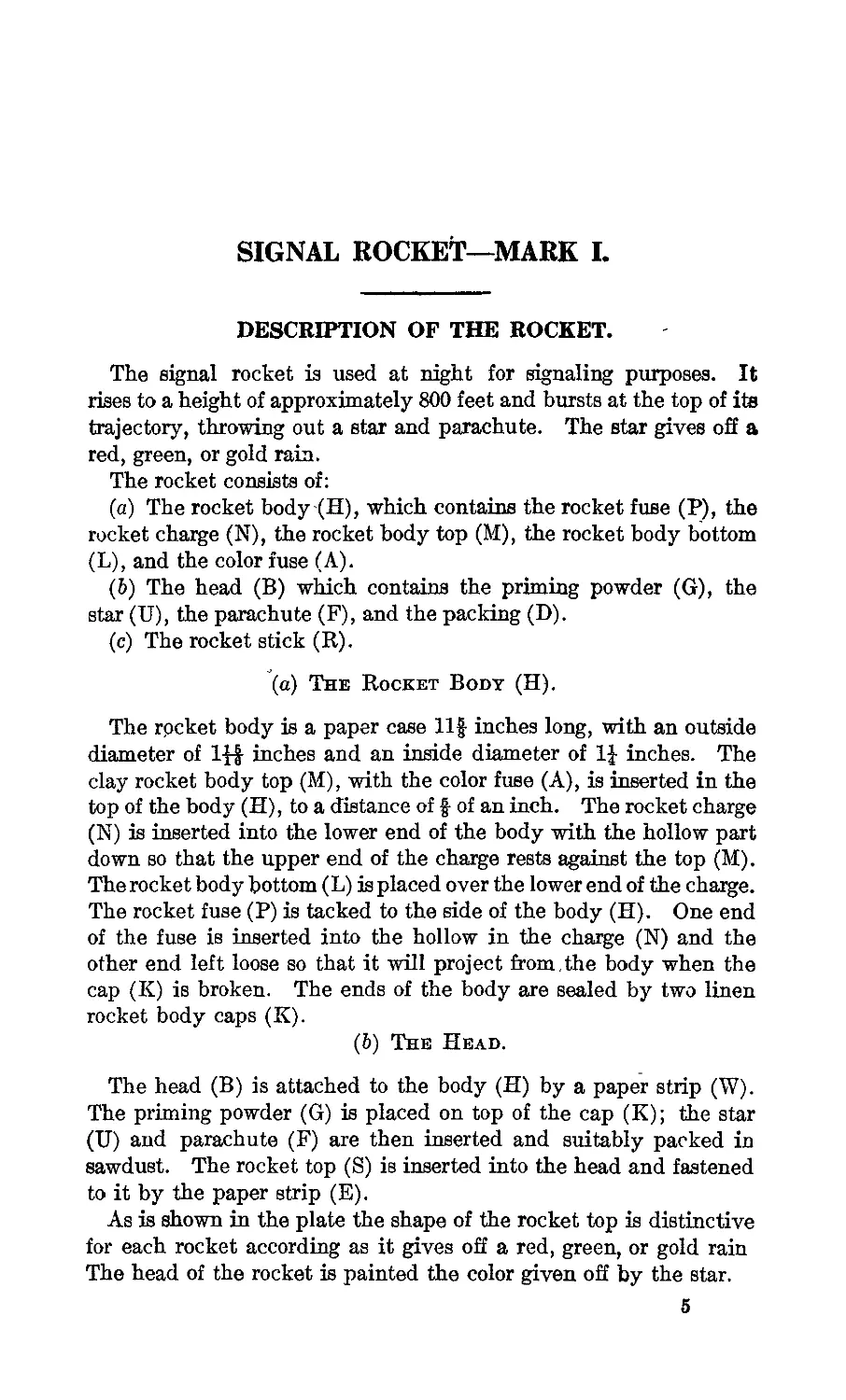
The signal rocket is used at night for signaling purposes. It
rises to a height of approximately 800 feet and bursts at the top of its
trajectory, throwing out a star and parachute. The star gives off a
red, green, or gold rain.
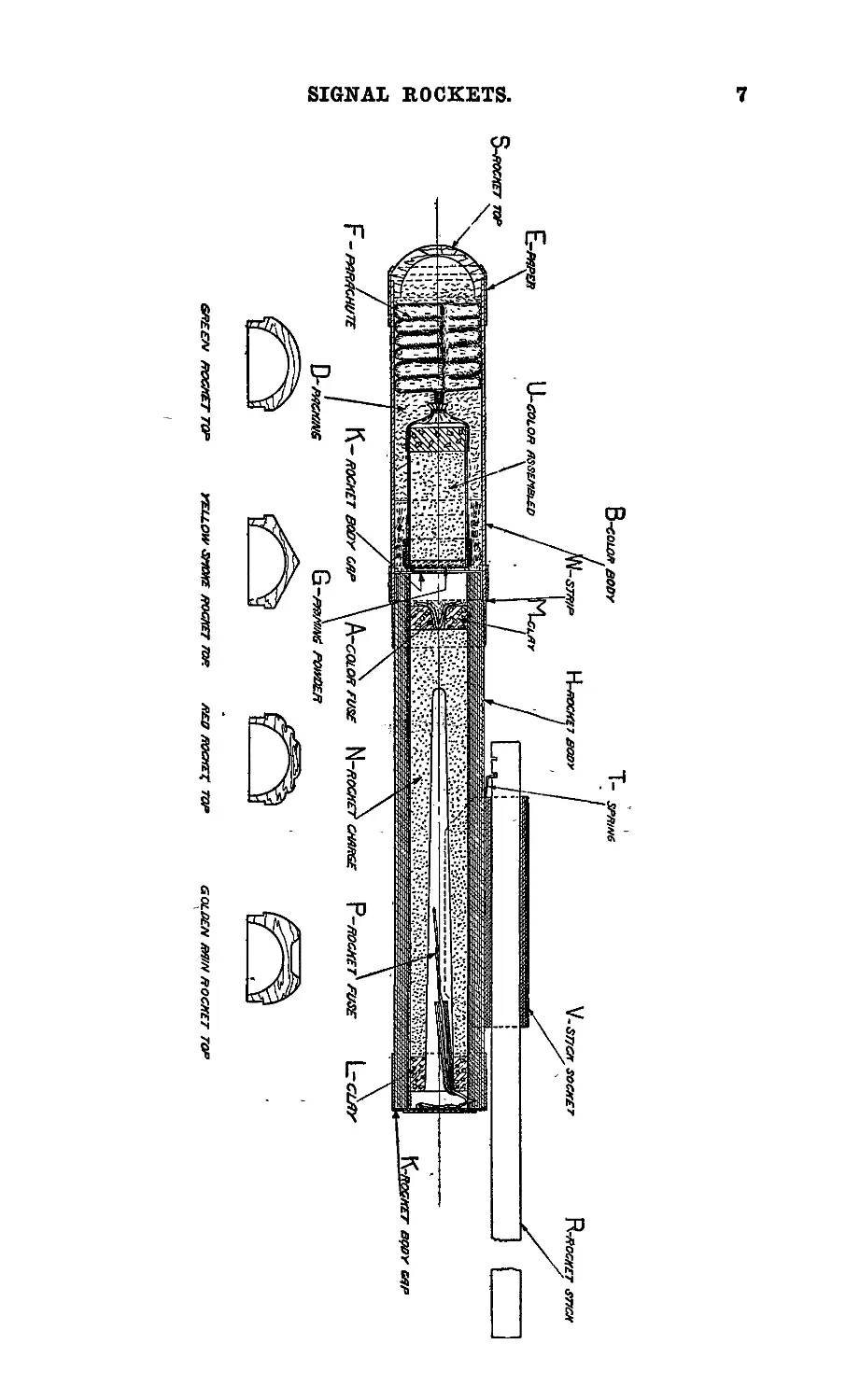
The rocket consists of:
(a)	The rocket body (H), which contains the rocket fuse (P), the
rocket charge (N), the rocket body top (M), the rocket body bottom
(L), and the color fuse (A).
(6)	The head (B) which contains the priming powder (G), the
star (U), the parachute (F), and the packing (D).
(c)	The rocket stick (R).
(a)	The Rocket Body (H).
The rocket body is a paper case Ilf inches long, with an outside
diameter of Iff inches and an inside diameter of inches. The
clay rocket body top (M), with the color fuse (A), is inserted in the
top of the body (H), to a distance of f of an inch. The rocket charge
(N) is inserted into the lower end of the body with the hollow part
down so that the upper end of the charge rests against the top (M).
The rocket body bottom (L) is placed over the lower end of the charge.
The rocket fuse (P) is tacked to the side of the body (H). One end
of the fuse is inserted into the hollow in the charge (N) and the
other end left loose so that it will project from,the body when the
cap (K) is broken. The ends of the body are sealed by two linen
rocket body caps (K).
(6)	The Head.
The head (B) is attached to the body (H) by a paper strip (W).
The priming powder (G) is placed on top of the cap (K); the star
(U) and parachute (F) are then inserted and suitably packed in
sawdust. The rocket top (S) is inserted into the head and fastened
to it by the paper strip (E).
As is shown in the plate the shape of the rocket top is distinctive
for each rocket according as it gives off a red, green, or gold rain
The head of the rocket is painted the color given off by the star.
5
6
SIGNAL ROCKETS.
(c)	The Rocket Stick.
The rocket stick (R) is made of wood, f of an inch square and 72
inches long. Two grooves are cut in one face near the upper end for
the spring (T). The stick is secured to the body (H) by means of
this spring and the stick socket (V). The steel spring fits between
the body and the socket and catches in the grooves in the stick.
The socket is a square paper case 5 inches long with a hole f of an
inch square through it. It is fastened to the body by a strip of
paper.
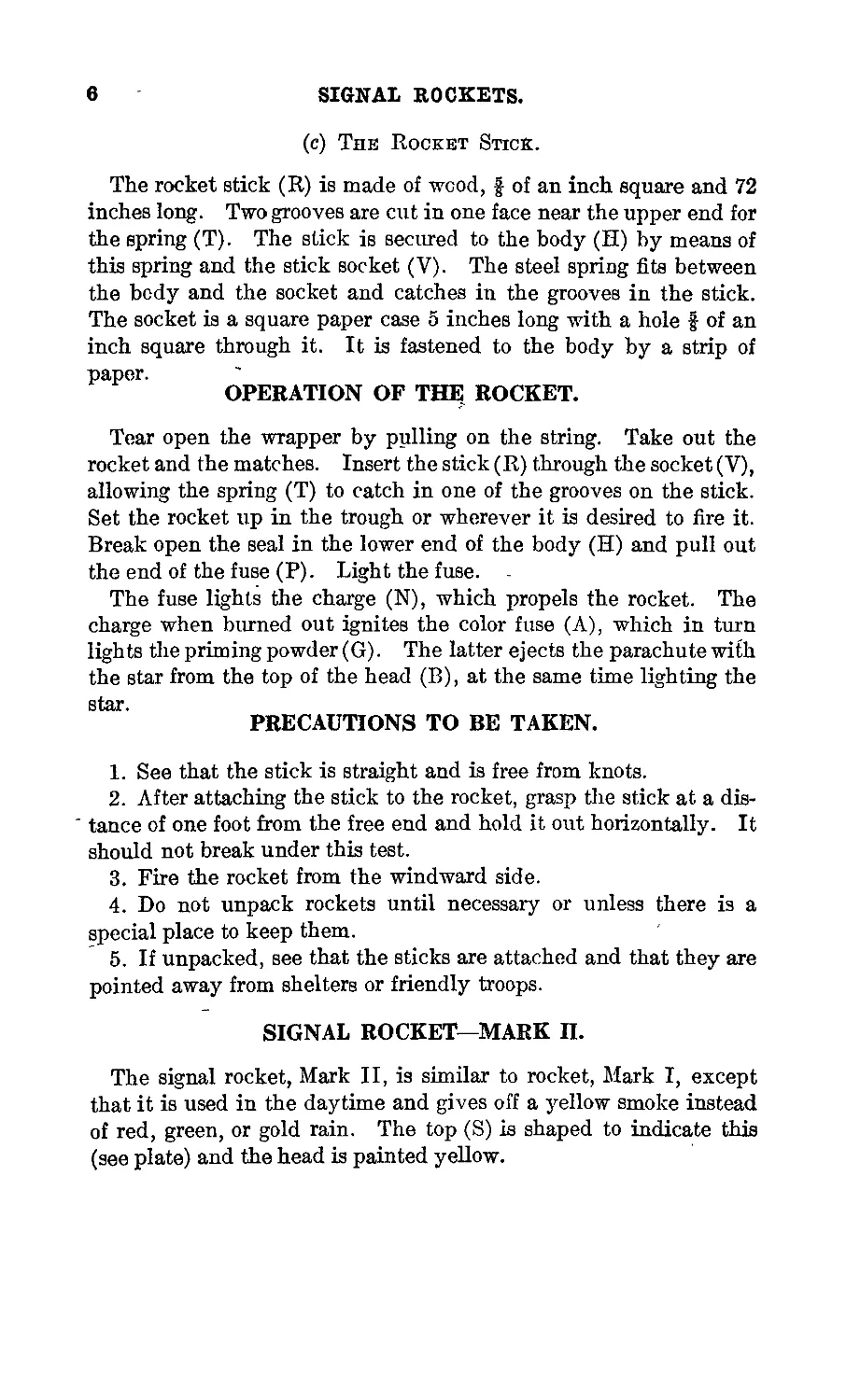
OPERATION OF THE ROCKET.
Tear open the wrapper by pulling on the string. Take out the
rocket and the matches. Insert the stick (R) through the socket (V),
allowing the spring (T) to catch in one of the grooves on the stick.
Set the rocket up in the trough or wherever it is desired to fire it.
Break open the seal in the lower end of the body (H) and pull out
the end of the fuse (P). Light the fuse.
The fuse lights the charge (N), which propels the rocket. The
charge when burned out ignites the color fuse (A), which in turn
lights the priming powder (G). The latter ejects the parachute with
the star from the top of the head (B), at the same time lighting the
Star'	PRECAUTIONS TO BE TAKEN.
1.	See that the stick is straight and is free from knots.
2.	After attaching the stick to the rocket, grasp the stick at a dis-
tance of one foot from the free end and hold it out horizontally. It
should not break under this test.
3.	Fire the rocket from the windward side.
4.	Do not unpack rockets until necessary or unless there is a
special place to keep them.
5.	If unpacked, see that the sticks are attached and that they are
pointed away from shelters or friendly troops.
SIGNAL ROCKET—MARK П.
The signal rocket, Mark II, is similar to rocket, Mark I, except
that it is used in the daytime and gives off a yellow smoke instead
of red, green, or gold rain. The top (S) is shaped to indicate this
(see plate) and the head is painted yellow.
SIGNAL ROCKETS.
GNEEAf POCKET TOP	YELLOW WOKE POCKET 70ft KEO КОСКЕ? TOP
GOLDEN fffflN POCKET TOP
8
SIGNAL ROCKETS.
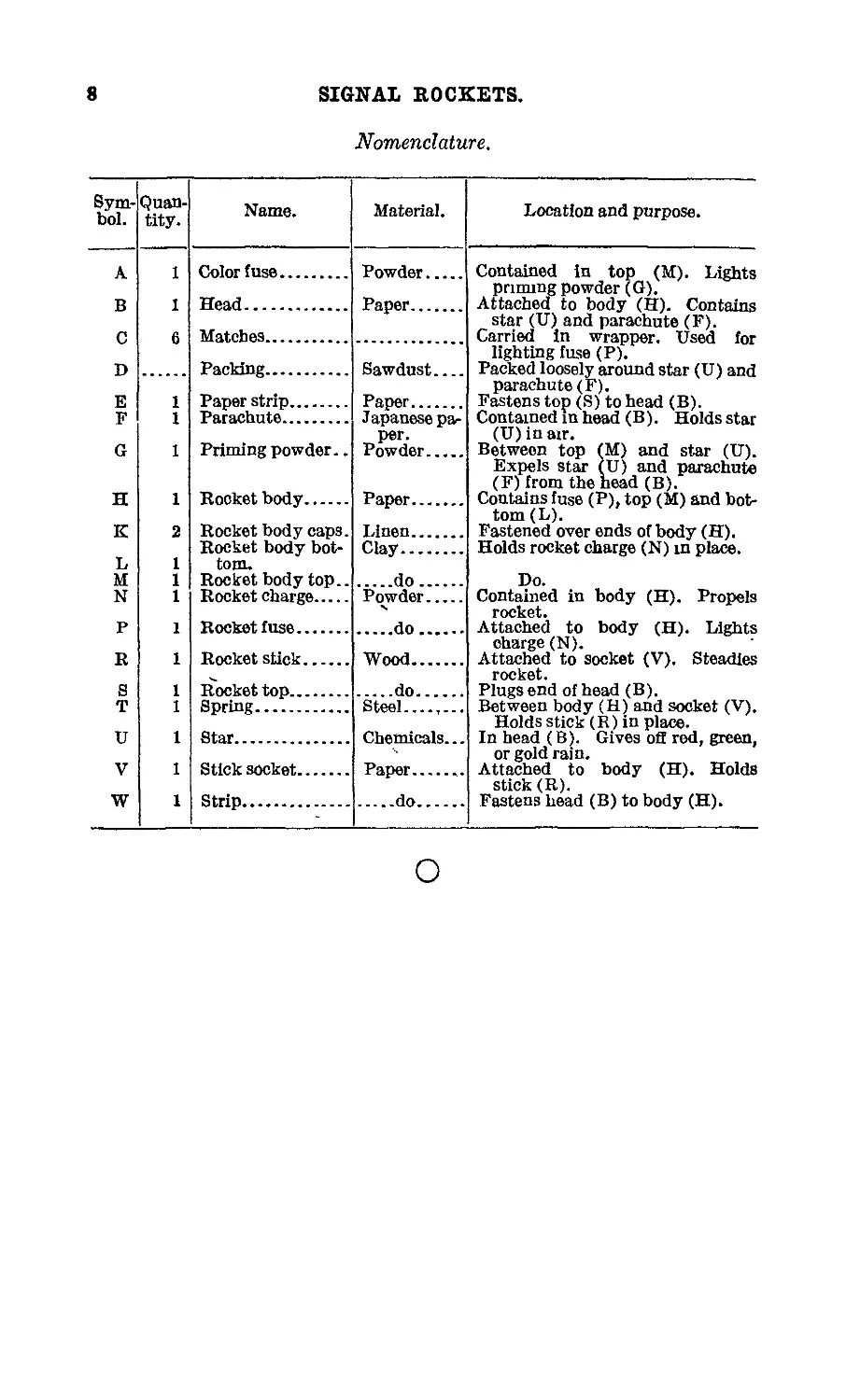
Nomenclature.
Sym- bol.	Quan- tity.	Name.	Material.	Location and purpose.
A	1	Color fuse		Powder		Contained in top (M). Lights
				priming powder (G).
В	1	Head		Paper		Attached to body (H). Contains star (U) and parachute (F).
C	6	Matches				Carried in wrapper. Used for lighting fuse (P). Packed loosely around star (U) and parachute (F).
D			Packing		Sawdust....
E	1	Paper strip		Paper		Fastens top (S) to head (B).
F	1	Parachute		Japanese par	Contained in head (B). Holds star
			per. Powder		(U) in air.
G	1	Priming powder..		Between top (M) and star (U).
				Expels star (U) and parachute (F) from the head (B).

H	1	Rocket body		Paper		Contains fuse (P), top (M) and bot- tom (L).
К	2	Rocket body caps.	Linen		Fastened over ends of body (H).
L	1	Rocket body bot- tom.	Clay		Holds rocket charge (N) in place.
M	1	Rocket body top..		do		Do.
N	1	Rocket charge		Powder		Contained in body (H). Propels rocket.
P	1	Rocket fuse			do		Attached to body (H). Lights charge (N).
R	1	Rocket stick		Wood		Attached to socket (V), Steadies rocket.
S	1	Rocket top			do		Plugs end of head (B).
T	1	Spring		Steel........	Between body (H) and socket (V).
				Holds stick (R) in place.
и	1	Star		Chemicals...	In head (B). Gives off red, green, or gold rain.
V	1	Stick socket		Paper			Attached to body (H). Holds stick (R).
w	1	Strip			do		Fastens head (B) to body (H).
О