/


Автор: Taylor R. Christie I.
Теги: cinema fine arts history of cinema soviet cinema cinematography
ISBN: 0-415-05298-X
Год: 1994

Текст
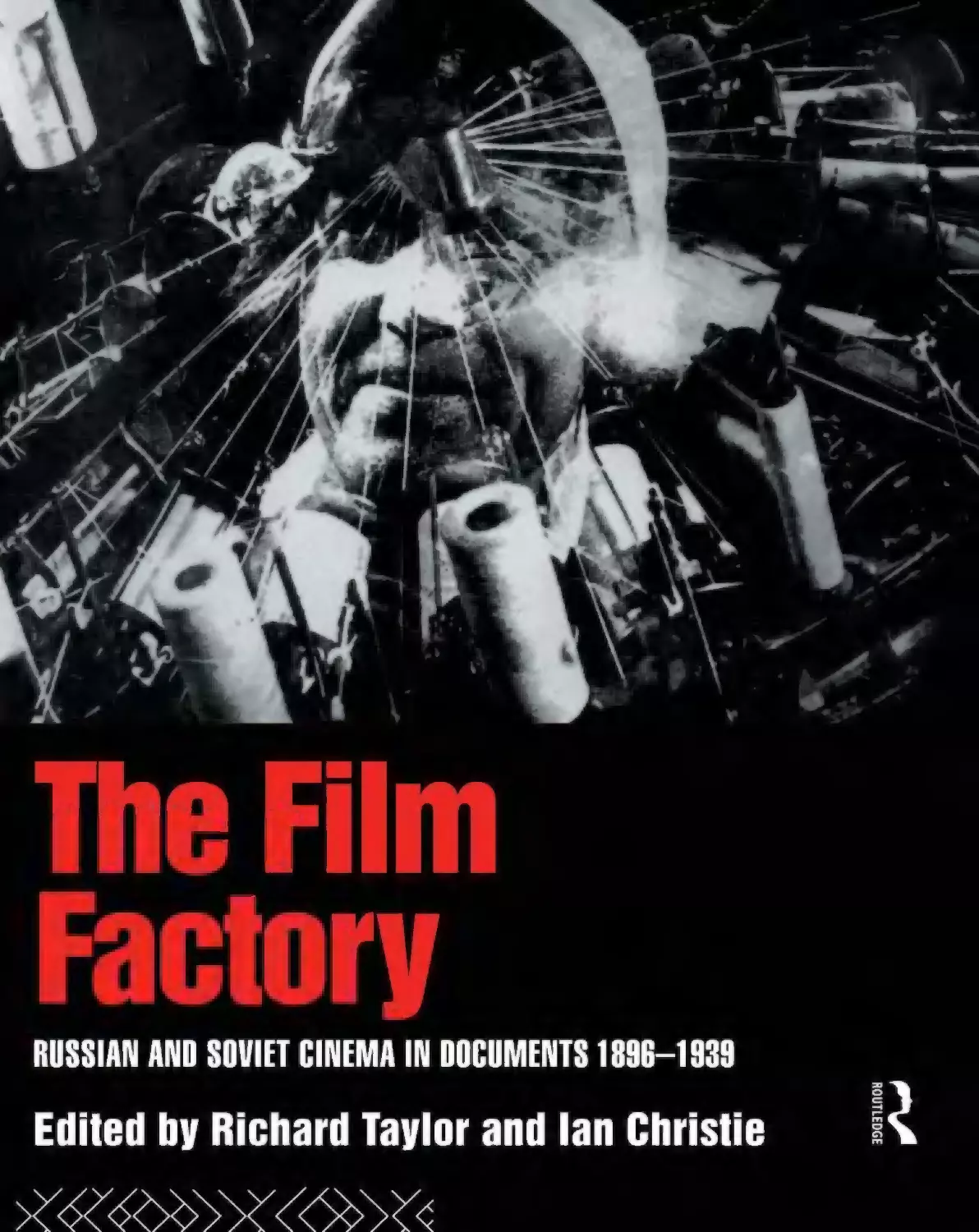
The Film Factory
Russian and Soviet Cinema in
Documents 1896-1939
Edited and translated by
Richard Taylor
Co-edited with an introduction by
Ian Christie
London and New York
In memory of
Leonid Zakharovich Trauberg
(1902-1990)
Eccentric
elder statesman
enfant terrible
and enthusiast
First published in 1988
by Routledge
Paperback edition published in 1994
by Routledge
2 Park Square, Milton Park, Abingdon, Oxon OX14 4RN
Simultaneously published in the USA and Canada
by Routledge
270 Madison Ave., New York NY 10016
Reprinted 2002
Transferred to Digital Printing 2005
Routledge is an imprint o/the Taylor & Francis Group
© 1988, 1994 Richard Taylor and Ian Christie
Typeset in Tunes by Intype, London
All rights reserved. No part of this book may be
reprinted or reproduced or utilised in any form or
by any electronic, mechanical, or other means, now
known or hereafter invented, including
photocopying and recording, or in any information
storage or retrieval system, without permission in
writing from the publishers.
British Library Cataloguing in Publication Data
A catalogue record for this book is available from
the British Library
Library of Congress Cataloging in Publication Data
A catalogue record for this book has been requested
ISBN 0-415-05298-X (pbk)
Contents
Illustrations
x
General Editor's Preface
xiv
Preface
xvi
Preface to the Paperback Edition
xx
Introduction
1
'll'anslator's Note
18
DOCUMENTS
19
1896-1921: Introduction
1896
1 Maxim Gorky: The Lumiere Cinematograph (Extracts)
25
1911
2 Leonid Andreyev: First Letter on Theatre (Extracts)
27
1913
3 Vladimir Mayakovsky: Theatre, Cinema, Futurism
4 Vladimir Mayakovsky: The Destruction of 'Theatre' by Cinema
as a Sign of the Resurrection of Theatrical Art
5 Vladimir Mayakovsky: The Relationship Between Contemporary
Theatre and Cinema and Art
6 Leonid Andreyev: Second Letter on Theatre (Extract)
33
34
35
37
1915
7 Vsevolod Meyerhold: On Cinema
39
1917
8 Lev Kuleshov: The Tasks of the Artist in Cinema
41
1918
9 Lev Kuleshov: The Art of Cinema
45
iii
CONTENTS
1919
10 Anatoli Lunacharsky: The Tasks of the State Cinema in the
RSFSR
47
1920
11 Vladimir Lenin: Art Belongs to the People. Conversation with
Clara Zetkin
1922: Introduction
50
53
12 Vladimir Lenin: Directive on Cinema Affairs
13 Anatoli Lunacharsky: Conversation with Lenin.
I. Of all the Arts . . .
14 Anatoli Lunacharsky: Conversation with Lenin.
II. Newsreel and Fiction Film
15 Grigori Kozintsev, Leonid Trauberg, Sergei Yutkevich and
Georgi Kryzhitsky: Eccentrism
16 Alexei Voznesensky: Open Letter to Nemirovich-Danchenko and
Stanislavsky
17 Lev Kuleshov: 'Art' Cinema
18 Lev Kuleshov: Cinema as the Fixing of Theatrical Action
19 Alexei Gan: The Cinematograph and Cinema
20 Lev Kuleshov: Art, Contemporary Life and Cinema
21 Dziga Vertov: We. A Version of a Manifesto
22 Lev Kuleshov: Americanism
23 Lev Kuleshov: Chamber Cinema
24 Vladimir Mayakovsky: Cinema and Cinema
25 Alexei Gan: The 'Left Front' and Cinema
26 Alexei Gan: The Thirteenth Experiment
1923: Introduction
56
56
57
58
64
66
66
67
68
69
72
74
75
75
78
81
27 Alexei Gan: Two Paths
28 Dziga Vertov: The Cine-Pravda
29 Proletkino: Quasi-Theses
30 Sergei Eisenstein: The Montage of Attractions
31 Dziga Vertov: The Cine-Eyes. A Revolution
32 Lev Trotsky: Vodka, the Church and the Cinema
33 Russfilm Script Competition
34 Viktor Shklovsky: Literature and Cinema (Extracts)
1924: Introduction
83
84
84
87
89
94
97
98
101
35 Declaration of the Association of Revolutionary Cinematography
36 Leonid Trauberg: The R~d Clown to the Rescue!
37 Alexei Gan: Recognition for the Cine-Eyes
38 Lev Kuleshov: Mr West
iv
103
104
105
108
CONTENTS
39 Anatoli Lunacharsky: Revolutionary Ideology and Cinema Theses
40 Resolution of Thirteenth Party Congress on Cinema
41 Dziga Vertov: The Cine-Pravda: A Report to the Cine-Eyes
42 Sovnarkom of the RSFSR: Decree on the Establishment of
Sovkino
43 Dziga Vertov: Fiction Film Drama and the Cine-Eye
44 Vladimir Blyum: Against the 'Theatre of Fools' - For Cinema
45
46
47
48
49
50
68
69
70
71
72
73
114
115
116
1925: Introduction
121
Anatoli Goldobin: Our Cinema and Its Audience
Zhizn iskusstva Editorial: Theatre or Cinema?
Abram Room: Cinema and Theatre
Dziga Vertov: Cine-Pravda and Radio-Pravda
Viktor Shklovsky: The Semantics of Cinema
Grigori Boltyansky: Cinema and the Soviet Public
124
125
128
129
131
134
1926: Introduction
137
51 Adrian Piotrovsky: The Battleship Potemkin
52 Alexei Gvozdev: A New Triumph for Soviet Cinema (The
Battleship Potemkin and the 'Theatrical October')
53 Vladimir Kirshon: Literature, Theatre and Cinema (Extract)
54 Bela Balazs: The Future of Film
55 Sergei Eisenstein: Bela Forgets the Scissors
56 Alexander Dubrovsky: The Soviet Cinema in Danger
57 Dziga Vertov: The Factory of Facts
58 Viktor Shklovsky: Where is Dziga Vertov Striding?
59 Esfir Shub: The Manufacture of Facts
60 Viktor Shklovsky: The Cine-Eyes and Intertitles
61 Anatoli Lunacharsky: Cinema - the Greatest of the Arts
62
63
64
65
66
67
109
111
112
139
140
143
144
145
149
150
151
152
153
154
1927: Introduction
157
Vladimir Mayakovsky: Help!
Viktor Shklovsky: Sergei Eisenstein and 'Non-Played' Film
Viktor Shklovsky: The Temperature of Cinema
Viktor Pertsov: Literature and Cinema
Viktor Shklovsky: The Film Factory (Extracts)
Vladimir Mayakovsky: Speech in Debate on 'The Paths and
Policy of Sovkino'
Vladimir Mayakovsky: On Cinema
Kirill Shutko: Preface to Poetics of Cinema
Viktor Shklovsky: Poetry and Prose in Cinema
Adrian Piotrovsky: The Cinefication of Theatre - Some General
Points
Viktor Shklovsky: Mistakes and Inventions
Osip Brik: The Fixation of Fact (Extract)
160
161
162
164
166
v
171
174
174
176
178
180
184
CONTENTS
74 Esfir Shub: We Do Not Deny the Element of Mastery
75 Adrian Piotrovsky: Let Us Be Maximalists!
76 Adrian Piotrovsky: 'Ideology' and 'Commerce'
185
187
188
191
1928: Introduction
77 Nikolai Yakovlev: The Nihilists from ARK
78 Anatoli Lunacharsky: Speech to Film Workers
79 Vsevolod Pudovkin: S. M. Eisenstein (From Potemkin to
October)
80 Dziga Vertov: The Eleventh Year
81 Alexei Popov: The Relationships Between Cinema and Theatre
82 To the Party Conference on Cinema From a Group of Film
Directors
83 Party Cinema Conference Resolution: The Results of Cinema
Construction in the USSR and the Tasks of Soviet Cinema
84 Anatoli Lunacharsky: Review of October
85 Adrian Piotrovsky: October Must Be Re-Edited!
86 Esfir Shub: This Work Cries Out
87 Sergei Eisenstein and Grigori Alexandrov: We Are Waiting!
88 T. Rokotov: Why Is October Difficult?
89 Sergei Eisenstein: For Soviet Cinema
90 The Lef Ring: Comrades! A Clash of Views!
91 Zhizn iskusstva Editorial: October - The Results of the Discussion
92 Sergei Eisenstein, Vsevolod Pudovkin and Grigori Alexandrov:
Statement on Sound
93 Vladimir Messman: Sound Film
94 Viktor Shklovsky: The Soviet School of Acting
95 Adrian Piotrovsky: Is There a Crisis in Soviet Cinema?
96 Sovkino Workers' Conference Resolution: Sovkino's New Course
(Extract)
97 Sovetskii ekran Editorial: The Rightist Danger in Cinema
195
195
198
200
204
205
208
216
216.
217
218
219
220
225
232
234
235
237
239
241
245
247
1929: Introduction
98 Leonid Trauberg: An Experiment Intelligible to the Millions
99 Viktor Shklovsky: Beware of Music
100 Party Central Committee Decree: On the Strengthening of
Cinema Cadres
101 Sergei Eisenstein and Grigori Alexandrov: An Experiment
Intelligible to the Millions
102 Yuri Tynyanov: On FEKS
103 Pavel Petrov-Bytov: We Have No Soviet Cinema
104 Adrian Piotrovsky: Petrov-Bytov's Platform and Soviet Cinema
105 Vsevolod Pudovkin: On the Principle of Sound in Film
106 Adrian Piotrovsky: Westernism in Our Cinema
107 Vsevolod Pudovkin, Leonid Obolensky, Sergei Komarov and
Vladimir Fogel: Preface to Kuleshov's Book The Art of Cinema
vi
250
251
253
254
257
259
262
264
267
270
CONTENTS
108
109
110
111
Esfir Shub: The Advent of Sound in Cinema
Vsevolod Meyerhold: The Cinefication of Theatre
RAPP Resolution on Cinema
Vsevolod Pudovkin: Conversation on Sound Film
271
271
275
280
1930: Introduction
283
112 'An ARK Member': ARRK Must Be Reorganised
113 Ippolit Sokolov: The Legend of 'Left' Cinema
114 Na literaturnom postu Editorial: For the Reconstruction of Soviet
Cinema
115 Nikolai Anoshchenko: Sound Cinema in the Service of the
Cultural Revolution
116 Viktor Shklovsky: The Script Laboratory
117 Kino i zhizn Editorial: Film Work and the Mass Audience
118 Dziga Vertov: The Radio-Eye's March
119 Dziga Vertov: Speech to the First All-Union Conference on
Sound Cinema
120 Viktor Shklovsky: Sound as a Semantic Sign
121 Ippolit Sokolov: The Second Sound Film Programme
122 Kino i zhizn Editorial: Is There a Soviet Sound Cinema?
123 Viktor Shklovsky: The Film Language of New Babylon
286
287
290
293
294
297
299
301
305
308
310
311
315
1931-4: Introduction
1931
124 Proletarskoe kino Editorial: What Does 'Proletarian Cinema'
Mean?
318
1932
125 Proletarskoe kino Editorial: We Are Continuing the Struggle
126 Vsevolod Pudovkin, Esfir Shub et al.: To All Creative Workers
in Soviet Cinema
127 Party Central Committee Decree: The Reorganisation of Literary
and Artistic Organisations
321
322
325
1933
128 Anatoli Lunacharsky: Synopsis of a Report on the Tasks of
Dramaturgy (Extract)
129 Vsevolod Pudovkin: The Role of Sound Cinema
130 Sergei Eisenstein: Cinema and the Classics
327
327
329
1934
131 First Congress of Soviet Writers (Extracts)
132 Pravda Editorial: The Whole Country is Watching Chapayev
133 Film-Makers' Letter to Stalin
vii
331
334
335
CONTENTS
134 Grigori Kozintsev and Leonid Trauberg: The Youth of Maxim
(Extracts)
135 Vsevolod Pudovkin: The Youth of Maxim
136 Dziga Vertov: More on Mayakovsky (Extract)
1935: Introduction
338
338
340
345
137 Joseph Stalin: Congratulations to Soviet Cinema on Its Fifteenth
Anniversary
138 For a Great Cinema Art: Speeches to the All-Union Creative
Conference of Workers in Soviet Cinema (Extracts)
139 Dziga Vertov: My Illness
140 Boris Shumyatsky: A Cinema for the Millions (Extracts)
141 Boris Shumyatsky: The Role of the Producer
Postscript: 1936-41
348
348
357
358
369
371
1936
142 Boris Shumyatsky: Perfecting Our Mastery
143 Dziga Vertov: Diary Entry
373
377
1937
144
145
146
147
148
Boris Shumyatsky: The Film Bezhin Meadow
Yuli Raizman: Seminar at VGIK (Extracts)
Vsevolod Pudovkin: The Director and the Scriptwriter (Extracts)
Vsevolod Pudovkin: Dialogue in Film (Extract)
Alexander Dovzhenko: The Artist's Teacher and Friend
378
381
381
383
383
1938
149 G. Ermolayev: What Is Holding Up the Development of Soviet
Cinema?
150 Iskusstvo kino Editorial: The Fascist Cur Eradicated
151 Alexei Stakhanov: My Suggestion to Soviet Cinema
152 Reactions to Stakhanov's Article (Extracts)
153 Vsevolod Pudovkin: The Internal and the External in an Actor's
Training
386
387
389
391
393
1939
154 Sergei Eisenstein: My Subject Is Patriotism
Abbreviations
Notes to Introduction
Notes to Documents
Table 1: Cinema Installations and Their Distribution in the
Russian Empire and USSR, 1914--41
Table 2: Film Production, 1918-41
viii
398
405
407
416
423
424
CONTENTS
Appendices
Appendix
Appendix
Appendix
Appendix
1
2
3
4
Films: Russian and Soviet
Films: Foreign
People: Russian and Soviet
People: Foreign
Index
427
435
437
445
449
ix
Illustrations
1 Arrival of a Train at La Ciotat Station
Stenka Razin
The Cameraman's Revenge
The Queen of Spades
The Woman with a Dagger
Arsen Dzhordzhiashvili
Newspaper advertisements for Cinematographe Lumiere
presentations
8 Filming 1812
9 'The Biograph in the 21st Century'
10 Drama in the Futurists' Cabaret No. 13
11 Not Born to be Rich
12 Shackled by Film
13 I and My Conscience
14 The Picture of Dorian Gray
15 A Life for a Life
16 Engineer Prite's Project
17 Lunacharsky and Mayakovsky
18 Overcrowding
19 Poster for Overcrowding
20 Father Sergius
21 Polikushka
'22 Cine-Pravda
23 Cover of the manifesto 'Eccentrism'
24 On the Red Front
25 Dziga Vertov
26 Alexei Gan
27 The Palace and the Fortress
28 The Little Red Devils
29 Glumov's Diary (from Enough Simplicity for Every Wise Man)
30 Sergei Eisenstein in 1923
31 Members of the Cine-Eye group
32 The Extraordinary Adventures of Mr West in the Land of the
Bolsheviks
33 Aelita
34 Leningrad cinemas repertory poster
35 The Adventures of Oktyabrina
2
3
4
5
6
7
x
20
20
20
20
20
20
24
24
24
32
32
32
40
40
40
44
44
48
48
48
55
55
70
70
70
76
80
80
86
86
86
100
100
102
106
ILLUSTRAnONS
36 The Extraordinary Adventures of Mr West in the Land of the
Bolsheviks
37 Poster for Cine-Eye
38 The Strike
39 His Call
40 A peasant film audience
41 The 'Goz' mobile projector
42 The Bay of Death
43 The Lenin Cine-Pravda
44 Members of the Lef group
45 The Devil's Wheel
46 The Bear's Wedding
47 The Battleship Potemkin
48 The Battleship Potemkin
49 Tisse filming Potemkin
50 Esfir Shub
51 The Mother
52 Women of Ryazan
53 The End of St Petersburg
54 The Little Brother
55 The Poet and the Tsar
56 A Sixth Part of the World
57 The End of St Petersburg
58 Osip Brik
59 The Fall of the Romanov Dynasty
60 Miss Mend
61 October
62 The House on Trubnaya
63 October
64 The Salamander
65 Poster for The Eleventh Year
66 Posters for The Mysterious Hacienda and An Ordinary Story
67 Discarded sequence from October
68 The Man From the Restaurant
69 Moscow in October
70 October
71 October
72 Vladimir Fogel
73 Nato Vachnadze
74 The Ghost That Never Returns
75 Penal Servitude
76 The Man With the Movie Camera
77 A Fragment of Empire
78 Storm Over Asia
79 The General Line
80 The Overcoat
81 New Babylon
82 The Arsenal
xi
106
118
122
122
127
127
127
132
132
136
136
142
142
148
148
148
158
158
170
170
181
181
186
186
186
192
192
201
201
202
214
214
222
222
228
228
238
244
244
244
248
248
256
256
260
260
268
ILLUSTRATIONS
83
84
85
86
87
88
89
90
91
92
93
94
95
96
97
98
99
100
101
102
103
104
105
106
107
108
109
110
111
112
113
114
115
116
117
118
119
120
121
122
123
124
125
126
127
128
129
130
Chicago
Lev Kuleshov
The White Eagle
Turksib
The Man With the Movie Camera
Enthusiasm (The Donbass Symphony)
The Earth
By the Law
Two Days
A Simple Case
Pavel Tager and Alexander Shorin
Poster for Judas
Using sound equipment on Enthusiasm
Vertov and Svilova
On location for New Babylon
New Babylon
The Path to Life
Outskirts
Men and Jobs
The Great Consoler
The Deserter
Lieutenant Kizhe
Chapayev
The Youth of Maxim
Alone
The Youth of Maxim
Three Songs of Lenin
Pilots
Peasants
The 1935 Film-Makers' Conference
Counterplan
The Youth of Maxim
Vertov, Eisenstein and Pudovkin
Chapayev
Pilots
Three Songs of Lenin
The Happy Guys
We From Kronstadt
Volga-Volga
Komsomolsk
Alexander Nevsky
The Vyborg Side
Peter the First
The Circus
Bezhin Meadow
Bezhin Meadow
The Last Night
Shchors
xii
268
274
274
274
274
284
284
288
288
296
296
300
300
312
312
312
314
314
324
326
326
336
336
336
342
342
342
344
344
350
350
356
356
362
362
366
366
370
370
370
370
370
370
375
382
382
382
382
ILLUSTRATIONS
131 A Great Citizen
132 Minin and Pozharsky
133 Eisenstein directing Alexander Nevsky
134 Alexander Nevsky
135 Film Companies' trademarks
xiii
392
392
399
399
402
General Editor's
Preface
Cinema has been the predominant popular art form of the first half of the
twentieth century, at least in Europe and North America. Nowhere was this more
apparent than in the former Soviet Union, where Lenin's remark that 'of all the
arts for us cinema is the most important' became a cliche and where cinema
attendances were until recently still among the highest in the world. In the age
of mass politics Soviet cinema developed from a fragile but effective tool to gain
support among the overwhelmingly illiterate peasant masses in the civil war that
followed the October 1917 Revolution, through a welter of experimentation, into
a mass weapon of propaganda through entertainment that shaped the public
image of the Soviet Union - both at home and abroad and for both elite and
mass audiences - and latterly into an instrument to expose the weaknesses of
the past and present in the twin processes of glasnost and perestroika. Now th~
national cinemas of the successor republics to the old Soviet Union are encountering the same bewildering array of problems, from the trivial to the terminal, as
are all the other ex-Soviet institutions.
Cinema's central position in Russian and Soviet cultural history and its
unique combination of mass medium, art form and entertainment industry, have
made it a continuing battlefield for conflicts of broader ideological and artistic
significance, not only for Russia and the Soviet Union but also for the world
outside. The debates that raged in the 1920s about the relative revolutionary
merits of documentary as opposed to fiction film, of cinema as opposed to theatre
or painting, or of the proper role of cinema in the forging of post-Revolutionary
Soviet culture and the shaping of the new Soviet man, have their echoes in
current discussions about the role of cinema vis-a-vis other art forms in effecting
the cultural and psychological revolution in human consciousness necessitated
by the processes of economic and political transformation of the former Soviet
Union into modem democratic and industrial societies and states governed by
the rule of law. Cinema's central position has also made it a vital instrument for
scrutinising the blank pages of Russian and Soviet history and enabling the
present generation to come to terms with its own past.
This series of books intends to examine Russian and Soviet films in the
context of Russian and Soviet cinema, and Russian and Soviet cinema in
the context of the political and cultural history of Russia, the Soviet Union and the
world at large. Within that framework the series, drawing its authors from East
and West, aims to cover a wide variety of topics and to employ a broad range of
methodological approaches and presentational formats. Inevitably this will
involve ploughing once again over old ground in order to re-examine received
xiv
GENERAL EDITOR'S PREFACE
opinions but it principally means increasing the breadth and depth of our knowledge, finding new answers to old questions and, above all, raising new questions
for further enquiry and discovering new areas for further research.
The Film Factory, which first appeared in hardback in 1988, presented for
the first time in English - or, indeed, in any language - a mass of hitherto
unavailable documentary material on the history and development of Russian
and Soviet cinema from 1896 to 1939. The editors aimed to provide the reader
with what they termed 'an open resource - raw material to enable new models
and interpretations of Soviet cinema history to be fashioned'. In selecting documents for inclusion, they aimed 'to balance the issues that concerned the makers
of Soviet cinema themselves: the aesthetic, the political, the economic, the social
and, more often than not, a complex blend of these, together with more personal
factors'. Since 1988 events have moved further and faster than could then have
been envisaged and the collapse of the Soviet Union at the end of 1991 has
unleashed a wealth of new material, especially material relating to the 1930s on
which the editors quite specifically argued that much work still needed to be
done. They have, however, resisted the temptation to revise The Film Factory,
apart from eradicating some typographical and similar errors. They have taken
this decision partly because the warm critical reception for the book suggested
that it would remain useful in its present form for years to come, and partly
because to do justice to the 1930s and subsequent decades would require a
separate volume, a kind of After the Film Factory. The publication of the paperback edition will, we hope, bring the volume within reach of a wider audience
concerned with the history of Russian and Soviet cinema and with the issues
around which that history revolved.
The continuing aim of the series is to situate Russian and Soviet cinema in
its proper historical and aesthetic context, both as a major cultural force
in Russian history and Soviet politics and as a crucible for experimentation that
is of central significance to the development of world cinema culture. Books in
the series strive to combine the best of scholarship, past, present and future, with
a style of writing that is accessible to a broad readership, whether that readership's
primary interest lies in cinema or in Russian and Soviet history.
Richard Taylor
February 1994
xv
Preface
If you want to come to cinema's aid, do not rush to the screen.
Pause to think a hundred times, a thousand times, on the doorstep
of the film factory.
Best of all: stay in the audience.
Cinema needs that more than anything: an audience that does not
succumb to cinema psychosis.
Viktor Shklovsky
It was only in January 1936 that the Soviet film studios became officially known
as such, kinostudii. This set the seal on their new artistic-industrial status under
the vigorous leadership of Boris Shumyatsky and was no doubt inspired by his
visit in the previous year to European and Hollywood studios. Previously the
film studio was known simply as a film factory (kinofabrika), as it had been in
pre-Revolutionary Russia, although the Constructivists and 'left' filmmakers of
the 1920s were quick to exploit the metaphoric potential of the term in their
fight against the 'opium' of film drama. Vertov and Shub called for a 'factory of
facts' (see Documents 57 and 59), while Shklovsky summarised his experiences
as a screenwriter under the title 'The Film Factory' in 1927 (Document 66), and
ironically structured his third volume of autobiography, Third Factory (written
while working at the Third Goskino Factory), around this same metaphor of
artistic production in the machine age.
Our use of Shklovsky's title for this anthology follows in the same metaphoric
tradition. It is intended to signal that this collection of documents relates primarily
to the making of Soviet cinema, and to the domestic debates that raged around
its rapid promotion from a fairground attraction to become the leading cultural
industry of the modern Soviet state. As we have pursued our own researches
into the Soviet cinema, we have become increasingly conscious of the rigidity of
received opinion, which discourages empirical inquiry and fits available information into heavily moralised preconceptions. Drawing on the mass of contemporary documents first accumulated by Richard Taylor during the preparation of
his The Politics of the Soviet Cinema 1917-1929, and having the opportunity to
test our own evolving views in discussion with Soviet scholars and surviving
witnesses of the pre-war era, has made us sceptical of the dominant western
historiographical tradition, yet keenly aware of how many questions have still to
be asked. We hope that the presentation of these primary sources in translation
will help others in various fields of scholarship, as they have helped us; and
xvi
PREFACE
accordingly we have avoided arranging them in a thematic sequence, so that they
remain an open resource - raw material to enable new models and interpretations
of Soviet cinema history to be fashioned.
The immediate starting-point for the book was a dossier of translations and
reviews, FuturismlFormalismlFEKS: 'Eccentrism' and Soviet Cinema 1918-36,
edited by Ian Christie and John Gillett, and published by the British Film Institute
to accompany a 1978 season at the National Film Theatre, London, 'Russian
Eccentrics'. This included a number of Richard Taylor's translations (mistakenly
attributed to another), and when its small print run was quickly exhausted, the
need for a more permanent collection became apparent. The fact that many of
the films were being shown in that season for the first time, after long years of
neglect, and have since become more widely available through distribution, has
provided the vital stimulus for a new phase of western interest in pre-war Soviet
cinema that will, hopefully, pay more attention to the Soviet context than to the
preoccupations of western observers.
During the years of its preparation, while we have both pursued other more
specific researches in Soviet cinema, the book has undergone many changes of
plan. In selecting documents for inclusion, we have tried to balance the issqes
that concerned the makers of Soviet cinema themselves: the aesthetic, the
political, the economic, the social and, more often than not, a complex blend of
these, together with more personal factors. As a result, the limits and scale of
the anthology have continued to expand, while it remains based on the central
tradition of debate that shaped Russian film culture even before the 1917 Revolution. The fulcrum of this debate shifted considerably during the two decades
following the Revolution, but we believe it was never reducible to a simple
extension of the political command, and instead was constantly animated by
the need to reaffirm and reassess the essential elements of cinema specificity,
particularly in relation to theatre. There is inevitably a compromise between
doing justice to the complexity of the debates and introducing little known texts
and authors. We have felt it necessary to include certain key texts that are
already available in translation, albeit scattered through many, often ephemeral,
publications and in translations of varying adequacy. However, we have tried to
shed fresh light on the relatively known positions of Kuleshov, Vertov, Pudovkin
and Eisenstein at different points in their careers, and to place these in the
context of other contemporary and conflicting views. There remains the familiar
problem of those important filmmakers and indeed whole areas of cinema broadly speaking, the narrative tradition as distinct from the montage avantgarde - which attracted little sympathetic contemporary discussion, yet was to
be the bedrock on which later Soviet cinema was built. We have included the
polemics directed against notorious examples of bad traditional narrative, and
drawn extensively on two major critic-theorists who did not ally themselves
exclusively with the avant-gardes: Shklovsky and Adrian Piotrovsky.
The emergent non-Russian national cinemas receive little coverage, partly
due to lack of adequate space and partly because the (Russian) journals of the
period devoted scant attention to them. On the other hand, we have treated in
some detail the 'proletarian episode' of 1928-31 and included a large number of
hitherto inaccessible texts that reflect the bitter controversies of this phase and
the underlying shift of priorities that was to produce a new Soviet 'cinema for
xvii
PREFACE
the millions' under Shumyatsky's baton in the 1930s. But we are conscious that
much work still needs to be done on the 1930s to break down the monolithic,
and largely dismissive, view of this decade that still prevails in the West. The
fact that this collection ends at a point where public debate had been virtually
halted may obscure the essential continuity of serious professional debate within
Soviet cinema up to the present. But to relate the public to the private, making
full use of the wealth of invaluable memoir material now available, which sheds
much light on the 1930s, would have been impossible within the limits of a single
volume (although some of the many interviews we have conducted during the
period of compilation have appeared, or will, elsewhere). The filmographies and
biographical notes, covering both Russian and foreign references, are confined
to actual references in the documents and introduction.
*
*
*
Any list of acknowledgments in a work on the history of Soviet cinema must
begin by paying tribute to Jay Leyda's Kino, which has stimulated and informed
us as it has so many others. Yet the very intimacy and passion that motivate this
book have also tended to impose their own pattern on the understanding of
Soviet cinema, especially in the English-speaking world. We have therefore tried
to enlarge our focus where Leyda's is narrowest and to provide a more explicit
analytical framework in our selection of documents and linking narrative.
We would both like to acknowledge the assistance and support of the
following institutions in the preparation of this work: the British Film Institute,
London; VNIIKI, the All-Union Research Institute for the History of Cinema
Art, Moscow; and the Cinematheque Royale de Belgique, Brussels. We are
also greatly indebted to the following individuals in Moscow: Professor Evgeni
Gromov, who persuaded us to abandon our earlier plan to periodise Soviet
cinema's development in the book's arrangement; Naum Kleiman, Curator of
the Eisenstein Museum for his invaluable guidance not only on matters relating
to Eisenstein; and Leonid Trauberg, who has given us enthusiastic support and
encouragement throughout.
Richard Taylor would like to thank the staffs of the following libraries for
their seemingly endless toil on his behalf: the VNIIKI and Lenin Libraries,
Moscow; the University College of Swansea Library and the British Library,
both Reference and Lending Divisions; the International Institute for Social
History, Amsterdam; the Torsten Lundell collection, Carolina Rediviva University Library, Uppsala; and last, but not least, that marvellous temple of userfriendliness, the Library of Congress, Washington DC, especially the Motion
Picture Division. Richard Taylor is also indebted to the Nuffield Foundation, the
Kennan Institute for Advanced Russian Studies (Washington DC), the British
Council (Younger Research Workers' Interchange Scheme), and the Centre for
Russian and East European Studies, University College of Swansea, for generous
financial assistance. He would also like to express profound gratitude to Phyllis
Hancock for her unending patience and superhuman efforts at the typewriter,
and to Alan Bodger, for his frequent advice on the minutiae of translation and
apparently limitless knowledge of matters Russian.
Throughout the compilation of the book, Ian Christie has helped to mount
a number of events through the British Film Institute which have greatly increased
xviii
PREFACE
his understanding of Soviet cinema: these include the NFf seasons 'Into the 30s'
(July 1982) and 'Love and Conscience: the Films of Yuli Raizman' (October
1984), both organised jointly with John Gillett; and the presentation of New
Babylon with its original score by Shostakovich restored and played live, under
the baton of Omri Hadari. Many colleagues at the BFI have provided advice and
assistance, notably Colin McArthur, John Gillett, Anthony Smith and Veronica
Taylor. Charles Cooper and the late Ivor Montagu supplied useful first-hand
information about the early career of Soviet films in Britain. Bernard Eisenschitz,
Roland Cosandey and Anne Thompson all contributed otherwise unavailable
references. Invitations to lecture and commissions to write prompted much of
the research that underlies the Introduction. Thanks are thus due to: Charles
Barr and the University of East Anglia; David Elliott, Director of the Museum
of Modern Art, Oxford; Malcolm Allen, former Film Officer of East Midlands
Arts; the Film Department of Bulmershe College; Cordelia Swann and the
London Filmmakers' Co-operative; Simon Field and the Collective for Living
Cinema, New York; and the editors of Screen and Framework.
Film stills and other illustrations have come from a variety of sources,
including the Stills Library of the British Film Institute (with special thanks to
Markku Salmi) and the Central State Archive of Literature and Art (TsGALI),
Moscow.
Any work that takes as long to come to fruition as this volume creates a
number of personal debts to family and friends that can never be adequately
repaid. Some partial recompense may however be made by acknowledgment.
Richard Taylor would like to thank his mother, George Boyce, Neil Harding,
Emeritus Professor W. H. Greenleaf, Jeffrey Richards and Gareth Evans for
their support and encouragement at times when the lights in the auditorium
seemed to have been dimmed completely. Ian Christie owes more than he can
express to Patsy Nightingale for her forbearance and support over the years; to
his colleagues in BFI Distribution for their tolerance, and to his father, Robert
Christie, for unstinting support in this, as in all endeavours over the years.
This has throughout been a collaborative work and we have both benefited
from the cross-fertilisation of ideas that has occurred - all too frequently for our
peace of mind. However, Richard Taylor is responsible for the translations, the
linking narrative and the information on Russian and Soviet films and people.
Ian Christie is responsible for the Introduction, illustrations and the information
on foreign films and people. For the overall conception and selection of material,
we are jointly responsible.
Richard Taylor
Ian Christie
December 1986
xix
Preface to the
Paperback Edition
The Film Factory is a product of the last, remarkable decade of the Soviet Union.
Access to texts and films and, more important, first-hand contact with Russian
historians, critics and veteran filmmakers became steadily easier during the early
198Os, until in 1986-7 the possibility of a fundamental reassessment of Soviet
cinema became thinkable. However, most of the frenetic energy of those years
was inevitably devoted to revealing the injustices and guilty secrets of the previous
twenty years, since these often affected still-living filmmakers.
But, even before the era of glasnost and perestroika, radical new perspectives
on Soviet cinema were becoming available, although they were not yet publishable. Maya Throvskaya had started to draw attention to ways in which the Soviet
film 'market' was routinely manipulated by central control of film print supply
and imports, while evidence started to appear of much wider censorship and
'shelving' than was previously realised by many Western historians. The first steps
towards that long-delayed study of Soviet cinema as an industry, albeit one
operating in a bizarrely distorted monopoly market, had been taken. 1 Subsequent
progress has been slow - unsurprisingly in view of the dramatic new priorities
forced upon many scholars by the collapse of the Soviet system - but continuing
interest in the Mezhrabpom studio and in its leading directors of two generations,
Protazanov and Barnet, has shed new light on how Soviet cinema precariously
juggled its ideological and entertainment goals.2
In 1989, on the eve of the Soviet Union's demise, a prediction which had
been made in The Film Factory and elsewhere was finally realised. Pre-Soviet
Russian cinema emerged as a significant body of work deserving study in its own
right and as a vital prelude to the early Soviet period.3 Some in the West have
openly questioned the cultural merit of this 'Tsarist cinema', thus revealing how
strong the Soviet 'myth of origins' remains, although cinema historiography as a
whole has welcomed this latest addition to the revisionist canon of early cinema.4
Once again, it is Russian scholars who have set the agenda. Work by Tsivian,
Yampolsky and others has focused on the distinctiveness of early Russian cinema
culture, especially in its attitudes to language, theatre and acting - and this in
tum suggests how the early Soviet period may yet be rethought i11 terms of
continuity with, rather than a simplistic opposition to, what preceded it.5
But, however suggestive is the idea of linking 'Russian cinema' before and
after the Soviet era, there remains much unfinished historical business concerning
Soviet cinema. Two conferences held in Moscow in 1989 indicated how relatively
unknown are aspects of both the early Soviet avant-garde and the later 1930s.
The tribute to Leonid Thauberg organised by Natasha Nusinova in December
xx
PREFACE TO THE PAPERBACK EDmON
(shortly before his death in 1990) opened up valuable new perspectives on the
FEKS group, which has been persistently marginalised in both Soviet and Western
historiography, no doubt because of its eclectic non-conformity.6 Earlier in that
same year, Maya Throvskaya organised a retrospective and conference within the
framework of the Moscow Film Festival to explore the hitherto taboo comparison
between Soviet, German and Italian cinema in 'the era of totalitarianism'.7
Such concerns may not be fashionable in the current climate of 'postideological' economic and social reconstruction. Yet it would be ironic if, at the
very moment when political constraint on freedom of research and publication
has been relaxed, these and other neglected themes in the history of Soviet
cinema should be buried within a rejection of the Soviet era en bloc. For, as the
original introduction to The Film Factory argued, this history is a joint product
of East-West tension: it is a ghostly presence which long haunted Western cinema,
and a quarantine which until recently preserved Soviet cinema from much that
has demoralised filmmaking elsewhere. To penetrate its remaining mysteries and
reintegrate it into the global history of cinema should remain a high priority as
the centenary of moving pictures approaches.
The original contents have not been changed for this paperback edition,
although many more documents will of course become available. Rather than
make minor additions to the pre-1917 and post-1930 sections, these have been
left as indicative of the tone and bias of public debate at these tense times.
Wholly new accounts of both periods, using the full range of sources now accessible, should be a priority. Meanwhile, within this series the translation of Yuri
Tsivian's account of early film reception in Russia opens another unexpected
window on Russian cinema which may well have far-reaching consequences for
cultural and cinema studies at large.8
Ian Christie
February 1994
Notes
1 Preliminary reports of Throvskaya's
and E. Khokhlova's work on the
Soviet film market and on
censorship were given at a 1990
London conference, 'Russian and
Soviet Cinema: Continuity and
Change', and published in R. Taylor
and D. Spring (eds), Stalinism and
Soviet Cinema (London 1993). N.
Kleiman also drew attention to the
suppressed contribution of Jewish
filmmakers in his 'Unknown Soviet
Cinema' programmes (at the
Moscow Film Museum) from 1988.
2 See I. Christie, 'Down to Earth:
Aelita Relocated', D. Youngblood,
'The Return of the Native: Yakov
Protazanov and Soviet Cinema'
and B. Eisenschitz, 'A Fickle Man,
or Portrait of Boris Barnet as a
Soviet Director', all in R. Taylor and
I. Christie (eds), Inside the Film
Factory (London 1991). See also I.
Christie and J. Graffy (eds),
Protazanov and the Continuity of
Russian Cinema (London 1993). D.
Youngblood's Movies for the
Masses. Popular Cinema and Soviet
Cinema in the 1920s (Cambridge
and New York 1993) extends the
same author's Soviet Cinema in the
Silent Era (Ann Arbor, MI 1980) to
take a wider 'industrial' view.
3 The Pordenone Silent Film Festival
included a major pre-Soviet
Russian retrospective in 1989,
accompanied by an anthology of
texts edited by Y. Tsivian (ed.),
Silent Witnesses: Russian Films
1908-1919 (Pordenone and London
xxi
PREFACE TO THE PAPERBACK EDITION
1989). A representative selection
of these films has been published on
video as Early Russian Cinema (10
vols, British Film Institute 1991).
See also A. Kherroubi (ed.), Le
Cinema russe avant la revolution
(paris 1990).
4 For the beginning of this debate, see
'Conference on Russian Cinema,
Pordenone 1989', Griffithiana, 1989,
no. 37 (December), pp.84-98.
5 See Y. Tsivian, 'Early Russian
Cinema: Some Observations' and
M. Yampolsky, 'Kuleshov's
Experiments and the New
Anthropology of the Actor', in
Taylor and Christie (eds), Inside
the Film Factory, pp.7-50. Also, I.
Christie, 'The Kingdom of the
Shadows', in the Hayward Gallery
exhibition catalogue Twilight of the
Tsars (London 1991).
6 Proceedings of the conference
appeared in Kinovedcheskie
zapiski, 1990, no. 7; and Nusinova
has since edited a booklet, FEKS:
La Jeunesse de Trauberg et
Kozintsev (1992), since republished
as Uonide Trauberg et
l'Excentrisme (Paris 1993).
7 M. Throvskaya et al., Kino
totalitarnoi epokhi 1933-451Filme
der totalitiiren Epoche 1933-45
(Moscow 1989).
8 Y. Tsivian, Early Cinema in Russia
and its Cultural Reception (London
1994).
xxii
Introduction
Soviet cinema:
a heritage and its history
Say Potemkin and it appears that the whole British Army will go down
one after another like ninepins.
Bryherl
We have not analysed our success in the West.
Leonid Trauberg2
I
The history of the early Soviet cinema has become a prisoner of its own mythology. When western historians and critics speak of 'Soviet revolutionary cinema' ,
they are invoking a very specific construct which, together with German
Expressionism and Italian Neo-Realism, constitutes a cornerstone of the artcinema tradition. 3 But the issue at stake is more than the adequacy of a movement's definition or periodisation. It opens on to the wider question of the western
preoccupation with early Soviet 'modern art' , and the extent to which this actually
stems from an underlying anti-Sovietism. For it is axiomatic in most western
views of Soviet culture that the revolutionary modernism which flourished in the
1920s was a short-lived phenomenon, soon crushed by the imposition of a doctrinaire 'socialist realism' in the 1930s. 4 But the 'left' avant-garde of Eisenstein,
Pudovkin, Vertov and Dovzhenko - which probably attracted more enthusiastic
and less qualified support abroad than at home - was never a unified movement.
Nor did it have a monopoly on innovation, or on creative responses to the
manifold challenges facing the infant Soviet cinema. Yet the continuing western
preoccupation with a small group of 'masters' and their early work in the silent
period, together with what seems like a wilful ignorance of their less famous
contemporaries and of the furious debates that raged around Soviet cinema's
policy direction throughout the decade before 1935 - these suggest that the actual
history of Russian and early Soviet cinema has long been the victim of a selfconfirming diagnosis, now enshrined in a persuasive mythology.
It is as if the broken and frustrated careers of the Soviet pioneers symbolise
the inevitable destruction of a doomed enterprise - the 'experiment intelligible
to the millions'S - by a tyranny intrinsic to the Bolshevik Revolution. And so an
ambient anti-communism is focused around the supposed 'intervention from
above' of the mid-1930s, which also conveniently fits the larger mythology of
heroic modernism, validating avant-garde opposition to realism or mass media
1
INTRODUCTION
populism.6 Within this ideological framework, it is scarcely surprising that Soviet
cinema scholarship should have become, literally, scholastic - limiting itself to
increasingly refined and elaborate exegesis of a rigid canon of exemplary films
and filmmakers. 7 Within this framework, biography becomes hagiography, or
martyrology:8 and critical analysis takes the form of partisan polemic. 9
There are, however, quite specific reasons why the study of Soviet cinema
should have remained so fixated on its earliest examples and on what had already
been identified in the Soviet Union by 1929 as a 'legend of "left" cinema. '10
Films were the first and certainly most effective propaganda for the new Soviet
regime to reach an outside world avid for news from 'the land of the Bolsheviks',
however hostile the stance of its governments. ll Recent research has emphasised
that the period of acclaim for the revolutionary epics of Eisenstein and Pudovkin
was preceded by a more instrumental, but no less effective, use of film by Soviet
support groups in .the West to appeal for funds and portray the needs of the
Revolution. 12 Such information and agitational uses of film continued into the
1930s,13 but from 1926 The Battleship Potemkin, The Mother and their successors
conveyed a more euphoric vision of tyranny overthrown and the revolutionary
transformation of both a society and its art. Now the success of the Revolution,
against all odds, was being demonstrated by the sheer impact of its art. In
the absence of other accessible evidence, these early films assumed a quasidocumentary status - an imaginary newsreel of the Revolution's course 14 - and
the clumsy efforts of western authorities to obstruct their circulation only served
to enhance their appeal. 15
Yet it was also this wave of popularity which laid the basis for a reaction,
in which the confusion between political and aesthetic issues, between fiction
and historical authenticity, and the ambiguity of the Soviet state's precise role in
sponsoring and controlling its cinema led to Soviet films of the 1930s becoming
targets for anti-Stalinist attack.16 The origins and full extent of Stalin's personal
involvement in cinema have still to be fully investigated; and it may be that here,
as elsewhere, there is a need to probe the mythology.n What are we to make,
for instance, of Alexandrov's retrospective claim that he and Eisenstein were
told by Stalin as early as 1929 that: 'abroad they all watch Soviet films with
attention and they all understand them. You filmmakers can't imagine what
important work is in your hands'?18 What can be said is that Lenin may hav(!
recognised the potential importance of cinema to the Soviet state, but it fell to
Stalin to make this a reality. In 1930, after more than a decade of organisational
and industrial confusion,19 he appointed Shumyatsky to head a revised central
body, Soyuzkino, which would bring all aspects of film activity under a single
authority.2O
The negative consequences of this move have become an integral part of
the western 'myth' of Soviet cinema - particularly the antagonism between
Shumyatsky and Eisenstein which led to Bezhin Meadow being shelved. 21 But
any more objective assessment of the momentous changes that were thrust upon
the Soviet cinema in the early 1930s would have to consider how successful
Shumyatsky was in managing the traumatic transition to sound production,22 and
in winning new resources and prestige for filmmakers and for Soviet cinema as
a whole.23
With the benefit of hindsight , it is all too easy to map the Shumyatsky/Soyuzkino
2
INTRODUCTION
initiative on to a complex series of political, aesthetic and technical changes
which took place between 1928 and 1935, to create the appearance of a decisive
watershed between the 'free 20s' and the 'shackled 30s'. But although Soviet
cinema undoubtedly did change direction in the course of the 1930s, so too did
the attitudes of its foreign supporters. The dramatic reversal of prestige which
began in the late 1930s, and has continued with minor fluctuations to the present,
appears to have as much to do with a changed context of perception as with the
actual shifts in Soviet production. Soviet cinema, as we shall see, was first
constructed as an 'idealised other' in relation to its western counterpart. And
when that opposition was made redundant by the sweeping changes in western
cinema after the introduction of sound, the still struggling 'industrialised' Soviet
cinema of the mid-1930s was rejected as inferior to both Hollywood and the
emerging documentary movements of Britain and America. Thus a new interpretative model emerged: that of a state propaganda machine, ruthlessly subordinating artistry and non-conformity to its philistine needs. Essentially this remains
the dominant western model, continuing to colour the perception of contemporary Soviet cinema.24
The purpose of this introduction, however, is not to launch a comprehensive
new interpretation of the course of Soviet cinema, even up to World War Two.
Its aim, rather, is to consider what has deformed the western understanding of
Soviet cinema, and thus make possible a more objective reading of the documents
that follow. It may also stimulate a wider desire to see many more Soviet films
of the 1920s and 1930s than the traditional canon admits. Compared with the
renewed vitality of studies in the early Soviet visual arts25 and literature,26 it
seems particularly ironic that the medium which first excited widespread western
enthusiasm for 'the Soviet example' should have attracted such scant scholarly
reassessment and clarification since the early 1930s. The first chroniclers had
little choice but to rely on travellers' tales and chance viewings to substantiate
their enthusiasm for the new Soviet cinema, yet a remarkably small amount of
first-hand research and verification has been attempted in nearly fifty years. We
must therefore begin by considering the legacy of that first dramatic period of
discovery.
II
Why were Soviet avant-garde films so rapturously received abroad in the late
1920s? One reason has already been indicated: they appeared as 'news from
nowhere', or rather as evidence of the new order and priorities that the Bolshevik
Revolution had created, which included a more vital and important role for art
than under capitalism. The earliest eye-witness reports by western visitors Huntly Carter, Marchand and Weinstein, Moussinac27 - stressed the educational
and sociai mission of the new Soviet cinema: the great importance attached to
non-fiction films; screenings in workers' clubs and mobile cinema expeditions to
remote regions; the attention paid to feedback from worker-correspondents and
youth groups. The fact that film training schools were being established, even in
conditions of extreme material privation, made a deep impression on sympathetic
observers, encouraging them to overlook how much the Soviet cinema economy
3
INTRODUCTION
still depended on both domestic and imported potboilers, and to overestimate
the penetration of the avant-garde. 28
For western intellectuals committed to the social and aesthetic revolution
implicit in modernist movements such as Futurism, Dada, Constructivism and
the design philosophies of Le Corbusier and the Bauhaus, the new Soviet cinema
offered the welcome spectacle of an art of the machine age belatedly shaking off
its early subservience to nineteenth-century popular entertainment values. Alfred
Barr, future director of the Museum of Modem Art in New York, was moved
by seeing Potemkin and The Mother on the same day in Moscow in 1927 to
reflect that:
the essential unimportance of most American films, their vulgarity and
trivial sentiment was brought home by Mat (The Mother). In the kino
at least the revolution has produced great art even when more or less
infected by propaganda. Here at last is a popular art; why, one wonders,
does the soviet bother with painters?29
The rhetoric of science and engineering which the Soviet filmmaker-theorists
espoused matched ideally the 'new objectivity' of progressive art movements,
bringing art and science closer together than at any time since the Renaissance.
For Walter Benjamin, this was a prime reason for asserting that: 'To demonstrate
the identity of the artistic and scientific uses of photography which heretofore
usually were separated will be one of the revolutionary uses of the film. '30
Benjamin also saw in the Soviet cinema, as distinct from its western counterpart,
an acceleration of the process whereby the absolute separation of artist and
audience is eroded in the age of mechanical reproduction.
In the Soviet Union work itself is given a voice .... Some of the players
whom we meet in Russian films are not actors in our sense but people
who portray themselves . ... In Western Europe the capitalistic
exploitation of the film denies consideration to modem man's legitimate
claim to being reproduced [represented].31
Cinema as a new mode of vision, a new means of social representation, a new
definition of popular art, embodying new relations of production and consumption - all these aspirations found confirmation in the films and declarations of
Eisenstein, Pudovkin and Vertov. 32 And when both Einstein and Joyce, the
symbolic heroes of modern science and literature, paid tribute to Eisenstein's
genius, the reputation of Soviet cinema as a veritable wonder of the modern
world seemed secure. 33
But as well as considering why, it is important to realise how and when
Soviet cinema made its dramatic impact on the world's screens. Although the
triumphant Berlin run of Potemkin in July 1926 is usually cited as its starting
point, the screening of films from and about Soviet Russia actually began in 1921
through the Berlin-based Internationale Arbeiterhilfe, or Workers' International
Relief - which was also responsible for the vast public success of Potemkin in
Germany that undoubtedly helped to create its subsequent reputation. 34 WIR
was started by Willi Miinzenberg to raise money abroad for the relief of famine
in Russia after the Civil War and to help build the Soviet economy when all
foreign aid was being denied. From the beginning, film played a leading part in
4
INTRODUCTION
the work of fundraising and it has been estimated that the organisation helped
to produce and distribute some twenty documentaries and newsreels between
1922 and 1924, which they claimed were seen by 25 million viewers throughout
Europe, the Americas and the Far East. 35 WIR revenues were soon diverted
from famine relief to supporting the infant Soviet film industry, supplying its
raw stock, equipment and imported films for exhibition. In 1924, WIR's public
corporation Aufbau joined the privately-owned Russian film company Rus to
create an ambitious new production and releasing operation, which would
continue to grow throughout the 1920s and early 1930s, and was responsible for
many of the Soviet cinema's most acclaimed successes, both at home and
abroad. 36 Through its other German-based partnerships, Prometheus and
Weltfilm, WIR effectively ensured that an increasing number of Soviet films
were successfully launched and released through the network of Workers' Film
Societies which it helped to support in many countries. Thus it was Prometheus,
jointly owned by the German Communist Party, which negotiated with the
German censor to open Potemkin publicly (with only 100 metres cut) and
commissioned the accompanying orchestral score by Meisel that reputedly
brought audiences to their feet in ecstatic identification with the film's message
of revolt. 37 Without Miinzenberg's internationalist vision and entrepreneurial
skills, it seems doubtful, to say the least, that Soviet cinema would have achieved
its fame and outreach in the 1920s, faced with obstacles both commercial and
political on all sides. 38
Yet it must be admitted that the climate in which Douglas Fairbanks, one
of the most popular film stars of the period, could hail Potemkin as 'the greatest
cinema of modern times'39 was also unusually receptive to innovation and novelty.
In the aftermath of the First World War, American cinema interests had steadily
increased their share of the world market, forcing other national industries to
compete for their own domestic audiences against a background of declining
attendance and rising production costS.40 The resulting trend towards superproductions, combining prestigious subjects with elaborate scenography - typified
by Lang's Nibelung diptych and his Metropolis, Murnau's Faust, Gance's Napoleon, L'Herbier's L'Argent - gambled on reviving public interest by intensifying
the scale and spectacle of cinema. By 1929, it became clear that Europe had lost
the gamble and control of much of its production and distribution passed into
American hands, while its leading film-makers were eagerly acquired by Hollywood studios anxious to maintain their monopoly on talent. 41 This was the context
in which a junior executive at MGM wrote to his superior in October 1926, soon
after seeing Potemkin at a private screening:
It possesses a technique entirely new to the screen, and I therefore suggest
that it might be very advantageous to have the organisation view it in
the same way that a group of artists might view and study a Rubens or
a Raphael. ... (The firm might well consider securing the man responsible
for it, a young Russian director named Eisenstein. )42
Three years later, several Hollywood studios competed to contract Eisenstein
for projects as improbable as adaptations of Zola, Wells and Shaw. At no other
time (until the late 1960s) has the commercial film industry been so susceptible
to cultural ambition, albeit for obvious commercial reasons - Selznick's memo,
5
INTRODUCTION
quoted above, noted the extreme economy by which Potemkin achieves its undeniable impact - and this perhaps helps to account for the extraordinary breadth
of the Soviet films' appeal. In December of the same year, the American National
Board of Review of Motion Pictures published one of the first extended responses
to Potemkin's hitherto clandestine reputation. Besides reinforcing the myth of
the film's historical authenticity, and quoting Max Reinhardt in support of its
contention that Potemkin definitively superseded the limitations of theatre, this
review included an interesting speculation:
One wonders what would have been the history of pictures if the first
directors, instead of going in for trick effects and photographing train
robberies, had set out to photograph simply what they saw, had allowed
the camera to lead them into its virgin field of new wonders instead of
harnessing it to the treadmill of jaded drama. Perhaps Potemkin indicates
that the motion picture will have to go back to this age of innocence,
that it must, like the Romantic Movement of the early nineteenth century,
recapture its innocence if it is to avoid the same death which is gradually
stiffening the theatre. 43
The equation between early Soviet cinema and a lost, or recaptured, 'age of
innocence' recurs regularly in American film journalism of the 1930s and 1940s.
One reason, probably, was the brief interval between Potemkin's New York
debut and the unexpected rapidity of the 'talkie' revolution after the premiere
of The Jazz Singer in October 1927 - a result of the same search for novelty
which had originally attracted even Hollywood's attention to Soviet cinema. 44
But the immediate demand for synchronised sound led to a new production
regime and virtually abolished the scope that had existed for experimental work
within the commercial industry. 45 Soviet montage cinema - widely regarded as
the essence of silent, visual film - became an almost immediate anachronism. As
the British critic C. A. Lejeune wrote in 1930:
It is one of the movie's little ironies that the most important development
in film-making - the revolutionary work of the Soviet cinema - should
have taken place at the precise moment when the coming of sound made
it temporarily invalid; that the one theory which might have saved the
silent cinema from destruction arrived just as the silent cinema had drawn
its last breath. 46
With the publication of Eisenstein, Pudovkin and Alexandrov's Statement on
sound cinema in the avant-garde journal Close Up in 1928,47 the Soviet pioneers
were effectively conscripted into a western rearguard defence of the aesthetics
of a silent art cinema:
We are able to safely feel that the future of pure cinema is safe in Soviet
filmmakers' hands, that the excrescent and reactionary strivings of
talking and talking colour films need not unduly disturb US. 48
While western opponents of sound cinema took comfort in the apparent
Soviet hostility to sound (in reality due more to technical backwardness and
apprehension than principled opposition, except perhaps among a small elite), 49
western critics closer to the mainstream reacted against the automatic veneration
6
INTRODUCTION
of Soviet films. This was not merely the philistine or 'red scare' response that
Close Up deplored;50 it marked a new level of sophistication in comparing Soviet
cinema with the undoubted achievements of Hollywood. Thus Otis Ferguson, a
trenchant founder of the American journalistic tradition, writing in 1934, brushed
aside the technical shortcomings of a poor sound version of The Mother to
praise Pudovkin's 'special genius' and the film's demonstration of 'the artistic
possibilities more and more being realised in this medium. '51 Yet six months
later, he mentioned Three Songs of Lenin only to complain:
that it has gone the way of many foreign films in its reception here, and
got its most honourable citation on the grounds of its being pure cinema .
. . . Three Songs about Lenin may have been attacked with a new attack,
may be an awesome experiment. My point is that it is not a good
picture, and my quarrel with movie criticism is simply that if it was, those
who thought so have not done one thing to show why .... 52
Close Up had long recognised the need to 'give reasons' why Soviet cinema
seemed to represent 'the arrow point of cinema progress',53 but by the early
1930s it and the other specialist magazines had effectively consigned Soviet
cinema to an aestheticised limbo, shrouded in the mysteries of 'montage' and
shorn of its political urgency.
America had now surpassed Germany as recipient of the largest number of
Soviet films. It has been calculated that a total of 184 features were imported in
the decade between 1926 and 1936, of which 91 were silent and 93 soundY This
represents a significant sample of the approximately 900 films produced by Soviet
studios between 1918 and 1935;55 and certainly a much larger proportion of the
total output than was seen in, for instance, Britain, where no more than about
ten of the forty or so Soviet films known to have been imported up to 1939 were
ever certificated for public exhibition. 56 The existence of large Russian-speaking
communities in various parts of the United States clearly helped to sustain the
high level of importation; as did the network of socialist groups and, from 1930
to 1935, the Workers' Film and Photo League.57 Indeed it was the inspiration
provided by the first Soviet revolutionary films, together with the draconian
censorship they provoked, that helped create left-wing distribution-production
agencies such as the American and British Film and Photo Leagues, the French
Amis de Spartacus and the Dutch Filmliga. 58
But the rate of Soviet film imports into the US began to decline after 1935 which marked something of a peak, with four Soviet sound films appearing in
the trade paper Film Daily's 'Ten Best' poll - and the relative unpopularity of
Soviet sound films was cited as one of the reasons for their main importer,
Amkino, going into liquidation in 1940. 59 Many other factors contributed to the
declining numbers, and prestige, of Soviet films in the West, among which must
be included the disbandment of the Workers' International Relief and its Soviet
studio Mezhrabpom in 1935, as part of the Comintern's new Popular Front
strategy.60 However, two influential verdicts of the period invite closer scrutiny,
as the forerunners of so many later second-hand opinions.
John Grierson's reputation now rests principally on his promotion of the
concept of documentary cinema, and his founding of the British and Canadian
documentary movements. But his early career owed much to the fact that he
7
INTRODUCTION
happened to be working in New York when the task of preparing an American
release version of Potemkin came his way in 1926. 61 As a result, he claimed to
know the film 'cut by cut'62 and soon put the experience to practical use in
preparing an English-language version of the less provocative Soviet documentary
Turksib,63 and in editing his own Drifters in modest emulation of montage style. 64
(Eisenstein was to joke that the latter had stolen Potemkin's thunder when they
were shown together at The Film Society in London in 1929.)65 But behind his
bluff, pragmatic public face, Grierson was a complex and often ambivalent figure,
capable on the one hand of exploiting Potemkin's notoriety by showing it secretly
to members of Baldwin's cabinet in support of his campaign for a British statesponsored film unit,66 and also eloquently susceptible to the cinematic virtuosity
of Vertov's The Man with the Movie Camera and Enthusiasm: 'By sheer variety
of observation - there never was such variety before - he turns a plain process
into a fairy tale of exciting happening'. 67 His conclusion on the value of 'the
Russian example' was marked with evident aesthetic regret:
There is, I believe, only Turin and Turksib which, for all its patches of
really bad articulation, is the single job which takes into the future.
Turksib is an affair of economics, which is the only sort of affair worth
one's time or patience. 68
Grierson's freelance journalism throughout the early 1930s increasingly came to
focus on his ambitions for a cinema of 'public affairs'. He willingly played upon
the prestige of Soviet cinema, at a time when all its masterpieces were banned
from public exhibition in Britain, in arguing that 'to produce anything comparable
with the Russian films' there would need to be in Britain a similar 'grouping of
directors ... and a grouping of dramatic loyalties' .69 But he also prudently
warned that 'it would take a giant in such circumstances' to achieve work of the
same calibre. 70
As his vision began to be realised through the Empire Marketing Board and
GPO film units, so his criticism of the Soviet pioneers became more impatient,
though no less discriminating. The General Line he judged an over-aestheticised
failure - 'and the Russians, I know, will take my point.'71 Pudovkin and Dovzhenko, he believed, had lost their direction amid the new imperatives of industrialisation and collectivisation. Only in Ermler's A Fragment of Empire and Counterplan, and in Macheret's otherwise neglected Men and Jobs did 'the future seem
assured' to Grierson in 1935.72 His diagnosis was that the Soviet directors had
'suffered greatly from the freedom given to artists in a first uncritical moment of
revolutionary enthusiasm, for they have tended to isolate themselves more and
more in private impression and private performance. '73 When it came to the
testing time following the first Five Year Plan, Grierson's conclusion was that
'the Russian talent faded' .74
We can now see that Grierson's judgment agreed with many doubts being
expressed as early as 1928 even by critical supporters of the 'left' cinema movement within the Soviet Union,75 and largely coincided with the harsh criticisms
levelled at the 'masters' during the 1935 Moscow Conference. But many in the
West were ready to pass harsher verdicts on very different grounds in the late
1930s, inspired as much by the mounting evidence of Stalin's despotism as by
disappointment at the trend in Soviet sound cinema. In a watershed series of
8
INTRODUCTION
articles for Partisan Review in 1938-9, another member of that generation which
had been deeply influenced by its first contact with Soviet cinema recalled:
the years when we went to the 'little' movie houses which showed Russian
films, as one might visit a celebrated cathedral or museum - reverently,
expectantly. One joined a congregation of avant-garde illuminati, sharing
an exhilarating consciousness of experiencing a new art form.76
Dwight McDonald's purpose, however (which may have accounted for his sentimental hyperbole), was to contrast this idyllic period unfavourably with the
recent products of the 'Stalin school', which he judged to differ from those of
Hollywood 'only in being technically less competent'.77
The films mentioned by McDonald are indeed less striking or innovative
than those that had first impressed his generation;78 and it is easy to understand
how they must have disappointed and frustrated many former admirers of the
montage school whose hostility to Hollywood prevented them from taking a
more sympathetic view of the convergence. 79 But if the main thrust of these
influential articles was to identify the new direction in Soviet sound cinema with
Stalin and to explain its 'decline' in terms of his policies, McDonald was also
challenging any use of sound by Soviet film-makers, other than the radically
disjunctive tactics proposed by Eisenstein and Pudovkin in 1928. Hence the
dismissive and inaccurate characterisations of such varied early sound films as
Alone ('a conventional talkie'), Enthusiasm ('just a silent film, with realistic
"sound effects" and a canned musical accompaniment') and The Path to Life ('a
100-per cent all-talking film').80 The Soviet cinema's failure to implement its
leading theorists' highly speculative 'contrapuntal' sound programme here looms
as large as any condemnation of Stalin; and this charge has continued to figure
in subsequent accounts of its fall from grace, with scant attention paid to the
astonishing variety and intelligence of early Soviet sound experiments. 8I Even
more pervasive in later literature is the echo of McDonald's sweeping assertion:
'In the 20s, the Soviet cinema drew its very breath of life from a close connection
with the Soviet state. In the 30s, this integration has poisoned it. '82 It is this
highly misleading assumption, even more than the malign shadow of Stalin, that
has inhibited the continuing study of Soviet cinema. As Richard Taylor has
demonstrated, it would be more accurate to say that the filmmakers of the 1920s
achieved what they did regardless of the state's intermittent and largely ineffectual
efforts.83 Yet it would be equally misleading to endorse the now-common
revisionist view that recasts the same basic contrast between the 1920s and 1930s
in terms of freedom from, followed by imposition of, state control of the cinema.
Ben Brewster has argued that:
the situation in the later 30s is better characterised as one of artistic
freedom, or rather artistic privilege, a privilege obtained from the state
in exchange for the acceptance of self-control, i.e. control by professional
artistic bodies .... 84
While this may tend too far in the opposite direction, implying an illusory
'freedom', it provides a much better basis for interpreting the complex politics
of the Soviet cinema in relation to the state. The conflicts between different
factions, perhaps more sharply defined in cinema than in the other arts (as the
9
INTRODUCfION
documents of 1927 to 1930 in this collection show), were initially of far greater
importance than any coherent state policy, quite simply because there was none.
Even later, as Brewster notes, 'the state always attempted to minimise its role
in strictly artistic matters'. 85 What recent studies of cultural, academic and social
life during the years 1929 to 1932 suggest is an ill-prepared leadership provoked
by the widespread disruption of the 'cultural revolution' and the polemical zeal
of elements within it into ad hoc interventions, which then paved the way for
new forms of state regulation and patronage. 86 The subsequent evidence of
Stalin's paranoia should not lead us to impose in retrospect a master strategy on
these turbulent transitional years, any more than McDonald's intemperate and
impressionistic denunciation can stand as an objective account of the trajectory
of pre-war Soviet cinema.
III
We have seen how, between 1926 and 1939, a revelation became a cult, and
eventually a lost cause. It is the paradoxical legacy of that period of discovery and
disillusion that those who first responded enthusiastically to the Soviet challenge
became, in almost every western country, the first historians, theorists, archivists
and 'activists' of cinema. 87 Yet it was the conservative, and in many cases embittered, response to the utopian promise of Soviet silent film-making that entered
the received history of cinema, to be carried forward through the Cold War88
and the 'thaw' - when Khrushchev singled out Stalin's self-glorification and selfdelusion through cinema in his celebrated speech to the 20th Congress of the
CPSU89 - into the present.
The problem of developing a coherent perspective on Soviet film history in
the West was first illustrated after the Second World War by the curiously
schizophrenic structure of the British Film Academy's Soviet Cinema, with its
'silent' and 'sound' sections obviously written from quite different standpoints by
Thorold Dickinson and Catherine De la Roche. 90 The former's contribution
faithfully restates a 'Film Society' view of the silent period, classifying directors
as 'conservative', 'naturalistic' or 'progressive'; linking the introduction of sound
with the condemnation of 'formalism'; and expressing thinly-veiled hostility
towards 'the new policy, known as "socialist realism" .'91 De la Roche then takes
up the narrative with a classic Soviet definition of socialist realism as a synthesis
of the earlier 'dominant realist trends' to be found in Eisenstein, Pudovkin and
Dovzhenko,92 shorn of the 'formalistic or naturalistic' minor trends that had
emerged at the end of the silent period. Her account proceeds to recast the
subsequent fifteen years in similar teleological fashion, thus providing the first
post-war western version of what had been adopted as official Soviet historiography. By merely juxtaposing two homogenizing orthodoxies, Soviet Cinema
enshrined the dislocated view of its subject that had become commonplace in
the West before Jay Leyda's intervention.
Leyda's monumental Kino, the fruit of unique personal contacts and over
twenty years' intermittent research, appeared in 1960. 93 During his stay in
Moscow as a student at VGIK between 1933 and 1936, Leyda claimed to have
seen 'all films released from Soviet studios (and a few unreleased)', an experience
10
INTRODUCTION
which opened his eyes to the ratio between triumphs and 'shocking mistakes'. 94
Apart from its wealth of informed can dour and discreet avoidance of the routine
banalities of pro- and anti-Soviet generalisations, the main historiographical
novelty of Kino is the attention paid to pre-Revolutionary Russian cinema which,
as Leyda noted, had been ignored for nearly thirty years in Soviet histories. But
Leyda also warned 'the historian who will some day prepare a less personal
history [that] certain large research possibilities have not been explored': relying
mainly on western sources, he admitted to 'only indirect aid from the basic
archives at Moscow'.95
This is not the occasion for a detailed analysis of Leyda's remarkable achievement; but the problem it poses is that an avowedly personal and selective chronicle has faute de mieux assumed the status of a definitive history, with the author's
own participant-observer stance largely ignored. Its very fluency in combining
insider information with objective narrative, and Leyda's telling use of direct
quotation from hitherto unavailable sources, has tended to short-circuit more
analytical investigations undertaken from different standpoints. Having seen relatively little pre-revolutionary and early Soviet work, Leyda was unable to trace
the important continuities that contributed to the great diversity of production
throughout the NEP period. Lacking clear (or explicit) perspectives on the
development of audiences and of the political machinery of the state during the
later 1920s, his account of the transitional period of 1927-33 largely ignores the
extent of the 'cultural revolution' upheaval and the corresponding politicisation
of all areas of Soviet life. At other points, Leyda appears to underestimate
the role of the Workers' International Relief and Aufbau in supporting Soviet
productions intended for an international audience, and at the same time to
overestimate the success of Sovkino in reaching this audience. 96 Industrial,
political and theoretical issues receive only passing attention as they bear upon
the central 'artistic' narrative; and, perhaps inevitably, it is the tradition of the
protean artist-filmmakers of the 1920s that preoccupies Leyda, so that figures
such as Protazanov, Barnet, Room and Raizman receive disproportionately scant
discussion, while producers, writers and critics receive virtually none.
Any present-day critique of Kino is, of course, the beneficiary of hindsight
over twenty-five years - and, more precisely, of a second 'discovery' of Soviet
cinema, which radiated outwards from France at the end of the 1960s and in
doing so established both a new canon and a new agenda for the study of Soviet
cinema. Although French enthusiasts had taken an early lead in investigating the
new Soviet cinema at first hand in the 1920s,97 this momentum was not sustained,
other than through the French Communist Party's cultural machinery, with the
result that Soviet scholarship in France remained highly orthodox until the 1960s.
In retrospect, two otherwise very different anthologies of the mid-1960s can be
seen as precursors of the dramatic revival of interest which followed the 'events'
of May 1968. Le Cinema sovietique par ceux qui l'ont fait 98 brought together
interviews with and autobiographical writings by a wide range of the Soviet
pioneers, which vividly evoked the excitement and confusion of the pre-war
period, and also effectively challenged any simplistic notion of a 'break' by
continuing their recollections beyond the 1930s with equal candour. 99 Theorie de
La litterature,lOO published in the previous year, made available in French translation the founding texts of the Formalist critics and theorists, many of whom
had been actively involved with cinema in the 1920s,101 long before their influence
11
INTRODUCTION
came to bear on western literary and cultural theory. Neither of these collections
promoted an explicit thesis on pre-war Soviet culture, but by putting into circulation many of the 'deviant' (in orthodox terms) and neglected products of that
culture, they helped to pave the way for a wave of appropriation - verging on
identification - that followed in the wake of the student-led demonstrations of
1968. On the literary front, Russian Formalism was to become a vital catalyst
for the theorisation of 'textuality' by the Tel Quel group.!02 Meanwhile, the film
journal that had been most closely associated with the French 'New Wave' of
the early 1960s (and thus with the American popular cinema rather than the
montage tradition),103 Cahiers du cinema, began publishing a series oftranslations
of Eisenstein's theoretical writings in 1969, which culminated in an elaborate
special issue devoted to Soviet culture of the 1920s in the following year.!04
Alongside this exercise in polemical archaeology, the editors of Cahiers initiated
a series of reflections on the ideological effects of cinema which was to play an
important part in the oppositional film culture of the 1970s on both sides of the
Atlantic. lOS
The politicisation of culture in France in the period immediately after 1968
evoked for many the experiments and debates of the early Soviet period. Indeed
scholarship and militancy became inextricably mixed for a time, with Jean-Luc
Godard proclaiming his new stance as a collectivist filmmaker under the emblematic nom de guerre of 'Groupe Dziga Vertov';I06 while Chris Marker's SLON
group launched Medvedkin's previously unknown 1934 film Happiness, together
with a specially made documentary on Medvedkin's experience of the 1930s 'film
train' experiment. 107 The intense controversies of early Soviet culture began to
reproduce themselves in debates over the strategies and 'lessons' of that period,
and in passionate espousal of its leading polemicists - above all, Vertov and
Mayakovsky.108 A fierce controversy between Cahiers du cinema and its militant
rival Cinethique turned precisely upon the contemporary political significance of
such revivalism. On behalf of Cinethique, Marcelin Pleynet sarcastically
compared the bourgeois intellectuals of Cahiers grasping at 'analogical models
which happen to be around at the time' with the intellectuals of the 1920s seeing
the post-revolutionary situation as a testing ground for their theories, rather than
addressing the most basic needs of the illiterate masses. Hl9 Criticising Cahiers'
abstraction of Eisenstein's theory from its context - and indeed that theory in
its own time - Pleynet invoked Lenin's (and even Zhdanov's) warnings against
Formalism and Futurism in their unreconstructed forms. uo
The montage principle, as Pleynet and others observed, was itself the hybrid
product of a montage of influences, none of them intrinsically Marxist (or
Leninist). It drew upon Cubist and Futurist traditions in the pre-revolutionary
Russian avant-garde, upon theories of language and enthusiasm for (especially
American) popular culture, and expressed a fundamental desire to fuse art and
political action in a functionalist creative 'engineering'. The rediscovery of
Russian Constructivism,ll1 along with Meyerhold's 'biomechanics', Mayakovsky's
'production art' poetics, Vertov's 'factography' and Eisenstein's synoptic
aesthetics,1l2 established a new and eclectic series of alliances with non-Soviet
currents of modernism. Where Potemkin had been the guiding motif of the first
western discovery of the Soviet example, The Man with the Movie Camera
became all things to many latter-day modernists.!13 Vertov's rejection by the
12
INTRODUCTION
Soviet cinema authorities of the 1930s replaced Eisenstein's 'duel' with Shumyatsky over Bezhin Meadow as the reef on which Western sympathy with the
trajectory of Soviet revolutionary culture foundered; and the new strictures on
Chapayev and institutionalised 'socialist realism' were as vehement as anything
in the late 1930s. 114 Yet even as this familiar identification between 'realism' and
'Stalinism' reasserted itself, the seeds of a more informed and sophisticated
scholarship also began to bear fruit, with concepts drawn from the history of
Russian poetics acquiring a new currency in post-1968 Western film culture.ll5
Equally important, the pantheon of early Soviet 'masters' known to the West
was also enlarged for the first time since the early 1930s, with a series of important
publications on Kozintsev and Trauberg (the FEKS group),1l6 Kuleshov,117
Shub118 and Brik,119 and with an expanding documentation in translation of the
literary and visual arts context in which they worked. 120
The Soviet response to this renewed interest in its still controversial early
culture has been predictably cautious.121 One recent popular history, prepared
specially for western distribution, refers disparagingly to the "'New Left" film
critics' seeking 'to shore up their own destructive, nihilist aesthetics through
reference to Soviet cinema'.122 But it is a function of East-West antagonism that
symmetrical and opposed orthodoxies are maintained in this, as in many other
fields of study. Behind the persistent Soviet complaint of Western misappropriation lies a prior Soviet rehabilitation, which began in the 1960s with a series of
major editions of the writings of Eisenstein,l23 Vertov 124 and Dovzhenko. 125
Medvedkin's Happiness and the reconstructed palimpsest of Bezhin Meadow
were only available for Western 'discovery' because they had already been
revived by Soviet scholars.126 The steady stream of Soviet research and publications on previously 'censored' personalities and topics has continued apace,
still underestimated by Western historians;127 and, without the Soviet archives'
cooperation, few of the notable western explorations and reassessments of recent
years could have taken place. 128 What can now be contemplated, despite all the
powerful historical and political inhibitions that continue to keep both cultures
apart, is a convergence between the new demythologising currents of scholarship
in both West and East in a reciprocal study of the reality of early Soviet cinema.
IV
This anthology makes available in extenso one important category of source
material which has hitherto only been accessible to non-readers of Russian in
fragmentary form: the articles, speeches and proclamations that constitute the
Soviet cinema's distinctive tradition of debate. A handful of these items are
already well known - Lenin's reported remarks on cinema, Vertov's 'Cine-Eye'
manifestos, the Eisenstein-Pudovkin-Alexandrov 'Statement' on sound129 - but
their very familiarity, like stepping stones on a well-worn path, should underline
the urgent need to understand their actual impact and consequences, as well as
their place in a wider context of shifting, polemical debate.
Thus, the succession of passionate, sarcastic and ultimately despondent interventions by Vertov, together with the arguments of his influential supporters,
reveal how much his position depended on political skills that were ideally suited
13
INTRODUCTION
to the climate of the 1920s, but could not prevail amid the even more violent
and decisive polemics of the 'proletarian episode', leading to his exclusion from
the emerging consensus of the early 1930s. On the other hand, the celebrated
'Statement' can be seen more as a strategic move, entirely characteristic of the
factional struggles of the late 1920s, when Eisenstein and Pudovkin were beginning to be challenged by new attitudes among their peers 130 and by the younger
'realists'.131 A first corrective principle of selection, therefore, has been to include
some representative sampling of the many contributors to the debates who were
not themselves directors - such as Lunacharsky, Piotrovsky, Shklovsky,
Mayakovsky and Shumyatsky - but who were undoubtedly influential, in some
cases decisive, in their intervention. The authors of the Soviet history cited above
claim, perhaps more tellingly than they realise, that:
it is difficult for the foreign researcher to understand the nature of the
heated arguments, discussions and polemics in newspapers and journals
at this period, articles which had a very definite influence on filmmakers
and on filmmaking as a whole. It must be admitted that some of these
problems are still not fully illuminated ... .132
The main criterion of selection is thus to trace the development of a series of
linked and often overlapping debates which stem from the two pre-Revolutionary
themes that were common to early reflection on the new medium in many
cultures: namely, the relationship between cinema and theatre and the consequent need to establish a definition of the 'essence', or specificity of film.133
Out of the latter, there emerged in the early post-revolutionary period three
contemporaneous, and highly controversial, positions: the 'Americanism' often
identified with Kuleshov, but also espoused at times by FEKS and by Mayakovsky
and Shklovsky among the Let group;134 the theory of 'montage' as a defining
method for Soviet cinema, variously advanced by Kuleshov, Vertov, FEKS,
Pudovkin and Eisenstein;135 and Vertov's advocacy of 'unplayed' against all
'played' or fictional cinema. After the dramatic international success of Potemkin,
a general opposition developed between 'revolutionary' montage and 'bourgeois'
narrative, which included more specific debates on 'effectivity', form versus
content and the stratification of audiences.l 36 The rising chorus of criticism
directed against the state's organisational provision for cinema became a demand
for both coherent state policy and for the enforcement of ideological principle. 137
However, when the Party first began to articulate its concept of mass intelligibility, this only served to intensify the clamour of rival hegemonic claims,l38 and
to encourage mounting criticism of an avant-gardism that was more appreciated
abroad than amid the priorities demanded by the 'cultural revolution' and the
first Five Year Plan.139 Indeed the Plan's central themes of industrialisation,
self-sufficiency and agricultural collectivisation clearly inspired many artists and
intellectuals to a new social dedication, which in turn led them to reconsider
questions of address to the mass audience before this became in any sense an
official requirement. l40 The delayed arrival of sound technology further added to
the confusion, by encouraging theoretical positions to be taken up before practical
experience was possible and, more generally, by shifting the ground on which
battle lines had hitherto been drawn between 'left' and 'traditional' filmmakers. 141
14
INTRODucnON
The end of the first Plan saw factional feuding abruptly halted by decree,
and the ensuing spate of self-criticism and recantation has been too readily
rationalised by western commentators as the price of self-preservation, or as
opportunism. 142 Personal rivalries no doubt played an important part, but those
of a younger generation, impatient to challenge the dominance of the 1920s
'masters' , may have been more significant than the celebrated antipathy between
Shumyatsky and Eisenstein. Despite the apparent foreclosure of debate, the new
rhetoric of unanimity and the sharp drop in production, it is important to realise
that there continued to be almost as many different prescriptions for the 'cinema
of the millions' as there had been competing models during the NEP period a
decade before. The period 1930-5 saw a remarkable variety of responses to the
new challenge of sound, not only from established innovators like Pudovkin,
Vertov and Dovzhenko, but from Protazanov, Barnet, Raizman, Macheret, Fainzimmer, Savchenko and many others 143 - a transition, indeed, that has no equal
in its diversity, except perhaps the similarly protracted Japanese instance.144 As
in the West, this was also a time of industrial consolidation, with the Soviet
cinema facing the unique task of ending its dependence on imported materials
and catering fully for an increasingly sophisticated domestic audience. New genres
emerged in response to both social transformation and technical innovation.145
These included the 'construction' cycle of Counterplan, Ivan and Men and Jobs;
films dealing with rural life and remote communities, like Peasants, Alone, The
Thaw, Aerograd; musicals as varied as Accordion, The Happy Guys, The Girlfriends, and By the Bluest of Seas; new treatments of revolutionary history in the
Maxim and Gorky trilogies,146 The Lone White Sail, The Last Night, Peter the
First, as well as in such 'exemplary' works as Chapayev, We From Kronstadt and
Alexander Nevsky; and a number of unclassifiable experiments like The House
of the Dead, Lieutenant Kizhe and A Severe Young ManY7
To offer evidence of variety is not, of course, to argue that all of these were
of equal value - or even that any achieved the same startling originality which
seemed characteristic of the late 1920s. But compared with the output of other
film industries during this period, the most cursory investigation of Soviet cinema
yields a prima facie case for revaluation. 148 This process will first have to set aside
the heavily prejudiced reading of the most celebrated public debate of the decade,
the 1935 All-Union Creative Conference of Workers in Soviet Cinema, which has
passed into Western 'received' historiography as an elaborate snub to Eisenstein,
Kuleshov and Vertov. 149 In the light of nearly eight years of intensive debate
preceeding it, the doubts voiced as to whether 'successes in the West' had not
been achieved at the price of attention to domestic priorities, require more
serious consideration. The dilemma articulated by almost all participants in the
1935 Conference stemmed less from an external demand for 'socialist realism' or
even mass intelligibility, than from the challenge offered by a radically new status
that cinema had achieved by the end of the first Five Year Plan. Soviet filmmakers, for the first time, faced the task of meeting all their domestic audiences'
and leadership's needs. Stalin's drive towards self-sufficiency not only made it
imperative to replace the films which were no longer being imported, but made
available the resources to do SO.150 Film-makers were accorded new prestige by
a leadership increasingly anxious to have them mediate its ideology and create
a popular national consensus.l51 The changeover to sound production not only
15
INTRODUCTION
privileged domestic production, because of the difficulty of adapting foreign
'talkies' for general release; it stimulated a new enthusiasm among audiences,
which was reflected in the genuine popular appeal of such films as Chapayev,
the Maxim trilogylS2 and Alexander Nevsky, not to mention the comedies of
Arnshtam, Alexandrov and Pyriev.
To argue that these films did not continue the tradition of high artistic and
revolutionary seriousness established in the late 1920s is to ignore the fact that
Soviet cinema had entered an almost wholly new phase of responsibility and
legitimacy - and that its stylistic changes were very similar to those of most other
national cinemas at this period. ls3 Similarly, to focus attention on the frustrations
experienced by Eisenstein, Vertov and Kuleshov in the later 1930s, however
grievous and wasteful these appear, is to distract from the larger observation
that no filmmakers suffered the degree of persecution experienced by artists in
other fields during this period. If there is a point at which state pressure - and
Stalin's personal interference in film projects - proved disastrously inhibiting to
the course of Soviet cinema, this would indeed be more plausibly located in the
late 1940s. ls4 But until the actual history of the 1930s, and the still virtually
unknown war period, have been more objectively explored, the dominant western
verdict of 'failure' or 'betrayal' must be resisted as dangerously self-confirming. lSS
The tradition of vigorous, polemical debate on cinema as a vital popular art
began long before 1917, as this anthology seeks to demonstrate, and has substantially continued to the present day, despite periods of restriction (some extreme)
and self-censorship. To restore the continuity and complexity of this tradition,
beyond the privileged periods that loom large in Western historiography is,
ironically, to do no more than has already been embarked upon with greater
historical rigour in respect of parallel debates in literature and the visual and
performing arts. IS6 But for all the insight this offers on policies and personalities,
there remain many other issues, all requiring first-hand archival and critical
research, without which our understanding of pre-World War Two Soviet cinema
will continue to be seriously deficient. Perhaps the most urgent is the task of
reinstating those major film-makers who neither wrote, nor were extensively
written about in their time. The sheer volume (and brilliance) of writing by the
early Soviet avant-garde has created a strong presumption in favour of the
articulate, to the lasting detriment of such vital figures as Protazanov, Barnet,
Room, Ermler and Raizman - to name only the most obvious. Until recently,
all of these were automatically classed as 'conservative' or, implicitly, secondrank, because they fitted into neither the 'left' -montage hagiography, nor the
martyrology that has dominated Western views of Soviet culture.lS7 Yet future
historians may judge that two of these in particular - Barnet and Raizman were among the most important in helping Soviet cinema, through two decades
of relative orthodoxy, maintain its links with early irreverence and develop more
sophisticated 'realisms' than official definitions would imply.lss Still to be widely
recognised in the West (and indeed adequately documented in the Soviet Union)
is Protazanov's seminal work in developing screen acting out of theatrical prototypes and his responsibility, together with Barnet, for establishing a distinctive
genre of Soviet comedy.ls9 Equally, Ermler's pioneering of the 'social problem'
genre has still to be explored. l60
Apart from these major lacunae, which a collection such as this may inadver-
16
INTRODUCTION
tently perpetuate rather than redress, there are many other instances of unexamined assumptions carried forward from the first phase of western discovery (and
reiterated during the second, in some cases). The existence of a distinctive
Russian pre-Revolutionary cinema has been recognised at least since Leyda's
preliminary account in Kino, but has still to be evaluated critically, especially in
relation to the early post-Revolutionary period, with its fascinating array of
experimental hybrids. 161 Both Western and early Soviet historians were understandably inclined to minimise the popular Russian elements which the film avantgarde appropriated, just as earlier avant-garde movements defined themselves in
terms of a rejection of tradition. Thus we know much about the breadth of
Eisenstein's international culture, but almost nothing of his immense debt to
ikon painting and the popular lubok tradition;162 and similarly, it may flatter
western susceptibilities to believe that Kozintsev and Trauberg were inspired
more by Hollywood slapstick and German 'Expressionist' cinema than by Gogol
and the continuity of Russian 'Eccentrism', as they always maintained. 163
The years since 1968, when Soviet cinema again served as a powerful stimulus
to western film culture, by regenerating its agitational and theoretical impulse,
have seen the rise of a new empirically-based treatment of cinema as industry
and 'cultural apparatus'. Yet while the two-way determination of industry and
ideology has been explored in relation to many episodes in western cinema and notably to that once-exotic 'model of difference', the Japanese cinemal64 the study of Soviet cinema remains tied to 'great artists' and symptomatic readings. The very conception of Soviet cinema as an industry has scarcely been
broached,165 let alone such issues as its generic structures, star system, meaning
for Soviet audiences and domestic theorisation. A crude propagandistic model
continues to underlie even sophisticated approaches and, by a supreme irony,
the methods of analysis which were first developed in the early Soviet context
have been least of all applied to Soviet cinema as a whole. l66
A new agenda for the study of Soviet cinema must begin by coming to
terms with the history of its appropriation in the West, and by dismantling the
complacent mythology that continues to block empirical research. So long as
western historians continue to overestimate the effectiveness of centralised state
control and propaganda intent, and to underestimate the degrees of improvisation
and relative autonomy that have governed its development, they will continue
to reproduce a frozen legacy of theory and example.l 67 By seeking to understand
the trajectory of Soviet cinema, rather than to change it to fit our preconceptions,
we may yet discover how it has indeed fulfilled Lenin's prediction as 'the most
important art' of the Soviet era, both mirroring and criticising that society, as
well as helping to shape its self-image.l 68
17
Translator's Note
Transliteration from the Cyrillic to the Latin alphabet is a perennial problem for
writers on Russian subjects. We have opted for a dual system: in the text we
have transliterated in a way that will, we hope, render Russian names and terms
more accessible to the non-specialist while in the scholarly apparatus we have
adhered to a more accurate system for the specialist. Accepted English spellings
of Russian names have been used wherever possible and Russian names of
Germanic origin have been returned to their roots.
The translation of film titles poses problems as Russian does not have either
an indefinite or a definite article. We have preferred to insert an article in
English where appropriate: hence The Battleship Potemkin, The Arsenal, etc. The
convention by which Soviet films are known by bald titles like Earth, Mother,
Strike is itself arbitrary: consider, for example, how Chekhov's plays have become
known in English as The Seagull, The Cherry Orchard, but Three Sisters.
18
1896·1921: Introduction
The Lumiere brothers' cinematograph, developed from earlier forms such as the
diorama, the zoetrope and the kinetoscope, first came to Russia in May 1896 as
a novel turn in the interval of an operetta performance in St Petersburg. Later
that year the cinematograph entertained audiences at the annual Nizhny
Novgorod Fair and it was there that Maxim Gorky first encountered what he
called the 'kingdom of the shadows' (Document no. 1). His account of the effect
of cinema on an early audience echoes right through to the 1930s wherever
people saw a film for the first time.
The early years of cinema in Russia, as elsewhere, were largely associated
with the music-hall turn, the variety or cabaret act and the fairground attraction,
and the new invention was regarded first and foremost as a means of making
money, first by recruiting an audience and then by retaining it primarily through
entertainment. The early short films, mostly imported from France, were shown
by travelling exhibitors but, as the audience grew and its expectations increased,
these gave way to the first permanent cinema theatres and to the first indigenous
production.
The first Russian film studios were established in 1907, although French
firms maintained their dominance of the Russian market until the outbreak of
the First World War interrupted supplies. The commercial ethos of what was
after all an industry and the sensationalism deployed by the more flamboyant
producers, such as Drankov, to attract and retain their audiences confirmed the
rather murky reputation that cinema had in some people's eyes. In 1910 the
writer Kornei Chukovsky referred disparagingly to cinema as 'that collective
creation of those very Kaffirs and Hottentots who live below'.1 For him cinema
was synonymous with philistinism and this view was shared by the Tsar, Nicholas
II, who remarked in 1913 that 'cinema is an empty, totally useless and even
harmful form of entertainment'.2
This was not, however, a universally held view. There were those within the
industry who wished the new medium to be taken more seriously, either as an
educational tool or as an art form. The tension between the three corners of the
triangle: entertainment/industry, art, and education/propaganda informs many
of the debates covered in this collection. One of the central strands of discussion
concerned the proper relationship between cinema and theatre. If cinema was
to be an independent art form, this relationship had to be clearly defined. Leonid
Andreyev's 'First Letter on Theatre' of 1911 (Document no. 2) argued that
cinema's advantage lay in its scope for action and movement. Cinema was a
mirror but, developing Gorky's notion of a 'kingdom of the shadows', Andreyev
19
1
2
3
4
5
6
(top left) Arrival of a Train at La Ciotat Station (1895), Lumiere Brothers.
(top right) Stenka Razin (1908) Vladimir Romashkov.
(centre left) The Cameraman's Revenge (1911) Wladyslaw Starewicz.
(centre right) The Queen of Spades (1910) Pyotr Chardynin.
(bottom left) The Woman With a Dagger (1916) Yakov Protazanov.
(bottom right) Arsen Dzhordzhiashvili (1921) Ivan Perestiani.
20
1896-1921
maintained that 'what is reflected in the mirror is neither dead nor alive: it is a
second life, an enigmatic existence, like that of a spectre or a hallucination.'
Andreyev felt that cinema would eventually help to regenerate theatre but in his
'Second Letter on Theatre' of 1913 (Document no. 6) he foresaw the dangers
that sound would involve for the autonomy of cinema as an art form: 'The word
will merely drive cinema from its unique artistic path and direct it towards the
well-trodden, well-rutted and well-worn path of theatre.' Andreyev's reservations
did not, however, deflect the entrepreneurial energies of others from attempts
to develop mechanical methods of accompanying films with sound or from
commissioning musical scores from 'serious' composers.
The Russian Futurists, like their Italian counterparts, embraced cinema
wholeheartedly precisely because it was associated with the music-hall, the
cabaret, the fairground and the other popular forms of 'low' art which they were
using to attack the hegemony of 'high' art. After all, by the outbreak of the First
World War, the audience for cinema outnumbered the total audience for all
other forms of entertainment in the towns and cities of the Russian Empire. In
1913 Vladimir Mayakovsky echoed Andreyev's view of cinema's advantages over
theatre: cinema liberated the actor from the restrictions imposed upon him by
the theatre stage, the props, etc., because 'cinema harmoniously fixes the movements of the real' (Document no. 5). Like Andreyev, Mayakovsky at this stage
thought that cinema would lead to theatre's renewal, to its 'resurrection' rather
than to its replacement. Cinema, by fixing 'a copy of the great moments of
creativity', he wrote, 'forces us to think about the theatre of tomorrow, about
the new art of the actor'. For him cinema was not yet an art form but an
instrument like a typewriter or a telescope: 'cinema can be either a successful or
an unsuccessful multiplier of images .... Cinema and art are phenomena of a
different order.' For a Futurist that was as much a compliment as a criticism.
Vsevolod Meyerhold was more hesitant. He recognised that theatre and
cinema were distinct, that 'special actors are required for cinema' but felt
nonetheless that, 'It is still too early to say whether cinema will be an independent
art or subsidiary to theatre' (Document no. 7). But both Mayakovsky and Meyerhold did make films. Meyerhold's The Picture of Dorian Gray was made in 1915.
Mayakovsky wrote his first film script in 1913 and appeared in three films in
1918: The Lady and the Hooligan, Not Born To Be Rich and Shackled by Film.
But, in a pattern that was to become familiar in future years, the films that
people like them made were not the films that audiences went to see in large
numbers.
Audiences in Russia, as elsewhere, went to cinemas to be entertained: they
were keen to see serials like Cabiria, Maciste, Fant6mas and similar Russian films
and their desire for escapism was immeasurably increased by the outbreak of the
First World War. The war also largely cut Russia offfrom the world film market
and indigenous film production expanded to fill the gap. By 1917 Russian film
producers dominated the home market but they were beginning to run short of
film stock, equipment and, in some cases, ideas as well. But it was within this
commercially-orientated cinema that a first generation of leading filmmakers was
beginning to emerge with men like Vladimir Gardin, Yakov Protazanov and
Evgeni Bauer, from whom Lev Kuleshov received his training.
Kuleshov, like Andreyev, Mayakovsky and Meyerhold, addressed himself
21
1896-1921
to the central question of cinema specificity, especially in relation to theatre. In
1917, before the October Revolution, he argued that, because cinema produced
'an exclusively visual impression', the 'essence of cinema art lies in the creativity
of the director and the artist: everything is based on composition' (Document
no. 8). By March 1918 his ideas had developed to the point where, for the first
time, he was to identify the central importance of montage, 'the rhythmical
replacement of individual still frames or short sequences conveying movement':
'Montage is to cinema what colour composition is to painting or a harmonic
sequence of sounds is to music' (Document no. 9). The October Revolution had
no immediate political effect on cinema: despite repeatedly expressed fears the
industry was neither seized overnight nor suddenly nationalised. The effect was
rather one of longer term disruption and continuing deterioration, caused mainly
by the effects of the ensuing Civil War of 1918-21 and by fears of sequestration
and nationalisation. There was a drain of much-needed talent and expertise first
of all to the Crimea, still held by the Whites, and then in some cases abroad.
Protazanov, for example, went to France although he was to return to the Soviet
Union in 1923. Generally speaking, the whole Civil War period in cinema, as
elsewhere, can be characterised in a single word: shortage - shortage of film
stock, equipment, electricity, skilled technicians and talented artistes and, above
all, a shortage of money. Although some private firms, such as the Neptune
company that had financed the Mayakovsky films, did continue to make films,
production was not enough and not systematic enough to meet demands. The
haphazard nature of things is illustrated by the fact that a print of Intolerance,
discovered by accident, was shown to raise money for the victims of the famine.
In the end, many cinemas were forced to close their doors.3
The new Soviet government paid little more than nominal attention to
cinema matters. This is hardly surprising as for most of this period it was fighting
for its life. Anatoli Lunacharsky, the People's Commissar for Enlightenment,
was given overall responsibility for cinema and the other arts. As a selfproclaimed 'liberal among the Bolsheviks' he preferred a gradualist approach to
the reorientation of cinema towards primarily revolutionary rather than commercial ends. The decree nationalising cinema enterprises was signed by Lenin in
August 1919 although there is ample evidence that it took many months to
put into effect. Lunacharsky preferred cooperation to confrontation: although
embryonic Soviet film organisations were beginning to emerge in Petrograd and
Moscow, private firms were paid to produce agitation and propaganda films for
the central government and local authorities. Most of these films were conventional in their artistic form but revolutionary in their political content, and they
presupposed a relatively sophisticated audience of urban cinema-goers. But some,
the agitki proper, aimed at both new form and content. The shortages largely
dictated a brevity and economy of style while political requirements - a need for
films that would be intelligible to relatively backward remote and illiterate rural
audiences - dictated simplicity. These films were shown at the front and in the
countryside by a fleet of agit-trains, ships and lorries, directly controlled by the
central Party organisations,4 and involving film-makers such as Kuleshov and
Dziga Vertov.
The more conventional cinema audience in the towns and cities declined as
the shortages worsened. The old Russian cinema would not become an effectively
22
1896-1921
Soviet cinema until it had the resources to produce the films that would attract
the audiences to generate the revenue that would in turn provide the resources
necessary for further development. It was a vicious circle that had to be broken
at a time when state resources were scarce and the demands on them enormous:
the Soviet government had to concern itself with securing its own continued
existence and protecting the population against famine and disease. Nonetheless
the first steps on the road to recovery were being taken: in 1919 the State Film
School was established, with Vladimir Gardin, who was also now directing agitfilms, in charge. Kuleshov established his own Workshop there in 1920: the
shortages forced his students to practise their ideas making 'films without film'.
The School- and indeed the Workshop - were to train a whole new generation
of filmmakers. In 1919 the People's Commissariat for Enlightenment published
a collection of essays on various aspects of cinema, its characteristics and its
future role. In his introduction Lunacharsky argued that:
The state cinema in Russia forces quite unusual tasks. It is not simply a
matter of nationalising production and film distribution and the direct
control of cinemas. It is a matter of fostering a completely new spirit in
this branch of art and education.
By the end of the Civil War a start had, however, been made.
23
Ii! I:PI,ITII) .-rl.T!!!ll/)
•"
; I
• to
'
, :
~
:
•
•
C!':\o IIi .
i t .. •
.t.
11 ,:
.
I
" p IIq ~ \ 1
•
."
i;.l~ : {; 11l;1.:~
I, ·~· . r •
'f"
I~ "
Jf . ' Ii. (' ~";-'
.;...;
, ..... :':"It r ~::"'t '~ ' ';'" '\ T ,
. l:t .
,
~.
." I
•
I' \.
, '.
,
11(;'' ' ' ''' ' t. ~· I · .. \11 "
. '
'0
' , _ " . .. . .. ". t·· '.,_' I! . ... I
r-o \1. 1 1""'J ~' .f~ "!.:.:· fI ' I ~"t'l: .
i, '
',1' ·
"
" ":/,,
.
,
.......
:.. . - .. .. ' .
"t
"
..
. :.
~
•
:. j'J . ...
t . ' It:
.. ..
. .:
~
,.
..;
. j:,
.":
.•'
7 (top) Newspaper advertisements for the first Cinematographe Lumiere
presentations in St Petersburg (top) and Moscow, 1896.
8 (centre) Filming 1812 in 1912. Khanzhonkov's spectacular co-production with
Pathe recreated famous paintings of Napoleon's campaign to mark the centenary
of the Battle of Borodino.
9 (left) 'The Biograph in the 21st Century' (1913) . Caricature by I. Stepanov.
24
1896
1
Maxim Gorky: The Lumiere Cinematograph (Extracts)
Source: '10M. Pacatus', 'Beglye zametki. Sinematograf Lyum'era', Nizhegorodskii listok,
4 July 1896.
pedestrians crossing the street, picking their way
among the carriages. It is all moving, all alive, all
speeding about. It all moves into the foreground
and then disappears somewhere.
All this happens in a strange silence in which
you cannot hear the rumble of wheels, the sound
of footsteps or of speech. There is nothing: not a
single note of the intricate symphony that usually
accompanies people's movements. Silently the
ash-grey foliage of the trees sways in the wind
and the grey silhouettes of the people glide
silently along the grey ground as if condemned
to eternal silence and cruelly punished by being
deprived of all life's colours.
Their smiles are lifeless, although their
movements are full of living energy and are so
swift as to be almost imperceptible. Their
laughter is silent, although you see the muscles
contracting in their grey faces. Before you a life
surges, a life devoid of words and shorn of the
living spectrum of colours, a grey, silent, bleak
and dismal life.
It is terrifying to watch but it is the movement
of shadows, mere shadows. Curses and ghosts,
evil spirits that have cast whole cities into eternal
sleep come to mind and you feel as though
Merlin's vicious trick is being played out before
you. It is as if he had cast a spell over the entire
street, compressing its multi-storied buildings
from their roof-tops to their foundations to
minute size. He has compressed the people to
correspond, depriving them of the power of
speech and merging all the colours of the earth
and the sky into a monotonous grey.
In this disguise he has pushed his grotesque
Yesterday I was in the kingdom of the shadows.
If only you knew how strange it is to be
there. There are no sounds, no colours. There,
everything - the earth, the trees, the people, the
water, the air - is tinted in a grey monotone: in
a grey sky there are grey rays of sunlight; in grey
faces, grey eyes, and the leaves of the trees are
grey like ashes. This is not life but the shadow of
life and this is not movement but the soundless
shadow of movement.
I must explain, lest I be suspected of
symbolism or madness. I was at Aumont's cafe
and I was watching the Lumieres' cinematograph - moving photographs. The impression it
produced was so unusual, so original and
complex, that I can hardly convey it in all its
nuances, but I can attempt to convey its essence.
When the lights go out in the room in which
the Lumieres' invention is being shown, a large
grey picture suddenly appears on the screen: 5 it
is 'A Paris Street', the shadow of a bad engraving.
As you gaze at it, you see carriages, buildings
and people in various poses, all of them frozen
into immobility. All this is in grey, and the sky
above is also grey. You do not expect anything
new in this all too familiar scene because you
have seen pictures of Paris streets many times.
But suddenly a strange flicker passes across the
screen and the picture comes to life. Carriages
come from the back of the picture towards you,
straight towards you, into the darkness where you
are sitting. From somewhere in the distance
people appear, looming larger as they approach
you. In the foreground there are children playing
with a dog, cyclists rushing around and
25
1896
creation into a niche in the dark room of a
restaurant. Suddenly there is a click, everything
vanishes and a railway train appears on the
screen. It darts like an arrow straight towards
you - watch out! It seems as though it is about
to rush into the darkness where you are sitting
and reduce you to a mangled sack of skin, full of
crumpled flesh and splintered bones, and destroy
this hall and this building, so full of wine, women,
music and vice, and transform it into fragments
and into dust.
But this, too, is merely a train of shadows.
26
1911
2
Leonid Andreyev: First Letter on Theatre (Extracts)
Source: L. Andreev, 'Pis'mo 0 teatre', Po/noe sobranie sochinenii (St Petersburg, 1913),
vol. 8, pp. 305-16. Date: 10 November 1911
. . . Almost no other invention has been greeted
with such great mistrust and even scorn as the
cinematograph, or living photography. Whereas
the man in the street throughout the world and
the lower strata of the intelligentsia have surrendered enthusiastically and ecstatically to the
power of 'cinema', the upper echelons viewed it
with coldness and animosity. It has already
become impossible to disregard the innumerable
evening lights that cinemas are decorated with
on the outside, to ignore the motley crowd that
willingly rushes to its doors, and yet everyone has
kept quiet about it, pretending that they had not
noticed, or sincerely believing that it is one of
those empty entertainments like the skating-rink
that from time to time attract the fickle and
empty-headed man in the street. One or two hesitant articles in the thick journals, the magnificent
but undervalued and largely ignored article by Mr
Chukovsky, 6 dark rumours of some protests in
Germany against growing usurpation by cinema that is practically all there has been here so far
to mark the start in life of our marvellous guest.
Two or three years ago when I spoke for the first
time to some of our writers about the enormous
and still unrecognised significance of the cinematograph, about the prominent role it was
destined to play in resolving the problem of
theatre, I could only provoke a smile and a
reproach for my needless fantasising.
It was all the more surprising that theatre,
which had an essential interest in cinema and was
linked to it by ties of blood relationship, appeared
not to notice its rich and vulgar American cousin
at all. It did not even notice it at that tragic
moment when, under pressure from cinema,
theatre itself went on to the streets and occupied
a place right next to the green and red evening
lights under the name of the 'theatre of
miniatures' .
It seems that this relationship has altered
somewhat: people are already endeavouring to
talk seriously about cinema. But recently I
happened quite by chance to hear a number of
writers and artistes talking about cinema-theatre
and I became convinced that by its very essence
cinema continues to remain the same old unfamiliar stranger, licentious and somewhat repellent
to people who have had an aesthetic and
academic education. An artistic Apache, an
aesthetic hooligan, an idle and predatory
accessory on the wheel of true art - that characterises the attitude of the majority of those who
spoke about this marvellous guest. They even
posed questions like: was it proper for a selfrespecting actor to appear in cinema? I even
heard such pathetic cries as: however much you
sing the praises of your cinema it will never kill
off theatre just as colour photography will never
kill off painting! ...
Nobody, not even those who were speaking
in defence of cinema-theatre, made reference to
the very great probability that it is precisely
cinema, that is now an aesthetic Apache and
hooligan, which is destined to emancipate theatre
from the great burden of unnecessary things, of
the attendant and the alien, whose weight is
killing and will kill the contemporary stage, infect
dramatists and undermine and weaken the once
powerful and regal word of the high tribunes. . . .
The genius has gone from drama - its vast
scope could not be contained in this cramped and
27
1911
cheerless stage! When it contemplates spreading
its wings a little wider it always fatefully transpires
that the most profound and most inspired things
are the least 'theatrical' ... just remember
Brand.
But it is not just the genius. Even mediocre
talents are beginning to find the contemporary
stage too cramped and they have to squat and
babble childishly so that something theatrical
emerges. Because, in line with its need for action,
contemporary theatre wants to provide a spectacle. To the question - should contemporary
theatre provide a spectacle? - I shall equally
decisively permit myself to answer no.
This answer is merely consistent. In so far as
action is visible and there is a spectacle, they
should together leave the stage, leaving room for
the invisible human soul and for its greatest riches
that are invisible to our carnal and limited eyes.
Then the smartly dressed Benvenuto Cellini with
his splendour and the variety of his surroundings
will yield his place to Nietzsche's black frock-coat,
to the immobility of the toneless and monotonous
rooms, to the quiet and the dark of the bedroom
and the study. Now it is only the commercial
traveller who walks in the daylight while Lev
Tolstoy and his drama of worldwide importance
have sat immobile for a quarter of a century.
Once people start pelting even our prophets and
heroes with pages of manuscript or typescript
rather than with stones that will be the place for
a spectacle! Even there of course sly old Maeterlinck tries to find ways: if he wants to say 'life',
he writes 'sea', thereby putting theatre in an
impossible position. If a painter paints something
real for the stage like the sea, the sea is all that
will result .... Yet everyone knows that it is not
the sea but life. If he paints a nasty sea he will
simply get a bad sea, he will not get any life at
all!
There is no limit to the deceptions that the
talented dramatist cramped by the contemporary
stage will resort to! There are all those devilish
sets in Hauptmann's The Drowned Bell,
Naidenov's7 modest and quite unnecessary Imatra
with our ever-present samovar - it may be a
samovar but it is also a spectacle with a poor
ending. The samovar is also, however, action:
when they bring it on, when they pour from it,
when they take it away, the audience is distracted
and refreshed.
Would it mean forcing an already open door
to prove to what extent the contemporary theatre
and its public have surrendered to spectacle, how,
like a sacrifice to an idol, they quite often murder
the very sense of a work, sacrificing its soul for
the body they do not need? It is ridiculous: in
order to provide space for dances or give the
actor the chance to execute a few superfluous
steps on stage, they make cuts, i.e. they quietly
and gently cut off the author's tongue, supposing
that the amputation is quite enough to make an
impression. Ponder this and you will realise
where this long series of failures that accompanies
our most valuable and interesting productions
originates and why the worst works meet with
success while the best either fail or do not even
reach the stage, why our dramatists fall into ever
greater decline, why only the dumb do not
bemoan the impoverishment of dramatic literature ....
It is not only theatre that is dying: the public
too is dying (I mean the theatre public which
knows how to perceive theatrical effects). Which
is dragging which into the pit: theatre the public,
or vice versa? It is difficult to say and, in this
particular instance, it is unimportant. Let us say
that it will be a reciprocal action.
What is important is the fact that the contemporary 'audience' (as it is called), although it
persists in going to the theatre, has to the point
of absurdity already got out of the habit and is
quite unable to manage or cope with the
impressions that derive from the stage. As I do
not have the opportunity to linger over its
extremely interesting psychology which deserves
a separate investigation, I shall remark on only a
few aspects.
Never before have so many demands been
made on theatre, never before has it had so many
demands to satisfy as now. I am a lady and I want
to know what to wear. I go to the theatre and
learn from the actress and the other ladies. I am
weighed down by my thoughts and want to think
them over, so I go to the theatre. My eyes are
tired of our colourless rooms, our monotonous
and boring streets: I'd like to travel, feast my
eyes on the spectacle of the sky, the sea, alien
and everlasting sights but there is nowhere I can
go, I have no money, and, without thinking, I go
to the theatre to provide my eyes with colour
and joy. Whether I want laughter or melancholy,
anxiety or peace of mind, I go to the theatre for
everything, I demand everything from theatre,
28
1911
curse theatre for everything.
Hence: how absurd our usual audience is
with its ridiculous and wildly mixed membership!
How many varied and contradictory currents flow
from the audience on to the stage and knock
down and torment the actors! The man of sense
has only just begun to listen while twenty fools
have been gaping and blowing their noses. The
fools are satisfied but the man of sense is beginning to work his way out of his unbearable melancholy . . . for there is no greater sadness for a
man of sense than the joy of fools. Much drama
takes offence at searching for peace and 'entertainment'; not much drama takes offence at
wanting excitement.
One person knows how to listen and likes
listening while another, who is a scribbler and a
windbag, is depressed by any coherent speech.
One person understands everything and
complains that there is little in it, no food for
thought, while another understands precisely
nothing but also complains - that it is rubbish!
Certainly all theatres voluntarily, and the
majority involuntarily, try to select their 'own
audience', to create a certain constant, stable and
harmonious audience, but that in itself is a
particularly powerful comment on the bankruptcy
of serious contemporary drama. For the lower
theatre is in the artistic and moral sense the more
people will not 'care a fig' about it and the more
correct and reliable the selection will be, and vice
versa. In the full meaning of the phrase the cafechantant and the operetta have their 'own audience'; Suvorin's theatre of horrors has its 'own
audience', as does Korsh, but beyond that audiences begin to be less certain and more varied. If
there are dozens of theatre-goers, some of whom
prefer to go to the Art Theatre and some to
the Maly, then further down the line there exist
thousands and tens of thousands of people who
similarly go to two, three or four theatres and set
out with similar interest to see Hamsun's Drama
of Life and ... what hateful names!
The more impassioned and the more
tormented the theatre's search is - and nowadays
every serious theatre has to search - the less its
belief in its audience and its lasting success. Plays
of differing spirit and mood battle with one
another, enfeebling the actor, throwing him from
the extremes of realism to the extremes of
Symbolism, the one rewarding him with flesh and
blood and the other depriving him even of his
shadow, like the unfortunate Shlemil. While shattering the actor, these different plays also shake
the audience, which becomes a question mark
before each new production. In all this where can
you select an audience, a public both wellordered and well-rehearsed, when theatre is
tearing itself to pieces internally?
Some authors and some individual plays still
select their audience but there is little consolation
for theatre in this: look at the plays that are put
on a hundred and one times and you will satisfy
yourself that they are by no means the most
powerful works, merely the more accessible ones
and hence the most primitive, straightforward,
unintelligent and empty. Very often they have
the appearance and taste of quite 'good' plays but
this is an unintentional self-deception: selected,
sympathetic actors who are well-rehearsed and
certain of success, well-disposed audiences
(because they know what they are going to)
create in the theatre a special atmosphere in
which the shortcomings go unnoticed while the
minor merits grow and in general everything
flourishes.
Any play that has had a dozen performances
creates a small select audience: but, in contrast,
how terrible, how ridiculous, what an utter
condemnation of the whole system of present-day
theatre are first nights! A few people make a
conscious decision to go to the theatre but the
majority are like a flock of sheep: they go because
they have to. But even those who go on purpose
have not the faintest idea nor notion of what
awaits them: on the whole they have been promised something unexpected (someone or other is
producing the sets or the spectacle; someone or
other has composed the music; someone or other
is directing ... it's always someone or other)
but nobody knows' whether it is a pleasure or a
torment. But theatres still deliberately exaggerate
the secret . . . not realising that the darker the
secret the more it will attract people's unwanted
and unhealthy interest.
How many serious people have stopped
going to the theatre completely?
Now imagine cinema - not the cinema we
have now with its deathly black photographed
figures twitching flatly on a flat white wall but the
cinema that is to come ... soon. The might of
technology will have eliminated the flickering by
increasing the sensitivity of the film-stock, given
objects their natural shade and restored authentic
29
1911
perspective. What will this cinema be like? It will
be a mirror across the whole of a ten-metre wall,
a mirror that will show reflections, but not of you.
What will this be - technology? No, because a
mirror is not technology: a mirror is a second
reflected life. Will it be dead? No, because what
is reflected in the mirror is neither dead nor alive:
it is a second life, an enigmatic existence, like
that of a spectre or a hallucination.
The curtain is pulled back. It seems as if a
fourth wall has dropped down, ten metres across.
As if in a colossal window, living pictures of the
world appear. Clouds cross a blue sky, rye sways
and the sweltering distance looms. You can see
everything and everyone, what and whom you
want: Endor's magic lantern sells its miracles by
the metre. You want to see yourself as a child,
as a young man? You want to run through your
whole life? You want to see people who have
died? Here they are: they enter obediently, look,
smile and, with you - that is, you - entering
through the same door, they sit down at the table.
But I will not start talking here about the
revolution in psychology, in the very foundations
of thought that the future Cinema will bring
about. Let us return to theatre. Imagine now that
some performance intended for theatre was put
on in front of this mirror, that the mirror was
positioned in front of the stage of some famous
and great theatre with famous actors - it will
return everything so fully, it will repeat everything, reproduce everything and reproduce it
endlessly. It will return everything except words.
It will be neither 'technology' nor dead figures: it
will be a second, reflected enigmatic life.
When cinema has become this kind of
magician it will calmly deprive theatre of its action
and its 'spectacle'. There will not even be any
resistance to speak of. If theatre wants to fight
with the hands of a painter who creates some
special and very wonderful sets, cinema will steal
the sets in their entirety. On the other hand,
however, apart from the sets it can even produce
something that is authentic, which theatre does
not have the power to do. As far as action is
concerned the advantages of Cinema in this field
are indisputable and obvious: it has at its
command the entire world which it can reincarnate instantly, it is a master capable at any
moment of summoning to action thousands of
people, motor cars, aeroplanes, mountains and
oceans. Wherever an action occurs, whatever
form it takes and however unusual, Cinema can
catch up with it anywhere and capture it for its
magic screen.
There is more to it than that. However much
theatre strives for action, it is constrained, it can
produce action only in the most limited forms;
however much theatre strives for movement, it
can produce it only within the confines of those
sixty feet allotted to it on stage. But because,
besides theatre, we do not have and have not had
another teacher of action, we are not acquainted
with the whole field of actions that are, for
instance, connected with personal participation in
some desperate expedition. Some novels (even
if they are by Jack London) are filled with the
description of these kinds of actions but we do
not see them and we do not know them. Cinema
is destined to open up this new area, to broaden
our idea of action to new and unforeseen limits.
I shall fantasise further. There will be no
limits to the freedom of an author creating action,
his imagination will have been enriched - and
new cinema dramatists, as yet unknown talents
and geniuses, will emerge. A Cinema Shakespeare, after abandoning the inconvenience of
words, will deepen and broaden action to such
an extent, will find such new and unexpected
combinations for it, that it will become as
expressive as speech and at the same time it will
convince with the incomparable conviction that
is inherent only in the visible and the tangible.
Simultaneously with the Cinema Shakespeare we
shall witness the emergence of a few vast and
fearfully rich theatres where new actors will work,
geniuses of external representation, of the mimic,
and plastic arts, of pretence who have studied
and recalled the old prehistoric art of expressing
everything through the face and through movement. On a par with these Cinema Shakespeares,
the instigators of the new cinema drama, and
these Cinema art theatres, the executive geniuses
of the author's new freedom, throughout the
world, in its darkest and most secret corners,
millions of stages are dispersed, the present-day
cinema sheds whose essential equipment consists
of a few pennies and three men with a suitcase
full of a film.
The miraculous Cinema! . . . If the highest
and most sacred aim of art is to instigate contact
between people and their individual souls, then
what an enormous, unimaginable socio-psychological role is destined to be played by this artistic
30
1911
Apache of the present! What is there to compare
with it: aerial flight, the telegraph and the telephone, even the press itself? It is portable and
can be packed in a box: it is sent all over the
world through the post like an ordinary newspaper. Having no language, being equally intelligible to the savages of St. Petersburg and the
savages of Calcutta, it truly becomes the genius
of international contact, brings the ends of the
earth and the spheres of souls nearer and gathers
the whole of quivering humanity into a single
stream.
The great Cinema! ... It copes with everything, conquers everything, conveys everything.
There is only one thing that it does not convey
and that is words, and there lies the limit to its
power, the boundary of its might. Poor great
Cinema Shakespeare - he is destined to found his
own family of Tantaluses.
What then will remain of contemporary
theatre, which will have had action and spectacle,
the very foundations of its existence, taken from
it and without which any dramatic substance
seems unthinkable? Will it not die out
completely, being unable to get the better of the
new cinema-theatre or of itself through its own
laws, its own canon established in days of yore?
I hope to talk about this in my next letter
and I ask permission to end this one with a joke.
Whether theatre survives or not remains dubious
but it is a fact that caJes-chantants and 'strip-tease'
theatres will survive intact for ever. Because no
spectator in that kind of establishment will ever
be satisfied with a woman who appears only on
the screen and cannot go out to dinner with him.
31
(
I
)
10 (top left) Drama in the Futurists' Cabaret No . 13 (1914) directed by Vladimir Kasyanov, included in its cast the painters
Larionov and Goncharova.
II (top right) 'Cinema forces us to think about the art of tomorrow.' Five years after his first articles on cinema, Mayakovsky
played a popular Futurist poet in his semi-autobiographical adaptation of a Jack London story, Not Born to be Rich (1918),
the first of three films which he wrote and appeared in for the privately-owned Neptune company.
12 (bottom) 'The really great achievement of the artist, changing life in his own image and likeness.' The third of his 1918
Neptune films, Shackled by Film, allowed Mayakovsky to act out with Lily Brik an elaborate fantasy based on their offscreen relationship.
32
1913
3
Source:
v.
Vladimir Mayakovsky: Theatre, Cinema, Futurism
V. Mayakovskii, 'Teatr, kinematograf, futurizm', Kine-Zhurnal, 27 July 1913.
Ladies and Gentlemen,
The great break that we have initiated in all
fields of beauty in the name of the art of the
future, the art of the Futurists, will not come to
a halt - cannot come to a halt - before the portals
of theatre.
A hatred for the art of yesteryear, for the
neurasthenia cultivated in painting, in verse and
on the stage, by the unproven necessity of
exposing the minute experiences of dying people,
compels me to advance as proof of the need to
admit to our ideas not lyrical pathos but exact
science, the investigation of the relationships
between art and life.
A contempt for existing 'art journals' like,
for instance, Apollon or Maski, in which obscure
foreign terms float around like grease spots on a
grey background of senselessness, compels me to
get real pleasure from placing my speech in a
specialised technical film journal.
Today I am raising two issues,
But, if the division of labour has brought into
being an isolated group of workers in beauty; if,
for instance, an artist, abandoning his paintings
of the 'charms of drunken mistresses', goes over
to a broad-based democratic art, he must give
society an answer to the question: in what circumstances does his work cease to be individually
necessary and become socially useful?
A painter who has proclaimed the dictatorship of the eye has a right to exist. In emphasising
colour, line and form as self-sufficient values,
painting has found the eternal path of development. Those who have realised that the word, its
inscription, its phonetic aspect, all determine the
flowering of poetry, have a right to exist. They
are the ones who have found the path to the
eternal blossoming of the poet's verse.
But does theatre, which until our arrival
served only as an artificial cover for all kinds of
art, have a right to a separate existence under the
garland of a particular art?
Contemporary theatre is situational but are
its situations the product of the decorative work
of the painter who has merely forgotten his
freedom and lowered himself to a utilitarian view
of art?
Consequently theatre, from this point of
view, can emerge only as an uncultured oppressor
of art.
The second half of theatre is the 'word'. But
even here the advent of the aesthetic moment is
conditional not on the internal development of
the word itself but on its use as a means of
expressing moral or political ideas that are incidental to art. 8
1) Is the contemporary theatre an art? and
2) Can the contemporary theatre compete
with cinema?
The city, supplying machines with thousands
of horse-power, provided for the first time the
opportunity of satisfying the material demands of
the world in some 6-7 hours of work a day, but
the intensity, the tension of contemporary life has
provoked an enormous need for that free play of
cognition that is art.
This explains contemporary man's powerful
interest in art.
33
1913
Here the contemporary theatre emerges
merely as oppressor of both the word and the
poet.
This means that until we arrived theatre did
not exist as an independent art. But can we find
any traces in history of the possibility of affirming
its existence? Yes, of course!
The Shakespearean theatre had no sets.
Ignorant critics have explained that this was due
to a lack of familiarity with the decorative arts.
In fact this period marked an enormous
development in pictorial realism. And the theatre
at Oberammergau certainly does not bind its
words with the shackles of written lines.
All these phenomena can only be explained
as a presentiment of the particular art of the
actor, where the intonation of a word that does
not even have a specific meaning and the move-
ments of the human body, premeditated but
rhythmically free, express the very greatest
internal experiences.
This will be the new free art of the actor.
At present theatre, by conveying a photographic representation of life, is falling into the
following contradiction:
The actor's art, essentially dynamic, is
shackled by the dead backdrop of scenery. This
striking contradiction is being destroyed by the
cinema, which harmoniously fixes the movements
of the real.
Theatre has brought itself to ruin and must
bequeath its inheritance to cinema. But cinema,
which has made naive realism and artistic quality
into a branch of industry like Chekhov and
Gorky, is opening the way to the theatre of the
future, the unshackled art of the actor.
4 Vladimir Mayakovsky: The Destruction of 'Theatre' by Cinema
as a Sign of the Resurrection of Theatrical Art
Source: V.V. Mayakovskii, 'Unichtozhenie kinematografom "teatra" kak priznak
vozrozhdeniya teatral'nogo iskusstva', Kine-Zhurna/, 24 August 1913.
Ladies and Gentlemen,
In my last speech I contended that: the
victory of cinema has been assured because it is
the logical consequence of the whole of contemporary theatrical art which has pushed to an
extreme the situational realism of naive dramatists. Today I must reply to a new question that
has been put to me: 'How can I, as an artist,
welcome the accession of a soulless machine to a
position where yesterday the "quivering hand of
the artist still waved?" , My enemies certainly
say: 'Cinema brings flashing, tasteless cliches to
the places where we artists, now displaced, had
brought the soul of beauty.'
I shall examine which strand is dominant in
this cry: the fear of the death of art or a cowardly
selfish question.
We must view phenomena like cinema, the
gramophone or photography as the application of
the machine in the field of art, instead of less
productive manual labour. But in every kind of
industry where the machine has taken over the
technical functions reduced by the division of
labour to their utmost simplicity it has not
destroyed man but only clearly defined the limit
between the inspirer, the organiser of labour and
his dull, common or garden worker.
Let us, for instance, start with painting.
There has always been a demand for it.
As long as this demand had a narrow base,
the artist serviced a limited circle of beings,
popes, patrons, satisfying their elementary need
to own a 'family' portrait or a sleek and 'beautiful'
landscape that resembled the original. This kind
of painting was developed to the highest perfection and to absolute simplicity.
But, when painting became more democratic
and the desire to own simple paintings became
general there arose the need (the minimum of
payment) and the opportunity (the maximum of
simplicity) to place the realistic portrait or landscape in the hands of a machine - photography.
Did this revolution sound like the 'death of the
artist'? Not at all.
Those very same works of Raphael or Velazquez became models for photography and the
ideal was to approximate to them.
Did this mean that art was in decline? No.
Here are some examples of the equation
between photography and the painting of yester34
1913
year: a complete identity with a Carriere portrait
is achieved by placing a thin cloth in front of the
lens; David Burlyuk9 projected two portraits on
to a screen and the public was unable to tell which
had been produced by the brush of Konstantin
Somov lO and which by the 'hand' of a photographer. Such facility in the depiction of nature has
not destroyed the desire to search for beauty but
has merely given the artist a jolt towards realising
that art is not just a copy of nature or the task of
'distorting' nature so that it is fixed in a different
consciousness.
The practical result is the diversion of legions
of 'copiers' to more productive tasks.
But the true artist is still a leader.
All the following theses are also true for an
examination of the role of cinema. Only one
question arises: 'The artist was concerned with
copying nature. Was theatre guilty of that?' Yes.
Look at the work of the Art Theatre.
Choosing plays on the whole that have an
everyday character it tries to transfer directly to
the stage an unembellished street. It slavishly
imitates nature in everything, from the monotonous chirping of the cricket to the curtain
blowing in the wind. But now, alongside this,
fatal contradictions arise, a perspective emerges
that has been conceived on the basis of muslin
curtains or the crumpled sheets of the sea. This
is all very well if you have to stage some ancient
opera with a single horse and twenty extras but
who will stage (if we go beyond the reality of
the transfer) skyscrapers a mile high or the eerie
flashing of cars.
Any attempt to renew theatre merely by
5
changing the actors or by voyaging into uncharted
territory, as Mardzhanov ll is now doing for his
'Free' Theatre, is, of course, doomed to failure.
This is where cinema sneaks up: 'If your task
is solely to copy nature, why do you need all
these complicated theatrical props when on ten
yards of canvas you can show both the ocean in
its "natural" size and the movement of millions
of people in the city?'
'But man' , you will say with feeling, '- where
is he, what is his role?'
But is it really cinema, and not theatre, that
has killed man, subjecting the movement of the
individual to the will of the director?
If artists rehearse their roles hundreds of
times merely in order then to walk across the
stage just like ordinary real people, why do we
not match this simple process directly in the street
and, on the other hand, if you want a complicated
piece of acting why, instead of a talented artist,
give the role to some mediocrity, why despatch
to the provinces hundreds of living but untalented
Zadunayevs and Dneprovskys, when thousands
of films could print exactly every moment of the
striking performance of an actor? The artist
remains the leader, cinema merely displaces the
rank and file stage actors, taking with it what is
admittedly a copy but a copy of the great
moments of creativity. By reducing the activity of
the contemporary theatre to mechanical
production, simple and cheap, cinema forces us
to think about the theatre of tomorrow, about
the new art of the actor.
This is the cultural role of cinema in the
general history of art.
Vladimir Mayakovsky: The Relationship Between
Contemporary Theatre and Cinema and Art
Source: V.V. Mayakovskii, 'Otnoshenie segodnyashnego teatra i kinematografa k
iskusstvu', Kine-Zhurna/, 8 September 1913.
WHAT
WILL
TOMORROW
(USEFUL FOR CRITICS TOO).
Two questions have scared our dear man in
the street to death:
BRING?
1) 'How can you say that theatre, which
existed last year and before that, and where
I had a box with Peter Ivanovich and Maria
Petrovna, does not exist?'
Ladies and gentlemen,
Today I must define clearly the place occupied by the cinema and theatre of yesteryear in
the general field of art.
Rubbish!
35
1913
2) 'If the contemporary theatre is so
simple and empty that it could be replaced
by cinema, without any harm whatsoever
being done to art, and if the history of the
theatre of the future will only begin with
the first Futurist production, then sho~ us
what you have that is valuable and unhke
everything else.'
With pleasure.
The people who come out against us, and
against all extreme innovators in general, arm
themselves with the only weapon common to all
philistines - 'common sense'.
However strange it is to see conten;tpor~ry
man in such antediluvian armour, travelhng hke
a boomerang towards a fighting soldier, we must
look at how this influences the human psyche.
The lucky man who possesses common sense
has an enormous advantage over other people:
he is intelligible at all times and to everyon~ ..
This can be attributed to two, almost mSIgnificant facts:
The limitation of the level of knowledge
within the same bounds that limit the knowledge
of your neighbour. (In these conditions what can
we say that is unintelligible?)
.
And the capacity of a tired and weak bram,
busy with tedious hard work, to perceive only the
most striking and incidental features of the new
phenomenon.
When you turn to a gentleman like that and
ask him: 'Do you know what Futurism is?', he
replies pompously:
'Well, yes, I know. It's something large and
loud. Somebody walking around in a yellow
tie ... .'
And cinema?
'Well, yes, I know. It costs 15 or 45 kopeks
to go in. It's dark at first but then jerking people
start to run about to a waltz.'
When one of these gentlemen stumbled over
the word 'science' in my article he understood it
in the following way:
'Science? Ah yes, I know. It's when people
sit at books, arithmetic and chemistry, then they
grow up and come out with university degrees.'
And he howled,
'You talk about art and cinema. But where
are physics and technology?'
.
.
Young man! The history of art, If only. It
were capable of being a science, would be a socIal
science.
Taking a fact from the sphere of aesthe~ics
the history of art is interested not in the techmcal
method of its realisation but in the social currents
that give rise to the need for its emergenc.e and
in the revolution that very fact provokes m the
psychology of the masses.
Thus for instance, when a picture that a
painter h~s finished is shown, I am not inte.rested
in the chemical composition of the pamt or
whether it is cadmium yellow or emerald green.
Similarly, this is of little interest to the artist
himself.
If it were otherwise, then our 'connoisseurs'
and manufacturers of paint, Dosekin and FriedHinder, would be both the greatest artists and
critics in the world of painting.
It is from this point of view that I shall
examine the relationship between cinema and
theatre and art.
The first and most important question.
Can cinema be an independent art form?
Obviously not.
.
There is no beauty in nature. Only the artIst
can create it. Was it really possible to contemplate
the beauty of drinking taverns, offices, street
rubbish or city noise before Verhaeren came
along?
.
Only the artist evokes from real l~fe the
images of art, while cinema can be eIther a
successful or an unsuccessful multiplier of his
images. That is why I do not, and indeed cannot,
come out against its emergence. Cinema and art
are phenomena of a different order.
Art produces elevated images while cin.e~a,
like the printing press for the book, multlphes
and distributes them to the most remote and
distant parts of the world. It cannot become a
specific art form but to smash it would be as
absurd as smashing a typewriter or a telescope
just because these things have no im~ediate
relationship either to theatre or to FutUrism.
Next question.
Can cinema provide aesthetic enjoyment?
Yes.
When cinema copies some scrap of a
particular, albeit characteristic, life, th~ re~ults of
its labours may present at best only sCIentIfic or,
more accurately, descriptive interest.
Until our arrival, however, both artists and
performers were engaged in these exercises.
Vereshchagin12 was one.
His pictures are only of interest to someone
36
1913
who has never seen the patterned palaces of Asia.
Is not his catching of the fleas in front of the
fancifully painted gates, which is in the Tretyakov
Gallery, just as comic and interesting as an advertisement for the cinema in one of the tales of
the Satyricon or the (scientific) "flea-catching in
Norway'?
All these people like Somov, Bakst, Saryan
and Dobuzhinsky, 13 who wander from one part
of the world to another, are really repeating the
same tired work of the craftsmen copiers.
Until our arrival theatre was doing the same.
It was so amusing, during the performance
of Gorky's The Lower Depths at the Art Theatre,
to hear the joyful remarks of the audience: 'It's
just like the real thing, just like the Khitrov
market. The directors and the actors have
followed everything there down to the minutest
detail and they've produced an exact copy in this
amazing production.'
Yes.
But nature is only the raw material that the
artist is free to work with, as he wishes, on only
one condition: he must study the character of life
and mould it into forms that, until his arrival,
were known to no one.
If, however, the work of the artist and the
work of the machine (cinema and photography,
for instance), which were begun in different ways,
correspond in their results, then it would be
logical to select from these two modes of
production the one that uses the least social
energy.
6
Hence the success of cinema's competition
with theatre.
That is why I say that theatre, as an art, did
not exist before we arrived.
Theatre was merely the three-dimensional
photography of real life.
The only distinction between it and cinema silence - has been removed by Edison with his
latest invention.
Until we came along, theatre and cinema, in
as far as they were independent, only duplicated
life, but the really great achievement of the artist,
changing life in his own image and likeness,
follows a different path.
We come with a new word in all fields of art.
But nowadays the new can be not some
object that is still unknown to everyone in our
grey-haired world but a change in looking at the
relationships between objects that long ago
altered their appearance under the influence of
the great and really new life of the city.
That is why one of the 'fathers' pauses in
bewilderment at the results of the labours of those
who hymn the new life.
The theatre of yesteryear cannot sustain
competition with cinema because, in copying one
and the same moment of life, it exposes it significantly less effectively.
In the theatre of the future cinema will be
just as useful in changing the view of the props
or sets, not competing with them as with an art
that is concerned with phenomena of a
completely different order.
Leonid Andreyev: Second Letter on Theatre (Extract)
Date: 21 October 1913.
Source: L. Andreev: 'Pis'mo 0 teatre', Shipovnik, vol.22 (1914), pp.245-7.
to remove the shoes in which they furiously trampled on the upstart Cinema and yet they are
already serving it and their portraits decorate its
gaping advertisements. The thoroughbred
Varlamov has acted in Cinema, Yureneva, Roshchina-Insarova, Yuryev and' many of our other
famous artistes have performed. But the change
in Germany is even more startling. Barely a year
ago meetings were being held to protest against
cinema and actors who had decided to appear on
the screen were deprived of their livelihood but
In the comparatively short time that has elapsed
since my first letter was printed, cinema has taken
a desperate leap forward. What speed! It does
not move at a decent pace like other inventions:
it gallops along, flying through the air, spreading
irrepressibly like the plague, and no artistic quarantine is any longer strong enough to halt its
advance.
It seems as if people have already stopped
trying and have quietly surrendered to the
conqueror's will. Even actors have not had time
37
1913
now Basserman himself flashes across the same
screen, famous writers are producing scripts
(Hugo von Hofmannsthal) and, to crown it all,
Max Reinhardt, the magician, the wizard and
greatest German authority on theatre, himself
wrote and produced a magnificent film poem
based on the life of gods and mortals, The Island
of Bliss.
What about the public? Theatre is barely
tolerated, theatre is half abandoned and everyone
is going to the cinema. In that same Berlin it is
film premieres rather than theatrical first nights
that have become the fashion - and that is by
no means a joke! However mixed the first night
audience, it does create the climate for theatre:
and the storm clouds are gathering over theatre
more and more.
Recently Edison's 'Kinetophone' - a miraculous combination of picture and sound - was
demonstrated in St. Petersburg and it achieved
an enormous success. I shall permit myself to
transpose the syllables and call this thing 'von
Cinema' ,14 a cinema for the gentry, penetrating
the high-born aristocracy, the sphere of the word.
Many people, seeing cinema talking and laughing
for the first time, were afraid: genuinely anxious
voices were heard in the newspapers, predicting
the demise of 'theatre'. I do not share this delight
at talking cinema. The word is its weakness rather
than its strength. The word will merely drive
cinema from its unique artistic path and direct it
towards the well-trodden, well-rutted and wellworn path of theatre. The sluggish word will
finally destroy the incomparable frantic rhythm
of action that constitutes the principal fascination
of frenzied cinema.
To impose the word upon it is almost like
harnessing a horse to a motor-car: the horse will
be no better off and the car will be wasted. Of
course, in certain cases the Kinetophone will
render indispensable service to art and life,
preserving and recording the personality of an
artist or musician and particularly important
moments of artistic creation, but this will be a
mere service. Subjugated to the word, Cinema
can only be a servant, never a master. In terms
of cinema's general development the addition of
the word to spectacle and action is not only nonproductive, it merely, I repeat, diverts cinema
from its true aims.
Render unto Caesar the things which are
Caesar's; and unto God the things that are God's.
The task of the present moment is to distinguish
cinema from theatre, to determine precisely the
basic creative elements of each and thus to set
each on its own true path. Thus it transpired
that the old theatre and the new cinema became
confused. Their realm is one and the same:
action, spectacle and acting, and the young
cinema will devour its father and one day sit on
his throne. But there is something in the old
theatre, and in the theatre that is emerging, that
cinema will never possess and it is the task of
those of us who love theatre to select, define and
strengthen the particular characteristic that can
belong only to living theatre and that will breathe
new and generous life into it.
For me as I understand it the new theatre
will be exclusively a theatre of panpsychism . ...
38
1915
7
Vsevolod Meyerhold: On Cinema
Source: 'V.E. Meierkhol'd 0 kinematografe', Teatral'naya gazeta, Moscow, no. 22,
31 May 1915, p. 7.
Technique in cinema is worth a great deal more
than those who participate in it. My task is to
search out this possibly unutilised technique. First
I want to study and analyse the element of movement in cinema.
Special actors are required for cinema. We
often see that fine artists of the drama and ballet
are completely unsuitable for cinema. The
measure of their movement is either too broad or
too short and their gestures are exaggerated to
extremes. On the other hand, however, Harrison,
who had no special training as an actor, captured
the technique that is inherent in cinema and
mastered it. To me this technique is still terra
incognita.
The cinema must be divided into two parts:
1) moving photography - shots of nature and so
on and 2) staged productions into which artists
should instil an element of art. I consider the
transfer to the screen of productions that we see
in the theatre or the opera to be a great mistake.
If colour is absent a new artistic problem emerges
in which none of the old methods will be of use.
I have my own theoretical methods of
approach to this question and I intend to put
them into practice but it is still too early to talk
about them. My attitude towards the existing
cinema is extremely negative. My immediate task
is to investigate the methods of cinema that have
not been used but that undoubtedly lie concealed
within it.
In a week's time I shall start shooting The
Picture of Dorian Gray. I myself wrote a special
kind of script: everything in it is divided into
distinct spheres - dialogue for the actor, instructions for the director, the designer and the
lighting technician. This kind of score is essential
and I shall publish my work as a model script.
It is still too early to say whether cinema will
be an independent art or subsidiary to theatre.
39
13 (top left) 'Special actors are required for cinema' (Meyerhold). Ivan Mosjoukine, seen here in Protazanov's I and My
Conscience (1915), was the leading star of pre-Revolutionary Russian cinema.
14 (top right) Meyerhold played Lord Henry Wotton (right) in his own film of Wilde's The Picture of Dorian Gray (1915),
now lost.
15 (bottom) A Life for a Life (1916) directed by Kuleshov's mentor, Evgeni Bauer, for Khanzhonkov.
40
1917
8
Lev Kuleshov: The Tasks of the Artist in Cinema
Source: (i) L.V. Kuleshov, '0 zadachakh khudozhnika v kinematografe', Vestnik
kinematografii, 1917, no. 126, pp. 15-16
(ii) L.V. Kuleshov, 'Zadachi khudozhnika v kinematografe', Vestnik kinematografii, 1917,
no. 127, pp.37-38.
these separate moments into a more advantageous, integral and rhythmical sequence, just
as a child constructs a whole word or phrase from
separate scattered blocks of letters. It is not the
purpose of our article to examine this primitive
notion of the composition or montage of a picture
or to investigate this aspect of the director's work.
The work of the artist is, as previously
mentioned, also completely subordinate to the
laws of composition and juxtaposition, but in two
different directions:
1. The artist must take account of the
rhythmical order of appearance of the action
shots on the background he has set them against
because it is very important to make some things
clear immediately: black or white, poor or rich,
to surprise people at first with an enormous room
and then show a minute corner or several large
sets straight away. To achieve these effects both
collaboration with the director and an understanding of the purposes of montage are essential.
2. In creating sets [the artist] must once and
for all forget and renounce oil painting and pencil
or charcoal drawing.
The cinema artist paints with objects, flats
(walls) and light (collaboration with the
cameraman). His canvas is the film camera's 35
degree angle of perception, like a triangle on a
plane. On the screen what is important is not
what is in the frame but how the objects are
distributed, how they are composed on the plane.
This is their principal task, which artists who have
(i)
The art of cinema, as a phenomenon perceived
solely by the eye and producing an exclusively
visual impression, should without doubt be
according the artist a greater place than he has
hitherto occupied in it. The perception of visual
sensations is closest of all to the creator of
exteriors, the creator of appearances, rather than
to the psychological conjurer or artist of the
word. There were certainly many reasons for the
persistent exclusion of the artist from cinema and
for this we must also blame the masters (and often
even the apprentices) of the brush, while bearing
in mind at the same time the conditions in which
the new element had to work in the confined
atmosphere of the film studios. The unsuitability
of artists for cinema consists mainly in their
inelasticity, their inflexibility and their unwillingness to renounce the rules and conventions of
easel and stage-set painting that have been formulated once and for all. Perhaps this can be
explained by the fact that artists did not come to
work with enough honesty or faith in the sphere
of a new but great art (if cinema is an art then
there is no doubt that it is great for there are no
such things as minor arts). The essence of cinema
art lies in the creativity of the director and the
artist: everything is based on composition. To
make a picture the director must compose the
separate filmed fragments, disordered and
disjointed, into a single whole and juxtapose
41
1917
inappropriateness of white spots on a dark background, because these are elementary, logical and
simple, although they are understood only after
long and close practical observations. But the
artist's work must not be limited to set decoration: of this I shall say more in the next issue.
come from the stage or from a painter's studio
find difficult to appreciate.
There is a great difference between the
perception of the place of action by a theatre
audience and by the film camera. The theatre
public sees the stage from many points in the
auditorium but the camera sees it only from the
single point of the lens. The film camera fixes
space only within an angle of 35 degrees (sometimes a little more) whereas the theatre audience
can at a glance take in a much wider stage. For
this reason the application of theatrical methods
of building sets is technically impossible in cinema. One of the failings of living photography*
is its non-stereoscopic quality - a severe foreshortening of depth and perspective on a fiat and
colourless screen - and for this reason it is
necessary either to build sets with an exaggerated
perspective or to create the impression of
perspective and the desired depth of the sets
through deception. There are several methods of
building sets and two main ones. [The first is to
build] cumbersome architectural structures with
as many different planes and breaks in the walls
as possible to create more effective lighting and
thereby achieve greater depth and stereoscopic
quality (the Bauer method).15 For these kinds of
sets it is best to count on a large number of scenes
and best of all not to repeat an old background
in each separate shot, but to do this you have to
arrange the set so that you can photograph it from
various places and quite different independent
points. The building of complex architectural
structures is attended by a significant waste of
time, space and resources but principally of time
(and in cinema everything is very fast, everything
impromptu). A second, simplified kind of set may
be used. The idea of this construction is based on
the foreground on which the symbol, the spirit,
of the set is concentrated. In this kind of set the
secondary planes are no longer important: they
are replaced by velvet or simply left dark. But
this method also has its drawbacks. A simplified
set can only be photographed from one place.
What can you do if you have to make several
scenes using the same set? There is a simple way
out: you build several parts of the same room
quite separately. This will not create any difficulties because the simplified set is quickly and
simply arranged.
I shall not quote a series of elementary rules
of colour and its changes in photography, the
(ii)
In the last issue we examined the work of the
cinema artist solely in relation to sets and the
method of their arrangement. Very large areas of
the making of a picture, which are logically not
the artist's concern, have hitherto been within the
province of the director or the actor.
The costumes, for instance, are in theatre
created exclusively by the artist. In cinema it
would of course be very difficult to make special
costumes for every picture but the artist can
always be given control over them. Even if individual artistes are very tastefully dressed the
variety and individuality of each personality translated into the character of their costumes will not
create the overall integrity or style of the picture
as a whole. Apart from that, the actor cannot be
expected to understand fully the effect of
different colours in photography: after all, every
set requires particular characteristics of the
costumes. I know of a case where an insignificant
white cap on a maid's hair-do spoiled a whole set
based on black velvet and destroyed the
impression made by the acting.
The artist needs to be consulted on make-up
just as much as on costume. Surely the characteristics of a stage type, the delicacy of a woman's
hair-do, should be created by the artist, the
creator of appearances?
Until now there has been a conviction that
the staging, the composition of groups of characters, was a matter purely for the director. But
who, apart from the artist, will come to the aid
of the director, even if only for the initial disposition of the characters within the frame? The
most important task for the artist-painter in his
pictures is the composition of the people and
objects painted, the beautiful curves and the
disposition of the figures. The beauty and expressiveness of the individual lines of a figure are very
often more convincing than a complex psychological game.
42
1917
I know what people will say: what then
should be the director's role in making a film?
If the director is not himself an artist he
cannot make a film, a true work of cinema art. I
do not mean to say that, if an artist is working
with a director, the latter will have nothing to do:
no, but it is only when this collaboration is of no
use to the artist that he will be able to make a
film on his own. Let me give some examples.
Why is Bauer such a fine director? Why do directors who are not artists not make really fine films
even when they are collaborating with those
creators of externals and appearances?
It is true that we very often see films that
have not been made by an artist but that leave a
pleasing impression, yet this is exactly the same
as a mediocre love song performed by some Ivan
Ivanovich or Maria Stepanovna in a comfortable
domestic setting after tea. If you had to listen to
a likeable Ivan Ivanovich on the stage of the
Bolshoi Theatre then I can assure you that you
would not waste your valuable time listening to
singers who have no voice.
Apart from his purely technical cinematic
tasks the artist must view cinema as the finest,
most widespread and powerful of the arts, which
the artist can use to realise new paths, new
achievements that are impracticable in the field
of pure painting, sculpture or architecture.
The coloration or 'tone' of a film has similarly
never been the artist's responsibility. Nevertheless it is a very complex and interesting field which
requires the direct attention of a person who is
very well acquainted with colouring and the interrelationships between colours and that person is
also the artist. Coloration is also subject to the
law of composition, i.e. the montage of a picture,
and you can create characteristic and convincing
contrasts with tones just as you can with sets. The
general consecutive replacement of individual
colours in the course of a film many miles in
length has its own pictorial laws and
particularities.
In matters of light and lighting a fight with
the cameraman is inevitable but, as already
mentioned in the last issue, because light is for
the cinema artist a form of 'colour', he must be
consulted on matters of lighting. The cameraman
registers a visible, external image on film but the
symbols of appearance and externality are surely
close to the artist.
The psychological experiences of the actor,
the expression on his face, are also accessible to
the artist. Surely we admire the amazing
communication of the complex psychology of
man in the masterpieces of Ge or Vrubel? Surely
Ciurlionis is subtle, psychological and even
musical? 16
'(Translator's note.) Zhivaya fotografiya, literally 'living photography', was a commonly used term for cinematography at
this time.
43
16 (top) Engineer Prite's Project (1918) directed and designed by Lev Kuleshov for Khanzhonkov.
17 (bottom) Lunacharsky (left) and Mayakovsky in 1918.
44
1918
9
Lev Kuleshov: The Art of Cinema
Source: L.V. Kuleshov, 'Iskusstvo svetotvorchestva', Kinogazeta, 1918, no. 12 (March),
p.12.
technological falsehood of artistic production is
the greatest sign of true art: sets on a stage or
the reality of the physical substance of paint on
a painter's canvas.
It is exactly the same in cinema. Our art is
abused for its cinema specificity [kinematografichnost'] 'You are not always literary! You
are not theatrical!' The whole point of cinema
lies in its great degree of cinematic specificity.
Actors, directors, artists, inscribe your banner in
clear letters: the idea of cinema is the cinematic
idea.
In any art the sole idea is the idea of art itself.
One of the specifically cinematic characteristics of
cinema is its non-stereoscopic quality, its contraction of depth into a flat and colourless screen.
The problem for cinema artists until now has been
to try and overcome the cinema specificity of the
image. This attempt is fundamentally misguided
(even though I personally, possibly under the late
Bauer's influence, was very taken with perspective scenery). It seems to me that we must make
use of the non-stereoscopic quality of cinema and
make the flatness of the image into a method of
communicating the artistic impression, in the
same way that the characteristic quality of
cinema's silence has been turned into such a
method. We must think of the individual frames
of a film as if they were images akin to the flat
and primitive painting on classical vases.
It seems that the ideas I have expressed are
very dangerous but an unexpected point of view
is often somewhat unintelligible and always looks
risky. In order to express the idea of artistic
impression art has elaborated various technical
The bases of cinema art are still unknown, its
future paths still shrouded in mist, and cinema's
innovators (of whom there are, unfortunately,
few) grope their way uncertainly towards new
achievements and new interpretations of cinema.
We must recognise that the general artistic level
of cinema is too limited and too talentless for
people not to express frightened astonishment at
the emerging precepts of the young art. It is true
that the Russian public loves cinema very much
and admires the products of our own film industry
but I am far from wanting to accept cinema as an
art that is generally accessible to and loved by all.
Artists must move cinema, their talents will create
it: accessibility is a crime for an artist. Art is
only bewitching and attractive when it is not quite
intelligible. Because of its artistic structure
cinema as an independent art can have nothing
in common with the dramatic stage. A plus in
cinema is a minus in theatre, and vice versa. For
this reason there must not be in cinema a single
director, a single artist, a single person who is
familiar with the footlights. Because there always
are and always have been talented musicians who
were delighted with their own painting, artists
who wrote verse and creative dramatic artists who
swamp the cinema that is alien to them.
Cinema, recognised at its conception as the
art of silence, naturally had to become the art
of greatest movement and, simply by the law of
paradox, had finally to assume the forms of the
art of least movement. Every art expresses its
artistic character by its apparent technological
weakness: the ideal theatre is the theatre of
Shakespeare, which is technologically weak. The
45
1918
methods, i.e. sounds, colours, words - hence the
division of art into music, painting, theatre etc.
Each individual work of art has its own basic
method to express the idea of art. Very few filmmakers (apart from the Americans) have realised
that in cinema this method of expressing an
artistic idea is provided by the rhythmical
succession of individual still frames or short
sequences conveying movement - that is what
is technically known as montage. Montage is to
cinema what colour composition is to painting or
a harmonic sequence of sounds is to music. On
the dramatic stage the method of interpreting a
theatrical production lies with the actor who
expresses the theatrical idea through the creative
will of the director and gives it individual form.
In cinema, because of its unusually high technological component - the quintessence of the
machine and electricity - and because of the
surprising significance of montage, the actor takes
second place. In view of the fact that cinema must
be based on a purely external (i.e. visual) artistic
influence on the public the cinema artiste must
learn to create the required impression not just
by acting with the face but by acting with the
whole body: by an expressiveness of lines.
The refinement of the image on the silver
screen has every right to express itself unobtrusively and even to be elevated to a cult, just as
the genius Botticelli glorified the rhythmical
harmony of lines in his masterpieces.
46
1919
10
Anatoli Lunacharsky: The Tasks of the State Cinema
in the RSFSR
Source: A.V. Lunacharskii, 'Zadachi gosudarstvennogo kinodela v R.S.F.S.R.',
Kinematograf. Sbornik statei (Moscow, 1919), pp. 5-7.
The state cinema in Russia faces quite unusual
tasks. It is not simply a matter of nationalising
production and film distribution and the direct
control of cinemas. It is a matter of fostering a
completely new spirit in this branch of art and
education.
In the present impoverished state of the
Russian economy we cannot count on producing
films of a purely artistic, literary or even scientifically objective character and competing with
foreign firms or replacing Russian private films.
For the present, while trade is significantly
restricted, we might perhaps borrow this kind of
material from films that have already been made
or imported from abroad; but this situation will
not of course last for ever.
We must do what nobody else is either able
or willing to do. We should remember that a
socialist government must imbue even film shows
with a socialist spirit.
There is absolutely no doubt that in this
respect far more newsreel footage must be shot
and there is no need for me to say more.
Furthermore, the main task of cinema in
both its scientific and feature divisions is that of
propaganda.
Generally speaking, every art, as Tolstoy
once remarked, is above all a means of instilling
the artist's emotions into the masses. Education
in the wider sense of the word consists in the
dissemination of ideas among minds that would
otherwise remain a stranger to them. Cinema can
accomplish both these things with particular
force: it constitutes, on the one hand, a visual
clarion for the dissemination of ideas and, on
the other hand, if we introduce elements of the
refined, the poetic, the pathetic etc., it is capable
of touching the emotions and thus becomes an
apparatus of agitation. We must pay attention to
these aspects above all. If there is a place where
a stupid fear of tendentiousness becomes even
more absurd that place is cinema. Generally
speaking, tendentiousness is harmful only if it is
petty; the great tendentiousness of a religious idea
or of a broad socialist idea that approximates to
it can only produce works of art, and it was not
for nothing that Chekhov complained that the art
of his time had been deprived of God and that
no amount of talent on the part of the artist and
no outward mastery can, even in isolation, act as
a substitute for a life-giving idea.
A Communist government has such a lifegiving idea and, with the minimum of attention
and experience, this idea can be very easily
conveyed in the appropriate artistic guise.
It seems to me that we must first of all
produce a cultural-historical picture. It is impossible to imagine a richer source for cinema than
the cultural history of mankind as a whole. This
is, in the literal sense of the word, an inexhaustible source, and it is worth tapping it, starting
with the life of primeval man so that the head
really spins at the wealth of images that can be
realised most fully through cinema.
But we must not be carried away by the full
panoply of the past: we must concentrate only
on moments that are important for agitation and
propaganda. We must convey the history of the
47
nfOAET.('HH I)(,[X (.TrAIt 'OUHH:4lt
U,l
18 (top) 'An apparatus of agitation.' Lunacharsky appeared
in and helped script Overcrowding (1918), directed by
Alexander Panteleyev for the Petrograd Cinema Committee.
19 (bottom left) Poster for Overcrowding, with
Lunacharsky's name prominently featured.
20 (bottom right) Protazanov's Father Sergius, based on a
story by Lev Tolstoy, was completed before the October
Revolution but not released until mid-1918. Its depiction of
the corruption encountered by a wandering priest fitted
Lunacharsky's call to show how the idealistic aspects of
Christianity 'have been systematically falsified by
ecclesiastics in the service of the state and the wealthy
classes' (Document no. 10).
48
1919
beginnings of the growth of the state in such a
way that basic Communist ideas on the criminal
nature and at the same time on the necessity of
each state, on the development of man and his
different forms, on the unique form of the state the dictatorship of the poor or of the proletariat are made clear to every viewer.
Just as important is the history of the
Church, including the depiction of cults - the
cruellest and most senseless - and also of all the
abuses committed by the Christian Church but,
with historical objectivity, we must clearly
distinguish its democratic and positive aspects. It
is very easy, having given due credit to the positive and idealistic aspects of Christianity, to show
how they have been systematically falsified by
ecclesiastics in the service of the state and the
wealthy classes.
The history of political conflicts, in particular
the history of the great French Revolution, and
all kinds of important events of our recent revolutionary history, from the Decembrists to the
October Revolution of 1917, must also be treated
with all due care.
While in no way denying the enormous
importance of a broader range of themes,
depicting, for instance, the history of science (an
unusually rich theme), including the history of
inventions or the history of the highest culture, I
think that, with our limited time and resources,
we must not hesitate too much and in choosing
between two pictures of roughly the same importance and value we must make the one that can
speak to the mind and the heart more vividly
from the standpoint of revolutionary propaganda.
49
1920
11
Lenin: Art Belongs to the People. Conversation with
Clara Zetkin
Source: K. Tsetkin, Vospominaniya
0
Lenine (Moscow, 1966), pp.9-13.
too have our Doctor Karlstadts. We are far too
"iconoclastic". We must preserve the beautiful,
take it as a model, proceed from it even if it is
"old". Why should we turn away from the truly
beautiful, rejecting it as the starting point for
further development merely because it is "0Id"?17
Why should we bow down before the new, as if
before a god to which we have to submit merely
because "it is new"? Nonsense, utter nonsense!
Here there is a good deal of hypocrisy and, of
course, unconscious deference to the artistic
fashion that reigns in the West. We are good
revolutionaries, but for some reason we feel
obliged to prove that we too stand "at the peak
of contemporary culture". I however have the
audacity to declare myself to be a "barbarian". I
cannot bring myself to regard the works of
Expressionism, Futurism, Cubism and the other
"isms" as the highest manifestation of artistic
genius. I do not understand them. I do not derive
any pleasure from them.'
I could not restrain myself and confessed that
my organs of perception were also pressed to
understand why triangles should serve instead of
a nose as the artistic expression of an inspired
mind, and why the revolutionary yearning for
activity should transform the human body, in
which the organs are combined into a single,
complex whole, into a soft shapeless sack,
perched on stilts and with two forks, five prongs
on each.
Lenin laughed heartily.
'Yes, my dear Clara. It can't be helped. We
are both old. It's enough for us that we at least
'The awakening of new forces, their work in
creating in Soviet Russia a new art and culture',
he said, 'is good, very good. The stormy tempo
of :heir development is understandable and
uselul. We should make up for what has been left
out in the course of the centuries, and we want
this. The chaotic ferment, the feverish searching
for new slogans, slogans that today proclaim
"Hosanna" to certain tendencies in art and
thought and tomorrow will cry "Crucify him" all this is unavoidable.
'Revolution releases all the forces that have
hitherto been fettered and drives them up from
the depths to the surface of life. Here is one of
many examples. Consider the influence that has
been exerted on the development of our painting,
sculpture and architecture by the fashion and
fancies of the tsarist court, and by the taste and
whims of the ruling aristocrats and bourgeoisie.
In a society based on private property the artist
produces goods for the market; he needs buyers.
Our revolution has freed artists from the yoke of
these highly prosaic conditions. It has transformed the Soviet state into their protector and
their customer. Every artist, anyone who
considers himself as such, has the right to create
freely, according to his ideal, independent of
anything else.
'But you must understand that we are
Communists. We should not stand by with our
arms folded and let chaos develop in all directions. We should guide this process and mould its
results fully and systematically . We are still far,
very far, from doing this. It seems to me that we
50
1920
stay young in the revolution and that we find
ourselves in the front ranks. We can't keep up
with the new art, we shall hobble along behind.
'But,' Lenin continued, 'it is not our view of
art that is important. Nor does it matter what art
gives to several hundred, even several thousand,
out of a total population numbering millions. Art
belongs to the people. It should reach with its
deepest roots into the very thick of the broad
working masses. It should be understood by these
masses and loved by them. It should unite the
feeling, thought and will of these masses, and
elevate them. It should awaken the artists among
them and help them to develop. Should we treat
a small minority to sweet thin biscuits while the
masses of workers and peasants go short of black
bread? I mean this, obviously, not just in the
literal sense, but also figuratively: we should learn
to keep house and do our sums. This applies
equally to the fields of art and culture.
'So that art can be closer to the people, and
the people closer to art, we should first of all raise
the general educational and cultural level. What
is our position in this respect? You are full of
admiration for the colossal cultural task that we
have accomplished since we came to power. We
can of course say without bragging that we have
done a great deal in this field. We have not merely
"chopped heads", as the Mensheviks of all countries, including yours (Kautsky), allege; we have
also been educating heads, we have educated
many heads. However, this is "many" only when
compared with the past, when compared with the
sins of the classes and cliques that ruled then. We
have aroused and kindled an immeasurably great
thirst for education and culture among the
workers and peasants. Not only in Petro grad and
Moscow, in the industrial centres, but also far
beyond these boundaries into the remotest
villages. But at the same time we are a poor
people, as poor as beggars. Of course, we are
currently fighting a running battle with illiteracy.
We are building libraries and reading rooms in
towns and villages, large and small. We are
organising the most varied courses. We are
arranging fine concerts and spectacles, we are
sending "mobile exhibitions" and "educational
trains" throughout the country. But I reiterate:
what can this do for the many millions of the
population who are untouched by the most
elementary knowledge, the most primitive
culture? We must admit that, at the same time as
ten thousand people here in Moscow, and
tomorrow another ten thousand people, will go
into raptures over a glittering spectacle in the
theatre, millions of people will be striving to learn
to count and copy their name, trying to make
contact with the culture that would teach them
that the earth is round and not flat, and that the
world is governed by the laws of nature and not
by witches, wizards and the "Heavenly Father".
'Comrade Lenin, you shouldn't complain so
bitterly about illiteracy,' I remarked. 'In a sense
it has assisted your revolutionary cause. It
preserved the minds of the worker and peasant
from being stuffed with bourgeois concepts and
attitudes, and prevented them from sickening.
Your propaganda and agitation sowed seeds on
virgin soil. It is easier to sow and harvest when
you don't have first to uproot a whole primeval
forest.'
'Yes, that's true,' said Lenin. 'But only
within certain limits or, more accurately, for a
particular period in our struggle. Illiteracy suited
our struggle for power and the need to destroy
the old state apparatus. But do we really destroy
merely for the sake of destruction? We destroy
to create something better. Illiteracy does not
suit, does not at all suit the task of restoration.
According to Marx this should be the task of
the workers themselves and, I must add, of the
peasants, if they want to gain their freedom. Our
Soviet order makes this task easier. Thanks to it
there are at the moment thousands of workers
from amongst the people learning, in various
soviets and soviet organs, to work on the task of
restoration. These are men and women in the
"prime of their lives", as you are accustomed to
saying. Most of them grew up under the old
regime and, consequently, received no education
and had no contact with culture, but now they
strive enthusiastically for knowledge. In the most
decisive way we have set ourselves the goal of
enlisting newer and newer strata of men and
women in the work of the soviets and giving them
a certain practical and theoretical education.
However, despite this, we cannot satisfy
completely the demand here for creative forces
of leadership. We are compelled to enlist bureaucrats of the old type and, as a result, bureaucratism is taking shape in our country. I hate it with
all my heart, without of course having any individual bureaucrat in mind. The latter may well
be a capable fellow. But I hate the system. It
51
1920
paralyses and corrupts us from top to bottom.
The decisive factor in overcoming and uprooting
bureaucratism is the widest education and
training of the people.
'What are our prospects for the future? We
have created magnificent institutions and taken
important steps to ensure that young workers and
peasants can learn, study and assimilate culture.
But here we face the same agonising question:
what does all this mean for a population as large
as ours? Even worse than this: we are still far
from having enough kindergartens, orphanages
and primary schools. Millions of children are
growing up without training and education. They
will remain as ignorant and uncultured as their
fathers and grandfathers. How many talents are
wasted because of this; how much yearning for
enlightenment is stifled! This is a terrible crime
from the point of view of the good fortune of the
rising generation, equivalent to plundering the
wealth of the Soviet state, which should be transformed into a communist society. Herein lurks
the terrible danger.'
52
1922
Introduction
Lenin's 'Directive on Cinema Affairs' of 17 January 1922 (Document no. 12)
reflected the beginning of a more sustained and serious interest in cinema on the
part of leading figures in both the world of politics and of art. Lunacharsky's
reminiscences underline the significance of this process (Documents nos 13 and
14). Lenin's remark that 'of all the arts for us the most important is cinema' was
to be frequently quoted and was of course susceptible to differing interpretations.
The 'Directive', with its reference to 'a definite proportion' of entertainment and
propaganda films was later to be enshrined (by others) as the 'Leninist
proportion': 75 per cent fiction and 25 per cent documentary films.ls It is clear
from the memoir material that Lenin's principal concern in 1922 was to get Soviet
cinema on its feet: if this meant producing a 'useless picture' to attract audiences,
then so be it, at least in the short term. The major political effort was to be
directed to newsreels and documentaries with particular emphasis on cinemas in
the countryside and in the East 'where they are novelties and where, therefore,
our propaganda will be particularly successful'. That, however, was a blueprint
for the future: in 1922 Soviet cinema did not have the resources to fulfil these
tasks.
It was at Lenin's express suggestion that a government commission considered the reorganisation of the film industry. As a result of its recommendations
Sovnarkom, the Council of People's Commissars, established in December 1922
the first Soviet centralised state cinema organisation, Goskino, but it was still
expected to be self-financing. Lenin, after all, 'had an inner conviction of the
great profitability of the whole thing if only it could be put on the right footing'.
The seeds of future conflict between 'commerce' and 'ideology', in the specifically
Soviet meanings of those terms, were being sown.
In Petrograd a new film-making group was being formed in a theatre: FEKS,
the Factory of the Eccentric Actor. FEKS worshipped popular art forms: the
circus, the music-hall, the cabaret. They turned their back, as others were to do,
on 'high art': 'We prefer Charlie's arse to Eleonora Duse's hands.' They
demanded something 'hyperbolically crude', 'art without a capital letter. a
pedestal or a fig-leaf' (Document no. 15). In this they had much in common with
the various branches of Futurism. Like the Futurists, FEKS also worshipped the
machine and had their particular perception of America and 'Americanism'. A
fascination with American cinema and its techniques - which were, after all, hugely
53
1922
successful- was widespread. Kuleshov, who felt that 'We should focus the main
attention of our observations on the audience in the cheap seats' (Document no.
22) noted that 'The success of American films lies in their maximum degree of
cinema specificity', which he defined as 'dynamism' rather than 'psychologising':
'the essence of cinema, its method of achieving maximum effect, is montage.'
Thus, for Kuleshov, the break between cinema and theatre was complete and
final. 'There is,' Kuleshov wrote, 'no doubt that theatre and theatre workers
bring nothing but harm to cinema' (Document no. 18). S!gnificantly, Vladimir
Fogel, a member of the Kuleshov workshop, was one of the first Soviet film
actors to have no convention~l theatrical training.
Whereas Kuleshov felt that the weakness of theatre lay in its artifice and its
isolation from contemporary reality and feared that this weakness might infect
cinema, others, here exemplified by Voznesensky, argued that filmmakers were
'dishevelled' and needed to be rescued by those very paragons of Russian theatre,
the co-founders of the Moscow Art Theatre, Nemirovich-Danchenko and Stanislavsky: all that was needed was 'clear will and the discipline to realise it' (Document no. 16).
At the other end of the spectrum lay Dziga Vertov and his Cine-Eye group
whose first manifesto proclaiming the virtues of documentary film was published
in August 1922 (Document no. 21). To them the fiction film was all but synonymous with theatre and certainly shared its faults. Even the American adventure
film was but 'a copy of a copy'. They distinguished, as did Gan and Mayakovsky,
between 'cinematography', which described the current and undesirable state of
affairs, from 'cinema', which described a pure, precise and perfect future form.
For Vertov's group cinema was to be a science-based art form, derived from
machine technology, a science that would improve man so that he too became
a finely tuned precision instrument: 'Our path - from a bumbling citizen through
the poetry of the machine to the perfect electric man.'
Vertov's manifesto appeared in the same issue of the same journal as two
of the pieces by Kuleshov: that in itself demonstrates the openness (or inconsistency) and the variety of the debates that flourished in 1922. In later years
journals were to take up particular, and exclusive, positions. The journal was
Kino-Fot and the editor Alexei Gan, the Constructivist. Gan managed to orchestrate an extraordinarily fertile debate about cinema while retaining the freedom
to express his own strongly held views. Echoing the utopianism of the ComFuturists, Gan argued that cinema represented the 'extended organs of society' that
automatically organised human feelings (Document no. 19). The task of Soviet
cinema was 'fixing revolutionary life on the screen'. For that reason Gan gave
his support to the Cine-Eyes and deplored the paucity of government funding.
But he would not tolerate LEF, whose pronouncements on the new life and the
new art he found hypocritical: 'There are no reflections whatsoever of the new
life on the "left front". In all this time we have witnessed only one thing: an
endless series of formal experiments' (Document no. 25). Gan was not however
opposed to experiments as such: had he been, he would not have supported
Vertov (Document no. 26); nor would he have published Kuleshov's remarks
that 'Experiments are now urgently necessary for cinema. . .. For the honest
cinematographer experimentation is more important than bread' (Document no.
23).
54
21 (top) Alexander Sanin's Polikushka, for the Rus Collective, was begun in 1919 but not completed for over two years due
to the privations of the period. Finally released in 1922, it became the first post-revolutionary production to be seen widely
abroad.
22 (bottom) Dziga Vertov's first Cine-Pravda series began in May 1922, presenting two or three topical and informational
items in each edition (see Document no. 28).
55
1922
12
Vladimir Lenin: Directive on Cinema Affairs
Date: 17 January 1922.
Source: A. M. Gak (ed.), Samoe vazhnoe iz vsekh iskusstv. Lenin 0 kino (Moscow, 1973),
p.42.
in private hands give enough of their income to
the state in the form of rental to ensure the right
of the entrepreneurs to increase the number of
films and import new ones, subject to direct
censorship by Narkompros and on condition that
the proportion is maintained between entertainment films and films of a propagandistic character
under the title From the Life of the Peoples of the
World, so that industrialists are interested in the
conception and production of new films. Within
this framework they should be given the initiative
to a wide degree. Films of a propagandistic and
educational character should be tried out on old
Marxists and literary men, so that we do not
repeat the sad mistakes that have occurred
several times in the past, when propaganda
achieves the opposite effect to that intended. We
should pay special attention to the organisation
of cinemas in the countryside and in the East,
where they are novelties and where, therefore,
our propaganda will be particularly successful.
Narkompros must organise the supervision of all
programmes and systematise this matter. All films
exhibited in the RSFSR should be registered and
catalogued by number in Narkompros. For every
film programme a definite proportion should be
determined:
(a)
entertainment films, specially for publicity
purposes and for their receipts (of course
without any obscene or counterrevolutionary content) and
(b) under the heading From the Life of the
Peoples of the World films of a particularly
propagandist content,19 such as the colonial
policy of the British in India, the work of
the League of Nations, the starving in
Berlin, etc., etc.
Not only films but also photographs of propaganda interest should be shown with the appropriate captions. We must try to see that cinemas
13
Anatoli Lunacharsky: Conversation with Lenin.
I. Of All the Arts . . .
Source: G. M. Boltyanskii (ed.), Lenin i kino (Moscow/Leningrad, 1925), pp. 16-19.
My great discussion with Ilyich on cinema was
provoked by his enormous interest in cinema
affairs, of which his famous letter to Litkens,
written in January, is also evidence. 2o In about
the middle of February, or perhaps towards the
end of the month, Vladimir Ilyich suggested that
I went to see him for a talk. As far as I recall the
talk touched on several current problems in the
life of Narkompros. He asked what we had done
to put into effect the directive he had sent to
Litkens. In reply I gave him a fairly detailed
account of all that I knew about the state of
56
1922
cinema in the Soviet Republic and about the
enormous difficulties encountered in developing
it. I mentioned in particular that Narkompros did
not have the resources to produce films on a
broad basis and that there was nobody to manage
this, or more correctly, no Communist managers
on whom we could pin all our hopes. In response
to this Vladimir Ilyich told me that he would try
to do something to increase the resources for
the Photographic and Cinematographic Department,21 but that he had an inner conviction of the
great profitability of the whole thing if only it could
be put on the right footing. He once more underlined the need to determine a definite proportion
between entertainment films and scientific ones.
Unfortunately very little had been done so far
in this respect. Vladimir Ilyich told me that the
production of new films imbued with Communist
ideas and reflecting Soviet reality should begin with
the newsreel and that, in his view, the time to
produce films of this kind had perhaps not yet
arrived.
'If you have a good newsreel, serious and
educational pictures, then it doesn't matter if, to
attract the public, you have some kind of useless
picture of the more or less usual type. Of course
censorship is necessary in any case. Counterrevolutionary and immoral films should have no
place.'
14
To this Vladimir Ilyich added: 'As you stand
on your own feet, thanks to good housekeeping,
you might even receive a certain loan for this as
the general situation in the country improves, you
must develop production on a broader basis and,
in particular, you must promote wholesome
cinema among the masses in the cities and, to an
even greater extent, in the countryside.'
Then, smiling, Vladimir Ilyich added:
'Among our people you are reported to be a patron
of art so you must remember that of all the arts
for us the most important is cinema.'
With this, I recall, our conversation came to
an end.
Unfortunately it must be admitted that the
letter to Litkens, apart from a detailed reply on
the legal and economic aspects of the matter, has
had no real results. Vladimir Ilyich's idea of a
proportional composition for each programme
has not been realised to this day.22 To make up
for this, we have, of course, progressed somewhat
as far as film production is concerned, but only
recently. I do not recall exactly whether Litkens
drew up a plan of action, perhaps he did, but in
any case work on it has abated until now, and
even now we are more inclined to place hope in
the future than to demonstrate the achievements
of the present.
Anatoli Lunacharsky: Conversation with Lenin.
II. Newsreel and
Fiction Film
Source: A. V. Lunacharskii, Kino na zapade i u nas (Moscow, 1928), pp.63-4.
newsreel selected in the appropriate manner, i.e .
. . . Only the Soviet government, which is taking
it would be visual publicity in the spirit of the line
upon itself with an unheard-of intensity and on
taken, let us say, by our best Soviet newspapers.
an unheard-of scale the task of re-educating all
Apart from this, cinema should, in Vladimir
the citizens of the country in the spirit of the
Ilyich's view, assume in addition the character of
ideas of its proletarian vanguard, can lay claim to
illustrated public lectures on various questions of
cultural film production and it must bring it about.
science and technology. Finally, Vladimir Ilyich
That is how Vladimir Ilyich viewed the
considered it no less, but on the contrary even
matter too. In his conversations with me he more
more, important that there should be artistic
than once touched on questions relating to
propaganda for our ideas in the form of entertaincinema and he indicated that film production
ment films, depicting fragments of life and
should be kept in state hands, that its content
permeated with our ideas - both so that they
should be determined by the agitation and propashould bring to the country's attention things that
ganda organs of the Government and the Peoples'
are good, improving and uplifting, and so that
Commissariats of Education for the relevant
they should castigate things that are bad here and
Republics. In this process we must pursue three
in the life of other classes and other countries.
goals overall. The first - a broadly informative
57
1922
15
Grigori Kozintsev, Leonid Trauberg, Sergei Yutkevich,
Georgi Kryzhitsky: Eccentrism
Source: Ekstsentrism (Petrograd, 1922).
(a) Salvation in the Trousers of the Eccentric
SAL VATION IN THE TROUSERS ...
ECCENTRISM
Patented
5 December 5
1921
from which the great gaiety of Futurism
emerges with a thousand burdens.' Marinetti
... 'For the theatre as such this is a defeat, for
its territory has been captured by the Eccentrism of the music hall'. Lunacharsky
... 'Oh, oh, oh!' The clown Serge
without Eccentrism (a visiting card).
Music-Hall Cinematographovich Pinkertonov25
1 year from birth??
See below for information.
in the 'Free Comedy' Theatre, Petrograd.
From the manifesto of the Eccentric theatre:
For the first time! 5 DECEMBER 5 Eccentrism!
Four blasts on the whistle:
1.
2.
3.
4.
for the actor - from emotion to the machine,
from anguish to the trick. The technique circus. The psychology - head over heels.
for the director - a maximum of devices, a
record number of inventions, a turbine of
rhythms.
for the dramatist - the coupler of tricks.
for the artist - decoration in jumps.
For the fifth whistle blast - for the public - we
are ready.
And remember: the American MARK
TWAIN said:
'Better to be a young pup than an old bird of
paradise.'
.... OF THE ECCENTRIC
(b) Kozintsev:
A.B.! Parade of the Eccentric
1. THE KEY TO THE FACTS
1) YESTERDAY - comfortable offices. Bald
foreheads. People pondered, made decisions,
thought things over.
TODAY - a signal. To the machines!
Driving belts, chains, wheels, hands, legs, electricity. The rhythm of production.
YESTERDAY - museums, temples,
libraries.
TODAY - factories, works, dockyards.
2) YESTERDAY - the culture of Europe.
TODAY - the technology of America.
Industry, production under the Stars and
Stripes. Either Americanisation or the undertaker.
3) YESTERDAY - sitting-rooms. Bows.
Barons.
TODAY - the shouts of newspaper-sellers,
scandals, policemen's truncheons, noise,
shouting, stamping, running.
The pace today:
The rhythm of the machine, concentrated
by America, realised on the street.
ROST A without pungency, Max Linder
without his top hat, Brockhaus without
Efron23 - what could be more absurd?
2. ART WITHOUT A CAPITAL LETTER,
A PEDESTAL OR A FIG-LEAF
1921 December 5 (a historic date)24
Kozintsov, Kryzhitsky, Trauberg found:
The 20th Century without . ..
Life requires art that is
hyperbolically crude, dumbfounding, nervewracking, openly utilitarian, mechanically exact,
momentary, rapid,
otherwise no-one will hear, see or stop. Everything adds up to this: the art of the 20th century,
A QUESTIONNAIRE
... 'The Eccentric's trousers, deep as a chasm,
58
1922
the art of 1922, the art of this very moment is
Eccentrism
3. OUR PARENTS
Parade allez!
In literature - the chansonniere, the cry of the
auctioneer, street language.
In painting - the circus poster, the jacket of a
cheap novel.
In music - the jazz band (the commotion of a
negro orchestra), circus marches.
In ballet - American song and dance routines.
In theatre - the music-hall, cinema, circus, cafechantant, boxing.
11) Hands everywhere. Sport in the theatre.
Films of the champion and the boxer's gloves.
Parade allez! - more theatrical than the grimaces of Harlequin.
12) Use of the principles of American
advertising.
13) The cult of the amusement park, the big
wheel and the switchback, teaching the younger
generation the BASIC TEMPO of the epoch.
The rhythm of the tap-dance. The crackle
of the cinema. Pinkerton. The roar of the
switchback. The noisy tomfoolery of the clown.
The poetry - 'time is money'!
Our rails rush past:
Paris, Berlin, London,
romanticism,
stylisation,
exoticism,
archaism,
reconstruction,
restoration,
the pulpit,
the temple,
the museum!
Only our methods are indivisible and inevitable:
THE AMERICANISATION OF THE
THEATRE
in Russian means
ECCentriSM
4. WE ARE ECCENTRISM IN ACTION
1) Presentation - rhythmic wracking of the
nerves
2) The high-point - the trick
3) The author - an inventor-discoverer
4) The actor - mechanised movement, not
buskins but roller-skates, not a mask but a nose
on fire. Acting - not movement but a wriggle,
not mimicry but a grimace, not speech but
shouts.
We prefer Charlie's arse to Eleonora Duse's
hands!26
5) The play - an accumulation of tricks. The
speed of 1000 horse power. Chase, persecution,
flight. Form - a divertissement.
6) Humped backs, distended stomachs, wigs
of stiff red hair - the beginning of a new style
of stage costume. The foundation - continuous
transformation.
7) Horns, shots, typewriters, whistles,
sirens - Eccentric Music. The tap-dance - start
of a new rhythm.
We prefer the double soles of an American
dancer to the five hundred instruments of the
M arinsky Theatre. 27
8) The synthesis of movements: acrobatic,
gymnastic, balletic, constructive-mechanical.
9) A can-can on the tightrope of logic and
commonsense. Through the 'unthinkable' and
the 'impossible' to the Eccentric.
10) From fantasy to sleight of hand. From
Hoffmann to Fregoli. 28 The infernal American
'Secrets of New York'. 'Who's Behind the
Smiling Mask?'.
(c) Georgi Kryzhitsky:
the Theatreof Excitement
'A sense of theatricality as some aesthetic
monstrance of an evidently tendentious
characterIt spat, rubbed itself, changed and became
THEATRE.
And I say: it's
R-U-B-B-I-S-H.
Yes.
No reincarnations, no transformations, no
buskins and no masks.
There's only one thing:
EXCITEMENT.
The sense of theatre is the sense of the
tightrope, the sense of excitement. The healthy
and joyful straining of our whole being, of all
our vital energy.
59
1922
When it takes your breath away, it catches
in your throat and there are reddish little spots
dancing in your brain.
Just like the CIRCUS:
under the big top the tightrope-walker
balances on a thread and the whole auditorium
is silent, catching its breath ... .
Look ... look ... again! .. .
- Oh!- Stop it! - That's enough!! - No More!!! Theatre is excitement: the auction, the
aeroplane, lotto, the lottery, the races, roulette.
Theatre is the tote, a frantic game of
chance, a steeplechase in which the actors race
for prizes. Like horses. We both want and have
to lay bets on them.
'You betting on Davydov? Don't, his left
back leg is lame. - Khodotov? Yuryev?29 I
wouldn't risk a bet on them each way, let alone
to win.
Please don't think that this is just a joke:
even in Greece they used to crown authors and
actors like prize horses.
They laid bets, they took chances, they
waited, they waited petrified:
'Well, who won? Who?! Who?!!!'
Every face riveted on the black spots of the
racing horses. They leaned over the barrier.
The muffled sound of voices. The tension
increases more and more. . . .
Again - and again - and again! . . .
Suddenly everyone became agitated, they
clapped and shouted. The crowd began to wave
and started moving, their faces flushed with joy,
and in the corners of a hundred eyes you could
see
future review of our contemporary Theatre of
Excitement.
After four false starts Tamara tears
off into the distance. At the mile post
Yurenev is first then Koonen. 31 They fight
for everything on the straight: Yurenev
falls and Koonen has the advantage. At
the finishing post he wins by a head.
Or this:
Monakhov was clearly out in front
from the start and he gradually increased
his lead. Vedrinskaya soon took second
place and it stayed like that till the halfway point. As they came into the straight,
there she was, right behind Monakhov
who was tiring, and she overtook him
easily at the finish and won by a neck. Of
the rest Ge came third. 32
Theatre programmes will show the artiste's
latest record and his 'fastest times'.
The sense of theatre is a sense of movement, a convulsion of the nerves and the
emotions, an active, dynamic, motive principle.
Ignatov comes along and starts to preach that
the sense of Theatre is a particular poison,
'CURARE', that paralyses the motor nerves!
So let me tell you, Mr Ignatov, that you
understand nothing whatsoever about Theatre!
Because you've never gone mad, never been a
lunatic, never been insane, never hooted,
howled or roared with laughter.
That's what your 'EXPERIENCE' amounts
to: merely studying the programme sedately.
But the prim public of subscription ticketholders fearful of destroying an illusion is not
theatrical: what is theatrical is a Brazilian
savage shooting the Othello he despises.
Here you'll find neither 'co-experience' nor
'co-creation', nor even the mild cross-chat with
the audience that you find in an intimate
cabaret:
EXCITEMENT.
I open the first theatre journal that comes
to hand and scan through a review at random:
Madame Michurina 30 gave a touching
performance as the loving mother. The
normally delicate and refined Yuryev
knows how to capture all the fine
psychological nuances of fading passion
with great sensitivity.
HERE THERE'S JUST EXCITEMENT.
How old-fashioned the 'madman' MARINETTI's notions seem now: the notion of
smearing the seats in the auditorium with glue
or of releasing sneezing powder among the
audience! Just a mild drawing-room petit
Down the toilet with it.
Perhaps not. Even emery paper would be
preferable for that purpose.
Now I'd like to give you an extract from a
jeu . ..
60
1922
No, we want not childish diversions, but -
styakov,35 an Eccentric version of Shaw,
Yakulov36 + Eccentrism, Eccentrism - in art, in
foreign affairs, in the rubber industry.
Tomorrow they'll come - nearer ... here!
1). advertisements: a Monday excursion from
the Alexandrinsky 'Maison Tellier'37 with the aid
of the HONOURED SYSTEM of Eccentrism;
2). editorials in Zhizn iskusstva on Eccentrism;
3). a lecture by Chukovsky with drawings by
Dobuzhinsky;38 4). a compulsory appearance at
the rabfaks and academic rations.
EXCITEMENT!
Alas!
The sense of excitement has fled from
Theatre to the gaming tables, the green fields,
and the running track and soared up into the
big top. The Ostrovsky prizes haven't
penetrated that far yet.
Theatre does not depict anything at all: it
does not change anything at all. It simply
knocks you on the head.
On the very crown of your head.
On the skull itself.
For the sense of Theatre, the only sense of
Theatre, is:
3. But do you have anything to show us?
Theatre is not the Commissariat for Industry
(unfortunately!). There is no bureau of inventors.
No patents are issued. We don't need them
either.
Weare not afraid of the widespread pilfering
of the name, theses and plans of the 'Eccentric
Theatre': there are quite simply lots of white
houses but only one White House and that's in
Washington.
We are merely protesting against the
confusion of Eccentrism with instruments that are
unworthy of this particular cause and we cite the
evidence of Dr. Anton Meyer:39 'Eccentrism is
taken internally: the dosage is elephantine.
External usage is no help against faintness,
sciatica, melancholia, premature greyness and so
on.'
EXCITEMENT.
And no Spaniards.
(d) Leonid Trauberg: Cinema in the Role
of Accuser
1. Everyone wears 'Triangle' galoshes.
As everyone knows, galoshes are a sign of
prosperity and good taste.
I justify this by the long crocodile queues
outside the shops.
'Hurry for your Triangle galoshes!'
Now everybody walks around in the galoshes
that are a sign of prosperity and good taste:
people, objects, ideas, theatres.
The motto is: 'Protect yourself against street
mud: hunt for galoshes!'
4. The consent of the dead
Rehearsals, dress rehearsals, premieres.
Journals, articles, discussions. Monumental,
GRANDIOSE, planetary. Galoshes, galoshes,
galoshes.
The demand for galoshes has exceeded the
supply.
The last people rush around the shops
searching like characters in a sketch. They have
no galoshes on their feet. No galoshes, but a
child's coffin. The salesman's patter: 'The latest
fashion! Now everyone wants galoshes and not
coffins. Come along - they'll doff their hats to
you. Surely they'll honour the dead?'
2. The abduction of children to San Francisco.
On 5 December 1921, when we hurled
ECCENTRISM AT THE PUBLIC like a ball,
we didn't realise that all of a sudden - Fregoli!
Allez-hop! - there would be a transformation!
Before our very eyes someone has torn the
ball, opened it out, sewn it together and we get
a shining new pair of galoshes without our PEPO
ration-card. 33
Now the notion of 'Eccentrism' is vibrating
through all the theatres, the Petrograds, the
RSFSRs and the Europes like Tima doing the
rounds. 34
The number of reports increases daily:
Eccentrion, an Eccentric parade, Eccentro-Khle-
5. The search for the audience from Shakespeare
to the 'cafe-chantant.'
Who can resist the salesman's patter? I
61
1922
certainly can't. I love corpses. Chekhov, who
agreed with me on this point, expressed my
view:
The dead have no shame but they stink
terribly.
The second half of this statement is just as
true as the first. If it was only a matter of shame
we'd let them be. But when they stink and
produce this stink right under your very nose, we
have to complain. Protest is inevitable, just like
Charlie Chaplin's moustache. Something unsuitable is happening. The heavy carriages are
dragged out from cells papered with IMAGES
into new cloisters, to stink in an atmosphere of
tables.
(e) Sergei Yutkevich: Eccentrism-
Painting- Advertising
'Everyone to the transport front'!
1909,
changing the loose skates of the old art, people
wear the shameless yellow and red tramcars of
Futurism,
1921,
and there they are, gathering clumsily, wheels up,
in the tram yards of Contemporary Art,
1922
From the Depot of the Eccentrics comes the
Motorcycle of the New Painting.
The Revolution in Painting rumbles on
triumphantly but what is left of it now for the
happy motorcyclists, if not:
6. An unsuccessful attempt.
I suggest that V. V. Kamensky40
supported me in the view that, if the public
wants triviality and vulgarity and defects to
the cafe, then we must clean the cafe up
and force it to BE MORE SERIOUS. If
we're not in a position to keep the public
in the theatres we'll have to force it behind
its back to experience GENUINE ART.
(From an article in My Journal, Moscow, no. 1.)
'The traditions of Ingres' (Picasso), antique
junk in both 'World of Art' cliques (the
former 'Jack of Diamonds'42 and the others
of Benois),43 the fancy-work of the
Suprematists44 and
the innumerable piles of rotten theories where
you'll find everything from metaphysics to mathematical formulae but not a word OF OUR
PROFESSION. How did we come to inherit this?
A step into the past:
Impressionism
Pointillism
Futurism
Cubism
Expressionism.
The reduction to elements of form and content.
A complete break with life. The subject of a work
is its form. The ship of European culture is listing.
The drowning men try in vain to clutch at
the straws of Mysticism and Symbolism.
But the electric siren of Contemporaneity
bursts with a mighty roar into the perfumed boudoirs of artistic aestheticism! The call is more and
more demanding, more and more insistent: leave
the picture frames and move towards
Sherlock Holmes, taking his pipe out of his
mouth, responded ironically: 'Scotland Yard,
agitprop sections and people's commissariats in
general! You're often wrong! Can you see who is
chasing the audience, coercing its tastes?'
Answer: Serious people in galoshes.
The slogan of their time is: 'Revolution
brings tasteful art out of the palaces and on to
the streets!' It's a religious procession, take off
your hats, just imagine it!
Guilty, comrades! Not that one! To the
ABC! From the streets into the palaces with the
revolution! The streets bring revolution to art.
Our street mud now is circus, cinema, music-hall,
Pinkerton.
Modest like an American advertisement,
HIGHLY MORAL LIKE BENEDICTINE,
straight like Tatlin's monument,41 we categorically
don't want galoshes on our feet.
But what if we're forced to wear them?
A sensation! Eccentric galoshes: with a flick
of the foot they're off and flying into the ugly
mugs of the deserving.
A cockerel.
PATHE.
the concrete, the tangible, the object.
From Cezanne to Picasso - the materialisation of the subject. Still lifes, landscapes,
copying of signs, imitating raw materials, pasting
objects on the surface of the brush. Pictures do
not exist - it is angles, movements, subjects and
colour that hit you from the frame.
62
1922
THE END OF FIGURATIVE ART HAS
COME.
Suprematism, king for a day, has become 'utilitarian', even though it did not want to, moving
over from the cafes to ladies' handbags and
cushions of the renascent drawing-rooms of
'respectable houses'. Constructivism has rejected
surfaces and devised the slogan:
THROUGH THE DISCOVERY OF RAW
MATERIAL TOWARDS A NEW OBJECT.
Now we, the young painters, must once more raise
the banner of New Painting!
It is just as pointless to assert the uselessness
of surfaces as it is to deny the utility of cinema
because you have no film with the face of the new
French President.
Surface and figurativeness have not perished
but we need a fundamental reexamination of our
attitude towards art. We must not neglect Life in
favour of art but must through a new outlook on
life employ
LIFE AS A TRICK
towards the new Art. We summon everyone from
the labyrinths of Intellect to a perception of
Contemporaneity!
Enough of self-satisfaction! - we need Art
that is tendentious and utilitarian!
How quickly yesterday's revolutionaries and
today's academicians have acquired'the manners
of their respected 'maftres' and commend their
prescriptions to young art as if they were the only
true ones. But we have been warned, we see on
the walls of bourgeois drawing rooms
not the Somovs but Yakulov. 45
We maintain that it's too early to die in a
monastery!
The revolution goes on!
cinema, circus and variety theatres, the unknown
authors of dust-jackets for adventure stories
about kings, detectives and adventurers; like the
clown's grimaces, we spurn Your High Art as if
it were an elasticated trampoline in order to
perfect our own intrepid salta of Eccentrism!
The only thing that has escaped the
corrupting scalpel of analysis and intellect is the
POSTER. Subject and form are indivisible. What
is there to celebrate in them?
Risk, bravery, violence, chase, revolution,
gold, blood, laxative pills, Charles Chaplin,
wrecks on land, sea and in the air, surprise cigars,
operetta prima donnas, adventures of all sorts,
skating-rinks, American boots, horses, struggle,
chansonettes, a salta on a bicycle and thousands
and thousands of events that make our Today
beautiful.
ALL THE TWO HUNDRED TOMES OF
THE
PHILOSOPHY
OF
GERMAN
EXPRESSIONISM
ARE
NOT
AS
EXPRESSIVE AS A CIRCUS POSTER!!!
We prefer a Pinkerton cover to the concoctions of Picasso!!!
We do not want to stuff youthful painting
with new prescriptions but we know
THAT:
1).The raw material for a work is both
subject and form.
2).In place of the subject we assert the
stunt.
3).The stunt represents the highest tension
in the utilisation of raw material.
4).Texture is a degree of tension in the
treatment of the raw material.
5).By the concept 'texture' we mean not
only the degree of tension in the brush
treatment but also in the treatment of the
stunt (subject).
6).The texture of the stunt requires an
equivalent texture of form.
II
III
WE
VALUE ART AS AN INEXHAUSTIBLE
BATTERING-RAM
SHATTERING THE WALLS OF CUSTOM
AND DOGMA.
But we also have our forerunners!
WE
PUBLICISE CONTEMPORANEITY! Contemporaneity - the stunt that is blinding because it is
so unexpected = the sole form for the painting
. poster.
of Today:
th
e E
ccentrlC
The old painting is dead. THE ECCENTRIC
POSTER IS DESTROYING PAINTING
GENERALLY.
THEY ARE:
The geniuses who created the posters for
63
1922
We propose:
1).The vulgarisation of all the forms of
painting of yesteryear. Cubism
Futurism - Expressionism through a filter:
of laconicism - of expressionism - of the
unexpected.
2).Maximum use of the forms of the lubok,46
the poster, the dust-jackets of popular
editions,
advertisements,
type-face,
labels.
3).EVERYONE SEES - EVERYONE
KNOWS the Eccentric poster! The use of
artistic concepts for purposes of agitation
and propaganda.
4).Encouragement of the genre of monumental artists. Cartoons, caricatures,
revue.
5).Study of locomotives, cars, steamers,
engines, mechanisms.
Everyone must know:
the best firm in the world is •Life'
Beware of imitations!
WE NEED LIFE AND WE MUST ACT
TO ENSURE THAT LIFE NEEDS US!
Machines, bridges, buildings await you,
Constructivists! Music-halls, circuses, skyscraper
walls are free for your gigantic brush, Eccentric
painters!
ECCENTRISM
PAINTING
ADVERTISING
FOR EVERYONE ALIVE TODAY!!!
P .S. To respected theoreticians, reviewers and
art critics who tut-tut at the errors of our
ardent youth we suggest Marinetti's formulation: 'Old men are always wrong even
when they are right and the young are
always right even when they are wrong!'
Let us learn to love the machine!
The products of the 'Art' firm ARE NOT FOR
USE.
16 Alexei Voznesensky: Open Letter to Nemirovich-Danchenko
and Stanislavsky
Source: Ekran, 4 May 1922, p. 13.
elled and talented Russians but I do not consider
them to be creative. Because to be creative you
need above all to have a clear will and the discipline to realise it and these dishevelled Russian
talents have neither the will nor the discipline.
Of course in these short and narrow columns
I cannot say even a hundredth part of what I want
and have to say to you, but I shall hint as much
as I can and you will work out the rest.
The art of cinema is dying.
Never having flourished, yet encompassing
enormous unrealised opportunities that cannot be
described in our inadequate human language,
there is wasting away somewhere in the background of all the arts the infant, the most
beautiful and now possibly the most productive
of the arts.
I am not afraid to say this to you, the lords
of the theatrical realm, because, if operettas are
renowned in the best drama theatre in the world,
I am not obliged to speak respectfully and reas-
People to whom the first, but not the seventh,
truth of earthly phenomena is evident will express
malicious surprise that I am addressing you,
Vladimir Ivanovich, and you, Konstantin Sergeyevich, two men of theatre.
I have said many times in the press that in
matters of screen art we must appeal to anyone
but those who are active in theatre. This is
because theatre and cinema are diametrically
opposed to one another in terms of methods,
approaches, aspirations and goals.
But the most profound seventh truth of
earthly phenomena is that in the whole wide
sweep of ridiculous, violent, innocent Russia
there are no more obviously creative people in the
arts than you two: Nemirovich and Stanislavsky.
There are no creative men who can create everything ex nihilo in the way that you conceived a
great theatre of European standing in the shed of
a summer-house near Moscow.
In reply people can point to many dishev64
1922
suringly about the art of theatre. I think that
theatre must die, severely and wisely, like
Tolstoy.
That's it. Quite simply!
A majestic finale for theatre that displayed
restraint and determination would obviously be
more fruitful for the future than all that sickly,
doomed, vain and blabbering fuss in theatre, with
theatre and around theatre with which theatre's
current cheer-leaders want to replace the great
art of the old theatrical unities.
But this is beside the point. Returning to the
young and vital creativity of the screen, I want to
point out to you that its resources are withering
fruitlessly in Russia for purely extraneous reasons
of a technical nature: there is no culture and no
discipline.
I call these things extraneous because you
can acquire, introduce, implant, force them
gradually to be organic and innate.
If you come across Russian films you will be
struck by a dark terror at the artistic illiteracy of
everything you see there, a dull brutal illiteracy
that does not even dream that somewhere in the
world there exist Anatole France, the paintings
of Gauguin, The Black Masks of Leonid
Andreyev or the productions of the Moscow Art
Theatre.
Actors who do not know the script that they
are using and do not understand how you should
act for the screen; directors who are as remote
from an understanding of psychology as they are
from Mount Ararat, who have no sense of rhythm
and do not even suspect that it exists, who are
busy with their columns and candlesticks and
concerned that the furnishings should as far as
possible be in the 'Empire style', who are
convinced that it is enough to 'run through' a
scene with the actors once or twice before the
actual shooting, and then they just 'cope' if you
shout at them during the shooting; cameramen
who care a thousand times more about some trick
of lighting in an insignificant place than about
the whole basic sense of the play and the artistic
object ....
I used the words 'artistic object' and I laugh.
I laugh at my own naive faith in words which
thought it could express in small letters that
complex, dense, interwoven and close-knit mass
of ignorance, tastelessness, artistic stupidity and
artistic brutality that goes under the name of
Russian cinema and blasphemously passes itself
off as art.
At the same time cinema really is a great and
marvellously new art, while Russian cinema is in
spirit and in essence the most virtuous expression
of this art and the overwhelming mass of those
who work in Russian cinema are selfless, honest,
sincere and hard-working people. But ....
But they do not have their own Nemirovich
or their own Stanislavsky. They have no innovators or culture-bearers, no great men of will for
things to be named after.
I repeat: I am not appealing to you, Vladimir
Ivanovich and Konstantin Sergeyevich, because
you founded the Moscow Art Theatre, because
we do not need theatrical people as such. I am
appealing to you, Vladimir Ivanovich and
Konstantin Sergeyevich, because you succeeded
in creating something real from a dream, and
creating it in the middle of a desert, advancing
slowly and seriously, learning and teaching,
conscious of your iron will and forcing yourself
to realise it, patiently (as only geniuses can be
patient) cultivating greatness where nothing had
been before.
It is as creative, as uniquely creative men, as
great artists who know how to perceive, how to
expose, how to infect, how to move, that I appeal
to you to come to the art of the screen, to study
it, get to know it and work for it.
I summon your culture, your taste, your
willpower, your discipline, your prosperity for
work, your aptitude for art and for hard work to
a new area of creativity for you, to creativity in
the screen world.
As the ancients once went to the Varangians,
so I come to you with an entreaty: 'Our land is
great and plentiful but there is no order in it.
Come to rule and reign over us.'
And, like Rurik and Truvor,47 you will look
creatively at one another and cheerfully reply:
'we're coming!'
65
1922
17
Lev Kuleshov: 'Art' Cinema
Source: L. V. Kuleshov, '''Khudozhestvennaya'' kinematografiya', Ermitazh, no. 11,
25-31 July 1922, p. 16.
Good direction - good directorial work.
Good photography - photography. In this
instance no such thing as cinema art has emerged
on the screen, only a reproduction has emerged.
Nobody will describe as a new art the technically
more or less competent reproduction of combinations of the products of the creativity of
workers in different arts. Living photography is
the fixing of phenomena occurring in front of the
camera and the projection of what has been
filmed on to a fiat screen by means of the
temporal and spatial alternation of light and
shade. The character of the photography can be
varied only in its speed and the metrorhythmical
construction of an individual scene is mechanical.
Thus we must state that within the individual
filmed scene (within the 'frame') there is nothing
except the reproduction of some kind of raw
material. Hence also a sequence from such a film
is raw material and nothing more. If we adopt
this point of view, without rejecting art in general,
and try to reveal the essence of cinema art, we
shall have to state that we cannot uncover the art
of cinema within the confines of the separate
living photographs that constitute a film.
Those who write about a phenomenon
'devoid of the lechery of the word' or about the
'Great Silent' do not realise this.
For the past four years we have been discussing
very earnestly the 'regeneration' of cinema. We
have summoned, and continue to summon, all
kinds of meetings, boards, commissions etc.
which are supposed to take the appropriate measures to regenerate one of the most interesting
areas of industry. The premature and anaemic
'film' journals and the 'film' sections of the
theatrical journals are doing the same. As a
general rule our discussions have been concerned
with so-called 'art' cinema. We talk about the
unusual qualities of the 'Great Silent', of 'Painting
with Light'48 and of the' Art of Silence' - but these
unusual qualities are only very vaguely defined:
'devoid of the lechery of the word', the 'ill-fated
and great art' etc. The essence of cinema art has
in the majority of cases hitherto been defined by
its special characteristics, the emotional side of
the film actor. I am bold enough to assert that
those who write and have written about cinema
have no grounds for stretching the word 'art'.
Is cinema an independent art form?
Let us suppose that the camera has taken a
magnificent scene from a particular angle and that
that scene has come out magnificently on the
screen. What does that give us?
The actor has acted well- the art of the actor,
theatrical art.
Good sets - the art of the set designer.
18
Lev Kuleshov: Cinema as the Fixing of Theatrical Action
Source: L. V. Kuleshov, 'Kinematograf kak fiksatsiya teatral'nogo deistviya', Ermitazh,
no. 13, 8-13 August 1922, p. 15.
observations we can easily establish that it is real
objects and constructions that come out best in
cinema: a rural landscape, an urban landscape, a
man walking, a man at work, a horse, a car, a
train, an aeroplane, a tree etc. 'Real' objects,
'real surroundings, 'real' people come out well.
Artificial things do not come out well.
Their artificiality on the screen is unacceptable.
In the context of discussions about the 'regeneration' of Russian cinema (we suggest that what is
needed is the construction rather than the 'regeneration' of cinema) it is interesting to pose the
question of the possibility of attracting theatre
workers into cinema.
There is no doubt that theatre and theatre
workers bring nothing but harm to cinema.
If we study the relevant experiments and
66
1922
Let us try and put a real chair (preferably an
American office chair) in front of the camera and,
next to it, one that has been superbly painted
(and painted in the most naturalistic way) on
canvas by an artist. Then let us film them and see
what comes out on the screen: we shall see that
the real chair looks like a real chair and the
painted one looks artificial. Whereas with the
naked eye we perceive the artist's work as a
symbol of a chair, on the screen we perceive the
painted canvas.
Experiments in filming artificial and real
objects, mainly 'real' people and actors, always
produce the same result: artificial people (actors)
do not come out well.
Let us look at historical pictures. Without
any difficulty your eye will detect their complete
failure.
The contemporary theatre, of whatever tendency, always has elements of showiness and artificiality, given its innate atmosphere and the work
of the actor: the technique of theatre is indissolubly linked with them.
However much theatregoers protest, I maintain that theatre, marching under the banner of
contemporary theatre art, is by its very nature
artificial, and in the regular theatre people are
already unconsciously employing primitive cine-
19
matic techniques. The more theatre has to do with
cinema, the more it will appear to violate its nature.
People must not think that I am welcoming
the work of the Art Theatre in cinema. The Art
Theatre was the first to experience a fiasco on
the screen. (The work of the First Studio and
considerably later Tairov in Pierette's Veil and
Meyerhold in The Picture of Dorian Gray and
The Strong Man.)
It is extremely difficult to imagine theatregoers coming to terms (if, of course they work on
a theatrical level and do not begin to study
cinema) with the scale of our profession. We have
unfortunately not yet been able to establish the
regular form (the limits) of the scales of cinema
but in any case the scale of theatre is miles away
from the scale of cinema. Look at a good American picture. Cinema requires an extreme degree
of organisation of its material and extreme regular
work on the part of the model actor [naturshchik),49 and these are arranged in the plastic category for a single point of view (the lens) and in
the temporal category for the rhythm of a single
projector. In theatre things are arranged for a
hundred eyes and a hundred ears. Theatrical
measure for us would mean chaos, theatrical artificiality, death.
Alexei Gan: The Cinematograph and Cinema
Source: A. Gan, 'Kinematograf i kinematografiya', Kino-Fot, no. 1, 25-31 August 1922,
p.1.
After the World War a heightened interest in
the cinematograph or, more precisely the cinematheatre, may be observed in bourgeois Western
Europe, in America and here in the proletarian
republic.
Few people are however interested in cinema
as a whole, as the product of industrial culture or
as a technological phenomenon, naturally supplanting the handicraft methods that have hitherto cemented the social apparatus, the wellknown system of people joined together.
But the socio-historical conditions in which
contemporary society is living unerringly dictate
the need to take account of its material-technical
'organs'.
The technological system of contemporary
society demands from us different aptitudes for
movement, explanation and orientation, above
all in its material sphere.
And everything previously done in an
amateurish fashion by the arts of painting, sound
and movement with the aim of organising our
emotions is now automatically done by the
extended organs of society, by technology and in
this specific case, by cinema.
But it cannot serve only as a means of
production in the sense of the mechanical multiplication of handicraft goods in one or another of
their aspects.
It must involve self-production.
The cinematograph, as living photography
and as the technical apparatus for the mass
67
1922
production of theatrical art, is the old cinematograph, the cinematograph of the capitalist system
of exploitation, the cinematograph of the private
owner.
Cinema, as the quintessentially labouring
apparatus of social technology, as the extended
'organs' of society, is a matter for the proletarian
state.
20
Those are the two paths that are being
followed on the other side of the screen.
The cinematograph or cinema?
Yesterday the cinematograph.
Tomorrow cinema!
Today we are clearing the path for
tomorrow.
Lev Kuleshov: Art, Contemporary Life and Cinema
Source: L. V. Kuleshov, 'Iskusstvo, sovremennaya zhizn' i kinematografiya', Kino-Fot,
no. 1, 25-31 August 1922, p. 2.
about us.
Contemporary man will never be satisfied by
theatre, painting, literature or poetry. This is
because our life does not need contemporary art
and it does not need our life. People who study
old museums produce perfectly valid work.
People who love old art in their own life, who
bewail the existence of the telephone and dream
of the life of the Ancient World or the 18th
century, are abnormal. The normal contemporary
man is satisfied by contemporary art only when
he makes demands of it that are purely matters
of taste, only when he cultivates within himself
some form of 'aestheticism', as it is now fashionable to say. But we know what an incredible
diversity, what an incredible chaos, reigns in the
tastes of our contemporaries. Tastes vary.
Varying tastes demand varying products.
Hence art cannot be drawn out of this blind
alley.
THE BLIND ALLEY IS INESCAPABLE.
Contemporary art, in the sense in which it
exists, must either disappear completely or flow
into new forms. I cannot determine what will
happen to it.
But there is no doubt that all the energies,
all the methods and all the knowledge of the laws
of time and space that are intended to apply to
art, must be channelled in the way that is most
organically connected with the life of our epoch.
The plan of work is:
11. Precision in time.
2/. Precision in space.
3/. Reality of raw material.
4/. Precision in organisation.
(The cohesion of the elements among themselves
and their order.)
Contemporary art is in a hopeless blind alley. It
is amateurish and appears to be the product of an
extreme form of dilettantism. Try going to an
exhibition of contemporary paintings, reading or
listening to contemporary poets and writers or
going to the theatre and you will have no problem
detecting the triumph of dilettantism and
amateurism in contemporary art. For it is only
amateurs who could think of making a good
product - good art - without learning their craft,
without knowing how to master their material,
without the proper instruments, exclusively on
the basis of undue familiarity. Only amateurs
could work on the preparation of a product
without a scientific method of studying all the laws
of its production. In so far as an artist has to deal
with raw material and with methods of processing
that material, he must study precisely its qualities
and characteristics and all the means of processing
it.
Contemporary art has no organic connection
whatsoever with contemporary life.
The old art undoubtedly had that connection. (At any rate to a considerably greater
degree than art nowadays.)
The attempt to establish a connection
between contemporary art and life by means of
all kinds of meetings, boards and commissions is
simply absurd. Commissions can only establish
that that kind of work is unnecessary.
Imagine, in fact, that contemporary works of
art were not of bad quality and that two thousand
years hence someone were to study our art. This
person would learn nothing about our life, our
psychology, our essence, or about us as human
beings. He would be forced to turn to our technology, to our engineering, in order to find out
68
1922
What is this? IT IS CINEMA. Not cinema
that is amateurishly psychological, not cinema
that fixes theatrical action, but natural cinema
that is regularly ordered in time and space, a
cinema that fixes organised human and natural
raw material and organises the viewer's attention
at the moment of projection through montage.
That is the most important work at the present
time. The knowledge of scholars and the
enthusiasm and courage of artists must be
21
directed to cinema.
Down with the Russian psychological
picture. For the moment, welcome American
thrillers and stunts. Expect pictures that are based
on a natural script with subjects that are naturally
constructed in time and space and with the action
of the necessary people, the models. The day
when a picture like that is shown will be a glorious
day for many people, because in it they will find
what in art they have lost forever.
Dziga Vertov: We. A Version of a Manifesto
Source: D. Vertov, 'My. Variant manifesta', Kino-Fot, no. 1,25-31 August 1922,
pp. 11-12.
WE are purging the Cine-Eye of its hangerson, of music, literature and theatre, we are
seeking our own rhythm, one that has not been
stolen from elsewhere, and we are finding it in
the movement of objects.
WE invite you:
- awayfrom the sweet embraces of the romance,
from the poison of the psychological novel,
from the clutches of the theatre of adultery,
with your backsides to music,
- awayinto the open, into four dimensional space
(3 + time), in search of our own material, metre
and rhythm.
The 'psychological' prevents man from being
as precise as a stop-watch and hampers his desire
for kinship with the machine.
In the art of movement we have no reason to
devote our attention principally to contemporary
man.
In the face of the machine we are ashamed
of man's inability to control himself, but what are
we to do if we find the unerring ways of electricity
more exciting than the disorderly haste of active
people and the demoralising inertia of the
passive.
For us the joy of dancing saws in a sawmill
is more familiar and easier to understand than
the joy of human dancing.
WE exclude for the time being man as an
object of filming because of his inability to control
his own movements.
Our path - from a bumbling citizen through
WE call ourselves Cine-Eyes as distinct from
'cinematographers' - that flock of junk-dealers
who do rather well peddling their rags.
We see no link between the cunning and
calculation of the profiteers and the genuine CineEye.
We think the psychological Russo-German
film-drama, weighed down with the apparitions
and memories of childhood, is absurd.
The Cine-Eye thanks the American adventure film with its ostentatious dynamism, the
dramatisations of American Pinkertonism, for
their rapid shot changes and close-ups. They are
good, but disorderly: not based on a precise study
of movement. A cut above the psychological
drama but nonetheless insubstantial. A cliche. A
copy of a copy.
WE declare the old films, the romantic, the
theatricalised etc., to be leprous.
- Don't come near!
- Don't look!
- Mortally dangerous!
- Contagious.
WE affirm the future of cinema art by
rejecting its present.
The death of 'cinematography' is necessary
so that the art of cinema may live. WE call for
the acceleration of its death.
We protest against the mixing of the arts that
many call synthesis. The mixing of bad paints,
even those ideally matched to the colours of the
spectrum, produces not white but dirt.
We are for a synthesis at the zenith of
achievement of every art form - but not before.
69
rPMrOPMM
K03MHI,(9a
rEOprMM
KPbUHMI,(KMM
nEOHMA
TPftY5EPr
<:EPrEM
toTKEBM~
3HCl.\EHTPOnOJlIIC
trillIUW. m:TPOrpllA)
23 (top left) Cover for the Eccentrism manifesto, published by the FEKS group in Petrograd in 1922.
24 (bottom) 'Down with the Russian psychological picture. For the moment, welcome American thrillers and stunts'.
Kuleshov's experience making On the Red Front during the Civil War in 1920, helped shape his new aesthetic of
'Americanism' (see Document no. 20).
25 (top right) Dziga Vertov in early 1921.
70
1922
the poetry of the machine to the perfect electric
man.
By revealing the souls of machines, by
making the worker love his lathe, the peasant his
tractor, the driver his engine -
we bring creative joy to all mechanical
labour,
we bring men closer to machines,
we train the new men.
The new man, liberated from unwieldiness
and awkwardness, with the precise, light movements of the machine, will be the grateful object
of the filming.
WE openly acknowledge the rhythm of the
machine, the rapture of mechanical labour, the
perception of the beauty of chemical processes,
we hymn earthquakes, compose cine-poems to
the flame and to power stations, revel in the
movements of the comets and meteors and the
gestures of the searchlights dazzling the stars.
Everyone who loves his art seeks the essence
of his own technique.
The unstrung nerves of cinematography need
a strict system of precise movements.
Metre, tempo, type of movement, its exact
disposition in relation to the axes of the shot's
coordinates, and possibly also to the axes of
global coordinates (three dimensions + the
fourth - time) must be studied and learned by
every creative worker in the field of the cinema.
Necessity, precision and speed - three
requirements for movement that is worth filming
and projecting.
A geometric extract of movement through
an exciting succession of images is a requirement
for montage.
The Cine-Eye is the art of organising the
necessary movements of objects in space and time
into a rhythmic artistic whole, in accordance with
the characteristics of the whole and the internal
rhythm of each object.
The material - the elements of the art of
movement - is composed of the intervals (the
transitions from one movement to another) and
by no means of the movements themselves. It is
they (the intervals) that draw the action to a
kinetic resolution.
The organisation of movement is the organisation of its elements, i.e. of the intervals, into
phrases.
In every phrase there is a rise, a peak and a
falling off of movement (manifested in varying
degrees). THE WORK
The work
Principal peak
AB
AI< : The work
The phase
71
1922
A work is constructed from phrases just as a
phrase is constructed from intervals of movement.
A Cine-Eye who has conceived a film poem
or a fragment, must know exactly how to make
a note of it in order to give it life on the screen
if favourable technical conditions arise.
The most complete script will not of course
replace this kind of note just as a libretto does
not replace a pantomime or literary accounts of
Scriabin's50 works do not give us any idea of his
music.
We must have graphic signs for movement
so that we can represent a dynamic exercise on a
sheet of paper.
WE are searching for cine-scales.
WE fall and rise with the rhythm of movements that have been slowed down and speeded
up,
rushing from us, past us, towards us,
in circles, straight lines, ellipses,
to the right and the left, with plus and minus
signs;
movements curve, straighten out, divide,
split, multiply again and again, soundlessly
22
Source: L.
v.
shooting through space.
The cinema is also the art of inventing the
movement of objects in space responding to the
demands of science, the incarnation of the inventor's dream, whether he is a scientist, an artist,
an engineer or a carpenter, the realisation by the
Cine-Eye of what cannot be realised in life.
Drawings in motion. Blueprints in motion.
Projects for the future. The theory of relativity
on the screen.
WE welcome the ordered fantasy of
movement.
Our eyes, turning like propellors, take off
into the future on the wings of hypotheses.
WE believe that the moment is at hand when
we shall be able to toss into space hurricanes of
movement reined in by the lassos of our tactic.
Long live dynamic geometry, the race of
points, lines, planes, volumes.
Long live the poetry of the propelling and
propelled machine, the poetry of levers, wheels
and steel wings, the iron screech of movements,
the dazzling grimaces of red-hot jets.
Lev Kuleshov: Americanism
Kuleshov, 'Amerikanshchina', Kino-Fot, no. 1, 25-31 August 1922,
pp.14-15.
poor 'tastes' of the younger generation and the
people who sit in the cheap seats.
There is no point in saying anything here
about the unashamedly literary subjects of the
films or about the depravity of the audience.
We should focus the main attention of our
observations on the audience in the cheap seats
because the majority of the audience in the more
expensive seats goes to the cinema for psychopathic or hysterical motives.
In cinema there have never been so many
of the refined artistic constructions or complex
'investigations' that might be unintelligible to a
less cultured audience: the reaction of the spontaneous audience to basic primitive impressions
is much more striking, more interesting for the
current epoch.
In detective literature, and to an even greater
extent in the American detective script, the basic
element of the plot is an intensity in the build-up
of the action - the dynamism of the construction and for cinema there is no more damaging manifes-
Anyone who, from 1914 to the present day, has
systematically visited cinemas, watched all the
films that have been released by both Russian
and foreign studios, and observed which films
most effectively force the public to react to
cinema action, will have no difficulty in stating
that:
1/ . Foreign-made films are more popular
than Russian ones.
21. The best foreign films are American-made
detective pictures.
The public is especially receptive to American films. A successful move by the hero, a
desperate chase, a daring fight causes whistles of
delight, howls and whoops in the cheap seats and
tense interested figures jump up from their seats
so that they can see the interesting action better.
Superficial people and deep-thinking officials
are terribly frightened of Americanism and detective films and they explain away the success of
these pictures by the unusual depravity and the
72
1922
tation of literariness than psychologising, i.e. the
external inertia of the plot.
The success of American films lies in their
maximum degree of cinema specificity, in the
maximum amount of movement, in primitive
heroism, in an organic link with contemporary
life.
Secondly: the Americans, thanks to the way
of life in their country and to their particular
commercial methods, try to show how much plot
you can get into a very short film and they strive
to achieve the maximum number of scenes and
the maximum effect with the minimum waste of
film.
Naturally this means that the length (in
metres and in time) of the individual scenes that
go into the composition of every film is reduced
to a minimum and that is why the scenes in an
American picture follow one another more
rapidly than in a Russian one.
In attempting as far as possible to reduce the
length of each constituent part of a film, the
length of each individual sequence, the Americans have found a means of resolving complex
scenes simply by shooting only the element of
movement without which the necessary action
would not take place at a particular moment, and
the camera is placed in such a position vis-a-vis
nature that the very theme of a particular movement is conveyed more rapidly and in a simpler
and more intelligible form to the audience and
perceived by them. (The 'close-up' is an individual cell of film.)
Thus the sum of the constituent parts of an
American film is - thanks to the method of
shooting each individual scene in a whole series
of the moments that constitute it - still further
enhanced.
If we study American films and juxtapose our
observations with the results of the unsuccessful
attempts to achieve greater 'cinema specificity'
and not a reproduction of 'theatricality' in films
by using the well-known methods of our Russian
directors, we cannot fail to appreciate the particularly strong impression left by films that are
consciously composed of combinations of a series
of rapidly changing scenes. Cinema is not able to
register every individual scene (or fragment). The
method of transcending cinematic raw material,
the essence of cinema, lies in composition, the
change from one filmed fragment to another. In
organising the effect the important thing on the
whole is not what has been filmed in a particular
fragment, but how one fragment replaces another
in the film, how they are constructed.
WE MUST LOOK FOR THE ORGANISA TIONAL BASIS OF CINEMA, NOT
WITHIN THE CONFINES OF THE FILMED
FRAGMENT, BUT IN THE WAY THESE
FRAGMENTS
RELATE
TO
ONE
ANOTHER.
In order to clarify what I have said let me
point out that in any construction from raw
material the most important element is that of
organisation: it clarifies the relationships of the
parts and the raw material and their organic,
spatial and temporal connection. The juxtaposition and the interrelationships of the various
elements reveal more clearly and convincingly the
essence and the significance both of each eleme}Jt
in isolation and of the construction as a whole.
The same is true in cinema: in the combination of filmed fragments the important thing is
the dependence (the relationship) of the first
filmed fragment on the second and this dependence is the principal organisational element in
the construction of a film.
We must observe that, as work increases in
cinema on the principles of the expression of its
essence in the relationship between the filmed
fragments, the first lesson of American pictures
is often forgotten: the concentration of the
necessary movement in an individual shot and
the compilation from these concretely expressed
fragments of a single scene played out before the
camera. This has particular significance for the
achievement of regulated cinematic construction.
This kind of method is technically known as
'American shots' and joining together the fragments that constitute the film is called
MONTAGE.
Genuine cinema is a montage of 'American
shots' and the essence of cinema, its method of
achieving maximum effect, is montage.
Because the field of similar interpretations of
cinema is drawn from a selection of American
films it is natural that these films should appear
to be 'classics' to film innovators, and our enemies
designate our explorations in cinema with a word
that for them has an 'anti-artistic' meaning AMERICANISM.
73
1922
23
Lev Kuleshov: Chamber Cinema
Source: L. V. Kuleshov, 'Kamernaya kfnematografiya', Kino-Fot, no. 2, 8-15 September
1922, p.3.
Now we have NEP. In film circles people have
been waiting a long time for it. They have waited
to organise 'production' because it is very profitable. 'Cinema' was and is considered to be one
of the easiest and surest ways of making money.
Before the Revolution even the largest film
studios were backward. In the period of general
collapse they were ruined. They are trying to
'repair' them but they will be worse repaired than
they were before they were ruined. If, a few years
ago, they were significantly less well-equipped
than less backward foreign studios, now that they
have been restored their backwardness in
comparison with the new foreign studios will be
as great as it could be. Even if we suppose that
we can find directors who are well aware of how
to make a film, people who can pose very well in
front of a camera, and cameramen who can film
adroitly and painstakingly, the poor technical
equipment of the studios and laboratories, even
life itself, will still place production for the time
being within the very narrow confines of the NEP
economy, NEP transport and NEP life. We
cannot guarantee now that one day you will turn
up in the right place to shoot, get everything you
need and have everything you require. Consequently if film studios do come into being they
will be compelled to construct their work along
chamber lines. Shooting a chamber film in cinema
is like driving a powerful racing car to get some
milk from a dairy that is two doors away.
Chamber cinema is like firing a salvo from the
heavy artillery of a fortress to kill a flea that is
sitting on your sleeping friend's forehead.
On the other hand chamber cinema is like
using the hand-drawn . carriage of a petty
merchant to chase criminals who are escaping by
train. Chamber cinema is the fortress where
enemas stand on gun-carriages.
For the present, Russian cinema can only
have chamber activity of the latter sort. Cinema
only exerts maximum effect on the audience, is
only what it ought to be, when it is marshalled on
a cinematic scale and cinematic scale is a gigantic
scale. The one thing cinema cannot accept is
theatrical scale. The great cinema firms very often
make a mistake when they employ a gigantic
theatrical scale. Remember Cabiria and the
historical parts of Intolerance. If you imagine a
theatrical space and multiply it 25 times you will
get something very large indeed but the size of
this object can, on the whole, be perceived in a
plastic sense, i.e. spatially. Cinematic measures
are perceived in time and not in space. You
cannot show a thousand miles in a single shot;
you can only show it by montage: that is, you
show it in time. A skyscraper is best shown in a
panning shot where time plays a part. Even the
stage of the Bolshoi Theatre enlarged many times
can be shown in a single shot, a single photograph. In its present economic condition cinema
can be constructed at best on a theatrical scale,
i.e. a normal theatrical scale and not even an
enlarged one. The audience will not be satisfied
by that kind of cinema: it cannot be a simple,
intelligible and heroic cinema. But what we need
now is a simple, intelligible and heroic cinema.
Cinema is not a studio and a laboratory and it is
not five studios and five laboratories. (The cinema
specificity of cinematic scale equally affects both
production itself and what is shot in the picture.)
Cinema is a city of laboratories and studios, a city
with trains and steamers destined to be filmed.
Cinema is not the trade associations, the
companies of prominent contemporary speculators, but world-wide cartels with a capital of
millions in gold. What should the main work in
cinema be now? It should consist in calculating
the profitability of future film cartels, in calculating and establishing methods of producing
goods that are certain of success. Now we must
study all the laws of film production so that we
know how to make all kinds of product and,
consequently, what is required in both ideological
and economic terms. The opportunities for
chamber filming must be used for experiments.
Experiments are now urgently necessary for
cinema. This is the most valuable and essential
thing.
For the honest cinematographer experimentation is more important than bread.
74
1922
24
Vladimir Mayakovsky: Cinema and Cinema
Source: V. V. Mayakovskii, 'Kino i kino', Kino-Fot, no. 4, 5-12 October 1922, p. 5.
For you cinema is a spectacle.
For me almost a Weltanschauung.
Cinema - purveyor of movement.
Cinema - renewer of literature.
Cinema - destroyer of aesthetics.
Cinema - fearlessness.
Cinema - a sportsman.
Cinema - a sower of ideas.
But - cinema is sick. Capitalism has covered
its eyes with gold. Deft entrepreneurs lead it
through the streets by the hand. They accumulate
25
money by stirring the heart with whining little
tales.
We must put an end to this.
Communism must rescue cinema from its
speculating guides.
Futurism must steam off the dead water slowness and morality.
Unless we do we shall have either the
imported tap-dance of America or the continuous
'tear-jerking' of the Mosjoukines.
Weare tired of the first.
Even more tired of the second.
Alexei Gan: The 'Left Front' and Cinema
Source: A. Gan, '''Levyi front" i kinematografiya', Kino-Fot, no. 5, 10 December 1922,
pp.1-3.
I
Suprematists and the non-representational artists
in painting and between Futurists, Imaginists and
Expressionists in poetry, and the wrangling
between directors in theatre has continued.
That, strictly speaking, is one of the first
stages in the struggle of the 'left' when they have
affirmed their new aesthetic on the unpaved paths
of social activity.
As this aesthetic was deepened and opened
out yet more groupings emerged and the 'left'
joined these groups as individuals.
ComFuturists, Comcultists, Productivists and
Unovisites52 distinguished themselves from the
aforementioned groups by the fact that they all
wanted to move away from narrowly formal
forms and tried to link the subjects of their
mastery with the human environment and,
furthermore, tried to involve themselves in the
general system of social production.
Like their ideological opponents (the
supporters of academic tradition, classicists and
those who depicted social themes of a utopian
eclecticism) they too were certain that their work
and their activity would for all time be viewed as
necessary, essential and, of course, cultural.
In waging war on one school or another, one
tendency or another they had in fact from time
Recently the 'left front' in art has become the
new mythology.
As soon as Futurist tendencies had
penetrated all forms of artistic creativity, bringing
together innovators in literature, painting and
theatre - and this new aesthetic grouping opposed
the old traditional art - the time had come for
them to call themselves 'left'.
The class struggle and the struggle between
different groups in society (when one part of the
intelligentsia stood on one side and the rest on
the other side of the proletarian front), political
terminology and conditions of a subjective kind
all confirmed this appellation.
In the course of the five years of the dictatorship the 'left' have really fought against antediluvian tastes and against routine and have cut free
from the weight of the national and 'humanist
aesthetics of the Old Believers' .51
But, being by their very essence extreme
individualists who were not united by proletarian
ideology, they have simultaneously waged war
among themselves.
In asserting the new aesthetic there have
been squabbles between the easel users, the
75
26 Alexei Gan photographed by Rodchenko ca. 1922.
76
1922
to time to suffer long periods of dire need, to put
up with deprivation, but they did not give in. This
convinced them that they were really fighting,
that they were revolutionaries, that they were
'left', that they were at the front and that this
front was called the 'left front'.
Let us assume that this was the case. What
is this 'left front' doing? For the time being it is
waging war on the old art.
The old art reflected the old life. By sacred
tradition the new art of the 'left front' must reflect
the new life. Unless the soldiers of the 'left front'
try to carry it into real life the cause will be lost
and nothing will emerge.
There are no reflections whatsoever of the
new life on the 'left front'. In all this time we
have witnessed only one thing: an endless series
of formal experiments. This is understandable
because 'to say that art, like literature, is a reflection of life is to express an idea which, although
correct, is still very 'vague'. Even Plekhanov
understood this when he was writing about 18th
century French theatre and French painting.
'In order to understand the way in which art
reflects life, one must understand the mechanism
of the latter. '53 But our self-styled 'left front' has
no such understanding of the mechanism of life.
Since there is no understanding there can be no
conscious work and, since there is no conscious
work (and they are doing something), their work
must be subconscious and it really is a reflection
of life - not, as it appears to them, of the new
life, but of the old.
That is why voices of protest are so often
raised against their work among Communists who
are literate in Marxism.
It is not surprising that the notorious 'left
front' is becoming daily more fanciful and has
emerged as the contemporary mythology of
wounded individualists.
Everything about this front that is connected
with the attempts somehow to link up with art,
somehow through art to be included in the
working family of the struggling proletariat,
appears to be a psychological feature of a declassed milieu rather than a class-based social
phenomenon of a sociological kind.
II
The young revolutionary cinema, which is !;)vercoming the atavistic ideas and traditions of the
77
past that are imposing the old art on it, similarly
does not accept the new aesthetic of the 'left
front'.
In the crucible of five years of heroic efforts
the labouring masses of the workers' and peasants' state are waging an open and honest war
against the bourgeois world and, with the firm
hand of an organised class, are breaking the
chains of deceit, bondage and the parasitic foundations of the capitalist order.
Everything has been opened up, revealed
and understood. Only accursed art enjoys a
special privilege and people defend and preserve
it without noticing that it is the most insidious
enemy that has been absorbed into the heart of
the young and struggling class.
Industrial culture produced cinema in the
unhealthy conditions of the capitalism that we
despised.
Cinema is a technological phenomenon. It
and only it, however much 'people' have
obstructed it, has honestly and truthfully captured
a whole series of the greatest moments of the
proletarian October Revolution, the Civil War
and the titanic efforts of the labour front.
And how much was spent on this? Pennies.
If we compare this with the amounts that we have
spent on painting and theatre so that they served
the Revolution, it is laughable - or rather
shameful.
Can theatre or painting show us what they
have done? Nothing. While our Soviet cinema
has produced a newsreel, Glebova's film for the
fifth October, thirteen numbers of Cine-Pravda
by Comrade Vertov, and On the Red Front by
Comrade Kuleshov.
It is true that these are all individual efforts.
But we must not forget the improbably difficult
conditions in which these efforts were completed.
It is important that these efforts are our facts.
The more we realise them, the more decisively
we shall break all our links with art, the sooner
we shall understand that cinema is not an art, the
closer we shall come to the heart of the matter
and the more truthfully we shall embark on the
work that we need to do on the path of our young
revolutionary cinema. Further away from art and
from its right and left fronts, because cinema does
not go along with either the speculative concoction of the beautiful, or with art on whichever
fronts have not been overrun by priests or
ventriloquists.
1922
26
Alexei Gan: The Thirteenth Experiment
Source: A. Gan, 'Trinadtsatyi opyt' , Kino-Fot, no. 5, 10 December 1922, pp. 6-7.
productions have crippled almost the whole of
cinema's establishment of personnel. You will not
achieve what is necessary with this reserve of old
film specialists. That is why we welcome so
warmly the strength of our youth, the fresh
worker who has not been seized by the sweaty
hands of the beautiful.
The work of Dziga Vertov seems to follow
two basic directions: the attempts at pure
montage (in nos. 5 and 6) that were almost
realised in the tenth Cine-Pravda,55 and the
attempts to join together various subjects into a
single agitational whole.
The latter attempts were particularly
successful in the thirteenth number, where the
Constructivist Rodchenko has managed to
produce intertitles that are like a plot. For
instance:
The thirteenth number of Cine-Pravda
should be seen as V.F.K.O.'s thirteenth experiment in film production. 54
We have always said that the basic task of
Soviet cinema, the task of the state that i~in the
firm grip of the workers and peasants, is ~e task
of fixing revolutionary life on the screen.
The cinema of accursed capitalism - the
cinema of vulgar commerce - which is concerned
with satisfying philistine tastes, is not the cinema
for us and we do not need it.
A young and revolutionary cinema that
reflects events objectively day by day is essential
to us and we should work only in this field.
The creation of a Cine-Gazette, a CineJournal - in general terms a Cine-Word for the
masses - is not an easy matter. The screen has
already been badly soiled by art. So-called artistic
78
1922
across the whole screen. A screen word. A talking
cinema that talks in cinema language. A title like
an electric flex, like a conductor, through which
the screen feeds on shining reality.
We all see in focus how our streets, squares,
shop windows, posters lived and are living ....
and hear how they
to the proletarian
We see aeroplanes and at the same time we
look down from them to the earth below and the
earth flies past. Streets, houses, newspapers are
conveyed in a new light and Comrade Trotsky's
words are clear in their spatial sense and temporal
measure:
'we exist but people do not notice us.'
'we fight' and we are fighting not for life but
for death and we hide nothing.
The graves in Astrakhan, the spades burying
the bodies of our fallen heroes in Kronstadt, the
banners lowered at the moment of burial in
Minsk. We take off our hats. The Muscovites do
the same on the embankment of the Moscow
River.
The banners are raised again and people
hurry to Red Square. A portrait of the worker
Barbolin, killed in 1917. A poster appears: 'Glory
to our warriors.'
In a restrained montage we then see in turn:
our gains, our victory and our steadfast alignment
with the machine.
Yes, cinema is a great invention!
The thirteenth Cine-Pravda is good.
us all
T
o
79
27 (top) Alexander Ivanovsky's lavish historical production, The Palace and the Fortress (1923) , won praise despite its oldfashioned technique .
28 (bottom) Perestiani's The Little Red Devils (1923) successfully combined authentic Georgian settings with exciting Civil
War action.
1923
Introduction
By 1923 the effects of the New Economic Policy were beginning to be felt and
the wounds and scars of years of war, Revolution and Civil War were starting
to heal. The first centralised state cinema organisation, Goskino, had been established but it had to compete with other private, state and mixed-finance organisations, without being given adequate funds to do so. In Moscow, for instance,
Goskino had only five cinemas; fifteen were run by other state organisations such
as Sevzapkino, while the remaining fifty or so were still in private hands. High
government taxation, to raise much needed revenue for the general exchequer,
meant high seat prices and that, in turn, meant lower audiences and lower returns
for film organisations. Goskino felt compelled to lease its principal studio to a
private company, Russfilm, which had to hold a public competition for scripts
because it had none (Document no. 33). But Russfilm suffered similar difficulties
and failed to produce the films, the deal went sour and Goskino faced a financial
and administrative crisis. Sovnarkom set up the Mantsev Commission to investigate: it included representatives from both the People's Commissariat for Enlightenment and Goskino.
1923 saw the first flush of revolutionary feature films. Brigade Commander
Ivanov (which was sanitised of its anti-religious propaganda element and released
in the USA as The Beauty and the Bolshevik)56 interwove a love story with an
attack on counter-Revolutionary elements in contemporary Soviet society, while
The Little Red Devils, made in Georgia by Ivan Perestiani, marked the emergence
of the Civil War film as an important genre that both heroicised and legitimised
the Bolshevik view of history.
1923 also saw important developments on the theoretical front. Vertov
developed his thoughts on documentary film in a series of publications of which
the most important was 'The Cine-Eyes. A Revolution' (Document no. 31),
where for the first time he envisaged the prospect of sound, a Radio-Ear to
complement the Cine-Eye and to avoid the obvious trap that sound cinema might
become mere filmed theatre. But Vertov felt that all fiction film was essentially
theatrical, whereas Eisenstein and FEKS were concerned to distinguish the
methods of fiction film from those of theatre while producers like Meyerhold
and Foregger wanted to use the methods of cinema to regenerate theatre. It was
the apparent impossibility of realising Eisenstein's theory of 'The Montage of
Attractions' that was finally to drive him into cinema and eventually out of
Proletkult (Document no. 30). Shklovsky, writing from exile in Berlin, produced
81
1923
Literature and Cinema, which broadened the debate on cinema and theatre to a
more general one on cinema and literature as a whole (Document no. 34).
On the political front Trotsky added his name to that of Lenin as an advocate
of the enormous political potential of cinema as the Soviet state's response to
the power of the church and the tavern as opiates for the masses (Document no.
32). But it was to fall to his arch-rival Stalin to realise Trotsky's desire that
cinema should replace vodka as a source of revenue.
Proletkino, the first organisation specifically devoted to promoting the power
of cinema as a weapon in the class struggle of the proletariat, was also founded
in 1923. Its journal's stated aim was to irrigate the 'desert in which you cannot
see a single palm tree' but, as it so accurately predicted, 'There will be no rapid
or brilliant victories' (Document no. 29).
82
1923
27
Alexei Gan: Two Paths
Source: A. Gan, 'Po dvum putyam', Kino-Fot, no. 6, 8 January 1923, p. 1.
Private enterprises, in the one year of their legal
existence,57 have defined themselves fairly
clearly. Infected by fiction film and gravitating
towards Russian film drama they all busily trade
in foreign film rubbish and acquire the monopoly
distribution rights 'for the whole of Russia' for
any, even only quasi-American, detective film.
But you cannot do anything about it: His
Highness the Rouble can do as he pleases!
Various associations are emerging in this
country against the background of private
commercial enterprises: they comprise film
actors, film workers and Proletkino. The film
actors are organising something and the film
workers are joining with GUS and a trade union.
They are promoting scientific propaganda for
cinema and educational activity.
Proletkino is looking for shareholders and is
hoping to create a new and wholesome cinema
for the toiling masses. That is nothing to object
to.
Educational activity and a wholesome
cinema are honourable matters.
In addition we have Kino-Moskva, Sevzapkino, VUFKU and, finally, Goskino. All these
film organisations are taking their so-called 'own
production' by storm and with ever increasing
frequency are announcing the titles of new films
on which they are already working.
As if all were well. But this wellbeing is only
skin-deep. Underneath things are different.
Our problem is that we do not own the
instruments of film production and that, on the
one hand, we do not have a cadre of film workers
who would be able to take over the existing
apparatus while, on the other, the majority of our
leaders and mentors are already rather cynical
about the new ideology of cinema.
The main attention of the old film producers
has been directed towards fiction films derived
from art and intended for hire. But art is decaying
by the day and the unintentionally putrid spirit
of its decay is, even without that, infecting the
tubercular organism of Russian fiction cinema.
We may say with certainty that new efforts
in this old field will finally kill off this cinema that
we despise and we appreciate that this is a path
that we have to take.
If you delve into either Russian or foreign
literature you will be dragging the bad, the good
and the best resources of the screen by the hair
into your own production mire: you will have in
tow writers, painters, musicians, architects,
archaeologists and other magi and magicians and,
the sooner the quagmire sucks them down, the
easier it will be for the young guard of Soviet film
production to convey on the screen a genuinely
wholesome demonstration of our contemporaneity in the strictly calculated forms of natural
cinema.
This WILL be achieved!
For the time being, however, it is clear that
Soviet cinema, by force of objective conditions,
must follow two paths.
One path will be followed at a leisurely pace
by the aesthetes and dry as dust archaeologists
who sniff at the Dostoyevskys, the Tolstoys and
other corpses, while the other will be pursued by
a healthy and audacious handful of young
Constructivists who love life and have learned to
see the real world, human society and its
technology.
People so frequently reproach us for our frivolity, for our lack of professional profundity, for
our literature, for our proclamations - but all in
vain.
Yes, we do write proclamations for we are
few in number and we employ those methods
of agitation and propaganda that we really do
possess.
We are following our own path with honesty,
defending the revolutionary ideology of Soviet
cinema and, equally, we are attacking the private
enterprises, the film actors and the film workers,
Proletkino and all the state film organisations that
are attempting to resurrect the old cinema and
trying, by one means or another, to impede the
construction of the new cinema.
83
1923
28
Dziga Vertov: The Cine-Pravda
Source: D. Vertov, 'Kino-Pravda', Kino-Fat, no. 6, 8 January 1923, p. 13.
With the speed of international communications
and the lightning despatch of filmed material the
Cine-Gazette ought to be a 'survey of the world
every few hours'.
It is not.
We must face up to this.
The Cine-Pravda is a car on a leash, an aeroplane beneath a ceiling: it cannot be a CineGazette.
The release of the Cine-Pravda as a periodical film magazine is a strategic retreat resulting
from economic causes.
The Cine-Pravda needs and does not have:
a permanent establishment of contributors, onthe-spot correspondents, and the means to maintain them and move them about, an adequate
supply of film stock, and the opportunity for practical links with foreign countries. The absence of
even one of these factors is enough to kill the
Cine-Gazette.
The Cine-Pravda only exists,
but it must live.
The government and the Comintern have not
yet realised that, by supporting the Cine-Pravda,
they could find a new mouthpiece, a visual radio
for the world.
Independent of the changes in the Photographic and Cinematographic Section of Narkompros, the only revolutionary government in the
world must have and must defend the revolutionary Cine-Gazette.
Proletkino: Quasi-Theses
29
Source: 'Pochti tezisy', Pro/etkino, 1923, no. 1/2 (May/June), pp. 3-4.
About Cinema
deployment would be profitable. A hundred
thousand cinemas scattered across the globe are
worth thinking about ....
Arguments between cultural specialists of all
sorts and shades 'on the significance and the role
of cinema' must cease once and for all. Such arguments are empty and reactionary. That much is
obvious.
Especially after Ilyich's remark: 'Of all your
arts in my view the most important is cinema.'
Cinema is an overrated little machine that
damages your eyesight - and nothing more.
It is an unhealthy plaything for the amusement of children.
It is the work of the talentless to cater for
the demands of the tasteless.
It is not an art. . . .
This, in different words but with one voice,
is what the cultural specialists of the recent past,
the Russian, German and American Eichenwalds, have repeated over and over again. This
is what the cultural specialists repeatedly said.
But the bosses, the bourgeois factory owners
and the bourgeois politicians with a nose for the
power of this 'plaything', scattered thousands of
them throughout the world. In two decades
cinema has gained a power and influence that
in twenty centuries all the other ('noble') arts
combined have not achieved.
Capitalism is not stupid: if it set cinema in
motion this means that it needed it and that its
About Soviet Cinema
Ilyich made the remark just quoted two years
ago. 58 It is only now that we have heard about
it. For five whole years after October this 'most
important art' was kept in the background!
We have nationalised the studios, rental
offices, theatres, large-scale cinema property and
we have done nothing with it. We have squandered, wasted and dispersed it. Narkompros has
so far had no real cinema policy. The Party has
84
1923
so far not assigned the necessary manpower to
cinema.
As a result 'cine-confusion' still reigns today.
Confusion in distribution, confusion in theatres,
confusion in taxation and administration.
Production is at a standstill. The workforce
is dispersed. The equipment has grown old.
Revolutionary films are only at the planning
stage ....
There is no Soviet cinema. There are a dozen
different commercial departments all competing
with one another: Goskino, Sevzapkino, KinoMoskva, Nordkino, VUFKU etc. But they are
departments and nothing more.
There is thus no Soviet cinema (even as a
normally functioning branch of industry, not to
mention ideology) in the Soviet Republic in the
sixth year of the Revolution! . . .
About 'Proletkino'
About ProletarianCinema
About the Journal
Matters are even worse in the proletarian, ideologically steadfast cinema. This is a desert in
which you cannot see a single palm tree. Not only
here but also in the West.
A handful of German comrades struggled for
two
years
to
found
the
proletarian
Volksfilmbuhne 59 and they failed. The American
workers' film cooperative has put enormous
efforts into production but nothing has been
released because the cinema trusts suppress
things. Upton Sinclair60 makes the first film that
is really close to the proletariat and they confiscate it ....
All the efforts of our Western comrades to
create a workers' repertoire founder on capital or
are smashed by the fist of the ruling class.
There can be no proletarian cinema where
capitalism is in power.
It is only in the RSFSR, where all past cultures
are being reexamined and the culture of the future
forged, that the dream of a proletarian cinema can
be realised.
A few words about the journal. Hundreds of film
magazines are published in the West. Magazines
in all kinds of formats, reflecting all kinds of tendencies and published by all kinds of firms: On
cinema art, cinema technology, distribution,
advertising ....
But there is not a single publication among
them that deals with the great questions of the
use of cinema by the proletariat. The Proletkino
journal is the first such attempt.
It must raise these questions and elaborate
them. It must penetrate the fog of complacency
in cinema that still exists in places. It must link
the Society to the broad proletarian masses and
involve them in its work.
The journal will not be published frequently,
no more than once every two months, because
the accounting system will not permit more. But
we are certain that, like production, it will stand
firmly on its feet and come to life.
Our young Society must concern itself with this
realisation.
Dependent on the trade unions, supported
by the organs of the state, closely linked to the
Party, 'Proletkino' cheerfully sets to work.
The production of proletarian films is our
first and basic slogan. That is a difficult task in
our present conditions. Colossal difficulties await
us. We do not flatter ourselves or deceive others:
there will be no rapid or brilliant victories.
'Proletkino's' first steps will be slow and full of
mistakes.
But we believe that we shall succeed. There
must be strong and immediate support for the
Society. We must supply men and increased
resources. Then 'Proletkino' will flourish.
85
29 (top) Glumov's Diary, the short film insert which
Eisenstein created for his Proletkult production, Enough
Simplicity for Every Wise Man, 1923.
30 (bottom left) Sergei Eisenstein in 1923.
31 (bottom right) Members of the Cine-Eye group c. 1923
From left to right: Elizaveta Svilova, I1ya Kopalin, Boris
Kudinov, P. Zotov, 1. Bushkin and Mikhail Kaufman,
Vertov's brother.
86
1923
30
Sergei Eisenstein: The Montage of Attractions
Source: S. M. Eizenshtein, 'Montazh attraktsionov', Let, 1923, no. 3 (June/July),
pp. 70-1, 74-5.
(On the production of A. N. Ostrovsky's Enough Simplicity for Every Wise Man
at the Moscow Proletkult Theatre.)61
I Proletkult's Theatrical Line
In a few words: Proletkult's theatrical programme
consists not in 'using the treasures of the past'
or in 'discovering new forms of theatre' but in
abolishing the very institution of theatre as such
and replacing it by a showplace for achievements
in the field of the level of the everyday skills of
the masses. The organisation of workshops and
the elaboration of a scientific system to raise this
level are the immediate tasks of the Scientific
Department of Proletkult in the theatrical field.
The rest we are doing under the rubric
'interim', carrying out the subsidiary, but not the
fundamental tasks of Proletkult. This 'interim'
has two meanings under the general rubric of
revolutionary content:
I feel that I must digress because any review
of Wise Man that tries to establish a common link
with other productions completely ignores The
Mexican (January-March 1921), whereas Wise
Man and the whole theory of attractions are a
further elaboration and a logical development of
my contribution to that production.
3. Wise Man was begun in the Touring Troupe
(and finished when the two troupes combined) as
the first work of agitation based on a new method
of structuring a show.
II The Montage of Attractions
This term is being used for the first time. It
requires explanation.
Theatre's basic material derives from the
audience: the moulding of the audience in a
desired direction (or mood) is the task of every
utilitarian theatre (agitation, advertising, health
education, etc.). The instrument of this process
consists of all the parts that constitute the apparatus of theatre (Ostuzhev's65 'chatter' no more
than the colour of the prima-donna's tights, a roll
on the drums just as much as Romeo's soliloquy,
the cricket on the hearth66 no less than a salvo
under the seats of the auditorium) because,
despite their differences, they all lead to one
thing - which their presence legitimates - to their
common quality of attraction.
An attraction (in our diagnosis of theatre) is
any aggressive moment in theatre, i.e. any element
of it that subjects the audience to emotional or
psychological influence, verified by experience and
mathematically calculated to produce specific
emotional shocks in the spectator in their proper
order within the whole. These shocks provide the
only opportunity of perceiving the ideological
aspect of what is being shown, the final ideological
conclusion. (The path to knowledge encapsulated
1. The figurative-narrative theatre (static,
domestic - the right wing: The Dawns of Pro letkult, Lena and a series of unfinished productions
of a similar type. It is the line taken by the former
Workers' Theatre of the Proletkult Central
Committee) .
2. The agitational theatre of attractions (dynamic
and Eccentric - the left wing). It is the line
devised in principle for the Touring Troupe of
the Moscow Proletkult Theatre by Boris Arvatov
and myself.
This path has already been traced - in
outline, but with sufficient precision - in The
Mexican, a production by the author of the
present article and V. S. Smyshlyayev (in the First
Studio of the Moscow Art Theatre).62 Later, in
our next collaboration (V. Pletnyov's On the
Abyss)63 we had a complete disagreement on principle that led to a split and subsequently to our
working separately, as you can see by Wise Man
and ... The Taming of the Shrew, not to mention
Smyshlyayev's Theory of Construction of the
Stage Show, 64 which overlooked all the worthwhile achievements of The Mexican.
87
1923
in the phrase, 'Through the living play of the
passions', is specific to theatre.)
Emotional and psychological, of course, in
the sense of direct reality as employed, for
instance, in the Grand Guignol, where eyes are
gouged out or arms and legs amputated on stage,
or the direct reality of an actor on stage involved
through the telephone with a nightmarish event
taking place dozens of miles away, or the situation of a drunkard who, sensing his approaching
end, pleads for protection and whose pleas are
taken as a sign of madness. In this sense and not
in the sense of the unravelling of psychological
problems where the attraction is the theme itself,
existing and taking effect outside the particular
action, but topical enough. (Most agit-theatres
make the mistake of being satisfied with attractions solely of that sort in their productions.)
I regard the attraction as being in normal
conditions an independent and primary element
in structuring the show, a molecular (i.e.
compound) unit of the effectiveness of theatre and
of theatre as a whole. It is completely analogous
to Grosz's 'rough sketches' ,67 or the elements of
Rodchenko's photo-illustrations.
'Compound'? It is difficult to distinguish
where the fascination of the hero's nobility ends
(the psychological moment) and where the
moment of his personal charm (i.e. his erotic
effect) begins. The lyrical effect of a whole series
of Chaplin scenes is inseparable from the attractional quality of the specific mechanics of his
movements. Similarly, it is difficult to distinguish
where religious pathos gives way to sadistic satisfaction in the torture scenes of the mystery plays,
and so on.
The attraction has nothing in common with
the stunt. The stunt or, more accurately, the trick
(it is high time that this much abused term was
returned to its rightful piace) is a finished achievement of a particular kind of mastery (acrobatics,
for the most part) and it is only one kind of
attraction that is suitable for presentation (or, as
they say in the circus, 'sale'). In so far as the trick
is absolute and complete within itself, it means the
direct opposite of the attraction, which is based
exclusively on something relative, the reactions
of the audience.
Our present approach radically alters our
opportunities in the principles of creating an 'effective structure' (the show as a whole) instead of a
static 'reflection' of a particular event dictated by
the theme, and our opportunities for resolving it
through an effect that is logically implicit in that
event, and this gives rise to a new concept: a free
montage with arbitrarily chosen independent (of
both the PAR TIC U L A R composition and any
thematic connection with the actors) effects (attractions) but with the precise aim of a specific final
thematic effect - montage of attractions.
The path that will liberate theatre completely
from the yoke of the 'illusory depictions' and
'representations' that have hitherto been the
decisive, unavoidable and only possible approach
lies through a move to the montage of 'realistic
artificialities', at the same time admitting to the
weave of this montage whole. 'illusory sequences' ,
and a plot integral to the subject, not something
self-contained or all-determining but something
consciously and specifically determined for a
particular purpose, and an attraction chosen
purely for its powerful effect.
Since it is not a matter of 'revealing the playwright's purpose', 'correctly interpreting' the
author' or 'faithfully refiecting an epoch', etc.,
the attraction and a system of attractions provide
the only basis for an effective show. In the hands
of every skilled director the attraction has been
used intuitively in one way or another, not, of
course, on the level of montage or structure but
at least in a 'harmonic composition' (from which
a whole new vocabulary derives: an 'effective
curtain', a 'rich exit', 'a good stunt' etc.) but
essentially this has been done only within the
framework of the logical plausibility of the subject
(it has been 'justified' by the play) and in the
main unconsciously and in pursuit of something
entirely different (something that had been
enumerated at the 'start' of the proceedings).
What remains to us in reorganising the system we
use to structure a show is merely to shift the focus
of attention to the essential (what was earlier
regarded as attendant decoration but is in fact the
principal messenger of the abnormal intentions of
a production and is not logically connected with
the run-of-the-mill reverence of literary
tradition), to establish this particular approach as
a production method (which, since the autumn of
1922, has been the work of the Proletkult
Workshops) .
The school for the montageur is cinema and,
principally, music-hall and circus because (from
the point of view of form) putting on a good show
means constructing a strong music-hall/circus
88
1923
programme that derives from the situations found
in the play that is taken as a basis.
As an example here is a list of the sections
of numbers in the epilogue to Wise Man:
1/. The hero's explanatory monologue. 2/.
A fragment from a detective film. (A classification
of 11., the theft of the diary). 3/. An Eccentric
music-hall entree (the bride and her three
rejected suitors - all one person in the play - in
the role of best men: a melancholy scene reminiscent of the song 'Your hands smell of incense'
and 'May I be punished by the grave' (we
intended that the bride would have a xylophone
and this would be played on six rows of bells, the
officers' buttons). 4/.5/.6/. Three parallel twophrased clowning entrees (the theme: payment
for organising the wedding). 7/. An entree with
a star (the aunt) and three officers (the theme:
the restraint of the rejected suitors), punning (by
reference to a horse) on a triple volte number on
a saddled horse (on the impossibility of bringing
it into the room, traditionally, in 'triple harness').
8/. Good agit-songs ('The priest had a dog')
accompanied by a rubber priest like a dog. The
theme: the start of the wedding ceremony. 9/. A
break in the action (A paper-bay's voice
announcing that the hero is leaving). 10/. The
villain appears in a mask. A fragment from a
comedy film. (A resume of five acts of the play
summarised. The theme: the publication of the
diary). 11/. The continuation of the (interrupted)
action in another grouping (a simultaneous
wedding with the three rejected suitors). 121.
31
Anti-religious songs ('Allah-Verdi' - a punning
theme tune on the need to bring in a mullah
because of the large number of suitors that one
bride is marrying) from the choir and a new
character used only in this scene, a soloist dressed
as a mullah. 13/. General dancing. Some play
with a poster inscribed: 'Religion is the opium of
the people.' 14/. A farcical scene. (The bride and
her three suitors are packed into a box and pots
are smashed against the lid.) 15/. The marital
trio - a parody of life. (The song: 'Who here is
young?'). 16/. A precipice. The hero's return. 17/.
The hero's winged flight beneath the big top (the
theme: suicide in despair). 18/. A break. The
villain's return. The suicide is held up. 19/. A
sword fight (the theme: enmity). 20/. An agitentree involving the hero and the villain on the
theme of NEP. 211. An act on a sloping wire
(crossing from the arena to the balcony over the
audience's heads. The theme: 'leaving for
Russia'). 22/. A clowning parody of this number
(with the hero). Descent from the wire. 23/. A
clown descends the same wire from the balcony
holding on by his teeth. 24/. The final entree with
two clowns throwing water over one another (as
per tradition), finishing with the announcement:
'The End'. 25/. A volley of shots beneath the
seats of the auditorium as a finale. The connecting
features of the numbers, if there is no direct transition, are used as linking elements: they are
handled with different arrangements of equipment, musical interludes, dancing, pantomime,
carpet-clowns.
Dziga Vertov: The Cine-Eyes. A Revolution
Source: D. Ve rtov , 'Kinoki. Perevorot', Let, 1923, no. 3 (June/July), pp. 135-43.
directors without a cause and artists without
a cause,
confused cameramen
and scriptwriters scattered across the world,
you, the patient public of the cinemas with
the staying-power of mules burdened by the
experiences that have been placed before you,
you, the impatient owners of the cinemas that
have not yet gone bust, greedily picking up the
crumbs from the German or, more rarely, the
American table you are waiting
. . . I only wanted to establish that what we
have so far done in cinema is 100 per cent
mistaken and the direct opposite of what we
should be doing . . .
Dziga Vertov.
FROM OUR PROCLAMATION AT
THE BEGINNING OF 1922
... You, the cinematographers:
89
1923
weakened by your memories, you dreamily
pine FOR THE MOON of a new six-act
production ... (nervous people are requested to
close their eyes),
you are waiting for something that will not
be
and that you ought not to be waiting for.
. . . Five action-packed years of world-wide
excitement have come and gone without leaving
any mark on you. The pre-Revolutionary
'fictional' models hang over you like icons and
your devout souls are fixed on them alone. You
are supported in your delusion from abroad
because they send to resurrected Russia the
imperishable relics of cine-dramas garnished with
a magnificent technical sauce.
Spring arrives. A return to work in the film
studios is anticipated. The Soviet of Three looks
on with undisguised regret as film producers leaf
through the pages of literary works in search of
suitable material for adaptations. The titles of the
theatrical dramas and poems that are to be put
forward for adaptation are already floating in the
air. Both in the Ukraine and here in Moscow we
are already making a few films that have all the
makings of impotence.
Our considerable technical backwardness,
the fact that we lost our capacity for active
thought during our period of inactivity, our orientation towards six-reel psycho-dramas, i.e. our
orientation towards our own backsides, doom
every new attempt in advance.
Cinema's organism has been poisoned by
habit. We demand that we be given the chance to
experiment on this dying organism in order to test
the antidote that we have discovered. We propose
to convince the non-believers: we are ready for a
preliminary test of our treatment on the 'rabbits'
of film sketches ....
The Soviet of Three .
As a friend I warn you:
DO NOT BURY YOUR HEAD like an
ostrich,
raise your eyes,
LOOK AROUND YOUTHERE!
I can see
as every child can see:
THE INTESTINES ARE TUMBLING
OUT.
THE ENTRAILS OF EXPERIENCE
FROM THE STOMACH OF CINEMA
DISEMBOWELLED
ON THE REEF OF THE REVOLUTION,
they are dragged along
leaving a trail of blood on the ground,
TREMBLING with fear and revulsion.
IT IS ALL OVER.
Dziga Vertov.
From a stenogram:
DZIGA VERTOV TO THE SOVIET
OF THREE
. . . With a psychological, detective, satirical,
travel film - it does not matter which - you can
cut out all the subjects and leave just the intertitIes and you will be left with the literary skeleton
of the picture. To this literary skeleton we can
add other film subjects that are Realist,
Symbolist, Expressionist, anything you like. This
does not alter the state of affairs. The relationship
is the same: a literary skeleton plus cineillustrations.
Almost all films both here and abroad are
like this ...
THE RESOLUTION OF THE
SOVIET OF THREE
10.4.23
We consider the situation on the
cinema front to be unfavourable.
The first new Russian productions
that we have been shown recall, as was
to be expected, the old 'fictional' models
to the same extent that the Nepmen
recall the old bourgeoisie.
The summer exhibition repertoire
that we can see both here and in the
Ukraine does not inspire confidence.
The prospects for broad-based
From the Proclamation of 20.1.23
FROM THE SOVIET OF THREE
TO CINEMATOGRAPHERS
90
1923
Our starting point is: the ,....._ _ _ _ _--,
use of the camera as a CineMAKE WAY
Eye, more perfect than the
FOR THE
human eye for examining the
MACHINE!
chaos of visual phenomena '--_ _ _ _ _---1
that resemble space.
The Cine-Eye lives and moves in time and
space, it perceives and fixes its impressions in a
completely different way from that of the human
eye. The position of our ,.....-------,
body during observation, the DOWN WITH
number of aspects of a
16 FRAMES
particular visual phenom- A SECOND!
enon that we observe in a '--_ _ _ _ _--1
second is by no means obligatory for the camera
which will perceive more and better, the more it
is perfected.
We cannot make our eyes any better than
they have been made but we can go on perfecting
the camera for ever.
Until now a cameraman has never been
rebuked for a running
horse that moved unnatACCIDENTAL
urally slowly across the
DISLOCATION &
screen (when the camera CONCENTRATION OF
handle was cranked too
DISLOCATION
fast) or for the opposite, '---------~
a tractor that ploughed a field too quickly (when
the camera handle was cranked too slowly), and
so on.
These are of course accidental but we are
preparing a system, a carefully considered system
of such cases, a system of apparent irregularities
that examine and organise phenomena.
Until now we have coerced the film camera
and forced it to copy the . - - - - - - - - -.....
work done by our eyes. DON'T COPY THE
And the better the
EYES
copy, the more highly L-._ _ _ _ _ _......J
we thought of the photography.
From now on we are emancipating the
camera and forcing it to work in the opposite
direction, moving away from copying.
All the weaknesses of the human eye have
been revealed. We reaffirm the Cine-Eye that
gropes its way through the ,.....--------,
chaos of movement for a
THE
counter-balance to its own
MACHINE
movement; we maintain
& ITS CAREER
that the Cine-Eye, with its '--_ _ _ _ _ _--1
measure of time and space, is growing in strength
and in its possibilities for self-assertion.
experimental work have been pushed
into the background.
All our efforts, sighs, tears and
aspirations, all our prayers for it have
become a six-act film drama.
Hence the Soviet of Three, which
does not expect that the Cine-Eyes will
be allowed to work and is not relying on
the latter's desire to realise their own
projects, scorns for the moment the right
of authorship and resolves: to publicise
immediately for universal use the
general principles and slogans of the
impending revolution through newsreel
film. To this end in the first instance the
Cine-Eye Dziga Vertov is ordered, as
a matter of Party discipline, to publish
certain extracts from his book The CineEyes. A Revolution which will be
enough to clarify the essence of the
revolution.
The Soviet of Three.
In fulfilment of the Resolution of the Soviet
of Three of 10.4.23 I am publishing the following
extracts:
1.
Observing the films that come to us from
Western Europe and America and considering
the evidence that we have of work and research
abroad and in this country, I come to the
following conclusion:
The death sentence pronounced by the CineEyes on all films without exception is still valid
today.
The most thorough investigation does not
reveal a single film, a single piece of research that
is correctly designed to emancipate the camera
which has been pitifully ,...---------.
enslaved and subjugated LEGITIMISED
to the imperfect and none
MYOPIA
too clever human eye.
We do not object to cinema sapping literature or theatre, we sympathise completely with
the use of cinema for all branches of science, but
we define these functions of cinema as sidelines
that derive from its offshoots.
The basic and most important thing is:
A CINEMA FEELING FOR THE WORLD.
91
1923
2.
3.
. . . I compel the audience to see in the way
that it suits me best to depict a particular visual
phenomenon. The eye is subjugated to the will
of the camera and is directed by it
. . . You are walking down a street in
Chicago now, in 1923, but ..----------,
I force you to bow to the
MONTAGE
late
Comrade
Voloin time
darsky, who is walking
and space
along a street in Petrograd L-_ _ _ _ _ _...I_
in 1918 and who responds to you with a bow.
Another example: the coffins of popular
heroes are being lowered into their graves (filmed
in Astrakhan in 1918), the graves are covered
(Kronstadt, 1921), a gun salute (Petrograd, 1920),
eternal remembrance, people doff their hats
(Moscow, 1922): these things go together even
with the thankless material that has not been
specially filmed (see Cine-Pravda no. 13). A
further example of this is the montage of
welcoming crowds and vehicles for Comrade
Lenin (Cine-Pravda no. 14) that were filmed in
different places at different times. 68
THE SYSTEM OF CONSECUTIVE
MOVEMENTS
towards the consecutive moments of action that
bring the cinematic phrase in the shortest and
most striking way to the summit or depth of its
resolution.
Example: filming a boxing match not from
the point of view of the audience
witnessing the bout but by
shooting the consecutive movements (the methods) of those
fighting.
Example: filming a group of dancers not
from the point of view of the audience sitting in the auditorium with
the ballet on the stage in front of
them.
For a ballet
audience
THE MOST UNPROFITABLE,
haphazardly
THE MOST UNECONOMIC
follows first the
WAY OF COMMUNICATING
ensemble of the
A SCENE IS THROUGH
groups of
THEATRICAL
dancers,
then
COMMUNICATION
random individuals, then some
body's feet: a series of incoherent impressions that
are different for every member of the audience.
We must not subject the cinema audience
to this. The system of consecutive movements
requires that the dancers or boxers should be
filmed in a way that sets out the relevant materials
one after the other and forces the eyes of the
audience to see the consecutive details that they
must see.
The film camera drags the eyes of the audience
from the hands to the feet, from the feet to the
eyes and so on in the most profitable order and
it organises the details into a regular montage
exercise.
... I am the Cine-Eye. I construct things.
I have planted you, who were created by me,
in a most~------------,
remarkable
THE CINE-EYE FRATERNITY
room
that
THE SOVIET OF THREE
never
The Hall of Intervals, Moscow
existed
TODAY 3TODAY
before and
APR
IL
that I also
A REPORT
created.
D2Y ON THE SUBJECT OF
In this
R~I~~_
room
are
twelve
walls
at 8 p.m.
filmed by me L--_ _ _Starts
_ _ _ _ _ _ _---I
As
PHRASE
in different parts of the world.
In combining the shots of the walls and of
the details with one another I managed to put
them in an order that will please you and to
construct a cinematic phrase, that is the room,
correctly in intervals . . .
I am the Cine-Eye. I create a man more
perfect than Adam
was created. I create
THE ELECTRIC
thousands
of
YOUTH
different
people 1-------------1
according to different preliminary sketches and
schemes.
92
1923
r am the Cine-Eye.
r take the strongest and most agile hands
from one man, the fastest and best proportioned
legs from another, the mos~ handsome and
expressive head from a thud and through
montage I create a new, perfect man ....
4.
eye.
. . . I am the Cine-Eye. I am the mechanical
I the machine show you the world as only I
can see it.
I emancipate myself henceforth and forever
from human immobility. ] am in constant motion.
I approach objects and move
away from them, I creep up to FILMING
them, I clamber over them, I
IN
move alongside the muzzle of a
MOTION
running horse, I tear into a
crowd at full tilt, I flee before fleeing soldiers, I
turn over on my back, I rise up with aeroplanes,
I fall and rise with falling and rising bodies.
I the camera rushed along the equilibrium,
manoeuvring amid the chaos of movements,
fixing movement to movement in the most
complex combinations.
Freed from any obligation to 16-17 frames a
second, freed from the restraints of time and
space, / juxtapose any points in the universe
regardless of where I fixed them.
My path leads towards the creation Of. a fresh
perception of the world. I can thus deCipher a
world that you do not know.
In the chaos of movements rushing past,
away, towards you and colliding, the simple eye
comes to life.
The day of visual THE ORGANISATION OF
impressions is over. THE OBSERVATIONS OF
How can we construct
THE HUMAN EYE
our impressions of a
.
day into an effective whole in a visual exercIse?
If we film everything that the eye has. seen
these will naturally be a muddle. If we edIt the
photographed material skilfully it w~ll be clea!er.
If we throw out the rubbishy impedImenta thlOgS
will be even better. We shall get an organised
memorandum of the impressions of a normal eye.
The mechanical eye, the film camera,
rejecting
the
THE ORGANISATION OF
deployment of
the human eye THE OBSERVATIONS OF THE
as
a
crib,
MECHANICAL
EYE
repelled
and
attracted
by
movements, gropes in the chaos of visual
events for a path
for its own moveTHE DISLOCATION AND
ment or oscilCONCENTRATION OF
lation and experVISUAL PHENOMENA
iments, stretches L._ _ _ _ _ _~-.:-----:--'
time dismembers movements, or it does the
opp~site, absorbing time unto itself, swallowing
the years and thus schematising the lengthy
processes that are inaccessible to the normal
eye .... The machine-eye is assisted by the CineEye-Pilot, who not merely directs the movements
of the camera but trusts it with experiments in
space and in the future, and the Cine-EyeEngineer, who directs the
cameras from a distance.
THE BRAIN
As a result of this kind of cooperative action
between the emancipated and perfected camera
and the strategic brain of man, directing,
observing, calculating, there emerges an unusually fresh and hence interesting representation of
even the most ordinary objects ....
I
5.
.. Let us settle once more: the eye and the
ear.
The ear does not watch; the eye does not
listen.
A division of functions.
The Radio-Ear is the montage '] hearl'
The Cine-Eye is the montage '/ see!'
There you have it for the first time, citizens,
instead of music, painting, theatre, cinema and
other castrated effusions.
I
... How many of them, hungry for spectacle, have worn out their trousers in the theatre?
They are running away from the everyday,
running away from the 'prosaic' nature of life.
Nonetheless theatre is almost always no more
93
1923
than a poor imitation of this very same life plus
an idiotic conglomerate of balletic affectations,
musical squeaks, lighting effects, sets (from the
daubed to the constructed) and occasionally of
good work by literary masters that has been
perverted by all this nonsense. Certain mast~rs.of
theatre are destroying theatre from wlthm,
breaking down the old forms and proclaiming
new working slogans for theatre. They summon
to their aid biomechanics (in itself a good idea),
cinema (glory and honour to it), writers (not in
themselves bad) and sets (there are some good
ones), automobiles (how could you not rev~re
them?) and gunfire (a dangerous and impres~lve
thing at the front) and, generally speakmg,
nothing results.
Theatre and nothing more.
Not merely not a synthesis, not even a
regular mixture.
It cannot be otherwise.
We the Cine-Eyes, determined opponents of
premature synthesis ('towar?s synt~e~is a~ the
zenith of achievement!') reahse that It IS futtle to
mix the fragments of our achievements: the little
pieces will perish straight away in the chaos and
the crush. And on the whole -
And the
I promise to arrange a parade of Cine-Eyes in
Red Square on the occasion of the release by the
Futurists of the first number of an edited radionewsreel.
Not a Pathe or a Gaumont newsreel (a newsreel like newspaper), nor even a Cine-Pravda (a
political newsreel), but a real Cine-I?ye newsreel- a rapid survey of VIS VAL events znterpreted
by the film camera, fragments of REAL energy
(as distinct from the theatrical), building by intervals to an accumulated whole through the great
skill of montage.
This kind of structure for cinema permits you
to develop any theme, whether comic, tragic,
trick or otherwise.
The whole secret lies in one or another correlation of the visual moments, in the intervals.
The unusual flexibility of montage construction permits the introduction into the fih~ sketch
of any political, economic or other motIf. And
so:
FROM TODAY neither psychological nor detective dramas are needed in
cinema,
FROM TODAY filmed theatrical productions are
unnecessary,
FROM TODAY neither Dostoyevsky nor Nat
Pinkerton will be filmed.
Everything will be included in the new definition of film newsreel.
Into the confusion of life enter with
determination:
1) the Cine-Eye, calling into question the
human eye's conception of the world and
presenting its own 'I see!' and
.
2) the Cine-Eye Editor, who for the first tIme
organises the minutes of life seen in this way.
THE ARENA IS SMALL
Look at life.
Here we are, the masters of vision, the organisers of visual life, work, armed with the Cine-Eye
which rushes everywhere.
Here the masters of words and sounds, the
most skilled editors of audible life, are working.
And I even dare to thrust under their noses the
ubiquitous mechanical ear and megaphone - the
radio-telephone.
What is this?
It is the
32
IRADIO NEWSREEL I
FILM NEWSREEL
Lev Trotsky: Vodka, the Church and the Cinema
Source: First published in Pravda, 12 July 1923; this translation is from L. Trotsky, Problems
of Life (London, 1924), ch. 3, pp. 34-43.
There are two big facts which have set a new
stamp on working-class life. The one is the advent
of the eight-hour working day, the other, the
prohibition of the sale of vodka. The liquidation
of the vodka monopoly,69 for which the war was
responsible, preceded the revolution. The war
demanded such enormous means that Tsarism
was able to renounce the drink revenue as a negligible quality, a milliard more or less making no
very great difference. The revolution inherited
94
1923
the liquidation of the vodka monopoly as a fact;
it adopted the fact, but was actuated by considerations of principle. It was only with the conquest
of power by the working-class, which became the
conscious creator of the new economic order, that
the combating of alcoholism by the country, by
education and prohibition, was able to receive its
due historic significance. The circumstance that
the 'drunkards" budget was abandoned during
the Imperial War does not alter the fundamental
fact that the abolition of the system by which the
country encouraged people to drink is one of the
iron assets of the revolution.
As regards the eight-hour working day, that
was a direct conquest of the revolution. As a fact
in itself, the eight-hour working day produced a
radical change in the life of the worker, setting
free two-thirds of the day from factory duties.
This provides a foundation for a root change of
life for development and culture, social education
and so on, but a foundation only. The chief
significance of the October revolution consists in
the fact that the economic betterment of every
worker automatically raises the material wellbeing and culture of the working-class as a whole.
'Eight hours work, eight hours sleep, eight
hours play', says the old formula of the workers'
movement. In our circumstances, it assumes a
new meaning. The more profitably the eight
hours work is utilised, the better, more cleanly
and more hygienically can the eight-hour sleep be
arranged for, and the fuller and more cultured
can the eight hours of leisure become.
The question of amusements in this connection becomes of greatly enhanced importance in
regard to culture and education. The character of
a child is revealed and formed in its play. The
character of an adult is clearly manifested in his
play and amusements. But in the forming of the
character of a whole class, when this class is
young and moves ahead, like the proletariat,
amusements and play ought to occupy a prominent position. The great French Utopian reformer, Fourier, repudiating Christian asceticism
and the suppression of the natural instincts,
constructed his phalansterie (the communes of the
future) on the correct and ratifJnal utilization and
combination of human instincts and passions. The
idea is a profound one. The working-class state
is neither a spiritual order nor a monastery. We
take people as they have been made by nature,
and as they have been in part educated and in
part distorted by the old order. We seek a point
d' appui in this vital human material for the appli-
cation of our party and revolutionary-state lever.
The longing for amusement, distraction, sightseeing and laughter is the most legitimate desire
of human nature. We are able, and, indeed, are
obliged to give the satisfaction of this desire a
higher artistic quality, at the same time making
amusement a weapon of collective education,
freed from the guardianship of the pedagogue
and the tiresome habit of moralizing.
The most important weapon in this respect,
a weapon excelling any other, is, at the present
day, the cinema. This amazing spectacular innovation has cut into human life with a successful
rapidity never experienced in the past. In the
daily life of capitalistic towns the cinema has
become just such an integral part of life as the
bath, the beer-house, the Church and other indispensable institutions, commendable and otherwise. The passion for the cinema is rooted in the
desire for distraction, the desire to see something
new and improbable, to laugh and to cry, not at
your own, but at other people's misfortunes. The
cinema satisfies these demands in a very direct,
visual, picturesque and vital way, requiring
nothing from the audience; it does not even
require them to be literate. That is why the audience bears such a grateful love to the cinema, that
inexhaustible fount of impressions and emotions.
This provides a point, and not merely a point,
but a huge square, for the application of our
educational-socialistic energies.
The fact that we have so far, i.e. in nearly
six years, not taken possession of the cinema
shows how slow and uneducated we are, not to
say, frankly, stupid. This weapon which cries out
to be used, is the best instrument for propaganda,
technical, educational and industrial propaganda,
propaganda against alcohol, propaganda for sanitation, political propaganda, any kind of propaganda you please, a propaganda which is accessible to everyone, which is attractive, cuts into the
memory and may be made a possible source of
revenue.
In attracting and amusing, the cinema
already rivals the beer-shop and the public-house.
I do not know whether New York or Paris possess
at the present time more cinemas or publichouses, or which of these enterprises yields more
revenue. But it is manifest that, above everything,
the cinema competes with the public-house in the
95
1923
matter of how the eight leisure hours are to be
filled. Can we secure this incomparable weapon?
Why not? The government of the Tsar, in a few
years, established an intricate net of State publichouses. The business yielded a yearly revenue of
almost a milliard gold roubles. Why should not
the government of the workers establish a net of
State cinemas? This apparatus of amusement and
education could more and more be made to
become an integral part of the national life. Using
it to combat alcoholism, it could, at the same
time, be made into a revenue-yielding concern.
Is it practicable? Why not? It is, of course, not
easy. It would be, at any rate, more natural, and
more in keeping with the organizing energies and
abilities of a workers' State, than, let us say, the
attempt to restore the vodka monopoly.
The cinema competes not only with the
public-house, but also with the Church. And this
rivalry may become fatal for the Church if we
make up for the separation of the Church from
the socialist State by the fusion of the socialist
State and the cinema.
Religiousness among the Russian workingclasses practically does not exist. It actually never
existed. The Orthodox Church was a daily custom
and a Government institution. It never was
successful in penetrating deeply into the
consciousness of the masses, nor in blending its
dogmas and canons with the inner emotions of
the people. The reason for this is the same - the
uncultured condition of old Russia, including her
Church. Hence, when awakened for culture, the
Russian worker _easily throws off his purely
external relation to the Church, a relation which
grew on him by habit. For the peasant, certainly,
this becomes harder, not because the peasant has
the more profoundly and intimately entered into
the Church teaching - this has, of course, never
been the case - but because the inertia and
monotony of his life are closely bound up with
the inertia and monotony of Church practices.
The worker's relation to the Church (I am
speaking of the non-party mass worker) holds
mostly by the thread of habit, the habit of women
in particular. Ikons still hang in the home because
they are there. The ikons decorate the walls; it
would be bare without them; people would not
be used to it. A worker will not trouble to buy
new ikons, but has not sufficient will to discard
the old ones. In what way can the spring festival
be celebrated if not by Easter cake? And Easter
cake must be blessed by the priest, otherwise it
will be so meaningless. As for church-going, the
people do not go because they are religious; the
Church is brilliantly lighted, crowded with men
and women in their best clothes, the singing is
good - a range of social-aesthetic attractions not
provided by the factory, the family or the workaday street. There is no faith, or practically none.
At any rate, there is no respect for the clergy or
belief in the magic force of ritual. But there is
no active will to break it all. The element of
distraction, pleasure and amusement plays a large
part in Church rites. By theatrical methods the
Church works on the sight, the sense of smell
(through incense), and through them, on the
imagination. Man's desire for the theatrical, a
desire to see and hear the unusual, the striking,
a desire for a break in the ordinary monotony of
life, is great and ineradicable; it .persists from
early childhood to advanced old age. In order to
liberate the common masses from ritual and the
ecclesiasticism acquired by habit, anti-religious
propaganda alone is not enough. Of course, it is
necessary, but its direct practical influence is
limited to a small minority of the more courageous in spirit. The bulk of the people are not
affected by anti-religious propaganda - not
because their spiritual relation to religion is so
profound - on the contrary, there is no spiritual
relation at all, there is only a formless, inert,
mechanical relation, which has not passed
through the consciousness, a relation like that of
the street sight-seer, who, on occasion, does not
object to joining in a procession or a pompous
ceremony, or listening to singing or waving his
arms.
Meaningless ritual, which lies on the
consciousness like an inert burden, cannot be
destroyed by criticism alone; it can be supplanted
by new forms of life, new amusements, new and
more cultured theatres. Here again, thoughts go
naturally to the most powerful - because it is the
most democratic instrument of the theatre - the
cinema. Having no need of a clergy in brocade
etc., the cinema unfolds on the white screen spectacular images of greater grip than are provided
by the richest Church, grown wise in the experience of a thousand years, or by mosque or synagogue. In Church only one drama is performed
and always one and the same, year in, year out,
while in the cinema next door you will be shown
the Easters of heathen, Jew and Christian, in
96
1923
their historic sequence, with their similarity of
ritual. The cinema amuses, educates, strikes the
imagination by images, and liberates you from
the need of crossing the Church door. The cinema
33
is a great competitor not only of the public-house,
but of the Church. Here is an instrument which
we must secure at all costs!
Russfilm Script Competition
Source: Advertisement in Zrelishcha, no. 54, September 1923, p. 13.
These themes may be treated in either a
dramatic, tragi-comic or purely comic form.
The board of 'Russfilm' reserves the
exclusive right to film the prize-winning ideas.
The newly established photographic and cinematographic industrial limited company,
'Russfilm', announces a big competition for ideas
and scripts and invites both Russian and foreign
authors to enter.
The competition is open both to original
scripts and to adaptations from Russian and world
literature. This gives authors great scope in their
choice of subject. The theme may reflect the past
ando present of revolutionary and old-world
Russia or contemporary life in either a realistic
or a romantic treatment. But we do require fullness of content, clarity and entertainment in the
plot, drawn in cheerful and wholesome tones,
complexity of action unfolding within the framework of the beauties of nature, and a variety of
experiences for the heroes.
We shall accept both fully elaborated scripts
and short scripts and plot outlines but the main
criterion for the award of the prize will be the
degree to which the author has elaborated his
script and the breadth with which he has treated
his particular theme.
THE CONDITIONS OF COMPETITION
1 The scripts must be typewritten or written
clearly by hand.
2 Every manuscript must bear the author's
mark, with no reference to his name or
surname.
3 The name, surname and patronymic and
exact address and telephone number must
be attached to the manuscript in a specially
printed envelope with the author's same
mark.
The deadline for submission is no later than 15
October 1923.
THREE PRIZES WILL BE AWARDED
TO THE BEST SCRIPTS:
THE THEMES MAY BE:
1 The Russian folk epic.
2 Historical and epic tales with a heroic
flavour.
3 The everyday life of the workers and
peasants past and present.
4 Contemporary everyday life (not workers'
and peasants').
5 Modernised daily life.
6 The everyday life of Nepmen.
7 Adventure films and films of everyday life
'on a USSR-wide scale'.
8 Wholesome revolutionary detective films.
9 Utopian films, such as a look into a happier
future.
FIRST PRIZE
SECOND PRIZE
THIRD PRIZE
1,500 gold roubles
1,000 gold roubles
500 gold roubles
The Jury will consist of: Chairman: A. V.
Lunacharsky, Chairman of the Artistic Council
of 'Russfilm'. Members: V. N. Meshcheryakov,
Yu. Yurin, F. N. Shipulinsky, S. Gorodetsky, V.
A. Turin. The Secretary of the Jury will be Yu.
N. Ginzburg.
Manuscripts should be sent to: The Artistic
Bureau, 'Russfilm', Mokhovaya 26, Moscow.
The results of the competition will be
announced no later than 15 November 1923.
97
1923
34
Viktor Shklovsky: Literature and Cinema (Extracts)
Source: V. B. Shklovskii, Literatura i kinematograf (Berlin, 1923), pp. 33-59.
fact that it is mechanical. You can divide
Chaplin's acting into a series of passages, each
passage usually ending with a full stop, a pose.
Resorting perhaps to metaphor, we might
say that Chaplin's movement is dotted. Chaplin
himself is obviously well acquainted with all the
'steps' in his art. We can divide his acting into
a series of 'constant movements' repeated with
varying motivations from film to film. I shall
enumerate a few: Chaplin walks (laughter
provokes the actual moment he moves from the
spot), Chaplin on a staircase, Chaplin falls off a
chair (head over heels and then he stays like
that), Chaplin smiles (for three beats), Chaplin is
shaken by the collar, and so on. I do not know
whether this is done consciously or not but
Chaplin's ensemble of actors moves differently
from their leading man. This raises an interesting
question: is Chaplin's movement comic in itself
or comic in contrast to ordinary movements (as
conveyed on film)?
It is very curious how the purely cinematic
essence of all the constructions in Chaplin's films
Chaplin in the Cinema and Chaplin and Anne
Boleyn is revealed: they use the stunt as such. To
make my meaning clear, I will translate this to
literary raw material.
Ostrovsky wrote a whole number of plays
containing tragic and comic elements. In every
case these typologies had some kind of everyday
motivation: for example, the tragic in Lyubim
Tortsov, the comic in some official or other. But
Ostrovsky also wrote The Forest. In this piece the
tragic element is tragic and the comic element is
comic. The masque is produced outside everyday
motivation. Chaplin is the same. He has once
more demonstrated all cinema's tricks: falling
down a trapdoor, kicks up the backside, objects
knocked over - and all this is seen.
This is perhaps impassioned.
It is Chaplin's future path that interests me.
It seems to me that the film Chaplin in the Cinema
displays a certain weariness in the stunts. In the
history of the development of forms, the revelation of method, as in the parodying of things, it
marks above all the end of the development of a
definite cycle.
Chaplin
Because the combinations of plot motives are the
basic element in cinema, in order to avoid an
exposition of the characters and for other reasons
that I shall write about below, in this art as in
Italian comedy so-called masques with constant
characters have appeared. These constant heroes
move from film to film with no change of make
up and without even changing their names: the
forgotten Glupyshkin, Max Linder, Packson and
the celebrated Charlie Chaplin. We must examine
the example of Chaplin in greater detail.
Chaplin has played an unusually large
number of roles: Chaplin the soldier, Chaplin the
bank clerk, Chaplin the policeman, Chaplin the
spa invalid and even Chaplin the cinema artist.
In this we can perhaps sense that need to create
inequality that impels the novelist to turn some
image or other into a constant standard (a
measure of comparison) for the whole work.
The audience tries Chaplin in various
professions, it tests them and in the process
pushes them aside. Chaplin is without doubt the
most cinematic of cinema actors. Chaplin's scripts
are not written but created in the process of
acting. He is perhaps the only cinema artist who
proceeds from the raw material itself.
Chaplin's movements and all his films are not
conceived in words or sketches but in the flashing
of black-and-white shadows. He has broken
finally and completely with theatre and for that
reason he does of course have the right to the
title of the first film actor.
It is interesting to note that Chaplin never
says anything on film and no explanatory titles
appear on the screen between the individual reels
of his films. Russian film actors have told me that,
in order to link the disparate elements of cinema
movements with emotion, they speak suitable
phrases under their breath. You can observe this
if you look at their lips. Chaplin does not speak
on film: he moves. He works with cinematic raw
material and does not translate himself from
theatrical to screen language. I cannot at the
moment define the essence of the comic nature
of Chaplin's movement but perhaps it lies in the
98
1923
It seems to me that, more than anything else,
Chaplin is moving towards the heroic comic film
which means that he will use comic fear.
Unfortunately I do not know the chronology
of Chaplin's films but, if the film Chaplin in the
Salvation Army is one of his latest, then it seems
that he might already have taken this path.
theatre, does nonetheless respect it and, because
of this respect, is prepared to watch a likeness of
theatre for ten minutes.
This is explained by a desire to be cultured.
The future of the historical costume picture is
not quite clear. At the moment it is undoubtedly
enjoying some success. It has its own justification
in the fact that, while cinema does not have the
ability to communicate an individual uninterrupted action, it can more easily handle mass
movement. But the opportunities for this kind of
film are fairly limited and the wealth of costumes
and settings is exhaustible.
There can be no doubt of the success of films
of the Chaplin type. In all probability classical
cinema will derive from them.
There is one more line that the development
of cinema might follow and that is the animated
trick film. I have seen several and I am· convinced
that it has as yet quite unrealised potential. The
interesting thing about it is the awareness of the
toy-like quality of the animated image moving on
the screen. The feeling of illusion was a very
important feature of the old theatre and they
knew how to use it, suppressing it one moment
and resurrecting it the next. Cinema is, of course,
very conventional just as photography itself is
conventional but we have trained ourselves to
perceive the world through photography and we
scarcely notice the conventionality of cinema.
Hence one of the opportunities for artistic
construction is disappearing: the play with
illusion. Perhaps the animated film can be
combined with the photographed film? But what
will be will be.
The Future of Cinema
But what path will cinema take?
I think it will take several. Art, thank God,
always breaks up into several tendencies: one is
dominant and the others remain in reserve. There
is no doubt that the horror film will flourish, with
the chase that is absolutely de rigueur for cinema,
with successful and unsuccessful murders,
temporal transpositions etc.
As a separate branch of this we shall see
the development of the American film containing
even more stunts, with acrobatic turns and very
little attention paid to the plot but with the use
of animals, train crashes, etc. as artistic raw
material.
In terms of its raw material this will be an
interesting kind of film. In all these films the
motivation will degenerate more and more. We
shall have something like cinema vaudeville. Let
us hope that the high-society psychological film,
where the action takes place in the drawing-room,
will die out. These films are a remnant of theatre
and depend on the fact that the ordinary inhabitant of the inner city, although he does not like
99
32 (top) The Extraordinary Adventures of Mr West in the Land of the Bolsheviks (1924) directed
by Kuleshov for Goskino.
33 (bottom) Aelita (1924) directed by Protazanov for Mezhrabpom-Rus.
100
1924
Introduction
1924 was marked by further consolidation and progress. In February Proletkino
was joined by a new action group, the Association of Revolutionary Cinematographers (ARK), set up specifically to ensure that Party and government paid a
distinctively Soviet cinema sufficient attention and furnished it with adequate
resources (Document no. 35). The Association was to playa vital role during
the 'proletarian episode' of 1929-32.
In May, at its thirteenth Congress, the Party for the first time laid down
guidelines for Soviet cinema (Document no. 40). There were widespread
complaints that there was in fact no such thing as Soviet cinema: the ARK
representatives complained that 'Seven years after October revolutionary cinema
does not exist.' The Mantsev Commission recommended that Goskino be
replaced by a more powerful and better funded organisation: in June 1924 a
Sovnarkom decree established Sovkino in an attempt to enact the Commission's
commendation (Document no. 42).
The pre-Revolutionary film director, Yakov Protazanov, completed his first
film since his return from exile in Paris. Aelita included fantastic sequences of a
revolution on Mars. The sets for these were designed by the Constructivist,
Alexander Rodchenko, and the costumes by Alexandra Exter: cinema was
gaining wider acceptance as a legitimate medium of artistic expression. Nonetheless, despite its impressive credits, Aelita did not gain widespread acceptance
from the critics largely because its narrative structure was too conventional and
imitative of bourgeois literary forms. The Kuleshov Workshop finished its first
feature, The Extraordinary Adventures of Mr West in the Land of the Bolsheviks
(Document no. 38) and FEKS completed The Adventures of Oktyabrina: both
films, unlike Aelita, extended the frontiers of technique and style. They also
launched satirical comedy as an important genre. But the mass popular audience
still preferred the more conventional format of a love story, with or without
political overtones, like The Palace and the Fortress or the comedy The Cigarette
Girl from Mosselprom, starring Igor Ilyinsky. Audiences also flocked to see the
increasing supply of imported films which were widely discussed in the film
journals.
The Cine-Eyes and their supporters continued to bewail the lack of funds for
documentary film. Vertov himself filled out his earlier manifestos by developing
Trotsky's ideas on cinema and denouncing fiction films as 'cine-vodka' (Document
no. 43). Vladimir Blyum argued that film dramas represented the 'theatre of
101
1924
fools' and threw his lot in with the Cine-Eyes as the true masters of revolutionary
cinema (Document no. 44). Critics attacked The Palace and the Fortress and The
Little Red Devils but held up The Extraordinary Adventures of Mr West in the
Land of the Bolsheviks as a model for future films. Lunacharsky expanded his
ideas of 1919 on the proper role of cinema in revolutionary society but insisted
that they were still 'ideas' and not 'basic directions' (Document no. 39).
... _tf_
PEpEPTYAP
Aquarium
Empire
Astarte
Astoria
Garden
Two Masks
neHHHrpaACKHX
KMHO - TEATPOB
Ideal
Coliseum
Colossus
Lightning
New Star
Olympia
Parisienne
Palace
Piccadilly
The Awakening
c........
nEPiAft
Soleil
Splendid-Palace
Spartacus
Tauride Garden
The Little Tower
Union
Zoological Garden
Art[istic]
RIOLOBb.
!-'t:.:;":.;;:KJWI=::.::A:::,·..;;n"'u:;c.l;,;:c:......ti_-::;.II..;;Hc..,A:::...;M;-:;,A
t T P • II A .. Y A E C.
l-...:C:.,_::...;:a:.J1p!:...O.T,::.:...:;;....-I-_ _ _ _ _-'-'..:";.:.03OPHOrO CTOJlf,l
~T;.::.l=81'IIIIUlOIlI;.::.;==...:C==A=A+-_ _ _'lEI'Hblll foPilUMAHT
1__T::..:::.
• ..!p:.;.:...:-...::.:..:.::--+---.:A~B..:A:...;H flOP .. C T M" Ii .. A M 1\ A.
1__=W'::·:';·~·~·~-4I_____...:0:...~·.::.:.:;T~'...:ft~Y~~:.:;A:~C...:A~__.__
1.;:;300=Jor=lI'I£.::.;:CIIlCIi=;..::;tA:::A=+-_---=::lII.:..::,E_~H:..Ul=-:":..H A .. A H TOil A C
lYAOll<ECT8£HHblM
A.., ..... _... e.
I r..""u\,"a 8."'....
34 (left) Lningrad cinemas repertory poster, 1924. An
English translation appears on the right.
102
A Billion for Lunch
Ravengard's Secret
Two Lives, The Girl in the Mask
The Pillar of Shame
The Emerald of Naburen
Catherine I/'s Dancing Girl, Peter the
Great
Ravengard's Secret
Thirty-Three Misfortunes and The
Little Cafe
The Tragedy of Love
Raffke's Daughter
The Black Cloak
The Indian Tomb (Part 2)
Bernhard Braun's Secret
The Indian Tomb (Part 1)
The Adventures of a Lady
The Love of a Gypsy, The Temple of
Delights
First Love
India: Land of Wonders
The Pillar of Shame
The Black Diamond
Bianca the Adventuress
The Embraces of Fear
The Female Fantomas
The Girl in the Mask, The Dancer
from the East
1924
35
Declaration of the Association of Revolutionary
Cinematography
Source: Pravda, 27 February 1924.
The colossal significance of cinema as a powerful
ideological weapon in the struggle for communist
culture is indisputable.
It is an inexcusable historical incongruity that
in the world's first Soviet Socialist state cinema
has not so far been utilised in this capacity.
Seven years after October revolutionary
cinema does not exist.
While, in the bourgeois countries of Europe
and America, cinema, with its immense technical
and artistic resources, serves the ruling classes
by distracting the proletariat from revolution and
dimming the popular consciousness, in our
country we have not even achieved a resolution
of the fundamental questions of organisation and
production.
The nationalised studios are either idle or
working at less than ten per cent of their capacity.
The films released do not, in the overwhelming
majority of cases, meet the ideological and artistic
needs of the proletariat. There is no scientific or
educational cinema. Our screens are packed with
productions from the bourgeois West.
The time has come to raise the question of
creating a revolutionary cinema and of finding the
means to develop it.
Bearing in mind the fragmentation of our
limited resources and having recognised the need
to initiate a militant campaign for the rapid organisation of a revolutionary cinema, the action
group of active film workers deems it opportune
to form an Association of Revolutionary
Cinematography.
The action group considers the fundamental
tasks of the Association to be as follows:
Soviet public opinion to cinema questions.
2 Exerting pressure on film-producing
organisations with a view to correcting
their ideological and artistic line.
3 Preparing the ground for the organisation
of a broad all-Union Society of Friends of
the Soviet Cinema [ODSK].
4 Working out measures aimed at raising the
qualifications of members and creating new
cadres of film workers.
5 Organising a campaign to create scientific,
educational and rural cinemas.
6 Organising grouped units of film workers in
the separate branches of production to
examine cinema's problems on a scientific
and practical basis.
7 Establishing links with professional and
scientific organisations in the USSR and
abroad that are interested in film work.
All active film workers who share the platform of 'Cinema is the most powerful weapon in
the struggle for communist culture' and who are
ready to participate actively in the resolution of
the tasks we have set out are invited to join us.
1 Drawing the attention of broad Party and
103
Action Group:
B. Martov, I. Kobozev, N. Lebedev, A.
Goldobin, V. Erofeyev, B. Gusman, M. Koltsov,
N. Plastinin, A. Razumny, A. Anoshchenko, A.
Ermolayev, Kh. Khersonsky, Ya. Dvoretsky, M.
Levidov, N. Dobrokhotov, P. Voyevodin, L.
Kuleshov, L. Nikulin, M. Smelyanov, V. Blyum,
N. Bravko, A. Retiing, I. Trainin, Ya. Yakovlev,
B. Kotsyn, Eisenstein, E. Beskin, S. Gusev, A.
Goldman, Gorshkov, I. Sychev, V. Kasyanov, B.
Mikhin, E. Ivanov, Erde, B. Romashov.
1924
36
Leonid Trauberg: The Red Clown to the Rescue!
Source: L.
z. Trauberg, 'Ryzhii -
na pomoshch'!', Kinonede/ya (Leningrad), 1924,
no. 11/12 (February), p. 5.
One day I went to the circus.
The band played the whole time. In the ring
you could still see the fading dots of the acrobats
who had just done a pirouette-jump. The red
clown ran proudly out into the ring, moved as if
to do a jump, but did a modest somersault and
walked off just as proudly while the audience
roared with laughter in the dim light of the lamps,
which prevented them not merely from watching
these obviously marvellous acts but also, in all
probability, from working happily.
That is how this article begins. But the point
is that the article is, strictly speaking, about left
theatres.
Theatre. Productions, premieres, sensations.
And not many lights. The Volkhovstroi Theatre
is on strike. Working, watching, criticising - no
joy. The left theatres doff their Chaplin-style tophats, say 'Goodbye!' and, leaving the theatre that
belongs to the venerable Alessandro Moissi,7° off
they go ... But where?
It's obvious. They go where there are twenty
or more floodlights. To the cinema. To the very
thing that, according to the most venerable Alessandro, is 'not an art'.
1924. Spring. In Moscow there are a number
of productions. Next it's Kuleshov's 'Mr West'.
Dziga Vertov is working but not very hard.
Eisenstein, lnkizhinov, 71 Aseyev are shooting,
cutting or writing scripts.
Can there be a 'left' cinema? There can.
There is no technical factor that will produce an
onslaught or breakthrough by the left. Griffith,
Stroheim and the Germans are masters of cinema.
Nonetheless they have no horizons. They produce
something as blameless and as boring as Foolish
Wives. Who exactly would appear revolutionary
by comparison? Mosjoukine. The Flaming
Embers may not be a revolution but it is an
attempt. Do you know why it was such a failure?
Because Mosjoukine is not a man of the left
but an imitator. Question: didn't Mosjoukine
take up the concepts that had already been
developed by the 'cinema left'? If he did take
them up, then he was like the clown in the ring.
Instead of a 'militant' picture he produced an
entertaining one. A somersault instead of a jump.
1922. May. In the Eccentrism collection there
are salutes to:
Chaplin the genius (Charlie) ...
the showing of films like The Exploits of
Elaine, The Mask That Smiles in the RSFSR.
This meant a course set for comedy film, for
detective films. With their aid - a revolution in
cinema.
After six months these slogans formed the
basis of the left cinema movement in the USSR.
In the columns of Zrelishcha, Kino-Fot and Kino
there were articles, declarations, reformulations
of the slogans.
The orientation towards Pearl White and
Charlie provoked a howl. Now it is amusing to
recall it. Now it is only the last Mohicans of primitive cinema who howl.
Some facts: not one of the left cinemas in
either Moscow or Leningrad was given a single
metre of film to explain its slogans. The local
Mosjoukines made good use of them. Perestiani
was the first and the most intelligent, Bassalygo,
Mikhin, Nikulin and even Chardynin72 were close
behind.
The Little Red Devils and The Fight for the
Ultimatum Factory were not bad films. But why
were the slogans of left cinema used in them? Not
for anything new. They made weak and often
unconvincing use of the ideas of the adventure
film. It was tasteless: a mish-mash of vulgar
ethnography
with
American-style
chase
sequences. This is no longer mere 'walking'. It is
already an awkward somersault. But they've
never left the ring. A somersault instead of a
jump.
Do we need a jump?
Clowns in the ring certainly need something
to imitate. Otherwise they'd never progress
beyond the somersault. The slogans of the detective genre have already been used, pulled about
and diminished in their hands.
What is more: evolution in all areas is
rubbish. The somersault is a secret, an
educational matter. The public must be shown the
jump. It is only when you have grabbed Russian
104
1924
cinema from the ring that you can train it for
higher things. Let films convey the detective more
fully, more exactly, more graphically. After
seeing them it will be obvious what is good in the
detective genre and what is worth borrowing from
it.
Left film-makers must themselves expose the
detective film and the comedy in order to
repudiate them.
In Moscow they are doing so. 'Goskino has
commissioned Kuleshov . . .'
But in Leningrad? I shall confine myself to
a single enquiry:
'Kinosever: production. First, an Eccentric
37
comedy, directed by N. Petro v . . .'
If I add that this very same N. Petrov makes
a living as a very sharp dealer in the principles of
Eccentrism and Leftism in theatre, I can leave
the reader to draw his own conclusions from this
undoubtedly controversial article.
We are however still at the circus.
I am a convinced opponent of the infantile
cry, 'The red clown to the rescue!'
. . . 'Kinosever has invited N. Petrov . . .'
'Sevzapkino is making a detective film .. .'
Still, there's no need to press the point.
We shall not offend clowns.
Alexei Gan: Recognition for the Cine-Eyes
Source: A. Gan, 'Priznanie kinokov', Zrelishcha, 1924, no. 77, p. 12.
Comrade Goldobin's introductory remarks
On 25 February 1924 in the First Goskino Theatre
the Production Section of Goskino showed some
works of cinema made by the Cine-Eyes, Dziga
Vertov, Kaufman, Belyakov and Svilova.
Before the show began Goldobin, the
director of production for Goskino, made an
introductory speech.
Noting that all so-called fiction cinema was
in the final analysis an imitation of theatrical art,
Comrade Goldobin pointed out that cinema had
its own specific tasks in the field of visual culture
which must be developed and afforded every
support.
The works of the young group of film-makers
who call themselves the Cine-Eyes are one of our
experiments, in the sense that we are creating a
new cinema. For the moment on the whole, they
solve the technical problems of fixing the reality
around us because they have found that the
camera perceives nature more perfectly than our
eye and so we must master the camera to make
maximum use of the Cine-Eye. Rejecting fiction
films, the Cine-Eyes construct their works of
cinema from natural everyday raw material and
relay it on the screen in a strictly calculated
montage. The direct link between their work and
our social reality is also demonstrated by the
themes of their pictures.
In the majority of cases these are themes of
a political, economic and social character.
For its newsreels of current events Goskino
releases Cine-Calendars. Some of them are made
by the Cine-Eyes. But, being experimenters, they
try to make something new from the raw material
of these film calendars, something that is different
from a newsreel and unlike fiction films. It was
with this end in view that Dziga Vertov edited
the Cine-Pravda. We are showing the eighteenth
number of it, a few film calendars, Humoresques
and Soviet Toys.73 The last two are examples of
so-called animated film. They are technically
weak. In the West they make them extremely
well but even in this instance we have achieved a
significant advantage over foreigners in terms of
the pertinence of our theme and its complete
immersion in our reality.
The viewing session
The auditorium is full. The rabfaks, the
Komsomol, the Sverdlovians, Vkhutemas, Proletkult and the other Soviet youth organisations.
Almost all film-workers. The calendars are
viewed with interest and applause.
The humoresques provoke a burst of
laughter and a storm of applause. Cine-Pravda is
taken seriously: from time to time there are
sudden bursts of clapping to show approval and
at the end the young Soviet audience applauds as
one. The cartoon Soviet Toys is shown to the
accompaniment of laughter and applause.
105
35 (top left) The Adventures of Oktyabrina (1924) by the
FEKS group for Sevzapkino. Sergei Martinson as Coolidge
Curzonovich Poincare.
36 (top right) Mr West, the first production of the Kuleshov
Workshop, intended as 'a verification of our working
methods in montage and in the structuring of the frame'.
106
1924
It is significant that, once the show was over,
there were no groups to be found arguing in the
foyer or the exits. The most implacable
opponents of the Cine-Eyes left in silence on this
occasion.
The 18th 'Cine-Pravda'
How does the 18th Cine-Pravda differ from
previous ones? In the first place because this
Cine-Pravda does in fact demonstrate more fully
and more clearly the things that the Cine-Eyes
have been talking and writing about and for which
their opponents have vilified them so freely and
forcefully.
299 metres - the length of this particular
piece - have to pass before the viewer's eyes in
14 minutes 50 seconds. If the projectionist
maltreats the film, or if even a single metre is
removed from it, it will be difficult to watch it, it
will become unintelligible.
You have to approach a work of cinema
made and edited by the Cine-Eyes in the same
way that you would approach a fictional film
concoction. The latter is cut about, remade and
carved up: this does not matter because it does
not make the film either better or worse. It is just
as unscrupulous and illiterate as it was to start
with.
The montage in the Cine-Pravda, both in
the individual subjects and overall, is clear and
irreproachable in its construction.
The calculation by subject is taken evenly,
deriving from the fullness of the frame and its
content, and is uniformly included in the general
calculation of thematic construction.
For example:
one
- pipes
two
- heads
three - hands
unity
or: the departure of the tram:
one
- cord
two
- bell
two movements
three - lover
- all this in a single general sweep becomes the
movement of the tram, with a cyclist racing along-
side and a pedestrian falling back rapidly, etc.,
etc ....
The camera is similarly introduced, in the
end, into the theme of the whole piece. The
camera is no longer a simple fixing instrument
but an active mechanism on a level with everything else which must not be removed or
forgotten.
The technique of the Cine-Eyes, constructed
on an exact calculation and reckoning of the technical resources, opens up a very broad opportunity to fix the reality around us in a new way
and to communicate it in a full and interesting
manner.
Dziga Vertov has proved this most successfully with his 'Octobrists'. Starting with a declaration in his workshop about the 'Octobrists',
whose theme is linked cinematically to the
previous theme by a 'deaf-mute guest', he consistently and actually 'runs with the camera' past
people, machines and objects, shoots them either
whole or in part and collects all this together,
conveying living fragments of everyday life in a
clear and constantly moving account.
The most complex thing, in my view, in the
'Octobrists' is the 'Internationale'. It involves not
only the participation of people but also of
machines. But we must admit that not everything
in it has turned out well.
The reviews
Of the reviews I have so far managed to read
the one in Izvestiya entitled 'Goskino and Fixing
Life'. The approach of the author of the notice
is positive. He finds that the 18th Cine-Pravda is
composed according to the Constructivist method
and that Dziga Vertov, in the two years he has
been working, has proved the value of his
approach to film montage.
'We ask, the notice concludes, Goskino to
make sure that it captures the fragments of our
rapidly passing life just as carefully in future and
that it should cheer us up not only with flops but
also with hits.'
So the idea of 'showing everyday life' and
the works of the Cine-Eyes are beginning to gain
recognition. We must brace ourselves and work.
107
1924
38
Lev Kuleshov: Mr West
Source: L. V. Kuleshov, 'Mister Vest', Zrelishchs, 1924, no. 79, p. 14.
At the end of the fourth year of our group's
existence we are showing our first production, the
2,000 metre-length film The Extraordinary
Adventures of Mr West.
We are presenting this picture not as a
demonstration but as a verification of our working
methods in montage and in the structuring of
the frame. Without preparatory trials, production
experiments and adequate practice it is difficult
to produce a high-quality commodity.
The object of our work was complicated by
the fact that the film we were shooting had to be
non-experimental and non-educational in
character. In our trials we had to be sure of everything, studying, making mistakes and putting
them right, and we had to avoid undermining the
commercial and industrial value of our picture.
But this did not force us to compromise and
everything in our work that we considered nonnegotiable, firm and definite has been used in the
film. We began to put it together to the
accompaniment of malicious jibes, disdainful
grimaces and mass doubts. But we were bold
enough to work in the way that we thought
necessary: we know what we want and we know
what we are doing.
In selecting our human raw material we were
trying to prove the necessity and the value of
working as an ensemble as opposed to individual
'stars'. Our detractors ascribe this to a shortage
of 'stars', but a collective seems better to us than
a few venerable actors' names from a reliable
firm. The varied plot of Mr West very much
favoured the trial of our technical data. There are
working moments in the film that need to be
shown well and in an organised fashion but alongside them there is the action of the bigoted American, Mr West, and our work on that was structured, as it were, 'after the models of the heroes
of psychological fiction cinema'. Mr West is
languidly photographed with doves, like Pearl
White in her worst scenes, while the staging of
the horrors of the 'Bolshevik' prison, set up by
the adventurer Zhban to 'extort' dollars from
West, follows the best models of Dr Caligari, Dr
Mabuse and other examples of German mysticism. In these scenes we wanted to expose the
fundamental and essential falsity of psychological
fiction cinema and we were trying to show that
the regular organisation of acting and montage
work will give us the opportunity to get the better
of every style and character of production, and
in particular the American and German examples. We have made every effort to refrain from
a personal approach to the film influenced by our
'taste': it was calculation and organisation that
interested us because it is these that constitute
the principal feature of our technical particularity.
We have not yet seen our work on the screen
in its complete form but in the process of shooting
we became finally convinced that:
1 The correct method of work is an exact and
regular structuring of the frame and the
montage in time and space.
2 High-quality models must be trained in
laboratories and schools. We must not use
actors or mere men in the street who are
already starting to learn how, while dressed
in livery, to carry trays to Frelikh or
Maximov.
3 In our conditions a director cannot make a
film, whatever its value, without deploying
a tightly knit collective. Collective
organisation and work-readiness is the sole
method of conquering the technical and
material poverty of Russian film
production. In addition work with a
collective is a precise technical method.
It is somewhat strange for me to repeat once
more what we have said many times and proved
in the laboratory, but Mr West is our first
production and we could only approach it in a
learning frame of mind. The best thing that we
can do now is to assume the maximum learner's
modesty so that we have more strength to develop
further our working positions and to acquire
experience and knowledge of film production.
108
1924
39
Anatoli Lunacharsky: Revolutionary Ideology
and Cinema - Theses
Date: 29-31 March 1924.
Source: A. V. Lunacharskii, 'Revolyutsionnaya ideologiya i kino - tezisy', Kino-Nede/ya,
1924, no. 46.
neither the bourgeois social and political tendency
nor the celebration of bourgeois virtues, nor
elements of depravity and crime presented in
alluring form.
1) There is no doubt that cinema art is a first-class
and perhaps even an incomparable instrument for
the dissemination of all sorts of ideas. Cinema's
strength lies in the fact that, like any art, it imbues
an idea with feeling and with captivating form
but, unlike the other arts, cinema is actually
cheap, portable and unusually graphic. Its effects
reach where even the book cannot reach and it
is, of course, more powerful than any kind of
narrow propaganda. The Russian Revolution,
which is extremely interested in exercising the
broadest possible influence on the masses, should
long since have turned its attention to cinema as
its natural instrument.
2) The bourgeoisie understands perfectly the
importance of cinema in this respect and of course
utilises it for its own class interests. But the bourgeoisie treads very warily in doing this. It very
rarely gives its films a didactic and openly classbased instructional character. On the contrary, it
disseminates its bourgeois poison almost imperceptibly, organically infusing the tendencies it
favours and praise for its own virtues into varying
kinds of film narrative and film comedy. The
bourgeoisie is concerned above all to ensure that
cinema attracts and distracts the masses and, in
addition, yields a profit. In acquiring ehormous
profits from the pockets of the masses, the bourgeoisie thus corrupts them with its own outlook
for their own money. It is, of course, significant
that the reprobates of bourgeois cinema are by no
means squeamish about films depicting depravity
and even crime. Of course, the most moral and
puritanical section of the bourgeoisie protests
from time to time about these films, fearing that
they will encourage the criminal world, but the
bourgeoisie's class instinct usually tells it that this
kind of distraction of the masses is not without
its uses.
3) It goes without saying that Soviet cinema
cannot permit all these elements in its films: i.e.
4) However, there is one area in which we must
imitate the bourgeoisie: we must wherever possible avoid tendentious films - that is, large-scale
films in which a didactic theme is unravelled
rather obviously. Our films must be just as
attractive and just as entertaining as bourgeois
films. The melodramatic form is the best form for
cinema in the appropriate treatment, of course,
because in this respect cinema is 'in all its facets'
considerably richer than the theatre. There is
here a very rich source for film treatments: the
melodramatic treatment of the history of man,
which is swarming with topics and where almost
every great event can be converted into a story,
with the class struggle concealed, hidden beneath
these events; similar treatments of the world
revolution in particular, especially our great
Revolution - all kinds of subjects, realistic,
romantic and even simply fantastic, promoting
revolutionary heroes, arousing the sympathy and
the pride of the revolutionary classes, and satirical
subjects, attacking the predominant forces
outside Russia. In addition to melodramatic treatment that places in the forefront individual and
also collective heroic figures and groups and that
depicts in black-and-white social contradictions
that are full of pathos and peripeteia, the comedy
form also has much to recommend it. We scarcely
need to expand on the availability of this form to
cinema or on its whole significance.
Later I have a few words to say about film
caricature. Apart from pictures we can also
produce agitki, i.e. living posters. It goes without
saying that these must be witty and absorbing but
in this case the political tendency can dominate
everything else. This is because I envisage these
agitki as shortish 5-10 minute shows added to the
main programme.
109
1924
5) The revolutionary newsreel has enormous
importance. It is, of course, important above all
for the future historian and for this reason the
shooting of newsreels, their correct editing and
careful presentation are the immediate task of
Soviet cinema, which has the most direct relationship to revolutionary ideology. Apart from this,
however, I envisage the newsreel in the form of
a film journal which should be added to every
programme for every cinema. This newsreel
might, in part, use the corresponding European
newsreels. The programme for this newsreel
should, in my view, be constituted as follows:
that depict particular scientific laboratory experiments, various geographical, astronomical,
meteorological or biological materials etc. For
this purpose we can both produce our own
pictures of this kind and buy them abroad where
this area simply shines and is only rarely infected
with the bourgeois spirit.
7) In addition to the content of our programmes
we must also pay attention to distribution
methods. In the large central theatres we must
give at least equal weight to cinema as an instrument of intelligent propaganda and as a purveyor
of intelligent entertainment and also as a source
of revenue. It is precisely that public that inhabits
the outskirts of the cities, the small towns and
villages - in the final analysis, the countryside that interests us much more. Here cinema cannot,
of course, count on great profitability. Here
cinema must perform its task in intimate collaboration with Glavpolitprosvet and Agitprop. It is
desirable to utilise cinema not just in special
outlying theatres but also with the aid of portable
equipment in clubs at the end of all sorts of gatherings and meetings, before film concerts and
shows arranged for a public that is sympathetic
towards us. But, for these short programmes we
must, of course, choose the subjects that are
politically most urgent. We should aim to reach
a stage where our agitation and our Komsomol
agitators are, as it were, equipped with portable
film machine-guns with a few good films that can
be alternated.
The most important events, personalities,
etc. - and it is possible to use not just film
for this but also photographs.
A few moments from the week's world
newsreel and a humorous feuilleton in the
form of vivid caricatures, either played by
actors or drawn in the fashion of so-called
dynamic drawing.
In this context the widest use of every
conceivable stunt and all kinds of tomfoolery is
possible. To this we might add the riddles and
puzzles that become fully possible through the
medium of cinema. We can hardly object either
to one or two minutes of such a newsreel being
devoted to fashion. All this, of course, is designed
to ensure that the newsreel is watched with real
interest and presents material that is varied and
fresh for its own sake, and these characteristics
should make the influence of its purely political
tendencies stronger and more profound.
8) Cinema can serve the countryside first and
foremost through the peasant houses and clubs
but, in particular, with the aid of mobile cinemas
in special railway cinema-coaches (which has
already been done at the time of the agit-trains
that have now unfortunately been done away
with, not because there was a shortage of energetic manpower but because of a shortage of
resources) and, in general, with the aid of
automobiles.
6) Industrial and scientific films are very much
neglected in cinema at the moment. Nonetheless
individual films have shown that the public is
eager to see them. The bourgeois cinema includes
in every evening's programme a short but striking
scientific film, though not with the aim of the
cultural elevation of the masses. It does it because
it finds it profitable. In this respect we must follow
in its footsteps. We are extremely interested in
developing the purely scientific knowledge of the
masses. For this reason there must be a place in
our cinema for interesting and fairly short films
A general remark: it is obvious that these ideas
are not put forward as basic directions that we
should follow.
110
1924
40
Resolution of Thirteenth Party Congress on Cinema
Date: 29 May 1924.
Source: Trinadtsatyi s"ezd R.K.P.(b). 23-31 maya 1924g. Stenograficheskii otchet
(Moscow 1924), pp. 702-703.
1. In the hands of the Party cinema must be the
most powerful means of Communist education
and agitation. The attention of the broad proletarian masses, party and professional organisations, must be drawn to this matter. Hitherto
the Party has nowhere near succeeded in using
cinema in an appropriate manner and in controlling it.
The obstacles to this were the absence of an
adequate material base for the existing cinema
organisations (in the sense of working capital),
lack of coordination in their relations with one
another, and shortcomings in the field of ideological leadership and shortages of personnel.
2. The Congress considers it necessary to unify
the existing cinema organisations within the frontiers of the Union Republics on the basis of the
preservation of the monopoly of distribution in
each Republic. These measures will lead to the
elimination of the clashes and conflicts which
have seriously delayed and disrupted work and
will make possible the rational use of resources.
3. The weakened cinema industry lacks material
support which should be expressed in the
lowering of tariffs and taxes.
4. On this material and organisational basis
workers' districts and Red Army clubs must be
more widely supplied with agitational, scientific
and feature films and the task of providing the
countryside with mobile projection facilities must
be tackled effectively.
5. In order to direct the productive activity of the
cinema organisations into a channel which will
provide the masses of workers, peasants and Red
Army soldiers with the maximum of healthy film
material, and also to achieve stricter and more
systematic control and leadership of the ideological side the Congress recognises the need to
establish in the R.S.F.S.R., Ukrainian S.S.R.,
Belorussian S.S.R. and Transcaucasian S.S.R. a
special organ composed of representatives of the
Agitprop department of the Central Committee,
Narkompros, the trades unions and cinema
organisations.
6. The Congress reiterates the resolution of the
12th Congress concerning the need to strengthen
Soviet cinema with experienced personnel and
instructs the Central Committee to strengthen the
cinema industry in the immediate future with a
sufficient number of Communists, both in the
economic and ideological field, and, together with
the Central Control Commission, to conduct an
examination of the personnel working in cinema.
111
1924
41
Dziga Vertov: The Cine-Pravda: A Report to the Cine-Eyes
Date: 9 June 1924.
Source: S. V. Drobashenko (ed.), Dziga Vertov. Stat'i. Dnevniki. Zamysli (Moscow, 1966),
pp.75-9. Extracts first quoted in: A. Belenson, Kino segodnya. Ocherki sovetskogo
kinoiskusstva (Kuleshov-Vertov-Eizenshtein) (Moscow, 1925), p. 36.
On the one hand the Cine-Pravda is linked to
the old newsreel. On the other hand it is the
contemporary mouthpiece of the Cine-Eyes. In
this report I must examine both these elements.
The PatM and Gaumont newsreels and the
newsreels of the Skobelev Committee74 were
replaced after the October Revolution by CineWeek (Kinonedelya) produced by VFKO.
Cine-Week could be distinguished from
previous newsreels really only by the fact that its
intertitles were 'Soviet'. The content stayed the
same as before: the same parades, the same
funerals. It was at exactly this time that I began
work in cinema, still ill-acquainted with its techniques. Despite its youth, cinema had by that
time already established firm patterns and you
were forbidden to work outside them. My first
experiments in collecting incidental frames into
more or less 'harmonious' montage groups date
from this period.
One of these experiments was - or so it
seemed to me - a complete success and for the
first time I began to doubt the need for a literary
link between individual visual elements stuck
together. I had temporarily to suspend the experiment because I was working on a film for the
anniversary of the October Revolution.
These works also served as the base from
which I later approached Cine-Pravda.
It was at precisely the time of these experiments that we (a few people), who had lost our
faith in the possibilities of fiction film and begun
to believe in our own resources, drafted our original plan for a manifesto that was later to make
so much noise and cause our apostles of cinema
so many uncomfortable moments.
After a long interval (at the front) lance
again returned to VFKO and was despatched
to the newsreel section. Learning from bitter
experience, I was extremely careful in the first
numbers of Cine-Pravda. But, as I became
convinced that the sympathy, if not of everyone
then of at least a section of the audience, was
on my side, I exerted more pressure on the raw
material.
At the same time as I was recelvmg the
support of the Constructivist Alexei Gan, who
was then publishing the journal Kino-Fat, I was
facing growing internal and external opposition.
Passions were aroused by the tenth number
of Cine-Pravda.
The thirteenth number of Cine-Pravda
received the unexpected support of the press.
After the fourteenth number had been released
the almost unanimous diagnosis that it was
'insane' greatly puzzled me. That was the most
critical moment in Cine-Pravda's existence.
The fourteenth Cine-Pravda differed significantly not only from the newsreel of that time in
general but also from previous numbers of CinePravda. Our friends did not understand and
shook their heads. Our enemies flew into a rage.
Cameramen declared that they would not shoot
for Cine-Pravda. The censors would not pass the
fourteenth Cine-Pravda at all (or rather they did
pass it but they cut out roughly half so that it was
equivalent to destroying it). I must admit that I
myself was confused. The construction of the film
seemed clear and simple to me. I did not at first
appreciate that my critics, who had been brought
up on literature, were unable through force of
habit to cope without a literary link between the
subjects.
Subsequently we managed to eliminate the
conflict. Young audiences and workers' clubs
were receptive to the film and there was no need
to worry about the audiences of 'Nepmen'. The
sumptuous Indian Tomb enveloped it in its own
embraces.
A crisis threatened. But the battle continued.
Cine-Pravda made heroic efforts to shield the
proletariat from the corrupting influence of fiction
film dramas. To many people these efforts
seemed laughable. The minute number of copies
of Cine-Pravda could serve at best thousands of
people but not millions.
But, although Cine-Pravda's role in creating
an extensive repertoire for the workers was small,
112
1924
its agitational role in the battle with the repertoire
of commercial cinemas turned out to be
significant.
Soon the prosecution split. Our most farsighted critics put their heads together and began
to imitate us successfully in their own work. Some
had even done this considerably earlier. But
many remained hostile to our work.
A handful of conservative scribblers, very
dim people, tirelessly lavish praise on canned film
conserves (mostly imported from abroad) and
they support the preparation of similar film surrogates here (of significantly worse quality, it is
true). By their inept fussing they are killing at
root every even slightly revolutionary initiative.
Kicking these unwanted nursemaids out is
not to be recommended. In revenge they will
prove that they were the ones with the umbrellas
who saved the public from the rain, i.e. from the
Cine-Eyes. And when the rain stops and the sun
of fiction film drama shines they will fan the
public attentively. Through the efforts of these
critics the magnanimous image of the American
millionaire hero will shine in the stern heart of
the Russian proletariat.
Almost all those who work in fiction film are
overtly or covertly hostile to Cine-Pravda. This is
quite understandable because, if our point of view
is victorious, they will have either to learn to
work in a new way or to leave cinema altogether.
Neither group represents a direct danger to
the purity of the Cine-Eyes' line.
Much more dangerous are the newly formed
intermediate, as it were, compromising, opportunistic groups. They borrow our methods and
translate them to fiction film drama, thus
fortifying its positions.
In their attacks on Cine-Pravda our detractors maliciously point out that it is produced from
raw material that has been previously shot and is
therefore 'incidental'.
In our view this means that the newsreel
organises fragments of life into a theme and not
vice-versa. This also means that Cine-Pravda does
not prescribe that life should live according to a
scriptwriter's script but observes and records life
as it is and only then does it draw conclusions
from its observations. It transpires that this is our
advantage rather than our defect.
Cine-Pravda is made of raw material in the
same way as a house is made of bricks. With
bricks you can build a stove, the Kremlin walls
and many other things. Just as you need good
bricks to build a house, so you need good film
material to make a 'work of cinema.' Hence our
serious approach to newsreel film, that factory of
raw film material where life, in passing through
the lens of the film camera, does not disappear
without trace for ever but leaves a trace that is
exact and inimitable.
The technical quality, the social and
historical value of the material and, subsequently,
the quality of the whole thing depend on how
and when we submit life to the lens and how we
reinforce the trace that it leaves.
The thirteenth Cine-Pravda, released on the
occasion of Lenin's birthday, is constructed from
raw material that defines the mutual relationships
between two worlds, the capitalist world and
the USSR. The material is inadequate but
generalised.
It is interesting to note that now, a year after
the fourteenth Cine-Pravda was released, orders
are once more starting to come our way. As you
see, this newsreel has not aged and will not age
quickly. But in its time it was the most abused
number of Cine-Pravda.
The fifteenth and sixteenth Cine-Pravdas
concentrate the material of several months: one
is a winter number, the other a spring one, and
both are experimental in character.75
The seventeenth Cine-Pravda was released
for the opening day of the All-Union Agricultural
Exhibition. 76 It shows not so much the exhibition
itself but the 'circulation of the blood' provoked
by the idea of an agricultural exhibition. It is a
great step from the fields to the city: one foot is
in the rye in the midst of the countryside while
the other steps on the exhibition ground.
The eighteenth Cine-Pravda77 is a flight by
the camera from the Eiffel Tower in Paris through
Moscow to a factory in the distant Soviet Far
East. This flight through the heart of everyday
revolutionary life exerted a colossal influence on
sincere audiences. Do not think, comrades, that
I am bragging but several people thought it
necessary to tell me that they regard the day they
saw the eighteenth Cine-Pravda as a turning-point
in their understanding of Soviet reality.
Today you will see the nineteenth CinePravda.78 We cannot show the others. They are
already worn to the point where they are
unrecognisable.
I shall not employ words to describe the
113
1924
bility that has been presented to us. We shall try
to seize reality with our bare hands.
Comrades, very soon, perhaps even before
the appearance of our next works, you will see
on Soviet screens a number of surrogates, a
number of films made in imitation of the CineEyes. In some actors will depict real life in suitable surroundings; in others real people will play
the roles in a most refined script.
These are the works of the compromising
'Cine-Mensheviks'. They will resemble our works
in the same way that a forged bank-note
resembles a real one or large mechanical dolls
resemble small children.
The world conflagration of 'art' is at hand.
With a premonition of disaster, theatre workers,
artists, writers, choreographers and other
canaries are fleeing in panic seeking refuge, they
run to cinema. The film studio is the last stronghold of art.
Sooner or later all sorts of long-haired charlatans will gather there. Fiction film will obtain
colossal reinforcements but it will not be saved: it
will rather perish with the whole array of soothing
edifiers.
We shall blow up the Tower of Babel that is
art.
content of the latest Cine-Pravda: it is constructed
visually. With many visual threads it links town
and country, south and north, winter and
summer, peasant women and women workers and
towards the end it revolves around the single
family, the remarkable family of Vladimir Ilyich
Lenin. Here is Lenin - alive, there he is - dead.
The overwhelming grief and sense of loss compel
his wife and sister to go on working with
redoubled energy. The peasant women toil, the
women workers toil and the woman selecting the
negatives for Cine-Pravda toils as well .... 79
At the same time as they were working on
these numbers of Cine-Pravda the Cine-Eyes
have mastered another field that does not, or so
it would seem, have any immediate connection
with our tasks - caricatures and advertising
films.so There are reasons why we felt compelled
to learn to master this weapon.
In time this weapon will prove useful.
The normal work of the Cine-Eyes is the
experimental film that we make without a script
and without any preliminaries resembling a script.
This attempt is a very difficult and dangerous
reconnoitre, which those who are economically
and technically unarmed should not undertake.
But we have no right to reject an impossible possi-
42
Sovnarkom of the RSFSR: Decree on the Establishment
of Sovkino
Date: 13 June 1924.
Source: E. G. Lemberg: Kinopromyshlennost' S.S.S.R. Ekonomika sovetskoi
kinematografii (Moscow, 1930), p. 204 footnote.
Sovnarkom of the RSFSR, having considered the
report of the commission on cinema established
by decree of Sovnarkom of the USSR on
4 September 1923, decrees:
1 With the aim of unifying throughout the
entire territory of the Federation both the
capital of cinema organisations and their
operations in the fields of production,
distribution and import-export, a limited
company for the production and
distribution of films within the RSFSR
should be established.
2 All central and local state institutions of the
RSFSR which own undertakings for the
114
production and distribution of films must
exchange the entire capital and holdings of
these undertakings in payment for shares in
the newly established limited company,
transferring everything to it in working
order.
3 The newly established limited company is
permitted to include Mezhrabpom and
Proletkino on the same terms as those
extended to state cinema organisations.
4 An organisational bureau shall be
established under the chairmanship of
Comrade Krasin81 and including Comrades
Lunacharsky, Yakovlev, Mantsev,82
Syrtsov, Tumanov, and representatives of
1924
the Moscow and Leningrad Soviets and
Goskino, to be responsible for all the
preparatory activities for the organisation
of the newly established limited company,
including the drafting and presentation for
approval in the form of a decree of the
Statutes of the limited company and the
distribution of shares.
5 In accordance with the decree of 13 May
1924 of Sovnarkom of the USSR on a
monopoly of distribution, the monopoly of
distribution within the frontiers of the
RSFSR is given to Narkompros of the
RSFSR. Upon the organisation of the
limited company Narkompros is obliged to
conclude an agreement with it on the
distribution of films.
6 The ideological guidance of the cinema
43
industry is entrusted to Narkompros, and
it is suggested that the forthcoming
conference of the Narkompros of the
Autonomous Republics should define the
forms of ideological guidance for each
Republic separately, together with the ways
of unifying ideological guidance
throughout the whole territory of the
Federation.
7 The Sovnarkom decree transferring the
State Cinema Technicum to Leningrad is
revoked. It must remain in Moscow.
Chairman of Sovnarkom of the RSFSR: A. I.
Rykov
pp. Director of Sovnarkom of the RSFSR:
Gorbunov
Moscow, Kremlin, 13 June 1924.
Dziga Vertov: Fiction Film Drama and the Cine-Eye.
A Speech
Date: 15 July 1924.
Source: S. V. Drobashenko (ed.), Dziga Vertov. Stat'i. Dnevniki. Zamysli (Moscow,
1966), pp. 79-81.
Comrades, I am speaking on behalf of the CineEye group. As most of you are aware this group
is not linked either through its existence or
through its work with so-called 'art'.
We are directly engaged in studying the
phenomena of life around us. We place the ability
to show and interpret life as it is significantly
above the occasionally amusing playing with dolls
that people call theatre, cinema etc.
The very theme of today's debate, 'Art and
Everyday Life', is of less interest to us than, let
us say, the theme, 'Everyday Life and its Organisation' because, I repeat, it is precisely in this last
field that we are working and that we consider it
right to work.
To see and hear life, to notice its curves and
sudden changes, to catch the crunch of old bones
under the press of the Revolution, to follow the
growth of the young Soviet organism, to fix and
organise the individual characteristic phenomena
of life into a whole, an extract, a conclusion: that
is our immediate task.
It is a task of colossal, rather than merely
experimental, significance. It is an examination
of our transitional period as a whole and at the
same time it is an examination on the spot, among
the masses, of every individual decree or decision.
It is a thermometer or hydrometer of our
reality and its significance is undoubtedly greater
than the concoctions of individual authors, writers
or directors.
Of course this task is not within the power
of a few people or a few dozen people. It is a
task that requires the measure of the entire Soviet
state.
The ranks of workers in the Party and the
soviets, who are at the present moment hesitantly
involved in so-called fiction film must turn their
back on what is essentially a plaything and throw
all their resources, all their knowledge and all
their experience into investigating and examining
our reality with the camera.
The whole expanding apparatus of worker
and village correspondents serves as a guarantee
of the fact that this work will be real and not
imaginary, that it will be possible to conduct the
observation with sufficient depth and profundity,
that the camera will be able to reflect on the
115
1924
screen in extracted form the mood and determination of the masses.
Skilful organisation of the filmed factual
material will make it possible to create a 'work
of cinema' of great agitational power, without an
obtrusive and unimposing faith in the grimacing
of actors and without the love- or detective-based
inventions of one or another person's
'inspiration' .
The fiction film drama should occupy the
place in a film show that is now occupied by the
newsreel film.
The remainder of the programme should be
filled with the works of the Cine-Eye in the field
of science, education or everyday life.
The film drama stimulates the nerves. The
Cine-Eye helps people to see.
The film drama shrouds the eyes and brain
in a sickly fog. The Cine-Eye opens the eyes,
clears the vision.
The film drama gives people a sore throat.
The Cine-Eye is a clear spring breeze in the face,
the spaciousness of fields and forests, the breadth
of life.
Can it really be true that, if we have NEP,
if the shopkeepers, as in the tsar's time, pay more
than a mere ten per cent to the 'monopoly', then
our films must also be a mere ten per cent
different from tsarist and foreign films?
Can it really be true that in the name of
profit we are obliged to intoxicate the proletariat
with cine-vodka, pouring agitational powders into
the proletariat as an antidote?
One can tolerate a great deal. One can
tolerate it in the cafes-chantants of NEP if one
knows where one is going, if one can at least see
the distant goal ahead.
One can even tolerate fiction film dramas
and their authors - the high priests of art - but
we must not for one moment, for one second
make this the basic aim of Soviet film production.
44 Vladimir Blyum: Against the 'Theatre of Fools' - For Cinema
Source: V. Blyum, 'Protiv "teatra durakov" - za kino', Zhizn' iskusstva, no. 44,
28 October 1924, pp. 10-11, and no. 47, 18 November 1924, pp. 3-4.
I
The fairy, Betise,83 if she exists, was present at
the birth of cinema as a spectacle and endowed
the infant with something better than she
intended.
I modify that: I do not mean the application
of cinema to science, teaching or education.
These kinds of films are like a drop in the ocean
of cine-stupidity. They are not the films that built
up an enormous cinema industry, the films for
which whole cities grew up, the ones that are
trumpeted by a large film literature, the ones that
propelled dozens of film stars on to the screen directors and actors whose popularity far
exceeded in its scale the former glory of those
other favourites of the fairy Betise, those 'darling
tenors' .
Cinema consists mainly, above all, ninety
nine per cent, of the so-called 'drama feature'.
This is the subject of mass audience demand.
Here the legal code of the aforesaid fairy is simul-
taneously both the universal regulator and the
source of the most elevated cinematic delights.
Nothing is so stupid that even a very intelligent person could not endure it in cinema. The
plot, its development, the 'idea', the means of
representation - all these in the average mass film
are of such a low standard, so trite and wretched
(even in 'hits' - the works of directors of 'genius'
and 'great' actors) that no normal person would
be under any illusions about the artistic, ideological or any other value of the spectacle. 'As
cinema this is stupid,' he will say - but at the same
time this will not prevent him from expressing his
immediate regret that he missed the fifth episode
of The Adventuress from Monte Carlo . ...
In this particular instance we are dealing with
a phenomenon well known to psychology where
it is recorded as 'dissociation (the destruction of
association) of consciousness'. The greatest minds
are subject to this dissociation. It is interesting
that not so long ago N. Bukharin uncovered a
'destruction of association with consciousness' in
116
1924
the genius and physiologist Pavlov, running up
against a whole mountain of naive and narrow
nonsense when he started talking about politics.
*
*
*
The mass stupefaction of mankind through
cinema began almost at that moment when the
master of life - his majesty, capitalism - got his
paws on this refined, miraculous and truly brilliant physical instrument and said: 'You will be
theatre!'
Cinema-theatre appeared - with film dramas,
film actors, film sets etc. Serious people, bespectacled and otherwise, diluted the theory of film
art, praised the genius of this or that film actor
or director, and adopted some kind of 'canonical'
film terminology. . . .
Capitalism was not, of course, stupid to
direct the new-born cinema along theatrical lines.
This immediately opened up unlimited opportunities for the manipulation of public opinion: if
theatre conveys a certain 'illusion of life' (such is
its nature), then cinema theatre raises the possibility of a very crude falsification or imitation of
'life'.
Capitalism needed to interest the tax-paying
mass in its colonial policy. It became the fashion
to release hundreds of films on to the market on
'African', 'Chinese' and other themes. This kind
of film never shows the real life of 'exotic' countries for that would mean depriving the Orient of
its false operatic 'halo'! Capitalism requires that
the taxpayer should imagine the Orient as a
society rent by anarchy, as tribes of 'savages' and
'fanatics' who do nothing but worship 'heathen'
gods and devise all sorts of intrigues against Europeans. In films you never see coloured members
of the working classes or the Europeans who
oppress them, whereas that is everyday life in
the colonies! ... 'The whites are the angels, the
coloureds the devils' - once this idea has been
instilled, the vote for colonial credits in Parliament is assured.
Contemporary industrial cinema, which has
become a tool of capitalism, has a systematic aversion to nature. Watching any 'exotic' film it is easy
to believe that this aversion is not accidental. In
fact, if audiences were shown a picture of the
authentic life of an oriental country the first
impression they would take away would be:
'There the people are the same and the struggle
is the same' .... But in the outskirts of Berlin or
Hamburg they stage the 'real' Orient, made out
of cardboard with a couple of palms from the
nearest restaurant and lions from Hagenbeck's
Zoo - and for a bit of colour they edit in two or
three frames of natural landscape.
*
*
*
This is how cinema theatre became the most
convenient medium for the stupefaction of
mankind, so that it has learned all the vices of
this most 'deceptive' artistic genre, while by its
physical nature remaining free from the limitations of the most essential element of theatre the word. Hence cinema's completely unruly
stupidity. ... Cinema has become Narrentheater - the 'theatre of fools' .
Our Russian film production followed from
the very beginning in the footsteps of enlightened
Europe. This tradition was not broken when,
after a period of devastation, the film industry
began to be restored. The new Soviet film
returned to the old enslavement: our own 'American' (stunt), 'German' (costume) etc. theatrical
films started appearing. It even became de rigueur
to spice agitational pictures with a romantic plot,
far-fetched stunts and happy endings, while our
own 'stars' of the screen and 'brilliant' film directors could be observed. . . . Agitation steeped in
stupidity began to merge into counter-agitation:
in Glavrepertkom they only shrugged their shoulders in the face of films like Vasili Gryaznov, The
Diplomatic Secret, Aelita and many others.
But in the depths of Russian cinema itself a
revolt against theatricality came to fruition.
Among film workers it long ago became good
form to distance oneself at all costs from theatre,
to argue about the principle of pure cinema.
Unfortunately the matter went no further than
Platonic declarations and when it got to the point
of the script or the shooting they accepted as
'eternally cinematic' the elements that had
entered the American or the German film from
... the bad American or German theatre.
An extraordinary effort was required to keep
Russian cinema apart from the charms of the
bourgeois capitalist cinema of the West and to
liberate its 'ideology' from its constant and inevitable companion, the fairy, Betise. A clean bite
had to be made through the umbilical cord linking
it to theatre. Cinema had to be approached as if
this astonishing apparatus had been invented only
117
r KMH
J
37 Rodchenko's poster for the first full-length film from Vertov's group, Cine-Eye or Life Caught Unawares, released briefly
in November 1924.
118
1924
today. We had, crossing our fingers, to begin
anew the history of cinema as a mass spectacle.
Some people have boldly embarked upon
this path: they are the Cine-Eyes.
II
After a long series of sketches and studies - the
Kinopravda films - the Cine-Eyes have finally
appeared with a large canvas. They have released
the first part of Cine-Eye under the title Life
Caught Unawares.
How strange. The picture was released and
seen by the public and there was even a debate
about it and then it vanished. Any 'drama
feature', however stupid, is immediately touted
around but those in charge of our film industry
resolved not to release Life Caught Unawares to
a mass audience. Why? Quite frankly, I think
that they were afraid that after this audiences
would stop watching any old rubbish like Aelita,
The Pharaoh's Wife, etc., etc.
It boils down to this: how are we going to
attract the right audience for this kind of film?
For films are usually advertised by posters and
photographs of half-naked women, criminal
scenes, puzzling stunts and the 'sumptuous' life
of all sorts of 'royalty and aristocracy'. With CineEye those moments that constitute the heart of
every self-respecting picture are completely
absent.
But the question of audiences is a general
question. The cinema repertoire is of course
created by audience demand. However, as
cinemas are now filled with the new mass audience, this old 'theatre of fools' undoubtedly plays
an active and decisive role. Because the businessmen may not be so misguided in their forebodings ....
What kind of reception did Cine-Eye get
from our regular film-makers? They shrugged
their shoulders and pronounced a condescending
judgement:
'Well, for a newsreel it's not bad.
,
This means that the film can be shown
without a musical accompanimeni: while the audience are finding their seats, just as in the past
they added a vaudeville sketch to the main play
while the audience entered and left.
A 'newsreel' .... No, this is a completely
different kind of 'newsreel'. It has nothing in
common with the ones that our cinematographers
make.
Our standard newsreel is utterly depressing!
There is a completely random selection of topics,
which are used in a feeble fashion, and the
cameraman is constantly chasing after executives
and high-ranking employees. We can all
remember the shameful failure of the film of
Lenin's funeral when our newsreel had apparently not even realised that the main thing that
should have been recorded for posterity on this
occasion was the popular mass, set in motion and
profoundly anxious. Instead, the cameramen on
the whole chased after our living leaders .... But
all this red-tape and officiousness that is cultivated
by film specialists leads to our standing boring
and useless newsreel.
The Cine-Eye newsreel is quite unlike that
newsreel! Above all because it is not produced as
a 'newsreel', as a service item, but is produced
for its own sake as a work of cinema, in the
terminology of the Cine-Eyes.
Deriving exclusively from the characteristics
of the camera, its methods and possibilities and
the raw material that is prompted by the sum total
of all this, the Cine-Eyes, led by Dziga Vertov,
'place prime emphasis on the cine-object as the
organisation of factual material and as a distillation of visual observations.'
This is nature (how much more so than in the
newsreel) without the slightest tinge of fraudulent
theatricality: this is life as it really is.
The Cine-Eyes called their first great work
Life Caught Unawares. In the title there are of
course grounds for a polemic and, perhaps, for
coquetry .... If it is 'caught unawares' you will
not see anything that makes sense . You could
catch this grief-stricken woman (the widow of one
of the Mosselprom victims) 'unawares' at the
moment when she had just wiped her nose with
her apron. But the Cine-Eye consciously selected
another moment and carved an 'image' worthy of
the chisel of a great sculptor . . .
There is no showiness - only the ordinary
'everyday' things. But what sound and vividness
there is in this 'everyday'!
The organised eye does not require any
'device' for agitation: it merely scrutinises with its
intellect the thick of life, the life of the mass.
Life as it is, with its contrasts, its tints, its brisk
dynamism, will arouse more 'cine-emotion' than
the nervous cine-turmoil of the 'decaying bour-
119
1924
geoisie' in the theatre of fools.
One more thing: life as it is, captured by the
organised eye, is always revolutionary. The CineEyes are quite right to link their declaration with
the Proletarian Revolution. We must really feel
the tempo and rhythm of the Revolution if we
are to catch the pioneers in the countryside, then
show them for inspection to the market through
whose bustle their detachment passes like Blok's
'The Twelve'84 (this episode is of enormous
artistic stress!). ... Does not the puzzled
expression of the fat stallholder when he sees
standing in front of him a small nimble and so
persistent boy, with a kerchief round his neck and
a notebook in his hand, does not this episode
shot 'unawares' proclaim the coming victory of
communism much more loudly and more convincingly than the conventional obligatory apotheoses
in the finales of agitational films?! ...
In addition it demonstrates such a fine feeling
for material and method! Life Caught Unawares
in a couple of episodes shows film the 'back door'
and do you know what? It somehow disturbs our
normal concept of movement . . . and somehow
prepares the average viewer for an understanding
of the theory of relativity. When, for instance, a
normally momentary movement (a dive into the
water) is stretched out by immeasurably slow
motion, this 'stunt' is really more cinematic than
the theatrical conjuring tricks flaunted by the
'theatre of fools' - not to mention its scientific
importance as an 'investigation' into movement.
People say that Life Caught Unawares has
no plot. Yes, this is a failing but it is a failing
common to 'feature dramas' for what kind of
plots do these have? However, plotlessness is
only perceived as a failing by the Cine-Eyes when
they have imitated the long footage of the 'theatre
of fools'.
This derives from theatre where the requirement is that the evening should be filled by a
single play. A long film is doomed to stupidity or
boredom and there is nothing you can do about
it. The qualities of film material and the character
of its methods are such that an interesting and
intelligent film must be short in length. The revolutionary Cine-Eyes must break with this very
harmful and treacherous theatrical tradition.
'I take a fragment of life and create from it
a legend' presumptuously declared the decadent
artist who had created a legend that had nothing
in common with life. Our artist says, 'What a rich
and pithy legend there is in each fragment of life!
We have only to know how to look at it.'
The Cine-Eyes show precisely these 'fragments of life' ... and the film-makers call them
'mere newsreels'! The closed shop always remains
true to itself and its routine.
But what a marvellous, truly amazing
physical apparatus we have in - cinema!
120
1925
Introduction
Eight years after the October Revolution the Party began to take definite steps
to organise, or at least to guide, cinema in a more revolutionary direction.
Following the resolutions of the Thirteenth Party Congress in 1924 (Document
no. 40) the first of a series of Conferences on various aspects of cultural activity
was held in June under the auspices of the Party's Agitprop Department. It
adopted guidelines for creative literature that were to mark a turning-point for
the other arts as well: henceforth art was enjoined to be 'intelligible to the
millions' ,85 a phrase that was rapidly to become a watchword. Goldobin, the
director of production for Goskino, while acknowledging the progress made in
consolidating Soviet cinema, felt that further steps were urgently required in two
fields (Document no. 45): first, working-class audiences needed more Soviet films
on topical themes rather than exotic imports and, second, rural audiences quite
simply needed more films and more film facilities. This was part of a general
move to mobilise support behind an alliance to be forged between worker and
peasant. In November the Society of Friends of Soviet Cinema (ODSK) was
founded to 'raise the mass's interest in Soviet film', to 'sanitise cinema
programmes' and ensure the 'gradual removal . . . of foreign films'. It went
further than Proletkino and ARK in that it tried for the first time to involve the
masses in Soviet cinema.
These moves occurred against the general background of the development
of the cult of Lenin. It was in 1925 that Boltyansky published a collection of
documents Lenin and Cinema, to which Lunacharsky contributed his memoir. 86
Lenin was becoming the touchstone by which arguments were justified: hence
Vertov justified his argument for an enormous increase in the percentage of
documentary films by reference to the so-called 'Lenin proportion' (Document
no. 48).
Viktor Shklovsky, returned from exile in Berlin, criticised the Cine-Eyes but
his criticisms were ones of emphasis rather than of essence (Document no. 49).
He countered their strident claims for documentary film by comparing them to
'a man with frostbitten fingers'. Plot, according to Shklovsky, was almost an
inherent characteristic of cinema, a natural way of organising cinematic raw
material: he concluded that 'Unconscious cinema specificity, the passion for
imaginary impartiality, the fear of art all impoverish cinema and at the same
time fail to resolve the problem of a way out from art.'
In his contribution to the cinema v. theatre debate Abram Room argued
121
38 (top) The Strike (1925) directed by Eisenstein for Proletkult and Goskino
39 (bottom) His Call (1925) directed by Protazanov for Mezhrabpom-Rus.
122
1925
that cinema was closer to real life: 'Theatre is "seeming" whereas cinema is
"being'" (Document no. 47). Therein lay cinema's greater power. But, while
earlier writers had seen cinema as a means of renewing theatre, Room saw
cinema's current theatricalisation as a 'transitory truth' on the path to a full
realisation of cinema's real essence.
123
1925
45
Anatoli Goldobin: Our Cinema and Its Audience
Source: A. Goldobin, 'Nashe kino i ego zritel", Novyi zritel', 10 February 1925, pp. 5-6.
There is no doubt that during the past year there
has been a significant improvement in the attitude
of our cinema audience towards the film
production that it is offered. A year ago it was
seen as an indisputable truth that only a foreign
'hit' could bring in the takings, that Soviet films
would not make a profit and would for the most
part not even pay their own way.
Life itself is now in the process of refuting
this truth daily. The news that Goskino's Soviet
scientific ·film Abortion had broken all the records
set by foreign 'hits' caused a real sensation. And
in which cinemas?! In the best cinemas in Moscow
that are by no means patronised by the proletarian public.
What does this mean? That the Nepmen who
patronise the expensive cinemas and have
previously preferred foreign films have changed
their tastes and rushed to see Soviet films, even
scientific ones, that have neither Mary Pickford,
nqr lavish sets, nor thrilling stunts? Not at all. It
means that the workers' demand for really useful
films is so great that they are not put off even by
the high prices of the first-class cinemas and that
they have filled them in the knowledge that Abortion had its 'first run' in these cinemas alone.
The figures and facts at our command indicate without doubt a regeneration in the social
composition of our cinema audience. The
network of so-called 'commercial' cinemas in the
large cities, that has been significantly reduced as
a result of the government's tax policy is no longer
able to compete with the elemental growth of the
network of cinema installations in local and Red
Army clubs. 87 According to the latest data, this
network has already passed one thousand outlets
for the whole of the USSR. The number of
mobile cinema units serving the countryside is
growing day by day and has now reached 600.
Interest in cinema amongst the broad masses
of workers and peasants is undoubtedly growing
and the worker audience's conscious attitude
towards cinema is becoming stronger and more
precise with every film that it is shown. Witness
to this is the current wave throughout the Soviet
Union of mass organisation of workers' film
circles, the growing number of film critics from
the machine-tool industry, of worker film correspondents, as our press wrongly calls them.
What are the demands made on films of this
new audience for our cinema? They are demands
dramatically opposed to those made by the world
bourgeoisie.
The principal demand of the worker cinema
audience is a demand for the contemporary film
content that we need, that meets the most vital
spiritual needs of the revolutionarily inclined
mass. It is not entertainment that this mass
expects from cinema but a healthy resolution of
those doubts that it finds difficult to resolve on
its own. If a film has something to say, if it calms
the anxiety of a troubled mind about the future
and creates a firm conviction that 'we have not
lived, we are not living and we shall not live in
vain' the worker audience will be quite satisfied.
The techniques of cinema, the lavish sets and
the art of the 'kings of the screen' are of no
interest to the worker audience. It still has little
understanding of the finer points of film and
photographic techniques or the delights of
fanciful montage.
It is no accident that the most enthusiastic
reviews in the provincial Party and Soviet press
(which is a better reflection of workers' opinions
than the press in the capital) are devoted to films
produced by Proletkino.
As everyone knows Proletkino's films are
distinguished by one common failing, the
undoubtedly cliched nature of their production.
Despite this, all Proletkino films without exception treat the contemporary and profoundly
revolutionary themes that we need (The Red
Home Front, From the Spark - a Flame). This
apparent virtue is for the worker audience the
principal and fundamental virtue of the film.
The worker audience obviously does not
notice the technical poverty of the film and this
failing is perhaps not so important if it is concealed by the ideological value of a subject that
is properly communicated and that the audience
needs in the way that it needs 'black bread'.
The most successful Goskino films in the
124
1925
provinces were: Old Knysh's Gang, The Red
Web, The Valley of Tears and in particular
Abortion.
The much-talked-about Aelita was received
by worker audiences in the provinces with
considerable doubt as to its usefulness.
Foreign films are unconditionally rejected by
the worker audience almost without exception.
In terms of the number of titles there are
few Soviet films. For every thousand programmes
composed of foreign films, no more than a
46
hundred Soviet films are released. But foreign
films are distributed in the USSR in five, and as
a maximum eight, copies where fifteen to twenty
copies of Soviet films have to be printed. (Old
Knysh's Gang was sold out in twenty-six copies,
How Petunka Went to Ilyich and The Lenin Cine'Pravda' in twenty-five.)
When the countryside is properly supplied
with mobile film projectors Soviet films will be
released in hundreds of copies.
Zhizn iskusstva Editorial: Theatre or Cinema?
Source: Teatr iii kino?', Zhizn' iskusstvB, 3 March 1925, pp.3-4.
The slogan 'Face the Countryside' has been
brought to the attention of the whole of the Soviet
press which is actively debating the methods for
realising one of Ilyich's principal legacies . A series
of local congresses and conferences in all corners
of the USSR has accepted various concrete
decisions on the question of a closer union
[smychka] between town and country. The same
theme was elaborated at the all-Union conference
on political educational work. Finally it found an
echo here in Leningrad at the congress of rural
librarians [iz bachi] .
Cultural work in the countryside must attract
the most active discussion on the part of those
who work in the arts and stand resolutely on the
platform of Leninism and in fact in the periodical
press we do find a number of responses to the
problem of the forms of artistic work in the
Village. Some of them give first priority to theatre,
others stand with equal energy for strengthening
cinema activity.
Krasnaya gazeta, for instance, asserts the
predominance in the countryside, among artistic
circles of all sorts, of precisely these drama
circles, which significantly outnumber the choral
circles. Consequently the paper proposes a series
of measures that would assist the use of theatre
as a powerful factor in the cause of cultural
progress in the countryside.
Tribuna iskusstva, the organ of the Central
Executive of the Union of Art Workers of Belorussia, assigns a similar role to theatre in the
countryside. In this connection the journal places
great hopes in the peasant correspondents
[sel'kory]. The peasant correspondent must help
to bring theatre closer to the peasant. The
peasant correspondent must wage war against the
choking of rural theatre with all sorts of rubbish.
The defenders of rural theatre are not troubled by the fact that the artistic value of rural
spectacles in present conditions cannot be great.
The desire for theatre exists perfectly well. When
we have overcome the financial difficulties we
shall be able to start organising in the districts and
communities lending stores of theatrical equipment and libraries to supply rural theatres with
plays etc. At the moment, some people assert, it
is not a question of this. Now the principal task
is to guide the work of the theatrical circles along
correct ideological lines.
We are sorry, but this is the same Manilovism
that Comrade N. calls the effort to divert the
work of village drama circles on to the rails of
amateur work on the principle of a United
Artistic Circle! It is the same Manilovism that
Tribuna iskusstva falls for when it suggests that
the present rural theatre might serve as a medium
for the political development of the mass of the
peasantry, acquainting them with our country's
past, inducing them to cultivate their own fodder,
to mechanise their farming, to re-establish their
cooperatives, etc.
This kind of armchair fantasising is decisively
refuted by the sober practicalities of life that are
directly linked to village ways. Thus, in the
Barnaul newspaper, Krasnyi Altai, we find some
very interesting travel notes by Comrade Pozdnyshev ('The Countryside As It Really Is'), which
125
1925
are devoted to the unhealthy tendencies in rural
work and, in particular, in rural dramatics.
Comrade Pozdnyshev, relying on his observations
in a number of districts, firmly asserts that the
priority given to rural drama is hindering the
necessary establishment and development of
village reading rooms [izba-chital'nya], which are
generally recognised to be the centre of cultural
work in the village, around which all the cultural
resources of the countryside should be grouped.
At a time when Komsomol members, and sometimes teachers, local government officials, area
political education workers etc. are actively participating in village drama circles, the village
reading rooms are usually provided with a single
librarian who has to do everything. The librarian
leans over backwards but he cannot of course
give the reading room more than he does give it
without active outside assistance. Naturally, this
represents a direct loss to the reading room which
has been put in the vanguard of our work in the
countryside! This of course results from inadequate instruction and supervision from above.
It would be absurd to deny the educational
significance of theatre but at the same time we
must admit that this enthusiasm for rural drama
circles at the expense of the work of reading
rooms is positively harmful - all the more so
because the rural theatre is at present quite
unable to satisfy even the most modest requirements. Anything that turns up by accident is put
on the village stage. Comrade Pozdnyshev has
cited a number of examples of theatrical practice
in the countryside. Here is one of them, borrowed
from the 'work' of the theatre in the village of
Platavo in the Alei region:
Today anyone who wants to act has the
right to act how they want, only on a
regular basis, so entrance is free for
everyone.
(Signed) Chairman of the Cultural
Education Committee
(Signed) Secretary.
These kinds of 'spectacles' are as a rule put
on once a week (on Sundays) and in other places
even more frequently - two or three times a
week. How can we spare the energies of rural
workers that are wasted on drama circles which
produce such negative results?
It is quite obvious that the pull of theatre
cannot in present circumstances be satisfied by the
countryside's own resources. We cannot now
produce the necessary number of politically and
culturally educated leaders of amateur drama
circles. For this reason the rural theatre will inevitably take on the character of a dreadful
amateurism and its spread cannot be part of the
plan for the cultural construction of the countryside. It might be possible to alleviate this disaster
with mobile troupes of professional actors performing an ideologically approved repertoire. But
where shall we find them? From the ranks of
the unemployed? You won't get them into the
countryside for love or money!
But in the countryside there is an unsatisfied
demand for spectacles and good films could of
course do much better service in this respect and
produce much more positive results. Cinema can
really produce what Tribuna iskusstva expects
from village theatre. Cinema has every chance of
becoming essential to the countryside and close
to the peasant's understanding. It can provide
him with both healthy artistic nourishment and
the useful knowledge that he needs for rural life.
In addition cinema can become a powerfUl
weapon of Communist enlightenment among the
peasant masses. In this respect we must, of course,
exploit it to the full. The resolution of the 13th
Party Congress is quite definite on this:
'we must pose in practical terms the task of
supplying the countryside with mobile film
projectors. '
Discussing the same theme, the Vladimir
paper Prizyv expresses an opinion that deserves
most careful consideration. Pointing to the fact
that the Soviet public cannot remain indifferent to
the political educational work of cinema, Prizyv
proposes the creation, under the Political
Education Committees of Standing Conferences
of representatives of organisations working in the
countryside. Their task must be to establish funds
and work out a plan for the cinefication of the
countryside. The cinefication of the countryside
must be a slogan just as the electrification of the
countryside is. We must organise a Society for
Rural Cinematography [Obshchestvo derevenskoi
kinematografii - ODK] similar to the Society of
Friends of the Air Force or the 'Down with Illiteracy!' Society.
We believe that the idea put forward by the
paper Prizyv must receive the very broadest
support. The mass construction of mobile projectors with an adequate supply of films that the
126
40 (top left) A peasant film audience in the mid-1920s from Iz istorii kino, no. 11 (Moscow 1985).
41 (top right) 'GOZ' mobile projectors were described as 'powerful tanks on the educational front' . Illustration from Iz istorii
kino, no. 11 (Moscow 1985).
42 (bottom) Against 'theatricalisation'. Abram Room's The Bay of Death (1926) with intertitles by Shklovsky, helped
introduce a new narrative vigour into Soviet cinema.
127
1925
countryside needs will help to illuminate with a
shaft of light the darkness of the peasant's life and
will sow the seeds of his Communist education.
Mobile projectors are powerful tanks on the
educational front.
47
We must therefore get down first of all to
the cinefication of the countryside. Rural theatre,
which is both good and necessary to us, cannot
for the time being be placed practically in the
ranks of immediate and urgent tasks.
Abram Room: Cinema and Theatre
Source: A. Room, 'Kino i teatr', Sovetskii ekran, 19 May 1925 (no page numbers).
truth and common sense, the art that allows of
no deception or dissimulation and which might
take as its proud motto the ancient Greek
epigraph: 'No-one who is not a geometrist may
enter here.'
If we had to characterise theatre and cinema
in simple terms we should have to say: theatre is
'seeming' whereas cinema is 'being'.
Thus, we must use 'theatrical' and 'theatricalised' to describe any treatment or elaboration
of any real phenomenon involving features and
characteristics that transform, decorate or stylise
true reality.
In the years of cinema's infancy and even
nowadays, when cinema's elders still go on
relapsing into their cinema childhood, many of
them, knowing more about counting than about
film-making, approached, and do approach, the
problem confronting cinema in an extremely
simplistic and highly eclectic fashion ('a bit here,
a bit there'): from theatre they took actors, from
literature they took a great deal, starting with the
novel and ending with the proverb, from painting
they borrowed something like composition and
even from music they contrived to transfer
THEATRE.
Theatre is above all transformation, illusion, unnoticed to the screen the most melodious
representation, acting, unreality, convention, romances . . . . They mixed all this together,
called this mixture a feature film and showed it
stylisation. . ..
on the screen and the gullible public, whose taste
they were trying to satisfy ('whatever you want,
CINEMA.
Cinema is pre-eminently realism, life, the sir'), came to believe that cinema was also
everyday, objectivity, properly motivated behav- theatre, with the sole difference that you could
go into a cinema in your overcoat and galoshes.
iour, rational gesture ....
The results of this more than flippant injecTheatre is the art of 'ennobling deception', tion proved to be extremely pernicious. For a
putting life on the buskin, corroborating the arith- long time - for too long even - cinema was held
metical paradox that 2 x 2 may equal 3 and 5, in unlimited and forced captivity by theatre and
depending on a lesser or greater degree of it is only recently that it has begun gradually to
theatricality.
free itself and only in the last years, if not months,
Cinema is the visual art, the art of sincere that the true nature and essence of cinema as a
'Cinema is a prostitution of theatre.' That was
said once by Evreinov, that very Nikolai Nikolayevich who is the 'best philosopher among the
directors and the leading director among the
philosophers' .
Now, today, 15 years later, when cinema has
left theatre far behind in its triumphal progress,
now, when cinema, in all only a couple of dozen
years old, has proved to be a greater ruler of
our minds and thoughts than the honoured and
venerable thousand-year-old theatre - nowadays,
it would appear, such 'anti-Evreinovism' is a
downright bluff and should also fade and die, like
the flower-like Bengal light, but, just imagine,
you can find people like this not just here but
'abroad' who not only share that point of view
but also try to justify and prove it, in theory
and in practice. That theatre, with its specific
characteristics, influences and must influence
cinema and that cinema in the past, present and
future was, is and will be theatrical and theatricalised - this position has found many peculiar
defenders and followers.
128
1925
fully independent art in its own right has begun
to be clarified.
The Americans, who were the first to bring
health, life and reality into cinema, were the original Adams to produce the correct and, in many
respects, true line of development for cinema.
Old Cine-Russia, cultivating not only theatre but
also the theatrical, has as a result built a cemetery
where a cross marks every grave, every pseudocinematographic theatrical feature film.
The new Soviet cinema, a cinema that is
willing and striving to be and to stay healthy and
full of life, has been able to come close to a
successful resolution of this question and to
produce, albeit so far in a homeopathic dose, a
little real cinema.
Nevertheless there are now many people
(not everyone perhaps, but a significant
proportion), not just here but also in Europe and
even in America, who seriously propose to find
for cinema a series of points of contact with
theatre by transferring to the screen the
expressive acting qualities and functions of
theatre, giving cinema a theatrical and theatricalised appearance.
Let us take America. The best examples are
The Mark of Zorro, Robin Hood and The Thief
of Bagdad and, in particular, the central hero
of these pictures, the 'incomparable and unique'
Douglas Fairbanks himself. Who is this 'Doug'?
He is, first and foremost, an actor. He is an actor
who combines in fantastic form full-blooded
rounded cheeks and a supple athletic body with
a decorative appearance, a dancer-like balletic
48
quality and even the exaggeratedly gallant affectation of the contemporary Molieresque theatrical
trend.
Now for Germany. It is a country that
reaffirms the slogan of theatricality better and
more powerfully than anyone. Caligari, Raskolnikov, The Nibelungs are sufficiently clear examples of this inclination. The director Robert
Wiene and the actor Conrad Veidt are the best
theatricalisers of cinema although they do not
openly admit to this in theory. Thus, for example,
Wiene, the director of Caligari, tries to justify the
theatricality of his works through Expressionism,
i.e. the attempt to lay bare the inner nature of
the characters and their personalities.
Here in Soviet Russia there are also failures
of a purely theatrical nature, not to mention the
endless number of examples of the theatricalisation of cinema (theatricalism), which are somewhat fewer than in America or Germany, even
in those insignificant attempts to create a genuine
cine-object.
That is the general situation and state of
affairs here in Soviet cinema and elsewhere in
European and American cinema.
We are convinced that the truth of the
banner of cinema theatricalisation is a transitory
truth and that it will continue to exist until such
time as the basic raw material of cinema and the
methods of organising it are defined, until the
sphere of activity of feature films is determined
and, lastly, until such time as the question of
the feature film's very existence as such, both in
general and in particular, is called into question.
Dziga Vertov: Cine-Pravda and Radio-Pravda
Source: D. Vertov, "'Kinopravda" i "Radiopravda"', Pravda, 16 July 1925.
The textile worker should see the worker in the
engineering works when the latter is manufacturing the machinery that the textile worker
needs. The engineering worker should see the
coal miner who provides his factory with the fuel
that it needs, coal. The miner should see the
peasant who produces the bread that he needs.
All workers should see one another in order
to establish close and indissoluble links between
them. The workers of the USSR should see that
in other countries - in England, France, Spain,
etc. - there are everywhere workers like themselves and that the class struggle between the
proletariat and the bourgeoisie is being waged
everywhere. But different workers are far away
from one another and for that reason they cannot
see one another.
The workers and peasants have to trust the
words used by one person or another (a teacher,
an agitator) to describe the situation of other
workers and peasants who are living in another
place. But each teacher, agitator, priest, writer
129
1925
etc. describes what is happening elsewhere in his
own particular way dependent on many factors:
his convictions, his education, his ability to write
or speak, his integrity and incorruptibility, his
'mood' and the state of his health at a particular
moment. How then can the workers see one
another?
The 'Cine-Eye' pursues precisely this aim of
establishing a visual link between the workers of
the world. The Cine-Eyes themselves work in
the newsreel field (Cine-Pravda, Cine-Calendar,
Cine-Eye) and the field of scientific film (Silkworm Breeding, Rejuvenation), and the scientific
part of a film (Abortion, Radio-Pravda, etc.).
The 'Cine-Eye' movement is gradually
attracting attention and sympathy. The sympathetic letters from the provinces, the encouraging
resolutions of the peasant audience, the circles
of Cine-Eye observers that are springing up, the
reinforcement of the Cine-Eyes by the rising
generation of Komsomol film production workers
now in training and the fact that a section of our
state customers has at last turned to the 'CineEye' all mark a significant degree of approval for
us in our struggle.
In this respect the cinemas that show fulllength films are the most conservative. We must
promote 'mixed programming' as a slogan:
once again referred to the need to establish in the
cinema repertoire 'a definite proportion between
entertainment films and scientific ones' and he
gave instructions that 'the production of new films
imbued with Communist ideas and reflecting
Soviet reality should begin with the newsreel.' To
this Comrade Lenin added, 'If you have a good
newsreel, serious educational pictures, then it
doesn't matter if, to attract the public, you have
some kind of useless picture of the more or less
usual type.'
It is no secret that these insistent instructions
on the part of Comrade Lenin have so far not
been realised in the slightest measure.
The cramming of the cinema repertoire with
fiction dramas places the Cine-Eyes' work in
newsreel and scientific film-making in an
extremely unprofitable and dependent position in
relation to fiction film. Vast capital resources and
all the best instruments of production are at the
latter's disposal.
Against this balance-sheet:
Fiction film
Scientific, educational and travel
films
95%
5%
100%
we must promote this balance sheet: 88
'Cine-Eye' (everyday life)
45%
Scientific educational films
30%
Fiction drama
25%
(i) a three-reel newsreel of the 'Cine-Eye'
type: The Lenin Cine-Pravda, let us say;
(ii) a one-reel cartoon;
(iii) a one- or two-reel scientific film or
travelogue;
(iv) a two-reel drama or comedy.
100%
Mixed programmes of this kind, towards
which we shall have gradually to school both
cinemas and the public, will provide an opening
into commercial cinemas and will serve as a basis
for self-sufficiency, for profitability for newsreels
and scientific films even in cases where significant
sums have been spent on them.
Of course, the designated proportion may be
altered in either direction. It was in 1922 that
Lenin demanded the establishment for cinema
programmes of a definite proportion between
'entertainment' pictures (for purposes of advertising and receipts) and a propagandist newsreel
From the Life of the Peoples of the World.
Shortly afterwards in a private conversation
with Comrade Lunacharsky, Comrade Lenin
130
That is how the problem of the 'Cine-Eye',
i.e. of the organisation of the perception of the
workers, will be resolved. The Cine-Eyes' second
position deals with the organisation of the
workers' hearing.
We are promoting agitation through facts not
merely in the field of perception but also in the
field of hearing.
How can we establish an auditory link along
the whole world-wide proletarian front-line?
While in the visual sphere our cinema
observers have fixed the visible phenomena of
life with their film cameras we must now talk of
recording audible facts.
We are acquainted with that recording
apparatus the gramophone. But there are other
more perfect recording apparatuses: they record
1925
every rustle, every whisper, the sound of a waterfall, the speech of an orator, and so on.
A demonstration of this sound recording can,
after it has been organised and edited, easily be
transmitted by wireless in the form of a 'RadioPravda'.
Here too, in the broadcasting schedules of
every radio station, we can establish a definite
proportion between radio dramas, radio concerts
and a radio newsreel 'from the life of the peoples
of different countries'.
A 'radio newspaper' without paper and
oblivious of distances is the basic purpose of radio
rather than the broadcasting of Carmen, Rigo[etto, romances etc. with which our radio began
its development.
While there is still time we must save our
radio from a passion for 'fiction broadcasting' (cf.
the dominance of fiction film).
We contrast 'Cine-Pravda' and the 'Cine-
49
Eye' to 'fiction film'. We contrast 'Radio-Pravda'
and the 'Radio-Ear' to 'fiction broadcasting'.
Technology is taking rapid strides forward.
A method of transmitting images by radio has
already been invented. In addition a method has
been found of recording sound phenomena on
film.
In the very near future man will be able to
transmit by radio visual and auditory phenomena
recorded with a radio-cine-camera simultaneously
to the whole world.
We must make preparations so that we can
turn these inventions of the capitalist world to its
own ruin.
And we shall not be preparing to broadcast
operas and dramas. We shall redouble our preparations to give the workers of the world the
chance to see and hear the whole world, to see,
hear and understand one another.
Viktor Shklovsky: The Semantics of Cinema
Source: V. B. Shklovskii, 'Semantika kino', Kinozhurnal A.R.K., 1925, no. 8 (August), p.5.
The science of the meaning of words is called
semantics. The word 'poem' is of course not
perceived merely for its sound. Sometimes even
its sound is almost not perceived and then it fulfils
the role of a conventional sign that brings to our
attention a whole series of interconnected meanings. A distinctive semantics also exists in
painting. Individual moments in a picture are
significant not just because of their beauty: the
semantic element encroaches upon the purely
pictorial aspect and transforms it. For example,
if a picture contains a detail that is semantically
important but in the pictorial sense individually
insignificant, that detail may draw the spectator's
gaze and alter the focus of the picture. Our very
perception of space is explained by the fact that
we recognise the objects in a picture and, on the
basis of our knowledge of their usual essence, we
endow them with volume.
If we scrutinise an indistinct :;ilhouette or we
perceive an object in the distance, we shall locate
that object's individual parts differently in space
according to our perception of it. So-called nonobjective painting is more like painting in images
of indeterminate meaning. Semantic constants
play an even more significant role in cinema.
The latest view is that the case of a merger
of two separate alternating objects into a single
moving object is attributable to our psychology
rather than the physiology of sight. We are
inclined to think of the object as moving rather
than changing: hence, if letters of a different
shape but with the same value are projected on
the screen, we see how the letters modulate and
gradually change their outline. But, if we project
on to the screen letters that are very similar in
shape but have a sharply. distinguished sound
value, we shall find the moments of transformation are much more noticeable.
If we increase the distance between frames,
making the shots less frequent, we do not destroy
the sense of continuity of movement but merely
make its perception difficult. Ultimately it is possible to make the viewer swoon if he has to expend
too much mental energy trying to connect the
fragments rushing past him. Cinema movement
is exceptionally interesting from the point of view
of the perception of movement in general. It has
as much to do with reality as a broken line has
to do with a curve. Our knowledge of what the
131
43 (top) The three-reel Lenin Cine-Pravda, released in January 1925 to mark the anniversary of Lenin's death, included some
of Vertov's most elaborate montage and superimposition effects to date.
44 (bottom) Members of the Lef group, Moscow 1925. From left: Boris Pasternak, Viktor Shklovsky, Pyotr Neznamov, Sergei
Tretyakov, Osip Brik and Mayakovsky.
132
1925
hero is doing on the screen facilitates our perception. It is as if semantic movement, definite
action, occupies the intervals between the frames
and facilitates our perception. For this reason
purely balletic movement in cinema suffers most
of all. The hero blows his nose well on the screen
but dances badly.
The Cine-Eyes do not want to understand
the fundamental essence of cinema. Their eyes
are situated at an unnatural distance from their
brains. They do not appreciate that cinema is the
most abstract of the arts, close in its fundamentals
to certain mathematical devices. Cinema needs
action and semantic movement just as literature
needs words. Cinema needs plot just as a painting
needs semantic meanings. Without these it would
be difficult to orientate the viewer, to give his
gaze a single definite direction.
In painting shadows are a convention but
they can only be replaced by another convention.
Cinema needs an accumulation of conventions
that will replace its trusty terminations of
language.
The primary raw material of cinema is not
the filmed object but a certain method of filming
it. Only a certain approach by the cameraman
will make the frame tangible.
But this kind of work is quite possible for a
writer if he operates not with words but with
more complex fragments of literary material. By
using an epigraph, a writer contrasts the whole
of his work with another work. By using documents and extracts from letters and newspapers,
the writer does not cease to be an artist but
merely alters the sphere of application of the principle of art. Lev Tolstoy's What For? consists of
several quotations from Maximov but they have
been chosen and contrasted by Lev Tolstoy.
Dziga Vertov differs from Tolstoy, apart from the
number of devices that they make use of, in that
he is even less deliberate in his work. The CineEyes reject the actor and think that in so doing
they are breaking with art, but the actual selec-
tion of moments to be filmed is itself a deliberate
act. The contrast between one moment and
another - montage - is realised in accordance
with the unifying principle of art.
In the works of the Cine-Eyes film art does
not break new ground but merely narrows down
the old. They work like a man with frostbitten
fingers: they do not know how to use small
objects and are forced to make do with work on
second-hand form. The fragments used by the
Cine-Eyes are traditional ones. They jettison the
usual already played-out motivation for a reel
change but do not offer anything new. They have
their own motivation and it is always the same:
the bare movement of the camera. The CineEyes' raw material is shot without any regard for
the semantics of cinema and the objects filmed
therefore appear to be unconnected one with
another, not something that has been altered or
staged. In their frames objects are impoverished
because there is no tendentious (in the artistic
sense of this word) attitude towards the object.
Cinema is the art of semantic movement.
The basic raw material of cinema is the distinctive
cine-word: a section of photographic material that
has a definite meaning. Hence the raw material
of cinema gravitates by its very essence towards
plot as a method of organising cine-words and
cine-phrases.
Different places do not have equal value
within the film frame. An individual semantic
change involving the replacement of one twohundredth part of the frame sharply alters its
whole significance - all the more sharply because
everything around it remains the same. The
classics of American cinema make widespread use
of this, repeating whole scenes and changing only
their basic direction.
Unconscious cinema specificity, the passion
for imaginary impartiality, the fear of art all
impoverish cinema and at the same time fail to
resolve the problem of a way out from art.
133
1925
50
Grigori Boltyansky: Cinema and the Soviet Public
Source: G. M. Boltyanskii, 'Kino i sovetskaya obshchestvennost", Zhizn' iskusstva,
no. 45, 7/10 November 1925, p. 15.
In the struggle for October in cinema the emergence on the front of the worker public on the
eighth anniversary of October of a new organisation, the Society of Friends of Soviet Cinematography (ODSK), will have enormous significance.
The Society's coming year will be spent in
organisational construction. This Society, alongside the 'Down with Illiteracy' Association, must
play one of the leading roles on the educational
and cultural front. ODSK, in assisting the development of Soviet cinema, must be an instrument
of education and knowledge, because cinema is
raising the cultural level of the toiling masses of
the USSR and its numerous nationalities who are
not yet even literate. In many cases mobile film
projectors and their pictures have destroyed
superstitition and prejudice, which no agropropaganda etc. could have overcome, and the
countryside has gone over to crop rotation, to
electrification and so on. The establishment of
ODSK should assist the final completion of the
construction of Soviet cinema as an instrument for
the class education of the proletariat. The vast
and fruitful tasks of Soviet cinema construction
that ODSK faces are: taking possession of
cinema, the skilful direction of its work in the
interests of the toiling masses, the development
of amateur filming, the actual attraction of the
masses into the work of constructing the Soviet
cinema, keeping film production in line, the
creation of a critical perception of the bourgeois
film with a view to fighting its harmful influence
on the psyche of the workers, the struggle to raise
the mass's interest in Soviet film and the gradual
removal from our everyday life of the foreign film
until it comprises a small percentage, the struggle
to sanitise cinema programmes and include in
them scientific films and newsreels, work on the
cinefication of the countryside, and so on.
From among these tasks it seems to us that
one of the first and most important practical tasks
is the establishment of training courses for the
leaders of workers' film circles.
Workers' film circles in clubs and factories
are growing up spontaneously. They have no
proper guidance. Because of this we can already
see in these circles, on the one hand, unhealthy
tendencies towards professionalism and, on the
other hand, a fascination for the superficial dynamism and composition of the American film that
leads to a fetishism of form and the unconscious
perception of elements of bourgeois morality.
The workers' circles lack the proper guidance of
adequately trained people from their own milieu.
In collaboration with the All-Union Central
Council for Trades Unions, ODSK must immediately organise courses to train the leaders of film
circles, thus meeting the spontaneous film activity
of the working masses.
We must, however, pay particularly careful
attention to the programme and the work of such
courses. They should in no way recall the shortened courses of the Cinema Technicum or even
the production courses of the Fabzavuch type that
were envisaged at the 1st Goskino factory in
Moscow.
The courses must be a Marxist class school
for the education of the leaders of workers' film
circles. The role of the film industry and its history
and development in the light of the general development of capitalism, the position and the characteristic features of the world film industry, the
battle for markets, technology and invention in
cinema in the light of the general development of
technology in the industrial period; art - ideology,
the directions and themes of the world's bourgeois culture, as superstructures on capitalist
economics in its contemporary phase, the
position, role and tasks of Soviet production, the
role and perspectives of Soviet film production
abroad and, in particular, in the East - this is the
direction the work of these courses should take.
The leaders of workers' film circles should
derive the concrete knowledge of cinema that
they need not from theoretical lectures but from
well prepared 2-3 day excursions to our film
factories and the detailed explanation of pictures,
through visits to laboratories, cinema equipment
factories, the State Cinema Technicum and other
schools, and other cinema institutions. Through
a detailed acquaintance with its functions and
134
1925
work, by watching films, dismantling and getting
to know the parts of photographic and projection
equipment, listening to a model script in the
Artistic Soviet and, at the same time, by getting
to know its technology, those who attend the
courses will acquire the minimum knowledge of
the process of film production and of the role of
the film industry that the leaders of the worker
film public require.
135
45 (top) The Devil's Wheel (1926) directed by Grigori Kozintsev and Leonid Trauberg for Leningradkino .
46 (bottom) The Bear's Wedding (1926) directed by Konstantin Eggert and Vladimir Gardin for Mezhrabpom-Rus.
136
1926
Introduction
On 18 January 1926 The Battleship Potemkin was released. If any film can be
said to have changed the course of cinema history, then Potemkin must have a
strong claim. It created a sensation among film critics, film workers and the
intelligentsia generally. It was hailed as the 'pride of the Soviet cinema' and it
gave Soviet film makers a new self confidence. But Potemkin's greatest success
came abroad and especially in Germany.89 At home audiences were less enthusiastic, finding the film too difficult or obscure. There was a considerable debate
about Eisenstein's methods in the film. Gvozdev claimed that the methods of
Potemkin were the methods of the 'Theatrical October' but the principal evidence
he cited was that neither had anything in common with the old 'academic' theatre
(Document no. 52). Kirshon and Dubrovsky suggested that the celebration of
Potemkin served to conceal serious problems (Documents nos 53 and 56). Soviet
cinema was still not producing films of sufficient quality in sufficient quantity:
the word 'crisis' was in the air.
Attempts to define cinema specificity continued: Balazs argued that the
essence of cinema lay in photography (Document no. 54) but, in a highly sarcastic
polemic, Eisenstein countered this by pointing up the importance of editing. He
emphasised the centrality of the shot while also arguing for the significance of
the sequence, a number of shots juxtaposed through montage: thus, in Eisenstein's view, was a new language of cinema being developed (Document no. 55).
But a new bone of contention was emerging alongside the perennial argument over cinema and theatre: the Cine-Eyes were now important enough to be
attacked and to be attacked for avoiding the vital issues (Documents nos 58 and
60). Vertov argued for the centralisation of all documentary and newsreel filming
and the creation of an archive of such film which he described as a 'film factory
of facts'. Esfir Shub, then still working on the re-editing of foreign films such as
Dr Mabuse for Soviet audiences, objected that the Cine-Eyes were trying to
create a monopoly for themselves and tartly observed, 'We do not need a factory
of facts if it is to manufacture fact' (Document no. 59). Viktor Shklovsky argued
that Vertov's theory of documentary film denied the central importance of the
director, and thereby of montage, in cinema. It was not so much the facts
themselves that were important but the way in which they were arranged and
interpreted: 'A newsreel needs titles and dates', the newsreel equivalent of plot
(Document no. 60).
137
1926
Although hindsight suggests that 1926 is above all the year of Potemkin, it
did not necessarily seem like that to audiences at the time. Far more filmgoers
went to see The Bear's Wedding, produced by the semi-private company in
which the director Konstantin Eggert had his own stake and scripted partly by
Lunacharsky, whose wife played a leading role. The People's Commissar for
Enlightenment was all too aware of popular taste and of the need to defeat
bourgeois cinema at its own game using its own methods (Document no. 61).
138
1926
51
Adrian Piotrovsky: The Battleship Potemkin
Source: A. Piotrovskii, 'Bronenosets Potemkin', Krasnaya gazeta (Leningrad),
20 January 1926.
A worker, a student, a woman in a shawl, a clerk,
a schoolboy - the hearts of the whole motley
Soviet public move with a single emotion, a single
indignation, anger, hope or pride. A work of art
has rarely been so omnipotent, but it was just
like that at the showing of The Battleship
Potemkin, the first part of Eisenstein's epic on
1905. The impressive force of this film, which is
not at all agitational but simply made by a brilliant
artist and revolutionary, is so staggering that it
seems at first as if this strict alternation of simple
pictures has not been devised by anyone, as if a
broad wave of heroic life is rolling over us and
can roll in no other way.
In fact this is a work of the most refined
mastery and, more than that, it is a new kind of
cinema art, a masterpiece of Soviet film style. As
in his first picture, The Strike, Eisenstein seems
to give new life to objects and people, showing
them from quite unexpected and cleverly selected
points of view. Potemkin is an amazing review of
the men and the objects of the sea. The contrejour photographs of the port of Odessa are the
height of marine lyricism but this is far from being
the most important thing. The shots in this film
are locked into sequences, into 'parts' elevated
by a pathos that is both great and pure. The
indignation, the mutiny, the heroic grief for the
dead man, the monstrous tsarist revenge, the
extreme tension of waiting (the approach of the
government squadron), the boundless rejoicing:
these are the six emotional blocks that make up
this poem and each block divides into hundreds
of crystal-like shots, criss-crossing details, human
faces, machine fragments, that are pierced
through and through with a single burst of will
characteristic of a particular part as a whole, and
driven by an ever increasing tempo. The montage
of pure pathos is Eisenstein's basic method.
That is why his Potemkin is monumental.
The everyday precision, the al~thenticity of the
stripes and badges that is favoured by others, left
him virtually unmoved. Potemkin, Odessa: these
are, in generalised terms, a mutinous battleship
stirring a city. That is why the effect of his 'Odessa
Steps' sequence is so irresistible: the wide white
steps down which the crowd, pursued by
gendarmes, runs, slides and cowers - a genuine
staircase into hell, real steps of horror. That is
why your heart sinks when you see the solitary
guns of the mutinous ship. For all its terrible
concreteness and its absolute vitality, Eisenstein's
art is symbolic and it is great enough to act like
gigantic generalisations.
Does Potemkin have a plot? Yes, more so
than The Strike - or, rather, the development of
the pathos is here more firmly grounded and
linked. But this crystal-clear and tremendously
gripping plot unfolds without any intervention
from the individual intrigue and personal
romance that others consider necessary to a film.
The hero is the sailors' battleship, the Odessa
crowd, but characteristic figures are snatched
here and there from the crowd. For a moment,
like a conjuring trick, they attract all the sympathies of the audience: like the sailor Vakulinchuk,
like the young woman and child on the Odessa
Steps, but they emerge only to dissolve once more
into the mass. This signifies: no film stars but a
film of real-life types. It is as if the director is
letting our eyes roam through the crowd: 'Look
how rich simple life is!'
But the more public value of Potemkin
cannot yet be measured. With it the first stone of
a heroic epic of the Revolution is laid, an epic
that is like the daily bread of popular education
in our country. It would be rash to leave this
monumental fragment on its own. Stone by stone,
by precisely these simple and sublime methods,
we must make a film epic, a glorious monument
to Soviet film style. Glory to Soviet cinema!
139
1926
52
Alexei Gvozdev: A New Triumph for Soviet Cinema
(The Battleship Potemkin and the 'Theatrical October')
Source: A. Gvozdev, 'Novaya pobeda sovetskogo kino. (Bronenosets Potemkin i
"Teatral'nyi Oktyabr'''), Zhizn' iskusstva, 26 January 1926, pp.7-8.
The advertisements filling our newspapers
proclaim The Battleship Potemkin as the 'pride of
Soviet cinema'. On this occasion the newspaper
advertisements and the film critics are unanimous
in their judgement of the new film. In fact,
Eisenstein can and should be proud of Potemkin
because even the Western and American cinemas
have not produced a film that is so captivating in
its execution and at the same time so significant
in its content. Potemkin is an event of enormous
public significance because in it form and content
have been fused into a powerful unity and a film
with a revolutionary theme has found its proper
revolutionary artistic form.
The film captivates the viewer and forces him
to experience in a profound way the heroic epic
struggle for the emancipation of the masses. It
exerts an emotional influence on the viewer's
psyche, appeals to his feelings and controls them
until the very end. The viewer is subjected to
the powerful rhythm of events, surrenders to the
power of the artist and, appreciating his intention,
feels himself enriched by the significant content.
He continues to live and think the images he has
seen, guided by the pictures stored in his mind.
He is shaken and moved. He is agitated and at the
same time stung by the beauty of these pictures.
This film has convinced and will convince
very many 'non-believers' in a very wide range of
views: non-believers in the art of the 'great silent' ,
in the indissoluble link between true art and the
political and class struggle, in the eventual
triumph and superiority of the young 'left' art
over the academic realism and psychologism of
the old school. We repeat: this film has enormous
public significance not just as a model of a work
of art with a revolutionary content but also as a
measure of our artistic public and of our artistic
policy as a whole.
In a brief characterisation it is impossible to
detail exhaustively the wealth and power of the
artistic methods used by Eisenstein. They must
be studied section by section in all their minutest
details. All cinema specialists - or, rather, all
those who are ready to learn and move forward -
are agreed on this. We must study from our
various viewpoints because the film is complex
and diverse. We must uncover the laws governing
its structure because in them lies buried the secret
of the powerful effect of cinema on the viewer.
But we must broaden the question and ask in a
general sense how "a film like this could be made.
Where did it come from? Which artistic currents
and tendencies gave rise to this picture which is
now welcomed by both 'right' and 'left' followers
of art? Because the recognition of this film, a
unanimous and enthusiastic recognition, signifies
not just a recognition of Eisenstein as an individual creative talent but also a recognition of the
whole current that carried him to this triumphant
shore.
People have said of Potemkin that its uniqueness lies in the fact that it represents a rejection
of the methods of theatre and an affirmation of
the specific methods of cinema. It is true, in fact,
that there are no actors in the usual sense of
the word. There is no theatrical 'hero' with his
experiences in high society, no love melodrama,
none of the sentimentalism or psychologism that
permeate theatre and its offspring, cinema of the
usual kind. At the beginning of the film we see
the beating of the waves, and the rhythm of the
sea then develops in the following frames,
concealing with growing strength the energy that
is contained in the beating and movement of the
waves. In theatre this would be impossible ....
In Eisenstein's film it is objects and not actor
'heroes' that act: the battleship with its
machinery, its staircases, the muzzles of its guns,
or the city with its jetty, its bridges, streets and
terraces. This would also be impossible in theatre.
... But does it follow from this that Eisenstein's
Potemkin has absolutely no connection with
theatre, as Viktor Rappoport90 asserted at the
improvised debate after the public showing of the
film in Leningrad?
Of course it is not like that. Potemkin is far
removed from the old theatre whose essence it
rejects with its whole being, far removed from
the theatre of society plays (which the academic
140
1926
theatre lives on), from the theatre that concentrates on the 'sexual question'. It is also far
removed from the opera and ballet stage with
its fairy-tales set in royal courts and its stilted
mythological heroism, from the theatre of Stanislavsky, i.e. from the intellectualising deviation in
stage art with its emphasis on the psychoanalysis
of the individual. Yes, Eisenstein is far removed
from all this and his triumph is a triumph over
the old theatre, which he restores to the courtiers,
noblemen, merchants and intellectuals of the
nineteenth century.
But Eisenstein and his Potemkin are close
blood relatives of the young art of the revolutionary years and, in particular, of the revolutionary theatre of Soviet Russia. They are the
offspring of the 'Theatrical October'. Potemkin
represents the application to cinema of the
methods of this school. It too is a form of theatre:
not of the academic theatre but of the 'theatre of
October'.
Anyone who wants to appreciate the significance of Potemkin and to understand the sources
it derived from should not forget that Eisenstein
was a pupil of Meyerhold at the time of The
Magnanimous Cuckold, Earth Rampant and The
Death of Tarelkin. 91 These were the models that
he learned from. He developed further the principles found in these stagings in theatre in his own
productions. His work in Proletkult in Moscow is
the next link in the development of the
'Theatrical October'. A remarkable show that
Eisenstein staged in the Proletkult Theatre,
Can You Hear Me, Moscow?,92 did not get to
Leningrad and could not exert its influence here.
But this does not mean that it had no influence
at all. On the contrary, it was, and in the history
of revolutionary theatre will always remain, a
magnificent model of the maximum possible saturation of theatre with agitation. In this production
Eisenstein sharply and decisively dissociated
himself from the old theatre and its methods, be
they the hallowed 'traditions' of the Alexandrinsky, of Stanislavsky or of the fairy-tales of
opera and ballet. He borrowed the methods of
the circus and the music-hall and structured them
in accordance with Meyerhold's ideas, driving
them to a convincing artistic and agitationallimit,
beyond which beckoned the destruction of the
old theatre and the formation of the new. This
frightened people and in the atmosphere of
theatrical reaction of recent years, in conditions
of the 'persecution of leftism', Eisenstein was
forced to leave and abandon work in theatre. He
went into film and made The Strike and Potemkin,
two great triumphs that are now acknowledged
by the very same people who 'rejected' left
theatre. But we must not forget that his method
of work has remained the same.
People who proclaim the emancipation of
cinema from theatre point to the 'beating of the
waves' that opens the action in Potemkin and say
that it would be impossible to do that in theatre
and that this therefore constitutes a rejection of
theatre. But would it really be possible on the
stage of any of the academic theatres to insert
at the beginning of a play a procession like the
'religious procession' that crosses the stage at the
beginning of Meyerhold's production of The
Forest?93 A religious procession in which a priest
walks arm in arm with a Cossack wielding a whip?
The academicians tell us that this is not theatre
but a stunt that is unworthy of the 'temple of art'!
Well, if it had not been for the rejection of the
old stage art on the stage of the militant Soviet
theatre, there would have been no Potemkin and
the future of Soviet cinema would not now have
been revealed with such clarity. Enough of these
'stunts' and this 'unintelligible' leftism, people
said when tightrope walkers and acrobats were
performing the agit-play Can You Hear Me,
Moscow? But it is in precisely these 'stunts' that
the agitational rhythm that now swamps us in
Potemkin first appeared.
In Eisenstein's film it is objects rather than
actors that act. That is why it is not theatre, say
the academicians of the theatre. But is it not true
that objects act in the theatre of Meyerhold? Was
he not the first person to teach us to understand
the 'play of objects' and to show us their effective
force? Does anyone not remember the exit of the
objects in The Warrant: 94 the trunk and the lady,
the table and the icons, the sewing machine, the
bed, the piano and the other 'objects' that Meyerhold forced to act. You can already see all this
as a method in Meyerhold's productions of 19223. To the enemies of left art this was a 'stunt' but
for us it was an assertion of the new method of
theatrical work that is now, having been translated into cinema, celebrating its triumph.
In Potemkin there is no individual hero as
there was in the old theatre. It is the mass that
acts: the battleship and its sailors and the city and
its population in revolutionary mood. Both are
141
47 (top) 'A new kind of cinema art, a masterpiece of Soviet film style.' Piotrovsky was among the first to hail Potemkin as
the decisive breakthrough of the emergent film avant-garde.
48 (bottom) 'In Potemkin there is no individual hero as there was in the old theatre. It is the mass that acts.' Gvozdev noted
Eisenstein's debt to Meyerhold while claiming Potemkin as a vindication of 'Theatrical October', the 'left front of Soviet
art' .
142
1926
organised with great mastery and merged into a
complex composition. But the elements of this
composition have already been seen in the revolutionary productions of the amateur theatre and
in its professional artistic version, in Meyerhold's
Give Us Europef95 The finale to Act I of Give Us
Europe! ('The Red Sailor') and the mass
scenes of the explosion in the tunnel in Act III
already pointed the way to a new composition
for mass scenes. In the methods of revolutionary
theatre we have already witnessed a struggle not
between individuals but between classes, a
struggle embodied in the struggle between the
two trusts in the play. This is the beginning of the
path to further theatrical achievements and this
is where cinema too derives its strength, as
Potemkin clearly confirms.
The views I have expressed here need to be
developed further because the same thing could
be demonstrated by analysing the rhythm of individual scenes and their grouping, by alternating
'natural' and human scenes, by exchanging
'peaceful' and 'violent' scenes, by the processes
of accumulation and intensification and by the
methods of supporting and reinforcing them. But
for the moment we must take note only of the
most important thing, the link between the
achievements of Soviet cinema and the
'Theatrical October', the left front of Soviet art.
Because the triumph of 'Potemkin' is a triumph
for the revolutionary left art of Soviet Russia.
It goes without saying that in establishing
this link with the 'Theatrical October' we are not
exhausting the characteristics of this remarkable
film which must be viewed independently of
theatre as a brilliant and very stylish cinema epic.
But this is not the place for that. In the meantime
we must resolutely declare that the triumph of
Potemkin necessitates a reexamination of all the
positions that are hostile to the 'Theatrical
October', and that it raises doubts about the
course towards right-wing art that has been taken
recently and reminds us forcefully of the need to
move from a rejection to an affirmation and a
deepening of October in our whole artistic policy.
53 Vladimir Kirshon: Literature, Theatre and Cinema (Extract)
Source: V. Kirshon, 'Literatura. Teatr. Kino', Mo/odaya gvardiya, March, 1926, no. 3.
Recently films depicting the events of our epoch
or of the distant past in Georgia, among the
Crimean Tartars, in Armenia etc., have been
showing on our screens. These are the result of
last year's summer expeditions. The reflection in
cinema of the revolutionary struggle of our
nationalities must be acknowledged as a proper
task. Cinema can and must play an enormous role
in educating the nationalities of the USSR. It is
very easy to translate intertitles into the languages
of these nationalities, much easier, of course,
than it is to print books in these languages. But
events taking place on the screen are intelligible
without words and do not require translation.
However, it is with regret that we must admit
that very many of these attempts have met with
failure. We should note, for example, Abrek Zaur
and The Song on the Rock. Our film workers scriptwriters and directors - have not devoted
enough attention to studying the way of life, the
history and customs of the nationalities about
whom they have begun to make films and the
result has been an extremely sad affair. On the
spot these films provoke mocking smiles because
the nationalities do not recognise themselves on
the screen and, seeing the caricature of their way
of life, become indignant. But for us these
pictures are less interesting because their plots,
following the habit of our pseudo-Revolutionary
scripts, are concocted hastily and tritely: policemen oppress, princes feast, brave mountain
people rebel and deceive the police. The result:
wasted resources, wasted funds, failed, or halffailed, films. We must take a particularly resolute
hard line on ideological consistency and historical
literacy for this kind of film.
A revival is now discernible among our film
makers. Spring is approaching, and summer, the
shooting season. The production plans for the
majority of cinema organisations promise to
provide us in the coming year with a whole seri~s
of films based on the works of Pushkin, Gogol,
Dostoyevsky and even Fonvizin. In cinema the
tendency to turn away from revolutionary films is
extremely strong.
The Last ShemefJ6 and The Station Master,
143
1926
which were successful with the philistine public,
have given inspiration to our reactionary film
makers. They do not even want to hear about a
film that reflects the Revolution: they think that
the classical repertoire should furnish the basis of
our cinema's work.
A group of revolutionary workers in cinema
54
is now joining together for an organised rejection
of this trend. The battle has begun. Its outcome
will to a significant extent depend on the Party's
final say on this matter. We are convinced that
the Party will speak its mind and that the
campaign against Soviet films will be halted.
Bela Balazs: The Future of Film
Source: B. Balash, '0 budushchem fil'my', Kinogazeta, 6 July 1926.
Film can become a work of art only when
photography itself ceases to be mere reproduction
and becomes the work itself. When the work, the
decisive creative expression of the emotions and
the spirit, is realised not in staging and acting but
through the mediation of the photograph in actual
shots.
When the cameraman who does in fact make
the picture also becomes its author, the poet of
the work, the real film artist for whom acting
and staging are the mere 'occasion' to which he
relates, like a painter to a landscape (preferably
the most beautiful one!), to a life only through
his brush in a work of art, in the expression of
his spirit. As long as the cameraman is last in
line, cinema will remain the last of the arts. But
the reverse is also true!
In insisting on the artistic integrity of the
photograph itself I by no means have in mind the
decorative beauty of the shot which, incidentally,
you encounter very often and which is not
infrequently accorded much greater significance
than it deserves. The decorative charm of individual shots gives them something that is statically
pictorial, immobile and wrapped up in itself: their
'beauty', as if petrified, is killed by a headlong
rush of events in the form of a series of 'living
pictures' through which the film as a whole staggers staccato fashion from one pictorial shot to
another. Whereas the whole essence of cinema
lies in the scope of the general rhythm of the
passing events of real life.
No! I have in mind the hidden symbolic
expressiveness, the poetic significance of the shot
that has nothing to do with 'decorativeness' or
'beauty', that is not produced either by play or
by the object (subject) of the photograph but is
created exclusively by the methods and possibilities of photography.
I want to explain this through two recent
examples, two wonderful shots from Battleship
Potemkin.
The enthusiasm of the population of Odessa
is shown by the increasing rhythm of the groupings of the enthusiastic masses and you begin to
wonder: where do we go now? How can they
possibly show more enthusiasm, joy or ecstasy?
Suddenly you see a sumptuous picture. Like
a hymn of ecstasy that resoundingly interrupts
what has gone before you see the skiffs sailing to
meet the battleship. According to the plot they
are carrying foodstuffs to the mutinous sailors. In
the film it seems as if they are hurrying towards
them with millions of hearts.
This delicate winged flight of hundreds of
billowing sails evokes an image of the collective
display of enthusiasm, joy, love and hope that no
single face, even that of the greatest artiste, could
express. It is not the plot motif but the photograph, the photograph itself taken beyond the
bounds of the greatest lyricism and of such
powerful figurative and poetic force that you can
scarcely compare poetry itself with it!
It is in this hidden figurative quality of the
shot, that has nothing in common with 'decorative' beauty, that the creative poetic opportunities for the cameraman lie concealed.
Then we see the sailing-vessels filmed from
the deck. As if by some command they all lower
their sails at once. The logical 'content' is that
the boats have stopped near the battleship. The
action of the picture suggests that a hundred sails,
a hundred banners have been lowered before the
hero. It is this figurative quality of the pictures
that contains their original poetry, something that
can occur only in a film, only through
photography.
For two photographs on the same subject
144
1926
would be deprived of any symbolic or poetic
expressiveness if they were merely part of a vast
landscape. Then they would not define the
expression or physiognomy of the shot.
It is only through an undoubtedly conscious
design that crams the whole shot full to its very
edges with sails that these photographs acquire
the unity of mimic expression and the significance
of gesture that become the depth of experience
and the sense of the film. There is not even any
room for argument here: the poetic expressiveness of the scene is created not by the motif but
by the photography.
But this is the only way that can help cinema
55
to stop being a servant of art and become an
independent art.
People say to me: both the camera positions
in Potemkin that you have described were determined by the director and were not the original
and independent ideas of the cameraman.
So be it. It does not matter in this context
who is in charge of the photography. It makes no
difference whether the director or the cameraman
is the creator of such a work of art. The decisive
factor is that cinema art 0/ this kind emerges only
through the lens; it can only be produced through
photography.
Sergei Eisenstein: Bela Forgets the Scissors
Source: S. Eizenshtein, '0 pozitsii Bela Balasha', Kino, 20 July 1926 and 'Bela zabyvaet
nozhnitsy', Kino, 10 August 1926.
Balazs's article will surprise some people.
Without its concluding stipulation: 'The
cameraman is the alpha and omega of film.'
We have such respect for foreigners that we
might consider this a 'blessing'. The idiots on the
Moscow evening paper who accorded recognition
to the exercises by young Frenchmen that Ehrenburg brought from Paris have declared it to be a
'revelation'. These are sheer en/antillages - 'children's playthings' - based on the photographic
possibilities of the photographic apparatus. I am
not exaggerating when I say that: if we have these
'children's playthings' today, tomorrow they will
be used to refurbish the formal methods of a
whole branch of art (for instance, the 'absolute':
the plotless film of Picabia, Leger or Chomette).
We are taking our conviction that light can
come only from the West to the point of
absurdity.
Professor Meller journeyed to London, to
the egg market. To seek out standard eggs.
He found unusual ones.
A search began.
Which farms, which ranches, which plantations? Where did this unusual breed of hens
come from? Through a chain of Dutch egg wholesalers, agents, contractors and intermediaries
they were traced to ... the Novokhopyorsk
district. This 'Sirin', 'Alkonost', 'Firebird' turned
out to be a peasant's hen.
A peasant's hen from the Novokhopyorsk
district. And a London market. . . .
But the hen is not a bird and Balazs is a great
authority. Such a great authority that at a stroke
his book is translated, published and paid for by
two publishers. Why not, if it's all right to make
two films from the same material? One set at sea,
one in the mountains, and so on.
To understand Bela Balazs's position you
have to bear two things in mind: the first and the
second. The first is the basis (not the economic
one), where and/or whom his report was written.
Filmtechnik is the organ of the German cameramen's club. Give the cameraman his due or, more
exactly, give him the position of respect that he
deserves - that is its fighting slogan.
But that is already an integral feature of the
economic basis.
The cameraman achieves. He is obliged to
achieve 'self-determination'. To us this kind of
programme sounds somewhat savage.
What? In the cultured West?
Yes. In the cultured West. The steel jaws of
competition in the Western metropolis are not
accustomed to thinking of the 'service staff' as
individuals. The director is just acceptable. But
in fact the hero is of course the commercial
director. And the cameraman? Round about
where the camera handle ends, that's where this
. .. mechanic apparently begins.
145
1926
In the advertisements for Potemkin even the
heroic Prometheus wanted at first to leave
Eduard Tisse out altogether. So strong is the
tradition. That is not surprising because in the
UFA-Haus - the multi-storey headquarters of
Universum-Film-Aktiengesellschaft - they don't
even know men like Karl Freund or Rittau by
sight. That's how it is. They told us themselves.
Whereas even we know them by sight. They are
like the Novokhopyorsk eggs ... only from the
Cothenerstrasse, where UFA shares its enormous
building with the 'Vaterland', the largest cafe in
Berlin. And not for nothing. It is not coincidental
that this corner is swarming with swastika-wearers
(German Fascists) distributing news-sheets and
leaflets. UFA will follow suit.
The Tiigliche Rundschau of 12 May 1926
writes: 'The declaration by the board of the
leading German film organisation UFA of its truly
national and common-sense interests is undoubtedly a slap in the face for the Committee of
Censors: "In view of the character of the political
inclinations of the film we decline to include
The Battleship Potemkin in the distribution plan
for UFA theatres.'" On the same subject FilmKurier writes that, 'The wrath of a businessman
who has missed the brilliant commercial success
of the season is understandable.' But in other
ways UFA remains true to itself. And not only
UFA but Phoebus and the others, whatever they
are called.
The cameramen are setting up a union to
defend the character of their activity.
That is the first thing. It explains the
emphatic nature of Balazs's positions.
The second thing concerns that same economic basis. Balazs is unaware of collectivism not
just in film but also in its production, in work.
There is nowhere that he can have seen it. He is
due in the USSR in July. Then he'll realise. In
Germany man is to man as wolf to wolf and the
link between the director and the cameraman is
the bank-note. Unity through non-material
interest is unknown there.
Balazs's 'starism' is the individualism of
bourgeois countries in general. They do not think
beyond this in the West. Someone has to be the
'star'. One person. Yesterday it was the actor.
This time let's say it's the cameraman. Tomorrow
it will be the lighting technician.
The idea that a film is the result of collective
efforts goes to the devil.
What about the man who is nearly dying
from the heat of the burning sun, who has to be
sponged down, the man Kivilevich whom nobody
has ever heard of, who is bent down under the
weight of a lighting mirror and dares not move in
case a shaft of light should run across little
Abraham while he's being trampled on the
Odessa steps?
Or what about the heroism of the five striped
assistants?! The 'iron five', taking all the abuse,
shouting in all the dialects spoken by the crowd
of 3,000 extras who were unwilling to rush around
'yet again' in the boiling sun. Leading this human
current behind them. Regardless of its mood. By
their own example. And what about the Odessa
crowd itself?!
What
of
Kulganek,
Stepanchikova,
Katyusha, Zhenya, who stayed up three nights in
succession to edit the negative for the demonstration copy that was shown on 28 December in
the Bolshoi. Do you realise what it means to edit
a negative of 15,000 metres down to 1,600?!
Who remembers them? ... Even in our own
country. Cheap overtime workers who were
viewed with suspicion by the work inspectorate.
Their collective enthusiasm a mere debit in the
'administrative plan'.
Balazs cannot yet conceive of the idea of the
cameraman as a free member of a union of
equally creative individuals, not of the cameraman
as a 'star' but of the camera operator as a cooperator. There the camera crew is a transient
pact between self-seeking individuals, here it is a
'creative collective'.
In his approach Balazs makes the same
mistake in his theoretical principles as he makes
in his section on creative organisation. Because
he dissociates himself from a rigid view of the
externality of the shot, from 'living pictures' but
bases his view on the figurative quality of the shot
as the decisive factor, he falls into rigidity himself
in his definition of methods of influence.
It cannot be the decisive factor. Even though
it responds to such an undeniable sign as the
specific result of specific (i.e. peculiar to it alone)
characteristics of the instruments of production,
i.e. it corresponds to the possibilities that are
the exclusive prerogative of cinema. But Balazs's
individualism encourages him to dwell on this.
The shot itself as 'star'.
His stipulation about the staccato effect
between 'beautiful shots' is extremely woolly even
146
1926
in the case of 'symbolic shots' because for Balazs
the compositional harmony would be preserved
in the film as a whole. He does not mention the
conditions for a 'genetic' (constructive) amalgamation of the shots.
A long time ago, before The Strike was
released, we wrote in Belenson's ill-fated book
Cinema Today97 opposing the individualism of the
West: 'a). down with individual figures (heroes
isolated from the mass), b). down with the individual chain of events (the plot intrigue) -let us
have neither personal stories nor those of people
'personally' isolated from the mass. ...' It
remains to add one more 'down with' - the
personification of cinema in the individualised
shot. We must look for the essence of cinema not
in the shots but in the relationships between the
shots just as in history we look not at individuals
but at the relationships between individuals,
classes etc.
In addition to the lens Balazs has forgotten
another defining 'instrument of production': the
scissors.
The expressive effect of cinema is the result of
juxtapositions.
It is this that is specific to cinema. The shot
merely interprets the object in a setting to use it
in juxtaposition to other sequences. That is
characteristic. Balazs always says 'picture', 'shot'
but not once does he say 'sequence'! The shot
is merely an extension of selection. That is, the
selection of one object rather than another, of an
object from one particular angle, in one particular
cut (or Ausschnitt, as the Germans say) and not
another. The conditions of cinema create an
'image' [obraz] from the juxtaposition of these
'cuts' [obrez].
Because the symbolism (in the decent sense
of the word!) of cinema must not be based on
either the filmed symbolism of the gesticulation of
the filmed person, even if there is more than
one (as in theatre) or the autonomous pictorial
symbolism of the emerging shot or picture (as in
painting).
However strange it may seem, we must not
look for the symbolism of cinema - for its own
peculiar symbolism - in the pictorial or spatial
arts (painting and theatre).
Our understanding of cinema is now entering
its 'second literary period'. The phase of approximation to the symbolism of language. Speech.
Speech that conveys a symbolic sense (i.e. not
literal), a 'figurative quality', to a completely
concrete material meaning through something
that is uncharacteristic of the literal, through
contextual confrontation, i.e. also through
montage. In some cases - where the juxtaposition
is unexpected or unusual - it acts as a 'poetic
image'. 'Bullets began to whine and wail, their
lament growing unbearably. Bullets struck the
earth and fumbled in it, quivering with
impatience.' (Babel.)
In cases other than those of traditional juxtaposition the meaning acquires its own autonomous sense, distinct from the literal, but no
longer featuring as an element of its figurative
quality (no literary Darwinism!). The notion of
'swine' has its own independent legitimacy and
nobody thinks of the figurative fascination of the
results of 'swinish' behaviour. Why? Clearly there
is little demand. But figurative expression, generally speaking, forever represents a 'mutation' that
emerges only in context. When someone says, 'I
feel crushed', you still do not know whether
'grief' or a 'tram' is responsible. It becomes
obvious from the context.
But Balazs gets bogged down in skiffs and
his own definitions which are far removed from
ours: the effect of hauling down the sails (simultaneously) appears to have been created by the
symbolism of the collective gesture (Gebiirde) and
not by the lens. The way the image is cut [obrez] ,
of course, is here exactly as decisive - no more,
no less - in the final analysis as the Sebastopol
fishermen's union in toto once they are resolved
and able to 'symbolise' this scene!
Nevertheless we must welcome Balazs for his
good intention of constructing a cinema aesthetic
on the basis of the possibilities that are unique to
cinema, i.e. on pure raw material.
In this respect he has, of course, rather fallen
behind the USSR. But we must not expect a
man to discuss the 'montage shot' when this
concept is generally unknown in Germany.
There are 'literary' shots and 'pictorial' shots,
i.e. those that tell us what is happening (an acted
sequence), and those that constitute a performed
intertitle (the scriptwriter's responsibility) or a
series of easel paintings (the cameraman's
responsibility) .
Germany is unaware of the director's shot
that does not exist independently but is a compositional shot, a shot that, through composition
creates the only effect specific to cinema thought.
147
49 (top) Tisse filming Potemkin . Eisenstein rejected Balazs's elevation of cinematography and the individual shot, insisting
instead on the collectivity of his group's work and on the primacy of montage.
50 (bottom left) Esfir Shub.
51 (bottom right) Pudovkin's The Mother (1926) confirmed the promise of 'a remarkable blossoming of Russian
cinematography'. But Lunacharsky warned against excessive avant-gardism: 'We must know how to attract our great public
to our own films.'
148
1926
People still speak of 'American montage'. I
am afraid that the time has come to add this
'Americanism' to the others so ruthlessly
debunked by Comrade Osinsky.
America has not understood montage as a
new element, a new opportunity. America is
honestly narrative; it does not 'parade' the figurative character of its montage but shows honestly
what is happening.
The rapid montage that stuns us is not a
construction but a forced portrayal, as frequent
as possible, of the pursuer and the pursued. The
spacing out of the dialogue in close-ups is
necessary to show one after another the facial
expressions of the 'public's favourites'. Without
regard for the perspectives of montage
possibilities.
In Berlin I saw the last two reels of Griffith's
1914 film The Birth of a Nation: there is a chase
(as always) and nothing formally different from
56
more recent similar scenes. But in twelve years
we might have 'noticed' that, apart from its narrative possibilities, such, 'if you'll pardon the
expression, montage' could offer the prospect of
something more, something effective. In The Ten
Commandments, where there was no special need
to portray the Jews separately, the 'Flight from
Egypt' and the 'Golden Calf' are shown without
recourse to montage but, speaking technically, by
long shots alone. Hence the little nuances of the
composition of the masses, that is the action of
the mass, go to the devil.
In conclusion, a word about Bela Balazs's
style. His terminology is unpleasant. Different
from ours. 'Art', 'creativity', 'eternity', 'greatness' and so on.
Although some prominent Marxists write in
the same dialect and this counts as dialectics.
It looks as if this style has become
acceptable.
Alexander Dubrovsky: The Soviet Cinema in Danger
Source: A. Dubrovskii, 'Sovetskoe kino v opasnosti', Pravda, 20 July 1926.
The Soviet cinema is now undergoing a major
crisis. Suffice it to say that a number of filmproducing organisations in Moscow and Leningrad have either ceased production altogether or
reduced it to insignificant levels. In Leningrad
the state film factory has been closed (laid off).
Leningradkino (formerly Sevzapkino), one of the
earliest Soviet cinema organisations, is now in a
state of depression, awaiting its merger with the
Moscow organisations in the limited company
that is now being formed. In Moscow the position
is no better. Of the Moscow film-producing
organisations both Proletkino and Kultkino organisations whose very names indicate the great
tasks confronting them - have ceased to exist
since the spring. The remnants of these organisations have been transferred to Goskino. In the
meantime Goskino is also suffering from a serious
illness.
Goskino is curtailing production in one (the
third) of its two Moscow factories. The first state
film factory is still alive. But all its productions
(The Traitor, The Wind and The Chestnut-Tree)
have been completed and the new productions
have not yet quite begun, despite the fact that
half the summer shooting season has passed by.
Thus, instead of Proletkino, Kultkino, the first,
third and Leningrad film factories, which during
the current season produced approximately fifty
feature-length films, there remains in fact only
the first Goskino factory, because the Goskino
production plan envisages no more than ten films.
This situation can only be described as catastrophic. Only Mezhrabpom-Rus and Gosvoyenkino are in a healthier state.
The consequences of the crisis in film
production will be felt in distribution in the
immediate future. By the end of this year the
entire existing supply of unreleased Soviet films
(around twenty titles) will have been exhausted.
Even now Sovkino, whose purchases abroad are
limited, has been forced to re-release on to the
market old rubbish like The Headless Rider, The
White 'Moth , and so on.
It is first and foremost the network of cinema
installations in workers' clubs and of mobile rural
projectors for the peasants that has grown in such
an extraordinary way during the last year that will
149
1926
suffer from the absence of Soviet films. Then the
crisis will affect commercial screens as well. This
will be a blow to the entire economic basis of
cinema. To save the situation Sovkino will once
again be forced to arrange the purchase of foreign
films. The funds that could now save Soviet film
production will go abroad. I do not have to point
out that this will be an enormous cultural defeat.
The cutback in Soviet film production
cannot, as the trades unions have already pointed
out, be allowed to happen. On the contrary: film
production must be given the immediate financial
support it needs during the next few weeks or the
production season will be lost once and for all.
Similarly we must complete as soon as possible
the reorganisation of the film industry and the
merger of production and distribution that we
have already embarked upon. Lastly, in
production itself we must take every possible
measure to avoid a cutback in production and the
dispersal of the qualified workforce. To achieve
this we must make every effort to reduce the cost
of Soviet films. For precisely 500,000 roubles we
can make either five 'hits' for 100,000 roubles
57
each or twenty-five good 'middling' films for
20,000 roubles each. It is that second path that
Soviet cinema must take now. In the last season
in the activity of that very same Proletkino we
find examples of failed hits such as Mabul, which
cost 225,000 roubles or Lena Gold (70,000
roubles) while the only really successful Proletkino films for that season, The Great Flight and
Who Whom?, cost 12,500 and 6,000 roubles
respectively. Another example: Abortion, which
made a profit of over 100,000 roubles, cost 7,000
roubles overall. At the present time the most
important step is to produce the cheap films we
need. If we do that, it will not be difficult to find
the funds and the actual quality of the films will
not suffer; we shall stop only the dear 'spectacular' films such as the adaptations of the
classics, etc. The greatest attention will be given
to themes that reflect our everyday life, the reality
that surrounds us and that give us the opportunity
to make broad use of exteriors.
The Soviet cinema is in danger. As a matter
of urgency we must use every possible means to
cure it.
Dziga Vertov: The Factory of Facts
Source: D. Vertov, 'Fabrika faktov. (V poryadke predlozheniya)" Pravda,
24 July 1926, p. 6.
After five years of persistent prospecting the
'Cine-Eye' method has won a complete victory in
the field of non-played film (see The First CineEye Reconnoitre, the Lenin Cine-Pravdas,
Forward, Soviet! and A Sixth Part of the World,
now on release).
Now - as the experience of the past year
shows - a simple borrowing of the purely external
style of the 'Cine-Eye' by so-called 'fiction' film
(played films, films with actors) is quite enough
to make a noise (The Strike and Potemkin) in that
area of cinema.
We see the number of different ways in
which the 'Cine-Eye' method is even now ousting
'played' and 'acted' film for the cinema. The
increasing borrowing of the external style of the
Cine-Eye by 'played' film (The Strike and
Potemkin) is only one instance, a mere chance
reflection of the ever growing 'Cine-Eye' movement. But that is another question and I shall not
deal with it here. The speed, the methods, the
price of the disappointments through which the
proletarian audience will gradually come to
realise the impossibility of salvaging the decrepit
and degenerate 'acted' film, even when it is
receiving regular injections of elements of the
'Cine-Eye' - these are questions for the future.
But the question raised by Comrade
Fevralsky in his timely Pravda article of 15 June 98
of a single centre, a firm base, for 'Cine-Eye'
work and 'Cine-Eye' workers is a matter for the
present, a matter of current interest.
Comrade Fevralsky is quite right when he
talks about the need to centralise immediately all
aspects of non-theatrical and non-played film.
The newsreel archives, the production of
scientific films, of Soviet film newsreels, of CinePravda, animation workshops, the production of
the great 'Cine-Eye' films, the re-editing and
correction of foreign educational films and, lastly,
150
1926
tions', not a factory of kisses and doves (film
directors of that ilk have not yet become extinct),
nor a factory of 'death' either (The Minaret of
Death, The Bay of Death, Tragedy in Tripolye,
etc.)
Simply:
the production of such actorless hits as A Sixth
Part of the World - all this must be concentrated
in one place and not (as at present) split between
each department, between each of the Goskino
and Sovkino buildings scattered across Moscow.
Every non-played film in one place with a film
laboratory. With an archive of non-played films.
Our viewpoint is:
Alongside the unified film factory of grimaces
(a union of all kinds of theatrical film work from
Sabinsky to Eisenstein) we must form
A FACTORY OF FACTS.
Shooting facts. Sorting facts. Spreading facts.
Agitation with facts. Propaganda with facts.
Fistsful of facts.
Flashes of facts!
Masses of facts.
Hurricanes of facts.
And individual little facts.
Against cinema sorcery.
Against cinema mystification.
For the genuine cinefication of the workers'
and peasants' USSR.
A FILM FACTORY OF FACTS
(a union of all kinds of 'Cine-Eye' work from
the current newsreel flash to scientific films, from
thematic Cine-Pravdas to film series imbued with
revolutionary pathos).
Once again:
Not a FEK~ (the Leningrad Factory of the Eccentric Actor), nor Eisenstein's 'factory of attrac-
58
Viktor Shklovsky: Where is Dziga Vertov Striding?
Source: V. B. Shklovskii, 'Kuda shagaet Dziga Vertov?', Sovetskii ekran,
14 August 1926, p. 4.
The inclusion of real raw material in a work of
art is a natural phenomenon that has happened
on more than one occasion. In Melmoth the
Wanderer mentioned in Eugene Onegin the
horrors of the novel are annotated: this, they say,
happened here or there.
This resulted in an original montage of
attractions, the attention of the audience was
directed to the shot, to the information. The plot
motivated the stunt.
A stunt does not merely consist of Harry
Piel, wearing white spats, jumping from roof to
roof. A stunt is a fragment of raw material experienced aesthetically.
The montage of attractions (of Eisenstein)
marks a transition to raw material.
In his excellent article 'The Pathos of the
Separator' Sosnovsky99 expressed his surprise at
the new shot that addresses the hero and his
family.
This will come to cinema. It does not, of
course, just apply to separators. It will come to
literature. It too will probably be called a 'novel'.
In his letters to Nekrasov, Saltykov-
Shchedrin protested that 'he calls my articles
short stories and novels'.
For the time being the history of literature
studies not works but their titles.
The novel died long ago.
Great Russian literature is an enormous
misfortune for the present day.
Because people expect a 'broad canvas' from
it with Kitty Levin as a Komsomol girl.
Dziga Vertov is a straightforward and strong
man. It appears that he is numbered among those
who perceive the betrayal of art as its end.
He stands for non-fictional, non-aesthetic
cinema. It seems that his group is opposed to
actors. But, since the non-actor does not know
how to behave naturally in front of the camera,
a new problem arises: how to train everyone to
be filmed. This is like taking a sledge-hammer to
crack a nut.
Dziga Vertov has done a great deal in Soviet
cinema. It is due to him that new paths have
opened up.
I had to see Forward, Soviet!
The majority of the shots in this picture were
151
1926
his work is not artistically progressive. In essence
he is behaving like those of our directors whose
graves will be decorated with monuments, who
cut up newsreels in order to use bits in their
own films. These directors are turning our film
libraries into piles of broken film.
I want to know the number of the steamer
that lies on its side in Vertov's film.
I want from Vertov what we have already
had from Matyuren. Vertov has, of course, set
himself an exceptionally difficult problem: two
thousand metres without a plot. This problem
should certainly be shortened to five hundred
metres. The whole thing must be done in a studio.
It needs a scriptwriter. It needs a plot, but not
one based on the fate of a hero. A plot is after
all only a semantic construction of things.
It is nothing to be ashamed of.
It seems to me that Vertov's work needs not
a compromise but a more consistent application
of principle.
Above all in the auditorium.
In this country we sometimes leave a director
off the screen for two years or so.
Then we are surprised because he has lost
touch with the masses.
A director must be sensitive to his consumer.
The audience. Vertov needs to be distributed.
Without distribution there is no ideology, no real
achievement.
filmed neither by Vertov himself nor on his
instructions.
He takes newsreel as his raw material. But
it must be said that Vertov's own shots are much
more interesting than those he has found in the
newsreel. There is a director's presence in them.
There is aesthetic consideration and invention.
The best shots are of the streets being swilled
down, the shots of a train from beneath the
wheels, the new life and the old filmed with a
touch of Impressionism.
Vertov's talent is a general cinematic talent
and it is not in doubt.
There now arises the question of the film's
fictional tendency.
A montage of everyday life? Life caught
unawares. Not material of world importance. But
I think that newsreel material is in Vertov's treatment deprived of its soul - its documentary
quality.
A newsreel needs titles and date.
There is a difference between an idle factory
and the Tryokhgorny workshops idle on 5 August
1919.
Mussolini talking interests me. But a straightforward plump and bald-headed man talking can
go and talk off screen. The whole sense of newsreels lies in the date, time and place. A newsreel
without this is like a card catalogue in the gutter.
Dziga Vertov cuts up newsreel. In this sense
59
Esfir Shub: The Manufacture of Facts
Source: E. I. Shub, 'Fabrikatsiya faktov', Kino, 1926, no. 41, reprinted in: L. N.
Poznanskaya (ed.), Esfir'Shub. Zhizn' maya - kinematograf (Moscow, 1972), pp.244-5.
One of the significant facts on our cinema front
is the fact of the recognition of non-played film.
This is not just a declaration, an article, a resolution or even a decree: it is a fact of the real
organisation of actual production.
This production base will be called the
'factory of facts' and the 'Cine-Eyes' will work
there.
I do not think that is quite right.
The 'Cine-Eyes', to whom this production
undertaking has been assigned and entrusted
have of course deserved or, as they say, earned
this right. There was no objection on that
account. But we must object to the 'Cine-Eyes"
monopoly.
152
It is not only those who look at the USSR
through the 'Cine-Eye' or who can narrate
socialist construction exclusively in 'pathetic hits'
who want to work in non-played cinema.
Different facts must reach the studio.
The studio must take this into account,
remove its Futuristic sign and become simply a
factory for non-played cinema where people
could work on editing newsreels, films of the
history of the Revolution made from newsreel
footage, where scientific production films and
general cultural films could be made as a counterweight to played entertainment films.
We do not need a factory of facts if it is to
manufacture facts.
1926
60
Viktor Shklovsky: The Cine-Eyes and Intertitles
Source:
v.
B. Shklovskii, 'Kinoki i nadpisi', Kino, 30 October 1926, p. 3.
The Cine-Eyes originally protested against literariness in cinema and against the frame with parallel
intertitles. At the same time they stood for the
frame as such, thinking that the frame has an
existence outside its semantic significance, that its
resolution comes within the confines of the actual
frame of the screen. Hence plot, as a complex
organisation of frames, as a kind of everyday
motivation for the links between them, seemed
to them to be external to the frame and noncinematic. Whereas plot is only a particular
instance of construction. It is a construction of
everyday semantic propositions. An individual
human being usually constitutes the basis of a
plot: an individual plot is usually based on the
story of an individual human life or a single
moment of that human life. But this is just the
[Western] European concept of plot and just the
current one.
Dziga Vertov's group was orientated towards
fact. They stood for fact and against anecdote.
They rightly thought that the first characteristic
of the shot in cinema was its specificity and its
connection with fact and they said, 'We shall
produce our works from the montage of facts.' In
this they corresponded to many parallel movements in contemporary art.
A most interesting thing has occurred in
Dziga Vertov's latest work A Sixth Part of the
World. First and foremost the factual frame has
disappeared and the staged frame appeared. They
seemed to be geographically insecure and
enfeebled beside their juxtaposition. In this film
we noted with interest that in one place the sheep
were dipped in the surf and in another place they
were dipped in a river. This is very interesting
and the surf is well photographed, but where it
was shot is not precisely determined. Similarly
there is no precise determination of the [shots of
women] laundering with their feet: it is filmed as
a curiosity, an anecdote, and not as a fact. The
man who departs on broad skis into the snowcovered distance is no longer a man but a symbol
of the departing past. The object has lost its substance and become transparent, like a work by
the Symbolists.
153
Just as in Dziga Vertov's last work Forward,
Soviet!, the composition of objects has led to a
straightforward parallelism: then and now, or
there and here. What is more, having rejected
the kind of composition associated with the novel
and the drama, Dziga Vertov has passed on to
lyric composition and even called it an epic hit.
The intertitles have turned out to be literary and
they have been stood on tiptoe through the use
of large letters.
If I am shown a title that describes a child
feeding at the breast and I am then shown a child
feeding at the breast I realise that I have been
taken back to lantern-slides. Dziga Vertov is of
course not so naive that he does not appreciate
the parallelism here between title and frame. But,
because for him this parallelism is lyrical and
heroic he is won over by it and he adopts and does
not change its form but merely tries to change its
emotional significance.
Dziga Vertov needs actors. For the
photography of the bourgeoisie rotting and
dancing the foxtrot has the character of pure
acting. It rots badly: the petty bourgeoisie, probably our NEP bourgeoisie, is badly mangled. It
dances the foxtrot on a carpet and that is
uncomfortable. It dances badly. The setting is
bad. Look at the 'Chocolate Kiddies':l°O these
negroes in Dziga Vertov's film dance well because
they have not been asked to stage something but
are real workers. In cinema the choice of movements is extremely useful.
Dziga Vertov's work is art and not construction. His rejection of plot construction has only
unified his work. His orientation towards fact is
artistically correct but has not been carried
through to its conclusion. The result is simply
verse, red verse with the rhythms of cinema.
Because the artistic nature of his work has been
transferred to lyrical parallelism, his frame is little
used.
Dziga Vertov has turned through an angle of
730°, i.e. he has done two complete turns around
himself and ended up turning by only 10°. His
paths have corresponded to the paths of fiction
cinema. But Dziga Vertov's intentions are
1926
extremely fertile and those people who [in future]
will film real newsreels, those who will indicate
the length and breadth of a place and the day of
61
shooting, those who will film real fields will be
indebted to his ideas, the ideas of Dziga Vertov
the passer-by.
Anatoli Lunacharsky: Cinema - the Greatest of the Arts
Source: A. V. Lunacharskii, 'Kino - velichaishee iz iskusstv', Komsomo/'skaya pravda,
15 December 1926.
Lenin's remark that cinema is the most important
of the arts for the current epoch is constantly
being repeated.
It is not difficult to decipher the inner sense
of this judgement by Comrade Lenin. The fact
that Lenin was ready to grant pride of place to
cinema among the other arts shows that in art
he valued above all its colossal agitational and
propagandistic force. Art, images, a gripping
plot, thrilling combinations of sounds, lines and
colours - all this penetrates even into a consciousness that is not yet prepared for more or less
abstract scientific figurative understanding.
Cinema does not possess speech. By thus
relinquishing the principal instrument of intellectual infiuence it does, of course, renounce some
of the purely artistic force of the word, but it
scarcely suffers from this. After all, music, the
art without words, by the very juxtaposition of
its rhythms and sound masses often produces an
impression that is no less moving than the most
exquisite poetry, although it is much less definite.
But cinema, which, like music, is wordless
and which is, in exactly the same way, rich in
rhythm and direct tracts of emotion, is incomparably more definite than music and this is because
it is figurative. We have taken the concept of
'figure' from the figurative arts. That is why they
are called figurative. The poet frequently employs
all his energies in order, through the combination
of words, to evoke in the reader an almost visual,
almost tangible image, whereas the painter or
sculptor does this very simply because in this
consists the very essence of his art.
Nevertheless painting and sculpture have one
great weakness: they are passive. Poetry and
music are much richer than them precisely
because they unfold their forms just as life itself
unfolds. In this respect cinema has great strength.
Cinema is concrete like painting or, rather, even
more concrete, because, shorn of the rich brilli-
ance of painting, it is unusually exact in its reproduction of natural phenomena and it boundlessly
captures in nature everything that it needs while
at the same time enjoying enormous liberty with
time. It may, consequently, develop a story, it
may jump from place to place, it may skip whole
years and even centuries. It may force things to
go backwards, it may slow down something
extremely fast, it may speed up something that is
really slow. In this respect it is richer than life
itself. It offers possibilities bordering on sorcery.
People say that there is one aspect that
cinema does less well than poetry and that this
forces it to turn for help sometimes to words
through intertitles and sometimes to music
through accompaniment. They say that cinema is
powerless when it comes to the depiction of the
internal world. Poetry can relate what a man
thought or felt as if the writer had transported us
inside that person. But cinema can only show us
the exterior: how his face changed or how he
gesticulates. This objection is, however, of little
importance. The greater part of our thoughts and
experiences occur in the form of barely noticed
or revealed images. As a matter of fact, when we
think, dream, rejoice, reminisce, hope or doubt
a unique pale film passes before us inside with a
whole mass of barely noticed images, some reproducing something that we once saw and some
combining things we have seen in the most
fantastic forms. Not only can the cinema attain
the riches of this internal life that passes before
our mind's eye, it can also, if it wishes, achieve
almost the same degree of fiuency. Dream,
memory, fantasy, unexpected discovery or
suddenly aroused suspicion - all these can be
conveyed by the cinema with an unusual
animation of which, by contrast, no other art,
including even poetry, is capable.
This is the instrument that technology has
given to man. Can we really pass it by? Let us
154
1926
remember again that it has an effect even Qn
illiterate peQple. This is the instrument that can
nQt Qnly prQduce an artistic reflectiQn Qf life but
can also. serve science, bringing distant things
nearer and giving us the QPPQrtunity, while sitting
in a chair, to. undertake vast educatiQnal jQurneys, withQut tQuching a microscQpe to. see SQmething imprQbably small and withQut tQuching a
telescQpe to. examine the heavenly bQdies under
enQrmQUS magnificatiQn.
FQr this reaSQn it struck me as strange when
recently, during Qne Qf my discussiQns with
wQrker cQrresPQndents, I was asked whether it
was a gQQd thing that Qur yQunger generatiQn is
keen Qn cinema.
Why shQuld it nQt be a gQQd thing? Of CQurse
it is gQQd. Magnificent. It is even better than their
being keen Qn the theatre, music, Qr even bQQks.
There is disgusting and debauched theatre,
there is wQrthless hack music, there are bQQks
that are harmful and cQnfusing, there is, unfQrtunately, the abQminable cQmmercial cinema:
indeed it even predQminates.
The bQurgeQisie is pretty cunning. It rarely
makes propaganda films. It knQws that it has an
ugly face and that no. beliefs will cQmpel anyQne
to. IQve it. It dQes nQt try to. convince. The bourgeoisie does not compete in this sense. On the
contrary, it tries to divert the attention of the
audience, the attention of the great public from
important matters. It is dangerous for the bourgeoisie to talk about important matters, it is
dangerQus to discuss and argue. It knows that it
can easily be out-argued. Hence it does not
prQduce propaganda films but instead unleashes
the demon of commerce. The cinema entrepreneur has the same scope as the opium salesman in China in trading in so-called film
entertainments.
With its apolitical cinema, with its mass
market cinema the bourgeoisie is better at
blinding the masses than any propaganda,
however skilful. I shall go further: a consciously
propagandising cinema that wants to teach is like
someone with their legs in irons.
Of course it is one thing if it is an obviously
scientific film. The people who CQme to see it will
be those who are motivated by scientific curiosity.
But, if you want to. produce a great film melodrama, a great film novel, in a wQrd, a fictional
film, then your preaching tendencies will very
often be damaging. FQr the great mass wants to
relax, wants to. be entertained, wants to. fQrget,
and you are starting to re-open its daily wounds,
to. talk of its misfortunes, of the evils Qf the day,
of its duty, you are opening its eyes to. one or
another Qf its sQcial circumstances, etc. It begins
to get bored, it begins to feel that it is attending
a lecture. We must say directly that, to ensure
that a really agitational and propagandist cinema
can compete with such rubbish as The Thief of
Bagdad and Beasts of Paradise. We must have a
considerable knowledge of how to make this kind
of film fictional above all else, i.e. gripping.
Without all this the propagandist cinema will, like
a dry spoQn, irritate the monk.
The conclusions?
It is splendid that our younger generatiQn is
keen Qn cinema and we must make certain that
it becomes as keen as possible on it, but Qn a
cinema that will increase its cQnsciousness, rally
it, make it stronger, mQre honest, brave and
actively revolutionary.
But what do we have to do. to ensure this?
Is it enough merely to. strengthen the censorship
and to permit even fewer dubious films from
abroad? Is it enough merely to produce wellintentioned Soviet films?
Neither the one thing nor the other is
enough. With a great deal of honesty but a very
small amount of talent these measures might put
the younger generation right off cinema. We must
at all costs develop and prQmote our cinema
further and higher: it must be ideological and
interesting at the same time. In this connection
we must learn from the men who PQison popular
consciousness, the great film concerns Qf the
West. We must knQw hQW to attract our great
public to our own films. This is unlikely if it can
only be captivated by the depraved and the
rotten. One thing is true, namely that it loves
brilliance, a variety of experiences, romance,
beauty, rapid actions, an interesting plot, and
there is nothing for us to fear in that.
When the greater and the lesser pedants of
Soviet cinema start to. teach us grandiloquently that
all this is essentially trash and that we should pass
as quickly as possible to films without a plot,
without a hero, without eroticism, etc., they will
be serving us very badly. While not in the least
denying the significant rQle that works of this type
can play we must state clearly that this is a
product that finds not Qnly a commercial (this is
155
1926
half the trouble) but also a mass psychological
market.
Fortunately we have recently witnessed a
remarkable blossoming of Russian cinematography. Things like The Battleship Potemkin,
the films Cross and Mauser, The Wind, The
Mother, The Wings of a Serf, The Skotinin
Gentlemen, and even such slight and superficial
films as The Three Millions Trial, etc., etc., bear
witness to the fertility of our Soviet soil in this
field. It is producing rapidly and abundantly new
directorial, acting and technical resources. We
have now found a financial base too for, on the
whole, our cinemas, film rental and film production are profitable. There is therefore no reason
to be dejected: we can boldly look ahead.
Soon we shall overtake the European and
American cinema. It is not they who will threaten
us by conveying contraband of varying degrees of
decay and depravity, but we who shall threaten
them by breaking through on all their fronts and,
to the masses' loud applause, which has been
stifled by American-European 'order', sailing out
into the great ocean of cinema art in full sail
beneath the proud Soviet flag.
156
1927
Introduction
The tenth anniversary of the October Revolution provided an occasion for retrospection. What had cinema achieved in ten years? What was Soviet about Soviet
cinema? The May 1927 Party Conference on Theatre and the anticipation of a
similar Cinema Conference concentrated attention on these questions in
particular.
Mayakovsky complained, from his own bitter experience, that Soviet cinema
was weighed down by bureaucracy and that artistic decisions were being taken
by people who had no artistic taste, experience or qualifications (Document no.
62). He supported greater financial allocations for documentary film-makers and
for experimental work but argued for a greater say for scriptwriters while
consoling himself with the thought that 'Governing bodies come and go but art
remains' (Documents nos 67 and 68).
Although plans were being laid for future expansion and for the construction
of new studios, fears were widely expressed that those studios might stand empty.
One reason for this was the shortage of suitable scripts. There were, in turn, two
main reasons for this: first, the cavalier treatment of scriptwriters related by
Mayakovsky and, second, the feeling among writers that scriptwriting was in
some ways an inferior activity and played what Pertsov characterised as a 'castrato
role' (Document no. 65). It was against this background that he felt constrained
to state the obvious: the scriptwriter's role in cinema was crucial for it was he,
after all, who produced the plot that formed the basic idea for the film itself.
Shklovsky agreed with this assessment (Document no. 66). It followed from his
earlier expressed view that organisation was the key element in the film-making
process that he should attach such importance to the role of plot as a factor in
that organisation. He criticised Pudovkin's The End of St Petersburg because of
what he regarded as the weakness of its plot (Document no. 72). A film had to
provoke the emotions of its audience through what Shklovsky compared to inner
speech: here the acting became important, but the actor had to be trained to use
his talents to maximum effect (Document no. 66). 'Catching life unawares' was
therefore for him a spurious notion (Document no. 63).
In all these respects Shklovsky was refining his earlier ideas. But 1927 also
saw the publication of the Formalist collection of essays, The Poetics of Cinema, 101
and in his own contribution (Document no. 70) Shklovsky explored a new direction, attempting to define a distinction between poetry (which he defined as
'plotless film') and prose in cinema, exemplified by Vertov's A Sixth Part of the
157
52 (top) Women of Ryazan (1927) directed by Olga Preobrazhenskaya for Sovkino.
53 (bottom) The End of St Petersburg (1927) directed by Vsevolod Pudovkin for Mezhrabpom-Rus.
158
1927
World, on the one hand, and Chaplin's A Woman of Paris on the other. In
distinguishing between 'story' [tabula] and 'plot' [syuzhet] and between 'form'
and 'semantics' Shklovsky was inadvertently opening the door to the critique of
Formalism that was to prove so damaging in the changed political circumstances
of the late 1920s and early 1930s, namely that the Formalist group, and the
contributors to this collection in particular, ignored 'content' in favour of 'form'.
But Shklovsky's recognition of the importance of the poetic element in
cinema and his acceptance of Vertov represented one facet of a general moderation in the polemic between proponents of fiction and documentary film. Both
Mayakovsky and Shklovsky argued for greater resources to be made available
for documentary film while Esfir Shub boldly asserted, 'We do not deny the
element of mastery,' thus distancing herself from the more extreme statements
of the Cine-Eyes about the need to capture 'life as it really is' (Document no.
74).
The debate on cinema and theatre continued but began to shade into another
related debate about commerce and ideology or, as one writer put it, 'class or
cash'. This derived from the continuing failure of Soviet films to attract as large
an audience as did imported films. Shklovsky saw part of the answer to the
problems of Soviet cinema in the development of a critical informed audience
(Document no. 72) while Piotrovsky felt that the commerce/ideology dichotomy
was in any case a false one (Document no. 76).
159
1927
62
Source:
v.
Vladimir Mayakovsky: Help!
V. Mayakovskii, 'Karaul!', Novyi Lef, 1927, no. 2 (February), pp.23-5.
I wrote a script called How Are You? This script
is a matter of principle. Before I wrote it I asked
myself a number of questions and produced
answers.
First question: Why do foreign films usually beat
ours even in their artistic quality?
Answer: Because foreign films have discovered
and utilised special means of expression that
derive from the very essence of cinema art and
for which there are no substitutes, e.g. the train
in Our Hospitality, Chaplin's transformation into
a cockerel in Gold Rush, the shadow of the
passing train in A Woman of Paris and so on.
Second question: Why should we be for newsreel
and against acted film?
Answer: Because newsreel deals with real objects
and facts.
Third question: Why can't we stand an hour-long
newsreel?
Answer: Because our newsreel is composed of a
random collection of shots and events. Newsreel
should be organised and should organise itself.
We could stand that kind of newsreel, which
would be like a newspaper. We cannot live
without that kind of newsreel and to discontinue
it would be as stupid as closing down Izvestiya or
Pravda.
Fourth question: Why is A Woman in Paris so
dazzling?
Answer: Because, in organising simple little facts,
it achieves the greatest possible emotional
saturation.
The script of How Are You? had to be an
answer to these questions in the language of
cinema. I wanted Sovkino, I wanted Moscow (the
'national pride of Great Russia', the desire to
correct work in all its tendencies) to produce this
script. Before they read the script I tried it out
on various specialists: 'Could it be produced?'
One of our best directors and experts on film
technique, L. V. Kuleshov, reflected and replied:
'It can be, it must be - and it won't cost much.'
Not wishing to part with a newly-finished
script, I myself read it out to the head of
Sovkino's Literary Section and a panel consisting
of Comrades Blyakhin, Shklovsky and the
Secretary of the Section. The reading was
accompanied by continuous laughter and delight.
After the reading:
Blyakhin: 'Magnificent! we must produce it!
There are of course bits we can't accept, but they
can naturally be re-worked.'
Shklovsky: 'I've read thousands of scripts but I've
never seen one like this. It's a breath of fresh air.
It opens new windows.'
Secretary: 'Agreed.'
This stunning appraisal was reflected in stunning speed. Two days later I read the script to
the Sovkino board of directors. Comrades Shvedchikov, Trainin, Efremov and the Secretary were
there and - of those who had heard it before Comrades Blyakhin and Kuleshov. They listened
in low spirits. Comrade Efremov escaped (for
health reasons?) at the beginning of the second
part.
Afterwards there was a discussion. I'm
conveying the essence of the views expressed
according to my own notes made in the margins
of the script. Unfortunately no stenographic
record was kept of this proud spectacle that was
an inspiration to new work.
Comrade Trainin: 'I know of two kinds of script:
one deals with the universe in general, the other
with man in this universe. The script that has just
been read out does not accord with either kind.
It's difficult to comment on it straight away but
it's clear that it is ideologically insupportable.'
Comrade Shvedchikov: 'Art is a reflection of
everyday life. This script does not reflect
everyday life. We do not need it. Take your cue
from The Tailor of Torzhok. Your script is experimental but we must pay our way.'
Comrade Efremov (who came back just as
Trainin was beginning to speak): 'I have never
heard such rubbish!'
The Comrade Secretary looked at the board
of directors, also took the floor and also said:
'This script is unintelligible to the masses!'
Comrade Kuleshov (having listened to the
discussion): 'What's the point of talking to them?
Do you see? After what they've said I'll have a
headache for a fortnight!'
Sovkino did not accept the script. Comrades,
explain to me what all this means. It's not a
160
1927
produce the art and culture do not have even an
advisory say in accounting matters?
51. Does the phrase 'We must pay our way'
mean that scripts must be written by cashiers?
And what kind of writer would emerge from that
kind of encounter?
6/. If a monopoly like Sovkino won't produce
experimental films what are we going to do about
new inventions in cinema? How much will you
pay in the end to other countries for this
inventiveness?
7/. If this (general) system is safeguarding us
against pulp literature, why are the scripts of the
films that are shown so wretched, why is scriptwriting confined to making use of corpses and
why does every investigation of every film organisation reveal the staleness of the worthless scripts
that are accepted?
There is one consolation for those who work
in the cinema: 'Governing bodies come and go but art remains.'
matter of the script. Certainly not of mine. I can
write badly and I can write well. They can accept
me and they can reject me. There's no point in
kicking up a fuss about things like that.
But:
11. How can there be such a difference of
opinion between the people Sovkino appointed
specifically to select scripts and the people who
appointed them, who appointed them precisely
because these people have to know better than
the board of directors what constitutes a good
script.
2/. If however their opinions do differ why does
the administration have the final say in artistic
matters?
31. Why, when these kinds of decisions are
taken, are the artistic directors so submissive like
the character in the children's story: the fish who
covers his mouth so that you cannot hear that he
is singing.
4/. Why do accountants have the final say in
cultural and artistic matters while the ones who
63 Viktor Shklovsky: Sergei Eisenstein and 'Non-Played' Film
Source:
v.
B. Shklovskii, 'Sergei Eizenshtein i "neigrovaya fil'ma"', Novyi Let, 1927,
no. 4, (April) pp. 34-5.
The problem of so-called 'non-played' film is very
complicated.
In the infancy of Soviet cinema people maintained that a non-played film was life caught
unawares.
In fact it transpired that 'non-played' film
was above all 'montage' film.
But montage fragments need to be stopped
and staged in order to be filmed.
In the edition of Dziga Vertov's Cine-Pravda
that was devoted to radio 102 I saw one of Vertov's
assistants playing a peasant. According to the film
he was a middle peasant.
Even if we were able to 'catch life unawares'
the very act of catching would nevertheless be
artistically directed.
In the works of Stendhal and Dostoyevsky
we find non-played fragments included but these
are nevertheless aesthetic works. Hence a rejection of staging and an arrangement composed of
raw fragments are neither a necessary nor a
sufficient basis for judging a work to be non-
played and non-aesthetic.
More than that, we may presume to say that
it is precisely in the newsreel that we find a good
deal of played material.
I know that some moments of the February
Revolution, such as the passage of the armoured
cars, were staged because I myself watched the
staging. I have seen sequences of Lev Nikolayevich Tolstoy and it seems to me that even this
self-assured man was playing to the camera a
little. It is very difficult to teach someone to walk
in front of a camera as if he had not noticed it.
There are only two conclusions that we can
draw from this: either every single person must
be taught film acting (but that would be as ridiculous as driving a wall into a nail) or we must
select people with professional skills who could
work on these skills until they were so perfected
and standardised that they could not change
during filming.
But, if we are going to choose a selected
seed to sow, if in the countryside we are now, in
161
1927
introducing pedigree breeding stock, castrating
all the non-pedigree bulls and stallions and not
allowing them, in Sergei Tretyakov's phrase, to
cultivate a sexual aesthetic, why should we not
have a selected person on the screen who in ideal
circumstances should be an actor.
Nowadays the film actor is usually both biologically and socially the ideal of his audience and
substituting a passer-by for the actor would mean
retreating from industrialisation.
I do not reject the magnificent work done by
Dziga Vertov. I only reject the places where he
uses large print. It is not work with a casual model
that is valid for the selection of film form in Dziga
Vertov's view but the transfer of compositional
problems from the sphere of plots to the sphere
of the pure confrontation of facts.
At the moment Sergei Eisenstein is not
working with non-played film but he is working
with non-plot film. There is an old saying that the
dead encompasses the living. This saying is now
a petty bourgeois idyll because now the dead does
not encompass the living but travels on it like a
tram.
Once upon a time someone invented the
method of joining semantic fragments through
the fate of a single hero. But this is not the only
method and in any case it is a method and not a
norm. Certain things can be treated well in this
way, through this technique.
It is easiest of all to use it to treat the story
of boy meets girl and that is why so many plots
end with a wedding.
But now is not the time for families.
Nevertheless the dead is riding on the living.
I have recently been asked to write a libretto
re-working the theme of worker correspondents.
64
Source:
v.
There was a boy and a girl. Then the girl was
expelled from the Komsomol cell. When I had
written the libretto I gave it to a group of worker
correspondents on a newspaper to read. One of
them made a suggestion: 'Shouldn't the secretary
of the cell be the girl's husband as well?' The
director asked, 'Could it really happen that a
husband would expel his wife or admit her
without anybody raising an objection?'. No, they
said, it could not happen. But man has got used
to thinking in terms of kinships.
Eisenstein says that if you ask a scriptwriter
nowadays to show a war from seven different
viewpoints he should invent a family with seven
brothers.
At the same time the technique of art shows
us that compositional concepts can replace
semantic ones and produce the same effect. Even
in literature, for instance, we can resolve the
composition of a novella by introducing parallelism. Or we can create a plot enigma with the
aid of 'missing documents' or simply by
rearranging chapters.
Cinema nowadays is not short of traditional
plots. Eisenstein's The General Line, The Battleship Potemkin (let it get used to second place),
October - are not films that are held together by
kinship but played films that are composed of
raw material without a plot. It is the secondary
qualities of this division that are more important
than the very problematic primary quality.
Non-played film has turned out to be useful
in a subsidiary role, as has the difficulty created
by the new technique of resolving a problem. But
plot cinema proper, the commercial scripts that
people write, still exist like mummies. Unfortunately mummies are very durable.
Viktor Shklovsky: The Temperature of Cinema
B. Shklovskii, 'Temperatura kino', Sovetskii ekran, 21 June 1927, p.10.
The scriptwriter's job in cinema is to shake a
kaleidoscope, to alter the possibilities of plot.
That is in the West. The scriptwriter's job in this
country is to find new raw material. Even when it
has been found, our material is difficult to process.
Take Anna Karenina, for instance. It is a
good novel - but just try translating it to presentday conditions.
162
Vronsky loves Anna. Karenin is her
husband. What is more, they are social equals.
The Revolution takes place and Karenin is first
of all taken to the Tauride Palace, then he gets
a job as a translator somewhere and finally he
emigrates. Vronsky is in the volunteer army and
leaves from the Crimea. Anna is in emigration
and moves through Berlin or Paris in a sealskin
1927
coat. Not even her landlady is interested in who
she lives with.
There is no conflict that would give rise to a
plot. It has become extinct. That is what you
learn from the classics.
The new way of life has been gradually
creeping into our rooms during the past ten years
while the Revolution has got bogged down.
We must re-think the forms of art.
There are a large group of people who do
not want this. There are people who do not
realise that the old form of plot with its family
conflict is no longer valid.
Everything that I have written is disproved
by cinema. We still have a pre-war temperature in
cinema. (I am talking about mass-audience films.)
The basic theme nowadays is the story of the
prodigal son, the man who has been corrupted
and then returns to his family. En route he sees
how corrupt the bourgeoisie are.
At the moment in our film studios the bourgeoisie is corrupting every set.
Poison, The Velvet Paw, On the Rails, The
Knot, The Wife, etc., etc. - these are one and the
same film, one and the same schema. This is the
film distributors' schema: it is as common in our
country as macaroni is in Italy.
It is for this reason that I must admit my own
guilt in that in my time I undervalued both the
FEKS' The Little Brother and Evgeni Petrov's
good film The Alarm.
In The Alarm there is, despite the traditional
script, something new in the method by which
the episodes are divided. In this film the director
appears to intervene without paying any attention
to the process of division. The film does not disintegrate: it is still there in the background but it
does not stare the camera in the face.
But both The Little Brother and The Alarm
are ephemeral films that have been shot on the
cheap, although we can forgive them for that.
People film the 'corrupt bourgeoisie' not because
they are bad but because it is easier. They are
corrupt in a way that can be filmed by traditional
methods.
A little description here will recall the objectivity of cinema. Just imagine that on film you are
showing women bathing and a bourgeois spying
on them. It is very difficult to prove that it is the
bourgeois who is spying and not the audience:
they are being shown the same thing.
The historical film is once again quietly
turning into the costume film. The polka is the
same as the mazurka, the priests set up shop in
the cellars and people's faces are illuminated by
the arc lights. The Revolution comes and without
any sense of irony all this is stretched out into a
novel. The edifice collapses and a title appears
on the screen: 'Meanwhile poor Pauline .... '
We know that Eisenstein works in a different
way but he does not count as he is a stateprotected area.
It is difficult for our comrades who work on
factual films to find work.
Without a Pauline nobody trusts them.
People say their films are uninteresting. [But look
at] the box-office success of The Fall of the
Romanov Dynasty which for five thousand
roubles is overtaking The Decembrists, a film that
cost so much that the figures are approximate.
Even box-office considerations do not rule out
factual films. It is as well that Khanzhonkov left
us a legacy. Factual films have become a historical
[curiosity]. It is not a good thing to have dispersed
abroad films that show fragments of our own
Revolution.
But it is very bad that now we almost
completely fail to shoot facts. Our cinema is repudiating what it is: photography.
We are not filming the heroic struggle for
new kinds of technical cultures, factories that are
being built, people as they walk along the streets.
When an expedition does set out, it sets out
in the old way in search of something beautiful.
The Ossetians descend from the mountains to the
valleys but we do not film them. We do not know
how people walk about in Novosibirsk.
We send a film-maker on a journey round
the world and we then dilute his work with old
shots from the film archive.
But a film archive is poison in the hands of
a vulgarian. We can see how they stick the old
exotic rubbish into contemporary films. A man
sails past islands covered with immense plantations and cities and all we see on the screen is
the conventional savage. It is a very bad atmosphere: the failure to appreciate the significance
of the document, the absence of a feeling of
responsibility towards the audience. These are
pointless unheroic mistakes.
My position now is strange. I have to defend
tendentiousness and control in cinema. At this
very moment even a gentle and harmless man
like Yukov is attacking Let in cinema.
163
1927
Film-makers are now feeling anxiety and
responsibility. Day follows day. Between each
day there is night.
Everything will turn out all right. But in the
65
meantime everything is moving towards pointless
vulgarity. Cinema is becoming the art of rapid
shooting.
Viktor Pertsov: Literature and Cinema
Source: V. Pertsov, 'Literatura i kino', Zhizn' iskusstva, 12 July 1927, pp. 10-11.
I
A vast film factory is to be erected on the Sparrow
Hills: 103 it will have a studio area of 4,500 sq.m.
where seventeen production teams will be able to
work simultaneously.
In Kiev they are building grandiose studios
where at least twelve teams can work at once.
In less than three years all these capital
constructions will be completed. The techniques
for utilising the material resources of cinema are
improving and we can assume that by then we
shall be in a position to release between three
and five times as many films as we release now.
By that time the relationship between literature and cinema will have changed, will obviously
have to have changed. A basic transfer of the
resources of contemporary art to meet this deadline will have to be more or less completed.
But it is now, in the foreknowledge of these
changes, that we must prepare people.
What is the inter-relationship of our
resources at the present time?
There are few good film directors and even
these few are often left without any scripts. The
continuity of film production is wrecked above all
by the script procurement section.
The screenplay is a half-finished literary
product without which work grinds to a halt.
Cinema demands a quite unique function of
the writer. The word, in the hands of a film
writer, ceases to be autonomous material
provided by the syntactical and associative signs
of sound. It ceases to be a conventional sign
which can only be properly explained by a special
group of people armed with a special instrument,
the film camera.
In the unlimited realm of the word the script
is almost unaware of the epithet. But even its
vocabulary of words is poor, being, in the overwhelming majority of cases, locked in the circle
of the climactic points of the human psyche that
provoke a visible change in behaviour.
This castrato role, giving due regard to the
equal interests of the lens, does not appeal to
every writer.
On the other hand, however, by adapting to
these interests the man of literature cultivates
quite unusual opportunities which he utilises
comparatively little or inadequately.
The orientation of the word towards man's
visually motivated perception may be just as
beneficial as crop rotation - substituting the cultivation of one cereal for another - is to
agriculture.
The inhabitants of the steppe have developed
a quite unique sharp-sightedness and visual
tenacity. When a Kirghiz or a Kalmyk encounters
someone on the steppe as he rushes past on horseback and registers them on his retina for a fraction of a second he can recall in precise detail the
following day what they were wearing, how they
looked, what they were carrying on their back.
The circumstances that surround us furnish our
organs of perception with new characteristics.
It is just the same for a writer who moves
from working with words to working on a halffinished literary product for cinema: it is as if he
were moving to another world altogether. He
does not go anywhere, he in no way disrupts the
pattern of his life, but he suddenly begins to draw
new and supplementary sustenance from his
everyday surroundings.
We all know that travel is a stimulus to
creative work. Our writers have not yet learned
to extract properly all the gains that the fact of
his displacement in space offers the man of the
pen.
They are still too engrossed in themselves,
too absorbed in a displacement in time (the
illusion of which is fostered by reading the literature of the past), and they are reminiscent of
164
1927
starving men who pounce on food, stuff themselves on it straight away, spoiling themselves and
harming their weakened digestive tracts.
By working on a half-finished literary work
for cinema the writer perceives new features in
the landscape, in people and events, without
moving from the spot.
He ends his journey in a new zone of perception that is sharper and fresher and that stimulates
and brings to life the convolutions of the brain
that had fallen idle.
In this context our primary interest lies in
the enrichment that literature must bring to
cinema. But, if we are to formulate the question
thoroughly and put it in alluring form, we must
speak of a mutual enrichment. That is what we
have done above.
It is for this reason that we have paid less
attention to the writer's use of the external, so to
say the official form of the screenplay . . . and
more attention to the enrichment and regeneration of the apparatus of perception under the
influence of completely new tasks. From this a
transformed style might emerge, formed by the
latent
stimuli
of
visually
motivated
springboards .104
What does a screenplay shortage and a
screenplay famine mean? In the first place it
means a shortage of plots constructed on the basis
of material that is visually interesting in the cinematic sense.
A screenplay famine is a plot famine. It is a
shortage of the ability to combine things. It is
therefore obvious that we must establish a strong
literary environment around cinema.
The writer trained in cinema devises the plan
for what will become a picture. He is the man
without a camera who looks at the world through
the eyes of the camera. He enjoys all the freedom
granted him by a way of thinking that is shorn of
all the tripods, the lighting equipment, the
cramped conditions of the backbreaking studio
sets and the kind of work which in the language
of the profession bears the name of 'working with
actors.'
A literary work is the sum of irreplaceable
words ('you must not deviate from the words of
the song').
A screenplay, that half-finished literary
work, is the sum of the starting and finishing
points for the material that is to be shot. The
writer's job in cinema essentially consists in
observing how the limits of the material can be
drawn more closely and more precisely.
n
A special group of writers who fulfil the function
of film criticism is gradually being built up around
cinema. Knowing how a film is made, we have to
say that the criticisms of the public are much more
important to us at the moment than the criticisms
of professionals. Let us explain.
Until work is almost completed, right up to
the release of the finished film, elements of it,
the exposed fragments, are still in frantic motion.
What we call the stage of 'montage' is characterised by the constant shuffling of these backwards
and forwards, from one part to another, taking
some out, putting others in, and so on.
This comparatively protracted slow stage of
work on the film is the period when at long last
you feel certain that one particular combination
of fragments is the best and final one. Until this
time the film, like an earthworm, can be cut up
into pieces and each piece can acquire a life of
its own.
An element of the film's action like the intertitle creates the particular fragility of the combination of the fragments. The intertitle establishes
our attitude towards the frame. Two different
styles of title can create two completely different
impressions with exactly the same material just
as exactly the same story can do when it is 'freely'
translated by people of differing cultural standards or classes.
The professional critic has missed the boat
when he points out that a cinematic exposition is
too long, too obscure or too confused. His proper
place and time are at the stage of montage, if not
even earlier. What we call film criticism would be
much more expedient if it fulfilled the function of
a cineprophylactic, i.e. as a prognosis rather than
a diagnosis of illness. What should we call the
preliminary viewing of fragments that now takes
place in factories and that allows the audience to
exert an active influence, for instance, on our
work with actors if we do not regard it as essentially a preventive intervention by a second
opinion?
It therefore follows that the role of the writer
as editor of a film is considerably more vital than
his role as a specialist critic. In the first capacity
165
1927
he enriches the film from within with his own
cultural experience; in the second he at best
establishes the disparity between the finished film
and contemporary cultural experience.
III
The problem of the relationship between literature and cinema now emerges as an organisational and economic problem.
The transfer of people from literature to
cinema (or 'pluralism') is the urgent question for
contemporary art. It is obvious that literature will
serve in the next few years as the principal source
66
of raw material for Soviet cinema. It will also be
the principal source of plots for cinema.
So it is now, when we can foresee the growth
in the material resources of cinema, that we must
set in motion the production of literary screenplays: we must secure the necessary improvement
in the literary field.
Otherwise, when we have these gigantic new
film factories, when we have at our disposal this
powerful apparatus for illumination, it may be
that the unlimited light of these floodlights will
swamp the lonely figures of the administrators
who do not know where to hide from it in the
limitless expanse of the emptying studios that
have been built in accordance with the latest word
in technology.
Viktor Shklovsky: The Film Factory (Extracts)
Source:
v.
B. Shklovskii, Motalka (Moscow, 1927).
The Soviet Film Factory in General
The Soviet film factory is better than other film
factories. But it suffers from many ailments and
more than anything else it suffers from a lack of
skill. Technically it is still weak. It is disorganised
in its professional attitude.
The fault in cinema's disposition and in its
poor labour protection lies first and foremost with
film-makers.
The film-maker is often a dilettante. The film
factory is full of philistines.
If you want to come to cinema's aid do not
rush to the screen.
Pause to think a hundred times, a thousand
times, on the doorstep of the film factory.
Best of all: stay in the audience. A conscious,
exacting audience.
Cinema needs that more than anything: an
audience that does not succumb to cinema
psychosis.
Filming in General
Compared with nature, the film camera enjoys
certain liberties: it has freedom to adjust the
speed of movement, to begin and end it, and it
is free to transpose sequences and to juxtapose
two sequences shot at different times.
People are often surprised when they notice
that, as cinema has developed, the number of
filming expeditions has declined. We have begun
to do location shooting in the film factory or on
the set: this is not so much because cinema has
become careless as because directors have
learned to reconstitute nature.
In his film By the Law Kuleshov filmed the
Yukon on the Moscow River and it looked very
convincing. In the film Lena Gold the locations
were similar to the Moscow region and the
reasons for sending an expedition to the Lena are
obscure.
A film is a composite work, collected together and edited and that is why in cinema the
actor almost never makes himself seen or felt.
Bits of him are taken away as specimens. Perhaps
it would be better to let the actor act for a long
time because the audience, knowing its own
psyche, will react quite precisely to the slightest
manifestation of an alien psyche and may follow
it over a long period. But for location shooting
collective and selective work are practically the
rule.
Cinema nature is created in the cutting room:
they say that in America the left-over mountains,
166
1927
forests, sunrises and sunsets are later sold off
separately. This is not happening here yet
although we have already had a request from
America to buy the mountains in the Caucasus.
How are Scripts Producedin the Factoryand
How Should They be Produced?
The Film Actor in the Factory
The rules of a brass band hold sway in our
studios. Since we do not for the time being rely
on the actor, we use him as a single note as if he
were in a serf orchestra. He pipes something of
his own on a single note at intervals, interrupted
by other actors. The explanation for this is that
we have still not appreciated the varying values
of cinema's raw materials or that each of them
requires quite different treatment and has its own
laws of influence. In addition, our work is full of
cheap directorial devilry, of failure to take people
into account. The actor, especially the bit-part
actor who comes in and out, suffers the fate of
the streetcleaner or the itinerant negro worker in
the tropics. I do not know the negro's fate but I
imagine it is abominable.
Directorial improvisation - devising new
details, chopping scenes - occupies a large place
in our studios. The actor suffers the fate of a
thread on the wrong side of a carpet, he walks
along the corridor, drinks tea in the canteen and
sits all day in his make-up worrying that his makeup will not come off. He pays more for his tea in
the canteen than a regular employee, he cannot
leave and he does not know what is in the script.
But on the screen it is usually precisely the actor's
acting that comes across to the audience. It almost
always comes across and a particular scene may
spoil the whole picture. A cinema film consists of
drops. The actor is filmed for one minute of pure
time, at most five minutes, and only samples of
all this are taken. In the average film he is a mere
cipher although he has worked for months. Our
manpower, which is first-rate and works hard and
selflessly, should demand that it be treated in the
same way as horses are treated,105 that it be given
jobs, food and the right care. At the basis of the
alternative attitude lies a failure to understand
the role of raw material, a lack of respect for it
and the supposition that you can film what you
want and whom you want and not proceed from
the real tasks, the real constraints set by raw
material and time.
In my time in the film factory this is how a script
was written. Various people came from all directions bringing their scripts with them. There were
women, men, old women and generally people
of all sorts. You should not write a script suddenly
and by chance: the person writing a script should
know about the relationship between the script
outline and the film outline, the techniques of
film production, the transition from one kind of
shot to another. The writer should understand
the problems of budgeting and of utilising the
resources of a particular factory. That is why
scripts received from outside are only read
because of a fear of public opinion. Strictly
speaking, you should only accept a libretto from
outside, not a script. You should use the idea,
the indication of different relationships between
people and of a different perception of the world,
of the possibility of filming other material: i.e.
you should try to teach people to jot down tasks
for cinema.
A libretto should consist of plot and denouement, furnish the actor with an opportunity to act
and provide interesting material to film. The task
might be based on raw material with the actor in
an auxiliary role, the hero serving just as the
thread that links the material. It might be
arranged around one particular actor with the
others playing up to him.
The action should not be weighed down with
minutiae, with an accumulation of horrors,
because death does not frighten the audience
because of the actual fact of death and, generally
speaking, if the audience does not know the
person they will not be sorry if he dies. The scope
of the film script is less than that of a literary
work.
Almost every Russian script accepted at the
factory in the last year was not one script but two
or three scripts in one.
In the end only the third reel of the script
for The Wind was filmed: the film did not creep
on to the screen - it was a great success. In the
script by Tarich and Shildkred for The Wings of
a Serf two or three reels were not included in full
and in the course of editing whole scenes were
dropped. The Battleship Potemkin is one episode
from the script for The Year 1905. The script for
Cafe Fanconi was not all filmed: some sequences
167
1927
and whole acts were omitted that could be turned
into another film.
The script for Nikulin's The Traitor (in my
re-working) also left a weighty legacy in the
editor's bins. In part this is because of the extravagant style of contemporary Russian cinema. The
director's powers of expression are spent on
episodes. The whole picture is completely reworked under constant pressure: there are no
breaks you could squeeze a conversation into.
The Script Should Make Use of an
Interesting Location, But This Does Not
Always Work
The film factory that I worked in was a s~all
brick building on the outskirts of Moscow. DUrIng
the Moscow floods the water reached the factory;
the courtyard and the windows on the lower floor
were piled up with bricks on cement. They were
getting the boats r~ady in the yards: ~he. overflowing Moscow RIver was already sWIshmg all
around.
The Leningrad floods have a much greater
effect than the Moscow ones. There the floods
are always accompanied by storms. Signboards
fly around in the air, they launched a .barge full
of pottery into the great flood on SerglUs Street,
there was a hurricane on the Field of Mars and
the artist Tatlin sat it out on top of the memorial
to those who fell in the Revolution.
In Moscow the flood was more like a flat that
has flooded because someone forgot to tum off
the bath tap - quiet, calm water. Ice in the water
is swift but not serious - as if it is rushing to the
bazaar.
When the factory was flooded I immediately
suggested making a comedy, !Joscow Under
Water, utilising this unusual settmg and !he fine
sunny days. But in order to make a film lIke that
we had to pass the script through three or four
commissions and receive their amendments. In
the meantime the water subsided.
That is how the Soviet cinema has been
deprived of one film. Everybody was on a salary
and the cameramen were sitting there flooded. It
was no special loss, just an ordinary one.
The Work of Re-Editing
In cinema films are frequently made with alter-
ations for particular customers. The Anglo-Saxon
countries will not take films with unhappy
endings. In the past different endings have been
made for Russian buyers and European ones. In
addition the conditions in which the picture is
shown a~d the length of the performance differ
in different countries and so films are made
shorter. It seems that no one has ever made one
longer. Two hundred metres were cut from Polikushka in Germany.
The Russian audience often sees an American or European film after it has been re-edited.
It is the accepted thing to criticise the editors for
this. But the fact is that, apart from the terms of
the censorship, there are different conditions of
audience perception.
I have worked in the Goskino editing room.
The film got all tangled up in my hands and I got
angry, but my fellow editors explained to me that
the material does not like it when you get angry
with it. It turned out that you could alter the film
endlessly and, of course, not just through the
titles alone.
I have re-worked my wretched Italian film
seven times,l06 There is a countess in it who has
been insulted in front of her fisherman-lover. In
the story the insult was of course cinema~ic ..1
made this insult true and made the truth the JustIfication for the woman. In the Italian film the
woman became a writer and shoved her manuscripts at everyone she spoke to. The manuscripts
had to be turned into mortgages. The woman's
character was quite inhuman and had no ~otiv
ation whatsoever. She had to be made mto a
hysteric.
In another film I made two identical
brothers - one good and the other bad - into one
man with a double life. My work, and that of the
other editors, was child's play. Fat and virtuous
people were turned into villains as a general rule
but they had to have perpetrated some deed and
they never did. Then we gave them plots; later
they needed crimes and they had to die for them.
During the very worst sort of editing work, when
there was some kind of catastrophe, smoke was
released and then we editors were convinced that
everything was going to go up in smoke. But t~e
audience neither accepted nor approved of thIS
kind of work.
I think one of G. Vasiliev's inventions is a
masterpiece of cinema. He needed a man to die
but he did not die. He chose a moment when the
168
1927
proposed victim was yawning, duplicated the shot
and the action stopped. The man was paralysed
with his mouth open: it just had to be signed
'death from heart attack'. This device was so
unexpected that nobody protested.
Almost every Russian director engaged in reediting work before he started filming and it is a
very good school for a film-maker. Later I had to
re-edit and re-work the plots of Russian films and
now I know in cinema how loosely the precise
meaning of an action is anchored in that action.
Kuleshov once said that a man with a plate
of soup in front of him and a man mourning
have almost exactly the same facial expression. In
order to give a specific meaning to the external
inft.uence of the emotion, you have to know the
precise set of emotional circumstances in which
the particular person finds themselves. 107
In the Song of Roland Roland blows his hom
so hard that the blood rushes out of his ears and
in the distance Charlemagne hears the sound of
the hom but he is reassured by the thought that
Roland is out hunting.
There is another story that is more cinematic.
During a ball a duke brings a glass bottle into the
room: there is a clown wriggling in the bottle. He
is extremely witty and makes unusual movements.
It is only then that people realise that the bottle
is hermetically sealed and that the man in the
bottle was suffocating and pleading for help. The
old fable about the fish dancing in the red-hot
pan is for cinema completely real.
The variety of human movements is not that
large. The variety of facial expressions is even
smaller. Intertitles and plot structure can
completely rearrange our perception of the hero.
This is new proof of the approximate quality of
cinema, of our perception of it as convention.
I think that audiences are wrong to resent
the re-editing of films and, on the other hand, I
think that editors play too professionally with
films. But the fact is that for the professional the
man in the shot does not laugh or cry or mourn,
he only opens and shuts his eyes and his mouth
in a specific way. He is raw material. The meaning
of a word depends on the phrase I place it in. If
I place the word properly in another phrase it will
have a different meaning, and the audience is
searching for some kind of true meaning for the
word, a lexical meaning for its experiences.
Intertitles
Intertitles in cinema have not yet been given the
recognition they deserve. This is not a necessary
evil but it is the necessary raw material for work.
You may relinquish it, as you may relinquish any
raw material - but why?
The intertitle alters the shot. The title indicates a way of looking at the shot, it unravels it
all over again and once more links individual and
widely separated shots. In cinema the title is often
as important as a change in camera angle.
In James Cruze's The Fighting Coward the
famous 'Sit down!' title links widely separated
situations and each new situation makes it more
comic. The title becomes a sort of invocation, the
audience immediately recalling all the previous
situations accompanied by the same title.
The title in The Battleship Potemkin when
the mother is carrying her child: 'Let me through.
My boy is very ill,' introduces a conversational
tone into a film of pathos and heightens our
perception of the mechanical step of the soldiers
who hear nothing and march forward.
Titles that correspond to the shot and repeat
it are bad. Shots that illustrate the titles and titles
that narrate the shots are bad.
Titles that produce a new and different
consciousness ofthe shot are good. They are titles
that change the shot. . . .
169
54 (top) The Little Brother (1927) an 'ephemeral' comedy by the FEKS group which Shklovsky felt he had initially undervalued.
55 (bottom) Gardin's The Poet and the Tsar (1927) dealt conventionally with the life of Pushkin. Mayakovsky singled it out
for attack in the 1927 debate on Sovkino: 'What rubbish, what an outrage this picture is.'
170
1927
67
Vladimir Mayakovsky: Speech in Debate on
'The Paths and Policy of Sovkino'
Date: 15 October 1927.
Source: V. V. Mayakovskii, Po/noe sobranie sochinenii (Moscow, 1959), vol. 12,
pp.353-9.
I
Comrades, I did not hear the main report by
Comrade Blyakhin . . . (voice from the floor:
'There's no need to be sorry ... ')
People are now attacking Sovkino, and along
various lines. Here we must distinguish the institutionalline which has in this instance got mixed
up with the story about the representative of a
certain newspaper who went to Shvedchikov, who
didn't receive him but threw him out. We must
not forget that we are talking about cinema and
not about matters that may be typical of other
organisations as well. If we were talking about
Bumtrest, then this would be equally inadmissible
there. But we should not talk about this in the
course of a discussion on cinema when none of it
has any immediate significance for cinema.
People talk about Trainin, Blyakhin, Shvedchikov . . . . But we must have pity on them.
We put people there who had no experience ...
(Applause). One of these comrades obviously
suffers from delusions of artistic grandeur because
he is the director of all the fiction film factories that is Trainin and he does as best he can, as far
as he can understand ... (Applause)
But if all the public attention that is today
being focussed on Sovkino had moved him, had
penetrated his work, then we should have some
qualified workers. I do not reject the idea that in
future Comrade Trainin might release some good
films but at the moment this is an untried experiment. What's the matter then? The heart of the
matter is the faulty structure of the organisation.
Here we see a financial organisation and an
administrative apparatus that weigh heavily on
everything else and, although they have no goods,
they are beginning to trade. But there are no
goods and there never will bl'!, because the
problem of film culture will not be resolved in
this way. Take the time when they were not
releasing any Sovkino pictures in the Ukraine. lOS
Very well . . . now they've signed an agreement
and what happens? We should feel sorry for the
Ukraine. (Applause.) They go on and on showing
The Voyage of Mr Lloyd. We should be sorry
... it's true, the Ukraine is getting even with us.
VUFKU will send us its Taras Tryasilo. In this
case it's not just a question of Sovkino and there's
no point in separating it from the whole system
of our cinema work.
I produced several film scripts and they made
them in the wrong order, starting with the worst,
and they made them in such a way that I didn't
go to see the films. I couldn't bring myself to.
What do they think they're up to? ... You do a
script, they pass it through Glavrepertkom, which
doesn't know anything about production, the
script comes to the studio, they re-work it,
produce a shooting script and then they throw up
their hands: what has emerged is like nothing on
earth. . .. This happens because the institution
is headed by people who have no understanding
of cinema.
People here both praise and abuse Sovkino.
Take the film The Poet and the Tsar. You may
like the picture .... But, if you think about it,
what rubbish, what an outrage this picture is. Just
take these things. First, from the standpoint of
everyday life .... They portray the character of
the most remarkable poet in the entire history
of Russia, a poet with a remarkable life, a very
complex personality. I've asked people who write
poems how they do it. ... In various ways ....
But in every case the stupid dishevelled hair,
standing with the left foot turned to one side,
sitting down at the table and writing straight away
the brilliant poem:
I have erected a monument to myself, not
built by hands; the track to it, trodden
by the people, shall not be overgrown ...
all this satisfies the most vulgar conception of the
poet that only the most vulgar people can possibly
have ... (Applause).
Or take this. Pushkin was a revolutionary by
the standards of his own time. Here is Pushkin,
171
1927
in the presence of Zhukovsky, tutor to the tsar's
children, in a social circle that the police chief is
watching, and he's reading his revolutionary
poems while Zhukovsky applauds. This is going
too far and it seriously undermines the ideological
meaning of the picture. In his 'Nasty Notes'
Bukharin109 talks about schemas. Here you have
produced a schema. We know Pushkin as a philanderer, a jovial fellow, an idler and a drunkard.
... But what does that give us? Some kind of
governess in trousers ... (laughter), who trundles
children around. That's your barren schema ....
What a fine view of Pushkin! ... What historical
significance does it have, what historical value?
. . . Pushkin and the emperor are shown against
the background of a monument erected by Antokolsky thirty five years ago. Shklovsky told me
that . . . that is the historical and artistic value of
this picture. Let's stop mincing our words. The
film is bad from start to finish and it cannot be
otherwise. But that's inevitable in any case with
Gardin as director.
All Sovkino films, its entire production, will
come to nothing unless we try to raise the level
of the artistic culture of our cinema. Sovkino is a
monopoly and it will continue to be a monopoly
so that, if Sovkino does not permit artistic experimentation, the cinema will decay.
People point to Eisenstein and to Shub.
There's no doubt that these directors are the
pride of our cinema but they became that in spite
of Sovkino. On first viewing they allowed The
Battleship Potemkin only a second category
release and it was only after the German press
trumpeted it that the film was transferred to a
first category release: until then the very same
journalists who had been to see Shvedchikov
were praising the picture at the same time as it
was being given a second category release.
People talk about the victory of Shub. But
she's an artist because film is based on a
completely different principle. The montage of
real shots without the slightest re-shooting.
What's Sovkino up to? ... It refuses Shub
royalties. You shot the fragments - we can do
that too. (Trainin: It wasn't like that .. .') The
order went to the studio above your signature:
give out so many bonuses - but no royalties. I'll
stand by what I've said and if what I've said
doesn't correspond to what really happened then
I'll apologise. But you'll do the same. . . . I'm
speaking on the basis of the facts that any
journalist will tell you. As for Shub, I'm telling
you what I've been told about this order. But,
even if all this is wrong, the director Shub can
only make this picture because it's based on a
completely new principle of montage and not
because there's a script and it won't be possible
to make another film like it because Sovkino
hasn't shot any newsreel. (Applause.)
Sovkino hasn't done this. If it wanted to
justify itself in the Shub case Sovkino would
pursue a different tack: [it would argue] that it
had devoted its energies in film to riveting plays
starring beautiful young ladies instead of an unattractive contemporary newsreel.
You will forgive me for having to cite an
instance of my personal acquaintance with this
problem but it is on the basis of personal experience that I can judge. I wrote a script. In the
Artistic Soviet Blyakhin and Solsky said it should
be accepted, etc., etc. But, as soon as they went
to a session of the administrative apparatus to
read the script, the question arose not just of
whether it was bad (that's not the point) but of
how everyone on the Artistic Soviet or, rather,
of how Blyakhin had pulled faces .... What kind
of script is this in fact .... And towards the end
Comrade Efremenko - or, as he calls himself
here, Comrade Efremov - said, 'I don't like
Futurist things.' That is the attitude of the administrative and financial apparatus to one of the
workers who simply wanted to talk about a script.
Comrades, the administrative and financial
apparatus weighs on the whole of Sovkino's work.
Unless we train qualified workers, a young cadre,
unless we appreciate what constitutes film culture
we shall make no progress in questions of cinema.
(Applause)
172
II
Comrades, I wholly agree with what Comrade
Smirnov said, with the proviso that we had
already said it before and Comrade Smirnov was
agreeing with us. I agree with the single proviso
that, if we're going to organise newsreels for the
present day, we must abandon the old fiction
picture and transcend it. The problem of organising newsreels is a problem of colossal
complexity, an artistic problem, a problem for
the artist, the director, the editor and so on. It's
the same as the problem of improving the fiction
1927
film that I mentioned. (Voice from the floor: 'I
don't understand .. .') I'll explain everything you
don't understand in private. At the moment I'm
talking to people who are more understanding.
I'll pass on now to Yakovlev's statement.
This statement was a shameful one ...
(Applause. Voices: 'That's right') They produce
a string of facts, so and so and such and such,
here 60 per cent there 20 per cent, that's that,
etc. Yakovlev appears and prophesies, being the
prophet of bureaucracy. This is the speech not of
a man but of something conceived between the
in-tray and the out-tray. (Applause and laughter.)
How can an executive get to such a ridiculous
point that someone who has been given directives
cannot discuss these directives because the directives are already operative? Comrade Charov is
right: the directives are operative but perhaps his
head isn't. There's no doubt that Sovkino was
given a general directive to raise the contemporary cultural level of the Soviet Republic and
to pursue a political line. But was Sovkino given
a directive to the effect that, when for six months
we've been faced by the threat of an attack on
us, by the sabre-rattling of the whole world, it
should not produce a single picture that might
arouse enthusiasm for the defence of the Soviet
Republic? (Applause.) Did it receive a directive
of this kind? No.
They go on to say: why, if you know the
facts, don't you go to the GPU? If they make a
picture and this picture amounts to a defence of
British or French imperialism, then I'll go to the
GPU. But when we say that you're incompetent,
that you don't do anything, we don't say that to
the GPU, we say it here at this public meeting.
We must get used to this .... But what is there
to talk about when the directives are operative?
... I want to see if you understand the directives.
Comrade Smirnov has come up with the ridiculous suggestion that we want to close the commercial cinema . . . . Rubbish .... We're merely
saying that the masses who pay to see films are
not the upper stratum of NEP or the more or less
well-to-do strata but the many tens of millions
of the mass of those same textile-workers and
students who pay kopeks but produce millions.
And, however much you might try and try,
however much profit you make from the public
by catering for their tastes, you are doing something foul and nasty. The correctness of your attitudes is refuted by the production of revol-
utionary films like The Battleship Potemkin which
justify themselves commercially. (Voice from the
floor: 'If you understand things, teach Sovkino a
lesson. Criticise them. ') Thank you for allowing
me to criticise .... our cinema is old-fashioned
through and through. You are all waffling. The
hoary old cliches of cinema are creeping back
with Protazanov. There was no cinema then but
there was already a Protazanov with his. . . .110
(Laughter) The aesthetic vulgarities of centuries
swarm in from all sides and these vulgarities have
no connection whatsoever with contemporary
Soviet life. You tell us to come and criticise. But
which back entrance are we going to use to creep
into Sovkino if you do not receive journalists and
talk to them? We are criticising now and talking.
They say this Mayakovsky's just a poet look how he sits at his poet's desk. . . . They
despise me for being a poet. I'm not a poet but
first and foremost someone who has placed his
pen at the service, please note, at the service of
the present, of genuine reality and its champion,
the Soviet government and Party. (Applause.)
I want to make my words into a champion
of ideas today. If I know that cinema serves the
millions then I want to infuse cinema with my
poetic talents and, since the scriptwriter's and the
poet's trade are fundamentally and essentially the
same, and I understand this, I'm going to teach
you. I'll teach you everything you need to know
about scripts.
I alone shall write two hundred scripts . . .
(Applause.)
One last remark on the irresponsibility of
criticism. Our criticism is the most responsible
because it appears under our own names in newspaper reports and because everyone around me
can see that here are Mayakovsky and others
speaking. But your criticism is irresponsible
because it is bureaucratic and no one knows who's
hiding behind it. Remember, comrades, that this
(he points to Orlinsky) is the wave of the hand of
two bureaucrats arranging things. They don't
greet you with a wave of the hands at a conference where you're discussing cinema.
We've strayed away from newsreels. What do
we have for the tenth anniversary of October? . . .
Sovkino in the person of Eisenstein will show us a
fake Lenin, some Nikanorov or Nikandrov. . . .111
I promise that at the most solemn moment,
whenever it might be, I shall hiss and pelt this fake
Lenin with rotten eggs. It's outrageous. And the
173
1927
blame for this lies with Sovkino who have never been
able to appreciate the importance of the newsreel
and do not appreciate it even now. And we are
68
Vladimir Mayakovsky: On Cinema
Source: 'VI. Mayakovskii -
0
kino', Kino (Leningrad), 7 November 1927.
My greatest wish for Soviet cinema in the tenth
year of the October Revolution is that it should
reject the muck of productions like The Poet and
the Tsar and provide the resources that are pointlessly wasted on this kind of picture to shoot our
revolutionary workers' newsreel. This would safeguard the making of such fine pictures as The Fall
of the Romanov Dynasty and The Great Way, etc.
I am using the opportunity of a discussion on
cinema to protest in every possible way against
the portrayal of Lenin by various similar-looking
Nikandrovs. It is disgusting to watch someone
69
buying our newsreels for dollars from America.
(Applause.)
striking attitudes like Lenin's and making similar
body movements when, behind all this exterior,
you can sense complete emptiness, a complete
absence of thought. One comrade was quite right
when he said that Nikandrov is not like Lenin but
like all the statues of him.
We do not want to see on the screen actors
playing Lenin: we want to see Lenin himself,
albeit in a small number of frames, looking at us
from the cinema screen. This is the valuable
aspect of our cinema.
Let us have newsreels!
Kirill Shutko: Preface to Poetics of Cinema
Source: K. Shutko, 'Predislovie', in B. M. Eikhenbaum (ed.), Poetika kino
(Moscow, 1927), pp.3-9.
The articles presented in this collection pose a
number of questions that, taken together, should
bring us nearer to resolving or, at the very least,
postulating a single basic question: what kind of
films should be shown nowadays? Hence the title
of the collection, The Poetics of Cinema, is
narrower than the range of problems posed in it.
This results not just from the modesty with which
the authors of the articles approach their task but
also from the fact that anyone who sets out to
examine properly the essence of cinema passes
beyond the limits of the text and enters the field
of very complex questions which, at first glance,
seem to have a very tenuous relationship with the
phenomena of cinema.
Clearly, when you are examining a large
issue, you can limit yourself to one or other of its
component parts but, if you are to achieve even
minimal results from this limited area, you must
still subsume the part into the whole.
If you study cinema you can set out to
demonstrate: what are the characteristics that
constitute the nature of the film product, what
are its forms (genres), what does cinema style
consist in, etc., but, when you look at each factor
separately, you must bear in mind the whole
particular concrete connection between the
elements of cinema perception.
Do we in Soviet Russia, where film
production is only just taking its first steps, need
to waste our efforts now on theorising, on philosophising about films? Is this not a pointless occupation? Is it not too soon to try to create a theory
of fact when there is obviously a shortage of facts?
These are legitimate questions but, with all their
practicality, they are very impractical, idle
grumbles.
It is precisely now, while the traditions of the
tastes and laws of Soviet film have still to be
established, that we must arm ourselves with the
174
1927
correct theoretical arsenal so that we can more
easily and more productively embark upon
producing the film that we need.
Let us admit that the views expounded in
this collection are limited and narrow but, if we
are to fix even these negative admissions, we must
reflect on the essence of cinema, its laws, its style,
etc.
We must do this not merely because of Boris
Eichenbaum's view that 'the period when the
socio-economic significance of cinema was on the
increase is already passing into history,' but
because the socio-economic significance of
cinema is growing as never before; from a technical invention or an individual skill cinema is
being transformed into a powerful economic
event, closely connected with the whole socioeconomic system of contemporary society.
The assertion that cinema is only now being
favoured with recognition by poets and
researchers is perhaps only correct as far as the
high priests of art are concerned. Their magnanimous amnesty for this lowbrow spectacle has
come only now, but the whole tempestuous development of cinema over the last decade and a half
attests to the ceaseless organisational activity of
those who actually produce the films.
We must be more careful and more circumspect in our attitude towards the interest in
cinema expressed recently by the traditional
representatives of the old and highly experienced
arts, for this interest is rarely of an unselfish
character. At the 1st Paris International Congress
of Cinema-Owners in 1912 an unsophisticated
theory of film plot construction was proclaimed:
'the plots of pictures must be constructed so that
they arouse in the masses the emotions of beauty,
generosity, truth and good, and constantly remind
them of their civic duties.'112 It needed the release
of 7,000 American films for this 'formal' directive
to be expounded in the form of inflated theoretical
lectures in the specialised film faculties of American universities.
Warning against this kind of scholasticism,
Adrian Piotrovsky, when he constructs his theory
(supposedly specifically cinematic) of the socalled 'happy' ending in the ordinary contemporary American film, does not take into account
such bits of 'theoretical' dogma as Adolph
Zukor's113 declaration that 'his dream is to
provide the people of the whole world with
healthy diversion . . . they (the peoples) want to
laugh, for life is not always happy . . . that is why
the "happy ending" to a film is a rule of our
organisation. '
This declaration, in the full poverty of its
theoretical content, must be considered straight
away in any examination of the 'laws' of the
contemporary film product. We must display a
little less theoretical enthusiasm for discovering
the cinematic laws of contemporary film art,
bearing in mind that, according to B. Geiss, 'the
need to produce 600 films a year requires very
many creative forces. The production workers
train the directors and scriptwriters . . . they
attract experienced writers and teach them the
technique of film composition.'
For this reason it is sometimes amusing to
read of the idle experiments of certain theorists
who try to time such cinematic masterpieces as
The Tobacco-Girl from Seville or The Spanish
Dancer and who discover an amazing regularity:
each act lasts eleven to twelve minutes. Their
theoretical brains are already ticking over, a cinematurgic 'law' for the construction of a section of
a film is ready to be born, but it transpires that
this is all the result of the more-or-Iess constant
length of each reel, and nothing else.
In our theoretical excursions into the secrets
of contemporary cinema we must not forget that
film production is not a divinely inspired creative
process but the result of a finely calculated financial, economic and social reckoning that has been
achieved through the most complex technical
method.
The diplomaed film theorists of the West do
not conceal this. One of them, W. Bloem, writes
that 'the task of the film master is and must always
be the identification of art with "business"
(Geschiift); anyone who does not realise this is an
unwitting accomplice after the fact that cinema
organisations are forced to produce money-spinning trifles for mass consumption.'
In our Soviet conditions the need to combine
art with Geschiift is not so imperative but this
can in no way justify the idealistic complacency
expressed, for instance, in Eichenbaum's proclamation of the hope that led him to study theoretical questions, the hope that 'the insane
commercial success of cinema, having left its
mark on the whole history of its "golden" youth,
is already on the eve of crisis.'
First of all it is not in fact true that cinema
had a 'golden' youth: the gold is only now begin175
1927
ning to flow. Second, it is precisely this dependence of the cinema on gold or of gold on the
cinema that must affect the way in which a film
is constructed.
To sum up everything that I have said: it
should be possible to discern the conditions for a
fruitful practical theoreticisation, so to speak, in
this kind of general sense.
Postulating, or attempting to postulate, a
number of questions relating to the essence of
film, is a necessary and urgent task because the
theoretical kitchen of the contemporary bourgeois cinema is guided by appetites that are too
transparently class-based and exploitative for us
to dine seriously on this diet in our own film
work.
We must examine the very roots of the
nature of the phenomenon of cinema, created by
the whole of the pre-existing cinema in the shape
of its 'greatest' and best producers. We must
examine the formal categories (which are often
borrowed from, or imposed by, a tradition that
has absolutely no relation to the subject of film)
in close liaison with all the material that goes into
the construction of a film.
It would be better not to provide ourselves
with whatever law of cinema there might be for
another year but to immerse ourselves more
deeply in the jungle of cinema, confronting it
without a ready terminology that is frequently
alien to it (all the authors in the collection
concede this), even if what really has been examined and discovered in the film world is only
roughly defined for us.
It is then perhaps that these pseudo-definitions, 'poetry and prose in cinema', the laws of
70
plot construction, the semantic nature of film, will
become intelligible and there will be a clarification of the apparent contradiction between the
definition of film genres as mere artistic
phenomena and the actual exclusion from these
definitions of every trace of contemporary works
of cinema (in Piotrovsky, in as far as he is moving
towards a position where it is only the genres that
are still being opened up in the Soviet cinema
that derive from the very foundations of cinema).
It will, perhaps, emerge that the very 'foundation
of cinema' is not given, but may be created from
scratch, both by the presence of the tasks that
are entrusted to it and by the attraction of the
resources for their fulfilment. Then it will be possible to define more clearly and intelligibly the
nature of the compromise in The Battleship
Potemkin and why the long-standing genre of the
newsreel can in A Sixth Part of the World be
perceived as art. Lastly, it will perhaps become
clear that to squeeze cinema into the concept
solely of art is an activity that will, by logical
extension, lead to the point where Viktor
Shklovsky begins his article on prose and poetry.
Perhaps it will transpire that, to create cinema,
we need not a 'poetic' but an all-embracing militant theoretical system that will ruthlessly and
precisely eradicate from practical use all the
garbage of scholastic formalism. With this kind
of theory of film work it will be possible to overcome and to organise everything that can be
subjected to the film camera, the strictest
performer of a specific social task. The theoretical
essays in this collection should be regarded as a
call to theoretical work in the field of cinema.
Viktor Shklovsky: Poetry and Prose in Cinema
Source: B. M. Eikhenbaum (ed.), Poetika kino (Moscow, 1927), pp. 139-42.
rather than recited, although it is true that he
has not pursued this work systematically. But,
as problems of rhythm have been analysed, the
boundary between poetry and prose has, it seems,
been confused rather than clarified. It is possible
that the distinction between poetry and prose
does not lie in rhythm alone. The more we study
a work of art, the more deeply we penetrate the
fundamental unity of its laws. The individual
In literary art poetry and prose are not sharply
differentiated from one another. On more than
one occasion students of prose language have
discovered rhythmic segments, the recurrence of
the same phrase construction, in a prose work.
Tadeusz Zieli6ski 1l4 has produced interesting
studies of rhythm in oratorical speech and Boris
Eichenbaum has done a great deal of work on
rhythm in pure prose that is intended to be read
176
1927
constructional aspects of an artistic phenomenon
are distinguished qualitatively, but this qualitativeness rests on a quantitative base, and we can
pass imperceptibly from one level to another. The
basic construction of plot is reduced to a schema
of semantic constants. We take two contrasting
everyday situations and resolve them with a third;
or we take two semantic constants and create a
parallel between them; or, lastly, we take several
semantic constants and arrange them in ranking
order. But the usual basis of plot [syuzhet] is
story [tabula] i.e. an everyday situation. Yet this
everyday situation is merely a particular instance
of semantic construction and we can create from
one novel a 'mystery novel', not by changing the
story but simply by transposing the constituent
parts: by putting the ending at the beginning or
by a more complex rearrangement of the parts.
This is how Pushkin's The Blizzard and The Shot
were produced. Hence what we may call everyday
constants, the semantic constants, the situational
constants and the purely formal features may be
interchanged with, and merge into, one another.
A prose work is, in its plot construction and
its semantic composition, based principally on a
combination of everyday situations. This means
that we resolve a given situation in the following
way: a man must speak but he cannot and so a
third person speaks on his behalf. In The
Captain's Daughter, for instance, Grinev cannot
speak and yet he must in order to clear his name
from Shvabrin's slanders. He cannot speak
because he would compromise the captain's
daughter, so she herself offers Ekaterina an
explanation on his behalf. In another example a
man must vindicate himself but he cannot do so
because he has taken a vow of silence: the
solution lies in the fact that he manages to extend
the deadline of his vow. This is the basis for one
of Grimm's fairy-tales, The Twelve Swans, and
the story, The Seven Viziers. But there may be
another way to resolve a work and this resolution
is brought about not by semantic means but by
purely compositional ones whereby the effect of
the compositional constant compares with that of
the semantic.
We find this kind of resolution to a work in
Fet's115 verse: after four stanzas in a particular
metre with caesura (a constant word division in
the middle of each line), the poem is resolved not
by its plot but by the fact that the fifth stanza,
although in the same metre, has no caesura, and
this produces a sense of closure.
The fundamental distinction between poetry
and prose lies possibly in a greater geometricality
of devices, in the fact that a whole series of arbitrary semantic resolutions is replaced by a formal
geometric resolution. It is as if a geometricisation
of devices is taking place. Thus the stanza in
Eugene Onegin is resolved by the fact that the
final rhyming couplet provides formal compositional resolution while disrupting the rhyme
system. Pushkin supports this semantically by
altering the vocabulary in these last two lines and
giving them a slightly parodistic character.
In this note I am writing in very generalised
terms because I want to point out the most
common landmarks, particularly in cinema. I
have more than once heard film professionals
express the curious view that, as far as literature
is concerned, verse is closer to film than is prose.
All sorts of people say this and large numbers of
films strive towards a resolution which, by distant
analogy, we may call poetic. There is no doubt
that Dziga Vertov's A Sixth Part of the World
is constructed on the principle of poetic formal
resolution: it has a pronounced parallelism and a
recurrence of images at the end of the film where
they convey a different meaning and thus vaguely
recall the form of a triolet.
When we examine Pudovkin's film The
Mother, in which the director has taken great
pains to create a rhythmical construction, we
observe a gradual displacement of everyday situations by purely formal elements. The parallelism
of the nature scenes at the beginning prepares us
for the acceleration of movements, the montage
and the departure from everyday life that intensifies towards the end. The ambiguity of the poetic
image and its characteristically indistinct aura,
together with the capacity for simultaneous generation of meaning by different methods, are
achieved by a rapid change of frames that never
manage to become real. The very device that
resolves the film - the double-exposure angle-shot
of the Kremlin walls moving - exploits the formal
rather than the semantic features: it is a poetic
device.
In cinema at present we are children. We
have barely begun to consider the subjects of our
work but already we can speak of the existence
of two poles of cinema, each of which will have
its own laws.
Charlie Chaplin's A Woman of Paris is obvi-
177
1927
ously prose based on semantic constants, on
things that are accepted.
A Sixth Part of the World, in spite of its
government sponsorship, is a poem of pathos.
The Mother is a unique centaur, an altogether strange beast. The film starts out as prose,
using emphatic intertitles which fit the frame
rather badly, and ends up as purely formal
poetry. Recurring frames and images and the
transformation of images into symbols support
71
my conviction that this film is poetic by nature.
I repeat once more - there exist both prose
and poetry in cinema and this is the basic division
between the genres: they are distinguished from
one another not by rhythm, or not by rhythm
alone, but by the prevalence in poetic cinema of
technical and formal over semantic features,
where formal features displace semantic and
resolve the composition. Plotless cinema is 'verse'
cinema.
Adrian Piotrovsky: The Cinefication of TheatreSome General Points
Source: A. Piotrovskii, 'Kinofikatsiya teatra. (Neskol'ko obobshchenii)" Zhizn'iskusstva,
22 November 1927, p. 4.
A number of recent Soviet premieres compel us
to pose, and possibly to answer anew, a question
that has seemed trivial, that of the effect of
cinema on current theatrical technique and style.
In certain broad outlines this problem became
self-evident quite a long time ago. The cinema's
technique of intensive lighting (floodlights and
spotlights) has already made its presence strongly
felt in its use in innovatory theatre, displacing
traditional diffused light. Spot lighting has made
possible a rapid and frequent movement of light
and this has facilitated the break-up of the single
dramatic act into a series of abruptly changing
episodes. Thus 'episodic' structure became the
basis for the structure not merely of the innovatory performance but of the new dramaturgy
by stipulating its new canons. The episodic
composition of new plays and the reorganisation
of classical plays (The Forest, The Inspector
General) into 'episodes' has become a recognised
phenomenon so that the direct influence of
cinema on this reform cannot be disputed. But
this influence is still somewhat outward and
superficial. Let us go further and deeper. The
problem has arisen of the direct use of the cinema
screen as one of the constituent elements of the
contemporary performance. To a significant
degree this remained a theoretical problem for
our theatre until very recently and it was only by
hearsay that we came to learn of the exceptional
stage effects achieved in this respect by the revolutionary theatre in the West and, in particular, by
the theatre of Piscator. All the recent anniversary
productions in Leningrad and Moscow have
provided a number of examples of the use of the
cinema screen both in indoor performances (The
Storming of the Trench, Ten Octobers) and,
especially, on open-air occasions (the local Leningrad district productions). It is already obvious
that the impression made by fragments of film
cutting through the thread of the theatrical action
can be extremely powerful but this impression is
very specific and its limits are apparently very
narrowly confined. The introduction of the
cinema screen breaks the direct links of theatrical
action so crudely and sharply that it is possible
only in productions where the varied provenance
of the material introduced becomes a principle,
where no illusionist turns are being staged, where
the effect on artistic integrity is second to the
general impression. In short, this device is
primarily and perhaps even exclusively employed
in mass spectacles - demonstrations, agitmontages that consciously deploy every medium
of intellectual and emotional influence - and, in
particular, in street performances. Thus, cinema,
moving beyond the frontiers of its immediate
possibilities, enters the sphere of the synthetic
arts.
But this is far from all. We must examine
more thoroughly and in greater detail the lines of
influence that cinema exerts on the actual internal
thread of specific theatrical forms. In the recent
production of Armoured Train 116 we were witness
to an experiment in the interpretation of the
theatrical set as a film frame. The film frame is
178
1927
dynamised. The objects and the nature in it are
not static and have neither constant form nor
permanent volume. They change depending on
the viewpoint of the camera and of the character,
depending on the resources and the shots. The
theatrical set is traditionally static: it is based on
the immutable viewpoint of the audience. By
slanting his sets and almost overturning them, by
placing them in accordance with the supposed
view of the actors, the participants in the action,
the designer of Armoured Train dynamises the
set and subjects it to the laws of film technique.
For the time being this is a timid step but it
promises an enormous broadening of the visual
possibilities of theatre. In this respect Meyerhold's The Inspector General is of exceptional
interest. Despite the enormous amount that has
been written about it, there are still a number of
formal features of this remarkable production
that have not yet been fully dissected. The
accepted view of this production, a view that has
been adopted by the director of the production
himself, is to regard it as a 'symphonic', a
'musical' work. As a distinctive 'metaphor' this
theory is extremely valuable and useful. But it is
difficult to imagine and explain the channels along
which the real and direct influence of the highly
traditional and long established forms of the
musical symphony might flow in our conditions
of headlong artistic and technical revolution and,
more precisely, [the influence it might have] on
the most progressive and active sector of our
theatrical front, the Meyerhold Theatre. On the
other hand the corresponding influence of film
forms is quite understandable and explicable.
Indeed, let us examine the most obvious formal
features of The Inspector General: the acting on
an artificially reduced platform. Surely we can
sense here the laws of the structure of cinematic
mise-en-scene, confined by the edge of the frame
and the screen. The placing of groups of actors
on the vast plane of the stage, which cannot be
completely reordered by the audience's eyesight,
is traditional: it derives from the classical era of
the formation of the European theatre. Cinema
has made a clean break with this tradition: it has
elaborated new laws of the most subtle and at
the same time the most complex composition of
people and objects against the narrow square of
the shot. This reorders and turns upside-down all
the principles of mise-en-scene. Hence the miseen-scene of The Inspector General is structured
along precisely these upturned principles of the
'shot'. The transition from the reduced platform
to the use of the whole stage space (the episode
of the bribes) is the most interesting example of
the 'transition from close-up to long shot' in a
theatrical situation. The new demands made of
the actors moving within the extremely restricted
confines of the platform are quite understandable: these demands are equivalent to the cinematic technique of acting within the confines of
the frame. Let us pass over a number of consequences that flow from this and move on. The
notorious episode of the 'officers' in the
daydream of the governor's wife which so troubled the theatre critics. This is simply nothing
more than an attempt to apply to theatre the well
established cinema device of 'dissolves', 'flashbacks', 'dreams'. With the aid of these devices
cinema completely disrupts the traditional direct
flow of dramatic action from the past to the
future. In introducing this device into theatre the
production of The Inspector General exceptionally enriches the expressive resources of theatre.
In years to come this device might overturn both
the technique of the traditional production and
the composition of the traditional drama. These
'theatrical' dissolves might give rise to a
production that is not a slave to the primitively
direct and straightforward flow of time, a
production that is by that very fact internally
dialectic, a cinefied production.
The actual organic essence of cinema composition is associative montage, the montage of
concrete metaphors, and it has become part of the
flesh and blood of the production of The Inspector
General. When Khlestakov-Garin begins to dance
at the mention of 'balls' , when the scene of Khlestakov's courting materialises (we could cite many
instances of these things), all this may be
construed merely as the direct influence of the
associative technique of cinema as seen currently
in Eisenstein and in Expressionism. There is no
doubt that a more detailed analysis of The
Inspector General and of a number of recent
productions will reveal even more analogous
features. Now however it is important to establish
one thing: it is not only within the confines of
superficial influence but also on the lines of the
actual organic development of the formal threads
that the process of cinefication of contemporary
theatre occurs. This process is quite active and
inevitable. The art of cinema in its infancy grew
179
1927
under the influence of cinema's elder brother.
But already the technique of cinema, which relies
on the most up-to-date achievements of mechanics and optics, a technique that is to a high
degree industrialised, has basically and fundamentally outstripped theatre. Cinema is a product
of industry. Theatre is closely linked to its
72
Source:
domestic, handicraft manufacturing base. Theatre
must and will be cinefied, i.e. it will be reborn
along the lines of more perfect external and
internal (the 'dialectic') technique. It was the
purpose of this article to indicate one of the stages
of the regeneration that is taking place before our
very eyes.
Viktor Shklovsky: Mistakes and Inventions
v. B. Shklovskii, 'Oshibki i izobreteniya', Novyi Let, 1927, no.
(November/December), pp.29-33.
Pudovkin's film The End of St Petersburg has
an ambivalent effect on me. A sense of double
standards. Perhaps this can be explained by the
changes in the script.
Originally the script devised by Zarkhi was
as follows:
The Revolution takes place but there is no
romance parallel with it. In the old schema of the
historical romance the personal story is advanced
by historical events or (an earlier schema) itself
advances them. In this script a different stance
was adopted: because of the Revolution and the
War the usual banal romance did not come true.
The class feeling of the heroes, the power of
history over them, rearranged their love relationships and duellists became friends and the
unfaithful woman and the lucky rival officer
became allies of the deceived husband.
The irony of the script was not sufficiently
appreciated. The plot schema was taken seriously
as a bourgeois line and the film was simplified to
make it suitable for the anniversary.
What has now been realised on the screen
is therefore artistically paler and politically less
significant than what the scriptwriter and director
had devised. We are left with a plot line that
unfolds the story of a worker's family. But this
line is not contrasted with a different plot line:
instead it is placed against a background of
historical montage.
But art very often moves forward because
mistakes are made and unresolved questions
posed. A mistake that is properly remarked and
carried through to its conclusion turns out to be
an invention.
Because of the absence of plot structure in
Pudovkin's film we can distinguish the montage
11/12
problems, the problems of poetic cinema and the
problems of the contraction of the shot.
In this context by poetry I mean the sphere
of creativity in which the semantic constants have
a tendency to become purely compositional. So
in a line of poetry the rhythmic impulse is subjugated to spoken intonation. In its development,
as it were, even the phonetic aspect of speech is
rhythmicised and the semantic constants enter
into complex mutual relationships, influenced by
the law of repetition.
The periods, the word divisions and the articulatory aspects of the matter, all become purely
compositional elements. It is extremely important
to note that in art a particular semantic act may
frequently be replaced by its own compositional
surrogate (not quite a term); thus, for instance,
the appearance or disappearance of a caesura
may in the final line replace a semantic resolution
in lyric poetry. A temporary transposition is
substituted for the mystery. This brake may be
effected not just through a countervailing intrigue
but also through the inclusion of other neutral
material.
The semantic moments in Pudovkin's film
are poeticised in accordance with the principles
of signifying verse. He shows us a real factory
that is then transformed into a poetic montage
phrase. The monuments of St Petersburg are at
first the real monuments of a particular city but
then they are transformed into a montage phrase
and into signs so that the 'Bronze Horseman'117
designates triumph and in the cellular montage is
the equivalent of the beat of a stick on a drum.
Cranes and monuments, fanfares and drums
turn into word-signs. Their appearance in several
montage cells is perceived not as seeing them but
180
56 (top) Vertov's A Sixth Part of the World (1926) was 'in spite of its government sponsorship ... a poem of pathos',
according to Shklovsky.
57 (bottom) The End of St Petersburg (1927). 'Cranes and monuments, fanfares and drums turn into word-signs.' (Shklovsky)
181
1927
as knowing them. Physically, there are few of
them so that they are seen. They are not explicit,
just as in real speech the word is not explicit.
They are cinema hieroglyphs.
The plot sections of the film or, more accurately, its plot section has turned out lamely.
There is nothing of the antipode provided in the
script.
On the other hand, Pudovkin's attempt to
work with the cleansed shot has produced in the
shots of daily life an extraordinarily sparing use
of raw material like, for example, the worker's
bare room. In this bare room on the table stands
a glass of almost steaming tea. Because of the
isolation of the details, the elementary plot device
(the glass thrown at the window) has an extremely
powerful effect.
In the old realistic works superfluous details
were provided that conveyed the illusory nature
of the work. The work existed not just through
the signs that were necessary for its composition.
This accumulation of details, against which Lev
Tolstoy's critic Konstantin Leontyev protested,
was similar to the details that experienced liars
introduce into their stories.
In Pudovkin's work the shot is cleansed and
even the steam rising from the glass has a precise
significance: it shows the period of time since
the master of the house left and reinforces our
expectation.
It is a well-made and inventive work but it
might have been better if something different had
been invented. In establishing the political part
of the film the director had to mask the absence
of a whole section of the construction through
pathos-inducing montage. He managed this and
in the process he was able to demonstrate the
significance of the unambiguous shot in played
film.
In the film there are some deliberate inventions like the dress coats filmed without heads
and the frock coats listening to the declaration.
All this is part of the process of drying out the
shot, of squeezing the water out of it. But the
scriptwriter and director were to the end wrongly
distrusted. They had a right to correct their invention. When you do not understand someone this
does not necessarily mean that he is wrong: it
may just be that you are slow.
Sergei Eisenstein's confused speeches are
much more important than his official statements.
His theory of attractions which do not remind
the audience of their emotions but provoke their
emotions, a theory which he has still not fully
expressed, is extremely important for cinema.
I think that if we were to attach dynamometers to cinema seats we should find that
even in an attractional film the audience does
not perceive emotions because it experiences or
undergoes them and, probably, aesthetic experience in this context is linked to the pressure of
bodily imitation. Here we find something in
common with inner speech when listening to
verse.
Another aspect of Eisenstein's work is very
intriguing: his concept of the need to narrow the
meaning of the cinematic shot, to make it unambiguous, decoded in only one way. As an example
Eisenstein takes the semantic construction: 'thin
hand'. This would have to be filmed so that the
adjective 'thin' was one shot while 'hand' was
another. This is done so that you could not read
the shot as 'white hand'.
In Eisenstein's October we have already
found shots of this kind. The machine gun is done
like this, for instance. When this method fails,
things turn out very badly and you can draw a
comparison with Symbolism.
But these mistakes are usually the cost of
invention.
After viewing some Eisenstein sequences a
man who is intelligent and conversant with
cinema said to me, 'That is very good. I like that
a lot but what will the masses say? What will the
people we are working for say?'
What can you say to that?
Were it not for the command of the times,
were it not for the Revolution then Eisenstein
and Pudovkin would now be aesthetic savages.
And Meyerhold would not have experienced his
second burst of youth and produced The Inspector
General and Woe from Wit straight after
182
Masquerade.1 18
The times give Eisenstein an obligation to
many and perhaps to all. The times have
demanded their own cinema. Just as the industrialised elements of production appear in cinema
to be at the same time artistically progressive
elements, so the political task now plays one of
the principal roles in cinema.
But we must not now produce works to gain
applause, to please immediately and to please
everyone.
We must give the audience time to mature
1927
Kerensky mounts the stairs, adding to his titles,
to perception.
for as long as necessary, i.e. quite conventionally.
Let us, by the way, mention Kirshon.
Kirshon is upset by the fact that, like me,
Cinema is ceasing to be photography. It has
he criticises Sovkino's policy. He points to the already acquired its own vocabulary and the stairdifference between us.
case of the Winter Palace signifies with absolute
'1 (Shklovsky),' says Kirshon, 'need the precision what Eisenstein wants it to signify.
Revolution to produce good films. He (Kirshon)
The film maker faces the danger of stretching
needs films for the Revolution.'
things but this is a mistake. If, however this
Majestic turns of phrase! It is just like the stretching is itself overstretched, then other laws
man who said in the Duma, 'You need powerful come into effect. Eisenstein's work is quite
earthquakes: we need a powerful Russia'.
overstretched and based on its own laws which
But this is a most reactionary antithesis. It is require a new analysis.
The semantic raw material for the work is
based on a lack of confidence in our own cause.
The Revolution is indispensable to electrifi- languor. The Winter Palace languishes. The
grubby women shock troops languish in the face
cation, to industrialisation, to cinema.
You do not have to be competitive or to of beautiful objects. The objects are shown in
maintain that you love the Revolution selflessly: such an overdone way that by their very quantity
it is the heir to our culture and the motive force they crush both the Provisional Government and
behind it.
themselves. The Soviet languishes.
If you throw a stone up into the air it comes
Eisenstein was ordered to make an anniverback down again. There are moments when it
sary film. He had already made one mistake:
instead of the anniversary film The Year 1905 he slows down and moments when it stops.
made The Battleship Potemkin. The fact is that a
With a touch of genius Eisenstein has overwork of art cannot be divided thematically. That stretched the stops and this is probably historiis because the word or shot is not the shadow of cally accurate. The Civil War happens just like
an object, not the shadow of an action, but the that because you cannot depict it through battle
scenes.
object itself.
Eisenstein's film is a cinema event of enorArtistic construction requires thematic
changes.
mous importance. For many it is a cinematic
catastrophe. As we know, the first steam engine
If Mayakovsky's 'Well' is roughly divided
thematically, this is possible only because the ran more slowly than a horse and the camera
technique of poetic language is so highly work in Eisenstein's film is not ideal, not everydeveloped that the raw material can be deformed thing is resolved within the shot and the relationin this way.
ship between the shots is better than anything
The historiographical part of Eisenstein's else.
Probably the principal moment of invention
October cannot be fully realised. On the other
hand it is precisely this job done wrongly that has came when they were already at work. Eisenstein
produced a whole series of cinematic inventions has produced his film and it is, of course, very
in the film.
dear to us.
Eisenstein is, despite his success, continuing
The free treatment of objects reflects true
his creative attack. Unfortunately he has lost
genius.
The Revolution has taken into its care speed in his work because of his professional
museums and palaces that it does not know what isolation.
to do with. Eisenstein's film is the first rational
Eisenstein is completely a product of Soviet
use of the Winter Palace. He has destroyed it.
collectivist reality. He sprang up on the general
The film is constructed on the cinematic front of Left art with its successes and its failures.
The biggest danger facing him is that he
development of individual moments. Time is cinemight become detached like Chaplin or Abel
matically replaced.
The doors open in front of Kerensky for as Gance.
long as necessary just as the bridge is raised or
183
1927
The last issue of Novyi Lei for 1927 was devoted to cinema. Like others, the
Lef group felt it necessary to state their position in the light of the forthcoming
Party Conference. In a published debate 119 Sergei Tretyakov argued that the
'played'l'non-played' controversy was based on an oversimplification: the real
issue was the contrast between fact and fiction, 'a question of the degree of
deformation of the material out of which the film is composed'. Such deformation
was possible in so-called documentary (he cited Shub's The Great Way as an
instance) as well as in fiction films. Tretyakov stated:
I have always felt that there is every justification for the fact that the Lei
cover bears the names of both Eisenstein and Vertov. These two men
are working with precisely the same apparatus, but with two different
methods. With Eisenstein the agitational aspect predominates and the film
material is subordinated to this function. With Vertov it is the informational aspect that predominates with the accent on the material itself.
Shklovsky argued that the distinction lay in the method of organising the
material: they needed to develop 'instead of the division into film documentary
and "played" film, a division between narrative and non-narrative cinema'. This
followed from his view of the primacy of the script and of plot in the organisation
of film material.
Pertsov, while complaining that Sovkino continued to undervalue documentary films, conceded that the traditional divisions were now 'unsatisfactory'. He
suggested that, just as Lef supported various tendencies in literature, so too it
should encourage variety in cinema. After all, as Tretyakov pointed out, 'Newsreel and non-played film are not a fetish with us'.
Brik, while still arguing strongly for documentary film, asserted the need for
the documentary film-maker to take up a particular (by implication, a particular
political) position: 'When we say that we must film the reflection of reality, this
does not mean setting up the camera in the street and walking away but reflecting
reality from a definite point of view.' In a separate article Brik outlined the need
to find a new means, a 'new plotless method' of organising documentary material.
Part of that article is published here as Document no. 73. Esfir Shub's contribution to the debate, in which she too concedes the importance of organisation,
follows it as Document no. 74.
73
Source:
o.
OSip Brik: The Fixation of Fact (Extract)
M. Brik, 'Fiksatsiya fakta', Navy; Let, 1927, no. 11/12 (November/December),
pp.49-50.
There is of course even now a sizeable group of
people who maintain their right to treat real facts
in an artistic manner. The main argument put
forward by these people consists in the point that
the sum total of facts cannot in itself produce a
synthetic whole, that the creative will of the artist
is required to join these facts into a unified work.
Thus the process of decomposition of plot schema
is viewed by them as a temporary collapse in
artistic creativity, as the inability of the contemporary artist to handle the material that is to be
found at his disposal. It seems to them that the
184
1927
present day is distinguished from previous forms
of artistic creativity merely by the fact that some
new kind of material has emerged that, like
previous material, is susceptible to plot treatment, and that it is only the unexpected nature
of this material, its unfamiliarity, that prevents
contemporary artists from turning it into a work
of art. They consider the present state of affairs
purely from the point of view of the novelty of
the material, supposing that the method by which
it is treated should remain as it was before.
This is a mistake.
The fact is that the influx of new material
has always been discernible, and not just now,
and plot schemas have always handled this
material easily and, if they have not, they have
jettisoned it as unsuitable, and no one
complained, nobody became indignant about
this. Between the consumer and the material
stood the artist and the consumer had no direct
relationship with the material. The artist
presented him with ready-made works and the
consumer required nothing more from him. The
only requirement was for a certain renewal of plot
schemas or narrative background but the actual
system of preparing artistic objects did not
provoke any dissatisfaction. The consumer
wanted to possess a work of art and gave the
artist complete freedom to seek out material and
to handle that material as he saw fit. The
consumer did not decipher the material behind
the work of art, did not compare the ready-made
work with the raw material, and was not interested in how fully this material had been
communicated and how much it had been
deprived of its identity.
Nowadays the situation has decisively
altered. The circumstances of the cultural
consumer have changed. He is not as interested
in the artistry of the work as in its high quality.
But this high quality is determined by the degree
of authenticity with which the raw material is
74
communicated. The contemporary consumer is
not concerned about the method of treating the
raw material. The contemporary consumer views
a work of art not as a valuable but as a means, a
method of communicating real material. Whereas
previously the work of art stood in the forefront
and the material was merely the necessary raw
material for it, now the relationships have
changed radically. It is the material that stands in
the forefront and the work of art is only one of
the possible methods of concretising it and, as it
has transpired, it is a far from perfect method. In
the past any distortion, any tendentious selection
of material was regarded as a necessary condition
for artistic creativity, as a plus. Now it is precisely
this distortion, this tendentious selection that is
regarded as a methodological shortcoming, a
minus. That is why people prefer to have poorly
linked real facts in all their reality to dealing with
a well-ordered plot construction into which these
facts have been squeezed, like Procrustes' bed.
Returning to cinema, it is necessary to note
that the proportion of illustration [pokaz] in films
is beginning to grow at the expense of staging.
There are even attempts at making whole films on
the basis of a single illustration and these attempts
have met with great success.
Our immediate task, therefore, is, first, to
discard from everyday usage the plot schemas
that are no longer serviceable, that cannot now
satisfy the cultural requirements of the audience;
second, to accumulate the largest possible quantity of real facts and details; and, third, to find a
new plotless method of linking individual facts
and details into a single performing whole.
This task, I repeat, is not confined to cinema:
it is more general and arises wherever there is a
question of communicating and fixing the real
facts of living reality. This is the battle of fact
against creative device, the battle of actual reality
against artistic schema that distorts and deforms
that actual reality.
Esfir Shub: We Do Not Deny the Element of Mastery
Source: Extract from 'LEF i kino. Stenogramma soveshchaniya', Novy; Let, 1927,
no. 11/12 (November/December), pp. 58-9.
played or non-played film - is unimportant. What
is important is that we are LEF.
The whole question is: what must we film now?
Once we see that clearly, the terminology 185
1-
58 (top left) Portrait of Brik by Rodchenko, 1924.
59 (top right) The Fall of the Romanov Dynasty (1927) directed by Esfir Shub for Soukino.
60 (bottom) 'Between the scissors of " ideology" and "commerce" ... ' (Piotrovsky) : Miss Mend (1926) was based on a
popular series of detective stories for which Rodchenko designed the cover. Directed by Fyodor Otsep and Boris Barnet
for Mezhrabpom-Rus .
1927
We think that in our epoch we can film only
newsreel and thus preserve our epoch for a future
generation. Only that. This means that we want
to film the here and now, contemporary people,
contemporary events. It does not worry us in the
least whether Rykov or Lenin act well in front of
the camera or whether this is a played moment.
What is important to us is that the camera has
filmed both Lenin and Dybenko even if they do
not know how to show themselves off in front of
the camera because it is this moment that characterises them most of all.
Why does Dybenko not approach you in an
abstract fashion?120 Because it is him and not
someone portraying Dybenko. It does not worry
us that here there is a played moment.
That is why we insist that you do not kill the
term non-played cinema. Let us talk about nonplayed cinema. Let it have its played moments.
But what is the difference if you look, for
example, at a remarkable played film made three
years ago? You will not be able to watch it
because it has become quite simply indigestible.
When you look at a non-played film this does not
happen: it survives, it is interesting because it is
75
a small fragment of the life that has really passed.
Whatever elements it contained.
It is all a matter of technique.
If you have good lighting equipment, if you
have the technical opportunities to arrange the
filming properly, then the played element falls
away.
Now we no longer have to struggle to film a
newsreel. All over the place, in the newspapers
people write that we need newsreel. There is no
longer any need to agitate for newsreel, our work
agitates better than any article. Now it is
important to fight for the opportunity to produce
work of high quality. We are gathering the raw
material: we shall acquire the mastery as the years
go by.
Why do you think that we do not want to
make emotionally affecting films? It is all a matter
of the raw material, of what we are working with.
Are we really denying the element ofmastery?
We are not denying it. We are convinced that
with great mastery it is possible to make a film
from non-played material that is better than any
fiction film. It is a matter of aims and method.
That is what we must talk about.
Adrian Piotrovsky: Let Us Be Maximalists!
Source: A. Piotrovskii, 'Budem maksimalistami!', Zhizn' iskusstva,
13 December 1927, p.4.
The recent Party conferences on literature and
theatre passed resolutions on the problem of our
'legacy', of the 'classics'. The principled views of
the Left Front were defeated. The gigantic
contest that has been going on in Soviet art for
almost ten years between the innovatory wing
and the academic wing came to a head when the
positions of theatrical academicism and literary
classicism were reinforced, an event whose
significance must not be underestimated. There
is no doubt that the treasure house of old theatre
and old literature is too enormous and too
splendid to be discarded. That is why at the basis
of our theatrical and literary policy there lies a
difficult manoeuvre that makes use of both bourgeois and even feudal art, a manoeuvre that
undoubtedly greatly complicates the immediate
development of contemporary literature and
theatre.
But the greatest danger would be posed by
any threat to translate this, or any similar,
manoeuvre to cinema. It would be a mistake for
the conference on cinema to follow the resolutions of the conferences on literature and theatre
on this point. Let us recognise clearly that in
cinema everything is different. In the thirty-yearold art of cinema there is not, and there cannot
be, a legacy of such universal human value that
we might close our eyes to its class-hostile nature.
Bourgeois cinema, that offshoot of militant capitalism, is class-biased to an immeasurably sharper
degree than are academic literature and theatre,
which are also in essence feudal-bourgeois but
which have in the course of the centuries lost
their social edge. Similarly there is not, and there
cannot be, such an immeasurably valuable arsenal
of technical resources gathered in the hands of
bourgeois cinema that, to command these technical resources, we might disregard the ideological baggage of Western European and Amer-
187
1927
ican cinema. On the contrary, the art of cinema,
born within the capitalist order, is, through the
character, might and generality of its technical
resources, outgrowing the social forms of that
order. Cinema was born within the bourgeoisie
as the last of its arts and as the first art of
socialism. That is why social conditions in
America and Western Europe are already acting
as a brake on the technical development of
cinema. That is why, after decades of rapid
growth, bourgeois cinema is already reaching the
limit of its formal possibilities. That is why its
genres are already becoming stiff and ossified and
attempts to revive these genres are encountering
the resistance that we know and hear about from
the foreign film-makers who visit us. Bourgeois
cinema is already reactionary in its form and technique and this reaction will inevitably progress.
Soviet cinema, which has only recently emerged
from poverty and complete destruction, is,
despite its very slender technical resources, enriching the forms of world cinema, powerfully
promoting its worldwide possibilities, breaking
down the genres and producing new films that are
often quite astonishing in their formal innovation
and audacity and that are conquering America
and Western Europe. All this means that there is
no place among the problems of our cinema for
the problems of 'legacy' and the 'mastering of
foreign technique'. People who try raising this
matter are in fact concealing and obscuring
another and incomparably simpler problem, that
of the struggle within our cinema between the
open and bare-faced bourgeois and petty bourgeois drawing-room line and the emerging mainstream of specifically Soviet genres. Our slogan
must be: no protection for sham cinema academicism. No bowing down before its techniques,
before its established academic methods and
genres. We must recognise that the Soviet mainstream in cinema is already becoming the only
76
course powerful enough to safeguard the future
and the genuine growth of cinema in terms both
of its social influence and class lucidity and of its
formal technique. In place of sentimental melodrama, that borrows its composition and texture
from theatre and literature and its philosophy
from drawing rooms and alehouses, in place of
this primitive and elementary form of cinema, we
[are witnessing] the emergence of a powerful and
sound heroic cinema (Potemkin), of a profoundly
human tint to cinema (The Mother, The Ticker
Tape), of quite unprecedented historical and
newsreel films, of quite new forms for the dialectical analysis of life, of films depicting the daily
life of our youth in the construction of socialism.
Let it therefore be clear: there is no place for halfheartedness or complex retreating and attacking
manoeuvres in our cinema. Here we can and must
be maximalists. Here we can and must stake real
claim to a socialist cinema art and perhaps to a
socialist cinema industry. Here we must speak at
the top of our voice, the voice of the 'Five Year
Plan', the voice that speaks of the industrialisation and electrification of our country.
But this also means that there must be no
place for neutrality in the leadership of our
cinema, as distinct once more from literature and
theatre. Whereas the above-mentioned conferences on theatre and literature declared themselves with correct and well-founded prudence in
favour of impartial leadership in the internal
battle between artistic tendencies, the cinema
conference must, I think, speak out more definitely. It must make a categorical stand in favour
of the specifically Soviet, in favour of socialist
tendencies and trends in our cinema and against
half-heartedness, against sham 'academicism' ,
against [any attempt] to turn Soviet cinema into
an ideological colony of bourgeois cinema which
is socially hostile and formally reactionary.
Adrian Piotrovsky: 'Ideology' and 'Commerce'
Source: A. Piotrovskii, 'Ob "ideologii" i "kommertsii"', Zhizn' iskusstva,
27 December 1927, p. 5.
'Ideology' and 'commerce': the opposition
between them has already become traditional. In
cinema this antithesis, again by tradition, leads to
films of 'working-class life' and to films that are,
188
generally speaking, contemporary on the one
hand and to 'historical' and 'costume' films on the
other.
A little work, attention and simple obser-
1927
vation would however be enough to make one
realise the profound anachronism, the outdatedness of this opposition. Let us look at theatre.
There really was a time when the sensational
'historical' 'costume' Empress's Plot could be
identified with 'commerce' in theatre. But
nowadays? Is it not true that Lyubov Yarovaya
saved the Bolshoi Theatre? Is it not true that
The Break promises to be the great commercial
success of the season? There is no doubt that both
plays meet the most 'stringent' requirements of
so-called 'ideology' . This means that Soviet
theatre has become so stable that productions
that cater for the keen contemporary interests of
the audience are becoming the firm material basis
of our theatres. This is a sign not merely of the
growth of our dramaturgy but also of the
strengthening and the recovery of our theatre. In
it the scissors of 'ideology' and 'commerce' have
closed together.
The fact that it was only very recently that
the traditional notion in cinema of the exclusively
commercial qualities of 'non-ideological', i.e. of
socially unnecessary and in part also of classhostile films, died out merely proves that it was
only very recently that the stabilisation I have
referred to was achieved. In fact in the epoch of
Oak Trees and Spiders, Miss Mends and Aelitas
these scissors really made themselves felt. But
these were not just the scissors of 'commerce' and
'ideology', they were also the scissors of [on the
one hand] films that, while being standardised
and imitative, are nevertheless finished after a
fashion and [on the other hand] of crude, immature, false and talentless attempts made around
new and difficult Soviet raw material that has
unknown possibilities and is in any case not
susceptible to treatment by the standardised
imitative methods. But we have already
progressed from this elementary, almost prehistoric epoch and the figures have already begun
to tell a different story. We already have the
experience of Katka's Reinette Apples, which
covered 220 per cent of its costs, and of The Wind
and The Forty-First, not to mention The Mother
and Potemkin, whose exceptional commercial
success is, it seems, embarrassing to mention. It
is difficult to doubt that a number of films that
are now being released by Soviet film studios and
are being well received by our public will really
seriously interest audiences and thus become
commercial films. Basically it is quite simple. The
overwhelming mass of our audience, the overwhelming mass of consumers, of those who pay
to go to both theatre and cinema are by no means
the 'escaped' bourgeoisie, the surviving petty
bourgeoisie and the newly emerging nouveaux
riches, at whom consciously non-'ideological'
films deliberately hostile to current Soviet reality
might be directed. This group exists only in the
imagination of individual distributors. In theatre
this notion long ago became incomprehensible
and theatres organise their budget on the basis of
an organised audience, the working class. The
same phenomenon is becoming obvious in cinema
as well.
A film with a completely contemporary
theme that poses critical questions and depicts
contemporary people but that at the same time
has an unexpected plot, developing on the basis
of unusual raw material (not the obligatory
factory), that is bubbling with life, ready to laugh
(not everything has to be taken seriously) will
attract the masses and will also attract good boxoffice returns. This is not to mention mastery: of
course it is essential but the fact is that the films
of our young school, films that are Soviet in their
very essence and in their mastery, are beginning
to 'trump' historical costume films, the works of
the academic school. This is understandable. The
future lies with Soviet mastery: the academicists
offer only rehashes and imitations of decaying
cliches.
Let me conclude with a few arguments on the
other side. Experience has shown that, however
much we might expect otherwise, films like The
Decembrists do not, despite all the noise and
show of their apparent success, pay for themselves completely. Their cost is so exceptionally
high that the Soviet market is not yet large
enough to cover this cost even if they are a
commercial success. In addition the return from
these extremely expensive films comes in very
slowly so that the capital spent on them lies idle
for a long time like a dead weight. Our businessmen would probably agree that they need a
quick return on their capital expenditure, a quick
return even on small amounts. It is only averagecost topical contemporary films that can provide
this. In their own way these films are the cruisers
of our cinema fleet and it is certainly no accident
that in our current naval fleet it is the fast and
light cruisers that are replacing the heavy and
expensive armoured bulks. A stake in the aver189
1927
age-cost Soviet film should be the basis of our
production. This should become clear from distribution too and that will then put an end to the
complaints that not enough is done to make
Soviet films popular: these complaints are after
all caused by the distributors' secret distrust of
the commercial possibilities of Soviet 'ideological'
films.
190
1928
Introduction
The Party Conference on Cinema, held in March 1928, focused attention on the
problem of the Soviet film industry. The debates concentrated on three major
areas of controversy: 1). How Soviet was Soviet cinema?; 2). Could ideologically
sound films also entertain mass audiences?; 3). What should be done to put
Soviet cinema on a firmer footing, both ideologically and commercially, in preparation for the period of cultural revolution that was to accompany the first Five
Year Plan? These issues pushed the cinema v. theatre and documentary v. fiction
debates into the background.
The film-makers' memorandum of 16 March criticised Sovkino for its orientation towards box-office success rather than political effectiveness: in their view
Soviet films were in general imitative of the West. They argued for the creation
of a new organ for the ideological guidance of Soviet cinema (Document no.
82). Eisenstein elaborated this demand the following month, claiming that 'There
is no hope for cinema without firm guiding principles' (Document no. 89), and
again in November in a joint article with Alexandrov. Soviet cinema needed
greater resources for films on working-class life as part of the process of propaganda for the period of socialist construction. 121
But others argued that the apparent conflict between ideological and
commercial interests was an illusory one. Lunacharsky and Yakovlev both
appealed for moderation in the debates and, in particular, for moderation in the
tone of some of the accusations that were being made. Yakovlev's own language,
his reference to criticisms of Sovkino as 'illiterate ramblings . . . the panickings
of second-rank transport drivers' was scarcely designed to calm troubled waters
(Document no. 77). Lunacharsky referred to the 'law of entertainment': the
task of Soviet film-makers was to combine the audience's 'interest in film with
ideological and artistic consistency.' He emphasised what ought perhaps to have
been a rather obvious point: 'our film production must stimulate the public
appetite ... boring agitation is counter-agitation' (Document no. 78).
Adrian Piotrovsky held a similar view. He did not accept that the aims of
ideology and commerce were mutually exclusive: as head of the Leningrad
studio's script department he was able to pursue a policy of reconciling these
'grand opposites': during his period of office the studio produced inter alia
Chapayev, the Maxim trilogy and Peter the First. 122 Piotrovsky argued that the
problems of Soviet cinema were a natural result of a 'crisis of growth' that
could be resolved by planning. Like Lunacharsky, but unlike so many other
191
61 (top) October (1928) directed by Eisenstein and Alexandrov for Sovkino.
62 (bottom) The House on Trubnaya (1928) directed by Boris Barnet for Mezhrabpom-Rus.
192
1928
contributors to the debate, he believed that Soviet cinema should be planning
'the inculcation into our film themes of the central questions of our time' but in
a diverse manner rather than in terms of a 'single "principled theory"'. Films
should be made with the interests of the audience rather than the filmmaker in
mind: 'we shall not ignore the interests of the audience and thrust difficult
abstract forms on them that are devoid of visual attraction, forms that in the view
of certain film theorists are the panacea for revolutionary cinema' (Document no.
95).
The Party Conference conducted a wide-ranging review of Sovkino's record,
of the problems of Soviet cinema generally, and of the immediate tasks ahead.
It concluded, not surprisingly in view of earlier developments in literature and
theatre, that 'Cinema, like every art, cannot be apolitical'. Cinema was to be
'intelligible to the millions' and the industry 'must be a profitable undertaking'.
Ideology had to be combined with entertainment and particular attention
(harking back to Lenin's January 1922 directive) had to be devoted to developing
film facilities for the countryside and the national minorities (Document no. 83).
The Conference also highlighted Soviet cinema's continuing shortage of suitable
scripts and suggested a more active policy of recruiting established authors to
work in cinema. However its simultaneous requirement that firmer ideological
control should be exercised over cinema through a greater Party presence in
studios and the stricter vetting of scripts helped to discourage that recruitment
and prolong the shortage. As in literature, the Party declined to grant its imprimatur to anyone particular group: at this stage the authorities confined themselves to general guidelines. But this self-denying ordinance left a vacuum that,
in a period of increasing centralisation, was to be filled by the 'proletarians' of
RAPP and ARRK.
The film that attracted the greatest attention in 1928 was Eisenstein's
October, made to mark the tenth anniversary of the 1917 Revolution. Reactions
were mixed but generally tinged with disappointment and regret that the achievement of Potemkin had not been repeated. In a changing climate, where 'intelligibility' was becoming the watchword, Eisenstein was criticised for incoherence,
obscurantism and decadent symbolism. His attempts to re-create the events of
the Revolution by re-staging them were an opportunity for the supporters of
documentary film. Shub argued that, 'You must not stage a historical fact because
the staging distorts the fact. You must not substitute for Vladimir Ilyich an actor
whose face resembles Vladimir Ilyich' (Document no. 86). Brik agreed in this
instance: 'We in Lef think that the October Revolution is such a major historical
fact that any playing with this fact is unthinkable.' He also rejected the notion
that a man of Lenin's stature could possibly be played by anyone else: Eisenstein
had 'forced someone who looked like Lenin to play the role of Lenin. The result
was disgracefully false, something that only people who are completely insensitive
to historical truth can believe in' (Document no. 90).
There was nevertheless a moderation in some established positions. In the
Lef group Brik went some way to accepting Shklovsky's critique of documentary
film by suggesting that both script and intertitles did after all have a role to play:
by implication Brik was accepting Shklovsky's point about the need for filmed
material to be organised. But, while Shklovsky had argued for a full-scale plot,
Brik stopped at a less developed script. But neither Brik's enthusiasm for docu193
1928
mentary film nor his reservations about plot were to prevent him from providing
scripts for Pudovkin's Storm Over Asia or Kuleshov's The Two Buldis. Elsewhere
Shklovsky attacked Pudovkin for his emphasis on the role of the actor rather
than montage in film: he saw this as a move towards the theatricalisation of
cinema (Document no. 94). Nonetheless, Pudovkin was a co-signatory with
Eisenstein and Alexandrov to the 'Statement on Sound' (Document no. 92). This
argued that the introduction of sound into film constituted a major threat to the
autonomy of cinema as an art form. The 'line of least resistance' would lead to
the production of 'filmed plays': sound had to be used, not as mere illustration
of the image, but in 'orchestral counterpoint' to it, so that sound and image
became themselves part of a broader process of montage. The 'Statement on
Sound' inaugurated a furious and impassioned debate: it was indeed to prove to
be what its authors described as 'a "hammer and tongs" approach'.
In December a conference of Sovkino film workers, summoned to approve
ways of enacting the resolutions of the earlier Party Conference, rejected 'petty
interference in everyday operational work' provided 'that directives of an ideological character are fulfilled' (Document no. 96). It also rejected the more
extreme arguments of both the documentary and fiction film-making camps while
accepting that film-makers had become alienated from their audiences.
On the economic front 1928 marked a turning point for Soviet cinema. In
the financial year 1927/28 box-office income from Soviet films exceeded that from
imports for the first time. But, as the March Party Conference had noted, many
of the Soviet films that were attracting audiences were ideologically unsuitable
imitations of Western models. The December conference analysed this dilemma
and its recommended solution was that 'We must link the cadres of artistic
workers with the proletarian public'. This too was a reflection of a general move
in Soviet cultural policy towards 'proletarianisation' and collective work, although
at this point the notions had not yet assumed the mantle of dogma. But shortly
afterwards Sovetskii ekran published an editorial denouncing 'The Rightist
Danger in Cinema' of 'petty bourgeois philistinism' (Document no. 97). Its
reference to 'deviations from the correct general line in cinema' presaged a
departure from the diversity that had characterised much of the previous political
debate about cinema: by the end of 1928 it was clear that the scope for debate
was being considerably narrowed - a 'correct general line' was now deemed to
be emerging. Cinema was becoming 'big business' but it was also being organised
as one of the principal instruments for the elevation of the cultural level of the
masses during the collectivisation and rapid industrialisation of the first Five Year
Plan. This Plan envisaged an expansion of Soviet cinema beyond all recognition.
In this context film-making was regarded by the politicians as too important to
be left to the film-makers.
194
1928
77
Nikolai Yakovlev: The Nihilists from ARK
Source: N. Yakovlev, 'Nigilisty iz A.R.K.a', Sovetskii ekran, 17 January 1928, p.3.
At the memorable debate in the Union of Artistic
Workers' headquarters that was organised by
Komsomolskaya pravda and devoted to criticism
of Sovkino's activity, we detected a touching
unity between Kirshon and his henchmen on the
one hand and Mayakovsky and Shklovsky on the
other. All these comrades were fully agreed in
their assessment of the present situation. N. 1.
Smirnov found a way out of it and concluded
by formulating it in his subsequently well known
demand that we should burn the whole of Soviet
film production and drive the non-Party directors
out of cinema.
Since the unprincipled character of this
alliance might compromise the whole of the
Leftist movement Kirshon deemed it necessary in
his 'Leaves from a Notebook' (Kino-Front, no.
11/12)123 to dissociate himself from 'fellow travellers' such as Shklovsky and Mayakovsky by
claiming that their dissatisfaction with Sovkino's
course was evidence of the 'social necessity' of
fighting against this course.
This dissociation could only be understood
as a condemnation of Smirnov's 'incendiary'
demand and Kirshon's reticence on this point in
his article is explained by his reluctance to draw
attention needlessly to this cinematographic
monstrosity.
However the latest issue of Kino-Front (no.
13/14) convinces us not only that this nihilistic
theory of the ARKists has not been condemned
but that it constitutes the basis of their
programme for cinema and, once they have
proved themselves to be the 'true Bolsheviks' that
they have so assiduously claimed to be, they
intend to realise this demand in their programme.
The editorial of this particular issue of KinoFront, in interpreting Bonch-Bruyevich's article
78
'Lenin and Cinema', comes to conclusions that
are clearly anti-Leninist, hostile to cinema and
dictated by ulterior motives. 124 Expressing his
regret at the poor development of the rural cinema
network, the author of the editorial consoles
himself with the thought that 'however paradoxical it may seem, this may not be such a bad
thing. We are afraid that if, given the current
quality of our Soviet film production, it were to
be disseminated even more widely among the
workers, a significant proportion of it would do
more harm than good.'
His conclusions about the rural cinema
network (it is good that it is so poorly developed!)
because we have some bad films (Kino-Front cites
nine such films but we could name significantly
more), when he knows very well that these kinds
of films will not be among those made available
for rural distribution, are surely neither revolutionary nor do they justify this 'revolutionary'
demand that all Soviet film production should be
burned.
The Party Conference on Theatre obliged
Soviet theatre critics to be benevolent and tactful.
Film critics should be the same and nothing neither the absence of any special resolutions on
this matter, nor the age, nor the undue familiarity
of the critics - can explain and justify the unacceptable doctrine of 'the worse the better' that is
preached by Kino-Front and the Association of
Revolutionary Cinematography.
From the standpoint of the principles of
Communist political literacy these are illiterate
ramblings, iconoclastic attitudes concealed within
revolutionary phrasemongering, the panickings of
second-rank transport drivers at the front of the
battle for Soviet cinema: we must stop all this
once and for all.
Anatoli Lunacharsky: Speech to Film Workers
Source: Zhizn' iskusstva, no. 4, 24 January 1928.
Everyone knows that we are actively preparing
for the forthcoming Party Conference on cinema,
195
which will have enormous importance for the
future development of this broad accessible art
1928
and we hope that your conference will help to
organise and gather the material upon whose
character the competence of our Film Conference, called by the Party Central Committee, will
depend.
I must remind you that, at our Party's recent
congress, Comrade Stalin referred to one of the
ulcers in our life, vodka, and indicated that radio
and cinema are among the forces that will defeat
alcoholism. It is, of course, the latter of these
arts - cinema - that interests us and that is more
able to influence the mass. I consider that the
expenditure we allocate to cinema from the
overall national budget is inadequate and that we
must re-kindle the interests of the broad masses
in a form of entertainment like cinema which is
a source of culture in general. The task we face
is difficult enough because, if we now look at the
successes we have had (1,500 mobile projectors),
we have as yet done very little. It is clear that we
have an enormous amount of work still to do in
this sphere.
We face the task of creating film production
in the complete sense of the word, of improving
its quality by bringing cinema closer to the masses,
especially the rural masses and of establishing a
network of theatres. These are the general
features of the programme that looms like something concrete in front of us and for which we
shall need large sums of money, considerable
administrative resources and ideological direction. This task is both economic and technical,
political-ideological and artistically creative. In
short, we are confronting the fact of the necessity
of helping this art form, which has already begun
to develop very well independently and in all
respects (like, for example, its advance into
schools), so that what we had four years ago, the
stage of infancy when we made films like Sunny
Country, was really baby-talk in comparison with
a production like Pudovkin's The Mother.
If we are now envisaging a clear improvement, material, cultural - artistic and ideological,
then we must reject straight away the attacks and
resentments and the passionate denunciations that
we hear about cinema from various sides, louder
than in any other place and any other branch of
art. I would say that we must adopt a quieter
tone at once. I do not think (and here I want to
digress) that all is well with us and I ask you not
to misunderstand me. A very great deal has to
be expected of us, for instance, in the ideological
sense, both in relation to individual films and
proportionately, and for this reason we must pay
particular attention to this aspect of the matter.
But, in order for us to be able to work peacefully
and objectively in this field, we must above all
have mutual understanding and patience - In
addition we must have a knowledge of film
production.
Only recently Comrade Bukharin said at the
Moscow Party Conference that in other countries
they know how to win where we are losing, that
here they make enormous profits from cinema
while we make a loss and struggle to make ends
meet.
I must say that it is not doing very well over
there either and Comrade Bukharin's report is
not quite correct. Abroad too cinema leaves a lot
to be desired: cinema is in a very bad way.
Things are no better, and cinema is in the
same lamentable condition, in France, where they
were able to make a unique film like Napoleon,
which they were forced to sell to the US and then
the Americans sold it back together with an
American package that they had to buy. It must
be said that the only large-scale profitable film
enterprise is in America, where the film industry
ranks fourth or fifth out of all branches of
industry.
I am concerned that, however much worse
off our cinema is in comparison with cinema
abroad, we have only to give it a little initial help
for it to be able gradually to cope with the tasks
that confront it.
At the moment our cinema is like a healthy
child who cries and wants to eat, and who is right
to cry. We must help him: if we do not, we cannot
expect him to stand on his own two feet. We must
abandon our incorrect view of the film industry that it is an easy problem, that you only need to
set up an organisation - and then incalculable
profits will flow in. On the contrary, it is a very
difficult problem.
No branch of industry of this size has yet
served us. Hence we must reject the incorrect
view that it can stand on its own two feet. Many
reproaches have been cast at our cinema,
including ones that are not deserved, on ideological grounds.
Really, as long as we stand on the principle
of self-sufficiency and as long as we do not assist
cinema, we shall see the so-called commercial film
and it is now becoming unavoidable. It would of
196
1928
course be a different matter if these commercial
films had to be produced in a different
proportion, but this would require government
aid, like, for instance, that to the theatre, to
which the government gives a significant subsidy.
For it is only when cinema has more support that
our film industry will be able to act differently.
We must also remember that in film art the
so-called law of entertainment is especially applicable. We must not forget that the cinema audience has been particularly corrupted by the
unhealthy sensationalism and the unhealthy
atmosphere of cinema, though this is less true
here than abroad. The cinema public often wants
something that it finds especially interesting and
if you do not produce a sensation to provide this
interest it will not want to eat the dish you offer
and will push it away, and, if it does eat it, it will
only do it very unwillingly. So we have to
combine this interest in film with ideological and
artistic consistency. As you will see, this is a very
difficult task. But let me return to the law of
entertainment. This law must be studied by
analysing the attitude of the masses to different
kinds of films. It must be studied so that we can
find the line that is possible for, and acceptable
to us, the line that our film industry must follow.
It would be slavery to follow the tastes of the
public dictated by ignorance and it would be
wrong to indulge the bad tastes of the public. But
it would be wrong, on the other hand, and bad,
if we were to fly in the aeroplane of ideology and
artistic virtue like a crane in migration.
Many of our people do not understand that
our film production must stimulate the public
appetite, that if the public is not interested in a
picture that we produce, it will become boring
agitation and we shall become boring agitators.
But it is well known that boring agitation is counter-agitation. We must choose and find a line that
ensures that the picture is both artistic and ideolog-
ically consistent and contains romantic experiences
and experiences of an intimate and psychological
character.
Apart from all this we must discuss as widely
as possible the question of the conditions
necessary for film production from the point of
view of human resources. First, we need talent
and, second, the training of this talent for a specific
purpose. We can never say how many talented
directors and scriptwriters we have or to what
extent anyone of them will match up to the tasks
that confront us. There is no doubt that many
talented people are emerging: we have many
highly-talented cameramen, directors and scriptwriters and they are progressing and developing
all the time but we must not expect more from
them than they are capable of giving. We must
not expect that the fruits we require will grow on
unsown ground. So you see that this is one more
task confronting our young film industry and it
must somehow be resolved. Questions like the
distribution monopoly, the separation of
production from commercial exploitation, etc.,
seem less essential and less decisive to me - It
is true that this will lead to unhealthy forms of
competition and to practices like those we have
only recently ended in the argument between two
republican film-production organisations. l25
I shall finish where I began. We face tasks
of enormous importance which we must deal with
but, in the process of dealing with them, all kinds
of misfortunes and crises can occur and whether
we deal with them well or badly will depend on
us - on our ability and on the relationship
between different organisations and individuals.
I must, however, make a reservation: I do not
hold the view that our successes, and even more
our failings, depend on any particular individual.
I do not agree that we must look for scapegoats because I think that culprits and scapegoats
are always to be found.
Hence, if we replace Ivan Ivanovich by Ivan
Pavlovich, things will only improve until the next
misfortune, when we shall have to find a new
scapegoat and in the final analysis we shall always
be able to find one.
In this respect we need a great deal of patience and understanding in view of the fact that
we face the enormous, very difficult tasks of
producing good films and conquering the market
not just in this country but also the market among
the workers, and even the petty bourgeoisie,
abroad.
197
1928
79
Vsevolod Pudovkin: S. M. Eisenstein (From Potemkin
to October)
Source: V. I. Pudovkin, 'S. M. Eizenshtein. (Ot Potemkina k Oktyabryu)', Zhizn' iskusstva,
14 February 1928, pp. 2-3.
S. M. Eisenstein's work is of exceptional interest
to all those who love to go to the cinema and
not just to those of us who work in it. Everyone
knows what a significant event his Potemkin was,
not just for us but for the whole world. So far
the best film theorists have written about it and
referred to it. This film was not merely a well
shot and interesting episode from the history of
the Russian Revolution. Its strength did not lie
in its skilful script or its fine photography. With
unusual clarity, brilliance and audacity this work
revealed stunningly new, powerful and truly hardhitting methods of exerting an effect on
audiences.
People nowadays no longer argue whether
cinema is an art but we must realise that it is an
extraordinarily young art. Few people realise this
really clearly or soberly.
The respected representatives of our neighbouring arts, literature and theatre, condescendingly pat cinema on the shoulder, reproach it for
its lack of culture and offer themselves as Varangians. A sad delusion. Varangians come from a
quite different place. The old cinema, which can
perhaps be compared only with an embryo,
having at its disposal nothing more than a camera
and 'actors', playing art 'scenes' in front of this
camera, trailed along in the wake of first theatre,
then literature, carefully trying first to stage a
literal version of a short story, then to film a stage
performance. It could not fail to turn out badly.
Those who worked in literature and theatre
were justifiably angry. We must admit that the
method of taking a literary work and trying to
transfer it to the screen by slavishly following the
development of the plot and literally replacing a
described scene by actors performing it is still
very often practised even now. But we can at the
same time also firmly declare that film-makers
like that are finished, the old cinema is becoming
decrepit and is obviously at its last gasp. A new
cinema language is emerging that has borrowed
nothing from anyone or anybody and that impresses the audience, not because it reminds them
of familiar literary or theatrical methods, but
because the specific characteristics exclusive to
cinema, organised by the will of the artist, directly
captivate anyone watching the screen. This
cinema language made its appearance recently:
these are therefore the infant's first movements
and cries.
Cinema language is still poor and simple but
powerful and assured, promising enormous
opportunities for the future. Its pioneer is Sergei
Eisenstein.
At the first performance of Potemkin in 1926,
when at the end of the fourth reel those now
famous shots of the granite lions rearing up
appeared, the audience burst into applause. I was
extremely excited and moved and I applauded
too. After the performance, examining what I
had seen, I was surprised to realise that what I
remembered about the end of the fourth reel was
that the Odessa theatre was destroyed by a shot
fired from a gun, I remembered the enthusiasm
felt by the audience and by myself - but I was
unable to recall how the author of the film had
achieved this. As a specialist, I was very ashamed.
I had obviously been caught unawares like an
ordinary straightforward member of the audience. The blow aimed from the screen had fallen
with such force and accuracy that it had set off
an emotional explosion that drowned any chance
of an objective critical assessment. It was only
after a repeat viewing, when I was expecting the
places in the film that were already familiar and
straining my attention in those places, that I
managed to unravel the essence of the method.
At first glance it appeared to be straightforward. The explosion at the gates of the Military
HQ caused by a falling shell was not made in a
straightforward manner like an honestly filmed
explosion (i.e. set up the camera, blow up the
gates in front of it, film the smoke and the flying
debris, then show them on the screen) but such
that into the usual raw material of an explosion
(smoke, debris, the collapse of large masses) was
inserted another series of sequences that in terms
198
1928
of content seemed to have no connection whatsoever with the explosion. First of all, there were
the bronze Cupids decorating the gates that had
been shot from various angles, secondly the
granite lions in various poses: sleeping, rising,
standing on their feet (they were however filmed
in Livadia, which is a long way from Odessa
where the gates were filmed).
It was these extraneous sequences which
unexpectedly interrupted the sequences of the
explosion that revealed the essence of the newly
invented method which, I maintain, must play an
enormous role in the cinema of the future. The
first phrase in real independent cinema language
was spoken with this method. The bronze Cupids,
filmed from various points, were combined with
short fragments in such a way that they seemed
to be turning away from the screen in leaps and
bounds. The three different lions (sleeping,
rising, standing) were joined together in such a
way that on the screen a granite lion jumped up
swiftly. These unusual jumps of bronze and stone,
suddenly interrupting the flight of clouds of
smoke and the collapse of stone columns, were
so stunningly unexpected in their emotional
effect, they matched so perfectly the shots of the
explosion that the effect on the audience was one
of unprecedented force. The explosion on the
screen was literally deafening. The audience
applauded not because it was pleased but because
it was shaken.
Eisenstein invented the cinema epithet.
Eisenstein invented the method of not showing
the audience the raw material but of influencing
the audience by using his mastery. Eisenstein
upset the audience but his works cannot be
described or sketched or depicted on the stage,
they can only be shown on the screen.
Now he has completed October and those
who are awaiting this film as a cinematic event
are right. I have seen the separate sequences that
have already been edited and encountered again
the new and valuable discoveries that are
constantly being made by those constantly developing masters of cinema, Eisenstein and
Alexandrov.
It is worth remembering the raising of the
bridge during the July Days. Every Leningrader
knows what a powerful and solemn impression
you get when the two halves of a vast heavy
bridge are raised slowly and suspended in midair. Eisenstein needed the raising of the bridge at
the very start of the film and he resolved the
problem in an extremely interesting way. It takes
a very long time to raise a real bridge and it
moves slowly and uniformly. The director shot a
number of sequences from very different points
of view: from below, when the girders moved up
and away from the camera; from above, of one
half, while the other half of the bridge was falling
and moving away; and from the side, when on
the screen, looking through, the black crosspieces
crawled, he filmed the river and the horizon
warped by the angle of the rising half, dozens of
sequences, and, by combining them, he has
created a remarkable spectacle.
On the screen one sequence follows another.
Saturated with the single rhythm of a
slow and powerful movement, they alternate in
the same rhythm, quietly and surely: a downward
fall slides across into an upward ascent, the
horizon falls, upwards again, a slide across, a fall,
up goes the dead white horse hanging over the
edge of the bridge, a slide across, upwards, the
clean river and the horizon fall downwards, swim
upwards . . . the audience is completely seduced
by the rhythm, the audience is captivated, the
bridge is raised and the excitement grows. The
work is quite amazing in its mastery and exceptional in its content. It has been well known for
a long time that if, instead of simply filming a
piece of action in a single sequence and then
showing it to an audience, you film this action
several times from different points of view and
then show the filmed sequences stuck together
consecutively, the effect on the audience will be
more powerful and more complete.
This method of not merely fixing movement
on film but of creating movement on the screen
with the aid of several alternating sequences is
known in cinema as montage.
Until now, although the masters of cinema
have constructed movement on the screen by
combining separate sequences, their construction
was nonetheless always slavishly linked to a
precise imitation of the real action. If, for
instance, in one sequence the rising bridge had
reached a certain point in space, then the next
sequence had without fail to begin at this point.
The most remarkable aspect of Eisenstein's work
is the fact that he has unexpectedly and courageously abandoned this apparently unquestionable 'law'.
His bridge, while being raised, returns
199
1928
several times to a point it has already passed and
it is surprising how, in the general rhythm of the
sequences alternating on the screen, you do not
see these repetitions: the bridge has ceased to be
a photograph of a real bridge, it has gone beyond
the laws of real time and space and completely
taken root in the screen, subject only to the will
of the artist and acting through his mastery on
the audience. Just as in literature as much time
can elapse between the sweep of the sable and
the movement when it strikes someone as the
author needs to describe the whole preceding life
of this onlooker (Taras Bulba) , so Eisenstein
directs things with his mastery, selecting only
what he needs for a particular effect on the audience and bravely abandoning the false 'necessity'
for an exact imitation of real actions. Through
this he achieves an effect of unprecedented
power.
An even more vivid example of Eisenstein's
new method may be found in the scene of Kerensky's 'ascent' of the Jordan staircase of the Winter
Palace. The staircase itself (I myself have filmed
it and know it well) is comparatively small, three
flights in all, yet in Eisenstein it ascends with
solemn irony almost to the heavens. A minute
little man in kid gloves and brand-new boots
ascends the steps, on each landing the intertitles
give him a new title: 'Military ... Naval ...
Supreme .. .' There are a lot of landings, the
titles grow, multiply and flourish luxuriantly.
Architectural figures smile benevolently, marble
nymphs proffer laurel wreaths. Weighed down
with honours the Supreme Commander at the top
of the staircase (and, according to Eisenstein, at
the height of his glory) awaits while the door is
opened that leads into the inner chambers of the
80
palace. The intertitle 'At the tsar's portals' marks
the beginning of a new stage in his magnificent
destiny. Kerensky waits a long time. It is remarkable how this long wait is again produced not by
a real interval in time but by a purely cinematic
method.
The feet in brand-new leggings multiplied
many times and tapping lightly in slight
impatience, the glove bravely clutched in the
hand held behind the back, the stupid crown of
the head beneath the outstretched marble
wreaths and the motionless door closed the whole
time in the end force the audience to laugh. The
'portals' begin at last to open with a slow, solemn
movement.
Once again we see the same method as in
the raising of the bridge. The moving halves of
the door, filmed from a dozen angles, float across
the screen with the same force as the thousandpound girders of the bridge. Eisenstein was not
satisfied with the real path that a real door
completes in real space. He courageously multiplied it and produced a screen image that is both
replete and vivid.
'October' will be a remarkable film. People
will not merely watch it and memorise it, they
will record it and learn from it. I attribute special
significance to everything that I have written.
People do not write much about films and when
they do write they do not for the most part write
about what they should write about. Pages sometimes appear in Ogonyok under the heading 'We
ought to know our own (Soviet) scholars.' I maintain that we ought to know well the people who
are really engaged in creating the 'most important
of the arts.'
Dziga Vertov: The Eleventh Year. Speech to ARK
Date: 16 February 1928.
Source: S. Drobashenko (ed.), Dziga Vertov. Stat'i. Dnevniki, Zamysly. (Moscow, 1966),
pp.104-6.
Comrades! The Eleventh Year, like the first part
of Cine-Eye, like Forward, Soviet! and A Sixth
Part of the World, is one model, one type of nonplayed film.
In my capacity as the author of the film
shown here today I should like to draw your
200
attention in this film to the following things.
First, The Eleventh Year is written in the
purest film language, in the 'language of the eyes'.
The Eleventh Year is designed for visual perception, for 'visual thought'.
Second, The Eleventh Year is written by the
63 (top) Kerensky's ascent of the Jordan staircase of the Winter Palace
in October.
64 (bottom) Lunacharsky's practical contribution to studying 'the law of
entertainment' in 1928 was to co-script a romantic melodrama, The
Salamander, which also starred his wife Nataliya Rozenel.
201
65 Poster for Vertov's The Eleventh Year (1928) by the Stenberg Brothers.
202
1928
film camera in documentary language, in the
language of facts fixed on film.
Third, The Eleventh Year is written in
socialist language, in the language of the communist deciphering of the visible.
Before you start to discuss the film I should
like also to answer some of the more interesting
questions that people have put to me recently
following the film's showing at the 'Hermitage'.
Question no.l: is it not true that certain shots
in The Eleventh Year depend on symbolism? No.
We do not depend on symbolism. If it transpires
that certain shots or montage phrases achieve, in
the process of being perfected, the significance of
symbols, this does not make us panic and eject
them from the film. We think that a symbolic film
and shots constructed according to the principle
of expediency but acquiring the significance of
symbols are quite distinct concepts.
Question no.2: why do you employ complex
shots, cinephotomontage? We resort to complex
shots either in order to indicate simultaneity of
action or to distinguish a detail from the general
film image or to contrast two or more facts.
Explanations asserting that this method is a stunt
do not correspond to reality.
Question no.3: do you not think that the first
few reels are better edited than the last? In the
last few days this question has been asked with
particular frequency. The impression is deceptive.
The first reel is obviously made on an easier level
of visual perception. The fourth and fifth reels
are constructed in a more complex manner. There
is much greater montage ingenuity in them than
in the first two: they look to the future of cinema
more than the second and third reels do. I should
say that the fourth and fifth reels stand in the
same relationship to the first reels as a university
does to a middle school. It is natural that more
complex montage should force the audience to
exercise more effort and should require particular
concentration to be perceived.
Question no.4: was The Eleventh Year made
without a script? Yes, like all the Cine-Eye films,
it was made without a script. You are aware that
our numerous opponents, speculating about our
rejection of scripts, have tried to suggest that we
are generally opposed to planned work. Nonetheless, and despite these existing misconceptions,
the Cine-Eyes devote more effort and attention to
their preparatory plans than do those who work in
played films. Before we start work we study our
particular theme extremely carefully in all its
manifestations, we study the literature on this
particular question, we use every source available
to ensure that we can represent the matter as
clearly as possible. Before we start shooting we
devise a thematic plan, an itinerary and a
shooting diary. How do these differ from a script?
By the fact that all this is a plan for the actions
of a camera bringing a particular theme to life
and not a plan to stage the same theme. What
distinguishes a plan to shoot a real battle from a
plan to stage a number of individual battle
scenes? ... This is roughly the difference
between a Cine-Eye plan and a script in fiction
cinema.
The last question concerns intertitles and
many comrades put it like this: how do you
explain the abundance of titles in A Sixth Part of
the World and their lack in The Eleventh Year?
In A Sixth Part of the World we were dealing with
the experiment of taking the titles beyond their
parentheses by creating a specific 'word-theme'
series. In The Eleventh Year the 'word-theme' has
been eradicated and the meaning of the titles has
been reduced practically to nothing. The film is
constructed by interweaving film phrases without
using titles. The titles in The Eleventh Year have
almost no meaning. Which is better? The first
experiment - or the second? I think that both
experiments - both the creation of a 'word-theme'
and its eradication - are equally important and
have very great significance both for the CineEyes and for the whole of Soviet cinema.
203
1928
81
Alexei Popov: The Relationships Between Cinema
and Theatre
Source: A. Popov, '0 vzaimootnosheniyakh kino i teatra', Zhizn' iskusstva, 28 February
1928, p.7.
The question of the connection between cinema
and theatre apparently intrigues people because
it is controversial. So as not to confuse the issue
it must be said that if an analogy is to be drawn
between cinema and theatre it can only be drawn
with the acted fiction film because the idea of
cinema includes newsreels, scientific, industrial
and other films. In my view we cannot speak of
even an approximate similarity between theatre
and these kinds of film production.
The connection between acted fiction cinema
and theatre depends in my view on three
circumstances.
The acted film and the dramatic spectacle
have THREE POINTS IN COMMON: 1). the
presence of an imaginary life; 2). the presence of
an actor who is the focus of the audience's attention; 3). the presence of a director as the organiser of the spectacle on the basis of an imaginary
intrigue.
In theatre the conventional imaginary life is
created on the basis of the dramaturgical architectonic. The architectonic of a film script has a
great deal in common with that of a drama. Their
function is one and the same: to organise the
attention of the audience and direct it. The
methods and the language of the dramatist and
the scriptwriter are however different.
The second point that the acted film and the
dramatic spectacle have in common is the actor.
It is true that there is one tendency in fictional
cinema that rejects the need for the actor but at
this particular juncture it does not matter to us
what this 'someone' is called who fulfils the function of the actor: film actor, 'typage' or even
model actor. We explain this rejection of the film
actor as a desire to re-examine the culture of
acting and its professional practices. In theatre
we are familiar with an excellent example of this.
The desire to create a new theatrical culture
forced Stanislavsky to renounce the professional
actor. Stanislavsky, having founded the Moscow
Art Theatre, went round in a circle to arrive at
new professional practices. The heyday of a
particular naturalism pushed Stanislavsky towards
theatrical 'typage' and now the very same
pressure is pushing Eisenstein towards cinematic
'typage'.
Thus the doctor and the priest in Potemkin
are images that act on the audiences in just the
way that the director Eisenstein wants. A colossal
amount of work has been done with these
performers in planning the disciplines that
concern an actor visually. At every moment
Eisenstein forms his human material and, having
secured it, repudiates it. This is a matter of his
energy, talent and individual method. The
important thing for us is that, in whichever direction the acted film develops, human material will
be one of the focuses of audience attention in it.
Pudovkin tries to dispute this. For him the
actor in cinema is equivalent to the object,
because in cinema the dead object comes alive
and becomes at least as active as the actor. The
director can convey an exciting idea to the audience just as easily through the object as through
the actor. In cinema the actor is, in the hands of
the director, the same sort of auxiliary material
as the object or as nature. In cinema the actor
loses the initiative and the dominant role that is
peculiar to the actor in theatre. But, as visual
matter in the hands of the film director, the actor
is still the most popular raw material. Let us take
the film The Mother, that marvellous work by
Pudovkin himself, and count up the number of
memorable frames based on actors and the
number without them. The arithmetic will be on
our side.
The technique of the film actor differs from
the technique of the theatre actor primarily in the
means of expression.
The theatre actor who moves across to film
must switch over to a new language, albeit a
closely related one, and very few actors are able
to do this.
The presence of a director as the organiser
of the conventional imaginary life even further
underlines the intimate ties between cinema and
204
1928
theatre. It is no accident that the basic cadres of
film directors came from theatre and the best
film director, Eisenstein, is an obvious example
of this.
Theatrical culture, which is richer and which
enjoys the experience of centuries, cannot fail to
exert an influence on the infant acted cinema.
Many directorial disciplines which have been
mastered in theatre must be employed in the
acted film and a rejection or ignorance of them
will throw the film director back to the 'prehistoric era'. Sometimes a film director will sweat
over the invention of a powder when theatre is
already familiar with dynamite. But it is in the
sphere of a director working with an actor that
theatre has enormous experience and a wealth of
methodology. The film director can make use of
all this while, of course, taking account of the
specific requirements of film montage and the film
camera.
When I talk about the high culture of theatre
I have in mind that baggage of experience and
methodology furnished by Stanislavsky, Meyerhold and Vakhtangov which many film directors
know only by repute. Doesn't this kind of neglect
border on ignorance? Some film directors think
that cinema is closer to the circus than to theatre.
In this instance it is obviously a passion for the
American trick film but we can scarcely suppose
that Soviet cinema will develop along the lines of
82
the American gag. People respond to the question of the interrelationship between cinema and
theatre with an unusual degree of 'patriotism':
the theatre director would be no use if he wanted
to work in film because he doesn't know anything
about chemistry or physics!!! While the film
director would have almost nothing to learn: with
his experience he could enrich and refresh
theatre!
The question of film workers' antipathy
towards theatre is of course a sound principle
and we must talk about that rather than about
chemistry. This sound and natural antipathy may
derive from a desire to create qualified human
raw material. Every time a theatrical worker is
employed 'for a time', as if 'on loan', this slows
down the development of a special cadre of qualified workers for acted film.
Frequently theatre directors and actors just
do hack-work in cinema with no desire to make
a serious effort to learn a new language, however
close it may be to their own.
The lessons are obvious. Theatre is an art
that is intimately connected to acted film. The
deployment of theatre's human material in
cinema is feasible and even desirable if it
represents not a 'chance visit' by theatre workers
but a serious willingness to work and learn film
language.
To the Party Conference on Cinema From a Group
of Film Directors
Date: 16 March 1928.
Source: V. Pudovkin, Sobranie sochinenii v 3 tomakh (vol. 2, Moscow, 1975),
pp.355-6.
In every sphere of state work the Revolution has
established a single leadership and a single plan.
This is one of the greatest achievements of
the proletarian revolution permitting the
implementation of a firm ideological dictatorship
on all fronts of socialist construction. Has this
opportunity been used in the film sector?
No.
If, in the field of cinema economics we still
have a premature monopoly (we can see the lack
of co-ordination between cinema organisations, a
state of affairs bordering on unhealthy compe-
tition and so on), in the ideological line - which
in the final analysis is the rationale for the entire
economic organisation - we have nothing.
There is no planned ideological direction. In
its organisational essentials Soviet cinema does
not differ much from bourgeois cinema because
production takes place either as a result of the
amateurish initiative of individual employees,
sometimes in collaboration with one of the social
organisations, or, in the best event, as a result of
a state order to mark one anniversary or another.
This arises because the practical realisation
205
1928
of all film work depends not on cultural but on
commercial organisations which cannot cope with
ideological self-direction.
In order to introduce a united ideological
plan we must create an authoritative organ that
will plan the production of the film industry.
Glavrepertkom does not meet the necessary
requirement as it is not a guiding or a planning
organ but merely one that accepts completed
products or a completed production plan. Hence
Glavrepertkom is always presented with
accomplished fact and its objections are in the
majority of cases overruled by the businessmen
who are threatened with material losses, commercial ruin, etc.
Thus, the initiative for production to supply
the market lies, as we have already stated, in the
hands, not of a cultural organisation, but of an
exclusively commercial one - commercial, not in
its capabilities but in its purposes . . .
For this responsible work we need Red
cultural workers. The guiding organ must be
above all a political and cultural organ that is
directly linked to the Central Committee of the
Communist Party.
To this kind of organisation ideology will be
not the mysterious blue - or rather, red - bird
that our current leadership tries in vain to catch
by the tail.
Ideology is not the 'philosopher's stone' but
a series of concrete measures in the construction
of socialism, analysed and proposed by the Party
for every particular moment in a series of
concrete practical theses.
The interpretation of these theses in cinema
must represent the legal limit for the metaphysical
strivings for ideology. Hence, we must establish
an organ directly under the Central Committee's
Agitprop Section, which will in organisational
terms present producers with comprehensive
tasks of a political and cultural nature.
This will dispose of the chaotic swings in the
repertoire of production organisations, in which
the purely productional and economic interpretation of the directives received conflicts with the
aim of commercial profitability.
Only this division into two organs - one for
political planning and one for economic realisation - will produce dialectically healthy
conditions for the growth of Soviet cinema.
In order to ensure full authority in practice
for this organ we must involve as many directors
as possible as the cultural force on which the
actual realisation of these plans has depended in
the past, does depend and will continue to depend
in future.
Until now the employment of the specialist
cinematographer who places himself at the service
of socialist construction has been most irrational.
The non-involvement of such people in the
resolution of the general questions and problems
of Soviet cinema has been a great organisational
error, even if for the simple reason that the path
and the shape of the revolutionary cinema and
all its generally recognised positive achievements
have been created by the long and hard work of
these specialists, work that has been pursued in
conditions of permanent struggle with the philistine and routine aims of commercial managers.
The greatest danger for Soviet cinema would
be the creation of a situation in which the attention of the Party to cinema, heightened because
of the Party Conference, was reduced after it was
over. This could happen if we do not select the
right people to ensure that the resolutions of the
Party Conference are realised, as happened with
the Conference on Theatre whose good intentions
have vanished into thin air.
The organ that we propose must be the
constant militant instance of undiluted attention
to the cinema section of the cultural front. The
work of this organ in relation to the Party Conference must be like the work of the Politburo,
which realises the decisions of Party Congresses.
Moscow, 16 March 1928
G. Alexandrov
G. Kozintsev
L. Trauberg
A. Popov
206
V. Pudovkin
A. Room
S. Eisenstein
S. Yutkevich
1928
The Party Conference on Cinema, hailed as a turning-point, was eventually held
from 15 to 21 March 1928. 126 A series of debates, each introduced by a keynote
speaker, examined various aspects of Soviet cinema and the problems that
confronted it. In the first session Krinitsky, the head of the Party Agitprop
Department under whose auspices the Conference was being held, argued that
cinema 'must be a weapon for the organisation of the masses around the task of
the revolutionary struggle of the proletariat and socialist construction, and a
means of agitation for the current slogans of the Party'. The dichotomy between
'commerce' and 'ideology' was, in his view, a false one: if cinema were to 'serve
widely the demands of the worker and the peasant' then it could 'stand firmly
on the feet of a healthy economic and organisational policy'. The key was to
produce films that were 'intelligible to the millions'. The task was the 'transformation of the masses':
The Soviet cinema must not follow in the wake of the audience, but must
move ahead of it; it must lead the audience, support the beginnings in
it of the new man, instil into it new views, tastes, habits which correspond
to the task of the socialist reconstruction of the whole of society. In this
we can see the striking difference between the Soviet cinema and the
bourgeois cinema which, in its relationship to its audience, indulges and
supports in it views, tastes and attitudes that are reactionary, antiRevolutionary, directed against the interests of the workers, and are
cultivated by capitalism in its own interests.
In the debate Sovkino, not surprisingly, came under fierce attack but the
Sovkino delegates defended their record vigorously. They blamed their shortcomings on a wide variety of factors, ranging from punitive taxation and inadequate and overstretched resources, through popular taste to the Party's acknowledged failure to provide clear guidelines. But Kerzhentsev, another Agitprop
delegate, pointed out that Sovkino should not need the Party to tell it that
Potemkin was a good revolutionary film.
In another session Shvedchikov examined the organisational problems besetting Soviet cinema and reiterated the Sovkino defence. He argued that Soviet
cinema needed to be centralised and more closely linked to the highest government authorities to ensure that its needs and its interests were given due attention:
these changes were to come, but not until the 1930s.
Other reports to the Conference dealt with the role of cinema in the countryside, the part to be played by ODSK as a link between cinema and its public,
and the attitude of the press, and especially of film critics themselves, to the
films that Soviet cinemll produced. But, by the time that these reports were
debated, the Conference was covering well-trodden ground.
Document no. 83 consists of the first and most important Conference Resolution, that based on Krinitsky's report. Other Resolutions applied the implications of this to specific fields.
207
1928
83 Party Cinema Conference Resolution: The Results of Cinema
Construction in the USSR and the Tasks of Soviet Cinema
Source: B. S. Ol'khovyi (ed.), Puti kino. Vsesoyuznoe partiinoe soveshchanie po
kinematografii (Moscow, 1929), pp.429-44.
1. The powerful upsurge in the economy of the
USSR on the basis of socialist reconstruction, the
growth in the political activity of the proletariat
and of all working strata, the improvement in
their material condition and the enormous broadening of the cultural demands of the workers and
peasants connected with this, confront the Party
with the full extent of the task of resolving the
problems of cultural revolution.
The powerful upsurge in the cultural level
of the multi-million mass and the commensurate
broad development of all mass forms of cultural
construction are the most immediate and urgent
problem of the epoch of cultural revolution.
2. Simultaneously with the task of strengthening the active participation of the proletariat in
socialist construction, of deepening the class self
consciousness of the proletariat, of defining its
place and role in the cultural revolution, of the
political education and organisation of new
worker strata, the Party as a whole faces the
enormous historical responsibility of assisting the
socialist reconstruction of the countryside, of
attracting small-scale and very small-scale business into the process of socialisation, of involving
the basic mass of the peasantry in the orbit of
socialist construction. That is the political content
of the Party's cultural work in the countryside.
3. The cultural revolution is unfolding in the
conditions of the class contradictions of the transition period. Bourgeois and petty bourgeois
groupings fighting on the. cultural front are trying
to retain their old positions, to hinder the development of culture along the socialist road and in
so doing to introduce class elements that are
hostile to us into various aspects of cultural
construction. Bourgeois and petty bourgeois
forces are fighting against the proletariat, trying
to take hold of the levers for the cultural improvement of the masses, their education and influence
over them. The task of the proletariat and the
Party is to keep these levers for cultural development in their own hands, to reinforce the increas-
ingly proletarian cadres of cultural workers and to
secure the socialist path of cultural development.
4. The contradictions and the class struggle in
conditions of the transition period find their
expression in the field of art. As one of the most
important elements of culture and key factors of
cultural construction art must become the most
powerful instrument in the hands of the proletariat. In the hands of the proletariat art
commands the richest resources to control the
emotions, moods and thoughts of the masses, to
make intelligible to the most backward strata of
the workers, especially in the countryside, the
prospects and tasks of socialist construction, to
show in the most convincing manner the emerging
and developing socialist elements in social
relationships, in everyday life, in the psychology
of the human personality, and to be the sharpest
instrument of the proletariat in the struggle
against the hostile opposition remnants of the old
world.
5. Cinema, the 'most important of the arts', can
and must occupy an important place in the
process of cultural revolution as a medium for
broad educational work and Communist propaganda, the organisation and education of the
masses around the slogans and tasks of the Party
and their artistic education, wholesome rest and
entertainment.
Cinema, like every art, cannot be apolitical.
Cinema must be an instrument of the proletariat
in its struggle for hegemony, leadership and
influence in relation to other classes and 'in the
hands of the Party it must be the most powerful
medium of Communist enlightenment and
agitation' (in the resolution of the 12th. Congress
of the Party).
In the period of socialist construction cinema
must, first and foremost, be the most powerful
instrument for deepening the class consciousness
of the workers, for the political reeducation of all
the non-proletarian strata of the population and
the peasantry. While in no way adapting to the
208
1928
ideology of the non-proletarian social strata,
cinema through the forms of influence inherent
in it must reeducate them politically thus strengthening the ideological influence and effect of the
proletariat on the petty bourgeois strata of the
population.
Cinema commands an enormously powerful
influence on the audience. Cinema is the most
portable, the cheapest and most unusually visual
art. Cinema has the most numerous audience;
cinema is by its very nature the most mass and
democratic art. Cinema, acting by example, is
capable of grasping and acting on the consciousness of the culturally most backward audience. In
the variety and wealth of its formal and technical
methods cinema has no rivals. Once a shot has
been printed, a film can be shown anywhere,
providing the audience with models of high
artistry and brilliant technique.
6. Given the importance and the advantages of
cinema vis-a-vis other performing art forms, it
would be a mistake to single it out and isolate it.
Cinema can only develop in cooperation with
other art forms, adopting and utilising the
achievements of the latter - literature, theatre,
painting - in simultaneously perfecting its own
specific artistic resources.
7. Cinema is: (a) a great political and cultural
factor insofar as cinema has enormous resources
of artistic influence on the audience; (b) an
industry (insofar as it produces films, equipment,
film stock); (c) a system of commercial undertakings (insofar as it effects distribution, organises
the commercial network, etc.).
This complex of various elements in cinema
lies at the basis of the continued existence of
the supposedly inevitable contradictions in the
postulation and resolution of the problems of
cinema, in particular, of the contradictions
between the requirements of the ideological
consistency and artistic quality of films and the
requirements of the commercial profitability of
cinema. This contradiction is of course an
apparent one and insoluble only if the problem is
posed in a narrowly commercial way.
*
*
*
The attention of the Party and the Soviet public in
the field of cinema must be drawn to the following
matters:
1). The socio-political tasks, the ideology
of cinema and the tasks of artistic
policy in relation to cinema;
2). the tasks in relation to cadres of
workers, the tasks of the public in the
field of cinema;
3). the tasks of organisational and artistic
policy in cinema, in particular in the
field of developing the network, prices
and distribution.
I.
The Socio-PoliticalTasks of Cinema
1. In the hands of the bourgeoisie, bourgeois
cinema is an instrument of class struggle, it inculcates the audience with the ideology that is
necessary to strengthen the capitalist predominance and it diverts the masses from the revolutionary struggle.
The socio-political tasks of cinema in the
USSR are the direct antithesis of those of bourgeois cinema. The whole ideological stance of
Soviet cinema is different because the ideology of
the proletariat must lie at the basis of the content
of Soviet cinema. Cinema can and must be guided
by the 'correct criteria of socio-political content'
in its artistic production, criteria that are determined by the problems and the experience of
construction by the proletariat in the spheres of
economics, culture, the political organisation of
the masses and of everyday life in the period of
socialist construction.
Hence the socio-political content of Soviet
cinema amounts to propaganda through the
depiction of the new socialist elements in the
economy, in social relations, in everyday life and
in the personality of man; to struggle against the
remnants of the old order; to the enlightenment
of the masses, in their education and organisation
around the cultural, economic and political tasks
of the proletariat and its Party, realised in the
period of socialist construction; to the class elucidation of historical events and social phenomena;
to the dissemination of general knowledge and
international education of the masses, to overcoming the nationalist prejudices and provincial
narrowmindedness of the masses and giving them
access through cinema to the greatest achievements of world culture; to the organisation of
leisure and entertainment, but in such a way that
even 'entertainment' material in cinema organises
209
1928
the ideas and feelings of the audience in the direction that the proletariat requires.
Of particular importance are cinema's tasks
in the countryside, where cinema must become a
powerful medium for raising the cultural level of
the peasant, for broadening the outlook and the
experience of the peasantry, taking him out of
the confines of rural narrowmindedness, bringing
him by example closer to the town, to the worker,
bringing him nearer to an understanding of
general tasks and thereby inducting him into the
process of the socialist reconstruction of the
countryside, helping to reinforce the political and
cultural influence of the proletariat vis-a-vis the
peasantry in forms that are accessible and intelligible to the latter.
There is particular importance in the tasks of
Soviet cinema in the sphere of servicing,
educating and strengthening the reciprocal links
between the individual nationalities of the Union.
The development of national cinema has in past
years made enormous strides under the Party's
guidance that, despite a number of very
important shortcomings in the relevant cinema
organisations, have made them an integral part
of Soviet cinema. The Party must take every possible measure to assist the strengthening and development of national cinema organisations, taking
them beyond production on narrowly national
and ethnographical themes. We must identify the
fundamental and most important shortcoming in
the activity of national cinema organisations: it is
the almost complete absence of films reflecting
our national policy, contemporary Soviet
everyday life and new socialist construction in
the national republics. This failing is also fully
applicable to the cinema organisations of the
RSFSR.
Cinema has very great significance for the
development of culturally backward national
minorities, especially for the oriental nationalities, where, given the low level of literacy of the
vast majority of the population and the inadequate schooling facilities, cinema must playa
great role in strengthening the cultural development of the working masses.
2. In the five years of its development Soviet
cinema has some well-known achievements, the
artistic and ideological qualities of its production
do to a significant extent fulfil the tasks that the
Party has laid before cinema. Beginning with
films on historical revolutionary and historical
literary themes Soviet cinema is presently moving
ever more resolutely towards contemporary
Soviet themes, towards the elucidation and
analysis of topical questions of everyday Soviet
life and socialist construction. New genres are
being created, young artistic reserves are growing
and emerging from among the proletariat and the
revolutionary intelligentsia. Simultaneously the
process of cinema's penetration into the massed
millions of the working population of the Union
is developing enormous importance (the growth
in the cinema network, the work that has begun
on the cinefication of the countryside, the role
that has fallen to club cinemas, etc.).
However, socio-political tasks are by no
means adequately realised by Soviet cinema.
Cinema is quite inadequately fulfilling its role in
the political education and cultural improvement
of the masses, in organising them around the
tasks set by the Party and, to a significant degree,
it betrays the pressure on it from petty bourgeois
philistine tastes and attitudes.
In the content of films cinema deals inadequately with the variety of workers' requirements and it distances itself in particular from
the requirements of the countryside. Cinema's
propaganda for the basic slogans of the Party is
quite inadequate and it is not used for current
Party agitation. Children's films are almost
completely lacking. Cultural, production and
newsreel films have not been developed. A large
part of production betrays an inability to make
films entertaining, to study the requirements of
the audience, while at the same time preserving
the ideological consistency of the film. In a
number of cases a tendency towards the vulgar
oversimplification of complex contemporary
social and everyday problems is to be observed.
It must be noted that recently Soviet cinema
has, in connection with the growth in the cultural
requirements of the masses, the strengthening of
the active attention of the Party and the Soviet
public to the problems of cinema and the renewed
effort on the part of cinema organisations themselves in the problems of film content, shown a
certain improvement with regard to the active
practical postulation and resolution of the sociopolitical tasks of cinema.
3. The principal causes of the underfulfilment
of the socio-political tasks of cinema are as
210
1928
follows: the limited experience of Soviet cinema
(five years of development); the inadequate
political consistency of cinema leadership and the
underestimation of the tasks of cinema as a
powerful instrument in the hands of the Party in
the epoch of cultural revolution; the shortage of
trained workers and the inadequate activity of
cinema organisations in attracting new workers
from the revolutionary wing of literature into
cinema; the dependence on the foreign market
because of the inadequate development of Soviet
cinema production, the difficult financial position
of cinema in the first stage of its development and
the resulting heightened attention on the part of
cinema organisations to commercial questions of
cinema and at the same time the insufficient
activity on the part of cinema organisations in
realising the socio-political tasks confronting
cinema, the pressure of the screens serving the
high-paying public; in a number of instances
cinema organisations have strayed from the
correct Party line; abandoning the correct
position on the necessity of providing a firm
material base for Soviet cinema, cinema organisations have in a number of cases opposed the
ideological consistency of films to their commercial profitability; the inadequate attention paid by
the Party, trades unions and the organs of the
Peoples' Commissariats of Enlightenment to
cinema matters; the weak link between cinema
organisations and the Soviet public (the press, the
trades unions, ODSK) and, at the same time, the
weak effort on the part of the Soviet public
towards rendering assistance to cinema.
The majority of the above-mentioned factors
are undoubtedly connected with the contradictions in our growth and the presence of bourgeois
and petty bourgeois influences which make themselves felt in various sectors of our cultural
construction.
The recent positive significance of criticism
in revealing all the shortcomings of Soviet cinema
must be noted.
We need decisive progress in cinema towards
consistency of principle, the fulfilment of the tasks
set for cinema by the Party and an orientation
towards the broad masses of workers and peasants. The struggle against shortcomings in cinema
is becoming one of the most important tasks of
the Party in the field of cultural construction.
The correction of the line of work of our cinema
organisations from the point of view of the Party's
tasks must lie at the basis of the Party's immediate
work in the cinema field.
4. Corresponding to the socio-political tasks of
cinema in the USSR the content of Soviet cinema
must also be defined:
(a). fiction film must actually become a
medium of Communist enlightenment and
agitation, an instrument of the Party in
educating and organising the masses
around the basic tasks of the period of
socialist construction (industrialisation and
rationalisation, the collectivisation of
agriculture, the resolution of the problems
of cultural revolution, the battle against
bureaucracy, the reanimation of the
soviets, the strengthening of the defence
readiness of the country, the problems of
the international revolutionary movement
in the West and in the East). It is essential
to make films that illuminate youth's daily
existence, life and participation in the
whole of socialist construction;
(b). as the cultural film (the popular
scientific, ethnographical, school,
educational) is one of the powerful media
for the dissemination and popularisation of
general and technical knowledge, its
production must be faultlessly organised; in
terms of its content the accessibility of
cultural film to the broad audience must be
preserved;
(c). we must use cinema in wide measure
for current agitation and for the economic
and political campaigns we are conducting
(short agitational films, animation, etc.),
and we must engage in the wider production
of newsreels that provide a fuller and more
varied illumination of the events in the
political economic and cultural life of the
USSR and abroad;
(d). in connection with the strengthening of
the socio-political role of cinema we must
seek out and apply new forms of cinema
genre (the cine-feuilleton, the cine-journal
of humour and satire, etc.). We must pay
special attention to the creation of Soviet
comedy;
(e). we must make consistent political and
pedagogical-artistic, cultural and newsreel
films for the children's audience. We must
211
1928
embark immediately on the making of
educational films, linking them to the
programme of our schools;
(f). we must cater to a greater extent for
the cinema requirements of the
nationalities of the USSR, making wider use
for cinema of raw material from the history
of the struggle and of socialist construction
in Union and national republics and
regions;
(g). we must pay particular attention to
the making of ideologically consistent
antireligious films that reveal the class
essence and counterrevolutionary role of
religion and, in particular, we must prepare
films on sectarianism;
(h). we must achieve a decisive change in
the production of films whose content meets
the requirements of the countryside and
the tasks of Party policy in the countryside;
(i). we must completely change the
philistine character of cinema advertising
and adapt it completely to the tasks
indicated by the content of film production.
5. In questions of artistic form the Party cannot
support one particular current, tendency or
grouping: it permits competition between differing formal and artistic tendencies and the
opportunity for experimentation so that the most
perfect possible film in artistic terms can be
achieved.
The main criterion for evaluating the formal
and artistic qualities of films is the requirement
that cinema furnish a 'form that is intelligible to
the millions'.
The power of influence of any fiction film on
the audience must be secured by its entertainment
quality, its proximity to the worker and peasant
audience and a form that corresponds to the
requirements of the broad mass audience
(without, of course, any accommodation on the
part of these films to philistine petty bourgeois
tastes, with no oversimplification or vulgarisation
of artistic form). We must intensify the struggle
against manifestations of unhealthy stunts, hooliganism or pornography.
6. Musical illustration, which is an integral part
of a work of cinema, must serve the task of
cinema: the improvement of the cultural level
of the masses. We must publish musical scores
composed by highly qualified musicians. We must
wage a decisive struggle against vulgar hack
programmes in foyers.
II.
The Problem of Cadres of Workers for
Cinema, of Cinema and the Public
1. The main conditions for the ideological and
artistic value of film production are: consistent
leadership in cinema, the presence in cinema of
great workers who are close to the requirements
of contemporary life (scriptwriters, directors,
cameramen, actors) and also the active participation of the Party and the Soviet public in the
construction of cinema at all levels.
In posing the question of cadres of film
workers and of the cinema public we must move
away from considering the specific characteristics
of cinema and the conditions of its development.
The Party line in relation to literature (the 1925
resolution) is basically also applicable to cinema.
However we must consider the specific qualities
of cinema as compared to literature: the cadre of
creative film workers that the proletariat needs
can be formed and drawn from the already
sufficiently rich resources of the stratum of those
working in literature and theatre who are close
to the proletariat. As a younger art form, cinema
can utilise all the best achievements of literature
and enrich them with its own specific artistic
resources.
2. The shortage of highly qualified workers is
still exerting a very negative effect on cinema
activity. This circumstance has found its most
vivid expression in the so-called 'script crisis'. A
number of cinema organisations explain that they
cannot make films that are ideologically
consistent because of the absence of script
material. This reason is not insuperable and is to a
significant degree conditioned by the inadequate
activity of the cinema organisations themselves,
by their amateurish handling of the script problem
and by the absence of planning in the elaboration
of themes for cinema which has, in the majority
of cases, an unsystematic and fortuitous
character. The concentration of script work in the
hands of an insignificant group of scriptwriters,
the caste-like seclusion of this group in defence
of the slogan that the art of scriptwriting is difficult and inaccessible, is one of the causes. The
212
1928
second is that cinema has no regular and organised contact with the organisations of proletarian
writers and worker correspondents and does not
make use of theatre writers and workers, etc.
3. Alongside the task of carefully and fully
utilising all the experience of old film workers
and given the necessary condition of preserving a
comradely atmosphere for them and a close link
in their work with Communists, the most
important task in cinema is to fill its cadres with
workers from the revolutionary wing of literature
and theatre, from the active core of worker and
peasant correspondents, the task of preparing
new cadres through the appropriate provision of
cinema training (which must be closely tied to
film production) and also through groups of
apprentices aided by the most valuable (in the
artistic and ideological sense) film workers, and
attracting the cinema's younger generation,
groups of writers, etc. We must develop the
theoretical elaboration of the problems of cinema
and, in particular, organise the scientific study of
questions of cinema's influence on the audience.
With the aim of greater productivity in creative
cinema work we must maintain a much closer
link between the writer, the scriptwriter and the
director.
4. The shortcomings in Soviet film production
are very much a reflection of the inadequate links
between cinema and the public.
In a mass art form like cinema the public's
role is particularly important. Its basic task is to
study the requirements of the worker and the
peasant, to collate and sum up the masses' evaluation of film production and thus help cinema
organisations to produce films that are, in terms
of their content and artistic formulation, close
to the requirements of the worker and peasant
audience and at the same time correspond to the
Party's tasks. This role for the public in relation
to cinema must be effected in particular through
a wider use of libretto and script competitions
and through discussions of them by artistic soviets
that are widely organised and that work systematically in cinema organisations, especially film
studios, through organised public discussions and
through film screenings involving a wide circle of
participants. We attach particular importance to
the broad development of the work of ODSK,
the trades unions, clubs, village kiosks and other
social and cultural organisations in the field of
cinema, the strengthening of the role of the press
through the development of film criticism in all
organs of the press (in the first instance those
with a mass audience) and a wide involvement
of worker and peasant correspondents and the
worker and peasant audience in the discussion of
cinema problems.
III. The Tasks of Organisational and
Economic Policy in the Cinema Field
The development of cinema, the fulfilment
of the socio-political tasks of cinema, the achievement of maximum profitability for cinema and
the fulfilment of the task of replacing vodka by
cinema turn on the limitation of the market
covered by cinema at the present time.
In the five years of its active development
cinema has achieved a number of things. The
network of enterprises has developed. The
cinema network in the towns and in the countryside has begun to expand. The turnover of cinema
organisations is increasing. Nevertheless, the
number of cinema installations until now in the
towns - and, especially, in the country - is
extremely inadequate and quite fails to satisfy
existing requirements.
For this reason the organisational and economic policy of cinema organisations must be
changed and directed towards a continuing
expansion of the film market and, first of all, to
the inclusion of the masses of workers and peasants through the construction of cinemas in
workers' districts, the development of film distribution through clubs (the film activity of the club
must be organised so that it does not interfere
with the general cultural work of the trades
unions that is conducted through that particular
club), through a constant increase in the number
of mobile and stationary film projectors in the
countryside. At the same time we must increase
the number of copies of films, thus reducing their
unit cost and, as a result, achieving an ever
increasing profit from cinema, the development
of cinema as a whole, the strengthening of the
ideological influence of the Party through cinema
on the broad masses of workers and peasants.
We must recognise as erroneous the policy
that is encountered in the practice of cinema
organisations of developing the network that in
1.
213
66 (top left and right) 'The quality of imported film production has until now been obviously unsatisfactory' (Party Cinema
Conference Resolution). Routine American action films, like those of Richard Talmadge, continued to occupy a large
proportion of Soviet screen time. (Posters by the Stenberg brothers for Talmadge's The Mysterious Hacienda and the
unidentified An Ordinary Story.)
67 (bottom) 'Beneath the Constructivist exterior of a materialistically conceived October there lurk the vestiges of the
decadent and outdated styles of our art' (Piotrovsky). A production still from one of the many sequences discarded from
the final hastily-assembled version of October.
214
1928
the main serves the high-paying audience. This
policy derives from an inaccurate view of the limitation of the film market, from an underestimation of the opportunities for widening the
network and of the material resources that the
periphery, and especially the countryside, has at
its disposal.
Thus the task of forced development of
cinema installations in both town and country
and, in particular, in the school and the children's
club - the task of the cinefication of the USSR assumes very great significance in cultural and
economic construction.
Local initiative must be widely used in
effecting this cinefication. Since the state budget
cannot allocate significant resources to cinema
construction, it is important that local, even
private, resources be invested in cinema,
especially to assist in the creation of limited
companies, cooperatives and other undertakings.
It is only through the consistent pursuit of
this kind of economic policy that Soviet cinema
will make use of its opportunities to be the most
profitable part of the worker's and peasant's
revenue and will be able to fulfil the task set at
the 15th. Party Congress: 'to begin the gradual
replacement of vodka, substituting for vodka such
sources of income as radio and cinema'. The task
of achieving maximum profitability for cinema
and the substitution of cinema for vodka must,
of course, not be interpreted in the least from an
exclusively 'commercial' point of view, permitting
any ideological concessions to philistine tastes,
retreating from the socio-political tasks of
cinema.
2. In determining the general economic policy
of cinema we must reject completely as incorrect
the opposition between 'commerce' and
'ideology' in Soviet cinema. Soviet cinema can
and must be a profitable undertaking. However,
in contrast to bourgeois cinema, the demands of
ideological consistency made of Soviet film can in
no way yield to considerations of profitability, the
requirements of philistine tastes, etc., although
this danger of retreat does really confront Soviet
cinema and has, in a significant part of Soviet film
production, already found expression because
cinema in the USSR reflects all the characteristics
of the transition period and the difficulties
involved in changing people and their tastes in
the struggle for the new man against the old.
The error of opposing 'commerce' to
'ideology' is thoroughly exposed by the fact that
an artistically valuable and ideologically
consistent film that entertains and captivates the
audience may be quite profitable in the conditions
that exist in the USSR, given a sufficiently broad
compass of the worker and peasant audience, as
our experience increasingly confirms.
3. With a view to regulating the development
of cinefication we must work out a five-year plan
of development for cinema (the network, the
industry), it being necessary for the immediate
future to recognise as essential the principle of
leaving the profits from cinema for the development of cinema.
4. We must follow a decisive course towards a
further reduction in the import of films, gradually
confining imports to purely cultural and highly
artistic films with, however, the essential
condition that the imported films are ideologically
acceptable to us. The quality of imported film
production has until now been obviously unsatisfactory; the selection of imported films must in
future be strictly subordinated to the sociopolitical and ideological task of our Soviet cinema
and to this end we must arrange a broader and
more careful study of the foreign film market.
5. The export of Soviet films must be developed
as much as possible. In this process we must
categorically recognise that the adaptation of the
films that we export to suit the tastes of the petty
bourgeois audience is inadmissible. We must
follow the more difficult, but more truthful, path
of exporting the ideologically consistent and artistically valuable Soviet film production that, as
experience has shown, will find a market abroad.
In promoting Soviet films abroad we must employ
foreign workers' film organisations: at the same
time we must enter into agreements with these
workers' production organisations for the joint
production of films.
6. The slogan of the independence of the USSR
in economic construction from abroad must also
find expression in the field of cinema. The Soviet
cinema industry must increasingly emancipate
itself from the foreign market and establish its
own production of film stock, equipment and
chemicals.
215
1928
84
Anatoli Lunacharsky: Review of October
Source: Kino, 20 March 1928.
weaker parts are drowned by the grandiose flood
of astonishing, and sometimes even brilliant
parts: for example, the scene with the sailor who
will not allow the city councillors to cross the
bridge on their way to 'save' the Provisional
Government.
On me personally Eisenstein's film left the
impression of an enormous triumph. Eisenstein's
October is an enormous advance on Potemkin, an
advance that distinguishes a poem from a sonnet,
a symphony from a musical etude.
With the help of an original construction method
Eisenstein has managed not simply, as it were, to
chronicle October in prose but to transform it
into a real poem, imbued in the greatest possible
way with a specific rhythm, the discovery of which
displays his talent. For years to come people will
study the methods by which Eisenstein has in this
instance raised the art of newsreel to the level of
a film poem of this kind.
As in any great work, as in any masterpiece,
there are of course parts of the film that are
weaker and parts that are stronger, but the
85
Adrian Piotrovsky: October Must Be Re-Edited!
Source: A. Piotrovskii, 'Oktyabr' dolzhen byt' peremontirovan!', Zhizn' iskusstva,
27 March 1928, p. 12.
The showing of October has already revealed
what we might call a mass reaction to this film
and it is a unanimous reaction: admiration for
the details of the film and a bewildered coolness
towards the film as a whole. Bewilderment and
partly disappointment. However difficult it may
be to pass judgement under the immediate influence of the film on the reasons - in terms of both
its form and its technique - for the incomplete
victory of a film that everyone had been writing
for with such exceptional impatience, one thing is
already clear.
It is clear that in the film there is a lack
of coordination between three or four essentially
different stylistic devices. The film comprises
newsreel (the first reel, the shots offraternisation,
etc.), the heroism of enthusiastic direct action (in
the scenes of the storming of the Winter Palace),
extended phrases of high cinematic metaphor (the
raising of the bridges, Kerensky's ascent), and
lastly elements of aesthetic symbolism (when the
statues, the porcelain and the crystal become the
centre of the picture). This stylistic diversity is
not just a matter of form, it is rooted in various
artistic traditions and the world-view that they
each conceal. When the statues, the crystal and
the porcelain begin to fill the screen persistently
we are reminded not just of the symbolism of the
Tsar's palace and of autocratic Petersburg that
derives from Blok and Bryusov but also of the
closely related line of Russian aestheticism that
is associated with the World of Art group. Thus,
beneath the Constructivist exterior of a materialistically conceived October there lurk the vestiges
of the decadent and outdated styles of our art.
Further, there is absolutely no doubt that
this film has its longueurs and its tedious passages.
Hardly anybody would deny that the scenes of the
White terror could have been made significantly
shorter or that the episodes in the wine cellar or
the tsaritsa's bedroom have been dragged out
beyond all measure.
There are also some blunders in the film
script. The dramatic tension that builds up to the
siege of the Winter Palace drops catastrophically
in the following two reels, disintegrates and is
submerged in an intrusive display of details.
People also rightly point to the omission from
the film of a number of important historical
events: the growth of the workers' movement,
the collapse at the front, and so on.
Lastly, the individual formal failings of the
film cannot be disputed: the most important is
the portrayal of Lenin by Nikandrov that appears
216
1928
so frequently that it arouses the audience's dissatisfaction with the lubok-style disguise, a portrayal
that is at the same time extremely mean, if you
think of the real role that Lenin ought to occupy
in October.
I am not listing all this in order to ascertain
the shortcomings in a film by a brilliant master.
It is not for nothing that October has from the
outset stood at the centre of mass attention to the
exclusion of everything else. It fully deserves for
the problem of the work done on it now to be
made a subject of mass debate.
What follows is now clear. The basic raw
material from which the film was made is material
of exceptionally high quality. In its selection of
typage, both individual and class-based, in its shot
composition, strikingly emotional and acute, in
its photography, the raw material for October is
of unrivalled value. The weaknesses of the film
do not lie there but in its arrangement, in the
montage which, side by side with individual
achievements of enormous power and innovation
(the raising of the bridges, Kerensky's ascent),
simply transgresses in the shortcomings listed
above.
86
The reasons for the failure of the montage
are understandable enough: they lie in the enormous quantity of film shot without a distinct plan,
in the absence of a precise initial script and, lastly,
in the short time left to the director after a
particularly strenuous shooting schedule to
systematise his material.
So there can be only one conclusion. Work
on October cannot be considered finished. We
have a second version of the film on our screens
now. It differs greatly from the first version,
which was shown during the tenth anniversary
celebrations, and this is both good and bad. Now
we have a right to ask for and to expect yet
another version of October or, more correctly,
several new versions.
There can be no doubt that the remaining
material shot for October, a veritable treasure
house of historical heroism, may provide the basis
for necessary and valuable films.
'October' must be re-edited. That is the
conclusion we draw from the first results of its
showing and that is the request which we have a
right to address to the authors of this monumental
and grandiose work.
Esfir Shub: This Work Cries Out
Source: E. I. Shub, 'Eta rabota krichit', Kino, 1928, no. 11 (March).
Have Eisenstein and Alexandrov in their film
October carried out the task allotted them by the
Anniversary Commission as a social command,
the most responsible of those handed down to the
masters of cinema? Have they given us Ten Days
That Shook the World?127 Have they forced
people and objects to go back ten years and
convince us that that was precisely how a fact of
world significance - the conquest of power by the
workers and peasants - happened, that this is
Lenin gesticulating on the screen and that he is
the same Vladimir Ilyich who led the uprising
through the genius of his mind and willpower?
No. October has not carried out that task.
You must not stage a historical fact because
the staging distorts the fact.
You must not substitute for Vladimir Ilyich
an actor whose face resembles Vladimir Ilyich.
You must not make millions of peasants and
workers who did not participate in the struggles,
or our younger generation - the Komsomol and
the Young Pioneers - think that the events of
those great days happened exactly as they happen
in Eisenstein's and Alexandrov's October.
In such matters you need historical truth,
fact, document and the greatest austerity of
execution: you need newsreel.
The very talented and very cultured
Eisenstein, who has in October produced a
number of remarkable, principled and formal
solutions (but not relevant to the particular task)
and the talented Alexandrov and Tisse, one of
the best cameramen, and the hundred-thousandstrong army that passes in front of the camera,
and all the other exceptional resources are powerless to carry out their allotted task by their
method and their set-up.
This work cries out: film something more
organised, film a newsreel, film events, facts,
people who are active in life and not acting at
life, because it is only newsreel that will preserve
our very great epoch for future generations.
217
1928
87 Sergei Eisenstein and Grigori Alexandrov: We Are Waiting!
Date: 30 March 1928.
Source: S. M. Eizenshtein and G. V. Aleksandrov, 'Zhdem', Komsomol'skaya pravda,
1 April 1928.
Where's the difficulty?
What's the point, it would seem, of involvement in art in conditions of proletarian dictatorship if not to enlist the broad masses into realising
what is formulated every day by decree, slogan
or instruction from the leading centres?
The practice of our art however shows something different.
What's wrong?
The problem derives from a fundamentally
false assessment of art. An assessment of art as
something festive, idle and preferably entertaining. A view of art as something that 'reflects'
or 'glorifies' achievements, i.e. as some kind of
patron, summoned to reward and distribute
scrolls of honour to the builders, without itself
joining in their work. Instead of rolling up its
sleeves and getting into the thick of this work
and using its uniquely effective methods to turn
people's minds in a direction that a dry, official,
at times bureaucratic, formulation cannot do.
In the 'most important of the arts' - cinemawe have done less than anyone else in this
respect. We should be doubly ashamed.
There is no doubt that the cause, as with all
cinema's other inadequacies, lies in the complete
absence until recently of any conscious ideological
planning in relation to the production that is
being prepared by cinema organisations.
In place of the chaos in the repertoire
dictated purely by the individual bad taste of one
or other director of a cinema enterprise we have
now the organised allocation of films to those
points of view, formulations and concrete measures by whose means the Soviet state is striving
to realise the aims that it has set itself.
Soviet cinema faces the prospect of cinefying
(i.e. giving cinematic form to) the theses of the
Party and state leadership which are a strategic
resolution of a particular stage in the struggle for
socialism.
The first basic function of our cinema is to
interpret the theses and decrees, to reveal them
and make them infectious by a visual demonstration of their significance in the general cause
of socialist construction and by this means to
incorporate each individual will in the general will
of the workers' and peasants' state as a whole.
But this ideological 'appeal', as it were, for
correctly established views should not be seen as
exhausting our cinema's tasks.
Our cinema must, in so far as its resources
and opportunities permit, arm the masses (and,
above all, the backward peasant masses) with the
technical methods for realising in practice one
sensible measure or another.
Here the importance of the cultural and
scientific film becomes fully apparent. The ideas
of the collectivisation and industrialisation of agriculture have still to instil themselves in people's
minds through the immense emotional pressure
of matters of great pathos. When this is done,
the segment that they have conquered must be
inundated straight away with an abundance of
technical films that teach people, in very simple
terms, how the idea can be realised in present
conditions.
While the first films must be imbued with the
pathos of collectivism, grouped around the artel128
cream separator, the second generation of films
must provide the future members of the artel,
in a cool and logical fashion, with technical and
economic information on the separator and the
process of making butter. In this way fiction and
culture films will live peacefully side by side in
conditions of rough concrete work.
The time has come to step on the tail of the
'bird of paradise'129 that has been our cinema in
recent times and to change course abruptly
towards rationalised film propaganda for the
slogans of each particular stage in socialist
construction.
We are waiting!
218
1928
88
T. Rokotov: Why Is October Difficult?
Source: T. Rokotov, 'Pochemu malodostupen Oktyabr", Zhizn'iskusstva, 10 April 1928,
pp.16-17.
It is difficult and risky to express my opinion of
Eisenstein's work when certain organs of the
press are declaring in advance that all those who
try 'to whatever degree to belittle the significance
of October are political cretins and unprincipled
aesthetes' .
'Are you against October?' these comrades
ask loudly and with deliberate emphasis, and they
sometimes even forget, as if by chance, to put
the word in the quotation marks that are quite
essential.
However dangerous it might be, we are still
going to try and 'belittle' the significance of Eisenstein's and Alexandrov's latest work, even though
we risk being on the receiving end of more
abusive, but by no means convincing or
persuasive, epithets from overzealous supporters
of the film.
Let us begin by agreeing on the most
important thing. For whom is October intended?
In the first place for the massed millions of the
Soviet cinema audience of workers and peasants.
Is that not so? Does it not follow from this that
the authors of this film should have steadfastly
remembered that the principal criterion for evaluating the formal and artistic qualities of a film is
the requirement that cinema provide 'a form that
is intelligible to the millions'. There is no sense
in parrying this point by referring to the fact that
October was filmed a long time before the Party
Conference. It seems to us that the formula
already mentioned was self-evident to anyone
who had given the problems of cinema any
thought.
Two points now. Some people think rather
primitively that 'a form that is intelligible to the
millions' is an enormous and intolerable vulgarisation. 'We must not lower ourselves to the
masses' level: we must raise them to the level of
real works of art, even though they might be
difficult to assimilate,' these fools argue.
'But,' we object, 'what about the poems of,
say, Pushkin? ... Aren't they an example of
an exceptionally elevated artistic creation that is
presented in 'a form that is intelligible to the
millions?' Will anybody risk saying that in his
creative work Pushkin 'lowered himself to the
masses' level' rather than, on the contrary, that
he raised them to the heights of his exceptional
artistic and poetic mastery?
Let me refer here straight away to Lenin. I
quote from the reminiscences of V. Polonsky (in
the Red Evening News): 'Lenin did not like the
Futurists. He did not like the so-called "new art".
He very often talked about Mayakovsky and the
other "-ist" with a certain irony.' Why? Lenin
himself gave a clear answer: 'I have tried to read
Mayakovsky several times and I can never
manage more than three lines. I always fall
asleep.' Why is this? Why does Lenin accept
Pushkin but reject Mayakovsky? It is precisely
because Pushkin has universal appeal.
I now move on to another objection. Some
supporters of October maintain that, in terms of
its formal methods, the film is made in a manner
that is quite accessible and intelligible to the mass
audience. Against this assertion we can cite in the
first instance all the statements by the workers
included by the Leningrad paper Kino in its
enquiry. And to them let me add this piquant
detail.
Every Wednesday in the Central House of
the Arts there are regular screenings of films for
the cultural activists in the trades unions. October
was shown at one of these screenings. The
Cultural Section of the Leningrad Regional
Trades Union Council has introduced at these
screenings a system of carefully monitoring audience reactions while the film is being shown. The
dry statistics record in the minutes: 'During the
fourth and fifth reels there was a loud sound of
snoring in the front rows on the left.' Comparing
these notes with V.I.'s statement quoted above,
we do not think there is any need to comment.
The results from the screenings of October in
both commercial cinemas and Houses of Culture
confirm our view. There was an exceptional influx
of people for the first two days and then a sharp
fall in attendances. It seems to us that the reasons
for this are clear enough. In any case we have
not heard any other articulate explanations.
Now to the essence of the film. It goes
219
1928
without saying that October is wholly ours, a
thoroughly Soviet picture which reproduces the
great days of 1917 with adequate historical authenticity. But we think that the task of a feature
film consists not in the slavish imitation of
historical facts but in something quite different.
The film must furnish the general background
against which the events reproduced in it unfold.
And it is against this background that some
fundamental idea that infuses the entire script
must lift, seize and lead the audience behind it.
This is precisely what is missing from October.
If we are allowed to draw parallels we might
say that we have the chance to study history from
text books and, we admit, from works of art.
Depending on the goal we set ourselves we should
recommend anyone interested in the French
Revolution to pick up a history text book or, for
instance, Victor Hugo's Ninety Three.
This is of course a crude parallel. October is
not a textbook - but it is not a fictitious novel
either. In any event it is not perceived through
our emotions, it does not arouse our feelings and
it acts entirely upon our reason. That is why it is
so difficult to understand - because of its manner
of staging, its symbols and its well-known aestheticism. Compare it with The Battleship Potemkin
which because of its clarity apparently achieved
the largest audience in the world.
A lot can be said about the essence of individual shots. But it seems to us that we can
confine ourselves to a few. The first thing is that
Eisenstein lacks a sense of measure. A number
of scenes that have been stretched out in time
89
create what appears to be the opposite impression
from that clearly intended by the director. A
certain amount of re-editing of the film could put
a lot of this right. The second thing is that the
reason for such prolonged resistance from the
Winter Palace is left unclear. Kerensky has fled,
the Cossacks have changed sides and the artillery
retreated. A few terrified ministers remain,
defended by a handful of cadets and women
shock troops. Against them are ranged countless
numbers of Red Guards, cannons, armoured cars
and the Aurora. This spoils the ending to the
whole film. The pathos that could be increasing,
almost completely disappears towards the end of
the film. It is the same feeling as a man has when
he has gathered all his strength to push against a
closed door and it opens without any resistance.
Conclusions. It seems to us that there is one
conclusion. Despite all its defects, October is
without doubt the best thing we have on the
history of the October Revolution. In the film
there are a considerable number of exceptional
shots that show us Eisenstein as a most talented
director. But in its present form October is difficult for a broad-based audience to understand.
That is why it is the duty of the public, and above
all of the press, to help our worker and peasant
cinema audience to understand and appreciate
everything that is historically important and artistically valuable and significant in this film.
We have talked more than once about issuing
special librettos for our films. October is an
example of a film for which such a libretto is an
extreme necessity.
Sergei Eisenstein: For Soviet Cinema
Source: S. Eizenshtein, 'Za sovetskoe kino', Na literaturnom postu, 1928, no. 4 (April),
pp.15-18.
In my view there are three trends in the development of Soviet cinema.
The first produces films that are like those
made abroad, that completely ignore our raw
material, our ideology and the demands that we
have made of cinema.
The second is the trend that adapts the
experience and methods of foreign cinema. In the
majority of cases these methods largely do not
correspond to our ideological requirements and
are largely unsuited to the specific requirements
of our content. But they do have one 'indispensable' quality: they are very well suited to be the
subject of the 'transformation' that we demand.
The third trend tries, starting from the new
social prerequisites of our system, through a
Marxist or a would-be Marxist approach to
cinema and to the tasks of art in general, to chart
the quite different methods that are appropriate
to this particular approach and that are sharply
220
1928
distinguished from generally accepted cinema
tradition.
What is the fate of these three trends?
It is likely that the near future will, although
this should not happen, stay with the second
trend, the one that adapts.
I suppose that the majority of films will take
precisely the forms that imitate the Western
European A Woman of Paris or Variety, but
made from our own raw material. As distinct
from the UFA lens that is covered with Jannings's
back, the Soviet lens will be covered with the
'unconscious back' of a worker Minin. This is the
easiest way and most sympathetic one for a wide
and conservatively inclined public. In addition it
is the easiest to perceive. Books of 'dream
interpretations' and 'letter-writing manuals' are
easier to read than Freud or 'Letters from
Afar'. 130
In the final analysis this is not such a tragedy.
Apart from our basic monumental theme we have
such a multitude of suddenly shifting non-fundamental problems (so called 'sores') that need to
be nailed down as quickly as possible and in this
context there are some who suppose that it does
not matter who 'nails' cinema, whether it is
Marxist in orientation, conciliatory or 'tarted up' .
It is important to nail it down!
The 'question of means' seems here to be
unimportant. The main thing is to strike the right
note!
It is perhaps best of all for the premeditated
'mediocrity' to follow this path, which has been
patented and approved with a foreign stamp, and
with a 1:3 proportion of waste, than to 'philosophise pointlessly'.
But in that case you must follow it through
to its logical conclusion.
We must drastically impose the maximum
rationalisation on this sector.
Urgency, cheapness and keeping to
schedule!
Here they are both necessary and attainable.
In them lies half the sense - in this category.
They must be thoroughly rationalised.
Having sorted them out from the industrial
and theoretical point of view we must study them
as a certain aspect of a not particularly elevated
technique.
This is something that can be fully studied
and taught.
Study it and teach it.
As far as the first trend is concerned, we
must hope that the Party conference on cinema
will at last deliver a decisive rebuff to it and that
in future it will be confined to the luxuriant
growth it now enjoys.
Even the Germans could not contain
themselves!
'Kill me on the spot but I cannot remain
silent. If you re-forged a sixth of the globe, three
quarters of it as insurgents, to produce films like
this (author's emphasis), then, my friends, I feel
sorry for you.'
The German Willy Haas of Film-Kurier is
'further left' than Griinfeld who takes pride in
The Poet and the Tsar and to whom these words
belong. (Film-kurier, no. 283, 30 October 1927.)
A gratifying spectacle!
Ernst Jager, in Film-Kurier, no. 295,
14 December 1927, writes in his review of The
Forty First that, in his words, it opens an era of
painful mediocrity in Soviet cinema and, in
passing, defines that same Poet and Tsar as
follows: 'that Russia can produce empty, reactionary costume pictures we already know from
the period of the Pushkin film . . .'
The Man from the Restaurant was greeted
(there too) with enthusiasm. 'This film is significant for the tenth anniversary of the Soviet
Republic's existence. It demonstrates the readiness of the new Russia to come to terms (to establish a mutual understanding) with the old world.'
Even at the price of a happy ending.
In detail: 'Doubtless the lackey of the proletariat (S.E.) had to have a woman exhausted by
backbreaking toil, a daughter who is forced to
sell her body. Undoubtedly an atmosphere of
domestic hell. But from the Russian point of view
it is very nice (literally - S.E.) that they are so
philanthropic so that they can tone down this Red
truth somewhat, even though it is on the screen,
into a pinkish shade.' (Hansfeld in Film-Kurier,
7 November 1927.)
The 'lackey of the proletariat' in his capacity
as plenipotentiary for ten years of Revolution is
to 'establish a mutual understanding' between the
'new Russia' and the 'old world'! Brilliant!
You can see how far Women of a Kind131
and other films like it have brought us.
It is time to put things in order! More than
time. More than time to put things straight!
The third trend still has a profound and
persistent struggle to face because there is no
221
68 (top) Defending himself against hostile reactions to
October, Eisenstein quoted sarcastically from a German
review of Protazanov's The Man From the Restaurant: 'It
demonstrates the readiness of the new Russia to come to
terms ... with the old world .'
69 (left) Barnet's Moscow in October (1927) was dismissed
by 'the Lef ring' as 'pure restoration'. The film survives
only in part. (Production photograph of Alexandra
Khokhlova by Rodchenko .)
222
1928
precedent for a trend that reexamines cinema
fundamentally.
It recalls a 'naked' man on a 'naked' Earth.
(N.B. A naked (literally) man exposed on the
screen is characteristic of the first group!)
Not being impudent enough to assess directly
our incense-laden so called 'heritage' and so as
not to offend Narkompros, I cannot but express
my delight that our cinema heritage is, if you like,
only thirty years old, thirty three to be 'precise'.
It is therefore that much easier to break loose
from it than from the centuries-old culture of
theatre. There is some hope that our cinema heritage will not devour its 'heirs' as is happening in
theatre.
99% of theatre's blood is pumped into its
'heritage' (the academic theatres of 'world
standing'). And on the other 1% the heir himself
(Soviet cultural film) is dying.
Here, for the third trend, there are enormous
and varied difficulties.
Approaching everything 'from scratch' in a
new way that is characteristically our way,
looking at everything in the light of new philosophical principles, is not quite so simple.
Through 'innocent' eyes that have renounced
everything that is generally accepted.
Automatism, being drawn along behind, is
in this context monstrous.
Chesterton wrote a detective story that
revolved around the fact that 'nobody' had
climbed the stairs that led to the scene of the
crime.
Later it becomes clear that the postman (or,
rather, the criminal disguised as a postman) had
climbed them.
The automatism of perceiving the postman
every day is so powerful that the postman climbs
the stairs without anyone realising it.
He is just the same as the banisters or the
carpet.
It is these automatised postmen (who are
also, in the majority of cases, 'criminals in
disguise') who are the major obstacle to our
examination of cinema from scratch.
This can be achieved by the innocent stare
of a 'youth who has barely seen the light' or, the
complete antithesis, those who have thoroughly
tasted the fruit of the 'tree of knowledge of good
and evil'.
It is from that perspective that we should
discuss our heritage.
But even there we find a worm gnawing
away: it is 'absolute' formal criticism and analysis,
the unworthy spiritual henchmen of the 'dear
departed'.
Unfortunately we must recognise that, even
in the pages of Kino-Front, it is still accepted that
in the 'back' of the journal you may sometimes
come across this kind of academic and neutral
'analysis for analysis's sake' as distinct from
political analysis - and they call it 'apolitical'.
I have no doubt that our home-bred analysts
would be lost if confronted by A Woman of Paris
or The Last Laugh.
They would take the line of least resistance,
the line of statistics and accounting.
I do not dispute that statistics and accounting
are elements that will lead to socialism.
But at certain moments this kind of
'analytical bureaucracy' becomes as much of a
threat as the 'generally accepted' kind of
bureaucracy.
They will of course object that it is all right
for the Party - it has its own programme and
tactics.
It has something to fight for.
That is why the Party conference must
express a view on the problem of bringing some
degree of programmatic planning not just to the
financial side of cinema but also to its managerial
side.
The resolution of the problem will not of
course lie with the conference. We shall have to
appoint some kind of notional Central Control
Commission on film culture.
We shall have to adapt one of the available
institutions and departments and, unfortunately,
it will be one of those that have until now been
both platonic and ultracordial to both invited and
uninvited guests.
Institutions that swing from anecdotal 'vetos'
to simply criminal conspiracies.
Alternatively - and this would be more
proper - we must coordinate this kind of work
more closely with Agitprop.
Manuals of tactics and strategy do not appear
as supplements to the Housewife's Journal. The
Revolutionary Military Council is more in their
line. Why should the ideological buck-shot of a
politically aggressive cinema hang around somewhere within the confines of the department of
'fine arts' on a level with the legs of ballet
schools?
223
1928
There is no hope for cinema without firm
guiding principles.
Even if we allow literature and theatre
'freedom' of movement, we must not under any
circumstances allow cinema the same. This would
amount to connivance in and an all-Union legalisation of Sovkino's Famusov formula: 'My house
is open to both invited and uninvited guests,
especially to foreigners.' (The emphasis is not one
of Griboyedov's jokes.)
Whereas the luxuriant bouquet of our theatres, its antediluvian splendour of climbing ivies
and antique statues intertwined with magnificent
wild bushy roses will not permit the 'blasphemous' hand of the social organiser to make
itself felt, cinema is, if you will pardon the
expression, a branch of industry.
In addition it is not 'free' but, as is more or
less well known, it is socialised.
In the first instance it is ideologically
socialised.
Here we must act more drastically and more
decisively.
You cannot imagine Narkomzem encouraging 'haphazard' and unwarranted pig-breeding.
They do things differently: the State Livestock Commission [Gosplemkul'tura] chooses the
breed of pig that makes most sense economically.
It appears that this is the White Yorkshire
which, when crossed with the ordinary Russian
peasant's pig, produces in the second generation
the high quality export commodity - bacon.
Then, through propaganda or other forms of
pressure, this time is introduced into production.
Cinema now needs above all else to acquire
its own State Livestock Commission. A citadel of
theory and an organ of direct political leadership.
Our artistic and scientific institutions are
more reminiscent of epicurean clubs than experimental laboratories.
The people in them are necrophiles. Their
passionate love for everything as long as it is not
real reminds us of that Italian eccentric who fell
in love with the marble statue on a fountain and
went to cohabit with it every night by moonlight
instead of sleeping with his wife.
Look at a review of any more or less
successful film. 'You could write a book about
the film X', 'you can't cover it in a newspaper
review', 'every centimetre of the film Y needs to
be examined under a magnifying-glass'.
Where is this done?
And how therefore do they draw their
conclusions?
Tactical reasons? Instructions?
Illiteracy apart, we are criminally dispersing
the experience that we could be accumulating
from our work.
All the more so, in that our experience is
limited but the difficulties facing us are enormous.
Perhaps this experience will be summed up
by the production organisations themselves?
We know that production organisations do
have their so-called thematic plans.
What do they involve?
The mobilisation of cinema along the whole
front of our immediate tasks?
Not at all.
They are 'merely to please everyone'.
To flirt with one or two pictures (God
forbid - something akin to The Decembrists or
films of that kind) with the Komsomol.
To have something to answer (with a 'title')
the stern cry, 'What have you done for the
countryside ?'
To shoot An Ordinary Mullah's Wife l32 so
that the liberated woman of the East does not
kick up a fuss. (This kind of film is particularly
worthwhile. The opportunity always presents
itself in 'one with a yashmak' to film some 'toilet'
articles.)
Then suddenly it's Lermontov. After The
Poet and the Tsar it's shameful.
We should cock a snook at it. And try and
take the initiative.
I remember how Gertik (of blessed memory)
and Trainin (who is now well and thriving)
bristled against Alexandrov's and my intention of
making a film on a peasant theme. Gertik earnestly rammed home that after Potemkin all that
remained for us to make was ... Poison.
That's a fact!
He didn't 'get the message' even when we
nearly died laughing at his suggestion!
The question had to be put as an ultimatum.
It was a good thing we could put the screws on
him.
It would have been natural, on the contrary,
for the board of directors to plant a director 'in
the countryside' ...
Now nothing would be more gratifying.
For instance, the director of the central
Sovkino studio, preparing routine administrative
difficulties for our routine work, the ending to
224
1928
The General Line, pompously declares that it is
expedient to 'spare expense' by halting the
revision of this film.
So you see, The General Line lost its
topicality.
For Trainin, evidently, socialism has already
been built.
The industrialisation of the countryside was,
apparently, simply a bon mot that had become
fashionable!
Cinema may, in all innocence, be quite satisfied with its prehistoric stage - the stage of a
'matriarchy' fussing about in all directions - but
in the countryside, however strange it may seem,
they take the construction of socialism seriously.
They looked past you at the newspaper,
Comrade Trainin!
FEKS can tell you a 'funny story' about how
and why The Paris Commune 133 was accepted,
rejected and then accepted again.
There was nowhere they could go and
complain.
What happens when a film is in production?
You should see how our 'producers' fawn
upon 'feminine' or 'poetic' films. They are the
object of the tender affections of the whole
administration.
And the correct restraint, with that extreme
courtesy in the official tone, that accompanies the
'Hobson's choice' that sticks in your throat.
It's obviously not done to kick up a stink.
90
After all, the Regional Committee of the
Komsomol was behind The Parisian Cobbler and
the Jubilee Commission of the All-Union Central
Executive Committee was behind October.
They raised objections on the quiet.
To save appearances.
The same happened with 'non-acted' film.
Haven't all those on whom its fate so selfishly
depends rolled their sparkling eyes and
pronounced on how much we need it?
Even Grinfeld writes about it.
Out of 'loyalty'.
Sheer hypocrisy.
Ask the 'non-actors' how they are.
Of course you won't be corrupted by a
Sunday picnic in a foundry-shop . . .
Those shady parks and silvery lakes are the
business of Khanzhonkov's children!
However we must ensure that cinema
strategy is not decided by that kind of public. It
is not for these people (who deserve their reallife boss, the petty-bourgeois audience) to determine the face of Soviet cinema.
If we are hoping that after the Cinema
Conference cinema will be both financially and
industrially united in Vesenkha then it must be
welded directly, both thematically and tactically,
on to Agitprop!
With a Special Department for Cinema
Affairs!
The Lef Ring: Comrades! A Clash of Views!
Source: 'Ring Leta', 'Tovarishchi! Sshibaites' mneniyami!', Novy; Le', 1928, no. 4 (April),
pp.27-36.
The Theme: D. Vertov's The Eleventh Year;
Eisenstein and Alexandrov's October.
In the Ring: Osip Brik, Viktor Pertsov,
Viktor Shklovsky.
Osip Brik
Vertov's 'The Eleventh Year'
The film The Eleventh Year, the work of Dziga
Vertov and Mikhail Kaufman, is an exemplary
work in the front line of the battle for non-played
film. The pluses and minuses in the film are
equally important and interesting.
The film presents a montage of non-played
shots taken in the Ukraine. From the purely technical point of view Kaufman has taken the shots
brilliantly. But as far as the montage is concerned,
they have not managed to make the film into a
united whole.
Why?
First and foremost because Dziga Vertov did
not deem it necessary to base the film on an exact
strictly devised thematic script. Vertov flippantly
denies the need for a script in a non-played film.
This is a great mistake.
A non-played film needs a script far more
225
1928
than a played film does. A script does not necessarily mean a simple plot-like account of events.
A script is the justification for the raw material
that is filmed and non-played material requires
this justification to an even greater degree than
does played material. To think that newsreel
shots stuck together without any internal thematic
connection can make a film is worse than flippant.
Vertov tries to replace the script by intertitles. He tries to give meaning to the shots
through words but this tendency produces
nothing like that at all.
Meaning cannot be applied to the film shot
externally: it is contained within the shot itself.
If the shot has no meaning contained within it,
no verbal titles can produce one, and vice versa:
if there is a specific meaning within the shot, no
verbal titles can change that meaning.
Vertov takes individual shots from a whole
film sequence, combines them with shots from
other sequences and links all this with a general
title, thinking that this general title will fuse the
different meanings into a single new one. In
actual fact these shots will unravel and drift into
their basic film sequences, while the title dangles
over them, not linking them together at all.
In The Eleventh Year there is a long film
sequence showing work in a coal mine. This
whole sequence has its own meaning. There is
also another sequence showing work in a metal
plant and this has its own meaning distinct from
that of the first sequence.
Vertov snips a few metres from each
sequence, joins them together and writes a title,
'Forward to Socialism!', but in actual fact the
audience, seeing the shot of the coal mine, recalls
the meaning of the whole sequence in the mine
and, seeing the shot of the metal recalls the whole
sequence in the works: the association with the
'Forward to Socialism!' theme does not occur to
him at all. In order to produce the new 'Forward
to Socialism!' theme you must produce new and
previously unused filmed raw material.
The absence of a thematic script can also
been seen in the extreme poverty of the cameraman's thematic assignments.
Vertov set about making a film for the tenth
anniversary of October and found no themes
other than filming the work of a metal works, a
coal mine and the Dneprostroi project (water and
the earthworks). It is obviously quite unthinkable
to make a film about our construction work on
the basis of these three incidental themes.
We must assert firmly that the advance of
non-played film is now being hampered by the
disdain of the workers concerned for scripts and
for a preparatory thematic elaboration of the
whole plan. That is why non-played films are
disintegrating into individual film sequences that
are badly stuck together with pathetic titles.
It is curious that Shub's film The Fall of the
Romanov Dynasty, which is composed of old film
sequences, produces a much more coherent
impression because its thematic and montage plan
has been carefully devised.
The absence of a thematic plan also of course
influences the work of the cameraman. For all
their brilliance, Kaufman's shots are no more
than visual illustrations.
They are taken because they display a purely
visual interest. They could be included in any
other film. The element of reportage, the
publicistic element, is completely absent. They
are beautiful nature shots, non-played sequences
for a played film.
This arises because Kaufman was not aware
of the theme for which he was producing his shots
or the meaning these shots were supposed to give
to nature. He took them in a way that seemed
interesting to him as a photographer and from
this point of view, that of photographic taste and
mastery, they are magnificent, but they are
aesthetic rather than newsreel shots.
We must realise that the abnormal conditions
in which those in non-played film have to work
playa big part in this absence of thematic plan.
Those who work in played feature films have at
their disposal studios, scriptwriters, funds, while
non-played film lives off the leftovers. Nevertheless the preparatory elaboration of a thematic
plan for a non-played film requires enormous
resources of effort and attention. For this we must
create the appropriate conditions, we must create
a studio for non-played film. Without this nonplayed film will not escape from its amateurish
state and will not be able to use the opportunities
contained within it.
Eisenstein's 'October'
Eisenstein finds himself in an extremely difficult
and silly position.
He was suddenly acclaimed as a director of
226
1928
world-wide significance, a genius, he was awarded
a pile of political and artistic honours and all this
bound his creative initiative hand and foot.
In normal circumstances Eisenstein would be
able to conduct his artistic experiments in search
of a new method of cinema work quietly and
without effort. In that case his films would be of
very great methodological and artistic interest.
But it is small-minded of a director of world
rank to engage in partial experiments: because of
his position he is obliged to resolve problems of
world importance, to do things on a world-wide
scale.
There is nothing surprising about Eisenstein's announcement that he is to make a film
version of nothing more nor less than Marx's
Capital. It would not be fitting for him to deal
with a lesser theme.
As a result we see unhealthy hiatuses and
hopeless attempts to jump over our heads, of
which the obvious example is Eisenstein's latest
film October.
It is of course very difficult for a young
director not to make use of all the material and
organisational advantages that flow from the
honorary title of 'genius'. Even Eisenstein was
unable to resist these temptations.
Having decided that he was himself a genius,
he resolutely diverged from all his colleagues in
production, abandoned production discipline and
began working in a manner that relied on his
world-wide recognition.
If Eisenstein had been more careful and
more circumspect, he would have realised the
danger that threatens every artist through this
kind of excessive adulation and acted in the same
way as Gogol did in a letter to his mother:
Now let's talk about the less important
points in your letter. You surrender too
easily to your own fantasies. Talking of my
works, you call me a 'genius'. Whatever
else it might be, this is very strange. To call
someone like me, a good and simple
person who is, perhaps, not completely
stupid and has some common sense, a
genius. No, mother, there are few people
who have the qualities to be a genius.
Otherwise we'd have so many geniuses that
we'd be crowded out.
So, mother, I beseech you never again
to call me a genius, especially when you
are talking to somebody else.
The history of all the arts knows more than
a few sad examples of this kind of instant
production of a genius and of the downfall of
these geniuses because of the excessive hopes
placed on them.
Eisenstein was commissioned to make a film
celebrating the tenth anniversary of October. For
those of us in Lef this is a task that can be
executed in only one way: by a montage of documentary film shots. That is what Esfir Shub did
in her films The Great Way and The Fall of the
Romanov Dynasty.
We in Lef think that the October Revolution
is such a major historical fact that any playing
with this fact is unthinkable. We think that the
slightest departure from historical truth in depictions of the events of October must disturb
everyone who is in the slightest degree a cultured
person.
That is why we consider that the very task
that Eisenstein has been set - to produce a film
poem, a film fantasy, rather than a Cine-Pravda
of the events of October - is predestined to
failure. But Eisenstein, who in some respects
sides with Lef, does not share the Lef view on
this particular point and thinks that it is possible
to find a method of showing the events of October
through a played feature film rather than through
documentary montage.
From the very beginning Eisenstein did of
course abandon the idea of producing a straightforward recreation of historical facts. The failure
of Moscow in October, which was made in the
form of pure restoration, demonstrates that in
this respect he was right. He had to find some
method of showing the events of October through
feature film.
From our Lef point of view there is and can
be no such method. But Eisenstein thinks otherwise. If the grave name of genius did not weigh
so heavily upon him, he would be free to experiment and through his experiments to demonstrate brilliantly the sheer impossibility of the task
he has set himself. Such a film would have had a
certain cultural significance. But now he has been
forced to by-pass pure experiment and produce a
ready-made anniversary film and to mix rather
oddly in one and the same work formal experiments and the cliches of the popular print. The
result is an uninteresting work.
Although he renounced bare restoration
Eisenstein was forced for the sake of the anniver-
227
70 (left) Brik's central charge against October was that
Eisenstein had resorted to the 'outrageous' use of 'someone
who looked like Lenin to play the role of Lenin'.
71 (bottom) In the Let critique of October, Pertsov accused
Eisenstein of failing to use the 'contrast between passive or
hostile peace and energetic movement concentrated in a few
districts (and not in just one, the Winter Palace)'.
228
1928
sary to show one way or another the central figure
of October, Lenin. To this end he resorted to the
most outrageous method and one that is beneath
consideration as culture: he forced someone who
looked like Lenin to play the role of Lenin. The
result was disgracefully false, something that only
people who are completely insensitive to
historical truth can believe in.
Eisenstein has taken all the moving moments
in the film from the cliches of our hackneyed
artists like Brodsky and Pchelin and they offer
nothing of either artistic or cultural interest. The
work of the director is visible in the film only
in the episodes that have an extremely remote
connection with the basic development of the
October events. When we talk about the film
October we can only talk about these minor
episodes.
The women shock troops. The theme of the
women shock troops plays a much bigger role in
the film October than did the women's shock
battalion in the October events. This is of course
explained by the fact that a woman in ~ilitary
uniform provides a rich source of matenal that
can be used to good effect.
.
However in his thematic treatment of thIS
episode Eisenstein has made .a. crude 'p~litical
error. Carried away by the satmcal deplct~on of
a woman soldier, he produced a general satIre on
women who take up arms instead of a satire on
the women defending the Provisional Government. The result was a satire on women soldiers
defending any authority rather than on women
defending a particular authority.
.
.
This produced an unexp~cted Ideologl~al
correspondence with the order gIven by the WhIte
Guard Colonel Tomashevsky to the Kustanaya
garrison on 23 April 1919.
.
Referring to women who played an actIve
role in the partisan divisions, the Colonel
concluded:
I think that shooting and hanging are
inappropriate and too honourable. for thi~
kind of criminal and I therefore gIve notIce
in relation to the said persons that I shall
permit only the flogging of the guilty to
death.
It is more than certain that this homemade remedy will have the appropriate .
effect on this feeble-minded stratum, whIch
is destined to concern itself exclusively with
pots, cookery and raising the children of ~he
future , of a better generation,. and not
. wIth
politics which is absolutely allen to ItS
comprehension.
The theme of a woman who is not concerned
with her rightful affairs is strengthened in
Eisenstein by the metaphorical juxtaposition of
the women shock troops and the figure of Rodin's
'The Kiss' and the figure of the 'Madonna and
Child'.
The political error arises from the fact that
Eisenstein overplayed the women shock troops
while at the same time underplaying the authority
that these women were defending, thereby not
demonstrating the political absurdity of this
defence.
People and objects. In his search ~or cinematic metaphor Eisenstein has used objects and
in a number of episodes he has mixed up people
and objects (Kerensky and the peacock,
Kerensky and the statue of Napoleon, the Mensheviks and the school-marm's blackboard, etc.),
but in all these constructions Eisenstein is making
the same error.
The objects are not shown ~eforeh~nd in
their real non-metaphorical meamng. It IS n?t
obvious that all these objects are to be found 10
the Winter Palace. It is not obvious that the
'school-marm's' blackboard was left behind in the
Smolny from the previous Institute. Thus in their
metaphorical meaning they turn up unexpectedly
and nobody knows where they came from.
Whereas in a verbal metaphor we can say 'as
timid as a hare' because in this particular context
a hare is not a real hare but only a sum of signs,
in a film we cannot follow a shot of a timid man
with a shot of a hare and imagine that this will
produce a metaphor because in. a film this
particular hare will be real and not Just a sum of
signs.
Hence in a film we cannot construct a metaphor from objects that do n?t h~ve t~eir o~n real
existence. A metaphor of thIS kmd wIll be hterary
rather than cinematic. This is clear from the
episode with the chandelier that trembles with
the shots of the October Revolution. Because we
have never seen this chandelier before and we do
not know what its function was before the
October Revolution , there is no way in which. its
trembling can disturb us: the whole shot raIses
the irrelevant question, 'Can the consequences of
229
1928
the October Revolution really all be reflected in
a chandelier?'
The careless juxtaposition of objects and
people leads Eisenstein to the point where he
begins to join them together without any metaphorical sense according to the principle of purely
visual paradox: little people beside enormous
marble feet. Because of this the metaphorical
purpose breaks down in these juxtapositions and
you begin willy-nilly to search for metaphorical
meaning where, it transpires, there is none at all.
The raising of the bridge. On the eve of the
October Revolution the bridges in Petrograd
were raised. It goes without saying that Eisenstein
the director could not resist filming this raising
of the bridges. What is more, he developed this
episode through piquant details: the woman's hair
slithering over the bridge, the horse suspended
over the Neva.
It is not necessary to say that all these details
have been produced on the level of Grand
Guignol, that they have no connection with any of
the themes in the film and that they are produced
separately as a tasty dish and are quite irrelevant.
The historical lie. Any departure from
historical truth is permissible only when it is taken
as far as complete grotesque when the idea that
it might in some way correspond to reality cannot
even arise.
A brilliant example of this kind of grotesque
is the scene from Vasily Kamensky's play Push kin
and Dante. There is a duel between Pushkin and
Dante and ... Pushkin kills Dante.
But when the departure from historical truth
is not taken as far as this kind of grotesque but
stops somewhere on the way then the most
commonplace historical lie results.
There are many places like this in October:
1). The assault on the Bolshevik by the ladies
during the July Days. There is a similar instance
when the cadets kill the Bolshevik who is distributing Pravda.
As he wanted to heighten the symbolism of
this episode Eisenstein introduced the ladies with
their parasols. The effect was unrealistic and
something like the hackneyed stories of the Paris
Commune. The ladies' parasols emerged not so
much as a symbol as a well-worn empty stage
prop that distorted the reality of the fact.
2). The sailor who smashes the wine-cellar.
Everyone knows that the battle for the winecellars after the Revolution was one of the
murkier episodes of October and that the sailors
not merely did not smash the cellars but tried to
drink them up and refused to shoot the people
who had come to take the wine.
If Eisenstein had been able to discover some
symbolic method of depicting this affair such as,
let us say, showing that proletarian consciousness
did in the final analysis cope with this wine, then
this episode might have been justified in some
way. But when a real sailor efficiently smashes
real bottles the result is not a symbol or a poster
but a lie.
Eisenstein's idea, as expressed in his latest
articles and statements, consists in the view that
the artist, the film director, must not be a slave
to his material, that the main consideration in film
work must be the artistic design or, in Eisenstein's
terminology, the 'slogan'. This slogan determines
not only the selection but the actual shape of the
material. The Lef view that the main consideration in cinema art is the raw material seems to
him to be too narrow, it seems to tie creative
flights of fancy too closely to empirical reality.
Eisenstein does not want to think of cinema
as a means of showing actual reality; he has
pretensions to philosophical film treatises. We
think that this is a mistake, that you cannot go any
further along this path of ideographic symbolism.
October is the best proof of this.
From our point of view Eisenstein's achievement lies in the fact that he has broken down
the canons of played film and that he takes the
principle of the creative transformation of raw
material to the point of absurdity. In their time
the Symbolists in literature and the 'Non-Objective' painters did the same and this work was a
historical necessity.
We regret only that Eisenstein, because of
his reputation as a director of world-wide importance, is compelled to base 80% of his work on
cliches, and that these cliches significantly reduce
the value of the experimental work that he tries
to conduct in his films.
Viktor Pertsov
On 'October'.
Potemkin struck us because of its calculated
overall effect.
The compositional monolith of Potemkin
230
1928
persuaded many people to talk about Eisenstein
the engineer.
In his film October the engineer has turned
into a contractor who, with no plan or economic
method, erects a building but the corners do not
meet.
October as a whole is a physiologically intolerable object. The ceaseless movement of the
crowds, the masses, gives rise to a counterrevolutionary dream of the tranquillity of interior shots,
the sweet bliss of love scenes, the cosiness of
individual experiences.
The unceasing bustle of meetings and battles
is not contrasted with the naive peace of the man
in the street. On the day the Winter Palace was
taken and the Vladimir Military Academy was
besieged the trams ran through the city without
interruption. The fate of the Revolution was
decided on narrow battlegrounds. The picture of
the historic day of 25 October (7 November) 1917
consists of a contrast between passive or hostile
peace and energetic movement concentrated in a
few districts (and not in just one, the Winter
Palace).
This contrast has not been utilised.
The importance of parts of the film is the
reverse of the way in which they are shown to
the audience.
The film October is a collection of sequences
of varying importance and direction that have
been stuck together on the basis of their name
and nomenclature.
If you assembled an aeroplane on this principle, you could screw on two fly-wheels as
wheels. Would it be surprising if the plane did
not fly?
If we break up the film October we shall find
grains of genius in the baskets. These are the
items that you know and I shall not start to
enumerate them.
How great are these partial achievements?
So great that to imagine their greatness is as
difficult as counting to infinity.
In these sequences Eisenstein sets out on the
path of a researcher and inventor of such stature
that we can no longer count on his ideas becoming
the commodity of one particular cinematic epoch.
His intention to film Capital is a decisive
rejection of 'man' just as Potemkin was a decisive
rejection of the actor.
Eisenstein is moving towards pure
'objectism' .
Viktor Shklovsky
The Reasons for Failure
Sergei Mikhailovich Eisenstein talks in vain about
the need to create a 'Special Section' in cinema.
His film is intelligible in the general, but not in
the special sense. The film is not lacking in panic.
Sergei Mikhailovich has raised the question
of the reasons for his failure. We must first of all
resolve the question of what constitutes a failure.
We know of a very large number of things
which, when they first appeared, were recognised
as failures and only later were interpreted as new
forms.
Sergei Mikhailovich is not sure about this as
far as his film is concerned. It seems to me as
well that there are in the film elements of straightforward failure.
In its artistic methods the whole film divides
sharply into two parts: the leftist part and the
AKhRR part. The leftist part is of course interesting whereas the AKhRR part is not.
The AKhRR part of Eisenstein's film is
embellished only to the extent of the number of
lights used. However isn't it time to stop filming
wet objects? The October Revolution did not
take place in incessant rain: was it worth hosing
down the Palace Square and Alexander's
Column? Because of this water and the millions
of lights the crowds look as if they have been
greased with machine oil. Nonetheless the film
does contain some remarkable achievements.
In one of its branches cinema is now moving
between vulgarity and invention. It is extremely
important to create the unambiguous shot, to
reveal the language of cinema, i.e. to secure the
precise effect of the cinema image on the audience, to create the shot word and montage
syntax.
In the film Eisenstein has succeeded in doing
this. He places objects in series, passing, for
instance, from one god to another, reaching a
phallic negro god as a result and passing from
that through the concept of 'statue' to Napoleon
and Kerensky and the consequent descent. Here
the objects resemble one another in only one
characteristic - their divinity - and differ from
one another in their semantic timbres. It is these
timbres that create the differential sensations that
are necessary for a work of art. By creating this
changing series Eisenstein leads the audience
precisely where he wants to lead them. This also
231
1928
applies to Kerensky's famous ascent of the staircase which is quite brilliantly arranged by
Eisenstein. This ascent is depicted realistically:
simultaneously Kerensky's titles are enumerated.
The exaggerated nature of the actual staircase and the elementary simplicity of the ascent
are accomplished by the same walk and the very
distance between the concepts of 'ascent' and
'staircase' creates a completely intelligible form.
This is a great invention but gaps in it are possible, i.e. it may be poorly understood even by its
own author.
We may cite as a blight on this invention an
elementary cinematic metaphor with two parts
that are too closely related. For example: a river
flowing, people travelling by river, or somebody's
heart depicted as a forget-me-not.
Here we must remember that the so-called
image works with its own non-coinciding parts or
haloes.
In any event Eisenstein has advanced an
extremely long way along this path but the new
form that is being created is perceived as comic.
That is how the Cubists were perceived and
before them the Impressionists; that is how
Tolstoy perceived the Decadents, how Aristophanes perceived Euripides.
It is therefore best to apply the new form to
objects in which the comic emotion is stipulated.
This is what Eisenstein did. He has applied his
91
new method, which will probably be generally
cinematic, only in its negative characteristic. He
used it to construct Kerensky, the Winter Palace,
the Kornilov offensive, and so on.
There was no need to spread this method to
the emotional part of the film. The new method
is not yet valid for heroics.
The film's failure can be explained by the
fact that the invention did not correspond to the
raw material and the set part was not produced
inventively but head on and, instead of being
well constructed, it was constructed merely in a
grandiose manner. That is why the moments in
the film that related to the plot and their semantic
nodes did not correspond to its most powerful
moments.
In addition to the invention of semantic cinematic (non parallel) series Eisenstein constructed
in his film a special cinematic time that was fully
discussed in Pudovkin's article. 134 It is on this
basis that the raising of the bridge, for instance,
is constructed. But Eisenstein raised the bridge
in a way that left him nothing with which to storm
the Winter Palace.
Art is lacking in advances rather than in
victories. We must not think of the 1905 Revolution only as a failure and for this reason we
must talk about Eisenstein's failure only from a
particular point of view.
Zhizn iskusstv8 Editorial: OctoberThe Results of the Discussion
Source: 'Oktyabr-'. (Itogi diskussii)" Zhizrl'iskusstva, 27 May 1928.
The discussion of Eisenstein's October that has
developed in the pages of Zhizn iskusstva has
clarified the conflict between various tendencies
in their assessment of the latest work by the
author- of The Battleship Potemkin.
On the one hand there are film critics like
Adrian Piotrovsky and Konstantin Derzhavin
who have emphasised the formal shortcomings of
the film, and pointed to defects in the montage
and to the vagueness of the genre indications in
the film. In passing, the critics have put forward
the view that the film does not do enough to
illuminate the growth of the workers' movement
and the crisis in the army during the first months
of the Revolution. The pronouncements of film
theorists have made reference to the stylistic crudities in the film and have not shrunk from accusations of 'decadence' and 'aestheticism' supposedly concealed 'beneath the Constructivist
exterior of a materialistically conceived October'
(Piotrovsky in Zhizn iskusstva, no. 13). The
critics are united in their desire to see the film reedited and completely re-worked.
Specialist practitioners of cinema, like the
directors Vsevolod Pudovkin and Alexei Popov,
have taken a quite different attitude in their
assessment of the film. For them the EisensteinAlexandrov film is a 'new and valuable
232
1928
discovery'. Film-makers must learn from the film
because it reveals a 'new film language' which the
young art of cinema is only beginning to speak
(Vsevolod Pudovkin). In addition the specialists
have pointed out the impossibility of solving in a
short space of time an enormously difficult
problem - showing the October events on their
true scale - and the inevitability of a few failures
given the need to 'cram twenty months' work into
eight'. Welcoming in October 'fragments to mark
the tenth anniversary of the October Revolution'
film practitioners insistently remind us that 'in the
thirteenth year of the Revolution we must
prepare for the fifteenth anniversary of October'
(Alexei Popov).
Lastly we have heard voices from a third
direction, the Soviet public, commenting on the
'accessibility' or 'inaccessibility' of the film for a
worker audience. Comrade Rokotov (Zhizn
iskusstva, no. 15 135), mentioning the 'difficulty' of
October, is carried away by 'piquant details' like
the 'powerful snore' of one of the participants at
a public screening of the film. The general results
of observations of the reactions of the audience
at screenings in clubs, plants and factories, i.e.
the results deriving from the organised study of
the worker audience, have however produced
different results: 'one thing is beyond question:
the film is moving: hence the heated debates,
hence the conflicting views ... The replies evaluating the film as a positive phenomenon constitute 90 per cent of the questionnaires returned'
(V. Shagin, Zhizn' iskusstva, no. 15).
The last of the judgements on October that
we have cited, which summarises the view of the
worker audience, appears to be the one that is
least tainted by subjective taste and it therefore
deserves the greatest attention. It compels us to
be wary of the critical bewilderment of the theorists and not to trust particularly allegations of
'decadence' allegedly concealed in 'a materialistically conceived film.' In our view we should place
greater trust in the judgements of the film practitioners who point to the pioneering character
of Eisenstein's work, to his achievements in the
sphere of work on a new film language and to the
significance of the 'fragment to mark the tenth
anniversary of the October Revolution' in the
context and conditions of our film work that was
so recently subjected to vigorous criticism at the
Party Conference on cinema.
In fact we must not consider this important
work by those three great cinema artists,
Eisenstein, Alexandrov and Tisse, without examining the real conditions in which our cinema art
proceeds. This real context - the reality of our
cinema - was quite strikingly concealed during
the discussions that preceded the Party Conference on cinema and at the Conference itself. This
is not the place to repeat the accusations that
have been made. But we must not forget them
because the shortcomings in the field of organisational, day-to-day and artistic work in our film
production have been enough to hamper the free
growth of high-quality film production that is
satisfactory in both the social/public and formal/
artistic senses. When, against this background, a
film appears that speaks in a new film language
about the most important moments of October
and that tries to encompass the grandiose sweep
of the Proletarian Revolution, this is of course a
significant and serious victory.
The success or failure of a work of art is the
responsibility not merely of the creative artist but
also of the viewer or reader who perceives his
creation. A certain level in the culture of artistic
perception is also required of the latter. When
our cinema screens are filled with foreign films
that teach audiences to perceive the whole world
and its contradictions through the prism of love
stories, of the personal experiences of the
notorious heroes of film melodramas, then it is
clear that a film that depicts the masses and that
rejects the sentimentalism of individualistic
heroes will encounter a certain degree of resistance from an audience that has been reared on
different raw material. Do we have many films in
which the mass acts in the way it manifests itself
in October? It would have been easy to make
October extremely 'accessible' by giving it a small
dose of groundless detective-story romanticism
with love adventures on a 'devil's wheel' .1 36 But
the very greatness of October consists in the fact
that with rare sincerity and without the slightest
trace of speculation on pseudo-revolutionary
themes it relates the story of great historical
events and reveals, with a worthy imitation of
puritanism, the heroism of the masses and the
pathos of the revolutionary days, and in so doing
it avoids all the cheap, banal and unprincipled
methods of 'dressing up' events to suit petty bourgeois philistine tastes.
October is unusual in both its theme and its
execution. It requires interpretation, careful
233
1928
preparation before viewing and clarification of
the enormous work and the vast material
contained in it. It relates the great events of the
Proletarian Revolution in a new film language,
addressing not just contemporary cinema audiences but also the audiences that will emerge in
the immediate future with the cultural growth of
the broad working masses. We are justified in
saying that, despite all individual defects of a
particular nature, October is our great achievement that paves the way for the creation of a
great Soviet cinema art.
92 Sergei Eisenstein, Vsevolod Pudovkin and Grigori Alexandrov:
Statement on Sound
Source: S. Eisenstein, V. Pudovkin, G. Aleksandrov, 'Zayavka', Zhizn' iskusstva,
5 August 1928, pp. 4-5.
Our cherished dreams of a sound cinema are
being realised. The Americans, having developed
the technique of sound cinema, have embarked
on the first stage towards its rapid practical
implementation. Germany is working intensively
in the same direction. The whole world now
speaks of the 'silent' that has found its voice.
We who work in the USSR recognise that,
given our technical capabilities, the practical
implementation of sound cinema is not feasible
in the near future. At the same time we consider
it opportune to make a statement on a number
of prerequisite theoretical principles, particularly
as, according to reports reaching us, attempts are
being made to use this new improvement in
cinema for the wrong purposes. In addition, an
incorrect understanding of the potential of the
new technical invention might not only hinder the
development and improvement of cinema as an
art form but might also threaten to destroy all its
formal achievements to date.
Contemporary cinema, operating through
visual images, has a powerful effect on the individual and rightfully occupies one of the leading
positions in the ranks of the arts.
It is well known that the principal (and sole)
method which has led cinema to a position of
such great influence is montage. The confirmation
of montage as the principal means of influence
has become the indisputable axiom upon which
world cinema culture rests.
The success of Soviet pictures on world
screens is to a significant extent the result of a
number of those concepts of montage which they
first revealed and asserted.
And so for the further development of
cinema the significant features appear to be those
that strengthen and broaden the montage
methods of influencing the audience. If we
examine every new discovery from this standpoint
it is easy to distinguish the insignificance of colour
and stereoscopic cinema in comparison with the
great significance of sound.
Sound is a double-edged invention and its
most probable application will be along the line
of least resistance, i.e. in the field of the satisfaction of simple curiosity.
In the first place there will be commercial
exploitation of the most saleable goods, i.e. of
talking pictures - and those in which the sound
is recorded in a natural manner, synchronising
exactly with the movement on the screen and
creating a certain 'illusion' of people talking,
objects making a noise, etc.
The first period of sensations will not harm
the development of the new art; the danger comes
with the second period, accompanied by the loss
of innocence and purity of the initial concept of
cinema's new textural possibilities, which can only
intensify the epoch of its unimaginative use for
'dramas of high culture' and other photographed
presentations of a theatrical order.
Sound used in this way will destroy the
culture of montage, because every mere addition
of sound to montage fragments increases their
inertia as such and their independent significance;
this is undoubtedly detrimental to montage which
operates above all not with fragments but through
the juxtaposition of fragments.
Only the contrapuntal use of sound vis-a-vis
the visual fragment of montage will open up new
possibilities for the development and perfection
of montage.
The first experiments in sound must aim at a
234
1928
sharp discord with the visual images. Only such a
'hammer and tongs' approach will produce the
necessary sensation that will result consequently
in the creation of a new orchestral counterpoint
of visual and sound images.
The new technical discovery is not a passing
moment in the history of cinema but an organic
escape for cinema's cultural avant-garde from a
whole series of blind alleys which have appeared
inescapable.
We must regard as the first blind alley the
intertitle and all the vain attempts to integrate it
into montage composition as a unit of montage
(fragmentation of an intertitle, magnification or
contraction of the lettering, etc.).
The second blind alley comprises explanatory
sequences (e.g. longshots) which complicate the
composition of the montage and slow down the
rhythm.
Every day the problems of theme and plot
grow more complex; attempts to solve them by
methods of purely 'visual' montage either lead to
insoluble problems or involve the director in the
93
field of fantastic montage constructions,
provoking a fear of abstruseness and reactionary
decadence.
Sound, treated as a new element of montage
(as an independent variable combined with the
visual image), cannot fail to provide new and
enormously powerful means of expressing and
resolving the most complex problems, which have
been depressing us with their insurmountability
through the imperfect methods of a cinema operating only in visual images.
The contrapuntal method of structuring a
sound film not only does not weaken the international nature of cinema but gives to its meaning
unparallelled strength and cultural heights.
With this method of construction the sound
film will not be imprisoned within national
markets, as has happened with the theatrical play
and will happen with the 'filmed' play, but will
provide an even greater opportunity than before
of speeding the idea contained in a film
throughout the whole globe, preserving its worldwide viability.
Vladimir Messman: Sound Film
Source: V. Messman, '0 zvukovoi fil'me', Zhizn' iskusstva, 30 September 1928,
pp.4-5.
The film directors Sergei Eisenstein, Vsevolod
Pudovkin and Grigori Alexandrov have issued a
statement that deals on a theoretical level with
the question of the significance, the limits of
application and the future of the sound film. This
question is so important for Soviet cinema and
for Soviet art in general that it must be elucidated,
analysed and discussed as much as possible.
'Our cherished dreams of a sound cinema are
being realised,' the first words of the article state
laconically and then a couple of lines later the
authors hasten to make the reservation that:
We who work in the USSR recognise that
with our technical capabilities the practical
realisation of sound cinema is not feasible
in the near future.
Nevertheless the authors consider it 'opportune to make a statement on a number of
prerequisite theoretical principles'.
We must not however agree that we should
for the time being confine ourselves merely to
opportune 'prerequisite principles', all the more
so as these theoretical premises - even though
their authors are prominent Soviet film directors provoke not just individual doubts but a whole
series of very substantial objections that are listed
below and that provide the necessary basis for
drawing conclusions about the necessity and
possibility of a very early start to practical work.
The first misconception (also offered however
as a premise):
The authors of the statement themselves, in
producing their first-class films, have in their own
works revealed a certain (relative, naturally)
intuitive musicality although, as we know, they
have by no means so far tried to apply 'sound' by
treating it as a new element in montage (as an
independent entity combined with visual image).
It is however quite clear that basically sound,137
235
1928
one kind of counterpoint: imitation . ... Generally we describe as counterpoint the simultaneous
combination of two or more melodies (or voices)
so that voices in counterpoint to one another
make harmonic sense. It is only in this sense that
we can understand the contrapuntal method and
there is no doubt that it is only in this sense that
it will be accepted.
But the authors of the statement maintain
(and they even use italics!) that:
in combination with visual image, constitutes the
particular music specific to film, a field in which
we are resolutely doing nothing. The elements of
music, organically combined with visual images
and edited together into a single conception and
a single cinematic treatment are basically a sound
film, sound cinema! The development of the technique of sound film, as it were, 'industrialises' the
combination of visual and sound images recorded
and edited on film and not produced by a live
(i.e. non mechanical) performer or orchestral
conductor. Thus it is clear that the making of a
sound film (i.e. we repeat, treating sound as an
element combined with visual image, linking film
and sound organically, editing together visual and
sound images) is possible and, of course,
necessary and independent of the problem of the
development of the technique of sound cinema.
In this country very little has been said about this
and it is only now that our best film directors
are at last beginning to make pronouncements,
unfortunately leading themselves off into the
debris of this very technique and its more than
debatable theory.
Sound film depends not just on the film
director but on the film composer (i.e. a composer
with knowledge of cinema). The director will
make a sound film jointly with the composer. In
this process it would not do the director any harm
to know a little about the art of sound . . .
The second misconception (and the
unpleasant one):
The statement operates with what at first
glance seem to be complex positions but on closer
examination these 'complexities' turn out to be
not just something very woolly but also a clear
misuse of little known musical terminology which,
by the way, in general people in cinema like from
time to time to flaunt in a quite irresponsible
manner.
The statement argues many times for the
'contrapuntal method' of structuring a sound film.
But what, in the view of the authors of the statement, does this contrapuntal method consist in?
To that question we find this answer:
The first experiments in sound must aim
at a sharp discord with the visual images.
Just a minute! If we are applying the contrapuntal method, what discord can we be talking
about?
This does not however bother the authors of
the statement. They are convinced that:
Only such a 'hammer and tongs' approach
will produce the necessary sensation that
will result consequently in the creation of a
new orchestral counterpoint (Their italics.
V.M.) of visual and sound images.
However it is both possible and necessary
to score counterpoint between visual and sound
images ('orchestral counterpoint' is also a fairly
arbitrary term and one that introduces confusion)
without a special theory of 'sharp discord'
between sound and visual images. The methods
of work are a different matter: playing on
contrasts, the transposition of elements of
harmonisation and even instrumentation into a
synthesis of screen and sound . . .
The third misconception (the concluding one):
The authors of the statement consider that:
Sound, treated as a new element of montage
(as an independent entity set against the
visual image) cannot fail to provide new and
enormously powerful means of expressing
and resolving the most complex problems,
which have been depressing us with their
apparent insurmountability through the
imperfect methods of a cinema operating
only in visual images.
Contrapuntal form in music consists of one
and the same melody being repeated by
different instruments or voices in parallel
but not simultaneously (i.e. in different
temporal sequences).
This is not true. This formulation covers only
236
This is true. Quite true. But is nobody to
blame for the fact that our masters of cinema
have never even tried to operate with the musical
sonority that has for the moment been
represented in this country by a combination of
musical cliches that is absolutely anticinematic, by
1928
musical material that is absolutely alien to
cinema. This 'material' spoils, kills and ruins a
work of cinema. That is where we must begin
rather than with the precipitate elaboration of
new 'interpretations' of musical terminology, or
the confusion that is very far from 'formal' and
'theoretical' validity and reasoning.
It is also possible to dispute fundamentally
the 'imperfect methods of cinema'. The statement
is essentially right in the particular instance of the
question of montage (although it does, of course,
'misrepresent' things a little): 'the principal and
sole method which has led cinema to a position
of such great influence is montage.' But even in
the field of montage we are far from having
achieved everything in respect of rhythmic sense
and, if you like, of literacy, because the montage
of our films is constructed mainly on intuition,
with no regard for the laws of rhythm, tempo and
94
metre. We are rationalising the organisation of
our films and we shall significantly improve their
artistic value (including their montage texture)
when the production of a film has not just an
author's and a director's script but an exemplary
montage plan, a montage score. From this a
straight path leads to an organic composition of
visual and sound images.
These are our conclusions:
Sound cinema is something we can and must
work on straight away and without regard to the
development of a technique of sound cinema. As
far as sound film is concerned the film director is
helpless without the film composer. The
composer, for whom cinema has long been
waiting, must occupy a responsible and leading
place in cinema because, as the American
F. Keisler has rightly said, 'We see better when
we hear and we hear better when we see'.
Viktor Shklovsky: The Soviet School of Acting
Source: V. B. Shklovskii, 'Sovetskaya shkola akterskoi igry', Sovetskii ekran,
20 November 1928, p. 4.
There is now no doubt that the development of
cinema culture has slowed down. We are making
mediocre profitable films that turn out very often
to be both unprofitable and worse than mediocre.
Many of the things already achieved by Soviet
cinema have not been reinforced but merely
imitated and 'cheapened'. There is a levelling off
towards the mediocre. Montage, in which so
much has already been done, has retired to an
auxiliary role or to hopeless parallelisms.
This year the most important debate on principle has been the debate about the actor in which
the actor was attacked and driven out of cinema.
It is curious that one of the main director's groups
in Soviet cinema is an acting group: the group
of Pudovkin, Komarov, Obolensky, Khokhlova,
Barnet. This group has not broken with 'actorism'
even now. Komarov is filming. Pudovkin is
filming - and in the leading role - and this is the
same Pudovkin who denies that cinema needs
actors.
The debate about the actor is unresolved
because it has been conducted in isolation from
questions of genre.
Meanwhile the problem immediately divides
into two. The first concerns films with famous
actors. This is the group of films by Moskvin and
Kachalov.138 In these films it is a case of showing
the actor acting and the camera records this
acting. It is montageless cinema. In this field the
script is frequently based on the camera following
a celebrity.
Films like that offer no advantage above all
to the actor because he is usually taken as a readymade constant and the only explanation given is
why it is in precisely this film that Moskvin cries.
These films are based on the theatrical manner.
A different role is played by films that are
by their script actor's films, in which the role of
the actor consists in sustaining a particular script
position, in which the lines of force of the script
intersect against a montage sequence of the
actor's playing, or rather of his work. Baranovskaya has a sequence like this in The Mother, as
do Khokhlova in By the Law and Leonidov in
The Wings of a Serf.
In a properly structured script these places
can sometimes be realised even without an actor.
237
72 Shklovsky criticised the Kuleshov group's 'actorism' while diagnosing a stalemate in Soviet film culture in 1928. But at
least one member of the group, Vladimir Fogel, had devoted his career to exploring the specifics of screen acting. In these
photographs, preserved by his widow, Fogel demonstrated the use of make-up and lighting as well as physical gesture to
create character types. Top left: By the Law (1926) Kuleshov. Top right: The Girl With a Hatbox (1927) Barnet. Bottom
left: The Doll With Millions (1928) Barnet. Bottom right: The Salamander (1928) Grigori Roshal.
238
1928
In Shengelaya's Elisa, for instance, the playing the work of the actors - is pale and colourless
but the people are properly produced or, rather,
reproduced. In the ethnographic character
Vazhiya we find his script position as Don
Quixote. The most common Caucasian film
sequence - the lezginka139 - is transposed into a
motif of grief, the social significance of the dance
is reinstated, revealed by its new motivation. The
film exists without the playing of actors and it
exists successfully.
For an American, cinema has a third role: in
it he looks for an actor's playing, not for the play
of montage - he looks for a select idealised man
and idealised movement.
American cinema is founded on the beauty
of the actors, their personal attraction, on the
idealisation of man. If we show Soviet and American films side by side we see that Americans are
more beautiful. American actors represent the
social ideal of certain groups in the population
of the USA and for that reason they cannot be
replaced by typage because they are the best possible type.
We are not constructing an actor but a film.
Films that are in the theatrical sense actor's films
will probably be exhausted as a result. Generally
speaking they are declining in quality as is clear
enough from the progression: Polikushka, The
Station Master, A Man Was Born.
This raises the question: do we need the
actor for our montage cinema? Our actor has
been dismembered and analysed and he exists in
the montage phrase. By studying the analysis our
actor thus becomes not a film star but a film
director. Our actor understands the position of
95
man in cinema.
Because this position is extremely complex,
requiring an ability to isolate his own characteristics, our actor may either be replaced by a mere
endless quantity of typage, the search for which
would require some kind of state funding, or he
may not be replaced at all.
Eisenstein has shown us an attempt to work
without the actor. What transpired? A number of
actors and, besides that, some work with
hypertrophied people, i.e. people who were too
fat or too thin. People were selected on the principle of their abnormality and generally speaking
this only works once.
In Soviet cinema we do, of course, have
mixed and transitional types of actor. From this
point of view Nato Vachnadze is, for instance, an
artiste of the American type because her value
lies in the purity of her ethnographic type.
Pudovkin is moving from the episode and
the montage sequence to the principal role. This
raises a very intriguing question: will the director
Pudovkin collaborate in Otsep's film The Living
Corpse in the same way as Baranovskaya collaborated in the film by the director Pudovkin The
Mother, or will he work differently, that is, will
he talk in the phrases of an actor or a film-maker?
The whole culture of the Soviet film actor is
extremely interesting and even now it is elevated.
That is precisely why we must spare the
actor, work with him over a long period, because
in our cinema the actor works on his ability and
not on his emotion and he represents a constant
that is more closely linked to film than in the
West.
Adrian Piotrovsky: Is There a Crisis in Soviet Cinema?
Source: A. Piotrovskii, 'Est' Ii krizis v sovetskom kino?', Zhizn' iskusstva, 25 November
1928, pp.6-7.
It will soon be the anniversary of last autumn's
great debate on Soviet cinema. That debate was
directed at the theme and conteet of our cinema.
Its significance was undoubtedly enormous. It
confirmed the supremacy of Soviet themes and
contemporary material in our films. Now we are
on the threshold of a new cinema debate. Its
contours are already beginning to show. Its spear-
head is aimed at the formal quality of cinema. It
raises the question: is there or is there not a crisis
in Soviet cinema?
What are the facts? They have already been
enumerated more than once. Pudovkin's move to
acting. Eisenstein's desire to teach and his corresponding declaration in Sovetskii ekran. The
alarms sounded by certain Leningrad directors
239
1928
(Ermler in Kinogazeta, etc.). What are the principled positions of those who proclaim the crisis?
They talk about an 'underground' into which
genuine revolutionary cinema has supposedly
been forced. They talk about a spirit of compromise and time-serving that has supposedly
gripped the heart of our cinema. They talk about
a formal deterioration and, at times, about a blind
alley that our cinema has got into.
We may regard as a saving remedy the
temporary departure of cinema's living resources
to theoretical and formal research aimed at
creating a single 'principled theory' for our
cinema.
In truth this would mean not seeing the wood
for the trees. The cinema edifice that we are
constructing is an extremely diverse one. We have
to take account both of the political demands
that are being made of cinema with ever growing
insistence and of the formal resources that are
becoming increasingly inadequate for the resolution of new and complex problems and, last but
not least, of the interests of the audience which
are also far from uniform and, by virtue of the
enormous differences between them, often almost
contradictory. That is why there is not and there
cannot be a single life-saving theory, a single curative prescription. There can and must be a plan,
composed of many elements, a complex plan for
the guidance and development of Soviet cinema.
This plan must take account both of the real facts
of our cinema reality and the dynamics of its
development. Within the confines of this plan we
must resolve the question: is there a crisis or not?
What does the plan require? As far as
content is concerned, the inculcation into our film
themes of the central questions of our time. A
good deal has been done in this respect but a
good deal of it has been unsuccessful. The fact
that the principal masters of our cinema have
until now very often avoided posing these questions, that Pudovkin has directed an exotic
Mongolian picture, Kozintsev and Trauberg are
making a Parisian film, Kuleshov The Happy
Canary, set in Odessa, and Room a Mexican
film l40 - all this should be regarded as a mistake.
This pursuit of the exotic is nothing but an
evasion by our masters of the [task of] resolving
our most difficult problems. These problems have
fallen on the shoulders of our less experienced
but apparently more audacious young directors.
These young men have achieved a number of
successes which are particularly significant in the
light of the difficulty of their position. We must
not blame them particularly for the fact that, in
coping with these enormous difficulties, our
young directors have frequently produced films
that are grey, monotonous and boring. But we
should not in any case wait while our master filmmakers devise a solution to these problems in the
silence of their underground. We must learn in
battle. The transfer of our principal masters to
the most topical and difficult themes of the day
is therefore the first task for the leaders of our
cinema today. We may be certain that in this way
we shall create a model that is no less fruitful
than the model for films about the Civil War and
the history of the Revolution which our cinema
has lived off for a long time.
There are, furthermore, questions of form. It
has become a truism that new material introduced
into our cinema requires a particular artistic technique. But, in decisively rejecting attempts to
force through in this connection the imitation of
Western European and American models, we
must at the same time take a firm stand against
tendencies towards monopolising the notion of an
authentically Soviet revolutionary form in
cinema, tendencies that are sometimes supported
by those very same leading masters of our
cinema. It is too soon for us to have created our
own film classics. It would be a sign of dotage if
we were not to notice that even now in the
months that are proclaimed to be 'critical', inventions and most successful discoveries continue to
be made by the new shift of young film makers.
Does not Elisa with its tragic sixth reel provide
us with a model for a completely new approach
to the portrayal of collective emotion? This fit of
mass despair and grief, giving way to a burst of
tremendous enthusiasm, resolved by music and
dancing is, in terms of its theme, its material
and its montage, a new word in cinema. The
characteristics of the authentic tragic style of the
Orient have here combined with the most intense
and contemporary film form. What about Life
Laughs and The Price of a Man in which a festive
elation surrounds what appear to be the most
ordinary aspects of our life? The Komsomol film
style created by these works, a style that is incidentally close to the style of TRAM (the Theatre
of Worker Youth), is a style that sparkles with
happy irony, with a paradoxical refraction of
traditional productions, with a fresh use of what
240
1928
appears to be the dullest raw material - district
committees and meetings - and, most important,
with an indestructible joie-de-vivre in its choice
of people, objects and situations: it is a wonderful
achievement for our cinema in 1928. But can we
really forget the lyrical style introduced into our
cinema by Chervyakov who has immensely
expanded its possibilities? What about Penal
Servitude? And Golden Honey and Torn Sleeves?
These are all discoveries and finds of recent
months. They are evidence of the ceaseless search
for forms by our new intake of film directors.
They do not indicate a crisis.
Alongside these director-inventors and their
film discoveries we must really see how a whole
range of our middle-ranking directors are, in a
number of their middle-ranking films, using,
popularising and sometimes re-working the
details of the inventions made by the principal
masters of our cinema in their time. It is very
possible that, from the point of view of these
masters, this popularisation, which sometimes
effaces in the audience's mind the line between
originality and imitation, is a negative phenomenon. It is very possible that the situation that
reigned in our cinema a few years ago, when films
made by individual revolutionaries were
contrasted sharply with the general mass of bourgeois imitation, provided clearer theoretical
perspectives. But, from the point of view of
expediency, this broad popularisation of new
discoveries in cinema is of course, a necessary
phenomenon. It testifies to the improvement in
the general professional level of our cinema, and
without professionalism we could not in any case
manage, given the mass character of our film
production .... The diverse and lively rivalry
between all the creative and inventive forces in
96
our cinema, combined with the further improvement of its professional level - that is the revolutionary offensive that we need in cinema. May
it be linked with blows against conservative selfsatisfaction and attempts to resurrect bourgeois
imitation and with a rebuff to the defeatism and
liquidationism that emanate at times from left
circles in cinema.
Lastly, a word about taking account of the
interests of the audience. There is a great deal
wrong here and it is here above all that we may
perhaps talk about a crisis. As before, our cinema
does little to satisfy its mass audience, especially
in the present situation when its requirements are
growing ceaselessly. In our search for a solution
to this crisis we shall fight the schematism with
which our professional directors, given serious
themes and topical content, sometimes try to
conceal their inability to clothe these living
themes with flesh and blood. We shall also fight
attempts to introduce elements of gutter
sensationalism and, once more, of bourgeois
imitation under the slogan of making our films
more interesting. But, at the same time as these
blows against the right, we shall not ignore the
interests of the audience and thrust difficult
abstract forms on them that are devoid of visual
attraction, forms that in the view of certain film
theorists are the panacea for revolutionary
cinema.
The present condition of our cinema is sometimes characterised as a crisis of growth. This is
quite true because the cadres of young film
makers are growing, the demands made of our
cinema are growing, and these factors once again
dictate a need to work out a comprehensive and
thoroughgoing plan of guidance.
Sovkino Workers' Conference Resolution:
Sovkino's New Course (Extract)
Date: 9 December 1928.
Source: 'Novyi kurs Sovkino. Rezolyutsiya', Sovetskii ekran, 8 January 1929, pp.4-7.
1. The general line of work of the Moscow and
Leningrad studios in respect of the political content
of their feature films is correct. A whole number
of serious topical problems relating to the economic and cultural construction of our country
have found expression in the feature films of the
last year. In this respect Sovkino's production has
advanced significantly towards a realisation of the
tasks indicated by the Party Conference on
cinema, in as far as such an advance was possible
241
1928
in the space of such a limited period of time.
2. However a number of fiction film makers
have not yet learned to present contemporary
political material in artistic form. As a result the
political content of a number of our films appears
to have little connection with the basic construction and form of the film and seems to have been
added on.
Given the low level of general political development of the basic cadres of film workers, given
the existence of a certain pressure on the part
of the petty bourgeois element, the danger of a
departure from the exposition of political tasks is
therefore the most serious danger.
The board, the studio directors, the artistic
departments, the directors' collectives, the scriptwriters must pay the most careful attention to
ensuring that in Sovkino's production there is no
departure from the realisation of political tasks
and that with every step the films of Sovkino
should advance further in this direction.
3. The Conference resolutely rejects the point
of view that harms and contradicts the line of
the Party Conference on cinema and that is put
forward by certain groups in our cinema that the
political demands promoted by Soviet cinema
should be realised only by means of appropriate
educational films or shorts. This view would
objectively lead to a point where the basic mass
of films produced in the USSR became separated
from the present day and began to equate with
philistine tastes and demands.
4. The Conference further rejects the
harmful and decadent point of view that contemporary Soviet reality and the conditions for
artistic work do not provide the raw material or
the opportunities for creating vivid artistic and
political films.
We must link the cadres of artistic workers
with the proletarian public, with mighty economic
and cultural construction, in order to destroy the
currently existing alienation of the basic mass of
artistic workers which might serve as the basis for
such decadent views.
5. In tandem with persistent work for the
further enhancement of the political significance
and the vividness of our fiction films we must, in
the work of Sovkino, devote much more attention
than hitherto to improving the artistic quality of
our production.
, In the last year's production a significant
group of films, which basically met the political
demands made of Soviet cinema in relation to
their artistic execution, did not rise above the
mediocre and sometimes they even fell short of
the demands that might be made of the mediocre
and lacked artistic brilliance, a lack which seriously diminishes the political significance of these
films.
6. In the belief that this phenomenon is
disturbing for the development of our production,
the conference considers that, in addition to enormous defects in script material and to organisational shortcomings and errors, the basic cause
of the low artistic quality of the films is an insufficiently high level of qualification among the basic
mass of artistic workers in our cinema.
Thus the rectification of these defects (given
the pressing need not just to avoid curtailing but
to expand constantly the production of Soviet
films) is impossible without the organic cultural
and artistic growth of our workers.
The battle against the absence and lack of
culture among film workers and the call to study
must therefore become fighting slogans.
The basic task for the management of both
directors' collectives and public cinema organisations must be to render maximum assistance and
support to the basic mass of our artists in
improving their artistic qualifications and the level
of their cultural and political development.
To this end we must direct the efforts of the
most progressive directors who must give comradely support to less experienced artistic workers.
242
The Organisationof the Director's Work
7. The Conference welcomes the awareness that
has grown among directors and generally among
all artistic workers of their general responsibility
for the whole cause of Soviet cinema and for the
production of our organisation. This is facilitated
to a significant degree by the eradication of the
fundamental trouble with our production, namely
the former passionate individualism of individual
artistic workers who showed no interest in the
whole.
In order to strengthen and utilise this
extremely important achievement of the past year
in the interests of further growth studio management must be guided in its work by organised
directors' collectives, stimulating and making
thorough use of their initiative.
1928
8. Studio management must display greater
sensitivity than hitherto both in promoting new
groups of directors on to production work and
retiring other groups of directors by involving
directors' collectives and production conferences
in the resolution of these problems.
9. In promoting the younger generation we
must give preference to those who have already
received schooling and theoretical preparation.
10. In the immediate future we must, in an
organised fashion and with the participation of
directors' collectives and leading trades union
organisations, carry out a serious examination of
the whole cadre of directors, both those who are
employed by studios and those who are free of
work (throughout the USSR), including those
who have now graduated from film training institutions, so that for next year we can select the
best artistic resources to attract to work in our
studios.
11. The Conference deems it necessary to
render GTK and the Leningrad Cine-Technicum
every possible assistance in the provision of
resources and practical work in production for
the students.
12. The Conference, considering experimental work that facilitates the development of
new forms of artistic language to be necessary,
deems an essential part of any experimental work
to be artistic expression that is intelligible to the
millions and the observation of the limits of
budget resources.
13. In distributing tasks among directors
studio management must, with the collaboration
of directors' collectives, ensure that productions
relating to the most important themes and dealing
with the fundamental political problems of our
day are entrusted to the most highly qualified
directors.
Acting Resources
14. Until now our studios have devoted quite
inadequate attention to the problem of our
artistes. We must strengthen the best acting
resources in our studios. We must organise the
use by each studio of the best acting resources of
both. Artistes must be given the most favourable
working conditions possible. The cadre of regular
artistes must be involved in the general artistic
work of the studios.
The Preparation of Script Material
15. The script crisis has not yet been overcome.
The positive change that has emerged in favour
of the sustained ideological film is in danger of
failing to produce the necessary effect if scripts
are even in advance to be built around repetitive
cliches and schemas and to be deprived of vivid
shades of plot and story.
16. In order to alleviate the script crisis the
conference recommends:
that the best literary resources be grouped
around the film studios and they be used to devise
plots;
that each studio should organise a group of
qualified specialist scriptwriters to prepare scripts
for particular directors;
that we should start developing script
resources in the studios, strengthenIng the
existing script workshops and adapting them to
the needs of production;
that we should pay more attention to individual initiative [samotek] with a view to using
the most interesting plots;
that the thematic plans should be agreed in
advance with the directors' collectives which in
future should be involved in work on shaping
scripts;
that scripts covering the whole of the
thematic plan should immediately be ordered;
that we should immediately reserve for each
director, in as far as is possible, two themes on
the basis of which we can begin to devise scripts.
17. In order to discuss the problem of ways
of liquidating the script crisis the Conference
considers it necessary for Glaviskusstvo, in
consultation with the Commissariats of Enlightenment of the Ukrainian SSR and other national
republics, to call in the immediate future a script
conference with the participation of writers,
scriptwriters, directors and people who work in
the artistic departments of all the film production
organisations of the USSR.
The Organisation of Artistic and Ideological
Guidance
18. The Conference notes the improvement in
Sovkino's system of work and welcomes the
initiative of the Board in calling the Conference as
a way of establishing contact between production
243
73 (left) The Georgian actress, Nato Vachnadze: according
to Shklovsky, 'an artiste of the American type because her
value lies in the purity of her ethnographic type'.
74 (bottom) 'The pursuit of the exotic', as in Room's The
Ghost That Never Returns (released 1930), set in Mexico,
was a mistake in Piotrovsky's view.
7S (top right) Penal Servitude (1928) directed by Yuli
Raizman for Gosvoyenkino. 'Evidence of the ceaseless search
for forms by our new intake of film directors' (Piotrovsky).
)
/
244
1928
workers and the Board. The Conference deems
it necessary to hold similar conferences in
Moscow and Leningrad in turn.
19. It is necessary to eliminate the current
alienation of our production work from
contiguous branches of artistic work, especially
literature. The representation of literary and art
historical organisations on artistic councils must
be increased.
20. Artistic councils composed of representatives of public organisations must be organised
immediately in all Sovkino's production
enterprises.
21. In paying serious attention to the
improvement and better organtsation of our
artistic guidance we must fill our artistic departments and councils with workers who are qualified artistically as well as politically.
22. In order to secure the correct political
and artistic guidance in film production we must:
maintain the very strong and constant
contact between the Board, the studio management and our artistic forces;
in our preparatory script treatment formulate
clearly the basic political line and the political
content of the picture as a starting-point for
further work by the scriptwriter and director;
eliminate the 'dualism' that still exists
between artistic and technical guidance and
frequently complicates relations between directors and administrators.
Artistic guidance during actual production
should manifest itself in the formulation of initial
directives on the script and on the drafts and not
97
exclusively in control of the individual unedited
fragments.
23. The Conference deems it necessary to set
up in each studio a permanent artistic bureau
chaired by the manager and consisting of the
heads of the main departments and representatives of the directors. The bureaux must decide
matters like the assignment to directors of specific
artistic tasks, the artistic approach to and treatment of scripts, budgets, etc.
24. It is necessary to maintain regularity in
relations between directors and management on
the basis of maximum tolerance in matters of
form (on condition that they are intelligible to the
masses) and of a rejection of petty intederence
in everyday operational work (on condition that
directives of an ideological character are
fulfilled), which will facilitate the elimination of
petty conflicts.
An important factor in ensuring the best
possible pedormance of an artistic task is the
internal working harmony of each filming group
and for this reason the members of the group
should, as far as possible, not be dispersed
between films.
The Conference deems it necessary for the
administration to provide more frequent information on economic and financial matters at
production conferences and meetings of directors
with a view to collaborative efforts towards the
maximum possible reduction of overhead
expenses ...
Sovetskii ekran Editorial: The Rightist Danger in Cinema
Source: '0 pravoi opasnosti v kino', Sovetskii ekran, 18 December 1928, p. 3.
Cinema is not only an art but an industry as well.
Hence a divergence in it from the general line of
socialist construction may take two forms: the
economic/industrial and the ideological.
As a branch of industry cinema, which still
occupies an insignificant place in our industrial
construction, must also free itself of its dependence on abroad just as we are freeing ourselves
in other branches of industry. To do this the
photographic and cinema industry must force the
pace of construction for the production of the
means of film production, i.e. studios, film stock
and equipment.
Any attempt to postpone the resolution of
this problem to the distant future under the
pretext of using the available hard-currency
resources more expediently to satisfy current
demand in cinema by importing from abroad
would mean in practice reinforcing the existing
state of affairs, in other words preserving the 'scissors' between ever increasing demand in terms of
both quantity and quality on the part of the
245
1928
working masses of our Union and the current
capacities of our film production.
In terms of ideology the tendency to service
the petty bourgeois philistine who is hostile to us
still persists in cinema. As a result, whether in
conscious or unconscious practice, the logic of
things and partly the conditions of actual film
production create a situation in which the satisfaction of the demands and tastes of the petty bourgeoisie is given too much prominence. This
pressure, which is harmful to us, takes the most
varied forms, both in terms of cinema leadership
and of film production.
Let us take, for instance, the problem of the
theme of production plans in cinema. We might
note the significant absence until now of films on
themes of topical and politically effective importance which might enable us to unfold long-term
prospects before the audience and which might
answer the question of where we are going in the
most varied fields of our construction.
In the section of film production we call
educational film the consignment of our principal
problems to oblivion is thrown into greater relief.
To a significant degree this omission is to be
explained by the fact that the leadership both
of the film organisations themselves and of the
institutions and social organisations that figure
in cinema as commissioning agents for films on
various questions are still partly either unable or
unwilling to set aside demands of a narrow departmental character and to give first priority to longterm questions which have actual significance for
the immediate period of our socialist construction.
This subjugation of plans to themes calculated on the basis of an extremely narrow and
specialised number of demands is fraught with
dangerous consequences that lead to cinema's
exclusion from the sum of the resources of our
cultural revolution.
On this sector of the cinema front we must
decisively and irrevocably proclaim: Down with
short-sighted, narrowly departmental specialist
attitudes; the problems of political activity,
topical and cultural questions to the fore, to
forward positions!
But cinema is not just an industry, it is also
an art and hence alongside the problem of the
themes of our production plans there are also the
enormously important problems connected with
the treatment of film's raw material.
In this sector of our work we can detect an
inclination to present material in a film in such a
way that the audience unexpectedly neither
perceives nor scents any trace of social or political
tendentiousness. This is a sin of which, on the
whole, our directors and scriptwriters are gUilty:
not all of them, it is true, but a significant portion
who set the tune for the remaining mass. This
Formalist madness, the play on the 'film shot' and
its combination, are almost the besetting sin of
our cinema, or rather, not of our Soviet cinema
but a sin passed on to us from the hostile bourgeois camp.
At the same time it must be clear to anyone
who is ideologically interested in the radical
reconstruction of our economy and our way of
life that any hulling of everything that was socially
significant and politically effective from film
would mean objectively, and independent of the
desires of the scriptwriter or the director, giving
satisfaction to the most harmful and the very
worst traditions of bourgeois art.
The audience brought up on films of that
inclination will, if it is a worker audience, begin
to lose its sense of identity in its daily practical
activity and at best will be transformed into petty
bourgeois aesthetes.
Hence the decisive battle with the asocial and
the apolitical in cinema.
We have not exhausted the list of all the
deviations from the correct general line in cinema
but we have mentioned the principal ones.
The reader will ask: what conclusions can we
draw from this assessment of the current position
in cinema?
Our principal conclusion is that, if we do not
lose our sense of the long term in this sector of
the battle with deviations in cinema, we might
mark out a line that is by no means pessimistic.
It is a good thing that we have already exposed
these deviations and it goes without saying that
the battle against them has not yet begun. But
the forces on the side of the cultural revolution
in this battle are still not strong enough to gain
final victory. There are in our midst still too many
uncultured attitudes, too much unwillingness to
work, indiscipline and immobility.
Given correct leadership, given the presence
of a clear Party line in our cinema, given a tireless
promotion of new young and healthy cadres from
among both film workers and the mass audience,
cinema will successfully fulfil a powerful role in
the cultural revolution.
246
1929
Introduction
On 11 January 1929 the Party took its first step towards enacting the recommendations of the March 1928 Conference. The decree 'On the Strengthening of
Cinema Cadres' promulgated measures to establish a closer link between
film-makers and audiences through the 'proletarianisation' of Soviet cinema.
Cinema organisations were enjoined to recruit from 'proletarian reserves' and,
in the case of the film schools training the new generation, the 'proletarian' quota
was fixed at 75 per cent of the intake. This would ensure the eventual elimination
of film workers from a petty bourgeois background who were deemed to be a
potential source of 'attempts to adapt Soviet cinema to the ideology of nonproletarian strata' (Document no. 100).
The view that the problems of Soviet cinema derived essentially from the
class composition of its personnel was very much supported by the director Pavel
Petrov-Bytov. He criticised the obscurantism of some Soviet film-makers and
singled out FEKS and Eisenstein for particular attack. Film-makers, he argued,
were like the Babylonians (a name no doubt suggested by the Kozintsev and
Trauberg film New Babylon), and uncompromisingly expected Russian audiences
to learn the film-makers' own Babylonian language. Petrov-Bytov characterised
this attitude as 'stupid parasitic self satisfaction' and the film-makers themselves
as 'parasites'. 'But,' he argued, 'we artists must not be advocates of the doctrine
of "art for art's sake". No. With the help of art that is not divorced from the
masses we shall fight all the base aspects of life so that not only art but life itself
shall become beautiful' (Document no. 103). In those words we can detect the
kernel of the later doctrine of Socialist Realism, or at least of the 'revolutionary
Romanticism' that was to form an essential part of it.
In Piotrovsky's view, Petrov-Bytov's arguments 'would really mean aiming
our culture at the "lowest common denominator"'. He argued for a more gradual
approach to the regeneration of Soviet cinema: non-proletarian film workers
should be encouraged to learn from joint work with proletarians. Piotrovsky also
attacked the 'aesthetic epigonism' that expected experimental films to appeal to
mass audiences, 'all the more so because it usually goes hand in hand with social
reaction'. There was, in his view, room for both experimental and mass-appeal
films: 'We must learn at last, in addition to making experimental films aimed at
a progressive audience and at advancing the art of cinema, to make films that
are properly aimed at a rural audience, at the broad audience of workers, children
and young people.' Unlike Petrov-Bytov, Piotrovsky also believed that Soviet
247
: ,.,rr
76 (top) The Man With the Movie Camera (1929) directed by Vertov for VUFKU.
77 (bottom) A Fragment of Empire (1929) directed by Friedrich Ermler for Sovkino Leningrad .
248
1929
film-makers could learn an important lesson from American cinema in producing
films that appealed to this broad audience (Documents nos 104 and 106).
Leonid Trauberg questioned the meaning of the call by Sovkino film workers
in December 1928 for a cinema that was 'intelligible to the millions'. He argued
that they had confused 'intelligibility' with 'agreeability' and he expressed a
particular concern that the call for 'intelligibility' might reduce the scope for
experimentation. Trauberg claimed that Potemkin, like the works of Pushkin and
Gogol, was 'intelligible' only because a cult had been created around it, while
future experiments would be curtailed through financial measures encouraging
film-makers to concentrate on the 'great themes' (Document no. 98). In other
words, Soviet cinema was still placing the commercial interest first. Eisenstein
and Alexandrov, on the other hand, felt that in The General Line they had
fused commercial and ideological considerations and produced 'an experiment
intelligible to the millions' (Document no. 101).
Meyerhold turned his attention to cinema once more but again, principally,
as a means of regenerating theatre. He argued that in essential matters cinema
had 'surrendered its positions' with the advent of sound: the future therefore lay
with theatre, but a theatre that had absorbed the technological achievements of
cinema (Document no. 109). His position was thus the exact inverse of that of
Pudovkin, Alexandrov and Eisenstein in their 'Statement on Sound' of August
1928.
Sound was becoming the focus of a major debate. Pudovkin elaborated on
the 'Statement': sound was a 'new raw material for composition' that had to be
used in more complex montage with images. Mere 'talking film', using sound as
mere illustration of the image, would mean the theatricalisation of cinema and
had no future (Documents nos 105 and 111). Shub also saw sound as an 'organic
raw material' and welcomed its application in non-played film which would now
become 'the most perfect instrument of international communication' (Document
no. 108), an idea she was to pursue in K.Sh.E., released in 1932.
In September 1929 RAPP turned its attention to cinema. It took an uncompromising stand on cinema's role in the period of socialist reconstruction. RAPP's
'Resolution on Cinema' attacked the general lack of planning and also ARRK,
the Association of Workers of Revolutionary Cinematography (as ARK had now
become), for 'having had no clear ideological platform for a long time' and for
compromising with Formalism, the 'tendency to regard content purely as raw
material for formal experiments' (Document no. 110). ARRK branches had to
purge themselves of ideologically hostile elements and train 'Communist Marxist
cadres'. To facilitate this 'a single regulatory and planning centre for Soviet
cinema' had to be established and a radical programme of proletarianisation
enacted. For the moment, RAPP lamented, 'the directive of the Party Conference
on Cinema Affairs, called in March 1928, is almost completely unfulfilled.'
249
1929
98 Leonid Trauberg: An Experiment Intelligible to the Millions
Source: L. Trauberg, 'Eksperiment, ponyatnyi millionam', Zhizn' iskusstva,
1 January 1929, p. 14.
Some people will choose to see in this a curiosity.
Some people regard the whole resolution of
the December Conference of Sovkino workers as
a curiosity.
Especially this point:
'Considering experimental work that facilitates the development of new forms of artistic
language to be necessary, deems an essential part
of any experimental work to be artistic expression
that is intelligible to the millions and the observation of the limits of budget resources.'
I am used to 'satirical work' (as they say in
the circus). It is easy to write, ridiculing people
and insulting them.
But I do not want to work with curiosities.
After the conference a resolution was passed. It
was proposed by people to whom we have
betrayed our iniquitous attitude. We accepted it.
But that particular point, while it may be intelligible to the millions, is unintelligible to me alone.
It is not just a matter of experiment. It is a
matter of 'artistic expression that is intelligible to
the millions'.
After a number of years we have come to
the conclusion that it is not a matter of intelligibility at all. What does it mean: 'to understand a
film'? It obviously means to understand the theme
of the film, its message. To understand the
purpose of every character, of every montage
combination. To understand is to agree with the
motivation of every action.
Is it really not clear that in the meantime
some films achieve success with the millions that
are not valid as examples for point 12 of the
resolution?
Films that have neither theme nor message
are intelligible, characters that have only conventional purpose are intelligible. Lastly motivations
that are quite senseless in terms of real life are
intelligible(!). Films in which Harry Piel appears
are intelligible(?).
Is it not clear that it is a matter not of intelligibility but of agreeability?
From the point of view of its agreeability the
success of The Poet and the Tsar, The Bear's
Wedding and The Indian Tomb among the broad
masses was justified. They were agreeable and
that is why they were intelligible.
The films that people count on as being intelligible and worth understanding (The Two
Armoured Cars, Penal Servitude) do not 'pass
muster'. (It is enough to blame the distributors!)
This means that first and foremost we have
a battle with public taste on our hands: it wants
a handsome courtier and we give it an unshaven
prisoner. We do not have to ask why even the
Houses of Culture 141 are asking for Niniche!
One thing is clear: on the 'acceptability' front
The Two Armoured Cars and The Little Brother
are on an equal footing. So, what is more, are:
The Two Armoured Cars and SVD. Because the
officer in SVD is, all the same, not quite
'agreeable' .
But perhaps we should talk about something
else? About what lies beyond the limits of what is
immediately accessible to the photographed shot,
about the concepts that the shot or a linked series
of shots signify?
If the art of cinema is to be more than pulp
literature then it is only through these concepts
that it can and must work.
The shots of Napoleon and of the tank in
October are accessible not just as photographs of
a statuette and a tank. Behind the statuette there
appears to lie the simple concept of 'Bonapartism'. But even this was not 'accepted'.
They would not accept things like the simple
replacement of the 'ardent revolutionary' or the
'intertitle' by the snowstorm (SVD).
How can we talk about the development of
cinema art when without it the correct portrayal
of our elevated themes is unthinkable if even the
simple concepts that lie outside the shot are not
'accessible'?
It is all very well to talk about the 'intelligibility' of Pushkin and Gogol. A cult has been
created around them to 'understand' them. Leave
it aside and you will find a student reporting that
'Onegin wanted to run away with Tatyana and
then her husband turned up'. Out of context
250
1929
Pushkin is no higher than Panteleimon
Romanov. 142 He is lower.
Incredibly vulgarised, cliched, illiterate how else can we describe the language of world
cinema? What could be more vulgar and cheap
than the metaphors that have conquered the
screen?
Re-educating people is an absurd task. We
do not recommend reading a series of decreasingly hack writers before reading the classics. We
have to create a 'literature of cinema'.
Will experiments in this area be intelligible
to the millions? If they are completely intelligible
and acceptable they will be classics. And there
will be no experiment.
But if it is an experiment we must give no
guarantee that it will be 'intelligible' or
'agreeable' .
Potemkin?
But how was Potemkin received? With the
'most serious doubts' as far as its mass success
was concerned. It was the cult created around it
that helped its 'intelligibility' and its
'acceptability' .
Until now we have not seen all that many
experiments in Soviet cinema. The Mother, The
Parisian Cobbler, SVD, Lace, The Bay of Death,
Storm Over Asia - what kind of experiments are
these? Crude attempts at a transition to literature,
at discovering a new language, have
been smuggled into them. They are simply 'not
99
Source:
v.
very agreeable' and therefore 'unintelligible'
films.
The Sovkino conference considers experiments to be 'necessary'. Where are they in
Sovkino's production plan? There are none.
What is more, a kind of 'NEP-style' ideology is
being created: we must make concessions. Of
course we must. But must there be a general
retreat?!
And again: the reference to observing
budgets is splendid. But it is no secret that a blind
alley has been created. The great masters have a
right to experiment. On the other hand we must
take up the most difficult themes, the great
themes. They may not perhaps produce 'quite
agreeable' films. That is why they will shred and
cut the budget as only they can. When the master,
under threat of the film's quality being lowered
and guilty only of the crime of working within
Sovkino's still poorly organised finances, exceeds
his allotted budget, then - death to him!
What a pity that I am not engaged in 'satirical
work'. I should have found a suitable comparison
in Mark Twain's work to the 'Sovkino
experiment' .
But I want to be serious, and I quite seriously
suggest that point 12 of the resolution of the
Sovkino conference is expressed in a form that
is unintelligible both to me and to many of my
comrades.
Viktor Shklovsky: Beware of Music
B. Shklovskii, 'Beregites' muzyki', Sovetskii ekran, 1 January 1929, p.6.
Subterranean 'Spirits'
In the old navy they called the mechanics who
were to be found in the bowels of the ship, near
the engines, 'spirits'. People had no respect for
these 'spirits' and spoke ironically about them.
The 'spirits' had no tradition and there was no
reference to them in the history ofthe fleet, under
either steam or sail.
In contemporary cinema scriptwriters play
the part of 'spirits', with no mention and no large
letters on the posters, working on the non-prestigious task of preparing the mechanisms of the
film and servicing these mechanisms.
The inhabitants of the upper deck do not
nourish the spirits with either comradely friendship or gratitude. Now and then they even
propose doing away with the spirits as nobody
wants to clamber down to them. They suppose
that the steamer will travel of its own accord.
75 Per Cent
Two years ago Eisenstein, examining one script,
announced that a Babel short story provided 75
per cent of what was needed for a script and the
same Babel's script provided only 25 to 30 per
251
1929
cent - in the script version of the piece the qualities that the director requires are reduced.
Eisenstein considered that the task of the
script is to influence the director, to put him into
a creative mood. Eisenstein wrote his own scripts
and the programme that he proposed lay at the
basis of the film October.
October is a film without a script, it is pure
influence. This has turned the film into a catalogue of inventions that are distributed in an
unknown order, neither chronological nor
alphabetical.
Two years after Eisenstein, Vsevolod
Pudovkin made the same discovery.
Pudovkin thinks that a script is a half-finished
product or the raw material, not for the film but
for something else which, it seems, is the script.
Pudovkin suggests that we should not perceive in
images nor record in words what the film should
depict but produce short, apparently somersaulting and suddenly stopping, erupting and
stretching intertitles that knock the director out
of his usual mood.
According to Pudovkin the author of a script
must communicate to the director the rhythm of
the film but he must not attempt to write the
director a montage shooting plan. Pudovkin
demonstrates all this in an excerpt from Rzheshevsky's script.
Pudovkin's position sins against production
... All right, we'll have jumping and stopping
titles and no montage shooting plan. But we need
a montage plan in order to shoot. Consequently,
between the montage lists of the director and the
somersaulting titles there must be some kind of
point which will in any case contain an order of
scenes and their exact content. Then a script will
emerge. Hence Pudovkin, instead of resolving the
problem of what a script should be, is resolving
another, less pressing problem of who should
write the script and he decides that the director
should do it.
Rank Ingratitude
Not every director knows how to create scenes.
Pudovkin himself is a scriptwriter who has written
scripts, though not for himself, and it is therefore
possible that he can write a script. But it is strange
that Pudovkin rejects his own work in the past
because the two films that brought him fame The Mother and The End of St Petersburg - were
shot according to well-devised montage scripts by
Zarkhi.
It is my conviction that the script for Storm
Over Asia is much more interesting than the film
that we have seen. In the script there were no
dubious (from the point of view of taste) allegories or metaphors, no 'fountains of oratory' or
'trees falling when the leader dies'. But, while in
the script there was little that was exotic, there
was a certain irony at the expense of the exotic.
In the script there was a different ending - a
real escaped Mongolian gallops through a real
town. Nature changes around him: the leaves
grow larger, the forests grow sparser, to greet
him flowers bloom that have never blossomed in
Mongolia.
The horseman gallops. The partisans are
with him and something appears in the distance
coming nearer. Moscow becomes visible. The
Kremlin. The Mongolian gets off his horse and
comes like a friend.
If behind the theatre stage someone beats on
a sheet of bronze and simultaneously the whole
troupe reads different extracts from the newspapers and then the lights go up to a crescendo
of music, there will be excitement in the audience.
This is a realistic device but a non-specific one.
It is a bad musical device.
The end of Storm Over Asia with the whirlwind is realistic theatrically and realistic emotionally but it is non-specific and therefore bad. It is
bad because there is no 'spirit' in it, no calculation
and no closure. A miracle: the elements depersonalise man. Real partisans with exaggerated
wounds are blown away by the wind: they are
unnecessary and forgotten. A propeller and the
elementary realisation of a metaphor - the 'whirlwind of revolution' - saves the situation.
Rzheshevsky, like Pudovkin, is a talented
man. But in the excitement of the search for a
rhythmical cinema we must not forget the
semantic side of cinema, its plot-semantic
baggage.
For the time being rhythmical musical
cinema has taken a very bad path, the path of
allegory, of the misuse of non-aesthetic constants,
of direct appeal to the physiology of the audience
and its emotional mood. This path is at the same
time both scholastic and primitively emotional.
252
1929
100
Party Central Committee Decree:
On the Strengthening of Cinema Cadres
Date: 11 January 1929.
Source: 'Ukrepit' kadry rabotnikov kino', Pravda, 3 February 1929, p.4.
Cinema is one of the most important instruments of the cultural revolution and must occupy
a prominent place in the work of the Party as a
mighty instrument of mass agitation and propaganda, of Communist enlightenment and of the
organisation of the broad masses around the
slogans and aims of the Party, and as a medium
of mass cultural relaxation and entertainment.
The intensification of the class struggle on
the ideological front cannot fail to provoke
among petty bourgeois groupings a desire to
influence the most important lever for the cultural
improvement and education of the masses. The
task of the Party is to strengthen in every possible
way its guidance of the work of cinema organisations and, by ensuring the ideological consistency of film production, to fight resolutely against
attempts to adapt Soviet cinema to the ideology
of non-proletarian strata.
1.
2. At the same time the Central Committee
states that, despite the resolution of the Party
Conference, cinema organisations have still not
been given the necessary assistance in their work:
collaboration between the organisations of proletarian writers and worker correspondents and
cinema organisations has not begun and, as a
result, progressive writers and theatre workers
are not being adequately employed in film work,
the specialist film press and film criticism in the
general press are not in command of the tasks set
by the Party for this art form, and the organisation of cinema education has not been linked to
the production requirements of cinema organisations: there is a lack of coordination of artistic
and ideological guidance between Glavrepertkom
and cinema organisations.
Party, trade unions, Komsomol and social
scientific organisations must play a more active
part in the work of cinema, by seconding to this
field of work new cadres, by discussing the work
and production plans of cinema organisations and
by creating around cinema an atmosphere of
comradely assistance. To the same end the boards
of Sovkino and other cinema organisations must,
with the cooperation of trades union organisations, hold broad-based workers' conferences
and meetings.
3. The most important tasks in the field of the
selection and improvement of cadres of film
workers, on a level with the provision of
comradely working conditions for the remaining
old cinema specialists who are able to adapt to
the needs of Soviet cinema, are: the recruitment
of proletarian reserves, especially from among
the cultural workers of the trade unions and the
Komsomol, the training of new cadres of worker,
mainly from the ranks of the proletarian public,
the removal from cinema of the old type of smart
dealer whose work was imbued with an alien
ideology.
In order to strengthen the cadres of Soviet
cinema and secure assistance for cinema organisations in their work the Central Committee
decrees the following:
1. It orders the groups on the boards of
cinema organisations and those in the literary
organisations of proletarian and peasant
writers to strengthen the cadres of
scriptwriters by:
a) recruiting proletarian and peasant
writers for permanent employment in the
preparation of librettos and scripts and
establishing a permanent link between these
writers' organisations and cinema
organisations;
strengthening and further developing
scriptwriting workshops in film studios and
recruiting rising scriptwriters to work in
them;
2. It charges its Department of Agitation,
Propaganda and the Press to compile within
a month, by agreement with literary,
artistic, cinema and other interested
organisations, a list that will secure the
active participation of the best literary and
artistic forces in film work.
3. The Central Committee considers it
253
1929
necessary for the People's Commissariats
of Enlightenment of the Union Republics,
in cooperation with cinema organisations,
to review the training programmes in
cinema technical schools with the aim of
linking them closely to the production
requirements of cinema organisations. We
must recruit the most highly qualified
practical film workers to teaching in cinema
technical schools. In their recruitment these
schools must raise the worker and peasant
element to 75 per cent.
The cinema organisations and the
groups in the Union of Art Workers must:
a) recruit young people into directing work
by widening the circle of assistants and
assistant directors, using technical school
students for this;
b) ensure the secondment of an adequate
cadre of directors and scriptwriters
specialising in the field of cultural films and
101
films for the countryside and for children.
4. The People's Commissariats of Workers'
and Peasants' Inspection of the USSR and
the Union Republics must, when checking
the personnel of Soviet institutions, make
provision for the need to examine the
staffing of cinema organisations as well.
The Workers' and Peasants'
Inspection of the RSFSR and Glaviskusstvo
must check the work of ODSK with a view
to establishing a closer link between the
work of this organisation and cinema
organisations, and to defining precisely its
character, functions and organisational
structure.
The Central Committee charges the
Central Committees of the national parties
in the Union Republics to take every
measure that will secure the practical
implementation of the present resolution.
Sergei Eisenstein and Grigori Alexandrov: An Experiment
Intelligible to the Millions
Source: S. M. Eizenshtein, G. V. Aleksandrov, 'Eksperiment, ponyatnyi millionam',
Sovetskii ekran, 5 February 1929, pp.6-7.
Until now we have made films without heroes.
With heroes actually, but without heroes in the
dramatic sense.
A hero figures for the first time in The
General Line: the central figure, not just in the
dramatic sense but in many ways for us also in
the tragic sense.
Our hero - our 'star' the sun.
It is a lucky star for the film but a capricious
wasteful 'star' from the financial point of view.
It suffuses the shots. It keeps us in watery
and slippery mud in pouring rain on the Persian
frontier where we have rushed in its pursuit from
the frosts and the first snow in Rostov-on-Don.
The shots make it look as if it's boiling. But
they have been snatched by the stop-watch from
the dim grey and slush of the tragic autumn. The
crafty adjustment of mirrors conceals the steam
from our breath and transforms sour September
into the parching afternoon heat of July.
The 'leading actor' acts and sparkles. But
there are days when he gives us the benefit of his
inimitable acting for less than two or three
minutes . . . and capriciously bursts into cloudbursts and floods of tears.
The shooting diary swells like a drowned
man ...
254
*
*
*
Our brilliant leading actor, the sun, is surrounded
by an entourage that is familiar to us: machines,
a group of machines.
This is not the symbolic fly-wheel, stopping
as if crossing its hands and locking the striking
body of factory workers in The Strike into immobility. Into a silent and passive protest, into years
of darkest reaction.
These are not the machine-engines of the
mutinous Potemkin bubbling with nervous
enthusiasm, ready to break loose in a revolutionary burst.
There are also not the lethal six-inch
machines that burst out with the all-shattering
1929
shot of the October explosion - from the A vrora
to the Winter Palace, breaking into smithereens
the yelping pack of Junker machine-guns and
Menshevik trills.
The machines that we meet in the course of
The General Line are completely different from
those in The Strike, Potemkin and October.
First of all they ... move.
They themselves move and they pull similar
machines behind them. They move across the
face of the earth which then surrenders, through
their blood and against the roar of other
machines, to the true masters of the land.
To transform this conquered land!
Suddenly with twenty-five tractors the
machines are turned into a merry-go-round on
the Magansk plain.
Tilling in a circular fashion, turning in a
gigantic spiral, they conquer the gigantic steppe
acre by acre. In this way and in their hundreds
in an ever more gigantic spiral they conquer the
whole surface of a peasant land that is still
scraped by primitive wooden ploughs.
A boundless showfield of white flowers.
Above them the fantastic sharp outline of
that bow-legged dragonfly, the mower, stood
frozen.
'A summer's day feeds winter.'
The mower hid in a shower of white
blossoms.
'Meadow Queen' is what they call these
flowers in the fields of Bronnitsy.
The mower tilled. There was good reason for
the sweat of its blades that foamed like horses.
Rows of women raking,
Women turning the hay.143
There are no women. The claws of the hay
spreading machine lightly and loosely spread the
hay that has been thrown to one side. There are
no women. No songs. The light arms of the
spreader toss the hay a long way.
Into the depths of history. Where the 'fate
of Russia, a woman's 10f144 has its place.
There will be a seven-hour day in the
countryside! To hell with the songs!
Hurriedly, as in piece-work, the harvester
gathers in the field. A vertical conveyor belt
combing clean the hay from field to cart. All
around the reaping machines beat their wings.
The McCormicks run like moving carpets. The
Elworths bite greedily into the ground. The
shelves of the screening machine clink like a torn
drum.
But an agricultural machine is just as
fantastic when it's not running.
The drive-belt turns . . . milk passes through
the drums of a vast separator.
The joints in the machine are suddenly
covered in a downy frost. The refrigeration plant
is beating the July heat.
The milk slides thickly along the refrigerator
coil. It flows in a thin trickle along the endless tin
pipes and congeals in a jagged block on the
surface of the bulky silvered churn. The silent
glittering ranks of circular milk churns in four
rows stretched out amid the tiled floors, walls and
shelves of the distinctive Hall of Columns of the
House of the Unions, the refrigeration building
of the Central Dairy.
Round about cascading rivers of milk
descend on to cunningly designed filter systems
that dispense the milky torrent into minute
trickles.
They merge once more and divide again into
straight rows, into phalanxes, into armies of milk
bottles standing to attention. With a label automatically stamped on them: 'Tuesday' ...
'Wednesday' ... 'Thursday'.
Factories for milk. Factories for grain.
Factories for bacon where the pig's carcass,
hurrying through fire, water, showers, brushes
and scrapers, dances its distinctive dance of the
seven veils, beginning with the warrior's dagger
blow to the shaggy bristly hide and ending with
the prick of the needle with the saline solution in
the map-like surface of the bacon before it is
covered in its export wrapper.
Factories for breeding cattle.
Breeding farms. State farms.
That is the happy change that has spread
across the countryside where tanks were used,
armoured cars poked about, heavy arms, which
kept getting stuck, were trailed around and
armoured trains rumbled in the Civil War.
Factories of a new breed, factories of a better
breed, factories of the breed of the future.
Breeding farms. State farms.
The age-old face of the land is being transformed by the brutal pressure of industrialisation.
The grain is being regenerated through selection and refinement. A new cow is being created,
its yield increased.
255
...... .
-. . -.:;\
.~
....: ; .~
..,. ..
-.--.
*•
..
•I
78 (top) Storm Over Asia (1929) directed by Pudovkin for Mezhrabpomfilm. Shklovsky criticised Pudovkin for introducing
'dubious allegories [and] metaphors' into his realisation of Brik's script.
79 (bottom) 'The General Line [later titled The Old and the New and released November 1929] does not glitter with mass
meetings. It does not trumpet fanfares of formal discoveries ... It tells of humdrum collaboration ... The film must be
clear, simple and intelligible.' (Eisenstein and Alexandrov.)
256
1929
Through cultural propaganda and real help
that crosses the muzhik with science a new breed
of man is being born.
Collectivist man. Collectivising man.
A man who feels an unprecedented
enthusiasm for this unheard-of kind of factory.
This factory without pipes, but with silos thrusting
towards the sky. With conveyors, but ones that
rush ... dung from the cowshed to the field, or
ones that rake up the hay from the meadows.
With smelting shops that smelt . . . chickens and
suckling-pigs.
And he rushes his own enthusiasm into his
own business, which is small, personal and miserable, and raises it into a collective cooperative, a
commune ...
The state farm and the collective farm are
inseparable from one another. They are inseparable in their struggle on the path to a single goal.
For a single goal, for the commune . . .
*
*
*
The General Line does not glitter with mass meet-
102
ings. It does not trumpet fanfares of formal
discoveries. It does not flabbergast people with
puzzling stunts.
It tells of humdrum everyday, but nonetheless profound, collaboration: the town and the
countryside, the state farm and the collective
farm, the muzhik and the machine, the horse and
the tractor - on the difficult path to a single goal.
Like that path, the film must be clear, simple
and intelligible.
And, like that path, its realisation is new, it
is exploring for the first time virgin territory and
hence it is complex and responsible.
Like that path it consists entirely of a search.
A search for the correct line that we must follow
so that we actually realise our social aspirations.
Hence, while rejecting the glitter of external
formal searches and whims, it is inescapably an
experiment.
May this experiment, however contradictory
it may sound, be an
experiment, intelligible to the millions!
Vuri Tynyanov: On FEKS
Source: Yu. Tynyanov, '0 FEKSakh', Sovetskii ekran, 2 April 1929, p. 10.
It seems that nobody except us doubts that we
have a remarkable cinema. In our country there
is a great deal of naive respect for films from the
West. People who eagerly await every film from
the West and really only watch our own films with
condescension are mistaken. Western audiences,
for their part, only watch most of these Western
films with condescension and, likewise, they
eagerly await our films. Our cinema is in no way
to blame. The nervousness, peevishness and
haughtiness of our critics, convulsively praising
and then inducing panic and screaming 'crisis',
bear witness only to their own crisis and nothing
more. From everyone of our films the critics
demand, at the very least, the touch of genius,
forgetting that genius is on the whole rarely to be
found.
The Revolution created a remarkable cinema
but did not have time to realise that it had done
so. In our cinema there are already people who
have the right to make mistakes. I must tell you
about two of them, Kozintsev and Trauberg, or,
in short, about the FEKS. The 'Factory of the
Experimental [sic - Ed.] Actor' - what does this
strange term mean? ... One thing is obvious: it
contains the word 'experiment'. Before entering
cinema the FEKS did some very youthful, happy
and undiscriminating things in the theatre, in
painting and in other fields as well. I only caught
up with them after their second production, The
Sailor from the 'Avrora'.145 Their first production,
which probably few remember but which the
FEKS themselves love in the way that a person
usually loves his own childhood, was The Adventures of Oktyabrina.
It is not known how and where this film was
shot and it does not belong to the highest forms
of cinema. The most unassuming shots that I
remember are apparently of people cycling over
the rooftops. The Adventures is an unrestrained
collection of all the stunts that directors starved
of cinema fall greedily upon. Nevertheless the
FEKS are right to like their Adventures. They
were reared not on monumental 'epics' but on an
257
1929
elementary 'comedy' film in which there are still
traces of cinema as an invention, elements of
cinema which allow one, without either excessive
roughness or excessive respect, to examine, test
and handle that which the more deferential but
less intelligent regard as a taboo - the very
essence of the cinema as an art form. Here the
FEKS invented what has hitherto been their most
valuable feature: freedom from genre, the
optional nature of traditions and the ability to
reconcile opp<?sites.
And so I encountered the FEKS after their
Sailor from the 'A vrora'. T)le Sailor was a
youthful work, but it was a good one all the same.
However several names were altered and it was
released with the title The Devil's Wheel. Under
this title it met with the approval of the experts
and gave the FEKS their first success with audiences and their first abuse from the Leningrad
critics.
The FEKS undertook the production of The
Overcoat based on my scenario. The Overcoat
was a polemical piece: it was an attack on the
success of the lightweight and sterile film, The
Station Master. The Overcoat posed anew the
question of the 'classics' in cinema. Rejecting
famous theatrical names, the FEKS gave the
leading role to a young actor in their collective
and they were right to do so; the film appearances
of Rychalov, which are still so frequent here,
have a provincial, dilettantist air. The Overcoat
was hurriedly edited but despite this the film was
a remarkable experience. The joyful persecution
by the Leningrad critics on this occasion exceeded
anything that the average reader might imagine.
One critic called me an impudent illiterate and,
if I am not mistaken, he proposed that the FEKS
should be swept away with an iron broom. Apparently he was a student at the VUZ where I teach.
Now he is full of praise. Another critic said that
the classics were national property and, as the
author and the directors had perverted the
classics, they should be summoned by the Public
Procurator for plundering national property. I do
not know where this critic is now but I am afraid
that he may be alive and working.
I used to visit the FEKS workshop while they
were working on The Overcoat and give lectures
to the actors on Gogol. I understood where their
high spirits originated. They work as a close,
disciplined, cohesive group: the cameraman,
Moskvin, a master of 'contrivance' with his
'secrets'; the artist Enei, economical in the film
sense; and serious, trained actors.
The heavy artillery fire of the film critics had
its effect; the FEKS boat listed over and they
made an unnecessary, grey picture which apparently proved that a bad old car is better than a
new one. Then they gathered their strength again
and produced SVD. When Oxman and I wrote
the scenario for this film we wanted to create a
counter-weight to the court dress, the tastelessness and the pomposity shown in The Decembrists, and to throw light on the extreme left of
the Decembrist movement. The Romanticism of
the 1820s in this scenario pleased the FEKS, and it
was neither the topical nor the historical aspect
of the theme that attracted them, but something
else - cinematic pathos. The portrayal of the
uprising in which every situation is carefully and
wisely used, and used to good effect, is the best
thing that the FEKS have done. Here they have
mastered one of the most difficult things: the
gradual creation of a faithful mood. In this their
taste for picturesque material is evident. One
thing separates them from the 'photogenists' i.e. the people who rush after beautiful material
as a matter of course - with the FEKS this
material is always connected with some turningpoint in the plot and this point is in some way or
another enhanced by the material.
I have seen their latest work New Babylon,
still in rough form. With the audacity of people
who have not lost their appetite for work the
FEKS are attempting to work on the material of
foreign history. (The subject of the picture is the
Commune of 1871.) Their 'poetic' rather than
'prosaic' mterpretation of the cinematic construction of material has allowed them to undertake
this difficult task. It seems to me that its 'historical
character' will not be the most important element
in this film. The purely poetic images and metaphors, originating in comedy and which fulfil the
role of hyperbole in that genre, are the new
methods of this cinematic ode.
I do not think the FEKS can be thought of
as people working in the 'historical genre'. First
of all there is no such genre either in cinema or
anywhere else. But if we talk of historical
material, then the relevance and contemporary
nature of this material can scarcely be disregarded. It is relevant to the audience because it
makes contemporary, brings nearer and clarifies
the genesis of the epoch in which the audience is
258
1929
living and in this way it helps them to orientate
themselves. It is necessary to the artist because it
forces him to work outside concocted plots with
103
their 'eternal triangles', heroes and seducers, and
provides the exact conditions of plot, tested not
by the artistic bureaux, but by history.
Pavel Petrov-Bytov: We Have No Soviet Cinema
Source: P. Petrov-Bytov, 'U nas net sovetskoi kinematografii', Zhizn' iskusstva,
21 April 1929, p. 8 .
We call our cinema Soviet. Do we have the right
to call it that at present? In my view we do not.
When people talk about Soviet cinema they
brandish a banner on which is written: The Strike,
The Battleship Potemkin, October, The Mother,
The End of St Petersburg and they add the recent
New Babylon, Zvenigora and The Arsenal. Do
120 million workers and peasants march beneath
this banner? I quite categorically state that they do
not. And never have done. I am not denying the
virtues of these films. These virtues do of course
exist and they are not negligible. Great formal
virtues. We must study these films just as we
study the bourgeois classics. But making them the
banner of Soviet cinema is premature. It is not
with these films that we must initiate Soviet
cinema.
Anyone who knows the workers and peasants will understand me without argument. We
must know them first of all. More than once I
have had to listen to high-flown declarations
even, to their shame, from Party members: 'The
mass is stupid, the mass understands nothing. Yes,
our country is uncultured.' The workers and peasants as a mass are uncultured. So what? Should
we turn away from them disdainfully, make our
high-art films and not worry about whether they
understand us or not? Some people do hold that
point of view. They say that the masses do not
understand now but they will in five to ten years'
time. This is a patronising point of view. Who is
to do the rough labour of raising the masses to a
level where they can understand these films? The
principal task of Soviet cinema is to raise the
cultural level of the masses now, urgently, immediately. We must think of the future but for ninety
per cent of the time we must think of the present.
We must think of the negative aspects of life
and link cinema to other methods of eradicating
them. Is so-called Soviet cinema performing this
task? Yes, it is, but only at five per cent capacity.
. . . Why so little? Because the people who make
up Soviet cinema are ninety five per cent alien,
aesthetes or unprincipled. Generally speaking
none of them have any experience of life. Can
these people, who are capable of understanding
abstract problems but not life, serve the masses?
Yes they can if they are born again or regenerated. If their hearts beat in unison with the
masses. If the joys and sorrows of these masses
are as dear and close to them. If they get to know
the minutiae of the daily life of these masses.
If, with all these qualities, they are progressive
people, fraternally inveighing against the vices
and failings of these masses.
If they are regenerated in this way, then
there will be honour and a role for them in Soviet
cinema. If not, the workers and peasants will
show them their proper place. So far they have
not been regenerated but they shout from the
house-tops: 'We shall lead the masses behind us.'
I am sorry, but you will not lead with 'Octobers'
and 'New Babylons' if only because people do not
want to watch these films. Before you lead the
masses behind you, you must know them. For this
you must either be from the masses yourself or
have studied them thoroughly, and not just studied
but also experienced what these masses themselves
experience.
The public-spirited artist who works on the
masses and leads them must, before being an
artist, spend a couple of years in the worker's
'school of life' and two years in the peasant's, or
he must come from this milieu. No books can
take the place of this. As well as theory we need
practice. Before we talk about life we must get
to know it. We can say a great deal about this.
We can cite as much evidence as we want. Can
the FEKS and Eisenstein say that they know the
masses? No, they cannot. Because they lead the
masses behind them? But you have to talk to
them in their native language and not in the
259
80 (top) 'An attack on the success of the lightweight and sterile film , The Station Master , [which] posed anew the question
of the "classics" in cinema.' Tynyanov on The Overcoat (1926) directed by Kozintsev and Trauberg for Leningradkino.
81 (bottom) Petrov-Bytov's polemic: 'What do we have to offer the peasant woman? ... New Babylon? .. . What Babylonian
barbarism on our part!' Kozintsev and Trauberg's stylised, ironic treatment of the Paris Commune in New Babylon (1929)
excited violent controversy.
260
1929
language of the Formalists. We have to produce
new forms but we do not have to be like the
Frenchman explaining in his own language the
meaning of 'art for art's sake' to a Russian. The
Russian will spit and walk out, just as the public
is walking out of New Babylon.
When we talk to the masses in the language
of New Babylon we are in so doing surrendering
them to the power of street singers, Harry Piel
and Happy Canaries. Is this what Soviet cinema
wants? After this should we aestheticise, revelling
in formal achievements, or should we, as revolutionaries, abandon our conceit and talk in the
language that the masses use, only gradually
teaching them new words? It is obvious that we
must do the latter.
'New content requires new forms.' It would
be more accurate to say that the new content of
our creative identity requires more vivid means
of expression to communicate the feelings and
thoughts of the artist. But do not transform the
Russian language into Babylonian at a stroke. Let
the Babylonians learn Russian first, i.e. get to
know the needs, the feelings and the thoughts of
the masses, and only then let them learn Babylonian. It is not enough to approach the masses
from above and stand in the vanguard. No. You
must find your own way through the masses, so
that the sorrows and needs of these masses leave
the blood and guts of living flesh on your body.
It is only then, being in the vanguard, that you
will be able to understand the masses and lead
them behind you.
We have no workers' and peasants' cinema.
I state this boldly. Let anyone prove
otherwise.
What do we have to offer the peasant
woman, thinking with her ponderous and sluggish
brain about her husband who has gone to make
a living in the town, about the cow that is sick in
the dirty cow-shed with tuberculosis of the lungs,
about the starving horse that has broken its leg,
about the child that is stirring in her womb? What
are we providing for her? What are we proposing
to provide? New Babylon? The Happy Canary?
What Babylonian barbarism on our part! What
stupid parasitic self-satisfaction at the summits of
culture!
What can we offer the peasant? Which one
of us knows the thoughts and feelings that trouble
him? Who will direct him and teach him to feel
and think in a new way? Which films will help
him to escape from the idiocy of rural life? Which
films will teach him to reorganise his life in a new
way? New Babylon? The Happy Canary? And we
dare to call ourselves public-spirited? Parasites:
that is our name.
'What have you done for me?' the worker
asks. 'For goodness sake: October, New Babylon,
The Happy Canary,' we answer familiarly. He
does not say a word but swings his hand and
punches us. I do not know why he has not done
it before. It is long overdue. We have nothing to
offer our own dear worker and peasant. There is
nothing. Name something we can offer them. It
is not with Octobers and New Babylons that we
must begin to build Soviet cinema. Does Soviet
cinema need New Babylons? Let them be. We
need them like Soviet diplomacy needs tail-coats.
For the peasants we have to make straightforward realistic films with a simple story and
plot. We must touch the thoughts and feelings
that are close and intelligible to the peasant and
gradually direct them on to socialist rails. We
must talk in his own sincere language about the
cow that is sick with tuberculosis, about the dirty
cowshed that must be transformed into one that
is clean and bright, about the child that is stirring
in the peasant woman's womb, about creches for
the child, about rural hooligans, the kolkhoz, and
so on. These films do not constitute a vulgarisation. In them a great artist opens up an artistic
depth that our aestheticising directors will be
unable to cope with.
Certain effete directors call this tinkering
with the everyday and flee to the heady heights
of aestheticism, turning their noses up at the dung
heap that is called everyday life. But in order to
clear this heap away you have to tinker with it.
You will not do anything with it unless you
remove from it everything that is base. Whoever
does not do this and calls this work 'tinkering
with the everyday' deserves to be suspected: he
is an anarchist or, more accurately, a parasite.
But, in order to fight the shortcomings of human
life, we must know the so-called popular soul. We
must take account of the thoughts and feelings of
the mass that we wish to emancipate from its
uncultured state.
I repeat, we must speak in their own
language, the one that they understand. We must
speak truthfully and sincerely. Our hearts and
minds must be with them. The artist himself must
not imitate the masses from above but must think
261
1929
and feel fundamentally and positively at one with
the masses and be in the vanguard. It is only
then that we shall avoid vulgar epigonism and the
falsity that is found in the works of directors who
ingratiate themselves with the Soviet audience.
These artists get nothing but reproaches from this
audience because what they are doing does not
pour out of them organically, they are taking over
by force an ideology that is alien to them.
The interests of the artist and the masses
correspond fundamentally and positively. The
culture and merits of the artist vis-a-vis the masses
must be measured not by his works that are highly
cultured but also intelligible to the masses, but
by the works through which he has helped to raise
104
the cultural level of the masses. Every film must
be useful, intelligible and familiar to the millions otherwise neither it nor the artist who made it are
worth twopence.
We are surrounded by such obscenity, such
dirt, poverty, coarseness and thickheadedness.
People are looking for a place to rest from this
vile filth. They are running away from life.
Divorcing themselves from it. But we artists must
not be advocates of the doctrine of 'art for art's
sake'. No. With the help of art that is not
divorced from the masses we shall fight all the
base aspects of life so that not only art but life
itself shall become beautiful.
Adrian Piotrovsky: Petrov-Bytov's Platform
and Soviet Cinema
Source: A. Piotrovskii, 'Platforma Petrova-Bytova i sovetskaya kinematografiya',
Zhizn' iskusstva, 12 May 1929, p. 4.
In the pages of Zhizn iskusstva the director
Petrov-Bytov recently declared that 'we have no
Soviet cinema' because he supposes that 'beneath
a banner on which is written: The Strike, The
Battleship Potemkin, October, The Mother, The
End of St Petersburg, New Babylon, Zvenigora
and The Arsenal, 120 million workers and peas,
ants will not march.'
First of all we must give Petrov-Bytov's
article, or rather his confession, the sincere and
serious attention that it deserves.
But, .as a sincere artist and as the author of
such really powerful and vitally simple works as
The Whirlpool, Petrov-Bytov is greatly mistaken
in resolving to analyse theoretically the general
problems of our cinema. His platform, if we try
to formulate it clearly by separating his principled
ideas from the polemical passion that surrounds
them, leads us to a point where we should make
today only those films that could now be directly
addressed to any peasant or peasant woman, a
point where our films can only be made by artists
who come from a worker or peasant milieu and
who retain 'on their body the blood and guts of
living flesh' because of their direct contact 'with
the sorrows and needs of the masses.'
In principle this is all wrong. It is quite wrong
to say that in its work Soviet cinema should orien-
tate itself exclusively towards the current cultural
level of the backward viewer. This would really
mean aiming our culture at the 'lowest common
denominator'. We cannot afford to forget that our
audience is far from uniform and that, as well as
the 'peasant woman ponderously thinking with
her sluggish 'brain' mentioned by Petrov-Bytov,
we also have a vanguard of urban workers, a
growing proletarian intelligentsia, the creative
forces of our Soviet country. If we forget them
and aim our production exclusively at the culturally backward strata of the population we are
handing our assets over to the 'Harry Piels' that
Petrov-Bytov is anxious to combat. We are
depriving our agitational and propaganda work
of the most powerful weapon for the emotional
organisation of these progressive detachments of
socialist construction. There is also the gigantic
class-educational role that the progressive models
of Soviet art, and especially cinema, can and do
play among the intermediate strata, which are so
numerous and so significant in our transitional
period. There is also the truly incomparable
political work of propaganda for Soviet culture
among the international proletariat and the international radical intelligentsia performed by those
films that Petrov-Bytov so scornfully brushes
aside.
262
1929
Similarly, we cannot afford to lose sight of
the fact that, in artificially restricting the quality
of our cinema to the current level of understanding of the culturally backward audience, we
are dooming the art of cinema to decay. A
capacity to understand various types of audience
by no means precludes anything absolute or
constant.
What follows from this? It follows that we have
no right to confine ourselves to the resources of
elementary and undeveloped cinema art that
Petrov-Bytov calls 'simple and realistic'. In
enriching cinema's means of expression and in
enormously widening its opportunities for the
embodiment and communication of a great
theme, the monumental socialist idea, films like
The End of St Petersburg or The Arsenal are
performing a gigantic task of reconstruction. They
are reconstructing the creative base for our
cinema, creating its mighty fund of artistic and
productive energy, and it is only on this basis
that we can construct the very cinema for the
proletariat and peasantry that Petrov-Bytov is
demanding. (It is pertinent to note that he
himself, as a sensitive and lively artist, makes
fruitful use of the discoveries of progressive
cinema.) His desire to throw all our resources,
immediately and without any delay, into
satisfying what are purely temporary audience
requirements is in the final analysis a desire for
consumerism. The plan for a broadly developed
front of a well-calculated cinema offensive on the
basis of which our cinema (at least in theory) is
now being organised corresponds to a far greater
degree to the general plan for the reconstruction
of the country than Petrov-Bytov's narrow and
restricted plan.
He is also mistaken when he advocates
excluding artists who are non-proletarian but close
to the proletariat from participation in cinema
construction. This kind of 'Proletkultist' 'Makhayevite'146 standpoint has been refuted so many times,
it so obviously contradicts the artistic policy of the
Party and the views that Lenin in his time definitely
expressed that it is really not worth bothering to
refute it. The directive produced by the Party
conference on cinema quite clearly speaks of the
need to promote Communist cadres but also to
utilise fully the artistic forces that side with the
Revolution and to re-educate them. This reeducation is only possible in a process of joint
work, in conditions of harmony and of Commu-
nist leadership of all those artistic forces that can
be utilised. Petrov-Bytov's platform is politically
mistaken insofar as it repudiates this basic line.
All this means that his panic-stricken general
conclusion that we have no Soviet cinema is a
conclusion that is factually mistaken and politically
harmful.
But, in revealing the theoretical mistakes and
the incorrect theoretical aim of the practising
director Petrov-Bytov, we have at the same time
no right to ignore them as a symptom of the
dissatisfaction with the pace of development of
our cinema that exists among the socially
progressive strata of our film-makers themselves.
The trouble with Soviet cinema does not lie in
the fact that on its banner are written the names
of The Battleship Potemkin and The End of St
Petersburg, which are magnificent and genuinely
revolutionary names. The trouble lies in the fact
that alongside The Battleship Potemkins we have
too few Whirlpools, i.e. too few well-made simple
films that are now needed immediately for the peasantry and the broadest masses of the workers. The
'left' phraseology, the uncritically perceived
lessons of the vanguard of formally revolutionary
films, are carried into films that appear to be
intended for the widest possible mass distribution
and this results in such formal hybrids and
epigonist works as Ivan and Maria or The
Commotion. Aesthetic epigonism is the real
danger currently facing our cinema, all the more
so because it usually goes hand in hand with social
reaction. It is therefore all the more necessary for
us to have the most precise specification in our
work.
We must learn at last, in addition to making
experimental films aimed at a progressive audience
and at advancing the art of cinema, to make films
that are properly aimed at a rural.audience, at the
broad audience of workers, children and young
people.
Enough of the vague and haphazard
approach, enough of counting on chance in our
film production! Every film, even before it goes
into production, must have a precise specification
of its aim and its value must be defined not merely
from the standpoint of general requirements but
from the point of view of its fulfilment of the
specific tasks it set itself. The definition of these
tasks is the very first principle of artistic guidance
for a film studio, understood not as a chance
association of artists and groups but as an integral
263
1929
artistic organisation, a unit of socialist industry.
There is almost no doubt that, in the event of
such a precise and rational definition of specific
aims and purposes, the haphazard struggle
between artistic platforms that are often mechanically translated from such anarchic arts as literature will give way to socialist competition between
artistic collectives striving for the most perfect
possible fulfilment of the special tasks they have
been set, tasks that are different in quality but
identical in their necessity. This will be worthy of
Soviet cinema as an elevated form of human
activity in terms of its organisational structure. It
will also guarantee us the planned character that
will render impossible agitated and panic-stricken
declarations like the article by Petrov-Bytov.
It will then be possible to achieve another of
the aims correctly sensed but incorrectly justified
by Petrov-Bytov. We must draw our artists, scriptwriters and directors out of the narrow walls of
105
the studios and out of the aesthetic surroundings
of reciprocal evaluations of taste. We must saturate
our masters [of cinema] with magnificent and fullblooded impressions of the turbulent and vital
construction that is unfolding beyond the walls of
the film studios, in the industrial districts, in the
nerve-centres of the country's energy supply, in the
giant grain farms, in the flourishing remoter areas.
We must bring our directors face to face with their
audience in the factories, in the colleges and in the
countryside. It is necessary for our film-making
cadres to feel that they are participating in the
great industrial march of the working class so
that, seized with the pathos of the gigantic Five
Year Plan, they will create works, each in his own
way, according to his means and his own degree
of complexity and mastery, but each with the
identical purpose of realising the tasks of the
socialist offensive.
Vsevolod Pudovkin: On the Principle of Sound in Film
Source: V. Pudovkin, 'K voprosu zvukovogo nachala v fil'me', Kino i kul'tura, 1929,
no. 5/6 (May/June), pp. 3-5.
For a long time I have been thinking about the
possibilities opened up by matching images on
the screen with sound that has been recorded and
subjected to montage.
It was last year that Eisenstein and I, after
ascertaining that our views on sound cinema
coincided, tried to investigate the possible paths
that the new invention might take.
It immediately became clear that the talking
film has no future.
Films of this kind will perhaps have a certain
commercial success the first time, attracting the
public as a novelty.
The first period of the invention of cinema is
being roughly repeated, the period when a train
moving on the screen or a dog running aroused
the enthusiasm of the audience.
Curiosity about this novelty will be commercially exploited and the market will inevitably be
flooded with vaudevilles, dances and melodramas. Theatre actors will crawl out with their
theatrical voices and their theatrical diction.
Duplicated photographs of theatrical productions
of all sorts and kinds will enjoy a passing success
and popularity. It looks as if this phase has
already begun. German and American firms are
now going in precisely this direction.
Part of the work will be done by those
making newsreels. Here the results will be really
interesting.
Newsreel sequences that fix and assemble
factual events will, when provided with sound
recording, be even more important, even more
significant. The organisation of a newsreel round
a precise record of a real fact will be more acutely
and perfectly achieved.
Those of us who work in so-called 'art' film
are working in accordance with our own principles. For us sound-bearing, shouting and talking
images on the screen have only relative value.
A complete correspondence between the
image and the sound it produces is only one
particular instance among the many possibilities
for combining image and sound.
The first and most important discovery that
propelled silent cinema on to the path of art was
undoubtedly the discovery of montage. By
working on the problems of montage cinematographers moved away from the straightforward
photographic recording of a process happening in
front of the lens.
They learned to regard the filmed sequences
264
1929
as raw material from which they had to construct
the film, i.e. to edit [montirovat'] it.
This, of course, had enormous significance
for cinema as an art form. The actual concept of
montage was not new: in essence it means the
principle of precise combination and composition
that exists in all known art forms.
But the fact of the matter is that cinema
managed to exist for quite a long time without
conscious montage. Directors practised the
composition of movement in front of the lens
in accordance with the principles of theatre or
painting and completely ignored the composition
of real cinema raw material, i.e. sequences of
exposed film.
At that period people did not consider
cinema to be an art, calling it a poor substitute
for theatre, and they were right. Now the appearance of sound is once again pushing us along the
line of least resistance towards being a substitute
for theatre.
Already armed with our experience and
knowledge, we must apply all our efforts in the
opposite direction. At any rate that is what we
must do to begin with.
We must accept sound as a new raw material
for composition. We must remember that it is not
important for us to film and show a crying child
so that the audience simultaneously sees the child,
hears him crying and says, 'Oh, how like a real
child.'
What is important for us is to have the opportunity of fixing on film and reproducing in the
auditorium the cry of a child as a sound stimulus
that evokes definite and precise associations, and
then of combining this sound with a selected
visual stimulus.
The fact of the matter is that the impression
a cinema audience receives is based not on the
logical sequence of the shots that are shown but
on the collision, the conflict, between them.
It was S. M. Eisenstein who first formulated
this clearly. He is profoundly correct.
The presence of the conflict and collision
determines the expressiveness of each particular
combination. Above all it gives rise to a certain
new third constant that does not exist within
either the first or the second of the phenomena
that have come into conflict.
If we edit a series of filmed shots so that each
subsequent shot is a natural continuation of the
preceding one, then we shall have a simple
description (fixation) of the filmed material. Let
me explain by an example: in many films you may
encounter a series of movements by an actor that
have been filmed in sequence in different shots
and from different camera angles and edited so
that on the screen the actor's movement begins
in one shot and continues in another. His hand
in long-shot stretches out towards a glass. In the
next shot, a close-up, the movement continues
and he takes the glass, and so on. Each shot
serves only as a continuation of the one before.
The montage slides without a break across the
filmed material and achieves a merely descriptive
effect.
Let us take a more complex example. You
can film and edit a train leaving in the same
sequential series of shots that continue one from
another. Like this let us say: 1). the driver's hand
pulls a lever; 2). a whistle; 3). steam from the
cylinders; 4). the wheels of the locomotive begin
to move; 5). the buffers of the carriages; 6). the
wheels of the locomotive; 7). the wheels of the
carriages, and so on. Once again we have shots
linked through montage that produce a descriptive effect. We can go further and find the same
signs of bare description in the construction of
whole films whose effect on the audience depends
on a plot construction that consists of a series of
events flowing on logically from one another.
But you have only to disturb the formal
continuity between two shots or episodes in the
film for these shots, phrases or episodes, rather
than flowing on from one another, to arrive at a
certain contradiction, to collide with one another,
and we then have, instead of a descriptive effect,
something different. There is a moment like this
is Storm Over Asia: a series of solemn intertitles
and solemn shots prepare the audience for the
fact that they are about to be shown 'the great
... the immortal ... the wise ... Lama' and
suddenly, at the last minute, this 'great' man turns
out to be a diminutive child. If, after the solemn
build-up, something really great had been shown,
the whole mood would have shifted to simple
description.
The collision between the majestic build-up
and the insignificant appearance impresses the
audience in a certain new third direction.
It forces the audience to doubt the holiness
of the Lama and the significance of the whole
ceremony of his reception in the temple. There
was nothing ironic in the majesty of the prepara265
1929
tory shots where the slow processions, the
orchestra, the smoke and the statue of the
Buddha were filmed. Similarly, you will not find
anything ironic in the shots, taken separately, of
the naked smiling child. It is simply pleasant to
look at him as at any healthy smiling child.
The irony is born of the collision - an intellectual shock that causes doubt in the process of
making sense of everything that has been shown,
and an emotional shock that provokes laughter.
In this instance it is no longer a matter of description but of communicating to the audience an
attitude towards what is being described. I underline once more that, when he includes in his
compositional work conflict and collision, the
director's work moves beyond the bounds of
simple designation or description. The opportunity arises to communicate an abstract concept
to the audience. In this way, with the establishment of conflict between the shots, episodes and
parts of a film as a method of making an
impression on the audience, we are moving
towards a new stage in the development of cinema
language.
In descriptive cinema the moments when
abstract generalised concepts or internal critical
aims are communicated to the audience have led
exclusively to long and complicated intertitles and
to a dramaturgical construction for the scenario
being filmed.
But the new method of work that acts on
the emotions and intellect of the audience as a
considered result of the collision between frames,
phrases, episodes and parts opens up enormous
prospects where the intertitle and the complex
construction will take on a new form that is
organically closer to cinema.
In the same way sound too must be included
in the raw material of cinema art.
If sound, recorded with the assistance of
photography, is only to be a new sign of the
photographed object or person then that sound
will add something only to the moment described
and that is all. It will have no influence whatsoever on the development and deepening of
cinema language.
All our work is now directed towards this
deepening and towards the perfection of cinema
language.
We want to break out of the limitations of
simple description and have the chance to express
abstract thoughts, concepts and attitudes towards
what we are describing. We shall, I repeat,
achieve this by bringing the separate elements of
the film into conflict.
Sound, introduced as a new element into the
construction of a film, must in similar fashion not
merely act as an accompaniment. It must come
into some form of collision with the visual image
with which it is (in montage) formally joined.
I shall try and cite a deliberately primitive
example. A child's crying that the audience hears
at the same time as it sees the crying child on the
screen produces a purely descriptive effect. If the
audience sees a mother on the screen sitting barearmed and empty handed (her grown-up son has
recently died) and hears a child crying, it receives
an emotional shock and the sense of a son that is
characteristic of the maternal instinct, above all
the sense of her own son, the child that she bore,
is communicated to it. The example is crude and
elementary but it suffices to reveal the internal
semantic significance that sound produces when
it is introduced into a film not as an adjunct to the
simultaneous precisely synchronised photography
of an object or person and the sound it produces
but as a creatively discovered conflict between
sound and the visual image.
In conversations about sound film I have
come across the view that the antithesis of the
talking film must be the 'noise' film, i.e. film in
which the sound material consists solely of various
noises and partially of musical sounds.
That is untrue. Human speech is also sound
material.
The important thing is just that this speech
is not pronounced by a person who is simultaneously visible on the screen. Words, like any
noise or music, can be freely edited on to any
necessary visual image on the screen. What is
more you can include in the film both a person
talking and a locomotive whistling but this correspondence of sound and image must be only a
particular case among a vast quantity of other
possibilities for the simultaneous presentation of
sound and visual image. Correspondence may be
used but only after a precise calculation of the
descriptive effect it produces. Correspondence
must not be enunciated as a basic principle upon
which the whole edifice is to be constructed.
This will lead, as I have already said above,
merely to the manufacture of new substitutes for
theatrical productions. It must be said that enor-
266
1929
mous efforts have been made by Western European and American inventors to perfect precisely
this synchronisation. The inventions have been
patented, and large concerns formed to exploit
sound equipment. When I, being in London, tried
to speak to representatives of the Anglo-American company that has the best patents about the
possibility of acquiring the equipment for the
USSR, the prices and conditions that they named
were such that it became quite clear that there is
only one path left to us, and that is the path of
inventing and constructing our own equipment.
If we take the path that this article suggests one
of the main obstacles will be removed, an obstacle
on which a great deal of work was wasted in the
construction of existing equipment. That obstacle
is the absolute synchronisation of simultaneous
sound and staging. We have no need for the
synchronisation of sound and visual material.
To make up for it our work must move at
forced pace in the direction apparently so little
pursued in the West. That is, in the direction of
the deformation of sound.
If we take sound not as a superfluous sign of
106
the real photographed object but as autonomous
raw material we must naturally be interested in
all the possibilities of discovering new aspects of
this material. From the practice of silent cinema
photography we are familiar with such technical
methods as speeded-up and slow-motion
photography through which we produce on the
screen a photographed movement that is either
unusually fast or unusually slow. We make use of
out of focus shots, dissolves, underexposure, even
distortion produced by particular camera
positions in relation to the object photographed.
When applied to the optical recording of
sound all these methods can, if of course they are
altered as appropriate, produce remarkable
results. The introduction of sound, a new raw
material, into the construction of a film has an
enormous future. It broadens incredibly the opportunities for deepening cinema language, permitting
it to communicate complex abstract concepts to the
audience, and in so doing it will lead cinema out
of the blind alley that has already been outlined
and up which our greatest masters have come to
rest.
Adrian Piotrovsky: Westernism in Our Cinema
Source: A. Piotrovskii, 'Zapadnichestvo v nashern kino', Zhizn' iskusstva,
30 June 1929, p. 7.
It would be a futile whim, when talking about the
most contemporary of our arts, Soviet cinema, to
recall the ancient debate that once shook Russian
culture, the debate between the 'Slavophiles' and
the 'Westernisers'. But it is not a matter of
nomenclature. It is a matter of it now being
perhaps expedient to re-examine one of the basic
problems of form in our cinema. The main thread
of the battle for form in Soviet cinema has hitherto been a rejection in principle of any imitation
of Western film models. In the course of this
battle our cinema has achieved its own fundamental victories. This was right because the battle
has been directed against the traditional film
genres. It has been waged simultaneously against
both political and artistic reaction.
But this has not always been the case. We
recall a time when in 1923/4 the study of American films was the formal battle-cry of our cinema
innovators. Griffith's formula for melodrama,
based on the principle of the 'montage of attractions' and reinforced by the examples of the films
Way Down East, Orphans of the Storm, etc.,
appeared decisive in the formative first years of
Soviet cinema. The most valuable and original
genres in our intellectual and emotional cinema
joined in first rejecting this formula and then
refuting it.
But we must be quite open and admit that
this refutation of American formulas led us
straight into very great difficulties and great
dangers. Deprived of the means of emotional
influence, the threatening characteristics of weak
plot and monotony begin to weigh, if not upon
the central works of our cinema, at least upon
the ordinary films that constitute the bulk of
cinema, its style and its typical visage. That is
why the time has now come to look again at
Western models. It is all the more necessary to
do this because the latest films received from
267
82 (top) Piotrovsky's reply to Petrov-Bytov: 'Films like ... The Arsenal (Dovzhenko, 1929) are . . . reconstructing the
creative base for our cinema.'
83 (bottom) 'No more than fearless journalism.' Piotrovsky's critical , though sympathetic, assessment of Western imports
like Chicago (Frank Urson , 1927) drew attention to the lessons these contained for Soviet film-makers.
268
1929
America (and we do not get anywhere near all of
them nor the very best) suggest a certain new
period of formal growth and the emergence of
several new genres. We have got used to
inveighing in a rather offhand manner against the
cliches of American melodrama, whether sentimental, sensational or thriller. We have got used
to laughing at its excessively predictable plot
development and its mechanical acting masks,
and suddenly we see on our screens Chicago and
Skyscraper while The Docks of New York is about
to be released, and we have to admit that our
view of American cinema will have to be reassessed and our criteria for judging it will have to
be redefined.
Above all, these new films undoubtedly have
a social purpose.
Some profound changes would obviously
have to occur in the character of the average
American cinema audience for cinema owners to
decide that, instead of the clearly apolitical and
emphatically asocial films that have hitherto
constituted the mainstream of American cinema,
they would offer their audiences films that are
informed by a great social spirit. Chicago does of
course satirise bourgeois justice, bourgeois
lawyers, the press and other public establishments
of the bourgeoisie. But it is satire that is not fatal
and by no means revolutionary. It is inspired by
the anarchistically and protestantly inclined audience but it is no more than fearless journalism.
In Skyscraper and The Docks of New York the
very character of the heroes tells us that these
films are aimed at certain new audience strata
that might be disturbed by the fate of workers on
a building site, their distress in hospitals, their
enjoyment of nickel rides in amusement parks,
their love and their happy girlfriends. These are
the same strata of the democratic audience, the
minor employees and the skilled workers who
are obviously beginning to make their own social
command known to American cinema.
How artificially this social command is
realised in Skyscraper. How consistently, how
profoundly and at the same time how unobtrusively the film conveys the philosophy of class
reconciliation, the philosophy of success and
fortune, the idea that 'a man can do anything as
long as he wants to'! The social purpose of the
new American films is profoundly foreign to us
but we cannot ignore the fact that before our eyes
attempts are being made to create a social cinema
and we are bound to study the methods our class
enemy is using to build his own social cinema.
The main thing here is plot tension, precisely
what is lacking more than anything else in our
cinema. The opponents of detailed plot usually
refer to the difficulty and even the impossibility
of combining a detailed plot with an ideological
and thematic message. This combination has been
achieved in Skyscraper. But how? Above all by
taking the greater part of the scenes with the
ideological message outside the parentheses of
the plot and treating them in their own way as
interludes. All the scenes on the building site in
the first reels of the film are like that. There is a
lesson here for us. It proves that, if we want to
propagandise, let us say, the idea of a 'collective
community', we certainly do not have to devote
the whole film to the theme of 'community' but
can emphasise the theme in the introductory, and
thus all the more convincing, scenes. Hence the
law for devising plot, the law that we might call
the principle of 'free plot'. The plot in Skyscraper
is free of any direct influence from the theme. It
is anecdotal. It unfolds under the direct influence
of the actual raw material of 30-storey buildings,
under the influence of happy and unhappy
chances. The ideological message lies philosophically well concealed beneath the plot. It emerges
in the consciousness of the audience only as the
final emotional sum. Again this is an example for
our cinema where the entire plot is so frequently
so completely immersed in the theme that an
audience with the slightest degree of experience
can predict it in advance.
Our standard formula for a propaganda film
has either a weak plot or a plot that is completely
attached to the theme, that tackles the theme
'head on'. Skyscraper provides a formula for a
social film with a very tense plot but a plot that
is free of theme. This is a very clear, a very
alluring formula and we must make use of it.
Furthermore this unusual charge of physiological happiness, provoked by the joy of space
and height and the joy of work, by one's own
dexterity and strength, greatly enriches the
emotional methods of cinema.
The combination of melodramatic and even
tragic situations and the constant switching from
the happy to the serious constitute such a
triumphant denial of sentimentalism and onetrack emotion that those of us who are searching
for paths towards dialectical form have something
269
1929
to learn from it. The main thing here is irony but
a triumphant irony that springs from a profusion
of vital forces and anyone who senses the degree
of irony in the style of our mass, and particularly
our amateur, art will see this kind of irony as a
very useful antidote to aridity and sentimentality
in our all too frequently monotonous films.
In Chicago this irony is turned into exposure,
into satire. It saves the film from generalisation
which might turn out to be fatal for that very
stratum of the bourgeoisie that the film obviously
has no intention whatever of subverting. In our
experimental satirical films we often come across
an unintended generalisation of the object of ridicule (and that is the main problem with our film
satire) and the lesson of Chicago will be very
useful for us.
Lastly [let me turn to] the brilliance of the
script conception. The scripts of the latest American films that seem to be so free of cliche, that
surprise us with unusual turns of plot, that
nonetheless remain quite natural, provide us with
perfect models for the integral structure of films.
How well they use objects, like the 'crape' or the
'clock' in Chicago and the famous 'gold tooth'
in Skyscraper; how laconically the exposition is
effected and the motivation introduced: this is an
almost classic school of the art of scriptwriting,
understood as the art of integral construction of
a film. Our films, in which so often the details are
incomparably more powerful than the whole and
in which we so often suffer from shapelessness
and looseness in the overall construction, can
learn a lot from these brilliant models of film
construction.
It would be an error to conclude from this
that our cinema should even to the slightest
degree renounce its independence or those of its
characteristics that reveal its development into a
socialist art. But only fools value our mistakes
and weaknesses and cling to them. It is for the
sake of the battle against these manifest weaknesses and mistakes that we speak of the value
of a new Westernism in our cinema.
107 Vsevolod Pudovkin, Leonid Obolensky, Sergei Komarov and
Vladimir Fogel: Preface to Kuleshov's Book The Art of
Cinema
Source: V. Pudovkin, L. Obolenskii, S. Komarov & V. Fogel': 'Predislovie', in:
L. V. Kuleshov: Iskusstvo kino (Moscow, 1929), pp.3-4.
We had no cinema in our country and now we
have. The emergence of this cinema derived from
Kuleshov.
The formal problems were inescapable and
it was Kuleshov who set about resolving them.
People sniped at him because he was a pioneer,
or because all his efforts were pointed in a precise
direction, or because he could not do otherwise.
He worked in an atmosphere of incredible
imprecision. He needed a razor-sharp blade to cut
through the dense masses of Sargasso seaweed.
Hence the ascetically severe tendency in what
Kuleshov has done.
Kuleshov was the first cinematographer to
begin talking about an alphabet, organising inarticulate material, and he was dealing in syllables
not words. That is his crime in the eyes of imprecise thinkers.
They consider that some of us who have
worked in the Kuleshov group have 'surpassed'
our teachers. Such an assertion is extremely
superficial. It was on his shoulders that we crossed
the Sargasso into the open sea.
We make films but Kuleshov made cinema.
270
1929
108
Esfir Shub: The Advent of Sound in Cinema
Source: E. I. Shub, 'K prikhodu zvuka v kinematograf', Kino, 1929, reprinted in:
L. N. Poznanskaya (ed.), Esfir'Shub. Zhizn' moya - kinematograf, pp. 269-70.
A new invention, sound film, has excited
everyone working in cinema.
Is it a victory or a defeat?
Should we work on it, study it or violently
oppose it?
For those of us working in non-played film
there is no doubt. We know that the sound film
and the radio screen will give the non-played film
a real opportunity to become the most perfect
instrument of international communication.
We want to direct all our efforts towards
mastering the invention, forcing it to serve us
without surrendering the positions we have won
in silent cinema.
We know that all our first experiments are
doomed to seem as 'comical' to future workers
as the first films seem to us. But we are
approaching this apprenticeship, this training, this
experiment consciously.
109
For those of us in non-played cinema the
most important thing is to learn to record sound,
tone, voice, noise, etc., authentically, with the
same utmost expressiveness with which we have
learned to record authentic, unstaged, real
nature.
For this reason we have little interest in what
is being done in the studio - in those almost
hermetically sealed theatrical boxes with microphones, amplifiers, etc. We are interested in the
experimental laboratories of scientific worker
inventors and it is there in the first instance that
we want to send our cameramen and ourselve.s,
the future organisers of sound.
For the moment we are certain only of the
fact that sound film must not be a mere acoustical
illustration, that it must be organic raw material
just like the film footage, and that in this work a
whole world of remarkable discoveries awaits us.
Vsevolod Meyerhold: The Cinefication of Theatre
Source: V. E. Meierkhol'd, '0 kinofikatsii teatra', Zhizn' iskusstva, 14 July 1929,
pp.4-5.
The projects once put forward by Wagner for the
creation of a unique theatre of synthesis which
would involve the use on stage not just of words
but also of music, light, the marvels of fine art and
rhythmic movements then seemed highly utopian.
Now we see that this is precisely how a spectacle
should be created: we must utilise a number of
elements borrowed from the other arts and, by
fusing them organically, use every possible means
to produce an effect upon the auditorium.
Theatre that depends upon philosophising
rhetoric and theatre that is 'particularly
agitational' but anti-artistic have already been
exposed as harmful phenomena. Another kind of
theatre tries to be agitational at the moment of
greatest tension among the actors, compelling
them to fall silent while introducing music which
increases and strengthens the tension of the
moment (cf. the experiments of Bubus the
Teacher in the theatre that bears my name and
The Days Merge in TRAM).147 If we speak of the
dramatic theatre, we speak of it in the same way
as the musical theatre. A theatre that is striving
to employ all the technical achievements of the
stage will still lead to the cinema because the
acting of the dramatic actor on stage will alternate
with his acting on the screen. If not, the spectacle
of dramatic theatre will emerge as a unique
revue in which the actor's acting will be
conducted in accordance with the acting principles of, variously, the dramatic actor, the operatic actor, the dancer, the tightrope-walker, the
gymnast and the clown. This is how the elements
of the other arts are drawn to the stage so that
the spectacle becomes diverting and can be
understood by the audience. In the field of
dramaturgy the boring division into acts, the
immobility of this kind of structure, is ceasing to
271
1929
be satisfactory. The need has arisen to divide
plays into episodes, into scenes, along the lines of
Shakespeare or the dramatists of the old Spanish
theatre.
Episodes have provided the opportunity of
overcoming the stagnation of the pseudo-classical
unities of action and time. We are moving into a
new phase of dramaturgy. We are constructing a
new kind of spectacle. It is in this break that the
struggle between cinema and theatre arises.
In the West and in America the number of
cinemas is significantly greater than the number
of dramatic and operatic theatres. Statistics
demonstrate that in America and Germany
cinema theatres admit larger audiences than all
other theatres. Some people conclude from this
that the foremost position is occupied by neither
the dramatic nor the operatic theatre, that cinema
will outdo both drama and opera, that cinema is
a dangerous rival to the theatre. It will be interesting to see how this struggle for supremacy will
develop.
Cinema audiences have reached their peak.
Cinema managers, having welcomed enormous
numbers of people to their theatres, noticed one
fine day that their public was little-by-little beginning to be disappointed. Their public demands
that film shows should not be limited to the movements of silent figures: it is urging the technicians
of cinema photography to a point where the technique of photography even surpasses reality itself.
When will the silent film finally talk? And technology has followed public demand. In order to
compete with theatres and living actors, inventors
have been searching for words for the screen.
The talking film emerged. Can this situation be
considered a victory for cinema on the level of
the competition between cinema and theatre? It
seems to us that here cinema betrays the fact
that it has surrendered its positions. The screen
enthralled audiences with its freedom: transferring the action from one country to another,
changing night for day instantaneously, showing
miracles in an actor's transformation, parading
acrobatic stunts - but all this proved inadequate:
audiences demanded words and without them
they found everything boring. Audiences demand
that the actor, who as a silent actor has become
their idol, should at long last speak.
Does it not seem to you that, at the very
moment when the film has become the talkie,
the international significance of the screen has
declined? An actor like Chaplin, who is at the
moment intelligible in America, in Holland, in
the USSR, becomes unintelligible as soon as he
begins to speak in English. The Russian peasant
refuses to understand Chaplin the Englishman.
Chaplin was close to him and intelligible because
he only mimed. It is this achievement that we
regard as surrendering the cinema's position in its
struggle with the dramatic theatre. We are asked
what the dramatic theatre is counting on, what
victory in this struggle between cinema and
theatre?
The theatres that we now have in this country
are not the theatres that we shall have eventually.
We do not yet have the opportunity of devoting
adequate resources to this cultural front but it is
quite obvious that we shall build different theatres. We shall abandon the theatres that have
been left to us by the period of empires, courtiers
and landowners. Then they built a stage-box,
designed for illusion; then they built a stage on
which they presented a spectacle with a view to
letting the audience rest, relax, doze, flirt and
play around.
Those of us who are building a theatre that
is worthy to compete with cinema say: let us take
our task of cinefying theatre to its conclusion, let
us realise on the stage a whole series of technical
concepts associated with the screen (not in the
sense of putting up a screen in the theatre), give
us the chance to move to a stage that is equipped
with the new technology in accordance with the
requirements that we have proclaimed for the
theatrical spectacle, and we shall create spectacles
that will attract audiences at least as great as those
for cinemas.
The revolution in the transformation of the
form and content of the contemporary theatre has
come to a standstill only because of the absence of
the means of reequipping both the stage and the
auditorium.
Furthermore we must consider the contemporary audience demand to see a spectacle not
in terms of 300-500 people (the proletariat is
unwilling to go to so-called 'intimate' or
'chamber' theatres) but in terms of thousands or
tens of thousands. (Note how they fill to overflowing the stadia where footballers, volleyball
players and hockey teams now demonstrate their
art and where tomorrow we shall put on theatricalised sporting games.)
The emotional charge that the contemporary
272
1929
audience expects to get from a spectacle is one
that it wants to experience in such a great state
of tension that the current can be measured not
in hundreds [of volts] but in thousands. Every
spectacle created now is created with a view to
challenging the audience to participate in the
revision of the spectacle, and both the dramaturgy and the techniques of contemporary stage
direction set their machinery in motion with the
idea that the spectacle will be created not just by
the efforts of the actors and the stage machinery,
but also by the efforts of the audience. We now
produce every spectacle with the assumption that
it will be staged in an unfinished form. We have
reached this point and we know this because the
audience provides the most important corrective
for a spectacle.
The playwright and the director both regard
all the preliminary work that they do to prepare
the spectacle as a mere clearing of the necessary
ground to enable further work to continue on a
day-to-day basis in the course of performance in
collaboration with the two most active forces in
the theatre, the actor and the audience. Playwright and director give actor and audience
nothing more than a carcass. This carcass should
be so arranged that it neither constricts nor
confines but leaves room for an accommodation
between actor and audience. We playwrights and
directors know that everything we have seen in
the process of rehearsal is only an approximation
to the truth. The final completion and confirmation of all the details of the spectacle are produced only by the audience in collaboration with
the actor. Thus, if the number of correctors is to
be on a large scale, this corrective must be
effected by the great masses.
The same thing happens in the cinema.
When sensational films are made in Hollywood
the same kind of preliminary work is done before
the film is released on the open market. A film
that has been completed but not yet released is
submitted extempore to the judgement of the
public in some large cinema or other. After the
public has entered the auditorium the advertised
film is taken off and, instead, the film that is on
trial is announced. A large number of the studio's
agents enter the cinema with their notebooks and
they test the quality of the film on this unbiased
audience, which is not 'select' in the same way
that the audience at a premiere is. In this way a
chance group representing the 'mass' audience
passes judgement on the film that is on trial. The
agents listen to the audience and observe which
parts of the film are received with boredom and
which with delight. Then the film is re-edited and
only then is it released.
What kind of theatre building are we
contemplating for the creation of the new spectacle? First of all we must do away with the boxes
and completely reject the division of the seats
into tiers. Only an auditorium arranged like an
amphitheatre is appropriate for a spectacle
created by the combined efforts of actor and audience because, when the seats are arranged like
an amphitheatre, the audience is not divided by
category: in one place the public of first rank (the
higher grade officials, the 'Soviet bourgeoisie'),
in another the public of second rank (the poor,
who have paid less for their seats).
In addition the proscenium arch must finally
be destroyed. It is only on this condition that the
spectacle can really be dynamised. The new stage
gives us the opportunity to overcome the tedious
system of the unity of place, the division of the
stage action into four or five unwieldy acts, so
that we can give the ~tage machinery some flexibility in showing rapidly changing episodes. The
new proscenium-less stage, with its platforms that
move both horizontally and vertically, gives us
the opportunity to utilise the concepts of the
transformation of acting and the operation of
kinetic constructions. Actors will appear in a
whole range of roles. It is abnormal for a single
role to be overburdened with material while the
other roles are reduced to a point where they
could be played by poorly qualified extras. In the
new theatre there will be no extras. There are no
bad roles, only bad actors. Every role can be a
strong one if it is being played by a good actor.
Great actors are interested in appearing in seven
or even ten roles in the course of a spectacle,
demonstrating the art of changing masks, the art
of altering their appearance by simple means.
The battle between cinema and theatre is
only just beginning to emerge. Where is one of
the combatants going - and where the other? It
is quite clear that the dramatic theatre will not
surrender its positions, that it is on the verge of
having at its disposal a stage that is technically so
equipped that this theatre could engage cinema
in an open battle to the death. Theatre is already
moving, and will move further, along the path of
cinefication but I am afraid that cinema will
273
84 (top left) Portrait of Kuleshov, on the cover of a 1927 booklet on his work.
85 (top right) Before Meyerhold predicted that the theatre would triumph over the talking film by 'cinefying' its techniques,
he had returned to the screen as an actor in Protazanov's (silent) The White Eagle in 1928. This film was among those
criticised as 'openly bourgeois' by RAPP in its 'Resolution on Cinema' later in 1929.
86 (bottom left) Among the films commended by RAPP as showing 'that the revolutionary wing of Soviet cinema is continuing
to grow and consistently capture artistic and ideological positions' : Turksib (1929) directed by Victor Turin for Vostokkino.
87 (bottom right) 'The concept of revolutionary cinema . .. has given Formalists the chance to camouflage themselves as
"revolutionaries" and declare "revolutionary" any formal experiments, even those devoid of social content.' (The Man
With the Movie Camera, 1929, Dziga Vertov.)
1929
stumble over the obstacle that I have already
mentioned: the actor who will take part in a
talking film will one fine day come to feel that he
110
is losing his international audience and he will
want to return to the silent theatre.
RAPP Resolution on Cinema
Date: September 1929.
Source: Na Iiteraturnom postu, 1930, no. 2 (February), pp. 62-8.
Resolution passed on the report by Comrade Kirshon at the September plenum
of the RAPP Board and by general meetings of the Moscow and Leningrad
Associations of Workers of Revolutionary Cinematography.
I
1.
Cinema, which must serve:
(a) as an instrument of the Party in the
cause of Communist enlightenment and
agitation;
(b) as one of the powerful factors of the
cultural revolution;
(c) as one of the factors facilitating socialist
construction as a whole;
is, despite certain achievements in the economic
and ideological sphere (the latter relating principally to Sovkino), at present a long way from
carrying out all the tasks that confront it.
2. The reconstruction period requires from our
organisations and institutions an absolute reorganisation of working methods in accordance with
the new tasks.
3. The Five Year Plan for the national economy
sets every sector of socialist construction the task
of submitting all branches of the national
economy to general Plan directives and similarly
it requires the planned development of culturaleducational work.
4. With firm resolution we must note that all
parts of Soviet cinema are now developing in an
anarchic rather than a planned fashion. Instead
of the reorganisation and reconstruction of the
whole vast procedure and artistic and ideological
apparatus of Soviet cinema organisations, we now
see with particular clarity the ossification and
bureaucratisation of organisational forms and
working methods.
5. In our Soviet country cinema is not simply a
branch of the national economy but the branch
that promotes the growth of the national
economy as a whole.
6. Through its propaganda cinema mobilises
the masses around the basic slogans and measures
adopted by the Party and by Soviet power.
7. Therefore, just as the development of the
Soviet press is unthinkable without the participation of broad strata of workers and peasants,
so too the development of Soviet cinema is
unthinkable without the recruitment of the broad
proletarian public.
8. Soviet cinema, however, despite the direct
instructions of the Party Conference, continues
to make films in a bureaucratic fashion, without
any public discussion of the most important problems, without any recruitment of the proletarian
public into the organs of ideological control or
into the process of the cinefication of the country
or the organisations that distribute cultural films.
9. Bureaucratic working methods could not fail
first of all to affect the drawing up of the Five
Year Plan for cinema.
10. With no discussion, no agreement with
public organisations, no consideration even by
the people working directly in cinema, the cinema
Five Year Plan figures turned out to be
unrealistic because they had been devised without
taking proper account of the possibilities of a real
development of cinema and had not been agreed
with other branches of the national economy.
11. The Five Year Plan for the development of
Soviet cinema has already been altered several
times but it is still not finally ready because the
whole series of premises upon which it was based
have turned out to be false and, as a result of
this, the plan has been built on quicksand.
275
1929
12. The work of our cinema organisations is
proceeding precisely according to this unrealistic
'plan'. The most important questions of technical
reconstruction, without which the further development of Soviet cinema is impossible, are either
not being put at all or are being resolved in a
primitive and anarchic fashion. Vast studios are
being built but there are no film directors for
them: some of them are already partially built
(Kiev), while some are threatened by under-use
(Moscow). Dozens of inventions have been
shelved while the equipment produced by our
factories is of extremely low technical quality.
The rural network is growing wider, although this
is not enough, but decisive measures have not
been taken to eliminate the disgraceful technical
condition of our mobile projectors and our technique of showing films. There is no coordination
between GET, TOMP and Gosshveimashina. l48
Until now we have been dependent on the foreign
market for our basic product: film stock. All this
means an absence of planning and a chaos which
have the most negative effect on the development
of Soviet cinema.
13. The situation that has arisen in connection
with the spread abroad, particularly in America,
of sound film is highly typical. There is no doubt
that in the hands of the proletariat sound cinema
must be the most powerful instrument of cultural
revolution. However until now nothing has been
done to create common funds for sound cinema
and eradicate the existing free-for-all between
cinema organisations in this sector of work; no
measures have been taken to provide real assistance to the inventors and designers of sound
cinema; no real help has been given to ARRK's
experimental training group for sound cinema;
there is no serious preparation of either creative
or technical cadres of sound cinema; until now
we have not recruited the necessary technical
assistance from abroad.
14. Again with no public discussion or study of
the question, our best film directors have moved
into the production of sound films in a haphazard
and anarchic fashion. The problem of equipment
has not yet been resolved, the question of
whether we shall use our own or foreign equipment to show sound films has not yet been
decided, but a dozen films are already in
production. It becomes obvious that this situation
is intolerable when we realise that, however the
problem of sound equipment is resolved, we shall
in the immediate future be able to provide sound
film only to the large centres and thus the many
millions of the mass audience may be deprived of
productions by our best artists.
15. The problem of cinema cadres is quite unresolved and has not been thought out in the Plan.
While, according to the Plan we must increase
film production year by year, we may in the
immediate future face a severe crisis caused by
the absence of trained scriptwriters and film directors. We do not have the dozens of thousands of
mechanics we need to develop a wider network
of mobile projectors.
16. The present system of cinema education does
not correspond at all to the requirements of
Soviet cinema. A few technical schools working
unsatisfactorily, in isolation from production
work and production organisations, cannot be a
substitute for a cinema institute that must produce
qualified film workers.
17. The artistic and ideological merits of our
films are to a significant degree dependent on the
quality of the scripts accepted for production.
Despite the fact that a year ago a script
conference was held at which a number of suggestions for overcoming the script crisis were
accepted, these suggestions have so far not been
carried out at all.
A free-for-all, disorganisation and amateurism reign in the field of scriptwriting as well.
It is very typical that so far no thematic plans
for the production year 1929/30 have been
published by cinema organisations.
18. Lack of planning, disorganisation and
bureaucratisation are manifested with particular
force in the distribution system of Sovkino. The
absence in the provinces of any kind of record of
films, the outrageously philistine advertising, the
uncultured and narrow-minded distribution staff
and, not just the absence of any contact with the
public, but the systematic struggle against such
contact, the failure to understand the political and
cultural-educational tasks of rural distribution,
the presentation to the mass audience of ideologically harmful production: these are the features
that characterise the distribution policy of the
organisation that has a monopoly of distribution Sovkino.
19. The export and import activity of Sovkino
proceeds in complete harmony with its internal
work. The absence of a clear class line, the disorganised purchase of foreign films, the absence of
276
1929
any link with proletarian organisations in the
West, contracts with dubious bourgeois firms, the
pursuit in its export and import policy of purely
commercial success, the failure to comprehend
the agitational and propaganda tasks of our
exports, on the one hand, and the underestimation of the harmful influence of foreign
production on our audience, on the other: all this
creates an intolerable situation in this sphere and
similarly requires radical reorganisation.
20. All these facts, given the presence of a still
continuing commercial bias in the work of our
cinema organisations and the absence of any
improvement in ideological or organisational
guidance, compel us to admit that the directive
of the Party Conference on Cinema Affairs,
called in March 1928, is almost completely
unfulfilled.
21. Because of the enormous importance of the
involvement of the broad masses in the
cinefication of the country, the mass Society of
the Friends of Soviet Cinema has a special role
to play. The realisation of public control over film
production, the involvement of the initiative of
the masses in the cinefication of the countryside,
cultural-educational work around cinema, the
study of the requirements and demands of the
audience - these are the basic tasks, a far from
exhaustive list, that this organisation was created
to perform. However in its present condition it is
quite unable to cope with even one of its designated tasks. The absence of guidance in the provinces, apolitical attitudes, the lack of any
membership records and the penetration of alien
elements into the ranks of the organisation, the
lack of initiative and the inability to attract broad
strata of workers and peasants into its ranks, the
absence of any coordination in its work with
Komsomol, political education, trades union and
cooperative organisations - all this requires a
radical reorganisation of this society from top to
bottom and to this end a newall-Union conference of ODSK must be called as soon as possible.
II
1. The mass of Soviet cinema production similarly in no way satisfies the demands made of
cinema by the 1928 Party Conference.
2. While in both town and country the proletariat, in the face of frenzied resistance from class
enemies, is doing gigantic work in the construction of socialism, while the country is industrialising and agriculture is being reorganised on
socialist principles, cinema continues to lag hopelessly behind, not only failing to help resolve the
enormous problems that arise from day to day but
in the main giving a distorted picture of events.
3. The problems of the Five Year Plan, socialist
competition, technical reconstruction, the development of the collective farm movement and the
construction of the state farms, the battle with
the kulaks, etc., are either not treated by Soviet
cinema at all or only superficially elucidated in a
politically illiterate and harmfully philistine
manner. Despite the enormous significance that
political education and children's films should
have in the circumstances of the cultural revolution, even there matters are quite unsatisfactory.
Work in this field is carried out without any
consultation with interested organisations in the
same unplanned fashion as in other sectors of
Soviet cinema. In the main the films released do
not meet the requirements of political enlightenment and education.
4. Some of the films released recently by our
cinema organisations are ideologically hostile to
the proletariat. Particular attention must be paid
to the products of Mezhrabpomfilm and VUFKU,
whose films - The White Eagle, The Happy
Canary, The Lame Gentleman, Behind the
Nunnery Wall, The Great Grief of a Little
Woman, Two Women, The Dark Realm, etc. are openly bourgeois or are imbued with petty
bourgeois psychology.
5. On the other hand the large number of
stereotyped dull anti-artistic films is typical of the
past year's production. They may be politically
relevant and ideologically sound but the overwhelming majority of them are shelf-filling
potboilers, pettily and primitively treating petty
and irrelevant problems or giving a distorted
picture of the tasks set by the Party and our Soviet
country.
6. A number of important works produced by.
Soviet cinema (The Arsenal, A Fragment of
Empire, The Old and the New, Storm Over Asia,
Turksib, etc.) do, however, show that the revolutionary wing of Soviet cinema is continuing to
grow and consistently capture artistic and ideological positions.
7. But there can be no doubting the fact that
some of these films are either almost inaccessible
277
1929
to the mass audience or include particular
sequences which contain, at the expense of social
content, experiments of a formal kind that are
contrary to the film's fundamental purpose.
8. Generally speaking, elements of aestheticism, of extravagance, of unmotivated and unjustified formal refinements, sometimes unconscious
but sometimes directly influenced by the Formalists, are now penetrating Soviet cinema as a
distinctive aspect of the class struggle because in
the final analysis they represent the realisation of
the bourgeois theory of 'pure art'.
9. Taking a decisive stand against the theorists
of vulgar simplification and the ideologists of the
artistic 'stereotype' in Soviet cinema, the Association of Workers of Revolutionary Cinematography will fight as its main enemy the straightforward theorists of Formalism in cinema (Eichenbaum, Shklovsky) their confused disciples
(Pertsov, Piotrovsky) and those film workers for
whom the Party Conference directive ('Cinema
must be accessible to the millions') is a mere
phrase rather than a basis for their work.
III
1. In cinema, as in the other sectors of the
cultural front, we find representatives of our class
enemy, various categories of fellow traveller and,
lastly, (in this sector they are insignificant) cadres
of proletarian cinema.
2. The peculiarity of the position on the cinema
front derives from the fact that whereas a writer,
for instance, selects his subject independently, reworks it and carries it into effect (obeying, of
course, though perhaps only subconsciously, the
dictate of his class), film makers are given a
previously determined subject and task which are
organically close to some and alien to the social
nature and world-view of others.
3. To a significant degree this explains the
distortions and failures with Soviet subject
matter, the propagation on the basis of Soviet
raw material of an ideology that is hostile to us,
and the perversion of the line of the Party and
Soviet power that have found expression in many
Soviet films.
4. Everything that has already been said applies
also to the branches of ARRK. Having had no
clear ideological platform for a long time the
branches of ARRK have assembled in their ranks
the most heterogeneous elements, sometimes
becoming a union of all film makers (like Leningrad), which cannot of course fail to diminish the
role of the branches as the vanguard of Soviet
cinema and the base for the creation of proletarian cinema cadres.
5. The concept of revolutionary cinema has
sometimes been identified with the concept of
'left' cinema and this has given Formalists the
chance to camouflage themselves as 'revolutionaries' and declare 'revolutionary' any formal
experiments, even those devoid of social content
(Dziga Vertov's The Man With the Movie
Camera).
6. Starting from the position that new content
inevitably requires new forms and rendering
every support to any quest in this field, ARRK
does however consider that the tendency to
regard content purely as raw material for formal
experiments (Shklovsky, Kuleshov) is hostile to
Soviet cinema. The measure of cinema's revolutionary credentials is the degree to which it has
carried out the tasks set for cinema by the Revolution and carried them out correctly with the aid
of the Marxist aesthetic method - the method of
dialectical materialism.
7. It follows that branches of ARRK have the
crucial task, having purged obviously hostile
elements, of carrying out thoroughgoing sociopolitical and ideological-artistic work to train in
their midst film workers who are genuinely revolutionary and proletarian.
IV
In the cinema sector criticism must play the role
of a very powerful weapon in the hands of the
party both in influencing the audience and in
influencing cinema itself. However, it was in an
unsatisfactory condition before the Party Conference and it has not changed for the better even
now. Operating superficially with Marxist phraseology, it is basically alien to Marxism and, being
thoroughly eclectic, it bears the stamp of
Formalism, vulgar simplification, subjectivity,
philistinism, etc.
The absence of a properly elaborated
Marxist methodology for cinema and the mere
nodding acquaintance of film-working cadres with
the basic positions of Marxist methodology for
the arts (elaborated mainly by Plekhanov) allow
278
1929
openly hostile Formalist elements on the one
hand, and semi-literate time-servers on the other,
to claim as Marxist their own utterances which
are alien to revolutionary cinema.
The gathering around ARRK branches of
Communist Marxist cadres of critics, persistent
work to elaborate a Marxist methodology for
cinema, links with Communist Marxist literary
and theatre critics and with Communist research
organisations, a decisive rebuff to Formalists and
vulgarisers - these are the principal tasks of the
branches of ARRK in the sphere of influencing
film criticism.
v
Proceeding from what has already been stated,
the meeting of members of the Moscow and
Leningrad branches of ARRK considers the
following measures necessary:
(a). In the interests of the most rational distribution of manpower and resources aimed at
strengthening Soviet cinema as the most powerful
instrument of agitation and propaganda in the
hands of the Party and of Soviet power, we must
create a single regulatory and planning centre for
Soviet cinema.
(b). We must accept decisive measures for the
proper compilation of the Five Year Plan for the
development of cinema both in the production of
films and in the cinefication of the country. In
this respect we must achieve an increase in the
production of fiction and political education films
that correspond in their subject matter to all the
most topical questions of socialist construction
and that reflect the policy of the Party and the
government, and an increase in the production of
children's films that facilitate the socialist
upbringing of our children. The growth of our
cinema network must be intensified in the first
instance in terms of facilities in workers' clubs, in
schools and in the countryside, corresponding to
the development of all sectors of the national
economy.
(c). In the light of the entirely new tasks laid
before Soviet cinema by the reconstruction period
we must reorganise the institutional structure of
Soviet cinema, re-examining and reinforcing its
leading cadres.
(d). We must reorganise distribution and transform the distribution offices from a bureaucratic
administrative apparatus into institutions of
cultural education, linked to the proletarian
public and working under the guidance of the
Party, the Komsomol and Soviet political
education organisations.
(e). We must create the conditions for production
work that will guarantee the artistic and political
development of creative cadres, an unbroken link
with the Soviet public and an influx of fresh
creative proletarian manpower. In addition to
strengthening the existing cinema technical
schools, and involving them in actual film
production, we must organise as quickly as possible both a cinema college and a cinema research
institute.
(f). We must effect a radical reorganisation of
scriptwriting, preparing cadres of scriptwriters
and real measures to recruit these cadres from
the associated arts. A plan of scripts required
must furnish the basis for the preparation of
scripts in all cinema organisations.
We must reduce to a minimum the number
of departments accepting scripts.
The Associations of Workers of Revolutionary Cinematography must, in cooperation
with the Moscow Society of Drama Writers and
Composers, call a second script conference which
must monitor the fulfilment of the decisions of the
first conference and indicate real ways of putting
scriptwriting on the right footing.
(g). Considering that the development of Soviet
cinema depends on the problem of technical
reconstruction, we consider it necessary to call a
broadly based technical conference of all cinema
organisations (with the participation of interested
economic organs and institutions) to elaborate
the principal problems of the technical base of
Soviet cinema (a film-stock factory, equipment,
the construction of studios, inventions, foreign
technical assistance, etc.).
(h). We must correct the political line in export
and import matters, set up a special export and
import organisation and, at the same time, take
steps to purge our film bureaux abroad and our
selection of export and import workers so that
they combine a knowledge of cinema with
carrying out a clear class line. We must organise
regular public control over the importation and
exportation of films.
(i). We must create a special central unit that
combines all our measures, manpower and
resources for sound cinema. We must take
279
1929
decisive steps both to assist our inventors and
designers and to attract technical assistance from
abroad, and continue the work of the ARRK
experimental training group by guaranteeing its
material conditions. We must create the artisticcreative and technical cadres for sound cinema
and utilise sound cinema in the largest workers'
centres (workers' clubs, palaces of culture) and
give effect to the slogan: 'In the first Five Year
Plan conserve the income from sound cinema
purely for the development of sound cinema'.
(j). We must pay greater attention to the
creation of cinema sections in the general press
(newspapers and magazines) and to improving
the quality of the specialist cinema press so that
it plays a really leading cultural revolutionary role
in relation both to the mass audience and to film
workers, purging the ranks of the critics of
elements alien to Marxism.
The plenum of RAPP deems it necessary to
propose to its organisations:
cinema to wide discussion in the pages of
RAPP's journals: Na literaturnom postu,
Oktyabr and Rost.
2). That the RAPP board should discuss
the report of the board of the largest cinema
organisations of Sovkino with a view to
giving concrete form to the participation of
proletarian writers in cinema.
3). That local associations, and societies of
dramatists, should organise scriptwriting
circles. That the Cinema Section of RAPP
should coordinate this work under its
guidance.
4). That all members of RAPP, both in
Moscow and in the provinces, should join
ODSK, assisting in every way in
strengthening and developing this
organisation.
S). That the Cinema Section of RAPP
should conduct ideological and creative
work in close contact with ARRK and make
its job the creation of cadres of proletarian
cinema.
1). That they should subject the problems
associated with the development of Soviet
111
Vsevolod Pudovkin: Conversation on Sound Film
Source: V. Sol'skii, Zvuchashchee kino (Moscow, 1929), reprinted in: V. I. Pudovkin,
Sobranie sochinenii (3 vols, Moscow, 1974-6), vol. 1, pp. 137-40.
Pudovkin, like Eisenstein, is an impassioned advocate of sound cinema:
'It seems to me,' he says, 'that sound cinema
may lead cinema art out of the particular crisis
that we have got ourselves into. Despite the abundance of means of expression (I am speaking of
silent film), cinema does not command a sufficient
number of these means. This applies above all to
the communication in cinema of abstract ideas
and concepts. It goes without saying that in this
context I am using the term 'abstract' not in the
philosophical but in the cinematographic sense. A
whole series of devices employed by our foremost
masters in their films may serve as proof that this
kind of idea is extremely difficult to communicate
through silent cinema. I need only point to the
"gods" in Eisenstein's October. It has to be said
that a profusion of these devices sometimes leads
to a situation in which the cinema audience, while
watching the film, turns its attention to individual
methods and devices so that its attention is
distracted.
'I think that this is intolerable. The cinema
audience must perceive the film show as a whole.
Individual details, the places in the film that its
author wishes particularly to underline, must all
"get across" to the audience without fail but
without being thrust on his consciousness . . .'
What about intertitles? Do you think of intertitles as an organic element of cinema?:
'The necessity and the enormous future of
sound cinema immediately become easy to understand if we take the question of intertitles in
cinema seriously. I regard the principal evil in
intertitles as the fact that they are an element that
is not subject to precise calculation. I am speaking
of the rhythm of the film: without that rhythm
we cannot imagine a single real film. Intertitles
interrupt the rhythm. Not everyone reads them
in the same way: some people read more quickly,
280
1929
some more slowly, so that it is impossible to calculate even the length (in metres) of intertitles
precisely. The rhythm of the visual images in
silent cinema is interrupted by reading the titles.
The value of sound cinema lies in the fact that in
it the title (the spoken title) reaches the audience
just as quickly as the visual image. Because of
this in sound cinema the intertitle may be
constructed in completely rhythmical fashion. In
silent cinema this is impossible. I have not yet
mentioned strengthening the effect of an intertitle
by giving it a particular tonality in sound cinema
or the fact that an intertitle may be communicated
more loudly or more quietly, etc. The significance
of all this will become completely intelligible if
we cite the example of poems and poetry reading.
The poems of Mayakovsky, for instance, sound
quite different when we read them in a newspaper
or book and we feel the rhythm of those same
poems quite differently when they are read aloud.
'If silent intertitles are still possible in sound
cinema I regard them as having, as it were, a
purely negative effect. In certain cases a silent
intertitle may appear necessary in order to
produce an effect of a negative kind.'
But there are films without intertitles. Some
of these films are so magnificently well made that
they force us to think: aren't intertitles in films
generally superfluous? Shouldn't we be trying to
make films without intertitles, isn't this where the
future of cinema lies? All these questions are of
course very controversial. But, I repeat, they are
raised of their own accord when you watch a film
like Lupu Pick's Shattered ...
'I don't think cinema can manage without
intertitles as a general rule. At any rate here in
the Soviet Union, given the enormous importance
we attach to cinema, given its real mass quality,
and bearing in mind the vast tasks that cinema in
our Union is setting itself, it is impossible. But I
imagine that it is not only here but everywhere
that cinema cannot manage without intertitles.
'Crooked, slanting titles, titles that rotate,
titles printed in small or large letters - all these
are attempts to resolve the problem of intertitles
in silent cinema. But all these are obviously only
palliatives. The problem can be radically resolved
only in sound cinema.
'Words and letters,' Pudovkin adds, 'are,
after all, not quite representations of phrases and
thoughts. Japanese hieroglyphs represent feelings
and thoughts, joy or grief, and they represent
them through extremely complex but, at the same
time, purely visual signs. Our alphabet, however,
does not have this quality. Generally speaking,
the study of Chinese and Japanese hieroglyphs is
of particularly great interest to cinema. I began
to have some thoughts and ideas along these lines
during my recent work in Mongolia. However
this has no direct relevance to sound cinema.'
Our conversation with Pudovkin touched next
on the methods of including sound in a film.
'Sound,' says Pudovkin, 'must be included in
film as an element of montage, a new and
extremely powerful element of direct influence
on the audience. Of course we can only speak of
a combination and not of a correspondence of
sound and action.
'In our "Statement on Sound"149 we speak of
the complete contrast between sound and action.
This is necessary at first in order to experiment
with the influence on the audience of particular
combinations of sounds and images. In the meantime we do not yet have any experience in this
field.
'How, and on what criteria, shall we judge
this experiment? Of course the cardinal principle,
the starting point here must be the principle of the
unexpected "attack" on the audience. In silent
cinema these methods and means are to a certain
extent a known quantity. The problem now is to
find ways of combining sound and visual image
that are unusual in the real world.'
Do you, as a general rule, exclude the possibility of correspondence between sound and action
in sound cinema?
'Of course not. But that kind of correspondence is only one particular case. Here,'
Pudovkin continues, 'it seems to me that a
comparison with literature is appropriate (in the
sense of a contrast between sound and action).
In literature we quite often come across the
equation, let us say, of a man and an inanimate
object, speech equated with water, a slogan with
an explosion, and so on. In this context the.newer
and fresher the comparison of this kind, the more
powerfully it acts upon the reader. For it is quite
clear that the old redundant comparisons have no
effect whatsoever. ("Thunderstruck" or something of that sort.)
'In precisely the same way some sound
comparisons (in relation to the visual image) in
sound cinema can and will produce an extremely
great emotional and intellectual effect.
281
1929
'In the same way it seems to me,' adds
Pudovkin, 'that sound films will be more saturated, will have more content than silent pictures.
The fact of the matter is that now, in order to
explain a particular idea, to bring any concept to
the knowledge and consciousness of the audience,
we have to overload the film with a large number
of visual signs. All this will be unnecessary in
sound cinema.
'You can explain all this by the fact that I
am an advocate of sound cinema. But I should
like to say more: I think that the prospects for
film art in connection with the invention of sound
cinema are extremely broad, that sound cinema
may even raise cinema, if one can express oneself
in this way, "above literature" ... '
What do you think? At the beginning of the
development of sound cinema will sound films
have full or only partial sound? So far there has
after all been not a single full sound film . . .
'In the immediate future we should not of
course even expect the appearance of full sound
pictures constructed on completely new principles. It is quite natural that at first the public's
interest in sound cinema in general will be utilised
in every way, shortish vaudevilles will be produced, sound cinema will imitate opera or operetta, and so on, and partial sound films will be
made. But experimental work must follow the line
of full sound cinema.
'We know from the history of cinema that
theoretical premises are generally put into prac-
tice only very slowly. Nonetheless they are put
into practice and they must inevitably be put into
practice. This applies fully and in its entirety to
sound cinema . . .'
How do you view the problem of music in
sound cinema? Or rather, the problem of purely
musical fragments, recordings on tape or on
gramophone record of ordinary 'classical' music?
You find these kinds of fragments in partial sound
films and in that type of film there are incomparably more of them than of 'pure' sound or 'pure'
noise fragments.
'These fragments have the advantage that
sound recording on film or disc is exactly fitted
to the visual images. We are dealing in this
context with music that is fixed for all time. Hence
the music is not dependent on individual orchestras, individual musicians etc. We are of course
talking here only about "classical" music. But
that is still better than the complete arbitrariness,
the complete anarchy in this field that we have to
contend with in the new cinema.'
One more thing . . . I also put this question
to Eisenstein. Who or which tendency in our
cinema can best use sound cinema - the advocates
of acted or non-acted cinema?
'The root of the question here lies of course
not in acted or non-acted cinema but in your
standpoint vis-a-vis montage. Like Eisenstein, I
regard montage as the most powerful element in
cinema art. Sound, I repeat, must enter montage
construction as a new element.'
282
1930
Introduction
At the beginning of 1930 Soviet cinema was in a state of crisis: the number
of films released was declining catastrophically while the cinema network was
expanding rapidly and scheduled to grow even further and faster. There
appeared, or so it was alleged, to be no central planning, an intolerably high
proportion of scripts was being rejected as politically unacceptable and, in the
view of the editors of Na literaturnom postu, Soviet cinema was still in effect
ignoring the resolutions of the March 1928 Conference (Document no. 114). A
change of leadership was required to effect the 'Bolshevisation' of the film
industry that was felt to be necessary.
These and other calls for change were met in February 1930 by the establishment of Soyuzkino, a combine which was to be responsible for all aspects of the
film industry, technical, financial, artistic and ideological, throughout the USSR.
The head of Soyuzkino from December 1930 was Boris Shumyatsky,150 whose
earlier career had been as an Old Bolshevik activist and administrator: his
previous positions had been as Soviet plenipotentiary in Persia and as head of a
publishing house.
The centralisation of the Soviet film industry was accompanied by calls for
a similar reorganisation of ARRK from both within and outside the Association.
In the view of its critics ARRK was 'not a proletarian organisation but a kind
of guild': it had to be transformed into a mass organisation as an essential part
of the process of proletarianisation of Soviet cinema (Document no. 112).
But what did 'proletarian cinema' mean? Ippolit Sokolov argued that it most
definitely did not mean the so-called 'left' cinema, associated among other things
with Lef: 'left cinema is petty bourgeois cinema rather than proletarian cinema'
(Document no. 113). Whereas left cinema represented 'the ideology of the
revolutionary petty bourgeoisie', proletarian cinema was quite simply 'a form
that is intelligible to the millions'. The principal criterion for judging films was
now by implication to be political rather than aesthetic. Experimentation was
valid only if it was useful in realising the aim of producing films that were both
popular and ideologically correct.
Although the balance of general discussion was shifting towards political
rather than aesthetic considerations, the debate on sound was still conducted in
the vocabulary of aesthetics. Shklovsky argued that a script was just as essential
to the organisation of a sound film as it had been to a silent one, especially as
sound as semantic sign was 'not yet an alphabet, of course, but conversation
283
88 (top) Enthusiasm (The Donbass Symphony) (1930-1) directed by Vertov for Ukrainfilm.
89 (bottom) The Earth (1930) directed by Dovzhenko for VUFKU.
284
1930
prior to an alphabet' (Document no. 116). Dziga Vertov rejected the 1928
'Statement on Sound', although it could be argued that his rejection was based
on a misinterpretation of its position. For Vertov, in sound film, as in silent, the
important distinction to be maintained was not that between correspondence or
counterpoint of sound and image but between documentary and fiction film,
played and non-played (Document no. 119).
Although silent films still predominated in the early 1930s (The Earth, The
Ghost That Never Returns, Salt for Svanetia, Boule de Sui/), the first sound films
were already in production: Room's The Plan for Great Works was released in
March 1930 and many of the leading directors of both documentary and fiction
film were working with sound for the first time. But the development of sound
cinema in the Soviet Union was hampered by a number of factors, among them
financial and technical difficulties, and one of the principal problems was that the
first Five Year Plan had been drawn up in 1927/8 before the impending arrival
of sound had been widely discerned and fully comprehended. Vertov described
some of the technical, administrative and financial problems he himself had
encountered (Document no. 118). Ippolit Sokolov returned to the attack,
claiming that sound was being used as 'experiment for the sake of experiment',
and by implication therefore as 'art for art's sake' (Document no. 121). It was
however clear in 1930 that this kind of experimentation was regarded as selfindulgent. The important thing, to borrow the title of Anoshchenko's article,
was that sound cinema should be used 'in the service of the cultural revolution'
(Document no. 115).
But, when the editors of Kino i zhizn posed the 'fateful question', as they
called it, 'Is There a Soviet Sound Cinema?', their answer was negative. They
suggested that the problems of Soviet cinema during the period of reconstruction
and of the transition to sound could only be solved by further centralisation
along the more efficient lines of one-man management in technical, artistic and
ideological matters (Document no. 122).
285
1930
112
'An ARK Member': ARRK Must Be Reorganised
Source: Kino i zhizn', 1930, no. 4 (January), p. 7.
At the moment ARRK's work in purging its ranks
of socially and politically alien elements has
reached a turning-point. It is time therefore to
draw some conclusions about the general direction of ARRK's work and about the maladies
that this organisation is suffering from. Such an
examination can only help to draw up the correct
lines for further measures to normalise and
strengthen the ranks of ARRK.
We do not wish to belittle the merits of
ARRK. On the whole it does of course do a
useful job in promoting the unification of the
revolutionary forces of Soviet cinema. ARRK
assists some sections of film workers in raising
their professional qualifications as well. ARRK
has played a significant role in the battle with
openly reactionary elements in production.
But at the same time we cannot help noticing
the enormous shortcomings in the organisation
that prevent it from becoming a real instrument
of struggle against petty bourgeois inclinations in
cinema.
Until very recently ARRK directed its fire
against the 'oversimplification of form', almost
completely ignoring other forms of bourgeois
influence on our cinema at the very time when
various bourgeois and petty bourgeois groupings
were building themselves a nest in Soviet cinema,
dragging our cinema back into bourgeois aestheticism (the Formalists and idealists of all colours
and tinges).
ARRK did not wage a serious systematic
struggle against the basic danger facing Soviet
cinema, against aestheticising Formalism, and it
was only under pressure from the worker film
public that it excluded the reactionary Formalist,
Sillov. But we have still to see any serious measures to expel from ARRK the elements that are
close to Sillov (Piotrovsky, Bleiman & co. and
others).
We shall not enumerate here the whole series
of other examples of political laxity and tailism 151
in the activities of ARRK, its deviation from the
path by which the worker and peasant public lives
and which it demands of others.
The vital question that concerns the better
part of our film-makers is the question of reviving
our cinema audience. What has ARRK done so
far to resolve this problem? Almost nothing.
Until now it has confined itself to arranging a
debate in the House of the Press about the cinema
public.
Unfortunately the audience for this debate
was not a suitable one to resolve these problems
and this was reflected in the fact that the number
of representatives of the lower cells of ODSK and
the rabkors at this debate in all totalled . . . five
or six people. The speaker from ARRK set out
the problems of improving the Soviet film-going
public to this audience. On the whole his report
was directed towards the only mass cinema organisation for the Soviet public - ODSK. He said
very little about ARRK and its failings. The
session ended with the publication of a tendentiously compiled report from which all references
to the real underlying causes of this debate had
been removed. ARRK recently published what
was on the whole quite a good resolution
(although it contained a number of serious
defects), in which an unhealthy tendency was also
evident. Speaking of the failings of our Soviet
film-going public, ARRK once again put ODSK
in the firing line while for some reason ignoring
its own faults. Is this purely accidental? And
where is the self-criticism that our comrades from
ARRK talk of so loudly?
What does all this tell us? All this tells us that
ARRK has no clear sociopolitical orientation, no
clear political complexion, that it has not
developed even basic forms of self-criticism and
that its role in promoting the organisational and
ideological re-education of cinema cadres has
been insignificant.
Alongside the healthy elements in ARRK
there are bourgeois time-servers, elements that
are organically incapable of understanding what
the working class requires of our cinema, that
at the same time take refuge in revolutionary
phraseology, that take every opportunity of
swearing allegiance to Marx, Plekhanov and
Lenin, but that are in fact dragging a worse form
of bourgeois influence into our cinema.
From everything I have said we can draw the
following conclusions:
286
1930
The problem of firm Party leadership. We
must reinforce this leadership on the basis of
clearly formulated positions of principle. ARRK
must be an organisation that promotes a
rapprochement between film workers and the
demand of the masses. An alliance [smychka] with
the public must be achieved through every
member of ARRK joining ODSK and working
actively in it. OSO (the Society for the Promotion
of Defence) merged with Aviakhim 152 and the
country's defences did not suffer. That is what
should happen in future to ARRK. The differences between ARRK and OSO lie in the fact
that cinema by its very nature is far less subject
to the ideological influence of the public than is
the military and, secondly, that cinema in its
present form, given the weakness of public habits,
lacks an organisation of the ARRK type that is
more restricted in its composition. For this reason
113
all talk of liquidating ARRK is premature.
The second problem we face today is that of
the organisational principle behind ARRK. Of
the large numbers of film-workers in Moscow, for
example, ARRK embraces only the top 200-300
people. In this sense ARRK is not a proletarian
organisation but a kind of guild. Is it really true
that the thousands of film-workers who are not
members of ARRK do not need either ideological
training or improved qualifications?
ARRK must be the mass organisation of all
the workers and employees involved in film
production. It is only in this way that it will cease
to stew in its own juice, cultivating authoritarianism, sanctimoniousness and the stuffy
traditions of idolatry. The doors of ARRK must
be thrown open immediately to ordinary film
workers. It is not enough to draft resolutions
about it: we must do it now.
Ippolit Sokolov: The Legend of 'Left' Cinema
Source: I. Sokolov, 'Legenda
0
"Ievorn" kino', Kino i zhizn', 1930, no. 5 (February),
pp.16-17.
I. Popov,153 in an article which he modestly
entitled 'Conversations with the Audience' and
which he should have called 'Conversations with
the Audience and with the Film Producer', has
with great courage raised the timely problem of
a 'left' cinema. He correctly writes: 'In literature
it would be quite absurd to confine the designation of various trends to such crude divisions
as "left" and "right" literature. But in cinema the
name "left cinema" is very common. In literature
the vagueness of a group like the "Fellow Travellers" is recognised and various important nuances
are discerned among the fellow travellers. 154
Distinct tendencies are distinguished even in
proletarian literature.'
Until now an extremely superficial and
outmoded concept of 'left cinema' has prevailed.
The schema of 'left' and 'right' cinema has
penetrated deeply into the dimmest of brains.
According to the reference books 'left
cinema' equals Kuleshov, Eisenstein, Pudovkin,
the FEKS, Ermler, Vertov, Yutkevich, Room
and Dovzhenko.
A Short History of 'Left Cinema'
'Left cinema' can only be approached historically.
The Futurists were the first to divide art into
'right' and 'left'. It was no accident that the
epigones of Futurism proudly took the name
'Lef'. In the first years of Soviet cinema's existence many film-makers, wishing to show that they
were progressive, started naively imitating the
Futurists who were fashionable at the time and
divided cinema into 'left' and 'right'
(Khanzhonkovite) .
Nowadays any social significance in the
division of art into 'left' and 'right' has finally
vanished and disappeared. Nobody now divides
art into 'left' or 'right' in general terms. 'Lef' did
not want to remain 'Lef' and became 'Ref'.
There is no longer any point now in declaiming
'left art' in the way it was declaimed in 1920-22.
The provincial and outmoded theory of
'leftism in general' has dominated cinema until
now. In cinema it has deep 'historical' roots.
The theory of 'left cinema' is one of the
287
90 (top) By the Law (1926) directed by Kuleshov for Goskino; stigmatised as 'decadent' by Sokolov.
91 (bottom) Two Days (1927) directed by Grigori Stabovoy for VUFKU; claimed by Sokolov as 'immeasurably further left
than Kuleshov or Yutkevich'.
288
1930
legends created by the film press and the nonexistent 'theory of film art.'
The history of 'left cinema' is characterised
by the unceasing and unhealthy jockeying for
position and the insufferable distribution of prizes
and distinctions. To be 'left' means to be
'immortal', to be the focus of attention of the film
press and to have a privileged position in film
production.
Until 1926 the universally acknowledged
leader of 'left cinema' was Lev Kuleshov, the
director of Mr West and The Death Ray.
In 1926 M. Levidov 155 devised the 'Big Five'
of Soviet cinema consisting of Kuleshov,
Eisenstein, Pudovkin, Vertov and Room.
In 1927-28 there were constant changes in
the 'Big Five'. In 1928 Kuleshov and Vertov
'departed' and their vacancies were filled by the
new 'left' directors, Ermler and Chervyakov but
they were soon displaced by Yutkevich and
Dovzhenko. And so it went on.
The division into 'left' and 'right' is recognised by almost all the 'left theorists' from V.
Shklovsky and M. Levidov to B. Heimann and
K. Hoffmann. 156 Thus in his book Their Reality,
published in 1927, V. Shklovsky authoritatively
included L. Kuleshov first and foremost in left
cinema (for his decadent picture By the Law, for
his collaboration on the script of this film, for
Kuleshov's love of motorbikes and for other
things that you can read about in greater detail
in the book).
'Left Cinema': A Socio-Artistic
Conglomerate
Yes, 'left cinema', on both the formal and the
social level is a conglomerate - something that
consists of uniform and mechanically linked
objects.
'Left' film directors have almost nothing in
common in either the stylistic or the social sense.
What do Eisenstein and Yutkevich, FEKS and
Vertov, Ermler and Shengelaya have in common?
From a sociological point of view left cinema
is petty bourgeois rather than proletarian cinema.
Revolutionary art may be either petty bourgeois
(Populist art or the art of the radical intelligentsia,
for example) or proletarian. Futurist 'leftism' in
art is not the ideology of the revolutionary proletariat but the ideology of revolutionary petty bour-
geoisie (in our country) or the ideology of the
reactionary technological intelligentsia (in the
West). 'Left cinema' is the ideology of the revolutionary petty bourgeoisie. It is no accident that
foreign 'leftist' film directors - the 'Trans-Rationalists' [zaumniki]157 and partisans of 'plotless
cinema' - are transported into indescribable
delight by some of our 'left' Formalist and transrational films. I do not know if we should take
pride in their praise but some of our 'left' film
directors are very proud of it.
Now a stratification and demarcation is taking
place on the 'left' flank of our cinema. It is no
longer permissible to lump Kuleshov, Eisenstein,
Pudovkin, Ermler, FEKS, Vertov, Yutkevich,
Room and Dovzhenko together.
Now L. Kuleshov, that very same Kuleshov
who was once 'ahead' of Eisenstein, is merely the
director of that most reactionary and vulgar film,
the typically Khanzhonkovite The Happy Canary.
Or: Yutkevich's Lace is a typical example of
aestheticism. Petrov-Bytov, with his Whirlpool,
Bassalygo, with his The Small and the Great or
Stabovoy, with his Two Days, are immeasurably
further left than Kuleshov or Yutkevich.
Till now people have been unable to talk
about 'left cinema' calmly and without hysteria.
Some film newspapers and journals have praised
our 'left' directors simply because they call themselves, or are called, 'left'.
Too much praise for 'left' directors has very
nasty results. For years people told Kuleshov,
'You, Kuleshov, are the founder of Soviet
cinema, you first created film art, you created
American montage, you are a super-Griffith, you
are ... a genius, etc., etc. '158 Kuleshov listened
and in quick succession made By the Law, Your
Acquaintance, Locomotive No . ... 159 (which we
have not seen and whose number we have
forgotten) and I think that Kuleshov's admirers
and worshippers who for years have written about
him in purely hysterical terms, have reduced him
as a master to nothing. We must not now permit
what has happened to Kuleshov to happen to the
other great Soviet film directors.
We must fight to ensure that the inadequacies
of individual unsuccessful 'left' films do not
become the canon and the norms of Soviet cinema.
Now the theory of 'left' cinema is endangering the development of Soviet cinema.
Left cinema is the legend created by 'left'
directors and particularly by 'left' film reviewers
289
1930
and it is a legend that must be destroyed. We
must divide cinema not by formal signs ('left and
right cinema') but by social and class signs.
There is no such thing as 'left cinema' in
general; there are only Eisenstein, Pudovkin,
Turin, Ermler, Dovzhenko, Room, Vertov,
FEKS, Yutkevich and Kuleshov.
Not film that is 'generally leftish' but film
that expresses the ideology of the proletariat that is the general line of Soviet cinema.
114
Eisenstein's The Battleship Potemkin,
Pudovkin's The Mother and The End of St
Petersburg, and Turin's Turksib signpost the path
for our cinema.
The Battleship Potemkin, The Mother, The
End of St Petersburg and Turksib are creating the
style of Soviet cinema.
The Battleship Potemkin, The Mother, The
End of St Petersburg and Turksib represent a
form that is intelligible to the millions.
Na literaturnom postu Editorial:
For the Reconstruction of Soviet Cinema
Source: 'Za rekonstruktsiyu sovetskoi kinematografii', Na Iiteraturnom postu,
February 1930, pp.2-4.
In the fifth issue of Kino, dated 25 January 1930,
a speech by the Deputy Chairman of Sovkino,
Comrade Efremov, is printed.
Analysing the position of the organisation of
which he is one of the heads, Comrade Efremov
comes to the following conclusions that to us are
not surprising:
This means that in the new financial year, if
we suppose that the last quarters will give
us as many films as we got in the first, we
must expect a stoppage in our work that will
threaten not just the Sovkino plan but the
further development of the whole of cinema
in the USSR.
In fact the position is menacing.
In past financial years we have released more
than 200 films a year, including foreign ones;
during the last two years we have released about
170 films a year.
But now, in the first quarter of the current
year, we have released only 25 films, which makes
100 films a year, i.e. only 50 per cent of what we
released in earlier years.
But these figures will not be fully clear if we
look at them in isolation from the cinema network
and the prospects for its development.
The progressive movement of the cultural
revolution has directed the growth of the cinema
network in the first instance towards mobile
projectors for the countryside and club installations. During the past year the cinema network
has grown by 44 per cent; in the current year it
should, according to the plan, grow by 87 per
cent.
We have already said on more than one
occasion that even this growth is inadequate. The
total number of screens throughout the USSR
(including mobile units) of 15,000 (according to
the operational department of Sovkino) for a
population of 150,000,000 people cannot satisfy
the ever growing demand for Soviet films. The
number of screens is particularly inadequate in
the countryside where cinema must, more than
anywhere else, play the role of agitator and
propagandist among the massed millions.
But the growth of the network cannot
continue in isolation from a growth in production.
A reduction in the release of films into distribution will inevitably cause a reduction in the
network, because, if we have nothing to supply
audiences with, we cannot increase the number
of screens: on the contrary, it will inevitably be
reduced.
We are faced with two figures and the
contrast between them compels us to sound the
alarm and to demand decisive and radical
measures:
The cinema network is to grow by 87 per
cent (which is still not enough);
according to Comrade Efremov, film
production is being reduced by 50 per cent.
This is a threat not just to the realisation of the
planned growth in the cinema network of 87 per
cent but to the very existence of the cinema network
that we have now.
290
1930
Comrade Efremov also appreciates this. In
his report he says:
It is clear that, if we are to release films in
the same quantity as in the first quarter,
this will now be reflected in the work of the
cinema network, it will undoubtedly
interrupt its growth and lead to its
reduction. There is no doubt that we have
already to note the unhealthy condition of
our cinema network now. The prospects
for us are even worse.
What are our prospects?
Comrade Efremov says nothing about this.
But it is the principal question now.
Do we have a chance, can we in the following
quarters produce more than 25 films or can we at
least maintain this level?
The answer to this question reveals the true
position of Soviet cinema.
In Sovkino's Leningrad studio the repertoire
committee banned seven out of ten scripts and
only three were used.
In the Moscow studio there is not a single
viable script. There are only a few re-worked
librettos.
At the same time we shall provide another
set of figures that Comrade Efremov also says
nothing about.
In 1928 Glavrepertkom banned 3 per cent of
Soviet films.
In the first quarter of 1929/30 38 per cent
were banned. The 'growth' , as we see, is
extremely peculiar.
In 1929/30 30 per cent of the scripts put
forward by cinema organisations were banned.
In the first quarter of 1929/30 the figures for
banned films were:
Sovkino 55 per cent
Vostokkino 75 per cent
Mezhrabpomfilm was represented by only
one script and that was rejected.
The figures are so clear and they describe
the position so vividly that there is no need for
comment.
There is however need for comment on the
reasons that have led Soviet cinema to this
position.
Below we print the resolution passed by the
plenum of RAPP and meetings of two ARRK
branches (Moscow and Leningrad).
The resolution provides an analysis of the
position of Soviet cinema and indicates the measures necessary for its growth.
Here we are concerned with only one of
today's pressing problems: the script crisis.
In the first issue of our journal in April 1926
(four years ago) in the article 'The Paths of Our
Cinema' we stated:
Our immediate task in the cinema field, if
we really want our cinema in future to
justify the tasks it has been given on the
ideological front, is to free ourselves from
the people, alien to the Revolution, who
occupy the leading ideological posts in our
cinema organisations. So that the matter is
taken seriously and fully comprehended we
must ensure that here too we adopt a policy
of proletarian author-scriptwriters,
proletarian advisers for the directors who will
shoot proletarian films, a young generation
for cinema of workers and peasants whom
we must train and know how to utilise in
cinema.
The position that now exists in cinema
threatens to reduce all our material
expenditure to nothing. The Party and the
organs of Soviet power must take a firm
stand to direct our cinema along the right
path. (Our italics - Eds)
Dozens of times in our journal and in the
general press, in debates, at conferences and
meetings the question of the need to create a
cadre of proletarian scriptwriters, of the policy of
attracting proletarian youth into cinema has been
raised by the Soviet public.
Every year lost represents the most serious
threat: on several occasions the leaders of Soviet
cinema have been warned of the possibilities of
a most seriQus crisis on these grounds.
The present bunch of bankrupts have reacted
bureaucratically and arrogantly to criticism of
their mistakes and their shortsightedness.
Sovkino's 'businessmen', making enormous
profits from their state-awarded distribution
monopoly of foreign imports, catering in their
own production for philistine tastes and demand,
have counted their profits, flaunted their vast
turnover, caring little for the morrow.
The Party Conference on cinema called in
March 1928 (two years ago) should, or so it would
appear, have led to a decisive about-turn.
Having noted the 'positive significance of
291
1930
arian literary organisations has antagonised
proletarian writers from working in cinema; hitherto Sovkino has done nothing to train people
in special courses in production, in educational
institutions for the cadres of new scriptwriters
from proletarian youth and for this reason today,
when Soviet cinema is faced in real earnest with
the demand to release politically clear, topical
Bolshevik films, the inevitable, as prepared by
the leaders' policy, has occurred. The new scriptwriters - proletarian scriptwriters - have not
Alongside the task of carefully and fully
emerged and many of the old, towards whom
utilising all the experience of old film
the cinema organisations were orientated, proved
workers and given the necessary condition
able to produce work in the new conditions that
of preserving a comradely atmosphere for
was
fit only for Glavrepertkom's waste-paper
them and a close link in their work with
basket.
Communists, the most important task in
Today, when the leaders of Sovkino have
cinema is to fill its cadres with workers from
been forced to confess their own bankruptcy, and
the revolutionary wing of literature and
the Mezhrabpomfilm cell and its leadership have
theatre, from the active core of worker and
been disbanded, 'The Board of Sovkino puts
peasant correspondents, the task of
forward the suggestion that the patronage [shefpreparing new cadres through the
stvO]l60 of RAPP over Sovkino be accepted.'
appropriate provision of cinema training
Since we all know the attitude of the Sovkino
(which must be closely tied to film
leadership towards RAPP this is in fact an
production) and also through groups of
extreme step for our comrades from that
apprentices aided by the most valuable (in
organisation.
the artistic and ideological sense) film workers,
But it is not a matter of patronage. RAPP
and attracting the cinema's younger generation, will of course take immediate steps to assist Soviet
groups of wrzters, etc. (Ouritalics - Eds)
cinema with all the means at its disposal.
But two years have passed and nothing has
RAPP has already been trying to do this for
been done. In truth, it is not only in this sector
some years: our 'far-sighted' leaders have until
that nothing has been done.
now unfortunately not accepted its assistance.
The chairman of the Party Commission for
It is now a matter of the leadership itself.
purging Sovkino, producing the results of a
We cannot go on like this.
lengthy familiarisation with the work of this
We need the general reconstruction of Soviet
organisation, declared that 'not even 1 per cent
cinema that has long been necessary and that has
of the decisions of the Party conference have been
been laid down in the resolution of the Party
Conference on cinema and in resolutions of
implemented'. But the failure to implement the
directives on cadres is particularly criminal,
RAPP and ARRK. We need a drastic reorganisparticularly inadmissible.
ation of the whole organisational structure, a solid
technical base, instead of the present amateurism,
It might have been possible to avoid the
new methods and tempi of work and, lastly, firm
severe script crisis that Soviet cinema organisations find themselves in.
ideological guidance. The present leaders, who
Without doubt. We are by no means denying
have led their organisations up a blind alley, are
the objective difficulties that exist in this field.
in no position to carry out this reconstruction.
We need the Bolshevisation of Soviet
But the main thing is the complete disregard on
cinema, new people and, lastly, the 'real Bolshthe part of the leaders of cinema organisations of
eviks in cinema' that Comrade Stalin spoke of.
the question of training cadres of proletarian
youth in cinema.
It is they, rather than the old leadership,
Hitherto people who are alien to us have sat
who, with the full support of all public proletarian
in and led the script departments of our studios;
organisations, will lead Soviet cinema out of the
hitherto an intolerable attitude towards proletchaos in which it now finds itself.
criticism in revealing all the shortcomings of
Soviet cinema' the Conference outlined a clear
and drastic programme for the reconstruction of
Soviet cinema.
It might appear that the decisions and
instructions of such an authoritative Conference
would furnish the basis for the work of our
cinema organisations. It might appear that this
direct instruction of the Conference should be
immediately implemented:
292
1930
115
Nikolai Anoshchenko:
Sound Cinema in the Service of the Cultural Revolution
Source: N. Anoshchenko, 'Zvukovoe kino na sluzhbe kul'turnoi revolyutsii', Kino i zhizn',
1930, no. 7 (February), pp. 15-16.
Sound cinema and its technical principles are at
present being deployed in capitalist countries in
the most varied ways. The 'attendance' at churches, for instance, is increasing because
'improving' showings of 'heavenly' sound films
are being arranged in them after services. Lightsensitive photographic cells, the basis of soundfilm projectors, are being used to defend the
'sacred' property of the rich, by devising all kinds
of automatic alarm signals and manufacturing
sound recording equipment specially constructed
in America for private detectives who use them
when trailing suspects.
The task of cultural revolution confronting
our country obliges us to direct our embryonic
sound cinema along different paths from those
followed by the capitalists of bourgeois countries.
Our Soviet sound cinema must be, and is, a
powerful instrument for Communist culture, for
the new way of life and the new man.
Whereas abroad the principal purpose of
sound cinemas is entertainment, there is no doubt
that our Soviet sound films will have to have an
even higher ideological content than our silent
films because the power of influence of sound
films on the broad masses is greater in that respect
than that of silent films, which were nonetheless
recognised as 'the most important of the arts'.
The skilled deployment of the multi-million audience of viewers and listeners for sound film will
allow us to effect more rapidly the cultural revolution that our country has embarked upon. There
is no need to prove this because it is self-evident.
Sound cinema opens up colossal opportunities for
revitalising social and political work in the villages
and remote out-of-the-way places in our Union.
One of the big American producers declared
that 'the deployment of sound films in the
religious sphere must have enormous significance
because the chance to hear and see the great
preachers and religious leaders will stimulate the
awakening (?! ... ) of religious feelings among
the parishioners of small churches and the mass
of believers will once more inflate declining
congregations.' Paraphrasing this situation we can
state quite categorically that the statement by our
political leaders and scientists in favour of sound
film in the remotest places of the Union will
without any doubt cause a revival in the social
and the political life of the country.
The sound film, which has a greater effect
(image and sound) than radio, has one colossal
advantage over radio and that is the possibility of
listening at different times to the same speech by a
particular person in different places of our Union.
This has been understood abroad where we
already see (in America) the use of sound film
in presidential elections when both Hoover and
Smith have delivered fiery speeches to their electors from the screen.
That is why we think that the main type of
sound film here in the USSR should be the political
educational film and the sound newsreel. While
abroad now, despite the abundance of different
firms releasing weekly sound newsreels, some
people have already moved on to releasing new
newsreels twice a week and are dreaming of
moving on again to daily releases, there is no
doubt that we, given the profusion of tasks
confronting us, need at least a weekly sound
newsreel. If properly exploited, such a newsreel
could be as much use to us as mass newspapers.
What is more, sound cinema should be our
best teacher. With its help opportunities for 'extramural' learning open up in provincial clubs and
circles in factories and collective farms for the
broadest masses in the most varied disciplines,
starting with general educational subjects and
finishing with highly specialised ones.
Instead of the irksome and disruptive
explanatory intertitles that are usual in our scientific films a vivid explanation simultaneous with
the picture will enliven it and make it easier to
assimilate. There is no doubt that the recruitment
of the very best specialists and pedagogues will
improve the quality of this kind of extra-mural
tuition and allow us to escape from homespun
illiterate 'teachers'. It is fully appreciated that, in
order to distribute sound film widely, we need
equipment that is sufficiently portable and inex293
1930
pensive. The experience of America, where a
cheap amateur sound film projector, the Dubray
'Cinetone', has already been produced for
narrow-gauge film and gramophone, and the
release of 'mobile sound equipment' proves that
this is not an insurmountable problem.
Finally, another invention that derives from
sound cinema and that will prove useful in the
service of the cultural revolution is the so-called
'talking book' released in America. On both sides
of a special disc about 40 cm. in diameter the
116
complete contents of a book of up to 350 pages
are recorded and can be 'read' to an audience
using special equipment . . . Does not this too
afford a tempting prospect? . . . The length of
this short article does not permit a comprehensive
response to this vitally important question but we
think that even the brief 'observations' outlined
above are enough to ensure that you understand
our basic idea:
Sound cinema must be a powerful instrument
in the battle for the cultural revolution.
Viktor Shklovsky: The Script Laboratory
Source: V. B. Shklovskii, 'Laboratoriya stsenariya', Kino i zhizn', 1930, no. 17
(mid-June), pp. 6-7.
We need new cadres of scriptwriters. These
cadres must be created from among the people
who are linked with production, with the new
way of life, and who are participating in the
construction of our new life.
Our aim today must be to qualify the worker
audience and acquaint it with the techniques of
scriptwriting so that the mass audience might
produce its own authors.
Cinema works by showing a moving image.
We call the plan for a future cinematic work
a script. This plan should include a description
not just of the action and the way it unfolds but
also of the way in which they are to be filmed.
The shots, montage moments and ways in which
the hero's moods are to be conveyed should be
indicated. A script whould not merely pose problems: it should also provide answers. In general
people need to know that in scope a script is the
equivalent to a short story rather than a novel.
To reproduce a novel on the screen it would have
to be oversimplified.
Ideas are often called subjects. They say, for
instance, that Sovkino's thematic plan includes
the idea of socialist competition.
In scriptwriting practice the term 'idea' is
applied to something else. An idea for a film
should include not just the subject but a very
short account of the contents, i.e. it should indicate the characters, the setting and what we call
the plot and the denouement.
Very often a historical event is suggested as
an 'idea' because there is no indication of the way
it should be filmed.
Most frequently of all the denouement is
omitted from an idea. The conflict is indicated
but how it is resolved is not known.
We give the name 'libretto' to a story that is
written in such a way that it can be communicated
wholly by cinematic methods.
A script should not be a collection of problems for the director but a collection of solutions
for the exposure of a particular content by the
methods of the screen.
A libretto should contain a complete account
of the incidents with all the scenes, all the links
between the events which in their totality constitute the plot of the film.
We give the name 'script' to a draft of a
future film expressed in words. The words in a
script are not valuable in themselves: they are
valuable only in so far as they explain to us what
precisely is to be filmed, and how.l 61 It is true
that very great directors - Eisenstein and
Pudovkin - have maintained that a script should
act emotionally (emotion = feeling) on the
director, that a script should not contain the
precise contents of a film. There are even
attempts at this kind of description of a script:
Comrade Rzheshevsky has produced this sort of
script. Nonetheless, in order to start shooting
from this kind of script we have to write a socalled shooting script. The director usually writes
this in collaboration with the scriptwriter. Thus
294
1930
an emotional script gives, as it were, an emotional
design for a film, but in a workshop objects are
not made from designs: cross-sections and
detailed sketches are required.
To shoot you need a so-called shooting
script, i.e. a script that determines the shooting
angles and indicates the method for the cinematic
analysis of the action.
In the writing of a script a well written
libretto is much more important than anything
else. The basic distinction between a script and a
libretto is that a script includes montage. Montage
is of two kinds.
In montage we edit a single action or we join
several actions or scenes to one another.
We call 'montage' the division into shooting
angles and types of shot. The following approximate terminology (nomenclature) for types of
shot exists.
It is very important to know how many
metres each action takes up. You must know
what goes into your film.
It is very difficult to explain this in words.
Do this experiment: put a watch with a secondhand on a chair or, even better, a stop-watch and
ask your comrade or your comrades to play out
the scene that you have written for the shot. See
how many seconds it takes. Now count up. 16
frames (separate photographs) pass through the
camera every second. There are 56 frames in a
metre. Still sequences, a shot of a landscape or
an object, for example, can be as long as you like,
but that raises another question, the question of
montage rhythm. The sequences follow one
another and the audience observes the change.
These sequences must have a definite system.
It is very difficult to write a script for a sound
film. At the moment none of us knows how to
do it.
Sound cinema is based on the fact that on a
single film, composed of the usual frames, the
sound is recorded in the following way: there is
a substance whose electrical conductivity changes
according to the amount of light, i.e. light makes
this material more conductive. If we place this
material in a circuit of electrical current and
illuminate it in a different way, the tension of the
current will be transformed and this transformation can be changed into sound.
A sound film strip looks different, depending
on the recording system. In one case, for
instance, we see that the recording looks like a
saw, a broken line: this is the Shorin recording
system. On another film we see differently shaded
strips: this is the Tager system.
A script for a sound film is written in two
ways: it tells us what someone sees and what he
hears.
In the present state of sound cinema both
here and in America the sound of an instrument
and of various kinds of noise are still reproduced
better than the human voice. For this reason
sound film is not talking film: the voice does not
have as much importance as you might think.
They are different concepts. Not every sound
film will be a talking film.
A second characteristic of sound film is that
it makes montage very difficult.
Sound travels at an easily measurable speed;
light travels at such a speed that the time it takes
to travel earthly distances can scarcely be read.
Therefore, if we shoot two things in one shot
simultaneously, the sound image and the visual
(light) image, they will not reach the audience
simultaneously. The sound will be delayed.
This is very easy to understand. Go and
watch a gun being fired. First you will see a flash
and then you will hear the sound. Everyone
knows that we see lightning first and then hear
the thunder.
In sound cinema the sound has therefore to
be delayed by 19 frames in comparison with the
visual image*. The montage is exceptionally
complicated. Generally speaking, all the laws of
montage will be rewritten for sound film, to
conform with its new technical nature.
In this field we are still only at the research
stage.
* Shklovsky's ingenious explanation of the delay between image and sound on the film strip is misleading: the 19-frame interval
has nothing to do with light and sound travelling at different speeds but is necessaray to cope with the distance between the
picture gate and the sound head on a sound projector. Clearly montage is 'exceptionally complicated' since this interval means
that a straightforward cut destroys the synchronisation of image and sound. (Eds.)
295
92 (top) Alexander Rzheshevsky's concept of the 'emotional script' enjoyed considerable support among the avant-garde
during the troubled transition to sound. Pudovkin's A Simple Case (1932) was one of several striking films based on his scripts.
93 (bottom) Pavel Tager (left) and Alexander Shorin were the inventors of the first practical Soviet sound-on-film systems.
296
1930
117 Kino i zhizn Editorial: Film Work and the Mass Audience
Source: 'Kinotvorchestvo i massovyi zritel", Kino i zhizn', 1930, no. 18 (late June),
pp.5-6.
The results of the film season bring once more
to cinema's attention some questions that have
enormous significance and that have in the recent
past caused bitter debates among film workers.
The relationships between the masters of our
cinema and the mass worker audience constitute
one such critical question.
There was a time when merely to put the
question of working for the mass audience, of
studying its demands, caused many people to
smile sceptically. In making a film people usually
bore in mind the opinion of a limited circle of
people - film producers and a small number of
critics. The criteria used to evaluate a film were
not the ideological or artistic qualities of the film,
not the intelligibility, accessibility or emotionalism of the film, not its degree of political
commitment but exclusively and purely technical
principles (which are of no mean importance, but
on a different level): the quality of the montage,
the camerawork, etc.
Now almost no one would risk ignoring the
audience as a serious factor in cinema. (Although
you still find some people who even now try and
obscure the critical importance of the audience
problem.)
In the past year the worker and peasant audience has developed so much politically, its
importance has increased to such an extent, that
it has loudly proclaimed what it requires of
cinema: it expects from our producers films that
are intended to raise its cultural and political
level.
The mass audience frequently evaluates a
film more accurately than our film critics, it fights
more effectively against hack films, falsehood,
embellishment, and also against the Formalist
obscurantism 162 and mystical Symbolist nonsense
that have appeared on our screens in abundance
in recent years.
You have only to attend a screening for the
workers in our enterprises to realise this (the
screenings of Dovzhenko's The Earth, IvanovBarkov's Judas and Petrov-Bytov's The TurningPoint).
We must unfortunately observe that our film
workers have very little contact with the lower
ranks of the mass audience. Many of them do not
pay enough attention to that audience and are far
from paying it the respect that it deserves.
At the present time, when the crisis in film
production is obvious, when one section of the
'ideologists' of petty bourgeois cinema has met
with political bankruptcy (although it tries to
obscure that fact), you still find people who,
willingly or unwillingly, consciously or unconsciously, try to revive a mistrust of the mass audience, overcoming the shortcomings in film
production by laying the blame on someone else.
These faint notes can be heard among a certain
section of film workers who have completely lost
their heads in the face of the difficulties and who
cannot see a way out of the emerging crisis in
cinema.
But these people are profoundly mistaken
both in their diagnosis of cinema's ills and in their
proposed cures. Instead of a nod towards the
audience as if it is only 'looking for light entertainment', we should look at ourselves, adopt a selfcritical attitude towards our own work and our
own responsibilities in production and this will
give us a clearer perspective and we shall
correctly identify the ways in which we shall eliminate the crisis in cinema.
We must not take as the basis for our analysis
of the audience's attitude to film production
merely the first-run cinemas (the Koloss and Ars
in Moscow) which are, on the whole, frequented
by a socially amorphous audience. In studying the
audience's attitude to film production we must
concentrate primarily on workers' clubs, where
there is an organised audience that goes to cinema
not just for entertainment (that too is necessary)
but to satisfy its thirst for knowledge, to improve
its cultural and political level. It is no accident
that the criticism from the mass worker and
peasant audience is on the whole along the lines
of a political evaluation of the film, severely
censuring various kinds of social and political flaw
that reduce the cultural and political significance
of the film. In this lies the profound sense of the
evaluations by the worker audience which
297
1930
frequently discovers the weak side to our films.
It is no accident that the weak spot in our films is
precisely their political shortcomings, an incorrect
ideological position, the absence of the social
direction that is the most valuable characteristic
of our best films (The Battleship Potemkin, The
Mother, Turksib).
In the field of film mastery we have achieved
a great deal. Our directors and cameramen have
to a significant degree mastered the techniques of
cinema although they do of course still have much
to learn, especially in the field of sound cinema.
In terms of their mastery they have nothing to
be ashamed of when compared with bourgeois
Europe. You have only to look at the reputation
abroad of the works of such directors as
Eisenstein, Alexandrov and Pudovkin. We have
a technically accomplished film like V. Erofeyev's
To a Happy Haven which in terms of its technical
mastery gives nothing away to the best examples
of bourgeois films of that type.
But in political terms the mass of our films
is inadequate. We have already had occasion to
write about the causes of this phenomenon in the
pages of our journal.
The 'wise men of cinema' who have pedantically declared that 'intelligible form leads to oversimplification' are wrong. These apologies for
theorists have been beaten. Recent practice has
shown that it is possible to make good-quality
artistically valid films that are at the same time
intelligible and accessible to the mass audience.
It is precisely those films that are politically most
unacceptable like New Babylon, The Blue
Express, The Nation's Flag, The Way Into the
World that have turned out to be difficult for the
mass audience to approach and understand. But
films released this year like Turksib, The Ghost
That Never Returns and Judas have turned out in
one degree or another to be genuinely mass films.
We must not drive a wedge between the
artistic and ideological qualities of a film and its
intelligibility, as many bourgeois-thinking 'theorists' and political infants do.
Life has demonstrated that that trick did not
work. The mass audience demands of a film a
combination of high ideological and artistic qualities with intelligibility and maximum simplicity.
As a result it transpires that it is not those
who have fought for the interests of the audience
who have been defeated but those who stuck
stubbornly to false positions, who separated our
cinema from its principal social base, the worker
audience.
The crisis in our cinema, together with other
things, makes it obvious that the root of the evil
lies precisely in the gap between cinema and the
demands of the mass worker and peasant audience which is making gigantic Socialist construction a reality.
The gap between the tempi of our Socialist
construction and the tortoise-like steps taken by
our cinema is at the same time a gap between film
production and the mass audience.
Such are the sad results of our film season
that require from us persistent Bolshevik toil to
improve our cinema and bring it closer to the
worker audience. It is time for our film workers
to escape from their narrow sectional interests,
their isolation from and opposition to the
remaining masses, into the wide open spaces of
mass film work, of orientation towards the
millions.
We must decisively reject any attempt to
blame the failures and political mistakes of a
number of those active in our cinema on the audience, who are in no way to blame, and gain for
that audience, through strict self criticism, the
disclosure of our own mistakes.
Lastly, we must take serious steps to
acquaint ourselves with the demands of the
worker and peasant audience, to work in the
closest cooperation with them, from the designation of the subject of a film to its appearance
on the screen.
Greater political far-sightedness and more
Bolshevik self criticism. More sensitivity to the
mass worker audience. In addition we must rework our own film production and purge our film
industry. That is our present task.
298
1930
118
Dziga Vertov: The Radio-Eye's March 163
Source: D. Vertov, 'Mart Radioglaza', Kino i zhizn', 1930, no. 20 (mid-July), p. 14.
Let us begin with funeral music.
Let us talk about the film that the Party
Conference on Cinema Affairs recognised was
'ideologically excellent', the film that has not left
our screens for three years in one way or another,
in one guise or another, first in its entirety under
its real title The Eleventh Year and then in
disparate form under various titles above the
signature of other 'authors'.
If in Moscow or Kharkov we try showing the
following films in a single day (1 am citing these
examples from memory): The Special Far-Eastern
Army, The Shadows of Machines, A Panopticum
Exhibit, Documents of the Epoch, Pashkov's FiveYear Plan, Room's Five-Year Plan l64 and The
Eleventh Year - and if we view these films in
quick succession we shall satisfy ourselves that
The Eleventh Year is, to a greater or lesser extent,
a part of every one of these films.
The director Room has chosen for himself
sequences that the author of The Eleventh Year
himself intended to use in a sound version, added
to them some 'quotations' from the Lenin CinePravda and A Sixth Part of the World and put
sound to the material he has selected. He drew
the documentary film The Eleventh Year into the
prison cell of a sound-proofed studio, cut the film
into pieces and tattooed it with artificial toy
sounds.
Having at last seen the premiere of Room's
Five-Year Plan we were compelled to stand in
honour of the memory of The Eleventh Year
which has been prematurely tortured. That is why
we began with funeral music. That is why, long
before the premiere, Room persuaded, assured
and convinced us that there was absolutely no
need to record any documentary sounds.
The group shooting The Donbass Symphony
only received its sound-recording apparatus in
March - that is several months later than the date
indicated in the calendar plan (1 December) and
one and a half months after the later date set for
Leningrad, 20 January.
In order to get maximum use out of the
sound-recording apparatus that had been
acquired after such incredible difficulties the
group declared themselves to be shock-workers
and immediately set about shooting a sound
march through their energetic experiments in
documentary sound recording. Several weeks
later the members of the VUFKU production
group and the Shorin laboratory workers
seconded to the group, after hearing on screen
the experiments in shooting sound documentary
material conducted by the group in March and
listening to the accompanying report by Comrade
Vertov, the leader of the group, stated that the
final results of the experiments conducted (shots
of industry, daily life, a railway station, individual
moments of a current newsreel) 'not just in theory
(of the Radio-Eyes) but also in practice finally
and completely resolve the very vexed question of
sound documentary filming.'
In the journal Kino i zhizn Comrade Shorin
writes, 'Practice is a great thing. . . . There was
a prejudice against nature shots. The Vertov
group and Comrades Timartsov and Chibisov
produced such fine recordings that on another
occasion you would think that you were not in
the theatre but on the street, in a factory, a
station and so on. You would even feel the air,
the intensity. The works of the director Vertov
at once open your eyes to the fact that studio
sounds are dry and lifeless and that it is quite
impossible to imitate natural sounds and noises
in the same way as they are recorded in nature.
Previously people thought differently. That is the
significance of this experiment!' (A. Shorin, Kino
i zhizn, no. 14.)
Thus, those of us who work in non-played
cinema have no reason to be embarrassed about
the technical difficulties of the transitional period
from Cine-Eye to 'Radio-Eye' (from non-played
silent cinema to non-played sound cinema). On
the contrary we are advancing, rearming
ourselves en route, to the chagrin of those who
oppose us on 'principle' and to the joy of our
delighted imitators (not to be confused with our
followers).
To a question on the role of sound in documentary film we recently replied:
that declarations on the need for a non-correspondence between phenomena that are seen and
phenomena that are heard, declarations on the
299
94 (top) Poster for Ivanov-Barkov's Judas (1930) a nowforgotten example of a 'genuinely mass film', according to
Kino i zhizn.
95 (left) Vertov's group tackled their first use of sound
equipment on The Donbass Symphony in the spirit of
'shock workers', determined to prove the value of location
recording and challenge the Eisenstein-Pudovkin doctrine
of 'non-correspondence' between sound and image.
300
1930
need for films consisting purely of natural sounds
and declarations on the need for films of pure
dialogue are all wrong;
that neither correspondence nor non-correspondence between what is seen and what is heard
is by any means necessary for either documentary
or played films;
that sound shots are edited on the same bases
as silent shots: they may correspond or not correspond in the montage or they may be interwoven
one with another in various appropriate
combinations;
that it is absolutely essential to discard the
absurdly confusing division of films into dialogue,
natural sound and imitative sound films; that in
sound as in silent cinema we must maintain a rigid
distinction between just two categories: documentary films that are heard, and seen and heard, (with
authentic dialogue, natural sounds etc.) and played
119
films (with artificial dialogue and sounds that have
been specially prepared for shooting);
that we shall, as before, call non-played films
which are audio-visual and transmitted by radio:
'Radio-Eye', that we must apply the 'Leninist
proportion'165 to the sound 'Radio-Eye' as well
as to the silent 'Cine-Eye' (both to cinema
programmes and to the overall production of
sound films); that the 'Radio-Eye' should be seen
as the most powerful instrument in the hands of
the proletariat, as an opportunity for the workers
of the world to hear, see and understand one
another in an organised fashion, as an opportunity, unlimited by space, for agitation and
propaganda with facts, as an opportunity to
contrast the radio-cine-documents of our socialist
construction with the documents of oppression and
exploitation, the radio-cine-documents of the capitalist world.
Dziga Vertov: Speech to
the First All-Union Conference on Sound Cinema
Date: August 1930.
Source: Iz istorii kino, no. 8 (Moscow, 1971), pp. 178-88.
Comrades!
In a questionnaire from the Mezhrabpomfilm
technical bulletin in answer to the question in
what circumstances and how is it possible to shoot
the most interesting sound films the workers of
the various studios replied:
'Actions taking place in the open air, in
nature'.
'In studio surroundings, partly in nature'.
'Reproduction of natural sounds' etc.
A first level teacher wants filming to take
place on the street, in the forest 'so that you
can hear how the birds sing'. The workers in the
photographic studio of the State Mint write to say
that 'it would be interesting to produce sound
recordings like those produced by D. Vertov, i.e.
similar to those of the 'Cine-Eye'.
Now let us turn to location shots. We usually
describe as location shots those shots that are
filmed not in a studio or a building or inside some
kind of premises but outside, on the street, in the
open air. It is those who work in non-played
cinema who resort most frequently to location
shooting. Those who work in fiction film use it
more rarely. Why? Because location shooting
does not require the inevitable use of artificial
lighting. Because location shooting makes it
easier to obtain documentary film material and
allows candid and concealed camera and other
techniques, because location shooting (as distinct
from interior shooting) is not hampered by imperfections in film stock, lens or lighting apparatus.
In the transition from silent to sound cinema
film workers - in non-played film, naturally should devote all their efforts to preserving the
advantages of location shooting in the production
of sound documentary film.
While technical experts here and abroad
have after several unsuccessful experiments
turned away from location sound recording and
given it up as a bad job, the 'Cine-Eye' group has
continued to study the problem and has actively
prepared to start work in this direction.
People have said and written that the
director Ruttmann in Germany has made a visual
sound documentary film called World Melody.
On closer examination it transpired:
11. that the silent part of the film consists of
301
1930
dupes from various newsreel and travel films plus
... the acting of Koval-Samborsky; 2/. that the
sound part of the film is composed of music and
artificially imitated sounds and that there are no
documentary sounds whatsoever in the
film; and 3/. that Ruttmann, disillusioned with
non-played sound film, has begun shooting a
played sound comedy. Then people said and
wrote that an American sound newsreel was
being regularly shown in Paris. But closer examination of this newsreel revealed:
11. that the silent part was really a newsreel
film and 2/. that the sound part involved mere
imitative sound recorded on studio equipment.
When we left Germany they were finishing
a new sound-proofed studio. There were two
buildings intersecting like a cross, an absolutely
isolated sound studio and beneath the building an
underground pool filled with water. As long as it
is isolated from the street, it is also isolated from
noise.
In the Tobis studios (in Berlin and in Paris)
there was absolute silence. Everywhere you
looked there were prominent notices: 'Silence.
No noise.' Everyone walked on tiptoe round the
muffled coffin. A similar coffin was designated for
the shooting of The Donbass Symphony. Soviet
cinema, copying foreign films, began with
imitative sound and Room told me triumphantly
and reproachfully, 'You, Vertov, are of course
an obstinate and persistent man. But believe me
you will not get any results. You are wasting
money and wasting time. I tried it and nothing
came of it. I advise you not to try: nothing will
come of it.'
Today, when the wishes of the workers who
filled in the Mezhrabpomfilm questionnaire have
already been partially met, when shooting in the
'open air', in 'factory conditions' and 'on the
streets' has been carried out and has produced
good results, when even the 'twittering birds' that
the little teacher asked for have been recorded
on film, today, when location shooting no longer
seems frightening but, on the contrary, attracts
the attention of a steadily increasing number of
film producers, we must say directly: the
comrades who predicted 'cats' choruses' and the
end of non-played cinema have turned out to be
prophets of doom. Their predictions have been
shattered by that very same 'Cine-Eye' method
that the worker in the State Mint mentioned as
desirable. It transpired that the organised control
of the film camera through the selection of the
most expedient shooting angles when also applied
to the control of the microphone was the key
factor, the principal link and by seizing on it we
succeeded in elaborating the whole chain of
location shooting.
In particular the knot that tied the problems
of acoustics was not so much undone by us as
cut. We placed the full burden of resolving this
problem, just as we had previously done in silent
filming, not on changing the surrounding
conditions but wholly and fully on the manoeuvring Radio-Ear - the microphone. In our latest
complex sound recordings, as in our first experiments to procure documentary sounds, we
avoided all the difficulties by directing the
'recording angle' of the microphone in the same
way that we had directed the shooting angles of
the film camera.
Judging by the results we correctly resolved
both the problems of acoustics and the other
problems connected with outside filming.
Now let us discuss briefly our entire nonplayed offensive step by step.
First, we moved from a small room in
Shorin's laboratory to the Radio Centre; we
stripped the fabric from the walls, opened the
windows and made some experimental
recordings.
Second, we linked different parts of the city
by wire, took microphones out on to the streets,
made some trial recordings with stationary equipment transmitting documentary sounds along the
wires and then widened the experiment. By
recording over ever increasing distances, for
instance, we produced recordings of other cities.
Third, we took a silent film camera out on to
the street, linked it to stationary sound-recording
equipment by a lengthy cable and made a large
number of experimental audio-visual documentary sequences, summed up the experiments we
had conducted in March and arranged a viewing
for specialists, as a result of which the vexed question of documentary and location sound recording
was seen to have been fully and finally resolved.
Fourth, taking stock of the results we had
achieved, we agreed on the rapid construction of
a mobile sound cinema unit and, with the help of
Comrades Timiryazev and Chibisov, assistants in
Comrade Shorin's laboratory, we conducted
experiments with the first mobile sound-recording
cinema unit. These first experiments, performed
302
1930
in April, culminated in our shooting the May Day
celebrations in Leningrad.
Fifth, for the first time we travelled a long
distance with the mobile sound-cinema unit, to
Kharkov to film the 11th. Congress of the Ukrainian Communist (Bolshevik) Party.
Sixth, after rebuilding the mobile unit we
decided to travel, accompanied by the assistants
from the Shorin laboratory, to the Donbass,
where we filmed desperately 'in the dark', i.e.
with no opportunity to check the results of our
filming.
That is how we worked, moving from the
velvet coffin of the sound-proof studio to the
fearful roar and the iron clanking of the Donbass.
That is how we worked, resolving the problem of
location sound recording while at the same time
resolving the problem of documentary and nonplayed recording.
As a result we see before us material produced by three methods.
First, material where image and sound are
recorded at a different time on different film
strips.
Second, material where image and sound are
recorded on different film strips but simultaneously and synchronously.
Third, material where image and sound are
recorded on the same film strip.
In the first case the quality of the image
surpasses the quality of the sound (because the
image was shot with ordinary silent equipment
and the sound recorded over long-distance wires
and often distorted by static).
In the second case the quality of the sound
surpasses the quality of the image (because the
silent camera is attached by cable to the stationary
sound equipment and is restricted in its
movements).
In the third case the quality of the image is
almost equal to the quality of the sound: they are
both satisfactory.
In the first case the recording is not limited
by distance but is limited by the extreme difficulty
of the ensuing synchronisation.
In the second case the synchronisation is
assured but the recording is severely limited by
the distance from the stationary equipment.
In the third case the recording is not tied by
distance or synchronisation but is hampered by
the weight of the equipment, the absence of
convenient means of conveyance, the need in
expedition conditions to re-charge the batteries
regularly, the need for sufficient precision in
adjusting the equipment and for an immediate
check on and rectification of the mistakes that
have been made.
Which of these three methods of location
shooting is the best? Which method should we
use?
The practice of the 'Radio-Eye' group's work
demonstrates both that all three methods are
good, because each one of them has great prospects, and that all three methods are faulty
because they are impedect and still at an embryonic stage.
Comrade Bravko says that we should only
shoot on two film strips. Comrade Bravko is
wrong because at the moment he is thinking only
of played cinema and of the system of equipment
that he works with. Comrade Erofeyev says that
we should only shoot on one strip. Comrade
Erofeyev (and I say this in the spirit of the friendliest possible self-criticism) is wrong because, in
fighting courageously on the front of non-played
cinema, he is carried away by the first sound
successes of documentary cinema and forgets the
future and the prospects that the 'Radio-Eye'
method opens up to non-played sound film.
Many years have now passed since our first
declarations and discussions of the 'Radio-Eye'.
Possibly many of our comrades have forgotten
what this means?
Even before the appearance of sound cinema
on the world horizon we said and wrote that the
'Radio-Eye', the next step after the 'Cine-Eye',
would not just be an audible Cine-Eye. We said
and wrote that the 'Radio-Eye' was an opportunity for the workers of all nations and countries,
regardless of distance, to see, hear and understand one another. We have proved that the
'Radio-Eye' is not just an opportunity to transmit
audio-visual documentary films by radio, but also
an opportunity to shoot at a distance, an opportunity to accumulate documentary audiovisual
material from the 'Radio-Eye' hub or centre.
People say to me what they said in 1919,
1922 and 1925: 'Fantasy. Utopia. It is premature
to discuss it.' Not so long ago, in 1925, this pretext
was used to curtail the discussion of the 'RadioEye' and of sound cinema that was beginning.
But sound cinema was already on the doorstep. It was knocking on the door. It arrived and
caught cinema unawares. Why? Because people
303
1930
were looking down at their own feet and not
looking ahead.
I was invited to talk about location shooting.
What location shooting? Shooting at the studio
gate, in the yard next door, the neighbouring
street - or location shooting regardless of
distance?
If we are talking about location shooting
regardless of distance, then (and I trust this does
not seem to be a paradox) stationary equipment
with a far-flung network of microphones is much
more flexible than a mobile sound cinema unit,
just as a vast power station with a network of
lines is more flexible than a mobile generator.
This applies to the recording of documentary
sound. The experiments conducted by the 'RadioEye' group in this connection dispose of all
doubts in this matter. For instance, shooting
in Kharkov, Nizhny Novgorod and other cities
with equipment situated in Leningrad produced
quite positive results.
As far as long-distance synchronous shooting
is concerned, there is still a little work for our
inventors to do but it is wrong to describe it as
utopian. We carried out the first experiments in
remotely controlled synchronous shooting and
camera direction in that same March (which we
call the 'Radio-Eye's' March). The experiments
were conducted amateurishly but were nevertheless partially successful. You will soon see the
results of these experiments in The Donbass
Symphony.
What we in 1922-3 unfortunately thought of
as utopian fantasy should no longer appear
utopian. This mistake must not be repeated in
relation to the 'Radio-Eye'. Now we are talking
of immediate, rather than distant, prospects.
These new (to many comrades) prospects must
not be ignored in defining the general line of
location sound recording and, consequently, the
general line of our inventors' work in this
direction.
On the one hand we must facilitate the work
of the mobile film unit in the following respects:
11. lessening the general weight of the component
parts of the unit; 2/. setting up the cameras more
quickly on arrival on location; 3/. providing
special means of conveyance; 4/. improving
battery-charging operations; 5/. adjusting the
equipment and checking the exposed film during
the expedition; 6/. adapting the small 'Eyemo'
cameras to sound shooting (I do not think this is
by any means an insoluble problem).
On the other hand we must prepare our
stationary cameras for use in location sound
shooting. We must provide the first amateurish
long-distance 'Radio-Eye' experiments with a
firm scientific and technical base and broadly
develop long-distance synchronous recording.
In the one case we need a specially adapted
sound cinema vehicle (like an ambulance or fire
engine), in the other a sound-recording radio
station with a network of microphones and a
network of silent film cameras.
This kind of sound cinema vehicle must
satisfy the following basic requirements: first, it
must be able to film (from the vehicle, near it
and at least three to four hundred metres from
it); second, it must be able to develop sequences
of film of around twenty metres; third, it must
also be possible at least to hear these sequences,
if they cannot be viewed and heard at the same
time; fourth, it must be possible to use the vehicle
to re-charge the batteries regularly; fifth, it must
be possible to check in the vehicle - not just
visually but with the aid of precision instruments the war-readiness of the camera and to carry out
the necessary adjustments quickly and correctly.
This vehicle must be supplied, in addition
to <;>rdinary microphones, with a microphone for
directional sound recording and a microphone
that picks up sound equally well from all
directions.
If this vehicle, in addition to being equipped
for filming, for checking what has been filmed and
for listening to short sequences, is simultaneously
fitted out for sound projection on a small outdoor
screen, then, alongside shooting every sound
filming expedition could in the evenings conduct
a great deal of cultural educational work in
acquainting the inhabitants of the remotest parts
of our Soviet Union with sound cinema.
Guided by our location sound shooting
today, by the work of the mobile sound unit,
we do not forget about tomorrow, about longdistance shooting.
In the field of sound reproduction the work
of the mobile sound projector and the transmission of sound films over long distances corresponds to this position.
Lenin spoke of the enormous importance of
radio, calling it a 'newspaper with no paper and
no sense of distance'. In conjunction with the
possibility of television and the possibilities of
304
1930
recording sound impressions and transmitting
these sound impressions across long distances, the
importance of radio, the importance of this 'newspaper with no paper and no sense of distance'
increases many times over.
An adequately equipped vehicle, as
described above, is feasible to resolve the
immediate problems of location shooting in the
narrow sense of the word.
But it is not adequate if we are talking about
location shooting in the broad sense of the word,
on the level of the 'Radio-Eye's' general prospects, and we shall have to orientate ourselves
beyond the mobile film unit to the sound-recording and sound-reproducing radio station.
What scope - not for capitalist competition
but for socialist competition between our inventors! What scope for creative and productive
enthusiasm!
Instead of a few dozen sound-recording
cinema vehicles - the recording of images and
sounds regardless of distance.
Instead of several hundred sound-reproducing cinema vehicles - the long-distance transmission of sound films.
It is only in this way that we can hope to
serve the millions of masses in our Soviet Union.
It is only in this way that we can not only catch
up with the West but also overtake it, not only
catch up with America, which is far ahead of us,
120
but also overtake it.
Lenin said that the production of new films
imbued with Communist ideas and reflecting
Soviet reality should begin with the newsreel and
that, in his view, the time to produce films of that
kind had perhaps not yet arrived.
Comrades!
Lenin's words refer to 1922. Eight years have
passed. Let us think: perhaps the time has now
arrived. Perhaps we are now in a position to fulfil
Lenin's command. In which case the question of
documentary location shooting (at present the
basic weapon in shooting non-played film and
newsreel) develops into a question of the basic
technical prospects for our whole cinema.
In the light of Lenin's words cited above, in
the light of the well-known Leninist proportion ,166
the 'Radio-Eye's' proposal develops into a
proposal to mark out the basic path of the technical (and not just of technical) development of
our whole cinema.
If by the end of the Five Year Plan we have
not merely a sound cinema vehicle but also a
powerful audio-visual sound-recording and radiotransmitting station, our task of 'catching up and
overtaking' the capitalist countries in the technical and economic sphere will, in the field of
cinema and radio, be to a significant degree
resolved.
Viktor Shklovsky: Sound as a Semantic Sign
Source: V. B. Shklovskii, 'Zvuk - smyslovoi znak', Kino i zhizn', 1930, no. 25 (October).
pp.17-18.
The sound film is making a noise. Assiduously.
Everyone knows that silent cinema existed and
that sound has now emerged.
Usually people think that sound is an
addition to the visual shot . . .
They think that it is not sound cinema that
has been invented but a method of making silent
film sound.
The technical invention is therefore experiencing its incubation period.
We must not imagine that the machine itself,
however interesting it might be, is causing a revolution. Karl Marx said:
The steam engine itself, in the form of its
original discovery during the
manufacturing period at the close of the
seventeenth century - the form in which it
continued to exist down to 1780 - did not
in those days give rise to any industrial
revolution. It was the creation of
mechanised tools which made a revolution
in the steam engine necessary.
There is a note to this:
It had, indeed, been very much improved
by the invention of Watt's first steam-
305
1930
engine, the so-called single-action engine;
but in this form it remained nothing more
than a machine for pumping water out of
coalmines and brine out of saltpits. 167
In silent cinema we had quite easily got used
to the idea that the visual image was soundless.
The empty space that formed in our
consciousness was filled with music, accompanied
by music, which never entered the illuminated
field of consciousness.
There were and are no demands for straightforward sound.
However the actual cinematic image, the
actual cinematic depiction, is not a picture but a
sign and a cinema film is a system of signs, a
system of montage phrases that are interrelated.
These montage phrases may be either plot
situations, i.e. they may be shaped into a story
line, or they may be finished attractions. (like the
films of Eisenstein). Sound in cinema is first and
foremost a means of montage and sound in
cinema is first and foremost a sound-sign.
If we take Sovkino's previously published
programme, which contains the titles of 50 films,
we see that the selection has been made on the
principle that the theme deals with a sound
subject.
They are proposing to film Turgenev's The
Singers, Korolenko's The Blind Musician, etc.,
etc.
This is an absolutely unavoidable error.
For a certain level of theoretical debate, of
course.
The film camera can record movement
because in the first stage of its development it
recorded races and chases.
Those were the famous films with Glupyshkin.168 That is how they are now making sound
films or, rather, that is how they are planning to
make them here.
But things are different even in the extremely
feeble American sound cinema. Song is very
frequently used there and this song is repeated
several times.
In the first instance the song is performed in
specific circumstances and a specific emotional
aura is associated with it. The song becomes the
sign of a specific emotion. Later it is performed
in quite different circumstances: for example, a
happy song is performed by the cradle of a dying
child (the example is fictitious). Then the differ-
ence in the situation is experienced emotionally.
At the sound conference Comrade Zarkhi
cited an example that had unfortunately not been
analysed theoretically.
The teacher hero has an accompanying
sound image.
He blows his nose loudly. At the end of the
film or in the middle the teacher is upset. He
blows his nose with exactly the same graphically
constructed gesture but the sound is not what the
audience is expecting.
They float larches down the rivers in Siberia.
The larch is a heavy tree, it sinks so that it has
to be supported and floated on a different and
lighter wood.
That is how sound can transfer emotion from
one place to another: it is a means of montage
transportation.
Soyuzkino wants to make a film Kropotkin's
Flight because when Kropotkin fled the warning
signal was given on a violin.
I know nothing of the script and I am
analysing it completely theoretically. From the
point of view of elementary cinematic method the
violin must be shown in another function, another
role. Kropotkin must be shown at a ball with
people dancing to the violin and then it will transpire that a man is escaping from prison to the
sound of a violin.
It is quite unnecessary to show the object
that is producing a sound in a shot. It is even
harmful because in the present state of sound
technology we cannot fix the place of the soundproducing object in the shot: the whole screen
will sound.
In cinema it is absolutely necessary for the
use of sound that we elaborate a semantic
relationship to this sound.
The audience must know the key to the plot,
the semantic meaning of a sound in order to make
use of it.
A musical sound is non-objective. Everyone
knows that you can write both a church chorale
and an erotic song (Hanslick cited this example)
to the same music and that Mussorgsky set Boris
Godunov to music he had written for a biblical
subject and, lastly, it is very probable that the
'Marseillaise' in, as it were, its antediluvian existence was a church chorale.
In the 'Marseillaise's' reply to the question,
'What did you do before 17931', we should find:
'I was in the church choir.'
306
1930
In itself the 'Marseillaise' without its
historical accompaniment and without a place of
performance has no direction.
In exactly the same way a knock on a door,
the whistle of an engine have to be explained to
an audience and only then can they be utilised.
This is not yet an alphabet, of course, but
conversation prior to an alphabet.
I will tell you only one thing: the black signs
that you see are letters. Extremely complex
changes in sound are possible and they have two
or three meanings. But the most important thing
is not to be carried away by the mechanics. Not
to be carried away by the device.
Aristotle, the patron of everyone concerned
with the theory of art, advised us to process
phonetically in particular the places where there
was no strong action. The quantity of energy that
can be expected of the spectator and the listener
is not unlimited. The semantic role of the soundsign is so great that sound must not be wasted on
stunts.
If we put plot sound next to stunt sound the
audience may become confused.
Comrade Pudovkin offers, for example, an
extremely witty resolution of the montage phrase
'the train leaves'. He does it like this. The fat
stationmaster stands there, panting and puffing
his cheeks. The sound of the train whistle. The
next visual shot: the whistle stopping: there is
already a small puff of steam.
The stationmaster and the locomotive are
brought together in the montage. But you have
to remember that inherent in bringing two remote
things together is the vice of wit, the smack of a
smile. You have to remember that here it is the
stationmaster who emerges. There are two lines
there (the second is the parting) and the scene
does not work out. It is overloaded because it has
not been driven home.
In cinema everything is fine now, everything
is going around quietly, those with beards have
shaved them off and many people are scattering
ashes on their forehead.
Everyone is learning and re-Iearning.
We must master technology, we must learn
to use the steam engine, we must tum the piston
of the pump into the piston of the engine.
In this context the range of our sights is
extremely important, the plan is important.
It seems to me that, despite the haste of
Alexandrov's and Eisenstein's statement,169 they
were right. V. I. Pudovkin has renounced this
legacy in vain. 170
The organic flaw in this statement lies merely
in the fact that the principle of discord that our
masters talked about is a principle of art and not
just of sound cinema. In this context, from the
standpoint of classical poetics, there is no difference between its partial and its general character.
Almost all of Tolstoy is based on a secondary
accompanying, contrasting action, on a fugue of
ideas. On the fact that several moods or one
mood are set in different tones, and develop in
mutual discord.
Just read and see, for instance, how the
despair of the youth who loses all his money to
the two hussars is constructed. Read the description of Dolokhov's conversation with his Moscow
acquaintances to the sound of the song 'Ab, you
passages, dark passages'.
Read the description of Anna Karenina's
death.
Sound cinema is the cinema of the doubly
embellished, doubly switched semantic sign. It is
an art that is spacious and capable of flexible
formation. We must fight against scripts that are
split in two, against imitative sound, we must fight
against theoretical cowardice and the fussy desire
to make immediate use of all the equipment in
the studio and overload it.
A practical observation: now there is a
debate over whether you can shoot a sound film
in 51f2 months. As a production worker in a
certain shop, I declare: you can, if only the script
is not written and revised when the expensive
studio lights have already been switched on.
307
1930
121
Ippolit Sokolov: The Second Sound Film Programme
Source: I. Sokolov, 'Vtoraya programma tonfil'm', Kino i zhizn', 1930, no. 27 (October),
p.11.
At the moment of conception of Soviet sound
cinema we must carefully examine the experiment
of the first sound films and in due course assess
their shortcomings and their mistakes. The first
Soviet ~ound film, Abram Room's The Plan for
Great Works, was analysed in detail, if I am not
mistaken, only in no. 10 of Kino i zhizn for this
year and almost nowhere else.l7l
The second combined programme of sound
films has already managed to achieve a generally
negative response. Thus, V. Sutyrin said at the
conference on the production and technical
aspects of sound: 'I think that I am expressing
the general view if I say that the combined sound
programme, even when compared to the first
programme, is not a step forwards but a step
backwards.' Writing in Pravda, N. Osinsky also
gave the combined sound programme a negative
assessment. It is, of course, not enough to say
that the second sound film programme is unsatisfactory, we must say why it is unsatisfactory.
In the second sound film programme the
sound recording on the Tager and Shorin systems
is of immeasurably higher and better quality than
in the works of our [other] sound film directors.
Our film-makers have spent the whole of the
past year in a one-sided obsession with the technical side of sound equipment or, rather, with
elementary technical aspects of electrical and
radio engineering and have dreamed of becoming
sound mixers (without any knowledge of amplification or electrical acoustics). Naked technology
has overshadowed questions of ideology and
questions of the content and form of sound film.
The recording directors of sound films in the
second programme reassess the importance of the
technical side of so~nd equipment. They record
Savva's whistle solely because a whistle generally
reproduces well on the equipment of both
systems.
Nonetheless the recording directors who are
obsessed with the technical side of sound equipment do not in fact take into account the current
possibilities of sound equipment in the sense of
recording the high frequency of sound oscillations. Instead of discounting the recording of
all the rich and complex intonations of speech,
song and musical instruments, they make
unrealisable demands on our sound recording
equipment. They do not, for example, consider
the timbres or disposition of musical instruments
from the point of view of the microphone and the
result is washed-out music that is dead in terms
of both colour and dynamics . . .
There is now a battle going on in sound
cinema between technology and content plus
form. In art the substitution of naked technology
for content and form is the most extreme kind of
Formalism, the narrowest form of technicisation.
If we are to reflect the reconstruction period
in all its diversity and with all its complex contradictions, we must first and foremost pose and
resolve not the production and technical questions of the art of sound, but the questions of its
content and form: there is no content for art
without form and the form of art is the form of
its specific content.
In the primitive sound film A Sector of the
Front the transition of universal historical significance from a backward unproductive individual
small-scale and minute-scale economy to an
advanced highly productive collective large-scale
economy is shown, not from the point of view
of its internal contradiction, through movement,
transformation and development, but in an
extremely schematic and superficial way and not
even bad symbolism (e.g. the symbolic peasant
in the field) has been omitted. Empty generalised
phrases can serve only as an example of how not
to construct agitational speeches.
The main principle in the structure of A
Sector of the Front is the identity of movement
and sound: sound mechanistically repeats movement. For example: we see a train approaching and we hear its roar. Sound does not work
dramatically and compositionally but naturalistically and illustratively.
But in many places in A Sector of the Front
and A Sound Cinema Primer there is not even a
mechanistic union of movement and sound:
sound is introduced into a large number of
outdoor shots on the principle of musical
illustration.
308
1930
Noises, Music and the Spoken Word
In the newsreel sound recording for The Fortieth
May the right relationship between image and
sound has still not been achieved: we see a mighty
demonstration but we hear an extremely faint
noise. The genre scene of the sale of sweets is
expressive in the chaotic nature of the noise and
shouting. Through the noise, the roar and the
clank of machines we hear the 'Internationale'
louder and still louder: this is the most interesting
place in the newsreel.
The musical and sound structure of A Sector
of the Front produces an impression of tastelessness. The roar and clank of the machines often
deafen the audience.
There is no difference in principle between
the music in these sound films and 'normal'
musical illustration (the mechanistic pasting on of
fragments of music with no conclusion or transition). The orchestras sound bad. Obviously the
orchestration has taken no account of the peculiarities of the microphone. The timbre, dynamic
and harmonic features have been badly worked
out.
The spoken word has been used quite incorrectly. A Sector of the Front is crammed with
naturalistic twaddle. Everyday conversations and
exchanges are devoid of content and even of
sense. There is absolutely no interest in hearing
empty phrases like: 'I'm relieving you', 'Come
here', 'Now' and so on in similar vein. The voice
of the narrator off-frame merely describes,
repeats and chews over what little content there
is in the changing shots. Symbolic dialogues
between peasants in the field have little content.
Conversations are deprived of any artistry and
even of any straightforward literary quality.
The words are enunciated in a completely
disembodied voice with no intonation, in a shout.
Bad actors and dubbers, made up to look like
peasants, speak extremely falsely. The affected
voice of the narrator off-frame makes us recall
these lines from N. Smirnov's article 'The Path
of the Radio Press' (in [zvestiya, 26 April 1930):
'False pathos and affectation in the speaker's
voice when there is no visual impression begin to
conjure up false images for the audience that
deflect its attention from the content. The reading
must be absolutely natural.'
Sound Montage
In sound film the transitions from silent to sound
shots must be imperceptible, easy and smooth. In
a sound film the transition from medium close-up
(a person down to the waist) to close-up (a single
face) creates an impression of a sharp unpleasant
jolt. The size of the image has increased but the
volume of the sound has not. In a sound film
the scope of the shot must increase or decrease
smoothly and imperceptibly. In all our sound
films the shots 'jump' unpleasantly and
annoyingly.
The transitions from noise to speech, from
speech to music or song and vice versa must be
motivated, organic and imperceptible. The transitions from speech to music and vice versa in A
Sector of the Front are quite without motivation
and merely provoke bewilderment and irritation.
Silent titles (with or without music) in sound
films are out of place and cannot be tolerated.
The principal defect in A Sector of the Front
lies in the fact that there is post-synchronisation
(adding sound to silent film) but not synchronisation (synchronised sound recording). The documentary film A Sector of the Front has been postsynchronised like a played fiction film.
These two sound film programmes are only
the first cries and squeals of the infant but it goes
without saying that the child must be properly
brought up and neither beaten nor spoilt to death.
A year has passed but sound cinema has still
not progressed beyond the stage of 'experiment
for the sake of experiment'.
309
1930
122
Kino i zhizn Editorial: Is There a Soviet Sound Cinema?
Source: 'Est' Ii sovetskoe zvukovoe kino?', Kino i zhizn', 1930, no. 34/5 (December),
pp.3-4.
To those who are insufficiently familiar with the
'secrets' of film production it is 'quite clear' that
there is evidently a Soviet sound cinema that is
recognised by the Party and all the most authoritative organs of the country as 'particularly
important for us'.
In actual fact we do have studios for the
production of sound films (the specially equipped
Soyuzkino sound studio in Moscow on Lesnaya
Street and Mezhrabpom's 'Sound Film Factory'
in Likhovoi Passage; the sound stages at Soyuzkino's Leningrad studio, Belgoskino, VUFKU
and even Goskinprom Georgia). We even have
a few sound cinema theatres (in Moscow, Leningrad and Kharkov). Lastly we do have 'real' plans
to equip the country for sound: according to these
by the end of the Five-Year Plan 50 per cent of
our whole vast cinema network should have been
converted 'to sound'.
It seems that there is nothing more we could
wish for. Everything is in order. The development
of our Soviet cinema is on the right track.
'But meanwhile . . .' as it says in bad scripts.
But meanwhile it is not just us but a number
of responsible institutions that are troubled by
the fateful question we have posed in the heading
to this article.
Numerous commissions have recently investigated the state of our sound cinema (brigades
from Vechornyaya Moskva, Komsomolskaya
pravda, the Central Committee of Rabis and so
on).
What they have found gives rise to serious
concern about the fate of sound cinema in the
USSR.
The brigade detached by the Central
Committee of Rabis to investigate the state of
sound film production found that the basic
position was as follows:
Despite the fact that the inception of the
development of the idea of sound cinema in
the USSR can be traced back to 1926 (when
the work of our research groups led by
engineers P. G. Tager in Moscow and A. F.
Shorin in Leningrad began) we have to
this day still not achieved either an adequate
technical base for sound film production or
the proper organisation of sound cinema in
the USSR.
For the moment we shall not dwell in detail
on the first statement about the inadequacy of the
existing technical base for our sound cinema: we
want now to focus the attention of the cinema
public and cinema organisations on a no less (if
not more) important question, that ofthe organisation of sound cinema as a whole in the USSR.
It seems that there do exist precise directives
on this matter that state that here too we must
carry out a complete centralisation putting into
effect the principle of one-man management
[edinonachalie].172 At the moment even at the
centre (Soyuzkino) no one member of the board
answers for sound cinema: there is a whole series
of 'responsible' (or perhaps 'irresponsible' ... )
comrades who, when asked to explain some
'misunderstanding' or 'discrepancy' are all too
willing to put the blame on woolly 'objective
circumstances' and . . . on their neighbour.
Go to Soyuzkino's sound studio. There they
will prove to you persistently and at great length
and with the documentary evidence in their hands
that they are 'victims of the social temperament'
of the sound sector of the Soyuzkino board.
The sound sector, which is, or so it seems,
the leading centre responsible for the whole of
sound cinema, turns out on closer examination to
be a powerless collection of people remote from
technical problems (whereas sound cinema is
above all a technical matter), from staffing problems (whereas cadres are now one of the principal
problems), and even from problems of rental and
the exploitation of sound cinemas.
In this context the statement by the manager
of the sound sector to a gathering of sound studio
workers is symptomatic: in this he indicated that
in Soyuzkino alone no fewer than eight people
'answer' for sound cinema (one member of the
board for production, another for supplies, a
third for cadres, a fourth for the cinema network,
and so on). In other words there is complete
310
1930
chaos and a complete absence of responsibility
and, as a result, and reflecting the true state of
affairs today:
The brigade sent by the Central Committee
of Rabis found that the state of our sound
cinema is catastrophically bad because at the
moment there is in fact no properly
organised technical base nor have any
measures been taken to guarantee the
normal development of this new branch of
cinema.
The Soyuzkino board's leadership in sound
123
cinema also received a negative assessment in the
directive of the bureau of the Krasnaya Presnya 173
district committee of the Party on the question of
state of the Party organisation within Soyuzkino.
For this reason we consider that one of the
fundamental problems now facing sound cinema
is the problem of creating a competent authoritative centre that will actually put into effect the
Party directive on one-man management.
Without this measure in particular we shall
for a long time to come still have to answer the
question 'Is there a Soviet sound cinema?' in the
negative.
Viktor Shklovsky: The Film Language of New Babylon
Source: V. B. Shklovskii, 'Kinoyazyk "Novogo Vavilona'", in: idem, Podenshchina
(Leningrad, 1930), pp. 147-57.
FEKS belong to the main group of innovators
in Soviet cinema. Their path to cinema passed
through theatrical Eccentrism and through
semantic Eccentrism.
In Soviet cinema FEKS are linked with
Eisenstein but they do not derive from him: they
are his contemporaries.
In this country a levelling of the various
trends in cinema is unfortunately now taking
place. Everyone is good at filming but it all looks
the same. A standardised Soviet film has
emerged, characterised by symbolic shots, ideas
conveyed by landscape, and psychological film
analysis.
The chances of future cinematic innovation
are reduced by this vulgar triumph of the quasiartists. For this reason FEKS, with their
particular artistic approach, are valuable as a
preliminary sketch of the new edifice.
For this reason too, FEKS are more vulnerable to any changes of course or unacknowledged
compromises.
FEKS's cameraman and their organisation of
the shot are remarkable. The visual material in
New Babylon is strikingly unique, a translation of
semantic emphasis from the foreground to long
shots which make their presence felt in semantic
terms the whole time.
This is remarkable. But FEKS are following
painting and they are now working in the manner
of the French Impressionists. They film the air
around their subject. They dispense the subject.
This curious approach too closely rhymes
with its origin in painting. The film degenerates
into pictures. Even movement is portrayed as
something pictorial, something static. The very
choice of highlights is like a painting. The camera
takes up the position of the painter.
Technical requirements do, of course, exert
an influence on the development of new aesthetic
concepts, but these concepts cannot be translated
with impunity from one technical sphere to
another.
It may be that the pictorial quality of the
concept of a shot, the dissociation of the various
planes, has led FEKS to the notion that the parts
of a film should be linked through the unity of
the characters in each scene. The bourgeois, his
mistress, the deputy, even the crowd, are fixed in
the scene and carried over from one frame to
another like variations of a group portrait. The
Communards are fixed in the same way. They sail
through Paris like a drop of oil on water. They
move as a group. A quarrel between some of the
bourgeoisie and some of the proletariat results.
The site of the conflict is also artificially fixed:
the New Babylon department store and the barricades in front of it.
Plot films, based on the unity of an individual's fate, probably no longer belong to the
vanguard of Soviet art.
As their concepts have been eliminated, plot
311
96 (top) Vertov and Svilova listening to the 'complex sound
recordings' made for The Donbass Symphony.
97 (bottom left) The 'strikingly unique' visual style of the FEKS
group, admired by Shklovsky, owed much to their cameraman,
Andrei Moskvin (seen here with, from left, Kozintsev, Pyotr
Sobolevsky and Trauberg, during the shooting of New Babylon) .
98 (bottom right) 'Every movement is portrayed like a painting,
like something static' (Shklovsky on the FEKS' pictorial ism in
New Babylon).
312
1930
films have passed through the stage of compromise and portrayed the personal story of an
individual against the background of a historical
event.
In these instances the individual has acted as
a buoy to mark out the strength of the current.
That is how The End of St Petersburg was
constructed: the path of the peasantry, through
the factory and military defeat to the proletariat,
was portrayed through the fate of an individual
peasant lad.
That is how New Babylon is constructed as
well.
The peasant Jean suffers betrayal, becomes
involved in the crime of Versailles and then takes
part in a kind of symbolic future uprising.
Such unconscious parallelism is bad because,
in this instance, it is non-specific. Zarkhi's treatment is more appropriate to the history of the
October Revolution than to that of the Paris
Commune.
The love story in which Jean is involved
makes him the central hero. He obstructs the
Communards. The plot schema is in this instance
a compromise and depends on recollection rather
than invention.
The various levels in New Babylon are linked
not by semantic construction but by the correspondence between situations and their rhythm:
for example the cry, 'A piece of brocade for only
twelve francs', is first heard at the counter and
then again on the barricades.
These rhythms are not always visible to the
eye. In the case I have cited, only a correspondence between the intertitles rather than between
the various shots was achieved, because the
scenes were constructed in different ways and
because this degree of detail was not essential.
The way in which the directors' thoughts
developed was not convincing enough for the
audience to take it as the way in which the hero's
thoughts also developed.
At the same time the picture might also be
described as very good. The heroine, the plain
Parisian girl, is very well conceived. The audience
sympathise more and more with the heroine.
They have faith in the directors.
There are moving and properly constructed,
albeit risky, passages as well. The playing of the
piano while the battle rages, and various
moments during the erection of the barricades,
seem convincing.
There must be moments of transition in the
course of any innovation. These transitions are
necessary, even if they are afterwards cut out and
thrown into the editor's dustbin.
FEKS are progressing and the film is transitional. We must not merely fix a moment of
transition or be aware of it come what may.
It would be braver to admit that the directors
have succeeded whereas this particular film has
not.
313
99 (top) The Path to Life (1931) directed by Nikolai Ekk for Mezhrabpomfilm.
100 (bottom) Outskirts (1933) directed by Boris Barnet for Mezhrabpomfilm.
314
1931-4
Introduction
In January 1931 Kino i zhizn (Cinema and Life) became Proletarskoe kino
(Proletarian Cinema). The change was significant for in 1931 the 'proletarian
episode' in Soviet cinema can be said to have reached its apogee. Proletarskoe
kino's first editorial argued that Soviet cinema was still in crisis and that a
further reorganisation, establishing a 'correct political line' , was not only an urgent
necessity but also an integral part of the process of socialist reconstruction
(Document no. 124). But the picture was not necessarily as bleak as Proletarskoe
kino chose to paint it: in February 1931 the vast new studio on the Lenin Hills
near Moscow went into production and the year also saw the release of a
number of important sound films on contemporary themes, such as The Donbass
Symphony Cvertov), Alone (Kozintsev and Trauberg), The Path to Life (Ekk)
and The Golden Mountains (Yutkevich). In December 1931 the Party decreed a
change in emphasis which Pravda headlined as putting Soviet cinema 'On to
Bolshevik Tracks' .174 That the tracks were to be 'Bolshevik' rather than 'proletarian' was of considerable significance. To some extent 'proletarianisation' had
been achieved but had not brought the results that its proponents both expected
and desired. It should be remembered that terms like 'proletarian' and 'Bolshevik' were also largely ciphers masking a power struggle between different
interest groups. For both these reasons it became important once more to emphasise ideological commitment to revolutionary ideals rather than mere class origin.
In April 1932 Moscow Soyuzkino brought out the first issue of a new masscirculation film paper called, significantly, Za bolshevistskii film (For Bolshevik
Film). The proletarian hegemony was coming to an end: as Stalin had indicated
as early as March 1930, some of the participants in socialist reconstruction had
become 'dizzy with success'17S and been carried away by their own enthusiasm
and a sense of their own importance. It was ostensibly for that reason that on
23 April 1932 the Party signalled the reorganisation of all cultural organisations
including RAPP and ARRK (Document no. 127). In July 1932 ARRK elected
a new Secretariat that included Pudovkin, Shub and Ermler and in September
1932 Eisenstein, returning from nearly three years abroad, became head of the
teaching programme on film direction at GIK. A new artistic establishment was
emerging and the old was gradually being marginalised.
In February 1933 Soyuzkino was replaced by GUKF, which was placed
directly under the Council of People's Commissars, Sovnarkom: this emphasised
both the importance of cinema and the magnitude of its problems. But Soviet
315
1931-4
cinema was still attracting criticism. Every year the industry drew up a thematic
plan for the following year's production and every year it fell well short of its
target. What is more, many of the films produced were regarded as unsuitable
or even harmful. But the vocabulary of the polemics had changed even if the
problems themselves had not: whereas in the 1920s the focus of debate had been
the proper relationship between cinema and theatre or between documentary
and fiction film, these debates were now brushed aside, or even regarded as
solved, and attention was now quite clearly focused on eradicating what were
perceived as the vestiges of bourgeois ideology. The problems that this created
were exacerbated by the drive for national self-sufficiency in equipment and film
stock at a time of rapid expansion. Limited resources were spread too far too
thinly.
In August 1934 the First Congress of Soviet Writers adopted the guidelines
of Socialist Realism. Soviet cinema was criticised by several speakers for
producing films in quantities that were not sufficient and on topics that were
unsuitable for, or irrelevant to, the tasks of the day. Although Shklovsky warned
against a descent into 'mediaevalism', his words went unheeded: the significance
of Chapayev was stressed, not so much as a work of art but as a 'political
phenomenon' (Document no. 131). The film-makers' letter to Stalin of November
1934 is a vivid example of the degree to which aesthetic considerations were now
being subjugated to ideological ones (Document no. 133).
On 28 September 1934 GUKF was reorganised into smaller units that were
intended to be both more easily manageable and more easily held to account.
From this the Mosfilm and Lenfilm studio organisations emerged. In October
1934 the first Union of Film Workers was established.
The balance between documentary and fiction cinema, which had always
been stacked in favour of the latter, moved more decisively in that direction. In
February 1932 Proletarskoe kino denounced documentarism as an 'illiterate,
presumptuous and excessively pretentious "theory'" and stated, 'We stand on
the positions of implacable struggle against documentarism, we have set ourselves
the task of destroying it completely' (Document no. 125). It is small wonder that
Vertov, comparing himself with the hounded and now deceased Mayakovsky,
complained bitterly both about the campaign against him and about his conditions
of work. He privately consoled himself with the memory of Mayakovsky's encouraging remark, 'Governing bodies come and go, but art remains' (Document no.
136).
Yet Vertov's Three Songs of Lenin probably achieved a greater critical
success than any of his other films. Several Soviet films were shown at the first
Venice Film Festival in 1934 but it fell to Three Songs to be the first Soviet film
to win a prize there, in 1935. It was then, as we shall see, that Shumyatsky was
to claim that Vertov's work was 'good and significant precisely because he has
renounced documentarism' (Document no. 140). Certainly the film has little in
common with 'life caught unawares' and the elements of composition are clear
for all to see.
It was against this highly politicised background that aesthetic debates faltered on in subdued and fragmented form. Pudovkin continued to warn against
the dangers of theatricalisation that would ensue from the purely illustrative use
of sound but he was largely reiterating past arguments (Document no. 129). But
316
1931-4
it is the success of Chapayev that looms largest in this period. Many films had
been made before about the Civil War but it was Chapayev that firmly established
the Civil War genre as one of the principal Socialist Realist cinema genres.
Chapayev combined a correct ideological line with popular entertainment even
if other films like The Youth of Maxim (Documents nos 134 and 135) eventually
proved to be more productive models for film-makers or yet others, like Alexandrov's musical comedies, were more popular with the mass audience. Chapayev
was to the 1930s what Potemkin had been to the late 1920s: a model film, an
ideal to be emulated. It was above all a political film that was 'intelligible to the
millions' .
317
1931
124
Pro/etarskoe kino Editorial:
What Does 'Proletarian Cinema' Mean?
Source: 'Chto znachit "Proletarskoe kino"?', Proletarskoe kino, 1931, no. 1, January,
pp.3-5.
Soviet cinema is in crisis. Its present condition
cannot meet even the most modest demands. In
order to meet the enormous and quite legitimate
demands that socialist construction makes even
of cinema there must be a complete reorganisation in all areas of film work. This reorganisation
is none other than the process of socialist reconstruction. Cinema enters the period of reconstruction very late, with almost no preparation and
displaying a large number of conservative and
reactionary tendencies.
This is the real context in which our journal
is born. It determines both the title of the journal,
the programme and the obstacles that will appear
in its path.
What is the socialist reconstruction of Soviet
cinema? In short it is the complete and final overcoming of the experience of our class enemy,
bourgeois cinema, the transformation of Soviet
cinema into a consistently socialist system of work
that differs fundamentally from the bourgeois
method not merely in its political content but also
in its whole character, its methods and forms, and
that has its own as yet unseen path of development, producing an unprecedented socially useful
effect.
What do we need above all to realise this
task? A correct political line, created solely on
the basis of very great experience of the struggle
of the working class, the experience condensed
in the teaching of Marx, Engels and Lenin. Hence
we must study the practice of preceding classes,
overcome it and construct a genuinely socialist
cinema. Thus the most important task of the
journal is to elaborate a Marxist-Leninist theory
appropriate to the field of cinema and to win the
latter over to the hegemony of the method of
dialectical materialism. The elaboration of problems of Marxist philosophy is unthinkable in
isolation from practice. Socialist practice is
violent class struggle. That is why the journal
is bound to be a militant organ and to fulfil its
theoretical functions in the implacable struggle
against openly bourgeois theories, against any
attempt at pretence, at dissembling Marxism, at
capitulationism in the face of bourgeois experience and any deviations from the revolutionary
philosophy of the proletariat.
Cinema is not created by itself: it is created
by people and we need certain human material
to ensure that Soviet cinema becomes genuinely
Soviet, i.e. socialist. In the process of the socialist
reconstruction of cinema the leading force can be
a mere proletarian nucleus because it is, unfortunately, still proportionately very weak. The
journal cannot be indifferent in the matter of
creating proletarian cadres of film workers, it has
no right to reject the important and complex work
of 'converting the intermediate social strata' (i.e.
the fellow travellers) who even now comprise the
basic mass of productive cadres 'to the rails of
proletarian ideology'.
What other name could our journal have if
not Proletarian Cinema?
The proletariat is re-making the world and,
as a class builder, it is distinguished by its tremen318
1931
dous hatred for everything that is conservative
and stagnant and by its active striving for everything that is really new and progressive.
Nowhere, except in the country that is building
socialism, are there conditions that will fully
guarantee the flowering of vital creative thought,
of innovation and inventiveness. A journal that
calls itself 'proletarian' must reflect as fully as
possible in its activity these characteristics of the
working class. By exposing pseudo-innovation,
innovation for its own sake, which is the reverse
side of reaction, our journal is obliged to follow
attentively the slightest manifestations of creative
initiative and, with all the resources at its
disposal, to render assistance to those film
workers who are storming the elements of stagnation that are firmly implanted in Soviet cinema.
Cinema is a powerful medium for cultural
work but it is also a branch of the economy, of
industry and of technology. For this reason our
journal will not confine its programme to problems of an ideological or creative order. Organisational, technical and economic problems must
also find their place in its pages. We must just
remember that they are not an end in themselves,
that their correct resolution will be achieved only
if everything is seen in the light of the tasks of
socialist reconstruction, i.e. on the basis of a
definite political line.
That basically is the programme of our
journal. Common sense will appreciate how great
and difficult it is.
What resources do we have to realise this
programme? First of all, the undoubted demand
for a journal of this type. Without any doubt we
can say that film workers and all those who are
seriously interested in the work of Soviet cinema
feel an acute need to give theoretical meaning to
their practice, a need to have a place for the
organised exchange of experience. Consequently
there exists 'naturally' a sizeable number of future
collaborators and readers for our journal. We
have merely to organise matters the right way
and the journal will find firm foundations.
Secondly, we have in our favour the pressing
desire of the revolutionary part of Soviet cinema
to realise the reconstruction of the whole film
industry as quickly as possible. If the journal
emerges on the crest of this wave, if it can prove
itself to be a real aid to the cause of reorganisation then it will be as indispensable as the factory
that produces film stock, the optical-mechanical
plant, the film studio, the educational institutions
and research laboratories. Thirdly, we have the
vast experience accumulated by Marxist scientific
thought in a whole series of fields and above all
we have the experience of the proletarian literary
movement. Lastly, we can and must rely on the
existing and emerging research and educational
institutions of cinema itself: without an organic
link with these the journal is simply unthinkable.
Thus the journal has real opportunities for
completely successful work but the difficulties
before it are not insignificant.
It is true that the research institutions of
cinema can and must render assistance to the
journal but we must not overestimate their
resources. In the film industry the idea of research
is still in an almost rudimentary embryonic state.
It is true that the journal can and must rely on
theoretical experience in other fields of research
but we must remember that that experience was
acquired in a different non-cinematic specificity
and that it cannot be mechanistically transferred.
Even the experience of proletarian literature,
which is the field closest to cinema, cannot be
used without taking account of the difference
between cinema and literature. For this reason
we need not so much wariness but knowledge of
the matter, both of cinema and of the field the
experience is drawn from, in short we need to
stand on our own two feet. It is true that the
reconstructive tendencies of a certain section of
film workers are growing bigger and stronger but
apart from them there are other tendencies that
are reactionary and we must not underestimate
their strength. Lastly, it is true that, while there
is a strong desire among film workers to give
theoretical meaning to their work, it has to be
said frankly that the level of theoretical knowledge in cinema is beneath all criticism. It is not
just that there are not enough people systematically carrying out theoretical work, there is in
addition no elementary habit of this kind of work.
Cinema discussions are often fruitless for one
reason: because even the scantiest terminology
has not been established. This gives rise to a
babel, a mixture of a dozen languages.
As for habit: de mortuis nil nisi bonum. But
we cannot play the hypocrite and say that the film
journals that existed in the past have left us a rich
legacy. Some of them have not even left a good
name behind. The cinema press exists roughly to
the extent that Soviet cinema exists but where are
319
1931
the cadres from this press, whom has it prepared
for the time when film production will create its
own masters? We do not ask for Eisensteins and
Pudovkins from the press - we have them
already! - but we can ask for people who are
literate in the most primitive sense of the word.
There are some but no more than one or two.
The first issue of the journal is a month late.
To a significant extent this occurred because,
even with the reduced requirement for material
for the first issue, the editorial board had difficulty
in" putting the issue together: there was no lack
of quantity in the material, but the quality . . .
When the first issue of a journal is published
the new journal must be judged not so much on
the way it actually presents itself as on the way it
wants to be. The editorial board has more or less
objectively assessed the quality of the first issue.
It realises that it is only after a certain period
equivalent to the publication of a number of
issues that both the right type of journal to match
its programme and the right format will be found.
It is important that, with the aid of a core of
collaborators and readers that must be created as
soon as possible, this period of 'establishment'
will be as short as possible.
To whom is our journal directed? As the
organ of the Association of Workers in Revolutionary Cinematography it expects to find its
readership among the progressive section of film
workers. As the organ of ARRK, a social and
militant organisation, it is aimed at the members
of the Society for the Struggle for Proletarian
Cinema, without whose active help Soviet cinema
cannot develop, and at workers on the cultural
front, who are bound to assist in the cause of
the socialist reconstruction of cinema, and with
understandable persistence it will try to link its
work to the mass proletarian literary movement.
If the journal finds these readers, if they wish
to play an active part in its fate, - and that is
their duty and their right - then the journal will
live, it will cope with the responsibilities it has
taken upon itself, overcoming the difficulties that
cannot be avoided in any cause and that, in a just
and useful cause, only stimulate an appetite for
work.
320
1932
125
Pro/etarskoe kino Editorial:
We Are Continuing the Struggle
Source: 'My prodolzhaem bor'bu', Pro/etarskoe kino, 1932, no. 5 (February), pp. 1-2.
A significant part of this issue of our journal is
devoted to the notorious 'documentarism'. Why
this attention? Why the hospitality afforded by
the editors to the documentarists on the pages of
recent issues of Proletarskoe kino?
Comrade Stalin's letter to the editorial board
of Proletarskaya revolyutsiya 176 served as a
stimulus to strengthen the struggle for MarxistLeninist positions in the field of theory in Soviet
cinema. This found expression in the revival of
theoretical work by ARRK and GIK, in the
posing by our journal of a number of problems
arising from the need for a ruthless exposure of
film theories that were hostile to Marxism.
In a comparatively short space of time,
despite the extreme poverty of our theoretical
resources, we have managed a significant advance
in the exposure of Formalism. We have
approached very close to its main positions and
got ready for the final assault. We have managed
to give our battle with them the necessary political
acuteness. We have forced a well-known part of
our cadres to engage in creative self-criticism and
above all to purge itself of the influences of
Formalism. The work of our comrades has been
subjected to re-examination and criticism and
they have admitted, given the correct theoretical
line, a number of individual errors. Of course a
lot has still to be done. However an undoubted
and positive change for the better is at hand.
In these circumstances 'documentarism' such an illiterate, presumptuous and excessively
pretentious 'theory' - naturally could not be overlooked. It might seem that the documentarists,
while swearing their loyalty to dialectical materjalism, would apparently have to reconsider, given
the fact that in the country of the dictatorship of
the proletariat, in the country where the method
of Marx, Lenin and Stalin is successfully gaining
the dominant position in all spheres of knowledge, the theoretical views of documentarism,
from the very moment of their emergence and
throughout all these years, have not merely not
received any widespread dissemination but have
met with a decisive rejection. But no! There is
not a trace of reconsideration on the brow of
these 'theoreticians'. Nor any reference to doubt
in their latest statements. They do not think, they
have no doubts, they do not change their views.
Comrade Erofeyev proudly declares 'We are
continuing the struggle' (the title of his article in
Kino, no. 10). Comrade Vertov does the same.
It is true that each of them is fighting first and
foremost for his own interest: Erofeyev fusses as
before like a child over a new toy, over his 'technical innovation'; Vertov is interested more than
anything else in the sanctity of his own cinematographic biography. They both move the Pillars
of Hercules in their 'struggle'. Thus, Vertov, for
instance, declares himself to be an old and
orthodox 'Leninist' in the film field; thus,
Erofeyev, in his theoretically illiterate antiMarxist article, is not ashamed to blame those
who criticise his views by demagogically discrediting them. And this is done at the same time as
really demagogic attacks on the comrades who
criticise documentarism. The reader can contemplate one of these attacks in the articles by
321
1932
V. Erofeyev and D. Vertov (in this issue of the
journal) against N. Lebedev, who has in the past
made a number of crude political and methodological errors in his work but was basically correct
in his critique of documentarism.
At this particular stage in the theoretical
struggle we think that a debate with documentarism would be a debate 'for the vital interests
of Bolshevism'. We stand on the positions of
implacable struggle against documentarism, we
have set ourselves the task of destroying it
completely. In printing the documentarists' articles, the editorial board is at the same time
subjecting them to the appropriate criticism. The
actual publication of these articles is determined
by two considerations: 1). showing the reader the
level and the character of the documentarists'
'theoretical' works with their own assistance, 2).
knocking their demagogic weapon from their
hands: that we are not arguing 'with them but
with an imagined opponent', criticising 'not their
views, but imaginary ones'.
The editorial board hopes that the struggle
against documentarism will be supported by all
those comrades fighting for proletarian cinema.
In this connection the editors express their
surprise at the publication in the newspaper Kino
of V. Erofeyev's article ('with a portrait of the
author') as 'open to discussion'. What can and
should we call it when the actual editors of the
newspaper consider that V. Erofeyev is propagating anti-Marxist views that have been
condemned 'by press and public'. The editors of
the paper 'reserve for themselves the right to
return to an extended analysis of the documentarists' conception'. Very well. But do they not
think that this is not just their right but also their
duty and their urgent duty? The paper alludes to
the 'film public' (especially ARRK) which must
stoke the critical fire against the documentarists.
It is at least an awkward allusion if the paper
itself reserves merely its own rights, if it thinks it
is possible to engage in discussion with documentarism. The paper Kino has committed a crude
error here. It must put it right immediately.
126 Vsevolod Pudovkin, Esfir Shub et al. : To All Creative Workers
in Soviet Cinema
Source: V. Pudovkin et al., 'Ko vsem tvorcheskim rabotnikam sovetskoi
kinematografii', Pro/etarskoe kino, no. 13/14, April 1932, pp. 1-2.
The entire capitalist world is undergoing a severe
economic crisis. The contradictions are constantly
widening between the world's two social
systems - the socialist system that is moving
upwards and achieving vast success in its economic development and the capitalist system that
is moving into decline, rotting, bringing with it the
suffering, tears and misery of millions of workers.
The economic crisis has aggravated all the
contradictions in the capitalist system. The
world's bourgeoisie is searching for a way out of
the crisis through a fierce attack on the living
standards and elementary human rights of the
workers in their own countries and of the
oppressed colonial peoples and through the
feverish preparation of new imperialist wars and,
first and foremost, of a counterrevolutionary war
against the Soviet Union. War propaganda is
widely disseminated, so-called 'public opinion' is
being shaped accordingly, the church, the press,
the schools, the arts, the whole state apparatus
of bourgeois coercion of the proletariat are
mobilising so that, through the poison of militarism and imperialist pacifism, they will anaesthetise the working masses and drive them on to
new slaughter in the name of the preservation
and reinforcement of capitalist enslavement and
exploitation throughout the world.
Side by side with the terrorists of the pen,
the brush and the ecclesiastical incense bourgeois
cinema is also mobilising in preparation for new
wars. A whole series of films released in recent
years by capitalist film companies (The Legion of
the Condemned, Flight, Wings, Balaclava, The
Last Company, The Doomed Battalion and many
others), clearly directed towards militarising audiences agitating for a new war, and obscuring the
social origins of past imperialist wars and ones
that are being prepared. A number of pacifist
films (All Quiet on the Western Front, Verdun,
322
1932
West/ront 1918, etc.) create the illusion of the
possibility of eradicating war in the conditions of
capitalism, undermine class will and the intelligence of the armies of labour in order to transform them into armies of war. 'Imperialist pacifism is an instrument for the preparation of war
and the concealment of this preparation with
Pharisaical phrases about peace.' (Stalin.) Pacifist
films, which are being released in abundance with
the connivance of the actual war ministries of
capitalist states, are similarly a smoke-screen, a
cover for the preparation of new slaughter. The
cinema art of bourgeois countries conscientiously
fulfils its functions of instilling bourgeois ideology
into the consciousness of the proletariat and
honestly serves the aims of propaganda for militarism, imperialist pacifism and the patriotic
deception of the masses.
The tasks of Soviet cinema, especially its military defence section, differ in principle from those
of the bourgeois war film. The Soviet Union is
steadfastly pursuing a policy of peace and exposing
preparation for new wars by the imperialists. In its
works Soviet cinema must expose this preparation
and mobilise the working masses of the USSR
and the whole world for the selfless defence of
our Soviet country which is the fatherland of the
international proletariat. We must pitilessly
expose bourgeois and petty bourgeois pacifism
and widely propagandise the ideas of Lenin and
Stalin on the revolutionary way out of imperialist
war and the pitiless struggle with the whole capitalist system, which is always fraught with wars.
We appeal to all creative workers in Soviet
cinema to participate actively through specific films
in helping the cause of reinforcing the defence
capability of the USSR and the fighting strength
of the Red Army. In our films we must widely
popularise our peace policy and the need for
constant vigilance against imperialist provocations and summon the millions of workers and
collective-farm workers and all those who labour
to the defence of the USSR. In a series of films
we must reveal the proletarian class character of
the Red Army, 'the only army in the world that
knows what it is fighting for' (Lenin), the international proletarian essence of that army that
masters technology in the Bolshevik manner and
perfects its fighting strength through the methods
of socialist competition and shock work. We must
show on the screen in highly artistic films the
heroic pages from the history of the armed
struggle of the workers and working peasants for
the existence of Soviet power and the possibility
of socialist construction.
Service to the defence of the country must
become a matter of honour for every creative
worker in Soviet cinema.
Film workers must join the army of LOKAF
authors and scriptwriters who are creating works
and mobilising the workers for the defence of the
socialist fatherland.
We shall respond to the preparation of new
wars by the imperialists by raUying under the
banner of our glorious Leninist Communist Party
and its Central Committee headed by Comrade
Stalin.
Through highly artistic films we shall actively
participate in the work of completing the Five Year
Plan in four years, of constructing a classless
socialist society, of strengthening the defence capability of the Soviet state against any encroachment
by imperialism.
The Secretariat of the Russian Association
of Workers of Revolutionary Cinematography (RosARRK):
V. Pudovkin, N. AgadzhanovaShutko, E. Shub, 1. V. Sokolov.
The LOKAF Secretariat:
M. Subotsky, L. Degtyarov,
D. Liberman, M. Korol, V. Stavsky,
Mata Zalka.
323
101 Alexander Macheret's Men and Jobs (1932) struck an atypical note of genial internationalism amid the struggle to
'complete the Five Year Plan in four years', with its story of a Russian foreman and an American engineer coming to
respect each other.
324
1932
127
Party Central Committee Decree: The Reorganisation of
Literary and Artistic Organisations.
Date: 23 April 1932.
Source: '0 perestroike literaturno-khudozhestvennykh organizatsii', ProJetarskoe
kino, 1932, no. 9/10 (May), p. 1.
The Central Committee states that on the basis
of significant successes in socialist construction
a great quantitative and qualitative advance in
literature and art has been achieved in recent
years.
A few years ago when in literature the still
significant influence of the alien elements that
were especially active in the first years of NEP
was obvious, and the cadres of proletarian literature were still weak, the Party employed every
possible measure to help create and strengthen
special proletarian organisations in the field of
literature and art in order to consolidate the
positions of proletarian writers and art workers.
At the present time, when cadres of proletarian literature and art have managed to develop
and new writers and artists have worked their
way up from the factories, plants and collective
farms, the framework of existing proletarian
literary and artistic organisations (VOAPP,
RAPP, RAPM, etc.) is already becoming too
narrow and is restricting the serious scope of
artistic creativity. This circumstance gives rise to
the danger that these organisations will be
converted from media for the maximum mobilisation of Soviet writers and artists around the tasks
of socialist construction into media for the cultivation of exclusive closed orders, isolated from
contemporary political tasks and from significant
groups of writers and artists who sympathise with
socialist construction.
Hence the need for a corresponding reorganisation of literary and artistic organisations and a
broadening of the basis of their work.
As a result the Central Committee of the
VKP(b) decrees that:
1. the association of proletarian writers
(VOAPP, RAPP) be liquidated;
2. all writers who support the platform of
Soviet power and wish to participate in socialist
construction be united in a single union of Soviet
writers with a Communist fraction in it;
3. a similar change with regard to other art
forms be carried out;
4. the Orgburo be entrusted to work out
practical measures for the implementation of this
decision.
325
102 (top) Despite Lunacharsky's admission of 'all sorts of hyperbole, caricature and utterly improbable comparisons' to the
emerging canon of Socialist Realism, Kuleshov's O. Henry fantasy, The Great Consoler , came in for harsh criticism in 1933.
103 (bottom) Pudovkin's first sound film, The Deserter (1933), embodied his belief in 'the independent rhythmic course of
both sound and image' in what was also a powerful plea for international working-class solidarity.
326
1933
128
Anatoli Lunacharsky: Synopsis of a Report on the Tasks of
Dramaturgy (Extract)
Date: 10 February 1933.
Source: A. V. Lunacharskii, Sobranie sochinenii vB tomakh. Tom 8
(Moscow, 1967), pp.615-16.
The Socialist Realist is in complete harmony with
his surroundings and with the tendencies in their
development as a warrior for the morrow that is
in process of realisation. But he does not accept
reality as it really is. He accepts it as it will be.
From this derives the need, dictated by his
position as a warrior, to stylise reality in its artistic
representation with the aim of re-creating it in
practice.
In endeavouring, for instance, to synthesise
the gigantic collective resources of his class in
monumental images the Socialist Realist is not
obliged to stick to the limits of realism in the
sense of verisimilitude. The creation of the image
of a proletarian Prometheus is by no means the
fruit of a thirst for illusion, but is merely the fruit
129
of a thirst for the artistic embodiment of infinite
resources that cannot be transformed into a
concrete image, employing a real human person.
In just the same way, in his struggle with negative
phenomena, the Socialist Realist may of course
resort to all sorts of hyperbole, caricature and
utterly improbable comparisons - not to conceal
reality but, through stylisation, to reveal it.
A Communist who cannot dream is a bad
Communist. The Communist dream is not a flight
from the earthly but a flight into the future.
Communism should not be unfamiliar with vivid,
graphic conjectures about the future (cf. Chernyshevsky's What Is To Be Done?). Here too we
should devote a great deal of space to bold
fantasy.
Vsevolod Pudovkin: The Role of Sound Cinema
Source: Bo/,shaya Sovetskaya Entsiklopediya, 1st. edn, vol. XXVI (Moscow, 1933),
pp.482-4.
Creative work on the making of sound films
began significantly later than the corresponding
technical researches and is for many reasons
developing more slowly. A number of questions
that are more or less clear theoretically have
either not been completely resolved in practice
or are still in their original rudimentary state.
Sound is by no means a simple mechanical
adjunct to the visual representation that merely
enhances its naturalism. The role of sound in film
is significantly outgrowing the primitive aims of
crude naturalism. To an enormous degree it
increases the semantic load of the film and in
comparison with silent film it allows us to
communicate the artist's ideas to the audience
more broadly and profoundly within the same
327
1933
period of time. This explains the enormous sociopolitical significance of the creative inclusion of
sound in the production of films of all kinds.
Sound, when used in a film, brings first and
foremost the living full-value word (silent cinema
made use of the impoverished word or intertitle).
The intonation of the voice or the stress in
speech, highlighting one thing or another in a
whole phrase, deepen and enrich the semantic
content of the word. At the same time we see the
emergence of a freer and easier assimilation by
the audience of the spectacle that is being
communicated to them and, consequently, a
stronger influence by this spectacle on the audience. Let us take the simplest schematic example
of an educational film that does not have any
complex artistic ambitions. Let us suppose that
it shows a difficult surgical operation requiring
detailed explanation. Sound cinema allows us to
accompany the detailed visual depiction of the
operation in close-ups with a simultaneous verbal
explanation of the most important manipulations.
Whereas in reality a surgeon in the course of
operating cannot provide those around him with
detailed explanations, in a sound film, where
speech can be recorded separately, he can
combine a clear picture of his work with
considered and tested words. There is no doubt
that the introduction of sound (above all of the
living word) into a scientific teaching film significantly increases its cultural and educational value.
The sound teaching film is destined to playa most
important role in the process of educating the
broad masses. Its development may raise correspondence tuition to new and unforeseen heights.
The same is true of the so-called newsreel, i.e. of
those films that fix the most interesting and most
important events of the current moment just as
do the illustrated magazine and the newspaper.
With the appearance of sound, the paths of development of the newsreel similarly lie in the direction of using the living word to broaden and
deepen the semantic content of the film. The
sound newsreel acquires particularly great
significance in the conduct of political shock-work
campaigns: a widespread agitational demonstration of the illustrative achievements and the
characteristic inadequacies of work involving the
skilful use of words can achieve a vividness and
powerful effect that were quite inaccessible to
silent cinema. There is no doubt at all that the
next stages in the development of sound newsreel
will be closely linked to the development of radio
broadcasting and television.
Things are different and much more complex
where the so-called 'played fiction' film is
concerned. The introduction of sound into a film
will initiate certain contradictions with a number
of specific methods that have already been elaborated and canonised by the art of silent cinema.
The principal method that furnished the power of
the specific effect of a film on an audience was
the art of rhythmical and semantic composition
from separately filmed sequences that were
different in both form and content - so called
cinema montage. The art of cinema montage,
which was taken by individual masters to a high
degree of virtuosity, made it possible, through
the rapid and creatively meaningful alternation of
comparatively short sequences, to saturate a film
with an exceptional wealth of visual images,
leaving a theatrical spectacle far behind in this
respect. What did sound bring with it? In the
first place we must note that our hearing when it
registers the alternation of different sounds is
much less flexible and mobile than our sight,
when it is following the alternation of visual
images: the rhythmic course of alternating visual
images. It therefore follows that in constructing
sound cinema we must not follow the path of
mechanical addition of the corresponding sound
accompaniment to each visual sequence. A rejection of the silent film's methods of montage in
the sense of a rapid succession of visual images
means to transform the rhythmical alternation of
different shots into lengthy scenes shot from a
single angle in which the action develops not
through montage but in the main through spoken
dialogue of the theatrical kind. This is the path
of least resistance, leading to the theatricalisation
of cinema in the pejorative sense of the word and
transforming it into a photographic surrogate for
theatre. Both the aforementioned instances
presuppose a necessary naturalistic connection
between image and sound. In this conception
sound is a mere adjunct to image and nothing
more.
The genuine development of sound cinema
is only possible on the basis of the independent
rhythmic course of both sound and image, linked
to one another by the semantic result that derives
from their interaction. The words of a character,
whom we have seen only at the beginning of his
speech, may continue while on the screen we see
328
1933
an alternation of new visual images that have a
quite new and indirect connection with the person
speaking. Any sound, speech, noise or music may
constitute a protracted continuous sequence while
the visual images alternate in a more rapid
montage of short sequences. The visual sequence
may in tum be protracted while the sound
sequences linked to it may alternate at their own
pace. Street noise or the babble of water may be
linked to the image of a man dying in the desert,
if the director needs this to communicate that
man's state of mind.
Unity of sound and image is realised through
their semantic interaction beyond a primitive
naturalistic unity. It goes without saying that the
possibility of showing an object or a person on the
screen, accompanied by a sound that is peculiar
precisely to it in reality, is not excluded. But this
is only a particular instance in the general course
of a free composition of sound and image.
Developing along these lines, sound cinema
can really be regarded as the highest stage of
development of the theatrical spectacle. Having
within its range the very wide mass audience that
is inaccessible to theatre, it emancipates itself at
the same time from the conventional focus of
action purely on the dialogue between the characters that is typical of theatre or equally on the
immobile and rarely changing sets that transform
the world that surrounds man into a conventional
and frequently unnecessary background. It is
interesting and important to note that the development of cinema in the West under the capitalist
system followed precisely this line of least resistance and could not in fact have done otherwise.
Being still a novelty, sound cinema has aroused
the curiosity of the public by the very fact of its
existence. It was enough to release a film of the
most primitive kind and an elemental flood of
curious spectators was assured. In order to give
the spectacle an elementary interest the easiest
thing was to utilise the banal attractions that had
130
been tried out in theatre: a tuneful song, a declamation by a well-known actor, etc., etc. From
these kinds of attractions it is easy to cobble
together a simple plot and your profits from the
film's rental are guaranteed.
As quick as a flash the competition that is
essential under capitalism has levelled down the
artistic demands made of creative workers by
their bosses and transformed labour on a work of
art into a pursuit of the cheapest and fastest way
of manufacturing the required banalities.
The capitalist cinema is unable to set itself
the task of raising the artistic quality of a film
unless this is linked to an immediate increase in
profit. What is more, a solitary phenomenon of a
work of art of high quality jeopardises the closed
market for low quality potboilers. Artists in the
West have found themselves under the heavy and
irresistible pressure of the power of the capitalist
boss. Sound films have been transformed into
operettas, revues, saccharine melodramas with
singing, all made especially by theatrical methods,
because other methods would have required a
great deal of unprofitable experimental work.
The powerful effect of silent cinema has been
lost. A catastrophic decline in cinema art was at
hand. In the West you can now hear voices
asserting that sound cinema is unnecessary and
advocating a return to silent film. The sense of
this assertion is of course justified only in the
conditions obtaining in capitalist countries.
Soviet sound cinema is setting itself above all
the task of increasing the artistic and ideological
quality of the film. It must develop along the lines
of free composition of visual image and sound,
along the lines that will set sound film on a higher
plane than silent film, along the lines that will not
destroy the legacy of theatre and silent cinema
and that will not tie sound cinema to them but
will pass dialectically to the new methods of a
powerful new art that is part of the multifarious
creative activity of the proletariat . . .
Sergei Eisenstein: Cinema and the Classics
Source: S. M. Eizenshtein, 'Kino i klassiki', Literaturnaya gazeta, 23 December 1933.
As well as working with contemporary authors it
is very important for film-makers to pay attention
to the literary classics. However, work on the
classics must not be organised along the lines of
superficial borrowing but as a matter of studying
all the elements that constitute their specificity.
329
1933
We must interpret their signs and observe how a
particular element should develop into a new one,
passing through different stages in time and class.
This applies equally to the technique of depicting
characters and to the means and methods of
embodying them. It applies to an even greater
degree to what first and foremost we must learn
from them, namely: the composition of the plot
[syuzhetoslozhenie]. It seems to me that in all
the energetic efforts to assimilate the classics not
enough attention has been devoted to this
element, the correction of their signs for historical
and class reasons.
Neither the method nor the character of the
depiction of the old man Grandet, nor the specific
quality of the dramatic embodiment of Shylock,
can be directly translated into the depiction of a
kulak. Similarly, the scene of Fortinbras's arrival,
if directly borrowed, would do little to help elaborate a scene depicting the arrival of the head of
the political sections. In exactly the same way the
specific quality of the pathetic structure of Mark
Antony's speech over Caesar's dead body
requires a more complicated qualitative
reinterpretation if it is to suit, let us say, a scene
depicting the murder of a selkor. Without the
same kind of alteration Lysistrata would scarcely
produce the dramatic elaboration of scenes of
women's rebellions that regularly break out in
our scripts.
Only a more acute recognition of the qualitative differences will permit us to utilise productively the permissible common denominator in
the treatment.
330
1934
131
First Congress of Soviet Writers (Extracts)
Source: Pervyi Vsesoyuznyi s"ezd sovetskikh pisatelei 1934.
Stenograficheskii otchet (Moscow, 1934), pp. 155, 464-6.
The First Congress of Soviet Writers was held in August 1934 when Soviet cinema
was experiencing one of its periodic script crises, at least in part because not
enough established authors were prepared to make the effort, and take the risk,
involved in writing a film script. A separate Conference of Scriptwriters was held
a week before the Writers' Congress. At both, Konstantin Yukov, the editor of
Sovetskoe kino, reiterated the importance and legitimacy of scriptwriting.177 At
the Writers' Congress Ilya Ehrenburg complained specifically about Ermler's
Counterplan: he found the characterisation wooden and unconvincing and, in
response to suggestions that the characters were 'living people', retorted that
'Mannequins are mannequins'.178
The principal speech on scriptwriting was delivered by Pudovkin's scriptwriter Natan Zarkhi and extracts from it and from Shklovsky's speech are printed
here.
6th Session: 21 August, Morning
VIKTOR SHKLOVSKY: ... What do we need
from this Congress? First and foremost we do
not need new battles, new recitations of certain
names. We have not done much for the
progressive literature of mankind. We do not
need from the Congress one long tally of our
successes. We need a plan, a glimpse of the
future; we need to learn to write tomorrow not
just for ourselves but . . . to write for the whole
world in the name of the new humanism and
against the new mediaevalism . . .
19th Session: 28 August, Evening
NA TAN ZARKHI: In the brilliant array of
Soviet literature that our Congress represents the
workers of one great branch of our art are, unfortunately, almost unrepresented. This compels me
to relinquish my right as a dramatist to express
my views on theatrical drama. I shall speak as a
scriptwriter, a cinema dramatist.
In his speech on Gorky's report Comrade
Ehrenburg hurled a severe and harsh accusation
at film workers: 'Soviet cinema has lost its great
style, its great mastery.'
Comrades, you know very well that the
successes of Soviet cinema are determined by
what lies at the basis of the film: a literary work,
a script. How have writers responded to Soviet
cinema's impassioned plea that they come and
work jointly? Where is The Second Day179 written
in such a way that it sounds from the screen with
the same strength and completeness with which
it sounds· from the pages of the book? This
remark is directed to those of our writers who
331
1934
have not responded to cinema's appeal and to
those who, having responded to it, have not really
made cinema their own important affair.
Yuri Olesha used the stylistic features of a
film script to write a play of particular quality.
Vishnevsky used cinema to write a poem in prose.
The same applies to Slavin, Pavlenko and others.
They used the result of their cinema training for
literary ends.
This is not a bad thing. It is good that Olesha
has enriched literature with a new genre. It is
very good that Yuri Olesha's literary baggage has
been enhanced by a new work that is fresh in
form. But it is bad that writers have not enriched
cinema and that we still have to write a script for
a film on the basis of their plays.
Let us take as an example the dialogues from
A Severe Young Man. The dialogues that sound
from the pages of the book are fine: they sound
well from the stage as well but, as they are not
expressed in the specifics of cinema's figurative
style, they require a new resolution, they need a
scriptwriter to translate them into cinema
language.
Who knows: perhaps Olesha's brilliant
language will suddenly become grey and colourless. Perhaps it will be just as brilliant because
we do have some master scriptwriters, highly
qualified people like Grebner, Bleiman, Agadzhanova, Vinogradskaya, Brodnyansky, Kapler and
others. But it will not be Olesha's language.
In which case, comrade writers, do not
complain that the film cheapens your ideas, do
not bewail the fact that your characters have been
changed, do not blame anyone because the film
does not bear the imprint of your own creative
individuality and your language. You and you
alone are guilty because you did not want to study
our art, to study it in order to express through the
methods of cinema the complex and significant
system of your thoughts.
Cinema does not need Varangians, visitors
or philanthropists. It needs workers, qualified
masters who can utilise all the subtleties of this
art. You must realise that the calling of a Soviet
film dramatist is just as joyful, just as creatively
satisfying and just as responsible as the calling of
a Soviet dramatist or a Soviet writer. (Applause.)
If recent years have not produced models for the
great style of Soviet cinema, this does not yet
mean that we have lost it. A number of films
have stubbornly and confidently set art markers -
albeit not yet very noticeable ones - on our path
to new heights of Soviet cinema art.
Look through the collection of scripts
published to coincide with the Writers'
Congress. ISO You will see that film dramatists
have fully mastered their art, that many of them
are taking confident steps into literature and that
some of what has been published is already real
literature, with no reservations. Apart from the
contributors to this collection and the dramatists
I have already mentioned, the number of young
cinema dramatists is growing. It is growing slowly
and with difficulty, but with confidence.
Our directors are working well. The marvellous director Ermler is making a film that deals
with the basic questions of our policy: collectivisation, the kolkhoz. Trauberg and Kozintsev are
making a film about The Youth of Maxim, the
youth of the Party of Lenin and Stalin; Pudovkin
is preparing a film about our heroic aviation,
about the best men of our epoch. ISI Eisenstein is
working on the 'Stalin epoch' ,1S2 Dovzhenko is
busy with Aerograd. You are familiar with Three
Songs of Lenin.
We should not be embarrassed about the
apparent insignificance of our results over the
past two years: these were years of difficult
searching for ourselves, for a new style and for
new methods.
It is true that last year was signalled by A
Petersburg Night, Yudushka Golovlyov, The
Storm, Lieutenant Kizhe and other Marionettes.
With all the openness and honesty that this high
tribune imposes on us I must say that this record
of successes sometimes seems to me personally
like a list of defeats.
It saddens me that, instead of Storm Over
Asia (as The Heir to Genghis Khan was called in
the West), such a feeble Storm rumbles off our
screens.
This is not because I deny the use and
significance of such films, this correct cultural line
in our works, but because sometimes this line
appears like a sign of defeat in much more
important and responsible sectors. The Deserter
was a failure - so let's make Stepan Razin! No
script on socialist Moscow has appeared, so let's
make Dead Souls! The Dead Souls of the past
overshadow the living souls of the remarkable
people of our present day.
This is not what our country expects from
us, not what our friends in the West expect, not
332
1934
what our enemies are afraid of.
I am not against Dead Souls or Petersburg
Nights but I am in favour of seeing that for every
A Petersburg Night we have three, four or ten
films about the heroic nights of Spassk. I am in
favour of following these Nights with The Second
Days, the third and fourth days of our brilliant,
sunny, dazzling reality.
From this point of view I think that the socalled failure of The Deserter or of Dovzhenko's
Ivan is more valuable, more precious as a lesson,
as an experience than the success of any of your
Marionettes. We have brought the world the
explosive force of our revolutionary Bolshevik
ideas, mobilising people for the battle with their
class enemy and we must bring the world our
constructive ideas: the joy of creative labour to
the unemployed in the West, the joy of freedom
to the prisoners in the concentration camps into
which whole European states have been transformed ...
The strategy of a future war will be the
strategy of the combined blow. We shall strike at
the enemy with all kinds of weapons from the
air and from the sea, from land and from the
underwater depths, with the whole arsenal of the
latest weaponry, so that he will not know what
hit him.
We must see to it that the resources of our
art, which is not the least of our resources for
war and victory, are just as varied.
Where is our satire? Mayakovsky's brilliant
satirical scripts have not yet been filmed and
nobody is continuing his experiment, his
traditions! Cinema does not have its own Ilf and
Petrov, its own Cine-Krokodil.
Where is our comedy? Soviet cinema is not
made by The Happy Guys or by the staging of
the classics, just as our drama is not made by
staging Balzac, Turgenev or Dickens.
I think that the reason for individual failures
in our cinema lies in the fact that we undervalue
our brilliant ancestry, our magnificent tradition.
Theatrical drama knows its traditions and
reveres them. Dramatists know the paths of their
art, the paths of their development and their
succession: from Bill-Belotserkovsky's The
Storm,183 from Kirshon and Olesha, from Babel
and Faiko.
Cinema is like any Tom, Dick or Harry who
does not remember his ancestry. It forgets its
Potemkin, its Mother, its Turksib, it forgets the
works of Ermler, Trauberg and Kozintsev, Esfir
Shub, Dovzhenko and Vertov and unfortunately
it very often follows in the wake of The Postmaster184 and The Tailor from Torzhok.
But the strength of the best works of our
cinema lies in the clarity and depth of their ideas,
in the pictorial quality of their images, in the
passion of their political temperament, in the
great creative individuality of their masters.
The struggle for high culture, for the
reaffirmation of our own creative personality, our
own language, must constitute the main content
of our teaching and our artistic education . . .
A few words about plot. Because of the
uniqueness of cinema art plot plays a more active
role in film than in literature and even drama. It
is our duty to master the art of plot. Our audience
and our leaders are right to remind us constantly
of this.
Nevertheless, it seems to me that those
comrades are wrong who derive from this correct
position the conclusion that plot is laid down as
something universally obligatory, as the sole
compositional principle for the whole of cinema.
Dostoyevsky constructed his works on a
canonisation of the street crime story.
Gogol constructed Dead Souls like a survey
but nobody ever dreams of reproaching him for
that.
Let us not demand plot coherence from
Dovzhenko's Aerograd when the whole system of
images in this work is different, is held together
by something different and works in a different
way.
We must demand from our artists great
mastery, an organic quality in their chosen form,
completeness, intelligibility, high culture and brilliance, but we must not concern ourselves with
regulating how they go about it.
We must tell our artists: 'Everything goes'.
Everything that serves the defence of our homeland, its strengthening, the triumph of Communist, Bolshevik ideas, everything that leads to the
improvement of Soviet culture and the flowering
of the creative individuality of people who
develop because of the collective rather than in
spite of it.
The whole history of world drama has been
built on this 'in spite of'. But we have turned
history round and it provides us with new plot
lines and conflicts that are unknown to bourgeois
drama.
333
1934
132
Pravda Editorial:
The Whole Country is Watching Chapayev
Source: 'Chapaeva posmotrit vsya strana', Pravda, 21 November 1934, p. 1.
It is not merely our children but also many of our
younger brothers and sisters who are unfamiliar
with those faraway times that are forever past,
the times of whips and gallows. Some have no
experience, others have no recollection of the
policeman or the sergeant, the landowner or the
boss, the officer with his epaulettes or the
gendarme with his aiguillettes. By no means all
young people who are now 25 to 27 years old can
find in the hazy memories of childhood traces of
the heroic struggles waged by their fathers that
opened the way for the proletariat towards a
classless society.
In the meantime young people, educated by
seventeen years of Revolution, have already
become mature builders of socialism. We see
worker and kolkhoz youths at their machines,
among the ranks of engineers and technicians, on
theatre stages and newspaper editorial boards, at
the controls of combine harvesters and at the
wheels of tractors, in the lecture rooms of higher
education colleges and in the laboratories of all
sorts of scientific institutes, in the gondola of a
stratospheric balloon and on board ice-breakers
conquering the Arctic.
The young revolutionary country has opened
up limitless opportunities for youthful energy.
Hence the younger generation's ardent love
for its motherland. Hence its passionate devotion
to the Party of Lenin and Stalin. Hence its faith
in the triumph of socialist construction. Hence its
unflinching and courageous readiness for battle to
defend all its fathers' and its own achievements.
The power of the influence of the transformed motherland is very great. But it can be
magnified many more times. Our love for our
Soviet country can be reinforced by our hatred
for the tsarist landowning order. The younger
generation does not know enough about our
country's past and this is an enormous gap in its
class education. The past can be a yardstick for
the present. It is useful to know the past in order
to evaluate the present better and more fully.
It is precisely this role - that of the crystallised artistic reproduction of our country's past that Soviet art is called upon to fulfil alongside
its other tasks.
We are indebted to the mastery of the Vasiliev brothers and the whole collective of artists
employed on the film Chapayev for a magical
return to those heroic days when the Revolution
had only just won the chance to build a new life
on earth. The literary legacy of the unforgettable
commissar Furmanov helped the Vasiliev
brothers to produce a film that deservedly occupies an eminent place in our cinema.
The lights go down in the cinema, a blue
beam floods out of the projecting booth, the
equipment makes a noise behind the audience's
back and suddenly the dim swarm of shadows on
the screen gives way to an animated story, the
stern and proud story of our battle and our
victories. The film captivates the audience from
the very first moments, it enthralls and moves
them with each last shot, it infects them with love
and hate, ecstasy and fear, joy and rage from
scene to scene.
Mikhailov, one of Chapayev's men, has seen
this film and he writes: 'What is important to us
about this film? It is the excitement I felt while
watching it, the enthusiasm that is infectious, the
political change that it produces.'
Orlov, a worker, has seen the film and he
writes: 'It shows our comrades. And how! Such
simple men, courageous and firm in their belief
in socialism . . .'
The film director Roshal has seen the film
and he thinks that it is packed with really great
ideas not just about the Civil War but also about
the present day, about the remarkable events that
are taking place in our country.
Cinema - that most mass art of all - allows
an audience of millions and tens of millions to
sense the revolutionary heroism of the past and
to be profoundly inspired by it. Anyone who sees
how the older generation fought for the victory
of the Revolution in the past will realise how
necessary it is to fight now for its ultimate
triumph.
Chapayev is a great event in the history of
Soviet art. Chapayev invisibly and powerfully
multiplies the links between the Party and the
334
1934
mass. Chapayev, a work of art of great quality,
demonstrates convincingly and eloquently the
organising role of the Party and shows how the
Party subdues the elements and moves them
along the road of Revolution and victory.
We have trained and promoted dozens of
excellent directors and a large number of remarkable cinema artists and technicians. Chapayev is
not a fortuitous success, not a matter of chance
good luck. Films that profoundly move Soviet
audiences are appearing more and more
frequently on our screens. Chapayev is merely
the most passionate and brilliant work from
among their number. We have no doubt that
Chapayev will be followed by new, important and
talented films. But that is not the point. The film
Chapayev develops into a political phenomenon.
The mass reaction of the audience bears witness
to the close unity between the workers and the
whole Party.
The rapturous audience reactions published
in yesterday's Pravda testify to more than just the
fact that Soviet film directors and artistes have
managed to create a remarkable work. It is by
no means a matter merely of the applause, the
tumultuous praise or the loud expressions of
enthusiasm for the authors.
At one moment Chapayev, in his cloak,
rushes furiously ahead of his division, waving his
sable. At another moment, at a drum-like pace,
crack officer units move on to a 'psychological
attack' and a woman with a machine-gun waits
for the right moment to meet them with a hail of
bullets ...
Every scene makes the audience catch its
breath. Battle, victory, defeat and again victory,
created on the screen, stir the passions in the
darkened auditorium. Old warriors are moved by
their memories. The young, holding their breath,
133
follow the unfolding of events and applaud furiously every time the partisans of the celebrated
division regain their military success.
The Party has been given a new and powerful
means of educating the class consciousness of the
young. The young stare the enemy in the face and
hate him more strongly. Hatred for the enemy,
combined with a rapturous admiration for the
heroic memory of the warriors who fell for the
Revolution, acquires the same strength as a
passionate love for the socialist motherland.
The whole country is watching Chapayev. It
is being reproduced in hundreds of copies for the
sound screen. Silent versions will also be made
so that Chapayev will be shown in every comer
of our immense country: in the towns and
villages, the collective farms and settlements, in
barracks, clubs and squares.
The old warriors recall the past with justified
pride. Through magnificent and moving images
of the past the old warriors tell the younger generation: 'That is how we fought. We were poor.
We were shabby. We lacked culture, cartridges,
shells and rifles. Despite that we won because our
hatred for our enemies was great, our devotion
to the Revolution was great and the wisdom of
the Party that has led us from victory to victory
was great as well.'
The old warriors recalling the past help us to
evaluate the present more clearly and more fully.
'We created a new world. Now we are rich and
powerful. Our strength and our organisation have
grown immeasurably. We have our great Red
Army, ready to defend the world of great socialist
construction. If at some stage the enemy tries to
poke its nose in, our socialist motherland has at
its disposal an abundance both of material
resources and the highest moral strength to rout
and wipe out the enemy.'
Film-Makers' Letter to Stalin
Source: 'Dorogoi losit Vissarionovich!', Sovetskoe kino, 1934, no. 11/12
(November/December), pp. 5-6.
Dear Joseph Vissarionovich,
During the celebrations of the 17th anniversary of the October Revolution we went out on
to the streets of Moscow, Leningrad, Kiev, Tiflis,
Baku and Tashkent.
The celebration of the anniversary is a great
demonstration of the might and wellbeing of our
socialist homeland and it is also an outstanding
festival of art. Art has become an integral part of
the festivities, art has really begun to belong to
335
104 (top) Fainzimmer's Lieutenant Kizhe (1934)
from a script by Tynyanov, made ingenious use
of Prokofiev's music (now well known as a concert
suite) to recount the life of a non-existent hero,
'created' by a clerical error. But it was damned
with faint praise by Zarkhi in his list of the
'successes' of 1933.
105 (centre) Chapayev (1934) directed by Sergei
and Georgi Vasiliev for Lenfilm. 'A magical return
to those heroic days when the Revolution had only
just won the chance to build a new life on earth'
(Pravda).
106 (bottom) 'The image of the underground
Bolshevik still preoccupies us.' The Youth of
Maxim (1934) directed by Kozintsev and Trauberg
for Lenfilm.
336
1934
the people, as Lenin used to say. It has become
a measure of the cultural development and a
proof of the economic and political growth of our
country.
Our art attempts to express the great ideas
of mankind emancipating itself, all the fury of
the revolutionaries storming backward forms of
society and overcoming an obsolete social
consciousness.
Our art, which commands the recognition
and admiration of all progressive mankind,
derives its strength from its ideology, from the
fact that it celebrates and transforms into images
the cause of the greatest reconstruction of the
world, the cause of the revolutionary Party of
Lenin and Stalin.
Now, on the 15th anniversary of Soviet
cinema, we, its creative workers, are seized by a
feeling of legitimate pride that our art has occupied its rightful place of honour among the
outstanding arts of our socialist homeland.
Fifteen years ago Soviet cinema had no
cultural traditions, no cadres, no material base.
In our country this art was born of the Revolution. Lenin attached colossal importance to
cinema and it has developed through the direct
instructions of the Leader, the will of the Party
and the Revolution.
The increased industrialisation of our
country has freed us from our dependence on
foreign countries. The slogan of the Five-Year
Plan - 'Everything with our own machines and
from our own materials' - has been almost fully
realised in our film industry. And this has been
achieved in a country that had no knowledge of
precision instrument production or of the
chemical industry. For this we are grateful to the
Party and to you, its great Leader, Comrade
Stalin.
The cultural development of the country, the
advancement of new people from among the
workers and the peasants, has given cinema its
cadres. The best people in Soviet cinema have
produced a number of brilliant works which have
gained world recognition. Soviet cinema has
produced and trained talented masters who are
now in their creative prime.
Millions of proletarians and collective-farm
workers in the Soviet Union, millions of proletarians in foreign countries, watch our films every
night. We are pleased with this remarkable
contact with our audience, pleased with the
support and attention that it envelops us in, and
for this we are grateful to the Party of Lenin and
Stalin, which has unleashed the cultural resources
of millions of people and has taught us to respect
our work and audiences to respect our art. We
know that the best thing we have - the strength
of conviction, the ideological strength of our
films - is the result of the direct guidance of the
Party, which has opened up for us the art of
seeing the world, given us the strength and the
right to reconstruct it through the resources of
our art.
We work in different ways, we work with
different methods and in different genres, but we
are all inspired with a general desire to express
better the ideas that inspire the best part of
mankind, the ideas of Marx and Lenin, the ideas
of the brilliant Leader of the most outstanding
and revolutionary Party: Joseph Vissarionovich
Stalin. On this anniversary we express our admiration and our love.
G. Alexandrov, B. Babochkin, Amo BekNazarov, M. Bleiman, Ya. Bliokh,
P. Blyakhin, B. Brodyansky, G. Vasiliev,
S. Vasiliev, D. Vertov, B. Volchok,
N. Galkin, V. Gardin, A. Ginzburg,
A. Golovnya, G. Grebner, D. Demutsky,
A. Dovzhenko, E. Egorova, N. Zarkhi,
A. Ivanovsky, I. Kavaleridze, M. Kaufman,
G. Kozintsev & L. Trauberg, S. Kozlovsky,
M. Kalatozov, S. Komarov, Yu. Korsh,
I. Krinkin, L. Kuleshov, O. Leonidov, Lukov,
S. Magarill, A. Macheret, A. Medvedkin,
A. Meinkin, A. Moskvin, V. Myasnikova,
V. Nilsen, V. Petrov, Ya. Poselsky
B. Poslavsky, Ya. Protazanov, V. Pudovkin,
A. Razumny, Yu. Raizman, N. Rogozhin,
M. Romm, A. Room, G. Roshal, G. Tasin,
Yu. Tarich, S. Timoshenko, E. Tisse,
I. Kheifits & A. Zarkhi, E. Tsezarskaya,
E. Chervyakov, M. Chiaureli, M. Shengelaya,
S. Eisenstein, E. Enei, F. Ermler,
S. Yutkevich.
337
1934
134
Grlgori Kozintsev and Leonid Trauberg:
The Youth of Maxim (Extracts)
Source: G. M. Kozintsev and L. Z. Trauberg, 'Yunost' Maksima', Izvestiya,
14 December 1934.
Even now we are not ashamed of our past which,
though short in years and short on films, means
a lot to us.
But one thing has vanished once and for all:
our love of side issues and 'lone' heroes.
One thing has not vanished and that is our
love of concrete people. And one thing has
developed and grown deeper: our strong love of
people who do not stand alone in opposition to
the social order, people who are creating the new
order, Bolsheviks . . .
The film has been finished. The attempt has
been made and it is not for us to judge whether
it has succeeded.
If it has succeeded, then it is a credit to the
people whose lives we found so moving. If it has
succeeded, then it is a credit to the people whose
opinion of our script - sometimes cutting, sometimes direct, sometimes Bolshevik - taught us to
be truthful and to reject digressions that detracted
from the main theme. If it has succeeded, even
if only in part, then it is a credit to Soviet cinema,
revolutionary and impassioned, in whose ranks
we have worked, even on our failures.
No Soviet artist can fail to feel a sense of
very great excitement and happiness when he sees
the excitement, laughter and tears among our
audience.
135
We want to show this audience, half of whom
have never seen a tsarist policeman or gendarme,
or a shareholder, images of the distant, yet still
very close, past. This past is, after all, still the
present in other countries.
We want to show the early stages in the life
of one of those men who in the very darkest
period - the period of reaction - were not afraid
to join the party of the proletariat so that,
through the years of advance and war, we came
to October and to socialism.
We want to show the Party which, through
the period of repression and terror, maintained
its courage and its will to victory.
These subjects and tasks are so vast that we
cannot cover them in a single film or on our own:
they are a matter for the whole of Soviet cinema.
But, as far as we are concerned, the image
of the underground Bolshevik still preoccupies
us. The task has only been set: we want to move
on to a new work about the years of advance, the
Bolsheviks in the Duma and the barricades on
the Vyborg Side.
That is why The Youth of Maxim should not
finish with the traditional THE END but with a
different title: THE SEQUEL FOLLOWS.185
Vsevolod Pudovkin: The Youth of Maxim
Source:
v.
I. Pudovkin, 'Yunost' Maksima', Izvestiya, 17 December 1934.
We film-makers are living through a joyous
period. We are having a great and happy festival.
These are remarkable days, not just because the
fifteenth birthday of our young Soviet art186 gives
us the right to celebrate an anniversary, but
mainly because the anniversary coincides with our
greatest victories on the film front. Only the other
day the central Party organ Pravda devoted its
editorial to a film, Chapayev,187 for the first time
in the history of Soviet cinema. Only the other
day whole pages in every newspaper were filled
with the enthusiastic audience reactions to that
film. Only the other day detachments of the Red
Army were parading through the streets of
Moscow carrying placards proclaiming 'We're on
our way to see Three Songs of Lenin'.
But perhaps this is just a run of chance
successes? I remember how, at the time, Western
critics who were disturbed at the world-wide
success of Potemkin called it a 'chance success'.
338
1934
They were cruelly mistaken. Nowadays it is, of
course, not a matter of chance success or of the
successes of individual masters, all the more so
because none of our present artist-victors has
come to our art by chance or is new to it. They
all have their own 'creative biographies' and the
experience of their previous works.
A few days ago I saw the new film, The
Youth of Maxim, made by the Leningrad directors Kozintsev and Trauberg (film workers with
long memories call them 'FEKS' because they
once headed the Factory of the Eccentric Actor).
The story of this film is simple and clear. At the
time of the tsars, in the darkest years of reaction,
a young worker is drawn inexorably into the work
of the Party. He is pushed and driven in that
direction by the savage violence of the hirelings
of the bourgeoisie and by his growing consciousness that is assiduously cultivated by his Party
comrades. By the end of the film Maxim is
already a real Bolshevik.
The enormous difficulty of the task that the
directors undertook lay in creating a general
lyrical progression that had to imbue the entire
conceived work. They have succeeded in overcoming this difficulty. The stern and noble
emotion that we experience when we stand to the
sound of the funeral march in memory of the
fallen warriors of the Revolution, the lyrical
feeling that engulfs us when we look at the
portrait of the young Lenin and, lastly, the joyful
and uplifting feeling of happiness that takes a
simple and clear hold on us when we compare
what was with what is and what will be - all
these emotions derive, not from watered down
'sentimentality', not from philistine 'tear-jerking',
but from a natural grasp of life through reason
and emotion.
The 'FEKS' have achieved a lyrical
progression in the film. I watched the audience
talking to the directors after the screening. I saw
the inner warmth of the expressions with which
excited people greeted the directors. I heard how
warmly and how well the Leningrad workers and,
in particular, the young factory workers received
the film. Yet another success! After the heroic
epic Chapayev comes the lyric drama The Youth
of Maxim.
Their progress is quite different from chance
successes. We know 'FEKS' of old. They began
with The Adventures of Oktyabrina in 1924, a
film in which the search for cinematic methods
transformed entire objects into Formalist 'eccentricities'. We are familiar with The Overcoat and
SVD, with their elegant bandits and their caricatured officials sporting their shakoes and their
Nicholas I overcoats and talking to monuments.
New Babylon was a turning point in the subject
matter of 'FEKS" work. They chose a big subject,
an episode in the French Revolution. With their
cameraman Moskvin and their designer Enei they
gave the film its appearance, which was astonishing in the authenticity and integrity of its
external surfaces. But they did not capture the
internal essence of the film - the spirit of the
French Revolution. A cool aestheticism dominated the film, although this was not the directors'
intention. The film did not 'work out'.
Next the 'FEKS' worked on the film Alone,
taking contemporary figures like a Soviet woman
teacher working in the distant Altai mountains.
They persistently achieved simplicity and warmth
in this story of a Soviet 'unsung hero' but the
chilly grandeur of the adventures with the aeroplane, the conventional 'villainy' of the kulak,
the refinement of the methods of 'estrangement'
[ostranenie] overwhelmed the 'unpretentious'
teacher and, once again, the film did not work
out as the directors had intended. The audience
gave it a cool reception.
Finally, we come to The Youth of Maxim.
The film begins with an explosion of New Year
festivities in tsarist Petersburg. Moskvin's stunning camerawork, Shostakovich's music and the
brilliant montage create a model of great formal
mastery. The film's finale is unusually simple: the
hero of the film, a young Bolshevik just released
from prison and stripped of the right of residence
for almost all the provinces of tsarist Russia,
walks away from the camera, descending the hill
into a broad ravine. But this shot, which on the
surface is straightforward, is profoundly and
significantly disturbing. The ravine is Russia, its
open space the future and the simple forward
movement of the man represents the assurance
and the strength of youth. For the first time the
directors have demonstrated a profound and real
love, not for the external appearance of the
heroes, not for the elegance of the plot's construction, not for the brilliance of an unexpected
montage blow, but for actual people, their
strength and conviction, their courage and their
willpower and, lastly, what they fought and died
for. The 'FEKS' have captured the essence and
339
1934
the film has 'worked out'.
This progression from a formally brilliant
beginning to the simple inner power of the ending
to the film has something in common with the
creative biography of the 'FEKS' themselves, ·and
indeed with all our creative biographies. You
cannot create a work of art without the wholehearted enthusiasm of the artist. What the artist
loves is communicated to the audience. Learning
to love the way the masses live and what moves
them means becoming a valuable and useful
artist.
Our learning process has been difficult and
prolonged. We broke heads and hearts and we
learned to mend them when necessary.
The wise and firm policy of the Party has
guided our work and our education. Members of
the Central Committee have viewed unfinished
films and played a part in completing and putting
136
the finishing touches to them. Members of the
Central Committee of the Party and the
Komsomol have worked with directors on the
selection and analysis of scripts. We have
developed in the creative sense, not just under
the supervision of the Party but through its direct
assistance and concern. The results speak for
themselves. The films are 'working out' and are
receiving a warm and enthusiastic welcome from
the audience of millions. If Chapayev is a political
event now, then what does the future hold! We
want very much to define our class joie-de-vivre
and our faith in final victory through the term
'optimism' but, to be honest, if we are to find a
place for the joy of a consciousness of life in our
country, a pride in our common victories, a clear
and joyful faith in a secure future, we must invent
a new vocabulary. The old vocabulary will not
sustain our progress.
Dziga Vertov: More on Mayakovsky (Extract)
Date: 1934/5.
Source: S. V. Drobashenko (ed.), Dziga Verlov. Stat'i. Dnevniki. Zamysli (MOSCOW, 1966),
pp.185-8 .
. . . I shall inject into my future works a significantly greater unity of form and content than I
managed to do in Three Songs of Lenin. Unity of
form and content is a guarantee of success.
Mayakovsky, overcoming the mountains of
prejudice, successfully fought his way on to the
pages of books, pamphlets, magazines, the pages
of all the national newspapers in his own lifetime.
But in one sphere he was not successful. He could
not fight his way on to the screen. He could not
overcome cinema's bureaucratic officialdom. His
scripts were either rejected or included in the
thematic plan but never made. Or they were so
disfigured in the process of production that he
was 'quite ashamed' of them.
Mayakovsky said:
I think that, as far as the artistic aspect of
the scripts is concerned, my qualifications
entitle me to insist on the application of
my own script 'principles' to films. This kind
of attitude on the part of script editors
scarcely helps the campaign to attract
qualified literary personnel into cinema.
The greatest poet of our era had expended
a mass of energy, time and effort in order to
appear on the cinema screen 'at the top of his
voice' and did not realise his intentions. Mediocre
officials upheld
their
'principles'.
But
Mayakovsky abandoned cinema once and for all.
Several years have now passed since
Mayakovsky's death and colossal changes have
taken place in all aspects of our life. It is only
the script departments that continue as before to
uphold their hackneyed principles against interference from those who work in poetic cinema.
The desire to make poetic, and especially poetic
documentary films continues to run up against a
. . . They pushed me from one script editor
to another, the editors devised principles
that do not exist in cinema, principles that
were peculiar to the day they were devised,
and it was clear that they thought only they
could write scripts.
340
1934
wall of bewilderment and indifference. It
provokes panic. It sows the seeds of fear.
They look at you as if you had a death wish.
Moreover, you might kill others too.
V. Katanyan tells us:
He (Mayakovsky) walked round the whole
stadium, moving through the barriers from
one stand to another. He produced all his
forms of identification and press cards for
the policemen who stopped him:
'I am a writer, a journalist, I must see
everything . . .'
And the policemen let him through.
Now we cinema poets, cinema writers and
cinema reporters have to prove to our own
management that a passe-partout is an essential
precondition for the production of large-scale
poetic documentary films, that we cannot film a
Stakhanovite meeting without access to the Stakhanovite meeting, we cannot film a kolkhoz
congress without the opportunity to go into that
congress, we cannot film a Komsomol congress
without being present at it. Filming without the
opportunity to film, editing without the opportunity to edit, making visual and sound films,
films that can be seen and heard, without the
opportunity to see and hear oursel,:,es, all ~his is
the most reliable way to a break WIth realIty, to
futile indoor efforts, to insane attempts (inevitably Formalist) to find a way out of an organised
blind alley . . .
If an artist is already starved creatively to the
point where he can no longer suffer the torment
of waiting, the torment of idleness, if he, lowering
his sights, agreed to make a film in obviously
hopeless conditions, he is making a mistake.
That is the kind of mistake that I made when,
contrary to my character, I submitted to the
demands of the management and began to edit
the film Enthusiasm even though I knew very well
that all the human material we had filmed had
for technical reasons been lost. Every time you
have to make a concession to the management,
every time you have to compromise, every time
you hope through superhuman creative efforts to
break out of an organisational blind alley, you
face the danger of Formalism, a Formalism that
is forced upon you, imposed upon you, despite
your creative intentions.
In cinema, as distinct from literature, poetic
(and especially poetic documentary) films are not
preserved in the form the author intended. The
test of time is not applied to these films. Even
Three Songs of Lenin did not escape this general
fate. We are no longer able to meet Comrade
Kerzhentsev's request and show him a complete
copy of the film in the form the author intended.
The battle against the destruction of author's
copies, author's 'manuscripts' has not yet produced the desired results.
The struggle for uncompromising conditions
for the production of these films has similarly not
yet produced the desired results.
Those of us who work in poetic documentary
film are bursting to work. We are suffering from
creative starvation. We must devote all our efforts
to explaining to those who control our film
studios, to our managers, that the author or
director who unquestioningly submits to the
outmoded hackneyed principles of film
production is not a good author or director. V!e
must point to the example of Mayakovsky, whIch
demonstrates that even the greatest poet can be
subjected to these hackneyed principles outside
film production.
Organisational, technical and other compromises, the director's agreement to any kind of
work, should all be the object of suspicion rather
than being welcomed. Either this director is quite
indifferent to the end results of his work or he is
so starved creatively that he just gives it all up as
a bad job so that he can get his hands on a camera
again.
I myself am now severely starved. In the
creative sense, of course. My nourishment is all
around me; it surrounds me. If I were dependent
only on pen and paper, I should be writing day
and night, writing and writing and writing. But I
have to write with a camera. I write not on paper
but on film. My work is dependent on a whole
range of organisational and technical factors.
I must win my rights in my place of work.
And, if I cannot get anything out of a particular
management or governing body, I shall still not
surrender. Surely we all remember what Mayakovsky said in a similar situation: 'Governing
bodies come and go but art remains. '188
I am firm in the basics of my work and flexible and compliant in the details. Perhaps we
should, like Mayakovsky, fight for every detail
and not be shy? . . . Mayakovsky submits a poem
to a newspaper. He asks: how much will you pay
me? They tell him: 45 kopeks a line. How much
341
107 (top) Pudovkin blamed the 'refinement of the
methods of "estrangement" [ostraneniel' in the
FEKS' Alone (1931) for the film's 'cool reception'.
108 (centre) 'The assurance and the strength of
youth' : Boris Chirkov as Maxim in The Youth of
Maxim .
109 (bottom) 'I managed to make Three Songs of
Lenin accessible and intelligible to an audience
of millions. But not at the price of rejecting
cinematic language.' (Vertov.)
342
1934
do you pay other people? We pay everybody 45
kopeks. Then pay me 46 kopeks a line. He categorically demands respect for his poems. Even a
kopek more respect than for ordinary poems.
It is clear that it is not a case of not being
able to survive without a high salary. It is a case
of your attitude towards people.
Lenin said that you must know what you are
writing or talking about.
The ability to talk about something you have
not seen and do not know is a special ability that,
unfortunately, few people possess. Fortunately it
is not an ability that I possess. You cannot base
a discussion on conjecture. I have no reason to
doubt that the film Prometheus suffers from
Formalism but it is precisely for that reason that
I ought to see it.
I managed (to a significant degree) to make
Three Songs of Lenin accessible and intelligible
to an audience of millions. But not at the price
of rejecting cinematic language. Not at the price
of rejecting the methods discovered earlier.
It is a matter of not separating form from
content. It is a matter of the unity of form and
content. Of restraining myself from confusing the
audience by showing them a method or stunt that
neither originates in the content nor is required
by necessity.
In this respect there is no need even to 'blow
my own trumpet'. In 1933, with Lenin in mind, I
decided to turn to popular culture as source
material. As subsequent events were to show
(remember Gorky's speech at the Writers'
Congress), I was not mistaken. The objections to
my approach were wrong. I was not mistaken: I
had foreseen things correctly.
I want to move further along this path.
343
110 (top) Pilots (1935) directed by Yuli Raizman for Mosfilm.
111 (bottom) Peasants (1935) directed by Friedrich Ermler for Lenfilm .
344
1935
Introduction
The All-Union Creative Conference of Workers in Soviet Cinema (Document
no. 138), held in January 1935, marked in many ways the end of the transitional
period begun by the Conference of March 1928 (Document no. 82). Celebrating
the fifteenth anniversary of the nationalisation decree of August 1919, it convened
under the slogan 'For a Great Cinema Art' and its proceedings were to be as
important to the subsequent history of Soviet cinema as those of the Writers'
Congress were to be to Soviet literature.
Leonid Trauberg, in a typically iconoclastic speech, argued for a reassessment of the achievements of the Soviet film industry. He attacked the accepted
periodisation, the notion that the 1920s had seen a peak from which Soviet
cinema had now descended into a trough: in the period 1930-5 he discerned the
seeds of a regeneration of Soviet cinema. Trauberg's optimism commanded
attention: he was, after all, co-director of The Youth of Maxim, one of the
symbols of that regeneration. But, like other directors, Trauberg also attacked
the established pantheon: Eisenstein, Kuleshov, Vertov and Dovzhenko were
dismissed as a 'museum of wax figures', distinguished only by the 'fantastic
illusions' of people who were living in the past. These people, he asserted, 'talk
only about when they started work . . . writing about what they were preaching
in 1924 or later'. He rejected 'abstract genius worship' and argued instead for
the 'study of reality, discussion with living people'.
Kuleshov continued his earlier self-abasement189 : accepting that 'art must be
Party art', admitting his own errors in a display of 'self-criticism' typical of the
period, he nonetheless argued that he, and others like him, needed assistance
and guidance to achieve that goal. Although his latest film, The Great Consoler,
was not widely understood, it was welcomed as an example to others for the
speed with which it had been produced. Too many films dragged on from one
year's thematic plan to another.
It is an oversimplification to view the January 1935 Conference solely, or
even largely, as an attack on Eisenstein. Certainly, he came under fire, but it
must be remembered that he was both the most prominent and the most eminent
representative of what was now becoming the artistic old guard. A new generation
of directors was emerging and the Vasilievs were among its most distinguished
representatives.
Two days before the Conference opened another anniversary celebration
was held in the Bolshoi Theatre in Moscow. It was an award ceremony and one
345
1935
which, at least in part, reflected the new pantheon. The highest accolade, the
Order of Lenin, went to the Lenfilm studios as a whole, and to Shumyatsky,
Pudovkin, Ermler, the Vasilievs, Kozintsev and Trauberg, Dovzhenko and
Chiaureli. Vertov was awarded the Order of the Red Star, while Eisenstein had
to be content with the title of Honoured Artist, alongside Kuleshov, Protazanov,
Yutkevich and Piotrovsky.1 90 But, again, this was not purely and simply a snub
to Eisenstein: he had yet to prove himself as either a sound or a Socialist Realist
film director. His last finished film, The Old and the New, had been completed
as long ago as 1929. Work on Bezhin Meadow was just beginning.
Vertov complained bitterly in his diaries about the administrative measures
that had forced him to abandon documentary film making and wondered plaintively about the rationale behind those measures. On the other hand, as he
himself noted, the Party and Government had given him a major honour (a
higher one than had been bestowed on Eisenstein) and, at the 1935 Venice Film
Festival Three Songs of Lenin was awarded a prize (Document no. 139).
The First Moscow International Film Festival was held in February and
March 1935 as a further instalment in the anniversary celebrations. Joint first
prize was awarded to Lenfilm for Chapayev, The Youth of Maxim and Ermler's
Peasants: it was a crowning achievement for Piotrovsky's stewardship at the
studio. (Second prize went to Rene Clair's Le dernier milliardaire and the third
prize to Walt Disney for his contribution to animation.)
Shumyatsky published his blueprint for Soviet cinema in 1935: the book A
Cinema for the Millions (Document no. 140). The extracts included here demonstrate his attitude to contemporary Soviet films. He heaped further praise on
Chapayev as the model film and praised Raizman's Pilots for its successful
portrayal of a positive hero: Rogachov was a 'man with no vices but he is a
genuine living man' - he was also a 'Stalinist, a true son of Lenin's Party, a
man without affectation whose whole struggle is heroism itself'. On the other
hand Shumyatsky was quick to defend Alexandrov's The Happy Guys, which
had attracted a wave of criticism for its allegedly frivolous escapism: he defended
comedy by arguing quite simply that, 'The victorious class wants to laugh with
joy. That is its right, and Soviet cinema must provide the audience with this
joyful Soviet laughter.' Shumyatsky, like Lunacharsky before him, was well
aware that one of Soviet cinema's primary functions was to entertain. Without
entertainment the audience would fade away. As we have already seen, Shumyatsky also praised Vertov's Three Songs of Lenin. Unlike The Donbass
Symphony, which he thought was conspicuous by its 'poor organisation of the
facts', Three Songs consisted of 'organised, connected and ideologically moulded
fictional material'. This change, Shumyatsky was satisfied, demonstrated that 'the
transition to positions of Socialist Realism is a fact common to all ... our artists' .
In the summer of 1935 Shumyatsky led a delegation that also consisted of
the cameraman, Vladimir Nilsen, and the director, Friedrich Ermler, to Western
Europe and to Hollywood to study production methods. Inspired in particular
by Hollywood, Shumyatsky suggested various ways in which Soviet cinema could
learn from the West. 'Film factories' were henceforth to be known as 'film
studios'191 and were to be reorganised into 'shooting groups' responsible to a
producer (Document no. 141). But the summit of Shumyatsky's ambition was to
be the construction of a Cine-City [Kinogorod] in the Crimea, where both the
346
1935
climate and the location would enable films to be produced both more cheaply
and more quickly. By the end of 1935 the past achievements of Soviet cinema
appeared to have been consolidated and to form a solid basis for further growth
in the years ahead.
347
1935
137
Joseph Stalin: Congratulations to Soviet Cinema on Its
Fifteenth Anniversary
Source: Pravda, 11 January 1935.
I send my greetings and very best wishes to those
who work in Soviet cinema on the day of its
glorious fifteenth anniversary.
In the hands of Soviet power cinema constitutes an enormous and invaluable force.
With unique opportunities for spiritual
influence over the masses at its command, cinema
helps the working class and its Party to educate
the workers in the spirit of socialism, to organise
the masses for the struggle for socialism, to raise
their cultural level and their political fighting
capacity.
138
Soviet power expect new successes from you,
new films that, like Chapayev, will glorify the
greatness of the historical deeds in the struggle
for workers' and peasants' power in the Soviet
Union, mobilise us to fulfil our new tasks and
remind us of both the achievements and the difficulties of socialist construction.
Soviet power expects from you the audacious
penetration by your masters into new spheres of
that 'most important' (Lenin) and most mass art
form, cinema.
For a Great Cinema Art: Speeches to the All-Union Creative
Conference of Workers in Soviet Cinema (Extracts)
Date: 8-13 January 1935.
Source: Za bol'shoe kinoiskusstvo (MOSCOW, 1935), pp.50-7; 119-21.
LEONID TRAUBERG: I shall begin with my
experience on the film we have just made, The
Youth of Maxim. We have never made a film that
was as difficult to make as this one.
A whole succession of things went wrong and
were still wrong at the very end. We wanted to
find out what the causes were. Well, a lot of bad
things can be explained by 'lack of talent', by the
absence of adequate resources. Some, let us say
it openly, arise from 'hackwork' that is perhaps
unintentional.
There was a third cause as well: they went
wrong, and that is all there is to it. The film was
talentedly made, none of it was hackwork, but it
did not work out. There is nothing you can do.
But, comrades, if you are really thinking about
the reasons for failure in the process of making a
film you may bear in mind another discovery (for
me it was not a discovery but a slowly growing
conviction) that a great deal in this film depends
on what Comrade Dinamov was talking about,
what Eisenstein was talking about, and what we
came here to talk about: it depends on the stylistic
battle to transform the script and the film. You
know that the majority of reviews of our works
have begun with the word 'style', e.g. 'we recognise the FEKS style', 'FEKS are marvellous stylisers', 'a criminal stylisation', and so on.
The word 'style' has been used so often in
reviews of our previous films that I think I am
entitled to talk about stylistics. (Incidentally, if
we are talking about FEKS, I humbly beg you to
bury this name once and for all: we renounced
this name a long time ago because it does not
correspond to our new content.)
It was clear to us, as to many directors (and
not just before this film but a lot earlier) that in
questions of stylistics there had to be a reform
(not just in name), that we must not go on
working in the same old way, that we had to
grasp Soviet reality and, above all, we had to root
out Formalism. We knew all this very well (true,
not very well at first: for some time we thought
that Formalism was a criminal phenomenon but
that we were not Formalists, that there were
Formalists in cinema but we were not among
them). Nonetheless this still did not make our
work easy. There had to be a concrete struggle
348
1935
and the struggle for our own film and for its
outcome seemed to be that kind of struggle.
For me The Youth of Maxim is not a museum
of reminiscences but a living canvas of the Civil
War between Kozintsev and Trauberg and
Kozintsev and Trauberg. A number of shots are
interesting not only from the point of view of
their success or failure but also because they
represent a reexamination or rejection of a
number of our own positions. The film begins
with some student pranksters celebrating the New
Year. This is an effective beginning but we were
very hesitant about using these pranksters. They
go down very well even with audiences like an
audience of Old Bolsheviks but, when I look at
these tearaway pranksters, they seem to me to be
vulnerable to criticism as one of the details that
I wanted to reject throughout the film but was
unable to. It is not just the pranksters, there are
other things as well, especially in the prologue.
A lot of what we did was not included in
the film but the insurrectionists could see their
struggle with themselves. In this sense I regard
The Youth of Maxim as a colossal lesson for us
and, if the film were to be a disastrous failure, I
should not overemphasise it as an honourable
failure but should consider it necessary, on both
the biographical and creative level, for my further
development.
I do not want to engage today in an egotistical analysis of my own creative path. I should
like to talk about a combination of things. I think
that our misfortune as artists arises from a lack
of theoretical arguments, if by this you understand not simply the abstract and academic prattle
of the journals but the sum total and the practice
of articles and polemics.
There is not enough of this heightened theoretical atmosphere in our field, if people say that
we do not talk enough and if they think wrongly
that this will not harm our productive work.
This is the driving belt through which both
the country and time itself act on us. If it is not
there the machine performs less well. I shall not
cite many examples, but it would be possible to
take one at random. I must say that we are wrong
not to read all the scripts that the studios have in
their files. Recently I read a number of scripts
from the Kiev studios and I saw that, despite
people's remarkable desire to produce good
scripts, they frequently have not broken with the
theoretical positions which Eisenstein described
as, in his view, a stage that we have now left
behind us. No, we have not yet left anything
behind us. Who is responsible? A lack of theoretical clarity is responsible.
We have summoned writers to cinema. Here
sits the only writer for whom I begin to have a
colossal respect: Vsevolod Vishnevsky. If I were
not afraid that this would be a demonstration, I
should suggest that we honour him with applause.
(Applause.)
Writers come into cinema and I am
convinced that in the majority of cases they come
as amateurs. As is the custom, they join individual directors who impose their tastes on them,
but they have to discover for themselves the main
arteries of cinematic struggle. If they either will
not, or cannot, do this, they come to cinema
without knowing the things that we know. In my
view, this is because of the absence of the fullblooded deployment of militant theory. This does
not mean that there is, generally speaking, no
theory in our ranks. It merely means that we do
not devote enough attention to it and this explains
a series of unhealthy phenomena.
I am trying very clumsily to convey the effect
that Eisenstein's article in Literaturnaya gazeta
had on me.192 It seems to me, comrades, that a
division into periods is always rather tentative.
Sergei Mikhailovich was right when he said today
that there is a single great continuous and remarkable process. There are things that I do not want
to mention now but which I must mention. For
those of us who came into cinema in 1924 there
is no doubt that the period from 1924 to 1929 (I
am taking Sergei Mikhailovich's tentative
division) was a remarkable period. We really
worked desperately, passionately and soundly
and as a result we produced works that were very
great works indeed and that we have absolutely
no intention whatsoever of discrediting, especially
if we examine them in the context of the epoch
in which they were born. If we start to extract
The Battleship Potemkin from that epoch and
examine it from the standpoint of the present
day, we shall perhaps find many grounds for criticising the film harshly. But if we leave it within
the confines of the period it will remain an axiom
for us that it was a great and remarkable period.
During it we reached not just an 'apogee' of talent
but also an 'apogee' of genius.
Today however we must destroy some
legends that have grown up around this period
349
112 (top) Official photograph of participants in the 1935 Film-Makers' Conference , grouped around Stalin. Among those
positively identified: Molotov , Kalinin , Voroshilov, Shumyatsky , Nikolai Batalov, Vertov, Bek-Nazarov, Dovzhenko,
Kozintsev, Pudovkin.
113 (bottom) 'On the road to Socialist Realism': Trauberg defended Counterplan (1932, Ermler and Yutkevich) along with
Outskirts and The Storm in the struggle against 'fractured consciousness' .
350
1935
that has passed. I have had to listen to people
saying that our cinema of that period conquered
the West. Eisenstein also cites this logical argument in his article in the journal Sovetskoe kino.
That our cinema penetrated the West, among the
whole of the Western intelligentsia, that it
engaged in single combat and beat American and
Western European cinema - all this is
remarkable.
But our comrades are quite simply forgetting
history. If the theme of our pictures has united
all our friends in a feeling of pride, the principal
admirers of our style, and sometimes also of the
stylisation of our films have been the snobs and
gourmands of the West. A large number of our
films have been praised to the skies by people
who have nothing in common with the workers
of the West and they have been praised for the
'leftism' of their form, for their refinement.
Furthermore, comrades, the films that have been
received in the West as our best, as brilliant, are
those that do not deserve it. Thus, for instance,
films that we consider not only weaker than
Potemkin or The Mother but weaker than a
number of other films meet with unparalleled
success in the West as models of Soviet cinema.
Films whose profound revolutionary ardour is
greater than these superficial films meet with
complete and utter failure. Can we really forget
the savage success of January the Ninth, of Earth
in Captivity, of a whole run of pictures that we
rightly considered 'beyond the pale'? We have not
yet analysed our successes in the West. It is one
thing for our revolutionary theme, our content,
our temperament to have brilliantly reached the
West, the outlying workers' districts, the intelligentsia that is inclined towards Soviet power, and
sometimes even its enemies. It is another thing
for a number of formal methods and innovations
to have met with a passionate response from
precisely those people who have not grasped the
first part so well.
I want now to mention something that we
have also not studied yet: this period brought vast
overheads in terms of mistakes, deviations and in
part of a designation of taste that has cost us
dearly, that we long ago started fighting and that
we are still fighting even now.
How, for instance, did we approach the raw
material of historical reality? Let us recall the
notorious method of generalisation.
If you view a number of films (most of them
successful but there are some unsuccessful ones
as well) you will see the stiletto with which this
notorious method of generalisation penetrated to
the heart. It is not Balzac's generalisation concealed within the work but the generalisation of
the vulgar, the obvious and the immediately
decipherable. It is no accident that Emile Zola
has for many years enjoyed such colossal success
with a whole range of film-makers. He is one of
the most vulgar 'generalisers' in French literature.
A shop is necessarily a symbol of the whole of
commercial Paris; Nana is a symbol of decadent
France. A number of moments in Zola, especially
as far as his weaker novels are concerned, revolve
around these absolutely vulgar generalisations.
Very many of us have borrowed. We too
borrowed in New Babylon. You can see it in part
in The Old and the New and even in a number
of other works belonging to the period of our
enthusiasm for Zola.
While we are talking about Zola I should
like to mention a remarkable thought expressed,
I think, by Lafargue. Zola was, in his view, no
more than a reporter in literature and he could
not conceive of anything more than a reporter's
observations of reality. He was never a real artist
controlling reality, apart from one or two novels
and individual scenes in his novels. What is
reportage, even in its sharpest and most trenchant
form? Is it that path embracing content that we
had to take at that period? For instance, I wanted
to cite as an instance of that kind of generalisation
the image of the Bolshevik that is usually seen in
our films. Here sits V. I. Pudovkin who began his
work - I mean The Mother - by moving away
from these generalisations. He produced a
phenomenon rather than a generalisation: for
instance, the seated soldier yawning and a
number of other examples. However much he
was encouraged to generalise (with us on the
Kremlin Wall!) he moved away from it. Nevertheless in The End of St Petersburg we see, instead
of a Bolshevik, a hand stretched over the working
mass. The personification of the Bolshevik was
expressed in this monumental gesture alone.
Even more striking is the method of generalisation in the figure of the boss, the very class
enemy, that Comrade Dinamov has mentioned
today. The figure of the boss, the figure of the
class enemy, is one of the most curious methods
of cinema analysis in a whole range of films of
that period. I include here the ministers in
351
1935
October, the boss in The End of St Petersburg
and especially the boss in the film New Babylon
and even the boss in The Golden Mountains.
EISENSTEIN: He has forgotten The Strike.
TRAUBERG: Yes, I forgot The Strike.
Lenin said that in the imperialist period
capital becomes monopolistic, that the factory is
owned by people who never go there, that the
shares are divided between people who are
'ignorant' of what is happening. But in The
Golden Mountains Yutkevich combined in a
single character both the landowner and the capitalist. If, say, there is one boss, he is easier to
portray. This was discredited by Ermler with the
figure of the boss in A Fragment of Empire. But
this generalised figure was his own invention.
People say that the class enemy turned out
badly in The Youth of Maxim or well in Chapayev
but I consider that the class enemy is not as well
portrayed in Chapayev as Chapayev's supporters
due to Soviet cinema's errors in taste or style.
Now I should like to move on to my conception of
an epoch. An epoch has often consumed people
working on a historical film. I should like to
compare two depictions of an epoch: the depiction of the Civil War epoch in Alexei Tolstoy and
in Chapayev. I have a distinct preference
for Chapayev: in Tolstoy the epoch is depicted
through 'broken montage'. In fact the people
making the Revolution had no feeling of a 'break'
and this is conveyed really, simply and classically
in Chapayev. The epoch was ours because we
gnawed away at it. This was conveyed in The
Outskirts, in Golden Mountains, in The Youth
of Maxim, etc., etc. It is the method used by
Pilnyak. 193 This very 'epoch' unfortunately spoils
the works of the wonderful writer Dos Passos.194
I shall not mention 'symbol-hunting', the
complication of every shot, the immediate 'generalisations' that have followed every shot in our
films. Much more essential and important in our
work is what I am talking about, but which I shall
not enlarge upon because Yutkevich is going to
talk about it, and that is: character [obraz] in our
films. Eisenstein talked here about Svashenko in
The Arsenal and Chapayev. The characteristics of
a man, a hero in one of the films from our first
period have nothing in common with the characteristics of a hero from the contemporary period.
The characteristics of a man and hero of that
period are those of a man who has no character-
istics, no 'figure', and Svashenko is the least
memorable thing in The Arsenal, Sobolevsky is
the least memorable thing in New Babylon, as is
Lapkina in The Old and the New. In The End of
St Petersburg Chuvelyov is obliterated from the
third reel on: instead of a hero we have a
compere.
I am surprised at the courage of the Soviet
cinema actors who have taken on these roles. But
I leave this question to Yutkevich.
I should like to dwell (and it is for precisely
this rather than for anything else that people will
attack me) on a problem that Comrade Dinamov
mentioned here when he spoke of 'elbows bulging
out of our shirts', of the well-known surface
expressiveness of our films. This surface expressiveness has led to a situation in which films are
very often swamped by things that have no
connection with the resolution of problems. I
could mention the inexhaustible landscapes that
have hitherto drifted around in A Song of Happiness and a whole range of other films. I do not
want to say any more about all this; I am merely
putting up a marker now. Perhaps one of the
most significant markers in the development of
dramaturgy is the fact that in our rehearsals we
all went off at a tangent. For example: in the film
October there was the Red Guard thread, the
Lenin thread, but the plot went off in another
direction: the Kerensky tangent, the tangent
following the statues, commodities, the machineguns and the deities. The same thing happened
in New Babylon. Instead of the fine concrete raw
material of the Commune we went off at a
tangent with the shops, the ball, and so on. You
will realise all this now when you try to get away
from it in your scriptwriting and direction. It is
only now that you will see that that path was the
path of weakness.
The general debate assumes an opposition
between the mass Soviet cinema and the imitative
and the hybrid, films in which a plethora of the
rudiments of the past isolates the audience from
the magnificent content, from the most talented
masters. Where does the principal danger lie?
It lies in the fact that our best masters are still
convinced of their own infallibility in the past
and have not yet understood that the route to
overcoming the 'bad aspects' often entails the
rejection of what appears to be 'good'. It lies
in the fact that they, our leading masters, often
conceal their own latest offspring and again and
352
1935
again announce in banner headlines films that
stand aloof from the audience, aloof from our
general road which, albeit by different paths,
leads towards socialist realism.
Now we come to the most serious moment
that we must talk about rather than joking about
it or trying to avoid the issue with the most brilliant statements: since 1929 we have seen in a
certain sense the 'twilight of the Gods' , if you will
forgive the joke.
EISENSTEIN: But it is my joke.
TRAUBERG: You are quite right. It is your
joke. What people are saying in the lobbies we
must say openly at the Creative Conference.
Since 1929 the path of the best leaders of Soviet
cinema - Eisenstein, Dovzhenko and Pudovkin,
not to mention people like Kuleshov and Vertovhas been a path into the twilight, a twilight that
is not completely dark but rather a twilight that
will give way to a new day, and we are now seeing
that new day but, if we do not admit that there
has been a twilight, we shall be deceiving
ourselves. It is in this sense that I consider that
the last five years have been for us a valuable,
vital and remarkable five years and, when we
have sat in judgement on these five years, either
in the press or in our speeches, we have behaved
in a pugnacious and bellicose fashion towards
even our favourite people and said: no, during
these five years we all made a lot of mistakes, we
may have made bad films but in these five years
we got away from the accursed legacy of 'fractured consciousness', we strengthened this
consciousness and continued fighting in a new
way for the successful achievements of the first
period, and we even fought better than did the
films of that period. This was our real struggle
with ourselves. The Youth of Maxim is the
continuation of that struggle. But it is not just The
Youth of Maxim. The new has come to fruition in
a number of other films, in films like The Golden
Mountains, Alone, Men and Jobs, Counterplan
and, I am not afraid to say it, The Path to Life.
Comrade Eisenstein and I do not disagree.
But one part of his article displeased me. That is
where he wrote: 'We did not think a number of
films were real triumphs; we preferred to remain
silent.' In my view this is most unexpected from
Eisenstein and the others: that they should
remain silent. Generally speaking this is a crime
but let us see if they did remain silent. I have had
to read the proofs of several articles intended for
the anniversary issue of one of our journals. All
the distinguished names are there: Eisenstein,
Kuleshov, Vertov, Dovzhenko. Comrades, you
will excuse me, perhaps I have bad and depraved
taste, but it seemed to me that I had entered a
museum of wax figures. In those articles people
talk only about when they started work. I realise
that everyone has fond memories of when they
started work. But these people are writing about
what they were preaching in 1924 or later. In this
collection that is being published to mark our
jubilee, to mark a turning-point, nobody says a
word about that turning-point. This is a museum
of wax figures but, if it were just a museum of
wax figures, it would not be so frightful, for it is
also a 'museum of fantastic illusions', to which individual film-makers have recently summoned us.
Sergei Mikhailovich greatly surprised me today when he said that The Storm and A Petersburg
Night are good. Quite recently we heard Natan
Zarkhi's speech at the Writers' Congress 195 in
which he threw cold water on The Storm and A
Petersburg Night. The sense of his statement was
as follows: it was a magnificent period and you
and your Petersburg Nights and The Storm have
washed it away and we do not know yet how soon
we shall recover. I consider Zarkhi to be a leading
film-maker in our country but this does not
necessarily mean that we must remain silent when
Zarkhi makes a statement like that. I think that
this is an attempt to shirk (excuse this coarse
word) the central debate in our Soviet cinema.
I consider that Counterplan, Outskirts and
The Storm lie on precisely this road to socialist
realism. We can see the vulnerable aspects of The
Storm and we must warn V. Petrov against a
repetition of them in Peter the First. But in The
Storm Petrov was having a real love affair with his
own heroes, with people: he really loved them, he
lived their passions and their interests himself, he
worried about them, he tried to show their life,
their everyday life (in the best sense of the word),
in the greatest possible detail. The story of
Katerina, her character, is the main element, the
dominant of the film: there was nothing like it in
cinema of the previous period. That is why the
film is accessible to audiences and why it must be
accessible to us. I think that the most important
thing for us is that we have gone over to the
character of a person, really working on it.
In Chapayev I am particularly fascinated by
353
1935
the desire to stand on a level with the heroes of
the film. For a long time we downgraded people
and events. Chapayev is remarkable for the fact
that from the very beginning the tone in which
the hero is treated is 'downgraded' although this
does not prevent it from being raised, where
necessary, unusually high.
What is of interest in our work today? In the
old days we all approached our raw material in
our own way. People chant the theme of the
'commune' . How do we perceive the Paris
Commune? They chant the theme of 'October'.
How do we perceive October? Almost no one
engaged in what Comrade Dinamov is talking
about, in what Ermler and Yutkevich started
from, in what distinguishes Chapayev, in what I
am proud of in my own work: the study of the
raw material, the study of reality, discussion with
living people. Without this you cannot make a
film. This is a rejection of abstract genius worship.
Now comes the moment that there will be
many arguments about. It seems to me that in
this film - and the Vasilievs have also said this we see a rejection of surface expressiveness. In
our The Youth of Maxim there is this shot: Maxim
listening in Polivanov's cell. Close-up. 'Well lit' ,
as they used to say in the old days. I very much
dislike this shot. It is my fervent wish that it
should not be seen as it was filmed. This does not
mean that we have to reject good photography.
But the greatest mastery is achieved when neither
the art director nor the cameraman is visible.
This means that we have to reject anything
produced by a cameraman that is too noticeable
or too closely associated with him. But this does
not mean that we have to reject the cameraman
or the art director. However this is something that
we must discuss at length and in greater depth in
a more confined circle.
There are things I find it difficult to talk
about: the audience is one. I have to show my
Youth of Maxim at a number of Komsomol meetings, at workers' gatherings, to Old Bolsheviks.
The audience's sense of discovery, his feeling of
triumph, is the kind of feeling that defines the
success of our whole struggle in the coming stage.
KULESHOV: I have made a very large number
of bad films. I shall not repent here because,
however fine my fervour might make my words
sound, nobody would believe me because it is not
a matter for words but for deeds, for work.
I am not the only person to make bad films.
Other people make bad films too. But neither I
nor the others have the right to work badly. Why?
Because in the Soviet Union our job of directing
films is not a matter for personal creative
individualism. It is not a matter for individualism.
It is not a matter for individual talents: it is above
all a matter for the Party. It is a matter of the
Revolution as a whole, a matter of the construction of socialism. It is a matter of our whole lives.
Dovzhenko said that he had little enthusiasm
for his work. He felt little love for the Revolution.
Dovzhenko said that the main thing in a director's
work is knowledge - knowledge, as it were, with
a capital K.
The most preposterous and idiotic things
occur when an artist sets himself and his individuality up against our way of life and our society
because our life and our society are fundamentally different from bourgeois life. When an artist
living in our conditions sets himself up against
reality this means that he is setting himself up
against the whole course of historical events,
against the Party and its leaders, against the
working class: i.e. he is being absurd, ridiculous
and stupid. That is why, if you are to make good
films, you must take note of what is basic and it
is a basic fact that art must be Party art. The
director must be, from head to foot, with all his
heart, in all his thoughts, a Party man. And that
means above all else that the director must know
life. He must know philosophy. He must know
science and art. Knowledge defines the Party
allegiance [partiinost'] of the director. It is quite
clear that Party work cannot exist without a love
for the Revolution, the collective, the Party and
our leaders or without a socialist attitude to
labour.
In my opinion this is the main principle that
should define our work and it is something that
we must discuss.
During the anniversary we shall talk about
the outstanding figures in our cinema, about
Eisenstein and Dovzhenko, but these are not the
most important. The most important people are
the working class and the most important principle is Party allegiance. Even if there had been
no Eisenstein and no Dovzhenko, even if they
had not been born, there would still have been
other great masters in the IS-year history of our
cinema. But even Dovzhenko and Eisenstein are
outstanding as creative individuals because they
354
1935
are the most talented artists of the Revolution,
the most talented artists of the working class.
Like my other colleagues whose names are
linked with a whole series of failed productions,
I want, whatever the cost, to be, and I shall be,
an outstanding revolutionary artist but I shall only
be one when my flesh and blood, my whole
organism and my whole being are merged with
the cause of the Revolution and the Party. That
is the main thing. Comrade Dinamov said that
the basic element in my pictures was the emotion
of fear. Does this emotion correspond to the
emotions of life around us? I have to realise this
above all on the basis of this understanding, on
the basis of a knowledge of life and on the basis
of a respect and love for the working class and
the Party leadership in order to re-structure my
own work. But I do not want this re-structuring
or my mistakes to be the cause for delighted
gloating or general celebration.
I have just made a bad picture. That is why
there has been great celebration at the studio,
joyful and, one might say, violent celebration:
'Kuleshov has done badly.'
Voice:
It's not like that.
DINAMOV:
It is like that, comrades.
KULESHOV: I want to ask - I demandthat in re-structuring my work I should have the
help of my colleagues, the help of the Union
and of our Party organisations. I have a right to
demand this: it is a legitimate demand and I insist
on it. It cannot be otherwise because I am
working among Bolsheviks and Bolsheviks know
how to treat people in a Bolshevik fashion.
The purpose of my speech is a simple one. It
amounts to a proclamation: 'Long live Party art!
Long live Bolshevik cinema!' And all those who
fail to realise this will be swept away by the revolutionary socialist whirlwind, like the tins of food
that are swept away in Pudovkin's film Storm Over
Asia. Life will be merciless towards those who
cannot walk in step with the Party. Those
people - possibly even particular talented individuals - will be eradicated from Soviet cinema.
Unfortunately I am unwell and cannot attend
all the sessions. I did hear Dovzhenko's speech.
He made some mistakes but what he said was
true. Dovzhenko talked about the main thing.
In my opinion a Soviet director needs the
heart of Dovzhenko, the passion of Dovzhenko
and the wisdom of Eisenstein. Those are the right
'ingredients' for a Soviet director. (Applause)
A word about Sergei Mikhailovich
[Eisenstein], whom people speaking from this
spot with warm, moving and tearful smiles have
been burying prematurely. Very many comrades
have talked about Sergei Mikhailovich as if he
were dead. I want to address him as a man who
is perfectly alive and whom I love like a son.
Dear, beloved Sergei Mikhailovich: Yutkevich
said that knowledge exhausts people and that he
is afraid that this is happening to you. Dear Sergei
Mikhailovich, it is not knowledge that exhausts
people, but envy.
That is all I wanted to say. I have been
concise because I had to confine myself to fifteen
minutes.
Here in the corridors I have been asked to
explain the failure that I made with Comrade
Obolensky. I can do that. The fact is that the
work turned out really badly but I cannot help
keeping my spirits up because our working
method - the rehearsal method - was obviously
the right one. Now, when I think about the film,
it's quite clear to me that we could completely
remake half or two-thirds of the picture. Nothing
terrible will happen because the whole picture
took two months to shoot. If, in the process of
putting it right, I shoot for fifteen to twenty-five
days nothing terrible will happen and the picture
will have been almost completely re-made.
Having spent more than 200,000 roubles on the
film, I can spend 10-15,000 more. I'm now master
of the situation. Everything is under control. We
are talking here about minimum expenditure and
minimum working time on the set. The worst part
of the film is the bit where the action is set in
. . . Moscow. I was shooting for twelve days in
Moscow. It's quite obvious that I can easily shoot
it again.
Why did I make such a bad film? First of all
because art doesn't forgive a man who doesn't
give himself up completely to his work. For a
whole number of reasons the situation with this
film was that I was working as hard as I could
but I wasn't organically linked to my work. It was
not my pet project and art did not forgive this.
Furthermore, the absence of a Party friend, a
favourite guide, during the production inevitably
leads to failure. We must all bear this in mind.
355
114 (top) 'A rejection of surface expressiveness': Trauberg criticised the self-advertising artistry of sequences like Maxim's
imprisonment in The Youth of Maxim.
115 (bottom) Vertov, Eisenstein and Pudovkin during the 1935 Conference of Workers in Soviet Cinema.
356
1935
139
Dziga Vertov: My Illness
Date: 1935.
Source: S. V. Drobashenko (ed.), Dziga Vertov. Stat'i. Dnevniki. Zamysli (Moscow, 1966),
pp.188-91.
I started preparatory work on Three Songs of
Lenin in circumstances of savage persecution on
the part of 'cinema RAPP'.
They wanted to force me by administrative
measures to abandon documentary film. The
actual production of the film in Central Asia took
place in abnormal conditions, during a typhus
outbreak, with no means of transportation and
with irregular supplies of money. Sometimes we
ate nothing for three days. Sometimes we mended
the local population's clocks to earn enough for
a breadless meal. We walked about covered from
head to toe in naphthalene, smeared with acrid
and stinking liquids, our skin itching and unable
to breathe, to combat the lice that were attacking
us. Our nerves, maintained by sheer willpower,
held up the whole time. We did not want to give
in. We resolved to fight to the finish.
The sound synchronisation and the montage
took place in unusually fraught circumstances.
We did not sleep for weeks. We did all we could
to meet the deadline for showing the film in the
Bolshoi Theatre on the tenth anniversary of
Comrade Lenin's death. The first serious blow to
my np.rvous system was the ban on showing the
film in the Bolshoi Theatre on that day even
though it was ready.
A battle for the film began which ended in a
glittering victory. This victory cost me very
dearly. It was not just a matter of the film. The
question was posed in broader terms. The question of the life or death of the cause to which I
had devoted my whole life was being decided. All
this was accompanied by a series of humiliations,
insults, calculated lack of attention, gibes,
pinpricks from a number of minor, but harmful
and unprincipled people. I had to exercise selfrestraint, to control my nervous system, to suffer
in silence, preserving my external calm and
equanimity.
As has now been established from data from
Prof. Speransky's laboratory, 'it is not just
damage to the trigeminal nerve but a number of
other nervous traumata that lead to a dystrophic
process in various tissues and areas' .196
My illness developed as a result of a series
of blows to my nervous system. The history of
my illness is the history of my 'discomforts', the
humiliations and nervous shocks connected with
my refusal to abandon work in the field of documentary poetic film. At the very moment when
Three Songs of Lenin was completed it showed
itself externally in my loss for nervous reasons of
a number of whole and healthy teeth.
The illness passed at the same time as my
nervous system calmed down after the final
ubiquitous triumph of Three Songs and, in
particular, with the attention accorded to me by
the Party and the Government on the occasion
of the fifteenth anniversary of Soviet cinema.
Prof. Speransky's book goes on to say that
'if a second blow is struck at any link in the
nervous system the predisposition of the nerves
to dystrophy will, because of the continuing albeit
minor irritation of the appropriate elements that
survives from the first attack, become an obvious
process.'
After the liquidation of RAPP the blow
struck me forcibly. Proletarskoe kino, the official
organ of cinema, declared simply: either change
to played film or 'your mum and dad will be
crying'. Either you abandon documentary film or
we shall destroy you through administrative
measures.
Now, after the triumphal progress of Three
Songs of Lenin, after I have been awarded the
Order of the Red Star, the blow is being struck
in more complex ways.
You want to go on working in poetic documentary film? All right. In broad terms we shall
allow you to do so. But we cannot put you in the
same competitive conditions as other directors.
They will have better production and living
conditions: apartments, cars, foreign trips, valuable gifts, higher wages, etc. You will not have a
bean. You will sit in your damp hole under the
water tank and above the sobering-up station.
You will stand in a queue for the toilet, the
cooking ring, the wash-tap, the tram, the bath,
etc. You will climb up to the sixth floor without
357
1935
a lift ten times a day. You will work in the kitchen
fumes, under a leaky ceiling, to the hum of the
engines pumping the water, to the shouts of
drunkards. You will have neither quiet nor peace.
And do not expect any love and attention from
us.
You, they say, are supported by the people
you have trained? But these people's trust in you
will be broken. The cameraman, whose interests
you cannot protect. Your closest comrade-inarms and collaborator, Comrade Svilova, whose
interests and merits you cannot defend.
Comrade Svilova is the daughter of a worker
killed at the front during the Civil War. She has
twenty-five years' work in cinema behind her and
several hundred films she has made with various
directors. She took part in the nationalisation of
cinema. She has a number of achievements to her
credit like the creation through many years of
effort of our film legacy of Lenin. She is the
best editor in the Soviet Union. On the fifteenth
anniversary of Soviet cinema, when all her pupils
and comrades were given awards, Comrade
Svilova was pointedly punished by being deliberately ignored and she did not even receive an
honourable mention. Only a serious crime could
deprive her of our attention. But Comrade
Svilova's only crime is her modesty.
'People don't like you!' one of the leaders of
our cinema organisations replies to all my bewildered questions.
The renewed dystrophic tendencies in the
cavity of my mouth are only the start of a complex
140
intranervous process. This process must be
stopped. But how?
First of all I must liquidate the things that
cause it. In this case it is not enough to eliminate
the external manifestations of my nervous
condition, which I can do by an effort of
willpower. In this case the block suggested by
Prof. Speransky is inadequate. In this case
general measures are not enough: a change of
climate, rest, a change of diet, a seaside cure,
hydropathy. In this case I must (and this is the
main thing) eliminate the source of all these twitches, that is, I must eliminate the abnormal attitude towards me that the comrade I have already
mentioned explains and sums up in the formulation: 'People don't like you.'
Who does not like me?
The Party and the Government? No. The
Party and the Government have given me a major
honour.
The press? No. The press, from Pravda to
papers beyond the Arctic Circle, have given me
the most excellent reviews.
The public? No. The public, in the shape
of their foremost representatives - the greatest
writers, workers' collectives, artists, etc. - have
risen to the defence of my film work.
Who does not like me? ...
I am a living man. It is quite essential to me
that people like me. That I am surrounded by
care and attention. That the promises I am given
are fulfilled. It is only then that the methods Prof.
Speransky suggests will help.
Boris Shumyatsky: A Cinema for the Millions (Extracts)
Source: B.
Chapter 4:
Realism
z. Shumyatskii, Kinematografiya millionov (Moscow, 1935),
pp. 148-76 and 234-40.
On the Tracks of Socialist
it constitutes such a striking contrast to every
Formalist device that in the first period after the
film's release a number of 'critics' were unable to
explain the reasons for its success to their own
satisfaction.
The strength of Chapayev lies in the
profound vital truth of the film. The directors,
the Vasilievs, have depicted superbly the positive
heroes and the positive features but they have
not been afraid to show in their film a number of
In 1934 the best film produced by Soviet cinema
in the whole period of its existence was released:
Chapayev as a film represented the real summit
of Soviet film art.
The film is distinguished by its exceptional
simplicity. This simplicity, which is a characteristic only of high art, is so organic to Chapayev,
358
1935
the negative aspects that existed in the Red Army
at that time. The film shows individual incidents
of looting: these took place from time to time
because class enemies were trying to infiltrate the
Red Army. It shows a disturbance in the ranks
when the kulaks tried to create panic during a
battle and thus upset the outcome. It shows the
cowardice of individual Red Army soldiers unable
to withstand the enormous influence of the
Kappelites'197 psychological attack. But these
negative features are depicted realistically and
truthfully. The film depicts in every negative
feature the traces of its demise. It depicts the
struggle against these negative phenomena and
rightly shows the whole difficulty of uniting the
partisan divisions, the partisan 'outlaws', in the
Red Army, cemented together by the iron will of
Lenin's Party.
The central character of the film, the
wonderful figure of the heroic divisional
commander Chapayev, is drawn in rich and vivid
colours. Chapayev is not embellished. There is
no touching up of his character. Chapayev is
politically illiterate; he does not realise that there
is no difference between a Bolshevik and a
Communist, he is unaware of the existence of
the Second and Third Internationals, he does not
know the history of the Party. Chapayev knows
nothing about Alexander the Great and presents
himself at the beginning of the film as a typical
'innate' Bolshevik.
Chapayev is embarrassed about his ignorance. At a meeting he tells the peasants and
soldiers: 'I've never been to an academy and
never graduated from one.' These words contain
at one and the same time both bitterness and a
recognition of his natural strength, of his brilliant
mind and the enormous willpower which will
permit people of his calibre to graduate from
more than one academy. Chapayev is firmly
convinced that truth is on Lenin's side. Chapayev
knows what he is fighting for and his dreams of
the magnificent life that will come after the war
is over are beautiful.
Chapayev learns avidly himself and at the
same time teaches others. Alongside this heroic
divisional commander's 'brave folly' there dwell
the exceptional talents of a strategist. His lesson
on a commander's place in battle, his elaboration
of plans of attack on the Whites, his astounding
tenacity and sharp-wittedness that do not leave
him for a moment, all these are extraordinarily
precious and convincing strokes in depicting the
image of the Bolshevik captain.
Chapayev is stern: he does not hesitate
before the fire of an enemy ready to stab the
Revolution in the back, but Chapayev is a marvellous comrade, Chapayev is a sensitive and
sympathetic human being. He dreams, loves a
good song, laughter, jokes. When at a meeting
Chapayev utters his famous phrase: 'Am I right,
comrades?', this reflects both peasant cunning
and a fine knowledge of the mass and his close
proximity to his troops.
G. and S. Vasiliev cleverly and sensitively
and with the great tact of the artist, stroke by
stroke and dash by dash, depict the character of
Chapayev and show how this spontaneous
Communist grows into a genuine Bolshevik, a
disciplined member of Lenin's Party. Essentially,
the whole film is about this: the growth of
Chapayev and his comrades-in-arms under the
attentive, careful and concerned guidance of the
Party. The whole film is about our Party training
the Red Army.
How cleverly and tactfully Furmanov,
without yielding on questions of principle but at
the same time carefully and lovingly, teaches
Chapayev. Chapayev breaks a stool and
Furmanov responds with a discreet remark, even
a smile: 'Alexander the Great was also a great
general but why break the stool?'
After the scene of Zhikharev's arrest, in
which Furmanov shows himself to be a real Bolshevik who does not lose his head in complicated
circumstances, Chapayev threatens to expel
Furmanov from the division. Furmanov discreetly
and calmly rejects Chapayev's reproaches and
declares that he can only be removed by the Party
that sent him. The mistrustful and quicktempered Chapayev is then convinced from his
own experience that Furmanov is not 'clinging' to
his own fame, that Furmanov is not discrediting
him as a commander but, on the contrary, by
tactfully and skilfully correcting his mistakes, is
enhancing his, Chapayev's authority. In dramatic,
acting and directing terms in this episode the
enormous psychological transformation that
Chapayev undergoes is beautifully illustrated, as
is the change in his attitude to Furmanov, whom
he meets with mistrust and sternness and from
whom he takes his leave with sadness and with
love.
In this episode (as in others) there is none
359
1935
of the 'psychologising' that was so characteristic
of the pre-Revolutionary cinema and that has
been retained, albeit in altered form but nonetheless quite clearly in Soviet cinema. 198 Chapayev
does not 'experience' this transformation in
theatrical pose and mime. No, the transformation
is depicted through a number of clever and
delicate strokes, through action. The audience
sees this transformation in the gesture with which
Chapayev buttons up his shirt when the peasants
come, in his conversation with them, in the glance
that he throws at the arrested Zhikharev who was
looking out of the door, in his conversation with
Petka ('and you thought they'd send Chapayev
someone puny?'), and lastly in Chapayev's speech
to the meeting ('What does this mean, Comrade
soldiers?').
From this point of view the scene of
Chapayev's nocturnal meditation over the map is
well done (effectively, cinematically): it is a scene
in which it would have been easy to drift into
'psychoanalysis', a scene in which Chapayev's
moods are superbly communicated in his song,
his exclamations, his conversation with Petka.
Chapayev's growth takes place not off screen
(as in many of our films) but before the audience's
eyes. Chapayev is not presented ready-made, as
is often the case: his character is formed through
the plot, in dramaturgical twists and turns. There
is no head-on depiction, no exaggerated tendentiousness: the tendentiousness derives from the
very essence of the action, from the deeds of the
characters.
It seems to us that Comrade Khrisanf Khersonsky, who has tried to reproach the film for its
inadequate depiction of the Party's influence, for
carelessness in depicting the commissar's role, has
made a mistake precisely because he has not
appreciated the methods the Party used to teach
the Chapayevs, he has not understood Chapayev
and he has not realised that every great work is
a new qualitative step in cinema.
It is difficult to talk about the good scenes
in Chapayev because that would mean re-telling
almost the whole film but we should like to cite
one more example. This is the scene before the
battle when Chapayev, on horseback, is watching
for the Whites. Chapayev is the leader: that is
what the composition of these shots tells us. It
transpires that the squadron is not in position.
Chapayev is furious and threatens to shoot the
squadron commander. But Petka brings a report
that 'there's been a disturbance in the squadron
and they've killed the commander'. Chapayev is
shaken both by the 'disturbance' and in particular
by the murder of his comrade-in-arms. 'What?
Killed him?' he cries and gallops off alone toward
the rebellious squadron. Once again the essence
of Chapayev is depicted in an active situation.
There Chapayev is, the stern and brave leader
who does not hesitate to shoot a comrade who
has not carried out a military order, and there he
is, the brave man expressing his grief for a fallen
comrade-in-arms and an utterly courageous
friend.
There is nothing superfluous in Chapayev.
'Few words but many ideas' (remember, for
example, the scene where Petka captures a White
that crosses into the next scene, 'And you
retreated?'). Here there are no titles to explain
or illustrate the action, nor are there any didactic
cues.
In Chapayev there are none of the cliches or
the hackneyed depiction of the bourgeoisie and
our class enemies as they were usually depicted
in earlier films, indulging in orgies and drinkingbouts like sadists, and so on. The Whites in
Chapayev are a powerful enemy that it requires
enormous efforts to defeat. The character of
Colonel Borodin is depicted negatively through
his aristocratic exterior and his liberalism.
Colonel Borodin plays the Moonlight Sonata, he
is intoxicated by the sounds and dreams but that
same Borodin, a typical bourgeois humanist,
substitutes for shooting a s~l worse punishment,
flogging, and the brother of Petrovich, his
batman, dies under the cane-strokes. This is a
profound characteristic of their new version of
Yudushka Golovlyov.
Remember the Kappelites' psychological
attack, their purely cavalier attitude to life, all
those cigars and whips with which the officer class
goes into battle: here you sense an enemy ready
to fight to the last drop of blood and you realise
the enormous effort the Soviet Republic had to
make to defeat an enemy like this. In this contrast
the amount of heroism, effort and resources in
the battle that our young and sometimes poorly
organised and inadequately trained Red Army
waged emerges dramatically. In this contrast
Chapayev's character also emerges dramatically.
A work of art as great as Chapayev by its
very appearance resolves a whole number of
disputed issues. Chapayev depicts both the
360
1935
heroism of the mass movement and the fate of
individual heroes and it is in and through them
that the mass is vividly and graphically revealed.
We recall somewhat unwillingly the arguments that theatre dramatists have been having
over a long period of time. A. Afinogenov, N.
Pogodin, V. Vishnevsky, V. Kirshon and others
have each advanced their own principle of
composition as the only correct one, remarking
in the process that Shakespeare wrote like this
and in no other way and that it was precisely
this method of writing that had every prospect of
taking precedence in Soviet drama.
The film Chapayev has demonstrated
convincingly that a variety of dramaturgical
concepts have the right to exist on condition that
these concepts contain strongly formed characters, that there is a strong plot linking the heroes
and events, that there is dramatic tension, an
adequate but not superfluous amount of detail,
and that every detail has its place. The film
Chapayev has demonstrated that the decisive
factors in a dramatic work are the characters, the
profundity of the subject and the breadth of
ideas. The fact that we are promoting character
to first place does not in any way mean that we
are forgetting situations. We emphasise the
significance of character because the whole development of Soviet cinema in the period 1924-8
led, as we have seen, to a situation in which
character became submerged in events. Even now
we have films in which events are opposed to
character (for instance, Kurdyum's The Last Port,
made to a script by A. Korneichuk). It is for
precisely this reason that we must stress heavily
the significance of character.
On the other hand, we do not need to point
to the other extreme here and warn against it.
We have already said that there is a tendency
among us to regard the entire history of Soviet
cinema from the standpoint of the primacy of
the character: we have noted the errors that this
tendency has led to.
As is usual in a great work of art, all the
component parts of the film Chapayev are of the
highest quality. In the film there are neither bad
actors nor ones who merely play their parts satisfactorily. The entire cast of the film, even the bit
parts, are full-blooded characters. Babochkin is
quite exceptional: he is an actor who responds
with all his inner qualities to the role he has
created. Blinov, Kmit, Pevtsov, Myasnikova,
Shkurat, etc., play their parts beautifully. Even
the minor parts in the film, e.g. the role of the
prevaricating middle-peasant played by Chirkov,
develops into a great and memorable character.
We think that, apart from the great contribution of the directors and the talented acting
collective, the greatest role in this successful piece
has been played by the exceptional quality of the
dramatic script material at the disposal of the
actors in the film.
For some reason the camera-work in
Chapayev has so far escaped attention. Nevertheless this simple and, in its pattern and tones,
powerful photography, which contains nothing
superfluous or obtrusive, no admiration of nature
for nature's sake, harmonises beautifully with the
content of the film, sets off the principal object
beautifully in the shot, singles out the thing to
which attention must be drawn.
The same must be said of the composer's
work.
Unfortunately, in very many of our sound
films both the director and the composer have
until now followed the line of least resistance,
using music as pUblicity material or as a means
to seduce the audience. These are frequently the
source of so-called 'hits', memorable little songs
that do not playa dramatic role even in the film.
This is how songs are used in the majority of
bourgeois films. What we have said does not of
course apply to those Soviet films in which there
is one song but a song that typifies a character
and has a dramatic function in the film.
In the film Chapayev there is a beautiful old
song that the composer has plucked from
everyday, from real life: the song 'The Storm
Roared'. This song has an independent dramatic
function in the film: it distinguishes the mood of
the episodes marvellously. In the night scene
when Chapayev's men, resting, sing this song, it
represents a very good transition to the battle in
which Chapayev will die and, in musical terms, it
explains the actual character of Vasily Ivanovich
and his comrades-in-arms.
At the same time the use of the song 'The
Storm Roared' in the film represents an exceptionally successful revolutionary rehabilitation of
this very song which originated as a colonists'
song (it poeticises the colonisation of Siberia by
Yermak). In this context the song loses its old
meaning and acquires a new one. We know a
whole number of instances where audiences
361
AnAEB
60nbwoA XVIlOItIE(T8EHHbIA <1lHnbH
-"" ,L" · ."-1' 1',
h"""
. ' H"·•• ·•
• ." .. ... . .... .... .. ,
It , • w
h.·.. a" ( IC "
(.:.'
116 (top) 'A work of art as great as Chapayev by its very appearance resolves a whole number of disputed issues' (Shumyatsky).
117 (bottom) 'Rogachov does what he has to do as a Bolshevik' (Shumyatsky). Boris Shchukin (right) as the veteran head
of the training school in Pilots.
362
1935
watch the film several times and await this very
song with particular impatience.
On the other hand we cannot fail to note in
this same film that a certain admiration for the
vocal and musical material (the song, the Moonlight Sonatal99 ) on the part of the composer and
the director have led to a slowing-down of these
scenes and thus to a reduction in the pace of the
film.
The whole film in its entirety sustains a
dynamic pace that corresponds to the style of
socialist realism and to the very essence of cinema
but individual scenes are drawn out. The scene
with the Moonlight Sonata cited above, the songs
before the final battle, Furmanov's departure,
and a few others are all drawn out . . .
The theme and plot of Pilots are
straightforward.
The flying school for our civilian air fleet is
led by the Old Bolshevik pilot Rogachov (played
by Honoured Artist of the Republic, Shchukin).
Rogachov fights for discipline in the school, for
high standards of instruction, for the Bolshevik
conquest of the air. Rogachov is passionately
committed to his work and is inseparable from it.
His personal life, his flying expertise and his Party
work constitute a single whole centred on Bolshevik aviation. Rogachov does not spare himself.
He has a dozen illnesses dating from the Civil
War but he is in better health than many sturdier
men because he has a marvellous Bolshevik will.
For him illness is an irritating encumbrance that
must be concealed even from his closest
comrades: illness is simply an unpleasant misunderstanding that men like Rogachov have neither
the desire nor the time to think about. In the end
Rogachov nevertheless submits to an operation.
It is in this little touch - Rogachov's attitude
towards illness - that both director and actor
emphasise so well the typology of the Bolshevik.
Just recall what an enormous place was, and
indeed still is, given over to descriptions of aches
and illnesses of all kinds in both literature and
theatre. Illness has been a 'legitimate' cause for
all sorts of 'isms' and self-analysis.
The pilot Belyayev (played by KovalSamborsky) works in the same flying school as an
instructor. He is extremely unruly, a man who
finds it oppressive and boring to work in a situation where a whole collective masters techniques
and moves forward in a systematic and persistent
manner from day to day. Belyayev is a man of
impulse. He defies danger but he also quickly
loses interest. He laughs at discipline and selfrestraint, thinking them cowardly, but he is
incapable of prolonged struggle or persistent
achievement of goals. Whereas Rogachov
combines American efficiency with Russian revolutionary enterprise, whereas Rogachov is
restrained and disciplined, Belyayev simply cuts
a dash, demoralising others through his undisciplined and slack behaviour. Rogachov and
Belyayev are men of different styles: they
represent two different concepts of the hero and
the heroic. Rogachov is a Stalinist, a true son of
Lenin's Party, a man without affectation whose
whole struggle is heroism itself. Belyayev comes
entirely from the epoch of Russian capitalism with
all its contradictions. He wears his so-called
'Russian soul' on his sleeve and this cannot be
confined within the restraints of conscientiousness
and discipline.
Belyayev loves Galya, a Komsomol member
and young pilot (played by Melnikova) and his
feelings are reciprocated. On Aviation Day, when
their patrons present the school with a new
aircraft, Belyayev, without checking the engine,
makes a test flight against the advice of Gorbachov, the mechanic and instructor (played by
Chistyakov) and in defiance of a direct prohibition by Rogachov. Belyayev makes a low-level
flight, ascends and, after several dangerous aerial
pirouettes, he 'writes off' the aircraft.
This whole scene is sustained at a proper
tension and the audience is concerned at the fate
of the reckless hero. Until the catastrophe with
the aircraft the film does not draw a direct
contrast between Rogachov and Belyayev and
dramatically this is quite right.
With the tact of a great artist and clarity and
economy of means, the director Raizman depicts
the sincere concern that takes hold of the entire
school when Belyayev crashes. The pilots are
anxious about their comrade's fate and the whole
school and those who were participating in the
festivities rush to the scene of the catastrophe in
aircraft, cars and on foot.
Rogachov, worried about Belyayev as both
a man and a comrade and forgiving him a great
deal because of his part in the Civil War, anxious
for his life, and acting in concert with the school's
Party and Komsomol committees, expels
Belyayev from the flying fleet after the crash and
declares war on 'Belyayevism': on the indiscipline
363
1935
and irresponsibility that are, by their very nature,
alien to Bolshevism.
After his recovery Belyayev returns to the
school. He expects to be greeted as a hero but
sees stern and censorious faces. Even the girl he
loves, delighted at his return, suggests that he
finally break with 'Belyayevism'. The conclusion
Belyayev draws from this lesson beautifully
conveys his inner essence: Belyayev decides to
'kill himself'.
Shchukin portrays the complex feelings of
the Old Bolshevik in tender lyrical tones on a
high cultural level and with a minimum of mime
and gesture. Rogachov loves Galya and this
feeling is depicted by good dramatic cues and by
the high quality of the acting. But a whole
complex of reasons - his heavy work-load (which
leaves a particular mark on the man) and his
official position, and the fact that Rogachov is
senior to Galya, in other words: his Bolshevik
modesty and, perhaps, an unwillingness to
compete with Belyayev - prevent him telling
Galya of his love for her. When Galya comes to
Rogachov with a plea that he help Belyayev and
Rogachov (this scene is well constructed in
dramatic terms) thinks that Galya is talking of
her love for him, Rogachov, and is then disappointed, he does not dream of getting his own
back on his 'rival'. Rogachov does what he has
to do as a Bolshevik. Without returning Belyayev
to the school he has been expelled from for indiscipline, Rogachov offers Belyayev work supervising the construction of a new aircraft that he,
Rogachov, has designed, because he himself will
be in hospital for an operation.
The scenes in the hospital are rightfully
among the best in the film. In Egor Bulychov
Shchukin created the character of the sick Bulychov. An incurable disease torments the
merchant, fills his whole being and in his fear of
death Bulychov reveals a new side to his
character. In the character of Rogachov Shchukin
brilliantly conveys a diametrically opposed attitude to death and illness. Rogachov goes to the
operation as bravely, simply and quietly as he
would to perform some heroic deed or, if
necessary, to face the bullets. He is merely more
tender and more lyrical in the hospital bed: he is
a strong Bolshevik.
In terms of direction and photography, the
scene where the patients, learning that the aircraft
designed by Rogachov is taking off and that
Galya is on board, pour out on to the hospital
roof, is well made. The shots where the shadow
of the aircraft falls on a background of white coats
sticks in the memory. The scene where Belyayev
passes the other aircraft during the festivities to
celebrate the launch of Rogachov's aircraft is also
well made. This scene shows very well by photographic means - the shot composition and the
panning shots - the might of our aircraft fleet.
When he has recovered Rogachov is given a
new posting to Vladivostok while Galya who, it
transpires, also loves Rogachov, flies off to the
Pamirs. The lovers are not united in the film,
there is no traditional 'screen kiss' but Galya
promises to fly to Rogachov in Vladivostok and
this is a promise that she will keep.
Such is this film.
The mechanistic RAPP theory of the 'living
man' didactically insisted that the hero must be
depicted with both his virtues and his vices. The
writer, director and actor had, according to this
ludicrous 'theory', to allocate to their heroes a
portion of heroism and at the same time a portion
of some negative quality.
The best Soviet films of recent times, Raizman's film among them, have refuted this
'theory'. Rogachov is a man with no vices but he
is a genuinely living man, a man of blood, flesh
and nerves, who cannot be described in the
dozens of schemes created in our literature
according to the prescription of 'living man' (you
have only to remember Shelekhov in Yu. Lebedinsky's Birth of a Hero).
Honoured Artist of the Republic Shchukin
creates an excellent Bolshevik, profoundly
cultured, a fine sensitive comrade but 'as hard as
nails'. It is not necessary to note here that it is
cinema that provides the greatest opportunity to
show in detail Shchukin's very valuable talent.
The work of the cameraman Kosmatov is
restrained in its tender lyrical tones and in its
unified style and individual scenes (the scene in
the hospital yard, the aircraft parade) are
magnificent.
There are a number of failings in the film.
The relationship between Galya and the two men
who love her is unclear until the end and it is not
dramatically motivated. The great and important
subject of a Bolshevik's love is passed over by
the director. This is particularly clear from the
vague ending to the film. Clearly Rogachov and
Galya love one another but it is the will of the
364
1935
director and the scriptwriter that they seem to be
afraid of their love, afraid of themselves. It is
possible that Comrade Raizman wanted to avoid
a cliched 'happy ending', to avoid a stereotyped
'eternal triangle' but nobody was asking the
director for a cliche or a 'happy ending'. The
optimism of the stereotyped 'happy ending' has
nothing in common with socialist realism. On the
contrary, the work as a whole, every character,
theme and idea in a film, must be permeated with
optimism. Socialist tragedy must also be optimistic. But Comrade Raizman has not avoided
cliche (a different cliche, it is true: Bolsheviks
only work and have no opportunity for love) and
to some extent this has made the character
insipid. The whole scene where Rogachov is
posted to the Far East has a contrived ring to it
('Does the sun shine there?! And the Party?'). It
is incomprehensible that a sick man, and a
designer at that, should be posted to the Far East
or that it is necessary to separate Galya and Rogachov. In the situation depicted in the film the
Party and government would undoubtedly have
left Rogachov in Moscow and not parted him
from Galya.
Comrade Raizman should have found a
different artistic resolution of the problem. He
should have depicted boldly the love between
Rogachov and Galya.
We cannot fail to point out that the pace of
the film is slow, a number of scenes are dragged
out, the dramatic build-up begins with a delay,
and so on.
Despite its shortcomings Pilots is a great
triumph both for the director Raizman and for
Soviet cinema as a whole. The film creates a new
character in that series of positive heroes produced by the greatest masters of Soviet cinema.
Babchenko in Counterplan, the teacher Kuzmina
in Alone, the unforgettable Chapayev, Maxim in
The Youth of Maxim, Nikolai Mironych in Peasants: this is far from being a complete gallery of
the Bolshevik characters created by Soviet
cinema. To this galaxy of the famous Raizman has
added the interesting character of the Bolshevik
Rogachov. We can state quite boldly, without any
conceit, that none of our neighbouring art forms
(including both theatre and literature) have produced in such a short time as many positive
heroes that are popular with the masses, intelligible and close to them, that educate the mass in
heroism, as Soviet cinema has done.
It is this mass emergence of films made in
the style of socialist realism, the new qualities of
our films, their profound graphic and ideological
qualities that permit us to say that Soviet cinema
as a whole has moved on to a new stage in its
development.
The works of masters of the most varied
schools flow like small streams into the broad
river of the art of socialist realism, high artistic
quality and great ideological content.
In 1934 Dziga Vertov's Three Songs of Lenin
was released. The image of our great leader, the
'love and pride of the international proletariat,
the founder of Bolshevism, the organiser of the
Comintern, the head of the workers' dictatorship
in Russia' is conveyed through the raw material
of the moving songs of the women of the East. 2°O
Lenin emerges from the screen as someone close
and dear. He emerges as an almost legendary
leader, perhaps precisely because of the naivety
of the songs of the women of the East. You automatically think how surprisingly good it is that we
have managed to conserve these valuable shots
that have preserved on film the unforgettable
features of Vladimir Ilyich.
Dziga Vertov's film Three Songs of Lenin
is good and significant precisely because he has
renounced documentarism. In 1931 Vertov made
a documentary film The Donbass Symphony
which contained a great deal of Lef abstruseness,
especially in the montage. This film was in
essence a formal apologia for the life of the coalproducing heart of our Soviet country. The
Donbass was depicted purely in terms of the
festive enthusiasm of the masses, at reviews,
parades, etc. There was nothing in the film about
our Bolshevik everyday life, the battle for every
kilo of coal, the pathos of perseverance, the
pathos of the everyday class struggle, i.e. of the
heroism of socialist construction. Symbols rather
than characters figured in the film. The director
tried, and not without success, to produce a dynamism of sound in the film alongside the dynamism
of shots. However the film's shortcomings - its
schematism, its deliberate pathos - prevailed over
its few virtues. On the whole the film was bad
precisely because of its documentarism, because
of its poor organisation of the facts.
In Three Songs of Lenin, on the other hand,
we find organised, connected and ideologically
moulded fictional material. The famous bench,
'well-known from the photographs', the tops of
365
118 (top) 'Dziga Vertov's Three Songs of Lenin is good and significant precisely because he has renounced documentarism
.. . we find organised, connected and ideologically moulded fictional material' (Shumyatsky).
119 (bottom) 'The Happy Guys (1934, Alexandrov) was a good start for a new genre: the Soviet film comedy ... in particular,
that most difficult genre: the eccentric musical comedy film' (Shumyatsky).
366
1935
the trees against the autumn sky, the house in
Gorki: all these shots tell us sorrowfully of Lenin
who is no longer among the living. Lenin lies in
his coffin. His eternally cherished features. The
face of the great Stalin frozen in grief, the tears
and the grey head of Nadezhda Konstantinovna
and the thousands of people come to pay their
last respects to Ilyich, filing slowly and sadly past
the coffin. They come and Ilyich rises above
them, with an impassioned speech, with a call to
battle. These shots are a most convincing artistic
image because Lenin cannot die in our hearts.
Lenin is alive in the construction of socialism.
The songs about Lenin's death and about the
country's deep mourning are very well made.
In the film there are some remarkable shots
taken by Vertov during his journey through
Central Asia: the shots of cotton being harvested
are well composed and the shots of the Turkmen
woman feeding chickens are, in the general
context of the film, transformed into a remarkable
image of prosperity. The shots of the Turkmen
yurt with the occupants listening to the May Day
parade from Red Square on the radio from
Moscow reach the heights of great artistic images.
The shots of Turkmenia are filled with sun and
with life and beautifully depict the Soviet life of
Central Asia. There are many images of this kind
in the film and all these images and the link
between them are witness to the fact that Dziga
Vertov has overcome documentarism as a factographic theory.
Unfortunately some critics, who completely
fail to understand the irresponsibility of their
statements, maintain that Three Songs of Lenin
has rehabilitated the genre of documentary films.
This is asserted in N. Iezuitov's brochure Fifteen
Years. The Paths of the Feature Film.20l Comrade
Iezuitov's 'praises', however, sound ambiguous
and may be understood only as an indication that
it is the documentary raw material in the film that
is moving and not the work of Vertov himself. In
actual fact this film bears witness to the transition
by even the ideologists of the facto graphic documentary film to the positions of socialist realism.
This transition is quite complete, despite the fact
that the film does have considerable shortcomings. Lenin is, for example, depicted on the
whole only as the leader of the East. This
impression is reinforced by the discrepancy
between parts of the film. The film does depict
the remaining parts of the Soviet Union but, in
contrast to the depiction of the East, which is
vivid, rich and graphic, they are depicted very
weakly and half-heartedly in unsuccessful photomontages (the Dneprostroi), in the long monologues by the farm-girl who has been awarded the
Order of Lenin (in themselves these shots are
good but they are too long drawn out).
Generally speaking, the first and second
songs (the life and death of Lenin) are much more
powerfully made than the third (without Lenin).
It is this discrepancy between the parts that marks
an undoubted 'hiccup' in Vertov's factographic
theories.
There are Formalist 'bits' in the film. For
example, after the title 'Blind was my life' we are
shown some shots in which a really blind Uzbek
beggarwoman roams along the dusty village street
twitching as if she had St Vitus's dance.
Despite all these shortcomings the film is a
great and significant work. This film, like other
works by the masters of Soviet cinema recently,
bears witness to the fact that the transition to the
positions of socialist realism is a fact common to
all (with a very few exceptions) our artists. Soviet
cinema is moving in a broad and steady phalanx
and its whole front is moving on to a new stage.
Chapter Six:
The Battle for New Genres
From the point of view of the elevated technique
and film language that we spoke of in previous
chapters we have obviously underestimated the
significance of the film The Happy Guys. The
Happy Guys is good because of its technique, its
skilled use of trick photography and its work with
sound ...
The Happy Guys was a good start for a new
genre: the Soviet film comedy. The Happy Guys
played this part successfully. We have an optimistic film sprinkled with joy, laughter and merriment. The film is a marvellous relaxation and
audiences that have seen The Happy Guys will
find it easier to work afterwards. The numerous
enquiries conducted among audiences and the
large attendances for the film (in Moscow it took
second place in box-office terms to Chapayev)
testify to this. The 'Happy Guys' March' has
become one of the favourite songs of our younger
generation.
A lot of polemical copy has been wasted on
367
1935
The Happy Guys. It is curious that the fight
against The Happy Guys intensified at precisely
the time of the Venice Festival when the film,
both in the USSR and abroad, was receiving
widespread recognition among connoisseurs of
the art of cinema.
At the Writers' Congress, which was taking
place at the same time, many things were said
about cinema that were wrong. Comrades who
did not take account of the difficulties involved
in the path we have taken were unaware of the
real state of affairs and asserted that cinema had
lost its Bolshevik style (Comrades Ehrenburg and
Lidin said this and, however strange this might
seem, individual scriptwriters succumbed to this
general mood). Our comrades talked suspiciously
about The Happy Guys and The Storm and other
attempts to film the classics, and contrasted these
films (which, in their view, were 'worthless') with
the brilliant Battleship Potemkin and The
Mother . ..
The majority of the accusations levelled at
cinema were wrong both in essence and in form:
individual correctly diagnosed shortcomings were
generalised and on the basis of the particular
shortcoming of a single film the whole path of
cinema was thrown into doubt.
The Happy Guys was mentioned more than
once in this context.
The address by the poet A. Surkov was
characteristic:
In this country in recent years there has,
among both the people who make artistic
policy and the people who put that policy
into effect, been a growth in the large
number of those who support the cultivation
of comedy and entertainment at all costs.
One deplorable result of this 'lemonade'
ideology is, in my view, the film The Happy
Guys that we saw recently. The film is the
apotheosis of vulgarity: for the sake of
'making people laugh at all costs' every
creature is driven in pairs into a timeless
and unidentifiable palace as into Noah's
Ark, for the pleasure of the 'esteemed
public' real music is mockingly
parodied . . .202
Why does Surkov think that in the epoch
of proletarian revolution the proletariat does not
need poetry, laughter and love? Neither the
Revolution nor the defence of our socialist father-
land are a tragedy for the proletariat. We have
always gone into battle, and we shall go into
battle again in the future singing and, at times,
laughing ...
Both Chapayev and Happy Guys are fully
entitled to exist within the framework of Soviet
cinema. Both films are the necessary and regular
work of Soviet masters.
In fact we have the Moscow Art Theatre but
the same city of Moscow has a Satire Theatre and
a Music Hall that are successful with the public.
The Philharmonia gives concerts of strictly
classical music but alongside it there are those
who perform folk songs and there is Utesov's
Theatrical Jazz Ensemble. 203
We know very well that the puritans view
Utesov's jazz or the Music Hall in the same way
as they view The Happy Guys but nobody has
made the absurd deduction, because of the presence of jazz in Soviet art, that the Moscow Art
Theatre's successes are accidental. Not only does
the presence of various genres not impoverish art,
as the puritans believe: on the contrary, it enriches it ...
Its shortcomings do not deprive The Happy
Guys of its great significance, especially if you
note that it is the first step on the path towards
mastering the comic genre and, in particular, that
most difficult genre, the eccentric musical comedy
film ...
Tsarist and capitalist Russia were not
acquainted with happy joyful laughter in their
best works. The laughter in Gogol, Shchedrin and
Chekhov is accusing laughter, laughter derived
from bitterness and hatred ... We believe that, if
Gogol, Shchedrin and Chekhov were alive today,
their actual laughter would in the Soviet Union
acquire joie-de-vivre, optimism and cheerfulness ...
In a country building socialism, where there
is no private property or exploitation, where the
classes hostile to the proletariat have been liquidated, where the workers are united by their
conscious participation in the construction of
socialist society and where the enormous task of
liquidating the remnants of the capitalist past is
being successfully accomplished by the Party even
in people's consciousness - in this country
comedy, apart from its task of exposure, has
another, more important and responsible task:
the creation of a cheerful and joyful spectacle. It
is not for nothing that a number of comedies have
368
1935
appeared here recently in which the authors try
to remove only the positive characters.
The director Alexandrov and the whole
creative collective for The Happy Guys had to
pave the way for this genre not merely because
we had no comedy films but because the genre
antecedents of The Happy Guys, our early
comedies (even the best of them: Two Friends, a
Model and a Girlfriend, Don Diego and Pelagia,
etc.) were heavyweight in form and lightweight
in content. The audience was not amused by these
comedies even though, given their time and level,
141
they were not bad. Trite morality, pretentiousness and schematism weighed heavily on our
comedies ...
The Happy Guys is good precisely because
there is nothing arid or pretentious in it.
On the contrary, even the hostile reviews of
The Happy Guys cannot completely deny the
good things there are in the film: its cheerfulness,
its joie-de-vivre and its laughter. The victorious
class wants to laugh with joy. That is its right, and
Soviet cinema must provide the audience with this
joyful Soviet laughter.
Boris Shumyatsky: The Role of the Producer
Date: 13 December 1935. Speech to thematic planning conference.
Source: B. Z. Shumyatskii, Sovetskaya kinematografiya segodnya i zavtra
(Moscow, 1936), p. 50.
The producer is a man who must develop in the
course of a production: in producing a film together with the director he must master the techniques and the specifics of our creative process.
The producer must know everything that is
happening in his filming groups, he must organise
them and direct them towards their work, he must
free the director from the functions that are not
properly his, he must help the director as much
as he can to make the most of his creative
opportunities.
The producer, alongside the director,
defends the interests of a production and eliminates the bureaucratic distortions that can easily
arise, especially in the early stages, in a complex
studio organism.
The producer must act as assistant to the
director of the studio, his plenipotentiary
representative in the filming groups and he must
be vested with certain rights that are necessary
for him to carry out his job. The producer
controls the estimates for the overall general plan
and the estimates for each film: hence he has
the right to disburse these funds and carries full
responsibility for this. He also controls the technical levers because he is part of the studio
management.
It is the producer's task, together with the
director, to organise the production, to help the
director and to ease his path, to free the director
from all sorts of administrative and technical
worries in order to make more effective use of
the resources of the master and the artist in their
principal function, that of creativity.
The producer bears an enormous responsibility: he must represent the interests of the studio
as a whole.
369
120
121
122
123
124
125
(top left) We From Kronstadt (1936) Efim Dzigan.
(top right) Volga-Volga (1938) Grigori Alexandrov.
(centre left) Komsomolsk (1938) Sergei Gerasimov.
(centre right) Alexander Nevsky (1938) Sergei Eisenstein .
(bottom left) The Vyborg Side (1939) Grigori Kozintsev and Leonid Trauberg.
(bottom right) Peter the First (1939) Vladimir Petrov.
370
Postscript: 1936-41
Introduction
In January 1936 Soviet cinema was once more reorganised in what amounted to
a demotion for Shumyatsky. GUKF was subordinated to a new Committee for
Artistic Affairs and Shumyatsky became Deputy Chairman to Valerian Pletnyov. 204 Throughout 1937 Shumyatsky was subjected to a barrage of increasingly
virulent criticism and this campaign culminated in his dismissal on 8 January
1938. The discrepancy between the promise of the annual production plans and
the achievement had been growing ever wider (Document no. 149 and Table 2)
and more and more resources had been wasted on films that either remained
unfinished or were stopped, like Eisenstein's Bezhin Meadow (Document no.
144). Soviet cinema, argued Pravda, needed 'a radical reorganisation of the
whole system of work, an urgent liquidation of all traces of the sabotage that
has put down deep roots in our cinema organisations' (Document no. 149). A
month later Shumyatsky was denounced as a 'Fascist cur' (Document no. 150).
In March 1938 GUKF was replaced by a State Committee for Cinema Affairs,
completely separate from the Committee for Artistic Affairs and directly responsible to the Council of People's Commissars. The new Committee was chaired
by Semyon Dukelsky but he was himself sacked in June 1939 and replaced by
Ivan Bolshakov, who retained his post throughout the Second World War.
In the shadow of Stalin's 'personality cult' and the accompanying purges the
atmosphere was becoming increasingly difficult and public discussion of aesthetic
issues increasingly restricted. The film press was moving towards political exhortation (Documents nos 151 and 152) rather than aesthetic debate. Open debate
was becoming more guarded and hence also more coded and fragmented. Some
film-makers made public obeisance to Stalin (e.g. Document no. 148), much as
Shumyatsky had done before his fall from grace (Document no. 140), others
wrote increasingly 'for the drawer' rather than for publication, while yet others
turned their attention more and more to that other by now well-established
function of Soviet film-makers, teaching the emerging younger generation at
institutions like VGIK.
For all these reasons we cannot, given the present state of research and
given also the present (or, indeed, the contemporary) availability of materials,
offer a selection of documents that can lay claim to a comprehensive coverage
of the period. We offer instead a postscript, one that sketches out some of the
points at issue. For the debates undoubtedly continued, just as film-making
371
1936-41
continued and, in fact, expanded. The documents in this section serve as pointers
towards a re-examination and reappraisal of the period 1936-41. It is only when
more empirical research has been done both inside and outside the Soviet Union
and when more material has been excavated from both state archives and
personal papers that we shall begin to understand more fully the background to
such films as Kozintsev's and Trauberg's The Return of Maxim and The Vyborg
Side, Ermler's A Great Citizen, Petrov's Peter the First, Dovzhenko's Shchors or
the most famous film of the period, Eisenstein's Alexander Nevsky (Document
no. 154).
372
1936
142
Boris Shumyatsky: Perfecting Our Mastery
Source: B. Shumyatskii, 'Za sovershenstvo masterstva', Iskusstvo kino, 1936, no. 7
(July), pp. 6, 8.
Soviet cinema today is characterised by considerable progress towards realising the programmatic
guidelines given in the directives of the Leader
of our Party and country, Comrade Stalin, in his
address to film workers on the occasion of our
fifteenth anniversary, and in the working
programme that we devised on the basis of these
directives, especially after the Film Commission's
return from America and Europe.
The most important and most practicable
aspect of this programme is a task that is both
eternally old and eternally young: the task of
raising even further the artistic and ideological
quality of our films. It is all the more urgent
because 1936 is the eve of the twentieth anniversary of Soviet power, a year when Soviet cinema,
as the foremost art of the country, as an art born
of the proletarian revolution, will have to demonstrate its achievements and compete for
supremacy with the other branches of art. Hence
the great demands that we are making of script
work in the plan for the current year when we
are frequently reexamining individual scripts in
passing, taking inferior ones out of production
and replacing them with scripts of higher quality.
Thus we have recently withdrawn from the plan
several dozen scripts of 1935 vintage.
People may ask: are we raising the qualitative requirements for the scripts for future films
at the expense of the other side of the same
problem - the fulfilment of the plan? For us it
is absolutely unthinkable to set quantity against
quality. On the contrary: we consider the battle
for quality to be a two-sided one and each of its
parts to be inseparable one from the other.
373
We are posing the problem of the battle for
quality in such a way that the primacy of quality,
which Soviet cinema constantly affirms by
releasing a series of very high-quality films, must
even in this instance be the dominant factor.
The second task in this programme involves
our improving our fulfilment of the script and
shooting plans for 1936 so that we can improve
and broaden our preparation of the plan for the
anniversary year of 1937.
In selecting themes and allocating resources
we are therefore now relying on great themes and
subjects that justify not only the creative risk but
also the enormous efforts that their realisation
requires. The main thing that we are trying to
achieve in this respect is to involve all our
resources in the shooting process and in the first
instance the leading masters, a significant
proportion of whom were until recently engaged
in preparing scripts or were even quite simply
unemployed.
Initiating the production of new genres of film
based on new technology is a separate task. We
are talking about colour films and about the first
experiments with stereoscopic films that we are
conducting for this jubilee year.
We regard the production of colour films as
a large programme and a serious one. They will
not just be produced in the leading studios of the
Soviet Union (Mosfilm, Lenfilm, Soyuztekhfilm
and Soyuzmultfilm) but in a number of studios in
the Union Republics: in the first place, Ukrainfilm and Goskinprom Georgia. They will not just
produce animated films but also acted films and
all the most advanced methods of trichromatic
1936
cinema will be employed in their production.
The genres we shall work in are: fairy-tale
[feeriya] , story [skazka], humoresque [yumoreska] , and, possible, satire [satira]. To support
these productions we are now building a solid
base of special equipment, made both here and
abroad, for shooting and for the extremely difficult process of copying colour films.
Among the major creative tasks of the plan
is the task of perfecting our cinematic mastery. By
this we mean above all a conjunction between the
high level of artistic work and the complete assimilation of the achievements of the most up-to-date
cinema technology. The necessity of liquidating
the gap between them is dictated to us not so
much by questions of rationalisation as by questions of a creative order.
From the release of our most recent great
films we can see with our own eyes that it is only
when a master freely enjoys not only the height
of his own creative powers but also the arsenal
of the most up-to-date technical resources for a
more effective realisation of his artistic intentions
that he may really communicate those intentions
to the audience.
That is why the task of perfecting that we are
putting forward as the next slogan for our further
progress, as the imperative task for the everyday
work of cinema in the creative contest it is
engaged in with our other arts, is in the first
instance a task and a slogan of a creative order.
There is no need to waste words on proving that
we can no longer tolerate the coexistence, for
example, of good shot composition and poor
montage linking [of the shots], of outstanding
photographic mastery and poor musical and
visual communication of the rhythm, of a good
visual idea and poor work by the set designer, of
interesting work by the director and poor work
on his part with the actors, and so on.
Signs of slovenliness in creative work are
becoming literally intolerable. But we must admit
that such signs are strikingly obvious not just in
our bad or mediocre films but in all the best films
that we have produced this year, from We from
Kronstadt to A Son of Mongolia and Seekers of
Happiness. In order to fight this evil we must
change our attitude towards individual signs of
slovenliness on the part of our masters, their
producers and the creative public. The latter must
be transformed into the armour that will help us
realise most effectively the slogan of perfecting
our cinema mastery. The realisation of this slogan
presupposes the uninterrupted creative development of our masters, the literacy of our technical
and auxiliary workers and a relentless struggle
against each and every manifestation of
dilettantism. It is this dilettantism that is currently
corrupting individual masters in our national film
studios, as, for instance, in the Ukraine.
The realisation of this slogan signifies the
need for a great improvement in the creative
culture of our masters, their greater intellectual
development, a greater mastery on their part not
just of the principles but also of the heights of
Marxist aesthetics, the maximum assimilation of
the best of current cinema techniques.
As we stand on the threshold of the construction of a new southern base for Soviet cinema
('Cine-City') the completion of whose first stage
should by the end of 1938 provide us with new
opportunities, we must use this period of time to
prepare all the conditions for the creation of new
great works of Soviet cinema in our jubilee year
while at the same time completing preparations
for doubling the number of films released.
Our studios and their individual masters must
work within the framework of these exceptional
tasks. Without undue clamour or fuss, with great
persistence and application on the part of the
studios we must select the best cadres and scripts,
root out everything superficial and incidental that
has confined the creative and productive possibilities of our cinema, we must as a matter of
urgency select and promote our talented and
developing youth.
The task of perfecting, which we have
advanced as the next slogan for our work, must
in no way be taken as a moral doctrine. If it were
to be taken as such, this would be a clear betrayal
of the fundamental tasks of Soviet cinema. It must
be taken as providing an outlet for all the enormous work that the Party, government and
country have put into their cinema and for whose
resolution in that very cinema all the necessary
conditions have now been developed. It must
above all be understood as the creation of a
bridgehead and of the conditions for a full-scale
creative competition between one film-maker and
another and between cinema and the other fields
of our art.
If we take, for example, one more aspect of
this task - the achievement of the most perfect
form for a work of cinema - there are in this
374
126 A new-style 'montage of attractions' according to Shumyatsky, displayed in Alexandrov's The Circus (1936) .
375
1936
connection an enormous number of requirements
that remain unsatisfied: in the first place, for
instance, the requirement for the utmost laconicism in cinema language. Whereas until now we
have in our approach to this problem required
only the achievement of a more contemporary
and more perfect tempo and rhythm, this now no
longer satisfies us. We have a great deal of work
to do in order to resolve this very complex
creative problem. In this regard it is particularly
instructive to compare our films with Charlie
Chaplin's latest film Modern Times. Everyone
who has seen this film will realise that the summit
of his art is determined by his complete mastery
of film form, the maximum economy of the
expressive means with which the master resolves
the most complex problems of the conception and
the resources of film form. The tempo and rhythm
in his work are not achieved through religious
rituals celebrated by the director and the editor
at the editing table, as those who spread stories
about our American friend would have us
believe, nor by a shot construction that jumps
from long-shot to close-up, etc., but by perfectly
organic means. By selecting an extremely laconic
form (Le. a genuinely cinematic form), Chaplin
demonstrates the surefootedness of the great
master. Nor does he resort to convulsive jumps
in tempo within a single shot. It is here that the
great strength of Chaplin's mastery, the great
strength of cinema art lies.
It would be wrong to suppose that the
resources of our masters have not yet matured to
the point where this 'secret' of creativity can be
resolved through the utmost perfection of the
forms of cinema as a new form of art. No, we
already have these resources to hand and it is
only our considerable disorganisation, only our
marked slovenliness and laxity that allows backward principles of film form to be preserved in
the practice of our cinema masters.
In his beautiful and highly artistic production
of The Circus, one of our best directors and one
of the people who knows most about contemporary techniques, G. V. Alexandrov, has shown
the height of mastery in a genre like musical
comedy that is so new for us. In this context
he has taken a further step forward in his own
development since his first interesting comedy
The Happy Guys. But even he, a master of great
discrimination and enormous culture in cinema
technique, sometimes shows us how not to use
film form.
To him, however - and not just to him alone
but to many other of our directors who neglect
our requirement to perfect film form, we may cite
the words of the poet:
At the beginning of my novel
(see the first fascicle)
I wanted in Albano's manner
a Petersburg ball to describe;
but, by an empty reverie diverted,
I got engrossed in recollecting
the little feet of ladies known to me.
Upon your little narrow tracks,
o little feet, enough roving astray!
With the betrayal of my youth
'tis time I grew more sensible,
improved in doings and in diction,
and this fifth fascicle
cleansed from digressions.
(A. Pushkin, Eugene Onegin, ch. 5, verse
XL)
Instead of extreme laconicism in individual
plot situations and episodes, Alexandrov's
construction of many passages in The Circus is
based on the montage of attractions.
We are not employing this odious term in
the way that it was used by its apologists in their
time. No, we are using it as a professional
concept. If the master had devised the composition of the shots, the order of staging and
arranged all these component parts so that the
individual episodes had ceased to be selfcontained forms and fulfilled the function of mere
means to achieve his artistic aim, then in
Comrade Alexandrov's musical comedy The
Circus we should literally have a masterpiece.
To avoid any misunderstanding we shall be
specific: like the best people in the country we
have a very high regard for Comrade Alexandrov's film The Circus, for the talented playing
of its cast - especially the artistes L. Orlova and
V. Volodin - for the original plot, for the great
mastery of the direction, the perfect ingenuity
and brilliant shooting methods of the chief
cameraman Comrade Nilsen, and for the music.
In this film, cinema technique has reached a
unique peak due to the enormous creative and
technical efforts of the author of all these projects
and the production controller at Mosfilm,
Comrade Morits, whose role we have been
376
1936
unduly reticent about. All this makes The Circus
the best film of the season and the only one that
we have made in this genre. It is no accident that
during the first fortnight that it was shown in
Moscow it attracted an audience of more than a
million.
But all this, if we are to move on from the
general tasks of our art, not only does not place
this film above criticism of its shortcomings but
also, on the contrary, directly necessitates it. It is
precisely our best films and masters of whom we
should make our greatest demands!
The long drawn-out logical and psychological
motivation of the actions of the heroes all undermines the opportunities open to a talented
143
master, the possibilities and the nature of cinema
art, and seems, if my friend Comrade Alexandrov
will excuse me, to be a manifestation of pure
carelessness.
That is why it is in the nature of the tasks of
perfecting that we have laid down these requirements for the contemporary level of the cinema
mastery of the Land of the Soviets: the production
of a form that is perfect in all its artistic manifestations, including the production of a form that is
perfect in its maximum deployment of the specific
quality of cinema - its laconicism.
We are not just posing this problem for
193617: we must resolve it - we are obliged to
resolve it.
Dziga Vertov: Diary Entry
Date: 12 November 1936.
Source: S. V. Drobashenko (ed.), Dziga Vertov. Stan. Dnevniki. Zamysli (Moscow, 1966),
p.205.
I am trying to make use of my day off. There are
not many people at the studio. I settle down in
the main cutting room. But the Spanish material
is not there. They took it away to a screening
yesterday and, on the superintendent's orders,
they did not bring it back. I wait for nearly two
hours. The material does not appear and it is
obvious that it will not appear.
I recall how concerned Comrade Shumyatsky
was when Eisenstein lost 20-30 minutes of his
time because of some organisational difficulty. He
talked about creative capital being squandered on
trifles and about 'the crime that is being
perpetrated against our most precious raw
material - the artist and master'. 205
Why does Comrade Shumyatsky remain
silent about the crime that is being perpetrated
against me, a crime that can already be measured
not in minutes but in weeks, months and even
years of creative time that I have been robbed
of? Or does a crime perpetrated against a master
of the poetic documentary rather than the played
film not count as a crime? ... Until such time as
Comrade Shumyatsky declares loudly and openly
that he considers my work useful rather than
harmful, until such time as he says that I should
be granted equality with other directors not just
in my duties but also in my rights and opportunities, I shall be deprived of the minimum of
production and living conditions that are
necessary for a creative existence.
377
1937
144
Boris Shumyatsky: The Film 8ezhin Meadow
Source: B. Shumyatskii, '0 fil'me Bezhin Lug', Pravda, 19 March 1937, p.3.
All work in the Mosfilm Studio on the film Bezhin
Meadow (script: A. Rzheshevsky, direction:
S. Eisenstein) has been stopped by an order of
the Chief Directorate of Soviet Cinema (GUKF)
of 17 March. The production has been banned.
Two years ago Honoured Artist S. Eisenstein
and the Mosfilm Studio undertook the production
of Bezhin Meadow. When he embarked on
production Eisenstein linked this work with the
need for a decisive reorganisation [of his working
methods] and promised to face up to the new
requirements that had in the main emerged in the
years of his long creative silence. The length of
this silence was aggravated by the fact that his
last film, The Old and the New, had ended up
with significant errors not just in its method but
also in its content.
Eisenstein could not ignore the fact that
works in all fields of our Soviet art are becoming
steadily clearer and politically more mature. That
is why, on the eve of the production of Bezhin
Meadow, he declared his strong desire to work in
a new way, to work in the style of socialist
realism, and to renounce the serious creative
errors he had made in the past.
With the full agreement of GUK the Mosfilm
Studio created the most favourable conditions for
the director. Eisenstein began this new creative
stage basking in the attention of cinema and the
Soviet public.
Although Eisenstein was enthusiastic about
Rzheshevsky's Bezhin Meadow, the script did
contain some very serious flaws: despite its
extremely interesting theme the plot was poorly
constructed and didactic, overweighed with
weakly drawn characters and, above all, it lacked
the guiding principle that gives a work the correct
ideological and artistic direction.
The job of the director and the studio leadership as far as this script was concerned was to
remove all these serious flaws in the production
version. But the director did not pay proper
attention to the instructions he was given. Like a
number of our directors he thought, with
unfounded presumption, that criticism was a
'personal' matter.
The first months of production passed. In
October 1935 the first filmed material was
developed and shown to the studio. The studio
leadership did not detect anything particularly
alarming in the material. But the very first scenes
filmed betrayed the dangerous tendency that
underlay the director's treatment of the theme,
the plot and the characters of the script.
As is well known the script of Bezhin
Meadow is devoted to the class struggle in the
countryside during the socialist reconstruction of
agriculture in our country. The action of the script
is based on the conflict between a kulak father
and his son, a Young Pioneer who discovers that
his father is committing hostile acts against collectivisation. The script had a profoundly tragic
ending: the father kills his son, who dies in the
arms of the head of the political section. At the
basis of the action lay the heroic epic of Pavlik
Morozov.
The theme, which is of exceptional political
and artistic significance, and the material required
an extremely vivid, strict, clear and precise form.
But from the very first filmed scenes S. Eisenstein
demonstrated that he was treating this material
subjectively and arbitrarily. The characterisations
378
1937
of the head of the political section, of the Pioneer
Stepok, of the enemies of the kolkhoz and, in
particular, his father, were derived by the director
not from real life but from a totally redundant
exploration.
It would have seemed that the theme and the
material of the work might in themselves have
prompted a central place in the film for the
reflection of the pathos of the socialist reconstruction of agriculture, that magnificent process of
mass creativity on the part of the millions who
are building a new life.
It would have seemed that the whole film
might have been imbued with this pathos and
that in addition we might have seen depicted the
struggle of the remnants of class-hostile elements
against the creation of a new life.
It would have seemed that the world of our
enemies might have been depicted not as peopled
by characters from an abstract religious mythology alien to and far removed from contemporary concepts, but by enemies of the people,
enemies of socialism.
But Eisenstein has turned everything on its
head. He began by depicting the process of
creating the new collectivised countryside as the
pathos of elemental destruction. Of course, in
any creative revolutionary act there are inevitable
elements of destruction. When something new is
being built, the old is always uprooted to clear
the way for new seeds and shoots. But in S. Eisenstein's work the theme of the construction of the
new served merely as a pretext to display the
elemental character of revolutionary forces. He
focused his attention not on depicting typical
people of our epoch, not on the process of
socialist reorganisation of agriculture, but solely
on a metaphor of the eccentric nature of the
raging elements. That is how the director filled
the great scene of the conversion of the church
into the collective farm club and it is no accident
that he gave this conversion the title 'The
Destruction of the Church'. Yes, in this scene he
shows a veritable bacchanalia of destruction and
the collective farm workers are portrayed as
vandals.
The scenes of 'The Destruction of the
Church' are depicted in this way: the peasants
violently remove the icons, vessels and other
church plate and vestments, carry them through
the church, rhythmically waving standards,
crosses, chasubles, etc. And they do all this while
singing the deliberately distorted tunes to the
songs ... of the Amur partisans!
It goes without saying that these scenes are
in no way a reflection of the processes of reorganising the life of the Soviet countryside in the years
of collectivisation.
Eisenstein gave no thought to reality when
depicting the Soviet countryside. Among the
characters he has filmed we find biblical and
mythological types rather than the images of
collective farm workers. Eisenstein has used his
imagination so much that even the head of the
political section is depicted as a man with an
impassive face, an enormous beard and the
actions of a pious man of the Bible. He has given
Stepok's father, the kulak and clear class enemy,
not the features of a real enemy but those of a
mythological Pan who has descended from the
canvasses of the Symbolist painter Vrube1. 206
Even the main hero of the film, Stepok, the
Pioneer who is devoted to his country, was
portrayed by Eisenstein in pale and luminous
tones and given the face of a 'saintly youth'. It is
characteristic of this portrayal that he resorted to
a method that would emphasise the 'otherworldly' nature of the character. In some scenes,
for example, the light source is placed behind
Stepok in such a way that this fair-haired boy in
a white shirt is depicted as radiating light.
Naturally all this work was rejected.
However, Eisenstein admitted his errors and we
thought it possible to meet the studio's insistent
request that he be given another opportunity to
produce Bezhin Meadow. In the autumn of 1936
the script was re-worked. A new period of filming
began. But it was the same old story all over
again.
The director once again promoted the pathos
of destruction to first place. Earlier we had had
the bacchanalia of the destruction of the church
and now we have the scene of the barn fire filmed
by the director as a similar bacchanalia of fire.
Enemies have set fire to the kolkhoz office block.
The head of the political section and the collective
farm workers rush to put it out but, for the
director, this depiction of the element of fire
becomes an end in itself. The fire rages and the
farm workers, led by the head of the political
section, rush around senselessly in the clouds of
smoke as if they were performing some religious
rite. All the actions of the head of the political
section and the collective farm workers are made
379
1937
to appear senseless.
In the scenes that have been re-shot the
playing of the actors recalled to the roles of
Stepok's father and the head of the political
section still displays elements of the earlier treatment of these characters. In a large number of
the scenes that have been shot any movement of
the characters is quite imperceptible. As a rule
they are static and reminiscent of tableaux vivants
rather than the dynamic action of cinema.
As before the film's conception is based not
on the phenomena of the class struggle but on
the struggle between the elemental forces of
nature, on the struggle between 'Good and Evil'.
The poignancy of the class struggle is characterised in the film by biblical features. The director
depicts the insane bestial hatred of some and the
unctuous piety of others. These methods of
creative characterisation merely discredit the film
and favour the depiction of the class enemies.
The film seems to say that the actions of our
enemies are guided by the elemental forces of
nature rather than by the class interests of the
enemies of socialism.
Now that these deep-rooted errors have been
repeated by the director there can be no doubt
whatsoever that S. Eisenstein was interested in
producing Bezhin Meadow solely as a pretext for
harmful Formalistic exercises. Instead of creating
a powerful, clear and direct work, Eisenstein
isolated his work from reality, from its colours
and its full-blooded heroics, and consciously
reduced its ideological content. In this context we
must draw a certain analogy with the banning of
the Kamerny Theatre production of The Bogatyrs
(play by Demyan Bedny,207 production by
Tairov). Whereas there we had a serious distortion of the history of the Russian people's past,
in Bezhin Meadow we have a direct slander
against our Soviet countryside.
With the connivance of the Mosfilm Studio
the director concealed the errors in his work from
the creative public in the studio and in Soviet
cinema. Until the very last moment he did not
show any fragments of this film to his creative
collaborators although in the same period he
showed these fragments on more than one
occasion to individuals who flattered his vanity
and uncritically praised everything that deserved
harsh criticism.
More than once Eisenstein has verbally
agreed with the criticisms made of errors in his
work but he has not in fact drawn the necessary
lessons from this. We get the impression that, in
confessing his errors, he was merely trying to
maintain 'good form'.
S. Eisenstein had such faith in his indisputable authority that he cut himself off from public
opinion. Refusing to study life, ignorant of it, he
laid store by his scholastic wisdom and as a result
he was, it transpired, not equal to the task of
producing Bezhin Meadow responsibly. Despite
this he not only failed to prevent, he clearly
promoted the constant hullaballoo of pUblicity
around his name and he did not confine himself
to the USSR alone. . . .
S. Eisenstein disregarded one of the decisive
conditions for the development of Soviet art:
guidance. He 'recognised' it 'up to a point'. He
himself personified the backward elements among
our creative cadres who regard the notion of
order in their creative work and a sense of
responsibility for its results as something sent by
the Devil. Eisenstein did not have and did not
like to bear in mind the resources of the state.
Even after roughly 2 million roubles had been
spent on his unsuccessful production of Bezhin
Meadow he spoke very recently from the platform
at the All-Union Conference on Fiction Film
Production208 about some such 'nonsense' as him
having made two 'versions' of the film, just as
in America certain directors make up to three
versions when preparing a single film.
This disgraceful situation with regard to the
production of Bezhin Meadow required the intervention of the Party Central Committee. The
Party Central Committee, after analysing a
significant number of the filmed sequences,
declared the film anti-artistic and politically quite
unsound.
The responsibility for the failure of this
production and for the inadmissible delay in stopping it rests not just with S. Eisenstein but also
with the Mosfilm Studio directors (Comrades
Babitsky and Sokolovskaya). They also bear the
responsibility for the intolerable publicity and
ballyhoo that was created around this production
and that misled public opinion.
It is obvious that I bear the responsibility for
all this as head of GUK. It was inadmissible to
allow a film to go into production without establishing beforehand a definite script and dialogues.
With this example the Party has shown once
again the Bolshevik way of resolving the prob-
380
1937
lems of art. With the example of Bezhin Meadow
it has demonstrated how we must, while encouraging in every way the useful creative work of a
145
vast number of our masters, resolutely uproot the
harmful remnants of Formalism.
Vuli Raizman: Seminar at VGIK (Extracts)
Date: June 1937.
Source: Yu. Genika (ed.), Kinorezhissura. Khrestomatiya (Moscow, 1939), pp. 41,288-9.
The best creative results occur when there is close
collaboration between the dramatist and the
director, when ideas occur to both of them in the
course of close personal contact.
I can cite as an example my work on The
Last Night. The idea for the film arose in a
conversation with the dramatist Gabrilovich: we
simultaneously 'saw' the identical film and so it
developed very easily from there. When we had
found the gist of the plot we worked it into a
coherent plan, keeping check on one another,
helping and directing one another.
The director must devise the images and the
concrete actions. First and foremost, he sees. In
addition, it is very important to remember that
the director has to have a sense of the rhythm of
a film. It is in these areas that the director has to
help the dramatist who is working on the literary
script ...
Which is better: synchronous shooting or
adding sound after the film has been shot? At first
glance it might seem that post-synchronisation is
somewhat unnatural. However the technique is
so easily mastered by the actor that you sometimes get much better results from post-synchronisation than you do from synchronous shooting.
After all, you cannot always create the right
conditions to record a street conversation. In a
special room, in quiet surroundings the actor can
quite precisely reproduce the feeling that he is
holding a conversation and, since he knows what
he is going to say, he can easily find the rhythm
of speech and sometimes even introduce different
nuances.
Post-synchronisation has one more advantage. If you listen carefully to the sound track of
The Last Night you can easily detect the 'second
level' of sound. A wide variety of sounds is
included in it: they help you to intuit the shot
correctly. This second level has to be recorded
naturalistically. It has to be organised in exactly
the same way as the 'second level' in the shooting
of the image. Creating a 'second level' of sound
by artificial means during the shooting is always
technically difficult but it is extremely easy and
convenient to do it through post-synchronisation.
146 Vsevolod Pudovkin: The Director and the Scriptwriter. Seminar
at VGIK (Extracts)
Date: 5 July 1937.
Source: Yu. Genika (ed.), Kinorezhissura. Khrestomatiya (Moscow, 1939), p.39.
It is only when there is complete inner identity
between the work of the director and the work
of the dramatist that a work of cinema art, a film,
can be created.
It has to be said that there is a very misguided
and harmful theory going the rounds that tries to
separate in a mechanistic fashion the work of the
director from the work of the dramatist in the
creation of a film by dividing it into two stages.
The proponents of this theory maintain that the
most important thing in a film is the script. This
position is quite correct. It is correct in so far as
in the final draft of a script the following things
must be stated (in final form): the content of
the film, its ideology, the dramaturgy and all the
qualities that define a film as a work of art . . .
This 'theory' above all separates form from
content, without considering the colossal role of
381
127 (top left) 'Eisenstein gave no thought
to reality when depicting the Soviet
countryside. Among the characters he has
filmed we find biblical and mythological
types rather than the images of collective
farm workers.' (Shumyatsky on Bezhin
Meadow.)
128 (top right) 'S o Eisenstein had such
faith in his indisputable authority that he
cut himself off from public opinion.
Refusing to study life, ignorant of it, he
laid store by his scholastic wisdom.'
(Shumyatsky justifying the banning of
Bezhin Meadow in March 1937.)
129 (centre) Raizman's The Last Night
(1937) brought a new sophistication to
the dramatic use of sound in Soviet
cinema, aided by Gabrilovich's script,
which gently mocked the heroic myth of
1917.
130 (bottom) 'A film about the uprising
of the Ukrainian people, their victorious
struggle with the Ukrainian counterrevolution and the German and Polish
occupying forces.' Stalin's vision of
Shchors (1939) as recounted by
Dovzhenko in 1937.
382
1937
the specific means of expression through which
the film can affect the audience from the screen.
Our best scriptwriters are well aware from
their own experience of how often the image that
is seen in its finished visual form precedes its
discovery on the dramaturgical level. When he
147
began work on the script for the film The Mother
Zarkhi first of all clearly imagined - literally in
visual terms - the image of the old mother lying
on the bridge with the torn banner clutched to
her breast.
Vsevolod Pudovkin: Dialogue in Film. Seminar at VGIK
(Extract)
Date: 10 August 1937.
Source: Yu. Genika (ed.), Kinorezhissura. Khrestomatiya (Moscow, 1939), p. 160.
In cinema we make unique demands of dialogue.
Above all else it has to be laconic. The places
set aside for dialogue are few, far fewer than in
theatre, due to the specific nature of cinema's
expressive resources.
In film dialogue every surplus word, surplus
phrase (even if it has a definite value) has to be
constructed with a view to the time that is
148
required to deepen and broaden the work as a
whole. On the other hand, human speech in
cinema has to be extremely life-like.
The director's work with the actor on the
dialogue has necessarily to precede the technical
process of filming so that any alterations can be
included in the director's script.
Alexander Dovzhenko: The Artist's Teacher and Friend
Source: Iskusstvo kino, 1937, No. 10 (October), pp. 15-16.
It is obvious that the world is so constructed that
an ordinary person, even a brave and decisive
one who is acutely conscious of his sincerity and
disposition, is prone to experience a feeling of
profound excitement when he approaches for the
first time a great and remarkable man. It was
precisely this feeling that I experienced on my
way to see the man who for the whole of the
best and most progressive part of mankind is the
greatest and most dearly loved - Comrade Stalin.
A whole series of circumstances that arose
before I started filming Aerograd made me go
straight to Comrade Stalin. Things were very
difficult for me. I reflected that I had already
turned to Comrade Stalin in writing on one
occasion at a difficult moment ill my life as an
artist and he had saved my artistic life and assured
my further creativity. There was no doubt that he
would help me now as well. I was not mistaken.
Comrade Stalin received me exactly twenty-two
hours after the letter had been posted.
Comrade Stalin introduced me to Comrades
Molotov, Voroshilov and Kirov so well and
warmly and in such a fatherly fashion that it
seemed as if he had known me well for a long
time. So I felt more at ease.
Comrades Stalin, Voroshilov, Molotov and
Kirov listened attentively to the script of
Aerograd. Comrade Stalin offered a number of
observations and elucidations. From his remarks
I realised that he was not only interested in the
content of the script but also in the professional
production side of our work. Questioning me
about the Far East, Comrade Stalin asked if I
could indicate on the map where I would build a
city if I were a builder rather than a film director.
I replied that I could. Then he led me into his
small office hung with maps. I showed him the
place and explained my reasons. This concrete
idea arose in my mind on the basis of my study
of the Far East, its economy and its prospects as
I imagined them to be. To this day it gives me
383
1937
pleasure to recall that Joseph Vissarionovich
asked me about it. I perceived in this his respect
for the new role of the Soviet artist.
I left Comrade Stalin with a clear head, with
his wishes for success and his promise of help.
I want to write in greater detail about my
second visit to Comrade Stalin. I want my
comrades in art to be happy and proud and our
enemies to have cause for reflection. Comrade
Stalin summoned me to see him. It was at the
height of work on Aerograd when I was literally
disappearing under the weight of the many newspaper articles about the making of Shchors that
Joseph Vissarionovich had suggested to me.
There was apparently a meeting going on in
Comrade Stalin's office and I entered the room
during the break when he was not in the room.
A couple of minutes later Comrade Stalin came
in and asked first of all whether I already knew
everybody. It was only when I answered in the
affirmative that he began to ask very detailed
questions about work on Aerograd, about my
creative state of mind, and about whether the Air
Force was giving me enough help to film aircraft.
In a word, I felt that whatever help I needed to
complete the film was guaranteed. But surely he
has not summoned me just for that, I thought.
'Now I'll tell you why I summoned you,'
Comrade Stalin said. 'When I spoke to you last
time about Shchors I was giving you some advice.
I was merely thinking of what you might do in the
Ukraine. But neither my words nor newspaper
articles put you under any obligation. You are a
free man. If you want to make Shchors, do so but, if you have other plans, do something else.
Don't be embarrassed. I summoned you so that
you should know this.'
Joseph Vissarionovich told me this quietly
and without smiling but with particular attentiveness and concern. In the midst of his work on
matters of enormous state importance Comrade
Stalin found the time to remember an artist, to
check up on his state of mind and to relieve him
of any feeling, however imaginary, that he lacked
freedom, and to present him with complete
freedom of choice.
I told Comrade Stalin that I was ready to
make Shchors. I thanked him for the idea and
consciously reproached myself on more than one
occasion because I, a Ukrainian artist, had not
thought of it myself.
Comrade Stalin told me a lot about Shchors.
He revealed to me quite clearly the distinction
between Shchors and Chapayev, the different
conditions in which both heroes fought and,
consequently, the particular creative problems
that arose from making a film about Shchors.
'Essentially I see a film about Shchors as a
film about the uprising of the Ukrainian people,
their victorious struggle with the Ukrainian
counter-revolution and the German and Polish
occupying forces for their social and national
liberation,' Comrade Stalin said. In depicting
Shchors and his heroic advisers, we must depict
the Ukrainian people, the qualities of their
national character, their humour and their
beautiful songs and dances.
Joseph Vissarionovich spoke with great love
of Ukrainian popular songs. He loves our songs
and they move him profoundly. I know that
Comrade Stalin's favourite Ukrainian songs are
really the best songs. The fact that an enormous
effort is now being made to collect songs in the
Ukraine, to organise choirs, issue scores, gramophone records - in short, the whole process of
the development of popular art and art that is
close to the people - we owe to the marvellous
initiative of Comrade Stalin.
Joseph Vissarionovich liked the film
Aerograd.
'The only thing is that the old partisan speaks
a language that is too complex. The speech of a
taiga dweller is simpler,' he said.
Comrade Stalin asked me to view a new copy
of Chapayev with him. There is no doubt that this
was not the first time he had viewed his favourite
film. But the strength and warmth of the emotions
with which he watched the film seemed unabated.
He spoke some of the lines out loud and it seemed
as though he was doing it for my benefit. It was
as if he were teaching me to understand film in
his own way, as if he were revealing to me the
process of his perception. From this viewing I
derived a very great deal that was valuable and
dear to me on a creative plane.
'Have you seen Chiaureli's The Last
Masquerade?'
'No,' I replied.
I had not yet seen my friend Chiaureli's film
then.
'That's wrong. You must see it. It's a good
film. Only you should view it several times.'
Turning to Comrade Voroshilov, he added, 'I
think that, generally speaking, you should view
384
1937
good films several times. The first time it's difficult to understand completely everything that the
director thought and wanted to say on the screen.'
At the end of my first visit to Comrade Stalin
I requested his permission to put to him the idea
of a project that I had been thinking about for a
very long time. Basically the idea consisted ofthe
declaration of a world-wide competition for the
construction in Moscow of a Lenin International
University with teaching in different languages
for the youth of the whole world. Feeling that I
had already taken up a great deal of Comrade
Stalin's time, I spoke quickly and indistinctly and,
on the whole, badly. Comrade Stalin smiled and
stopped me.
'I understand your idea. It's not new. Several
scholars, both here and abroad, have already
written to me about it. But we are in essence
already putting this idea into practice in, as it
were, a "differentiated" way. We have already
created a Polytechnic Palace and an All-Union
Institute of Experimental Medicine. We are
making this Institute one of enormous world-wide
importance. We are asking it to solve the greatest
problems, right down to the problem of
prolonging human life . . .'
Comrade Stalin pondered for a moment.
'Right down to prolonging human life,
Dovzhenko,' he repeated, smiling quietly and
pensively.
I wanted to shout, 'I'm sure!' But I left
quietly and at the door I once more bowed to
him and Voroshilov, Molotov and Kirov. In the
Kremlin courtyard the sun was shining, Moscow
was roaring around the hill, and the visibility was
stunningly clear to all four corners of the earth.
385
1938
149
G. Ermolayev: What Is Holding Up the Development of
Soviet Cinema
Source: G. Ermolaev, 'Chto tormozit razvitie sovetskogo kino', Pravda, 9 January 1938,
p.4.
A small number of magnificent films have been
released on our screens in recent years. They
have met with the audience approval they
deserved. There is no doubt that they testify to
the steady growth of Soviet cinema art. Nevertheless the work of the film industry remains
extremely unsatisfactory and provokes justified
and severe censure from our public.
Year after year the planned release of films
is not achieved. Thus, in 1935, instead of GUK's
planned 120 films, only 43 were released. In 1936
GUK first reduced its original programme of 165
feature films to 111 and then released 46.
Things were no better in the year 1937 just
ended. This time, as an 'insurance policy', GUK
promised to produce a mere 62 films. And what
happened? The year ended and once again the
plan was in practice less than 40 per cent fulfilled.
In the whole of 1937 the sum total of our film
studios produced just 24 feature films. We were
saved from a film 'famine' only by the fact that
in the course of 1937 some films were released
that had become bogged down in production from
previous years.
Despite the fact that it is quite possible to
accelerate significantly the production schedule
for films and thus increase the number released,
GUK does nothing. On average the production
of a single film, as envisaged by the plan for 1936,
took more than 14 months.
Cases of films whose production was started
and completed in the same year are rare.
Nonetheless the example of the release of that
remarkable film Lenin in October, which took a
total of 31f2 months to produce, demonstrates the
enormous opportunities that cinema is wasting.
The GUK leadership is making no attempt to
combat the unprecedented examples of defective
workmanship that have become accepted. In the
year 1935-6 37 films costing a total of around
15 million roubles were rejected, and 1937 once
again produced several rejected films, two of
which - Bezhin Meadow and Large Wings brought a loss of approximately 5 million roubles.
It is an absolute disgrace that the GUK leadership, headed by Comrade Shumyatsky, should
have brought cinema to such a state and that
there are on Soviet screens almost no feature
films on such extremely important and vitally
necessary themes as the contemporary Red
Army, the Stakhanovite movement, socialist
construction in the national republics, Soviet
woman and the younger generation. It is here, as
in the state of cinema's finances, that we can see
most clearly the hand of the saboteurs who have
wormed their way into cinema and have only
recently been unmasked.
Hiding behind the need to fight for quality,
Shumyatsky once declared that he needed only
40-50 'proven masters' at his disposal. This original 'theory of limitation' served him as an excuse:
that is, it was essentially a cover for a sharp
reduction in film production.
The same purpose was served by a system of
planning that included unfinished scripts in the
plan while simultaneously preventing studios
386
1938
from working on finished scripts not envisaged by
the plan. The studios, deprived of the opportunity
to build up a stock of scripts and shuffle them
around, were forced to let the grass grow under
their feet. While the planned script was being
completed, while the alterations and corrections
were being done, the directors were left idle and
the studios condemned to deliberate non-fulfilment of their production plans. This same system
of 'planning' prudently filled in all the cracks
through which a film devoted to the current
events in our life might have emerged.
The unfinished script for A Great Citizen was
'planned' for the director Ermler in 1935 and
1936. But the script was not completed and
approved until the beginning of 1937. The directors A. Ivanov and Ya. Bliokh waited almost two
years for a script about the First Cavalry which
never even went into production. The unfinished
script for The Bridge of Terrors was 'planned' for
the director Barnet in 1937. Eight months later
the script was excluded from the plan. The same
thing happened to Raizman and to others. All
these directors were left with no work and the
film studios were left idle.
In 1938 the same fate awaits such masters
as the brothers Vasiliev, Ermler, Ilya Trauberg,
Sergei Gerasimov, and others.
GUK, while knowing about all this, has
nevertheless shelved for ages the scripts
submitted to it for approval. At the same time
GUK has not released any completely finished
scripts for production. These scripts include
Sholokhov's Virgin Soil Upturned, Rubinstein's
The Samurai's Path, Wirth's Loneliness, Volkov's
Anna Karenina (after Lev Tolstoy) and Nikolai
Pogodin's November. It is significant that the
150
scripts for Loneliness, Anna Karenina and
November were for that very reason turned into
plays (The Earth, Anna Karenina, The Man with
a Gun), which are playing very successfully at the
Art Theatre and the Vakhtangov Theatre.
A situation has been created in which there
are completed scripts, underutilised studios and
idle directors while the plan is not being fulfilled
and audiences are not getting new films in the
necessary number and on topical subjects.
The absence of films on politically important
subjects, the failure of the plans, the enormous
waste, the idleness, the criminal squandering of
vast state resources, the failure to use the
productive capacities of the studios, the waste
of directors, the failure to train new cadres, the
unparalleled suppression of self-criticism - these
are the sad results of GUK's work in recent years.
These results demonstrate clearly that
B. Shumyatsky, who heads GUK, has become
the captive of the saboteurs who have wormed
their way into the leadership of our cinema.
It is more than strange that the Committee
for Art Affairs, which controls GUK, has adopted
a policy of 'non-interference' in cinema. It is also
strange that the creative workers in cinema - the
film directors, actors and cameramen
completely ignore the scandalous outrages
perpetrated in cinema and do not warn either the
government or the Soviet public about them.
Soviet cinema can work better and produce
many more films than it now does. We need a
radical reorganisation of the whole system of
work, an urgent liquidation of all traces of the
sabotage that has put down deep roots in our
cinema organisations.
Iskusstvo kino Editorial: The Fascist Cur Eradicated
Source: 'Fashistskaya gadina unichtozhena', Iskusstvo kino, 1938, no. 2 (February),
pp.5-6.
It was with a feeling of immeasurable anger that
the peoples of our Soviet country hnd the workers
of the whole world learnt of the monstrous and
sickening crimes perpetrated by the eternally
damned bloodthirsty band of conspirators and
Fascist dogs, Trotsky, Bukharin, Rykov, Yagoda
and their hangers-on, who were scheming to turn
back the history of mankind and deprive the 170
million strong Soviet people of all their achievements, of their happy, prosperous and joyful life
and surrender them to the depredations of the
capitalists and fascist bandits.
With absolutely no grounds for counter-revolutionary activity in our country, those reptiles
387
1938
from the 'Right-Trotskyite bloc' in the pay of
foreign secret services - the Gestapo, the CIA
and so on - have carried out the will of the latter
and planned, through acts of diversion,
espionage, hostility and terrorism, the overthrow
of the Soviet system and the dismemberment of
the great and mighty Soviet Union, setting themselves the aim of severing from the USSR to the
advantage of the fascist states the Ukraine, the
Far Eastern Littoral, Belorussia, the Central
Asian Republics, Georgia, Armenia and Azerbaijan and of restoring capitalism in our country.
Their heinous crimes are monstrous and
unheard of. Your heart beats faster, you clench
your fists when you read the prosecution charge
and the bandits' evidence at the trial.
It was they, the chief bandits of the fascist
gang - Trotsky, Bukharin and their crowd - who
as early as the spring of 1918, together with the
'Left' and Right SRs, organised a secret
conspiracy to overthrow the Soviet government
and arrest and murder V. I. Lenin, J. V. Stalin
and Ya. M. Sverdlov, the nearest, and most
beloved leaders of our people and of all working
mankind.
It was they who on 30 August 1918 organised
the evil attempt by the SR terrorist F. Kaplan on
the life of V. I. Lenin. One of the accomplices to
this unheard-of crime made the following statement about this under interrogation:
I must also confess to the most terrible
crime: the part played by the 'Left' SRs and
'Left' Communists in organising the attempt
on Lenin's life. This fact has been hidden
from the Soviet people for 20 years. The
fact that, in collaboration with the Right
SRs on Bukharin's insistence we tried to kill
Lenin has been concealed. The trial of the
Right SRs did not bring to light the real
circumstances of this crime and did not
expose the role of the 'Left' SRs and 'Left'
Communists in it.
It was they - those Fascist spies, bandits and
murderers, Trotsky, Bukharin, Rykov, Yagoda
and other members of the anti-Soviet
conspiracy - who murdered those favourites of
the people S. M. Kirov, V. R. Menzhinsky,
V. V. Kuibyshev and A. M. Gorky. They killed
A. M. Gorky's favourite son M. A. Peshkov.
It was they, those vile and infamous dogs of
the 'Right Trotskyite bloc', those beasts who have
nothing human about them, who organised and
planned the murder of our wise, great and
beloved J. V. Stalin and his best advisers V. M.
Molotov, K. E. Voroshilov, L. M. Kaganovich,
N. I. Yezhov and others.
A shiver runs down your spine when you
learn of the perfidious, sinister and heinous
crimes that those bandits have committed in
collaboration with agents of the Tsarist
okhrana,209 agents provocateurs, 'Left' and Right
SRs, Mensheviks and bourgeois nationalists.
Our industrious and mighty Soviet people,
led by the Party of Lenin and Stalin, is, through
the great genius of Comrade Stalin, gaining one
victory after another in the construction of
socialism in our country.
We rightly take pride in the fact that our
country has become the greatest and strongest
mighty industrial and agricultural power. We take
pride in our people, our first-class industry, our
first-class agriculture, our science, our art, our
invincible and fully equipped Red Army, our
Great All-Union Communist Party (of
Bolsheviks) .
Possessed by a savage spite at the sight of all
these magnificent achievements of socialism, of
the happy, prosperous and joyful life of the Soviet
people, the fascist pirates have tried every means
of slowing our forward advance, they have
attempted to wreck our socialist construction,
tried every means of harming and tricking us by
striving through their acts of provocation to
arouse dissatisfaction among the workers.
Working men and working women, sparing
no efforts, have built our first-class factories,
mastered technology and, through their Stakhanovite labours, they have demonstrated the
actual patterns of work that only the Soviet
people is capable of, but those chief bandits,
murderers, spies, wreckers and saboteurs have
disrupted work, killed workers, thrown glass and
nails into lubricant and tried to sow discord.
The working men and women of the kolkhoz
have built up a remarkably prosperous socialist
kolkhoz life, but those villains of the 'Right-Trotskyite bloc' have infected and destroyed cattle,
set light to granaries and done everything they
could to provoke dissatisfaction among the
peasants.
Our valiant soldiers of the Red Army, sailors
of the Red Fleet, pilots, equipped and armed
with first-class military technology and vigilantly
388
1938
protecting our peaceful labour , are the great pillar
that supports the peaceful labour and happy life
of the workers of the Soviet Union. They are
ready to rush into battle at the first summons
from our Party and government if ever an enemy
dares to attack our sacred frontiers but those
fascist prostitutes from the 'Right-Trotskyite bloc'
have been preparing to stab our valiant warriors
in the back, planning a defeat that will weaken
the defensive capacity of our country.
But they have not succeeded in their
insidious schemes, they have not managed to
enslave the free Soviet people. Our glorious
secret police, led by that true son of the people,
that most faithful Stalinist N. I. Yezhov, has
unmasked this conspiratorial band in time and
submitted them in all their bestiality to Soviet
people's justice.
The Supreme Court has carried out the will
of our 170 million strong people: the fascist band
151
has been wiped from the face of the happy and
joyful Soviet earth. This same fate will overtake
all those who try to whet their sword against our
mighty socialist motherland.
The rout of the Trotskyite-BukhariniteRykovite fascist band is the greatest victory for
our people and our great Party of Lenin and
Stalin. It mobilises us more and more to increase
our Bolshevik vigilance, to master Bolshevism, to
eradicate and annihilate once and for all every
enemy of socialism, whatever he masquerades as.
Having wiped the gang of fascist curs off the
face of the earth, the Soviet people, united
around the great and invincible Party of Lenin
and Stalin, around its beloved leader and teacher,
Comrade Stalin, is confidently and resolutely
continuing along its glorious path of struggle and
victory: forward and ever forward towards
communism!
Alexei Stakhanov: My Suggestion to Soviet Cinema
Source: A. Stakhanov, 'Moe predlozhenie sovetskoi kinematografii', Iskusstvo kino,
1938, no. 3 (MarCh), p. 25.
In order to illustrate the suggestion that I have
decided to make in Iskusstvo kino I want as a
preliminary to relate the changes that have taken
place in the mine where I worked for many years
and where I set my record.
The development of the culture of the
miners, their wives and children is a model for
the general development of the Soviet citizen, the
worker and collective farmworker.
The October Revolution has changed the
appearance of our village, transforming it into a
town. In the years since the Revolution dozens
of new houses have been built. They are equipped
with a mains water supply and sewerage. All the
houses have electric light. In the very first days
of the Revolution the church was re-equipped as
a workers' club.
But the village's appearance has altered
particularly during the period of the Stakhanovite
movement. The Central Committee of the Party,
the government of the USSR, the Central
Committee of the Ukrainian Communist Party
and the government of the Ukraine have rendered powerful assistance to our mine.
In the centre of the village there is now a
beautiful asphalted square. It is adorned with two
fountains. In summer there is a thick bed of
flowers. Only a few years ago there was a bazaar
with ramshackle stalls and stands in the square.
New buildings surround the central square
on all sides. The most attractive building is a
three-storey school for 400 children. Behind the
central square, nearer to the mine, two children's
day nurseries have been built.
We have laid out a splendid park on the spot
where the slag heap used to be. A brass band
plays in the park in the evenings. The inhabitants
of Irmino are also proud of their stadium.
We have planted tens of thousands of trees
and bushes along the streets and in the courtyards
of workers' clubs. We have begun to hold flowers
in high esteem. In the old days when a team of
miners worked well, the other miners stood the
gallant lads a peck of vodka. Now, when a Stakhanovite hero emerges from the mine, he is
smothered with flowers.
In the village we have built a powerful radio
relay centre and a film club. We have built houses
for the Stakhanovites. All the houses the workers
live in have been repaired and put in order. The
389
1938
single men's hostels have been repaired and some
of them have been provided with soft furnishings.
As a result of the growth in labour
productivity there has been a sharp rise in
income.
Once life has become better, it becomes
happier too. The workers in our mine and their
families have begun to show more interest in art,
in amateur activities, in athletics. Dozens of
workers' and employees' children are studying in
the club's ballet circle.
At the first conference of Stakhanovites
Comrade Stalin said that the life of the workers
was now becoming better and happier. At that
same conference Anastas Ivanovich Mikoyan
said:
When it was suggested to them that coal
output be raised, they said: there's no
tobacco, give us cigarettes, give us soap,
there's nothing to wash with, give us
macaroni, give us meat, give us oats. But
now the Donets miners carryon without a
mention of oats or bread or meat. This is
not because they don't know what they
need or don't talk about it. No! They've
talked very well about what they need.
They said: we've no pianos, no
gramophones, no good records. Their
demands have become quite different! This
signifies the new stage of development that
we used to dream of and whose arrival we
have long been planning.
In fact, people do want to live a cultured life.
They do not spend their money solely on clothing
and nourishment. Everyone tries to improve the
way that their flat is furnished. They acquire
furniture and musical instruments. In towns and
villages new cinemas have been and are being
built. We are living very well. Nowadays there is
no need to worry about a slice of bread. But
people do worry about education and cultural
development. There is a desire to study and
study.
That is how people are developing in our
country. The miner has time to study, to relax
and to enjoy himself. In the Donbass there are
no more cases of drunken violence or knifeattacks. You would not recognise people: it is as
if they have been born again.
In my visits to collective farms I personally
have become convinced that even the kolkhoz
workers are living in a new way that is
unrecognisable.
Consequently the basic demands that we
make of those who work in art and culture have
now increased sharply.
We now demand of all forms of art an
improvement in quality, more flexibility, effectiveness and invention.
The previous cinema leadership of saboteurs
showed even those films devoted to Stakhanovite
methods of work in just one Moscow cinema and
it was only after our public protest in the newspapers that they got around to despatching these
films to the coal-producing districts.
Pleading an inadequate technical base and
the absence of mobile sound projection units,
they 'pickled' the best sound films.210 Sound films,
even shorts, have barely appeared on kolkhoz
screens as a result of the wrecking policy of the
GUK leadership that has now been unmasked.
They should long ago have started worrying about
filming and releasing sound concert programmes,
about showing mass singing to the audience of
many millions and about introducing these things
via the screen to all four corners of our
motherland.
Why have cinema organisations devoted so
little attention until now to such a powerful
medium of influence?
It would be ridiculous now to plead in any
way that the audience - the miner, the worker,
the kolkhoz worker - was not yet mature enough
for serious music.
Kolkhoz workers travel to the big cities to
listen to Beethoven. The collective farms and
workers' settlements have their own music
schools. Shakespeare's plays have become
popular with the miners.
Why do we not record on film events in the
musical and theatrical life of the centres such as
prizewinners' concerts, performances by violinists
and pianists who have won contests, our best
reciters and singers, variety shows etc.
The editors of Iskusstvo kino must arrange a
discussion of this question in their pages and I
am profoundly certain that all those who hold
dear the interests of the development of the
culture of the broad masses of the Soviet Union
will support my suggestion that concert
programmes be filmed and shown on the screen.
390
1938
152
Reactions to Stakhanov's Article (Extracts)
Source: /skusstvo kino, 1938, no. 4/5 (April/May), pp. 43-6.
The editors of Iskusstvo kino have received a
number of reactions to the suggestion from
Comrade A. Stakhanov, Deputy of the Supreme
Soviet of the USSR, that film concert
programmes be organised that reflect all the
achievements of Soviet art. The unanimity with
which Comrade A. Stakhanov's suggestion has
been greeted testifies to the relevant and timely
nature of the proposal. In printing below some
of the reactions we have received, we turn to the
Committee on Cinema Affairs with the suggestion
that it discuss the possibility of the immediate
implementation of Comrade Stakhanov's idea.
MIKHAIL KAUFMAN, Honoured Artist:
Alexei Stakhanov has very acutely defined a
number of problems that Soviet cinema must
resolve.
The release of short but valuable 'concert'
films can no longer remain a purely theoretical
problem and must be implemented immediately.
Cinema, assisted by its high level of technology, can make the best examples in the field
of other branches of art into the property of the
audience of many millions.
Thanks to cinema an audience anywhere in
the USSR can see the best play in a production
by the best theatre in the capital with the greatest
performers. To a certain degree radio permits this
but it is to cinema, which combines the possibility
of sound transmission with the simultaneous
transmission of an image, that the leading role in
this context belongs.
Painting and sculpture have already
succeeded in depicting a number of significant
events from our life and the history of our people.
Their popularisation with the aid of cinema is a
thankful task. The director and cameraman have
the opportunity not merely to display passively
the best works of fine art but to pick out individual details, to emphasise, explain and analyse
works of fine art through close-ups.
I also imagine, if I may so express myself,
the screening of symphonic music, of large-scale
concert programmes.
When we make a sound recording of lyrical
pieces by Tchaikovsky, for example, it is possible
to illustrate them with landscapes. We love our
motherland, we love its landscapes and it is
natural that, when we use the music of the best
Russian national composers, we can of course,
very subtly and with great tact and taste use visual
material too.
I suggest that we film one of the best theatre
shows for cinema. The film camera must be like
a pair of binoculars with whose aid we select the
characteristic details that constitute the quintessence of the art form that we are filming.
It would be possible to point to a number of
possible uses of cinema in the light of Comrade
Stakhanov's suggestion. In any case, if I am asked
to take part in implementing Alexei Stakhanov's
valuable suggestion, I shall happily devote all my
efforts
and
my
knowledge
to
that
implementation.
YAKOV PROTAZANOV, Honoured Artist:
Comrade Stakhanov's idea of using sound cinema
installations not just to show sound feature films
but also to show concert (symphonic) and vocal
programmes in every corner of our immense
motherland is undoubtedly correct.
I think it is unreasonable, given that we have
such a powerful instrument to hand, not to use it
to popularise as widely as possible the musical
culture for which the many millions of the mass
of new listeners in the Soviet Union are so avidly
longing.
SAMUIL BUBRIK, Editor of the Soviet Art
newsreel: Comrade Stakhanov's suggestion is
important and correct. His reproaches to Soviet
cinema are justified. Our cinema undoubtedly
lags behind in this sector.
Very little is being done. Specifically, for a
number of years the Moscow newsreel studio has
been releasing Soviet Art which has set itself the
task of showing on screen the most interesting
phenomena of Soviet art.
It would be wrong to suppose that all the
work that Comrade Stakhanov mentions can only
be carried out in newsreel studios, all the more
so because the technical possibilities for newsreel
are even now still extremely limited. We suggest
391
131 (top) Ermler's A Great Citizen was first planned in 1935, but due to the delays characteristic of the late 1930s, its first
part did not appear until 1938.
132 (bottom) Pudovkin preparing an actor during the shooting of Minin and Pozharsky (1939) from a script by Shklovsky.
392
1938
that this problem obviously transcends the limits
of newsreel which still has a number of fundamental tasks of prime political importance.
In addition, other film producing organisations have done almost nothing in this field,
unless you count the unsuccessful attempts by
Ukrainfilm to screen mass singing.
I suggest that the tasks set by Comrade Stakhanov should be implemented on a broad scale
by the combined efforts of the whole of Soviet
cinema.
In particular we must at long last make a
serious effort to film the greatest masters of Soviet
art: artistes in drama, opera, vaudeville, reciters,
violinists, pianists, etc., in order to preserve their
mastery on film both for their contemporaries and
for future generations.
Over and above the use of these materials in
newsreel film, they will be of enormous assistance
to young cadres of workers in Soviet art as an
educational laboratory.
YAKOV BLIOKH, Film director: Comrade
Stakhanov could not have made his suggestion at
a more appropriate time. The filming and screening of concert programmes, songs, of the leading
events in musical and theatrical life have so far
really been inadequate.
In resolving this problem we must frankly
and fully examine the problem of the state of
newsreel as a whole.
The old leadership of GUK pursued a policy
of sabotage in newsreel as well. Newsreel was
allotted a humble place on the broad front of
Soviet cinema despite the fact that it was in practice called upon to reflect all the greatest political
events, all the most distinguished developments
in our remarkable reality.
Comrade Stakhanov's just demand may be
applied to all the other aspects of our newsreel
153
production. Because of sabotage in distribution
as well as in the cinema's system of leadership
the Soviet audience has been deprived of the
opportunity to see newsreels on the screen at the
right time and in the necessary number of copies.
Meanwhile the experience of the election
campaign has demonstrated that when artificial
limits are removed thousands of copies of newsreels reach the screen and have a great political
effect.
Comrade Stakhanov's suggestion must first
and foremost lead to greater attention being paid
to newsreel production as a whole. A significant
place in newsreel work must be accorded to the
illumination of questions of our culture, our art
and popular creativity.
In the limited production plans of the past
this theme was clearly inadequately represented.
The existing Soviet Art newsreel cannot show the
development of our artistic culture fully enough.
In our periodicals and in a series of special
films we must bring to the mass audience the
results of the great work that has been done in
the field of Soviet culture and we must do this
effectively, in good time and with high quality.
This sector must have a special and
important allocation in our production
programme. It must find a corresponding reflection in the thematic plan of our studio. It must
be given special attention. For this kind of filming
we must reinforce our qualified creative and technical workers, we must supply them with technical equipment and material resources many
times in excess of those assigned to the Soviet Art
newsreel.
This work opens up great new creative prospects. It is interesting, complex and significant
work and we must involve the most accomplished
masters of our newsreel in it.
Vsevolod Pudovkin: The Internal and the External in an
Actor's Training
Source:
v.
I. Pudovkin, '0 vnutrennem i vneshnem v vospitanii aktera',
Iskusstvo kino, 1938, no. 7 (July), pp.28-31.
An actor's work on a role in collaboration with a
director naturally begins with a profound analysis
of that role. It begins with a desire to understand
the role, to examine it, to clarify it as far as
possible, to picture the acting tasks that will
confront the performer.
393
1938
Every actor knows from his own practical
experience that there is always a gulf to be
bridged between an understanding of an acting
task and its immediate realisation. You may be
very knowledgeable about the role; you may have
a very clear idea of the concrete acting tasks; you
may thoroughly justify both; you may in terms of
your understanding or of a theoretical abstract
definition discover the real truth of the role; you
may discover all the fundamental points of the
continuing action; you may discover all this,
clarify and justify it but when, after this consideration and analysis of the role, you are confronted
with the immediate realisation of an acting
sequence, all the difficulties that faced you at the
start seem to appear before you once again.
When it comes to immediate acting it suddenly
emerges that you understand and perceive
extremely clearly what you have to do but for
some reason you cannot do it - it does not work
out.
Every theorist of acting and every actor up
to now has worked and is working on resolving
this difficulty, on calculating how to cross the
bridge from understanding to realisation.
Everything that has been said and is said
about internal composure, about the need to find
within yourself the necessary, truthful and faithful
state of mind, is in the final analysis all correct,
but it all relates to the necessary conditions for
discovering the first step towards realisation. But
what is this first step? Where should we begin?
What in the first instance should guide us towards
ensuring that the acting task should not merely
be understood but also 'mastered', transformed
into our own personal individual acting conduct?
In this context we must first of all raise the
question of the essence and significance of
physical movement. Speaking in more practical
terms this raises the problems of gesture, mime,
the complex of the externally expressive movements of the human body that enter into the
organics of the character created by the actor.
We know very well that in both theatre and
sound cinema the principal medium through
which the actor makes contact with the audience
is the word. The word has a decisive significance
in interpersonal contact and, consequently, in the
intercourse between the actor and the audience.
But in the natural order of a person who wishes
to make contact with another person there exists
also the sphere of gesture. Moreover, the
immediate perception of a person who is simply
observed by the audience is composed, even in a
case where the person does not address anyone
through either speech or gesture, of a variety of
physical movements of every possible kind. We
see how the person walks, we perceive the
complex rhythm of his movements that defines
his character and his age and finally his social
position and his work. All these so called external
signs are, in fact, the sketch proper that is closely
linked to the essence of the person depicted by
the actor and his character. Imagine a character
that has been created by an actor purely on the
basis of words, purely on what he says and how
he speaks: it is unthinkable. In the creation of a
real integral living character everything the actor
says must without fail be linked to the complex,
varied and extremely expressive gamut of his
physical movements.
More than that. Every word has, apart from
its sound form, a mime form as well.
It is extremely important to be quite clear as
to where essentially you must start work. Perhaps
it would be right - this has sometimes been done to begin working on the word as the raw material
that is most interesting, most expressive, richest,
clearest and that most distinctly expresses the
internal life of the person? In your work on this
verbal raw material, on dialogue, you might
search for the key to the realisation of the task
we mentioned above.
I think that this is the wrong way. The
famous French theoretician of gesture Delsart, a
remarkable empirical observer who left a number
of notes on his observations that were not
included in his system, made a very astute
remark: in man gesture always precedes speech.
Anyone, even someone who is not an actor, will,
if he tries saying 'Get out!' and then pointing to
the door, sense the whole falsity of this sequence
of word and gesture. But if he tries first pointing
to the door and then saying 'Get out!' he will
see that this sequence of gesture preceding word
contains a vital truth. This example is schematic
and crude but, if the actor remembers his practical experience, if he tries in the most complex
instances, even very subtle cases where gesture
and movement seem almost to have merged ..:asily
and imperceptibly, to change this sequence
correctly observed by Delsart, he will always
sense its falsity. Gesture always precedes word.
What essentially does this mean? Where
394
1938
does it originate?
It is well known that in the history of human
intercourse the primary sign giving external
expression to a person's internal mood has been
the gesture and it was only later that a more
complex means of expression emerged that
required complicated intellectual work - the
word. Academician Pavlov made a very interesting observation that the primary signs from
which words were subsequently formed was
breath blown through a mimicking mouth.
Rounded lips filled out with astonishment produced an '0', a smile stretching the lips gave birth
to an 'A', and so on.
Gesture, that most primitive and powerful
movement of the human body, is extremely close
to the sphere of human emotions. The first
channel through which the emotional mood of a
person flows leads to movement, to gesture, and
only then, passing through the apparatus of the
intellect, is it transformed into words.
When an actor faces the task of finding
within himself the necessary emotional mood to
express it in words, when an actor starts work
on mastering what he has understood in a role,
transforming this into his own personal interpretation, he must first of all, it seems to me, begin
working on precisely this sphere of physical
movement, the sphere of mimicking gesture,
because the sphere of mimicry and gesture is the
nearest to internal mood. The interdependence
between external movement and internal mood
is undoubtedly such that it is precisely in work on
physical movement that we can most faithfully
verify the mutual correspondence between
internal mood and its external expression.
It is infinitely more complicated to link word
and intonation with internal mood if there is to
be no found and proven physical movement lying
between this word and this internal mood. We
may cite a number of examples taken from the
practical experience of actors (we can find a
number of such instances in individual actors'
memoirs of their work) when an actor, starting
from an apparently fortuitously discovered movement, suddenly comes across the very internal
real truth that he was seeking in the character.
From what seems to be fortuitous and minor in
the external movement and gesture he suddenly
opens up a whole area of internal truth and
internal mood.
It would be wrong to think that I want to say
that you must choose the path that leads from the
external to the internal. The gesture, the movement, the walk, the mimicry cannot be found
without the internal. At the same time this
internal aspect cannot be really fully revealed,
strengthened and developed unless the external
features have been found. This interdependence
is, of course, quite clear. But I want to emphasise
that from the sphere of external expressions of
the internal it is the sphere of physical movement,
the sphere of gesture and mimicry rather than the
word that lie closest to the internal mood. That
is why the actor's initial work in the search for
ways of converting a conceived character into his
own personal interpretation must begin here in
the field of linking internal moods and external
physical movements. Above all, if the actor has
not found within himself the fragments of
interpretation in which his internal mood is freely
and easily expressed through physical movements, then he will not be able to produce really
valuable work on the words. The Vasiliev
brothers and Babochkin tell us that they intuited
the portrayal of Chapayev, found it thanks to a
fortuitous pose with the hands placed on the hips,
a hat placed on the back of the head, a particular
turn of the head; Stanislavsky says in his memoirs
that a role became quite clear and close and intelligible to him because he suddenly for some
reason glued his moustache on in a particular
way. But in a number of memoirs of other actors
we meet instances where the resolution of individual scenes or acting sequences arose from the
fact that the actor suddenly came upon certain
gestures, certain movements which instantly
made the stage problem his own problem. The
actor found the bridge between understanding the
character and the acting itself. It was as if he felt
the character, linking it to the sphere of his own
instincts, the deepest essence of human being.
It was not for nothing that I used the word
'instinct' . When you construct a real living
character this sphere of the instincts of a human
being, i.e. the sphere of his subconscious life that
is not subject to the complete or fully consistent
control of his consciousness, the sphere in which
his thought plays no direct part, must be
constantly created and recreated by the actor and
form the basis of his characterisation. This is
particularly important for a Soviet actor who is
called on to create typical characterisations, as
Engels understood and defined them: characteris-
395
1938
ations of people in which you can see their link
with society, with the upbringing that society,
defining their completeness in reality, has given
them. It is particularly important for our actor to
work to ensure that the character he creates is
not isolated from the environment that created
it, from the work it does, from the multitude of
conditions defining a man and his character above
all else as a product of the society that has created
and reared him. It is basically these particular
aspects of the actor's realisation of a character
that are linked to the sphere of physical actions.
The intonation of a word is fundamentally linked
to the character of a man, i.e. once more with a
sphere that I have already mentioned, and in
practice the search for this intonation, unearthing
the word from the gesture, from mime, from a
man's physical movement, is not merely difficult,
it is quite simply impossible. Every actor knows
how painful and, on the whole, how fruitless it is
to speak words with various intonations and to
try and memorise the intonation that, quite by
chance, satisfies either his audience or the actor
himself. If intonation is not derived from the fullness of the sensations, from the fullness of that
process of passage from the emotions through
movement, through gesture to word, it cannot be
found and fixed in reality.
In the practice of acting, work on gestures
and mime, on the whole sphere of physical movements, is very frequently postponed until last, as
if it were a mere finishing touch. This method of
working on a characterisation is quite wrong.
What conclusions can we draw from everything that I have said when directly applied to the
practice of an actor's work on a role?
I have tried to work with actors in the
following way: after profound and searching work
analysing the character to be portrayed, his
relationships with his partner in a particular
sequence, etc., after all this I suggested to the
actor that he should perform the said sequence
in pure mime, i.e. not enunciating the words,
immersing himself completely in sensations
purely through gesture and movement. It is by
no means obligatory for the mimic movement
discovered in this way to be subsequently as well
developed in the actual acting. Sometimes the
movement discovered in rehearsal cannot be
performed in the final version. There will be only
the desire for this movement, a restrained,
suppressed, started and unfinished gesture.
Nevertheless the actor must discover this movement and the authenticity of his emotion must be
strengthened by this fact.
I shall take as an example my rehearsal with
an actress for the trial run of part of the role of
Dolly in Anna Karenina. We took the moment of
Dolly's conversation with Alexei Alexandrovich
Karenin when Dolly, hearing Karenin's coarse
and harsh account of Anna's betrayal, tells him
that he is wrong and then says, 'You must forgive,
Alexei Alexandrovich.'
We found a real understanding of Dolly's
behaviour and her words in a sufficiently
profound analysis both of Dolly's character and,
in particular, of this sequence. But we had to
begin, we had to convert this into living speech,
we had to come close to the intonations. How
should this be done?
As always, roaming through all the possible
intonations either left us dissatisfied or produced
only some chance shadows of apparently truthful
allusions. It was only when we turned our attention to Tolstoy's interesting and, as it transpired,
unusually profound and subtle observation that
Dolly spoke these words while clenching her
hands that we stumbled on the right path. It
seemed to us that, if Dolly had not started to
speak these words and had been moved merely
by her own emotion, by the situation in which
Karenin's terrible account had been given, if she
had been permitted to do everything she wanted,
she would have gone up to Karenin, taken him
by the shoulders and started talking to him in the
way she was used to talking to her own children,
with whom she had always had the very deepest
relationship. In Dolly's internal life her closest
and most profound contact with people was basically with children: when Dolly was agitated,
when she wanted to say something to another
human being that should destroy all the conventions and reach the very depths of his soul, she
always behaved as she was used to behaving with
children, that is she would stretch out to him,
want to embrace him and press him to her.
That, it seemed to us, would be the direct
mimic movement of Dolly's whole being when
there were no words. When we realised that at
the basis of Dolly's internal movement there lay
a striving towards a person to whom she wanted
to say some deeply felt words, a desire to touch
him, draw him towards her, convince him of her
own truth which she had no doubts about whatso-
396
1938
ever, we realised that it was precisely this moment
that an actress should permit herself to make, as
if it were not Alexei Alexandrovich Karenin in
front of her but her own child.
It is only when you have completed the
characterisation of Dolly that you are in a position
to decide that, even if she could have embraced
her own child in this way, she could not have
embraced Alexei Alexandrovich and therefore,
in making a movement towards him, Dolly is
denying herself, forbidding herself to do it
because this movement is possible towards a child
but impossible towards Karenin. Her hands,
which should be shaking Alexei Alexandrovich
by the shoulders, squeeze one another. She
speaks with her hands clenched . . .
I suggested to the actress that she do all this.
The actress, taking Alexei Alexandrovich by the
shoulders and treating him as she would her own
child, really did discover within herself the direct
and truthful intonations and her words began to
resound. Once she had found the direct path from
emotion through movement to intonation, it was
easy, interesting and fruitful for her to work with
the hands that she had clenched, with the gesture
that replaced the movement she had not made.
Thus it seems to me that an actor's work on
concrete sequences of his acting must be
constructed in this way. The actor must carefully
examine the essence of the particular acting
sequence, the particular task, linking it broadly
to the whole role and then progress from his
understanding of the role, of the sequence, of
his behaviour towards mastering this behaviour,
towards transforming this understood behaviour
into his own action directly flowing from his
actor's inside. Above all he must find a style that
is freely his, truthful, easy and captivating in
movement, in gesture, in mime and in his striving
towards his partner or, on the contrary, in
spurning it, finding what we might call a pantomime form, a pantomime style for his emotional
state.
In this pantomime state the actor may be
unravelled as he wishes, if we may so express
ourselves: he has only to strengthen within
himself the direct truthfulness of his emotions and
their simplest external expression of his mood,
the first step in the direct link between the
internal and the external. Making this step is in
the final analysis easiest of all, simplest of all, and
truest of all. The word must be the foam on the
crest of this wave of physical movement. It must
be the last element in the style that is arising
within the actor.
It is then, if you like, that this elementary
discovered truth of the external expression of an
internal mood can and must be subject to a
revision that will produce a distinctly uttered
sequence of human behaviour in precisely the
particular character, because any human behaviour and any human expressive movement, be
it gesture or word, is always composed of two
elements: the internal elemental premise and the
opposing volitional principle that forms it.
When you talk about this elemental spontaneous premise, it is, I emphasise once again,
here above all that we encounter the first form of
external expression, the physical movement of a
human being.
397
1939
154
Sergei Eisenstein: My Subject Is Patriotism
Source: International Literature, 1939, no. 2, pp. 90-3 (originally published in English).
Such is the inscription on the scrap of paper on
which I jotted down my first ideas about the new
picture when I undertook the task of reproducing
on the screen the thirteenth century, the great
national struggle of the Russian people against
aggression and the figure of Alexander Nevsky,
that remarkable warrior and statesman.
My subject is patriotism - the phrase was
constantly before me and before our entire group,
during the shots, during the sound recordings and
during the cutting.
And I believe this slogan, which guided the
production of the entire picture, makes itself felt
in the finished film.
The great ideas of our Socialist fatherland
endow our art with remarkable fecundity. I tried
to serve these ideas in all the films which I made
in the course of nearly fifteen years. The themes
dealt with the underground revolutionary struggle
in tsarist Russia, the October Socialist Revolution, collectivisation. And now, in this picture,
we have approached the national and patriotic
theme, which engages foremost minds not only
in our country, but in the West as well. For the
guardian of national dignity, of national pride,
national independence and true patriotism
throughout the world is first of all the Communist
Party, is Communism.
The bourgeoisie, in fear of its impending
doom, has betrayed its previous ideals, its countries and its peoples, endeavouring at any price,
by means of various 'axes', agreements, both
secret and open, to create a barrier to the
onslaught of the working people. It is trying at
any price to postpone the final, decisive battle for
freedom and independence.
It is impossible to view the capitalist world
without feelings of horror. I do not believe that
any period in history witnessed such an orgy of
violence to all human ideals as has resulted in
recent years from the growing insolence of fascist
aggression. The suppression of the independence
of the so-called small countries, blood-drenched
Spain, dismembered Czechoslovakia, China
gasping in desperate struggle, these realities
appear like a gory nightmare. Nothing could seem
more terrible. But every new day brings us news
of greater outrages, greater savagery. It is hard to
believe your eyes when you read of the unbridled
ferocity of the Jewish pogroms in Germany,
where before the eyes of the world hundreds of
thousands of downtrodden people, shorn of
human aid, are being wiped from the face of
the earth. Opposed to this bloody nightmare as
champions of humanity and culture, as an active
force rallying the energy of the best men, are first
of all the Communists.
The struggle for the human ideal of fairness,
freedom and national rights, even for the very
right of national existence, derives its moral
strength from the Soviet Union. Exposing all
fascist obscurantism, the mighty voice of the
Soviet Union may be heard unfaltering, persistent
and uncompromising. All that is finest in thinking
humanity cannot fail to add its voice to the appeal
of the Soviet intellectuals to condemn the
barbarians.
Naturally Soviet art could not ignore these
all-important themes; and this applies not only to
those themes directly connected with the struggle
waged by the Soviet Union, defending peace
against constant aggression, which seeks to attack
398
133 (top) 'Teutonic and Livonian knights, the ancestors of the contemporary fascists.' Eisenstein directing Alexander Nevsky
(1938).
134 (bottom) 'We want our film not only to inspire those who are in the very thick of the fight against fascism, but to bring
spirit, courage and confidence to those quarters of the world where fascism seems as invincible as the Order of Knights
appeared in the thirteenth century.' (Eisenstein .)
399
1939
the integrity and inviolability of our borders. It
also includes generalised themes.
This applies, for example, to the theme of
national defence, which at the present time
arouses equal interest in all corners of the world
where human dignity has not been lost, where
belief in human ideals still remains.
This is the subject of our film. We have taken
a historic episode from the thirteenth century,
when the Teutonic and Livonian knights, the
ancestors of the contemporary fascists, undertook
a systematic advance eastward in order to subjugate the Slavonic and other peoples, in precisely
the same spirit as contemporary fascist Germany
is trying to do, with the same frenzied slogans
and the same fanaticism.
When you read the chronicles of the thirteenth century alternately with the newspapers of
today, you lose your sense of time, for the bloody
terror which the invading orders of knighthood
sowed is scarcely distinguishable from present
events in Europe.
This is why the picture, though it deals with
a specific historic epoch, with specific historic
events, seems like a modern picture, according to
the testimony of those who have seen it. The
feelings which inflamed the Russian people in the
thirteenth century when they repelled the foe are
quite close to those which the Soviet peoples feel
at the present time. Undoubtedly the same feelings fire those upon whom the predatory paws of
Hitlerite aggression have already been laid.
After devouring all the small intermediate
peoples in its fierce attack, the wave of German
invasion reached Slav territory. Despite the fact
that eighteen years before, Russia had experienced the frightful invasion of the Tartars, who
had devastated almost all the country, so that
only the northwestern part remained with
Novgorod as the centre, the Russian people
found the strength whereby to collect sufficient
troops and prevent the German invasion, prevent
the imposition of the German yoke, which was
more terrible than that of the Tartars. The
Tartars were interested only in tribute, but the
Germans, just like the fascists today, sought to
destroy the national spirit of the people, they
completely obliterated every trace of national
independence and character in the countries they
conquered.
Just as today the hounds of fascism are
tearing to shreds Czechoslovak culture,
destroying the language, the schools and literature, destroying the intellectuals and the working
class, so did the Teuton knights of the thirteenth
century eradicate everything which each nation
or nationality possessed and treasured as its own.
The roads of conquest of the knights were marked
with blood and fire. Cities, villages and people
were destroyed - until Alexander Nevsky and the
Russian levies met the Germans on the ice of
Lake Peipus. Here Alexander crushed the
German knights, who used a special fighting
formation, forming an iron wedge with their
cavalry which swept all barriers from its path.
This formation, famed as the 'pig', became
legendary.
Alexander Nevsky, with the genius of a great
military leader, repeated Hannibal's manoeuvre
at Canna; he succeeded in squeezing the hitherto
invincible 'pig' in the vice of crushing blows from
the flanks and in completing its defeat with the
aid of the peasant levy, which attacked the 'pig'
from the rear.
The blow struck against the Germans was
crushing and merciless. Before their defeat in the
battle on the ice, the knights had been
surrounded with the halo of invincible might.
There are many people who are weak or lacking
in confidence, who likewise believe blindly in the
invincibility and indestructibility of the brazen
diplomatic and military adventurism practised in
the world arena by fascism.
We want our film not only to inspire those
who are in the very thick of the fight against
fascism, but to bring spirit, courage and confidence to those quarters of the world where
fascism seems as invincible as the Order of
Knights appeared in the thirteenth century. May
the faint-hearted cease kneeling humbly before
fascism, may they cease the constant concessions
and tribute to the ravenous monster. Let them
remember that there is no force of ignorance and
darkness which can resist the united forces of all
that is fine, healthy and progressive in humanity.
These feelings are inspired and these forces
led by the most splendid country in the world,
which is experiencing the vigorous development
of the great Stalinist epoch. This country has
recently repaid the aggressive attempts of Japan
with the same relentlessness with which it
defeated German aggression in the thirteenth
century. The forces of civilisation must convince
themselves and are convincing themselves, that
400
1939
unyielding determination in struggle always
brings victory, and the forces of civilisation must
be mobilised for this victory.
Now, as I write this article, the picture ALexander Nevsky is finished.
Our entire collective, imbued with the lofty
ideas of the picture, worked on it enthusiastically;
we are sure that the close of the film, Alexander
Nevsky's splendid speech, will resound in our day
as a terrible warning to all enemies of the Soviet
Union:
. . . Should anyone raise his sword against
us, he shall perish by the sword. On this
the Russian land stands and shall stand!
These words express the feelings and will of
the masses of the Soviet people.
401
COCTORl1\iii noAD BbICO'laliwMII1D ErO m,lnEPATOPCKAro
BEJlH'IECTBA rOCY AAPR HMnEPA TOP A
nOKpOBHTenbCTBOMb
CKOEEnEBG!nrJ HDD1jlTETb.
BOeHHO-HHHeMaTorpaqlHlJeCKiii OTAtJlb.
2 Skobelev Committee
6 VUFKU
402
Trademarks of Russian
t
7 Gosfotokino Armcnia
8 Goskino
9 Sc"zapkino
II Sovkino
liet film production companies and organisations.
12 Mczhrabpom-RlIs
403
Abbreviations
agitprop: acronym for agitation and propaganda
AKhRR: Assotsiatsiya khudozhnikov revolyutsionnoi
Rossii - Association of Artists of Revolutionary
Russia
ARK: Assotsiatsiya revolyutsionnoi kinematografii Association of Revolutionary Cinematography
ARRK: Assotsiatsiya rabotnikov revolyutsionnoi
kinematografii - Association of Workers of
Revolutionary Cinematography
Belgoskino: acronym for Belorussian State Cinema
organisation
Comintern: acronym for Communist International
Dneprostroi: acronym for hydro-electric dam
construction project on the River Dnieper and
symbol of the industrialisation process of the First
Five Year Plan
FEKS: Fabrika ekstsentricheskogo aktera - Factory
of the Eccentric Actor
GIK: Gosudarstvennyi institut kinematografii - State
Cinema Institute, 1930-4
Glaviskusstvo: acronym for State Directorate of Art
Affairs
Glavpolitprosvet: acronym for State Political
Education Committee of Narkompros, 1920-30
Glavrepertkom: acronym for State Repertoire
Committee
Goskino: acronym for State Cinema organisation
1922-4
Goskinprom Gruzii: acronym for State Cinema
Industry of Georgia
Gosvoyenkino: acronym for State Military Cinema
GPU: Gosudarstvennoe politicheskoe upravlenieState Political Directorate. Secret police:
formerly Cheka, later NKVD
GTK: Gosudarstvennyi tekhnikum kinematografii State Cinema Polytechnic, 1925-30
GUK/GUKF: Gosudarstvennoe upravlenie
kinofotopromyshlennosti - State Directorate for
the Cinema and Photographic Industry. Strictly
speaking, the change from GUKF to GUK
occurred on 5 January 1937
GUS: Gosudarstvennyi uchenyi sovet - State
Academic Council of Narkompros, 1919-33
Kino-Moskva: literally 'Cine-Moscow'. Moscow
cinema enterprise
Kinosever: literally 'Cine-North'. Petrograd cinema
enterprise
kolkhoz: acronym for collective farm
Komsomol: acronym for Communist Youth League
Kultkino: acronym for Cultural Cinema.
Documentary section of Goskino/Sovkino
headed by Vertov
LEF: Levyi front iskusstv - Left Art Front
Lenfilm: acronym for Leningrad film studios since
28 September 1934
Leningradkino: Leningrad cinema enterprise in 1920s
Mezhrabpom: acronym for International Workers'
Aid
Mezhrabpom-Rus: semi-private film production
organisation established 1 August 1924 with
capital from Mezhrabpom
Mezhrabpomfilm: joint film production organisation
established 7 September 1928 to replace
Mezhrabpom-Rus, and itself replaced by
children's film studio, Soyuzdetfilm, 13 June
1936
MKhAT: Moskovskii khudozhestvennyi
akademicheskii teatr - Moscow Art Theatre
Narkompros: acronym for People's Commissariat of
Enlightenment, headed by Lunacharsky, 1917-29
NEP: New Economic Policy - partial restoration of
capitalism designed to restore production to
1913 levels
nepman: derogatory term for member of the new
Soviet bourgeoisie that began to emerge under
NEP
Nordkino: Petrograd cinema enterprise
ODSK: Obshchestvo druzei sovetskogo kino - Society
of Friends of Soviet Cinema
Proletkino: acronym for Proletarian Cinemaorganisation established in 1923 to supply
suitable films to workers' clubs
Proletkult: acronym for Proletarian Culture
organisation
rabfak: acronym for workers' school
Rabis: acronym for Union of Art Workers
rabkor: acronym for worker correspondent
Rabkrin (also RKI): Raboche-krest'yanskaya
inspektsiya - Workers' and Peasants'
Inspectorate
405
ABBREVIATIONS
RAPM: Rossiiskaya assotsiatsiya proletarskikh
muzykantov - Russian Association of
Proletarian Musicians, 1923-32
RAPP: Rossiiskaya assotsiatsiya proletarskikh
pisatelei - Russian Association of Proletarian
Writers, 1925-32
REF: Revolyutsionnyi front iskusstv - Revolutionary
Art Front
RKP(b): Rossiiskaya Kommunisticheskaya partiya
(bol'shevikov) - Russian Communist Party
(Bolsheviks), 1918-25
ROSTA: acronym for Russian Telegraph Agency,
1918-35
RSFSR: Russian Soviet Federated Socialist Republic.
Name applied to the whole country, 1917-24,
but to the Russian Republic alone since 1924
selkor: peasant correspondent
Sevzapkino: acronym for North Western Cinema,
based in Petrograd
Sorabis: see: Rabis
Sovkino: acronym for Soviet Cinema organisation,
1924-30
Sovnarkom: acronym for Council of People's
Commissars
Soyuzkino: literally 'Union Cinema'. Central Soviet
cinema organisation, established 13 February
1930, replaced by GUKF 11 February 1933
Soyuzmultfilm: acronym for Union Animated Film
enterprise, established 13 June 1936
Soyuztekhfilm: acronym for Union Technical Film
Unovis: acronym for the Affirmers of the New Art,
grouped around Malevich
VesenkhaNSNKh: Supreme Council of the National
Economy
VFKO: Vserossiiskii fotokinematograficheskii otdel
Narkomprosa - All Russian Photographic &
Cinematographic Section of Narkompros
VGIK: Vsesoyuznyi gosudarstvennyi institut
kinematografii - All-Union State Cinema
Institute, since 1934
Vkhutemas: acronym for Higher State Artistic &
Technical Workshops, established to realise the
ideals of Constructivism
VKP(b): Vsesoyuznaya Kommunisticheskaya partiya
(bol'shevikov) - All Union Communist Party
(Bolsheviks), 1925-52
VOAPP: Vsesoyuznoe ob"edinenie assotsiatsii
proletarskikh pisatelei - All Union League of
Associations of Proletarian Writers
Vostokkino: literally 'East Cinema'. Cinema
organisation established to serve Siberia and the
Soviet Far East
VUFKU: Vseukrainskoe foto-kinoupravlenie - AllUkrainian Photographic & Cinematographic
Directorate
406
Notes
Notes to Introduction
1 Bryher [Annie Winifred Ellerman]. Film
Problems of Soviet Russia (Territet 1929), p. 11.
2 L. Trauberg, Speech to All-Union Creative
Conference of Workers in Soviet Cinema.
Document no. 138.
3 See for example G. Huaco, The Sociology of Film
Art (New York 1965), which analyses these
three movements as paradigmatic of 'film art'.
4 This argument is advanced in M. Pleynet, 'The
"Left Front" of Art: Eisenstein and the Old
"Young Hegelians"', Cinethique, 1969, no. 5;
translated in Screen, 1972, vol. 13, no. 1 (Spring),
pp. 103ff.
5 A catch-phrase originating with the 1925 Central
Committee resolution addressed to writers, used
as the title of two articles by Trauberg and by
Eisenstein and Alexandrov, both in 1929; see
Documents nos 98 & lOI.
6 This is not to imply that the 'myth' of modernism
is essentially false, any more than is that of
Soviet revolutionary cinema, but that the
received versions of both are highly selective
and serve to rationalise the past according to the
ideological needs of the present. For a plausible,
if rhetorical, comparison of Soviet and American
modernisms see A. Michelson, 'Camera Lucida!
Camera Obscura', Artforum, January 1973,
pp.30-7.
7 The canon consists of Eisenstein, Vertov,
Pudovkin and Dovzhenko; and the canonic
films, with the exception of Alexander Nevsky,
Ivan the Terrible, Enthusiasm and Three Songs
of Lenin, are all silent. The most frequently
discussed films during the last fifteen years have
been October and The Man With the Movie
Camera. Kuleshov and Medvedkin have entered
the canon intermittently.
8 The hagiographic treatment of Eisenstein started
early and reached its apotheosis with M. Seton,
Sergei M. Eisenstein (London 1952); the
martyrological mode reached its nadir with
H. Marshall, Masters of Soviet Cinema, subtitled
Crippled Creative Biographies (London 1983).
9 For example, S. Crofts and O. Rose, 'An Essay
Towards The Man With the Movie Camera',
Screen, 1977, vol. 18, no. 1 (Spring), pp. 9-58;
and S. Crofts, 'Ideology and Form: Chapayev and
Soviet Socialist Realism', Film Form, 1976,
vol. 1, no. 1, pp. 65-77.
10 I. Sokolov, 'The Legend of "Left" Cinema',
Document no. 113.
n Kuleshov's The Extraordinary Adventures of Mr
West in the Land of the Bolsheviks (1924) shrewdly
and ironically started from the premise of
widespread Western curiosity about life under
the Soviet regime, and a corresponding gullibility
due to 'Red scare' anti-Soviet propaganda. In
the film, Mr West falls victim to a gang of
Moscow crooks who offer to defend him against
the Bolshevik caricatures which they have created
to fit his preconceptions.
12 V. Kepley, Jr. 'The Workers' International Relief
and the cinema of the Left 1921-1935', Cinema
Journal, 1983, vol. 23, no. 1 (Fall), pp. 9-12.
D. Hartsough, 'Soviet Film Distribution and
Exhibition in Germany, 1921-1933', Historical
Journal of Film, Radio and Television, 1984,
vol. 5, no. 2, pp. 132-6.
13 Hartsough, pp. 142-4; also D. Macpherson (ed.),
Traditions of Independence (London 1980).
14 The confusion over historical veracity in early
Soviet films dealing with the revolutions of 1905
and 1917 began early. Sequences from Potemkin,
October, The End of St Petersburg and the Lenin
cycle of the mid-1930s have now acquired a quasidocumentary status, especially in the Soviet
iconography.
15 When Close Up published a portfolio of stills
407
NOTES TO INTRODUCTION
from Potemkin in February 1928, the
accompanying caption acknowledged the
difficulty of actually seeing Potemkin in Europe
at this time, while noting that 'the story, if not
the film, is familiar by now to most followers of
the cinema'. For details of the censorship which
obstructed public screening of most Soviet films
in the late 1920s, see Hartsough, pp. 139-40;
Macpherson, pp. 108-15; V. Petrie, Soviet
Revolutionary Films in America 1926-35, PhD.
thesis, New York University, 1973, ch. 3;
B. Hogenkamp, 'Film and the Workers'
Movement in Britain, 1929-39', Sight and
Sound, 1976, vol. 45, no. 2 (Spring), pp. 68-76.
16 D. McDonald, 'Soviet Cinema, 1930-1940, A
History', On Movies (Englewood Cliffs, NJ
1969), pp. 192-248; a slightly abbreviated
synthesis of three articles first published in
Partisan Review, July and August-September
1938, Winter 1939.
17 Stalin's presence, either in person or portrayed
by an actor, in many films of the 1930s and 1940s
has been systematically deleted from Soviet prints
produced since the early 196Os. One such
revision is discussed in detail by A. Seskonse,
'Re-editing history: Lenin in October then and
now', Sight and Sound, 1983-4, vol. 53, no. 1,
pp.56-8.
18 G. Alexandrov, 'Great Friend of Soviet Cinema',
Iskusstvo kino, December 1939, p. 23; quoted
in J. Leyda, Kino (London 1960), p. 268.
19 Detailed in R. Taylor, The Politics of the Soviet
Cinema, 1917-1929 (Cambridge 1979); and in
V. Kepley, Jr, 'The Origins of Soviet Cinema: A
Study in Industry Development', Quarterly
Review of Film Studies, 1985, vol. 10, no. 1
(Winter), pp. 22-38.
20 On the course of Shumyatsky's stewardship, see
R. Taylor, 'Boris Shumyatsky and the Soviet
Cinema in the 1930s: ideology as mass
entertainment', Historical Journal of Film,
Radio and Television, 1986, vol. 6, no. 1, pp. 4364.
21 Production of the film was stopped in March
1937, when it was virtually complete and some
two million roubles had been spent (Leyda,
pp. 238-9; Taylor, 'Boris Shumyatsky', p. 54).
The negative was later destroyed, but a
palimpsest of the film reconstructed by
S. Yutkevich and N. Kleiman from single frames
in 1967.
22 Conversion to sound was not envisaged as part
of the first Five Year Plan, which began in early
1929, but sound production and exhibition got
under way on a limited scale in 1930.
Shumyatsky claimed in his book,
Kinematografiya millionov [Cinema for the
Millions] (Moscow 1935), that Stalin had seen
three sound productions in 1931 and been so
impressed that he had made available extra funds
to hasten the conversion to full sound output
(p. 117). See also, I. Christie, 'Soviet Cinema:
Making Sense of Sound, A Revised
Historiography', Screen, 1982, vol. 23, no. 2
(July/August), pp. 34-49.
23 Interviews with surviving film-makers who knew
Shumyatsky and worked with him, Leonid
Trauberg and Yuli Raizman, reveal a very
different figure from the scourge of Eisenstein
known to the West. Both speak highly of his
dedication to the cause of Soviet cinema and
claim that he established it on a firm footing for
the first time. See also: Taylor, 'Boris
Shumyatsky', p. 60.
24 Thus western critics tend to equate 'dissidence'
with quality and, more tendentiously, to assume
that any significant Soviet film-maker must be
fundamentally at odds with the cinema
authorities. This has led to the overvaluing of
figures such as Tarkovsky and Paradzhanov and
the neglect of many of their contemporaries. See,
I. Christie, 'Russians', Sight and Sound, 1983,
vol. 52, no. 3 (Summer), pp. 174-80.
25 The history of the visual and plastic arts in Russia
before and after the Revolution has been
virtually remapped in recent years since Camilla
Gray's pioneering The Great Experiment
(London 1962). George Costakis's private
collection has shed light on many previously
unknown areas, while a series of major
publications has redefined reputations and
questioned many assumptions of the Cold War
years; among these: Paris-Moscou 1900-1930
(Paris 1979); Alexander Rodchenko (Oxford
1979); c. Lodder, Russian Constructivism (New
Haven 1983); J. Milner, Vladimir Tatlin and the
Russian Avant-Garde (New Haven 1983); S. F.
Starr, Melnikov, Solo Architect in a Mass Society
(Princeton 1978); D. Elliott (ed.), Art Into
Production (Oxford 1984).
26 K. Clark, The Soviet Novel: History as Ritual
(Chicago 1981) has opened an important
discussion of the mainstream - rather than
'deviant' - Soviet novel. A valuable series of
translations published by Ardis has made
available work by Shklovsky (including The
Third Factory, his third volume of autobiography,
written while working as a scriptwriter at the
Goskino Studio No.3), Khlebnikov, the Serapion
Brothers, Pilnyak and many other hitherto
relatively unknown writers of the 1920s and
1930s.
27 R. Marchand and P. Weinstein, L'Art dans la
Russie nouvelle: Le Cinema (Paris 1927) appears
408
NOTES TO INTRODUCTION
to have been the first book entirely devoted to
the new Soviet cinema published anywhere; and
from internal evidence it seems to have been
largely written by the end of 1925. Regrettably
little known outside France, it contains more
empirical information (and from an untypical
Leningrad perspective) than either L. Moussinac,
Le Cinema Sovietique (Paris 1928) or Bryher,
op. cit. Two other first hand reports, H. Carter,
The New Theatre and Cinema of Soviet Russia
(London 1924) and the same author's The New
Spirit in the Cinema (London 1930) both
illustrate the limitations of 'political pilgrimage'
in their limited and idealised view of the early
Soviet cinema.
28 Taylor, The Politics of Soviet Cinema, pp. 94-6,
and Kepley, 'Origins of Soviet Cinema', pp. 345, both stress the continued importance of
imported films to the Soviet cinema economy
until the very end of the 1920s. A. Goldobin,
'Our Cinema and Its Audience', Document no.
45, provides a rare insight into the straitened
circumstances of distribution and exhibition at
this time, revealing how few actual prints of
either imported or domestic productions were
available.
29 A Barr, 'Russian Diary, 1927-8', October, 1978,
no. 7, p. 37.
30 W. Benjamin, 'The Work of Art in the Age of
Mechanical Reproduction', first published in
Zeitschrift fur Sozialforschung. 1936, vol. 5, no.
1, pp. 40-68; trans. H. Zohn in Illuminations
(London 1970), p. 238.
31 Ibid., p. 234.
32 Eisenstein first visited Berlin in 1926, to find
Potemkin already a massive popular success; he
later visited Paris and London en route to the
United States jn 1929-30, lecturing in both
cities. Pudovkin and Vertov also travelled
abroad, both presenting their films at The Film
Society in London. Translations of Eisenstein's
writings began appearing from 1926 (Berliner
TagebLatt, 7 June 1926) and a number appeared
in CLose Up, in October 1928, March and April
1930, March and June 1933. Ivor Montagu
translated Pudovkin's Film Technique in 1929
and in 1937 combined this with Film Acting, to
make one of the most widely influential
statements of Soviet film technique (the
'Memorial Edition' of these two was published
in London in 1954).
33 The meeting between Joyce and Eisenstein in
Paris is described in Y. Barna, Eisenstein
(London/Bloomington 1973), p. 143. Einstein's
viewing of Potemkin was reported in a letter from
L. L. Obolensky to Eisenstein, 3 June
1930, quoted in H. Marshall (ed. and trans.),
The Battleship Potemkin: The Greatest Film Ever
Made (New York 1978), p. 132. This is an
expanded version of N. Kleiman and K. Levina,
Bronenosets Potemkin (Moscow 1969); it
includes an attack on the editors of the original
compilation and contains no new scholarship on
the reception of Potemkin.
34 This account of the IAHIWIR's role in promoting
and eventually producing Soviet films is
indebted to Vance Kepley's valuable study, 'The
Workers' International Relief'.
35 Ibid., p. 10.
36 These included Aelita, His Call, The Bear's
Wedding, The Three Millions Trial, The Mother,
Miss Mend, The Forty-First, The GirL With a
Hatbox, The End of St Petersburg, A SimpLe
Case, Outskirts, The Deserter, The Great
Consoler, Three Songs of Lenin and Accordeon.
37 Kepley, 'The Workers' International Relief',
pp.15-16.
38 In Britain, where the IAHlWIR had much less
impact than in Germany or the United States,
very few Soviet films came into distribution in
spite of the efforts of left groups such as Kino,
Workers' Film and Photo League and the
Progressive Film Institute, as well as the British
Communist Party and trade union movement.
The Film Society showed thirty Soviet films
between 1928 and 1939, and it appears that no
more than forty features were in distribution
before World War Two. This calculation is based
on a table in Macpherson, Traditions of
Independence, pp. 213-24; and on reports in the
trade journals of the period. I. Montagu recalled
in an interview (with I. Christie, November 1982)
that Soviet officials had little understanding of
western film markets in the 1920s, thus
confirming how little penetration would have
been achieved without IAHIWIR expertise.
39 'I consider Potemkin the greatest cinema of
modern times; it is the best example also of a
sustained movement. Eisenstein to me is the
greatest director in the world.' Douglas
Fairbanks quoted in the New York Times,
26 August 1926. Fairbanks and Mary Pickford had
visited Moscow in July 1926.
40 See K. Thompson, Exporting Entertainment:
America in the World Film Market 1907-34
(Springfield 1985) for an overview of the
international film economy in the late 20s and
Hollywood's increasing share of the global
market.
41 In 1926 Paramount and Metro-Goldwyn took
advantage of the German UFA's financial
problems to acquire a major interest. British
production in the 1930s, despite a 'quota' system
intended to protect the home industry, became
409
NOTES TO INTRODUCTION
virtually a client of American distribution
interests. As British director Michael Powell
noted, Hollywood used cheap British
productions as 'screen tests' for talent which
might then be imported. The exodus of leading
directors, actors and other film personnel from
Germany and France began earlier and
contributed greatly to the sophistication of
Hollywood 30s production. See: J. Petley,
Culture and Capital: German Cinema 1933-45
(London 1979), pp. 36-7; I. Christie (ed.),
Powell, Pressburger and Others (London 1978),
pp. 7, 21; J. Baxter, Hollywood in the Thirties
(LondonlNew York 1968), pp. 33, 49.
42 D. Selznick, Memorandum, cited in H. Marshall,
The Battleship Potemkin, p. 189.
43 National Board of Review Magazine (1926), vol.
1, no. 7 (December), reprinted in Marshall, The
Battleship Potemkin, p. 193.
44 By the summer of 1927, programmes of short
Vitaphone (Warners) and Movietone (Fox)
films were playing in large American cities. The
immediate success of the feature length The Jazz
Singer at its October 1927 premiere hastened the
speed of conversion to sound production and
exhibition, not only in the United States, but
worldwide. See A. Walker, The Shattered Silents
(London 1978), pp. 43, 124.
45 See P. Wollen, 'Cinema and Technology: A
Historical Overview', in T. de Lauretis and S.
Heath (eds), The Cinematic Apparatus (London
1980), pp. 16-17, on the 'adverse effects' of
synchronised sound and its consequences for
experimental filmmaking. Other economic and
political factors also inhibited independent avantgarde work at this time, but the expense and
scarcity of sound equipment was a serious
problem for those outside the mainstream
industry.
46 C. A. Lejeune, Cinema (London 1931), p. 167.
47 Close Up, 1928, vol. 3, no. 4 (October), pp.
10-13.
48 Close Up, 1928, vol. 3, no. 3 (September), p. 13,
from the Editorial 'As Is' by Kenneth
Macpherson.
49 Vertov, for instance, scorned the 'Statement' by
Eisenstein et ai, insisting that the only vital
distinction to be made remained that between
'unplayed' and 'played' films. (Response to a
questionnaire in Kino Front, 1930, quoted in
Christie, 'Making Sense of Sound', p. 42.)
Golovnya, Pudovkin's cameraman, also claimed
that Pudovkin had known little about
synchronised sound when he signed the
'Statement' and soon changed his views. A.
Golovnya, 'Broken Cudgels', in D. Robinson
(ed. and trans.), Cinema in Revolution (London
1973), p. 139. See below, n. 98.
50 Close Up, ibid., p. 9.
51 O. Ferguson, 'Pudovkin and the Little Men', The
New Republic, 20 June 1934, reprinted in
R. Wilson (ed.), The Film Criticism of Otis
Ferguson (Philadelphia 1971), p. 38.
52 Ferguson, pp. 56, 58.
53 Close Up, ibid., p. 7.
54 Petrie, p. 26.
55 A figure derived from S. Hill, 'A Quantitative
View of Soviet Cinema', Cinema Journal, 1972,
vol. 11, no. 2 (Spring), p. 21.
56 British Board of Film Censors (BBFC) records
were destroyed by enemy action during World
War Two, making it impossible to establish
precisely how many Soviet films were
certificated for public exhibition. This figure is
based on information in the trade press of the
1930s.
57 R. Campbell, 'Introduction: Radical Cinema in
the 1930s', Jump Cut, 1977, no. 14, pp. 22-5.
58 B. Hogenkamp, pp. 73-6.
59 The four nominated films of 1935 were:
Chapayev, Peasants, The Youth of Maxim and
A New Gulliver. Reasons for Amkino's failure
cited by Petrie, p. 37, n. 20.
60 V. Kepley, 'The Workers' International Relief',
p.19.
61 'At that time, I was doing a column on the arts
for the New York Sun, while my friend Jack
Cohen was doing the film reviews. Somehow the
rumour of this great new experiment in the
dialectics of imagery reached us in New York,
and somehow we found ourselves called upon
to take it apart and put it together again for the
American market.' J. Grierson, 'Eisenstein and
the Documentary', Eisenstein 1898-1948
(London, no date), p. 15.
62 Forsyth Hardy, in an unpublished interview with
C. McArthur, recalled that Grierson 'often said
he knew [Potemkin] shot by shot and cut by cut'.
63 Turksib, in Grierson's version, was the first postPotemkin Soviet film to play publicly in Britain,
at the New Scala Theatre in 1930. Hogenkamp,
p.70.
64 Drifters, one of only two films which Grierson
personally directed, now seems to show little
direct influence of Potemkin, except in its
maritime subject. A contemporary film much more
deeply marked by Soviet montage style was
Borderline, directed by Close Up editor Kenneth
Macpherson (see R. Cosandey, 'On Borderline',
Afterimage, 1985, no. 12 (Autumn), pp. 66-84).
65 The anecdote is recorded in several sources, e.g.
I. Montagu, With Eisenstein in Hollywood
(Berlin, GDR 1968), p. 31.
66 In the article cited above (n. 61), Grierson refers
410
NOTES TO INTRODUCTION
obliquely to the stage of his lobbying 'when
some of us had learned enough from Eisenstein
to go before our own governments and plead
for a cinema of social purpose, it was Potemkin
which we selected to voice our plea, and once
again it was perhaps more than historic whimsy
that the Conservative cabinet of Prime Minister
Stanley Baldwin should have seen Eisenstein's
masterpiece before the rebels of the Film
Society ... ' (p. 16).
67 F. Hardy (ed.), Grierson on Documentary
(London 1966), p. 122. A chapter entitled The
Russian Example' brings together Grierson's
main writings on Soviet cinema and its relation
to British documentary.
68 Ibid., p. 122.
69 Ibid., p. 123.
70 Ibid., p. 123.
71 Ibid., p. 122.
72 Ibid., p. 183.
73 Ibid., p. 183.
74 Ibid., p. 182.
75 A. Piotrovsky, 'October Must be Re-edited!',
Document no. 85; and 'Is There a Crisis in
Soviet Cinema?', Document no. 95, where he
writes: 'The fact that the principal masters of
our cinema have until now very often avoided
posing these [central] questions [of our time]
... all this should be regarded as a mistake. This
pursuit of the exotic is nothing but an evasion
by our masters ... ' (p. 240). Openly hostile
verdicts were expressed by P. Petrov-Bytov,
'We Have No Soviet Cinema', Document no.
103; and by I. Sokolov, The Legend of "Left"
Cinema', Document no. 113.
76 McDonald, p. 192.
77 Ibid.
78 McDonald discusses The Paris Commune, a 1937
film by Grigori Roshal, also known as People
of the Eleventh Legion, and not to be confused
with New Babylon), The Rich Bride (Pyriev,
1938), Peter the First (Petrov, 1939) and Lenin in
October (Romm, 1937).
79 Eisenstein had already warned western admirers
of Soviet cinema that its character was inevitably
changing as the film-makers responded to new
challenges: 'Film Form, 1935 - New Problems',
based on his speech to the 1935 All-Union
Conference (trans. I. Montagu in Film Form,
ed. J. Leyda, New York 1949, pp. 123-5); see
also his article, 'Mr Lincoln by Mr Ford', written
in 1945 for the series 'Materials on World Cinema
History'; first published in Iskusstvo kino, 1960,
no. 4 (April), pp. 135-40; trans. J. Leyda (ed.),
Film Essays (London 1968), pp. 139-49. This
enthusiastic essay indicated how highly he
regarded at least a part of Hollywood's output.
80 McDonald, pp. 200-2. His memory of these
seems highly selective, not to say inaccurate.
81 See Christie, 'Making Sense of Sound', pp.
45-9.
82 McDonald, p. 233.
83 Taylor, The Politics of the Soviet Cinema,
pp. 152-7.
84 B. Brewster, 'The Soviet State, the Communist
Party and the Arts 1917-36', Red Letters, 1976,
pp.3-9.
85 Ibid., p. 9.
86 See for example J. Barber, 'The Emergence of
the Soviet Intelligentsia 1929-34', Soviet
Studies, 1976, no. 4; and the same author's
'Stalin's Letter to the Editors of Proletarskaya
Revolyutsiya', Past and Present, 1976, no. 83; also
various contributions to S. Fitzpatrick (ed.),
Cultural Revolution in Russia, 1928-1931
(Bloomington 1978).
87 Among the membership of the Film Society in
London were leading figures active in fostering
relations with the Soviet Union, such as G. B.
Shaw, H. G. Wells, Anthony Asquith; future
film-makers like Thorold Dickinson and Basil
Wright; as well as Sidney Bernstein, founder of
Granada Television and Ivor Montagu, film
producer and confidant of Eisenstein. Many
future independent distributors were influenced
by their participation in the struggle to screen
Soviet films; among these, Charles Cooper, who
worked with the Kino group in the early 1930s
before founding Contemporary Films, and in the
United States, Tom Brandon, who went from the
Workers' Film and Photo League to found the
Audio-Brandon company. Iris Barry,
founder of the Museum of Modern Art Film
Department, and Ernest Lindgren, first curator
of the British National Film Archive, were both
members of the first generation of Soviet film
enthusiasts. Other examples from Europe (Leon
Moussinac, Joris Ivens, Hans Richter) and from
the Third World (Satyajit Ray and Ritwik
Ghatak) could be given of major film-makers
and activists who owed their initiation to an early
contact with Soviet cinema and the struggle to
spread its message.
88 Reaction against the Soviet 'classics' reached its
apogee in Robert Warshow's last essay, 'Reviewing the Russian Movies', Commentary,
October 1955, reprinted in The Immediate
Experience (New York 1970): 'It was not at all
an aesthetic failure that I encountered in these
movies, but something worse: a triumph of art
over humanity. It made me, for a while, quite
sick of the art of the cinema, and sick also of the
people who sat with me in the cinema, mes
semblables, whom I suspected either of being
411
NOTES TO INTRODUCTION
cinema enthusiasts or Communists - and I
wasn't always sure which was worse' (pp. 271-2).
89 Extracts from the speech appear in Leyda, Kino:
'. . . take, for instance, our historical and
military films and some literary creations; they
make us feel sick. Their true objective is the
propagation of the theme of praising Stalin as a
military genius ... [Stalin] knew the country
and agriculture only from films. And these films
had dressed up and beautified the existing
situation in agriculture .. .' (pp. 400-1).
90 T. Dickinson and C. De la Roche, Soviet Cinema
(London 1948). An introduction by Roger
Manvell, on behalf of the British Film Academy,
implies that the book was commissioned by that
body in a spirit of post-war internationalism: 'We
have undertaken this work in the hope that the
story it tells will make one aspect of Russian
culture more intelligible to British people.'
Dickinson's close involvement with the Film
Society and his pre-war visit to the USSR on
behalf of the British film technicians' union,
ACT, are cited as his credentials; while De la
Roche is described by Manvell as 'of Russian
origin . . . for some time film critic to the only
British journal published in the Soviet Union,
British Ally' (p. 7).
91 Ibid., p. 38. According to Dickinson, 'the new
policy . . . aimed at a simple naturalism'.
92 Ibid., p. 39.
93 Since its first publication, Kino has gone through
two further editions, with the main body of the
text substantially unchanged, but different
introductory material. 'Another Introduction,
1971' appears in the 1973 paperback edition, and
records mainly new films and tendencies that
had emerged since the original conclusion in
1958. 'A Correction' replaces this at the
beginning of the 1983 edition, and (based on an
earlier article, 'Between Explosions', Film
Quarterly, September 1970) deals with what
Leyda feels is the major shortcoming of his
original text: the neglect of the early postrevolutionary period and of the work of private
producers during this period. A new epilogue,
'Looking Back from 1983', is substituted for the
original 'Postscript', sounding a terser, more
elegiac note than before.
94 Ibid., p. 10.
95 Ibid., p. 10.
96 Ibid., p. 217: 'After March 1925, when Sovkino
took over the business of exporting Soviet films
systematically, a world market was aimed at ... .'
Leyda goes on to note that 'private or purely
political screenings would not be recorded in a
table of films exported which he reproduces on
the following page. But this is to ignore the
unique circumstances of censorship
(necessitating 'private' screenings even for large
audiences) and political motivation (which
meant that every screening of a Soviet film was
a political event and often publicised as such)
attending all Soviet film exports. Despite
ambitions to conduct exports on a 'business' (i.e.
net profit) basis, it seems doubtful whether this
has ever been achieved. Yet the highly variable
(even mysterious) pattern of international
distribution has had a considerable bearing on
western historiographies. Leyda also makes no
reference to the role of the IAHlWIR
organisation in securing some of the most
resonant early successes abroad.
97 See note 27.
98 L. and J. Schnitzer, M. Martin, Le Cinema
Sovietique par ceux qui ['ont fait (Paris 1966).
An English version, with additional commentary,
was translated and edited by D. Robinson as
Cinema in Revolution (London 1973). These and
other interviews, conducted in France and the
USSR over a period of years, also formed the
basis of the Schnitzers' Histoire du Cinema
Sovietique 1919-1940 (Paris 1979), which stands
apart from most Western histories by virtue of
its rejection of the simplistic early 1930s 'break'.
Instead the Schnitzers sympathetically trace the
debates of this period, noting the different aims
and ambitions underlying them.
99 The contributions of Gabrilovich and Romm, in
particular, survey the early sound period with
the wry detachment of those whose careers began
amid the industrial confusion of this time.
100 T. Todorov (ed.), Theorie de la litterature; Textes
des formalistes russes (Paris 1965).
101 On the relationships between Formalist critics,
Futurist artists and film-makers, see I. Christie
and J. Gillett (eds), Formalism, Futurism, FEKS:
Eccentrism and Soviet Cinema 1918-36 (London
1978). The major Soviet publication on film
aesthetics in the 1920s, Poetika kino, was edited
by a leading Leningrad Formalist, Boris
Eikhenbaum, in 1927. An English translation is
now available: R. Taylor (ed.), 'The Poetics of
Cinema', Russian Poetics in Translation no. 9
(Oxford 1982). Among members of the Formalist
groups, Shklovsky, Tynyanov and Brik were
active as film critics, theorists and scenarists.
102 In a chapter on 'The Methodological Heritage of
Formalism' in his La Poetique de la prose (Paris
1971; English translation, New York 1977),
Todorov summarises the main concepts of
Formalist theory which have informed modern
'structuralism' and its associated literary culture,
especially as developed by the Tel Quel circle of
Roland Barthes, Julia Kristeva, Philippe Sollers,
412
NOTES TO INTRODUCTION
etc. - all of whom, like their Russian
predecessors, were to become involved with
cinema.
103 Andre Bazin, an opponent of the 'manipulative'
tendency of montage cinema, was one of the
founding influences on Cahiers du cinema and its
young critics and film-makers.
104 Cahiers du cinema, 1970, no. 220-1 (May-June),
titled 'Russie annees vingt'. This issue included
texts by and comments on Vertov, Eisenstein,
Tynyanov, Eichenbaum, Khlebnikov,
Mayakovsky, Meyerhold, Kuleshov and the
FEKS group. It also acknowledged the
assistance of a number of leading Soviet scholars
in its preparation.
105 The series began with articles on 'direct cinema',
editing and 'suture' (February-May, 1969); then
a two-part article, 'Cinema/ideologie/critique',
by J. Comolli and J. Narboni (OctoberNovember, 1969); a 'collective reading' of Young
Mr Lincoln by John Ford (August 1970); a
double issue on Eisenstein, marking the
conclusion of fifteen consecutive instalments of
translation from Eisenstein's writings (JanuaryFebruary 1971); and a series of nine articles
between May 1971 and January 1972 under the
general title 'Technique et ideologie'.
106 After the French political crisis of May 1968,
Godard abandoned commercial film-making
temporarily in favour of a series of revolutionary
polemics. Asked why he had adopted the title
'Groupe Dziga Vertov' by an American
interviewer, he explained: 'The group name is
to indicate a programme, to raise a flag, not just
to emphasise one person. Why Dziga Vertov?
Because . . . he was really a Marxist moviemaker
... He wasn't just an artist. He was a
progressive artist who joined the revolution and
became a revolutionary artist through struggle.
He said that the task of the Kinoki [Vertov's
name for his group] was not moviemaking ... but
to produce films in the name of the World
Proletarian Revolution. In that way there was a
big difference between him and those fellows
Eisenstein and Pudovkin, who were not
revolutionary.' Kent Carroll, interview with the
Dziga-Vertov Group, Evergreen Review, 1970,
no. 83 (October); reprinted in R. S. Brown (ed.)
Focus on Godard, (Englewood Cliffs, NJ 1972),
p. 50. See also Afterimage (UK), 1970, no. 1, for
a presentation of Godard's interpretation of
Vertov.
107 Le Train en marche (The Train Rolls On) (1971)
was based on an interview with Medvedkin
filmed in the Paris railway museum, in which he
recalled the early 1930s 'film train' experiment
in boosting productivity by making films that
criticised local industrial shortcomings. It was
shown with Medvedkin's Happiness to great
acclaim in France and Britain in 1971-2, thus
forging another link between the 'revolutionary'
past and present.
108 Texts by Vertov were prominent in the special
issue of Cahiers du cinema, no. 220-1, and again
in issues 228 and 229 (March-June 1971). This
period saw a near simultaneous appearance of
translations from and articles on Vertov in many
countries, notably: R. Sherwood (trans), 'Film
Directors, A Revolution', Cinema (UK), 1971,
no. 9 (Summer), pp. 25-8, also in Screen, 1971,
vol. 12, no. 4 (Winter), pp. 52-8; D. Bordwell,
'Dziga Vertov; an introduction', Film Comment,
1972, vol. 8, no. 1 (Spring), pp. 38--42; A.
Michelson, 'The Man With the Movie Camera:
From Magician to Epistemologist', Artforum,
1972, vol. 10, no. 7 (March), pp. 60-72; M.
Enzensberger, 'Dziga Vertov', Screen, 1972,
vol. 13, no. 4 (Winter), pp. 90-107; G. Sadoul,
Dziga Vertov (Paris 1971); S. Mosse, A. Robel
(ed. and trans.), Dziga Vertov: Articles,
]ournaux, Projets (Paris 1972).
Translations of Mayakovsky's unfilmed film
scripts appeared in Cahiers du cinema, no. 220-1,
p. 80 and in Screen, 1971, vol. 12, no. 4 (Winter),
pp. 124--49. His frustrated involvement with
cinema was discussed by Peter Wollen in
the same issue of Screen (pp. 122--4); and by E.
Henderson, 'Shackled by Film: The Cinema in
the Career of Mayakovsky', Russian Literature
Triquarterly, 1973, no. 7 (Fall), pp. 297-319.
109 M. Pleynet, 'The "Left Front" of Art', p. 103.
110 Ibid., p. 104.
111 Inaugurated by C. Gray's The Great Experiment,
and strongly influenced in Britain by the 1971
Arts Council exhibition 'Art in Revolution'.
112 Although more of Eisenstein's writings were
available in English translation than in French
or German before Cahiers du cinema launched
its series of translations in 1969 - which led to
the French multi-volume edition of the late
1970s - the modern critical discussion of
Eisenstein's aesthetics is very much a product of
the French debates of 1969-71. See, however,
P. Wollen's pioneering 'Eisenstein's Aesthetics'
in Signs and Meaning in the Cinema (London
1969); and N. Carroll, 'For God and Country',
Artforum, 1973, XI (January), pp. 56-60.
113 A. Michelson, 'Camera Lucida/Camera
Obscura', claims that Eisenstein and Brakhage
are 'both ... part of the culture of modernism'
(p. 32). Michelson's more recent introduction to
Kino-Eye: the Writings of Dziga Vertov
(Berkeley/London 1984), pp. xv-lxi, links
Vertov's aesthetic project with those of Tatlin,
413
NOTES TO INTRODUCTION
Moh6ly-Nagy and Epstein, while appearing to
favour Vertov over Eisenstein (p. xlvii) in their
celebrated controversy. In the mid-1970s,
references to Vertov became commonplace
among the 'structural-materialist' avant-garde in
Britain; see P. Gidal (ed.), Structural-Materialist
Anthology, p. 8; and M. Legrice, Abstract Film
and Beyond (London 1977), 'With the decline of
Eisenstein, Man With a Movie Camera is the
high point of Soviet cinema' (p. 62).
114 Cf. S. Crofts, 'Ideology and Form'. Godard's
equation 'Hollywood-Mosfilm', suggesting that
mainstream Soviet production had become
indistinguishable from that of the United States,
also achieved a wide currency in the early 1970s.
115 See in particular J. Narboni, 'Introduction to
Poetika Kino', translated in I. Christie and J.
Gillett (eds), Formalism, Futurism, FEKS,
pp. 49-51; also contributions to Cahiers du cinema
by B. Eisenschitz (no. 220-1 et seq.), and his 'Le
cinema de la NEP', in J. L. Passek (ed.), Le
Cinema russe et sovietique (Paris 1981), pp. 54-
122 Yu. Vorontsov, I. Rachuk, The Phenomenon of
Soviet Cinema (Moscow 1980), p. 49.
123 S. M. Eisenstein, lzbrannye proizvedeniya
(Moscow 1964-71), 6 vols.
124 S. Drobashenko (ed.), Dziga Vertov. Stat'i,
dneviki, zamysly (Moscow 1966).
125 A. P. Dovzhenko, Sobranie sochinenii (Moscow
1966-9), 4 vols.
126 As noted by S. Crofts and M. Enzensberger,
'Medvedkin: Investigation of a Citizen Above
Suspicion', Screen, 1978, vol. 19, no. 1 (Spring),
p. 77. Medvedkin's memoirs of the 1930s first
appeared in Zhizn' v kino (Moscow 1971),
pp. 232-47; and an article on him by L. Roshal
was published in Soviet Film, June 1971, no. 6,
pp. 13-15. Eisenstein's Bezhin Meadow, as noted
above, was reconstructed by Kleiman and
Yutkevich in 1967.
127 A study of Kuleshov by E. Gromov, deputy
director of the All-Union Research Institute for
the History of Cinema Art (VNIIKI), is only one
recent example of the steady expansion of Soviet
studies in the early Soviet period (Moscow 1984).
Gromov has also edited a collection of
Kuleshov's early writings: L. V. Kuleshov. Stat'i.
Materialy (Moscow 1979). A Michelson, KinoEye, is one of the very few recent western works
to acknowledge extensive assistance from Soviet
scholars (p. xiv).
128 The continued vigour of Eisenstein studies owes
much to the initiative of Naum Kleiman,
Curator of the Eisenstein Museum in Moscow.
He has recently revised and considerably
expanded the text of Eisenstein's Memoirs, first
published in a German translation as Yo. /ch
selbst. Memoiren (Berlin, GDRlVienna 1984).
Another important trouvaille has been
Eisenstein's 'Notes for a Film of Capital', first
published in lskusstvo kino, January 1973, _
pp. 57-67; trans. M. Sliwowski, J. Leyda, A.
Michelson, October, 1976, no. 2 (Summer),
pp.3-26.
129 A. Lunacharsky, 'Conversations with Lenin',
Documents nos 13, 14; D. Vertov, 'We. Version
of a Manifesto', 'The Cine-Eyes. A Revolution',
Documents nos. 21, 31; S. Eisenstein, V.
Pudovkin, G. Alexandrov, 'Statement on Sound',
Document no. 92. The translation of this last
included here corrects some significant errors in
the previously available translation: J. Leyda
(ed. and trans.), Film Form (New York 1949),
pp. 257-9; while the translation of Eisenstein's
'The Montage of Attractions', Document no.
30, makes available the full text, not previously
translated.
130 See L. Trauberg, 'An Experiment Intelligible to
the Millions', Document no. 98; Kino i zhizn
5.
116 M. Verdone and B. Amengual, La Feks (Lyon
1970).
117 R. Levaco, Kuleshov on Film (Berkeley 1974).
118 V. Petrie, 'Esther Shub: Cinema is My Life' and
'Esther Shub's Unrealised Project', Quarterly
Review of Film Studies, 1978, vol. 3, no. 4 (Fall),
pp. 429-48, 449-56.
119 M. Enzensberger, 'Osip Brik: Selected Writings',
Screen, 1974, vol. 15, no. 3 (Autumn), pp. 3511 I.
120 Influential in this period were E. Braun,
Meyerhold on Theatre (London 1969) and
J. E. Bowlt, Russian Art of the Avant-Garde:
Theory and Criticism 1902-1934 (New York
1976).
121 See, for example, an editorial note preceding
M. Yampolsky, 'Montage and "Total" Cinema',
lskusstvo kino, 1982, no. 7 (July), which observes
that 'film studies abroad have produced many
approaches to these questions which stand in
need of critical evaluation, since many authors
are inclined to deal with the language of the
cinema through a mainly formalist, semiotic
approach, while ignoring all that is specific,
artistically speaking, to cinematic art.' Noting
that some of the author's points are 'contentious',
the editorial comment also maintains that 'there
are many issues which have not been fully
discussed and researched by Soviet scholars and
which stand in need of a new analytical
methodology and the development of a more
comprehensive approach to historical material'
(p. 130). Translation in Afterimage, no. 14
(forthcoming) .
414
NOTES TO INTRODUCTION
Editorial, 'Film Work and the Mass Audience',
Document no. 117. A 1930 article by Kuleshov,
'What Do We Have to Do?', not included here,
is even more sceptical of the tendency displayed
in The General Line.
131 See P. Petrov-Bytov, Document no. 103 and I.
Sokolov, Document no. 113.
132 Vorontsov and Rachuk, p. 49.
133 See Documents nos 2-7, 16, 18, 44, 46, 47,53,
71,81, 109.
134 See Documents nos 15, 20, 22, 34, 36, 66, 67, 72.
135 See Documents nos 9, 15,21, 30, 31, 55, 92.
136 See Documents nos 45,60,61,67,71,74,75,76,
78,82,83,87,95-8 et seq.
137 See Documents nos 67,76,77,78,82,83,95,96,
100, 112, 114; also 104, 115, 117, 127.
138 See Documents nos 76,78,87,98,101,117.
139 See Documents nos 113, 117, 138, 140.
140 See Documents nos 88,95, 117, 126.
141 See Documents nos 92, 99, 105, 108, 111, 115,
119,122.
142 See Documents nos 133 and 138.
143 See Christie, 'Making Sense of Sound', pp.
46-8; also 'Into the 30s', a season of Soviet films
organised by I. Christie and J. Gillett for the
National Film Theatre, London, July 1982.
144 See N. Burch, To the Distant Observer (London
1979).
145 R. Taylor, 'A "Cinema for the Millions": Soviet
Socialist Reaction and the Problem of Film
Comedy', Journal of Contemporary History, July
1983, pp. 439-61, discusses the problem of
creating a new genre of comedy and refers to A.
Piotrovsky, 'Towards a Theory of Film Genres',
in Poetics of Cinema, pp. 90-106, as the first
Soviet treatment of this issue.
146 By some accident of distribution, Donskoi's
'Gorky' trilogy (The Childhood of Gorky,
Among People and My Universities) has become
much better known and more widely available
in the West than Kozintsev and Trauberg's
'Maxim' trilogy (The Youth of Maxim, The
Return of Maxim and The Vyborg Side), although
the latter series represents a more significant
fusion of 'official' and popular themes.
147 The first and last of these are described briefly in
I. Christie, 'Russians', p. 176, while Lieutenant
Kizhe is discussed in I. Christie, 'Making Sense
of Sound', pp. 46-7.
148 See Christie and Gillett, 'Into the 30s', National
Film Theatre Programme, July 1982, pp. 2--6.
149 See, I. Christie, 'Looking Back from 1935',
Afterimage, no .14 (forthcoming).
150 Kepley, 'Origins', pp. 35-6.
151 Directors began to be paid bonuses in proportion
to the earnings of their films from 1935,
according to L. Trauberg in an interview with I.
Christie and R. Taylor, Moscow 1983.
152 Kozintsev and Trauberg's The Youth of Maxim
proved so popular with audiences that they were
persuaded to produce a sequel, The Return of
Maxim, and then a further film dealing with the
popular hero played by Boris Chirkov, The
Vyborg Side. This may represent the first
instance in Soviet cinema of audience response
decisively influencing production. (Information
from interviews with L. Trauberg.)
153 To take just two instances: the development of
musical comedies and of historical biographies
was a feature of American, German and British
cinema - as well as Soviet - in the 1930s. A
convergence of narrative and shooting styles
within these genres could also be demonstrated.
154 Leyda refers to the 'dark days' of 1947 in Kino,
p. 398, when many leading Soviet film-makers
found themselves under severe attack for
imagined failures or errors. A strident antiAmericanism was encouraged in films like The
Russian Question (Romm, 1948) and later works
of 1949-50. Iskusstvo kino, January 1949, carried
an attack on the 'group of aestheticiancosmopolitans in cinema', which included Leonid
Trauberg, M. Bleiman, Sutyrin, Otten,
Kovarsky and Wolkenstein. According to Leyda,
Eisenstein, Yutkevich and Kozintsev were also
implicated in this campaign, without being named
(Kino, p. 399).
155 The 'Fighting Film Albums' of 1941-2,
portmanteau films consisting of short episodes,
appear not to have been seen in the West at all,
and conversations with Soviet scholars suggest
that there may be a number of interesting and
unconventional films born of the war situation
which remain totally unknown abroad. Cf. S. M.
Eisenstein, On the Composition of the Short
Film Scenario (Calcutta 1984) for a recent
translation of the speech that originally gave rise
to the 'Fighting Film Album' series.
156 See K. Clark, The Soviet Novel, C. Lodder,
Russian Constructivism and G. Lenhoff,
'Spectator and Spectacle: The Theater of
Okhlopkov', The Drama Review, 1973, vol. 17,
no. 1, pp. 90-105 - all of which question,
explicitly or implicitly, the alleged noncontinuation of significant artistic work into the
1930s.
157 T. Dickinson, in Soviet Cinema, dismissed Barnet
as one of the minor directors who 'emerged
unscathed' from his early contact with the great
'progressive' figures of Kuleshov and Pudovkin,
and classed him with the 'conservatives' who
merely 'joined the bits as they came', i.e.
rejected the montage method (p. 36). Nothing
could be further from the truth in Barnet's case,
415
NOTES TO INTRODUCTION
164 On the fallacious exoticism of Japanese cinema,
see D. Bordwell, 'Our Dream Cinema: Western
Historiography and the Japanese Film', Film
Reader, 1979, no. 4. pp.45-62.
165 V. Kepley, 'The Origins of Soviet Cinema',
pp. 22-3; R. Taylor, 'Boris Shumyatsky',
pp. 43-4, reprinted in R. Taylor and I. Christie
(eds), Inside the Film Factory (London 1991),
pp. 193-216.
166 Despite Soviet strictures against western
'semiotic' approaches (as indicated in the
Iskusstvo kino editorial note quoted above,
n. 121), there remains an active current of Soviet
semiotics applied to a range of aesthetic issues,
emanating from the University of Tartu, where
Y. Lotman taught. See also I. Christie, 'Making
Sense of Sound', pp. 48-9, on the application of
concepts from Voloshinov and Jacobson to Soviet
sound cinema.
167 Despite apparently stringent control of all levels
of the production and distribution process,
Soviet cinema continued to produce a
considerable number of 'deviant' films
throughout almost every decade of its existence
- all but a very few of which have been exhibited
publicly in due course. The basic western
assumption that Soviet films are intended to fit,
or exemplify, a given policy or theoretical position
has been the major obstacle in achieving a
realistic overview of the full range of production
and developing an inductive (rather than
deductive), theorisation of this.
168 The last decades of Soviet cinema saw many
examples of films which clearly triggered a deep
response among ordinary viewers, giving
expression to their personal experience and
feelings. These included: The Mirror (Tarkovsky),
The Train Has Stopped (Abdrashitov) and My
Friend Ivan Lapshin (German). On the reception
of this last - a film that might stand as an epitaph
for Soviet cinema and its treatment of Soviet
history - see 1. Graffy, 'Unshelving Stalin: After
the Period of Stagnation', in R. Taylor and D.
Spring (eds), Stalinism and Soviet Cinema
(London and New York 1993), pp. 212-27.
as recent retrospectives (London 1980, Locarno
1985) and distribution of his films have proved.
Yet Barnet's failure to fit the simplistic-heroic
mould of the early Soviet era and, crucially, his
non-canonic choice of subjects, have misled many
since Dickinson. One such, Denise Youngblood,
has since revised her initial verdict on Barnet in
later publications.
158 See I. Christie, 'Barnet tel qu'en lui meme? ou
L'exception et la regIe', Boris Barnet: Bcrits,
documents, etudes, filmographie, ed. F. Albera
and R. Cosandey (Locarno 1985), pp. 74-85. Also
I. Christie and 1. Gillett, 'Love and Conscience:
The Films of Yuli Raizman', National Film
Theatre (London, October 1984).
159 Protazanov has been the most routinely
denigrated and least appreciated of all Soviet
directors of the 1920s and 1930s, no doubt
because he was also the only one to have had a
substantial pre-Revolutionary career. B. Eisenschitz provides some pointers towards the muchneeded reassessment of Protazanov in his
contribution to Passek, Le Cinema russe et
sovihique, 'Le Cinema de la N.E.P.': 'above all,
the choice of actors for his films was interesting,
whether it was his discovery of unknowns ...
whether he used experienced actors in typecast
parts ... or whether he used actors famous for
their theatre work on screen' (p. 55).
160 Ermler, like Barnet and Protazanov, was long a
casualty of Western critical neglect. This has now
been remedied by D. Youngblood, 'Cinema as
Social Criticism: The Early Films of Fridrikh
Ermler', in A. Lawton (ed.), The Red Screen:
Politics, Society and Art in Soviet Cinema
(London and New York 1992), pp. 66-89.
161 See Christie, 'Russians', for a preliminary report
on some early agitki viewed in Moscow in 1983
(p.176).
162 N. Kleiman stresses this 'Russian' side of Eisenstein in his account of Eisenstein's influences
(unpublished interview with I. Christie, Moscow
1983-4).
163 B. Amengual, 'Interview with Leonid Trauberg',
Feks, Formalism, Futurism, pp. 28-9.
Notes to Documents
1 K. Chukovskii, Nat Pinkerton i sovremennaya
literatura (Moscow, 1910), p. 26.
2 Quoted in: I. S. Zil'bershtein, 'Nikolai II 0 kino',
Sovetskii ekran, 12 April 1927, p. 10.
3 R. Taylor, The Politics of the Soviet Cinema
1917-1929 (Cambridge, 1979), p. 47.
4 Ibid., pp. 52-63.
5 There is an account of the early Lumiere films in
416
NOTES TO DOCUMENTS
D. J. Wenden, The Birth of the Movies
(London, 1975), pp. 10-17.
6 Pacatus (pseudonym of Maxim Gorky), 'Beglye
zametki', Nizhegorodskii listok, 4 July 1896,
translated into English in J. Leyda, Kino
(London, 1960), pp. 407-9.
7 Naidenov was the pseudonym of the Russian
dramatist Sergei A. Alexeyev (1868-1922).
8 (Mayakovsky's note.) Thus, for instance, the
imaginary flowering of the (Art) theatre in the
last 10-15 years is explained purely by a
temporary increase in the social emphasis (The
Lower Depths, Peer Gynt) because nonideological plays lasting several hours are dying
in the repertoire.
9 David D. Burlyuk (1882-1967), Futurist poet and
painter.
10 Konstantin A. Somov (1869-1939), leading
painter of the 'World of Art' group.
11 Konstantin A. Mardzhanov (1872-1923),
Georgian-born theatre director.
12 Vasili V. Vereshchagin (1842-1904), Russian
painter specialising in Oriental landscapes.
13 Leon Bakst (1866-1924), Russian painter who
designed sets and costumes for Diaghilev's
Ballets Russes; Martiros Saryan (1889-1972),
Armenian painter belonging to the Moscow 'Blue
Rose' group; Mstislav V. Dobuzhinsky (18751957), St Petersburg painter and member of the
'World of Art' group. For Somov see above,
n.lO.
14 A play on words: 'Phon-Cinema' meaning sound
cinema and 'von Cinema' alluding to the
aristocratic associations of the German prefix
'von' before a surname.
15 Kuleshov began his work in cinema as an assistant
to Evgeni Bauer.
16 Nikolai N. Ge (1831-94), Mikhail K. Vrubel
(1856-1910), Mikolajos K. Ciurlionis (18751911) painters.
17 Lenin's remarks are aimed at the more
iconoclastic members of Proletkult who argued
that all remnants of the 'bourgeois' culture of the
past should be eradicated. In December 1920
Proletkult was brought under direct Party
control.
18 It ought to be made clear at this point that there
is absolutely no evidence whatsoever that Lenin
himself ever personally approved the so-called
'Leninist proportion'. The reader also ought to
bear in mind that most of what Lenin had to say
about the arts in general and cinema in
particular comes to us through hearsay evidence.
19 This was to parallel a similar project, under the
general editorship of Maxim Gorky, to publish
the major classics of world literature.
20 See previous document.
21 i.e. VFKO.
22 i.e. 1925 when this memoir was published.
23 Brockhaus and Efron was an 86-volume Russian
universal encyclopaedia published between 1896
and 1907.
24 The date of the first public statement of the
principles of Eccentrism in a debate at the Free
Comedy Theatre in Petrograd.
25 A name reconstituted from popular art forms.
Nat Pinkerton was an American detective hero
of numerous stories and became for the Russians
a synonym for popular culture. Cf. n. 1 above.
26 The contrasted references are to Charlie Chaplin
and the Italian actress Eleonora Duse.
27 The Marinsky was the principal ballet company
in pre-Revolutionary St Petersburg and is now
the Kirov.
28 E. T. A. Hoffmann (1776-1822), German shortstory writer specialising in the fantastic, also
composer; Leopoldo Fregoli (1867-1936), Italian
quick-change artiste and female impersonator.
29 Leading players in the Alexandrinsky Theatre in
St Petersburg.
30 Vera A. Michurina-Samoilova (1866-1948),
actress at the Alexandrinsky Theatre in the
1920s and member of a leading St Petersburg
family.
31 Alisa Koonen (1889-1974), leading actress of the
Moscow Kamerny Theatre and wife of its
director Alexander Tairov.
32 Monakhov performed popular songs in ragged
clothes on the music-hall and concert stage. After
the Revolution, with Yuryev and Andreyeva,
Gorky'S wife, he organised the Bolshoi Drama
Theatre in Petrograd. Vedrinskaya was an
actress at the Alexandrinsky Theatre who later
emigrated to Latvia. Ge, the son of the painter
(see above, n. 16), was an actor at the
Alexandrinsky.
33 PEPO was the Petrograd Department of Food.
In the Civil War period a ration-card issued by
PEPO through a trade union ensured better
access to food supplies than was available to the
general public. Trauberg was one of many to
embark on artistic activity at least in part to
obtain a ration-card. (Conversations with the
editors, March 1983.)
34 Tima was also an actress at the Alexandrinsky.
Like others, she played in clubs, reciting
monologues, etc., and was paid in food as well
as money. The Russian term 'po khalturam',
rendered here as 'doing the rounds', has its
origins in the levying of the monastic tithe.
35 Khlestyakov is the principal character in Gogol's
play The Inspector General.
36 G. B. Yakulov (1884-1928), painter and set
designer at the Moscow Kamerny Theatre.
417
NOTES TO DOCUMENTS
37 An insulting reference to the Alexandrinsky
Theatre: 'La Maison Tellier' is the name of the
brothel in the eponymous short story by Guy de
Maupassant.
38 See n. 13 above.
39 Advertisements were common at the time for
patent medicines 'recommended by Dr Anton
Meyer'.
40 Vasili V. Kamensky (1884-1961), Futurist poet,
known principally for a later cycle of poems
about Stenka Razin.
41 i.e. not straight: the reference is to Tatlin's
sloping Monument to the Third International
(1919-20). See: J. Milner, Vladimir Tatlin and
the Russian Avant-Garde (New Haven, Conn. &
London, 1983), ch. 8.
42 The 'Jack (or Knave) of Diamonds' (Bubnovyi
valet) was a pre-Revolutionary group of artists who
were strongly influenced by contemporary French
painting. See: C. Lodder, Russian
Constructivism (New Haven, Conn. & London,
1983), p. 295, n. 20.
43 Alexander N. Benois (1870-1960), painter,
graphic artist, set designer, art historian, critic
and director associated with the 'World of Art'
group.
44 A purely geometrical abstract art form associated
with Malevich.
45 See above, nn. 10 & 36.
46 Lubok: Russian popular print, a form used as the
basis for many early Soviet posters.
47 According to legend Rurik was a Varangian
prince who became ruler of Novgorod in 862
and founded the first dynastic line. Truvor was
his younger brother.
48 Two common early epithets in Russian for silent
cinema: velikii nemoi, literally 'the great mute',
and svetopis', 'painting (or writing) with light'.
49 Given Kuleshov's view that cinema specificity
depended on the primacy of montage, he
reduced the actor to the role of the highly trained
naturshchik, a 'model' or 'mannequin'. The
actor's inner emotions were to be communicated
through his physical actions and the objects that
surrounded him.
50 Alexander N. Scriabin (also Skryabin) (18721915), Russian composer, primarily of piano
works. Fell under the influence of theosophy and
mysticism and, fascinated by the interplay
between sound and light, planned a multi-media
Mystery uniting all the arts.
51 A sect that broke away from the Russian
Orthodox Church in the late seventeenth
century.
52 (Gan's note:) ComFuturists: Communist
Futurists; Comcultists: proponents of
Communist culture; Productivists: group of
53
54
55
56
57
ideologists of art in production; Unovisites:
proponents of the new art.
G. V. Plekhanov, 'French Drama and French
Painting of the Eighteenth Century from the
Sociological Viewpoint', Selected Philosophical
Works (Moscow, 1977-81), vol. 5, p. 396. First
published in Pravda in September/October 1905.
Cine-Pravda no. 13, the Octobrist Cine-Pravda
was released in November 1922 to celebrate the
fifth anniversary of the Revolution. It was
directed by Dziga Vertov with titles designed by
Alexander Rodchenko. For details of the CinePravda series see: S. R. Feldman, Dziga Vertov:
A Guide to References and Resources (Boston,
Mass., 1979).
Released in September 1922.
A beautiful copy of this American version
survives in the Herman Axelbank film collection
held at the Hoover Institution, Stanford
University, California.
Private enterprises were sanctioned, and indeed
encouraged, under the New Economic Policy
introduced at the end of the Civil War in March
1921.
58 The context of Lunacharsky's memoir
(Document no. 13) suggests that Lenin made
the remark in 1922 and not, as here stated, in
1921.
59 Workers' film club network started by the SPD
and the socialist trades unions in Germany in
1922.
60 Upton Sinclair (1878-1968), American writer
later involved in the project for Eisenstein's
unfinished Mexican film.
61 A version of Ostrovsky's comedy re-worked by
Sergei Tretyakov and staged by Eisenstein at
the Proletkult Theatre in April 1923.
62 The Mexican, based on a story by Jack London,
was Eisenstein's first stage production, given-at
the Proletkult Theatre from January to March
1921. His co-producer was Valentin S.
Smyshlyayev (1891-1936), an actor and director
at the Moscow Art Theatre who was later to
become director of the First Proletkult Workers'
Theatre.
63 This production dates from 1922. Valerian F.
Pletnyov (1886-1942) was president of
Proletkult 1920-32 and head of the
Glavpolitprosvet arts department from February
1921.
64 i.e. 'The Technique of Stage Treatment'
published by Proletkult in 1922.
65 Alexander A. Ostuzhev (1874-1953), classical
actor.
66 The reference is to a Moscow Art Theatre
production of Charles Dickens's tale The Cricket
on the Hearth in 1915.
418
NOTES TO DOCUMENTS
67 Georg Grosz (1893-1959), German caricaturist
and satirist, known especially for his acerbic
portrayal of the mores of the Weimar Republic,
and founder member of Dada.
68 Both issues of Cine-Pravda were released in
November 1922.
69 Before the Revolution the production of vodka,
like that of salt, had been the personal
monopoly of the tsar. Trotsky's argument that
cinema could displace vodka was to be used by
Stalin at the Fifteenth Party Congress in
December 1927.
70 Alessandro Moissi (1880-1935), German actor of
Albanian extraction. Played the title role in Max
Reinhardt's production of Sophocles' Oedipus
Rex in a Berlin circus arena in 1910. This
production was given in St Petersburg in 1911.
71 Valeri I. Inkizhinov (1895-1973), author,
director, teacher. Played leading role in
Pudovkin's Storm Over Asia 1929 and later
emigrated to Germany.
72 For Mikhin, see p. 441. Andrei O. Nikulin
(1878-1945), artist, set designer and inventor.
For Bassalygo and Chardynin, see Appendix 3.
73 Cine-Pravda no. 18, Humoresques (an animated
short) and Soviet Toys were released in March
1924.
74 The Skobelev Committee had been responsible
for Russian newsreel production during the First
World War.
75 Cine-Pravda nos. 15 and 16 were released in
1923, the latter being known as the Spring Cine76
77
78
79
80
81
82
83
84
85
86
87
Pravda.
Released in late 1923.
Released in March 1924.
Released in May 1924.
Vertov is describing the contents of no. 19.
i.e. Soviet Toys and Humoresques. See above,
n.98.
Leonid B. Krasin (1870-1926), People's
Commissar for Foreign Trade 1920-3; Soviet
trade plenipotentiary in Britain 1925-6;
murdered by bandits in the Crimea in 1926.
The Mantsev Commission had been set up in
September 1923 to recommend ways of
improving the organisation of Soviet cinema: its
recommendations had led to this decree. See:
Taylor, Politics of Soviet Cinema, pp. 77-82.
French: 'stupidity'.
Blok's poem 'The Twelve' involves a procession
of twelve workers led by Jesus Christ.
The text of the resolution is translated in C. V.
James (ed.), Soviet Socialist Realism (London,
1973), pp. 116-19.
See Document no. 13.
The film industry constantly complained that the
continuing insistence of the government that it be
subject to taxation was depriving it of the funds
necessary for its own development.
88 Compare with Lenin's remarks in Document no.
13.
89 Taylor, Politics of Soviet Cinema, pp. 95-6.
90 Viktor R. Rappoport (1889-1943), Leningrad
theatre director.
91 These Meyerhold productions in Moscow cover
the period April 1922 to March 1923.
92 Eisenstein's production of Sergei Tretyakov's
play dates from the autumn of 1923.
93 This version of Ostrovsky's play was produced at
the Meyerhold Theatre in Moscow in January
1924.
94 Nikolai Erdman's play was produced by
Meyerhold in Moscow in April 1925.
95 Written by Ilya Ehrenburg and produced in
Moscow in June 1924.
96 Alternative title for The Bear's Wedding.
97 Alexander Belenson's book Kino segodnya on
Kuleshov, Vertov and Eisenstein was published
in 1925.
98 A Fevral'skii, 'Za "kino-glaz"', Pravda, 15 June
1926, p. 6.
99 L. Sosnovskii, 'Pafos separatora', Pravda, 13 July
1926, p. 1.
100 'The Chocolate Kiddies', a 35-man black
American troupe of dancers, singers and jazz
musicians led by Sam Wooding, staged a threemonth tour of the USSR in 1926 and appeared
in Vertov's film A Sixth Part of the World. See:
S. F. Starr, Red and Hot: The Fate of Jazz in
the Soviet Union 1917-1980 (New York, 1983),
pp.54-6.
101 B. M. Eikhenbaum (ed.), Poetika kino
(Moscow & Leningrad, 1927), translated into
English in full as: R. Taylor (ed.), 'The Poetics
of Cinema', Russian Poetics in Translation, no.
9 (Oxford, 1982) and partially as: H. Eagle (ed.),
'Russian Formalist Film Theory', Michigan
Slavic Materials, no. 19 (Ann Arbor, 1981).
102 Cine-Pravda no. 23, subtitled Radio-Pravda and
issued in 1925.
103 The Sparrow Hills are now called the Lenin Hills
and the studio at Potylikha, then a country
hamlet and now in Moscow's south-western
suburbs, belongs today to Mosfilm.
104 (Pertsov's note.) On the influence of cinema on
theatre see Lunacharsky's brilliant article on
Meyerhold's production of The Inspector
General. (Editor'S note:) A. V. Lunacharskii,
'Revizor Gogolya-Meierkhol'da', Novyi mir,
1927, no. 2 (February).
105 A play on the ironic title of Mayakovsky's poem
'A Humane Attitude to Horses'. The poem was
turned into a play by Vladimir Mass and
produced by Foregger, with Eisenstein as
419
NOTES TO DOCUMENTS
designer in 1921.
106 i.e. The Gadfly.
107 A reference to the so-called 'Kuleshov effect'.
108 In 1926-7 there had been a mutual film boycott
between the Ukraine and the rest of the USSR
following a disagreement between VUFKU and
Sovkino over the financial arrangements for the
rental and distribution of one another's films.
109 N. 1. Bukharin, 'Zlye zametki', Pravda,
12 January 1927, p. 2.
110 There is a break in the minutes at this point.
111 A worker named Nikandrov played the part of
Lenin in Eisenstein's October. Nikanorov was
deputy chairman of ODSK and deputy editor of
Sovetskii ekran.
112 (Shutko's note:) Cine-Phono journal, 1912.
113 Adolph Zukor (1873-1976) founded the Famous
Players production company in 1912 to bring
successful Broadway plays to the screen under
the slogan 'Famous Players in Famous Plays'.
His principal star was Mary Pickford and he made
a fortune. In 1916 he became President of
Famous Players-Lasky Corporation, later
Paramount. His autobiography was published in
1953 under the title The Public Is Never Wrong.
114 Tadeusz Zielinski (1859-1944), Polish philologist
and expert on the linguistic structure of classical
literature.
115 Afanasi Fet (1820-92), Russian poet and
translator.
116 Armoured Train 14-69, a dramatisation of the
novella by Vsevolod Ivanov was staged by the
Moscow Art Theatre for the tenth anniversary of
the Revolution.
117 The statue of Peter the Great, erected in St
Petersburg by Catherine the Great, gives its
nickname to the verse work by Pushkin.
118 Meyerhold produced Lermontov's Masquerade in
February 1917, Gogol's The Inspector General
in December 1926 and a version of Griboyedov's
Woe from Wit in March 1928. The confusion is
Shklovsky's.
119 'Lef i kino. Stenogramma soveshchaniya', Novyi
Lef, 1927, no. 11112 (November/December),
pp. 50-70. Shub's contribution to the debate, and
extracts from the speeches by Tretyakov and
Shklovsky have been translated into English by
Diana Matias in: Screen Reader 1: Cinema/
Ideology/Politics (London, 1977), pp. 305-11.
120 The reference is to a sequence in Shub's The
Great Way.
121 S. M. Eisenstein [Eizenshtein] and G. V.
Aleksandrov, 'Dvenadtsatyi', Sovetskii ekran,
6 November 1928, pp. 4-5.
122 Piotrovsky is generally acknowledged by veteran
Soviet film-makers as having been largely
responsible for creating a distinctive 'realist'
Leningrad film style.
123 The house journal of ARK began as Kinozhurnal
ARK in 1925 and was re-named Kino-Front in
1926. It ceased publication in 1928.
124 Vladimir D. Bonch-Bruyevich (1873-1955),
Secretary to Sovnarkom 1917-20. The article
cited is: 'Lenin i kino. Po lichnym
vospominaniyam', Kino-Front, 1927, no. 13/14,
pp.3-5.
125 See above, n. 108.
126 A fuller account of the Conference, its context
and its significance may be found in: Taylor,
Politics of the Soviet Cinema, pp. 102-23.
127 The title of the account by John Read on which
Eisenstein's film was originally supposed to be
based. October was given this title when it was
shown in Berlin.
128 Artel: Russian workers' guild.
129 A reference to Mark Twain's remark quoted in
Document no. 15.
130 Minin was the merchant who, with Prince
Pozharsky, led the victorious Russians against
the Poles in 1611. The implication here is that
Soviet cinema should produce equivalent
working-class heroes. The five 'Letters from
Afar' were written by Lenin from Switzerland
in March 1917 for publication in Pravda. See his
Collected Works, vol. 23, pp. 297-342.
131 Alternative title for An Alien Woman.
132 Probably a reference to Bassalygo's film The
Muslim Woman released in September 1925.
133 Working title for New Babylon.
134 See Document no. 79.
135 See Document no. 88.
136 A reference to the FEKS film of that title.
137 (Messman's note.) We do of course understand
by sound a musical source rather than mere
noise, although even in the latter instance we
attribute its formation mainly to the composer's
competence.
138 Ivan M. Moskvin (1874-1946) and Vasili I.
Kachalov (1875-1948), actors at Moscow Art
Theatre.
139 Lezginka: a Caucasian folk dance.
140 References to Storm Over Asia, New Babylon
and The Ghost That Never Returns.
141 Houses of Culture were in effect clubs for
workers and peasants used also as centres for
agitprop work.
142 Panteleimon S. Romanov (1885-1938), author of
short stories satirising NEP.
143 A couplet from A. N. Maikov's poem
'Haymaking' written in 1856.
144 An inexact quotation from a poem by N. A.
Nekrasov.
145 Alternative title for The Devil's Wheel.
146 Jan Waolaw Machajski (also known as Makhayev
420
NOTES TO DOCUMENTS
and A. Volski) (1867-1926), Polish socialist whose
book, Umstvennyi rabochii [The Mental Worker]
(Geneva, 1904-05), defined classes not by their
relationship to the means of production but by
their mode of receiving income. His followers, the
'Makhayevites', believed that conventional
Marxism would merely replace a capitalist elite
by an elite of the professional intelligentsia.
147 Alexei Faiko's Bubus the Teacher was produced
by Meyerhold in January 1925 and N. F. Lvov's
The Days Merge was produced in a Leningrad
hospital in April 1928 by TRAM (Teatr rabochei
molodezhi), the Theatre of Worker Youth.
148 GET was the State Electricity Trust, while
TOMP and Gosshveimashina were the
organisations responsible for the precision
machinery used in the film industry.
149 Document no. 78.
150 See R. Taylor, 'A "Cinema for the Millions":
Soviet Socialist Realism and the Problem of
Film Comedy', Journal of Contemporary History,
vol. 18, no. 3, July 1983, pp. 439--61; idem,
'Boris Shumyatsky and the Soviet Cinema in the
1930s: Ideology as Mass Entertainment,
Historical Journal of Film, Radio & Television,
March 1986, pp. 43--64; and B. Bagaev, Boris
Shumyatskii. Ocherk zhizni i deyatel'nosti
(Krasnoyarsk, 1974).
151 Khvostizm: 'tailism', following in the wake of
events rather than leading them: a common term
of abuse in the history of Russian Marxism.
152 Aviakhim, the Society for the Promotion of
Aeronautical Chemical Construction in the
USSR, merged with OSO in 1927 to form
Osoaviakhim.
153 Ivan F. Popov (1886-1957), journalist, dramatist
and scriptwriter.
154 Poputchiki: 'fellow travellers' - writers, artists,
etc., who did not join the Party but who
sympathised with its aims.
155 Mikhail Yu. Levidov (1892-?), journalist. The
work cited is probably his book Lev Kuleshov,
actually published in 1927.
156 Boris Heimann and Konstantin Hoffmann were
two literary critics associated with Lef.
157 Zaum or 'trans-sense': the idea that meaning is
not expressed literally or semantically but
through emotional triggers.
158 Cf. Document no. 107.
159 Locomotive No. B-l000. Kuleshov began work
on this film in Georgia in 1927-8 but it was
never completed.
160 Shefstvo: 'patronage' or 'protection': the notion
that ideological consistency could be ensured
during the period of the Five Year Plan by the
establishment of direct links between
assumed to be) and the organs of production,
etc., (like Sovkino in this context).
161 (Note by Editors of Kino i zhizn.) The editors
indicate their disagreement with this particular
view expressed by the author.
162 Zaumie, cf. n. 157. Here the term is being used
pejoratively.
163 The March in the title refers to the month rather
than the action.
164 Working title for The Plan for Great Works.
165 See above, n. 18.
166 See above, n. 18.
167 K. Marx, Capital (London, 1972), ch. 13
'Machinery and Large-Scale Industry', part I:
'Development of Machinery', p. 396.
168 The Russian name for the French comedian
Andre Deed, known elsewhere as Cretinetti.
169 Document no. 92.
170 Cf. Documents nos 105, 111, 119, 125 and 129.
Cf. also Pudovkin's article 'The Line of Great
Resistance': 'Liniya ogromnogo soprotivleniya',
Kino, 24 November 1932.
171 The analysis was by Sokolov himself: 'Plan
velikikh rabot'; Kino i zhizn', 1930, no. 10
(May), pp. 5--6.
172 Edinonachalie: another method of trying to
improve productive efficiency in the Five Year
Plan.
173 Krasnaya Presnya is a working-class district of
Moscow that played an important part in the
Revolutions of 1905 and 1917.
174 'Na bol'shevistskie rel'sy', Pravda, 14 December
1931.
175 Pravda, 2 March 1930.
176 I. V. Stalin, '0 nekotorykh voprosakh istorii
bol'shevizma', Proletarskaya revolyutsiya,
28 October 1931. See: J. Barber, Soviet
Historians in Crisis 1928-1932 (London, 1981),
ch.lO.
177 Pervyi Vsesoyuznyi s"ezd ... , pp. 640-2.
178 ibid., pp. 182-4.
179 Written by IIya Ehrenburg 1932-3.
180 Dramaturgiya kino (Moscow, 1934).
181 A reference to Victory.
182 Presumably a reference to Bezhin Meadow which
Eisenstein began shooting in 1935. See
Document no. 144.
183 Written in 1925.
184 Alternative title for The Station Master.
185 The sequels in the Maxim trilogy were: The
Return of Maxim (1937) and The Vyborg Side
(1938).
186 The anniversary is dated from the decree of 27
August 1919 nationalising Soviet cinema
enterprises.
187 Document no. 132.
188 Cf. Document no. 62.
421
NOTES TO DOCUMENTS
189 In articles such as 'What Do We Have to Do?':
'Chto nado delat'?', Kino i kul'tura, 1930,
no. 11/12 (November/December), pp. 8-15.
190 Sovetskoe kino, 1935, no. 1 (January), pp. 1112. Eisenstein was awarded the Order of Lenin
in February 1939 after the successful completion
and release of Alexander Nevsky.
191 This was effected on 4 January 1936: V. E.
Vishnevskii and P. V. Fionov, Sovetskoe kino v
datakhi faktakh (Moscow, 1973), p. 103.
192 'Nakonets!', Literaturnaya gazeta, 18 November
1934. In this article Eisenstein traced the
development of 'poetry' and 'prose' in Soviet
cinema, arguing that Chapayev represented a
triumphant synthesis of the two. Cf. Shklovsky's
arguments in Document no. 70.
193 Boris Pilnyak (1894-1937), author of The Naked
Year 1920. Denounced by RAPP in 1929 as a
conspirator, arrested in 1937 and shot.
194 John Dos Passos (1896-1970), American
novelist.
195 Document no. 131.
196 Alexei D. Speransky (1887-1961), Soviet
pathologist. The work cited is Nervnaya sistema
v patologii (Moscow & Leningrad, 1930).
197 The troops who fought with the White General
Vladimir O. Kappel (1883-1920), Commander
of 3rd White Army in November 1919,
Commander of Eastern Front for Kolchak in
December 1919. Died in the retreat from Irkutsk,
January 1920.
198 Shumyatsky is here echoing and developing the
earlier critique of 'psychological drawing room
dramas'. Elsewhere he complains that many
Soviet films are too slow and lacking in
dynamism.
199 (Shumyatsky's note.) For reasons that we do not
comprehend the composer of the film score has
given us the Moonlight Sonata not just on the
grand piano, but continued in an
instrumentation.
200 (Shumyatsky's note.) There is no doubt that in
this material a new standpoint for the artist has
been found: what the Formalists wrongly call
'estrangement'. 'Estrangement' suggests some
kind of isolation from the social milieu but these
songs of the women of the East and the new
standpoint for the artist are the result of the social
milieu, of social influence.
201 N. Iezuitov, Puti khudozhestvennogo firma
(Moscow & Leningrad, 1934).
202 The full text is in: Pervyi Vsesoyuznyi s"ezd ... ,
pp.512-15.
203 Leonid Utesov was a leading Soviet jazz musician
of the 1930s. He founded his Theatrical Jazz
Ensemble in Leningrad in 1929 to tour factories
and also starred in Alexandrov's The Happy
Guys.
204 See n. 63.
205 This incident occurred during the shooting of
Bezhin Meadow. Cf. Document no. 144.
206 See above, n. 16.
207 Demyan Bedny, pseudonym of Efim A.
Pridvorov (1883-1945), poet and playwright.
208 i.e. the thematic planning conference held in
Moscow 12-20 December 1935. See Document
no. 141.
209 Okhrana: the Tsarist secret police.
210 The force of the metaphor is that sound films for
the countryside were artificially held back.
422
TABLE 1 Cinema Installations and Their Distribution in the Russian Empire and
USSR, 1914-41
Source: Kul'turnoe stroitel'stvo SSSR (Moscow, 1956), pp.300-301.
Years
Total (Town and Country)
Includes
Grand
Total
Mobile
~
w
1914*
1,412
1928
7,331
1,492
1933
1934
1935
1936
1937
1938
1939
1940
1941
27,578
27,467
28,203
28,931
28,345
28,574
30,919
29,274
28,000
14,284
13,867
14,595
14,743
14,451
13,168
14,069
12,824
12,479
-
Total
Sound
224
498
1,077
2,585
6,219
11,242
16,771
19,553
23,001
Town
Includes
Mobile
Total
Sound
Country
Includes
Mobile
1,279
-
-
133
4,942
187
-
2,389
1,305
9,994
9,997
10,160
10,078
9,830
10,828
12,117
11,703
8,477
908
937
966
1,193
1,209
942
950
1,653
1,015
17,584
17,470
18,043
18,853
18,515
17,746
18,802
17,571
19,523
13,376
12,930
13,629
13,550
13,242
12,226
13,119
11,171
11,455
220
474
978
1,870
3,709
6,725
9,535
9,877
8,477
-
Sound
-
4
24
99
715
2,510
4,517
7,236
9,676
14,524
-----
*Figures for 1914 are for the area covered by the USSR's frontiers as at 17 September 1939 to aid comparison.
~
~
en
TABLES
TABLE 2.
Film Production, 1918-41
Source: Calculations based on Sovetskie khudozhestvennye fif'my. Annotirovannyi katalog,
vols 1 and 2 (Moscow, 1961).
Productions
Releases
%.
Year
Silent
Sound
1918-21
1922
1923
1924
1925
1926
1927
1928
1929
16
9
20
37
58
89
104
112
80
0
0
0
0
0
0
0
0
0
16
9
20
37
58
89
104
112
80
0.0
0.0
0.0
0.0
0.0
0.0
0.0
0.0
0.0
1930
1931
1932
1933
1934
1935
108
3
7
18
14
27
30
111
78
63
29
54
37
2.7
9.0
28.6
48.3
50.0
81.1
1936
1937
1938
1939
1940
1941
0
0
0
0
0
0
43
35
38
54
40
43
35
38
54
40
64
64
100.0
100.0
100.0
100.0
100.0
100.0
71
45
15
27
7
Total
%.
Sound
Silent
Sound
Total
13
0
0
0
0
0
0
0
0
0
13
7
13
38
62
70
89
109
106
0.0
0.0
0.0
0.0
0.0
0.0
0.0
0.0
0.0
54
27
24
16
3
6
16
15
21
29
94
83
70
42
45
45
3.2
7.2
22.9
35.7
46.7
2
0
0
0
0
0
31
42
42
43
47
64
33
42
42
43
47
64
93.9
100.0
100.0
100.0
100.0
100.0
7
13
38
62
70
89
109
106
91
77
424
Sound
64.4
Appendices
The following abbreviations have been used in the appendices:
ad
ass
cost
d
ed
Ip
m
ph
r
s
sd
t
: art direction
:assistant
:costumes
:direction
:editing
: leading players
:music
: photography
: release date
:script(writer)
:sound
:titles
425
Appendix 1
Films: Russian and Soviet
Abortion (Abort) d: G. Lemberg & N. Baklin s: Noi
Galkin & Ivan Leonov. Goskino (Kultkino)
1924 r: 2.1.24.
Abrek Zaur (Abrek Zaur) d: Boris Mikhin s: I. BeiAbai ed: Esfir Shub. Goskino (3rd Factory) 1926
r: 29.3.26
Accordion (Garmon) d: Igor Savchenko
s: A. Zharov & I. Savchenko m: S. Pototsky
ph: Evgeni Schneider & Yuri Fogelman
ad: V. Khmelyova lp: Z. Fedorova, P. Savin,
I. Savchenko. Mezhrabpomfilm 1934 r: 26.4.34.
The Adventures of Oktyabrina (Prokhozhdeniya
Oktyabriny) d & s: Grigori Kozintsev & Leonid
Trauberg ad: Boris Chaikovsky
lp: Z. Tarkovskaya, E. Kumeiko, Sergei
Martinson, A. Tserep. Sevzapkino (FEKS-film)
1924 r: 9.12.24
Aelita (Aelita) d: Yakov Protazanov s: Fyodor Otsep,
Alexei Tolstoy, Alexei Faiko ph: Yuri
Zhelyabuzhsky & E. SchOnemann cost:
Alexandra Exter lp: Igor Ilyinsky, Yuliya
Solntseva, N. Tsereteli, Nikolai Batalov.
Mezhrabpom-Rus 1924 r: 25.9.24
Aerograd (Aerograd) d & s: Alexander Dovzhenko
ass: Yuliya Solntseva & S. Kevorkov ph: Eduard
Tisse, M. Gindin, N. Smirnov & Alexei Utkin
m: Dmitri Kabalevsky lp: S. Shagaida, Sergei
Stolyarov, Stepan Shkurat. Mosfilm &
Ukrainfilm 1935 r: 6.11.35
The Alarm (Trevoga) d: Evgeni Petrov s: V.
Belyayev. Sovkino (Saratov) 1927 r: 10.5.27
Alexander Nevsky (Aleksandr Nevskii) d: Sergei
Eisenstein ass: D. Vasiliev s: Sergei
Eisenstein & Pyotr Pavlenko ph: Eduard Tisse
ass: A. Astafiev & N. Boishakov ad: Iosif
Shpinel cost: Konstantin Eliseyev m: Sergei
Prokofiev lp: Nikolai Cherkasov, Nikolai
Okhlopkov, Andrei Abrikozov, Dmitri Orlov,
Varvara Massalitinova, Vera Ivasheva, Vasili
Novikov, Nikolai Arsky. Mosfilm 1938
r: 23.11.38
Alone (Odna) d & s: Grigori Kozintsev & Leonid
Trauberg ph: Andrei Moskvin sd: Leo
Arnshtam ad: Evgeni Enei m: Dmitri
Shostakovich lp: Elena Kuzmina, Pyotr
Sobolevsky, Sergei Gerasimov, M. Babanova,
Van Liu-Sian, Yanina Zheimo, Boris Chirkov.
Soyuzkino (L) 1931 r: 10.10.31
The Arsenal (Arsenal) d & s: Alexander Dovzhenko
ph: Daniil Demutsky ad: Iosif Shpinellp:
Semyon Svashenko, N. Kichinsky, D. Erdman,
Amvrozi Buchma. VUFKU (Odessa) 1929
r: 25.2.29 (Kiev) 26.3.29 (Moscow)
The Battleship Potemkin (Bronenosets Potemkin)
d: Sergei Eisenstein co-d: Grigori Alexandrov
s: Nina Agadzhanova ph: Eduard Tisse
lp: A. Antonov, V. Barsky, Grigori Alexandrov.
Goskino (1st Factory) 1925 r: 18.1.26
The Bay of Death (Bukhta smerti) d: Abram Room
s: Boris Leonidov ph: Evgeni Slavinsky t: Viktor
Shklovsky lp: Nikolai Saltykov, L. Yurenev,
V. Yaroslavtsev, A. Ravich. Goskino (1st
Factory) 1926 r: 16.2.26
The Bear's Wedding (Medvezh'ya svad'ba) d:
Konstantin Eggert s: Georgi Grebner & Anatoli
Lunacharsky ph: Pyotr Ermolov ass d: Yuli
Raizman. Prologue: d: Vladimir Gardin
ph: Eduard Tisse lp: Konstantin Eggert, Vera
Malinovskaya, Natalya Rozenel. MezhrabpomRus 1925 r: 26.1.26
Bed and Sofa (Tret'ya Meshchanskaya) d: Abram
Room s: Abram Room & Viktor Shklovsky
ph: G. Giber ad: Vasili Rakhals & Sergei
Yutkevich ass d: Sergei Yutkevich & E. Kuzis
lp: Nikolai Batalov, Lyudmila Semyonova,
Vladimir Fogel. Sovkino (M) 1927 r: 15.3.27
Bezhin Meadow (Bezhin lug) d: Sergei Eisenstein
s: Alexander Rzheshevsky ph: Eduard Tisse
ass: Pera Atasheva, M. Gomorov, F. Filippov
m: Gavril Popov lp: Vitya Kartashov, Boris
Zakhava, Elizaveta Telesheva. Second version:
s: Isaak Babel & Sergei Eisenstein lp: Nikolai
Khmelyov, Pavel Ardzhanov. Mosfilm 1935-7
Unfinished
The Blue Express (Goluboi ekspress) d: Ilya Trauberg
s: Leonid Ierikhonov & Ilya Trauberg
ph: B. Khrennikov & Yu. Stilianudis
lp: S. Minin, I. Chernyak, I. Arbenin. Sovkino
(L) 1929 r: 20.12.29
The Bridge of Terrors Not traced
427
APPENDIX 1
Brigade Commander Ivanov (Kombrig Ivanov) d ph &
ad: Alexander Razumny s: Volero (collective
pseudonym) lp: P. Leontiev, N. Belyayev,
Mariya Blyumental-Tamarina. Proletkino 1923
r: 2.11.23
Bulat-Batyr (Bulat-Batyr) d: Yuri Tarich s: Natan
Zarkhi & Yuri Tarich ass d: Ivan Pyriev &
Vladimir Korsh ad: Alexei Utkin. Sovkino (M)
1927 r: 10.4.28
By the Law (Po zakonu) d: Lev Kuleshov s: Viktor
Shklovsky ad: Isaak Makhlis lp: Alexandra
Khokhlova, Sergei Komarov, Vladimir Fogel,
Porfiri Podobed, Pyotr Galadzhev. Goskino (1st
Factory) 1926 r: 3.12.26
Chapayev (Chapaev) d & s: Georgi & Sergei Vasiliev
co-d: Yuri Muzykant ad: Isaak Makhlis
ph: Alexander Sigayev & A. Ksenofontov
m: Gavriil Popov lp: Boris Babochkin, Boris
Blinov, Varvara Myasnikova, Leonid Kmit.
Lenfilm 1934 r: 7.11.34
The Cigarette Girl from Mosselprom (Papirosnitsa ot
Mosselproma) d & ph: Yuri Zhelyabuzhsky
s: Alexei Faiko & Fyodor Ostep ad: Sergei
Kozlovsky, Vladimir Ballyuzek lp: Igor
Ilyinsky, Yuliya Solntseva, Nikolai Tsereteli.
Mezhrabpom-Rus 1924 r: 2.12.24
The Circus (Tsirk) d & s: Grigori Alexandrov
ph: Vladimir Nilsen & Boris Petrov ad: Georgi
Grivtsov m: Isaak Dunayevsky lp: Lyubov
Orlova, Evgeniya Melnikova, Vladimir
Volodin, Sergei Stolyarov. Mosfilm 1936
r: 25.5.36
The Cloak See The Overcoat
Counterplan (Vstrechnyi) d: Friedrich Ermler &
Sergei Yutkevich s: Leo Arnshtam, D. Del,
Friedrich Ermler, Sergei Yutkevich co-d: Leo
Amshtam m: Dmitri Shostakovich lp: Vladimir
Gardin, Mariya Blyumental-Tamarina, Tatyana
Guretskaya, Andrei Abrikozov. Rosfilm (L)
1932 r: 7.11.32
Cross and Mauser (Krest i mauzer) d: Vladimir
Gardin s: Lev Nikulin ass d: Evgeni Chervyakov
ph: Alexander Levitsky & E. Stanke. Goskino
(1st Factory) 1925 r: 8.11.25
The Death Ray (Luch smerti) d: Lev Kuleshov
s: Vsevolod Pudovkin ph: Alexander Levitsky
ad: Vsevolod Pudovkin & Vasili Rakhals
lp: Porfiri Podobed, Vsevolod Pudovkin, Sergei
Komarov, Vladimir Fogel, Alexandra
Khokhlova, Sergei Khokhlov. Goskino (1st
Factory) 1925 r: 16.4.25
The Decembrists (Dekabristy) d: Alexander
Ivanovsky s: Pavel Shchegolev & Alexander
Ivanovsky lp: V. Maximov, E. Boronikhin,
V. Annenkova, Boris Tamarin. Leningradkino
1926 r: 8.2.27
The Deserter (Dezertir) d: Vsevolod Pudovkin
s: M. Krasnostavsky, A. Lazebnikov, Nina
Agadzhanova-Shutko ph: Anatoli Golovnya &
Yu. Fogelman ad: Sergei Kozlovsky m: Yuri
Shaporin lp: Boris Livanov, Vasili Kovrigin,
Tamara Makarova, Yudif Glizer.
Mezhrabpomfilm 1933 r: 19.9.33
The Devil's Wheel (Chertovo koleso) d: Grigori
Kozintsev & Leonid Trauberg s: Adrian
Piotrovsky ph: Andrei Moskvin ad: Evgeni Enei
lp: Pyotr Sobolevsky, Lyudmila Semyonova,
Sergei Gerasimov. Leningradkino 1926 r: 16.3.26
The Doll with Millions (Kukla s millionami) d: Sergei
Komarov s: Fyodor Otsep & Oleg Leonidov ad:
Alexander Rodchenko & Sergei Kozlovsky
lp: Igor Ilyinsky, Vladimir Fogel, Galina
Kravchenko, Ada Voitsik, Sergei Komarov.
Mezhrabpomfilm 1928 r: 25.12.28
Don Diego and Pelagia (Don Diego i Pelageya)
d: Yakov Protazanov s: Zoricha (pseudonym of
Vasili Lokot) ad: Sergei Kozlovsky lp: Mariya
Blyumental-Tamarina, A. Bykov.
Mezhrabpom-Rus 1927 r: 24.2.28
The Donbass Symphony (Simfoniya Donbassa) d &
s: Dziga Vertov ass: Elizaveta Svilova ph: Boris
Tseitlin. Ukrainfilm 1930 preview 1.11.30
r: 2.4.31
Dura Lex. See By the Law
The Earth (Zemlya) d & s: Alexander Dovzhenko
ass: Yu. Solntseva & L. Bodik ph: Daniil
Demutsky lp: Stepan Shkurat, Semyon
Svashenko, Yuliya Solntseva. VUFKU (Kiev)
1930 r: 8.4.30
The Eleventh Year (Odinnadtsatyi) d & s: Dziga
Vertov ass: Elizaveta Svilova ph: Mikhail
Kaufman VUFKU (Kiev) 1928 r: 15.5.28
Eliso (Eliso) d: Nikolai Shengelaya s: Sergei
Tretyakov & Nikolai Shengelaya. Goskinprom
Gruzii 1928 r: 23.10.28
The End of St Petersburg (Konets Sankt-Peterburga)
d: Vsevolod Pudovkin s: Natan Zarkhi
ph: Anatoli Golovnya ad: Sergei Kozlovsky cod: Mikhail Doller ass d: A. Ledashchev,
Alexander Fainzimmer, V. Strauss lp: Alexander
Chistyakov, Vera Baranovskaya, Ivan
Chuvelyov, Sergei Komarov. Mezhrabpom-Rus
1927 r: 13.12.27
Engineer Prite's Project (Proekt Inzhenera Praita)
d: Lev Kuleshov s: Boris Kuleshov.
Khanzhonkov 1918 r: unknown
Enthusiasm. See The Donbass Symphony
The Extraordinary Adventures of Mr West in the Land
of the Bolsheviks (Neobychainye priklyucheniya
Mistera Vesta v strane bOl'shevikov) d: Lev
Kuleshov s: Nikolai Aseyev ph: Anatoli
Levitsky ad: Vsevolod Pudovkin ass d: Leo Moor
lp: Porfiri Podobed, Boris Barnet, Alexandra
Khokhlova, Vsevolod Pudovkin, Sergei
428
APPENDIX1
Komarov, Leonid Obolensky, Vera Lopatina,
G. Kharlampiev, Pyotr Galadzhev, Vladimir
Fogel, Anatoli Gorchilin. Goskino (1st & 3rd
Factories) 1924 r: 27.4.24
The Fall of the Romanov Dynasty (Padenie dinastii
Romanovykh) d & s: Esfir Shub. Sovkino &
Museum of the Revolution 1927 r: 11.3.27
Father Sergius (Otets Sergii) d: Yakov Protazanov
s: Alexander Volkov from a story by Lev Tolstoy
ad: Vladimir Ballyuzek, A. Loshakov lp: Ivan
Mosjoukine. Ermoliev (M) 1917-18 r: 14.5.18
The Fight For the Ultimatum Factory (Bor'ba za
'Ul'timatum') d: Dmitri Bassalygo s: Vladimir
Kirshon & M. Boitler lp: M. Lenin, Olga
Tretyakova. Proletkino 1923 r: 24.12.23
The Forty-First (Sorok pervyi) d: Yakov Protazanov
s: Boris Lavrenyov & Boris Leonidov ad: Sergei
Kozlovsky ass d: Yuli Raizman lp: Ada Voitsik,
Ivan Koval-Samborsky. Mezhrabpom-Rus 1926
r: 4.3.27
Forward, Soviet! (Shagai, sovet!) d & s: Dziga Vertov
ass d: Elizaveta Svilova ph: Ivan Belyakov.
Goskino (Kultkino) 1926 r: 23.7.26
A Fragment of Empire (Oblomok imperii) d: Friedrich
Ermler s: Katerina Vinogradskaya & Friedrich
Ermler ad: Evgeni Enei lp: Fyodor Nikitin,
Lyudmila Semyonova, Valeri Solovtsov, Sergei
Gerasimov. Sovkino (L) 1929 r: 28.10.29
The General Line (General'naya liniya). See The Old
and the New
The Ghost That Never Returns (Prividenie, kotoroe
ne vozvrashchaetsya) d: Abram Room s: Valentin
Turkin ph: Dmitri Feldman lp: Boris
Ferdinandov, Olga Zhizneva, Maxim Strauch.
Sovkino (M) 1929 r: 15.3.30
The Girlfriends (Podrugi) d & s: Leo Arnshtam ph: V.
Rapoport & A. Shafan ad: M. Levin m: Dmitri
Shostakovich lp: Z. Fedorova, I. Zarubina,
Yanina Zheimo, Boris Babochkin, Boris
Chirkov, Mariya Blyumental-Tamarina. Lenfilm
1935 r: 19.2.36
The Girl from a Far River (Devushka s dalekoi reki)
d: Evgeni Chervyakov s: Grigori Alexandrov
ph: S. Belyayev ad: Evgeni Enei & S. Meinkin
lp: R. Sverdlova, V. Romashkov, P. Kirillov.
Sovkino (L) 1927 r: 15.5.58
The Girl with a Hatbox (Devushka s korobkoi)
d: Boris Barnet s: Valentin Turkin & Vadim
Shershenevich ph: Boris Frantsisson & Boris
Filshin ad: Sergei Kozlovsky lp: Anna Sten,
Vladimir Fogel, Ivan Koval-Samborsky, Serafima
Birman. Mezhrabpom-Rus 1927 r: 19.4.27
The Golden Mountains (Zlatye gory) d: Sergei
Yutkevich s: Andrei Mikhailovsky, Vladimir
Nedobrovo, Sergei Yutkevich, Leo Arnshtam
ph: Zhozef Martov & Vladimir Rapoport
m: Dmitri Shostakovich lp: Boris Poslavsky, Yu.
Korvin-Krukovsky, V. Fedosiev, Ivan Strauch.
Soyuzkino (L) 1931 r: 6.9:31
A Great Citizen (Velikii grazhdanin) d: Friedrich
Ermler s: Mikhail Bleiman, Manuel Boishintsov,
Friedrich Ermler m: Dmitri Shostakovich lp:
Nikolai Bogolyubov, Ivan Bersenev, Oleg
Zhakov, Zoya Fyodorova, Boris Poslavsky.
Lenfilm 1937 r: 13.2.38
The Great Consoler (Velikii uteshitel') a & ad: Lev
Kuleshov s: Kuleshov & Anatoli Kurs
ph: K. Kuznetsov m: Z. Feldman lp: Konstantin
Khokhlov, I. Novoseltsev, V. Kovrigin, A. Fait,
Alexandra Khokhlova, Galina Kravchenko,
Pyotr Galadzhev. Mezhrabpomfilm 1933
r: 17.11.33
The Great Way (Velikii put') d & s: Esfir Shub.
Sovkino & Museum of the Revolution 1927
r: 6.11.28
The Gribushin Family (Sem'ya Gribushinykh)
d: Alexander Razumny s: Vasili Kamensky.
Kino-Moskva 1923 r: 6.4.23
The Happy Canary (Veselaya kanareika) d: Lev
Kuleshov s: Boris Gusman & Anatoli Marienhof
ph: Boris Frantsisson & Pyotr Ermolov ad: Sergei
Kozlovsky lp: Galina Kravchenko, Andrei Fait,
Ada Voitsik, Sergei Komarov, Yu. Vasilchikov,
Vsevolod Pudovkin. Mezhrabpomfilm 1929
r: 5.3.29
The Happy Guys (Veselye rebyata) d: Grigori
Alexandrov s: Vladimir Mass, Nikolai
Erdman & Grigori Alexandrov ph: Vladimir
Nilsen ad: Alexei Utkin m: Isaak Dunayevsky
lp: Leonid Utesov, Lyubov Orlova, Mariya
Strelkova, Elena Tyapkina. Moskinokombinat
1934 r: 25.12.34
His Call (Ego prizyv) d: Yakov Protazanov s: Vera
Eri ph: Louis Forestier lp: Vera Popova, Natasha
Konyus, Marya Blyumental-Tamarina,
V. Ermolov-Borozdin, Anatoli Ktorov, Ivan
Koval-Samborsky, Olga Zhizneva, Mikhail
Zharov. Mezhrabpom-Rus 1925 r: 17.2.25
The House on Trubnaya (Dom na Trubnoi) d: Boris
Barnet s: Bella Zorich, Anatoli Marienhof, Vadim
Shershenevich, Viktor Shklovsky & Nikolai
Erdman ad: Sergei Kozlovsky lp: Vera
Maretskaya, Vladimir Fogel, E. Tyapkina,
Vladimir Batalov, Anna Sudakevich, Ada
Voitsik. Mezhrabpom-Rus 1928 r: 4.9.28
Ivan (Ivan) d & s: Alexander Dovzhenko ass: Yuliya
Solntseva ph: Daniil Demutsky, Yu. Ekelchik &
M. Glider lp: Pyotr Masokha, S. Shagaida,
K. Bondarevsky, Stepan Shkurat. Ukrainfilm
(Kiev) 1932 r: 6.11.32
The Journalist. See Your Acquaintance
Judas (Iuda) d: Evgeni Ivanov-Barkov d: Pavel
Blyakhin lp: Boris Ferdinandov, E. Tsesarskaya,
Vasili Kovrigin. Sovkino (Moscow) 1929 r: 6.1.30
429
APPENDIX 1
Katka's Reinette Apples (Kat'ka ~ bumazhnyi ranet)
d: Eduard Johanson & Friedrich Ermler
ph: E. Mikhailov & Andrei Moskvin ad: Evgeni
Enei lp: Veronika Buzhinskaya, B. Chernova,
Valeri Solovtsov, Ya. Gudkin, Fyodor Nikitin.
Sovkino (L) 1926 r: 25.12.26
Komsomolsk d: Sergei Gerasimov d: Zinoviya
Markina, Mikhail Vitukhnovsky & Sergei
Gerasimov lp: Tamara Makarova, Ivan
Novoseltsev, Nikolai Kryuchkov. Lenfilm 1938
r: 1.5.38
Lace (Kruzheva) d: Sergei Yutkevich s: Yuri Gromov,
Sergei Yutkevich & Vladimir Legoshin
ph: E. Schneider lp: Nina Shaternikova,
K. Gradopolov, Boris Tenin. Sovkino (M) 1928
r: 1.6.28
The Lame Gentleman (Khromoi barin) d: Konstantin
Eggert s: Georgi Grebner ph: Louis Forestier
ad: Vladimir Egorov lp: Konstantin Eggert, Vera
Malinovskaya, Mikhail Klimov.
Mezhrabpomfilm 1928 r: 5.2.29
Large Wings (Bol'shie kryl'ya) d: Mikhail Dubson
s: A. Garry, Mikhail Dubson ph: Vladimir
Rapoport m: Valeri Zhelobinsky lp: Boris
Babochkin, O. Glazunov, Boris Blinov. Lenfilm
1937 r: 25.3.37
The Last Masquerade (Poslednii maskarad) d &
s: Mikhail Chiaureli ph: Anton Polikevich
ad: Valerian Sidamon-Eristavi lp: Sandro
Dzhaliashvili, Dudukhana Tserodze,
O. Lezhava, Nato Vachnadze, Mikhail Gelovani,
Kote Mikaberidze. Goskinprom Gruzii 1934
r: 25.10.34
The Last Night (Poslednyaya noch') d: Yuli Raizman
s: Raizman & Evgeni Sabrilovich ass d:
D. Vasiliev ph: Dmitri Feldman ad: A. Utkin m:
A. Veprik lp: I. Peltser, M. Yarotskaya,
N. Dorokhin, V. Popov. Mosfilm 1936 r: 2.2.37
The Last Port (Poslednii port) d: Arnold Kordyum
s: Alexander Korneichuk & Arnold Kordyum
lp: S. Minin, Pyotr Masokha, L. Golichenko.
Ukrainfilm (Kiev) 1934 r: 19.1.35
Lenin in October (Lenin v oktyabre) d: Mikhail
Romm s: Alexei Kapler ph: Boris Volchok
ad: Boris Dubrovsky-Eshke, N. Solovyov
lp: Boris Shchukin, I. Goldstab, Nikolai
Okhlopkov, Vasili Vanin. Mosfilm 1937 r:
7.11.37
Lenin in 1918 (Lenin v 1918 godu) d: Mikhail Romm
s: Alexei Kapler & Tatyana Zlatogorova ph: Boris
Volchok ad: Boris Dubrovsky-Eshke, V. Ivanov
lp: Boris Shchukin, Nikolai Bogolyubov,
Nikolai Cherkasov, Nikolai Okhlopkov, Vasili
Vanin. Mosfilm 1939 r: 7.4.39
Lev Tolstoy and the Russia of Nicholas I1 (Rossiya
Nikolaya II i Lev Toistoi) d & s: Esfir Shub.
Sovkino 1928 r: 10-17.9.28
Lieutenant Kizhe (Poruchik Kizhe) d: Alexander
Fainzimmer s: Yuri Tynyanov ph: Abram
Kaltsaty m: Sergei Prokofiev lp: Mikhail
Yanshin, Erast Garin, Nina Shaternikova,
Sofiya Magarill. Belgoskino 1934 r: 7.3.34
The Little Brother (Bratishka) d & s: Grigori
Kozintsev & Leonid Trauberg ph: Andrei Moskvin
ad: Evgeni Enei ass d: Boris Shpis lp: Pyotr
Sobolevsky, Yanina Zheimo, V. Plotnikov,
Sergei Martinson, Andrei Kostrichkin, Sergei
Gerasimov. Sovkino (L) 1926 r: 30.4.27
The Little Red Devils (Krasnye d'yavolyata) d: Ivan
Perestiani s: Pavel Blyakhin & Ivan Perestiani
ph: Alexander Digmelov lp: A. Davidovsky,
Pyotr Esikovsky, Sofiya Zhozeffi, Kador BenSalim, Vladimir Sutyrin. Film Section of
Georgian People's Commissariat of Education
1923 r: 25.9.23 (Tiftis), 30.11.23 (Moscow)
The Living Corpse (Zhivoi trup) d: Fyodor Otsep
s: Boris Gusman & Anatoli Marienhof
ph: Anatoli Golovnya ad: Viktor Simon & Sergei
Kozlovsky lp: Vsevolod Pudovkin, Mariya
Yakobini, V. Garden, Nato Vachnadze, Gustav
Diessl, Dimitri Vvedensky, V. Uralsky, Vera
Maretskaya, Boris Barnet, Porfiri Podobed.
Mezhrabpomfilm & Prometheus-Film (Berlin)
1929 r: 26.3.29
The Man From the Restaurant (Chelovek iz restorana)
d: Yakov Protazanov s: Oleg Leonidov & Yakov
Protazanov ph: Anatoli Golovnya & K. Vents
ad: Sergei Kozlovsky lp: Mikhail Chekhov,
M. Klimov, M. Narokov, Stepan Kuznetsov,
Vera Malinovskaya, A. Petrovsky, Mikhail
Zharov, Ivan Koval-Samborsky MezhrabpomRus 1927 r: 12.8.27
The Man With a Gun (Chelovek s ruzh'em) d: Sergei
Yutkevich s: Nikolai Pogodin ph: Zhozef
Martov m: Dimitri Shostakovich lp: Maxim
Strauch, Mikhail Gelovani, Boris Tenin,
Vladimir Lukin, Zoya Fyodorova, Boris Chirkov,
Nilolai Cherkasov, Serafima Birman, Mark
Bernes. Lenfilm 1938 r: 1.11.38
The Man With the Movie Camera (Chelovek s
kinoapparatom) d & s: Dziga Vertov ass: Elizaveta
Svilova ph: Mikhail Kaufman. VUFKU (Kiev)
192 preview: ca. 7.9.28 r: 8.1.29 (Kiev) 9.4.29
(Moscow)
The Marionettes (Marionetki) d: Yakov Protazanov
s: Vladimir Schweitzer & Yakov Protazanov
co-d: Porfiri Podobed ph: Pyotr Ermolov
ad: M. Levin & Sergei Kozlovsky m: Leonid
Polovinkin Ip: Anatoli Ktorov, Nikolai Radin,
V. Tokarskaya, K. Zubov, Sergei Martinson,
Mikhail Klimov. Mezhrabpomfilm 1934 r: 3.2.34
Men and Jobs (Dela i lyudi) d & s: Alexander
Macheret ass d: Mikhail Romm & K. Krumin
ph: Alexander Galperin ad: Alexei Utkin
430
APPENDIX 1
m: Visarion Shebalin, S. Germanov, Nikolai
Kryukov lp: Nikolai Okhlopkov, Viktor
Stanitsyn, Alexander Geirot. Soyuzkino (M)
1932 r: 9.10.32
Minin and Pozharsky (Minin i Pozharskii)
d: Vsevolod Pudovkin & Mikhail DoUer
s: Viktor Shklovsky ph: Anatoli Golovnya & T.
Lobova m: Yuri Shaporin lp: A. Khanov, Boris
Livanov, Boris Chirkov, Lev Sverdlin, Ivan
Chuvelyov, Sergei Komarov, Naum Rogozhin.
Mosfilm 1939 r: 3.11.39
Miss Mend (Miss Mend) 3-part serial d: Fyodor Otsep
s: V. Sakhnovsky, Fyodor Otsep, Boris Barnet
co-d: Boris Barnet ph: Evgeni Alexeyev
ad: Vladimir Egorov lp: Natalya Glan, Igor
Ilyinsky, Vladimir Fogel, Boris Barnet, Sergei
Komarov, Ivan Koval-Samborsky, Natalya
Rozenel, Mikhail Zharov. Mezhrabpom-Rus
1926 r: 26.10.26
Moscow in October (Moskva v oktyabre) d: Boris
Barnet s: Oleg Leonidov ph: Boris Frantsisson,
Konstantin Kuznetsov, Yakov Tolchan
ad: Alexander Rodchenko lp: Worker
Nikandrov, I. Bobrov, Andrei Gromov, Boris
Barnet. Mezhrabpom-Rus 1927 r: 8.11.27
The Mother (Mat') d: Vsevolod Pudovkin s: Natan
Zarkhi ph: Anatoli Golovnya ad: Sergei
Kozlovsky ass d: Mikhail DoUer lp: Vera
Baranovskaya, Nikolai Batalov, Alexander
Chistyakov, Anna Zemtsova, Ivan KovalSamborsky, Vsevolod Pudovkin. MezhrabpomRus 1926 r: 11.10.26
New Babylon (Novyi Vavilon) d & s: Grigori
Kozintsev & Leonid Trauberg ph: Andrei
Moskvin ad: Evgeni Enei m: Dmitri Shostakovich
lp: Elena Kuzmina, Pyotr Sobolevsky,
D. Gutman, Sofiya MagariU, Sergei Gerasimov,
Yanina Zheimo, Evgeni Chervyakov, Andrei
Kostrichkin, Vsevolod Pudovkin, Lyudmila
Semyonova. Sovkino (L) 1929 r: 13.3.29
October (Oktyabr') d & s: Sergei Eisenstein & Grigori
Alexandrov ph: Eduard Tisse ad: Vasili
Kovrigin ass d: Maxim Strauch, Mikhail
Gomorov, Ilya Trauberg lp: Worker Nikandrov,
Nikolai Popov, Boris Livanov, Eduard Tisse.
Sovkino (M & L) 1927 preview: 7.11.27
r: 14.3.28
The Old and the New (Staroe i novoe) d & s: Sergei
Eisenstein & Grigori Alexandrov ph: Eduard
Tisse ad: A. Burov, Vasili Kovrigin, Vasili
Rakhals lp: Marfa Lapkina, Vasili Buzenkov.
Sovkino 1929 r: 7.11.29
On the Red Front (Na krasnom fronte) d & s: Lev
Kuleshov ph: Pyotr Ermolov lp: Leonid
Obolensky, A. Reich, Alexandra Khokhlova,
Lev Kuleshov. Moscow Soviet Film Section 1920
r: not known
Outskirts (Okraina) d: Boris Barnet s: Konstantin
Finn, Boris Barnet ph: Mikhail KiriUov,
A. Spiridonov ad: Sergei Kozlovsky m: Sergei
Vasilenko lp: Sergei Komarov, Elena Kuzmina,
R. Erdman, Alexander Chistyakov, Nikolai
Bogolyubov, Nikolai Kryuchkov, Mikhail
Zharov, Hans Klering, Andrei Fait, Dmitri
Vvedensky, V. Uralsky. Mezhrabpomfilm 1933
r: 25.3.33
The Overcoat (ShineI') d: Grigori Kozintsev & Leonid
Trauberg s: Yuri Tynyanov ph: Andrei
Moskvin & Evgeni Mikhailov ad: Evgeni Enei
lp: Andrei Kostrichkin, Sergei Gerasimov,
Andrei Kapler, Yanina Zheimo, Pyotr
Sobolevsky. Leningradkino 1926 r: 10.5.26
Overcrowding (Uplotnenie) d: Alexander Panteleyev,
D. Pashkovsky & A. Dolinov s: Anatoli
Lunacharsky & Alexander Panteleyev lp: Dmitri
Leshchenko, I. Lersky. Petrograd Cinema
Committee 1918 r: unknown
The Palace and the Fortress (Dvorets i krepost')
d: Alexander Ivanovsky s: Olga Forsh & Pavel
Shchegolev lp: Evgeni Boronikhin, Yu. KorvinKrukovsky. Sevzapkino 1923 r: 15.2.24
The Parisian Cobbler (Parizhskii sapozhnik)
d: Friedrich Ermler s: Nikolai Nikitin & Boris
Leonidov ph & ad: Evgeni Mikhailov &
G. Bushtuyev Ip: Fyodor Nikitin, Valeri
Solovtsov, Veronika Buzhinskaya, B. Chernova,
Yakov Gudkin, Varvara Myasnikova. Sovkino
(L) 1927 r: 7.2.28
The Path to Life (Putevka v zhizn') d: Nikolai Ekk
s: Nikolai Ekk, R. Yanushkevich, Alexander
Stolper ph: Vasili Pronin m: Yakov Stollyar
Ip: Nikolai Batalov, I. KyrJa, Mikhail Zharov.
Mezhrabpomfilm 1931 r: 1.6.31
Peasants (Krest'yane) d: Friedrich Ermler s: Mikhail
Boishintsov, V. PortnoY & Friedrich Ermler ph:
Alexander Ginzburg ad: Nikolai Suvorov m:
Venedikt Pushkov Ip: Elena Yunger, Boris
Poslavsky, A. Petrov, Elena KorchaginaAlexandrovskaya, Nikolai Bogolyubov,
Vladimir Gardin. Lenfilm 1934 r: 7.4.35
Penal Servitude (Katorga) d: Yuli Raizman s: Sergei
Ermolinsky ph: Leonid Kosmatov ad: Vasili
Komardenkov ass d: Alexander Fainzimmer
Ip: Andrei Zhilinsky, P. Tamm, Vladimir
Popov, Vladimir Taskin, Boris Livanov, Mikhail
Yanshin. Gosvoyenkino 1928 r: 27.11.28
Peter the First (Petr Pervyi) 2 parts d: Vladimir Petrov
s: Alexei Tolstoy, Vladimir Petrov & Nikolai
Leshchenko ph: Vyacheslav Gordanov &
Vladimir Yakovlev ad: Nikolai Suvorov &
V. Kalyagin m: Vladimir Shcherbachov Ip:
Nikolai Simonov, Nikolai Cherkasov, Alia
Tarasova, Mikhail Zharov, Mikhail Tarkhanov,
Vladimir Gardin. Lenfilm 1937-8 r: 31.8.37
431
APPENDIX1
(Part 1) 7.3.39 (Part 2)
A Petersburg Night (Peterburgskaya noch') d: Grigori
Roshal s: Serafima Roshal & Vera Stroyeva
ph: Dmitri Feldman ad: Iosif Shpinel & Pyotr
Beitner m: Dmitri Kabalevsky lp: Boris
Dobronravov, Anatoli Goryunov, Xenia
Tarasova, Lev Fenin, Lyubov Orlova.
Moskinokombinat 1934 r: 19.2.34
The Picture of Dorian Gray (Portret Doriana Greya)
d & s: Vsevolod Meyerhold from the story by
Oscar Wilde ph: Alexander Levitsky
ad: Vladimir Egorov co-d: Mikhail Doronin
lp: Varvara Yanova, Vsevolod Meyerhold.
Thiemann & Reinhardt 1915 r: 1.12.15
Pilots (Letchiki) d: Yuli Raizman s: Alexander
Macheret co-d: G. Levkoyev ph: Leonid
Kosmatov ad: Georgi Grivtsov m: Nikolai
Kryukov lp: Boris Shchukin, Ivan KovalSamborsky, Evgeniya Melnikova, Alexander
Chistyakov. Mosfilm 1935 r: 25.4.35
The Plan for Great Works (Plan velikikh rabot)
d: Abram Room s: Abram Room, Vladimir
Legoshin. Soyuzkino (M) r: as part of 1st
Combined Sound Programme 6.3.30
The Poet and the Tsar (Poet i tsar') d: Vladimir Gardin
s: Vladimir Gardin & Evgeni Chervyakov
ph: Svyatoslav Belyayev & N. Aptekman
ad: A. Arapov Ip: Evgeni Chervyakov,
I. Volodko, K. Karenin, Boris Tamarin. Sovkino
(L) 1927 r: 20.9.27
Polikushka (Polikushka) d: Alexander Sanin
s: Fyodor Otsep & Nikolai Efros ph: Yuri
Zhelyabuzhsky ad: S. Petrov & Sergei Kozlovsky
lp: Ivan Moskvin, Vera Pashennaya, Evgeniya
Rayevskaya, Varvara Massalitinova. Rus 191819 r: 31.10.22
Potholes (Ukhaby) d: Abram Room s: Viktor
Shklovsky & Abram Room ph: Dmitri Feldman
ad: Viktor Aden Ip: E. Olgina, S. Minin Sovkino
(M) 1927 r: 10.1.28
Red Partisans (Krasnye partizany) d: Vyacheslav
Viskovsky s: Boris Leonidov ph: F. VerigoDarovsky ad: Vladimir Egorov & Evgeni Enei
Ip: M. Lomakin, Nikolai Simonov. Sevzapkino
1924 r: 24.10.24
The Red Web (Krasnyi gaz) d: I. Kalabukhov
s: V. Zazubrin (pseudonym of Vladimir
Zubtsov) Goskino (Siberia) 1924 r: 12.12.24
The Return of Maxim (Vozvrashchenie Maksima)
d: Grigori Kozintsev & Leonid Trauberg
s: Kozintsev, Trauberg & Lev Slavin ph: Andrei
Moskvin ad: Evgeni Enei m: Dmitri
Shostakovich lp: Boris Chirkov, Vera Kibardina,
Anatoli Kuznetsov, Mikhail Zharov, Alexei
Chistyakov. Lenfilm 1937 r: 23.5.37
The Sailor From the 'Avrora'. See The Devil's Wheel
The Salamander (Salamandra) d: Grigori Roshal
s: Anatoli Lunacharsky & Georgi Grebner
ph: Louis Forestier Ip: Bernhard Gotzke, Natalya
Rozenel, E. Temari, Nikolai Khmelyov, Sergei
Komarov, Vladimir Fogel, Mikhail Doller,
Alexander Chistyakov, Anatoli Lunacharsky.
Mezhrabpomfilm/Prometheus-Film, Berlin 1928
r: 4.12.28
Seekers of Happiness (Iskateli schast'ya) d: Vladimir
Korsh-Sablin s: Johann Selzer & G. Kobets
ph: B. Ryabov ad: V. Pokrovsky m: Isaak
Dunayevsky lp: Mariya Blyumental-Tamarina,
Venyamin Zuskin. Belgoskino 1936 r: 25.9.36
A Severe Young Man (Strogii yunosha) d: Abram
Room s: Yuri Olesha ph: Yuri Ekelchik
ad: Vladimir Kaplunovsky m: Gavriil Popov
lp: Yu. Yuriev, Olga Zhizneva, Maxim Strauch,
D. Dorliak. Ukrainfilm 1934. Never released
Shchors (Shchors) d & s: Alexander Dovzhenko
ass: Yuliya Solntseva ph: Yuri Ekelchik
ad: Mavrits Umansky m: Dmitri Kabalevsky
Ip: Evgeni Samoilov, Ivan Skuratov. Kiev
Studio 1939 r: 1.5.39
A Simple Case (Prostoi sluchai) d: Vsevolod Pudovkin
s: Alexander Rzheshevsky ad: Sergei Kozlovsky
lp: A. Baturin, E. Rogulina, Anatoli Gorchilin,
Alexander Chistyakov. Mezhrabpomfilm 1930
r: 3.12.32
A Sixth Part of the World (Shestaya chast' mira)
d & s: Dziga Vertov ass: Elizaveta Svilova
ph: Mikhail Kaufman. Sovkino (Kultkino) 1926
r: 31.12.26
A Son of Mongolia (Syn Mongolii) d: lIya Trauberg
s: Lev Slavin, Boris Lapin, Zakhar Khatsrevin
ph: M. Kaplan ad: I. Vuskovich m: N.
Rabinovich & E. Grikurov. Mongolian cast.
Lenfilm 1936 r: 17.7.36
A Song of Happiness (Pesnya 0 schast'e) d: Mark
Donskoi & Vladimir Legoshin s: Georgi Kholmsky
ph: N. Ushakov ad: S. Meinkin m: Grigori
Lobachov lp: M. Viktorov, Yanina Zheimo,
N. Michurin. Vostokfilm 1934 r: 1.10.34
The Song on the Rock (Pesn' na kamne) d: Leo Moor
s: Khrisanf Khersonsky ph: Grigori Giber
t: Nikolai Aseyev Crimean Tartar cast. Goskino
(1st Studio) 1926 r: 16.3.26
The Station Master (Kollezhskii registrator) d: Yuri
Zhelyabuzhsky & Ivan Moskvin s: Valentin
Turkin & Fyodor Otsep lp: Ivan Moskvin, Vera
Malinovskaya. Mezhrabpom-Rus 1925
r: 22.9.25
The Storm (Groza) d & s: Vladimir Petrov
ph: Vyacheslav Gordanov ad: Nikolai Suvorov
m: Vladimir Shcherbachov lp: Alia Tarasova,
Ivan Chuvelyov, Varvara Massalitinova, I.
Zarubina, Mikhail Zharov, Mikhail Tarkhanov,
Ekaterina Korchagina-Alexandrovskaya.
Soyuzfilm (L) 1934 r: 25.3.34
432
APPENDIX1
Storm Over Asia (Potomok Chingis-khana)
d: Vsevolod Pudovkin s: Osip Brik ph: Anatoli
Golovnya ad: Sergei Kozlovsky, M. Aronson
lp: Valeri Inkizhinov, L. Dedintsev,
L. Belinskaya, Anna Sudakevich, V. Tsoppi,
Alexander Chistyakov, Boris Barnet.
Mezhrabpomfilm 1928 r: 10.11.29
The Strike (Stachka) d: Sergei Eisenstein s: Valerian
Pletnyov, Sergei Eisenstein, Ilya
Kravchunovsky, Grigori Alexandrov ph: Eduard
Tisse, Vasili Khvatov ad: Vasili Rakhals ass
d: Grigori Alexandrov, Ilya Kravchunovsky,
A. Levshin lp: I. Klyukvin, Alexander
Antonov, Grigori Alexandrov, Mikhail
Gomorov, Maxim Strauch, Boris Yurtsev, Yudif
Glizer. Proletkult (M) & Goskino (1st Factory)
1924 r: 28.4.25
The Strong Man (Silnyi chelovek) d: Vsevolod
Meyerhold s: Vitold Akhramovich ph: Samuil
Bendersky ad: Vladimir Egorov lp: Konstantin
Khokhlov, Varvara Yanova, Vsevolod
Meyerhold, Mikhail Doronin. Thiemann &
Reinhardt 1917 r: 9.12.17
Sunny Country. See The Gribushin Family
SVD (Soyuz Velikogo Dela) d: Grigori Kozintsev &
Leonid Trauberg s: Yuri Tynyanov & Yuri
Oxman ph: Andrei Moskvin ad: Evgeni Enei
lp: Sergei Gerasimov, Andrei Kostrichkin,
Pyotr Sobolevsky, Konstantin Khokhlov, Sofia
Magarill, Yanina Zheimo. Sovkino (L) 1927
r: 23.8.27
Symphony of the Donbass. See The Donbass
Symphony
The Tailor from Torzhok (Zakroishchik iz Torzhka)
d: Yakov Protazanov s: Valentin Turkin ph: Pyotr
Ermolov ad: Vladmir Egorov lp: Igor Ilyinsky,
Olga Zhizneva, Vera Maretskaya, Anatoli
Ktorov, Serafima Birman. Mezhrabpom-Rus
1925 r: 27.5.25.
Third Meshchanskaya. See Bed and Sofa
The Three Millions Trial (Protsess 0 trekh millionakh)
d & s: Yakov Protazanov ph: Pyotr Ermolov ad:
Isaak Rabinovich ass d: Yuli Raizman lp: Igor
Ilyinsky, Anatoli Ktorov, Mikhail Klimov, Olga
Zhizneva, Vladimir Fogel, Dmitri Vvedensky.
Mezhrabpom-Rus 1926 r: 23.8.26
Three Songs of Lenin (Tri pesni 0 Lenine)
d & s: Dziga Vertov ass: Elizaveta Svilova, Ilya
Kopalin, Semiramida Pumpyanskaya ph: Mark
Magidson, Bentsion Monastyrsky, Dmitri
Surensky sd: Pyotr Shtro m: Yuri Shaporin.
Mezhrabpomfilm 1934 r: 1.11 34
The Ticker Tape (Bumazhnaya lenta). See The Girl
from a Far River
The Tobacco Girl from Seville. See Carmen in
Appendix 2
The Traitor (Predatel') d: Abram Room s: Lev
Nikulin & Viktor Shklovsky ph: Evgeni
Slavinsky ad: Vasili Rakhals & Sergei Yutkevich
lp: Nikolai Panov, P. Korizno, D. Gutman,
Nikolai Okhlopkov, Naum Rogozhin. Goskino
(1st Factory) 1926 r: 27.9.26
Turksib (Turksib) d & s: Viktor Turin
ass s: Alexander Macheret, Viktor Shklovsky &
Yakov Aron ph: Evgeni Slavinsky & Boris
Frantsisson. Vostokkino 1929 r: 15.10.29
The Two Buldis (Dva-Buldi-Dva) d: Lev Kuleshov
ass d: Nina Agadzhanova s: Osip Brik ph: Pyotr
Ermolov & Alexander Shelenkov ad: Vladimir
Ballyuzek & Sergei Kozlovsky lp: Sergei
Komarov, V. Kochotov, Anna Sudakevich,
Andrei Fait, V. Tsoppi, Mikhail Zharov, Vera
Maretskaya, Anatoli Chistyakov.
Mezhrabpomfilm 1929 r: 27.12.30
Two Days (Dva dnya) d: Grigori Stabovoi s: Solomon
Lazurin ph: Daniil Demutsky
lp: I. Zamychkovsky, S. Minin, O. Nazarova.
VUFKU (Odessa) 1927 r: 7.11.27 (Kiev),
25.12.27 (Moscow)
Two Friends, A Model and a Girlfriend (Dva druga,
model' i podruga) d: Alexei Popov s: Alexei
Popov & M. Karostin ph: Alexander Grinberg &
Gleb Troyansky ad: Viktor Aden
lp: S. Yablokov, S. Lavrentyev, Olga
Tretyakova, Alexei Popov. Sovkino (M) 1927
r: 20.1.28
The Unusual Adventures of Mr West in the Land of
the Bolsheviks. See The Extraordinary
Adventures of Mr West in the Land of the
Bolsheviks
Victory (Pobeda) d: Vsevolod Pudovkin & Mikhail
Doner s: Natan Zarkhi & Vsevolod Vishnevsky
ph: Anatoli Golovnya ad: V. Ivanov
& V. Kamsky m: Yuri Shaporin lp: Ekaterina
Korchagina-Alexandrovskaya, Vladimir
Solovyov, A. Zubov. Mosfilm 1938 r: 15.7.38
Volga-Volga d: Grigori Alexandrov s: Mikhail Volpin,
Nikolai Erdman & Grigori Alexandrov
ph: Boris Petrov ad: I. Grivtsov & M. Karyakin
m: Isaak Dunayevsky lp: Igor Ilyinsky, Lyubov
Orlova, Pavel Olenev. Mosfilm 1938 r: 24.4.38
The Vyborg Side (Vyborgskaya storona) d & s:
Grigori Kozintsev & Leonid Trauberg ph:
Andrei Moskvin & G. Filatov ad: V. Vlasov
m: Dmitri Shostakovich lp: Maxim Strauch,
Mikhail Gelovani, L. Lyubashevsky, Boris
Chirkov, Vera Kibardina, Anatoli Kuznetsov,
Mikhail Zharov, Anatoli Christyakov. Lenfilm
1938 r: 2.2.39
We From Kronstadt (My iz Kronshtadta) d: Efim
Dzigan s: Vsevolod Vishnevsky ph: Naum
Naumov-Strazh ad: Vladimir Egorov lp: Vasili
Zaichikov, Grigori Bushuyev, N. Ivakin, Oleg
Zhakov, Raisa Esipova. Mosfilm 1936 r: 20.3.36
433
APPENDIX1
The Whirlpool (Vodovorot) d: Pavel Petrov-Bytov
s: Olga Vishnevskaya & Pavel Petrov-Bytov
ph: L. Verigo-Darovsky ad: B. Almedingen
lp: F. Mikhailov, Tatyana Guretskaya. Sovkino
(L) 1927 r: 25.12.27
The White Eagle (Belyi ore!) d: Yakov Protazanov
s: Oleg Leonidov, Ya. Urinov & Yakov
Protazanov ph: Pyotr Ermolov ad: Isaak
Rabinovich lp: Vasili Kachalov, Anna Sten,
Vsevolod Meyerhold, Ivan Chuvelyov, Mikhail
Zharov. Mezhrabpomfilm 1928 r: 9.10.28
The Wind (Veter) d: L. Sheffer & Cheslav Sabinsky
s: Nikolai Saltykov & Abram Room
ph: V. Khvatov ad: Dmitri Kolupayev & Vasili
Rakhals lp: Nikolai Saltykov, N. Sokolova, E.
Nadelin Goskino (1st Factory) 1926 r: 26.10.26
The Wings of a Serf (Kryl'ya kholopa) d: Yuri Tarich
s: Konstantin Schildkrot, Viktor Shklovsky &
Yuri Tarich ph: Mikhail Vladimirsky
ad: Vladimir Egorov ed: Esfir Shub ass d: Ivan
Pyriev lp: Leonid Leonidov, S. Askarova,
V. Korsh, Nikolai Prozorovsky. Sovkino (1st
Factory) 1926 r: 16.11.26
Women of Ryazan (Baby ryazanskie) d: Olga
Preobrazhenskaya s: Olga Vishnevskaya & Boris
Altschuler lp: K. Yastrebitsky, O. Narbekova,
R. Puzhnaya, Emma Tsesarskaya. Sovkino (1st
Factory) 1927 r: 13.12.27
Your Acquaintance (Vasha znakomaya) d: Lev
Kuleshov s: Alexander Kurs ph: K. Kuznetsov
ad: Vasili Rakhals & Alexander Rodchenko
lp: Alexandra Khokhlova, Pyotr Galadzhev,
Boris Ferdinandov. Sovkino (M) 1927 r: 25.10.27
The Youth of Maxim (Yunost' Maksima)
d & s: Grigori Kozintsev & Leonid Trauberg
ph: Andrei Moskvin ad: Evgeni Enei m: Dmitri
Shostakovich lp: Boris Chirkov, Stepan
Kayukov,
A. Kulakov, Valentina Kibardina, Mikhail
Tarkhanov. Lenfilm 1934 r: 27.1.35
Zvenigora (Zvenigora) d: Alexander Dovzhenko
s: Mikhail Johansson & Yurtik (pseudonym of
Yuri Tyutyunik) ph: Boris Zavelyov ad: Vasili
Krichevsky lp: Nikolai Nademsky, Semyon
Svashenko, Alexander Podorozhny. VUFKU
(Odessa) 1927 r: 13.4.28 (Kiev) 8.5.28
(Moscow)
434
Appendix 2
Films other than Russian and Soviet mentioned in the Documents
and Introduction
Note: Only sufficient credits are given to identify well-known films. Brief plot
outlines are provided for the least familiar films. All films are listed alphabetically
according to their conventional English-language title; in cases where no such
established translation exists, original-language titles are cross-indexed.
All Quiet on the Western Front d: Lewis Milestone
s: from novel by Erich Maria Remarque lp: Lew
Ayres, Louis Wollheim. Universal (USA) 1930
Balaclava d: Maurice Elvey, Milton Rosner lp: Cyril
McLaglen, Benita Hume. Gainsborough (GB)
1930 [US title: The Jaws of Hell, a.k.a. The
Charge of the Light Brigade]
Borderline d & s: Kenneth Macpherson lp: Paul
Robeson, Helga Doorn (HD), Eslanda Robeson.
Pool (Switzerland) 1930 [Tense relations between
a group of characters caught in emotional web
in unidentified country: Adah, a black woman,
leaves her white lover to return to Pete; the
lover's hysterical companion dies by the knife
with which she threatens him.]
Burning Embers (Le Brasier ardent) d: Ivan
Mosjoukine, Alexander Volkov lp: Mosjoukine
p: Ermoliev. PatM (France) 1922
Carmen d: Ernst Lubitsch s: Hans Kraly, Norbert
Falk, after Merimee's story lp: Pol a Negri. UnionUfa (Germany) 1918 [US release 1921, as Gipsy
Blood]
Chaplin and Anne Boleyn (?) Identification uncertain,
but probably Behind the Screen Mutual (USA)
1916
Chaplin in the Cinema (?) Identification uncertain,
but possibly His New Job Essanay (USA) 1915
Chaplin in the Salvation Army (?) Identification
uncertain, but there is a mission scene in Easy
Street Mutual (USA) 1917
Chicago d: Frank Urson (supervised Cecil B.
DeMille) lp: Phyllis Haver, Victor Varconi. PatMDeMille (USA) 1927 [A devoted husband takes
the blame for his wife's murder of a persistent
admirer]
The Docks of New York d: Josef von Sternberg
s: Jules Furthman lp: George Bancroft, Betty
Compson, Olga Baclanova. Paramount (USA)
1928 [A coal stoker rescues a girl from suicide
and marries her]
The Doomed Battalion d: Cyril Butcher s: Luis
Trenker lp: Trenker, Tala Birel!. Universal (USA)
1932 [Austrian troops defend Tyrol pass against
Italian attack]
Dr Mabuse (Dr Mabuse der Spieler Pt 1: Ein Bild der
Zeit; Pt 2 Inferno - Menschen der Zeit) d: Fritz
Lang s: Lang, Thea von Harbou, from a novel
by Norbert Jacques lp: Rudolf Klein-Rogge.
Ullstein-Uco Film-Decla-Bioscop-Ufa
(Germany) 1922
Drifters d, s, ed, p: John Grierson ph: Basil Emett.
Empire Marketing Board (GB) 1929
[Documentary on North Sea herring fishers]
The Exploits of Elaine. Serial starring Pearl White.
(USA) 1915
Faust d: F. W. Murnau lp: Emil Jannings, Camilla
Horn. Ufa (Germany) 1926
The Fighting Coward d: James Cruze lp: Ernest
Torrence, Noah Beery (USA) 1923 [Satire on
ambitious super-productions like Birth of a
Nation, set among aristocrats of the Mississippi]
Flight d: Frank Capra lp: Jack Holt, Ralph Graves.
Columbia (USA) 1929 [Two friends in Marines
Flying Squadron are rivals in love]
Foolish Wives d: Erich von Stroheim lp: Rudolph
Christians, Mae Busch, von Stroheim. Universal
(USA) 1922
435
APPENDIX 2
The Indian Tomb (Das indische Grabmal) d: Joe May
s: Fritz Lang, Thea von Harbou lp: Mia May,
Conrad Veidt, Lya de Putti. Joe May Company
(Germany) 1920 [A foreign architect is
imprisoned by his employer, the Maharajah, after
eloping with the latter's woman]
Intolerance d & s: D. W. Griffith lp: Lillian Gish,
Mae Marsh, Robert Harron. Wark Producing
Company (USA) 1916
The Island of Bliss (lnsel der Seligen) d: Max
Reinhardt (Austria-Hungary) 1913
The Jazz Singer d: Alan Crosland lp: Al Jolson.
Warners (USA) 1927
The Last Laugh (Der letzte Mann) d: F. W. Murnau
lp: Emil Jannings. Ufa (Germany) 1924
Legion of the Condemned d: William Wellman
lp: Gary Cooper, Fay Wray. Paramount (USA)
1928 [WWI flying melodrama]
Metropolis d: Fritz Lang s: Lang, Thea von Harbou
lp: Brigitte Helm, Alfred Abel. Ufa (Germany)
1927
Modern Times d, s: Charles Chaplin lp: Chaplin,
Paulette Goddard. Chaplin-United Artists (USA)
1936
Napoleon d: Abel Gance lp: Albert Dieudonne. Les
Films Historiques (France) 1927
The Nibelungs (Die Nibelungen Pt 1: Siegfried; Pt 2:
Kriemhilds Rache) d: Fritz Lang s: Thea von
Harbou Lp: Paul Richter, Margarete Schon,
Bernhard Goetzke, Rudolf Klein-Rogge. DeclaBioscop (Germany) 1922-4
Niniche d: Victor Janson lp: Ossi Oswalda (Germany)
1924 [Presumably a vehicle for the popular actress
who had been discovered by Lubitsch in 1919]
Orphans of the Storm d: D. W. Griffith lp: Lillian
Gish, Dorothy Gish. United Artists (USA) 1921
Our Hospitality d: Buster Keaton, Jack Blystone
lp: Keaton, Natalie Talmadge. Metro (USA) 1923
Shattered (Scherben) d: Lupu Pick s: Carl Mayer lp:
Werner Krauss (Germany) 1921
Skyscraper d: Howard Higgin Ip: William Boyd, Alan
Hale. DeMille Pictures (USA) 1928
The Thief of Bagdad d: Raoul Walsh s: Elton Thomas
(i.e. Douglas Fairbanks) ph: Arthur Edeson
ad: William Cameron Menzies lp: Douglas
Fairbanks, Julanne Johnston. United Artists
(USA) 1924
Variety d, s: E. A. Dupont ph: Karl Freund lp: Emil
Jannings, Lya de Putti. Ufa (Germany) 1925
[Known as Variete in France and Vaudeville in
the USA]
Verdun (Verdun - Vision d'histoire) d: Leon Poirier
lp: Jeanne Marie Laurent, Antonin Artaud.
Gaumont (France) 1928
Way Down East d: D. W. Griffith lp: Lillian Gish.
First National (USA) 1920
Westfront 1918 d: G. W. Pabst lp: Fritz Kampers,
Gustav Diessl. Nero Film (Germany) 1930
Wings d: William Wellman lp: Charles Rogers,
Richard Arlen. Paramount (USA) 1927
A Woman of Paris d: Charles Chaplin lp: Edna
Purviance, Adolphe Menjou. United Artists
(USA) 1923 [Released Moscow 23.10.1925]
World Melody (Melodie der Welt) d: Walter
Ruttmann (Germany) 1930
436
Appendix 3
People: Russian and Soviet
AGADZHANOVA-SHUTKO, Nina F. (1889-1974).
Scriptwriter, director of Script Department of
Mezhrabpomfilm and Soyuzdetfilm. Scripts
include: The Battleship Potemkin (with
Eisenstein) 1926; The Two Buldis (with Brik)
1930; The Deserter (with others) 1933. Wife of
Kirill Shutko.
ALEXANDROV, Grigori V. (1903-84). Director &
scriptwriter. Films include: The Strike a, co-d,
co-s 1924; The Battleship Potemkin co-d 1926;
The Girl from a Distant Shore s 1927; October cos 1927; The Old and The New co-s 1929; The
Sleeping Beauty co-s with S. & G. Vasiliev 1930;
The Internationale d, s 1932; The Happy Guys d,
co-s 1934; The Circus d, s 1936; Volga-Volga d,
co-s 1938; The Bright Path d 1940; Victory Is
Ours d, co-s 1941; Spring d, co-s 1947; Meeting
on the Elbe d 1949; The Composer Glinka d, cos 1952; Man to Man d 1956; A Russian Souvenir
d, s 1960.
ANDREYEV, Leonid N. (1871-1919). Writer and
dramatist.
ANOSHCHENKO, Alexander D. (1887-1969).
Director and scriptwriter.
ANOSHCHENKO, Nikolai D. (1894-1977).
Scriptwriter, director, teacher, journalist.
ARVATOV, Boris I. (1896-1940). Art historian,
author, member of Proletkult and later of Lef.
ASEYEV, Nikolai N. (1889-1963). Author and critic.
Scripts include: The Extraordinary Adventures
of Mr West in the Land of the Bolsheviks 1924;
titles for The Battleship Potemkin 1926; Minin
and Pozharsky 1939.
BABEL, Isaak E. (1894-1941). Author, dramatist
and scriptwriter. Cycles of short stories include:
Red Cavalry, which Eisenstein considered
filming, Tales of Odessa. Plays include: Sunset
1928; Maria 1933. Scripts include Jewish Luck
and Salt 1925; Benya Krik and Shooting Stars
1926; Jimmy Higgins and The Chinese Mill 1928.
Assisted Eisenstein with revisions to Bezhin
Meadow 1935-7. Arrested 1939, executed 1941.
BARANOVSKAYA, Vera F. (1885-1935). Actress.
Emigrated to Czechoslovakia 1928; died in Paris.
Hlms include: The Mother 1926; The End
of St Petersburg and Potholes 1928.
BARNET, Boris V. (1902-65). Director. Films
include: The Extraordinary Adventures of Mr
West in the Land of the Bolsheviks a 1924; Miss
Mend (a, co-s, co-d) 1926; The Girl with a Hatbox
and Moscow in October 1927; The House on
Trubnaya 1928; The Ice Breaks 1931; The
Outskirts 1933; By the Deep Blue Sea 1936; One
September Night 1939; Courage 1941; The Head
With No Price 1942; Once at Night 1945; The
Patrol's Exploits 1947; Pages from a Life (with
A. Macheret) 1948; Masters of Ukrainian Art in
Concert 1952; Bounteous Summer and Lyana
1955; The Poet 1957; The Warrior and the Clown
(with K. Yudin) 1957; Annushka 1959; Alyonka
(with S. Antonov) 1961; Whistle-Stop 1963.
BASSALYGO, Dmitri N. (1884-1969). Actor, film
director and scriptwriter. Assistant to Bauer.
Head of Proletkino from 1923. Films include: The
Fight for the Ultimatum Factory 1924; The
Muslim Woman 1925; Eyes of Andosia 1926; The
Voyage of Mr Lloyd 1927.
BAUER, Evgeni F. (1865-1917). Leading preRevolutionary director of films like Beauty Must
Govern the World and The Queen of the Screen
1916. Kuleshov began his career in cinema with
Bauer.
BEK-NAZAROV, Amo 1. (1892-1965). Armenian
director, actor and scriptwriter.
BLEIMAN, Mikhail Yu. (1904-73). Scriptwriter, film
critic and theorist. Scripts include: A Great
Citizen 1937-9.
BLIOKH, Yakov M. (1895-1957). Documentary filmmaker. Head of Soyuzkinokhronika 1937-9,
Odessa studio 1939-40. Films include: The
Shanghai Document 1928; Sergo Ordzhonikidze
(with Vertov) 1937.
BLYAKHIN, Pavel A. (1886-1961). Scriptwriter and
Old Bolshevik. Head of Literary and artistic
section of Sovkino 1926, later worked in
Glavrepertkom, Chairman of cinema trades
union 1934. Scripts include: The Little Red Devils
1923; Judas 1930.
BLYUM, Vladimir I. (1877-1941). Critic.
BOLSHAKOV, Ivan G. (1902-80). Sovnarkom
437
APPENDIX 3
administrator 1931-9; Chairman of Committee
for Cinema Affairs 1939; Minister of Cinema
from 1946.
BOLTYANSKY, Grigori M. (1885-1953). Newsreel
director, administrator and teacher. In charge
of Soviet newsreel production from 1918.
Chairman of amateur film section of ODSK
1926-31. Compiled first collection of documents
on Lenin and cinema 1925.
BRIK, Osip M. (1888-1945). Writer, dramatist and
critic. Edited Lef 1923-5 and Novyi Lef 1927-8
with Mayakovsky. In late 1920s and early 19308
one of the heads of the script department of
Mezhrabpomfilm. Scripts include: Storm Over
Asia 1929; The Two Buldis 1930.
BRODYANSKY, Boris L. (1902-45). Scriptwriter.
Scripts include: Lenin's Address 1929; The
Hurricane 1931.
BUBRIK, Samuil D. (1899-1965). Documentary filmmaker of Latvian origin.
BUKHARIN, Nikolai I. (1888-1938). Bolshevik
leader and theorist, editor of Pravda, head of
Comintern. Co-author of The ABC of
Communism, author of The Economics of the
Transition Period and Historical Materialism.
Show trial and execution 1938.
CHARDYNIN, Pyotr (1878-1934). PreRevolutionary director, actor, scriptwriter.
Lived abroad 1921-3. Films include: Ukrazia
1925; Taras Shevchenko 1926; Taras Tryasilo 1927.
CHERVYAKOV, Evgeni V. (1899-1942). Director,
actor and scriptwriter. Films include: The Girl
from a Distant Shore 1927; Cities and Years 1930;
The Prisoners 1936.
CHIAURELI, Mikhail E. (1894-1974). Director and
scriptwriter of Georgian origin. Films include:
The Last Masquerade 1934; Arsen 1937; The Vow
1946; The Fall of Berlin 1950; The Unforgettable
Year 1919 1952.
CHUKOVSKY, Kornei I. (1882-1969). Children's
writer and literary critic.
DINAMOV, Sergei S. (1901-39). Literary critic who
specialised in American literature, Party
activist. Arrested and executed 1939.
DOVZHENKO, Alexander P. (1894-1956).
Ukrainian director. Films include: Vasya the
Reformer and The Fruit of Love 1926; The
Diplomatic Bag and Zvenigora 1927; The
Arsenal 1928; The Earth 1930; Ivan 1932;
Aerograd 1935; Shchors 1939; Liberation 1940;
The Battle for Our Soviet Ukraine 1943; Victory
in the Western Ukraine and the Expulsion of the
German Invaders from Our Ukrainian Soviet
Lands 1945; Native Land 1946; Michurin 1948.
DRANKOV, Alexander O. (1880-?). PreRevolutionary entrepreneur, known for his
sensationalism. The Times photographic
correspondent in St Petersburg.
DUBROVSKY, Alexander M. (b. 1899). Director
and scriptwriter.
DUKELSKY, Semyon S. (Dates unknown).
Administrator. Head of GUKF January-March
1938; Chairman of Committee for Cinema Affairs
March 1938-June 1939.
DZIGAN, Efim L. (1896-1981). director, best known
for his Civil War film We From Kronstadt 1936.
EFREMOV, Mikhail Petrovich. Member of Party
from 1914; from 1923 Head of Sevzapkino,
later, deputy Chairman of Sovkino.
EGGERT, Konstantin, V. (1883-1955). Director and
actor. Films as director include: The Bear's
Wedding 1926; An Alien Woman 1927; The Ice
House 1928; The Lame Gentleman 1929.
EHRENBURG, TJya G. (1891-1967). Writer and
journalist. Li\ -;!d in Berlin 1921-4. Books on
cinema inclue .' The Materialisation of the
Fantastic 192' The Dream Factory 1931.
Izvestiya com~spondent in Spain 1936-9.
EICHENBAUM, Boris M. (1886-1959). Literary
critic and historian, leading Formalist.
EICHENWALD (also AIKHENVALD), Yuli I.
(1872-1928). Literary critic. Exiled in 1922.
EISENSTEIN, Sergei M. (1898-1948). Director,
scriptwriter, film theorist. Films: The Strike
1924; The Battleship Potemkin 1926; October
1927; The Old and the New 1929; Que Viva
Mexico! 1930-1 (unfinished); Bezhin Meadow
1935-7 (unfinished); Alexander Nevsky 1938;
Ivan the Terrible 1944-5.
EKK, Nikolai V. (pseudonym of Ivakin) (1902-76).
Director assiciated with Meyerhold. Directed
first Soviet sound film, The Path to Life 1931.
ERMLER, Friedrich M. (1898-1967). Director. Films
include: Scarlet Fever 1924; Children of the
Storm (with E. Johanson) and Katka's Reinette
Apples (with E. Johanson) 1926; The House in the
Snowdrifts and The Parisian Cobbler 1927; A
Fragment of Empire 1929; Counterplan 1932
(with Yutkevich); Peasants 1934; A Great Citizen
1937-9; Autumn 1940; She is Defending the
Homeland 1943; The Great Turning-Point 1945;
A Great Power 1949; The Dinner Party 1953;
An Unfinished Story 1955; The First Day 1958;
The Judgement of History 1965.
ERMOLIEV, Iosif N. (1889-1962). PreRevolutionary entrepreneur. Emigrated to USA
1920.
EROFEYEV, Vladimir A. (1898-1940).
Documentary film maker, editor of Kinogazeta
newspaper. Soviet film representative in
Germany 1925-6. Films include: Beyond the
Arctic Circle 1927; The Roof of the World 1928;
The Heart of Asia 1929; Towards a Happy
Haven 1930.
438
APPENDIX 3
EVREINOV, Nikolai N. (1879-1953). Dramatist,
theatre director, theoretician and historian of
theatre.
FAIKO, Alexei M. (1893-1978). Dramatist and
scriptwriter. Plays include Bubus the Teacher
(see n. 147). Scripts include: Aelita and The
Cigarette Girl from Mosselprom 1924 (both with
Fyodor Otsep).
FERDINANDOV, Boris A. (1889-1959). Actor,
designer and director associated with Moscow
Kamerny Theatre. Films include: The Ghost That
Never Returns 1930.
FOGEL, Vladimir P. (1902-29). Actor, member of
Kuleshov Workshop. Films include: The
Extraordinary Adventures of Mr West in the Land
of the Bolsheviks 1924; The Death Ray and
Chess Fever 1925; Miss Mend, The Three Millions
Trial and By the Law 1926; Bed and Sofa, The
Girl with the Hatbox, Who Are You? 1927; Earth
in Captivity, The Doll with the Millions, The
House on Trubnaya and The Salamander 1928.
GAN, Alexei M. (1889-1940?). Founder member of
Constructivist group with Rodchenko. In charge
of revolutionary festivals and mass spectacles for
Narkompros 1918-20. Author of
Constructivism, editor of Kino-Fot, 1922-3. Later
designer and critic.
GARDIN, Vladimir R. (1877-1965). Director, actor
and scriptwriter. Founded Moscow State Film
School 1919. Numerous films include; as director:
Anna Karenina and The Kreutzer Sonata 1914;
War and Peace (with Protazanov) 1915; Hunger
. . . Hunger . .. Hunger 1921; The Spectre is
Haunting Europe 1923; The Locksmith and the
Chancellor 1924; Cross and Mauser 1925; The Poet
and the Tsar 1927; as actor: Counterplan 1932;
Yudushka Golovlyov 1934; Peasants 1935.
GERASIMOV, Sergei A. (1906-85). Director, actor,
scriptwriter, member of FEKS. Head of Central
Studio for Documentary Films 1944-6. Acted in:
Mishka versus Yudenich 1925; The Overcoat and
The Devil's Wheel 1926; SVD, Little Brother and
Someone Else's Jacket 1927; New Babylon and
A Fragment of Empire 1929; Alone 1931; Three
Soldiers 1932; The Deserter 1933; The Frontier
1935; The Vyborg Side 1938. Directed films
include: Twenty-Two Misfortunes (with
S. Bartenev) 1930; The Heart of Solomon d, cos 1932; Seven Brave Men d, co-s 1936;
Komsomolsk d, co-s 1938; The Teacher d, s 1939;
Masquerade d, s 1941; Invincible (co-d with
Mikhail Kalatozov) 1943; The Great Land 1944;
The Young Guard 1948; Quiet Flows the Don
1957-8; The Journalist 1967.
GOLDOBIN, Anatoli V. (Dates unknown). Old
Bolshevik and historian. Director of Production
for Goskino.
GORCHILIN, Andrei I. (1886-1956). Actor,
member of Kuleshov Workshop. Films include:
Hammer and Sickle 1921; The Extraordinary
Adventures of Mr West in the Land of the
Bolsheviks 1924; Death Ray 1925; A Simple
Chance 1930; The Great Consoler 1933.
GORKY, Maxim (Pseudonym of A. M. Peshkov)
(1868-1936). Leading Russian and Soviet
novelist and dramatist and exponent of critical
realism who played an important part in
promoting Socialist Realism as the official
guideline at the 1934 Writers' Congress.
GREBNER, Georgi E. (1892-1954). Scriptwriter.
Scripts include: The Bear's Wedding (with
Lunacharsky) 1926; The Alien Woman (with
Eggert) 1927; The Salamander (with
Lunacharsky), The Lame Gentleman 1928; The
Revolt of the Fishermen 1934; Suvorov 1940.
GVOZDEV, Alexei A. (1887-1939). Leningrad
theatre and film critic.
ILYINSKY, Igor V. (1901-87). Comic actor. Acted
with Meyerhold Theatre 1920-35. Films
include: Aelita and The Cigarette Girl from
Mosselprom 1924; The Tailor from Torzhok
1925; When the Dead Awaken, Miss Mend and
The Three Millions Trial 1926; The Kiss of Mary
Pickford and A Cup of Tea 1927; The Doll with
Millions 1928; The Feast of St Jurgen 1930;
Volga- Volga 1938; Carnival Night 1956.
INKIZHINOV, Valeri I. (1895-1973). Actor in
Meyerhold Theatre. Films include: Storm Over
Asia 1929 .
KAPLER, Alexei Ya. (1904-79). Scriptwriter.
Assistant director to Dovzhenko on The Arsenal
1927. Scripts include: The Woman 1929; Miners
1937; Lenin in October 1937; Lenin in 1918
1939; Dzerzhinsky 1940.
KASYANOV, Vladimir P. (1883-1960). Director,
actor and scriptwriter. Films include: Drama in
the Futurists' Cabaret No. 13 1914; the agitka, For
the Red Banner 1919.
KAUFMAN, Mikhail A. (1897-1980). Documentary
film-maker. Vertov's younger brother, worked
as cameraman on Cine-Eye films of 1920s. Own
films as director include: Moscow and A Day in
a Creche 1927; Springtime 1929; Our Moscow
1939.
KERZHENTSEV, Platon M. (pseudonym of P. M.
Lebedev) (1881-1940). Proletkult activist,
advocate of proletarian hegemony in the arts, and
head of ROSTA; variously Soviet ambassador
to Sweden and Italy; deputy head of Party
Agitprop Department and head of Central
Committee Department of Cultural Propaganda
from 1928; head of 'Litfront', radical wing of
RAPP late 1920s; Vice-President of Communist
Academy 1930; President of All-Union Radio
439
APPENDIX 3
Committee 1933-6; President of Committee for
Art Affairs 1936-8.
KHANZHONKOV, Alexander A. (1877-1945). Prerevolutionary cinema entrepreneur. After 1917
consultant to Goskino and director of production
for Proletkino.
KHOKHLOVA, Alexandra S. (1897-1985).
Kuleshov's wife and leading actress; appearing
in all his major films from The Extraordinary
Adventures of Mr West in the Land of the
Bolsheviks 1924 to The Great Consoler 1933.
KHOLODNAYA, Vera V. (1893-1919). Leading
star of pre-Revolutionary Russian cinema. Died
in Crimea in influenza epidemic.
KIRSHON, Vladimir M. (1902-38). Dramatist and
critic associated with Moscow Art Theatre.
Secretary of RAPP and chairman of its cinema
section. Script for: The Fight for the Ultimatum
Factory 1923; The Rails Are Humming 1929.
Plays include: Bread 1930; The Great Day 1936.
Arrested in 1937 and executed in 1938.
KOMAROV, Sergei P. (1891-1957). Actor and
director, leading member of Kuleshov
Workshop. Appeared in: Village in Crisis and
Hammer and Sickle 1921; The Extraordinary
Adventures of Mr West in. the Land of the
Bolsheviks 1924; The Death Ray 1925; Miss
Mend and By the Law 1926; The End of St
Petersburg 1927; The House on Trubnaya and
The Salamander 1928; The Happy Canary 1929;
The Two Buldis 1930; Outskirts 1933; Minin and
Pozharsky 1939; Siberians 1940; The Young
Guard 1948. Directed: The Kiss of Mary
Pickford 1927; The Doll with the Millions 1928.
KOZINTSEV, Grigori M. (1905-73). Soviet film
director. Co-founder of FEKS in 1922 and codirector with Leonid Trauberg of New Babylon
and Maxim trilogy. Films: (with Trauberg) The
Adventures of Oktyabrina, Mishka Versus
Yudenich 1925; The Devil's Wheel, The Overcoat
1926; The Little Brother, SVD 1927; New
Babylon 1929; Alone 1931; The Youth of Maxim
1934; The Return of Maxim 1937; The Vyborg
Side 1938; Simple People made 1945, released
1956. Sole director: Pirogov 1947; Belinsky 1953;
Don Quixote 1957; Hamlet 1964; King Lear
1972.
KRINITSKY, Alexander I. (1894-1937). Party
activist. Deputy head of Party Agitprop
Department 1926-9; Secretary of Transcaucasian
Party 1929-30; Deputy People's Commissar for
Rabkrin 1930-2.
KRYZHITSKY, Georgi K. (b.1895) Theatre
director, critic and historian. Worked under
Mardzhanov at Comic Opera Theatre in
Petrograd from 1920. Founder member of FEKS.
KULESHOV, Lev V. (1899-1970). Soviet film
director and theoretician. Worked on newsreels
in Civil War. Ran own workshop in State Film
School from 1921 working on 'films without
film'. Developed so-called 'Kuleshov effect'.
Married his leading actress Alexandra
Khokhlova. Films: Engineer Prite's Project 1918;
On the Red Front 1920; The Extraordinary
Adventures of Mr West in the Land of the
Bolsheviks 1924; The Death ~ay 1925; By the
Law 1926; Your Acquaintance 1927; The Two
Buldis, The Happy Canary 1929; Forty Hearts
1930; The Horizon, The Great Consoler 1933;
The Siberians 1940; Timur's Vow 1942; We from
the Urals 1944.
KURS, Alexander (1892-after 1937). Editor,
Sovetskii ekran.
LEBEDEV, Nikolai A. (1897-1978). Historian,
journalist, film theorist. Published first article
on cinema to appear in Pravda 1923; editor of
Proletkino 1923; co-editor of Kino 1923-4; First
secretary of ARK and editor of Kinozhurnal
ARK 1924-6; scriptwriter and director of
educational films 1925-30; lecturer at VGIK from
1931. Books inclu~e: The Party on Cinema (ed.)
1938, Outline History of Soviet Cinema. Vol. 1:
Silent Cinema 1947.
LITKENS, Evgraf A. (1888-1922). Second Deputy
Commissar of Enlightenment to Lunacharsky.
Appointed to undertake reorganisation of
Narkompros late 1920. Murdered by bandits
while on rest cure in Crimea, April 1922.
LUNACHARSKY, Anatoli V. (1875-1933). Old
Bolshevik, author, scriptwriter, critic; People's
Commissar for Enlightenment 1917-29. Scripts
include: Overcrowding co-s 1918; The Iron Heel
co-s 1919; The Daredevil 1919; The Bear's
Wedding co-s 1925; Poison co-s 1927; The
Salamander co-s 1928.
MACHERET Alexander V. (b.1896). Film director
and theorist. Films include: Men and Jobs
(1932); Swamp Soldiers (1938).
MAXIMOV, Vladimir V. (1880-1937). Actor.
Worked in Moscow Art Theatre 1904, Maly
Theatre 1906-18; helped create Petrograd
Bolshoi Drama Theatre 1919-24. Popular actor
in pre-Revolutionary films.
MAYAKOVSKY, Vladimir V. (1893-1930). Russian
Futurist poet and playwright. Films include: The
Young Lady and the Hooligan, Shackled by Film
and Not Born To Be Rich 1918. Plays: The
Bedbug 1928 and The Bath-House 1929. Played
leading part in ROSTA poster-poem campaign
in Civil War. Remained politically active until his
suicide.
MEDVEDKIN, Alexander, I. (1900-89). Director and
scriptwriter, led the film train in the early 193Os.
FIlms as director include Happiness 1934; The
440
APPENDIX 3
Miracle Worker 1937.
MESSMAN, Vladimir. Not traced.
MEYERHOLD, Vsevolod E. (1874-1940). The
leading avant-garde Russian theatre director of
twentieth century. Films directed: The Picture of
Dorian Gray 1915 and The Strong Man 1916.
Also acted in Protazanov's The White Eagle 1928.
Director of state theatre organisation, 1917-21.
Ran his own Moscow theatre group 1921-38.
Arrested 1939, executed 1940, rehabilitated 1955.
MIKHIN, Boris A. (1881-1963). Director and
designer. Films include: Typhoid and Its
Consequences 1918; On Wings Above 1924;
Abrek Zaur 1926; The Law of the Mountains
1928.
MOSJOUKINE, Ivan I. (also Mozzhukhin) (18881939). Leading pre-Revolutionary film actor;
emigrated to France 1920. Films include: The
Kreutzer Sonata 1911; Nikolai Stavrogin 1915;
The Queen of Spades 1916; Father Sergius 1918.
Films abroad include: Kean 1924; Michel
Strogoff and Casanova 1926.
MOSKVIN, Andrei N. (1901-1961). Cameraman
associated with Kozintsev and Trauberg. Films
include: The Devil's Wheel, The Overcoat and
The Little Brother 1926; Turbine No.3,
Someone Else's Jacket, SVD 1927; New Babylon
1929; Alone 1931; The Youth of Maxim 1934; The
Return of Maxim 1937; The Vyborg Side 1938;
The Actress 1943; Ivan the Terrible 1944-5;
Pirogov 1947; Belinsky 1951; Dawn Over the
Nieman 1953; Don Quixote 1957; The Lady with
the Little Dog 1960.
NEMIROVICH-DANCHENKO, Vladimir I. (18581943). Writer, critic and theatre producer. Cofounder of Moscow Art Theatre with
Stanislavsky.
NIKULIN, Lev V. (1891-1967). Scriptwriter. Scripts
include: Cross and Mauser 1925; The Traitor
(with Shklovsky) 1926.
NILSEN, Vladimir S. (1905-38). Cameraman
associated with Eisenstein and Alexandrov.
OBOLENSKY, Leonid L. (b.1902). Actor and
director, member of Kuleshov workshop, later
also sound engineer. Acted in: On the Red Front
1920; The Extraordinary Adventures of Mr West
in the Land of the Bolsheviks 1924; Death Ray
1925. Directed: Bricklayers 1925; Ah, Apple
1926; Albidum 1928; Traders in Glory 1929.
Sound engineer on: Outskirts and The Great
Consoler 1933; Marionettes 1934.
OKHLOPKOV, Nikolai P. (1900-1967). Actor and
director. Worked with Meyerhold 1923-30;
head of Moscow Realist Theatre 1930-37. Films
include: Old Knysh's Gang 1924; The Bay of
Death and The Traitor 1926; Mitya a, d, and The
Bartered Appetite a, d 1928; Men and Jobs 1932;
Lenin in October 1937; Alexander Nevsky 1938;
Lenin in 1918 1939; Yakov Sverdlov 1940;
Kutuzov 1944; A Tale of a Real Man 1948; Far
from Moscow 1950; The Lights of Baku 1958.
OLESHA, Yuri K. (1899-1960). Author, playwright
and scriptwriter. Scripts include: A Strict Young
Man 1934; Engineer Kochin's Mistake 1939.
OSINSKY, N. (pseudonym of Valerian V.
Obolensky) (1887-1938). Economist and Party
activist. Deputy People's Commissar for
Agriculture and Deputy Chairman of Vesenkha
1921-3; Soviet plenipotentiary in Sweden 19234; Director of Central Statistical Board and
member of State Plan Presidium 1925-8; Deputy
Chairman of Vesenkha 1929.
OSTROVSKY, Alexander N. (1823-1886).
Playwright, author of The Forest, The Storm and
the comedy Enough Simplicity in Every Wise Man
later staged by Eisenstein.
OTSEP, Fyodor A. (1895-1945). Director and
scriptwriter, lived abroad from 1929. Films
include: Polikushka 1918-19 s; Aelita 1924 s; The
Cigarette Girl from Mosselprom 1924 s; The Station
Master 1925 s; Miss Mend 1926 d & s; Earth in
Captivity 1928 d; The Living Corpse 1929 d.
PAVLENKO, Pyotr A. (1899-1951). Author,
journalist and scriptwriter. Scripts include:
Alexander Nevsky 1938; Yakov Sverdlov 1940;
The Vow 1946; The Fall of Berlin 1949; The
Composer Glinka 1952.
PERESTIANI, Ivan N. (1870-1959). Director and
actor of Georgian origin. Films include: Father
and Son 1919; In Days of Struggle 1920; Arsen
Dzhordzhiashvili 1921; The Little Red Devils
1923; Savur the Grave 1926.
PERTSOV, Viktor O. (1898-1980). Literary critic,
associated with Lef and Novyi Lef.
PETROV, Nikolai V. (1890-1964). Actor and
director, associate of Meyerhold.
PETROV, Vladimir M. (1896-1966). Director. Films
include: Golden Honey and Joy and Friend
1928; Lenin's Address 1929; Fritz Bauer 1930;
The Storm 1934; Peter the First 1937-9; Kutuzov
1944; The Battle of Stalingrad 1949.
PETROV-BYTOV, Pavel P. (1895-1960). Director.
Films include: For Life and Death 1925; The
Whirlpool 1927; The Volga Rebels 1928; Cain and
Artyom 1929; The Turning-Point 1930; A
Complicated Question 1933; The Miracle 1934;
Pugachov 1937; The Rout of Yudenich 1941.
PIOTROVSKY, Adrian I. (1898-1938). Writer, film
and theatre critic and theorist, scriptwriter and
administrator. Artistic director, Leningrad
studios 1928-37. Specialist in ancient Greek
literature: translated Aristophanes, Euripides,
etc. Scripts include: The Devil's Wheel 1926.
Other writing includes: 'Towards a Theory of
441
APPENDIX 3
Film Genres' in Poetics of Cinema 1926 and
Artistic Currents in Soviet Cinema 1930.
PLEKHANOV, Georgi V. (1856-1918). Father
figure of Russian Marxism. Leader of
Mensheviks after 1903 split. Developed Russian
Marxist views on aesthetics in Art & Social Life.
POPOV, Alexei D. (1892-1961). Director and
scriptwriter, associated with Moscow Art
Theatre. Worked in Vakhtangov Theatre 192330; Artistic Director of Theatre of the
Revolution 1930-5; head of Red Army Theatre
1935-60. Directed: Two Friends, a Model and a
Girlfriend 1927; A Great Unpleasantness 1930.
PROTAZANOV, Yakov A. (1881-1945). Director.
Lived abroad 1920-3. Numerous films include:
The Convict's Song 1911; War and Peace (with
Gardin) and Nikolai Stavrogin 1915; The Queen
of Spades 1916; Father Sergius 1918; Aelita 1924;
His Appeal and The Tailor from Torzhok 1925;
The Three Millions Trial 1926; The Forty-First
and The Man from the Restaurant 1927; The
White Eagle and Don Diego and Pelagia 1928;
Jobs and Men 1929; The Feast of St Jurgen 1929;
Tommy 1931; The Marionettes 1934; The Girl
with No Dowry 1937; The Seventh Class 1938;
Salavat Yulayev 1941; Nasreddin in Bukhara
1943.
PUDOVKIN, Vsevolod I. (1893-1953). Director,
actor and scriptwriter. Films include: In Days of
Struggle a 1920; Hammer and Sickle co-d, a and
Hunger . .. Hunger . .. Hunger co-d, co-s 1921;
The Locksmith and the Chancellor co-s 1923; The
Extraordinary Adventures of Mr West in the
Land of the Bolsheviks a 1924; The Death Ray
ass d, a, Bricklayers a, and Chess Fever co-d
1925; The Mechanics of the Brain d, s and The
Mother 1926; The End of St Petersburg 1927;
Storm Over Asia 1928; The Living Corpse a, The
Happy Canary a and New Babylon a 1929; A
Simple Case 1930; The Deserter 1933; Victory
1938; Minin and Pozharsky 1939; 20 Years of
Cinema co-d and Suvorov co-d 1940; The Feast
at Zhirmunka co-d 1941; In the Name of the
Homeland co-d, co-s 1943: Ivan the Terrible a
1944-5; Admiral Nakhimov co-d, a 1946; Three
Encounters co-d 1948; Zhukovsky co-d 1950; The
Return of Vassili Bortnikov 1953.
RAIZMAN, Yuli Ya. (b.1903). Director and
scriptwriter. Literary adviser to MezhrabpomRus 1924. Films: The Circle 1927; Penal Servitude
1928; The Earth Is Thirsty 1930; The Tale of
Umar Khaptsoko 1932; Pilots 1935; The Last
Night 1936; Virgin Soil Upturned 1939;
Mashenka 1942; The Problem of the Armistice
with Finland and The Moscow Sky 1944; Berlin
1945; The Train Is Going East 1947; Rainis 1949;
The Cavalier of the Gold Star 1951; The Lesson
of Life 1955; The Communist 1957; But What If
This Is Love? 1961; Your Contemporary 1967.
RODCHENKO, Alexander M. (1891-1956). Cofounder of Constructivism. Painter, designer,
photographer. Designed titles for Vertov and
numerous film posters.
ROKOTOV, T. Not traced.
ROOM, Abram M. (1894-1976). Director and
scriptwriter. Joined Meyerhold's Theatre of the
Revolution 1923; switched to cinema 1924. Films:
What is MOS Saying - That's the Question and
The Hunt for Home Brew 1924; The Bay of
Death, Krasnaya Presnya and The Traitor 1926;
Bed and Sofa (Third Meshchanskaya) and
Potholes 1927; The Ghost That Never Returns
1929; Manometer No.1 1930; Manometer No.2
and The Plan For Great Works 1931; A Severe
Young Man 1934; Fifth Squadron 1939; The Wind
from the East 1940; Invasion 1944; In the
Mountains of Yugoslavia 1946; The Court of
Honour 1948; The School for Scandal 1952; The
Silvery Dust 1953; The Heart Beats Again 1956;
The Garnet Bracelet 1964; Late Blossoms 1970;
A Man Before His Time 1972.
ROSHAL, Grigori L. (1899-1983). Director. Studied
with Meyerhold. Films include: The Skotinin
Gentlemen 1927; His Excellency and The
Salamander 1928; Two Women 1929; The Man
from the Provinces 1930; Petersburg Nights 1934;
Dawns of Paris 1936; The Oppenheim Family
1938; In Search of Joy 1939; The Artamonov
Affair 1941; The Song of Abai 1945;
Academician Ivan Pavlov 1949; Musorgsky 1950;
Rimsky-Korsakov 1952; Freebooters and The
Sisters 1957; The Eighteenth Year 1958; A
Gloomy Morning 1959; The Court of Madmen
1961; A Year Like Life 1966; They Live Next
Door 1968.
RZHESHEVSKY, Alexander G. (1903-67).
Scriptwriter; actor for Sevzapkino 1924-6.
Scripts include: Entry to the Town is Forbidden
1928; The Lame Gentleman 1929; A Simple Case
1930; The 26 Commissars 1932; Bezhin Meadow
1934-6.
SHCHEGOLEV, Pavel E. (1877-1931). Writer,
historian of Decembrist movement and
biographer of Pushkin, Griboyedov and
Lermantov. Scripts include: The Palace and the
Fortress 1923; January the Ninth 1925 and The
Decembrists 1926.
SHCHUKIN, Boris V. (1894-1939). Actor, pupil of
Vakhtangov. Films: Pilots 1935; The Generation
of Victors 1936; Lenin in October 1937; Lenin in
19181939.
SHENGELAYA, Nikolai M. (1903-43). Director of
Georgian origin. Films include: Eliso 1929; The
26 Commissars 1933; Virgin Soil Upturned 1933-
442
APPENDIX 3
4 (unfinished); The Golden Valley 1937; The
Homeland 1940; In the Black Mountains 1941.
SHKLOVSKY, Viktor B. (1893-1984). Author,
critic, theoretician and scriptwriter. Lived
abroad 1922-3. Scripts include: The Bay of
Death, The Wings of a Serf, By the Law, The
Traitor, titles for The Prostitute 1926; Bed and
Sofa, Potholes, The House on Trubnaya coos
1927; Two Armoured Cars COOs, Ivan and Maria
COOs, Cossacks COOs, The Ice House coos and The
Gadfly coos 1928; The Latest Attraction 1929; The
American Woman coos and Very Simply coos
1930; titles for Golden Hands, The Horizon cos, The House of the Dead 1932; dialogues for
Life 1933; The Three Bears 1937; Alisher Navoi
coos 1947; The Distant Bride 1948; Chuk and Gek
1953; Dokhunda 1956; The Cossacks 1961; Three
Fat Men 1963; The Tale of the Golden Cockerel
1967; The Ballad of Bering coos 1970. Books
include: Literature and Cinema 1923; The Third
Factory 1926; Motalka and Their Present:
Kuleshov, Vertov, Eisenstein 1927; The
Hamburg Account 1928; Mayakovsky and His
Circle 1940; For 40 Years 1965; Once Upon A
Time 1966; Eisenstein 1973.
SHORIN, Alexander F. (1890-1941). Engineer and
inventor. Developed Soviet system of
mechanical sound film recording.
SHOSTAKOVICH, Dmitri D. (1906-75). Composer.
Film music includes: New Babylon 1929; Alone
and The Golden Mountains 1931; Counterplan
1932; The Youth of Maxim 1934; The Girlfriends
1935; The Return of Maxim 1937; A Great Citizen
1937-9; The Vyborg Side 1938; The Young
Guard 1938; Michurin and Meeting on the Elbe.
1939; The Fall of Berlin 1950; The Gadfly 1955;
The First Echelon 1956; Hamlet 1964; A Year
Like Life 1966; October 1967; King Lear 1971.
SHUB, Esfir I. (1894-1959). Compilation film maker
and editor. Films: The Fall of the Romanov
Dynasty, The Great Way 1927; Lev Tolstoy and
the Russia of Nicholas II 1928; Today 1930;
K.Sh.E. 1932; Moscow Builds the Metro 1934;
The Land of the Soviets 1937; Spain 1939;
Twenty Years of Soviet Cinema co-d 1940;
Fascism Will Be Destroyed 1941; Our Native
Land 1942; Judgement at Smolensk 1946; Beyond
Araks 1947.
SHUMYATSKY, Boris Z. (1886-1938). Party activist
and administrator. Head of Soviet film industry
(Soyuzkino, GUK, GUKF) 1930-January 1938.
SHUTKO, Kirilll. (?-1941). Old Bolshevik Member
of Party Central Committee; 1923 Secretary of
Goskino; 1924 Chairman of Kinopechat, the
cinema publishing house and Deputy Chairman of
Cinema Committee of Glavpolitprosvet; 1927
Editor of Kino; 1928 Head of film section of
Soviet trade delegation in Paris; 1929 Head of
Kulturfilm studio; 1930-4 Head of Central
Committee Kultprop film section. Husband of
Nina Agadzhanova-Shutko.
SHVEDCHIKOV, Konstantin. (Dates unknown.)
Chairman of Sovkino Board of Directors 192530; Deputy Chairman of Soyuzkino 1930-2.
SLAVIN, Lev I. (1896-1984). Dramatist and
scriptwriter. Scripts include: A Son of Mongolia
1935/6; The Return of Maxim 1937.
SOKOLOV, Ippolit V. (1902-73). Film critic and
teacher. 1927-8 editor at Sovkino, 1933-4 editor
at Mezhrabpomfilm. Compiled two-volume
collection of documents on history of Soviet
sound cinema 1946.
STAKHANOV, Alexei G. (1905-77). Miner from the
Donbass whose overfulfilment of production
targets was held up as an example for others,
hence 'Stakhanovism'.
STANISLAVSKY, Konstantin S. (1863-1938).
Leading Russian theatre director and cofounder of Moscow Art Theatre in 1898. First
produced Chekhov's major plays. Associated
with naturalistic school of acting and his own
'System' of training actors.
SVILOVA, Elizaveta I. (1900-76). Assistant to and
wife of Vertov. Documentary film maker; editor
at Goskino 1922-4, assistant director at
Mezhrabpomfilm VUFKU 1924-7, newsreel
director 1936.
TAGER, Pavel G. (1903-71). Engineer and inventor.
Developed Soviet system of optical sound
recording used in first Soviet sound feature The
Path to Life 1931.
TAIROV, Alexander Ya. (1885-1950). Russian
theatre director, co-founder of Moscow
Kamemy Theatre and apostle of 'neo-realism' in
theatre. Husband of Alisa Koonen.
TISSE, Eduard K. (1897-1961). Cameraman of
Latvian origin associated with Eisenstein.
Worked on newsreels in First World War and
Civil War. Films include: Hammer and Sickle
1921; Jewish Luck and The Strike 1925; The
Battleship Potemkin 1926; October 1927; The
Old and The New 1929; Que Viva Mexico! 1932
(unfinished); Aerograd 1935; Bezhin Meadow
1935-7 (unfinished); The Land of the Soviets
1937; Alexander Nevsky 1938; Ivan the Terrible
1944-5; In the Mountains of Yugoslavia 1946;
Meeting on the Elbe 1949; The Composer Glinka
1952; The Silvery Dust 1953; The Immortal
Garrison 1956.
TOLSTOY, Alexei N. (1883-1945). Writer. Scripts
include: Peter the First 1937-8. Films also made
of his The Lame Gentleman, Aelita, etc.
TRAININ, Ilya P. (1887-1949). Head of First
Moscow film studio and member of Sovkino
443
APPENDIX 3
board of directors.
TRAUBERG, Ilya Z. (1905-48). Director,
scriptwriter and critic. Films include: Leningrad
Today 1927; By a Violent Way 1928; The Blue
Express 1929; Work Will Be Found For You
1932; A Private Case 1934; A Son of Mongolia
1936; The Year 1919 1938; We Await You with
Victory and Concert Waltz 1941; Spiders 1942.
Books include: William S. Hart 1926; D. W.
Griffith 1926; The Actor in American Cinema
1927.
TRAUBERG, Leonid Z. (1902-90). Director. Cofounder of FEKS and co-director of all films
with Grigori Kozintsev until Simple People. Sole
director: The Actress 1943; Soldiers Were
Marching 1958; Dead Souls 1960. Books include:
When the Stars Were Young 1976; The Film
Begins 1977; D. W. Griffith 1981; The World
Inside Out 1984.
TRETYAKOV, Sergei M. (1892-1939). Playwright,
poet and essayist, associated with Lef and
Meyerhold. Chairman of Artistic Council of first
Goskino studio 1925. Plays include: Roar,
China!, Enough Simplicity for Every Wise Man,
Can You Hear Me, Moscow? and Gas Masks.
Scripts include: Eliso 1928; Salt for Svanetia 1930.
TROTSKY, Lev D. (1879-1940). Bolshevik leader;
organised October 1917 coup; People's
Commissar for War 1918-25 and organiser of
Red Army. Rivalry with Stalin led to exile,
expUlsion and ultimately his murder. Writings
include: Literature and Revolution 1923;
Problems of Everyday Life 1924.
TURIN, Viktor A. (1895-1945). Director. Lived in
USA and worked in Hollywood 1912-22. Films
include: The Slogans of October 1922; The Battle
of the Giants 1924; The Provocateur 1928;
Turksib 1929; Men of Baku 1938.
TYNYANOV, Yuri N. (1894-1943). Author, critic,
theoretician and scriptwriter. Scripts include:
The Overcoat 1926; SVD 1927; Lieutenant Kizhe
1934.
V ACHNADZE, Nato (1904-53). Georgian actress.
Films include: The Rider from the Wild West
1925; The Living Corpse and The Gadfly 1928;
The Last Masquerade 1934; The Golden Valley
1937; The Homeland 1940.
V ASILIEV, Georgi N. (1899-1946) and Sergei D.
(1900-59). So called 'Vasiliev brothers'.
Directors and scriptwriters. Films include: Feat
on the lee 1928; The Sleeping Beauty 1930; A
Personal Matter 1932; Chapayev 1934; The
Volochayevsk Days 1937; The Defence of
Tsaritsyn 1942; The Front 1943.
VERTOV, Dziga (pseudonym of Denis A. Kaufman)
(1896-1954). Documentary film-maker and
theorist. Founder of the Cine-Eyes. Films include
numerous newsreels and: The Anniversary of the
Revolution 1919; The Agit-Train 1921; The
History of the Civil War 1922; The Cine-Eye
1924; Forward, Soviet! and A Sixth Part of the
World 1926; The Eleventh Year 1928; The Man
with the Movie Camera 1929; The Donbass
Symphony (Enthusiasm) 1930; Three Songs of
Lenin 1934; Sergo Ordzhonikidze (with Bliokh)
Lullaby 1937; Three Heroines 1938; Blood for
Blood, Death for Death and In the Firing Line
1941; In the Ala-Tau Mountains and The Oath of
the Young 1944.
VINOGRADSKAYA, Katerina N. (1905-73).
Scripts include: A Fragment of Empire (with
Ermler) 1929; The Party Card 1936; A Member
of the Government 1939.
VISHNEVSKY, Vsevolod V. (1900-51). Writer and
dramatist. Scripts include: We from Kronstadt
1936; Victory (completed after Zarkhi's death)
1938; Spain 1939; The Unforgettable Year 1919
1950.
YAKOVLEV, Nikolai K. (1869-1950). Actor.
YAKOVLEV, Yakov A. (1896-1939). Party activist;
member of Mantsev Commission 1923-4; author
of article 'On Proletarian Culture and Proletkult'
in: Problems of Culture under the Dictatorship
of the Proletariat 1925.
YUKOV, Konstantin Yu. (Dates unknown). Member
of ARRK board and editorial board of Kino i
kul'tura. Awarded Order of Red Banner 1935.
YUTKEVICH, Sergei I. (1904-85). Soviet film
director, teacher and film historian. Foundermember of FEKS and associate of Eisenstein,
Mayakovsky and Meyerhold. Films: Give Us
Radio! 1925; Lace 1928; The Black Sail 1929; The
Golden Mountains 1931; Counterplan 1932;
Ankara - Heart of Turkey 1934; The Miners 1937;
The Man with the Gun 1938; Yakov Sverdlov
1940; The New Adventures of Schweik 1943;
Dmitri Donskoi 1944; France Liberated, Hello
Moscow!, Our Country's Youth 1946; Light Over
Russia 1947; Three Encounters co-d 1948;
Przheva/Sky 1951; Skanderbeg 1954; Othello
1956; Stories about Lenin 1958; Encounter with
France 1960; The Bath-House co-d 1962; Lenin
in Poland 1966; Theme for a Short Story 1969;
Mayakovsky Laughs co-d 1976; Lenin in Paris
1982.
ZARKHI, Alexander G. (b. 1908). Director and
scriptwriter, closely associated with Iosif
Kheifits.
ZARKHI, Natan A. (1900-35). Scriptwriter. Scripts
include: The Mother 1926; Bulat-Batyr, The End
of St Petersburg and A Woman's Victory 1927;
Cities and Years 1930; The Bomber 1932; Victory
(completed by Vishnevsky) 1938. Killed in a car
crash.
444
Appendix 4
People: Foreign
BALAzs, Bela (1884-1949). Hungarian writer,
librettist (for Bart6k), scriptwriter and film
theorist. Worked in Germany after the collapse
of the Hungarian Soviet Republic in 1919, lived
in Moscow from 1931 to 1945. His first book,
The Visible Man (1924) insisted on the autonomy
of cinema as a new art and explained montage as
'micro-physiognomy'. The Spirit of Film (1930)
stressed mise-en-scene over montage and argued
for asynchronous sound, while Theory of Film
(1945) laid out a taxonomy of film technique.
BENJAMIN, Walter (1892-1940). German literary
critic and confidant of Brecht who committed
suicide in France while fleeing from Fascism.
Benjamin's reputation as a prescient and subtle
cultural critic has risen sharply with the
republication of many articles, including his
celebrated 'The Work of Art in the Age of
Mechanical Reproduction', now a canonic text
in modern art theory. His few remarks on
cinema, particularly on Vertov and Chaplin,
appear in this essay.
BRYHER [Annie Winifred Ellerman] (1895-1983).
Daughter of English shipbuilding magnate Sir
John Ellerman, who adopted this pen-name for
her work as film critic and historical novelist.
Married to Kenneth Macpherson, the editor of
Close Up and director of Borderline, she
financed the activities of the Pool group, based
in Switzerland. Her Film Problems of Soviet
Russia (1929) was the first book in English wholly
devoted to Soviet cinema. An autobiography, The
Heart to Artemis (New York 1962), chronicles the
wide range of her interests, which moved away
from cinema after the 1930s.
CHAPLIN, Charles (1889-1977). English-born
music-hall comedian who entered films while
touring America in 1914 and soon became an
international star, directing, scripting and
performing in all his films until A Woman of Paris
(1923), which had a profound influence on many
Soviet filmmakers. But appreciation of Chaplin
the performer was more common, and Soviet
writings of the 1920s are full of references to
'Charlie' as a icon of irreverent grace and
pathos; indeed admiration for Chaplin remains
high in the Soviet Union today. Eisenstein's
affectionate essay, 'Charlie the Kid', was written
for a collective work in the series 'Materials on
World Cinema History', Charles Spencer Chaplin
(Moscow 1945), which also included essays by
Kozintsev, Yutkevich and Bleiman.
CHOMETIE, Henri (1896-1941). Elder brother of
Rene Clair who made two notable short
experiments in 'pure cinema' in the mid-1920s
within the French avant-garde film movement,
then worked on commercial narrative projects.
FAIRBANKS, Douglas (1883-1939). Legendary in
his prime as the dashing hero of a series of
spectacular swashbucklers, which he also
conceived and produced, from The Mark of
Zarro (1920) to The Iron Mask (1928). These
were as popular in the Soviet Union as
elsewhere, so that Fairbanks' visit to Moscow
with his equally famous wife Mary Pickford in
1926 was a major public event (and inspired an
ingenious tribute by members of the Kuleshov
group, The Kiss of Mary Pickford). Formed
United Artists with Griffith, Chaplin and Pickford
in 1919, and extended an invitation to Eisenstein
to work in Hollywood after hailing Potemkin as
'the greatest cinema of modern times' in Berlin
in 1926.
FREUND, Karl (1890-1969). A newsreel cameraman
in Germany from 1908, before becoming the
virtuoso cinematographer for Murnau, Lang,
Dupont and Ruttmann in the 1920s. Emigrated
to America in 1929 and directed occasionally,
while becoming one of Hollywood's leading
cinematographers.
445
APPENDIX 4
GANCE, Abel (1889-1981). A controversial French
director from 1911, who began to make largescale impassioned epics from 1919 and won
Griffith's admiration with his anti-war J'accuse
(1919). La Roue (1921--4) excited poets and
painters throughout Europe with its rhythmic
effects, while irritating many by its sentimental
narrative: extracts were widely shown and may
have reached the Soviet Union in the mid-1920s.
Parts of his massive Napoleon (1927) were
shown in Moscow by Ilya Ehrenburg in 1926, but
this compendium of stirring visual rhetoric was
to prove Gance's undoing, unseen in its original
form until the late 1970s, and his sound films
were generally anticlimactic.
GODARD, Jean-Luc (b.1930). A critic turned
filmmaker and leader of the New Wave of
iconoclastic young filmmakers who revolutionised
French cinema in the early 1960s. Wrote
enthusiastically about Barnet's later films, shown
by Henri Langlois at the Cinematheque
Fran~aise, and included frequent references to
Eisenstein before espousing Vertov in the
aftermath of May 1968 (see Introduction n. 106),
and contributing to the Cinetracts series of 'agitfilms' with Marker. Later popularised the
equation 'Hollywood-Mosfilm' in his Maoist
work of the early 1970s.
GRIERSON, John (1898-1972). Promoter of the
documentary film movement in Britain and
Canada and a leading commentator on Soviet
cinema between 1926 and 1935.
GRIFFITH, David Wark (1875-1948). Credited with
transforming the early one-reel film, of which
he made several hundred between 1908 and 1913,
into the epic narrative of Birth of a Nation and
Intolerance, the two most widely admired
American films before Citizen Kane, Griffith's
work was known in Russia before the Revolution.
The influence of Intolerance on Soviet theories
of montage has long been part of the mythology
of origins, but recent research shows that the
film was in fact viewed with critical approval and
regarded more as an avatar than a model (V.
Kepley Jr, 'Intolerance and the Soviets: A
Historical Inquiry', Wide Angle, 1979, vol. 3,
no. 1, pp. 22-7).
KEATON, Buster (1895-1966). Keaton entered films
after a successful career in vaudeville in 1917,
but his best work as a performer was done
between 1920-2 in a series of superb comedy
shorts. The popularity of these in the Soviet
Union is attested by the number of quotations
in films by the Kuleshov group - especially in
Pudovkin's Chess Fever (1925). Now often
regarded as a superior director to Chaplin, his
feature career lasted only until 1927, when a
contract with MGM and mounting personal
problems marked the beginning of a long
decline.
LANG, Fritz (1890-1976). Early architectural studies
were reflected in the impressive visual
organisation of Lang's thrillers and visionary
excursions into the past (Die Nibelungen, 19234) and future (Metropolis, 1926), which made
German cinema a worldwide influence in the
1920s - and nearly bankrupted their production
company, Ufa. Eisenstein gained his first
experience of montage by working with Esfir
Shub on the re-edition of Lang's Dr Mabuse.
From 1935, Lang contributed to the development
of the American film noir and became a major
influence on the French New Wave.
LEGER, Femand (1881-1955). An independent
Cubist painter whose democratic commitment
and delight in the spectacle of urban life led him
to experiment with the 'plastic potential' of film
in the early 1920s. After analysing the
'mechanical elements' in Gance's La Roue, he
made Ballet Mecanique with Dudley Murphy in
1924 and designed sets for L'Herbier's
L'Inhumaine.
L'HERBIER, Marcel (1890-1979). A founding
member of the French 'impressionist' avantgarde inaugurated by Delluc, who cultivated a
distinctive brand of highly cultivated
melodrama, often involving well-known artists
such as Leger and Mallet Stevens. His 1929
masterpiece L'Argent synthesised social realism
and elaborate mise-en-scene, but the elegant
artificiality of his sound films was overtaken by
new currents of realism in the French cinema of
the 1930s.
LINDER, Max (1883-1925). Chaplin acknowledged
the influence of Linder's dapper comedy on his
early work, and the French star was already
internationally recognised by 1914, before war
injuries hampered his subsequent career. Two
periods in America, for Essanay in 1916-17 and
United Artists in 1921-2, produced only one
triumph, a parody of Fairbanks' Three
Musketeers, The Three Must-Get-Theres (1922).
Two years after an attempt to revive his career
in France with a film for Gance in 1923, Linder
committed suicide.
MARINETTI, Filippo Tomasso (1876-1944). Italian
novelist, poet, dramatist and impresario of
Futurism. Launched the first of a series of
Futurist manifestos in 1909 and attracted a
group of painters, who visited Paris under his
guidance, and modernised their style
accordingly. Paid at least two visits to Moscow:
the first in 1914 was marked by conflict with the
Russian Futurists, led by Mayakovsky, who
446
APPENDIX 4
rejected Marinetti's bombastic nationalism and
praise of war. On a second visit he studied briefly
with Meyerhold, having embarked on a
theatrical career. Although Marinetti's
commitment to Fascism led to his ostracism in
many progressive quarters, the rhetoric of his and
other Italian Futurist manifestos recurs in
Russian and Soviet declarations, such as 'A Slap
in the Face of Public Taste' (1913) and the
Eccentric Manifesto of 1922. His 'Manifesto of
Futurist Cinema' (1916) contains a remarkably
complete anticipation of the directions that would
be explored by experimental filmmakers in the
years that followed.
MARKER, Chris (b.1921). French documentaryessayist, responsible for a series of highly
personal film reports from many parts of the
world since 1952, including Siberia, Cuba, China
and Japan. In 1968, he contributed to the
Cinetracts, ostensibly anonymous agitational
films addressing radical students and workers;
and in 1971 he 'discovered' Alexander
Medvedkin and released the latter's neglected
Happiness (1935) with an accompanying
documentary, The Train Rolls On.
MEISEL, Edmund (1874-1930). Austrian-born
composer. Worked with Max Reinhardt and
wrote scores for Eisenstein's The Battleship
Potemkin 1926, and October 1927; Ruttmann's
Berlin Symphony of a Great City 1928; Ilya
Trauberg's The Blue Express 1929.
MONTAGU, Ivor (1904-84). Co-founder of the Film
Society in London in 1926, which involved him
in a first (unsuccessful) journey to the Soviet
Union in search of films to show and the start
of a lifelong interest in the Soviet cinema and its
leading directors. He accompanied Eisenstein
on his visits to France and Britain in 1929-30 and
to Hollywood in 1930; translated Pudovkin's
writings and Eisenstein's Film Form essays; and
played a leading part in using film in the antiFascist campaigns of the 1930s. His election film
for the British Communist Party, Peace and
Plenty (1939), incorporated many Soviet lessons
in an original and effective manner; and through
the Progressive Film Institute he ensured that
many Soviet films remained in distribution in
Britain during the 1930s. He also served as
associate producer of three of Hitchcock's
British films and after World War Two worked
at Ealing Studios.
PICKFORD, Mary (1893-1979). Joined Biograph in
1909 and soon became a box-office attraction,
which led to a series of shrewd business moves
giving her complete control of all aspects of the
films that made her 'The World's Sweetheart' by
1916. Formed United Artists in 1919 with
Griffith, Chaplin and Fairbanks, whom she
married the following year. Vastly popular in
the Soviet Union, as elsewhere, she visited
Moscow with Fairbanks in 1926 and
inadvertently appeared in The Kiss of Mary
Pickford, a comedy about a studio employee
whose dreams come true. Retired from acting in
1933 after an unsuccessful and long-postponed
transition to adult roles.
REINHARDT, Max (1873-1943), Austrian-born
theatre director and proprietor with whom many
future film directors and actors gained their first
experience, among these: William Dieterle,
F. W. Murnau, Paul Leni, Otto Preminger,
Elizabeth Bergner, Emil Jannings, Conrad
Veidt. His lavish productions forged the style
which became widely known as 'Expressionist'
on both stage and screen, and his handling of
crowd scences had a similar influence in both
media. He directed four early films in Germany:
Sumurun (1908), The Miracle (1912), The Isle of
Bliss (1913), Venetian Night (1914); then in the
United States after the Nazis came to power he
co-directed, with Dieterle, one of Hollywood's
most successful popular Shakespeare
adaptations, A Midsummer Night's Dream, in
1935.
RUTTMANN, Walter (1887-1941). Director best
known for his films Berlin Symphony of a Great
City 1928; World Melody 1929.
STROHEIM, Erich von (1885-1957). Emigrated to
the United States around 1906 from his native
Austria and joined Griffith's company as bit-part
actor and assistant, in which capacities he
worked on Birth of a Nation and Intolerance.
Created a familiar image of the stiff-necked
Prussian officer in many films, including Renoir's
La Grande Illusion (1937), but had less success
as a fanatically demanding director in the 1920s,
with all his films after Foolish Wives (1922)
suffering degrees of studio interference. In the
mid-1930s he appealed to Eisenstein to find him
work in the Soviet Union, when his troubled
career seemed beyond redemption. His severely
truncated Greed (1923-5) has become a legend
of both megalomaniac extravagance and
Hollywood inflexibility.
447
Index
References in this index are all to page numbers: entries in roman type are to documents and entries in italic to illustrations.
Entries in bold type are to major references, e.g. where a person is the author of a document or a film is the subject of
a review. Only significant references in the endnotes and appendices have been included.
Abortion (Lemberg & Baklin), 124,
125, 130, 150, 427
Abrek Zaur (Mikhin), 143, 427
The Accordion (Savchenko), 15, 427
acting; in cinema, 153, 157, 161, 167,
204-5, 237-9, 243, 393-7; the
model actor, 67, 69, 108; in theatre,
60, 204-5, 271
The Adventures of Oktyabrina
(Kozintsev & Leonid Trauberg),
101,106,257,339,427
Aelita (Protazanov), 100, 101, 117,
119, 125, 189, 427
Aerograd (Dovzhenko), 15,332-3,
383-4,427
Afinogenov, Alexander N., 361
Agadzhanova-Shutko, Nina F., 323,
332,437
agitprop, 109, 121,206, 207, 225,
253-4, 301, 405; see also: cinema,
and statelParty
Aikhenvald, see: Eichenwald
AKhRR, 231, 405
The Alarm (Petrov), 163,427
Alexander Nevsky (Eisenstein), 15, 16,
370,372,398-401,399,427
Alexandrov, Grigori V., 2, 6, 13, 191,
192, 194, 199,205-6,217,218,224,
232,233,234-5,235,249,254-7,
256,298,307,317,335-7,346,366,
367-9,375,376-7,437
Alien (Eggert), 221
All Quiet on the Western Front
(Milestone), 322, 435
Alone (Kozintsev & Leonid
Trauberg), 9, 15, 315, 339, 342,
353, 365, 427
'Americanism', 53-4, 58-9, 70, 72, 73,
104, 117, 128, 134, 149; see also:
Westernism
Andreyev, Leonid N., 19,21,27-31,
37-8, 64, 437
Anoshchenko, Alexander D., 103,
285,437
Anoshchenko, Nikolai D., 293-4
Apollon (Apollo, St Petersburg!
Petrograd, 1909-17), 33
ARK, 101, 103, 121, 195,200, 249,
286-7,405; see also: Kinozhurnal
ARK
Armoured Train 14-69,178-9,420
n.116
Arnshtam, Leo 0., 16
ARRK, 193,249,275-80,283,286-7,
291-2, 315, 320-3, 405
Arsen D zhordzhiashvili (Perestiani),
20
The Arsenal (Dovzhenko), 259, 262-3,
268,277,352,427
Arvatov, Boris I., 87, 437
Aseyev, Nikolai N., 104,437
Babel, Isaak E., 147, 251, 333, 437
Babochkin, Boris A., 335-7, 395
Bakst, Leon, 37, 417 n. 13
Balaclava, 322, 435
Bahizs, Bela, 137, 144-7,148,445
Baranovskaya, Vera V., 237, 239, 437
Barnet, Boris V., 11, 15, 16,186,192,
237, 238, 314, 387, 431
Barr, Alfred, 4
Bassalygo, Dmitri N., 104, 289, 437
Batalov, Nikolai P., 350
The Battleship Potemkin (Eisenstein),
2, 4-6, 12, 14, 137-8, 139-43, 142,
146, 148, 150, 156, 162, 167, 169,
172-3, 176, 183, 188-9, 193,
198-200, 204, 207, 220, 224, 230-2,
249-50, 254, 259, 262-3, 290, 298,
317,338,349,351,368,427;
reception in Berlin, 4, 137;
reception in New York, 4, 8
Bauer, Evgeni F., 21, 40, 42, 45, 437
The Bay of Death (Room), 127, 151,
251, 427
The Bear's Wedding (Eggert &
Gardin), 136, 138, 143, 250, 427
Bed and Sofa (Room), 427
Bedny, Demyan, 380, 427 n. 207
Bek-Nazarov, Amo I., 335-7, 350, 438
Belenson, Alexander, 147,419 n. 97
449
Belgoskino (organisation), 310
Benjamin, Walter, 4
Benois, Alexander N., 62, 418 n. 43
Bezhin Meadow (Eisenstein), 2, 13,
346,371,378-81,382,386,427
The Birth of a Nation (Griffith), 149
Bleiman, Mikhail Yu., 286, 332,
335-7,438
Bliokh, Yakov M., 335-7, 387,393,
438
Blok, Alexander A.: 'The Twelve',
120, 216
The Blue Express (IJya Trauberg), 298,
427-8
Blyakhin, Pavel A., 160, 171-2,335-7,
438
Blyum, Vladimir I., 101, 103, 116-20,
438
Bolshakov, Ivan G., 371, 438
Boltyansky, Grigori M., 121, 134-5,
438
Bonch-Bruyevich, Vladimir V., 195,
420 n. 124
Borderline (Macpherson), 410 n. 64,
435
Boule de Suif (Romm), 285
Bravko, N., 103, 303
Brewster, Ben, 9-10
Brigade Commander Ivanov
(Razumny), 81, 428
Brik, Lily Yu., 32
Brik, Osip M., 13,132, 184-5,186,
193,225-30,256,438
Brodyansky, Boris L., 335-7, 438
Bryher (Ellerman, A. W.), 1,445
Bryusov, Valeri Ya., 216
Bubrik, Samuil D., 391-2, 438
Bukharin, Nikolai I., 116, 172, 196,
387-9,438
Bukhkino (organisation), 403
Burlyuk, David D., 35, 417 n. 9
Burning Embers (Mosjoukine &
Volkov), 104, 435
By the Bluest of Seas (Barnet), 15
By the Law (Kuleshov), 166,237,238,
288, 289, 428
INDEX
The Cabinet of Dr Caligari (Wiene),
108, 129
Cabiria (Pastrone), 21, 74; see:
Maciste
Cafe Fanconi (Kapchinsky), 167
Cahiers du cinema (Paris), 12
The Cameraman's Revenge
(Starewicz),20
Capital (Eisenstein project), 227
Carmen (Lubitsch), 131, 175, 433
Carter, Huntly, 3
Cezanne, Paul, 62
Chapayev (Georgi & Sergei Vasiliev),
13, 15-16, 191, 316-17, 334-5, 336,
338-40,346,348,352-4,358-63,
362, 367-8, 395, 428; as model for
Shchors, 384
Chaplin, Charles S., 53, 59, 62-3, 88,
98-9, 104, 159, 177, 183,272,376;
Behind the Screen, Chaplin and
Anne Boleyn, Chaplin in the
Cinema, Chaplin in the Salvation
Army, His New Job, Easy Street,
98-9, 435; see also: Modern Times,
A Woman of Paris
Chardynin, Pyotr 1.,20, 104,438
Chekhov, Anton P., 34, 47, 62
Chernyshevsky, Nikolai G.: What Is
To Be Done?, 327
Chervyakov, Evgeni V., 241, 289,
335-7,438
The Chestnut-Tree
(Preobrazhenskaya), 149
Chiaureli, Mikhail E., 335-7, 346, 384,
438
Chicago (Urson), 268, 269-70, 435
Chirkov, Boris P., 342, 361
Chomette, Henri, 145,445
Chukovsky, Kornei I., 19,27,61,438
Chuvelyov, Ivan P., 352, 428
The Cigarette-Girl from Mosselprom
(Zhelyabuzhsky), 101, 428
Cine-Calendar (newsreel), 105, 130
Cine-Eye (film: Vertov), 1I8, 119-20,
130,200
Cine-Eyes (group), 54, 69-72, 81, 83,
86, 89-94, 101, 105-7, 112-21,
129-31, 133, 137, 150-4, 159,203,
299-305, 300; and sound, 93,
129-31,161,299-305,300
Cine-Gazette (newsreel), 78, 84
cinema: agitki, 109; as art form, 27-31,
33-8, 41-6, 66-9, 84, 101, 154,
179-80,188,196,209,212,218,265;
1935 awards to film-makers, 346,
357; censorship, 56, 57, 291 (see
also: Glavrepertkom); children's
films, 210-12, 215, 247, 263, 279;
and church, 94-7; cinefication, 151,
215, 218, 279, 283, 290-2; cinema
specificity, 45, 137; and circus, 59,
60, 104-5; as collective effort, 146,
194; colour, 234; film comedy, 109,
211, 333, 346, 368-9, 374; musical
comedy, 317, 346, 367-9,370;
commerce and ideology, 154-6, 159,
173, 175, 188-91, 196-7, 205-7,
209-12, 215, 218, 239-41, 245-6,
276; and countryside, 53, 109, 121,
124-8, 127, 149, 193, 195, 208, 210,
218,247,254-7,263-4,279,293-4,
390; documentary and fiction
('played and non-played'), 14,
69-72, 75-9, 83-4, 89-94, 105-7,
112-20, 129-31, 137, 150-1, 157,
159-62,184-6,191,194,225-6,271,
285, 299-305, 316, 321-2, 328; in
the East, 53,117,193,210-12; in
education, 293-4; as
entertainment, 155, 197,209-10,
293; film school (including GIK,
GTK, VGIK), 3, 10, 22, 115, 134,
243, 315, 321, 371, 381-3; finance,
194, 196, 205-6, 213-15, 245-6,
249-51; foreign films in USSR, 57,
72-3, 104, 106, 116-17, 124-5, 134,
150, 159-61,214,215,220-1,257,
276-7, 279 (see also: Americanism;
Expressionism, German); genres,
188, 210, 373-4; 'inner speech', 157;
intertitles, 153-4, 165, 169, 203,
235,280-1,311; 'left' cinema, 75-7,
104-5, 140-3, 187-8, 283, 287-90;
and literature, 98-9, 164-6, 198,
264, 319, 329-30; and machine
(age), 54, 58, 69-72, 84, 89-94, 236,
308; management, 242-3, 310, 369,
378-81; music, 212, 236, 302, 306,
360-2, 390-3; newsreel, 56-7,
69-72, 75-9, 83-4, 89-94, 105-7,
110, 119-20, 129-31, 134, 137,
150-4, 160-1, 172-4, 184,211,217,
226, 293, 309, 390-3; and painting,
35-7,41-3,45-6, 131-3, 154; plot
(including tabula and syuzhet), 121,
147, 153-4, 159, 161-9, 177, 180,
184-5, 193, 235, 333; poetry and
prose in, 176-8, 180-3, 216, 258;
projectors, mobile, 126-8, 127,
134, 149, 196, 290, 293-4, 304, 390;
'proletarian episode' in, 193-4,
247-9,253-4,259-62,275-80,283,
286-92, 315, 318-22, 325; Soviet
film abroad, 3, 6-7, 156,215,234,
276-7,279,351; and state/Party,
47-53,94-7, 101-3, 109-11, 114-15,
121, 154-6, 205-15, 218, 220-5,
253-4,310-11, 315-16, 318-22, 325,
334-7,340-3, 345-55, 357-8, 373;
stereoscopy, 234; taxation, 124, 215;
and theatre, 21, 27-31, 33-9,41-3,
45-6, 64-9, 74, 115-23, 125-9, 159,
178-80, 191, 204-5, 223, 234-5,
249,271-5,391; training and need
for trained cadres, 103, 111, 172,
206,211-13,241-5,247,249,253-4,
450
292, 294-5, 310; as vodka
substitute, 82, 94-7, 101, 196,213,
215; see also: montage; script,
scriptwriter; sound
Cine-Pravda (newsreel: Vertov), 55,
77-9,84,92,94,105-7, 112-4, 125,
129-31, 161, 227; Lenin
Cine-Pravda, 125, 130,132, 150-1,
299
Cinethique (Paris), 12
Cine-Week (newsreel), 112
The Circus (Alexandrov), 375,376-7,
428
Ciurlionis, Mikolajus K., 43, 417 n. 16
Clair, Rene, 346
Close Up (Territet, Switzerland), 6, 7
Comcultism, 75
ComFuturism, 54, 75
Comintern, 7, 84
Communist Party (France), 11
Communist Party (Germany), 5
Communist Party (of the Soviet
Union): 1929 Central Committee
decree, 253-4; 1932 decree, 325;
13th Party Congress and cinema,
111, 121, 126; 20th Party Congress,
10
Conference: June 1925 Party C. on
Literature, 121, 187-8, 212; 1927
Party C. on Theatre, 157, 187-8,
195, 206; March 1928 Party C. on
Cinema, 157, 184, 187-8, 191-7,
205-6,207-15,219,225,247,249,
275-80, 283, 291-2; December 1928
Sovkino Film Workers' C., 194,
241-5, 249-51, 253, 345; August
1930 C. on Sound Cinema, 301-6;
January 1935 All-Union Creative C.
of Workers in Soviet Cinema, 8, 15,
345, 348-55, 350, 356; December
1935 All-Union C. on Fiction Film
Production, 369, 380
Congress: 12th Party C., 208; 13th
Party C., 11, 121, 126; 15th Party
C., 215; 20th Party C., 10; 1934 C.
of Soviet Writers, 316, 331-3, 345,
368
Constructivism, 4, 12, 54, 63, 81, 101,
214,232
Counterplan (Ermler), 8, 15, 331,350,
353, 365, 428
Cross and Mauser (Gardin), 156, 428
Cubism, 12, 50, 62, 64
The Death Ray (Kuleshov), 289, 428
The Decembrists (Ivanovsky), 163,
189, 224, 258, 428
De la Roche, Catherine, 10
Demutsky, Daniil P., 335-7, 427, 428
Le dernier milliardaire (Clair), 346
Derzhavin, Konstantin, 232
The Deserter (Pudovkin), 326, 333,
428
INDEX
The Devil's Wheel (Kozintsev &
Leonid Trauberg), 136, 233, 257-8,
428
Dickens, Charles, 333
Dickinson, Thorold, 10
Dinamov, Sergei S., 348, 351-2,
354-5,438
The Diplomatic Secret (Chaikovsky),
117
Disney, Walt, 346
The Docks of New York (Sternberg),
269,435
The Doll with Millions (Barnet), 238,
428
Don Diego and Pelagia (Protazanov),
369,428
The Donbass Symphony (Vertov), 8,
9,284,299,300,302-3,312,315,
341, 346, 365, 428
The Doomed Battalion (Butcher), 322,
435
Dos Passos, John, 352, 422 n. 194
Dostoyevsky, Fyodor M., 83, 94, 161,
333
Dovzhenko, Alexander P., 1, 8, 10,
13, 15, 268, 284, 287, 289-90, 297,
332-3,335-7,345-6,350,353-4,
372,382, 383-5, 438
Dr Mabuse (Lang), 108, 137,435
Drama in the Futurists' Cabaret No. 13
(Kasyanov), 32
Drankov, Alexander 0., 19,438
Drifters (Grierson), 410 n. 64, 435
Dubrovsky, Alexander M., 137,
149-50,438
Dukelsky, Semyon S., 371, 438
Duse, Eleonora, 53, 59
Dzigan, Efim L., 370, 438
The Earth (Dovzhenko), 284, 285, 297,
428
Earth in Captivity (Otsep), 351
Eccentrism, 17, 58-64, 70, 87, 89,
104-5,311; see also: FEKS;
Kozintsev; Kryzhitsky; Trauberg,
Leonid; Yutkevich
Edison, Thomas: 'Kinetophone', 38
Efremov, Mikhail P., 160, 172,290-1,
438
Eggert, Konstantin V., 136, 138,438
Ehrenburg, lIya G., 145,331,368,438
Eichenbaum, Boris M., 174, 176,278,
419 n. 101,438
Eichenwald, Yuli, I., 84, 438
1812 (Khanzhonkov), 24
Eikhenbaum, see: Eichenbaum
Einstein, Albert, 4
Eisenstein, Sergei M., 1-2,4-6,9-10,
12-17,81,86,87-9,103,104,112,
122, 137, 139, 140-3, 145-9,148,
151,161-2,163,172,179,182-4,191,
192, 193-4, 198-200, 204-5, 205-6,
216-17,218,219-20,220-5,
225-34,234-5,239,247,249,251-2,
254-7,256,259,264-5,280,282,
287,289-90,294,298,305,307,311,
315, 320, 329-30, 332, 335-7,
345-6, 348-9, 351-5,356, 370,
371-2,377-80,382,398-401,399,
409 n. 32, 413 n. 105, 438
Ekk, Nikolai V., 314, 315, 433
Ekran (Screen, Moscow, 1921-2), 64
Ekster, see: Exter
Elder Vasili Gryaznov, see: Vasili
Gryaznov
The Eleventh Year (Vertov), 200-3,
225-6, 299, 428
Elisa (Shengelaya), 237, 240, 428
Ellerman, Annie Winifred, see:
Bryher
The End of St Petersburg (Pudovkin),
157,158,180,181,252,259,262-3,
290, 313, 351-2, 428
Enei, Evgeni E., 335-7, 339
Engels, Friedrich, 318
Engineer Prite's Project (Kuleshov),
44,428
Enthusiasm, see: The Donbass
Symphony
Ermler, Friedrich M., 8, 16,240,248,
287,289,315,331-3,335-7,344,
345-6, 350, 353, 372, 387, 392, 416
n. 160, 438
Ermoliev, Iosif N., 402, 438
Erofeyev, Vladimir A., 103,298,
341-2,439
Evreinov, Nikolai N., 128, 439
The Exploits of Elaine (Gasnier &
Seitz), 104, 435
Expressionism, 50, 62, 64, 75, 179;
German, 1, 17,63, 108
Exter, Alexandra A., 101
The Extraordinary Adventures of Mr
West in the Land of the Bolsheviks
(Kuleshov), 100, 101-2, 104, 106,
108, 289, 429
Faiko, Alexei M., 333, 421 n. 147, 439
Fainzimmer, Alexander M., 15
Fairbanks, Douglas, 5, 129,445
The Fall of the Romanov Dynasty
(Shub), 163, 174, 186, 226-7, 429
Fantomas (Feuillade), 21
Father Sergius (Protazanov), 48, 429
Faust (Murnau), 5, 435
FEKS, 13-14, 53, 58-64, 70, 81, 101,
106, 151, 163,170,247,257-9,287,
289-90, 311-3,312,339-40,342,
348, 405; see: Eccentrism;
Kozintsev; Kryzhitsky;
Trauberg, Leonid; Yutkevich
Ferdinandov. Boris A., 429, 439
Ferguson, Otis, 7
Fet, Afanasi A., 177, 420 n. 115
Fettered by Film, see: Shackled by Film
Fevralsky, Alexander V., 150
451
The Fight for the Ultimatum Factory
(Bassalygo), 104, 429
The Fighting Coward (Cruze), 169
Film-Kurier (Berlin), 146, 221
Filmtechnik (Berlin), 145
Five Year Plan, 14-15, 188, 191, 194,
275-80,299,310,323,324,337; in
cinema, 215; omission of sound, 285,
408 n. 22; see also: The Plan for
Great Works
Flight (Capra), 322, 436
Fogel, Vladimir P., 54,238, 270, 439
Foolish Wives (Stroheim), 104
Foregger, Nikolai M., 81
Formalism, 10, 12, 157, 159, 246, 249,
261,274,278-9,286,297,321,348,
381; influence in France, 11-12
The Forty-First (Protazanov), 189,221,
429
Forward, Soviet! (Vertov), 150-3,200,
429
A Fragment of Empire (Ermler), 8,
248,277,352,429
France, Anatole, 65
Fregoli, Leopoldo, 59, 417 n. 28
Freud, Sigmund, 221
Freund, Karl, 146, 446
From the Spark - A Flame
(Bassalygo), 124
Furmanov, Dmitri A., 334, 359, 363
Futurism, 4, 12, 21, 50, 53, 58, 62, 64,
75, 152,287,289
Gabrilovich, Evgeni I., 381, 382
galoshes, 61-2
Gan, Alexei M., 54,67-8,76,78-9,
83, 105-7, 112,439
Gance, Abel, 5, 183, 446
Gardin, Vladimir R., 21-2, 136, 170,
172,335-7,439
Gauguin, Paul, 65
Gaumont (organisation), 112
Ge, Nikolai N., 43, 60, 417 n. 16
The General Line, see: The Old and
the New
Gerasimov, Sergei A., 370, 387, 439
The Ghost That Never Returns
(Room), 240,244, 285,298, 429
The Girl from a Far River
(Chervyakov), 188, 429
The Girl with a Hatbox (Barnet), 238,
429
The Girlfriends (Arnshtam), 15,429
Glaviskusstvo, 243, 254, 405
Glavpolitprosvet, 110, 405
Glavrepertkom, 117, 171,206,253,
291-2, 405; see also: cinema,
censorship
Glumov's Diary (Eisenstein), 86
Glupyshkin, 98, 306
Godard, Jean-Luc, 12
Gogol, Nikolai V., 178-9,227,
249-50, 258, 332-3; see also: The
Overcoat
INDEX
The Golden Mountains (Yutkevich),
315, 352-3, 429
Goldobin, Anatoli V., 103, lOS, 121,
124-5, 439
Golovnya, Anatoli D., 335-7
Goncharova, Nataliya S., 32
Gorky, Maxim, 19,25-6,34,37,388
'Gorky trilogy', 15
Gosfotokino Armenia (organisation),
4()3
Goskino (organisation), 53, 81, 83, 85,
100, lOS, 107, 115, 121,122, 124,
134,149, lSI, 168,288,4()3
Goskinprom Georgia, 310, 373, 405
Gosvoyenkino, 149,244,405
GPU, 173,405
A Great Citizen (Ermler), 372, 387,
392,429
The Great Consoler (Kuleshov), 326,
345,429
The Great Flight (Shneiderov), 150
The Great Grief of a Little Woman
(Tereschchenko),277
The Great Way (Shub), 174, 184,227,
429
Grebner, Georgi E., 332, 335-7, 439
Griboyedov Alexander S., 224
The Gribushin Family (Razumny), 196
Grierson, John, 7-8, 446
Griffith, David Wark, 104, 149,267,
289,446
Grimm brothers, 177
Grosz, George, 88, 419 n. 67
GUK, 378, 386-7, 390, 405
GUKF, 315-16, 371, 378, 405
GUS, 83, 405
Gvozdev, Alexei A., 137, 140-3,142,
438
Hamsun, Knut, 29
Happiness (Medvedkin), 12-13
The Happy Canary (Kuleshov), 240,
261,277,289,429
The Happy Guys (Alexandrov), IS,
333, 346,366, 367-9, 429; at Venice
Film Festival, 368
Hauptmann, Gerhart, 28
The Headless Rider (Der Reiter ohne
Kopf) (Piel), 149
His Call (Protazanov), 122, 429
Hoffmann, E. T. A., 59, 417 n. 28
Hofmannsthal, Hugo von, 38
Hollywood, 3, 5-7, 9,17,346; see also:
Americanism
The House of the Dead (Fyodorov), 15
The House on Trubnaya (Barnet),192,
429
How Are You? (Mayakovsky scipt),
160
How Petunka Went to Ilyich
(Doronin), 125
Hugo, Victor, 220
Humoresques (Vertov), 105
Iezuitov, Nikolai M., 367
1If, Ilya and Petrov, Evgeni, 333
Ilyinsky, Igor V., 101,439
Imaginism, 75
Impressionism, 62; French, 311
The Indian Tomb (Lang), 102, 112,
250,436
Inkizhinov, Valeri I., 104, 419 n. 71
Intolerance (Griffith), 22, 74, 436
lskusstvo kino (The Art of Cinema,
Moscow, 1936-41 & since 1945),
373,383,387, 389-91, 393
The Island of Bliss (Reinhardt), 38
Ivan (Dovzhenko), 15,333,429
Ivan and Maria (Shirokov), 263
Ivanov, Alexander G., 387
Ivanov-Barkov, Evgeni A., 297,300
Ivanovsky, Alexander V., 80, 335-7
lzvestiya (government newspaper),
107, 160,309,338
January the Ninth (Viskovsky), 351
Jannings, Emil, 221
The Jazz Singer (Crosland), 6
Jolly Fellows, see: The Happy Guys
The Journalist, see: Your
Acquaintance
Joyce, James, 4
Judas (Ivanov-Barkov), 297-8, 300,
429
Kachalov, Vasili I., 237, 420 n. 138
Kalatozov, Mikhail K., 335-7
Kalinin, Mikhail I., 350
Kamensky, Vasili V., 62, 230, 418
n.4O
Kapler, Alexei Ya., 332, 439
Kasyanov, Vladimir P., 32,103,439
Katka's Reinette Apples (Johanson &
Ermler), 189, 429-30
Kaufman, Denis A., see: Vertov,
Dziga
Kaufman, Mikhail A., 86, 105,225-6,
335-7,391,439
Kautsky, Karl, 51
Kavaleridze, Ivan P., 335-7
Kerzhentsev, Platon M., 207, 341,
439-40
Khanzhonkov, Alexander A., 24, 40,
44,163,225,289,440
Kheifits, Iosif E., 335-7
Khersonsky, Khrisanf N., 103, 360
Khokhlova, Alexandra S., 237, 440
Khrushchev, Nikita S., 10
Kine-Zhurnal (Cine-Journal), 33-5
Kino (Cinema, Leningrad, 1925
onwards), 174, 219
Kino (Cinema, Moscow, 1926-41),
104, 145, 152-3,216-17,271,290,
321-2
Kino-Fot (Cine-Photo, Moscow,
1922-3), 54, 67-9, 72, 74-5, 78,
83-4, 104, 112
452
Kino-Front (Cinema-Front, Moscow,
1926-8), 195, 223; see also:
Kinozhurnal ARK
Kinogazeta (Cinema Gazette,
Petrograd, 1917-18), 45; (published
Moscow, 1923-6), 144,240
Kinoglaz, see Cine-Eye; Cine-Eyes
Kino i kultura (Cinema & Culture,
Moscow, 1929-30), 264
Kino i zhizn (Cinema & Life, Moscow,
1929-30), 285-6, 293-4, 297-9,
300, 305, 308, 310, 315; see also:
Sovetskii ekran
Kinoki; Kinoks, see: Cine-Eyes
Kino-Moskva (organisation), 83, 85
Kinonedelya (newsreel), see: CineWeek
Kino-Nedelya (Cinema Week,
Leningrad, Moscow & Berlin,
1924-5), 104, 109-11
Kinosever (organisation), 105
Kinozhurnal ARK (ARK Cinema
Journal, Moscow, 1925-6), 131; see
also: Kino-Front
Kirov, Sergei M., 383, 385, 388
Kirshon, Vladimir M., 137, 143-4,
182-3, 195, 275, 333, 361, 440
The Knot (Shirokov), 163
Komarov, Sergei P., 237, 270, 335-7,
440
Komsomol (organisation), 105, 110,
126, 130, 151, 162,217,224,240,
253, 279, 405
Komsomolsk (Gerasimov), 370, 430
Komsomolskaya pravda (Komsomol
newspaper), 154, 195, 218, 310
Koonen, Alisa, 60, 417 n. 31
Korneichuk, Alexander E., 361
Korolenko, Vladimir G., 306
Korsh, Yu., 335-7
Koval-Samborsky, Ivan I., 302, 363
Kozintsev, Grigori M., 13, 17,58-9,
136,205-6,240,247,257-9,260,
312,315,332-3,335-7,336,338,
339,345-6,349,350,370,372,440;
see also: Eccentrism; FEKS
Kozlovsky, Sergei V., 335-7, 428-32
Krasin, Leonid B., 114, 419 n. 81
Krasnaya gazeta (newspaper), 125, 139
Krasnyi Altai (newspaper), 125
Krinitsky, Alexander I., 207, 440
Krokodil (satirical weekly), 333
Kryzhitsky, Georgi K., 58, 59-61, 440
K. Sh. E. (Shub), 249
Kuleshov, Lev V., 13-14, 16,21-2,
41-3,44,45-6,54,66-7,68-9,70,
72-3, 74, 77, ZOO, 103, 104-5, 106,
108,112,160,166,194,238,240,
270,274,278,287,288,289-90,326,
335-7, 345-6, 353, 354-5, 440;
Workshop, 22, 101, 106
Kultkino (organisation), 149,405
Kuzmina, Elena A., 365
INDEX
Lace (Yutkevich), 251, 259, 430
The Lady and the Hooligan
(Slavinsky), 21
The Lame Gentleman (Eggert), 277,
430
Lang, Fritz,S, 446
Large Wings (Dubson), 386, 430
Larionov, Mikhail F., 32
The Last Company (Die letzte
Kompagnie) (Bernhardt), 322
The Last Laugh (Murnau), 223, 436
The Last Masquerade (Chiaureli), 384,
430
The Last Night (Raizman), 15, 381,
382,430
The Last Port (Kurdyum), 361, 430
Le Corbusier, Charles-Edouard, 4
Lebedev, Nikolai A., 103,322,440
Lef (published: Moscow, 1923-5), 14,
54, 132, 163, 184-5, 193, 225-32,
283,287,405; see also: Novyi Lef
Leger, Fernand, 145,446
The Legion of the Condemned
(Wellman), 322, 436
Lejeune, C. A., 6
Lena Gold, 150, 166
Lenfilm (organisation), 316,344, 346,
373
Lenin, Vladimir 1.,2, 12, 17,50,53,
56-7,82,84,92, 113-14, 121, 125,
130,132,154,187,193,195,219,
263, 286, 304, 305, 318, 321, 323,
332,334,336,337,357-9,363,370,
388-9; Leninism, 12, 125, 195;
'Leninist proportion', 53, 56, 121,
130, 301, 305; portrayal in October,
173-4,216-17,227-9; see also:
Lenin in October; October; Three
Songs of Lenin
Lenin in October (Romm), 386,430
Leningradkino (organisation), 149,
260,402
Leonidov, Leonid M. (actor), 237
Leonidov, 0., 335-7
Lermonov, 224
Levidov, Mikhail Yu., 103,289,421
n. 155
Leyda, Jay, 10-11, 17
L'Herbier, Marcel,S, 446-7
Lieutenant Kizhe (Fainzimmer), 15,
332, 336, 430
Life Caught Unawares, see: Cine-Eye
Life Laughs (Usoltsev-Garf), 240
Linder, Max, 58, 98, 447
Literaturnaya gazeta (literary weekly),
329,340
Litkens, Evgraf A., 56, 440
The Little Brother (Kozintsev &
Leonid Trauberg), 163, 170, 250,
430
The Little Red Devils (Perestiani),
80-1,102,104,430
The Living Corpse (Otsep), 239, 430
Locomotive No. B-1000 (Kuleshov
project), 289, 421 n. 159)
London, Jack, 30, 32
The Lone White Sail (Legoshin), 15
Lumiere brothers, 19, 20, 24, 25
Lunacharsky, Anatoli V., 14,22-3,44,
47-9,48,53,56-7,58,97, 102,
109-10,114,121,138, 148, 154~,
191, 201, 216, 326, 327, 346, 440
Meyerhold, Vsevolod E., 12,21,39,
40,67, 81, 141, 142, 143, 179, 182,
205,249,271-5,274,441
Mezhrabpom (organisation), 7, 114,
310
Mezhrabpomfilm (organisation), 256,
277,291-2,301-2,314
Mezhrabpom-Rus (organisation), 100,
122, 136, 149, 158, 186, 192, 403
MGM,5
Mabul (Ivanov-Barkov), 150
Mikhin, Boris A., 103, 104, 441
McDonald, Dwight, 9-10
Mikoyan, Anastas 1.,390
Macheret, Alexander V., 8, 15,324,
The Minaret of Death (Viskovsky), 151
335-7,440
Minin and Pozharsky (Pudovkin &
Maciste (probably Cabiria under
Doller), 392, 430-1
another name), 21
Miss Mend (Otsep), 186, 189,431
Maeterlinck, Maurice, 28
Modern Times (Chaplin), 376, 436
Magarill, Sofiya Z., 335-7
Moissi, Alessandro, 104, 419 n. 70
The Man from the Restaurant
Molodaya gvardiya (Young Guard,
(Protazanov), 221, 430
Moscow, 1922-41), 143
A Man Was Born (Zhelyabuzhsky), 239 Molotov, Vyacheslav M., 350, 383, 388
montage, 14,22,41,46,73-4,78,106,
The Man with the Movie Camera
107-8, 124, 137, 145-9, 194, 199,
(Vertov), 8, 12, 274, 278, 430
203,234-7,297,376; m. of
Mantsev, V. N., 114; Mantsev
attractions, 81, 87-9, 151, 182; in
Commission, 81, 101,419 n. 82
October 216-17; and sound, 234-6,
Marchand, Rene, 3
249,264-7,295
Mardzhanov, Konstantin A., 35, 417
Montagu, Ivor, 410 n. 65,447
n.11
Moscow in October (Barnet), 222,227,
Marinetti, Filippo Tomasso, 58, 60, 64,
431
447
Moscow International Film Festival
The Marionettes (Protazanov), 332-3,
1935,346
430
Mosfilm (organisation), 316,344, 373,
The Mark of Zorro (Niblo), 129
376, 378, 380
Marker, Chris, 12
Mosjoukine, Ivan I., 40, 75, 104
Martinson, Sergei A., 106
Moskvin, Andrei N. (cameraman),
Martov, Boris I., 103
258,312,335-7,339,441
Marx, Karl, 51, 286, 305, 318, 321,
Moskvin, Ivan M. (actor), 237, 420
337; Marxism, 12,77, 134, 149,
220-1, 249, 278-9, 321; see also:
n.138
Mozzhukhin, see: Mosjoukine
Capital
The Mother (Pudovkin), 2, 4, 7, 148,
The Mask That Smiles (probably
156,177-8,188-9,196,204,237,
Phantom of the Opera), 104
239,251-2,259, 262, 290, 298, 351,
Maski (Masks, St Petersburg!
368, 383, 431
Petrograd), 33
Moussinac, Leon, 3
'Maxim trilogy', 15-16, 191; see: The
Miinzenberg, Willi, 4-5
Return of Maxim, The Vyborg Side,
Murnau, F. W., 5
The Youth of Maxim
Mussolini, Benito, 152
Maximov, Vladimir V., 108, 133,440
Mussorgsky, Modest P.: Boris
Mayakovsky, Vladimir V., 12, 14,
Godunov, 306
21-2,32,33-7,44,54,75,132,157,
Myasnikova, Varvara S., 335-7
159, 160-1, 170, 171-4, 183, 195,
The Mysterious Hacienda (Talmadge),
281, 316, 333, 340-3, 440-1; Lenin
214
on, 219
Medvedkin, Alexander I., 12-13,
Mysticism, 62
335-7,441
Na literaturnom postu (On Literary
Meisel, Edmund, 5, 447
Watch, monthly), 220, 275, 280,
Men and Jobs (Macheret), 8, 15,324,
283, 290-2
353,430
Naidenov, 28, 417 n. 7
Meshcheryakov, Vladimir N., 97
Napoleon (Gance), 5, 196, 436
Messman, Vladimir, 235-7
Narkompros, 56-7, 81, 84, 115,223,
Metropolis (Lang), 5, 436
254,405
The Mexican (Eisenstein stage
The Nation's Flag (Schmidthof), 298
production), 87
453
INDEX
Nekrasov, Nikolai A., 151
Nemirovich-Danchenko, Vladimir 1.,
54, 64-5, 441
Neptune (company), 22, 32
New Babylon (Kozintsev & Leonid
Trauberg), 225, 240, 247,258-9,
260,262,298,311-13,312,339,
351-2, 431
The Nibelungs (Lang), 5, 129, 436
Nicholas II, 19
Nikandrov, V. (worker who portrayed
Lenin in October), 173-4,216-17,
410 n. 111
Nikanorov, M., 173,420 n. 111
Nikulin, Lev V., 103, 104,441
Nilsen, Vladimir S., 335-7,346,376,
441
Niniche (Janson), 250, 436
Nordkino (organisation), 85
Not Born To Be Rich, 21,32
Novyi Lef (New Lef, Moscow,
1927-8), 160-1, 180, 184-5,
225-32; see also: Lef
Novyi zritel (New Spectator, Moscow,
1924-9), 124
Obolensky, Leonid L., 237, 270, 355,
441
October (Eisenstein), 162, 173-4,
182-3,192,193,198-200,201,214,
216-17, 219-20, 225-34, 250, 252,
254, 259, 261-2, 280, 431
ODSK, 103, 121, 134,207,211,213,
254,276,286-7,405
Ogonyok (weekly), 200
Okraina, see: Outskirts
Oktyabr (monthly), 280
The Old and the New (Eisenstein), 8,
151, 162,224,249,254-7,256,277,
346, 351, 378, 431
Old Knysh's Gang (Razumny), 125
Olesha, Yuri K., 332,333,441
On the Rails (Khudoleyev), 163
On the Red Front (Kuleshov), 70,77,
431
An Ordinary Story, 214
Orlova, Lyubov P., 376
Orphans of the Storm (Griffith), 269,
436
Osinsky, N., 149,308,441
Ostrovsky, Alexander N., 61, 441;
Enough Simplicity for Every Wise
Man, 86,87-9; The Forest, 98, 141,
178
Otsep, Fyodor A., 186, 239,441
Our Hospitality (Keaton & Blystone),
160
Outskirts (Barnet), 314, 350, 352-3,
431
The Overcoat (Kozintsev & Leonid
Trauberg), 258, 260, 339, 431
Overcrowding (Panteleyev), 48,
431
The Palace and the Fortress
(Ivanovsky), 80, 101-2,431
Panteleyev, Alexander P., 48
The Parisian Cobbler (Ermler), 225,
251, 431
Partisan Review (New York), 9
Pasternak, Boris L., 132
The Path to Life (Ekk), 9, 314, 315,
353, 431
PatM (organisation), 62, 112
Pavlenko, Pyotr A., 332, 441
Pavlov, Ivan P., 117
Peasants (Ermler), 15,344, 346, 365,
431
Penal Servitude (Raizman), 241,244,
250, 431
Perestiani, Ivan N., 20, 80, 81, 104,
441
Pertsov, Viktor 0.,157, 164-6, 184,
228, 230-1, 278, 441
Peter the First (Petrov), 15, 191, 353,
370, 372, 431
A Petersburg Night (Roshal), 332-3,
353, 431
Petro grad Cinema Committee, 48
Petrov, Evgeni P., 163
Petrov, Nikolai V., 105,441
Petrov, Vladimir M., 335-7, 353,370,
372,441
Petrov-Bytov, Pavel P., 247, 259-64,
268, 289, 297, 441
The Pharaoh's Wife (Das Weib des
Pharao) (Lubitsch), 119
Phantom of the Opera (Julian), see:
The Mask That Smiles
Picabia, Francis, 145
Picasso, Pablo, 62-3
Pick, Lupu, 281
Pickford, Mary, 124, 447
The Picture of Dorian Gray
(Meyerhold), 21, 431
Piel, Harry, 151,250,261-2
Pilnyak, Boris A., 352, 422 n. 193
Pilots (Raizman), 344, 346,362,
363-5, 431-2
Piotrovsky, Adrian 1., 14, 139,142,
159, 175-6, 178-80,186, 187-90,
191,214,216-17,232,239-41,244,
247,262-4,267-70,268,278,286,
346,441-2
The Plan for Great Works (Room),
285, 299, 308, 432
Plastinin, N., 103
Plekhanov, Georgi V., 77, 278, 286,
442
Pletnyov, Valerian F., 87, 371, 418
n.63
Pleynet, Marcelin, 12
The Poet and the Tsar (Gardin), 170,
171, 174, 221, 224, 250, 432
The Poetics of Cinema (collection of
essays), 157, 174-8
Pogodin, Nikolai F., 361, 387
454
Pointillism, 62
Poison (Ivanov-Barkov), 163, 224
Polikushka (Sanin), 55, 168, 239, 432
Popov, Alexei D., 204-6, 232-3, 442
Popov, Ivan M., 287, 421 n. 153
Poselsky, Yakov M., 335-7
Poslavsky, Boris D., 335-7
Pravda (Party newspaper), 103, 129,
149-50, 160, 308, 315, 334-5, 338,
348, 358, 371, 378, 386
Preobrazhenskaya, Olga 1., 158
The Price of a Man (Averbakh &
Donskoi), 240
Prokofiev, Sergei S., 336, 427, 430
Proletarskaya revolyutsiya (historical
monthly), 321
Proletarskoe kino (Proletarian
Cinema, Moscow, 1931-2), 315-16,
318, 321, 325, 357; see: 1skusstvo
kino; Sovetskoe kino
Proletkino (organisation), 82-5, 101,
114, 121, 124, 149-50,405
Proletkino (Prolet-Cinema, Moscow,
1923-4),84
Proletkult (organisation), 81, 86,87-8,
105, 122, 141, 405
Protazanov, Yakov A., 11, 15-16,20,
21-2,48,100, 101,122, 173,274,
335-7,346,391,416 n. 159,442
Pudovkin, Vsevolod 1., 1,2,4,6-10,
14-15,148,157,158,177,180,181,
182, 194, 196, 198-200, 204, 205-6,
232-3,234-5,237,239-40,249,
252, 256, 264-7, 270, 280-2, 287,
289-90, 294, 296, 298, 307, 315-16,
320,326,327-9,331-2,335-40,342,
346,350,351,353,355,356,381-3,
392, 393-7,410 n. 49, 442
Pushkin, Alexander S., 151, 170,
171-2, 177,219,249-51,376
Pyriev, Ivan A., 16
The Queen of Spades (Chardynin), 20
Rabkrin, 254, 405
radio, 196, 215, 293, 299-305
Radio-Ear, 131, 302
Radio-Eye, 299-305
Radio-Pravda (Vertov), 129-31
Raizman, Yuli Ya., 11, 15-16,244,
335-7,346-7,381,382,387,442
RAPP, 193, 249, 274, 275-80, 291-2,
315,325,357,364,406
Rappoport, Viktor R., 140,419 n. 90
Raskolnikov (Wiene), 129
Razumny, Alexander E., 103,335-7
realism: Italian Neo-R., 1; and
Stalinism, 13; see: socialist realism
The Red Home Front (Bassalygo),
124
Red Imps, see: The Little Red Devils
The Red Web (Kalabukhov), 125
Reinhardt, Max, 6, 38, 447
INDEX
Shklovsky, Viktor B., 14, 81, 98-9,
121, 127, 131-3,132, 137, 151-4,
157, 159-60, 161-4, 166-9, 170, 172,
176-8, 180-3, 181, 183-4, 193-5,
231-2,237-9,238,244,251-2,256,
278,283-5,289,294-5,305-7,
311-13,312,316,331-3,392,408
n. 26,443
Shkurat, Stepan I., 361
Sholokhov, Mikhail A., 387
Shorin, Alexander F., 295, 296, 299,
302, 308, 310, 443
Shostakovich, Dmitri D., 339,443
Shub, Esfir 1.,13,137,148,152,159,
172,184,185-6,193,217,226-7,
249,271,315,322-3,333,443
Shumyatsky, Boris Z., 2, 13-15,283,
316,346,350, 358-69,362,366,
371,373-7,375,377,378-81,382,
386-9, 408 n. 23, 443; Cine-City
project, 346-7, 374; and Eisenstein,
13, 15, 371, 378-81, 386; visit to
West, 373
Shutko, Kirilll., 174-6,443
Shvedchikov, Konstantin, 160, 171-2,
207,443
A Simple Case (Pudovkin), 296, 432
Sinclair, Upton, 85, 418 n. 60
A Sixth Part of the World (Vertov),
150-1, 153, 157-8, 176-8,181,200,
Sabinsky, Cheslav G., 151
203, 299, 432
The Sailor from the 'Avrora', see: The
Skobelev Committee, 12,402,419
Devil's Wheel
n.74
The Salamander (Roshal), 201,238,
The Skotinin Gentlemen (Roshal), 156
432
Skyscraper (Higgin), 269-70
Salt for Svanetia (Kalatozov), 285
Slavin, Lev I., 332, 443
Saltykov-Shchedrin, Mikhail E., 151
The Small and the Great (Bassalygo),
Sanin, Alexander A., 55
Savchenko, Igor A., 15
289
Smyshlyayev, Valentin S., 87
Scriabin, Alexander N., 72, 418 n. 50
Sobo)evsky, Pyotr S., 312, 352
script, 243, 251-2, 273, 276, 283-5,
socialist realism, 10, 247, 316-17,326,
294-5, 296, 373; script competition,
213; script crisis, 157, 160-1, 290-2
346, 350, 358-67
Sokolov, Ippolit V., 283, 285,287-90,
scriptwriter: and Cine-Eyes, 203,
288, 308-9, 322-3, 443
225-6; role in cinema, 147, 157,
Solsky, V., 172,280
162-9, 279, 331-3, 381-3
Somov, Konstantin A., 35, 63, 417
A Sector of the Front, 308-9
Seekers of Happiness (Korsh-Sablin),
n.lO
A Son of Mongolia (Ilya Trauberg),
374,432
374,432
Selznick, David 0., 5
A Severe Young Man (Room), 15, 332, A Song of Happiness (Donskoi &
Legoshin), 352, 432
432
A Song on the Rock (Moor), 143, 432
Sevzapkino (organisation), 81, 83, 85,
sound, 6,14,194,234-7,249,264-7,
106, 149,403,406
271-2, 280-2, 285, 293-5, 296,
Shackled by Film (Turkin), 21, 32
299-311, 327-9, 390; 'orchestral
Shattered (Scherben) (Pick), 281
counterpoint', 234-7
Shaw, George Bernard, 5,61
Sovetskii ekran (Soviet Screen,
Shchors (Dovzhenko), 372,382,
Moscow, 1925-9), 128, 162, 194-5,
384-5,432
237,239,241,245-6,251,254,257;
Shchukin, Boris V., 362, 363, 442; see:
see: Kino i zhizn
Chapayev
Sovetskoe kino (Soviet Cinema,
Shengelaya, Nikolai M., 239, 289,
Moscow, 1933-5),31,335,351; see:
335-7, 442-3
Iskusstvo kino; Proletarskoe kino
Shipulinsky, Feofan, 97
The Return of Maxim (Kozintsev &
Leonid Trauberg), 372, 432; see:
'Maxim trilogy'
Rittau, Giinther, 146
Robin Hood (Dwan), 129
Rodchenko, Alexander, M., 76, 78,
88, 101, 118, 186, 442
Rogozhin, Naum A., 335-7
Rokotov, T., 219-20, 233, 442
Romanov, Panteleimon S., 251, 420
n.142
Romashkov, Vladimir (director), 20
Romashov, Boris S. (playwright), 103
Romm, Mikhail I., 335-7
Room, Abram M., 1, 16, 121,127,
128-9,205-6,240,244,285,287,
289-90,308,335-7,442
Roshal, Grigori L., 201, 238, 335-7,
442; on Chapayev, 334
Rost (monthly), 280
Rozenel, Nataliya A., 201
Rus: collective, 55; company, 5
Russfilm, 81, 97; see: MezhrabpomRus
Ruttmann, Walter, 301-2, 447
Rykov, Alexei I., 187,387-9
Rzheshevsky, Alexander G., 252, 294,
296, 378, 442
455
Soviet Toys (Vertov), 105
Sovkino (organisation), 10, 101,
114-15, 149-51, 158, 160-1, 170,
171-4, 183-4, 186, 191, 192, 193,
195,207,224,248,253,275-80,
290-2,294, 305, 403, 406, 410
n. 108; see: Conference, December
1928 Sovkino Film Workers'
Sovnarkom, 53, 81, 101, 114-15, 315,
406
Soyuzkino (organisation), 2-3, 283,
306,310-11,315,406
Soyuzmultfilm (organisation), 373, 406
Soyuztekhfilm (organisation), 373, 406
The Spanish Dancer, 175
Stabovoy, Georgi M., 288, 289
Stakhanov, Alexei G., 389-93, 443;
Stakhanovism, 388
Stalin, Joseph V., 2, 8-9, 82, 196,292,
315-16,321,323, 332, 334-7, 348,
350,363,370,371,373,382,383-5,
388; portrayal on film, 408 n. 17;
Stalinism, 13
Stanislavsky, Konstantin S., 54, 141,
204-5, 395, 443
Starewicz, Wladyslaw, 20
A Start in Life, see: The Path to Life
The Station Master (Zhelyabuzhsky &
Ivan Moskvin), 143, 239,260, 333,
432
Stenberg brothers, 202, 214
Stenka Razin (Romashkov), 20
Stepanov, Ivan G., 24
The Storm (Petrov), 332,350, 353,
368,432
Storm Over Asia (Pudovkin), 194, 240,
251-2,256,265,277,332,355,432
Stride, Soviet!, see: Forward, Soviet!
The Strike (Eisenstein), 122, 139, 141,
147, 150, 254, 259, 262, 352, 432-3
Stroheim, Erich von, 104, 447
The Strong Man (Meyerhold), 67, 433
Sunny Country, see: The Gribushin
Family
Suprematism, 62
Sutyrin, V., 308
Svashenko, Semyon A., 352
SVD (Kozintsev & Leonid Trauberg),
250-1,258, 339, 433
Svilova, Elizaveta I., 86,105,312,358,
443; see: Cine-Eyes
Symbolism, 29, 62, 153, 182, 193,203,
238,297
Tager, Pavel G., 295,296,308,310,
443
The Tailor from Torzhok
(Protazanov), 160, 333
Tairov, Alexander Ya., 67, 380, 443
Talmadge, Richard, 214
Taras Tryasilo (Chardynin), 171
Tarich, Yuri V., 337
Tatiin, Vladimir E., 62, 168
INDEX
The Ten Commandments (De Mille),
149
Ten Days That Shook the World, see:
October
theatres: Alexandrinsky, 61, 141;
Bolshoi, 74, 146, 189, 345-6, 357;
'Free', 35; Kamerny, 380; Marinsky,
59; Meyerhold, 179; Moscow Art,
35, 37, 54, 64, 67, 204, 387; Moscow
Art First Studio, 67, 87; TRAM
(Theatre of Worker Youth), 240,
271; Vakhtangov, 387;
Volkhovstroi, 104; see: cinema and
theatre; Proletkult; Meyerhold;
Nemirovich-Danchenko;
Stanislavsky
The Thief of Bagdad (Walsh), 129,
155, 436
Third Meshchanskaya, see: Bed and
Sofa
The Three Millions Trial (Protazanov),
156, 433
Three Songs of Lenin (Vertov), 7, 316,
332,338,340-1,342,343,357,
365-7,366,433; at Venice Film
Festival, 346
The Ticker Tape, see: The Girl from a
Far River
Timoshenko, Semyon A., 335-7
Tisse, Eduard K., 148, 217, 233,
335-7,443
To a Happy Haven (Erofeyev), 298
The Tobacco-Girl from Seville, see:
Carmen
Tolstoy, Alexei N., 352, 443-4
Tolstoy, Lev N., 28, 47, 48, 65, 83,
133,151, 161-2, 182,307,387
Torn Sleeves (Yurtsev), 241
Tragedy in Tripolye (Alexander
Anoshchenko), 151
Trainin, I\ya P., 103, 160, 171-2,
224-5, 444
The Traitor (Room), 149, 168, 433
Trauberg, I\ya Z., 387, 444
Trauberg, Leonid Z., 1, 13, 17,58,
61-2, 104-5,136,205-6,240,247,
249,250-1, 257-9,260,312, 315,
332-3,335-7,336,338,339,345-6,
348-54,350,356,370,372,444; see:
Eccentrism; FEKS
Tretyakov, Sergei M., 132, 162, 184,
444
Trotsky, Lev D., 79, 82, 94-7, 387-9
Turgenev, Ivan S., 306, 333
Turin, Viktor A., 8, 274, 290, 444
Turksib (Turin), 8, 274, 277, 290, 298,
433
The Turning-Point (Petrov-Bytov),
297
Twain, Mark, 58
The Two Armoured Cars
(Timoshenko), 250
The Two Buldis (Kuleshov), 194,433
Two Days (Stabovoy), 288, 289, 433
Two Friends, A Model and A
Girlfriend (Popov), 369, 433
Two Women (Roshal), 277
Tynyanov, Yuri N., 257-9,260,336,
444
UFA (German company), 146,221
Ukrainfilm (organisation), 284, 373,
393
Union of Art Workers (Rabis), 254,
310-11,405
Union of Film Workers, 316
Union of Writers, see: Congress of
Soviet Writers
Unovis, 75, 406
The Unusual Adventures of Mr West in
the Land of the Bolsheviks, see: The
Extraordinary Adventures of Mr
West in the Land of the Bolsheviks
Uzbekgoskino (organisation), 402
Vachnadze, Nato, 239, 244, 444
Vakhtangov, Evgeni B., 205
The Valley of Tears (Razumny), 125
Variety (Variete) (Dupont), 221, 436
Vasili Gryaznov (Sabinsky), 117
Vasiliev 'brothers': Georgi N. &
Sergei D., 168, 334-5, 335-7,336,
345-6,387,395,444; see: Chapayev
Vechornyaya Moskva (Moscow
evening paper), 310
The Velvet Paw (Tarich), 163
Verdun (Poirier), 322, 436
Vereshchagin, Vasili V., 36, 417 n. 12
Vertov, Dziga (pseudonym of
Kaufman, Denis A.), 1,4, 8,
12-13, 15-16, 22, 54, 55, 69-72, 70,
77-8, 81, 89-94, 104-7, 112-14,
115-16, 118, 119, 121, 129-31, 132,
133, 137, 150-1, 151-4, 157-8,
161-2,177,181,184,200-3,225-6,
248,274,278,285,287,289-90,
299-305,300,312,315-16,321-2,
333,335-7,340-3,342,345-6,350,
353,356, 357-8, 365-7,377, 410
n. 49, 413 n. 106, n. 108 & n. 112,
444; see: Cine-Eyes
Vesenkha, 225, 406
Vestnik kinematografii (The Herald of
Cinema, Moscow, 1917),41
VFKO, 78, 112, 406
Vinogradskaya, Katerina N., 332, 444
Vishnevsky, Vsevolod V., 349, 361,
444
Vkhutemas, 105, 406
Volchok, Boris I., 335-7
Volga-Volga (Alexandrov), 370, 433
Volksfilmbiihne (German workers'
film group), 85
Volodin, Vladimir S., 376
Voroshilov, Kliment E., 383, 385, 388
Vostokkino (organisation), 274, 291, 406
456
The Voyage of Mr Lloyd (Bassalygo),
171
Voyevodin, Pyotr, 103
Voznesensky, Alexei, 54, 64-5
Vrubel, Mikhail K., 43, 379, 417 n. 16
VUFKU (organisation), 83, 85, 171,
248,277,284,288,299,310,402,
406, 420 n. 108
The Vyborg Side (Kozintsev & Leonid
Trauberg), 370, 372, 433; see:
'Maxim trilogy'
Way Down East (Griffith), 267, 436
The Way Into the World (Shpis), 298
We From Kronstadt (Dzigan), 15,370,
374,437
Weinstein, Pyotr, 3
Wells, H. G., 5
Westernism, 267-70; see:
Americanism
Westfront 1918 (Pabst), 323, 436
The Whirlpool (Petrov-Bytov), 262-3,
289,433
White, Pearl, 104, 108
The White Eagle (Protazanov), 274,
277,433
The White Moth, 149
Who Whom? (E. Petrov). 150
The Wife (Doronin), 163
The Wind (Sheffer & Sabinsky), 149,
156, 167, 189,433
Wings (Wellman), 322, 436
The Wings of a Serf (Tarich), 156, 167,
237,433-4
A Woman of Paris (Chaplin), 159-60,
177-8, 221, 223, 436
Women of a Kind, see Alien
Women of Ryazan
(Preobrazhenskaya), 158, 434
The Woman With A Dagger
(Protazanov), 20
Workers' International Relief, 4, 5, 7,
11
World Melody (Ruttmann), 361,436
Yagoda, Genrikh G., 387-8
Yakovlev, Nikolai K., 195,444
Yakovlev, Yakov A., 103, 115, 173,
191, 444
Yakulov, G. B., 63, 417 n. 36
Yezhov, Nikolai I., 388-9
Your Acquaintance (Kuleshov), 289,
434
The Youth of Maxim (Kozintsev &
Leonid Trauberg), 317, 332,336,
338-40,342, 345-6, 348-9, 353-4,
356, 415 n. 152, 434; see: 'Maxim
trilogy'
Yudushka Golovlyov, 332, 360
Yukov, Konstantin Yu., 163, 331, 444
Yutkevich, Sergei I., 58, 62-4, 205-6,
287,288,289-90,315,335-7,346,
350, 352, 354, 444
INDEX
Zarkhi, Alexander G., 335-7, 444
Zarkhi, Natan A., 180, 252, 306,
331-3,335-7,336,353,383,444
Zetkin, Clara, 50
Zhdanov, Andrei A., 12
Zhizn iskusstva (The Life of Art,
PetrogradlLeningrad, 1918-29),
61, 116-20, 125, 134, 140, 164, 178,
187-8, 195, 204, 216, 232-5, 239,
250,259,262,267,271
457
Zielinski, Tadeusz, 176, 420 n. 114
Zola, Emile, 5, 351
Zrelishcha (Shows, Moscow, 1922-4),
97, 104-5, 108
Zukor, Adolph, 175, 420 n. 113
Zvenigora (Dovzhenko), 259, 262, 434
Soviet Cinema
General editor: Richard Taylor
The Film Factory
Russian and Soviet cinema in documents
1896--1939
ed. Richard Taylor and Ian Christie
IDside the FUm Factory
New approaches to Russian and Soviet cinema
ed. Richard Taylor and Ian Christie
Eisenstein Rediscovered
ed. Ian Christie and Richard Taylor
Stalinism and Soviet Cinema
ed. Richard Taylor and Derek Spring
Early Cinema in Russia and its Cultural
Reception
Yuri Tsivian