/

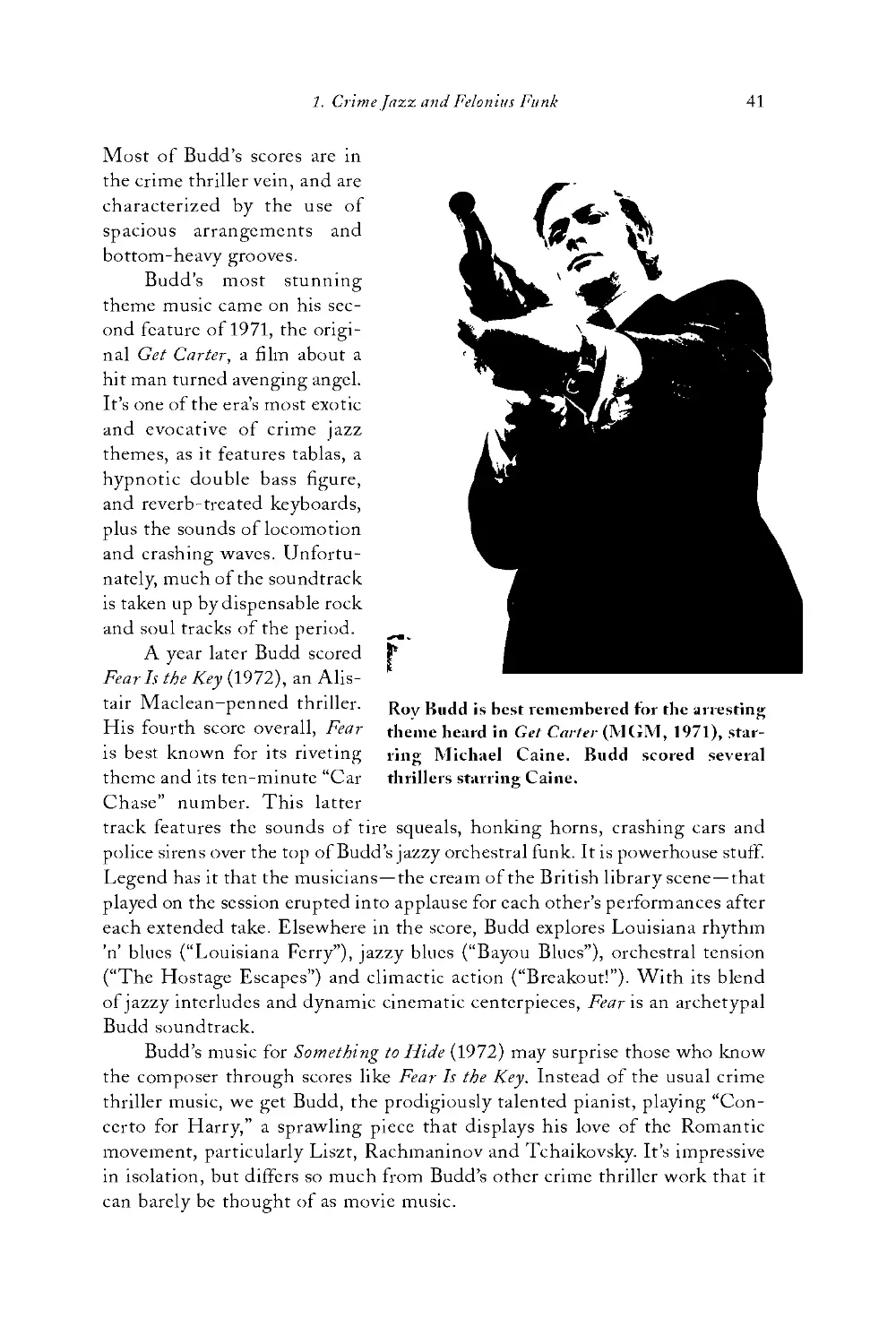
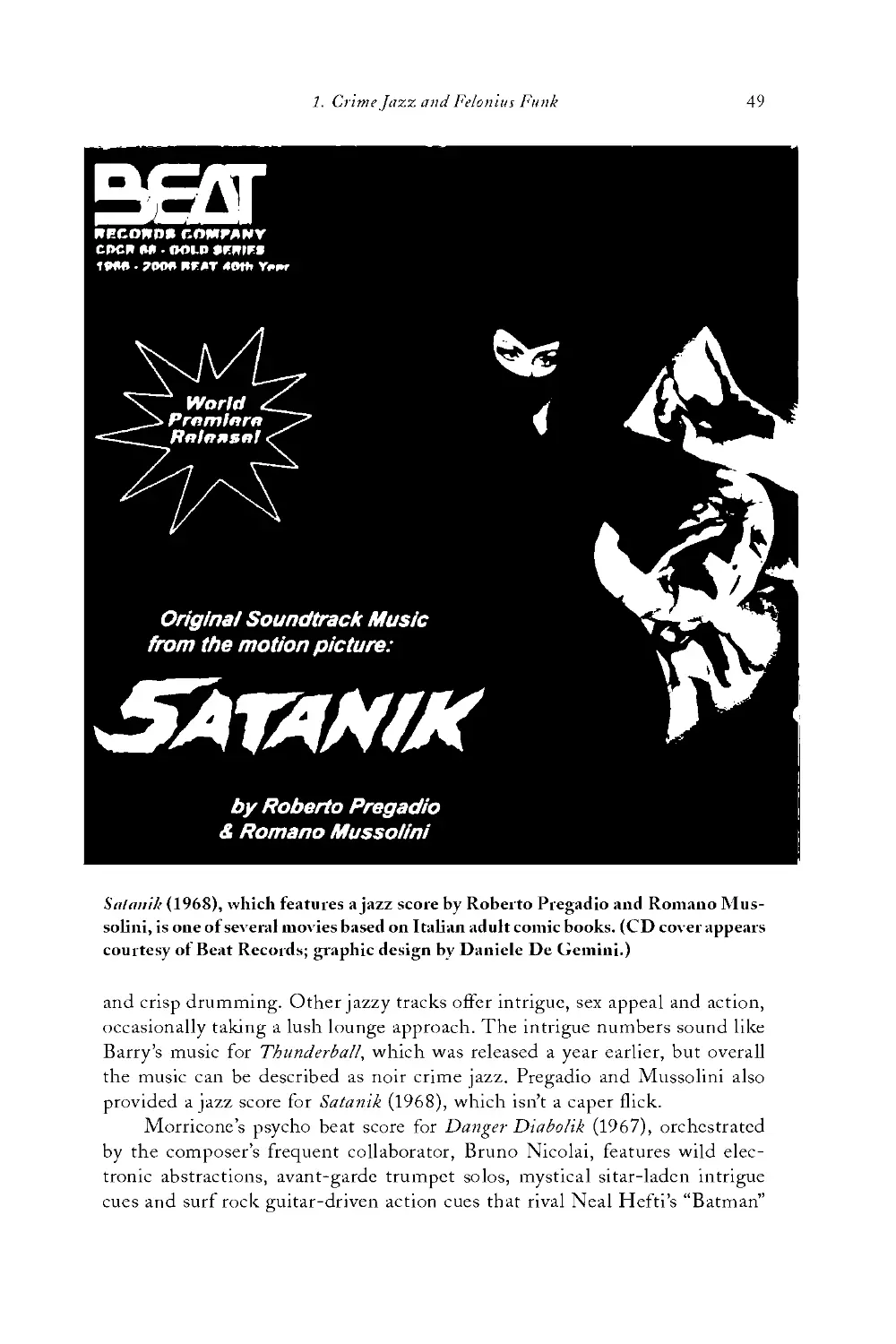
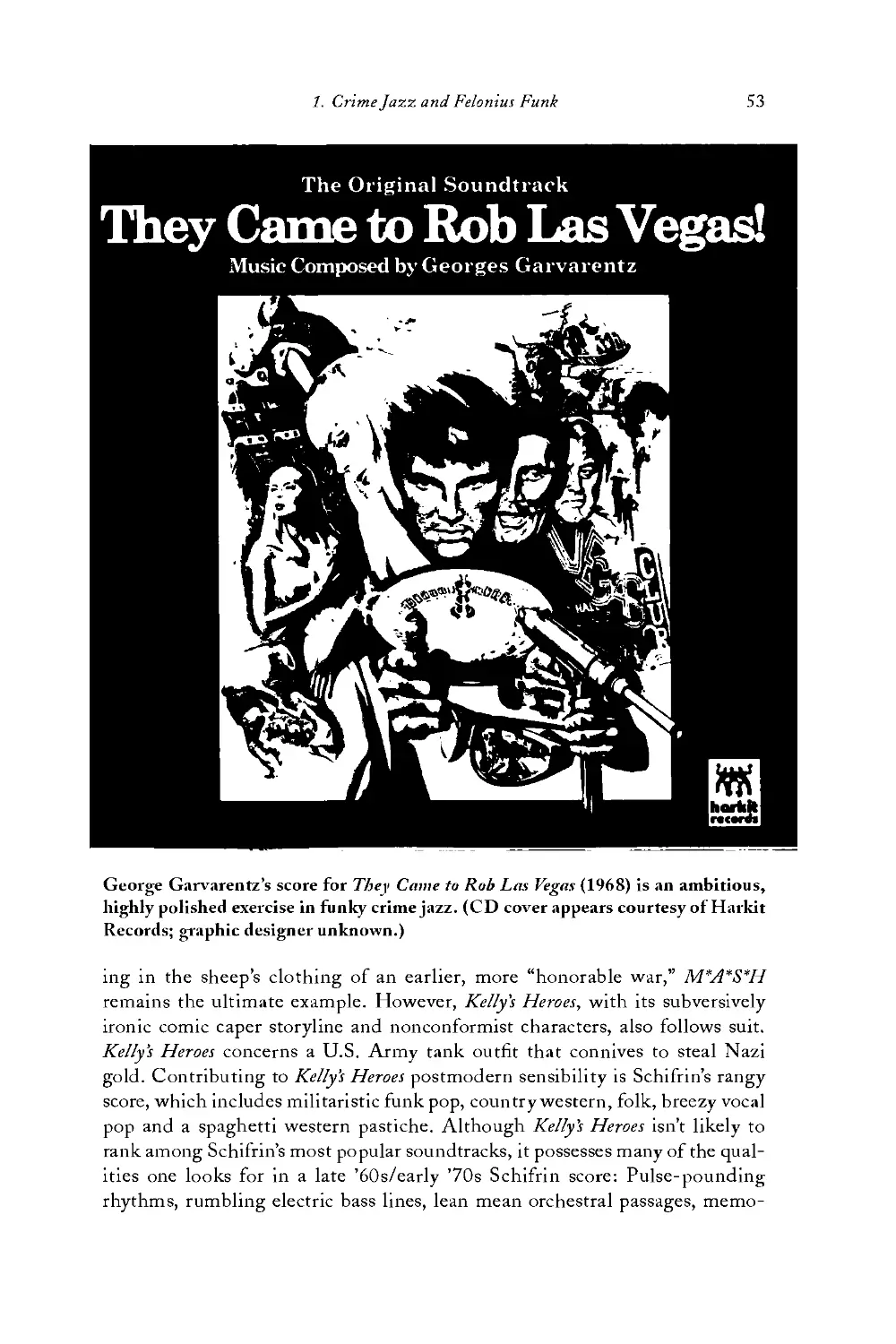
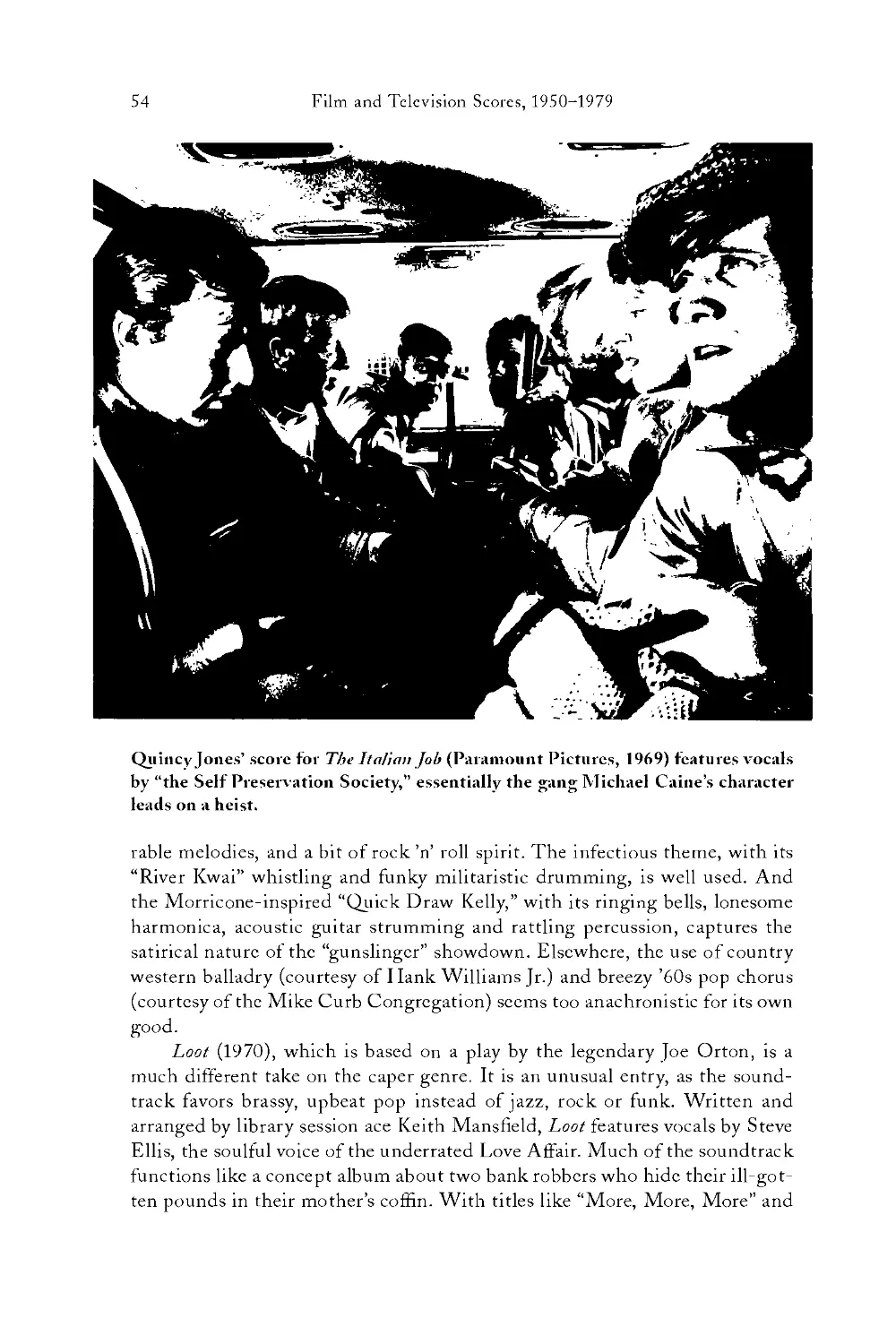
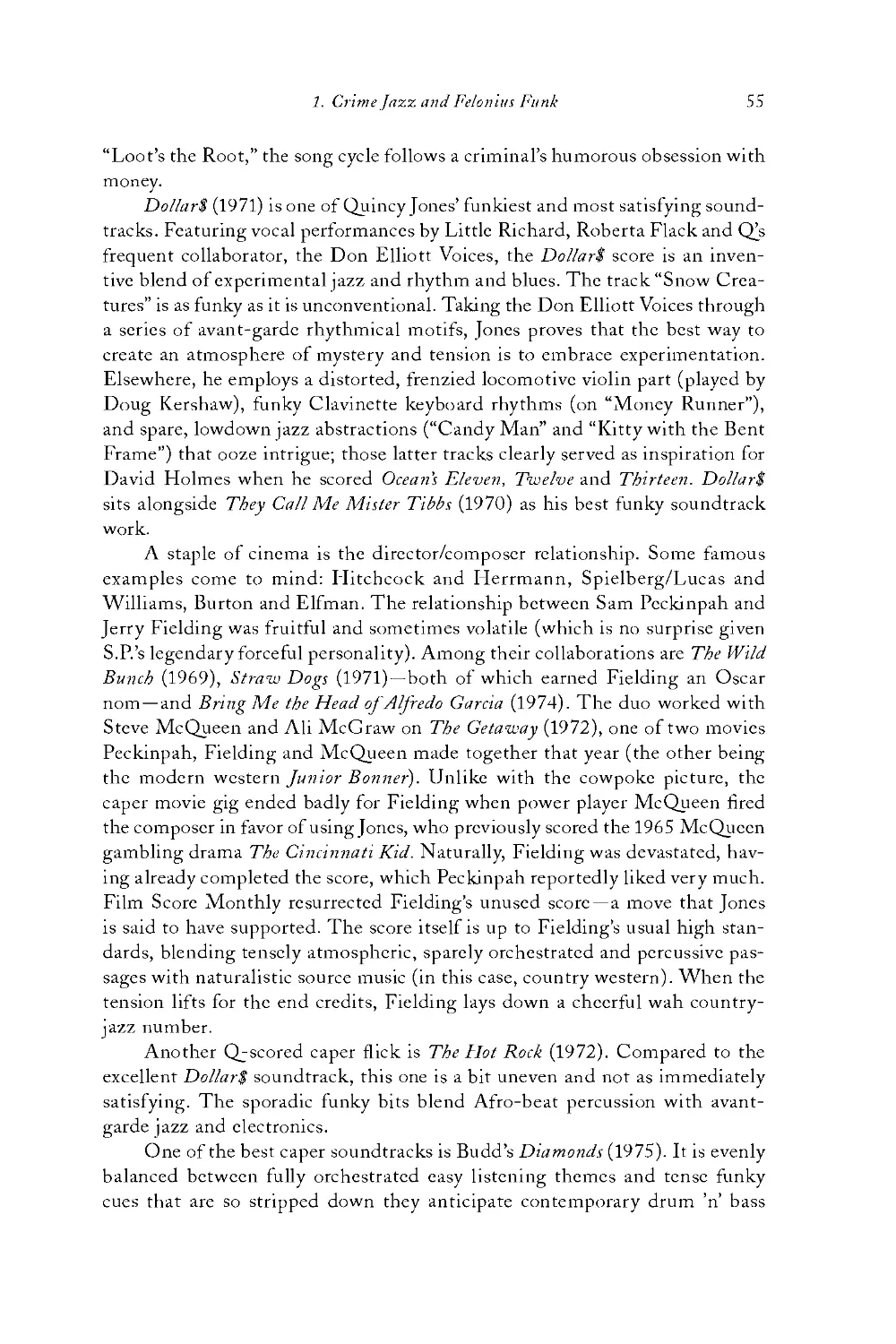
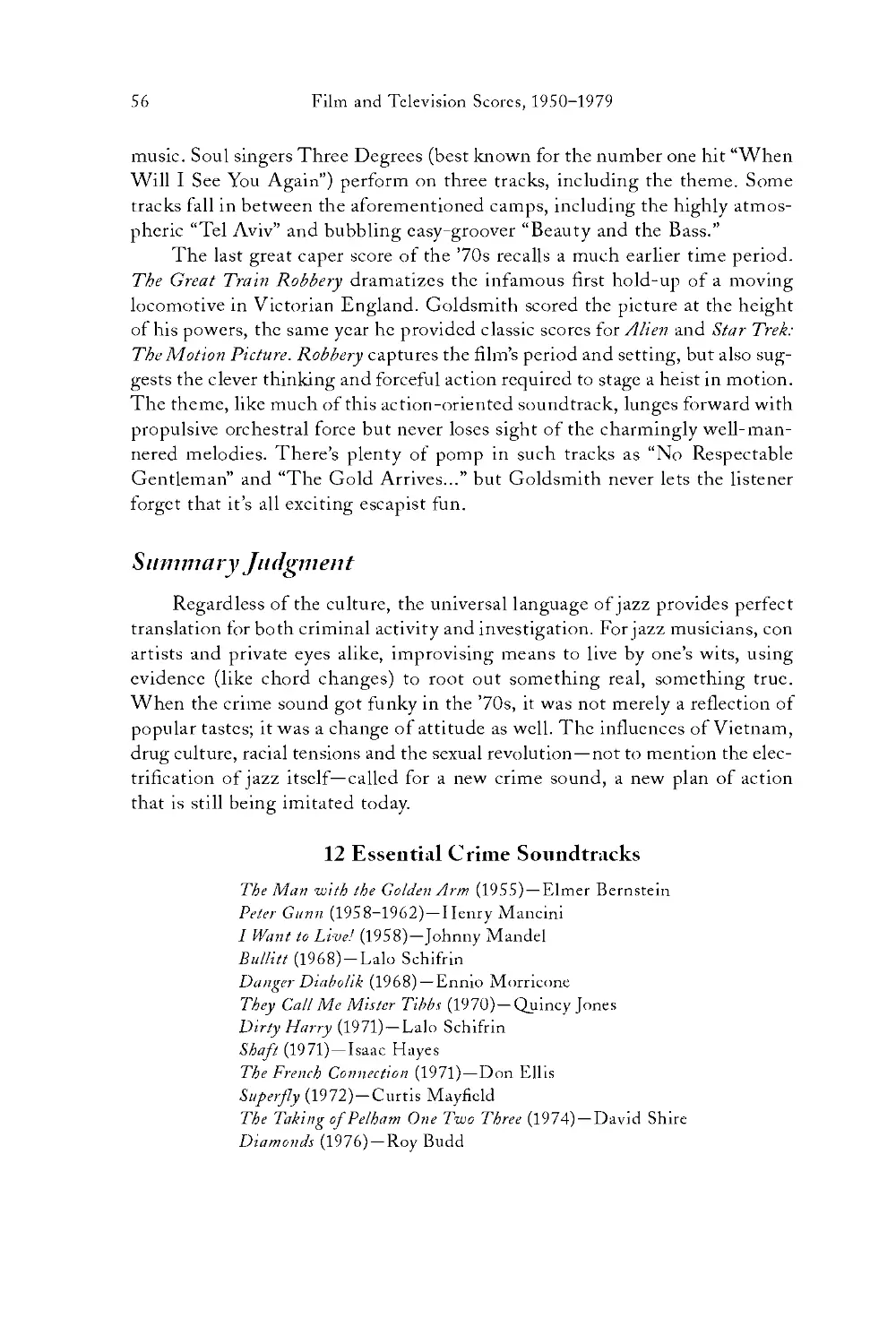
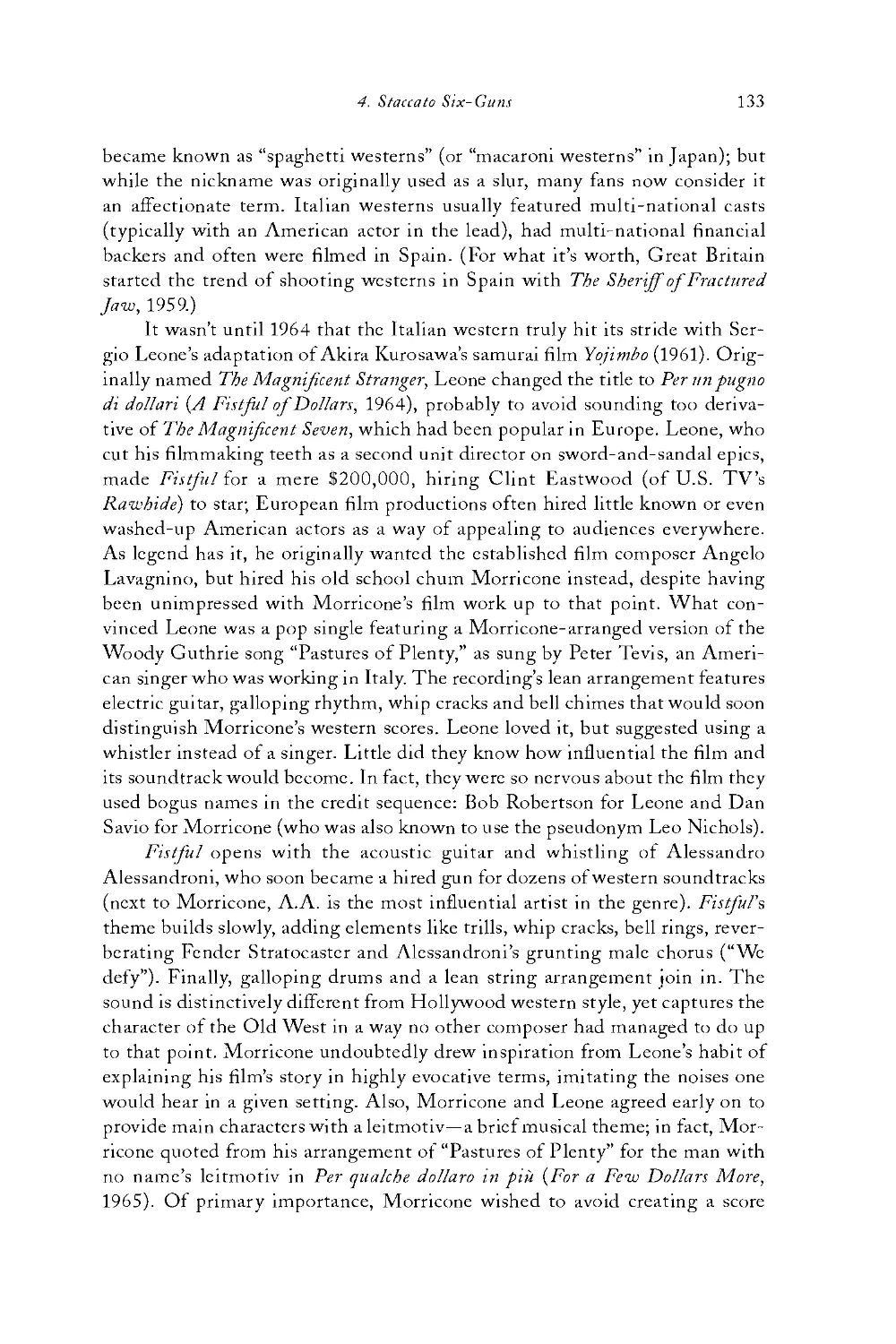
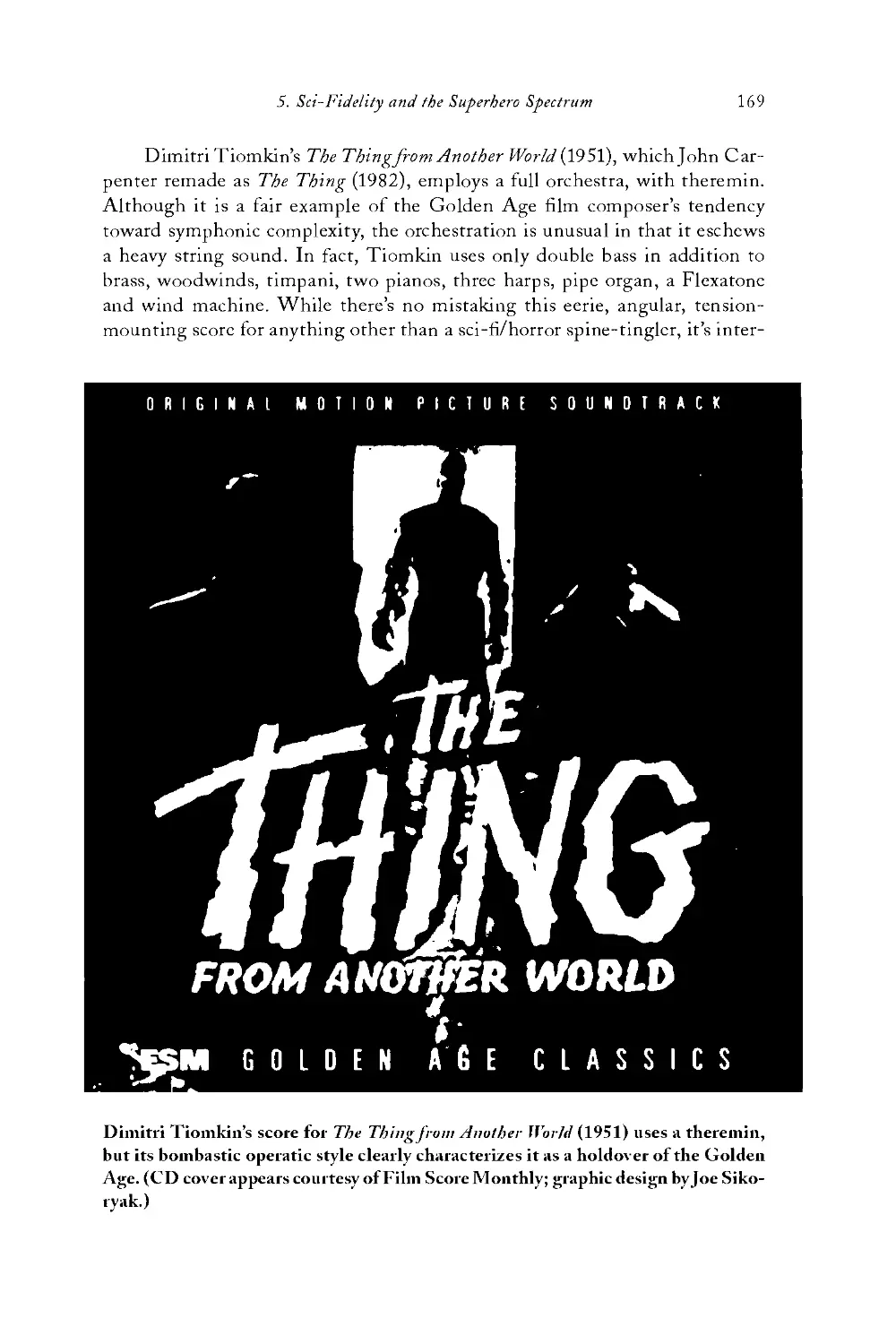
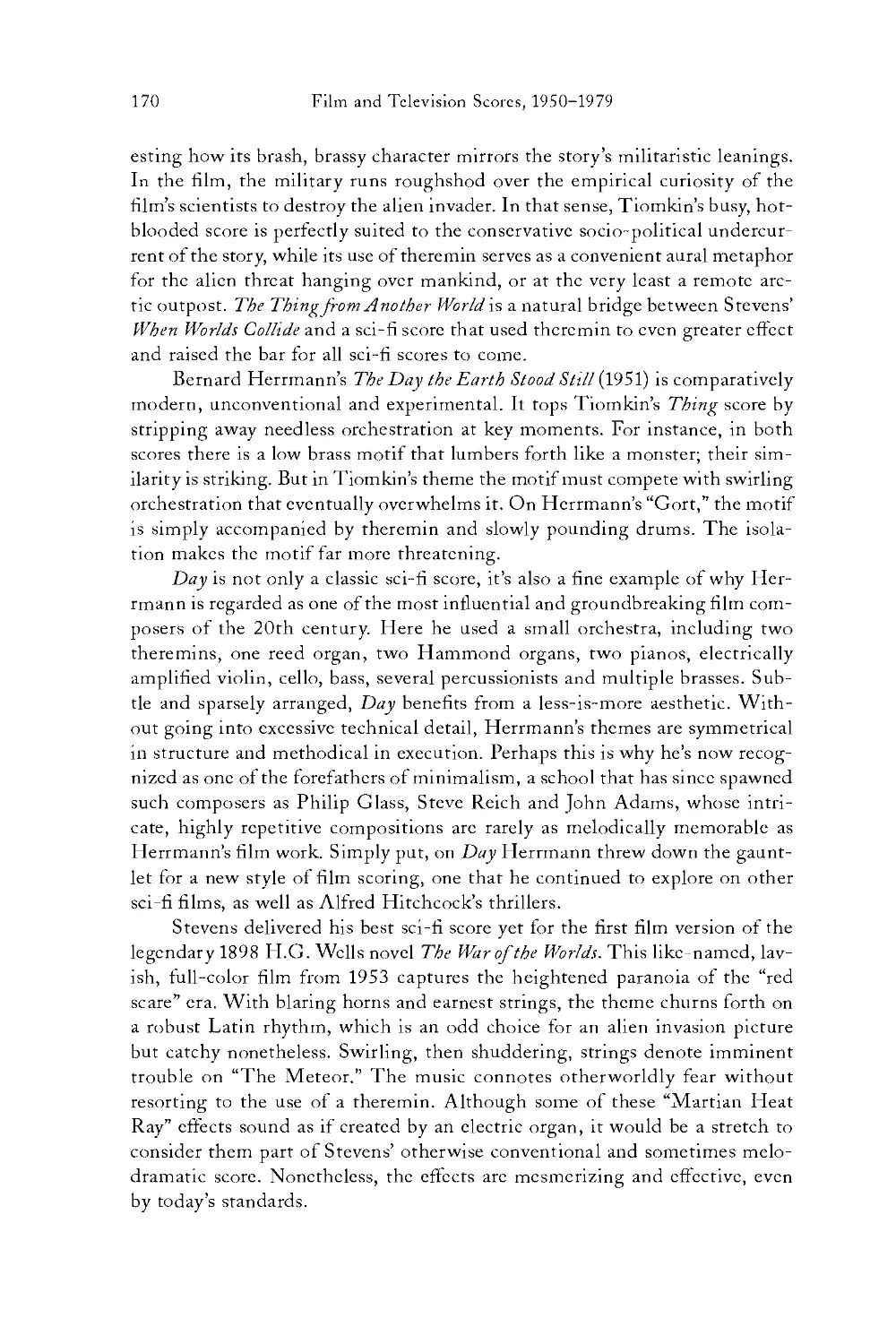
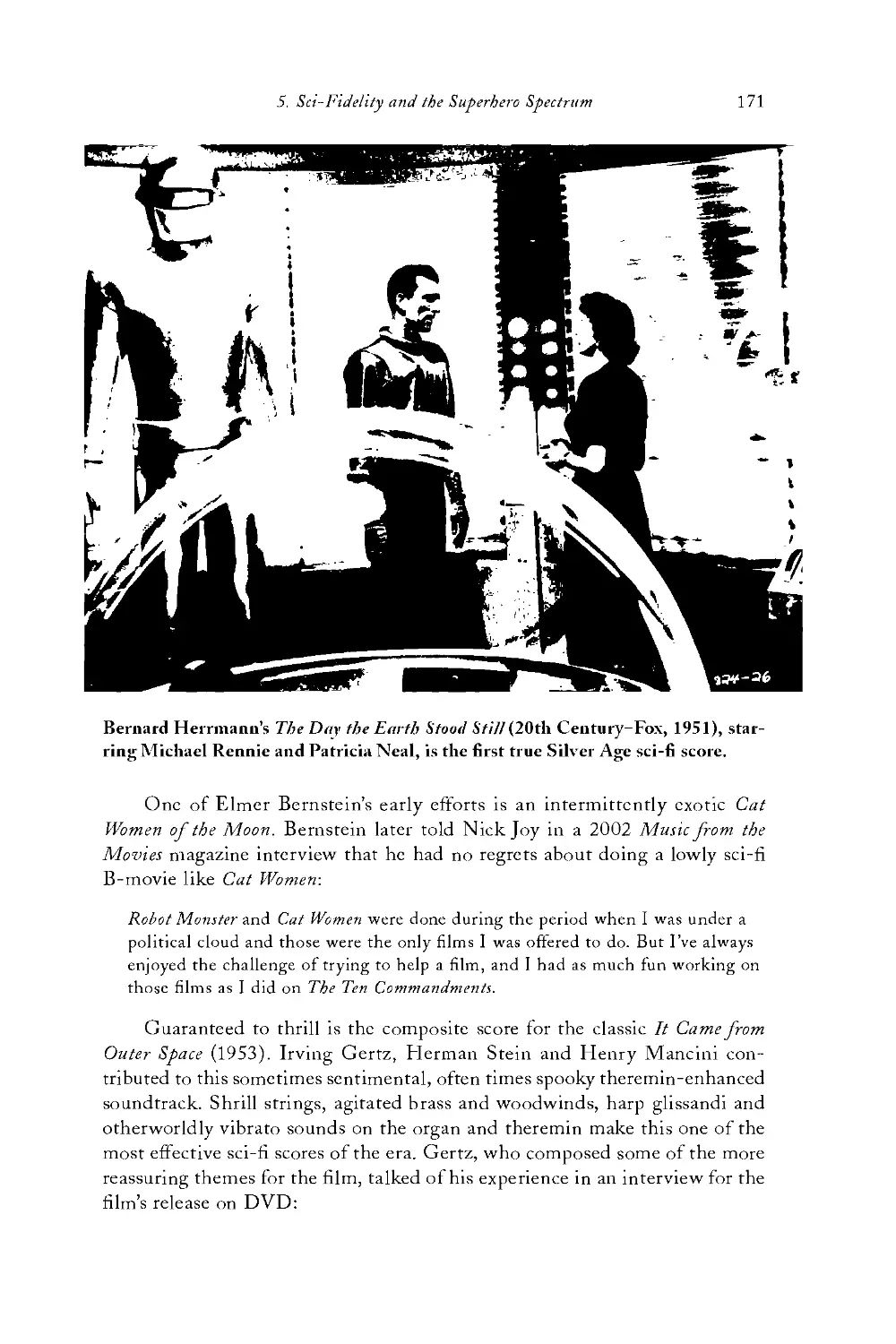
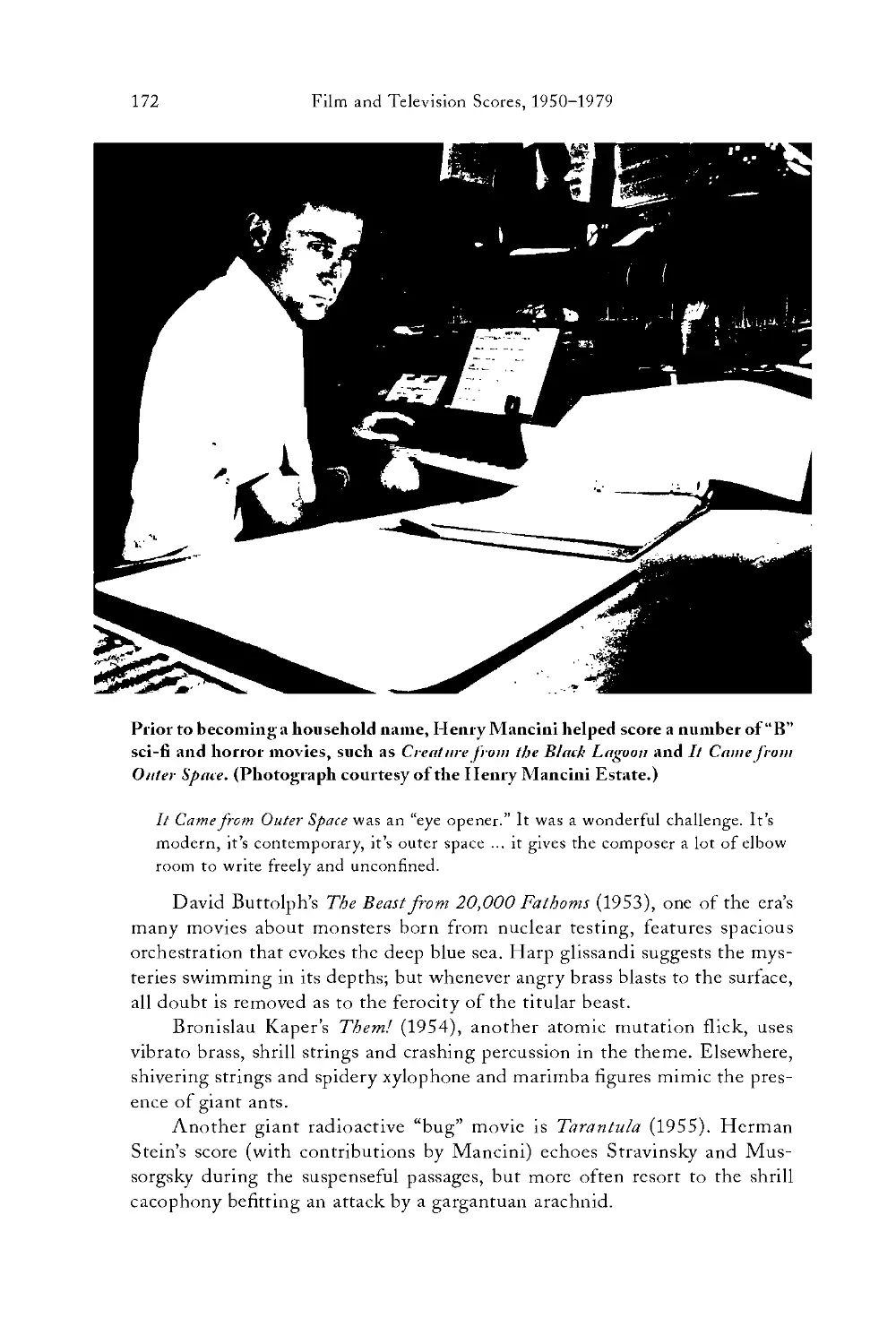
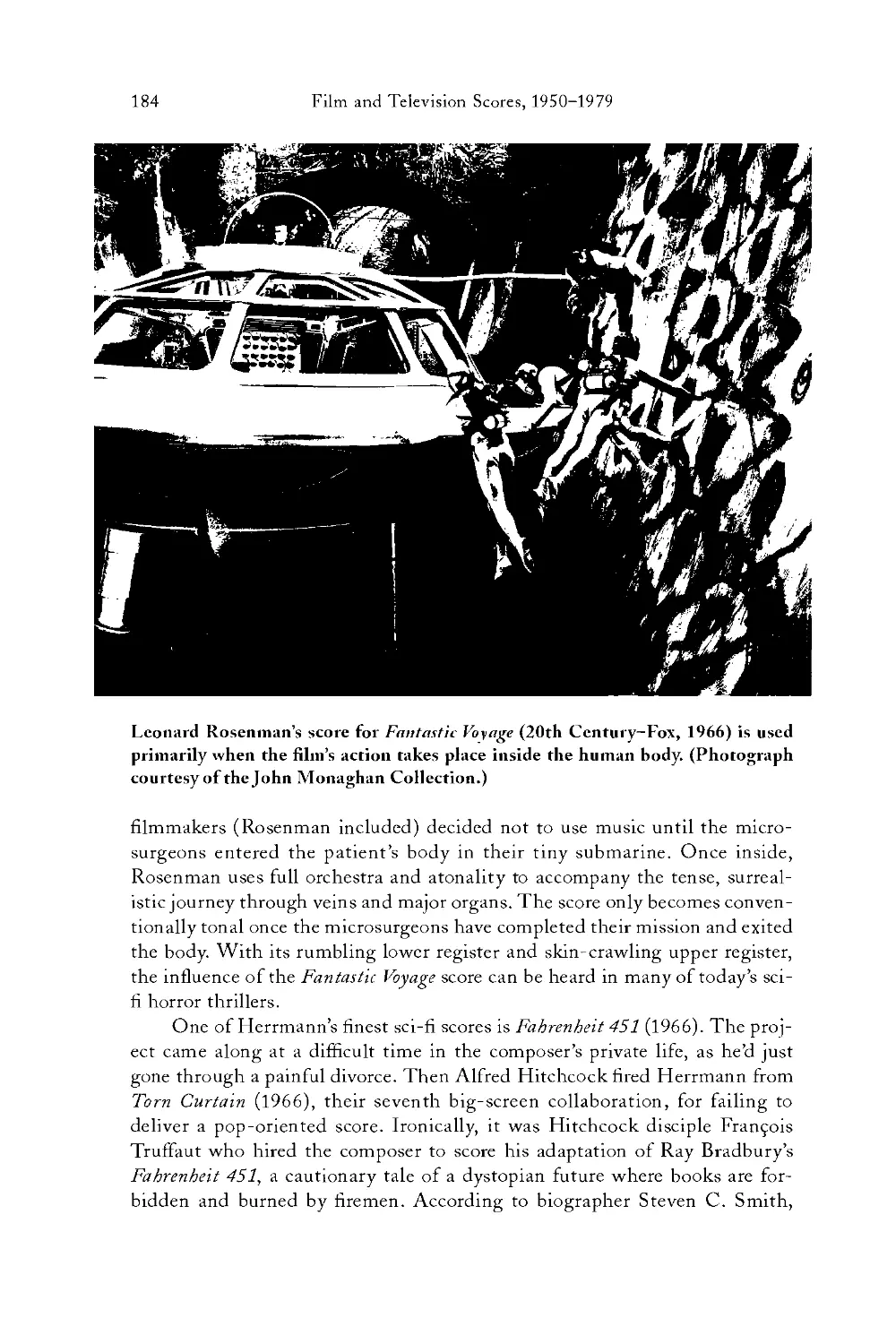
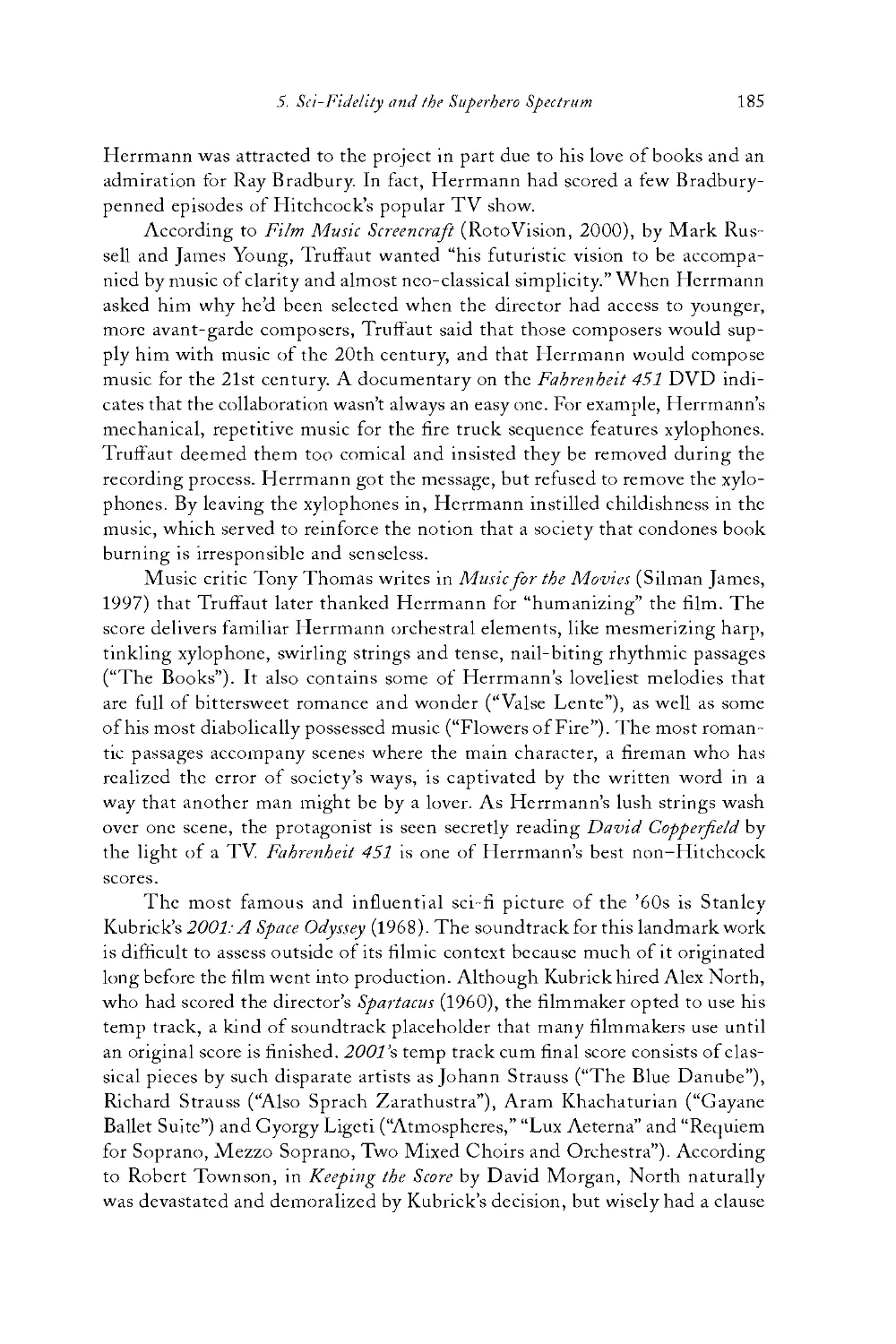
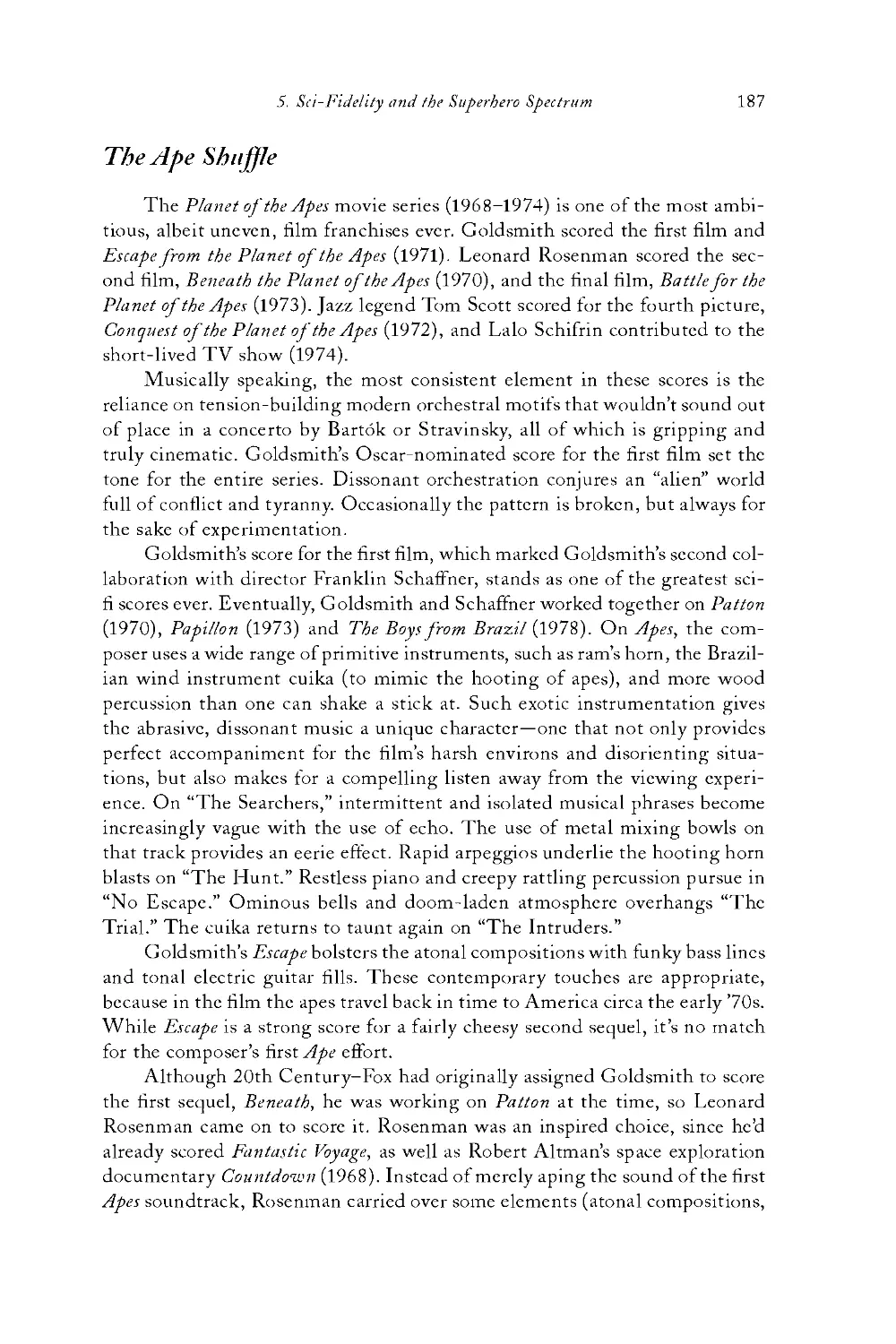
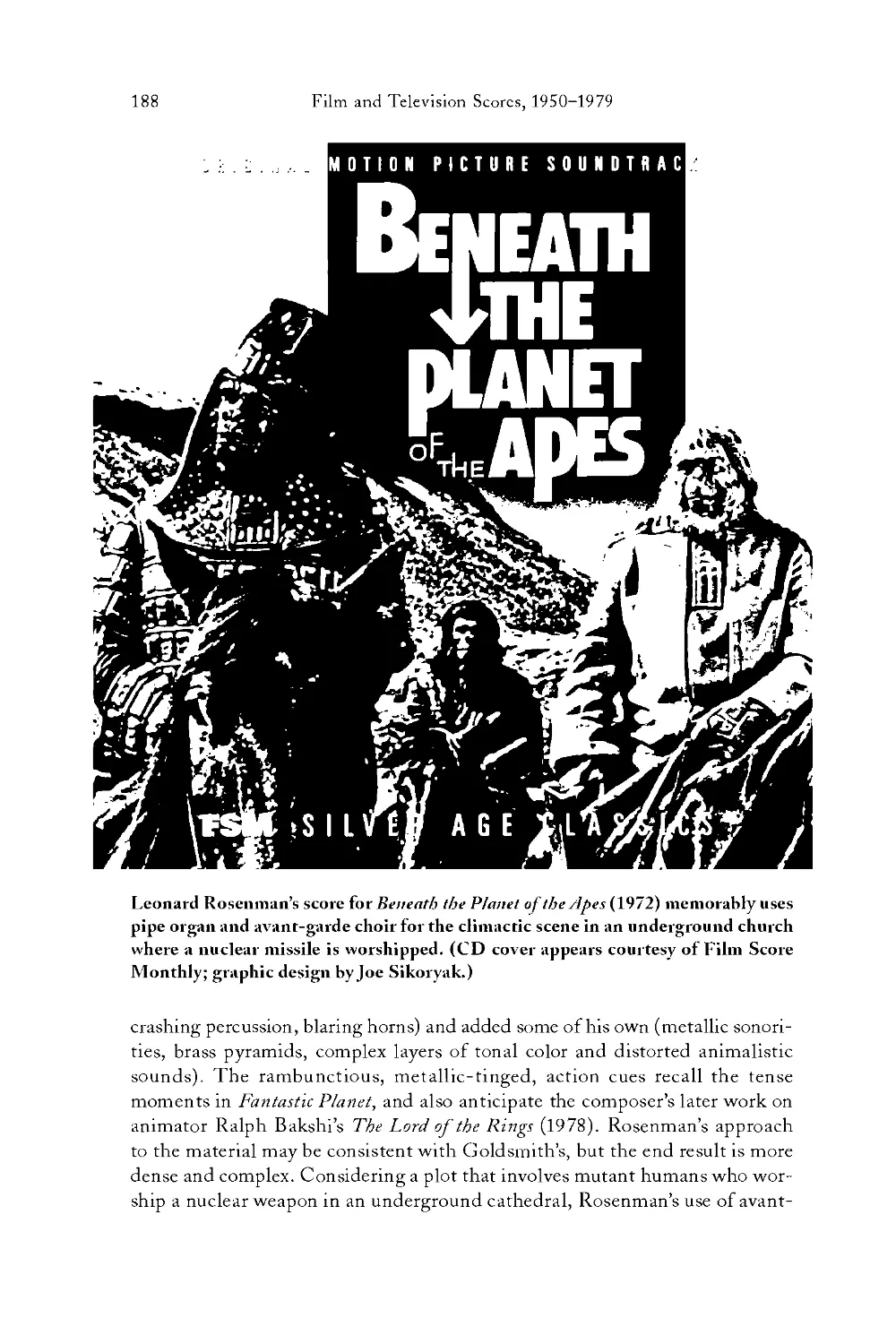




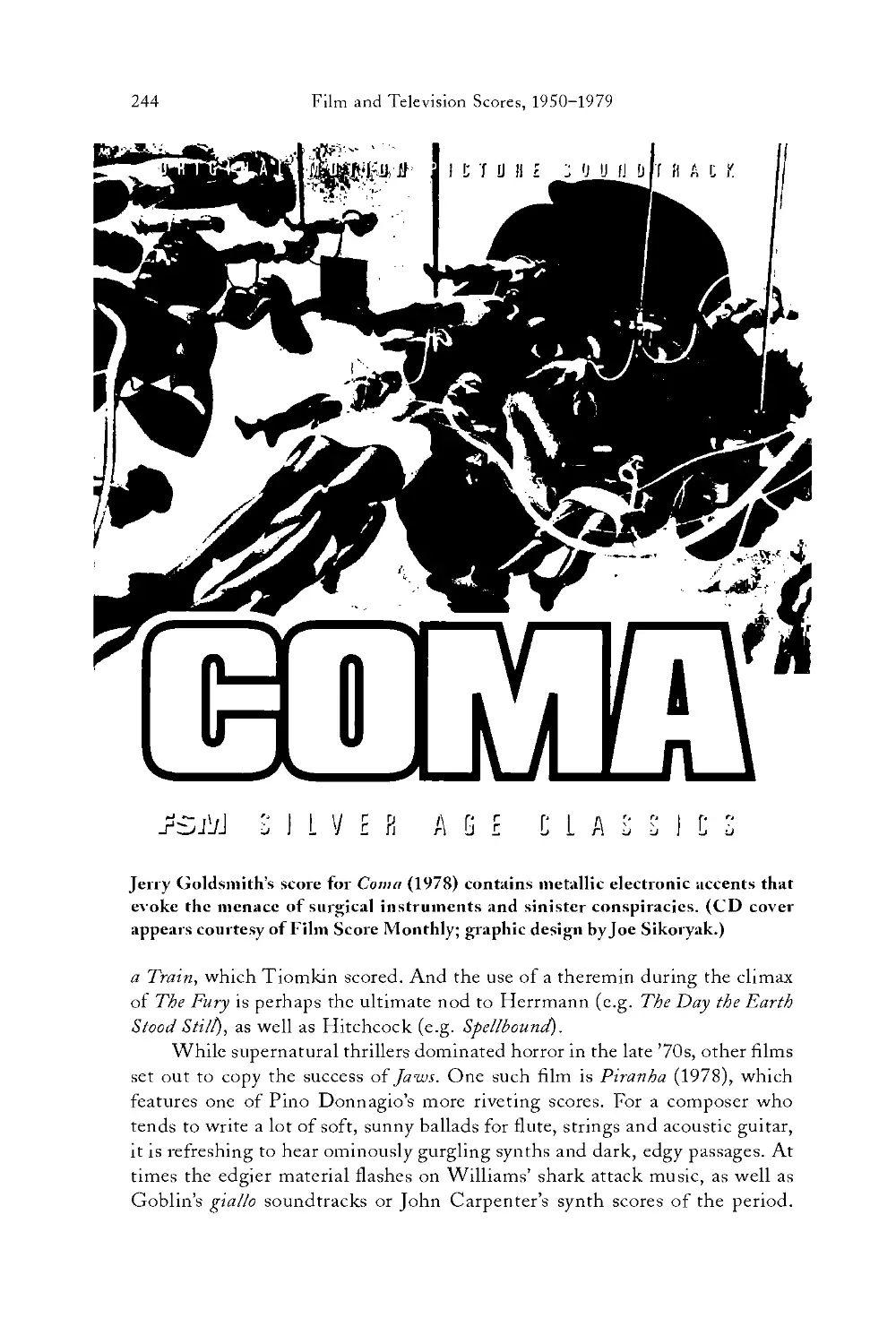
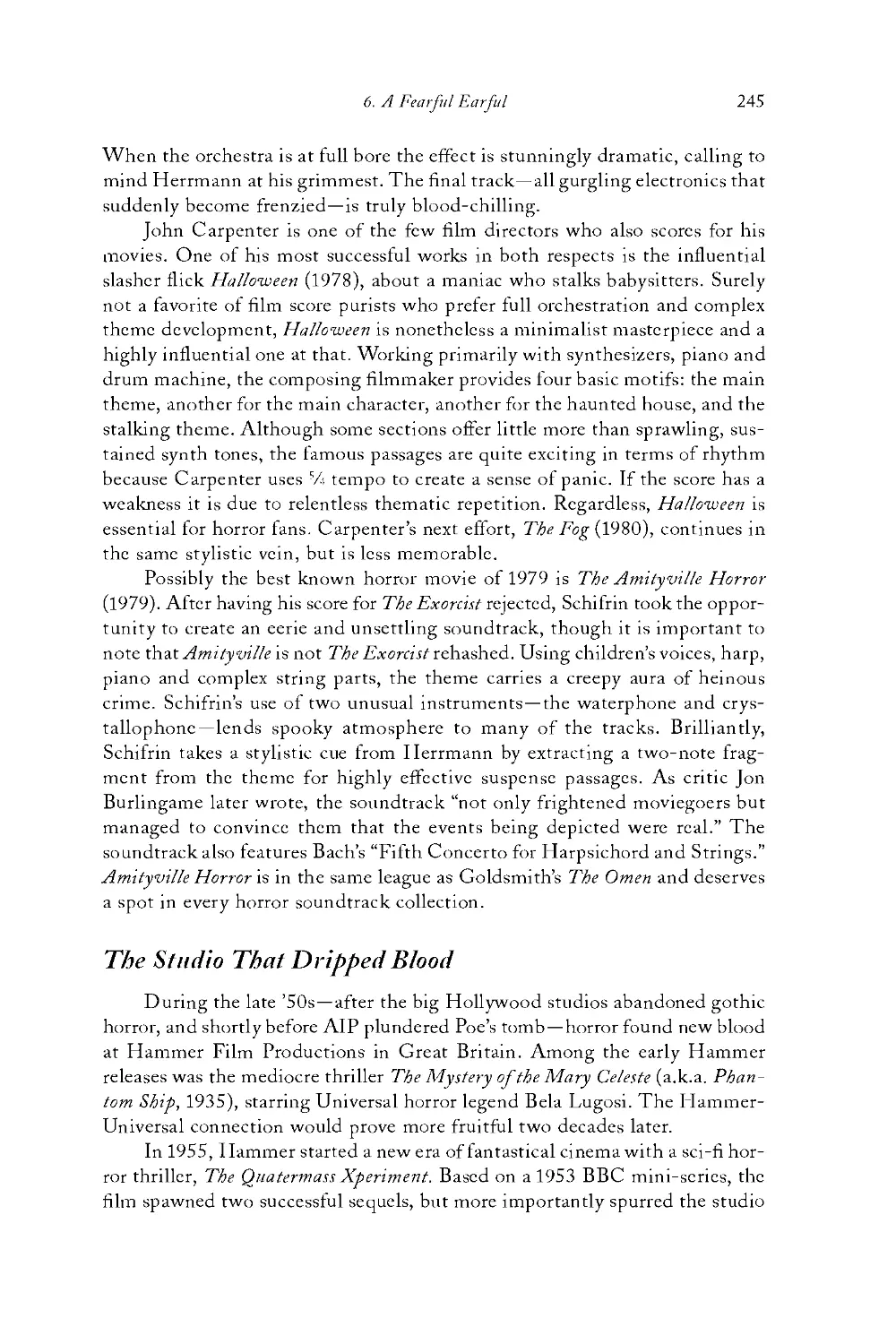
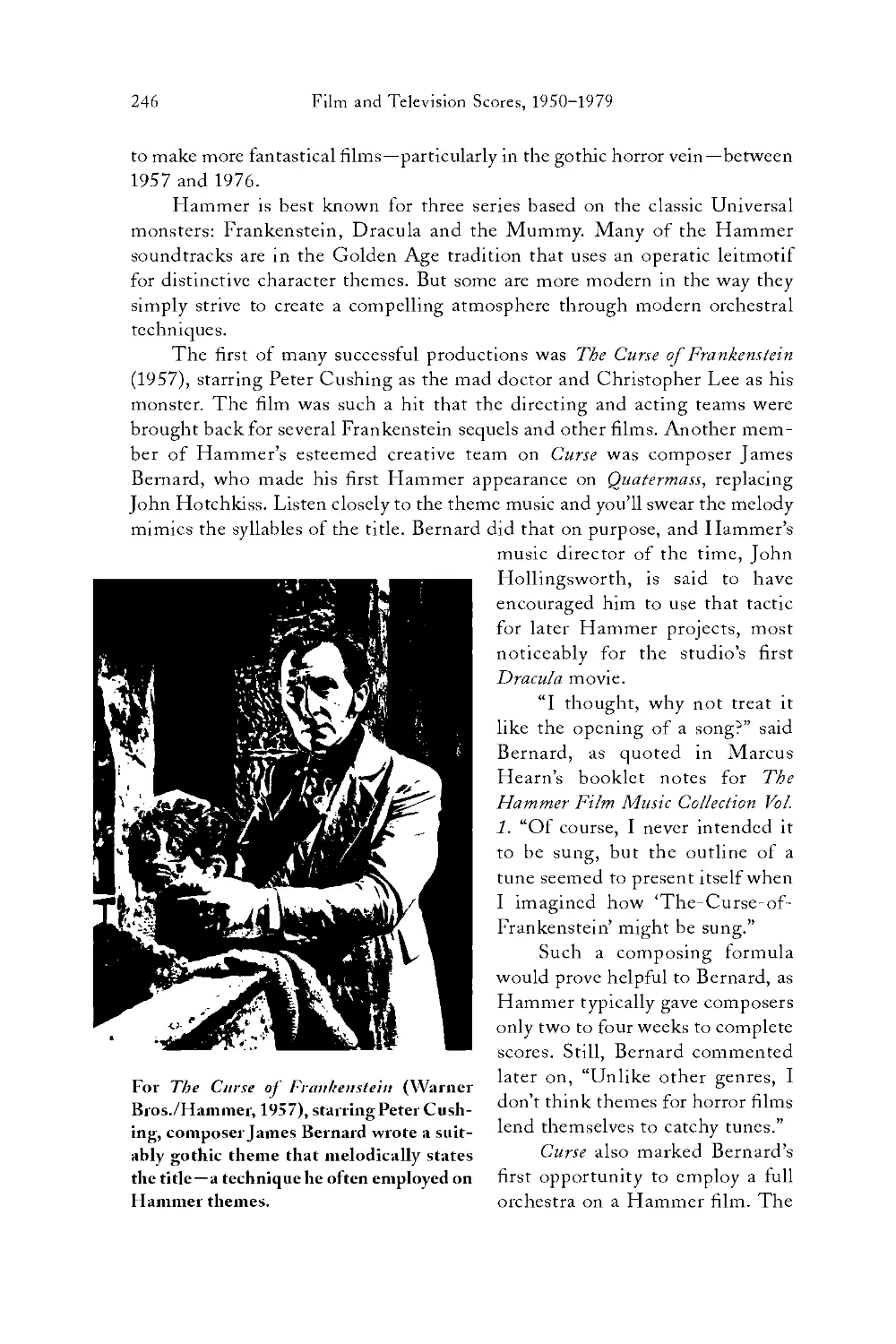
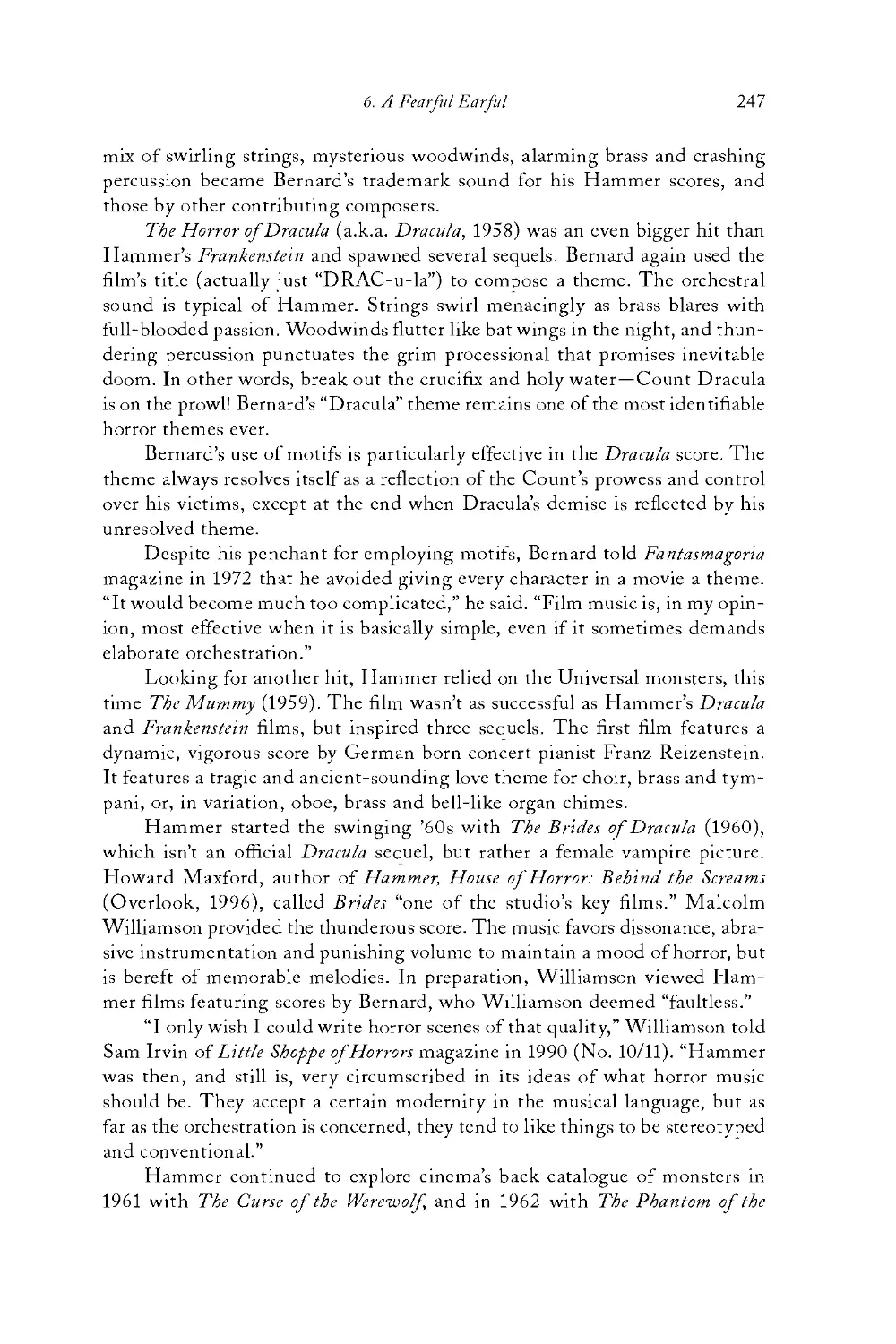
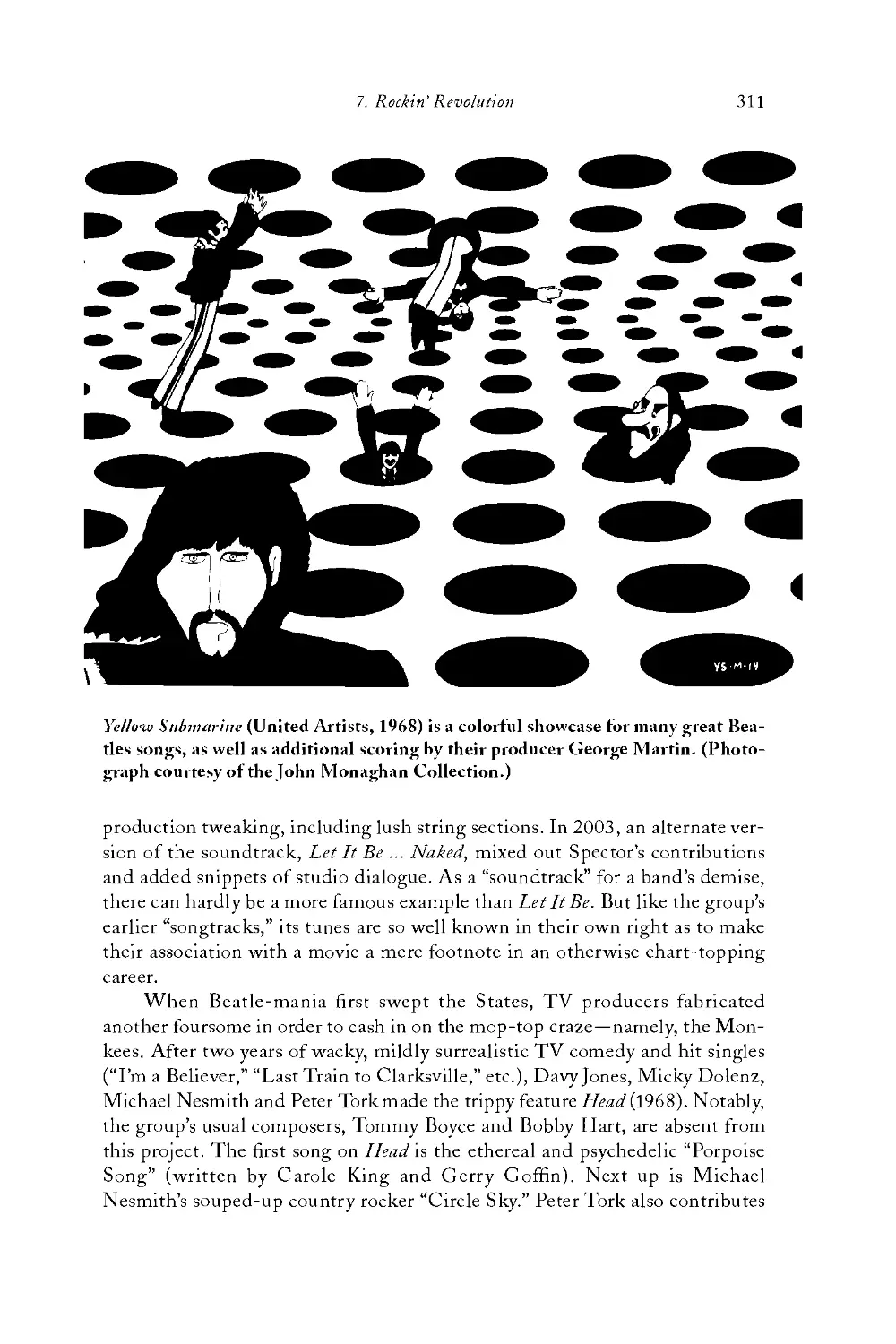


Похожие
Текст
                    n. i<jwfst*w0,^Vfl
^*H*»***
„ Л„9лЛкН1’''«1
>-.< «<«**•*"•* (
n. wW^s[W^
14 The lcs1 ^l:
TELEVISION
SCORES.
I950-I979
A Critical Survey by Genre
KRISTOPHER SPiENCER

Film and Television
Scores, 1950-1979
A Critical Survey by Genre
Kristopher Spencer
McFarland & Company, Inc., Publishers
Jefferson, North Carolina, and London
Photographs are from the author’s collection except as indicated
otherwise.
Library of Congress Cataloguing-in-Publication Data
Spencer, Kristopher.
Film and television scores, 1950-1979 : a critical survey
by genre / Kristopher Spencer.
p. cm.
Includes bibliographical references and index.
ISBN 978-0-7864-3682-8
softcover : 50# alkaline paper
1. Motion picture music — History and criticism.
2. Television music—History and criticism. I. Title.
ML2075.S72 2008
781.5’ 409045 —dc22	2008032756
British Library cataloguing data are available
©2008 Kristopher Spencer. All rights reserved
No part of this book may be reproduced or transmitted in any form
or by any means, electronic or mechanical, including photocopying
or recording, or by any information storage and retrieval system,
without permission in writing from the publisher.
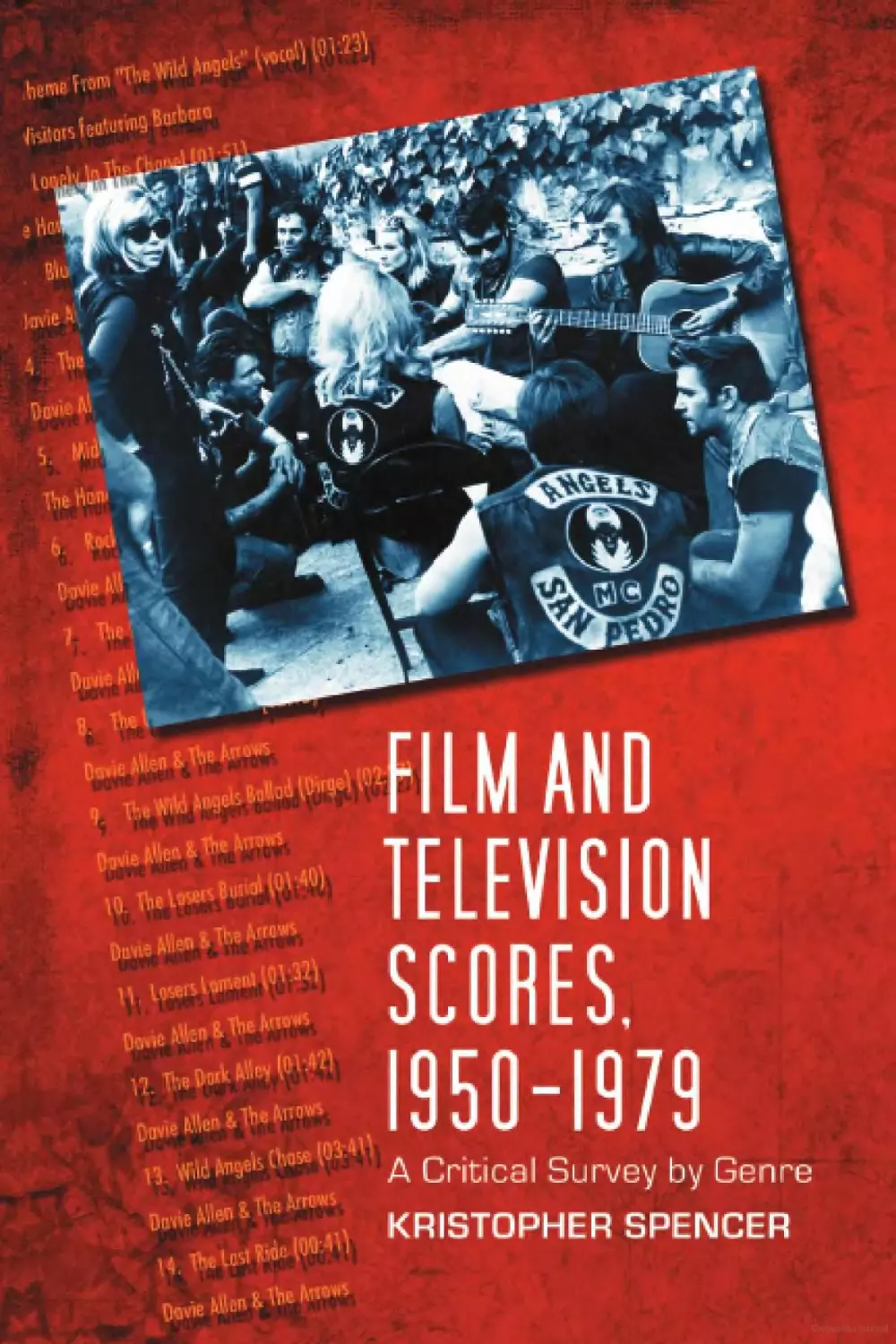
On die cover: The Wild Angels (MGM/A1P, ’66) blurring Peter Fonda
right with guitar and Nancy Sinatra standing left (courtesy of rhe John
Monaghan Collection).
Manufactured in rhe United States of America
McFarland & Company, Inc., Publishers
Box 611, Jefferson, North Carolina 28640
гигиги. mcjdrlandpub.com
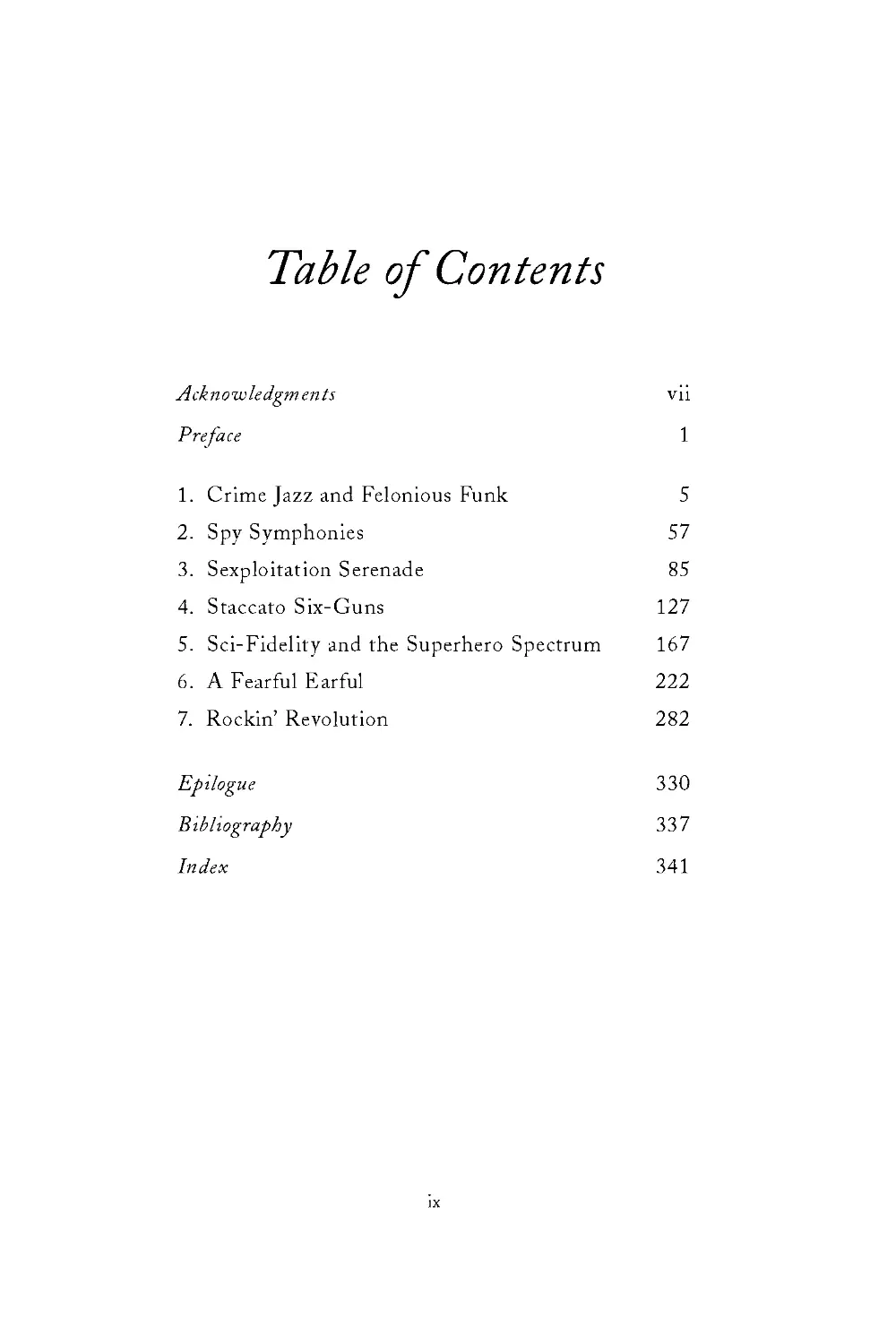
Table of Contents
Acknowledgments	v i i
Preface	1
1.	Crime Jazz and Felonious	Funk	5
2.	Spy Symphonies	57
3.	Sexploitation Serenade	85
4.	Staccato Six-Guns	127
5.	Sci-Fidelity and the Superhero Spectrum	167
6.	A Fearful Earful	222
7.	Rockin’ Revolution	282
Epilogue
Bibliography
Index
330
337
341
IX
This page intentionally left blank
Preface
This book is a selective survey of film and television soundtracks of the
’50s, ’60s and ’70s—arguably the most fruitful and influential period of artis-
tic and commercial development in the film music genre. While the focus is
“Silver Age” film and television scores, some “Golden Age” film scores are
included for the sake of comparison and contrast, and some Golden Age tel-
evision scores merit inclusion due to stylistic similarities with contemporane-
ous film scores. Although defining the timeline of the Silver Age is an inexact
science, the span of 1950-1979 is more than adequate for a thorough survey
of the period’s significant trends and milestones. Generally speaking, the Sil-
ver Age began in the early ’50s when jazz, pop and rock started to influence
film composers (and the filmmakers who hired them with the aim of releas-
ing a movie and soundtrack album that would have popular appeal). Natu-
rally, the Silver Age was preceded by the Golden Age (late ’20s to late ’40s)
and theoretically followed by the Bronze Age (’80s to the present period).
However, cinematic history demonstrates that these precious periods of film
music do not adhere to firm timelines. Arguably, they merely reflect the gen-
eration of the composer or the artistic needs and commercial ambitions of the
production. One might even argue that “Bronze Age” soundtracks merely fea-
ture an amalgamation of the styles developed during the earlier eras. That,
however, is a subject for another tome.
By considering the influence of popular music on film scoring it can be
argued that Alex North’s jazz-tinged Л Streetcar Named Desire (1951) is the first
Silver Age soundtrack. Even so, Streetcars arrival did not bring a halt to the
use of Golden Age film composers, nor did its brassy music discourage those
composers from writing in the classically influenced style of previous decades.
The well-established generation of mostly European-born composers such as
Miklos Rozsa, Max Steiner, Franz Waxman, Erich Wolfgang Korngold and
many others continued to compose in the sweeping symphonic style inspired
by the Romantic classical composers of the 19th century. Great examples of
Golden Age scores from the ’50s and early ’60s can be heard in Last for
Life (1956), Ben-Hur (1959), Sodom and Gomorrah (1962), all by Rozsa; The
Caine Mutiny (1954), Marjorie Morningstar (1958), both by Steiner; and Rear
1
2
Preface
Window (1954), Peyton Place (1957) and Taras Bulba (1962), all by Waxman.
However, by the late ’50s the older composers found themselves increasingly
in competition with younger composers for film assignments as well as tele-
vision productions, and often struggled to deliver the modern sounds filmmak-
ers demanded. Even a relatively young Golden Age composer like Bernard
Herrmann resisted the trend toward more youth-oriented music styles.
Meanwhile, the younger generation of film composers, including North,
Henry Mancini, John Williams, Elmer Bernstein, Jerry Goldsmith and many
others, proved willing to experiment with various styles while occasionally
writing more traditional scores, depending on the production. For example,
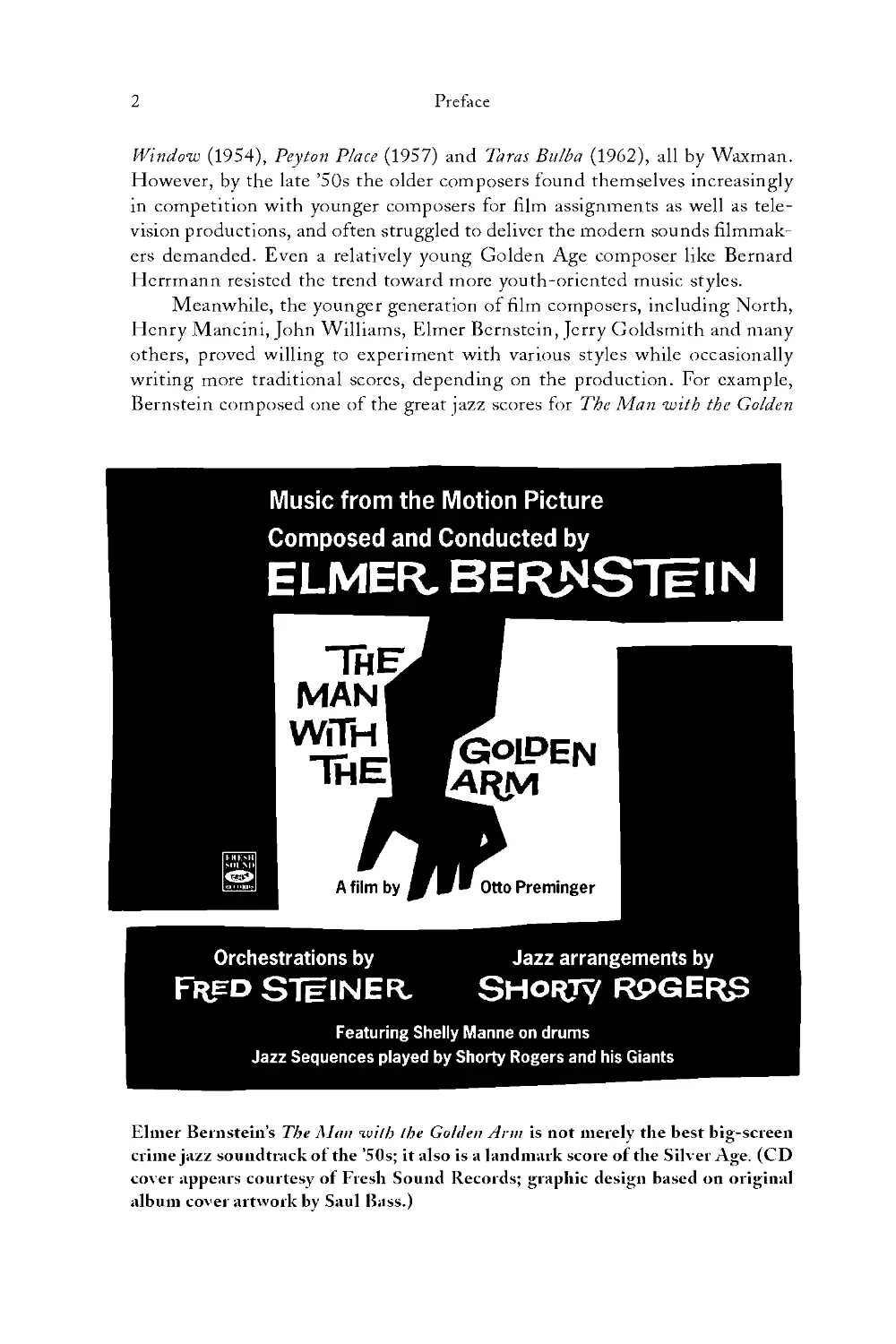
Bernstein composed one of the great jazz scores for The Man with the Golden
Music from the Motion Picture
Composed and Conducted by
ELMER, BERGSTEIN
Orchestrations by	Jazz arrangements by
Fred STeINER,	Shorjv RPGER3
Featuring Shelly Manne on drums
Jazz Sequences played by Shorty Rogers and his Giants
Elmer Bernstein’s The Alan with the Golden Anu is not merely the best big-screen
crime jazz soundtrack of the ’50s; it also is a landmark score of the Silver Age. (CD
cover appears courtesy of Fresh Sound Records; graphic design based on original
album cover artwork by Saul Bass.)
Preface	3
Arm (1955), but later revived the grandeur of the Old West in Golden Age
style for The Magnificent Seven (1960). North, having set the Silver Age in
motion with Streetcar, also composed a suitably epic-sounding Spartacus (1960).
Essentially, the younger composers had learned from the older masters of the
genre, but weren’t entrenched in the old ways.
As the ’60s progressed, the symphonic style fell out of fashion as more
and more filmmakers asked for soundtracks that would appeal to a younger
audience. In 1964, the Beatles’ soundtrack, or rather “songtrack,” for A Hard
Day's Night out-grossed the film’s profits. It was hard to argue with the youth-
oriented music’s commercial viability. But it wasn’t just rock and jazz that
made the Golden Age style seem antiquated; it also was rhythm and blues,
soul and funk. And, where popular forms proved inappropriate, Silver Age
composers delivered orchestral scores that had more in common with avant-
garde 20th-century classical movements of atonahty, serialism and experi-
mental electronics than the romantic 19th-century style favored by their
forebears. As a result, the Silver Age period from 1950 to 1979 offered more
stylistic variety than the Golden Age, and paved the way for the seemingly
limitless variety heard in film and television soundtracks today.
But the old style proved resilient after all. Grand symphonic overtures
and heroic orchestration roared back into favor in the late ’70s with Williams’
blockbuster Star Wars (1977). Since then, film soundtracks have incorporated
elements from the Golden Age and the Silver Age. Contemporary film com-
posers serve up epic scores (such as Howard Shore’s Oscar-winning work on
The Lord of the Rings trilogy) as well as experimental scores (such as Shore’s
jazz collaborations with saxophonist Ornette Coleman for Naked Lunch). How-
ever, the dominant legacy of the Silver Age is the commercialization of film
and television soundtracks as a marketable item that is at once a souvenir of
the theatrical release or TV program, and a creative, commercial work that
can stand on its own merits.
Although a great deal of film music was recorded prior to the ’50s, most
of it wasn’t released on LP or any other transportable commercial format. In
other words, if one enjoyed hearing the music for a particular film, such as
Casablanca (1942), one had to sec the movie again to hear Max Steiner’s won-
derful score. Even Streetcars initial release was limited to select tracks on an
extended play (EP) record and a set of 45 rpm records instead of a long play-
ing (LP) format that would come to dominate the film music genre in decades
to come. (In 1951, the LP format was still new and hadn’t yet reached wide-
spread household use.) Today we take it for granted that most major films
(and many minor ones) receive soundtrack releases concurrent with their the-
atrical run. Sometimes these soundtracks actually contain legitimate film music
(or at least re-recordings for the CD release), but just as often they contain a
mix of commercially viable songs by popular recording artists that may or may
not have been used in the film or TV show they supposedly represent. Purists
4
Preface
tend to scoff at these so-called “music from and inspired by” collections, but
such releases often outsell the actual film scores, which tend to favor orches-
tral instrumental music by composers who rarely have household name sta-
tus. The movement toward “songtracks” has roots in the movie musical
(sprouted with the movie-tie-in albums of Elvis Presley and the Beatles),
which flowered in the late ’60s with the hit soundtracks for The Graduate (1967)
and Easy Rider (1969), and pollinated the genre with the blockbuster release
of Saturday Night Fever (1977).
This book examines the evolution of the Silver Age soundtrack through
a variety of film genres and musical styles. Not every film and television sound-
track release from that period is accounted for here, due in part to the limita-
tions of the genre-specific chapter themes. Despite the inevitable gaps, it has
been my aim as author to contextualize the development of various stylistic
strains through specific types of film and television productions. From crime
show and spy thriller to horror, sci-fi and beyond, this work aims to spotlight
the best of each genre alongside the lesser entries, while calling attention to
hidden treasures—soundtracks that outshine the productions they were com-
posed to accompany. The book also examines many soundtracks for foreign
films, which became increasingly popular and influential in Hollywood dur-
ing the Silver Age. Moreover, the Epilogue examines the revival of interest in
Silver Age scores and their influence on contemporary musicians within and
outside of the film and television industries.
Although film and television soundtracks rarely sell in the quantities that
qualify them as popular successes, the genre remains one of the richest in 20th-
century music. Through the sophisticated formal disciplines of score compo-
sition and orchestration, soundtracks are capable of tapping into the infinite
possibilities of drama, comedy, action and emotion—vicarious experiences—
in a way that popular music generally cannot. It is music of the imagination.
Chapter 1
Crime Jazz
and Felonious Funk
To enter the world of Silver Age crime soundtracks is to embrace the dark
side of film and television entertainment—from post-war noir and the early
days of TV crime shows to the gritty, cynical films of the Watergate era. The
crime scores of the ’50s, ’60s and ’70s mirror the evolution of the era’s film
music in general—notably the embrace of jazz and, later, funk, rock, soul and
avant-garde classical.
Prior to the Silver Age of cinema and Golden Age of television, the crime
genre made its transition from pulp magazine pages to radio programs, such
as The Shadow, and movie serials, like Dick Tracy’s G-Men. These hero-ori-
ented productions were presented with rehashed orchestral scores only a few
notes removed from 19th-century and early 20th-century classical works, such
as Nikolai Rimsky-Korsakov’s “Flight of the Bumble Bee,” Modest Mus-
sorgsky’s “Night on Bald Mountain” and Gustav Holst’s “The Planets.” In
each case, robust orchestrations accompany the epic struggle between hero
and villain as violins soar triumphantly.
By the mid-1950s, however, the line between good and evil became
increasingly tenuous. Do-gooder crime-fighters came with bad habits and
dubious virtue. They didn’t always “get their man,” and dames often proved
to be more trouble than even the most corrupt criminals. For this new era of
moral ambiguity the only music that would prove apropos was jazz.
In the ’50s jazz was still a fairly commercial music genre, though not
nearly on the level of its dance floor incarnation better known as swing. To be
considered a sophisticate in the post-World War II era often meant digging
the sound of jazz, whether one was a beatnik or not. In the context of film
noir and TV crime shows from 1950 to 1965, jazz perfectly accompanied the
images of rain-drenched streets, smoky private eye consultations and backroom
busts.
“[Jazz | represented something lean, tough, cynical, and intelligent —
adjectives that applied easily enough to the detective heroes of these pictures.
These guys weren’t well described by a soft violin. Instead, the metallic-yet-
5
6
Film and Television Scores, 1950-1979
soulful saxophone summed up this brave new world,” wrote Skip Heller in the
CD booklet notes of Crime Jazz: Murder in the Second Degree (Rhino, 1997).
That’s not to say that jazz and the crime jazz of film and TV productions
is the same beast. For one thing, crime jazz is mostly scripted and arranged
for big bands, whereas the stylistically similar “cool” jazz and bebop of that
period favored small group improvisation and long solos. Many West Coast
musicians played crime jazz for the paycheck, not for the artistry. In fact, it
wasn’t until Johnny Mandel scored I Want to Live in 1958 that true jazz musi-
cians were even granted an opportunity to compose a Hollywood score.
Sowing for a Crime
The composer who usually gets credit for introducing jazz to the silver
screen is Miklos Rozsa for The Asphalt Jungle (1950). A Hollywood veteran
since 1937, Rozsa had scored many films, including Double Indemnity and Spell-
bound, before scoring John Huston’s urban potboiler. While The Asphalt Jun-
gle score contains jazz elements, it still leans heavily on the orchestral approach
long favored by Hollywood studios. (It’s worth noting that Rozsa’s final film
score — the noir spoof Dead Men Don't Wear Plaid [1982] — also favors the jazz
sound.)
In 1951, a younger composer, Alex North, delivered a score that truly set
the tone for iconic crime jazz. North, having written incidental music for the
stage production of Death of a Salesman, followed its director, Elia Kazan, to
greater success on the screen adaptation of A Streetcar blamed Desire. On
“Blanche,” sultry horns smolder against fiery strings, transitioning into a cooler
mood where shadowy piano and furtive horn figures dance against a spare
cymbal ride. Although most of his scores favor the traditional orchestral style,
North’s contribution to the crime jazz genre proved inspirational to his younger
colleagues, including Leith Stevens, Henry Mancini and Elmer Bernstein.
Stevens’ The Wild One (1953) reinforced the idea of jazz being an unstop-
pable force in film music. As the orchestra bursts forth on the theme it’s easy
to imagine oneself a part of the biker gang as it wreaks havoc on a small town.
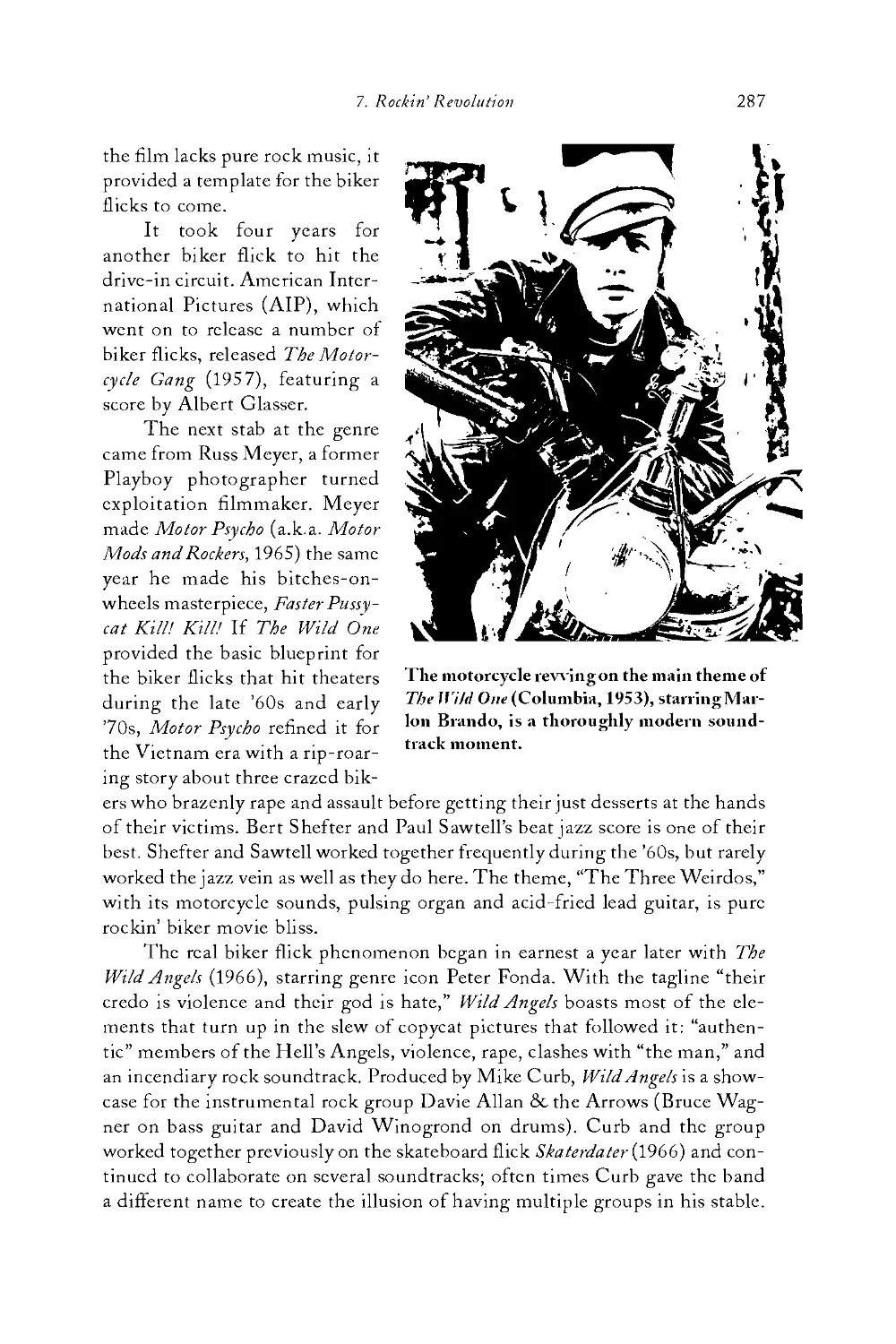
The music is just that visceral. The motorcycle revving at the beginning of
the theme also helps distinguish The Wild One as a thoroughly modern sound-
track moment. (For more on The Wild One sec Chapter 7.)
A sure sign that jazz had found a home in Hollywood came in 1956 when
Elmer Bernstein earned an Academy Award nomination for The Man with the
Golden Arm. The film’s gritty subject matter—heroin addiction — may have
opened many eyes to the dangers hounding modern man, but the score opened
audience ears to the high drama of hard-driving horn blasts, sultry wood-
winds, rumbling bass and crashing percussion. No crime theme seems to swing
harder than “Frankie’s Machine.” The brass screams against a backdrop of
jackhammer percussion. On “The Fix,” the same theme takes on a nightmar-
1. Crime Jazz and Felomus Funk
7
ish urgency. On “Desperation,” rumbling discordant piano and locomotive
drums capture the single-minded obsession of the junkie. Golden Arm is sim-
ply one of the genres most iconic scores.
A year later, Bernstein scored Sweet Smell of Success, a cynical drama set
on New York City’s Madison Avenue, where reputations are built up and torn
down over cocktails. While Burt Lancaster and Tony Curtis exchange Machi-
avellian manipulations, Bernstein’s score and additional jazz tracks by Chico
Hamilton pour on sophisticated scorn. As Bernstein stated in cover notes for
a 1962 LP of his Movie & TV Themes, “Jazz is contemporary ... [and] so are
most films. Thus it seemed quite natural for me to utilize the elements of the
jazz idiom in my work.”
Also in 1956, Bernstein contributed jazz for a short-lived TV detective
show, Take Five. “[It] failed,” he noted, “but similar shows that followed did
not, and jazz took a firm hold in television scoring.”
Before the decade ended Bernstein would take another crack at TV crime
with somewhat greater success, but first another young Hollywood composer
would strike mainstream gold with his own take on TV crime jazz.
The claim came in 1958 when Henry Mancini, a long-time apprentice
arranger at Universal, bumped into producer Blake Edwards in the studio bar-
bershop. Edwards invited Mancini to score TV’s Peter Gunn (1958-1961).
Mancini’s theme for the suave detective quickly became a standard of cool jazz
(and eventually surf rock) repertoire. One could easily compile two or three
discs worth of Peter Gunn variations by artists as disparate as Quincy Jones
and Art of Noise. In the show, Gunn hangs out in the club Mother’s where a
jazz group plays underneath the dialogue.
“The idea of using jazz in the ‘Gunn’ score was never even discussed. It
was implicit in the story,” Mancini recalled in his autobiography Did They
Mention the Music? (p. 87, Contemporary Books, 1989). “It was the time of
so-called cool West Coast jazz,” Mancini added. “That was the sound that
came to me.”
Walking bass and drums, smoky saxophones, and shouting trumpets were
keys to the “Peter Gunn” sound, and the show also provided Mancini with his
first opportunity to use bass flutes, an instrument that he used with great suc-
cess throughout his career.
Peter Gunn was one of the first TV shows to receive a soundtrack LP
release, which went to number one on the Billboard chart and held the posi-
tion for 10 weeks—an astonishing feat for a jazz record, as well as a sound-
track. It stayed on the charts for more than two years and eventually sold more
than a million copies. All of this made Mancini a bankable recording artist
and one of the few film or television composers to ever become a household
name.
The Peter Gunn score was only the beginning of what would prove to be
an immensely popular and influential body of work. The “chilled-out sound-
8
Film and Television Scores, 1950-1979
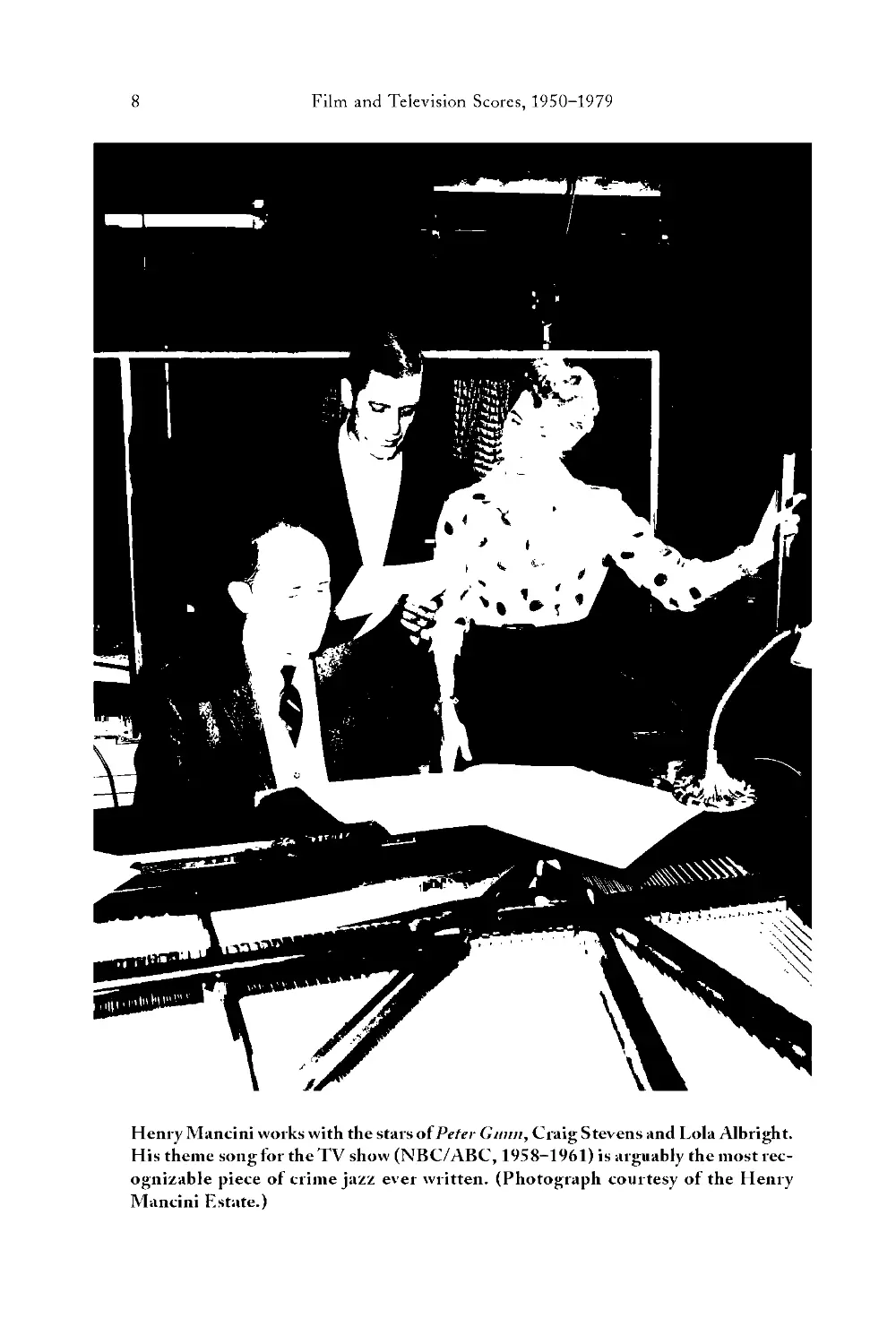
Henry Mancini works with the stars of Peter Ginin, Craig Stevens and Lola Albright.
His theme song for the TV show (NBC/ABC, 1958-1961) is arguably the most rec-
ognizable piece of crime jazz ever written. (Photograph courtesy of the Henry
Mancini Estate.)
1. Crime Jazz and Felomus Funk
9
track”—as Steely Dan co-founder and jazz aficionado Donald Fagen called it
(Premiere, 1987) — spawned two LPs and other related releases. Ten years later,
Mancini scored the relatively unsuccessful Gunn ... Number One movie with a
somewhat updated sound (check out the fuzz-tone guitar on “The Monkey
Farm”).
While Peter Gunn was hardly the first show of its kind, its soundtrack
helped to popularize the crime jazz genre through the biggest mass medium
ever. Other shows of the era that touted hard-boiled brass were M Squad, 77
Sunset Strip, Mike Hammer, Perry Mason, Richard Diamond, Naked City and
Staccato—the last of which features a Bernstein score.
If Staccato appeared to be a calculated response to Peter Gunn, its score
was simply a reiteration of the sound Bernstein had already explored on the
big screen. Johnny Staccato is a private eye who moonlights as a piano player
in a jazz combo at a hip nightclub. Staccatos theme aptly evokes an urban jun-
gle’s sweltering atmosphere. The rhythm section prowls along like a panther
on the hunt, while brass and woodwinds soar above in the canopy of night.
The show didn’t enjoy Peter
Gunn's longevity, but its theme is
nearly as iconic.
Earlier in 1958, Mancini
scored Orson Welles’ Touch of
Evil at Universal Pictures, where
the composer spent six years as an
apprentice working on dozens of
В-pictures. For Evil, Mancini
worked closely with score super-
visor Joseph Gershenson to meet
Welles’ demand for music that
would only emanate from visual
sources, such as a musical instru-
ment, jukebox or radio.
“[Welles] truly understood
film scoring,” Mancini wrote in
his autobiography (p. 79). “Since
he was making a grimly realistic
film, I think he reasoned that
even the music had to be rooted
in reality.”
As Evil's CD booklet notes
explain, Welles wanted “musical
color, rather than movement—
sustained washes of sound rather
than tempestuous, melodramatic,
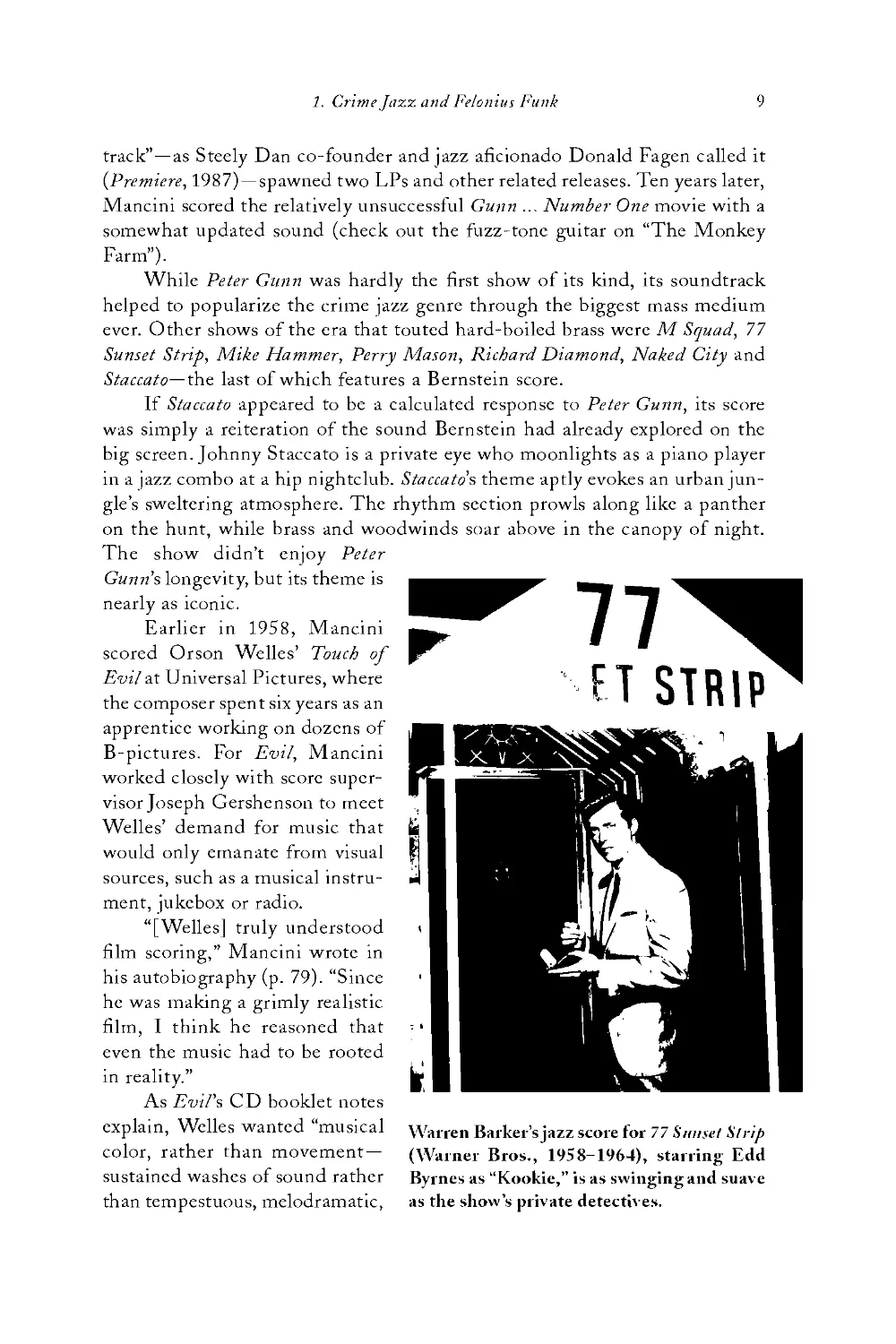
Warren Barker’s jazz score for 77 Sunset Strip
(Warner Bros., 1958-1964), starring Edd
Byrnes as “Kookie,” is as swinging and suave
as the show’s private detectives.
10
Film and Television Scores, 1950-1979
or operatic style of scoring.” An old-fashioned cinematic symphony would
have made the film’s seedy proceedings absurd. On the other hand, Mancini’s
Afro-Cuban jazz and rock ’n roll instrumentals provide the movie—in which
Charlton Heston infamously plays a Mexican — an clement of authenticity.
“ Touch of Evil was one of the best things I did in that period of my life,”
Mancini later recounted (p. 82). “It’s one of the best things I’ve ever done.”
One of Mancini’s next forays into crime jazz came on Experiment in Ter-
ror (1962). The composer experiments by blending rock ’n’ roll “twist” ele-
ments with crime jazz. On its gorgeously sinister theme music, he uses an auto
harp to create a mysterious atmosphere; in the composer’s autobiography, he
praised the instrument for its “great natural decay” and how its sound “seems
to last forever.” Listening to it conjures the sense of being stalked in a fog-
enshrouded Golden Gate Park by San Francisco Bay. Displaying his great ver-
satility, Mancini also delivers a catchy twist version of the track.
The Mancini crime theme that is more in keeping with his work on Peter
Gunn is undoubtedly The Pink Panther (1963). Needless to say The Pink Pan-
ther was a massive success and spawned six sequels (all featuring Mancini
music). The theme is—bar none—the ultimate in big screen crime jazz. From
the opening notes on piano, bass and vibes, it oozes danger and intrigue, not
to mention feline grace. A smoky saxophone states the bluesy theme, and an
absolutely smoking big band responds. Then the piano, bass and vibes return,
accompanied by woodwinds and saxophone to restate the theme. Pure perfec-
tion.
In 1963, Mancini scored the romantic, comedic crime thriller Charade—
one of the highlights of his most protean period. The main title, “Megeve”
and “Mambo Parisicnnc” arc irresistible Latin grooves of the swinging ’60s.
And slower tracks, such as “Bateau Mouche” and “Latin Snowfall,” offer lis-
teners that distinctive Mancini romanticism. The truth is Charade suffers the
same fate of so many Mancini soundtrack releases in that the demands of com-
merce dictated that only the melodic orchestral pop was worthy of LP release,
and the more serious underscore — such as tension-building cues and action
tracks—were left off the LP.
Mancini then scored another European-set crime thriller, Arabesque
(1966). Again, Mancini makes memorable use of the exotic-sounding auto
harp for the theme and the proto-psychedelic “Zoo Chase.” The other unusual
elements include a mandola, a detuned piano, three percussionists and tape-
delay echo effects. It may not have much in common with Mancini’s earlier,
more straightforward crime scores, but it certainly demonstrates the adapt-
ability of the genre.
While many crime scores barely qualify as genuine jazz, there are a hand-
ful from the era that come closer than most. One of the best belongs to I Want
to Live! (1958), a true story about a murderess on death row. Johnny Mandel’s
sexy smoky score is a classic. The 26-piece All-Star Jazz Orchestra burn
1. Crime Jazz and Felomus Funk
11
through the main theme, “Poker Game,” “Stakeout,” “Gas Chamber Unveil-
ing” and other hot-blooded and emotionally wrenching tracks. Also featured
are half a dozen cuts played by Gerry Mulligans Combo. The legendary bari-
tone saxophonist leads veteran jazz greats, such as Shelly Manne (drums), Art
Farmer (trumpet), Bud Shank (alto sax, flute), Red Mitchell (bass), Frank
Rosolino (trombone) and Pete Jolly (piano) on “Night Watch” and “Black
Nightgown.” Mulligan’s inclusion is significant. The original LP cover notes
by William Johns describe how the film’s main character “moves through an
atmosphere in San Francisco and San Diego where jazz hovers constantly in
the background. One of the few stabilizing things in her life is her interest in
jazz and, particularly, in the music of Gerry Mulligan.” Mandel penned the
tracks specifically for Mulligan’s group, and they’re peppered throughout the
film as source cues.
“We’d been through a lot of bands together,” Mandel said of Mulligan
in a 1998 interview with Patrick McGilligan for the Rykodisc reissue. “I first
ran into Gerry when he was with Gene Krupa and I was with Buddy Rich.
This was in 1946. ‘Disk Jockey Jump’ had just come out and somehow Mul-
ligan and I ... were thrown together in the New York nightclub and session
scene. We remained good friends, right to the end.”
The bits composed for the larger group are highly experimental and were
daring for the era. Among the unusual instruments employed are contra-bass
clarinet, contra bassoon, bass trumpet, bass flute, and E-flat clarinet. In addi-
tion, there is a wild assortment of percussion, such as scratcher, cowbells, Chi-
nese and Burmese gongs, rhythm logs, chromatic drums and claves, as well as
bongos and conga drums—collectively representing “the forces of law and order
always hovering in the background,” as McGilligan observed.
More importantly, I Want to Live stands apart from most crime jazz scores
in that it is genuine jazz featuring improvisation, and not merely “scripted”
jazz.
“I was really very nervous,” Mandel told McGilligan, “until I realized,
after I learned the language and how to sync everything, that essentially it is
what I’d been doing for a long time and just didn’t know it. It married all the
things I’d been doing previously.”
Mandel went on to win an Oscar for “The Shadow of Your Smile” from
The Sandpiper, and scored many other popular movies, but his boldly inven-
tive I Want to Live is among the best of the crime genre and of the era.
A year later, another undisputed jazz genius scored in Hollywood. Duke
Ellington — arguably the most influential composer and bandleader of the big
band era—contributed a Grammy Award-winning score for Anatomy of a Mur-
der (1959). Although Ellington had occasionally composed music for low-
budget musicals and short films prior to World War II, this courtroom drama
offered him a unique opportunity. The music—with its rich harmonic shad-
ings and intuitive use of soloists—is unlike any other crime jazz soundtrack,
12
Film and Television Scores, 1950-1979
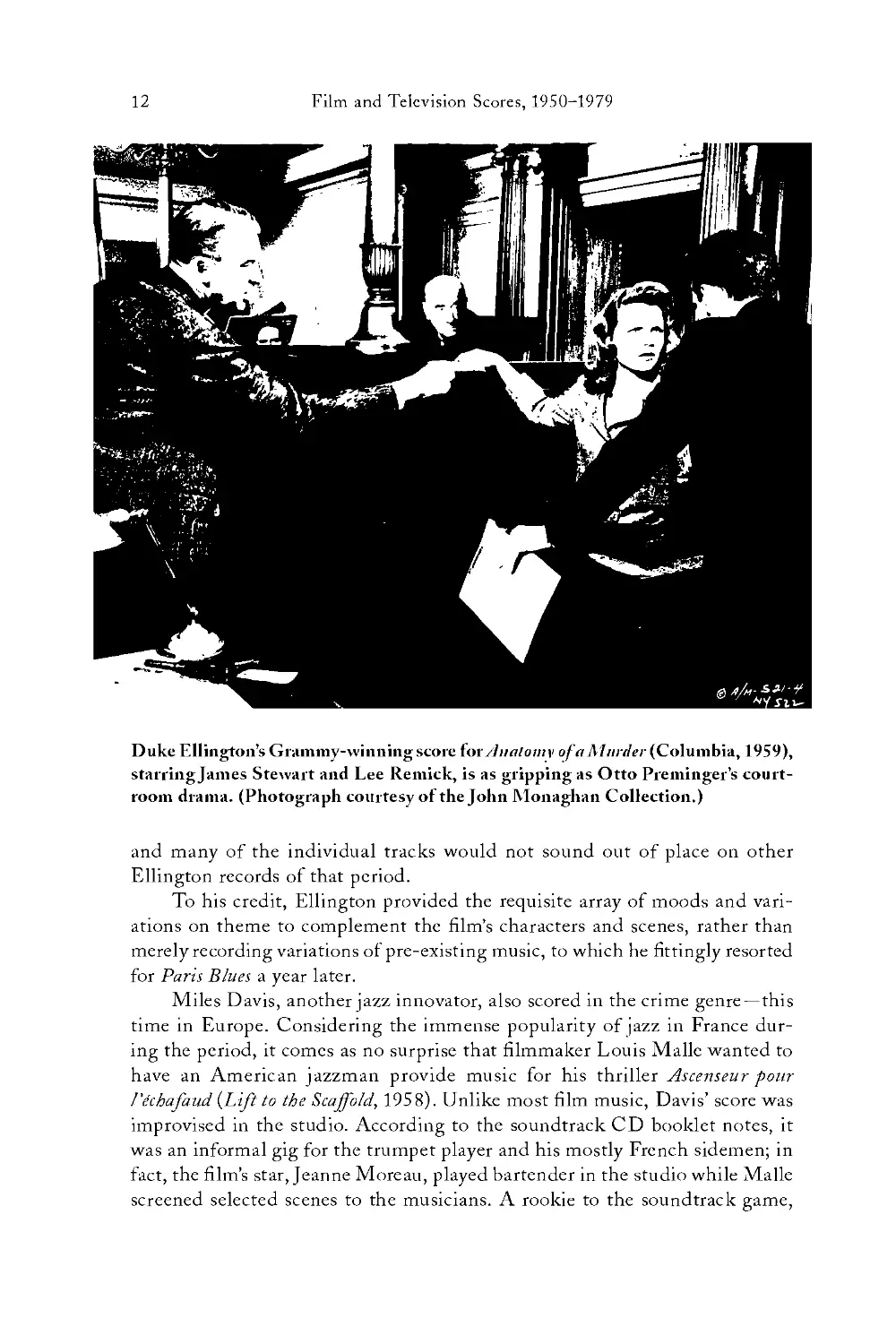
Duke Ellington’s Grammy-winning score Anatomy ofaMurder{QB\\xmb\A, 1959),
starring James Stewart and Lee Remick, is as gripping as Otto Preminger’s court-
room drama. (Photograph courtesy of the John Monaghan Collection.)
and many of the individual tracks would not sound out of place on other
Ellington records of that period.
To his credit, Ellington provided the requisite array of moods and vari-
ations on theme to complement the film’s characters and scenes, rather than
merely recording variations of pre-existing music, to which he fittingly resorted
for Paris Blues a year later.
Miles Davis, another jazz innovator, also scored in the crime genre—this
time in Europe. Considering the immense popularity of jazz in France dur-
ing the period, it comes as no surprise that filmmaker Louis Malle wanted to
have an American jazzman provide music for his thriller Ascenseur pour
I'echafaud {Lift to the Scaffold, 1958). Unlike most film music, Davis’ score was
improvised in the studio. According to the soundtrack CD booklet notes, it
was an informal gig for the trumpet player and his mostly French sidemen; in
fact, the film’s star, Jeanne Moreau, played bartender in the studio while Malle
screened selected scenes to the musicians. A rookie to the soundtrack game,
1. Crime Jazz and Felomus Funk
13
Davis took little to no control over the selection of final takes for the film, let-
ting Malle call the shots. Davis used a few tracks on his /^zz Track LP.
Back in Hollywood, a number of brash bandleaders, including Pete
Rugolo, David Amram, Kenyon Hopkins, Billy May and Hugo Montenegro,
cut crime jazz soundtracks.
Long-time Stan Kenton arranger Rugolo proved to be a good fit for such
crime shows as Richard Diamond (1957-1960) and The Fugitive (1963-1967),
both starring David Janssen. Rugolo’s penchant for dynamic, supercharged
orchestration is well represented on both shows. The theme for Richard Dia-
mond is nearly as memorable as “Peter Gunn.” It’s actually two themes in one.
The brassy primary melody embodies Janssen’s private detective, and the sexy
bass line captures the criminal element whenever a villain is onscreen. Jazz
greats, such as Shank, Mitchell and Manne, are among the players on the
brash alluring main theme, percussion-peppered “Diamond on the Move,”
breathless “Teaser,” sassy jukebox number “Teenage Rock” and wistful flute-
filled “I’m Always Chasing Butterflies.”
Rugolo also composed a tough, propulsive, albeit less memorable, theme
for Thriller (1960-62), which also served as the show’s “villain” theme. Among
the other criminally cool numbers arc the exotic, percussive “Voodoo Man,”
mysterious “The Guilty Men,” two-bass spotlight “The Purple Room,” Latin-
tinged “Twisted Image,” the sax-less swinger “Worse Than Murder” and genre-
busting “Finger of Fear.”
The Sicilian-born composer hooked up with his friend Janssen again for
The Fugitive, which was one of the most popular crime shows of the ’60s long
before it became a big-screen hit in 1993. Again, Rugolo composed a memo-
rable opener that, like James Bernard’s themes for the Hammer horror pic-
tures of the ’50s and ’60s, bears a melody that seems to “state” the show’s title.
“I always tried to get the name of the series, whatever it was called, into my
themes,” Rugolo recalled in the Silva Screen’s CD booklet notes.
Rugolo, like many composers, recorded many variations on the theme for
use as suspense, action and romance cues throughout the series. “I wrote an
awful lot of chases, because I knew he’d be running a lot,” Rugolo said of the
approximately 90 minutes worth of music recorded in England to save on
union costs.
The other memorable crime jazz tracks include the imposing “Lt. Ger-
rard,” the sneaky “On the Run,” the tense “Kimble vs. the One-Armed Man”
and the percussive “Hand to Hand.”
Another big band arranger known for his brassy attack was Billy May,
who was one of Frank Sinatra’s favorite bandleaders. May composed for sev-
eral crime shows, including Naked City (1960-1962), The Green Hornet
(1966-1967), Batman (1967-1968) and The Mod Squad (1968). May’s rare
opportunities to score were usually on Sinatra-related projects. The most
notable is Johnny Cool (1963), which was produced by fellow Rat Packers Peter
14
Film and Television Scores, 1950-1979
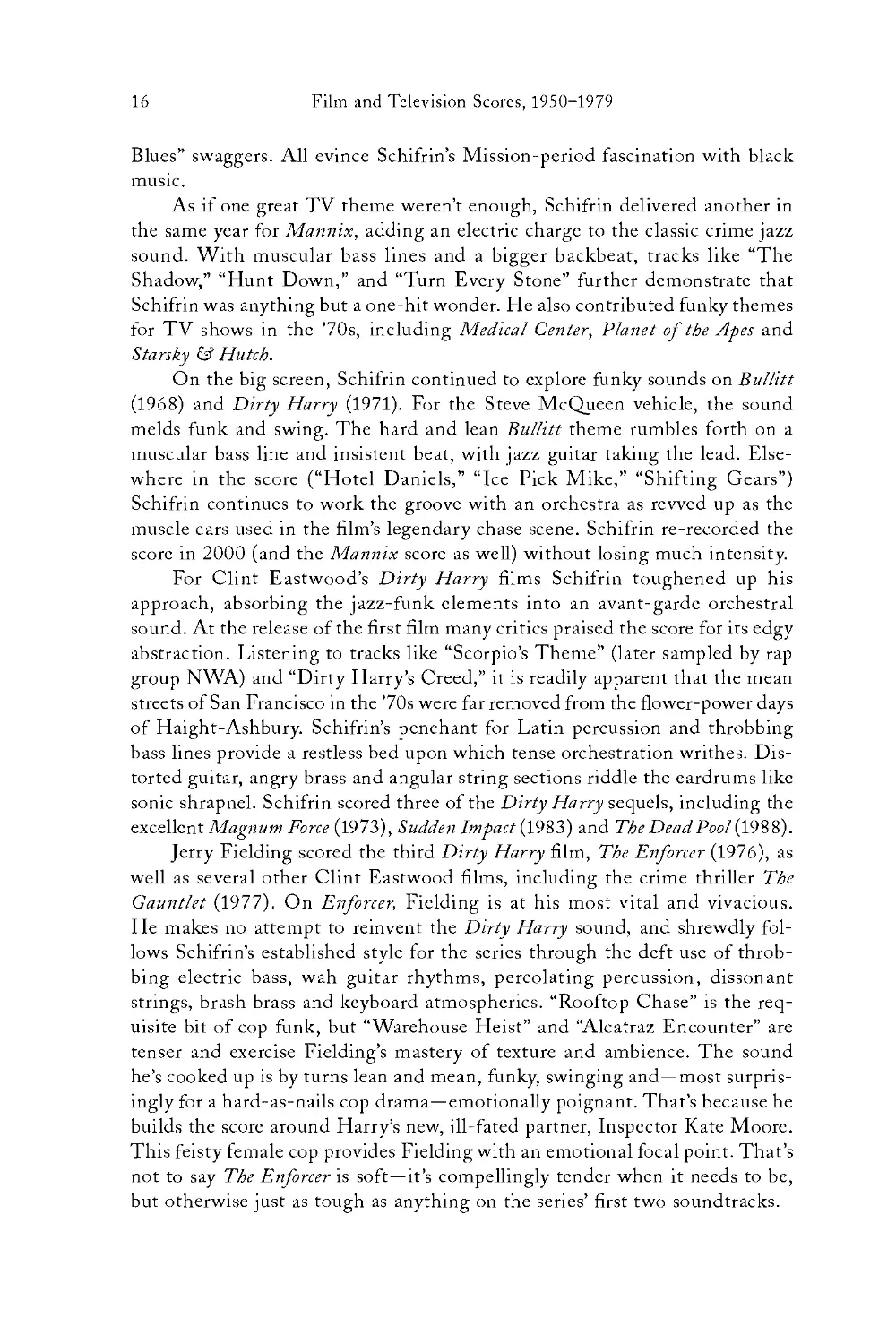
OiniHi Jazz Scores from 2 Classic tv Series
PETERUGOLO
Richard Diamond
Pete Rugolo
Pete Rugolo’s scores for TV’s Thriller (1960-1962) Richard Diamond (1957-1960)
demonstrate the composer’s brash, propulsive style. (CD cover appears courtesy of
Fresh Sound Records; graphic designer unknown.)
Lawford and Sammy Davis, Jr. Wearing a stylish eye patch and van dyke
beard, Davis also had a role in the movie and performed two vocal numbers
on the soundtrack. The score is quintessential May, ranging from hard swing-
ing (“The Lizard”) to sw-elegant (“The Coolest Pad”).
May also scored Gordon Douglas’ Tony Rome (1967), starring Sinatra as
the titular private eye. Nancy Sinatra sang the theme song.
Best known for his cover albums of The Man from. U.N. C.L.E. and Ennio
Morricone’s “spaghetti western” music, Hugo Montenegro delivered a thor-
oughly swinging ’60s sound for Lady in Cement (the Tony Rome sequel). “Ba-
ba” vocalisms, intriguing harpsichord, sultry flute and a fat bass guitar riff
1. Crime Jazz and Felomus Funk
15
make the theme a classic of the late ’60s crime scene. Distorted guitar, Ham-
mond organ and rampaging drums kick it up a notch on “Sugar Seymour,”
“Jilly’s Joint” and “Yale’s Pool Room.” Montenegro incorporates psychedelic
studio trickery on several tracks that heightens the groovy vibe. He cools the
mood down a touch with “The Shark,” without losing the trippy effects.
Another highlight is “Tony’s Theme,” which brings the brass and “ba-ba” boys
back into the mix, with harmonica and vibes along for the ride. Interestingly,
there isn’t a Sinatra vocal in carshot, and he fails to make an appearance on
the LP cover. (Notably, Montenegro’s Rat Pack connections extend to two
scores for Dean Martin’s Matt Helm spy flicks.)
Another jazz legend turned soundtrack artist was Kenyon Hopkins, a fre-
quent collaborator of Creed Taylor (producer of the atmospheric concept
albums Nightmare’.., Panic!, Lonelyville, etc.). Hopkins delivered jazz-tinged
scores for several movies, including The Hustler (1961), Baby Doll (1956) and
The Fugitive Kind (1960). One of his best belongs to Mister Buddveing (1965).
Hopkins’ tough, swinging sound keeps cool even when incorporating Latin
percussion and soulful Hammond organ. It isn’t a crime jazz score in the
strictest sense—the movie is more of a melodrama—but the feeling on many
tracks, including the theme, isn’t far removed.
Another borderline crime jazz soundtrack comes from The Young Savages
(1961), with music by David Amram, who also worked on the political thriller
The Manchurian Candidate (1962). The score ranges from the Latin jazz of “Las
Muchachas Delicadas” to the Spanish-tinged theme with its solo harmonica
to tension-filled polytonal underscore (“Switchblades on Parade,” “The Last
Taco,” etc.).
Neal Hefti took inspiration from Golden Arm for another junkie drama,
Synanon (1965). The jazzy, organ-led theme seethes with sadness and desper-
ation. “A Perfect Beginning” is far more optimistic, with lively sax, warm gui-
tar and gurgling organ tones playing over a crackling beat. “Blues for Hopper”
is buzzy and hyperactive. Hefti also cooks up some choral pop tracks (“Main
Street” and “The Whiffenpoof Song”) that are comparatively “squaresville.”
Funky with a “Bullitt”
A Hollywood composer who infused his crime (and spy) soundtracks with
stabs at funk as well as jazz was Lalo Schifrin. The Argentinean-born com-
poser had made his name with the greatest TV spy theme ever for Mission:
Impossible (1966). The show’s soundtrack demonstrates Schifrin’s mastery of
funky soul, as well as crime jazz, bossa nova and lounge. “Jim on the Move”
combines elements found in many of Schifrin’s recordings, principally a throb-
bing electric bass line, prominently mixed Latin percussion, bluesy piano fills
and soulful horn arrangements—elements commonly heard in funk and rhythm
do blues. “More Mission” boasts a lean, hard opening groove. And “Mission
16
Film and Television Scores, 1950-1979
Blues” swaggers. All evince Schifrin’s Mission-period fascination with black
music.
As if one great TV theme weren’t enough, Schifrin delivered another in
the same year for Mannix, adding an electric charge to the classic crime jazz
sound. With muscular bass lines and a bigger backbeat, tracks like “The
Shadow,” “Hunt Down,” and “Turn Every Stone” further demonstrate that
Schifrin was anything but a one-hit wonder. He also contributed funky themes
for TV shows in the ’70s, including Medical Center, Planet of the Apes and
Starsky C? Hutch.
On the big screen, Schifrin continued to explore funky sounds on Bullitt
(1968) and Dirty Harry (1971). For the Steve McQueen vehicle, the sound
melds funk and swing. The hard and lean Bullitt theme rumbles forth on a
muscular bass line and insistent beat, with jazz guitar taking the lead. Else-
where in the score (“Hotel Daniels,” “Ice Pick Mike,” “Shifting Gears”)
Schifrin continues to work the groove with an orchestra as revved up as the
muscle cars used in the film’s legendary chase scene. Schifrin re-recorded the
score in 2000 (and the Mannix score as well) without losing much intensity.
For Clint Eastwood’s Dirty Harry films Schifrin toughened up his
approach, absorbing the jazz-funk elements into an avant-garde orchestral
sound. At the release of the first film many critics praised the score for its edgy
abstraction. Listening to tracks like “Scorpio’s Theme” (later sampled by rap
group NWA) and “Dirty Harry’s Creed,” it is readily apparent that the mean
streets of San Francisco in the ’70s were far removed from the flower-power days
of Haight-Ashbury. Schifrin’s penchant for Latin percussion and throbbing
bass lines provide a restless bed upon which tense orchestration writhes. Dis-
torted guitar, angry brass and angular string sections riddle the eardrums like
sonic shrapnel. Schifrin scored three of the Dirty Harry sequels, including the
excellent Magnum Force (1973), Sudden Impact (1983) and The Dead Pool (1988).
Jerry Fielding scored the third Dirty Harry film, The Enforcer (1976), as
well as several other Clint Eastwood films, including the crime thriller The
Gauntlet (1977). On Enforcer, Fielding is at his most vital and vivacious,
lie makes no attempt to reinvent the Dirty Harry sound, and shrewdly fol-
lows Schifrin’s established style for the scries through the deft use of throb-
bing electric bass, wah guitar rhythms, percolating percussion, dissonant
strings, brash brass and keyboard atmospherics. “Rooftop Chase” is the req-
uisite bit of cop funk, but “Warehouse Heist” and “Alcatraz Encounter” are
tenser and exercise Fielding’s mastery of texture and ambience. The sound
he’s cooked up is by turns lean and mean, funky, swinging and—most surpris-
ingly for a hard-as-nails cop drama—emotionally poignant. That’s because he
builds the score around Harry’s new, ill-fated partner, Inspector Kate Moore.
This feisty female cop provides Fielding with an emotional focal point. That’s
not to say The Enforcer is soft—it’s compellingly tender when it needs to be,
but otherwise just as tough as anything on the series’ first two soundtracks.
1. Crime Jazz and Felonius Funk
17
Harry Callahan wasn’t the only tough cop to hit the big screen in 1971.
Gene Hackman played Popeye Doyle in The French Connection (1971). Eschew-
ing conventional funk in favor of avant-garde jazz, Don Ellis’ theme imme-
diately puts the listener on edge by using siren-like horn blasts and Morse code
woodwinds. For instance, “Copstail” busts out a funky beat, but interrupts it
with abstract piano fills and tape-delay weirdness. Ellis’ methods perfectly
complement Hackman’s eccentric portrayal of the hard-nosed cop. Like Pop-
eye Doyle, Ellis never plays it safe — he’s always pushing the sound into new
territory with experimental techniques. Ellis also scored The French Connec-
tion II (1975).
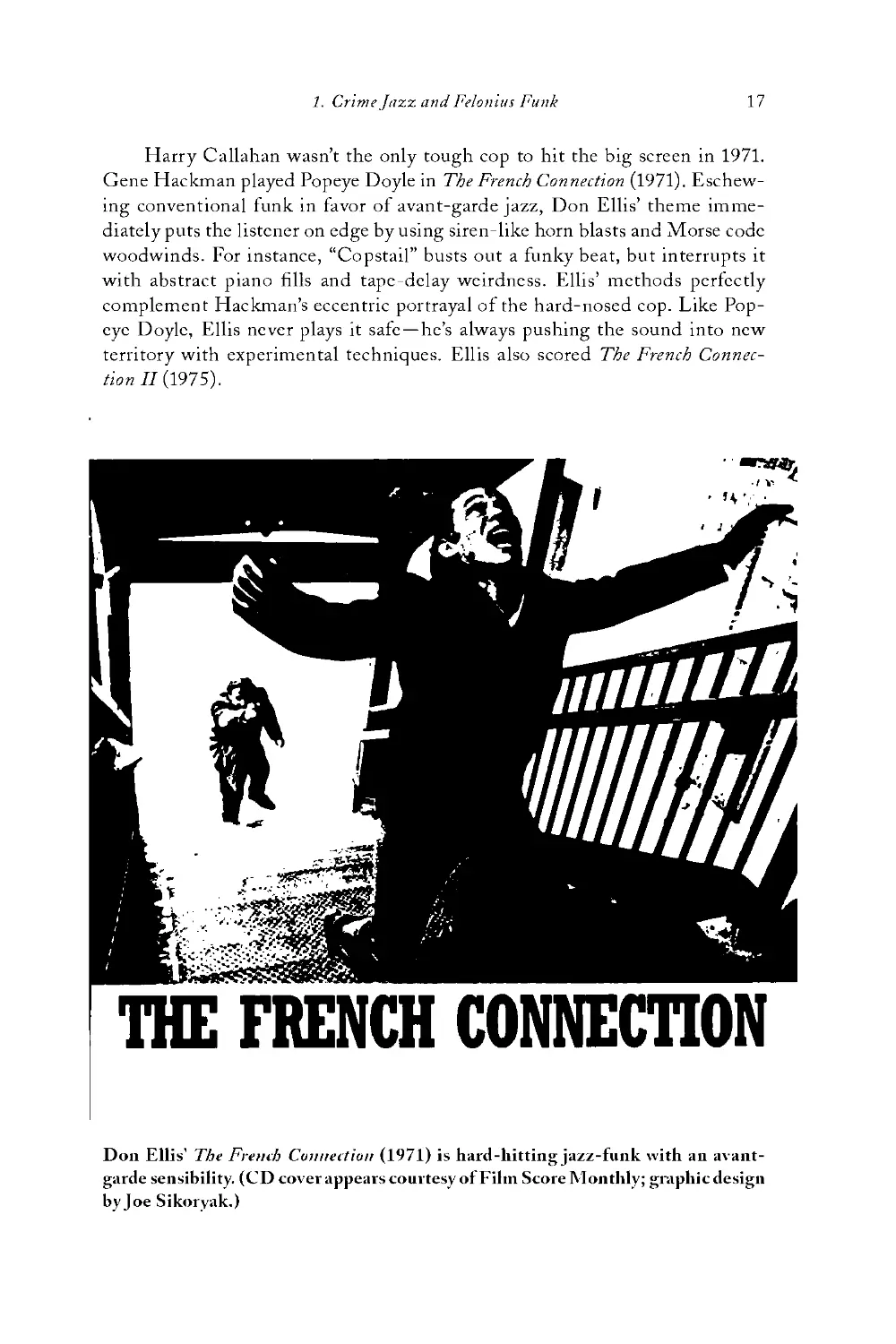
Don Ellis’ The French Connection (1971) is hard-hitting jazz-funk with an avant-
garde sensibility. (CD cover appears courtesy of Filin Score Monthly; graphic design
by Joe Sikoryak.)
18
Film and Television Scores, 1950-1979
Also in 1971 was the neo noir Klute. The score by Michael Small features
the psychedelic funk of “Bree’s Abandon (Take It Higher)” and “Club Scene,”
but also offers some eerie, disturbing cinematic moods. The spine-tingling
theme (“The Tape”) blends exotic percussion with piano to create a spooky
atmosphere of mystery—like something from Krzysztof Komeda’s Rosemary's
Baby (1968). It segues beautifully into the hypnotic “Rooftop Intruder,” which
sounds like something from a Morricone or Bruno Nicolai giallo soundtrack,
due in part to female vocalism. Perhaps the more impressive track is “Gold-
farb’s Fantasy.” With its mysterious Eastern European flavor (provided by a
cimbalom), it is reminiscent of John Barry’s Ipcress File or Mancini’s Arabesque.
With its deep bass and spacey funk, “Checking Leads” wouldn’t sound out of
place on a Roy Budd soundtrack.
Elmer Bernstein also tried his hand at funky crime scores, most notably
with McQ (1974), starring cinema’s least funky tough guy, John Wayne. Hav-
ing regretted passing on the role of Harry Callahan, Wayne jumped at the
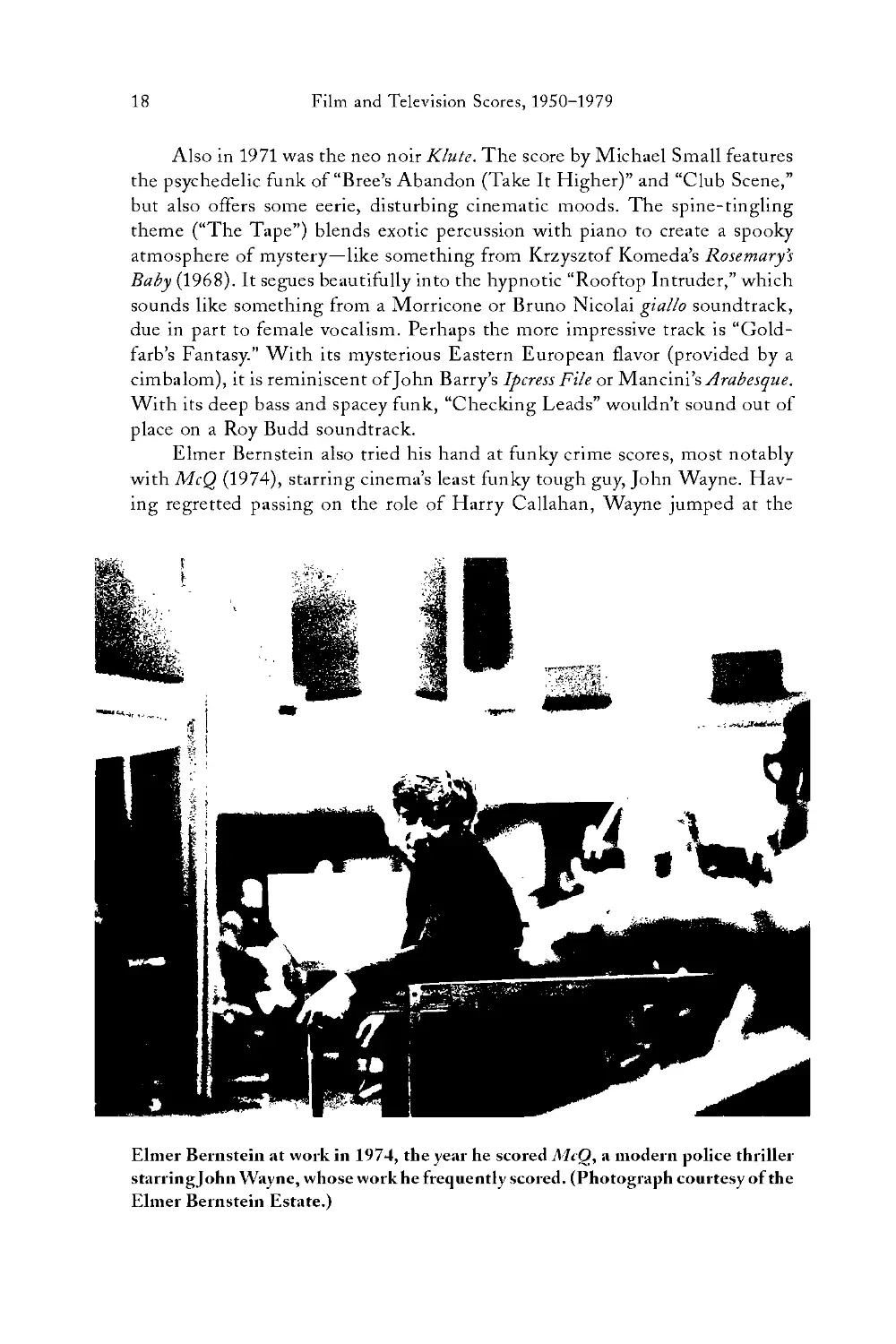
Elmer Bernstein at work in 1974, the year he scored A7<Q, a modern police thriller
starringjohn Wayne, whose work he frequently scored. (Photograph courtesy of the
Elmer Bernstein Estate.)
1. Crime Jazz and Felomus Funk
19
chance to trade in his 10-gallon hat and Winchester for a cop’s badge and
service revolver. Bernstein, who had worked on a number of the Duke’s lat-
ter-day movies, climbed aboard for MeQ. While his score stylistically diverges
from his crime jazz scores of the ’50s, it boasts in-your-facc orchestration, with
a barrage of percussion, including bongos, rock drums, claves, vibra slap, fla-
pamba and bass marimba. Along the way, cool electrified flute, wah guitar and
E5 organ add the requisite urban flavor.
A year later, Wayne starred in Brannigan (1975), a crime drama that sends
an American cop to England to retrieve a mobster. Dominic Frontiere’s score
is funky, but also makes excellent use of strings and brass to build tension.
Angular guitar lines and insistent percussion add a modern edge to Frontiere’s
energetic action sequences, such as the four-part “Ransom” suite and “Stam-
pede Along the Thames.” Brannigan is an underrated crime funk gem.
Perhaps the ultimate funky crime jazz album is David Shire’s The Tak-
ingof Pelham One Two Three (1974). It has no love themes or lounge numbers
to slow it down, just a relentlessly hard-driving, take-no-prisoners score. Shire
set out to create a sound that would be “New York jazz-oriented, hard-edged”
but with a “wise-cracking subtext to it.” Me turned to the 12-tone method of
composition, which Arnold Schonberg developed decades earlier. (The dis-
concerting angularity of the Austrian’s compositions occasionally caused
fistfights between the audience and the musicians.) Something so naturally
tense definitely fit the bill for this gritty, unsentimental drama about a hostage
situation on a subway train. The music is diabolically calculated and pulsat-
ing, yet swings like a big band in hell. Electric bass, drums and tons of per-
cussion provide the undercurrent for abstract horn, string, guitar, woodwind
and keyboard lines. The theme gets restated again and again, but with such
relentless variety it never becomes stale, only more intense.
Another outstanding crime score by a legit jazz musician is Death Wish
(1974) by Herbie Hancock, whose first feature soundtrack was Michelangelo
Antonioni’s quasi-crime film Blow-Up (1966). For the Charles Bronson vigi-
lante flick, Hancock cooked up a jazz-funk stew peppered with his harmoni-
cally rich keyboard textures and thick, hearty rhythms. The scintillating
six-minute theme blends a rock solid bass line, soaring strings, chirping elec-
tric guitars and interwoven keyboard lines against a shimmering rhythm bed.
Based on the theme alone, Death Wish is a classic ’70s crime score.
On the small screen in the early ’70s it seemed that every cop or private
detective show had jazz-funk theme music. Pounding drums, wah guitar, Ham-
mond organ, electric bass and brash brass were on display tor The Streets of San
Francisco, Kojak, S.W.A.T., Baretta, The Rockford Files, Police Woman, Hawaii
Five-0, Police Story and many others. The composers behind this music
included veterans like Mancini, Goldsmith and Morton Stevens, and relative
newcomers like Mike Post. Many of these recordings owe a debt to movie and
TV scores that preceded them.
20
Film and Television Scores, 1950-1979
т к c Taking о r Pelham
One Two Three
David Shire
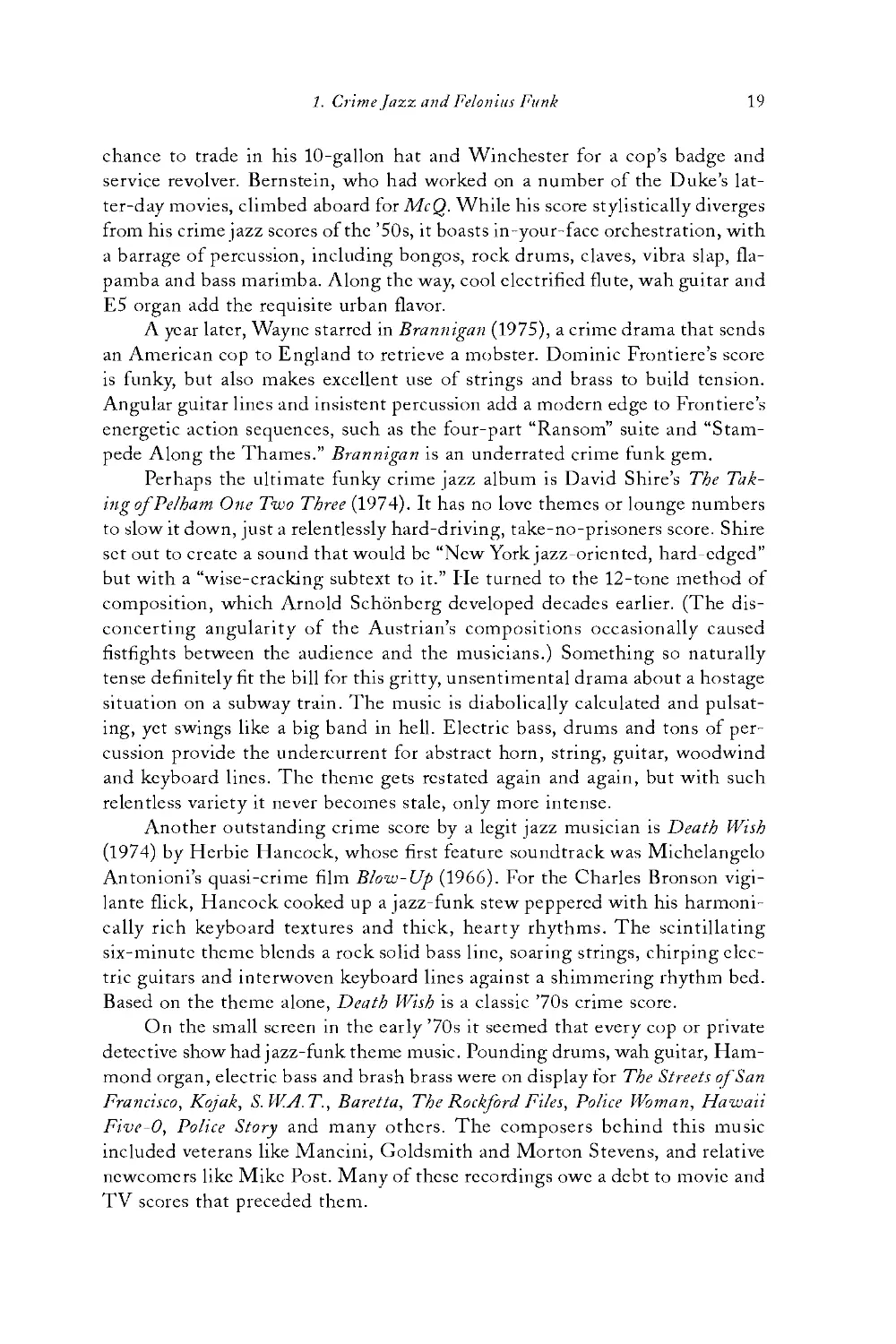
David Shire’s The Taking of Pelham One Two Three (1974) blends riveting jazz-funk
with the 12-tone method pioneered by Arnold Schonbergdecades earlier. (CD cover
appears courtesy of Film Score Monthly/Retrograde Records; graphic design byjoe
Sikoryak.)
Blaxploltation Beat
The funky soundtrack style heard everywhere in the ’70s—from TV shows
and big-budget thrillers (e.g. Live and Let Die) to porn flicks (e.g. Deep Throat)
and foreign cinema (from CineCitta to Bollywood) — is most evident in blax-
ploitation movies. The influence of the genre and its music continues to be
felt today, whether in films such as Jackie Brown (1997) and Baadasssss! (2003),
or in hip-hop culture, whose deejays sample its soundtracks and whose emcees
draw inspiration from its swagger and spirit of self-empowerment.
1. Crime Jazz and Felonius Funk
21
Blaxploitation cinema’s cultural legacy is debatable to say the least. Con-
sider its controversial history. Before it blossomed in 1971, blacks were typi-
cally relegated to lowly, patronizing and often humiliating roles in Hollywood
movies. In the ’60s the studios tentatively began to integrate non-threatening
black characters into otherwise white cinema (e.g. Guess Who's Coming to Din-
ner?).
Before blaxploitation came into being, African-American Quincy Jones
equaled Lalo Schifrin’s effort in introducing funk to movie audiences in the
mid-to-late ’60s. Q^as he’s known to many—made his reputation in the ’50s
and early ’60s as a talented arranger and composer for jazz legends such as
Lionel Hampton, Count Basie and Dizzy Gillespie, and for such singing stars
as Frank Sinatra, Billy Eckstine, Sarah Vaughan and Dinah Washington.
Beginning in the early ’60s, Q^composed numerous big-budget crime movies,
including four starring Sidney Poitier, Hollywood’s original black leading man.
Jones constantly experimented with style, incorporating swinging jazz,
cool bossa nova, funk, soul and pop into big band or orchestral settings. His
classic crime jazz highlights of the period include “Harlem Drive” and “Rack
’em Up” (from The Pawnbroker), “Blondie Tails” (from The Deadly Affair) and
“Shoot to Kill” (from Mirage).
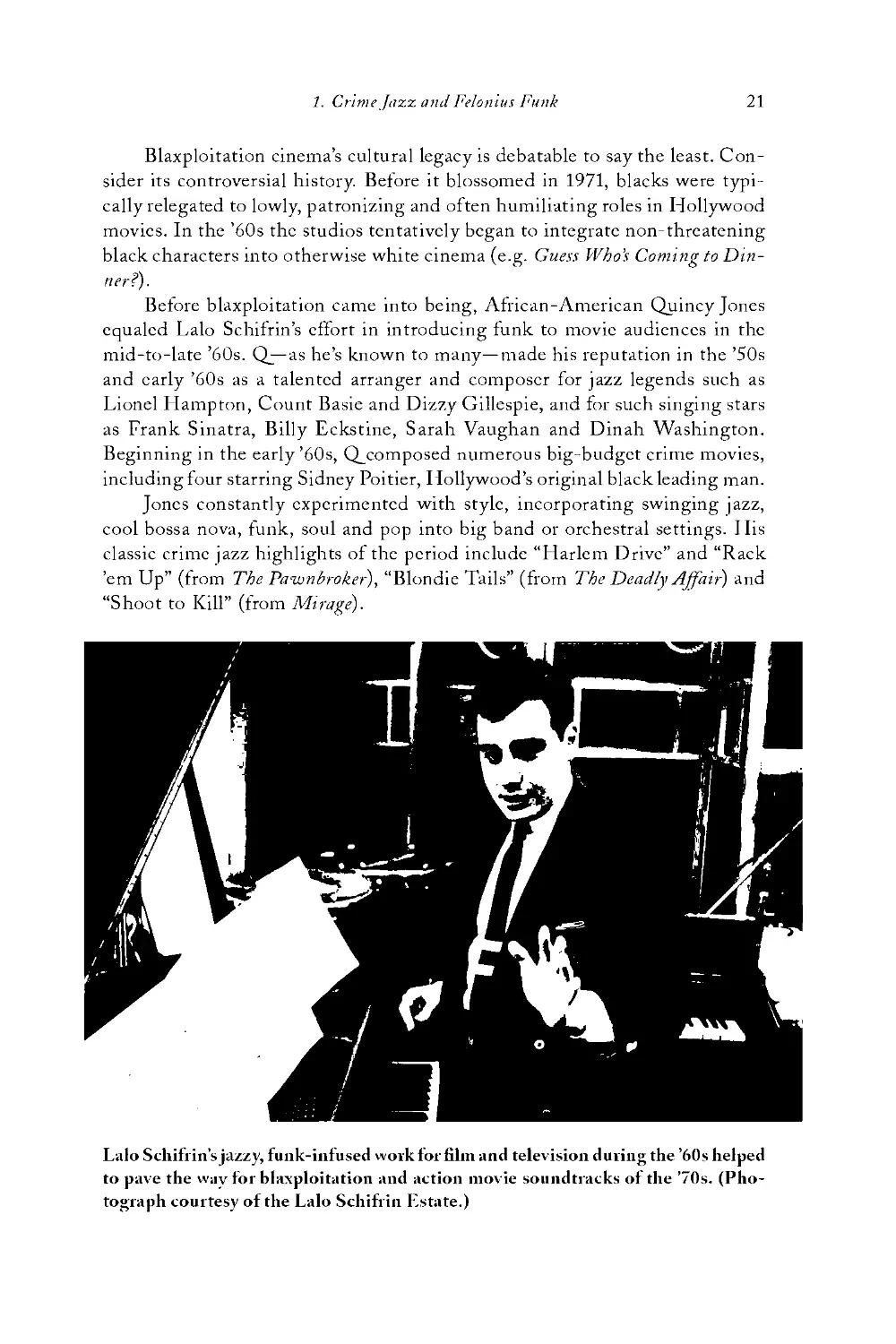
Lalo Schifrin’s jazzy, funk-infused work for film and television during the ’60s helped
to pave the wav for blaxploitation and action movie soundtracks of the ’70s. (Pho-
tograph courtesy of the Lalo Schifrin Estate.)
22
Film and Television Scores, 1950-1979
Although it is in no way a blaxploitation film, the Academy Award-win-
ning In the Heat of the Night (1967) was influential because it features not only
a black, actor in the leading role but also a score infused with black music. The
most telling example is the Ray Charles-sung theme song, which is soulful,
funky and swinging. Tracks like “Peep Freak Patrol Car” and “Cotton Cur-
tain” feature an unexpected blend of orchestral tension, bluesy piano fills,
moaning Ellington-esque horns, throaty flute squeals and vocal scats; their funk
is as potent as moonshine. On “Where Whitey Ain’t Around” a mean wah
guitar solo joins an already volatile vibe. Elsewhere, Jones displays his great
versatility with passages of pure orchestral movie music (“Shag Bag, Hounds
and Harvey”). Taken in its entirety, Heat'xs but one of Jones’ proto-blaxploita-
tion outings, and not a pure example of what would be heard in the ’70s.
Two other Jones scores from this period also qualify as proto-blaxploita-
tion: the heist flick The Lost Man (1969) and Heat's sequel, They Call Me Mis-
ter Tibbs (1970)—both starring Poitier.
The Lost Man theme blends African percussion, an angular melodic motif
and a singsong chorus of chanting children to mysterious, hypnotic effect. The
theme’s disconcertingly unresolved scraps of melody resurface in more satis-
fying form on “Main Squeeze” and “Up Against the Wall,” where complicated
experimental arrangements are propelled by funky rhythms and electric instru-
mentation. On “Slum Creeper” a funky clavinet keyboard pushes the rhythm
forward with slow deliberation as electric guitar competes for the sonic turf.
The most straightforward track on the album may be “Sweet Soul Sister,” a
catchy mid-tempo number featuring a smooth vocal performance by Nate
Turner, with backing vocals by the Mirettes.
While The Lost Man remains Jones’ edgiest score, his work on Tibbs proved
much more popular. Although the movie isn’t considered pure blaxploitation,
its theme created the template for many title tracks to come, including Hayes’
Shaft Schifrin’s Enter the Dragon. Its hard-driving rhythm section, scream-
ing organ blasts, punchy brass, chicken scratch guitars and vibrato-colored
keyboard line set the standard for cinematic funk in 1970. Elsewhere in the
score Jones continued to exploit the electric charge he’d harnessed on the theme
song. “Fat Poppadaddy,” with its catchy organ lick, screaming guitar solo and
fatbackdrum break, pushed the funk harder and faster. He busted out the blues
on “Side Pocket,” with its saxophone solo, and call and response between the
organ, guitar and horns. Tibbs, like Heat and Lost, is chock-full of intense,
virtuoso arrangements that call upon funk, blues, soul and jazz. Without Jones’
influence, the blaxploitation sound might never have come together so quickly
and so potently
In addition to the groundbreaking work of Jones and Schifrin, two other
significant funky scores set the stage for blaxploitation. In 1968, Booker T. Jones
and his MGs scored Uptight. The soulful, organ-led quartet burns through
“Cleveland Now,” “Children, Don’t Get Weary,” and “Blues in the Gutter.”
1. Crime Jazz and Felomus Funk
23
The LP’s cover notes state that director Jules Dassin’s “breakthrough film ...
is concerned not with just the militant and non-violent forms of black Amer-
ican protest, but also with the devastation of a human being cowed and pres-
sured into submission by a society seemingly indifferent to his cries for help.”
The theme remains relevant today, but the score does little to illustrate Uptight’s
message, aside from lending it a sometimes gospel-tinged uplift. The score
also includes a version of the group’s hit, “Time Is Tight.”
More than any other prc-blaxploitation film, Cotton Comes to Harlem
(1970), which is based on African-American Chester Himes’ hard-boiled
novel, set the template for blaxploitation movies to come. The original LP
cover features a proto hip-hop painting by Robert McGinnis that includes a
gold Rolls Royce, bikini-clad babes and the movie’s heroes brandishing huge
handguns. Ironically, the artist is white, and so is the funky score’s composer.
Galt MacDermot, a Canadian who spent some of his youth in South Africa,
provided an excellent high-energy score for Cotton that blends big band funk
with flower power groove and gospel-tinged soul—sometimes shifting between
these styles unexpectedly within a single track. According to the booklet notes
of Cottons CD reissue, even MacDermot’s sidemen considered his funk sen-
sibility unorthodox in comparison to, say, James Brown. But MacDermot cred-
its the experience of playing in the Broadway pit of his rock musical Hair for
his ability to play “flat out-loud and hard.” MacDermot’s outstanding abili-
ties as a composer and arranger are in evidence on such tracks as the theme
song, sung by George Tipton, and the instrumentals “Man in Distress” and
“Harlem Medley.”
To break down the racial wall entirely it took a film made by a black per-
son for a black audience. Melvin Van Peebles, an African-American who cut
his filmmaking teeth in France during the ’60s, bucked the Hollywood sys-
tem where he was under contract. Using money he earned making Watermelon
Man (1970) for Columbia Pictures, he made the scandalous, X-rated, auda-
ciously titled feature, S<weet S^weetback’s Baadasssss Song. As the film’s writer,
director, producer, soundtrack composer and star, Van Peebles almost single-
handedly activated the genre that would later be dubbed blaxploitation. In
order to avoid industry union rules, he claimed to be making a porno. It became
the highest grossing independent film up until that time, pulling in $16 mil-
lion with extremely limited distribution. Unlike today’s “indie” hits, however,
it did not garner the filmmaker any big-studio offers. The film’s gritty subject
matter and provocative marketing tagline (“Rated X by an All White Jury”)
served to alienate mainstream Hollywood from the brash auteur. (In fact, Van
Peebles has claimed to have never submitted the film to the ratings board, a
move that—in those days—automatically earned any film with sexual content
an “X” rating.)
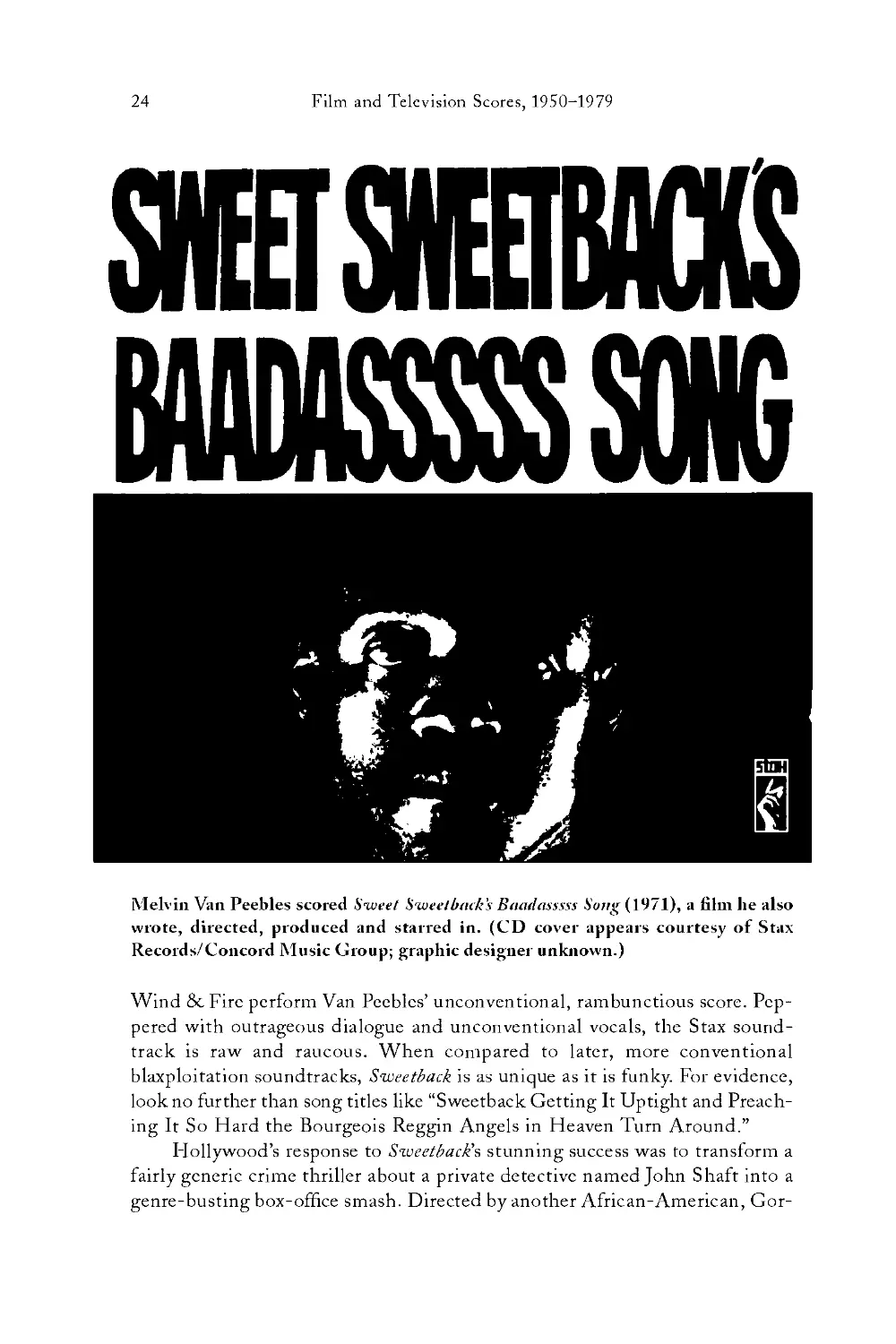
Being the vision of a true auteur, Sweetback features a soundtrack com-
posed by the filmmaker himself. Brer Soul and an early incarnation of Earth,
24
Film and Television Scores, 1950-1979
ЖЭЕШ
Melvin Van Peebles scored Sweet Sweelback's Baadasssss Song (1971), a film lie also
wrote, directed, produced and starred in. (CD cover appears courtesy of Stax
Records/Concord Music Group; graphic designer unknown.)
Wind &.Firc perform Van Peebles’ unconventional, rambunctious score. Pep-
pered with outrageous dialogue and unconventional vocals, the Stax sound-
track. is raw and raucous. When compared to later, more conventional
blaxploitation soundtracks, Sweetback is as unique as it is funky. For evidence,
look no further than song titles like “Sweetback Getting It Uptight and Preach-
ing It So Hard the Bourgeois Reggin Angels in Heaven Turn Around.”
Hollywood’s response to Sweetback's stunning success was to transform a
fairly generic crime thriller about a private detective named John Shaft into a
genre-busting box-office smash. Directed by another African-American, Gor-
1. Crime Jazz and Felomus Funk
25
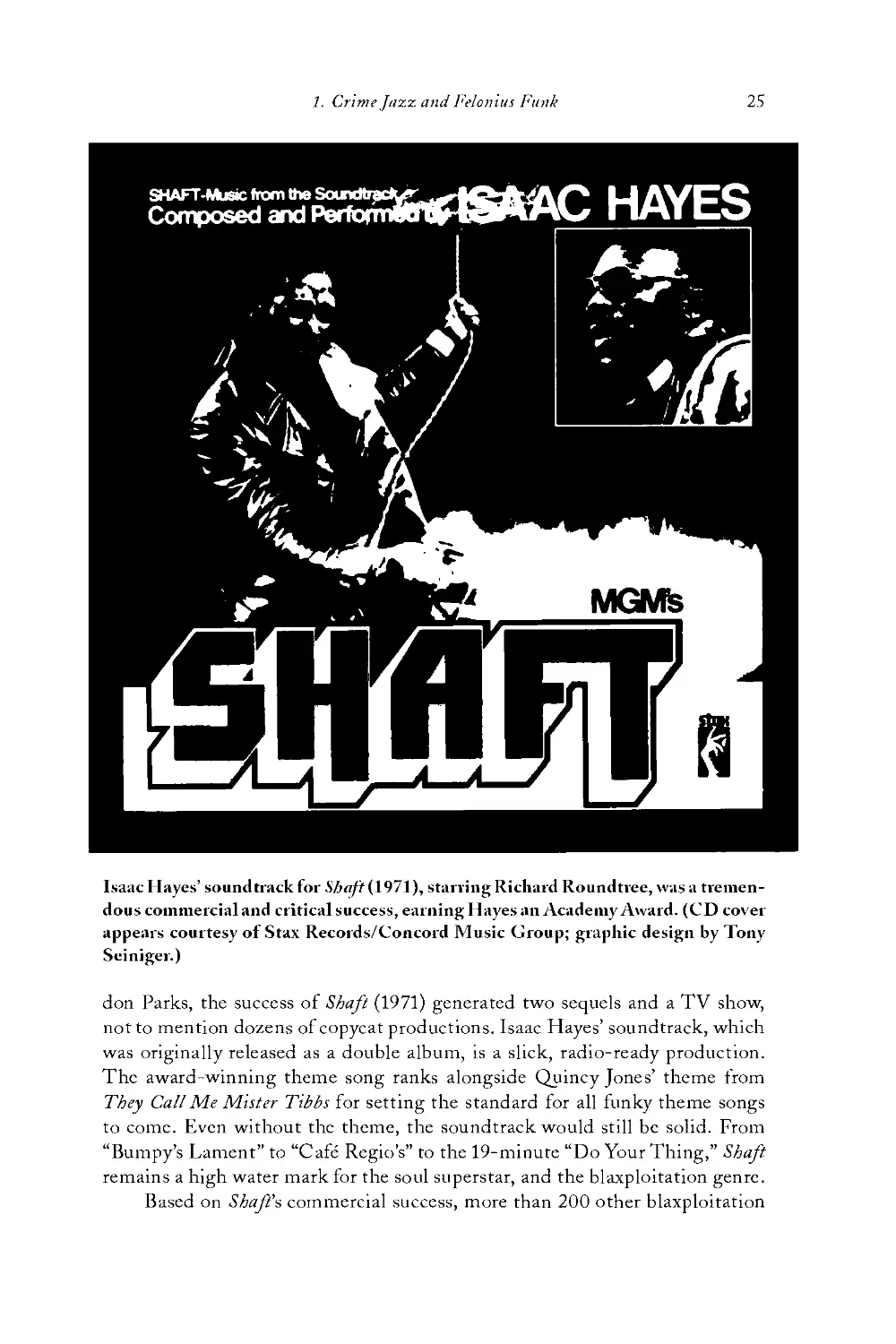
Isaac Hayes’ soundtrack for Shaft (1971), starring Richard Roundtree, was a tremen-
dous commercial and critical success, earning Hayes an Academy Award. (CD cover
appears courtesy of Stax Records/Concord Music Group; graphic design by Tony
Seiniger.)
don Parks, the success of Shaft (1971) generated two sequels and a TV show,
not to mention dozens of copycat productions. Isaac Hayes’ soundtrack, which
was originally released as a double album, is a slick, radio-ready production.
The award-winning theme song ranks alongside Quincy Jones’ theme from
They Call Me Mister Tibbs for setting the standard for all funky theme songs
to come. Even without the theme, the soundtrack would still be solid. From
“Bumpy’s Lament” to “Cafe Regio’s” to the 19-minute “Do Your Thing,” Shaft
remains a high water mark for the soul superstar, and the blaxploitation genre.
Based on Shaft’s commercial success, more than 200 other blaxploitation
26
Film and Television Scores, 1950-1979
films were made over the course of the decade. Some followed the independ-
ent route established by Van Peebles, but many more would not have been
bankrolled without the arguably exploitive interests of white Hollywood insid-
ers. Regardless of intentions, the black action genre and the term “blaxploita-
tion” were born.
Film scores have always reflected contemporary musical styles, and blax-
ploitation scores are no exception. Although blaxploitation soundtracks sim-
ply adapted pre-existing music styles—primarily the funky soul of ’60s artists
like James Brown and Sly &. the Family Stone, as well as the Motown sound—
they also expanded on those styles substantively. It’s no exaggeration to say
that the use of funk and soul in the cinematic context redefined the role of
pop music in film. Although blaxploitation’s use of vocal numbers differed
insignificantly from what had come before, its use of the funky instrumental
as an underscore for action was revolutionary. While the use of big band jazz
in ’50s and ’60s cinema paved the way for the funky underscore, the latter
form’s emphasis on rock-like energy and youth-oriented electric instrumenta-
tion pushed what would have previously been background music into the fore-
ground. Instead of merely reinforcing the action like a traditional score, the
funky instrumental, with its primal rhythms and off-the-cuff jamming, became
a character itself.
Furthermore, blaxploitation films represented an opportunity for black
musicians and composers to reach a broader audience than they might have
with an ordinary release. At a creative level, the soundtrack format offered such
artists as Willie Hutch and Curtis Mayfield the opportunity to record songs
of social consciousness with excellent production values and achieve broad dis-
tribution. In an extreme case, namely Shaft, the recording artist reaped not
only the financial rewards associated with a smash hit movie, but two Grammy
awards and an Oscar for “Best Song.” Consider also that Isaac Hayes, the first
African-American to win such an award, performed his “Theme from Shaft”
at the Academy Awards ceremony before a television audience of many mil-
lions— albeit in a notoriously thick fog due to a defective dry ice machine.
Following the success of Shaft, there was a torrent of similar films and
TV shows. The earlier success of Cotton Comes to Harlem prompted the mak-
ing of the sequel in 1972, Come Back. Charleston Blue. Donny Hathaway, Roberta
Flack’s frequent duet partner, scored the picture under Jones’ expert supervi-
sion. This time the requisite funk cues are joined by ragtime jazz, Basie-esque
blues and, quite unexpectedly, a bit of stripped-down electronic atmospher-
ics. Like Cotton, Charleston distinguishes itself through sheer stylistic diver-
sity. It may have been Hathaway’s project, but the arrangements and
experimental passages show Tones’ unmistakable influence.
One of the best soundtracks of 1972, and of the blaxploitation era, is
Across 110th Street, featuring music by legendary jazz trombonist JJ. Johnson,
and songs performed by Bobby Womack & Peace. Hit-maker Womack’s theme
1. Crime Jazz and Felomus Funk
27
song boasts a memorable hook, a sweeping arrangement and a lyrical message
that doesn’t pull punches about organized crime and the drug epidemic. Wom-
ack also contributes a tender ballad (“If You Don’t Want My Love”), an up-
tempo pop number (“Quicksand”), a bit of hard funky rock (“Do It Right”)
and raucous feel-good soul (“Hang on in There”). Johnson performs instru-
mental versions of most songs, but his contribution is most noticeable on
“Harlem Clavinette,” which raised the bar on cinematic funk with its pulsat-
ing rhythm and bubbly mix of brass, wah guitar, clavinct keyboard, percus-
sion and electronics.
The “black dick who’s a sex machine to all the chicks” returned in 1972
for Shaft's Big Score. Returning director Parks composed and recorded the score
in about two weeks, and, unfortunately, it shows. Featuring vocal perform-
ances by O.C. Smith (of “Little Green Apples” fame) and the trumpet play-
ing of jazz great Freddie Hubbard, Parks’ score often apes the melodic motifs
set forth by Hayes on the first film’s soundtrack. It’s telling that the compiler
of Universal Music’s The Best of Shaft included nothing from Shaft's Big Score,
favoring instead Hayes’ original and Johnny Pate’s outstanding Shaft in Africa
(1973). The best thing one can say about the second movie’s soundtrack is that
it features a fantastic action painting by John Solie that is reminiscent of
McGinnis’ paintings for James Bond soundtracks and movie posters.
If Shaft's Big Score falls short of the mark, then Superfly transcended it.
For the Parks film, Curtis Mayfield, of the quintessential Chicago R&cB band
the Impressions, recorded the greatest blaxploitation soundtrack ever—and
certainly one of the greatest song-based scores, regardless of genre. The film
was a smash hit, but it may not have had such a substantial impact without
Mayfield’s emotionally stirring score, released on his own Curtom Records.
Already well known for his socially observant songwriting, Mayfield elevated
Superfly by providing songs that comment on the film’s content—a feat that
most blaxploitation soundtracks (and soundtracks in general) fail to accom-
plish— at least beyond the requisite title track or love theme. Songs like “Lit-
tle Child Runnin’ Wild,” “Pusherman” and “Freddie’s Dead” hit hard lyrically
and with a melodic groove that never fails to hold the listener’s attention.
“Curtis took Fcnty’s script and composed sharp character studies for each pri-
mary player, making every song essential, and thus securing his soundtrack as
the genre’s finest work,” states A. Scott Galloway on Rhino Record’s essential
25th anniversary Superfly reissue.
Mayfield composed and performed on several other blaxploitation scores,
but none measure up to his masterpiece. Few blaxploitation soundtracks match
Superfly s high standards, but its producer, Johnny Pate, went on to cut two
blaxploitation classics himself (more on those later).
Motown legend Marvin Gaye also recorded an excellent soundtrack in
1972 for Trouble Man, with the help of genre regular JJ. Johnson. Recorded
between his two masterpieces, What's Going On (1971) and Let's Get It On
28
Film and Television Scores, 1950-1979
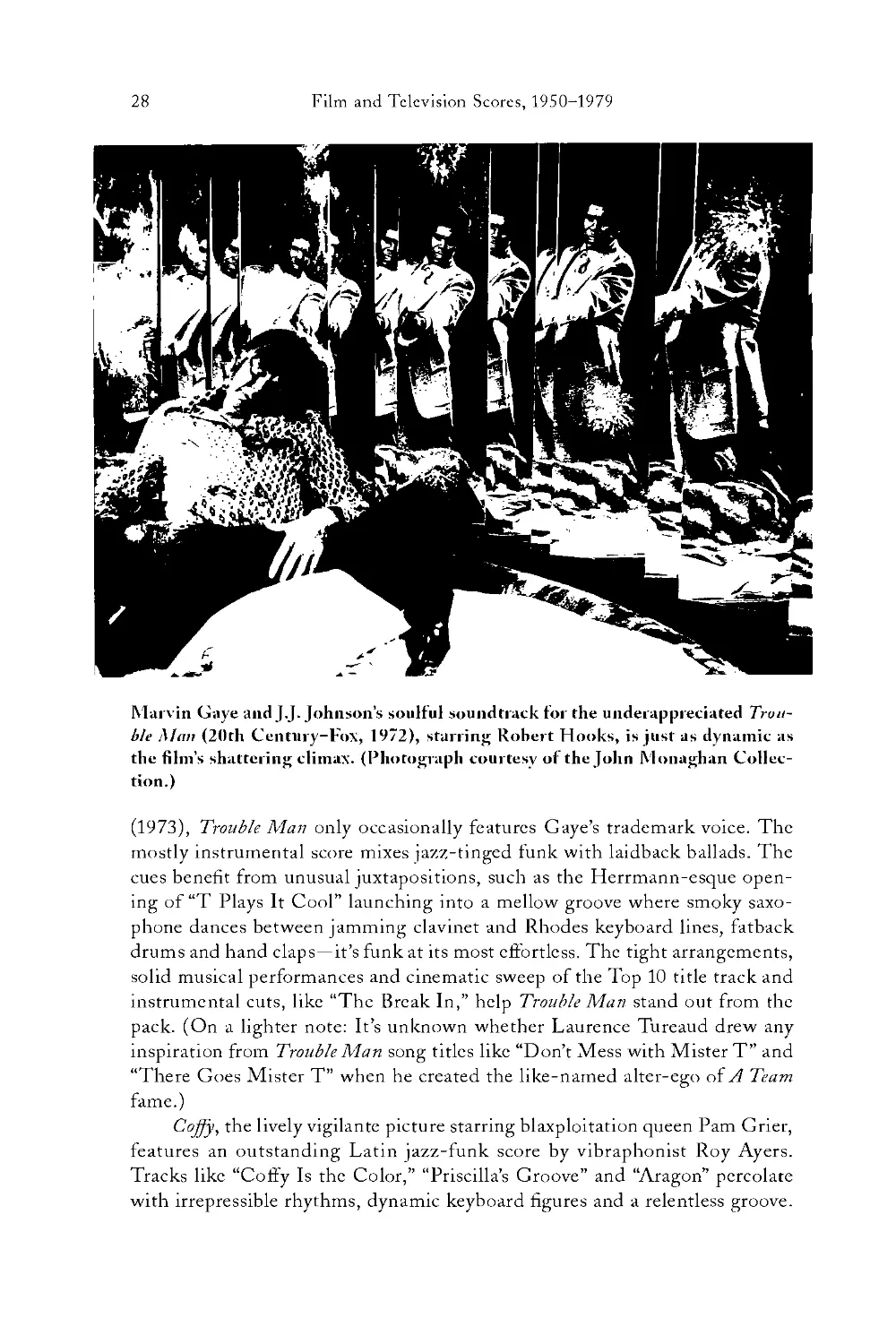
Marvin Gaye and J J. Johnson’s soulful soundtrack for the underappreciated Trou-
ble Man (20th Century-Fox, 1972), starring Robert Hooks, is just as dynamic as
the film’s shattering climax. (Photograph courtesy of the John Monaghan Collec-
tion.)
(1973), Trouble Mau only occasionally features Gaye’s trademark voice. The
mostly instrumental score mixes jazz-tinged funk with laidback ballads. The
cues benefit from unusual juxtapositions, such as the Herrmann-esque open-
ing of “T Plays It Cool” launching into a mellow groove where smoky saxo-
phone dances between jamming clavinet and Rhodes keyboard lines, fatback
drums and hand claps—it’s funk at its most effortless. The tight arrangements,
solid musical performances and cinematic sweep of the Top 10 title track and
instrumental cuts, like “The Break In,” help Trouble Man stand out from the
pack. (On a lighter note: It’s unknown whether Laurence Tureaud drew any
inspiration from Trouble Man song titles like “Don’t Mess with Mister T” and
“There Goes Mister T” when he created the like-named alter-ego of A Team
fame.)
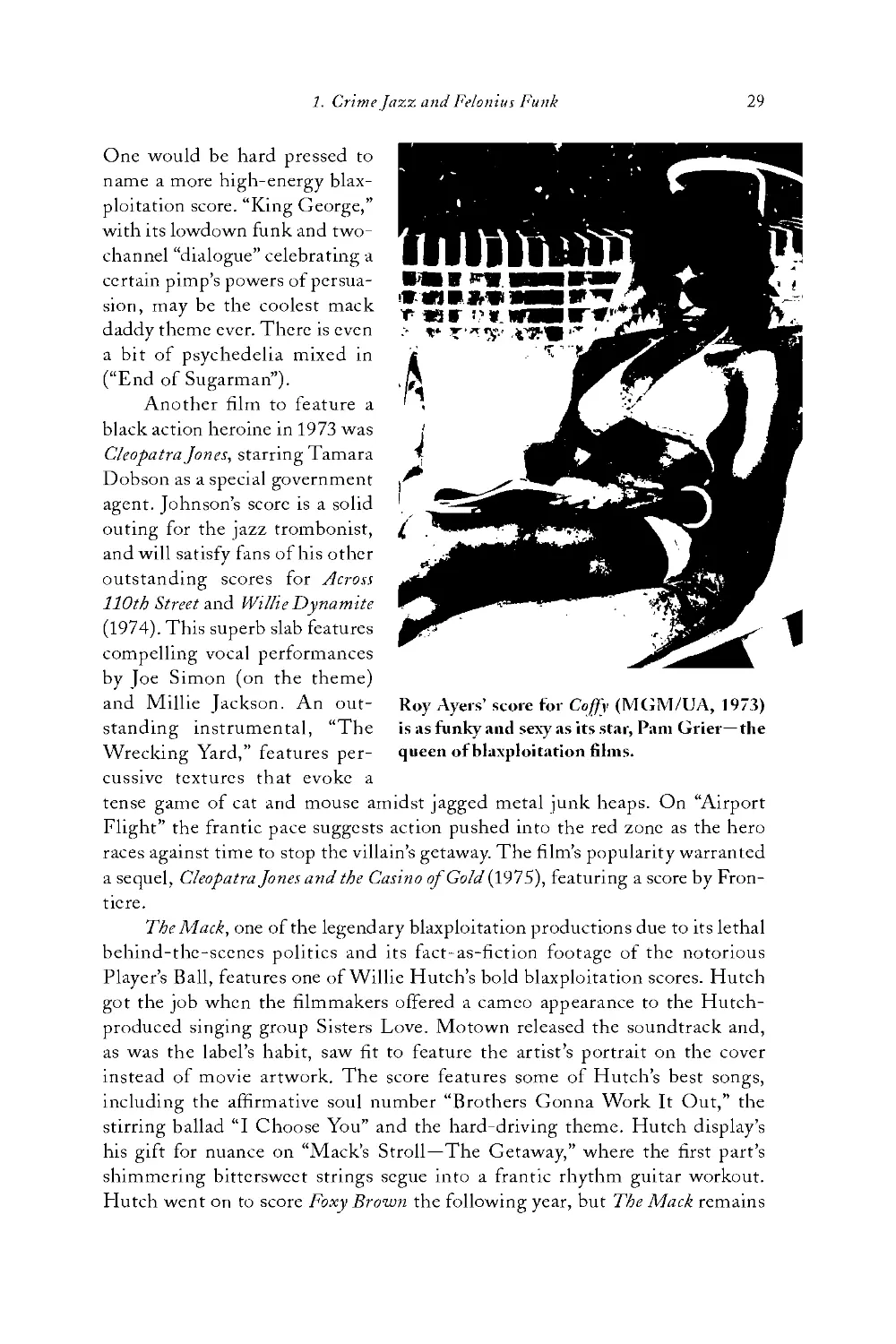
Coffy, the lively vigilante picture starring blaxploitation queen Pam Grier,
features an outstanding Latin jazz-funk score by vibraphomst Roy Ayers.
Tracks like “Coffy Is the Color,” “Priscilla’s Groove” and “Aragon” percolate
with irrepressible rhythms, dynamic keyboard figures and a relentless groove.
1. Crime Jazz and Felontus Funk
29
One would be hard pressed to
name a more high-energy blax-
ploitation score. “King George,”
with its lowdown funk, and two-
channel “dialogue” celebrating a
certain pimp’s powers of persua-
sion, may be the coolest mack
daddy theme ever. There is even
a bit of psychedelia mixed in
(“End of Sugarman”).
Another film to feature a
black action heroine in 1973 was
Cleopatra Jones, starring Tamara
Dobson as a special government
agent. Johnson’s score is a solid
outing for the jazz trombonist,
and will satisfy fans of his other
outstanding scores for Across
110th Street and Willie Dynamite
(1974). This superb slab features
compelling vocal performances
by Joe Simon (on the theme)
and Millie Jackson. An out-
standing instrumental, “The
Wrecking Yard,” features per-
cussive textures that evoke a
Roy Ayers’ score for Coffy (MGM/UA, 1973)
is as funky and sexy as its star, Pam Grier—the
queen of blaxploitation films.
tense game of cat and mouse amidst jagged metal junk heaps. On “Airport
Flight” the frantic pace suggests action pushed into the red zone as the hero
races against time to stop the villain’s getaway. The film’s popularity warranted
a sequel, Cleopatra Jones and the Casino of Gold (1975), featuring a score by Fron-
ticre.
The Mack, one of the legendary blaxploitation productions due to its lethal
behind-the-scenes politics and its fact-as-fiction footage of the notorious
Player’s Ball, features one of Willie Hutch’s bold blaxploitation scores. Hutch
got the job when the filmmakers offered a cameo appearance to the Hutch-
produced singing group Sisters Love. Motown released the soundtrack and,
as was the label’s habit, saw fit to feature the artist’s portrait on the cover
instead of movie artwork. The score features some of Hutch’s best songs,
including the affirmative soul number “Brothers Gonna Work It Out,” the
stirring ballad “I Choose You” and the hard-driving theme. Hutch display’s
his gift for nuance on “Mack’s Stroll—The Getaway,” where the first part’s
shimmering bittersweet strings segue into a frantic rhythm guitar workout.
Hutch went on to score Foxy Brown the following year, but The Mack remains
30
Film and Television Scores, 1950-1979
his, and one of the era’s, best score. (For The Mack's home video release in 1983,
the studio foolishly replaced Hutch’s score with an R’n’B-lite soundtrack, by
Alan Silvestri that pales in comparison.)
Another Motown soundtrack from 1973 was Edwin Starr’s Hell Up in
Harlem, the sequel to Black Caesar. James Brown, who scored Caesar, was orig-
inally asked to do Harlem as well, but the film’s director, Larry Cohen, rejected
his efforts in favor of the Starr vehicle, featuring songs written by Freddie Per-
ren and Foncc Mizell (who, along with Berry Gordy and Dckc Richards,
formed the Corporation, the production team behind the Jackson 5). Harlem's
outstanding tracks include the rousing, electrically charged theme song and
“Easin’ In,” which boasts an often-sampled, finger-snapping intro. The song
could have been a hit, but Motown neglected to promote the score — a mere
contract fulfiller for Starr.
After Cohen rejected Brown’s Harlem, the “godfather of soul” released
the music separately on a double album, The Payback, which is generally
regarded as one of his best efforts; some fans insist it’s better than his actual
soundtracks. Prior to recording that album, Brown scored Black Caesar and
Slaughter’s Big Rip Off, which were released just six months apart in 1973. The
former earned Brown the moniker “Godfather of Soul,” and featured one of
his best tracks ever, “Down and Out in New York City.” The single charted
at number 13 on the R&B chart and at number 50 on the pop chart. The other
single “Mama Feelgood,” which is sung by Lyn Collins, charted at number 37
on the R&B chart. The other funky standouts include “Sportin’ Life” and
“Like It Is, Like It Was,” but overall the soundtrack isn’t particularly memo-
rable or cinematic.
Brown’s Slaughter’s Big Rip Off is more richly orchestrated but stylisti-
cally similar to his Black Caesar', the film itself is the sequel to Slaughter, which
features a soundtrack by Luchi Dejesus. Rip Offs theme song lacks a strong
melodic hook, but a few of the instrumentals (arranged by J.B.’s bandleader,
Fred Wesley) have a strong cinematic sweep. Tracks like “Transmograpfication”
have a free-wheeling jazz quality, while vocal tracks like “Sexy, Sexy, Sexy”
offer the sort of vibe one expects from the funky soul brother who gave the
world “Sex Machine.”
Brown may have been the “hardest working man in show business” in
1973, but he wasn’t the only artist to release two scores that year. Johnny Pate
scored the outstanding Shaft in Africa, and the excellent Brother on the Run.
Africa is a favorite among blaxploitation fans and hip-hop deejays alike.
It’s a truly cinematic soundtrack with memorable vocal tracks, but is also “sam-
ple-worthy” thanks to its effective use of spare instrumentation and African
percussion. Closely associated with Curtis Mayfield’s Impressions and the
Chicago soul scene, Pate brings his fine-tuned arranger’s sensibility to funky
big band tracks like the theme and “You Can’t Even Walk in the Park,” and
an adventuresome spirit to the exotic-tinged “Headman” and “Truck Stop.”
1. Crime Jazz and Felomus Funk
31
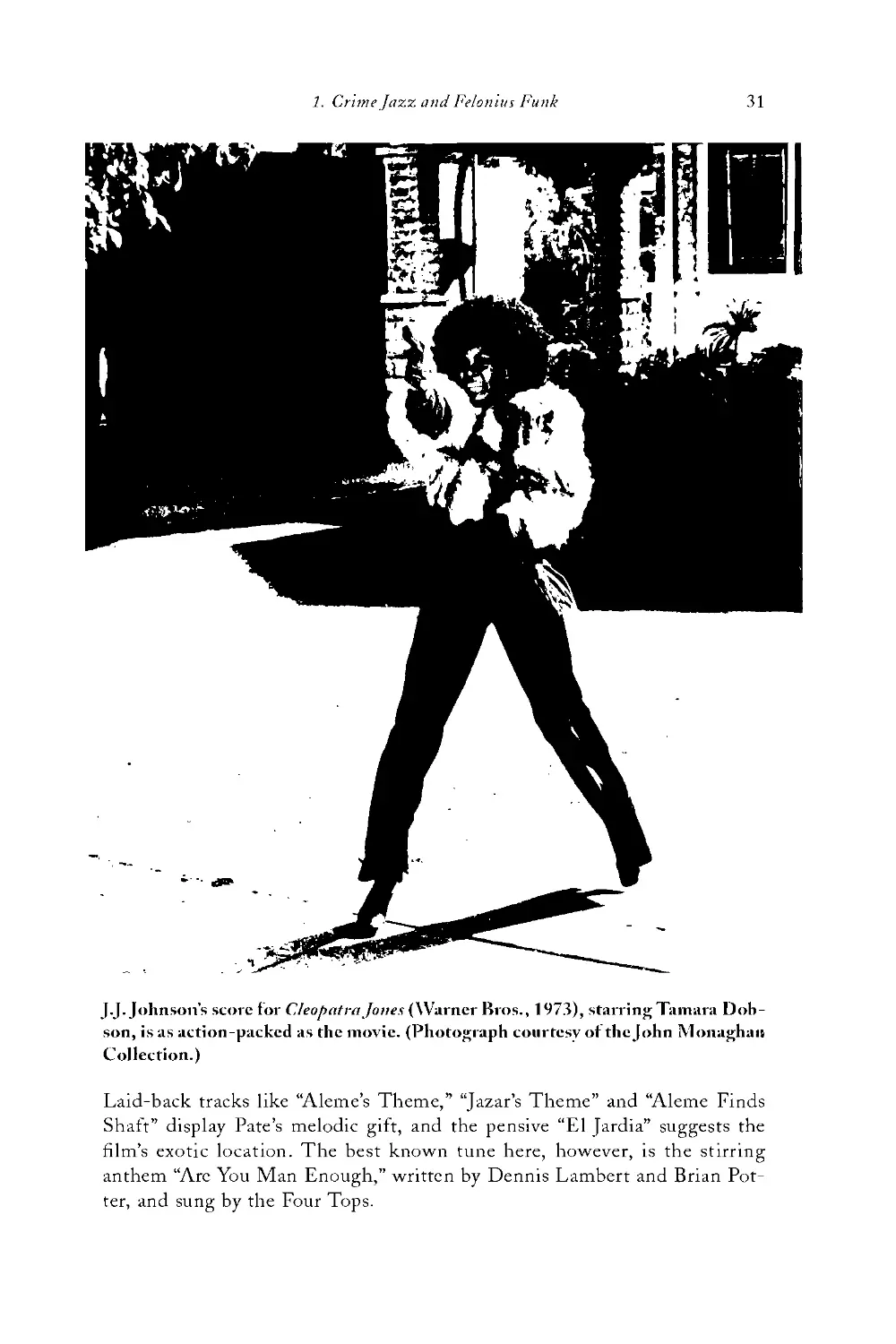
J J. Johnson’s score for Cleopatra Jones (Warner Bros., 1973), starring Tamara Dob-
son, is as action-packed as the movie. (Photograph courtesy of thejohn Monaghan
Collection.)
Laid-back tracks like “Aleme’s Theme,” “Jazar’s Theme” and “Aleme Finds
Shaft” display Pate’s melodic gift, and the pensive “El Jardia” suggests the
film’s exotic location. The best known tune here, however, is the stirring
anthem “Arc You Man Enough,” written by Dennis Lambert and Brian Pot-
ter, and sung by the Four Tops.
32
Film and Television Scores, 1950-1979
Brother is nearly as great. Featuring Pate’s slick, orchestration and a theme
song sung by Adam Wade, Brother offers up its share of wah-fueled chase
music and steamy love themes. Pate finds a perfect balance between a funky
rhythm section, jazzy horns and strings on two versions of the theme. On
“Auto Chase,” African percussion drives the action, much as it did on Shaft in
Africa.
Doo-wop dynamo Don Julian (of Meadowlarks fame) also scored two
films in 1973, but only one was released at the time. For Savage! Super Sou!
Julian balances the hard-edged masculine sound of stripped-down funk with
the sweetly feminine timbres provided by flute and acoustic guitar. There
even is a “peace, love and understanding” spoken word track about cross-cul-
tural friendship and musical fusion, featuring a Spanish-tinged musical
backdrop. But when things get funky, the playing is raw and aggressive. While
some numbers are complete unto themselves, others have a fragmented
quality suggesting that a few short cues were edited together to make single
tracks.
Julian’s Shorty the Pimp is more noteworthy. The film was never released,
and the soundtrack wasn’t issued until 1998, the year Julian died. In the movie,
Julian and the Larks star as a funk group, the Blue Flamingos, who get mixed
up in some trouble. The Shorty soundtrack is interesting in the way it draws
from such blaxploitation classics as Mayfield’s Superfly score and the soul hits
of the period. Since the group performs in the movie as a lounge act, the
soundtrack features workmanlike covers of hit songs by Mayfield, Gaye and
Stevie Wonder, and a bettcr-than-averagc cover of Burt Bacharach’s “The
Look of Love.” Among the better Julian originals are the jazzy “Brother What
It Is,” the lowdown funky “Vato’s Brew” and the Tcmptations-likc “Schoolin’
and Foolin’.” While Julian’s “Superfly” knock-off, “Super Slick,” is dispensa-
ble stuff, his “Shorty the Pimp” theme is arresting.
Other blaxploitation soundtracks of 1973 include Osibasa’s ill-advised
afro-beat outing for Superfly T.N.T., and Badder Than Evil’s well-executed
but otherwise formulaic platter for Gordons War. To Osibasa’s credit, they didn’t
resort to Mayfield mimicry, but the end result proved too far left of field to
catch on. Gordons War, on the other hand, doesn’t offer enough surprises to
differentiate itself from the pack. Nonetheless, it has a killer chase theme, aptly
titled “Hot Wheels.”
Hit-maker Hayes returned to blaxploitation in 1974 with two solid scores
for Truck Turner and Three Tough Guys (a.k.a. Tough Guys). Hayes also starred
in both movies, the latter of which was an international production co-star-
ring fellow badass Fred Williamson. Both scores offer Hayes’ trademark slick
production and hooky grooves. An overview of the track titles goes a long way
toward filling the mind’s eye with exciting imagery. Tough Guys features “Kid-
napped,” “Buns O’Plcnty” and “Run Fay Run,” which was later used in
Quentin Tarantino’s Kill Bill Vol. 1 (2003). Meanwhile, Truck Turner features
1. Crime Jazz and Felomus Funk
33
After scoring big with Shaft, Isaac Hayes went on to score and star in Truck Turner
and Three Tough Guys (both 1974). (CD cover appears courtesy of Stax Records/Con-
cord Music Group; graphic design by Linda Kalin, based on original Stax album
cover art.)
“Breakthrough,” “A House Full of Girls,” “Hospital Shootout” and the cen-
terpiece “Pursuit of the Pimpmobile.”
It was the same year Motown songwriting ace Hutch scored the grind-
house epic Foxy Brown., which nearly matches The Mack. “The Chase” is one
of the most exciting opening tracks imaginable, built from layers of percolat-
ing rhythm and pulsating instrumentation. The main theme follows suit,
adding soulful vocals to the mix. Hutch slows things down for romantic moods
on “Hospital Prelude of Love Theme” and “Give Me Some of That Good Old
Love.” The groovy psychedelic appeal of the echo-laden “Out There” is intox-
34
Film and Television Scores, 1950-1979
icating, and the sexy strut of “Foxy Lady” is guaranteed to inspire some dance
moves. When it comes to naming Hutch’s best soundtrack., it’s a photo finish
between Mack and Foxy.
An essential blaxploitation score that is often wrongfully overlooked is
Johnson’s Willie Dynamite. Featuring fine vocal performances by Martha Reeves
(of Martha &. the Vandcllas), Johnson’s score is nearly as good as Across 110th
Street, and certainly on par with Cleopatra Jones. On the rousing title track and
others, unexpected instruments like the twangy Jew’s harp and a variety of har-
monicas (such as the resonant bass harp) join more traditional funk instru-
mentation for an exciting sound driven by a cacophony of exotic percussion
that includes tympani and tabla.
Speaking of dynamite, one of the most psychedelic blaxploitation sound-
tracks is Charles Earland’s The Dynamite Brothers (1974), a little known flick
about a black former football player and a Chinese black belt who join forces
against a drug kingpin. The score prominently features the synthesizer exper-
iments of Patrick Gleeson in combination with a crackling jazz-funk groove.
“I was combining pop music with space music,” Gleeson explains in the book-
let notes of the Prestige release that pairs Dynamite with Donald Byrd’s Corn-
bread, Earl & Me (1975), which was originally released on Prestige’s sister
label, Fantasy.
While Brothers was largely ignored upon theatrical release, Cornbread is
considered a classic of the genre. In comparison to Brothers, Donald Byrd’s
score, as performed by his group the Blackbyrds, is relatively conventional, but
it still packs a smokin’ groove. The hooky theme song frequently turns up on
compilations, and members of the original Blackbyrds (who were students of
Professor Byrd’s at Howard University back in the day) still play selections
from the score in concert today. Many of the tracks were created from 20- or
30-sccond grooves, looped together and stretched out by arranger Mitch Far-
ber and engineer Vai Christian Garay. The recordings also feature session
musicians who filled in when members of the Blackbyrds were hitting the
books.
Monk Higgins and Alex Brown’s Sheba, Baby (1975), which is one of the
less popular Grier flicks, is an underrated gem, full of funky instrumental
grooves and Philly soul numbers sung by Barbara Mason. The title track, sung
by Mason, has an infectious hook wrapped around the line “She’s a danger-
ous lady.” Mason also shines on “A Good Man Is Gone,” a mid-tempo blues
that will have you singing along. The instrumentals hold up their end of the
bargain, too. The brassy “Get Down Sheba,” the sleazy “Three Hoods,” and
the strutting “Who the Hell Is That?” wouldn’t sound out of place on a Hayes
soundtrack. Other jazz-funk big band numbers include “The Shark,” “Breast
Stroke” and “Speedboat.”
Another solid blaxploitation score is Luchi De Jesus’ Friday Foster (1975).
De Jesus scored several films of the era, including Detroit 9000 and Slaughter,
1. Crime Jazz and Felomus Funk
35
and he also arranged and produced Chet Baker, Sarah Vaughan and Peaches
8c Herb. Outstanding tracks include the theme, sung by Ward L. Chandler,
and the Vocoder-enhanced scat funk of “Skin City.” While a number of tracks
have required premature fade-outs due to dialogue that has been wisely left
out of the mix, the score has compelling cinematic passages, and wildly funky
ones to boot.
Another later blaxploitation film is The Monkey Hurtle (1976), featuring
an upbeat funk score by Jack Conrad, who had a varied Hollywood career. In
the ’30s and ’40s he acted in several B-movies, and then much later became a
director, producer and composer. Hurtle is a solid, workmanlike example of
later-era blaxploitation scores. The disco influence is felt on tracks like “Roller
Rink” and the title track, but doesn’t overwhelm the vibe of good-time funk.
No discussion of blaxploitation soundtracks is complete without Disco
Godfather (1976). Rudy Ray Moore’s last ’70s movie features slick funky disco
played by session musicians performing under the moniker Juice People Unlim-
ited. Even with Moore’s outsized personality attached to it, however, Disco is
still a minor entry.
One of the latter-day blaxploitation soundtracks of any substance is
Mayfield’s Short Eyes (1977), a film about a white child molester who receives
rough justice at the hands of Latino and black inmates. As with his previous
efforts, Short Eyes (which is slang for a pedophile) is full of topical lyrics, elec-
trifying grooves and Mayfield’s soulful vocals. The soundtrack nearly meas-
ures up to Sup er fly., but the film’s unconventional subject matter has relegated
both the album and movie to relative obscurity. Nevertheless, songs like the
wah-drenched “Do Do Wap is Strong in Here” and the tense title track are
some of Mayfield’s finest movie tracks. Interestingly, Mayfield quotes from
“Scarborough Fair” on the gently meandering “Father Confessor.”
The influence of blaxploitation on contemporary musical tastes cannot be
overestimated. Survey the tracks sampled by such hip-hop artists as Cypress
Hill and Wu-Tang Clan, and you’ll find dozens of blaxploitation beats and
kung-fu movie cuts. There have even been imaginary soundtracks inspired by
the genre, including The Revenge of Mister Mopoji (1994), Soul Ecstasy (1999)
and Super Chase (2001).
The importance of music to black crime films can’t be overstated. Bear
in mind that radio spots for films like Shaft and Superfly often call attention
to the soundtrack artist, practically in the same breath as the movie’s star. This
emphasis on the music further reinforces the idea that in blaxploitation films
the music is as much a character as the flesh and blood men and women who
populate the frame. Outside of Hollywood’s classic movie musicals, no other
genre can truly claim that distinguishing feature. What stirred the audience’s
soul back in the day continues to do so 30 years later. To quote the Godfather
of Soul: “Like it is, like it was.”
36
Film and Television Scores, 1950-1979
Kung-Fu Cuts
Black, action movies of the ’70s often played side-by-side with kung-fu
flicks (and in the case of a film like Black Belt Jones, the two genres merged).
The most popular martial arts movies of the early ’70s starred the legendary
Bruce Lee, including Fists of Fury, The Return of the Dragon, Game of Death
and, most famously, Enter the Dragon. While not crime films in the usual
sense, the action often revolved around organized crime and vigilante justice.
Some of these movies have legitimate original soundtracks by such heavy-
weights as Schifrin and Barry, and others feature “needle drop” soundtracks
falsely attributed to Joseph Koo.
Falling in the latter camp is Tang Shun Da Xiong {Fists of Fury, or The
Big Boss, 1971). Another Koo-attributed soundtrack is featured in Meng Long
Guojiang {The Way of the Dragon, or Return of the Dragon, 1972).
Schifrin came closest to blaxploitation with his excellent Enter the Dragon
(1973), the Bruce Lee blockbuster directed by Robert Clouse. By then, the
blaxploitation sound was enjoying great success with audiences, regardless of
skin tone. The evidence of comfortable assimilation was on the screen—as the
movie’s Chinese hero (Lee) teams up with an African-American (Jim Kelly)
and a Caucasian (John Saxon) — as well as on the soundtrack. The theme, with
its chugging wah guitar rhythms, “Shaft”-like rhythm and ultra funky key-
board and brass lines, make it a classic of the blaxploitation genre. Elsewhere
in the score, the mellow groover “Headset Jazz,” and lean creepers “Into the
Night” and “The Human Fly,” also have funky appeal. The score remains a
touchstone for fans of Schifrin, blaxploitation and classic kung fu. Rap group
Wu Tang Clan paid homage to it with its debut album, Enter the Wu Tang
(1993). And Rush Hour (1998) director Brett Ratner requested a Dra^w-style
score from Schifrin to accompany the high-kicking, crime-fighting, comic
antics of Jackie Chan and Chris Tucker. Simply put, Dragon is a notable and
influential entry in the blaxploitation soundtrack genre, even if the movie
barely qualifies.
Director Clouse’s next film, Black Belt Jones (1974), starring Dragons Jim
Kelly, features music by Detroit funk guitarist Dennis Coffey and De Jesus.
The score boasts a catchy, fast-paced theme and action cues that are funky,
hard-driving and occasionally psychedelic.
The only other notable Bruce Lee soundtrack is Game of Death (1978) by
John Barry, which favors an orchestral sound more in keeping with the com-
poser’s work on James Bond movies.
More Classic Crime Films of the '60s and 70s
Although jazz and funk styles dominated the crime sound of the late ’60s
and early ’70s, a number of crime films of the era featured other styles of
1. Crime Jazz and Felomus Funk
37
JOHN BARRY
Song performed by
COLLEEN CAMP
JOHN BARRY
ORIGINAL
SOUNDTRACK
RECORDING
GOLDEN HARVEST PresentsП ALSO INCLUDES
John Barry’s score for Game of Death (1978) uses Bruce Lee’s kung-fu vocalisms to
accent the music. (CD cover appears courtesy of Silva Screen Records.)
music. Bonnie & Clyde (1967) is one of the most famous genre entries. Charles
Strouse’s score can best be described as a blend of modern classical (with an
occasional jazz tinge) and American folk music, namely bluegrass. It’s no sur-
prise considering Strouse studied with Aaron Copland, the so-called “dean of
American composers,” who was instrumental in developing the “Americana”
style in major works such as Appalachian Spring, Billy the Kid and Rodeo.
Considering Johnny Mandel’s prolific big band credentials, one might
expect a straight jazz score from him for Point Blank (1967), based on a Don-
ald Westlake novel. But the soundtrack ambitiously explores 12-tone serial-
ism— a style not so much hard-boiled as it is scrambled. Soundtrack collectors
who associate Mandel with his warm, sensuous Oscar-winning song “The
38
Film and Television Scores, 1950-1979
Shadow of Your Smile” (1965) will be surprised by the cold modernity of the
composer’s work on this crime thriller. Ponderous, dissonant orchestration with
intermittent percussion accents and subtle use of the genre’s standby keyboard,
the harpsichord, cast an icy disposition over the proceedings, rarely offering
reassurance through crime jazz conventions. However, there are smooth lounge
jazz source cues, such as “This Way to Heaven” and, most enticingly, “I’ll Slip
Out of Something Comfortable,” that are almost jarringly accessible next to
such disquieting tracks as “Nightmare” and “Unquestioned Answers.”
The Outfit (1973), another Westlake adaptation, features a score by Field-
ing whose approach to the genre is often unconventional. The composer bal-
ances his dark avant-garde sensibilities (“Taxi in the Rain”) with tense,
dissonant action jazz (“Office Scuffie/Kenilworth Heist/Casino Heist”) and
country western vocal tracks (“Quentin Blue,” sung by Steve Gillette).
There is no crime theme as instantly recognizable as Nino Rota’s tragic,
nostalgic music for The Godfather (1972), which earned the “Best Picture” stat-
uette at the Academy Awards. Rota’s score also earned an Oscar nod, but was
withdrawn due to the fact that Rota had recycled music he’d written for an
earlier film, Eduardo De Filippo’s Fortunella (1958). The film features not one
but two famous themes. “The Godfather Waltz” opens starkly with solo trum-
pet, stating a plaintive melody punctuated by low discordant chords on piano
and strings. With the trumpet silenced, a sad violin takes up the melody, joined
by lilting guitar rhythms, accordion and woodwinds. This intimate instru-
mental ensemble elicits the exclusivity of mafia family life. Even more recog-
nizable is the film’s lush, timeless “Love Theme,” a haunting, heartbreaking
melody that unfolds with the inevitability of a tragic romance. Overall, Rota’s
Godfather score (on which he collaborated with Carmine Coppola, father of
the director) exhibits considerable orchestral polish and a great love for the
Italian heritage. If it weren’t so famous, however, one wouldn’t necessarily
associate its beautiful music with the crime genre.
Another memorable Mob-related film from 1973 is Serpico, which tells
the true story of a New York City cop who famously exposed police corrup-
tion and its ties to the mafia. With the help of arranger and commercial jazz
legend Bob James, G reck composer Mikis Thcodorakis {Zorba the Greek} scored
the film with a blend of warm, easygoing jazz, “Big Apple” cop funk and, most
unusually, a lilting, slightly sad theme. Although the title character’s back-
ground is Italian, Theodorakis chose to use a balalaika on the theme, which
gives it a strong, stately Greek flavor. It is an unusual choice, but the melody
lingers in one’s mind afterward. The lightweight jazz of “Honest Cop” and
“Alone in the Apartment” are like precursors to smooth jazz, but “Meeting in
the Park” adds tension to James’ super-smooth arrangements.
If Serpico seems a little stuck in the ’70s, Goldsmith’s Chinatown (1974)
is timeless. Goldsmith creates an entrancing film noir atmosphere with uncon-
ventional orchestration that uses four pianos, four harps, two sets of percus-
1. Crime Jazz and Felontus Funk
39
sion and a solo trumpet. According to the composer, who had a mere 10 days
to create the score, he resisted producer Robert Evans’ suggestion that the
music should have a period feel. “I said, ‘No. If what you see on the screen is
perfect, why make it sound like the ’30s?’” Goldsmith recounted in Mark Rus-
sell and James Young’s Film Music Screencraft (RotoVision, 2000).
Despite the resolute logic of that statement, there arc period touches in
the soundtrack, such as the source cue Bunny Berigan’s “I Can’t Get Started,”
as well as piano solos of the standards "Easy Living” and “The Way You Look
Tonight.”
Following a disquieting ghssandi and vaguely Oriental note cluster, the
melancholic and undeniably noir-sounding “Love Theme,” featuring solo
trumpet and strings, describes the rain-swept romanticism of a ’40s Los Ange-
les fit for Bogey and Bacall. From there Goldsmith explores more modernistic
moods where melodic fragments from the theme mesh with discordant avant-
gardist touches that underscore the Oscar-winning story’s perverse and dis-
turbing twists.
Jerry Goldsmith’s noir score for Chinatown (Paramount Pictures, 1974), starring
Jack Nicholson, uses discordant avant-garde touches to connote the filni’s perverse
and disturbing twists.
40
Film and Television Scores, 1950-1979
Hollywood legend Bernard Herrmann’s final score accompanies the gritty
Taxi Driver (1976), about a cabbie turned vigilante. The jazz-tinged orches-
tral score harkens back to the early years of crime jazz film and television
scores, but with a darker sensibility rarely heard in the soundtracks of the ’50s.
The track “Diary of a Taxi Driver,” featuring Bickle’s monologue about the
“scum” on the streets, is a mini-masterpiece of brooding menace, with pulsat-
ing snare and cymbal echoing the cabbie’s restlessness like a ticking time bomb.
(The trip-hop group Journeyman sampled the track on its 1997 album National
Hijinx.) The “Main Title” juxtaposes this tense motif with a more romantic
jazz theme for saxophone, piano, bass and vibraphone as if to emphasize the
delusional thinking of the main character. According to Steven C. Smith,
author of A Heart at Fire's Center: The Life and Music of Bernard Herrmann (Uni-
versity of California Press, 1991), Herrmann received some compositional help
on the jazzier bits from arranger Christopher Palmer.
Palmer took the first four bars of the soprano solo As the Wind Blowetn from
The King of Schnorrers, then continued the melody line in a piece he titled “So
Close to Me Blues.” Herrmann was so d>
“You talking to me?” Bernard Herrmann’s
score for Tax /Driver (Columbia Pictures,
1976) provides a perfect backdrop for the
violent ruminations of anti-hero Travis
Bickle (Robert De Niro).
lighted with the result that the theme
became a key part of the score \AHFC,
p. 351J.
Smith also notes that director
Martin Scorsese credited Herrmann
for supplying the psychological
background for the film.
Although the original sound-
track LP of Taxi Driver felt neutered
by the inclusion of Dave Blume’s
“lite jazz” renditions of the master’s
melodies, the CD reissue restores
Herrmann’s potent score.
International Crime Wave
Like jazz and funk, their cine-
matic equivalents caught on with
film composers and audiences around
the world, particularly in Europe.
Any discussion of crime jazz
from the U.K. must include Roy
Budd, a former child prodigy who
scored more than one dozen movies
during his brief film career (he died
in 1993 from a brain hemorrhage).
1. Crime Jazz and Felontus Funk
41
Most of Budd’s scores are in
the crime thriller vein, and are
characterized by the use of
spacious arrangements and
bottom-heavy grooves.
Budd’s most stunning
theme music came on his sec-
ond feature of 1971, the origi-
nal Get Carter, a film about a
hit man turned avenging angel.
It’s one of the era’s most exotic
and evocative of crime jazz
themes, as it features tablas, a
hypnotic double bass figure,
and reverb-treated keyboards,
plus the sounds of locomotion
and crashing waves. Unfortu-
nately, much of the soundtrack
is taken up by dispensable rock
and soul tracks of the period.
A year later Budd scored
Fear Is the Key (1972), an Alis-
tair Maclean-penned thriller.
His fourth score overall, Fear
is best known for its riveting
theme and its ten-minute "Car
Chase” number. This latter
Rov Budd is best remembered for the arresting
theme heard in Get Carter (MGM, 1971), star-
ring Michael Caine. Budd scored several
thrillers starring Caine.
track features the sounds of tire squeals, honking horns, crashing cars and
police sirens over the top of Budd’s jazzy orchestral funk. It is powerhouse stuff.
Legend has it that the musicians—the cream of the British library scene—that
played on the session erupted into applause for each other’s performances after
each extended take. Elsewhere in the score, Budd explores Louisiana rhythm
’n’ blues (“Louisiana Ferry”), jazzy blues (“Bayou Blues”), orchestral tension
(“The Hostage Escapes”) and climactic action (“Breakout!”). With its blend
of jazzy interludes and dynamic cinematic centerpieces, Fear is an archetypal
Budd soundtrack.
Budd’s music for Something to Hide (1972) may surprise those who know
the composer through scores like Fear Is the Key. Instead of the usual crime
thriller music, we get Budd, the prodigiously talented pianist, playing "Con-
certo for Harry,” a sprawling piece that displays his love of the Romantic
movement, particularly Liszt, Rachmaninov and Tchaikovsky. It’s impressive
in isolation, but differs so much from Budd’s other crime thriller work that it
can barely be thought of as movie music.
42
Film and Television Scores, 1950-1979
Budd’s The Stone Killer (1973) is true to the style he’d forged on Fear Is
the Key, and would continue to develop in spy thrillers like The Black Wind-
mill and The Marseille Contract. The theme starts gently before surging and
settling into a funky groove with solo synth and brass counterpoint. Many of
the intrigue and action cues are typical of Budd’s crime work: strident strings,
low bass, intimidating brass, dynamic keyboard fills, psychedelic accents, elec-
tronic stings, and shimmering percussion underpinned by intermittent rock
drumming. An argument could be made that such cues arc interchangeable
from movie to movie, but that’s more a reflection of Budd’s stylistic consis-
tency than a critique of his range. One need only hear the jazzy interludes (usu-
ally source cues), such as the gentle piano jazz of “In the Shadows,” the
mid-tempo soul “Black Is Beautiful,” the groovy instrumental “Jazz Source”
and the breezy Latin jazz of “Cool Bossa Source,” to appreciate the diverse
sounds at play on The Stone Killer.
Budd’s Tomorrow Never Comes (1978) begins on a melancholy note with
the Matt Monro-sung ballad “Alone Am I,” but thereafter wastes no time in
pumping up the orchestral tension. However, more often then not, Budd opts
for gentler passages. Broad swathes of string textures abound, accented by
woodwinds, acoustic guitars, electric piano and gentle harp flourishes. He also
finds time to funk it up on the strutting “Manhunt” and the easygoing “Hanky
Panky.”
Another notable British crime score is Stanley Myers’ broodingly funky,
psychedelic Sitting Target (197'2). Not unlike Budd’s work, Sitting Target\Aen<\s
slow-mo beats, thick bass lines, spare string parts that twist and turn along-
side spacious keyboard chords, solo horn and moody synths. There is a fair
amount of repetition, but the lean, mean theme certainly invites it, lending
itself to subtle variations. Like Budd, Myers used the cream of the U.K. library
music scene, but this isn’t like the flashy commercial power rock that seemed
to dominate the British library funk of the ’70s. In fact, it’s almost minimal-
ist at times and certainly jazzy in that meditative electric Miles Davis vein,
though occasionally Myers offers upbeat passages to break the tension.
While the British favored secret agents {Secret Agent, a.k.a. Danger Man\
The Prisoner', The Avengers) to police officers, one TV show, The Sweeney, is a
notable exception. The show revolved around two of Britain’s toughest cops,
Regan and Carter, though it started in 1974 with a TV movie, Regan. Like
the TV series that would follow, the movie distinguished itself from traditional
British crime shows by revealing the ugly side of law enforcement and the alco-
holic dysfunctional lives led by the main characters. The Sweeney soundtrack
is a rarity of the genre: a legitimate funky crime score made up almost entirely
of production music from specialist music libraries like KPM, De Wolfe, Bru-
ton and Chappell. These tracks were composed and performed by seasoned
session musicians such as Johnny Hawksworth, Keith Mansfield, Peter Reno
and many others. In the case of The Sweeney, the library tracks are predomi-
1. Crime Jazz and Felomus Funk
43
nantly funky jazz-rock. The theme, by Harry South, is a brassy updating of
the traditional crime show theme, bolstered by virtuoso electric guitar, rum-
bling bass guitar and an electric piano solo that wouldn’t be out of place on a
jazz fusion record. Elsewhere — as on “Flying Squad,” “The Big Fuzz” and
“Funko”—the mood favors action. As far as funky cop show scores go, The
Sweeney is outstanding, especially as an introduction to the British sound
library scene.
Another outstanding entry in the British crime funk genre is The Hanged
Man score by Alan Tew, and performed by Bullet. Like The Sweeney, this is a
’70s era show that uses library tracks—this time from Themes International.
This score, which has been sampled by several hip-hop and electronica artists,
is funky to a fault. The theme, with its high-flying synthesizer, is worthy of
inclusion in any funky crime mix. Other tracks, like “Contract Man” and “Road
Runner,” are as lean and mean as anything heard on a blaxploitation score; but
taken as a whole this rocking all-instrumental score offers little to distinguish
it.
Across the English Channel in France, jazz and film noir both were
beloved, yet there are surprisingly few French crime movie scores in the pure
crime jazz vein. Such classic crime films as Rififi (1955) and Bob Le Flambeur
(1955) reserve jazz for nightclub scenes only, favoring melancholic orchestral
scoring for theme music and so forth.
Michel Magne is one of the notable French composers who embraced
crime jazz as a style for such films as Compartiment tueurs {The Sleeping Car
Murders, 1964), Johnny Banco (1967) and De la Part des Compains {Cold Sweat,
1970). I lis soundtracks from this period blend catchy crime jazz, swanky lounge
and funky library-style cues, and display an inventive streak. For example, on
an intriguing track like “The Killing Train” from Compartiment tueurs, Magne
lends the Hammond-fueled groove a surreal quality due to electronic sound
effects that suggest locomotive rhythms and—oddly—a mewing cat.
Vladimir Cosma is another outstanding proponent of French crime jazz.
His L'Affaire Crazy Capo {The Affair of Crazy Capo, 1973), a French-Italian co-
production, is dramatic, but occasionally groovy. Analog keyboards—like the
unmistakable sound of the Moog—arc a notable feature. Some tracks receive
a distinctively “French” treatment, as they prominently feature an accordion.
Many tracks are lushly orchestrated, but never to the point of sappy melodrama;
the score always is at the service of the suspenseful story. At times the music
is incredibly spare, featuring little more than percussion. Other times a fuzz-
tone guitar spikes the sonic cocktail. While the overall effort is more formal
than funky, the end result is satisfying in a most unexpected way, almost resem-
bling a Morricone soundtrack.
Speaking of Morricone, Italian composers excelled at crime soundtracks
during the late ’60s and ’70s. Along with Morricone, the most prolific crime
funk composers were Franco Micalizzi, Francesco De Masi, and Guido and
44
Film and Television Scores, 1950-1979
(«100 Н?
Auin Delon Jean Cabin Lino Ventura
a film by HENRY VERNEUIL*
IL CLAN DEI SICILIAN!
(THE SICILIAN CUN)
MUSIC BY ENNIO MORRICONE
The main theme from Ennio Morricone’s Le clan des siciliens (a.k.a. Tbe Sicilian Clan3
1969) is among the composer’s most haunting. (CD cover appears courtesy of CAM
Original Soundtracks; graphic designer unknown.)
Maurizio De Angelis. Known as polizlotteschi, the most famous Italian crime
films reflected the influence of gritty American movies such as Dirty Harry
and The French Connection. The music exudes rock ’n’ roll swagger and flash,
along with hot-blooded Mediterranean melodrama, fueled by fuzz-tone gui-
tar, soulful organ, rumbling electric bass, and crashing drums. Among the out-
standing poliziotteschi are Morricone’s elegiac II clan dei siciliani {The Sicilian
Clan, 1969), Piero Umiliani’s jazzy La legge dei gangsters {Gangster's Law, 1969),
Gianni Ferrio’s melancholic Tony Arzenta {Big Guns or No Way Out, 1972), De
Angelis’ high octane La polizia inenmina la legge assolve {High Crime, 1973),
De Angelis’ emotive Milano trema: la pohzia vuole giustizia {The Violent
1. Crime Jazz and Felontus Funk
45
Professionals, 1973), De Angelis’ lean and mean I! cittadino si ribella {Street
Law, 1974), Micalizzi’s haunting Hold-Up—istantanea di una rapina, 1974),
Albert Verrecchia’s trippy Roma drogata (a.k.a. Hallucination Strip, 1975), De
Angelis’ Roma violenta (1975), Pulsar’s psychedelic Milano violenta (1976),
Micalizzi’s classic Italia a mano armata {A Special Cop in Action, 1976), De
Masi’s dark Napoli spara (1977), Goblin’s funky La via della droga (1977),
Micalizzi’s aggressive La banda del gobbo {Brothers Till We Die, 1977), and Lallo
Gori’s disco-influcnccd scores for Ritornano quelli della calibro 38 {Gangsters or
Return of the 38 Gang, 1977) and II commissario di ferro {The Iron Police Inspec-
tor, 1978).
Guido and Maurizio De Angelis’ Roma violenta (a.k.a. Violent Rome, 1975) is one of
the exciting funk-rock crime soundtracks to come out in Italy during the ’70s. (CD
cover appears courtesy of Beat Records; graphic design by Daniele De Gemini.)
46
Film and Television Scores, 1950-1979
In Germany, the crime jazz soundtrack is closely associated with Peter
Thomas and Gert Wilden. Both composers scored for the Edgar Wallace
“krimis” of the late ’50s through the early ’70s, and Wilden for Jesus Franco’s
trashy Fu Manchu potboilers of the same period. (Martin Bottcher, Nora
Orlandi and others also scored for the Edgar Wallace films.)
Edgar Wallace was a popular British pulp writer whose novels were
adapted to the screen by Constantin Film, Germany’s most successful film
distributor at the time. Thirty-two B-gradc flicks were produced over little
more than a decade, with titles like The Hound of Blackwood Castle, The Mon-
ster of Soho, Double Face and The Spell of the Sinister One.
Peter Thomas is probably the most creative German film composer of his
generation. His arrangements for the Edgar Wallace films feature gunshots,
screams, explosions, primitive electronics and maniacal laughter. The music
crosses big band with surf rock and Esquivel-style lounge. Thomas also scored
the Jerry Cotton spy films of the same period.
Gert Wilden’s crime jazz also blends big band and rock ‘n’ roll sounds.
The evidence can be heard in the definitive collection of Wilden’s Edgar Wal-
lace/Fu Manchu phase, I Told You Not to Cry. The opener, “Rolf Torring,”
oozes danger and intrigue. The exotic percussion, wailing brass and hot-wired
Hammond organ set the standard for beat jazz for the criminal set. Elsewhere,
on tracks like “Hong Kong Twist,” the sound is irrefutably pop rock. But on
a track like “Murder Beat” the sound is jazz.
Crime and sex prominently figure in Germany’s “Reeperbahn” movies of
the ’60s and ’70s. These crime flicks take place in Hamburg’s Ted light” dis-
trict, and revolve around prostitution, smuggling, drug running and the like.
The music lies somewhere in between crime jazz and funk, favoring a rockin’
“now sound” sensibility of the period. The drums and electric bass lay down
a groove, as fuzz-tone guitar, organ, brass and sax wail away Occasionally, a
moaning female scat infiltrates the mix as a reminder of what awaits each lis-
tener in the seediest cinematic neighborhood. The best introduction to this
music is the CD compilation St. Pauli Affairs, which features Thomas, Peter
Schirmann, Roland Kovac, and several others.
Spain also got into the act. Take one look at the pulpy cover of the Fresh
Sound Records’ compilation Jazz en el cine negro espanol 1958-1964 and one
knows what one is in for—Spanish film noir crime jazz of the same era as Peter
Gunn, Johnny Staccato and Touch of Evil. The package’s luridly illustrated bi-
lingual insert explains how the crime films of Julio Coll, Juan Bosch and other
directors broke significant stylistic ground by delving into the seedy side of
life in Franco’s Spain through such films as Un vaso de whisky (A Glass of
Whiskey, 1958) and A sangre fria (In Cold Blood, 1959). Jazz en el cine negro
espanol delivers a riveting 79-minute program of hard-boiled brass, vulgar
organ tones, well-chilled vibes and smoky atmosphere. Most of the music is
byJose Sola, with additional tracks by Augusto Alguero, Enrique Escobar and
1. Crime Jazz and Felontus Funk
47
Federico Martinez Tudo, who are relatively unknown to film music fans.
Although one might expect frequent use of percussion and Latin rhythms,
there is a fair amount of stylistic experimentation here. Some of the best pas-
sages employ the frenetic percussive style to depict dramatic action far from
the dance floor. Other tracks favor swing and jazz styles that wouldn’t sound
out of place in a typical Hollywood production of the era. There’s even a bit
of rollicking rock ’n’ roll featuring jangling electric guitar rhythms and wail-
ing saxophone. Reinforcing the Hollywood influence is the presence of Amer-
ican singer Gloria Stewart on the slow, sultry “Manhattan Blues.” Peppered
with dialogue and the sounds of onscreen action, the listening experience is
akin to playing a video just for the aural atmosphere. About half of the tracks
exceed the 10-minute mark as multiple cues flow one after another.
Caper Concertos
The caper, or heist, film—like the mob movie, courtroom drama or prison
picture — is a popular sub-genre of the common crime film. Its distinguishing
feature is its sometimes gritty, sometimes glamorous preoccupation with the
criminal mind. Instead of focusing on a law enforcer, the caper movie sub-
verts the traditional crime story by concentrating on a charming, sophisticated
thief or motley band of thieves. While a bank, casino, museum or jewelry
cache provides the requisite motivation, the ultimate goal often is the prom-
ise of retirement from the life of crime, a conceit designed to capture the audi-
ence’s sympathy.
Some caper films strive to comment on the immorality inherent in a life
of crime by bringing about the culprit’s ultimate capture or demise. Just as
often, the crook improbably gets away with the loot to live and love another
day of outlaw fantasy. Regardless of the denouement, caper movies arc designed
to electrify the audience with the vicarious thrill of living outside of the bour-
geois constraints of acceptable, law-abiding behavior. Since the original mod-
ern caper film, The Asphalt Jungle (1950), hit the silver screen, the genre has
enjoyed box office clout.
Musically speaking, caper flicks follow the stylistic evolution of crime
films in general, from the noir jazz scores of the ’50s through the colorful spy
sound of the ’60s to the funky soul soundtracks of the ’70s. The evolution is
as intuitive as it is canny. Jazz characterizes both the seedy underworld and
improvisatory methods of the outlaw. The spy sound lends their crimes sophis-
tication and glamour. And the funk serves as a not-so-subtle reminder of how
hip and sexy the antihero must be to buck the system in style.
Caper films really took off during the spy-crazy ’60s, and European loca-
tions proved popular, particularly along the “exotic” Mediterranean coast from
Turkey to Spain. Topkapi (1964), helmed by Rififi director Jules Dassin, took
advantage of Istanbul’s mystique. The Greek composer Manos Hadjidakis
48
Film and Television Scores, 1950-1979
penned a sprightly, suitably near-Eastern-sounding score for the film, which
is set in Istanbul, using instruments like the zither and bouzouki to impart
the character of the place as well as the story’s comedic spirit. With titles like
“Master Thief,” “Turkish Security” and “The Sultan’s Dagger,” one might
expect a lot of action, but Iladjidakis keeps the mood light and fairly roman-
tic.
Over in Italy, Armando Trovaioli scored Sette uomini d'oro (The Seven
Golden Men, 1965) and its sequel, Il grande colpo del sette uomim d'oro (The
Seven Golden Men Strike Again, 1967). As with other Italian crime and spy
scores of the ’60s, the mood is light-hearted, romantic and swinging. This is
especially the case with the tracks for the first movie, which offers a catchy,
brassy theme and numbers that feature wordless female vocals backed with
walking bass and intriguing percussion fills. It’s easy to imagine the folly of a
foolish gang of robbers as they bungle the perfect crime. On the second sound-
track, however, the mood changes, with tracks that feature an almost gloomy
male chorus (directed by Alessandro Alessandroni), and Brazilian numbers by
another composer, Nilo Sergio. What appears on paper to be a logical sound-
track double feature ends up sounding like two unrelated scores.
Also filmed in Italy, Caccia alia volpe (After the Fox, 1966) features a
charming score by Burt Bacharach, whose ear-catching music for What's New,
Pussycat? earned the composer a fair amount of hip cache (later acknowledged
with a cameo in the first Austin Powers movie). Foxs title track, performed by
the Hollies (with a spoken part by star Peter Sellers), is one of the oddest and
funniest movie themes of the ’60s; and the instrumental version features fine
Hammond B-3. Fans of groovy movie funk will clamor for “Italian Fuzz” and
“Bird Bath.” Piero Piccioni scored the Italian release of After the Fox.
Set in Spain, The Caper of the Golden Bulls (a.k.a. Carnival of Thieves,
1967) fits the classic caper profile to a tee. Vic Mizzy, who scored a string of
Don Knotts comedies during the late ’60s and early ’70s, delivers an ultra-
light, Latin-tinged Caper. While the music doesn’t offer much in the way of
explosive action, its buoyant dancing spirit is irrepressible. There arc tracks
named for the bolero, meringue, samba and waltz, not to mention “The Danc-
ing Safe Crackers.” For intrigue, look to the harpsichord and low flute of the
sultry “Senorita with the Mini-Skirt,” and the crisp percussion and punchy
rifling on “Waiting for Frenchy.” The Spanish setting is best exploited on “Jota
Waltz,” which features multiple guitars and castanets.
Back in Italy (but with scenes set in Istanbul, Madrid and London) is
Kriminal (1966), a caper based eyexfumetti neri, or Italian crime, mystery or spy
comic books. Italians love their comic book anti-heroes. Dlabollk, Satanik and
Kriminal are among the most famous, and each has been translated to film.
Roberto Pregadio and Romano Mussolini’s Kriminal features a swinging beat
jazz theme—heard in two instrumental versions. There arc other similarly
styled tracks, featuring chugging rhythm guitar and bass with organ, or horns
1. Crime Jazz and Felomus Funk
49
RRCOWDH COMFAHV
CPCR M • GOLD 9FRIFS
19M • 7D0R RF4T 40th Yrrt
Original Soundtrack Music
from the motion picture:
5АТДН1К
by Roberto Pregadio
& Romano Mussolini
Salanik (1968), which features a jazz score by Roberto Pregadio and Romano Mus-
solini, is one of several movies based on Italian adult comic books. (CD cover appears
courtesy of Beat Records; graphic design by Daniele De Gemini.)
and crisp drumming. Other jazzy tracks offer intrigue, sex appeal and action,
occasionally taking a lush lounge approach. The intrigue numbers sound like
Barry’s music for Thunderball., which was released a year earlier, but overall
the music can be described as noir crime jazz. Pregadio and Mussolini also
provided a jazz score for Satanik (1968), which isn’t a caper flick.
Morricone’s psycho beat score for Danger Diabolik (1967), orchestrated
by the composer’s frequent collaborator, Bruno Nicolai, features wild elec-
tronic abstractions, avant-garde trumpet solos, mystical sitar-ladcn intrigue
cues and surf rock guitar-driven action cues that rival Neal Hefti’s “Batman”
50
Film and Television Scores, 1950-1979
theme. The music electrifyingly complements the comic book dynamism of
Mario Bava’s wildly colorful film, making Diabolik one of the essential crime
soundtracks of the period.
For Colpo maestro alservizio di sua maesta britannica {Master Stroke, 1967),
De Masi collaborated with Alessandroni on the theme, while De Masi is cred-
ited for most of the score. It is reprised frequently in this ultra-cool score,
which also offers smoky lounge themes as well as intrigue and action cues
along the way. Brass, percussion and De Masi’s beloved Farfisa organ arc promi-
nently featured, as is Alessandroni’s legendary I Cantori Moderni. Although
most of the score supports a modern setting, a couple of tracks are in the
spaghetti western style due to a clever plot element (the hero is an actor in
sagebrush sagas). De Masi, who scored many Italian westerns, cooks up a
saloon piano piece, and a bit of mariachi brass and vigorous acoustic guitar
strumming on the side.
Another caper film set in Spain is Deadfall (1968), about a cat burglar
who falls in love with the wife of the man who hires him for an elaborate jewel
heist. It’s a prime example of a score that outshines its movie. John Barry
scored Deadfall between two of his best Bond scores (Yow Only Live Twice and
On Iler Majesty's Secret Service), and it certainly earns its place as one of his
finer, if lesser known, efforts. Like any good Barry score, this one has many
suspenseful passages, using streamlined arrangements and distinctive instru-
mentation (deep clean brass flares, harp glissandi, luxurious strings swells). Due
to its setting, there are some Spanish accents, such as the percussion on “Statue
Dance” and Renato Tarrago’s classical guitar on the 14-minute “Romance for
Guitar and Orchestra,” which is truly the album’s centerpiece. The score also
boasts a fine Shirley Basscy vocal performance on the title track “My Love
Has Two Faces.” There also is a “Thunderball”-esque performance by an
unknown male singer. Drawing comparisons to Barry’s 007 scores is inevitable,
as there are numerous passages that wouldn’t sound out of place in films like
Diamonds Are Forever.
When it comes to sophisticated ’60s scores, Michel Legrand’s “jazz-influ-
enced symphony” for The Thomas Crown Affair (1968) is the real deal. Legrand’s
score contains one of the most memorable theme songs ever: the Academy
Award-winning “The Windmills of Your Mind,” sung by Noel Harrison, son
of screen star Rex Harrison. Legend has it that, after watching a five-hour
rough cut of the film, Legrand took a six week vacation during which he wrote
90 minutes of music that the film, in turn, was edited around (very uncon-
ventional, to say the least). As the story goes, if Legrand’s experiment had failed
he would have been obligated to write a second score for free. Beyond the
haunting theme, Legrand provided a subtly balanced score that combines play-
fulness with tenderness. The score is at its grooviest with “Cash and Carry”
and “The Boston Wrangler.” Up-tempo and brassy, “Cash and Carry” catches
fire with scat vocals, rumbling bass line and irresistible hook. Electric bass also
1. Crime Jazz and Felomus Funk
51
The centerpiece of John Barry’s Deadfall {1968) soundtrack is Renato Tarrago’s clas-
sical guitar performance on the 14-minute “Romance for Guitar and Orchestra.”
(CD cover appears courtesy of Film Score Monthly/Retrograde Records; graphic
design by Joe Sikoryak.)
fuels “The Boston Wrangler,” which features some intricate polyphonic tex-
tures and feedback zaps from a Hammond organ. For sheer instrumental bril-
liance, “Playing the Field” and “The Crowning Touch” can’t be beat. On the
former, lightning fast keyboard runs balance with slow passages of creamy
lounge jazz. On the latter, classical piano runs cascade like waves on a beach,
highlighted by chiming percussion accents. It’s a gorgeous score, probably
more so than most crime scores.
Another Hollywood caper movie soundtrack with European flair is The
Biggest Bundle of Them All (1968). The fantastic album cover painting depict-
52
Film and Television Scores, 1950-1979
ing the movies vivacious sexpot star Raquel Welch in a bikini is enticing
enough, but Riz Ortolani’s score is not so much sexy as it is merely charming.
There are tracks that go for groovy Italian style, but are more about delicacy
than decadence. Crooner Johnny Mathis gets the platter started with the bal-
lad “Most of All There’s You.” Fittingly, Ortolani serves up light orchestral
and even lighter jazz. “The Dance on the Terrace” suggests romance under
Mediterranean moonlight. “The Train Robbery” is the token action track, and
“In the Night Club” is the requisite Italian go-go number; but these modest
thrills aren’t enough to save The Biggest Bundle. Even the soundtrack closer,
the title song performed by Eric Burden and the Animals, fails to leave a last-
ing impression.
For every Hollywood-financed caper that takes place in Europe there is
the rare European-made heist flick set in America with a mixed cast. Exhibit
number 1: Las Vegas—500 millones {They Came to Rob Las Vegas, 1968). The
booklet notes for the Harkit CD reissue makes the claim that it belongs in the
“blaxploitation” genre, comparing it to Superfly and In the Heat of the Night.
The comparison to Superfly is misleading, since Superfly is a song-based score
and Las Vegas is not. Although In the Heat of the Night is not a true blaxploita-
tion movie, the comparison to Jones’ score is a bit more apt. Greek composer
George Garvarentz’s Las Vegas is an ambitious, highly polished exercise in
orchestrated crime jazz. There’s plenty of creativity in the arrangements, which
favor brass, organ, piano, guitar, electric bass and lots of percussion. The open-
ing track, “Inspector Douglas’ Trick,” recalls Mancini’s work on Touch of Evil—
which is impressive enough, but the appeal doesn’t stop there. “Last Trip of
the Truck” grooves like a Jones track, with loose melodic rifling over a swag-
gering beat. “Attack of the Truck” cranks up a frenzied tempo with a blur of
quick bits from brass, strings and organ.
Of his 30-odd scores, The Italian Job (1969) is one of Quincy Jones’ most
creative and varied works, getting an eclectic though fairly non-funky treat-
ment. It opens with the romantic ballad “On Days Like These,” sung by Matt
Munro. “Something’s Cookin’” simmers in a mellow vibe that blends acoustic
guitar with organ. From there, the score continues along its unpredictable tra-
jectory, covering Baroque chamber music, moody orchestral, and quiet bossa
nova, among other styles. The most curious concoctions are “It’s Caper Time”
and “Getta Bloomin’ Move On!” Both tracks are jolly square dance-style num-
bers featuring vocals by the Self Preservation Society (Noel Coward’s cons in
the movie), and accompany action sequences like the movie’s famous Mini
Cooper car chase. According to Ben Raworth’s booklet notes for the MCA
CD reissue, the Self Preservation Society tune became an all-purpose anthem
for rowdy Brits during the period.
During the ’70s caper movies took many forms, ranging from the World
War II-sct Kelly's Heroes (1970) to the Victorian England-set The Great Train
Robbery (1979). When it comes to wolfish Vietnam-era war movies masquerad-
1. Crime Jazz and Felomus Funk
S3
The Original Soundtrack
They Came to Rob Las Vegas!
Music Composed by Georges Garvarentz
George Garvarentz’s score for They Caine to Rob Las Vegas (1968) is an ambitious,
highly polished exercise in funky crime jazz. (CD cover appears courtesy of Harkit
Records; graphic designer unknown.)
ing in the sheep’s clothing of an earlier, more “honorable war,” M*A*S*H
remains the ultimate example. However, Kelly's Heroes, with its subversively
ironic comic caper storyline and nonconformist characters, also follows suit.
Kelly's Heroes concerns a U.S. Army tank outfit that connives to steal Nazi
gold. Contributing to Kelly's Heroes postmodern sensibility is Schifrin’s rangy
score, which includes militaristic funk pop, country western, folk, breezy vocal
pop and a spaghetti western pastiche. Although Kelly's Heroes isn’t likely to
rank among Schifrin’s most popular soundtracks, it possesses many of the qual-
ities one looks for in a late ’60s/early ’70s Schifrin score: Pulse-pounding
rhythms, rumbling electric bass lines, lean mean orchestral passages, memo-
54
Film and Television Scores, 1950-1979
Quincy Jones’ score for The Italian Job (Paramount Pictures, 1969) features vocals
by “the Self Preservation Society,” essentially the gang Michael Caine’s character
leads on a heist.
rable melodies, and a bit of rock ’n’ roll spirit. The infectious theme, with its
“River Kwai” whistling and funky militaristic drumming, is well used. And
the Morricone-inspired “Quick Draw Kelly,” with its ringing bells, lonesome
harmonica, acoustic guitar strumming and rattling percussion, captures the
satirical nature of the “gunslinger” showdown. Elsewhere, the use of country
western balladry (courtesy of I lank Williams Jr.) and breezy ’60s pop chorus
(courtesy of the Mike Curb Congregation) seems too anachronistic for its own
good.
Loot (1970), which is based on a play by the legendary Joe Orton, is a
much different take on the caper genre. It is an unusual entry, as the sound-
track favors brassy, upbeat pop instead of jazz, rock or funk. Written and
arranged by library session ace Keith Mansfield, Loot features vocals by Steve
Ellis, the soulful voice of the underrated Love Affair. Much of the soundtrack
functions like a concept album about two bank robbers who hide their ill-got-
ten pounds in their mother’s coffin. With titles like “More, More, More” and
1. Crime Jazz and Felomus Funk
55
“Loot’s the Root,” the song cycle follows a criminal’s humorous obsession with
money.
Dollard (1971) is one of Quincy Jones’ funkiest and most satisfying sound-
tracks. Featuring vocal performances by Little Richard, Roberta Flack and Qs
frequent collaborator, the Don Elliott Voices, the Dollar^ score is an inven-
tive blend of experimental jazz and rhythm and blues. The track “Snow Crea-
tures” is as funky as it is unconventional. Taking the Don Elliott Voices through
a scries of avant-garde rhythmical motifs, Jones proves that the best way to
create an atmosphere of mystery and tension is to embrace experimentation.
Elsewhere, he employs a distorted, frenzied locomotive violin part (played by
Doug Kershaw), funky Clavinette keyboard rhythms (on “Money Runner”),
and spare, lowdown jazz abstractions (“Candy Man” and “Kitty with the Bent
Frame”) that ooze intrigue; those latter tracks clearly served as inspiration for
David Holmes when he scored Oceans Fleven, Twelve and Thirteen. DollarS
sits alongside They Call Me Mister Tibbs (1970) as his best funky soundtrack
work.
A staple of cinema is the dircctor/composcr relationship. Some famous
examples come to mind: Hitchcock and Herrmann, Spielberg/Lucas and
Williams, Burton and Elfman. The relationship between Sam Peckinpah and
Jerry Fielding was fruitful and sometimes volatile (which is no surprise given
S.P.’s legendary forceful personality). Among their collaborations are The Wild
Bunch (1969), Straw Dogs (1971) — both of which earned Fielding an Oscar
nom—and Bring Me the Head of Alfredo Garcia (1974). The duo worked with
Steve McQueen and Ali McGraw on The Getaway (1972), one of two movies
Peckinpah, Fielding and McQueen made together that year (the other being
the modern western Junior Bonner). Unlike with the cowpoke picture, the
caper movie gig ended badly for Fielding when power player McQueen fired
the composer in favor of using Jones, who previously scored the 1965 McQueen
gambling drama The Cincinnati Kid. Naturally, Fielding was devastated, hav-
ing already completed the score, which Peckinpah reportedly liked very much.
Film Score Monthly resurrected Fielding’s unused score — a move that Jones
is said to have supported. The score itself is up to Fielding’s usual high stan-
dards, blending tensely atmospheric, sparely orchestrated and percussive pas-
sages with naturalistic source music (in this case, country western). When the
tension lifts for the end credits, Fielding lays down a cheerful wah country-
jazz number.
Another Qjscored caper flick is The Hot Rock (1972). Compared to the
excellent Dollar^ soundtrack, this one is a bit uneven and not as immediately
satisfying. The sporadic funky bits blend Afro-beat percussion with avant-
garde jazz and electronics.
One of the best caper soundtracks is Budd’s Diamonds (1975). It is evenly
balanced between fully orchestrated easy listening themes and tense funky
cues that are so stripped down they anticipate contemporary drum ’n’ bass
56
Film and Television Scores, 1950-1979
music. Soul singers Three Degrees (best known for the number one hit “When
Will I See You Again”) perform on three tracks, including the theme. Some
tracks fall in between the aforementioned camps, including the highly atmos-
pheric “Tel Aviv” and bubbling casy-groover “Beauty and the Bass.”
The last great caper score of the ’70s recalls a much earlier time period.
The Great Train Robbery dramatizes the infamous first hold-up of a moving
locomotive in Victorian England. Goldsmith scored the picture at the height
of his powers, the same year he provided classic scores for Alien and Star Trek:
The Motion Picture. Robbery captures the film’s period and setting, but also sug-
gests the clever thinking and forceful action required to stage a heist in motion.
The theme, like much of this action-oriented soundtrack, lunges forward with
propulsive orchestral force but never loses sight of the charmingly well-man-
nered melodies. There’s plenty of pomp in such tracks as “No Respectable
Gentleman” and “The Gold Arrives...” but Goldsmith never lets the listener
forget that it’s all exciting escapist fun.
Summary Judgment
Regardless of the culture, the universal language of jazz provides perfect
translation for both criminal activity and investigation. For jazz musicians, con
artists and private eyes alike, improvising means to live by one’s wits, using
evidence (like chord changes) to root out something real, something true.
When the crime sound got funky in the ’70s, it was not merely a reflection of
popular tastes; it was a change of attitude as well. The influences of Vietnam,
drug culture, racial tensions and the sexual revolution — not to mention the elec-
trification of jazz itself—called for a new crime sound, a new plan of action
that is still being imitated today.
12 Essential Crime Soundtracks
The Man with the Golden Arm (1955) — Elmer Bernstein
Peter Gunn (1958-1962) —I lenry Mancini
I Want to Live! (1958)—Johnny Mandel
Bullitt (1968) — Lalo Schifrin
Danger Dtabolik (1968) — Enmo Morricone
They Call Me Mister Tibbs (1970)—Quincy Jones
Dirty Harry (1971) —Lalo Schifrin
Shaft (1971) — Isaac Hayes
The French Connection (1971)—Don Ellis
Superfly (1972) — Curtis Mayfield
The Taking of Pelham One Two Three (1974) — David Shire
Diamonds (1976) — Roy Budd
Chapter 2
Spy Symphonies
When the swing revival of the mid-90s sparked a cultural re-apprecia-
tion for lounge music and exotica, it also ignited renewed interest in spy movie
soundtracks. With the “go-go ’90s” in full swing, the trendy cigar and mar-
tini crowd stocked their CD changers with one or more of the nostalgic com-
pilations released at the time. No cocktail party could be complete without a
007 wannabe suavely requesting a vodka and vermouth concoction “shaken,
not stirred.” A newsstand fixture of the era, Spy Magazine, released a collec-
tion for the oh-so-ironic bandwagon jumpers simply called Spy Music. And as
recently as 2002 the International Spy Museum in New York City released a
similarly kitschy compilation—Music to Spy By.
The fad climaxed with the first Austin Powers movie (1997), a ’60s spy
spoof featuring an onscreen musical performance by Casino Boyale composer
and ’60s icon Burt Bacharach. That film’s soundtrack boasts a needle-drop
theme (“Soul Bossa Nova”) by Quincyjones, which he recorded in 1962. Most
of the score (and those of its two sequels) by George S. Clinton pay homage
to Barry’s classic work on the ’60s James Bond epics, as well as period spy spoofs
like In Like Flint (score by Goldsmith) and The Silencers (score by Bernstein).
Irony-clad nostalgia trippers aside, the renewed interest in spy sound-
tracks (and the oft-confused crime jazz) led to the release and re-release of
many fine scores that sound great with or without the faux hipster trappings
of cigar smoke-choked cocktail soirees.
While it would be tempting to start with Barry’s James Bond scores, it’s
more appropriate—if only for the sake of chronology—to begin with British
Agent (1934). Yes, the birthplace of the ultimate secret agent also produced
the first spy film. The score by Bernhard Kaun and Heinz Rocmhcld is true
to the “Hungarian” operatic scores of Golden Age Hollywood. This can be
said of the many spy films that followed, including such classics as The 39 Steps
(1935) and The Lady Vanishes (1938).
More Spies Please ... JVe're British
Britain began its love affair with espionage entertainment with the TV
show International Detective (1959-1961), which blended a traditional police
57
58
Film and Television Scores, 1950-1979
show with international intrigue. Edwin Astley, who went on to score Secret
Agent and The Saint, contributed music, along with Leroy Holmes, Sidney
Shaw and Harry Booth. The soundtrack is in the crime jazz vein of Bern-
stein’s The Man with the Golden Arm, but occasionally eases into Mancini-
esque Latin lounge. Of the 22 tracks, seven are variations on the theme,
including charmingly dated vocal versions with a burly male chorus singing
about how crime doesn’t pay as long as the international detective is on duty.
Before the James Bond movie scries brought spies to the largest audience
ever, another series struck an equivalent coup on the small screen. The UK
television series Danger Man (better known as Secret Agent Stateside) starred
Patrick McGoohan as “Drake ... John Drake.” Danger Man premiered on UK
television in 1960, two years before the first James Bond film, Dr. No (1962);
though Ian Fleming’s first Bond novel, Casino Royale, appeared in 1953. Edwin
Astley provided the music for Danger Man during its collective broadcast run
from 1960 to 1966.
Like most ’60s spy TV shows, Danger Man’s music is in the same jazzy
vein as most crime-fighting programs of the era. On the show’s original theme,
Patrick McGoohan’s sophisticated spy John
Drake is well served by Edwin Astley’s lounge
jazz score in ITC TV’s Secret Agent (a.k.a. Dan-
ger Man; ITC, 1960-1966).
big band brass engages in a call-
and-rcsponse over a chugging
locomotive rhythm. It’s effec-
tive, but doesn’t really distin-
guish itself from other crime
jazz themes. Later, in 1964,
Astley penned a new, catchier
theme—“High Wire.” It promi-
nently features harpsichord in a
more sophisticated arrangement
that re-invents the crime jazz
sound, and the featured instru-
ment became a hallmark of the
spy sound throughout the ’60s.
When the show debuted State-
side, yet another Astlcy-penncd
theme, recorded by Johnny
Rivers, was used. Secret Agent
proved to be a hit for CBS, and
Rivers’ “Secret Agent Man”
reached number 3 on Billboard’s
singles chart. “Danger Man,”
“High Wire” and “Secret Agent
Man” were released on 45s dur-
ing the mid-1960s. (Notably, at
least one version of “Secret
2. Spy Symphonies
59
Agent Man” recorded by Rivers features an opening that apes “The James
Bond Theme.”) Stylistically, most of the music in Secret Agent could be
described as baroque chamber jazz, with occasional exotic touches for foreign
settings. The harpsichord imparts some of its essential “spy” character, but Ast-
ley’s arrangements favor sophisticated cocktail moods rather than action, dan-
ger and intrigue.
Following his compelling depiction of agent John Drake, England’s high-
est paid actor took a sympathetic role on a show of his own creation, The Pris-
oner (1967). He played “Number 6,” a burnt-out and bitter agent who resigns,
only to be kidnapped and imprisoned in a mysterious village. The Prisoner was
The Prisoner (1967), PatrickMcGoohan’s follow-up to Secret Agent, features an excit-
ing main theme bv Ron Grainet*. (CD cover appears courtesy of Silva Screen
Records.)
60
Film and Television Scores, 1950-1979
not an official sequel to Secret Agent/Danger Man, but is generally accepted as
such in light of McGoohan’s real-life frustration with Secret Agent/Danger
Mans increased predictability. The Prisoner lasted just one season, but main-
tains a strong cult audience to this day.
Regardless of behind-the-scenes intrigue, the soundtrack for The Pris-
oner is quite different from Secret Agent. Using the show’s surrealistic setting
as a creative springboard, the score’s contributors (including Ron Grainer, Wil-
fred Josephs, and Alfred Elms) forego the usual spy stuff in favor of stylistic
variety. Grainer—who also penned the theme for that other UK cult classic,
Doctor Who—is credited with The Prisoners brassy theme. Most notably, it fea-
tures the guitar playing of Vic Flick, whose work on “The James Bond Theme”
is legendary. It also uses sound effects, such as thunderclaps, typewriter chimes
and automobile growls, heard in the program’s opening. Josephs and Robert
Farnon unsuccessfully submitted themes for consideration. McGoohan con-
sidered Farnon’s piece to be too Western. And Joseph’s frantic and ambitiously
modernist piece was used elsewhere in the first episode. The show also used
classical pieces by Vivaldi, Bizet and Radctski, as well as instrumental tracks
from the Chappell Recorded Music Library by Johnny Hawksworth, Jack Arel,
Roger Roger and others. Much of this music captures the whimsical charac-
ter of the village itself—particularly the marching band numbers — but a few
tracks venture into territory as disparate as exotica, Moog electronica, sitar psy-
chedelia, funky soul and groovy pop.
Naturally, not every UK TV spy show starred Patrick McGoohan. Let’s
not forget The Avengers. John Dankworth wrote the original theme for the
series that debuted in 1961, but Laurie Johnson’s theme music is more famous.
It is lushly orchestrated, yet propulsive, swinging and memorable. One might
even call it the perfect groovy theme music for London in the ’60s.
While McGoohan had been one of the first choices to play James Bond,
another UK TV actor eventually landed the role. Several years prior to his 007
debut in Live and Let Die (1973), Roger Moore played Simon Templar, a.k.a.
The Saint, a playboy adventurer whose exploits lay somewhere between that
of a private eye and an amateur spy. The show debuted in 1962 and ended in
1969. In the late ’70s and ’80s, other TV programs attempted to revive the char-
acter, which Leslie Charteris created in the ’20s. Many popular Saint novels
and short stories were published and reprinted between 1928 and 1982. Plus,
more than two dozen movies have been made, including a pair for TV star-
ring Moore, and the 1997 Hollywood reinvention starring Vai Kilmer.
Edwin Astley’s Saint theme, with its catchy, high-pitched melodic line,
is an elegant spin on the crime jazz standard set by such Hollywood com-
posers as Mancini and Bernstein. Jazzy moods like Latin lounge, exotic intrigue
and gentle Debussy-isms dominate the show.
Following his successful run as The Saint, Moore joined Tony Curtis on
a similar program, The Persuaders, which debuted in 1971 and lasted just one
2. Spy Symphonies
61
season. The characters played by
Moore and Curtis are wealthy play-
boys working as amateur agents in
the charge of a retired judge to right
an assortment of wrongs—usually
entailing a lighthearted competition
for the favors of a young woman
whose life or livelihood is at stake.
John Barry’s theme music outclassed
the show. It opens with stately key-
board chords, followed by a Hungar-
ian cimbalom, which the composer
had used to great effect on the spy
film The Ipcress File (1965). The
theme also uses cool analog synth
tones and throbbing bass guitar that
emphasize the orchestration’s spiral-
ing effect.
License to Score
Ns good as The Persuaders theme
is, rarely has a discussion of John
Barry’s phenomenal spy scoring
Roger Moore’s suave turn as the dashing
Simon Templar, a.k.a. The Saint (ITC,
1962-1969), does good deeds to the
lounge jazz sounds of Edwin Astley.
begun with anything other than his James Bond scores. From Russia with Love
(1963), Goldjinger (1964), Thunderball (1965), Той Only Live Twice (1967), On
Her Majesty's Secret Service (1969) and Diamonds Are Forever (1971) all rank as
essential classics. Although Barry went on to provide fine scores for five other
Bond films—The Man with the Golden Gun (1974), Moonraker (1979), Octo-
pussy (1983), A View to a Kill (1985) and The Living Daylights (1987) — the ear-
lier work remains the most admired. None of it would have happened had the
producers, Albert Broccoli and Harry Saltzman, reportedly not been
dissatisfied with portions of Monty Norman’s Dr No (1962) score. Norman
still gets credit for the influential theme due to contractual agreement, but it
was Barry who wrote and recorded it. The track, which features the distinc-
tive guitar playing of Vic Flick, is indisputably a Barry number.
“You can see how it develops from my earlier work,” Barry said in an inter-
view from Film Music, a book in RotoVision’s Screencraft series. ‘“The James
Bond Theme’ has the same rhythms as ‘Bees Knee,’ the signature tune of the
John Barry Seven, and the opening of Beat Girl, which had a similar guitar
riff, which the orchestra then builds on.”
Drawing on the influences of Stan Kenton and Dizzy Gillespie, Barry
delivered the perfect Bond theme without ever having read one of Ian Flem-
62
Film and Television Scores, 1950-1979
ing novels or even seeing a rough cut. The rest, as they say, is history. The
producers were so impressed they asked Barry to stay on for what would prove
to be the most influential movie series of the ’60s and the longest running
movie senes ever.
On From Russia with Love, Barry contributed all but the theme, which
was written by Lionel Bart (and sung by Matt Monro). According to Eddi
Fiegel’s John Barry: A Sixties Theme (Pan Macmillan, 1998), someone con-
nected with the production wanted Bart to compose the entire score, but Barry
was given the go-ahead (p. 106). Fie delivered an exciting score that cemented
his place in the franchise. Most importantly, Barry wrote the action cue, “007,”
which would prove very adaptable in subsequent scores as an action alterna-
tive to “The James Bond Theme.” Over a pulse-quickening snare and bass
drum beat, whiplash strings and staccato trumpets announce imminent dan-
ger as trombones counter melodically on the hero’s arrival. Then the orches-
tra reiterates the assurance of victory, building to a triumphant crescendo.
With all due respect to Sean Connery’s animal magnetism and macho hero-
ics in the title role, the Bond
craze wouldn’t have been nearly
as potent without music like
“007.”
On Goldfinger, the 007
franchise truly hit its stylistic
stride, with Barry contributing
an iconic spy soundtrack; it
even bumped the Beatles’ A
Hard Days Night from the top
of the charts. In fact, Barry has
said that it’s his favorite. With
the help of lyricists Leslie
Bricusse and Anthony Newley,
he composed one of the series’
greatest theme songs, the first of
three sung by the inimitable
Shirley Bassey (excluding the
rejected theme for Thunderball,
“Mr. Kiss Kiss Bang Bang”).
Amazingly, producer Saltzman
didn’t like the song at all,
implying that it wasn’t youth-
oriented enough to attract the
lucrative kid contingent (Pan
Macmillan, p. 141). Co-pro-
ducer Broccoli and director Guy
Sean Connery’s legendary run as the sophisti-
cated and dangerous James Bond defined
“action hero” for the ’60s, and John Barry’s
dynamic, exciting 007 scoring style reinvented
the action movie soundtrack.
2. Spy Symphonies
63
Hamilton loved it, though, and made certain it stayed in the picture, and
within weeks of its release there were three cover versions in circulation.
The Goldfinger score offered Barry the opportunity to swing (“Into
Miami”), foment with intrigue (“Teasing the Korean”), build tension (“Dawn
Raid on Fort Knox”), and rock out surf style (“Goldfinger”—the instrumen-
tal). The Goldfinger score also offered Barry the opportunity to explore evoca-
tive sounds through unusual instrumentation. He used finger cymbals to supply
a metallic “ting” to connote the gold element. He would achieve something
similar on the Diamonds Are Forever score through the use of “twinkling” key-
boards.
For the fourth 007 epic, the production team pulled out all stops for a
bonanza of bombs, boats and bikini-clad babes. Thunderball is Barry’s most
action-oriented Bond score, and benefits from the movie’s Caribbean location
in that percussion is always close at hand. And considering the frequent under-
water passages, Barry provided suitably heavy and undulating underscoring,
accented by a hypnotic harp motif that perfectly suits the aquatic setting. Pro-
John Barry’s explosive score is a perfect accompaniment for the climactic scene in
Goldfinger (MGM/UA, 1964) when James Bond (Sean Connery) battles Oddjob
(Harold Sakata) before defusing a bomb as the timer clicks to “007.” (Photograph
courtesy of the John Monaghan Collection.)
64
Film and Television Scores, 1950-1979
duction of the Thunderball soundtrack had a couple of hiccups—one that
required an immediate remedy and one that persisted for many years. Barry
had twice recorded “Mr. Kiss Kiss Bang Bang” (the Japanese nickname for 007
at that time)—with Shirley Bassey and Dionne Warwick. The song, which
remained in the score as an instrumental, fit the bill musically, with its sultry
saxophone, muted brass and flirty woodwinds. In the eleventh hour, however,
United Artists requested a theme song that fit the bill lyrically as well, to max-
imize exposure. Having struggled with the general concept of a “thundcrball,”
Barry and Don Black rushed to complete the explosive theme in time for the
movie’s release. Singer Tom Jones delivered in one take and blacked out after
belting the final high note (Pan Macmillan, p. 189).
The aforementioned production hold-ups came as a result of the rushed
release schedule. When the theatrical release date rolled around, only half of
its music had been recorded for the LP release. Until the 2003 release of the
remastered, extended CD edition, Thunderball only featured music from the
movie’s first half With bonus tracks accounting for the movie’s explosive cli-
mactic action sequences, the extended CD is the long-awaited complete ver-
sion— making it one of the best action movie soundtracks ever.
Although some critics accused the 007 franchise of running out of steam
on You Only Live Twice (Connery himself was experiencing spy fatigue), Barry
surely was exempt from that failing, as his score is one of the series’ best (and
certainly its most romantic). It boasts a gorgeous theme featuring Bricusse’s
lyrics, and vocals by Nancy Sinatra that would later be sampled for the late
’90s pop hit “Millennium” by Robbie Williams. Aretha Franklin was briefly
considered to sing the theme, but Barry thought her style wrong for the song.
“Casting a song is terribly important,” he’s quoted as saying in Fiegel’s
Barry biography. “It’s like casting a movie. You could have a good song, but
if you get the wrong person doing it, you’re dead.” (Pan Macmillan, p. 200)
For the score, Barry was clearly inspired by the movie’s Japanese setting,
as he peppers his arrangements with indigenous instrumentation. Tracks like
“Tanaka’s World,” “The Wedding” and “Mountains and Sunsets” are prime
examples of Barry-style exotica. You Only Live Twice also features another
outstanding 007 track, “Capsule in Space” (a.k.a. “Space March”). This pon-
derous cue for an ominous satellite was refined for a similar scene in Diamonds
Are Forever (and much later it got the trip-hop remix treatment as “Timber”
by Grantby for the 1996 “new crime jazz” compilation Pop Fiction). It also
inspired similar cues by George S. Clinton in the first Austin Powers movie,
and by Michael Giacchino in The Incredibles (2004). Overall, You Only Live
Twice was Barry’s most lushly orchestrated 007 score, and clearly one of the
most influential.
Barry’s creative direction for 007 scoring took a brief detour on the sixth
installment, On Her Majesty's Secret Service. It should also be noted that, by
then, Barry had won three Academy Awards (two for Born Free and one for
2. Spy Symphonies	65
The Lion in Winter} and scored Midnight Cowboy., the onlyX-rated film to ever
win the “Best Picture” Oscar. In other words, he was at the top of his profes-
sion. With Connery out of the picture and newcomer George Lazenby taking
over (however briefly), Barry opted to pump up the sound with more electric
instruments and a more aggressive sound.
“What I felt was: Well, wc’vc lost Scan, and wc have this turkey in here
instead,” Barry said. “And I have to stick my oar in the musical area double
strong to make the audience try and forget that they don’t have Sean ... to do
Bondian beyond Bondian.” (Pan Macmillan, p. 219)
For OHMSS, Barry composed a high-octane instrumental for the begin-
ning of the film, placing the poignant, albeit non-thrilling, vocal theme “We
Have All the Time in the World” (Louis Armstrong’s final studio perform-
ance) elsewhere in the film. The instrumental introduced synthesizer to the
Bond world, and to memorable effect. It even replaced the already familiar
guitar in stating the Bond theme. A similar approach was taken on “Ski Chase”
and “Battle at Piz Gloria.”
The scries’ most sensitive installment (Bond falls in love and marries) also
features a fair amount of the romantic style of scoring Barry had emphasized
in You Only Live Twice. Often times it works beautifully (as on the Armstrong
performance), but other times it is most unwelcome (such as the lounge snoozer
“Try”). Most unwelcome is the flowery Nina number “Do You Know How
Christmas Trees are Grown?”
For Connery’s return on Diamonds Are Forever, Barry returned to the
brassy orchestral approach he’d mined earlier on Goldfinger. Emphasizing the
return to form further still, Barry brought back Shirley Bassey to sing the ele-
gant, unsentimental theme music (with lyrics again by Don Black). The song
caused friction between Barry and Saltzman, who reportedly hated the lyrics,
and was partially responsible for Barry’s subsequent absence on Live and Let
Die (Pan Macmillan, p. 234). On the theme, Barry used electric bass and elec-
tric keyboard, and even mixed in some subtle funky wah effects, but still man-
aged to maintain his classy creative direction.
For Diamonds Are Forever, Barry delivered his most exquisite 007 score.
His cvcr-imaginativc orchestrations made excellent use of already familiar
themes and motifs (such as the aforementioned “Capsule in Space” as “007
and Counting,” and the ever-popular “007” as “To Hell with Blofeld”).
Although his work on later Bond pictures is respectable, one could stop at
Diamonds and feel satisfied in the knowledge that nothing to come would top
it or its predecessors.
During the ’70s Barry would trade off with other composers to score Bond
movies starring Moore (who’d been one of Fleming’s early picks to play 007
in 1962). With Barry unable to work on Live and Let Die (1973), the produc-
ers selected two veterans of the Beatles—Paul McCartney for the theme song
and producer George Martin for the score. The theme song, of course, was a
66
Film and Television Scores, 1950-1979
massive hit. McCartney bridged the gap between the pop sentimentality of
his group Wings and the fiery bombast of prior Bond themes, particularly
“Thunderball.”
Meanwhile, Martin handled the score like a seasoned pro, following in
Barry’s footsteps but also updating the sound with funky touches like the skit-
tering rhythm guitar scratches so popular in blaxploitation scores of that era.
Certainly the plot—with scenes set in Harlem and New Orleans—influenced
Martin’s decision to funkify the score. Live and Let Die remains one of the
better non-Barry 007 scores.
Barry made a return engagement for The Man with the Golden Gun (1974),
which is generally acknowledged as the cinematic low point in the series.
Despite its kinky flaws, it displays a few campy charms, such as the white-
suited Christopher Lee and Herve Villechaize unmistakably prototyping TV’s
Fantasy Island concept. Although he was given only two weeks to compose
and record it, Barry’s score outclassed the picture. His rollicking, rocking theme
(written with Don Black, and sung by period pop star Lulu) can’t be called a
classic, but its melodic motif served the underscore effectively enough on tracks
like “Let’s Go Get ’Em.” Barry also experimented with ragtime (“Scaramanga’s
Fun House”) and the oriental motif (“Chew Me in Grisly Land”).
Barry skipped The Spy Who Loved Me (1977), which proved to be a mas-
sive commercial hit without his aid. Marvin Hamlisch stepped in, co-author-
ing the memorable hit theme song “Nobody Does It Better” (lyrics by Carole
Bayer Segar, and sung by Carly Simon). Unfortunately, his disco-influenced
score has not aged well, making the soundtrack spotty at best.
Barry returned for Moonraker (1979), a movie so calculated it brought
back the popular metal-mouthed henchman from the previous 007 block-
buster. Barry’s score was hardly that crass. Given the inscrutable Ian Fleming
title, the composer relied on lyric master Hal David to make sense of it (some-
what), and brought in Shirley Bassey one last time to give voice to it. Thank-
fully, Barry mostly eschews the disco sound used on the previous film in favor
of his usual orchestral approach (the exception is the theme reprise at the end
of the film). Atmospheric use of synthesizers adds a subtle updating touch.
Barry continued to score the series {Octopussy, 1983; A View to a Kill,
1985; and The Living Daylights, 1987), but following his departure from the
series the Bond scores have been arguably less distinctive, less memorable. For
the real deal, one must always return to the series’ relatively purer days—those
spy-crazy ’60s.
Our Mau in T И Land
During the mid-1960s several TV shows were created to capitalize on
the spy craze. Among the most popular were The Man from U.N.C.L.E., I Spy,
Get Smart and Mission: Impossible.
2. Spy Symphonies
67
During U.N.C.L.E.'s 1964-1968 run, Hugo Montenegro, RCAs go-to-
guy for orchestral pop, recorded two LPs featuring music from the show,
including compositions by Jerry Goldsmith, Morton Stevens, Walter Scharf,
Lalo Schifrin and others. (Teddy Randazzo recorded an equivalent album for
the show’s spin off, The Girl from UN.C.L.El)
It wasn’t until 2002 that Film Score Monthly released the first of three
double-CD volumes of original music from The Man from U.N.C.L.E., fol-
lowed by a singlc-CD volume of music from the eight Man from U.N. C.L.E.
movies that repackaged two-part TV episodes for the international market.
These volumes feature dynamic jazz-influenced themes and cues by the afore-
(J I 6 I N A 1. T Г I. Г. 7 I 3 1 0 N 0 11 H 0 T R A С I'
FSM SILVER AGE CLASSICS
Many I lollywood composers contributed to The Man front U.N. C.L.E. (1964-1968),
with Jerry Goldsmith delivering the dynamic main theme. (CD cover appears cour-
tesy of Film Score Monthly; graphic design by Joe Sikoryak.)
68
Film and Television Scores, 1950-1979
mentioned artists, as well as Gerald Fried, Robert Drasnin, Richard Shores
and Nelson Riddle. Credit for the main theme goes to Goldsmith, who had
already become a top-flight composer on the Hollywood scene. Using a speedy
5/4 rhythm, Goldsmith combined militaristic percussion with the brass attack-
ing the theme’s stealthy melody. Drawing material from such episodes as “The
Very Important Zombie Affair” and “The Dippy Blonde Affair,” the com-
posers never failed to score the show’s ridiculous plots with a sound that is
seriously engaging and frequently adventurous.
One year after U.N.C.L.E. was introduced, NBC debuted I Spy, a series
about two globetrotting agents working undercover as a tennis pro and his
trainer. The show was shot on location in Hong Kong, Japan, Mexico, Europe,
North Africa and the USA. The exotic locations offered key composer Earle
Hagen (along with Carl Brandt, Hugo Friedhofer, Nathan Van Cleave and
Robert Drasnin) the opportunity to explore various musical styles and orches-
tration options. Hagen, whose “Harlem Nocturne” was used as the theme for
Mickey Spillane’s Mike Hammer TV program (1984), characterized his scor-
ing style as “semi-jazz,” with passages in the operatic or avant-garde styles.
The theme, which is in time and features electric bass, pizzicato strings,
woodwinds and brass, was precisely arranged to accompany the title sequence’s
combination of live action, animation and graphic art.
A veteran of U.N.C.L.E. (and author of its associated dance hit “The
Man from T.H.R.U.S.H.”), Schifrin went on to score Mission: Impossible for
CBS. In so doing, he composed TV’s greatest spy theme. Talcing rhythmic
inspiration from Goldsmith’s U.N.C.L.E. theme, Schifrin cranked up the ten-
sion with an arrangement that lives up to the title sequence’s burning fuse.
Over a dense layer of percussion, the Eastern-tinged melody plays on picco-
los, electric harpsichord, throbbing electric bass, blasting brass and economi-
cally arranged strings. He also delivered pop-funk swagger (“Jim on the Move”
and “Wide Willy”), romantic strings (“Operation Charm”), Eastern intrigue
and instrumentation (“The Sniper”), cool jazz (“Barney Does It All”), funky
blues (“Mission Blues”), Peter Gunn-type crime jazz (“Self Destruct”), Span-
ish now-sound pop (“Affair in Madrid”) and so much more. Fans of the trip
hop group Portishead will recognize the loop from the group’s first single,
“Sour Times” (1996), that opens Schifrin’s “Danube Incident.”
Big Screen Spies—Beyond Bond
Matt Helm, Harry Palmer, Derek Flint, and Modesty Blaise are just a
few of the big-screen spies who rode James Bond’s coattails in the box office
phenomenon that ruled the ’60s. Many had strong-selling soundtrack releases.
Popular interest was so intense that record companies also released spy-themed
cover albums, such as Music to Read James Bond By and Hugo Montenegro’s
Come Spy with Me.
2. Spy Symphonies
69
Earle Hagen’s music for I Spy (1965-1968) evokes the show’s many exotic locales.
(CD cover appears courtesy of Film Score Monthly; graphic design by Joe Siko-
ryak.)
In 1965, two notable spy films were released to compete against Bond at
the peak of his popularity. One of them, The Spy Who Came in from the Cold,
attempted to inject some reality into the spy craze. Sol Kaplan’s score boasts
noir-like atmosphere, but it didn’t prove particularly popular.
Landing halfway between Thunderball and The Spy Who Came in from the
Cold in terms of filmic tone was The Ipcress File, about the bespectacled agent
Harry Palmer. Like Bond, Palmer had the benefit of spying to a John Barry
score. Along with The Quilter Memorandum (1966), The Ipcress File represents
Barry’s only significant non-Bond spy scoring. The composer made a distinct
70
Film and Television Scores, 1950-1979
effort to differentiate the Palmer sound through mood and, most noticeably,
instrumentation. Barry avoids the bombast of a typical Bond score by using
smaller scale orchestration featuring vibes, piano, guitar, and, most notably, a
cimbalom (a melancholy-sounding stringed instrument traditionally played
by Hungarian Jews or gypsies).
“The Ipcress File was like my homage to The Third Man” Barry recounted.
“I knew that was how I wanted to do it from the start, but obviously I wasn’t
going to use a zither.” (Pan Macmillan, p. 170)
Some of Ipcress quieter passages that rely on trombone, French horn and
the pianos lower register would not sound out of place on Thunderball, but
'?lJ2 ОРШГль mOUILTP^CK льви;..
COl.TO^j.- , йррл1?}2. 61 СОГ. UCTlL. BY JOHi: BnPPl
For The Ipcress File (1965), composer John Barry creates a more intimate, mysteri-
ous sound than he typically used for the James Bond movies. (CD cover appears
courtesy of Silva Screen Records.)
2. Spy Symphonies
71
the general absence of shock and awe rhapsodies helps differentiate Ipcress
from the Bond scores. In fact, some of the jazzier sections wouldn’t sound out
of place on one of the crime jazz scores of the ’50s. And, years later, some of
the murkier cues turned up on the exemplary trip-hop compilation Coffee Table
Music. Among that album’s contributors was Grantby, a British production duo
named for the villain in The Ipcress File. The score is the most memorable of
the three Palmer soundtracks.
The second Palmer film, Funeral in Berlin, featured a score by Konrad
Elfers, whose filmography is relatively sparse. Elfers’ score is more traditional
in approach than Barry’s. As Barry adapted Herrmann’s modernist method of
brief and repetitive melodic patterns, Elfers leaned heavily on the romantic
classical style that pre-dated Herrmann. That’s not to say Funeral in Berlin
sounds antiquated. At times, Elfers breaks from straight orchestral to incor-
porate swinging jazz passages and unexpected instrumentation. There are hints
of 20th-century dissonance, but just as often the score exhibits the purc-toned
tendencies of the 19th century.
The third and final Palmer film, Billion Dollar Brain, features another rel-
atively schizophrenic score. The opening bars of its theme, by Richard Rod-
ney Bennett, sound like something from Stravinsky’s “Le Sacrc du Printemps.”
But then a swelling piano motif interjects an emotional feeling akin to
Tchaikovsky. Bennett used three grand pianos with orchestra to achieve the
grand sound. Adding an additional unexpected wrinkle, he also employed a
French electronic instrument called an ondes martenot throughout the score.
It sounds very much like the ghostly theremin (although it employs a key-
board, whereas the theremin does not).
Unlike the Palmer movies, Our Man Flint (1966) and In Like Flint (1967)
satirized the Bond films, but their scores by Goldsmith are not simply spoofs
of Barry’s work. The music is appropriately cartoonish and satirical in tone.
The guitar-driven surf ’n’ samba theme music — as Guitar Player magazine put
it—only loosely sends-up “The James Bond Theme.” Otherwise, Goldsmith’s
scores are lighter and jazzier than the 007 scores, which were almost always
deadly serious and heavily orchestral. Aside from guitars, Goldsmith makes
great use of percussion and keyboards (with weird electronic effects produced
on a Solovox and Thomas organ). Many fine jazz soloists were also employed,
including crime jazz drummer Shelly Manne, Red Mitchell (bass) and Dick
Nash (trombone).
Another crime jazz veteran, Elmer Bernstein, delivered a thoroughly
swinging score for The Silencers (1966), the first of the Matt Helm spy spoofs.
Crooner Dean Martin stars, but Vikki Carr sings the swinging title song, as
well as “Santiago.” Bernstein’s score is a descendent of his earlier crime jazz
scores (e.g. The Man with the Golden Arm}, but instead of a gritty urban tone,
The Silencers lands between Barry’s worldly seriousness and Goldsmith’s Hol-
lywood playfulness. On a track like “Blast-off Minus 3,” the orchestration is
'll
Film and Television Scores, 1950-1979
spare and foreboding, like a 007 score, but when the percussion kicks in it’s
more reminiscent of the fun, frolicking Flint scores.
Schifrin scored the first sequel, Murderer's Row (1966), displaying the
musical style that would become unmistakable to millions on his Mission:
Impossible soundtrack. The exuberant orchestrations, the bold use of rumbling
electric bass and pulse-pounding percussion, and the clear affinity for Latin
lounge numbers are all on display. While the score is not essential Schifrin,
it’s clear that it served as a training ground for his TV work in particular.
The same can be said of The Liquidator, which features Schifrin’s iconic
use of low flute over bass, bongos and muted brass on “The Killer.” Schifrin
THE LmQUm
iMtWllf
SHIRLEY BASSEY
SiiglBg the Title These
TOR
Although The Liquidator (1965) was released to take advantage of the 007-fueled spy
craze, Lalo Schifrin’s score doesn’t imitate John Barry’s James Bond sound. (CD
cover appears courtesy of Film Score Monthly; graphic design by Joe Sikoryak.)
2. Spy Symphonies
73
was just becoming a name in Hollywood scoring circles when he was sent to
London on a mission: Score The Liquidator. The 1966 spy spoof about a reluc-
tant assassin-slash-playboy-spy was filmed in 1964/1965, but needed a score
quickly to take advantage of the spy movie craze. According to the booklet
notes in Film Score Monthly’s CD reissue, the composer decided to steer clear
of penning a Barry-csquc Bond score in favor of something jazzier, but still
with action-packed sequences.
After Murderer's Row, two more Matt Helm pictures were made: The
Ambushers (1967) and The Wrecking Crew (1969), with comedic action scores
by Hugo Montenegro.
Long before it became a legitimate James Bond movie, Casino Roy ale
(1967) was one of the more famous spy spoofs. Taking its title (but little else)
from the original Ian Fleming novel, this star-studded dud features a slick
comic score by hit-maker Bacharach, with help from Herb Alpert 8c the
Tijuana Brass (on the theme) and Dusty Springfield (“The Look of Love”).
On instrumental tracks like “Money Penny Goes for Broke” and “Hi There,
Miss Goodthighs” Bacharach provides some of the most memorable pop scor-
ing of the ’60s. The combination of muted brass, swirling violins, frisky per-
cussion and sexy come-hither mood perfectly captures the era of the easy lay.
Elsewhere, the mood is exuberantly comic, and could convince a listener to
think that the movie is actually funny.
In 1966, yet another spy reached the silver screen, and this time it was a
woman, Modesty Blaise. Based on the long-running British cartoon character
created by Peter O’Donnell, Modesty Blaise is a wildly psychedelic take on the
spy genre. John Dankworth, whose other “spy” work includes Fathom (1967)
and Salt SA Pepper (1968), provided a lively jazz-pop score. The theme song,
with vocals by David 8c Jonathan, has that distinctive British ’60s feeling that
mixes wistfulncss and whimsicality. The score rarely strays into seriousness or
true tension, favoring cartoon-like excitement and picturesque cheer. For the
climactic action sequence, Dankworth breaks out the military brass and drum
rolls to comic effect, but the long-time Melody Maker Jazz Poll winner soon
returns to the jazzier vibe to which he is better suited.
On Salt SA Pepper, Dankworth hooked up with one of the film’s stars,
Sammy Davis Jr., for a couple of upbeat vocal numbers, including the swing-
ing title track. Davis and Peter Lawford play mod nightclub owners who moon-
light as secret agents. Dankworth’s score focuses on big band jazz, eschewing
the jazz pop experimentation of Modesty Blaise. Tracks like “Fine Flavour” and
“Chase in a Mini Moke” are dashing bits of comic spy scoring. “Submarine
Chase” relies on the simple yet insistent interplay of piano and percussion to
build tension. And the suite-like “Flight for an Island” features the requisite
military march motif for the action climax, but later exchanges the snare drums
for congas and a modern jazz approach. The ragtime styling of “Fine Trad
Flavour” acts as a reminder that the plot to hold England hostage with a
74
Film and Television Scores, 1950-1979
МПШУ1ВШТЕ1В
AM IMIMIMAL SIIMITMACK IECIIBINC
AMMStY iieue
John Dankworth’s somewhat cartoonish score for Modesty Blaise (1966) evokes the
film’s comic strip origins. (CD cover appears courtesy of Harkit Records; graphic
design by Tim Creasey, based on original artwork by Bob Peak.)
nuclear submarine was all in fun. The flick spawned a sequel, One More Time,
two years later.
Movies that combined espionage and comedy were difficult to avoid in
the late ’60s. Surprisingly, when comedian/composer Steve Allen scored such
a picture, A Man Called Dagger (1967), the tone was anything but comedic.
Although “The Swingin’ Dagger Theme” riffs on a countermelody based on
“The James Bond Theme,” most of the score steers clear of satire. Allen’s score
takes most of its inspiration from Mancini’s use of jazz combo on Peter Gunn,
with occasional lapses into Barry-esque use of low flutes and muted brass dur-
2. Spy Symphonies
7S
ing tension-building passages. The arrangements and orchestration by В-movie
specialist Ronald Stein are lean, nimble and highly effective.
A sporadically effective but otherwise less satisfying spy score is Bert
Kaempfcrt’s A Man Could Get Killed (1966). While the composer of such hits
as “Danke Schoen” and “Bye Bye Blues” occasionally delivers a compellingly
spy-like passage, he often resorts to Latin-tinged romantic balladry using
“Strangers in the Night” as inspiration. Fans of that tune will probably enjoy
Kaempfcrt’s seemingly endless variations, but fans of spy scores are likely to
become frustrated with the erratic mood. The orchestration—complete with
Kacmpfert’s prominent use of electric bass, pizzicato strings and high brass—
is pleasant albeit underwhelming.
While spy movies of the ’60s often went for laughs, this escapist genre
struggled to be taken seriously during the ’70s. A popular non-Bond espionage
thriller of that decade is Three Days of the Condor (1976), which features a
smooth jazz score by Dave Grusin. While this super-slick soundtrack has its
fans, it also serves as an example of why the ’70s wasn’t a great period for spy
scores. The theme’s soothing lounge atmosphere fails to elicit the thrills one
associates with near-miss assassination attempts (a plot feature). Cues such as
“Flight of the Condor” and “Out to Lunch” blend slapping bass, soaring
strings, cool key textures, wah guitars, funky drumming and soulful horns to
pleasing effect, but there isn’t even a hint of intrigue or danger in it.
Roy Budd faired better in creating a compelling spy sound. He scored a
handful of British spy thrillers in the ’70s—including three in 1974 alone —
that are stylistically consistent with his work on crime films in general.
Although Budd’s Get Carter features a more memorable theme, his dark and
moody The Black Windmill (1974) is a more rewarding opportunity to hear him
contribute an entire score without the distraction of guest artists. On the open-
ing track, “Kidnapped,” the music establishes a strong sense of drama and
action by eschewing a straightforward melodic structure, and relies on restless
rhythm to move the cue forward. Low bass and exotic percussion provide solid
support for somewhat unresolved melodic fragments from brass, strings and
piano with electronic embellishments. The end result is the sound of pulsat-
ing tension and desperate action. Like Schifrin, Budd’s prominent use of bass
and percussion over spacious orchestral textures is a hallmark of the ’70s thriller
sound. The use of electronic embellishment serves as a precursor for the style
of thriller scoring that predominates in contemporary entertainment. Although
electric bass frequently figures in the mix, Budd also makes use of acoustic
bass in both dramatic passages (“The Plant”) and jazz club settings (“Cassette
Jazz”). The latter track is an outstanding showcase for Budd’s piano virtuos-
ity; the former child prodigy was named best pianist five years in a row in a
UK jazz poll. While that track is exemplary of his masterful jazz chops, the
soundtrack is full of outstanding examples of his ability to compose and orches-
trate highly listenable spy soundtracks. On “Diamonds” Budd uses deep bass
76
Film and Television Scores, 1950-1979
sonorities created by orchestra, electronics and gong to create a cavernous
sound space in which trumpet flares flutter out of the darkness. Underpinned
by a strong drum beat and percussion, and moved forward by an acoustic bass
solo, darkness turns to light as string textures shimmer and explode into a
shower of glittering light. Budd would employ variations on the dark to
light/light to dark motif on several other crime and thriller scores. A similar
effect is created on The Black Windmill, but at a much quicker tempo, on the
action-oriented “The Chase” and “Free Tarrant.”
Engineer Paul Fishman recollected in the booklet notes of the CD reis-
sue how Budd’s music (which is co-creditcd to producer Jack Fishman on sev-
eral key tracks) “was the creation of a musical identity, called the Drabble
sound ... a bit like a musical version of Pavlov’s Dog theory but for thrillers—
chilling on demand.” Fishman added that the musical idea convinced direc-
tor Don Siegel to commission Budd.
Budd and actor Michael Caine “teamed up” again for The Marseille Con-
Roy Budd scored several Michael Caine thrillers, including The Black Windmill (Uni-
versal Pictures, 1974). His distinctive action scores are edgy and atmospheric, with
jazzy interludes.
2. Spy Symphonies
77
tract (a.k.a. The Destructors, 1974). It stands up as one of the best spy sound-
tracks of the ’70s. The theme is propulsive and sweeping, with tense passages
highlighted by percussionist Chris Karan’s tablas, cimbalom and electronic
warbling. The standout track is a slick bit of up-tempo action funk, with
effects-laden saxophone and percolating proto-techno flourishes, called “Jazz
It Up.” Contract may not be a classic spy film, but its soundtrack is timeless,
as it seamlessly blends jazz sensibility, ethnic instruments and electronics with
powerful orchestral sounds.
Budd’s score for The Internecine Project (1974) wouldn’t have sounded out
of place in The Black Windmill or The Marseille Contract. Strident strings, sub-
tle electronics, conga- and tabla-spiced rhythm sections, cimbalom accents
and thick rolling bass lines make for tense moods of intrigue that threaten to
erupt into violent action. This musical recipe stirs one’s appetite for mystery
and danger, and has made Budd among the most sampled film composers by
today’s imaginative electronic music artists.
Budd also scored Foxbat (уУ17), a I long Kong-set action flick co-scripted
by 007 veteran director Terence Young. The haunting theme incorporates “Ori-
ental” musical inflections for Cantonese flavor, and cimbalom for spy credi-
bility, as strings carry the vaguely romantic melody. Other cues embrace
blaxploitation style, with wah guitars alongside heavy percussion and orches-
tra. Even with its wall-to-wall action intensity, Foxbat also has room for heady
atmospherics and psychedelic flourishes. It may not have the name recogni-
tion of soundtracks like Get Carter and Diamonds, but Foxbat features some
of Budd’s best work.
Just as Barry was the U.K.’s musical gift to spy cinema in the ’60s, Budd
was licensed to thrill in the ’70s.
Continental Ops—The Spy Craze in Europe
Although Great Britain originated the spy craze, Hollywood was not
alone in capitalizing on its popularity. Germany got into the act with several
films about—of all things—an FBI agent in New York City. Eight “Jerry Cot-
ton” movies—from Schiisse aus dem Geigenkasten (Jerry Cotton G-Man Agent
C.I.A., 1965) to Der Tod im Roten Jaguar (Death in a Red Jaguar, 1968)—were
filmed in New York between 1965 and 1968, but received very limited distri-
bution in the U.S. The ever-imaginative Peter Thomas scored them all.
To hear Thomas’ music for the first time is to feel giddy with the discov-
ery of a singular talent. The German composer’s wild big band arrangements
are peppered with an assortment of bizarre stylistic jolts and sonic surprises.
Gunfire, revving motors and screams are just some of the elements heard in
Thomas’ spastic beat music concoctions. Blaring brass, jangly guitar rhythms,
organ fills and scat vocals all have their place in the Jerry Cotton scores. In a
way, Thomas’ short attention span theater of the ears was perfect for the New
78
Film and Television Scores, 1950-1979
music by peter thomas
1OO", (•ohoh
the complete jerry cotton edition
Peter Thomas' scores for the “Jerry Cotton" spy movies are dynamic and cartoon-
ish, and excellent examples of the European spy soundtracks of the ’60s. (CD cover
appears courtesy of Crippled Dick Hot Wax; graphic design by Toni Schifer.)
York setting. Every element competes for attention and never lingers long
enough to become boring.
Stylistically, the Cotton scores have less in common with the spy sound
of London or Hollywood than Rome, where CineCitta Studios churned out
a steady stream of lighthearted, romantic spy spoofs such zsAgente Speciale LK,
Agente 077—dalForiente con furore, Missions morte molo 83, Due mafiosi contro
Goldginger, Kiss Kiss Bang Bang, Supercolpo de sette miliardi and Kill!
Piero Piccioni scored Agents 077—dalForiente con furore {Agent 077—
Fury in the Orient, 1965) and Missione morte molo 83 {М.М.М. 83, 1965).
Lydia Macdonald sings the English-language, Latin-esque theme “Before It’s
2. Spy Symphonies
79
Too Late” and the swinging “You Wonderful You.” The instrumentals com-
pellingly blend moody crime jazz brass and piano with restless exotic percus-
sion. Jazzy, Latin and orchestral variations on the theme are heard in nightclub
and mystery cues.
Piccioni’s music for Missione morte molo 83 takes a different approach.
With its prominent solo trumpet and acoustic guitar, the theme sounds more
like a jaunty spaghetti western, not a spy theme. Other cues, like “Mission
Death at Dock 83,” “The Chase” and “Investigations,” arc thoroughly crime
j azz.
Despite its rather obvious name, Piero Umiliani’s Due mafiosi contro
Goldginger {Two Mafiosi Against Goldginger, 1965) has little in common with
Barry’s music of the period. Umiliani’s score is typical of most Italian spy jobs
in that the mood is breezy and easy or comically frantic, with occasional
allowances for intrigue and drama. In Goldgingers case, the serious passages
draw considerable inspiration from exotic classical themes like “Bolero.” Umil-
lani handles the balance admirably, investing each mood with the melodic
ingenuity that would mark his work throughout the ’60s and ’70s. Umiliam
also scored the sequel Due mafiosi contro Al Capone {Two Mafiosi Against Al
Capone, 1966).
Umiliani’s work also is heard in Requiem per un agente segreto {Requiem
fior a Secret Agent, 1967). His jazz guitar-driven score frequently depends on
the melody of the theme “Don’t Ever Let Me Go” (sung by Lydia MacDon-
ald). Yet, there is plenty of variety in the score, even if the melody rarely
changes.
Bruno Nicolai’s Upperseven {The Man to Kill, 1965) features an elegantly
swinging theme that serves as the basis for several intrigue and chase cues.
Sultry woodwinds float over cool organ and vibraphone tones as reverb-
drenched guitar notes ring out the theme. Elsewhere, electric bass replaces gui-
tar for even murkier moods of surveillance and subterfuge.
Nicolai also provided a jauntily psychedelic score for Agente Speciale LK
{Lucky the Inscrutable, 1967). Most of Nicolai’s cheerful arrangements are built
around organ, jangly guitar rhythms and monosyllabic male and female vocals.
The go-go “party” music—with stroboscopic organ effects—is lively and irre-
sistible. Like so many Italian scores of its era, Agente Speciale LK sidesteps seri-
ousness in favor of fun. For example, “Spy Chase” comes off as a playful lark.
In fact, Nicolai’s score often recalls the soundtracks that accompany action
comedies of the silent film era. Melancholic accordion or spry piano runs of
a distinctly Italian character can be heard, accompanied by staccato guitar
rhythms, thumping bass counterpoint and a quick drum beat.
Nicolai also scored Kiss Kiss Bang Bang (1966), delivering a jazzy, elegant
score that features an ingratiatingly catchy theme and smoky moods of intrigue
and romance.
A close associate of Nicolai — none other than Ennio Morricone — also
80
Film and Television Scores, 1950-1979
scored his share of Italian spy flicks. Among his best efforts is Slalom {Snow
Job, 1965). The score features fab vocal work by Alessandroni’s chorus that
chants “Slalom” on the surf-spy-ski theme song. Elsewhere, Morricone pro-
vides Arabian parlor music, bongo suspense and lush orchestral moods punc-
tuated by flitting musical gestures, probably meant to personify the movements
of downhill skiers.
Nicolai and Morricone teamed up on OK Connery (a.k.a. Operation Kid
Brother, 1967), which is a pretty weak novelty act of a ’60s spy movie starring
ORIGINAL MOTION PICTURE SOUNDTRACK
' fl
Music by
ENNIO MORRICONE
BRUNO NICOLAI
Ennio Morricone and Bruno Nicolai’s score for OK Connery (a.k.a. Operation Kid
Brother, 1967) outshines the gimmicky movie, which stars Sean Connery’s brother
Neil. (CD cover appears courtesy of Digitmovies Alternative Entertainment; graphic
design by Claudio Fuiano.)
2. Spy Symphonies
81
Sean Connery’s real brother Neil and several James Bond regulars (like Bernard
Lee and Lois Maxwell). The score is among the best non-Barry spy scores
ever. The up-tempo theme, “Man for Me,” builds like a Bond theme, but its
big band rock feel, staccato rhythm and background vocal chorus make it
sound distinctively Italian, despite the English vocal by Christy. On the cue
called “Conncry” the composers employ a counter melody that obliquely quotes
“The James Bond Theme.” Aside from the rocking yeah-yeah dance number
“Allegri Ragazzi” and a couple of lush love themes, most of the score is jazzy,
rhythmic, intriguing and action packed.
Another terrific Italian spy soundtrack is Troppo per vivere ... poco per
morire {Too Muchfor Living... Little in Order to Die, 1967). Composer Francesco
De Masi employs the services of vocalists Raoul and Lara Saint Paul, as well
as trumpeter Cicci Santucci, flautist Gino Marinacci, and Alessandroni’s Can-
tori Moderni, for a blend of slinky lounge jazz, fuzz-toned crime jazz, and
orchestral action and intrigue.
Another Morricone spy score of note is II serpente {Night Flight from Mos-
cow, 1972). The mostly atonal music for this Italian/Frcnch movie is a perfect
example of Morricone’s thriller work during the ’70s. Full of turgid, jagged
orchestration, the composer balances IIserpente with a romantic theme, “Tema
Per Una Donna Sola”; a pop instrumental, “Nadine”; and a vocal performance
by Italy’s most famous soundtrack female singer, Edda Dell’Orso.
Italian spy films often were multinational productions. Another notable
entry was the Italian-French-Spanish production of Colpogrossa a Galata Bridge
{That Man in Istanbul, 1965), about a jet-setting playboy who helps a female
FBI agent save a nuclear scientist from a megalomaniac and rival Chinese
spies. George Garvarcntz provided a Turkish-tinged score, using a full
orchestra. On tracks like “Fight at the Turkish Bath” and “Chase on the
Calatma Bridge,” the composer’s zest for Eastern flavor is fully on display.
By using plenty of percussion, including kettledrums and tympani, Garvar-
entz cooks up a good deal of tension that threatens to explode when churn-
ing brass and strings enter the mix. On tracks like “The Bulldozer Leads
the Dance,” the orchestra sounds like an angry earthmover as it plows through
a typically robust arrangement. The composer lightens up for the song
“Love Was Right Here All the Time” (Buddy Kaye’s lyrics sung by Richard
Anthony), but the song is disposable in comparison to the relentlessly tense
score.
Another multinational production, Kill! (1971) — about an Interpol agent
on the take from international drug rings — has a (pardon the pun) killer score
by Berto Pisano and Jaques Chaumont. The theme sticks in one’s mind like
an ice pick. Its stabbing rhythm, pounding congas, death ray electric guitar
and stroboscopic orchestration are brilliantly executed. There are several tracks
based on this theme, including the famous vocal version featuring Doris Troy
(who went on to provide backing vocals on Pink Floyd’s Dark Side of the Moon).
82
Film and Television Scores, 1950-1979
What’s even more impressive about the Kill! score is the fact that it offers
much more than the theme. It is rife with mysterious melodies, superb abstract
orchestral cues, psycho beat, sitar exotica and a sexy whispered vocal perform-
ance by actress Jean Seberg. Kill! is a critical Italian soundtrack.
Another contemporary of Umiliani, Nicolai and company is Luis Bacalov.
Probably his best spy score is Rebus (1968), featuring two sultry vocal perform-
ances by star Ann-Margaret. Set in Beirut, Bacalov’s score delivers the expected
Middle Eastern flavor, but docs so with a surf-beat flair. Organ, electric gui-
tars, brass and strings, backed by a crackling rhythm section, are often accom-
panied by native instruments such as the oud, setar, daf and tanbur. This is
sometimes juxtaposed with hillbilly banjo and double bass. Listeners won’t
know whether to smoke a hookah or reach for the moonshine. Taken out of
context, the stylistic stretch is pretty odd and pretty funny. The unexpected
mix of styles, however, makes Rebus one of the most entertaining Italian spy
soundtracks.
Another outstanding Italian entry is Dick Smart 2.007 (1967). The score
sets itself apart by favoring the South American sounds of bossa nova and
samba, with loads of thrilling percussion. With titles like “My Name Is Smart
... Dick Smart” and “Kiss Kiss Girl Girl,” it’s clear that the movie doesn’t take
itself too seriously. The Spanish-born Mario Nascimbene also scored Where
the Spies Are (1965) and Operazioneparadiso (Kiss the Girls and Make Them Die,
1966).
On one of the few occasions when an Italian composer scored a British
spy film, the soundtrack proved to be hard-edged and dark compared to the
music featured in all-Italian productions. Piccioni’s intense music for Alistair
Macleans Puppet on a Chain (1971) suited its subject matter (drug trafficking)
and its gritty era. The film, which boasts a speedboat chase often compared
to the car chase in Bullitt (1968), offered Picciom yet another opportunity to
deliver a Hammond-heavy score with psychedelic atmospheres and funky
action. The theme is bustling big band funk situated somewhere between
Bernstein and Isaac Hayes. Often times the sonic palette is limited to rum-
bling bass and crackling drums, intermittently joined by spacious organ chords
and acid-tinged guitar solos. The track list reads like an Amsterdam police
report: “Drug Dealers,” “Psychedelic Mood,” “Narcotics Bureau,” “Drugs Hyp-
nosis” and “Night Club” — all of which live up to their seedy promise.
Spies were slightly less popular in France, with a few notable exceptions.
OSS 117 is the code name for Hubert Bonisseur de la Bath, a freelancing
American secret agent of French origin. The character originated in paper-
back novels during the ’50s, but didn’t receive a successful film translation
until the early ’60s. In fact, the actor who provided the voice (but not the
physical embodiment) of OSS 117 (Jean-Pierre Duclos) also provided the
voice for the French-dubbed Bond films. In terms of cinematic thrills, the
OSS 117 films fall somewhere between the 007 films and the fly-by-night
2. Spy Symphonies
83
copycat spoofs made in Italy. Four films were released between 1963 and 1966,
and all featured Michel Magne’s playfully imaginative scores befitting such set-
tings as Thailand, Japan and Brazil. Along the way there are traditional crime
jazz cues, pop vamps with scat vocals, brassy big band jams, cacophonous car-
nival numbers, furious samba dances and stately oriental overtures. The OSS
117 scores aren’t likely to remind anyone of Barry’s 007 work or Goldsmith’s
Flint scores. They’re more in keeping with the comical Italian spy sound, but
not to the point of mimicry.
Around the same time, Magne scored the Fantomas film trilogy (1964,
1965 and 1966). The villainous title character pursued by agents of Scotland
Yard had been around since 1911; in fact, the early French “pulp” stories were
adapted to the screen during the silent film era. The ’60s version seemed to
draw inspiration from the James Bond villain Blofeld by dressing the charac-
ter in a monochromatic Nehru-collared suit. Magne’s approach is orchestral,
with occasional jazzy elements, and resembles in tone Goldsmith’s Flint scores.
Notably, Universal’s CD release doesn’t contain the original soundtrack, but
a rc-rccording designed to sound like the original, even using the same instru-
mentation. The original tapes and manuscripts were lost in a fire, so
arranger/composcr Raymond Alessandrim recreated the score based on how it
is heard in the movies.
Another standout French spy film (actually French-Italian) is Le
Magnifique (The Magnificent One or How to Destroy the Reputation ofithe Great-
est Secret Agent, 1973), about a second-rate spy novelist and his fictional cre-
ation. Claude Bolling’s score is suitably light-hearted, yet sophisticated. Bolling
uses Latin rhythms, but plays it for romantic effect. The best tracks, like “Kar-
poff,” provide a sense of danger and intrigue to the high-flying fantasy
sequences. The grooviest track is “Pop Mod,” a laidback go-go number.
Conspiracy Theories
In this glancing review of the enormous spy genre it quickly becomes
clear that naming every related film and television score is a near impossibil-
ity. The craze was so widespread during the ’60s that one could devote an
entire book to the soundtracks and novelty hits alone.
So, what makes spy soundtracks so appealing? Undoubtedly, the music
owes its enduring attraction to the larger-than-life character of the subject
itself. Who hasn’t wondered what it would be like to infiltrate an underground
lair with fantastic gadgets in hand and a quip on one’s lips? The fantasy of sin-
gle-handedly saving the world from a power-mad lunatic is as powerful today
as it was during the Cold War, which provided a potent breeding ground dur-
ing those “spy-crazy ’60s.”
While spy soundtracks helped to romanticize espionage during the age
of imminent nuclear apocalypse, they also provided a bit of tongue-in-cheek
84
Film and Television Scores, 1950-1979
sophistication during the retro ’90s. Today, in the post-9/11 age of reality
angst, the spy soundtracks of the ’60s, in particular, offer a nostalgic reminder
of a more innocent era. Like the song says: “You only live twice, or so it seems....
One life for yourself and one for your dreams.”
12 Essential Spy Soundtracks
Goldfinger (1964)—John Barry
The Man from U.N.C.L.E. (1964-1968)—Jerry Goldsmith and others
Thunderball (1965)—John Barry
The Ipcress File (1965)—John Barry
Our Man Flint Un Like Flint (1966/1967)—Jerry Goldsmith
The Silencers (1966) — Elmer Bernstein
Mission: Impossible (1966-1973) — Lalo Schifrin
You Only Live Twice (1967)—John Barry
OK Connery (1967) — Enmo Morricone and Bruno Nicolai
Diamonds Are Forever (1971)—John Barry
Kill! (1971) — Berto Pisano and Jaques Chaumont
The Marseille Contract (1974) —Roy Budd
Chapter 3
Sexploitation Serenade
Sex sells. The motion picture medium—like any other visual art form —
encourages the exploration of sexuality. In fact, salacious nudity in motion pic-
tures is nearly as old as the format itself. It took less than a year for early
filmmakers to realize that there is no subject more alluring than sex, or at the
very least the female nude. In 1896, actress Louise Willy reportedly stripped
for the French film Le Bain {The Bath}. The same year saw the exhibition of
The May Irwin Kiss (a.k.a. The Kiss, or The Irwin-Rice Kiss), which featured
a scandalously prolonged close-up of a man and woman locking lips. Once
the film industry really kicked into gear, the first Hollywood female stars to
appear nude were swimming and diving champ Annette Kellermann (in
Daughter of the Gods) and a 16-year-old June Caprice (in The Ragged Princess).
Both films were released during the same week in 1916 by pioneer studio Fox
Film Corporation. All through Hollywood’s silent era there were numerous
films featuring naked or half-naked females. From epics like The Birth of a
Nation (1915) and Intolerance (1916) to flapper flicks like Lovers Island (1925)
and Hula (1927), skin was most definitely in.
Although the first known pornographic film (the little seen but sugges-
tively titled A Free Ride) screened in 1915, explicit sex acts weren’t shown in
early Hollywood films, despite the frequent baring of flesh. Nonetheless, early
exploitation films like Inside of the White Slave Traffic (1913) and Damaged
Goods (1914) promised sex in their advertising campaigns. Not surprisingly,
decadent content shocked enough audience members to inspire the creation
of a prohibitive production code (a.k.a. the Hays Code) by the early ’30s,
which restricted the depiction of nudity, sexuality, violence, drug use and other
“morally offensive” activities. Until the Code was in full effect in 1934, many
Hollywood productions challenged the morality crackdown with a parade of
pictures that brazenly depicted the pursuit of sex, if not the act itself. Whether
a film featured a liberated Joan Crawford parading about in her underwear
{Dance, Fools, Dance, 1931) or a brazen suggestion from the ever-wanton Mae
“I’m No Angel” West, Hollywood filmmakers made a point of challenging the
Hays Code. It only served to hasten the censure. In fact, the Code blocked the
U.S. distribution of the Czechoslovakian film Ecstasy (1933), which was the first
85
86
Film and Television Scores, 1950-1979
feature film to depict sexual intercourse (though not in the graphic sense com-
mon to modern porn). It remains famous for its seemingly aroused perform-
ance by future Hollywood star Hedy Lamarr (then known as Hedwig Kiesler).
The Hays Code squashed the Jazz Age’s sexual revolution on screen, just as
the Great Depression and World War II inhibited it on a broad social scale.
Not surprisingly, the Hays Code was abolished in 1967, due in part to a
new sexual revolution ushered in by Elvis Presley’s swiveling hips, the pin-up
culture cultivated by World War II G.I.s, the advent of the birth control pill,
Hugh Hefner’s Playboy lifestyle revolution, the groundbreaking “Kinsey
Report,” a rising counterculture (courtesy of the Beats and Hippies), and a
shift in the status quo (thanks to the Civil Rights and Feminism movements).
Like seduction itself, one thing led to another, climaxing with a controversial
little film called Deep Throat (1973).
So what is the soundtrack for sex and seduction? Is it a sultry Latin dance
number, smoky torch song, the bump and grind of funky soul, or the viva-
cious shake of rock and roll? The short answer is: all of these things and more.
Skin-dependent Films
To see nudity and sexual situations in legitimate Hollywood features, one
is generally limited to the pre-Code and post-Code eras of filmmaking. While
the Hays Code imposed limits on the big studios, outlaw independent impre-
sarios like Dwain Esper, Kroger Babb and David Friedman road-showed the
grindhousc circuit during the ’30s, ’40s and ’50s, exhibiting their low-budget
exploitation flicks for the more daring moviegoer. By selling sin in the guise
of seemingly well-intentioned sex hygiene scare films and vice racket exposes,
the legendary “Forty Thieves” and their progenitors managed to show audi-
ences a bit of bare thigh, breast or bottom before hastily packing up and high-
tailing it to the next town. When the raincoat crowd got their fill of one type
of exploitation flick—such as the natives-gone-wild “goona-goona” pictures—
the skin-dependent filmmakers produced pasty and g-string burlesque shorts
or not-so-naughty nudist camp docudramas.
Needless to say, such skid row cinema was too low-profile to warrant
legitimate soundtrack releases, not to mention an actual score. In fact, most
striptease and stag films of the period featured canned recordings of generic
jazz, nameless lounge exotica or incognito big band blues. Short of sitting
through campy but quaint video reissues like Teaserama (starring Tempest
Storm and Bettie Page) or Love Moods (starring Lili St. Cyr), the grind-curi-
ous must resort to retro rockin’ strip club compilations like The Las Vegas Grind
and Jungle Exotica series, or Take It Off: Striptease Classics. These feature long-
forgotten groups with cheeky names like the Genteels, the Lushes and the
Whips who cut 45s of stroll, jive and slop for seedy joints with names like
Louie’s Limbo Lounge and the little films they subsidized.
3. Sexploitation Serenade
87
Bettie Page (a.k.a. Betty Page), the legendary pinup queen and star of sexploitation
films, did much of her cheesecake and bondage shtick to the sounds of library
music —like the jazzy numbers heard on the Danger Girl compilation. (CD cover
appears courtesy of Normal Records/QDK Media; graphic design by Thomas Hart-
lage.)
To round out any respectable striptease “soundtrack” collection are three
compilations released by Normal Records’ QDK Media subsidiary during the
height of the Bettie (or Betty) Page revival in the mid-to-late ’90s. Subtitled
Danger Girl, Jungle Girl and Private Girl, these high-concept imaginary sound-
tracks for the black-banged beauty promise “burlesque,” “exotique” and “spicy”
tunes, respectively Not surprisingly, each collects late ’50s and early ’60s pro-
duction library music for hire. Naturally, the Danger Girl comp favors crime
jazz by such artists as a pre-Bond John Barry, Johnny Hawksworth and Robert
Farnon. The Jungle Girl comp features exotica by library legends Nino Nar-
dini, Roger Roger (a.k.a. Cecil Leutcr) and Jack Arcl, as well as more Barry,
Hawksworth and many others. The Private Girl set is a mixed bag of lounge
88
Film and Television Scores, 1950-1979
jazz and sultry swing by the same assortment of musicians featured on the other
comps. While none of these comps scream strip-o-rama, their enclosed photo
books show Bettie in all phases of dress and undress to aid the imagination.
QDK also paid homage to another icon of skin-dependent sleaze, the
maverick filmmaker (and former Playboy photographer) Russ Meyer. The
label’s four-CD scries features music and dialogue from 12 of the bosom
maniac’s soft-core features made between 1964 and 1979. (A fifth release back-
tracking to prc-1964 titles, like the original “nudic cutie” The Immoral Mr. Teas,
Wild Gals of the Naked West and Eve & the Handyman, never materialized.) A
handful of composers contributed to the scores of Meyer’s movies, among them
Igo Kantor, Bert Shefter, Paul Sawtell, William Loose and Stu Phillips (who
ORIGINAL MOTION PICTURE SOUNDTRACKS
A number of versatile second-tier composers contributed to Russ Meyer’s outra-
geous sexploitation films, including Paul Sawtell, Bert Shefter, Igo Kantor, William
Loose and Stu Phillips. (CD cover appears courtesy of Normal Records/QDK
Media; graphic design by Thomas Hartlage.)
3. Sexploitation Serenade
89
went on to score Meyer’s mainstream masterpiece Beyond the Valley of the Dolls
in 1970).
A prolific team throughout the ’60s, Sawtell and Shelter scored Meyer’s
Motor Psycho., an early entry in the ’60s violent biker genre. The combustible
combination of psychedelic rock and steamy jazz provides the perfect accom-
paniment for the road movie’s saga of lawlessness and revenge.
Shelter and Sawtell perfected the Motor Psycho sound on Meyer’s “roughie”
masterpiece Faster, Pussycat! KILL! KILL! (1966). This time, they worked with
Kantor, who scored Meyer’s underground X-rated hit Vixen, the success of
which convinced 20th Century-Fox to bring Meyer on board for Beyond the
Valley of the Dolls. The intro from Pussycat is the iconic Russ Meyer sound-
track number. It combines a sublimely twisted monologue about sex and vio-
lence with a walking bass line and Philly-licked cymbal ride that lurches into
a rollicking rock ode to “Pussycat’s” rebellious ways—complete with “go, baby,
go” taunts from the strip club patrons featured in the film’s frantic opening
montage. The medley-like track lurches from keyboard-fueled rock to smoky
saxophone jazz to tension-building crime jazz and back again before leaning
into a beat jazz vamp that wouldn’t sound out of place in Mancini’s Touch of
Evil. The frenetic style-hopping perfectly complements the director’s virtu-
oso editing style.
Loose was Meyer’s main man during the ’70s, providing over-the-top
style-jacking splendor on Up!, Mega Vixens and Beneath the Valley of the Ultra
Vixens. Featuring a “Greek Chorus,” Up! comes on with a feel-good Broad-
way overture before resorting to cliched comedy and melodrama cues, along
with somber, classical-inspired passages. Ultra Vixens, which Loose scored
with Paul Ruhland, embraces goodtimc rock and funk along with more tra-
ditional tension-building dramatic cues and a bit of stripper sleaze.
Loose also contributed to Meyers’ Finders Keepers Lovers Weepers (1968).
The title track’s frantic pace cooks up a head of steam before segueing into a
nerve-rattling cue that briefly intercuts with a hard-swinging vamp. Notably,
a sample of that catchy brass lick was put to good use on “History Repeat-
ing,” a minor, late-1990s hit by the short-lived big beat sensation Propeller-
heads. The track also featured a comeback performance by the legendary James
Bond theme diva Shirley Bassey, and was used in a Jaguar TV commercial.
Without a doubt, the ultimate Russ Meyer-related soundtrack is Beyond
the Valley of the Dolls (a.k.a. Hollywood Vixens, 1970), but more about its terrific
soundtrack in Chapter 7.
Big Budget Seduction
While Hollywood was still under the watchful eye of the Catholic
Church’s Legion of Decency, filmmakers nudged the envelope of acceptable
onscreen sexuality with innuendo (like Lauren Bacall suggesting to Humphrey
90
Film and Television Scores, 1950-1979
Bogart that he “put his lips together and blow” in To Have and Have Not,
1944), or with symbolic imagery (like frothy waves splashing over the semi-
clothed Burt Lancaster and Deborah Kerr in From Here to Eternity, 1953).
During the ’50s, certain filmmakers pushed the boundaries of subject
matter. Elia Kazan transplanted Tennessee Williams’ melodrama A Streetcar
Named Desire (1951) from Broadway, complete with its original cast. The film’s
hothouse atmosphere of sexual frustration is made all the more palpable by
Alex North’s influential jazz-tinged score.
A few years later, Kazan made a film that was even more brazen in its
suggestive sexuality, as one of its characters is a “child bride.” Baby Doll (1956)
concerns a cotton gin owner married to a Ltf/zta-esque teenager who is hold-
ing out on her hubby sexually until she turns 20. Another man attempts to
seduce the girl and steal her husband’s business. Kenyon Hopkins’ sultry score,
as orchestrated by Ray Heindorf, lends Baby Doll an atmosphere of decadent
Southern charm. The lush score is like a jazz symphony, with occasional lapses
into small group jazz and blues, featuring soloists on harmonica, saxophone,
trumpet and guitar. The only break in musical character comes when Smiley
Lewis, the legendary New Orleans RScB artist, is featured on the rollicking
“Shame, Shame, Shame.” The Legion of Decency condemned the film, though
that hardly hurt its box office.
Another film that stirred up the gossip among genteel filmgoers was Pey-
ton Place (1957), a tremendously successful melodrama based on a once-noto-
rious bestseller. Among the film’s scandalous attributes is a couple of “fast”
teenage girls and another that is raped by her stepfather. Franz Waxman, a
veteran of Hollywood’s Golden Age, scored the picture with lush orchestra-
tion, but there isn’t anything particularly “sexy” about the waltz-like main
theme.
While Hollywood’s ’50s melodramas treated sex as a sin, the era’s racy
comedies poked fun at the pursuit of sex, and occasionally busted taboos, too.
One of the best from the era is The Seven Year Itch (1955), starring Marilyn
Monroe in all her skirt-blowing glory. Alfred Newman contributes the flirty,
jazz-tinged score where lilting violins mingle with tinkling piano and insin-
uating brass, “The Tomato Upstairs” being a ripe example.
A year later came The Girl Cant Help It (1956), starring one of Monroe’s
blonde bombshell rivals, Jayne Mansfield. The giddy rock ’n’ roll musical satire
features a score by Lionel Newman and songs by Bobby Troup, who con-
tributed similarly to Mansfield’s next comedy, Will Success Spoil Rock Hunter?
(1957), which is another classic sex comedy of the era. Girl features cameos
by early rock ’n’ roll legends such as Fats Domino, Little Richard, Eddie
Cochran and Gene Vincent; legend has it that Elvis Presley was courted to
make an appearance, but he allegedly asked for too much money. The theme
song was a smash for Little Richard. Film auteur John Waters later used it on
the soundtrack of his notorious trash classic Pink Flamingos (1972).
3. Sexploitation Serenade
91
The most celebrated sex comedy of the ’50s remains Some Like It Hot
(1959), which the American Film Institute later named as “the funniest film
ever made.” Music is integral to the film’s charm, as Tony Curtis and Jack Lem-
mon play musicians who have witnessed the Valentine’s Day Massacre, and in
an effort to avoid the mob, doll themselves up and join an all-female travel-
ing jazz band featuring Monroe. The movie relies on innuendo, the cheeky
kink of its cross-dressing heroes, and Monroe’s undeniable sex appeal for much
of its illicit kicks. Composer Adolf Deutsch supplies a mix of ’20s hot jazz
and pop, including period hits like “Sweet Georgia Brown” and “Down Among
the Sheltering Palms.” Monroe delivers memorable vocal performances on
“Runnin’ Wild,” “I Wanna Be Loved by You” and “I’m Thru with Love.”
Next to Some Like It Hot, the best sex comedy of the ’50s must be Pillow
Talk (1959), which stars Rock Hudson, Doris Day and Tony Randall. It was
the first of three pictures the trio made. Music-making factors in this story-
line, as well. Hudson plays a playboy theatrical composer who shares a tele-
phone party line with his high-rise apartment neighbor, an interior designer
Composer Adolf Deutsch favored hot jazz and pop songs of the ’20s for the sound-
track of Some L ike II Hot (MGM/UA, 1959), Billy Wilder’s sex comedy stan ingjack
Lemmon and Marilyn Monroe as members of a traveling “all-girl” big band. (Pho-
tograph courtesy of the John Monaghan Collection.)
92
Film and Television Scores, 1950-1979
(Day) who is dating his best friend, the ever-neurotic Randall. Hudson sets
out to seduce Day’s sexually frustrated single workingwoman, with hilarious
results. To accompany Rock and Doris’ onscreen sexual tension, composer
Frank DeVol delivered the light-hearted pop score, which features a flirtatious
duet by Hudson and Day.
In 1961, Mancini scored Bachelor in Paradise, a satire about a noted, jet-
setting authority on romance. When the best-selling author of “How the
Swedes Live” is sent to a California suburb to research “How the Americans
Live,” he’s soon suspected of philandering with every married woman in his
neighborhood. Long story short, he ends up in love with the local bachelorette.
Henry Mancinis swinging score [or Bachelor hr Paradise (1961), starring Bob Hope,
evokes the film’s wry examination of suburban cocktail culture. (CD cover appears
courtesy of Film Score Monthly; graphic design by Joe Sikoryak.)
3. Sexploitation Serenade
93
Despite its suggestive title, Bachelor fails to deliver titillation. It merits a men-
tion, however, as an example of a Hollywood movie that promises to depict
the free pursuit of sex only to settle for the ultimate entrapment of the pro-
tagonist in the marriageable arms of the leading lady. As the theme song com-
ically suggests, the longing in the eligible bachelorette’s eyes is for more closet
space. Mancini’s score is among his most charming cocktail concoctions.
With the arrival of the early ’60s, studios became increasingly daring
about making mass-market movies about prostitutes and strippers after Euro-
pean directors had art house hits with films like The Nights of Cabiria (1957)
and Never on Sunday (1960). Among the notable Hollywood examples are Walk
on the Wild Side (1962), Irma La Douce (1963) and The Stripper (1963).
Walk on the Wild Side is a “new kind of love story” set in and around a
Depression-era New Orleans brothel, the Doll’s House. Elmer Bernstein’s
score derives inspiration from the Big Easy’s jazz traditions, but steers clear
of predictability by mixing Dixie-style brass and woodwinds with the kind of
full orchestration heard on Bernstein’s The Man with the Golden Arm. The
theme music, a swaggering blues number, is up to Bernstein’s high standards.
On a few tracks, like “Hallie’s Jazz” and “Exit Kitty,” Bernstein opts for the
jazz combo approach. Regardless of the size of orchestration, Bernstein’s jazz
themes are effective at capturing the seedy allure of what the LP cover refers
to as “tempestuous encounters” and “a perverse and possessive madam.” Judg-
ing from Bernstein’s balance of tender love themes and up-tempo jazz num-
bers, the film is more concerned with love among sexy trappings than sex for
its own sake.
Irma La Douce, about an overzealous Parisian policeman (Jack Lemmon)
who falls in love with a popular prostitute (Shirley Mac Laine), was another
sexy smash hit. However, the director, Billy Wilder, considered it a misfire,
in part because it was a poorly conceived non-musical adaptation of the French
musical using American actors. In other words, it tries to hard to be some-
thing it’s not. Andre Previn’s thoroughly French-sounding orchestral score
transcends the film’s shortcomings. The music sounds as if it’s modeled on the
classic musicals of M-G-M, only without the songs. While few music fans are
likely to think the sound of Parisian accordions and sentimental violins arc
sexy, one can hardly blame Previn for taking that creative approach—especially
since he won an Academy Award for his efforts.
The Stripper is a downbeat drama about a down-on-her-luck woman who
starts stripping for conventions that come through her Midwestern town. Most
significantly, it was the first theatrical collaboration between director Frank
Schaffner and composer Goldsmith. Later, they made three powerhouse films
together: Planet of the Apes (1968), Patton (1970) and Papillon (1973). Inter-
estingly enough, The Stripper does not feature the popular David Rose song
of the same title. Instead, one gets light and livclyjazz numbers and more sen-
timental orchestral passages underscoring the main character’s seedy plight.
94
Film and Television Scores, 1950-1979
u в i □ j и< r/uj f ID d ? i L T и ri E ':[> и J j ' c
Jerry Goldsmith’s The Stripper (1963) features a jazzy score, as well as rock ’n’ roll
and blues source cues. (CD cover appears courtesy of Film Score Monthly; graphic
design byjoe Sikoryak.)
Goldsmith also provided a bit of randy rock ’n’ roll and raunchy blues that is
heard on a radio in the movie.
Six years after Baby Doll stirred debate by presenting an innocent teenage
girl as the object of desire for unscrupulous men, maverick filmmaker Stanley
Kubrick brought to the screen in 1962 Vladimir Nabokov’s “unfilmable” novel
Lolita (published in 1955). Here, the male protagonist is ostensibly a
respectable and sophisticated intellectual who falls for a sexually promiscuous
teenager. Although Kubrick’s dark comedy is ostensibly about sexual perver-
sion, it lacks purely exploitive sex scenes or nudity.
For Lolita, Nelson Riddle delivers a “pitch”-perfect score that also com-
3. Sexploitation Serenade
95
ments wryly on the era’s cliches. Riddle proved to be an appropriate choice,
given his pedigree of having made several mood music albums for postwar
seduction. The sappy “Theme (Love Theme)” by Bob Harris (Stanley Kubrick’s
brother-in-law), which accompanies the opening image of masculine hands
gingerly applying polish to the nails on a nymphet’s foot, suggests that a soap
opera is about to begin. The composer shows his stylistic range throughout
the score. “Quilty’s Theme” features intriguing harpsichord and woodwind
cadences in contrast with dissonant strings that connote imminent danger.
Such a piece wouldn’t have sounded out of place in a spy thriller from the
period. “Ramsdalc” captures the bright optimism and bustling energetic char-
acter of small-town U.S.A. “Quilty’s Caper” brings the swing. And “Shelley
Winter’s Cha Cha” presents a slightly stiff arrangement of the Latin dance to
accompany Charlotte Haze’s awkward seduction of the rhythmically chal-
lenged and romantically disinterested Humbert. The most recognizable num-
ber is undoubtedly “Lolita Ya-Ya.” The tune, with its nubile bounce and
saccharine strings, embodies the film’s virginal nymphet as the ultimate candy-
coated trophy in a male-dominated postwar culture of glorified youth and sex-
ual awakening. Lolita stands as one of Riddle’s best scores.
Two years after her debut as Lolita, Sue Lyon starred in The Night of
the Iguana (1964), which placed her
in a similar but abbreviated sexual
situation with a defrocked preacher
(Richard Burton). While the May-
September dalliance is short-lived and
unrequited, Burton also has erotically
charged encounters with Ava Gardner,
who isn’t shy about keeping a pair of
maraca-shaking native boys around for
midnight swims. Benjamin Frankel’s
score for the Tennessee Williams-
written film is lush and moody, but
doesn’t exude much of the eroticism
underlying the character-driven drama.
When precocious Lyon is seen cavort-
ing with the native boys at a beach-
side cafe, it’s to a quaint mariachi tune
played on a phonograph. When the
fiercely independent Gardner is seen
cavorting with the native boys in the
surf, it’s to the erotically suggestive
sounds of crashing waves and shaken
maracas.
While Iguanas exploration of
Nelson Riddle’s sweet, bouncy “Lolita
Ya-Ya” perfectly describes the inno-
cently sexy Lolita (as played by Sue
Lyon) in the film by Stanley Kubrick
(MGM/UA, 1962). ’
96
Film and Television Scores, 1950-1979
sexual themes focuses on specific individuals, another film from 1964 prom-
ises to explore sexuality as a cultural force. Sex and the Single Girl concerns a
magazine writer who attempts to expose as a fraud the author of a best-sell-
ing pop psychology book about emancipated sexuality. Neal Hefti’s flirty but
tame jazz score features lush pop (“Legs”) and an up-tempo tune (“City Style”)
reminiscent of his later theme for The Odd Couple (1968), and the faddish
“yeah-yeah” tune titled “Midnight Swim.” The film’s title song by Richard
Quine (sung by Fran Jeffries) captures the film’s moral that sex is merely a
means to love and marriage. Notably, Sex and the Single Girl, along with Pil-
low Talk and Lover Come Back, served as inspiration for the 2003 pitch-per-
fect retro sex comedy Down with Love.
Another classic sex comedy of the swinging ’60s is What's New, Pussycat?
(1965), which concerns a playboy fashion editor who narrowly dodges the
amorous advances of a bevy of babes as he struggles to become a one-woman
man for his fiancee. The chick magnet enlists the dubious help of a longhair
psychologist who’d rather get in on the action than help his patient commit
to monogamy. A smash hit, Pussycat boasts one of the era’s most memorable
soundtracks by iconic ’60s songwriter Burt Bacharach. Already well known for
penning pop hits for such artists as the Shirclles and the Drifters, Bacharach
broke into movies by contributing songs to Jerry Lewis’ Sad Sack (1957) and
portions of the score for the classic sci-fi horror movie The Blob (1958). After
contributing catchy theme songs to the satire Send Me No Flowers and the
romantic comedy Promise Her Anything (both in 1964), Bacharach earned the
opportunity to score a genuine sex comedy. Bacharach and his loyal lyricist
I lai David delivered their strongest theme song yet—well described in the
Rykodisc booklet notes as a “lecher’s waltz.” It became a hit thanks to a boda-
cious vocal performance by Tom Jones, the Welsh heartthrob who’d hit the
pop charts the same year with his trademark number “It’s Not Unusual.” The
movie theme reached number three on the U.S. pop chart and received an
Academy Award nomination, but lost to “The Shadow of Your Smile” by the
Sandpipers. The movie’s other standout tracks include the love theme “Here
I Am,” sung by Bacharach regular Dionne Warwick, which reached number
65 on the pop chart. The English group Manfred Man performed “My Lit-
tle Red Book,” but had little success with it (the psychedelic California band
Love had better chart success with it a year later). The instrumental stand-
outs are few, but “High Temperature, Low Resistance” and “Stripping Really
Isn’t Sexy, Is It?” are the epitome of cinematic savoir-faire.
Johnny Mercer, the celebrated lyricist, lends his easygoing croon to the
buoyant, swinging “Big Beautiful Ball” on Johnny Williams’ Not with My Wife,
You Don't (1966). The sweet and lovely “My Inamorata” serves as the love
theme. With swooning winds and reverberating electric guitar, “Arrivederci
Mondo” is smooth and sexy in that mid-1960s Mancini-csquc manner. “Hey
Julietta” is a “la-la-do-do” wonderland of easy-listening vocals. An inventive
3. Sexploitation Serenade
97
brass arrangement and wailing Hammond organ make “Trumpet Discotheque”
the epitome of groovy ’60s Hollywood nightclub soul. The surf pop track “Not
with My Wife, You Don’t,” with Beach Boys-style harmonizing, is servicea-
ble but uninspired. Probably the best track here is “Hungarian Jungle Music,”
which features deep, fuzzy electric bass, a fantastic exotica beat, clanking
metallic rhythm guitar, a fleet-fingered jazz guitar solo and sultry woodwinds.
Among the other ’60s sex comedies featuring swinging scores by Williams are
John Golfarb, Please Come Home (1965), Penelope (1966) and A Guide for a Mar-
ried Man (1967).
A much darker take on sex provided the inspiration for Psychedelic Sexu-
alis (a.k.a. On Her Bed of Roses, 1966), which takes its title from Krafft-Ebing’s
1886 study of aberrant sexual behavior. The “case study” that Zugsmith pres-
ents concerns a violent sociopath who has an odd floral fetish. Songwriter/com-
poser Joe Greene’s soundtrack is a bizarre concoction of proto-psychedelic
jams (“The Boozer”), beat jazz (“The Bar Fly”), and experimental percussive
abstractions (“Theme” and “Walk to Hell”). The only track that’s convention-
ally sexy is, perversely, “Mother’s Blues.”
For sexy ’60s camp, nothing beats Valley of the Dolls (1967). Based on the
best-selling novel by Jacqueline Susann, Valley is the sordid story of a trio of
ambitious young women wrestling with the trappings of fame and fortune in
New York while popping a steady stream of “dolls” (uppers and downers). Val-
ley of the Dolls may be unintentional camp on the screen, but its soundtrack is
pure easy listening, with a bit of Broadway mixed in. Williams composed Val-
ley's lush pop score, and Dory and Andre Previn contributed several spirited
show tunes. The mildly druggy intro of the film’s theme hints at the high
melodrama to come. Although Dionne Warwick is heard singing the song
twice in the film, she does not appear on the soundtrack due to contract stip-
ulations. Much of Williams’ instrumental cues epitomize the swanky easy lis-
tening of the period. On “Chance Meeting,” cascading harps and swirling
strings accompany gently strummed acoustic guitar and bossa nova rhythms.
“Neely’s Career Montage” plays like a boisterous Broadway overture. And the
era’s attitude toward sex without marriage is perfectly summarized in the lyrics
to “Come Live with Me.”
A more serious landmark in sexually liberated cinema circa 1967 is The
Fox. Adapted from a novella by D.H. Lawrence, the Canadian film is one of
the first forays into serious gay and lesbian cinema, and it revolves around an
uncomfortable love triangle between a lesbian couple and the man who comes
between them. Schifrin contributed the subtle and elegant score, which will
surprise anyone who exclusively associates the Argentine composer with crime
and action soundtracks. The mood alternates between the soft, sweet, almost
blissful tones of woodwind or strings, and the darker dissonant tones created
by piano, percussion and winds. As Nicolas Saada points out on the Aleph
edition booklet notes, “Schifrin manages to convey an incredible sense of emo-
98
Film and Television Scores, 1950-1979
ACADEMY AWARD NOMINATED SCORE
SOUNDTRACK AND MUSIC INSPIRED BY "THE FOX"
Lalo Schifrin’s score for The Fox (1967) captures the emotional conflicts at the heart
of this film about two lesbian lovers and the man who comes between them. (CD
cover appears courtesy of Aleph Records; graphic design by Theresa Eastman.)
tional conflict” with just a few musical motifs that seem to pay homage to both
Herrmann and Claude Debussy.
A more mainstream example of the sexual revolution’s influence on Hol-
lywood can be found in a satire about what happens to bourgeois proto-yup-
pies when they attempt to embrace the “free love” movement. “Consider the
possibilities” was the tag line for Boh Cf Carol & Ted Cf Alice (1969), wherein
a hapless attempt at spouse swapping ends up leaving everyone involved feel-
ing self-conscious and embarrassed. Quincy Jones, who composed and recorded
eight scores in 1969, plays it cool on BCTAy relying on other composers’ work.
For the theme, he simply jazzes up Handel’s “Hallelujah Chorus” with a bit
3. Sexploitation Serenade
99
of slide guitar and a rockin’ backbeat. He also adapts Handel’s “Messiah Part
3,” using jazz vocalist Sarah Vaughan for an uncharacteristically straight clas-
sical reading. The instrumental versions of both Handel pieces are in a con-
temporary vein. Then there are rather bland vocal (Merrilee Rush) and
instrumental versions of Burt Bacharach and Hal David’s “What the World
Needs Now.” The remaining original pieces arc fairly disposable by Quincy
Jones standards. “Giggle Grass” and “Sweet Wheat” are slow blues. “Flop
Sweat” is up-tempo roadhouse blues. And “Dynamite” is lively up-tempo
blues, but it fails to distinguish itself. All things considered, BCTA is a lesser
Q^effort.
While Bob & Carol Ted Alice tried swapping partners, a far more
remarkable pairing took place in Midnight Cowboy (1969). Although it’s been
re-rated with an “R,” this squalid drama was one of the first major Hollywood
pictures to receive an X-rating—more for its frank, sexually charged situa-
tions than its minimal nudity or specific sex acts. The story follows a hustler
wannabe and his misfit friend as they try to survive on the gritty streets of
New York City. The film was as successful and influential as it was controver-
sial, and became the first and only X-rated film to win the Oscar for “Best
Picture.”
Barry’s Midnight Cowboy is among his best non-spy soundtracks. Stand-
out tracks include the elegant “Fun City,” which later appeared on a Ralph
Lauren television commercial in the ’90s, and “Science Fiction,” which accom-
panies an ill-fated gay sex pick-up in a movie theater. Oddly, it is very much
in the Bond vein (think “Space March”). The title track, however, is one of
the most haunting and lovely theme songs from the era. Featuring harmon-
ica and acoustic guitars, it is as far removed from the James Bond sound as
one can get, but Barry’s personal stamp remains palpable. Not unlike the com-
poser’s love theme for On Iler Majesty's Secret Service or the theme from You
Only Live Twice, the Midnight Cowboy theme offers a hauntingly melancholic
melody that mixes lush orchestration with one or more unique-sounding instru-
ments (i.e. the harmonica and acoustic guitars). In the case of OHMSS, it was
the incomparable voice of Louis Armstrong. On “You Only Live Twice,” it
was the combination of Nancy Sinatra’s voice, the Japanese koto and the elec-
tric guitar playing the exotic minor key scale.
Of the Midnight Cowboy theme, Barry has noted that “the counter-melody
is much more important than the melody, in that it’s going nowhere — it’s
just this repetitive thing. Like when you travel around New York and see the
homeless and you see these people going nowhere. That’s where the falling
motif for Jon Voight’s character comes from.” He added that the theme was
orchestrated to “fit into the musical language” of “Everybody’s Talkin’,” by
I larry Nilsson, which had appeared on the singer-songwriter’s 1968 solo album
Aerial Ballet. It was rc-rccordcd for the soundtrack {Film Music Screencraft,
2000).
100
Film and Television Scores, 1950-1979
Two bands that are loosely associated with John Lennon, the Groop and
Elephant’s Memory, perform the remaining tracks on the soundtrack. Accord-
ing to Barry, the director was insistent that each song in the movie serves the
overall vision. “I totally structured the songs, including Nilsson’s ‘Everybody’s
Talkin’.” {Film Music Screencraft, 2000)
While Midnight Cowboy earned its X-rating for its bold examination of
sexual degradation, The Minx (1969) earned it for 10 minutes of gratuitous sex,
something that became increasingly common in the decade that followed. The
plot revolves around the toxic cocktail of corrupt businessmen, corporate espi-
onage and sexual blackmail. Oddly, the reasonably clean-cut pop/folk/rock
outfit the Cyrkle—with only a couple of other minor albums to its credit —
provided the soundtrack for the sleaze. The song selection ranges from brassy
easy listening to sitar rock to bubblegum pop to bossa nova and beyond, but
never jells as a cohesive score.
Another neglected trash flick is The Love Machine (1971), which is based
on a Jacqueline Susann novel about a “lover machine” TV anchorman who
sleeps his way to the top. The soundtrack boasts a couple of songs by Mark
Lindsay and Brian Wells, and sung by Dionne Warwick (“He’s Moving On”
and “Amanda”). First-timer Artie Butler provides a groovy score, particularly
the psychedelic soul “House Party” cues. While “Farewell Amanda” employs
moody strings and piano stings, most of the material is easy listening. “The
White Fox” and “New Threads on Parade” feature acoustic guitar, swirling
strings and solo brass punctuated by chimes and a summery mood. “Back-
stage—The Christie Lane Show” is big band schmaltz akin to something heard
on an awards show of the era. Butler went on to score another sexploitation
flick of the ’70s, The Harrad Experiment, two years later.
One of the most famous sexploitation soundtracks came from jazz musi-
cian Gato Barbieri for Last Tango in Paris (1972), the notorious X-rated film
about a bitter and moody widower who hooks up with a young woman for a
steamy, somewhat kinky affair. For their erotic scenes, Argentinean-born, self-
taught saxophonist Barbieri provides a suitably sultry score that uses Latin jazz,
the sexy tango, the graceful waltz and melancholic ballad to explore variations
on a passionate theme. The original LP soundtrack differed from the score in
that the cues were more fully fleshed out. Last Tango in Paris is a classic of
sexy scoring.
Deep Throat and Beyond
While Tango's shock value came primarily from seeing Brando “butter up”
his costar, another film from 1972 was doubly outrageous, not only for its
explicit sex, but also for its success. Deep Throat, the most famous and most
profitable X-ratcd film ever made, is also the most profitable motion picture
ever made. Shot for a mere $25,000, Deep Throat has raked in about $600 mil-
3. Sexploitation Serenade
101
Gato Barbieri’s passionate, jazz-infused score for Last Tango in Paris (MGM/UA,
1972) evokes the torrid affair of the characters played by Marlon Brando and Maria
Schneider.
lion over the years. For better or worse, it legitimized hardcore porn as a bank-
able film genre, and spawned countless imitators. The soundtrack is not what
one expects from a porno soundtrack. Instead of wall-to-wall porno funk, one
gets some surprisingly memorable melodies, an occasional passage that con-
veys a genuine cinematic mood, competent musicianship by anonymous musi-
cians, awful singing and silly dialogue. What passes tor a theme (“Driving
with Linda”)—with its cheerful hurdy-gurdy melody—sounds like it should
accompany a family-friendly montage of amusement park attractions. In a
way, that’s what makes the Deep Throat soundtrack so charming—it seems too
naive and fun-loving to accompany hardcore porn. LPs of the original sound-
track were given away at the theaters that dared show the movie.
Wherever Deep Throat screened it accompanied another legendary hard-
core film made in 1972, The Devil in Miss Jones’, both were directed by Ger-
ard Damiano and co-starred Harry Reems, which made them an especially
apt double feature. It stars 37-year-old Georgina Spelvin as a woman who
barters with the devil to experience all that sex has to offer before spending
102
Film and Television Scores, 1950—1979
The soundtrack for Deep Throat (1972) isn’t what one expects from a hardcore
porno —it has too much personality! (CD cover appears courtesy of Light in the Attic
Records; graphic design by Kiki Ajidarma.)
an eternity in hell for committing suicide (hell turns out to have no sex what-
soever, of course). In comparison to the joking, jovial Linda Lovelace vehicle,
Miss Jones is positively nihilistic in tone. If the Deep Throat soundtrack strikes
listeners as idiosyncratic, the Jones score by Alden Shuman is a transcendent
revelation of sensual orchestration. Favoring lyrical solo piano (played by Frank
Owens), tastefully lean arrangements, and haunting, ponderous melodies, Shu-
man’s score—like the movie itself—is the antithesis of typical porno in that
there’s no sense of fun in it. The featured instruments include electric piano,
organ and acoustic piano, tuned percussion, brass and woodwinds, electric gui-
tar and bass, drums and a subdued string section—but never all together. Most
3. Sexploitation Serenade
103
of the pieces—which were arranged and produced by Peter DeAngelis or Ron
Straigis — are stripped down, slow and expansive. “Hellcat” and “Miss Jones
Comes Home” are gorgeous examples of the score’s minimalist tendencies.
While fans of more energetic sexploitation soundtracks are likely to reject its
mournful introspective tone, it is an impressive and consistently well-crafted
score that deserves to be heard—but presumably not as a prelude or accompa-
niment to sexual activity. The one funky track is “The Teacher,” but with its
almost baroque arrangement it distinguishes itself from the simple-minded
porno funk that would turn up in countless other adult movies.
A better than average example of iconic porno funk can be found in the
first black porno film, Lialeh (1973). Recorded by legendary funky drummer
Bernard “Pretty” Purdie (his first credit on record as a composer), Lialeh is an
unpretentious mix of mid-tempo soul balladry and head-nodding, foot-tap-
ping grooves. Horace Ott contributes some tasty Fender Rhodes keys, and
Sandi Hewitt brings a sassy sensual confidence to her lead vocals on tracks
like “Touch Me Again” and “All Pink on the Inside.” It isn’t subtle, but the
musicianship and production is warm and welcoming.
With pornography thriving at the fringe of mainstream cinema, Holly-
wood responded with films like The HarradExperiment (1973), about an exper-
imental coed college program where students and faculty engage in
skinny-dipping and naked yoga as part of the sexed-up curriculum. A
yre-Miami Vice Don Johnson stars and sings a couple of cheesy ballads (“It’s
Not Over” and “Wait for Me,” which features a laughable spoken word inter-
lude of pure schmaltz). The better tracks belong to Artie Butler, who provides
breezy folk pop (“Low Fat Yoga”) and funk (“A Bird in the Hand”), along with
mushy easy listening (“First Love”). The movie was a big enough success to
warrant a sequel, Steven Hilliard Stern’s Harrad Summer (1974), with an easy-
listening score by Pat Williams {The Mary Tyler Moore Show).
A more notorious example of post-porn mainstream cinema is Pretty Baby
(1978), which scandalously stars an occasionally nude 12-year-old Brooke
Shields as a virginal sex object. The soundtrack presents Jerry Wexler’s adap-
tations of ragtime piano tunes by Scott Joplin and “Jelly Roll” Morton that
serve as source cues in the film’s principle location, a seedy New Orleans Sto-
ryville brothel at the turn of the 20th century. The music is perfect for the
film, but doesn’t make for an especially compelling soundtrack listening expe-
rience.
One of the last notable sex-oriented mainstream movies of the ’70s is the
hit comedy 10 (1979), which made Bo Derek the era’s iconic female sex sym-
bol. The film is also well known for making Ravel’s “Bolero” the soundtrack
for seduction, but most of the score sticks to the soft sentimental pop of
Mancini, with a brief detour into disco funk (“Get It On”). Stars Julie Andrews
and Dudley Moore actually sing on a few of the tracks, but the overall effect
is far too sentimental to qualify as sexy.
104
Film and Television Scores, 1950-1979
Sex, Continental-Style
It’s no secret that Europeans are
generally less prudish about sex and
nudity than Americans. The afore-
mentioned 1933 Czech picture, Ecstasy,
which was banned in the U.S., provides
the most apt example; but for further
proof consider Porno Pop, a 1971 theatri-
cal compendium of vintage smut made
between 1900 and 1940.
Nevertheless, both regions devel-
oped an interest in seeing skin and sin
on the big screen at about the same
speed. And by the early ’50s, many
American grindhouse theaters had come
around to the European sensibility in a
big way, serving up spicy new imports
with a shot of espresso.
The film that sparked feverish
interest in continental cinema was Roger
Vadim’s Et dieu crea la femme (And
God Created Woman, 1956), starring the
The ragtime music in Pretty Baby
(Paramount Pictures, 1978), starring
Brooke Shields, captures the seedy vet
innocent allure of the film’s Storyville
brothel setting.
archetypal sex kitten, Brigitte Bardot. This film famously introduced Amer-
ican audiences to the sexy young blonde who was Vadim’s wife at the time,
but it was hardly Bardot’s first film. Bardot appeared in an astonishing 19 pic-
tures bet ween 1952 and 1956, and God was the sweet 16th. Many of the ear-
lier Bardot films were quickly released in the U.S. after God to cash in on her
overnight celebrity. Vadim’s movie proved to be popular and controversial,
becoming the most profitable foreign film in the U.S. for many years to come.
It was banned in some states; and in others, theater owners risked arrest for
its exhibition.
God was only the first of several Gallic cream puffs to explode onto the
American screen in the late ’50s. Those that followed included L' Amant de
Lady Chatterley (Lady Chatterley's Lover, 1957), based on D.H. Lawrence’s
famous novel, and Les Amants (The Lovers, 1958), which introduced another
French beauty, Jeanne Moreau. Both films caused uproar by presenting the
unthinkable to American censors: Cheating lovers who go unpunished.
Paul Misraki provided the jazzy pop score for God (and Mademoiselle
Striptease). The composer makes effective use of Latin rhythms, particularly
in the scene where Bardot gyrates to a fiery conga beat in a club owned by one
of her suitors. As the drums beat to a crescendo, Bardot’s jealous young lover
shoots the club owner in a fit of misguided passion.
3. Sexploitation Serenade
105
Vadim continued to make spicy
art house fare well into the ’60s,
including his modern-day adapta-
tion of Pierre Ambroisc Francois
Choderlos de Laclos’ 18th century
novel Les Liaisons dangereuses
{Dangerous Liaisons, 1960). A rous-
ing bebop score by Art Blakey’s
Jazz Messengers, with composi-
tional contributions by Duke Jordan
(who plays piano on the recording)
and Thelonious Monk, accompa-
nies the story of seduction and
betrayal.
Hookers with hearts of gold
figure prominently in European cin-
ema of the period, including Le
notti di cabiria {Nights of Cabiria,
1957), scored by Nino Rota, and
leri, oggi domani {Yesterday, Today
and Tomorrow, 1963), which fea-
tures a Sophia Loren striptease
scored by Armando Trovaioli.
Melina Mercouri’s portrayal of
a prostitute is perhaps the most
famous in European cinema, as seen
Georges Delerue and Piero Piccioni both
contributed sensual scores for Le Mepris,
a.k.a. Contempt (Embassy Pictures, 1963),
starring Brigitte Bardot, who rocked inter-
national cinema like a sex bomb during the
’50s and ’60s.
in Never on Sunday (1960). The soundtrack by Manos Hadjidakis won the
Academy Award for the catchy title song. Mercouri delivers the vocal version
in Greek. Hadjidakis makes use of the bouzouki, a stringed folk instrument,
throughout the soundtrack. By favoring small group settings over full orches-
tra, the composer completely immerses the listener in the film’s Greek seaside
oeuvre. And while 35 minutes of straight bouzouki music will challenge more
than a few soundtrack fans, Never on Sunday remains the ultimate Greek
soundtrack (next to Zorba the Greek, which Hadjidakis’ contemporary, Mikis
Theodorakis, scored).
Keeping a Stiff Upper Lip
When considering European sexploitation, Great Britain probably isn’t
the first country that comes to mind (except for The Benny Hill Shove, a saucy
variety comedy hour that premiered in 1969 and ran for 20 years). Compared
to relatively liberated countries like Denmark and Sweden, Great Britain hasn’t
been a particularly productive sexploitation film exporter. But there are sev-
106
Film and Television Scores, 1950-1979
eral independent and mainstream British films of the ’60s that reflect the influ-
ence of the sexual revolution.
An early example of sexploitation in the UK is Beat Girl (a.k.a. Wild for
Kicks, 1960). The classic British juvenile delinquency film features one of the
hottest strip club scenes to appear in a non-pornographic film before, during
or after the decency code. It also features John Barry’s first film score. The
plot concerns a Bardot-like teen that rebels against her father and new step-
mother by hanging out in rock ’n’ roll clubs with “beatniks.” She also gets a
job at a strip club. When she first enters the club she sees an exotic beauty
performing a scorching striptease. Barry provides music for this scene and
many others that qualifies as transitional work between his pop career lead-
ing the John Barry Seven and his early 007 scores. Many of the film’s cues are
built around Beat Girl’s turbo-driven crime jazz theme, featuring Vic Flick’s
guitar playing, which would later make “The James Bond Theme” instantly
recognizable. (In fact, the rift served as inspiration for the new wave tune
“Rock Lobster” by the B-52s in the early ’80s.) Period pop star Adam Faith,
who appears in the film, also performs on the soundtrack, including a vocal
version of the Beat Girl theme.
As the decade reached its halfway point and the sexual revolution began
to really heat up, a British film that could have been nicknamed “Sex and the
Single Guy” won the Palme d’Or at the Cannes International Film Festival.
The Knack ... and Ноги to Get It (1965) captures the era’s youth movement, with
a special emphasis placed on the pursuit of sexual relations. For the score,
director Richard Lester turned to Barry, whose star was rapidly rising. The
two men met when both were hired to work on a television commercial for
Rowntrccs’ After Eight Wafer Thin Mints. With his E-typc Jaguar, and
model/actress Jane Birkin on his arm, Barry definitely had the “knack” — that
intangible gift for acquiring luxury and lovelies with little apparent effort. He
also had the knack for soundtrack commissions that year, among them The
Ipcress File, Thunderball, King Rat, Four in the Morning and Mr. Moses, in addi-
tion to The Knack. He even found time to write a stage musical, Passion Flower
Hotel.
Barry’s jazzy pop score for Lester’s movie is the maturation of the “string
beat” sound he’d used with his early ’60s pop group the John Barry Seven.
Instead of Vic Flick’s surf guitar, Barry employs Alan Haven’s organ textures
against a background of xylophone, brass, and female chorus, as well as the
pizzicato strings that defined his early pop sound. There are even queasy
moments that connote uncertainty and intrigue that wouldn’t sound out of
place in his Bond scores. The theme’s breezy mischievousness plays out dream-
ily in V tempo. A second theme, for the principle female character, also receives
variations throughout the soundtrack. Former Barry Seven singer Johnny
DcLittlc performs a vocal version of the theme on the U.S. release of the
soundtrack, though it is not heard in the film itself.
3. Sexploitation Serenade
107
A more serious British film that deals with sex and the single man is Alfie
(1966), which uses frank sexual content to examine the foibles of a promiscu-
ous bachelor. Burt Bacharach and lyricist Hal David contributed the theme
song, but much of the score belongs to Sonny Rollins and his conductor Oliver
Nelson. The soundtrack release does not contain the Bacharach tune. Rollins
“Alfie’s Theme” captures the main character’s beguiling ways with women
through its jaunty tempo and minor key. It’s the sort of theme that winds its
way through the listener’s brain long after hearing it. Rollins’ nine-piece band
includes such veteran jazz greats as Kenny Burrell (guitar), J J. Johnson (trom-
bone) and Jimmy Cleveland (trombone). Heard within the film, this jazz score
reinforces the sense that Michael Caine’s incorrigible philanderer is constantly
improvising his way in and out of trouble. Heard on its own, one might think
that Alfie is merely a wonderful but not especially cinematic jazz record of the
’60s.
Here We Go Round the Mulberry Bush (1967), a swinging London coming-
of-age sex comedy, also features contemporary musicians doing their thing.
This time, however, the filmmaker Clive Donner commissioned new tracks
primarily from the British bands Traffic and the Spencer Davis Group. Don-
ner did this in lieu of having a traditional score done. The theme song, by Traf-
fic, hit the top ten, and the album was a best seller. Nearly every track is a
catchy energetic rock vocal number with the groovy high ’60s vibe. The notable
exception is the spectacular Hammond organ showcase “Waltz for Caroline.”
Much more of a musical mixed bag is Francis Lai’s I'll Never Forget What's
'is Name (1967), which was the first mainstream film to feature an utterance
of the word “fuck” (by Marianne Faithful), as well as the first depiction of oral
sex. The film concerns a businessman who gives up his career, wife and three
mistresses to pursue the simple life. The soundtrack befits the mod London
setting. The grooviest bits are source cues, including two “party” tracks and
“Radio Music.” “Keep It Cool” is cheerful Carnaby Street pop. “Boutique
Music” is Procol Harum-esque lounge. “Andrew Dreaming,” which accom-
panies an LSD-inspired dream sequence, is trippy orchestral music. Other
orchestral cues evoke the beauty of Cambridge, and the pomp and circum-
stance of a “School Reunion.”
Sound library legend John Hawksworth scored The Penthouse, a sexy
thriller that takes place “isolated in mystery at the pinnacle of an uninhabited
world,” or so the notes read on the back of the original 1967 soundtrack LP.
The film’s score offers a wide range of jazz styles, from swinging “now sound”
to hard bop to Latin. There’s even a recurring hurdy-gurdy track that suggests
something very twisted, kinky and humorous. In addition, there are dialogue
tracks, including a seven-minute monologue about baby alligators.
Perhaps the greatest single influence in erotically charged English cin-
ema is D.H. Lawrence, a native son and influential author of controversial and
sexually frank novels. In addition to the Canadian film of The Fox, at least five
108
Film and Television Scores, 1950-1979
other Lawrence novels from the '20s have reached the big screen, including
Lady Chatterley's Lover (1955; remade in 1981), Sons and Lovers (1960), Women
in Love (1969), The Virgin and the Gypsy (1970), and The Rainbow (1989).
For The Virgin and the Gypsy, Patrick. Gowers provides a “Charleston
Hop” and “Charleston Rag,” as well as lyrical, romantic orchestral pieces of
delicate beauty (“The Dreamer” and “After the Flood”), and even a track of
hypnotic near-minimalism (“Rain Ride”). Other composers associated with
Lawrence adaptations include Georges Delerue (Women in Love), Mario
Nascimbene (Sons and Lovers), Joseph Kosma (Lady Chatterley's Lover, 1955),
Richard Harvey and Stanley Myers (LCL, 1981), and Carl Davis (The Rain-
bow, 1989).
Another unusual UK film stirred up erotic feelings at the box office —
namely, The Sailor Who Fellfrom Grace with the Sea (1976), a drama based on
the Yukio Mishima novel, and starring Kris Kristofferson (who contributed to
the soundtrack). The film is notorious for the nudity of its stars and frank sex-
uality (including an Oedipal female masturbation scene). Johnny Mandel’s
score is intimate and tender without resorting to easy sentimentality. An air
of mystery pervades tracks like “The Tower” and “The Knothole.” Stark
arrangements for electric piano, harp, chimes and occasionally solo trumpet
convey mixed emotions by way of the oblique, open-ended melodies.
Doin' Their Thing
о
When it comes to ’60s psychcdclica, nothing beats Barbarella (1968). The
movie, an ultra-sexy sci-fi fantasy, is a cult classic like no other. It earns a
mention here (as well as in the chapter devoted to sci-fi soundtracks) due to
its many erotically charged scenes, including Fonda’s spacesuit striptease dur-
ing the opening credits that leaves her totally nude. Complementing the film’s
ample visual charms is the incredible soundtrack by the Bob Crewe Genera-
tion Orchestra, with music and lyrics written by Crewe and Charles Fox, and
songs sung by the Glitterhouse (French composer Michel Magne’s score was
rejected). The brilliance of the Barbarella soundtrack is how it combines pop
hooks, psychedelic rock production and full-bodied, big-budget orchestration.
Otherworldly sound effects made on flanged and reverb-drenched instruments
echo through the production alongside the relatively restrained sounds of large-
scale cinematic pop orchestration. Barbarella remains one of the best exam-
ples of psychedelic scoring, and is a must have for any fan of ’60s cinema.
Another essential psychedelic soundtrack of the sexual revolution is Candy
(1968). Based on a ribald novel by Terry Southern (who collaborated with
Vadim on Barbarella), this satiric sex farce revolves around a baby-faced
ingenue, played by former Miss Teen Sweden Ewa Aulin, who brings out the
lecher in every man who crosses her path. Featuring tracks by the Byrds and
Steppenwolf, one might assume that the rest is merely filler, but it is Dave
3. Sexploitation Serenade
109
Grusins psych rock, score
that is the main attrac-
tion. Last heard provid-
ing lounge music for The
Graduate, Grusin delivers
a wild set that features
acid guitar freak-outs,
rock drumming, rum-
bling electric bass, swirl-
ing keyboard textures and
enough orchestration to
push the sound into the
stratosphere.
Another classic sex
comedy of 1968 is Bedaz-
zled, which features a
seductive and clever score
by star Dudley Moore,
who plays a shy short-
order cook who makes a
Faustian deal with the
Devil to become an irre-
sistible ladies man.
Pianist Moore displays a
talent for sexy blues
vamps (“Strip Club”),
haunting mood pieces
(“The Millionaire”), pop
Bob Crewe’s groovy soundtrack is perfect for the psy-
chedelic and sexy scenes in BarbareHa (Paramount
Pictures, 1968), starringjane Fonda.
singing (“Love Me”), and psychedelic beat music (“Bedazzled,” featuring co-
star Peter Cooks deadpan vocal).
Mondo Melodies
One of the most flexible sexploitation subgenres is the mondo movie.
Filmmakers Gualtiero Jacopetti and Franco Prosper! pioneered the “shocku-
mentary” genre with the surprise hit Mondo Cane {A Dogs World, 1962). The
film features, among other things, topless native women and strange sexual
rites from around the world. The novelty of seeing such lurid exotica on the
big screen (and not just in the pages of National Geographic} sold plenty of
tickets, and launched the mondo film phenomenon. Plus, its Oscar-nominated
hit song “More” (“Ti Guardero’ Nel Coure”), by Nino Oliviero and Riz
Ortolani, helped sell plenty of soundtracks (it was even covered by Frank Sina-
tra) and legitimize the genre. The cosmopolitan mix of lush balladry, swing,
110
Film and Television Scores, 1950-1979
orchestral moods, Latin dance numbers and instrumental pop is charming—
though not particularly cinematic, and more quaint than “shocking.” Ortolani
and Oliviero worked together or apart on several other “mondo” movie proj-
ects.
Armando Sciascia was another composer who contributed to plenty of
globetrotting grmdhousc spectaculars. His music is featured in the striptease-
oriented featurettes Mondo caldo di notte {Hot World at Night, 1962), Sexy ad
Alta Tensione {Sexy High Tension, 1963), Per una valigia plena di donne {The
Kinky Darlings, or, literally, A Bag Full of Women, 1963), Sexy (1963), and
Europa—Operation Striptease (1964). Sciascia’s sleazy jazz exotica are superior
to nearly anything else in the mondo genre. He infuses each striptease num-
ber with a sense of intrigue and danger through the use of conga beats, minor
key chord changes and sultry horns. The libidinous heat of jungle love is pal-
pable even without these films’ gaudy Technicolor imagery.
While the collaborations between composers Ortolani and Oliviero, and
filmmakers Jacopetti and Prosper!, were important to the early popularization
of the mondo genre, a different collaboration proved nearly as fashionable, and
even more musically memorable. Whenever Piero Umiliani teamed up with
documentary and feature filmmaker Luigi Scattini—and they did on several
occasions—the results were outstanding. Following his early mondo movies
Sexy Magico (1963) and the Jayne Mansfield docu-comedy L’amore primitivo
{Primitive Love, 1964), Scattini worked with Umiliani on a shockumentary
Svezia, inferno e paradiso {Sweden, Heaven and Hell, 1968). The film docu-
ments the Scandinavian country’s lesbian nightclubs, biker scene, incidents of
drug abuse and alcoholism, wife swapping and porn shops. Umiliani’s score
elevates the subject matter from sordid to sublime on tracks like “Topless
Party” and “Fotomodelle.” Soulful organ tones accompany fuzzy electric gui-
tars, rumbling bass lines and an insistent rock beat. On other tracks, Gato Bar-
bieri, who scored Last Tango in Paris (1972), joins the jazzy vibe. Sweden also
features a tender vocal performance by Lydia MacDonald on “You Tried to
Warn Me,” and wonderful wordless vocals by the legendary Edda Dell’Orso,
as well as Sandro and Giulia Alessandroni on several tracks, most notably on
the hit “Mah Na’ Mah Na’.” Pop vocal groups of the period frequently cov-
ered the latter song, which features a nonsense lyric and maddeningly catchy
melody; and it even became popular in the U.S. thanks to its unexpected use
on the children’s show Sesame Street. The soundtrack’s reissue in the mid-1990s
helped fuel the retro soundtrack revival.
Umiliani also scored Scanatti’s-^wg?// bianchi angeli neri {White Angel Black
Angel, or The Satanists, or Witchcraft, 1970), a shockumentary about the occult
fad that bubbled up during the counterculture revolution in the late ’60s.
Although the film did not focus on sex per se, it wasn’t shy about showing
beautiful nude young women participating in orgiastic satanic rites. Musically
speaking, this is one of Umiliani’s most spellbinding efforts, mixing lushly
3. Sexploitation Serenade
111
ШЕ9М INFERNO
SVEilnE PARADISO
The Originol Complete Motion Picture Soundtrock
Composed, Arranged end Conducted by Piero Umilioni
Piero Uniiliaiii’s score for Sveziti, inferno eparadiso {Sweden^ Heaven and Helf 1968)
includes the catchy tune “Mah Na’ Mali Na’,” which later turned up on the children’s
TV show Sesame Street. (CD cover appears courtesy of Easy Tempo Records
[ET901J; graphic design by Giulio “JuzzyJules” Maini.)
orchestrated “Italian recordings” with spare, percussion-filled “Brazilian record-
ings.” From the very first track., “Sweet Revelation,” the score transfixes with
melodics that suggest a romantic film rather than a documentary. Umiliani’s
swinging arrangement provides perfect accompaniment for Shirley Hammers
unbridled vocal performance. “La Forcsta Incantata” maintains the magic,
building from a shimmering intro to combine a Nora Orlandi-led female cho-
rus with lush orchestral swells, backed by throbbing bass and uncluttered drum
patterns. If there is one track anywhere that captures the romanticized hippie
notion of pagan witchcraft, this is it in spades. Although the score couldn’t
112
Film and Television Scores, 1950-1979
possibly get better than its first two tracks, it delivers even more unexpected
pleasures in the catchy pop numbers “Now I’m on My Own” and “The City
Life” (performed by Mark David and Forever Ember, a short-lived British psy-
chedelic group). The aura of pagan-witchcs-run-amok intensifies on the rit-
ualistic abstraction of “Streghe a Convegno” (featuring Alessandro Aless-
androni’s modern chorus), and becomes downright whimsical on “Magical
Children” (featuring a multi-tracked psychedelic vocal by Hammer). Umil-
iani’s clear affinity for acoustic folk (particularly brightly-strummed 12-string
guitars, chiming harpsichord and harmonica) becomes apparent on the aptly
titled “Folk Time.” Even as the score increasingly turns to sparely orchestrated
Brazilian percussion numbers, Umiliani still surprises with imaginatively loose
interpretations of Bach’s “Toccata and Fugue in D Minor” and Beethoven’s
“Moonlight Sonata.” As diverse in style as it is rich in melodic invention,
Angell blanchl ... angell neri nearly outshines the excellent Svezia, inferno epar-
adise.
For Scattini’s Questo sporco mondo meraviglioso (This Dirty Wonderful World,
1971), which was co-directcd by Mino Loy, Umiliani continued to capitalize
on his stylistically limber scoring style. While there aren’t any tracks as emo-
tive as “Sweet Revelation,” or as catchy as “Mah Na’ Mah Na’,” Umiliani con-
tinues to work wonders with both melody and arrangements. On the title
track, Umiliani employs a soaring, sentimental melody to exploit his gift for
lush pop romanticism. Elsewhere, Umiliani explores the country folk sensi-
bility on several tracks by highlighting lively acoustic guitar (“Western
Melody” and “Old Rock”), harmonica (“Young Time”), and high-toned
“whistling” organ lines and bluesy electric piano (“La Nuova Frontiera”).
There’s even a jaunty fiddlin’ cowboy variation on “Mah Na’ Mah Na’.” While
Questo is certainly a little bit country, it is a little bit rock ’n’ roll, too. For
potent proof, check out the sexy, reverb-drenched “Love In,” the ultra-funky
psycho beat variations on the theme (“Dove Va il Mondo” and “Mondo Dove
Vai?”), and the quirky blues funk of “Moderate Grottesco and Cantabile.”
Another side of this wildly inventive yet casually executed score gives Umil-
iani the opportunity to stretch into easy, breezy Latin jazz on tracks like
“Pcpito,” “Luna di Miele” and “Holiday Inn.” Overall, Questo doesn’t enjoy
the fame of Svezia, and fails to deliver a killer vocal track like those found on
Angeli, but it’s still an immensely enjoyable “mondo” score. Umiliani went on
to score six more Scattini features during the ’70s—mostly exotic erotic dramas.
Speaking of erotic dramas, there are no more apt examples in European
cinema than those of Radley Metzger, whose work includes The Dirty Girls
(1964), Carmen Baby (1967) and The Lickerish Quartet (1970). The distinctive
Metzger style features slinky, sexy European models, swanky sets, arty cine-
matography, and cool jazz and lounge soundtracks. lie eventually made hard-
core features under the name Henry (or Harry) Paris, including The Private
Afternoons of Pamela Mann (1975) and The Opening of Misty Beethoven (1976).
3. Sexploitation Serenade
113
The Onginol Complete Motion Picture Soundtrack
Composed. Arranged and Conducted by Piero Piccionr
Piero Piccioni’s score for Camille 2000(1969) contains some of the composer’s most
seductive work. (CD cover appears courtesy of Easy Tempo Records [ET905];
graphic design by Giulio “Jazzy Jules” Maini.)
One of Metzger’s best, Camille 2000 (1969), features an ultra-groovy score
by Piero Piccioni that is the perfect accompaniment for the film’s mod set
design, stunning photography and scenes of soft-core erotic depravity. Pic-
cioni’s sparely arranged, bass-heavy score captures the detachment and ennui
of the dispassionate jet-setters who populate the film.
Metzger also distributed erotic films by other filmmakers, including
Swedish moviemaker Mac Ahlberg, who made a number of notable films that
popularized Euro soft-core erotica. Ahlberg is best known for the Jag en Kvinna
trilogy (/, a Woman I, II and III, in 1965, 1968 and 1970), featuring music by
Sven Gyldmark (and Bertrand Bech on the third movie). With titles like “Sex
114
Film and Television Scores, 1950-1979
Happening,” “Beguine Erotic” and “Strip-Tease Party,” one might expect a
fairly sleazy listening experience from a film score such as I, a Woman Id, but
while some of the music borders on exotica, most of it is actually very quaint.
“Feelings in a Dive,” for example, might as well be called “Merry-Go-Round”
because that’s what this jovial waltz suggests. “Forbidden Love” sounds like
“In the Mood” or some other big band number that wouldn’t offend the most
prudish member of an old folk’s home.
The same year, Ahlbcrg made Fanny Hill (1968), one of several films
based on John Cleland’s landmark ribald 18th century novel. The Swedish
version of Ahlberg’s movie features music by Pippi Longstocking composer
Georg Riedel, but the film’s American distributor, Cinemation, brought in an
ambitiously orchestrated modern soul soundtrack by Clay Pitts, which wasn’t
released until 1971. The centerpiece is the 15-minute “Please Touch Me.” Pitts
went on to score La mujer delgato {The Female Animal, 1970).
Armando Trovaioli scored more than his fair share of European skin flicks
in the late ’60s. The comedy IIprofeta {The Prophet, or Mr. Kinky, 1968), and
the erotic drama La matnarca {The Libertine, 1969), capture two sides of ’60s-
style Italian sexploitation. In The Prophet, a groupie sets out to seduce her guru,
adding him to her long list of sexual conquests. Trovaioli’s score is, by turns,
groovy in the Tijuana Brass fashion, funky in the raunchy rare groove mode,
exotic in the psychedelic sitar sense, and just about everything else in between.
In The Libertine, a young widow discovers her late husband’s kinky bachelor
pad and then adopts a kinky lifestyle in a voyage of self-discovery. Trovaioli’s
score favors gentle piano variations of the film’s easy-listening theme music.
It’s lovely, but not kinky in the least.
For sexier sounds, listen to Stclvio Cipriani’s imaginative score for Fem-
ina Rid ens {The Frightened Woman, 1969). The film tells a story about a sadist
who invites a young woman home for a weekend of domination, but ends up
being dominated himself and cured of impotence in the process. Cipriani’s
score explores various styles that were fashionable at the time. These include
avant-garde psychedelica (“Love Symbol” and “The Run in the Alley”), jazzy
baroque chamber music (“Rendezvous in the Castle”), minimalist blues with
breathy sighs (“Sophisticated Shake”), a brassy and hard-driving theme song,
and dreamy easy listening (“Mary’s Theme”). The most inventive piece is “Hot
Skin”; it combines the discipline of baroque harpsichord and strings with a
wordless female vocal that mimics the moans and cries of a woman under the
whip, which is characterized by sharp percussion accents.
A discussion of kinky Euro-trash of the late ’60s and early ’70s would not
be complete without mention of Jess Franco, one of the most prolific B-movie
makers ever. Franco’s films are a veritable catalog of sexual decadence and per-
version.
Franco’s Succubus (a.k.a. Necronomicon, 1967) is arguably his most surre-
alistically entertaining film, featuring a drug-fueled orgy with a dwarf, as well
3. Sexploitation Serenade
115
as several sadomasochistic nightclub scenes. Dutch jazzman Jerry Van Rooyen’s
swinging soundtrack, is entrancing. “New York Is in China” features languidly
caressing strings and smoldering sax before a jazzy tempo shift, with tinkling
piano and walking bass, leads into a sweet striptease motif with sultry brass.
“Death Walks in High Heels” is straightforward post-bop, and “Lisbon Side-
walks” blends bossa nova with swing.
The ultimate “Franco-phile” sleazy listening experience is found on the
compilation Vampyros lesbos: Sexadelic Dance Party, which collects music by
Manfred Hiibler and Siegfried Schwab (a.k.a. the Vampires Sound Incorpo-
ration) that originally appeared on two rare LPs, Psychedelic Dance Party and
Sexadelic. Hiibler and Schwab’s catchy psycho beat grooves were used in three
Vampyroa£c4ibos

VaiHpvros lesbos is a compilation of music heard in three sleazyjess Franco movies,
and originally released on two LPs in 1969 by Manfred Hiibler and Siegfried Schwab.
(CD cover appears courtesy of Crippled Dick Hot Wax; graphic design by Toni
Schifer.)
116
Film and Television Scores, 1950-1979
1970 Franco films starring the mysterious and lovely Soledad Miranda, includ-
ing the sexy horror movies Vampyros lesbos and Sie Totete in Ekstase {She Killed
in Ecstasy), as well as the spy flick Der Teufel Kam aus Akasava {The Devil Came
from Akasava). This influential compilation fueled the retro soundtrack craze
of the ’90s and inspired an electronica remix album. A soundtrack collection
without it is nowhere near complete.
Of lesser cult stature are Marquis de Sade's Justine {Deadly Sanctuary, 1968)
and Marquis de Sade's Philosophy in the Boudoir {De Sade y70, or Eugenie, 1970),
which feature two very different Bruno Nicolai scores. It’s worth noting that
the two Franco titles are commonly mistaken for one another. Justine features
a full orchestra playing melodies straight out of the Romantic school. Nico-
lai’s effort shames Franco’s blurry, zoom-maddening camera work, but it cer-
tainly befits the film’s otherwise high production standards (the highest ever
for a Franco film). In contrast, Eugenie is remarkably diverse in its musical
styles, including psychedelic blues, calypso, dreamy erotic easy listening, night-
marish avant-garde experiments, breezy bossa nova and elegant waltz.
A Franco film with a strong onscreen music element is Venus in Furs
(1970). Centered on a jazz musician haunted by a femme fatale, the film has
little in common with the like-titled erotic novel by Leopold von Sacher-
Masoch. For the soundtrack, Manfred Mann, featuring Mike Hugg, provided
a mix of post-bop small-group jazz for the club scenes, and electronic/acoustic
psychedelia for the kinky horror scenes. The significant differences in style and
instrumentation between the jazz tracks and the underscore might lead one to
think that another composer went uncredited. Regardless, both are of high
quality. For the film’s surreal scenes of erotic horror, Franco brilliantly uses
two overlapping pieces of repetitious minor key music to hypnotic effect.
Another filmic version of Venus in Furs {Le malvzie di venere, 1968) fea-
tures a diverse score by G.P. Reverben and G.F. Reverberi that blends easy
listening, Latin jazz, groovy dance music and psycho beat.
It should come as no surprise that 1969 was a banner year for European
sexploitation soundtracks. Among the notable entries are Morricone’s Metti
una sera a cena {Love Circle, or One Night at Dinner) and L'assoluto naturale
{She and He). The first film is the European equivalent to Hollywood’s Bob &
Carol & Ted & Alice, which came out the same year. The film’s married cou-
ple becomes sexually (and competitively) entangled with various guests at their
dinner party. The theme is certainly among the most collected Morricone
tunes, and deservedly so. This quick-tempo bossa nova features a haunting
wordless vocal by Edda Dell’Orso, who can be heard on countless Italian movie
themes. This one builds slowly by simply repeating one melody over a counter
melody, using just a few notes. Once heard, it is not soon forgotten. Through-
out the score, Morricone emphasizes intimacy by using an acoustic pop combo
sound with subtle strings washes and brass accents. Drums, tuned percussion,
bass, organ, keyboards, acoustic guitar and occasionally voice are the melodic
3. Sexploitation Serenade
117
mainstays. The easy-listening vocal trio the Sandpipers recorded the theme
in English as “Hurry to Me” for an Italian 45.
For L'assoluto naturale, Morricone delivered yet another haunting melody,
one that conveys the frustrated relations between a romantic purist (Lawrence
Harvey) and a devotee of physical love (Sylva Koscina). Morricone’s score elic-
its the tension between these characters and the connection they would fulfill,
if only on conflicting terms. Nicolai’s orchestrations are intimate and nuanced.
Every track is a variation on this cyclical melody.
Another highlight of the era is 11 di о serpente {The Snake God, 1970),
which presents the Caribbean as a domain of voodoo sex rituals. Augusto
Martelli’s score (his first) is a surprisingly easy blend of calypso groove (“Siem-
pre Cantando”) and sinister-sounding tribal chant and percussion (“Zombie’s
Mood”).
For something entirely different in erotic cinema, consider Morricone’s
emotionally complicated period score for Addio fratello crudele (^Tis Pity, She's
a Whore, 1971), in which Charlotte Rampling plays a delectable young woman
in an ill-fated incestuous relationship with her brother. Morricone’s score is
perfect for this medieval story of tragic romance. Morricone employs Alessan-
dro Alcssandroni’s Canton Moderm and a chamber orchestra featuring a vari-
ety of distinctive wind instruments, as well as layered string parts, acoustic
guitar and harp. The themes are—like the story’s central love affair—tender,
intimate and emotionally complicated. Superficially, the score sounds
“medieval,” but the use of countermelodies and complex harmonies distin-
guish the music from mere pastiche, and educe the internal conflicts and emo-
tional torture that ultimately rend the lovers apart.
Another study in dark eroticism is La gatta in calore (The Cat in Heat,
1972), which explores a housewife’s affairs. Gianfranco Plenizio’s complex and
dissonant score is gloomy and sensuous. Titles such as “Obsessive Ecstasy,”
“Foul Sin” and “Crowded Solitude” capture the pronounced sense of fear
trapped in these tangled arrangements. Softer pieces for piano and strings sug-
gest languid lesbian lovemaking. “Grigio Perla” is lowdown and groovy. Vocal-
ist Dell’Orso appears on three tracks.
After making a few shockumcntarics together, filmmaker Scattini and
composer Umiliani made several sexploitation films, including three that fea-
ture the stunning exotic beauty of model-turned-actress Zeudi Araya. La
ragazza fuori strada (The Girl from the Street, 1971), La ragaz,za dalla pelle th
luna (The Sinner, 1972) and 11 corpo (The Body, 1974) all offer a satisfying
melange of funky grooves, sensual ballads, jazz-rock abstractions and fun-in-
the-sun calypso ditties. The instrumentation is usually spare, making promi-
nent use of the Hammond organ, choppy rhythm guitar, delicate acoustic
guitar, repetitive bass figures and an assortment of drums and percussion. Some
tracks arc little more than solo piano or solo organ. Other tracks add fuller
orchestration with strings, brass and woodwinds, but Umiliani—whose roots
118
Film and Television Scores, 1950-1979
The Original Complete Motion Picture Soundtrack Composed. Arranged And Conducted By
Piero Umiliani
zeudi arayainj^J^
RAGAZZA
FU0R1
STRADA
Piero Umiliani’s score for£« ragazza fnori strada (The Girl front the Street, 1971) is
a satisfying melange of funky grooves, sensual ballads, jazz-rock abstractions and
fun-in-the-sun calypso ditties. (CD cover appears courtesy of Easy Tempo Records
[ET921J; graphic design by Giulio “JazzyJules” Maini.)
arc in jazz—rarely resorts to a bloated orchestral sound. Taken as a set, this
trilogy is a must for fans of the composer, and will appeal to fans of Euro-skin
cinema in general.
Perhaps the ultimate Italian sexploitation movie theme is Armando
Trovaioli’s “Sesso Matto” from the 1973 movie of the same name (a.k.a. How
Funny Can Sex Be? or Crazy Sex). During the go-go ’90s, the Easy Tempo label
revived the randy disco theme song on the first volume of its esteemed 10-
volume series, and on a remix EP as well. The track’s irresistible combination
of disco funk and multi-tracked moaning, groaning, giggling female voices
3. Sexploitation Serenade
119
Armando Trovaioli’s Sesso matto (a.k.a. How> Funny Can Sex Be, 1973) is most famous
for its funky disco title track, which is widely acknowledged as one of the absolute
classics of Italian sexploitation cinema. (CD cover appears courtesy of Beat Records;
graphic design by Daniele De Gemini.)
(Dcll’Orso, of course) predates Donna Summer’s somewhat similar “Love to
Love You, Baby” by two years. Aside from its titillating title track, the sound-
track features a variety of sounds, including lowdown groovy exotica, early rock
’n’ roll pastiche, psych rock (played by Mario Bertolazzi’s group II Punto),
sentimental balladry, Bacharachian easy listening, languid moods, quirky key-
board abstractions, traditional Italian and Spanish street music, Rota-esque
Latin romanticism, comically sped-up bits, and a Moog version of a theme by
Rossini d la A Clockwork Orange. None of it is as sexy as the theme music, but
it is tremendous proof of Trovaioli’s far-ranging musical talent.
Another Italian composer who scored sexploitation soundtracks is Alberto
Baldan Bembo. Among his best are L'amtca di mia madre (My Mother's
120
Film and Television Scores, 1950-1979
Friend, 1973) and Lingua d'ar gen to (The Silver Tongue, or Emmanuelle’s Silver
Tongue, 1975). The first concerns a 17-year-old boy’s sexual education with his
friend’s hot mom. The second follows a menage a trios and features an open-
ing scene in a sex club. Bcmbo’s music for both films can best be described as
cinematic Latin jazz-fusion with an ear for pop. Smooth brass, lean strings,
rumbling bass guitar, precisely played rhythm guitars and jazzy keyboard fills
meld easily with a flawless rhythm section. The slowly building “Pedro Come,”
and the lowdown mood of “Gonzalez Go,” arc highlights from Mia Madre,
and the disco funk of “Trop’s” and “Mubu” are among the best tracks on d’ar-
gento.
Franco Micalizzi scored Adolescenza perversa (1974), another menage a
trios story. Again we’re treated to quasi-erotic vocalisms, care of Dell’Orso.
This time the musical mood is less concerned with tension and more focused
on mellow, occasionally melancholic moods and laidback psychedelic grooves.
Acoustic guitar and electric keyboards intermingle like lovers, and occasion-
ally a backbeat propels the pulse. When the mood takes a turn into darker
emotional territory, it is still drop-dead gorgeous, thanks to Dell’Orso s vibrato-
Chnrlotte Rampling as Lucia in II por-
tiere del nolle, a.k.a. The Night Porter
(AVCO Embassy, 1974), performing in a
Nazi cabaret. Daniele Paris’ darkly sen-
sual score is fitting accompaniment for a
film about destructive erotic obsession.
laden heavy breathing.
A more notorious entry in the
soft-core art house genre is II portiere
di notte (The Night Porter, 1974),
which explores a psychosexual rela-
tionship between a hotel porter (and
former Nazi officer) and a hotel guest
who was once his teenage sex slave
in a concentration camp. Daniele
Paris’ claustrophobic score features a
creepy, slow-motion tango theme
with plodding piano patterns, off-kil-
ter trombone notes and saxophones
that simultaneously warns of immi-
nent ruin and invites one to succumb
to it. It’s a perfect accompaniment for
the twisted dance undertaken by the
fateful lovers.
One of the most famous Euro-
pean sexploitation films is Emman-
uelle (1974), Just Jaeckin’s soft-core
adaptation of Emmanuelle Arsan’s
erotic “memoir” about a diplomat’s
wife who seems to bring out lustful
advances in everyone she meets. The
film was immensely popular and
3. Sexploitation Serenade
121
influential, spawning several sequels and a sleazier copycat series starring the
exotic beauty Laura Gemser as Emanuelle (with one “m”). Pierre Bachelet and
Herve Roy’s soundtrack favors gently undulating jazz-rock that’s generally on
the soft side. However, for the more violent sex scenes they employ a harder,
more aggressive variation that plays up the intricate arpeggios that underpin
the melody, giving the music quasi-progressive rock flair.
Bachelet returned to score Jaeckin’s immediate follow-up, Histoire d'O
(The Story ofO, 1975). If Emmanuelle tells the story of a woman encouraged
by her philandering husband to take lovers, then Histoire d'O tells the story of
a woman forced by her husband to be a sexual slave of other men. Bachelet’s
; Directed by Just Joe&iir- Mqsiiiomposeii ty Йеггё Bodielel
Pierre Bachelet’s theme for Histoire d'O (a.k.a. The Story of'0,1975) is sexploitation
music at its most serious and sinister. (CD cover appears courtesy of CAM Origi-
nal Soundtracks; graphic designer unknown.)
122
Film and Television Scores, 1950-1979
stately and sinister theme music is a seductive combination of slow-motion
Pink Floydian pomp, multi-tracked and synthesized female vocalisms, a ser-
pentine electric bass line, super-phased acoustic guitar, shimmering cymbal
crashes, enough layers of synthesizer wash to make Rick Wakeman blush and
the strangely psychedelic steel guitar to top it all off.
Serge Gainsbourg, the French pop star, songwriter and notorious lover
of such cinematic sexpots as Bardot and Jane Birkin, also composed and
recorded music for more than 30 films between 1959 and 1990. Л number of
them qualify as sexploitation (Strip-Tease, 1962; Sex-Shop, 1972; Goodbye
Emmanuelle, 1978; etc.) Gainsbourg also acted in several films, and wrote and
directed a few, too. For his first directorial effort, the erotic dramedy]e t'aime,
moi non plus (I Love You, I Don't, 1975), he also contributed the screenplay and
soundtrack. It is a notable effort because it capitalized on the pop chart suc-
cess of Gainsbourg and Birkin’s 1969 hit single of the same title, which was a
smash in Europe, and fittingly reached number 69 on the U.S. hit parade. The
soundtrack features a few instrumental variations on the hit song, but does
not contain the vocal version itself, which appears on the studio effort Jane
Birkin et Serge Gainsbourg (Gainsbourg also recorded an earlier version with
Bardot). Disco queen Donna Summer recorded a 15-minutc version of the song,
which appears on Thank God It's Friday (1978). The remainder of the Je t'aime,
moi non plus soundtrack features an unexpected but confident blend of easy
rollin’ country pop, pickin’ and grinnin’ bluegrass, and rip-roarin’ country rock.
This sort of range will come as no surprise to fans of the prolific composer,
who confidently experimented with jazz, Latin, pop, rock, reggae, disco and
everything in between during his lengthy career. Another erotic Gainsbourg
soundtrack is Madame Claude (1977), which Jacckin directed. Also of interest
is his studio concept album Histoire de Melody Nelson (1971), about a Lolita-
esque love affair, for which he made movie-like music videos with Birkin.
The success of the European soft-core film industry during the mid-to-
late ’70s owes a debt of gratitude to the original Emmanuelle. Among the film’s
numerous official and unofficial sequels, the most notable belong to a separate
series beginning with Emanuelle пега (Black Emanuelle, or Emanuelle in Africa,
1975), starring the mixed-race beauty Laura Gcmscr. These films have a ten-
dency to be raunchier and sleazier than the original Emmanuelle, offering view-
ers scenes of gore, violence, brutality, bestiality, and, in some versions,
conventional hard-core sex. Nico Fidenco’s Emanuelle scores are by turns sul-
try and serious, fun and funky. Generally, Fidenco works with a small combo
led by keyboards and guitars, adding exotic percussion, woodwinds, brass and
strings in small doses. The sound is sophisticated, groovy and melodically
memorable, with occasional Latin rhythms, unusual electronic textures and
production nuances that show the influence of proto-techno wizards Giorgio
Morodcr and Kraftwerk.
Next to Vampyros lesbos, the movie music compilation that has fueled the
3. Sexploitation Serenade
123
most interest in European sexploitation soundtracks has been Schulmadchen
Report (Schoolgirl Report), featuring Gert Wilden’s beat lounge and acid rock
soundtracks for the famous series of 12 German soft-core films made between
1968 and 1978. These raunchy instrumentals (with occasional erotic female
vocalisms) provide ample proof of Wilden’s talent for creating catchy hooks,
and ability to exploit his audience’s twin interests in free love and acid rock.
On tracks like “Soul Guitar” and “Dirty Beat” (which borrows a Led Zep-
pelin riff), Wilden’s orchestra lays down a hard-rocking groove of heavy drums,
throbbing electric bass, screaming Hammond organ and fuzz guitar. This is
sex without subtlety or mystery, and the approach is hard to argue against.
Elsewhere, on tracks like “Sexy Girls,” the sound is decidedly easy listening,
but the use of turned-on vocalisms and smoking saxophone offers a nudging
reminder of the sleazy context.
Another German composer who scored his fair share of erotic films was
Gerhard Heinz. The composer worked on several German-produced films
between 1968 and 1979. The tracks can be heard on the compilation Melodies
in Love, which starts promisingly with “All You Ever Need Is Beat” (from
Schamlos, 1968). This wild theme song, which features the composer exchang-
ing over-the-top vocals with Amko Benko, is the epitome of exciting, libido-
charged beat music. A more orgiastic sound would be difficult to imagine. It
is the only track from the late ’60s on the compilation, which makes all that
follows it relatively disappointing. Still, there are some excellent examples of
’70s erotic scoring on display. “Bangkok at Night” (from Drei Bayern in
Bangkok, 1976) and “I Need It” (from Die Schulmadchen vom Treffpunkt Zoo,
1979) feature emphatic moaning from the female singer Steffi Vinjak; and the
multi-trackcd vocal by Michael Schcikl on “Svcnska Disco Machine” (from
Drei Schwedinnen auf der Reeperbahn, 1979) captures the cocksure bravado of
a guy’s night out in the red light district. “Licbespicle” (from Liebespiele Junger
Mddchen, 1972) is reminiscent of Bacharach’s mid-1960s Casino Royale period.
The suggestively titled “Come Shoot” (from Die Nichte der O, or Julia: Inno-
cence Once Removed, 1974) features a gently pumping beat beneath muted horns,
organ chords and the breathy voiced Background Studio Groupies, who sim-
ply chant the title.
Peter Scores, another compilation, focuses on the sexploitation scores and
sex-inspired recordings of the brilliant Peter Thomas, another German. Among
the movies covered by this release include Happening in White (1969), Som
Hon Bciddar Far Han Ligga (Do You Believe in Swedish Sin? 1970) and Engel,
die ihre Flugel verbrennen (Angels with Burnt Wings, 1970). Thomas’ take on
“sexy” can be fun-loving (“Panki”) and tender (“Sweet Girl—Sweet Love”),
cosmopolitan (“Surf with Gunter”), raunchy (“Oh, Oh, Oooh, Ei Ei Ei,”
“Modern Sex”), and wildly excited (“Coitus Crash”). According to the CD’s
booklet notes, written by Thomas, even when the composer was making a
non-soundtrack recording he sometimes used sex as inspiration. For “Otran
124
Film and Television Scores, 1950-1979
Limited Respettivo,” he screened some blue movies for his musicians in the
studio.
Yet another German compilation of note is Birds Do It. It collects tracks
from German sex education films of the ’60s and ’70s, including Die Sexuellen
Atclcdio lit (ece :7fie cwtic awifd (Jci/uttd .'Heinz
Gerhard Heinz’s Melodies in Love compila-
tion epitomizes libido-charged beat music
of the swinging ’60s and ’70s. (CD cover
appears courtesy of Diggler Records;
graphic design by Alexander Imiela and
Christiane Liidtke.)
Wunsche Der Deutschen {The Sexual
Desire of Germans, 1972), Liebe tn
Drei Dimension {Love in Three
Dimensions, 1973), Sex Pervers
{Sex Perversity, 1970) and Haus-
frauen-Report International {Inter-
national Housewife Report, 1973).
Several tracks are from sex-ed
films by Oswalt Kolle, whose
experience as a magazine reporter
covering sexuality translated to a
run of films with titles like Das
Wunder Der Liebe 2 {The Miracle
of Sexual Partnership, 1968) and
Dein Kind, das Unbekannte Wesen
{Your Child, That Unknown Crea-
ture, 1970). Featuring such heavy
hitters as Thomas and Heinz, the
selection swings with hooky, psy-
chedelic sleazy listening from
films that sought to guide young
men and women in the techniques
of love.
Another notable European
filmmaker (and still photogra-
pher) of soft-core erotica is David
Hamilton, who made three films
at the tail end of the Silver Age,
including Bilitis (1977), Laura, Les
ombres de Tete {Laura, or Shattered
Innocence, 1979), and Tendres
cousines {Cousins in Love, 1980).
Francis Lai’s pallid score for Bili-
tis is well suited for a film featur-
ing Sapphic caresses, but its gauzy
disco-era synth pop hasn’t aged
well.
Patrick Juvct’s score for Laura
holds up slightly better, as it
3. Sexploitation Serenade
125
strikes a balance between soft and hard sounds. “Theme de la Statue” starts
quietly, with piano and synth playing a gentle melody, before surging in vol-
ume with distorted rock guitar, thumping drums and crashing cymbals. Just
as it seems ready to explode, the gentle keyboard melody returns, only to give
way again to the rock motif before finishing the way it started. It captures the
yin and yang of erotic scoring. Elsewhere, Juvct also works a propulsive disco
groove (“Fire” and “Photo Session”), casts an atmospheric synthesizer spell
(“Lc Rove” and “Fascination”) and provides soft-focus keyboard balladry (“Lc
Theme de Laura” and “La Tristesse de Laura”).
Although the infamous Caligula (1979) is hardly the final word on Euro-
pean sex cinema, it marks a symbolic and chronological stopping point in the
Silver Age’s racy ride. Written by Gore Vidal, and financed by Penthouse mag-
azine’s motion picture subsidiary, Tinto Brass’ ambitious film was altered by
Penthouse publisher Bob Guccioni, who added hard-core footage shot on set
after hours. Scandalized by the liberties taken with his film, Brass had his name
removed from the final product at the time of the theatrical release. lie wasn’t
alone in wanting to hide from the critical fallout over the project. Many of its
stars — among them Malcolm McDowell, Peter O’Toole, John Gielgud and
Helen Mirren—denounced the picture. Bruno Nicolai used the name Paul
Clemente for his original score, which is gloriously dramatic, capturing both
the decadent atmosphere of ancient Rome and the twisted tragedy of its true
story. The score also uses additional music by Aram Khachaturian (from “Spar-
tacus”) and Sergei Prokofiev (from “Romeo and Juliet”). The soundtrack was
released on LP, which included a disco version of the love theme “We Are One”
that didn’t appear in the movie.
Caligula is an apt example of how the sexual revolution of the late ’60s
and early ’70s exhausted its creative potential, and its welcome in mainstream
cinema, by the end of the decadent “Me Decade.” The film’s initial promise
of depicting the depravity of ancient Rome with artistic integrity and histor-
ical accuracy was undone by the whims of a powerful man who — like the film’s
self-serving and delusional main character—squandered the good will of an
empire, namely the moviegoing public. By the time Caligula hit theaters,
filmgoers had discovered the advantages of home video and discreet viewing
pleasure in time for a wave of new conservatism, at least in the United States,
which had long been a major market for European sexploitation films.
By the end of the ’70s many people were curbing their casual sex habits
for fear of getting herpes; and the discovery of AIDS brought the sexual rev-
olution to a screeching halt for many people. In a way, the age of sex-obsessed
cinema came to an impasse, if not a dead end. Nonetheless, the age of sex in
cinema—from the winking innuendo of Some Like It Hot, to the grindhouse
sleaze of Mondo Topless, to the soft-core simulation of Camille 2000, and to
the hard-core action of Deep Throat—had climaxed, rolled over and fell into
a restless sleep.
126	Film and Television Scores, 1950-1979
12 Essential Sexy Soundtracks
Some Like It Hot (1959) —Adolf Deutsch
Lolita (1962)—Nelson Riddle
What's New, Pussycat? (1965) —Burt Bacharach
Barbarella (1968) —Bob Crewe
Candy (1968) —Dave Grusin
Sweden, Heaven and Hell (1968) —Piero Umiliani
Schoolgirl Report (1968-1978) — Gert Wilden
Vampyros lesbos (1969) — Manfred Hiibler and Siegfried Schwab
Angeh bianchi ... angeh neri (1970) — Piero Umiliani
Last Tango in Paris (1972) — Gato Barbieri
The Devil in Miss Jones (1972) —Alden Shuman
Je t'aime, moi non plus (1975) — Serge Gamsbourg
Chapter 4
Staccato Six-Guns
The western is the most mythic film genre. Since the early days of cin-
ema, the Old West has provided ample fodder for stories of good versus evil,
of men against nature, and each other. Time and again the genre relies on
familiar situations to convey deeper truths about human nature and about the
desires to explore and conquer a new frontier. The familiar conflicts that arise
from those goals (cowboys versus Indians, outlaws against civilization, the set-
tler’s struggle in an inhospitable land) arc almost incidental in western films.
As Robert Warshow noted in his essay “The Westerner,” the genre is “an art
form for connoisseurs” where the discerning viewer endures formulaic plots to
savor its creative variations.
The history of the western film is literally as old as the medium itself.
When Thomas Edison first began experimenting with motion pictures —
Mutoscope and Kinetoscope minute-long peep shows—his subject was cow-
boys and Indians. Two years before the turn of the century, the Edison
Company produced two simple western dramas, Cripple Creek Bar Room and
Poker at Dawson City. Five years later, filmmaker Edwin Porter made the ear-
liest version of The Great Train Robbery, which featured such iconic western
elements as a shoot out, a posse pursuit, and, naturally, a train holdup. The
popular appeal of the many silent westerns following Robbery come as no sur-
prise, considering they depicted an era that was barely over (1850-1900).
Throughout the ’20s, ’30s, ’40s and ’50s, the western ran the gamut from
gimmicky Tom Mix fantasies and cowboy musicals starring Gene Autry and
Roy Rogers to ambitious widescreen epics by such Golden Age directors as
John Ford and Howard Hawks.
During the early Silver Age, the Hollywood composers who worked in
the genre with the most success were such Golden Age greats as Dimitri
Tiomkin (High Noon, Red River, Duel in the Sun, Rio Bravo), Alfred Newman
(How the West Was Won, The Bravados), Jerome Moross (The Big Country), and
Max Steiner (The Searchers, San Antonio, Dallas). Their soundtracks capture
the mythic grandeur of the Old West, of big sky vistas, spectacular natural
wonders and the immense desire and fortitude of those who overcame sub-
stantial obstacles to settle in an untamed land. While movies with modern
127
128
Film and Television Scores, 1950-1979
settings explored dark territory and moral ambiguity through the use of con-
temporary music styles, western scores continued to trot out old-fashioned
music ideas that evoked an earlier age when you could tell good from evil by
the color of a character’s hat. In the hands of Hollywood’s old school maes-
tros, the western seemed resistant to change.
Listen to Steiner’s score for The Searchers (1956)—the sentimental strings,
soothing sonorities and cavalry brass—and one can easily imagine it accom-
panying a western from the ’40s or even the ’30s. The same can be said of
Tiomkin’s western works of the ’50s, from High Noon (1952) to Rio Bravo
(1959), and the early ’60s as well (remember The Alamo, 1960). And for the
most part, their musical approach was entirely appropriate, considering the
traditional type of western (often starring John Wayne) for which they were
scoring. Not surprisingly, the western — more than any other genre—got a rel-
atively late start on Silver Age scoring trends.
Certified Silver Age composer Elmer Bernstein also favored a traditional
sound when scoring for “the Duke.” On The Comancheros (1961), strings swell
like a mountain stream during the spring thaw (“The Wide Open”), and brass
flares like a raging forest fire (“Texas Rangers”). Tiomkin would have been
proud.
Perhaps Bernstein’s greatest contribution to the genre is the best exam-
ple of how the era’s younger composers brought a relatively fresh, thoroughly
American approach to a genre previously dominated by European-born com-
posers. More than any other American western score of the Silver Age, The
Magnificent Seven (1960) captures the best aspects of the genre’s golden past,
as well as the compositional trends of the 20th century. The marvelously rous-
ing main theme is exuberantly heroic, and serves the score well through a vari-
ety of moods and orchestral treatments. On the rhythmically exciting main
theme, the strings carry the memorable mam melody as brass adds a propul-
sive countermelody. Quieter passages partner steadily strummed acoustic gui-
tar with pretty woodwinds. On “Calvera,” percolating percussion and staccato
string strokes run headlong into Asiatic horn figures before dissolving into a
brief section for meditative Spanish guitar, which hints at the danger waiting
in the film’s main setting, a Mexican village terrorized by bandits. What makes
Magnificent different from Golden Age westerns, which tend to have “Hun-
garian” operatic scores, is its obvious debt to American folk music, particu-
larly the influence of Aaron Copland.
“The Magnificent Seven score really benefited from the fact that for years
I’d wanted to do an American type of theme, as it was something I knew a
great deal about, partly because of my interest in American folk music, and
also because of my relationship with Copland,” Bernstein explained in Mark
Russell and James Young’s Film Music Screencraft (p. 40, Rotovision, 2000).
“He invented American music to a great degree — a certain style, a certain
sound, and I always found it very attractive.”
4. Staccato Six-Guns
129
Elmer Bernstein’s score for The Comancberos (1961), which stars the ultimate cow-
boy actor, John Wayne, is stylistically similar to earlier John Wayne movie scores.
(CD cover appears courtesy of Film Score Monthly; graphic design by Joe Siko-
ryak.)
Bernstein added that Jerome Moross’ score for The Big Country (1958)
greatly influenced his score for Magnificent Seven.
“By the time I got to do The Magnificent Seven, all of this stuff that had
been in my head for years and years had a chance to be set free,” Bernstein
explained. “And I think that accounts for the tremendous amount of energy
and rhythmic intensity in that score.”
Comparatively, Jerry Goldsmith brought a blend of traditional western
style, as well as his serialist sensibility, to non-Duke westerns of the ’60s such
as Rio Concbos (1964). Melodious strings, staccato guitar strums and bright
130
Film and Television Scores, 1950-1979
Elmer Bernstein’s rousing score for The Magnificent Seven (MGM/UA, 1960), star-
ring Robert Vaughn (left) and Yul Brynner, captures the gun-slinging excitement of
this classic western.
percussion details can be heard on the theme, but more modernistic treatments
creep into the score. Darkness envelopes “The Intruder” as strings writhe and
fall into the lowest register, and dissonant strings wash over “Chief Blood-
shirt” as low percussion throbs and brass pulsates threateningly.
During the carly-to-mid ’60s, westerns proved particularly popular on the
small screen (Bonanza, Gunsmoke, etc.), but the increasing popularity of more
modern action genres (particularly spy thrillers) made it more difficult for
westerns to corral moviegoers. That’s not to say that Hollywood didn’t make
great westerns during the period. Classic oaters such as The Man Who Shot
Liberty Valance (1962) and Ride the High Country (1962) continued to find a
traditional audience. However, by the mid-1960s the genre clearly entered a
period of stagnation in Hollywood, highlighted by the release of the western
spoof musical Cat Ballou (1965). Parody and pastiche tend to be a sure sign
that a genre is dead or dying, and the days of the traditional western had rid-
den off into the sunset.
4. Staccato Six-Guns
131
Ho<w Europe Won the West
When a new day dawned for the genre, finding the western revived and
refreshed, it was in Europe, not Hollywood. Between the early ’60s and
mid-1970s, approximately 600 westerns were filmed on European soil. While
the vast majority were Italian/Spanish co-productions, the trend really started
in the homeland of popular novelist Karl May. Although he never visited the
American West, the German’s evocative, albeit inauthentic, western novels
set the stage for about a dozen frontier films. The first of these was The Trea-
sure of Silver Lake (1962), which was a hit in what was then West Germany,
WI6WAM
COWBOYS, ROTER KREIS
German-made westerns based on Karl May novels were popular during the ’60s and
’70s, featuring music that imitated both I lollywood and Italian western scores. (CD
cover appears courtesy of All Score Media/Cinesoundz [www.cinesoundz.com];
graphic design by Thomas Gross.)
132
Film and Television Scores, 1950-1979
as well as France and Italy. Treasure and its sequel, Winnetou the Warrior (1963),
were shot on the rugged terrain of Yugoslavia and starred washed-up Ameri-
can actor Lex Barker.
The rousing romantic scores by Martin Bottcher draw inspiration from
Tlomkin’s grand style and Bernstein’s Magnificent Seven (1960). Peter Thomas,
Riz Ortolani, Erwin Hallctz and Raimund Rosenberger also scored late ’60s
German westerns.
West Germans weren’t alone in their fascination with the Old West. The
East German state-supervised film industry (Deutsche Film-Aktienge-
sellschaft, or DEFA) also produced its fair share of sagebrush sagas. The DEFA
westerns made in the ’60s and ’70s mimicked the Winnetou films in so far as
depicting Indians as noble (i.e. quasi-socialist) victims of the white man’s colo-
nial (i.e. quasi-capitalist) barbarism. Such movies as Weisse Wolfe (White Wolf,
1969), Todlicher Irrtum (Deadly Error, 1970) and Kit & Co. (1974) were shot
in Yugoslavia or Georgia, with—like some Golden Age Hollywood produc-
tions and the Winnetou westerns — Caucasians cast as Native Americans.
Although many of the DEFA horse operas were made after Italian west-
erns became popular, their soundtracks often favor the epic Hollywood style,
but occasionally venture into more experimental territory (a la Morricone’s
spaghetti-isms or even non-western-sounding action funk). Among the com-
posers who contributed to these films are Wolfgang Meier, Gunther Fischer,
Karl Ernst-Sasse, Hans-Dieter Hosalla, and Wilhelm Neef. Soaring strings,
mighty brass, galloping rhythms, and bright acoustic guitar chords capture the
spirit of big country adventure, while plaintive flute melodies and pitter-pat-
tering percussion evoke the peaceful native way of life. On “Weitspahender
Falko,” Meier blatantly borrows from Bernstein’s M7 theme. At other times —
often on suspenseful cues—the approach is more experimental. Sasses prim-
itive rhythm soundscape on “Klondyke” from Kit & Co., and “Todesrennen”
from Blutshruder (Blood Brother, 1975), are entrancing and suspenseful. Fis-
cher’s groovy spaghetti-inspired theme and funky action tracks for Tecumseh
(1972) are exciting. Hosalla busts out mariachi brass, saloon piano and, unex-
pectedly, marimba and wah guitar. When Fischer employs a pulsing synth and
distorted guitar lead on Severino (1978), it sounds like Goblin covering Mor-
ricone’s music from Once Upon a Time in the West (1968).
Undoubtedly, German westerns display a number of anachronistic char-
acteristics, such as favoritism toward Indians, the use of phony European-style
guns, white men playing Indians, and Yugoslavia standing in for the “Wild
West.” Nonetheless, there is an impressive stylistic range in their soundtracks.
The Birth of the Italian Western
Although German-made westerns proved popular with audiences all over
Europe, Italian westerns were successful worldwide. The sub-genre soon
4. Staccato Six-Guns
133
became known as “spaghetti westerns” (or “macaroni westerns” in Japan); but
while the nickname was originally used as a slur, many fans now consider it
an affectionate term. Italian westerns usually featured multi-national casts
(typically with an American actor in the lead), had multi-national financial
backers and often were filmed in Spain. (For what it’s worth, Great Britain
started the trend of shooting westerns in Spain with The Sheriff of Fractured
Jaw, 1959.)
It wasn’t until 1964 that the Italian western truly hit its stride with Ser-
gio Leone’s adaptation of Akira Kurosawa’s samurai film Yojimbo (1961). Orig-
inally named The Magnificent Stranger, Leone changed the title to Per unpugno
di dollar! (A Fistful of Dollars, 1964), probably to avoid sounding too deriva-
tive of The Magnificent Seven, which had been popular in Europe. Leone, who
cut his filmmaking teeth as a second unit director on sword-and-sandal epics,
made Fistful for a mere $200,000, hiring Clint Eastwood (of U.S. TV’s
Rawhide) to star; European film productions often hired little known or even
washed-up American actors as a way of appealing to audiences everywhere.
As legend has it, he originally wanted the established film composer Angelo
Lavagnino, but hired his old school chum Morricone instead, despite having
been unimpressed with Morricone’s film work up to that point. What con-
vinced Leone was a pop single featuring a Morricone-arranged version of the
Woody Guthrie song “Pastures of Plenty,” as sung by Peter Tevis, an Ameri-
can singer who was working in Italy. The recording’s lean arrangement features
electric guitar, galloping rhythm, whip cracks and bell chimes that would soon
distinguish Morricone’s western scores. Leone loved it, but suggested using a
whistler instead of a singer. Little did they know how influential the film and
its soundtrack would become. In fact, they were so nervous about the film they
used bogus names in the credit sequence: Bob Robertson for Leone and Dan
Savio for Morricone (who was also known to use the pseudonym Leo Nichols).
Fistful opens with the acoustic guitar and whistling of Alessandro
Alessandroni, who soon became a hired gun for dozens of western soundtracks
(next to Morricone, Л.A. is the most influential artist in the genre). Fistful's
theme builds slowly, adding elements like trills, whip cracks, bell rings, rever-
berating Fender Stratocastcr and Alcssandroni’s grunting male chorus (“We
defy”). Finally, galloping drums and a lean string arrangement join in. The
sound is distinctively different from Hollywood western style, yet captures the
character of the Old West in a way no other composer had managed to do up
to that point. Morricone undoubtedly drew inspiration from Leone’s habit of
explaining his film’s story in highly evocative terms, imitating the noises one
would hear in a given setting. Also, Morricone and Leone agreed early on to
provide main characters with a leitmotiv—a brief musical theme; in fact, Mor-
ricone quoted from his arrangement of “Pastures of Plenty” for the man with
no name’s leitmotiv in Per qualche dollaro in piu (For a Few Dollars More,
1965). Of primary importance, Morricone wished to avoid creating a score
134
Film and Television Scores, 1950-1979
Ennio Morricone’s scores for Sergio Leone’s “Dollars Trilogy,” includingPer (jnalcbe
dollaro in pili, a.k.a. For a Few Dollars More (MGM/UA, 1965), starring Clint East-
wood, redefined the western sound.
that would sound like a Hollywood western, so he intentionally used instru-
ments that weren’t associated withTiomkin, Bernstein, et al., such as electric
guitar, maranzzano (Sicilian Jew’s harp), flute and recorder, for unexpected
sonorities. The Fistful theme would prove as influential to its genre as Mancini’s
“Peter Gunn Theme” or Monty Norman’s “The James Bond Theme” to the
crime and spy genres; though Morricone’s theme for II buono, il brutto, il cat-
two (The Good, the Bad, and the Ugly-, 1966) would eventually overshadow it
in popularity. The rest of the Fistful score is equally evocative and effective.
Suspenseful piano runs, mysterious woodwinds and queasy strings make
“Almost Dead” by turns tense and soothing. “Square Dance” is the most tra-
ditional sounding piece on the score, but still fits in with Morricone’s unortho-
dox aesthetic. Rumbling kettle percussion and a pulsating orchestral attack
make for a riveting ride on “The Chase.” On “The Result,” honking harmon-
ica accents the mounting tension, which gives way to the slow-starting climax
of “Without Pity.”
4. Staccato Six-Guns
135
Fistful remains one of the most influential soundtracks of all time, though
the composer has been known to dismiss it as one of his lesser works among
his 30-odd western scores. Nonetheless, RCA’s in-house orchestrator, Hugo
Montenegro, recorded a top-ten LP of “pop” versions of music from the “Dol-
lars Trilogy” shortly after The Good, the Bad and the Ugly became a box office
hit in the U.S.
While popular history of the Italian western soundtrack usually begins
with Fistful, it wasn’t Morricone’s first shot at the genre. He contributed scores
for two other Italian westerns prior to that seminal film, including Duello nel
Texas (Gunfight at Red Sands, 1963) and Le pistola non discutono (Guns Don't
Argue, 1964). The music draws some inspiration from the classic Hollywood
western sound (Tiomkin again, but also Bernstein’s M7 score is a clear influ-
ence, as Gunfight's “A Gringo Like Me” features a similar repeating staccato
countermelody). On Guns, Morricone embraces the movie’s Mexico setting
(which is common to so many Italian westerns since they were usually shot in
Spain, using Spanish extras). Overall, Guns is still a transitional and tradi-
tional-sounding score for Morricone; “Lonesome Billy” is about as Copland-
esque as Morricone ever sounded. The elements that would distinguish the
bulk of Morricone’s western work are not apparent on Gunfight or Guns.
The composer that Leone originally wanted to score Fistful, Angelo
Francesco Lavagnino (who worked with Leone on IIcolosso di Rodi, a.k.a. The
Colossus of Rhodes, 1960), crafted his first western score for Los pistoleros de Ari-
zona (5,000 dollari sulTasso, or Five Thousand Dollars on One Ace, 1965). The
score sounds not quite like a Hollywood western and not quite like a spaghetti
western, but a little bit of both. Fans of Lavagnino’s work are likely to appre-
ciate how he incorporates the western-style electric guitar, mariachi trumpet
and throbbing electric bass into his otherwise traditional orchestral style.
On Per quakbe dollaro in piii (For a Few Dollars More, 1965) Morricone
continued to refine his Fistful sound with chiming clockwork percussion,
macho Spanish guitar fills and Grand Guignol pipe organ. The tracks that use
the clockwork motif so effectively are “Sixty Seconds to What?” and “The
Musical Pocket Watch.” We also get a jaunty honky-tonk piano number (“Aces
High”), slow burning fuses (“The Watchers Arc Being Watched” and “The
Showdown”), and solemn meditations on the main theme (“Goodbye, Colo-
nel” and “The Vice of Killing”). The theme features Alessandroni’s distinc-
tive whistling alongside twangy Jew’s harp, penny whistle bird calls, tolling
bells, grunting male chorus, hand claps, galloping guitars and finally a rous-
ing orchestral finish.
Aside from its revolutionary use of “natural” sounds within the music,
what makes Morricone’s “Dollars Trilogy” scores so amazing is how the com-
poser perfectly captured the mood of Leone’s pictures without the benefit of
seeing even completed scripts, much less a rough cut of the films. It was as if
the old school chums were tuned to the same creative frequency.
136
Film and Television Scores, 1950-1979
“I never show the final script to Ennio,” Leone recounted in an interview
quoted by Didier Deutsch in booklet notes for The Legendary Italian Westerns.
Leone describes how he told Morricone what he had in mind, as if he were
describing “some fairy tale.” The filmmaker gave the composer an idea of the
type of music he envisioned for each situation. Morricone then composed sev-
eral short themes—one for each major character—and played them for Leone
on the piano. When all the characters had been assigned their musical signa-
tures, recording commenced.
“Then I take the recording to the set and use it while the actors go through
their lines,” Leone explained. “I find it gives striking results.”
The key component to the Italian western sound—both for Morricone
and other composers—is Alessandroni and his Canton Moderni (Modern
Singers). A boyhood friend of Morricone, the self-taught musician brings a
distinctive sound, and Morricone arguably was the first to recognize it. Alessan-
droni later recounted (in a 1997 interview with John Mansell) how Morricone
Ennio Morricone composed the scores for Sergio Leone’s films prior to filming,
which allowed the director to play the music on set to inspire his actors, including
Lee Van Cleef (seen here in For a Fe<iv Dollars More, MGM/UA, 1965).
4. Staccato Six-Guns
137
had telephoned him during the development of Fistful and asked him if he
would play guitar and whistle on the soundtrack. Alessandroni added that he
expanded his choir for the project, giving it the name I Cantori Modern!. The
modest virtuoso also told Mansell, “I am a performer, not a star. The stars are
the composers,” despite the fact that he went on to compose film scores as well.
A year later Morricone tracked the most famous spaghetti western of all,
Il buono, Il brutto, Il catt 'roo (The Good, the Bad and the Ugly, 1966). It was this
film that popularized the genre in the U.S. in particular; up until this film nei-
ther of Leone’s previous “Dollars” films were released Stateside. GBU remains
Morricone’s most famous and beloved score, which is ironic considering he’s
been known to say that he doesn’t even like the genre. The theme song is
among the most quoted in film history (along with the “The James Bond
Theme” and the theme from Jaws). As was Morricone’s habit, each of the
main characters got his own musical motif. For “the good,” there is the famous
“ah-ey-ah-ey-ah/wah-wah-wah” call-and-response. “The bad” gets the echo-
ing arghilofono—the low-key version of the ocarina, a wind instrument in
terra cotta from the region of the Abruzzi. And Alcssandroni’s Cantori Mod-
ern! gives “coyote” voice to the motif for “the ugly.” In fact, Leone specified
to the composer that each of the characteristics (good, bad, ugly) was simply
part of a single character, depending on the circumstances. So, Morricone used
a single musical theme for each character, but altered the tone accordingly.
Morricone’s gift for creating dynamic variations on a single theme is particu-
larly evident on GBU, as the various instrumental voices take turns bringing
the melody to life, often with an appropriate feeling of wild desperation. Else-
where, brass is used to solemn effect, capturing the sense of loss on the film’s
Civil War sets. Along with the theme, “The Ecstasy of Gold” is an outstand-
ing achievement. Featuring Dell’Orso’s solo voice against a backdrop of mount-
ing grandeur, the track captures the desperate search in a military cemetery
for the tomb allegedly containing the treasure. The presence of Morricone’s
score is so strong in the film that Leone later said that the composer was his
“best dialogist,” since the music often spoke for the actors when the actors
weren’t delivering lines. Although GBU was hardly the first spaghetti west-
ern, the effect of its popularity abroad spurred interest in previously made
Italian westerns and lit the fuse for an explosion of other film productions.
That same year Morricone scored another western set during (or at least
shortly after) the Civil War. I crudeli (The Hellbenders, 1966) finds Morricone
working his magic on a slightly smaller scale and under the pseudonym Leo
Nichols. Concerning a Confederate soldier for whom the war against the North
is anything but over, The Hellbenders offers Morricone an opportunity to explore
militaristic drum patterns and eloquent solos on trumpet (sometimes doubling
as cavalry bugle). It was Morricone’s first score to employ trumpet so exten-
sively; legend has it that Morricone was quite adept at playing the instrument.
The main melodic motif—delivered on electric guitar, with countermelody
138
Film and Television Scores, 1950-1979
provided by piano, bass and chorale against a stuttering drum roll—recalls the
questioning melody in GBU (“ah-ey-ah-ey-ah”), but is sufficiently different to
be memorable in its own right. As is evident in most of Morricones western
soundtracks, many tense scenes are scored with minimalist flair, highlighting
unusual instruments in unexpected combinations. It’s worth noting that Mor-
ricone’s music for The Hellbenders was lifted for uncrcdited use in a less known
western, Drummer of Vengeance (1974).
Again working under the name Leo Nichols, Morricone scored Navajo
Joe (A Dollar a Head, or Savage Run, 1966). With its primitive choral chants
from I Cantori Modern!, a stomping tribal rhythm and Gianna Spagnolo’s
wordless wail, the title track is among Morricone’s most striking themes. The
theme’s jagged guitar line, rolling piano and multi-tracked voices add to the
rhythmic cacophony as the music builds to a shattering climax. Throughout
the soundtrack Spagnolo’s vocals and the drum-heavy arrangements lend the
proceedings a primitive, highly ritualistic sensibility.
Morricone’s work for Leone remains his greatest contribution to the genre,
but he worked with other directors as well, notably Duccio Tcssari, who’d con-
tributed to the screenplay for Fistful. Morricone first scored Una Pistoli per
Ringo (A Pistol for Ringo, or A Ballad for Death Valley, 1965), then its sequel,
Il ritorno di Ringo (The Return of Ringo, or Ringo Rides Again, 1965), and shortly
thereafter 7 pistoli per i MacGregor (Seven Guns for the MacGregors, 1965). His
new collaborator, Bruno Nicolai, orchestrated each of these scores and many
other Morricone scores, until the two composers had a falling out in the
mid-1970s.
The theme for the first Ringo movie is lush, dreamy and sentimental. A
reverberating electric guitar, and then a string section, carries the haunting
melody, while Cantori Modern! provides an intermittent but uplifting coun-
termclody. The overall effect is mesmerizing. This is probably the first Mor-
ricone theme to warrant the description of drop-dead-beautiful. “Angel Face”
reprises the melody, adding an English lyric by Gino Paolo and a clear, strong
vocal by Maurizio Graf. On “Waiting,” minimalist tick-tock guitar plucks
provide tension as woodwind and brass make furtive movements toward dan-
ger, and strings radiate in the background like heatwaves. On “The Massacre,”
Spanish guitar strums out a funeral march as a Mariachi trumpet, joined by
orchestra and choir, mourns a grievous loss of life.
For the darker Ringo sequel, Morricone and his frequent orchestrator,
Bruno Nicolai, continued to work their magic, particularly on the theme song,
which is sung by Graf and the Cantori Moderni. Morricone’s big hook melody,
and Nicolai’s rousing arrangement, make a perfect match for Graf’s passion-
ate singing of lyrics by Maurizio Attanasio.
Attanasio also contributed lyrics for Seven Guns for the MacGregors. Tak-
ing inspiration from Scottish drinking songs, “March of the MacGregors”
combines a militaristic tempo with a whistling, happy-go-lucky male chorus.
4. Staccato Six-Guns
139
“Santa Fe Express” is the B-side of this 45-only soundtrack release, with a
reprise of the theme set to an energetic gallop.
As a result of the successful Ringo movies, a slew of Ringo knock-ofls were
quickly made and released. Centomila dollari per Ringo {$100,000for Ringo,
1965) features a score by Nicolai that fits stylistically between Bernstein and
Morricone. With its super vibrato vocal by Bobby Solo, a memorable hook
and harmonica accents, the theme music (“Ringo dove vai?” or “Ringo Came
to Fight”) is as perfect a cowboy theme as they come.
Gianni Ferrio scored Un dollaro bucato (Bloodfor a Silver Dollar, 1965) —
CAM 4 M 5*0-2
Gianni Ferrio’s score for Un dollaro bucato (Blood for a Silver Dollar, 1965) features
the familiar sagebrush sounds of galloping rhythms, reverberating guitar chords,
throbbing bass lines and robust brass. (CD cover appears courtesy of CAM Origi-
nal Soundtracks; graphic designer unknown.)
140
Film and Television Scores, 1950-1979
one of the composer’s better spaghetti western efforts. Featuring the familiar
whistle of Alessandroni, the score is loaded with the sagebrush saga sounds of
galloping rhythms, reverberating guitar chords, throbbing bass lines and robust
brass. Much of it sounds as if it was recorded in an echo chamber, most notice-
ably when Lydia MacDonald sings on the sentimental and melancholy “Give
Me Back.”
Adios Gringo (1965) features an exciting and unusual score by Benedetto
Ghiglia. Rumbling kettledrums, call-and-rcsponsc arrangements and strange
choral sonorities help to differentiate it. There is a vaguely psychedelic feel to
the instruments; the guitars ring, chime and slide in spectacularly unexpected
ways. An ocarina and low flute are also employed quite effectively. Although
there are only a couple of melodies employed on the soundtrack, Ghiglia’s cre-
ativity always makes for intriguing variations.
For Un dollaro tra i denti (1967) — the first of four Stranger films—Ghiglia
continued creating idiosyncratic western movie music. Taking a stylistic cue
from Morricone, Ghiglia incorporates natural sounds, like whip cracks and
blacksmith anvil strikes, along with distorted electric guitar, primitive flute,
and unrefined chorus yelps and hollers.
For Johnny West il manctno {The Left-Handed Gunfighter, 1966), Lavagnino
took the opportunity to pair a square dance fiddler and banjo picker on “Disco
Western III.” Elsewhere, the composer relied on his usual and effective blend
of brass, organ, guitar, bass and drums. The composer has self-deprecatingly
dismissed his western scores.
“The music I wrote for westerns was similar to the scores written by other
Italian composers,” Lavagnino is quoted in the booklet notes of Spaghetti West-
erns, Vol. 1. “The music itself reflected our own cultural heritage through the
use of instruments like the guitar, the electric guitar, voices, the harmonica,
the ocarina, the electric bass, and others. All those instruments reflected pretty
well our country, as well as the way we imagined the cowboy way of life, horses,
train robberies, gunfights, and the like. Of course, Morricone did it first and
did it better, because he scored important westerns that had something new
to say. I cannot say the same, as I did not have movies like that to do.”
Armando Trovaioli’s I lunght gtorni della vendetta {Long Days of Vengeance,
1966) captures the western sound with the usual blaring trumpets, guitars and
orchestra. On the theme, the metallic rattling sound created on an electric gui-
tar helps build the tension like a rattlesnake’s warning.
Beginning with a delicate harp, Luis Bacalov’s Quien sabe? {A Bullet for
the General, 1966) opens like no other spaghetti western. But soon mariachi
brass joins in, and then guitars, male vocal and orchestra, with an energetic
tempo. Harp continues to play an integral part in the arrangements, which are
often lean and spacious, allowing for single “voices” to be heard. Throughout,
the south-of-thc-bordcr ambience is prevalent. The best track is undoubtedly
the memorable theme, which smolders with quiet intensity.
4. Staccato Six-Guns
141
On Sugar Colt (1966), Bacalov delivers one of his best westerns. Follow-
ing a light-hearted theme song, the mood turns dark with tense orchestral
intrigue. Morriconian bell-ringing drama and suspenseful moods dominate,
bolstered by dissonant strings, trilling flutes and clattering percussion.
Bacalov’s very best western score, however, belongs to Django (1966).
With its ringing acoustic guitar and big hook melody, the theme (the instru-
mental version and Roberto Fia’s vocal version) is among the most humma-
ble western themes. The score also features orchestral passages of stirring
intensity. Electric guitar, solo trumpet, dissonant strings, low piano notes and
percussion predominate on a score that also boasts a lively mariachi number.
Django was a controversial success, and banned in several countries,
including the U.K., due to its ultra violence. It spawned its fair share of official
and unofficial sequels. Among the knock-offs are Django, the Last Gunfighter
(1967), with a score by Roberto Pregadio and Walter Rizzati; Django Shoots
First (1967), with a score by Nicolai; and Django, Prepare a Coffin (a.k.a. Fiva
Django, 1968), with a score by Gianfranco and Gian Piero Reverberi. The
most famous (or rather infamous) sequel is the ultra-violent Django Kill (1967),
with a score by Ivan Vandor.
While there are numerous examples of spaghetti westerns that copied the
Dollars trilogy, the Stranger series is among the most obvious (with the
“stranger” standing in for the “man with no name”). As mentioned earlier,
Ghiglia provided the trippy Morriconian score for the first installment. Cipri-
ani scored the psychedelic Stranger sequel Un uomo, un cavallo, una pistola
(The Stranger Returns, or Shoot First, Laugh Last, or, literally, A Man, a Horse,
a Gun, 1967), and the east-meets-west second sequel Lo Straniero di Silenzio
(The Stranger in Japan, 1968). Franco Bixio, Fabio Frizzi and Vince Tempera
scored the belated third sequel, Get Mean (1976). Cipriani’s The Stranger
Returns is a classic of the genre. It blends memorable melodies with classic
spaghetti western instrumentation and fitting details, like screams, whip cracks
and bells.
Carlo Savina scored I due Ringos del Texas (The Two Ringos from Texas,
1967), which explores the various sounds one can create with a mouth har-
monica. Alongside throbbing electric bass, solo brass, rhythm guitar and vibes,
a harmonica trills like some strange bird and later rises and falls like a heat
wave.
The melancholy theme by Roberto Pregadio and Walter Rizzati for Uul-
timo killer (The Last Killer, or Django the Last Gunfighter, 1967) is played sto-
ically on acoustic guitars, electric bass and brushed drums before sullen strings
and solo trumpet wash over them. Sad, lonely music like this is common to
the genre, but this score actually has tracks called “Sadness” and “Loneliness,”
not to mention “Bitter and Violent.” It is not cheery stuff, but it is melodi-
cally haunting.
Swirling strings and chiming percussion introduce La piu grande rap-
142
Film and Television Scores, 1950-1979
I _	— .-1 ®
Wl(IN(l,lMIIIIM IM PISTOLI
Directed by Luigi Vonri • Musk composed by Stelvio Oprioni
Stelvio Cipriani’s score for Un nomo, нп cavallo, anapistola (The Stranger Returns,
1967) blends memorable melodies with classic spaghetti western audio details like
screams, whip cracks and bells, (CD cover appears courtesy of CAM Original Sound-
tracks; graphic designer unknown,)
ina del west (The Greatest Robbery in the West, or Halleluja for Django, 1967).
What sounds, at first, like the beginning of a Christmas program soon turns
into square dance fun with seesawing fiddles, banjo, guitar, comedic horns and
lively percussion. Bacalov’s theme (with variations “Saloon Polka” and “Square
Dance”) is quite a change of pace for the genre, but a welcome one. Beyond
the main theme the tone becomes more suspenseful, with the composer mak-
ing effective use of full orchestra, accented by rumbling percussion, mysteri-
ous flute trills and discordant guitar arpeggios. Robbery certainly shows
Bacalov’s flair for both the dramatic and the comedic.
4. Staccato Six-Guns
143
Reverberi’s strange Una Colt in pugno al diavolo {A Colt in the Fist of the
Devil, 1967) makes the old west sound like the cowboys are on LSD, which
turns out to be a good thing. While not all of the score is psychedelic, the use
of whistling, with odd organ fills, plus flanged, detuned and distorted guitar
and intermittent strings, makes for a trippy listen.
Dio perdona ... il no! {God Forgives ... I Don't, or Blood River, 1967) fea-
tures a grandiose score by Carlo Rustichelli that incorporates an operatic male
chorus with surging Wagnerian orchestration, but also includes passages rcm-
Carlo Rustichelli’s score for Dio perdona... il no! (God Forgives... I Don't, or Blood
River, 1967) offers a range of musical styles, from Hollywood western to Wagner-
ian opera to New Orleans dirge. (CD cover appears courtesy of Digitmovies Alter-
native Entertainment; graphic design by Claudio Fuiano.)
144
Film and Television Scores, 1950-1979
iniscent of classic Hollywood westerns. It’s an unusual approach, to say the
least. The score also features a marching band number and a New Orleans-
style funeral dirge with Dixieland horns and a clarinet solo.
Another unusual entry in the genre is Ferrio’s jazz-influenced Sentenza
di morte {Death Sentence, 1967). The theme song, “The Last Game,” features
a commanding performance by soul baritone Nevil Cameron, and easily dis-
tinguishes itself from the pack. Its unconventional arrangement adapts the
spaghetti style of Morricone, but places considerable emphasis on the vocal,
allowing the accompanying instrumentation to punctuate the melody in unex-
pected ways. The jazz influence is highly pronounced on “Midnight Game,”
where double bass, vibes and saxophones provide a foggy atmosphere of mys-
tery. “The First and Last Game” also plays up the noir mood with turgid
strings, bongos, jazz guitar and organ bits. Ferrio also delivers more tradi-
tional spag western cues, featuring mariachi brass (“Hot Mexico”) and Span-
ish guitars (“Guitar Game” and “Hot Mexico”).
For Da uomo a uomo {Death Rides a Horse, 1967), Morricone continued to
experiment with the style he invented. Here he pairs dissonant acoustic gui-
tars with chanted vocals by Cantori Modern!. The flute, which occasionally
pipes up, sounds worthy of Ian Anderson of Jethro Tull. The score features an
effective mix of rousing chase music and somber atmospheric pieces. The chase
music is brutally intense, with electric guitars, panpipe and vocal chants. There
are several variations on the theme, which was covered by spag western singer
Raoul for a 45 release. Film music critic John Bender wrote that Raoul’s ver-
sion is the ultimate spaghetti western ballad. It’s certainly one of the best.
Notably, Italian film music fanatic Quentin Tarantino later used a selection
from the Death score for his film Kill Bill Vol. 1 (2003).
One of Morricone’s most popular scores belongs to the politically charged
La resa det contt {The Big Gundown, 1967). Conducted by Nicolai and featur-
ing the Cantori Moderni, the soundtrack sold well when originally released
on LP, and for good reason. The theme song, “Run Man Run,” galvanizes,
thanks to its bravura vocal performance by Christy (a.k.a. Maria Cristina
Branucci). The melody crops up repeatedly, but lends itself to many variations
and moods, from solemn to energetic. Religious pieces arc not uncommon on
a cappella show-
case for Alcssandroni’s singers. Although instrumentation is rarely outlandish,
occasionally the approach is quite unusual. On “La Corrida” Morricone’s avant-
gardisms reach a fever pitch as atonal woodwinds and piano jockey for posi-
tion before racing off against a backdrop of squonks, rattles and honks into
melodic territory that simultaneously suggests a mariachi band gone loco, and
German theatrical songwriter Kurt Weill and Looney Tunes composer Carl
Stalling collaborating on a New York street corner. On another track, a female
member of Cantori Moderni provides a variety of birdcalls against a back-
ground of wheezing, panting noises from an indeterminate source. Probably
the score. For example, “Coro dei Mormon” is an outstanding
4. Staccato Six-Guns
145
the most famous track, is “La Resa dei Conti (Seconda Caccia),” where an
intricately played electric guitar joins the mounting instrumental charge to a
fierce crescendo. Notably, New York avant-garde jazz artist John Zorn’s Mor-
ricone tribute album The Big Gundown features a radical interpretation of The
Big Gundowns theme.
Nearly as memorable is Morricone’s 77grande silenzio {The Big Silence,
1967). Stabbing keyboard lines, throbbing electric bass, pounding percussion,
trilling woodwinds and the ubiquitous Alcssandroni singers make tracks like
“Crossing Through the Weather” a gripping ordeal. On the flipside, the gen-
tle, intricate 12-string guitars and serenely swelling melody of “Journey,” which
is a variation on the film’s theme, is Morricone at his most soothing. Legend
has it that The Big Silence is Morricone’s favorite western score outside of his
work for Leone. For a composer noted for using unusual instruments, it should
come as no surprise to hear sitar and tabla in the mix on this score.
That same year Francesco De Masi scored Sette Winchester per tin mas-
sacre {Seven Guns for a Killing, 1967), again featuring his favorite western vocal-
ist, Raoul. De Masi was never one to ape Morricone, as he always brings a
distinctive bottom-end thrust to his western scores. Here, thick electric bass
joins acoustic and electric guitars, as well as brass, strings and percussion, for
a lean and tough sound.
De Masi’s music for Vado, L'ammazzo e torno {Any Gun Can Play, or For
a Few Bullets More, 1967) uses harmonica to good effect against a backdrop of
acoustic guitar arpeggios, swelling strings, and clicking, rattling percussion
(“Vento e Whisky” and “Riding and Whistling”). Franco De Gemini plays
harmonica here and on countless other spag westerns. Like Alessandroni’s
whistling and guitar playing, De Gemini’s harmonica is—as film music critic
John Bender put it—as elemental to the genre as are “sweaty, squinty-eyed close-
ups.” Alessandroni’s acoustic guitar again is set against the gentle backdrop of
strings and thumping bass notes on the somber ballad “Mexico Western.”
For Ammazzali tutti e torno solo {Kill Them All and Come Back Alone, 1968)
De Masi wrote a virile theme song, “Gold,” for Raoul to sing. “Clyde’s Final
Trick” reprises the theme in the most somber manner possible. “Challenge to
Death” finds De Masi really pushing the genre’s familiar stylistic conventions
with a creative discipline and orchestral flair that elevates the material with
high, bright notes punctuating the rhythmically dense melody and counter-
melody. The track should be enough to convince anyone that De Masi was
among the genre’s best composers. Part of the credit must go to Alessandroni,
who plays guitar on Any Gun and Kill Them. All, and gets a co-composing
credit.
De Masi’s work on Quanto costa morire {The Cost of Dying, 1968) is among
his best efforts in the genre. The soundtrack begins innocently enough with
a jaunty track for harmonica, banjo, bass guitar and light snare work. The
theme “Who Is the Man?”—with its intricate guitar arpeggios, bongos and
146
Film and Television Scores, 1950-1979
Quanto costa niorire (a.k.a. The Cost of Dying, 1968) contains one of Francesco De
Masi’s best western scores. (CD cover appears courtesy of Digitmovies Alternative
Entertainment; graphic design by Claudio Fuiano.)
mariachi brass—is a solid example of a melodramatic Italian western theme
song, though it avoids the sort of bombast that has given the genre a reputa-
tion for going over the top with emotion. Naturally, it features De Masi’s
favorite singer, Raoul. The suspense cues, which are quite effective, are some-
times subtly reminiscent of Barry’s suspense cues for 007 movies in their use
of low brass and sneaky percussion fills.
De Masi’s music for Ringo ilcavahere solitario {Ringo the Lone Rider, 1968)
signifies its post-Civil War setting—like so many war westerns—with mili-
taristic snare drums. The mournful trumpet, electric guitar figure and harmon-
ica capture the sense of living with loss in a long-suffering land.
4. Staccato Six-Guns
147
De Masi’s music for Quella sporca storia nel'west (Johnny Hamlet, or That
Dirty Old Story of the West, 1968) has a surreal bent, with psychedelic echo effects
on tracks like “Suspence al Villaggio.” Tracks like “Cercando un Fantasma”
and “La Medaglia” have a suspenseful quality that reflects the film’s Hamlet-
inspired plot, complete with nightmare visions of the hero’s dead father.
Another composer capable of creating a mysterious mood for a western
was Coriolano (Lallo) Gori. His score for II winchester che non perdona (Bucka-
roo, 1968) is outstanding. Gori, like De Masi, injects his music with a strong
bottom-end presence, care of an electric bass. As a western specialist, he wasn’t
shy about using twangy electric guitar, lyrical Spanish guitar, harmonica (De
Gemini again), and mariachi brass. He also was fond of inserting mysterious
percussive sounds into suspenseful passages, where shuddering strings and
descending plucks of a harp momentarily remind one of John Barry’s creep-
ing 007 suspense motifs until a solo trumpet confirms that this is a western
and not a spy picture. The catchy theme crops up repeatedly. Dean Reed croons
the late-1950s rock-a-billy ballad.
Among the jazziest Italian film composers to take a stab at a spag west-
ern was undoubtedly Piero Piccioni (though Piero Umiliani was another). On
Quel caldo maledetto giorno di fuoco (The Day of Fire, 1968), Piccioni delivers a
rumbling theme, with organ carrying the melody of “One More Time.” The
swinging, finger-snapping track wouldn’t sound out of place on one of Pic-
cioni’s modern scores, like Colpo rovente or Playgirl '70.
Relative unknowns in the annals of Italian film music, much less the
spaghetti western genre, are Vasco Vassil Kojucharov and Elsio Mancuso. Their
work on Una lunga fila di croci (No Room to Die, or Noose for Django, 1968) is
shockingly effective and memorable. The six-minute “Crossing the Border” is
more like two tracks joined at the hip. The first half is an electrically charged
suspense cue built on bongo beats, shuddering strings, and stings of harpsi-
chord and electric guitar. After nearly three minutes of classic В-film chills, a
brisk drum rhythm kicks in, propelling the track into full-gallop jazz flute
trills, swirling stings, jazz guitar and harpsichord worthy of Lalo Schifrin.
This second part is also the basis of the vocal theme “Maya” (a.k.a. “I Expect
Nothing”), sung in English by Franco Morselli. As Bender noted for Spaghetti
Westerns Vol. 4, “it’s bursting at the seams with the wild and furious spirit of
the mythical west.”
Although many Italian composers scored westerns, Morricone’s efforts
always seem to be a cut above, even above the films for which he composed.
Tepepa (Blood and Guns, 1968) is a fair example. As is his standard, Morricone
delivers stirring themes, though the mood tends toward somber. Discordant
strings weave a dark spell on tracks like “Una Povera Casa” and “Tradimento
Secondo.” Crunching percussive Spanish guitar chords, piano and harpsichord
stings, and stuttering drums add to the drama. “Viva La Rcvolucion” rein-
forces the film’s south-of-the-border setting with sleepy guitar arpeggios that
148
Film and Television Scores, 1950-1979
chime in as keyboards and orchestra repeat the haunting melody in a steady,
stoic fashion.
For fans of the genre, it always comes back to Morricone, and the reason
is simple: no other composer matches his ability to reinvent the style with each
successive score. Take the theme from Faccia a faccia {Face to Face, 1968). Here
Morricone, who previously worked for Sergio Solhma on The Big Gundovon,
gets things going with rumbling drums and an angular melody played on pipe
organ. Strings start to stir in the background until a guitar and harpsi-
chord suddenly launch a relentless, frenzied riff over a pounding bass drum.
Dell’Orso’s soprano soars over the beat, and the high strings arc briefly mim-
icked by brass. The piece is melodically dramatic, and the arrangement is grip-
ping, but also avant-garde sounding—typical Morricone with Nicolai
conducting. Later in the score, the melody returns on an electric organ. It also
features De Gemini’s harmonica and an organ piece that Morricone later
adapted for the film The Mission (1986).
Although II mercenario {A Professional Gun, or Revenge of a Gunfighter, or
The Mercenary, 1968) is generally considered one of the best spaghetti west-
erns, the soundtrack by Morricone and Nicolai is not particularly memorable
by Morricone’s standards. With its emphatic brass and violin volleys, it is
clearly more Nicolai than Morricone, though the latter occasionally receives
sole credit for this score. The score’s most outstanding contribution to the
genre is its Rodrigo-inspired “bullring symphony,” as Howard Hughes calls it
in his insightful book Once Upon a Time in the Italian West: A Filmgoers Guide
to Spaghetti Westerns (I.B. Tauris, 2004). Hughes also points out that the
movie’s powerful theme is “almost identical” to Morricone’s theme for Guns
for San Sebastian (1968).
A far more serious sound is heard in Carlo Rustichelli’s darkly romantic
and suspenseful L’uomo, Torgogho, la vendetta {Man: His Pride and His
Vengeance, or Pride and Vengeance, 1968). Spanish guitars play prominently
against a backdrop of lush orchestration, which sometimes assumes a sinister
disposition. It makes for an absorbing listen, but few would mistake it for a
spaghetti western score. It is excellent nonetheless.
Another two Rustichclli scores belong to comedic westerns, Iquattro del-
eave maria {Ace High, or Have Gun Will Travel, 1968) and La collina degli ste-
vali {Boot Hill, or Trinity Rides Again, 1969), starring Terence Hill and Bud
Spencer, who made a number of westerns together and apart. Master orches-
trator Nicolai conducts the material on Ace Fligh. Using chorus (I Cantori
Modern! di Alessandroni) and orchestra, as well as solo instruments such as
piano, organ and harmonica (De Gemini), Nicolai lends Rustichelli’s music
rich textures that tap into the story’s adventure, suspense and comedic ele-
ments. Like Boot Hill’s score, the themes for Ace High sometimes display a bit-
tersweet Italian sensibility backed with waltz-like cadence. At other times,
the sound is much more in the traditional expansive western style that sug-
4. Staccato Six-Guns
149
Franco Micalizzi’s jaunty score for They Call Ale Trinity (AVCO Embassy, 1970),
starring Terence Hill (and Bud Spencer), captures the film’s comedic spirit. (Pho-
tograph courtesy of the John Monaghan collection.)
gests big skies and windswept landscapes. On Boot НИЦ Rustichelli starts with
reverent strings and chorus on the theme, followed by circus and can-can
music. Of the two scores Ace High has the stylistic advantage, thanks to Nico-
lai’s considerable experience conducting numerous scores for Morricone.
Notably, Hill plays a character named Cat Stevens in Ace High\ the pop folk
singer of the same name had debuted on record in 1967.
An essential soundtrack that is more likely to stir the passions of spaghetti
western fans is Morricone’s C'era una volta il west (Once Upon a Time in the
West, 1969). Richard Corliss of Time magazine wrote that it was “arguably the
richest in movie history.” As was his habit on a Leone production, Morricone
composed the score before the film was shot so that Leone could use the
recorded music on location to inspire his actors. The film itself has been
described as Leone’s opera, and Morricone’s music delivers the requisite
grandeur. The theme, which is gently introduced on harpsichord, builds grad-
ually with orchestral accompaniment. Dell’Orso’s lends her angelic voice, and
then Mahler-esque French horns and strings sweep in, lifting the listener like
a bird over a vast western vista. This is Morricone film music at its most gor-
150
Film and Television Scores, 1950-1979
geous. The theme is reprised on “Jill’s America.” From there, the composer
does not hesitate to paint a more sinister picture by employing much more
abrasive sonorities. “As a Judgment” uses a severely distorted electric guitar
sound against screeching violins. The track that most resembles Morricone’s
earlier western efforts is “Farewell to Cheyenne,” which features a loping chp-
clopping rhythm, Alessandroni’s whistling, a bit of restrained saloon piano
and acoustic guitar. It’s an iconic western cue from the master.
The instrument most memorably employed in Once Upon a Time in the
West is De Gemini’s raspy, echoing harmonica, which figures prominently in
the onscreen action.
“One day while chatting with Leone I brought up the idea of a film that
would boldly present the harmonica, symbolically, as the central character,
and to my surprise he replied he thought this was a good idea,” De Gemini
recounted in his memoir, From Beat to Beat (Beat Records, p. 41, 2006). “When
one considers the intense metaphorical importance of the harmonica in Once
Upon a Time in the West it certainly seems Sergio followed through on my
‘hint.’”
Ennio Morricone’s epic score is a perfect fit for Sergio Leone’s widescreen master-
piece Once Upon a Time in the West (Paramount Pictures, 1968). (Photograph cour-
tesy of the John Monaghan Collection.)
4. Staccato Six-Guns
151
In West, Charles Bronson plays “Harmonica,” a gunslinger out to avenge
the murder of his brother by the ruthless killer “Frank” (Henry Fonda). Late
in the film, “Harmonica” remembers how years earlier Frank and his gang tied
his hands behind his back, shoved a harmonica in his mouth and forced him
to support his noose-ensnared brother on his shoulders under the desert sun.
As the memory ends in the inevitable death of his brother, “Harmonica” out-
duels Frank, and then places his instrument in the mouth of the fatally
wounded killer as a way of identifying himself and reminding Frank of his
own cruelty.
“The aim was to perfectly simulate the famous ‘last death-rattle’ as
sounded on the harmonica,” De Gemini wrote in 2006. “Morricone, during
the first recording session, told me to place three notes in a sequence that could
evoke the horrible anguish of those scenes.... There were only three strange
notes because in the movie the two tortured souls, one good, one evil, who
were going to be breathing into a harmonica, could not move the instrument
with their hands.... This eerie sound is so perfect for the movie.” {FBtB, p.
43, 45)
De Gemini’s harmonica and Dell’Orso’s voice also are heard on Bacalov’s
Il grande duello {The Big Showdown, or Storm Rider, 1969). On the theme,
Bacalov also makes excellent use of a human whistle (Alessandroni?) imitat-
ing wind, beautifully backed by harpsichord, acoustic guitar, throbbing elec-
tric bass, woodwinds and strings. Notably, Tarantino used the track in his
trash cinema epic Kill Bill.
On Bacalov’s I quattro del pater noster {The Four Horsemen of the Pater Hos-
ier, 1969), one hears in a brass fanfare a melody similar to one that was scored
decades later by Howard Shore for Peter Jackson’s epic The Lord of the Rings.
Undoubtedly, this is merely a coincidence, but the similarity is striking
nonetheless. The score’s mood ranges from spry to suspenseful.
For La notte dei serpenti {Night of the Serpent, 1969), Riz Ortolani deftly
combines big orchestra with south-of-the-border musical motifs. The theme
opens mysteriously with echoing twin electric guitar lines that advance hesi-
tantly like a snake across hot asphalt. Low brass, a deep bass drum and a shim-
mering cymbal provide intermittent evidence of heat waves along a lonely
stretch of a desert two-lane. Elsewhere, the score rumbles forth like a Golden
Age Hollywood western — all big-sky bravado, sometimes topped with mari-
achi trumpets. Ortolani occasionally dials down the mood for a Spanish gui-
tar and strings, and on at least one track his wife, Katina Ranieri, sings a sleepy
lullaby.
For a rather pleasant take on the spaghetti western sound, look no fur-
ther than Angelo Lavagnino’s soft and rolling theme for Gli specialist! {The
Specialist, 1969). Woodwinds and harpsichord carry the lilting melody like a
kite on a summer breeze, while the grounded rhythm section holds it steady
and guides it to a safe landing. This is a far cry from the gun-toting savagery
152
Film and Television Scores, 1950-1979
of most spag western scores. Another delightful track sprints along on simi-
lar instrumentation with the slightly frenzied pace of a youthful game of
tag.
Gianni Ferrio also delivered an unconventional Italian western score with
Vivi оpreferibilmente morti (Alive or Preferably Deaf or Sundance Cassidy and
Butch the Kid, 1969). With full-blown musical numbers, Alive offers a senti-
mental score worthy of Oklahoma that features such zany western sounds as
buzzy paper and comb, and Jew’s harp. The leadoff track, “Monty and Ted,”
is a rollicking country duet by John Ireson and Wayne Parham (a.k.a. the
Wilder Brothers). Lilian Terry and Canton Moderni sing on “Yes, Sir,” which
features dueling Dixieland clarinet and trumpet, along with handclaps. There
also are tender themes like “Two Peaceful Brothers” and “Falling in Love with
a Pretty Girl” that rely heavily on saccharine strings and lush orchestration.
Piero Umiliani’s score for Mario Bava’s comedic Roy Colt Cl Winchester
Jack (1970) uses subtle psychedelic effects and a vocal performance on the
theme by a group called Free Love. The composer tweaks audience expecta-
tions by mixing modern elements (bass guitar, Hammond organ) with tradi-
tional western sounds (acoustic guitars, banjo, whistling, fiddle, harmonica
and solo trumpet).
Augusto Martelli’s arrangements for Sartana nella valle degli avvoltoi (Sar-
tana in the Valley of Vultures, or Ballad of Death Valley, 1970) flirt with rock.
The song “A King for a Day” makes good use harmonica and Jew’s harp, while
the bass line and drumming lock into a funky groove. On “Sartana in Action,”
a throbbing rhythm and distorted guitar chords complement flute stabs and
harmonica.
Augusto Martclli sets down a jazzy groove for “Still Water,” the main
song for Ancor dollari per i MacGregor (More Dollars for the MacGregors, 1970).
An electric bass underpins a macho baritone delivering a heavily accented
vocal over liquid piano and staccato brass. With its thumping bass drums and
telegraph keys and woodwinds, “Happy Cowboys” almost sounds like the
theme for some evening news program. On “Indian Dance,” Martelli again
displays his taste for percussion and a lone woodwind when evoking primitive
rites.
On “Free,” the theme song for La collera del vento (Trinity Sees Red, 1970),
Martelli pairs a classic hippie sentiment (about being free to live life the way
you want to) with a slightly funky banjo riff, accompanied by a bubbling bass
line, vibes and percussion. Another standout track is “The Riot,” which sounds
suitably chaotic, with heavily distorted guitar stings and rumbling drums.
“The Village” is yet another example of Martelli’s version of native primi-
tivism.
In the ’70s, comedic westerns became increasingly popular, and Morri-
cone scored his fair share, including Vamos a matar, companeros (1970). The
catchy theme music features wailing harmonica, banjo and frenzied chanting
4. Staccato Six-Guns
153
Piero Umiliani’s score for Roy Colt Gf Winchester Jack (1970) uses subtle psychedelic
effects and a vocal performance on the theme by a group called Free Love. (CD cover
appears courtesy of Cinevox Records; graphic design by Fredrika Cao.)
chorus. While most of the other tracks on Companeros don’t match the bril-
liant theme for sheer intensity, other highlights include the discordant and
suspenseful “Un Uomo in Agguato,” the folksy and laidback “Il Pinguino” and
its fuzz-toned variation “Il Ringuino.”
Bacalov was back in the saddle for Idoro del bravados {Gold of the Heroes,
1970). It contains one of his most amazing western themes. Electric guitar
stings, bright acoustic guitar and rattlesnake percussion provide a dust-blown
backdrop for trilling keys and harmonica with Jew’s harp accents, as well as
bird call clarinet and whistled solos. Elsewhere on the score the composer uses
154
Film and Television Scores, 1950-1979
rumbling bass, shivering strings, suspenseful harpsichord, clockwork, harp
notes, hoarse flute trills and occasional psychedelic effects.
Nicolai’s Buon funerale amigos, paga sartana (Have a Good Funeral, Sar-
tana Will Pay, 1970) is powerful stuff. With galloping rhythm and virtuoso
guitar playing, one of its hard-charging themes is as relentless as a stampede
until the coda, where swirling violins, electric guitar stings and horn blasts
give way to acoustic guitar filigree and birdcall woodwinds. In just over two
minutes it seems to have something for everyone. Of course, this being a Nico-
lai score, there are also tracks of serene strings and tender Spanish guitar.
Although Nicolai’s score may be the best found in a Sartana film, De
Masi’s music for the sequel C"e Sartana, vendi la pistola e comprati la bara (I'm
Sartana, Trade Your Pistol for a Coffin, 1970) also is outstanding. The theme
features whip cracks, vibe accents, bright acoustic guitar rhythms and a hal-
lucinatory midsection with swirling harp, intricate percussion fills and sus-
penseful bass guitar.
De Masi also works his strange magic on La sfida dei McKenna (Challenge
of the McKennas, 1970), where an assertive electric bass meets a crisp beat. All
of the instruments occupy a distinct place in the sound space, with unique flour-
ishes, such as screeching violins, that suddenly propel the music forward.
Nicolai, having been the master orchestrator of many Morricone scores,
brings that talent, along with his compositional chops, to Un uomo chiamato
Apocalisse Joe (The Man Called Apocalypse Joe, 1970). The first sequence com-
bines soft flute, solemn oboe, throbbing bass, stalwart guitar, militaristic drums
and soaring strings. Later in the score, Nicolai throws a musical curveball with
a piece that has one foot in the western motif and the other seemingly in a
Renaissance fair. It’s a remarkable juxtaposition to accompany the shenani-
gans of a gunman who doubles as a wayward thespian.
One of the most unusual and electrifying spaghetti western scores belongs
to Matalo (Kill Him, 1970), by Mario Migliardi. Full of fuzz-toned guitar and
aggressive hard rock drumming, Matalo has the genre’s greatest acid rock
theme, complete with snarling vocals. Echoing psychedelic atmospherics are
heard throughout the score, particularly on the chase cues. On “Chase,” the
main theme is repeated and extended, connected with pulsing, ringing piano
notes, hypnotizing like a desert heat haze. On “Chase #2” and “Chase #3,”
phased percussion and piano create a metallic locomotive pulse for a disori-
enting soundscape of anxious pursuit. On the cacophonous “Chase #4,” dis-
cordant layers of percussion and fuzz-toned guitar clash with distorted voices
and taunting woodwinds. On “Ghosts,” the theme becomes completely frag-
mented and beatless, blowing like sand phantoms through an echoing slot
canyon. On Matalo, Migliardi interprets Morricone’s western aesthetic through
the filter of psychedelia to create one of the genre’s best soundtracks.
By the early ’70s the peak era of spaghetti westerns was long past, but
fans could rely on the genre’s outstanding composers to deliver high quality
4. Staccato Six-Guns
155
Ennio Morricone continued to experiment with his already innovative western sound
on Giii /<? testa (a.k.a. Duck You Sacker, or /7 Fistful of Dynamite, 1971). (CD cover
appears courtesy of Cinevox Records; graphic design by Fredrika Cao.)
soundtracks. Undoubtedly, Morricone’s score for Leone’s political western Giii
la testa [Duck You Sucker, or A Fistful of Dynamite, 1971) is among the best
soundtracks the genre has to offer from the ’70s. By turns tender and quirky,
Duck features sublime orchestration with choral accents (male and female), as
well as whistling and other instrumentation typical of the genre. On the
romantically tinged title track, Dell’Orso does what she docs best while male
singers chant what sounds like “shaun, shaun,” but it probably represents the
characters John and Juan. The overall effect is quite memorable. Another track,
which was released as a single around the time of the film’s release, is “March
of the Beggars,” which features a comically croaking male voice and mischie-
156
Film and Television Scores, 1950-1979
vous melody played on alternating instruments over a spare snare drum rhythm.
This deliciously inventive piece plays out with the inevitability of the classic
works of Mozart and Bach, and is guaranteed to stick in one’s memory. Odd
sonorities always have been innate to Morricone’s magic. Listen to the dis-
torted keyboard notes at the beginning of“Scherzi a Parte.” Alone they would
become tiresome after a few bars, but used sparingly against more traditional
instrumentation, the squonking cartoonish noise is a marvelous example of how
well electronic sounds can mesh with acoustic sounds. The most amazing track
on Duck is the nine-minute “Invenzione per John” (or “Inventions of John”),
which deserves to be dubbed “Reinventions of Ennio.” Morricone reprises his
theme but extends it through free-form abstraction by overlapping melodic
ideas where every element seems out of sync with the other. Morricone decon-
structs his musical thoughts and, along the way, discovers countless variations
on his theme. It’s the most hypnotic nine minutes you’re likely to find on an
Italian western score. It’s nothing short of brilliant. The nearly seven-minute
track “Rivoluzione Contro” initially sounds like an outtake from Stravinsky’s
“Le Sacrc du Printcmps” before dissolving in discordant strings and electronic
static from another world. It’s the most sci-fi moment one is likely to hear on
a western score, period. Duck is another classic western score by the master of
the genre.
Maestro Bacalov scored several westerns in 1971, including the comic Si
pub fare ... amigo! {The Big and the Bad). Soul singer Rocky Roberts (of the
Airedales) performs “Can Be Done” with a choir of children, making it an
unusually adorable spag western song. Interestingly, Roberts sounds a bit like
David Bowie on the track, particularly when he uses low vibrato. Bacalov
makes great use of distorted guitar stings, and harmonica wails and warbles,
on the score as well.
Bacalov’s Monta in sella,figlio di ... {Ride a Horse, Son of..., or Great Trea-
sure Hunt, 1971) is relatively traditional, with high shimmering strings and a
sentimental melody played by solo horn, and later by a small ensemble. Some
cues are more modern, relying more on repetitive keyboard figures and acoustic
guitars, but more often than not the orchestra swells to “Big Country” effect.
Bacalov’s Lo chiamavano King {A Man Called King, 1971) displays a more
contemporary sound. Short bursts of machine-gun drum rolls riddle the theme,
“His Name Was King,” supported by booming bass guitar runs and a bit of
distorted guitar. Soulful Ann Collin sings the vocal version. It’s a tough-sound-
ing score for a bounty hunter saga, with a few melancholy and suspenseful pas-
sages.
Nicolai’s rousing, comedic Gli fumavano le colt, lo chiamavano camposanto
{Bullet for a Stranger, 1971) contains one of his best themes. Built around a
galloping tempo, the track features a lead whistler, a grunting male chorus,
electric guitar spikes, ringing chimes, big hook melody and relentless rhyth-
mic attack.
4. Staccato Six-Guns
157
Stelvio Cipriani’s IIpistolero cieco (Blindman, 1971), starring Ringo Starr, is one of
the few Italian westerns with theme music featuring sitar. (CD cover appears cour-
tesy of Digitmovies Alternative Entertainment; graphic design by Claudio Fuiano.)
Although he is better known for his gialli and poliziotteschi soundtracks,
Stelvio Cipriani tracked a few westerns, including IIpistolero cieco (Blindman,
1971). It contains one of the few western themes to feature sitar, which is inte-
gral to several tracks without sounding like a gimmick. Cipriani also makes
good use of singer/composer Nora Orlandi and her choir, who fit seamlessly
into Cipriani’s hard-riding East-meets-West pop orchestration. The eastern
influence is appropriate since Blindman is en homage to Japanese cinema’s blind
samurai hero Zatoichi. The Blindman score has fantastic passages where 12-
string guitar arpeggios mesh with sitar, flute, bass and drums to create a sus-
penseful atmosphere of imminent danger against a stark desert background.
158
Film and Television Scores, 1950-1979
The soundtrack also boasts a fair amount of lively mariachi music (sans sitar,
of course). Throughout, Cipriani offers up big melodic hooks and thrilling,
pulse pounding, near-rock arrangements without losing the western feel.
Always one to steer clear of western cliches, Piero Piccioni’s Una Colt in
mano al diavolo {A Gun in the Hand of the Devil, 1972) reflects the modern jazz
sensibility he frequently brought to his western scores. The theme features a
rumbling bass line and skittering trap work, as well as bluesy solo guitar and
acoustic guitar rhythms. No whistling, no harmonica, no mariachi brass in
earshot. Another track, “Mystery,” wouldn’t sound out of place in a giallo
thriller from the same period. Ominous organ chords and a stealthy bass line
connote imminent danger.
By the early ’70s filmmakers were frequently toying with the genre to
freshen it up. Comedy westerns were most common, but occasionally another
hybrid reared its head, like the East-meets-West kung-fu western Il mio поте
e Shanghai Joe {My Name Is Shanghai Joe, 1973). Nicolai provided the music,
including the mesmerizing “La Partenza,” which features a lovely electric gui-
tar ostinato and lead organ against a steady beat, sounding a little like the ’60s-
inspired rock group Stereolab. However, for the theme he simply recycled his
earlier title track for Have a Good Funeral, My Friend... Sartana Will Pay.
Piccioni’s penchant for jazzy grooves took to the dusty trail yet again on
Nel поте del padre, del figlio e della Colt {In the Name of the Father, of the Son,
and of the Gun, 1973). The theme features repetitive figures played in unison
by brass, organ and guitar, as the rhythm section lays down a funky jazz groove.
It sounds utterly contemporary and suggests in no way whatsoever that a west-
ern is taking place. One would think that the alternate “beat version” would
further distance the score from the subject matter, but the use of solo trum-
pet actually lends the track a vague notion of sagebrush and six-shooters.
Morricone perfected the comic western sound on the theme for the hit II
mio поте e Nessuno {My Name Is Nobody, 1973). As on his classic western scores
of the ’60s, Morricone combines lean arrangements that highlight the genre’s
customary instruments (acoustic guitar, recorder, chorus). This time a squonky
synthesizer adds a quirky twist. Elsewhere, Morricone employs another famil-
iar element from his earlier efforts, a ticking clock. It is even accompanied by
chimes, vigorous acoustic guitar picking and electric guitar stings (courtesy of
Bruno Battista D’Amario)—it’s a classic Morricone western sound. As is his
habit, Morricone isn’t shy about satirically quoting from a classical piece as
well (e.g. “Flight of the Valkyries”)—on synth, no less—for the showdown
between Henry Fonda’s old gunfighter and the army of outlaw riders known
as the “Wild Bunch.” The track also uses 12-string guitar (played by Silvano
Chimenti), panpipes, Alessandroni’s whistling and the background singing of
his Cantori. It’s an outstanding track from Morricone’s last great western score.
Nicolai’s music for Lo chiamavano Tresette, giocava sempre col morto {The
Man Called Invincible, or They Called Him the Player veith the Dead, 1973) is
4. Staccato Six-Guns
159
lively and delightful. The opening track is possibly the most happy-go-lucky,
ridin the range and lovin’ it theme written for an Italian western. And the
tango that uses solo violin and saloon piano, followed by harmonica, Jew’s
harp and acoustic guitar, is sublime stuff.
Another lighthearted entry is Rustichelli’s Tuttiper uno, botteper tutti (The
Three Musketeers of the West, 1973). A clip-clop rhythm drives “Dart Theme,”
with accordion, harmonica, guitar and bass. The fiesta music injects new blood
into the mix, with hyper, comic, synthetically modulated instrumental effects.
It sounds like someone spiked the sangria with hallucinogens.
Umiliani returned to the western scene for Dieci bianchi uccisi da un pic-
colo indiano {Blood River, 1975). More than Roy Colt, Blood River adheres to
the traditional western sound. Robust orchestration and a noticeable absence
of the jazz influence make Blood River less discernible as an Umiliani score.
That’s not to say it’s lacking in excitement. It’s positively brimming with com-
pelling, suspenseful music. “La Vendetta” is outstanding, with a Spanish-
tinged hook and forceful, crisp execution. Above all, Umiliani injects the
material with energy and creativity often lacking in scores by composers who
worked on dozens of westerns.
A composing team that came on strong toward the end of the spaghetti
western era was composer Bixio, lyricist Fabio Frizzi, and arranger and orches-
tra tor Vince Tempera. For the comic Carambola (1974) the trio supplied a hyp-
notic, brooding theme that beautifully juxtaposes simultaneous electric guitar
and trumpet solos. On the finale, the trumpet is replaced by a second guitar,
which makes for an even better juxtaposition. On the sequel, Carambola filotto
tutti in buca {Carambola's Philosophy: In the Right Pocket, 1975), Bixio, Frizzi
and Tempera deliver guitar-oriented music that is more rambunctious and
upbeat. They also show a fondness for solo fiddle on “Funny Town.”
The next year, Bixio, Frizzi and Tempera worked on I quattro dell'apoc-
alisse {Four of the Apocalypse, 1976). Some of the score has a mellow country folk
feel, made particularly noticeable on sub-Simon 6c Garfunkel ballads by the
virtually unknown Cook 6c Benjamin Franklin Group. Occasionally—like on
“Slow Violence”—the music is more orchestral, and employs percussion, acous-
tic guitar, flute and harpsichord to create tension. When the trio resort to folk
rock instrumentation—as on “Death’s Song”—the result is usually quite com-
pelling, and nearly makes up for the soft ballads one must endure along the way.
Bixio, Frizzi and Tempera’s Sella d'argento {Silver Saddle, or They Died
with Their Boots On, 1978) is similar, but there’s more tension; and the guest
singer, Canadian Ken Tobias (who also wrote the lyrics for the theme), is
slightly less trying on one’s patience. The instrumentation is again inspired by
folk rock, but the execution has more bite. On a track like “Hot Lands,” the
ensemble playing (guitar, bass, banjo and percussion) is positively sizzling. The
guys show a soft side on cuts like “My Name Is Silver Saddle,” where strings
swell and harmonica wails. The production quality is excellent and makes
160
Film and Television Scores, 1950-1979
Bixio-Frizzi-Tempera brings a folk-rock feeling to their score for I(jiiattro dell'apac-
alisse {Four of the Apocalypse, 1976). (CD cover appears courtesy of Cinevox Records;
graphic design by Fredrika Cao.)
every clement pop. “In the Desert” vibrates with electric bass before a group
of violins, and then full orchestra, jump in at a full gallop; “Part 2” replaces
strings with mariachi brass. For a score that came along many years after the
genre’s peak, Silver Saddle is remarkably strong and positively electric.
Though there were spaghetti westerns made beyond Amore piombe e
furore {Gunfire, or China 9 Liberty 37, 1978). It will serve as stopping point for
this overview on Italian westerns. On one of Donaggio’s few western scores
one finds “Tema Di Clayton,” a fitting track to close the survey. Its wailing
harmonica nearly recalls Morricone’s “Man with a Harmonica” music from
4. Staccato Six-Guns
161
Original Motion Picture Soundtrack
GIULIANO GEMMA
IM
SELLA D'ARGEN TO
Л LUCIO FULCI FILM
Bixio-Frizzi-Tempera also brings a folk-rock vibe to Sella d'argenfo (Silver Saddle.,
1978). (CD cover appears courtesy of Digitmovies Alternative Entertainment;
graphic design by Claudio Fuiano.)
Once Upon a Time in the West. Accompanied by acoustic guitar only, it cap-
tures the essential spirit of the European interpretation of the Old West, where
moody men wander alone in a wasteland occasionally finding camaraderie by
a fading campfire.
The Post-Dollars Hollywood Westerns
After Italian westerns became popular in the U.S. (starting with The Good,
the Bad, and the Ugly) Hollywood filmmakers revived the genre Stateside with
162
Film and Television Scores, 1950-1979
the help of its classic figurehead Wayne and, particularly, its new icon East-
wood. While some of the films {Hang 'Em High, 1968) imitated the Italian
style, or even went so far as to use a Morricone score {Two Mules for Sister Sara,
1970), others digressed entirely (the musical Paint Your Wagon, 1969; or the cow-
boy as modern-day sheriff in Coogan's Bluff, 1968). The Italian western’s pen-
chant for brutality, violence and anti-heroes can be seen in numerous Holly-
wood productions, such as the Eastwood vehicles High Plains Drifter (1973) and
The Outlaw Josey Wales (1976), as well as non-Eastwood pictures like The Wild
Bunch. Not surprisingly, some of the American films were direct adaptations of
Italian productions; for example, High Plains Drifter was based on Django the
Bastard(1969). Furthermore, Hollywood even attempted to hire Leone to direct
Hang ’Em High, following the box-office success of the Dollars trilogy (he
turned down the offer to continue working on Once Upon a Time in the West).
Essentially, Hollywood filmmakers of the new era knew better than to
fall back on nostalgic ideas of the Old West after American audiences had
acclimated to the cynical Italian style. Moreover, they had to compete for box-
office dollars with gritty modern-day crime dramas featuring tough anti-hero
cops (like Steve McQueen’s Frank Bullitt and Eastwood’s “Dirty” Harry Calla-
han). Hollywood’s revisionist westerns of the late ’60s and ’70s display bold-
ness and daring that clearly took some inspiration from the ultra-violence and
existential moodiness of Italian westerns.
The revisionist Hollywood westerns also managed to sound uniquely
American despite the influence of the Morricone style, which was popular-
ized by Hugo Montenegro’s orchestral pop albums for RCA. While Morri-
cone had clearly tapped into the elemental characteristics of the “Wild West”
through the use of whip cracks, tolling bells and so on, the Hollywood com-
posers imbued their western scores with an indigenous American melodic sen-
sibility that the Italians could only imitate. The composers for the post-Dollars
Hollywood westerns—among them Bernstein, Goldsmith, Dominic Frontiere,
Lalo Schifrin and Jerry Fielding—sometimes took stylistic inspiration from
Morricone (most noticeably on Frontiere’s Hang 'Em High), but rarely as much
as other Italian composers (and often times not at all). More often than not,
posX-Dollars Hollywood western scores have a style that is distinctly Ameri-
can, yet distinctly different from the Golden Age Hollywood western scores
that were often composed—ironically enough—by transplanted Europeans like
Tiomkin, Steiner and Rozsa.
For example, Goldsmith’s Hour of the Gun, a revisionist Wyatt Earp saga
that received its theatrical release just one month before The Good, the Bad and
the Ugly, opens like a grand old Hollywood western with a rousing, expansive
theme that stirs passion for the frontier. The “Main Title” adapts the melody
in a spare arrangement that creates quiet tension by isolating the instrumen-
tal “voices.” Overall, the score doesn’t quite break with the old style of the
Hollywood western, but aims to make a break for new territory.
4. Staccato Six-Guns
163
Perhaps the first Hollywood production to “respond” to the spaghetti
westerns was Hang 'Em High, featuring a score by Frontiere that shamelessly
imitates the Morricone sound. Bells toll ominously and harmonica moans
moodily as electric and acoustic guitars square off for a duel. Then brass bursts
forth, kicking up dust with a galloping rhythm.
Hang 'Em High wasn’t the only Hollywood western score to find inspira-
tion in the Italian style. Goldsmith’s Bandoleros (1968) also shows the Morri-
cone influence, albeit blended with the American composer’s scrialist style. The
lone whistler, Jew’s harp, chirping/chiming percussion and electric guitar on
the main theme arc obvious references. But on dramatic passages, such as “El
Jefe,” the dissonant flares and throbbing bass line are more in keeping with
Goldsmith’s work from the period.
Bernstein’s score for the “Duke” vehicle True Grit (1969), the first Wayne
western to follow the widespread Stateside releases of the “Dollars Trilogy,”
resists the Italian influence in favor of a thoroughly American sound that is
much more modern than Bernstein’s earlier western scores. Brassy, propulsive
and upbeat, True Grit eschews the Old West big sky grandiosity in favor of
an easy-on-the-ears orchestral pop sound. Soothing strings, folksy harmonica
and jazzy saloon piano harmoniously blend with rock drumming, tambourines
and other percussion accents. Its groovy electric bass-driven modernity extends
to the use of sitar, Hammond organ and punchy brass on “A Dastardly Deed,”
and harpsichord and organ on “Chen Lee and the General.” Co-star Glen
Campbell adds commercial value by singing the easy-listening title song.
Comparatively, Goldsmith’s outstanding score for 100 Rifles (1969) is very
experimental and dynamic, and doesn’t seem to have much in common with
Hollywood’s Golden Age westerns or Morricone’s re-imaging of the sagebrush
sound. As is his wonderful habit, Goldsmith pits cacophonous brass against
clamorous percussion on the riveting “Escape and Pursuit.” And who else but
Goldsmith would use detuned guitar and bass, along with prepared piano, in
a western? The effect is strangely sinister and mysterious (“The Church”), and
highly suggestive of mounting danger (“Ready for Ambush”). It’s an awesome
display of the composer’s ability to re-imagine the western sound in Morri-
cone’s wake. If one must limit their western soundtrack collection to a single
Goldsmith score, 100 Rifles should be the one.
The most famous—or rather infamous—film to arise out of the post-ZW-
lars western revival was the ultra-violent The Wild Bunch (1969). Director Sam
Peckinpah once acknowledged that his film might never have been made had
it not been for spaghetti westerns. Although the film frequently takes place
south of the border—a familiar conceit of countless Spamsh-location Italian
westerns—Fielding’s score does not mimic the style of the Italians. And aside
from the familiar harmonica element, The Wild Bunch doesn’t sound particu-
larly influenced by earlier Hollywood western scores. Like Goldsmith’s
post-Dollars western work, Fielding’s score marks a break with the past and
164
Film and Television Scores, 1950-1979
Jerry Goldsmith’s unusual score for 100 Rifles (1969) uses detuned guitar and pre-
pared piano. (CD cover appears courtesy of Film Score Monthly; graphic design by
Joe Sikoryak.)
attempts to create a fresh interpretation of the genre. It has a grander sound
than most spaghetti westerns—fuller orchestration, with less emphasis on indi-
vidual sounds. The theme has a languid Spanish character and is lovelier than
one would expect from such an unsentimental and violent film. Many tracks
work purely as support for the Mexican setting, but the more formal passages
carry a melancholic mood that easily turns toward slow-burn tension. On the
whole, the score eschews old-school over-the-top emotion and big-sky
grandeur in favor of subtlety.
Immediately after making The Wild Bunch> Peckinpah made the comedic
western Ballad of Cable Hogue (1970), which features a folk-infused score by
4. Staccato Six-Guns
165
Goldsmith. Lyricist Richard Gillis sings of self-sufficiency on “Tomorrow Is
the Song I Sing,” which features odd little embellishments like pizzicato
strings, chirping crickets and discordant zither thrums. Lone acoustic guitar,
banjo, fiddle, harmonica and zither lend the score a rustic, rural character, but
a string section adds orchestral fullness and a melancholic subtext to the oth-
erwise light-hearted folk-inspired passages.
Goldsmith’s Rio Lobo (1970), starring John Wayne, offers more mod-
ernistic touches than the Duke’s earlier films. The composite track “New
Arrival/Unexpected Gun” offers the contrast of old and new techniques. Reas-
suring brass figures and strummed guitar make the “new arrival” seem inno-
cent enough, but with the notice of the “unexpected gun” comes orchestral
discord, distorted undulations and anxious brass flares that wouldn’t sound out
of place in the composer’s score for Planet of the Apes.
Another terrific and unconventional Goldsmith western score can be heard
on The Wild Rovers (1971). Again rustic folk melodies (some sung by Ellen
Smith) factor in the score. The main theme incorporates the folk element (as
well as banjo and saloon piano) into an expansive arrangement that flirts with
the Americana style that can be traced back to Aaron Copland, Moross’ Big
Country and Bernstein’s Magnificent Seven. On “Old Times,” Goldsmith over-
laps musical ideas like flitting reminiscences. Even more interesting is “Sat-
urday Night,” which starts with folksy strummed auto harp before introducing
plaintive recorder, lively electric harpsichord, solo brass, accordion, and joy-
ously swinging and sliding strings. It’s a western score that is unabashedly tra-
ditionalist without sounding old school or routine.
Jerry Fielding scored several films for Eastwood during the ’70s, includ-
ing The Outlaw Josey Wales (1976). Like Goldsmith, Fielding also relics on
folk music forms to establish the setting, but never at the cost of thematic com-
plexity and orchestral richness. He calls attention to the film’s post-Civil War
setting by using militaristic fifes, drums and bugles, as well as accordion and
occasional string washes, on the theme. On “Ten Bears,” Fielding conjures the
primitive world of Native Americans through the spare use of percussion and
woodwinds. But on “The Final Revenge,” he relies on dissonant strings, brass,
woodwinds and percussion to create a passage of frenzied, anxious action that
wouldn’t sound out of place in one of his more modern crime scores.
As the ’70s continued, fewer memorable westerns were made, as East-
wood and even Wayne diversified by making modern crime dramas. After star-
ring in at least 10 westerns over the course of the ’60s and ’70s, Eastwood only
made one in the ’80s (Pale Rider, 1985) and one in the ’90s (Unforgiven, 1992).
Wayne’s monumental western ride ended with The Shootist (1976), which fea-
tures yet another magnificent big-sky score by Bernstein, who scored most of
Wayne’s later work. Simply put, the Silver Age western died with the Duke,
but along the way it took a wildly unexpected ride that brought it back from
the brink of extinction and reinvigorated its mythic appeal.
166	Film and Television Scores, 1950-1979
12 Essential Western Soundtracks
The Big Country (1958)—Jerome Moross
The Magnificent Seven (1960) — Elmer Bernstein
Rio Conchas (1964)—Jerry Goldsmith
A Fistful of Dollars (1964) — Ennio Morricone
For a Few Dollars More (1965) —Ennio Morricone
The Good, the Bad, and the Ugly (1966) —Ennio Morricone
Django (1966) — Lius Bacalov
Once Upon a Time m the West (1968) — Ennio Morricone
The Wild Bunch (1969)—Jerry Fielding
100 Rifles (1969) — Jerry Goldsmith
True Grit (1969) — Elmer Bernstein
Matalo (1970) —Mario Migliardi
Chapter 5
Sci-Fidelity and
the Superhero Spectrum
Sci-fi cinema is as old as filmmaking itself. Science fiction has been a
movie genre since at least 1897. It was in that year that Frenchman Georges
Melies made two proto-science fiction films—one involving a mechanical man
(Gugusse et I’automate, a.k.a. The Cloven and the Automation} and another {Les
Rayons Roentgen, a.k.a. A Novice at X-rays) about a skeleton leaving a body
after exposure to x-rays. Melies went on to make La lune a un metre {The
Astronomer’s Dream, A Trip to the Moon, or The Man in the Moon, 1898), and
a year later the first film version of H. Rider Haggard’s 1886 supernatural fan-
tasy adventure yarn She.
During the early 20th century there would be numerous films that fall
into the categories of sci-fi {Aelita: The Revolt of the Robots, 1924; Metropolis,
1926), scientific horror (the first Frankenstein, 1910; Alraune, 1918)) and fan-
tasy adventure {The Lost World, 1925; Mysterious Island, 1929). During the ’30s
these related genres were further developed, with considerable success. Often
the horror and sci-fi elements blur, resulting in such memorable entries as
James Whale’s Frankenstein (1931), Dr. Jekyll and Mr. Hyde (1932), The Invis-
ible Man (1933) and King Kong (1933). As the decade wore on, several straight
sci-fi films were made, including Flash Gordon (1936), Things to Come (1936),
Flash Gordon's Trip to Mars (1938) and Buck Rogers (1939). The character of
Flash Gordon returned in the early ’40s to conquer the universe (as one film
title suggests), but on Earth scientific horror and straight-up monster movies
{Frankenstein Meets the Wolf Man, 1943; The Invisible Man’s Revenge, 1944)
were more common fare. Notably, the first film adaptations of Batman and
Superman hero comics arrived in theaters in 1943 and 1948, respectively. In
truth, the ’40s marked a step backward in the development of sci-fi on the sil-
ver screen, as studios favored horror.
If the ’40s left sci-fi fans starved for serious futuristic thrills, the ’50s
delivered more big-screen sci-fi than ever before, and remains to this day the
Golden Age of the genre. The studios spawned dozens of movies that fed on
the fascination and fears of paranoid filmgoers caught in the clutches of the
167
168
Film and Television Scores, 1950-1979
“red scare” and the nuclear age. Such classics as The Day the Darth Stood Still
(1951), The War of the Worlds (1953), Godzilla (1954), Forbidden Planet (1956)
and many others are still viewed and admired today.
Sci-fi soundtracks are paradoxically among the most classically rooted of
the genre scores discussed in this book, drawing inspiration from such works
as Igor Stravinsky’s The Rite of Spring and Gustav Holst’s The Planets. Occa-
sionally, they also incorporate early electronics, like the otherworldly theremin
and the sonorously similar ondcs martenot. Ironically, sci-fi scores rarely use
electronics exclusively (Louis and Bebe Barron’s Forbidden Planet is a notable
exception).
The '50s: Us and Them
It’s no secret that many sci-fi films of the ’50s reflected and reinforced the
national obsession with communism (the “red scare”), nuclear catastrophe and
monstrous mutations born from radioactivity. The decade’s sci-fi films also
fueled the post-war audience’s fascination with space exploration (and, more
importantly, the conquest of distant worlds), which would continue into the
’60s and ironically diminish once mankind actually reached the Moon.
The arrival of the ’50s brought two space exploration pictures of note.
With a tagline that stated “The Future is Here,” Rocketship X-M was rushed
through production and into release to beat the higher-budget Destination
Moon in 1950. Ferde Grofe Sr., who is best known for his “Grand Canyon
Suite,” scored X-M using a theremin for the eerie scenes on Mars. Before X-
M actually arrives on Mars, however, one gets pure Golden Age orchestra-
tion, with sweeping strings, boisterous brass and crashing cymbals. Although
he rarely scored pictures, Grofe displays a knack for dramatic build-ups and
atmospheric tension. The juxtaposition between the familiar, earthly sonori-
ties of strings, brass and woodwinds, and the otherworldly warble of the
theremin, echoes the scenes that find man in an ominous alien environment.
Comparatively, Leith Stevens’ Destination Moon is firmly rooted in the
modern classical tradition and does not feature electronics. The music still calls
to mind the mysterious reaches of outer space, particularly during “In Outer
Space,” when Stevens uses vibes for a suspenseful tick-tock tactic, which Gold-
smith later mimicked with woodwinds on thcy/Ze>w (1979) soundtrack.
With its episodic pacing and grandly sweeping orchestration, Stevens’
When Worlds Collide (1951) vividly describes Earth caught in the grip of immi-
nent peril and the desperate attempt by mankind to avoid destruction. Like
many Golden Age-style scores, Collide describes the onscreen action so closely
that watching the film is hardly necessary. Heard today, the score sounds old-
fashioned in its operatic complexity, unlike other sci-fi scores from the same
year—namely Dimitri Tiomkin’s The Thing from Another World and, more
importantly, Herrmann’s The Day the Darth Stood Still.
5. Sei-Fidelity and the Superhero Spectrum
169
Dimitri Tiomkin’s The Thing from Another World (1951), which John Car-
penter remade as The Thing (1982), employs a full orchestra, with theremin.
Although it is a fair example of the Golden Age film composers tendency
toward symphonic complexity, the orchestration is unusual in that it eschews
a heavy string sound. In fact, Tiomkin uses only double bass m addition to
brass, woodwinds, timpani, two pianos, three harps, pipe organ, a Flcxatonc
and wind machine. While there’s no mistaking this eerie, angular, tension-
mounting score for anything other than a sci-fi/horror spine-tinglcr, it’s inter-
Dimitri Tiomkin’s score for The Thing from Another World (1951) uses a theremin,
but its bombastic operatic style clearly characterizes it as a holdover of the Golden
Age. (CD cover appears courtesy of Film Score Monthly; graphic design byjoe Siko-
ryak.)
170
Film and Television Scores, 1950-1979
esting how its brash, brassy character mirrors the story’s militaristic leanings.
In the Him, the military runs roughshod over the empirical curiosity of the
Hirn’s scientists to destroy the alien invader. In that sense, Tiomkin’s busy, hot-
blooded score is perfectly suited to the conservative socio-political undercur-
rent of the story, while its use of theremin serves as a convenient aural metaphor
for the alien threat hanging over mankind, or at the very least a remote arc-
tic outpost. The Thing from Another World is a natural bridge between Stevens’
When Worlds Collide and a sci-H score that used theremin to even greater effect
and raised the bar for all sci-H scores to come.
Bernard Herrmann’s The Day the Darth Stood Still (1951) is comparatively
modern, unconventional and experimental. It tops Tiomkin’s Thing score by
stripping away needless orchestration at key moments. For instance, in both
scores there is a low brass motif that lumbers forth like a monster; their sim-
ilarity is striking. But in Tiomkin’s theme the motif must compete with swirling
orchestration that eventually overwhelms it. On Herrmann’s “Gort,” the motif
is simply accompanied by theremin and slowly pounding drums. The isola-
tion makes the motif far more threatening.
Day is not only a classic sci-H score, it’s also a Hne example of why Her-
rmann is regarded as one of the most influential and groundbreaking Him com-
posers of the 20th century. Here he used a small orchestra, including two
theremins, one reed organ, two Hammond organs, two pianos, electrically
amplified violin, cello, bass, several percussionists and multiple brasses. Sub-
tle and sparsely arranged, Day benefits from a less-is-more aesthetic. With-
out going into excessive technical detail, Herrmann’s themes are symmetrical
in structure and methodical in execution. Perhaps this is why he’s now recog-
nized as one of the forefathers of minimalism, a school that has since spawned
such composers as Philip Glass, Steve Reich and John Adams, whose intri-
cate, highly repetitive compositions arc rarely as melodically memorable as
Herrmann’s film work. Simply put, on Day Herrmann threw down the gaunt-
let for a new style of film scoring, one that he continued to explore on other
sci-fi films, as well as Alfred Hitchcock’s thrillers.
Stevens delivered his best sci-fi score yet for the first film version of the
legendary 1898 H.G. Wells novel The War of the Worlds. This like-named, lav-
ish, full-color film from 1953 captures the heightened paranoia of the “red
scare” era. With blaring horns and earnest strings, the theme churns forth on
a robust Latin rhythm, which is an odd choice for an alien invasion picture
but catchy nonetheless. Swirling, then shuddering, strings denote imminent
trouble on “The Meteor.” The music connotes otherworldly fear without
resorting to the use of a theremin. Although some of these “Martian Heat
Ray” effects sound as if created by an electric organ, it would be a stretch to
consider them part of Stevens’ otherwise conventional and sometimes melo-
dramatic score. Nonetheless, the effects arc mesmerizing and effective, even
by today’s standards.
5. Sci-Ftdehty and the Superhero Spectrum
171
Bernard Herrmann’s The Dav the Earth Stood Still (20th Century-Fox, 1951), star-
ring Michael Rennie and Patricia Neal, is the first true Silver Age sci-fi score.
One of Elmer Bernstein’s early efforts is an intermittently exotic Cat
Women of the Moon. Bernstein later told Nick Joy in a 2002 Music from the
Movies magazine interview that he had no regrets about doing a lowly sci-fi
B-movie like Cat Women-.
Robot Monster and Cat Women were done during the period when I was under a
political cloud and those were the only films I was offered to do. But I’ve always
enjoyed the challenge of trying to help a film, and I had as much fun working on
those films as I did on The Ten Commandments.
Guaranteed to thrill is the composite score for the classic It Came from
Outer Space (1953). Irving Gertz, Herman Stein and Henry Mancini con-
tributed to this sometimes sentimental, often times spooky theremin-enhanced
soundtrack. Shrill strings, agitated brass and woodwinds, harp glissandi and
otherworldly vibrato sounds on the organ and theremin make this one of the
most effective sci-fi scores of the era. Gertz, who composed some of the more
reassuring themes for the film, talked of his experience in an interview for the
film’s release on DVD:
172
Film and Television Scores, 1950-1979
Prior to becoming a household name, Henry Mancini helped score a number of “B”
sci-fi and horror movies, such as Creature from the Black Lagoon and It Caine from
Outer Space. (Photograph courtesy of the Henry Mancini Estate.)
It Came from Outer Space was an “eye opener.” It was a wonderful challenge. It’s
modern, it’s contemporary, it’s outer space ... it gives the composer a lot of elbow
room to write freely and unconfined.
David Buttolph’s The Beast from 20,000 Fathoms (1953), one of the era’s
many movies about monsters born from nuclear testing, features spacious
orchestration that evokes the deep blue sea. Harp glissandi suggests the mys-
teries swimming in its depths; but whenever angry brass blasts to the surface,
all doubt is removed as to the ferocity of the titular beast.
Bronislau Kaper’s Them! (1954), another atomic mutation flick, uses
vibrato brass, shrill strings and crashing percussion in the theme. Elsewhere,
shivering strings and spidery xylophone and marimba figures mimic the pres-
ence of giant ants.
Another giant radioactive “bug” movie is Tarantula (1955). Herman
Stein’s score (with contributions by Mancini) echoes Stravinsky and Mus-
sorgsky during the suspenseful passages, but more often resort to the shrill
cacophony befitting an attack by a gargantuan arachnid.
5. Sci-Fidelity and the Superhero Spectrum
173
Mischa Bakaleimkoff’s It Came from Beneath the Sea (1955), yet another
atomic mutation movie, boasts bombastic brass, rumbling kettledrums, and
string figures that rapidly ascend and descend like a monster from the deep.
Bakaleinikoff scored several other sci-fi flicks, including Barth vs. the Flying
Saucers (1956) and Twenty Million Miles to Barth (1957).
Next to Herrmann’s The Bay the Barth Stood Still, the most impressive
sci-fi score of the ’50s is Louis and Bebe Barron’s groundbreaking “electronic
tonalities” for MGM’s memorable Forbidden Planet (1956). No conventional
instruments were used, as the Barrons relied entirely on cybernetic circuits
that they conceived, designed and built themselves. These warbling, gurgling,
squealing electronic “voices” never convey a discernable melody, yet they still
suggest dramatic activity—if only in the most abstract sense possible. The
Barrons scored MGM’s sci-fi extravaganza having previously only scored short
experimental films, like Bells of Atlantis (1952) and Mira-magic (1954). They’d
even worked closely with avant-garde figurehead John Cage. Although the
score was a critical success and earned the duo an Oscar nomination, they were
unable to reap the credit and awards they deserved due to rules of the film
composers union to which they did not belong. Sadly, they never composed
for a major studio film again, though their influence can be heard in numer-
ous film and television scores that followed. Although it lacks the melodic and
rhythmic attributes that make music conventionally appealing, Forbidden
Planet is a masterpiece of its kind.
Leith Stevens’ World Without End (1956), a film that borrows from The
Time Machine and anticipates Planet of the Apes, shows Herrmann’s influ-
ence without sounding derivative. The theme pitches up and down a scale,
with eerie, ethereal tones created by a combination of woodwinds, vibes and
shuddering strings. It is among Stevens’ most haunting and flexible themes,
as he is able to adapt it for romantic sequences as well as scenes of high ten-
sion.
Carmen Dragon maximizes the tense rollercoaster ride of Invasion of the
Body Snatchers (1956) with blaring brass, rumbling percussion and portentous
strings. During the foot chase in the California hills toward the movie’s end,
a strange, alarm-like horn sounds at regular intervals as the orchestra charges
forward, echoing the desperate flight of the main characters.
One of the era’s most prolific B-movie composers was Ronald Stein. His
first sci-fi score was The Bay the World Ended (1956), which promised “a new
high in naked screaming terror.” His next hair-raising sci-fi score, It Conquered
the World (1956), is a classic example of both Stein’s creativity as a composer
and of the sound of’50s B-movie thrills. It is the sound of a composer whose
imagination is limitless, even if his budget and resources arc constrained. He
shows strong orchestration skills, employing simple effects (like the sneaky
percussion fills) to mimic the action on the screen or simply add a sense of
alien danger. Like Herrmann, Stein’s arrangements display a lean muscular-
174
Film and Television Scores, 1950-1979
ity and economy of style, though Stein’s compositional style is more like
Stevens than Herrmann in that it mirrors the action onscreen, not the psy-
chological undercurrent.
On the comic Invasion of the Saucer Men, Stein lightened up enough to
use a bit of “Flight of the Bumble Bee” xylophone (presumably for flying
saucers), and melodic pastiche featuring isolated instruments that represent
onscreen mischief. Occasionally, bluesy horn solos lend the proceedings a
charmingly dated quality. Overall, the light, lean orchestration recalls the
soundtracks of the Golden Age Warner Bros, cartoons, though it isn’t as fre-
netic or bravura as Carl Stalling’s Looney tunes.
Stein also scored Not of This Earth and Attack of the Crab Monsters (both
1957), as well as Attack of the 50-Foot Woman (1958).
According Eric Hoffman and Ted Newsom’s booklet notes for the Stein
compilation Not of This Earth, the theme for the eponymously titled film is a
four-note musical pronunciation of the title. Generally, the score is eerie and
foreboding. Cymbals shimmer forth like a specter at the beginning. A horn
blast shatters the quiet, giving way to echoing vibraphone, furtive strings and
timid woodwinds. On “Flight from Fear,” more shimmering sounds (courtesy
of vibes or organ) set the stage for anxious strings. On “The Eyes Have It,”
rumbling drums and low brass further build the tension. Seething fear courses
through “Rapid Blood.” And the “End Note” does little to alleviate the mood
of fear and loathing.
For/?z7tfo(’ of the Crab Monsters, Stein delivered a more aggressive sound,
with stabbing brass attacks and shrill strings. Harp glissandi calls to mind the
nautical setting. Fluttering organ and string tones add that distinctive B-movie
vibe of unearthly excitation.
Stein provides a similar sound for Attack of the 50-Foot Woman, using
marimba to lend the theme a newsroom teletype, “this just in” sense of antic-
ipation. He also provides some lively rock ‘n’ roll for the club scenes, featur-
ing catchy hooks, randy saxophone, flirty piano fills and vibes. On the more
dramatic cues, brass sounds the alarm as strings and woodwinds shriek, and
cymbals crash, in the background when the 50-foot female wreaks havoc.
A notable composing team during the ’50s and ’60s was that of Paul
Sawtell and Bert Shefter. Their sci-fi scoring can be heard in Kronos (1957),
It! The Terrorfrom Beyond Space (1958), The Fly (1958), Return of the Fly (1959)
and Curse of the Fly (1965).
While all three Fly scores are in the grand Golden Age style, The Fly is
the most romantic (though Curse runs a close second in that regard). Soaring
strings, coquettish woodwinds and virile brass provide passages (“Happy Cou-
ple/Matchbox”) of country lane serenity and cvenings-by-the-firclight tender-
ness. The sense of horror doesn’t rear its ugly head until more than halfway
through the score, and briefly at that (“The Claw”), which mutates from hor-
ror to heartbreak. Even late in the film, as the onscreen action becomes increas-
5. Sci-Fidehty and the Superhero Spectrum
175
Paul Sawtell and Bert Shelter's score for The Fly (1958) is remarkably sentimental
and a throwback to the Golden Age style. (CD cover appears courtesy of Percepto
Records; graphic design by joe Sikoryak.)
ingly hopeless, Sawtell and Shefters score tends toward the sentimental. While
The Fly may not strike listeners as an archetypal sci-fi score, it certainly befits
the film’s depiction of tragic love born from science gone horribly wrong.
Sawtell and Shefter’s score for Return of the Fly outshines the movie.
Compared to the first film’s score, it is much less romantic, as its principal “love
theme” is abandoned early on in favor of moods that reinforce the story’s
descent into terror. The flitting, high-pitched strings on “Fly Fright” befit the
flight of a fly. Rapidly descending brass figures on “Rat Monster/Getting Rid
of the Car” suggest imminent danger, while hypnotic harp arpeggios help con-
jure an air of mystery. Return is certainly a stronger example of sci-fi horror
scoring than The Fly, though some listeners are likely to favor the first film’s
romantic overtones.
176
Film and Television Scores, 1950-1979
Shefter alone scored the third Fly him, as Sawtell was ill at the time.
Curse balances the romantic tendencies of The FlywixYi the more conventional
thriller scoring heard in Return. The use of piano makes the romantic themes
sound vaguely like one of the European Romantics, such as Rachmaninoff.
Naturally, the piano assumes a different, supportive role during the conven-
tional tension-mounting cues like “London Lab.” Lurching rhythms and fran-
tic orchestration create excitement on “The Creature,” while dissonant strings
give the off-kilter piano lullaby a queasy lethargy on “Pat Drugged.” Shefter
recycles some of the themes heard in the first film, but there are enough vari-
ations and new ideas to differentiate the two. By quoting from the first film
without overdoing the romance, Shefter makes Curse the best balanced and
most fulfilling of the three Fly soundtracks.
Sci-fi wasn’t exclusive to Hollywood. From Great Britain’s Hammer Stu-
dios came The Quatermass Xperiment (a.k.a. The Creeping Unknown, 1955),
which was based on a 1953 BBC mini-series. This space flight/alien invasion
thriller features a string-heavy orchestral score by James Bernard that occa-
sionally gives way to experimental passages of repetitive atonal motifs bolstered
by rumbling percussion (as on “Cacti” and “Metamorphosis”). Quatermass fea-
tures only strings and percussion, due in part to budget constraints.
“Hammer Films, though working on small budgets, always aimed at high
quality in their music, as indeed they did in all their departments,” Bernard
wrote in his introduction to Randall D. Larson’s Music from the House of Hum-
mer (1996). Bernard added: “Hammer liked to have symphonic scores, writ-
ten by classically trained composers, conducted by classically trained
conductors, and performed and recorded by players and sound engineers of the
highest caliber.”
The sequel, Quatermass ZZ (a.k.a. Enemy from Space, 1957) features tense,
dissonant music by Bernard, who also scored the lesser known Hammer sci-
fi flick X The Unknown (1957).
Tristram Cary’s sprawling and complex Quatermass & the Pit (a.k.a. Five
Million Years to Earth, 1967), the third and best film of the series, favors rest-
less action cues where brass and strings attack in equal measure. The score also
includes some startlingly minimalist electronic music that whirs and gurgles
through nine lengthy cues on the tale end of the Quatermass collection. Cary
provided both symphonic and electronic cues at the studio’s request, but some
weren’t used at all, as Hammer opted to repurpose Carlo Martelli’s music from
Witchcraft when Cary became unavailable to write additional music. Cary later
contributed electronic music for the E>octor Who television show.
Swords & Sorcery
Swords and sorcery may have little in common with sci-fi, but the two
genres are frequently lumped together under the term sci-fi/fantasy. On film,
5. Sci-Fidelity and the Superhero Spectrum
\T1
there have been far fewer entries in the fantasy camp, but thanks to the endur-
ing popularity of epics like The Lord of the Rings, and larger-than-life charac-
ters like Conan the Barbarian, fantasy continues to capture the imagination
of filmmakers and movie audiences.
During the ’50s and ’60s the names most associated with swords and sor-
cery were sci-fi/fantasy film producer Charles Schnccr and special effects wiz-
ard Ray Harryhausen, whose stop-motion animation techniques are legendary.
Schnccr and Harryhauscn’s The Seventh Voyage of Sinbad (1958) features
an imaginative, transporting Herrmann score that earns a spot alongside his
more famous sci-fi scores. The overture is certain to quicken a listener’s pulse
with its adventurous spirit and syncopated rhythms. The inventive use of xylo-
phone to conjure a sword-fighting skeleton on “The Duel with the Skeleton”
is breathtaking and blood-chilling. “Baghdad” transports the listener to an
ancient, mysterious, storybook city where magic and beauty are palpable. The
intimidating brass chords that characterize the Cyclops fittingly recall “Gort,”
the single-vizored robot of The Day the Earth Stood Still. Herrmann also scored
the classic Jason and the Argonauts (1963). Golden Age master Miklos Rosza
scored The Golden Voyage of Sinbad (1974), and Silver Age maverick Roy Budd
scored Sinbad and the Eye of the Tiger (1977).
Enzo Masetti’s Le Fatiche di Ercole (Hercules, 1958) and Ercole e la Regina
di Lidia (Hercules Unchained, 1959), the sword-and-sandal fantasies, are sturdy
and purposeful, moving forth with a heroic purity of tone. This is G olden Age
adventure music par excellence. Certainly there are somber moods when low
brass threatens to pull the listener into murky, perilous depths. But then strings
sweep in with magnificent, even romantic, earnestness to rescue you from the
brink of some hideous fate.
Armando Trovajoli’s Ercole al centro della terra (Hercules in the Haunted
World, or Hercules in the Center of the Earth, 1961) is spooky and strange, deliri-
ous and disorienting, with one foot in the Golden Age of film scoring and one
foot in avant-garde psychedelia. Using ominous woodwinds, shuddering
strings, rumbling percussion and otherworldly effects, Trovajoli conjures the
Haunted World with bewitching sounds of the beyond.
Lost Worlds
An enduring sci-fi subgenre commonly known as prehistoric fantasy or
lost world holds a tenuous connection to sci-fi when science (e.g. time travel)
or scientists are involved in the adventure.
Aside from the serial Mysterious Island (1951), the first major prehistoric
fantasy flick of the ’50s was The Lost Continent (1951), which promised “thrills
of the atomic-powered future and adventures of the prehistoric past” on its
movie poster. The soundtrack by Paul Dunlap is typical of the genre, with
big, bold orchestral flourish as kettledrums rumble impressively.
178
Film and Television Scores, 1950-1979
Armando Trovajoli’s score for Ercole al centra della terra {Hercules in the Haunted
19'orldf orHercules in the Center of the Earth, 1961) features otherworldly sounds that
are perfect for the film’s underworld setting. (CD cover appears courtesy of Digit-
movies Alternative Entertainment; graphic design by Claudio Fuiano.)
The most famous prehistoric fantasy picture of the ’50s came at the tail
end of the decade. Herrmann’s Journey to the Center of the Earth (1959) is among
his best in the sci-fi genre. Omitting strings from the orchestration entirely,
the ever-experimental composer employs thundering pipe organ, mesmeriz-
ing harp, blaring brass, crashing percussion and a rare wind instrument known
as the serpent that collectively evoke the cavernous journey into the bowels of
the Earth. The serpent, which is related to the cornet, is named for its large
serpentine shape. It dates from the late 16th century, and when played in the
lower register could be mistaken for a sick trombone or tuba. In Herrmann’s
5. Sci-Fidehty and the Superhero Spectrum
179
score it’s positively ominous and monstrous, as it is used to characterize a giant
chameleon.
Herrmann’s The 3 Worlds of Gulliver (1960), which he started work on only
three days after finishing Psycho, freely references the style of music typical of
18th and 19th century English composers. In fact, as director of the CBS Radio
Symphony, Herrmann frequently programmed works by such period com-
posers as Henry Purcell, Thomas Arne and Charles Avison. Still, one can hear
Herrmann’s touch—however briefly—in the spiraling vibraphone of “Clouds.”
Herrmann’s Mysterious Island (1961), one of nine filmic adaptations of the
Jules Verne novel, is full of blaring brass, crashing cymbals and angular melodic
motives. Mysterious Island never fails to draw the listener into the adventure,
described in such track titles as “Escape to the Clouds,” “The Giant Crab,”
“Pirates!”
Russ Garcia scored two sci-fi/fantasy films for George Pal in the early
’60s—The Time Machine and the lost world adventure Atlantis, the Lost Con-
tinent (1961), which features crystal death rays, fish-shaped submarines and
alchemical transformations of men into animals. Legend has it that Garcia’s
1959 sci-fi concept album Fantastica led Pal to hire the composer. It’s fair to
say that G arcia’s adventurous but still melodic score outshines Atlantis, which
went into production with little known TV stars and a smaller-than-needed
budget. Garcia blends full-blooded, triumphant orchestration with fanfares
that evoke ancient pageantry, romantic strings and themes that flirt with the
exotic but steer clear of cliches. A good example occurs during the love scene
where a submarine approaching in the background is suggested by gentle but
dissonant pulses created by harp and horns reminiscent of underwater sonar
bleeps without being obvious about the reference.
She, the classic lost world adventure, returned after a 30-year absence in
the 1965 Hammer Film production starring Ursula Andress. Hammer regu-
lar James Bernard provided the lush, sensual score that well serves the titular
underworld empress “who must be obeyed.” The music for the Bedouin attack
is thrilling and pulse-pounding. Bernard, who scored a wide variety of Ham-
mer films, from sci-fi {The Quatermass Xperiment, 1955) to its usual horror fare
{Dracula, 1958), delivered his most haunting theme for She.
Hammer also produced a prehistoric trilogy consisting of One Million
Years B.C. (1966), which stars that other ’60s bombshell, Raquel Welch, Crea-
tures the World Forgot (1970) and When Dinosaurs Ruled the Earth (1970). One
of the trilogy’s producers, Aida Young, selected Mario Nascimbene over Ham-
mer’s usual composers, having worked with him before.
In One Million, Nascimbene’s primeval themes call to mind a primitive
world where dinosaurs and men battle for survival. The juxtaposition between
rattling, clattering percussion (courtesy of an ass jaw, necklace of chestnuts
and something nicknamed a rastrophon) and atmospheric orchestra and choir
is particularly effective on “The Pteranodon Carries Loana to Its Nest.” The
182
Film and Television Scores, 1950-1979
a musical saw with a soft mallet and wavering it, hitting gongs and holding a
mike in the center and gradually moving it out to the edge,” among other
things.
During the ’60s one of the big names in film and television sci-fi fantasy
entertainment was Irwin Allen, a producer and director. He made a big splash
in the ’50s with the documentary The Sea Around Us (1952), but is best known
for a quartet of successful sci-fi and adventure TV shows. Allen launched his
TV career with Voyage to the Bottom of the Sea (1961), a sort of take-off on Jules
Verne’s 20,000 Leagues Under the Sea, which had been a big-screen hit for Walt
Paul Sawtell and Bert Shelter’s score for Voyage to the Bottom of the Sea (1961) blends
militaristic flourishes with nautical impressionism. (CD cover appears courtesy of
Film Score Monthly; graphic design by joe Sikoryak.)
184
Film and Television Scores, 1950-1979
Leonard Rosenman’s score for Fantastic Voyage (20th Century-Fox, 1966) is used
primarily when the film’s action takes place inside the human body. (Photograph
courtesyofthejohn Monaghan Collection.)
filmmakers (Rosenman included) decided not to use music until the micro-
surgeons entered the patient’s body in their tiny submarine. Once inside,
Rosenman uses full orchestra and atonality to accompany the tense, surreal-
istic journey through veins and major organs. The score only becomes conven-
tionally tonal once the microsurgeons have completed their mission and exited
the body. With its rumbling lower register and skin-crawling upper register,
the influence of the Fantastic Voyage score can be heard in many of today’s sci-
fi horror thrillers.
One of Herrmann’s finest sci-fi scores is Fahrenheit 451 (1966). The proj-
ect came along at a difficult time in the composer’s private life, as he’d just
gone through a painful divorce. Then Alfred Hitchcock fired Herrmann from
Torn Curtain (1966), their seventh big-screen collaboration, for failing to
deliver a pop-oriented score. Ironically, it was Hitchcock disciple Francois
Truffaut who hired the composer to score his adaptation of Ray Bradbury’s
Fahrenheit 451y a cautionary tale of a dystopian future where books are for-
bidden and burned by firemen. According to biographer Steven C. Smith,
5. Sci-Fidelity and the Superhero Spectrum
185
Herrmann was attracted to the project in part due to his love of books and an
admiration for Ray Bradbury. In fact, Herrmann had scored a few Bradbury-
penned episodes of Hitchcock’s popular TV show.
According to Flint Music Screencraft (RotoVision, 2000), by Mark Rus-
sell and James Young, Truffaut wanted “his futuristic vision to be accompa-
nied by music of clarity and almost neo-classical simplicity.” When Herrmann
asked him why he’d been selected when the director had access to younger,
more avant-garde composers, Truffaut said that those composers would sup-
ply him with music of the 20th century, and that Herrmann would compose
music for the 21st century. A documentary on the Fahrenheit 451 DVD indi-
cates that the collaboration wasn’t always an easy one. For example, Herrmann’s
mechanical, repetitive music for the fire truck sequence features xylophones.
Truffaut deemed them too comical and insisted they be removed during the
recording process. Herrmann got the message, but refused to remove the xylo-
phones. By leaving the xylophones in, Herrmann instilled childishness in the
music, which served to reinforce the notion that a society that condones book
burning is irresponsible and senseless.
Music critic Tony Thomas writes in Music for the Movies (Silman James,
1997) that Truffaut later thanked Herrmann for “humanizing” the film. The
score delivers familiar Herrmann orchestral elements, like mesmerizing harp,
tinkling xylophone, swirling strings and tense, nail-biting rhythmic passages
(“The Books”). It also contains some of Herrmann’s loveliest melodies that
are full of bittersweet romance and wonder (“Valse Lente”), as well as some
of his most diabolically possessed music (“Flowers of Fire”). The most roman-
tic passages accompany scenes where the main character, a fireman who has
realized the error of society’s ways, is captivated by the written word in a
way that another man might be by a lover. As Herrmann’s lush strings wash
over one scene, the protagonist is seen secretly reading David Copperfield by
the light of a TV Fahrenheit 451 is one of Herrmann’s best non-Hitchcock
scores.
The most famous and influential sci-fi picture of the ’60s is Stanley
Kubrick’s 2001: A Space Odyssey (1968). The soundtrack for this landmark work
is difficult to assess outside of its filmic context because much of it originated
long before the film went into production. Although Kubrick hired Alex North,
who had scored the director’s Spartacus (1960), the filmmaker opted to use his
temp track, a kind of soundtrack placeholder that many filmmakers use until
an original score is finished. 2001’s temp track cum final score consists of clas-
sical pieces by such disparate artists as Johann Strauss (“The Blue Danube”),
Richard Strauss (“Also Sprach Zarathustra”), Aram Khachaturian (“Gayane
Ballet Suite”) and Gyorgy Ligeti (“Atmospheres,” “Lux Aeterna” and “Requiem
for Soprano, Mezzo Soprano, Two Mixed Choirs and Orchestra”). According
to Robert Townson, in Keeping the Score by David Morgan, North naturally
was devastated and demoralized by Kubrick’s decision, but wisely had a clause
5. Sci-Fidehty and the Superhero Spectrum
187
The Ape Shuffle
The Planet of the Apes movie series (1968-1974) is one of the most ambi-
tious, albeit uneven, film franchises ever. Goldsmith scored the first film and
Escape from the Planet of the Apes (1971). Leonard Rosenman scored the sec-
ond film, Beneath the Planet of the Apes (1970), and the final film, Battle for the
Planet of the Apes (1973). Jazz legend Tom Scott scored for the fourth picture,
Conquest of the Planet of the Apes (1972), and Lalo Schifrin contributed to the
short-lived TV show (1974).
Musically speaking, the most consistent element in these scores is the
reliance on tension-building modern orchestral motifs that wouldn’t sound out
of place in a concerto by Bartok or Stravinsky, all of which is gripping and
truly cinematic. Goldsmith’s Oscar-nominated score for the first film set the
tone for the entire series. Dissonant orchestration conjures an “alien” world
full of conflict and tyranny. Occasionally the pattern is broken, but always for
the sake of experimentation.
Goldsmith’s score for the first film, which marked Goldsmith’s second col-
laboration with director Franklin Schaffner, stands as one of the greatest sci-
fi scores ever. Eventually, Goldsmith and Schaffner worked together on Patton
(1970), Papillon (1973) and The Boys from Brazil (1978). On Apes, the com-
poser uses a wide range of primitive instruments, such as ram’s horn, the Brazil-
ian wind instrument cuika (to mimic the hooting of apes), and more wood
percussion than one can shake a stick at. Such exotic instrumentation gives
the abrasive, dissonant music a unique character—one that not only provides
perfect accompaniment for the film’s harsh environs and disorienting situa-
tions, but also makes for a compelling listen away from the viewing experi-
ence. On “The Searchers,” intermittent and isolated musical phrases become
increasingly vague with the use of echo. The use of metal mixing bowls on
that track provides an eerie effect. Rapid arpeggios underlie the hooting horn
blasts on “The Hunt.” Restless piano and creepy rattling percussion pursue in
“No Escape.” Ominous bells and doom-laden atmosphere overhangs “The
Trial.” The cuika returns to taunt again on “The Intruders.”
Goldsmith’s Escape bolsters the atonal compositions with funky bass lines
and tonal electric guitar fills. These contemporary touches are appropriate,
because in the film the apes travel back in time to America circa the early ’70s.
While Escape is a strong score for a fairly cheesy second sequel, it’s no match
for the composer’s first Ape effort.
Although 20th Century-Fox had originally assigned Goldsmith to score
the first sequel, Beneath, he was working on Patton at the time, so Leonard
Rosenman came on to score it. Rosenman was an inspired choice, since he’d
already scored Fantastic Voyage, as well as Robert Altman’s space exploration
documentary Countdown (1968). Instead of merely aping the sound of the first
Apes soundtrack, Rosenman carried over some elements (atonal compositions,
188
Film and Television Scores, 1950-1979
Leonard Rosenman’s score for Beneath the Plane t of the Apes (1972) memorably uses
pipe organ and avant-garde choir for the climactic scene in an underground church
where a nuclear missile is worshipped. (CD cover appears courtesy of Film Score
Monthly; graphic design by Joe Sikoryak.)
crashing percussion, blaring horns) and added some of his own (metallic sonori-
ties, brass pyramids, complex layers of tonal color and distorted animalistic
sounds). The rambunctious, metallic-tinged, action cues recall the tense
moments in Fantastic Planet^ and also anticipate the composer’s later work on
animator Ralph Bakshi’s The Lord of the Rings (1978). Rosenman’s approach
to the material may be consistent with Goldsmith’s, but the end result is more
dense and complex. Considering a plot that involves mutant humans who wor-
ship a nuclear weapon in an underground cathedral, Rosenman’s use of avant-
5. Sci-Fidehty and the Superhero Spectrum
189
garde choir and pipe organ is fitting. The composer ironically uses the hymn
“All Things Bright and Beautiful” as the basis for the mutants’ perverse ode
to apocalypse. Although it is less famous than the first film’s score, it is among
the best sci-fi scores of its era. Interestingly, the original LP release did not
contain the original score, but a re-recording by a smaller orchestra with added
rock instrumentation and spoken bits that tic the story to the music. With a
fat David Axelrod-style backbeat, “March of the Apes” comes on like a clas-
sic slab of jazz-funk of the post-TJArto Brew era. The effect is particularly
twisted on “Mass of the Holy Bomb.”
Jazzman Scott’s follow-up for Conquest is stylistically consistent with the
scores penned by Goldsmith and Rosenman. Given little time, the famed sax-
ophonist and arranger took his mentor Schifrin’s advice to write a row of
orchestral events that would connote dramatic development without the pres-
sure of composing and orchestrating large-scale pieces. As a result, the score
seems somewhat fragmented. However, the instrumentation is sufficiently
imaginative to engage a close listener. As Film Score Monthly's Lukas Kendall
points out in the soundtrack CD booklet notes, the son of Twilight Zone com-
poser Nathan Scott used prepared piano, and even built a hardwood xylo-
phone-like dakadebello for use on the otherwise brassy score. Scott injects jazz
into the circus-like “Simian Servant School,” jaunty easy listening on “1991
Restaurant,” and acid blues rock on “Subjugation Soul.” Another standout
track, the free jazz-like “Revolution,” wasn’t even used in the movie, but
appears on FSM's CD release. In fact, much of Scott’s score was either not
used or misused in the movie, according to Kendall’s CD notes, and the
filmmakers even resorted to using a Goldsmith cue from the first film in a crit-
ical scene.
Battlefor the Planet of the Apes ranks as the least favorite film for the series’
fans, so it should come as no surprise that Rosenman’s score easily outshines
it. Militaristic and brash, the theme marches forth with haughty intent. Brass
figures are juxtaposed with pounding, saber rattling percussion. Atonal atmos-
pheres of dread and disturbance dominate tracks like “March to the Dead
City” and “Mutants March.” The dirge-like “Ape lias Killed Ape” plays out
with hypnotic rhythm. It’s an intense score, but Rosenman’s work on Beneath
is more adventurous.
For the live-action TV show, Schifrin clearly made an effort to deliver
music consistent with the big-screen series. The Argentinean composer pro-
vided a jarringly primitive, atonal, electronically accented theme, and scored
several episodes (including the first). Taking a stylistic cue from Goldsmith
and Rosenman, Schifrin created a percussion-heavy, action-packed sound. He
uses orchestral dissonance to capture the alienation felt by astronauts lost in
a dystopian and primitive future where apes rule over men. Shuddering strings,
nervous woodwinds, strident brass and atmospheric keyboards create a per-
sistent and nightmarish tension and sense of urgency. The closest Schifrin had
190
Film and Television Scores, 1950-1979
Lalo Schifrin’s score for the short-lived Planet oftbeApeslive action TV show (1974)
sticks to the jarringly primitive, atonal, electronically accented sound originated by
Jerry Goldsmith on the first Apes movie. (CD cover appears courtesy of Intrada
Records; graphic design by joe Sikoryak.)
previously come to such a sound was on his Dirty Harry scores. Schifrin also
recorded two funkified tracks—“Ape Shuffle” and “Escape from Tomorrow” —
for a promotional 45 at the time.
The 70s: Dystopias & Death Stars
The early ’70s—a time of political scandal and a protracted, unpopular
war—was an interesting time for sci-fi films. Suddenly, space travel adventures
were passe, or at the very least unfashionable, and cautionary tales were in
5. Sci-Fidehty and the Superhero Spectrum
191
vogue. The decade initially brought dispiriting tales of deadly viruses {The
Andromeda Strain, 1971), ultra-violence and brainwashing {A Clockwork Orange,
1971), post-apocalyptic society and disease {The Omega Man, 1971), and total-
itarian states and technology run amok {THX 1138, 1971). Only in the sec-
ond half of the decade did space operas return to favor.
Having put his stamp on space exploration cinema in the ’60s with 2001,
Kubrick’s first film of the ’70s reflected a more dystopian vision of the future
right here on Earth with his satirical adaptation of Anthony Burgess’ A Clock-
work Orange (1971). As on 2001, Kubrick used a classical score, this time fea-
turing works by Henry Purcell, Gioacchino Rossini, and Sir Edward Elgar,
but mostly Ludwig van Beethoven—the composer who is a central obsession
of the film’s mam character, proto-punk Alex (Malcolm McDowell in a career-
defining role). Giving the Beethoven pieces a “futuristic” edge is Wendy Car-
los (originally credited as Walter Carlos), who performs movements from the
“Ninth Symphony” on Moog synthesizers and introduces the Vocoder, which
synthesizes the human voice. Carlos (along with producer Rachel Elkind)
made her name in 1968 with the Grammy-winning Switched on Bach, which
became the best-selling classical recording up to that time. The synthesizer
pieces featured on the original soundtrack release (particularly “Timesteps,”
“Theme (Beethoviana)” and the title music, which is based on Purcell’s “Music
for the Funeral of Queen Mary”) are particularly engaging, which brings us
to the album originally released on LP as Wendy Carloss Clockwork Orange, and
later reissued on CD with additional music as Clockwork Orange: Wendy Car-
los's Complete Original Score.
The story behind these three different releases is worth mentioning.
Around the time when Kubrick was filming^ Clockwork Orange, Carlos was
developing an electronic piece called “Timesteps” as a way to introduce lis-
teners to the Vocoder before foisting upon the era’s virginal cars a Vocoder-
enhanced version of the choral movement of Beethoven’s “Ninth.” Being fans
of Burgess’ novel, and having heard that Kubrick was making a film of it, Car-
los and Elkind completed their work on these recordings and shipped them
off to the director for consideration. Kubrick’s response was favorable, and he
hired the musician and her producer to complete more synth pieces for the
soundtrack. Not all of the pieces made it into the film, and only a section of
“Timesteps” was used, which opened the door for Carlos’ version of the sound-
track, originally released by CBS Records mere weeks after the official sound-
track hit the stores. The studio album features the entire 14-minute version
of “Timesteps,” as well as other music Carlos developed for use in the movie,
except for two pieces that simply didn’t fit on the record due to space. “Orange
Minuet” and “Biblical Daydreams,” which appear as bonus tracks on the East
Side Digital CD released in 1998, were developed for use in the movie’s stage
sequence and Bible fantasy sequence, respectively. Instead of using them,
Kubrick stuck with his temp tracks for those scenes, Nicolai Rimsky-Kor-
192
Film and Television Scores, 1950-1979
sakov’s “Scheherazade” and Terry Tucker’s “Overture to the Sun.” Although
the East Side CD doesn’t contain all the temp tracks Kubrick used in the film
(or perhaps because of it), it is a more satisfying Clockwork Orange listening
experience, thanks to its stylistic consistency. Carlos worked with Kubrick
again on the modern horror classic The Shining (1980).
The Omega Man (1971), starring the era’s sci-fi action hero Charlton Hes-
ton, was an update of The Last Man on Earth, the first film adaptation of
Richard Matheson’s I Am Legend, about one man combating germ-infected
vampire mutants. It features a fine rock and jazz-influenced score by Ron
Grainer, who is best known as the composer of themes for various British TV
shows, including The Prisoner and Doctor Who. The late Grainer had a gift for
melodic hooks, but his work on The Omega Man is nuanced. Certainly there
are memorable melodic themes (“The Omega Man”), up-tempo pop hooks
(“Surprise Party”) and jazzy grooves (“Needling Neville,” “Swinging at
Neville’s”), but there also are tracks that blend experimental instrumentation
with strong cinematic atmosphere (“The Spirits Still Linger”). On that last
Ron Grainer’s score for The Omega Man (Warner Bros., 1971) evokes the film’s cen-
tral conflict that pits a lone survivor of a post-apocalyptic plague against diseased,
vampire-like people. (Photograph courtesy of the John Monaghan Collection.)
5. Sci-Fidehty and the Superhero Spectrum
193
track, and many others, one hears the decaying bell-like resonance of water
chimes. Percussionist extraordinaire Emil Richards, who invented the instru-
ment, creates the microtonal sounds by dipping a bell into water (the instru-
ment also can be heard on Goldsmiths The Illustrated Man and Michel
Colombier’s Colossus: The Forbin Project, as well as other film scores). Grainer’s
rather carefully arranged score (that eschews trumpets and tuba, limiting brass
to trombones and French horns, but never together) evokes the film’s central
conflict that pits a lone survivor of a post-apocalyptic plague against the dis-
eased, vampire-like people. Keyboards also figure heavily in the score, but are
so well incorporated into the small orchestral sound as to not seem heavy
handed. In fact, the entire score benefits from Grainer’s light touch. It is a lit-
tle bit rock, a little bit lounge, and a little bit avant-garde.
In keeping with the theme of futuristic disease, composer Gil Me lie pro-
vided a creepily effective atonal electronic score for The Andromeda Strain
(1971), which deals with an extraterrestrial virus.
When it comes to dystopian sci-fi films, the name that doesn’t exactly spring
to mind is George Lucas, and the same can be said of dystopian sci-fi scores
and Schifrin. But then THX 1138 offers sufficient proof on both counts. The
1971 feature is an expansion of an award-winning short film by the future cre-
ator of Star Wars (1977). No one paid much attention to THX 11.38 when it
was originally released, but when Star Wars reinvented sci-fi cinema, many fans
sought out the earlier film, which is more of a curiosity than a crowd pleaser.
Schifrin’s score is certainly unusual, since it removes the composer from his
comfort zone of crime jazz and anticipates his work on the Planet of the Apes
TV show. Here, the man behind Mission: Impossible and Dirty Harry delves
into atonal abstraction (“Theme,” “Loneliness Sequence”) and electronic atmos-
pherics (“First Escape,” “Second Escape”). Schifrin balances these disturbing
moods with more accessible, melodically conventional tracks that employ pop
(“Be Happy”), Latin jazz (“Source #1, #2, etcetera) and tribal percussion (“Prim-
itive Dance,” “Torture Sequence”). The plaintive love theme is pleasingly
exotic, featuring alto flute and harp. There also are tracks that blend in Gre-
gorian chant (“The Temple”) and liturgical Baroque music (“The Hologram”).
Douglas Trumbull, the effects specialist who worked on 2001: A Space
Odyssey, made his directorial debut with the environmental message film Silent
Running (1972). The film features a gentle, light orchestral score by Peter
“PDQ_Bach” Schickele, and three vocal performances by his occasional col-
laborator, folk singer Joan Baez. Naturally, the Baez numbers have a strong
folk feeling, and the instrumental version of the song “Rejoice in the Sun” has
it as well. The rest of the pastoral score contains elements of folk in lean
arrangements that favor solo instrumental voices in small acoustic ensembles.
That’s not to say the score is bereft of tension. Tracks like “No Turning Back”
and “Saturn” have dark, atonal passages that interestingly transition back into
Schickele’s quasi-medieval accents.
image
not
available
image
not
available
image
not
available
image
not
available
5. Sei-Fidelity and the Superhero Spectrum
201
fcjhe 25th Anniversary Limited Edition Original Motion Picture Soundtrack
Danny Zeitlin originally intended to score Invasion of the Bod г Snatchers (1978) with
jazz, but wisely switched to avant-garde orchestration to play up the otherworldly
horror of the story. (CD cover appears courtesy of Perseverance Records; graphic
design by Wolfgang Fenchel.)
composer’s peak creative periods. Percussive and aggressive, the “Theme” sets
the tone brilliantly, but counters the main section with a soft melodic theme
(which re-occurs as “Bedtime Story”) representing a family at the center of
the action. Although the arrangements are dominated by percussion and brass,
Goldsmith makes effective use of piano and occasionally synthesizer. Strings
and low brass join piano and synth to lend an ominous tone to “The Mes-
sage.” Because the movie is a thriller, there are numerous passages that build
tension (notably the nail-biter “Break Out”). The soft and mellow “Kay’s
Theme” is pretty but diffuses the drama.
202
Film and Television Scores, 1950-1979
Jerry Goldsmith’s Capricorn One (1978) favors an aggressive brass and percussion
attack befitting this tense sci-fi conspiracy thriller. (CD cover appears courtesy of
Intrada Records; graphic design by Joe Sikoryak.)
Goldsmith’s Alien (1979), Ridley Scott’s influential space horror master-
piece, is another high mark for the composer, though it was misrepresented
in the film itself. For the booklet notes that accompany Cliff Eidelman’s re-
recording of score selections on the Varese Sarabande compilation The Alien
Trilogy, Goldsmith explained how the filmmakers had temp-tracked Alien
prior to his signing on with selections that included Goldsmith’s own music
for Freud (1962). The score that finally accompanied the film included por-
tions of G oldsmith’s original score, in addition to music from Freud and music
by Howard Hanson and W.A. Mozart.
204
Film and Television Scores, 1950-1979
Among the last sci-fi movies of the ’70s was Time After Time (1979), for
which Miklos Rdzsa composed one of his last scores (in the fifth decade of his
illustrious career). Understandably, the H.G. Wells versus Jack the Ripper
time travel story gets a Golden Age scoring treatment. The music describes
the action with driving force. The I lungarian-born composer provides a blend
of 19th-century romanticism and action cues suitable for a “ripping yarn.”
After all, this was the man who scored such grand old classics as The Thief of
Baghdad, Ivanhoe, Ben-Hur and El Czd.
“RcSzsa took to my film like syrup to wheatcakes,” wrote director Nicholas
Meyer on the original soundtrack LP’s cover notes, “responding to its peculi-
arities as I had dreamt he would, to its odd mixture of fantasy and reality.”
With its old-fashioned style it may seem an odd selection to close out
the sci-fi ’70s, but considering the neo-Golden Age style ushered in by
Williams, it is indeed fitting. Like any time travel story, this one comes full
circle.
Sci-fi from Europe
While Hollywood churned out a galaxy full of sci-fi pictures, European
filmmakers ventured into the genre as well, albeit with much smaller budg-
ets.
Angelo Lavagnino scored a series of four space exploration flicks by Anto-
nio Margheriti: I criminali della galassia (Wild Wild Planet, 1965), I diafanoidi
vengono da marta (War of the Planets, 1965), Il planeta errante (Planet on the
Prowl, 1965) and La morte vtene dal planeta aytzn (Space Devils, 1965).
Lavagnino uses a large orchestra to convey the adventurous spirit that per-
vaded the space age culture of the ’60s, and evokes the mysteries of space
exploration. That’s not to say this is kitschy music. Actually, it’s thoroughly
cinematic, connoting action and drama with orchestration that wouldn’t sound
out of place in Gustav Holst’s “The Planets.” When Lavagnino goes roman-
tic he ventures into Les Baxter territory, which isn’t a bad thing, but these
aren’t the best bits. Classic sci-fi fans will be happy to know that electronic
effects are often part of the mix, but they generally originate from an organ.
This isn’t as far out as Louis and Bebe Barron’s Forbidden Planet, but it’s still
aspires to be “out there.” There are a couple of pop-oriented tracks to lighten
the mood when the organ takes a solo or two. “Galaxy Galore” is one such
track, featuring a vibe solo over beat jazz backing. Another is “Space Devils,”
which sounds like a mid-tempo spaghetti western loungecore number.
Another Italian entry in this genre is Mario Bava’s classic sci-fi horror
film Terrore nello spazlio (Planet of the Vampires, 1965), which has been known
by at least a dozen different names, and famously served as a reference point
ior Alien. Gino Marinuzzi Jr.’s atmospheric and experimental score perfectly
captures the movie’s creepy mood. The score combines traditional orchestra
206
Film and Television Scores, 1950-1979
they’re made of ice.” Also, on the theme she scats “die, die, die.” It’s as quirky
and appealing as star Ursula Andress’ “bullet” bra striptease.
Germany got into the act as well with TV’s Raumpatrouille (Space Patrol,
or Orion 2000, 1966), and Peter Thomas’ score for this space opera is his small-
screen masterpiece. The composer behind such big-screen Edgar Wallace
schlock as The Hunchback of Soho and The Curse of the Sinister One found a per-
fect vehicle for his beat jazz experiments on Space Patrol. The brassy, bass-
thumping theme music starts with a metallic-voiced countdown and takes off
with wailing Hammond organ, which plays an integral part throughout the
soundtrack. “Lancet Bossa Nova” features pulsating staccato organ textures,
sultry sax and muted brass. “Bolero on Moon Rocks” is slow-motion make-
out music that English rock group Pulp sampled for the title track on This Is
Hardcore (1998) at the peak of the lounge music revival. Thomas employs
improvisatory male vocalisms on “Take Sex.” The quasi-baroque dirge “Jupiter’s
Pop Music” features jazzy flute and a sprinkling of harpsichord runs. On “Love
in Space” the bluesy, spacious saxophone is jarringly interrupted by a vertigo-
inducing descent into an instrumental maelstrom, only to return again to a
sonorous meditation of sultry subway blues. “Orion 2000” reprises the theme
music into a noir-like groove. Simply put, Raumpatrouille is Euro ’60s sci-fi
at its grooviest.
On the big screen, Germany (in a co-production with Spain and Italy)
launched Perry Rhodan— S.O.S. aus dem. Weltall(... 4... 3... 2.. 1... Morte or Mis-
sion Stardust, among other titles, 1967), featuring one of the most popular sci-
fi adventure characters ever. The film boasts a semi-electronic score by Anton
Garcia Abril, and a groovy pop theme courtesy of Marcello Giombini, who is
better known for his spaghetti western scores. Thousands of novels and short
stories have been published about the space explorer, but there seems to have
been only one theatrical feature made. Giombini provided a catchy, upbeat
theme, and Abril delivered an experimental, spacey, exotic score. Wordless
vocals, jangling guitars, whistling woodwinds, splashy dance rhythms and
cricket-like electronics intermingle for a classic ’60s sci-fi sound.
Back on the small screen came the British-German production Star Maid-
ens (Die Mcidchen aus dem Weltraum, 1975), featuring an exciting disco-funk
soundtrack by Berry Lipman. The proto-feminist space opera seems well suited
for vamping synth melodies and hip-swaying rhythms of Lipman’s library pop
concoctions like “Sex World,” “Highway Patrol” and “Starship Strut.” Fit-
tingly enough, while Star Maidens was being filmed, production on The Rocky
Horror Picture Show was underway in the studio next door. The disco-era spirit
of sexual liberation must have been palpable at Maidenhead Studios in 1975.
The now defunct East Germany (DEFA) also produced sci-fi films. Of
course, most fans of the genre think of the utopian novels of Stanislaw Lem
or the art house films of Andrej Tarkowskij (Stalker, 1979; Solaris, 1972) when
they think of Communist Bloc sci-fi. But Kosmos draws attention to populist
208
Film and Television Scores, 1950-1979
Star Maidens
Die Madchen aus dem Weltraum
1975 British-German Sci-FI-TV Series
Original Soundtrack by Berry Lipman & Orchestra
Barry Lipman’s score for Star Maidens(Die Madchen aus dem Heltramn, 1975) reflects
the disco-funk fashion of the era. (CD cover appears courtesy of All Score Media/
Cinesoundz [www.cinesoundz.com]; graphic design by Matthias Kern.)
Sasse, who also scored many of the country’s “Wild West” films. His music
for the 200.7-influenced Signale leaps from experimental electronics (created
with the use of noise generators, ring modulators and filters) to jazzy piano
solo to jaunty big band dance music that sounds a lot like Peter Thomas’ theme
for Space Patrol.
Gunther Fischer, another important figure in East German cinema, scored
Eolomea using a bizarre combination of jazz, avant-garde orchestral and spacey
psychedelic funk.
S asse and Kolditz teamed up again for Im Staub der Sterne, with the direc-
tor writing lyrics for the sublime psychedelic lullaby “Das Licht.” Elsewhere,
5. Sci-Ftdehty and the Superhero Spectrum
209
Sasse cooks up psychedelia with jazzy electronics, beat guitars, echoing per-
cussion and far-out synth solos.
The most famous “European” sci-fi film of the ’60s is undoubtedly the
sexy psychedelic sci-fi fantasy Barbarella (1968), featuring an incredible sound-
track by the Bob Crewe Generation Orchestra, with music and lyrics written
by Crewe and Charles Fox, and songs sung by the Glitterhouse. (Crewe was
selected after French composer Michel Magne’s score was rejected.) The bril-
liance of the Barbarella soundtrack is how it combines pop hooks, psychedelic
rock production and full-bodied, big-budget orchestration. Otherworldly
ORIGINAL SOUNDTRACK RECORDING
f}ARbARE[|A
A
1

•_/ lIriosI music by воеCrewe i charlesju* *. *
*'	* PERFORMED BV	i •	SONGS SUNG ВТ» *	*
A * W*6®*erationtahestra	фрClittferteqlf an|fibCqp 4
Bob Crewe delivered a hip, sexy and psychedelic score for Barbarella (1968) that is
among the best of the era. (CD cover appears courtesy of Harkit Records; graphic
design by Tim Creasey.)
210
Film and Television Scores, 1950-1979
sound effects made on flanged and reverb-effected instruments echo through
the production alongside the relatively restrained sounds of large-scale cine-
matic pop orchestration. Barbarella remains one of the best examples of psy-
chedelic scoring, and is a must have for any fan of’60s cinema.
That same year, Morricone provided a far more austere score for the post-
apocalyptic thriller EcceHomo—ISopravvissuti (The Survivors). Morricone and
his regular conductor, Nicolai, works small, employing Dell’Orso’s haunting
voice and several soloists, including two percussionists, to create a primitive
atmosphere tinged with regret and sickness. This isn’t what most listeners look
for in a late ’60s sci-fi soundtrack, but the overall effect is suitably chilling.
One of the best European sci-fi soundtracks belongs to the French-Czech
co-production of the surreal animated La Planete sssauvage (Fantastic Planet,
1973), which won the Special Jury Prize at Cannes Film Festival that year.
Serge Gainsbourg arranger Alain Goraguer’s funky psychedelic score isn’t likely
to strike many listeners as a typical sci-fi score — and it certainly isn’t—but it
may be one of the most haunting scores to ever grace the genre. A lean orches-
tra made up of Fender Rhodes electric piano, vibes, flute, saxophone, guitars,
bass, bongos, Hammond organ, strings, subtle electronics, vocal sighs, and
drums do the trick. Sure, some genre purists are likely to sneer at the wah gui-
tars, but Goraguer’s gift for transforming a handful of hypnotic hooks into
entrancingly trippy movie music can not be ignored. This isn’t some eccentric
variation on a blaxploitation soundtrack, but a genuinely creative, transport-
ing soundtrack.
Big in Japan
Starting with Gojira (Godzilla, 1954), featuring a soundtrack by Akira
Ifukube, Japan became a powerhouse sci-fi monster movie industry. The orig-
inal cut of the film offers biting social commentary about the damage done by
the hydrogen bomb on Hiroshima and Nagasaki particularly, with the giant
lizard representing the catastrophic attack. Godzilla was only the beginning
of what proved to be a long-lived cinematic phenomenon. Legend has it that
Ifukube began work on the first Godzilla score before the film was even com-
plete. His theme is among the most easily identifiable themes in the genre.
With drums pounding and cymbals clashing, the string section marches for-
ward with a vigorous riff that epitomizes the unstoppable force that is Godzilla,
as well as the military that bravely combats the giant lizard. It also recalls one
of the most common musical reference points for countless sci-fi soundtracks,
Stravinsky’s “Rite of Spring,” which is famous for its unrelenting rhythms and
jarring dissonances. The dirge-like “Godzilla’s Rampage” eventually became
the theme music for subsequent Godzilla movies, much in the way that Monty
Norman’s “James Bond Theme” and Barry’s “007” became identifiable cues in
so many James Bond pictures. Although Ifukube created new music for each
5. Sci-Fidelity and the Superhero Spectrum
211
of the films he worked on, he recycled “Japanese Army March” from Godzilla
in later films, such as Invasion of the Astro-Monster (for its “Monster Battle
March”). The catchy up-tempo march has undeniable appeal and a vaguely
Russian pomp to it. The score reaches its operatic conclusion with a grimly
gorgeous funereal piece featuring choir. Not only is this score tremendously
appealing and effective, it also is one of the most influential sci-fi scores ever,
and provided a touchstone for many sequels.
Ifukube’s Sora no daikaiju Radon (Rodan, the Flying Monster, 1956) is per-
haps less memorable than Godzilla. This portentous score emphasizes sus-
tained note clusters in the lower register of a piano, and the threatening low
brass that is a staple of the genre, as well as shrill flutes and vibrato-addled
trumpets, screeching violins, swirling harp and piano glissandi. Tracks like
“The Large Underground Cave” and “A Shadow Blankets the Sky” capture
the sense of mystery and terror as well as any movie music ever could.
The sci-fi monster phenomenon took a human turn on Bijo to Ekitai-nin-
gen (The H-Man, or Liquid Man, 1958), featuring a score by Masaru Satoh.
A noir influence can be felt in the soundtrack, which has several jazz tracks
for the nightclub scenes. Some of them are sung by a sweet-voiced English-
speaking female, such as the off-kilter Latin-tinged vocal track “The Magic
Begins” and the foggy ballad “So Deep Is My Love.” The non-jazz tracks, like
“The H-Man Appears” and “The Living Liquid,” are downright creepy, and
minimally arranged around skin-crawling string textures, serpentine flutes,
high-pitched electronic pings and sustained organ tones.
The Denso Ningen (Secret of the Telegian, 1960), featuring a score by Sei
Ikeno, is a futuristic crime film wherein the villain uses a teleporter (like on
Star Trek} to transport himself to the locations of his intended victims. Ikeno’s
score combines traditional thriller music, nightclub jazz and noir mood music.
The best tracks—like “Telegian in the Warehouse District” and “Sudo, Fiend
of Vengeance”—are the suspense cues that interject discordant orchestral out-
bursts with avant-garde jazz horn vamps and gong blows. It’s busy and abstract
stuff, but definitely delivers white-knuckle suspense.
Kunio Miyauchi provided a Ilerrmann-esque score for Gasu Ningen Dai
Ichigo (The Human Vapor, 1960), which is one of a handful of Toho Studios’
human transformation sci-fi horror films. The restless theme music combines
pulsing strings (as in Psycho} with occasional vibrating electric organ accents,
crashing percussion and separate, overlapping horn statements. Like the other
scores in this loose series, this one features a batch of Latin-tinged jazz dance
tracks. They add ambience, but the dramatic cues—like “Horror of the Human
Vapor” and “The Shadow”—are the standouts.
Yuji Koseki scored Mosura (Mothra, 1961). The notable track here is
“Mothra’s Song,” with lyrics by Tomoyuki Tanaka, Shinichi Sekizawa and
Ishiro Honda. The harmonizing female singing group the Peanuts sing this
catchy, bouncy bubble-gum exotica in Malay.
212
Film and Television Scores, 1950-1979
Yosei Gorasu (Gorath, 1962), featuring a score by Ken Ishii, is an unusual
entry in the Japanese sci-fi genre, as it actually involves outer space (an aster-
oid threatens to destroy Earth). The score is among the best of the genre.
Electric guitar stings, organ drones, sweeping and stroking strings, ponderous
brass and cool vibes combine to make for a richly atmospheric and sometimes
unsettling listening experience. Some of the tracks verge on jazz, but still man-
age to be highly cinematic and melodically memorable—not merely generic
nightclub source cues.
The psychedelic Matango (Attack of the Mushroom People, 1962), another
title in the human transformation subgenre, features a score by Sadao Bekku.
Like the other pictures in this series, Matango has its share of jazz numbers,
but the real attraction is the dramatic score. With evocative titles like “An Iso-
lated Island Shrouded in Mist” and “Inside the Flames of Disaster,” the score
captures the hallucinatory qualities of this horrific Gilligans Island prototype.
Creepy skeletal xylophone, shuddering strings and ominous ostinatos run ram-
pant.
The undersea sci-fi adventure Atragon (Atoragon Flying Supersub, 1963)
features an exotic score by Ifukube. “The Prayer of the Mu Empire” is a rit-
ualistic processional that sounds straight out of the Arabian Nights. While
the three-part “Test Maneuvers of the Undersea Warship” is stern and mili-
taristic, “Makoto’s Theme” is luminescent and lovely. Shuddering strings and
low piano rumblings represent undersea mysteries and danger on “The Sub-
marine Returns.” Middle Eastern sonorities, backed by jungle drums, return
on “Warning from Mu.” Echoplex-effected piano and strings enhance tracks
like “The Submarine Surfaces” with an underwater atmosphere.
Ifukube’s San daikaiju chikyu saidai no kessen (Ghidorah, the Three-Headed
Monster, or The Greatest Giant Monster Battle on Earth) uses ominous low brass
to announce the monster’s arrival, suggesting certain doom for everything in
its way. The short trumpet solo almost has a jazz-like flare, but the orchestra
crushes it beneath a heavy heel. Theremin-like female singing can be heard
on “The Flash,” “Magnetism” and “Discovery of the Meteorite.” Raspy, groan-
ing brass makes its presence known on “Fury of the Gravity Beam.” Exotica
worthy of Les Baxter can be heard on the “Princess Salno” variations.
Also joining the giant reptile party in 1965 was Daikaiju Gamera (Gam-
era, or The Giant Monster Gamera). Tadashi Yamauchi scored the first film, as
well as a few of its sequels. Kenjiro Hirose and Shunsuke Kikuchi scored sev-
eral others, and Chuji Kinoshita also contributed music during the 1965-1971
period.
Ifukube’s Furankenshutain no kaiju: Sanda tai Gaira (liar of the Gargan-
tuas, 1966) employs electronic enhancements and raspy, shrill brass. The com-
poser takes advantage of the film’s Frankenstein theme to amp up the sense of
perverse horror. The soundtrack also features examples of Ifukube’s take on
easy listening (“Feel in My Heart”).
5. Sci-Fidelity and the Superhero Spectrum
213
Although others have scored Japanese sci-fi monster movies, Ifukube
remains the king of the genre. He continued to contribute to the genre, with
his final Godzilla score being Gojira vs. Desutoroia (Godzilla vs. the Destroyer,
1995), which fittingly had the tag line “Godzilla Dies!”—at least until his res-
urrection in 2000.
Sci-Fi on TV
Science fiction on TV began in 1949 with Captain Video and His Video
Rangers, which ran until 1955. It was basically a show for kids, as was Tom
Corbett—Space Cadet and the U.S version of Space Patrol. Among the other
shows with a sci-fi bent were The Adventures ofFu Manchu, The Adventures of
Superman, Buck Rogers, Captain Midnight, Commando Cody: Sky Marshal of the
Universe, Flash Gordon, Johnny Jupiter, Men Into Space, Out of this World, Oper-
ation Neptune, Rocky Jones—Space Ranger, Science Fiction Theater and Tales of
Tomorrow (among others).
The most famous sci-fi show of the рге-5/д’г Trek era is The Twilight Zone
(1959-1964), featuring music by Herrmann, Goldsmith, Marius Constant and
others. The original Rod Serling-hosted show, which was less concerned with
outer space than most sci-fi shows of the ’50s, was one of the first of its kind
to appeal as much, if not more, to adults as to children. Marius Constant’s
famous spiraling electric guitar figure has made the theme music identifiable
to this day.
Herrmann’s contributions to The Twilight Zone arc up to his usual high
standards. In fact, Herrmann played an important role in the development of
sound libraries for TV productions to draw upon. He had his old radio scores
recorded for use in TV shows, while he composed original scores for select
shows. His original work for The Twilight Zone is particularly memorable.
Here, as with his big-screen work, one hears Herrmann’s distinctive approach
to minimalism, using repetitive motifs and pulsing undercurrents to connote
an air of mystery, lurking fear and imminent danger. Harp and vibraphone
often provide this mood. And no one uses oboe to suggest dread as well as
Herrmann. For passages of high anxiety and emotional catharsis, however, he
relies on strings and brass. Herrmann uses small ensembles tailored to specific
melodic ideas, such as the three-note figure in the show’s pilot episode, “Where
Is Everybody?” If one wished to demonstrate Herrmann’s influence on latter-
day minimalists they need only listen to the “Outer Space Suite.” Its clock-
work “Prelude” weaves a sinister spell as low brass and high woodwinds
exchange foreboding asides over a chiming ostinato. And the pulsing
polyrhythm of “Signals” anticipates longer works by such artists as Philip Glass
and Steve Reich.
Goldsmith’s suites for “Back There,” “The Invaders” and other episodes
are just as gripping as Herrmann’s, though distinctly different. A self-pro-
5. Sci-Fidehty and the Superhero Spectrum
215
the BBCRadiophonic Workshop, Volume One—TheEarly Years (1963-1969), pro-
ducer Mark Ayres describes how the recording team created the sound of
Doctor Who’s TARDIS time/space travel machine materializing and dema-
terializing by “torturing the strings of a retired upright piano with a front-
door key.”
One of the best TV sci-fi shows of the ’60s is The Outer Limits (1963-
1965), featuring music by Dominic Frontiere. Next to Herrmann’s work on
The Twilight Zone, Frontiere’s music for The Outer Limits is arguably the best
TV sci-fi score of the ’60s in the symphonic style. Taking inspiration from the
work of Ravel and Bartok, the composer creates a lavish sound of shimmer-
ing, swirling strings, heavy brass and exotic accents. Theremin fans are sure
to delight in the dense, futuristic soundscapes heard on tracks like “Probing
the Galaxies” and “Spaceship Entering Atmosphere.”
Voyage to the Bottom of the Sea (1964-1968), the longest running of the
Irwin Allen-produced sci-fi series, was based on the hit 1961 theatrical release
about deep sea adventures on a nuclear submarine. Among the composers who
contributed original music were Herrmann, Riddle, Stevens, Goldsmith, Alex-
ander Courage, Joseph Mullendore and Sawtell (who collaborated with Shefter
on the movie’s score). Instead of using the schmaltzy theme song from the
movie, the TV show opts for a shimmering deep dive fanfare by Sawtell. Like
the movie score, the show’s music suggests a somewhat militaristic version of
nautical impressionism (harp glissandi are never in short order, but they’re fre-
quently countered with a brassy flourish and a drum roll). Goldsmith’s moody,
dark score for the episode “Jonah and the Whale” is a highlight. Startling
shifts in instrumentation keep a listener guessing, as the composer experi-
ments with unexpected combinations. Electric keyboard and thcrcmin embel-
lish the orchestra, which stops intermittently, giving way to deep piano notes
and bells, then raspy menacing brass. Goldsmith never settles into an easy
groove. The “Jonah” score grows in intensity and inventiveness, dragging the
listener further into its ominous depths with each passage. TV music rarely
sounds as ominous as it does here. Even a lot of sci-fi movie scores pale in
comparison.
Equally popular—or perhaps even more so—was Allen’s production of
Lost in Space (1965-1968), about a space colony family struggling for survival
on an unknown planet. Williams, Courage, Richard LaSalle, Herman Stein,
Hans Salter, Stevens and others contributed to the show. Regardless of the
composer, the Lost in Space music suggests alien landscapes and encounters,
with harp glissando, vibes, strings and brass creating shimmering layers of
sound (“A Walk in Space”). Williams uses theremin for tried and true other-
worldly effects on the episode “The Reluctant Stowaway.” At other times the
mood runs the gamut from playful (“A Weightless Waltz”) to foreboding (“The
Earthquake”). Williams’ lively theme uses percussion, penny whistles and brass
to describe robots and starships in action. The music has more in common
5. Sa-Fidelity and the Superhero Spectrum
217
Nelson Riddle’s score for Batman: The Movie (1966) captures the show’s cartoonish
crime-fighting sense of excitement. (CD cover appears courtesy of Film Score
Monthly; graphic design by Joe Sikoryak.)
contributed during its three-year run, but most people naturally think of
Alexander Courage’s soaring theme music when the words “Star Trek” are
mentioned. Over the opening fanfare we hear Captain James T. Kirk (William
Shatner) speak the familiar lines about the “Starship Enterprise” and “going
where no man has gone before.” And then the piece takes off like a rocket into
the wonders of deep space as stars flicker past. With buoyant optimism about
space exploration, the theme ingrained itself in the collective conscious of all
who heard it—notably at a time when Americans were riveted by stories of
NASA’s quest to put man on the moon.
5. Sci-Fidehty and the Superhero Spectrum
219
sion. Barry Gray, who scored Anderson’s marionation shows Stingray (1964),
Thunderbirds (1965) and Captain Scarlet and the Mysterons (1967), provides
groovy big band pop that wouldn’t have sounded out of place in one of the
’60s spy spoofs (or an Austin Powers movie). Occasionally, it gets “spacey” with
Echoplex effects. It’s likely to remind some of Peter Thomas’ music for Space
Patrol, and while it’s enjoyable in its own right, it lacks Thomas’ inventive
arrangements.
Gray also scored Anderson’s more successful scries, Space: 1999 (1975-
1977). Other composers who contributed to the show were French sound library
specialists Jack Arcl and Pierre Dutour, Paul Bonneau and Serge Lancen,
Giampera Boneschi, Robert Farnon and others. Aside from a disco rock theme,
the tone is far more cinematic and serious than UEO. Slashing, swirling strings,
harp glissandi, percussion runs, trilling woodwinds and stabbing brass replace
the pop grooves heard on the earlier show. While the U.F.O. soundtrack has
great kitsch appeal, the Space: 1999 score is a purer sci-fi listening experience.
Laurence Rosenthal scored the pilot of the Logans Run TV show (1977-
1978). He wrote the theme and scored the first few episodes before Jeff Alexan-
der, Jerrold Immel and Bruce Broughton were brought in for specific episodes.
Unlike Goldsmith’s partially electronic and somewhat atonal score, Rosenthal
took a more melodic approach, using a 26-piece orchestra. The composer
attributes this to the TV show’s comparatively optimistic tone. Regardless of
tone, Rosenthal also employed synths and wasn’t shy about lending the series’
score a certain “futuristic” feeling. Expertly orchestrated, the score delivers plenty
of thrills, as tracks like “The Collectors” and “Fear Factor” describes the action.
And the theme is rousing in the same way as the Star Trek. TV theme.
Joe Harncll scored the pilot of The Incredible Hulk live action show
(1978-1982). Charles R. Casey also contributed music during the series. Some
listeners are likely to peg Harnell’s theme music as crime show funk because
of its slick electrified big band sound. Much of the soundtrack, however, will
reassure sci-fi fans, as otherworldly electronic effects lend disquieting disso-
nance to the atmospheric underscore. “Gamma Ray Treatment” is a fine exam-
ple of that effect. The music, sans electronics, is indeed reminiscent of Schifrin’s
Dirty Harry music, with strings veering into psychotic mood swings and piano
tinkering with off-kilter harmonics. Add the electronics, and the effect mutates
the show’s contemporary setting into something ominous and unsettling.
When a swift current of percussion is added (as on “Growing Anger”), it’s like
a ticking time bomb; Bruce Banner’s transformation to the Hulk is palpable.
Harnell at full tilt (“Hulk on the Rampage”) calls for swirling strings, stab-
bing brass, smashing snares and a shrill climax.
A show that drew inspiration from Star Wars was Battlestar Galactica
(1978-1980). A veteran of TV and film, Stu Phillips scored the series in the
grand orchestral fashion, sans electronic gimmickry. He started with the three-
part pilot, and that music was reworked for later episodes. It’s clear that Phillips
Chapter 6
A Fearful Earful
What is the sound of terror? A piercing scream? Shrieking violins? In the
annals of cinematic horror and suspense, it is both and so much more. The
jolt of a minor key horn blast seizes your senses. The sinister web weaved on
diabolical strings strikes fear in your heart. The discordant cacophony of a stri-
dent choir takes possession of your mind. In fact, many of us happily subject
ourselves to “scary” viewing experiences, fully expecting the worst to transpire
on the screen before us, waiting in grim anticipation for our eyes and ears to
be assailed by the sights and sounds of terror. Perhaps it is a way for us to sen-
sitize ourselves against the horrors we may personally endure in real life, or
the possibility of a terrible death. Regardless of reason, horror and suspense
films possess undeniable allure, and part of their fiendish power stems from
their soundtracks. An effective horror or suspense score tells us to brace for a
sudden startle, and then reinforces the shock on impact. It’s an obvious tac-
tic, employed repeatedly and sometimes teasingly so that when the opportu-
nity for a scare passes without incident, the audience is left to fidget and chortle
nervously, awaiting the next fearful encounter.
Horror, as a storytelling genre, has roots in both folklore and documented
history. But horror as a performing art can be traced back to at least the 1890s
when Grand Guignol horror plays were the rage in Paris. Featuring depictions
of violence, murder, rape, ghostly apparitions and suicide, these plays intro-
duced the now familiar scenario of mad doctors conducting wicked experi-
ments on scantily clad young women.
The silent film era introduced movie audiences to man-made monsters
(Frankenstein, 1910, and Der Golem, 1914), madmen (The Cabinet of Dr. Cali-
gari, 1919), vampirism (Nosferatu, 1922) and other horrors (The Hunchback of
Notre Dame and The Phantom of the Opera, 1925).
The “Golden Age” of Universal horror movies followed in the ’30s with
Dracula (1931), Frankenstein (1932), and The Mummy (1933). Other studios
followed suit with such memorable entries as Dr. Jekyll and Mr. Hyde (Para-
mount, 1931) and The Mystery of the Wax Museum (Warner Brothers, 1933).
During the ’40s, Universal had great success with The Wolf Man (1941), and
222
6. A Fearful Earful
223
Vai Lewton produced a number of influential horror movies for RKO, such as
Cat People (1942) and I Walked ‘with a TLomhie (1943).
Creature Features and Haunted Houses
By the ’50s gothic horror became unfashionable as filmmakers and stu-
dios gravitated to sci-fi and horror/sci-fi hybrids such as The Thing from Another
World (1951) and Invasion of the Body Snatchers (1956) (see Chapter 5 for more
about the “hybrids”). Whether the horror climbed from a coffin or from a
spaceship, however, the period proved to be fruitful.
Hans Salter’s score for Creature from the Black Lagoon (1954) is just what
one expects from a ’50s creature feature. Shimmering strings and anxious wood-
winds accompany the dreaded man-fish as he emerges from the watery depths
to wreak havoc on adventurers.
For The Vampire (a.k.a. Mark of the Vampire, 1957), Gerald Fried uses
bombastic brass, shivering winds, shrill strings and crashing cymbals that are
typical of the era. For The Return of Dracula (1958), Fried repurposes the grim
Latin hymn “Dies Irae,” which has served many classical composers (Mozart,
Verdi, Berlioz), stage musicals (Stephen Sondheim’s Sweeney Todd: The Demon
Barber of Fleet Street) and heavy metal bands, not to mention films including
The Shining (1980), The Night of the Hunter (1955) and Witchfinder General
(a.k.a. The Conqueror Worm, 1968). Along with a creepy vampire motif and
rumbling percussion, Fried’s theme lends a sinister and exciting atmosphere
to what is a near-perfect example of B-movie horror scoring.
For I Bury the Living (1958), Fried takes advantage of the sinister sound
of manic harpsichord trills alongside worried woodwinds and low strings that
quote from a grim Volga Boatman folk song. For the remake of The Cabinet
of Caligari (1962), Fried’s sweeping strings nauseatingly vacillate from sweetly
romantic to suspenseful. More manic moments can be heard on “The Ror-
shach Test,” on which argumentative brass jostle alongside panicked piano,
and on “House of Horrors” where frantic keys, woodwinds and brass fever-
ishly repeat a hypnotic figure until dissipating into nervous strings.
Roger Corman—King ofLo<w Budget Chills and Thrills
Prolific filmmaker Roger Corman is widely renowned for his contribu-
tions to the genre during the early to mid-1960s when major Hollywood stu-
dios were ignoring horror. Corman’s first two entries were the horror lampoon
A Bucket of Blood and the sci-fi monster movie The Wasp Woman (both 1959).
Fred Katz, who scored about a dozen B-movies, filled Bucket with a jazzy beat-
nik vibe and Wasp with creepy xylophone. Always working economically, Cor-
man recycled the Wasp score for Little Shop of Horrors (1960).
Corman is best known for his adaptations of Poe’s classic horror stories,
6. A Fearful Earful
225
lucinatory music through the use of echoing xylophone, booming gong, harp
glissandi, shuddering violins and frightened brass.
When Baxter wasn’t scoring for Corman, Ronald Stein was—notably for
The Premature Burial (1962) and The Haunted Palace (1963). The music for the
Poe-based Burial is chillingly effective, but its theme is less compelling than
the one heard in Palace. On Burial, Stein employs the old sea chantey “Molly
Malone” that haunts the main character, using it occasionally as an eerie
lament. On the main title, the orchestra attacks with stormy bluster. The score’s
violent passages (“Three Murders”) features dissonant brass, seesawing strings
and cymbal crashes. The suspenseful music for the dream sequence contains
subtle echo on low piano strokes, but overall the sound is less hallucinatory
than one would expect from one of Corman’s famously psychedelic dream
sequences. Despite periodic lulls, Burial captures the film’s gothic mood.
Stein’s Palace, which is an II.P. Lovecraft adaptation (though the film
was marketed as Poe-inspired), is stylistically consistent with his work on Bur-
ialbwt more impressive musically. Following Baxter’s AIP fanfare, Stein’s lushly
romantic theme sends strings soaring and horns pulsating. The melody is
quoted at an ominously low pitch on “Vicious Ward/Mutant Circle” before
giving way to shivering violins and rumbling drums. The high ‘winds on
“Arkham” suggest the residue of ancient evil that haunts the movie’s main
character.
Stein also provided magnificent music for The Terror (a.k.a. The Haunt-
ing ox The Castle of Terror, 1963). “Prologue: The Secret Passage” uses trilling
flutes, organ glissandi, muted brass and low strings to suggest shadowy, sub-
terranean haunts. The theme is brassy and brash, almost grandiose in its con-
notation of the evil afoot. Strings take over on quieter cues like “Meet Hclaine,”
which is ethereal and mysterious, like a phantom floating down a corridor by
candlelight.
For The Masque of the Red Death (1964), composer Mark Governor pro-
vided a blend of heavy-handed fatalistic theme music, a Stravinsky-esque
underscore for the hallucinatory drcam sequence and medieval madrigal pas-
tiche.
Baxter also scored An Evening voith Edgar Allan Poe (1970), an AIP-TV
special featuring dramatizations of several stories. Combining complex sym-
phonic arrangements with occasional bursts of discordant electronics, the com-
poser displays a tremendous capacity for evoking supernatural horror, graveyard
atmospherics and creeping fear.
Baxter’s Cry of the Banshee (1970) is a riveting listening experience. Vig-
orous orchestra is accentuated by eerie electronics, and the mood is tense and
ominous, but there are brief romantic passages that correspond to the film’s
ill-fated love story. Banshee demonstrates Baxter’s horror scoring prowess, and
stands to impress those who are tempted to write him off as merely an exot-
ica specialist.
226
Film and Television Scores, 1950-1979
Mark Governor provided a heavy-handed fatalistic theme and a Stravinsky-esque
score for the Edgar Allan Poe adaptation The Masque of Red Death (MGM/UA,
1964), starring Vincent Price. (Photograph courtesy of the John Monaghan Collec-
tion.)
Interestingly enough, Baxter noted on the cover of the Banshee LP that
friends of his and others claimed that a section of the suite caused an appari-
tion to materialize in their midst. Baxter admitted that he’d never noticed such
a phenomenon, but that “every composer will write things he doesn’t remem-
ber | writing I, as if they come from an ‘outside’ source.”
Baxter’s wizardry also can be heard on The Dun'wich Horror (1970), which
is loosely based on Lovecraft as well. There is a stronger rock feel thanks to
the occasional back beat, but the music still brims with mystery and suspense
as brass, woodwinds and keyboards take center stage. Track titles such as
“Black Mass,” “Sensual Hallucinations” and “Cult Party” add to the allure for
fans of occult-themed B-movies, which were fashionable at the time.
In the early ’70s, AIP released The Abominable Dr. Phibes (1971) and its
sequel Dr. Phibes Rises Again (1972). Basil Kirchin, a library music specialist
who worked on only seven films, scored the former; John Gale scored the lat-
ter. Abominable (taking inspiration from Phantom of the Opera) concerns a
hideously deformed, tortured genius who plays the pipe organ and wreaks
6. A Fearful Earful
229
fellow who was able to escape both the gigantic cost of a professional com-
poser and the triteness of standard pre-recorded music effects. Ego and that
accursed ‘auteur’ syndrome were never factors.”
Alfred Hitchcock—The Master of Suspense
The name for suspense during the ’50s and early ’60s was Alfred Hitch-
cock, a Brit who made 20-somc movies in England before achieving fame and
fortune in Hollywood. Hitchcock’s Strangers on a Train (1951) was his first mas-
terpiece of the decade. Dimitri Tiomkin’s score is very much in the symphonic
style of the Golden Age, where soaring strings, blaring brass and crashing
percussion emphasize the profound drama taking place on screen, culminat-
ing in a calliope-driven climax. For the easily manipulated hero, Tiomkin pro-
vides a purposely weak motif, and for the conniving villain something sinister.
Hitchcock continued to make classics of big screen suspense with Golden
Age-style scores, including Dial “M”for Murder (1954), Rear Window (1954)
and To Catch a Thief (1955). Tiomkin scored Murder. Franz Waxman scored
Window. And Lyn Murray scored Thief.
Joining those esteemed composers was Bernard Herrmann, who started
his own storied film career scoring Orson Welles’ masterpiece Citizen Kane
(1941). Beginning with The Trouble with Harry (1955), Herrmann became
Hitchcock’s go-to composer until the director rejected the score for Torn Cur-
tain (1966).
Herrmann is the most influential film composer of the mid-century, and
some of his success is owed to his high-profile assignments for Hitchcock.
Arguably, the creative apex of Hitchcock and Herrmann’s work began on their
third film together, The Wrong Man (1957). The composer created a score that
is bleak, minimalist, claustrophobic and oppressive—a style he perfected on
Vertigo (1958), North by Northwest (1959) and ultimately Psycho (1960), the
most influential modern horror movie ever made.
In the Screencraft book Film Music (RotoVision, 1998), Mark Russell and
James Young call attention to Herrmann’s reliance on ostinato, which is any
short, repeated pattern of notes (the term comes from the Italian word for
obstinate): “In Herrmann’s IIitchcock scores, ostinato figurations stubbornly
refuse to transform themselves into conventional melodies: instead, the frag-
mentary repeating patterns are formed into kaleidoscopic musical textures that
tread a precarious middle ground between stability and instability.”
To create the sense of uneasiness that is critical to any suspenseful mood,
Herrmann used dissonant harmonies that eschew comforting resolutions. What
made Herrmann a master at manipulating audiences is the virtuosity at using
nagging ostinatos and inconclusive harmonies to tweak their expectations while
rarely providing the melodic reassurance. It’s worth noting that Herrmann’s
ostinatos became a hallmark of the minimalist classical music movement of
230
Film and Television Scores, 1950-1979
0м DaN^eKCJ> ^°.CJAJL> • CdiltM KaMe • 14t A'MD	• JA4N aw IHt A‘*ACNA JIS
14t Ci i  Ob ?». a \ j t Philmai». vcm,-‘ • CcNUj.'itu К' Рал. Bailvam
Bernard Herrmann once said that film music expresses what the actor cannot show
or tell. Herrmann’s ability to impart psychological impressions through music was
one of his greatest accomplishments. (CD cover appears courtesy of Silva Screen
Records.)
the late 20th century with such composers as Philip Glass, Steve Reich and
Terry Riley. Unlike his imitators, who excel in the technical but whose works
are sometimes overly cold and clinical, Herrmann’s melodies frequently carry
emotional weight and psychological import without resorting to cloying pop
song conventions.
The hypnotic, spiraling six-note ostinato that opens Vertigo (1958) is
iconic Herrmann. Hearing the repeated string and vibraphone figures punc-
tuated by blasts of ominous minor key brass, the audience can identify with
232
Film and Television Scores, 1950-1979
Alfred Hitchcock originally wanted no music to accompany the famous shower scene
in Psycho, but Bernard Herrmann insisted —and the iconic cue of sudden terror was
born. (CD cover appears courtesy of Silva Screen Records.)
remains to this day the unofficial sound effect for maniacal stabbing gestures
made in jest. The only other movie cue that comes remotely close to it in uni-
versality is Williams’ ostinato for “Bruce” in Steven Spielberg’s Jaws (1975).
Interestingly, Hitchcock originally wanted no music to accompany the “shower
scene” — and even considered doing the film sans score—but, according to more
than one source, the composer changed the filmmaker’s mind. (Other famously
misguided intentions on the director’s part were his initial belief that the proj-
ect would be better suited to TV and that it needed a jazz score.) In the end,
Hitchcock liked the score so much he paid Herrmann twice his usual fee, and
234
Film and Television Scores, 1950-1979
contributions to the art form. More than 30 years after his death on Christ-
mas Eve, 1975, after finishing work on Martin Scorsese’s Taxi Driver, he is
still a giant of film music.
Roman Polanski—On-Screen Suspense/
Off-Screen Horrors
In 1969, filmmaker and Holocaust survivor Roman Polanski experienced
real-life horror when his wife, starlet Sharon Tate, who was pregnant with then-
child, was murdered by the Manson family. That same year Polanski lost his
friend, film composer and Polish jazz legend Krzysztof Komeda, who scored
several of Polanski’s early films, including the drama Knife in the Water (1962),
the comedy crime thriller Cul-de-sac (1966), the horror comedy The Fearless
Vampire Killers (1967) and finally, and most importantly, Rosemary's Baby
(1968), one of the most influential horror films of the period.
Komeda’s The Fearless Vampire Killers, or Pardon Me but Tour Teeth Are in
My Neck (1967), which marked Tate’s film debut and her introduction to her
future husband, befits the film’s 19th-century time period with clearly defined
melodies, stately rhythms, serene woodwinds, classical guitar, harpsichord,
strings and choir. The throbbing acoustic bass lines serve as one of the few
reminders of Komeda’s jazz background. The theme, with its Alessandroni-
esque choir, is reminiscent of Morricone’s spaghetti western music of the same
period.
Komeda’s Rosemary's Baby (1968) is a far darker affair, which is no sur-
prise, given the film’s Satanic storyline. The double bass, harpsichord and
strings arc back, joined by wordless vocals from the movie’s star, Mia Farrow.
The theme, which can be hauntingly melancholic or balefully beautiful,
depending on the treatment, serves many variations. Komeda also provides an
unexpected “hoe-down” number (“Dream”) and a Beach Boys-style pop num-
ber (“Lullaby, Part П”), in addition to short, creepily atmospheric cues and
coven chants. The echoing vibes on “Expectancy, Part II,” and the hideously
laughing horn on “Through the Closet,” are deliciously sinister. It is an essen-
tial horror score.
A notable exception among Polanski’s ’60s output is his psychological
thriller Repulsion (1965), which features a post-bop jazz score by Chico Hamil-
ton. His slashing drum solo when Catherine Deneuve’s repressed delusional
character attacks a man with a razor is nearly en homage to Herrmann’s famous
stabbing strings of Psycho’s shower scene.
The film Polanski made after his Hollywood crime drama Chinatown
(1974) is the suspense cult classic The Tenant (1976), in which the director
played the main character. Without Komeda around, Polanski turned to
Philippe Sardc, who recalls one of their first meetings in the booklet notes for
the Universal release of his scores for The Tenant and Tess (1979):
6. A Fearful Earful
235
Krzysztof Komeda’s score for Rosemary's Baby (Paramount/William Castle» 1968)
features wordless vocals by its star Mia Farrow. (Photograph courtesy of the John
Monaghan Collection.)
We were observing each other like china dogs, a bit shyly. During the meal,
while he was talking, Roman dipped his forefinger into his glass and rubbed it
round the inside of the rim. As if he wanted to make his glass sing. I didn’t say
anything, but it was a detail important enough to put me on the right track....
Having read the script, Sardc recognized that Polanski’s character was
obsessed with glass, as it factored in premonitions of his death. That is how
he got the idea to use a glass harmonica, which he describes as a “large
mahogany trough full of empty glasses that the musician causes to vibrate after
wetting his fingers.” In fact, he found a glass harmonica dated from the 16th
century that Mozart had used as a solo instrument for several pieces. Soon
after, Sarde enlisted a German musician, Bruno Hoffmann, who was well
known for playing such an instrument on TV.
After Sarde delivered just the theme, Polanski gave him the go-ahead.
“You’ve built a musical drama that melts into the picture,” Sarde recalled the
director saying.
In addition to using the distinctively eerie glass harmonica for one theme
(substituting wooden contrabass flutes at times), Sarde supplies a second theme
6. Л Fearful Earful
237
Bernard Herrmann’s score for Cape Fear (Universal Pictures, 1962), starring Greg-
ory Peck and Robert Mitchum, was so strong that Elmer Bernstein simply adapted
it for Martin Scorsese’s 1991 remake.
Jerry Goldsmith scored many memorable horror and suspense films dur-
ing the ’70s, including The Mephisto Waltz (1971). With a plot that involves a
concert pianist and satanic possession, Goldsmith surely had a ball scoring
Waltz. Its theme is propulsive but abstract and fragmentary, with sawing,
screeching violins mingling uneasily with gurgling electronics, echoing flutes,
piano rumblings and percussion. Much of the score follows suit, never settling
for ordinary suspense moods and always favoring angular, disorienting tex-
tures— earmarks of the composer’s mastery of classical senalist conventions.
It’s hard to imagine a more effective use of electronics in an orchestral setting.
For The Other (1972), a film about an “evil twin,” Goldsmith provides more
passages of pure melody. Since the film revolves around children, there is a
playful innocence and naivete to the melodies; there is even a lively Chinese
pastiche. It’s not all sweetness and light, of course. Goldsmith finds plenty of
moments to inject a subtle yet creepy undercurrent of dread and wrongdoing.
Two underappreciated horror scores of the ’70s accompany the Andy
238
Film and Television Scores, 1950-1979
Warhol-produced Flesh for Frankenstein and BloodforJdracula (1973). Although
these films are often maligned as over-the-top sex-and-gore camp fests rather
than serious horror films, Claudio Gizzi’s scores are memorably melodic, richly
orchestrated and wonderfully atmospheric and suspenseful. Flesh and Blood
both feature haunting themes, the former played by an all-strings ensemble
and the latter on solo piano. The Flesh theme anticipates Goldsmith’s theme
i<yc Alien (1979), with melancholy strings evoking a desolate corner where hor-
ror lurks. The Blood theme (a.k.a. “Old Age of Dracula”) suggests a heart-
breaking nostalgia for lost youth and unrequited love. In fact, a variation on
the theme is called “Nostalgia.” Elsewhere in both scores Gizzi does an excel-
lent job of blending scraps of catchy folk melodies with skin-crawling spooky
sections worthy of Herrmann. Flesh and Blood are exceptional scores that
remain underappreciated due to the composer’s relative obscurity.
One of the scariest movies ever made, The Exorcist (1973) was also one
of the biggest blockbusters of its era, and won Oscars for screenplay and sound.
The latter honor is significant, as the music that director William Friedkin
decided to use is often mistaken for sound effects. Originally the Oscar-win-
ning director (for The French Connection, 1971) wanted to hire Herrmann, but
the two could not reach an agreement, so Friedkin turned to Lalo Schifrin.
Friedkin wasn’t satisfied with the Oscar-nominated and Grammy-winning
composer’s effort. The director characterized Schifrin’s score at a 1974 Amer-
ican Film Institute seminar as being “big, loud, scary, wall-to-wall,” and that
the movie needs “very little music ... [that should be] subtle and small.” Schifrin
countered in The Hollywood Reporter that he was the victim of a power strug-
gle between the director and screenwriter/producer William Peter Blatty, that
he had followed Fricdkin’s directives, and that he stood by his score as “one of
the best I’ve ever done.”
Soundtrack producer Nick Redman maintains that Friedman was right
not to use Schifrin’s score, because it tends to prepare the viewer for the movie’s
shocking moments rather than blending in with them. “Schifrin’s musical lan-
guage was innovative,” Redman noted. “|But| The Exorcist could play just as
successfully without a note of music.” (All quotes are from the Warner Bros.
CD booklet notes of The Exorcist by Jon Burlingame.)
Being an avid classical music fan, Friedkin opted for a selection of mod-
ern and contemporary classical works. Among them are several percussive
atonal pieces by Krzysztof Penderecki, as well as single pieces by Anton
Webern, Harry Bee, Hans Werner Henze and George Crumb. Most memo-
rably, the soundtrack features Mike Oldfield’s transfixing “Tubular Bells,”
which proved influential in the genre; Goblin’s Susfiria (1977) is a notable fol-
lower. In addition, Hollywood composer Jack Nitzsche composed short bits
to fill in gaps. In fact, his experiments with vibrating crystal stemware pro-
vide the hypnotic howl that opens the re-rclcascd version of the film; it also
accompanies Father Mem ns legendary arrival at the house.
6. A Fearful Earful
241
Spielberg reportedly acknowledged that the music contributed greatly to the
film’s success. Williams brought the same motif and more vigorously suspense-
ful music to Jaws 2 (1978).
Another popular horror movie of the mid-1970s is The Omen (1976),
about the Anti-Christ born into a powerful American family. For The Omen,
Goldsmith won his first and only Oscar, and a “Best Song” Oscar nomination
for “Ave Satani,” which also earned a Grammy nod. Early on, the score melod-
ically portrays the picturc-pcrfcct and privileged life of an ambassador and his
wife. But as the darker aspects of the story unfold, Goldsmith’s love theme
adds an emotionally involving sentiment that accentuates the dramatic con-
flict and maintains a human dimension even as the supernatural elements take
control of the story. The most influential element in the score is the use of
chorus. These days no self-respecting movie studio puts out a horror movie
trailer without music featuring a “demonic” choir (usually Carl Orff’s “O For-
tuna”). Goldsmith’s The Omen arguably established that tradition with “Ave
Satani.” Somehow, nothing sounds as sinister as a brooding male and female
choir chanting in Latin over a dark, minor key dirge. In the booklet notes of
the Varese Sarabande CD, Goldsmith gives much of the credit for the choral
parts to his friend and collaborator Arthur Morton, who orchestrated the score
(Lionel Newman conducted). Said Goldsmith:
I hadn’t written that much chorus in the previous 25 years and I admit I was
somewhat rusty. He made a tremendous contribution in that area alone. Arthur
arranged at least 65 percent of the choral writing and he opened it up in a way
that sounded much better than the way I wrote it. It’s situations like that where a
talented orchestrator is of great assistance.
Interestingly, the composer also noted that his initial ideas for the score
stemmed from “hearing voices.”
Goldsmith also wrote dynamic scores in the same vein (demonic choirs,
riveting orchestral suspense) for the hit sequels Damien: Omen II (1978) and
The Final Conflict: Omen III (1981).
Another demonic soundtrack of note is Jerry Fielding’s Demon Seed (1977).
Fielding’s score is abstract and embraces avant-garde techniques that could be
an extension of the fiendish supercomputer that rapes and kills in the movie.
Fielding worked with keyboardist Ian Underwood (a close associate of Frank
Zappa during the ’60s and early ’70s), as well as jazz session guitarist Lee
Ritenour, both of whom are credited with electronic performances that enhance
an otherwise atonal orchestral approach. As Lukas Kendall and Jeff Bond
observe in the booklet notes for the Film Score Monthly CD, Fielding’s score
“hovers in ‘trapped with a killer’ territory,” relying on dissonance to capture
the film’s claustrophobic story of technology run amok.
And the devilish hits just kept coming. Exorcist 2: The Heretic (1977)
failed to live up to its predecessor, but the score by Morricone is a killer. The
242
Film and Television Scores, 1950-1979
Jerry Fielding’s score for Demon Seed (1977) relies on dissonance to capture the film’s
claustrophobic story of technology run amok. (CD cover appears courtesy of Film
Score Monthly; graphic design by Joe Sikoryak.)
opener is gentle and feminine, like a giallo theme, with strings, Spanish gui-
tar and wordless female vocals establishing a mood that is anything but horrific
or suspenseful. The main theme, “Pazuzu,” befits the picture, with African per-
cussion, tribal-style chants and angular counter-melodies creating a forebod-
ing sinister exoticism. The poignant and meditative “Interrupted Melody”
anticipates Morricone’s later theme for Once Upon a Time in America (1984).
Other tracks, like “Rite of Magic” and “Dark Revelation,” reprise “Pazuzu”
with more spacious atmospheric arrangements. A standout track is the psy-
chedelic rock mini-masterpiece “Magic and Ecstasy,” which combines the
6. A Fearful Earful
243
theme with diabolical keyboard runs, a heavy metal guitar riff and chanting
choir.
After writing Jaws, Peter Benchley wrote another ocean-oriented sus-
pense thriller about treasure hunters in over their heads that became The Deep
(1977). John Barry scored the picture, bringing his distinctive lush orchestral
sprawl (no one uses low brass as effectively as Barry) with more than a hint of
nautical romanticism. Imagine the underwater or outer space cues used in
Barry’s 007 scores, add synthesizers and water bells, and one gets The Deep.
It has gorgeously spectral sections, and some that are suspenseful. However,
it remains an underrated, albeit non-essential, Barry score. (Notably, British
recording artist Grantby sampled and looped a short cello section on the clas-
sic trip-hop CD Coffee Table Music.)
In the late ’70s Goldsmith was on a serious creative hot streak. In 1978
alone he scored The Boys from Brazil, Capricorn One, Coma, Damien: Omen II,
Magic, and The Swarm— all of which feature strong action and suspense ele-
ments (and he continued the amazing run in 1979 with .Z?/iew).
Goldsmith provided a suitably chilling atonal score for the conspiratori-
ally suspenseful Coma (1978). It is Goldsmith at his most Barto k-esque. Dis-
concerting strings and staccato piano are enhanced by a metallic sheen of
electronic accents that evoke the menace of surgical instruments and sinister
conspiracies. Goldsmith used four prepared pianos to create disturbing tex-
tures and an echo effect to lend an air of mystery to the already alien sonic
palette. Most film score fans will agree that not only was the late ’70s a great
period for this composer, but also that Coma is among his best from this era.
For Magic (1978), Goldsmith taps into the sick and twisted mind of a
magician and ventriloquist who commits heinous crimes as directed by “Fats,”
his dummy. Goldsmith uses a stark, simplistic harmonica motif to represent
Fats, which is a queasy reference to the crude humor of vaudeville. The lyri-
cal, proud but melancholy melody for the Anthony Hopkins character is played
on strings and recalls the early era of urban American entertainment. The
piano notes sound out simple accents between the two dominant characteris-
tics like a moral balance that is constantly in flux. Magic is a fine score, though
it is overshadowed by Goldsmith’s other work from the era.
Having enjoyed great success with paranormal horror with Carrie, De
Palma made The Fury (1978), which failed to generate the same amount of
box office success but does feature a fine Williams score. At the time, Williams
was basking in the critical and commercial success of his collaborations with
Spielberg and Lucas. Considering De Palma’s history with Herrmann,
Williams understandably pays subtle homage to the late master on The Fury
without sacrificing his own distinct melodic and harmonic sensibilities.
Swirling strings, cascading woodwinds and heavy, pulsating brass recalls clas-
sic Hitchcock scores, particularly Vertigo. The carousel organ, which gradu-
ally speeds up, reminds one of the climactic scene in Hitchcock’s Strangers on
244
Film and Television Scores, 1950-1979
Z I L У c fi AGE C L A 3 £ I C 3
Jerry Goldsmith’s score for Conin (1978) contains metallic electronic accents that
evoke the menace of surgical instruments and sinister conspiracies. (CD cover
appears courtesy of Film Score Monthly; graphic design by Joe Sikoryak.)
a Train, which Tiomkin scored. And the use of a theremin during the climax
of The Fury is perhaps the ultimate nod to Herrmann (c.g. The Day the Darth
Stood Stilt), as well as Hitchcock (e.g. Spellbound}.
While supernatural thrillers dominated horror in the late ’70s, other films
set out to copy the success of Jaws. One such film is Piranha (1978), which
features one of Pino Donnagio’s more riveting scores. For a composer who
tends to write a lot of soft, sunny ballads for flute, strings and acoustic guitar,
it is refreshing to hear ominously gurgling synths and dark, edgy passages. At
times the edgier material flashes on Williams’ shark attack music, as well as
Goblin’s giallo soundtracks or John Carpenter’s synth scores of the period.
6. A Fearful Earful
245
When the orchestra is at full bore the effect is stunningly dramatic, calling to
mind Herrmann at his grimmest. The final track—all gurgling electronics that
suddenly become frenzied—is truly blood-chilling.
John Carpenter is one of the few film directors who also scores for his
movies. One of his most successful works in both respects is the influential
slasher flick Halloween (1978), about a maniac who stalks babysitters. Surely
not a favorite of film score purists who prefer full orchestration and complex
theme development, Halloween is nonetheless a minimalist masterpiece and a
highly influential one at that. Working primarily with synthesizers, piano and
drum machine, the composing filmmaker provides four basic motifs: the main
theme, another for the main character, another for the haunted house, and the
stalking theme. Although some sections offer little more than sprawling, sus-
tained synth tones, the famous passages are quite exciting in terms of rhythm
because Carpenter uses ?Zi tempo to create a sense of panic. If the score has a
weakness it is due to relentless thematic repetition. Regardless, Halloween is
essential for horror fans. Carpenter’s next effort, The Fog (1980), continues in
the same stylistic vein, but is less memorable.
Possibly the best known horror movie of 1979 is The Amityville Horror
(1979). After having his score for The Exorcist rejected, Schifrin took the oppor-
tunity to create an eerie and unsettling soundtrack, though it is important to
note that Amityville is not The Exorcist rehashed. Using children’s voices, harp,
piano and complex string parts, the theme carries a creepy aura of heinous
crime. Schifrin’s use of two unusual instruments—the waterphone and crys-
tallophone—lends spooky atmosphere to many of the tracks. Brilliantly,
Schifrin takes a stylistic cue from Herrmann by extracting a two-note frag-
ment from the theme for highly effective suspense passages. As critic Jon
Burlingame later wrote, the soundtrack “not only frightened moviegoers but
managed to convince them that the events being depicted were real.” The
soundtrack also features Bach’s “Fifth Concerto for Harpsichord and Strings.”
Amityville Horror is in the same league as Goldsmith’s The Omen and deserves
a spot in every horror soundtrack collection.
The Studio That Dripped Blood
During the late ’50s—after the big Hollywood studios abandoned gothic
horror, and shortly before AIP plundered Poe’s tomb —horror found new blood
at Hammer Film Productions in Great Britain. Among the early Hammer
releases was the mediocre thriller The Mystery of the Mary Celeste (a.k.a. Phan-
tom Ship, 1935), starring Universal horror legend Bela Lugosi. The Hammer-
Universal connection would prove more fruitful two decades later.
In 1955, Hammer started a new era of fantastical cinema with a sci-fi hor-
ror thriller, The Quatermass Xperiment. Based on a 1953 BBC mini-series, the
film spawned two successful sequels, but more importantly spurred the studio
246
Film and Television Scores, 1950-1979
to make more fantastical films—particularly in the gothic horror vein—between
1957 and 1976.
Hammer is best known for three series based on the classic Universal
monsters: Frankenstein, Dracula and the Mummy. Many of the Hammer
soundtracks are in the Golden Age tradition that uses an operatic leitmotif
for distinctive character themes. But some are more modern in the way they
simply strive to create a compelling atmosphere through modern orchestral
techniques.
The first of many successful productions was The Curse of Frankenstein
(1957), starring Peter Cushing as the mad doctor and Christopher Lee as his
monster. The film was such a hit that the directing and acting teams were
brought back for several Frankenstein sequels and other films. Another mem-
ber of Hammer’s esteemed creative team on Curse was composer James
Bernard, who made his first Hammer appearance on Quatermass, replacing
John Hotchkiss. Listen closely to the theme music and you’ll swear the melody
mimics the syllables of the title. Bernard did that on purpose, and Hammer’s
music director of the time, John
Hollingsworth, is said to have
encouraged him to use that tactic
for later Hammer projects, most
noticeably for the studio’s first
Dracula movie.
“I thought, why not treat it
like the opening of a song?” said
Bernard, as quoted in Marcus
Hearn’s booklet notes for The
Hammer Film Music Collection Vol
1. “Of course, I never intended it
to be sung, but the outline of a
tune seemed to present itself when
I imagined how ‘The-Curse-of-
Frankenstein’ might be sung.”
Such a composing formula
would prove helpful to Bernard, as
Hammer typically gave composers
only two to four weeks to complete
scores. Still, Bernard commented
later on, “Unlike other genres, I
don’t think themes for horror films
lend themselves to catchy tunes.”
Curse also marked Bernard’s
first opportunity to employ a full
orchestra on a Hammer film. The
For The Curse of Frankenstein (Warner
Bros./Hammer, 1957), starring Peter Cush-
ing, composer James Bernard wrote a suit-
ably gothic theme that melodically states
the title —a technique he often employed on
Hammer themes.
6. A Fearful Earful
247
mix of swirling strings, mysterious woodwinds, alarming brass and crashing
percussion became Bernard’s trademark sound for his Hammer scores, and
those by other contributing composers.
The Horror of Dracula (a.k.a. Dracula, 1958) was an even bigger hit than
Hammer’s Frankenstein and spawned several sequels. Bernard again used the
film’s title (actually just "DRAC-u-la”) to compose a theme. The orchestral
sound is typical of Hammer. Strings swirl menacingly as brass blares with
full-blooded passion. Woodwinds flutter like bat wings in the night, and thun-
dering percussion punctuates the grim processional that promises inevitable
doom. In other words, breakout the crucifix and holy water—Count Dracula
is on the prowl! Bernard’s “Dracula” theme remains one of the most identifiable
horror themes ever.
Bernard’s use of motifs is particularly effective in the Dracula score. The
theme always resolves itself as a reflection of the Count’s prowess and control
over his victims, except at the end when Dracula’s demise is reflected by his
unresolved theme.
Despite his penchant for employing motifs, Bernard told Fantasmagoria
magazine in 1972 that he avoided giving every character in a movie a theme.
“It would become much too complicated,” he said. “Film music is, in my opin-
ion, most effective when it is basically simple, even if it sometimes demands
elaborate orchestration.”
Looking for another hit, Hammer relied on the Universal monsters, this
time The Mummy (1959). The film wasn’t as successful as Hammer’s Dracula
and Frankenstein films, but inspired three sequels. The first film features a
dynamic, vigorous score by German born concert pianist Franz Reizenstein.
It features a tragic and ancient-sounding love theme for choir, brass and tym-
pani, or, in variation, oboe, brass and bell-like organ chimes.
Hammer started the swinging ’60s with The Brides of Dracula (1960),
which isn’t an official Dracula sequel, but rather a female vampire picture.
Howard Maxford, author of Hammer, House of Horror: Behind the Screams
(Overlook, 1996), called Brides “one of the studio’s key films.” Malcolm
Williamson provided the thunderous score. The music favors dissonance, abra-
sive instrumentation and punishing volume to maintain a mood of horror, but
is bereft of memorable melodies. In preparation, Williamson viewed Ham-
mer films featuring scores by Bernard, who Williamson deemed “faultless.”
“I only wish I could write horror scenes of that quality,” Williamson told
Sam Irvin of Tittle Shoppe of Horrors magazine in 1990 (No. 10/11). “Hammer
was then, and still is, very circumscribed in its ideas of what horror music
should be. They accept a certain modernity in the musical language, but as
far as the orchestration is concerned, they tend to like things to be stereotyped
and conventional.”
Hammer continued to explore cinema’s back catalogue of monsters in
1961 with The Curse of the Werewolf and in 1962 with The Phantom of the
248
Film and Television Scores, 1950-1979
Opera, with bombastic scores by Benjamin Frankel and Edwin Astley, respec-
tively.
In 1963, Hammer delivered one of its better поп-Вгдси/д vampire movies,
The Kiss of the Vampire, featuring another powerful Bernard score. In the film,
a member of the vampire sect performs the macabre “Vampire Rhapsody,” a
Franz Lizst-inspircd piano piece, as a way of hypnotizing victims. The viru-
lent, profanely romantic piece has drawn comparisons to Herrmann’s gothic
piano concerto for the crime drama Hangover Square (1945).
For The Gorgon (1964) Bernard delivered another atmospheric score that
uses organ and soprano voice to chilling effect. It is one of his more complex
efforts, featuring four themes. The orchestration is textbook Bernard, with
woodwinds and strings supplying the softer passages, brass and tympam han-
dling the horrific, and organ, voice and strings supporting suspenseful scenes.
The Gorgon also marks one of the few occasions that the composer used an
electronic instrument, namely the novachord, which Bernard paired with a
soprano voice for the movie’s Medusa figure (RDL, p. 36).
The Evi/ of Frankenstein (1964) benefits from a rousing score by Don
Banks, who conductor Phillip Martell described as “brilliant—one of the most
brilliant composers that ever lived.” Although Banks is a Schonberg-inspired,
12-tone composer at heart, he wrote a highly melodic Evi/ that still manages
to be dissonant and abrasive. Among Banks’ other Hammer scores are Hyste-
ria (1965), The Repti/e (1966) and Rasputin the Mad Monk (1966).
For Rasputin, Banks conjured swirling, insidious strings, forceful brass,
portentously tolling bells and a Russian-sounding melody that calls to mind
the infamous mystic who mesmerized the Romanov aristocracy during the
run-up to World War I.
Also made in 1966, The P/ague of the Eomhies features Bernard’s frantic,
brassy, thunderously percussive theme. He composed three major themes—for
the film’s zombies, investigators and villain. Primitive drums, strummed
marimba, forlorn woodwinds and xylophone reverberations conjure the voodoo
spirit of the story.
After several years delay between the second and third installments in
the Dracu/a series, the rest of the series came almost yearly between 1966 and
1973. The fourth film, Dracu/a Has Risen from the Grave (1968), has a rela-
tively atonal score in comparison to its predecessors. According to Marcus
Hearn, who wrote the booklet notes for the GDI Hammer anthologies, the
“discordant and cacophonous” score prompted Hammer producer Aida Young
to request “something more tuneful on the next one,” which turned out to be
Taste theB/ood of Dracu/a (1969). For Risen s theme, Bernard used a motif first
heard in the climactic chase sequence of the first Dracu/a film. Also familiar
is the monsignor’s theme, which is derivative of the Gregorian chant “Dies
Irac” (Day of Wrath), adapted for the Catholic mass of the dead and a staple
of many horror scores. Nonetheless, the famous Dracu/a theme was not used.
250
Film and Television Scores, 1950-1979
The Studio That Dripped Blood is one of many soundtrack compilations that collects
themes from Hammer horror films. (CD cover appears courtesy of Silva Screen
Records.)
Larson in his book about Hammer film music. “It’s [his| prettiest melody....
The romantic theme in Scars is less lilting, [but] receives its prettiest varia-
tion during the end titles.”
Bernard told Ed Mumma and Neil Leadbeater for an interview in Fan-
tasmagoria No. 2 (1972) that he welcomed the opportunities to write love
themes for Hammer. “Unrelieved tension and horror in the music can become
a bore,” he said.
Occult thrillers were highly fashionable between the late ’60s and
mid-1970s. Hammer’s best entry in the genre is The Devil Rides Out (1968),
6. A Fearful Earful
253
terization through orchestral textures and moods. In retrospect, the composer
admits that his aim was simply to satisfy the needs of the film and its direc-
tor.
“With most movies I would expect the director or possibly the producer
to turn up at least at one recording session, but as far as I remember the Ham-
mer people left |conductor| Philip [Martell] to get it right,” Cary told Lar-
son (RDL, p. 95).
Hammer attempted to appeal to fans of rock and pop by employing Mike
Vickers, lead guitarist of Manfred Mann, to score Dracula A.D. 1972, along
with a cameo by the little known group Stoneground.
The rock feel is also evident on The Satanic Rites of Dracula (1974), by
John Cacavas, who brought a similar sound to Horror Express (1973), an
English-Spanish co-production.
Fittingly, Hammer Studio’s most productive period ended in the
mid-1970s much as it had begun—with Bernard composing Frankenstein and
the Monster from Hell (1973), the final installment in the series. It briefly res-
urrected the gothic era, albeit with a predominantly atonal score. ‘With that
and The Legend of the 7 Golden Vampires, I could feel in my bones that things
were winding down a bit,” Bernard said in the booklet notes for IIFMC-2,
which also features the theme for Monster from Hell.
For his final feature score, The Legend of the 7 Golden Vampires (1974), a
co-production between Hammer and the kung fu masters Shaw Brothers
Films, Bernard blended his style with traditional Chinese music. He also recy-
cled his “DRAC-u-la” theme and cues from Taste the Blood of Dracula.
Although the Shaw Brothers originally intended to use library music for the
movie, Hammer brought in Bernard, whose score outshines the film itself.
Other British Horror & Suspense Movies
Released three months before Hitchcock’s Psycho, Michael Powell’s Peep-
ing Tom (1960) unflinchingly examines the relationship between violence and
voyeurism. Critics greeted the film with intense disdain, ending Powell’s career
in England virtually overnight. Today, this portrait of perversity is recognized
as an undisputed masterpiece. Brian Easdale’s sensitive score features emo-
tionally charged solo piano by Gordon Watson, a percussion number per-
formed by Angela Morley (as Wally Stott), and hip dance floor jazz by Freddie
Phillips. The solo piano pieces are particularly effective at capturing the cen-
tral character’s obsessive-compulsive behavior.
Goodbye Gemini (a.k.a. Twinsanity, 1970), a swinging ’60s horror flick, fea-
tures murder, incest and drug parties with transvestites and homosexuals.
Christopher Gunning’s mostly laid back score would indicate something a bit
less extreme—say, a moody romance—if it weren’t for tense tracks like “Rit-
ual Murder” and “Jacki’s Nightmare.” Gunning rarely goes for the obvious
254
Film and Television Scores, 1950-1979
Christopher Gunning served as arranger for such artists as Shirley Bassey and Mel
Tonne before scoring his first film, Goodbye Gemini (a.k.a. T^insanitx, 1970). (CD
cover appears courtesy of Harkit Records; graphic design by Tim Noel-Johnson.)
swinging London sounds, favoring instead subtle orchestration, delicate
acoustic guitar and piano filigree, soaring strings and tasteful brass. The clos-
est thing to swinging London is “Houseboat Party No. 3,” which boasts a very
sampleable groove. A former arranger for Shirley Bassey, Mel Torme and the
Hollies, this was Gunning’s first excursion into scoring.
Marc Wilkinson’s excellent score for Blood on Satan's Clavo (a.k.a. Satan's
Skiny 1971) is hauntingly beautiful. It features a lyrical melody reminiscent of
(but not based on) an old English folk song. However, the musical element
that makes this an essential horror score is Wilkinson’s use of the “Devil’s
256
Film and Television Scores, 1950-1979
Terror Italian Style
The only national cinema that rivals the United States or Great Britain
for quality and quantity of horror and suspense thrillers during the ’60s and
’70s was Italy. Whether one enjoys gothic, slasher, supernatural, zombie or
cannibal pics, Italian filmmakers delivered thrills and chills.
The first Italian horror movie was Ivampiri {The Devil's Commandment,
or Lust of a Vampire, 1957), for which future master of the genre Mario Bava
served as cinematographer and arguably co-director. Roman Vlad (and Franco
Mannino) provided the melodramatic old-fashioned score for the modern day
vampire movie about a mad scientist who drains blood from healthy young
women to keep an ancient evil duchess alive (a concept later adapted by Ham-
mer for Countess Dracula, among other films).
Next up was the Roberto Nicolosi-scored Caltiki—il mostro immortale
{Caltiki—The Immortal Monster, 1959), which represents another baby step in
the Italian horror moviemaking scene. Just as both movies’ plots are deriva-
tive of classic Hollywood horror films, so too are the scores. Vlad and Nicolosi
took stylistic cues from the works of Golden Age greats like Max Steiner,
Franz Waxman and Hans Salter. Strings shudder, horns groan and woodwinds
shiver through dark passages and sinister moods. Palpable evil seems to be edg-
ing nearer with each tense measure, each pregnant pause.
No one will claim I vampiri or Caltiki to be lost masterpieces of horror
scoring. But there’s no denying the composers’ mastery of the form. Vlad finds
dark magic in his monothcmatic symphonic score by employing ceric instru-
mentation— harp, celeste and organ bewitch the atmosphere around swirling
strings of imminent terror. Nicolosi’s score is even eerier and uses exotic instru-
mentation to summon the ancient Mayan evil wreaking havoc on archeolo-
gists. Harp, celeste and strings capture the unspeakable Lovecraftian horror,
while brass evinces the resilience of the men who must do battle with it. Per-
cussion and “tribal” chants work hard to cast a voodoo spell, but the best tracks
arc more reminiscent of Akira Ifukube’s music for the early Godzilla films.
It’s easy to see IIvampiri and Caltiki as practice runs for Bava, who soon
after created his first masterpiece of horror, La maschera del ccemonio {The
Mask of Satan, or Black Sunday, 1960). Like many films made in Italy during
that period, Black Sunday used different scores for domestic and foreign mar-
kets. While Nicolosi tracked the Italian release, Les Baxter scored the AIP
version released in the U.S. Nicolosi and Baxter’s treatments of the material
are not significantly different. There are passages that quietly build tension or
provide an eerie ambience, followed by sections of cacophony for scenes of cli-
mactic horror. And both scores feature the aching beauty of the Romantic
school of classical composers. However, AIP deemed Nicolosi’s score under-
orchestrated and too romantic for AIP’s mostly teen audience, and hired Bax-
ter to rescore. Baxter and Nicolosi both delivered serviceable scores, but
6. A Fearful Earful
257
original motion picture soundtracks - world premiere complete recordings
STARE INTO
VALENTINA CORTESA ' * OALATOrCOftONtT MQOUCnON
music by ROBERTO NICOLOSI
Both Roberto Nicolosi and Les Baxter composed scores for La maschera del denionio
{The Mask of Satan, ox Black Sunday, 1960), the former heard in the European release
and the latter heard in the U.S. (CD cover appears courtesy of Digitmovies Alter-
native Entertainment; graphic design by Claudio Fuiano.)
personal preference is obviously dependent on each person’s original viewing
experience. Simply put, both scores for Black Bunday are classic gothic horror
listening experiences.
“To hear [Baxter’s] stirring, sorcerous score is to see images from the film
replayed in the cinema of one’s own mind,” noted critic Tim Lucas in the Black
Bunday (Baxter version) CD insert.
Bava’s next horror film proved phenomenally influential and historically
important. La ragazza che sapeva troppo {The Girl Who Knew Too Much, or
258
Film and Television Scores, 1950-1979
The Evil Eye, 1963) was the first cinematic attempt at tho giallo—a term coined
in 1929 describing Italian mystery paperbacks published by Mondadori and
featuring lurid yellow covers {giallo is Italian for yellow, which supposedly is
the color of fear). In fact, the film’s heroine is seen reading a giallo paperback
on an airplane at the beginning of the film. Later, giallo pictures (beginning
with Dario Argcnto’s L'uccello dalle piume dt crtstallo, a.k.a. The Bird vnth the
Crystal Plumage, 1970) would earn the genre a reputation for bloody violence,
stylish cinematography and gripping soundtracks.
Nicolosi’s The Evil Eye is predominantly atonal and sinister. There are
brief respites from paranoia, however, where he provides sultry lounge jazz and
light romantic moods. Those cues date the score, but most of it is suitably
dark, withjazzy highlights, even during the orchestral sections. In final analy-
sis, however, Nicolosi’s score for The Evil Eye is less noteworthy than the film
itself.
Also in 1963, Bava made a gothic anthology film, I Tre Volti Delia Paura
{Black Sabbath'). Again Baxter scored the American version and Nicolosi scored
the Italian release. Shimmering strings, low brass and booming kettledrums
deliver the theme in Nicolosi’s version. Low-down jazz moods and brassy big
band numbers blend well with variations of the main theme, a tender love
theme and sparely arranged suspense passages.
Carlo Rustichelli scored Bava’s kinky gothic horror film, La frusta e il
corpo {The Whip and the Body, 1963), and the giallo masterpiece Sei Donne per
L'assassino {Blood and Black Lace, 1964). For Whip, Rustichelli composed a
tragic love theme known as “The Windsor Concerto” for piano and orches-
tra. Turbulent, melodramatic and gorgeous, the theme’s frequent reprise cap-
tures the film’s story of unrequited love. There also is a strong supernatural
element in the film that is bolstered by the composer’s subtle orchestration and
atonal atmospherics, Lone instruments like piano and organ flit in and out of
the shadows before ensemble climaxes drive them out into the light.
If Bava’s first attempt at a giallo is historically significant, his second effort
in the fledgling cinematic genre was stylistically influential. Blood and Black
Lace features the now familiar villain wearing a black trench coat and fedora,
gorgeous damsels in distress and multiple bloody murders. Rustichclli’s score
offers both atmospheric orchestral moods and suave Latin jazz for the film’s
fashion house setting, Sometimes the styles overlap, with solo organ repris-
ing the theme melody over shuddering strings and stealthy bass. Throughout,
Rustichelli displays his penchant for spare orchestration that leaves plenty of
room for solo “voices.”
Italian horror really caught fire at the end of the ’60s and blazed well into
the ’70s. Bava’s Rosso segno della folia {Hatchet for the Honeymoon, 1969) fea-
tures a score by Sante Mana Romitelli. Following the cheerful waltz are psy-
chcdclically tinged tracks that feature repetitive harpsichord lines, intermittent
percussion fills, electric bass, effects-laden electric guitar, mysterious oboe and
6. Л Fearful Earful
261
Baroque pop, psych rock, crime jazz and melancholy meditations make Gianni Fer-
ri o’s La niorte risale a ieri sera {Death Occurred Last Nighty 1970) a lively experience.
(CD cover appears courtesy of Digitmovies Alternative Entertainment; graphic
design by Claudio Fuiano.)
The same year, Umiliani delivered a thoroughly groovy score for Cinque
bambole per la luna d'agosto {Five Dolls for an August Moon, 1970), by Bava. The
movie presents a series of grisly murders in a story line similar to Agatha
Christie’s Ten Little Indians. Never before has a group of people been knocked
off one by one to such an absurdly breezy, fun-loving musical backdrop. A
combo featuring organ, harpsichord, harp, flute, choir, guitar, bass, percussion
and drums keeps the mood so light it is tempting to think that Umiliani never
even saw the film when he delivered the music. It even has whistling by
262
Film and Television Scores, 1950-1979
Alessandroni. The theme gets reworked over and over again, and while there
isn’t a lot of reinvention taking place, it’s difficult not to be seduced by it.
The giallo genre hit its commercial stride in 1969, continuing into the early
’70s. One of the most influential gialli is Dario Argento’s directorial debut,
L'uccello dale plume di cristallo {The Bird voith the Crystal Plumage, 1969). Mor-
ricone scored Bird, as well as Argento’s next two features, Ilgatto a nove code
{The Cat O'Ntne Tails, 1971) and Quattro mosche di velluto grigto {Four Flies
on Grey Velvet, 1972). By turns jazzy, avant-garde and memorably melodic,
Morricone’s Crystal Plumage is an outstanding example of the composer’s work
Ennio Morricone’s score for L'uccello dallepi nine di cristallo (a.k.a. The Bird with the
Crystal Plumage, 1970) was the first of three the composer completed for filmmaker
Dario Argento. (CD cover appears courtesy of Cinevox Records; graphic design by
Fredrika Cao.)
6. A Fearful Earful
263
in the genre, though in retrospect the composer and the director aren’t ideally
matched. By the time Argento hit his stylistic stride with Profundo rosso he
opted for a more aggressive rock-oriented soundtrack, courtesy of Goblin (but
more on that later). The Crystal Plumage theme opens with the tinkling of
chimes and the sublime vocalism of Dell’Orso, evoking the titular glass bird.
The effect is simultaneously gentle and creepy. When Alessandroni’s choir
replaces Dell’Orso, and gently plucked acoustic guitar joins the tuned percus-
sion, the sound is tender and lovely. That mood is carried forth on the lilting
Latin ballad “Non rimane piu nessuno.” Suspense enters the picture on “Corsa
sui Tetti” when a malevolently groaning male voice pursues the frightened
panting of a female voice over avant-garde jazz, with angular keyboard lines
being taunted by frantic drums and spastic, sickly brass. That style persists
through much of the score (and much of the genre). The only thing missing
is a sinister fuzz-tone guitar ostinato that eventually became a staple of the
giallo sound. While abrasive atonality is a perfect accompaniment for onscreen
murder and mayhem, most record collectors will agree that it makes for a
difficult and sometimes disconcerting listening experience. Women in partic-
ular are likely to find the almost erotic panting of a seemingly suffering female,
which is set to an escalating heartbeat, a bit disturbing. Fans of Morricone’s
relentlessly experimental spirit, however, will appreciate the extremes on dis-
play on this soundtrack.
Morricone continued to strike a balance between pop and avant-garde
sounds on Ее foto proibite di una signora per bene (Forbidden Photos of a Lady
Above Suspicion, 1970). The score, which contains one of Morricone’s deeply
involving Latin pop themes, features Dell’Orso s incomparable vocalisms. It’s
a fine example of the composer’s gift for ear-catching melodics, and is nearly
matched by the heartbreaking and lovely “Amore Come Dolore,” which builds
from a hypnotic three-note figure, jittery sustained piano textures and deep
breathing strings. Morricone also rocks out on “Intermezzino Pop,” an organ-
drenched slab of’60s-style groove. The score favors disturbing moods—where
sexual tension blends with fear—exhibiting considerable experimental flour-
ish. Electronic disturbances and dissonant strings accompany hypnotic key-
board textures and mysterious unresolved counter melodics.
The fact that Morricone scored so many Italian thrillers, providing haunt-
ing themes as well as highly effective horror underscore, is awe-inspiring. In
the CD booklet notes for Forbidden Photos, Morricone admits that he often
went for days after viewing a film without writing a note of music to accom-
pany it. “Then, suddenly, as I am on the way to pay the gas bill (as really hap-
pened once) the idea comes to me. And, the idea (luckily, I always carry a pen
and paper) I write immediately; it’s just an idea, not yet refined, a general idea,
not even a melody....”
Morricone also acknowledged his great reliance on, and admiration for,
Dell’Orso, whose singing he considers exceptional. “She sings, upon reading
264
Film and Television Scores, 1950-1979
for the first time, extremely difficult things that I write for her,” he says in the
booklet notes. “Edda is an incredibly rare musical animal.”
Another of the countless Morricone scores featuring Dell’Orso belongs
to La corta notte della hambole di vetro {Short Night of the Glass Dolls, 1971). Short
Night is predominantly dissonant. Through much of the score scraping vio-
lins arc accompanied by heartbeat rhythms, repetitive keyboard textures and
Dell’Orso’s horrotic moans and sighs.
Morricone composed a memorable theme for Argcnto’s IIgatto a nove code
{The Cat O'Nine Tails, 1971). Its gently strummed guitar, plaintive flute, inter-
locking harpsichord and piano, understated strings and Dell’Orso vocal coa-
lesce into something surprisingly tender for a film featuring a psycho killer.
The remainder of the score explores stripped-down, electric bass-led experi-
ments in tension and terror. Nine Tails is yet another brilliant slab of avant-
garde film scoring from a giallo master.
John Bender, resident critic of European film music for Film Score
Monthly, recognized the Nine Tails score as a metaphor for “the evil mind of
an insane genius” in his booklet notes for DRG’s Morricone set The Thriller
Collection. “Each note represents a synaptic firing, every chord struck is a neu-
ron relaying its fraction of a malignant thought through the wormy pathways
of a brain. The music advances to a sinister pattern, and describes a cold,
potentially virulent purpose.”
Riz Ortolani scored Nella stretta morsa del ragno {Web of the Spider, 1971),
a remake of Danza Macabra {Castle of Blood, 1964), which also features the
composer’s work. Both Web and Castle wveo, falsely billed as Poe story adap-
tations, though both feature a character named after the writer. Web ranges
from tense intrigue, featuring diabolical fuzz-toned guitar and violin lines,
piano stings and percussion accents (main theme, “Hallucinations”), to sweetly
serene strings (“Love Theme”) to a stately waltz played by harpsichord and
strings (“Ball at the Castle”). Diabolical moods dominate “Obsession,” “Night-
mares” and “In the Dark.”
Alessandro Alcssandroni’s psychedelic La nottepiii lunga deldiavolo {The
Devil's Nightmare, 1971) boasts gloriously gothic pipe organ, fuzzy guitar stings
and Dell’Orso’s seductive vocals. “Dark Dreamer,” “Demon Night,” “Deadly
Beauty,” “Erotic Demon” and “Caressing” bewitch with organ swells, discor-
dant strings, creepy percussion accents, throbbing bass and spooky whistling.
Electronic effects and orchestral dissonance produce disturbing atmospheres
that conjure evil winds and tortured felines. For a composer who rarely gets
his due, Alessandroni sounds like a master of the genre on The Devil's Night-
mare.
That’s not to say Nightmare is Alcssandroni’s only horror or giallo sound-
track. He also scored Lo strangolatore di Vienna {The Mad Butcher of Vienna}
and Lady Frankenstein {Lafiglia di Frankenstein), both in 1971.
The tongue-in-cheek Mad Butcher begins with a jaunty barroom piano
6. A Fearful Earful
265
piece that has a passing resemblance to Kurt Weill’s “Mack the Knife.” The
theme is quoted throughout the score, sometimes by electric guitar amid dis-
cordant keyboard runs, or over simple acoustic guitar and piano rhythms. Set
in Vienna, the score naturally includes waltz-style tracks, but also explores
more acid-tinged suspenseful moods and bluesy jazz interludes.
Alcssandroni’s music for Lady Frankenstein coaxes creepy and sinister
moods with strings, fuzz-toned guitar and piano. The strings connote the sin-
gle-minded obsession of the female Frankenstein in her perverse quest to ere-
ALESSANDRO ALESSANDRONI
ORIGINAL SOUNDTRACK MUSIC FROM THE FILMS:
SUOR OMICIDI
LO STRANGOLATORE МДУ
DI VIENNA МуОЖЯТШ
Alessandro Alessandroni’s score for Lo strangolatore ch Vienna {The Mad Batcher of
Vienna., 1971) features waltz-style tracks, but also explores more acid-tinged sus-
penseful moods and bluesy jazz interludes. (CD cover appears courtesy of Beat
Records; graphic design by Daniele De Gemini.)
266
Film and Television Scores, 1950-1979
ate a monster that “could satisfy her strange desires” (or so the movie’s tagline
promises). The most memorable bits use electronic feedback and a reverber-
ating pulse, presumably for the film’s monster. This modern style is distinc-
tively different from Hammer’s gothic Frankenstein scores.
After scoring A doppia faccia, Orlandi scored Lo strano vizi о della signora.
Wardh (The Strange Vice of Ms. Wardh, or Next!, 1971). Ms. Wardh, which Paolo
Ormi conducted, is another giallo classic. On the breezy lounge jazz theme,
which figures prominently throughout the score, piano introduces the melan-
choly melody, joined by lush strings and choir over an insistent beat. Other
tracks provide hazy intrigue (“Theme”), dreamy sensuality (“The Pleasure of
Pleasure”), discotheque groove (“Shakin’ with Edwige”) and suspense
(“Obscure Remembering”). “Bondage Suite” is comparatively abstract and
atonal, using electric guitar, organ and congas on one part to suggest a sordid
atmosphere, a choir and harp or zither to suggest something more sublime and
ethereal on another. “Dies Irae,” which Quentin Tarantino later used for the
Kill Bill Volume 2 (2004) trailer, also is heard in the suite.
A popular subject for European knife-wielding maniac movies is Jack the
Ripper. Among the many examples is Sette cadaveri per Scotland Yard (Seven
Murders for ScotlandYard, 1971), an Italian-Spanish production that turns Jack
into a cannibal. Piccioni supplies the tense, propulsive score, which is drenched
in corrosive fuzz guitar, thick horn and organ clusters. Most interesting are
the jazzy Schifrin-esque drum and bass patterns with pulsing flute melodies,
organ washes and punchy brass. Tracks like “The Investigation Starts” and
“Suspecting” sound ripped from the soundtracks of Bullitt and Dirty Harry.
It is interesting that Piccioni, who has his own distinctive style, would so
brazenly imitate a Hollywood composer. In one way it is disappointing to hear
something derivative coming from the composer of The Tenth Victim and Colpo
Rovente, but it’s still a terrific score, full of nail-biting tension and sinister
atmosphere. Piccioni scored three other Italian-Spanish gialli in 1971—El Ojo
del huracdn (La volpe dalla coda di velluto, or In the Eye of the Hurricane), Marta.
(...Dopo di che, uccide il maschio e lo divora) and Fieras sin Jaula (Due rnaschi per
Alexa, or Two Masks for Alexa').
The year 1971 also saw the release of several gialli featuring memorable
Morricone scores. Arguably the best of the lot belongs to Una lucertola con la
pelle di donna (Lizard in a Woman’s Skin, or Schzotd), a favorite among genre
fans for its lurid mix of LSD, psychedelic dream sequences, psychoanalysis,
lesbianism and gore. The theme, featuring Dell’Orso s vocalisms, is hypnotic
and gorgeous. Opening with reverberating piano and woodwind figures, and
electronic cricket noise, it soon picks up a bouncing bass line and swelling
orchestration, complete with muted trumpet and Dcll’Orso’s sublime voice.
The theme’s raspy electronic effects are a consistent feature through many of
the atonal passages (“Legitimate Fear”) and groovier psychedelic tracks (“Night
of Day”). In the booklet notes for The Thriller Collection CD, critic John Ben-
6. A Fearful Earful
2F1
der called the score “dynamite ... it will seem to mutate and be different upon
each successive listen—like a thing alive.”
Morricone’s Giornata пега per I’arete {The Fifth Cord, or Evil Fingers, 1971)
has a dreamy but disquieting atmosphere not far removed from Lizard.
Electronic “static” on some tracks reinforces the impression. Dell’Orso’s sighs
and gasps on “Fear and Assault” suggest both sexual ecstasy and nightmare.
Sharp, shrieking violins on another cue quote Herrmann’s stabbing music from
Psycho. Cold, plodding electric bass notes evokes prowling menace on many
tracks.
Morricone’s Gli occhi freddi della paura {Cold Eyes of Fear, 1971) features
Gruppo Di Improwisazione Nuova Consonanza, an improvisation ensemble
founded in 1964 and made up entirely of composers. It also explores disso-
nant sounds but displays a more aggressive avant-garde jazz style. On “Seguita,”
busy drums and walking bass provide an anchor for wah guitar and electron-
ically enhanced trumpet interplay worthy of Bitches’ Brew-era Miles Davis.
Morricone maybe the trumpeter. Elsewhere, one can hear such bizarre sounds
as ashtrays in pianos, bowed cymbals, scraping metal alongside the more typ-
ical but still jarring jittery horns, and string drones. Although Cold Eyes
cacophonous and abstract sounds discourage casual listening, its strong jazz
and psychedelic aspects will engage listeners who are more attuned to exper-
imental, exploratory music genres. No self-respecting avant-garde music or
Morricone fan should be without a copy.
On Morricone’s La tarantola dal ventre пего {Black Belly of the Tarantula,
1971) high-pitched strings waft overhead like an ominous October wind as
unresolved chords conjured on keyboards mingle poisonously with dissonant
notes struck on vibraphone and guitar. On “Spiralc Mistcriosa” this discon-
certing blend takes on a noir-esque character with the accompaniment of a
cymbal ride. Again, Dell’Orso is featured on the more languid, feminine mood
pieces.
Morricone’s close associate Bruno Nicolai scored many Italian thrillers.
Two of the classics from 1971 are La coda dello scorpione {The Case of the Scor-
pions Tait} and La notte che Evelyn usci' dalla tomha {The Night Evelyn Came
Out of the Grave).
Scorpions Tail opens with a hypnotic acoustic guitar ostinato over throb-
bing electric bass accented by threatening electric guitar growls. It evinces the
plot’s vicious twists. However, the acoustic guitar element is sometimes more
evocative of spaghetti westerns than gialli. Virtuoso piano fills and lush strings
give other cues a more sophisticated feeling more in keeping with the movie’s
modern day setting. Scorpions Tail's dissonant suspense cues feature muted
brass and shrill woodwinds that cry out over seesawing strings, rumbling bass
and drums, keyboard abstractions and electronic textures. When the rhythm
section locks into a groove underneath these sinister sound effects it is diffi-
cult to imagine a more perfect giallo soundtrack style. Nicolai’s more conven-
6. A Fearful Earful
269
an original score. In Lucas’ booklet notes for the DigitMovies soundtrack CD
of Bava’s Bay of Blood, which also came out in 1971, the Nicolai tracks might
have replaced a rejected score by Stelvio Cipriani, whose Bay includes “Eve-
lyn’s Theme.” Л bit more upbeat is Nicolai’s theme (“Evelyn’s Ghost Theme”),
which breezes along on swelling strings, acoustic guitar, solo trumpet, a rolling
bass line and Dell’Orso’s vocalisms. Elsewhere, Nicolai provides perfectly dis-
turbing atonal atmospheres with screeching violins, bizarre electronic accents
and ominous bass notes. He also cooks up groovy dance floor psychedelia on
“Funeral Striptease” and “I Get You.” The former, in particular, is memorable
for its despondent dirge-like intro that morphs into acid blues before launch-
ing into dance rock.
Stelvio Cipriani scores Bava’s Ecologia. del delitto {Bay of Blood, or Twitch
of the Death Nerve, 1971), an especially gory multiple murderfest that paved
the way for Hollywood slasher fare like Friday the 13th. In addition to the afore-
mentioned “Evelyn’s Theme,” a lovely, melancholy piece for piano and orches-
tra, there are dance grooves (“Shake Giradischi”). There are also multiple
variations of the theme, which is a slow groove with prominent Latin Amer-
ican percussion (such as the guiro), organ and string drones, and guitar, harp-
sichord or sax phrases. Whether or not the score was originally intended—in
part or in its entirety—for The Night Evelyn Came Out of the Grave, critic Tim
Lucas notes that the Bay score resembles Cipriani’s music for Jose Ramon Lar-
raz’s horror flick Deviation (1971). “Whatever its exact origins, Cipriani’s Ecolo-
gie del delitto is one of the very best Bava soundtracks—brutal, ironic and
sensuous, like the film itself,” Lucas wrote.
Also in 1971, Cipriani scored L'iguana. dalla lingua di fuoco {The Iguana
with the Tongue of Fire}, another filmic exercise in bloody cruelty by Riccardo
Freda, the father of Italian Gothic horror. While the film’s title certainly ranks
among the genre’s most bizarre, the original poster image used on the cover
of this soundtrack captures the iconic act of violence found in nearly every
giallo'. a straight razor held by a black-gloved hand cutting the throat of a
beautiful woman. By all appearances Iguana, is an archetypal Italian thriller,
and Cipriani’s sensuous and sinister score only confirms it. Iguana opens with
a theme that—typical to the genre—describes the carefree existence and ulti-
mate vulnerability of the story’s leading lady. Gentle guitar and keyboard
figures sprinkle over swaying strings, swooning female vocalisms (care of Nora
Orlandi) and a sexy Latin rhythm, suggesting sunny days of shopping on the
plaza and nights of passionate love by a crackling fire. What she doesn’t know
is that her life soon will become a nightmare of sinister strangers, drug-induced
hallucinations, raging paranoia and knife-wielding maniacs. Like clockwork,
the second track introduces the idea of imminent danger through intricate
minor key lines, plodding bass notes and mysterious oboe that suddenly suc-
cumbs to Hcrrmann-esquc strings that jab with knife-like precision. Then, on
another cue, devious piano lines give way to shrieking echo-drenched strings
270
Film and Television Scores, 1950-1979
Stelvio Cipriani’s score for L'iguana dalla lingua di fuoco {The Iguana ‘with the Tongue
of Fire, 1971) features passages of frantic action and psychedelic fear alongside lush
reprieves of tenderness. (CD cover appears courtesy of Digitmovies Alternative
Entertainment; graphic design by Claudio Fuiano.)
and distorted guitar stings. Naturally, it progresses from there into even darker
territory, with fragmented passages of frantic action and psychedelic fear along-
side lush reprieves of surprising tenderness.
Cipriani’s score for Bava’s Gli orrori del castello di norimberga (The Horrors
of Nuremberg Castle, or Baron Blood, 1972) starts with a light-hearted pop
instrumental of soaring strings, “la-la” female vocals, Latin percussion and
flirty trumpet and saxophone. Again, it’s hardly the tone one expects to hear
at the start of a movie about a sadistic murderer from beyond the grave. But
6. A Fearful Earful
271
the score predictably descends into dark and eerie territory thanks to instru-
mentation that emphasizes distorted guitar and heavy percussion.
Like other Bava films, Baron Blood's U.S. distribution relied on Ameri-
can International Pictures. Not satisfied with Cipriani’s uneven score, AIP
enlisted horror specialist Les Baxter to compose a mostly brass orchestral score
for the North American release of Baron Blood that is gothic and stirring.
Dominated by brass and percussion, Baxter’s music also relies on a chiming
keyboard theme, organ stabs and mysterious flute solos. Although Cipriani’s
score has its merits, Baxter’s is more consistent in tone, “launching a superbly
spooky aural tour of the Baron’s dungeon, full of bubbling cauldrons and web-
infested torture devices,” as Lucas wrote in the Citadel CD notes.
Cipriani also scored La morte cammina con i tacchi alti {Death Walks on High
Heels, 1971). Like many giallo scores, Death Walks on High Heels blends light
romantic themes with tense moods of terror. Orlandi lends her sensual
vocalisms to the romantic tracks that float along on a gentle beat, piano chords
and strings. Again, this music represents the carefree women who will be
stalked and killed by a black clad, razor-wielding maniac. The suspense tracks
employ creepy organ tones, a web of 12-string acoustic guitar, spidery key-
board figures and unsettling percussion accents. Oddly, the most riveting track
here, a five-minute dramatic climax, sounds more appropriate for a western.
With pounding clockwork rhythm, electric guitar stings, jangly acoustic gui-
tar and tense staccato strings, it is more in keeping with Cipriani’s Blindman,
a western he scored the same year.
Much more experimental is Morricone’s II diavolo nel cervello {Devil in
the Brain, 1972). Having delivered hard-hitting music for Sergio Sollima’s
crime drama Citta violenta (Violent City, 1970), Morricone provided more sen-
sual and feminine music for the director’s Devil. Woodwinds and harpsichord
engage in call and response during passages of quiet contemplation. Strings
and Dell’Orso’s vocalisms float over a gentle rhythm during the lush passages.
Even the atonal sections — as on the meditative “Prima della Rivelazione” —
are lovely, with a keyboard and glockenspiel quoting repeatedly the opening
notes of Beethoven’s “Fiir Elise” alongside overlapping and spacious counter
phrases played on strings and brass. Like ambient music innovator Brian Eno’s
deconstruction of Pachebel’s “Canon in D Major” (on Discreet Music, 1975),
Morricone’s post-modern take on Beethoven’s theme is simultaneously famil-
iar and inaccessible. Notably, Morricone also adapted “Fiir Elise” for the final
gunfight in La resa dei cconti {The Big Gundown, 1966).
Another gripping Morricone score from 1972 belongs to Quattro mosche
di vellutogrigio (Four Flies on Grey Velvet), the composer’s third and final effort
for Argento. Opening with a frantic psych rock title track, the soundtrack
promises to turn into an acid freak out. Rock is a primary influence in the
soundtrack, in part because the plot revolves around a drummer who is black-
mailed for killing a stalker. Tracks featuring rock drums, throbbing electric
6. A Fearful Earful
21S
on a Hammond. Last but not least is “Oliver Rhythm and Blues,” featuring
call and response brass, followed by piano and flute solos.
Morricone scored Spasm о {The Death Dealer, 1974), a surreal thriller with
delightfully daft dialogue (“I have a razor in my room—big, sharp and sexy”).
The music, which Nicolai conducted, favors heavy moods dominated by
screeching strings and turgid pipe organ. Occasionally, Alessandroni’s deli-
cate acoustic guitar and chorus provides a respite from the insanity. Spasmds
centerpiece is “Stress Infinite,” a masterful slab of experimental suspense music.
Dissonance and discord lead to disorientation in this diabolically designed
labyrinth of despair. If that sentence seems overwrought you can blame it on
the music, which is impressively single-minded in its mission to undermine
sanity wherever it may be sequestered. At the onset of “Stress Infinite” Mor-
ricone summons jarring electronic sound effects that pierce the writhing orches-
tral discord before setting down a simple beat offset by angular bass and
keyboard lines. Eventually the volume and tempo verge on hard rock, but in
the least conventional sense possible. Easy listening it is not, but it also makes
a lot of giallo music sound easygoing by comparison.
In 1973, Nicolai scored Una vergine tra i morti viventi (A Virgin Among
the Living Dead, or Christine—The Princess of Eroticism, or Zombi 4, among
other titles). Echoing harps crawl up the backside, screeching violins cut across
the ears, forlorn voices (Dell’Orso, of course) haunt the thoughts, and elec-
tronic dissonance sears the brain. Nicolai also knows how to get a groove on —
albeit a sinister groove where throbbing bass and funky drums are accosted by
organ drones, piano calamity and relentless electronic disturbances. But not
all is dark and sinister on A Virgin. There is a jaunty solo piano number, and
Dell’Orso lends her sweet voice to an elegant orchestral bossa nova.
Everyone’s favorite German cult movie star, Klaus Kinski, made his fair
share of Italian horror movies. Among them are La morte ha sorriso alTassas-
sino {Death Smiled at Murder, 1973), La mano che nutre la. morte {The Hand
That Feeds the Dead, 1974) and Le amanti del mostro {Love of the Monster, 1974),
with scores by Berto Pisano {Death Smiled}, and Stafano Liberati and Elio
Maestosi {The Hand and Love of the Monster).
Pisano’s Death Smiled opens with rattling percussion, electric guitar stings
and eerie electronics. It’s an effective way to start a horror movie, but there’s
more to the music than creepy atmospherics. Featuring strings, harpsichord,
muted brass, lightly plucked acoustic guitar and Dell’Orso’s lovely voice,
Pisano’s theme for the film is romantic and sad. The use of harpsichord befits
the film’s Victorian setting. Elsewhere, Pisano creates a mysterious, macabre
atmosphere through the dissonant overlapping of fragmented melodic lines.
Death Smiled isn’t immediately gratifying as a listening experience—there aren’t
any big hook melodies—but it quite successfully captures the creepy decay of
gothic horror.
Like Pisano’s Death Smiled, Liberati and Maestosi’s scores for The Hand
276
Film and Television Scores, 1950-1979
and Love of the Monster favor strings, harp, woodwinds and muted brass,
befitting the gothic horror genre. The compositions are refined and delicate,
evoking bouquets of shriveled flowers in gloomy parlors where dust hangs in
the air like pestilence. Both films were shot at the same time, with the same
cast and crew at the same locations, and the scores are nearly indistinguish-
able, and even share cues, such as ‘‘La Bambola di Vctro” and “Il Diario.”
Nonetheless, they elicit the macabre realm where tragic romance has taken a
turn for the terrible.
An Italian horror soundtrack that wears its rock (and soul) influences in
a more accessible manner is Franco Micalizzi’s Chi Sei? {Beyond the Door, 1974),
a film that brazenly rips off The Exorcist (1973) and Rosemary's Baby (1968).
The theme song, “Bargain with the Devil,” features soul singer Warren Wil-
son. With its sax solos, rock solid beats, busy drums, funky Rhodes keyboard
and high synthesizer lines, the score is reminiscent of a blaxploitation sound-
track. By that standard it’s outstanding, but as a horror soundtrack it fails to
generate much suspense or inspire fear.
The Italian-Spanish co-production Noprofanar elsuerio de los muertos {The
Living Dead at the Manchester Morgue, or Eombi 3, or Let Sleeping Corpses Lie,
1974) sports an accessible score by Giuliano Sorgini. It begins with “John Dal-
ton Street,” an action theme featuring a spare, rock-influenced arrangement
driven by crackerjack drumming, tympani rolls, rumbling bass line and shud-
dering string patterns. “Surreal” slows down the pace with an ominous wood-
wind line accompanied by groaning and moaning male and female voices,
followed by a spacey organ texture that conjures a supernatural mood. Mani-
acal laughter and musical moaning dominate “Trance,” and wind effects open
“The Raised Dead.” The rock instrumentation and creepy sound effects antic-
ipate the zombie and cannibal soundtrack style that dominated Italian horror
at the end of the decade. The otherworldly sounds on the most abstract cues
(“The Death of the Dead” and “The Torment of the Dead”) complement the
film’s supernatural element.
The rock influence also staked a place in giallo pictures beginning with
Argento’s genre masterpiece Profundo rosso {Deep Red, 1975), featuring music
by Italian progressive rock band Goblin, and additional scoring by Giorgio
Gaslini. The original release of the soundtrack on LP sold millions of copies,
making it one of the best selling Italian horror soundtracks of all time. The
director allegedly brought Goblin on board after a creative conflict with
Gaslini. While the Gaslini tracks add plot-specific details, like the child
singing the lullaby, it was Goblin’s hard rock instrumentals that gave the film
a modern touch and laid the groundwork for the band’s other collaborations
with Argento.
In an interview with Fangoria magazine (#127), keyboardist Claudio
Simonctti described the band’s trepidation going into the studio for the film.
“At first we were caught off balance by Dario’s interest in our music. He was
6. A Fearful Earful
277
Franco Micalizzi’s score for Chi seif (Beyond the Dour, 1974) is reminiscent of blax-
ploitation soundtracks. (CD cover appears courtesy of CAM Original Soundtracks;
graphic designer unknown.)
a very hot name then and, of course, we were tremendously nervous. Hell, we
had no idea how to score a film. Deep Red was a real challenge for us.”
Guitarist Massimo Morante added that one of the challenges stemmed
directly from Gaslini’s rejected score. “Our musical approach was totally dif-
ferent, mostly because we had to interpret Giorgio’s original score which had
a jazz component that Dario didn’t like much,” he told Fangoria (#127).
In fact, up until their involvement with Argento, the band was known as
Cherry Five, but changed it to Goblin for the Deep Red project.
The group’s theme, which reached number one on the Italian charts,
278
Film and Television Scores, 1950-1979
snatches the bass line from “Tubular Bells.” In turn, Goblin’s theme arguably
influenced filmmaker/composer John Carpenter’s soundtracks. The theme has
been remixed for the dance floor as well.
Other outstanding tracks from Deep Red include “Death Dies,” a frantic
rhythmic exercise with funky drumming, jazzy piano and an angular guitar
line; “Mad Puppet,” a tense, atmospheric number built around a hypnotic gui-
tar ostinato; and a plethora of variations on the theme of “Death Dies.”
Gaslini’s contributions are numerous and often times resemble the Goblin
tracks (particularly on the rock-oriented “Deep Shadows”). The composer also
contributes the lullaby-like “School at Night,” and the gentle and old-fash-
ioned “Gianna.” It remains one of the strongest and diverse Argento sound-
tracks.
Though Deep Red established Goblin as a horror soundtrack powerhouse,
Argento’s Suspiria (1977) remains their most focused and effective horror
soundtrack, fittingly for the director’s most innovative film. Like the film, it
is a masterpiece of the genre. The hypnotic and sinister theme (clearly inspired
by “Tubular Bells”) uses celesta and bell sounds, along with synthesizer, organ,
guitar, bass, drums and percussion, to create a spellbinding whirlwind of
Goblin’s LawcZsZ-inspired score for Suspiria (Seda Spettacoli, 1977), starring Jessica
Harper, ratchets up the terror.
6. A Fearful Earful
219
demonic rock. Further enveloping the listener in a hellish atmosphere through-
out the score are the wheezing, wailing, screaming, groaning voices of the
band members, sounding like evil spirits echoing up from the pits of hell.
Most of the tracks use repetitive trancelike patterns overlaid with distorted
free-form vocalisms to create a persistent atmosphere of fear and loathing that
reinforces the plot concerning witches and curses. Like Deep Red's theme, Sus-
pirids theme has inspired a dance remix as well.
While Suspiria. is not only a favorite with fans and critics, it also rates highly
with the band members. Ironically, Morante also told Fangoria that he prefers
Argento’s earlier thrillers (like Bird, Flies and Cai) over the director’s later, more
violent fare. “He’s gone a bit too far with the violence,” Morante said.
After Suspiria, Goblin scored the crime thriller La via della droga. (1977)
and recorded a Kafka-inspired concept album, Il fantastico viaggio del
“Bagarazzo" Mark {The Fantastic Journey of'Beetle" Mark, 1978), before scor-
ing George Romero’s Dawn of the Dead {Zombi, 1978), a U.S./Italian co-pro-
duced sequel to Romero’s classic Night of the Living Dead (1968). The group
continued to work the sinister prog rock style with aplomb, but instead of a
Suspiria-\\ke focus the band experimented with different sounds. Zombi boasts
a dirge-like prologue (“L’alba dei Morti Vivcnti”), frenetic “news at 11” theme
music, tribal drum chant (“Safari”), ragtime (“Torte in Faccia”), disco metal
(“Zaratozom”), synth pop (“La Caccia”), country folk (“Tirassegno”), smoky
jazz-rock balladry (“Oblio”), classically inspired solo piano (“Risveglio”),
lounge jazz (“Zombi [Sexy]”), Tangerine Dream-style synth atmospheres (“Al
Margini Della Follia” and alternates) and funky easy listening (“Zombi | Super-
market]”). While the overall effect is less intense or singularly brilliant as Sus-
piria, and few of the tracks live up to the standout cuts on Deep Red, the Zombi
score shows Goblin’s range.
Habitual Italian soundtrack recycler Quentin Tarantino used Bixio-
Frizzi-Tempera’s theme from Sette Note In Nero {Seven Notes in Black, or The
Psychic, 1977) in Kill Bill— Volume One (2003). Indeed, the theme is well worth
resurrection. It features a hypnotic ostinato played on carillon (tuned bells
sounded by hammers controlled by a keyboard), accompanied by sighing
strings, low synth and piano tones. It’s simple, elegant and gravely beautiful.
Arguably, it’s Bixio-Frizzi-Tempera’s greatest theme. Much of the score fol-
lows suit, with variations on the theme as well as similar cues that rely on slow,
spacious moods full of tension and eerie dread (“Suicidio” and “Strane Visioni,”
for instance). Occasionally, throbbing bass and conga rhythms accompany the
synth drones. The epilogue theme briefly flirts with rock. The only track that
really breaks the mood comes early—the soft pop English-language ballad
“With You,” sung by Linda Lee. Unlike a lot of giallo scores, Seven Notes in
Black generally steers clear of rampant atonality and shrieking strings. The
score is relatively understated on the horror angle, but its subtly unnerving tone
is well suited to the film’s supernatural element.
280
Film and Television Scores, 1950-1979
Dawn of the Dead, a.k.a. Zombi (UFDC/Laurel Group, 1978), features music by
Goblin that lends itself to the film’s ironic subtext about people being mindless con-
sumers. (Photograph courtesy of the John Monaghan Collection.)
Stelvio Cipriani’s Solamento пего {The Bloodstained Shadow, 1978) has the
rock, influence (synths, guitars, rock drumming, electric bass), but the meth-
ods are experimental and darkly aggressive. If it sounds like Goblin there is
good reason for it. According to an interview with the director on the movie
DVD, Goblin was originally slated to score the picture, but due to a contrac-
tual disagreement Cipriani was enlisted to write music that Goblin in turn
arranged and performed. That makes Bloodstained Shadow an unofficial Gob-
lin soundtrack.
Occult horror—satanic orgies and seances—was a popular sub-genre dur-
ing the late ’70s in Italy. One of the less famous entries is Uri ombra nelT ombra
{Ring of Darkness, 1979). It features an entrancing electronic rock score by
Cipriani. By the late ’70s film composers were increasingly using the era’s
advances in synthesizer technology to their advantage, allowing them to cre-
ate densely layered music without hiring an orchestra. Again, there is a Cipri-
ani-Goblin connection, as the composer hired Goblin’s keyboardist, Claudio
Simonetti, to perform on this standout example of the era’s electronic horror
scores.
By the late ’70s, gialli went out of fashion and gothic horror was old hat.
6. A Fearful Earful
281
Thanks in part to the international success of Da<wn of the Dead (Zombi, 1978),
the hot sub-genre was cannibal horror. Two examples are Zombi 2 (Zombie,
or Zombie Flesheaters, 1979), featuring a score by Fabio Fnzzi and Giono Cas-
cio, and Ruggero Deodato’s Cannibal Holocaust (1979), with music by Riz
Ortolani.
While Fnzzi and Cascio’s keyboard-dominated Zombi 2 occasionally hits
the right nerve with frenzied electronic rhythms, tribal percussion, looped
moans and screams, it proves inconsistent.
Ortolani’s Cannibal Holocaust is by turns gently folksy (theme and “Love
with Fun”), perversely beautiful (“Adulteress’ Punishment”), cheekily funky
(“Cameramen’s Recreation” and “Relaxing in the Savana”), tense (“Massacre
of the Troupe” and “Savage Rite”), achingly lovely (“Crucified Woman”) and
sexy (“Drinking Coco”). Ortolani frequently uses a synth sound that will
remind more than a few listeners of vintage video games. The sound, used as
an accent, adds a perverse cruelty to several tracks.
By the end of the decade horror scores were increasingly rock-influenced,
with synthesizers often taking the place of traditional orchestration. With its
most experimental years behind it, the genre became more formulaic and
arguably less interesting.
12 Essential Horror and Suspense Soundtracks
Dracula (1958)—James Bernard
Vertigo (1958) / Psycho (I960) —Bernard Herrmann
Cape Fear (1962) — Bernard Herrmann
Rosemary’s Raby (1968) — Krzysztof Komcda
The Bird with the Crystal Plumage (1970) — Enmo Morricone
La coda dello scorpione (1971) — Bruno Nicolai
Blood on Satan’s Claw (1971) —Marc Wilkinson
Deep Red (1975) — Goblin and Giorgio Gaslini
Jaws (1975)—John Williams
The Omen (1976)—Jerry Goldsmith
Suspiria (1977) —Goblin
The Amityville Horror (1979) — Lalo Schifrin
Chapter 7
Rockin Revolution
Rock ’n’ roll rumbled into cinemas shortly after erupting onto the popu-
lar music scene in the ’50s. By most accounts, Rock Around the Clock (1956),
featuring Bill Haley <3c the Comets, was the first rock movie. The prototype for
it came a decade earlier in Beware (1946) and Look Out Sister (1948), featur-
ing rhythm ’n’ blues legend and proto rocker Louis Jordan. Since those early
shots in the rock revolution, the sound and fury of post-war youth culture has
infused countless films with a rebellious attitude and sexually charged energy.
Perhaps the most obvious rock movies are those that showcase recording
artists. Elvis Presley and the Beatles are the most famous examples, though
artists as wide ranging as Chuck Berry, Bob Dylan, the Ramones and Frank
Zappa have electrified the silver screen.
Movies starring rock stars typically fit into one of a few categories. In one
type, the rock star plays a character similar to his public persona (e.g. Elvis as
Vince Everett in Jailhouse Rock, 1957). Or, the rocker appears as himself in
loosely linked vignettes, including musical performances (e.g. the Beatles in^
Hard Day's Night, 1964, and Help! 1965). The rocker might appear in concert
(e.g. the Rolling Stones in Gimme Shelter, 1970). Or, in an effort to break out of
the “rock ghetto,” rockers take dramatic roles that allow them to “stretch” (e.g.
David Bowie as Thomas Jerome Newton in The Man Who Fell to Earth, 1976).
Naturally, the rock star that made the most movies was none other than
“the King.” Elvis Presley starred in 31 features playing characters that, while
not all officially musicians, often display a musical side. These roles rarely
required Elvis to “stretch” a great deal. From Clint Reno in Love Me Tender
(1956) to Dr. John Carpenter in Change of Habit (1969), Elvis’ onscreen per-
sonas typically hook up with a girl, overcome a few pesky conflicts and sing a
few songs along the way. The King didn’t win any awards for acting, but his
fans were happy just to see their larger-than-life idol on the big screen. Despite
the disposability of most Elvis movies, his loyal fans made him one of the few
rock stars to become a bankable movie star.
Over the decades, the rock star as movie actor formula has achieved occa-
sional critical kudos as well as box office prosperity. With the exception of Elvis
and a handful of pop singers and rappers, however, musicians rarely endure as
282
7. Rockin' Revolution
283
G i/nine Shelter (Maysles Films, 1970), starring Mick Jagger and Keith Richards, cap-
tures the tragic moment when lethal violence erupted during the Rolling Stones’per-
formance of “Sympathy for the Devil” at Altamont Speedway in California.
(Photograph courtesy of the John Monaghan Collection.)
onscreen talents. The key is believability, and the closer the onscreen persona
is to the music persona the better.
Naturally, films that capture rock stars as themselves, doing what they do
best, are often highly appealing. During the late ’60s and especially during the
’70s concert films were in vogue for rockers seeking big-screen cachet (and film-
makers seeking rock and roll notoriety). The early entries include Monterey
Pop (1968), starring Jefferson Airplane, Jimi Hendrix and many others; the
notorious Gimme Shelter (1970), with the Rolling Stones; the landmark Wood-
stock (1970), starring the Who, Santana and others; and the copycat Wattstax
(1972), with Isaac Hayes, the Staples Singers and others. After the Beatles
rockumentary Let It Be (1970), George and Ringo performed alongside Bob
Dylan, Eric Clapton and others in The Concert for Bangladesh (1972). Then,
the uninspired Zdggy Stardust and the Spiders from Mars, starring David Bowie,
arrived—first as a truncated TV special in 1974 and later as a full-blown concert
film in 1983. The most famous concert film of the decade is The Song Remains
the Same (1976), starring Led Zeppelin, but The Last Waltz (1978), starring the
Band, among others, received greater accolades. Most of the pre-MTV con-
284
Film and Television Scores, 1950-1979
cert films look laughably dated now, due in part to relatively staid editing and
the requisite audience shots; and since the birth of MTV and home video, the
need for concert films has significantly diminished. Of the concert film sound-
tracks, perhaps Woodstock and Wattstax are the most essential, because they
capture not only concerts but also the Zeitgeist—the “soundtrack” of the era.
A sub-genre of the concert film is the so-called “rockumcntary” that mixes
interviews and other non-performance footage with in-studio rehearsals and
isolated song performances. A Hard Day’s Night and Help! arc influential exam-
ples, as is Don’t Look Back (1967), with Bob Dylan. Head (1968), starring the
Monkees, takes the loopiness of the Beatles movies to absurd lengths. Mav-
erick musician Frank Zappa made the zany rockumcntary 200 Motels (1971).
The Kids Are Alright (1979) captures the Who on stage and off. The sub-genre
even has notable parodies, including The Rutles (1979), a Beatles parody. Later,
This Is Spinal Tap (1984) defined rock parodies for a new age of filmmaking.
Occasionally, rock musicians have used the big screen (and even the small
screen) as a canvas for conceptual works. The Beatles directed themselves in
the madc-for- television psychedelic road picture Magical Mystery Tour (1967),
but it’s a poor example compared to the cinematic works of the Who. Pete
Townsend’s band brought two rock operas to the screen, the over-the-top
Tommy (1975) and the mods-versus-rockers epic Quadrophenia (1979). Pink
Floyd’s monumental double album The Wall (1979) became an instant mid-
night movie classic in 1982.
Naturally, the soundtracks for such films favor the songs featured in the
movies, and sometimes add non-movie songs deemed appropriate for the audi-
ence. If the film features additional underscore it is rarely heard on the sound-
track release.
That said, it is doubtful that any music fan actually thinks of an album
like Help! as a soundtrack. Surely, only in the official sense. It’s an album of
Beatles songs to most who know it. And The Song Remains the Same'! Tech-
nically a soundtrack, but if you’re honest it’s a mediocre Led Zeppelin con-
cert album. And Tommy and The Wall! More like glorified concept albums,
which is how they originated.
So, where docs that leave this “rock ’n’ roll” chapter—up Soundtrack Creek
without a guitar? Absolutely not. In fact, there are a great number of rockin’
movies that don’t always rely on big name rock stars for their appeal, but still
have the sound and fury. The inherent riotousness of the music has provided
numerous rebel-themed movies featuring motorcyclists, hot-rodders, surfers,
skateboarders, hippies and druggies with an outlaw sound.
Rebels and Rockers, Hoods and Hippies
Since the birth of rock ’n’ roll there have been movies that depict rebel-
lious youth and the music that drives them wild. A film of social conscious-
7. Rockin' Revolution
285
ness such as The Blackboard Jungle (1955) examines the rise of juvenile delin-
quency and disaffected youth. Flicks such as Rock Around the Clock (1956) focus
on the raucous appeal of the music. Both movies feature Bill Haley &. the
Comets’ eponymous hit, though, ironically, The Blackboard Jungle used it first.
Legend has it that the movies producer selected the song from a stack of
records owned by the young son of lead actor Glenn Ford. Originally recorded
in 1954, the song was one of the first successful attempts to transform black
rhythm ’n’ blues into something marketable to young white record buyers.
The tune is heard three times in the musical Rock Around the Clock (1956),
but, oddly, never as a full-blown performance number. A major box office suc-
cess, the film co-stars the Platters and legendary radio disc jockey and rock
champion Alan Freed. Aside from inspiring a slew of copy-cat pictures like
Twist Around the Clock (1961), starring Chubby Checker, it also spawned a
shoddy sequel from the same director and producer, called Dont Knock the
Rock (1956), that also stars Haley &. the Comets. Although its original release
failed to climb higher than 33 on the charts, the song re-charted several times,
like when George Lucas used it as the theme for American Graffiti (1973).
Another version recorded by Haley was
Bill Haley & the Comets’ hit “Rock Around
the Clock” first appeared in The Blackboard
Jungle (1955), then in Rock Around the Clock
(1956), and later in American Graffili (1973)
and TV’s Happy Days (1974-1984).
sed as the theme for the first season
of the Gra^zA-inspired sitcom
Happy Days (1974-1984).
In the wake of Rock Around
the Clock were numerous mid-
1950s films that banked on the
box office appeal of rock and
played up the rock content in the
title. One such flick is Rock, Pretty
Baby (1956), about aspiring rock
musicians. The soundtrack fea-
tures Bill Haley’s “The Saints
Rock ’n’ Roll,” alongside tunes by
Sonny Burke and Rod McKucn,
who later achieved considerable
fame as a popular poet of the ’60s.
Most of the music is by Henry
Mancini, who was on the verge
of fame himself with his theme
for the hit TV show Peter Gunn
(1958-1961). Mancini takes a shot
at rough and raucous on the rock
numbers, but the sound is rooted
in big band swing. Some hot tracks
include “Rockin’ the Boogie,”
“Juke Box Rock,” “Teenage Pop”
286
Film and Television Scores, 1950-1979
and “Hot Rod.” He also lays down smoky rhythm ’n’ blues on “Dark Blue,”
and lounge jazz on “Free and Easy” and “Young Love.”
Mancini (and McKuen) also worked on Baby's sequel, Summer Love
(1958), this one set at a summer camp. Mancini wrote rockin’ tunes with lyri-
cist Bill Carey, including the theme song sung by Kip Tyler. Full of no-non-
sense drums, smoldering sax solos, slightly bent guitar solos and the familiar
ding-ding-ding of early rock piano, numbers like “Night Walk,” “Beatin’ on
the Bongos” and “Boppin’ at the Bash” get toes a-tappin’.
Some films of the era, like The Girl Cant Help It, starring Jayne Mansfield,
present a broad range of musical styles that includes rock. In the film, popu-
lar rock acts perform (Little Richard, Fats Domino) back to back with lounge
pop singers (Julie London) and big band leaders (Ray Anthony). Lionel New-
man and Leigh Harline provided the underscore.
The same is true of Jack Arnold’s High School Confidential (1958), which
features opening and closing onscreen performances by Jerry Lee Lewis of the
title track, which the fiery piano-banging rocker composed. The single reached
21 on the chart, but took a nosedive when Lewis married his 13-ycar-old
cousin.
The loose sequel, College Confidential (1960), fittingly features a jazz
soundtrack, because jazz was popular with college audiences at the time. The
leader is Dean Elliott, who also worked on Sex Kittens Go to College (1960) and
is famous for his space age pop album Hounds! What Sounds? (1963). College
Confidential's style is close to the crime jazz of Mancini or Bernstein on the
title track and “Wild Ride.” Several tracks feature a distinctive, percussively
picked guitar motif.
Bikers and Other Motor Heads
Nothing says “rebel” like a leather jacket, and no one looks more rebel-
lious in leather than a man or woman on a motorcycle. A leather-clad mal-
content—fists forward, gripping handle bars, revving an exhaust that growls
like a metallic pit bull—is rock at its most ornery and non-conformist.
The seminal biker flick is The Wild One (1953), in which the Black Rebels
gang rumbles into all-American Wrightsville to terrorize the locals and face
off against a rival gang. Composer Leith Stevens delivered the score, which
isn’t rock but hard-swinging big band jazz. The propulsive sound of motorcy-
cle tailpipes opens the fast and free-flowing theme. Led by Rogers on trum-
pet, the band’s horns converse eloquently in time to a Latinesque cymbal
ride. “Black Rebel’s Ride” is a boisterous track, full of crashing drum fills and
argumentative horn blasts. “Prelude to a Rumble” is ruminative and bleak.
“Drag for Beers” captures the rambunctious energy of thrill-seeking free spir-
its trying to intimidate each other. The aptly titled “Scramble” finds the brass
going blow for hard-won blow with saxophones over a brisk tempo. While
7. Rockin' Revolution
287
the film lacks pure rock music, it
provided a template for the biker
flicks to come.
It took four years for
another biker flick to hit the
drive-in circuit. American Inter-
national Pictures (AIP), which
went on to release a number of
biker flicks, released The Motor-
cycle Gang (1957), featuring a
score by Albert Glasser.
The next stab at the genre
came from Russ Meyer, a former
Playboy photographer turned
exploitation filmmaker. Meyer
made Motor Psycho (a.k.a. Motor
Mods and Rockers, 1965) the same
year he made his bitches-on-
wheels masterpiece, Faster Pussy-
cat Kill! Kill! If The Wild One
provided the basic blueprint for
the biker flicks that hit theaters
during the late ’60s and early
’70s, Motor Psycho refined it for
the Vietnam era with a rip-roar-
ing story about three crazed bik-
The motorcycle revving on the main theme of
The Wild One (Columbia, 1953), staningMar-
lon Brando, is a thoroughly modern sound-
track moment.
ers who brazenly rape and assault before getting their just desserts at the hands
of their victims. Bert Shefter and Paul Sawtell’s beat jazz score is one of their
best. Shefter and Sawtell worked together frequently during the ’60s, but rarely
worked the jazz vein as well as they do here. The theme, “The Three Weirdos,”
with its motorcycle sounds, pulsing organ and acid-fried lead guitar, is pure
rockin’ biker movie bliss.
The real biker flick phenomenon began in earnest a year later with The
Wild Angels (1966), starring genre icon Peter Fonda. With the tagline “their
credo is violence and their god is hate,” Wild Angels boasts most of the ele-
ments that turn up in the slew of copycat pictures that followed it: “authen-
tic” members of the Hell’s Angels, violence, rape, clashes with “the man,” and
an incendiary rock soundtrack. Produced by Mike Curb, Wild Angels is a show-
case for the instrumental rock group Davie Allan &. the Arrows (Bruce Wag-
ner on bass guitar and David Winogrond on drums). Curb and the group
worked together previously on the skateboard flick Skaterdater (1966) and con-
tinued to collaborate on several soundtracks; often times Curb gave the band
a different name to create the illusion of having multiple groups in his stable.
Russ Meyer’s Faster Pussycat, Kill! KILL! (Eve Productions, 1965), starring (rear to
front) Haji, Lori Williams and Tura Satana, features raucous music worthy of the
sleazy onscreen action.
On Wild Angels, Allan’s snarling fuzz-toned guitar made the hard-driv-
ing “Blue’s Theme” a Top-40 hit single — the group’s biggest hit and a favorite
of ’60s instrumental rock compilers. The soundtrack also sold exceptionally
well, reaching the Top 20 on the Billboard chart. The other seven tracks per-
formed by the group range from the psychedelic drum workout “The Chase,”
the rambunctious blues number “Bongo Party,” the upbeat and boisterous
290
Film and Television Scores, 1950-1979
Angels (1967). Curb collaborated with Jerry Steiner (aka Jerry Styner) and Guy
Hemric on the fuzz guitar anthem of a theme song. The Arrows delivered more
raucous, rip-roaring rock. The freaked-out fuzz guitar and rumbling drums
on “The Devil’s Rumble” are more threatening than anything on The Wild
Angels. Other highlights include the catchy “Cody’s Theme,” the anthem-like
“Hell Rider,” the free-wheeling stompcr “Hole in the Wall,” the Farfisa-drivcn
“Devil’s Carnival,” and the psychedelic abstraction “The Ghost Story.”
An even better biker soundtrack comes from Hell's Angels on Wheels (1967),
which stars authentic Hell’s Angels. The soundtrack boasts greater musical
variety than usually found in biker flicks, thanks to Stu Phillips’ flexibility as
a writer and arranger. The theme pits shards of metallic guitar bursts and a
heavy rock beat with catchy wordless pop vocals. It’s biker rock at its most
potently addictive. Next up is the languid si tar psychedelia of “Flowers” (which
is also featured in Finders Keepers, Lovers Weepers, 1968). Another highlight is
“Skip to My Mary J,” which whips up more blistering fuzz-toned guitar against
a pounding beat and spirited piano rhythm. The rollicking “Tea Party” picks
up where the theme left off with “ba-ba-ba” pop vocals, but with a fresh melody.
The similar “Sunday Arts and Football” adds sitar to the mix. “Poet” is haunt-
ing psychedelia featuring harpsichord, piano and reverb-effected guitar. With
its sly walking bass line and vibes, “Poet Scores” is one of two jazzy tracks here,
but still sounds psychedelic thanks to solo flute and “baroque” harpsichord.
The other jazz number is “Four, Five, Sex,” which wouldn’t sound out of place
in a French crime film of the same era. For sheer variety from a single com-
poser, Hells Angels on Wheels is arguably the strongest of the ’60s biker sound-
tracks.
“| Director Richard | Rush hated everything I wrote,” Phillips noted in his
autobiography Stu Who? (Cisum Press, 2003). “But fortunately for me, [pro-
ducer] Joe [Solomon] liked the score.... [The movie] was quite raunchy.... I’ve
scored worse, and I’ve scored better.” (p. 170)
Phillips went on to score other biker flicks {Angelsfrom Hell, 1968; Run,
Angel, Run, 1969; and The Losers, 1970), as well as surf movies {Follow Me,
1969; and Ride the Wild Surf, 1964). He is best known for scoring Beyond the
Valley of the Dolls and Buck Rogers in the 25th Century (1978), as well as the
original Battlestar Galactica TV series (1978—1979).
Curb continued to be the most prolific musician associated with biker
flicks. Around the time of Devil's Angels, Curb again hooked up with an
uncredited Arrows (billed as the Sidewalk Sounds) for Born Losers (1967), a
film that introduced director Tom Laughlin’s politically charged character Billy
Jack. The theme has a western flare, complete with mariachi-type brass. “The
Born Loser’s Theme” kicks into high gear like a buzz saw on a rampage. “The
Loser’s Bar” trades fuzz tone for echoing, chiming, reverb-laden slide guitar.
Terry Stafford, an Elvis sound-alike, steps up to the microphone for “Forgive
Me,” a ’50s style rock ballad. He later delivers “Alone, Never to Love Again,”
292
Film and Television Scores, 1950-1979
horror flicks. Hell's Belles proved to be one of his few soundtracks to favor pop
or rock over orchestral sounds. Big back beats, swirling organ, thick bass lines,
wailing harmonica, fuzz-toned guitar and brash brass pump up tracks like
“Wheels,” “Chain Fight” and “Hogin Machine.” The funky break beat on
“Hot Wind” is attractive sample fodder for hip-hop deejays. There are two
vocal tracks, but the instrumentals (“Soul Groove,” “Wheels,” etc.) are the real
deal. Notably, Baxter also scored Dexter’s The Mini-Skirt Mob (1968).
If Baxter was a bankable artist before he tracked Hell's Belles, imagine
how revved up Curb and company must have been putting out The Savage
Seven (1968), which Dick Clark produced. Featuring marquee names like Iron
Butterfly and Cream, the soundtrack boasts more mainstream rock appeal than
most biker flicks. The soundtrack recycles Cream’s folksy music hall number
“Anyone for Tennis” (originally featured on Cream’s Wheels of Fire, 1968), as
well as two tracks from Iron Butterfly’s debut, Heavy (1968), including the ultra
heavy “Iron Butterfly Theme” and the groovy psychedelic “Unconscious
Power.” Most of the soundtrack, however, belongs to Jerry Styner, who is only
noted in the smallest print on the back cover. He provides atmospheric big
band numbers (“Desert Love”), a few of which have a zany Benny Hill-like
energy (“Here Comes the Fuzz”), and the occasional gritty rock number (“The
Savage Struggle” and “Desert Ride”). Notably, the movie features twangy gui-
tar legend Duane Eddy.
Styner also worked with Curb on Five the Hard Way (a.k.a. The Sidehack-
ers, 1969), featuring the outstanding “Psychedelic Rape,” as well as The Cycle
Savages (1970), featuring the full-throttle bongo-driven theme music.
Any movie with a chain-wielding biker bitch wearing an eye patch needs
a cool soundtrack, right? The Hellcats (1968) is a typical Curb production,
with cheesy pop tunes and motoring buzz bomb surf rock. The Arrows kick
up some dust on fuzz-buster garage rockers “Hell Cats” and “The Angry Mob.”
Most of the soundtrack is dominated by quasi-psychedelic pop tunes by the
likes of Somebody’s Chyldren, Davy Jones (not the Monkee), and the Dol-
phins. The latter group’s “Hell Cats,” with its cheesy organ solo, is laughably
quaint. It’s upbeat pop themes like this one that make a lot of the ’60s biker
flicks sound silly. The cheerfulness completely undermines any notion of rebel-
lion. One version of “Hell Cats” isn’t enough, though, as the Sunrays also
deliver a version that is about as threatening as Happy Days. Still, The Hell-
cats has its highlights, including Davy Jones’ daytime street scene reverie “Mass
Confusion,” with its hypnotic proto-techno outro, and Somebody’s Chyldren’s
evening time street scene reverie “I’m Up,” with its baroque guitar lick.
Nonetheless, there’s no doubt that The Hellcats is one of the weaker entries in
the biker soundtrack genre.
A better, albeit atypical, biker soundtrack is heard in Girl on a Motorcy-
cle (a.k.a. Naked Under Leather, 1968), starring Rolling Stones protege Mari-
anne Faithful. It’s by Les Reed, who penned some 2,000 songs for artists like
7. Rockin’ Revolution
293
Les Reed’s main theme for The Girl on a Motorcycle (Warner Bros., 1968), starring
Rolling Stones protege Marianne Faithful, starts with revving motorcycle sounds.
Tom Jones (“It’s Not Unusual”) and Engelbert Humperdinck (“The Last
Waltz”), and played keyboards with the John Barry Seven during the early ’60s.
His film work is limited to a handful of pictures, of which Girl on a Motorcy-
cle is the most notable. Opening with a revving motorcycle, the title track (one
of three character themes) is a classic slab of big band groove. The Hammond
organ lays down a hook caught by the brass section before segueing to roman-
tic strings and solo saxophone. “Dream” is an eerie trip of a track that bewil-
ders with crowd noises and Echoplex-effected whip cracks mixing with
demented Herrmann-esque orchestration. “Holiday with Raymond” is deluxe
travelogue music, capturing the excitement of an afternoon on Alpen slopes
under a carefree blue sky. “Take Me to My Lover” is another excellent big band
groove number, complete with electric guitar revving high notes against a
propulsive tempo; motorcycle noise provides an odd interlude. “Journey of
Love” picks up the action mood, but uses full orchestra to add new dynamic
twists. The mightiest groovedelic number to be found on Girl is “Big Bare
Beat,” which pushes Hammond organ and electric guitar against a wall of
294
Film and Television Scores, 1950-1979
wailing brass and wild percussion. According to the RPM Records CD book-
let notes, the film’s producer, Ronan O’Rahilly, owner of the pirate radio sta-
tion Radio Caroline, requested a rock score, but director Jack Cardiff requested
a French-type, Francis Lai sound.
‘T was very much enamored of Claude Lelouche’s A Man and a Woman,”
Cardiff recalls in the notes. “I thought the music had a kind of sadness and
fatality about it. And you don’t get anything subtle with a rock score.”
Rccd struck a compromise by offsetting the high-energy rock sound of
tracks like “Big Bare Beat” with more romantic moods like “Dawn Idyll.” The
theme captures both moods in one shot. “It actually worked in the film because
the leather she wore sort of depicts the rock era of the time,” Reed said, adding
that the love affair needed beautiful music.
Among the featured players was Jimmy Page—one of the most in-demand
session guitarists in London during the ’60s, who was on the verge of form-
ing the New Yardbirds (better known as Led Zeppelin). “I used Jimmy a lot
in the early days,” Reed said of the one-time session guitarist. “If we had any-
thing special in to do we’d get Jimmy Page.”
Despite Faithful’s participation in the film, Reed didn’t write anything
for her to sing on the soundtrack, despite her burgeoning recording career, as
he didn’t want to encroach on her professional relationship with another writer.
To call Girl on a Motorcycle a great rock soundtrack is indeed a stretch,
but fans of late ’60s groove will want to seek it out.
Back on the L.A. biker scene Stu Phillips provided another gloriously
psychedelic soundtrack for Angels from Hell (1968). It is front-loaded with Cal-
ifornia’s Peanut Butter Conspiracy’s bouncy anthem “No One Say a Word”
(a.k.a. “No Communication”). From there, Phillips lays down the jazzy groove
of a theme. He also contributes the upbeat, albeit episodic, “Propinquity,” the
brassy pop number “Walkin’ In” and the mellow lounger “Amalgamation.”
Other highlights include the sitar-laced groove “4 O’Clock Tea,” Ted Mark-
land’s folk rock anthem “Shake Off the Chains,” the mystical folk of “Crys-
tal Tear” and the raucous “Angels from Hell,” which is melodically different
from Phillips’ theme. Another featured band is Lollipop Shoppe, a short-lived
psych-punk group that contributes a couple of misanthropic rockers, “Who’s
It Gonna Be” and “Mr. Madison Avenue.” Although it doesn’t hang together
as pleasingly as Hells Angels on Wheels, Angels from Hell ranks as one of the more
diverse biker soundtracks, and one that holds up fairly well considering the
obscurity of some of its featured artists.
Phillips also scored Run, Angel, Run (1969), featuring a vocal perform-
ance by Tammy Wynette, “the first lady of country music,” on the theme, a
mellow country western ballad. Phillips wrote in Stu Who? that getting the
song recorded proved to be a fiasco. The song’s co-composer, Billy Sherrill,
kept the studio waiting until the eleventh hour for Wyncttc’s rendition after
Phillips composed his score around the song’s melody. Then, adding insult to
7. Rockin’ Revolution
295
near injury, Sherrill allegedly demanded 100 percent of the publishing royal-
ties. Later, Sherrill apologized for the incident, Phillips wrote, and in “a ges-
ture of good will ... he put the song into Tammy's Greatest Hits album.” (p. 174)
The rural vibe on Run, Angel, Run continues on the bluegrass banjo show-
case “Up an Old Dirt Road” and the sleepy folk “True Believers.” Just when
a listener might be losing hope for some of Phillips’ special magic, he busts
out “Rescue,” a madcap experimental funk number with electronic embellish-
ments over a restless repetitive groove. “Friendly Fuzz” follows suit, pitting
more fuzz-toned guitar and keyboard riffing against drum fills and flute accents.
“Get It On” also carries the “Rescue” riffage, but adds Jew’s harp accents and
a frenzied rhythm guitar section. This is the stuff that makes Stu Phillips such
an exciting soundtrack artist. There also is some prime southern boogie rock
in the form of “Love and Admiration of the Brotherhood Society of South
Napa County.” Given its unlikely mix of country, folk and experimental funk
rock, Run, Angel, Run offers a jarringly different take on the biker soundtrack,
but that’s what makes it so interesting.
Rock and folk also mix on Easy Rider (1969), the most famous and most
popular motorcycle movie. The top-ten soundtrack features hard rockers Step-
penwolf, the Jimi Hendrix Experience and the Electric Prunes, alongside folk
rockers the Byrds and Roger McGuinn (a member of the Byrds). Legend has
it that director and star Dennis Hopper had planned to hire folk rock super
group Crosby, Stills, Nash Sc Young to score the entire him, but decided instead
to use the tunes he’d been hearing on the radio, such as Steppenwolf’s iconic
motorhead anthem “Born to Be Wild” and the Band’s “The Weight,” which
had to be covered by the group Smith due to licensing constraints. Another
legend has it that the film studio insisted that the popular songs be used. By
presenting an album of radio favorites alongside new tracks (like the two tracks
that McGuinn wrote with Bob Dylan) and more obscure material (by the Holy
Modal Rounders), Easy Rider helped pave the way for the mainstream “nee-
dle drop” soundtracks of today that tend to feature songs rather than original
scores. Easy Rider sold very well, second only to Nino Rota’s Romeo & joliet
in 1969. It offers songs that truly capture the spirit of the times. Between Fra-
ternity of Man’s comical ode to pot smoking etiquette, “Don’t Bogart Me,”
and Steppenwolf’s “The Pusher,” one gets some hazy perspective on the drug
culture of the time.
A less familiar biker film from 1969 is A'aked Angels—the work of Jeff
Simmons (guitar, bass, vocals), Al Malosky (drums) and Randy Steirling (pro-
ducer). It was one of several notable releases on Herb Cohen and Frank Zappa’s
Straight Records that year, along with Captain Beefheart 8c His Magic Band’s
classic Trout Mask Replica, Alice Cooper’s debut Pretties for You, and Tim
Buckley’s Blue Afternoon. In fact, Simmons frequently worked in later incar-
nations of Zappa’s bands, and Zappa produced and wrote material for Sim-
mons’ other album for Straight, Lucille Has Messed My Mind Up (1969). Naked
296
Film and Television Scores, 1950-1979
Angels contains one of the greatest slabs of fuzz-toned title tracks in the genre.
A machine-like rhythm propelled by chunky guitar chords sets up searing
back-to-back solos, followed by overlapping solos. It’s a hell of a ride, and it’s
tempting to dismiss the rest of the soundtrack as dispensable in comparison.
Naked Angels is far from a bust. “Ride Into Vegas” quotes from Bobby Troup’s
“Route 66” during a spirited jam. Likewise, “Vegas Pickup,” “Rat Grind” and
“First Desert Ride” are sizzling tracks that show off not only Simmons’ chops
but also Malosky’s funky drumming; he tackles time signature changes with
more dexterity than one is used to hearing on a biker soundtrack. “Scots Breath”
is the most unusual track, meshing the traditional Scottish folk of wheezing
fiddles, flanged guitars and machine gun snare rolls with Southern boogie rock.
“Bar Dream” is completely abstract, with backward tape trickery and echo
effects that seem designed to make one feel drunk. Overall, Naked Angels is
an unexpectedly solid soundtrack, but not because it contains great theme
development or many memorable melodies. Rather, the musicianship on dis-
play is the real draw.
From the same year is Hell's Angels '69, featuring music by Tony Bruno
and songs by the Stream of Consciousness, Sonny Valdez and Wendy Cole —
an obscure line-up to say the least. The songs, such as Valdez’ “What’s His,”
Cole’s “Say Girl” and Stream’s “Til You’re Through,” fail to leave a lasting
impression. Bruno’s instrumentals are a bit more interesting. The tribal funk
of “Chase of Death” boasts a riveting rhythm section, the flute solo is com-
petent but aimless, and the rumbling motorcycle noises add interest. “Goofin’”
gets started with a sneaky beat noir vibe until harpsichord and organ lay down
a repeating melody punctuated by groaning brass. The motorcycles are back
for the comically jaunty “Bass Lake Run,” which features banjo and slide gui-
tar. Bruno also contributed “Two of a Kind” to the surf and ski comedy Wild,
Wild Winter (1966).
A better biker soundtrack comes from Satan's Sadists (1969). Harley
Hatcher delivers one of the most memorable themes in the genre, simply called
“Satan.” The singer describes how he was “born mean” and even at the ten-
der age of two had earned the nickname of “Satan.” The lyrics describe a trou-
bled childhood against a backdrop of stately soul. Other tracks, like the brassy
and irrepressibly poppy “Gotta Stop That Feeling” and “Is It Better to Have
Loved and Lost,” make life with a biker gang sound pretty tame—even one
led by a guy named Satan. The spaghetti western-inspired instrumental “Fire-
water” adds needed drama. The shake-it-don’t-break-it soul shaker of “Can
You Dig It” is another keeper. And “The Chase Is On” finally lets loose with
the fuzz-toned guitar that every biker soundtrack needs. Finally, there’s an
upbeat reprise of the theme that makes the whole bad childhood and “Satan”
complex sound like a blessing in disguise. Although, there isn’t enough angry
guitar and too many happy-go-lucky vocal numbers, Satan's Sadists has its
share of pleasures.
7. Rockin’ Revolution
297
This scene from Easy Rider (Columbia, 1969), starring Dennis Hopper (left) and
Peter Fonda (with unidentified passenger), practically screams “get your motor run-
ning,” the opening line from “Born to Be Wild” —Steppenwolf’s iconic anthem of
rockin’ rebellion that is featured on the soundtrack.
At the start of the ’70s Lenny Stack revved up funky rock for C.C. and
Company. Star Ann-Margaret sings on the album, and the C.C. Riders make
an onscreen appearance, performing a brassy rock song. The soundtrack also
features Mitch Ryder and the Detroit Wheels’ hit “Jenny Take a Ride.”
Genre regular Phillips returned for The Losers (a.k.a. Nam’s Angels, 1970),
which is an unusual entry in the genre. The proto-RtfwZ’o storyline concerns
a biker gang given a choice between jail time and a mission to Cambodia to
rescue a presidential advisor who happens to be the brother of the gang’s leader.
Phillips’ score differs significantly from his earlier psychedelic biker sound-
tracks, as it favors orchestral action cues and lyrical mood music. “Hogs Wild”
blends swirling strings, terse brass and exotic percussion in a way that recalls
Goldsmith’s work on Planet of the Apes (1968). The rhythmically dense, exotic
action number “Jungle Ride” has an exotica vibe, but is less romantic and more
sweepingly cinematic. “Biker Romance” is harmonically rich in the impres-
sionist style, gently evoking Asian ambience. “All Fall Dead” is frenetic action
298
Film and Television Scores, 1950-1979
music that employs shrill strings and exotic percussion to create a ticking bomb
tension. All told, The Losers transcends the biker soundtrack genre by embrac-
ing the film’s foreign setting and using more complex orchestration to create
a satisfyingly cinematic sound. It’s far from rock, but, like Reed’s Girl on a
Motorcycle, it makes for a richer listening experience.
A biker soundtrack that’s firmly on the rock tip is the one heard in Angels
Die Hard (1970), featuring rough-and-ready bar tunes by East-West Pipeline
and other obscure artists, including Richard Hieronymus, who went on to
score Angels Hard as They Come (1971) and Bury Me an Angel (1972). Sylvanus
performs a close cover of Sly 8c the Family Stone’s classic raver “I Want to
Take You Higher.” The track was released as a single, backed with Rabbit
Mackay’s psych rocker “Tendency to Be Free,” which originally appeared on
Mackay’s second album, Passing Through (1969). Medicine Ball performs the
fierce blue-based rocker “Indian Child.” Fever Tree, a Texas psychedelic band
best known for their hit “San Francisco Girls,” performs “Death Is the Dancer,”
which originally appeared on their second album, Another Time, Another Place
(1968). Another featured performer is surfer-songwriter Mark Eric, whose
“Night of the Lions” — a strings-bolstered sunshine pop-rocker—also appeared
on his one and only LP, A Midsummers Day Dream (1969). (Notably, Eric also
appeared on TV’s The Partridge Family as a pal to biker Snake, played by
pre-Meathead Rob Reiner.) Most of the soundtrack belongs to East-West
Pipeline, whose brand of boogie rock has a certain psych-glam charm, partic-
ularly in the catchy refrains. The multiple guitar attack and motoric bass lines,
propulsive drumming and vocal harmonies are put to good use in unexpected
ways on memorable tunes like the country-tinged “Kern County Line,” the
heavy metal stamper “You Could Be,” and the brassy dance floor shaker “Angels
Die Hard,” the album’s only instrumental. Reportedly, East-West Pipeline
also recorded Hieronymus’ music for Bury Me an Angel. Overall, Angels Die
Hard is a very enjoyable rockin’ biker soundtrack that falls just shy of essen-
tial-
Certainly not the last of its genre, but the last to be discussed here, is
Randy Sparks’ Angel Unchained (1970), featuring Jim Helms and the Drivers.
Sparks’ music isn’t typical biker rock. He employs more brass than guitars, with
organ providing a counterpoint over elaborate orchestra rock arrangements.
“Borasca” exemplifies the sound. “Mernlee” pairs oboe with acoustic guitar for
a gentle sound that segues into jazzy rock with a virtuoso electric bass solo,
elaborate tympam runs and fast drum breaks. The bizarre vocal number “Chop-
per Charlie ScMotorguzzi Molly” features more amazing bass playing and busy
organ licks. With its slack-string wah guitar fills, “By Force” is action music
befitting a ’70s cop show—albeit a quirky one. “Following a Dream” is lovely
and gentle, with acoustic guitar and piano stirring the heartstrings.
As the ’70s kicked into gear, fewer cycle psycho pictures were made, as
exploitation filmmakers turned to other genres such as blaxploitation and sex-
7. Rockin’ Revolution
299
ploitation. Before the genre ran out of gas in the mid-1970s, a handful of
related pictures introduced new plot elements.
The comedy Bunny O'Hare (1971) features a few tasty tracks by top L.A.
session guitarist and arranger Billy Strange. He scored only a few pictures dur-
ing the period, including two Elvis flicks {Live a Little, Love a Little in 1968
and The Trouble with Girls in 1969) as well as De Sade (1969). “Put a Little
Lead in Your Zeppelin” clearly recalls a certain chart topper, but aside from
Strange’s blistering solo, the sound is too brassy to be taken literally. With its
throbbing bass line and busy brass and winds, “Run Away” is hard charging
chase music and wouldn’t sound out of place on any of the cop shows of the
era. “Group Therapy,” on the other hand, gets trippy with sitar and percus-
sion fills that conjure the hippie mysticism that fueled popular interest in psy-
chology at the time.
Associated only marginally with the biker genre is Vanishing Point (1971),
because it famously features the shapely blonde Gilda Texter as the “nude
rider” of a motorcycle. The movie actually centers on Kowalski, whose job is
to deliver a 1970 Dodge Challenger from Denver to San Francisco. High on
pep pills, he baits the police into a deadly cross-country chase. Radio deejay
Super Soul provides cultural commentary. Fittingly, the soundtrack is a selec-
tion of tracks by a variety of rock and country artists. Along with Easy Rider
and Two-Lane Blacktop (1971), Vanishing Point is one of the era’s great “road
movies.” The soundtrack starts funky with the J.B. Pickers’ good-time groove
“Super Soul Theme,” written by the soundtrack’s producer and supervisor,
Jimmy Bowen. Up next is Bobby Doyle’s brassy boogie rocker “The Girl Done
Got It Together” and Jimmy Walker’s soul mover “Where Do We Go from
Here?” Jerry Reed’s country groove “Welcome to Nevada” rolls along effort-
lessly. Segarini 8c Bishop’s country rock ballad “Dear Jesus God” features a
hippie refrain about loving each other like brothers. The lightning fast blue-
grass instrumental “Runaway Country” stampedes like a raging bull. Delaney
8c Bonnie 8c Friends bring the gospel on “You Got to Believe.” Eva’s mid-
tempo soul rocker “So Tired” gets the groove back on track. The J.B. Pickers
kick out the best track: the six-minute “Freedom of Expression,” a hard-driv-
ing and tense instrumental full of fast drums and distorted guitar. The best
familiar track, though, is Mountain’s heavy-duty boogie “Mississippi Queen,”
which originally appeared on the band’s debut album, Climbing1. (1970). “Sing
Out for Jesus,” a Kim Carnes-penned gospel number (sung by Big Mama
Thornton), is anticlimactic after the preceding heavy rock twosome. The blend
of rock, soul, country, blues and gospel makes Vanishing Point a rootsy, rangy,
rowdy listening experience.
Another unusual entry is the Oscar-nominated On Any Sunday (1971),
the documentary about motorcycle racing narrated by rugged star Steve
McQueen. Dominic Frontiere, who was head of Paramount’s music depart-
ment during the ’70s, provided a suitably rockin’ instrumental score for the
300
Film and Television Scores, 1950-1979
film. Although the music is pure rock—it has a brassy Vegas character—there
are energetic grooves with dueling horns (including Tom Scott on saxophone),
wah guitar, sizzling solos, explosive drums and thick electric bass lines. Among
the funky, fierce and full throttle highlights are “Stretchin’ Out,” “Sunday Dri-
vin’,” “Messin Around,” “Cross Country” and “Widow Maker”—all of which
make up for the album’s occasional easy listening tunc, making this an essen-
tial listen.
Naturally, motorbikes aren’t just for swastika-sporting cycle psychos; orig-
inally they were used by the police. One of the few contemporary films of that
period to focus on the fuzz is James William Guercio’s Electra Glide in Blue
(1973). Guercio, who is better known as the L.A. session musician-turned-
producer of such hit-making groups as Chicago and Blood, Sweat 8c Tears,
also scored Electra—his only known soundtrack. Electra is an eclectic batch of
vocal and instrumental tracks that run from funky (“The Chase”) to easy
groovin’ (“Prelude”) to country (“Song of Sad Bottles”) to orchestral (“Over-
ture”). The funky tracks are at least as cool as anything from a blaxploitation
flick, which were peaking in popularity at the time.
Another cop-related biker flick is Stone (1974), an improbable Australian
actioner about an undercover cop who infiltrates a gang of “bikies” to find out
who is killing them off. Billy Green’s psychedelic prog funk-rock score is among
the most memorable of the genre, thanks to a relentless experimental streak
and killer musicianship. Any psychedelic biker soundtrack that features French
horn, zither, Moog and didgendoo cross-wired with funky hard rock instru-
mentation is necessary listening. The most experimental tracks—“Pigs,”
“Toad,” “Toadstrip” and “The Death of Doctor Death” — transport the listener
into a hallucinogenic sonic space where electronic and acoustic noises mix in
unexpected ways. Instead of sounding like interesting filler, these tracks com-
pel close listening due to their complex arrangements. Even when Green takes
a relatively melodic approach, the results are hardly conventional. The title
track showcases electric and acoustic guitars backed by a locked-in rhythm sec-
tion featuring funky electric piano. “Grave Diggers” is the ultimate Moog
meets metal showdown, with guitar, keyboards, bass and drums playing light-
ning runs that would have made Mahavishnu Orchestra bow in appreciation.
“Klaud Kool and the Kats” retrofits a ’50s boogie with progressive chops.
“Amanda” marries baroque strings to a steam-engine backbeat. “Septic” spills
folk acoustic with strains of country and Irish jig. At more than seven-and-
a-half minutes, “Cosmic Flash” explodes from pastoral strings into funky elec-
tric blues before fading into a gentle jazz guitar reverie. “Race” runs through
a funky groove that gradually warps through ring modulation. “Do Not Go
Gentle” turns a lyric inspired by the Dylan Thomas line into a growled rock
anthem, complete with screaming guitar lead.
While biker flicks arc the most identifiable genre where rock meets the
motorway, another engine-revving breed of В-movie revolves around guys (and
7. Rockin’ Revolution
301
gals) who rebel by breaking the speed limit in souped-up hot rods. Like biker
flicks, hot rod and racing movies don’t always meet the rock soundtrack cri-
teria, but the spirit of youthful rebellion is still there.
As early as the ’40s, educational films documented the rampant juvenile
delinquent problems that fueled hot rod culture in the U.S. The Devil on Wheels
(1947) is believed to be one of the first non-documentary features. By the mid-
century mark filmmakers were cashing in on the fad. There was Hot Rod (1950),
The Pace That Thrills (1952), The Fast and the Furious (1954), Hot Rod Girl
(1956), Hot Rod Rumble (1957), Dragstrip Girl (1957), Dragstrip Riot (1958),
Speed Crazy (1959) and so on. Many of these films focus on the wicked lives
of crime led by the hot rodders, using dragstrips and high-speed chases as cli-
mactic devices (“speed kills!” being the moral of the stories). Understandably,
few if any of these films warranted a soundtrack release. It wasn’t until the
’60s that record companies began to see the marketing potential of rock album
tic-ins—for almost any rock film, regardless of its hot rod quotient.
By the late ’60s—when motorcycles were clearly the delinquent’s vehicle
of choice—hot rodders had given way to legitimate motor sports in stock car
racing movies, like two of Elvis’ vehicles—Spinout (1966) and Speedway
(1968)—Fireball 500 (1966), Thunder Alley (1967) and The Wild Racers (1968).
George Stoll is the credited songwriter for Spinout, but another dozen
writers had their hands on the material. Despite featuring such rockin’ tunes
as “Stop, Look and Listen” and “I’ll Be Back,” Spinout doesn’t boast any essen-
tial Elvis tracks.
Speedway features music and songs by Jeff Alexander, among others,
including the late great Lee Ilazlewood, who is best known for his idiosyn-
cratic country western ducts with Nancy Sinatra. Hazlcwood also wrote songs
for such ’60s attractions as the spy spoof The Last of the Secret Agents? (1966),
the go-go comedy The Cool Ones (a.k.a. Cool Baby Cool, 1967), the Frank Sina-
tra detective thriller Tony Rome (1967), and the surfing flick The Sweet Ride
(1968). Despite the talent on hand, Speedway is a minor Elvis soundtrack. The
single “Let Yourself Go” flopped out of the starting gate.
Elvis wasn’t the only period icon getting in on the racing action in the
late ’60s. After playing “Dec Dec” in several “bikini beach party” movies, for-
mer Mickey Mouse Club sweetheart Annette Funicello hooked up with Fabian
in Thunder Alley. The Mike Curb-produced soundtrack is a pop and rock affair
designed for the young fans of the clean-cut stars. It features Curb’s in-house
band working under the name the Sidewalk Sounds, performing songs writ-
ten by Guy Hemric and Jerry Styner; but fuzz rock guitar sounds are in short
supply, as the soundtrack favors pop. Still, “Pete’s Orgy” whips up some thrills,
and “Calahan’s Vision” is 20 seconds of ringing six-string riffage that is reprised
on the Sidewalk Sounds’ instrumental version of the theme. The Band With-
out a Name (undoubtedly another Arrows incarnation) performs the theme
with revving engine noise and a pure pop vocal. Another track that will inter-
7. Rockin’ Revolution
303
with Styner and Hemnc, Curb cooked up a funky rock score with a couple of
highlights. The theme song features a male chorus that sings the movie’s story,
with a catchy chorus about “angry young men” with a “mission to accomplish.”
More interesting is “Sam Escapes,” an episodic piece that segues from pas-
toral reverie to chugging prog rock with blaring brass, trilling winds and shift-
ing rhythms. “Chandler’s Grenade Ride” and “Let’s Go” reprise the theme,
overlaying the funky guitar rhythms with sweeping strings and punchy brass.
Better yet is Bug-In! (1969), which features cover art depicting bikini-
clad girls in a dune buggy, a vehicle closely associated with surf culture first
and racing culture second. The ultra-obscure Inter-Urban Electric A&E
Rhythm and Pit Crew Band perform blistering big band funk. On tracks like
“Baja Boot” and “The Classic 2000,” revving motor sounds mix with feisty
horns and relentless chunk-a-funk electric rhythms. One would be hard pressed
to serve up a more solidly entertaining motor-mania soundtrack.
Another movie featuring dune buggies is Wild Wheels (1969), which pits
a biker gang (led by Casey Kasem) against a group of dune buggy-drivin’
surfers. It is generally regarded as one of the most inept films in both the
wheels and waves genres. The soundtrack itself is a bit too “fun” to appeal to
fans of biker fuzz and hell fire. “Makin’ Love” may be the catchiest number
on this vocal-heavy platter of country and pop tunes.
Surfers and Skateboarders
Movies about wave riding emerged alongside the beach party movies of
Avalon and Funicello. True surfing movies of the era are typically documen-
taries, arguably beginning with pioneering filmmaker Bud Browne’s Hawai-
ian Surfing Movie (1953). “Barracuda” Browne — a legendary surfer in his own
right—churned out countless flicks, such as The Big SurfifDSI) and Surf Happy
(1960).
Following in Browne’s wake came another surfer-cum-filmmaker, Bruce
Brown, who filmed a string of celebrated documentaries, starting with Slip-
pery When Wet (1958) and culminating with his globetrotting hit The Endless
Summer (1964). West Coast jazz saxophonist Bud Shank scored Slippery, as
well as Brown’s Barefoot Adventure (1961). The cool jazz sound is, perhaps, more
apt for the improvisatory nature of surfing than rock or pop. Heard in the con-
text of these laidback documentaries, the shimmering cymbal rides and crashes,
jazz guitar curlicues and freewheeling horn solos capture the carefree spirit of
fun in the sun, even if it fails to capture the headlong rush of a Banzai Pipeline
wipeout.
The music most identified with surfing comes from the rock instrumen-
tal groups of the ’60s whose distinctive sounding guitars sport an undistorted
tone but exaggerated use of tremolo, sustain and vibrato. Such early ’60s clas-
sics as the Surfaris’ “Wipeout,” The Ventures’ “Diamond Head” and Dick
304
Film and Television Scores, 1950-1979
Dale and the Del-Tones’ “Misirlou” would have been perfect for the surfer film
genre. Ironically, these bands and their thrilling sounds went unused in the
films of Browne, Brown and their contemporaries. The same can be said of
surf culture’s most popular rock group, the Beach Boys, whose early ’60s hits
“Surfin’ Safari,” “Surfin’ USA,” “Surfer Girl,” and others didn’t make the big
screen until George Lucas used some of them in his ode to the era, American
Graffiti (1973).
The first and possibly only surf rock group to score a movie was the
Sandals, which was formed in California by two Belgian-born brothers, Wal-
ter and Gaston Georis (playing guitar and keyboards respectively). When
the group—then dubbed the Twangs—was preparing to release its first single,
“Out Front,” on World Pacific Records, filmmaker Brown caught wind of
their sound and decided it would be perfect for his next picture, The Endless
Summer. Brown had already been using World Pacific recordings for his pre-
vious films (including the Bud Shank scores). Some of the music in the film
is sophisticated orchestral pop and probably from library sessions licensed by
World Pacific. Of course the most memorable tracks arc by the Sandals. The
theme breezes along on strummed acoustic guitar at a relaxed tempo, with bass
guitar, harmonica and clean electric guitar fills. “Out Front” is classic up-
tempo surf rock with a cheerful hook. Although this is surf rock, don’t be sur-
prised to hear revving engines mixed in, as is the case on “Scrambler” and
“TR-6.”
A jazzier surf soundtrack can be heard on Gone with the Wave (1965). It’s
another West Coast-style session featuring seasoned players like Shelly Manne
(drums), Paul Horn (saxophone and flute) and Howard Roberts (guitar), but
this time the leader is none other than Lalo Schifrin, who sits in on piano. “A
Taste of Bamboo” is one of the more imaginative tracks, with tuned percus-
sion and piano ringing out an “oriental” melody over a quick, slippery groove
of guitar trills. “Breaks” is a bit more conventional, but grooves even harder,
with Manne’s drums crashing like waves behind Roberts’ nimble fretwork,
Schifrin’s chomping piano chords and Horn’s liquid sax solo. “Aqua Blues” is
another up-tempo ride that wouldn’t sound out of place on Schifrin’s Bullitt
(1968). Another highlight is “Breaks Bossa Nova,” an outstanding showcase
for the soloists, this time working it out over a sweet Latin groove.
Long before the 2001 documentary Dogtown and Z-Boys explained the
cultural connection between surfing and skateboarding, a little film called Ska-
terdater (1965) made a similar link. Skaterdaters Curb-produced soundtrack is
rife with surf rock that wouldn’t sound out of place in The Endless Summer.
Chiming, vibrato-laden guitars jangle over no-nonsense rock rhythms and
Hammond organ tones on tracks like “Skateboard Safari” and “Skaterdater.”
Davie Allan’s fuzz-toned guitar takes the lead on “Skaterdater Rock,” making
it sound more like a biker soundtrack. The rousing theme is reprised again
and again, but variations on a gentler melody also make the scene on “Together”
7. Rockin’ Revolution
305
and “Missy’s Theme.” Simply put,
Skaterdater is the best surf soundtrack
that doesn’t actually belong to a surf
film.
Another classic Curb-produced
surf rock soundtrack, introducing the
dubiously dubbed Back-Wash Rhythm
Band, comes from Golden Breed (1968),
a legitimate surf flick. Like any Curb
soundtrack, it features a dopey theme
song that sentimentalizes the surf
lifestyle. The instrumental tracks are
better. “Hawaiian Circus” features
lively marimba trills over chirping gui-
tar and an easy-flowing groove. “In the
Curl” uses frantic bongo patterns to
create mounting excitement. There are
instrumental and vocal versions of the
hooky “What Turns You On,” which
uses the classic combination of minor-
key verses and major-key choruses.
Davie Allan’s chiming surf guitar
echoes over a soulful horn vamp. “High
Rise” and “Surfer Paradise” are iconic
wave-riding anthems on par with any-
thing in the Dick Dale songbook.
“Over the Falls” and “Golden Time”
use brass for Technicolor widescreen
Lalo Schifrin frequently plays the piano
on his soundtracks, including the surfer
flick Gone with the Have (1965). (Pho-
tograph courtesy of the Lalo Schifrin
Estate.)
appeal. “Waimea Bay” features groovy
electric piano that throws in jazzy turns of phrase over blues changes. The
album ends with a reprise of the cheesy pop dreck about “following the sun
and following your dreams.” Despite its trite theme song, Golden Breed remains
one of the best surf soundtracks.
Also released in 1968 is The Sweet Ride, a sexy drama set in Malibu at a
beachfront bachelor pad where surfer dudes entertain their bikini babes. Pete
Rugolo, veteran arranger for Stan Kenton and occasional film and television
composer, provides one of his best jazzy orchestral pop scores. Dusty
Springfield gives her all on the brassy, Motown-type theme song written by
Lee Hazlewood. Next up is the stately “Vicky Meets Denny,” which matches
do-do-la-la chorus to staccato keyboard rhythms and tame surf guitar. Jazzy
vibes, Hammond organ and husky flute tones color “Collier’s Riff,” “Thumper”
and “Lost Wages Brash.” Nothing beats “My Name Is Mister Clean,” a swag-
gering sexy groove with fuzz-toned guitars and punchy brass. “Sock Me Choo
306
Film and Television Scores, 1950-1979
Choo” picks up a few lines from the theme for a zany, zippy instrumental ver-
sion that qualifies as surf rock, especially when the electric guitars dual wildly
over the frantic beat. “Where’s the Melody” is fast and frantic as well, but the
fireworks come from the pianist and jazz guitarist. The bubbly “Swing Me
Lightly” closes out this classic ’60s bachelor pad soundtrack that happens to
take place in a surfer’s paradise.
Another jazzy cool surf soundtrack belongs to the documentary The Fan-
tastic Plastic Machine (1969), a title later adopted by Japanese DJ-producer
Tomoyuki Tanaka for a string of albums released during the lounge revival.
The original soundtrack is by Harry Betts, a West Coast jazz musician whose
most known recording as a leader is The Jazz Soul of Doctor Kildare (1962).
Betts also scored Richard Benedict’s beach party movie Winter a-Go-Go (1965),
but The Fantastic Plastic Machine is his best effort. The theme races along on
fast drums, bongo fills, wailing organ solo, ringing chimes and heavily
processed guitars and strings. It flies by with an urgency that would leave most
surf rock groups gasping. “Endless Bummer” slows things down considerably
with a stately rhythm, smooth brass and strings with acoustic guitar filigree
and harmonica. Betts kicks it up a notch for the spirited jet-set rockers “Night
Flight” and “Green O” before launching “Day Groovin,”’ a soulful up-tempo
blues number that showcases fleet-fingered Hammond organ and guitar
soloists. Boasting a crackerjack rhythm section and top-shelf musicianship, the
group proves positively electric, even on Bacharach-esque easy listening like
“Straight Ahead” and “Rock Slide.” One of the best tracks on an otherwise
strong album is “Green Grotto,” which borders on psychedelic with its wild
chime glissandi and repetitive motifs. The album closer, “Long Reef,” is less
ambitious but nearly as impressive; it’s simply surf rock played by the best ses-
sion musicians L.A. had to offer. Overall, Betts’ group pushes the envelope
stylistically without losing the essential vibe of the genre.
Stu Phillips delivered the most romantic and melodically rich surf sound-
track of the period for the documentary Follow Me (1969). The lush, exotic
score makes use of scene-specific sounds such as elephant trumpet, India’s
Ranee Express and Hawaiian boat whistle. Like a psychedelic symphonic suite,
Follow Me takes in the sights of Portugal, Morocco, Ceylon, India, Hong Kong
and Hawaii. Just close your eyes and listen, and Phillips’ music takes one on
a Technicolor journey. The film’s kaleidoscopic theme song, “Thru Spray Col-
ored Glasses,” is a lovely sunshine pop tune sung by the short-lived trio Dino,
Desi and Billy, who enjoyed some brief success due to having powerful par-
ents, namely Dean Martin, Lucille Ball and Desi Arnaz, as well as a connec-
tion to the Beach Boys. Surf rock it certainly is not, but Phillips’ stirring theme
song and imaginative musical ideas make Follow Me the greatest jet-setter
travelogue soundtrack of its era. (Notably, Japan’s Fantastic Plastic Machine
sampled a keyboard riff from the Follow Me track “Guincho.”)
While documentaries and occasional adult-themed features are respon-
The pop music heard on Gidget (ABC, 1965-1966), starring Sally Field, reflected
the character’s perky innocence.
sible for the best surf soundtracks, a string of youth-oriented flicks also
exploited surf ’n’ sand culture. Gidget (1959), a comedy about a surfer girl
whose on-board skills make up for her lack of bodacious bodily curves, was
among the first to make a splash, inspiring the eponymously titled TV show
(1965-1966). Fred Karger and Stanley Styne composed the movie’s song, “The
Elvis Presley and Ann-Margret put on a show in Viva Las Vegas (MGM/UA, 1964).
As in other movies, the “King” plays a racecar driver who does a bit of singing on
the side.
cessful and innovative films, but those titles are more likely to bring to mind
their accompanying albums and hit singles. The original U.S. releases of both
albums contain the songs featured in their respective films, while the equiva-
lent U.K. releases contain additional tunes. When the Beatles’ catalogue made
the transition from LP to CD during the ’80s the U.K. versions replaced the
7. Rockin’ Revolution
311
Yellow Submarine (United Artists, 1968) is a colorful showcase for many great Bea-
tles songs, as well as additional scoring by their producer George Martin. (Photo-
graph courtesy of the John Monaghan Collection.)
production tweaking, including lush string sections. In 2003, an alternate ver-
sion of the soundtrack, Let It Be ... Naked, mixed out Spectors contributions
and added snippets of studio dialogue. As a “soundtrack” for a band’s demise,
there can hardly be a more famous example than Let It Be. But like the group’s
earlier “songtracks,” its tunes are so well known in their own right as to make
their association with a movie a mere footnote in an otherwise chart-topping
career.
When Bcatle-mania first swept the States, TV producers fabricated
another foursome in order to cash in on the mop-top craze—namely, the Mon-
kees. After two years of wacky, mildly surrealistic TV comedy and hit singles
(“I’m a Believer,” “Last Train to Clarksville,” etc.), Davy Jones, Micky Dolenz,
Michael Nesmith and Peter Tork made the trippy feature Head (1968). Notably,
the group’s usual composers, Tommy Boyce and Bobby Hart, are absent from
this project. The first song on Head is the ethereal and psychedelic “Porpoise
Song” (written by Carole King and Gerry Goffin). Next up is Michael
Nesmith’s souped-up country rocker “Circle Sky.” Peter Tork also contributes
314
Film and Television Scores, 1950-1979
cept album, bolstered by the hit single “Pinball Wizard.” It was re-recorded
in 1972 as an all-star production on Ode Records with the London Symphony
Orchestra and Chamber Choir, starring the Who’s Roger Daltrey and John
Entwistle, along with Rod Stewart, Stevie Winwood, Ringo Starr, and other
singers and actors. Packaged like a classical opera with a full libretto, the
orchestral version of Tommy is overblown and lacks the raw energy of the orig-
inal on MCA. Still, the extravagant production is suggestive of the piece’s
dramatic possibility, which was finally realized by the over-the-top film in
1975. Naturally, the film warranted a soundtrack release on Polydor, this time
featuring members of the Who. As if three versions of Tommy weren’t enough,
the 1992 Broadway production is available on RCA. All things considered, the
original 1969 recording is the definitive version.
As it turns out, Pete Townsend had more than one rock opera in him.
The original Tommy album was such a monster success that expectations were
exceedingly high for its follow-up—especially from Townsend’s perspective,
lie set out to create another rock opera, Lifehouse, about a dystopian society
that is eventually redeemed by music. The plan entailed an album, live per-
formances and a movie. Universal Pictures even expressed interest and allegedly
promised upfront funding of a million dollars. After about six months in devel-
opment hell, Townsend shelved the project and used several of its songs (“Baba
O’Riley,” “Won’t Get Fooled Again” and “Behind Blue Eyes” among them) to
make the group’s next album, Who's Next (1971), which is now considered one
of the group’s best. Thirty years later, Townsend released a six-disc set, The
Lifehouse Chronicles, featuring original demos.
Before long, Townsend came up with another rock opera that would result
in another double album and, by decade’s end, a movie, too. Quadrophema is
a coming of age story about a young mod in England during the early ’60s.
More autobiographical than Tommy, it features such classic Who tracks as
“The Real Me” and “Love, Reign o’er Me.” The original album came out in
1973. The soundtrack for the 1979 film (featuring the acting debut of Gor-
don “Sting” Sumner) revisits some of the album’s best tracks and adds period
material by the Kingsmen (“Louie, Louie”), James Brown (“Night Train”) and
Booker T and the MGs (“Green Onions”), among others. The Who also
recorded three new songs for the soundtrack (“Get Out and Stay Out,” “Four
Faces” and “Joker James”) to flesh out the plot. Unlike the orchestral and film
versions of Tommy, Quadrophema (the album, film and soundtrack) is down
to earth. Like Tommy, the original Quadrophema album remains the essential
document, with the soundtrack being of secondary interest.
That same year saw the release of the Who documentary The Kids Are
Alright, featuring live and TV performances of the band’s classic songs.
Another band of the era with cinematic aspirations was Pink Floyd. Orig-
inally a psychedelic space rock band, Pink Floyd is best known for a run of
bleak but beautifully executed albums in the ’70s. Long before the landmark
7. Rockin’ Revolution
315
album and film The Wall, the group recorded two soundtracks for filmmaker
Barbet Schroeder: More (1969) and Obscured by Clouds (for The Valley, 1972).
The films are trippy hippie affairs that are rarely seen today, though the direc-
tor went on to work in Hollywood.
Pink Floyds third album overall, More reached the top ten in Britain,
but is generally overshadowed by the group’s earlier, Syd Barrett-cra albums
The Piper at the Gates of Dawn (1967) and A Saucerful of Secrets (1968). Styl-
istically, it’s a transitional album containing full throttle rock (“The Nile Song”)
and psychedelia (“Quicksilver”), as well as gentle folk (“Green Is the Colour”)
and blues (“More Blues”). Like a lot of the group’s music, there is a strong cin-
ematic grandeur m More’s atmospheric soundscapes, but in the end the whole
is less memorable than some of Pink Floyd’s non-soundtrack albums.
Obscured by Clouds also suffers in comparison to the albums that came
immediately before and after its release (namely, Meddle, 1971, and particu-
larly Dark Side of the Moon, 1973). Again, it modestly presents various sides
of the group, from space rock (the title track) to pastoral folk (“Wots ... uh
the Deal”), but never quite catches fire. Interestingly, the tracks “Burning
Bridges” and “Childhood’s End” sound like prototypes for “Breathe” and
“Time,” two classic tracks from the band’s best-selling Dark Side of the Moon.
In the end, both Pink Floyd soundtracks have remained in print (on Capitol)
due to the band’s popularity and not because More or Obscured are particularly
great. Although they could hardly be deemed essential Floyd albums, they
remain fascinating entries in the psychedelic soundtrack genre.
Pink Floyd’s Roger Waters also teamed up with Ron Geesin on the doc-
umentary/art film The Body (1970). Geesin’s name will be familiar to hardcore
fans of Floyd, as he co-wrote the sidelong suite on the band’s Atom Heart
Mother (1970). Geesin’s classical-styled cello melody for “Breast Milky” pro-
vides ill preparation for his work on The Body, which is far more experimen-
tal and displays his mastery of tape manipulation. Geesin dominates The Body,
claiming sole compositional credit for 14 of the 22 tracks. Four of the tracks
are collaborations and three are quiet acoustic numbers by Waters alone. The
collaborations and Geesin’s tracks are arrestingly experimental and display a
strong penchant for tape manipulation and sound collage, as well as avant-
garde music. This was typical of Geesin’s recorded work starting in 1967, which
undoubtedly influenced Waters’ similarly styled “Several Species of Furry Ani-
mals Gathered Together in a Cave and Grooving with a Pict” from Pink
Floyd’s Umma gumma (1969). Listening to The Body isn’t likely to leave a last-
ing melodic impression, but on several tracks Geesin and Waters memorably
exploit the sounds of the human body, from breathing, burping, farting, skin
slapping, coughing, grunting, and so on. One imagines that hearing this “body
music” within the movie’s context is the preferred way to experience its outre
sounds.
Pink Floyd also contributed to Zabriskie Point (1970), performing three
316
Film and Television Scores, 1950-1979
tracks on the soundtrack, though Rhino’s extended two-disc set adds four
more tracks. The first track, “Heart Beat, Pig Meat,” is experimental and
abstract, with echoing voices, a heartbeat drum and ominous organ. “Crum-
bling Land” finds Floyd in an up-tempo folksy mood, with vocal harmonies,
acoustic guitars and shimmering cymbal work. “Come in Number 51, Your
Time Is Up” starts spacey and slow motion but then rips into an acid rock
death spiral with screams like the band’s classic “Careful with That Axe,
Eugene.”
Pink Floyd wasn’t the only band contributing to films of the psychedelic
rock era. On Zabriskie Point they are joined by the Grateful Dead and solo
work of the Dead’s late leader Jerry Garcia. There is an excerpt of the band’s
classic track “Dark Star” and a serene guitar solo by Garcia on “Love Scene.”
Also featured are country rockers the Youngbloods (“Sugar Babe”) and Kalei-
doscope (“Brother Mary,” “Mickey’s Tune”). More country and bluegrass fla-
vor comes courtesy of John Fahey (“Dance of Death”) and Roscoe Holcomb
(“I Wish I Was a Single Girl Again”). Then, for an unexpected bit of nostal-
gia there’s Patti Page’s rendition of “Tennessee Waltz.” Overall, it’s an odd
combination: classic country, modern country, country rock, the Dead and
Pink Floyd. It makes about as much sense as Antonioni’s notoriously oblique
homage to American hippies.
Zabriskie Point is hardly the only example of a late ’60s anti-establish-
ment soundtrack. Among the many trippy movies of the late ’60s and early
'70s a few had soundtrack releases featuring groups of the era.
One of the earliest and best examples is The Trip (1967). The film is one
of the better “head” movies of the period. The Trip marked the debut of the
San Francisco-based psychedelic rock band the Electric Flag. Founded by
blues-rock guitarist Mike Bloomfield, the Electric Flag made the album before
they even performed a gig (their debut gig ended up being the Monterey Pop
Festival in 1967). The lead off track, “Peter’s Trip,” is Beatle-esque in its ele-
gant approach to psychedelica. From there, the soundtrack is mystical (“Joint
Passing”), nostalgic (“Senior Citizen”), whimsical (“Hobbit”), druggy (“Synes-
thesia”), carnival-esque (“Green and Gold”), jazzy (“Peter Gets Off”), groovy
(“Practice Music”), funky (“Fine Jung Thing”) and bluesy (“Getting Hard”).
The Trip is one of the best rock soundtracks of the era.
Another soundtrack released in 1967 belongs to Riot on Sunset Strip
(1967). Sam Katzman, who also produced Rock Around the Clock., billed Riot
as “the most shocking film of our generation.” The L.A. garage rock band the
Standells (best known for their Stones-ish single “Dirty Water”) perform the
punkish title track. Even more punk is the Chocolate Watchband, who per-
forms the ornery “Don’t Need Your Lovin’” and the ripping “Sitting There
Standing.” Both L.A. bands appear in the film, miming songs from the sound-
track in the Pandora’s Box nightclub (actually a Paramount soundstage). The
Mugwumps (not Mama Cass’ group) perform the rollicking country rocker
7. Rockin’ Revolution
317
“Sunset Sally.” And what would a Curb production be without his favorite
session band, the Sidewalk Sounds, who perform the surf rocker “The Sun-
set Theme” and the bubblegum popper “Make the Music Pretty” Also on
tap are Debra Travis for a sensitive folk number, “Old Country” (which was
cut from the film), and the Mom’s Boys for a typical sunny ’60s psychedelic
rocker.
Also released in 1967 was the documentary that aimed to tell “the truth
about the ‘Now’ generation,” Teenage Rebellion (a.k.a. Mondo Teeno in Italy).
The soundtrack by Curb, Hollywood session trumpeter Bob Summers and the
Arrows’ guitarist Allan ranges from propulsive power pop (the title track) to
sunny surf sounds (“The French Kiss”), from fuzz-buster biker rock (“The
Young World”) to proto-noise rock (“Make Love Not War”). While those
tracks offer pure rock thrills, Teenage Rebellion also boasts a handful of unin-
tentionally funny spoken word tracks with titles like “Pot Party,” “The Call
Girl” and “The Gay Teenager.” Narrator Burt Topper walks a fine line between
objectivity and moral objection as psychedelia and beatnik vibes provide musi-
cal counterpoint; it’s funny how the hallucinogenic crime jazz that accompa-
nies Topper’s indictment of drug culture only serves to make that culture more
attractive. With music like that, why would you resist “the crazy acid,” as Top-
per refers to LSD. The only disappointment on this otherwise strong sound-
track is “Orgy Around the World,” which comes off like music for an eccentric
square dance.
Speaking of pot parties, future Republican politician Curb also scored
Maryjane (1968), starring teen idol Fabian. Curb gets the job done with help
from surf rock drummer Larry Brown, Allan and the Arrows, long forgotten
vocalist Mike Clifford and golden-throated Mrs. Miller of Incredibly Strange
Music notoriety. Irrepressibly cheerful, with double entendre lyrics and woozy
horns, the title track must be among the funniest odes to marijuana use in the
history of pop music. Clifford’s straight-faced vocal and the giddily catchy
melody will hook on first listen. Mrs. Miller also gives the tune a whirl, but
hearing her wince-inducing vibrato is too much to take. The instrumentals
range from faux-Parisian (“Ellie’s Theme”) to freewheeling (“The Fun Zone”),
from folksy (“Jerry’s Theme”) to jazzy (“Store Stealing”), from abstract and
trippy (“Grass Party”) to acid rockin’ (“Bay City Boys”). There are showcases
for electric harpsichord (“Gas Hassle”) and surf guitar (“Pursuit”). Maryjane
isn’t likely to blow any minds, but it is among Curb’s most satisfyingly diverse
soundtracks.
Another Curb-related soundtrack of the era belongs to Psych-Out (1968),
another counterculture film produced by Dick Clark. The soundtrack features
music by Strawberry Alarm Clock and the Seeds, among others. Being an AIP
release, house composer Ronald Stein is credited with original music and adap-
tation, but session band the Storybook performs the material. The serene sitar
number “Psych-Out Sanctorum,” the kaleidoscopic “Beads of Innocence,” the
7. Rockin’ Revolution
319
Page as the musical contributor for Lucifer Rising when the filmmaker first
heard Beausoleil’s creation, which is stately, spacey and hypnotic.
Another late ’60s documentary soundtrack, Revolution (1968), features
somewhat better known В-grade groups of the period, namely Quicksilver
Messenger Service, Steve Miller Band and Mother Earth. QMS performs the
rootsy, acid-drcnchcd “Codeine” and “Babe, I’m Gonna Leave You” (the same
as the Led Zeppelin tune, but sounding remarkably different). Meanwhile,
Steve Miller—long before his days as a Top 40 “space cowboy”—kicks up a bit
of country blues on “Mercury Blues,” “Superbyrd” and “Your Old Lady” More
bluesy rock comes courtesy of Nashville’s Mother Earth, performing the title
track and “Without Love.” Overall, Revolution is a lesser entry in the genre,
but the day-glo cover art is worth framing.
Speaking of trippy documentaries of 1967, who can forget Timothy
Leary’s Turn On, Tune In, Drop Outl Probably a lot of people, actually, con-
sidering the brain cells destroyed during the “Summer of Love.” The sound-
track features Leary talking about “electric penetration” and “endless ecstasies
of couples.” Maryvonnc Giccarz, Lars Eric and Richard Bond arc credited
with the soundtrack, which underlies the acid ramblings with “mystical” tem-
ple gongs and sitars.
Possibly one of the freakier soundtracks of the era belongs to Angel Angel
Down We Go (a.k.a. Cult of the Damned, 1969), which is pretty weird in its own
right. The sitar psychedelia, funky acid rock, country and folk numbers come
courtesy of Fred Karger who worked on several rock films, including the
Chubby Checker vehicle Twist Around the Clock (1961), three starring Elvis,
and various hippie flicks {Hot Rods to Hell, The Love-Ins, Riot on Sunset Strip,
1967). Angel has some twisted songs celebrating obesity (“The Fat Song”) and
incest (“Mother Love”). The movie has drug-fueled scenes of ritual murder,
cannibalism, flagellation, kinky sex and Satanism (fun for the whole family,
perhaps, if your last name is Manson).
For every hippie flick with a rock soundtrack there are others—usually
mainstream studio pictures with big stars—featuring jazzy pop scores that
occasionally flirt with rock when a scene calls for it. Movies like Ily Aver-
back’s I Love You Alice B. Toklas (a.k.a. Kiss My Butterfly, 1968) and Gene Saks’
Cactus Flower (1969) are a bit like that. Interestingly, both films concern men
who, in the throes of a mid-life crisis, hook up with exciting, free-spirited hip-
pie chicks.
Averback’s film features music by Bernstein, a well-established Hollywood
composer with a string of successful scores behind him, ranging from jazzy
{The Man with the Golden Arm, 1955) to epic {The Ten Commandments, 1956)
to action packed {The Great Escape, 1963). Clearly, there was no pinning down
this mercurial and legendary talent. For this Peter Sellers comedy, Bernstein
contributes a light, satirical pop sound, complete with mystical sitar, exotic
tabla, kitchen sink percussion and trippy production effects. Jazzy flute, strut-
320
Film and Television Scores, 1950-1979
ting brass and a bit of back beat add attitude to this repetitive, but charming,
score. The title song is a mere ditty with only a handful of lyrics.
Cactus Flower, another mid-life crisis comedy, features a groovy but laid
back score by Quincy Jones. Cactus Flower was among a whopping eight movies
that “Q^’ scored in 1969, and while it isn’t as colorful as The Italian Job or as
funky as The Lost Man, it has some appealing tracks. The theme, “The Time
for Love Is Any Time,” is elegant easy listening sung by the incomparable Sarah
Vaughan. Things quickly get groovy on “To Sir with Love,” and soulful on “I
Needs to Be Bee’d With,” a showcase for singer Johnny Wesley. Qs take on
Neil Diamonds and the Monkecs’ “I’m a Believer” features a nice round bass
guitar tone, but the arrangement sticks too close to the song’s bubble gum ori-
gins. Following a lush piano rendition of the theme, Q_gets back into the
groove on “She Hangs Out (Doin’ the Dentist).” The vibe gets easy on “The
Spell You Spin” before flirting with rock on Tommy Boyce and Bobby Hart’s
up-tempo “I Wonder What She’s Doin’ Tonight.”
No one is likely to mistake the music on these two classic hippie-era
movie soundtracks for rock, but that just goes to show how mainstream Hol-
lywood softened the counterculture scene for Middle American audiences.
While some mainstream films relied on studio regulars like Mancini,
Bernstein and Jones, others turned to popular songwriters. One of the most
famous examples is the soundtrack for the award-winning blockbuster The
Graduate (1967). With songs by Paul Simon (and performed by Simon 3c Gar-
funkel), and additional music by jazz pianist Dave Grusin, the film struck a
big chord with audiences and record buyers. As a portrait of anti-establish-
ment disillusionment and promiscuous sex, the film was a massive success.
The soundtrack also enjoyed immense popularity, hitting number one on Bill-
board. It was the first modern soundtrack to repackage previously released pop
songs that the filmmaker appropriated to fit certain scenes in the movie. This
is a common practice today, and a regrettable one at that, as it tends to coerce
music fans into purchasing music they may already own in a context that has
nothing to do with the musical artist’s original vision. With all due respect to
Grusin (whose incidental music is excellent), the fans that purchased The Grad-
uate soundtrack did so to get “Mrs. Robinson,” the only Simon 3c Garfunkel
track on the soundtrack not already available on one of the duo’s albums. While
director Mike Nichols’ use of Simon’s songs is spot on, the practice of pop
song appropriation has become little more than a marketing strategy for albums
that feature “music from and inspired by” the latest formulaic flick in lieu of
an actual soundtrack release that features the original score.
Arlo Guthrie penned another notable folk-flavored anti-establishment
soundtrack for the comedy-drama Alice's Restaurant (1969), in which the son
of Woody Guthrie plays the leading role. Alice's Restauran t should not be con-
fused with Guthrie’s classic debut album of the same name released two years
earlier. Although both albums feature versions of “Alice’s Restaurant Mas-
7. Rockin’ Revolution
321
Aiine Bancroft seduces Dustin Hoffman in The Graduate (MGM/Einbassy, 1967).
The use of Simon & Garfunkel’s folk-rock songs captures Benjamin Braddock’s
uncertainty, while Dave Grusin’s jazz-lounge source music evokes Mrs. Robinson’s
easy sophistication.
sacre,” the original sidelong version is superior to the two-part near-parody
recorded for the soundtrack. The rest of the soundtrack consists of folk instru-
mentals by Guthrie or producer Garry Sherman, plus an a cappella version of
“Amazing Grace,” a country-fried honky tonk sung by Al Shackton, a mediocre
Joni Mitchell song sung by an impersonator (Tigger Outlaw), and a guitar solo
on “Crash Pad Improvs.” Alice’s Restaurant, like many counter-culture film
soundtracks of the late ’60s, remains a product of its time, a bit dated in its
style and attractive to collectors only.
There is one more notable folk-oriented “songtrack” of the era—the free-
spirited Harold & Maude (1971), featuring tunes by Cat Stevens. Songs such
as “Don’t Be Shy,” “If You Want to Sing Out, Sing Out” and “Trouble” work
beautifully within the film and remain cult favorites by the popular singer-
songwriter who later converted to Islam.
In the history of popular soundtracks, however, folk and singer-song-
322
Film and Television Scores, 1950-1979
writers constitute a mere supporting act in the comparative concert extrava-
ganza of rock.
The ultimate example of the late ’60s rock movie is, without a doubt, Russ
Meyer’s Beyond the Valley of the Dolls (a.k.a. Hollywood Vixens), even though it
came out in 1970. The soundtrack features a score by Stu Phillips and addi-
tional music by psychedelic pop groups Strawberry Alarm Clock, the Sand-
pipers and the Carrie Nations. The latter group — an all-girl outfit—was
invented for the film, which documents the sex-and-drugs rock party scene in
psychedelic L.A. in all its seedy, depraved glory.
THE 0 R I G I
1Н11|1ИИ111И^И
Stu Phillips’ soundtrack for Beyond the Valley of the Dolls (1970) features perform-
ances by the psych pop groups Strawberry Alarm Clock, the Sandpipers and the Car-
rie Nations. (CD cover appears courtesy of H ar kit Records; graphic design by Taiga
Grebe.)
7. Rockin’ Revolution
327
delic rock with folk and R&.B. Singer/guitarist Howard Werth, saxophonist
Keith Gemmell, bassist Trevor Williams and percussionist Tony Connor keep
things lively with several well-arranged, up-tempo tunes that wouldn’t sound
out of place on an early Jethro Tull record. Werth sometimes sounds like a
young Peter Gabriel, and other members contribute pleasing backup har-
monics.
The Beat Goes On
The seeds of rock were sown in cinema during the ’50s, flowered during
the ’60s, and pollinated the diverse world of cinema during the ’70s. In the
dark days of the early ’70s, as the Vietnam War droned on and the Watergate
scandal rocked America’s collective psyche, Baby Boomers began their nostal-
gia trip for the relatively innocent ’50s. Filmmaker George Lucas exploited
America’s need for a sentimental journey with American Graffiti (1973), which
inspired the nostalgic hit TV show Happy Days. Later, the animated feature
American Hot Wax (1978) served up more early rock ’n’ roll. Both films had
best-selling needle-drop soundtracks featuring artists like Chuck Berry and
Jerry Lee Lewis.
On the flipside, the increasing self-importance of rock music during the
early ’70s (“album-oriented rock”) manifested itself in rock operas like Tommy
and bloated concert films like The Song Remains the Same (complete with fan-
tasy sequences).
While concert films rocked cincplcxcs, disco took over urban nightclubs
in the mid-1970s. It wasn’t until the release of Saturday Night Fever (1977),
starring John Travolta, that disco briefly overtook rock as the pop music of
choice for soundtracks. Ironically, by the time the movie came out the disco
fad had mostly blown over. Still, the soundtrack hit number one on Billboard,
featured several number one singles by the Bee Gees (“How Deep Is Your
Love,” “Night Fever,” “If I Can’t Have You”), and almost immediately became
the best-selling soundtrack of all time (a whopping 25 million copies—of a
double album, no less). Though it was hardly the first soundtrack to exploit
audience interest in popular song, Saturday Night Fever’s success made song-
oriented soundtracks an ever-more-popular gimmick for movie studios and
record labels that continues today.
But, as most rock fans contend, disco sucks. The last word in rock cin-
ema of the ’70s is, without a doubt, Rock 'n Roll High School (1979), starring
the legendary punk band the Ramones in a supporting roll. Although some
of the songs featured on the soundtrack (“Blitzkrieg Bop,” “Teenage Lobot-
omy”) come from previously released Ramones albums, the title track made
its premiere in the movie (and later turned up on the band’s End of the Cen-
tury , (1980). It’s another tight, fast punk classic from the band that practically
invented the form. Joining the Ramones on the soundtrack are Nick Lowe,
328
Film and Television Scores, 1950-1979
The blockbuster success of Saturday Night Fever (Paramount Pictures, 1977), star-
ring John Travolta (seen here with Karen Lynn Gorney), was propelled by its pop-
ular disco soundtrack—the most successful “songtrack” of the Silver Age.
7. Rockin’ Revolution
329
Chuck Berry, Devo, Brian Eno, Eddie Sc the Hot Rods, Brownsville Station,
Todd Rundgren, Alice Cooper and others. Although many of the songs on
this soundtrack previously appeared elsewhere, Rock ’n’ Roll High School remains
an essential rock soundtrack. More than any other movie of the era, it demon-
strates through its soundtrack and its story about teenage rebellion that rock
music is an unstoppable force—in life and in cinema.
12 ' Essential Rock ’n’ Roll Soundtracks
Rock Around the Clock (1956) —Various Artists
The Endless Summer (1966)—The Sandals
The Wild Angels (1966) —Davie Allan and the Arrows
Hells Angels on Wheels (1967) — Stu Phillips
The Trip (1967)—The Electric Flag
The Graduate (1967) — Simon & Garfunkel and David Grusin
Easy Rider (1969) —Various Artists
Beyond the Valley oj the Dolls (1970) — Stu Phillips and Others
Stone (1974) —Billy Green
The Rocky Horror Picture Show (1975) —Richard O’Brien
Saturday Night Fever (1977) —Various Artists
Rock ’n' Roll High School (1979) —The Ramones and Others
*Other essential rock soundtracks, such as Candy, Barbarella, Vampyros Lesbos and School-
girl Report, appear in Chapter .Vs list of "12 Essential Sexy Soundtracks. ”
Epilogue
The Resurgent Interest in
Silver Age Soundtracks
The Silver Age soundtrack legacy is as far reaching as it is stylistically
broad. In fact, interest in Silver Age soundtracks, which were originally released
on LP or another pre-digital format, has flourished in recent years thanks to
CD reissues and compilations.
In the late ’90s, there came a resurgent interest in Silver Age soundtracks,
thanks in part to pre-millennial popular fascination with all things “retro,”
including swing, lounge and exotica musics, as well as fashion, style, and cin-
ema of the ’50s, ’60s and ’70s. The audience largely responsible for bringing
about the retro revolution, including interest in Silver Age soundtracks, was
Generation X. Born between 1964 and 1979 (coincidentally the most protean
part of the Silver Age), members of Gen X reveled in retro style throughout
the latter half of the ’90s, leading up to the millennium and the beginning of
a new century.
Along the way, many record companies released retro mix CDs featuring
“groovy” or “swingin’” music of the ’50s, ’60s and ’70s. These collections some-
times compiled cover versions of movie and television themes that appeared
on orchestral pop albums of the same era, or production library recordings done
in the style of the period’s soundtracks, which record companies also reissued
to cash in on popular interest. An example of a retro movie/TV music CD
marketed during the go-go ’90s is Spy Magazine Presents Spy Music, featuring
such themes as Henry Mancini’s “Peter Gunn” and John Barry’s “Goldfinger.”
Another is the two-volume Crime Jazz compilation released by Rhino Records,
featuring Shorty Rogers’ recording of Leith Stevens’ theme for The Wild One,
and Lalo Schifrin’s “The Killer” from The Liquidator. By the time Mojo music
magazine released its 2002 retro movie-themed issue with a CD of “20 ultra-
cool soundtracks,” including Johnny Pate and Adam Wade’s Brother on the
Run, and Roy Budd’s Get Carter, popular interest in Silver Age soundtracks
330
Epilogue
331
was waning. Today, record companies continue to reissue soundtracks and
soundtrack compilations from the era, but primarily for the collector market,
not for fad followers.
The retro soundtrack fad also introduced many American music fans to
the groovy psychedelica heard in European cult films of the ’60s and ’70s.
Compilations such as Vampyros lesbos, Schoolgirl Report and the Easy Tempo
series ushered in Euro soundtrack revival that has continued well into the cur-
rent decade.
The Easy Tempo series, which compiled Italian soundtrack music of the late ’60s and
early’70s, fueled the lounge revival of the ’90s, spurred interest in retro soundtracks
and inspired several remix projects. (CD cover appears courtesy of Easy Tempo/
Right Tempo [ET913]; graphic design by Giulio “Jazzy Jules” Maini.)
Epilogue
333
The prototypical “imaginary soundtrack” is Barry Adamson’s Moss Side
Story (1988), but the fad’s brief heyday accompanied the soundtrack revival of
the ’90s and early 2000s with such releases as the James Taylor Quartet’s The
Money Spyder (1996), Roger Joseph Manning Jr. and Brian Reitzell’s Logan's
Sanctuary (2000), and Chris Joss’ The Man with a Suitcase (1999), among many
others.
‘“The Man with a Suitcase’ just came along naturally and I thought it
sounded like a theme for a series, so I did the arrangements in a late ’60s style,”
Joss said of the title track for his first album. “After a while I managed to
Chris Joss’ The Man with a Suitcase is one of many “imaginary soundtracks” or film
music-inspired albums of the late ’90s and early 2000s. (CD cover appears courtesy
of Vadim Music/Pulp Flavor Records.)
334
Film and Television Scores, 1950-1979
gather eight tracks that had a soundtrack vibe. It really is an instinctive and
un-mastered homage to ‘The Avengers’ and ‘Mission: Impossible.’”
Joss added that the soundtracks of the ’60s and ’70s in particular are inspi-
rational because they mix pop, rock, funk and jazz elements in creative arrange-
ments, played by top session musicians. “I find it very inspiring to listen to
their work. I’m tempted to recreate the feeling I get while listening to it,” Joss
explained, adding that samplers and computers have enabled modern musi-
cians like himself to “have a go at arranging for virtual orchestras.”
Adam Dorn, a.k.a. Mocean Worker, an electronic music artist with a jazz
background, insists that soundtracks arc “begging to be sampled.” “It may
have something to do with the emotive nature of a soundtrack,” Dorn told
the author. “The composers are trying to glean certain feelings or reactions
from the audience, a mood maybe expressed succinctly.”
Strictly Kev, of DJ Food, agrees. “They’re full of sparse, solo sounds that
make them ideal sample fodder. When you want strings, incidental solos and
evocative pads, then soundtracks are where it’s at.”
In addition to vintage soundtracks, modern day imaginary soundtrack
composers also look back to the original imaginary soundtracks: production
library music of the ’60s and ’70s. Library music has been around since the
beginning of cinema, originating as sheet music for sale to silent film accom-
panists. Once sound recording technology came into being, music publishers
on both sides of the Atlantic began to record mood music for sale to film and
radio productions, and eventually television shows. Just as the late ’60s and
early ’70s proved to be an exceptionally creative period for film composers and
musicians in the mainstream, the period also proved fruitful for library com-
posers. They recorded a wealth of cinematically inspired mood music that also
tapped into the psychedelic and progressive sounds coining from the rock
scene, as well as the new electronic instruments heard on experimental and
avant-garde recordings. Moreover, film composers such as Morricone, Bruno
Nicolai and Vladmir Cosma also recorded many library sessions. The Silver
Age library music albums released by such labels as De Wolfe, Chappell,
Bosworth and KPM (to name a few), which were never sold in record stores,
have become highly collectible in recent years.
“Current interest in old library music may have been started by hip-hop
producers looking for a breakbeat or a loop, and post-rare groovers or acid
jazzers searching for that full length funky track,” wrote Jerry Dammers,
founder of the Specials and 2 Tone, in the authoritative illustrated guide The
Music Library (Fuel Publishing, 2005).
Contemporary musicians Shawn Lee (a.k.a. Ping Pong Orchestra) and
Mark Pritchard of Harmonic 33 have recorded several albums’ worth of faux
library music—music that wouldn’t sound out of place on a vintage De Wolfe
record or, for that matter, a Silver Age soundtrack.
“I’m influenced by soundtracks and library music both on a conscious and
Epilogue	335
unconscious level,” Lee told the author. “TV cop music of the ’70s really is in
my blood.”
For Pritchard, the fascination that he and other modern musicians have
for soundtracks and library music is simply an extension of their inexhaustible
musical curiosity and desire to make evocative music that doesn’t require a
vocalist to connect with listeners.
“To make music like that is such a freeing experience,” Pritchard told the
author. “I think soundtracks and library music will always be there as a form
of inspiration.”
Cop/rigined inatcnal
Cop/rigined inatcnal
Index
A doppia j'accia 260, 266
A Sangre Fria 46
Abbey Road. 310
The Abominable Dr. Phibes 226, 227
Abril, Anton Garcia 206, 207
Ace High 14.8, 14.2
Across 110th Street 26-27, 28, 34
Adams, John 170
Adamson, Barry 333
Addison, John 233
Adios Gringo 140
Adolescenza perversa 120
The Adventures of Fu Mancha 213
The Adventures oj Superman 213
Aelita: The Revolt of the Robots 167
Aerial Ballet 9-9
LAjfatre Crazy Capo 43
After the Fox 48
Agente 077—dall'oriente con jurore 78
Agente specia/e LK 78, 79
Ahlbcrg, Mac 113, 114
The Alamo 128
Albinoni, Tomaso 197
Aleph Records 97, 98
Alessandrini, Raymond 83
Alessandroni, Alessandro 48,50, 80,81,
112, И7, 133, 13 5, 136, 137, 140, 144, 145,
14.8, 15.0, 151, 158, 214, 260, 2.6.2, 263.,
254, 255, 273, 275
Alessandroni, Giulia 110
Alessandroni, Sandro 110
Alexander, Jeff 214, 219, 301
Alfie 107
Alguero, Augusto 45
Alice's Restaurant 320—321
Alien 55,158, 186, 202-203, 204, 218, 245
The Alien Trilogy 202
Alistair Maclean's Puppet on a Chain 82
All Score Media 131, 208
All the Colors oj the Dark 273
“All Things Bright and Beautiful” (hvmn)
189
Allan &. the Arrows, Davie (or Arrows) 287,
290, 291, 29_2, 501, 302, 304, 305, 317,
318, 329
Allen, Irwin 182, 198, 215, 216, 240
Allen, Steve 74
Alpert, Herb Sc the Tijuana Brass 73.
Alraune 167
“Also Sprach Zarathustra” 185, 186
Altman, Robert 187
Le amanti del mostro 275—276
The Ambushers 73
Amen Corner 228
American Film Institute H, 238
American Grajfiti 285. 304, 327
American Hot Wax 327
American International Pictures (AIP) 224,
225, 225, 245, 251, 255, 271, 287, 291,
308, 317.
L’amica di mia niadre 119-120
The Amityville Horror 245,281
Ammazzali tutti e torno solo 145
Amorepiombe efurore 160-161
Amram, David 13, 15
Anatomy of a Murder 11-12
Ancor dollars per i MacGregor 152
And God Created Woman 104
Anderson, Gerrv 218, 219
Anderson, Ian 144
Andress, Ursula 179
Andrews, Harvey 255
Andrews, Julie 103
The Andromeda Strain 191, 193
Angel Angel Down We Go 319
Angel Unchained 298
Angela bianchl angeli neri 110-112, 126
Angels Die Hard 298
Angels J'rom Hell 289, 290. 294
Angels Hard as They Come 298
Anger, Kenneth 318, 319
Ann-Margret 82, 297, 309
Another Time, Another Place 298
Anthonv, Ray 286
Anthonv, Richard 81
Antonioni, Michelangelo 19, 316
“Appalachian Spring” 37
Arabesque 10, 18
Arava, Zcudi 117
Are!, Jack 60, 87, 219
341
342
Index
Argento, Dario 2SL 25X M 22L
272, 2Ж 277, 2Ж 274
Armstrong, Louis 65, Lil
Arnaz, Desi 3.0.6
Arne, Thomas 179
Arnold, Jack. 2Я6
Arsan, Emmanuelle 121
Art of Noise 7
Ascenseur pour Techafaud 12
The Asphalt Jungle 6, 47
L'assoluto naturale 116—117
Astley, Edwin 58, 59, 60, 248
Atlantis, the Lost Continent 179
“Atmospheres”
Atom Heart Mother 315
Atragon 212
Attack of the Crab Monsters 174
Attack of the 50-Foot Woman 174
Attack of the Mushroom People 212
Attanasio, Maurizio 138
Audience 326
Aulin, Ewa 108
Austin Powers 48, 57, 64, 219, 332
Autry, Gene 127
Avalon, Frankie 183, 303, 308
The Avengers 42, 60, 183, 334
Averback, Fly 319
Avison, Charles 179
Axelrod, David 183
Ayers, Roy 28, 29
Ayres, Mark 215
The В-52s 106
Baadasssss! 20
Babb, Kroger 86
Baby Doll 15, 9.0, 94
Baby Snakes 312
Bacall, Lauren 83
Bacalov, Luis .82,14Д 141, 142,151, 153+
156,165
Bach, Johan Sebastian 112, 15б, 194, 19_7,
245
Bacharach, Burt 32, 48, 57, ДЙ, 99, 107,
123, 126, 166, 326
Bachelet, Pierre 121
Bachelor in Paradise 92—93
Background Studio Groupies 123
Backwash Rhythm Band 3115
Badder Than Evil 32
Baez, Joan 193
Le Bain 85
Bakaleinikoff, Mischa 173
Baker, Chet 35
Baker, Tom 213
Bakshi, Ralph 188,133
Baldan Bcmbo, Alberto 119, 120
Ball, Lucille 306
The Ballad of Cable Hogue 164-165
Bancroft, Anne 321
The Band 283, 235
The Band Without a Name 301
La banda del gobbo 45
Bandoleros 163
Banks, Don 248
Barbarella 108, 109, 126, 209, 329
Barbieri, Gato 100, 101, 110
Bardot, Brigitte 104, 105, 10b, 122
Bardotti. Sergio 205
The Barefoot Adventure 303
Baretta 19
Barker, Lex 132
Barker, Warren 9, 216
Baron Blood 270-271
Barrett, Syd 315
Barrons, Bebe 168, 173, 204, 221
Barrons, Louis 168, 173, 204, 221
Barrv, John 18, 36, 37, 49, 50, 51, 57, 61, 62,
63, 64, 65, 66, 69, 70, 71, 72, 73, 74, 77,
79, 83, 84, 87, 99, 100, 105, 146, 147, 197,
203, 210, 243, 330, 332
Bart, Lionel 62
Bartdk, Bela 187, 205, 215, 243
Basie, Count 21, 26
Bassev, Shirlev 50, 62, 64, 65, 66, 89, 254,
332
Batman 13, 49, 167, 216, 217
Battista D’Amario, Bruno 158
Battle for the Planet of the Apes 187, 189
Battlestar Galactica (1978-1980) 219-220,
290
Bava, Mario 50, 152, 204, 256, 257, 258,
259, 261, 269, 270, 271
Baxter, Les 204, 212,. 224, 225, 226, 256,
257, 258, 271, 291, 292, 308
Bay of Blood 269
Baver Segar, Carole 66
BBC 176, 245
Beach Blanket Bingo 308
The Beach Boys 234, 304, 3.06
Beach Party 308
The Beast from 20,000 Fathoms 172
Beat Girl 61, 106
Beat Records 45, 49, 119, 150, 265
The Beatles 3, 4, 62, 65, 282, 283, 284,
308, 309, 310, 311, 325
“The Beatles'* (album) 310
Beausoleil, Bobby 318, 319
Bech, Bertrand 113
Bedazzled 109
Bee, Henry 238
The Bee Gees 327
Beethoven, Ludwig van 112, 186, 191, 271
Bekku Sadao 212
Bells of Atlantis 173
Ben-Hur 1, 204
Benchley, Peter 243
Bender, John 144, 145, 147, 264, 266, 267
Beneath the Planet of the Apes 187, 18.8
Beneath the Valley of the Ultra Vixens Я9
Benedict, Richard 306
Index
343
Benko, Anita 123
Bennett, Richard Rodney 21
The Benny Hill Show 105
Beram, Eddie 302
Berigan, Bunny 39
Berlioz, Hector 223
Bernard, James 13, 17fi, 179, 24fi, 247, 248,
249, 250, 251, 253, 281
Bernard Herrmann Society Website 233
Bernstein, Elmer 2, b, E f 18, 5b, 57, 58,
60, 71, 82, 84, 93, 128, 129, 130, 132, 134,
135, 162, 163,165, 166, 171, 236, 237, 286,
319, 320
Berry, Chuck 282, 327, 323.
Bertolazzi, Mario 119.
The Best of Shaft 21
Betts, Harry 3.06.
Beware 282
Beyond the Valley of the Dolls 89, 290,
322-323, 322
Biberman, Herbert 325
The Big Boss 36
The Big Country 127, 129, 165, 166
The Big Gundown 144-145, 148, 271
The Big Silence 145
The Big Surf 3.03
The Biggest Bundle oj Them All 51-52
Bikini Beach 308
Bilitis 124
Bill Halcv &. the Comets 282, 285
Billboard' 288, 320
Billion Dollar Brain 71
Billy the Kid 37
The Bird with the Crystal Plumage 258, 262,
279, 281
The Birds 233
Birds Do It 124
Birkin, Jane 106, 122
Birth of a Nation 85
Bitches Brew 189, 267
Bixio, Franco 141, 159,16П, 1Ы, 379
Bizet, Georges 6U
Black, Don 64, 65, ы
Black Belly of the Tarantula 267, 268
Black Belt Jones 36
Black Caesar 311
Black Emanuelle 122
The Black Hole 203
Black Sabbath 258
Black Sunday 25b, 257
The Black Windmill 42, 75-76, 77
The Blackboard Jungle 285
The Blackbyrds 34
Blaine, Hal 291
Blakey, Art 105.
Blast Off 221
Blatty, William Peter 238
Blindman 157-158, 271.
The Blob 96
Blood and Black Lace 258
Blood Feast 228
BloodFeast2 228
Blood for Dracula 238
Blood from the Mummy’s Tomb 252-253
Blood on Satan’s Claw 254~255, 281
Blood, Sweat and Tears 300
The Bloodstained Shadow 280
Bloomfield, Mike 316
Blow Up 19
Blow Your Headphones 332
Blue Afternoon 295
“The Blue Danube” 185, 186
The Blue Flamingos 32
Blue Hawaii 308
Blume, David 40
Blutsbriider 132
Bob & Carol & Ted & Alice 98-99, 116
Bob Crewe Generation Orchestra 108, 209
Bob leflambeur 43
Bobby Womack &. Peace 26,27
The Body 315
Boenzee Cryque 318
Bogart, Humphrey 89, 90
“Bolero” 79, 103
Bolling, Claude 83
Bonanza 130
Bond, Jeff 197, 241
Bond, Richard 319
Boneschi, Giampera 219
Bonneau, Paul 219
Bonnie and Clyde 37
Booker T and the MG’s 314
Boot Hill 148, 149
Booth, Harry 58
Born Free 64
Born Losers 23Q
Bosch, Juan 46
Bosworth Recorded Music Library 334
Bottcher, Martin 46, 132
Bowen, Jimmy 299
Bowie, David 156, 282, 283
Bovce, Tommv 311, 320
Bovle, Billy 323
Boyle, Peter 325
The Boys from Brazil 187, 200, 243
Bradburv, Ray 185, 186
Brando, Marlon 100, 101, 287
Brandt, Carl 68
Brannigan 19
Branucci, Maria Cristina 144
Brass, Tinto 125
The Bravados 127
Brer Soul 23
Bricusse, Leslie 62
The Brides of Dracula 2A7.
Bring Me the Head of Alfredo Garcia 55
British Agent 57
British Invasion 313
Britis-h National Theatre 255
Broccoli, Albert 61, 62
344
Index
Bronco Bullfrog 325—327
Bronson, Charles 19, 151
Brother on the Run 30, 32, 330
Broughton, Bruce 219
Brown, Alex 34
Brown, Bruce 303, 304
Brown, James 23, 2b, 30, 314.
Brown, Larry 317
Brown, Royal S. 239
Browne, Bud 303, 304
Brownsville Station 329
Bruno, Tonv 29b
Bruton Music Library 42
Brynner, Yul 13.0
Buck Rogers 167, 199, 213
Buck Rogers in the 25th Century 220, 290
Buckaroo 147
A Bucket of Blood 223
Bucklev, Ti m 295
Budd, Roy 18,412^42,55,54,75,7^77,
177, 3311, 332
Biidinger, Matthias 181
Bug-In! 303
Bullitt 16, 56, 82, 162, 2.66, 304
Bunny OTIare 299
Buon junerale amigos, paga Sartana 154, 158
Il buono, il brutto, il cattwo see The Good,
the Bad and the Ugly
Burgess, Anthony 191
Burke, Sonny 285
Burlingame, Jon 238
Burrell, Kenny 107
Burroughs, William S. 318
Burton, Richard 95
Burton, Tim 55
Bury Me an Angel 228
Butler, Artie 100, 103
Butler, Jerry 325
Buttolph, David 172
Byrd, Donald 34
The Bvrds 108, 295
The Cabinet of Dr. Caligari (1919) 222
The Cabinet of Dr. Caligari (1962) 223.
Cacavas, John 253, 255
Cactus Flower 319, 320
Cage, John 173
Caine, Michael 41, 5_4T 7.5, 107
The Caine Mutiny 1
Caligula 125
Caltiki — il mostro inimortale 256
CAM Original Soundtracks 121, 138, 142,
277
Cameron, John 255
Cameron, Nevil 144
Camille 2000 113
Campbell, Glen 163
Candy 108, 126, 32.9
Cannes International Film Festival 106
Cannibal Holocaust 281
“Canon in D Major” 271
I Cantori Moderni 50, SI, 11 2, 117, 136, 137,
138, 144,148, 152,158, 260
Cape Fear 236, 237, 281
The Caper op the Golden Bulls 48
Caprice, June 85
Capricorn One 200-201, 202, 243
Captain Beefheart & His Magic Band 295
Captain Midnight 213
Captain Scarlet and the Mysterons 219
Captain Video and His Video Rangers 213
Carambola 159
Carambola f lotto tutti 111 buca 159
Cardiff, Jack 294
Carey, Bill 286
Carev, Lvnn 323
Carlos, Wendv (or Walter) 186, 191, 192
Carmen Baby 112
Carnes, Kim 299
Carpenter, John 168, 244, 245, 278
Carr, Vicki 71
Carrie 239-240, 243
The Carrie Nations 322, 323
Cary, Tristram 176, 252, 253
Casablanca 3
Cascio, Giorio 281
The Case op the Bloody Iris 273
The Case of the Scorpion's Tail 267—268, 281
Casey, Charles R. 219
Casino Royale 57, 58, 73, 123
Cass, Mama 316
Castle op Blood 264
Cat Ballou 13.Q
The Cat O’Nine Tails 262, 279
Cat People 223
Cat Women of the Moon 171
Catholic Church’s Legion of Decency 89,
90
CBS Radio Symphony 179
CBS Records 191
C.C. and Company 297
C'e Sartana, vendi la pistola e comprati la
bara 1.54
Centomila dollars per Ringo 139
C’era ana -volta il west 149
Chan, Jackie 36
Chandler, Ward L. 35
Chaney, Lon, Jr. 228
Change of Habit 282
Chappell Recorded Music Library 42, 60,
334
Charade 10
Charles, Rav 22
Chartcris, Leslie 60
Chaumont, Jaques 81, 84
Checker, Chubby 285, 319
Cherry Five 277
Chi I'ha -vista morire? 272-273
Chi sei? 276, 277
Lo chiamavano King 156
Index
345
Lo chiamavano Tresettc, giocava sempre col
morte 158-159
Chicago (band) 300
Chimenti, Silvano 15.8
Chinatown 38-39
Chocolate Watchband 316
Choderlos de Laclos, Pierre 105
Christie, Agatha 261
Christy 81, 144
Chunga’s Revenge 313
El Cid 20.4
The Cincinnati Kid 55
Cinematic 332
The Cinematic Orchestra 332
Cinesoundz 131, 207, 208
Cinevox Records 153, 155, 160, 262, 272
Cipriani, Stelvio 114, 141, 142, 157, 15.8^ 269,
270. 271, 280
Citadel Records 271
Citizen Kane 229
Citta violenta 271
Il cittadino si ribclla 45
Le Clan des sicihens 44
Clapton, Eric 283
Clark, Dick 292.317
Clause, Robert 36
Cleland, John 114
Clemente, Paul 125
Cleopatra Jones 29, 31, 24
Cleopatra Jones and the Casino oj Gold 29
Cleveland, Jimmv 107
Clifford, Mike 317, 318
Climbing! 29.9
Clinton, George S. 57, 64, 332
A Clockwork Orange 119, 186, 191, 192
Close Encounters of the Third Kind 197, 19.8,
199, 221
Cochran, Eddie 20
Coffee Table Music 71, 243. 332
Coffev, Dennis 36
Coffy '28-29
Cohen, Herb 295
Cohen, Larry 311
Cold Eyes of Fear 267
Cole, Wendy 296
Coll, Julio 46
College Confidential 286
La collera del vento 152
Collin, Ann 156
La collma degh stevah 148
Collins, Lyn 3.0
Colombicr, Michel 193
Il colosso di Rodi 135
Colossus: The Forbin Project 193
Colpo grosso a Galata Bridge 81
Colpo maestro al servizio di Sua Maesta bri-
tannica 50
Colpo rovente 147, 2.6.6
Una Colt in mano al diavolo 158
Una Colt in pugno al diavolo 143
Coma 243, 244
The Comancheros 128
Come Back, Charleston Blue 2L
Come Spy with Me 68
Comerford, Jason 231
Commando Cody: Sky Marshal of the Universe
Il comnussario di ferro 45
Compartiment tueurs 43
Comstock, Frank 220
Conan the Barbarian 177
The Concert for Bangladesh 283
Connery, Neil 80, 81
Connery, Sean 6.2, 63, 64., 65, 80, 8J
Connor, Tony 327
The Conquer er Worm see Witchfinder General
Conquest of the Planet of the Apes 187, 18.9
Conrad, Jack 35
Constant, Marius 213
Constantin Film 46
Contempt 105
Coogan’s Bluff 162,
Cook, Peter 109
Cook Sc Benjamin Franklin Group 159
The Cool Ones 301
Cooper, Alice 295, 329
Copland, Aaron 37, 128, 165
Coppola, Carmine 38
Coppola, Francis Ford 228
Corliss, Richard 149
Corman, Roger 223, 224, 225
Cornbread, Earl and Me 34
Il corpo 117-118
The Corporation 30
Cosma, Vladimir 43, 334
Cosmic Equation 194
Cotton Comes to Harlem 23, 26, 323
Countdown 187
Countess Dracula 251, 252, 256
Courage, Alexander 183, 203, 215, 217, 218
Coward, Noel 52
Cowie, Colin 249
Cowie, Sue 249
Craig Huxdley’s Blaster Beam 203
Crawford, Joan 85
Cream 292
Creature from the Black Lagoon 172, 223
Creatures the World Forgot 179, 180
Crewe, Bob 108, 109, 126, 209
Cri me Jazz 330
Cri me Jazz—Murder in the Second Degree 6
Cripple Creek Bar Room 127
Crippled Dick Hot Wax 78, 115
Crosby, Stills, Nash Sc Young 295
Crowley, Aleister 318
Icrudeli 137
Crumb, George 238
Cry of the Banshee 225, 226
Cushing, Peter 246
Cul-de-sac 234
346
Index
Curb, Mike 287, 289,	291, TEElWfi
302, .30.3, 3(14, 303, 317, 318
Currv, Tim 324
The Curse of Frankenstein 246., 247, 236
Curse of the Fly 174, 176
The Curse of the Sinister One 20b
The Curse of the Werewolf 247
Curtis, Tony 7, 60, bl, 91
Curtom Records 27
The Cycle Savages 292
Cvpress Hill 35
The Cyrkle 100
Da uomo a uomo 144
Dale, Dick 305
Dallas (movie) 127
Daltrey, Roger 313, 314
Damaged Goods 85
Damiano, Gerrard 101
Damien: Omen II 2.41, 243
Dammers, Jerry 334
Dance, Fools, Dance 85
Danger Diabolik 49-50, 56
Danger Girl 82.
Danger Man 42, 58, 60
Dankworth, John 61), 73, Z4
Dark Side of the Moon 81, 315
Darren, James 308
Dassin, Jules 23., 4.7
Daughter of the Gods 85
David & Jonathan 73
David, Hal 66, 95, 99, 107
David, Mark 112
David Copperfield 185
Davies, Hunter 325
Davis, Carl 108
Davis, Miles 12, 42, 267
Davis, Sammv, Jr. 14, 73
Dawn of the Dead 279, 2.80, 281
Dav, Doris 91, 92
The Day the Darth Stood Still 168, 170, 171,
1Z3, 177, 221, 244
The Day the World Ended 173
Dead Men Don't Wear Plaid It
The Dead Pool 1 6
Deadfall 50, 51
The Deadly Aff air 21
De Angelis, Guido 43, 44, 45
De Angelis, Maurizio 43, 44, 45
De Angelis, Peter 103
Death of a Salesman 6.
Death Walks at Midnight 274
Death Walks in High Heels 271
Death Wish 19
Debussy, Claude 60, 98, 183
Decca 251
La decima vittima see The Tenth Victim
Dee, Darrell 318
The Deep 243
Deep Purple 272, 323
Deep Red 2Ef 276-278, 279, 281
Deep Throat 20, 86, 100-102, 125
De Filippo, Eduardo 38
De Gemini, Franco 145, 147, 148, 150, 151
Dein Kind, das Unbekannte Wesen 124
Dejesus, Luchi 30, 34, 35
Delaney & Bonnie & Friends 299
De La Part Des Compains 43
De Laurcntis, Dino 197
Dclerue, Georges 105, 108
De Little, Johnny 106
Dell’Orso, Edda' 81, 110, 116, 117. 119, 120,
137, 148, 149, 151, 155, 210, 260, 263, 264,
26.6, 267, 269, 271, 272, 273, 275
De Masi, Francesco 43, 45, 511, 81, 145, 146,
147, 154
Dementia 13 228
Demon Seed 197, 241, 242
Deneuve, Catherine 234
De Niro, Robert 40
Deodato, Ruggero 281
De Palma, Brian 231, 239, 240, 243
Derbyshire, Delia 214
Derek, Bo 103
Derek Flint 68, 72, 83
DeSade 299
Destination Moon 168
Detroit 9000 34
Deutsch, Adolph 51, 126
Deutsch, Didier 136
Deutsche Film-Aktiengcscllschaft (DEFA)
132
Deviation 269
The Devil Came from Akasava 116
The Devil in Miss Jones 101-103, 126
The Devil on Wheels 301
The Devil Rides Out 250-251
Devil’s Angels 289-290
The Devil's 8 302-303
The Devil’s Nightmare 264
Devo 329
De Vol, Frank 92
De Wolfe Recorded Music Library 42, 334
Diabolik (comic book) 48
Dial l'M"for Murder 229
Diamond, Neil 320
Diamonds 55-56, 77
Diamonds Are Forever 50,61, 63, 65, 84
Il diavolo nel cervello 271
Dick Dale and the Del-Tones 304
Dick Smart 2.007 82
Did They Talk About the Music? 7
Dieci bianchi eccisi da un piccolo Indiana 159
“Dies Irae” 223, 248, 249, 266
Digglcr Records 124, 207
Digitmovies 80, 143, 146, 157, 161, 178, 257,
259, 261, 268, 269, 270
Dino, Desi Sc Billy 306
Dioperdona... il no! 143
Il dio serpentc 117
Index
347
The Dirty Girls 112
Dirty Harry Hi, 44,Я 142, 1Ж 123, 219,
266
Disco Godfather 35
Discreet Music 271
Disney, Walt 182, 183
DJ Food 332, 334
Django 141, 165
Kill 141
Django, Prepare a Coffin 141
Django Shoots First 141
Django the Bastard 162
Django, the Last Gunfighter 141
Dmytryk, Edward 236
Dobson, Tamara 29, 31
Dr. Jekyl and Mr. Hyde (1931) 167, 222
Dr. No 18, .6.1
Dr. Phibes Rises Again 226, 227-228
Doctor Who 611,176,122, 214, 213
Doctor Who at the BBC Radiophonic Workshop,
Vol. 1—The Early Years 214-215
Dogtown and Z Boys 304
Dolenz, Micky 311
Un dollaro bucato 139
Un dollaro tra i denti 140
Dollar# 55
The Dollars Tnlogy 135, 137, 141, 162, 163
The Dolphins 292
Domino, Fats 20, 286
Donaggio, Pino 160, 239, 240, 244, 255
Donner, Clive 107, 325
Don't Knock the Rock 285
Don’t Look Back 284
Don't Look Now 255
Dorn, Adam 334
Double Face 46
Double Indemnity 6
“007” 62,65,210
Douglas, Gordon 14.
Down with Low 96
Doyle, Bobby 222
Dracula (book) 251
Dracula (1931) 222
Dracula (1958) 179, 246. 249, 281
Dracula A.D. 1972 253
Dracula Has Risen from the Grave 248
Dragon, Carmen 173
Dragstrip Girl 301
Dragstrip Riot 301
Drasnin, Robert 68
Drei Bayern in Bangkok 123
Drei Schwedinnen auf der Reeperbahn 123
DRG 218, 2o4
The Drifters 95
Drummer of Vengeance 138
Dual in the Sun 127
Duck You Sucker 155-156
Duclos, Jean-Pierre 82
Due mafiosi contro Al Capone 72
Due mafiosi contro Goldginger 78
I due Ringos del Texas 141
Duello nel Texas 135
Duning, George 216, 218
Dunlap, Paul 177
The Dunwich Horror 22h
Dutour, Pierre 219
The Dynamite Brothers 34
Dylan, Bob 282, 283 , 284, 295
Earland, Charles 34
Earp, Wyatt 162
Earth vs. the Flying Saucers 173
Earth, Wind and Fire 23, 24
Easdale, Brian 253
East-West Pipeline 298
Eastside Digital 191, 192
Eastwood, Clint 16, 133, 13.4,162, 16.5
Easy Rider 4, 295, 297, 299, 329
Easy Tempo (series) 331
Easv Tempo Records 111, 113, 118, 205, 274,
331
Ecce Homo 210
Eckstine, Billy 21
Ecstasy 85, 86, 104
The Ed Sullivan Show 308
Eddie & the Hot Rods 329
Eddie & the Stumpers 291
Eddy, Duane 292
Edison, Thomas 127
Edward J. Vincent 260
Edwards, Blake 7
Eidclman, Cliff 202
18th Century Concepts 318
Electra Glide in Blue 300
The Electric Flag 316, 318, 329
The Electric Prunes 29_5.
Elephant’s Memory 100
Elfers, Konrad 71
Elfman, Danny 55
Elgar, Sir Edward 121
Elkind, Rachel 191
Ellington, Duke 11, 12
Elliott, Dean 286
Ellis, Don 17, 56
Ellis, Steve 54
Elms, Alfred 6U
Emanuelle 121
Emanuelle in Africa 122
Emanuelle пега see Black Emanuelle
EMI 251
Emmanuelle 120“121, 122
The Endless Summer 303, 304, 329
The Enforcer 16
Engel, die ihre Fliigel verbrennen 123
English Rose 323
Ennio Morricone Remixes 332
Eno, Brian 271, 329
Enter the Dragon 22, 36
Enter the Wu Tang 36
Entwistle, John 314
348
Index
Eolomea 207
Eric, Lars 319
Eric, Mark 29%
Eric Burden and the Animals 52
Ernst-Sasse, Karl 132
Escape from the Planet of the Apes 1 87
Escobar, Enrique 4b
Esper, Dwain 8b
Esquivel, Juan 4b, 220
Essjav 252
Eugenie 110
Europa— Operation Striptease 110
Eva 299
Evans, Robert 32
Eve & the Handyman 88
An Evening with Edgar Allan Poe 225
Evidence Records 194
The Evil Eye 257-258
The Evil of Frankenstein 248
The Exorcist 238-239, 245, 27b, 278
Exorcist 2c The Heretic 241-243
Experiment tn Terror 10
Exploring the Unknown 220
Exnma 325
Fabares, Shelley 302
Fabian 301, 302, 317
Faccia a faccia 148
Fagen, Donald 9
Fahey, John 31o
Fahrenheit 451 184, 185 , 221
Faith, Adam 10b
Faith, Russell 183
Faithful, Marianne 107, 292, 293, 294
The Fall of the House of Usher 224
Fandom's Film Gallery 252
Fan go ria 276, 277, 279
Fan ny Hill 114
Fantasmagoria 247, 25.0
Fantastic Planet 210
The Fantastic Plastic Machine 306
Fantastic Voyage 183-184, 187, 188
Fantastica 179, 220
Ii'fantastic: viaggio del “Bagarazzo" Mark
Fantasy Island
Fantasy Records лА
Fantomas 83
Farber, Mitch 34
Farmer, Art 11
Farnon, Robert b.0, 87, 219
Farrow, Mia 234, 235
The Fast and the Furious 301
Faster Pussycat! Kill! Kill! 89, 287, 288
Fathom 73
Fear Is the Key 41, 42
The Fearless Vampire Killers 234
The Female Animal 114
Femina Ridens 114
Femmine insaziabili 260
Fender Stratocaster 133
Ferrante & Teicher 220
Ferrigno, Lou 220
Ferrio, Gianni 44, 139, 144, 132, 260, 2Ы,
274
Fever Tree 298
Fia, Roberto 141
Fidenco, Nico 122
Ficgcl, Edie 62
Field, Sally 307
Fielding, Jerry 16, 38, 55, 162, 1б5, 166, 197,
218, 241, 242
Fieras sin jaula 266
The Fifth Cord 2.6.7
Film Music Screencraft 39, 61, 99-100, 128,
185,222
Film Score Monthly 51, 55, 67, 69, 72, 73,
92, 94, 129, 164, 168, 180, 182, 188, 189,
195, 196, 197Л 217, 224, 231, 2Af 2A2^ 244,
264
The Final Conflict: Omen III 241
Finders Keepers, Lovers Weepers 89, 290, 332
Fine, Harry 252
Fireball 500 .301
First Men on the Moon 183
First Spaceship on Venus 207
Fischer, Gunther 132, 208
Fishman, Jack 76
Fishman, Paul 76
A Fistful of Dollars 133, 134, 135, 137, 138,
166
A Fistful of Dynamite 155-156
Fists of Fury 36
Five Dolls for an August Moon 261
Five the Hard Way 292
Flack, Roberta 26, 55
Flash Gordon 167, 199, 213
Flash Gordon's Trip to Mars 167
Fleischer, Mark 200
Fleming, Ian 61, b6, 73
Flesh for Frankenstein 238
Flick, Vic 60, 61, 106
“Flight of the Bumble Bee’’ 5, 174
“Flight of the Valkyries” 158
The Fly 174, 175, 176, 183
The Fog 245
Follow Me 290, 306
Fonda, Henry 151, 158
Fonda, Jane 108
Fonda, Peter 287, 289, 297
For a Few Dollars More 133, 134, 135, 136,
135, 166
Forbidden Photos of a Lady Above Suspicion
263
Forbidden Planet 168, 173, 204, 221
Ford, Glenn 285
Ford, Harrison 198
Ford, John 127
Fortunella 38
Four Flies on Grey Velvet 262, 271, 272, 279
Index
349
Four in the Morning 106
4...3...2...1... Morte 2H6l, 207
The Four Tops 31
The Fox 97-98, 107
Fox, Charles 108, 209
Fox Films Corporation 85
Foxhat 77
Foxy Brown 29, 33—34
Franco, Jess 46, 114, 115, 116, 326
Frankel, Benjamin 95, 248
Frankenstein (1910) 167, 222
Frankenstein (1931) 167, 222
Frankenstein and the Monster from Hell 253
Frankenstein Meets the Wolf Man 167
Franklin, Aretha 64
Fraternity of Man 295
Freak Out! 312
Freda, Riccardo 269
Free Love 152, 153
A Free Ride £5
Freed, Alan 285
Freedom Orchestra 318
Frees, Paul 220
The French Connection 17, 44, 56, 238
Fresh Sound Records 4h
Freud 2112
Friday Foster 34
Friday the 13th 2b 9
Fried, Gerald .68, 194, 218, 223, 224
Fricdhofcr, Hugo 68
Friedkin, William 238, 239
Friedman, David 86
The Frightened Woman 114
Frizzi, Fabio 141, 159, 160, 161, 279, 281
Frog (band) 255
From Beat to Beat 150-151
From Here to Eternity 2Q
From Russia with Love 61, 62
Frontiere, Dominic 19, 29, 162, 16.3., 215,
Fu Manchu 46
Fuel Publishing 334
The Fugitive 13
The Fugitive Kind 15
Funeral in Berlin 71
Funicello, Annette 301, 302, 303, 308
“Fiir Elise” 271
The Fury 2.43, 244
Future 318
Futureworld 195
Gabriel, Peter 327
Gainsbourg, Serge 122, 126, 210
Gale, John 226, 227, 228
Galloway, A. Scott 27
Game of Death 36, 37
Gamera 212
Garay, Vai Christian 3.4
Garcia, Jerry 316
Garcia, Russ (or Russell) 179, 180, 181, 220
Gardner, Ava 25
Garriguenc, Rene 214
Garvarentz, George 52, 53, 81
Gaslim, Giorgio 273, 277, 278, 281
Gassmann, Remi 233
La gatfa in ealore 117
The Gauntlet 16.
“Gavane Ballet Suite” 185
Gave, Marvin 27, 28, 32
GDI 248, 252
Geesin, Ron 315
Gemmell, Keith 327
Gemser, Laura 121, 122
The Genteels 8.6
Georis, Walter and Gaston 304
Gershenson, Joseph 9
Gertz, Irving 171
Get Carter 41, 75, 77, 330
Get Mean 141
Get Smart 66
The Getaway 55
Ghidorah, the Three-Headed Monster 212
Ghiglia, Benedetto 140, 141
Giacchino, Michael 64, 332
Gibson, Mel 203
Gidget 307-308
Giecarz, Marvvonne 319
Gielgud, John 125
Gillespie, Dizzy 21, 61
Gillette, Steve 38
Gillian, Ian 323
Gilligan’s Island 212
Gillis, Richard 165
Gimme Shelter 282
Giombini, Marcello 206, 207
Giovanni, Paul 255
The Girl Can't Help It 90, 286
The Girl from U.N.C.L.E. 67
Girl on a Motorcycle 292-294, 298
The Girl Who Knew Too Much 257-258
Giii la testa 155-156
Gizzi, Claudio 238
Glass, Philip 170, 213, 230
Glasser, Albert 287
Gleeson, Patrick 54
Gh jumavano le colt, lo chiamavano cam-
posanto 156
Gh specialist! 151
Glitter, Garv 323
Glitterhouse 108, 209
The Glory Stampers 291
Goblin 45, 238, 244, 263, 27c, 277, 278,
279, 280, 281
God Pan 318
The Godfather 38
The Godfather of Soul 35
Godspell 323, 325
Godzilla (Gojira) 168, 210, 211, 221, 256
Godzilla vs. the Destroyer 213
Goffin, Gerry 311
350
Index
The Golden Breed 305
The Golden Voyage of Sinbad 177
Gold-finger 61, 62-63, 65, 84
“Goldfinger" 330
Goldsmith, Jerrv 2, 19, 38, 39, 56, 57, 67,
68, 71, 83, 84. 63, 94, 129, 1б2. 163, 164,
165, 168, 183, 186, 187, 188, 189, 190. 153,
195, 196, 197, 200, 201, 202, 203, 213, 214,
215, 219, 221, 237, 238, 241, 243, 244,
245, 281, 297
Der Golem 222
Gone with the Wave 304
Goodbye Emmanuelle 122
Goodbye Gemini 253-254
The Good, the Bad, and the Ugly {GBIT) 134,
135, 137,138,161, 162,166, 240
Goraguer, Alain 210
Gorath 212
Gordon’s War 32
Gordy, Barrv 30.
The Gorgon 248
Gori, Lallo (Coriolano) 45, 147
Gorney, Karen Lynn 328
Gould, Glenn 194
Governor, Mark 225, 226
Gowers, Patrick 108
The Graduate 4, 109, 320, 321, 329
Graf, Maurizio 138
Grainer, Ron 59, 122 123, 214
"Grand Canyon Suite” 168
Grand Guignol 222
Il grande colpo dei sette uomini d'oro 48
Il grande duello 151
Il grande silenz.io 145
Grant, Cary 231
Grantby 64, Zl, 243
Grateful Dead 316
Gray, Barry 219
The Great Escape 312
The Great Train Robbery 52, 56
The Great Train Robbery (silent film) 127
Green, Billy 330, 322 '
The Green Hornet 13
Greene, Joe 97
Grier, Pam 28, 29, 34
Grofe, Ferde, Sr. 168
The Groop 100
Groupie Girl 323
Gruppo di Improvvisazione Nuova Conso-
nanza 267
Grusin, Dave 75, 108, 11)9, 320, 3 21, 329.
Guccioni, Bob 125
Guercio, James William 300
Guess Who's Coming to Dinner? 21
Gugusse et I'automate 167
A Guide for a Married Man )7
Guitar Player (magazine) 71
Gunfight at Red Sands 135.
Gunn... Number One 9
Gunning, Christopher 253, 254
Guns Don’t Argue 1.35
Guns for San Sebastian 148
Gunsmoke 130
Guthrie, Arlo 320, 321
Guthrie, Woody 133, 320
Gyldmark, Sven 113
The H-Man 211
Hackman, Gene 17, 199
Hadjidakis, Manos 47, 48, 105
Hagen, Earle 68
Haggard, H. Rider 167
Hair 23, 260, 323, 325
Haji 288
Hallendbeck, Bruce 251, 252
Halletz, Erwin 132
Halloween 245
Hamilton, Chico 7, 234
Hamilton, David 124
Hamilton, Guy 62, 63
Hamlisch, Marvin 66
Hammer, Shirley 111, 112
The Hammer Eilm Music Collection, Vol. 1
(HFMC-T) 246
The Hammer Eilm Music Collection, Vol. 2
{11ENLC=2) 253
Hammer, House of Horror: Behind the Screams
247
Hammer Studios 13., 176, 179, 245-253,
256, 266
Hammer—The Studio That Dripped Blood!
249, 250
The Hammer Vampire Film Music Collection
252
Hampton, Lionel 21
Hancock, Herbie 19.
Handel, George Frideric 98, 99
Hang Em High 162, 163
The Hanged Man 43
Hangover Square 248
Hanson, Howard 202
Happening in White 122
Happy Days 2^>5, 292, 327
A Hard Day's Night 3, 62, 282, 284, 308-310
Harkit Records "52, 53, 74, 209, 322, 323
Harline, Leigh 286
Harmonic 33, 334
Harnell, Joe 219, 220
Harold & Maude 321
Harper, Jessica 278
Harrad Summer 103
The Harrad Experiment 100, 103
Harris, Bob 95
Harrison, George 283
Harrison, Noel 50
Harrison, Rex 50
Harrvhausen, Rav 177
Harvey, Lawrence 117
Harvey, Richard 108
Hart, Bobby 311, 320
Index
351
Hatcher, Harley 296
Hatchet for the Honeymoon 258-259
Hathaway, Donnv 26
The Haunted Palace 225
Hausfrauen-Report International 124
Haven, Alan 106
Hawaii Fi ve-О 19.
Hawaiian Surfing Movie 303
Hawks, Howard 127
Hawksworth, Johnny 42, 60, 87, 107
Haves, Isaac 22, 25, 26, 27, 32, 33, 56, 82,
283
Hays Code 85, 86
Hazlewood, Lee 3.01,31)5
Head 284, 311-312
Hearn, Marcus 246, 248
A Heart at Fire's Center: The Life and Music of
Bernard Herrmann 40, 233
Heavy 292
Hefner, Hugh 86.
Hefti, Neal 15, 49, 26, 216
Heindorf, Ray 2U
Heinz, Gerhard 123
Hell Uf in Harlem 80
The Hellbenders 137
The Hellcats 292
Heller, Skip 6
Hell's Angels on Wheels 290, 293, 329
Hell’s Angels '69 29.6
Hell's Belles 291, 292
Help! 282, 284, 308-310
Hemric, Guv 290, 301, 303, 308
Hendrix, Jimi 283, 318, 325
Henz.e, Hans Werner 238
The Herbaliser 332
Hercules 17.7
Hercules in the Haunted World 177
Hercules Unchained 177
Here We Go Round the Mulberry Bush 107,
325
Herrmann, Bernard 2, 28, 40, 55, 71, 98,
1Ж IM M IM IM 177,1Ж 179, 184,
185, 211, 213, 215, 221, 229, 233, 231, 232,
233, 234. 236, 238, 239, 240, 243, 244.
245, 248, 267 281, 332
Heston, Charlton 10, 192, 194
Hewitt, Sandi 103
Hieronymus, Richard 298
Higgins, Monk 34
High Noon 127, 128
High Plains Drifter 162
High School Confidential 286
Hill, Jack 228
Hill, Terence 148, 149
Hilliard Stern, Steven 103.
Himes, Chester 23
Hirose, Kenjiro 212
Histoire de Melody Nelson 122
Hisfoire d’O 121
Hitchcock, Alfred 55, 170, 184 185, 229,
230, 231, 232, 233, 236, 239, 243, 244,
253
Hoffman, Dustin 321
Hoffman, Eric 174
Hoffmann, Bruno 235
Holcomb, Roscoe 316
Hold-Up—istantanea di una rapina 45
The Hollies 48, 254
Hollingsworth, John 246
The Hollywood Reporter 238
Holmes, David 55, 330
Holmes, Lcrov 58
Holocaust 234
Holst, Gustav 5, 16.8, 204
Holy Modal Rounders 295
Honda, Ishiro 211
Hooks, Robert 28
Hope, Bob 92
Hopkins, Anthony 243
Hopkins, Kenyon 13, 15, 811
Hopper, Dennis 295, 297
Horn, Paul 304
Horner, James 203
The Horror Elite 249
Horror Express 253,255
Horror of Dracula see Dracula (1958)
The Horror of Frankenstein 25\
Hosalla, Hans-Dieter 132
The Hot Rock 55
Hot Rod 301
Hot Rod Girl 301
Hot Rod Rumble 301
Hot Rods to Hell 319
Hotchkiss, John 246
The Hound of Blackwood Castle 46
Hour of the Gun 162
How the West Was Won 127
How to Stuff a Wild Bikini 308
Hubbard, Freddie 27.
Htibler, Manfred 115
Hudson, Rock 91, 92
Hugg, Mike 116, 326
Hughes, Howard 148
Hula 85
The Human Vapor 211
Humperdinck, Engelbert 293
The Hunchback of Notre Dame 222
The Hunchback of Soho 206
Husted, Christopher 231
The Hustler 15
Hutch, Willie 26, 29, 33, 34
Hysteria 248
I, a Woman I, II, and III 113-114
J Am Legend (book) 183, 192
I Bury the Living 223
I Love You, Alice B. Toklas 319-320
I Spy 66, 68, 69
I Told You Not to Cry 46
I Walked with a Zombie 223
352
Index
I Want to Live II, 10-11, 511
It’ukube, Akira 2M 2LU 212, 215, 221, 25L
The Iguana with the Tongue of Fire 269-270
Ikeno, Sei 211
I'll Ne ver Forget What's'isname 107
The Illustrated Man 186, 19.3
Ini Staub der Sterne 2(17, 2П8
Immel, Jerrold 219
The Immoral Mr. Teas 88
The Impressions 27, 30, 325
In Like Flint 57, 71, 84
In the Heat of the Night 22, 52
Incense and Peppermints 318
The Incredible Hulk 219, 220
The Incredibles 64, 332
Incredibly Strange Music 317
Inside of the White Slave Trade 85
International Detective 57-5%
International Spv Museum 57
The Internecine Project 77
Inter-Urban Electric A&E Rhythm and Pit
Crew Band 303
Intolerance 85
Intrada Records 190, 202
Invasion of the Astro-Monster 211
Invasion of the Body Snatchers (1956) 1/3,
223
Invasion of the Body Snatchers (1978) 200,
201
Invasion of the Saucer Men 174
The Invisible Man 167
The Invisible Man's Revenge 167
The Ipcress File 61, 69—71, 84, 10_6
Ircson, John 152
Irma La Douce 93
Iron Butterfly 222
Irvin, Sam 247
Irving, Katie 239
Ishii, Ken 212
It Came from Beneath the Sea 173
It Came from Outer Space 171, 172
It Conquered the World 173-174
It! The Terror from Beyond Space 174
Italia a mano armata 45
The Italian Job 52, 54, 320
Ivanhoe 204
Jackie Bro wn 211
Jackson, Millie 29
Jackson, Peter 151, 199
Jackson Five 30
Jacopctti, Gualtiero 109, 110
Jaeckin, Just 120, 121
Jagger, Mick 282
Jailhouse Rock 282
James, Bob 38
James Bond 27, 36, 57, 58, 60, 61-66, 68,
69, 73, &1, 83, 89, 99, 197, 203, 210
“The James Bond Theme” 30, hi, 74, 81,
10б‘, 134, 137, 210
Jameson, Bobby 318
Jane Birkin et Serge Gainsbourg 1 22
Jansen, David 13
Jason and the Argonauts 1777
Jaws 137, 198, 232, 240, 243, 244, 281
Ja ws 2 241
Jazz, en el cine negro espanol 1958-1964
46-47
Jazz Messengers 105
The Jazz. Soul of Doctor Kildare 306
Jazz. Track 13
Je t'aime moi non plus 122, 126
Jefferson Airplane 283
Jeffries, Fran 96
Jerry Cotton 46, 77-78
Jesus Christ Superstar 323, 324
Jethro Tull 144, 327
Jewison, Norman 197
Jim Helms and the Drivers 298
Jimi Hendrix Experience 295
Joe 325
John Barry: A Sixties Theme 62
The John Barrv Seven 61, 106, 293
John Goljarb, Please Come Home 97
Johnny Banco 43
Johnny Cool 13-14
Johnny Jupiter 213
Johnny West tl mancino 140
Johns, William 11
Johnson, Don 103
Johnson, JJ. 26, 27, 28, 29, 31, 34, 107
Johnson, Laurie 60, 183
Jolly, Pete 11
Jones, Booker T. 22
Jones, Davy (Monkee) 311
Jones, Davy (non-Monkee) 2.92
Jones, Quincv 7, 21, 22, 25, 26, 52, 54, 55,
55, 57, 98/99, 236, 32П, 325, 332
Jones, Tom 64, 96, 293
Joplin, Scott 103
Jordan, Duke 105
Jordan, Louis 282
Josephs, William LU
Joss, Chris 333, 334
Journey to the Center of the Earth 178-179
Journey to the Unknown (TV series) 251
Journeyman 40
Joy, Nick 171
Juice People Unlimited 35
Julian, Don 32
Jungle Exotica 86
Jungle Girl 87
Junior Bonner 55
Juvct, Patrick 124, 125
Kacmpfcrt, Bert 75
Kaleidoscope 316
Kantor, Igo 88, 89
Kaper, Bronislau 172
Kaplan, Sol 69, 218
Index
353
Karan, Chris 77
Karger, Fred 307, 319.
Karlin, Fred 194, 125
Karnstein trilogy 251, 252
Kasem, Casey 291, 303
Katz, Fred 223
Katzman, Sam 31b
Kaufman, Philip 200
Kaun, Bernhard 57
Kave, Buddy 81
Kazan, Elia 0, 90
Keeping the Score 185
Kcllawav, Roger 200
Kcllermann, Annette 85
Kelly, Jim 36.
Kelly's Heroes 52-53
Kendall, Lukas 189, 197, 241
Kendall, Suzv 326
Kenton, Stan 61, 305
Kerr, Deborah 22
Kershaw, Doug 55
Khachaturian, Aram 125, 185
The Kids Are Alright 284, 314
Kikuchi, Shunsuke 212
Kill! 78, 81-82, 84
Kill Bill, Vol, 1 32, 144, 151, 279.
Kill Bill, Vol. 2 266
Kilmer, Vai 60
King, Carole 311
Kmg Kong l(i7, 197
King Rat 106
The Kingsmen 314
Kinoshita, Chuji 212
“Kinsey Report’’ 86
Kinski, Klaus 275
Kirchin, Basil 22b, 227, 228
Kiss Kiss Bang Bang 78, 72
The Kiss of the Vampire 248
Kit & Co. 132
Klute 18
The Knack ... and How to Get It 106
Knife in the Water 234
Knotts, Don 48
Knudson, Buzz 239
Kogebehn, Gunther 236
Kojak 12
Kojucharov, Vasco Vassil 147
Kolle, Oswalt 124
Komeda, Krzysztof 18, 234, 235, 281
Koo, Joseph 36
Korngold, Erich Wolfgang 1
Koscina, Sylva 117
Koseki, Yuji 211
Kosma, Joseph 108
Kosmos 206
Kovac, Roland 46
KPM Recorded Music Library 42, 334
Krafft-Ebing 97
Kraftwerk 122
Kriminal 48-49
Kristofferson, Kris 108
Kronos 174
Krupa, Gene 11
Kubrick, Stanley 94, 95, 185, 186, 191, 122
Kurosawa, Akira 133
Rady Chatterley's Lover 104, 108
Lady Frankenstein 264, 265
Lady in Cement 14
The Lady Vanishes 57
Lai, Francis 107, 124, 294
Lamarr, Hedy 86
Lambert, Dennis 31
Lancaster, Burt 7 9.0
Lancen, Serge 219
Land of the Giants 216
Larraz, Jose Ramon 269
Larson, Randall D. 176, 181, 250, 251, 252,
The Las Vegas Grind 86
LaSalle, Richard 215
The Last Man on Earth 183, 192
The Last of the Secret Agents 301
Last Tango in Pans 100, 101, 110, 126
The Last Waltz 283
Laughlin, Tom 290
Laura 124
Lauren, Ralph 99
Lavagnino, Angelo 133, 135, 140, 151, 204
Lawford, Peter 13, 14, 73
Lawrence, D.H. 97, 104, 107, 108
Lazenby, George 65
Lcadbcatcr, Neil 250
Lcarv, Timoth 319
Led Zeppelin 123, 283, 284, 294, 318,
319
Lee, Bernard 81
Lee, Bruce 36-, 37
Lee, Christopher 66, 246, 249
Lee, Linda 279
Lee, Shawn 334, 335
The Legend of the I Golden Vampires 253
The Legendary Italian Westerns 136
Z,# legge dei gangsters 44
Legrand, Michel 50
Leigh, Janet 231
Lelouche, Claude 294
Lem, Stanislaw 20.6
Lemmon, Jack 91, 93
Lennon,John 100
Lenzi, Umberto 260
Leone, Sergio 133, 134, 136, 137, 138, 145,
149, 150, 155, 162
Lester, Richard 106
Let ft Be 283, 310-311
Let It Be... Naked 311
Let's Get It On 27
Leuter, Cecil 87
Lewis, Herschell Gordon 228
Lewis, Jerry 25
354
Index
Lewis, Jerry Lee 286, .327
Lewis, Smiley SID
Lewton, Vai 223
Les Liaisons dangereuses 105
Lialeh 103
Liberati, Scafano 275
The Libertine 114
The Lickerish Quartet 112
Liebe tn Drei Dimension 124
Liebespiele funger Madchen 123
Lifehouse 314
The Lif’house Chronicles 314
Ligeti, Gvorgy 185, 186
Light in the Attic Records 102
Lindsay, Mark 100
Lingua d'argento 120
The Lion in Winter 65
Lipman, Berry 206, 208
The Liquidator 72-73, 330
Liszt, Franz 4L 248
Little Shop of Horrors (1960) 223
Little Shoppe of Horrors (magazine) 247, 251,
252
Live a Little, Love a Little 299
Live and Lei Die 20, 60, 65~66
The Living Daylights bl, 66
The Living Dead at the Manchester Morgue
276
Lizard in a Woman's Skin 2b.6
Lloyd Webber, Andrew 323
Logan's Run 186, 195, 196
Logan's Run (TV series 219
London, Julie 286
London Symphony Orchestra and Chamber
Choir 314
Lonelyville 15
Lolita M 94-95, 122,126
Lollipop Shoppe 294
Look Out Sister 282
Looney Tunes 144, 174
Loose, William 88, 332
Loot 54
The Lord oj the Rings 3, 151, 177
The Lord of the Rings (1978) 188, 199
Loren, Sophia 105
The Losers 2212 297, 228
The Lost Continent 177
Lost in Space 215-216
The Lost Man 22, 320, 325
The Lost World 167
Louie's Limbo Lounge 8b
Love 9 6
Love Affair 54
Love in Outer Space 194
The Love Machine 100
Love Me Tender 282
Love Moods 86
“Love to Love You, Baby” 119.
Lovecraft, H.P. 225, 22~6
The Love-Ins 319
Lovelace, Linda 102
Lover Come Back 26
The Lovers 104
Lover's Island 85
Lowe, Nick 327
Loy, Mino 112
Lucas, George 55, 19Д 197,198, 240, 243^
285, 304, 327
Lucas, Tim 257, 2б8, 269, 271
Lugosi, Bela 245
Lulu 66
Lucifer Rising 318-319
Lucille Has Messed My Mind Up 295
La lune a un metre 16.7
Una lunga fila di croci 147
I lunghi giorni della vendetta 140
The Lushes 86
Lust for a Vampire 251, 252
Lust for Life 1
Lvon, Sue 25
MSquad 2
MacDermot, Galt 23, 323
MacDonald, Lydia 78, 79, 110, 140
The Mack 29-30, 33-34
“Mack the Knife” 265
Mackay, Rabbit 298
MacLaine, Shirley 93
Maclean, Alistair 41
The Mad Butcher of Vienna 264-265
Mad Max 203
Madame Claude 122
Mademoiselle Striptease 104
Macstosi, Elio 275
Magic 243
Magical Mystery Tour 284, 310
Magne, Michel 43, 83, 108, 209
Magner 255
The Magnificent Seven (M7) 3.* 128-129, 130,
132, 133, 135, 165, 166
The Magnificent Stranger 133
Le Magn ifique 83
Magnum Force 16
Mahavishnu Orchestra 300
Mahler, Gustav 149
“Mah Na’ Mah Na’” 110, 111, 112
Maidenhead Studios 206
Malle, Louis 12, 13
Malosky, Al 295, 296
Maltin, Leonard 232
A Man and a Woman 293
A Man Called Dagger 74
A Man Could Get Killed 75
The Man from U.N.C.L.E. 14, 66—68, 84
The Man with the Golden Arm 2—3, 6—7, 56,
58, 71, 93, 319
The Man with the Golden Gun 61, 66
Man in Space with Sounds 194, 220, 221
The Man Who Fell to Earth 282
The Man Who Shot Liberty Valance 130
Index
355
The Man with a Suitcase 33.3
The Manchurian Candidate 15
Mancini Beats 332
Mancini, Henry 2, 6., 7, 8, 9, 10, IS, 19, 52,
56, 60, 74, 89, 92, 93, 9b, 103, 134, 171,
172, 198, 285, 28b, 320, 330, 332
Mancuso, Elsio 147
Mandel, Johnny b, 10, 11, 37, 38, 56, 108
Manfred Mann 96, 116, 253, 325, 326
Manne, Shelly 11, 13, 71, 304
Manning, Roger Joseph, Jr. 333
Mannino, Franco 256
Mannix 16
Mansell, John 136, 137
Mansfield, Jayne 2П, 110, 286
Mansfield, Keith 42,54
Manson Family 234, 318
La там che nutre la morte 275-276
Margheriti, Antonio 204
Marinacci, Gino SI
Marinuzzi, Gino, Jr. 204
Marjorie Morningstar 1
Markland, Ted 293
Markowski, Anrzej 207
Mamie 233
Margins de Sale’s Justine 116
Margins de Slide's Philosophy in the Boudoir 116
The Marseille Contract ^2, 76-77, 84
Martell, Phillip 248, 253
Martclli, Augusto 117, 152
Martclli, Carlo 17b
Martha and the Vandcllas 34
Marrin, Dean 15, 21, 30.6
Marrin, George 65, 66, 310, 311
Martinez, Rafael 180
Marrinez Tudo, Federico 47
The Mary Tyler Moore Show 103
Maryjane 317
Masetti, Enzo 177
M*A*S*H 53
Mason, Barbara 34
The Masgue of Red Death 225, 226
Matalo 1 54, 166
Matheson, Richard 183, 192
Mathis, Johnny 52
Matlovskv, Samuel 218
Matt Helm 68, 21, 23
Max Frost & the Troopers 291
Maxford, Howard 247
Maxwell, Lois 81
May, Billy 13, 14, 216
May, Brian 203
May, Karl 131
Mayfield, Curtis 26, 27, 30, 32, 35, 56
The May-Irwin Kiss 85
MCA 52, 314
McBain, Diane 302
McCartney, Paul 65., 66
McDowell, Malcolm 125, 191
McGilligan, Patrick 11
McGinnis, Robert 23, 22
McGoohan, Patrick 58, 59, 43
McGuinn, Roger 295
McGraw, Ali 55
McKuen, Rod 285, 286
McNeely, Joel 231, 233
McQ 18-19
McQueen, Steve 16, 55, 162, 299
McRirchie, Greig 200
The Meadowlarks 32
Meddle 315
Medical Center 16
Medicine Ball 298
Meier, Wolfgang 132
Melies, Georges 167
Melle, Gil 193
Melodies in Love 123
Men into Space 213
The Mephisto Waltz. 237
La Mer 183
Il mercenano 148
Mercer, Johnny 96
Mercouri, Melina 105
Metropolis 167
Metti una sera a cena 116-117
Metzger, Radley 112, 113
Meyer, Nicholas 204
Meyer, Russ 88, 89, 287, 288, 322, 323, 332
MGM 93, 134, 173
MGM Records 289
Miami Vice 103
Micalizzi, Franco 43, 45, 120, 149, 276, 277
Michaels, Dean 325
Mickey Mouse Club 301
Midnight Cowboy b5, 99-100, 325
Midnight Express 200
The Midsummer’s Day Dream 298
Migliardi, Mario 154, 166
Mike Curb Congregation 54
Mike Hammer 9, 68
Milano trema: la polizia vuole giustizia 44-45
Milano Violenta 45
Miller, Mrs. 312
Miller, Steve (Band) 319
Mills, Dick 214
Mina 205, 274
Mineo, Art (Attillio) 194, 220, 221
The Mini-Skirt Mob 292
The Minx 100
Il mio поте e Nessuno 158
Il mio поте e Shanghai Joe 158
Mirage 21, 236
Miramagic 173
Miranda, Soledad 116
Mirren, Helen 125
Mishima, Yukio 108
Misraki, Paul 104
The Mission 148
Mission: Impossible 15, 66, 72, 84, 193, 332,
334
356
Index
Missione morte molo S3. 78
Mister Buddwing 15.
Mr. Moses 106
Mitch Ryder and the Detroit Wheels 29.7
Mitchell, Joni 321
Mitchell, Red 11, 1.3, 71
Mitchum, Robert 237
Mix, Tom 127
Miyauchi, Kunio 211
Mizell, Fonce 30
Mizzy, Vic 48
Mocean Worker 334
The Mod Squad 13
Modesty Blaise 6.8, 73, 74
Mojo (magazine) 330
Mom’s Boys 317
Mondadori 258
Mondo caldo di notte 110
Mondo cane 109-110
Mondo Hollywood 318
Mondo Topless 125
The Money Spyder 333
The Monkonious 105
The Monkees 284, 311, 312, 320
The Monkey Hu$tle 35.
Monro, Matt 42, 62
Monroe, Marilyn 90, 91
Monster from Hell 253
The Monster of Soho .4.6
Monta in sella, figho di... 156
Montenegro, Hugo 13, 14, 15, 67, 68, 73,
135, lb2
Monterey Pop 2Ai3>
Moonraker 61, 66, 203
Moore, Dudley 103, 109
Moore, Roger 6.0, 61, 65
Moore, Rudv Ray 35
Morante, Massimo 277, 279
More 315
Moreau, Jeanne 12, 104
Morgan, David 185
Morley, Angela 253
Moroder, Giorgio 122, 200
Moross, Jerome 129, 165, 166
Morricone, Ennio 14, 18, 43, 44, 49, .54, .56,
79, 8Ц 81, 84,116, 117, 153,134, 135,126,
137, 128, 139, 140,141, 144, 145,147, 148,
149, ISO, 151, 152, 154, 155, 156, 158, 160,
162, 163, 165, 210, 234, 241, 242, 252,
262, 263, 264, 266, 267, 268, 271, 272,
273, 275, 281, 332, 324
MorriconeRMX 332
Morsclli, Franco 147
La morte ha sorrtso all’assassino 275
La morte rtsale a ten sera 260-261
Morton, Arthur 241
Morton, “Jellv Roll" 103
Moss Side Story 3.33
Mother Earth 319
The Mothers of Invention 312
Mothra 211
Motor Psycho 89, 287
The Motorcycle Gans' 287
Motown 26, 29, 30, 33, 305
Mountain 299
Movie & TV Themes 7
Mozart, Wolfgang Amadeus 156., 202, 223,
235
MTV 283, 284
Mugwump Establishment 318
The Mugwumps 316
Mulhall, Kevin 233
Mullendorc, Joseph 215, 218
Mulligan, Gerry И
Mumma, Ed 250
The Mummy (1933) 222
The Mummy (1959) 247
Murderer’s Row 72, 73
Murray, Lyn 229
Muscle Beach Party 308
Music for the Movies 185
Music from the House oj Hammer 176
Music from the Movies (magazine) 171
The Music Library 334
Music to Read James Bond By 68
Music to Spy By 57
Mussolini, Romano 48, 49
Mussorgsky, Modest 5, 172
Myers, Stanley 42, 108
My Name Is Nobody 158
My Name Is Shanghai Joe 158
Mvrow, Fred 194
Mysterious Island (1929) 167
Mysterious Island (1951) 177
Mysterious Island (1961) 179
The Mystery of Mary Celeste 245
The Mystery of the Wax Museum 222
Nabokov, Vladimir 94
Naked Angels 295-296
Naked City 9,13
Naked Lunch (movie) 3
Naked Lunch (book) 318
Napoli Spare 45
Nardini, Nino 87
Nascimbene, Mario 82, 108, 179, 180, 181
Nash, Dick 71
National Hijinx 40
National Philharmonic Orchestra 186,
202
Navajo Joe 13.8
NBC-TV 312
Neal, Patricia 171
Neef, Wilhelm 132
Nel Nome del Padre, del Figho e della Colt
158
Nelson, Oliver 107
Nesmith, Michael 311
Never on Sunday 92, 105
The New Yardbirds 294
Index
357
Newley, Anthony 62
Newman, Alfred 90, 127
Newman, Lionel 90, 241. 286
Newsom, Ted 174
Nichols, Leo (Ennio Morricone alias) 133,
137, US
Nichols, Mike 320
Nicholson, Jack 39, 318
Die Ntchfe der О 123
Nicolai, Bruno 18, 49, 79, 80, 82, 84, 116,
117, 125, 138, 139, 141, 144, 148, 149, 154,
156, 158, 210, 260, 267, 268, 269, 273,
275, 281, 334
Nicolosi, Roberto 256. 257, 258
The Night Evelyn Came Out of the Grave 267,
268
The Night of the Hunter 223
The Night of the Igua na 95
Night of the Living Dead 183, 279
“Night on Bald Mountain” 5
The Night Porter 120
Nightmare’ 15
The Nights of Cabiria 93, 105
Nilsson, Harry 99, 100, 312
Nina 65
Ninja Tune 332
Nitzsche, Jack 238, 239
Normal Records 87, 88
Norman, Montv 61, 134, 210
North, Alex 1, 2, 3, 6, 90, 185, 186
North by Northwest 229, 231, 233
Nosferatu (1922) 222
Not of Th is Earth 174
Not with My Wife
La notte dei serpenti 151
“O Fortuna” 241
The Oblong Box 251
O’Brien, Richard 324, 32.9
Obscured by Clouds 315
Obsession 231, 239
Ocean's Eleven 55, 332
Ocean's Thirteen 55, 332
Ocean’s Twelve 55, 332
Octopussy 61, 66
The Odd Couple 26
Ode Records 314
O’Donnell, Peter 73
El ojo del huracan 2б6
OK Connery 80-81, 84
Oklahoma 152.
Oldfield, Mike 238
Oliviero, Nino 109, 110
Un ombra nell'ombra 280
The Omega Man 183, 191, 192—193
The Omen 241, 245, 281
On Any Sunday 299-300
On Her Majesty's Secret Service 50., 61,
64-65, W
Once Upon a Time in America 242
Once Upon a Time in the Italian West.'A
Filmgoer's Guide to Spaghetti Westerns 148
Once Upon a Time in the West 132, 149-151,
161, 162, 166
Ondes Martenot 255
1Ш Rifles 163, 164, 166
One Million Years B.C. 179-180, 181
One More Time 74
Opal Butterfly 323
The Opening of Misty Beethoven 112
Operacz.ione paradiso 82
Operation Neptune 213
O’Rahilly, Ronan 294
Orff, Carl 241
Orlandi, Nora 46, 111, 157, 260, 266, 269,
271
Ormi, Paolo 266
L'oro dei bravados 153
Ortolani, Riz 52, 109, 11Й, 154 260, 264,
281
Orton, Joe 54
Osibasa 32
The Osmonds 289
OSS 117 82-83
The Other 237
Other Worlds, Other Sounds 220
O’Toole, Peter 125
Ott, Horace 103
Our Man Flint 71, 84
Out of this World 213
The Outer Limits 215, 221
The Outfit 38
The Outlaw Josey Wales 162, 165
Outlaw, Tigger 321
Owens, Frank 102
The Pace That Thrills 301
Pachelbel, Johann 271
Page, Bettie (Bettv) 86, 87, 88
Page, Jimmy 294, 318, 319
Page, Patti 316
Paint Your Wagon 162
Pal, George 179, 181
Pale Rider 165
Palmer, Christopher 40
Panic! 15
Paolo, Gino 138
Papillon 9.3, 187
Paramount Pictures 326, 328
Parham, Wayne 152
Paris Blues 12
Paris, Daniele 120
Paris, Harry (Hcnrv) 112
Parks, Gordon 24, 25, 27
The Partridge Family 298
Passion Flower Hotel 106
Pate, Johnnv 27, 30, 32, 330
Patton 9.3, 187
The Pawnbroker 21
The Payback 30
358
Index
Peaches & Herb 35.
Peanut Butter Conspiracy 294
Peanuts 211
Peck, Gregory 23.7
Peckinpah, Sam 55, 163, 164
Peeping Tom 253
Penderecki, Krzysztof 238
Penelope 97
Penthouse (magazine) 125
The Penthouse 107
Pcrcepto Records 175
Per qualche dollaro tn piu see For a Few Dol-
lars More
Per un pugno di dollar! see A Fistful of Dol-
lars
Per una valigia piena di donne 110
Perren, Freddie 30
Perry Mason 9
Perry Rhodan— S.O.S. aus dem Wcltall 206,
207
The Persuaders W
Perseverance Records 200, 201, 227
Perversion Story 260
Peter Gunn 7, 8, 9, 10,13, 46, 56, 74, 285
“Peter Gunn Theme” 134, 330
Peter Scores 123
Peyton Place 2, 90
The Phantom of the Opera 222, 226
The Phantom of the Opera (1962) 247—248
Phillips, Freddie 253
Phillips, Stu 88, 89, 219, 220, 290, 291, 294,
295, 297, 306, 322, 323, 329
Piccioni, Piero 48, 78, 79, 82,105, 112, 147
158, 205, 266
Pickers, J.B. 299
Pillow Talk 21, 9_6
Pinewood Studios 313
Ping Pong Orchestra 334
Pink Flamingos 20
Pink Floyd 81, 122, 284, 314, 315, 316
The Pink Panther IQ
The Piper at the Gates of Dawn 315
Pippi Longstocking 114
Piranha 244-245
Pisano, Berto 81, 84, 275
Lepistola non discutono 135
Ilpistolero cieco 157—158
Los pistoleros de Arizona 13.5
Unapistoliper Ringo 138
Pit and the Pendulum 224
Pitt, Ingrid 252
Pitts, Clay 114
Lrf piu grande rapina del west 141—142
The Plague of Z,ombies 248
Planet of the Apes (movie) 16, 93, 165, 173,
183, 186, 187, 200, 221, 297
Planet of the Apes (TV show) 187, 189-190,
123
Planet of the Vampires 204-5
Planet on the Prowl 204
La Planete sauvage 210
The Planets 5, 168, 204
The Patters 285
Playboy 86, 88, 287
Playgirl’70 147
Plenizio, Gianfranco 117
Poe, Edgar Allan 223, 224, 225, 226, 245,
251, 264
Point Plank 37—38
Poitcvin, Robv 260
Poirier, Sidney 21
Poker at Dawson City 127
Polanski, Roman 234, 235
Police Story 19
Police Woman 19
La polizia incrimina la legge assolve 44
Pop Fiction 64
Porno Pop 104
Porter, Edwin 127
Portishead 68, 332
The Poseidon Adventure 198
Post, Mike 19
Potter, Brian 31
Powell, Michael 253
Pregadio, Roberto 48, 49, 141
The Premature Burial 22S
Presley, Elvis (“The King” or Elvis) 4, 86,
282, 299, 301, 302, 308, 309, 319
Prestige Records 34
Pretties for You 295
Pretty Baby 103, 104
Previn, Andre 93, 97, 197
Previn, Dory 27
Price, Vincent 224, 226
Primitive Love 110
The Prisoner 42, 59-60, 192, 214
Pritchard, Mark 334, 335
The Private Afternoons of Pamela Mann
112
Private Girl 87-88
Procol Harem 107
Il profeta 114
Profundo rosso see Deep Red
Project: Comstock—Music from Outer Space
220
Prokofiev, Sergei 125
Promise Her Anything 26
Propellerheads 332
Prosperi, Franco 109, 110
Psych-Out 317-318
Psychedelic Dance Party 115
Psychedelic Sexual is 97
Psycho 179, 211, 229, 231, 231-232, 233,
234, 239, 240, 253, 267, 281
Psychomania 255
Pulp 206
Il punto 119
Puppet on a Cham see Alistair Macleans
Puppet on a Chain
Purcell, Henry 179, 191
Index
359
Purdie, Bernard “Prettv” 103
Pussy Galore 332
QDK Media 87, 8R
Quadrophenia 234, 314
Quanto costa niorire 145-146
Quatermass the Pit 176
Quatermass II 17b
The Quatermass Xperiment 176, 1/6, 245,
246
Iquattro dell'apocal tsse 159г 160
I quattro dell'ave mana 148
I quattro de] pater noster 151
Queen 203
Que/ caldo maledetto qiorno di fuoco 14/
Quella sporca itoria nel west 147
Questo sporco mondo meraviglioso 112
Quicksilver Messenger Service 319
Quien sake? 140
The Quillcr Memorandum 119.
Quine, Robert W
Rachmaninov, Sergey 41, 176
Radetski 611
Radio Caroline 264
Rado, James 323
La ragazza dalla pelle di luna 117-118
La ragazzaJuori strada 117-118
The Ragged Princess 85
Ragni, Jerome 323
The Rainbow 108
Rambo 29/
The Ramoncs 282, 327, 329
Rampling, Charlotte 117, 120
Randall, Tony 91, 92
Randazzo, Teddv 67
Ranieri. Katina 151
Raoul ST 144,145. Uh
Rasputin the Mad Monk 248
Ratner, Brett 36
Raumpatrouille 206, 221
Ravel, Maurice 103, 215
The Raven 224
Rawhide 133
Raworth, Ben 52
Les Rayons Roentgen 167
RCA 67, 134 1A 308
Rear Window X 229, 239
Rebus 82
Red Queen Kills Seven Times 273
Red River 127
Redman, Nick 238
Reed, Dean 147
Reed, Jcrrv 299
Reed, Les 292, 293, 294, 298
Rccms, Harrv 101
Reeves, Martha 34
Regan 42
Reich, Steve 170,. 213, 230
Reid, Alastair 233
Reiner, Rob 298
Reitzel, Brian 333
Reizenstein, Franz 247
Rennie Michael 121
La resa dei conti 144-145
Reno, Peter 42
The Reptile 248
Repulsion ISA
Requiem per un agente segreto 79
The Return op Dracula 223
The Return op the Dragon 3o
The Return of the Fly 174, 175, 17b, 183
The Revenge of Mister Mopop 35
Rcvcrberi, Gian Piero (G.P.) and Gianfranco
(G.E) 116.141.143
Revolution 319
Rhino Records 27, 231, 316, 330
Rice, Tim 323
Rich, Buddy 11
Richard, Little 35. 90, 286
Richard Diamond 13
Richards, Deke 33
Richards, Emil 193
Richards, Keith 283
Riddle, Nelson 68, 94, 95, 126, 183, 215,
216, 217
Ride the Ihgh Country 130
Ride (he Wild Surf 290
Riedel, Georg 114
Riff 43, 47
Riley, Tcrrv 230
Rimsky-Korsakov, Nicolai 5, 191, 192
Ringo movies 138, 139
Rin^ro il cavahere solitaries 146
Rio Bravo 127, 128
Rio Conchos 129-130, 166
Rio Lobo 165
Riot on Sunset Strip 316-317, 319
The Riptides 318
Ritenour, Lee 197, 241
The Rite of Spring see Le Sucre du Printemps
Ritornano Quelli della Calibro 38, 45
Il ritorno di Ringo 138
Rivers, Johnny 58, 59
Rizzati, Walter 141
RKO 223
The Road Warrior 203
Roberts, Howard 304
Roberts, Rocky 156
Robertson, Bob (Sergio Leone alias) 133
Robinson, Harrv (aka Henry Robinson and
Lord Rockingham) 251, 252
Robot Monster 171
Rock Around the Clock 282, 285, 31b, 329
Rock 'n' Roll High School 327, 329
Rocky Pretty Baby 285, 28б
Rocketship X-M 168
The Rockford Files 19
The Rocky Horror Picture Show 324, 329
Rocky Jones—Space Ranger 213
Rodan, the Flying Monster 211
360
Index
Roddenberry, Gene 218
Rodrigo, Joaquin 148
Roemheld, Heinz 52.
Roger Roger 60, 82
Rogers, Roy 127
Rogers, Shortv 330
Rollerball 197
The Rolling Stones 282, 283, 292
Rollins, Sonny 107
Roma drogata 45
Roma violenta 45
Romanov aristocracy 248
“Romeo and Juliet” (classical work) 125
Romeo &. Juliet (movie) 295
Romero, George 279
Romitelli, Sante Mane 258
Rose, David 9.3
Rosemary's Baby 18, 234, 235, 276, 281
Rosenberger, Raimund 132
Rosenman, Leonard 183, 184, 187, 188, 199,
200, 214
Rosenthal, Laurence 219
Rosolino, Frank 11
Rossini, Gioacchino 119, 191
Rosza, Miklos 1, 6, 162, 177, 204
Rota, Nino 38, 105, 295
Rov, Herve 121
Roy Colt & Winchester Jack 152, 153, 159
Roval Philharmonic Orchestra 312
RPM Records 294
Rugolo, Pete 13, 14, 305
Ran, Angel, Run 290, 294, 295
Rundgren, Todd 329
Rush, Mcrrilcc 99
Rush, Richard 290
Rush Hour 36
Rushes, Ami 323
Russell, Mark 39, 128,185, 222
Rustichelli, Carlo L42, 143, 148, 149, 159,
258, 259
The Rutles 284
Rvkodisc 11, 96, 325
Saada, Nicolas 97
Sacher-Masoch, Leopold von 116
Le Sucre du Prrntemps 71, 156, 168, 183, 210,
218, 240
Sad Sack 9b
The Sailor Who Fell from Grace with the Sea
108
The Saint 58, 6U, 61
Saint, Eva Marie 231
Saint Cvr, Lili 86
Saint Paul, Lara 81, 260
Saint Pauli Affairs 46.
Sakata, Harold 63
Saks, Gene 319
Salon Band 323
Salt & Pepper 73-74
Salter, Hans 207, 215, 223, 256
Saltzman, Harrv 61, 62, 6.5
San Antonio 127
San Francisco Chronicle 200
The Sandals 3114, 329
The Sandpiper 11
The Sandpipers 96, 322
Santana 283
Santucci, Cicci 81
Sarde, Philippe 234, 235, 236
Sartana movies 152, 153, 154
Sartana nella valle degli avvoltoi 152
Sasse, Karl-Ernst 207, 208, 209
The Satan Bug 183
Satana, Tura 288
The Satanic Rites of Dracula 253
Satanik 48-49
Satan's Sadists 296
Satoh, Masaru 211
Saturday Hight Fever 4, 327, 328, 329
The Savage Seven 292
Savage Super Soul 32
Savina, Carlo 141
Savio, Dan (Ennio Morricone alias) 133
The Saucerjul oj Secrets 315
Sawtell, Paul 88, 89, 174, 175, 176, 182, 183,
215, 287
Saxon, John 36
Scars oj Dracula 249, 250
Scattini, Luigi 110, 117
Schaffner, Frank 9.3, 187
Scharf, Walter 67
“Scheherazade” 192
Scheikl, Michael 123
Schickele, Peter “PDQ_Bach” 193
Schifrin, Lalo 15,16, 21, 36, 53, 56, 67, 68,
72, 75, 84, 97, 98, 147, 162. 187, 189, 190,
193, 219, 238, 245, 266, 2&L 304. ЗП5,
ЗЗД 332
Schirmann, Peter 46.
Schneer, Charles 177
Schneider, Maria 101
Schonberg, Arnold 19, 200, 248
Schoolgirl Report 123, 126, 329, 331
Schroeder, Barbet 315
Die Schulmadchen vom Trejfpunkt T.00 123
Schiisse aus dem Geigenkasten 77
Schwab, Siegfried 115
Schwarz, Stephen 323
Sciascia, Armando 110
Science Fiction Theater 213
ScoreBabv.com 228
Scorsese, Marrin 40, 234, 236, 237
Scott, Bobby 325
Scott, Nathan 189, 214
Scott, Ridlev 202
Scott, Tom '187, 189, 300
Scream and Scream Again 228
Screencraft (publisher) 229.
The Sea Around Us 182
The Searchers 127-128
Index
361
Seberg, Jean 82
Secret Agent 42, 58-60
Secret oj the Telegian 211
The Seeds 317
Segarini &. Bishop 29-9
Sekizawa, Shinichi 211
Self Preservation Society 52, 5A
Sella d’argento 159-160, 161
Sellers, Peter 48, 319
Send Me No Flowers 96
Sentenza di morte 144
Sgt. Pepper's Lonely Hearts Club Band 310
Sergio, Nilo 48
Serialement Vdtre 332
Serling, Rod 213, 214
Il seipente 81
Ser pic о 38
Sesame Street 110, 111
Sesso matto 118, 119
Sette note in ncro 279
7pistoliper i MacGregor 138-139
Sette uomini d'oro 48
Sette Winchester per an massacro 145
Seven Blood Stained Orchids 260
Seven Murdersfor Scotland Yard 266
The Seventh Voyage of Sinbad YIA
77 Sunset Strip 9
Severino 132
Sex and the Single Girl 9b
Sex Kittens Go to College 286
Sex Pervers 124
Sex-Shop 122
Sexadelic 115
Die Sexuellen Wunsche der Deutschen 1 24
Sexy 110
Sexy ad Alta Tensions 110
Sexy Magico 110
The Seven Year Itch 90
La sfida dei McKenna L5_4
Shackton, Al 321
“The Shadow of Your Smile” 18
Shaft 22, 25, 26, 33, 35, 36, Th
Shaft in Africa 27, 30, 32
Shaft’s Big Score 22
Shank, Bud 11, 13, 303. 304
Sharman, Jim 324
Shatner, William 217
Shaw Brothers Films 253
Shaw, Sidnev 58
She (book) 167, 251
She (1965) 129.
She Killed in Ecstasy 116
Sheba Baby 34
Shelter, Bert 88, 89, 174, 175, 176, 182, 183,
215., 287
The Sheriff of Fractured Jaw 133
Sherman, Garrv 321
Sherrill, Billy 29A, 205.
Shields, Brooke 103, 104
The Shining 192, 223
Shire, David 19, 20, 56, 332
The Shirelles 25.
The Shootist 165
Shore, Howard 3, 151, 199, 200
Shores, Richard 68
Short Eyes 35
Short Night of the Glass Dolls 264
Shorty the Pimp 32
Shuman, Alden 102, 126
St pub fare ... amigo! 156
The Sidewalk Sounds 290, 291, 301, 302,
317
Siegel, Don 76
Signale—Ein Weltraumabenteuer 207, 208
The Silencers 57, 71, 84
Silent Running 193
Silva Screen 13, 59, 230, 250
Silver Saddle 159-160, 161
Silvestri, Alan 33
Simmons, Jeff 295
Simon and Garfunkel 159, 320, 321, 329
Simon, Carly 66
Simon, Joe 29
Simon, Paul 320
Simon Templar 60, 61
Simonetti, Claudio 276 280
Sinatra, Frank 13, 14, 15, 21, 109, 301
Sinatra, Nancy 14, 64, 99, 289, 301
Sinbad and the Eye of the Tiger 177
Sisters 239
Sisters Love 29
Sitting Target 42
Skaterdater 287, 304-305
Slalom 80
Slaughter 34
Slaughter's Big Rip-Off 30
Slaughterhouse Five 194
Slaves 325
Slippery When Wet 3.03
Sly and the Family Stone 26, 298
Small, Michael 18
Smith, Ellen 165
Smith, O.C. 22
Smith, Steven C. 40, 184, 233
Snow Devils 204
So Sweet... So Perverse 259-260
Sodom and Gomorrah 1
Sola, Jose 46
Solaris 206
Solie, John 27
Sollima, Sergio 148
Solo, Bobby 139
Solomon, Joe 290
Som Hon Baddar Far Han Ligga 123
Some Like It Hot 91, 125, 1 26
Somebody’s Chyldrcn 292
Something to Hide 41
Sondheim, Stephen 223
The Song Remains the Same 283, 284, 327
Sons and Lovers 108
362
Index
Sorgini, Giuliano 27b
Soul Fcstasy 35
Soundtrack! (magazine) 181
South, Harry 43
Southern Cross 239
Soylent Green 194, 197
Space: 1999 219
Space Is the Place 194
Space Patrol (German) 20b, 208, 219, 221
Space Patrol (U.S.) 213
Stafford, Terry 290
Spaghetti Westerns, Vol. 1 140
Spaghetti Westerns, Vol. 4 147
Spagnolo, Gianna 138
Sparks, Randy 298
Spartacus (movie) 3, 185
“Spartacus" (classical work) 125
Spasmo 273
Specials 334
Spector, Phil 310, 311
Speed Crazy 301
Speedway 301
Spellbound 6, 244
The Spell oj the Sinister One 46.
Spelvin, Georgina 101
Spencer, Bud 148, 149
Spencer Davis Group 107, 325
Spider Baby 228
Spielberg, Steven 55, V7, 232, 240, 241,
243
Spillane, Mickey 9 8
Spmout 301, 302
Springfield, Dusty 73, 305
Spy Magazine 57, 330
Spy Music 57, 330
The Spy Who Carne In from the Cold 69
The Spy Who Loved Me bh.
Staccato 9, 43
Stack, Lenny 297
Stalker 206
Stalling, Carl 144,174
The S tandells 31 b
The Staples Singers 28.3
Star Maidens 206, 208
Star Trek (the original TV series) 203, 211.
21X 216-218, 219, 221
Star Trek: I'he Motion Picture 56, 202, 221
Star Trek: The Next Generation 203
Star Trek IV: The Voyage Home 200
Star Wars 3, 193, 196, 197, 198, 199, 216,
219, 220, 221
Starr, Edwin 30
Starr, Ringo 157, 283, 314
Starsky and Hutch 16
Stax Records 33
Stockier, Rav Dennis 228
Steelv Dan 9
Stein, Herman 171, 172, 215
Stein, Ronald 75, 173, 174, 225, 228, 317
Steiner, Fred 214, 218
Steiner, Jerry 290, 292, 301, 303, 308
Steiner, Max L Л 127, 128, 142, 197, 2S4
Steirling, Randv 29.5
Steppenwolf 108, 295, 297
Stereolab 158
Stern, Toni 312
Stevens, Cat 149, 321
Stevens, Leith 6, 1ь8, 170, 173, 174, 207,
215, 220, 286, 330
Stevens, Morton 19, 67, 183
Stewart, Gloria 47
Stewart, Rod 314
Stingray 219
Stoll, George 301
Stone 300, 329
The Stone Killer 42
Stoneground 253
Storm, Tempest 86
The Story of О 121
I'he Storvbook 317
Stott, Wallv see Morley, Angela
Straight Records 295
Straigis, Ron 103
Strange, Billy 299
The Strange Vice of Ms. Wardh 266
Stranger movies 141
The Stranger Returns 141
Strangers on a Train 229, 243—244
Lo straniero di sdenzto 141
Strauss, Johann 185
Strauss, Richard 185
Stravinsky, Igor 71, 156, 168, 172, 183, 187,
205, 210, 218, 221, 225, 228, 240
Straw Doqs 55
Strawberry Alarm Clock (S.A. Clock) 317,
318, 322
Stream of Consciousness 296
A Streetcar Named Desire 1, 3,	90
Streets of San Francisco 19
Strictlv Kev 334
The Stripper 93-94
Strip-tease 122
Strouse, Charles 37
Stu Who? 290, 294
Studio Trautonium 233
Stvne, Stanley 307
Stvner, Jerry see Steiner, Jerrv
Succubus 114-115
Sudden Impact 16
Sugar Colt 141
Summer, Donna 119, 122
Summer Lo-ve 286
“Summer of Love” (1967) 319
Summers, Bob 317
Sumner, Gordon “Sting" 314
Sun Ra and His Intcrgalactic Solar Arkcstra
(or Sun Ra) 194, 221
Super Chase 35
Supercolpo de sette rnihardi 78
Superfly 27, 32, T5, 52, 36
Index
363
Supcrfly TN.T. 31
Superman 167, 199
Surf Happy 303
The Surfaris 303
Susann, Jacqueline 97, 100
Suspiria 238, 278-279, 281
Sutherland, Donald 200
The Swarm 243
S.W.A.T 19
Sweden, Heaven and Hell 110, 111, 112, 126
The Sweeney 42-43
Sweeney Todd: The Demon Barber of Fleet
Street 223
The Sweet Ride 301, 305-306
Sweet Swell of Success 7
Sweet Sweetback's Baadasssss Song 23-24
Switched on Bach 191
Svlvanus 298
Synanon 15
Take Fi ve 7
The Taking of Pelham, One, Two. Three 19,
20, 56 '
Take It Off: Striptease Classics 86
Tales of Terror 224
Tales of Tomorrow 213
Tammy's Greatest Hits 295
Tanaka, Tomovuki 211, 306
Tangerine Dream 279
Tarantino, Quentin 32, 144, 151, 266, 279,
332
La tarantola dal ventre пего 267, 268
Tarantula 172
Taras Bulba 2
Tirkowskij, Andrej 206
Tarrago, Renato 50, 51
Taste the Blood of Dracula 248, 249, 253
Tate, Sharon 234
Taxi Driver 40, 234, 236, 239, 240
Taylor, Creed 15
Tavlor, James (Quartet) 333
Tchaikovsky, Peter 41, 71, 197
Teasarama 86
Tecumseh 132
Teddv and Darrell 318
Teeba, Ollie 332
Teenage Rebellion 317
Tempera, Vince 141, 159, 160, 161, 279
The Temptations 32
10 103
The Ten Commandments 171, 319
Ten Little Indians 261
The Tenant 234—236
Tendres Confines 124
The Tenth Victim 205-206, 266
Tepepa 147
The Terror 225
Terrv, Lilian 152
Ten'234
Tessari, Duccio 138
Tevis, Peter 133
Tew, Alan 43
Texter, Gilda 299
Thank God It's Friday 122
That Man in Istanbul 81
Them! 172
Themes International 43
Theodorakis, Mikis 38, 105
Theremin 71, 168, 169, 170, 171, 215, 244,
255
They Call Me Mister Tibbs 22, 25, 55, 56
They Call Me Trinity 149
They Came to Rob Las Vegas 52, 53
The Thief of Badhdad 204
The Thing from Another World 168, 169-170,
223
Things to Come 167
The Third Man 70
The 39 Steps 57
This Is Hardcore 20б
This Is Spinal Tap 284
Thomas, Dvlan 300
Thomas, Peter 46, 77, 78, 84, 123, 124, 132,
206, 208, 219, 221
Thomas, Tonv 185
The Thomas Crown Affair 50
Thornton, Big Mama 299
Three Days of the Condor 75
Three Degrees 56
Three Tough Guys 32-33
The 3 Worlds of Gulliver 179
The Thriller Collection 264, 266
Thunder Alley 301-302
Thunderball 49, 61, 62, 63, 66, 69, 70, 84,
106
Thunderbirds 219
THX1138 191, 193
Time After Time 204
The Time Machine 173, 179, 180, 181
The Time Tunnel 216
Tiomkin, Dimitri 127, 128, 132, 134, 135,
162, 168, 169, 170, 221, 229, 244
Tipton, George 23
'Tts Pity, She's a Whore 117
To Catch a Thief 229
To Have and Have Not 90
Tobias, Ken 159
Tobin, Amon 332
Der Tod ini Roten Jaguar 77
TodUcher Irrtum 132
Toho Studios 211
Toni Corbett—Space Cadet 213
Tomorrow Never Comes 42
Tommy 284, 313-314, 324, 327
Tonks, Paul 227
Tony Arz.enta 44
Tony Rome 14, 301
Topkapi 47
Topper, Burt 317
Tork, Peter 311
364
Index
Tonne, Mel 254
Torn Curtain 184, 229, 233, 236
Touch of Evil 9-10, Ah, 52, 82
The Towering Inferno 193
Townsend, Pete 284, 314
Townson, Robert 185
Traffic 107, 325
Travis, Debra 317
Travolta, John 327, 328
The Treasure of Silver Lake 131
The Trip 316; 318, 329
Troppo per vtvere ... poco per morire 81
Trouble Man 27-28
The Trouble with Girls 2.92
The Trouble with Harry 229
Troup, Bobby 90, 296
Trout Mask Replica 295
Trovaioli, Armando 48, 105, 114, 118, 119,
1Ж 177,178
Troy, Doris 81
Truck Turner 32-33
True Grit 163, 166
Truffaut, Francois 184, 185
Trumbull, Douglas 193
Trunk Records 255
’‘Tubular Bells” 238, 278
Tucker, Chris 36
Tucker, Terry 192
Tunnah, Chris 227
Turn On, Tune In, Drop Out 319
Tutts per uno, botte per tutti 159
The Twangs 304
20th Century-Fox 89, 171,18.7
Twenty Million Miles to Earth 173
20,000 Leagues Under the Sea 182
The Twilight Zone 189, 21.3+ 214, 215, 221,
231
Twins of Evil 251, 252
Twist Around the Clock 285., 3.12
200 Motels 284, 312-313
Two Lane Blacktop 299
Two Mules for Sister Sara 162
2001: A Space Odyssey 185-186, 191, 193, 197,
208
2 Tone 334
Tyler, Kip 286
U.EO. 218, 219
L'ultimo killer 141
Umiliani, Piero 44, 79, 82, 110, 111, 112, 117,
118, 126., 147, 152, 153, 159, 2Ы
Ummagumma 315
Una sull'altra sec Perversion Story
Una vernine tra i niorti viventi 275
Unde Meat 312
Underwood, Ian 197, 241
Unforgiven 165
United Artists 313
Universal Pictures 222, 228, 234, 236, 245,
248, 247, 314
Un uomo chiamato Apocahsse Joe 154
L’uomo, I'orgogho, la vendetta 148
Un uomo, un cavallo, una pistola 141, 142
Up! Mega Vixens 89
Up the Junction 325-326
Upperseven 79
Uptight 22
Vadim, Roger 104, 108
Vado, I'ammazzo e torno 145
Valdez, Sonnv 296
The Valley 315
Valley of the Dolls 97
Vamos a matar, conipaneros 152-153
The Vampire 223
The Vampire Lovers 251, 252
The Vampires Sound Unlimited 115
Ivampiri 256
Vampyros lesbos 115, 116, 122, 126, 329, 331,
332
Van Cleave, Nathan 68, 214
Van Cleef, Lee 136
Vandor, Ivan 141
Van Peebles, Melvin 23, 24, 26
Van Rooven, Jerrv 115
Vanilla Fudge 318
Vanishing Point 29.9
Varese Sarabande 186, 202, 218, 241
Un vaso de whisky 46
Vaughn, Robert 130
Vaughan, Sarah 21, 35, 99, 320
Velvet Underground 289
The Ventures 303
Venus tn Furs 116, 326
Venus in Furs (fe malizie di Venere) 116
Verdi, Giuseppe 223
Verne, Jules 179, 182
Verrecchia, Albert 45
Vertigo 229, 230-231, 233, 239, 243, 281
La via della droga 45, 279
Vickers, Mike 253
Vidal, Gore 125
VideoWatchdog.com 268
A View to a Kill 61, 66
Villechai-ze, Herve 66
Vincent, Gene 911
Vinjak, Steffi 123
The Virgin and the Gypsy 108
Virgin Stigma 323
Viva Las Vegas 309
Vivaldi, Antonio 60
Vivi о preferibilmente morti 152
Vixen 89
Vlad, Roman 256
Voices of Walter Schumann 220
Voight, Jon 99
Vonnegut, Kurt 194
Voyage to the Bottom of the Sea 182-183, 215,
Index
365
Wade, Adam 32, 330
Wagoner, Bruce 287
Wakeman, Rick 122
Walk on the Wild Side 93
Walker, Jimmy 299
The Wall 284, 315
Wallace, Edgar 46, 20.6
Warner Bros. 174
War of the Gargantuas 212
War of the Planets 204
The War of the Worlds 168, 170, 181
Warhol, Andy 237, 238
Warner Bros. 238
Warshow, Robert 12Z
Warwick, Dionne 64, 96, 97, 100
Washington, Dinah 21
The Wasp Woman 223
Wasserman, John 200
Watermelon Man 23
Waters, John 60
Waters, Roger .315
Watson, Gordon 2.53
Wattstax 283, 284
Waxman, Franz 1, 90, 214, 229, 2.56
Wavne, John (’‘Duke”) 18, 19, 122, 129, 162,
163, 165
We Travel the Space Ways 194, 221
Web of the Spider 2b4
Webern, Anton 238
Weil, Kurt 144, 264
Weisse Wolfe 132
Welch, Raquel 52, 179, 181
Welles, Orson 9, 229
Wells, Brian 100
Wells, H.G. 170, 181, 183, 204
Wendy Carlos's Clockwork Orange 121
We’re Only in It for the Money 312
Werth, Howard 327
Wesley, Fred 32
Wesley, Johnny 320
West, Adam 216
West, Mae 85
Westlake, Donald 37, 38
Westworld 194-195
Wexler, Jerry 103
Whale, James 167
What’s Going On 22
What's New, Pussycat? 48, 26, 126, 325-326
Wheatley, Dennis 251
Wheels of Fire 292
When Dinosaurs Ruled the Earth 179, 180
When Worlds Collide 168, 170
Where the Spies Are 82
Wherry, Jake 332
The Whip and the Body 258, 259
The Whips 86
Whitaker, David 228, 255
The Who 283. 284, 313, 314, 324
Who's Next 314
The Wicker Man 255
The Wild Angels 287-289, 322.
The Wild Bunch 162, 163-164,166
The Wild Gals of the Naked West 88
The Wild One 6, 286, 287
The Wild Racers 301, 302
The Wild Ro vers 16 5
Wild Wheels 303
Wild Wild Planet 204
Wild Wild Winter 296
Wilden, Gert 46, 123
Wilder, Billv 91, 93
The Wilder Brothers 152
Wilkinson, Marc 254, 255, 281
Will Success Spoil Rock Hunter? 20
Williams, Hank, Jr. 54
Williams, John 2, 3, 55, 128, 204, 215, 216,
220, 221, 232, 240, 241, 243, 244, 2.8.1
Williams, Johnny 96, 97, 240
Williams, Lori 288
Williams, Pat 103
Williams, Robbie 64, 332
Williams, Tennessee 90, 95
Williams, Trevor 327
Williamson, Fred 32
Williamson, Malcolm 247, 251
Willie Dynamite 29, 34
Willy, Louise 85
Wilson, Warren 276
Il Winchester che non perdona 147
“The Windmills of Your Mind” 50
Wings 66
Winnetou 132
Winnetou the Warrior 132
Winogrond, David 287, 318
Winter a-Go-Go 306
Winwood, Stevie 344, 325
Witchcraft 176
Witchfinder General 223
The Wolf Man 222, 228
Women in Love 108
Wonder, Stevie 32
Woodstock 28.3, 284
World Pacific 304
World War 1 248
World Without End 173
Worth, J. 255
The Wrecking Crew 73
The Wrong Man 229
Das Wunder der Liebe 2 124
Wu Tang Clan 35, 36
Wynette, Tammy 294
X the Unknown 176
Yamauchi, Tadashi 212
Yellow Submarine 310, 311
Yesterday, Today and Tomorrow 105
Yojirnbo 133
You Only Live Twice 50, 61, 64, 65, 84, 99,
332
366
Index
Young, Aida 179, 248
Young, James 3 9, 12Я, 1B5, 229.
Young, Terence 22
The Young Savages 15
The Youngbloods 316
Zabriskie Point 289, 315-316
Zappa, Frank 197, 241, 282 284, 295,
312-313
Zatoichi 157
Zeitlin, Dennv 200, 201
Zz^j' Stardust and the Spiders from Mars 283
Zorba the Greek 38, 105
Zombt see Da wn oj the Dead
Zombi 2 281
Zorn, John 145
Zounds! What Sounds? 286
I I ollswood film scores underwent a supersonic
Ы 1 ra nsfonn.il ion from lhe 19S0s through the
I I ll) 'Os. This genri-ln -geniT ovi-rxkw of film
and television soundtrack music coscrs a period ol
tremendous artistic and commercial development
in ific medium, l ilrli ami 1elix isioll iiJrnposrrs
bs passed tin,' classical tradition Insured bv earlier
screen composers lo experiment with jazz, nick,
lunk and avant-garde stvlcs. I his hold approach
hк।ughI a rich vaults 1<i film mid tilivisiim
prodtKlions that olten look oti a life of its ooti
through records and CDs. I rom Bernard
Herrmann to Timin Morricone, the composers ol
thr iLSilvi r Лцг” clianged th*- wav movie mu.sir was
made, used, and heard. ] he book contains more
I han JOG promotional him stills and soundtrack
cover art images,
KRISTOPHER SPENCER is the founder of
Scorvliaby.com, and res i ties in Rov.il Oak.
Michigan.
^MCFARLAND
( ba lliu-s in rr:	II nW
.-1пр-?а AKiM.All' I'.ifiii
si.irritip Pittfr hnnrlj wih
{•Hit J>f. jjlii .anal \jiiri
SiAI|iT.| Isl.lltll^’o * I'
-\nii«k4 •  ihv |,,li tt
VllUlkxJlli'l I 1 llv». I 'cdd