/




Текст
THE WORLD’S BEST CLASSICAL MUSIC REVIEWS
Est 1923 . MAY 2024
gramophone.co.uk
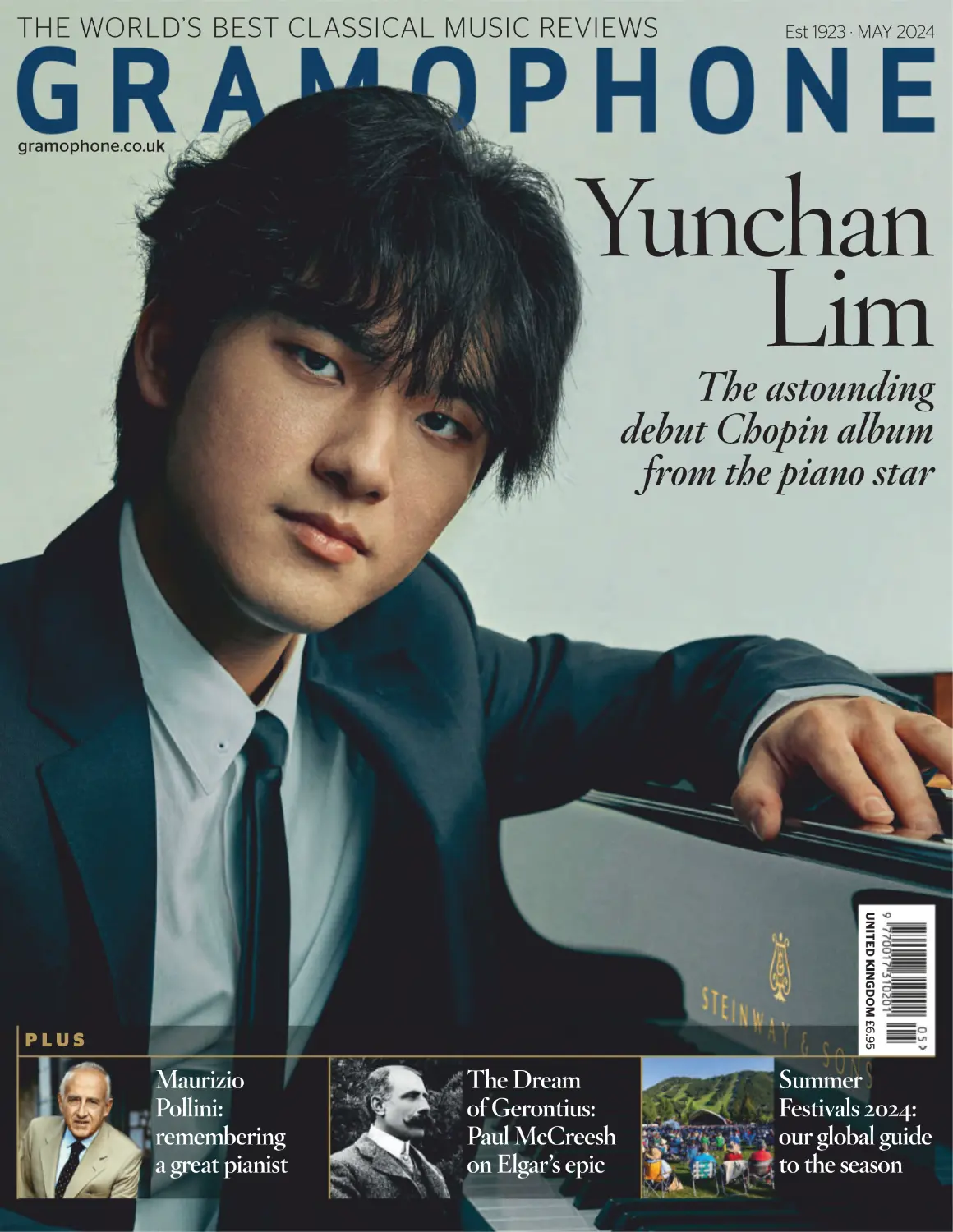
Yunchan
Lim
The astounding
debut Chopin album
from the piano star
UNITED KINGDOM £6.95
PLUS
Maurizio
Pollini:
remembering
a great pianist
The Dream
of Gerontius:
Paul McCreesh
on Elgar’s epic
Summer
Festivals 2024:
our global guide
to the season
Y U N D I plays
M OZ AR T
T H E S O N ATA P R O J E C T 1
E U RO P E A N TO U R
M A R C H – M AY 2 O 2 4
MARCH
22 Freiburg im Breisgau
25 Heilbronn
27 Reutlingen
30 Sigmaringen
APRIL
03 Göttingen
05 Hanau
09 Würzburg
11 Bad Neustadt
13 Frankfurt • Alte Oper
16 Bamberg
21 Vienna • Musikverein
24 Munich • Isarphilharmonie
27 Paris • Théâtre des Champs-Elysées
M AY
01 Berlin • Philharmonie
06 Offenbach
08 Düsseldorf • Tonhalle
14 Basel • Stadtcasino
17 Essen • Philharmonie
19 Köln • Philharmonie
23 Bremen • Die Glocke
A special eight-page section focusing on recent recordings from the US and Canada
Beach . Corigliano
Beach Violin Sonata, Op 34. Romance, Op 23
Corigliano Violin Sonata
Usha Kapoor vn Edward Leung pf
Resonus (RES10321 • 61’)
The coupling is one
of contrasts, much as
an album of Richard
Strauss and Stravinsky
would present. While it’s perfectly possible
to imagine a musician equally sympathetic
to both idioms – as Usha Kapoor is, in
fact – it’s hard to envisage a listener in
the mood for one followed by the other
(without, that is, engaging in a conscious
act of mental agility).
Beach wrote the Violin Sonata in 1896.
She was not yet 30 and her voice would
become more fully her own later on,
especially in her piano output. What stands
out in the sonata is her assured handling
of the two instruments, which always play
to their strengths even when mostly
engaged in conversation rather than
contest. It helps that the Resonus founder/
engineer Adam Binks has given each
musician their own space in the mix – there
is no clashing resonance or covering of one
another – with Kapoor a foot or two nearer
the microphone than Edward Leung.
Kapoor’s centred tone and light hand on
its sometimes heavy Romanticism stand out
from her modern rivals in the piece on
record. Perhaps Joseph Silverstein (on
New World Records) rushes his fences
in the outer movements by comparison,
but his partnership with Gilbert Kalish
catches fire, and their feeling for the sonata
transcends good taste and musicianship.
Back in 1967, the Musical Times critic
summed up Corigliano’s Violin Sonata of
1964 as a ‘good, middle-of-the-road piece
in an idiom that would not have startled
50 years ago’. Almost 60 years later, the
modernity of the piece has proved more
durable than that, and for that matter more
than most of Corigliano’s later output.
The form echoes that of Stravinsky’s Violin
Concerto – abrasive introduction to a pair
of contrasting slow movements and leaping
gramophone.co.uk
finale – but the proportions are so
distinctively skewed that the ear is drawn
more to difference than similarity. Kapoor
and Leung sail through the hair-raising
polyrhythms of the outer movements – 19/8
against 5/8, all in a day’s work – and the
mouse-behind-the-skirting-board figuration
for the finale’s second subject (or sparrows,
if you prefer) is brought off by Kapoor
with great mischief. I was in more of a
Corigliano mood this time, but tomorrow
could well be different, and the album
would be equally rewarding. Peter Quantrill
Kaye
At Libertya. Colossus 1067b. String Quartet No 2,
‘Howland Quartet’c. three zen poemsd. Time is
the Sea We Swim Ine. While We Were Sleepingf
Dan Block ten sax dDavid Yang va dHikaru Tamaki
vc bFrank Wagner db aDebra Kaye, fCraig Ketter,
b
Steve Sandberg pf dJames Nyoraku Schlefer
shakuhachi bDavid Meade drums eLincoln Trio;
c
Voxare Quartet
Navona (NV6604 • 70’)
cf
Recorded live at cSt Peter’s Church/Citigroup,
New York, January 21, 2014; fHowland Cultural
Center, Beacon, NY, June 9, 2018
b
The compositional
catalogue of New
York-resident Debra
Kaye runs to around
70 works, ranging from orchestral and
instrumental works to concertos, chamber
operas, songs and choruses. This new
album, the fourth issued by Navona
(following a chamber album on its
stablemate, Ravello, in 2014), features six
pieces exhibiting a remarkably wide breadth
of styles. The two piano pieces alone range
from an almost New Age simplicity in the
early At Liberty (1988), performed here by
the composer herself, to the scrunchy
discords of the volatile, nightmarish While
We Were Sleeping (2012), rendered with
relish by Craig Ketter. Both works have
their origins in improvisations: At Liberty
reportedly evolved over years while the
composer was living in California.
Improvisation is integral to jazz, but
Kaye’s remarkably idiomatic Colossus 1067,
composed in 2021, is a through-composed
tone picture inspired by a panoramic
photograph of the ride, where the piano,
bass and drums depict the mechanism of
the roller coaster and the saxophone the
rider; the rendition here by Dan Block,
Steve Sandberg, Frank Wagner and David
Meade is bracingly vivid. In complete
contrast, three zen poems is a trio for
shakuhachi, viola and cello (2019,
rev 2022), inspired by verses from 15thand 16th-century Zen Buddhist monks.
A work of more philosophical character,
James Schlefer’s playing of the Japanese
instrument is mesmerising, and he is
sensitively accompanied by David Yang
and Hikaru Tamaki.
The title of the piano trio Time is the Sea
We Swim In (2020, rev 2022) sounds like a
quote but seems to be of Kaye’s invention
(with no explicit connection to Frank
Rose’s book The Sea We Swim In), a
musical reaction in part to her mother’s
death. A fairly closely argued single
movement, circular in design and
containing musical palindromes, its main
arc is one of crescendo to diminuendo,
well brought out by the Lincoln Trio.
The Second Quartet (2017) is in three
movements, moderate-slow-fast, written
to mark the 25th anniversary of the
Howland Music Circle, of which Kaye
was a member. The Voxare Quartet play
it for all its worth, particularly the
vigorous final Danza energico. Guy Rickards
Rosner
‘Orchestral Music, Vol 4’
Canzona secundi toni, Op 63a. Concerto grosso
No 2, Op 74. A My Lai Elegy, Op 51b. Scherzo for
Orchestra, Op 29a. Variations on a Theme by
Frank Martin, Op 105
b
Paul Beniston tpt
London Philharmonic Orchestra / Nick Palmer
Toccata Classics (TOCC0710 • 89’)
a
Available on digital download only
Arnold Rosner’s
extraordinary Requiem
(A/20) was my Critics’
Choice for 2020, the
GRAMOPHONE MAY 2024 I
AVAILABLE NOW FOR PURCHASE OR STREAMING
Navona Records, Ravello Records, Big Round Records, and Ansonica Records are imprints of PARMA Recordings.
www.parmarecordings.com
SOUNDS OF AMERICA
P H O T O G R A P H Y: A D A M B I N K S
Edward Leung and Usha Kapoor explore the contrasting sound worlds of Amy Beach and John Corigliano in their account of the two composers’ violin sonatas
third volume of his orchestral works (5/19)
my pick the previous year; can Vol 4 follow
in their wake? Well, every chance! This is
another fascinating programme, compelling
and appealing in equal measure, superbly
played by the London Philharmonic
Orchestra – who sound as if they have
been playing this music all their lives
(rather than just in occasional visits to
the studio over the past 10 years) – under
Nick Palmer, who joined the project for
Vol 2, taking over from David Amos.
Rosner (1945-2013) was eclectic as
a composer, and these four works – the
digital version of the album has a bonus
track, the bracing Canzona secundi toni for
brass (1975) – are fine examples of how
he synthesised elements from the entire
history of Western music into his unique
personal style. While it is fun to tick off the
allusions – Shostakovich here, Bach there,
John Adams-like minimalism in a key
episode in the harrowing symphonic
poem A My Lai Elegy (1970-71, rev 1993) –
these should not distract from the
symphonic thrust and laser focus
of Rosner’s expressive purpose.
The Scherzo salvaged from Rosner’s
withdrawn Fourth Symphony (1964) is a
gem of a piece and would make a splendid
concert opener. The Concerto grosso No 2
(1979) is another real find, an orchestral
concerto more in the Hindemithian mould
than the Bartókian, a work of real depth.
The Variations on a Theme by Frank Martin
gramophone.co.uk
(1996) is more relaxed, a beautifully crafted
tribute to the Swiss master.
A My Lai Elegy is the largest and deepest
work on the album, a 25-minute protest at
the appalling 1968 massacre of over 500
civilians of all ages during the Vietnam
War, but also prompted by the shootings
of students in 1970-71 at campuses in Ohio
and Mississippi. It is music of horror and
nightmare, mostly not graphic – the
percussive outbursts do sound like
fusillades – but rather of the theatre of the
imagination, deeply unsettling and utterly
gripping. Very strongly recommended.
Guy Rickards
Tchaikovsky
Symphonies – No 4, Op 36; No 5, Op 64;
No 6, ‘Pathétique’, Op 74
Park Avenue Symphony Orchestra /
David Bernard
Recursive (RC4789671 b • 133’)
David Bernard and
his dedicated amateur
orchestra continue
their recorded traversal
of the standard orchestral repertoire with
this set of Tchaikovsky’s final three
symphonies. These performances have
tremendous spirit and some of the playing
is extremely impressive. As is to be
expected, the string sound is relatively
underpowered, there are minor intonation
issues throughout and at times ensemble
can be a little tentative, especially when
rhythms get tricky (often, in Tchaikovsky’s
music, what appears to be played on the
beat is actually off the beat), as at 9'09" in
the first movement of the Fourth. But the
principal woodwinds all acquit themselves
admirably, and the music-making in the
Fourth’s Scherzo and finale convey a sense
of joy – note the affectionate phrasing in
the lyrical passage at 2'30" in the latter.
The Fifth is quite passionate – just listen
to the first movement’s white-hot coda,
or to how the orchestra dig into the finale
with audible gusto. The Sixth is also a fine
performance with a good sense of overall
structure and sensitive attention to detail.
I’m fairly certain it’s the same performance
that was released previously (3/18),
although the booklet lists all three
symphonies as having been recorded
in early 2022. Either way, Jed Distler’s
summation of that earlier release –
‘impressively elegant, thoughtful, wellbalanced and sophisticated’ – applies
here as well. Andrew Farach-Colton
Velvet Brown
Bonner Naptown Kellaway Dr Martin Luther
King, in memoriam Kupferman Sound Objects
1-3 J Stevens Monument York How Beautiful
Velvet Brown tuba Amy Gilreath tpt
Ron Stabinsky pf
Crystal Records (CD696 • 57’)
GRAMOPHONE MAY 2024 III
SOUNDS OF AMERICA
The repertoire on
Velvet Brown’s fourth
recording for Crystal
is of such absorbing
interest and the playing of such high
quality that in a parallel universe she might
be the next Sarah Willis – the repertoire
is not the same but the adventure is.
Brown begins as out of a mist, softly with
joy, in Barbara York’s commissioned elegy
for the death of a friend’s infant son. Roger
Kellaway’s tribute to Martin Luther King
reflects the civil rights movement’s roots
in gospel and jazz, punctuated at the end
by a single powerful chord that symbolises
King’s strength of will, then exalted in
a loving outburst of virtuoso energy.
John Stevens’s tribute to Tommy
Johnson – who played the iconic high solos
in John Williams’s Jaws – commissioned
by the LA Phil’s longtime principal Roger
Bobo, turns out to be an aural equivalent
of everything that tubas are about: size
and gravity and beauty. Each of Meyer
Kupferman’s riveting Sound Objects, scored
as precisely as Bach to maintain the
independence of the three instruments,
has its own sophisticated internal structure
in which Brown, Amy Gilreath and Ron
Stabinsky engage in a series of interrelated, occasionally intertwined and often
jazz-derived riffs. In the third they create
an unexpectedly exhilarating adventure
by randomly playing a set of six phrases.
Drew Bonner’s Naptown was conceived
by Brown as a love letter to her hometown
of Annapolis, Maryland. The music has a
sauntering grace that embraces both
classical tuba chops and, in the final few
minutes, a series of licks that pay tribute to
the great Howard Johnson and his jazz tuba
band Gravity. Laurence Vittes
Dallas Chamber Symphony
Our monthly guide to North American ensembles
P H O T O G R A P H Y: M I T C H L A Z O R K O
Founded 2011
Home Moody Performance Hall
The Dallas (Texas) Arts District already had first-class,
‘starchitect’-designed facilities for orchestral performances
and opera: IM Pei’s Meyerson Symphony Center and Foster
& Partners’ Winspear Opera House. The need for a smaller
performance venue, with acoustics adjustable for different kinds
of music, dance and theatre, was finally answered with the 2012
opening of what was originally called the Dallas City Performance
Hall. Designed by the Chicago office of Skidmore Owings &
Merrill, with acoustics by Jaffe Holden, the 750-seat, shoeboxshaped hall has been such a hit that presenters have trouble
securing dates.
The new hall was the perfect opportunity to address another
lacuna on the Dallas-Fort Worth musical scene: the lack of a
chamber orchestra. In 2013 the Dallas Symphony Orchestra
began booking the new hall for a series of more casual concerts
with reduced complements of musicians. But the ReMix series
never found a marketable identity, and it was discontinued in 2019.
Richard McKay, a young conductor with a recent doctorate
from the Peabody Conservatory, saw the new hall’s potential to
attract new audiences, and he launched the new and independent
Dallas Chamber Symphony in the building’s first fall. In addition
to concerts of typical chamber-orchestra fare, he programmed
silent movies with live accompaniments of newly composed
scores. There were lots of empty seats early on but audiences
were conspicuously younger and more diverse than those of
typical DSO classical concerts.
In early seasons, McKay conducted stiffly, with little apparent
sense of musical shape and expression. With a lot of 20-something
musicians and a few veterans, performances were serviceable but
without the last bit of polish or much subtlety.
In more recent seasons, McKay’s conducting has become
quite expressive, and if you’re occasionally aware that this is a
part-time and to some extent ad hoc ensemble, performances these
days are lively and often sensitively detailed. Recent concerts have
done a good job of filling the hall, although post-covid challenges
surely account for this season’s cutback from six to three
subscription concerts.
gramophone.co.uk
In addition to obvious chamber-orchestra repertory,
McKay has even performed Brahms symphonies with around
40 musicians. But Brahms himself was happy with early
performances of his symphonies with the smaller court
orchestras of Meiningen and Karlsruhe.
Hearing Brahms’s Second Symphony with smaller string
sections ‘required some aural adjustment’, I wrote in The Dallas
Morning News. ‘And there were times when brasses could have
been tamed just a little. But the music emerged with freshness,
new immediacy, even new intimacy … Pacing was flawless,
lingering subtly on just the right up-beats. Phrases were
warmly shaped and strategically directed.’
In addition to its concert series, the DCS inaugurated an
international piano competition in 2013, and 10 years later it
added a violin competition; both have drawn superb competitors.
With the envisioned addition of a cello competition, the three
contests are anticipated to run in rotation. The organisation has
also added educational activities.
The hall, by the way, was renamed Moody Performance Hall
in 2017 following a $22 million gift to the Dallas Arts District
from the Moody Foundation. Ten million dollars of that is an
endowment whose income provides subsidies to smaller arts
organisations for performances in the hall.
Scott Cantrell
GRAMOPHONE MAY 2024 V
The world's best classical music reviews
Gramophone has been the world’s leading authority on
classical music since 1923. With 13 issues a year, every edition
will enrich your classical music knowledge with more than
100 expert reviews of the latest recordings, plus in-depth artist
interviews and features about composers past and present.
Our subscribers enjoy:
13 new print issues throughout the year, delivered direct to your door
13 new digital issues each year, available to read on your digital devices
Access to our complete digital archive, containing every issue of
Gramophone over the past century
50,000+ recording reviews in our searchable online database, bringing you
the best new releases and recommended recordings of classic works
SUBSCRIBE TODAY AND NEVER MISS AN ISSUE
us.magsubscriptions.com/GSUBS
+44 (0)1722 716997
subscriptions@markallengroup.com
SOUNDS OF AMERICA
A LETTER FROM Chicago
New management augurs change, but Howard Reich
finds the city’s opera scene in vibrant health
C
hicago’s opera stages are bursting with innovation,
even as top leaders are departing. Still, few expected
the forthcoming exits of Anthony Freud as Lyric
Opera of Chicago’s general director/president and
Lidiya Yankovskaya as Chicago Opera Theater’s music director
(though she’ll stay on as head of the company’s Vanguard
Initiative for emerging opera composers). Both figures chalked
up significant artistic achievements.
Early in Freud’s 13-year tenure at the city’s biggest opera
company, he created Lyric Unlimited, which commissioned new
and unconventional works (including a mariachi opera) and
brought these productions out of the gilded Lyric Opera House in
the Loop and into the city’s far-flung neighbourhoods. Freud used
the pandemic shutdown to refurbish the company’s lavish but
time-worn home, and he commissioned notable world premieres,
including Bel Canto, the Jimmy Lopez/Nilo Cruz opera curated
by Renée Fleming and based on Ann Patchett’s best-selling novel.
On the downside, a shortlived strike by the Lyric Opera
Orchestra musicians in 2018
generated predictable acrimony
between the pit and front office.
And a reduction in mainstage
productions from eight before the pandemic to six reflected a
contraction in the performing arts in Chicago and across the US.
Yankovskaya has led Chicago Opera Theater, the city’s No 2
company, since 2017, and like Freud leaves at the end of this
season, COT’s 50th. Her history-making tenure featured 25
Chicago premieres, 11 of them doubling as world premieres.
No successor has been named for either Freud or Yankovskaya’s
posts. But COT’s new general director, Lawrence Edelson, has
said the company will not necessarily fill Yankovskaya’s spot, in
the meantime planning to hire a ‘head of music’, as various guest
conductors take turns on the podium.
Yankovskaya made quite a splash with her final podium
appearance as music director in December, leading the belated
Chicago premiere of Shostakovich’s 1928 opera The Nose. The
work’s large cast, immense orchestral forces and technically
challenging score help explain why The Nose remains a rarity. COT
scored a coup by engaging Washington National Opera artistic
director Francesca Zambello to conceive the new production.
Based on Nikolai Gogol’s satirical short story of the same name,
The Nose comically chronicles the absurdist plight of a government
bureaucrat who discovers his snout suddenly gone, the beak having
taken on a life of its own. Chicago Opera Theater appeared to
spare no expense for a production that richly deserves life
elsewhere, thanks to Marcus Doshi’s aptly askew set, Erik Teague’s
vivid costumery and Kia S Smith’s edgy choreography. The Marx
Brothers-like chaos onstage reflected the orchestral frenzy of a
score that boldly embraces ornate vocal lines, simple folkloric
melodies, jazz-inspired rhythm and even an ensemble piece for
percussion alone. Baritone Aleksey Bogdanov was heroic of voice
and charismatic of manner as a bureaucrat desperately searching
for his fleeing proboscis.
Many will thank Lyric Opera’s Freud for presenting in January
and February jazz composer Terence Blanchard’s opera Champion,
with libretto by Michael Cristofer. Though Freud already had
made a bit of Chicago operatic history by staging Blanchard and
librettist Kasi Lemmon’s Fire Shut Up in My Bones in 2022, that
piece – based on New York Times columnist Charles M Blow’s
memoir of the same name – felt far too small in staging and thin
in story for the vast Lyric Opera House. Champion, by contrast,
practically shook the stage. For starters, there was no resisting the
true story of a boxer tormented by a death he had triggered in the
ring, by his latent homosexuality and by 1950s racism. Projections
featuring video footage gave the piece documentary-like verismo,
while James Robinson’s imaginative direction made the brutal
fight scenes seem frighteningly
real. Allen Moyer’s set
effectively placed the audience
at ringside. And the singers
who played pugilist Emile
Griffith from youth to old age
(Naya Rosalie James, Justin Austin and Reginald Smith, Jr) could
not have been more compelling. As for Blanchard’s score, which
he calls an ‘opera in jazz’, it stands as one of the most gripping
of such cross-genre mergers.
You have to admire any company that dares to present what it
calls a ‘puppet opera’, as Chicago Opera Theater did in January
with composer-librettist Huang Ruo’s Book of Mountains and Seas.
Ruo, perhaps best known for his opera M Butterfly (inspired by
David Henry Hwang’s play), has fashioned a meditative piece
based on ancient Chinese myths. Alas, the chanting singers
droned on monotonously, while the puppetry proved so
minimal as to belie the description of a ‘puppet opera’.
Chicago Opera Theater will close its 50th season in May in
historic fashion: hosting the finale of the world-premiere tour
of an opera by one of America’s most revered operatic composers,
Jake Heggie (Dead Man Walking, Intelligence, Moby-Dick). With
a libretto by longtime Heggie collaborator Gene Scheer, Before
It All Goes Dark (commissioned and produced by Music of
Remembrance) tells a Holocaust-related tale based on a Chicago
Tribune story by me: a Chicago-area Vietnam veteran suffering
with hepatitis C and PTSD learns he’s heir to a priceless art
collection looted by the Nazis in Prague. His pursuit of the
art will change his life.
Add to this The Matchbox Magic Flute (a scaled-down production
of Mozart’s masterpiece) at the Goodman Theatre and rarities
by Handel and Grimani from Haymarket Opera Company, and
Chicago opera lovers clearly have a great deal to be thankful for.
Blanchard’s score for Champion, which he
calls an ‘opera in jazz’, stands as one of the
most gripping of such cross-genre mergers
gramophone.co.uk
GRAMOPHONE MAY 2024 VII
D
N
ON OUR CLASSICAL MUSIC PODCAST
ID
RE 0
O 0 DW
M 0,0 RL
W 0 O
O 7
N AN S W
D
TH OA
L
W
O
THE STARS COME OUT FOR
E
Simply search for ‘Gramophone magazine’ wherever you get your podcasts,
or visit gramophone.co.uk/podcast
Founded in 1923 by Sir Compton Mackenzie and Christopher Stone as
‘an organ of candid opinion for the numerous possessors of gramophones’
Celebrating great artists – past and present
T
C O V E R P H O T O G R A P H S : J A M E S H O L E / M AT H I A S B O T H O R / D G / T U L LY P O T T E R C O L L E C T I O N / C O D Y D O W N A R D
LUCIE CARLIER / MICHELLE MARSHALL
his month we pay tribute to a great pianist,
and welcome one from the opposite end of
a life and career who has already attracted
an unprecedented amount of attention.
Such was the stature of Maurizio Pollini that, as
Harriet Smith writes in this issue, his body lay in
state in La Scala, perhaps the most revered of all
Italian music venues, where he’d appeared 168 times,
a figure that rivals many a great opera singer.
But if, as La Scala put it, the pianist was
‘a fundamental reference’ for them for 50 years, how
much more so must Pollini be to thousands of record
collectors worldwide? Particularly thanks to his longterm partnership with Deutsche Grammophon, he
was intrinsically linked with an era of recording. While
attention has been rightly drawn to his advocacy of
modern music, it was his catalogue-spanning surveys of
the most core of core repertoire – Beethoven, Chopin,
Brahms, Schumann and others – that will most define
him for listeners. How many of today’s artists will have
the opportunity to amass such a catalogue of musical
monuments, often returning to these masterpieces
again and again? That he was able to do so is testimony
to the taste of a loyal label, and of an enthusiastically
supportive pianistic public. Returning to any
recordings by this great artist will reward readers.
As will turning to the remarkable first studio
Chopin album from 20-year-old South Korean pianist
Yunchan Lim. I can think of no other young artist
whose name has been uttered in so many conversations
in tones of reverence reserved more usually for, well,
the likes of Pollini. In his feature, Jeremy Nicholas
notes that Lim is the first artist born this millennium
to grace our cover – I’d add by way of a personal
footnote that he’s the first one born after I started
working for Gramophone! But this is no over-hyped
virtuoso – there’s a musical maturity that astonishes,
just as it did anybody who followed the 2022 Van
Cliburn International Piano Competition, where his
semi-final performance of Liszt’s Transcendental Études
was a mere warm-up for a final round performance of
Rachmaninov’s Piano Concerto No 3 that is the most
viewed video of the work on YouTube today. Whether
his new album is a prelude to a Pollini-like career,
only time (indeed decades) will tell, but it’s the most
auspicious possible of starts.
Next to him, 28-year-old Klaus Mäkëla is already
something of a veteran, but if Lim is the most talked
about of his generation of pianists, his fellow Deccaartist holds that title among conductors. We’ve
welcomed his recordings to date, and on page 8
report that he’s been appointed as Music Director
of the Chicago Symphony, a post he’ll combine
with being Chief Conductor of Amsterdam’s Royal
Concertgebouw Orchestra, thus heading two of
the world’s finest ensembles. Wise-head-on-oldshoulders feels an obvious but misplaced cliché –
surely what’s important is that the young generation
is producing such extraordinary talents who speak to
their own era with impact and intelligence. That both
Mäkëla and Lim are clearly committed to recording
(and that both express a passion for great recording
artists of the past) is a gloriously welcome bonus.
martin.cullingford@markallengroup.com
THIS MONTH’S CONTRIBUTORS
Andrew Achenbach • Richard Bratby • Edward Breen • Scott Cantrell • Rob Cowan (consultant reviewer) •
Jeremy Dibble • Jed Distler • Adrian Edwards • David Fanning • Andrew Farach-Colton • Neil Fisher •
Fabrice Fitch • Marina Frolova–Walker • Charlotte Gardner • David Gutman • Christian Hoskins • Lindsay Kemp •
Philip Kennicott • Geraint Lewis • Michael McManus • Jeremy Nicholas • Richard Osborne • Mark Pullinger •
Peter Quantrill • Peter J Rabinowitz • Howard Reich • Guy Rickards • Malcolm Riley • Edward Seckerson •
Mark Seow • Hugo Shirley • Pwyll ap Siôn • Harriet Smith • David Patrick Stearns • David Threasher •
David Vickers • Laurence Vittes • Richard Whitehouse • Richard Wigmore • William Yeoman
‘It’s rare for a
pianist to astonish
and move in equal
measure, but
Yunchan Lim has
a musical maturity
way beyond his
years,’ writes JEREMY NICHOLAS ,
author of our cover story. ‘It was
fascinating to talk to this keyboard
phenomenon right at the beginning
of what will be an important career.
Too many pianists? Not if there’s a
Yunchan Lim in their midst.’
gramophone.co.uk
‘The challenge
of summing up
the great man
and musician
Maurizio Pollini
was initially a
daunting one,’
says HARRIET SMITH , who writes a
tribute to the pianist who died in
March, ‘but it proved joyous too, for
the opportunity it gave me to revisit
cherished recordings and even
discover some new ones along
the way.’
‘The 150th
birthdays of
Holst and
Schoenberg and
the centenaries of
Fauré’s death and
of Gershwin’s
Rhapsody in Blue are just some of
the anniversaries being marked
across 2024’s festival scene,’ writes
CHARLOTTE GARDNER, author of
our Festival Guide. ‘As ever, I’ve
added to the usual mix, so keep your
eyes peeled for strong additions.’
Gramophone, which has
been serving the classical
music world since 1923, is
first and foremost a monthly
review magazine, delivered
today in both print and digital
formats. It boasts an eminent and
knowledgeable panel of experts,
which reviews the full range of
classical music recordings.
Its reviews are completely
independent. In addition to
reviews, its interviews and
features help readers to explore
in greater depth the recordings
that the magazine covers, as well
as offer insight into the work of
composers and performers.
It is the magazine for the classical
record collector, as well as
for the enthusiast starting
a voyage of discovery.
GRAMOPHONE MAY 2024 3
CONTENTS
Volume 101 Number 1239
EDITORIAL
Phone 020 7738 5454
email gramophone@markallengroup.com
EDITOR AND PUBLISHER Martin Cullingford
DEPUTY EDITOR Tim Parry
REVIEWS EDITOR Gavin Dixon
ONLINE CONTENT EDITOR James McCarthy
SUB-EDITORS David Threasher; Marija urić Speare
EDITORIAL ADMINISTRATOR Libby McPhee
EDITORIAL ASSISTANT Theo Elwell
EDITOR’S CHOICE
7
The 12 most highly recommended recordings
reviewed in this issue
ART DIRECTOR Juliet Boucher
PICTURE EDITOR Sunita Sharma-Gibson
AUDIO EDITOR Andrew Everard
EDITOR EMERITUS James Jolly
WITH THANKS TO Jasmine Cullingford
ADVERTISING
email advertising@gramophone.co.uk
RECORDING OF THE MONTH
58
David Fanning hails a virtuosic account of
the Chopin Études by Yunchan Lim, a studio
debut from this impressive competition winner
COMMERCIAL DIRECTOR
Esther Zuke / 020 7501 6368
SENIOR SALES EXECUTIVE
Clifford Gagliardo / 07766 508458
SUBSCRIPTIONS AND BACK ISSUES
0800 137201 (UK) +44 (0)1722 716997 (overseas)
subscriptions@markallengroup.com
ORCHESTRAL
60
Leonidas Kavakos in Bach concertos; Hasan
by Delius; Pietari Inkinen conducts Dvo∑ák;
Sheherazade from Antonio Pappano
FOR THE RECORD
8
Chicago Symphony names Klaus Mäkelä as
new Music Director; Bournemouth Symphony
makes appointments; the background to BIS,
our current Label of the Year; Jeremy Dibble on
his new Stanford book; looking back on Simon
Rattle’s triumphant LSO years
PUBLISHING
HEAD OF MARKETING
John Barnett / 020 7501 6233
GROUP INSTITUTIONAL SALES MANAGER Jas Atwal
PRODUCTION DIRECTOR
Richard Hamshere / 01722 716997
CHAMBER
74
LETTERS & OBITUARIES
18
Quatour Danel return to Shostakovich; La
Serenissima play Tartini; Daniel Hope’s ‘Dance!’
Arvı̄ds Jansons on record; remembering
Peter Eötvös, Byron Janis and Aribert Reimann
INSTRUMENTAL
YUNCHAN LIM
PRODUCTION MANAGER Kyri Apostolou
CIRCULATION DIRECTOR
Sally Boettcher / 01722 716997
SUBSCRIPTIONS MANAGER
Bethany Foy / 01722 716997
EDITORIAL DIRECTOR Martin Cullingford
MANAGING DIRECTOR Ravi Chandiramani
84
Masaaki Suzuki’s Art of Fugue; a Sorabji premiere;
Julian Perkins plays instruments in Handel’s home
CHIEF EXECUTIVE OFFICER Ben Allen
CHAIRMAN Mark Allen
Part of
markallengroup.com
GRAMOPHONE is published by
MA Education & Music Ltd, St Jude’s Church, Dulwich
Road, London SE24 0PB, United Kingdom.
gramophone.co.uk
email gramophone@markallengroup.com or
subscriptions@markallengroup.com
ISSN 0017-310X.
The May 2024 issue is on sale from April 24; the June issue
will be on sale from May 22 (both UK). Every effort has been
made to ensure the accuracy of statements in this magazine
but we cannot accept responsibility for errors or omissions,
or for matters arising from clerical or printers’ errors, or an
advertiser not completing his contract. Regarding concert
listings, all information is correct at the time of going to press.
Letters to the editor requiring a personal reply should be
accompanied by a stamped addressed envelope. We have
made every effort to secure permission to use copyright
material. Where material has been used inadvertently or
we have been unable to trace the copyright owner,
acknowledgement will be made in a future issue.
UK subscription rate £77.
Printed in England by Precision Colour Printing.
North American edition (ISSN 0017-310X): Gramophone,
USPS 881080, is published monthly with an additional
issue in October by MA Education & Music Ltd, St
Jude’s Church, Dulwich Road, London SE24 0PB, United
Kingdom. The US annual subscription price is $114.
Airfreight and mailing in the USA by agent named WN
Shipping USA, 156-15, 146th Avenue, 2nd Floor, Jamaica,
NY 11434, USA. Periodicals postage paid at Jamaica
NY 11431. US Postmaster: Send address changes to
Gramophone, WN Shipping USA, 156-15, 146th Avenue,
2nd Floor, Jamaica, NY 11434, USA. Subscription records
are maintained at MA Education & Music Ltd, Unit
A, Buildings 1-5 Dinton Business Park, Catherine Ford
Road, Dinton, Salisbury, Wiltshire SP3 5HZ, UK. Air
Business Ltd is acting as our mailing agent.
VOCAL
20
Ever since his Van Cliburn success, the young
South Korean pianist has generated huge
excitement and anticipation: we meet him
94
Feinstein and Thibaudet’s ‘Gershwin Rhapsody’;
Schumann in English; Sacred Treasures of Venice
THE DREAM OF GERONTIUS
26
Paul McCreesh talks to us about his moving
new recording of Elgar’s scared masterpiece
ONLINE CONCERTS & EVENTS 104
Richard Bratby on concerts and operas to stream
OPERA
106
Busoni’s Faust; The Shining by Paul Moravec
JAZZ, WORLD & MUSICALS
SUMMER FESTIVALS 2024
30
From chamber music amidst mountain landscapes
to cutting-edge contemporary performances in
city centres, we bring you our in-depth annual
guide to the best concerts and events worldwide
112
Reviews from Jazzwise, Songlines and Musicals
MUSICIAN AND THE SCORE
REISSUES
Michael Collins talks us through Mozart’s
Symphony No 35, the joyous ‘Haffner’
114
Copland conducts Copland; the symphonies
of George Lloyd; Derek Solomons in Haydn
72
ICONS
BOX-SET ROUND-UP
117
REPLAY
118
82
We remember Leon Fleisher, the pianist who lost
the use of his right hand in his thirties and turned
to left-hand repertoire and to teaching, before
returning to two-hand piano music in later life
Rob Cowan on recent releases from the archives
CONTEMPORARY COMPOSERS 92
CLASSICS RECONSIDERED
120
Mark Pullinger and Neil Fisher revisit Karajan’s
1974 Madama Butterfly with Freni and Pavarotti
A guide to the wide-ranging music of Catalan
composer Benet Casablancas, with some
recommended recordings to discover
© MA Education & Music Ltd, 2024. All rights reserved.
No part of the Gramophone may be reproduced, stored in a
retrieval system, or transmitted in any form or by any means
electronic, mechanical, photocopying, recording, or otherwise
without prior written permission of the Publisher.
Please read our privacy policy, by visiting
privacypolicy.markallengroup.com. This will
explain how we process, use & safeguard your data.
BOOKS
HIGH FIDELITY
The views expressed do not necessarily represent those of the
editor or Gramophone. Advertisements in the journal do not
imply endorsement of the products or services advertised.
Richard Wigmore explores the rich recording
catalogue of Haydn’s ‘Clock’ Symphony
Jeremy Dibble on Stanford; Sounds as They Are
131
The latest from the world of audio equipment,
including a guide to developments in CD players
GRAMOPHONE COLLECTION 124
REVIEWS INDEX
4 GRAMOPHONE MAY 2024
122
136
MY MUSIC
138
The three-time Grammy Award-winning jazz
singer Cécile McLorin Salvant on her classical
training and the inspirational art of Maria Callas
gramophone.co.uk
KIRILL GERSTEIN
K AT I A S K A N AV I
THOMAS ADÈS
R U Z A N M A N TA S H YA N
M U S I C I N T I M E O F WA R
D E B U S S Y / K O M I TA S
OUT NOW
RECORDING OF THE MONTH
Martin
Cullingford’s
pick of the finest
recordings from
this month’s
reviews
CHOPIN
Études
Yunchan Lim pf
Decca
DAVID FANNING’S
REVIEW IS ON
PAGE 58
ANDRES
BARTÓK
MENDELSSOHN
The Blind Banister
Timo Andres pf
Metropolis Ensemble /
Andrew Cyr
Nonesuch
The Wooden Prince
BBC Scottish Symphony
Orchestra /
Thomas Dausgaard
Onyx
Symphonies
Zurich Tonhalle
Orchestra / Paavo Järvi
Alpha
Nonesuch here offers us a beautifully
recorded introduction to Timo Andres’s
pianistic voice – both as the composer
and performer.
Conductor Thomas Dausgaard delves into
the dark heart of Bartók’s ballet The Wooden
Prince – just one part of a rewarding album
devoted to the composer’s music.
REVIEW ON PAGE 60
REVIEW ON PAGE 61
CHAUSSON Concert
LEKEU Violin Sonata
Gabriel Le Magadure vn
Frank Braley pf Quatuor
Agate
Appassionato
Another success from the Appassionato
label – violinist Gabriel Le Magadure,
pianist Frank Braley and their quartet
colleagues embody the music’s drama.
A superb
Mendelssohn symphony cycle from
conductor Paavo Järvi to set against the
finest of recent times – rich in tonal weight
but wonderfully light in spirit too.
REVIEW ON PAGE 69
‘TREASURES’
RACHMANINOV
Trio Lirico
Audite
Works for Two Pianos
Sergei Babayan,
Daniil Trifonov pfs
DG
Performances of
works by Dohnányi,
Ysaÿe and Kodály
plus the first recording of Peter Eötvös’s
2020 Trio, a fine tribute to the composer
who died in March, are a powerful
demonstration of this superb trio’s talent.
REVIEW ON PAGE 75
REVIEW ON PAGE 81
Truly stylish
virtuosity from Sergei Babayan and
Daniil Trifonov – vivid, theatrical and
highly musical, from a piano partnership
well worth hearing.
REVIEW ON PAGE 86
WAGNER
YSAŸE
ELGAR The Dream
‘Famous Opera Scenes’
Nikolai Lugansky pf
Harmonia Mundi
Solo Violin Sonatas
Sergey Khachatryan vn
Naïve
of Gerontius
Sols; Gabrieli Consort &
Players / Paul McCreesh
Signum
Such is pianist
Nikolai Lugansky’s
story-telling poetry throughout this album
devoted to Wagner transcriptions that we
seem to step straight into the sound world
of the operas themselves.
A stunning set of
Ysaÿe’s solo sonatas
from violinist Sergey Khachatryan,
whose virtuosity and distinctive voice
shine throughout this most fiendish
of repertoire.
REVIEW ON PAGE 89
REVIEW ON PAGE 90
A deeply moving
journey through Elgar’s religious epic,
from a conductor whose admiration of
this music is evident in every bar, and
a superb soloist in Nicky Spence.
REVIEW ON PAGE 95
DVD/BLU-RAY
TCHAIKOVSKY
REISSUE/ARCHIVE
HAYDN Symphonies
‘None but the Lonely Heart’
A film by Christof Loy
Naxos
L’Estro Armonico / Derek Solomons
Sony Classical
Songs of love and loss, loneliness and
isolation from a period – the pandemic
restrictions – defined by such sentiments.
REVIEW ON PAGE 110
gramophone.co.uk
This album of Chopin
Études from our cover
artist, pianist Yunchan Lim,
is a compelling triumph –
a truly momentous
studio debut from an
extraordinary talent.
A pioneering 1980s series of Haydn
symphony recordings – ‘a quiet revolution’
in the interpretation of the composer’s works, as reviewer
David Threasher remembers it – gets a welcome reissue.
REVIEW ON PAGE 116
GRAMOPHONE MAY 2024 7
FOR THE RECORD
Chicago Symphony appoints Klaus Mäkelä
K
the art form, keen interest in music education
laus Mäkelä, the highly sought-after
and the legacy of the CSO, and innate ability
young Finnish conductor, has been named
to connect warmly and sincerely with our
the new Music Director of the Chicago
trustees, volunteers, concert attendees, donors
Symphony Orchestra from the start of 2027-28
and administrative staff, it quickly became clear
season, succeeding Riccardo Muti. The Deccathat he was the ideal choice,’ he added.
signed artist is currently Music Director of the
Mäkelä’s first release on Decca, with the
Orchestre de Paris and Chief Conductor of the
Oslo Philharmonic, was of the complete
Oslo Philharmonic, and will also become Chief
Sibelius symphonies. It earned a Gramophone
Conductor of Amsterdam’s Royal Concertgebouw
Editor’s Choice in April 2022 and went on to
Orchestra at the start of the 2027-28 season.
be shortlisted for a Gramophone Award. His
Mäkelä, aged 31, will be the CSO’s 11th Music
subsequent two albums, with the Orchestre de
Director in its 133-year history. (Interestingly
Paris, of Diaghilev ballet scores by Stravinsky
he will be just one year younger than Muti when
and Debussy, were also selected as Editor’s
he succeeded Otto Klemperer at the helm of
Choices. His next Decca release, due out in the
London’s Philharmonia Orchestra.) Mäkelä will
Klaus Mäkelä: taking over in Chicago
summer, will be of Shostakovich’s Symphonies
conduct the orchestra for a minimum of 14 weeks
Nos 4-6, featuring the Oslo Philharmonic.
per season: 10 weeks of subscription and other concerts in and
Mäkelä will not be the only conductor to head major
around Chicago, plus four weeks of US and international tours.
orchestras on both sides of the Atlantic: Andris Nelsons
He first conducted the great US ensemble in April 2022.
leads both the Boston Symphony Orchestra and the
‘In his first two memorable engagements with the CSO, Klaus
Mäkelä established an exceptional connection with our musicians,’ Gewandhausorchester of Leipzig. And one of Mäkelä’s
predecessors at the Chicago Symphony, Sir Georg Solti,
said CSO Association President Jeff Alexander.
also headed both the Orchestre de Paris and the London
‘As we got to know him off the podium and witnessed – in
Philharmonic concurrently with his US post.
addition to his extraordinary musical talent – his passion for
A
s Sir Antonio Pappano
prepares to step down from
his post as Music Director of
the Royal Opera House and assume
the role of Chief Conductor of the
London Symphony Orchestra – not
to mention mark his 65th birthday –
it seems a perfect moment to reflect
on his achievements.
One part of that is the publication of his memoir,
subtitled ‘My Life in Music’, which traces the
conductor’s life and career from his time as a two year
old accompanying his father’s singing students to his
place now as one of the most admired and charismatic
ambassadors for classical music today. As well as
reflecting on repertoire both established and new, he
also discusses music’s place in society today. Published
by Faber, it’s due out on June 6.
There’s also a major box-set from Warner Classics
documenting his 18 years as Music Director of Rome’s
Accademia Nazionale di Santa Cecilia, including his
symphonic, concertante and sacred music recordings
from that period, which ran from 2005 to 2023 and
included Recordings of the Month for Bernstein’s
symphonies and Verdi’s sacred music. Comprising
27 CDs and released on May 31, it will also include
the first release of a new recording of Bruckner’s
Symphony No 8, only available as part of this collection.
8 GRAMOPHONE MAY 2024
New conductors for Bournemouth
T
he Bournemouth Symphony
Orchestra has appointed
two new conductors to
the podium: Mark Wigglesworth
will join as Chief Conductor,
succeeding Kirill Karabits, who
will become Conductor Laureate,
and French conductor Chloé van
Soeterstède will be appointed as
Principal Guest Conductor.
Wigglesworth will be the first
British conductor to hold the post
in more than 60 years. Previously
Principal Guest Conductor
(from 2021-23), he said:
‘I am extremely excited to be
joining them at a time when
classical music’s undeniable
force for good has never been
more vital to the quality of
the communities we live in.’
He’ll begin his tenure with
performances of Beethoven’s
Fifth Symphony and Verdi’s
Force of Destiny Overture at
venues across the South West
of England.
Chloé van Soeterstède made
her debut with the orchestra in
2022, and was a Taki Alsop Fellow
from 2019-2021, during which
she was mentored by former BSO
Principal Conductor Marin Alsop.
Elsewhere, she was also a Dudamel
Fellow with the LA Philharmonic
from 2021-22.
Both conductors will start their
roles in the autumn at the start of
the new 2024/5 season, initially on
four-year terms.
gramophone.co.uk
P H O T O G R A P H Y: M A R K A L L A N / T O D D R O S E N B E R G /
D E S I G N B Y FA B E R . P H O T O G R A P H © A C C A D E M I A N A Z I O N A L E D I S A N TA C E C I L I A , R I C C A R D O M U S A C C H I O / M U S A
Pappano pens memoir
FOR THE RECORD
Wigmore Hall
launches major
new fund
The magazine is just the beginning.
Visit gramophone.co.uk for …
W
igmore Hall, the famed London
chamber venue, has launched a
new fund which will enable it
to become self-sufficient if required.
‘In the face of an uncertain public
funding environment for classical music
in the UK, the Director’s Fund has been
set up to invest in future generations
of artists at every stage of their careers,
innovative independent programming and
an uncompromising quality of experience’,
explains a statement from the venue.
John Gilhooly, Artistic and Executive
Director of Wigmore Hall added: ‘With
£7 million already pledged, we are aiming
to reach at least £10 million by 2027, with
ambitions to reach £20 million within a
decade.’ The hall is currently 97 per cent
self-funded, Gilhooly pointed out. He
also confirmed that audiences now exceed
pre-pandemic levels, the highest in the
123-year history of the hall.
Podcasts
Caption to be supplied
This month on the Gramophone Classical
Music Podcast we feature a very special
extended episode dedicated to the music
of Franz Schubert. Editor Martin Cullingford
talks to Richard Wigmore – long-standing
contributor to our pages, and an expert on
Schubert – about this most remarkable of
composers, one whose finest works, notably
in the song, piano and chamber music
The announcement came alongside
that for the 2024/25 season, which will
feature 550 concerts, 2600 musicians –
as diverse as pianist Martha Argerich and
Radiohead’s Jonny Greenwood playing
ondes Martenot – and include more than
30 world and UK premieres.
ONE TO WATCH
Jonathan Leibovitz
P H O T O G R A P H Y: K A U P O K I K K A S ; B R I D G E M A N I M A G E S
Clarinet
This month’s highlighted artist, Jonathan Leibovitz,
is an impressive young clarinettist already attracting
accolades – the most recent of which is a Fellowship from
the prestigious Borletti-Buitoni Trust, a long-standing
reliable guide to the classical stars of tomorrow.
Leibovitz was born in 1997 in Tel Aviv. His solo career
began in 2015 with that most-beloved work among his
instrument’s repertoire, Mozart’s Clarinet Concerto, which
he performed with the Israel Philharmonic Orchestra, the
first of many leading orchestras he’s now performed with.
In 2022 he was a prize-winner at the Young Classical
Artists Trust (YCAT) and Concert Artists Guild (New York) International Auditions held
at Wigmore Hall, the same year the Lucerne Symphony Orchestra named him an Arthur
Waser prize winner. The previous year Leibovitz had won the Crusell International Clarinet
Competition. Leibovitz is currently completing his master’s degree with François Benda at
the Music Academy Basel.
Late summer will see an album from the Delphian label called ‘Eastern Reflections’,
featuring music from Ligeti, Bartók, Lutosławski and Weinberg, with Leibovitz joined
in the studio by pianist Joseph Havlat. In the meantime, there’s a rich range of videos to
be found online, including those filmed as part of the YCAT-Wigmore Lunchtime Series
with Leibovitz demonstrating engaging skills of colour, atmosphere and all important
virtuosity in repertoire ranging including Weinberg, Poulenc, Debussy, Fauré and Brahms.
Everything looks set for an exciting few years ahead.
gramophone.co.uk
Explore Schubert’s music on our podcast
genres, are today held to be among music’s
most beloved creations. Also on the podcast
this month, James Jolly talks to Paavo Järvi
about recording Mendelssohn’s symphonies
with the Tonhalle-Orchester Zürich for Alpha
Classics, and Hattie Butterworth is joined by
composer Rebecca Dale to explore her new
album of works for cello and choir with cellists
Steven Isserlis and Guy Johnston and the choir
Tenebrae, out now on Signum Classics.
Facebook, Instagram & Twitter
Follow us to hear about the latest
classical music news and anniversaries, and
to discover some superb videos from today’s
most exciting young artists and ensembles.
GRAMOPHONE MAY 2024 9
FOR THE RECORD
GUIDE TO RECORD LABELS
BIS Records
In this month’s introduction to a leading classical record label,
Tim Parry explores the history of a much-loved Swedish company
F
ounded in 1973 – and Gramophone’s
current Label of the Year – BIS
Records is a shining example of what
an independent record label can achieve
when driven by one man’s passion and
instinct. Robert von Bahr trained as a singer
at the Royal College of Music in Stockholm
and studied law at Stockholm University
before founding BIS, initially as a way of
issuing recordings by up-and-coming
Swedish musicians. In the early days, von
Bahr became a familiar figure in Stockholm
thanks to his habit of transporting LPs to
record shops in a pram – which unlike
suitcases were free to take on the subway.
Wider recognition followed in 1975, when
the Swedish soprano Birgit Nilsson – the
leading Wagnerian soprano of the day –
agreed to record songs by Strauss and
Sibelius, bringing the young label critical
and commercial success as well as
international distribution.
Beyond providing opportunities for
young Swedish musicians, BIS soon
became identified with championing lesserknown, mostly Scandinavian composers –
among them Kalevi Aho, Jón Leifs, Allan
Pettersson and Eduard Tubin. Among
the triumphs of BIS’s catalogue is the 65disc Sibelius Edition, encompassing the
composer’s complete works, including
a Gramophone Award-winning recording
of the original and revised versions of the
Violin Concerto with a young Leonidas
Kavakos. Another example of the label’s
long-term commitment to large-scale
projects is the set of Bach’s sacred cantatas
with the Bach Collegium Japan and
Masaaki Suzuki, which took 18 years
and 55 CDs to complete and was later
supplemented by the complete secular
cantatas as well as the Passions, oratorios,
Masses and motets. BIS was largely
responsible for putting the Bach Collegium
Japan on the musical map and von Bahr has
said that no project meant more to him.
In addition to being an early adopter of
SACDs, BIS was so determined to present
the full dynamic range of performances
captured on record – without the
compression that is standard for domestic
listening conditions – that early recordings
were presented with a bright red warning.
The warning may have disappeared, but
the ideological commitment to sound
quality remained. Another distinction
was the promise never to delete a record,
a commitment that may have been
superseded by the unlimited availability
of recordings on streaming services, but
which highlights BIS’s values in refusing
to compromise their service to music
lovers for solely commercial benefit.
BIS has established long-term
relationships with many artists – any
list risks offending by omission, but
these include the trombonist/conductor
Christian Lindberg, clarinettist Martin
Giorgi
Gigashvili
singled out
23-year-old Georgian pianist
Giorgi Gigashvili has received
the Terence Judd-Hallé
Award, given annually to a
member of the BBC Radio 3
New Generation Artists
programme. As well as a
cash prize of £7000, the link
with the Hallé orchestra also brings a solo recital and concerto
performance at Manchester’s Bridgewater Hall. His debut album,
‘Meeting my Shadow’ (6/23), was released on the Alpha label.
10 GRAMOPHONE MAY 2024
Fröst, flautist Sharon Bezaly, conductor
Osmo Vänskä, soprano Carolyn Sampson,
and pianists Ronald Brautigam, Roland
Pöntinen and Yevgeny Sudbin. One of von
Bahr’s proud achievements is identifying
talent early. The pianist Alexandre
Kantorow made his first record for the
label at 17 and was already an established
BIS artist when he won the 2019
International Tchaikovsky Competition,
while violinist Johan Dalene set down his
debut album before coming to widespread
attention by winning the Carl Nielsen
International Competition. Von Bahr
also has an eye for the unexpected.
BIS released albums of outrageously
difficult piano music, including Ligeti’s
Études and Sorabji’s mammoth set of
100 Transcendental Studies, played by
Fredrik Ullén, a professor of cognitive
neuroscience, while the phenomenal Alkan
recording by Paul Wee – another pianist
who took a different professional path, in
his case as a barrister – was snapped up,
leading to another successful partnership.
In 2023 BIS was bought by Apple, and
is now part of Platoon, Apple’s artist and
creative services arm. The staff and A&R
autonomy were retained, and – crucially
for the 80-year-old von Bahr – the label’s
succession and the preservation of its
legacy and values were assured.
Cambridge choir closed
St John’s College, Cambridge has announced that St John’s Voices,
the college’s mixed-voice choir, will be disbanded. The change will come
into effect at the end of this academic year. Formed in 2013 to support
the work of the St John’s College Choir, it performs weekly evensongs in
the college chapel, plus concerts and tours, and has released albums on
Naxos, including a well-received recording of music by Chesnokov.
BBT Trust highlights young talent
The Borletti-Buitoni Trust has revealed its 2024 Award and Fellowship
winners. The Leonkoro Quartet and Mithras Trio – both ensembles have
previously been Gramophone’s One to Watch – receive the former, while
Fellowships go to violinist Hana Chang, double bassist Will Duerden,
soprano Lucy Fitz Gibbon, pianist Jaeden Izik-Dzurko, as well as this
month’s One to Watch, clarinettist Jonathan Leibovitz.
gramophone.co.uk
FOR THE RECORD
Composed in 1891 and one of the greatest works in
the genre, Brahms’s Clarinet Quintet inspires a wideranging listening journey from Mark Pullinger
P H O T O G R A P H Y: L E B R E C H T M U S I C A R T S / B R I D G E M A N I M A G E S
B
rahms’s Clarinet Quintet was one
of four late, great clarinet works
inspired by the playing of Richard
Mühlfeld. It opens autumnally, but there’s
passion too, notably in the Hungarianstyle riffs in the Adagio, qualities Andreas
Ottensamer brings out on his album ‘The
Hungarian Connection’ (DG, 6/15).
Samuel Coleridge-Taylor’s Clarinet
Quintet in F sharp minor set out to disprove
his teacher Stanford’s assertion that nobody
would be able to compose another without
showing Brahms’s influence. An excited
Stanford declared, ‘You’ve done it, me boy!’
Anthony McGill and the Catalyst Quartet
make a convincing case (Azica, 4/21US).
Brahms’s Quintet was one of three
masterpieces in the genre, each written for
a leading clarinettist of the day. The others
are Mozart’s, composed for Anton Stadler’s
basset clarinet, and Weber’s, for Heinrich
Baermann. Mozart’s is a sublime work,
bubbling with good humour plus a heavenly
slow movement that was practically a dry
run for the Adagio of the Clarinet Concerto.
gramophone.co.uk
Brahms’s Quintet influenced many that followed
Michael Collins and the Wigmore Soloists
are superb (BIS, 7/22).
Despite Stadler’s advocacy, the basset
clarinet never took off, but the arrival of
period instruments in the 20th century
revived interest in the instrument. Thomas
Adès’s basset clarinet quintet Alchymia is
an absorbing creation, rooted in the 17th
century of Byrd and Dowland, recorded
by Mark Simpson and Quatuor Diotima
(Orchid, 12/23). Simpson’s own Geysir was
conceived as a partner piece to Mozart’s
Gran Partita, employing the same
instrumental forces. (Orchid, 2/21)
Weber’s Quintet plays to Baermann’s
virtuosic strengths. Where Mozart blends
the clarinet with the string quartet, Weber
treats it as a miniature concerto. The Adagio
is operatic in its cantabile line, while the last
two movements are jocular and highspirited. Eric Hoeprich is irresistible with
the London Haydn Quartet (Glossa, A/20).
Baermann was a composer himself,
writing three clarinet quintets. The
gorgeous Adagio from the E flat was once
popular, long misattributed to Wagner.
Rita Karin Meier and the Belenus Quartet
make a strong case for all three (MDG).
David Bruce’s Gumboots derives its
title from gumboot dancing – a secret
communication developed by black miners
in Apartheid South Africa, which developed
into a form of dance. A tranquil opening
gives way to five exuberant dances. You can
sense the fun had by Julian Bliss and the
Carducci Quartet (Signum, 7/16).
GRAMOPHONE MAY 2024 11
Mozart & Poulenc
Double & Triple Piano Concertos
In this exceptional family venture Kent Nagano conducts his wife Mari Kodama,
sister-in-law Momo Kodama and daughter Karin Kei Nagano in vivid
interpretations of concertos for two and three pianos by Mozart and Poulenc.
The album was recorded with the Orchestre de la Suisse Romande at Victoria Hall
in Geneva and is a wish come true for the family of performers whose harmonic
bonds resonate on and off stage.
NEW
ALBUM!
PTC 5187 202
Discover more:
Produced by:
www.pentatonemusic.com
Distributed
in the UK by
FOR THE RECORD
talks to …
Jeremy Dibble
One of our writers on his personal connection to the music of Stanford
and The Travelling Companion. Stanford had
a natural affinity for opera and this aspect of
his style inhabits other areas of his music
including the Requiem, the Te Deum and the
Stabat mater. His eight string quartets are a
rich treasure of material and his partsongs
are, I would contend, among the finest in
the genre (try ‘The Blue Bird’).
What was it about Stanford – both the man
and his music – that first drew you to study
him and ultimately to write your book?
Although, like many, I was always impressed
by his church music, I was always aware that
Stanford had written a great deal of other
music including nine operas, seven
symphonies and large-scale choral works,
yet little of it was known when I began my
research back at the beginning of the 1980s.
Furthermore, I always felt that his reputation
as a teacher unjustly obscured his
achievements as a highly versatile composer
and that his style, if properly analysed and
understood, would reveal someone with
an individual and attractive voice.
Beyond the church music, what works
would you suggest make the best starting
points for exploring his music?
The symphonies make for rewarding listening,
especially the Third (‘Irish’) which made such
a European impact. His concertos are a rich
source of invention, in particular the Clarinet
Concerto (surely the finest 19th-century
concerto for the instrument) and the Piano
Concerto No 2. I would also recommend
several of his operas – Shamus O’Brien (now
recorded for the first time – see our review
on page 110), Much Ado About Nothing, The
Critic (due to be given at Wexford in October)
How does Stanford’s music compare
with that of his contemporaries?
For a century or more, Parry and Stanford
were invariably grouped together, as if they
were the ‘Marks & Spencer’ of the so-called
‘English Musical Renaissance’, but the
numerous recordings of Parry and Stanford
now reveal to us how very different they were
in sensibility and artistic outlook, even if they
shared similar aspirations for the propagation
of music in this country at the end of the
19th century. It is true that they shared a
mutual admiration of Schumann, Brahms
and Wagner, but their assimilation of
contemporary German music was
entirely different, one that is perhaps most
accentuated by Stanford’s personal ambitions
to be a successful opera composer.
Can you summarise what Stanford’s
music has meant to you, both personally
and professionally?
Stanford’s music has occupied much of my
professional academic career, and the chance
to write a book about him was an opportunity
I could not resist. Above all, my research into
Stanford’s music has been profoundly
enhanced by the involvement I’ve had
with commercial recording companies and
professional performers in bringing Stanford’s
music to life through working with and editing
his scores. This has brought home to me just
how professional and inventive Stanford was
as a composer, how incredibly technically
able and original he was in so many genres,
and how pioneering he was in terms of his
work with Irish melody, above all in the six
Irish Rhapsodies. I would also say that this
engagement with Stanford’s music has
afforded me a fresh appreciation of the
church music and how much of it was
an expression of his rich and varied style.
For our review of the expanded edition of
Jeremy Dibble’s Stanford book turn to page 122
IN THIS MONTH’S INTERNATIONAL PIANO
Editor Tim Parry introduces the latest issue of Gramophone’s sister title devoted to the piano
P H O T O G R A P H Y: J A C K F I L L E R Y
The Spring issue of International Piano
features the Russian pianist Nikolai Lugansky,
whose album of Wagner transcriptions is
a Gramophone Editor’s Choice. He talks
about his deep love of Wagner and his own
spectacular arrangements of scenes from
Götterdämmerung.
Mark Ainley explores the artistry of Carl
Friedberg, a fascinating pianist who studied
with Clara Schumann, and Bryce Morrison
considers the legacy of Dame Myra Hess.
Kenneth Hamilton begins an entertaining
new column by asking whether pianists play
new music to the same standard as they do
old. Farhan Malik continues his series on
great Russian pianists with an absorbing
overview of the life and work of Samuil
gramophone.co.uk
Feinberg, and the young British pianist Tyler
Hay introduces his new album of nocturnes
by John Field. Charles Timbrell’s Repertoire
Guide leads us through the recorded history
of Schumann’s Faschingsschwank aus Wien.
There is more: Murray McLachlan
introduces a new series exploring different
facets of piano technique, aimed at pianists
of all levels, beginning with a practical guide
to playing octaves, while Jeremy Nicholas
talks to Tiffany Poon about her new album
of Schumann. Our reviews coverage is more
extensive than ever, with detailed reviews of
new releases as well as reviews of concerts
ranging from London to Boston.
For details of how to subscribe, visit
magsubscriptions.com/music
GRAMOPHONE MAY 2024 13
Maurizio Pollini
1942-2024
Harriet Smith pays tribute to one of the greatest pianists of the second half of the 20th century,
who championed both the Austro-German classics and modern music from Nono to Stockhausen
A
fter the death of the legendary Italian pianist Maurizio
Pollini on March 23, 2024, it was announced that
his body would lie in state at Milan’s Teatro La
Scala, a fitting gesture from a place where he had
performed no fewer than 168 times, the earliest in 1958, the
most recent just last year. In La Scala’s tribute he was described
as ‘a fundamental reference in the theatre’s artistic life for over
50 years’. This was not just about a musician of world class,
but something altogether greater: a man whose steadfast belief
was that music was a tool to transform society, one that could
communicate eloquently with people from all walks of life. As
Pollini reflected in a 2011 Guardian interview: ‘In a way art is a
little like the dreams of a society. They seem to contribute little,
but sleeping and dreaming are vitally important in that a human
couldn’t live without them, in the same way a society cannot
live without art.’ How ahead of the curve he was in that regard,
believing that great music, old and new, was for everyone.
But how to sum up Pollini’s legacy for future generations, ones
that won’t get to experience for themselves this aquiline-featured,
casually elegant man, with a nicotine addiction as intense as his
espresso habit? The phrase often used is that of an ‘intellectual
pianist’, which brings with it negative connotations of emotional
coolness, of a disconnect with the soul of the music. As with any
label, the truth is much more nuanced. If by ‘intellectual’ we’re
talking about a musician whose main concern was the music
flowing from his fingers, and of presenting it in as honest and
14 GRAMOPHONE MAY 2024
direct a way as possible, then yes, we’re perhaps approaching
an approximation of what Pollini was about. He was at the
opposite end of the scale from – in their entirely different ways –
Vladimir Horowitz and Lang Lang: ‘show’ had no place in his
personality or his pianism. Yet his performances abounded in an
identifiable personality. He was a famously reticent interviewee,
not down to any arrogance but rather a natural shyness coupled
with a quickness of mind that made lazy interviewers dull fare.
A surprising amount, though, can be divined from his early life.
Maurizio Pollini was born in Milan on January 5, 1942 (he
shared a birthday with fellow ‘intellectual’ Alfred Brendel, 11
years his senior). From his mother Renata he got music, for she
had studied both singing and piano; his father Gino was one of
Italy’s leading architects, having in 1926 formed ‘Gruppo 7’,
a group dedicated to rationalism in architecture in a country
still wedded to neoclassicism; he had also studied the violin.
Into this mêlée comes another figure – Renata’s brother Fausto
Melotti, a leading modernist sculptor, besides being a painter
and poet. This lively intermingling of cultural genres no doubt
influenced Pollini’s later admission that ‘old works and modern
works co-existed together as part of life’.
As soon as he started the piano, his talent emerged, and he
recalled in his lessons with a fine local teacher Carlo Lonati an
encouragement to play what he loved; he subsequently studied
with Lonati’s student Carlo Vidusso, himself an exacting pianist,
at the Milan Conservatory from the age of 13 to 18, along
gramophone.co.uk
MAURIZIO POLLINI
with studies in conducting and composition. One of the most
celebrated moments of Pollini’s life was just around the corner:
winning the 1960 Chopin Competition aged just 18. It remains
a startling achievement, the youngest of the competitors,
impressing a jury that included Arthur Rubinstein, Witold
Małcużyński, Dmitry Kabalevsky and Nadia Boulanger. And
that was an especially big deal in an era before competitions
were two-a-penny, with the Tchaikovsky just established and
the Leeds not yet in existence. Rubinstein’s quip – ‘This boy can
play the piano better than any of us’ – might be oft-quoted, but
it was prophetic of what was to come next. Gramophone reacted
quickly, giving Pollini the cover of the November 1960 issue
and reviewing inside Chopin’s First Concerto, which he had
recorded with the Philharmonia and Paul Kletzki for EMI, who
had been keen to sign Pollini even before the Warsaw success,
finally succeeding a couple of weeks later.
Reviewer Roger Fiske was spot on when he opined: ‘Pollini
gives a spine-tingling performance of this magnificent music, and
if you have not in the past thought it magnificent, listen to this
performance and be converted.’ No one could have predicted
what would come next. Pollini decided – with impressive
maturity – that he needed to take his time before embarking on
any sort of performing career, in part because he didn’t want to
be pigeon-holed as a Chopin
specialist, spending some
months studying with Arturo
Benedetti Michelangeli. From
him, it is often said, came the
sometimes icy perfectionism,
but equally importantly, Pollini
took time to find his own way before returning to the fray. Into
these supposedly ‘silent’ years though, came other elements –
the exploration of contemporary music, particularly that of
Luigi Nono, with whom Pollini and Claudio Abbado, a friend
from student days, shared strongly held left-wing ideals. From
this would emerge Nono’s substantial work for soprano, piano,
orchestra and tape, Como una ola de fuerza y luz (1971-72) and,
from 1976, … Sofferte onde serene … for piano and tape, both
inspired by Pollini.
The EMI relationship did not work out, but before things
fell apart Pollini set down Chopin’s Opp 10 and 25 Études
in September 1960. These eventually saw the light of day in
2011, thanks to the efforts of Stewart Brown and his Testament
label. Pollini was by all accounts unhappy at their release (and
probably felt doubly irked when they won a Gramophone Award
in the Historic category!), but they have a heady poetry and at
times jaw-dropping technical élan that brings them fizzingly
alive. Rather, it was the Études recorded in 1972 for DG – the
label with whom he spent the rest of his career – that were to
his satisfaction, and they set the bar for a whole generation
of music lovers, though their characteristic perfection left
John Warrack less than overwhelmed: ‘Pollini is primarily a
technician, interested in the virtuosity of the music and the
thrill which a brilliant performance of it engenders’. The same
year he recorded another classic: an LP of Stravinsky’s Three
Movements from Petrushka and Prokofiev’s Seventh Sonata,
perfectly demonstrating Pollini’s Janus-like quality, drawing
us back to his belief that the old and modern could co-exist
with complete naturalness. And what an impact that album
made, not least in these pages, with Jeremy Noble writing:
‘I cannot think when I last heard such an exciting new piano
record …’ going on to adumbrate those qualities that we now
so associate with Pollini – supreme virtuosity, a sense of musical
commitment and an astonishing range of touch.
Art without compromise: was that always on display at a
Pollini concert? No, for life could get in the way, but what was
special about him, even in later years when that once-legendary
technique could falter, was a conviction underlying every note.
It’s this that makes his Beethoven sonatas remarkable. You
might not agree with his take on them, but who else could
spend four decades gradually recording them and still manage
to maintain a holistic view that make them recognisably the
work of a single artist?
That intermingling of different eras was never merely an
intellectual exercise: oh to have been at his concert series at the
1995 Salzburg Festival, which was launched with a sequence
of Monteverdi, Nono and Gesualdo vocal pieces, ending with
Stockhausen’s infamously knotty Klavierstück X, while in the
third concert he played the last three Beethoven sonatas but in
reverse order. Londoners got their opportunity in the 2010–11
season with ‘The Pollini Project’, a highly memorable series of
solo recitals at the Royal Festival Hall, ranging from Bach to
Boulez. It culminated, inevitably, in the latter’s Second Sonata,
one of Pollini’s party pieces, a work he championed for decades,
frequently from memory – a mind-boggling achievement.
There isn’t space to delineate Pollini’s extraordinary
achievements in detail, so forgive me for a few personal
highlights. His championship
of non-standard Schumann,
for a start – from the Allegro,
Op 8, via his third sonata,
the Concert sans orchestra,
Op 14, to the late Gesänge
der Frühe, Op 133, in which
Pollini, as much as anyone since, helped to reposition this as
a work not of mental decline but of Schumann’s striking out
in a new direction. Even in much more oft-recorded music
there was a depth of characterisation, not least the Fantasie in
C major. Among his Schubert I find his way with the WandererFantasy compelling, a consumate example of Pollini overcoming
unpianistic qualities with heartfelt flair.
Debussy, of course, whose Préludes he was still performing
with such perspicacity in his later recitals, and the superhuman
Études, which turned in the hands of such a master into a
veritable array of characters. And imagine my delight when
I discovered, while writing this tribute, a searingly intense
En blanc et noir with his son Daniele, recorded in 2016.
The aforementioned Stravinsky has to be on my list, for
the way Pollini’s laser-like focus brings us to the heart of
the storyline, so much that you forget the piece’s prodigious
difficulties. But equally astounding is the way he could do the
same with works as concise as Webern’s Variations, turning
them into something humane, and anything but cold!
Highlights from Pollini’s long-standing friendship with
Claudio Abbado are the wondrous Bartók Concertos Nos 1 and
2 with the Chicago Symphony from the late 1970s, an essay in
colour and characterisation, with steeliness where required but
offset by astonishing colours in their ‘night music’ passages.
I have a soft spot, too, for Pollini’s Mozart, particularly those
recordings with Karl Böhm late in the conductor’s career,
Böhm coaxing from the VPO a sense of intimacy and song,
Pollini melding melodies of dark eloquence and heart-easing
songfulness as required.
Perhaps in the end, Maurizio Pollini’s legacy can be expressed
quite simply: for the way he made old music sound brand new,
and modern music wonderfully grounded. It’s no coincidence
that his death has drawn heartfelt tributes from great artists for a
new age, Beatrice Rana and Víkingur Ólafsson among them.
P H O T O G R A P H Y: M AT H I A S B O T H O R / D G
‘Pollini championed Boulez’s Second
Piano Sonata for decades, frequently from
memory – a mind-boggling achievement’
gramophone.co.uk
GRAMOPHONE MAY 2024 15
CARTE BLANCHE
As Sir Simon Rattle conducts his last LSO concert this season, having passed the baton
to Sir Antonio Pappano, James Jolly reflects on this great conductor’s vital musical role
Auf wiedersehen – not goodbye
I
t’s about 9.30 on a Sunday evening
(March 3) and I’m walking home
from London’s Barbican Centre;
the proximity of which has done
serious, though happily embraced,
damage to my bank balance over the
years. If I had a spring in my step it was
because I’d just been to a wonderful
London Symphony Orchestra concert
conducted by Sir Simon Rattle. But
the joyful bounce was tempered by the
knowledge that a chapter in the history
of this great orchestra had just closed.
(Sir Antonio Pappano, a conductor
I hugely admire, took over officially
at the start of the 2023-24 season but
this season felt like a dovetailing of
their two reigns, as Rattle has been in
regular attendance over the past couple
of months, even as Pappano was on his
final lap at the Royal Opera House.)
For an Englishman there was
genuine pride when, back in 2002,
Rattle became Claudio Abbado’s
successor at the helm of the
Berliner Philharmoniker; quite an
acknowledgement for a musician
Sir Simon Rattle: as he hands over at the London Symphony Orchestra, a great chapter in the ensemble’s history closes
from Das Land ohne Musik. But
the melodies). Rattle drew playing from all sections that just hit
when he decided to call it a day in the German capital and head
the spot. In the Gershwin Piano Concerto, he supported Kirill
up the LSO, pride turned to something more: the knowledge,
Gerstein magnificently, even coaxing him into repeating a long
more than hope, that we would be witness to a late chapter in this
cadenza-like passage in the first movement and deftly signalling to
great musician’s career. It was with huge sadness then that many
his players how to re-join the fray seamlessly.
of us greeted the news that, after six years, he had decided to move
But the Rattle genius at programming came in the second
on again, to another glorious German orchestra, the Munichhalf: a rare performance of Roy Harris’s
based Bavarian Radio Symphony Orchestra:
Third Symphony, an intense, compact oneBrexit and the general lack of interest in the
movement work from 1938 that has always
arts by the people in charge in the UK were
struck me as being cut from a similar cloth
contributing factors.
as Sibelius’s Seventh. It’s a work championed
At the risk of this reading like a preinitially by Serge Koussevitzky and then
mortem obituary, I’m trying to gather my
by Leonard Bernstein who left two commercial recordings
thoughts from that walk home from the Barbican and pay tribute
with the New York Phil (one for CBS and one for DG): Rattle’s
to someone who has made a colossal impact on my musical life,
performance was in that exalted league, searing and impassioned,
and that of so many people, audience and players alike, in the UK.
chiming perfectly with Bernstein’s description of the work as
This Sunday night concert – completely sold out – was a perfect
‘beautifully proportioned, eloquent, restrained, and affecting’.
example of why Rattle is such an important and relevant musician.
Rattle had the measure of the music and the LSO played
The programme was entirely American, and so skilfully – and
magnificently – it’s a tribute to his tenure with them (2017-23)
characteristically – put together. Gershwin’s Overture to Let ’Em
that there’s not a weak link in the ensemble, and you can see the
Eat Cake opened the evening and was done with a feeling for the
joy they get from music like this: the LSO has always been the
idiom that very few musicians operating at that level could display
UK’s most ‘American’ orchestra. (I was reminded of a comment
(Michael Tilson Thomas is another who would have brought a
Rattle made when he was announced as their Music Director,
similarly loose-limbed sassiness and deliciously languid turn to
It’s a tribute to his LSO
tenure that there’s not a
weak link in the ensemble
16 GRAMOPHONE MAY 2024
gramophone.co.uk
P H O T O G R A P H Y: M A R K A L L A N
CARTE BLANCHE
and with characteristic tact deftly sidestepping a loaded a question
about his predecessor Valery Gergiev, who clearly saw detailed
rehearsals as an irritant to his jet-set musical schedule: ‘Oh, Valery
was never that interested in the dental hygiene of the job!’ or
words to that effect. Rattle has clearly been busy with flosser and
mouthwash and the results simply sparkled from the stage.)
A new work by John Adams, Frenzy, written for Rattle, followed
the Harris, and again it demonstrated another of the conductor’s
many skills: the ability to assimilate, rehearse and deliver a brandnew piece of music with total conviction and the feeling that it
has been in their repertoire for years. And Adams had cleverly
incorporated a few touches that amounted to gentle portraiture
of the musician who has championed his music in concert and on
record since his time in Birmingham. And mention of Birmingham
explains perhaps how Rattle has achieved the status he enjoys: he
undertook the long process of learning his craft slightly out of the
metropolitan spotlight, though clearly a lot of eyes were already
turned towards him. And during those years what treats he gave
us: his early, and still deeply satisfying, engagement with the
symphonies of Sibelius, acres of 20th-century music, his interest
in period performance (I still cherish an Idomeneo at London’s
Queen Elizabeth Hall in 1987 that introduced the Orchestra of
the Age of Enlightenment to the world), his still-peerless series of
Szymanowski, Mahler (a journey that continues magnificently – see
our Recording of the Month last issue – and will, I suspect, never
end), his love affair with Bernstein’s Wonderful Town, his Beethoven
piano concertos with Alfred Brendel (made in Vienna) … the list
goes on. And unlike some of his colleagues, he finds a different
sound world and approach for each composer (his new LSO Katya
Kabanova – another recent Recording of the Month – and the live
Jen≤fa, due out next year, reveal a total sympathy with Janá∂ek’s
particular language and unique colours). And he also never stops
exploring – be it re-visiting the core repertoire (like that astounding
new Mahler Sixth) or filling in the hinterland between the peaks, as
with the music of Szymanowski.
With Rattle’s departure for Munich (and, as a guest, to Prague),
the UK has lost an important spokesman for the increasingly
beleaguered world of classical music which, despite ever diminishing
funds, we still do extraordinarily well. If Rattle expressed an opinion
that might ruffle a few parliamentary feathers it would be front-page
news: who, now, will secure those column inches?
The Berlin years (2002-18) continued to give us amazing
riches (riches archived for ever thanks to the orchestra’s Digital
Concert Hall), but perhaps most importantly they transformed
the orchestra’s repertoire giving it a flexibility in, and openness to,
an absolutely vast repertoire. And in the classics – Beethoven and
Brahms symphonies, for example – he had, and has, a lot to say,
bringing an approach that drew on his experience with the OAE
but fusing it with a tradition that included Furtwängler, Karajan
and Abbado.
In an interview he gave a few years ago for French TV to mark
the 2020 Beethoven anniversary (250 years since LvB’s birth),
Rattle recalled a performance of the Choral Symphony he attended
as a 15 year old in Liverpool with Rafael Kubelík conducting
the Bavarian RSO, his first experience of the work with a great
orchestra. It’s an elegant turn of fate that finds him now occupying
the same position as Kubelík at the helm of that fine orchestra,
an orchestral post made possible by the untimely death of Mariss
Jansons, who, like Rattle, was a man who understood the ‘dental
hygiene’ of the job as a chief conductor. I’ve no doubt the Rattle
years in Munich will be remarkably rich, but there’s no denying
that he’ll be sorely missed in the British capital. No doubt, he’ll
be back: after all, there are two, possibly three, more Janá∂ek
operas to perform.
gramophone.co.uk
2024 Season
28 May - 31 July
Platée
Rameau | The English Concert
Le nozze di Figaro
Mozart | Philharmonia
A Midsummer Night’s Dream
Britten | Philharmonia
Un giorno di regno
Verdi | Philharmonia
A Trip to the Moon
Andrew Norman | Philharmonia
A community opera
Public booking now open
www.garsingtonopera.org
Registered charity no. 1003042
Now open for bookings
Rehearsals | Recording | Filming
Events | Conferences
garsingtonstudios.org
GRAMOPHONE MAY 2024 17
NOTES & LETTERS
Write to us at St Jude’s Church, Dulwich Road, London SE24 0PB or gramophone@markallengroup.com; email is preferable at this time
Bruckner in New Zealand
Reading Tony Williams’s splendid letter
in the March 2024 issue brought back
ancient memories of when I was a medical
student at Oxford in the late 1960s.
I visited Blackwells Music Shop where
the latest issues of The Gramophone were
on display in a folder. In the December
1967 issue was Deryck Cooke’s review
of the first-ever complete recording of
the Bruckner symphonies conducted by
Eugen Jochum, who had used Nowak’s
editions of the symphonies. Cooke wrote
that at the end of the beautiful coda of the
Andante of the Second Symphony, Nowak
had replaced the original horn solo with
a clarinet and Cooke wrote: ‘but oh!
for that vanished horn!’ (His phrase has
remained in my memory for the last 56
years.) The only available recording of the
1872 version (with the original horn solo)
at that time was a Saga issue conducted by
Jochum’s brother Georg Ludwig, and was
reviewed by Roger Fiske in the September
1961 issue.
One of the finest modern recordings of
the Second Symphony was made by Georg
Tintner and the National Symphony
Orchestra of Ireland, which was warmly
reviewed by Richard Osborne in the May
1998 issue. Tintner used the 1872 original
score, edited by William Carragan.
Anton Bruckner and Georg Tintner are
inextricably linked with the performance
of Bruckner’s music in New Zealand.
Tintner arrived in Auckland in 1940, as
a refugee from Nazi Austria. In October
1953 he conducted the first-ever public
performance of a work by Bruckner, the
Mass in F minor. A few months later
he conducted the National Orchestra
(the forerunner of the New Zealand
Symphony Orchestra) in the first live radio
performance of a Bruckner symphony, the
Fourth. Tintner used the 1878/80 Haas
edition, the parts of which he imported and
copied out by hand himself. The broadcast
over-ran its allotted time and the engineers
cut the last six minutes, of which Tintner
was totally unaware!
Michael Humble
Wellington, New Zealand
Jean Cras’s Journal
Further to Edward Seckerson’s review
of ‘the exhumation’ of Jean Cras’s Journal
de bord (March issue, page 39), in fact
a release on the Timpani label was
reviewed in July 2005 (page 52). It’s a
18 GRAMOPHONE MAY 2024
Letter of the Month
Arvīds Jansons on record
Like Rob Cowan, I hugely enjoyed
the ICA Classics reissue of the live
1971 Tchaikovsky in London from
the Leningrad Philharmonic under
ArvĦds Jansons (April issue, page 47).
The sonority and playing style of the
Leningrad Philharmonic, captured in
very decent BBC sound, is a thrill to
experience. The set has sent me back
to do some amateur sleuthing via my
own shelves and the excellent BBC
Proms archive, and it’s made me think
that these concerts must have been part
of a London residency undertaken by
the Leningrad players under two of
its associate conductors, Jansons and
Gennady Rozhdestvensky, including
no fewer than four late season Proms,
an early product, perhaps, of the 1970s
Cold War détente.
Ten days before this Tchaikovsky
Fifth at the Royal Festival Hall the
orchestra under Rozhdestvensky at
the Royal Albert Hall played both
Tchaikovsky’s Fourth (issued on
BBC Legends 4143-2) and Berlioz’s
Symphonie fantastique (issued on BBCL
4163-2), and on the following day
they played a programme including
Prokofiev’s Fifth (issued on BBCL 41842). Other fare in these Proms included
a Jansons-led Shostakovich Fifth (the
same day as the Tchaikovsky Sleeping
Beauty and Francesca da Rimini in this
Jansons conducting in Manchester in 1969
set), and Rozhdestvensky-led accounts
of the Borodin’s Prince Igor Overture,
Tchaikovsky’s Violin Concerto (with
Mikhail Waiman), Prokofiev’s Classical
Symphony, Chopin First Piano
Concerto (with Alexander Slobodyanik),
and the Brahms First. (What a prospect,
Brahms’s First from the Leningrad
Philharmonic at the Proms in 1971!)
I wonder whether other readers might
be able to fill in any gaps further, and
whether ICA Classics might now be
persuaded to issue as comprehensive
an aural overview as possible of the
Leningraders in London in 1971?
John Gardiner, by email
Each Letter of the Month now
receives a RAYMOND WEIL toccata
classic wristwatch RRP £695
RAYMOND WEIL are a Swiss luxury watch brand inspired by horology, music and family.
This toccata classic wristwatch features a sleek stainless steel 39mm case, Swiss
quartz movement, sophisticated Roman numeral dial with a date window at 3’oclock and
complemented by a black leather strap with alligator finish.
This elegant and timeless toccata model celebrates the artistic and musical spirit
behind the brand’s DNA. Following in the footsteps of the great composers, toccata promotes
RAYMOND WEIL’s Swiss horology while respecting the tradition and heritage handed down
from generation to generation within the family company.
two-CD release featuring other orchestral
works, performed by the Orchestre
Philharmonique du Luxembourg,
conducted by Jean-François Antonioli.
Timpani also recorded chamber music,
orchestral songs, the opera Polythème,
and maybe more. Beautiful music in the
Debussy vein. Most of Cras’s works were
composed at sea. He ended his career as
a Rear Admiral, no less. After his death
in 1932 a monument in his honour was
erected in the naval port of Brest – more
for his achievements during the First
World War than for his music.
Jan Arell
Mölnlycke, Sweden
gramophone.co.uk
NOTES & LETTERS
OBITUARIES
PETER EÖTVÖS
P H O T O G R A P H Y: S E F T O N S A M U E L S / P O P P E R F O T O / G E T T Y I M A G E S / B R O A D W AY S T U D I O S / S Z I LV I A C S I B I / C H R I S T I A N S T E I N E R / G A B Y G E R S T E R
Composer and conductor
Born January 2, 1944
Died March 24, 2024
Until the 1990s
Peter Eötvös was
known primarily
as a conductor
specialising in
contemporary
music. He led the
inaugural concert
at IRCAM (1978), and was the first
music director of the Ensemble
Intercontemporain (1979-91). He was
also principal guest conductor of the
BBC SO (1985-88). But composition was
always a core component of his musical
interests. Key works included Intervallesintérieurs (1974, rev 1981) for
instrumental quintet and tape,
Windsequenzen (1975, rev 2002) for
woodwind sextet with tuba, double bass,
accordion and percussion, Jet Stream
(2002), an extended aria for solo trumpet
and orchestra, written for Markus
Stockhausen, and Seven (2006), a
‘memorial for the Columbia astronauts’
for violin and orchestra (2006). It was
the recording of Seven with Patricia
Kopatchinskaja and Eötvös leading the
Frankfurt Radio Symphony Orchestra
that won Gramophone’s greatest accolade,
the Recording of the Year Award in 2013.
BYRON JANIS
Pianist
Born March 24, 1928
Died March 14, 2024
Byron Janis
had been active
composing, writing
about his career
and evaluating his
recordings up until
near the end. He is
survived by his wife
Maria Cooper Janis, whom he married
in 1966. His first marriage, to June
Dickson-Wright, ended in divorce.
Their son Stefan, a poet, translator
and art critic, died in 2017.
Janis became the youngest pianist
to sign with RCA Victor, for whom
he made recordings that retain their
reference status, including concerto
collaborations with Fritz Reiner and
the Chicago Symphony. In 1960 Janis
became the first American pianist
gramophone.co.uk
sent to the Soviet Union to open a
cultural exchange, and returned two
years later to make recordings for the
Mercury label. In 1973 he noticed the
first signs of what would eventually be
diagnosed as psoriatic arthritis in both
wrists. Despite the temporary effect of
medications, he often played with severe
pain, and ultimately underwent multiple
surgeries on his hands. Janis kept his
condition a guarded secret until 1985,
when it was announced at a recital he
was giving at the White House that he
had been appointed cultural ambassador
for the Arthritis Foundation. Jed Distler
NEXT
MONTH
JUNE 2024
ARIBERT REIMANN
Composer and pianist
Born March 4, 1936
Died March 13, 2024
The composer
and pianist Aribert
Reimann has died
at the age of 88.
Reimann’s output
of over 70 works
was dominated by
operas and song
cycles, and he will be best-remembered
for his opera Lear, which has been
performed in more than 30 productions
since its premiere in 1978. Vocal music
also dominated Reimann’s work as a
pianist, and his catalogue of recordings
includes lauded accounts of Romantic
and Modern song cycles, accompanying
singers including Dietrich FischerDieskau and Brigitte Fassbaender.
His career as a composer for the stage
began in 1959 with the ballet Stoffreste,
to a libretto by Günter Grass. His first
opera followed in 1965, Ein Traumspiel,
based on a story by Strindberg. Lear,
his fourth opera, was composed at the
suggestion of Dietrich Fischer-Dieskau.
Reimann taught throughout his
career. From 1973 he was professor
at the Hamburg Hochschule and from
1983 at the Musikhochschule Berlin. As
well as orchestral works and song cycles,
he continued to write operas throughout
his later life, including Medea, which
premiered at Vienna State Opera in
2010, and L’Invisible, his last, which
was staged at Deutsche Oper Berlin in
2017. He received the German Order
of Merit in 1985, the Ernst von Siemens
Music Prize in 2010 and the GEMAMusikautor*innenpreis for Lifetime
Achievement. Gavin Dixon
Rachel Podger
The Gramophone Awardwinning violinist talks to us
about her new album,
The Muses Restor’d, featuring
early English music from the
Jacobean to Georgian eras
Kaleidoscope
Chamber Collective
We meet Tom Poster and Elena
Urioste, the founders of a group
dedicated to opening our ears
to less familiar works – and to
bring us beautiful performances
of those we know
Buxtehude’s
Membra Jesu nostri
Next month’s Collection focuses
on the remarkable late
17th-century devotional and
contemplative cantata cycle –
which recording will David
Vickers name as his finest?
ON SALE MAY 22
DON’T MISS IT
GRAMOPHONE MAY 2024 19
YUNCHAN LIM
Living for
Yunchan Lim shot to prominence when he won the Van Cliburn competition at the age of 18.
Now 20 and attempting to remain detached from his superstar status, he releases his eagerly
anticipated debut album for Decca. Jeremy Nicholas meets him
T
here is footage on YouTube of Yunchan Lim playing
Rachmaninov’s Third Piano Concerto in the final
of the 2022 Van Cliburn International Piano
Competition. So far it has been viewed more than
14 million times. As he storms to the work’s conclusion, there
is a roar of approbation as the audience gives Lim a standing
ovation. Unusually, instead of genteel taps of bows on music
stands and a desultory stomping of feet, applause also comes
from the orchestra. Look closely at the bottom right of the
screen and you will see a cellist wearing a face mask who puts
down her bow so she can raise her hands above her head to clap.
You won’t see that very often.
This performance of Rachmaninov’s Third Concerto is one
of those rare occasions when pianist, piano, conductor, orchestra
and composer come together as one. Jean-Efflam Bavouzet said
afterwards that he and his fellow jurors left the hall ‘in an ecstatic
way – we didn’t talk, but our
eyes said it all!’ Orchestra and
audience knew they were
watching a star being born.
Gramophone has followed
Lim’s progress since the Van
Cliburn, but perhaps his name
has not registered with you yet,
just another in the seemingly unstoppable procession of brilliant
young Asian keyboard talents that have emerged in the past
few decades. Lim is in another class. For once, you can believe
the hype. His progress has been documented in a way that
past generations of musicians cannot have envisaged, as
performances that chart his rapid development have been filmed
and uploaded to the internet. You can marvel at jaw-dropping
accounts of Liszt’s Mephisto Waltz No 1, one when he was 15
and another when he was just 13. Close your eyes and you
could be listening to Vladimir Ashkenazy, Boris Berezovsky or
Evgeny Kissin, rather than a boy just into his teens. You might
then alight on footage of him at 15 with a violinist friend in
a practice room playing the final pages of Rachmaninov’s
Second Piano Concerto. They’re mucking about, exaggerating,
having fun, but the passion, commanding technique and
musicality (to say nothing of the trademark Beatles haircut
that lends its own drama to proceedings) are all there.
Above all, I recommend you follow his journey at the
Van Cliburn. He embraces repertoire ranging from François
Couperin to Sir Stephen Hough, and after every performance
you will come away thinking, ‘Well, that’s about as good as it
gets.’ But beware! To follow Lim on YouTube is to go down
a rabbit hole: once you start viewing, it is very hard to stop
(‘Well, perhaps just one more before bed’). The preliminary
round saw him play the prescribed piece commissioned by
the competition, Hough’s Fanfare Toccata, followed by some
Couperin, a Mozart sonata (K311) and a sparkling account of
Chopin’s Variations on ‘Là ci darem la mano’. For the quarterfinal programme he presented the three-part Ricercar from
Bach’s The Musical Offering, Scriabin’s Sonata No 2 and
Beethoven’s Eroica Variations.
So far so good. His semi-final
concerto choice was Mozart’s
No 22 in E flat, K482. Few
will have heard it given with
such delicate, understated
simplicity – or with Edwin
Fischer’s cheeky cadenzas.
What set the ‘pianorak’ world talking was Lim’s semi-final
solo recital, given the night before. For this he had made the
daring decision to play Liszt’s complete Études d’exécution
transcendante. Here, everything was on display – virtuoso
technique, tonal colouring (Lim seems to be incapable of
producing an ugly sound), characterisation, risk-taking, lyrical
repose, expressive rubato and, most unexpected in a competition
setting, he was clearly having the time of his life: watch him in
‘Feux follets’, generally considered to be the most digitally and
musically challenging of the set, and you’ll see what I mean.
After this, there was little doubt as to the winner. As I wrote
in these pages (9/23) after that semi-final Liszt performance
was released on disc, ‘This is, unquestionably, a great piano
recording. In this young pianist’s hands you will hear one of
P H O T O G R A P H Y: J A M E S H O L E
You don’t have to be a piano connoisseur
to realise that you’re in the presence of an
exceptional musician. Most refreshing is
his willingness to confound expectations
gramophone.co.uk
GRAMOPHONE MAY 2024 21
YUNCHAN LIM
We eventually meet via video
link, he in Paris, me in the UK.
It is the morning after his
triumphant debut with the
Orchestre de Paris and Klaus
Mäkelä playing Rachmaninov’s
Second Piano Concerto.
Conversation is conducted
through a genial translator in
Seoul for, at present, Lim speaks
little English. He has done very
few media interviews prior to this.
Yunchan greets me silently with
a bow and a wary smile. He is
charmingly diffident, touchingly
humble, and clearly does not relish
this aspect of his chosen career.
Even in his native tongue, he
speaks hesitantly, economically
and thoughtfully in a low
monotone. It is, to be frank, not
the easiest of encounters, with
long Korean exchanges eliciting
short answers in third-person
English. Yunchan is an intensely
serious young man whose sole aim
in life is to practise the piano, get
better at playing the piano, learn
more piano music and play the
piano in front of as many people
as possible. Like the late great
Nelson Freire, he is a very private
Recording at Henry Wood Hall in London: Yunchan Lim with record producer John Fraser
person who has chosen a very
public profession, a dichotomy
the finest-ever performances of the 12 Transcendental Studies,
with which few of us have to contend.
and I include all those made in the studio or captured, as here,
Liszt’s Transcendental Études (live from the Van Cliburn
live in front of an audience without a safety net. To play this
competition, released on the Steinway & Sons label as part of
ferociously demanding music with such technical perfection
the competition deal) was Lim’s first solo album released in the
and poetic insight in any concert performance is something,
West. What we are here to discuss is his first studio recording.
but to do so while taking part in the semi-finals of a major
This is for Decca, the label that won the race to sign him last
international piano competition is nothing short of miraculous.’ year: Chopin’s Études, Opp 10 and 25, another audacious
So to the final, which required two concertos, one Classical,
choice. Given that he seems to thrive in front of television
one Romantic. First Lim played Beethoven’s Piano Concerto
cameras and an audience, why did he opt for a studio recording
No 3, elegant, refined, stylistically assured with a palpable
instead of a live event, perhaps from his performances in
meeting of minds between soloist and conductor Marin Alsop.
Amsterdam or his Carnegie Hall debut? ‘Of course, I admire
Then, as we have seen, came Rachmaninov’s Piano Concerto
all the live recordings of my illustrious predecessors, but for
No 3, a work that is a personal favourite. It is a subjective
my debut album I wanted to increase the quality of my work, so
judgement, of course, but for me Lim’s is one of the greatest
I could make a lot of takes and choose the best of them. There
performances of this concerto that I have ever heard. The
were two other advantages. One: I could exclude all external
ending moves me to tears every time I watch it.
barriers and really enjoy the chance to explore the different
interpretative possibilities. Two: although I was confined in
im was born in Siheung, 25km south-west of Seoul
a studio, I had four days to make the recording, allowing me
in South Korea, as recently as 2004. This is the first
to focus on the music without interruptions.’ And why choose
Gramophone cover feature about an artist who was
music that has been recorded many dozens of times before?
born in the 21st century. It was no easy matter setting up an
‘First, I wanted to tread in the footsteps of all the great pianists
interview with him, for having won the Van Cliburn – the
I admire. Second, it is my first album ever and I want to record
youngest person to do so – with its $100,000 and world tour
the études as an announcement of this “epic” which is the
as first prize, he has since had, let us say, a hectic life. Everyone
journey of my musical life.’
wants a piece of the action. In his home country he is a national
Having explored Lim’s playing online (including a complete
hero, mobbed like a rock star wherever he appears, with fans
Liszt Années de pèlerinage – année 2: Italie from 2020, ending
wearing T-shirts bearing his image (something I am told he
with a stunning Dante Sonata that threatens to spin out of
loathes). The fan pack issued in Korea as a taster for his debut
control but doesn’t, Beethoven’s Fourth and Fifth Concertos,
album sold out before the album was released, an event which
Rachmaninov’s Second, the Schumann Concerto, Tchaikovsky’s
made the national news. Unprecedented.
The Seasons, Chopin and hyphenated Bach encores), I guess that
L
22 GRAMOPHONE MAY 2024
gramophone.co.uk
YUNCHAN LIM
he is well acquainted with the pianists of the ‘golden age’ –
the era of Hofmann, Levitzki, Horowitz and Rachmaninov.
There’s tonal beauty, the ability to inhabit the music from
within, the pure joy of music-making and willingness to add
a mischievous little something of his own if he feels like it
(there’s a clever octave rewrite towards the end of the Dante
Sonata, for instance, and some doubled octaves in the finale of
Rachmaninov’s Third Concerto). My guess proves correct, and
Lim’s face lights up. ‘I first started listening to the great names
when I was 13,’ he tells me. ‘My teacher recommended I listen
to Friedman. I was walking home on my way back from school
and I was electrified. Shocked. I just stood there on the road
amazed by the freedom of the playing and then felt almost
remorse about my own playing. That was the moment when
I became determined to improve my playing. Vladimir
Sofronitsky was another. So was Mark Hambourg. And Busoni
playing Chopin. These pianists are maybe not so familiar to the
general public, but I strongly recommend that young artists like
me should listen to them.’
The teacher he mentions is Minsoo Sohn, making Lim the
latest member of a particularly distinguished piano family tree:
Sohn (Korean-American, born in 1977) was taught by the late
Russell Shermann, who was taught by Eduard Steuermann,
who was taught by Busoni – this lineage can be traced further
back through Reinecke to Liszt and thence to Czerny and
Beethoven. Sohn moved from Korea to study at the New
England Conservatory, Boston, where he graduated in 2004.
After holding positions at Michigan State University and the
Korea National University of Arts, he joined his alma mater in
the autumn of 2023. Lim has been studying with him since the
age of 13 and has followed him to Massachusetts. ‘Minsoo Sohn
P H O T O G R A P H Y: K A R O L I N A W I E L O C H A
‘Decca’s people came to many concerts and
did their best to share their vision for my
future and its evolution. I got fascinated
with their passion, energy and interest’
and I have built a great trust between us for a long time,’ Lim
says. ‘Mr Sohn is a great pianist and I became hooked on the
way he plays the piano. I really love it. We know each other
very, very well. The lessons I have had from him are more than
great, and during those years I have felt no need to go to any
globally prominent music schools.’
Hearing or watching this young man, just turned 20, you do
not have to be a piano connoisseur to realise that you are in the
presence of an exceptional musician. What is most refreshing
is his willingness to confound expectations. Except for Liszt’s
Liebestraum No 3, one of the encores, his UK debut at London’s
Wigmore Hall in January 2023 eschewed the high-Romantic
gestures that most people in the sold-out audience might have
expected. He began with Pavana lachrymae, Byrd’s arrangement
of Dowland’s song Flow my teares. Few of even the most
assiduous pianophiles will have come across this work, but Lim
thinks that ‘Byrd is the greatest of all British composers’. This
was followed by Bach’s 15 Three-Part Inventions (or Sinfonias),
BWV787-801, and Beethoven’s Op 33 Bagatelles – far from
your standard recital fare, let alone from an 18-year-old making
their London debut. Beethoven’s Eroica Variations completed
the programme.
Having described how ‘the sighing phrases of the Dowland
were transmuted into subtly coloured, immaculately voiced
gramophone.co.uk
GRAMOPHONE MAY 2024 23
YUNCHAN LIM
Yunchan Lim is a private person who has chosen a public profession
arcs’, and admired the ‘imaginatively dispatched’ Bach
miniatures, one London critic in his five-star review praised
‘the range of moods explored in Beethoven’s Eroica Variations,
where Lim’s virtuosity was at its most dazzling, yet as always
deployed so as to highlight the idiosyncratic exuberance of the
music.’ Quite right. But, having reported that at the end of the
recital ‘virtually the entire audience rose excitedly to its feet,
mobiles held aloft to capture the young star’s image’, this
reviewer concluded: ‘Lim could well prove to be the Lang Lang
of his generation.’ True, he may be able to inspire his fellow
Koreans to take up the piano in the same way that Lang Lang
has done in China, where it is said tens of millions of people
now play the instrument; he may well earn the huge sums
of money that have allowed Lang Lang to become a musical
philanthropist. I hope so, but I doubt it. The diffident Lim is on
a different trajectory. At this point of his career, celebrity status
bothers him. He is also a far more refined and sophisticated
musician: his address of the keyboard, economy of gesture,
impassive face and quiet hands are marks of high quality. And,
of course, there are none of the physical mannerisms and
illustrative gurnings that are so much a feature of the colourful
Chinese superstar’s performance persona.
The concert was streamed online. John Gilhooly, artistic
and executive Director of Wigmore Hall, revealed in these
pages (9/23) that it had had a million views. ‘We offered to
take it down as per the contract with [Lim] but he said, “No,
leave it up.” He wrote to me directly and said, “I want it there
because it was a very good concert.” So obviously a young
person sees that as part of his brand. And that opened up
a whole South Korean audience to us on online, but I also
noticed that coming through in visitors when they’re in
London. So you’ve an audience that comes just for the
pianists, and they’re selling out.’
24 GRAMOPHONE MAY 2024
I asked Lim about his
childhood – his family, the
2004 Born March 20, Siheung,
place where he grew up.
South Korea
The response was not
2011 Begins piano lessons aged 7
illuminating. He remembers
2012 Enters first piano competition
very little. He was just ‘told
2013 Enters Seoul Arts Center
to go out and play’. There
Music Academy
was a piano at the ‘local
2017 Enters Korean National
teaching centre’ which he
Institute for the Gifted in Arts and
took to, and his mother
begins studies with Minsoo Sohn
instigated piano lessons
2018 Wins second prize and
when he was seven. Only
Chopin Special Award at Cleveland
then did the family purchase
International Piano Competition
a piano for their home. Just
for Young Artists, Junior Division.
a year later, he participated
Wins third prize and audience
in his first competition. In an
prize in Thomas and Evon Cooper
interview with my colleague
International Competition, Oberlin
Jed Distler for International
2019 Youngest ever first prize
Piano magazine (July/August
winner of Korea’s IsangYun
2023) Lim revealed that ‘the
Competition, also awarded
piece I played in that
two special prizes
competition was Chopin’s
2022 Youngest ever winner of
Waltz in B minor, Op 69
Van Cliburn International Piano
No 2. At that time, my first
Competition – Gold Medal;
teacher, Ms Kim Kyung
Audience Award; and Award for
Eun, recommended that
Best Performance of a New Work
I listen to recordings by
2023 UK debut at Wigmore Hall.
Evgeny Kissin and Sergey
Signs with Decca
Rachmaninov. Looking back
2024 Carnegie Hall, New York, debut now, it seems like starting
my musical life with Kissin
and Rachmaninov was a divine intervention.’
Who, I wonder, first told him that he had a special talent that
needed nurturing in the right way? ‘Nobody. I realised myself
that I needed education and training at the age of nine. In Korea
we have the Music Academy of Seoul Arts Center, which has
courses for talented children and I auditioned for that and was
accepted.’ I wonder how he will cope with this apparent conflict
of having a public career and a private life. I had read that he had
a fantasy of buying a log cabin in a remote mountainous area.
‘You can translate that in two ways,’ he says. ‘One is actual – but
not right now! The other is a metaphor expressing my long-term
goal in music. That can be directly related to my career and the
number of concerts I choose to play.’ At the moment, he tells
me, that amounts to about 60 a year.
As for future recording plans, he’s not saying. There will be
one concerto album, one solo, but he’ll need Decca’s approval
before he discusses the matter. Why did he choose Decca? ‘First,
because of the sound quality. It’s the best in the world. Second,
because their people came to many of my concerts and did their
best to share their vision for my future and its evolution. I got
fascinated with their passion, energy and interest in my
concerts.’ Does he have any time for hobbies? ‘No,’ comes the
translation. ‘He puts greater value on appreciating the great
pianists and practising the great composers. He sees that activity
as very cool. Very cool. And that’s how, as a young person, he
wants to spend his time at present. So no hobbies.’
Speaking at a press conference after the 2022 competition,
Yunchan said, ‘I made up my mind that I will live my life only
for the sake of music, and I decided that I will give up everything
for music … I want my music to become deeper, and if that
desire reaches the audience, I’m satisfied.’ It’s a noble aspiration.
To say he has made a good start is an understatement.
For our review of Lim’s Decca recording of Chopin’s Études turn to page 58
gramophone.co.uk
P H O T O G R A P H Y: K A R O L I N A W I E L O C H A
Yunchan Lim timeline
301107_STAGE+_Phone Tablet_Mutter@8x
Start y
our
free tr
ial
now
Festival season at stage+
Experience highlights from the world's biggest classical music festival
with exclusive live broadcasts from Bayreuth, Salzburg and Verbier.
Discover stage+, the video and audio streaming service
by Deutsche Grammophon: www.stage-plus.com
a service by
A vision of
As Paul McCreesh releases a recording
of Elgar’s The Dream of Gerontius,
he tells Martin Cullingford about the power
that music has to transform and enrich lives
26 GRAMOPHONE MAY 2024
P H O T O G R A P H Y: F R A N C E S M A R S H A L L
T
he Dream of Gerontius, when described on paper, does
seem a somewhat doctrinally specific work: a dying
man’s soul faces judgement before entering a period
of purgatory. And yet such is the genius of Elgar’s
setting – at the very dawn of the 20th century – of Cardinal
Newman’s theological epic, presenting it through music of
embracing tenderness, tense drama and, ultimately, humanity,
that a century and a quarter on it remains a work of resonance
and relevance for all, Catholic or not, even Christian or
not – and regardless of whether you’re an Award-winning
conductor or a 12-year-old singer discovering classical music
for the first time … but we’re getting ahead of ourselves.
An ambitious, grand Victorian vision, rethought afresh for
a modern world. No, not Elgar’s score, but the modernised
St Pancras Station, where I meet Paul McCreesh to discuss
over coffee this choral masterpiece. ‘There is a universality
in the story,’ says McCreesh, ‘because the one thing we can be
entirely confident about is that we’re all going to die one day.’
He says this with a touch of knowing humour, but his beautiful
new recording makes movingly clear the sincerity with which
the straight-talking conductor holds the work. ‘It does pack
an extraordinary emotional punch as a piece,’ he adds, ‘because
whether it’s something which people subscribe to as a belief
system or whether it’s just a beautiful vision, it’s a very,
very persuasive story. And, I think, garbed in Elgar’s music
it becomes even more persuasive.’
PAUL McCREESH
and tuned pianos, he went in through the
servants’ entrance.
‘It’s too easy to view Gerontius as the
apotheosis of his Catholic belief – it’s more
complicated than that. I think Gerontius
represents for Elgar what he wanted of
religion, and I think he never really
believed as fervently as he did during the
composition of Gerontius. The very tragedy
of its poor reception was something that
hurt him so deeply, and he rants very soon
afterwards that if that’s the best God can
do for him, too bad! And you can sense
this real sense of insecurity. But faith is
a struggle, I think, even for a believer, and
you sense that in the music – this yearning
for something ineffably beautiful,
something which is not easily attained.’
Ultimately though, says McCreesh,
the work introduces us to ‘the idea of
heaven where one’s being is so at one with
surroundings and with feeling, that there
Above and on previous page: the Gabrieli family, led by Paul McCreesh, perform Elgar in Ely Cathedral
is nothing inexpressible. I think that is
something which in every age and in
John Henry Newman, says McCreesh, had sought to present
every generation can mean different things – but I think it’s
the theology in such a way that everyone could understand
something which is actually profoundly beautiful.’
it – and, in fact, by the time Elgar came to set it, Newman’s
Much is made of that disastrous first performance, but – as in
poem was a widely read Victorian text (the composer’s edition
the case of so many works of complex ambition – it owed more
contained annotations made by General Gordon ‘of Khartoum’, to circumstances than to a verdict on the work itself. The initial
published after his death). The character of Gerontius,
choirmaster had died shortly beforehand; and typically for a
significantly, is not a saint, but an everyman. Fear of death, the
hugely demanding new piece, rehearsal time was inadequate.
hope that one’s life was led well, and the presence of a gentle
But within a few years Gerontius had received a number of
companion and guide – the Angel – in one’s darkest hour: these
performances across Europe (and as our conversation is
are all things that everyone can relate to. We learn quite early
drowned out by the guttural roar of Eurostar trains connecting
on that Gerontius will be forgiven, that he is loved. It’s a deeply England to the Continent, I smile at another serendipitous link
moving story, whatever one’s faith or theology. There is,
between Elgar and our location). And despite Anglican
indeed, a universality in it. In a letter to a friend, Newman
objections, it soon gained ground on these shores too.
himself described the subject of the poem as a ‘religious’ one
‘On the one hand, Gerontius grew quite clearly out of that
‘which appeals strongly to the feelings of everyone’.
great and fertile crucible that was the Birmingham Triennial
While preparing his performance, McCreesh worked
Music Festival, responsible for so many great works of the
with 250 young singers, 50 of whom went on to be part of the
19th century, from Elijah onwards, both English works and
recording. ‘You know it’s quite interesting to introduce a piece
works by Saint-Saëns, Dvo∑ák and others – and interestingly
about death to a group of 250 teenagers,’ he says. ‘I said to them, enough it was mooted that Dvo∑ák might set The Dream of
“In the end, if death didn’t exist there would be no sense of
Gerontius, I think in the 1880s, which is a fascinating idea.
renewal,” and I think that’s something which I always find deeply
‘But it’s also so different. Oratorio was not a word that Elgar
moving about this piece. It celebrates a sense of moving on,
used to describe Gerontius, and the fact that it’s throughwhether you believe in the afterlife or not. My own mother died composed is extraordinary, because all the other oratorios are
not so long ago, and one of the visions that went through my
very much in segments. But what’s exceptional about this piece
mind on leaving the hospital – she died in my arms – was that
is not just that it’s through-composed, not just that it’s based
this was still a day when another human being would be born.
entirely on the Wagnerian system of leitmotifs, but that it’s
And I think that’s a really beautiful idea, that we are here
almost entirely syllabic from the very first bar to the end. He
for a certain time, we give what we can and we die. That’s
hardly ever repeats words, and very rarely even uses melismas.
the nature of our existence.’
‘It is that sense of being through-composed that I find
Elgar was in his mid-forties when he wrote Gerontius – as,
remarkable – the fluidity of the music, the way the orchestra
I reflect, am I now. I’m never entirely sure where we pinpoint
has a role in describing the narrative, something that’s quite
‘mid-life’, either today or in Elgar’s time. Death is, one hopes,
different from all other 19th-century oratorios. So in that sense
far off, but ageing less so, and youth now long passed. Does
it is very different, and it moves more in the sort of language of
the work offer specific insights into Elgar (ever the insecure
Pelléas than the sort of thing you expect from English oratorio.’
outsider), his faith and his sense of self at this point in his
To capture Elgar’s envisaged sound world, great care went
life and work? ‘This is a very interesting discussion,’ nods
into choosing the instruments used by McCreesh’s musicians.
McCreesh. ‘Elgar would dine with the king and we see him
‘One hundred and twenty-five years is a long time, and the
in all his Edwardian regalia, looking the archetypal successful
orchestra has changed irrevocably since then. So I couldn’t see
man, and yet he never left the dark side of insecurity, and, of
any reason not to try. If you believe that baroque instruments
course, he never forgot that when he grew up in Worcester
can illuminate the music of Bach, I can’t see any reason why
28 GRAMOPHONE MAY 2024
gramophone.co.uk
PAUL McCREESH
Elgar’s instruments wouldn’t do the same to his own sound
world. Just having the correct instrument in your hand creates
a sound world which instinctively makes much more sense at
every level. There’s that extraordinary beginning of Part 2
where there’s a complete suspension of time and movement,
and he basically writes 12 minutes of music ranging from
piano to pppp – with the best will in the world, you can’t do that
on modern instruments. There’s a certain level at which, even
with the greatest orchestras, rigor mortis sets in, you can’t play
that softly. On gut strings it’s hard but it’s possible – you can
get that amazingly light transparent sound which to me works
so naturally.’
From piston horns, to F trumpets, to French winds, the
sounds sought speak eloquently of the extraordinary attention
to detail lavished on every facet of the recording – something
equally apparent when I sat in on one of the sessions at
Croydon’s Fairfield Halls last autumn and observed the
exhaustive focus and creative energy given by both conductor
and the lead soloist, tenor Nicky Spence. McCreesh’s own
devotion to a forensic understanding of the text was almost as
great as that of his singer. ‘If you cannot go on stage and sing
the solo parts, word for word from memory, you’ll never
conduct this piece!’ McCreesh says, before seeking to reassure
Gramophone readers that he’s not about to embark on any such
venture (though, as an aside, he does suggest that in an
alternative life, a singer is what
he’d like to have been).
‘Nicky and I had never
worked together before.
He’s a tremendous artist –
it was a thoroughly enjoyable
process. His isn’t just a
glorious voice, there is a really serious intellectual connection,
and that for me is the sort of singer I love working with.’
‘Anna [Stéphany, who sings the Angel] is a singer I do know
much better – and again, the subtlety of her artistry is immensely
appealing to me. I love the way she refuses to go anywhere near
vulgarity, even at dramatic moments – that there’s always a real
sense of the emotional truth of the situation. And that’s
something we talked about a lot with all the singers.’
He equally praises the third soloist, Andrew Foster-Williams.
‘I could work with singers every day of my life and not get bored,’
he adds. There’s evidently a deep root to his earlier joke about
what an alternative life might have held. ‘Why is it that I’ve made
50 or 60 records and they’re all about singing? I’m an orchestral
conductor – why have I not recorded Elgar symphonies? I don’t
know. I’d love to. But somehow it’s always vocal music which
possibly brings out the best in me. It’s a passion for words.’
Which is useful, as Gerontius calls for the conductor to guide
substantial choral forces, here drawn from the Gabrieli Consort,
the Polish National Youth Choir and members of Gabrieli Roar,
the extraordinary choral training scheme for young singers that
McCreesh runs as an interwoven part of his Gabrieli Consort
and Players organisation.
The Polish choir is a group he helped found a decade ago.
‘It’s a very different sound from an English choir and I love it
for that. I’ve always found it amazing to mix these two choral
traditions, Polish singing, English singing. And now we’ve done
so many projects together we sort of know where we mix very
naturally. Also, the seriousness of Polish musicians! They come
into a project and they are determined that I’m never going to
catch them out on pronunciation – they’re amazing!’
Gabrieli Roar, meanwhile, draws primarily on secondary
school aged children, particularly from, as the organisation
puts it, areas of low cultural provision. ‘We brought together
50 young singers. We gave them some of the most advanced
coaching you could ever imagine and we put them into this
amazing professional environment. I don’t think I’ve ever
worked a big choir so hard. I knew every single thing I wanted
to say, and it was a fantastic
start for the recording – to get
exactly what I wanted in terms
of colour, blend, language.’
Many of the children, he
says, had ‘never done anything
as complicated as this. I have
the most brilliant coaches, the most amazing teachers. I have a
fantastic pastoral team because a lot of my kids have never been
away from home before. They start completely perplexed, and
they get to day three and they are almost completely exhausted,
because I work them as hard as any pros, which they love
because they enjoy being treated like adults. And then they get
to the performance, and they come off the stage and they’re
often very, very emotional, because they’ve done something
which is just completely extraordinary.’
It’s an impressive and moving picture he paints, and one in
which he firmly believes. ‘We change lives,’ he says, but not so
much the lives of any alumni who go on to become professional
musicians – ‘They’re not the people I do it for. I actually do
it for young people. I want music to be part of their lives,
I want it to fulfil them, to give them the chance to connect
to the broader world of culture. I really want them to be
enlightened by music. And if they just feel happy singing
in an amateur choir or taking their own children to concerts
when they become parents, that’s fine. That’s why we do it.
Because for me, music, culture, is what makes my life more
joyful. It connects me with my emotions in a way that is really
important – and for many of our young people, singing is
a really brilliant thing for their mental health. It’s the best
thing we can do.
‘Not everybody in the world is going to want to sing The
Dream of Gerontius or Elijah, but the really sad thing is that
there are thousands and thousands of kids who are not able to
make an informed decision, and that’s what breaks my heart,
and that’s what I’m determined to do my best to change.’
After all, concludes McCreesh, ‘Why would you not want to
share with young people the greatest things of the world?’
Discussing the score of Gerontius with producer Nicholas Parker, at Fairfield Halls
The Dream of Gerontius, issued on the Winged Lion label, is reviewed on page 95
P H O T O G R A P H Y: F R A N C E S M A R S H A L L
‘For many of our young people, singing
is a really brilliant thing for their mental
health. It’s the best thing they can do’
gramophone.co.uk
GRAMOPHONE MAY 2024 29
2024
Covering the UK , Europe, the US and beyond, our annual guide has
something for everyone – concerts, operas, multi-arts events and more
UK FESTIVALS
Aldeburgh Festival
June 7-23
A listing such as this can barely
scratch the surface of this festival,
which does its usual stellar job this
year of presenting the best of new
music and old, performed by the
finest artists from the UK and
overseas, while honouring its
founder, Benjamin Britten. The
opener is a new production of Dame
Judith Weir’s opera Blond Eckbert,
a co-production with English
Touring Opera. As one of four
featured musicians (alongside
fellow composer Unsuk Chin, who
brings two UK premieres, violinist
Daniel Pioro and cellist Alban
Gerhardt), Weir also presents the
world premieres of her Second
String Quartet and a new orchestral
piece. From Gerhardt there’s the
Elgar and Chin cello concertos, the
latter of which was written for him;
and with pianist Steven Osborne he
also recreates the 1961 recital given
by Rostropovich and Britten which
included the first performance of
Britten’s Cello Sonata. Further
visiting artists and ensembles
include the LPO and Edward
Gardner, the BBC Scottish SO and
Knussen Chamber Orchestra
conducted by Ryan Wigglesworth,
Ensemble Diderot, the BBC Singers
and The Marian Consort.
brittenpearsarts.org
Bampton Classical Opera
July 19-20, The Deanery Garden,
Bampton, Oxfordshire
August 26, The Orangery Theatre,
Westonbirt School, Gloucestershire
30 GRAMOPHONE MAY 2024
August 31, The Barn at Old Walland,
Wadhurst, Sussex
September 13, St John’s Smith
Square, London
Committed to breathing new life into
little-known works of the Classical
period, the event this year presents
Gazzaniga’s effervescent comedy
L’isola d’Alcina (1772), set on a
tropical desert island where a motley
collection of Europeans try to resist
the dangerous amorous snares of
the insatiable sorceress Alcina. It will
be sung in Gilly French’s new English
translation (as Alcina’s Island), with
conductor Thomas Blunt and
director Jeremy Gray.
bamptonopera.org
The Bath Festival
May 17-26
The annual celebration of books
and music brings a sparkling mix of
inspirational speakers, consummate
storytellers and music to the
beautiful city of Bath’s historic
churches. Musician-in-residence is
multi-Gramophone Award-winning
guitarist Sean Shibe, who
collaborates with the Carducci
Quartet in Boccherini’s Fandango
Quintet and Castelnuovo-Tedesco’s
Guitar Quintet, and joins mezzo Ema
Nikolovska in an exploration of
Virginia Woolf’s Orlando. Recently
restored Bath Abbey is the venue for
Renaissance vocal music including
Allegri’s Miserere from Stile Antico,
while Christ Church hosts a
screening of the 1922 classic
film Nosferatu, with live organ
improvisation by Sebastian Heindl.
bathfestivals.org.uk
BBC Proms
July 19 – September 14
Full details of the BBC Proms season
will be announced on April 25.
bbc.co.uk/proms
Beverley & East Riding
Early Music Festival
May 24-26
Set in one of Yorkshire’s most
picturesque towns, this festival
organised by York’s National Centre
for Early Music presents repertoire
spanning from the medieval era to
the Baroque. The theme in 2024 is
Threads of Gold, weaving together
the golden threads of the town’s
remarkable history alongside a host
of concerts and workshops, all
presented in some of the country’s
most beautiful ecclesiastical
buildings. The Telling performs
Into the Melting Pot, its evocative
‘concertplay’ set in 15th-century
Spain. Other artists include
Tenebrae, EEEmerging+ ensemble
El Gran Teatro del Mundo, violinist
Bojan Čičić with harpsichordist
Steven Devine, and the London
Handel Players.
ncem.co.uk/bemf
Solomon’s Knot performs its Class
of 1685 programme, and string
orchestra 12 Ensemble turns its
trademark creativity to performing
works including Strauss’s
Metamorphosen from within an
immersive AI-generated world.
More of the best of new-generation
talent can be heard in the popular
lunchtime concert series staged in
Brighton Dome’s newly refurbished
Corn Exchange and Studio Theatre,
its rising names including pianist
Shunta Morimoto, countertenor
Hugh Cutting and mezzo
Rebecca Leggett.
brightonfestival.org
Buckingham Summer Festival
June 29 – July 6
Taking place in the market town
of Buckingham, this festival offers
weekday morning piano recitals and
lunchtime and evening concerts.
Highlights for 2024 include its gala
concert in which festival Artistic
Director Robert Secret conducts
the Orchestra of Stowe Opera
in Beethoven’s Violin Concerto
(soloist Alun Thomas) and
Bruckner’s Symphony No 4.
buckinghamsummerfestival.org
Brighton Festival
May 4-26
Classical highlights for 2024 at
England’s largest curated multiarts festival include a concert from
the LSO under Chief Conductor
Designate Sir Antonio Pappano, a
vocal recital from Glyndebourne’s
leading lady Danielle de Niese and
a performance by harpsichordist
Mahan Esfahani. Baroque ensemble
Buxton International Festival
July 4-21
This Peak District festival has five
new opera productions for 2024:
Verdi’s Ernani; Handel’s Il trionfo
del Tempo e del Disinganno; Peter
Brook’s La tragédie de Carmen,
an adaptation of Bizet; Smyth’s
The Boatswain’s Mate; and Haydn’s
La canterina. Further standout
gramophone.co.uk
UK FESTIVAL GUIDE 2024
events include a festival debut
from Cuban-British director,
choreographer and dancer
Carlos Acosta, and a recital from
South African superstar soprano
Golda Schultz. Other visiting
artists include pianist Paul Lewis,
Voces8, Stile Antico, baritone
Roderick Williams and the
Brodsky Quartet.
buxtonfestival.co.uk
Festival Chorus and Ayr Choral
Union plus various ensembles,
who perform MacMillan’s oratorio
All the Hills and Vales Along.
thecumnocktryst.com
Dorset Opera Festival
Carducci Festival at Highnam
May 17-19
This event, based in the
Gloucestershire village of Highnam,
is hosted by the Carducci Quartet,
which this year collaborates with
two pianists: Katya Apekisheva
(Shostakovich’s Piano Quintet)
and Lara Melda (Chopin’s Piano
Concerto No 2). Emma Johnson is
the guest artist for Mozart’s Clarinet
Quintet. Also on the bill are quartets
by Haydn, Mozart, Ravel and
Shostakovich, plus events featuring
young musicians both as
performers and as composers.
carduccifestivalhighnam.co.uk
Cheltenham Music Festival
July 6-13
Established back in 1945, this
festival is once again honouring
the best of the classical music
tradition while also celebrating
its future. Events marking the
150th anniversary of the birth of
Holst (born in Cheltenham) include
the RLPO performing The Hymn
of Jesus at Gloucester Cathedral.
Brand new works come from
Laura Cannell, Sun Keting and
Cameron Biles-Liddell. Pianist Clare
Hammond brings a multifaceted
programme on the theme of light
and dark, and guitarist Sean Shibe
traces the roots of the ScottishCanadian diaspora in collaboration
with Dunedin Consort. Among the
healthy crop of rising names, BBC
New Generation Artists feature as
strongly as ever, along with the
Marmen Quartet and viola player
Jaren Ziegler. Add a free ‘...around
town’ strand taking over the town’s
bars, cafes and restaurants, and the
return of Mixtape, and it’s looking
like a packed eight days.
cheltenhamfestivals.com/music
Sir James MacMillan’s Cumnock Tryst marks its 10th anniversary this year
Chipping Campden
Music Festival
Corbridge
Chamber Music Festival
May 11-25
This world-class festival under the
presidency of pianist Paul Lewis
opens its 2024 edition with a fanfare
from the Orchestra of the Age of
Enlightenment featuring its
remarkable trumpeter David
Blackadder. Violinist Elena Urioste
joins the Chipping Campden Festival
Academy Orchestra for Elgar’s Violin
Concerto, followed by Brahms’s
Third Symphony. She also leads her
Kaleidoscope Chamber Collective
in a programme ranging from
Beethoven to Zemlinksy, with
soprano Francesca Chiejina.
Among the piano offerings is a rare
opportunity to hear the four hands
version of Stravinsky’s The Rite of
Spring performed by Pavel
Kolesnikov and Samson Tsoy, plus
solo recitals from Pierre-Laurent
Aimard and Paul Lewis, and Steven
Osborne with Ravel’s Piano Concerto
in G. Other visiting artists include
harpsichordist Mahan Esfahani,
The Gesualdo Six, baritone Roderick
Williams, soprano Sophie Bevan, the
Aquinas Trio and the Takács Quartet
with pianist Marc-André Hamelin.
campdenmayfestivals.co.uk
July 25-28
This event in the Northumbrian
village of Corbridge is directed by
the Gould Piano Trio and clarinettist
Robert Plane, who also perform. This
year’s guest artists include soprano
Claire Booth, flautist Juliette Bausor,
violinist Maja Horvat, viola player
Simone van der Giessen, cellist
Edvard Pogossian, double bassist
David Stark and bandoneónist
Juan Pablo Jofre.
corbridgefestival.co.uk
Classical Pride
P H O T O G R A P H Y: S T U A R T A R M I T T
Festival of Chichester
June 15 – July 21
Classical music will once again be
a major thread running through
this multi-arts festival. Among
the highlights are a recital by
Margaret Phillips on the newly
restored pipe organ in St John’s
Chapel, a Chichester Cathedral
concert from the Chichester
Singers, the Mera Horn Trio
bringing Brahms and Smyth to
Christ Church Chichester, and
Southdowns Concert Band playing
the festival’s Last Night of the
Proms at St Paul’s Church.
festivalofchichester.co.uk
gramophone.co.uk
July 3-7
Launched last year by conductor
Oliver Zeffman, this London festival
aims to showcase the breadth,
diversity and depth of talent of
LGBTQ+ composers and artists past,
present and future. It opens with a
‘curated drag battle’ at Outernet. In
the closing concert at the Barbican,
Zeffman conducts the LSO in works
by LGBTQ+ composers, joined by
Nick Grimshaw and various soloists,
and including a world premiere from
Jake Heggie with text by Taylor Mac.
There’s also a performance of
Eastman’s Gay Guerrilla.
classicalpride.uk
Cowbridge Music Festival
September 13-22
This Welsh market town has been
hosting world-class classical, jazz
and folk musicians each September
since 2010. This year’s recitalists
include soprano Ailish Tynan, pianist
Lly^r Williams, the Castalian Quartet
with viola player Rosalind Ventris,
viola player Edgar Francis, Welsh folk
artists Pedair, jazz trio Acoustic
Triangle and electronic soul pop
singer-songwriter Eädyth.
cowbridgemusicfestival.co.uk
The Cumnock Tryst
October 2-6
This East Ayrshire festival was
founded by Sir James MacMillan
in the town where he grew up. This
year it marks its 10th birthday with a
suitably celebratory edition. Pianist
Steven Osborne plays the opening
concert with a programme of music
over the centuries and featuring
works by MacMillan himself.
Elsewhere, the Maxwell Quartet
brings Mozart and Mendelssohn;
some of Scotland’s best young jazz
talent is heard in the Tommy Smith
Youth Jazz Orchestra; and The
Gesualdo Six sing motets and
chansons from the French court.
The newly formed Cumnock Tryst
Ensemble makes its debut, and a
special gala concert is given by the
July 22-27
Set within 400 acres of rolling
Dorset countryside at Bryanston,
this country-house opera festival
and summer school celebrates its
50th anniversary this year with the
premiere of Under the Greenwood
Tree, a new opera ‘in four seasons’ by
Paul Carr with libretto by Euan Tait
after Thomas Hardy, alongside
performances of Madama Butterfly
to mark Puccini’s death centenary.
There’s also a gala concert featuring
various starry soloists who have
appeared over the last five decades.
All in all, there couldn’t be a better
year either to attend as an audience
member or, if you’re an aspiring or
emerging singer (ages 18-25
especially encouraged), to apply to
sing in the festival chorus. The latter
is attached to a 17-day residential
course at Bryanston, which, apart
from giving participants the chance
to sing in several fully staged opera
performances with full orchestra,
offers a host of opportunities
including masterclasses, solo
audition experience and plenty
of industry networking.
dorsetopera.com
Dunster Festival
May 24-26
In 2024, this Somerset festival –
which takes place in and around
Dunster’s Priory Church under the
artistic direction of The Marian
Consort’s Rory McCleery – celebrates
the natural world. The Marian
Consort itself brings its Language
of Flowers programme, featuring
music of the Spanish Renaissance
alongside Britten’s Flower Songs and
contemporary works. The weekend
also features innovative duo Stevens
& Pound combining classical
percussion with folk harmonica and
melodeon in music ranging from
traditional songs to Vaughan
Williams’s The Lark Ascending;
a late-night performance of Bach’s
Goldberg Variations from
harpsichordist Stephen Farr;
plus a free-entry family event
and a choral workshop.
dunsterfestival.co.uk
East Neuk Festival
June 26-30
Set in Scotland’s famously
picturesque East Neuk of Fife,
this event celebrates 20 years
since its founding (2025 will mark
the 20th edition). The eclectic mix
of performances includes debuts
from pianist Hisako Kawamura
(with music from her native Japan
alongside works by Beethoven and
Schumann) and award-winning
young Scandinavian quartet Opus 13;
GRAMOPHONE MAY 2024 31
UK FESTIVAL GUIDE 2024
backdrop of the Pembrokeshire
coastline include the Welsh National
Opera (WNO) Orchestra and the
WNO Chamber Ensemble,
Onyx Brass and Marmen Quartet.
Recitalists, meanwhile, include
harpist Catrin Finch with violinist
Aoife Ní Bhriain playing the closing
concert, plus pianist Peter Donohoe,
and soprano Claire Booth with
pianist Jâms Coleman – who
also collaborates with violinist
Jennifer Pike.
fishguardmusicfestival.com
Garsington Opera
and returning favourites clarinettist
Julian Bliss, the Doric and Pavel Haas
quartets, harpist Catrin Finch,
the Scottish CO and pianist
Boris Giltburg.
eastneukfestival.com
Edinburgh
International Festival
August 2-25
Rituals That Unite Us is the 2024
theme for the multi-arts, city-wide
EIF, now in its second year under
the direction of Nicola Benedetti.
Highlights include Marin Alsop
conducting the Philharmonia with
the National Youth Choir of Scotland
in the UK premiere of Julia Wolfe’s
Fire in my Mouth, Alison Balsom
performing the Scottish premiere
of Wynton Marsalis’s Trumpet
Concerto, and the Takács Quartet
giving the European premiere of
Nokuthula Ngwenyama’s Flow.
The five operas include Andreas
Homoki’s production for Opéra
Comique of Bizet’s Carmen with
Gaëlle Arquez in the title-role, and
Roxana Haines’s new production of
Stravinsky’s Oedipus rex for Scottish
Opera. As a 2024 resident orchestra,
the Philharmonia also performs
Verdi’s Requiem under Santtu-Matias
Rouvali and Strauss’s Capriccio
under Sir Andrew Davis. Another
resident orchestra is the Bamberg
Symphony under Jakub Hrůša. The
huge list of further visiting classical
artists and ensembles includes Yuja
Wang, Hilary Hahn and singers Dame
Sarah Connolly and Golda Schultz.
eif.co.uk
Elgar Festival
May 27 – June 2
This Worcestershire-based festival
celebrates Elgar’s legacy in the
inspirational places that were
familiar to him, and its 2024 edition
is themed Origins of Inspiration,
exploring his and his followers’
personal inspirations through
musical performances,
masterclasses, talks, workshops,
exhibitions and family-friendly
32 GRAMOPHONE MAY 2024
events. Highlights include Kenneth
Woods conducting the English SO
at Worcester Cathedral, their
programme pairing works by
Steve Elcock with Elgar’s Violin
Concerto (soloist Zoë Beyers)
and his overture Cockaigne.
elgarfestival.org
English Haydn Festival
June 12-15
Set in the beautiful market town
of Bridgnorth, with concerts taking
place in the 18th-century St Mary’s
Church, the festival celebrates its
30th year as Homage to Haydn:
A Magical Musical Journey. Once
again the period-instrument English
Haydn Orchestra is conducted by
Steven Devine, led by Simon
Standage, with performances
including six of Haydn’s symphonies
plus works by Mozart, Schubert,
Weber and JC Bach. Among other
artists are violinist Jennifer Pike and
the Salomon and Consone quartets.
englishhaydn.com
English Music Festival
May 24-27
This festival championing rarely
performed British music opens its
2024 edition with a celebration of
Holst and Stanford in their joint
anniversary year (birth and death
respectively). Martin Yates conducts
the BBC Concert Orchestra in Holst’s
Cotswolds Symphony and Stanford’s
Clarinet Concerto (with Michael
Collins). There’s also the premiere
of Richard II: A Concert Fantasy,
Nathaniel Lew’s arrangement of
incidental music by Vaughan
Williams. Further artists performing
amid the mix of chamber, choral,
song and relaxed late-evening
recitals are pianist Paul Guinery
with a light-music showcase, and
the Flutes & Frets Duo.
englishmusicfestival.org.uk
Fishguard Festival of Music
July 18-31
In 2024, the ensembles visiting this
festival set against the stunning
Glasgow Cathedral Festival
September 19-22
Praised by Vox Carnyx for its
‘superb combinations of sound and
vision’ and ‘genius programming’,
this festival brings life to Glasgow’s
oldest building. This year’s lineup
includes a conceptual song recital
with a costume twist, an expansive
solo saxophone meditation and
groundbreaking new music,
alongside returning audience
favourites – immersive Twilight in
the Crypt performances, the
festival’s ever-popular organ recital
series, and silent film to live musical
accompaniment against the striking
backdrop of the cathedral choir.
gcfestival.com
The Grange Festival
June 6 – July 6
This festival in Alresford, Hampshire,
offers an eclectic mix of ballet,
opera and jazz for 2024, opening
with a major night of dance from
the Ballet of the National Theatre
Brno, making its UK debut. Three
new opera productions follow
(Monteverdi’s L’incoronazione di
Poppea, Puccini’s Tosca and
Stravinsky’s The Rake’s Progress),
all featuring exceptional singers,
conductors and creative teams.
The festival ends with A French
Salon, two evenings of Gallic-related
music showcasing multi-awardwinning jazz musicians Cécile
McLorin Salvant (vocals) and
Dan Tepfer (piano).
thegrangefestival.co.uk
Grange Park Opera, Surrey
June 6 – July 14
A global superstar and a world
premiere are among the highlights
this season. Sir Bryn Terfel takes
centre stage in a double bill pairing
Rachmaninov’s Aleko with Puccini’s
Gianni Schicchi, supported by the
BBC Concert Orchestra. Brett
Polegato stars as Prospero in the
premiere of Anthony Bolton’s Island
of Dreams, based on Shakespeare’s
The Tempest and directed by
Sir David Pountney. It takes an
ingenious, filmic approach to
conjuring both the magic of the
island and the sense of a magic
carpet ride. Also not to be missed
are soprano Natalya Romaniw as
Janáček’s Katya Kabanova and
Julia Sitkovetsky, famed for her
high notes, starring in Donizetti’s
Daughter of the Regiment.
grangeparkopera.co.uk
Harrogate Music Festival
Glyndebourne Festival
May 16 – August 25
Celebrating its 90th anniversary
season this year, the 2024
Glyndebourne Festival opens with
Robin Ticciati conducting a brand
new production of Bizet’s Carmen
from award-winning Broadway
director Diane Paulus, with
Rihab Chaieb (and later Aigul
Akhmetshina) in the title-role,
supported by the LPO. Lehár’s
The Merry Widow also gets a new
staging, from Cal McCrystal,
starring Danielle de Niese, with
John Wilson leading the LPO.
Nikolaus Lehnhoff’s dreamlike
production of Wagner’s Tristan
June 8 – July 13
Here there’s always a vibrant mix of
established and rising names, and
this year is no different. Following
an opening concert from the
CBSO at the Royal Hall, chamber
highlights include violinist Braimah
Kanneh-Mason with guitarist Plínio
Fernandes, and further recitals from
the likes of violinist Esther Abrami
and Apollo5. There’s also a nine-day
Spiegeltent, built to host a mix of
jazz, funk, dance and various
classical and contemporary
artists, including the Gildas and
Maxwell quartets.
harrogateinternationalfestivals.
com/harrogate-music-festival/
gramophone.co.uk
P H O T O G R A P H Y: N E I L H A N N A
Cellist Su-a Lee at Anstruther Harbour during last year’s East Neuk Festival
May 29 – July 31
The music of Rameau makes its
first appearance here this year,
with the comic-tragic opera Platée
opening the season (Paul Agnew
makes his Garsington debut,
directing The English Concert).
Britten’s A Midsummer Night’s
Dream stars Iestyn Davies and
Lucy Crowe, with Douglas Boyd at
the helm of the Philharmonia
Orchestra. The Philharmonia also
accompanies Verdi’s early comedy
Il giorno di regno, conducted
by Tobias Ringborg, and the
revival of John Cox’s much-loved
production of Le nozze di Figaro,
conducted by Tabita Berglund.
Andrew Norman’s community opera
A Trip to the Moon is conducted
by Douglas Boyd, directed by
Karen Gillingham.
garsingtonopera.org
und Isolde returns. The Orchestra
of the Age of Enlightenment’s two
productions are Sir David McVicar’s
Bollywood-meets-Baroque staging
of Handel’s Giulio Cesare under
Laurence Cummings, and the
colourful Barbe & Doucet
production of Mozart’s Die
Zauberflöte with its hand-drawn
illustrations and elaborate puppetry.
glyndebourne.com
4 -21
JULY
2024
A summer celebration of
opera, music, books & jazz in
the beautiful Peak District.
MUSIC & JAZZ HIGHLIGHTS INCLUDE:
GOLDA SCHULTZ, JUDI JACKSON,
SIR ANTONIO PAPPANO, VOCES8,
RODERICK WILLIAMS, ADRIAN COX,
STILE ANTICO, MADELINE BELL,
MICA MILLAR, CARLOS ACOSTA
OPERA HIGHLIGHTS INCLUDE:
ERNANI VERDI, IL TRIONFO DEL
TEMPO E DEL DISINGANNO
HANDEL, LA TRAGÉDIE DE
CARMEN PETER BROOK
BOX OFFICE 01298 72190
BUXTONFESTIVAL.CO.UK
22–26 August
22–26 Awst
2024
12 world premieres
Composer-in-residence
Richard Blackford
Artists
Piatti Quartet ∙ Alice Neary ∙ Huw Watkins
Anne Denholm ∙ Annie Yim ∙ Rebecca Bottone
Daniel Shao ∙ Sarah Gabriel ∙ Paul Galbraith
Rebecca Afonwy-Jones ∙ Nicholas Mogg
Joseph Tong ∙ Choir of Royal Holloway
Festival Orchestra and Ensemble
Full programme available online from late April
01544 267800 | presteignefestival.com
STOUR
MUSIC
FESTIVAL of EARLY
MUSIC in EAST KENT
Fireworks Music (and fireworks)
Flamenco
Handel Orlando
The Alehouse Boys
Mary Bevan & Purcell’s Playground
Hadyn’s Vienna
21ST-30TH JUNE 2024
Boughton Aluph Church
Box Office 0333 666 4466
www.stourmusic.org.uk
UK FESTIVAL GUIDE 2024
Hatfield House Music Festival
October 10-13
Set in the sumptuous surroundings
of Hatfield House, Hertfordshire,
this festival under the artistic
directorship of cellist Guy Johnston
has the further draw of each concert
being introduced by Stephen
Johnson in conversation with one of
the performers. Johnston’s newly
formed Bechstein Trio (with violinist
Priya Mitchell and pianist Emmanuel
Despax) opens the festival with a
programme marking the Fauré
anniversary. The Schoenberg
anniversary is also marked, the
closing concert pairing his
Pierrot lunaire with Schubert’s
Quintet in C played by Ensemble
360. Other visitors include
Kaleidoscope Chamber Collective,
Consone Quartet and jazz pianist
Gwilym Simcock.
hatfieldhousemusicfestival.org.uk
High Barnet
Chamber Music Festival
June 29 – July 13
This north London festival led by
composer and conductor Joshua
Ballance presents three concerts,
one per weekend, promoting the
UK’s best early-career musicians,
with free and discounted tickets for
under-26s. Repertoire for 2024 spans
from Beethoven to Tailleferre,
performed by artists including the
Mithras Trio and contemporary
ensemble Mad Song.
hbcmf.co.uk
Opera Holland Park
May 28 – August 10
This London festival opens its 2024
doors with a revival of Stephen
Barlow’s sharp and seductive 2008
production of Tosca. There are new
productions of Il barbiere di Siviglia
and Acis and Galatea; three
semi-staged performances of
Puccini’s early romance, Edgar; a
double bill contrasting Wolf-Ferrari’s
honeymoon comedy Il segreto di
Susanna (John Wilkie’s stylish 2019
staging) with Martin Lloyd-Evans’s
new production of Pagliacci; and
The Yeomen of the Guard in a
co-production with Charles Court
Opera. The City of London Sinfonia
returns for its 20th year as resident
orchestra. Meanwhile, the recital
series Opera in Song, returning for its
fourth year, includes a celebration of
Dame Kiri Te Kanawa’s 80th birthday.
operahollandpark.com
Holt Festival
July 13-28
This North Norfolk Georgian town’s
festival hosts a mixture of music,
drama, comedy, visual art, literature,
poetry and more. The finer details
for 2024 weren’t available as we
went to press, but we can tell you
that the main festival programme is
in the second week, and that there’s
a particularly strong musical
offering planned for this year,
34 GRAMOPHONE MAY 2024
including soprano Grace Davidson
and saxophonist Christian Forshaw
performing pieces from their
‘Historical Fiction’ album; also,
to complement the festival-long
exhibition of German expressionist
art, Schoenberg’s Verklärte Nacht
from the Piatti Quartet and Friends.
More information appears online
from the end of April.
holtfestival.org
If Opera
August 23-31
Set amid the historic formal gardens
of Belcombe Court, Bradford-onAvon, If Opera is one of the UK’s
most atmospheric country-house
opera events. It also has a particular
focus on supporting emerging
artists. On the bill for 2024 are
Lucia di Lammermoor and Die
Fledermaus, plus the annual picnic
prom featuring the James Taylor
Quartet, and a children’s concert.
ifopera.com
JAM on the Marsh
July 4-14
Lighting up Kent’s Romney Marsh
with music, theatre, art and poetry,
this year’s music ranges from Bach
and Dragonetti, to Britten, Holst,
Elgar and Maxwell Davies, to world
premieres by Joseph Phibbs,
John Frederick Hudson and
Jago Thornton. Highlights include
Fauré’s Requiem from Canterbury
Cathedral Choir, Mahler’s Symphony
No 4 conducted by Nicholas
Cleobury, and three concerts from
the London Mozart Players. There
are festival debuts from tenor Mark
Padmore, choral conductor Stephen
Layton, bassist Rosie Moon and
harpsichordist Stephen Farr, and
welcome returns from artists such
as hornist Ben Goldscheider and
the Holst Singers.
jamconcert.org
Lake District
Summer Music Festival
July 26 – August 4
For almost 40 years now, this
festival has brought the world’s
finest classical musicians to the
stunning surroundings of the
Lake District. In fact, if Cumbria
is on your list of places to visit, this
is the way to do it in style, with
concert locations for 2024 including
Ambleside, Barrow, Coniston,
Grange-over-Sands, Grasmere,
Hawkshead, Kendal, Kirkby
Lonsdale, Ulverston and
Windermere, and with guided walks
part of the mix, as ever. The festival
opener features London Community
Gospel Choir. Further visiting artists
include pianist Kathryn Stott, the
Brodsky Quartet, Aurora Percussion
Duo, James Pearson Trio and the
Northern CO. The usual clutch of
young rising stars make their festival
debuts, and there are masterclasses
and family workshops.
ldsm.org.uk
Lammermuir Festival
September 5-15
Presenting top classical musicians
in beautiful locations across the East
Lothian county, the festival looks as
multifaceted as ever. Scottish Opera
returns for a semi-staged Albert
Herring. Concerto Copenhagen
under Lars Ulrik Mortensen makes
its Scottish debut with a fourprogramme residency revolving
around Buxtehude, Biber and
Muffat. Also resident is US pianist
Jeremy Denk, performing Fauré’s
piano quintets with the Valo Quartet
and the complete Ives violin sonatas
with Maria Włoszczowska, in addition
to his own inimitable solo
programming. Also on the bill is the
Van Baerle Trio with the complete
Beethoven piano trios, pianist
Roman Rabinovich joining the
Maxwell Quartet, Hebrides
Ensemble, Gesualdo 6, Fretwork
and Tenebrae.
lammermuirfestival.co.uk
Leeds International
Organ Festival
May 13 – July 15
The heart of this international
festival based at Leeds Cathedral
is the lunchtime recital series,
in which overseas players join the
cathedral’s own musicians on the
Klais organ. Visiting artists include
Kamil Mika (Poland), Alessandro
Bianchi (Italy) and Friedhelm
Flamme (Germany). There’s also
next-generation talent to hear, as
pupils from the diocesan Keyboard
Studies Programme perform their
own concert in early July, and are
joined for a performance class by
Jeremiah Stephenson.
leedsiof.org
Leeds Lieder Festival
Until April 21
If you’re reading this as a
Gramophone subscriber, you’ve
just a few days left to catch one
of the country’s leading festivals
of song, directed by pianist Joseph
Middleton. The final weekend
includes mezzo Fleur Barron
performing with Middleton, the
first UK screening of the film Brava,
Victòria! and a recital by Benjamin
Appl and Sholto Kynoch. There’s also
both a Late Night Lieder Lounge and
a Finale Concert from the Leeds
Lieder Young Artists.
leedslieder.org.uk
Leeds Opera Festival
August 17 – September 8
Taking place in venues across Leeds,
this festival from Northern Opera
Group rolls into its eighth year with
an energetic complement of
premieres and collaborations,
including the world premiere of
Lliam Paterson’s Sherlock Holmes
and The Sign of Four, the first ever
opera based on Sir Arthur Conan
Doyle’s classic detective stories. Bass
Edward Hawkins leads the cast as
Holmes, with tenor David Horton
as Watson, soprano Ellen Mawhinney
as Mary, and bass Trevor Bowes as
Jonathan Small. There’s also The
Book of Eternity – an interactive
children’s mystery show touring
to libraries across Leeds, Bradford,
Wakefield and Kirklees – as well as
a musical escape room combining
the thrill of opera with immersive
challenges.
northernoperagroup.co.uk/
leeds-opera-festival-2024
Lewes Chamber Music Festival
June 6-8
Hosted by Trinity St John’s and
St Michael’s churches in Lewes, this
intimate-feeling festival welcomes
15 of today’s most brilliant chamber
musicians to explore the musical ties
between Europe and America
through the lens of the 150th
birthdays of Schoenberg and Ives.
A centrepiece within repertoire
spanning over a century will be the
chamber arrangement of Mahler’s
Symphony No 4, featuring soprano
Hilary Cronin. Also on the bill are two
premieres: Guido Martin-Brandis’s
chamber arrangement of scenes
from Der Rosenkavalier; and a
work by young French composer
Arthur Lavandier.
leweschambermusicfestival.com
Lichfield Festival
July 4-14
This year opens with a Baroqueshaped bang as multi-Gramophone
Award-winner Rachel Podger
performs Vivaldi’s The Four Seasons
with Brecon Baroque. Celebrations
for Holst’s 150th birthday include a
rare opportunity to hear his tone
poem Egdon Heath (BBC NOW under
Ryan Bancroft). Pianist Danny Driver
plays two recitals, closing the festival
with candlelit Bach at Lichfield
Cathedral. All the above are
associate artists, as is the Brodsky
Quartet, playing the complete
Shostakovich quartets. Further
visitors include Armonico Consort
and Oz Clarke with their wineinspired A Second Sip, Charles Court
Opera presenting its latest G&S
production, The Sorcerer, and
recorder quartet Palisander. There
are also 10 young artist concerts.
lichfieldfestival.org
London Festival
of Baroque Music
May 14-18
Hosted by St John’s Smith Square,
this year’s festival resounds with new
musical beginnings and forays under
the theme of Overtures, exploring
the roots of forms that emerged in
the Baroque era, and how those
roots proceeded to influence style
and instrumentation. Expect an
intimate programme of chamber,
choral and solo works from across
Europe, performed by a remarkable
lineup of artists and ensembles
including countertenor Iestyn
gramophone.co.uk
UK FESTIVAL GUIDE 2024
Fisher, pianist Sholto Kynoch, jazz
pianist James Pearson and soprano
Claire Booth.
musicatmalling.com
Bhriain, and saxophonist Manu
Brazo with pianist Bryan Evans.
newburyspringfestival.org.uk
Norfolk and Norwich Festival
The Music Summer School
and Festival
Longborough Festival Opera concludes its Ring journey by staging the full cycle
Davies, the Early Opera Company,
Forma Antiqva, Southbank Sinfonia
Alumni, mezzo Helen Charlston and
Consone Quartet.
lfbm.org.uk
London International Festival
of Early Music
November 13-16
This is the festival’s first edition to
be programmed by its new artistic
director, Dutch recorder virtuoso and
musicologist Erik Bosgraaf. Taking
place as ever at Blackheath Halls
and the church of St Michael and
All Angels, it will present its unique
mixture of concerts, masterclasses,
talks and competitions around a
three-day exhibition of instruments
by leading makers from around
the world.
lifem.org
London Piano Festival
October 3-6
Hosted by Kings Place, this festival
under the joint artistic direction of
pianists Charles Owen and Katya
Apekisheva has among its
highlights a concert of Mozart Piano
Concertos K414, K415 and K449
arranged for quartet and solo piano,
with Owen and Apekisheva as
soloists accompanied by the
Carducci Quartet. The pair also
honour the centenary of Fauré’s
death with a piano recital exploring
his music alongside that of his
female contemporaries Bonis
and Chaminade.
londonpianofestival.com
P H O T O G R A P H Y: M AT T H E W W I L L I A M S - E L L I S
Longborough Festival Opera
June 16 – August 6
The Cotswolds’ answer to Bayreuth
brings its ambitious Ring cycle to a
climax this year, presenting all four
operas, led by acclaimed director
Amy Lane and Longborough’s Music
Director and eminent Wagnerian,
Anthony Negus. While Wagner is
undoubtedly the focus in 2024,
Puccini’s La bohème enters the mix
towards the latter part of the festival.
lfo.org.uk
gramophone.co.uk
^ Machynlleth Festival
Gwyl
August 18-24
In the heart of Mid Wales,
Machynlleth is a vibrant market
town set in some of the loveliest
countryside in Britain. Its festival in
2024 includes a Chopin recital from
^ Williams, Mercedes Gancedo
Llyr
singing Poulenc’s La voix humaine
accompanied by Julius Drake
(festival Co-Artistic Director),
Schubert’s Trout Quintet with
Tom Poster and the Kaleidoscope
Chamber Collective, and a
masterclass and concert with Dame
Felicity Lott (Gramophone Lifetime
Achievement Award winner, 2023).
moma.cymru
Mendelssohn on Mull
September 8-12
Set amid the stunning natural
beauty that drew Mendelssohn to
Scotland, and now in its sixth year
under the artistic direction of the
Doric Quartet, this festival invites
young professional chamber
musicians to spend a week of
preparation and performance in the
company of established artists. This
year’s details weren’t available at
time of press, so keep an eye online.
soundwavesscio.org.uk
Music@Malling
April 26-27; September 20-28
This Kent festival takes place in
historic venues in and around West
Malling, with pairings of old and
new repertoire a notable feature.
In 2024 it opens with a handful of
spring concerts (hurry, they’re at
the end of April) featuring works
by Bach and contemporary music
by Deborah Pritchard, Judith Weir,
Stevie Wishart and John Woolrich.
Then in September comes the
festival proper, featuring music
from the Renaissance through to
another fascinating cross-section
of contemporary British composers,
its visiting artists and ensembles
including Fretwork, the Sacconi
Quartet, Chamber Domaine, tenors
Mark Padmore and Alessandro
July 27 – August 10
This is the new incarnation of the
historic combined music school
and festival that was Dartington,
which was held at Dartington Hall in
Devon from 1953. Having moved to
Gresham’s School in Holt, Norfolk,
it has a new management team
overseeing its mix of concerts, talks,
events and musical courses. Among
those giving concerts this year are
Stile Antico, the Brook Street Band
and harpsichordist Steven Devine.
Dame Jane Glover will conduct
the Summer School Choir and
Orchestra for the closing
performance of Britten’s Serenade
for tenor, horn and strings featuring
James Gilchrist and Chris Beagles,
plus Mozart’s Requiem.
mssf.org.uk
Nevill Holt Festival
June 1-26
This Leicestershire festival, formerly
opera-based, now multi-arts, boasts
an enviable setting: the theatre,
medieval chapel and beautifully
landscaped grounds of the
13th-century Nevill Holt Estate,
which is also home to some
important contemporary British
artworks. The packed 2024 edition
opens with a new production of
Die Zauberflöte featuring Britten
Sinfonia and a cast of some of the
UK’s top young opera singers.
There’s also A Most Marvellous
Party (soprano Mary Bevan, tenor
Nicky Spence and pianist Joseph
Middleton); mezzo Sarah Connolly
performing with pianist Imogen
Cooper; and a recital from pianist
Benjamin Grosvenor. Ronnie Scott’s
Jazz Orchestra is among the
non-classical offerings. It’s all
complemented by conversations
with leading novelists, historians,
broadcasters and artists, plus a
retrospective of the sculptures
of Anthony Caro.
nevillholtfestival.com
Newbury Spring Festival
May 11-25
It’s a triple celebration this year:
45 years of the festival itself;
25 years of its Festival Chorus; and
15 years of the annual Sheepdrove
Piano Competition. Orchestral
highlights include the LPO
performing Dvořák’s Cello Concerto
with Andrei Ioniţă, plus appearances
from the London Mozart Players and
the RPO. Chamber music forms a
key strand, with audiences across
Newbury and its surrounding villages
introduced to partnerships between
violinist Tamsin Waley-Cohen and
pianist Cordelia Williams, harpist
Catrin Finch and violinist Aoife Ní
May 10-26
The classical programme of the UK’s
oldest single-city arts festival looks
as tempting as ever. The opening
weekend sees Aurora Orchestra
return for the first time in seven
years to perform Beethoven’s Eroica
Symphony from memory at Norwich
Cathedral. The cathedral also hosts a
meditative organ recital from Ashley
Grote on its newly built instrument.
Among other visiting artists is
harpsichordist Mahan Esfahani,
completing his season-long Bach
collaboration with Britten Sinfonia
in a concert at St Peter Mancroft
Church which also features violinist
Jacqueline Shave.
nnfestival.org.uk
North Norfolk Music Festival
August 9-16
Based at St Mary’s Church, South
Creake, this festival offers a rich
selection of chamber concerts plus
masterclasses. Highlights include
the opening gala concert from
12 Ensemble and soprano Mary
Bevan, with works by Dowland,
Beethoven and Vaughan Williams.
In addition, there are recitals from
baritone James Newby with Simon
Lepper, and from BBC New
Generation Artist soprano Johanna
Wallroth with James Baillieu; two
performances featuring 2023 Carl
Nielsen chamber competition
winners the Kleio Quartet; and
the closing concert featuring
Schubert’s Trout Quintet played
by Castalian Quartet members with
pianist Daniel Lebhardt and double
bassist Will Duerden.
northnorfolkmusicfestival.com
North York Moors
Chamber Music Festival
August 11-24
Each year this boundary-pushing
festival under Artistic Director cellist
Jamie Walton explores one
overarching theme through a
kaleidoscope of storylines. In 2024
the overall title, Echos, reflects an
exploration of musical relationships
and subliminal influences across the
centuries via programme titles such
as Landscape and Memory; Myths;
and Ghosts of History. Performances
take place within the picturesque
grounds of Welburn Manor, with
additional lunchtime performances
in churches dotted around the
national park. Returning and regular
stalwarts include violinists Alena
Beava, Benjamin Baker and Charlotte
Scott, pianists Vadym Kholodenko,
Daniel Lebhardt and Katya
Apekisheva, bassist Misha
Mullov-Abbado and clarinettist
Matthew Hunt. There is also a Young
Artist focus in the first week.
northyorkmoorsfestival.com
GRAMOPHONE MAY 2024 35
UK FESTIVAL GUIDE 2024
Northern Aldborough Festival
June 13-22
Set in a picturesque and historic
Yorkshire village, this vibrant
classical music festival turns 30 this
year with a focus on championing
young talent. On opening night,
25-year-old Tom Fetherstonhaugh
conducts his Fantasia Orchestra in
a programme featuring 2023 Leeds
piano competition winner Alim
Beisembayev. There’s also the
return of the New Voices Singing
Competition. Other highlights
include Armonico Consort with a
semi-staged production of Purcell’s
The Fairy Queen, and a recital from
violinist Viktoria Mullova. It’s not
quite all-classical either, most
notably thanks to the last-night
outdoor concert by Queen tribute
band Majesty.
aldboroughfestival.co.uk
Oxford International
Song Festival
October 11-26
In 2024, the festival formerly known
as Oxford Lieder is titled Cities of
Song and explores the places that
have influenced the development of
song across the centuries, including
Paris, Vienna and Oxford. Alongside
the headline recital series featuring
world-renowned singers and
pianists, the festival also presents
its ever-popular lunchtime,
rush-hour and late-night concerts.
Expect events to mark the
anniversaries of Fauré, Schoenberg
and Lord Byron; also the Schubert
weekend, world premieres
and more. Singers include Sarah
Connolly, Lucy Crowe, Christian
Gerhaher, Carolyn Sampson,
Christoph Prégardien, Nicky Spence
and Roderick Williams.
oxfordsong.org
Oxford Piano Festival
July 27 – August 4
Under the artistic directorship of
Oxford PO Music Director Marios
Papadopoulos, this festival
welcomes some of the world’s
most distinguished pianists and
pedagogues for a week of concerts
and masterclasses in some of
Oxford’s most beautiful and historic
buildings. Visiting pianists in 2024
include Víkingur Ólafsson, Barry
Douglas and Kathryn Stott.
oxfordpianofestival.com
Music at Paxton
July 19-28
This is a festival of chamber music,
family events and folk music in the
intimate surroundings of the Picture
Gallery at Paxton House, Berwickupon-Tweed, in the Scottish Borders.
Artists include Associate Ensemble
the Consone Quartet, composer
Gavin Bryars and mezzo Helen
Charlston, violinist Viktoria Mullova
and pianist Alasdair Beatson, tenor
Mark Padmore and pianist Jocelyn
Freeman, and pianist Alim
36 GRAMOPHONE MAY 2024
quartets by Howells and Wood, tied
to their album release for Somm of
the first ever recordings of these
works. There’s also Hungarian Roma
and Indian music, city walking tours
to a violin soundtrack on headsets,
a violin and organ recital at Leeds
Cathedral, film, exhibitions, and
Mitchell performing Bruch’s
Violin Concerto.
redviolin.co.uk
Ryedale Festival
Cellist Natalie Clein welcomes artists to historic churches around Purbeck
Beisembayev. Further performances
feature the Mithras Trio, Kosmos
Ensemble, Ensemble Hesperi
playing Handel and Purcell, and
there’s a special sequence of
concerts at Paxton and Duns with
violinist Tamsin Waley-Cohen and
pianist Cordelia Williams.
musicatpaxton.co.uk
Peasmarsh
Chamber Music Festival
June 27-30
Under the artistic direction of
violinist Anthony Marwood and
cellist Richard Lester, this East
Sussex festival is in its 26th year.
Guests are pianists Alasdair Beatson
and Chaeyoung Park, viola player
Eivind Ringstad and violinist Pablo
Hernán Benedí, as well as the
Barbican Quartet and Britten
Sinfonia. Repertoire ranges from
Haydn and Beethoven to Price and
Webern. Concerts take place in the
Norman church in Peasmarsh and
St Mary’s Church in Rye.
peasmarshfestival.co.uk
Perth Festival of the Arts
May 22 – June 1
This vibrant festival celebrating
both the performing and the visual
arts presents more than 35 live
events around the city this year,
including a strong classical concert
series. Among the latter’s highlights
are a choral programme from
Tenebrae, Scots Opera Project with
The Magic Flute, and Chloë Hanslip
as soloist in Bruch’s Violin Concerto
with the Czech National SO.
perthfestival.co.uk
Presteigne Festival
August 22-26
Renowned for its advocacy of
contemporary British composers,
this Welsh festival has Richard
Blackford as its composer-inresidence for 2024, in honour of
his 70th birthday. His music thus
features among the festival’s 12
commissions, which also include
a work by Julian Philips for narrator
and ensemble based on the life and
poetry of John Clare, and important
works from Michael Zev Gordon
and Lynne Plowman. Britten’s music
also features strongly, interwoven
throughout the programme. Visiting
artists include the Piatti Quartet, the
Choir of Royal Holloway, pianistcomposer Huw Watkins, harpist
Anne Denholm and the Festival
Orchestra under Artistic Director
George Vass.
presteignefestival.com
Purbeck International
Chamber Music Festival
August 29 – September 1
With its concerts in historic
churches dotted along the south
coast, this festival under the artistic
direction of cellist Natalie Clein
combines a notably warm and
joyous atmosphere with distinctive
programming that often weaves
speakers, visual artists and writers
into the musical mix. Themed Youth
and Experience, the 2024 edition
welcomes back violinist Nurit Stark
(2023 Gramophone Award winner)
for several performances. Baroness
Susan Greenfield gives a talk on
creativity and neuroscience. There’s
also the premiere of a festivalcommissioned work for soprano
and string trio by Brett Dean, sung
by Lotte Betts-Dean with Clein
herself among the instrumentalists.
picmf.org
Red Violin Festival
October 14-19
Celebrating the violin across the
arts, and with its new president
Lord Michael Berkeley, this
Leeds-wide festival under the
artistic directorship of violinist
Madeleine Mitchell promises an
eclectic programme. Highlights
include the European premiere of
Jake Heggie’s Intonations, songs
inspired in part by the Violins of
Hope project (concerning violins
associated with the Holocaust).
Also a performance from London
Chamber Ensemble of string
July 12-28
It’s looking like a vintage year for
this international North Yorkshire
festival. Amid the packed schedule,
cellist Sheku Kanneh-Mason and
friends present music from Brahms
to Bob Marley in Malton and York,
Tenebrae sings Howells’s Requiem
at Ampleforth Abbey, and Royal
Northern Sinfonia brings an
all-Mozart programme to
Scarborough. Artists-in-residence
include mezzo Fleur Barron (who
premieres her groundbreaking
Spring Snow project intertwining
Schubert’s Winterreise with
Japanese theatre and dance),
hornist Felix Klieser, guitarist Xuefei
Yang, the Van Bearle Trio, and
violinists Rachel Podger and Stella
Chen (Gramophone Young Artist
of the Year 2023). Morning coffee
concert recitalists include violinist
Johan Dalene and guitarist
Plínio Fernandes.
ryedalefestival.com
St Endellion Summer Festival
July 30 – August 9
The 2024 programme for this
Cornish festival was still under
wraps as we went to press, so
keep an eye online.
endellionfestivals.org.uk
Proms at St Jude’s
June 22-30
The highlight of this north
London festival’s 2024 edition is
the Kanneh-Mason Trio (violinist
Braimah, cellist Sheku, pianist Isata),
whose programme includes a
performance of Schubert’s Trout
Quintet for which they’re joined by
two more of the UK’s most exciting
younger-generation artists, viola
player Edgar Francis and double
bassist Toby Hughes. Opening night
sees Tom Fetherstonhaugh conduct
his Fantasia Orchestra in a
programme celebrating US
composers including Bernstein and
Gershwin. There’s also the Echo
Ensemble with hornist Felix Klieser,
Nicholas Chalmers conducting the
National Youth Choir in Fauré’s
Requiem, and the closing concert
from the Rainer Hersch Orkestra.
promsatstjudes.org.uk
St Magnus
International Festival
June 21-28
Set in Orkney’s incredible
landscape, and with venues
gramophone.co.uk
UK FESTIVAL GUIDE 2024
as diverse as a distillery and
a cathedral, this festival under
the directorship of Scottish
composer Alasdair Nicolson
offers its signature multi-arts mix.
Eye-catching concerts from this
year’s resident ensemble, Swedish
string orchestra Musica Vitae,
include the UK premiere of
Nicolson’s new cello concerto,
and a programme centred on
Swedish folk music. Among other
highlights are Kathryn Stott on
her farewell to the piano tour,
Ensemble Hesperi performing
Baroque music with a Scottish
flavour, and the UK premiere of
Crumb’s American Songbook III
from percussionists O Duo and
soprano Elizabeth Llewellyn.
Hundreds of local children will also
participate in a new commission
from Stephen Deazley and
Orkney Voices.
stmagnusfestival.com
Sheffield
Chamber Music Festival
May 17-25
Hosted by Music in the Round,
and based at Sheffield’s intimate
in-the-round space of the Crucible
Studio Theatre, this vibrant festival
celebrates its 40th anniversary
with cellist Steven Isserlis as
guest curator. Inspired by his love of
French music, Isserlis honours the
centenary of Fauré’s death with
a rich selection of his music,
and visiting artists including
baritone Roderick Williams,
pianist Mishka Rushdie Momen
and the Hallé.
musicintheround.co.uk
Sherborne Abbey Festival
May 2-9
Highlights at this Dorset festival
include 17-year-old rising star Leia
Zhu in Brahms’s Violin Concerto
with the Iuventus CO under Thomas
Hull, the programme continuing
with Mozart’s Jupiter Symphony;
Rachmaninov’s All-Night Vigil from
Ex Cathedra; and Bojan Čičić leading
the Academy of Ancient Music in
the Art of the Italian Violin Concerto,
featuring works by Vivaldi and
Corelli alongside the lesser-known
Mossi and Valentini.
sherborneabbeyfestival.org
P H O T O G R A P H Y: B R I D L E P H O T O G R A P H Y
Shipley Arts Festival
April 27 – November 8
Presented by the chamber
musicians of the Bernardi Music
Group, this series of concerts brings
together the rural communities of
West Sussex through music. This
year it celebrates 175 years of
Lancing College by joining forces
with local schools plus the Yehudi
Menuhin School and the Bernardi
Music Group String Academy to
premiere Christopher Hussey’s
opera Beware the Mackerel Sky
in the college chapel.
bmglive.com
gramophone.co.uk
SongEasel
April 11 – June 21
This southeast London festival
is titled A Vast Obscurity (with
‘obscurity’ used here as the
collective noun for a group of
poets), combining important
literary anniversaries with the
Fauré centenary, the concerts
complemented by masterclasses
and fringe events in local hospitality
venues. Fauré’s actual birthday
weekend sees his Requiem
performed, with soprano Elin
Manahan Thomas, plus the
complete mélodies. The bicentenary
of Lord Byron’s death is marked by
a programme highlighting the epic
poem Don Juan from soprano Ella
Taylor, and tenor Mark Padmore’s
festival-closing recital. Other artist
highlights include baritone Roderick
Williams opening the series in
Borough, and soprano Francesca
Chiejina and festival artistic director
Jocelyn Freeman with an allShakespeare programme for the
playwright’s 460th anniversary.
songeasel.co.uk
Sound Festival
October 20-27
This Aberdeen festival focused
on new music celebrates its 20th
anniversary in characteristically
vibrant fashion, with local, national
and international musicians
performing a wide range of music
by living composers. Eye-catching
programming includes
percussionist Evelyn Glennie
and the New London Chamber
Ensemble with works by Ailís Ní
Ríain and Dobrinka Tabakova; Red
Note Ensemble premiering a new
work by Laura Bowler; and Kirkos
Ensemble with their Beginner’s
Guide to Slow Travel.
sound-scotland.co.uk
Southern Cathedrals Festival
July 11-14
Winchester Cathedral hosts the
2024 edition of this festival that
moves around the cathedrals of
southern England with their
combined choirs. Among concert
highlights punctuating the feast of
sung services is the choristers and
lay clerks from all three cathedrals
joining forces with a brass ensemble
for John Rutter’s Gloria and Philip
Moore’s At the Round Earth’s
Imagined Corners. If you fancy
airing your own vocal chords
beyond hymn singing, you can take
part in the Come and Sing Fauré
Requiem conducted by Bob
Chilcott, supported by the girl
choristers of Salisbury and
Winchester cathedrals, and the lay
clerks of all three cathedrals.
southerncathedralsfestival.org.uk
Southwell Music Festival
August 23-26
This is a jam-packed bank holiday
weekend of classical, folk and jazz
music in venues across the historic
Nottinghamshire town. It’s the
festival’s 10th year, and one
highlight in stunning Southwell
Minster is Mozart’s Requiem
performed alongside the premiere
of a festival-commissioned work for
choir and orchestra by Cheryl
Frances-Hoad. The cathedral also
hosts a headline recital from tenor
Mark Padmore. Full programme
announced May 11.
southwellmusicfestival.com
Stamford International
Music Festival
May 16-18
This festival in Lincolnshire’s
historic Georgian town presents
seven chamber concerts this year,
violinist Freya Goldmark directing
an array of top young European
musicians. Czech composers
feature prominently, especially
Jánaček. Among more unusual
works are Seiber’s Clarinet
Divertimento and Ligeti’s Horn Trio.
Pillars of the chamber repertoire
include Beethoven’s String Quintet
in C and Brahms’s Clarinet Quintet.
simfestival.com
Stour Music Festival
June 21-30
Fireworks, flamenco, alehouse,
choral music, opera – what a way
to spend a few days in a (normally)
quiet country church on the
Pilgrims’ Way between Ashford and
Canterbury. The first weekend’s
treats include some of Spain’s most
flamboyant dancers, plus soprano
Anna Dennis singing Handel opera
arias in an orchestral concert also
featuring Handel’s Fireworks music,
followed by actual fireworks
outside. Festival Director Robert
Hollingworth also conducts choral
music, from Lassus to Joanna
Marsh. The final weekend sees a
double bill from one of Europe’s
hottest early music acts,
Barokksolistene, who present their
Purcell’s Playground and the now
infamous Alehouse Sessions.
stourmusic.org.uk
Nigel Hess, and a celebration
in words and music of Fauré’s
centenary year, penned and
narrated by Jessica Duchen,
with violinist Fenella Humphreys
and pianist Viv McLean.
summermusiccitychurches.com
Surrey Hills
International Music Festival
May 7-18
Taking place in venues across the
Surrey Hills Area of Outstanding
Natural Beauty, this event
celebrates its 15th anniversary,
notably via the premiere of a new
chamber work, commissioned in
its honour, by Huw Watkins. Mezzo
Sarah Connolly returns, singing
sacred Bach and Handel arias with
The English Concert under Harry
Bicket. A chamber programme at
RHS Garden Wisley pairs
Mendelssohn’s Octet and
Tchaikovsky’s Souvenir de Florence.
There’s also a piano duo showcase
at the Menuhin Hall featuring
Charles Owen, Katya Apekisheva,
Juho Pohjonen and the festival’s
Artistic Director, Wu Qian. The next
generation is also championed, via
concerts from emerging artists and
the return of the Young Composer
Competition. Meanwhile, guided
walks make the most of the
surrounding natural landscape.
iimf.co.uk
Swaledale Festival
May 25 – June 8
This brings 55 world-class music,
arts and walking events to the
beautiful Yorkshire Dales. Visiting
artists include clarinettist Emma
Johnson, the Villiers Quartet, cellist
Raphael Wallfisch with pianist John
Lenehan, tenor James Gilchrist with
guitarist Mark Eden, the London
Tango Quintet, Mathilde Milwidsky
Trio, Brodsky Quartet with double
bassist Leon Bosch, recorder player
Piers Adams, Graffiti Classics, cellists
Julian and Jiaxin Lloyd Webber, jazz
guitarist Martin Taylor, pianist
Xiaowen Shang, Echo Vocal
Ensemble and the AKA Trio.
swalefest.org
Summer Music
in City Churches
Tetbury Music Festival
June 6-15
Love’s Labours is the 2024 theme
for this festival whose programme
plays out in the historic church of
St Giles Cripplegate within London’s
Square Mile. A series of concerts
built around love, romance and
Shakespeare are opened by the RPO
playing favourites by Chopin and
Mendelssohn. Closing the festival is
a jazz-infused family concert from
the City of London Choir, featuring
Iain Farrington’s cantata Then Sing
We All and Horovitz’s children’s
cantata Captain Noah and his
Floating Zoo, with baritone Roderick
Williams. Betweentimes, there’s an
evening of Shakespearean music,
verse and anecdote devised by
September 29 – October 6
This festival in the ancient Cotswold
town of Tetbury capitalises on its
early autumn timing by presenting
its concerts by candlelight. A further
defining feature is its patron being
King Charles III, with the organic
gardens at his nearby home,
Highgrove, open during the festival
period. Concert highlights include
Imogen Cooper performing
Beethoven’s piano sonatas, and
Kaleidoscope Collective, whose
programme includes a Gary
Carpenter premiere as well as works
by Mozart, Pejačević and Dvořák.
Polyphony and Stephen Layton
bring English Romantic choral
masterpieces. Arcangelo and
GRAMOPHONE MAY 2024 37
UK FESTIVAL GUIDE 2024
London’s Royal College of Music
open the weekend with Vivaldi’s The
Four Seasons, and Butterfield and
the London Handel Players conclude
the festival with semi-staged
performances of Bach’s light-hearted
Coffee and Peasant Cantatas.
tilfordbachfestival.com
Tête à Tête: The Opera Festival
The Two Moors Festival
August 24 – September 29
This visionary festival of lovingly
crafted new opera shares premieres
from across the UK and beyond.
Encompassing the weird
and wonderful, from abstract
experimental to absurdist comedy, it
always has something for everyone.
Full details appear online in May.
tete-a-tete.org.uk/
October 3-6, 10-13
Directed by violinist Tamsin
Waley-Cohen, the Two Moors Festival
is held over two weekends, one on
Dartmoor and one on Exmoor, its
concerts held in beautiful venues
ranging from rural arts centres to
cathedrals. This year it explores the
24 hours of day and night, the
resonances of each hour, the magic
and symbolism of different times of
day and the cyclical nature of our
lives. One notable performance is
the premiere of a new song-cycle for
baritone Roderick Williams by Freya
Waley-Cohen, based on Coleridge’s
writings from his time on Exmoor.
Among other artists and ensembles
are Stile Antico, Palisander Recorder
Quartet, the Carducci Quartet,
Connaught Brass, harpsichordist
Mahan Esfanani, violinist Henning
Kraggerud, and pianists Clare
Hammond, George Fu and
Christopher Glynn.
twomoorsfestival.co.uk
Thaxted Festival
June 21 – July 14
This Essex festival is indelibly linked
with Holst, whose 1916 Whitsun
Festival was held at Thaxted Church,
so this 150th anniversary year of his
birth is an important one. Notable
markings of it include his First
Choral Symphony being performed
by the ECO and King’s College
London Choir; also Armonico
Consort returning to the festival to
perform Purcell’s The Fairy Queen,
Holst having facilitated and
conducted its modern revival in
London in 1911. Beyond Holst, the
opening concert from the London
Mozart Players notably features
the premiere of a new work by
Noah Max.
thaxtedfestival.co.uk
Three Choirs Festival
July 27 – August 3
More than 300 years old, this
historic festival rotates between
the cathedral cities of Gloucester,
Worcester and Hereford, and 2024
sees it land in Worcester to
showcase rich and varied musical
traditions from across the centuries
and the world, inspired by nature
and its influence on composers.
Composers range from Elgar, Holst
and Stanford through to Bob
Chilcott and Judith Weir. Alongside
the festival’s own choirs, performers
include the BBC Singers, organist
Anna Lapwood, and orchestra-inresidence the Philharmonia.
The Festival Village, meanwhile,
creates a suitably festive
surrounding atmosphere,
hosting free performances on
the Community Bandstand.
3choirs.org
Tilford Bach Festival
June 14–16
Tilford’s 72nd festival celebrates the
300th anniversary of the premiere
of Bach’s St John Passion through
its own reading from the London
Handel Players under the Surrey
festival’s Director of Music, Adrian
Butterfield, with Nicholas Mulroy
as the Evangelist. Students from
38 GRAMOPHONE MAY 2024
Ulverston International
Music Festival
May 31 – June 9
Directed by pianist Anthony Hewitt,
this festival, now in its 20th year, is
based in the picturesque market
town of Ulverston on the outskirts of
the Lake District, with programming
ranging from core classical recitals to
jazz and folk. Highlights include
violinist Jennifer Pike and Martin
Roscoe in the opening recital, Hewitt
as soloist with the Royal Northern
Sinfonia, Fauré’s Requiem in the
magnificent Cartmel Priory, and the
Ukulele Orchestra of Great Britain.
The Dutch-based Animato and
Arethusa quartets both take up
residence for a focus on string
quartet repertoire, and they join
forces for the premiere of Osvaldo
Golijov’s Octet.
ulverstonmusicfestival.co.uk
Vache Baroque Festival
August 31 – September 8
The highlight of this
Buckinghamshire festival (launched
during the pandemic) is a fully
staged production of Pergolesi’s
L’olimpiade. Check online for
more details.
vachebaroque.com
‘Fragments from a Lost Land’ from last year’s visionary Tête à Tête festival
in the meantime, last year featured
works by 36 living composers,
played by the likes of Tredegar
Town Band, pianist-composer
Huw Watkins, Sinfonia Cymru
and Cello Octet Amsterdam.
valeofglamorganfestival.org.uk
Voces8 International
Summer School and Festival
July 22-27
Based at Dorset’s 12th-century
Milton Abbey and under the artistic
direction of Barnaby Smith, vocal
group Voces8’s festival presents
performances running in tandem
with a musical summer school open
to people from all walks of life. As we
go to press, we can reveal that the
2024 edition features performances
from Voces8 and Apollo5.
For finer programming details,
keep an eye online.
voces8.foundation/miltonabbey
Waterperry Opera Festival
August 9-18
Based at Waterperry House
and Gardens in Oxfordshire, this
jam-packed open-air festival has
something for everyone. The
headline opera is Rossini’s The
Barber of Seville, directed by John
Wilkie, conducted by Charlotte
Corderoy and performed in English
by a cast of rising UK talent. The
unique amphitheatre stage is the
setting for Britten’s The Turn of the
Screw directed by festival favourite
Rebecca Meltzer, with conductor
Bertie Baigent. Also on the bill are
Prokofiev’s Peter and the Wolf,
Jonathan Dove’s song-cycle Nights
Not Spent Alone, serenades by
Mozart and Mendelssohn, and
closing gala concert Last Night
at the Opera.
waterperryoperafestival.co.uk
Vale of Glamorgan Festival
September 23-27
This festival puts a spotlight on new
composers and their work, hosted by
venues across South Wales. Details
of the 2024 edition will appear online
in due course. To give you a flavour
West Meon Music Festival
September 12-15
Led by the musicians of the Primrose
Piano Quartet, this Hampshire
festival presents chamber concerts
featuring music from across the
centuries, with much-loved
favourites complemented by
lesser-known works. The 2024
edition notably has a recital from
young pianist Gabrielė Sutkutė and
virtuoso double bassist Will Duerden;
Duerden also joins the Primrose in
Lyapunov’s rarely heard Sextet.
Further highlights include a concert
by baroque band Red Priest.
westmeonmusic.co.uk
Whiddon Autumn Festival
September 18-22
Set in and around the picturesque
Whiddon parishes of northern
Dartmoor, this Devon festival enters
its fourth year with a packed
programme crowned by choral
performances from ensemble-inresidence Corvus Consort. There’s
also chamber music from special
guest artists the Solem Quartet, plus
solo song, education work and
community participation events,
all curated by local-born Artistic
Director Freddie Crowley.
whiddonautumnfestival.co.uk
York Early Music Festival
July 6-13
Taking place in historic city venues
including York Minster and the
medieval Merchant Adventurers’
Hall, the UK’s major early music
festival is themed Metamorfosi for
2024, celebrating the human voice
and its power to communicate
through the creation, reimagination
and reconstruction of music across
time. Visiting artists and ensembles
include The Sixteen, The Gesualdo
Six, Consone Quartet, Vox Luminis,
Florilegium, the Orchestra of the Age
of Enlightenment, Ensemble in Echo
featuring cornetto player Gawain
Glenton, the Rose Consort of Viols
and mezzo Helen Charlston. The
festival also incorporates the biennial
York International Young Artists
Competition, with eight young
ensembles competing for its
prestigious first prize (including
a recording on Linn).
ncem.co.uk/yemf
gramophone.co.uk
P H O T O G R A P H Y: C L A I R E S H O V E LT O N
Jonathan Cohen conclude the
festival with the Voice of the
Baroque Violin, featuring Vilde
Frang and soprano Julia Doyle.
Lectures and interviews
guide listeners through
each performance.
tetburymusicfestival.org
#bzfestival
fb ig yt
AUTONOME
PROVINZ
BOZEN
SÜDTIROL
PROVINCIA
AUTONOMA
DI BOLZANO
ALTO ADIGE
PROVINZIA AUTONOMA DE BULSAN
SÜDTIROL
BIRGIT NILSSON
DAYS 2024
Outstanding music in
historic venues
20th-28th September 2024
Experience Birgit Nilsson’s legacy
at her home in South Sweden
4 – 8 August
Master Class
with Katharina Dalayman
9 August
10 August
Birgit Nilsson
Stipendium
Concert
“Un ballo in
maschera”
Verdi’s opera in an open-air
concert staging featuring:
Michael Fabiano
Joyce El-Khoury
Helsingborg Symphony Orchestra
Pier Giorgio Morandi, conductor
“...an uplifting and rewarding hit”
The Guardian
For full details visit
www.musicatmalling.com
birgitnilsson.com
Chopin in Context
%$ 57 ô 2 0,( - %$ 5& =< .
The 20th Chopin And His Europe festival will underline the
composer’s place at the heart of the continent’s musical identity
W
ith a heavy heart,
the 20-year-old
Fryderyk Chopin
left Warsaw in
1830, never to return. Even
as he started to co-create the
sound of 19th-century Europe
from Vienna and later Paris, the
LQˌXHQFHRIKLVQDWLYH3RODQG
grew stronger than ever inside
Chopin. He never stopped loving
the country even as he suffered
its misfortunes by proxy in exile.
Polish rhythms, harmonies, styles
and melodic traits would suffuse
the composer’s music and stoke
in it the heroism and spirit of his
native land. Would that ever have
happened had he stayed put?
For two decades, the Chopin And
His Europe festival has sought to
put the composer’s music in a wider
context – to recognise the artist’s
VLJQLˋFDQFHWR3RODQGDQGLWVPXVLFal
life, but also to remind us how vital a
force Chopin was to the development
of music in a burgeoning Europe. As
Romanticism blossomed at the heart
of the continent, a cohort of musicians
emerged whose works were inspired
by distinct national idioms. In that
regard, Chopin blazed a trail.
While the likes of Grieg and Bartók
could be credited for changing
stylistic attitudes to music, Chopin
could add to that the transformation
of one instrument’s entire language
and grammar. Naturally, the piano
sits at the heart of the Chopin And
His Europe Festival, which has
enjoyed a special relationship with
pianists including Martha Argerich,
Nelson Freire and Ivo Pogorelich.
Many pianists have had their
perceptions of the composer changed
by the festival’s focus on both modern
and period instruments. It was at
this festival that Martha Argerich
SHUIRUPHGIRUWKHˋUVWWLPHRQD
period piano in public.
This has always been an event
at which artists meet audiences and
each other – but also meet unique
pianos from the Fryderyk Chopin
Institute’s collection of historic
instruments which includes Érards,
Broadwoods and, of course, Chopin’s
favoured Pleyels. These straightstrung pianos, with their more
piquant and nuanced sound, reveal
countless treasures in Chopin’s
music – throwing fresh light on his
unmatched decorative writing, his
JACEK MA RC Z EWS KI
Sponsored feature
to participate, including Ingrid
Fliter, Garrick Ohlsson, Dang
Thai Son, Kevin Kenner, Bruce
Liu, Yulianna Avdeeva, Hélène
*ULPDXG(ZD3REõRFND&\SULHQ
Katsaris, Nelson Goerner and
Marc-André Hamelin. As usual, the
festival will also offer performance
opportunities to the best emerging
talents including laureates
of the Chopin International
Piano Competition.
In parallel with these pianists,
the festival has assembled its
biggest ever roster of distinguished
domestic and visiting ensembles,
including the London Symphony
Orchestra, Warsaw Philharmonic,
{oh!} Orkiestra, Aukso Orchestra,
KBS Symphony Orchestra, Sinfonia
Varsovia, Collegium Vocale Ghent,
:2 - & , (& + *5 = Ö' =, ö 6 . ,
striking harmonic invention and
his focused understanding of the
mechanisms of the instruments
he played.
The continual reappraisal and
rediscovery of Chopin’s music
depends on engagement with
performance practice – a theme
that runs through this 20th
edition of the Chopin And His
Europe Festival, under the vision
RILWVDUWLVWLFGLUHFWRU6WDQLVõDZ
/HV]F]\÷VNL7KLV\HDUȢVVSHFLDOO\
extended 20th festival will also
LQFOXGHDSHUIRUPDQFHRI6WDQLVõDZ
Moniuszko’s opera The Haunted
Manor (‘Straszny dwór’) in which
Fabio Biondi will conduct his
period-instrument ensemble Europa
Galante, a group of Polish and
foreign soloists and the Podlasie
2SHUD&KRLUIURP%LDõ\VWRN7KH
performance presents another
vital opportunity to hear a major
score by the father of Polish opera,
whose work bears such a fascinating
connection to Chopin’s own.
That is just one highlight of the
2024 event, which will entertain
and enrich Chopin’s home city
of Warsaw from 17 August to
8 September. More than 40
performances will incorporate piano
and vocal recitals, symphonic and
chamber concerts. An astonishing
roster of world-class pianists
will come to the Polish capital
Collegium 1704, Kammerorchester
Basel, Orchestre des ChampsElysées, Belcea Quartet, Mosaiques
Quartet and Appolon Musagète
Quartet. Music will be played by
rarely heard Polish composers whose
work helps contextualise Chopin’s,
including Moritz Moszkowski,
-XOLXV]=DU×EVNL$QWRQL6WROSH
and Feliks Janiewicz.
In a Warsaw looking at its radiant
best in August, there will also be
WKHFKDQFHWRKHDUWKHˋUVWHYHU
period-instrument performance of
Smetana’s Má vlast from Collegium
1704 under Václav Luks; European
polyphony from Collegium Vocale
Ghent conducted by Philippe
+HUUHZHJKH
(ZD3REõRFNDȢV
traversal of Bach’s Well-Tempered
Clavier and two performances from
the London Symphony Orchestra
under its new Chief Conductor Sir
Antonio Pappano, who will play
Sibelius, Elgar and Holst in addition
to Chopin’s Piano Concerto No 1
with soloist Bruce Liu. Recitals
from Eric Guo, Dmitry Ablogin,
Alberto Nosé, Ingrid Fliter, Bartosz
6NõRGRZVNLDQG.HYLQ.HQQHU RQ
period pianos) will get to the heart
of Chopin at his most intimate
and introspective.
Two centuries on from the
composer’s short life in Europe,
Chopin’s music still has the capacity
to stun worldwide audiences into
silence while peering deep inside
the human condition. Chopin was
never working in a vacuum, culturally
nor musically, and his work is only
enhanced by hearing it the context
of his peers – wherever they were
from. After all, Chopin may be Polish
through and through, but he belongs
to all of us.
The 20th Chopin
$QGb+LVb(XURSHIHVWLYDO
UXQVIURPb$XJXVW
WRbb6HSWHPEHU
IHVWLZDOQLIFSOHQ
EUROPE FESTIVAL GUIDE 2024
EUROPE FESTIVALS
Aix-en-Provence Festival
July 3-23
France’s principal opera festival
opens this year with Emmanuelle
Haïm and Le Concert d’Astrée
in Dmitri Tcherniakov’s new
productions of Gluck’s Iphigénie
en Aulide and Iphigénie en Tauride,
with stellar casts featuring Corinne
Winters, Russell Braun, Véronique
Gens, Florian Sempey, Stanislas de
Barbeyrac and Alexandre Duhamel.
Among the other operatic offerings is
Raphaël Pichon conducting the world
premiere of Samson, his and Claus
Guth’s work based on Rameau’s lost
opera; also new productions of
Puccini’s Madama Butterfly (starring
Ermonela Jaho in her festival debut)
and Monteverdi’s Il ritorno d’Ulisse
in Patria. The Orchestre de Paris
under Klaus Mäkelä is back with a
quasi-residency weekend. Chamber
music includes the Jack Quartet
with the European premiere of
a new piece by Amy Williams.
A vocal recital highlight is Canadian
soprano Sondra Radvanovsky
making her festival debut alongside
pianist Anthony Manoli.
festival-aix.com
Festival d’Auvers-sur-Oise
March 29 – September 19
Founded in 1981, this festival based
mostly on the outskirts of Paris
takes the shape of a summer season
of weekend concerts. Its support of
rising talent is notably energetic
and profound, with residencies and
recordings forming key planks of
this work, and its many beneficiaries
over the years ranging from pianist
Hélène Grimaud (1989) to cellist
Anastasia Kobekina – who this year
is back both to perform a Venicethemed programme with the
Kammerorchester Basel and to
give a masterclass. Resident artists,
meanwhile, are composer Élise
Bertrand, soprano Inna Kalugina
and painter Anne Slacik. The
opening concert is a Mozart
programme from the Orchestre
de l’Opéra Royal de Versailles and
rising-star soprano Ana Vieira Leite,
directed by Victor Jacob. It’s also a
great year for piano recitals, artists
including Alexandre Tharaud,
Jean-Marc Luisada and David Fray.
festival-auvers.com
Festival d’Opéra Baroque
et Romantique de Beaune
July 5-28
This Burgundy Baroque opera
festival running over four weekends
is hosted by Beaune’s historic
Hospices de Beaune almshouse and
the Basilique de Notre-Dame. The
first weekend kicks off with an aria
programme from mezzo Stéphanie
42 GRAMOPHONE MAY 2024
d’Oustrac with Le Cercle de
l’Harmonie under Jérémie Rhorer,
featuring music by Mozart, Gluck,
Donizetti and Berlioz. On the same
weekend there’s Blamont’s 1723
opera-ballet Les fêtes grecques
et romaines performed by a cast
including 2023 Gramophone
Award-winning tenor Cyrille
Dubois, supported by La Chapelle
Harmonique directed by Valentin
Tournet. Among other visiting artists
and ensembles are countertenor
Andreas Scholl singing Tůma motets
with Roman Valek and Czech
Ensemble Baroque; soprano Ana
Maria Labin singing Handel’s Alcina;
countertenor Reinoud Van Mechelen
heading up Gluck’s Orphée et
Eurydice; and Paul McCreesh with
his Gabrieli Consort and Players.
festivalbeaune.com
Beethovenfest Bonn
September 5 – October 3
The Beethovenfest Bonn is one
of the largest and most innovative
classical music festivals in Germany.
Beethoven lived in Bonn until the
age of 21 and experienced his most
formative years here. The festival is
correspondingly guided by the spirit
of his youthful, progressive and
outgoing days, bringing his work
into the context of the 21st century.
The theme this year is Together,
taking an artistic approach to
democracy and participation
by way of around 80 concerts
featuring everything from large
international orchestras to pop acts,
complemented by talks, exhibitions
and workshops for everyone.
beethovenfest.de
Bergen International Festival
May 22 – June 5
Hosted by Grieg’s Norwegian home
town, this is the Nordic countries’
flagship festival for music and theatre.
The artist in residence is for the first
time a Hardanger fiddle player and
violinist, Ragnhild Hemsing, whose
concerts include the festival-opening
theatrical production of Ibsen’s Peer
Gynt, for which the Bergen PO under
Thomas Søndergård performs Grieg’s
original music written for the play’s
1876 premiere. She also gives a
special performance – on Hardanger
fiddle – of Vivaldi’s The Four
Seasons with Barokkanerne. The
festival-closing Mahler Symphony
No 8 is Edward Gardner’s farewell as
Chief Conductor of the Bergen PO
before taking over as Music Director
of the Norwegian National Ballet
and Opera in August. Other artists
include violinist Vilde Frang, pianists
Leif Ove Andsnes and Yuja Wang,
and cellist Mischa Maisky.
fib.no
Berlioz Festival
August 18 – September 1
Based in the composer’s birthplace
of La Côte-Saint-André, the festival
has a special focus this year on
youth, bringing together youth
orchestras and young orchestras,
young conductors and soloists,
as well as eternally young artists,
to perform youthful works and
timeless masterpieces. Guest
orchestras include the Orchestre
Français des Jeunes for two
concerts conducted by Michael
Schønwandt and Kristiina Poska,
the Ukrainian Youth SO conducted
by Oksana Lyniv, the Jeune
Orchestre Européen Hector
Berlioz – Isère conducted by
François-Xavier Roth, and the
LSO under Sir Antonio Pappano.
Soloists include pianists Hélène
Grimaud, Nelson Goerner and
Elisabeth Leonskaja.
festivalberlioz.com
Bolzano Festival Bozen
July 30 – September 10
Set against the backdrop of the
Dolomites, this Italian festival
welcomes major international
names while also being a top place
for spotting rising talent. Highlights
include concerts by the European
Union Youth Orchestra and Gustav
Mahler Jugendorchester, recitals by
pianists Grigory Sokolov and Filippo
Gorini, and a piano marathon
featuring the first prize winners of
the last six editions of the Busoni
Piano Competition. There’s also a
special period-instrument
performance of Mahler’s Fifth
Symphony with Leif Ove Andsnes.
Other visiting artists include pianist
Isata Kanneh-Mason, cellist Nicolas
Altstaedt, and conductors Iván
Fischer, Gianandrea Noseda and
Ingo Metzmacher.
bolzanofestivalbozen.eu
Brandenburg Summer Concerts
May 25 – September 14
This is the largest music festival
in the Berlin-Brandenburg region,
held at weekends and taking in
historic venues from churches
and monasteries to castles and
architectural monuments. The
opening concert is hosted as
usual by the picturesque walled
medieval city of Luckau, and sees
Gramophone Award-winning pianist
Martin Helmchen, cellist MarieElisabeth Hecker and violinist Antje
Weithaas as soloists in Beethoven’s
Triple Concerto with the orchestra
of the Komische Oper Berlin
at St-Nikolai-Kirche, directed
by Ariel Zuckermann. Helmchen and
Hecker’s week-long festival-within-afestival, Fliessen International
Chamber Music Festival, also takes
place as usual in July.
brandenburgischesommerkonzerte.org
Bregenz Festival
July 17 – August 18
A scenic standout for its picturesque
lake stage, this festival with the
Vienna Symphony as its resident
ensemble focuses mainly on opera,
with an orchestral programme too,
plus contemporary music theatre,
drama and other offerings. This year
it’s all change, because when the
festival opens with its 2024-25
production – its first-ever staging
of Weber’s Der Freischütz, in a
production by Philipp Stölzl under
conductor-in-residence Enrique
Mazzola – it will be with the famous
lake stage’s concrete core having
been entirely reconstructed to an
altered plan, with modernised
facilities. The other opera this year
is Rossini’s Tancredi, conducted by
Yi-Chen Lin, while the orchestral
programme includes the festival
debuts of two conductors: Giedrė
Šlekytė, and the Vienna Symphony’s
new Chief Conductor, Petr Popelka.
bregenzerfestspiele.com
Chorégies d’Orange
June 14 – July 22
Europe’s oldest festival takes
place every summer in the Théâtre
Antique d’Orange near Avignon,
famous for its perfectly preserved
acoustics and its seating capacity
of more than 7000. This summer’s
richly diverse programme
includes a highly anticipated
concert version of Puccini’s
Tosca featuring Roberto Alagna,
Aleksandra Kurzak and Sir Bryn
Terfel. There’s also pianist Khatia
Buniatishvili in a symphonic concert
devoted to Tchaikovsky, Edgar
Moreau with the complete Bach
Cello Suites, and the Malandain
Ballet Biarritz with its latest creation,
Les saisons.
choregies.fr
Festival dans les Jardins
de William Christie
August 24-31
Les Arts Florissants’ summer festival
takes place in the gardens of William
Christie’s late 16th-century house
in the village of Thiré, in France’s
Vendée region. Short performances
featuring the musicians take place in
the gardens during the afternoons,
while at night the village church
hosts candlelit concerts of sacred
Baroque and newer repertoire, on
period instruments. Two operas
bookend the 2024 edition, Christie
conducting Purcell’s Dido and
Aeneas to open the festival, and
gramophone.co.uk
EUROPE FESTIVAL GUIDE 2024
Rencontres d’Évian
Guided by the composer’s youthful spirit: Beethovenfest Bonn, in September
Paul Agnew conducting its closing
performance of Gluck’s Orphée
et Eurydice.
arts-florissants.org/main/festivaljardins-william-christie.html
Musique et Vin au Clos Vougeot
June 22-30
The name says it all. If wine
fascinates you almost as much as
music, then festival experiences
don’t get better than this warmly
convivial Burgundy festival under
the joint artistic direction of cellist
Gautier Capuçon and pianist
Jean-Yves Thibaudet. Based in
Château du Clos de Vougeot and
the surrounding historical and
cultural sites and wine domains,
it presents a week of chamber
concerts preceded by wine tastings,
bookended by two orchestral
concerts. As ever, the first of this
year’s orchestral nights presents
the festival’s two Young Talents of
the year (one instrumental, one
operatic) with the Orchestre
Dijon Bourgogne. Daniele Gatti
then conducts the closing concert
with Sir András Schiff and the
festival’s own Orchestre des Climats
de Bourgogne, comprising players
from the world’s great orchestras.
Further artists joining Capuçon and
Thibaudet are tenor Joseph Calleja,
violinists Lisa Batiashvili and Rainer
Honeck, oboist François Leleux and
the Modigliani Quartet.
musiqueetvin-closvougeot.com
P H O T O G R A P H Y: M I C H A E L S TA A B
Copenhagen Opera Festival
August 16-25
Main programme details were still
under wraps as we went to press,
but we can tell you that this major
festival has concerts this year from
soprano Sophie Lund and baritone
Jens Søndergaard. Keep an eye
online for more.
operafestival.dk
Festival de Pâques/
Août Musical de Deauville
April 6-27; July 30 – August 10
This Deauville event is not
gramophone.co.uk
a standard festival where you
perform then leave, instead
it’s a twin-period artistic residency
during which participating young
musicians work with established
artists to rehearse a wide range of
chamber music – encompassing
strings, woodwind, brass, piano,
voice and percussion, from trios
through to chamber symphonies –
which they then present in
public performances. The mix of
younger-generation and established
names this year includes the
Hermès, Hanson and Arod quartets,
violinist and music director Julien
Chauvin and harpsichordist Justin
Taylor. The Easter edition (you’ll
have to hurry to catch it as it’s in
April) closes on a programme
pairing Mahler’s Kindertotenlieder
with similarly sumptuous
works by Reger and Schoenberg.
Composers featuring in August
include Schumann, Tchaikovsky,
Chausson and Martinů.
musiqueadeauville.com
Dresden Music Festival
May 10 – June 9
With its 2024 motto being Horizons,
this festival under the artistic
direction of cellist Jan Vogler
embarks on a visionary year of
discovery, its invitations to look
beyond existing classical comfort
zones including presenting
rock icon Sting and his band,
and also Grammy-winning IcelandicChinese singer-songwriter Laufey.
A new format is Night of the
Young Stars, where renowned
mentors such as jazz trumpeter
Till Brönner, horn player Sarah Willis
and percussionist Martin Grubinger
invite the next generation of
musicians on to the stage.
Framing all the above and more,
the Royal Concertgebouw
Orchestra under Klaus Mäkelä
performs the opening concert,
while the closing event features
the Czech Philharmonic and
Jakub Hrůša.
musikfestspiele.com
June 26 – July 6
Boasting a ravishing concert hall all
in wood, this major festival founded
originally by Mstislav Rostropovich
kicks off with Sir Simon Rattle
conducting the Chamber Orchestra
of Europe and mezzo Magdalena
Kožená in a programme including
Schubert’s Symphony No 9 and
Mahler’s Rückert-Lieder. The Fauré
anniversary is well marked via a
chamber strand in which rising
talents play alongside established
names such as viola player Gerard
Caussé. Another sure-fire highlight
should be Jordi Savall directing Le
Concert des Nations and the Choeur
de l’Opèra Royal de Versailles in
Monteverdi’s Orfeo, with Mauro
Borgioni in the title-role and Marie
Théoleyre as Euridice and La Musica.
lagrangeaulac.com
Les Moments Musicaux
de Gerberoy
June 21-23
This weekend festival is the perfect
way to visit Picardy’s ancient little
village ‘of a thousand rose bushes’
with its half-timbered houses,
terraced garden planted by
post-Impressionist painter Henri
Le Sidaner, Yew Tree Garden and
Saint-Pierre church. Repertoire
includes the music of Ziani, Scarlatti,
Telemann, Handel, Ravel, Ysaÿe,
Haydn and Beethoven. Artists are
mezzo Eléonore Pancrazi, violinist
Sarah Nemtanu, organist Arnaud
de Pasquale, the Hermès Quartet
and baroque group L’Escadron
Volant de la Reine.
lesmomentsmusicauxdegerberoy.
com
Flanders Festival Ghent
September 10-26
What was – and is – going on far
from the major centres of European
music-making? That’s the question
being asked this year as the festival
explores the outer edges of Europe
via the theme Far from Paris,
London and Berlin, with some of the
world’s finest musicians colouring
in the map of Europe, starting from
its furthest borders. The Vienna
Philharmonic under Christian
Thielemann plays the opening
concert, after which further
highlights include Grammy-winning
Estonian ensemble Vox Clamantis,
star countertenor Jakub Józef
Orliński, the Chamber Orchestra of
Europe with up-and-coming cellist
Julia Hagen, violinist Daniel Hope
exploring his Irish roots, and a piano
recital by Pierre-Laurent Aimard.
gentfestival.be
Göttingen
International Handel Festival
May 9-20
German cities don’t get much more
chocolate-box pretty than historic
Göttingen, or theatres prettier than
its tree-surrounded Deutsches
Theater where each year this festival
stages its main production. For 2024
that production sounds especially
intriguingly original: a brand new
pastiche, Sarrasine, created by
festival Artistic Director George
Petrou and director Laurence Dale,
based on a novella by Honoré de
Balzac, for which Petrou directs the
FestspielOrchester Göttingen (FOG),
joined by a cast led by male soprano
Samuel Mariño. Further visiting
vocal soloists are bass-baritone
Andrew Foster-Williams, soprano
Emőke Baráth and countertenor
Xavier Sabata, who all perform in
the oratorios Il trionfo del Tempo
e del Disinganno with FOG under
Petrou, Deborah with the NDR
Radiophilharmonie, and Israel in
Egypt with the NDR Vokalensemble
under Klaas Stok. Add 14 chamber
concerts, and it’s looking like
a stellar year.
hndl.de
Grafenegg Festival
June 20 – September 8
Under the artistic direction of
pianist Rudolf Buchbinder, this
‘Austrian Tanglewood’ with its
star-studded programming takes
place in the grounds of Grafenegg
Castle near Vienna, its main venue
the open-air Wolkenturm stage in
Grafenegg’s Schlosspark. This year
the festival celebrates Schoenberg’s
150th birthday, highlights including
the opening concert pairing his
Wagner-influenced Pelleas und
Melisande with Gershwin’s Piano
Concerto, Yutaka Sado conducting
the resident Tonkünstler Orchestra
with Buchbinder as soloist.
Ensembles for 2024, beyond the
Tonkünstler and the also-resident
European Union Youth Orchestra,
include the Pittsburgh SO,
Filarmonica della Scala,
Staatskapelle Dresden, Vienna
Philharmonic, Symphonieorchester
des Bayerischen Rundfunks and the
Bayreuth Festival Orchestra. Visiting
artists include percussionist Colin
Currie, pianist-conductor Wayne
Marshall and violinist Janine Jansen.
grafenegg.com
Granada Festival
June 7 – July 14
Presenting the magic of music and
dance in the Alhambra, the Granada
Festival is one of Europe’s most
enticing early-summer cultural
events, showcasing Spain’s musical
riches while also gathering the best
artists from around the world, many
of whom aren’t so regularly to be
heard live on UK shores. A common
thread through this 73rd edition
sees Schubert’s intimate music
placed in contrast with the colossal
symphonies of Bruckner. Orchestras
include the Vienna Philharmonic,
Orchestre de la Suisse Romande,
Gustav Mahler Youth Orchestra,
Capitole de Toulouse, Orchestre de
Paris, Le Concert des Nations, the
GRAMOPHONE MAY 2024 43
EUROPE FESTIVAL GUIDE 2024
Orquesta Nacional de España and
other Spanish ensembles. These
are led by conductors such as Kirill
Petrenko, Lorenzo Viotti, Charles
Dutoit, Tarmo Peltokoski, Christoph
Eschenbach, Klaus Mäkelä, Vasily
Petrenko, David Afkham and Jordi
Savall. Soloists, meanwhile, include
pianists Martha Argerich and
Elisabeth Leonskaja.
granadafestival.org
and its director Alan Gilbert
present Weill’s Four Walt Whitman
Songs with baritone Thomas
Hampson, and Ives’s Symphony
No 4. A chamber highlight,
meanwhile, sees the Arditti Quartet
celebrate its 50th birthday with
a marathon contemporary
programme comprising two
70-minute instalments.
musikfest-hamburg.de
Festival de la Grange de Meslay
Heidenheim Opera Festival
June 7-16
Created by Sviatoslav Richter
in 1963, this French festival near
Tours is based at an architecturally
stunning 13th-century granary built
by a Huguenot abbot. It consists
of two consecutive weekends
complementing big-name concerts
with young artist recitals and
masterclasses. This year it
celebrates 60 years with artists
including pianists Jonathan Biss and
Andreï Korobeïnikov, violinist Vadim
Repin and cellist Alexander Kniazev.
festival-la-grange-de-meslay.fr
June 8 – July 28
Puccini’s Madama Butterfly leads
this year’s offerings, directed by
Rosetta Cucchi and conducted
by festival Artistic Director Marcus
Bosch in the Knights’ Hall of Schloss
Hellenstein. For the season’s other
productions, keep an eye online.
opernfestspiele.de
Gstaad Menuhin Festival
and Academy
July 12 – August 31
This stunning Swiss Alpine festival
with its important academy for
young artists is entering the second
of a three-year cycle devoted to the
theme of Change. Its subtitle for
2024 is Transformation, its 60-plus
concerts looking as star-studded
as ever. Violinist Patricia
Kopatchinskaja and cellist Anastasia
Kobekina bring two concerts titled
Music for the Planet. There are
festival debuts from jazz
accordionist Richard Galliano,
pianist Yunchan Lim (presenting
an all-Chopin programme) and
mezzo Lea Desandre. Sir Mark Elder
conducts opera, and a carte blanche
concert series features 2024
artist-in-residence violinist Julia
Fischer. Other highlights include
performances by tenor Jonas
Kaufmann, soprano Camilla Nylund,
violinist Daniel Hope, and pianists
Hélène Grimaud, Yuja Wang and
András Schiff.
gstaadmenuhinfestival.ch
Hamburg International
Music Festival
April 26 – June 2
If you haven’t yet experienced
the superlative architecture
and acoustic of Hamburg’s
Elbphilharmonie, an excellent
excuse finally to book that trip is
the city’s vibrant annual festival for
which Hamburg’s major orchestras
are joined by internationally
renowned visiting ensembles and
soloists. This year’s sadly pertinent
theme is War and Peace, the
Prague Philharmonic Choir kicking
off the opening concert with
birthday composer Schoenberg’s
Friede auf Erden, after which the
NDR Elbphilharmonie Orchestra
44 GRAMOPHONE MAY 2024
Herbstgold
September 11-22
Based at Schloss Esterházy in
Eisenstadt, this Austrian festival
under the artistic direction of
violinist-conductor Julian Rachlin
is themed Seduction, with the
Chamber Orchestra of Europe
back as its resident ensemble
and the continuation of its
streaming partnership with medici.
tv. Highlights include concerts
with pianist Martha Argerich,
cellist Gautier Capuçon, the
Janoska Ensemble and the
Jerusalem Symphony Orchestra.
herbstgold.at
Herrenchiemsee Festival
July 16-28
Based at Herrenchiemsee Castle
(King Ludwig II’s famous copy of the
Palace of Versailles), this festival has
an intriguing motto for 2024: I Want
to Remain an Eternal Mystery …,
representing a multi-angled
exploration of questions of faith,
emotions, mysteries, enigmas and
riddles, the aim being to show how
important it is, in this day and age,
not to try to explain everything
rationally. Repertoire ranges from
Bach’s adaptation of Pergolesi’s
Stabat mater to Bruckner’s
Symphony No 9, performed by
visiting soloists and conductors
such as Concerto Köln and festival
patron Kent Nagano, Concentus
Musicus Wien and violinistconductor Reinhard Goebel.
herrenchiemsee-festspiele.de
HIDALGO Festival
for Young Classical Music
September 2 – October 31
Under the patronage of baritone
Christian Gerhaher, this Munich
festival named after the Schumann
Lied Der Hildago presents unique
concerts under a remit to bring
seemingly contradicting worlds
together. Expect innovative concert
experiences, this year on the theme
of Commerce.
hidalgofestival.de
Incontri in Terra di Siena
July 19-27
This Tuscan chamber music festival
under the artistic direction of pianist
Alessio Bax presents six concerts
at La Foce, Chiarentana and other
stunning locations in the Val d’Orcia.
The opening performance is given
by the Menuhin Academy Soloists
and violinist Daishin Kashimoto, with
music by Vivaldi, Arnold and Ysaÿe.
Also joining Bax this year are
violinists Maja Avramović, Lisa
Batiashvili, Sarah Christian and
Bohdan Luts, viola player Lawrence
Power, cellists Claudio Bohórquez
and Maximilian Hornung, pianist
Lucille Chung, flautist Emmanuel
Pahud, clarinettist Paul Meyer, oboist
François Leleux and marimba player
Ria Ideta. The festival is dedicated
to the memory of its dear friend
and founder the cellist Antonio Lysy,
who died earlier this year.
itslafoce.org
Innsbruck Festival
of Early Music
July 21 – August 30
Where do we come from? Where are
we going? These are the questions
posed by the 2024 edition, as the
city resounds with more than 50
events curated by the new Artistic
Director, Eva-Maria Sens, and the
new Music Director, Ottavio
Dantone, whose Accademia
Bizantina is the new orchestra-inresidence. Besides staged operas,
including Giacomelli’s Cesare,
Handel’s Arianna in Creta and
Graupner’s Dido, expect numerous
concerts and musical performances
in public spaces, and both
well-established traditions and new
formats to discover. Among the
visiting artists and ensembles are
countertenor Jakub Józef Orliński,
harpsichord virtuoso Jean Rondeau,
Il Pomo d’Oro, the Bach Collegium
Japan under Masaaki Suzuki and
the Akademie für Alte Musik Berlin.
altemusik.at
Istanbul Music Festival
May 21 – June 12
On the theme of Roots, this
year’s stylistically wide-ranging
programme commemorates the
centenary of the population
exchange between Türkiye and
Greece while focusing on the
interconnected roots of the people
of these lands. A further series
celebrates the 100th anniversary
of Türkiye’s diplomatic relations
with Hungary and the Netherlands.
Expect intricate, culturally diverse
musical narratives, woven by history
and tradition, with the festival’s 2024
Lifetime Achievement Award going
to composer Steve Reich.
muzik.iksv.org
Itinéraire Baroque
August 1-4
Set in the northern Dordogne region
of Périgord Vert, and centred on the
Romanesque church of Cercles,
harpsichordist and conductor Ton
Koopman’s festival is unique for its
Saturday ‘itinéraire’ – five different
bite-size 35-minute concerts
spread through the day across the
countryside, each in a new historic
church or house, the idea being that
audiences can follow the festival as
it moves along its route. This year
Koopman’s 80th birthday is
celebrated, with one larger-scale
highlight being the closing concert
in Saint-Astier for which he directs
his Amsterdam Baroque Orchestra
in Bach’s St John Passion.
itinerairebaroque.com
Festival Piano aux Jacobins
September 5-30
This important Toulouse festival
devoted to the piano this year
doubles down on its commitment to
discovering young talent and artists
who have rarely performed in
France until now. Rachel Breen thus
makes her festival debut in the
opening concert, broadcast live on
France Musique. Further festival
first-timers are Omri Mor, Mao
Fujita, Ariel Beck, Pedja Mužijević,
Anton Mejias, Beatrice Rana and
Isata Kanneh-Mason. Loyal
returnees, meanwhile, include
Philippe Bianconi, Christian
Zacharias, Vadym Kholodenko,
Marc-André Hamelin, Joaquín
Achúcarro, Nathanaël Gouin and
Salome Jordania. Jazz concerts
remain a highlight too, with this
year’s line-up including Tom Oren,
Karla Martinez and Rémi Panossian.
pianojacobins.com
Kissinger Sommer
June 21 – July 21
For this year’s festival in Bavaria’s
glorious Unesco spa town Bad
Kissingen, Intendant Alexander
Steinbeis has crafted a season all
about Berlin. The historic MaxLittmann-Saal, renowned for its
beauty and fabulous acoustics,
hosts the BBC SO under Sakari
Oramo, Deutsches SymphonieOrchester Berlin under Tugan
Sokhiev, Symphonieorchester des
Bayerischen Rundfunks under
Simon Rattle, Salzburg Mozarteum
Orchestra under Trevor Pinnock and
the Konzerthausorchester Berlin
under Joana Mallwitz. Among the
many soloists appearing in
concertos, recitals and chamber
music are violinist Vilde Frang,
pianist Hélène Grimaud, cellist Kian
Soltani and clarinettist Sabine
Meyer. The Komische Oper Berlin
also brings two performances.
kissingersommer.de
IMUKO (International
Music Festival Koblenz)
March 24 – October 26
Cellist Benedict Kloeckner’s festival
is themed South Star for 2024,
focusing on composers from
Southern Europe – Haydn, Schubert,
gramophone.co.uk
Credit: Andrea Felvégi / Festival Academy Budapest
SPONSORED
FESTIVAL ACADEMY
BUDAPEST 2024
‘SUMMER MINIVERSE’
estival Academy Budapest redefines the essence
of the summer classical music festival and turns
F
Budapest into the chamber music capital of the
world for more than two weeks at 12 iconic venues.
The 5th Ilona White International Violin Competition
is chaired by Shlomo Mintz from 4 to 14 July,
Summer festival and masterclasses from
14 to 21 July.
Founded by the violinist couple and artistic
directors Katalin Kokas and Kelemen Barnabas,
Festival Academy Budapest – which both Joshua
Bell and Vilde Frang referred to as one of their
favourite international festivals – has in only nine
years matured into a simultaneously instinctive
and intentional concept of combining masterpieces
representing the high art of classical music with
folk and Hungarian Gypsy music, along with an
all-embracing programme of masterclasses and
a system of competitions.
This year's programme commemorates, among
other things, the Hungarian Holocaust, which
took place 80 years ago. On this occasion, we
will remember the victims in the magnificent
Art Nouveau building of the largest European
synagogue with the participation of artists such as
Dora Schwartzberg, Jens Peter Maintz and Shlomo
Mintz. The festival’s honorary guest is the Italian
writer Alessandro Baricco, and Nicolas Altsaedt,
Boris Brovtsyn, Maxim Rysanov, Matt Hunt and
others will also honour us with their presence.
The 5th International Violin Competition is
dedicated to violinists younger than 22. The
competitors are evaluated by an international
jury consisting of renowned violinists and music
professors, chaired from the start by the legendary
Shlomo Mintz.
Explore Festival
Academy
Budapest’s
website
Watch Festival
Academy
Budapest
Documentary
directed by Imre
Szabó-Stein,
2022
EUROPE FESTIVAL GUIDE 2024
Kronberg Academy
Chamber Music Connects
the World, May 9-19
Kronberg Festival, September 20
– October 3
A 20-minute drive from Frankfurt
Airport, the world-leading
Kronberg Academy for string
players has long presented, at its
two annual festivals, the greatest
international soloists making music
with some of the finest rising artists.
As of 2022, though, it has also
added a stunning new concert hall
to the equation: the Casals Forum,
where there is literally no bad seat;
you feel close to the stage wherever
you’re sitting, and with an acoustic
making you feel as though you’re
inside a top-drawer stereo.
On to 2024, and renowned role
models performing at May’s
Chamber Music Connects the
World include cellist Gary Hoffman,
violinists Gidon Kremer and Antje
Weithaas, and pianist András Schiff.
The September festival is presented
on the theme of Passing on the
Fire, featuring such names as
violinist Janine Jansen, pianist
Kirill Gerstein, and cellists Frans
Helmerson, Anastasia Kobekina
and Kian Soltani.
kronbergacademy.de
Leipzig Bachfest
June 7-16
This Bach-focused festival stands
out for its connection with a place
where Bach lived and worked, and
for the participation of its historic
venues and ensembles such as the
Thomanerchor Leipzig and the
Leipzig Gewandhaus Orchestra.
Themed CHORal TOTAL, the
2024 edition celebrates two
anniversaries: 500 years of
Lutheran chorales and 300 years
of Bach’s cycle of chorale cantatas.
Alongside leading international
interpreters and ensembles,
30 Bach choirs from all over the
world have been invited to perform
this cantata cycle for the first time
at the Bachfest. Among the other
visiting international ensembles
are Amsterdam Baroque Orchestra
and Choir under Ton Koopman,
the Armida Quartet, the Freiburger
Barockorchester with Kristian
Bezuidenhout, and the Neues
46 GRAMOPHONE MAY 2024
Bachisches Collegium Musicum
conducted by Reinhard Goebel.
bachfestleipzig.de
Linos Festival
September 20-22
The Linos Trio’s Cologne chamber
music festival aims to push the
boundaries of classical chamber
music, thinking and presenting it in
innovative and fresh ways. This year
it welcomes the Zaïde Quartet to
collaborate on three intriguingsounding programmes titled Versus,
Nannette (a recreation through
music and letters of 19th-century
composer Nannette Streicher’s
salon) and Lieder ohne Worte,
featuring repertoire ranging
from Haydn to Saariaho.
linosfestival.de
Grafenegg’s open-air Wolkenturm stage plays host to a summer of music
Lockenhaus
Chamber Music Festival
July 11-20
Established by violinist Gidon
Kremer in 1981 and since 2012
under the artistic direction of cellist
Nicolas Altstaedt, this Austrian
festival is based in Lockenhaus’s
ancient knight’s castle and Baroque
church. Beyond these atmospheric
surroundings, further magic comes
from many of the programmes not
being fixed in advance but
conceived at short notice based
on what the musicians feel inspired
to play together. The 2024 edition
sees Altstaedt welcome Trio Gidon
Kremer, pianists Andras Schiff and
Fazil Say, harpist Anneleen Lenaerts,
violinist Aylen Pritchin, oboist Heinz
Holliger and conductor Maxim
Emelyanychev.
kammermusikfest.at
Lofoten International
Chamber Music Festival
July 8-13
Set amid the spectacular scenery
of Norway’s Lofoten islands, this
festival celebrates its 20th birthday.
The opening concert serves as a
perfect illustration of the variety
and level of music-making being
presented across the six days: it’s a
chamber, song and solo piano gala
from a top-drawer constellation of
artists, including violinists Arvid
Engegård and Liza Ferschtman,
cellist Marko Ylönen, tenor Mark
Padmore, clarinettist Martin Fröst,
the Engegård Quartet, and pianists
Leif Ove Andsnes (the very first
artist to accept an invite when the
festival began in 2004), Fuko Ishii,
Roman Rabinovich, Paul Lewis and
Imogen Cooper. Need we say more?
lofotenfestival.com
conducts the Lucerne Festival
Orchestra on two evenings:
the opening performance of
Mahler’s Seventh Symphony, plus
an all-Rachmaninov programme.
Guest conductors Yannick
Nézet-Séguin and, for the first time,
Klaus Mäkelä lead the festival
orchestra on two additional
evenings. The closing concert
features Schoenberg’s monumental
Gurre-Lieder in a performance by
the NDR Elbphilharmonie Orchestra
under Alan Gilbert – just one of the
fine complement of renowned
visiting symphony orchestras,
others including the Berlin and
Vienna philharmonics and the
Cleveland Orchestra. Swedish Lisa
Streich and Swiss-Austrian Beat
Furrer have a prominent presence
as composers-in-residence, and the
two artistes étoiles are violinist Lisa
Batiashvili and cellist Sheku KannehMason, performing in a variety of
concert formats.
lucernefestival.ch
Chamber Music at Lundsgaard
August 1-4
Under the artistic direction of Trio
con Brio Copenhagen, this intimate
chamber music festival takes place
next to the Funen seaside at
picturesque Lundsgaard Manor. The
2024 edition sees the trio welcome
the Danel Quartet, cellist Natalie
Clein, pianist Elisabeth Leonskaja,
viola player Tatjana Masurenko
and violinist Andrej Bielow, plus
up-and-coming Danish musician
the viola player Nicholas Swensen,
guitarist Jonas Egholm and pianist
David Munk-Nielsen.
kammermusikfestival.dk
MA Festival
Lucerne Festival
August 13 – September 15
The theme of this mighty Swiss
festival in 2024 is Curiosity, a quality
abundantly exemplified by its
Lucerne Festival Academy, which
now celebrates its 20th anniversary.
Music Director Riccardo Chailly
August 2-11
Based in Bruges, this early music
festival has a special focus on new
generation artists, its concert
programme complemented not
only by an academy but by its MA
Competition for young baroque
soloists, which has previously
accelerated the careers of the likes
of conductor Christophe Rousset,
pianist Kristian Bezuidenhout, and
harpsichordists Jean Rondeau and
Justin Taylor. This year’s competition
is for fortepiano players. As for
the main festival, the season
announcement is on April 20.
mafestival.be
ManiFeste
May 30 – June 22
A Paris-based multidisciplinary
festival and academy devoted
to contemporary classical and
experimental music and organised
by IRCAM (Institut de Recherche et
Coordination Acoustique/Musique),
ManiFeste this year explores
musical creation linked to kinetics,
electronics and dance, taking in the
passion for editing and speed,
humour, and connections and
false connections between the
moving image and hectic music.
Berlin-based Danish composer
Simon Steen-Andersen opens the
festival at the Théâtre du Châtelet
with an unprecedented Trio for
orchestra, jazz band and vocal
ensemble to a whirling backdrop
of archival and current audio and
visual footage. Elsewhere, the
Pompidou Centre brings together
electronics and cartoons.
manifeste.ircam.fr
MeetMUSIC Open Air
August 15-17
Based in Draiflessen art museum’s
park in Mettingen, close to the
Dutch border, this German open-air
festival under the artistic direction
of cellist and pianist Anouchka
and Katharina Hack has a young,
creatively off-piste feel to it. Rising
jazz star Ella Burkhardt and her
band play the opening night.
Another highlight sees a culinary
concert from the Joolaee Trio
(kamancheh, percussion and piano),
who present their own
compositions inspired by their
backgrounds in classical, Persian
and jazz music, complemented by
gramophone.co.uk
P H O T O G R A P H Y: L I S A E D I
Hummel, Weinberg, Enescu and
others – via 20 concerts in
picturesque locations along the
middle Rhine such as the castles
of Namedy, Molsberg and Koblenz.
Visiting artists and ensembles
include Cristian Măcelaru
conducting the Romanian CO,
pianists Benjamin Grosvenor,
Finghin Collins, Shani Diluka, Anna
Fedorova, Yu Kosuge and José
Gallardo, violinists Hyeyoon Park
and Kirill Troussov and oboist
Philippe Tondre.
internationales-musikfestivalkoblenz.de
«The magic
of music and
dance in the
Alhambra»
73 Granada Festival
Paul Lewis,
resident artist. Schubert’s sonates
(complete)
José María Sánchez-Verdú,
Composer in residence
GREAT
ORCHESTRAS
Wiener Philharmoniker / Gustav
Mahler Jugendorchester /
Orchestre de Paris / Orchestre
de la Suisse Romande /
Orchestre National du Capitole
de Toulouse / Le Concert des
Nations / Orquesta Sinfónica
RTVE / Orquesta Ciudad de
Granada / Orquesta y Coro
Nacionales de España / Orquesta
Sinfónica de Castilla y León /
Academia Barroca del Festival
de Granada / Orquesta de la
Escuela Reina Sofía
THE BEST
ORCHESTRA
CONDUCTORS
VOCAL SOLOISTS
Kirill Petrenko / Jordi Savall /
Christoph Eschenbach / Tarmo
Peltokoski / Lorenzo Viotti /
David Afkham / Klaus Mäkelä /
András Schiff / Charles Dutoit /
Vasily Petrenko / José María
Sánchez-Verdú / Aarón Zapico
INSTRUMENTAL
SOLOISTS
Martha Argerich / Elisabeth
Leonskaja / Jean-Guihen
Queyras / Benjamin Alard /
Juan Floristán / Seong-Jin Cho /
Paul Lewis / András Schiff /
Alexandre Kantorow /
Bernard Foccroulle / Yago
Mahúgo / Mario Brunello
Christiane Karg / Elsa Dreisig /
Sarah Wegener / Wiebke
Lehmkuhl / Maximilian Schmitt /
Ashley Riches
CHAMBER MUSIC
Trío Arbós / Cuarteto Quiroga /
Schumann Quartett & Seong-Jin
Cho / Quartet Gerhard / Liber
Quartet / Cosmos Quartet &
Katharina Konradi / Staatkapelle
Berlin Quartett & Elisabeth
Leonskaja / Benjamin Alard &
Israel Galván / Accademia
del Piaccere & Fahmi Alquai /
Konstantin Krimmel & Daniel
Heide / Edith Peña & Alexei
Volodin / Raquel Lojendio &
Aurelio Viribay / Ana María
Valderrama & David Kadouch
THE GREAT
BALLETS
Ballet Nacional de España & Rubén Olmo /
Compañía Nacional de Danza &
Joaquín De Luz / Compañía Blanca Li /
Sara Baras / Compañía Antonio Gades &
Stella Arauzo / Lucía Lacarra Ballet /
Ballet Nice Méditerranée & Éric Vu-An
THE BEST
FLAMENCO
AND FADO
David Palomar / Montse Cortés /
Rocío Molina /El Pele / Esperanza
Fernández / Kiki Morente /
Cristian de Moret / Mariza
…and Jazz with a spanish accent.
YOU WILL FIND ALL THIS AND MUCH MORE AT THE 73RD GRANADA FESTIVAL FROM JUNE 7 TO JULY 14, 2024
AYUNTAMIENTO
DE GRANADA
Information and ticket
sales starting April 4
EUROPE FESTIVAL GUIDE 2024
small-bite plates matching the
music’s different roots. Other artists
include violinist Noa Wildschut,
viola player Takehiro Konoe and
cellist Anton Spronk with Mozart,
Bach and Sirmen, and top prize
winners from the Jugend musiziert
national competition.
meetmusic.online
Festival Messiaen
au Pays de la Meije
July 20-28
Set against the spectacular
backdrop of the Massif des Écrins,
this Messiaen-centred festival is
devoting its 2024 edition to the
birth centenary of Messiaen’s
pianist wife and muse, Yvonne
Loriod. On the programme are
premieres of some of her own
little-known compositions,
performed by pianists Roger
Muraro and Florent Boffard and the
musicians of TM+. There’s also a
multi-concert tribute to
contemporary composer Helmut
Lachenmann, a former pupil of
Messiaen, by artists including
pianists Momo Kodama and Aline
Piboule, Musicatreize, Spirito and
the Béla and Diotima quartets.
festivalmessiaen.com
Mikkeli Music Festival
August 3-11
Set against the stunning natural
backdrop of Finland’s largest lake,
Saimaa, this is the only Finnish
festival specialising in large
symphonic concerts, and for 2024
it’s themed Ode to Joy after the
European values of freedom,
equality and fraternity. The
Philharmonia Orchestra under
Santtu-Matias Rouvali brings
symphonies by Schumann,
Bruckner and Sibelius. There’s also
the opportunity to hear Finnish
orchestras and rising Finnish
conductors Aliisa Neige Barrière,
Ville Matvejeff and festival Artistic
Director Erkki Lasonpalo. Soloists
joining them include cellist
Jonathan Roozeman, baritone
Waltteri Torikka and violinist Ava
Bahari. Add chamber music, a
concert from the Game Music
Collective and the Saimaa area
being this year’s European Region
of Gastronomy – and it’s all
sounding rather wonderful.
mikkelinmusiikkijuhlat.fi
Molyvos International
Music Festival
August 9-19
Situated on the Greek island of
Lesbos, and under the artistic
direction of Greek-German pianist
sisters Danae and Kiveli Dörken,
this festival celebrates its 10th
anniversary with as strong a
complement of younger generation
stars as ever. Exploring the theme
of Philia, it delves into the different
facets of friendship via four main
concerts, a children’s concert and
48 GRAMOPHONE MAY 2024
preconcert pop-up performances in
bars and on the beach, among other
places. Artists joining the sisters
include violinists Antje Weithaas
and Noé Inui, cellist Maximilian
Hornung, guitarist Petrit Çeku
and clarinettist Sebastian Manz.
molyvosfestival.com
Festival Radio France
Occitanie Montpellier
July 8-20
The live-programming jewel in
Radio France’s crown, this festival
offers a huge annual programme
in more than 50 picturesque venues
in and around the ancient city of
Montpellier. This year’s 100-plus
musical events constitute the usual
vibrant jostling of genres, with
several Gramophone Awardwinning artists within the huge
line-up. François-Xavier Roth directs
Les Siècles for the opening concert
featuring the complete Daphnis et
Chloé by Ravel, plus the world
premiere of his Chanson galante
with the choir of Radio France and
Saint-Saëns’s Violin Concerto No 2
with Renaud Capuçon. Among other
evening concerts, mezzo Marianne
Crebassa sings Mahler with Mikko
Franck and the Radio France PO.
New for this year are chamber
concerts held in Montpellier
townhouses, including a series
dedicated to Bach featuring violinist
Daniel Lozakovich, cellist Ophélie
Gaillard and the Diotima Quartet.
A contemporary highlight is an
evening devoted to Steve Reich and
his emblematic work Music for 18
Musicians. Two evenings are
devoted to Abel Gance’s silent film
Napoléon, fully restored, with a
score drawn from 104 different
works by composers from Haydn
to Penderecki, pre-recorded by the
Orchestre National de France and
the Radio France PO and Choir.
There’s also a substantial jazz
offering, several free concerts
and the orchestra academy.
lefestival.eu
premiere of a festival-commissioned
string octet by American composer
Benjamin Scheer.
moritzburgfestival.de
Munich Opera Festival
June 28 – July 31
The tradition of the Munich Opera
Festival dates back to 1875, and
today it continues under the
directorship of Serge Dorny.
Taking A Fountain That Looks to
Heaven as its central theme, the
2024 edition presents Ligeti’s Le
Grand Macabre and Debussy’s
Pelléas et Mélisande as its two main
productions. Another focus will be
on works by Puccini and Wagner,
the four chosen operas being
Tannhäuser, Parsifal, Tosca and
La fanciulla del West; Tosca also
features as the festival’s Opera
for All audiovisual live broadcast
on Max-Joseph-Platz. Numerous
chamber concerts and song recitals
complete the programme,
along with a significant ballet
offering which notably includes
the Sphären.02 | Preljocaj evening
premiering the work of youngergeneration choreographers.
staatsoper.de/en/munich-operafestival
Musique Cordiale International
Festival and Academy
July 30 – August 10
Set in the Var Seillans and Pays
de Fayence, this festival dotted
around some of Provence’s most
atmospheric medieval hill towns
presents evening and lunchtime
concerts attached to a string
academy. Most of its musicians are
professionals who play in major
European orchestras and
ensembles, as well as talented
young players and a few others
who have recently retired. In 2024
expect Baroque delights, chamber
and orchestral music, a little jazz
and two major Verdi performances:
La traviata; and the Requiem as the
closing concert.
musique-cordiale.com
Moritzburg Festival
August 2-18
Under the artistic directorship of
cellist Jan Vogler, this chamber
music festival sees internationally
renowned soloists and outstanding
young artists from all over the world
come together to work on chamber
repertoire, then present their
interpretations in public open air
concerts in the fairytale setting of
Moritzburg Castle. This year’s huge
list of visiting soloists includes
violinists Benjamin Beilman, Kristine
Balanas, Alexander Sitkovetsky and
Mira Wang, viola players Ulrich
Eichenauer, Sindy Mohamed and
Maxim Rysanov, cellists Pieter
Wispelwey, pianists Sergio Tiempo
and Martin James Bartlett as well
as clarinettist Raphaël Sévère and
horn player Stefan Dohr. Notable
performances include the world
New Ross Piano Festival
September 25-29
This vibrant piano event in
Ireland’s County Wexford notably
welcomes Paul Lewis and Steven
Osborne this year – also 2022
Dublin International Piano
Competition winner Yukine Kuroki
and 2009 Leeds International
Piano Competition winner
Sofya Gulyak. Artistic Director
Finghin Collins plays a Romantic
programme, and Trio Rodin brings
Prokofiev and Bernstein. A new
format for 2024 is two short
concerts per night on Friday and
Saturday. There’s also a lighter
concert from pianist Michael
McHale featuring American
jazz standards and Irish
song arrangements.
newrosspianofestival.com
Birgit Nilsson Days
August 4-10
The Birgit Nilsson Museum
celebrates the legendary
singer’s legacy with four days of
masterclasses led by renowned
soprano Katarina Dalayman plus a
weekend of concerts, all set against
the backdrop of southern Sweden’s
Bjäre peninsula. Highlights include
the annual Birgit Nilsson Stipendium
recital and a concert performance
of Verdi’s Un ballo in maschera
featuring Joyce El-Khoury, Michael
Fabiano, Fredrik Zetterström,
Elizabeth DeShong, the Helsingborg
SO and a chorus led by conductor
Pier Giorgio Morandi. The museum
is open throughout the summer,
offering visitors the chance to
step back in time and explore the
great singer’s childhood home
and the surrounding countryside
that inspired her.
birgitnilsson.com/museum/en/
birgit-nilsson-days
Odessa Classics
March 28 – September 29
From 2015 to 2021, Ukraine’s
historic port city of Odessa
hosted a music festival every
June, presenting some of
classical music’s biggest names.
Despite the war changing
everything, the festival managed
to continue in exile in 2022
and 2023, presenting more than
35 concerts spread across six
countries. Now it celebrates its
10th jubilee with editions in Vilnius
and Zurich (passed), Lucerne
(June 25), Bonn (August 24-30)
and Bremen (September 24-29).
Artists and ensembles include
the Lithuanian National SO,
Odessa Festival Orchestra, Bremer
Rathschor, NICO Ensemble, violinist
Janusz Wawrowski and pianist
Evgeny Kissin.
odessaclassics.com
L’Offrande Musicale
June 29 – July 14
Taking place in and around the
cities of Tarbes and Lourdes, this
Hautes-Pyrénées festival was
founded in 2021 by local-born
pianist David Fray (who also
performs) with a dual aim: to bring
the greatest artists of our age to
his native region, and to make their
concerts accessible to disabled
audiences. The result is an
extraordinary artistic and social
initiative which this year welcomes
artists such as violinists Maxim
Vengerov, Daniel Lozakovich and
Renaud Capuçon, sopranos Sonya
Yoncheva and Natalie Dessay,
countertenor Jakub Józef Orliński,
Emmanuelle Haïm’s Le Concert
d’Astrée and ballet stars – all
performing at accessible venues
where a significant proportion
of floor space is given over to
wheelchairs, with 20 per cent of
tickets offered free to anyone
gramophone.co.uk
zI«X(çבxç
In
«0z!0
IȒȸȅȒȸƺǣȇǔȒȸȅƏɎǣȒȇƏȇƳɎǣƬǸƺɎɀ
ɮǣɀǣɎȅƏɀƬƏȸƏƳƺȒȵƺȸƏِƬȒȅ
EUROPE FESTIVAL GUIDE 2024
disabled plus a companion, and
open rehearsals for those who find
public gatherings difficult.
loffrandemusicale.fr
Festival O/Modernt
June 14-16
Directed by violinist Hugo Ticciati,
Festival O/Modernt this year
explores Schubert and the Sound
of Memory, considering music’s
connections to memory while
celebrating a composer whose
works are both profoundly
avant-garde in spirit and charged
with remembrance of the past.
The programming itself is as
inventive as ever, pairing classic
Schubert such as the Trout Quintet
with modern works such as
Dobrinka Tabakova’s Fantasy
Homage to Schubert and popular
music from the likes of the Beatles
and Pink Floyd. Soloists joining
Ticciati and his O/Modernt CO
include pianists Christian Ihle
Hadland and Polina Leschenko,
sarod player Soumik Datta and
mezzo Fleur Barron.
omodernt.com/festival
Palazzetto Bru Zane Festivals
Venice, March 23 – May 23
Paris, June 3-26
The Palazzetto Bru Zane shines
a spotlight on French musical
heritage from the period 1780
to 1920, especially championing
forgotten repertoire. This year,
the foundation’s festival in Venice
is centred on the works of Fauré
and his pupils, including Nadia
Boulanger, Enescu, Koechlin, Ravel
and Schmitt. Its annual June festival
in Paris puts the spotlight once
again on women composers, with
concerts devoted to such
lesser-known figures as Juliette
Dillon and Henriette Renié; there’s
also a gala Fauré performance given
by the Orchestre National de France.
bru-zane.com
Pärnu Music Festival
July 10-19
Conductor Paavo Järvi has long been
an ambassador for his native Estonia,
and this year’s Pärnu Music Festival
by the Baltic Sea is another example
of this. In fact, the two weeks of
concerts and masterclasses led by
himself, Kristjan and Neeme Järvi
puts Estonian music at the heart of its
programming, with world premiere
commissions from Helena Tulve,
Maria Kõrvits and Tõnu Kõrvits, and
performances of key works by Arvo
Pärt leading the way to a major
2025 celebration dedicated to Pärt’s
90th birthday. Anyone who’s after
an authentic Estonian experience
need look no further.
parnumusicfestival.ee
Festival du Périgord Noir
August 4-17
Furia francese! is the 2024 theme
for this festival featuring a
50 GRAMOPHONE MAY 2024
highest-level International
Baroque Academy directed by
Iñaki Encina Oyón, its teachers
including violinist Johannes
Pramsohler (who performs with
his Ensemble Diderot), cellist
Christophe Coin and vocal coach
Carlos Aransay (who also perform).
In terms of visiting musicians,
the festival goes beyond the
Baroque to showcase some of
the world’s most interesting
rising young artists, this year
including pianist Adam Laloum
and the duo formed by mezzo
Lea Desandre and lutenist Thomas
Dunford, plus further recitals
featuring names such as the
Modigliani Quartet.
festivalmusiqueperigordnoir.com
Musikfestspiele
Potsdam Sanssouci
June 7-23
Centred on historically informed
performance and set in and around
the Prussian palaces and gardens
of Potsdam (and including guided
tours thereof), this festival is under
the artistic direction of recorder
player Dorothee Oberlinger, and
beyond the many established
names it welcomes, it has an
especial remit for supporting the
next generation of artists. With the
festival focusing on the theme of
Dance this year, the sumptuoussounding opening night sees Ballet
Rococo perform to music by Rebel,
Graun, Kirnberger and Bach played
by Ensemble Zefiro under Alfredo
Bernardini. The ensuing vibrant
programme includes the Alehouse
Sessions, and Oberlinger directing
the premiere of Graun’s recovered
Metastasio opera, Adriano in Siria,
with newly composed intermezzos
by Massimiliano Toni.
musikfestspiele-potsdam.de
Pablo Casals Festival, Prades
July 28 – August 8
Founded in 1950 by its great
cellist-conductor namesake,
this historic festival in the French
Pyrenees city of Prades honours the
greatest talents from both sides of
the mountain range. As ever, the
opening and closing concerts
feature the Festival Pablo Casals
Chamber Orchestra under Pierre
Bleuse. Among an exciting array of
visiting artists are cellists Anastasia
Kobekina and Astrig Siranossian,
violinist Daniel Lozakovich and
harpist Xavier de Maistre.
prades-festival-casals.com
Prague Spring Festival
May 12 – June 3
This historic Prague festival’s
50 concerts are a spectacular
celebration of 2024 being both
the Year of Czech Music and the
bicentenary of the birth of Smetana,
with Kirill Petrenko and the BPO
kicking things off with Má vlast. The
Year of Czech Music’s ambassador
at the festival is Jakub Hrůša,
whose concerts include one with
the Orchestra of the Accademia
Nazionale di Santa Cecilia (where
he is Principal Guest Conductor)
featuring Martinů’s The Frescoes of
Piero della Francesca. Other visiting
orchestras include the Orchestre
Philharmonique de Radio France
with a new violin concerto from
composer Kryštof Mařatka – one of
nine world premieres this year. Early
music features as strongly as ever,
Philippe Herreweghe and Collegium
Vocale Gent’s Madrigals in Arcadia
programme among the highlights.
Klangforum Wien is back as resident
ensemble for the Prague Offspring
weekend of contemporary music,
which climaxes with the Czech
premiere of a new work for 50
pianos by Georg Friedrich Haas.
Younger audiences and families
have an entire day devoted to them
for the first time, titled SpringTEEN,
and the Prague Spring International
Music Competition takes place as
usual, this year devoted to horn
and violin players.
festival.cz
Ravel Festival
August 19 – September 4
Inspired by the world of Ravel and
rooted in and around his birthplace
of Saint-Jean-de-Luz, this festival,
which is now on its fourth edition,
presents the great artists of today
while also training the next
generation of performers and
composers through its academy.
Gramophone Award-winning pianist
Bertrand Chamayou is its president
and Artistic Director, and among his
guests this year are the Orchestre
Philharmonique de Radio France,
soprano Barbara Hannigan, Baroque
supremo Jordi Savall with his Le
Concert des Nations, and English
composer George Benjamin.
festivalravel.fr
Rheingau Music Festival
June 22 – September 7
This is a huge festival, staging
scores of concerts each year across
the Rheingau regions, in venues
ranging from cultural monuments
to secluded wineries. This year’s
Focus artists are pianist Bruce Liu,
violinist Christian Tetzlaff (who
performs Dvořák’s Violin Concerto
at the opening concert with the
Frankfurt RSO under Alain
Altinoglu), cellist Anastasia
Kobekina and saxophonist Candy
Dulfer. The music of Dvořák is in fact
a theme in 2024, along with musical
trips to Brazil and Hollywood, and a
celebration of Vivaldi’s The Four
Seasons that includes Chineke!
Orchestra and violinist Elena Urioste
performing Max Richter’s The Four
Seasons Recomposed, an organ
recital from Jonathan Scott, and
mandolinist Avi Avital with the
Venice Baroque Orchestra.
rmf.de
Piano à Riom
June 5-25
Under the artistic direction
of pianist Suzana Bartal, this
piano-centred festival in France’s
Auvergne region welcomes pianist
Philippe Bianconi for its Grand
Recital this year. Other concerts
include Bach sonatas for
harpsichord and viola da gamba
from Pierre Gallon and Lucile
Boulanger, and Bartal herself in a
trio with violinist Svetlin Roussev
and former Ébène Quartet cellist
Raphaël Merlin.
piano-a-riom.com
Festival International de Piano
de La Roque d’Anthéron
July 20 – August 20
This major French festival centred
on the piano boasts an impressive
main concert space in the grounds
of the Château de Florans, which it
fills each year with the piano world’s
greatest names. For 2024, those
names include Maria João Pires,
Nikolai Lugansky, Arcadi Volodos,
Grigory Sokolov, Khatia
Buniatishvili, Víkingur Ólafsson,
Alexandre Kantorow, Bruce Liu,
Mao Fujita, Jonathan Biss, Anne
Queffélec, Nelson Goerner
and David Kadouch.
festival-piano.com
Rosendal
Chamber Music Festival
August 7-11
Set against a breathtaking backdrop
of fjords and mountains in west
Norway, this intimate chamber
music festival founded by pianist
Leif Ove Andsnes presents its most
ambitious programme to date,
with more than 60 visiting
musicians. Titled Contrasts after
Bartók’s trio of that name, much of
its five days explore the world of
Hungarian music, including works
by Liszt, Kodály and György Kúrtag.
Equally central to the festival is the
music of Bach, with Grete Pedersen
leading two performances of the
St John Passion with Icelandic
tenor Benedikt Kristjánsson
among the soloists. Also performing
are pianists Zlata Chochieva
and Nikita Khnykin, harpsichordist
Masato Suzuki, violinists Vilde
Frang and Florian Donderer,
viola player Antoine Tamestit,
cellist Tanja Tetzlaff, the Agate
Quartet, clarinettist Wenzel Fuchs
and vocalist-composer Ruth
Wilhelmine Meyer.
baroniet.no/rosendal-festival/
Salzburg Festival (Whitsun)
May 17-21
Artistic Director mezzo Cecilia
Bartoli’s festival this year is titled
Tutto Mozart, with its homage to his
oeuvre topped by a new production
from Robert Carsen of La clemenza
di Tito, supported by Les Musiciens
du Prince – Monaco on period
instruments, led by conductor
gramophone.co.uk
EUROPE FESTIVAL GUIDE 2024
Meyer and pianist Malcolm
Martineau, Mauro Peter with Helmut
Deutsch, Christoph Prégardien with
Daniel Heide, Christiane Karg with
Gerold Huber, and Katharina
Konradi with Joseph Middleton.
schubertiade.at
Festival Septembre Musical
Montreux-Vevey
The historic Salzburg Festival boasts no fewer than 172 performances this year
Gianluca Capuano. There’s also a
da Ponte gala containing substantial
scenes and arias from Le nozze di
Figaro, Così fan tutte and Don
Giovanni. Away from opera, Daniil
Trifonov performs Mozart’s Piano
Concerto in C, K503, with the
Deutsche Kammerphilharmonie
Bremen under Paavo Järvi, while
other artists include András Schiff
with a programme he’ll announce
from the stage.
salzburgerfestspiele.at
Salzburg Festival (Summer)
P H O T O G R A P H Y: S F K O L A R I K
July 19 – August 31
Movements between heaven and
hell connect the works featured
across this huge, historic festival’s
172 performances this year.
French director Mariame Clément
makes her Salzburg debut with
a new production of Offenbach’s
Les contes d’Hoffmann, Marc
Minkowski leading the Vienna
Philharmonic and a cast headed up
by Benjamin Bernheim and Kathryn
Lewek. A further opera highlight
sees Prokofiev’s The Gambler
performed at the festival for the first
time. The wide-ranging concert
programme includes Jordi Savall
and Le Concert des Nations
concluding their Beethoven
symphony cycle begun last year.
Guest orchestras include Teodor
Currentzis with his Utopia, and
the West-Eastern Divan Orchestra
celebrating its 25th anniversary.
Solo recitalists include violinist
Anne-Sophie Mutter, and pianists
Evgeny Kissin, Daniil Trifonov and
Arcadi Volodos; song recitals are
given by Elīna Garanča with
Malcolm Martineau, and Christian
Gerhaher with Gerold Huber.
salzburgerfestspiele.at
Savonlinna Opera Festival
July 6 – August 4
Operas at this Finnish festival take
place in the grounds of the city’s
medieval Olavinlinna castle,
supported by its own festival
orchestra, choir and children’s choir.
gramophone.co.uk
Soprano Karita Mattila makes her
Savonlinna debut this year, singing
Ortrud in Wagner’s Lohengrin. The
other operas are Verdi’s Nabucco
(new production), Mozart’s Don
Giovanni, Saariaho’s Adriana Mater
and Smetana’s The Bartered Bride.
operafestival.fi
Schackenborg Musikfest
August 9-11
Founded and directed by the Danish
Clarinet Trio (Tommaso Lonquich,
Jonathan Slaatto and Martin Qvist
Hansen), this elegant festival takes
place in the idyllic grounds of
Schackenborg Castle in southern
Denmark. Its 2024 programme
notably features the duo formed
by mezzo Lea Desandre and lutist
Thomas Dunford, while other
guest artists include a couple of
interesting rising names not yet
habitually heard on UK shores,
violinist Júlia Pusker, and Trio
Orelon (last year’s ARD competition
first prize winner).
musikfest.nu
Schubertiade Hohenems
Markus Sittikus Hall
April, May, July, October
Schubertiade Schwarzenberg
Angelika Kauffmann Hall
June, August, September
One of the most successful and
distinguished classical music
festivals in the world now for
almost 50 years (2025 is the big
anniversary), this Austrian Alpine
festival presents Lieder recitals and
chamber music concerts revolving
around the great Viennese
composer and his contemporaries.
For 2024 it’s another frankly
dizzying array of the world’s
finest Lieder singers and chamber
musicians. Piano recitalists include
David Fray, Christian Zacharias, and
Leif Ove Andsnes with Bertrand
Chamayou. Quartets include the
Belcea, Pavel Haas, Hagen, Minetti,
Schumann, Mandelring and
Modigliani. Vocal recitalists include
Fatma Said with clarinettist Sabine
September 5-13
This Swiss riviera festival always
presents a fascinating programme.
In terms of venues, it’s all change
for 2024: with the usual principal
venue, the Auditorium Stravinski,
closed for renovation, the festival
has taken the opportunity to mount
one of the most outwards-reaching
editions yet, spreading its concerts
across an array of magnificent
venues around the area,
consciously making itself more
accessible to younger audiences,
while equally retaining its highest
artistic qualities. Visiting artists
and ensembles include the
Baltic Sea Philharmonic with
Kristjan Järvi, musical comedy
duo Igudesman and Joo, cellists
Gautier Capuçon and Kian Soltani,
violinist Timothy Chooi and pianist
Louis Schwizgebel.
septembremusical.ch
Festival Singer-Polignac
June 6-9
Now on its fifth edition, the
Paris-based Fondation SingerPolignac’s annual festival of
chamber music showcases the
residency programme for young
musicians and composers with
which it continues the work of its
founder, artistic patron Winnaretta
Singer-Polignac (1865-1943). Not
only does it feature the cream of
the French musical scene, both
rising and established, but also
it can be enjoyed in its entirety
without audiences even leaving
their homes, thanks to it all being
live-streamed on singer-polignac.tv
and then made available for
catch-up viewing on medici.tv. The
first of this year’s seven concerts is
a tribute to Fauré featuring pianist
Théo Fouchenneret, Trio Hélios and
Gabriel Le Magadure and Marie
Chilemme (violinist and viola player
of the Ébène Quartet). The closing
performance is given by Trio Zeliha
and violinist Renaud Capuçon.
Elsewhere, the array of classical and
contemporary repertoire features
artists such as the Métamorphoses
and Zahir quartets.
singer-polignac.org
Oper im Steinbruch
(Opera in the Quarry)
July 10 – August 25
Taking place on Europe’s largest
natural stage, the St Margarethen
Quarry (embedded within a
Unesco World Heritage Cultural
Landscape), this Austrian open-air
opera festival presents a new
production of Verdi’s Aida with
sopranos Leah Crocetto, Ekaterina
Sannikova and Leah Gordon
rotating in the title-role and
Iván López-Reynoso conducting.
Production and stage design are
by Thaddeus Strassberger.
operimsteinbruch.at/EN
Toradze International
Music Festival
June 7-19
The first festival in our pages to be
based in the Georgian capital, Tbilisi,
was launched only last year, with a
programme and ethos that instantly
made us sit up and take notice for
its distinctly Georgian flavour and
its pedagogical element inspired by
the teaching legacy of composer
David Toradze and his pianist son
Alexander. Presenting world-class
musicians, while strongly featuring
and supporting Georgia’s young
artists, its classical concerts are
complemented by masterclasses
and performances of Georgian folk
music. Conductor Paavo Järvi visits
this year, as do young Italian
conductor Alessandro Bonato,
singers of La Scala Academy and
Israeli-Georgian composer Josef
Bardanashvili. Piano lovers are
especially well catered for, thanks
to recitals from Elisabeth Leonskaja
and Christian Blackshaw, and the
annual piano marathon by former
students of Alexander Toradze
and winners of last year’s Toradze
scholarship (awarded annually to
eight young musicians).
toradze.org
Toscanini Festival
June 7 – July 11
Entering its third year, this Parma
festival celebrates the legacy of
legendary conductor Arturo
Toscanini. Concerts take place in
beautiful venues in and around the
city, with the Filarmonica Arturo
Toscanini joined by renowned
soloists and further visiting
ensembles. This year there are
four symphonic concerts and four
chamber music performances,
all culminating in a grand finale at
Piazza Duomo, where Kent Nagano
conducts a Wagnerian gala
featuring mezzo Gerhild Romberger.
latoscanini.it
Tsinandali Festival
August 31 – September 8
This Georgian festival under the
musical direction of Gianandrea
Noseda is based on the historic
Tsinandali wine estate in Georgia’s
stunning Kakheti region, its
concerts held in a 1200-capacity
open amphitheatre with a
retractable roof, and a brand new
chamber concert hall. At its heart is
the Pan-Caucasian Youth Orchestra,
bringing together young musicians
from the extended area. Always a
place to hear the world’s finest
soloists, its 2024 edition is no
GRAMOPHONE MAY 2024 51
EUROPE FESTIVAL GUIDE 2024
exception to that rule, its artists
including violinist Lisa Batiashvili,
cellist Steven Isserlis, clarinettist
Martin Fröst and pianists Bruce Liu,
András Schiff, Jeremy Denk, Boris
Giltburg and Alexandre Kantorow.
tsinandalifestival.ge
Valdres Sommersymfoni
June 21-25
This Norwegian festival offers
encounters with world-renowned
musicians in atmospheric settings
such as barns and churches, and
outdoors amid spectacular rural
scenery. It now celebrates its 30th
birthday with a mix of returning
artists and new faces, including
violinists Eldbjørg Hemsing and
Guro Kleven Hagen, violinist and
Hardanger fiddle player Ragnhild
Hemsing, pianists Marianna
Shirinyan, Finghin Collins and
Daria van den Bercken, and the
Kristiansand SO. Repertoire
highlights include five new works
by Lasse Thoresen, Karmit Fadael,
Hawar Tawfiq, Đjuro Živković
and Elaine Agnew as part of
an EU project titled Songs
of Travel.
sommersymfoni.no
La Biennale di Venezia /
Biennale Musica
September 26 – October 11
Dedicated to the concept of
Absolute Music, the 2024 edition
of this festival championing the
best of today explores music as an
autonomous language, highlighting
its relevance through monumental
works and numerous commissions
from the world’s most original
active composers. Works range
from pure music performed from
traditional scores to electronically
coded music, with the programming
divided into different sections:
Polyphonies, Assoli, Listening/
Hearing, Sound Structures,
Absolute Jazz, Counterpoints,
Solo Electronics, Pure Voices,
and Musica Reservata.
labiennale.org/en/music/2024
Verbier Festival
July 18 – August 4
Entering its fourth decade after last
year’s glittering 30th-anniversary
edition, this world-renowned Swiss
Alpine festival each summer brings
together some of the biggest stars
in classical music, alongside young
emerging talent from around the
world. Among 2024’s highlights
are the Verbier Festival Orchestra
performing Mahler’s Symphonies
Nos 3 and 5 with Simon Rattle and
Klaus Mäkelä respectively. Further
conductors and soloists include
singer-songwriter Angélique Kidjo,
conductor Antonio Pappano,
pianists Yuja Wang and András
Schiff, soprano Golda Schultz and
cellist Abel Selaocoe. The renowned
Academy and Masterclass
programme continues, as does
52 GRAMOPHONE MAY 2024
the popular UNLTD programme of
fringe concerts and events; and if
you can’t make it in person, you can
catch it on medici.tv instead.
verbierfestival.com
La Grande Écurie, pianist Louis
Lortie with the Modigliani Quartet,
and harpsichordist Justin Taylor
with his Le Consort.
lesfestivalsdewallonie.be
Verona Arena Opera Festival
West Cork
Chamber Music Festival
June 7 – September 7
The Arena di Verona is the
spectacular setting for this huge
Italian opera festival which last year
celebrated its 100th edition. This
year coincides with two further
anniversaries important to the
arena’s history: first, the centenary
of Puccini’s death, with Turandot
thus opening the festival, followed
by Anna Netrebko starring in Tosca
and also a new special project
bringing La bohème back to the
arena for the first time in 14 years.
Then, exactly 111 years after the first
Aida in the arena (in the first year of
the festival), there’s a revival not
only of Stefano Poda’s ‘crystal’
production from last year, but
also of the classic 1913 production
rediscovered by stage director
Gianfranco De Bosio in 1982.
The other operas are Il barbiere di
Siviglia and Bizet’s Carmen. Further
events include Beethoven’s Ninth
Symphony (200 years old this year),
Orff ’s Carmina Burana, two evenings
of dance from Roberto Bolle and
friends, and a special gala in
partnerhsip with the ministry
of culture which celebrates the
Practice of Opera Singing in Italy
as having recently entered the
Representative List of the Intangible
Cultural Heritage of Humanity.
arena.it
Les Festivals de Wallonie
June 27 – October 23
For anyone who’s been looking for
an excuse and a framework within
which to explore Belgium, this is it.
A one-of-a-kind project in Europe,
Les Festivals de Wallonie consists
of seven classical music festivals,
linked but each with a different
identity, which together amount to
four months of nearly a hundred
musical rendezvous across Wallonia
and Brussels. The project is one of
huge diversity, the repertoire
ranging from early through
to contemporary music, via
performances ranging from solo
recitals through to orchestral
concerts, by musicians both rising
and renowned and drawn from
Belgium and all over Europe. The
theme in 2024 is Nature, exploring
the relationship between musicians
and their environment, and the
foundations of human nature.
Notable Belgian artists include
Gramophone Award-winning Vox
Luminis, and young soprano
Gwendoline Blondeel. Among other
artists are pianist Marc-André
Hamelin, conductor Leonardo
García Alarcón, the Choeur de
Chambre de Namur, Cappella
Mediterranea, Les Ambassadeurs –
June 28 – July 7
There’s always a top line-up of
international chamber ensembles
and soloists at this festival in the
coastal town of Bantry in County
Cork – also the opportunity to
hear exciting rising talent both in
performances and in masterclasses.
This year’s opening concert at
Bantry House features Beethoven’s
First Violin Sonata played by
Fanny Clamagirand and Roustem
Saitkoulov (who perform the cycle
over the first half of the week),
Langgaard’s Rose Garden Play
from the Nightingale Quartet, and
the Signum Quartet with Schubert’s
String Quartet in G, D887. Later in
the week, the Signum is joined by
clarinettist Matthew Hunt to present
the world premiere of Roxanna
Panufnik’s festival commission,
The Faithful Gazelle. Among other
artists are soprano Anna Devin,
cellist Anastasia Kobekina, the
Chiaroscuro and Sonoro quartets
and the Paddington Trio.
westcorkmusic.ie/chamber-musicfestival
Wexford Festival Opera
October 18 – November 2
This Irish festival with a
commitment to introducing
audiences to unjustly neglected
works is themed Theatre within
Theatre for 2024, with three main
operas: Mascagni’s Le maschere,
Stanford’s The Critic and Donizetti’s
Le convenienze ed inconvenienze
teatrali. One of the biggest editions
in recent years, the festival as a
whole presents 80 events across
its 16 days, further performances
including a gala concert by the
RTÉ Concert Orchestra with four
principal festival artists, and two
pocket operas including a new work
by Alberto Caruso with librettist
Colm Tóibín.
wexfordopera.com
International Festival
Wratislavia Cantans
September 5-15
Established in 1965 as an oratoriocantata festival, this Polish event
still focuses on the human voice,
hosted by the concert halls of the
National Forum of Music (NFM) in
Wrocław, plus historic buildings
there and in nearby Lower Silesian
towns. Themed Migrations, the
2024 edition is looking especially
full of interesting period repertoire
specialists, including harpsichordist
Jean Rondeau, mandolinist Avi
Avital, soprano Julia Lezhneva and
musicologist recorder players Pedro
Memelsdorff and Arlequin
Philosophe. The many ensembles
include Collegium Vocale 1704 and
Collegium 1704, and Ensemble
Basiani (State Ensemble of Georgian
Folk Sing). NFM resident ensembles
also feature prominently: NFM
Wrocław Philharmonic with
Christoph Eschenbach, NFM Choir,
NFM boys’ and girls’ choirs, Wrocław
Baroque Ensemble and NFM
Leopoldinum Orchestra.
nfm.wroclaw.pl
Zeist Music Days – International
Chamber Music Festival
and Masterclasses
August 17-30
This Netherlands festival under the
artistic directorship of Alexander
Pavlovsky (first violinist of the
Jerusalem Quartet) has nurturing
the next generation at its heart,
presenting concerts from some
of the world’s greatest quartets
alongside a parallel masterclass
programme for young professional
ensembles. Performing ensembles
for 2024 include the Jerusalem,
Belcea, Pavel Haas, Ébène,
Modigliani, Ruysdael, Barbican
and ADAM quartets. Individual
musicians joining them are former
Ysaÿe Quartet viola player Miguel
da Silva, Schumann Quartet cellist
Mark Schumann, pianist Louis Lortie
and, as ever, Pavlovsky himself.
Pavlovsky also continues his
teaching role, with other teachers
this year including his fellow
Jerusalem Quartet violinist Sergei
Bresler, Mark Schumann, members
of the Modigliani Quartet and viola
player Simone Gramaglia of the
Cremona Quartet.
zeistmusicdays.nl
Zermatt Music Festival
and Academy
September 5-16
Nestled right beneath the
Matterhorn in Switzerland, this
intimate festival attracts some
of the world’s strongest young
orchestral and chamber players to
play both in the Academy Orchestra
and in chamber ensembles with
their teachers, the Berlin
Philharmonic’s Scharoun Ensemble.
A palpable affection can be felt
there for British artists and
festival-goers, no doubt because
Brits were among the first to visit
and climb the Matterhorn in the
19th century; and, in fact, the
still-active English Church built
for them in 1870 hosts some of
the festival concerts. As for 2024, a
clear highlight will be the Scharoun
Ensemble performing Stravinsky’s
The Soldier’s Tale with German
actress Nina Hoss (who plays
opposite Cate Blanchett in Tár)
as narrator. Among the other
guest artists are the Chiaroscuro
Quartet, rising young viola player
Izabel Markova and pianist
Elisabeth Leonskaja.
zermattfestival.com
gramophone.co.uk
STEVEN ISSERLIS
mnbeethovenfestival.org
ZEE ZEE
PAUL HUANG
TIME FOR THREE
AWADAGIN PRATT
ESMÉ QUARTET
JOSHUA BELL
MINNESOTA ORCHESTRA
JUNE 30 — JULY 21, 2024
Thomas Hampson, © Jimmy Donelan
Sat, 27 July 2024, 7.00 pm, Concert Hall, Arena Klosters
CROSSING CONTINENTS
ALINA IBRAGIMOVA VIOLIN
MAXIM EMELYANYCHEV CONDUCTOR
DIE DEUTSCHE KAMMERPHILHARMONIE
BREMEN
Sun, 28 July 2024, 5.00 pm, Concert Hall, Arena Klosters
NATIONS & EMPIRES
JAN LISIECKI PIANO
MAXIM EMELYANYCHEV CONDUCTOR
DIE DEUTSCHE KAMMERPHILHARMONIE
BREMEN
Mon, 29 July 2024, 7.00 pm, Concert Hall, Arena Klosters
CON PASSIONE!
NURIA RIAL SOPRANO
MAURICE STEGER RECORDER & CONDUCTOR
LA CETRA BAROCKORCHESTER BASEL
Tue, 30 July 2024, 5.00 pm, Concert Hall, Arena Klosters
TINO FLAUTINO AND THE TOMCAT LEO
FAMILY CONCERT
MAURICE STEGER RECORDER & CONDUCTOR
NIKOLAUS SCHMID NARRATOR
LA CETRA BAROCKORCHESTER BASEL
Wed, 31 July 2024, 5.00 pm, Atelier Bolt, Klosters
VOM PANORAMA ZUM TRIPTYCHON
GIOCONDA LEYKAUF-SEGANTINI LECTURE
JAMES ATKINSON BARITONE
HAMISH BROWN PIANO
Thu, 1 August 2024, 7.00 pm, Concert Hall, Arena Klosters
BLUE SKIES
THOMAS HAMPSON BARITONE
JANOSKA ENSEMBLE
Fri, 2 August 2024, 5.00 pm, Church St. Jacob, Klosters
INTO THE DEPTHS
SIR ANDRÁS SCHIFF PIANO
Fri, 2 August 2024, 7.30 pm, Church St. Jacob, Klosters
DIE SCHÖNE MÜLLERIN
SIR ANDRÁS SCHIFF PIANO
JULIAN PRÉGARDIEN TENOR
Sat, 3 August 2024, 7.00 pm, Concert Hall, Arena Klosters
IMPERIAL ENCOUNTERS
BEN GOLDSCHEIDER HORN
CHRISTOPH KONCZ CONDUCTOR
MÜNCHENER KAMMERORCHESTER
Sun, 4 August 2024, 5.00 pm, Concert Hall, Arena Klosters
«AND THE OSCAR GOES TO...»
KEVIN GRIFFITHS CONDUCTOR
CITY LIGHT SYMPHONY ORCHESTRA
s
t ick e t e
on s a l
now
Tickets online available
at klosters-music.ch
•
WINONA, MINNESOTA
2024
June 27-August 17
Music Director Sir Donald Runnicles
Jackson Hole, Wyoming
gtmf.org
NORTH AMERICA & BEYOND
Aspen Music Festival and School
Carmel Bach Festival
June 26 – August 18
For its 75th anniversary, this US
festival’s highlights include pianist
Daniil Trifonov’s first public recital
with violinist Leonidas Kavakos, and
alumna soprano Renée Fleming
premiering a song-cycle by festival
president and CEO Alan Fletcher.
Music Director Robert Spano
conducts Bach’s B minor Mass with
Seraphic Fire, there’s Humperdinck’s
Hansel and Gretel, Mozart’s The
Marriage of Figaro and a concert
production of Music for New Bodies,
created by Matthew Aucoin and
Peter Sellars, plus a night of PDQ
Bach in honour of the late Peter
Schickele, who as a student spent
many summers at Aspen.
aspenmusicfestival.com
July 13-27
Hosted in stunning venues on
California’s Monterey Peninsula, the
87th season is themed Passions. But
it’s not all about Bach (though the
St John Passion and Brandenburg
Concerto No 6 feature), with the
more than 50 events encompassing
a centuries-wide array of music by
composers such as Zelenka,
Rameau, Vivaldi, Haydn, Mozart,
Beethoven, Barber, Max Richter,
Missy Mazzoli and Caroline Shaw.
bachfestival.org
Chelsea Music Festival
The Caramoor festival welcomes audiences to its beautiful Spanish Courtyard
Atlanta Opera –
96-Hour Opera Festival
June 15-17
Held at the Ray Charles Performing
Arts Center, Morehouse College, this
is an incubator for underrepresented
creatives in the opera field. This year
sees the world premiere of the 2022
festival competition winner, Marcus
Norris’s Forsyth County Is Flooding
(with the joy of Lake Lanier); a
workshop reading of 2023 winner
Steele Roots by Dave Ragland; and
the 2024 composition competition
for 10-minute operas.
atlantaopera.org/competition
Orchestra of St Luke’s
Bach Festival
June 4–25
Based at Carnegie Hall’s Zankel
Hall, New York, this begins with
conductor Jeannette Sorrell making
her debut with the orchestra, joined
by soprano Joélle Harvey. Principal
Conductor Bernard Labadie leads
guest solo violinist Augustin
Hadelich in a concert centred on
Bach’s transcriptions of his own
works for other instruments. Bach
and Sons concludes proceedings
with music by JS, JC and CPE Bach,
Kristian Bezuidenhout making his
debut with the orchestra as both
conductor and keyboard soloist.
oslmusic.org/23-24/bach-festival
P H O T O G R A P H Y: G A B E P A L A C I O
Bard SummerScape
June 20 – August 18
Sitting at the heart of this multi-arts
event (at the Fisher Center of Bard
College, Hudson Valley, NY) is the
Bard Music Festival – two weekends
of concerts and panels, this year on
the theme of Berlioz and his World.
There’s a new production of
Meyerbeer’s Le prophète; world
premieres of two new commissions:
Ulysses (a theatrical adaptation of
James Joyce by Elevator Repair
Service), and SCAT! (a dance-driven
jazz club spectacular with music
by Craig Harris).
fishercenter.bard.edu/summerscape
gramophone.co.uk
Blossom Music Festival
June in Buffalo
June 29 – September 1
The Cleveland Orchestra’s annual
festival at the Blossom Music Center
(in Cuyahoga Valley National Park)
this year welcomes John Legend,
banjo great Béla Fleck, violinist
Christian Tetzlaff and conductor
Hannu Lintu; plus there are two film
presentations: Raiders of the Lost
Ark and The Lord of the Rings:
The Return of the King.
clevelandorchestra.com
June 9-15
This combined festival and
conference at the University of
Buffalo focuses on contemporary
music, with an intensive schedule of
concerts, seminars, workshops and
open rehearsals. Composers joining
Artistic Director Jonathan Golove are
Hilda Paredes, Karola Obermueller,
Ricardo Zohn-Muldoon and Amy
Williams. Performers include the
Arditti Quartet, Buffalo PO, Slee
Sinfonietta, Switch~ Ensemble,
bass-baritone Nicholas Isherwood
and soprano Tiffany DuMouchelle.
arts-sciences.buffalo.edu/
music21c/june-in-buffalo
Bravo! Vail Music Festival
June 20 – August 1
Resident orchestras in Colorado’s
Rocky Mountains this year are the
Dallas SO, Philadelphia Orchestra,
and New York PO, with conductors
including Jaap van Zweden, Yannick
Nézet-Séguin, Fabio Luisi and Marin
Alsop. There’s a festival debut from
Mexico’s Sinfónica de Minería under
Carlos Miguel Prieto. The New Works
Symphonic Commissioning Project
features premieres from Anna Clyne,
Jeff Tyzik and Joel Thompson. Other
visiting artists include violinists Hilary
Hahn, Gil Shaham, Augustin Hadelich
and Paul Huang; pianists Sergei
Babayan, Daniil Trifonov, Igor Levit
and Jean-Yves Thibaudet; composerpianist Conrad Tao, trumpet player
Pacho Flores, guitarist Pablo
Sáinz-Villegas, the Dublin Guitar
Quartet and Dalí Quartet.
bravovail.org
Cabrillo Festival
of Contemporary Music
July 29 – August 11
Under Music Director Cristian
Măcelaru, this US festival devoted to
new orchestral music offers not only
performances but also access to
the creative process via open
rehearsals, composer forums and
workshops. There are 14 composersin-residence in 2024, with world
premieres by Ivan Enrique
Rodriguez, Karim Al-Zand and
Nathaniel Heyder. The new Creative
Lab initiative allows sound artist
and composer Bora Yoon to rethink
the orchestral experience.
cabrillomusic.org
Caramoor
Britt Music and Arts Festival
June 13-29
Set in Oregon’s Rogue Valley, this
festival’s classical offering comes
from the Britt Festival Orchestra, this
year conducted by Peter Bay and
Alexandra Arrieche. Opening night
sees Gabriela Montero in Grieg’s
Piano Concerto. Other composers
featured include Mahler, Tchaikovsky
and Tan Dun. There’s also a tango
night, and a live film score screening
of Star Wars: A New Hope.
brittfest.org
June 9 – August 16
This multigenre festival in Katonah,
NY, presents Mourad Merzouki’s
production of Purcell’s The Fairy
Queen, with William Christie and Les
Arts Florissants. Orchestral music
includes guitarist Miloš and pianist
Jeremy Denk joining Orchestra of
St Luke’s, and jazz pianist Aaron
Diehl performing with The Knights.
Other artist highlights include the
Sphinx Virtuosi, Broadway star
Sutton Foster and Calidore Quartet.
caramoor.org
June 21-29
This Manhattan festival of classical,
jazz and contemporary chamber
music plus food tastings, art
exhibitions and family events is
themed Connecting the Dots. It
explores how music can make whole
that which is broken or incomplete,
and how the arts help heal the mind.
chelseamusicfestival.org
Colorado MahlerFest
May 15-19
Total immersion in Mahler is what’s
offered here in Boulder, Colorado,
under the artistic direction of
conductor Kenneth Woods, with a
busy programme of concerts, talks,
chamber music, free events and
open rehearsals. This year’s theme is
Mahler and the Mountains as well as
Mahler’s relationships with Strauss
and Schubert, with performances of
Strauss’s tribute to him, An Alpine
Symphony, and Mahler’s
arrangement of Schubert’s Death
and the Maiden. There’s also Electric
Liederland, a Mahler-via-Hendrix
evening featuring Woods on guitar.
mahlerfest.org
Gilmore Piano Festival
April 24 – May 12
More than 100 concerts and events
feature many pre-eminent classical
and jazz pianists plus other artists.
Former Gilmore Award recipients
Piotr Anderszewski, Ingrid Fliter and
Kirill Gerstein all make welcome
returns; Paul Lewis presents a
Schubert sonata survey; and there’s
an opening night of jazz and classical
fusion with Hiromi and PUBLIQuartet.
New music is prominent, with world
premieres of commissions from
Christopher Cerrone, Conrad Tao
and Gabriela Montero, and the US
premiere from Matthew Aucoin.
thegilmore.org
Glimmerglass Festival
July 22 – August 20
Named after Otsego Lake, NY, on
which its theatre sits, this alpine
opera festival explores the
connection between identity and
illusion. Mainstage productions
include Gilbert and Sullivan’s The
Pirates of Penzance, Cavalli’s La
GRAMOPHONE MAY 2024 55
NORTH AMERICA & BEYOND FESTIVAL GUIDE 2024
Calisto, Leoncavallo’s Pagliacci and
Kevin Puts’s Elizabeth Cree. Plus, Jens
Ibsen’s youth opera Rumpelstiltskin
and the Unlovable Children is
premiered. Artistic and General
Director Robert Ainsley curates the
new Project Pipeline, supporting
emerging voices and works in
progress and giving audiences
insight into the creative process.
glimmerglass.org
Grand Teton Music Festival
June 27 – August 17
Eight weeks of orchestral and
chamber music plus free community
events take place in the foothills of
Wyoming’s Teton Mountain Range,
under Music Director Sir Donald
Runnicles. Augustin Hadelich kicks
off the Festival Orchestra series with
Beethoven’s Violin Concerto. The
opera initiative continues with a
semi-staged The Magic Flute. Dalia
Stasevska returns as guest
conductor, and other highlights
include a world premiere by Detlev
Glanert, a Garrick Ohlsson piano
recital and an evening with cellist
Yo-Yo Ma to celebrate the 50th
anniversary of the festival’s home.
gtmf.org
Hollywood Bowl
June 15 – September 28
The Hollywood Bowl has been
Southern California’s premier
outdoor destination for live music
of all genres since 1922, and its
star-studded classical concerts
feature the LA Philharmonic with
Gustavo Dudamel. Highlights
include two centenary celebrations:
of Henry Mancini’s birth and of
Gershwin’s Rhapsody in Blue, with
Jean-Yves Thibaudet at the piano
for an all-Gershwin night conducted
by Lionel Bringuier. There’s the
traditional Tchaikovsky Spectacular,
and further soloists include
violinists Augustin Hadelich, Joshua
Bell, Midori, Pinchas Zukerman and
Ray Chen, soprano Diana Damrau,
and tenor Jonas Kaufmann.
hollywoodbowl.com
La Jolla Music Society
SummerFest
July 26 – August 24
This Californian festival under the
musical direction of pianist Inon
Barnatan takes place at the Conrad
Prebys Performing Arts Center. The
theme for 2024 is Inside Stories, by
which the universal language of
music paints a vibrant canvas
depicting the profound depths of
human experience. The usual
Wednesday series offers
intermission-free concerts followed
by free champagne and socialising.
Visiting artists include composer-inresidence Thomas Adès, violinists
Augustin Hadelich and Tessa Lark,
pianist Conrad Tao, cellist Alisa
Weilerstein, Voces8, the Brandee
Younger Trio and the Paper Cinema.
theconrad.org/summerfest
56 GRAMOPHONE MAY 2024
Lake George Music Festival
August 11–22
This year’s event in New York State
takes place in the newly renovated
historic Carriage House of the Fort
William Henry Hotel, presenting
chamber and orchestral concerts
curated by Barbara Kolarova and
Roger Kalia in which core and guest
artists – drawn from top international
orchestras – nurture an academystyle roster of young musician
‘fellows’ working alongside them.
lakegeorgemusicfestival.com
Music from Land’s End Wareham
July 26 – August 11
This chamber music festival under
the directorship of violinist Ariadne
Daskalakis is held near Boston. This
year’s two programmes focus on the
Schubert Octet (July 26-28) and
music by Purcell, the Bach family and
contemporary composer Sebastian
Gottschick (August 9-11). Artists
include soprano Sherezade Panthaki
and countertenor Jay Carter.
mlewareham.org
Manchester Music Festival
July 11 – August 8
This Vermont festival celebrates its
50th anniversary this year, under
the artistic direction of Philip Setzer
(Emerson Quartet). It explores the
definition and roots of Romanticism
via Beethoven, Schubert,
Schumann, Mendelssohn, Brahms,
Dvořák, Tchaikovsky and Debussy.
There’s also the world premiere
of a new version (for harp and
ensemble) of Sarah Kirkland
Snider’s Drink the Wild Ayre.
mmfvt.org
Marlboro Music Festival
July 13 – August 11
Pianists Mitsuko Uchida and
Jonathan Biss are joint artistic
directors of this chamber festival
in southern Vermont where young
professionals are given the chance
to live alongside, collaborate with
and be nurtured by eminent artists.
Groups who feel they’ve achieved
especially successful results then put
forward their work for performance,
making for especially dynamic
public concerts whose details are
announced no more than a week
in advance. Thomas Adès and Sally
Beamish are composers-in-residence.
marlboromusic.org
Music@Menlo Chamber
Music Festival and Institute
July 19 – August 10
Under the artistic directorship of
cellist David Finckel and pianist
Wu Han, this festival based at Menlo
School in Atherton, California, is
titled French Reflections. Mainstage
programmes feature diverse works
from the 17th century to the
present day, while carte blanche
programmes curated by festival
artists themselves explore French
violin, piano and vocal repertoire. All
is supported by multimedia lectures
and cafe conversations with festival
artists. This year’s line-up sees
festival debuts from pianists
Jean-Efflam Bavouzet and Cliburn
silver medallist Anna Geniushene.
musicatmenlo.org
Peter Brook’s production of Bizet’s
Carmen, directed by Tara Barnham.
And there’s the world premiere of
a commission from BrazilianAmerican composer Clarice Assad,
performed by mezzo Renée Rapier
and PUBLIQuartet.
newportclassical.org
Midsummer’s Music
June 13 – September 2
This Door County, Wisconsin,
event presents an enticing variety
of chamber music for wind, strings
and piano, drawing on the talents
of musicians from Lyric Opera
Chicago, the orchestras of Chicago,
Milwaukee, Detroit and Ravinia
Festival, and the Orpheus CO. Enjoy
Beethoven, Mozart, Dvořák and
Brahms among works by a diverse
array of composers historical and
contemporary. Further artists
include guitarist Eric Lewis and
theGriffon and Pro Arte quartets.
midsummersmusic.com
Ojai Music Festival
Minnesota Beethoven Festival
Oregon Bach Festival
June 30-July 21
Cellist Steven Isserlis and pianist
Connie Shih open this festival by
drawing links between Beethoven
and composers including Thomas
Adès, while a later recital sees
violinist Joshua Bell join pianist
Jeremy Denk for Mozart, Stravinsky
and, of course, Beethoven himself.
The Esmé Quartet, pianists Zee Zee
and Awadagin Pratt and acclaimed
local ensemble the Minnesota
Orchestra itself also make
apperances throughout the festival.
mnbeethovenfestival.org
June 28 – July 14
This year’s theme is Ascending
Voices, exploring the universal
experiences of grief, healing,
acceptance and joy. Highlights
include Bach’s Ascension Oratorio,
Holst’s The Planets, Beethoven’s
Ninth Symphony, a residency from
composer Eric Whitacre, and a new
Bach transcription from Damien
Geter. Events are held at venues
around the city of Eugene.
oregonbachfestival.org
Montreal Chamber Music
Festival
June 13-23
Highlights include performances
by the Barbican, Galvin and Ehnes
quartets, and James Ehnes in all the
Bach Brandenburg Concertos.
festivalmontreal.org
Music Academy
Summer Festival
June 8 – August 4
Expect major names among the
teaching faculty at this gathering of
talented young artists for training,
performance and personal
connection (including more than 70
public masterclasses) in the
spectacular coastal setting of Santa
Barbara, California. There’ll also be a
mix of large-scale and chamber
public performances.
musicacademy.org
Newport Classical Music Festival
July 4-21
This Rhode Island festival offers 27
concerts and numerous free
community events at a variety of
historic venues as well as outdoors.
Highlights include the Sphinx Virtuosi
with cellist Tommy Mesa, a violin
recital from Anne Akiko Meyers and
performances by Chanticleer and
Canadian Brass. Opera Night features
June 6-9
Pianist Mitsuko Uchida is this year’s
curator of the Californian festival at
Ojai Valley’s Libbey Bowl. Among her
own performances is the opening
concert, for which she’s joined by
soprano Lucy Fitz Gibbon and the
Brentano Quartet for a programme
of Haydn, Schoenberg and Mozart.
Another notable visitor is the Mahler
CO. The repertoire is as eclectic as
ever – 21st-century composers (eg
Saariaho, Missy Mazzoli and John
Adams) feature strongly.
ojaifestival.org
Music in PyeongChang
July 24 – August 3
South Korea’s famous classical music
festival is held in the mountainous
Gangwon Province under the artistic
direction of cellist Sung-Won Yang.
Running alongside are academies
offering masterclasses and chamber
music mentorship programmes.
Beethoven and composers who
influenced him feature strongly, as
do present-day ones such as Bent
Sørensen and Sofia Gubaidulina.
Artists include cellist Miklós Perényi,
Trio con Brio Copenhagen, Casals
Quartet and KBS SO.
mpyc.kr
Quebec Opera Festival
July 24 – August 4
This festival continues promoting
opera in French, with the main work
being Offenbach’s La vie parisienne,
complete with top cast. Otherwise,
there’s an array of concerts,
theatrical-lyrical works, one-act
operas and operettas – ranging
from pure entertainment to deeper
interior monologues.
operadequebec.com
Ravinia Festival
June 7 – September 15
This is where the Chicago SO has
its annual summer residency under
Marin Alsop (this year falling
between July 12 and August 18).
gramophone.co.uk
NORTH AMERICA & BEYOND FESTIVAL GUIDE 2024
Summer at Orchestra Hall
July 10 – August 10
Minnesota Orchestra’s summer
festival this year explores the
1920s. Led by Creative Partner
and pianist Jon Kimura Parker, the
programming showcases works by
Ravel, Weill, Gershwin and Milhaud.
Artists include jazz trumpeter Byron
Stripling and conductors Stephanie
Childress and Lina GonzalesGranados, as well as Live at
Orchestra Hall’s own Principal
Conductor, Sarah Hicks. There’s also
a week of free, outdoor community
concerts, plus the annual Day of
Music featuring artists of all genres.
minnesotaorchestra.org
Sun Valley Music Festival
A star-studded line-up visit the scenic setting of Wyoming’s Grand Teton
Their repertoire highlights include
Beethoven’s Symphony No 5,
Mahler’s Ninth and Stravinsky’s
Firebird Suite. The annual Breaking
Barriers festival celebrates women
leaders in music and space (July
26-27). Meanwhile, LA Opera Music
Director James Conlon conducts
the CSO in a semi-staging of
Mozart’s Idomeneo starring tenor
Matthew Polenzani, soprano Andrea
Carroll and mezzo Emily D’Angelo.
Plus, Gustavo Dudamel leads the
Ravinia debut of the National
Children’s Symphony of Venezuela.
ravinia.org
Santa Fe Chamber Music
Festival
July 14 – August 19
This festival set against the
backdrop of the Sangre de Cristo
Mountains is looking particularly
packed and exciting. Highlights
include the festival debuts of
Sir Donald Runnicles (conducting
Mahler’s Das Lied von der Erde for
chamber orchestra, with mezzo
Annika Schlicht and tenor Clay Hille)
and Harry Bicket (directing Handel’s
Water Music); the Escher Quartet
playing Bartók’s six string quartets;
violinist Leila Josefowicz, viola
player Milena Pajaro-van de Stadt
and cellist Paul Watkins in works by
Kodály and Schoenberg; and pianist
Kirill Gerstein collaborating for the
first time with the Dover Quartet for
a Dvořák piano quintet.
santafechambermusic.com
P H O T O G R A P H Y: C O D Y D O W N A R D
Saratoga Performing Arts
Center – Philadelphia Orchestra
July 31 – August 17
Every summer, the historic resort
town of Saratoga Springs, NY, is
home to the Philadelphia Orchestra
(among others). Set in a 2,400-acre
park preserve surrounded by hiking
trails, geysers and natural mineral
springs, events draw holidaymakers
as well as arts connoisseurs. The
2024 opener is a Tchaikovsky
Spectacular, with David Robertson
conducting Piano Concerto No 1
gramophone.co.uk
played by George Li. Later, Yo-Yo Ma
performs Dvořák’s Cello Concerto
under Xian Zhang. The orchestra
also plays under its Music Director
Yannick Nézet-Séguin in a
programme pairing Schumann’s
Konzertstück with Strauss’s An
Alpine Symphony. Other visitors
include conductors Fabio Luisi
and Dalia Stasevska, and violinists
Bomsori Kim and Gil Shaham.
spac.org
Singapore International
Piano Festival
June 6-9
Organised by the Singapore SO and
based at Victoria Concert Hall, this
festival was established in 1994
when solo piano recitals were a rare
event in the country. Now under the
artistic direction of Singaporean
pianist Lim Yan, it celebrates its 30th
birthday in style. Playing the opening
concert is Chinese rising star Jin Ju,
with a striking programme bringing
together Beethoven’s Diabelli
Variations, Chopin’s Piano Sonata
No 3 and Brahms’s Op 116 Fantasies.
Other solo recitals are played by Yeol
Eum Son, Mei Yi Foo and Ashley
Wass, with Foo and Wass also giving
masterclasses.
sso.org.sg/sipf
Spoleto Festival USA
May 22 – June 9
Charleston, South Carolina, is the
host town for this famous multi-arts
festival. Classical highlights this year
include the world premiere of
Layale Chaker’s opera Ruinous
Gods, and Yo-Yo Ma in an evening
of performance and conversation
about his five-year tour centred
on Bach’s Cello Suites. The festival
orchestra under Timothy Myers
performs the world premiere of a
cello concerto by Nathalie Joachim
with soloist Seth Parker Woods, and
Shostakovich’s Piano Concerto No 1
with Inon Barnatan. The Bank of
America Chamber Music concert
series is at the Dock Street Theatre.
spoletousa.org
July 29 – August 22
The US’s largest admission-free
classical music festival takes place at
Idaho’s Sun Valley Pavilion, its festival
orchestra comprising musicians
drawn from distinguished ensembles
across North America. Music Director
Alasdair Neale leads world premieres
by Andy Akiho and Timothy Higgins,
and a star-studded slate of guest
artists includes violinist Leonidas
Kavakos, pianists Sir Stephen Hough
and Garrick Ohlsson, soprano
Meechot Marrero and cellists Jeffrey
Zeigler and Yo-Yo Ma (gala concert
featured guest artist).
svmusicfestival.org
Tanglewood
July 5 – August 25
One of the world’s most prestigious
festivals and learning campuses, and
famed summer home of the Boston
SO, Tanglewood this year has BSO
Music Director Andris Nelsons
conducting 11 programmes and two
masterclasses in his new expanded
role as Head of Conducting at
Tanglewood, including a weekend
of programmes celebrating
Koussevitzky in honour of his 150th
birthday. The BSO’s Opening Night is
an all-Beethoven programme with
violinist Hilary Hahn. Other visiting
artists include soprano Renée
Fleming, violinist Joshua Bell (in
his 35th consecutive Tanglewood
summer), cellist Yo-Yo Ma, pianists
Emanuel Ax, Yefim Bronfman, Yuja
Wang and Jean-Yves Thibaudet,
conductor Gustavo Dudamel and
composer John Williams.
bso.org
Tippet Rise
August 16 – September 15
Set against Montana’s Beartooth
Mountains on a working ranch,
Tippet Rise takes place both indoors
and out, amid a striking art collection.
This season sees the inauguration of
its new outdoor venue, the Geode,
along with two newly installed
sculptures by Wendy Red Star and
Richard Serra. There are three world
premieres, by Dawn Avery, Paul V
Cortez and Valentyn Silvestrov, as
well as a US premiere by Nahre Sol.
Among the first-time visiting artists
are mezzo Ema Nikolovska, pianists
Jean-Efflam Bavouzet and Kunal
Lahiry, violinists Chad Hoopes and
Tessa Lark, harpist Charles Overton,
flautist Claire Chase and quartet
collective Owls. Those returning
include pianists Julien Brocal,
Marc-André Hamelin, Anne-Marie
McDermott and Yevgeny Sudbin.
tippetrise.org/
Toronto Summer Music
July 11 – August 3
Running concurrently with an
academy for both emerging artists
and adult amateurs, this festival
features a wealth of renowned
Canadian and international artists
in concerts, masterclasses and
lectures. This edition, titled Voices
Within, opens with Les Arts
Florissants’ production of Purcell’s
The Fairy Queen. Kerson Leong
plays Beethoven’s Violin Concerto.
Canadian Brass and the Pacifica
Quartet also appear, while solo
recitalists include pianist Vadym
Kholodenko, mezzo Dame Sarah
Connolly and rising opera star
soprano Elisabeth St-Gelais.
torontosummermusic.com
Vancouver USA
Arts and Music Festival
August 2-4
Taking place in the City of Vancouver,
Washington, this multidisciplinary
festival celebrates the thriving music
and arts scene of the Pacific
Northwest, while also bringing
together its surrounding community,
with all events free and open to all
ages. Each day culminates in a
performance by the Vancouver SO
USA, led by either Gerard Schwarz or
its Music Director Salvador Brotons.
Guest artists are pianist Olga Kern
and cellist Zuill Bailey.
vancouverartsandmusicfestival.com
Vivace International
Music Festival
July 31 – August 11
Hosted in Wilmington, North
Carolina, this festival run by the
Vivace Music Foundation not only
presents world-class concerts to
music-lovers, but offers dynamic
learning experiences for aspiring
musicians. Thus, running alongside
and feeding into the concert
programme are three faculty
programmes: for piano and for
strings (students aged 13-35) and the
Vivace Adult Piano Initiative (open
to non-professional pianists from
age 35). Piano faculty artists in 2024
include co-artistic directors Marina
Lomazov and Joseph Rackers from
the Eastman School of Music. String
faculty artists include Richard Aaron
(San Francisco Conservatory of
Music) and Natasha Brofsky
(Juilliard School). Two exciting guest
artists are violinist James Ehnes and
pianist Marc-André Hamelin.
vivacemusicfoundation.org
GRAMOPHONE MAY 2024 57
RECORDING OF THE MONTH
David Fanning welcomes the first studio recording from Yuncham Lim, a competiton
winner whose distinctive voice shines through in Chopin’s most virtuosic music
Chopin
Études – Op 10; Op 25
Yunchan Lim pf
Decca (487 0122 • 58’)
Ever since Yunchan Lim became the
youngest-ever winner of the Van Cliburn
Gold Medal in June 2022, the piano
grapevine has been buzzing with news
of his prowess. Audiences in Fort Worth
were blown away by his Rachmaninov
Third Concerto in the final round, as
they had been by his complete Liszt
Transcendental Studies in the semi-final,
the latter now available as a live recording
and reviewed in lavish superlatives by
Jeremy Nicholas in these pages
(Steinway & Sons, 9/23).
No surprise, then, that the now 20-yearold Korean has been signed up by Decca.
And no real dissent from me over the
accompanying hype. Admittedly, I wouldn’t and I can just about understand why.
His instincts incline him towards
take ‘the classical answer to K-Pop’ as the
tempestuousness at one extreme and
most flattering of endorsements.
But that’s no criticism
of Lim, only of Decca’s
marketing. His Chopin
is as flexible and
feather-light as it is
fluent and fiery, as
compelling in its sense
of structure as in its
relishing of detail.
The whole experience
radiates joyful, youthful
exuberance. And lest
anyone hold his age
against him, let’s not
forget that Chopin
himself was not that
much older when he
composed the pieces.
Not all the jury
members were equally
ecstatic over Lim’s Van
Cliburn appearances,
Yunchan Lim’s first Decca recording is a triumph and bodes well for his future
‘His Chopin is as flexible
and feather-light as it is
fluent and fiery. The whole
experience radiates joyful,
youthful exuberance’
58 GRAMOPHONE MAY 2024
to old-style dislocation of hands at the
other. He seizes almost too rapaciously on
Chopin’s il più forte possibile in the octaves
and arpeggios of Op 25 Nos 10 and 12, and
in the latter instance he goes against most
published scores in his placing of melodic
accents. His impish teasing out of inner
voices in the notoriously treacherous
A minor Op 10 No 2 is eyebrow-raising,
perhaps even frown-inducing for the purist,
and it proves a taste of things to come as he
revels in similar playfulness in places where
most others are at full stretch merely to
play the notes at all.
But all that is more than OK by me.
Wouldn’t there be something worrying if
a teenager with such pyrotechnics in his
arsenal could not occasionally cut loose
and delight in his own virtuosity? Besides,
there’s such cultured eloquence in, say,
the slow C sharp minor (Op 25 No 7) that
I would love to hear Lim’s Chopin B minor
Sonata or indeed any of the Nocturnes. As
for the above-mentioned accents in Op 25
No 12, Lim could
easily counter that
he has taken into
consideration the
Critical Report in
Vol 17 of the 1949
Polish Complete
Works. As for the
‘inner voices’, didn’t
Chopin himself give
licence in many of his
own annotations to
other studies, not to
mention what we know
of his teaching; and
didn’t Schumann,
within much the same
tradition, speak of his
delight in finding
‘secret voices’? As
for the general question
of licence, Lim has
gramophone.co.uk
RECORDING OF THE MONTH
P H O T O G R A P H Y: K A R O L I N A W I E L O C H A
Still only 20, Yunchan Lim has the piano world buzzing with his compelling performances: the Chopin Études prove the perfect vehicle for his youthful virtuosity
declared his love and respect for some of
the classic interpretations of the past. All
that remains to be said on this score is that
his own interventions are neither dictated
by those of others nor – in my book at
least – in the least bit self-serving.
Actually I might go further and say that
I’d continue to defend Lim if in the future
he felt like making whimsical charm even
more of a feature of his playing than it is
now. Anyone who ever heard Cherkassky
toying with the C sharp minor Study Op 10
No 4 like a cat with a mouse will know
exactly what I mean.
At the time of writing, it is distressing
to hear that Lim is having to cancel his
appearances because of a hand strain. It can
only be hoped that this is a straightforward
case of over-use rather than symptomatic
of a flaw in the way his technique is set
up, and that good advice and rest will
eliminate the problem.
gramophone.co.uk
There remains the question of
comparisons. Jed Distler’s magisterial
Gramophone Collection (5/23) made
Juana Zayas’s 1983 recording on Music
& Arts his top choice, just as Donald
Manildi did for International Piano
Quarterly back in 1999. I can see exactly
why. If I were reviewing her album,
I would be as unstinting in my praise
as they are. In terms of interpretative
emphasis, the differences between these
artists are numerous, fascinating and
almost impossible to summarise. If
forced to it, I might say that Lim has
the edge on fingerwork and Zayas on
imagination. But really, the level is so
Olympian that comparison is almost
absurd. If I had to rescue only one from
the waves – Desert Island Discs fashion –
I suppose it would be Zayas, but only
with enormous resentment at having
to make the choice at all.
In short: Yunchan Lim’s Chopin
Studies are a triumph, and to say that
they bode well for his future is a
colossal understatement.
Selected comparison:
Zayas
Music & Arts CD891 or CD1229
KEY TO SYMBOLS
b
Compact disc
(number of discs
in set)
Í SACD (Super
Audio CD)
◊ DVD Video
Y Blu-ray
6 LP
D Download/
streaming only
3 Reissue
1
T
t
Historic
Text(s) included
translation(s)
included
s
subtitles included
nla no longer available
aas all available
separately
oas only available
separately
Editor’s Choice
Martin Cullingford’s pick of the
finest recordings reviewed in
this issue
GRAMOPHONE MAY 2024 59
Orchestral
Peter Quantrill is captivated by
Falla’s neoclassical soundscapes:
Edward Seckerson hears sweeping
Nielsen from Gardner in Bergen:
‘Spicy modal tuning for the wind descants
transports the mind’s ear to an imagined
Andalusian dustbowl’ REVIEW ON PAGE 64
‘Gardner lends a Brahmsian breadth – aided
by the impressive collusion of orchestra and hall.
It sounds very fine indeed’ REVIEW ON PAGE 66
Andres
a
b
The Blind Banister . Colorful History .
Upstate Obscurac
Inbal Segev vc abTimo Andres pf
Metropolis Ensemble / Andrew Cyr
Nonesuch (7559 78999-0 • 49’)
c
ac
Unsurprisingly
perhaps, the
inquisitive, explorative
and dynamic approach
one hears in Timo Andres’s piano-playing
also comes through in his own music.
Composed in 2015, The Blind Banister
draws on Beethoven’s Second Piano
Concerto, exploring what Andres has
called a stylistic ‘fault line’ between the late
Classical style of the concerto and the more
‘modern’-sounding cadenza incorporated
by Beethoven some 20 years later.
The first movement starts innocently
enough with a series of stammering,
staircase-like suspensions announced sotto
voce on solo piano. The stylistic fault lines
become more pronounced as the music
unfolds, however, with Andres’s music
exposing ever deeper and wider stylistic
cracks. Caught in a perpetual cycle of
tension and release, these harmonic
suspensions eventually break free towards
the end of the movement in a climax full
of Beethovenian chaos and drama.
A similar narrative is played out in the
second movement, oscillating patterns
providing the basis for a Rubik’s cube
of interlocking harmonies. This time,
resolution comes in the form of a powerful
cadenza full of falling polymetric cascades
that call to mind the influence of Ives,
Nancarrow and John Adams, while a
pocket-size finale telescopically reprises
the material contained in the opening two
movements in a single panoramic sweep.
These fault lines are harnessed to very
different ends in the more lyrical and
nostalgic cello concerto Upstate Obscura.
Described by Andres as ‘a kind of thought
experiment set in the primordial ooze of
the 19th century’ when American artists
60 GRAMOPHONE MAY 2024
often looked to Europe for inspiration,
what appears on the music’s surface as
mere decoration – in this case another
falling scale decorated with grace-notestyle figurations – ends up underpinning
the music’s architectonic dimensions.
With a wonderfully controlled and poised
performance by cellist Inbal Segev in
Upstate Obscura, the Metropolis Ensemble
under conductor Andrew Cyr in full
control throughout, and the irrepressible
Andres on top of his game in The Blind
Banister and the solo piano piece Colorful
History, I cannot recommend this album
highly enough. Pwyll ap Siôn
CPE Bach
‘Instrumental Theatre of Affects’
Six ‘Hamburg’ Symphonies, Wq182 H657-662.
Fantasias – in F, Wq59/5 H279; in G minor,
Wq117/13 H225. Keyboard Sonata in F minor,
Wq63/6 H75 – 3rd movt, Fantasia
Arte dei Suonatori / Marcin Świątkiewicz hpd/pf
BIS (BIS2459 Í • 85’)
Emanuel Bach, second
son of JS, was famous
for his rhapsodising at
the clavichord in his
Hamburg home. As the visiting English
music historian Charles Burney recalled:
‘He grew so animated and possessed, that
he not only played, but looked like one
inspired.’ We can imagine Emanuel
creating these six string symphonies in
the same spirit. Wildly eccentric on
every level, they often sound like inspired
fantasy-improvisations writ large. To make
the point, Marcin Świa˛tkiewicz interleaves
the symphonies with three of Emanuel’s
wayward keyboard fantasias, plus a brief
improvisation of his own, to create what he
calls an ‘Instrumental Theatre of Affects’
in two acts. The concept works well.
We can guess that CPE would surely have
approved of the shock created when, say,
the C minor Fantasy (from the Sonata
Wq63/6) tumbles in on the remorseless
close of the B minor Symphony No 5.
In the Fantasias (two played on the
fortepiano, one on the harpsichord) and
his own CPE pastiche improvisation,
Świa˛tkiewicz is in evident sympathy with
music that unfolds as heightened speech.
The slow movements of the symphonies
mine the same vein of Empfindsamkeit
(roughly, ‘sensibility’), with moments of
soulful or brooding lyricism constantly
threatened by alien harmonies or disruptive
dynamics. Świa˛tkiewicz and the nine strings
of Arte dei Suonatori shape and time this
music with an understanding of its
distinctive, often disturbing rhetoric.
Most disorientating of all is the Adagio
of the C major Symphony, No 3. From
the stabbing open chords, the Polish
players vividly catch its spirit, phrasing
the fragile violin dialogues with a singing
eloquence and precisely observing Bach’s
detailed dynamics, from ff to pp, with every
shade in between. For me Świa˛tkiewicz’s
prominent spread chords slightly detract
from the beauty of the melody in No 5’s
Larghetto. But this is personal taste.
Emanuel’s fast movements demand a
disciplined craziness. They get just that
from the virtuoso players of Arte dei
Suonatori, eagerly propelled from the
harpsichord by Świa˛tkiewicz. Antiphonal
violins vie in desperation in the volcanic
finale of the B minor. Yet amid the
hyperactivity Świa˛tkiewicz and his players
are happy to bend the pulse in response
to moments of pathos and questioning, as
in the sighing lyrical fragments in the outer
movements of No 2. In the opening Allegro
of No 4 in A major the players delicately
caress the fluttering arpeggios before the
inevitable disruption arrives.
Among previous recordings of these
no-holds-barred symphonies, each one a
pocket dynamo, the standouts are Trevor
Pinnock with the English Concert and
Alexander Janiczek with The Orchestra
of the Eighteenth Century. Both are on a
larger scale than this new version (Pinnock
uses around 18 strings, Janiczek 24), with
gains in sheer power in some of the fast
music. The corporate virtuosity of the
Orchestra of the Eighteenth Century,
gramophone.co.uk
ORCHESTRAL REVIEWS
The Andante of the Concerto in A minor
fails to move me (other than to frustration).
In its closing phrase – surely one of the
most beautiful in Western classical music –
Kavakos anticipates the subdominant with
premature sweetness, and so that moment
of sunshine emerging through the clouds
doesn’t quite land. There is a laborious
amount of portato reaching unbearable
heights from the five-minute mark.
Unfortunately, no amount of heavy
breathing can disguise the lack of a truly
long musical line. Kavakos then further
dirties the water with un-notated scales:
this join-the-dots practice registers more as
an embarrassing get-out-of-Baroque-jailfree card than as ornamentation. Mark Seow
Bartók
The Wooden Prince, Op 13 Sz60. Divertimento,
Sz113. Romanian Folk Dances, Sz56
BBC Scottish Symphony Orchestra /
Thomas Dausgaard
Onyx (ONYX4233 • 74’)
Leonidas Kavakos explores Baroque bowing techniques in his account of Bach’s violin concertos
especially, is thrilling. Pinnock’s pioneering
recording crackles with the excitement of
discovery. But Świa˛tkiewicz matches both
rivals in visceral energy, while his chamber
forces create a uniquely intimate
expressiveness in the slow movements.
If you’re wavering, the inclusion of the
Fantasias, notching up the playing time
to 85 minutes, may clinch it. Richard Wigmore
Selected comparisons:
English Concert, Pinnock
Archiv 415 300-2AH (10/80, 5/86)
Orch of the Eighteenth Century, Janiczek
Glossa GCD921134 (1/24)
JS Bach
Violin Concertos – in A minor, BWV1041; in E,
BWV1042; in D minor, BWV1052R; in G minor,
BWV1056R. Orchestral Suite No 2, BWV1068 – Air
Leonidas Kavakos vn The Apollon Ensemble
Sony Classical (19658 86893-2 • 64’)
In the booklet notes,
Leonidas Kavakos is
clearly keen for us to
know that he has
experimented with playing on a Baroque
bow. He recalls how the cellist Natalia
Gutman encouraged him to explore Bach
gramophone.co.uk
with an 18th-century copy, and how
‘everything began taking shape’ – indeed, he
found his ‘voice in Bach with it’. And though
Kavakos uses a classical Tourte model bow
in this recording, you can hear the fruits of
these experiences: the playing is abundant
with fine micro-gestures and speech-like
articulation. I much prefer these results over
other ‘modern’ violinists who use a period
bow for Bach, yielding no palpable
difference, but it’s a fine line. There are
moments of ‘translation’ – for lack of a
better term – that are unsettling. Take
the opening movement to the Concerto
in A minor, BWV1041, which is a vigorous
and highly enjoyable interpretation (the
tempo is excellently judged). Emphatic
agogics soon get in the way, and in trying
to translate such Baroque gestures for a
modern bow, the level of ensemble suffers.
The clarity and vibrancy of sound is
fabulous – there’s punch and dance, buckets
of rigour and flair. But again, swings and
roundabouts: with such brightness of
melodic tuning, intonation is an occasional
problem (the sequence starting at 4'29" in
the opening movement of the
reconstructed Concerto in D minor,
BWV1052R, for example, needn’t be so
sour). It’s strange how some truly classy
playing can sit so close to the unaffecting.
Bartók was never
fully content with The
Wooden Prince and this
final revision marks
an end to his tinkering. It is significant,
I think, that all his trimming has to do
with music explicitly related to stage
business suggesting that he saw its future
as a concert piece as opposed to a ballet.
For sure, this is yet another extraordinary
essay in orchestral black magic – the folksy
made fantastical – but the pathos at its
heart (as with Miraculous Mandarin) fuels
a deeper drama.
A recent recording from the WDR
Symphony Orchestra under Christian
Măcelaru seduced my ear afresh but the
Onyx engineering here (which is not to
diminish this performance under Thomas
Dausgaard) wins the day. Dausgaard
relishes the highly ‘visual’ impressionism
conjuring with ‘The Dance of the Trees’,
for instance, a graceful ballet in itself, from
gentle rustling to blustery buffeting.
Nature in turmoil. The ‘Dance of the
Waves’ is redolent of Bluebeard’s Lake
of Tears and the col legno effects sketching
the puppet prince are a key feature towards
his moving and acting with the requisite
swagger. All marvellously realised – with
great sensitivity and flair – by the
BBC Scottish Symphony Orchestra.
But it is the dark heart of the piece
probing as it does the psychology of
reality versus imitation that clearly fires
Dausgaard. ‘The Prince Despairs’ is as
impassioned and heart-rending as
GRAMOPHONE MAY 2024 61
ORCHESTRAL REVIEWS
‘The Fairy’s Comforting of the Prince’
is ravishing. You come away surer in
the certainty not just of Bartók’s
orchestral mastery but more
importantly his big-heartedness.
Divertimento has, of course, been core
repertoire for the best part of a century
and one still marvels at Bartók’s passionate
emulation of the concerto grosso form with
its expressive textural interplay between
tutti and soloistic elements. This is at
heart folksy baroque with dramatic
undercurrents. Indeed the drama is writ
larger than the form might suggest with the
furtive middle movement and its darkening
colours surely relating to the proximity of
the Second World War. Dausgaard and
the strings of the BBC Scottish give a
terrifically vital and searching performance.
And there is charm and a slightly wicked
irony in that cheeky pizzicato passage
towards the close of the finale.
The pay-off of the disc – Romanian Folk
Dances – does precisely what it says on the
tin: this is folk dancing pure and simple
(inasmuch as Bartók is ever pure and
simple). But along with the charm and
brevity there is a wistfulness too. There is
always subtext with Bartók. Edward Seckerson
The Wooden Prince – selected comparison:
WDR SO, Măcelaru
Linn CKD714 (3/23)
Beethoven
D
a
Symphonies – No 2, Op 36 ; No 7, Op 92
b
National Symphony Orchestra, Washington DC /
Gianandrea Noseda
National Symphony Orchestra (NSO0011D D • 71’)
Recorded live at the John F Kennedy Centre
for the Performing Arts, Washington DC,
May b12 & 13, a24 & 25, 2023
Beethoven
D
Symphony No 9, ‘Choral’, Op 125
Camilla Tilling sop Kelley O’Connor mez
Issachah Savage ten Ryan McKinny bass-bar
The Washington Chorus; National Symphony
Orchestra, Washington DC / Gianandrea Noseda
National Symphony Orchestra
(NSO0012D D • 64’ • T/t)
Recorded live at the John F Kennedy Centre
for the Performing Arts, Washington DC,
June 1-3, 2023
Complete symphonies available
on NSO0013 (e Í + Y • 5h 38’)
With these two albums, Gianandrea
Noseda and the NSO of Washington DC
conclude their Beethoven symphony cycle,
62 GRAMOPHONE MAY 2024
and I’m left feeling a bit perplexed by
the overall lack of consistency in both
the quality of the performances and
Noseda’s interpretative perspective.
At times, he seems interested in chasing
after Beethoven’s metronome markings,
for example, or in taking a cue from the
period-instrument movement in keeping
brass and timpani punchy, and yet he
eschews antiphonal seating for the first and
second violins throughout. And even from
symphony to symphony, his interpretative
stance is impossible to pin down.
The Second is the most successful
of this last batch – rhythmically alert,
muscular and lithe. I love the sense of
achievement in the last bars of the opening
Allegro con brio, as if the orchestra were
taking a well-deserved victory lap, and
how the finale opens with a burst of
comedic energy. In the latter movement,
Noseda’s tempo is especially well judged –
quick enough to set the heart racing but
with enough breathing room so the
strings have time to dig in a bit.
If only his reading of the Seventh was as
vividly characterised. I want more change
of colour in the Allegretto’s soothing shift
to the major, say, and a greater hush in
the same movement’s fugal passage, which
is merely quiet here, with little sense of
mystery. And while the finale is driven
hard and very exciting, far too much detail
is lost in the blur.
The Ninth is similarly disappointing,
despite some lovely details. Note, for
instance, the warmth of the dolce passage
at 1'59" and how Noseda starts phrasing
more generously in the subsequent passage.
I was quickly thrown off, however, by the
cataclysm at 8'05", which strikes me as
sounding strangely joyous here. And in the
Scherzo, so many of the dynamic steps and
contrasts are glossed over that the result is
rather faceless (and for those who care
about such things, he takes the Trio section
at the traditional tempo rather than as the
mad scramble Norrington, Gardiner and
others have advocated for).
There’s welcome warmth in the Adagio
but also some distractingly unsettled
playing – at 4'55", say, and again at 8'03".
And although Noseda has an impressively
firm grip on the finale, with the various
episodes flowing naturally from one to the
other (no easy feat), some sections require
a more imaginative approach. Take that
quasi fugal passage at 10'45" – I like that
he infuses it with lyrical energy, but it’s
all played at the same level of intensity
so that ultimately there’s a feeling
of emotional flatness.
The Washington Chorus do a fine job,
all things considered, and the solo vocal
quartet is well matched. Bass-baritone
Ryan McKinny has a pleasingly round
tone, even if his pitch isn’t always
precisely centred in his opening recitative.
And although Issachah Savage has a
gorgeously robust tenor voice, he tends
to swallow the ends of his phrases in
the alla marcia section.
So where does this leave us in terms
of the cycle as a whole? Well, curiously,
the cycle’s strengths are found largely in
the even-numbered symphonies, with the
Fourth a particular high point, although
the Second, Sixth and Eighth (12/23) are
also worth hearing, if only to witness
how Noseda and the NSO continue
to strengthen their bond.
Andrew Farach-Colton
Bernstein . J Williams
Bernstein Serenade
J Williams Violin Concerto No 1
James Ehnes vn
St Louis Symphony Orchestra / Stéphane Denève
Pentatone (PTC5187 148 • 62’)
I’ve always admired
the modesty and
truthfulness of James
Ehnes as a player –
and you can hear that modesty at work
in Phaedrus’s opening address from the
Bernstein Serenade. There’s an unfussy
directness about it that looks you straight
in the eye and immediately draws you in.
Only Bernstein, of course, could have
fashioned a violin concerto from Greek
mythology – namely Plato’s Symposium –
and then drawn such innate theatricality
from a group of great thinkers holding
court in praise of love. But then again
he loved words almost as much as he
loved notes.
Pitching strings against percussion was
also inspired, not because it was an original
concept – it was, of course, a well-practised
combo – but because that rhythmic élan
adds a sense of ‘modernity’ to the mix and
in the finale a ‘hipness’ that borders on the
downright jazzy. This is such an inspiring
well-made piece which both Ehnes and
Stéphane Denève with his classy St Louis
players savour to the full. ‘Agathon’
(effectively the slow movement here) is
undoubtedly one of Bernstein’s most
beautiful creations – the serenity of a
lullaby with the intensity of love unbridled.
And around it are flashes of brilliant
characterisation that typically show the
composer ‘on stage’. Small wonder it has
been seized upon for ballet. It dances.
I love that the scherzo ‘Eryximachus’,
gramophone.co.uk
ORCHESTRAL REVIEWS
P H O T O G R A P H Y: M A R C O B O R G G R E V E
A visceral immediacy that goes straight to the heart of the music: Isabelle Faust gives a compelling reading of Britten’s Violin Concerto with the Bavarian RSO
short and pithy, shows us a quick-thinker
and that the aforementioned final
celebration even gives us a cool bass
pizzicato. If only Bernstein had lived long
enough to see the piece take its rightful
place in the core repertoire.
The John Williams Concerto No 1
(1974) feels like a natural coupling though
in language it inhabits a rather different
universe teetering as it does on the edge
of atonality. We are indeed some distance
from the galaxy far, far, away which is the
Williams with whom we are most familiar.
The expressiveness and lushness, though,
is most certainly him and Bernstein
would (and probably did) admire
the musical gamesmanship.
The solo part has that improvisatory
quality of being created – or ‘spun’ – in
the playing of it and Ehnes really captures
that illusion of in-the-moment invention.
The slow movement is searching in every
respect with the Williams of the silver
screen only a whisker away and the opening
of the finale has the drama of one well used
to underscoring cinematic intrigue. But the
overriding feeling here is one of rapture
and the quiet middle section – with
Ehnes deeply receptive – could, if
only subliminally, be a close relation
of Bernstein’s ‘Agathon’.
Edward Seckerson
gramophone.co.uk
Britten
Violin Concerto, Op 15a. Two Piecesb.
Reveillec. Suite, Op 6c
Isabelle Faust vn bBoris Faust va
bc
Alexander Melnikov pf aBavarian Radio
Symphony Orchestra / Jakub Hrůša
Harmonia Mundi (HMM90 2668 • 64’)
a
Recorded live at the Isarphilharmonie, Munich,
October 28 & 29, 2021
Hot on the heels
of Baiba Skride’s
exhilarating account
of Britten’s Violin
Concerto comes this one from Isabelle
Faust in Munich with the Bavarian Radio
Symphony on superb form; it is coupled
with the earlier works for violin and piano
plus premiere recordings of two fascinating
little pieces for violin, viola and piano
written by the 16-year-old schoolboy
in 1929, which are very rewarding in
themselves. To find another recording
released within a month of Skride’s studio
version rather underlines the point that this
powerful score – not much recorded before
2000 – now seems to be getting under the
skin of today’s leading international players
with remarkable frequency, most recently
Ehnes, Frang, Hadelich and Skride.
Faust has impeccable credentials when
it comes to the central 20th-century
repertoire and she sails into the opening
of Britten’s Concerto with serene
confidence and instant stylistic empathy.
A fascinating aspect of this disc is the focus
on the Catalan violinist Antonio Brosa
(1894-1979), who gave the Concerto its
premiere at New York’s Carnegie Hall in
1940 with John Barbirolli. Both the Suite,
Op 6 (1936) and the concert study Reveille
(1937) were also written for Brosa, and
there are vivid and virtuosic qualities in
the writing that inescapably seem to reflect
the personality which emerges clearly
in the Concerto. With pianist Alexander
Melnikov as luxury casting, these are
definitive performances in beautiful sound
from Berlin’s Teldex Studio.
In the Concerto, Faust digs deep and
her tone has a visceral immediacy that goes
straight to the heart of the music. She is
unafraid and unflinching, and vividly
unleashes the passion in these pages with
mesmeric power, symbiotically partnered
by Jakub Hr≤≈a. Faster and more
frightening than Skride in the demonic
‘dance-of-death’ Scherzo, Faust also seems
tauter in the moving Passacaglia finale.
The tension of a live performance
genuinely registers – there are moments
here when I was on the edge of my seat –
GRAMOPHONE MAY 2024 63
ORCHESTRAL REVIEWS
and the finale’s climax is completely
overwhelming, its denouement insistently
gripping. Not since Mark Lubotsky’s
classic 1970 Decca account with Britten at
the helm in Snape Maltings have I felt such
naked intensity in this great work – but
Faust’s sheer emotional commitment and
musical finesse, as captured in stunningly
integrated sound by the Bavarian engineers,
now takes her right to the top of my
modern tree. Geraint Lewis
Selected comparisons:
Lubotsky, ECO, Britten
London 417 308-2LM (8/71, 10/89)
Skride, ORF Vienna RSO, Alsop
Orfeo C220021 (3/24)
Delius
Hassan
Zeb Soanes spkr Britten Sinfonia Voices;
Britten Sinfonia / Jamie Phillips
Chandos (CHAN20296 • 80’ • T)
Recorded live at Saffron Hall, Saffron Waldon,
Essex, November 11, 2022
Delius lovers will
already cherish
the Intermezzo and
Serenade from Hassan
as extracted and edited by Thomas Beecham
for use as some of his most delectable
concert ‘lollipops’. More dedicated Delians
may also know the complete score from
an eloquent EMI recording made in 1979
under Vernon Handley with Bournemouth
forces (11/79). But the problem with just
over an hour’s worth of ‘incidental music’
on disc is that it still has to be incidental to
something, and without anything to focus
upon in performance it can fatally lack shape
or purpose. This new recording wins hands
down in providing just as much context
as needed.
James Elroy Flecker (1884-1915)
enjoyed a brief, sadly posthumous burst
of popularity, which culminated in 1923
with the London production of his five-act
play The Story of Hassan of Baghdad and How
He Came to Make the Golden Journey to
Samarkand at His Majesty’s Theatre, where
it ran for an astonishing 281 performances
with choreography by Fokine no less. It
was 1920 when producer Basil Dean went
to see Delius at his Grez-sur-Loing home
and persuaded him to write music for the
play – the score was written quickly – and
an extra movement (General Dance) was
actually composed a little later as a favour
by Percy Grainger, who donned his Delian
camouflage so brilliantly that you wouldn’t
recognise his own voice. There is an
undeniable poignancy, nevertheless,
in realising that Hassan was almost to
64 GRAMOPHONE MAY 2024
be Delius’s last music before Eric Fenby
came to assist him and that it provided
one of the greatest public and commercial
triumphs of his career.
Flecker’s star has waned almost to
invisibility and a revival of the play today
would be inconceivable. As a centenary
project, however, Britten Sinfonia’s Meurig
Bowen has cleverly constructed about
20 minutes of narration, which perfectly
punctuates the sequence of mostly brief
musical numbers while providing enough
idea of plot and characterisation to sustain
the dramatic curve very effectively. Zeb
Soanes could read the telephone directory
and still captivate, so his vivid range of
voices here is a special treat to complement
his natural way of tempting a listener into
the story. Britten Sinfonia Voices provide
some ravishing Daphnis-like offstage
moments and the orchestral playing is
top-drawer. Jamie Phillips doesn’t efface
memories of Handley’s unique insight but
is evocative in conveying the heartbreaking
sadness of the concluding panel – the
Golden Journey to Samarkand must rank
with Delius’s most haunting inspirations
and it is good to find it dramatically
rehabilitated and convincingly
recorded before a remarkably silent
Saffron Hall audience. Geraint Lewis
Dvořák
Symphonies – No 7, Op 70; No 8, Op 88
Deutsche Radio Philharmonie / Pietari Inkinen
SWR Music (SWR19130CD • 74’)
Pietari Inkinen has
been building an
impressive career
without the intense
media scrutiny accorded some of his
Finnish colleagues. While Gramophone
readers may remember him best for the
Sibelius he conducted in New Zealand for
Naxos, his CV includes a five-year stint
at the helm of the Prague Symphony
Orchestra. He conducted his first Bayreuth
Ring last season. Appointed chief conductor
of the Deutsche Radio Philharmonie from
2017 (a post he will relinquish during
2025), Inkinen inherited a Dvo∑ák cycle
begun under the band’s erstwhile chief,
Karel Mark Chichon.
Having already released the Second and
Sixth, both with a clutch of rarely recorded
overtures, the current team ventures on to
more mainstream turf with the present
pairing. There is local competition of a
kind from Roger Norrington’s Stuttgart
coupling (Hänssler Classic, 11/11), his
deliberately emaciated timbres a long way
from the sturdy warmth of old-school
contenders such as Colin Davis in
Amsterdam (Philips, 2/77, 10/79).
As might be expected, Inkinen comes
somewhere between the two with a fresh,
dramatic take on both works. His
orchestra’s relatively modest, bass-light
sonority is reproduced in vivid, natural
recorded sound, woodwind emerging
strongly through massed strings rather
than disappearing into generalised
Mitteleuropean soup. Overlooked inner
voices are regularly brought to the fore.
Having channelled Wagner as well as
Brahms in the Seventh’s slow movement,
Inkinen neither undersells the finale’s
forward drive nor fudges its rhetoric,
the style of articulation nothing if not
forthright. If the Eighth’s slow movement
initially relaxes a little more, its thunderous
interjections certainly hit home. Next up
a deftly shaped Allegretto grazioso, the Trio
perhaps a trifle impatient. The finale
adheres to the ‘eager’ template, at
times lending a visceral thrust to
familiar arguments.
In short this is cogent, commonsensical,
sometimes thrilling music-making,
lacking only a degree of serenity
and specificity of colour. David Gutman
Falla . Stravinsky
Falla Master Peter’s Puppet Showa. Harpsichord
Concertob Stravinsky Pulcinella – Suite
a
Héctor López de Ayala Uribe treb aAiram
Hernández ten aJosé Antonio López bass-bar
ab
Benjamin Alard hpd Mahler Chamber
Orchestra / Pablo Heras-Casado
Harmonia Mundi (HMM90 2653 • 62’ • T/t)
The best music effects
a kind of time travel
on the ear. Turn to
the slow movement
of the Harpsichord Concerto on this album
for a Doctor Who-style journey through
simultaneous worlds. Our Tardis is a twomanual iron-frame Pleyel harpsichord,
once the property of Rafael Puyana. At
once we hear the Baroque grammar behind
the angular flourishes of Falla’s late style;
then the realised idea of what that grammar
sounded like to musicians in the 1930s,
exemplified by Landowska’s Scarlatti
recordings; finally and unavoidably,
a sense of the now in the dedicated
historicism of the enterprise, the beautifully
balanced recording and the needlepoint
articulation of the Mahler Chamber
Orchestra in quintet form. Benjamin Alard
is placed well forwards in the mix, with the
ensemble seemingly circled round him one
gramophone.co.uk
ORCHESTRAL REVIEWS
to a part in the manner of Bach’s Third
Brandenburg Concerto, maximising the
give-and-take concerto grosso feel of
the finale in particular.
Alard and his Pleyel take more of a back
seat for El retablo del maese Pedro. Spicy
modal tuning for the opening wind
descants transports the mind’s ear no
less vividly to an imagined Andalusian
dustbowl, bearing the same carefully
curated spirit of neoclassical authenticity
as The Soldier’s Tale led by Isabelle Faust
(11/21) and further enhanced by the brave
casting and fearless performance of the
narrator’s role by the treble Héctor López
de Ayala Uribe. Heras-Casado draws a
slightly dirty sound from his players, and
then a much more formally elegant body
of tone for Stravinsky; the album’s only
deficiency is the presentation of Pulcinella
in condensed suite form, rather than the
complete commedia dell’arte ballet that
would have made a natural complement
to Falla’s puppet show. Peter Quantrill
Haydn
‘Symphonies, Vols 28-31’
Symphonies – No 12 in E; No 13 in D; No 16 in B flat;
No 21 in A; No 22 in E flat, ‘Philosopher’; No 23
in G; No 24 in D; No 28 in A; No 29 in E; No 30 in C,
‘Alleluja’; No 55 in E flat, ‘Schoolmaster’; No 67
in F; No 68 in B flat; No 72 in D; in D, Hob deest
Heidelberg Symphony Orchestra /
Johannes Klumpp
Hänssler Classic (HC23081 d • 4h 58’)
Like a sprinter
lurching forwards
to breast the tape,
Johannes Klumpp
announces that last spring he recorded
the remaining symphonies to complete
the Hänssler Haydn cycle. The final
instalments will be packaged into two fourvolume sets, of which this is the first, with
a big box of all 35 discs to follow later
this year.
Of course, recording all 100-odd of
Haydn’s symphonies is a marathon, not
a sprint, and this cycle (and the world) has
changed since it was inaugurated a quarter
of a century ago. Thomas Fey conducted
the first 20-odd volumes, starting in 1999,
but was then forced to relinquish the baton.
After a brief interregnum, in which leader
Benjamin Spillner took on directorial
duties (including the Clock Symphony,
No 101, to complete the ‘London’
Symphonies – 5/18), Johannes Klumpp
has ascended the podium and continued
Fey’s work very much in the style of his
predecessor. Some constants remain: just
66 GRAMOPHONE MAY 2024
as there was never anything fey about
Fey’s approach to this music, there is
nothing clumpy about Klumpp’s, either.
Neither is there any slackening of the
collective virtuosity that has characterised
the series. Presto, vivace and allegro molto
are taken to extremes, as in the fast second
movements of the two sinfonie da chiesa
Nos 21 and 22, or the unexpectedly jubilant
opening Allegro of No 23 in G. Minuets are
no longer taken at the faintly ridiculous
speeds that have recently been in vogue
but generally maintain a mobile folkish
lilt, predominantly at the livelier end
of allegretto but leaning a little towards
moderato when the music demands it, as in
Symphonies Nos 24, 55 or 72. It’s a policy
that reaps dividends in, for example, the
canonic Minuet of No 23, which can so
often come over as a dry intellectual
game shorn of the Heidelbergers’ brilliant
orchestral sound and response to Haydn’s
ingenious effects, or in the trumpeting
bariolage of No 28 or the abrasive spiccato
and folk-fiddle runs in the A minor
episode in No 30.
Symphony No 16 opens the set but is
performed for some reason without its
horn parts; listening to it alongside the
newly remastered 1980 recording by
L’Estro Armonico and Derek Solomons
(see page 116) I rather missed them. They
are restored to their rightful place in
No 72, which follows, chuckling away and
ushering in a sequence of solos showing
off the Heidelberg players’ individual
virtuosity in the best light. And in No 22,
the Philosopher, they play properly fortissimo
as instructed, sounding considerably less
philosophical than the plangent cors
anglais with which they alternate.
All repeats are taken, even in minuet
reprises, gratifyingly so in outer
movements but also in slow movements,
some of which thus become the centre
of gravity of their respective symphonies.
There’s enough warmth and imaginative
variation, though, to prevent them from
sprawling, not least in a work such as
No 68, whose Adagio is sufficiently cantabile
to sustain its 13'20" running time. The
Heidelbergers respond well, too, to the
A major warmth that launches No 21
(with the Minuet that appears to anticipate
Mozart’s Eine kleine Nachtmusik) and the
E major richness of No 29.
There’s an unnumbered symphony as a
bonus, its first two movements supposedly
extracted from the (now lost) overture to
L’infedeltà delusa, the added Minuet and
finale sounding plausibly Haydnesque,
at least in their fundamentals. That’s
96 down, 11 to go, by my calculations, and
the auguries are good for the completion
of this always thought-provoking,
occasionally exasperating but never,
never uninteresting series. David Threasher
Nielsen
Flute Concertoa. Symphony No 3, ‘Sinfonia
espansiva’, Op 27b. Pan and Syrinx, Op 49
b
Lina Johnson sop bYngve Søberg bar aAdam
Walker fl Bergen Philharmonic Orchestra /
Edward Gardner
Chandos (CHSA5312 Í • 63’)
b
Recorded live at Grieghallen, Bergen, Norway,
September 15, 2022
A near-perfect combo
of works spanning the
length and breadth of
Carl Nielsen’s life’s
work. The tone poem Pan and Syrinx
should rightly come between the two big
works but it makes for an impressionable
curtain-raiser in this dramatic and
atmospheric performance from Edward
Gardner and his marvellous Bergen
Philharmonic. The sound of Bergen’s
Grieg Hall adds to the impression of a
piece punching above its weight. There
is huge range between the ethereal, the
playful and the anarchically dramatic.
In so many ways it foreshadows the
Sixth Symphony.
The Flute Concerto is a clever and
imaginative piece maximising the potential
of the flute as something more than folksily
poetic and songful. Those elements are
much in abundance, of course, and
beautifully addressed by the soloist, Adam
Walker. But Nielsen lends muscle to its
musical vocabulary pitting it against
unequal antagonists like the solo trombone
and timpani. There’s a skittish cadenza and
much fragrant embellishment but you
come out at the other end with a new
respect for the strength of character that
the instrument can convey.
Any new recording of the Third
Symphony now has to contend with the
bar set impossibly high by Fabio Luisi and
his much-lauded (by yours truly) Danish
cycle. Gardner’s Third has a great deal
going for it and you might say that his
objectivity gives the piece free rein to sing
its pantheistic hymn to the great outdoors.
At least that’s my overriding take on it.
Gardner takes a breezy tempo in the first
movement and the carousel-like waltz
certainly has a spring in its step. I think
he might have played more on the teasing
charm of its first appearance and one can
certainly (à la Bernstein) push the joyous
(dare I say) vulgarity of the rip-roaring
climax with its descanting horns. The
gramophone.co.uk
ORCHESTRAL REVIEWS
P H O T O G R A P H Y: M A R K A L L A N
Gianandrea Noseda’s Prokofiev cycle with the London Symphony Orchestra goes from strength to strength, the Third Symphony suitably hefty and rich in detail
sheer relish of Bernstein and Luisi in
passages like this is not evident here despite
playing of great verve and character.
The slow movement’s becalmed
landscape of the soul finds the Bergen
strings digging deep at the heart of the
movement while the added colour of
wordless human voices (Lina Johnson and
Yngve Søberg) – lontano – always suggests
(and does so here) the free spirit of figures
in a very distinct landscape.
Then comes the purposeful stroll –
sauntering and brisk – of the novel Scherzo
and the self-evident pride (that joyous big
tune) and muscularity of the finale to which
Gardner lends an almost Brahmsian
breadth right through to those jubilantly
trilling horns at the close – aided and
abetted again by the impressive collusion
of orchestra and hall. It sounds very
fine indeed.
So if the programme appeals – and these
works do sit so well together – then there
is much to enjoy. But Luisi brings to the
work a swing and sweep and abandon
that Gardner’s less subjective way
cannot match. Edward Seckerson
Symphony No 3 – selected comparisons:
Royal Danish Orch, Bernstein
Sony Classical SMK47598 (10/65, 1/91)
Danish Nat SO, Luisi
gramophone.co.uk
DG 486 3471 (2/23)
Prokofiev
D
Symphony No 3, Op 44
London Symphony Orchestra /
Gianandrea Noseda
LSO Live (LSO0391 D • 35’)
Recorded live at the Barbican, London,
March 30 & April 5, 2023
This is the third and
best release in the
ongoing Prokofiev
symphony cycle from
the LSO and its principal guest conductor.
Though forensic in their pursuit of buried
lines, Gianandrea Noseda and his players
never undersell the composer’s shock
tactics. Theirs is not the only way to play
a symphony repurposing what once seemed
a doomed operatic project based on the faux
16th-century novel by Valery Bryusov
(1873-1924). In either guise the music can’t
quite decide whether it wants to be diatonic,
expressionistic or machine-driven. Andrew
Litton caresses the lyrical tune associated
with The Fiery Angel’s ‘possessed’ heroine as
if she were conventional love interest in
his accommodating Bergen recording (BIS,
12/20). Noseda seems more interested in
the instrumental kinks that undermine her
sanity, horror-movie style. The demonic
menace of woodwind and brass is only partly
a reflection of the harsher acoustic of
London’s Barbican Hall. This is an account
big on creepy sepulchral interjections, closemiked or otherwise. One at the very end of
the movement sometimes passed unnoticed
in the days of vinyl, buried under rumble
and surface noise.
Even shorn of applause, the present
rendition sounds both contemporary and
live in a good way, the excitement growing
as the evening or evenings proceed (two
source concerts are credited). The third
movement, initially marked Allegro agitato
and certainly that with its hyperactive
divided strings, has tremendous heft. No
matter that it tends to be louder than
marked. The curt, bell-capped finale is noisy
enough to scare the neighbours. Admirers
of Claudio Abbado, in charge for the LSO’s
rather subtler studio recording of 1969
(Decca, 10/70), may want to explore a
subsequent unofficial Royal Festival Hall
relay. That said, the implacable onslaught
of today’s more disciplined band in its
current home is impressively captured
here. LSO Live will be launching each
work digitally via the usual streaming and
download services before the complete cycle
appears in physical format. David Gutman
GRAMOPHONE MAY 2024 67
IGOR STRAVINSKY
PULCINELLA SUITE
MANUEL DE FALLA
EL RETABLO DE MAESE PEDRO
HARPSICHORD CONCERTO
BENJAMIN ALARD
MAHLER CHAMBER ORCHESTRA
The three works on this CD evoke the
worlds of commedia dell’arte (Pulcinella),
Don Quixote (El retablo de maese Pedro)
and picaresque Spain (the Harpsichord
Concerto). Telling their stories with colour,
rhythm and humour, the Mahler Chamber
Orchestra, Pablo Heras-Casado and
Benjamin Alard (playing a sumptuous Pleyel
harpsichord) invite us to an exhilarating
fireworks display.
HMM 902653
Photo : © Javier Salas
PABLO HERAS-CASADO
www.harmoniamundi.com
ORCHESTRAL REVIEWS
Focus
PAAVO JÄRVI’S MENDELSSOHN
Richard Wigmore greets the prolific Estonian conductor’s foray
into Mendelssohn’s symphonies with his Zurich-based orchestra
Paavo Järvi conducts Mendelssohn with exhilarating impetus and flexibility of pulse
Mendelssohn
Symphonies – No 1, Op 11; No 2, ‘Lobgesang’,
Op 52a; No 3, ‘Scottish’, Op 56; No 4, ‘Italian’,
Op 90; No 5, ‘Reformation’, Op 107.
A Midsummer Night’s Dream – Overture,
Op 21; Incidental Music, Op 61b
Sophia Burgos, bKatharina Konradi, aMarie
Henriette Reinhold, aChen Reiss sops aPatrick
Grahl ten abZurich Sing-Akademie; Zurich
Tonhalle Orchestra / Paavo Järvi
Alpha (ALPHA1004 d • 3h 51’)
P H O T O G R A P H Y: A L B E R T V E N Z A G O
b
These days we
no longer need
be defensive about
the Reformation,
trashed by Mendelssohn himself, or the
symphony-cantata Lobgesang, once derided
as a monument of Victorian complacency.
More, perhaps, than any of his music,
both works have benefited from the
contemporary trend in Mendelssohn
interpretation – lively tempos, transparent
textures, pointed rhythmic articulation.
The live cycle from Yannick Nézet-Séguin
and the Chamber Orchestra of Europe set
a modern Mendelssohn benchmark. Using
a larger orchestra – around 70 players to
the COE’s 45 – Paavo Järvi’s new Zurich
studio cycle strikes me as comparably fine.
In cantabile themes – say, the Adagio of
the Scottish or the romanticised minuet
of the Italian, here played con amore – the
gramophone.co.uk
Zurich strings produce a richer, deeper
sonority than the lissom COE. Yet tonal
warmth and, where needed, weight go hand
in hand with that essential Mendelssohnian
quality of airy lightness. Bass lines are
nimble and expressively shaped; and violins
are divided antiphonally throughout, to
crucial advantage in passages such as the
combative development in the Reformation’s
opening movement (where Järvi is even
more urgent than Nézet-Séguin) or the
darting tarantella at the centre of the
Italian’s saltarello finale.
From the initial whoop of joy to its più
animato coda, the Italian’s first movement
duly works its spell. Typically, Järvi
creates pace without hurry, combining
exhilarating impetus with flexibility of
pulse. The development’s slow-burn
crescendo and the characteristic poetic lull
just before the recapitulation (6'50") are
perfectly judged. In the finale Järvi risks
a dangerously fast Presto and vindicates
it with playing of fantastic precision and
delicacy – sonic power, too, when the
Roman revellers threaten to spiral out
of control. Unlike Nézet-Séguin, Järvi
observes Mendelssohn’s con moto request
in the Andante, which unfolds here as a
procession rather than a meditation.
‘Really childish’ was the pathologically
self-critical Mendelssohn’s later verdict on
his Symphony No 1, composed the year
before the Octet. Mozartian pastiche parts
of it may be. But it still impresses with its
fluency and sophistication, especially in a
performance as fiery and (in the Andante)
eloquently sung as this. Nézet-Séguin and
the COE are suaver, more Mozartian,
stressing the affinity with Mozart’s
Symphony No 40 in the Minuet where
Järvi is more punchily Beethovenian.
Järvi passes my two key tests in the
Scottish: songful innocence, without
sentimentality, in the lovely Adagio and
exultation rather than grandiloquence
in the A major coda of the finale, high
horns thrillingly to the fore. Järvi creates
an ideal hushed tension at the start of the
first movement’s Allegro un poco agitato
and encourages a velvet pianissimo in
that gorgeous cello countermelody in
the recapitulation (from 10'59"). In the
Scherzo the Zurich players (not least the
first clarinet) match Nézet-Séguin’s COE
in virtuoso élan and clarity of detail, while
the main part of the finale, vivacissimo with
a vengeance, is as bellicose and astringent
as you will hear, punctuated by screeching
brass discords and dry-rattling timpani.
Järvi’s performance of the Lobgesang is
similarly compelling. Like Nézet-Séguin’s,
his phrasing, sweeping across the bar
line, minimises the potential rhythmic
squareness of the first movement, here
aquiver with nervous energy, and the big
choruses. He catches the underlying poco
agitato of the second movement where
Nézet-Séguin prioritises grace, and
chooses an unusually mobile tempo for
the Adagio (no hint here of Mendelssohn’s
prescribed religioso). Choir and soloists
are all excellent. The solo sopranos blend
enchantingly in the famous ‘Ich harrete des
Herren’ (aka ‘I waited for the Lord’), here
shorn of all mawkishness. If the soloists
are rather too closely recorded, the Zurich
Sing-Akademie make that much more
impact than Nézet-Séguin’s RIAS choir,
who suffer slightly in the resonant acoustic.
Ushered in by perfectly balanced wind
chords, the Midsummer Night’s Dream music
is as delectable as it should be: airborne
rhythms and gossamer textures, plus just
the right whiff of danger in the Scherzo and
Intermezzo. The orchestra’s minute control
of dynamics, including a feathery pianissimo,
is a prime feature, both in the Dream
music and throughout the symphonies.
Any preference between Järvi and the
chamber-scale performances from NézetSéguin will inevitably be personal. Both
cycles are brilliantly executed and reveal a
deep affinity with the composer’s spirit and
distinctive sound palette. On disc, at least,
Mendelssohn has never had it so good.
Symphonies – selected comparison:
COE, Nézet-Séguin
DG 479 7337GH3 (9/17)
GRAMOPHONE MAY 2024 69
ORCHESTRAL REVIEWS
Rimsky-Korsakov .
Mussorgsky
Mussorgsky The Fair at Sorochintsï –
Dream Vision of the Peasant Lad (orch
Shebalin)a. A Night on the Bare Mountainb
Rimsky-Korsakov Sheherazade, Op 35
a
Deyan Vatchkov bass-bar aChorus, aVoci Bianche
and Orchestra of the Accademia Nazionale di
Santa Cecilia, Rome / Antonio Pappano
Warner Classics (5419 79336-9 • 70’)
ab
Recorded live at the Auditorium Parco della
Musica, Rome, aOctober 25, 26 & 28, 2014;
b
May 9-11, 2019
Early in his tenure
as music director
of the Orchestra
dell’Accademia
Nazionale di Santa Cecilia, Antonio
Pappano made some very fine Tchaikovsky
recordings (Symphonies Nos 4-6, overtures
and tone poems). In August 2022, ahead
of his final season at the helm (he is Music
Director Emeritus from this season),
Pappano returned to Russian repertoire for
the orchestra’s first recording of RimskyKorsakov’s Sheherazade and they bring to
it all the colour and drama you’d expect.
The Warner recording is rich and
detailed. The Santa Cecilia brass sound
is suitably fierce in the imposing opening
chords, representing the Sultan who has
vowed to have his wives beheaded the dawn
following their wedding night; Carlo Maria
Parazzoli spins seductive solo violin lines as
his latest spouse Sheherazade, weaving her
stories to stave off execution. The harp,
whose chords often accompany our
storyteller, is clearly heard. Woodwind
principals are mostly excellent (the oboe
a touch pale) and the bassoon shapes
the narrative beguilingly at the start of
‘The Kalender Prince’.
Pappano, master of the long crescendo,
paces the action well, expansive in the
second movement, and caresses the string
lines in ‘The Young Prince and Princess’
more luxuriantly than Kondrashin’s
reference recording with the
Concertgebouw, although the fermata
at fig M (track 3, 7'50") is held a little
too indulgently. The finale’s storm and
shipwreck are attacked with gusto –
if not as frenetic as Fritz Reiner in his
outstanding Chicago Symphony account –
before a honeyed violin cadenza leads us
into the balmy conclusion.
If only Warner had allowed us just a few
seconds to bask in that stillness rather than
plunging us straight into the sulphur of
Mussorgsky’s A Night on the Bare Mountain!
As with his opera Boris Godunov, it’s
70 GRAMOPHONE MAY 2024
become the norm to prefer Mussorgsky’s
original version on disc to the plush
orchestration by his erstwhile room-mate
Rimsky. Here, we get two Mussorgsky
originals for the price of one: the 1867
orchestral version and the 1880 remake with
chorus and bass soloist when Mussorgsky
shoehorned it into his Gogol-inspired
opera The Fair at Sorochintsï, a witches’
sabbath sequence featuring Chernobog,
the devil of Russian folklore.
Claudio Abbado holds the brief for this
Mussorgsky work on disc, recording the
1867 version twice as well as the choral
version. Pappano’s 1867 version (recorded
in concert in 2019) is more expansive than
either of Abbado’s, teasing out the
creepiness of the rugged orchestration.
There’s one oddity. At fig 18 (from 10'40")
Pappano employs a snare drum instead of a
tambourine – it adds a welcome spikiness,
but it caught me by surprise.
The choral version (from a 2014 concert)
is very exciting – and swift. The Santa
Cecilia Chorus are superb, really digging
into the earthy texts (not provided in the
booklet, tsk). Deyan Vatchkov is a good
soloist, although his bass-baritone isn’t as
baleful as Anatoly Kotcherga’s inky bass
for Abbado. It’s useful to have both
versions side by side, especially when
played with as much as relish as this
very fine new Sheherazade. Mark Pullinger
Sheherazade – selected comparisons:
Concertgebouw Orch, Kondrashin
Philips 400 021-2PH,
442 643-2PM or 464 735-2PH (11/80, 3/83, 6/95)
Chicago SO, Reiner
RCA Í 82876 66377-2 (3/70)
A Night on the Bare Mountain – selected comparisons:
LSO, Abbado
RCA 09026 61354-2 (6/93)
BPO, Abbado
DG 445 238-2GH (2/95)
Kotcherga, BPO, Abbado
There is no premium to this being a live
performance. Indeed, minor problems of
ensemble are periodically distracting. Nor
is the recording quality as fine, tending as
it does to boxiness. Even the booklet note
is off-target in several respects.
As for the interpretation, the long first
movement – so magnificent in the earlier
recording – sags seriously in the middle,
and I certainly would not have listened
past the first 10 minutes had I not been
duty-bound. The second and third
movements make far less impact than they
should; the passacaglia is beautifully played
but misses its post-traumatic bleached
compassion; and frankly I had lost interest
by the time the finale was under way.
The 1982 Decca original has certainly
stood the test of time, although the second
and fifth movements hang fire by
comparison with Kondrashin in 1961. The
Concertgebouw’s woodwind intonation is
superior to that of its Moscow counterparts;
but Kondrashin and his orchestra are more
tautly paced, more trenchant in their
articulation and even weightier of tone.
They convey the full measure of the music’s
overwhelming drama with an immediacy
that is still unmatched. David Fanning
Selected comparisons:
Concertgebouw Orch, Haitink
Decca 425 071-2DM (11/83)
Moscow PO, Kondrashin
Melodiya MELCD100 1065 (6/69, 4/07)
R Strauss
Josephslegende, Op 63
Staatskapelle Halle / Fabrice Bollon
Naxos (8 574551 • 72’)
Sony Classical SK62034 (1/98)
Shostakovich
Symphony No 8, Op 65
Bavarian Radio Symphony Orchestra /
Bernard Haitink
BR-Klassik (900214 • 65’)
Recorded live at the Philharmonie im Gasteig,
Munich, September 23, 2006
The obvious question
is why it has taken
more than 17 years
for Haitink’s second
recording of Shostakovich’s wartime
colossus to be released. But my perplexity,
having heard the disc, rather concerns
why anyone should have thought it worth
putting out at all. Nothing about it is
superior to Haitink’s benchmark 1982
Decca account. Not much is even equal
to it, and plenty falls conspicuously short.
Josephslegende, the
first of Strauss’s two
ballets, was composed
to a scenario by Hugo
von Hofmannsthal and the Anglo-German
count Harry von Kessler and received its
premiere at Diaghilev’s Ballets Russes in
1914. Strauss struggled to find inspiration
in the virtuous character of Joseph, and
while the score has some of the delicacy
of the recently completed Le bourgeois
gentilhomme as well as notable pre-echoes
of Eine Alpensinfonie and Die Frau ohne
Schatten, the quality of the writing is rarely
on the same level. It does, however, provide
a feast for the ear with an orchestration
that includes quintuple woodwind, celesta,
piano, organ, wind machine, and violins
divided into three sections.
With the pioneering mono recordings by
Kurt Eichhorn and Robert Heger and the
more recent versions by Hiroshi Wakasugi
and Iván Fischer currently difficult to find
gramophone.co.uk
ORCHESTRAL REVIEWS
Zeb Soanes narrates the story of Hassan for a recording of Delius’s incidental music by the Britten Sinfonia and Jamie Phillips – see review on page 64
on CD and streaming platforms, a new
recording is welcome. Fabrice Bollon’s
performance is a lyrical and involving one,
with excellent playing from the orchestra.
At 72 minutes, it’s a more spacious
interpretation than those recorded by
Giuseppe Sinopoli (64 minutes) and Neeme
Järvi (58 minutes), but never sounds slow.
Indeed, Järvi’s energetic approach
occasionally sounds slightly superficial in
comparison. Sinopoli’s performance is
especially impressive and enjoys playing of
surpassing eloquence from the Staatskapelle
Dresden. It also benefits from a slightly more
transparent and natural-sounding recording
than the new Naxos version. Nevertheless,
anyone hearing Bollon’s fine performance
is unlikely to be disappointed. Christian Hoskins
Selected comparisons:
Staatskapelle Dresden, Sinopoli
RSNO, N Järvi
DG 463 493-2GH (8/00)
CHAN Í CHSA5120 (8/13)
‘Songs of Fate’
Jančevskis Lignuma Kuprevičius David’s
Lamentation. Kaddish-Prelude. Penultimate
Kaddish. Postlude: The Luminous Lament
Šerkšnytė This Too Shall Passa Weinberg Aria,
Op 9. Kujawiak. Nocturne. Oyfn grinem bergele
(On the Green Mountain). Viglid (Cradle Song).
Der yesoymes brivele (The Orphan’s Letter)
Kremerata Baltica / Gidon Kremer vn
gramophone.co.uk
ECM New Series (485 9850 • 57’)
a
Recorded live at the Pfarrkirche, Lockenhaus,
Austria, July 2022
Which is the most
important: the journey
or its destination? For
Gidon Kremer, whose
professional career has spanned over half
a century and spawned more than
120 recordings – many of which have been
released on the ECM record label – the
journey has in many ways become its own
destination. Running in parallel with the
violinist and conductor’s ‘external’ journey
of extensive concert engagements and
recording sessions has been his internal
quest to embrace and explore new sounds,
styles and musical languages, and to share
these discoveries with audiences.
The Latvian continues to share aplenty
on ‘Songs of Fate’. The names of Raminta
Šerk≈nytė and Jēkabs Jan∂evskis are now
added to an increasing roster of composers
first introduced by Kremer, ranging from
Arvo Pärt and Giya Kancheli back in the
1980s and ’90s to recent additions such as
Pēteris Plakidis, Kristaps Pētersons and
Georgs Pelēcis. Šerk≈nytė’s bittersweet This
Too Shall Pass, for violin, cello, vibraphone
and string orchestra, appears to compress a
whole lifetime of memories into less than
10 minutes’ music – fleeting, stuttering solo
lines cautiously exchanged between violin
and cello in the opening section leading to
a tangle of competing melodies against the
vibraphone’s ticking clock-like rhythm.
Jan∂evskis’s Lignum inhabits an even wider
range of references, its Rautavaara-like
introduction of harmonic swells and
expressive string lines ending in a fragile
cuckoo-clock-like melody on svilpaunieki
(birdlike whistling instruments) amid a
shower of shimmering chimes.
The central thread that runs through
‘Songs of Fate’ is Kremer’s own journey
of self-discovery and identity, however, as
heard in the two Jewish-themed works by
Giedrius Kuprevi∂ius (sections taken from
the composer’s Chamber Symphony, The
Star of David and the memorial prayer
Kaddish), and in beautiful songlike pieces
such as Nocturne and Kujawiak by the
ever-present Mieczysław Weinberg.
Accompanied once more by the everreliable Kremerata Baltica and also featuring
Vida Miknevi∂iūtė’s searing soprano voice,
‘Songs of Fate’ presents this remarkable
musician’s journey in an altogether
personal and intimate light. Pwyll ap Siôn
GRAMOPHONE MAY 2024 71
THE MUSICIAN AND THE SCORE
Mozart’s Symphony No 35, ‘Haffner’
Michael Collins reminisces with Lindsay Kemp about recording this joyous music
t was my idea,’ says Michael
Collins of his new recording
project to conduct the
complete Mozart symphonies.
‘I suppose it goes right back
to when I was a kid. Do you
remember those Ladybird Books
for children? When I was about
five or six I had one on “Great
Composers”, and I remember
clearly that when I read Mozart’s
date of birth I jumped up out
of bed – it was 27 January, my
birthday! Later on I found out that
Jack Brymer, whose Mozart on the
clarinet I grew up with, had his
birthday on 27 January as well.
So I’ve been fascinated by this
composer from the word go.’
As a clarinettist, Collins has long
been close to Mozart, whose own
love for the instrument led him
to bless it with three of its most
ravishing repertoire pieces in
Michael Collins recording Mozart with the musicians of the Philharmonia
the concerto, the quintet and the
Kegelstatt Trio. Now 62, Collins
though, is how it is almost like a built-in adagio introduction
has, of course, recorded them all – three times in the case of
in the form of five bars of allegro, before the music goes off
the Clarinet Concerto; and who’s to say he won’t be making
on its way after a half-bar rest.’ That may seem at odds with
more recordings? May, however, brings the first volume of
Mozart’s Allegro con spirito tempo marking, but Collins knows
symphonies, with him conducting the orchestra of which he
used to be principal clarinet, the Philharmonia – ‘of a younger what he’s doing. In a letter to his father, ‘Mozart said it should
be played “with great fire”, and that’s absolutely right. That’s
generation now, much more open to different styles of
why, although there are no accents marked on those opening
playing, and not just the beautiful, lush, romantic sound
I remember from when I was in it. Ours is a classical approach notes, I ask the players to give a little bit of front to each one.
It helps give it the energy it needs to carry on from there –
with a modern twist – the best of both worlds, I like to think.’
provides a springboard for what follows. One thing I’ve learnt
The album presents Symphonies Nos 34, 35 and 36, and it
is that if you don’t have inner rhythm, even in a passage that
is the middle one of these (perhaps the most popular Mozart
has an adagio feel, then it will never take off, the fire will be
symphony outside his final four) that we have met to look
lost and very hard to pick up again.’ He sings his ‘wrong’
through. The composer’s own manuscript score of it took a
(smooth) and ‘right’ (more pointed) versions of the opening.
bit of a journey. He wrote the work in Vienna in 1782, a year
‘It’s hard to get right; we did it several times just to get the
after his permanent move from Salzburg, and immediately
right amount of attack and energy for those long notes. But
posted it to his home city, where it had been commissioned
if I can get this set at the beginning, then the players will
to mark the ennoblement of a family friend named Haffner,
know the mood and character that’s going to come out in
from whom it takes its nickname. That version of the work
the rest of the movement.’
started with a march, and may have had an extra minuet as
The deliciously sociable second movement is where the
well, making it more like the kind of orchestral serenade
Haffner oozes most warmly the atmosphere of a Salzburg
that Mozart had written for special Salzburg occasions. It
summer evening. Collins drops his voice as he confides that
was only when he had fetched the score back from his father
Mozart’s symphonic slow movements are ‘unbelievably
the following year that he extracted the four movements he
difficult!’ He explains: ‘You have to start questioning what is
needed for a conventional concert symphony.
an andante and what is an adagio. This is a 2/4 Andante, which
Collins agrees that the symphony version of the work still
straightaway tells me that you should let it flow. And right
has ‘a real outdoor feel to it’, right from the striding, athletic,
octave-leaping long notes stated by the whole orchestra at the here at the start of the movement, if you let the second violins
get too slow it becomes turgid.’ He sings their line – no more
very start. ‘What strikes me most of all about this opening,
‘I
72 GRAMOPHONE MAY 2024
gramophone.co.uk
THE MUSICIAN AND THE SCORE
than gently ticking arpeggios. ‘Just little notes, not even
a melody, but get it right here and it’s relatively easy to
find the right tempo for the movement. I find it helpful to
think of how I would play them myself as a clarinettist, so
I sometimes actually do that and then transfer it to the
orchestral performance.’
Perhaps the loveliest moment in the whole symphony
comes at the start of this slow movement’s second half
(bar 36), an apparently tuneless passage in which held wind
chords are supported by shifting string syncopations and
a slowly swaying bass line. The Classical-period scholar
HC Robbins Landon described it beautifully as a ‘wash of
colour’, and Collins calls it ‘“no man’s land”, effectively a solo
for cellos and basses. I remember focusing my attention on
them, trying to help them show the way through so that the
rest of the orchestra can just follow. It’s a magical moment of
togetherness, of absolute blend. No wind instrument should
stick out. I love it like that.’
Collins says that to shape his approach to the thirdmovement Minuet and Trio he drew on his long experience
in chamber music, where he would let the instincts of his
colleagues, the space that they need to articulate the notes,
dictate feel and tempo. ‘It can be the same with an orchestra.
Maybe I would go to an orchestra somewhere else and do
something totally different. For me it’s a never-ending
question.’ He also points to an important moment in the Trio
where the second violins poke at the A major harmony with
‘I’m a great believer in using the
sound, because if you play around
or consciously add things that aren’t
there, you can destroy it’
little D sharp sforzandos (bars 3 and 4). ‘It’s a little harmonic
spanner in the works, but there’s a lot going on in the horns
and the rest of the strings, so it needs to be exaggerated just
enough to cut through.’
The finale is full of surprises and games, all at a Presto
tempo further stoked by Mozart’s remark to his father that it
should be ‘as fast as possible’. Collins loves the timpani rolls
that repeatedly bully the strings like a kick up the backside
(starting in bar 21). ‘They really help drive the strings on
because when they hear it they give a little flinch and dig in
even more, so I asked the timpanist to give it plenty!’
Hardest of all among the breakneck changes of direction
and dynamic in the finale is ‘keeping the basic tempo there,
otherwise it’s hard to pick it up again’, explains Collins. ‘The
returns of the main theme – do I need to just hold them up
slightly to draw attention to them, or can I do that just with
the sound? I’m a great believer in using the sound, because
if you play around or consciously add things that aren’t there,
you can destroy it.’
Collins’s face is all smiles as he reminisces about this
recording, his manner that of a natural enthusiast and sensitive
musician, but also an unpretentious and practical one not
given to philosophising. ‘This Haffner Symphony is joyous
music, and that joy is really easy for the listener to relate to,’
he says. ‘It can be enjoyed seriously, listening through your
speakers, but it’s also brilliant music to have around us.’
What better for a serenade-symphony?
www.divineartrecords.com
3 DISC
SACD
ROBERT SCHUMANN
FANTASIES
“Fantasies” continues Schliessmann’s
legacy of delivering extraordinary
interpretations that resonate with the
discerning classical music enthusiast.
Available as a 3 x SACD boxed set,
HD Digital and Doly Atmos.
Burkard Schliessmann (piano)
Divine Art DDC 25753
FINNISY:
ALETRNATIVE READINGS
Marsyas Trio
Lotte Betts-Dean, soprano
Joseph Havlat, piano
Métier MEX 77102
JOHN BOYDEN: A
CELEBRATION
BEETHOVEN, SCHUBERT
John Lill, piano
Ian Partridge, tenor
Jennifer Partridge, piano
New Queen’s Hall Orchestra
Divine Art DDX 21244
J.S. BACH: (RÉ)
INVENTIONS À DEUX
PIANOS
Chiahu Lee, piano
Yulia Vershinina-Mukhopadhyay piano
Diversions DDV 24172
EGUNGUN
PERCUSSION SEXTETS BY
LOUIS FRANZ AGUIRRE
Performed by SoXXI Percussion Group
Ekkozone: Ekkozone04
KǀĞƌϳϬϬƟƚůĞƐĂǀĂŝůĂďůĞĂƚĂŶLJŐŽŽĚĚĞĂůĞƌŽƌĚŝƌĞĐƚĨƌŽŵŽƵƌŽŶůŝŶĞƐƚŽƌĞŝŶ͕
ϮϰͲďŝƚ,͕&>ĂŶĚDWϯĚŝŐŝƚĂůĚŽǁŶůŽĂĚĨŽƌŵĂƚƐ͘
www.divineartrecords.com
Collins’s album of Mozart symphonies 34, 35 & 36 is released by BIS on May 10
gramophone.co.uk
GRAMOPHONE MAY 2024 73
Chamber
Charlotte Gardner is enchanted by
Adrian Chandler’s virtuosic Tartini:
Jeremy Nicholas enjoys a celebration
of dance music from Daniel Hope:
‘Pause to admire the utter radiance with
which he dances, glides and skips his way
through the fugue’ REVIEW ON PAGE 80
‘A hugely enjoyable and imaginative
programme delivered with all of Hope’s
customary panache’ REVIEW ON PAGE 80
Baermann
Three Clarinet Quintets
Henk de Graaf cl Schubert Consort Netherlands
Brilliant (97062 • 63’)
Mozart had Anton
Stadler and Brahms
had Richard
Mühlfeld –
clarinettists who inspired late masterpieces
for their instrument. Heinrich Joseph
Baermann (1784-1847) was their
counterpart in the first half of the 19th
century, a single-reed muse most notably
for Weber and Mendelssohn, both of
whom composed a range of works for
him. Weber wrote of Baermann’s ‘welcome
homogeneity of tone from top to bottom’,
and he became known as the Rubini of the
clarinet – an appellation that perhaps has
less resonance today than it did during the
lifetimes of both clarinettist and tenor.
Baermann’s prowess is evident from those
well-known works by his contemporaries
and is confirmed by the music he wrote for
himself. It’s frustratingly hard to ascertain
precisely when he composed many of his
works, although these three quintets for
clarinet and strings were published between
1817 and 1821. A ringing, singing tone is
clearly a requirement – less so a rich lower
register, as these works more readily exploit
the clarinet’s sonorous treble range than
its throaty chalumeau – and Baermann
was also clearly a finger technician of
the highest order.
Op 23 in E flat is the centrepiece of the
recording (whose printed material gives
an incorrect running order) and frames
a quasi-operatic Adagio with a moderately
fast opener and a more playful finale.
Op 19 in E flat and Op 22 in F minor both
add to this layout a third-place minuet.
None of the three works is really the equal
in ambition or achievement of the quintets
by Mozart, Weber or Brahms but
Baermann was able to craft engaging
music that went some way beyond being
a simple vehicle for his virtuosity.
74 GRAMOPHONE MAY 2024
Henk de Graaf and the Schubert Consort
Netherlands are recorded rather closely,
making audible throughout the mechanics
of woodwind-playing, including key clicks,
leaking air and the sounds made by the
interface between flesh and reed. That may
or may not bother you but such up-front
sound also reveals moments when the
notes are not fully under the fingers or
the tongue can’t articulate quite quickly
enough. For a better recorded balance
and more authoritative playing, including a
greater dynamic range, the Swiss ensemble
of clarinettist Rita Karin Meier and the
Belenus Quartet, offering the same three
works, may be preferable. David Threasher
Selected comparison – coupled as above:
Meier, Belenus Qt
Dabringhaus und Grimm Í MDG903 1988-6
R Baker
Angelusa. Crankb. Hommagesquissec. Hwyl fawr
ffrindiaud. Learning to Flye. Motet IIf. To Keep a
True Lentg. The Tyranny of Funh
Melinda Maxwell ob eOliver Janes basset cl hNye
Parry elecs cdehBirmingham Contemporary Music
Group / Finnegan Downie Dear; gChoir of King’s
College, Cambridge / Stephen Cleobury;
f
CHROMA Ensemble / Richard Baker bdiatonic
music box aThree Strange Angels
NMC (NMCD275 • 61’ • T)
d
Good things come
to those who wait,
so the saying goes,
and in Richard Baker’s
case, it’s been a particularly long wait:
30 years, to be precise, if one takes the
date of the earliest work included on
this, his debut album as a composer.
In many ways, the album’s witty,
oxymoronic title, ‘The Tyranny of Fun’,
captures Baker’s approach in a nutshell.
One is often left wondering whether his
music is meant to be serious or funny,
or both. As Steph Power points out in the
accompanying booklet notes, the dialectical
qualities at play in Baker’s music are
simultaneously playful and profound. They
ask questions as much as they offer answers.
Perhaps contemporary music should be
asking more questions these days.
To give an example, a pounding bass
drum rhythm heard at the beginning of the
album’s title work draws inspiration from
the dance rhythms of popular music. On
one level, The Tyranny of Fun is a homage
to the disco clubs of New York in the 1980s
and the rave culture that followed during
the 1990s. On another, one could imagine
the title coming from a trenchant statement
by Theodor Adorno on the evils of mass
culture in consumer society, which is
reflected in Baker’s brittle surfaces, edgy
chromaticism and fragmentary lines.
Yet the work’s ominous ending points to
another message behind the work – the
advent of the Aids pandemic during this
time – and to what Jacques Attali called
music’s prophetic nature, whereby
significant future events are often
anticipated within its noises and sounds.
The influence of Louis Andriessen, with
whom the composer studied in The Hague
during the 1980s, can be heard in the
staggered lines and propulsive dissonances
of early works such as Learning to Fly for
solo basset clarinet and ensemble, but
Baker’s approach is altogether more subtle,
nuanced and ambiguous. A gentle, almost
ambient quality permeates Angelus for two
percussionists, while Crank for diatonic
music box is at times reminiscent of jazz
musician Chick Corea noodling on a
Fender Rhodes electric piano.
If the political lies under the surface
of Baker’s music, the recent (and ongoing)
cycle of instrumental Motets demonstrates
a deep commitment to – and immersion
in – contemporary world events, to the
point of using voices and messages as
‘source material’. Comprising six short
movements, Motet II for ensemble
transcribes sung pitches and speech
rhythms from television recordings to
create an absorbing and powerful work that
draws attention to the evils of institutional
and structural racism.
For many years, Baker has had to balance
his compositional activities alongside a
gramophone.co.uk
CHAMBER REVIEWS
Creative reimaginings: Pierre Gallon and Matthieu Boutineau present their own two-harpsichord transcriptions of Couperin’s Concerts royaux – see review overleaf
career as a much-in-demand conductor,
teacher (at the Guildhall School of Music
& Drama), mentor and artistic advisor.
‘The Tyranny of Fun’ is set to change
all that . Another excellent release on
the NMC label and certainly a contender
for best debut recording by a composer
who is finally getting the recognition
his music deserves. Pwyll ap Siôn
Brahms
Three Piano Quartets
Giovanni Guzzo vn Máté Szűcs va
Miklós Perényi vc Dénes Várjon pf
Hungaroton (HCD32830/31 b • 121’)
This recording
of Brahms’s piano
quartets featuring the
great Hungarian cellist
Miklós Perényi, now in his 70s, and a trio
of colleagues in their 30s, 40s and 50s puts
me in mind of another intergenerational
release of Brahms’s piano quartets: the
1991 Gramophone Award-winning set of
these same works with the late Isaac Stern
(then in his 70s), Yo-Yo Ma, Emmanuel Ax
and Jaime Laredo (then in their 30s, 40s
and 50s, respectively).
gramophone.co.uk
I should say straight away that Perényi
suffers from none of the intonation
problems that plagued Stern in his later
years (although that Sony release caught
Stern on his best form). Indeed, Perényi
seems absolutely at the top of his game here.
Listen to how unaffectedly he sings his
glorious solo at the opening of Op 60’s
Andante, for instance. I’m not entirely sure
that Giovanni Guzzo and Máté Szűcs are
ideally matched in their tone quality;
Guzzo’s sound is fine and bright while
Szűcs’s is dark and full. This contrast can
be marvellously effective when they’re in
counterpoint, but in passages where they
play in unison – which happens with some
frequency in the first movement of Op 25 –
the result can be a little inelegant. This is
a minor complaint, however, as the musicmaking is otherwise so satisfying.
That said, I find this performance of the
G minor Piano Quartet the least successful
of the three. There are wonderful moments,
to be sure – listen to the deeply expressive
string passage at 6'29" in the slow
movement – but overall I’d like a little more
character and daring, particularly in the
finale. Op 26, on the other hand, is sublime.
I love how the players unfurl the first
movement as if in a single, unbroken line
with each section flowing seamlessly into
the next, while the finale abounds with
swagger and rhythmic flair.
But it’s Op 60 that’s the real prize here.
What grim determination these musicians
bring to the opening Allegro ma non troppo.
Brahms laboured over this work for decades,
and in a letter about an early version of the
score wrote to a friend: ‘Now imagine a man
who is going to shoot himself, because there
is no alternative.’ Perényi and his partners
play it as a matter of life and death, which
is exactly as it should be. And there are times
when I wondered if Brahms ever considered
this material for a symphony, as certain
passages are given an almost orchestral
grandeur – try, say, starting at 4'22".
Hungaroton’s recording is well balanced,
and although it can’t hold a candle to
Hyperion’s set with Marc-André Hamelin
and the Leopold Trio in terms of sonic
beauty, please don’t let that stop you
from giving it a listen. Andrew Farach-Colton
Selected comparisons:
Stern, Laredo, Ma, Ax
Sony Classical S2K45846 (3/91)
Leopold Trio, Hamelin
Hyperion CDA67471/2 (1/07)
Chausson . Lekeu
Chausson Concert, Op 21a Lekeu Violin Sonata
Gabriel Le Magadure vn Frank Braley pf
a
Quatuor Agate
Appassionato, Le Label (APP004 • 74’)
GRAMOPHONE MAY 2024 75
CHAMBER REVIEWS
How to do written
justice to the delights
here in hand? Artistswise, this is a first-ever
solo album from Quatuor Ébène second
violinist Gabriel Le Magadure after over
20 years in the quartet. Pianist Frank
Braley, meanwhile, is his longstanding
personal friend, but this is their first
significant musical collaboration. Then
joining them for Chausson’s Concert is one
of the quartet world’s very newest and
brightest lights: fellow Frenchmen Quatuor
Agate, pupils and mentees both of the
Ébène and of former Ébène viola player
turned conductor Mathieu Herzog, whose
label Appassionato hosts this recording.
All of which is to say that this is an artist
constellation permeated with friendship
and lineage, and those themes crank up
a further notch when you look to the
programming, because not only are both
Chausson’s Concert and Lekeu’s Violin
Sonata dedicated to Belgian violin virtuoso
Eugène Ysaÿe but both Chausson and
Lekeu were mentees of César Franck. One
final neat dovetail is that Lekeu completed
his Sonata, aged 22, in 1892 – the same
year that the 37-year-old Chausson
premiered his Concert. Really it’s surprising
that more artists haven’t recorded this
pairing. Either way, Le Magadure, Braley
and the Agate have set a new benchmark,
because whether viewed individually or as a
package, these readings are showstoppers.
Thumb through the score of Chausson’s
Concert and the visual impression alone
tells an eloquent story: noteyness and
tight dialogue running hand in hand with
ventilation; weighty power counterbalanced
by utter delicacy; shapes reminiscent of
long-lined rolling waves, dips and swells;
all played out with constant push and pull,
coloured with tremendous dynamic detail –
and that is precisely what Le Magadure
and friends deliver. Tempos feel spot on
(the Sicilienne perfectly pas vite, the finale
invigoratingly animé), with their myriad
fluctuations fluidly handled. Long-view
architecture everywhere. Le Magadure,
on a magnificent 1729 Guarneri del Gesù,
switches chameleon-like between virtuoso
soloist and blending chamber musician,
singing out long, supplely lyrical lines
with lithe, rich, steely sweetness, vibrato
sensitively attuned to the moment. Braley
shapes, shades and voices with equal
sensitivity and élan; he draws an especially
beautiful hazy softness from his Stephen
Paulello piano in the Sicilienne, where his
melodic exchange with the others is one
76 GRAMOPHONE MAY 2024
of its chief joys (if anything, I’d have liked
him more clearly mf for his 1'10" exchange
with the cello, but now I’m nitpicking).
The Agate meanwhile are no mere
accompanying force, dishing out their
luminous, personality-brimming
contributions to the drama thick and fast.
Notice how they fuel the first movement’s
euphoria – the glassy timbre of its ppp
double-stops at 10'35" and the shading
within its fever-pitch febrility onwards
from 11'15" – or, in the tautly heartrending Grave, the organ-like quality
to some of its chordal work.
Criminally, I have left myself hardly
any words to deal with the Lekeu, for
which Le Magadure’s preparation extended
to studying Menuhin’s annotated score.
Again, though, it’s everything you could
wish for. This sonata may ostensibly be
from the same high Franco-Belgian
Romantic, grand opéra-esque stable as
the Chausson but Le Magadure and
Braley’s cleanly poised reading ensures
we nevertheless sense a subtly different
universe. Fire and thrill, tender timesuspended serenity, it’s all to be savoured.
Add a nicely pitched natural immediacy
to the capturing, and to describe this as
a long-term keeper is an understatement.
Charlotte Gardner
F Couperin
Concerts royaux
Pierre Gallon, Matthieu Boutineau hpds with
Thibaut Roussel theorbo/gtr
Harmonia Mundi (HMM90 2725 • 62’)
Couperin’s four
Concerts royaux –
each a suite of about
half a dozen devilishly
attractive instrumental movements, mostly
dances – were written in the 1710s for
performance in the private apartments of
Louis XIV. They are for one (occasionally
two) treble instruments and continuo, and
we can well imagine Couperin and his
fellow court musicians making free use
of varied instrumental colourings and
combinations to please the king. This
indeed is the way in which they are usually
performed and recorded today, but when
Couperin published them in 1722 as part
of his Troisième livre de Pièces de clavecin
he explicitly encouraged their performance
as harpsichord solos as well. Pierre Gallon
and Matthieu Boutineau, continuo buddies
from baroque ensembles such as Pygmalion
and Ensemble Correspondances, go a step
farther here by arranging them for
two harpsichords, following examples
by Couperin himself and fellow
harpsichordist-composer Gaspard Le Roux,
both of whom related that they had done
so with other, similar pieces of theirs.
The arranging method is not made
entirely clear. Although in places Couperin
provides a ready-made second treble (righthand) line, for the most part there is only
one, so there must be a fair bit of invention
by the musicians here as there are usually
two lines at play; perhaps they emerge
partly from skilled realisation of the printed
copy’s figured bass. Other audible effects of
the transcription process, however, include
echo-and-response dialogues, a fuller range
of registrations and textures (impressively
put to use in the Musette and the
Chaconne of the Third Concert), swapping
of parts in repeats, the delicious clattertwitter of two pairs of hands ornamenting
simultaneously, clarification of harmonic
rhythm and a wonderfully warm filling-out
of the sound. The last two in particular are
further enhanced in some movements by
the addition of lute or guitar.
I know of only one other twoharpsichord recording of the Concerts,
that of Laurence Boulay and Françoise
Lengellé, made as part of the former’s
complete Couperin harpsichord cycle
in the mid-1970s and reissued as part of
a Couperin anniversary box in 2018 (Erato,
1/19). That one sounds somewhat dry and
colourless compared to the generous ring
of the newcomer, however, and though
the playing is stylish and poised, it is also
a tad over-serious compared to Gallon and
Boutineau. As they skip their way through
the final jaunty Forlane en rondeau, you
realise they have brought nothing but joy.
Lindsay Kemp
Handel
Complete Violin Sonatas
Bojan Čičić vn Steven Devine hpd
Delphian (DCD34304 • 66’)
It’s beginning to feel
a bit like buses with
Bojan Či∂ić: you spend
ages thinking how
enjoyable it would be if he were to record a
solo sonata disc to complement his many
superlative concerto albums, and then two
come along at once. What’s more, those
who enjoyed his recent solo Bach (10/23)
are likely to be very pleased here, too,
because what remains constant is his
warmly unfussy delivery – clean tone,
phrasing gently and elegantly shaped,
drawing out beautiful long lines via flowing
articulation which injects just the tiniest bit
gramophone.co.uk
CHAMBER REVIEWS
P H O T O G R A P H Y: F O X B R U S H . C O . U K
Violinist Bojan Čičić follows up his series of Baroque concerto albums with a survey of Handel’s violin sonatas, partnered at the harpsichord by Steven Devine
of air between the notes – and intimatefeeling lyricism. There’s also the draw for
harpsichord lovers of Steven Devine’s close
partnering being from the glorious twomanual harpsichord built in 1756 by Jacob
Kirckman of London, quilled throughout
in real quill.
It’s worth outlining what you will
and won’t find on this disc. Obviously
it includes the five full-length sonatas
we know to be indisputably by Handel:
the Sonata in G (HWV358), composed
probably around 1710, plus the sonatas
in D minor (HWV359a), A (HWV361)
and G minor (HWV364a) from the
1720s, and the sublime D major Sonata
(HWV371) written around 1749. Then,
of the more spurious sonatas appearing
in the 1730s collections from London
publisher John Walsh and Amsterdam
publisher Jeanne Roger, Či∂ić gives us
the Roger pair in A (HWV372) and E
(HWV373), rather than Walsh’s G minor
(HWV368) and F (HWV370) – so if you’re
expressly in the market for the Walsh ones,
I’d head either to Andrew Manze and
Richard Egarr (Harmonia Mundi, 11/01),
whose gently red-blooded and more legato
approach works a dream in the beautiful
F major, or to The Brook Street Band
(Avie, 8/18) if you fancy string continuo
gramophone.co.uk
in the mix and a slightly brighter sound.
Či∂ić, though, does also present an array
of single ‘orphan’ movements that don’t
turn up in every Handel collection, of
which perhaps the most interesting of all
is the single-stave Allegro in G, HWV407,
penned in the leftover space on a discarded
Serse violin part in 1738, and sounding
much like an experiment in Bach-style
solo violin-writing. This vignette sounds
very lovely indeed under Či∂ić’s fingers –
notably more leisurely paced than Adrian
Butterfield’s reading (Somm, 2/08) but still
meeting the Allegro brief, and with a softly
rubato’d spaciousness and intimacy that
feels closer to Bach’s more introspective
beauty; and it’s then a neat tip into the
indisputably merry Allegro opening the
G major Sonata, HWV358, typifying the
thoughtful programming that sometimes
follows key and sometimes period.
There are so many other examples
I could cite of the thoughtfulness and
elegance, the range of colours and moods
and the close musical conversation across
this programme, all crisply captured in
St Martin’s Church, East Woodhay,
Hampshire. If you like your Handel to
come with its emotions and colourings a
bit more theatrical or obviously extrovert at
points, or with a more excited nip to some
of its allegro movements, this may not be
completely what you’re after. Listen long
enough, though, and you might find
yourself being won over in spite of yourself.
Charlotte Gardner
Haydn . K Armstrong
‘Piano Trios, Vol 3’
K Armstrong Revêtements Haydn Piano Trios –
No 12 in E flat, HobXV:36; No 19 in F, HobXV:6;
No 25 in E minor, HobXV:12; No 43 in C, HobXV:27
Trio Gaspard
Chandos (CHAN20279 • 66’)
Trio Gaspard return
with a third selection
from across Haydn’s
output of piano trios.
The C major and E minor works are both
well known and widely performed but they
are framed here by the very early Partita
in E flat and a two-movement work in F
whose misleadingly low Hoboken number
belies its 1784 composition date.
This was one of a group of three trios
published by Artaria in 1786 (in an edition
so slapdash that Haydn remonstrated
strongly in correspondence with the
publishing house) and dedicated to
GRAMOPHONE MAY 2024 77
CHAMBER REVIEWS
Marianne, Princess Grassalkovics, a niece
of Prince Nikolaus Esterházy. It’s a real
charmer, and it’s puzzling why it isn’t better
known. The opening Vivace froths and
fizzes, enhanced by folkish ornaments from
violinist Jonian Ilias Kadesha and pianist
Nicholas Rimmer. And the vivid presence of
cellist Vashti Mimosa Hunter is a rebuke to
any who would continue to dismiss Haydn’s
trios as piano sonatas with strings shackled
to the keyboard player’s left and right hands.
The slightly pompous minuet finale has
more of a flow here than in the Beaux Arts
Trio’s performance (Philips, 3/78), where it
is stretched out into a stately sarabande.
Those who have followed this series so far
will not be surprised by the high levels of
virtuosity and performative imagination that
are evident throughout. Richard Wigmore
remarked upon these players’ ‘palpable
delight in the unexpected’ (Vol 1, 9/22)
and Richard Bratby drew attention to ‘a
freshness, a warmth and a sense of humour
that feels entirely on Haydn’s wavelength’
(Vol 2, 3/23). The same goes for this third
volume, whether in the substantial works of
Haydn’s compositional maturity or in the
decorous galanterie of the Partita. Trio
Gaspard close with a work written for
them by Kit Armstrong (b1992); his jargoninfested programme note in the booklet is
fairly impenetrable but Revêtements itself
is a meaty miniature, refracting piano trio
and folk music tropes through a modernist
prism. David Threasher
Mozart . Poulenc . Thuille
‘From the Beginning’
Mozart Quintet for Piano and Winds, K452
Poulenc Trio for Oboe, Bassoon and Piano
Thuille Sextet, Op 6
Sam Haywood pf The Galliard Ensemble
Deux-Elles (DXL1198 • 69’)
why, a work of sublime inspiration and
compositional ease, and rendered here
with consummate skill.
Of course, K452 is a much-recorded
work (the Presto Classical database lists well
over 100 versions, plus dozens of reissues)
and the competition is fierce. Haywood and
the Galliard’s approach is vivacious and
well-balanced, with impeccable intonation
and ensemble. The opening Allegro rattles
along nicely and the central Larghetto is
touchingly beautiful. Nevertheless, the
best of the recent versions, by Les Vents
Français with Éric Le Sage (a Gramophone
Editor’s Choice) and Manchester Camerata
and Bavouzet, have an extra degree of vim
and joie de vivre that Haywood and the
Galliard players cannot quite match.
Couplings will be a concern for
collectors, I suspect. Bavouzet coupled it
with the contemporary piano concertos,
K450 and K451, a sparkling disc,
marvellously well engineered. Les Vents
Français’s account is part of a three-disc
set that also features Ludwig Thuille’s
delightfully manicured B flat major Sextet
(1888), a work of undoubted appeal but
which plumbs few depths. To be honest,
I find little to choose between this
newcomer and Les Vents Français’s account.
Poulenc’s piquant Trio (1926 – the year
before he began the Concert champêtre)
rounds off the Galliard’s programme,
completing a telling musical arc from
the Classical to the neoclassical, via
Romanticism, all caught in nicely
produced sound. Guy Rickards
Mozart, Thuille – selected comparison:
Le Sage, Vents Français
Warner Classics 2564 62318-5 (3/15)
Mozart – selected comparison:
Bavouzet, Manchester Camerata
Chandos CHAN20035 (12/18)
Shostakovich
Complete String Quartets
As the booklet
note confirms,
this recording is
‘a celebration of
30 years of music-making’ between the
splendid Galliard Ensemble and pianist Sam
Haywood, who first met while studying at
London’s Royal Academy of Music. The
album’s title relates partly to that initial
encounter but more to Mozart’s Quintet,
K452, allegedly written with Hindemithian
alacrity in a single day (March 30, 1784) and
the first for the combination of piano and
solo wind instruments (wind quintet minus
the flute). As David Threasher noted when
reviewing Jean-Efflam Bavouzet’s recording
(12/18), Mozart regarded it as one of his
finest works, and it is not hard to hear
78 GRAMOPHONE MAY 2024
Quatuor Danel
Accentus (ACC80585 f • 6h 20’)
Recorded live at the Mendelssohn-Saal,
Gewandhaus, Leipzig, February 6-10, May 1-5, 2022
The Shostakovich
quartets have moved
from the periphery
to the centre of the
repertoire without too much in the way
of ideological reorientation. Unlike the
‘public’ symphonies, these works were seen
as personal and paradoxical even as groups
from the Soviet bloc were making the
earliest official recordings. With British
quartets stealing a march on their
European rivals, the appearance
of a Franco-Belgian cycle in the first
decade of the new century was quietly
groundbreaking despite leader Marc
Danel’s insistence that ‘understanding a
repertoire musically is not a question of
national origins’. This Fuga Libera set was
subsequently reissued on the Alpha label
whereas the present release is wholly new,
sourced principally from concerts in 2022.
The sequencing of works, formerly a bit
of a jumble, is now chronological save for a
clutch of bonus items absent hitherto. Last
and perhaps least we have the lacklustre
Quartet Movement in E flat, sole surviving
portion of one of Shostakovich’s aborted
stabs at composing a Ninth. The rough
draft, discovered as recently as 2003, was
unveiled by the Borodin Quartet, whose
2015 player takes its Allegretto indication
to imply something rather broader.
It is understandable that the Danel
would wish to set down the (extended)
cycle afresh, half its membership having
changed since the noughties; cellist Yovan
Markovitch was the last to join in 2014.
Comparable personnel changes sparked
a second series from the Brodsky Quartet,
the first such remake from a Western
group. The recreative fervour of Quatuor
Danel burns at least as brightly.
Thanks to close microphone placement
in the Mendelssohn Hall of the Leipzig
Gewandhaus, one criticism of those earlier
budget recordings (made by Bavarian Radio
between 2001 and 2005) is likely to be
advanced again. There was and remains
a tendency to mark key entrances with
a sharp intake of breath. That said, the
Accentus sound team conjure enhanced
sonic glamour from a wider soundstage,
incorporating hall resonance while
excluding audience noise, flattering the
players’ response to every dot and comma.
Danel’s own default sonority is sweet but
lean when set against that of Mikhail
Kopelman, the Borodin’s sometime leader
who, the packaging makes clear, has lent
his support to the present endeavour.
Danel family members attended a Borodinled course prior to the official formation
of a Quatuor Danel. Not that the group
has ever been content with mere imitation.
Incessantly touring this music, latterly
in tandem with the quartet sequence
by Weinberg, has contributed to a shift
of focus. Expect less in the way of allpurpose finesse, a feistier edge to the
articulation and some retreat from the
deliberate tempos previously adopted
in slow movements. Gains or losses?
The performances certainly feel freshly
imagined. For an era suspicious of the
appropriation of ‘ethnic’ elements and
gramophone.co.uk
CHAMBER REVIEWS
their sublimation into high art, music
as powerful as the Fourth Quartet might
begin to seem problematic. The Danel’s
current response to its galumphing finale
comes closer to a celebration of difference,
hyping up the Jewish folk element rather
than wryly integrating it into an idiom that
naturally gravitates towards modes with
flattened scale degrees. The first movement
of the Fifth can be played as Beethovenian,
a symphonic abstraction. Here its
intimidating, KGB-at-the-door qualities
are more obvious and the intensity
astonishing. You may however wish for
something less scratchy and expressionistic
for repeated listening. The Allegretto furioso
of the Tenth, never easy, is even less so
now. Quartets Nos 12-15 are almost
always tauter, nervier than before.
The present booklet includes an
extended conversation with quartet
members in lieu of work-by-work
annotations. This reveals that the group
has played ‘quartets like the Third or
Eighth roughly 250 times’ yet the
musicians never sound jaded because
the cycle is perceived as ‘a living body …
constantly changing’. While individual
interpretations may feel pernickety or
abrasive, more or less intimate 20 years
on, the sense of four musicians making
new discoveries together has not faded.
As always ‘authenticity’ is in the ear of
the listener. There is every so often a
wiriness here that will not be to all tastes.
A challenging listen, then, but one
bringing abundant rewards. David Gutman
Selected comparisons:
Danel Qt
Alpha ALPHA226 (5/06)
Brodsky Qt
Chandos CHAN10917 (12/16)
Borodin Qt
Decca 483 4159 (11/20)
Sollima . Stravinsky . Vivaldi
‘Suite italienne’
Sollima Concerto for Violin, Strings, Lute and
Percussion, ‘Tyche’ Stravinsky Suite italienne
Vivaldi Violin Concerto, ‘Il Grosso Mogul’,
RV208
Jonian Ilias Kadesha vn
CHAARTS Chamber Artists
Linn (CKD742 • 55’)
The vitality of sound
captured here by Linn
is possibly the most
attractive aspect of this
album. It perfectly suits the frenetic glory
that is the playing of violinist Jonian Ilias
Kadesha. Just when you think it can’t be
more colourful or charismatic, Kadesha
brings more joy, more physicality that
is somehow simultaneously slapdash and
highly finessed. He’s a violinist who you
just know will be good fun at a party.
The repertoire almost fits Kadesha’s
character too comfortably. In the second
movement of the fiendishly difficult Vivaldi
Concerto Il Grosso Mogul, it’s possible to
hear his Albanian and Greek heritage
usurping the Italian redhead: bends and
inflections that breathe warm late-night air,
made jagged with the folky bowings. The
performances teem with humour: I couldn’t
help but smile when Paganini makes a
cameo, just at the end of the third
movement’s cadenza.
But it’s not all flicks and tricks. The
centrepiece of the album is a new concerto,
Tyche, by Giovanni Sollima. The title refers
to the Ancient Greek goddess of luck and
fate, and the work reflects on ‘the
ambivalence of life itself’, though I can’t
imagine that’s the reason behind the
inconsistent quality of its movements.
I adore the doleful episodes of the secondmovement Capriccio: Kadesha glows
against the smoky strings of the ensemble,
but the way the music seems to lose control
of its furiousness touches on cliché. The
gem of the concerto is its fourth
movement, ‘Rite’. Kadesha’s breath,
NEW RELEASES FROM AVIE RECORDS
AV2675 | 1CD | DOWNLOAD | STREAM
AV2662 | 1CD | DOWNLOAD | STREAM
AV2665 | 1CD | DOWNLOAD | STREAM
EAST OF THE RIVER
SEBASTIAN BOHREN
LAUREN SCOTT
New York City-based ensemble East
of the River, directed by “recorder
virtuosos” (New York Times) Daphna Mor
and Nina Stern, debuts on AVIE with
Ija Mia, an exploration of the soundscape
of the Sephardic diaspora.
Sebastian Bohren presents the
world-premiere recording of “In Evening
Light”, the second violin concerto by
Pēteris Vasks, alongside the celebrated
Latvian composer’s “Lonely Angel” and
Schubert’s contrasting Rondo in B minor.
Sea of Stars is a scintillating showcase
of Lauren Scott’s style, virtuosity and
consummate skill as a lever and pedal
harpist, casting her own compositions
and arrangements alongside original
works by Grace-Evangeline Mason,
Rüdiger Oppermann and Monika Stadler.
avie-records.com
Distributed in the UK by Proper Music Distribution Ltd
and in North America by Naxos of America, Inc.
gramophone.co.uk
GRAMOPHONE MAY 2024 79
CHAMBER REVIEWS
both literal and of his wispy bow
figurations, streaks the pre-liminal stage
with anticipation (the CHAARTS
Chamber Artists here are wondrous, too,
spellbound but seductive). And then body
percussion – is this Luca Staffelbach? –
and the dance becomes prickly, the violinist
possessed. It’s wonderfully scary music that,
in its references to the Totentanz and
violinist virtuosity traded with the devil,
pairs excellently with the Stravinsky. The
quasi-neoclassicism of the final movement,
‘Metamorphosis’, is then particularly clever
in how it points to both the Stravinsky and
the Vivaldi. Kadesha dances and trills with
such charisma, sitting wonderfully in the
raucous mix. The CHAARTS Chamber
Artists have bountifully improved since
I last reviewed them back in September
2022. Kadesha has brought out a vigour
and dynamism in them that is practically
beyond recognition. Mark Seow
Tartini
‘Diavolo’
Violin Sonatas, Op 1 – No 1; No 6; No 7. Piccole
sonate – No 6; No 9. Sonata, ‘The Devil’s Trill’
La Serenissima / Adrian Chandler vn
Signum (SIGCD781 • 76’)
Well, what a treat
this is. I can’t be the
only one who finds
themselves, whenever
a fresh concerto recording appears from
La Serenissima, anticipating with especial
pleasure the solo turns from the ensemble’s
violinist director, Adrian Chandler. So
while it’s equally true that a huge element
of the La Serenissima fun is its orchestral
spring and zing, to mix things up with
something as pared-down and focused on
Chandler’s musical storytelling as a disc of
Tartini violin sonatas gets my vote tenfold.
Repertoire-wise, Chandler and chums –
cellist Vladimir Waltham, theorbist and
guitarist Lynda Sayce and harpsichordist
Robin Bigwood – have gone down the
mixed-menu route here, and to great effect.
From the 12 Corelli-influenced Op 1
Sonatas (Amsterdam, 1734) they’ve selected
two chamber sonatas and one church
sonata. Nestled among these are two
representatives from the 26 Piccole sonate
that Tartini sent to Frederick the Great
in 1750; and since Tartini stipulated in his
accompanying letter that these works could
be performed either entirely solo or with
cello accompaniment, Chandler provides
an example of each approach. Then, for
the grand finale, the famous Devil’s Trill
Sonata, legendary both for the colourful
80 GRAMOPHONE MAY 2024
story Tartini wove around its genesis –
that he had heard the Devil play it during
a dream, having made a pact with the latter
for his soul – and for the high fiendishness
of its technical demands.
Devil’s Trill aside, it’s safe to say that any
violinist allergic to constant and prolonged
double-stopping or unable to handle such
finger-twisting complexities with poetry is
going to be giving any Tartini a wide berth,
given that double-stopping isn’t so much
his spice as his bread and butter. Yet
Chandler doesn’t just sound on top of it,
but actually in his comfort zone. His Devil’s
Trill is dazzling: crisply articulated, smack
bang in tune, theatrically multi-voiced,
and with all manner of different shades and
colours. Plus there’s the sheer wall-to-wall
energy of it all. He’s a violinist-shaped
tornado, albeit dancing rather than
hurtling. Pause, too, to admire the utter
radiance and beautifully shaped voicing
with which he dances, glides and skips his
way through the first Op 1 Sonata’s fugue,
further enhanced by Waltham’s expertly
deftly balanced contributions to the
counterpoint – and indeed the strong
musical bond between these four longtime
collaborating musicians is another
continuous theme. The album’s highlight
might well be the completely solo Sonata
No 6 in E minor, simply because of its
opportunity to fully appreciate Chandler’s
interpretative poetry and his tonal mix
of wide, softly earthy warmth and
slenderer luminosity.
Add Chandler’s informative booklet-note
essay and the whole is as delicious as the
pizza on the cover looks. Charlotte Gardner
‘Dance!’
Anonymous Lamento di Tristano (e la rotta).
Saltarello Bartók Romanian Folk Dances, Sz56
Bizet L’arlésienne – Farandole Brahms
Hungarian Dance, WoO1 No 5 Britten Romance,
Op 10 No 3 Conforto L’Endimione – Fandango
Dall’Abaco Concerto a più istrumenti, Op 5
No 6 – Ciaccona; Rondeau; Allegro Elgar Minuet,
Op 21 Ellington It don’t mean a thing (if it ain’t
got that swing) Gardel Por una cabeza Handel
Water Music, HWV350 – Rigaudon Kilar Orawa
Locke The Tempest – Lilk Lully Le bourgeois
gentilhomme – Marche pour la cérémonie des
turcs Merula Ciaccona, Op 12 No 20 Mozart
Rondo, K269 Offenbach Orphée aux enfers –
Can-can (Galop infernal) Piazzolla Escualo Price
Ticklin’ Toes Prokofiev Romeo and Juliet –
Dance of the Knights Purcell Timon of Athens –
Curtain Tune on a Ground Ravel Vocalise-étude
en forme de habanera Saint-Saëns Danse
macabre, Op 40 Schubert Deutsche Tänze, D89
Nos 6-10 Schulhoff Alla tarantella Shostakovich
Suite for Variety Orchestra – Waltz No 2
Stravinsky Pulcinella – Tarantella Tchaikovsky
Swan Lake, Op 20 – Pas de deux Traditional
Odessa Bulgar Weiner Róka-Tánc (Fox Dance)
Daniel Hope vn with Benjamin Günst vn
Stéphane Logérat db Marie-Pierre Langlamet hp
Jacques Ammon pf Markellos Chryssicos hpd
Joscho Stephan gtr Emanuele Forni gtr/theorbo
Omar Massa bandoneón Jenő Lisztes cimbalom
Michael Metzler, Sascha Johannes Meisel perc
DG (486 4994 b • 116’)
We learn from
Andrew Stewart’s
first-rate booklet that
Daniel Hope wanted
to make a dance album 20 years ago.
Concept albums were not popular in the
early 2000s. ‘Now’, says Hope, ‘they’re
very much in tune with people’s ways of
listening. So I thought it was time to turn
my dream project into reality.’ I’m glad he
did. He waltzes, farandoles, fandangos and
foxtrots his way from the 14th century
(Lamento di Tristano by Anonymous) to
the 20th (‘It don’t mean a thing if (it ain’t
got that swing)’ by Duke Ellington), and
the result is a real joy.
The dance begins with Waltz No 2 by
Shostakovich (No 7 from Suite for Variety
Orchestra), the first of 11 arrangements
on the two CDs by Paul Bateman. It sets
the tone for the whole release – generally
upbeat, bright and breezy – followed by
Saint-Saëns’s Danse macabre, the two tracks
enabling Hope to set out his stall as both
director and violinist. A sequence of Dance
of the Knights (Prokofiev’s Romeo and
Juliet), Pas de deux from Swan Lake, a
Mozart Rondo (not sure why), five Deutsche
Tänze (very much from Schubert’s bottom
drawer) and Offenbach’s Can-can have
plenty of zest and drive but lack the depth
and body of a full strength symphony
orchestra. The smaller forces, however,
are ideally suited to Brahms’s Hungarian
Dance No 5, given extra piquancy with the
addition of the cimbalom (played by Jenő
Lisztes). From Russia, France, Germany
and Austria-Hungary, we are whisked
away to South America, the emblematic
bandoneón (Omar Massa) flavouring the
mix in Odessa Bulgar (by Trad), Escualo
(Piazzolla) and Carlos Gardel’s sublime Por
una cabeza, which will have you up on your
feet tangoing round the kitchen. Bartók’s
six short Romanian Folk Dances end disc 1.
This welcome variety of pace, texture
and genre continues on disc 2 with a string
of dances from the Baroque era (Baroque
guitar, theorbo and harpsichord are added
to the mix) before a string of 20th-century
pieces ranging from the unfamiliar to the
unexpected. How about ‘Róka-Tánc’ (‘Fox
gramophone.co.uk
CHAMBER REVIEWS
P H O T O G R A P H Y: L I A V I T T O N E P H O T O G R A P H Y
Adrian Chandler (left) and La Serenissima explore the violin sonatas of Giuseppe Tartini, music of finger-twisting complexity, performed here with precision and flair
Dance’) from the Divertimento No 1 (on
old Hungarian folk dances) by Leó Weiner
(1885-1960), composed in 1934 and
featuring both cimbalom and bandoneón,
or Orawa – at 9'12" by far the longest piece
in the collection – by Wojciech Kilar,
which evokes the folk dance rhythms of
Poland’s Tatra highlanders? Two further
highlights are the Ellington number given
the Stéphane Grappelli/Hot Club de
France treatment, reminding us that
Hope met the great French jazzer at the
home of Yehudi Menuhin, his childhood
mentor (Hope virtually lived in the
Menuhin house when he was growing up);
and best of all – a discovery for this
reviewer – ‘Alla tarantella’, No 5 from Five
Pieces for string quartet (1923) by Ervín
Schulhoff (1894-1942). There are other
treasures, all led by this charismatic
musician with great verve and style in
a hugely enjoyable and imaginative
programme delivered with all of Hope’s
customary panache. Jeremy Nicholas
‘Treasures’
Dohnányi Serenade, Op 10
Eötvös String Trio Kodály Intermezzo
Ysaÿe String Trio, ‘Le Chimay’
Trio Lirico
Audite (AUDITE97 815 • 51’)
gramophone.co.uk
Two difficult rarities
anchor this release.
Most challenging is
the first recording of
Peter Eötvös’s 2020 Trio, written as a
memorial for viola player Christophe
Desjardins. It’s a compact work with an
intricate palindromic and canonic structure
(unfortunately, barely alluded to in the
notes). The part for each instrument is
grounded in a different 10-pitch row; the
rows enter in staggered fashion and move
slowly through the piece, once forwards,
once backwards. The pitches are not heard
singly, as in a Second Viennese work; rather,
each dominates a fragment, from one to
11 bars in length, where it is manipulated –
always with a blinding array of colours –
until the next fragment takes over.
Unfortunately, this process, not to
mention the other knotty structures layered
upon it, is imperceptible without access to
the score. And even then, the music’s
organisation is visual rather than audible.
Still, if you consider the framework to be a
purely compositional expedient (guard rails
for the composer) rather than an expressive
device, then the Trio works powerfully, for
even if you don’t understand how it’s
put together, the pain of loss is palpable.
Ysaÿe’s Trio, written in 1927 and not
quite so rare, is complex, too, but in a less
abstract way. A restless, richly contrapuntal
dreamscape, it may remind you in spots of
Schoenberg’s Verklärte Nacht, although its
harmonies are more apt to destabilise any
sense of a tonal centre. True, it’s short on
melodic appeal; but if you’re responsive
to post-romanticism, you’ll find that, as
it swings precipitously from introverted
brooding to extroverted audacity, it fully
grips your attention. The other two
works, less taxing and more familiar, add
a welcome respite to the programme.
The disc brings together works of such
varying demands that it serves as a stunning
calling card by advertising the range of the
group’s sympathies. From the wrenching
dissonances of the Eötvös to the cheeky
off-kilter rhythms of Dohnányi’s opening
March, from the saturation of the Ysaÿe
to the transparency and uncharacteristic
geniality of Kodály, this group – with their
gorgeous tone, finely judged balances and
quick reaction time – capture every shift
in mood and colour with confidence and
commitment. Fine engineering, too. The
album’s title, ‘Treasures’, is unusually apt.
Peter J Rabinowitz
GRAMOPHONE MAY 2024 81
ICONS
Leon Fleisher
Although he lost the use of his right hand while only in his thirties, this pianist refused to be
thwarted – Michael McManus fondly remembers and pays tribute to an all-American hero
M
y first encounter with Leon Fleisher was as a Hesse
after just a few bars he had to stop. The right hand just would
Student at the Aldeburgh Festival in 1988. I’m not
not cooperate. For a few moments, though, I had heard, in the
sure any of the other students had even heard of him, flesh, that extraordinary technique that I had cherished for so
but to me he was a living legend. I had learnt so much of the
long on vinyl. He still had it. He proved to be a delightful
piano repertoire from the
companion for my nine days
recordings George Szell made
at the festival, and I cherish
in Cleveland from the late
memories of us watching
1950s to 1970 – and Fleisher
a Marx Brothers film as he
had starred on several of
roared with laughter at
those records. As I packed my
Groucho’s cod pianism.
bags for my East Anglian
Fleisher was born in San
sojourn, in went cherished LP covers, which the great man
Francisco on July 23, 1928, the son of working-class Jewish
seemed flattered to be asked to sign. I was able to discuss the
immigrants. Although there was no known musical history in
Szell years with him and also the still-undiagnosed condition
the family, he was a true wunderkind. He took up the piano
that had robbed him of the career he seemed destined to
at four years old and played his first public recital on April 9,
have, when the fourth and fifth fingers of his right hand
1936, three months before his eighth birthday. When he was
began to rebel, refusing to
just nine, he was introduced
comply with the formidable
to Artur Schnabel, who
defining
moments
demands of a career on the
agreed to take him on as a
concert platform.
pupil, so long as he gave up
•1936 – Child prodigy
He gave a masterclass at
performing in public. At the
Gives debut public solo recital April 9, aged seven, having begun
Jubilee Hall in Aldeburgh,
age of ten, he was studying
playing piano aged four. Aged nine, becomes pupil of Schnabel
and at Snape Maltings he
with Schnabel in Cadenabbia,
•1943
–
Concerto
debut,
aged
14
played two staples of the leftwith the likes of Noel
April 16: Liszt Piano Concerto No 2, San Francisco SO.
handed repertoire that was
Mewton-Wood. For his 12th
November
5,
1944:
East
Coast
debut,
New
York
PO,
initially promulgated by Paul
birthday, he received 78s of
Brahms
Piano
Concerto
No
1.
Both
conducted
by
Pierre
Monteux
Wittgenstein after he lost his
the Brahms D minor Piano
•1946
–
Works
with
Szell
for
first
time
right arm in the First World
Concerto, with Schnabel as
July: Ravinia Festival, Highland Park, Illinois. October: as Szell’s
War: Britten’s Diversions and
soloist. He wore them out,
first soloist with Cleveland Orchestra
a Franz Schmidt piano
and the piece became
quintet. I remember how,
a lifelong favourite and, in
•1952 – Top prize winner
during one very impassioned
the good years, a calling card.
First prize at Queen Elisabeth Competition, Brussels
passage in the Britten, his
‘The whole work is to me
•1954 – Commercial recordings begin
right hand came crashing
a single, unified piece of
Schubert disc, recorded 1954-55, released 1956
down suddenly in a grand
heaven – or a cosmos of
•1964
–
Disaster
strikes
gesture, seemingly towards
its own,’ he wrote in
First signs of focal dystonia follow hand injury. Forced to
the keyboard, then plunged
his autobiography. The
pull
out
of
1965
Cleveland
Orchestra
tour
to
USSR;
instead into a tight grip of
conductor on that recording
cancels
all
other
engagements
the structure of the piano. He
was Szell.
simply couldn’t help himself:
Fleisher played the Brahms
•1982 – Abortive attempt at two-handed comeback
the muscular memories of
for
his East Coast debut in
Performs at opening of Joseph Meyerhoff Symphony Hall,
happier days were still there,
1944 with the New York
Baltimore, having played only left hand music in interim
not far below the surface. In
Philharmonic, and a year
•1995 – Back for more
the masterclass, he played the Following diagnosis and treatment, plays Mozart Piano Concerto
later, he performed it again
gentle opening of Beethoven’s No 12 in A major, K414, with Cleveland Orchestra and others
with Leonard Bernstein and
Fourth Piano Concerto,
the Chicago Symphony
•2003
–
Carnegie
Hall
triumph
a staple of his repertoire
Orchestra at Ravinia. In 1946
First
solo
recital
of
two-handed
repertoire
there
since
1947
during his blossoming career
he worked with Szell for the
•2020 – Dies aged 92
in the 1940s and 1950s. All
first time, at Ravinia and
At Baltimore hospice, August 2
the magic was still there, but
then with the Cleveland
He soon embraced the left-hand
repertoire, performing Ravel’s Concerto
and Britten’s Diversions
82 GRAMOPHONE MAY 2024
gramophone.co.uk
P H O T O G R A P H Y: T H I E R R Y M A R T I N O T/ B R I D G E M A N I M A G E S
ICONS
Paganini Rhapsody by Rachmaninov. Fleisher
had encountered Rachmaninov as a child when
his mother took him to a recital and swept him
up into the wings to get a close look at the living
legend. ‘You pianist?’ asked Rachmaninov. The
young Leon nodded. ‘Ah. Bad business, bad
business.’ Between that recording and their final
studio collaboration in 1962, the Fleisher-Szell
team became a mainstay of recorded music. Then,
as the phrase goes, disaster struck.
In the summer of 1964, Fleisher cut his right
hand during a domestic row. Although this was
apparently treated and healed successfully, as he
prepared for a major tour of the USSR with Szell
and the Clevelanders, he began to notice problems
with the hand. After a concert together in advance
of the tour, Szell, not unkindly, stood him down.
Very quickly Fleisher cancelled all engagements,
then reinvented himself as a teacher and conductor.
He soon embraced the left-hand repertoire,
performing Ravel’s Concerto (a lot) and Britten’s
Diversions, and began to sport a ponytail and a
beard. For a time in the mid-1970s he was associate
conductor of the Baltimore Symphony Orchestra.
He tried various treatments on the hand, including
hypnosis, but the problem would not be resolved.
In 1982 Fleisher attempted a comeback, initially
(and ambitiously) planning to play the Beethoven
G major Concerto, ultimately substituting it with
the Franck Symphonic Variations; but all he could
think about that night in Baltimore was his right
hand and the terrible, locked tension that had
spread into his lower arm. His comeback was
aborted, and by 1990 he was playing solo recitals
of the left-hand repertoire.
It wasn’t until the mid-1990s that he had a
diagnosis: he was suffering from focal dystonia, a neurological
condition related to ‘writer’s cramp’. The new science of
Botox came to the rescue in parallel with a revolutionary
form of deep massage (Rolfing), and by 1995 he felt ready
to play Mozart’s A major Concerto, K414, back in Cleveland
(and elsewhere), and in 1996 his beloved Brahms D minor
in the city of his birth, conducted by Michael Tilson Thomas.
He also persisted with the left-hand repertoire that he had
mastered: in 2004 he gave the premiere of Hindemith’s
recently rediscovered Klaviermusik mit Orchester (BPO
and Sir Simon Rattle). In 2007 he accepted the Kennedy
Center Honors from the then president George W Bush,
whom he, as a lifelong liberal, greatly disliked. After all
the heartache and frustration, the precocious talent of the
1930s and 1940s had come full circle: he was, officially,
an all-American icon.
Orchestra, as well as giving his first solo recital at Carnegie
Hall at the beginning of the year.
In May 1952, not yet 24 years old, he won the Queen
Elisabeth Competition in Brussels. Two years later he worked
with Szell again, not in Cleveland but with the New York
Philharmonic, and this would inaugurate a remarkably fruitful
decade-long collaboration.
By now, Fleisher was living mostly in Europe and
his recording career had begun, with discs of his beloved
Schubert Piano Sonata in B flat, D960, and Hindemith’s
Four Temperaments released in 1956. Already committed to
recording with Bernstein in New York and Eugene Ormandy
in Philadelphia, Columbia Records acquired the Epic label,
principally to capture the extraordinary things that Szell
was achieving in Cleveland. Although Fleisher’s friend and
contemporary Gary Graffman (who later also suffered from
disability of the fingers of his right hand)
recorded Tchaikovsky’s First Piano
the essential recording
Concerto with Szell, it was Fleisher who
Beethoven Piano Concerto No 4, Op 58
became the conductor’s ‘house pianist’.
Mozart Piano Concerto No 25, K503
His fabulous 1959 recording of
Leon Fleisher pf Cleveland Orchestra / George Szell
Beethoven’s Fourth Concerto became
Sony (10/59)
the unintended beginning of a full and
Beethoven’s Piano Concerto in G major was a signature piece for
precious cycle, but the first recording
Fleisher, but, as he wrote in My Nine Lives (2010), it was Mozart’s
together, made in October 1956, was
joyous K503 that inspired his ‘greatest moment in Carnegie Hall’
of repertoire less close to his heart –
(‘it still gives me goose bumps’) as he duetted with Cleveland’s
Franck’s Symphonic Variations, which
first oboe Marc Lifschey in the finale. The same magic can be heard here.
Fleisher didn’t much like, and the
gramophone.co.uk
GRAMOPHONE MAY 2024 83
Instrumental
Marina Frolova-Walker on Trifonov
and Babayan in Rachmaninov:
Jed Distler is awed by a monumental
Sorabji work new to records:
‘This album offers a winning mix of
limitless pianism, deep knowledge
and visionary boldness’ REVIEW ON PAGE 86
‘Sánchez-Aguilera commands the technical
wherewithal for going beyond reams of notes
in pursuit of the music’ REVIEW ON PAGE 88
JS Bach
Die Kunst der Fuge, BWV1080
Masaaki Suzuki hpd with Masato Suzuki hpd
BIS (BIS2531 b Í • 98’)
Only weeks after, in
reviewing Christophe
Rousset’s recent Art
of Fugue (Aparté,
1/24), I was saying how recordings of it
on harpsichord were strangely infrequent,
another one drops into the mix. And not
without making a splash. For whether or
not critical consensus is right in deciding
that this great compendium of fugal
techniques (originally printed in open
score) was conceived as harpsichord music,
no other account that I have heard so far
has made it sound more like it. Not the
much-admired, subtle straight-playing
of Gustav Leonhardt (DHM, 10/79),
nor the sweeter approach of Gramophone
Award-winner Davitt Moroney (Harmonia
Mundi, 5/86), nor the refined keyboard
skills of Rousset. Masaaki Suzuki’s
humanity as a Bach-player – already
revealed in recordings of the English and
French Suites – shines from every bar of
this astounding but daunting work. If, as
is often said, Bach saw fugue as simply
the most natural medium for composing
beautiful music, Suzuki demonstrates that
it is also good for the exciting, the playful,
the sombre, and perhaps any other feeling
that might come up.
He achieves this mainly by applying
more freedom to his interpretations
than most, discreetly spreading chords
and separating lines here and there,
taking time over expressive and structural
corners, and digging that little bit more
meaningfully than most into articulation.
Listen to the way clever and precise timing
of note-release keeps the line swinging
through the rests in the subjects of
Contrapuncti 10 and 11. At no time,
however, does any of this sound overdone
or self-conscious. One is aware of it, but
it always seems natural, and, better still,
84 GRAMOPHONE MAY 2024
helps give individual character to
each fugue. Thus (to give examples)
Contrapunctus 2 has a happy sense of
well-being, 3 a 17th-century-style lyrical
expressiveness like some elegant piece of
Sweelinck (the crisply eloquent Ruckers
copy by Willem Kroesbergen helps here),
5 something of the solemn inevitability of
the ‘Gratias’ from the B minor Mass, the
delicately articulated 8 a suave, stylish gait,
and joy is thrillingly evident in the dancing
swirl of the fugues for two harpsichords,
in which Suzuki is joined by his son
(as Bach himself may well have been).
In short, these performances are
consistently alive and personal.
Suzuki presents the work in the form in
which it was posthumously printed in the
1750s, which is to say with the earlier twoharpsichord version of Contrapunctus 13,
the uncompleted ‘Fuga a 3 soggetti’ with
its dramatic break-off, and the added-in
keyboard chorale Wenn wir in höchten
Nöten sein. Leonhardt and Rousset omit
these as not part of Bach’s original
concept, but surely it is preferable to
include them and let the buyer choose
whether to listen to them. With playing
as outstandingly listenable, stimulating and
invigorating as Suzuki’s, who wouldn’t?
Lindsay Kemp
JS Bach
Solo Sonatas and Partitas, BWV1001-1006
Franz Halász gtr
BIS (BIS2705 Í • 132’)
Fans of German
guitarist Franz
Halász’s take on
Bach’s so-called Lute
Suites (9/19) and his earlier recording of
the three Solo Violin Sonatas will be very
pleased indeed with this latest release of
Bach’s complete Sonatas and Partitas for
solo violin, all newly arranged by Halász
for classical guitar. As fellow guitarist
Tilman Hoppstock – himself a superb
Bachian – writes in his formidably
detailed booklet notes: ‘The guitar, a
very versatile instrument (polyphony,
melodiousness, dynamics and timbres),
is ideally suited to present the complexity
of Bach’s works in the best possible way.’
There are, however, two ways
to approach the transcription or
arrangement of Bach’s solo violin music
on the classical guitar. One is to follow
Bach’s general practice and fill out the
harmonies to taste as though for a lute or
keyboard; that is to say, in improvisatory,
figured-bass style. The other, as we find
here, is consciously to honour the spare,
linear nature of the violin originals and
merely add the odd bass note here and
there to, as Hoppstock writes of Halász’s
arrangements, ‘expand the tonal range
and support the harmonic framework’.
This is especially suited to Halász’s
favouring on the one hand speeds so
fast as to blur any denser textures and
a marked cantabile presentation with
generous rubato and feeling for the pure
timbre of each tone. Any additional
rhythmic and melodic complexity – which
anyway generates harmonic tension –
arrives courtesy of Halász’s lavish
ornamentation, though it is never
as lavish as Hoppstock’s or, for
that matter, Eliot Fisk’s.
Halász chooses to place each partita
before the following sonata, to great
effect. The B minor Partita, with its
dances and attendant ‘doubles’,
immediately offers a rich panoply of
virtuosic opportunities, Halász effectively
shadowing the theme-and-variation
pattern with a mixture of reflection and
extravagance. It’s a generative strategy
that pushes out into sequences such as the
G minor Sonata’s Siciliano and following
Presto, and the C major Sonata’s Largo
and Allegro assai, yes; but most of all in
the Second Partita’s Chaconne, which
perhaps unsurprisingly finds Halász by
turns intensely cerebral and unabashedly
lyrical, if not ecstatic.
Then again, Bach’s music tends to have
that effect on people, don’t you think?
William Yeoman
gramophone.co.uk
INSTRUMENTAL REVIEWS
Former teacher and former pupil revel in Rachmaninov: Sergei Babayan and Daniil Trifonov present the suites for two pianos – see review overleaf
Chopin
Barcarolle, Op 60. Contredanse. Improvisation
on the Prelude in E minor, Op 28 No 4. Mazurkas,
Op 67 – Nos 1-3. Piano Sonata No 2, Op 35.
Scherzo No 3, Op 39. Variations on ‘Là ci darem
la mano’, Op 2
P H O T O G R A P H Y: J U L I A W E S E LY
Aleksandra Świgut pf
Fryderyk Chopin Institute (NIFCCD095 • 80’)
Keeping track of the
Narodowy Instytut
Fryderyka Chopina’s
‘The Real Chopin’
period-instrument releases can be daunting,
given the sheer volume of product that’s
flooded the market for almost two decades.
Yet it can also be delightful, especially
when confronted by such an engaging and
creative piano personality as Aleksandra
Świgut. I first encountered her during the
2021 Warsaw Chopin Competition’s
preliminary round. The following year
I heard her give marvellous performances
of Chopin’s B flat minor Sonata, Op 35,
and ‘Là ci darem la mano’ Variations,
Op 2, at Cremona Mondomusica. Clearly
she’s just as at home on this recording’s
vintage 1858 Érard as she is on a state-ofthe-art Fazioli concert grand.
gramophone.co.uk
In Op 2 she insouciantly toys with
Var 1’s scattershot runs and tosses off
Var 3’s tricky repeated notes effortlessly.
I especially love her wittily timed
hesitations and caesuras in the Alla polacca
finale. Likewise, her dramatic pause right
before the first repeated forte chords in
the C sharp minor Scherzo’s introduction
intensifies their shock value. She negotiates
the main octave theme more deftly than
most pianists can play single notes, while
the instrument’s light action and slightly
muffled patina enhances Świgut’s welldifferentiated legato and détaché
articulation. By contrast, the pianist
leisurely sings out the G flat Contredanse,
and makes it sound like important music.
Those who were weaned on and possibly
spoiled by Arthur Rubinstein’s eloquently
sculpted and magically proportioned
Barcarolle (his long, unwritten yet utterly
convincing ritardando in the coda still
makes me cry, especially in his live Moscow
performance of October 1, 1964) will find
Świgut too rhapsodic as she dawdles on
small details at the expense of the bigger
picture. Here I find her habit of
arpeggiating chords a bit wearing and
predictable over time. However, Chopin’s
Mazurkas always lend themselves to
multiple interpretative gambits. The
three Op 67 selections withstand Świgut’s
subjective touches, from the dry angularity
of No 1’s chords and No 2’s brooding
introspection to No 3’s melodic lingering.
Świgut brings crisply delineated
fingerwork and bracing dynamic contrasts
to the Second Sonata’s Doppio movimento.
Her pearly cantabiles and flexible phrasing
hold interest in the Scherzo’s Trio,
although the outer sections’ rhythmic
momentum slightly sags when Świgut
slows down right before the notorious
chord-octave leaps. Although the pianist
commences the Funeral March at a
hypnotically sustained snail’s pace, she
somewhat loosens her grip in the Trio.
As in Beatrice Rana’s recent modern-piano
recording (Warner, 3/24), Świgut subjects
the finale’s unison lines to liberal metric
leeway and intriguing accentuations.
The final selection is an improvisation on
Chopin’s E minor Prelude, Op 28 No 4,
where the basic steady left-hand rhythm
persists even as the harmonies grow further
afield of Chopin’s originals, and not all
that further afield, I might add. The same
goes with Świgut’s sincere yet rather bland
melodic invention. Still, she has a good
instinct for improvising, and I hope she’ll
become more daring. In all, a distinctive
release. Jed Distler
GRAMOPHONE MAY 2024 85
INSTRUMENTAL REVIEWS
Debussy . Ravel
Debussy En blanc et noir. Petite Suite. La plus
que lente (arr Roques). Prélude à L’après-midi
d’un faune (arr Ravel). Préludes – Le fille aux
cheveux de lin (arr Roques). Suite bergamasque –
Clair de lune (arr Dutilleux) Ravel Ma Mère l’Oye.
La valse
Alessio Bax, Lucille Chung pf
Signum (SIGCD787 • 74’)
A quick glance at the
repertoire above and
it seems to be a nice
programme of wellknown piano pieces by Debussy and Ravel.
You might ask yourself if you really need
another version of ‘Clair de lune’ or ‘An
Afternoon on the Phone’ (as one of my
friends calls Debussy’s timeless tone
poem). But then you notice there are
two pianists involved. Your eyes still
linger. ‘Clair de lune’ for two pianos?
Cui bono? And then you see that the
arrangement is by the distinguished
French composer Henri Dutilleux,
who died in 2013 at the age of 97.
Now you want to find out more.
Debussy’s best-known work is most
subtly and sensitively distributed between
the two pianists, completely respectful of
the original, and beautifully played by
this duo. Not only that but the sound is
comparable to Wyastone at its best.
Here, the venue is the Saffron Hall
at Saffron Walden, which I can testify,
as both performer and audience member,
is one of the best in the country, its
acoustic, even when empty, allowing a
warm intimacy yet with plenty of space
for the piano(s) to sing.
Having listened to several new Petite
Suite and Ma Mère l’Oye recordings
recently, Bax and Chung provide us with
an antidote to those chilly offerings, here
drawing in the listener rather than holding
them at arm’s length. After Petite Suite
(duet) comes En blanc et noir (two pianos,
its unsettling second movement quoting
the great Lutheran chorale ‘Ein feste
Burg ist unser Gott’), then three short
transcriptions for piano duet (good
programming). The first two are by Léon
Roques (1839-1923), who violinists will
know from his arrangement of La plus
que lente. Here, though, with ‘La fille
au cheveux de lin’, is his less-known,
faithful version for piano four hands.
Rather than the composer’s own twopiano arrangement of L’après-midi d’un
faune, Bax and Chung opt for the less
familiar four-hands-one-piano version
by Ravel, who throws in a few individual
86 GRAMOPHONE MAY 2024
touches of his own, such as the two
delicate harp-like arpeggios in the primo
part after the opening flute solo. And it is
Ravel who has the second half of the disc,
for after Mother Goose comes La valse,
which, as Misha Donat’s quite excellent
booklet reminds us, was first written for
piano solo (followed by this two-piano
version and then its celebrated orchestral
form). Forceful, relentless but tightly
controlled in the hands of Bax and
Chung, it concludes a disc of uniformly
fine performances from a couple who
work both musically and domestically
hand in hand. Jeremy Nicholas
Rachmaninov
Suites – No 1, Op 5; No 2, Op 17. Symphonic
Dances, Op 45. Symphony No 2, Op 27 –
Adagio (transcr Trifonov)
Sergei Babayan, Daniil Trifonov pfs
DG (486 4805 b • 86’)
This album of
Rachmaninov’s twopiano music offers
a winning mix of
limitless pianism, deep knowledge and
visionary boldness. Add to this a perfect
understanding between Trifonov and
Babayan, who was once Trifonov’s
teacher and is now his friend and musical
collaborator. What we have, then, is a
recipe for something extraordinary.
Traditionally, there are three ways
of playing Rachmaninov. There’s the
romantically lush, heart-on-sleeve
approach. There’s the lower-intensity
cocktail-lounge approach. And then we
have the calculated analytical approach.
Our duo take up all three of these but keep
them at one remove, using them without
endorsing them; we could call this a
postmodernist approach that can happily
scavenge anything from the past. So we
have a series of ahistorical sound objects,
uprooted from the performance tradition.
It feels very much of-our-times, backed
up perfectly by the studio technology.
The first track is Trifonov’s own
transcription of the slow movement
from Rachmaninov’s Symphony No 2, a
breathtaking example of the over-familiar
becoming fresh again. ‘Transcription’ is
perhaps too modest – it’s more a
contemporary reimagining of the
movement. The saturated orchestral
texture of the original is conveyed
through an almost impossibly complex
tangle of voices, which the pianists
sometimes deliberately blur and sometimes
clarify with a cutting brightness.
We then move on to Rachmaninov’s own
two-piano version of his Symphonic Dances,
full of Mephistopheles and doom, as the
performers are well aware. The range of
colours here is stupendous, and the
performers don’t shy away from harsh and
brittle sounds when they’re needed. All
the more welcome, then, are the lyrical
episodes, such as the middle of the first
movement, where the woodwind exchanges
are delicately distinguished by dynamics,
and the famous saxophone solo is soulfully
inflected. The Waltz here is dreamy and
flighty rather than sultry. The infernal
teeming busyness of the finale is conveyed
through the devilish virtuosity of the duo,
which manages to resolve all the conflicting
activities, as if everything could somehow
be brought to the foreground.
Disc 2 leaves behind the world of
arrangements and turns to the pure piano
music of Rachmaninov’s Suites. Suite No 1
is a series of fantasies, each based on a
poem. It’s unusual, but very welcome, to
see the poets credited in the booklet with
discussion of the connections between the
music and poems. The Barcarolle emerges
from the mists, with fascinating streams and
splashes in the texture. In the sensual theme
the rubato is quite extreme, teetering on the
brink of coherence. The nocturnal second
movement, which could sound very Lisztian
in other hands, somehow seems modernist
here: the intricate polyphony of the piece is
brought to the fore, letting the nightingale
sing out clearly – it usually disappears in the
busy texture. In ‘Tears’, Rachmaninov tells
us that the repeated four-note pattern came
from the pealing of the bells at Novgorod,
but the pianists leave this idea behind for a
more fluid approach. With the mighty bells
of ‘Easter’, our performers again prefer
rubato flexibility to a more rigid realism.
Ingeniously, the players make different
voices stand out in relief when each
repetition comes round again, and
they sculpt the piece very persuasively.
I wasn’t completely convinced by the
Suite No 2, which has a more strident
metallic hue, while the superhuman
passagework can start to sound mechanical.
The delightful Nocturne, though, is
delivered with a gorgeous subtlety and flow.
The Tarantella, a headlong sprint to the
finishing line, would prompt a standing
ovation in a concert, but this comes at
the expense of the piece’s lyrical core.
All in all, we’ve been treated to an
original and exhilarating new reading
of this wonderful repertoire – a kind of
keyboard Regietheater – and even those
who aren’t ultimately convinced will
agree that this is an awe-inspiring show.
Marina Frolova-Walker
gramophone.co.uk
LA SERENISSIMA
Baroque Music at Hintlesham Hall
A F O U R N IG H T H O L I D AY | 2 2 J U LY 2 0 2 4
The award-winning baroque music ensemble
© Lia Vittone
La Serenissima present a unique festival this summer
in the elegant surroundings of Hintlesham Hall in
Suffolk, which brings together the music and history of
England,Vienna and Venice in the early 18th century.
La Serenissima is a group of 12 musicians who regularly
play together in varying formations, performing
works by an astonishing number of composers with
strong links to 18th-century Venice, as well as German
composers from the period. Founded in 1994 by the
violinist Adrian Chandler, while he was still a student at the Royal College of Music, they are now at the forefront of baroque
music under his expert direction.
We will enjoy three private concerts with La Serenissima, which will conclude with a full performance of Vivaldi’s The Four
Seasons, featuring a 12-instrument ensemble of strings and harpsichord. In addition to the music, we will enjoy the landscape
of Suffolk which inspired Constable and Gainsborough, whose house we will visit.
Price from £2,196 (single supp. £320) which includes four nights’ accommodation with breakfast, four dinners and three concerts
Speak to an expert:
020 7593 2284
www.kirkerholidays.com
INSTRUMENTAL REVIEWS
Ravel
‘The Complete Works For Solo Piano, Vol 1’
Jeux d’eau. Miroirs. Pavane pour une infante
défunte. Sonatine. Valses nobles et
sentimentales
Vincent Larderet pf
Avie (AV2623 • 72’)
Here is the first of four
planned discs devoted
to Ravel’s piano works
that promises to be
painstakingly comprehensive, with
everything from the traditional canon to
unpublished rarities plus every composerauthorised transcription. Pianist Vincent
Larderet states that he has prepared his
recordings from the personal scores
annotated by Vlado Perlemuter during
his collaboration with the composer, which
apparently contain detailed markings in
regard to phrasing, pedalling, dynamics and
tempo, along with corrected errors, some
of which did not find their way into certain
editions in common use.
Larderet doesn’t discuss the annotations
in detail, although they may well inform
certain interpretative characteristics. In
Miroirs, for example, his sec touch and
focus on clarity through ‘Noctuelles’
recalls Jacques Février’s stylistically
similar traversal, in contrast to the muted
deliberation of ‘Oiseaux tristes’. Larderet
also defines the alternating 6/8 and 2/4
rhythmic scheme of ‘Une barque sur
l’océan’ more consistently than many
pianists. In a zeitgeist where incisively
speedy readings of ‘Alborada del gracioso’
are the norm, some might find Larderet’s
textual rectitude and overall moderation
on the lackadaisical side. On the other hand,
in ‘La vallée des cloches’ he maintains
dynamic levels across the music’s three
staves in perfect perspective.
Larderet doesn’t caressingly round off
Jeux d’eau’s phrases as one tends to expect,
keeping the tempos fairly strict and paying
close attention to Ravel’s left-hand accents
and points of emphasis. It somehow recalls
the square-toed style and concentrated
integrity that the older Wilhelm Kempff
brought to his Brahms recordings.
Likewise, the pianist builds much of Valses
nobles et sentimentales from the bottom up,
with bass lines and carefully phrased inner
voices to the fore. Like Leon Fleisher,
Larderet usually treats up-beats as
beginnings of phrases, which prevents
cadential ritards from sounding
predictably uniform and generic.
The pianist takes the Modéré directive
of the Sonatine’s first movement on faith,
88 GRAMOPHONE MAY 2024
where one finally hears the quasi-tremolo
demisemiquavers in unblurry estate, not
to mention rests that really breathe.
Conversely, Larderet’s meticulous
literalism throughout the Menuet gives
a fragmented, discontinuous impression,
although such attention to detail yields
more audible distinction than most
between the finale’s Animé and Agité
passages. Finally, the Pavane moves like
a real pavane, as a steady and dignified
processional, with no au courant
micromanaged hyper-staccatos or coy
diminuendos. In short, Larderet’s Ravel
may not represent the last word in charm,
poetry and surface shimmer, yet one must
respect the honesty, the forethought and
the hard work that these recordings convey.
Jed Distler
Roseingrave
Eight Harpsichord Suites. Allemande.
A Celebrated Concerto. Celebrated Lesson for
the Harpsichord (D Scarlatti). Introduction
Bridget Cunningham hpd
Signum (SIGCD783 b • 106’)
favoured at the time: Allemande,
Courante, Sarabande, Gigue. But there
are many lovely moments, especially a
Gallic piquancy to some of the harmonies
that suggests, at times, the language of
Rameau, as in the darkly melancholy
F minor Suite No 5.
Cunningham can be a fussy player and
I found myself wishing she would get out
of the way of the music’s natural vivacity
and flow. There is a choppiness to the
interpretations, sometimes the result
of breaking down phrases into
deliberate two- and four-note divisions.
The ornamentation is orthodox and
unobjectionable but it, too, wants more
smoothness and greater ease of execution.
At times, the technical challenges felt not
entirely under control.
But this two-CD set will put this music
before a wider audience and invite other
champions. Any one of these suites could be
happily added to a programme of Handel’s
keyboard works without any embarrassment
to the lesser-known and unfortunately
neglected Roseingrave. Philip Kennicott
Sorabji
Toccata terza
Young Thomas
Roseingrave,
descended from a
family of musicians in
Ireland and England, visited Venice in the
early 18th century and encountered there
Domenico Scarlatti. He was entranced
by what he heard. Bridget Cunningham’s
booklet notes for her new recording of
Roseingrave’s keyboard suites cite Charles
Burney to finish the story: ‘A grave young
man dressed in black and in a black wig,
who had stood in one corner of the room,
very quiet and attentive while Roseingrave
played, being asked to sit down to the
harpsichord, when he began to play,
Roseingrave said he thought ten
hundred devils had been at the
instrument; he never heard such
passages of execution and effect before.’
Roseingrave was disturbed by the
encounter but also inspired, and he
went on to champion Scarlatti’s music
in London. Scarlatti’s influence isn’t
readily detected in Roseingrave’s output
except, perhaps, in some of the more
virtuoso demands of the eight suites and
miscellaneous works, including some wide
skips in thirds that give the opening of his
Celebrated Concerto in D propulsive energy.
Rather, Handel seems a more pervasive
influence in both the keyboard-writing and
its harmonic restlessness. The suites are in
four or five movements and rarely stray
from the standard four or five dances
Abel Sánchez-Aguilera pf
Piano Classics (PCL10304 b • 140’)
Composed in 1955,
the manuscript of
Sorabji’s two-hourplus Toccata terza
had been missing for decades when it was
rediscovered in 2019. Pianist Abel SánchezAguilera then took on the Herculean tasks
first of preparing a critical edition and then
of learning this behemoth. Like most of
Sorabji’s marathon-length concoctions,
Toccata terza is packed to the brim with
daunting textural and polyrhythmic
complexities that not only have to be
played accurately but must also be voiced
and balanced to multi-dimensional effect.
Think of Godowsky and Busoni fuelled by
amphetamines and steroids, trying to outdo
one another writing long pieces, and you’ll
get what Sorabji is about.
There’s a lightness and playfulness
throughout the opening Movimento vivo
that seems to gravitate around C major,
in contrast to the dense acres of chromatic
sludge one often gleans from this
composer. Part of this is due to SánchezAguilera’s supple navigation of the rapid
scales and clotted chords, plus the
transparency resulting from his discreet
pedalling. In contrast, the secondmovement Adagio builds in slow motion
gramophone.co.uk
INSTRUMENTAL REVIEWS
P H O T O G R A P H Y: M A R Y M C N E I L L
Pianist Vincent Larderet sets out to record Ravel’s complete piano works, including unpublished rarities, his first volume featuring Jeux d’eau and Miroirs
from poignant single notes to chords that
are so massive they make Messiaen sound
like Cherubini. Next is a 48-minute
Passacaglia, whose form is actually quite
easy to follow. Again, Sánchez-Aguilera’s
artistry helps make this possible through
the variety of character he brings to each
variation, from the clipped effect of No 9’s
accented two-note phrase groupings and
sweeping litheness of Nos 15 and 16 to
the pianist’s impressive control of No 42’s
difficult two-handed leaps in opposite
directions. Yes, the movement
probably goes on too long for what
it has to say, but that’s generally true
of all Sorabji passacaglias.
After a rather padded and musically
inconsequential cadenza, the Quasi fugato
movement is actually a large-scale and
judiciously proportioned fugue, where
Sánchez-Aguilera’s lucid layout of the
linear perspectives holds interest. The
little Corrente that follows is less of a
baroque dance than a sensually interpreted
two-part invention that floats in and out of
all registers. In the final four movements,
Sorabji gathers momentum with the work’s
most volatile and inherently dramatic
keyboard-writing, which builds to a
climax and ultimately decompresses
in the Epilogo’s final pages.
gramophone.co.uk
Sorabji fans familiar with SánchezAguilera’s premiere recording of the
composer’s earlier and more stylistically
convoluted Toccata seconda (1933-34) may
find the present work more accessible.
Certainly this pianist commands the
technical wherewithal for going beyond
reams of notes in pursuit of the music,
along with his affinity for and gigantic
commitment to Sorabji’s aesthetic. His
articulate booklet notes and Piano Classics’
superb engineering add value to a release
that is likely not to face serious catalogue
competition – although one never knows,
given all the superpianists coming out of
the woodwork these days! Jed Distler
Wagner
‘Famous Opera Scenes’
Götterdämmerung (transcr Lugansky) –
Brünnhilde and Siegfried’s Love Duet; Siegfried’s
Rhine Journey; Siegfried’s Funeral March;
Brünnhilde’s Immolation. Parsifal –
Transformation Music and Finale (transcr Mottl/
Lugansky/Kocsis). Das Rheingold – Entry of the
Gods into Valhalla (transcr Brassin/Lugansky).
Tristan und Isolde – Liebestod (transcr Liszt,
S447). Die Walküre – Magic Fire Music
(transcr Brassin)
Nikolai Lugansky pf
Harmonia Mundi (HMM90 2393 • 60’)
Listen to Josef
Hofmann’s 1923
recording of Louis
Brassin’s transcription
of Wagner’s Magic Fire Music and you’ll
hear one of the 20th century’s greatest
pianists, at the top of his game, toss off a
virtuoso finger-twister with such elegance
that its difficulties seem to melt away.
Listen to the same piece played by Chitose
Okashiro (Pro Piano) and the music’s
technical demands – as well as Okashiro’s
blazing ability to navigate them – come to
the fore. In the hands of Nikolai Lugansky,
something entirely different happens.
Suddenly, you’re off the concert stage and
at the heart of the opera, and your
attention to pianistic challenges is replaced
with your immersion in the emotional and
psychological challenges faced by Wotan
as he abandons his daughter.
So it goes throughout the recital.
Granted, Lugansky, like Hofmann and
Okashiro, has a spectacular technique,
and those seeking virtuoso thrills – those
who revel in the pianist’s apparent ability to
do the impossible – won’t be disappointed
(listen to the way he summons the huge
GRAMOPHONE MAY 2024 89
INSTRUMENTAL REVIEWS
sonorities of Götterdämmerung, which
sometimes seem to exploit the full
keyboard at once). Nor will those looking
for subtler examples of technical expertise.
Lugansky is especially good at managing
the tremolos and the other fillers used
to enrich the sound. At no point do
they choke the music.
But virtuosity is secondary here. Rather,
Lugansky deploys his technical magic –
in particular, his sense of colour, his
phrasing and his ability to illuminate key
details within the most cluttered textures –
less to wow the audience than to capture
the depth and ambiguity of the dramatic
moment. Thus, for instance, Siegfried’s
Funeral March is often mined for its
heroism and noble ceremony; Lugansky’s
performance also brings out, to a rare
degree, its nostalgia and its reflection
of Siegfried’s profound vulnerability.
Likewise, his Parsifal sensitively captures
the music’s combination of innocence
and pain, honour and anger.
The arrangements are by a number
of hands, and occasionally involve the
interaction of multiple transcribers. It’s
a testament to Lugansky’s skill that when
he steps in for Brassin at the end of Entry
of the Gods into Valhalla, the transition
is seamless – and that his versions of the
Götterdämmerung excerpts hold their own
against the Wagner transcriptions penned
by the 19th-century giants. The sound is
excellent as well. Peter J Rabinowitz
Ysaÿe
Six Solo Violin Sonatas, Op 27
Sergey Khachatryan vn
Naïve (V5451 • 73’)
The brilliant
Armenian violinist
Sergey Khachatryan
treats us to yet
another superb set of the Ysaÿe Solo
Sonatas, vibrant, forceful, technically
unsullied and played on Ysaÿe’s superb
1740 Guarneri del Gesù violin, which
Khachatryan played from October 2010
to May 2022 (and which Isaac Stern played
before him). Khachatryan focuses on the
personalised character of each piece
(dedicated to a different star violinist) much
as Hilary Hahn does on her superb DG
recording (Recording of the Month last
August). Both deliver with maximum
intensity but there are some significant
differences, too. In the opening ‘Obsession’
movement of the Second Sonata – for
Jacques Thibaud and based on the Prelude
to Bach’s Third Solo Sonata – Khachatryan
90 GRAMOPHONE MAY 2024
fires away at a faster tempo than does
Hahn, affecting more of a swagger in the
vehement response (which commandeers
the ‘Dies irae’ motif). Khachatryan is
slower, more doleful than Hahn in the
‘Malinconia’ second movement and opts
for a razor-sharp attack in the Sonata’s
‘Les furies’ finale. Hahn comes close but
is less audaciously confrontational.
Both throw themselves at the
Korngoldian ‘Ballade’ Third Sonata
(for Enescu) but it’s Khachatryan who
summons the more inclement emotional
climate, at a marginally slower pace. The
expansive ‘L’Aurore’ movement that opens
the Fifth Sonata (for Mathieu Crickboom)
draws a more vibrantly shaded performance
from Hahn, who infuses the music with
shapely phrasing and imaginative
colouring. And so these two wonderful
violinists hop on and off swings and
roundabouts throughout the cycle but
I’m at a loss as to which version I prefer.
Both seem to me leaders in a recently
crowded field.
If you’ve already plumped for Hahn and
don’t fancy investing in a second version,
rest assured that you have a peach of a disc
on your shelves. If you haven’t and you
encounter Khachatryan’s disc first, you’d
be just as well off with that, especially as
he employs such a special instrument.
He’s also the more forceful player and
therein might lie the answer to a quandary.
What’s for sure in my mind is that Ysaÿe
himself would have been thrilled to hear
either. Alternate them in the habanera
finale to the Sixth Sonata (for Manuel
Quiroga), Hahn sounding more
improvisational, Khachatryan like a force
of nature: both bow full-bodied multiple
stops and achieve spot-on intonation
throughout, and both are superbly
recorded. So, over to you. Rob Cowan
Selected comparison:
Hahn
DG 486 4176 (8/23)
‘From Handel’s Home’
‘The Keyboards of Handel Hendrix House’
Babell Toccata No 9 in G minor Handel Air,
‘O the pleasure of the plains’, HWV474. Bel
piacere (arr Babell). Concerto grosso, Op 6
No 1 – Fugue. Fugue No 5 in A minor, HWV609.
Rodelinda – Overture. Suite No 2 in F, HWV427.
Suite in C minor, HWV446a. A Voluntary, or
A Flight of Angels, HWV600 Roseingrave
Introduction to Scarlatti’s Lessons R Samuel
Isolation Suite – Sarabande D Scarlatti Keyboard
Sonatas – in G minor, Kk4; in G minor, Kk124
Stanley Voluntary in D, Op 5 No 5 Telemann
Fantasias, TWV33 – No 2 in D minor; No 24
in B flat
Julian Perkins, aCarole Cerasi kybds
Delphian (DCD34314 • 71’)
When the Handel
(now Handel Hendrix)
House opened in
2001, it could make
use of only the top floors of the Mayfair
property the composer had lived in from
1723 onwards, but when the late and
much-missed harpsichord maker and
technician Mark Ransom left the museum
a generous bequest in 2020 it was at last
able to begin work on opening up an extra
floor downstairs, thereby making more
room for its mouthwatering collection of
original and replica keyboard instruments.
This album, intelligently curated by Julian
Perkins, is a happy celebration of that gift
and of the enlarged museum’s reopening
in 2023.
Handel is at the centre of it, of course,
mostly played on a double-manual
harpsichord by Bruce Kennedy inspired
by the extended Ruckers 1624 instrument
Handel is known to have owned. It’s the
same harpsichord Laurence Cummings
used in his 2008 recording of the Eight
Great Suites of 1720 (Somm, 8/10), also
made in the Handel House, and it presents
much the same hard-edged, metal-tinged
tone which, though clear and strong, can
in truth wear the ear after too long in the
hard-panelled rooms of Handel’s home.
That’s not a danger here, however, as
Perkins uses it only for the Second Suite,
an arrangement of the Rodelinda overture,
and a rather lovely early suite for two
harpsichords (the lost second part here
reconstructed), in which Carole Cerasi
guests on the Kennedy while Perkins
moves to a 1754 Kirckman, distinctively
softer in sound as the two players swap
parts in repeats.
The rest of the programme offers
smaller Handel titbits: arrangements of
vocal numbers or transcriptions of fugues –
played either on one of the other more
gentle harpsichords (a 1749 spinet and a
copy of a c1720 William Smith) or on one
of two hearty chamber organs (a copy of
a John Smith and a 1752 ‘bureau’ organ
by John Snetzler) – and other album-leaves
from Handel’s London, by virtuoso
transcriber William Babell (nice to hear
some of his own music for once), serious
organist John Stanley and Domenico
Scarlatti, who was hugely admired in
England at the time and whose two
typically finger-challenging sonatas, played
on the Kirckman (now sounding more
zesty on its own), are prefaced by a
specially made Introduction to Scarlatti’s
Lessons by superfan Thomas Roseingrave.
gramophone.co.uk
INSTRUMENTAL REVIEWS
Julian Perkins demonstrates the impressive keyboard collection at the Handel Hendrix House in Mayfair, playing music by Handel and his contemporaries
Two fantasias by Handel’s faraway friend
Telemann and a harpsichord transcription
of Rhian Samuel’s nonchalantly bitonalfeel Sarabande (from her piano Isolation
Suite of 2020) complete the recital, which
is played by Perkins with exemplary taste,
precision and love. Pick up a copy when
you’re next in the museum! Lindsay Kemp
‘Passage secret’
Aubert Feuille d’images Bizet Jeux d’enfants,
Op 22 Debussy Petite suite Fauré Dolly, Op 56
Ravel Ma Mère l’Oye
P H O T O G R A P H Y: F O X B R U S H . C O . U K
Ludmila Berlinskaya, Arthur Ancelle pf
Alpha (ALPHA1024 • 74’)
Ludmila Berlinskaya
and Arthur Ancelle
are a formidably wellequipped duo whose
acquaintance I first made back in 2017 with
their superb recording of Saint-Saëns’s
arrangement for two pianos of Liszt’s
B minor Sonata (Melodiya, 3/17). Here
they turn their attention to five French
composers in music that, if not about
childhood itself, is imbued with ‘the
rapturous ignorance of long ago, / The
peace, before the dreadful daylight starts, /
gramophone.co.uk
Of unkept promises and broken hearts’
(Betjeman). Four are rightfully evergreen
favourites; the fifth, Feuille d’images by
Louis Aubert (1877-1968), will be
unfamiliar to most of us.
I can’t honestly say that this album, good
as it is, has grabbed me in the same way as
their earlier one, a principal reason being
the recorded sound: everything is clinically
clear but chillingly distant, the ff dynamic
sometimes unpleasantly clangorous (try
the last part of the Aubert) in a recording
studio which, I imagine, is spacious and has
a wooden floor and no baffles. It must have
been all but impossible not to pick up some
pedal action. The whole effect is to
hold you at arm’s length.
It goes without saying that the duo’s
ensemble precision is second to none.
Their characterisation of each piece is
as witty, charming or spirited as need
be, but I remained, while admiring,
uninvolved. The team’s most compelling
rivals in the Fauré, Debussy and Ravel
suites are Paul Lewis and Steven Osborne
(Hyperion, 4/21) – stiff competition
indeed, shortlisted as they were for a
Gramophone Award. Their recorded sound,
likewise, veers towards the chilly, but the
playing has an extra refinement. Compare
how the Hyperion pair phrase the opening
of the ‘Berceuse’ (Dolly) with Berlinskaya
and Ancelle, their suave ‘En bateau’
(Debussy) and the repose they find in
‘Le jardin féerique’ (Ravel).
That marginal superiority
notwithstanding, the Alpha disc is well
worth considering for, though not the
first time that the Bizet, Fauré, Debussy
and Ravel pieces have appeared on the
same album, they do so surprisingly
infrequently – and none has the
enchanting Aubert suite, composed in
1930 and, like Ma Mère l’Oye, in five
short movements. Aubert, the dedicatee
of Ravel’s Valses nobles et sentimentales
(he also gave the first performance),
proves well qualified to share the
honours with his better-known
confrères and his suite should be,
like the others, standard duo fare.
Jeremy Nicholas
GRAMOPHONE MAY 2024 91
CONTEMPORARY COMPOSERS
Benet
Casablancas
This Catalan’s many and varied interests
are evident throughout both his smalland his large-scale output, says Gavin Dixon
T
he music of Benet Casablancas challenges every
assumption about musical modernism. His style follows
on from the avant-garde of the 1960s, but where we
might expect terse discourse and expansive forms, Casablancas
offers succinct displays of clarity and colour. His music is
sensual and always lives in the moment, sometimes knotty but
never insistent. It is a musical outlook that owes much to the
composer’s roots in Catalonia, whose culture has a tradition
of playfulness and whimsy. Paul Griffiths describes his music
as ‘Schoenberg in the Barcelona sun’.
That mingling of Mediterranean and central European
goes back to Casablancas’s youth. As a student of both music
and philosophy in Barcelona, his greatest interest was the
music of the Second Viennese School. This led to further
studies at the Vienna Academy of Music, where his principal
teacher was the composer Friedrich Cerha, best remembered
today for his completion of Berg’s Lulu. But like many
composers of his generation (he cites George Benjamin
and Oliver Knussen as influential friends and colleagues),
His work typically features brief
windows into vividly imagined worlds
Casablancas was increasingly frustrated by the rigours of
serial technique, gradually moving towards a more intuitive
approach to texture and sound.
Casablancas is also a musicologist, and his first major
publication was a book about humour in music, El humor en
la música (2000). Although he is sceptical about whether his
writings inform his music, his study of wit in other composers’
works is illuminating. Haydn, naturally, figures large, as does
Ligeti. Like them, Casablancas often catches his listeners
off guard. Repetitions of ideas become distorted in
unpredictable ways. Instrumental textures often move into
extreme registers or surreal sound combinations. Casablancas
has written about the comic potential of performance
techniques that weaken or reduce the sound (string harmonics,
for example, or muting effects), and these often appear in his
own music, attenuating the textures for expressive effect.
Brevity, of course, is the soul of wit, and Casablancas is
a master of miniature forms. Early in his career he began to
write a series of works structured as sets of ‘epigrams’, among
them one for sextet (1990), a set of three for symphony
orchestra (2001), seven for piano (2000-03) and New Epigrams
(1997) for chamber orchestra, to a commission from the
London Sinfonietta. More recently, apart from another set of
epigrams for piano, Epigramas cervantinos (2016), Casablancas
92 GRAMOPHONE MAY 2024
Intricacy and precision are key features found in all of Casablancas’s works
has also composed several sets of ‘haikus’ (beginning in 2007
with one for piano trio), similarly concise movements, which
also reflect a newfound interest in Japanese culture. In both
cases, the movements are typically just a few minutes in length,
but are never rushed or densely argued, simply presenting
a single musical idea with clarity and concision. As with all
of Casablancas’s music, the immediacy and vibrancy of the
textures make each one of these short movements vivid and
memorable. In 2003, Jonathan Harvey, another close friend
and kindred spirit, wrote approvingly of the epigrams series,
pointing out that internal symmetries and balances of phrases
contribute to the clarity of expression: ‘The epigram states an
idea briefly, punchily, with wit even. It leaves something to be
desired, some mystery to do with unpacking its meaning. This
is the music of someone who does not wish to labour points:
they should be made concisely and then be done with.’
Another important dimension of Casablancas’s music is
his interest in visual arts, and many works have titles that
acknowledge the influence of painters. Given the immediacy
of his style, and his taste for surprising juxtapositions and
unexpected changes of course, it is little surprise that he is
drawn to surrealism and abstract expressionism. The brief
orchestral showpiece Intrada sobre el nom de Dalí (2006) vividly
invokes Salvador Dalí’s surreal vistas in music derived from
the letters of the artist’s name. Dove of Peace, Homage to Picasso
(2009-10) draws inspiration from Pablo Picasso’s post-war
image of the bird, an iconic plea for harmonious world order
after years of bloodshed. This concerto for clarinet and
chamber ensemble is a commission from the Royal Liverpool
Philharmonic Orchestra for Ensemble 10/10 and Nicholas
Cox. The tranquillity of its opening is gradually disturbed by
ominous and increasingly disruptive interjections from bass
instruments. The ensuing turbulence is eventually overcome
through lyrical interjections from the solo clarinet,
gramophone.co.uk
P H O T O G R A P H Y: O B C L ´ A U D I T O R I
CONTEMPORARY COMPOSERS
casablancas facts
melodic and pure with a hint
1956 Born Sabadell, April 2
of birdsong.
1982 Begins studies with
Artistic representations
Friedrich Cerha in Vienna
of darkness are a particular
1990 Begins epigrams series,
interest. The word ‘dark’
marking the start of a more
often appears in work titles,
sensual, immediate approach
and its visual dimension is
to composition
most clearly invoked in the
chamber orchestra piece Four 2000 Book El humor en la
música is published
Darks in Red (2009). This
2002 Appointed Academic
work was commissioned by
Director of the Conservatori
the Perspectives Ensemble
Superior de Música del Liceu,
of New York and inspired by
the city’s artist Mark Rothko’s Barcelona
2009 First Japan visit, fuels
1958 painting, which
interest in Japanese culture
Casablancas saw when it was
2013 Awarded Premio Nacional
on loan to the Tate Modern
de Música, Spain’s most
in London. He was drawn to
prestigious honour in the arts
the way Rothko gradually
2013-15 Barcelona SO’s first
melds the ochre hues into
rectangular areas of darkness. composer-in-residence
The music’s structure is based 2019 His first opera, L’enigma di
Lea, premiered to great success,
on a close study of the
Gran Teatre del Liceu, Barcelona
painting’s proportions.
Darkness is evoked through
a gradual purifying of the
orchestral textures, through sustained low-pitch passages
and through incremental fading effects – at one of which
Casablancas writes a Rothko quote over the score, ‘Silence
is so accurate.’
Although he is more of a painter in sound than a storyteller,
Casablancas often draws on literary sources, and he has
a particular interest in Shakespeare. During the early years of
the millennium, he began writing large-scale orchestral works
(the smaller-scale collections of miniatures continuing to be
written in parallel), one of the first being The Dark Backward
of Time (2005). Darkness, again, is a key theme here, this time
via Prospero’s description of memory early in The Tempest,
‘What seest thou else / In the dark backward and abysm of
time?’ Despite the larger scale of the work (almost 20 minutes
long for large orchestra), the music is still conceived along
chamber lines. The tempest, and with it the chaotic nature of
half-formed memories, is expressed in visceral tutti outbursts.
But these are framed and assuaged by the many passages of
quieter music from smaller groupings. The composer writes,
‘The heart of the score exudes tranquillity, in an intimate
climate of transparent sound and chamber refinement.’
Such poetic inspirations find literal voice when words enter
Casablancas’s music. One of his most performed works is
another meditation on Shakespeare, Seven Scenes from Hamlet
(1989). Rather than set Shakespeare’s words directly, he has
key passages recited by an actor. Each soliloquy is followed,
and sometimes accompanied, by the chamber ensemble,
offering brief glimpses into the psychological turmoil of
the characters. The result is typical of the composer: brief
windows into vividly imagined worlds.
A major recent work is his first opera, L’enigma di Lea
(2016-18), premiered in Barcelona in 2019. Words and music
now come together in more traditional ways, though the dark
tone and many moments of psychological insight are much in
the spirit of the earlier Hamlet score. The libretto, by Catalan
poet and philosopher Rafael Argullol, projects archetypes
from classical mythology into a modern-day setting. The
abstract narrative sets love and eternal humanistic values
gramophone.co.uk
against the oppressive forces of corrupt power and societal
repression. As ever, Casablancas retains his chamber-music
sensibility, even when writing for a huge orchestra. Percussion
is used to particularly colouristic effect, and translucent
woodwind textures ensure clarity of line, even in the darkest
and most dramatic moments. The highly expressive vocal
writing reveals a lyrical side to the composer, latent in his
earlier instrumental music but now given full reign, especially
in the writing for the title-role, memorably portrayed by
mezzo Allison Cook in the first production.
Most of Casablancas’s recent works have been written
in the shadow of L’enigma di Lea and share that work’s
sound world and dramatic weight. Large-scale writing is
his new norm. His Violin Concerto, The Door in the Wall
(2021-22), inspired by HG Wells’s short story, was premiered
by Leticia Moreno with the Spanish National Orchestra in
March 2023. Next will be a recorder concerto for Michala
Petri. Both are for full orchestra, unlike his earlier chamber
concertos. He also has another opera on the horizon.
Music on such a scale seems a world away from his epigrams
and vignettes, but Casablancas doesn’t see it that way.
He points out that even a large work is made up of many
moments that can play out with intricacy and precision.
In this, he says, he lives by the words of Vladimir Nabokov,
‘Caress the details, the divine details. In high art and pure
science, detail is everything.’
CASABLANCAS ON RECORD
Covering a wide variety of genres, from chamber to opera
‘The Art of Ensemble’
London Sinfonietta / Felix Krieger
Sony
This 2018 release is a stunningly performed
showcase of music for chamber orchestra,
including both chamber concertos and Four Darks in Red, after
Rothko, the composer’s most iconic invocation of darkness.
String quartets and trio
Arditti Quartet
Tritó
Since the making (in 2009) of this recording featuring
his ‘complete’ string quartets, Casablancas has written
two more. Raging in the Dark (2006-09) – String Quartet No 3 (but
chronologically the fourth in the series) – was written for the Arditti
Quartet and is based on contemplations of darkness in WB Yeats.
The Dark Backward of Time. Intrada sobre el nom
de Dalí. Love Poem. Postlude. Three Epigrams
Ofelia Sala sop Barcelona SO / Salvador Mas Conde
Naxos
Recorded in 2007, this selection of music for
large symphony orchestra demonstrates the composer’s ear for
vivid and innovative instrumental combinations. It includes the
dizzyingly virtuoso Three Epigrams, plus the suitably surreal
Intrada sobre el nom de Dalí.
L’enigma di Lea
Allison Cook mez et al; Chor and Orch of Gran Teatre del
Liceu, Barcelona / Josep Pons
Naxos (4/22)
The first production, from Barcelona, of Casablancas’s
o
opera. A bleak industrial setting, from director
Carme Portaceli and set designer Paco Azorín, frames a mythical
narrative and music of great sensitivity and expressive power.
GRAMOPHONE MAY 2024 93
Vocal
David Patrick Stearns enjoys Sabine
Devieilhe’s Mozart and Strauss:
Andrew Achenbach on a jubilant
Vaughan Williams celebration:
‘High notes aren’t simply there but arrive
amid soaring legato that reveals the purpose
within the architecture’ REVIEW ON PAGE 97
‘Roderick Williams is on splendid form, with
impeccable technique, burnished tone and
perceptive observation’ REVIEW ON PAGE 102
JS Bach
Mass in B minor, BWV232
Sherezade Panthaki sop Rhianna Cockrell contr
Thomas Cooley ten Paul Max Tipton bass-bar
Cantata Collective / Nicholas McGegan
Avie (AV2668 b • 107’ • T/t)
Recorded live at the First Congregational Church
of Berkeley, CA, March 20, 2023
I admire many
recordings by
Nicholas McGegan,
particularly his
volumes of Scarlatti cantatas with Arcadian
Academy (Conifer, 6/97) and his first
volumes of Bach cantatas with San
Francisco-based Cantata Collective
(Centaur). McGegan’s official biography
describes his approach as being infused
with joy and never dogmatic, and normally
I would wholeheartedly agree, yet on this
newest disc there is a slight disconnect
between his gracious and joyful tempos
and what is comfortable for the
performers. Let’s consider the ‘Gloria’,
where we have the best of McGegan’s
style at the start: a sense of grandeur
infused with a brisk and playful blaze of
trumpets and drums. I admire the gentle
transition into ‘et in terra pax’ but the
fugal entries on ‘bonae voluntatis’ are
a touch unstable, not helped by several
cumbersome choral sibilants.
The soloists, happily, are all of a high
standard: in the ‘Laudamus te’, star
soprano Sherezade Panthaki is charming
and sprightly despite the strings being a
little prim for my taste; I think there’s
more joy to be found in this ornate style,
or at least more contrast in the middle
section. In the following chorus, ‘Gratias
agimus tibi’, I appreciate the austerity but
some phrases feel laboured. The sopranotenor duet ‘Domine Deus’ is a highlight
for its glorious flute-playing, with steady
tone and graceful pairing of slurred notes;
Panthaki is joined by tenor Thomas
Cooley, who has an enviable tone despite
some angular phrasing on ‘Rex coelestis’.
94 GRAMOPHONE MAY 2024
The ‘Credo’ begins with solo voices
and I wish it continued that way because
the sound of the chorus is a bit tired after
the refreshing precision of the soloists.
Similarly, the Sanctus – which tests the
mettle of many choirs – never finds its
footing either, and the glorious iterations
of ‘Osanna in excelsis’ have too many
intonation problems.
Reviewing their St John Passion (10/23),
Mark Seow felt Cantata Collective had
‘jumped the gun’ by committing to record
so soon and I’m inclined to repeat that
sentiment here. Despite being full of
passionate and attractive energy, this
B minor Mass just isn’t quite ready to
be committed to record: it’s not a true
reflection of the talent and musicianship
that these musicians clearly have. Do look
out for the four vocal soloists, though:
they really are fantastic. Edward Breen
D Briggs
Cantabilea. God be in my head. Hail, gladdening
light. Intermezzoa. Preludea. St Davids Service.
Set me as a seal. Surrexit Dominus. Toccata
on Surrexit Dominusa. The Trinity College
Fauxbourdon Service. Ubi caritas et amor.
Vexilla regis
The Choir of Trinity College Cambridge /
Stephen Layton with aDavid Briggs,
Jonathan Lee, Harrison Cole org
Hyperion (CDA68440 • 62’ • T/t)
In July 2022 the Chapel
Choir of Trinity
College Cambridge
travelled to Paris to
record in the church of Saint-Eustache with
composer and organist David Briggs. This
disc follows on from an earlier release (8/10)
that had as its main work Briggs’s Mass
for Notre-Dame.
The Jubilate Deo makes a sparkling opener,
bursting with energy, atop a shimmering
organ part. This is followed by the first of
a quartet of organ improvisations by Briggs,
designed to modulate subtly (both tonally
and emotionally) between choral items.
Set me as a seal is the first of three
pieces featured here that take on
classic English sacred texts. While this
new version will not necessarily supplant
Walton’s evergreen setting of 1938, it is
a thing of great beauty. God be in my head
is notable for its melting sweetness and
simplicity – Rutter meeting Duruflé,
if you will.
Hail, gladdening light copies Charles
Wood’s double-SATB a cappella plan
and the acoustic of Saint-Eustache greatly
enhances the antiphonal effect. Ubi
caritas et amor was written for Briggs’s
wedding in 2004 and offers an ethereal
glimpse of paradise.
The Trinity College Fauxbourdon
evening canticles resurrect a much
older tradition in which plainchant lines
alternate with increasingly ornate (and,
in Briggs’s case, harmonically luscious)
polyphony. Florian Störtz, who made
such a profound impression in
Trinity College’s recent ‘Anthems,
Vol 1’ (10/23), intones with his
customarily magnificent voice.
Briggs’s improvisations always bear
repeated listenings. Two of those on
this disc feature a melodic incipit that
just hints at ‘I’m getting married in the
morning’ from My Fair Lady. The
Intermezzo (track 5) is distinctly avian,
while the Cantabile that precedes the
St David’s Te Deum is deliciously bluesy.
The Te Deum itself is the most
substantial work performed here and,
in many ways, the finest, being coherent
and exuberant in equal measure.
This album can be savoured on so
many levels: as a masterclass in organ
improvisation or for the radiance of
Stephen Layton’s choristers and the rare
opportunity to wallow in the marvel of
an English choir in tip-top condition
bathed in the vastness of Saint-Eustache.
Nor should we ignore Trinity’s organ
scholars, Jonathan Lee and Harrison
Cole, who display their total mastery
of the 101 stops and five manuals of the
mighty 1989 Van den Heuvel organ.
Malcolm Riley
gramophone.co.uk
VOCAL REVIEWS
Nicholas McGegan leads the San Francisco-based Cantata Collective in Bach’s B minor Mass, the latest of several Bach recordings with the same forces
Brumel . Mota
Brumel Missa Et ecce terrae motus (Earthquake
Mass) Mota Il Culto delle Pietre. Kleist. On the
Natural History of Destruction. The Parasite
P H O T O G R A P H Y: F R A N K W I N G
Graindelavoix / Björn Schmelzer with
Manuel Mota elec gtr
Glossa (GCDP32118 • 76’ • T/t)
Recorded live at the Grosse Halle, Berne,
Switzerland, September 9 & 10, 2023
By my count this is
the fifth complete
recording of Brumel’s
fabled 12-voice
Earthquake Mass, so called because of
the words associated with the seven-note
cantus firmus that underpins it. (Since
the last recording appeared, a newly
discovered document establishes beyond
reasonable doubt that Brumel wrote
the Mass at Ferrara about 1507, most
likely for the warlike Duke Alfonso I
d’Este, whom his soldiers nicknamed
‘Il terremoto’ – ‘The Earthquake’).
Whether any existing interpretation
has yet fulfilled the potential of David
Munrow’s account of the Gloria on his
‘The Art of the Netherlands’ anthology
(11/76) is a moot point; but between them,
gramophone.co.uk
these past interpretations free up a
space for Graindelavoix’s avowedly
‘anti-historicist’ stance.
The crux of the performance is the
concluding Agnus Dei, which is incomplete
due to the deterioration of the work’s only
source. Nearly every recording resolves
the problem differently. Björn Schmelzer
chooses yet another approach: the gaps
in the polyphony are not reconstructed
but filled instead with new drone- and
noise-based music from a group of wind
instruments led by electric guitarist
and composer Manuel Mota. These
interventions permeate the entire recital,
including a lengthy introduction and
shorter interludes between (and bleeding
into) the Mass movements. The result
is an immersive experience of nearStockhausenesque scope, largely successful
on its own terms, with superlative playing
and deft transitions between the Mass
and the new materials.
But even those who accept those terms
may regret the cavernous acoustic that so
often obscures Brumel’s polyphony. To
take just one example, whereas the ‘Christe’
is sufficiently slow for contrapuntal details
to come through, the ensuing ‘Kyrie’ is
taken so fast that one is left with not so
much an earthquake as an alphabet soup
of notes, a feeling compounded by the
ensemble’s purposely loose approach to
rhythm. As in all other available recordings,
the tempos chosen pay scant regard to what
is known of proportional relationships in
this period, and the acoustic underlines
the heterogeneous approach to tone,
tuning (especially in the sopranos) and
ensemble generally. (The more disciplined
‘Et incarnatus est’ of the Credo gives an
idea what the Mass might sound like
without the extraneous material.)
Space prevents me from considering
the aesthetic positions Schmelzer adopts
in the booklet-note interview but I cannot
see how one can claim to be anti-historicist
in one breath and invoke the composer’s
intentions in the next. This is classic
Graindelavoix, for better or worse, but with
its trademark mannerisms integrated in a
project that contextualises the violence (in
a post-structuralist sense) done to Brumel.
Fabrice Fitch
Elgar
The Dream of Gerontius, Op 38
Anna Stéphany mez Nicky Spence ten Andrew
Foster-Williams bass-bar Gabrieli Roar; Polish
National Youth Choir; Gabrieli Consort and
Players / Paul McCreesh
Signum (SIGCD785 b • 95’ • T)
GRAMOPHONE MAY 2024 95
VOCAL REVIEWS
A culmination of
his choral essays in
symphony (The Black
Knight), oratorio
(The Light of Life) and dramatic cantata
(King Olaf and Caractacus), The Dream
of Gerontius belies such schematic
categorisation. Elgar disliked the term
‘oratorio’ and did not include it in his
manuscript score. But the towering
presence of the chorus, functioning
both as turba (crowd) and as a reflective
commentator, retains the work’s
personality as an oratorio. It was a model
Elgar would repeat in his two other
Birmingham oratorios, The Apostles (1903)
and The Kingdom (1906), yet while the
two latter works have sections that are
compatible with staged opera, Gerontius,
for all its Wagnerisms, is much more
a voyage of the spiritual imagination,
hence its metaphysical other-worldliness
has always made it a work highly congenial
to enjoy as a recording.
McCreesh brings an impressive control
of contrasting tempos to the polyphonic,
multicolour orchestration that forms such
an intrinsic part of the work. Moreover,
as the detailed booklet notes illuminate,
an attempt is made to recreate the
orchestral sound through use of period
instruments with which Elgar would have
been familiar in 1900, and which, as
McCreesh argues at some length, allow
for the exceptionally wide range of
dynamics (especially in the strings)
that Elgar demands. In the Prelude, the
thematic seedbed of so much that pervades
the rest of the work, we are immediately
subjected to the timbres of these
instruments. I was struck, for example,
by the tone of the opening judgement
theme and the mellow cello sound of
the ‘delirium’ motif, not hurried (as it
sometimes can be), which leads naturally
into the entreaties to Mary and the first
major climaxes. Similarly, the fulsome
slow march (‘Go forth in the name’) is
robust and majestic without being forced.
Nicky Spence, who sings the role of
Gerontius, delivers Elgar’s flexible
operatic declamation with real authority
and, at least for me, rivals Richard Lewis’s
ageless interpretation under Barbirolli.
Gerontius’s combination of agitation, fear
and hope is palpable in the Parsifal-like
‘Sanctus fortis’ monologue and, after the
premonitions of the demons, Spence
reaches a commanding peak with his high,
agonised B flat (‘in thine own agony’), the
emotional ‘Novissima hora est’ and his
96 GRAMOPHONE MAY 2024
final tortured cries (‘Take me away’) after
he has laid eyes on his creator. The sense
of timelessness at the beginning of the
second part is beautifully depicted by the
orchestra and Spence’s persuasive sense
of lyrical reawakening (‘I went to sleep’),
and there seems to be an inevitability
about the entry of the Guardian Angel,
tenderly imparted by the dulcet yet
appropriately plangent mezzo-soprano
voice of Anna Stéphany (a hard act to
follow after Janet Baker but executed here
with a poignant, empathetic tenderness).
Her ‘love’ duet with Spence is intensely
passionate yet winningly chaste, as are
her heart-rending ‘alleluias’. Andrew
Foster-Williams also cuts a powerful
figure as the Priest in another stately
march (‘Proficiscere, anima Christiana’)
whose tempo is perfectly judged, and his
impassioned, more mordant aria as the
Angel of the Agony, replete with some
of the most anguished chromaticism in
the work, provides a powerful foil and
preparation for the dramatic culmination
of Gerontius’s glimpse of the Almighty.
This review would not be complete,
however, without acknowledging the
admirable contribution of the chorus,
made up of singers from the Gabrieli
Consort, Gabrieli Roar and the Polish
National Youth Choir. Throughout, the
intonation, clarity of words, gradation of
dynamics and rhythmical incisiveness are
compelling. Yet even more captivating,
and perhaps the principal reason why
I was moved to return to this recording
numerous times, is McCreesh’s
differentiated response to the range
of choral styles Elgar asks for in his
score, and which allows the chorus
to function, when required, as a
truly involved ‘collective’ character.
Besides the value of hearing the ‘period’
qualities of the orchestra on this recording,
the sensitively engineered sound also
allows one to hear a good deal of
orchestral timbres (including the
significant organ part) which are often
lost in other recordings. This is especially
true of many of Elgar’s inner contrapuntal
lines (a real bonus given Elgar’s prowess
for countermelody and three-part
counterpoint), as well as the chance to
savour the composer’s dexterous variety
of woodwind doublings, low brass and
multiple divisi strings. Such facets make
this recording one to have if you are a
fan of English choral music; and even
if you are a dyed-in-the-wool Elgarian
with special loyalties to a particular
interpretation, be it by Barbirolli, Boult,
Britten, Davis, Hickox or Elder, this CD is
brimful of edifying delights and surprises
worthy of repeated listening. Most of all,
its expressive choral and orchestral merits,
to quote the words of Newman’s angel, are
such that it ‘will gladden thee, but it will
pierce thee too’. Jeremy Dibble
Gershwin
‘Gershwin Rhapsody’
Gershwin Clap yo’ hands/Fascinating rhythm.
Dance of the Waves. Embraceable you. Graceful
and elegant. I got rhythm. Jasbo Brown Blues.
The man I love/Rhapsody in Blue. Our love is
here to stay. Rhapsody in Blue. Rialto Ripples.
Sleepless night. Someone to watch over me.
Sutton Place. Sweet and lowdown. They can’t
take that away from me. Under the cinnamon
tree Youmans Tea for two
Michael Feinstein pf/sngr Jean-Yves Thibaudet pf
Decca (487 0075 • 47’)
Concert pianist meets
cabaret star sounds
like an idea conceived
by an eager A&R
executive in search of a fresh angle linking
two different musical worlds. Yet this
inspired fusion of Thibaudet’s concert-hall
virtuosity and Feinstein’s improvisatory
skills, already honed on the road, to
celebrate the centenary of Gershwin’s
Rhapsody in Blue turns out to be a musical
marriage, if not made in heaven, then
coming close to it. Nor does any quibble
one might harbour as to the occasional
imprecision in its execution mitigate
against this double act, for they know for
certain how to put on a show! In whatever
union, they sail through this Gershwin
celebration with wit and style, from
Rialto Ripples, a rag in the Joplin
tradition, to ‘Love is here to stay’, the
last song Gershwin composed, and one
of four numbers Feinstein sings in his
unique transparent style, the lyric,
as ever, uppermost in his mind. In
‘Someone to watch over me’ he sings
a couple of unfamilar lines, presumably
to accommodate the fact that it was
written for Gertrude Lawrence, but
as Ira Gershwin’s amanuensis he has
authority on his side.
Singlehandedly, this ‘Gershwin
Rhapsody’ revives the concept of the
medley, a device harking back to the era
of the shellac disc, when it played a crucial
role in promoting songs from the shows
in abbreviated fashion to accommodate the
shorter playing times of the 78rpm disc.
Now that such restrictions are a thing of
the past, the raw material can be expanded
as befits the occasion. Two medleys
reference the Rhapsody itself. The most
gramophone.co.uk
VOCAL REVIEWS
P H O T O G R A P H Y: M A R G A R I D A G A R C I A
Missing lines in Brumel’s Earthquake Mass are replaced with new music by electric guitarist Manuel Mota for the recording by Graindelavoix – see review on page 95
elaborate, by New Yorker Tedd Firth,
features both pianists in an inspired
Lisztian spectacular feeding ‘The man
I love’ into Rhapsody in Blue. A swinging
account of ‘Sweet and lowdown’ captures
the spirit of the Twenties to a T before
setting up ‘Clap yo’ hands’ in a merger
with ‘Fascinating rhythm’.
When Shostakovich composed his
Tahiti Trot, based on ‘Tea for two’, he
acknowledged the verse as an integral part
of the composition. So it is in this tour de
force of the Vincent Youmans classic from
No, No, Nanette (1925), where the dance
styles of the period are presented in a
kaleidoscopic fashion, winding up with
an unashamed showbiz ending, put
across gleefully by this duo.
A gentler vein is tapped by Thibaudet
in half a dozen titles unrecorded before,
of which Sutton Place has the spring-inthe-step hallmark of a Billy Mayerl
composition, and Dance of the Waves,
a dainty novelty, shines like a beacon
for domestic music-making.
The lush sound from the Decca
engineers spreads the icing on the cake
of this glorious confection, communicated
and performed with consummate skill by
Jean-Yves and Michael.
Adrian Edwards
gramophone.co.uk
Mozart . R Strauss
Mozart Abendempfindung, K523. An Chloe,
K524. An die Einsamkeit, K391. Das Kinderspiel,
K598. Komm, liebe Zither, K351. Oiseaux, si
tous les ans, K307. Das Traumbild, K530. Das
Veilchen, K476 R Strauss Mädchenblumen,
Op 22. Acht Lieder aus Letzte Blätter, Op 10 –
No 2, Nichts; No 3, Die Nacht; No 8, Allerseelen.
Fünf Lieder, Op 48 – No 2, Ich schwebe; No 3,
Kling; No 4, Winterweihe. Amor, Op 68 No 5.
Meinem Kinde, Op 37 No 3. Morgen, Op 27 No 4a.
Schlagende Herzen, Op 29 No 2. Ständchen,
Op 17 No 2. Waldseligkeit, Op 49 No 1
Sabine Devieilhe sop aVilde Frang vn
Mathieu Pordoy pf
Erato (5419 79488-6 • 66’ • T/t)
Lieder recitals such as
this are a reminder of
what’s often missing
in others: hallmarks
include clean vocalism, unaffected
treatment of the text and sequencing that’s
more intuitive than high-concept. Singlecomposer sameness is avoided by breaking
up this Richard Strauss recital with
similarly lyrical Mozart, providing
breathing room amid a degree of harmonic
density that one associates more with
contemporaries such as Hugo Wolf
and Alexander Zemlinsky. With
Mozart’s elegance and Strauss’s literary
sophistication highlighting each other,
the songs seem to be on a higher artistic
level than previously thought, even though
each composer’s lied production doesn’t lie
at the core of their respective outputs.
The programme is arranged with each
succeeding song having cross references –
rarely tidy or exact – to what came
immediately before. Examples: two
songs from each composer show how they
launched their lied with time-honoured
formulas (that’s a nice word for ‘cliché’)
but then put a highly personal stamp on
the later text stanzas at hand. Mozart’s
‘An die Einsamkeit’ ends with a perfect
trill that ushers in ‘Oiseaux, si tous les ans’
that conjures migrating birds. The colour
violet referenced in ‘Das Veilchen’ leads to
the lighter-shade blue eyes in the opening
stanza of the Mozart favorite ‘An Chloe’.
Long a natural Mozart singer, Devieilhe
has acquired a more Straussian depth of tone
while maintaining her trademark clarity that
also reveals her great comprehension of the
music. High notes aren’t simply there (and
spot on) but arrive amid a soaring legato
line that reveals the high-note purposes
within the song’s architecture.
GRAMOPHONE MAY 2024 97
CELEBRATING MUSIC AND PLACE
CHORAL MUSIC IN OXFORD | 30 SEPTEMBER–4 OCTOBER 2024
Photograph ©Hugh Warwick.
A truly extraordinary musical, architectural and spiritual experience. Fourteen
choirs and instrumental groups, seven Oxford chapels and churches, seventeen
concerts – the centrepiece is the complete Divine Office, performed within a
single day and at the appropriate times. A range of hotels to choose from.
martinrandall.com
+44 (0)20 8742 3355
ATOL 3622 | ABTOT 5468 | AITO 5085
JOHANNES OCKEGHEM
COMPLETE SONGS VOL. 2
The much-anticipated companion to Blue Heron’s 2019
recording Johannes Ockeghem: Complete Songs, Vol. 1
ACCLAIM FOR VOL. 1
“Gorgeous, sensual
and nuanced”
The New York Times
“The whole album is
a spiritual experience”
Early Music
*UDPRSKRQH&KRLFH5HFRUGLQJV
'LVFRIWKHPRQWK
$QGUHV
7KH%OLQG%DQLVWHU$QGUHV0HWURSROLV(QVHPEOH
%DUWyN
:RRGHQ3ULQFHHWF %%&6FRWWLVK62'DXVJDDUG
&KRSLQ eWXGHV2SS <XQFKDQ/LP
(OJDU
'UHDPRI*HURQWLXV &' 6SHQFH0F&UHHVK
0HQGHOVVRKQ6\PSKRQLHV &' 7RQKDOOH=ULFK3-lUYL
)RU7ZR &' 7ULIRQRY%DED\DQ
7FKDLNRYVN\1RQH%XW7KH/RQHO\+HDUW '9' )UDQNIXUW
:DJQHU
)DPRXV2SHUD6FHQHV SLDQR /XJDQVN\
<VD¹H
6RQDWDVIRU6ROR9LROLQ 6HUJH\.KDFKDWU\DQ
²²²²² 7UHDVXUHV 7ULR/LULFR
1HZ5HOHDVHVIRU0D\
“Superb …
Blue Heron live up to
their reputation as
among the finest
interpreters of early
music on the planet”
Early Music Review
E X PLORE TH E A L BUM &
ORD E R YOU R S TODAY
AT B LUE H ERON.ORG
%UXFNQHU 6\PSKRQ\1R2UFKHVWHU/LQ]3RVFKQHU
%UXFNQHU 6\PSKRQ\1R 5RWWHUGDP326KDQL
(OJDU
6\PSKRQLHV &' +DOOp(OGHU
*UDQDGRV *R\HVFDV$OEpQL],EHULD 3HWHU'RQRKRH
*ULHJ
+ROEHUJ6XLWH/\ULF3LHFHVHWF $XGUH\*XJQLQ
+D\GQ
9RO
/D5HLQH2UFKHVWHU%DVHO$QWRQLQL
0R]DUW
6\PSKRQLHV 3KLOKDUPRQLD&ROOLQV
0R]DUW
3RXOHQF3LDQR&RQFHUWRV 6$&' 6XLVVH1DJDQR
6FKXEHUW /lQGOHU3LHUUH/DXUHQW$LPDUG
6KRVWDNRYLFK6\PSKRQ\3lUW %%&3KLOKDUPRQLF6WRUJnUGV
7LSSHWW
$&KLOGRI2XU7LPH %%&62$'DYLV
:DJQHU
*|WWHUGlPPHUXQJ '9' 2SHU%HUOLQ5XQQLFOHV
²²²²² 7KH9LHQQD5HFLWDO <XMD:DQJ
)UHH0RQWKO\1HZ5HOHDVH 6SHFLDO2IIHU/LVWLQJV
:HDFFHSWSD\PHQWE\9LVD0DVWHU&DUG'HELW&DUG
3RVWDO&KDUJHV8.)LUVWLWHP WKHQ SHULWHP%R[6HWV
0D[LPXP8.SRVWDJHFKDUJH
(8 UHVWRIWKHZRUOG3RVWDJHDWFRVW
3ULFHVYDOLGXQWLODQGLQFOXGH9$7DW
2IILFH+RXUV0RQGD\)ULGD\
DPSP$QVZHUSKRQHDWRWKHUWLPHV
2UGHUV
(PDLO
VDOHV#FODVVLFVGLUHFWFRXN
&ODVVLFV'LUHFW32%2;68'%85<&2(1
ZZZFODVVLFVGLUHFWFRXNWRYLHZRXUVSHFLDORIIHUOLVWLQJV
VOCAL REVIEWS
Sir Andrew Davis brings a lifetime of experience conducting Tippett to his recording of A Child of Our Time with the BBC SO and Chorus – see review overleaf
Comparisons with Irmgard Seefried’s
famous Mozart song recordings (DG)
reveal that the two singers share a similarly
discreet sense of rhetoric – specific to song
rather than opera – that reveals how these
seemingly modest creations are not so
modest. In some of Strauss’s more Wolflike songs such as ‘Mohnblumen’,
Devieilhe is like a beam of light in a
twilit forest – a quality enabled by
pianist Mathieu Pordoy’s similar powers
of comprehension that (in other songs)
reveal the hiding-in-plain-sight influences
from Debussy. His treatment of piano
postludes is most gratifying, consolidating
the facets of expression that have come
before. Devieilhe’s sublime performance
of Strauss’s ‘Morgen!’ is well matched
with a violin contribution from none
other than Vilde Frang. Mozart’s ‘Das
Kinderspiel’ has a charming, brief end-ofsong appearance by one Lucien Pichon.
The soprano’s son? David Patrick Stearns
Porpora
‘Music for the Venetian Ospedaletto’
Cello Concerto in Ga. Placida surge, Aurorab.
Qualis avis cui peremptab. Salve reginab
Josè Maria Lo Monaco mez aAgnieszka
Oszańca vc Stile Galante / Stefano Aresi
Glossa (GCD923537 • 68’ • T/t)
b
gramophone.co.uk
Plenty of eminent
teachers and
composers beyond
Vivaldi had close links
to the four Venetian ospedali grandi, the
Pietà, Incurabili, Mendicanti and Dereletti
(known colloquially as the Ospedaletto).
These charitable foundations provided care
for vulnerable and abandoned people, and
by the early 18th century each institution
encouraged musical excellence among
a portion of its female residents. The
Neapolitan Porpora was associated for
nine years on and off with the Incurabili
(1729-38), had a brief dalliance at the Pietà
(1742-43) and worked for the Ospedaletto
for five years (1742-47). Stefano Aresi’s
diligent research unveils three sacred
solo motets written especially for the alto
Angiola Moro (nicknamed Anzoletta) at
the Ospedaletto; she was apparently gifted
at extensive triplet passages, downward
leaps and graceful trills, and these
artistic characteristics carry across to
Josè Maria Lo Monaco’s eloquence,
agility and precision.
Stile Galante’s string band play
fulsomely and Andrea Friggi’s bright
organ is at the forefront in Placida surge,
Aurora (1744), an evocation of sparkling
dawn arising after the soul has been
enchained by darkness: shuddering
tremolando strings convey the stain of
sin in an inventive accompagnato (‘In
tanta horroris’) before ceding to limpid
consolation and joyfulness (‘Facis
splendor consolator’; Lo Monaco
and four unison violins share melodious
sweetness). In contrast, the unfurling
languor at the beginning of Salve regina
(1744) has smouldering devotion; the
illustration of weeping in ‘Ad te
suspiramus’ is akin to a tragic operatic
lament, whereas the remainder of the
Marian antiphon has florid cheerfulness
well suited to Lo Monaco’s shapely
coloratura. Qualis avis cui perempta (1745)
delicately merges musical allusions to a
grieving turtle dove’s flight, birdsong
and sorrow, all of which is a pretext for
a radiant petition to the Virgin to grant
valiance in the battles of life (‘Da per te
virgo regina’); this succession of mixed
metaphors is realised clearly and
gracefully by Lo Monaca and Stile
Galante. As an interlude offering variety,
Porpora’s substantial four-movement
Concerto in G is played serenely (the
blissful opening Adagio) or conjures
GRAMOPHONE MAY 2024 99
VOCAL REVIEWS
swashbuckling virtuosity (the first Allegro)
thanks to cellist Agnieszka Oszańca
conversing every step of the way
with responsive single strings.
David Vickers
Schumann
‘Schumann in English, Vol 1’
Dichterliebe, Op 48a. Frauenliebe und -Leben,
Op 42b. Liederkreis, Op 39c
c
b
Ailish Tynan sop Kathryn Rudge mez
Roderick Williams bar Christopher Glynn pf
Signum (SIGCD782 • 78’ • T)
a
Just a few months after
a fourth volume of
‘Schubert in English’
(12/23), Christopher
Glynn’s initiative of recording lieder in
English translation moves on to a first
volume of Schumann. Covering three
of the composer’s best-loved cycles, this
new album raises the same old questions,
the answers for which are likely to vary
from one listener to another.
My sense, however, is that the nature of
the poetry Schumann chose here, and the
highly sensitive way in which he set it, will
make these performances more contentious
than those on the Schubert collections.
Jeremy Sams’s translations score highly
on easy flow and clarity, certainly, and
compromise between fidelity and viability
is of course the name of the game.
But does he go too far? We lose an
alarming amount of the original poetry’s
imagery – gone is the snake in ‘I don’t
complain’ (‘Ich grolle nicht’), for example,
and in the ‘The vast and vaulted cathedral’
before it there’s no mention of the
Rhine or Cologne.
Elsewhere, the tone can feel misjudged,
with the cloying ‘My pretty little teddy
bear / With sleepity eyes and towsely hair’
for ‘Du lieber, lieber Engel du / Du
schauest mich an und lächelst dazu’ in the
penultimate song of Frauenliebe und -Leben,
for example. More so than with previous
volumes I found myself wondering, when
the new text deviates so much from the
old, how much, in a meaningful sense,
of the song is left.
Nevertheless, the three singers are
certainly expert in conveying the new
words – although one occasionally notices
with Ailish Tynan and Kathryn Rudge
how difficult English can be to get across
naturally. They all sing intelligently and
with evident commitment: the soprano
is bright and direct; the mezzo a little
tremulous, perhaps, but movingly heartfelt;
Roderick Williams is characteristically fine.
100 GRAMOPHONE MAY 2024
Christophe Glynn’s playing is never
anything less than sensitive and beautifully
turned, and the engineering is excellent.
Followers of the series needn’t hesitate.
For those curious to sample it, though,
I’d recommend Nicky Spence’s The
Fair Maid of the Mill as a more
convincing starting point (7/22).
Hugo Shirley
Tippett
A Child of Our Time
Pumeza Matshikiza sop Dame Sarah Connolly mez
Joshua Stewart ten Ashley Riches bass-bar
BBC Symphony Chorus and Orchestra /
Sir Andrew Davis
Chandos (CHSA5341 Í • 64’ • T)
This is the first new
recording of Tippett’s
wartime masterpiece
since Colin Davis’s
LSO Live version of 2007 and it arrives
to mark the 80th anniversary of the 1944
premiere. Sir Andrew is one of Tippett’s
most ardent champions and was sometimes
mischievously referred to by the composer
as ‘t’other Davis’. His interpretation
of this work is well known and so
expectations aroused by its eventual
commitment to disc were considerable.
Its greatest glory is perhaps the powerfully
galvanised singing of the well-focused
BBC Symphony Chorus – a broad
spectrum of visceral expression across
a huge dynamic range with every word
clearly audible. And of the soloists, both
Sarah Connolly and Ashley Riches are
superbly eloquent and moving.
Less satisfactory here is soprano Pumeza
Matshikiza, whose clouded tone has an
unsteady vibrato at the top of the range.
Tenor Joshua Stewart is better but his
often penetrating sound is not ideal for
repeated listening. The orchestral playing
is impeccable but ironically feels almost
too carefully studied at times. What also
seems missing is the feeling of musical
continuity and cumulative emotional
build-up in performance. I wanted to
be moved by this recording but can’t,
in all honesty, say that I was.
Among other howlers, the booklet note
gifts to the famously childless TS Eliot a
six-year-old son, when this was in fact the
autistic child of Eliot’s Faber colleague
Frank Morley: Tippett loved recalling
that the otherwise uncommunicative
Oliver enjoyed performing impromptu
handstands in the Wigmore Hall
foyers during concert intervals. In
my Gramophone Collection (7/14)
I put Previn’s now hard-to-get version
at the top and also recommended Colin
Davis’s LSO disc. This new arrival sadly
doesn’t alter that judgement.
Geraint Lewis
Selected comparisons:
RPO, Previn
LSO, C Davis
RPO CDRPO8005 (1/87, 8/97)
LSO Live LSO0670, LSO0766 (9/08)
‘End of My Days’
Debussy Chansons de Bilitis Dowland Flow,
my tears. Go, crystal tears Elias Meet Me in the
Green Glen Mahler Des Knaben Wunderhorn –
Urlicht Pritchard Peace Ravel Deux Mélodies
hébraïques – Kaddisch Shaw Valencia Tavener
Akhmatova Songs – No 1, Dante; No 3, Boris
Pasternak; No 4, Couplet Traditional Da Day
Dawn Vaughan Williams Along the Field Wallen
End of My Days
Ruby Hughes sop Manchester Collective
BIS (BIS2628 Í • 67’ • T/t)
Soprano Ruby
Hughes’s previous
album, ‘Echo’ (1/23),
focused mainly on
Baroque and contemporary repertoire,
with occasional nods towards folk music.
Although ‘End of My Days’ casts its net
wider (including Debussy, Ravel and
Mahler), the folk element is never far
away. It’s an approach that naturally lends
itself to Hughes’s flowing lines and subtle,
sparing use of vibrato, as heard in Brian
Elias’s setting of 19th-century poet John
Clare’s ‘Meet Me in the Green Glen’.
A steelier intensity belongs to Hughes’s
rendition in comparison with Susan
Bickley on ‘The NMC Songbook’ (5/09).
Hughes’s increasingly urgent entreaties
transform Elias’s folk idyll into something
darker, more disquieting and bittersweet.
A gentler folk quality is imparted in
Vaughan Williams’s ‘Along the Field’,
which is then transformed into a
lonesome lament in John Dowland’s ‘Go,
crystal tears’ and ‘Flow, my tears,’ the two
settings subtly and delicately arranged for
string quartet by David Bruce.
The disc’s highlights nevertheless
belong to those moments where soprano
and quartet – the latter featuring the
impressive Manchester Collective guided
by inspirational violinist Rakhi Singh –
combine to produce moments of startling
power, beauty and delicacy. John
Tavener’s settings of Anna Akhmatova’s
poetry prompt Hughes to lay out a richer
smorgasbord of vocal expressions, often
conveyed within the space of a few
fleeting phrases, from the pleading primal
cry at the end of ‘Dante’ to innocent
gramophone.co.uk
VOCAL REVIEWS
talks to ...
Brindley Sherratt
The veteran bass discusses his diverse career and
introduces his debut recital album, ‘Fear no more’
This is your first recital album despite
being now 20 years into your operatic
career. Why have you chosen to record
this album now?
My career had a bit of a ‘topsy-turvy’ start
to it. I started out as a trumpet player before
joining the choir at St George’s Chapel,
Windsor, which then led on to me joining
the BBC Singers, who I sang with for 13 years.
Things started to change when I got my first
decent role, Publio in La clemenza di Tito at
Covent Garden. After that I just took every
day as it came, and never really thought
about doing any recitals, still less an album.
It wasn’t until a colleague of mine introduced
me to [pianist] Julius Drake, who really
encouraged me to sing and play together.
P H O T O G R A P H Y: F O X B R U S H
How has the variety of your musical
training influenced where you are now?
I really enjoyed my time with the BBC Singers,
an incredible group which I’m so grateful to
have been part of for so long. My favourite
part about working with ensembles like the
Singers was being part of a team, whereas
being a soloist in an opera comes with a
degree of separation. I now try to bring this
community feel to any production I am part
of. The other thing I took from the BBC
Singers was how to learn repertoire
childlike enunciations in ‘Boris
Pasternak’. Errollyn Wallen’s ‘End of
My Days’ provides another opportunity
for Hughes to flex the vocal muscles,
Wallen’s wide leaps and soaring lines
suffusing the music with incantatory
and celebratory qualities.
In an album conceived during the dark
days of lockdown, Hughes asks what kind
of music might attend to the prevailing
concerns of this time. Listening to ‘End
of My Days’ prompts further questions
about how one’s access to (and
engagement with) music has been shaped
since those days. The end might signal a
new beginning after all.
Pwyll ap Siôn
‘Fear no more’
Finzi Let Us Garlands Bring, Op 18 – No 3, Fear
no more the heat o’ the sun Gurney By a
gramophone.co.uk
extremely quickly, which has
come in handy when learning
different repertoire at the
same time.
What do you like to do when
you’re not on stage?
I love anything to do with
bikes, so I do a lot of cycling.
I really enjoy being outside,
too. We’ve just moved into a
new house, so we’ve got a lot
of work to do with the garden, and we’ll be
ticking off a lot of bucket-list destinations
I’ve always wanted to visit as well, including
the Isle of Skye. On top of all that, I’m hoping
to do some more writing. I’ve done a few
articles about opera and singing and it’s
something I’m very passionate about,
I find it very cathartic.
Have you seen any changes in the opera
world since you began? Are there any
challenges you have picked up on that
younger people are facing entering
the industry?
I get messages quite regularly from
the younger generation of opera singers
expressing their worries about getting work,
and to an extent these struggles have
Bierside Head Limehouse Reach Ireland SeaFever Mussorgsky Songs and Dances of Death
Schubert Auf der Donau, D553. Fahrt zum
Hades, D526. L’incanto degli occhi, D902 No 1.
Der Schiffer, D536. Der Tod und das Mädchen,
D531 R Strauss Im Spätboot, Op 56 No 3
Warlock Captain Stratton’s Fancy
Brindley Sherratt bass Julius Drake pf
Delphian (DCD34313 • 58’ • T/t)
As John Fallas puts
it in his informative
booklet note, ‘not
many singers record
their first recital album two decades into
a successful international career’. Indeed,
he goes on to explain that, in Brindley
Sherratt’s case, even that career started
late: the bass spent several years with
always been the same for every generation,
but I fear for the long-term future of singers
in this country. Opportunities for singers
seem to keep getting removed; the ENO
situation particularly stirs me up, having
sung with them for the best part of
10 years, and like many English singers
I cut my teeth there. On top of that, many
of our great opera companies can no
longer afford to tour. Everything appears to
be shrinking down, which is disappointing
when you look at the value that opera
holds in society in nations like Germany.
I’d like to get more heavily involved in
the issues that British opera faces and to
really make a difference if I can. I am lucky
to have a profile and I’d like to use it
for good.
the BBC Singers before heading into
the world of opera. In short, though,
it’s been worth the wait.
The programme has been carefully
chosen, with the emphasis – perhaps
inevitably – on the darker themes of the
song catalogue. Right from the start, one
marvels at the sheer easy authority of
Sherratt’s voice, the richness, the baleful
depths, the steadiness and smoothness
across the range. One starts to look forward
to the low notes: the D in an especially
imposing ‘Der Tod und das Mädchen’,
the D flat that concludes ‘Im Spätboot’.
But there’s great deal more to the album
than just that. With Julius Drake a
superb partner at the keyboard, these are
considered, affecting performances – as one
would expect from an artist with Sherratt’s
experience. In the best sense, he’s a reliable
guide through all the songs.
GRAMOPHONE MAY 2024 101
VOCAL REVIEWS
Others might bring more colour to
Schubert’s texts, perhaps, and the bel canto
elegance of ‘L’incanto degli occhi’ feels a
little out of place among so much gravitas.
And some might want a more biting edge
to Mussorgsky’s morbid songs than
we get here, where the piano also
occasionally feels a little set back in
the sound picture. But Sherratt’s
interpretations have an imposing
power all their own, the deep, oaky
patina of the voice carrying with it
a special emotional weight.
This is perhaps especially true in the
English songs, where his natural delivery
brings special rewards: the gnarly
authority conveyed in ‘Sea-Fever’, the
grandeur of the climaxes of both ‘Fear
no more the heat o’ the sun’ and ‘By
a Bierside’ or the easy swagger of
‘Limehouse Reach’. They make for a
rewarding conclusion to an imposing,
impressive album. Here’s hoping for a
follow-up. Hugo Shirley
‘Palimpsest’
‘New Works from Old for Saxophone and Choir’
Allain Man born of man K Briggs Spiritus
sanctus vivificans Clements Ave Maria
Frances-Hoad The Cage without Birds Hagley
O you that hear this voyce G Jackson Sancte
Deus Knotts Una sañosa porfiá McGonigal Ave
maris stella Takes Flight Newton-Jackson
Lumen de lumine Park Tota pulchra es Pott
Rosa sine spina Sixten O nata lux Wallen
Wayfaring stranger P White If ye love me
R Williams God so loved the world
Sam Corkin saxs
The Choir of Canterbury Cathedral /
David Newsholme with Jamie Rogers org
Signum (SIGCD766 • 83’ • T/t)
It’s 30 years since the
ECM label released
Jan Garbarek and The
Hilliard Ensemble’s
‘Officium’ (10/94), whose synthesis of
plainsong and early polyphony with
jazz and ambient elements opened
many listeners’ ears to the affective power
and potential of placing the saxophone’s
plangent sound within a choral context.
The latest album to explore this
combination, ‘Palimpsest’, takes a
somewhat different approach. While
‘Officium’ erred towards smoother,
soothing sonorities and homogeneous
textures, several compositions on this
collection of new works for saxophone
and choir foreground abrupt contrasts and
dramatic disruptions. Roderick Williams’s
powerful setting of God so loved the world
102 GRAMOPHONE MAY 2024
places quotations from John Stainer’s
Crucifixion against agitated quick-fire
responses from Sam Corkin’s saxophone,
while Philip White’s juxtaposition of
harmonic layers in his arrangement of
Thomas Tallis’s If ye love me yields some
deliciously polymodal moments. Errollyn
Wallen’s adaptation of the American gospel
song ‘Wayfaring stranger’ imbues its
spiritual message with added intensity by
placing the saxophone in the role of the
solitary individual, the voices of The Choir
of Canterbury Cathedral under David
Newsholme offering a comforting
blanket of reassurance.
The notion of the palimpsest as a
creative object revealing layers of writing
added to (or placed over) the original seems
particularly appropriate in this context, as
most settings use pre-existing material in
some way or other. The results vary from
Paul Newton-Jackson’s epic reimagining
of early 16th-century composer Robert
Carver’s Missa Dum sacrum mysterium
to David Knotts’s imaginative recreation
of religious conflict, war and political strife
during the reign of Ferdinand II of Spain
in Una sañosa porfiá. Kerensa Briggs and
Owain Park’s subtle, nuanced approaches
to the music of Hildegard of Bingen and
Jean Mouton respectively in Spiritus sanctus
vivificans and Tota pulchra es manage to
recapture something of the timeless,
transcendental qualities of ‘Officium’.
If the saxophone sometimes appears
as something of an addition to the choral
writing, the best examples – such as Gabriel
Jackson’s stirring Sancte Deus or Francis
Pott’s luminescent Rosa sine spina – offer
a more effective integration of both
elements, suggesting new palimpsestic
layers of meaning in this powerfully
expressive medium. Pwyll ap Siôn
‘Sacred Treasures of Venice’
Bassano Dic nobis Maria Croce Buccinate in
neomenia. In spiritu humilitatis. O sacrum
convivium Finetti O crux ave, spes unica
A Gabrieli Laetare Jerusalem. Maria Magdalene,
Maria Jacobi, et Salome G Gabrieli Beata es
virgo Maria. Ego sum qui sum. Jubilate Deo
omnis terra. O quam suavis Merulo Adoramus
te Domine. Beata viscera Monteverdi Adoramus
te Christe. Cantate Domino
The London Oratory Schola Cantorum /
Charles Cole
Hyperion (CDA68427 • 67’ • T/t)
This classically
conceived and
executed recital gives
us a few of the usual
suspects (the two Gabrielis and
Monteverdi) but also several other
prominent musicians associated with
St Mark’s Basilica, including Claudio
Merulo and Giovanni Croce. The
London Oratory boys’ choir has a solid
presence, with good balance and body.
Giovanni Gabrieli’s well-known Jubilate
Deo is an ideal opener, nicely delineated;
his Beata es virgo Maria skilfully alternates
different moods and makes the point that
the boy trebles seem more comfortable
in extrovert mode. Bassano’s Dic nobis,
Maria, with its jaunty refrain, shows
the contrast even more clearly: when
the mood turns contemplative, tuning
and ensemble are less secure (especially
the trebles’ high notes – a recurrent
niggle) and the ending loses focus.
That the choir can sustain a devotional
tone is clear from Finetti’s intimate
O crux ave, spes unica (a particular
highlight) and the ending of Croce’s
In spiritu humilitatis, whose slow-burn
suspensions have plenty of pathos. But
one often misses the requisite urgency
and forward drive in this repertoire –
try the point of imitation at ‘quia per
sanguinem tuum preciosum’ of
Monteverdi’s Adoramus te, Christe
(that said, the crescendo at the end of the
phrase and the concluding ‘Miserere’ are
powerfully shaped and contrasted). Might
slightly faster tempos have helped shape
the music more decisively and move the
trebles more fluently through the phrases
in the devotional pieces? Croce’s Buccinate
in neomenia, which ends the recital,
reinforces the impression that the choir
is at its best with more animated material.
Fabrice Fitch
‘Vaughan Williams –
A Birthday Garland’
Boyle The Last Invocation Bruch Zwölf
Schottische Volkslieder – No 6, O saw ye, my
father? Butterworth Folk Songs from Sussex –
No 9, Roving in the dew Cattley A Square and
Candle-lighted Boat Dring Seven Shakespeare
Songs – No 5, Take, O take those lips away Finzi
Let Us Garlands Bring, Op 18 – No 2, Who is
Silvia? Gipps The Pulley Gurney Reconciliation
Holst Darest thou now, O soul Howells The
Sorrow of Love, Op 4 No 2 Maconchy Four
Shakespeare Songs – No 2, The Wind and the
Rain Parry English Lyrics, Set 6 – No 6, Under
the Greenwood Tree Ravel Chanson écossaise
Stanford Songs of Faith, Op 97 – No 6, Joy,
shipmate, joy! Vaughan Williams Four Last
Songs – No 4, Menelaus. Linden Lea. Five
Mystical Songs – No 4, The Call. The Splendor
Falls. Three Poems by Walt Whitman – No 2,
A Clear Midnight. Two Poems from Seumas
O’Sullivan – No 1, The Twilight People. Three
gramophone.co.uk
VOCAL REVIEWS
The London Oratory Schola Cantorum and Charles Cole explore the liturgical music of Venice, with works by Monteverdi, the Gabrielis, Merulo and Bassano
Songs from Shakespeare – No 2, When icicles
hang by the wall. Songs of Travel – No 9, I have
trod the upward and downward slope
G Williams Two Welsh Folk Songs for Piano and
Voice – No 1, Jim Cro R Williams The Shepherd
C Wood Fortune and her Wheel
Roderick Williams bar Susie Allan pf
Somm (SOMMCD0683 • 76’ • T)
A warm welcome
to this absorbing
recital, curated by
Roderick Williams
to take on tour with pianist Susie Allan
to mark the ‘Vaughan Williams 150’
celebrations two years ago. Among the
assorted guests that Williams invites to
his ‘fantasy birthday party’ in honour of
‘the “grand-daddy” of 20th-century
English song’ are five of RVW’s pupils,
namely Elizabeth Maconchy, Grace
Williams, Madeleine Dring, Ina Boyle
and Ruth Gipps – and striking indeed are
the songs by the last two in particular
(the music of the 18-year-old Gipps
evinces remarkable maturity). The
birthday boy himself contributes eight
numbers, including such favourites as
‘Linden Lea’ and ‘The Call’ from Five
gramophone.co.uk
Mystical Songs. Also represented are
RVW’s distinguished teachers at home
(Stanford, Parry and Charles Wood) and
abroad (Bruch and Ravel), as well as half
a dozen friends and colleagues (Holst,
Butterworth, Gurney, Rebecca Clarke,
Finzi and Howells).
Poets in attendance include
Shakespeare and Whitman (five settings
each, programmed as sequences), while
Tennyson, George Herbert and Seumas
O’Sullivan (1879-1958) chip in with two
offerings apiece. Howells’s early (1912)
treatment of O’Sullivan’s ‘The Sorrow
of Love’ is one of three premiere
recordings, along with Roderick
Williams’s own teenage setting of
William Blake’s ‘The Shepherd’ and the
song-cycle A Square and Candle-lighted
Boat by Sarah Cattley (b1995), a 2022
commission from the Vaughan Williams
Foundation and Music at Paxton and
Thaxted Festivals to poems by Frances
Cornford (1886-1960, herself a cousin
of RVW). The latter proves a touching,
quietly intense creation, conceived by
Cattley as a ‘creative antithesis’ and
‘companion piece’ to RVW’s Songs of
Travel, its ‘probing of emotions from
a women’s viewpoint’ combined with a
love of home (‘domestic interiors’ and
‘country views’) contrasting with
the masculine perspective of Robert
Louis Stevenson’s wanderer.
I can confirm that Williams is
on splendid form, responding with
impeccable technique, burnished tone
and perceptive observation throughout:
if you need convincing, just sample his
mesmerically controlled performance of
‘Menelaus’ from RVW’s Four Last Songs
(to words by Ursula Vaughan Williams).
What’s more, he enjoys an instinctive
rapport with Allan, whose unruffled
poise, deft articulation and watchful
sensitivity are deeply gratifying.
Top-notch production-values
and exemplary presentation – as
is customary from this source.
In short, a release which will
surely provide lasting pleasure.
Andrew Achenbach
GRAMOPHONE MAY 2024 103
ONLINE CONCERTS & EVENTS
Richard Bratby explores a range of web-based operas and concerts
Forbidden pleasures
W
hen Franz Schreker premiered his
seventh opera Der singende Teufel
in Berlin in December 1928,
critics were already cooling towards him,
and the first night was violently disrupted
by members of the SA. All but a handful
of planned productions were cancelled,
and after 1933 Der singende Teufel vanished
outright from the German repertoire,
making only a very tentative comeback
in recent times. It’s never been recorded,
and it’s sufficiently rare in the theatre to
make the May 2023 staging by Theater
Bonn a major event – one that can now be
experienced, free of charge, on OperaVision.
Julia Burbach’s new production was
part of a project called Fokus 33, devoted
to works that ‘disappeared’ in 1933 but
never reappeared – the same impulse that
has seen works by Korngold, Krenek,
Ullmann, Braunfels and others reappraised
in recent decades. Many listeners find this
whole lost generation fascinating; even so
(and I bought the Decca Entartete Musik
recording of Das Wunder der Heliane on
the day it was released), I don’t think I’ve
heard an opera so utterly beset by a sense
of ruin: of a world falling in around the
artist’s head.
Schreker’s self-written libretto
was apparently inspired by a story by
Kleist, and while the plot is outwardly
straightforward, the atmosphere is
hard to describe: something between
ETA Hoffmann and the hectic, oppressive
world of Thomas Mann’s Doktor Faustus.
Der singende Teufel is set in the late Dark
Ages, an era of conflict between pagans and
Christians. The organ builder Amandus
Herz is on the side of the angels but his
beloved Lilian is a pagan. Meanwhile the
stupendous organ designed by Amandus’s
dead father lies unfinished. The monks
who enlist Amandus to complete it believe
that it possesses an almost supernatural
power over the human soul; but power
corrupts, and ‘apocalyptic’ is not too strong
a term to describe the opera’s fiery climax.
104 GRAMOPHONE MAY 2024
This is not the sumptuous, bejewelled
Schreker of Der ferne Klang or Die
Gezeichneten. It’s leaner, tenser, more
angular: Schiele rather than Klimt.
Schreker had clearly learnt from the
upstart Hindemith generation, and the
resulting air of urgency and anxiety is
wholly appropriate to the material, even if
you can hear why it might have nonplussed
audiences and critics familiar with his
earlier operas. Naturally, the organ plays a
prominent role in the orchestra but it’s far
from dominant; in fact the most terrifying
(and ravishing) sounds that we hear from
Amandus’s awe-inspiring creation are
portrayed by quite different means.
That’s the nice thing
about online streaming –
it couldn’t be easier to
see for yourself
Burbach’s staging, slightly predictably,
updates the whole action to a generic,
vaguely modern period (suits and ties for
the monks, surreal headwear for the pagan
revellers) and a dark abstract space. So far,
so routine; I don’t think you have to insist
upon horned helmets and live elephants
to feel that, with an opera as unfamiliar
as this, at least a hint of realism might
have helped the storytelling. We never
see anything recognisable as an organ,
though a selection of giant pipes descends
from time to time, while the pagans
conduct their rites on a massive heap of
crumpled sheet music. Still, Burbach and
her designer Dirk Hofacker make highly
imaginative play with light, shadow and
occasional splashes of colour, and the result
is undeniably atmospheric.
Meanwhile the central performances –
from conductor Dirk Kaftan’s energised,
vivid conducting upwards – are compelling.
As Amandus, Mirko Roschkowski is a
suitably troubled hero with a powerful
but restrained Heldentenor that’s well
suited to the demands of Schreker’s
restless score. His final emotional collapse
is heart-rending. Anne-Fleur Werner, as
Lilian, brings exactly the right blend of
radiance and steel, soaring thrillingly over
the big choral climaxes and transforming
that old operatic standby, the idealised
self-sacrificing heroine, into a believably
complex (and sensual) woman. Tobias
Schabel is marvellously sepulchral and
sinister as Father Kaleidos, the abbot who
seeks to bend Amandus’s gift to far-fromheavenly ends, and Pavel Kudinov hams
it up devilishly as the wicked knight (the
clue’s in the name) Sinbrand.
But really, Schreker is the star here, and
Der singende Teufel left me fascinated and
troubled – a turbulent, darkly beautiful
meditation on the power and purpose
of art, born of evil times but carried
through with hope and a desperate,
burning sincerity. Whatever their aesthetic
choices, it’s clear that everyone involved
in this staging is wholly serious about this
haunting near-masterpiece. If you enjoy
Schreker – or are simply interested in the
fate of opera in the 20th century – you’ll
find it intensely rewarding.
And then, for light relief, scroll down
the OperaVision menu to where they’re
offering Die Fledermaus from the Croatian
National Theatre in Zagreb, in a basically
straight production. Director Kre≈imir
Dolen∂ić sets all three acts on a black
revolve littered with random objects
(including a portrait of Johann Strauss II).
But he keeps the action and costumes
pretty much as you’d expect, barring
Orlofsky’s appearance as a sort of Frank
Zappa-meets-Willy Wonka cult leader
in sunglasses and a gold top hat. Still,
Orlofsky should always be slightly bonkers,
and I warmed to Emilia Rukavina’s
performance, with her smoky low notes
and sudden outlandish squeaks.
True, you don’t get much in the way of
waltzing from the Zagreb chorus – clearly,
gramophone.co.uk
ONLINE CONCERTS & EVENTS
P H O T O G R A P H Y: T H I L O B E U
An opera utterly beset by a sense of ruin: Franz Schreker’s Der singende Teufel, which largely disappeared after 1933, is a fascinating and troubling discovery
Dolen∂ić doesn’t trust them to do much
more than stand around and sway on the
spot. But you do get a ballet interlude with
a leaping, gold-painted Johann Strauss, and
standout performances from Marija Kuhar
Šo≈a’s feisty Adele and Valentina Fija∂ko
Kobić as a Rosalinde in the grand manner.
She positively blazes over the ensemble.
Plus, it’s all sung in Croatian, giving a
tangy, gnarly kick to the tone colour and
evoking the sort of performance you can
imagine being given back when Emperor
Franz Joseph spoke five different languages
before Frühstück and the young Mahler
was conducting operetta in theatres
just like this. Srba Dinić conducts here,
setting brisk, springy tempos to which the
wiry-sounding orchestra responds with
unflagging energy (Rosalinde’s csardas
has never sounded more echt). Not for all
palates, perhaps, but I quite liked it.
In February, Kirill Petrenko and the
Berlin Philharmonic rescued another
underrated masterpiece of Germanic
late Romanticism, Richard Strauss’s
Symphonia domestica. I say rescued, but
it’s as if you’re finally hearing the piece as
the playful, warm-hearted jeu d’esprit that
Strauss surely intended. Petrenko draws
playing of extraordinary tenderness and
lyricism from an orchestra that seems to
be having a simply glorious time.
gramophone.co.uk
They smile a lot, and Petrenko smiles,
too – holding his hand to his heart in the
central love scene (it sounds luminous),
and negotiating the faster sections with
effortless agility and an irrepressible
sparkle. Strauss’s multiple codas sound,
for once, not only necessary but actively
enjoyable, and the Berlin audience yells its
approval. Earlier in the same concert, Lisa
Batiashvili plays Szymanowski’s First Violin
Concerto: a performance of surpassing
beauty and eloquence from soloist and
orchestra alike.
To finish, two very different chamber
concerts featuring two excellent French
string quartets. Pianist Tanguy de
Williencourt joins the Modigliani Quartet
for Dvo∑ák’s A major Piano Quintet, and
this is a straightforward document of a
concert given in Nantes earlier this year:
red-blooded and generous, with juicy
portamentos and big sweeping paragraphs,
as well as moments of confiding intimacy.
Williencourt matches the string players for
grandiloquence in the first movement and
bravura in the finale: hugely satisfying.
And then there’s a collaboration between
the Quatuor Zaïde and two dancers,
Hendrickx Ntela and Luka Austin, filmed
at Royaumont Abbey in November 2023
and billed as ‘a unique meeting between
romantic music, krump and Cistercian
architecture’. It’s certainly imaginative:
the quartet play a programme of Clara
Schumann, Fanny Mendelssohn, Bryce
Dessner and Jimi Hendrix within the abbey
while a hyperactive cameraman cuts to the
dancers – sometimes moving around the
pools and trees of the grounds, sometimes
up close to the quartet, whose players
occasionally stand up and bob along.
Musically, these are vibrant, intelligent
performances, as you’d expect from these
players. As a fusion of music, film and
dance, I’m not convinced that the art forms
really work in harmony. In counterpoint,
perhaps. The final sequence – set to ‘Purple
Haze’ – seemed the most convincing.
But that’s the nice thing about online
streaming. It couldn’t be easier to see
for yourself.
THE EVENTS
Schreker Der singende Teufel
Theater Bonn operavision.eu
J Strauss II Die Fledermaus
Croatian National Theatre, Zagreb
operavision.eu
R Strauss Symphonia domestica
BPO / K Petrenko digitalconcerthall.com
Dvořák Piano Quintet Williencourt;
Modigliani Qt arte.tv
Paris Sur Mesure Zaïde Qt
arte.tv
GRAMOPHONE MAY 2024 105
Opera
Andrew Farach-Colton on an
operatic version of The Shining:
Richard Bratby is bowled over
by Stanford’s Shamus O’Brien:
‘Moravec’s score is overwhelmingly lyrical.
Even the scenes that are frightening don’t
feel gratuitous’ REVIEW ON PAGE 106
‘It’s a jewel: the sort of piece that makes you sit
up and reappraise everything you thought you
knew about a composer’ REVIEW ON PAGE 110
Busoni
◊Y
Doktor Faust
Dietrich Henschel bar ................................................... Faust
Daniel Brenna ten .....................................Mephistopheles
Wilhelm Schwinghammer bass
............................................. Wagner/Master of Ceremonies
Joseph Dahdah ten .....................................Duke of Parma
Olga Bezsmertna sop ........................ Duchess of Parma
Zachary Wilson bar......................... Natural Philosopher
Florian Stern ten................................................... Lieutenant
Dominic Barberi bass ....................................... Theologian
Marcell Bakonyi bass-bar .............................................Jurist
Chorus and Orchestra of the Maggio Musicale,
Florence / Cornelius Meister
Stage director Davide Livermore
Video director Matteo Ricchetti
Dynamic (37998 b ◊; 57998 Y • 166’ • s)
Recorded live, February 14, 2023
‘World premiere
on video’ announces
Dynamic’s cover of
this release of Busoni’s
magnificent but
problematic operatic
masterpiece. It’s a false
claim, I’m afraid: there’s already a filmed
version from Zurich, conducted by
Philippe Jordan and starring Thomas
Hampson and Gregory Kunde, given a
guarded welcome in these pages (3/08).
Like the earlier version, this new
performance opts for the 1925 completion
by Philipp Jarnach. Antony Beaumont’s
later completion – drawing on extensive
sketches not used by or unavailable to
Jarnach – remains unavailable on video.
It was, however, recorded by Kent Nagano
in the late ’90s (Erato, 11/99).
Dietrich Henschel sang Faust on that
recording and reprises the role here. The
intervening years have taken a major toll
on the voice but there’s an earnest intensity
and intelligence at play in his performance,
and he is moving in the final scenes (where
the Jarnach completion remains more
theatrically compelling). Daniel Brenna
is strained as Mephistopheles, too, but has
a nice line in louche malevolence.
106 GRAMOPHONE MAY 2024
Joseph Dahdah leads the rest of the cast,
singing with appealingly Italianate tone
(and accent) in his two roles, and Olga
Bezsmertna is a fine Duchess of Parma,
singing with fearless freedom in the upper
range. Wilhelm Schwinghammer is
authoritative as Wagner and the Master
of Ceremonies. The other singers in the
extensive line-up acquit themselves well.
So does Cornelius Meister, conducting
by turns with sensitivity and vigour,
and capturing effectively the haunting,
mysterious sound world of the piece.
The orchestral playing could be more
refined but doesn’t lack for commitment.
Davide Livermore’s production presents
the action relatively straightforwardly, with
Giò Forma’s sets serving as much as
anything as a canvas for D-Wok’s video
projections. The projections can be a bit
over-busy, but it’s an ingenious set-up:
I took a fair bit of time to work out what
was set and what was video.
Livermore takes a couple of liberties
(the Intermezzo takes place in a morgue
rather than a church, for example), while
his major idea is to highlight Busoni’s own
relationship with his subject. For the poet’s
introduction, then, we hear fractured texts
read by multiple voices against projections
of Busoni portraits, while characters
invariably carry a Busoni mask with them.
It’s a valid approach, I suppose, but feels
a little undercooked.
Indeed, though this is a respectable
achievement and a welcome addition
to the catalogue, the wait for a truly
compelling and satisfying Doktor Faust
on video continues. Hugo Shirley
Selected comparison:
Jordan
Arthaus Musik ◊ 101 283 (3/08)
Moravec
The Shining
Edward Parks bar ..........................................Jack Torrance
Kelly Kaduce sop ..................................... Wendy Torrance
Tristan Hallett treb ................................... Danny Torrance
Aubrey Allicock bar ....................................Dick Hallorann
Malcolm MacKenzie bar .......................... Mark Torrance
Wayd Odle ten ................................................ Delbert Grady
Powell Brumm bar .................................. Horace Derwent
Lyric Opera of Kansas City Chorus; Kansas City
Symphony Orchestra / Gerard Schwarz
Pentatone (PTC5187 036 b • 108’)
Recorded live at the Kauffman Center for the
Performing Arts, Kansas City, MO, March 2023
Includes synopsis and libretto
I saw Stanley Kubrick’s
film The Shining
sometime in the early
1980s, had nightmares
for weeks afterwards and have seen precious
few horror films since. Yet listening to this
recording of Paul Moravec’s 2016 opera
didn’t darken my dreams (although a few
scenes elevated my heart rate), and I think
this is because Mark Campbell’s stunningly
succinct libretto is based directly on Stephen
King’s 1977 best-selling novel rather than
Kubrick’s adaptation.
The basic storyline is the same, in any
case: Jack Torrance, a recovering alcoholic,
takes a job as winter caretaker of the remote
Overlook Hotel and becomes possessed by
its demons as well as his own, leading him
to attempt to murder his wife Wendy and
their young son Danny, who has psychic
abilities. The key difference is that the Jack
that Moravec and Campbell present to us
is so clearly a good man at heart, and as
horrifying as his actions become, we
are almost constantly made aware of his
internal struggle. As a result, even the
scenes that are frightening (including
most of Act 2) don’t feel gratuitous.
It helps, too, that Moravec’s score is
overwhelmingly lyrical, even in portentous
moments such as Jack’s aria ‘Hold on,
Jacky boy’ in scene 6 of Act 1, where he’s
desperately attempting to keep his demons
at bay. One truly feels for him. Campbell
emphasises Jack’s past by amplifying the
role of his abusive father, who appears as
one of many apparitions inhabiting the
shadows of the Overlook. Wendy’s
character isn’t as richly developed, it’s
true, but then one of this opera’s greatest
strengths is its narrative thrust, and I think
its creators were wise to favour concision.
gramophone.co.uk
OPERA REVIEWS
P H O T O G R A P H Y: M I C H E L E M O N A S TA
Dietrich Henschel as Faust in Busoni’s opera, staged by Davide Livermore at the Maggio Musicale, Florence, with spectacular video projections from D-Wok
Not surprisingly, perhaps, Moravec plays
with tonality vs atonality in portraying
Jack’s struggle with his demons, and
although I wish that many of the gruesome
scenes had been given music that relied less
on cliché, the score nonetheless effectively
engages the emotions. And there are some
imaginative touches, as well, as in the way
Moravec has the spoken role of Danny
sung by a spectral chorus when he’s
‘shining’ (ie when his psychic powers are at
full swing). And I thought I also caught a
few clever operatic allusions, as in scene 6
of Act 1, where Jack’s cries of ‘Nothing!’
put me in mind of Siegmund’s ‘Nothung!’,
and in the following scene where the voice
of Jack’s father comes through the CB
radio like the voice of the Commendatore
from marble in the statue scene from
Don Giovanni.
This recording fields an excellent cast.
It’s easy to want to forgive Edward Parks’s
Jack, whose sweet tone makes this troubled
character alluringly sympathetic. Kelly
Kaduce’s Wendy is a touch matronly,
perhaps, due to her wide vibrato, but
her warm, nurturing qualities are never
in doubt. Aubrey Allicock ably portrays
the gruff but lovable cook whose psychic
abilities bond him to Danny, and the
supporting cast is consistently strong.
gramophone.co.uk
Gerard Schwarz conducts the complex
score with assurance and dramatic flair,
and inspires the Kansas City Symphony
to dig into their demanding parts
with gusto. Andrew Farach-Colton
Pergolesi
La serva padrona
Amanda Forsythe sop ............................................. Serpina
Christian Immler bass-bar ........................................Uberto
Livietta e Tracollo
Carlotta Colombo sop...............................................Livietta
Jesse Blumberg bar.................................................. Tracollo
Leo
Fa l’alluorgio cammenare
Carlotta Colombo sop............................................... Cecella
Jesse Blumberg bar.......................................... Pennacchio
Christian Immler bass-bar ..................................Crespano
Boston Early Music Festival Chamber Ensemble /
Paul O’Dette, Stephen Stubbs
CPO (CPO555 622-2 b • 117’)
Includes synopses, librettos and translations
Pergolesi’s two
frothy intermezzi
originated as light
relief between
the acts of opere serie (18th-century
Neapolitan audiences demanded,
and got, their money’s worth), then
developed a life of their own. Written
for inclusion in the heroic Il prigionier
superbo, La serva padrona later became the
prime exemplar of the new Italian comic
style in the celebrated – and muchsatirised – Parisian Querrelle des
Bouffons. While La serva still has a
toehold in the repertoire, the once
popular Livietta e Tracollo rarely gets
an outing. Another commedia dell’artederived two-hander, it centres on the
ploys of the wily peasant girl Livietta
to outwit the thieving, good-for-nothing
Tracollo. The balance of power shifts
amid multiple disguises, and they
finally agree to marry. Don’t question
the maths – this is operatic comedy at
its silliest.
While its humour is cruder,
the musical invention of Livietta is
essentially in the same vein as that of
its more famous companion: catchy
short-breathed melodies, syllabic
patter-songs and thin, two-part string
textures, with violas doubling the bass.
Although these are works that ideally
need to be seen as well as heard, both
are modestly entertaining, especially in
GRAMOPHONE MAY 2024 107
The world's best classical music reviews
Gramophone has been the world’s leading authority on
classical music since 1923. With 13 issues a year, every edition
will enrich your classical music knowledge with more than
100 expert reviews of the latest recordings, plus in-depth artist
interviews and features about composers past and present.
Our subscribers enjoy:
13 new print issues throughout the year, delivered direct to your door
13 new digital issues each year, available to read on your digital devices
Access to our complete digital archive, containing every issue of
Gramophone over the past century
50,000+ recording reviews in our searchable online database, bringing you
the best new releases and recommended recordings of classic works
SUBSCRIBE TODAY AND NEVER MISS AN ISSUE
magsubscriptions.com/GSUBS
+44 (0)1722 716997
subscriptions@markallengroup.com
OPERA REVIEWS
P H O T O G R A P H Y: S T U D I O A M AT I B A C C I A R D I
Rossini’s Le siège de Corinthe, as staged at the Adriatic Arena, Pesaro: a politically charged drama whose message continues to resonate
performances as lively and polished as
we have here.
Animated by the thrumming and
twanging of archlute, theorbo and
Baroque guitar, plus a mandolino for
added Neapolitan colour, the one-to-apart Boston band play with terrific gusto.
All the singers have fine, youthfulsounding voices and enter gleefully into
the spirit of their roles. As the upwardly
mobile maid Serpina (the servant-asmistress of the title), Amanda Forsythe
combines lyric sweetness with comic
panache. Her taunting ‘Stizzoso, mio
stizzoso’ immediately announces that
this is not a woman to be messed with.
Forsythe’s witty command of timing and
inflection is shared by Christian Immler’s
spluttering, exasperated Uberto. Both are
vivid with their words, as are Carlotta
Colombo and Jesse Blumberg (his
baritone infused with a dash of basso
brawn) in the slapstick of Livietta.
Complementing the intermezzi we have
two Pergolesi overtures (including that for
Il prigionier superbo), and a jolly ‘laughing’
trio by Pergolesi’s older Neapolitan
contemporary Leonardo Leo. A 1990s
recording from Sigiswald Kuijken (Accent,
11/97) fits both Pergolesi intermezzi on to
a single disc. The playing and singing are
gramophone.co.uk
spirited enough but hardly a match for this
new Boston recording in demotic exuberance
and sheer colour. Richard Wigmore
Rossini
◊Y
Le siège de Corinthe
Nino Machaidze sop ................................................. Pamyra
Luca Pisaroni bass-bar ...................................... Mahomet II
Sergey Romanovsky ten ....................................... Néoclès
John Irvin ten ...........................................................Cléomène
Carlo Cigni bass ..............................................................Hiéros
Xabier Anduaga ten ..................................................Adastre
Iurii Samoilov bar ............................................................Omar
Cecilia Molinari mez...................................................Ismène
Chorus of the Teatro Ventidio Basso; RAI National
Symphony Orchestra / Roberto Abbado
Stage director Carlus Padrissa
Video director Paolo Filippo Berti
C Major Entertainment (765808 b ◊;
765904 Y • 173’ • s)
Recorded live at the Adriatic Arena, Pesaro,
August 2017
Rossini’s Le siège de
Corinthe, written for
the Paris Opéra in
1826, was a gamechanger in the history
of opera. It’s one of
Rossini’s most memorable achievements;
yet it’s also one of his unluckiest.
The first of two politically charged
music dramas adapted from Neapolitan
originals, Le siège is a remake of Rossini’s
penultimate Naples opera Maometto II,
a revolutionary work set at the time of
the Turkish sack of Negroponte in 1476.
With the location changed to Corinth,
the French rewrite offered a searing
parallel to the horrors currently being
visited on the people of Missolonghi by
the Ottoman Turks at the height of the
Greek War of Independence. The
impact was huge, as it would be
today should any opera company be
bold enough to stage Le siège in the
shadow of Israel’s assault on Gaza.
After Greece won its independence in
1832, the opera took on a new lease of life
in Italy, whose own wars of independence
were just beginning. Rossini had nothing
to do with the clumsily translated L’assedio
di Corinto, nor with any of the numerous
adaptations – mostly designed to boost
the status of star singers.
We had an example of this in a
spectacular recording of L’assedio di
Corinto, made under the musical and
editorial direction of Thomas Schippers
in 1975 (EMI, 6/76). Beverly Sills starred
GRAMOPHONE MAY 2024 109
OPERA REVIEWS
as the doomed heroine Pamira, the
part lavishly rewritten as a coloratura
showpiece, while the role of the ardent
young Greek officer Neocle was sung en
travesti by mezzo-soprano Shirley Verrett.
This would have been right for
Maometto II, but in another epochchanging act, Rossini had recast the role
of Néoclès for a lyric tenor, the 24-yearold Adolphe Nourrit. The Schippers set
was rightly lambasted by scholars, but
listening to it in the CD transfer Warner
Classics made for its Rossini Edition
(12/18), I wondered at the sheer intensity
of a performance recorded in an age
when opera clearly mattered.
As it happens, the star of this new 2017
Pesaro Festival production is the Russian
tenor Sergey Romanovsky, who’s quite
outstanding. There are also distinguished
performances from Nino Machaidze as
Pamyra and tenor John Irvin as Pamyra’s
father Cléomène. The text is also good,
based on the long-awaited Critical
Edition by Damien Colas.
Had the festival chosen to release
the performance on CD, it might have
challenged the superb 2010 Rossini in
Wildbad account, featuring rising star
Michael Spyres as Néoclès and Majella
Cullagh as Pamyra, which Naxos released
in 2013. (Happily, the two-CD set,
unnoticed by Gramophone at the time,
remains in the Naxos catalogue.)
If the new Pesaro Festival DVD is
impossible to recommend, it’s because
of an abysmal production – ill-lit and
poorly filmed – made amid the wastes of
Pesaro’s 10,000-seat multipurpose sports
arena into which the festival inserts its
own opera stage and pit. Opera’s Hugh
Canning described the production as
‘a bog-standard park-and-bark staging’.
Actually, it’s not even bog-standard,
given the bizarre nature of director
Carlus Padrissa’s own designs. Built out
of hundreds of transparent plastic watercooler bottles, they’re a travesty of a mise
en scène which, in Paris in 1826, opened
up a historically important new world
of realistic stage design.
In 2000 the festival entrusted Le siège
to actor and cinema director Massimo
Castri, who argued that Rossini’s take
on the story (which ends with an onstage
holocaust) was ironic. It was judged the
worst production in the festival’s then
20-year history. This 2017 production –
tautly conducted by Roberto Abbado,
despite his conducting arm being in
a sling – is better cast and has a better
text, but the staging is equally inept. An
unlucky opera? You can say that again.
Richard Osborne
110 GRAMOPHONE MAY 2024
Stanford
Shamus O’Brien
Brendan Collins bar ................................. Shamus O’Brien
Gemma Ní Bhriain mez................................. Nora O’Brien
Andrew Gavin ten ........................................... Mike Murphy
Rory Dunne bass-bar ..................................Father O’Flynn
Ami Hewitt sop....................................................................Kitty
Joseph Doody ten .......................................Captain Trevor
Catriona Clark sop ..........................................The Banshee
Jarlath Henderson uilleann pipes Opera Bohemia
Voices; Orchestra of Scottish Opera / David Parry
Retrospect Opera (RO011 b • 138’)
Includes libretto
Remember when
we used to be told
that there was no
significant British
opera between Purcell and Britten? If there
was ever an excuse for repeating that old lie,
it’s long gone – with revivals and recordings
of operas by the likes of Smyth, Stanford
and Macfarren revealing a much livelier
picture. Now the indefatigable Retrospect
Opera has made the first full recording of
Stanford’s 1895 ‘Romantic Comic Opera’
Shamus O’Brien, and if nothing else it
needs to be heard by anyone with more
than a passing interest in British music.
In short, it’s a jewel: the sort of piece that
makes you sit up and reappraise everything
you thought you knew about a composer –
even (perhaps especially) if you already
know the only other one of Stanford’s
10 operas to have been recorded, The
Travelling Companion (Somm, 11/19).
Possibly it shouldn’t come as such a
surprise. George Bernard Shaw always
insisted that Stanford was at his best when
he embraced his Irish roots, and in its day
Shamus O’Brien was a genuine hit: running
for 80 performances in the West End and
50 on Broadway, as well as touring
extensively in Britain and Ireland.
Henry Wood conducted the first run;
Beecham promoted a later revival.
It’s set in rural Cork in the aftermath of
the 1798 rebellion, and perhaps the closest
musical and dramatic parallel is one of
Dvo∑ák or Smetana’s Bohemian village
tales. Shamus, a rebel, is on the run from
the government forces; but he’s been
betrayed by Mike Murphy – a rejected
suitor of Shamus’s wife Nora. Meanwhile
Captain Trevor, his pursuer, is torn
between duty and his love for Nora’s
spirited sister Kitty. Part of the appeal
of the libretto (by the Irish playwright
George H Jessop) is that it portrays each of
the characters (except the villainous Mike)
as essentially sympathetic: credible, likeable
human beings caught by the tide of history.
Again, if your sole knowledge of Stanford
as an operatic composer is The Travelling
Companion, prepare to be bowled over by
the assurance and freshness of Shamus
O’Brien. It has momentum and it has
atmosphere – painting a recognisably Irish
musical landscape without recourse to
folksiness and using the wordless cry of
a (possibly imaginary) banshee to spinetingling effect. There are big choral scenes,
impassioned duets for Shamus and Nora,
and powerful extended finales to both acts
(the Act 1 finale features uilleann pipes,
played here by Jarlath Henderson). And the
melodic inspiration more than delivers on
the promise of the delightful overture (one
of the few numbers to have been recorded
in modern times) – expect to acquire a
couple of new earworms, at the very least.
As usual, Retrospect Opera provides
generous documentation and a full libretto,
as well as a vigorous-sounding chorus and
a cast that seems entirely committed to
the project, even delivering the spoken
dialogue (Shamus is an opéra comique)
with gusto. (Typically for the period,
Irish and upper-class English accents
are rendered phonetically, making Joseph
Doody’s Captain Trevor sound like the
Scarlet Pimpernel). Brendan Collins is a
swashbuckling Shamus, and his fine heroic
baritone makes for a splendid pairing with
Gemma Ní Bhriain, sounding ardent as
Nora. Tenors Doody and Andrew Gavin
(Mike) make an attractive sound and can
really soar when required. Ami Hewitt
(Kitty) is sweet and bright and Rory
Dunne, as the village priest, brings a
weight and sincerity that makes this
far more than a character role.
David Parry, conducting, initially seems
a little steady but comes to feel entirely
natural – maintaining tension, giving
space for melodies to breathe and allowing
the words to come through with notable
clarity. In short, this is a magnificent piece
of advocacy for an inspired and wonderfully
enjoyable opera. The finest British opera
between Sullivan and Smyth? Let’s just
say that in future, no one gets to answer
that question without listening to this
recording. The rest of us can simply, and
with great pleasure, follow Nora’s advice:
‘Hey, boys, listen to Shamus!’ Richard Bratby
Tchaikovsky
◊Y
‘None but the Lonely Heart’
Tchaikovsky songs staged by Christoph Loy
Olesya Golovneva sop Kelsey Lauritano mez
Andrea Carè ten Vladislav Sulimsky, Mikołaj
Trąbka bars Mariusz Kłubczuk, Nikolai Petersen
pfs members of the Frankfurt Opera and
Museum Orchestra
Naxos (2 110770 ◊; NBD0181V Y • 111’ • s)
gramophone.co.uk
OPERA REVIEWS
P H O T O G R A P H Y: M O N I K A R I T T E R S H A U S
Olesya Golovneva and Vladislav Sulimsky in ‘None but the Lonely Heart’, an ingenuous narrative staging of Tchaikovsky songs by Christof Loy for Oper Frankfurt
Necessity is the mother
of invention. In the
spring of 2021, Christof
Loy was supposed to
direct a new production
of Giordano’s Fedora
at Oper Frankfurt but a further covid
lockdown and strict health restrictions led
to its suspension. Ingeniously, Loy used
Herbert Murauer’s duck-egg blue, flockwallpapered set to stage an intimate
evening of two dozen Tchaikovsky songs
instead. It was performed by five singers
in an empty opera house and was livestreamed, now issued on DVD and Blu-ray.
Under the title of Tchaikovsky’s
most famous romance, ‘None but the
Lonely Heart’, these songs of love and
loss, loneliness and isolation struck a
bittersweet chord. I found the whole
thing tremendously moving, one of
the very best things any opera company
created during the pandemic. Three years
on, I am very happy to be reacquainted
with Loy’s production, which I still find
remarkably touching.
This is no formal Liederabend but a
staged drama, contained – as is Loy’s usual
gramophone.co.uk
way – within a single room, with pianist
Mariusz Kłubczuk on stage throughout.
It’s interesting to read the interview with
the director in the booklet note, where
he reveals that he had been toying with
the idea of staging Tchaikovsky’s songs
since working on Eugene Onegin. Loy
provides a synopsis of sorts. Baritone
Vladislav Sulimsky is the central figure
(all the characters are unnamed) who,
we are told, is at a crossroads in his life.
Tenor Andrea Carè and baritone Mikołaj
Tra˛bka are his friends, possibly younger
incarnations of himself. Two women –
soprano Olesya Golovneva and Kelsey
Lauritano – are his wife, to whom he has
never fully opened up, and a distant lover.
Sulimsky’s character, seeming to reflect
on these relationships, seems resigned.
There are recriminations, ardent appeals
and touching reconciliations. Golovneva’s
character is a dancer in a Giselle-style tutu,
going up en pointe (as she did in Loy’s
Rusalka staging in Madrid). At the
midpoint, a partition in the room opens
up to reveal a painted landscape; we hear
the Adagio cantabile from the Souvenir de
Florence but only see the music stands
and abandoned instruments, a poignant
reminder of the enforced isolation during
successive lockdowns. This sextet evokes
strong responses in the five characters,
followed by a vocal quartet that
Tchaikovsky composed on Mozart’s
Fantasia in C minor, K475. With the
performance ending with Sulimsky
draining a glass of water, Loy introduces
a possible reference to Tchaikovsky’s
own death.
Loy’s choice of songs encompasses
the familiar and the rarely heard. Of
the established singers, Golovneva is
very fine, her soprano racked with emotion,
her acting expressive. Sulimsky broods
darkly, his inky baritone suited to the
gloomier songs, and Carè sings with
bright tone, especially in ‘The Corals’.
The other roles are taken by young
ensemble members; Tra˛bka’s lighter
baritone contrasts nicely with Sulimsky’s,
while Lauritano is already an accomplished
mezzo, delivering the famous title-song
wonderfully, dripping with emotion.
Kłubczuk accompanies them attentively,
and shines in Mikhail Pletnev’s dazzling
transcription of the finale from The Sleeping
Beauty, a rare light-hearted moment.
Loy’s Fedora did finally take to the
Frankfurt stage in the spring of 2022,
but this film remains as a memento
of a most touching endeavour.
Mark Pullinger
GRAMOPHONE MAY 2024 111
JAZZ, WORLD MUSIC AND MUSICALS REVIEWS
The Editors of Gramophone’s sister music magazines, Jazzwise, Songlines and
Musicals, recommend some of their favourite recordings from the past month
Jazz
Black Lives
People Of Earth
Jammin’ Colours
People Of Earth, the second
instalment of the Black
Lives project, is a
worthwhile sequel to the
2022 debut From
Generation To Generation. The cast list is
extensive, with players drawn from across
the world to continue rather than simply
acknowledge the global importance of the
Black Lives Matter movement.
The presence of veterans such as bassistleader Reggie Washington, guitarists
Jean-Paul Bourelly and David Gilmore,
and poet Shariff Simmons lends to the
work gravitas, but the input of younger
artists, such as two outstanding singers, the
American Christie Dashiell and the South
African Tutu Puoane, ensures that there is
Brought to you by
an evolving freshness in the sound palette.
While the large assemblage of players
create rhythms that reflect the vast richness
of the Black Diaspora, there is always the
attention to detail, composer’s integrity and
improvisatory verve that are fundamental in
the jazz aesthetic. Kevin Le Gendre
Fred Hersch
Silent, Listening
ECM
One gift that Fred Hersch
has in abundance is to own
his performances of works
by other composers. This
album kicks off with a
version of Ellington and Strayhorn’s ‘Star
Crossed Lovers’ that sounds rather more
like a Hersch original. That said, the
sinister, slowly expanding aural landscape of
the title track (a Hersch original) is as much
World Music
Tarek Abdallah &
Adel Shams El Din
Ousoul
Buda Musique / Socadisc
Born in Alexandria and
based in France, oudplayer and composer
Tarek Abdallah is a
scholar of traditional
Arabic music. Much like his 2015 album
with Adel Shams El Din, Wasla, this new
effort draws creative inspiration from
musical styles performed in the Middle East
in the first half of the 20th century – a time
of Arabic cultural renaissance called the
Nahda era. It sees him again accompanied
by master riqq (percussive tambourine)
player Adel Shams El Din on a set of
original compositions. Sparse and
plaintively beautiful, the pair’s music
follows a system of melodic modes (maqam)
while retaining space for modal
improvisation (taqsim). Opener ‘Agib
(Étonnant)’ features elegant violins while
vocals accompany the final track ‘Ya
Qalbahu’. But it’s the austere but beguiling
sound of the pair’s intertwining instruments
that make the music here so memorable
and evocative. Often utilising previously
abandoned traditional rhythmic cycles,
they offer a window into a near-vanished
musical world. Paul Bowler
Hulbækmo &
Jacobsen Familieorkester
Rundsnurrknurr
Heilo
My first encounter with
Hans Hulbækmo was
when he was a final year
student at the Trondheim
Conservatoire, the
on the borders of free jazz as anything this
master of touch and subtlety has ever
produced. Yet by contrast his ‘Little Song’ is
sensitively joyous, its spiky melody singing
over a characteristically challenging Hersch
accompaniment. Coming back to standards,
that spikiness is immediately apparent in the
melodic statement of ‘Softly as in a Morning
Sunrise’, which develops Romberg’s melody
with a reverence that shines through the
occasionally abstract setting. If you know
the piece well, you marvel at his ingenuity.
The same applies to the bleak opening
interpretation of Alec Wilder’s ‘Winter of
My Discontent’, though there’s a shining
radiance in some of the later chords, before
a long, beautiful and sensitive rendering of
the piece that seems almost conventional.
This alone is worth the price of the album,
as Hersch shows that beauty, a brilliant
touch, and a love for the song will always
make for great pianistic art. Alyn Shipton
Brought to you by
outstanding drummer in the deliciously
quirky jazz-and-beyond trio Moskus. He’d
grown up surrounded by folk royalty with
his much-respected musician parents Tone
Hulbækmo and Hans Fredrik Jacobsen, and
his brother Alf Hulbækmo. He was soon
courted by some of the great names on the
Norwegian music scene including the
power-house band Atomic and forming the
successful glitter and sequins band Broen.
These tunes sound as if they’ve just
leapt out from a dusty archive and are
determined to party. There’s a huge everchanging palette of instruments, a riot of
colour: lyres and kantele, pump organ,
saxophone, accordion, mouth harp, voices
and, of course, a style of drumming which
is mischievously confusing and a sheer
delight. Here are 17 tracks which defy
expectation, which render the listener
helpless, exhausted and grinning from ear
to ear. Fiona Talkington
Gramophone, Jazzwise, Songlines and Musicals are published by MA Music, Leisure & Travel, home to the world’s
best specialist music magazines. Find out more at jazzwise.com, songlines.co.uk and musicalsmagazine.com
112 GRAMOPHONE MAY 2024
gramophone.co.uk
JAZZ, MUSICALS AND WORLD MUSIC REVIEWS
Musical Theatre
Days of Wine and Roses
Original cast recording
Nonesuch Records
Days of Wine and Roses is
the most captivating cast
recording I’ve heard in
ages. Once it gets its
hooks into you, it doesn’t
let go and you may find yourself needing to
listen to it again and again. Mind you, it’s
not going to be everyone’s cup of tea. With
its challenging, uncategorisable score
falling somewhere between art song,
progressive jazz, mid-20th-century cocktail
music and contemporary Broadway, it
sounds unlike any other musical I can think
of. Adam Guettel’s melodies sometimes go
off on so many different tangents within a
single song that they can be hard to make
sense of at first. But, as is the case with
Sondheim, repeated listens reveal a trove of
glories that only grows richer with time.
The story is faithful to the 1962 film of
the same name wherein a pair of lost souls
descend into the pit of alcohol addiction
and may or may not make it out intact.
It’s strong stuff and Guettel’s approach
neither sentimentalises nor sensationalises
the subject matter. In the mammoth
leading roles, Brian d’Arcy James and Kelli
O’Hara are two of our greatest Musical
Theatre actors and both are better than
ever here. His muscular tenor is exquisitely
complemented by her ravishing soprano
as they infuse the music with intimacy and
drama, at times going to some harrowingly
dark places. Jim Munson
The Gardens of Anuncia
Original cast recording
Ghostlight Records
In essence, The Gardens of
Anuncia is a token of love
and admiration from one
creative to another. And
those of us who have seen
Michael John LaChiusa shows like Marie
Christine and Bernarda Alba and savoured
the dimensions brought to them by
director/choreographer Graciela Daniele
Brought to you by
will understand why LaChiusa wanted to
tell her story. So this is a tale of her
childhood in Juan Perón’s Argentina and
the women in her family who encouraged
her artistic dreams. We start at the end as
Daniele is summoned to receive a lifetime
achievement award and she reflects on who
and what brought her there. This is a score
of memories and of course it’s a score that
dances. Tango-infused, sexy and sultry and
in perpetual motion, it is also intimate,
bittersweet and modest – and if as a
listening experience the cast album sounds
lacking or even slight that’s because,
divorced from context, it is. Clearly
LaChiusa’s tribute is all of a piece and
hearing just one part of that piece puts it
and the listener at a distinct disadvantage.
As the older Graciela Daniele, Priscilla
Lopez, gives thanks for her abundant life
in the closing ‘Never a Goodbye/Finale’,
at last the music swells with gratitude in
a way that says it all. LaChiusa’s work is
always pithy and edgy but here in these
closing moments he gives us his heart.
Edward Seckerson
The World of Musical Theatre from the West End to Broadway and beyond
Musicals is the new
magazine celebrating
the World of
Musical Theatre,
from the West End to
Broadway and beyond
Subscribe today
to receive our
April/May issue
Lea
Salonga
From Miss Saigon
to a new solo tour:
her impressive career
continues to evolve
MusicalsMagazine.com
Plus!
The best courses
in the UK for budding
Musical Theatre stars
Live show reviews
Including
The King and I,
Hadestown and
The Notebook
Recording reviews
Including
The winners take it all!
Exploring the journey
of Mamma Mia! from
TV to the West End
Days of Wine and Roses,
The Gardens of Anuncia
and The Little Big Things
Live show listings
West End, Broadway,
regional, touring and
international
April/May 2024
#8
£6.95
Elaine Paige:
flying the flag
for Les Misérables
Visit www.MusicalsMagazine.com
Call: 0800 137201 (UK) or +44 (0)1722 716997 (Overseas)
gramophone.co.uk
GRAMOPHONE MAY 2024 113
REISSUES & ARCHIVE
Our monthly guide to the most exciting catalogue releases, historic issues and box-sets
AARON COPLAND • 114
BOX-SET ROUND-UP • 117
GEORGE LLOYD • 115
ROB COWAN’S REPLAY • 118
DEREK SOLOMONS’S HAYDN • 116
CLASSICS RECONSIDERED • 120
Copland conducts Copland
Andrew Farach-Colton revisits the composer’s recordings
‘M
y dear, you should learn to
conduct your own music’,
Stravinsky said to Aaron
Copland sometime in the mid-1940s, ‘every
composer should.’ Around that same time,
Copland was asked to step in and conduct
the Cincinnati Symphony in Appalachian
Spring as Eugene Goossens was suddenly
indisposed, but felt he didn’t have the
necessary skills. ‘I date from that episode a
determination to learn how to conduct at
least my own works’, he told his biographer
Vivian Perlis. With experience (and some
coaching from Leonard Bernstein), he found
his way relatively quickly – and he seemed
to enjoy it. ‘I always felt that composing
was the really serious business; conducting
was for fun’, he told Perlis, but he also
wanted to leave a record of how his music
should be performed. ‘I tended to look for
a clean sound and to avoid the sentimental,
overly romantic approach. I may have been
influenced by Stravinsky, whose conducting
seemed to me dry and precise.’
All but a few of these recordings have
been previously available on CD. In the
1990s Sony released several box-sets in a
series entitled The Copland Collection, and
I assume these are those same remasterings.
Given that the original Columbia LPs
did not boast particularly great sound, it’s
difficult to know what an up-to-date, careful
remastering might reveal, although what’s
here remains quite serviceable. What is new
to CD is barely a disc’s worth: the premiere
recordings of the Clarinet Concerto from
1950 (featuring Benny Goodman, the work’s
dedicatee) and the Piano Quartet from 1951
(with Mieczysław Horszowski, Alexander
Schneider, Milton Katims and Frank Miller).
There are also four recordings from 1935
featuring Copland as pianist – including the
premiere recording of the piano trio Vitebsk –
although these were recently reissued by
Parnassus as part of ‘Copland Before the
114 GRAMOPHONE MAY 2024
LP’, an invaluable and generous
single-disc programme.
The 1950 recording of
the Clarinet Concerto is a
disappointment. Copland’s
conducting is sluggish at times and
the Columbia String Orchestra’s tone
isn’t always sweet or entirely in tune.
Goodman sounds much more at home
with the work in his stereo 1963 remake,
providing a greater feeling of spontaneity,
and Copland seems to have learnt a thing
or two in the interim as well, as the latter
performance flows more naturally and is
more supply phrased. The Piano Quartet
(1950) – a serial work, although you’d never
know it as it’s tonally based – was recorded
when the ink was barely dry on the page by
the performers who premiered it. And what
an intense performance it is. Schneider’s
intonation isn’t always secure but I prefer
this starkly etched interpretation to the
1966 stereo recording featuring members of
the Juilliard Quartet with the composer at
the piano. Granted, the central Allegro giusto
movement flows more easily in the later
version, but in such sharply angled music
I wonder if that’s actually a good thing.
Now, let me state emphatically that if
you’re at all interested in 20th-century
American music, this set is essential.
Copland might have lacked Bernstein’s
interpretative imagination and flair but
his stick technique became reasonably
competent, and when he worked with an
orchestra he felt comfortable with, the
results can be very good indeed. He first
conducted the LSO in 1958 and they
were to become his studio orchestra of
choice. They play, he later said, ‘as though
they still love music’. And the pleasure
both conductor and orchestra take in
their music-making is quite audible in
their underrated album containing both
the Short Symphony and Dance Symphony,
for instance, or in their richly evocative
recording of Billy the Kid.
That said, this box doesn’t quite
give us the full picture and should be
supplemented with the pair of late-1950s
recordings Copland made with the LSO
for Everest. The earlier recording of Billy
sounds fresher and more joyous than
the remake, and is coupled with a broad
and often heartfelt reading of Statements
(especially in the Bartókian ‘Subjective’
movement). And I far prefer the incisive
and characterful Everest recording of the
Third Symphony to the spacious 1976
account with the New Philharmonia
Orchestra – Copland’s last recording
for Columbia.
A few of the recordings here feature
Bernstein conducting the New York
Philharmonic. There’s a bristling account
of the jazz-inflected Piano Concerto with
the composer at the keyboard, coupled with
Bernstein conducting Music for the Theatre,
another vastly undervalued work. And
the final disc in this 20-CD set contains
Lenny’s premiere recordings of Inscape and
Connotations. The booklet provides the liner
notes for each of the original LP albums
but no introductory essay.
THE RECORDINGS
Copland Conducts Copland
The Complete Columbia Album Collection
Sony Classical (20 CDs) 19439 97746-2
gramophone.co.uk
REISSUES
A sidelined symphonist
Richard Whitehouse applauds Lyrita’s advocacy on behalf of George Lloyd
G
eorge Lloyd (1913-98) had one
of the more remarkable careers
in 20th-century music. At the
forefront of younger British composers
by 25, at 40 he had abandoned music for
market gardening, with occasional hearings
prior to the broadcast of his Eighth
Symphony in 1977. Two decades on,
nearly all of his works had been recorded –
conducted and financed by Lloyd
himself. They are now being reissued
as a ‘Signature Edition’, starting
with his symphonies.
Although an admirer
of Elgar, Lloyd was
anxious to eschew lateRomantic opulence
and his First Symphony
(1932) does just this in a
single movement whose
three sections elide
sonata, ternary and rondo
designs by a fluid variation
process that judiciously
balances melodic verve
with motivic cohesion.
The Second Symphony
(1932-33) is no more
conventional, its incisive
Con brio and capricious Alla marcia framing
a plaintive Largo, with the final Andante
ending in restive ambivalence. Nor does the
Third Symphony (1933) draw on obvious
precedent, its continuous sequence taking
in an impulsive Allegro, yearning Lento and
an energetic finale that surges to its close.
The status of these works as trilogy or even
meta-symphony is undeniable.
Opera occupied Lloyd’s next five years,
then a period encompassing war service,
near-death and recuperation that led to
his Fourth Symphony (1945-46). Scale
aside, this is no ‘war work’: its initial Allegro
charts a journey of resolve yet uncertainty,
with a Lento whose pensiveness readily
depicts those Arctic wastes of this piece’s
subtitle, then a playful and pensive Scherzo;
the final Allegro heads gradually though
never discursively to a close less of triumph
than of affirmation in mere survival.
Hardly much shorter, the Fifth Symphony
(1947-48) is also finer, taking in a Pastorale
that evokes halcyon days in his wife’s native
Switzerland, an ominously if unyieldingly
solemn Corale then a Rondo of whimsical
cast; an anguished Lamento channels
exposed emotions that the finale overcomes
prior to its exhilarating conclusion.
gramophone.co.uk
Either symphony could have relaunched
Lloyd’s career but their remaining
unheard and the relative failure of his third
opera sidelined composition for more than
two decades. Yet Lloyd persisted, the Sixth
Symphony (1955-56) being his shortest,
with an Allegro whose animation subsides
to a central Adagio heartfelt in its restraint,
then a Vivace deftly eliding scherzo and
finale before its nonchalant close. More
than twice as long, the Seventh Symphony
Several of George Lloyd’s
symphonies warrant a place
on any British shortlist
(1957-59) alludes to the legend of
Proserpine, as headings from Swinburne
confirm, yet neither this nor any persistent
inner demons readily explain its impact,
whether in the pulsating undertow of its
initial movement, the plangent intensity
of its Lento or a finale whose sustained
momentum presages a violent denouement
then desolate epilogue. Lloyd left this
work un-orchestrated some 15 years, as
though conscious he had unwittingly
created his symphonic masterpiece.
Four years elapsing between its
composition and orchestration, the Eighth
Symphony (1960-61) finds Lloyd on more
familiar ground, but a wistful introduction
never allows the energy of its Allegro full
rein, while the ensuing Largo mines a
vein of sombre introspection such as the
final Vivace counters in sheer dynamism
and ‘lust for life’. The Ninth Symphony
(1969) ranges far wider than its prefatory
note implies, its quirkily disjunctive Allegro
leading to a Largo fairly racked with pain,
then a finale whose high spirits verge on
the manic. Forget shy girls, old women and
merry-go-rounds – this is as edgy a Ninth
as that by Shostakovich.
Scored for just 13 brass, Lloyd was
right to call November Journeys his Tenth
Symphony (1981-82) as its four movements
chart an eventful discourse much more
substantial than any divertissement. His
Eleventh Symphony (1985) confronts
large-scale symphonism head on, the
granitic force of its opening
Vivo thrown into relief
by the searching quality
of two slow intermezzos
which frame a lively yet
taciturn Scherzo. Marked
Con esultazione, the finale
strides to Lloyd’s most
uninhibited peroration, yet a
sense persists of this journey
overriding its destination.
Which is what makes the
Twelfth Symphony (1989) so
striking. Consciously coming
full circle, its variation process
outlines a four-movement
sequence: the piquancy of its
opening span heads into an
Adagio of deftest eloquence and an Allegro
that facilitates a joyous climax then a coda
whose limpid poise guides this work to its
rightful resting place.
Throughout this cycle, made during
1986-96, Lloyd secures dedicated playing
from his British and American forces in
clear and spacious sound, with insightful
yet objective notes by Paul Conway.
Also here are the perky overture from
Lloyd’s final opera, John Socman (1951),
his sceptical but rarely sardonic take on
1960s fads in the suite Charade (1968)
and a substantial First Suite derived from
his second opera, The Serf (1938/97),
directed by David Alan Miller – his
contribution oddly uncredited. Several
of the symphonies warrant a place on any
British shortlist, and these reissues will
hopefully prompt their wider reappraisal
and performance.
THE RECORDINGS
Lloyd Syms Nos 1-6 Albany SO; BBC SO /
Lloyd Lyrita d SRCD2417
Lloyd Syms Nos 7-12 Albany SO; BBC PO;
BBC SO; Philh Orch / Lloyd
Lyrita d SRCD2417
GRAMOPHONE MAY 2024 115
REISSUES
L’Estro rides again
David Threasher reacquaints himself with a
pioneering 1980s series of Haydn recordings
‘T
he style is part of the means.’
So declared Derek Solomons
in Gramophone in April 1981,
discussing with Andrew Keener the
approach taken on the first volume
of his recordings of Haydn’s ‘Morzin’
Symphonies, recently issued as a three-LP
set. It may not have seemed so at the time,
but this set and its follow-up (2/82) were
the opening salvo in a quiet revolution in
the performance of Haydn’s symphonies.
Period-instrument groups existed on the
fringes of the mainstream in the early
1980s but the most prominent among
them, the Academy of Ancient Music,
was only just embarking upon its first foray
into Classical repertoire with its Mozart
symphony cycle. The revolution was on
the verge of becoming turbo-charged with
the launch of compact disc a few years
hence but, in 1980, playing Haydn with
minimal forces on gut-strung and valveless
instruments was a brave move.
Solomons’s ensemble, L’Estro
Armonico, began life in 1973 and
concerned itself initially with core Baroque
repertoire as the performing arm of the
Vivaldi Society. ‘I’d already fixed up my
Amati with gut strings and got hold of
an early type of bow,’ recalled Solomons.
‘Then soon afterwards, when we were
invited to the 1978 Bath Festival, I had
everyone put on gut strings and use
these bows – not without some protest,
I may say!’ A couple of years later the
ensemble installed itself in St Barnabas’s
Church, Woodside Park (the hum of
the traffic on the Finchley High Road is
occasionally audible), and over the next six
years recorded no fewer than 49 Haydn
symphonies and an overture, many of them
for the first time on period instruments.
The ‘Morzin’ Symphonies appeared
on the Saga label but by the following
year the project had transferred to CBS
Masterworks, first with a series of Sturm
und Drang symphonies, then encroaching
gradually upon the works of the late 1770s
and early 1780s. The later CBS recordings
appeared on CD but have long been
unavailable, while the Saga recordings
have never been transferred from LP until
now. In addition, five further symphonies
remained unissued from sessions in
1986 and emerge for the first time here,
newly remastered.
116 GRAMOPHONE MAY 2024
In his 1982 review
Robin Golding greeted the
‘Morzin’ Symphonies
enthusiastically, finding
the performances ‘neat,
lively and rhythmic … very
successful on the whole,
in the quick movements.’
Symphony No 1 must have
seemed sinewy and athletic
played by this group founded
on just six violins, a viola, cello
and bass, even if to 21st-century
ears the tempo is a notch down from new
generations of Haydn specialists, who drive
it harder still. RG was less convinced by
slow movements, which he found shortbreathed, with ‘the vibrato-less bulges
in the string-playing soon [becoming]
wearisome’. Still, the style flows from
the means, and more than four decades
on listeners are more accustomed to such
idiosyncrasies of ancient instruments and
rediscovered performing approaches:
there’s a warmth to the adagios of, say,
Nos 44 and 47 that evades certain other
ensembles in this music.
These performances stand
up well to comparison with
a number of later recordings
RG also remarked upon ‘some
spectacular high horn-playing’, and one of
the advantages of a slimmed-down string
section (augmented to 4.4.3.1.1 for the
later symphonies) is the prominence it
gives not only to the virtuoso parts with
which Haydn often confronts his horns
but also to his characteristic writing for
woodwind – primarily oboes but also often
one or two flutes and sometimes chuckling
obbligato bassoons, as in the finale of
Symphony No 68. Go straight to the
Maria Theresia Symphony (No 48) to hear
Anthony Halstead et al whooping joyously
in the stratospheric upper reaches of the
horn’s range (and do seek out Halstead’s
online blog, in which he reminisces about
recording another horn symphony, No 51,
for a range of ensembles).
Symphony No 39 features a pneumatic
quartet of horns but comes over perhaps
without the force and fierceness of
later recordings, although among other
archetypal Sturm und Drang symphonies,
the second-movement Allegro di molto of
La Passione (No 49) or the finale of the
Trauer (No 44) seethe with due fury.
There’s plenty of anger, too, along with
louring horns, in the opening movement
of the Farewell Symphony (No 45), even
if intonation is occasionally pushed a
little far in places. And Solomons and his
players were far from the first or last to
find the negotiation of B major on period
instruments perhaps a challenge too far
in Symphony No 46. In more expansive
works such as No 42 in D major, though,
L’Estro Armonico are finely attuned to the
lyricism that was by the 1770s becoming a
more prominent feature of Haydn’s style,
where other groups focus more on the
nervy energy of the writing.
Reading down the list of players
involved over the six years of the project,
one is struck by the names who were soon
to become leading lights in what was then
still called the authentic movement –
Beznosiuk, Goodman, Hirons, Huggett,
Skeaping, Wallfisch and many others. The
sense of adventure and discovery remains
palpable in so many of the recordings
here, and despite the occasional misfire,
nearly all of these performances stand
up well to comparison with a number
of period-instrument recordings that
succeeded them. I’ve long wished for
them to be made available again, and it’s
a pleasure to see them repackaged with
such care.
THE RECORDING
Haydn 49 Symphonies
L’Estro Armonico / Derek Solomons
Sony Classical r 19658 82989-2
gramophone.co.uk
BOX-SETRound-up
Rob Cowan on sets devoted to a pair of conductors, a keyboard dynasty and Schumann
B
ack in December 2011 I welcomed
in these pages Warner Classics’
20-CD ‘Icon’ collection devoted
to the Pittsburgh Symphony under
William Steinberg, adding towards the end
of the review, ‘here’s hoping someone
takes the initiative to resurrect Steinberg’s
equally distinguished (and generally
better recorded) Pittsburgh legacy for the
Command Classics label’. Happily, DG
has obliged with first-rate transfers of some
remarkable recordings, mostly engineered
by C Robert Fine in the 1960s.
The complete Beethoven and Brahms
symphonies have already appeared as
separate boxes on DG. The recordings
are unbelievably good given the set’s age,
while Steinberg’s approach, in Brahms for
example, combines the most impressive
aspects of Szell, Klemperer and Toscanini:
as I noted before, ‘clean contours, internal
clarity, immaculate balancing and dramatic
attack – and he additionally holds firm
to those closing pages of the Fourth
Symphony’ (8/22). In addition to featuring
both cycles, the new set adds Schubert’s
Symphonies Nos 3 and 8 (the pacing of
the former is ideal) and Rachmaninov’s
Second in an ardent, singing rendition,
though performed in the cut edition with
the added timpani stroke at the end of the
first movement. There’s a stunningly vivid
Wagner programme, a Bruckner Seventh
with the clearest bass line I’ve ever heard
on any disc of the work (the sense of rosin
against gut is virtually tangible), a powerful
Tchaikovsky Fourth that never rushes its
fences, vivid accounts of Petrushka and
Shostakovich’s First Symphony, and some
gorgeously opulent but rhythmically alert
Broadway Americana (My Fair Lady, The
Sound of Music and Porgy and Bess suites
as arranged by Robert Russell Bennett, as
well as An American in Paris) and music
by Copland, the suites Billy the Kid and
Appalachian Spring. As to the rest, a mixed
programme that supplements Verdi’s String
Quartet, skilfully arranged for full strings
by Steinberg, with various finely performed
shorter works, Dvo∑ák’s Scherzo capriccioso
being a highlight. It’s a fabulous collection
in spectacular vintage stereo sound.
Fabulous too is RCA’s dynamically
recorded collection documenting
Steinberg’s brief spell as Music Director
of the Boston Symphony. A patrician
Schubert Symphony No 9 tenses for a
gramophone.co.uk
dramatic climax to the second movement
where trumpets and horns angrily answer
each other. The real jewel in Steinberg’s
Boston crown is a mighty statement of
Bruckner’s Sixth, the slow movement
vying with – even surpassing – the best
available past or present. It’s a fair match
for the Pittsburgh Seventh (on DG, see
above). Various shorter works include a
wildly gate-crashing Till Eulenspiegel and
an extrovert account of Stravinsky’s Scherzo
à la russe (symphonic version). There’s
a bonus too in Arthur Fiedler’s only
recording with the Boston Symphony. It’s
as if this mainstay of the ‘Pops’ Orchestra is
saying, ‘Mr. Light Music you say? I’ll teach
you!’ then turns in an immensely powerful
performance as proof. The excellent notes
are by Alan Newcombe.
Like Steinberg, the Israeli conductor
Gary Bertini (1927-2005) balanced head
and heart with sure intuition. Compare
the two of them at the start of Brahms’s
First Symphony and there’s the same
powerful underpinning, with parallel
approaches to musical line, at once lyrical
and controlled. Bertini’s SWR recordings
(1978-96) include an equally impressive
Brahms Third – the middle movements
are especially good – as well as fastidiously
observed Haydn (Symphonies Nos 53
and 95) and Mozart (Symphony No 40, the
opening Allegro molto alert without being
hard driven). Beethoven’s Seventh doesn’t
quite match Steinberg for primal energy
but a memorable Schubert Unfinished
scores high for pathos. Berlioz’s expressive
tempo fluctuations in his Symphonie
fantastique sound entirely natural, while the
tolling bell in the Witches’ Sabbath finale
wears a ghostly pallor. Other inclusions
number Debussy’s moving lyric poem
La damoiselle élue with soprano Ileana
Cotruba∞ among the ranks.
The Schumann Trilogy gathers together
intelligent, keenly phrased accounts of
Schumann’s three concertos and piano trios
featuring violinist Isabelle Faust, cellist
Jean-Guihen Queyras, pianist Alexander
Melnikov and the Freiburg Baroque
Orchestra under Pablo Heras-Casado.
Regarding the Violin Concerto of 1853
(premiered in 1937), Faust has claimed in
these pages (to Harriet Smith, 3/15) that ‘it
may be one of the greatest violin concertos
ever written’. I’d agree entirely, though even
the visible smiles from Heras-Casado and
Faust (as witnessed by the Blu-ray Berlin
concert, also provided in the set) fail to
convince me that the comparatively slow
tempo for the finale really works, musically
speaking, textually accurate though it may
be. Henryk Szeryng’s various recordings –
live and studio – better suggest the idea of
brave resolve, not to mention Menuhin and
Kulenkampff in the work’s first recordings
(all these predate historical textual revisions),
but it’s a viewpoint with scholarly clout and
as such is fully justified, like it or not.
By comparison I find Queyras more
persuasive in the Cello Concerto, while
Melnikov’s crisp, lilting account of the
Piano Concerto delivers handsomely. It’s
followed on the second CD by the deeply
poetic Second Piano Trio, which is played
with both brio and sensitivity, as are the
other two trios. The Blu-ray includes,
in addition to the works featured on the
CDs, one that isn’t, the Mendelssohnian
Overture, Scherzo and Finale, which is
among Schumann’s most engaging
orchestral works, enthusiastically played
here under Heras-Casado’s direction. A
good set, then, one to confirm as well as
perhaps challenge previous convictions.
THE RECORDINGS
Complete Command Classics Recordings
William Steinberg DG q 486 4442
The Complete RCA Victor Recordings
Boston SO / William Steinberg RCA d
19658829882
Couperin Dynasty Borgstede, Mahugo,
Berghella, Pierini Brilliant s 97051
The Schumann Trilogy Concs. Pf Trios Faust,
Queyras, Melnikov; Freiburg Baroque
Orch / Heras-Casado Harmonia Mundi
(c + Y) HMX290 4095/8
GRAMOPHONE MAY 2024 117
REPLAY
Rob Cowan’s monthly survey of historic reissues and archive recordings
Ansermet in mono
L
ast August I welcomed Decca’s 88-CD
collection ‘Ernest Ansermet: The
Stereo Years’, my ultimate appraisal
being that Ansermet ‘was a musician’s
musician, and virtually all of his recordings
stand to teach us something important
about the featured repertoire’. That claim
stands without amendment for the equally
well-transferred ‘The Mono Years’, just
26 CDs this time, closing with a sequence of
works by Stravinsky, whose music Ansermet
championed throughout his career. There
are two recordings of the Petrushka ballet
(1911 version), one from 1946 with the
London Philharmonic, the other a more
meticulous-sounding (and infinitely betterrecorded) alternative, with Ansermet’s own
Suisse Romande Orchestra, from 1949.
If in doubt I’d suggest comparing ‘The
Shrovetide Fair’ on both renditions.
Comparing Ansermet’s 1949 The Rite
of Spring with the composer’s own 1940
recording with the New York Philharmonic
Symphony (Sony) finds Ansermet slower
and more emphatic in the ‘Dances of the
Young Girls’ than Stravinsky, an approach
he also favoured in 1957 for his stereo
remake. But his patience pays off for an
interpretation that focuses the music’s raw,
primitivistic character like no other, the
stereo option revealing more of the score
than this equally memorable but sonically
inferior earlier version. Oedipus rex is given
a very powerful reading, the title-role
magnificently sung by Ernst Haefliger,
with Hélène Bouvier as Jocasta and Paul
Pasquier as the speaker. It’s preceded on
disc 26 by a knowingly observed 1919
Firebird Suite, another work represented by
recordings from London and Geneva.
But were I to nominate just one disc that
demonstrates Ansermet at his best, it would
be disc 21, which opens with a superb
performance of Frank Martin’s pungent
Petite symphonie concertante, Martin being
another composer Ansermet promoted
with tireless enthusiasm (more of his works
are included in ‘The Stereo Years’). Also on
the same disc, a trim and incisive account
of Stravinsky’s Divertimento, music forged
from the ballet The Fairy’s Kiss (it’s a more
118 GRAMOPHONE MAY 2024
delicate and pointed performance than
the stereo remake) and various shorter
works including an impassioned account
of Saint-Saëns’s Danse macabre.
Another prime ‘demo’ contender would
be Prokofiev’s Sixth Symphony, not as sleek
as Mravinsky’s, maybe, but probing from
start to finish, the first movement dominated
by a stern march motif where no prisoners
are taken under Ansermet’s unwavering
command; the finale exploding, beyond
equivocal high spirits, for tortured music
that rivals Mahler or Berg for raw emotional
intensity. Nothing else in Prokofiev’s output
has quite the same impact and Ansermet
gets well and truly beneath the music’s skin.
I’d call this a great performance.
Of equal distinction is Ansermet’s first
recording of Debussy’s Pelléas et Mélisande,
principally because clarity of texture
maximises on the work’s subtle scoring.
And while Ansermet’s stereo remake
with Erna Spoorenberg scores maximum
points for theatrical atmosphere, this 1952
recording wins the day because of Suzanne
Danco’s ultra-sensitive, vulnerable and
compelling Mélisande and the sense of
concentration that Ansermet brings to the
score, especially in the fifth act.
I’d say that in general added absorption
among the Suisse players is what best
defines ‘The Mono Years’, and sometimes
among Londoners as well. A 1947 LPO
Pictures at an Exhibition rivals Stokowski
for vividness, ‘The Great Gate at Kiev’
rising high on thunderous percussion, the
tam-tam sounding amazingly realistic for
the period. A Paris Rimsky Sheherazade
with violinist Pierre Nerini clocks up an
impressive count for visceral excitement,
with lyrical playing of equal intensity.
Then there are the mono versions of major
works that Ansermet would record again
in stereo, performances that customarily
focus the lens and detail with it where
their successors stand back to gain a wider
overview – Ravel’s complete Daphnis et
Chloé ballet, two versions of Debussy’s
La mer (each including the fanfares, much
as the two stereo versions do) and other
significant works by both composers.
The roll call for concertos or concertante
works includes Chopin and Villa-Lobos
concertos authoritatively played by Ellen
Ballon, eloquent readings of Bloch’s
Schelomo and Voice in the Wilderness with
cellist Zara Nelsova, Maurice Gendron
warming the pages of Schumann’s Cello
Concerto and Tchaikovsky’s Rococo
Variations, famously virtuoso accounts
of Prokofiev’s and Bartók’s Third Piano
Concertos with Julius Katchen, and the
two Ravel concertos with Jacqueline
Blanchard (there are two versions of the
Left-Hand Concerto, the one from 1953
revealing more detail and presence than its
1949 predecessor). Back in 1928 Ansermet
had recorded the Schumann Piano
Concerto with the Royal Philharmonic
Society Orchestra and Clara Schumann
pupil Fanny Davies, a fine and often
dramatic performance though without
the valedictory undertow that makes
his live 1950 Swiss recording with the
terminally ill Dinu Lipatti included here
so extraordinarily moving, quite unlike
Lipatti’s well-known Columbia recording.
Other works that Ansermet would not
record again include Schumann’s Spring
Symphony, which happily lives up to its
title, Mozart’s Prague Symphony and
Serenade for 13 wind instruments (the
reedy Suisse Romande winds acquitting
themselves with more distinction than
you might expect) and Haydn’s Clock
Symphony, where the finale flies by with
admirable lightness. Baroque-wise Handel
is the main player, initially with half of the
Concerti grossi, Op 6, expressive and by
no means sluggish performances led by
William Primrose on the violin with Leslie
Heward playing harpsichord continuo,
recorded in 1929. The Organ Concertos
H289 and 290 are magisterially played by
Jeanne Demessieux, the former including
the organist’s own virtuoso cadenza.
It’s quite a feast and interestingly sent
me back to ‘The Stereo Years’, not only
to make comparisons but to revisit further
perspectives on Ansermet’s persuasive art.
Anyone investing in the one set is bound
to want the other, so collectors be warned.
gramophone.co.uk
REPLAY
available anywhere?
I’d suggest that next
time music is sent
into space as evidence
of what we here on
Earth can achieve,
then this sonata in
Heifetz’s recording
would be a prime
contender. As to the
Allegro finale, Heifetz
varies his articulation
by having the first
statement of the
theme played legato
and the second with
note values shortened
to a near staccato.
The other high points
of the set are the
D minor Partita with
Ernest Ansermet’s mono recordings are presented in a superb boxed set
its mighty concluding
Chaconne (one of at least four recordings
Documentation and presentation are
of it that we have from Heifetz, all of them
splendid, and there’s even a first release
played with flexibility and discipline) and the
(thanks to spadework by Peter Bromley
C major Sonata, which features a reading of
and Jason Repantis) – a stereo version
the fugue that amounts to a joyously athletic
of the Gopak from Mussorgsky’s The Fair
affirmation of Bachian counterpoint. True,
at Sorotchintsï that sits alongside the mono
alternative, though it sounds quite different. there are other valid and absorbing ways
to interpret this music, but none displaces
THE RECORDING
Heifetz from his throne.
The Mono Years
Ernest Ansermet
Decca (26 CDs) 485 1584
THE RECORDING
JS Bach Solo Violin Sonatas &
Partitas. Concertos Heifetz,
LAPO / Wallenstein
Biddulph b 85038-2
P H O T O G R A P H Y: H A N S W I L D / D E C C A
The king of fiddlers
Revisiting Jascha Heifetz’s 1952 set of Bach’s
Sonatas and Partitas, Max Harrison observed
that Heifetz’s performances are ‘practically
as good as the music itself, and such life,
such unfailing vividness, must always be
rare’ (12/73). Biddulph takes MH’s cue and
boldly announces his (in my view justified)
assessment by printing it on the cover of its
two-CD set featuring all six solo works plus
eloquent accounts of the two standard violin
concertos recorded with the Los Angeles
Philharmonic under the flexible baton of
Alfred Wallenstein. Concerning the sonatas,
my own favourite is the A minor, where in
the opening Grave Heifetz’s mastery of slides
and his innate knowledge of when to push
for added vibrancy underlines where the
dominion of words ends and the supremacy
of Bach’s music begins. The fugue struts
forth with a consistent air of concentration
but it’s the sublime self-accompanied
Andante where both halves are repeated and
Heifetz’s stratospheric playing of the top line
will brook no comparison, at least none in
my experience. Is there a lovelier violin track
gramophone.co.uk
First Brandenburgs
Staying with Bach, Danacord has reissued
an early set of Brandenburg Concertos
featuring the Berlin Philharmonic under the
leadership of Alois Melichar, with violinist
Szymon Goldberg (who was the orchestra’s
concertmaster until the Nazis sent him
packing in 1934). Goldberg, a superb player,
refined and agile, is anything but heavyhanded: he joined the orchestra in 1930 at
the behest of Wilhelm Furtwängler, who
conducts the only performance here not
led by Melichar, the Third Concerto, a
big, lively, superbly built performance that
shows the orchestra’s string section off to full
advantage. Goldberg appears as soloist in the
First, Second and Fourth Concertos. The
Fifth has his replacement Siegfried Borries
play alongside flautist Friedrich Thomas and
harpsichordist Franz Rupp, whose sonorous,
full-bodied tone could easily be mistaken for
that of Wanda Landowska. There are fill-ups
too, acoustic versions of the Third Concerto
with the Royal Albert Hall Orchestra under
Eugene Goossens (the first recording of
a Brandenburg, c1922-23) and the Berlin
Staatsoper ‘under the personal direction
of the Danish conductor Georg Høeberg’
(1924), neither of them exactly roof-raisers
but interesting to have. What makes more
of an impression is Melichar’s orchestration
of the organ Toccata and Fugue in D minor,
BWV565, the dramatically clipped Toccata
especially. All the transfers are excellent (save
for the odd suspect 78 side join), and so are
Claus Byrith’s notes.
THE RECORDING
JS Bach Brandenburg Concs
Melichar, Furtwängler, etc
Danacord b DACOCD975
Boult’s live Mahler
In 1948 the BBC broadcast an unusual
Mahler cycle combining issued gramophone
recordings with live performances by
the BBC SO, four of them – Nos 3, 5, 7
and 8 – conducted by Adrian Boult. As
luck would have it, back in 1981 the everastute writer and broadcaster Jon Tolansky
chanced upon a batch of 200 acetate discs
that included all four recordings. The Third
plus Kindertotenlieder with Kathleen Ferrier
(from the Concertgebouw, 1947) were
subsequently released by Testament (9/08)
but now Pristine Classical has issued the
other three, solid, thoughtful performances
with numerous unusual interpretative
details. No 8 has its opening ‘Veni Creator
Spiritus’ sung in Latin and part 2, a setting
of the final scene from Goethe’s Faust, sung
in English, with a line-up of singers that
includes Gladys Ripley, Mary Jarred and
Harold Williams. The symphony’s closing
moments are overwhelmingly uplifting. As to
the sound, having heard the original acetates
of No 7 I can tell you with confidence that
Mark Obert-Thorn has performed miracles
in the way he’s clarified and transformed
what was originally dumpy and vague in
pitch into perfectly listenable recordings.
Yes, they still sound old but good enough to
appreciate Boult’s perceptive way with each
work. If you’re into the history of Mahler
as performed in the UK, or a devoted fan of
Sir Adrian (who only recorded one Mahler
symphony, the First, commercially), then
they simply have to be heard.
THE RECORDING
Mahler Syms Nos 5, 7 & 8
BBC SO / Boult
Pristine Classical c PASC709
pristineclassical.com
GRAMOPHONE MAY 2024 119
Classics RECONSIDERED
Mark Pullinger and
Neil Fisher reassess
Karajan’s 1974 Madama
Butterfly with Freni and
Pavarotti – a shoo-in
for Gramophone’s
reviewer at the time
Puccini
who ravish the ear, the refined sensuousness
of the interpretation is matched by the
glorious recording. Karajan, like Barbirolli,
actually encourages his singers to expand in
phrasing. At one point in Pinkerton’s Act 1
duet with Sharpless, Karajan actually extends
an allargando longer than Pavarotti, the
tenor indicating clearly enough that he has
had enough of his top B flat. Indulgence,
you might think, could hardly go further.
Karajan opts for tempi slower than is
common. Heard in isolation many of them
will probably sound excessively slow, for
example the first section of the Flower Duet
in Act 2. But heard as a whole everything
falls into place. Karajan is meticulous, but
fearless too, in obeying Puccini’s very precise
instructions at those crucial moments of
climax. So precise is he that he runs the
danger of seeming too controlled in brutality
one moment, ultrarefined the next, but with
playing and recording that from first to last
ravish the ear, this is a set to dream about.
Pavarotti makes Pinkerton into a far more
engaging fellow than is common. In the final
scene without any lachrymose histrionics
you actually believe that he is genuine when
he sings ‘Io son vil’, the horror of realisation
upon him. Freni has all the qualities of a
Butterfly, a sweet, girlish sound in Act 1
expanding, not to a ripe operatic sound as
the tragedy develops, but to a full, finely
projected tone which keeps the character
consistent. In the first scene of Act 2,
I cannot remember ever hearing Butterfly’s
request to bring her wedding veil done before
so tenderly, so full of meaning. In Act 1 she
is too casual in displaying her treasures, but
better that than coyness. It is a joy to hear
the subsidiary roles so intelligently and
imaginatively sung. Vocally there have been
more impressive Sharplesses than Robert
Kerns, but the characterisation is completely
convincing, while Christa Ludwig, her tone
as distinctive as ever, makes a fine Suzuki.
Barbirolli’s set is flawed in part by the
less-than-beautiful tone that Scotto
sometimes produces, where there is
no comparable shortcoming here.
The breaking of sides (badly done in
the Barbirolli) is far more apt here, one
record per scene. Though this means some
very long sides indeed, the sound quality
remains superbly refined. If competition
is developing, any rival will have a hard job
here. Edward Greenfield (2/75)
Mirella Freni and Luciano Pavarotti attained
instant classic status, expectations were high
when the trio returned to the studio for
another Puccini weepie, Madama Butterfly.
Edward Greenfield welcomed the release
with pretty much open arms (and a very
long review, drastically reduced above), as
a complement to Sir John Barbirolli’s – very
different – Rome recording. When did you
first hear it, and what was your impression?
lepidopterarium. Much as I wish I’d heard
Freni live (my time traveller moment would
be her Milan Simon Boccanegra with Claudio
Abbado), for Puccini’s Japanese tragedy
I have usually flapped between Renata
Scotto on the Barbirolli recording, Victoria
de los Ángeles (EMI, under Gabriele
Santini) or Angela Gheorghiu and Antonio
Pappano. Greenfield sets up his review here
as a clash of the titans with Barbirolli. But
can we – must we – choose between them?
feature! I only saw Freni very late in her
career (as Fedora), so I’d join your time
travelling to that Boccanegra. While we’re
in admission mode, I came to this Decca
Butterfly quite late. The first Freni Butterfly
I heard on record was her later recording
conducted by Giuseppe Sinopoli (DG),
which was incredibly slow, so when
I eventually arrived at the Karajan it
sounded comparatively fresh. What
do you think of her Cio-Cio-San here?
Neil Fisher My oversight, but this Butterfly
MP It’s a tough choice – one that I’m
NF Freni’s was one of the most beautifully
was never a frequent visitor to my operatic
undertaking shortly for a Collection
schooled voices. She is a pleasure to
Madama Butterfly
Freni, Pavarotti, Ludwig, Kerns, Sénéchal et al;
Vienna State Op Chor; VPO / Herbert von Karajan
Decca
How curious it is that this repertory staple
has not attracted more recordings in recent
years. You might argue that Barbirolli’s 1967
set effectively dispatched the competition,
and certainly it is the only set that remotely
challenges comparison with the new one.
But the glory of the Barbirolli performance
is the ripe centrality of the conductor’s
reading, his revelling in traditional Puccinian
values, his encouragement of Italian players
and singers to expand emotionally. The new
Karajan set represents something quite
distinct, something badly needed, but
whether you actually prefer it to Barbirolli’s
traditional view will be very much a matter
of taste. In the first place the full glory of
Puccini’s atmospheric writing for orchestra
is at last put on disc. Warm as the HMV
Rome sound was for Barbirolli, it was hardly
refined. Here with the Vienna Philharmonic
playing its heart out, with string tone such as
one could previously only dream about in
this music, with a band of woodwind soloists
Mark Pullinger After Karajan’s Bohème with
120 GRAMOPHONE MAY 2024
gramophone.co.uk
CLASSICS RECONSIDERED
listen to. Her control over Puccini’s
legato lines is masterful, and her
evenness of tone – no raspy chest
here – breathtaking.
MP Agreed. Freni is in her freshest
‘peaches and cream’ voice, quite
irresistible in the early ’70s. And
she manages the offstage entrance
beautifully, high D flat too. ‘Un bel
dì’ is ravishing as those long lines just
unfurl effortlessly. I love the delicacy
in her voice in the Act 2 scene with
Sharpless, which is heartbreaking –
almost whispered at times.
NF She didn’t sing the role on stage; for
P H O T O G R A P H Y: S V I N TA G E A R C H I V E / A L A M Y S T O C K P H O T O
Scotto, though, it was a talismanic role
that she lived and breathed. I agree with
Greenfield’s comment that Freni keeps
the character consistent – a sweet,
loving woman who grows in stature.
There are exquisite touches: her
tremulous ‘Non son più quella’ (‘I’m no
longer who I was’) from Act 2 is lovely.
And there aren’t any cringeworthy
attempts to sound ‘childlike’ in Act 1.
Nonetheless, there are some details in
characterisation that she skates over.
just as Karajan seems smitten by his
two singers. You get the sense of
Pinkerton as naive rather than callous.
And there’s such ease to his voice
when it opens out at the top, as at
‘Addio fiorito asil’. It’s a shame that
when this cast reassembled later that
year for Jean-Pierre Ponnelle’s film
(using this very recording) that Pav
got the chop, replaced by Plácido
Domingo (presumably for dramatic
reasons), who recorded his part a few
months before filming began.
NF There are more complex – really,
nastier – Pinkertons on record, but
this one is a treasure. And for all this
lieutenant’s simple ardour, I do really
believe the rogue when he realises
just what damage he’s done.
MP Yes, he sounds genuinely upset
when he returns. What do you make
of the rest of the cast?
NF Christa Ludwig’s Suzuki is one
of the best out there: it’s not a pivotal
role, by any means, but in another one
The poster for the original 1904 production of Madama Butterfly
of Karajan’s freeze-frame moments,
recording might have haunted Greenfield’s
the Flower Duet, her and Freni’s voices
dreams because it’s almost supernaturally
intertwine heart-stoppingly.
MP I guess this is where her lack of stage
vivid. The paradox is that, as you say,
experience shows. Interestingly, Freni told
it doesn’t always sound like real theatre.
Alan Blyth (7/77) that they recorded most
MP Karajan takes that duet veeery slowly
of Act 2 in a single take. ‘Karajan didn’t
(even slower than Sinopoli), but when it’s
want to rehearse. I said I at least wished to
sung so enchantingly …
MP Oh, the playing of the Vienna Phil is
know when and where he wanted to make
astonishing. The strings are unbelievably
a rallentando. He said, “No problem,
sumptuous and I love the chirpy bassoon
NF I’m not all that taken with Robert
Mirella. You sing it as you like. I’ll follow.
when Goro is showing Pinkerton around his Kerns’s bluff, albeit compassionate
I’m sure you’re prepared”. In a three hour
new house. The Intermezzo is magnificent
Sharpless, and Karajan decides to squelch
session, we had the whole second act done,
(reminding me of that gorgeous record of
his Prince Yamadori (Giorgio Stendoro)
and quite a bit of the third. That way you
opera intermezzos Karajan recorded with
by ramping up the fragrant orchestra.
get something like theatrical tension.’ Yet
the Berlin Phil for DG) – milked for all
But perhaps he knew something about
it’s theatrical tension that I think is lacking
its worth. And the closing pages: has the
him that we don’t.
in places. If you look at timings, Karajan’s
tam-tam that crashes at Cio-Cio-San’s
conducting isn’t actually as slow as critics
suicide ever been as devastating? And that
MP Kerns is a reliable Sharpless, but then
like to make out, but the way he overblows
screamer of a final chord! But, for all the
it’s a role that rarely attracts (or warrants)
certain moments make it seem slower and
orchestral plushness, I’m not sure it’s
a star baritone. Of the minor roles, I like
more monumental. The Bonze’s crashing
always at the service of the drama.
the way that Michel Sénéchal’s Goro is
of the wedding sounds cataclysmic!
less obviously a caricature.
NF Indeed. Marvellous as that Intermezzo
is, it’s dangerously close to being selfNF To the central question, then: does this
NF Karajan is never afraid of a big effect –
regarding. And, for me, the pacing of the
Butterfly still soar? For all Karajan’s sorcery,
he’s the Cecil B de Mille of the recording
Act 1 love duet means that it rather dissolves I think the humanity of this set comes from
world. You can virtually hear him going
into a Wagnerian haze – surely Pinkerton
his soprano’s tender performance.
for that dramatic close-up or the epic
wants to get to the next stage of things
widescreen. But there’s also incredible
more quickly? But perhaps Karajan himself
delicacy. Just in the first moments of the
MP It’s possibly the most beautifully sung,
was a little seduced by his own singers.
opera, the little woodwind figures – usually
played and recorded Butterfly on record and
Pavarotti is a dreamily good Pinkerton, no? there are many things to treasure. I think
a throwaway moment – that introduce
Butterfly’s servants are ravishing. And if
you’re right to hone in on Freni and her
there are socking great climaxes, Karajan’s
tenderness. She brings out the quiet dignity
MP Completely. I adore the sound of
control of overall dynamics is remarkable:
in the role, and her partnership with Pavarotti
Pavarotti’s happy-go-lucky Pinkerton
the arrival of Butterfly and her retinue,
(there’s not a lot going on between his ears). is, as ever, very special. But can I forgive
for example, is a brilliantly sustained
Karajan for his calorific overindulgence?
He seems genuinely smitten with Freni’s
crescendo. I understand exactly why this
Sometimes. But not always.
Cio-Cio-San in their single act together –
gramophone.co.uk
GRAMOPHONE MAY 2024 121
Books
Geraint Lewis reads an expanded
edition of a magisterial biography:
David Threasher on a study of
extraneous sounds on recordings:
‘The richness of the recorded legacy is an
example of putting impeccable academic
research to immediate practical purpose’
‘Is the humming along of a conductor or a
pianist a desirable component of a personal
performance or does it drive you to distraction?’
Charles Villiers Stanford
Man and Musician
Revised and Expanded Edition
By Jeremy Dibble
Boydell Press, HB, 730pp, £70
ISBN 978-1-783-27795-7
‘The success of Professor
Stanford’s Irish Symphony
last Thursday was, from the
Philharmonic point of view,
somewhat scandalous. The spectacle of a
university professor “going Fantee” is
indecorous, though to me personally it is
delightful.’ This was George Bernard Shaw
reviewing a performance of Stanford’s
Symphony No 3 in F minor as quoted in
an essay by Michael Tippett on Shaw called
‘An Irish Basset-Horn’ from his collection
Moving into Aquarius of 1959. Tippett
provided some context: ‘He always wrote
of Stanford as Professor Stanford, to
underline the nature of his distaste. And he
held that there was an inevitable war waged
between Professor Stanford of the Royal
College of Music rules of composition à la
Brahms, and plain Charley Stanford of the
Irish folk-song settings.’
Tippett wasn’t completely ignorant of
Stanford as a composer. During his last
year at school he’d bought Stanford’s
Musical Composition in order to teach
himself and in the summer of 1923 he
entered the Royal College of Music, when
Stanford had just less than a year left to live
but was still a formidable presence; then
in 1930 with the Oxted and Limpsfield
Players Tippett staged and conducted
Stanford’s last opera, The Travelling
Companion, and by all accounts learnt much
from it. But by the late 1950s – when,
despite some centenary commemorations
in 1952, Stanford’s star was pretty dim – he
obviously felt that history’s judgement was
decisive. By the time of Stanford’s 150th
anniversary in 2002, however, the situation
had changed dramatically. The first version
of this magisterial study by Jeremy Dibble
122 GRAMOPHONE MAY 2024
was published by OUP and it provided
comprehensive evidence of Stanford’s
general significance as a shamefully
neglected musician as well as tangible
proof that a Stanford revival was already
well under way.
Now, in the year that the centenary of
Stanford’s death in 1924 is marked, Boydell
and Brewer has not only reprinted the book
but has also provided the opportunity for
a generous updating and the addition of
new material. The past 20 years have seen
the revival proceeding by leaps and bounds
and the impetus behind this owes much to
Dibble’s own indefatigable work as editor
and champion. The sheer richness of the
recorded legacy now available is just one
branch of the remarkable effort involved
in putting impeccable academic research
to immediate practical purpose and we can
all reap the rewards. This revised volume
comes under the imprint of Boydell’s ‘Irish
Musical Studies’ and provides a timely
reminder of the way in which Stanford
was often torn between the ties of his Irish
ancestry and his position as a standardbearer of the singularly English musical
renaissance. But pace Shaw, we can at last
understand Stanford’s broader career from
a much deeper and more sympathetic
perspective.
Yes, he was a professor – both of
composition at the Royal College of
Music (1883-1924) and of music at
Cambridge University (1888-1924). But
he was never a dry-as-dust ivory tower
musician – everything he did was dedicated
to the raising of practical standards both
in performance and in composition and
his approach was always refreshingly
didactic. A reading of this encyclopaedic
survey provides an irresistible tapestry of
Stanford’s richly intertwining careers –
composer, conductor, teacher, writer,
festival director, ambassador – and a sense
of his inexhaustible energy is never far
away. Yet it is sobering to note how often
the pages record a succession of deep
disappointments in all these areas, most
particularly in relation to so many operatic
failures, despite the isolated success of
Shamus O’Brien, now just recorded (see
the review on page 110). Dibble is cleareyed in noting that the irascible side of
Stanford’s character could all too easily
lead to quarrels with close friends and
colleagues – Parry, Elgar and Richter to
name but a few – but at the same time his
capacity for genuine friendship also shines
through winningly.
Several old chestnuts about Stanford are
convincingly smashed. Dibble’s penetrating
analyses of several works show the music
to be driven by a passionate spirit allied to
an impeccable technical mastery, but never
narrowly academic in nature. At the same
time his range of sympathies was anything
but parochial: Brahms and Wagner rubbed
shoulders naturally with Verdi, Dvo∑ák,
Tchaikovsky, Saint-Saëns, Grieg and
Grainger and he was on good personal
terms with them all. And from as early
as 1888 his orchestral music in particular
enjoyed wide circulation and considerable
acclaim in Germany and beyond. It was
simply Stanford’s unfortunate fate – as a
fast-riser – to have been a contemporary in
the same field as the late-developer Edward
Elgar. The latter’s genius inevitably
eclipsed all his native contemporaries and
the effect upon Stanford was especially
painful. But this invaluable book sets the
newly evaluated music within a detailed
delineation of the life with such insight
that it is impossible to disagree with the
inscription on the composer’s gravestone in
Westminster Abbey – ‘A Great Musician’.
Geraint Lewis
Sounds as They Are
The Unwritten Music in Classical Recordings
By Richard Beaudoin
OUP, HB, 296pp, £59
ISBN 978-0-197-65928-1
How do you feel about
extramusical noises on
studio recordings of classical
music? Does a violinist’s
gramophone.co.uk
BOOK REVIEWS
P H O T O G R A P H Y: U N I T E D A R C H I V E S G M B H / B R I D G E M A N I M A G E S
A monumental study of the life and work of Stanford will continue to help shape the reception of his music
sniff on an up-beat enhance a sense of
anticipation or spoil the surprise of what’s
to come? Is the humming along of a
conductor or a pianist a desirable
component of a personal performance or
does it drive you to distraction on repeated
listening? What can a stray note as a cellist
changes hand position or the squeak as a
guitarist traverses the fingerboard tell us
about performance practice? Do the action
noise of a piano pedal or the mechanics of
older keyboards add to a recording’s
character? Richard Beaudoin, Assistant
Professor of Music at the Ivy League
Dartmouth College in New Hampshire,
seeks to emancipate these extramusical
sounds and grant them equal recognition
with the notes on the page. He uses the
term ‘unwritten music’ to refer to such
phenomena preserved on recordings –
vocalisations, the sounds of effort or the
physicality of playing, even the surface
noise on older recordings.
gramophone.co.uk
Most listeners, surely, consider such
additional sounds on recordings a necessary
evil, more often accepted as unavoidable
collateral in the process of capturing
a performance on tape or disc but
sometimes, in extreme cases, distracting
and detrimental to the end result. Professor
Beaudoin, on the other hand, hears in them
as much music as the ‘written’ aspect, the
art work itself – the notes authored by the
composer, which the performer aims to
recreate for the recording medium. Does
a pianist’s breath in the opening bar of a
Chopin Ballade remove the composer’s
intentional ambiguity of rhythm? Does
a viola player’s breathing reveal an
interpretation of the phrase divisions in a
Bach Gigue that departs from ‘standard’
analyses of the work by theorists? His thesis
is that these are reasonable considerations
to draw from recorded performances.
This is an outlook that is potentially
of great interest to Gramophone readers.
Indeed, Professor Beaudoin engages
with the reviews that have appeared in
this magazine over a 40-year span, but in
this section he makes unjustified claims
with which I must take issue. He prints
excerpts from six reviews dating back to
1985 – a total of 209 words out of the
millions printed during that period – and
concludes from them, astonishingly, that
‘distinctions about who is allowed [his
own italics] to audibly breathe, moan,
or grunt while playing classical music
are often drawn along the lines of race
and gender’.
The simple fact is that his chosen
extracts show no such thing, despite his
curious determination to demonstrate
that they do. In his subsequent glosses
on these snippets Beaudoin misinterprets
and misrepresents them in, at best,
an unfavourable light. No, Professor
Beaudoin, our (late) reviewer in 1985 did
not ‘complain’ that trio member A ‘suffers
from asthma’. Others more recently
did not ‘[go] so far as to recommend’
that conductor B ‘not release any more
recordings’, nor that pianist C ‘has
no right to grunt’. To cherry-pick a
minuscule number of quotes and present
them out of context, then to give glosses
that distort their authors’ intentions
and ultimately to draw an imputation of
racism is a breathtaking act of intellectual
delusion that ought never to have been
considered for publication.
And why pick on Gramophone?
I have no doubt that you could cull a
representative sample of reviews from
any number of UK, European or US
magazines that review recordings and
find exactly the same attitude taken to
extraneous noises on these recordings.
The plain fact is that such breathing,
clicking, creaking and so on is not used as
a stick with which to beat selected groups
of musicians but is rather something
to which reviewers quite rightly draw
the attention of consumers. Professor
Beaudoin’s blatant offence-hunting strikes
me as sensationalism masquerading
as scholarship, and his use of selective
quotations and misrepresentations utterly
destroys any intellectual framework upon
which his argument is supported. He
should hang his head in shame for making
such baseless allegations in a volume
presented in academic livery.
There may well be virtue in a study
of the sounds between the notes on
recordings, but this book is avowedly
not it. Lovers of the gramophone – as
indeed of Gramophone – would be well
advised to give it the widest possible berth.
David Threasher
GRAMOPHONE MAY 2024 123
THE GRAMOPHONE
COLLECTION
Haydn’s ‘Clock’ Symphony
Haydn’s Symphony No 101 caused a sensation when it was unveiled in London in 1794.
Richard Wigmore selects his favourites among the many recordings of this irresistible work
aydn always regarded his two
visits to London in 1791-92
and 1794-95 as the happiest
times of his life. His first trip was
an unalloyed triumph, artistically,
socially and financially, possibly even
romantically. Events in France, and Prince
Anton Esterházy’s reluctance to let his
Kapellmeister disappear again so soon,
meant that Haydn’s projected second
London visit was delayed until early 1794,
during the coldest winter in living memory.
In his trunk were piano trios, a new
symphony, No 99, plus parts of Nos 100
and 101, still work in progress. Settling
into lodgings in Bury Street, St James’s,
Haydn immediately plunged into the hectic
round of Monday concerts directed by
violinist-impresario Johann Peter Salomon
in the Hanover Square Rooms.
With audience euphoria by now
guaranteed, the three new symphonies
were unfurled in rapid succession at
Salomon’s concerts, played by a 60-strong
orchestra that, unlike in 1791-92, included
clarinets. All three provoked orgies
of superlatives from London’s press.
Symphony Nos 100 and 101, especially,
combined Haydn’s trademark symphonic
power and sophistication with effects
calculated to make a direct appeal to his
audience. No 100’s ‘military’ Allegretto,
evoking ‘the hellish roar of war’, became
the sensation of the season, as the big
bang in the Surprise Symphony had been
two years earlier. On March 3, 1794,
a month before the premiere of the
Military, Londoners delightedly encored
what one critic dubbed the ‘charming’
tick-tock Andante of Symphony 101. The
movement became another instant hit. A
few years later a Viennese publisher issued
a keyboard arrangement titled Rondo …
Die Uhr. The nickname Clock was always
waiting to happen.
H
124 GRAMOPHONE MAY 2024
Reviews of the Clock Symphony were
predictably ecstatic. ‘Nothing can be
more original than the subject of the
first movement’, enthused The Morning
Chronicle, ‘and having found a happy
subject, no man knows like HAYDN
how to produce incessant variety without
once departing from it.’ The whole
movement – a vast symphonic jig – grows
with unquenchable élan from the ascending
scale sounded in the bleak D minor
introduction. In the third movement
Haydn expands a little minuet he had
composed for mechanical organ into the
longest and (in some performances) most
combative of all his symphonic minuets.
Based on a serene, songful theme, the
sonata-rondo finale is a tour de force of wit
and ingenuity. Everything evolves logically
from the rising scale traced by the first
three notes (an obvious link with the first
movement here). En route to its exultant
close, the finale encloses a D minor
episode of sustained fury and a gossamer
pianissimo fugato that Mendelssohn surely
remembered in the Scherzo of his Octet.
That Morning Chronicle review also noted
that ‘we never heard a more charming
effect than was produced by the trio to the
minuet’. Beneath a pointedly naive flute
solo, the strings initially ‘forget’ to change
the harmony, then correct themselves on
the repeat. Haydn here conjures a village
band, just as Beethoven did in the sleepy
bassoon and oboe solos in the Scherzo of
the Pastoral. It’s an innocuous joke, which
Haydn’s audience evidently enjoyed.
Later editors were unamused, and duly
‘corrected’ the out-of-kilter harmony.
Another misreading that crept into early
editions is the articulation of the Andante’s
‘clock’ theme. In the second bar of the
melody, after a till-ready bar of ticking
pizzicato, the violins skip up to a B natural,
marked by Haydn with a staccato dot.
Perhaps thinking this too flippant, editors
changed the staccato to a slurred note. This
may seem laughably trivial. But with the
smoothed phrasing we lose a twinkle of
Haydnesque wit, especially at the deliberate
tempos favoured by most conductors until
the 1970s.
THE ROMANTIC LEGACY
In critic-speak ‘deliberate’ is, of course,
a favoured euphemism for plain slow.
Contemporary evidence suggests that in
Haydn’s day andantes and minuets were
taken considerably faster, and allegros a
little slower, than became the norm by the
mid-19th century. Virtually all the earlier
recordings of the symphony’s Andante,
from Arturo Toscanini in 1929 onwards,
conjure a venerable grandfather clock, with
four oh-so-steady quaver beats to the bar.
Like other musicians of his generation,
Toscanini viewed Haydn ‘backwards’,
through a Beethovenian prism. Yet despite
the constricted recorded sound and the
inevitable use of a corrupt text, his 1929
performance (whose New York orchestra
included musicians who had played under
Mahler) still compels with its vivacity and
care for detail. The outer movements truly
dance. When the Italian maestro recorded
the Clock with the NBC Symphony in
1946-47, in pretty awful sound, grace
and affection had seeped out of his
interpretation. He does at least play the
wrong-harmony joke in the Minuet’s Trio.
But what sounded genially relaxed in 1929
now becomes harried, with that merciless
attack characteristic of Toscanini’s
NBC recordings.
Among other conductors born in the
19th century, Hermann Scherchen conducts
a less than ingratiating Vienna State
Opera Orchestra in a dogged performance
that never takes wing. There’s barely a
glimpse of Haydn the humorist, Haydn
gramophone.co.uk
P H O T O G R A P H Y: T H E T U L LY P O T T E R C O L L E C T I O N
THE GRAMOPHONE COLLECTION
Joseph Haydn’s Symphony No 101, which thanks to its tick-tock Andante inevitably acquired
its nickname, was first heard during the second of the composer’s visits to London, in 1794
gramophone.co.uk
GRAMOPHONE MAY 2024 125
the subversive, either here or in the sober,
steadfast reading from Otto Klemperer. The
darting Presto first movement is tamed to
a jogtrot, while the Andante outdoes all
comers in trancelike slowness. Klemperer
does, though, score by dividing his violins
left and right, as Haydn intended. There
are gains throughout, not least when the
Andante erupts from rococo decorum
to a cosmic battle between ricocheting
antiphonal violins.
With what seems like gleeful perversity,
Thomas Beecham used the most corrupt
Haydn texts available to him, then had
fun liberally adding his own dynamic
markings. In his studio recording the
pacing is barely quicker than Klemperer’s
(Beecham takes the finale faster in a live
BBC recording – ICA Classics, 7/18).
Yet as you’d expect from one of music’s
sensualists, Beecham moulds the phrasing
more affectionately. In some moods I find
it hard to resist the caressed violin lines
above the Andante’s ticking pizzicato.
The (joke-free) Trio, exquisitely played
by flautist Gerald Jackson, becomes a
nostalgic, Watteauesque idyll. Yet along
with his added dynamics, Beecham is fond
of pepping up the music with unmarked
accents, as in the first movement’s prancing
main theme. He also omits repeats at will.
Haydn initially marked the Clock’s first
movement Presto ma non troppo, before
settling on a plain Presto. At first I thought
Pierre Monteux, with the VPO, too slow.
But I soon adjusted to his unhurried – and
flexible – tempo, such is the airy grace
of the Vienna Philharmonic’s phrasing.
Monteux, like Klemperer, divides his
violins, to obvious advantage in the first
movement’s bantering exchanges or the
finale’s fugato, where he draws playing
of scintillating lightness from the largish
Vienna band. He also phrases in long
spans, eschewing Beechamesque nudges
in the melodic line. The Andante, at the
most mobile tempo encountered so far,
is delightfully spry – ferocious, too, in
the central G minor eruption – while the
Minuet has swagger without pomposity.
The timpani, always crucial in late Haydn,
are clearer than in any pre-1970 recording.
Dominated by the shining Berlin violins,
Herbert von Karajan’s Clock Symphony is an
ultra-sophisticated and, to my ears, joyless
affair. Textures are smooth and sleek, with
potentially disruptive brass neutered until
they disconcertingly cut through at the
climax of the finale’s D minor eruption.
You could never accuse the brass (artificially
spotlit?) of reticence in Leonard Bernstein’s
comparably massive 1970 New York
recording. If you want Haydn-as-protoBeethoven, with the harmonic drama of
the outer movements powerfully etched,
this could be the answer. (As Haydn’s pupil
in 1793, Beethoven may even have seen
sketches of the Clock.) Bernstein was one of
the first conductors to use a reliable modern
edition, though his would-be playfulness
in the Andante (including a coquettish flick
on that staccato top B) is compromised
by a lumbering tempo. His implausibly
drawn-out Minuet outdoes even Karajan’s
in grandiloquence.
Antal Dorati’s performance, in his Decca
complete cycle, hasn’t worn well. The
strings of the Philharmonia Hungarica
lack finesse, the first movement is a whirl
of relentless bluster, while the Minuet
combines a ponderous tempo with almost
brutally fierce accentuation. Wind, brass
and timpani are soaked up by the strings in
tutti textures, as they tend to be in another
early 1970s recording, from the LPO under
Eugen Jochum. More vital and refined than
Dorati, Jochum hits on a perfect ‘walking’
tempo for the Andante; and his Minuet is
the most lustily bucolic of any version to
date. The finale’s fugato is deftly shaped,
at a true pianissimo. But, as with Dorati, the
moments when Haydn charmingly adds
a flute or bassoon to the violin line barely
register in the reverberant acoustic.
After labouring over each note in the
Adagio introduction – Haydn as Bruckner –
Georg Solti, also with the LPO, conducts
a string-saturated, ultimately bland
performance. It’s far outclassed by the nearcontemporary version from Colin Davis,
recorded in the glowing Concertgebouw
acoustic. Davis and the engineers ensure
that we savour the distinctive characters
of the fabulous Concertgebouw woodwind,
both in tuttis and in moments such as
the Andante’s delicate flute-bassoon
duetting. Davis’s tempos seem spot on.
With pointed cross-rhythms, the Minuet
balances elegance and rowdy rusticity.
And when Haydn ups the temperature –
in the adventures of the first movement’s
recapitulation or the minor-key outbursts in
the Andante and finale – Davis unleashes the
full, resplendent power of the orchestra. By
1794 Haydn had acquired a reputation as a
‘noisy’ composer. Here the fortissimos blaze
thrillingly, as the composer surely intended.
Davis’s performance is founded on
lithe, carefully shaped bass lines. Ditto
the likeable chamber-scale versions by
Neville Marriner and Jeffrey Tate. Both
place a premium on textural clarity. With
pointed phrasing, Marriner just about
vindicates his slow tempo for the Andante.
His is one of the last versions to ‘correct’
the harmony in the Trio. Using a scholarly
text, Tate also chooses old-fashioned
tempos in the Andante and Minuet, though
he always keeps the rhythms buoyant.
HISTORIC CHOICE
MODERN CHOICE
PERIOD CHOICE
VPO / Pierre Monteux
Decca Eloquence ELQ480 4726
If you like your Haydn on an ample scale –
Haydn himself did – Monteux and the Vienna
Phil, with antiphonally divided violins, are
unbeatable. The old
magician directs
a flexibly paced
performance of grace,
puckish wit and, where
needed, formidable
symphonic power.
Deutsche Kammerphilharmonie Bremen /
Paavo Järvi
RCA 19658 80741-2
‘Thrilling’ was my initial verdict, and it
still thrilled on a second and third hearing.
Järvi’s period-meetsmodern performance
will be too fast
and fierce for some,
but there’s plenty
of deft shaping
en route.
Les Musiciens du Louvre / Marc Minkowski
Naïve d V5176
I wouldn’t want to be without Brüggen and
Norrington. But Minkowski, tempering spurof-the-moment impetuosity with long-range
symphonic thinking,
conducts the most
viscerally exciting
period Clock on disc.
If his Andante doesn’t
make you smile,
nothing will.
126 GRAMOPHONE MAY 2024
Pierre Monteux brings grace to Haydn
gramophone.co.uk
P H O T O G R A P H Y: G R A N G E R - H I S T O R I C A L P I C T U R E A R C H I V E / A L A M Y S T O C K P H O T O
THE GRAMOPHONE COLLECTION
THE GRAMOPHONE COLLECTION
I like the way he brings out the moments
of harmonic questioning in the first
movement, and the relaxed opening of the
finale. This is, after all, Vivace, not Presto.
These days Adám Fischer’s Haydn is almost
certain to provoke, unlike the traditionalsounding Clock he recorded in 1987 as part
of his complete Nimbus cycle. The playing
is only so-so, though it’s often hard to hear
exactly what’s going on in the vast, washy
acoustic of the Eisenstadt Haydnsaal.
WINDS OF CHANGE
On record, at least, the period-instrument
movement came late to Haydn. In
1988 Nikolaus Harnoncourt gave the
Concertgebouw a semi-authentic makeover
(vibrato-light strings, natural brass) in a
Clock that both fascinates and exasperates.
Unmuzzled trumpets have a field day in
the raucous tuttis. More than in almost any
other performance, the Andante’s G minor
eruption conjures the éclat terrible of war.
The Minuet is speeded up to an abrasive
quick waltz, with antiphonal horns and
trumpets beating the hell out of each other.
The anti-Beecham version? Yet as ever,
Harnoncourt the rabble-rouser jostles with
Harnoncourt the Romantic. The opening
of the Andante has a wistful, almost elegiac
cast, while the finale is the slowest, most
caressingly phrased on disc.
By this time Frans Brüggen had recorded
what by my reckoning was the first Clock
on period instruments. Authentic here by
no means equals quick. Indeed, Brüggen
takes the Andante at a traditional tempo,
with four beats to the bar – too slow for
my taste. But he always gives his players
space to phrase expressively in the quick
movements. I loved the soft, pastel
woodwind, including a charming fluteas-pipe in the Minuet’s Trio. Bassoons
are chirpily prominent. You’re unusually
aware, too, of the clarinets, used by Haydn
to colour and reinforce the tutti sonorities
but never allowed to step out as soloists.
A trio of ‘authentic’ recordings followed
in the early 1990s, led by Roy Goodman and
the Hanover Band. The strings can sound
thin for music designed to showcase the
sheer physical power of a large orchestra.
Goodman’s plinking fortepiano continuo
can rarely be suppressed. And the Minuetas-waltz out-Harnoncourts Harnoncourt
in brassy aggression. Whatever my
reservations, there’s a raw excitement in
Goodman’s performance, etched in bold
primary colours.
Alongside Goodman, Sigiswald Kuijken
and La Petite Bande (too petite for the
Clock) tend to sound safe and pallid – and
he eschews the harmony joke in the Trio.
Unlike Roger Norrington, whose hyper-alert
gramophone.co.uk
of dream, with charming touches of
decoration from the flute. Fuelled by
incontinent brass, the remorselessly
accented finale breaks another speed
record. I was left gasping.
performance with the London Classical
Players has a twinkle in the eye and an
infectious rhythmic lift. A decade or so
after Haydn’s death Carl Czerny provided
metronome markings for his piano
reduction of Haydn’s late symphonies.
We can never know what Haydn would
have thought, of course. But Czerny’s
markings are worth pondering. At his
suggested 76 bars per minute the Minuet
becomes a fast waltz – a reminder that by
1815 the waltz was all the rage in Europe.
Harnoncourt and Goodman take the cue.
Not so Norrington, whose springy Minuet
retains something of an ancien régime poise.
But in the Andante Norrington follows
Czerny’s brisk tempo (116 quavers to the
minute) almost to the letter, creating the
most realistic timepiece of all – compare
it with your clock at home! It’s short
on sentiment but engagingly dapper –
ferocious, too, when the cataclysm erupts
at the movement’s centre.
In his similarly conceived 2009 Stuttgart
performance (you’d hardly guess this
wasn’t a period band) Norrington takes
the Andante faster still. This is the jauntiest
clock on disc. I find it too unrelenting.
Conversely, the Trio passes in a haze
BACK TO THE MAINSTREAM
Since 1990 few Clock recordings have
remained untouched by the periodinstrument revolution. One exception
is Leonard Slatkin’s rather featureless,
string-heavy performance with a less
than immaculate LPO (the violins
just about cling on in the finale). The
versions conducted by Claudio Abbado and
Charles Mackerras are another matter.
Abbado’s Chamber Orchestra of Europe
are arguably the classiest band of their
type. Abbado doesn’t divide the violins
antiphonally (though there is audible
separation between firsts and seconds); and
he ‘corrects’ the village-band harmony in
the Trio. Perhaps Abbado simply found
the joke unfunny. But this is a wonderfully
inspiriting Clock: shrewdly paced, naturally
shaped, subtly and vividly coloured (with
precise differentiation between piano and
pianissimo), and flawlessly executed by a
band of virtuosos. One tiny detail speaks
SELECTED DISCOGRAPHY
RECORDING DATE / ARTISTS
1929
RECORD COMPANY (REVIEW DATE)
New York Philh SO / Arturo Toscanini
Naxos 8 110841 (9/29, 3/90)
1946/47 NBC SO / Arturo Toscanini
RCA GD60282 (3/59, 11/92)
DG f 471 256-2GOM6 (9/54, 7/04)
1951
Vienna St Op Orch / Hermann Scherchen
1958
RPO / Thomas Beecham
1959
VPO / Pierre Monteux
c1960
Philh Orch / Otto Klemperer
Warner Classics 5419 76017-8 (1/62)
1970
New York PO / Leonard Bernstein
Sony Classical 88691 99176-2 (8/77)
1971
Philh Hungarica / Antal Dorati
1973
LPO / Eugen Jochum
Warner Classics b 585513-2 (11/60, 2/88, 7/11)
Decca Eloquence ELQ480 4726; Alto ALC1439 (6/61, 8/11)
Decca 452 259-2DF2; (33 CDs) 478 1221DX33 (11/74)
DG e 474 364-2GB5 (11/73)
Decca Eloquence o ELQ484 3214 (6/79, 5/22)
1977
ASMF / Neville Marriner
1979
Concertgebouw Orch / Colin Davis
1981
BPO / Herbert von Karajan
1981
LPO / Georg Solti
1987
Orch of the 18th Century / Frans Brüggen
1987
Austro-Hungarian Haydn Orch / Adám Fischer
1988
COE / Claudio Abbado
1988
Royal Concertgebouw Orch / Nikolaus Harnoncourt
1988
ECO / Jeffrey Tate
1991
Hanover Band / Roy Goodman
1992
Orch of St Luke’s / Charles Mackerras
1993
London Classical Plyrs / Roger Norrington
1993/94 LPO / Leonard Slatkin
Philips b 442 614-2PM2 (7/81, 7/92)
DG g 477 7917GB7 (11/82)
Decca 417 521-2DH; d 475 551-2DC4 (2/82, 2/87, 3/93)
Philips b 468 927-2PM2; Decca (35 CDs) 478 9604 (1/89, 11/16)
Nimbus e NI5200/04; h NI1722; Brilliant (33 CDs) 99925 (12/89)
DG 429 776-2GH; d 477 8117GB4 (5/91)
Warner Classics e 2564 63061-2 (3/89, 4/94)
Warner Classics 388666-2; CfP b 521855-2 (10/89)
Hyperion CDH55127 (12/92)
Telarc CD80311 (2/93)
Erato b 628487-2 (12/94)
Sony Classical d 88985 46550-2 (6/98)
1994
La Petite Bande / Sigiswald Kuijken
2000
Collegium Musicum 90 / Richard Hickox
Chandos CHAN0662 (5/01)
2009
Philh Baroque Orch / Nicholas McGegan
Philharmonia Baroque PBP02
2009
Les Musiciens du Louvre / Marc Minkowski
2009
SWR Stuttgart RSO / Roger Norrington
SWR Music SWR19527CD (3/10, 9/21)
2009
Svizzera Italiana Orch / Howard Shelley
Hyperion d CDS44371/4 (6/09)
2015
Heidelberg SO / Benjamin Spillner
2015
SCO / Robin Ticciati
2019
Deutsche Kammerphilh Bremen / Paavo Järvi
DHM 05472 77351-2
Naïve d V5176 (9/10)
Hänssler Classic d HC16001 (5/18)
Linn Í CKD500 (A/15)
RCA Red Seal 19658 80741-2 (6/23)
GRAMOPHONE MAY 2024 127
E
BL
A
IL OD S
VA O T
A L G EN
W L G
O A A
N IN WS
E
N
PRESENTS
BEETHOVEN
250 years of iconic music explored
The greatest works The most inspiring artists The essential recordings
PRESENTS...
BEETHOVEN
gramophone.co.uk
BEETHOVEN COLLE
CTORS’ EDITION OF GRAMOPHONE
RT AND AUTHORITATIVE ARTICLES TO EXPLORE
- 100 PAGES OF EXPE
- INTERVIEWS WITH TODAY’S LEADING INTERPRETERS - OUR LIST OF ESSENTIAL BEETHOVEN RECORDINGS -
Go to www.magsubscriptions.com/beethoven Call: 0800 137201
An additional charge will be added for shipping overseas.
P H O T O G R A P H Y: © S U Z I E M A E D E R / B R I D G E M A N I M A G E S
THE GRAMOPHONE COLLECTION
many moments when
Haydn seems to take
himself by surprise.
Yet a spirit of unruly
impulsiveness (no one
surpasses Minkowski
for explosive shocks)
coexists with careful
long-range planning.
Climaxes in the
outer movements
are thrillingly built
and clinched, with
hollering brass and
timpani that crack
like gunfire.
Other recent Clock
Claudio Abbado directs an inspiriting account of the ‘Clock’ Symphony
recordings – and this is
volumes. In the first movement, scampering inevitably a far from complete survey – use
modern instruments with varying degrees
downward scales (inverting the rising scale
of historical awareness. Howard Shelley
of the main theme) usher a repeat of the
exposition. Whereas in most performances
conducts a pleasant, ‘straight’ reading:
the scales just happen. Abbado shapes them
nothing to irritate but little that lingers in
into a furtive diminuendo. Haydn, you
the imagination. Thomas Fey had recorded
sense, would have smiled.
all the ‘London’ Symphonies bar the Clock
If Charles Mackerras’s St Luke’s Orchestra with the Heidelberg Symphony Orchestra
when serious injury struck. The orchestra’s
is not quite in the COE’s league, his
performance is similarly compelling – direct leader, Benjamin Spillner, stepped into the
and unaffected, in the best sense. Choosing
breach with a period-style performance
virtually identical tempos, he scores over
that has all the Fey hallmarks. Think
Abbado by dividing the violins and playing
Harnoncourt (Fey’s one-time teacher),
the Trio’s wrong-note joke. Gravity and
then add some. According to taste, tempo
roguish grace are held in ideal equilibrium
manipulations – say, in the first movement’s
in the Andante. Using natural brass and
exposition repeat – can be quizzically
authentic wooden timpani sticks, Mackerras witty or plain annoying. The Trio is one
encourages a more astringent ‘period’ sound long, languid decelerando. The Heidelberg
world than Abbado. Antiphonal violins
brass out-screech all comers, not least
cavort capriciously in the first movement’s
when ramming home the dissonances
development, while the finale is a marvel of
in the Andante’s storm. Whether or not
delicacy and grace at speed.
you succumb, this is a performance of
restless imagination. Nothing is taken for
INTO THE MILLENNIUM
granted. And the Heidelbergers’ playing
Among a clutch of period recordings of
is consistently brilliant.
the Clock to appear since the millennium,
Too often in recordings of Classical
symphonies repeats sound like (or are)
Richard Hickox is prompt, reliable but
carbon copies of the original. Not so with
ultimately unmemorable, despite some
Spillner, or in the version conducted by
delectable work from the Collegium
Musicum 90 woodwind. Nicholas McGegan,
Robin Ticciati. Set in motion by perkily
recorded in a swimmy acoustic, patently
pointed bassoons, his Andante almost
enjoys the comedy of the Andante. But
rivals Norrington for high-stepping
acoustic apart, his performance suffers
briskness. The central eruption sounds a
from undernourished violins and an overtouch frenetic. Elsewhere I enjoyed this
emphasis on the bar line.
performance, superlatively realised by
True to form, Marc Minkowski adds his
the Scottish Chamber Orchestra, without
reserve: from the varied phrasings and
own obbligato gasps and foot-stamping in
colourings of the Presto (Ticciati bends the
his live recording with Les Musiciens du
Louvre. Powered by shrieking trumpets and tempo more subtly than Spillner) to a finale
that marries exhilaration and lyrical grace.
horns, his Minuet becomes an anarchic riot
Ticciati, like Spillner and Minkowski, gives
of cross-rhythms. The extreme contrast for
the drums their head, though levels of
the Trio – relaxed tempo, hushed, feathery
timpani violence are carefully calibrated.
strings, flute-as-shepherd’s pipe – typifies
In similar vein is the version
the whole performance. The opening Presto,
by the equally brilliant Deutsche
at a rapid but pliable tempo, quivers with
Kammerphilharmonie Bremen under
tigerish energy. Minkowski relishes the
gramophone.co.uk
Paavo Järvi. Järvi’s finale, dispatched with
bravado, is a notch faster than Ticciati’s.
Ideally I’d like more violin power at
climaxes. But Järvi’s performance combines
an elfin quick-wittedness (say, in the
violins’ antiphonal dialogues in the Presto),
a sure control of symphonic tensions and
a wide-eyed delight in Haydn’s sheer
unpredictability. From the cheeky staccato
on that top B natural, the ticking Andante
is pure ballet. More than in any other
performance, the playful Allegretto scherzando
of Beethoven’s Eighth is already in view.
THE FINAL CUT
Like other late named Haydn symphonies,
the Clock immediately entered the repertoire
after its triumphant London premiere, and
has never left it. It’s a work too easy to take
for granted, as some conductors reveal. But
such is the music’s bubbling, irreverent
inventiveness that it has happily withstood
repeated bouts of concentrated listening.
In the right hands the Clock is one of those
Haydn works guaranteed to raise the spirits
and induce a smile, as it evidently did back
in 1794, when one critic wrote that ‘passages
often occur which render it impossible to
listen to them without excitement’. Joy,
and a sense of gleeful discovery, are of the
essence in any performance.
A dozen or so recordings, from Monteux
in 1958, via Davis, Norrington and
Mackerras, to Ticciati and Järvi in our own
day, fulfil my criteria. Pacing is crucial,
especially in the Andante, which must unfold
at two beats to the bar, not a waddling four,
and the Minuet, where the portly need not
apply. Almost as important, for me, are
antiphonally divided violins. That said, no
Clock delights, excites and, yes, moves me as
consistently as Abbado’s with the Chamber
Orchestra of Europe. True, he expunges
the ‘wrong-harmony’ joke. But Abbado
gets everything else exactly right, from the
fine control of tension in the misty Adagio
introduction to the finale’s fleet, feathery
fugato that, as so often, has you marvelling
at the players’ corporate virtuosity.
TOP CHOICE
COE / Claudio Abbado
DG d 477 8117GB4
No ‘wrong-note’ joke in the Trio, and
less rampantly extrovert than some. But
under Abbado’s benignly alert direction
the COE play with fabulous virtuosity and
colouristic subtlety.
The Minuet has an
infectious Austrian
swing, while the
Andante perfectly
balances wit
and sentiment.
GRAMOPHONE MAY 2024 129
Classified
ORANGES & LEMONS
oandlhifi.co.uk
02079242040 - London SW11
bowers & wilkins rega sonos linn naim atc pmc arcam tellurium q chord co neat dynaudio rotel rel sennheiser chord electronics
Visit our website or call us for advice...
musicmatters.co.uk
Specialists in sound & vision
Potton Hall Recording Studio
• Reasonable rates
Solihull
0121 742 0254
Leamington Spa
01926 888 644
London
020 8420 1925
Stratford
01789 414 533
www.grahams.co.uk
GRAHAMS
• First class acoustics and facilities
• A complete CD package available
0121 429 2811
020 7226 5500
• Set in Suffolk Countryside 5 miles from Southwold
• Steinway Model ‘D’ Grand Piano available
Birmingham
“One of the five best hi-fi
shops in the world”
ARENA Magazine
• Accommodation/Leisure Spa available on site
• Full Brochure available by request
Grahams Hi-Fi
Canonbury Yard
190a New North Road
London N1 7BS
www.pottonhallltd.co.uk | 01728 648265
Wanted. Classical/Jazz LPs.
Can collect or deal by post. Cardiff based.
esmetronrecords@btinternet.com
TO
ADVERTISE IN THIS SECTION
PLEASE CALL
SCHOPPER AG
(Switzerland)
The best partner for your Thorens TD 124 !
Restorations & Parts
www.thorens-td124.ch
TO
ADVERTISE
IN THIS
SECTION
PLEASE
CALL
020
7501
6368
020 7501 6368
130 GRAMOPHONE MAY 2024
www.gramophone.co.uk
HIGH FIDELITY
T H E T E C H N O LO G Y T H AT M A K E S T H E M O S T O F Y O U R M U S I C
MAY TEST RECORDINGS
THIS MONTH A highly
affordable all-in-one streamer/
amplifier, developments
in speakerland, and is now
the right time to buy a
CD player?
A fine balance between
the two instruments
makes for an insightful
listen on the programme
of Schumann for cello
and piano
Wonderful focus and
a real sense of presence
and intimacy on this
set of Mozart and
Strauss lieder from
Sabine Devieilhe
Andrew Everard, Audio Editor
ESSAY
Reinventing the loudspeaker? Not quite, but …
The loudspeaker’s core technology has been unchanged for a century, and its roots go back almost
50 years more than that. But that hasn’t stopped manufacturers trying to improve things
T
his year, it’s a century since some
significant developments in the
way we hear music: Chester Rice
and Edward Kellogg patented
their ‘direct radiator’ loudspeaker,
which used moving coil drivers, while
Walter Schottky developed the very first
ribbon loudspeaker. However, while
those early experiments involved large
horns to amplify the feeble output of the
transducers, the arrivals in the late 1920s,
with an energised electromagnetic ‘motor’
driving a diaphragm, or cone, set the form
of the speakers most of us use today. An
amplifier powers multiple drivers, each
optimised for a particular frequency range,
with the incoming signal split and filtered
by a crossover network within the speaker,
and that’s the principle behind just about
every speaker in the hi-fi mainstream,
from simple two-way bookshelf designs
to massive multidriver towers.
Along the way, the technology has been
refined in some high-end systems, with the
crossover ahead of the amplification, and
an amplifier channel for each driver – or
group of drivers – within a speaker. So
the treble and midband are powered by
one amp only delivering the frequencies
they can handle, while the bass has its own
amplifier and driver(s), allowing the amp/
driver combinations to be optimised.
This so-called ‘active’ approach –
as opposed to the passive design of
conventional speakers – has been around
for a good while, but mainly in the highend systems of enthusiasts. Now, however,
there are signs this thinking might be
breaking through into more mainstream
gramophone.co.uk
PMC Active Crossover box for existing twenty25 owners; Kudos Sigao Drive; ATC SCM50
areas of hi-fi, as I observed at the Bristol
Hi-Fi Show a couple of months back.
Harbeth, for example, was showing
its NLE system, heralded as a ‘New
Listening Experience’, which uses digital
signal processing to divide the frequencies
between the amplifiers, the flexibility of
which it demonstrated by using Class D
amplification for the bass and classic Quad
valve amplifiers for the upper frequencies.
Meanwhile ATC, longtime champion of
active speakers, showed the Special Edition
version of its SCM50 active speaker, with
newly designed drivers and a total of 350W
of amplification within each speaker.
Kudos Audio has also been working
with active amplification for a good while,
but this time using external crossovers
and power amplifers, its Titan speakers
being quickly – and non-destructively –
reconfigurable between passive and
active operation. Its Sigao Drive takes its
name from the Greek for keeping silent,
was launched with the slogan ‘Powered
by Silence’, but perhaps that should be
‘Not Powered by Silence’, as this is an
entirely passive crossover, designed for use
between a preamplifier and multiple power
amplifiers. There are no active components
within the stylish box, and it requires no
mains power, but it has adjustments to
allow it to be tailored to any speakers able
to be driven in active form.
Finally, a major development from PMC,
the loudspeaker company with its roots in
professional audio. It’s long been making
active speakers for studio use, but now it’s
bringing that expertise to its domestic range
with the Active twenty25i line-up of four
models with an analogue crossover and
100W amplifiers for the treble and mid/bass
built-in. For existing owners of its twenty25
and 25i two-way loudspeakers, a kit will be
available to turn them into active models,
said to be able to be installed in minutes:
you simply unbolt the speakers’ rear panel
and replace it with a new one containing
the crossover and amplifiers. A plug-in
selector lets you choose which model
you’re upgrading, and a simple multicore
connector links amps and drivers, making
this a job so simple the company’s confident
owners can carry it out for themselves.
And yes, while PMC is promoting the
upgrade for the usual active benefit, it also
notes the clutter-reduction advantages: the
active speakers can be connected directly to
a preamplifier, or any network player with
an internal volume control. Which is most
of them.
GRAMOPHONE MAY 2024 131
REVIEW PRODUCT OF THE MONTH
WiiM Amp
Streaming audio systems don’t get much simpler – or more affordable – than this: here we
have a complete network player/amplifier for under £300 – just add a pair of speakers
WIIM AMP
Type Network audio amplifier
Price £299
Networking Wi-Fi, Ethernet
Inputs Line analogue, optical/coaxial digital,
HDMI, USB -A for storage devices
Outputs One pair of speakers, subwoofer
Output power 80W per channel into
8ohms, 160Wpc into 4ohms
Online services include Amazon Music,
Qobuz, Spotify, TIDAL and internet radio,
DLNA for local music stores, Roon-ready
Wireless streaming Apple Airplay,
Bluetooth (in, and out to headphones),
Chromecast
Accessories included Bluetooth voice
remote; cables for mains, HDMI, RCA
analogue in, and optical digital
Dimensions (WxHxD) 190x63x190mm
wiimhome.com
UK distribution henleyaudio.co.uk
O
nly a few months ago I reviewed
in these pages the excellent
WiiM Pro Plus network player,
a compact and budget-price
way to add streaming audio to any audio
system. I make no excuses for returning
to the brand, part of California-based
Linkplay Technology, so soon, for its latest
arrival is, if anything even more impressive
than that little box proved to be, and has
even wider appeal.
You see, the Pro Plus, like the less
expensive WiiM Mini and Pro models, is
designed to be plugged into an existing
amplifier or hi-fi system, while the WiiM
Amp, as its name suggests, combines
the Pro functionality with onboard
amplification, making this a complete,
and extremely compact, ‘just add speakers’
system. And the price? Just £299, which
probably means you’re already thinking
‘Hmm, that would make a good little setup for the study/kitchen/dining room …’
Having lived with the WiiM Amp for a
while now, I can confirm that’s just what
it will do – plus a lot more besides. Ideal
for a desktop system, or for a smaller
room, when used with modest speakers of
reasonable sensitivity – as most compact
132 GRAMOPHONE MAY 2024
speakers are – it requires nothing more
than mains power to function, being able
to connect to a home Wi-Fi network and
play music from a range of streaming
services, or accept audio from handheld
devices via Apple Airplay, Bluetooth or
Chromecast. What’s more, it comes with
almost everything you’ll need, apart from
the speakers and their cables: there’s a
By any standards this is a
remarkable amplifier, more
than capable of holding
its own against more
conventional designs
Bluetooth remote handset, which will work
without line of sight to the Amp and is
also able to accept voice commands using
Amazon Alexa, Google Assistant or Siri.
For as well as streaming, this little unit,
just 19cm square and a shade over 6cm
tall, will also allow the connection of one
analogue source, two digital (one optical,
one coaxial) and even TV sound in PCM
via an HDMI port, with cables included for
all these connections. And if you wanted
to use it without a network connection you
could: you’d lose the streaming capability,
but you could easily just plug in a USB
drive containing music and use it that way.
However, with the network in use, it will
also access Amazon Music, Qobuz, Spotify,
TIDAL and internet radio, and has DLNA
capability to play music on any other
devices, such as computers or Network
Attached Storage units. All that can be
done over Wi-Fi or, if you wish, using a
wired Ethernet connection, and the unit
can even function as an endpoint for Roon,
should you be using that to organise and
play your music library.
Speaker outputs are on decent metal
terminals, and will feed a single set of
speakers, plus there’s a subwoofer output,
and while you’ll search in vain for a
conventional wired headphone socket,
the WiiM Amp’s two-way Bluetooth
implementation will allow it to play
wirelessly to suitable headphones or
in-ear ‘buds’.
Go under the lid and things are equally
impressive: the Amp uses Sabre digitalto-analogue conversion from ESS, while
the amplification is provided by ‘chip
amps’ from TI. Clad in aluminium
gramophone.co.uk
HIGH FIDELITY
SUGGESTED
PARTNERS
KEF Q150
The compact KEF Q150
The WiiM Amp only needs speakers will fit in almost
anywhere, and have the focus
a pair of speakers to
create a complete system: and imaging typical of their
UniQ driver
these will work well …
rather than the plastic of the other WiiM
units, the Amp is available in silver or
Space Grey, which should please fans
of Apple’s computers, and has just one
control covering volume, play/pause,
Wi-Fi connection and resetting the unit,
plus front-panel indicators for status
and volume.
If the WiiM Amp looks simple to the
point of being limited, the secret to its
flexibility is in the accompanying WiiM
Home app, available for both Apple iOS
and Google Android: not only does this
make setting up the unit the work of just
a few moments, it also opens up a whole
spectrum of extra functions. This is by far
the fastest network player set-up routine
I have ever uncovered, and operates
seamlessly, without any of the glitches and
re-tries often encountered. What’s more,
the link between app and Amp then proves
completely stable.
On initial set-up the Amp may require
a firmware update, as is so often the case
with devices of this kind, but after this
initial step the unit will check daily and
update if required. This will happen
between 2am and 5am, which will only
cause a short pause for nightbirds and
shift workers!
What else can the app do? Well, it
enables you to access all those streaming
options, as well as a wide range of settings.
For example, if you’re using a subwoofer
with the WiiM Amp you can set its relative
level and crossover frequency, and the app
also offers a range of equalisation options,
which should help tailor it to whichever
speakers you’re using – actually, you can
set up different equalisation profiles and
gain for each input should you wish.
Then there’s a whole range of multiroom
options: for a start, the Amp can share
its music with other WiiM products, and
it can also connect with Google Home/
Chromecast, Alexa and AirPlay devices.
PERFORMANCE
It would be tempting, given the price
and compact dimensions, to think the
WiiM Amp would be no more than a
fun toy – but nothing could be further
from the truth. Not only does it deliver
a convincing sound when used with
affordable small speakers; it also works
very well with more ambitious designs, way
beyond expectations.
Using it with the Neat Iota speakers on
my desk, normally driven by an original
NaimUniti from 2009, the WiiM proved
itself to be both powerful and detailed,
whether with close-miked chamber works
or larger orchestral pieces. Voices and
instruments are warm and rich, but with
a fine sense of timbre and the acoustic
in which they’re recorded, and the little
Q ACOUSTICS 3050I
For a big, powerful sound
making the most of the Amp’s
power, look no further than
these Q Acoustics 3050i
floorstanders
amplifier is more than capable of driving
the speakers way beyond normal listening
levels with no signs of working hard,
let alone any hint of stress. Playing the
Ukraine Freedom Orchestra’s recording
of Beethoven’s Ninth under Keri-Lynn
Wilson, recorded live in Warsaw, the
sound has both space and impact, with both
soloists and choir clear and crisp above the
orchestra. And if exuberance gets the better
of the listener, the WiiM has more than
enough in reserve to deliver, while still
retaining fine dynamics and speed.
Even more impressive is the way this
streamer/amplifier drives speakers with
a more extended frequency response, as
I discovered when connecting it to a pair of
PMC’s excellent Prodigy 5 floorstanders,
capable of prodigious bass for a speaker so
small, not to mention a wide-open view of
the music. Playing the Labèque sisters’ new
recording of the two-piano arrangements
of Philip Glass’s Cocteau Trilogy, the ability
of the amplifier to track both the detail and
the dynamics of the performance is very
impressive, combining with the speakers to
deliver the ambience of the recording while
keeping those entwining musical lines crisp
and involving.
By any standards this is a remarkable
amplifier, more than capable of holding its
own against more conventional designs in
the entry-level arena – and far beyond.
Or you could try …
Given its price and compact
dimensions, there’s very little to
match the WiiM Amp as a complete
streaming/amplification system,
but if you wanted something more
conventional, and with greater input
flexibility, you could combine WiiM’s
Pro network player with a stereo
amplifier such as the all-analogue NAD
C 316BEE V2, or the Marantz PM6007,
which also adds digital inputs. See
nadelectronics and marantz.com
for details
is probably the Bluesound PowerNode
Edge, which combines streaming and
multiroom capabilities courtesy of its
built-in BluOS technology, enabling it to
combine with suitable NAD products and
other Bluesound units, all under control of
the intuitive BluOS app. More information
at bluesound.com
Bluesound PowerNode Edge
The closest equivalent to the WiiM Amp
Naim Uniti Nova PE
And if cost is no object, the latest addition
gramophone.co.uk
to the Naim
Uniti range, the Nova PE,
will drive just about any speakers you
can throw at. The suffix stands for ‘Power
Edition’, and this new model has 2x150W
of amp power into 8ohms, rising to
250W into 4ohms, plus the ultra-flexible
Naim streaming platform, complete with
multiroom capability, all under the control
of the Focal & Naim app. See more at
naimaudio.com
GRAMOPHONE MAY 2024 133
HIGH FIDELITY
THE GRAMOPHONE GUIDE TO …
The state of play in CD players
Despite the ubiquity of streaming music services, there are suggestions the CD is making a
comeback. So, what do you use to play your discs, or upgrade an existing CD-based system?
1
2
3
4
5
6
A
mong the flurry of press releases
that come with the beginning
of the hi-fi show season, one
recent email stood out: the
announcement of a new CD player from
Sussex-based Exposure Electronics, in
the form of its £2500 3510 CD, the final
element to be launched in its 3510 series
of hi-fi separates. OK, so the company’s
last announcement was for its £1300 360
turntable, apparently in response to public
demand, but it’s a sign of the times that
these days new record players are more
common than their CD equivalents.
The Exposure 3510 1 is definitely an
enthusiasts’ player, as the price might
suggest: it’s a top-loading machine,
with a sliding lid revealing the transport
mechanism, and a magnetic clamp to
hold the disc in place, while the digitalto-analogue conversion is handled by an
‘old school’ PCM1704 24-bit converter,
supported by a high-stability crystal
clock reference. A large transformer with
separate windings for the transport and
audio stages aids signal purity, the display
can also be turned off to reduce noise and
enhance sound quality, and the whole thing
is built into hefty aluminium casework to
reduce resonance and interference.
The arrival of that player set me thinking
about what else was out there to play CDs:
I hadn’t looked for a while as most of my
music these days is played from NAS storage
using a variety of network players, although
I have reviewed a few players in recent
times. Having been used to times when
there were dozens of players to choose from,
I was surprised to see that one of the larger
retail groups in the UK had only 15 or so
players available, of which almost half were
CD transports as opposed to players, having
no internal digital-to-analogue conversion
and requiring the use of an external DAC,
or at least an amplifier with digital inputs.
gramophone.co.uk
That’s a sign of the times: most new
amplifiers now have digital inputs, often
with one to which a computer can be
connected, or to serve functionality such
as Bluetooth connectivity, so it makes little
sense to duplicate the effort by having
digital-to-analogue conversion in both
CD and amplification sections. One of
the leading players in mainstream CD
transports is the IAG group: it has three
transports under its Audiolab brand, the
CD6000T, CD7000T and CD9000T, at
prices starting at £400 and rising to £1000,
while the retro-style Leak CDT 2 comes
in a 60s/70s-look silver finish at £500, or
with a walnut-veneered sleeve wrapped
round it for an extra £100, if you want
the full vintage ambience. All these match
amplifiers from the respective brands, all
of which have digital inputs to match their
outputs, and can be controlled by single
system remotes.
The Audiolab 9000T 3 is an especially
impressive transport for the money, and
capable of excellent performance when
partnered with the matching 9000A
amplifier; for those also wanting network
music playback, there’s a partnering player,
the 9000N, which accepts both connections
from your home broadband and a direct
hook-up from a computer.
Similar CD transports can be had from
Cyrus, which has two models – the CD T
and the reference-standard CDt XR, selling
for £1295 and £2795 respectively. These
use the familiar Cyrus ‘shoebox’ casework,
narrow but deep, and there are also
complete CD players from the brand, in
the form of the £1595 CDi and the £2395
CDi-XR. Roksan also offers a transportonly model in its Attessa range, and it’s
very affordable at around £550, as well as
very sleek-looking.
A long-running affordable CD player,
with a pedigree stretching back across
multiple generations, is the Marantz
CD6007, 4 which lists at £500 but can
often be found with substantial discounts,
and has a direct line of descent back to
classic machines of a generation or two ago,
such as the famous CD-63 KI Signature.
With high-quality build and a generous
but detailed system-friendly sound, plus
the ability to play music from USB storage
devices, the CD6007 is a fine first CD buy.
The company also offers more expensive
players, the SACD30n having both Super
Audio CD playback and network audio
playback, while the flagship SA10 is a truly
reference-quality player.
The same goes for an even more
affordable player, NAD’s C538 5 , which
is one of the few machines with a very
retro price: it’s just £299, but still a very
capable no-frills player. The looks are very
plain, but then NAD has long believed in
spending all the money on the internal
components in the quest for the best
possible sound at the price.
Many hi-fi companies seem to have
moved on from CD, ever since Linn made
that famous announcement back in 2009
that it wouldn’t be making disc-players
anymore. The ‘CD is dead’ hysteria this
engendered in the newspapers has proved
to be untrue, but then Linn never said that,
and indeed still makes its Linn Records
releases on silver discs.
But if you want to buy what looks like
being a ‘last of its kind’ from another
British hi-fi manufacturer, look no further
than the slimline Naim CD5Si 6 (£1700),
with its unique disc-loading system. The
entire motor and disc-reading block
swings out, and the disc is held in place
with a magnetic puck: it’s all done in the
cause of mechanical integrity, and this
machine is certainly capable of excellent
performance – plus a hint of that recordplaying ritual!
GRAMOPHONE MAY 2024 135
REVIEWS INDEX
Bassano
A
Clements
102
Dic nobis Maria
Allain
102
Man born of man
Beethoven
The Blind Banister
60
Symphonies – No 2, Op 36; No 7,
Op 92; No 9, ‘Choral’, Op 125
D 62
Colorful History
60
Bernstein
Andres
60
Upstate Obscura
Lamento di Tristano (e la rotta)
80
Saltarello
80
80
91
L’arlésienne – Farandole
Jeux d’enfants, Op 22
102
The Last Invocation
77
Revêtements
Aubert
Brahms
80
75
Hungarian Dance, WoO1 No 5
91
Feuille d’images
Three Piano Quartets
B
D Briggs
Babell
God be in my head
90
94
94
94
94
94
94
94
94
94
Prelude
Fantasias – in F, Wq59/5 H279;
St Davids Service
in G minor, Wq117/13 H225
Í 60
Six ‘Hamburg’ Symphonies, Wq182
H657-662
Í 60
Keyboard Sonata in F minor,
Wq63/6 H75 – 3rd movt,
Fantasia
Í 60
JS Bach
119
Die Kunst der Fuge, BWV1080
94
Mass in B minor, BWV232
Orchestral Suite No 2,
Toccata on Surrexit Dominus
The Trinity College
Fauxbourdon Service
61
Ubi caritas et amor
Vexilla regis
BWV1001-1006 (arr for guitar)
Í 84
Solo Violin Sonatas and Partitas,
119
BWV1001-1006
Violin Concertos – in A minor,
Spiritus sanctus vivificans
61, 119
Violin Concertos – in D minor,
63
63
80
63
63
Reveille
Suite, Op 6
Baermann
74
R Baker
74
Brumel
95
Busoni
O sacrum convivium
102
Folk Songs from Sussex –
No 9, Roving in the dew
64
O crux ave, spes unica
A Square and Candle-lighted Boat
Chopin
74
Barcarolle, Op 60
Learning to Fly
74
Contredanse
Motet II
74
Études – Op 10; Op 25
To Keep a True Lent
74
The Tyranny of Fun
74
Improvisation on the Prelude
in E minor, Op 28 No 4
102
Mazurkas, Op 67 – Nos 1-3
Piano Sonata No 2, Op 35
85
85
58
85
85
85
85
Variations on ‘Là ci darem la mano’,
85
Op 2
Handel
80
Allegro
Í 100
86
En blanc et noir
86, 91
Petite Suite
La plus que lente (arr Roques)
86
90
No 2, Who is Silvia?
102
Let Us Garlands Bring, Op 18 –
Rodelinda – Overture
90
Suite No 2 in F, HWV427
90
Suite in C minor, HWV446
90
Violin Sonatas (cpte)
76
A Voluntary, or A Flight of Angels,
101
86
(arr Ravel)
86
(arr Roques)
86
(arr Dutilleux)
Delius
80
102
Haydn
Piano Trios – No 12 in E flat,
G
HobXV:36; No 19 in F,
A Gabrieli
Laetare Jerusalem
HobXV:6; No 25 in E minor,
HobXV:12; No 43 in C,
102
64
Dohnányi
et Salome
Symphonies – No 12 in E; No 13
102
in D; No 16 in B flat; No 21
in A; No 22 in E flat,
‘Philosopher’; No 23 in G;
Beata es virgo Maria
102
Ego sum qui sum
102
in E; No 30 in C, ‘Alleluja’;
Jubilate Deo omnis terra
102
No 55 in E flat, ‘Schoolmaster’;
O quam suavis
102
Gardel
80
No 67 in F; No 68 in B flat;
No 72 in D; in D, Hob deest 66
96
Dance of the Waves
96
Darest thou now, O soul
The Sorrow of Love, Op 4 No 2 102
Embraceable you
96
Go, crystal tears
Í 100
Graceful and elegant
96
I
I got rhythm
96
Ireland
Jasbo Brown Blues
96
Sea-Fever
96
G Jackson
Rhapsody in Blue
96
Sancte Deus
Rialto Ripples
96
Jančevskis
Sleepless night
96
Lignum
E
Someone to watch over me
96
K
Elgar
Sutton Place
96
96
64
Dream of Gerontius, Op 38
95
Sweet and lowdown
Minuet, Op 21
80
They can’t take that away from me
Elias
Meet Me in the Green Glen Í 100
Under the cinnamon tree
Ellington
Gipps
It don’t mean a thing (if it ain’t got
The Pulley
80
Eötvös
81
101
J
Our love is here to stay
Symphonies – No 7, Op 70;
102
71
Kilar
80
Orawa
Knotts
96
Una sañosa porfiá
96
Kodály
Gurney
102
81
Intermezzo
102
102
Howells
Í 100
The man I love/Rhapsody in Blue 96
101
Holst
Flow, my tears
Take, O take those lips away 102
116
Head
Limehouse Reach
Gershwin
81
No 24 in D; No 28 in A; No 29
Symphonies (selection)
Clap yo’ hands/Fascinating rhythm
Dring
77
HobXV:27
Maria Magdalene, Maria Jacobi,
Por una cabeza
Hassan
90
HWV600
Water Music, HWV350 – Rigaudon
G Gabrieli
Prélude à L’après-midi d’un faune
String Trio
90
Fugue No 5 in A minor, HWV609
Debussy
that swing)
90
Bel piacere (arr Babell)
90
102
Let Us Garlands Bring, Op 18 –
The Cage without Birds
No 6 – Ciaccona; Rondeau;
Chansons de Bilitis
102
Concerto grosso, Op 6 No 1 – Fugue
Frances-Hoad
Concerto a più istrumenti, Op 5
No 8, Op 88
Cattley
91
Dolly, Op 56
No 3, Fear no more the heat
Dvořák
102
O you that hear this voyce
HWV474
Dall’Abaco
C
Scherzo No 3, Op 39
Master Peter’s Puppet Show
D
◊ Y 106
Hwyl fawr ffrindiau
136 GRAMOPHONE MAY 2024
102
Seven Shakespeare Songs – No 5,
74
The Wooden Prince, Op 13 Sz60 61
In spiritu humilitatis
Dowland
Hommagesquisse
Romanian Folk Dances, Sz56 61, 80
102
Zwölf Schottische Volkslieder –
No 6, O saw ye, my father? 102
74
61
64
Finzi
Buccinate in neomenia
Serenade, Op 10
Crank
Bartók
76
Croce
Bruch
Butterworth
61
Harpsichord Concerto
Finetti
Suite bergamasque – Clair de lune
Two Pieces
Doktor Faust
BWV1052R; in G minor,
114
Concerts royaux
102
Missa Et ecce terrae motus
(Earthquake Mass)
BWV1041; in E, BWV1042
Hagley
Fauré
Préludes – Le fille aux cheveux de lin
Violin Concerto, Op 15
Solo Sonatas and Partitas,
Divertimento, Sz113
94
94
94
Romance, Op 10 No 3
BWV1068 – Air
Angelus
Surrexit Dominus
Britten
Í 84
Three Clarinet Quintets
Set me as a seal
K Briggs
Brandenburg Concertos
BWV1056R
Hail, gladdening light
Intermezzo
CPE Bach
Falla
o’ the sun
Cantabile
Toccata No 9 in G minor
H
Air, ‘O the pleasure of the plains’,
Copland
F Couperin
Boyle
K Armstrong
80
L’Endimione – Fandango
62
Bizet
Anonymous
Conforto
‘Copland Conducts Copland’
Serenade
F
102
Ave Maria
Kuprevičius
David’s Lamentation
71
Kaddish-Prelude
71
By a Bierside
101
Penultimate Kaddish
71
Reconciliation
102
Postlude: The Luminous Lament 71
gramophone.co.uk
REVIEWS INDEX
Wallen
L
O
S
T
Leo
Offenbach
Saint-Saëns
Tartini
Orphée aux enfers – Can-can
Danse macabre, Op 40
107
Fa l’alluorgio cammenare
80
(Galop infernal)
Lloyd
115
Symphonies Nos 1-12
Locke
80
The Tempest – Lilk
Lully
Le bourgeois gentilhomme – Marche
pour la cérémonie des turcs
80
M
80
R Samuel
90
102
Tota pulchra es
Parry
English Lyrics, Set 6 – No 6, Under
102
the Greenwood Tree
80
No 6; No 7
Keyboard Sonatas – in G minor, Kk4;
in G minor, Kk124
90
Tavener
Akhmatova Songs – No 1, Dante;
Schubert
Pergolesi
No 3, Boris Pasternak;
Auf der Donau, D553
101
Deutsche Tänze, D89 Nos 6-10
80
Fahrt zum Hades, D526
101
McGonigal
Livietta e Tracollo
107
L’incanto degli occhi, D902 No 1 101
Ave maris stella Takes Flight
La serva padrona
107
Der Schiffer, D536
102
Violin Sonatas, Op 1 – No 1;
D Scarlatti
Park
Í 100
No 4, Couplet
Escualo
Alla tarantella
Fantasias, TWV33 – No 2 in
Placida surge, Aurora
99
Cello Concerto, Op 129
Des Knaben Wunderhorn – Urlicht
Í 100
Qualis avis cui perempta
99
Dichterliebe, Op 48
119
Symphonies Nos 5, 7 & 8
Salve regina
99
Frauenliebe und -Leben, Op 42 100
Mendelssohn
Pott
A Midsummer Night’s Dream –
Rosa sine spina
Overture, Op 21; Incidental
Music, Op 61
69
Symphonies (cpte)
69
Merula
80
Merulo
102
102
Beata viscera
102
Cantate Domino
102
Moravec
Da Day Dawn
Í 100
Odessa Bulgar
80
Price
Violin Concerto
117
Í 100
80
D 67
Purcell
80
on a Ground
Il Culto delle Pietre
95
R
Kleist
95
Rachmaninov
of Destruction
The Parasite
95
Symphonic Dances, Op 45
95
Symphony No 2, Op 27 –
86
97
Abendempfindung, K523
86
Ravel
80
Symphony No 8, Op 65
70
102
97
Chanson écossaise
An die Einsamkeit, K391
97
Jeux d’eau
Das Kinderspiel, K598
97
Ma Mère l’Oye
Komm, liebe Zither, K351
97
Deux Mélodies hébraïques –
97
Oiseaux, si tous les ans, K307
Das Traumbild, K530
Das Veilchen, K476
86, 91
Amor, Op 68 No 5
78
88
Im Spätboot, Op 56 No 3
80
Sonatine
88
Josephslegende, Op 63
La valse
86
97
Valses nobles et sentimentales
88
Vocalise-étude en forme de habanera
80
The Fair at Sorochintsï – Dream
Vision of the Peasant Lad
A Night on the Bare Mountain
70
Rimsky-Korsakov
70
Sheherazade, Op 35
101
N
Newton-Jackson
102
70
Roseingrave
Flute Concerto
Í 66
Pan and Syrinx, Op 49
Í 66
Symphony No 3, ‘Sinfonia espansiva’,
Í 66
Acht Lieder aus Letzte Blätter,
Op 10 – No 2, Nichts;
No 3, Die Nacht;
No 8, Allerseelen
Y
Ysaÿe
Six Solo Violin Sonatas, Op 27
102
String Trio, ‘Le Chimay’
90
81
102
Two Poems from Seumas
O’Sullivan – No 1,
The Twilight People
102
110
Recordings’ – William Steinberg
No 2, When icicles hang by
the wall
117
102
Songs of Travel – No 9, I have trod
the upward and downward slope
102
Collections
‘Complete Command Classics
Three Songs from Shakespeare –
88
102
‘Couperin Dynasty’
117
‘Dance!’ – Daniel Hope
80
‘End of My Days’ – Ruby Hughes
Í 100
Vivaldi
90
Violin Concerto, ‘Il Grosso Mogul’,
RV208
97
101
70
‘Fear no more’ – Brindley Sherratt
101
79
‘From Handel’s Home: The
W
Keyboards of Handel Hendrix
‘The Mono Years’ – Ernest Ansermet
Götterdämmerung (transcr Lugansky)
– Brünnhilde and Siegfried’s
97
Fünf Lieder, Op 48 – No 2, Ich
schwebe; No 3, Kling; No 4,
Winterweihe
97
for Saxophone and Choir’ –
Journey; Siegfried’s Funeral
Sam Corkin
March; Brünnhilde’s Immolation
89
97
Parsifal – Transformation Music and
97
Kocsis)
A Celebrated Concerto
88
Schlagende Herzen, Op 29 No 2 97
97
Waldseligkeit, Op 49 No 1
97
89
Das Rheingold – Entry of the Gods
into Valhalla (transcr Brassin/
Lugansky)
Pulcinella – Suite
64
Pulcinella – Tarantella
80
Suite italienne
79
(transcr Liszt, S447)
89
‘Passage secret’ – Ludmila
91
Berlinskaya, Arthur Ancelle
‘Sacred Treasures of Venice’ –
The London Oratory
Schola Cantorum
102
71
‘Songs of Fate’ – Gidon Kremer
117
Gary Bertini
81
‘Treasures’ – Trio Lirico
89
Die Walküre – Magic Fire Music
(transcr Brassin)
102
‘The SWR Recordings’ –
Tristan und Isolde – Liebestod
Stravinsky
118
‘Palimpsest: New Works from Old
Love Duet; Siegfried’s Rhine
Mädchenblumen, Op 22
Ständchen, Op 17 No 2
90
House’ – Julian Perkins
Wagner
Morgen, Op 27 No 4
◊ Y 109
102
102
88
Le siège de Corinthe
102
96
Allemande
Rossini
The Shepherd
96
Finale (transcr Mottl/Lugansky/
88, 90
102
Tea for two
97
Introduction to Scarlatti’s Lessons
God so loved the world
Youmans
Meinem Kinde, Op 37 No 3
88
R Williams
102
88
Celebrated Lesson for the
62
102
Eight Harpsichord Suites
Harpsichord (D Scarlatti)
Nielsen
No 2, A Clear Midnight
R Strauss
88
Mussorgsky
102
Stanley
Pavane pour une infante défunte
97
The Splendor Falls
Stanford
Songs of Faith, Op 97 –
No 6, Joy, shipmate, joy!
J Williams
Three Poems by Walt Whitman –
Sorabji
Voluntary in D, Op 5 No 5
Í 100
Linden Lea
Concerto for Violin, Strings, Lute
and Percussion, ‘Tyche’
79
Miroirs
Quintet for Piano and Winds, K452
Rondo, K269
88
Kaddisch
Four Last Songs – No 4, Menelaus
Five Mystical Songs – No 4, The Call
Sixten
Shamus O’Brien
An Chloe, K524
gramophone.co.uk
Suite for Variety Orchestra –
Waltz No 2
Toccata terza
Adagio (transcr Trifonov)
Mozart
Op 27
78
Sollima
Suites – No 1, Op 5; No 2, Op 17 86
On the Natural History
Lumen de lumine
String Quartets (cpte)
102
Fortune and her Wheel
Í 100
Shostakovich
Romeo and Juliet – Dance of
Symphony No 3, Op 44
Í 100
Two Welsh Folk Songs for Piano and
C Wood
Vaughan Williams
Along the Field
O nata lux
Mota
Songs and Dances of Death
71
Shaw
Valencia
Prokofiev
106
V
This Too Shall Pass
Pritchard
102
If ye love me
Violin Concerto No 1
Traditional
117
Timon of Athens – Curtain Tune
The Shining
Í 100
117
Šerkšnytė
80
Voice – No 1, Jim Cro
Three Piano Trios
80
Weiner
Tippett
A Child of Our Time
71
Letter)
G Williams
78
Sextet, Op 6
Piano Concerto, Op 54
the Knights
102
Overture, Scherzo and Finale, Op 52
Y 117
Thuille
Trio for Oboe, Bassoon and Piano 78
Monteverdi
Adoramus te Christe
100
Oyfn grinem bergele (On the Green
P White
90
Poulenc
Peace
Adoramus te Domine
100
Liederkreis, Op 39
Ticklin’ Toes
Ciaccona, Op 12 No 20
117
71
Róka-Tánc (Fox Dance)
D minor; No 24 in B flat
Schumann
71
Nocturne
◊ Y 110
Four Shakespeare Songs – No 2,
99
Kujawiak
71
Telemann
Cello Concerto in G
71
Der yesoymes brivele (The Orphan’s
Schulhoff
Mahler
Aria, Op 9
Viglid (Cradle Song)
101
80
Weinberg
‘None but the Lonely Heart’
Der Tod und das Mädchen, D531 101
Porpora
101
Captain Stratton’s Fancy
71
Piazzolla
102
Warlock
Mountain)
Maconchy
The Wind and the Rain
102
Tchaikovsky
Swan Lake, Op 20 – Pas de deux 80
80
Í 100
Wayfaring stranger
80
Piccole sonate – No 6; No 9
Violin Sonata, ‘The Devil’s Trill’ 80
Isolation Suite – Sarabande
P
End of My Days
‘Vaughan Williams – A Birthday
Garland’ – Roderick Williams
89
102
GRAMOPHONE MAY 2024 137
MY MUSIC
Cécile McLorin Salvant
The three-times winner of a Grammy for
Best Jazz Vocal Album on the singers and
composers that inspire her creativity today
S
ome of my earliest memories of classical
music were actually playing pieces for my
piano lessons. I started piano lessons at a
really young age, so learning the pieces by ear,
slogging through sight-reading, being nervous
at the end of year recital. But also falling in
love with Chopin’s Nocturnes and with Bach’s
music. All this happened through piano lessons.
Eventually I started getting interested in opera
as well, because of the spectacle and grandeur!
When I think of the works and artists that
stand out as having inspired me, I think
of Maria Callas and all of Puccini’s operas
(Callas singing Tosca, Butterfly – its her
intelligence, emotional depth, vulnerability,
strength, perfection and flaws) are the ones
that come to mind these days. I listen to them
incessantly. I print out the lyrics in Italian with
their translations and follow along with each
word. That’s one of my favourite things to do.
I also love Camarón de la Isla. And Mirella Freni in
La bohème when she sings ‘Mi grida ad ogni istante:
Non fai per me, prenditi un altro amante. Ahimè’.
Bach’s Toccatas and Partitas are also very, very important
to me. Ravel’s Pavane too. Brahms is the music I requested
when I was getting my wisdom tooth pulled. And also
Monteverdi’s Incoronazione di Poppea with Sylvia McNair.
Was there a moment when I decided to devote my life to
singing? I’m not sure that I decided one day that that was
what I was going to do. It’s more that I was singing more
and more every day, at school and then on the stage.
As for how my classical training informs my creativity
as a singer today, our work on diction was extremely
impactful for me, as well as the delving into character
and context for pieces. It’s also such an inspiration to be
able to interpret these pieces from a different time, almost
like a kind of time travel. I think these days I try more and
more to see it all as sounds and songs, to blur the lines my
mind and my training have established.
138 GRAMOPHONE MAY 2024
THE RECORD I COULDN’T LIVE WITHOUT
Puccini Tosca
Callas, Di Stefano, Gobbi; La Scala / De Sabata
Warner Classics (12/53)
‘This is just one of the greatest opera recordings
of all time’
I also think the way I improvise is informed by my training
in Baroque singing, by how we would ornament songs and
play with phrasing.
I’m very excited to be singing for the first time at
The Grange Festival this summer, performing with
the Bournemouth Symphony Orchestra. It’s an
all-new song cycle, in French, with music by pianist
and composer Dan Tepfer. The show will also feature
classic French songs.
Cécile McLorin Salvant will be performing at The Grange Festival in Hampshire
on June 28 and 29, in a programme called ‘A French Salon’
gramophone.co.uk
I L L U S T R AT I O N : P H I L I P B A N N I S T E R F R O M A N O R I G I N A L P H O T O G R A P H B Y K A R O L I S K A M I N S K A S
My favourite recording is the Tosca, conducted
by de Sabata in 1953. The orchestra, the singers,
the conductor, the composition – it’s just a
perfect example of every aspect coming together
beautifully in a piece of art, and arguably
hundreds of people over time contributing in
their ways to make something beautiful.
he makes the pianistic planet
tremble underfoot
– The New Yorker
2022 CLIBURN GOLD MEDALIST
SEE THE PERFORMANCES THAT SPARKED A GLOBAL PHENOMENON
SUBSCRIBE TODAY TO THE CLIBURN’S YOUTUBE CHANNEL
ALL OF YUNCHAN LIM’S HISTORIC
2022 CLIBURN COMPETITION PERFORMANCES
1,000s OF HOURS
OF EXCLUSIVE MUSIC
T H E N E X T C O M P E T I T I O N I S O N LY O N E Y E A R A WAY
SEVENTEENTH
VAN CLIBURN
INTERNATIONAL
PIANO COMPETITION
21 MAY 7 JUNE, 2025 I FORT WORTH, TEXAS, USA