/










Текст
                    EC
igher Testbuilder
Anthea Bazin and Elaine Boyd
MACMILLAN
ONTENTS
Introduction	4	Writing	77
		Further practice for Part Two	79
TESTI		Listening	81
Reading	8	Further practice for Part Three	85
Further practice for Part One	10	Speaking	86
Further practice for Part Four	18	Further practice for Part Three	89
Writing	22
Further practice for Part One	23	TEST 4
Listening	26	Reading	90
Further practice for Part One	27	Further practice for Parts One, Two and Three	96
Speaking	32	Further practice for
Further practice for Part One	33	Parts Four, Five and Six	102
		Writing	103
TEST 2		Further practice for Part Two	105
Reading	36	Listening	107
Further practice for Part Two Further practice for Part Five	40	Further practice for Parts One, Two and Three	111
	47
Writing	49	Speaking	113
Further practice for Part Two	51	Further practice for Parts One, Two and Three	116
Listening	53	Key and explanation	118
Further practice for Part Two Speaking	55		152
		Listening scripts
	59
Further practice for Part Two	61	Sample answer sheets	164
		CD Track listing	168
TESTS
Reading	64
Further practice for Part Three	70
Further practice for Part Six	76
=1EC Higher Testbuilder
The ВЕС Higher Testbuilder provides students with the information and practice they need to pass
ВЕС Higher. It offers teachers and students an encouraging and accessible way to prepare for the
exam and may be used as part of a business English course or as a self-access programme for students
preparing for the exam on their own. There are four complete practice tests that reflect the content and
level of the actual examination. All the tests are of a similar standard and include the themes, topics
and vocabulary specified in the ВЕС Higher Syllabus. They are accompanied by an expanded answer
key and further practice and guidance pages.
Key and Explanation
The main purpose of the key and explanation is to promote confidence and understanding of the
demands of the exam. It gives students and teachers information about why a particular answer is
correct and, when appropriate, there are explanations as to why other options or possible answers are
incorrect.
Further Practice and Guidance pages
Each part of the test is accompanied by one or more further practice and guidance pages. The aim of
these pages is to give students more information about how to tackle the particular item types in that
part of the test and to help them develop the independence and confidence to check their own answers
to the test questions. There are also graduated exercises to enable them to improve their test technique
as well as their language skills.
How to use the ВЕС Higher Testbuilder
1	Follow the instructions given at the end of each part of the test.
If there are Further Practice pages relating to that part you can:
a complete one part of a paper, perhaps under exam conditions, and then either do the Further
Practice pages relating to that part, check the answers to the Further Practice questions and
then review the test questions, taking into consideration what you have practised. Then you
check the answers to the test questions and go through the explanations.
OR
b check the answers to the test questions you have just done and go through the explanations if
there are no Further Practice activities.
2	Vary the order. You may wish to do some of the Further Practice and Guidance pages before
answering the part of the test they relate to.
Note to teachers
As an alternative to the above, you may wish to do the Further Practice and Guidance pages as
discussion or pairwork, or ask students to prepare them before class.
In traduction 5
Business English Certificate (Higher level)
The ВЕС examination covers the four language skills of reading, writing, listening and speaking.
Reading (1 hour)
The Reading Test is in six parts. There are 52 questions, worth one mark each.
Part One
This is a matching task based on five short texts or one longer text divided into five sections
(approximately 450 words in total). The texts are taken from newspapers, magazines, catalogues
and company reports. The task is to match eight statements to the relevant text. This part of the text
focuses on your ability to identify gist and global meaning. See pages 10 and 96 for Further Practice and
Guidance.
Part Two
This is a matching task consisting of a single text (450-500 words in total) such as an article or a report
that has had seven sentences removed from it, and a set of eight sentences. There is one sentence
which you do not need to use. The task is to choose one of the set of eight sentences to fit into each
gap. The first one is done as an example so you only have to complete six gaps. This part tests your
understanding of text structure as well as general comprehension of the text as a w hole. See pages 40
and 96 for Further Practice and Guidance.
Part Three
This task is a single text (500-600 words) with six four-option multiple choice questions. The text may
be a newspaper article or some business literature including company information and management
topics. This part tests your ability to understand the text as a whole as well as specific details. It also
tests opinion and inference. See pages 70 and 96 for Further Practice and Guidance.
Part Four
This is a single text (approximately 250 words) w'ith eleven gaps. The first one is done as an example.
The task is to select the correct answer from a choice of four options. This part tests your vocabulary
and understanding of structure. See pages 18 and 102 for Further Practice and Guidance
Part Five
This is a single text (approximately 250 words) w'ith eleven gaps. The first one is done for you as an
example. The task is to decide which word fits correctly in the gap. You are not given the words but
have to decide for yourself. This part tests your understanding of structure and discourse features. See
pages 47 and 102 for Further Practice and Guidance.
Part Six
This is a proof reading task. The task is to identify w7ords that have been introduced incorrectly into
the text. The text (150-200 wrords) could be a letter, an advertisement, a short article or other similar
material. See pages 76 and 102 for Further Practice and Guidance.
6
htfradiJCf.it) п
Writing (1 hour 10 minutes)
The Writing Test is in two parts. There are a total of ten possible marks for the first part and a total of
twenty possible marks for the second part.
Part One
This task is to produce a report (120-140 words) using the information given in some graphic
input. The instructions explain what the graphic input shows and tells you how to summarise the
information, e.g. comparing, etc. The input may consist of graphs, bar charts or pie charts of the type
frequently used in the business pages of newspapers or company reports or brochures. This part tests
your ability to describe and compare figures and make inferences from the information given. Sec page
23 for Further Practice and Guidance.
Part Two
This task is to produce a longer piece of writing (20(1-250 words) using your own experience and
knowledge of the world of work to guide the content You arc given a choice of three tasks: a report, a
piece of business correspondence, e.g. a letter, and a proposal. In each case you are given instructions
which give you a reason for writing and tell you who you are writing to. This part tests your ability to
describe, summarise, reassure, explain, apologise, complain, recommend or persuade. See pages 51, 79
and 105 for Further Practice and Guidance.
Listening (40 minutes)
The Listening Test consists of recorded extracts and a written question paper. In the exam, the
instructions are on the recording and on the question paper. The test is in three parts and lasts about
30 minutes. In the exam, each section is heard twice and there is an extra ten minutes to transfer the
answers on to a special answer sheet. There are 30 questions worth one mark each.
Part One
This part is a monologue, usually by someone giving a speech or a presentation. The task is to
complete the gaps in twelve sentences or notes with a word or words (maximum 3) from the
monologue. This part tests your ability to listen for factual or specific information. Correct spelling of
the word or words in the answer is expected. See pages 27 and 11 1 for Further Practice and Guidance.
Part Two
This part has two sections that have to be completed as one task. You will hear five short monologues
from five different speakers. The task is to match each monologue to one option in each set of eight
options. There is a theme or topic linking the two sets of options. This part tests your global listening
skills and your ability to understand the main idea or gist of the monologues. See pages 55 and 111 for
Further Praclice and Guidance.
Part Three
There is a longer text in this part of 4-5 minutes. This is an interview, discussion or conversation. There
are eight three-option multiple choice questions that test your general understanding of ideas and
opinions expressed in the recording. See pages 85 and Til for Further Practice and Guidance,
Introduction
Speaking (16 minutes)
The Speaking lest is taken either in pairs or, occasionally, with three candidates. There are two
examiners. One of them (the interlocutor) will speak to you and lead you through the tasks. The other
examiner just listens. Both examiners are involved in the marking process. The test is in three parts.
Part One
This part lasts about three minutes. The interlocutor will speak to each of you in turn and ask you
general questions about your life, your work or your studies. You are being tested on your ability to
talk briefly about yourself and to show you are able to agree, disagree or express preferences. You
won't usually be asked exactly the same questions as your partner. See pages 33 and 116 for Further
Practice and Guidance.
Part Two
In this part of the test, you will be asked to give a mini-presentation on a business topic. You and your
partner are each given a choice of three topics and you have one minute to prepare your presentation.
You are expected to talk for about one minute. When you have finished your presentation, your partner
is invited to ask you one or two questions about it. This part tests your ability to speak for an extended
period. See pages 61 and 116 for Further Practice and Guidance.
Part Three
In Part Three, you and your partner are given a topic to discuss for about four minutes. The topic is
given on a prompt card followed by two (or three for three candidates) discussion points. You arc
expected to reach some decisions, but it is acceptable for you to disagree with each other as long as this
is expressed clearly The interlocutor will then ask questions related to the topic. This part tests your
ability to hold a conversation, express opinions, compare and contrast and agree or disagree. See pages
89 and 116 for Further Practice and Guidance.
Б
ЕС TEST 1
Reading дя
PART ONE
Questions 1-8
•	Глюк at the statements below and at the five extracts from an article on the opposite page about
working in the field of management consultancy.
•	Which extract (А, В, C, D or E) does each statement (1-8) refer to?
•	For each statement 1-8, mark one letter (А, В, C, D or E) on your Answer Sheet*
•	You will ntvd to use some of these letters more than once.
•	There is an example at the beginning, (0)*
Example:
0 Consultants may be able to work for a specialist firm.
Г 0 А В c D C
I 1	IZ7Z1 I I E7Z3
i____________________________.
1 Consultants must be prepared to change the way they have evaluated a project
2 Consultants need to value the colleagues they work with.
3 I urge consultancies often have a background in accounting.
4 Consultants need to be able to assess each person's contribution accurately.
5 You can become a consultant even if you have no management experience.
6 Mentoring is often used to help trainees become more effective at the job.
7 Consultancy work is satisfying because you see the end result of a project*
8 Consultants must not be frightened of being honest.
Before you check your answers to Part One, go on to pages 10-11.
ВЕС TEST 1
Reading 9
A
D
A good proportion of people entering consultancy
do so after several years of industry experience.
Those who have gone through a big graduate
programme, have climbed the career ladder
quickly and who have an MBA behind them
tend to be favoured. But fear not - if you are a
team player with sharp intellect, ambition and
good communication skills, consultancy firms
may be willing to train you up themselves, New
entrants will usually join an intensive induction
and training period under the guidance of an
experienced consultant. During that time, you'll
develop your skills and experience and gain ever
more responsibility for the detailed day-to-day
conduct of an assignment.
Cathy Monghan, head of the HR consultancy
FES, adds that consultants need resilience: "You
need to be able to prioritise and then inevitably
reprioritise in accordance with the client's needs/'
she says. Meanwhile, Feter Walker, executive
chairman of Pielle Consulting Group, believes
consultants should also be "capable of seeing a
whole picture from fragments of information,
able to determine the key to moving to the next
step and have a very clear appreciation of the law
of unforeseen consequences." He adds, "They
also need to be a team player with the ambition
to be captain and the humility to recognise the
importance of every member of the team."
Employers, like consultancy work itself, are
very varied. You could op I for a generalist
consulting firm, which offers a wide range of
services from strategy consulting and human
resources to IT and, in some cases, outsourcing
on a global basis. Many of these firms grew out
of audit firms, while others developed within
IT service companies. Alternatively, you could
join a strategy consultancy. These Lend to be
much smaller than the generalist firms and the
majority are American. As the term suggests, they
primarily offer strategic advice to companies on
a project-by-project basis.
Olwyn Burgess, client services director of
HR consultancy C-hiumento, agrees that
sophisticated team skills are key. "Consultants
have to be astute enough to spot the people who
can help and those that will hinder the progress
of a project and then have a strategy to work
with or around the enablers and blockers,"
he adds. "You have to tell it howr it is/' adds
Tom Barry, Blessing White European managing
director. "Tor example, there w ill be occasions
when you have to advise a client on something
you know won't be popular. This is all part and
parcel of providing consultancy. You need that
strong spine/'
E
В
C
Fiona Czemiawska, director of the Management
Consultancies Association Think Tank, believes
there's never been a better time to become a
management consultant. "When you describe
what's involved in management consultancy
- going to meetings, gathering data and writing
reports - it doesn't exactly sound exciting," admits
Czemiawska. "But in fact, consultants get to spend
a lot of time mall у listening to clients, helping them
to articulate the issue they are grappling with and
resolving the problem. If you take the analogy of a
doctor, it's like being able to both diagnose a health
problem and do the surgery."
10 FiirHicr practice and guidance
ВЕС TESTЦ
Further practice for Reading Part One
EXAM INFORMATION
Part One of the Reading Test is a matching
task and consists of five short texts on a related
theme (or sometimes a single text divided into
five sections). The texts may include:
•	advertisements for goods or services
•	extracts from company reports
•	job advertisements
•	book reviews
•	business or career advice
•	business news articles
You are given eight statements and you have
to say to which of the five texts each statement
refers.
A DETAILED STUDY
In this part of the test you need to be able to
carefully analyse the statements in order to
check which text contains ALL the information
in the statement. Similar information or
wording may occur in more than one text but
only one will match the statement. In order to
identify the correct text, you need to be able to
identify key information and not get distracted
by any extra or irrelevant information.
For example, five texts may all contain advice
on recruiting staff. Look at these extracts:
C
It is a good idea to source a firm of headhunters
for any more senior roles. Looking for the ideal
person who is already in your field can eat up
an enormous amount of your resources, not
least of which is time, plus you may not have
the necessary contacts.
D
If you are looking for people who are
experienced then your job ad should always
clearly state exactly what experience you
require. This is especially true in more senior
roles and will save you time in the long run as
it will weed out people who are unsuitable.
E
Often when you are recruiting managerial
roles, the person you need may not have
enough spare time to attend an interview,
especially if they are in another location. In
this case, do an interview over the phone
initially to check if they have the type of
experience you require and to allow them to
ask questions.
The statement which has to be matched is:
A
You should use an agency if you're struggling
to find staff that are specific to your sector as
they have more experience at this and some
specialise, for example, in production or
clerical staff.
Many managers don't have the time to see
all potential recruits themselves so hand over
the initial processes to the support staff in
your office. It is only managers who expect to
be interviewed by equals.
Ask for external help if you are looking for someone
who 'has worked in your sector 2in a high level role
but 'you are too busy to deal with the recruitment.
The statement refers to the piece of advice that
is for people who need to recruit:
I experienced staff
2 for a managerial job
3 but don't have the time
So you can see that only extract C contains all
three elements in this statement.
В
1 Read the extracts about being a management
consultant on page 9, and then answer these
questions. Which extract is most appropriate if
1 you're concerned consultancy work
may be unsatisfying?
2 you want to know how confident you
need to be?
3 you want to know what kind of
background you need?
4 you want to know what types of
consultancy work are offered?
3 Ybu will need to decide key words in the
statements, then identify this information in the
texts. Now underline the key words in each of
the statements on page 8.
4 The extracts will contain paraphrases of the key
words in the statements. Look at the statements
again on page 8 and write paraphrases for these
words. Use words from the extracts and any
others you may know.
0 specialist йьг £Х.рб?г. 'x/r
1 change
2 value
5	you want to know how flexible you need to be?	3	accounting
2 Look at the five extracts on page 9 again. Underline all the references to: 1 outcomes		4 5	assess no
2	attitudes and/or behaviour	6	mentoring
3	skills	7	end result
		8	being honest
Now check your answers to these questions and look back at your answers to Part One of
the Reading Test.
кеа jjihj?
ВЕС I EST 1
PART TWO
Questions 9-14
•	Read this text taken from an article about helping the people who manage change.
•	Choose the best sentence from the opposite page to fill each of the gaps*
•	Por each gap 9-14, mark one letter (A-H) on your Answer Sheet.
•	Do not use any letter more than once.
•	There is an example at the beginning, (0).
Is it change, or the past preserved?
Last week, 1 received a letter from a reader who was concerned that the people who were
leading the change effort in his company were not competent to do so. He asked: "How can
1 show them what they really need to do if they don't see it themselves?" (0) ...H., . About
the only way to ensure people decide to do something differently is to help them see the gap
between what they do now and what they need to do in the future. (9)...This means that, if
you can help them see the gaps between where they w ant to go (and why), and w here they are
now and what skills they need to drive change, the potential for improvement is increased.
To identify the gap, assemble a small group of managers and discuss what the goal is and
why. (10) ....The numbers are just the end result. What you want to be able to sec are the
dimensions of the organisation that will drive those results. You should do this with more
than one group, (11) ....What you have to consider is all aspects of the organisation. Try
questions such as, "What systems and processes wall be needed in the future?" Or, "What
reward structures will be needed?" Or even, "What competencies w ill be needed?" When you
get some consensus, compare it with what is in place at the moment. (12) ....But because
your competition is closing their gaps, you have to as well.
Next, sit down with the managers W'ho have to implement the change programme and show
them the consensus on what has to be achieved. (13).....If you want this effort to succeed,
ask them what they will do differently in four managerial competency areas: howr they think,
how they influence, how they achieve and how7 they lead.
After they have done this, they need to do a peer and subordinate review7. Historically, when
doing this review7, managers discover that wTat they have done in the past will not cut it
in the future. Yes, you may experience rejection or looks of bewilderment (14) .... ]f the
organisation is to change for the better, managers need to realise that the only way it will
happen is if they do things differently. And the only effective way for them to do this is to see
it themselves.
ВЕС TEST 1
Reading 13
Example:
A Rest assured, there will be a gap and, in some
organisations, the gap is rather intimidating.
В This is important; they need to look at more
than just the financial aspects.
C But managers need to realise that the
organisation is the way it is because of past
decisions and the way they acted on them,
D All the talking in the world about changing
the way people work will not carry any
weight compared with managers and
employees discovering the gap themselves.
E This is lame, old thinking that is not
sustainable nor workable.
F Then ask them what they are prepared to do
differently, beginning tomorrow, to close the
gaps.
G Different managers have different
perspectives and it is always good to see if
there is a consensus in how the challenge is
seen.
H My experience is that you can't.
Je C TEST 1_________________________________ Rea ding 13
Example:
qABCDEFGH
	I 1 I 1 1	1 □□ 1	1 1	1 1 j

A Rest assured, there will be a gap and, in some
organisations, the gap is rather intimidating.
В This is important; they need to look at more
than just the financial aspects.
C But managers need to realise that the
organisation is the way it is because of past
decisions and the way they acted on them.
D All the talking in the world about changing
the way people work will not carry any
weight compared with managers and
employees discovering the gap themselves.
E This is lame, old thinking that is not
sustainable nor workable.
F Then ask them what they are prepared to do
differently, beginning tomorrow, to close the
gaps.
G Different managers have different
perspectives and it is always good to see if
there is a consensus in how the challenge is
seen.
H My experience is that you can't.
PART THREE
Questions 15-20
•	Read the following extract from an article about a specialised form of market research, and the
questions on the opposite page.
•	For each question 15-20, mark one letter (А, В, C or D) on your Answer Sheet for the answer you
choose.
Big brands turning to Big Brother
Questionnaires and focus
aren't enough - now companies are
having volunteers fi hued for days
on cud to see what nsakes customers
5 reuhif tick.
Innovation is the norm in our
fickle, fast-moving consumer
culture. But launching new
products or repositioning faded
so brands is increasingly the
subject of scientific scrutiny As
development costs escalate so do
the risksofa commercial failure.
Global brands want to make sure
S5 their products succeed across
national boundaries and arc
turning for help to a new kind
of market testing - ethnographic
research.
2K In less than a decade
ethnographic research detailed
observations of the day-to-day
behaviours of a small sample
from a target group of consumers
2.3 to shed light on how they use,
choose or buy products - has
established itself alongside
consumer surveys and focus
groups as a loading tool of market
3d research.
Siamack Sa lari, boss of one
firm specialising in this field
called Everyday Lives, explains
ethnographic research as social
35 anthropology meets the internet
Salari's researchers follow paid
volunteers for days filming their
every move with a hand-held
camcorder in order to uncover
KJ hidden truths about the way
I hey lead their lives. Some
time, usually towards the end
of the first day, the novelty of
being filmed will wear of! and
45 unselfconscious behaviours will
start to emerge. The best insights
come when people are feeling
relaxed and off their guard.
Hours and hours of video are
5d analysed for key behaviours
before being finally edited down
to around an hour of film that can
be played back to the subject and
shared with the client.
55 lo research any given product,
a sample is constructed usually
of no more than six individuals
or households each of which
is filmed for two to three days.
бк Then, as Salari explains, the
hard work begins - analysing
and interpreting behaviours.
Film has the advantage over
questionnaires because the
Ь5 camera doesn't lie. People are
о f te n i j n a w a re о f h ow t h cy
appear feeding the cat, for
example, or chatting with other
family members, or shopping in a
70 supermarket aisle. Salari explains:
"'What the subject didn't do or
nearly did can often reveal far
more about their inner motives
than what is happening on the
75 surface.”
The discussion between
researcher and subject is used
to generate insights which
Salari calls 'co-discoveries'.
ли Describing his own brand of
ethnography as 'observational
research with common sense
and lateral thinking thrown
in”, Salari points out that only
&:> this type of qualitative research
offers unexpected insights.
While supermarkets mine data
from micro-chipped loyalty
cards to segment markets anti
.90 target special offers, this kind of
number-crunching misses the
bigger picture of how products
are chosen and how thev could be
improved.
95 Salari points out:''Ethnographic
research is always agenda-less. It's
totally opposed to other forms of
research and its big benefit is that
it generates insights.” Sometimes
7 MJ ethnographic research suggests
small changes that can make the
difference between a product
succeeding in its market or falling
flat. Such insight docs not come
705 cheap, however. According to
Salari, an observational survey
would cost in the region of £4,000 •
£6,000 per household. Normally
a minimum of six households
sus would participate.
Ethnographic research is widely-
endorsed and has gained in
popularity through word of
mouth. London Business School
7J5 even devotes its latest MBA
core module - discovering
entrepreneurial opportunities
to expounding the principles
of ethnographic research, and
i20 MBA students borrow heavily
on these skills in their business
start-up competition. John
Mullins, assistant professor of
entrepreneurship at LBS, says:
125 "We use only ethnographic and
qualitative research - in-depth
observation - because a long list
of the best and biggest companies
are doing it to discover real
Ш customer insights and to satisfy
their needs.”
ЦВ£С TEST 1
Reft di tig 15
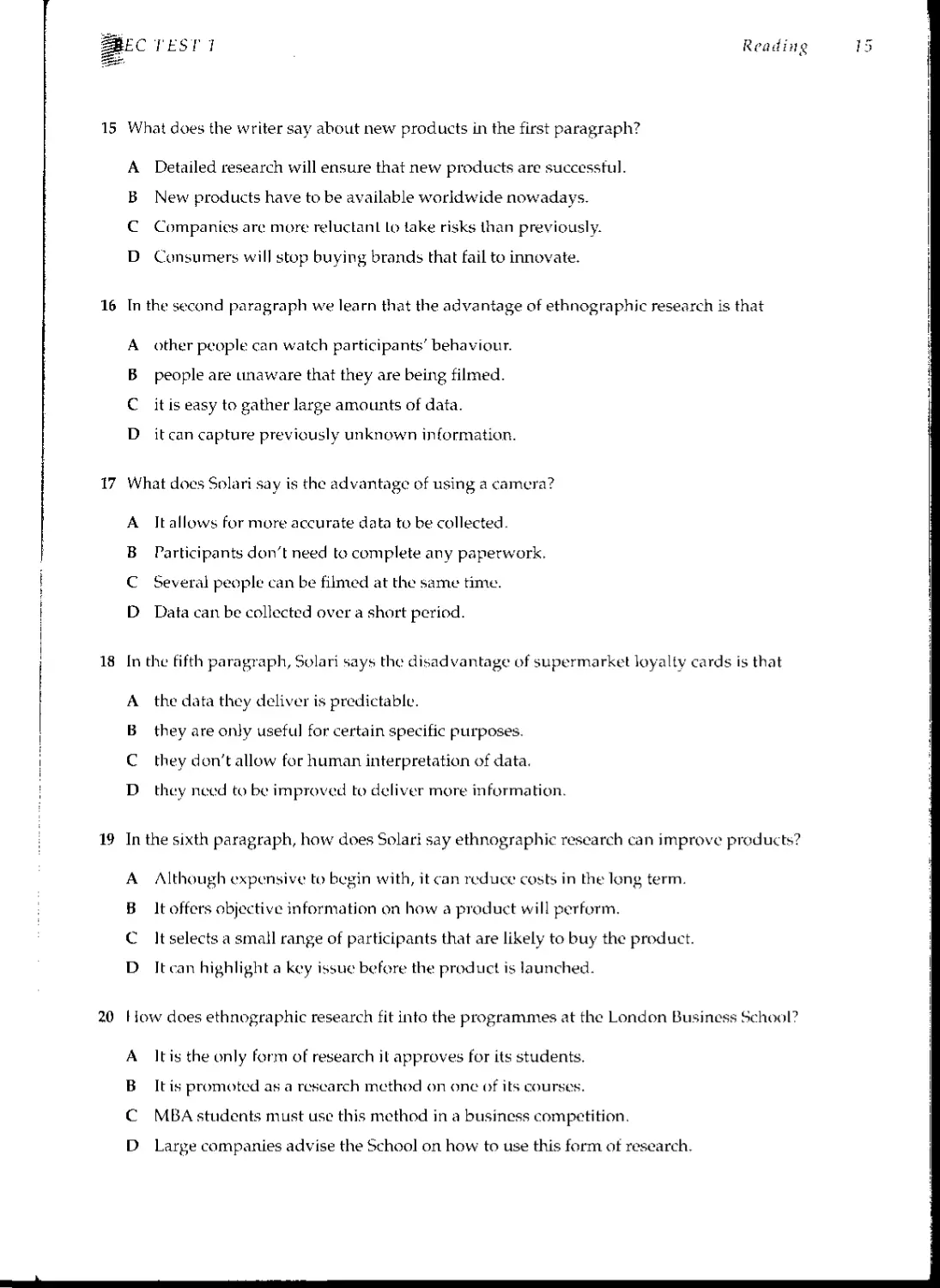
15	What does the writer say about new products in the first paragraph?
A Detailed research will ensure that new products are successful.
В New products have to be available worldwide nowadays,
C Companies arc more reluctant to take risks than previously
D Consumers will stop buying brands that fail to innovate,
16	In the second paragraph we learn that the advantage of ethnographic research is that
A other people can watch participants5 behaviour.
В people are unaware that they are being filmed.
C it is easy to gather large amounts of data.
D it can capture previously unknown information.
17	What does Solari say is the advantage of using a camera?
A It allows for more accurate data to be collected.
В Participants don't need to complete any paperwork.
C Several people can be filmed at the same time.
D Data can be collected over a short period.
18	In the fifth paragraph, Solari says the disadvantage of supermarket loyalty cards is that
A the data they deliver is predictable.
В they are only useful for certain specific purposes,
C they don't allow for human interpretation of data.
D th с у n ecd to be i m pre) v e d to deli v er m о re i n f о r m a ti о n.
19	In the sixth paragraph, how does Solari say ethnographic research can improve products?
A Although expensive to begin with, it can reduce costs in the long term.
В It offers objective information on how a product will perform.
C It selects a small range of participants that are likely to buy the product.
D It can highlight a key issue before the product is launched,
20	I low does ethnographic research fit into the programmes at the London Business School7
A It is the only form of research it approves for its students.
В It is promoted as a research method on one of its courses.
C MBA students must use this method in a business competition.
D Large companies advise the School on how to use this form of research.
16 Reading
ВЕС T£St|
PART FOUR
Questions 21-30
•	Read the article below about smartphones.
•	Choose the correct word to fill each gap from А, В, C or D on the opposite page.
•	For each question 21-30, mark one letter (А, В, C or D) on your Answer Sheet.
•	There is an example at the beginning, (0).
Smartphones - a necessity or
a luxury?
Smartphones have (0) beyond the boardroom and keeping a close eye on what's new is
Mike Lazaridis, chief executive of RIM, the company that makes the BlackBerry smartphone.
His device may no longer be quite as trendy as it once was but it is still (21).-	particularly
for Argentinian milk farmers. Mr Lazaridis says: "I like the way it's being used by the
farmers so they are always up to date. Milk is a (22).item, so delivery and production
standards are incredibly important." He is reminded of the company's early days: "This is
where we started in 1987, with a wireless vertical data business for the Swedish lumber
(23).., and then on to fire brigades, ambulances and garbage trucks."
While the BlackBerry was quick to (24).itself as the accessory of choice for business
professionals such as Wall Street traders, the cheaper price (25).and new, more colourful
handsets now (26).offer have opened it up to a much wider market. Mr Lazaridis says:
"It was obvious that business people and self-employed professionals would buy the
BlackBerry, but we were not expecting the (27).we had from ordinary consumers."
The greatest challenge for RIM, however, could lie in an economic (28)., when individuals
and companies alike may see devices like the BlackBerry as luxuries they can (29).
without. The company has to make its product indispensable to the lifestyles of consumers,
or prove that they bring a real (30).on investment for business users.
г
Ц|ес test i
Ke ad/пg	17
Example: A unfolded					В widened C displayed				D spread
			0	A	в	C D
												|
21	A	constructive				В	functioned		C active	D	operative
22	A	perishable				в	short-lived		C decaying	D	destructible
23	A	manufactu rers				в	enterprise		C commerce	D	industry
24	A	install				в	establish		C create	D	demonstrate
25	A	designs				в	programmes		C plans	D	systems
26	A	at				в	on		C for	D	under
27	A	return				в	retort		C reply	D	response
28	A	downtu rn				в	tall		C decrease	D	drop
29	A	1TI	ake			в	carry		C do	D	stay
30	A	return				в	gain		C interest	D	profit
Before you check your ansivers to Part Four, go on to pages 18-19.
7Я Further practice and guidance.
EEC TEST I
! Further practice for Reading Part Four
: EXAM INFORMATION
J Part Four consists of a text with eleven gaps. The first one is done for you as an example. You have
। to choose the word that best fits each gap from ten four-option multiple choice items. Most of the
; items test vocabulary. The options are all from the same part of speech but only one option fits the
! meaning. This part of the test is designed to see if you can distinguish between words of similar
• meaning.
: A DETAILED STUDY
I 1 You should always read the text first io get a general sense of meaning. Answer the following questions
; to help you with the general meaning of the text.
I	1	Why is the Blackberry still used by some farmers?
;	2	Where did the company start?
]	3	Who was the Blackberry popular with originally?
[	4	What has happened to the Blackberry now?
1	5	What may threaten the popularity of the Blackberry?
;	6	What must the company do to retain its popularity?
I 2 To improve and widen your vocabulary, you will need to check dictionary definitions. Match each of the
following words to their definitions. All the words are options in the test.
1 A constructive	В functional	C active	D operative
1 useful; working correctly
2 working and able to be used
3 suggestions or input that is intended to improve something
4 still in good working order
2 A perishable	В short-lived	C decaying	D destructible
1 starting to rot or becoming destroyed
2 existing or happening for only a limited time
3 can be damaged so that it can no longer be used
4 likely to decay quickly
3 A response	В return	C retort	D reply
1 a written or spoken answer to an enquiry
2 to act or speak after something has happened or been said
3 an angry or humorous remark
4 a statement giving a written answer to official questions
4 A install	В establish	C create	D demonstrate
1	to show or describe how something works
2	to put a piece of equipment somewhere and connect it so it can be used
3	to start an organization or system that is intended to continue for some time
4	to make something exist that did not exist before
ppc TEST I
Further practice and guidance 19
3 In order to select the right word you will have to look carefully at. the words before and after the gap to
see which option, fits best. Certain words typically col locate with certain other words f
teg. According to ... ,
For each of the following, watch the word that each option often collocates with. All the words are
options from the test.
1	A	to do something by	1	plan
	В	under з	2	design
	C	a change of	3	system
	D	to come to the end of a	4	programme
2	A	at	1	sale
	В	on	2	cost
	C	for	3	control
	D	under	4	offer
3	A	a return	1	of
	В	a gain	2	in
	C	an interest	3	on
	D	a profit	4	of
Now cheek your answers to these questions and look hack at your answers to Part Tour of the
Reading Test.
20
Reading
ВЕС TEST 1
PART FIVE
Questions 31-40
•	Read the article below about booking conference venues.
•	For each question 31-40, write one word in CAPITAL LETTERS on your Answer Sheet.
•	There is an example at the beginning, (0).
Example:
O M |T- j I
How to book a conference
First decision is the choice of venue. Which venue is right will depend (0)..
just on the number of people attending. It will also depend on the cost (31).
whether the participants (32)...being charged to attend. If the event lasts
for several days the problem of finding accommodation influences the choice,
but just (33)..complicate the decision it also depends on w hether to have
everybody on the same premises as the conference. Some seminars break up
the sessions (34).......time to time into smaller groups which w?ill require
additional rooms with the right facilities. (35).really do need to be handy
for the main session.
Professionals advise not (36)...book any premises or facilities without
visiting first. In (37).case, you need to meet the senior organising staff to
find out w hat they can do and what they have. And it is probably a good idea
to test all the equipment and ask about back-ups.
A frustrating problem for organisers laying on the facilities is never being sure
just (38)...many people w ill turn up* People go sick, managers (39)....w ere
overseas suddenly reappear, an emergency at the company prevents some key
people attending, and (40)....on. Still, some estimate is vital for the booking.
It may be indeed one of the factors in deciding the venue and in haggling over
the price. If all that sounds just too much hassle there is another option - hire a
professional to take the load off your back.
В: С Г Г ST 1
Heading 2'1
PART SIX
Questions 41-52
•	Read the text below about a company acquisition.
•	Ju most of the lines 41-52 there is one extra word. It is either grammatically incorrect or does not
fit in with the meaning of the text. Some lines, however, are correct.
•	If a line is correct, w rite CORRECT on your Answer Sheet.
•	If there is an extra word in the line, write the extra word in CAPITAL LETTERS on your /Answer Sheet.
•	The exercise begins with two examples (0) and (00).
Examples: []>] R7) [И] Ы И [3 EJ О
@B00000EEJ
Evans cycles to a more
active future
0 .Active Private Equity has bought a majority stake in Evans Cycles,
00 because the independent chain of UK specialist cycling stores,
41	The retailer, which sells bicycles, accessories, clothing and their
42	services in its 31 stores, had reportedly been going in talks w'ith
43	controversial sports billionaire, Mike Ashley, last summer and was said
44	to have such a price tag of around £35m. Yesterday, Active said it had
45	completed a refinancing of the group "to provide the necessary for
46	grow th capital and expertise that will help the company fulfil its potential".
47	Despite the Smith Family has owmed Evans for the past 50 years,
48	but they are thought to have wanted to reduce their holdings to a
49	minority stake. The company's turnover has doubled up over the last
50	three years to £45m. Nick Evans, w ho was introduced Active to the Evans
51	board, wall take up the post that of executive chairman. Active partners Bryan
52	Vaniman and Spencer Skinner will also to join the Evans board as directors.
2 2 Writing
REC TEST 1
Writing IMB
PART ONE
Question 1
•	The bar charts below show working hours and production al two different sites of a company.
•	Using the information from the charts, write a short report comparing the performance for the Iwo sites.
•	Write 120-140 words.
Average Working Hours
Average hours per
week per employee
Site H
Units of Production
Site В
Before you write your answer to Part One, go on to pages 23-24.
|g£C TEST 1
Further practice and guidance 23
Further Practice for Writing Part One
EXAM INFORMATION
In Part One of the Writing Test you have to produce a report of 120-140 words. In the report you
will have to analyse graphic information and describe the information in writing. The graphic
information can be in the form of line graphs, tables, bar charts or pie charts or a mixture. The
instructions explain what the graphic information shows and ask you to describe or compare.
The information may be about sales, production, costs, and other information found in company
reports or the business pages in newspapers.
A DETAILED STUDY
1 Put these words used to describe graphic information into the correct column below. Which word docs
not fit into any of the categories?
rose	plunged	declined	levelled	off	climbed	rallied held	steadied	stabilised	crashed	recovered	soared increased	dipped	bounced	back	rocketed	fluctuated	decreased flattened out collapsed
going up	going down	staying the same

2 Which of the following adjectives can be used as intensifying adverbs in a report describing graphic
information?
surprising	sudden	general	rough	smooth	considerable
dramatic	slow	fast	significant	steady	fair
approximate	nice	virtual
3 Put the adverbs that you have created, in exercise 2 into the correct columns. Can you add ana more?
Degree of change	Speed of change

24
Further practice and guidance
ВЕС TEST 1
4 Put this advice about how to write a report on graphic information into the correct order.
1	Decide what the rekit ion ship is between the different types of information shown,
2	Write the report, making sure you use a range of language.
3	Look at the graphic information carefully and check you understand it.
4	Check your writing for accuracy of spelling and grammar.
5	Choose which points to include and in what order.
5 Look al the graph below Then look at the descriptions of the information in the graph and decide which
one you think is best and why.
Percentage change in exports
1 In 1999 exports rose by 3%, in 2001) exports increased by 2.5% and in 2001 exports fell
by 6%.
2 After rising in 1999, exports continued to rise in 2000 but by a smaller percentage. They
then dropped sharply in 2001 bringing them to below 1999 levels.
3 Exports rose by 3% in 1999 and continued to rise in 2000 but by only 2.5%. Then in 2001
they dropped dramatically by 67<»,
6 Read this example of a report a student wrote to Part One on page 22. Then answer the questions below.
i/1- adca ос/к sites v-aaaA t'm	mws ysr ж sc aa sy. m.
ccoA Tznepi Ui?tk at- k^tcrs per weefe. m aaa.ca wktc-k ж owcsT
COCoG A A A p.mpek to АСААДА SI kliOU r£ AAA ft'A^ -Sltt В ?0--Z fLli% Иг'Ж
t о s C f C' is. ks u s с a A fe. 1 a- t к % 11 me p го я a cAo ft t1 к e <% Lt а с к % imp ed, [ a AO k1
lc wfts tacaaA' a. -Site А ciiA. agoaoa ftt .site k. taca slu .a к-и
Joof caa дик ..site К	tke sftmA in- goca %otk sttes aaaA
4-	AC:f ООО.	(92 words)
1	Is the report long enough?
2	Doesit follow the instructions?
3	Which time phrase or reference is unclear?
4	Can you find two language mistakes?
5	The student has used some informal or subjective expressions m two places w hich are not
appropriate. Can you find them and correct them?
Now write your own answer to Part One of the Writing Test. Remember to check for spelling and
grammar mistakes.
C TEST 1
Writing
25
PART TWO
Questions 2-4
*	Write an answer to one of the questions 2-4 in this part.
	Write 200-250 words.
Question 2
•	Your company is considering outsourcing the distribution of its products to another company;
Your manager has asked you to write a report which assesses whether or not this is a good idea.
•	Write the report for your manager:
•	explaining what the benefits of outsourcing distribution will be
*	describing what problems may occur as a result of this
•	suggesting how easy it will be to find a suitable company to handle the distribution.
Question 3
•	Your company is looking for an agent in another country which can help your company export its
products or services. Your manager has asked you to write a letter to send to agents.
•	Write the letter to the agents including the following information:
•	what your company does
•	why your company has decided to export
*	what you will need an agent to do.
Question 4
•	Your company is planning to change the way it advertises one of its products. Your manager has
asked you to write a proposal suggesting new advertising methods.
•	Write the proposal including the following information:
•	what the problems are with the current method of advertising
•	what new method of advertising you propose
•	why you think your suggested method will be successful.
26 Listening	ВЕС TЕST1
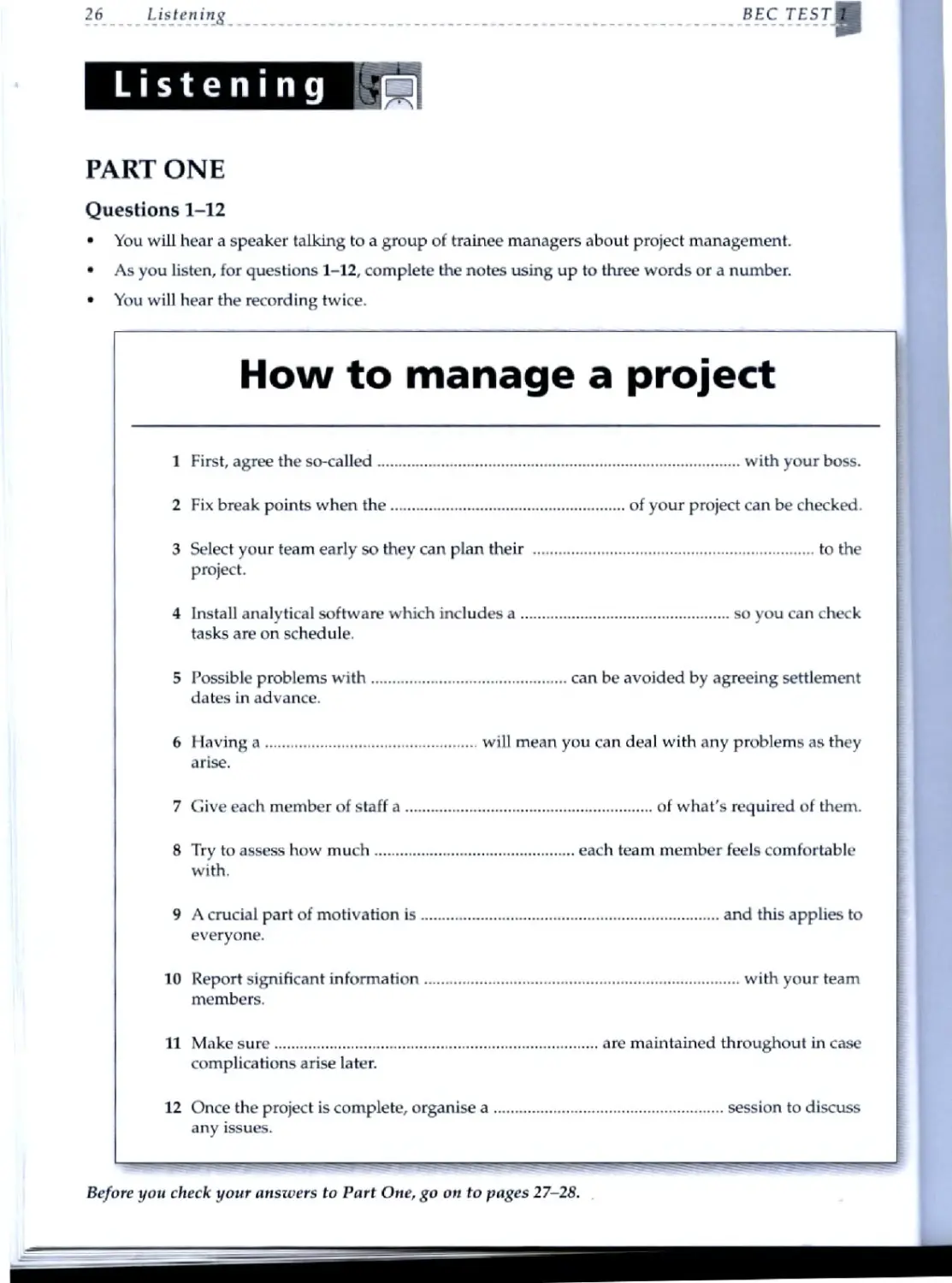
PART ONE
Questions 1-12
•	You will hear a speaker talking to a group of trainee managers about project management.
•	As you listen, for questions 1-12, complete the notes using up to three words or a number.
•	You will hear the recording twice.
How to manage a project
1	First, agree the so-called...........................................with your boss.
2	Fix break points when the..............................of your project can be checked.
3	Select your team early so they can plan their .................................... to the
project.
4	Install analytical software which includes a.........................so you can check
tasks are on schedule.
5	Possible problems with...........................can be avoided by agreeing settlement
dates in advance.
6	Having a............................will mean you can deal with any problems as they
arise.
7	Give each member of staff a................................of what's required of them.
8	Try to assess how much.............................each	team member feels comfortable
with.
9	A crucial part of motivation is......................................and this applies to
everyone.
10	Report significant information.....................................    with	your team
members.
11	Make sure...........................................are	maintained throughout in case
complications arise later.
12	Once the project is complete, organise a.............................session to discuss
any issues.
Before you check your answers to Part One, go on to pages 27-28.
Further practice for Listening Part One
EXAM INFORMATION
In Part One of the listening test you hear an informational monologue twice. On your question
paper, there is a gapped text with twelve spaces that you have to fill in with up to three words or a
number. The gapped text may look like a series of notes ora form that is partly filled in.
The aim of this part of the test is to assess your ability to retrieve factual information. The answers
are very specific and must be spelt correctly. The gapped text on the question paper does not
replicate what the speaker says in the recording exactly, so you need to listen carefully and be
prepared to reformulate some of what you hetir*
ADETAILED STUDY
One way you can help yourself do better in this task is to try and predict what sort of answer is
expected in each gap. Does the surrounding text indicate that the gap needs to be filled by, for
example, a verb, an adjective, a noun, a number or a phrase? By working this out as you read through
the text in the 45-second preparation time, you will be focused in on what the speaker is going to say
INITIAL PREDICTION
Read these sentences and decide what type of word is missing
1	Holding regular meetings helps staff....what	the company requires of them.
2	Focus on the.......of	the job*
3	Well-known companies are often called.....
4	Last year inflation rose by...
5	The CEO introduced a.......programme of store renewals.
6	The going rate for the work is....an	hour*
7	Efficient......is essential in this type of project.
8	Ensure that the security codes are...every	week.
It will help you more if you can narrow your predictions even further by, for example, deciding
whether the verb is going to be singular or plural, present or past, infinitive or past participle.
Similarly, you should try to predict whether a noun is going to be singular or plural. The type of
number can be predicted too, for example, whether it is going to be a date, a cost or a percentage.
MORE DETAILED PREDICTION
Read these sentences and make a more detailed prediction of what should go in the улр.
1	Be prepared to reschedule if the...are	changed.
2	Companies need to..........their products to suit the changing market.
3	It wasn't until .......that	he decided to set up his own business.
4	Insist on as much........as	possible.
5	The old warehouse is going to be......by a new one next year*
6	An investment of no more than........will	get you access to the scheme.
7	There will be a........of growth over the next few months.
8	It only took........to	find new premises.
9	We arc looking forward to........a new training programme.
10	1 spoke to EAG's.......yesterday about the conference.
2S Further practice and guidance	ВЕС //'//
REFORMULATION
The information on the question paper will not be formulated in the same way as the information
on the recording. This means you have to listen carefully and check for synonyms.
Question 1 on page 26 states:
First agree the so-called... with your boss.
The speaker on the recording says:
it s essential to get your superior's approval for what you're plannings that means initially for what are
referred to as the terms of reference'.
•	'boss' is equivalent to 'your superior'
•	'agree' is equivalent to 'approval'
•	'first' is equivalent to 'initially'
•	'the so-called' is equivalent to 'what are referred to as'
You can predict that you are looking for a noun, either singular or plural, to complete the gap, so
that must be 'terms of reference'.
Go through the same analysis with Questions 4 and 11 on p26 and refer to the tapescript on page
152.
Question 4 on page 26 states:
Install analytical software which includes a ... so you can check tasks are on schedule.
•	'analytical software' is equivalent to......................
•	'individual tasks' is equivalent to..........................
•	'check' is equivalent to....................................
The type of word required is..... so the answer is ..........
Question 11 on page 26 states:
Make sure ... are maintained throughout in case complications arise later.
•	are maintained' is equivalent to..........♦..............
•	'in case complications arise later' is equivalent to..................
The type of word required is........so the answer is.........
Now check your answers to these questions and look at your answers to Part One of the Listening Test.
ggFC TEST !
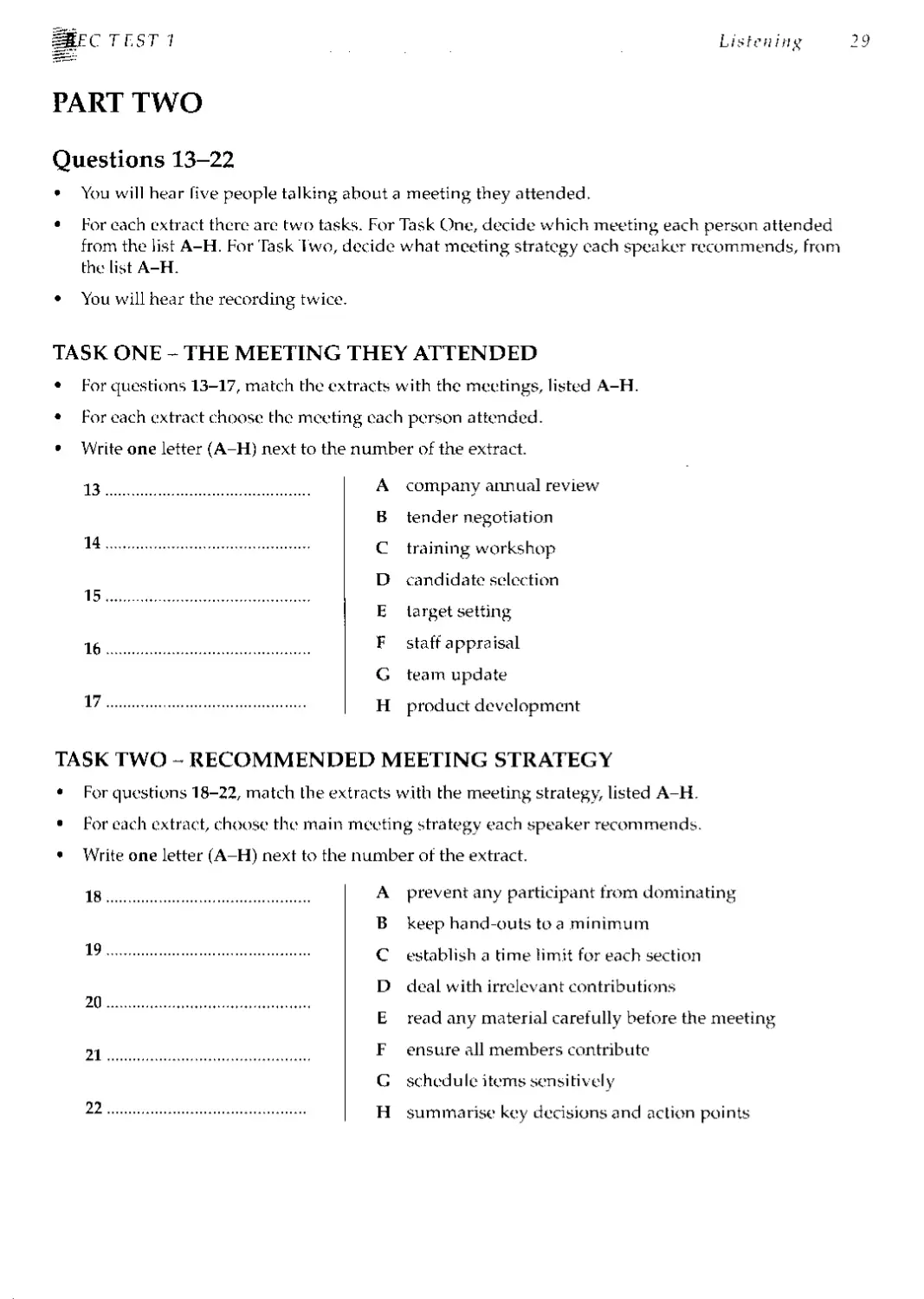
PART TWO
Listening 29
Questions 13-22
•	You will hear five people talking about a meeting they attended.
•	For each extract there arc two tasks. For Task One, decide which meeting each person attended
from the list A-H. For Task Two, decide what meeting strategy each speaker recommends, from
the list A-H.
•	You will hear the recording twice.
TASK ONE ~ THE MEETING THEY ATTENDED
•	For questions 13-17, match the extracts with the meetings, listed A-H.
•	For each extract choose the meeting each person attended.
•	Write one letter (A-H) next to the number of the extract.
13...........................
14...........................
15...........................
16...........................
17..........................
A company annual review
В tender negotiation
C training workshop
D candidate selection
E target setting
F staff appraisal
G team update
H product development
18...........................
19...........................
20...........................
21...........................
22..........................
TASK TWO - RECOMMENDED MEETING STRATEGY
•	For questions 18-22, match the extracts with the meeting strategy, listed A-H.
	For each extract, choose the main meeting strategy each speaker recommends.
•	Write one letter (A-H) next to the number of the extract.
A prevent any participant from dominating
В keep hand-outs to a minimum
C establish a time limit for each section
D deal with irrelevant contributions
E read any material carefully before the meeting
F ensure all members contribute
C sc h cd u I c i tern s sen s i ti v e I у
H summarise key decisions and action points
30
Listening
ВЕС TEST I
PART THREE
Questions 23-30
•	You will hear a radio interview with an internet business coach about his career.
•	For each question 23-30, mark one letter (A, В or C) for the correct answer.
•	You will hear the recording twice.
23 What was the main factor in Markus' decision to work in the financial sector?
A He wanted to enter the same profession as his father.
В He wanted to escape from an academic environment.
C He thought the job would provide him with a real challenge.
24	Why does Markus refer to the suit he borrowed from his father?
A to point out that the job he was doing was not right for him
В to demonstrate how much he needed to earn his own money
C to emphasise what an effort he made to adapt to the world of work
25	How does Markus view the ten years he spent working for finance companies?
A He regrets the time he spent studying for his qualifications.
В He thinks the fierce competition had a negative effect on him.
C He realises that it was a process that he needed to go through.
26	Why did Markus decide to start his own. business?
A He felt he had nothing new to learn where he was.
В He hoped that he would be able to earn a larger salary,
C He wanted to use his work contacts for his о wit benefit.
27	What is innovative about Markus' business?
A the topics he covers in his conference sessions
В the centre he has for p ^business set-up queries
C the advice he gives on ways to exploit the internet
C TEST 1
Listening
31
28	What does Markus find difficult about working with the internet?
A persuading business entrepreneurs to use the social networking sites
В maintaining his interest in it now that it is a key feature of his work
C exploiting all the useful applications that are being developed
29	Markus believes that people who are considering setting up a business
A should make a priority of working out a detailed business plan.
В should aim to link something that appeals with a proven talent.
C should carry out detailed market research before doing anything else.
30	What advice about time does Markus offer top business people?
A It is very precious so use it in a way that is personally rewarding.
В Try to avoid staying at your desk beyond the normal working day-
C Make sure that what you receive reflects the hours spent on a project.
32 Speaking
ВЕС TEST 1
Speakin
PART ONE
Conversation between the examiner and each candidate
(about 3 minutes)
In PartOne of tHe Speaking Test the interlocutor asks questions to each of the candidates in turn. You
have to give information about yourself and express personal opinions.
Here are some questions you may be asked:
1	What type of work do you do?
2	What do you find most enjoyable about your work?
3	What training or study did you do before you started work?
4	What aspect of your work do you find most demanding?
5	What job would you like to be doing in five years' time?
6	How important is interacting with colleagues in your work?
7	How is technology changing the way people work in your country?
8	I low important is English in businesses in your country?
9	How has the global market changed people's lives in your country?
CTEST 1
further practice and guidance 33
Further practice for Speaking Part One
EXAM INFORMATION
The speaking test is taken in pairs (or threes when there is an extra candidate at the end of a session).
There are two examiners. The interlocutor is the examiner who speaks to you and asks the questions.
The other examiner observes and marks you. The interlocutor contributes to the marking process by
awarding you one overall mark. You are awarded marks using the following criteria:
•	grammatical resource	• pronunciation
•	lexical resource	• interactive communication
•	discourse management
PART ONE: THE INTERVIEW
In the first part of the speaking test, the examiner asks you questions about yourself, your work
or studies and other personal matters. This lasts about three minutes and is designed to test
your ability to talk about yourself and express personal opinions and preferences. You will be
asked approximately the same number of questions as your partner, but not necessarily the same
questions or in the same order. Listen carefully to the questions^ Avoid giving one word answers or
long prepared speeches- It is best if you can try to expand your answers beyond the bare minimum
and link your ideas with words like 'because', 'so', 'but".
Example: Can pen tell me a little about your jab?
Certainly. I work in I he Sales department of an engineering company. My work involves contact with clients,
so / travel quite a lot to visit different companies, which 1 enjoy very much.
ADETAILED STUDY
Below are responses to questions 3-9 on the previous page. Link each one of these to an
appropriate extended response A-H using one of the words or phrases in the box (j. -viii). There is
one extra linking word or phrase which is not used.
1	1 did an accountancy diploma
2	I find some of the statistics very hard to understand
3	Ld really like to work in our New York office for a while
4	It's very important
5	It's making some things much easier
6	It depends which business you are working in
7	It has made a huge difference to us
A sending marketing information to thousands of potential clients
В find out how they do business over there
C nearly every company needs the language to some degree
D I've never been good with figures
E the work is done in teams as it is in my company
F it has been very rewarding
G in the area of exports
H I found was a good preparation for a range of jobs
i in order to ii for example hi although	iv because v if
vi so vii especially viii which
34
Spen king
ВЕС TEST.l'
PART TWO
Mini-presentation (about 6 minutes)
In this part of the test, you are asked to give a short talk on a busin ess-related topic. You have to choose
one of the topics from the three below and then talk for about one minute. You have one minute to
prepare your ideas* *
A:	Sales: the importance of developing schemes to maintain customer loyalty
B:	Training: the benefits to a company of encouraging staff to attend training courses
C: Operating systems: the factors involved in implementing change in a traditional organisation
When you have given your presentation, your partner will ask you a question about what you have
said. Here arc some questions they may ask you:
Can you explain what you meant by...?
Could you go into a bit more detail about...?
A • What kind of loyalty schemes could companies use?
• Do you think loyalty schemes really increase busmess?
• What do you think motivates customers more, discounts or gifts?
В • How can you ensure that training courses are worthwhile?
• What business skills would it be particularly useful for staff to be trained in?
* How would you deal with older staff members who do not want to do courses?
C • What should managers do to start the process of implementing change?
• What research needs to be carried out before deciding on the changes?
• What argument wrould you use to persuade staff of the need to introduce changes?
TEST 1	Speaking 35
PART THREE
Discussion (about 7 minutes)
In this part of the test, you are given a discussion topic. You have 30 seconds to look at the prompt card
and then about 3 minutes to discuss the topic with your partner After that the examiner wil] ask you
some more questions related to the topic.
For two candidates
Company Relocation	'
The company you work for is thinking of relocating to different premises outside the city. You
have been asked to make some recommendations*
Discuss and decide together:
•	whether it would be better to move, to an existing building or design a new one
*	what the effects might be on staff of having to commute out of the city.
For three candidates
Company Relocation
The company you work for is thinking of relocating to different premises outside the city* You
have been asked to make some recommendations*
Discuss and decide together:
•	whether it would be better to move to an existing building or design a new one
•	what the effects might be on staff of having to commute out of the city
•	what benefits the new location might have on productivity.
The examiner will then ask you some follow-up questions* Here are some questions you may be asked:
•	What effect do you think a pleasant working environment has on motivation? (Why?)
•	Should companies provide transport for staff if their premises are a long way from the nearest
town? (Why? / Why not?)
•	How far would you be willing to commute to work every day? (Why?)
•	What are the advantages and disadvantages of working from home?
Бесtest 2
Reading
PART ONE
Questions 1-8
•	Look at the statements below and at the five extracts from an article on the opposite page about
building effective teams in new companies.
•	Which extract (A, B, C, D or E) does each statement (1-8) refer to?
•	For each statement (1-8), mark one letter (А, В, C, D or E) on your Answer Sheet.
•	You will need to use some of these letters more than once.
•	There is an example at the beginning, (0).
Example:
0 It can be easy for new companies to find staff.
л А В С 0	E~~
1	The company owner should focus on fostering team spirit.
2	Individual members of staff should be allowed to negotiate their own terms.
3	Employees should be encouraged to experiment.
4	Staff are likely to leave if they can't keep up with what is required.
5	A system for assessing progress should be set up for staff.
6	A feature of new companies is that they are under-staffed.
7	Company owners should use external sources to help with some aspects of managing their
team.
8	Employees can develop essential skills in new, expanding companies.
2_______________________ _________________ Reading 37
A
'Dream Team' people only have one |
characteristic - they get stuff done, rather
than finding excellent excuses for inactivity. |
In every start-up there are many more jobs |
than people to do them. Also there is no time
to have meetings to discuss strategies for I
solving problems; people have to just get on |
and do things. Often they'll screw up the first |
time, and that is quickly forgiven in a start-up |
so long as they don't keep making the same fe
] mistakes. It*s easier to have a no-blame culture
in a small organisation than a large one and
people should be praised for 'having a go',
even if the immediate consequences are less
than ideal.
D
Most important from the entrepreneur's
point of view is to develop and maintain the
right culture, which is essentially tribal. This
should be actively encouraged and overlaid
with a few minor elements of process and
procedure. It's important to have formal, six
monthly reviews with agreed targets, even if
the playing field is changing on a daily basis.
It's an opportunity for both parties, senior and
\umcr to tate гЬтегХЪ, and make sense ol 1
what is happening and set some objectives for
the next few months.
В
—
In a fast-growing company, nobody is |
interested in problems, only solutions, and [
the ability to execute quickly and bounce back |
swiftly from setbacks, is vital for personal .
and business survival in entrepreneurial |
companies. This is also the perfect learning
experience for those who have dreams of
themselves becoming a cornerstone one day
or even of starting their own company.
E
Remuneration is a tough issue and the wise
entrepreneur gets advice and mentoring from
people with specific expertise in the area,
and who have been around the block several
times. Then, the remuneration policy should
be clearly and fairly executed, especially when
shareholding or stock options are involved.
There's nothing wrong with an ambitious
employee coming to a manager and saying
they should be paid as much as someone
else, so long as they are willing to deliver as
professionally and accept the same level of
responsibility as the person they aspire to be.
C
Entrepreneurs attract ambitious people and, if |
left to their own devices, tend to hire in their
own image so potential 'Dream Team' people ;
are not difficult to identify. The problem is
finding the ones that will fit in and deliver.
My experience is that there is a strong element
of 'natural selection' when entrepreneurs
grow their organisations. There is rarely a
formal recruitment or interview process, and
if people do not shape up they tend to be out -
of the revolving door quite quickly.
38 Reading
ВЕС TEST J
PART TWO
Questions 9-14
•	Read this article in which a company owner talks about her best deal.
•	Choose the best sentence from the opposite page to fill each of the gaps.
•	For each gap (9-14), mark one letter (A-H) on your Answer Sheet.
•	Do not use any letter more than once,
•	There is an example at the beginning, (0).
My Best Deal
It's not often that a television comedy programme can be credited with the beginning of a
wonderful business relationship but for Sue Mitchells this is pretty much what happened,
(0) ..W... Keeping a sales relationship Long term can be challenging in the fast-moving
world of the film production industry where there is typically rapid staff turnover and ever-
changing technology.
Ms Mitchells, 38, is head of media client services for Ascent Media, a company that aims to
be a one-stop shop for film and television production and employs 4,000 staff worldwide.
(9).....Her best deal came more than a decade ago when she was attending MIP TV, a
conference in Cannes. (10) ..."I happened to bump into a client who I had known when I
was at TVP, a company that was later bought by Ascent She was moving to a new employer
called VCI and suggested that 1 talk to the head of production there. (11).It is such a
competitive industry that Гт sure she would have been receiving lots of other calls but
fortunately my acquaintance said she wrould arrange a meeting between all three of us."
When the trio did get together, Ms Mitchells recalls, the old and new connections combined:
"'We got on really well,” she says. "1 listened to the production head saying what she was
doing and what her problems were." (12)...The work involved streaming and encoding
some archived content on to DVDs. VCI was looking for help on the production front and
Ms Mitchells said Ascent could do exactly that "One of the first programmes we worked on
was a comedy programme. We were basically repackaging content/*
(13)....".	As her business changed, we informed the head of production how we could
support her, " Ms Mitchells says. (14) "..This business will always be one that changes
but this relationship has lasted the test of time. Having the same person still at the company,
has enabled us to expand and develop through emerging technologies."
еС TESТ2	__________________ Reading 39
A She kindly agreed to give me some details of
this lady.
В However, Ms Mitchells' relationship is still
going strong.
C It turned out that VCI was doing a lot of
work repackaging media content.
D She has worked for the group for 13 years,
mostly in sales.
E One of the things that's been vital is that
we spent a lot of time giving her company
staff training and technical training because
the industry changes rapidly with emerging
technologies.
F This initial work went on and the relationship
between the companies deepened. More than
a decade later, they still work together.
G "The UK TV industry is a very social industry
and everyone seems to know each other/' she
says.
H Winning some production work on archived
material of a BBC comedy series for her
company Ascent Media set in motion a
connection that has now lasted more than a
decade.
Before you check your answers to Part Two, go on to pages 40-41.
40 Further practice and guidance	ВЕС TEST'%
Further Practice for Reading Part Two
EXAM INFORMATION
Part Two of the Reading Test is a text with gaps where six sentences have been removed. You are
given seven sentences to fill six of the gaps (one of the sentences is not needed) There is also an
example. You have to match each gap with the sentence that fits both meaning and structure.
A DETAILED STUDY
The texts in this part always contain a line of thought or a narrative where one idea, fact or event
is linked logically to the one before or after it. First, read the text and the sentences in order to
understand the line of thought. Look for meaning, but also look out for single words and short
phrases such as:
*	pronouns, e.g. it, their, him
•	demonstratives, e.g. this, those
•	linking words and phrases, eg. However, In contrast, Additionally
•	comparisons, e.g. better than, prefer (one thing to another)
•	referring nouns, e.g. This sit uation/problem/issue/relat ionship
Consider how they link one idea to another.
Also look for other elements of the text that demonstrate cohesion such as:
•	A topic sentence summarising what is to come, e.g.
There can be several reasons why people do not always like travelling abroad on business, Managers should
take employees' concerns on this issue seriously and investigate the reasons ... etc.
*	A summary sentence followed by an example or explanation.
Saving costs in training can be achieved relatively simply. One way is to get employees to mentor each
other ... etc.
1	First try to understand the line of thought in the text. Read the article on page 38 and put the fol low in g
in order of when they are mentioned.
a Ms Mitchells met a former client.
b VCI needed some help.
c A client set up a meeting for Ms Mitchells.
d Ms Mitchells trained staff at VCI.
e What Ms Mitchells does now.
f Ms Mitchells helped VCI.
g A former client gave Ms Mitchells useful contact details.
h Ms Mitchells met a former client and a new contact.
i Ms Mitchells went to Cannes.
2	What do the words or phrases in italics in the following sentences refer to? They are all taken from the
text.
1	... for Sue Mitchells this is pretty much what happened,
2	... where there is typically rapid staff turnover ...
|^EC TEST 2	Further practice and guidance 41
3	.,. everyone seems to know each other, " she says.
4	She was moving to a new employer ...
5	... Гт sure she would have been receiving lots of other calls ...
6	When the trio did get together ..,
7	The work involved streaming and encoding ...
8	Ms Mitchells said Ascent could do exactly that.
3 Match the two halves of these extracts by joining the underlined words and phrases to their reference.
What other words help you to connect the extracts?
1	Although 1 sympathise with the situation 2	The director wasn't in 3	This issue is 4	By running sessions at the same time 5	Not everyone is eligible. 6	It's excellent in some respects.	a we will be able to get through more b However, we need to consider ... c it cannot be allowed to continue d Those who aren't should see me. e so I spoke to his secretary, f the problem which concerns me
4 Now look at items A-G and answer the questions. This exercise helps you to relate the items to their
proper place in the text. (Remember one item does not belong in the text). Remember you need to check
any references after the gap as well as before the gap.
A She kindly agreed to give me some details of this lady.
Who does this lady refer to?
Б However, Ms Mitchells' relationship is still going strong.
What does However relate to?
C It turned out that VCI was doing a lot of work repackaging media content.
Which situation does It turned out... refer to?
D Ms Mitchells, 38, is head of media client services for Ascent Media, a company that aims to
be a one-stop shop for film and television production and employs 4,000 staff worldwide.
Is this sentence an introduction to someone or extra information about someone?
E This business wil] always be one that changes but this relationship has lasted the test of
time.
What is this relationship?
F The initial work went on and the relationship between the companies deepened. More than
a decade later, they still work together.
What kind of information would you expect to follow this sentence?
G "The UK TV industry is a very social industry and everyone seems to know each other/'
she says.
What kind of information would you expect to follow this sentence?
Now check your answers to these questions and look back at your answers to Part Two of
the Reading Test.
42 Reading
ВЕС TESTJ
PART THREE
Questions 15-20
•	Read the following extract from an article about using customer magazines for marketing, and the
questions on the opposite page.
•	For each question (15-20), mark one letter (А, В, C or D) on your Answer Sheet for the answer
vou choose.
J
How magazines get goods into bags
i As resistance to junk mail grows, big businesses
are being forced to come up with ever-smarter
ways to encourage their customers to spend
more. Whether they are using customer
5 magazines, e-mails or podcasts, the name of
the game for businesses is to get close to their
clientele.
The sector that has benefited most from this
shift is the contract-publishing sector, which
TO produces own-brand magazines for businesses.
While traditional forms of print media are
having a tough time, this segment is flourishing.
"Traditionally, the holy grail for businesses
was acquiring new customers. Now marketers
15 are realising that it is about nurturing existing
customers. It is all about creating a dialogue
with them, and that works in favour of customer
magazines/' says Julia Hutchison, chief
operating officer of the Association of Publishing
20 Agencies (APA), the industry body for customer
magazines.
The grand illusion of customer magazines is
that they appear to be the opposite of junk mail
- where the former are subtle and editorially
25 driven, the latter are crude and direct. This has
lead to some detractors claiming that customer
magazines are the marketing equivalent of the
wolf in sheep's clothing - a cynical sales tool
purporting to be a glossy magazine. Not so,
до say the publishers. "Customers acknowledge
that they are being sold to. Our research shows
that they are savvy," says the APA's Hutchison.
Recent APA research shows that such magazines
lead to an average sales uplift of 8 per cent.
35 But, in spite of magazine boom, the sector is
already moving on. The latest buzz word in the
customer magazine market is "segmentation".
This means that companies are slicing and
dicing their databases and sending out specific
40 information to particular demographics of
customer. Targeted e-mail spam, podcasts and
micro-sites are set to become the next growth
area. "More and more companies are realising
that having got their websites up and running,
45 it is actually a pretty dead experience. The
whole debate now is how we can get customers
reading in a more exciting way," says Mark
Jones, editorial director of Cedar.
So-called experiential marketing is widely
50 seen as the next big thing. The thinking is that
consumers can no longer be pigeon-holed in
definable age brackets or social classes, meaning
that businesses must appeal to their attitudes,
experiences and emotions. "Marketing has
55 moved beyond demographics", says Cedar's
Jones. However some publishing executives
believe that the sector is getting "carried away"
with digital and experiential marketing. "We
have spent the past two years proving the
60 success of customer magazines and, what, are
we supposed to abandon ship now and say 'Well
actually digital is the way forward?'/' says John
Brown's Hirsch.
One example of a company that is using its
65 customer data in a simple yet effective way
is Tesco, the UK's largest retailer. Tesco has a
database of 12m customers, all of whom use its
Clubcard loyalty programme. Details of every
single purchase have been collected, collated
70 and crunched by Dunnhumby, a data company.
Although Tesco has a customer magazine, the
vast amount of Dunnhumby's findings are used
to identify shopping patterns and trends in
Tesco's stores. This emphasis allows Tesco and
75 its suppliers to alter at short notice the mix of
products that they offer to shoppers.
Tesco's rationale for obsessively focusing in on
what is on its shelves is simple, says Edwina
Dunn, who founded Dunnhumby. She says
so that if shelves are stocked with exactly what
customers want, there is less need for fancy
promotions to entice them into stores. "The thing
that everybody locks onto is communication
with customers. Actually, that is not the most
#5 important element. The key element is getting
the ranges right in the stores. Getting those right
means that customers will come back more," says
Dunn. Perhaps it really is that simple, after all.
Дк'С TEST 2	Readin$	43
15	In the second paragraph, we learn that customer magazines have become a popular marketing
technique because
A people no longer want to read traditional magazines.
В they offer a very direct form of communication.
C they are an effective w ay of getting new customers.
D new marketing techniques were needed in certain businesses.
16	What criticism do some people make of customer magazines?
A The articles are not as good as in traditional magazines.
В They only contain advertising material.
C They deceive customers into buying products.
D Customers should not be charged for them.
17	The fourth paragraph states that new developments will take place in order to
A direct marketing material at specific groups.
В increase customer interest in company magazines,
C deal with the fact that companies are updating their technology.
D make marketing material more engaging for customers.
18	According to the fifth paragraph some executives feel that experiential marketing
A should not replace other marketing methods.
В can take too long to research and set up.
C is only appropriate for digital marketing techniques.
D may be the best way of targeting customers according to age.
19	The writer introduces the example of the Tesco Clubcard in the sixth paragraph to show that
A information collected on the card can be used in the magazines.
В there are different ways of utilizing information from customers.
C some companies have a range of marketing methods.
D companies should respond quickly to customer needs.
20	What does Edwina Dunn say in the last paragraph?
A Retailers would like more communication with customers.
В Special promotions could increase customer numbers.
C Sales depend on product selection.
D Returning customers are more important than new customers.
44
Reading
ВЕС TEST 2
PART FOUR
Questions 21-30
•	Read the article below about starting a business.
•	Choose the correct word to fill each gap from A, B, Cor D on the opposite page.
•	For each question 21-30, mark one letter (А, В, C or D) on your Answer Sheet.
•	There is an example at the beginning, (0).
Adventures in micro-business
One in 10 adults would like to be their own (0)........But how easy is it to start your
own business? Whaf s difficult is making a new business sustainable, since more than
half (21).......within three years. So it's a really bad idea to quit your job and then start
a business. Much better to start your own business first and then quit your job. But this
doesn't necessarily mean that you need to start (22)........Planning is an essential part
of enterprise.
Step one is to plan exactly what you are going to sell. Step two is to calculate what it will
cost to make the product or to (23).......the service. Step three is to do market research to
ensure that you will be able to sell enough to cover the costs. If your plans (24)....that
you can make a profit then you are in business.
In truth, step one is down to you. Think about how and why people will buy from you. And
also consider the (25).......needed to get them to buy (your marketing plan).
Step two is daunting but, luckily, there are (26)......of help, of which the most obvious is
an accountant. If funds don't permit the use of a professional (27)......,	then visit a bank
to get their business start-up pack.
Step three is where you calculate what sales you'll need to make in order to (28).....
a profit. Only when you have satisfied yourself about the financial (29).....of your
business should you consider testing out your idea. Look to make initial sales to friends and
family. Get as much (30)........from customers as possible. And always be prepared to
refine your offering.
Ri’iidtng 45
21 A	fall	в	subside	c	fail	D	resign
22 A	handling	в	trading	c	establishing	D	transacting
23 A	consign	в	execute	c	fulfil	D	deliver
24 A	foresee	в	predict	c	forecast	D	present
25 A	advertisement	в	promotion	c	publication	D	press
26 A	representatives	в	agents	c	organisers	D	sources
27 A	adviser	в	assistant	c	counsellor	D	backer
28 A	generate	в	create	c	develop	D	cause
29 A	practicality	в	worth	c	benefit	D	viability
30 A	analysis	в	talkback	c	judgement	D	feedback
46 fading	ВЕС TEST
PART FIVE
Questions 31-40
•	Read the article below about working from home.
•	For each question 31-40 write one word in CAPITAL LETTERS on your Answer Sheet.
•	There is an example at the beginning, (0).
Example: О И P
Working from home carries a cost
If you set (0)....an office in the spare bedroom, you need Io talk to your insurer, warns Emma
Lunn
Most people dream of working from home (31)..........some point; no packed trains
or traffic jams to contend with, merely the walk from your bedroom to the home office
Technology - (32)..........as broadband, home PCs and wi-fi - means that people can work
effectively from home.
According (33)..........the Office of National Statistics, more than 2.1m people work from
home and about 8m spend at (34).......some of their working week in the house instead
of an office. But, whether you are self-employed (35)...teleworking for your employer,
working from home comes (36)..........some financial implications. Being a homeworker
throws up questions about insurance.
As (37).......rule of thumb, people who work the odd day or two from home do not need
to state that they use their home for business purposes, but if you work from home regularly,
you will need to inform your insurer.
Debra Williams, managing director of insurance search engine Confused.com. says, "Some
insurers will view people who work from home (38) ......a higher risk because expensive
equipment may be kept (39)........site, making it a potential target for thieves. Other
insurers will take the view that people who work from home are (40).....likely to be
broken into as they are based in their house during the day."
^^EC TEST 2	Further practice and guidance 47
« Further practice and guidance for Reading Part Five
! EXAM INFORMATION
! Part Five consists of a text with eleven gaps. The first one is completed for you as an example. You
! have to supply ONE word to fill each gap. The focus is on grammatical structures and coherence/
] cohesion in the text. The kinds of words that are gapped may include:
•	prepositions, e.g. in, on, at
;	• auxiliary verbs, e g. do, have, is
•	linking words, e.g. however, so
;	• articles, e g. a, the
•	relative pronouns, e g. who, which
I • conjunctions, e.g. and, but, if
•	comparison words, e.g. c?s, more
! A DETAILED STUDY
! It is important to read through the passage first to get a clear idea of the meaning of the text as a
; whole. Before you select a word for the first gap, decide what type of word is needed e.g. an article,
! an auxiliary verb, a preposition etc. This will help you to focus on the structure of the sentence. If
! you do this, you will be more likely to choose the right type of word.
; 1 Decide what type of word from the list above is needed in each of these gaps.
1 There are engineers.......are trained to do this kind of work.
!	2 All the results......been analysed.
3 We'll need........time than we calculated to finish the project.
I	4 Working long hours is now........norm for many managers.
5 I need to get.......touch with the training manager.
!	6 The deadline was yesterday,......the building is still not complete
[ 2 A number of the questions in this task focus on common phrases. It is worth learning the most common
I by heart. Complete these phrases with one word only.
1.........a	result
!	2 in.........words
;	3 in terms.......
4 that tends to be......case
[	5 not only.......also
6 ........example
Now check your answers to these questions and look back at your answers to Part Five of
the Reading Test.
48 Rending
ВЕС TEST Д
PART SIX
Questions 41-52
♦	Read the text below about public relations.
♦	In most of the lines 41-52 there is one extra word. It is either grammatically incorrect or does not
fit in with the meaning of the text. Some lines, however, are correct.
•	If a line is correct write CORRECT on your Answer Sheet.
•	If there is an extra word in the line, write the extra word in CAPITALS on your Answer Sheet.
•	The exercise begins with two examples (0} and (00).
Examples:	Z]	c	о		R	e	c	□□
	00	F	о	1
Get your message to the media
0 Public Relations is about perception management. You might run a great
00 company, your product or service might genuinely provide for great benefits,
41	but if the customer does not perceive it at that way it remains on the shelves.
42	Consequently among other tasks, executives must become
43	perception managers. To do this, they must integrate with public relations
44	into the company's total of communications mix. In coping with the media
45	there are two key rules. Know the media and the reporters that covering your
46	company. Decide who in your company should keep in touch with them.
47	Ordinarily however, this will include a number of people. Not everyone in your
48	company is going to be as equally skilled at media relations, so pick those
49	with the knack. That can vary most according to the medium - print, TV
50	or internet. The company contact dealing w ith the media therefore may or
51	may not be the chief executive. Often companies w ill not want to make their
52	chief executives are available for interviews. But in the media age the chief
executive's image is crucial to the success of the company he or she leads.
gjf'C TEST 2
Writing 49
Writing Ы
PART ONE
Question 1
•	The charts below show sales at home and abroad for a company over a four-year period and
changes in spending on advertising and marketing
•	Using the information from the charts, write a short report comparing sales with advertising and
marketing spend during the four-year period.
•	Write 120-140 words
Sales at home and abroad
Sales units
m 000,000
Home
Abroad
Spending on Advertising and Marketing
2005
/Xdvertising
at home
Advertising
abroad
Marketing
abroad
2008
Advertising
at home
 Advertising
abroad
Marketing
at home
Marketing
abroad
50 Writing	ВЕС TEST Ц
PART TWO
Questions 2-4
•	Write an answer to one of the questions 2-4 in this part.
•	Write 200-250 words.
Question 2
•	Your company has recently put in place a programme to save energy and recycle waste. You have
now been asked to write a report about how your department is progressing for the Managing
Director.
•	Write the report including the following information:
•	what measures your department took to save energy and recycle waste
•	how successful this programme has been
•	how you think the programme could be improved.
Question 3
•	Your company is about to launch a new product or service. Your manager has asked you to write a
letter to customers about the new product or service.
•	Write the letter including the following information:
•	what the new product or service is
•	why the company decided to develop this product or service
•	why the customer should consider buying the product or service
•	what special deals you can offer.
Question 4
•	Your company is not very happy with a supplier it is currently using. You have been asked to write
a proposal for your Head of Department about this problem.
•	Write the proposal for your Head of Department:
•	describing what the problems are with the current supplier
•	explaining why it is better to find a new supplier than resolve problems with the current one
•	suggesting ways of finding a new7 supplier.
Before you write your answer to Part Two (report), go on to pages 51-52.
в,
С TEST 2
Further practice and guidance 51
Further practice for Writing Part Two (report)
EXAM INFORMATION
In Part Two of the Writing Test you have a choice of writing a report, a piece of business
correspondence (e.g. a letter) or a proposal. You have to write between 200 and 250 words. Each
task gives a reason for writing and says who the target reader is. There are specific bulleted
instructions for each task to which you can apply your own knowledge and experience. In the
tasks you have to address each content point using the appropriate range of language and register.
A DETAILED STUDY
1	Which of these features would be appropriate for a report ?
1	headings
2	an introduction
3	a title
4	the writer's personal opinion
5	a recommendation
6	evidence to support statements
7	subjective language
2 Which of these functions would you expect to see in a report? Note down an example of what is
appropriate for each function you choose. The first one has been done for you.
1	describing, e.g. a process, a system, a situation
2	explaining
3	persuading
4	suggesting
5	introducing
6	requesting
7	evaluating
3 Which is the best sentence to open the report on page 50?
1	Now I'm going to talk about the programme to save energy and recycle waste.
2	This report tells you about the programme for saving energy and waste that we have just
put in place to see how successful it has been.
3	The aim of this report is to assess the success of the recent programme to save energy and
recycle waste and to suggest what improvements could be made.
4	Which sentence in each pair is more formal and why? The sentences relate to the task on page 50.
1	a We decided to make sure that any copies we made used both sides of the paper.
b Staff were requested to ensure that they used both sides of the paper when making
copies.
2	a The success of the programme is problematic to evaluate as the data is incomplete.
b Assessing the success of the programme is not easy as the data is incomplete.
52
Further practice and guidance
ВЕС TEST 2
3	a The programme would be more successful if staff were reminded of what they should
be doing through regular emails.
b I think the programme could be improved by sending regular emails to staff to remind
them what to do.
5	Rewrite the following in more formal language.
1	gives
2	I think we should ...
3	It worked well.
4	We put waste paper in a pile to use again.
5	... decided to set up a system ...
6	Read this extract from a report that a student wrote for Question 2 on page 50. Then decide which of the
aspects listed could be improved and how.
What n/tgasures?
several measures were Introduced. These Included re-uslng printer Infecartr edges,
re-uslng waste paper -fov note taking and turning off Lights In the middle of
the dag. These were aLL followed by all staff and the assistant manager checked
to make sure everyone was doing as they were told, we were very happy with
the results.
1	formality
2	range of language
3	focus
4	accuracy
5	layout
Now write your own answer to Part Two of the Writing Test. Remember to check for spelling
and grammar mistakes.
C TEST 2
I istening
i ste n i n g
PART ONE
Questions 1-12
•	You will hear Matthew Brand, Marketing Manager of Magnum Optics, talking to a group of staff in
his department about an upcoming trade fair.
•	As you listen, for questions 1-12, complete the notes using up to three words or a number.
•	You will hear the recording twice.
Representing Magnum at the
Eurotech trade fair
What happens before the fair
1	Some information on the company is included in the...........................
2	A.....................................is	set up in advance to check the outgoings.
3	Marketing items are carefully selected to provide a suitable......of	Magnum.
What to do at the fair
4	Remember to take a second....................................in case of breakdown.
5	There will be a......................................for	every person on the stand.
6	It's important to take adequate..............................in order to keep alert.
7	Remember to keep the literature at the...............................of the stand.
8	Try to maintain...........................................as	you talk to the visitors.
9	You can give visitors who are overloaded a........................with	the logo on.
What happens after the fair
10	There will be a special.....................when	the fair closes to review everything.
11	Details are checked against the...................that	were established beforehand.
12	All the...............................that came out of the fair will need chasing up.
I istening
вес ТЕ S I 2
PART TWO
Questions 13-22
•	You will hear five people talking about a marketing decision they made.
•	For each extract there are two tasks. For Task One, decide what marketing strategy each person
decided to adopt from the list A-H. For Task Two, decide what the main benefit of the strategy
has been in each speaker's opinion, from the list A-H.
•	You will hear the recording twice.
TASK ONE - MARKETING STRATEGY
•	For questions 13-17, match the extracts with the marketing strategy chosen by the speaker, listed A-H.
•	For each extract decide on the appropriate marketing strategy.
•	Write one letter (A-H) next to the number of the extract.
13...................
14...................
15...................
16 ..................
17...................
A direct mailing
В point of sale displays
C website listing
D a sponsorship deal
E a press release
F special offers
G improved packaging
H a company newsletter
TASK TWO - MAIN BENEFIT
•	For questions 18-22, match the extracts with the main benefit of the marketing strategy, listed A-H.
•	For each extract, choose the benefit each speaker describes.
•	Write one letter (A-H) next to the number of the extract.
18...................
19 ..................
20...................
21...................
22...................
A The average age of customers on our database decreased.
В The product information reached the public at the right time.
C People were more willing to believe that the information was
correct.
D The products lost their exclusive image.
E Customers found the information was much clearer than before.
F Customers thought the quality of the product ingredients had
improved.
G People took more time to consider the product range.
H People recommended the products to their friends.
Before you check your answers for Part Two, go on to pages 55-56.
C TEST 2
Further practice and guidance 55
Further Practice for Listening Part Two
EXAM INFORMATION
In Part Two of the Listening Test you hear five short monologues which are linked by a theme or
a topic. The monologues are spoken by five different people. On the question paper there are two
lists of eight options, which relate to the content and purpose of the monologues. Your task is to
match what each speaker says with one of the options on each list.
You will hear the recordings twice and you must attempt both tasks during this time. You can
decide whether you do the first task while you listen to the recording for the first time and the
second task during the second listening or whether you prefer to deal with the two tasks for each
monologue together. It is a good idea to try out both methods and decide which suits you best.
The aim of this part of the test is to assess your ability to identify context, topic, function and
speaker's opinion etc. These will not be stated directly so you are being tested on your ability to
infer meaning.
A DETAILED STUDY
The options on the question paper will not be expressed in the same way as they are in the
recordings. Other options will also be mentioned in order to distract you. It is useful to recognize
how this reformulation and 'distraction' works so that you can avoid making the wrong choices.
Do these exercises after you have completed the task on the previous page, but before you check the answers.
REFORMULATION
Underline in the tapescript the words which tell you what the answers are to Task One and Task Two, that is,
what marketing strategy Speaker 1 chose and what benefit she describes.
Speaker 1
Sales declined last year so we decided to change the marketing mix. Wc held a brainstorming session and
some people suggested sending out a mailshot in specific regions with a money-off coupon. That can have a
very positive effect, though it tends to be short-term. Another more radical suggestion was to look at how the
product range was presented, you know, colour of the wrapping, visuals, type of print and so on. After some
thought we suggested that and management agreed. Sales rose and when we asked customers for their views,
surprisingly, over 60% of respondents thought the sauces tasted different and suspected we'd used real
tomatoes instead of tomato flavouring. So what we'd intended to do, which was just create a younger more
fun' image, had a different and much wider-reaching effect.
Listening
ВЕС TEST
DISTRACTION
1	Now look at the tapescript for Speaker 1 again and underline any information which refers to other
options in Task One.
2	Now look at the tapescript again and underline any information which refers to any other options in
Task Two.
3	Now complete the same procedure with the tapescript for Speaker 4.
Speaker 4
A new employee suggested an idea. I expected it to be internet-related - not that I'm against that. Lots of
sales come through our website and our presence on web directories. No, her idea was that customers would
buy more if they sat down and really examined what we offered carefully. When we tried out her proposal,
sales did increase and a telephone survey revealed that was the reason. She believes people only glance at
publicity offers sent by companies they use, however much they improve the way products are presented,
because there's so much junk mail nowadays. However, if they receive a communication regularly, filled with
information about changes in the firm and tips related to the products - in our case gardening hints - they'll
pay attention and it builds customer loyalty.
4	Finally, underline the words in the Speaker 4 tapescript that indicate that Task One options C and A are
not correct.
Now check your answers to these questions and look at your answers to Part Two of the Listening Test.
Bl C TEST 2	I i<lenin:;
PART THREE
Questions 23-30
•	You will hear a junior manager, Julia, discussing an MBA assignment with a senior colleague,
Frank.
•	For each question 23-30, mark one letter (A, В or C) for the correct answer.
•	You will hear the recording twice.
23	According to Frank, the main reason for a planned change failing is
A an underlying problem in the company structure.
В a lack of belief among staff in the actual need for it.
C an underestimation of the time needed to achieve it.
24	Frank and Julia agree that Julia's former boss
A probably didn't value the staff's intelligence enough.
В may have been trying to protect the staff from worry.
C should have told the staff why the changes were needed.
25	Frank thinks that the people who deal with change best are those who
A have an imaginative approach.
В do their jobs very efficiently.
C are willing to be flexible.
26	What does Frank consider is hard about transforming a whole business?
A People have to get used to a whole series of changes.
В It may involve having to give up what the company did best.
C Persuading staff that it is worth working hard to achieve the new goal.
27	What is Julia's opinion of the way managers communicate change to their staff?
A They need to support their words with practical measures.
В They should prepare their formal speeches more carefully.
C They spend too long discussing the issues with other directors.
58
Speaking
ВЕС TE S T J
28	What point does Frank's story about the sun and the wind illustrate?
A It is sometimes useful to explain difficult ideas with basic images.
В The best way is to persuade people of the value of a proposed change.
C Management have the power to enforce change but it may be painful.
29	What aspect of the MBA course is Julia most impressed by?
A the relevance of the course materials
В the friendliness of the teaching staff
C the calibre of the other students
30	What do Julia and Frank agree is the greatest benefit of doing an MBA course?
A increasing knowledge through reading
В having time to think about issues
C meeting influential people
C TEST 2
Speaking
59

Speaking
PART ONE
Conversation between the examiner and each candidate
(about 3 minutes)
In Part One of the Speaking Test, the interlocutor asks questions to each of the candidates in turn.
You have to give information about yourself and express personal opinions.
Here are some questions you may be asked:
1	What are you studying / did you study?
2	Why did you choose this subject?
3	What do / did you like most about your studies?
4	What is / was most challenging on your course?
5	How important is English in business studies in your country today?
6	What is the advantage of studying at university in another country?
7	What aspect of your course do you think will be most helpful in your future life?
8	What effect do you think technology is having on education in your country?
9	How important do you think studying business is for the future of your country?
10	What are your main ambitions for the future?
60 Further practice and guidance	Bl C I LST^J
PART TWO
Mini-presentation (about 6 minutes)
In this part of the test, you are asked to give a short talk on a business-related topic. You have to choose
one of the topics from the three below and then talk for about one minute. You have one minute to
prepare your ideas.
A:	Recruitment: how to prepare appropriately before interviewing a selection of job applicants
B:	Distribution: the importance of ensuring that goods reach the purchasers on time
C:	Company structure: the benefits to an organisation of employees working together in teams
When you have given your presentation, your partner will ask you a question about what you have
said. Here are some questions they may ask you:
Can you explain what you meant by...?
Could you go into a bit more detail about...?
A • What kinds of question provide most information to interviewers?
•	1 low useful is it to ask applicants to complete work-based tasks?
•	Do you think a panel of interviewers is better than one interviewer?
В • What steps can you take to make sure that deliveries are not delayed?
•	Should companies keep large stocks to avoid disappointing customers?
•	What compensation should you offer customers if goods are delayed?
C • How do you feel personally about working in a team?
•	What are the qualities of a good team member?
•	Does team work suit all kinds of business operation?
Before you give your answer to Part Two, go on to page 61.
/ TEST 2
Speaking 61
Further practice for Speaking Part Two
EXAM INFORMATION
Part Two - The mini-presentation
In the second part of the speaking test, you have to give a mini-presentation on a business topic.
You have a choice of three topics. You have one minute to prepare your presentation and the
presentation itself should last about one minute. When you have finished the other candidate will
ask you one or two questions about what you have said
This part of the test is designed to see how well you organize more extended speech. You are
expected not only to give information about the topic, but to express your opinion, justify your
point of view and give examples from your own experience where relevant
ADETAILED STUDY
Preparation
Success in this part of the test depends on using your one-minute preparation time well. The
first thing to do is to choose your topic wisely. Select the one that you have most experience or
information about as it will be easier if you can talk about something that is relevant to you. For
example, if you have recently had an interview for a job, choose topic Л. It is also important to
choose a topic which you have some appropriate vocabulary for. Remember that topic A is the
most general one and topic C is the most specialised one. It is perhaps wise, therefore, to avoid
topic C unless you are familiar with the area of business it targets.
People prepare in different ways. Try these different methods and decide which suits you best:
*	Write headings for the main points you will cover with subpoints/examples underneath
•	Draw a mind map with the topic in the centre and key information coming out from it
•	Use the time to plan the main points in your head but don't write anything down.
Introduction
Your presentation will sound more professional if you start with a brief introduction.
Complete these hifrodnctory sentences.
1	I'd like to talk.....interviewing job applicants.
2	I'm going to start . .. considering the number of interviewers.
3	Then I'd like to.....on to the venue.
4	/\nd to......I'm going to mention interview tasks.
62 Reading
ВЕС TEST 2
Expressing your ideas
At this level, examiners are looking for candidates who can produce a range of structures and
appropriate expressions and use them accurately. When you are preparing for the test, listen
critically to how you structure your presentation and try to avoid starting sentences in the same
way, for example with 1 think'... .
For topic Ct match each phrase in 1-7 with a phrase in a-g to make a complete sentence
I Personally, 1 always try to
2	What I find helpful is having
3	In my view, it also benefits the company by
4	It's worth bearing in mind that
5	In addition companies shouldn't overlook
6	I w ould also sav that teamwork helps
7	If companies don't introduce teamwork then
a)	an opportunity to brainstorm ideas.
b)	the w'ay staff feel about teams.
c)	everyone has different strengths.
d)	get to know' my team socially.
e)	ensuring plans are fully checked.
f)	they risk wasting a lot of time.
g)	to speed up the design process.
Now check your answers to these questions and go back to Part Two o f the Speaking Test.
gl C TEST 2	_____ 63
PART THREE
Discussion (about 7 minutes)
In this part of the test, you are given a discussion topic. You have 30 seconds to look at the prompt card
and then about 3 minutes to discuss the topic with your partner. After that the examiner will ask you
some more questions related to the topic.
For two candidates
Advertising project
The toy company you work for is keen to advertise its new range of educational toys. You have
been asked to make recommendations about the best ways to do this.
Discuss and decide together:
•	how to select an appropriate advertising medium for the target audience
•	how to ensure that the company gets value for money
For three candidates
Advertising project
The toy company you work for is keen to advertise its new range of educational toys. You have
been asked to make recommendations about the best ways to do this.
Discuss and decide together:
•	how to select an appropriate advertising medium for the target audience
•	how to ensure that the company gets value for money
•	how to analyse the results of the advertising campaign
The examiner will then ask you some follow-up questions. Here are some questions you may be asked:
•	Do you think the benefits of advertising on TV are overrated? Why? / Why not?
•	What are the benefits of using a well-known advertising agency?
•	Would you agree that the best form of advertising is personal recommendation?
•	Do you think companies should pay celebrities to endorse their products? Why? / Why not?
EC TEST 3
Reading
PART ONE
Questions 1-8
•	Look at the statements below and at the five extracts from an article on the opposite page
about some research into the causes of conflict between companies and their suppliers.
*	Which extract (А, В, C, D or E) does each statement (1-8) refer to?
•	For each statement (1-8), mark one letter (Аг В, C, D or E) on your Answer Sheet.
•	You will need to use some of these letters more than once.
•	There is an example at the beginning, (0).
1	Companies need to make certain that senior staff are committed to a project.
2	Teams may complete work as expected but with varied goals.
3	The success of a project may depend on the skills of key staff.
4	Staff need to be persuaded by the reasons behind any decisions.
5	Good communication between different layers of staff cannot be assumed.
6	Diverging objectives can be resolved by having a clear system in place.
7	Projects can fail because the people involved are not honest with each other.
8	Staff become more involved when they share information with the other company.
:C TEST 3
Reading 65
Andreas Brinkhoff and Ulrich Thonemann have researched supply chains for three years
and found that the majority achieve less than expected.
A
The first factor is that of insufficiently clear
goals or insufficient agreement with the other
partners. This problem was present in 58% of
the failures. In some cases, the teams actually
performed as planned, but went off in different
directions. Philipp Kara Hus, who heads the
e-business centre of Bayer Material Sciences,
found that this problem created enormous
difficulties in the supply chain logistics.
Fortunately, this was solved early on in the
process, through a very consistent and well-
communicated standardisation of packaging
and quantities.
D
As with any relationship, people must feel
free to talk openly about problems in order
to find solutions. Of the failed projects, just
over half w ere plagued by a lack of trust. As
the manager of a Dutch chemical concern
pointed out; "Whether or not the whole
thing works will ultimately depend on the
relationships involved." Specifically, where
there is a lack of trust, the participants often
spend more time haggling over contracts than
they do on the actual work. The inevitable
lack of transparency and concealment that
accompanies such relationships, generally
leads to the collapse of the project.
В
The people who actually work on the project
must be convinced that any planned changes
are necessary and appropriate. In 75% of
the failures, the employees directly affected
were not fully behind the project. Supply-
chain manager Jeremy Bentham of plastics
manufacturer Borealis found that joint
workshops, including both firms, provide
a good solution. These entail not only
communication on all elements of the project,
but ensure the mutual development of change.
This regular exchange of ideas also works
wonders for motivation.
E
The effectiveness of the project leaders
constitutes factor number five. Given the
time span and organisational separation of
the partners, such leadership is fundamental.
These leaders form the interface between
project teams and have to cope w'ith problems
from both sides. They have to be excellent
communicators and motivators, not an
easy task in complex projects where the
contribution of the individual to the whole is
not always particularly clear. Brinkhoff and
Thonemann found that managers' willingness
and ability to approach and resolve conflicts
constructively proved indispensable.
C
Top management support is vital in order
to ensure that the necessary resources are
provided. Yet, such support is by no means the
rule and two thirds of failures were attributable
to this shortcoming. However, a project
between 3M Healthcare and a large clinic is
one example of where it did succeed. Ulrich
Gellings, head of customer service at 3M in
Germany, said that "the whole thing worked
because the managers of both enterprises
were clearly and genuinely behind the project
and its objectives". But he explained that this
kind of positive interaction between project
and line management can never be taken for
granted.
1ПЛ II S7 3
66 Reading
PART TWO
Questions 9-14
•	Read this text taken from an article about whether training is important for managers.
•	Choose the best sentence from the opposite page to fill each of the gaps.
•	For each gap (9-14), mark one letter (A-H) on your Answer Sheet.
•	Do not use any letter more than once.
•	There is an example at the beginning, (0).
Are managers born or made?
There seems to be much more debate on this question than about whether sales people are
। 1
born or made, or whether writers are. Why is that? (0) .. .. .
This month, the Chartered Institute of Personnel and Development (CIPD) released a
report, which suggests that the lower level of productivity in the UK in comparison with the
United States can be attributed, at least in part, to the poor level of people management in
our companies. John Philpott, the ClPD's chief economist, argued that companies weren't
doing enough to improve management standards. "One of the problems is the tradition
which holds that good management comes out of the ether - that people either have it or
they don't," he said. (9) "." Philpott's comments probably reveal a common frustration
among training companies. One of the reasons some potential clients give for not purchasing
management development programmes is that there would be little point, because managers
are born and can't be made. (10)..People only excel at things they enjoy doing and very
few people honestly do want to manage others. Dealing with people every day is extremely
demanding. (11)...The ability to read other people accurately is certainly not common,
and is surely unleamable.
Management training too often attempts to shut the stable door after the horse has already
bolted and is causing havoc. (12).If managers were asked to concentrate exclusively or
predominantly on managing people, and their pay depended only on the performance of
their team, you would immediately see management standards improve. (13).Under
this system, you would have to really want to manage.
Few companies would currently wish to contemplate such a fundamental change. (14).
In fact, management training should wait until there is something to work with. Let's first
arrange some education for senior executives in the importance of good managers and some
training in how' to find and use them.
CTEST 3
Reading
67
A What is first required is a profound structural
change in selecting managers and then in
how they are deployed and rewarded.
В The view is that management training
certainly has an important role in developing
further the managers who have it but the
ones who don't are a lost cause.
C It is therefore far easier to offer them
management training courses predicated on
the myth that you can make all those bad
managers good.
D Any ambitious individual who wants to
ascend the corporate ladder almost always
has to take on a management role first.
E To manage individuals properly you have
to be able to identify their strengths and
potential quickly and discover exactly how to
talk and act with them to encourage them to
work harder and better.
F But there's a lot of evidence to suggest that
you can learn to be a good manager and there
are particular practices you can put in place.
G Not only because managers would be
focused on managing people well, but also
because much better managerial candidates
would put themselves forward in the first
place.
II And more importantly what's the answer to
the question in the first place?
6S Reading
ВЕС TEST
PART THREE
Questions 15-20
•	Read the following extract from an article about improving the innovation process, and the
questions on the opposite page.
•	For each question (15-20), mark one letter (А, В, C or D) on your Answer Sheet for the answer you choose.
A little anarchy at work can do
a world of good
Coming up with new products and new ways of
operating is necessary to ensure the survival of
both individual firms and entire industries. But
there remains considerable uncertainty as to why so
5 many newly introduced products - estimates range
up to 50 per cent - flop.
The reason for innovation glitches, according
to recent research at the University of Bochum,
in Germany, are rigid businesses structures and
10 organisation. As soon as there is talk of innovation,
people get nervous about their own position, so
many managers delay or limit their co-operation.
Many are unable to adapt to new technology
and compatibility problems lead to high costs.
15 Fiims also have little or no experience with new
technology and the external market is generally
underdeveloped. As a result, clients' willingness to
buy innovative goods or services is often incorrectly
estimated. So, the research concludes, the
20 insufficient integration of personnel, organisational,
technical and client-related processes, leads to the
high flop rate.
So far, no innovation process model has proven
fully satisfactory particularly for radical
25 innovations. A recent and wide-ranging study
conducted by Professor Cornelius Herstatt and his
colleagues at the University of Hamburg attempted
to solve the problems in their own innovative way.
The research focuses on the benefits of optimising
30 the early innovation phases. The I iamburg group
believes the vital initial phases of the innovation
process have been neglected in both theory and
practice.
Yet, this so-called "fuzzy front-end'' is where the
35 foundations of the innovation process are laid. Early
co-operation between the different disciplines in
a business does much to reduce later tensions and
misunderstanding. A targeted reduction of technical
and market uncertainty from the beginning further
40 increases the chances of success. Costs and resource
needs are specified as clearly as possible to establish
what can be achieved and whether plans are
practicable. In order to ensure internal support,
people need to be convinced, and realistically so, of
45 the real value of products and projects.
The Bochum team, led by Professor Kriegesmann,
stress that, in many enterprises, managers believe
that a systematic analysis of competitors and clients,
together with traditional planning processes,
50 provides a sound basis for innovation. This is
often not the case. Prof. Kriegesmann believes in
"partisan wars'' in which small groups within
the firm develop innovative ideas contrary' to the
mainstream. In other words, successful innovation
55 is frequently the result, not of central planning,
but of trial and error and the learning processes of
groups of innovators given the freedom to operate
as independent units.
Implementation of even the finest concepts often
60 fails unless initiatives are made very specific and
tested over time in the market, possibly several
times, until they are exactly what the customer
wants. This requires a high level of commitment
and a lot of work - precisely what these small
55 groups of dynamic "partisans" do so well. They
often go "underground" in companies and only
emerge when they are convinced of success. It is,
therefore, individuals or small groups working
in their own special way that really deliver the
70 innovative goods.
Particularly in old and possibly over-developed
organisations, these relatively free-thinking and
highly active groups may be tire only way to
innovate beyond prevailing trends and fashions.
75 This gives progressive firms a new way to move
forward by encouraging change-oriented forces
inside the company.
ВГС1Г5ТЗ	Reading 69
15	Bochum University discovered that the high percentage of failure in innovations is caused by
A customers' reluctance to change.
В the limited investment in new technology.
C a lack of flexibility in the costing system.
D a lack of co-ordination between sections in a company.
16	In the third paragraph researchers at the University of Hamburg claim that
A radical innovations require different processes.
В an original approach to fostering innovation has failed.
C previous research has failed to address a key area of innovation.
D it is beneficial to separate innovation into different phases.
17	In the fourth paragraph the writer says that innovation is successful when
A staff can see that the innovation will increase profits.
В good communication is used to resolve problems that occur.
C budgets are generous enough to allow risks to be taken.
D projects are begun in good time to meet market needs.
18	What does the Bochum team believe about innovation?
A Current managers have inadequate training in innovation.
В Experimentation is an important part of innovation.
C Risks can be reduced if smaller groups are used to innovate.
D Groups working on innovation need an effective plan.
19	What does the writer suggest about the way that 'partisans' operate?
A They have to use a varietv of processes to reach a solution.
В They usually have to work in the evenings and at weekends.
C They work best when they are in a different location from the rest of the company
D They usually only produce solutions that they know will work.
20	What is the main point in this article?
A Too many innovative products are failing.
В Innovation should be incorporated into normal company processes.
C Companies should rethink how they approach innovation.
D We know' very little about the process of successful innovation.
Before you check your answers to Part Three, go on to pages 70-71.
70 Further practice and guidance	ВЕС /ES /'З
• Further practice for Reading Part Three
! EXAM INFORMATION
! Part Three of the Reading Test is a text accompanied by four-option multiple choice items.
 The initial part of the multiple choice item - the stem - may be a question or an incomplete
; sentence. There are six questions and usually the questions test opinion or inference rather than
1 straightforward facts.
: A DETAILED STUDY
[ 1 Firstr read the text to get an understanding of the topic and the argument or overall opinion expressed.
Read the text on page 68 and match each paragraph to the topics listed below.
1 how to focus on the beginning of the innovation process
!	2 the causes of the problems
;	3 why a radical solution works
4 introduction to topic
;	5 where the solution will be particularly effective
6 a solution which differs from mainstream thinking
;	7 the history of a solution which focuses on the beginning of the innovation process
!	2 Now you need to locate the appropriate piece of text for the answer. Read only the stems for each question
and underline the words in the text that reflect the stem. Remember the text may paraphrase the stem.
!	3	Try not to get confused by the options for each question. Read the text again then try to answer each
question WITHOUT looking at the options. Cover the options then look at the text and the question
!	together and make notes.
	4 Often the options will not be worded the same as the text but will use paraphrases. Find paraphrases in
1	the text for these words:
1 lack of co-ordination (paragraph 2)
!	2	failed to address (3)
3 staff can see (4)
!	4	profits (4)
5 experimentation (5)
!	6 left to their own devices (5 and 6)
; 5 When working with texts, you can expand your vocabulary by word building. This means that you
can look up words in your dictionary and find other words related to them, e.g. co-operate (verb),
co-operation (noun), co-operative (adjective).
ВЕС TEST 3
Fintlicr practice and guidance . I
Complete the following fables. All the words are taken from the text.
noun	verb	adjective	negative
1	2	introduced	X
3	adapt	4	X
computability	X	5	6	(adj)
willingness	7	8	9	(vb/adj)
10	prove	11	12	(adj)
13	solve	14	15	(adj)
16	17	targeted	X
18	19	specified	20	(adj)
21	develop	22	23	(vb/adj)
24	X	dynamic	25	(adj)
6 You can also expand your vocabulary by checking you know the meaning of am/ words and expressions
you are unfamiliar with. Match items 1-8 to the definitions A-H.
1	coming up with (line 1)
2	flop (line 6 & 22)
3	glitches (line 7)
4	optimising (line 29)
5	disciplines (line 36)
6	sound (line 50)
7	go underground (line 66)
8	prevailing (line 74)
A improving the way that something is done or used
В sensible and likely to produce the right results
C existing or accepted
D thinking of a new idea or plan
E small faults in a machine or process
F do something secretly
G areas of knowledge
H fail
Now check your answers to these questions and look back at your answers to Part Three of
the Reading Test.
’ Ke<niin$	BECILST>
PART FOUR
Questions 21-30
•	Read the article below about a supermarket expansion plan.
•	Choose the correct word to fill each gap from A, Bz C or D on the opposite page.
•	For each question 21-30, mark one letter (А, В, C or D) on your Answer Sheet.
•	There is an example at the beginning, (0).
As da creating 3,900 jobs in
expansion drive
Supermarket group Asda is to create 3,900 new jobs <0) the UK by the end of the year in
a £360 million expansion (21)., the company has announced. The chain, which is owned
by US retail (22).  Wal-Mart,	has received planning permission for seven new branches
and the relocation of a further three existing stores, as well as the extension of five sites
already (23).operation. Part of the store extension plans includes adding 'mezzanine'
floors in the loft spaces of existing outlets where strict planning regulations (24).
expanding the building outwards. The strategy, (25)...in York, involves moving goods to
secure marquees in the car park so that the supermarket can continue to (26).while it is
converted to have an extra floor - a process which takes about three months.
Asda supermarkets in Sheffield and Wigan are to be converted into 'supercentres' selling
a broader (27>.of products, including sports equipment or even furniture, creating 3(№
new' jobs between them. Another 300 jobs will be (28).by ploughing £38 million into
extending several branches. The £25 million relocation of a store in Bournemouth is set to
create another 150 jobs. The company expects to (29)..two of a further three relocations
by the end of this year (30).sites at Widnes, Cheshire and Edinburgh, both of which are
set to create 150 new jobs, and in Halifax, where 100 positions are planned.
ВГС ! Е~
Reading 1 3
Example:
A over В along С across D among
21	A	action	В	drive	c	advance	D	surge
22	A	colossus	В	monster	c	giant	D	body
23	A	in	В	at	c	on	D	into
24	A	avoid	в	check	c	restrain	D	prevent
25	A	proved	в	experimented	c	piloted	D	examined
26	A	trade	в	deal	c	transact	D	traffic
27	A	class	в	range	c	series	D	chain
28	A	generated	в	caused	c	formulated	D	initiated
29	A	achieve	в	perform	c	settle	D	complete
30	A	containing	в	concerning	c	involving	D	covering
ВЕС TEST
74 Reading
PART FIVE
Questions 31-40
•	Read the article below about cultural differences.
•	For each question 31-40 write one word in CAPITAL LETTERS on your Answer Sheet.
•	There is an example at the beginning, (0).
Example:
o s о м e
Culture lessons
One thing that a lot of companies overlook when they expand abroad is to provide their
employees with (0)....sort of training in the way things are done in the countries which
the company is going to export (31) ....... Usually, senior executives visit the country and
arrange matters with agents there, or it may (32).that a production unit is set up in
another country. In doing (33)..,	they expect to be able to export the 'way they do things',
along (34)...the product, rather than trying to adapt to the local business culture. There
can then follow months or even years of frustration and delays during (35)..everybody
works out what is going on. It would be much faster, and therefore much cheaper, (36)..
companies invested in 'culture' training so that everybody was fully prepared.
(37)...is strange is that companies are quite prepared to recognise cultural differences
between companies within a country and to put steps in place to deal with those differences,
for example, following a takeover. Yet, there often seems to be an assumption (38) ., when
the company takes its products and services abroad, the market w ill be so glad to receive
them that cultural issues w ill (39).stand in the way, Smaller companies should take a
leaf out of the book of the multinationals, w ho are well-versed in cultural differences and
address the issue head on, so that it benefits, rather than detracts (40)., the bottom line.
Bl i I ESГ 3
Reading . 5
PART SIX
Questions 41-52
•	Read the text below about how to dress at work.
•	In most of the lines 41-52 there is one extra word. It is either grammatically incorrect or does not
fit in with the meaning of the text. Some lines, however, are correct.
•	If a line is correct, w rite CORRECT on your Answer Sheet.
•	If there is an extra word in the line, write the extra word in CAPITALS on your Answer Sheet.
•	The exercise begins with tw o examples (0) and (00).
Examples:
OO F
О R R F С T
О C
Dress for success
0 Most people realise that they have to dress reasonably smartly when
00 they are attending for an interview. They know that their job may
41 depend on the impression the interviewers have of them by looking
42 at their clothes. However, once they have had the job most people
43 settle into just wearing comfortable clothes and so getting on with
44 their work, if you want to be promoted, this is definitely not the
45 way you should think! Research shows that people w ho considered to
46 be the most suitable for promotion take two such important factors
47 into account when they choose w hat to wear. Firstly, they are dress to
48 fit in the company image. So, if dark suits are the norm, then they wear
49 dark suits. If it's a young, dynamic company where the creativity is
50 important then they may wear brighter or more than individual clothes.
51 Secondly, they dress the same as the managers above them so, in this
52 way, that they begin to be thought of as management material themselves.
The message is - if you want to get ahead, dress as if you are already there!
-----------------,—,— -----------------------------------------,—---------
Before you cheek your answers to Part Six, go on to page 76.
76	/ uriher practii e and guidance
ВЕС TEST
Further practice for Reading Part Six
EXAM INFORMATION
In Part Six of the Reading Test you are asked to read a short text and identify extra words which
should not be there. The text contains twelve numbered lines which are the test items. Any lines
which are not numbered are there to complete the text but are not test items. Some of the test lines
will be correct, i.e. there will be no error.
The extra words are often words such as:
•	pronouns, e.g. it, they
•	prepositions and particles, e.g. of, at
•	definers, e.g. the. a, some, any. each
adverbs, e.g. so, too, very
verb forms, e.g. will, is, got
linking words, e.g, despite
A DETAILED STUDY
1 To get a general understanding, read the text on page 75 and answer the following questions.
1	Why do people dress smartly for an interview?
2	What do many people do once they start a job?
3	What kind of people are considered for promotion?
4	What two factors do such people lake into account when they are dressing for work?
5	What is the main message of the text?
2 Sometimes the extra word is one which could come before or follow the word next to it but is not right in
the context. In the sentences below one sentence in each pair has an extra word. Identify the extra word
and decide why it is incorrect in the context.
1	a He has had plenty of opportunities and wasted them all.
b He has had plenty of opportunities so I hope he makes the most of them.
2	a People who are thought to be clever are promoted quickly.
b People who thought to be clever are promoted quickly.
3	a He doesn't fit in with the company image.
b He doesn't fit in the company image.
4	a If the power is important, then he's in the wrong job!
b He likes the job for the power it gives him!
5	a You can do a bigger and better than job.
b You can do a bigger job, better than before.
3 Often you have to read along the whole line or the whole sentence to understand that there is an extra
word. Which part of fhesentence tells you that the underlined words in the sentences below are extra?
1	Although we can't always achieve what we want and may need to limit our horizons.
2	They do the same as those around them so, in this way, that they are successful.
3	If you want to have some extra training, so you should speak to your manager.
4	But, because to a certain extent that is how costs should be controlled: by managing the
budget carefully.
Now check your answers to these questions and look back at your answers to Part Six of
the Reading Test.
eCTESTJ	Writing
Writin
PART ONE
Question 1
•	The charf/graph below shows the quantity of coal bought by a company over a five-year period and the cost
per ton. It also shows their purchases of other fuels ami the cost per fan.
•	Using the information from the graph, write a short report comparing the cost of coal and other
fuels and the amounts the company bought over the five-year period.
•	Write 120-140 words.
Coal supplies
2004
2005
2006
2007
200Я
Tons of coal
Tons of other fuels
78 iVritin^	ВЕС TEST J
PART TWO
Questions 2-4
•	Write an answer to one of the questions 2-4 in this part.
•	Write 200-250 words.
Question 2
•	Your company has recently sponsored a sporting event in order to gain publicity. Your manager
has asked you to write a report on how successful this was.
•	Write the report including the following information.
♦	what kind of sponsorship your company gave
♦	how successful the sponsorship was in terms of publicity generated
•	whether or not you would recommend sponsoring any more events.
Question 3
•	Your department has just won a new contract and needs to employ more staff. Your manager has
asked you to write a letter to recruitment agencies about this.
•	Write the letter including the follow ing information.
•	what the new contract involves
♦	w hat skills the new staff should have
•	what you expect an agency to do for your company
Question 4
•	Your company car park is no longer big enough to provide parking for all the employees' cars. You
decide to write a proposal to the Facilities department suggesting how the car parking situation
can be improved.
•	Write the proposal including the following information:
•	why the car parking problem has arisen
•	how' you think the problem can be resolved
•	how your suggestion could be financed.
Before you write your answer to Part Two (letter), go on to pages 79-80.

Further practice and guidance 79
Further Practice for Writing Part Two (letter)
EXAM INFORMATION
In Part Two of the Writing Test you may choose to write a piece of business correspondence. This
is usually a letter that can be sent by email, fax or post. The letter is often to someone outside the
company and may sometimes be a general or open letter to be sent to several recipients, e.g. a list
of agencies or suppliers. The target reader may be someone you or the company has dealt with
before (i.e. someone you know ), or someone unknown.
A DETAILED STUDY
1	It is important when you are writing a letter to think about your target reader. Look at question 3 on
page 78. Who is the target reader?
a a person in another company who you know
b an 'open' letter to unknown people in several companies
c a person in another company who you don't know
2	The letter task will ask you to write a letter with a specific aim. Look at question 3 on page 78 again and
decide what the purpose of the letter is.
a to outline a problem and suggest a solution
b to apologise and offer an explanation
c to give information and make a request
d to make a complaint and ask for resolution
3	Put these content points in order of how they should appear in your letter.
1	an explanation of the new' contract
2	closing statements
3	an introduction to your company
4	a description of w'hat you require in any new staff
5	a suggestion of what you want the reader to do
6	your reason for w riting
4	You should always take 5 minutes to plan your writing as this will make sure you answer the question.
Make notes on what you want to include in each paragraph.
1
2
3
4
5
6
80 Further practice and guidance
ВЕС TEST 3
5	Match the phrases (A-L) below with these content points (7 —3>.
1	what the new contract involves
2	what skills the new staff should have
3	what you expect an agency to do for your company.
A IT skills are essential
В This will require us to ...
C ... within a period of three weeks ...
D It is to be completed by . -
E We expect that we will need several ...
F ... conduct interviews ...
G We have just negotiated ....
H ... select the most appropriate ...
I /X knowledge of data processing would be useful ...
J ... agree terms with ...
К This means we will have to ...
L ... experience of working with ...
6	Read the following extract of an answer a student wrote to Question 3 in Part Two. Then look at the
marking criteria and decide how well the student has achieved each one by circling the relevant number.
My is Mr .swiith ai/vd i workfor xl Bricks. we've got a rcew contract
to supply bricks to я соилрагъу irt th* North but we dow't have ervough people
to help, we weed about tew extra staff if they cart work for about three morvths
until the contract is dowe. ideally we need people who've dor^e this kii^d of work
before because we don't have time to trairv thenx.
Please Let us k^ow if you caiA> help at all.
мя^у thanks
Criteria
1 = weak, 5 = very good
1	Content	1	2	3	4	5
2	Organisation	1	2	3	4	5
3	Range & accuracy	1	2	3	4	5
4	Register	1	2	3	4	5
5	Effect on target reader	1	2	3	4	5
Now write your own answer to Part Two of the Writing Test. Remember to check for spelling
and grammar mistakes.
EC TEST 3
Listening
81
istening
PART ONE
Questions 1-12
•	You will hear Karen King, a Manager at Minehead Automotive, leading a session on team-building
•	As you listen, for questions 1-12, complete the notes using up to three words or a number.
•	You will hear the recording twice.
Successful teambuilding
Initial considerations
1	One of the first steps is to develop what Karen refers to as a............  of
how the team should work.
2	Reaching agreement on a way forward requires practised ................skills.
3	Teams require members who will check the.........of a creative scheme for possible
problems.
4	Members must be willing to help compensate for any...........that appears in the
team's work.
5	Identify the full range of..................who will benefit from the team's
work.
6	Remember to keep the team s '.............................'	informed of progress.
How to keep members working as a team
7	You can encourage...........................by organizing a number of joint events,
8	Sharing a meal regularly is an excellent scheme for reviewing team............
in a non-threatening way.
9	Work will go better if you develop an atmosphere of.,............   in	the team,
Warning points
10	Prevent any........................between team members from becoming serious.
11	Make it clear to the team that .....................is not an acceptable response
12	Restrict any..........................about	members of the team as far as possible.
82
Listening
ВЕС TbS1 3
PART TWO
Questions 13-22
•	You will hear five people talking about a presentation which they gave.
•	For each extract there are two tasks. For Task One, decide why each person was worried about
giving the presentation from the list A-H. For Task Two, decide what the outcome of the
presentation has been for each speaker, from the list A-H.
•	You will hear the recording twice.
TASK ONE - REASON FOR CONCERN
•	For questions 13-17, match the extracts with the reason given by the speaker, listed A-H
•	For each extract decide on the appropriate reason for concern before the presentation.
•	Write one letter (A-H) next to the number of the extract.
13..........................
14..........................
15..........................
16..........................
17.........................
A the length of the allocated slot
В the clarity of the graphics
C the benefit of presenting at such an event
D the physical limitations of the venue
E the balance of the session
F the compatibility of the equipment
G the composition of the audience
H the availability of promotional materials
TASK TWO - OUTCOME
•	For questions 18-22, match the extracts with the outcome of the presentation, listed A-H.
•	For each extract, choose the outcome each speaker describes.
•	Write one letter (A-H) next to the number of the extract.
18..........................
19..........................
20..........................
21..........................
22..........................
A The committee agreed to the proposal.
В A potential supplier was identified.
C The company was asked to tender for a large development.
D The event was included in the annual sales programme.
E The most recent models were featured in the national press.
F A training contract was agreed with a national leisure chain.
G A participant asked to be sent more detailed information.
H A large organisation showed interest in one of the products.
EC T EST 3
Listening 83
PART THREE
Questions 23-30
•	You will hear part of a radio interview with Clare Sw inb rook, the manager of a manufacturing
company, and James Kilbride, a professor of Business Administration, on the topic of
communication.
•	For each question 23-30, mark one letter (A, В or C) for the correct answer
•	You will hear the recording twice.
23	What is Clare's attitude to today s communication channels?
A concern about the increasing insistence on the use of emails
В reluctance to give up discussing complex matters face to face
C irritation at the poor sound quality of voicemail messages
24	What do Clare and James agree is important in a meeting?
A listening carefully to the other people's views
В stating your own opinion as clearly as you can
C maintaining your company's position firmly
25	According to James, what is the main benefit of regular internal meetings?
Л People can have an influence on company policy.
В It is an easy way for management to keep staff informed.
C Staff develop a sense of involvement with the company.
26	Clare refers to a 'communication code' to point out
A what unintended effects different forms of communication can have.
В how important it is to have a comprehensive induction programme.
C why colleagues should try to interact with new arrivals in their office.
27	What point is James making in his example of business language?
A Managers tend to talk too forcibly when addressing their staff.
В A careful choice of language can achieve improved results at work.
C Employees are likely to be alarmed when speaking to their superiors.
Я 4	Listening
ВЕС I I ST 3
28 What is Clare's advice about talking to potential clients?
A Make sure your speech is easy for them to follow.
В Try to adopt the pace at which they talk.
C Keep your eyes fixed on theirs.
29 James thinks that the most important point when writing is to
A check everything for accuracy.
В keep to the traditional rules.
C write in a polite style.
30 Which of these does Clare see as influencing business communication most?
A telephone communications
В IT developments
C air travel
Before you check your answers to Part Three, go on to page 85.
C TEST 3
I in tht r prat tic t and guidani e
85
Further Practice for Listening Part Three
EXAM INFORMATION
In Part Three of the Listening Test, you hear a longer recording which may be a conversation, an
interview or a discussion between two or more people. There are eight multiple choice questions
with three options for each to choose from (A-C). The questions test your ability to understand the
main points, attitudes and opinions expressed by interacting speakers. You will hear the recording
twice.
A DETAILED STUDY
In the Reading Test, you can check the text as many times as you need in order to answer the
questions. In the Listening Test, however, you will only hear the information twice so you need to
focus on the key points. You may find it helpful to underline the important words in the options
to help you do this. Remember that the information will not be expressed in the same way in the
question as in the recording.
So, as in the other parts of the Listening Test, you need to listen for paraphrases.
Look at this example.
1 What is Clare's attitude to today's communication channels?
A concern about the increasing insistence on the use of emails
В reluctance to give up discussing complex matters face to face
C irritation at the poorwund quality of voicemail messages
Look at the beginning of the tapescript on p!59.
1	What does Clare actually say about emails?
2	Is she concerned about the increasing use of emails?
3	What does she say about face-to-face discussions?
4	Is she reluctant to give up having face-to-face discussions?
5	What does she say about voicemail messages?
6	Is she irritated by the poor sound quality of voicemail messages?
Check the answers to these questions on pl42.
2 Now look at Question 24, underline key words and check the tapescript on pl59.
1	Which of the options is mentioned by James?
2	Which of the options is mentioned by Clare?
3	Flow does Clare indicate that she shares James's view?
4	What other ways do you know to indicate agreement and disagreement?
Agreement	Disagreement

Now check your answers to these questions and look at your answers to Part Three of
the Listening Test.
86
Speaking
ВЕС TEST $
Speaking
PART ONE
Conversation between the examiner and each candidate
(about 3 minutes)
In Part One of the Speaking Test, the interlocutor asks questions to each of the candidates in turn. You
have to give information about yourself and express personal opinions.
Here are some questions you may be asked:
1	Why did you choose to work in your area of business?
2	What aspect of your work do you think you are particularly good at?
3	What disadvantages are there to your present work situation?
4	Do you prefer to work alone or in a team?
5	How important is English in your work?
6	What would you most like to achieve in your working life?
7	How important is the manufacturing industry to your country?
8	How do you think working life is changing in your country?
9	What effect do you think IT developments will have on your country in future?
SEC I EST .3
Speaking
87
PART TWO
Mini-presentation (about 6 minutes)
In this part of the test you are asked to give a short talk on a business-related topic. You have to choose
one of the topics from the three below and then talk for about one minute. You have one minute to
prepare your ideas.
A:	Meetings: the factors involved in chairing meetings efficiently
B:	Training: the importance of allowing junior staff to attend trade fairs
C:	Corporate culture: the importance of keeping all staff informed about possible developments
in an organisation
When you have given your presentation, your partner will ask you a question about what you have
said. Here are some questions they may ask you:
Can you explain what you meant by...?
Could you go into a bit more detail about...?
A	•	How useful do you think it is it to follow an agenda?
•	Do you think it's important to try to keep to a time limit?
•	How can the chair prevent a participant from dominating the meeting?
В	•	What is the most important skill that staff can learn at a trade fair?
•	Do you think trade fairs are effective in marketing new products?
•	What effect do you think technology will have on the future of trade	fairs?
C	*	Do you think there is some information which staff should not be told?
•	What is the best method of keeping everyone informed?
•	How far should each employee try to support the company in difficult times?
88 Speaking
PART THREE
ВЕС TEST 3
Discussion (about 7 minutes)
In this part of the test, you are given a discussion topic. You have 30 seconds to look at the prompt card
and then about 3 minutes to discuss the topic with your partner. After that the examiner will ask you
some more questions related to the topic.
For two candidates
Information Technology
The clothing company you work for is changing to a completely new computerised system which
will control all aspects of the operation from purchasing to delivery. You have been asked to
prepare a proposal for staff induction to the new system
Discuss and decide together:
•	what methods should be adopted to ensure all staff are trained effectively
•	what steps should be taken to prevent any initial problems from disrupting normal
operations.
For three candidates
Information Technology
The clothing company you work for is changing to a completely new computerised system which
will control all aspects of the operation from purchasing to delivery. You have been asked to
prepare a proposal for staff induction to the new system
Discuss and decide together:
•	what methods should be adopted to ensure all staff are trained effectively
•	what steps should be taken to prevent any initial problems from disrupting normal
operations
•	how the introduction of the system might affect staff morale.
The examiner will then ask you some follow-up questions. Here are some questions you may be asked:
•	What benefits do you think a company gains from a computerised operating system?
•	How far should a company take into account the difficulty some people experience in
adapting to new systems?
•	Do you think that computerised systems are always the best way forward for a company?
•	What do you think the long-term effects of computerisation will be on the job market?
Before you give your answer to Part Three, go on to page 89.
JEC TEST 3	Гurther practice and guidance 89
Further Practice for Speaking Part Three
EXAM INFORMATION
Part Three: The discussion
The third part of the speaking test starts with a discussion on a business-related topic between
you and the other candidate(s). This lasts about three minutes. The interlocutor will then ask some
questions to extend the discussion further. This part of the test is designed to check your ability
to engage in the type of interaction that would be appropriate to a work environment. This will
involve you in, for example, expressing and justifying your opinions, agreeing and disagreeing,
speculating and comparing ideas.
A DETAILED STUDY
Strategies
The interlocutor will give you a topic with two or three discussion points. You have 30 seconds to
read the topic and think about the discussion points. Try to collect some possible ideas to raise in
the discussion.
During the discussion remember to:
•	take an equal part in the interaction
•	put forward ideas and support them
•	listen to and comment on your partner's ideas
•	reach decisions where possible
•	speak as naturally as possible
Agreeing and disagreeing
LooA at these different ways of agreeing and disagreeing and decide if they tire
a - formal, or b - informal.
1	You're wrong.
2	That's a very good idea.
3	I'm not sure I agree with you there.
4	Absolutely!
5	I think that would be an excellent idea.
6	I think that might be rather a mistake.
Putting forward suggestions
Complete these sentences.
1	I think we......introduce some face-to-face training.
2	What.......getting the team leaders to train their team members?
3	Why........w e ask the ГТ company to do the induction?
4	What.......we made a test about the system and everyone had to take it?
5	I think it....be really good if we did a trial run of the system at the weekend.
Now check your answers to these questions and go back to Part Two of the Speaking Test.
Eec test 4
Reading!
PART ONE
Questions 1-8
•	Look at the statements below and al the five extracts from an article on the opposite page about a
chain of department stores and supermarkets called John Lewis.
•	Which extract (А, В, C, D or E) does each statement (1-8) refer to?
•	For each statement (1-8), mark one letter (А, В, C, D or E) on your Answer Sheet.
•	You will need to use some of these letters more than once.
•	There is an example at the beginning, (0).
Example:
0 It has a very low' rate of staff turnover.
ABODE
1	The company can survive an economic downturn because of the variety it provides.
2	The company partially belongs to the people w ho work for it.
3	The company has a better chance of survival than its competitors.
4	The company's profits are only healthy because of its website.
5	Lhe company's customer service appears to be the cause of its success.
6	Staff are paid according to how well the company performs.
7	The company's performance is based on an increase in the number of people who arc well off
8	The company uses sites w here it has a good target market.
C TEST 4
Reading 91
A
Is it any different from other high street
names?
Its radical philosophy comes from the
company's messianic founder, John Spedan
Lewis. His father had opened a shop in
1864. After rising rapidly through the family
business, he wanted to create a company in
which the employees had a greater stake. A
system of committees, sub-committees and
board positions were created to give workers
a say. And crucially, they were given joint
ownership of the company. That's why they
reap a slice of the profits each year.
D
Is there any bad news for the store?
Sales in one week last month were down 3.4 per
cent compared to the same week a year earlier.
That made everyone sit up and take notice. It
was just a sign that even a brand as mighty as
John Lewis will have to contend with tricky
market conditions this year. In fact, it could
be the case that the company is best equipped
to deal with falling consumer spending. The
people who will still have disposable income
burning a hole in their well-tailored pockets
will be those in professional jobs. In other
words, just the sort of people you might meet
in John Lewis.
В
Does its approach work?
Judging by the results, it s hard not to reach the
conclusion that motivated staff have a pretty
big impact on a company's performance. Its
staff retention rate is also very good, with 80
per cent staying for more than a year. And
if you ask John Lewis customers, they are
often fulsome in their praise of the staff. John
Lewis (stores) and Waitrose (supermarkets)
have come top in their respective categories
in consumer surveys carried out for the last
three years.
E
Is John Lewis really run differently from
other companies?
It must be doing something differently,
recording increased profits during a difficult
period for retailers. Its success is more down
to latching on to a growing upper-middle class
customer base than any 'radical' philosophy.
Many companies hand out bonuses. The
shared ownership idea is just a gimmick. It
succeeds not because of its philosophy, but
owing to its very successful online operation.
C
Are there any other factors in its success?
It is now' a brand that consumers want to be
associated with. The range offered by John
Lewis protects it from falls in certain sectors It
also runs an extremely successful online arm.
Waitrose, despite having just four per cent of
the market, is arguably the only supermarket
not to be losing market share to Tesco. Analysts
say the reasons for that are clear: staff; quality
products; and locating stores in pockets where
they know they will find their customer base.
92
Reading
ВЕС TEST
PART TWO
Questions 9-14
*	Read this text taken from an article about introducing a new management to a garden centre
business.
♦	Choose the best sentence from the opposite page to fill each of the gaps.
♦	For each gap (9-14), mark one letter (A-H) on your Answer Sheet.
•	Do not use any letter more than once.
•	There is an example at the beginning, (0).
How a management technique
designed for factories has
taken root outdoors
The Horticultural Trades Association (HTA) says this year we will spend more than £5 billion
on what is collectively known as the UK garden industry. Nowadays, of course, garden
centres supply so much more than the traditional products, such as bedding plants, trees,
shrubs and bulbs, which actually account for £2 billion worth of total sales. (0) .tt.. Some
centres have even won awards for their restaurants and shops rather than their horticultural
skills. (9) ....... Not quite, says the HTA's business development director Tim Briercliffe.
Last week, during a visit to the Chessington Garden Centre, he was at pains to stress that
while the tills are still ringing there has been a noticeable slowdown over the past couple
of years. (10).....HTA members, who embrace garden centres, nurseries, landscapers and
manufacturers, also face stiff competition in the traditional shrubs, trees and bulbs market
from The Netherlands in particular. (11).......
The trade association's answer is to introduce members to the concept of Lean management,
a theory originally designed to improve efficiency on the Toyota car production line,
(12)......Essentially the Lean philosophy is that there are two basic tasks in any business
function. (13).....Where the customer is either better served or experiences fast and
efficient service and wants the product as a result, is only added in a mere 5 per cent of
actions in the supply chain. (14)......The directors endorse the Lean principles as a means
to run the business more efficiently. To date they estimate that 122 hours a week have been
saved - equivalent to £45,000.
^EC TEST 4
Reading 93
Example:
r
В
*•0
D
s
Ог7\
S/°re?
^tS£>
bf^re^r/^.
r '* 1
it %'
ЧЧ


adopting such techniques for their own
finesses, argues the HTA, garden centres
zill be better equipped to deal with the
competition, as well as being more efficiently
run operations in their own right.
The first day is dedicated to theory, while the
second is about mapping processes within the
business and day three is for implementing an
action plan.
Having demonstrated that they can diversify
into other, more lucrative, areas, you would
think that all is rosy in the garden centre
world.
The argument is that 95 per cent of actions in
most companies, such as delays, movement,
excess production and searching for things,
are non-value adding.
E Briercliffe points to the way in which Dutch
growers have all co-operated to ensure that
the whole process from planting to shop
delivery is highly mechanised and that as
a result they can offer the most competitive
prices.
F In the case of Chessington Garden Centre,
which started out growing budded roses and
potatoes and selling eggs, this means it now
makes an annual profit of more than £5m.
G Besides obvious rivals such as the Do-It-
Yourself stores, supermarkets have declared
plans to take a 'significant' share of the garden
market in plants.
H The greater part of their income comes from
the sale of manufactured goods. These cover
anything from garden furniture, fountains
and wooden decking to wind chimes,
aquariums and patio heaters.
^/ C TEST 4	'
A By adopting such techniques for their own
businesses, argues the HTA, garden centres
will be better equipped to deal with the
competition, as well as being more efficiently
run operations in their own right.
В The first day is dedicated to theory, while the
second is about mapping processes within the
business and day three is for implementing an
action plan.
C Having demonstrated that they can diversify
into other, more lucrative, areas, you would
think that all is rosy in the garden centre
world.
D The argument is that 95 per cent of actions in
most companies, such as delays, movement,
excess production and searching for things,
are non-value adding.
E Briercliffe points to the way in which Dutch
growers have all co-operated to ensure that
the whole process from planting to shop
delivery is highly mechanised and that as
a result they can offer the most competitive
prices.
F In the case of Chessington Garden Centre,
which started out growing budded roses and
potatoes and selling eggs, this means it now
makes an annual profit of more than £5m.
G Besides obvious rivals such as the Do-It-
Yourself stores, supermarkets have declared
plans to take a 'significant' share of the garden
market in plants.
H The greater part of their income comes from
the sale of manufactured goods. These cover
anything from garden furniture, fountains
and wooden decking to wind chimes,
aquariums and patio heaters.
fi£CJ_ESTj|
94 Reading
PART THREE
Questions 15-20
•	Read the following extract from an article about how to sell, and the questions on the opposite page.
•	For each question (15-20), mark one letter (А, В, C or D) on your Answer Sheet for the answer you choose.
Selling should be easy
1 Sales should essentially be easy. This is not to say that selling doesn't involve long hours, hard
work, and sometimes unreasonable customers. But all sales training is based on replicating
successful behaviour, things that worked for other people in the past. And whenever you get
salespeople to describe their favourite and most successful sales, a very common theme is that
5 every thing went smoothly and the process was essentially easy. Professional salespeople are also
very aware that 'time is money' and the good ones learn how to manage the time they spend with
each prospect, not wasting lime on people who seem unable to make a decision.
Then you should think about vertical markets. You probably have products or services that are
'horizontal', such as IT support, office supplies or training courses which could theoretically be
io sold to any type of customer. But if your first customer happens to be a dentist for example, start
thinking about selling to other dentists. It's unlikely that your first sale was a fluke, tn the only
dentist in the world who needs what you do; more likely there are other dentists around with
similar challenges.
You'll really hit the jackpot if your dentist first customer turns out to be a 'maven', an expert in
15 their particular field, but who also enjoys telling everyone they meet about the excellent new
company they've discovered with great services, perfect for dentists. You should encourage them
to spread the word in their local community of dentists, and particularly when they head off to
a trade show or convention. However, you should be a bit wary of people who are only doing
it for a financial upside; this is a dangerous road to go down for both parties; if people feel that
20 recommendations are being made purely for financial gain, they can become suspicious.
You will also begin to 'walk the walk and talk the talk’ in the provision of your products and
services to dentists. You will learn about their general problems, as well as those that are specific
to what you do, It may be that Sunday afternoon is the only quiet time for dentists, so that's when
you deliver your office supplies or arrange the back-up of their data. A good start is to find the
25 'tiniest thing' you can do for them. This is a good way to prove quickly what you do and also
weed out any difficult customers, especially those that find it difficult to make quick buying
decisions.
So will you be successful in ramping up your sales? It obviously depends on the quality’ of
what you deliver, and the number of 'word of mouth' referrals you get. It's important to ask for
3o referrals and gel everyone to tell their friends about what you do, but trying loo hard can have the
opposite effect; you can seem pushy and desperate. You want people to come to you because they
want to, and the keys to success are simple: you need to be 'local', 'reliable' and 'nice'.
'Local' is all about geography, and you should focus your efforts as much as possible on people
in your neighbourhood. Everyone likes to deal with someone who is 'just around the corner’, not
35 just for ease of supply, but also swift resolution when things go wrong. 'Reliable' is only about
making realistic promises on delivery and quality, and making sure you keep these promises,
dealing with the occasional problems swiftly and fairly And finally, 'nice' is about being easy to
deal with, by always treating your customers how you wish to be treated yourself, even when it is
sometimes not reciprocated.
B|fC TEST 4
Reading
95
15	The writer claims that selling should be easy because
A normally it is a very straightforward process.
В all you have to do is repeat certain actions.
C it can be achieved in a limited amount of time.
D it depends on getting people to make a decision.
16	The writer introduces the example of a dentist in the second paragraph
A to illustrate the most profitable vertical market.
В to explain how wide a customer base can be.
C to show that sales are usually replicable.
D to demonstrate the importance of a single sale.
17	What advice does the writer give in the third paragraph?
A Ask certain customers to advertise for you.
В Be careful about how you pay people.
C Make sure you sell to experts first.
D Refuse to pay people for recommendations.
18	Why does the writer recommend meeting customers on Sunday afternoons?
A to demonstrate how hard you work
В to show’ how you address customer needs
C to find out how decisive the customer is
D to increase sales in less busy times
19	In the fifth paragraph, the writer says you can try too hard because
A the referrals you get may not result in sales.
В you may not be able to rely on the quality of your products.
C you don't need to tell all your friends about your business.
D the effort you make will not increase your sales.
20	What point is the writer making in the last paragraph?
A Your best sales will come from people in your local area.
В Being reliable is the least important of the three qualities mentioned.
C Success is only possible if customers enjoy doing business with you.
D It is vital to have a consistent approach if you want successful sales.
Before you check your answers to Parts One to Three, go on to pages 96-97.
96
Further practice and guidance
ВЕС TEST
Further Practice for Reading Parts One, Two and Three
USING READING TEXTS TO EXPAND YOUR VOCABULARY
1	Expand your vocabulary by checking the meaning of any business phrases or expressions in the reading
texts which are unfamiliar. Use the context in which they appear to help you understand meaning.
Match items 1-8 to their meaning a-h. Try to do this without using your dictionary; use the texts to
help you,
1	to have a stake in something (Part 1 A)
2	to reap a slice of something (Part 1 A)
3	to sit up and take notice (Part 1 D)
4	to latch onto something (Part 1 E)
5	to think all is rosy (Part 2 C)
6	to hit the jackpot (Part 3 para 3)
7	to ramp up sales (Part 3 para 5)
8	to spread the word (Part 3 para 3)
a to attach yourself to something
b to tell a lot of people about something
c to assume that everything is going well
d to have an investment or financial interest in a company
e to make a lot of money or be successful
f to increase your business dramatically
g to get something, especially something good, as a result of what you have done
h to become alert or aware that something is going on
2	Business vocabulary contains a lot of compound nouns and strong collocations. Use the rending texts to
expand your knowledge of these.
Match the words on the left (1-10) to the words on the right (a-j) to create compound nouns or typical
collocations. Use the texts to help you if necessary.
1	joint (Part 1)	a markets
2	staff (Part 1)	b goods
3	market (Part 1)	c income
4	customer (Part 1)	d retention
5	disposable (Part 1)	e gain
6	stiff (Part 2)	f share
7	manufactured (Part 2)	g ownership
8	vertical (Part 3)	h supplies
9	office (Part 3)	i competition
10	financial (3)	j base
ВЕСТ/
Fur ther practice and guidance
97
EXAM TIPS FOR THE READING TEST
3	lit the Reading Test yon have one hour to read and answer questions on six parts. Some texts are longer
than others, i.e. Parts One, Two and Three, so you will need to allow more time for these.
Complete the chart with the amount of time you think you should allow for each part of the reading test.
Parti	Part 2	Part3	Part 4	Part5	Part 6

Next time you do a test, or if you repeat any of the tests in this book, try to do the reading test
within the times listed in the answer section.	!
।
4	Which is the best way to do parts 1,2 and 3 in the Reading Test? Why?
I
1	Read the questions very carefully then look at the texts.
।
2	Skim the text, then look at the questions and locate the answers.	J
।
3	Read the text very carefully, then look at the questions and then check both together.
5	What should you do if you don't know or can't find the answer to a question?
1	Keep looking for the answer before you move on to the next question.
2	Ignore it and lose the mark - it is more important to finish the test.
3	Leave it and move on. Then go back in any remaining time to see if you can find the
answer. If you can't, then guess the answer.	!
4	Leave it and move on. Then go back in any remaining time to see if you can find the
answer. If you can't, leave it blank.
Now check your answers to these questions and look back at your answers to Parts One, Two and Three
of the Reading Test.
98
Rending
ВЕС TEST 4
PART FOUR
Questions 21-30
•	Read the article below about niche businesses.
•	Choose the correct word to fill each gap from А, В, C or D on the opposite page.
•	For each question 21-30, mark one letter (А, В, C or D) on your Answer Sheet.
♦	There is an example at the beginning, (0).
The best business ideas
There are countless examples of small businesses started by people working in particular
industries who spot (0)........that their current employers either do not see or fill
inadequately. Such enterprises can sometimes grow to a size to (21).......the	original
businesses from which they spring.
Just as with management (22).........,	where formerly languishing companies suddenly
power ahead, many niche businesses thrive on the back of the specialist knowledge gained
by their founders while working in the original companies. In some cases, they are able to
transform an activity that was once an (23).......or at least a nuisance into a profitable
entity in its own right.
This is especially common in industries such as oil and steel, where the (24).....activity
of finding and selling oil or making steel is surrounded by (25).......activities that are
not central to the main purpose of the business but are nevertheless crucial to its success,
because if done efficiently they can dramatically (26)......its finances. It is no coincidence
that some of the early examples of (27).......such functions as finance and facilities
management were seen in the oil industry.
Robert Leigh, founder of the property company Devono, took a different approach. Rather
than setting himself up as (28) .......... a service to his former employers, he is using his
knowledge of the property industry to compete with them directly in a particular
(29).......of the market.
Devono was set up to represent tenants in property (30) ........The company may not win
as much repeat business as those representing landlords, but Leigh claims that last year it
moved more businesses than any other property company in London.
b|ec TEST 4
Reading
99
Example:
A gaps В spaces C holes D blanks
21
22
23
24
25
26
27
28
29
30
A	pressure	в	compare	c	compete	D	rival
A	purchases	в	mergers	c	buyouts	D	takeovers
A	overhead	в	outflow	c	outcome	D	overload
A	critical	в	core	c	chief	D	essential
A	substitute	в	extra	c	ancillary	D	accessory
A	intensify	в	heighten	c	reinforce	D	enhance
A	outputting	в	offloading	c	outsourcing	D	offsetting
A	creating	в	tendering	c	producing	D	providing
A	segment	в	sector	c	portion	D	department
A	transactions	в	trades	c	promotions	D	undertakings
100 Reading
НЕС TEST
PART FIVE
Questions 31-40
•	Read the article below about meetings.
•	For each question 31-40 write one word in CAPITAL LETTERS on your Answer Sheet.
•	There is an example at the beginning, (0).
Example: О
'Sorry, I can't take your call right now.
I'm in a meeting ... again!'
Most people in business have a strong sense that meetings are demanding more and more
of their time. Fifty years (0>...meetings were barely necessary - the boss decided what
was going to happen and told employees.
Now everything in business is discussed extensively in large meetings attended
(31).......anybody who has the remotest interest in the subject. Larger and more complex
organisations have more meetings than smaller companies, even adjusting for
(32).......greater size. Senior managers now seem to do little else than rush (33)...
one discussion to another.
Increases in global trade and in corporate mergers are tending to increase the need for
long-distance travel to meetings. (34)......a consequence, corporate travel is a growing
part of carbon emissions. It would be easy to say we must reverse the trend (35).....
more meetings. Unfortunately, it is not going to be easy. Some interesting recent research
shows that most of the attendees at corporate meetings do complain about the waste of time
involved, but when questioned in private, the picture changes. (36)......most attendees
saw room for improvement, meetings were seen as valuable in helping build plans for action
and in making employees feel (37)........of the organisation.
The researchers comment that meetings play a large role in employee socialisation,
relationship building (38).......also shaping of the corporate culture. The unpalatable fact
is that huge organisations contain (39).....complexity and ambiguity that the rising
number of meetings plays a vital role in giving employees some sense of their employer's
objectives and tactics. People in large, amorphous organisations may find it difficult to do
(40).......the reassurance and information gained by frequent contact with colleagues.
C TEST 4
Reading 1<>!
PART SIX
Questions 41-52
•	Read the text below about the construction industry.
•	In most of the lines 41-52 there is one extra word. It is either grammatically incorrect or does not
fit in with the meaning of the text. Some lines, however, are correct.
•	If a line is correct, write CORRECT on your Answer Sheet.
•	If there is an extra word in the line, write the extra word in CAPITALS on your Answer Sheet.
•	I he exercise begins with two examples (0) and (00).
Examples: Q
R  R. E С T
С О
00
A N

Careers in the construction industry
0 More than £50 bn a year is spent on construction, making it the largest
00 single and manufacturing industry in the UK. The variety of qualified
41 careers available would satisfy the most ambitious school leaver or
42 undergraduate. So why, as according to the Construction Industry
43 Training Board (CITB), are 70 per cent of construction companies which
44 based in the South-East concerned by recruitment problems? In fact
45 there is a skills shortage that threatens to stifle the industry's growth, a
46 greater threat indeed than any more perceived economic recession,
47 Many firms are now working at full capacity and are most unable to bid
48 for new work as they either lack the staff to service the contracts.
49 Although there is a negative image of the construction industry that
50 focuses entirely on construction sites (rather than the much overlooked
51 professional side) and it is fuelled by stereotypical adverts and the TV
52 programmes. Managerial careers in construction are varied, by making
full use of people's creative, technical and business skills.
102 I urther pnii th e and ^uidani г	ВЕС TEST j
Further practice for Reading Parts Four, Five and Six
EXAM INFORMATION
Tips
Here are some tips to help you complete Parts Four to Six of the Reading Test.
•	Make sure you read the instructions and the title of the passage carefully. This can help you to
focus in quickly on the topic of the text.
•	It is important to read through the whole text before you start trying to answer the
questions. Again this will give you an idea of the scope of the text and it will also allow your
subconscious to start working on the possible answers.
•	In Part Four, check each option carefully and try it out in the space. It sometimes helps to say
the sentence silently to see if it sounds right. Do not home straight in on one option.
•	In Part Five, work out what type of word (noun, verb, adjective etc.) is required in the space.
Then think of possible answers. Don't forget to check whether a noun should be singular or
plural, or whether a verb should be present or past, by looking carefully at the surrounding
text.
•	In Part Six, remember to look beyond the particular line to the rest of the sentence. When you
think you have identified an extra word, try saying the sentence silently to see if it makes sense
and sounds right.
•	Remember to read through the whole passage at the end, inserting the answers you have
chosen. This may help you to spot if one of your selections is not right.
PREPARATION STRATEGIES
Look at the different preparation strategies and decide which Part (Four, Five or Six) each strategy would
benefit most.
1	Find out what common mistakes in grammar or vocabulary you make most often, by
looking through past exercises and homework or asking your teacher. Write down
sentences using the correct versions and learn them by heart.
2	Read as many short newspaper articles about business topics as possible and note down
any useful words and phrases.
3	Check a classmate's first draft of a piece of business writing and suggest appropriate
amendments.
4	Think of a common business topic, for example, recruitment, and write down as many
words as you can think of connected to the topic. Look some of them up in a Business
English dictionary and check the prepositions that go with them, for example, apply for a
job, fill in an application form.
b|eC TEST 4
Writing 103
Writing
PART ONE
Question 1
•	The chart below shows sales of different types of holiday in 2008 in a travel company.
•	Using the information from the chart, write a short report comparing the sales of different types of
holiday.
♦	Write 120-140 words.
Sales of holidays 2008
Sales in (M)0,000
104 _ Writing	ВЕС TESTЦ
PART TWO
Questions 2-4
•	Write an answer to one of the questions 2-4 in this part.
•	Write 200-250 words.
Question 2
•	Your company has just completed a marketing campaign for some of its products or sen ices. Your
line manager has asked you to write a report on the success of this campaign.
•	Write the report including the following information:
♦	what marketing strategies were used in the campaign
•	how successful the campaign was
•	what improvements could be made.
Question 3
•	A supplier to your company has just raised their costs and you have also had problems with their
service. This is the third rise in a row so your manager has asked you to write to the company
about this problem.
•	Write the letter to the supplier:
•	describing what problems you have had with their service
•	explaining why you think the rise in costs is unreasonable
•	outlining what you expect them to do about the problem
•	saying what your company will do if the problem is not resolved.
Question 4
•	Your company currently uses an external supplier to deliver training but your department has not
been very satisfied with this training. You decide to write a proposal to the Head of the Training
Department suggesting that in-house training maybe more effective.
•	Write the proposal including the follow ing information:
•	why you are dissatisfied w ith the external training service
•	why you think in-house training would be more successful
•	how an in-house training programme could be set up.
Before you write your answer to Part Two (proposal), go on to pages 105-106.
B^C TEST 4
Further practice runt guidance 205
Further practice for Writing Part Two (proposal)
EXAM INFORMATION
In Part Two of the Writing Test you may choose to write a proposal. Like a report, this should be
clearly organised and use headings. It should also have an introduction and conclusion. You will
be told what points to include in the task but can draw on your own experience of the world of
work in order to relate it to something you are familiar with. You should always plan your answer
carefully to make sure you address all the content points, as covering these is part of assessment
A DETAILED STUDY
1 W/ю is a proposal written for?
1	somebody you don't know external to the company
2	a boss or line manager
3	a member of staff who works for you
4	a colleague at the same level as you in the company
2	Decide which of these features are true for a report and which for a proposal. Some of them apply to both.
1	headings	6	language of suggestion
2	formal or objective language	7	a focus on a future activity
3	language of evaluation	8	an analysis of a current situation
4	an introduction and conclusion	9	language of persuasion
5	a focus on past activity
3 Л proposal is normally written in order to persuade someone to accept an idea or suggestion. You need to
use persuasive strategies for your proposal to be effective.
A Language •	use emphasis: it is absolutely vital that... it Is extrewidy Imports utt for ths company to ... ^taff were totally cortvli/tced of the effectiveness of.... •	use persuasive verbs and structures: I would urge you to consider ... it Is esssi/vtial/crltlcal that... There is m urgent rteed for ...	В Content •	give reasons to support your argument •	give examples of how your suggestion(s) could work Look at the proposal on page 104. Make a list of: 1	the reasons why the external training service should be dropped 2	the reason why an in-house service would be more successful, with examples of predicted results and/ or benefits 3	an example of how an in-house programme could work Check your ideas against the sample answer on page 147.
106 Further practice and guidance
ВЕС TESTjpi
4	Choose the best section headings from each pair below for the proposal on page 104.
1	a Purpose
b About this proposal
2	a Reasons 1 am dissatisfied with the external training service
b Problems with the external training service
3	a Why I think in-house training would be better
b The advantages of in-house training
4	a How an in-house training programme could be organised
b The ways we could have an in-house training programme
5	a Conclusion
b Recommendation
5	Proposals (and reports) use the passive tense a lot in order to show an objective stance.
Rewrite the underlined words in each sentence to make the sentence more formal. You may have to
change	verbs into the passive and make other changes to the sentence.
1	The feedback which we got from staff indicated they were not happy with the training.
2	1 interviewed all the staff in the department and they complained about the programme.
3	We could use staff in the IT department to train others in IT systems.
4	Tire Head of HR suggested running training sessions during the lunch hours.
5	I think we should look into employing trainers in the company.
6	Paragraphing and punctuation are important if you want your business correspondence to create a good
impression. Add punctuation and paragraphing to the following:
the problem with the external training service is that its trainers are not as good as they could
be although some of them have considerable experience others do not they also tend to run
generic courses which are not specifically tailored to our needs we need some generic training
such as health and safety basic IT skills etc but we also need some specifically targeted training
which could probably best be delivered by people who work in house and know the company
well my suggestion is that we identify people within the company who have specific skills that
they can usefully pass on we could then give them some help in how to run training sessions
Now write your own answer to Part Two of the Writing Test. Remember to check for spelling and
grammar mistakes.
P|EC_TEST 4
Listening 107
Listening
PART ONE
Questions 1-12
•	You will hear George Crump, Head of the Health and Safety team at Martins Finance,
giving a talk about stress management in his company.
•	As you listen, for questions 1-12, complete the notes using up to three words or a number
•	You will hear the recording twice.
Stress management at
Martins Finance
Starting point
1 The problem was detected when...........................were routinely checked.
Fact finding phase
2	Written information was provided by existing staff, and Personnel also conducted.
with the relevant people.
3	Informal feedback was sought from managers,..................and employees.
4	George Crump chaired the...................,	formed to evaluate the information.
5	It became clear that facilities like the ..........     were	not well known.
6	A.............................was devised to indicate what steps should be taken.
Key features of managers' training programme
7	First, they were told that all staff had a .........  for	stress management.
8	They were given a '...................' to help them recognise likely stress points.
9	They were taught to select the right, so-called...........to	cope with stress.
10	Most people felt the focus on the...................of stress was worthwhile.
11	Discussing....................enabled participants to see how they could help staff.
Outcome
12	The money wasted on stress-related time off fell by a total of...................
10g L/sh-Finig	ВЕС TEST
PART TWO
Questions 13-22
♦	You will hear five people talking about customer relations.
•	For each extract there are two tasks. For Task One, decide which customer relations strategy each
person adopted from the list A-H. For Task Two, decide what each speaker says has been the
main benefit of a focus on customer relations, from the list A-H.
•	You will hear the recording twice.
TASK ONE - STRATEGY ADOPTED
•	For questions 13-17, match the extracts with the customer relations strategy, listed A-H.
•	For each extract choose the customer relations strategy adopted by each person.
•	Write one letter (A-H) next to the number of the extract.
A Ensure all customer documentation is clear.
В Provide a helpful after-sales service.
C Make sure staff are well informed about the products.
D Offer customers that little bit extra.
E Ensure staff behaviour does not give offence.
F Try to explain any problems clearly.
G Provide easy-to-use feedback forms.
H Try to see the company from the customer's position.
13.........................
14.........................
15.........................
16.........................
17........................
TASK TWO - MAIN BENEFIT
•	For questions 18-22, match the extracts with the main benefit that has been gained by a focus on
customer relations, listed A-H.
•	For each extract, choose the main benefit each speaker describes.
•	Write one letter (A-H) next to the number of the extract.
18..........................
19..........................
20..........................
21..........................
22.........................
A increased staff satisfaction
В reduced marketing costs
C higher profit margins
D increased customer retention rates
E a stronger position in the market place
F more accessible systems
G a more flexible organisation
H products that meet market needs better
В[£С TEST 4
Listening 109
PART THREE
Questions 23-30
•	You will hear two managers called Mark and Pam, who are attending the same conference,
discussing the problems of staff retention.
•	For each question 23-30, mark one letter (A, В or C) for the correct answer.
•	You will hear the recording twice.
23 In Mark's view, what part does money play in retaining staff?
A It lessens in importance as people achieve more senior posts.
В It becomes more attractive when living costs increase,
C It has to be accompanied by valuable benefits.
24 Which non-material advantage does Pam think might help to keep staff?
A pleasant colleagues
В a sense of community
C a comfortable office
25 Mark refers to someone who has worked with him for years to suggest that
A public awards are a good way to motivate staff.
В workmates need to show they value each other's work.
C big prizes serve to make people much more competitive.
26 What do Pam and Mark both think about managers today?
A They are so overworked that they can’t oversee their team properly.
В Training has made them more aware of their support role.
C An unhelpful attitude often leads to staff resignations.
27 Mark thinks that the flexibility most people would value is being able to
A organise their work time round the family.
В take a period of time off unpaid to go travelling.
C transfer their work entirely to their home.
110 Listening
ВЕС TEST
28 In Pam's view, how would staff feel about being asked to do more training?
A They would only consider it if the company paid the fees.
В They could object to having to give up some of their free time.
C They might welcome it if it helped to develop their career path.
29 According to Mark, what should concern a company if staff keep jobs for some time?
A Boredom may make them careless in the way they work.
В They may need extra challenges to maintain their commitment,
C They may become too well-established and prove hard to dismiss.
30 What solution does Pam suggest to the problem of blocked promotion?
A Offer short fixed-term contracts to some senior staff.
В Introduce a system in which some managerial posts rotate.
C Second some staff to other companies on a temporary basis.
C TEST 4
Further practice and guidance ill
Further practice for Listening Parts One, Two and Three
EXAM INFORMATION
Look at this list of exam tips and decide which part of the Listening Test each tip refers to.
1	Decide whether to attempt both tasks during the first listening.
2	Check that you have spelt the answers correctly
3	Write clearly using capital letters.
4	Underline key words in the three options.
5	Read the instructions above the task very carefully.
6	If you are not absolutely sure of the answer, guess.
ADETAILED STUDY
Part One
Answers that are written incorrectly will not be awarded a mark. It is therefore very important to
check that you know how to spell common business words.
Look at these sentences. There is a mistake in each one. Identify the mistake and correct it.
1	The personal department keeps records of absences through sickness.
2	I think the principal function of a Line Manager is to supervise their team.
3	You'll find the printer cartridges in the stationary cupboard.
4	The company nearly went bankrumpt last year.
5	The core competencys are all explained in the staff manual.
6	His secreatarial skills are definitely above average.
7	We need to find sufficient accomodation for our conference delegates.
8	It's time to prepare for the annual staff apraisals.
9	Journalists have to take care not to infringe the copy write laws.
10	inefficency creates a lot of unnecessary expense.
Part Tw	o
Check what the focus of each task is before you listen and note the verb tense which is used. Look at the
instructions for Part Two now on page 108.
1	What is the focus for Task One?
2	Is this task focused on a past present or future action?
3	What is the focus for Task Two?
4	Is this task focused on the past, present or future?
5	What are the two key words in this task?
712 Further practice and guidance
ВЕС TEST J
Now look at the tapescript below and follow the instructions.
6	Underline the two sentences that provide the answer to Task One.
7	Select the correct option from the Task One list.
8	Circle the distractors for Task One.
9	Put a line through the phrase that rules out those distractors.
10	Underline the answer for Task Two.
11	Circle the distractor for Task Two.
12	Put a line through the phrase that rules out that distractor.
We trade in a competitive area, so we decided to try to give our company a bit of an edge by focusing
on customer relations. We brainstormed some options and then analysed how viable they were. Some
important items like the brochures and customer response questionnaires had recently been revised so
those were put on one side. Someone suggested that sales staff could be encouraged to imagine how they'd
feel if they were purchasing goods from us - how they'd prefer to be treated. We decided to try that and
it made a difference. After six months it was clear that the balance sheet looked much healthier. We also
expect our advertising budget next year to be lower than in previous years, but time will tell on that one.
Now try a similar procedure with another of the Part Two tapescripts on page 161.
Part Th	ree
Here are a few suggestions on how to maximize your chances in this task.
•	Use the 45-second preparation time well. Read through each question and underline what you
think are the key words. Try to get a sense of where the interview or discussion will be heading.
•	While you are listening to the recording for the first time, make a preliminary decision on the
three options for each question. Put a cross against any option which you think is impossible.
Put a question mark against any option(s) that you think are possible. Only put a tick against an
option if you are 100 per cent sure that it is the correct answer.
•	While you are listening to the recording for the second time, focus on the options that you have
put question marks next to. This will allow you to firm up your decision. Listen for paraphrases
of the terms in the options. Check whether the speaker is stressing the point or discounting it
with negative terms like 'though'.
•	If you really can't decide between two options, guess. It is better than leaving a blank on the
answer sheet.
Now check your answers to the Part One and Part Two exercises and then look back at your answers
to the three Listening Test tasks on pages 107-109.
C TEST 4
Speaking 113
PART ONE
Conversation between the examiner and each candidate
(about 3 minutes)
In Part One of the Speaking Test, the interlocutor asks questions to each of the candidates in turn. You
have to give information about yourself and express personal opinions.
Here are some questions you may be asked:
1	Why did you decide to take your current job?
2	What aspect of your job would you most like to change?
3	How far did your school / college prepare you for working life?
4	What further training would you like to undertake?
5	Would you like to run your own business?
6	What qualities do you think a Managing Director needs?
7	How important are business qualifications in finding a good job in your country?
8	What effect is the internet having on retail outlets in your country?
9	How do you think work patterns are changing in your country?
114 Speaking
PART TWO
SEC TEST 4
Mini-presentation (about 6 minutes)
In this part of the test, you are asked to give a short talk on a business-related topic. You have to choose
one of the topics from the three below and then talk for about one minute. You have one minute to
prepare your ideas.
A:	Staffing: the factors involved in attempting to retain trained staff
B.	Health and safety: how to ensure that all employees are following health and safety guidelines
C:	Corporate culture: the importance to an organisation of encouraging a spirit of innovation
When you have given your presentation, your partner will ask you a question about what you have
said. Here are some questions they may ask you:
Can you explain what you meant by...?
Could you go into a bit more detail about ..?
A • What are the disadvantages to a company of a high staff turnover?
•	How important is salary in keeping staff?
•	Why do you think people decide to leave a company after a short time?
В • What incentives can a company offer to staff who follow the guidelines?
•	Would you impose fines on staff who ignore one of the guidelines?
•	Do you think all health and safety guidelines are necessary?
C ♦ Can innovation be taught or is it a natural talent?
*	How can a company reward staff who come up w ith innovative ideas?
•	Do you think continual innovation is always positive?
-
Speaking 115
PART THREE
Discussion (about 7 minutes)
In this part of the test, you are given a discussion topic. You have 30 seconds to look at the prompt card
and then about 3 minutes to discuss the topic with your partner. After that the examiner will ask you
some more questions related to the topic.
For two candidates
Exhibition stand
The clothing company you w ork for is thinking of exhibiting at a large international trade fair for
the first time. It has reserved a small stand, but it hopes to display the company's expertise to the
full. You have been asked to make some recommendations.
Discuss and decide together:
•	how to make the most of a limited space
•	what might be done to attract a range of visitors to the stand.
For three candidates
Exhibition stand
The clothing company you work for is thinking of exhibiting at a large international trade fair for
the first time. It has reserved a small stand, but it hopes to display the company's expertise to the
full. You have been asked to make some recommendations.
Discuss and decide together:
•	how to make the most of a limited space
•	what might be done to attract a range of visitors to the stand
•	how to select the team to make the final design for the stand.
The examiner will then ask you some follow-up questions. Here are some questions you may be asked:
•	What benefits do you think employees gain from wrorking together on a project?
•	How' important is it for companies to be represented at trade fairs?
•	What should a company consider w hen it is trying to project a new image?
•	How far do you think international trade fairs can help a company to grow?
116 i art he r practice и nd guidance	ВЕС TEST J
Further practice for Speaking Parts One, Two and Three
EXAM TIPS
Part One
•	Don't give minimal answers. Add a reason or state a preference, even if it is just a yes/no
question.
•	Try to vary the grammatical structures and vocabulary that you use.
Complete these responses.
1	What further training would you like to undertake?
I’d like to do some courses in...............................
2	Would you like to run your own business?
Yes, I would........*.....................♦...
3	How do you think work patterns are changing in your country?
I think people are working longer hours.............................
Part Two
•	Time yourself when you practise giving a mini-presentation. It is important to get used to
speaking for a minute.
•	Use a range of discourse markers to help you structure your mini-presentation.
Complete these sentences using an appropriate word or phrase from the box.
a The main problem b On the other hand c In my opinion d One important area e Finally
1	Regular meetings are useful to help a team bond;.........you	don't want them to take up
too much time.
2	.......Fd like to conclude by emphasising the need for a clear career path.
3	is staff training. This helps to keep people up-to-date with technology
4	.......the best way to keep staff happy is to praise their work,
5	.......for long-staying staff is that they become bored with their routine tasks.
• Listen carefully while your partner is giving his or her mini-presentation. As you listen, note
down a couple of questions to ask at the end.
Look at Topic A again on page 114 and think of two questions to ask:
6 How important..................................(work environment)?
7 What role......................................(money)?
grC 7 1ST 4
I urther pract ice and guidance 1I 7
Part Three
• The interlocutor will ask you some questions to extend the discussion. Listen carefully to the
questions and give a well-structured answer. Try not to repeat ideas or language that you have
already used in the discussion.
Match a question in List A with the beginning of an answer in List B. ‘	Vhen complete the answers.
List A	List В
1 Are trade fairs worth all the trouble and expense?	a) It can act as a reminder
2 What is the key point for staff on a stand to remember?	b) They can learn what
3 What is the purpose of handing out merchandise?	c) Some definitely are so
4 Is it important for senior staff to attend trade fairs?	d) Their role is to ......
ey and Explanation
TESTI
p8-9 READING Part One
Questions 1-8
0 B: Alternatively, you could join a strategy
consultancy.
1	D: You need ... inevitably reprioritise in
accordance with the client's needs.
2	D: ... to recognize the importance of every
member of the team.
3	B: ... many ... grew out of audit firms ...
4	E: Consultants have to be astute enough ...
hinder the progress of a project ...
5	A: But fear not (referring back to the
fact that you may not have management
experience).
6	A: New entrants will... under the
guidance of an experienced consultant.
7	C: ... it's like being able to both diagnose a
health problem and do the surgery.
8	E: You have to tell it how it is and You need
that strong spine.
! Further practice and guidance
: (pio-u)
! A detailed study
• 1
J 1 C: ... it doesn't exactly sound exciting ...
But in fact... resolving the problem.
I 2 E: Consultants have to be astute enough
and You have to tell it how it is.
1 3 A: A good proportion of people entering
consultancy do so after several years of
; industry experience. ... But fear not
- if you are a team player with sharp
intellect, ambition and good
J communication skills, consultancy
firms may be wilting to train you up
*	themselves.
! 4 B: Yau could opt for a generalist consulting
;	firm, which offers a wide range of
services from strategy consulting and
human resources to IT and, in some
cases, outsourcing on a global
basis. Alternatively, you could join a
strategy consultancy.... they primarily
offer strategic advice to companies.
5 D: You need to be able to prioritise and
then inevitably reprioritise in
accordance with the client's needs ...
should also be capable of seeing a whole
picture from fragments of information,
able to determine the key to moving to
the next step and have a very clear
appreciation of the law of unforeseen
consequences. ... also need to be a team
player with the ambition to be captain
and the humility to recognise the
importance of every member of the
team.
2 1 outcomes
A: you'll develop skills and experience
and gain ever more responsibility
C:	articulate the issue they are grappling
with and resolving the problem
E: This is all part and parcel of providing
consultancy
2 attitudes and /or behaviour
A: (sharp intellect), ambition
D:	appreciation of the law of unseen
consequences, ambition, humility
E:	astute, strong spine
3 skills
A: good communication skills
C:	w riting reports, listening to clients,
resolving the problem
D:	prioritise, reprioritise, seeing a whole
picture, team player
E:	have a strategy
3 0 Consultants may be able to work for a
special^ firm,
1 Consultants must be prepared to
change the way they have evaluated a
project.
2 Consultants need to value the
colleagues they work with.
3 Large consultancies often have a
background in accounting.
C TEST 1
4 Consultants need to be able to assess
each person's contribution accurately.
5 You can become a consultant even if
you have np management experience-
6 Mentoring is often used to help
trainees become more effective at the
job.
7 Consultancy work is satisfying because
you see the end result of a project.
8 Consultants must not be frightened of
being honest.
4 0 an expert in
1	alter, reprioritise, transform, diversify
2	recognise the importance of
3	audit, finance
4	be able to spot, diagnose, evaluate,
estimate
5	not, none etc.
6	working with, under the guidance of
7	outcome, resolution, consequences
8	being frank, telling it how it is
p!2-13 READING Part Two
Questions 9-14
0 H: My experience is that you can't.
Hie clause after can't is not there but is a
response to the question How can I show
them... ?
9	D: All the talking in the world about changing
the way people work will not carry any weight
compared with managers and employees
discovering the gap themselves.
This means that... which follows this gap
refers to managers and employees
discovering the gap themselves.
10	B: This is important; they need to look at more
than just the financial aspects.
This refers to discussing the goal in the
previous sentence. The numbers in the
sentence after the gap refers to financial
aspects.
11	G: Different managers have different
perspectives and it is always good to see if there
is a consensus in how the challenge is seen.
Different managers refers to more than one
group in the previous sentence.
k'i'i/ and explanation 119
12	A: Rest assured, there will be a gap and, in
some organisations, the gap is rather intimidating,
there will be a gap refers to compare in
the previous sentence. But in the sentence
after the gap refers to the intimidating gap.
13	F: Then ask them what they are prepared to do
differently, beginning tomorrow, to close the gaps.
Then refers back to the fact that some
activity or action has taken place before.
Them refers to the managers in the
previous sentence.
14	C: But managers need to realise that the
organisation is the way it is because of past
decisions and the way they acted on them.
But refers back to the problem in the
previous sentence (rejection, etc), if they do
things differently in the sentence after the gap
refers back to the way they acted.
Choice E: This is lame, old thinking that is not
sustainable nor workable.
There is no place in the text where this
sentence would fit.
pl4-15 READING Part Three
Questions 15-20
15	C: launching new products or repositioning
faded brands is increasingly the subject of
scientific scrutiny (line 8) and Global brands
want to make sure their products succeed across
national boundaries (line 14),
A:	The text implies detailed research
reduces risk, not that it ensures success.
B:	The text says that products are available
worldwide, but not that they have to be.
D: The text says that innovation is the norm
(line 6) but not that consumers will stop
buying brands that don't innovate regularly.
16	D: filming ... in order to ... uncover hidden
truths (line 37).
A:	This is what happens but it is not
mentioned as an advantage.
B:	The participants are aware they are
being filmed though do become relaxed
about it - the novelty of being filmed will wear
offline 43).
C:	Although there are Hours and hours of
video (line 49) the text does not mention
w hether or not it is easy to gather.
120 Key and explanation
ВЕС TEST
17	A: Film has the advantage iwr questionnaires
because the camera doesn't lie, (line 63)
B:	The text doesn't mention if participants
have to complete paperwork or not.
C:	The text mentions the number of
households or individuals who are usually
filmed but doesn't say this is an advantage.
D:	The text says that data is collected over
two or three days but doesn't say this is an
advantage.
18 B: While supermarkets mine data from micro-
chipped loyalty cards to segment markets and
target special offersf this kind of number-
crunching misses the bigger picture (line 87)
A: The text does not mention whether the
data is predictable or not.
C: The text does not say whether or not
they allow for human interpretation of data.
D: The text says they are limited but
does not mention whether or not they need
improving.
19 D: Sometimes ethnographic research suggests
small changes that can make the difference
between a product succeeding in its market or
falling flat, (line 99)
A:	The text mentions the cost of the research
but does not say it will reduce costs.
B:	The text says the research is agenda-less
but not that it says how a product will
perform.
C:	The text mentions that a small number
of people participate but not that they are
likely to buy the product.
20 B: London Business School even devotes
its latest MBA core module - discovering
entrepreneurial opportunities - to expounding
the principles of ethnographic research (line 114)
A: The text says it uses only ethnographic and
qualitative research (line 125) i.e. two methods.
C:	The text says students use this method
but not that they must use it.
D:	The text says that companies use this
method but not that they advise the School
to do so.
pl6-17 READING Part Four
Questions 21-30
0 D: spread = expanded (in use); unfolded
= opened or revealed; widened = become
wider (physically); displayed = showed
21	B: functional = useful, fit for its purpose;
constructive refers to an idea or suggestion
or action that is helpful or likely to produce
good results; active refers to something
that is still working in a way that is normal
or expected (e.g. a virus); operative usually
refers to a machine that is working
22	A: perishable is used for food and items
which go off or decay and can then no
longer be used; short-lived = an experience
or event that does not last long; decaying
describes something that is already
becoming destroyed; destructible is usually
used for machines or objects that can be
damaged. It is usually used it in its negative
form i.e. indestructible
23	D: industry refers to businesses of a
particular type; manufacturers refers to
producing goods (not raw material);
enterprise refers to a single organisation or
business; commerce refers to trade in general
24	B: establish ... as (something) = to set up
something so that it continues; install - put
in a piece of electrical equipment; create =
make a product or system; demonstrate =
show how something works
25	C: price plans = ways of buying goods or
services; designs refers to the way
something is made; programmes are plans or
schedules for the future; systems = ways of
doing something
26	B: on offer = available; at a particular offer;
for a special offer, to be under offer = an
offer to buy is being considered
27	D: response = a reaction to something that
happens or is said; return = give
something back or to answer someone;
retort = quick or humorous spoken reply
to something; reply = an answer to
something spoken - in this sense this is not
appropriate because something was not said
28	A: economic downturn - collocation;
downturn in the economy; fall or decrease or
drop in share value
ВЕС Г IS Г I
29 C: to do without = to manage w ithout
something (NB intransitive); the other verbs
are all transitive so require an object - make
something w ithout something; carry
something without something; slay w ithout
something
30 A: to bring a/any return on something,
e.g. an investment - this is a fixed phrase
= to make a profit; to make a gain of x
amount; to have an interest in something,
e.g. a business; to make a profit of x amount
; Further practice and guidance
: (pi8-i9)
; A detailed study
!11 to keep them up to date
]	2 with a wireless vertical data business/
in Sweden
!	3 Wall Street traders, business people,
self-employed professionals
;	4 It is being used by a wider market.
•	5	an economic downturn
1	6	make itself indispensable; prove it can
bring a return on profit
; 2 1 A - 3; В - 1; C - 4; D - 2
j 2 A-4; B-2;C-1; D-3
!	3	A-2; B-4;C-3; D- 1
;	4	A-2; B-3;C-4; D-1
! 3 1 A-2; В - 3; C - 1; D - 4
•	2	A-2; В - 4; C - 1; D -3
!	3	A-3;B-4;C-2;D-1
p20 READING Part Five
Questions 31-40
0 NOT: missing connector - not refers
forward to will also in the next sentence, i.e.
the connecting phrase not only/just... but
also
31	AND: missing connector - and because
tw'o points are listed (cost of venue, whettier
participants are being charged) so this
connects them
32	ARE: missing auxiliary - arc because verb
is to be charged
Key and explanation 12!
33	TO: missing infinitive of purpose - here to =
in order to
34	FROM: missing w'ord in fixed phrase - from
time to time = occasionally
35	THESE: missing determiner - These refers
back to the rooms in the previous sentence
36	TO: missing to infinitive - advise + not + to-
infinitive
37	ANY: missing w'ord in fixed phrase - in any
case = whatever happens
38	HOW: missing adverb - how (many) = w hat
number
39	WHO/THAT: missing defining pronoun
who or that because were overseas defines
which managers; who because it refers to
people (i.e. managers)
40 SO: missing word in fixed phrase - and so on
= etcetera
p21 READING Part Six
Questions 41-52
0 CORRECT
00 BECAUSE: this is wrong because it is not
followed by a reason but by a description
41 THEIR: their makes services possessive but
we don't know w hat these sen ices are so
we need to say services in general, i.e.
without a determiner or pronoun
42 GOING: the correct phrase is to be in talks
with; confusion with going to talk or going to
be in talks
43 CORRECT
44 SUCH: such needs to have an adjective and
noun (not a bare noun) and in this structure
the noun should be followed by that....
This is not the case here. Confusion with
such a high price tag that....
45 FOR: growth capital is a compound noun
and necessary is the adjective so there is
no preposition between them; confusion
w ith provide the necessary 4- noun (e.g. input)
for growth
46 CORRECT
47 DESPITE: This w'ould need to be Despite the
fact that... to be grammatically correct and
this would not be correct with the meaning
of but in the next line.
ВЕС TEST I
122 Key and explanation
48 CORRECT
49 UP: turnover has doubled over the last three
years; confusion with Wc only have one desk
so you will have to double up. = share
50 WAS: introduced is active not passive here,
i.e. Evans introduced Active to the Board;
confusion with Evans was introduced to Active
by the Board.
51 THAT: the post of Chairman describes
the role; that of is a reference to something
mentioned previously; confusion with The
Director's role will be taken by Mr Smith and
that of Chairman will be taken by Mr Brown.
52 TO: will join: confusion with is also to join
p22 WRITING Part One
Sample answer:
iw 2002 employees at site A worked
йи, average of 35 hours a week «wd
at site в 37 hours per week. This was
reflected lw production where at site A
300,000 units were produced but site
в produced more at 350,000 units.
in 2004 working hours at site A
increased slightly by 2 hours whereas
at site в they remained the same. As
a result of this change, units produced
at site A increased dramatically to
400,000 while holding at 300,000 at
site в. in 200k both sites increased
their average working hours so that at
site A average hours per week rose to
41 and slightly increased to з? hours
per week at site к. However, both site A
and site в produced the same
erf units at 420,000 meaning site в
had higher productivity. (13? words)
The report comptires hours worked with output:
This was reflected in production where
at site A 300,000 units were produced
but site в produced more at 350,000
units.
The report also compares data across the two
sites: In 2004 working hours at site A
increased slightly by 2 hours whereas
at site в they remained the same.
Further practice and guidance
(p23-24)
A detailed study
1
going up	going down	staying the same
rose	dipped	stabilised
increased	declined	flattened out
climbed	decreased	held
soared	crashed	levelled off
rocketed	collapsed	steadied
bounced back	plunged	rallied
recovered
The odd one out is 'fluctuated' as this shows
a varied movement,
2
surprisingly; suddenly; generally; roughly;
considerably; dramatically; slowly;
significantly; steadily; fairly; approximately;
virtually
smooth, Jhst and nice cannot be used to refer to
rises and falls in this way
3
Degree of change	Speed of change
dramatically	rapidly
sharply	swiftly
substantially	quickly
considerably	gradually
significantly	steadily
slightly	slowly
fairly	suddenly
	fast
4 3,1, 5,2, 4
First it is essential you understand the data
and the instructions, (3,1)
Then you need to organise or plan your
writing. (5)
When writing you must make sure you use
advanced level language to express yourself.
(2)
It is important to check your writing for any
mistakes. (4)
C TEST 1
5 I This description is very simplistic and
does not show a range of language.
2 This description is best as it has complex
clauses and a range of vocabulary.
It also makes a complex comparison.
3 This description is satisfactory but is
rather pedestrian in the way it makes a
comparison and uses too many
percentages.
6 1 No-it needs to be about 30 words
longer. This can be achieved by making
more complex comparisons.
2	Not really - you are asked to compare
performance. This report just states the
differences.
3	In this time (line 3): we don't know
what this is referring to
4	in average (line 2) = on average,
remaindered (line 5) = remained
5	which was good (line 2) = delete, as you
should not give your personal opinion
in a report like this; made about (last
line) = produced
p25 WRITING Part Two
Make sure you only write ONE of the choices.
The Part 2 task will be assessed on these criteria.
Check your writing by answering the following
questions:
*	Content: Have you included all the points in
the instructions?
•	Organisation and cohesion: Is your answer
balanced or have you written too much on
one point? Have you used paragraphs
appropriately? Have you used linking
words so the reader can follow what you are
saying? Have you used an appropriate
layout?
•	Register: Have you used formal language
consistently and appropriately?
♦	Accuracy: Is all your vocabulary and
grammar accurate? Is your spelling correct?
•	Range: have you used a variety of structures
and vocabulary to show you have advanced
level language?
•	Target reader: What effect would your
w riting have on the target reader? Would it
be positive or would they be confused?
Key and explanation 123
For further practice on reports, see page 51.
For further practice on letters, see page 79.
For further practice on proposals, see page 105.
p26 LISTENING Part One
Questions 1-12
1 terms of reference: get your superior 's approval
for... what are referred to as 'the terms if reference'.
The answer is not 'drafts' as these are only
initial versions rather than the final document.
NB 'so-called' in the question matches 'wrhat
are referred to as* in the recording. These
phrases indicate that you are expected to
w rile down the phrase or word, often a name
or a title, precisely as the speaker says it.
2	progress: establish ... break points ... so you'll
be able to monitor progress.
3	contribution(s): team members can start
thinking how their contribution can best be
made. The answer is not 'ow nership' as this
is acquired not planned.
4	timeline: you can then track them (the
different assignments) against a timeline.
5	suppliers: problems ... if suppliers withhold
goods because their invoices haven't been paid.
6	contingency budget: a contingency budget
will allow you to ... cope with any unforeseen
issue when it occurs.
7	written outline: not 'role' as this would not
fit with of what's required of them. The
written outline provides details of the role.
8	freedom: how much is a clue as the speaker
says some innovative people need complete
freedom, while inexperienced staff want
less The answer is not 'impetus' as this
cannot be quantified.
9	praise: all staff need praise. The answer is
not 'morale' as the speaker is suggesting
that praise increases confidence i.e. morale.
10	face to face: not 'by email'. The speaker says
email is fine for everyday stuff but important news
needs to be given face-toface.
11	(careful) records: keep careful records of everything.
12	review: hold a review meeting with the team
to reflect on your successes. The answer is
not 'budget' - the speaker is talking about
the project arriving 'on budget' i.e. at the
right price.
ВЕС TESTI
124 Kry and explanation
Further practice and guidance
(p27-28j
A detailed study
Initial prediction
1	verb e.g. understand
2	noun e g fpecjffattuw
3	noun e g. household names
4	number percentage e.g. 5.5%
5	adjective e.g. wtiomrrdr
6	number - money e.g. £75
7	noun - e.g. nwrd-tetptn^
8	verb e.g. cfaingiftf
More detailed prediction
I noun - plural e.g, <tetos. The due to the
plural - 'are changed\
2	verb - infinitive e.g. adapt. The clue -
need
3	number date e.g. 1995. The due is
'until',
4	uncountable noun - singular e.g wttee.
The due is 'much*.
5	verb - past participle e.g. repimrd. I he
due is 'going to be'.
ь number - amount of money e.g. Е10ДХЮ,
The due is 'an investment of*.
7	noun - singular e.g. period. The clue is
'a*.
8	number - time period e.g. 6 weeks. The
clue Is 'it only took'.
9	verb - 'ing' form e.g. dtrefcpmg. T he
due is 'look forward to'.
10	noun - title ol member of staff e.g.
Training Officer. The due is 'spoke to',
Reformulation
Question 4
'analytical software* - 'Critical Path Analysis'
+ 'computer + program'
'indiviJu.il tasks' 'different assignments'
'check' = ’track'
ГЬе type of word required = a singular noun
and the answer is ’timeline'
Question 11
'are maintained' - 'keep*
'in case complications arise Liter'- 'if
something goes wrong, vou'll need Io analyse
why it happened'
1 he type of word required a plural noun
and the answer is 'records'.
p29 LISTENING Part Two
Questions 13-22
13	E: . the rW fast «wJt. 77ir atytaeftw (iws to
settle* utfutf fu attempt in the next twhr months
and agree who showid undertake which
14	F: .. we ftinv ewr indrcidRuf achictrmefils <md
fflihms fx/jwmo/ and recent feedback My last
bo^ti used to - .1 wrfce sorttr ctwrcewte
д/hui/ my work
15	H: Tlrcse mWings where av аня/ум- ffa* piw
and cons of possible additions to our range...
junior staff... tfivc short presentations on the
proposed models
16	[>: f rnding ^Jc person totfppeiJrt is tricky
tb you've gul to consider htnv they'd fit in n’itk
t/w rest of the tnmi
17	B: Ow r a far ffir f fa- ifa у ГйМ to UVrA* ua t some
mcrejfrmrnfa/r nwdifuw on the bid wr'd put
in to develop a large site for then:. We ... had to
aveeid tighter deadlines than uv'd like
18	H: the MD insisted on going through a hat
ич-'d cuimraVh’d /p und checking our
understanding of our contributions
19	E My test boss used to . . shuffle through
papers, which he uios clearly looking at for the
tirsf tipic, tind иткт soin*' cwniwn/s about
nty writ. ... This time, though f the new guy had
nutde a comprchensh^e chart of my sales totals
20	G: ... it wss tfa4 uviy it had been organized -
a number of short points which needed active
paritcipaiion straight after luitcht white the more
complex stuff had tarn djst'ussfd/u/fy first tftfajf
21	Л: ... awr Head of Department... sfa’s not a
great chair... sfa ten't firm enough я? uric or hw
people tend to fake cw
22	D: / blame AER s Manager actually. I lr kept
allowing people to riiisc issues that had no
bearing on the mailer in hand and this made
us /ом’ focus
k|EC TEST 1
Kry and etp/anaitoH 125
p3O-31 LISTENING Part Three
Questions 23-30
23	СИ fr'ft / ought to experience the cut and
thrust of the 'real uwM'
A:	I le mentions that his father was an
accountant and he had always been around
figures, but he docs not suggest he wanted
to do the same job*
В:	1 le says he thought about becoming
a university tutor* and he valued 'college
life and the prospect of doing research*, so
there is no suggestion that he wanted to
escape an academic environment
24	A: I realise that the /<Ф u'ns like that suit. t nws
too сШгфП'жшгш/ to й/ hi semewhen* u»hm* I
had to take orders from people. particularly if I
didn't respect them.
В: I !e mentions that he bought a new suit
with his first paycheck, but he doesn't say
that he was desperate to earn money.
C: He wore his father's suit but does not
suggest that this showed he was making an
effort to fit in. He just didn't have a suit of
his own.
25	С: I wouldn't haw y<»t wfarr I am now without
it, that a for sim*
A:	There is no mention of studying tor
qualifications. He mentions a steep
learning curve*.
В:	I te says that the 'hugely cutthroat
atmosphere*, gave him 'a real buzz' rather
than a negative feeling.
26	A: I was getting stale I'd absorbed mTi/ftohg
there was to know
B:	He mentions that if he’d stayed he
would have made 'some serious money ’.
C:	Hr dcx’Sn't mention using his work
contacts, only that hr wants to follow his
own dreams rather than realising other
people's dreams
27 В: K7mI s different is that I ve got a facility
which I call a 'refuge', where entrepreneurs
can come and explore different possibilities before
starting upon their own.
A: He says he does conference sessions on
the 'stock variety of topics' Le. the usual
ones.
C: He says 'my main strand is helping
self-employed people grow their businesses
with the power of the internet, something
UhiLs hardl>AHiKUbd। jiw ’
28	C: The webs just so wist wtc that fapping
аЬп дч/ of Hit* i>nuK'atioMS is oiorr than I can
Capa with.
A:	He doesn't need to persuade business
people to use social networking sites
because they 're everywhere' and 'crucial In
the business world'.
В:	1 here is no suggestion that he finds it
hard to maintain his interest in the
internet. The innovations he talks about
suggest that it is still fascinating
29	B: People u\ndd tv much bet ter eft Л-l .-j-ruy
irfait	al arid u'M hrnts (Arm en and
/йен fryrrry to awAfar flirse too Hnnys
A: f ie says that people should only work
out a business plan when they have done
some market research
C: The market research should be carried
out once the idea has been worked out
30	А: /I took me ages to grasp lAui ttouT‘s the mil
currnu v and making every second count s the
key. Lcx»k out for something fJiat makes uou uunt
to leap out of hJ in the morning
В: I le mentions that he used lo spend long
hours working, but does not recommend
how long people should s|4*nd working
C: He does not advise on pay rates, only
lhat people should choose something that
excites them and perhaps they will be able
to 'find ways to get paid well for doing it1'
P32 SPEAKING
Further practice and guidance (p33)
A detailed study
(Q3i	1	viii	H
IQ4)	2	iv	D
(Q5)	3	•	В
(Q6)	4	V	E
(Q7)	5	ii	A
<Q8}	6	Ш	C
(QQ)	7	vii	к 1
126 Key <»»J rxyhnitifnui
TEST 2
p3b-37 READING Part One
Questions 1-8
О С: potential'Dream lrw?f fieoplc ruv но!
difficult to identify.
I D; Mos! important tram the entrepreneur’s
point of view is /о derefop and maintain the
rlgftt culture, which is tsscnfia/ly triM.
2	E: Uteres nothing wrong with an ambitious
employee coming to a manager and saying they
should te paid as much as someone else...
3	A: prepfo should he praised for having a go*
4	C: if people dti not shape up Н/п/ tend to be out
of the revolving door quite quickly
5	D: It's important to have format, six monthly
reviews with agreed targets.♦.
6	A: hi every ^lart-up there are many more jobs
than people to do them.
7	E: thr u'isr t’Hlrepmu’urgrfs odofocand
mmlorfeg from people with spet ific expertise tri
the am m,
8	H: This is also the per/i i1 foaming юрсНгисг
/hr those refro Imvdiwms if thrmse/rrs
Iwcwhig a cornerstone one day ar even of
starting their own company.
p38-39 READING Part Two
Questions 9-14
0 H: Wnmmg some production work on archived
material of a BBC comedy series for her company
Ascent Media set in motion a connection that
has now lasted more than a decade
This sentence explains what happened in
the previous sentence. The phrase о
rOMmdb'on that has now lasted more than
a decode links to heepmg a Stfhs relationship
term In thr sentence after the gap.
9	D: She !ws worked/or the group for 13 i/twrs.
mostly in sates.
She refers to Ms Mitchells in the previous
sentence, the group refers to Ascent Media
in the previous sentence The word sales
tells us what she does and refers forward to
best ttol in the sentence after the gap.
bectestB
10	G: The UK TV industry is j tvn/ ых wl
industry find cwryottf serins to fcuow nich
other,Jr she sirys,
I he phrase everyone scenic to know each
other refers forward tn hump into in the
sentence following the gap.
It A: She kiudly ugrcol togwe me some details of
this lady,
She refers to a cl tent In the previous
sentence; this litdу refers to the hoi<l of
pmtiucftOH in the previous sentence. The
word slie in the sentence after the gap refers
to this lady.
12 C: It fumed out thnt VCI U4is doing «< lot of
roork rrjwclcoging medfo confofif,
It turned out refers to what >he s« ws ifohig
mentioned in the previous sentence The
i-i vrA iii the sentences lollowing the g.ip
refers back to a lol о/ u ork
13 L: This initial work went an mid the
retationship betwcim the companies deepened.
More than a decade laler, they still work
together
This initial work refers to/irsf programmes
.md repewknging соп!<‘п1 ii'ferred to in Ihe
previous sentences. 1 he sentence after the
gap gives the details of how the long
relationship (fhci/ s/i/l urork ftigrlhrrl was
maintained.
14 E: Onr of'thr things Hurt's her» vital is
Нш1 rev sp’wf a lot of lime giving her
company staff training and technical training
because the industry changes rapidly with
cmerging techitolog les.
One of the things that's been vital refers
to how we could support her in the
previous sentence. The word her refers to
thehexid of production in the previous
sentence (established as her in the earlier
text). There is also reference to t hangrs in
the sentence after the gap
Choice Bi Ihwtwr, Ms Mltchelts, rehitim^hip is
st HI going strong.
There is no place in the text where this
sentence would fit
ВЕС TEST 2
Kry and explanation 127
; Further practice and guidance
; (p40—41)
 A detailed study
I I e, i, a. Re c, h, b, f, d
; 2 1	/7/h refers to the situation of a TV
comedy programme beginning a
business relationship.
I 2 re/jrre Ita1 refers to the film production
industry
I	*
!	3	she refers to Ms Mitchells
;	I	She refers to the client in the previous
I	sentence,
;	5 she refers to the head of production in
;	the previous sentence.
•	6 the trio refers to Ms Mitchel Is, her
former client and the head of
production at VC1.
;	7 The wrfc refers to the repackaging of
media content just mentioned.
;	8 Z/wt refers to the help with production
! just mentioned
; 3 I c (rf refers back to the situation;
although needs a contrast)
;	2 - c (hrs refers to the director; so is a
result/consequence, often of a
problem)
3 - f (/lir’ iMiir refers back to /hr proftfem)
।	4 - a refers back to content of
I sessions; By + -my ... requires a logical
conclusion)
{	5 - d (these + и 7 refers back to m>! статуте;
this is two separate sentences)
I 6 - b (Itawr refers back to 'some' Le.it
deals with the remainder)
; 4 A The Head of Prod action at VCI. We
know she is fh/s lady as the sentence
after the gap refers to her receiving lots
of calls.
; В A previously mentioned problem or
contrast with what follows. I his is the
dLstractor and Joes not fit into a gap in
the text*
! C The result of the situation and/or
problems that the lady at VC I described.
I > This extract gives her name, age, job
and company which shows it is an
introduction so we can expect it to
appear in an appropriate place e g.
near the beginning
E The one between the speaker and the
head of production at VCI.
F A description, explanation or example
of du* work they do now.
G An example of the situation she has
described.
p42-43 READING Part Three
Questions 15-20
15 B: /f /s all about creating a dialogue with them,
and that works in favour of customer magazines.
(line 16)
A: The text talks about traditional
magazines but does not say whether or not
people no longer want to read them.
C: The text says the opposite of this. i.e.
that companies want to keep existing
customers.
D: The tex I talks about new marketing
techniques but does not mention which
particular businesses they were needed for.
16 C: stwe cferiactors claiming that cHsh^irr
arc the marketing equn alenl of
the wolf in sheeps clothing - a cynical sales tmd
purporting to a ghts>y magazine, (line 26)
A:	The text discusses the purpose of lhe
articles but not lhe quality. In fact, it implies
lhe articles are quite gixnl
B:	lhe text does not mention advertising.
In fact the early part of the text explains
they are editorially driven (even though
they are 'selling4 something).
D: The text does not mention charging lor
the magazines,
17 D: The whole debate now fa haw wr спи jprt
custofflm rmtifig m a wrr rrrihng wwy (line 45)
A:	The text says that this is already hiking
place, not that new developments will take
plan* (see question) in this area.
B:	The text talks about increasing interest
in the websites, not magazines.
C:	The text talks about companies exploiting
lheir technologx but not that new dex dopments
will take place to deal with this.
128 КгI/ and explanation
18 A: Hmmvr saw publishing executives tetiroe
f/nif the sector isgetting 'carried away" with
digital and experiential marketing. "Wr fam-
s/vu/ the past ftw years proving the success of
customer magazines and. what, arc we supposed
to alwidt’ri ship поде and say TVr// rfctadly
digital is the way jbrwrrrf? (lines 56-62)
B:	The text talks about the past nut the
future and not in this context.
C: rhe text does not comment on what
techniques experiential marketing is
appropriate for.
D: this is mentioned but not in the context
of what some executives think (see question).
19 B: the iusf awmrt of DumThurn/’у s /mdmgs
urc used hi idrnfifi/ shopping patterns and
trends in Tesco's shires, (line 71)
A: I he text says Tesco has a magazine but
nut lhal the card has any connection to the
magazines.
С:	1 he text particularly singles out Tesco as
unusual here so it does not apply to some
companies.
D:	Fhe text says that Tesco does respond
quickly to customer needs but that is not the
purpose of using the example of the card.
20	C: The key dement is getting the ranges right
in the stores, (line 85)
A:	1 )unn mentions that retailers are getting
mure communication with customers but
not whether or not they would like this.
B:	Dunn says f/irnr f.< k*s$ need for fancy
promotions (line 81)
D: Dunn says that returning customers are
important but does not mention whether
or not they are mon* important than new
customers.
p44-45 READING Part Four
Questions 21-30
0 D: boss from the common expression 'to
be your own boss'; <*vo is the person in
charge of a company, iMf indicate* the
most important rank in, for example, live
police force - chief constable; Atwd is often
used in I lead of I X’p.u Intent, or I lead of a
college etc.
ВЕС TEST у
21	С: fat/ - when a business becomis insolvent
or bankrupt; fa// is used when prices or
shares lose value; subside - sinking or going
down; A person from (gives up) his
job-
22	B: Ifadiiig = engage in commerce; lnutdJni<
can mean to manage as in 'he handles
people well'; cshib/js/ttog means se/fhjg
np and the verb needs a direct ub|ect e.g.
a company; ftaiMUdrrrg means to conduct
business. This verb also needs a direct
object.
23 D: ifalivtT = to hand over goods e.g. deliver
the machinery to the buyer or to carry out
a M-’rvice; epnsr^n is only uses! tor goods;
execute means to perform a task as
instructed; fulfil means to complete
something as required e.g, to fulfil an order
24 C: far<\asf = in business terms ihi^ means
to assess or to calculate beforehand; farr^c
is used in more general terms Io guess that
something will happen; predict means to
foretell on the basis of present knowledge:
/ predict thiit the market will rise next month:
present is used to introduce someone, give
an award etc
25 B: fWMtif/oH = the act of encouraging the
sales of a product; drfnTffawwf a single
piece of promotion on TV, in magazines
etc.; phWrcfltron the act of publishing
(issuing) a book or magazine; press =
another term for the printed media
newspapers and magazines
26 D: sources = place4* or people where help
or inspiration can be found; r<7?msf^tof?us
are people who act for a company, often
a sales representative; are people
who are authorised to transact business for
a company;	arrange tn unis such
as conferences,
27 A: tldPMcir = person who provides advice
on, for example, financial or legal matters;
An rasistanf helps a higher ranking pvrsen
carry out their duties, А соиил7/пг gives
advice on personal or psychological
problems; Aiwcfor provides financial
support fora business.
28 A: yrnenyfr - often used in financ ial
situations to mean to make money; спэд/с
is used in more imaginative situations e.g.
to create a new design; dtiv/op means to
cause to grow or advance and is used with
ideas, products, systems etc.xaust* means
Kry and explanation 129
ВС ГЕ.ST 2
to produce an effect, e.g,ivuter ir slu.4jp in ihe
market
29 D: vtatrffiv = a business has a prospect of
surviving and succeeding; pm thvilttv means
effectiveness e.g. Ihe practicality ol a system
or a type of work clothing; wrft means
value in financial terms - how much a
company is worth if it is being sold;
means an advantage and can also be a right
to payment under a social security scheme
30 D: /m/fwfc - the comments that arc given
by e.gv customers in a questionnaire;
analysis is the process of examining data;
talkback is a two-way radio system;
jiuigement is an opinion and can be a legal
conclusion.
p46 READING Part Five
Questions 31-40
0 LT: missing preposition in phrasal verb scl
wp = to establish
31 AT: missing preposition in fixed phrase at
some potol
32 SUCI I: missing adjective in phrase such ДО,
meaning for example
33 TO: missing preposition in fixed phrase
accnnfoiy to meaning as stated by
34 LEAST: missing superlative adjec five in
collocation af liYist meaning a minimum
35 OR: missing conjunction that refers back to
u’M/wt: cdirthrr ar b
36 W! 111' missing preposition that collocates
with ow to mean is accompanied by
37 Ai missing article in fixed phrase до a rw/r
of thumb meaning as a general rule.
38 AH: missing adverb following the verb to
иеш
39 ON: missing preposition that collocates with
site
40 LESS: missing comparative adjective to
indicate that it is not so likeh that
homeworkers' houses will be broken into
Further practice and guidance (p47l
A detailed study
1 1 relative pronoun - «rfw /
2	auxiliary verb - Aavr
3	comparison - wrr
4	article - the?
5	preposition - in
6	con| unction - but
2 1 as
2	other
3	of
4	the
5	but
6	for
p48 READING Part Six
Questions 41-52
0 CORRECT
00 FOR: Tile verb 'provide* takes a direct object
- tfcr romptttty provide <r Ьдо to Me totcri аттЬт
41 AT: Xo preposition b needed after ’perceive’.
42 CORRECT
43 WITH: You integrate one thing into another
existing system so the preposition is not
n<4?ded.
44 OF: Ttitoi in this case is an adjective not a
noun, so с/is unnecessary.
45 ПI AT: The *ing’ form ol the verb 'cover* is
describing the reporters ih> relative
pronoun is needed.
46 CORRECT
47 HOWEVER: Hearn? is и*чч1 to introduce
a contradiction ora change of direction
This is not the case here as Ihe writer is
continuing to describe the propio who
communicate with the press.
48 AS: As is used to introduce a companion
between two people, groups or objects. I lore
no direct comparison is being made.
49 MOST: Mfti would be needed if the writer
was stating which medium was top in some
way, but he is not providing that information.
ВЕС TESTj
130 Kt'y oni/ cxpla и я I ion
50 11IEREFORE: Ttenr/iw mean* 'for that
reason*, bul (here is no reason given for
choosing the chief executive in the previous
line.
51 CORRECT
52 ARE: The expression is To make someone
available furso lhe auxiliary verb is not
needed.
The report also reaches a concluhion about the
data:
•	so it would appedv ..
abroad are strong awd rcsiAg
without re«iuinzg ivwt eased
advertising о» marKetiAg
iAvestm.ewt.
p49 WRITING Part One
Sample answer
ovev the four-near period of2OCT
saves делегату t isem
Between 2505 л act этот there was
як.. overall rise iu sales, though the
bxb-; f-f sales were at home яла orvlu
a small perce At age abroad. 'л zeros'
ГЛлМ ЖО»* was SPfAt OA Я dVirtiwiA <)
яла marketing at home 1Гдл abroad,
overall t/16* was ол.у a very small
rise iw sales 1л 2сюу thcugh there was
я greater proportion. of sales abroad
1л this year. 1л 22£><? total sates rose
dramaticad 11 tviAcipaily because there
war. я sigru-fvcawt use .a sales abroad,
sales at home remained steady, ’’His
was despite she fact that proportioktaLy
more was stile spewt сл sales ала
marketing at home thaw abroad. so
it w<.zld appear zk.a* sales abroad are
strong awd »isirvg without regulnAg
increased advertisiдд or marteetlug
iAvestmewt.
(133 words)
The report compares advertising and marketing
with sales:
•	there was ал overall rise 1л sales
•	t.i.ebuh; cf sale:', were я-home BAd
owly a small percentage abroad
•	there was sn-y a verw small r.se 1л
.ales ir. 2^07 thoixgb ther? was a
create» p« rportlor» op sales abroad 1л
this year
•	iki.s was desp । e -he fact that
proportzoABilv* more was stLL speAt
ow sales and marfeetlAg ar Pome
thaw abroad.
p50 WRITING Part Two
Question 2: report
Sample answer:
Aim.
The aim o2 to is report -s tT asses.-, t hf
success of the recewt programme ts
save елегдм awd recycle waste awd to
suggest what iwiprovemewts co^.d юе
made.
The measures the Admw^strata.-.
стераrtm*rd Pas 1яггел
ir. the Adw.imsz* atirA decartmeu.*.
we have dramatically reduced
photrcopuiAg by asteirg staf^
to recowsvder whether thev Aeed
ha-ст ccp.es of certstiA form a Ad
informal iw-. we have also (лггга'-iced
a c*AtraliseCT. system whereby we гл1у
keep owe hard copy ir~ a file For aL staff
to refer to rather  Ьял each member
of staff •eeplAij' their owa files ir.
oddities to this, we nave also as<ea
жайлЬелалсе to replace all the Li.
wrl low-ел-егсту ..i is .1 •• :l I
mcmitcrirtg. the cost of th.s over the ле*’
few months.
A a eva.uatioA q£ the success oJ jke
programme
staff are very r?eewto assist iv. this
Programme so we a»* optimistic that
йлу measures we do iAszitute w:.L be
followed ac/prcpi-Lately awd cost savings
wivl ce w.ad*. w* have already see*, this
iu a reduced photocopy Laq oitt. so far
we have АЛ- made much prog re ss with "
recycling wogramme.
Kry a nd explanation
S4gg/:,“/:ea	;
it is vitally	that we л-гт
f Л 1И £ ?•W W0 у S C-r S Й V t iA 0 с ле rr 1 uj
pm геси.с'ллс' wpste bnt that we cu*
able ts Atovutp- the e-^fective^s cf
the р/О0>йлигле. we vwuda suggest
t^at я клеилЬег c-f stalls give^ scle
r*sTCA-ieuitM mthvw each ^ерсггтиделЛ
 r that t>	сал ил a сила la ал ov?> view
rf t/f prgкулисе йл? it:, :;uc.??. s
k'Aafce ch^^ges whe^ лесеа£а^л
(246 words)
The report
•	covers al! the content points in the question
(see section headings)
•	is correctly organised and laid out, i.e. with
headings
•	uses formal language, e.g. to assess, use
of the passive (e.g. w/W Zv/bNezeed), tfait <niy
meesures uvdo institute, ur not ои/у serit ...,
etc.
Further practice and guidance
(p51-52)
A detailed study
1 AH of them except 4 and 7; your opinion
should be based on fact and you must
always use forma! and objective language.
2 2 Yes, e.g. how a system works, why
something was done m a particular
way, what a set of data means, etc.
3 Not likely to be pari of a report
because report is usually
commissioned by someone for an
assessment of something, (see page 105
on proposals)
4 May be included at (he end of a report
but is not the main focus, e g,
improvements, whether a new system
or process should be adopted and/or
extended etc
5 Yes, e.g. functions, aims or purposes of
the report
h Nd! likely to be part of a report (see
page 105 on proposals)
7 Yes, eg how well something was
done, how effective a system is, etc
3 1 The1 language in this is too inf 1 *rmaI
and the content is too simplistic It
does not summarise the whole purpo
of the report.
2 This sentence is reasonably satistactoi
but is expressed in simple structures
and is not objective enough (e.g. и*).
3 This is the best sentence. It is ехргем»
in complex, objective language and
summarises the purpose of the report.
4 1 a is more informal - it uses a personal
pronoun rather than the passive; a also
has a more complex clause structure
(wfaw Mrfkki#)
2 a is more formal - b uses emotive
language (not oisy) rather than the more
objective and toned down prubkwfrc
3 b is more informal - it uses the
subjective I think and also gives the
purpose of the suggestion after the
suggestion. This is reversed in a. where
the purpose (reminding) is given
first and the passive voice is used
(were reminded).
5 I offers
2	h would be advisable to
3	h was successful.
4	Waste paper was separated for re-use,
5	implemented a system
6	I The formality is inconsistent. 1 he
passive is used appropriately al the
start hut it concludes with a subjective
opinion.
2 There is some rather simplistic
language w hich reduces range e g ГНе
expression . everyone was doing
as they were told* could be expressed
as. ail skiff were following proceduns
3 The focus starts well but the final
sentence is not appropriate in the
section h> describe the measures taken.
The task does not ask students to
express their feelings
4 It is accurate.
5 Hie heading What measures?' is
unclear, though it is correct that it is
underlined. This could be better
expressed as 'Measures that were taken
in the department'.
ВЕС TEST
132 Key and explanation
p53 LISTENING Part One
Questions 1-12
1	rorNf programme I program:... pay to Iwev
а рйc about Magnum printed in what's
ailled 'the evrrit programme'. The answer is
not 'national or local press', because the
speaker says he is not convinced that is
worth paying tor.
2	budget: Talking of money, ич* alse пч>гк out a
budget beforehand
3	image,* you torr to Am* something Ihafll
transmit an appropriate image of the company,
and I think tins glass paper uvight unit Jo that.
4	projector: cheek Ihe projector's OK. Wr must
remember to take a hack-up for that, just in case
it stop* working. The answer is not ’laptops'
as each person will be taking one ot those.
5	badge* nr 'vc had a special badge printed for
each of you.
6	breaks: We a/uwys have a rota so everyone gets
breaks toprewnl them fullbig asleep,
7	buck: w’ll display ours (brochures) right
at fire back. The answer is not front' as this
is a position which the speaker says leads to
wasting brochures.
8	eye contact: keep rye am fact as that engages
the visitor more. I’he answer is not 'business
card' as that does not fit with the verb
maintain'.
9	(carrier) bug: if they're struggling with armfuls
of other promotional material you could offer a
carrier bag Ггч* had some sjhx tally jmntrd
tins year u’rth the Magnum name. The answer
is not 'bottle of water' as this is for thirsty
visitors rather than overburdened ones.
10	debnr/rifg: uv four a debriefing just Io assess
wftat .wrArd and what didn 't. I he answer is
not 'dinner' as this would not help them to
'review everything".
11	targets; to measure lira? Err did with relation to
the targets nv set months ago
12	leads: it 'll 1ч* time la pursue all the leads we got.
p54 LISTENING Part Two
Questions 13-22
13	G: fa look at how Ihe product range и «as
presented. you know, colour of the wrapping,
visuals,! vjk* of print and so on. After same
thought w suggeshd that and management agtwd
14	E: ше itwh* a fflctual piece oish*ad> rnrpbasisih г
ihe ттг more rtoIHrwdly aspects of the model
and invited people from the naltanal and
spec Jiihsf papers to hcnitpairfcrs Io see ir
15	D: ice ..helped fund ^mie local e: vuts
Obviously our name append on the
programme^ and in the iroues.
16	H: customers гесекта commi/unvjlitm
regularly, filled with ntf<»rmrttion al4»ut cliaugcs
rrt the firm ami tips rrlalcd to the products
17	B: so we tried something different cardboard
bins by tlie rhcvkoids inth srnall packets of
chocolates.^
18	F: over 60% of rcs/NVh/imfs thought the
sauces tasinl different and suspected w J um J
real fomatees instead of tomato раитnng.
19	Ct We derided that something that appears in
an article is considered more trustworthy than
Ihe best designed pubhiily material
20	A: it was dear in the next few months that
consumers ofour sen‘ie^ ичгге considerably
less mature
21	G: her idea uvts that rns/mners lei’u/d buy more
if they sat down and really examined what uv
offered carefully. When ire tried out her
proposal, sales did increase and a telephone
survey revealed that ma-, the reason
22	D: tusfomrr surveys suggested that fwplc
thought of it as suitable for wry spec wl
occasions,.. Lots of пей» cnstonun-s ac?oss
the age range shirted to Im у them, mmidv at
uvrkittds.
Further practice and guidance
<p55-56)
A detailed study
Reformulation
Speaker 1
Task One answer - option G: 'improved
packaging'. This is expressed in the tapescripi
as colour of the a’rappmg. visuals, tyjN‘of print
ami so trn. Other phrases I hat indicalr the апм
of packaging include horn tbtr/»n'dui’l range
ws presented and ичг suggested that .
Task Two answer - option F; 'Customers
thought the quality of the product ingredients
had improved * This is expressed in the
Lt TEST 2
tapex-ript as twr 60% ef rrspcitoforts thought
the niuu’s fash'd different and awpertaf uv'd
wst'd real tomatoes instead of tomatoflavouring.
Distraction
(Xher Task One options referred to by Speaker
I:
j maiM/ol (option .A: 'direct пtailing')
a шмгу i#ceupow (option F: 'special offers')
Another Task Two option referred to by
Speaker 1:
create a younger... Image (option A; The
average age of customers on our database
decreased.'
Speaker 4
Risk One answer = option I I: 'a company
newsletter*. This is expressed in the
tapescript as ... recetora ctwtmutricalkm
reguhrrly /Й/rd with m/brautfon aboul changes m
lhe сюмрану ami tips related to lhe products.
lask Two answer - option C: 'People took
more time to consider the product range.*
I his is expressed in the typescript as ... sal
da.’i'K i.'rjJ rea//y crawtord wha/ пт tiered
carefully.
C Mhvr task One options referred to by Speaker 4:
наг urfaito...presence on treb directories (option
C: ‘website listing')
publicity offers sent by awipmno (option A:
'direct mailing*)
Another Task Two option referred to by
Speaker 4:
howrwrr mj/Ji tee improtv tor way products are
presented (option E: ’Customers found the
information was much clearer than before')
Words which rule out other options in Speaker 4
I expected it to be internet- related - net that
Гт against ifetf. Lptsof sa/e> rome fhroagh our
mrfoto’ .7/fd imr presence nri ioeb rfiwtorirs. A’o,
her hfra rens ffiat customers would buy more
f/tori/sal down and rei?//i/euwtojed те/л-U we
 iffrred rmvfully.
She believes people only glance /it publicity
offers sent by companies they use. however much
they improve the way pnxii« is are presented.
Key and explanatfon 153
p57-58 LISTENING Part Three
Questions 23-30
23	B: it s really flu people, U they don I trust the
leadership or buy into the reason far change, it's
a lost cflusr,
A:	Frank says that managers fail by
believing that organisations have to change,
invent different systems.
/
Ci Frank suggests this h.i^ a bearing, but it
in not the main reason
24 C: Frank says it was 'altenaling not to
'explain the rationale Julia agavs by saying,
’that ttws par? of tor problem. VV? didn’t feel
involved.f
A: Julia says this, bul Frank doesn't
B:	Frank suggests this but Julia rejects the
idea.
25 C: Staff wto arc happy to go u'ilh the flow tend
to prime their worth in these changing siiaahons.
A:	Frank suggests that highly creative
people get upset when lhe systems they've
designed have to be abandoned
B:	lulia suggests this, bul Frank rejects it
they ctot# to toe establtehed order.
2ft B: Offen w/wf a company has been most
>uece^ful at can act as an obstacle as it has to
lr abandoned in lhe redefining of what the
coni|>any needs to become tn /dt и re
A: Frank suggests that incremental change
is easier to get used to because it builds on
past performance-
C:	Frank doesn't mention this, although
lulia suggest transformation.il changes must
be painful for everyone.
27 A: Rhetoric flotes rwr them and hn t accepted
unless ifs backed up by actions.
B; Frank mentions formal speeches but
suggests that managers spend too long on
them,
C: Frank mentions chats round the water
cooler, but Julia doesn't
28 В: /Г$ alivays pretorablt* tn |wplc ouer d
you can.
A: Frank may believe this, bul his story
illustrates the value of persuasion over
force.
/ 14 Kry and explanation
C: There in power in the story, the wind,
but it failed to manage change i.i\ get the
traveller to lake his coat off The sun4
gentle persuasion did it.
24 C: Г/ir lUKtnbn^rMJs fnw пл/ < rn/rsematcs
rm- absolutely first doss and that's really
Wpfid in discussions.
A:	Julia mentions that the course materials
are good hut says that some are out ol date,
so not very relevant
B:	Julia says that the tutors teach well and
that they are quite approachable', so not
very friendly.
10 B: Juba says, What такса it for tnr is being
able togior spjkt* to nwk/ng through dkW/es
ami mdwding thm for myself l;rank agrees
when he says You wouldn't think that d be so
tWlUflWe.. WPldd yOM, &Wf ft Lcrirttnly ь.
A: Jul id suggests this is useful, but she
could always do il by herself. Frank
disagrees.
C; Julia says the contacts are useful, but she
could make them at work.
p60 SPEAKING
Further practice and guidance
(p61-62)
Introduction
I about
2	by
3	move
4	conclude/finish
Expressing your ideas
1	d
2	a
3	e
4	C
5	b
6	g
7	f
ВЕС TEST'
TEST 3
p64-65 READING Part One
Questions 1-8
□ El BnilUiOffilud ЛЮПСНШНН found that
managers' wtflingncss and ability to approach
and resolve ctmfliiis const nu lively proved
indispensable.
1	C: Tap management support rs vital in order to
ensure that the necessary resources are provided
and the whole thing worked teeausr the
manager? of both enterprise urn* clearly and
genuinely behind the prefect and its ohjectroev
2	A: Im some twes the teams actaa/iy performed
as planned, bnt uvni oj? in dfflvreftl Ji пт t ions
3	E: They hair to be excellent coninnoni ators
anil moffoafors mid Brinkhof and rhuncfnann
/band Hial manaxers* willingness and ability h’
apjnnach and rrsoltv coHflict.s conslnn IkyIv
print’d indispnisahlc.
4	B: The people who actually work on thr project
must hr conrrnred that any planned cltangvs are
nctrssan/ and rtj>|»mpnatc.
5	C: This kind of pasftrtv iHtcrtuiion In’twccn
pnf/ct'i and line /nanagement can newr Iy taken
/or granted.
6	A: This was sclved early on in the process ...
iLv/l-twinmnk cdiid standardisation of packaging
and qttatrtifes.
7	D: The mei’ifable Ixtek of transparency arid
conccidment that iwcompank’s such
relationships generally leads to the collapse of
the project.
S B: joint workshops, including troth firms,
provide a good soiuiion. Ihi^ entail nol only
connnunication on all elements of the project,
Ind ensoro the nintnal dtTYlopment of change.
This rognliir exchange of ideas also works
wonders for mo/n at/on
р66-Ъ7 READING Part Two
Questions 9-14
0 H: And more onporhindi/. whafs the ansnvr to
the question in the first ptocr?
the fjwestion refens back to the one asked in
the previous sentence.
Key rtrjd cxpMmjIiou 135
фс TEST 3
9 F: Ihft there’s а/<>Г о/erridfffcr to suggest that
yoti tan farm м he a good manager and there air
particular ynicftirs you cow put or place.
But introduces a contradiction oi the
point of view that you can't make good
managers in the previous sentence. Die
contradiction expressed here is that you can
train people to manage. This sentence also,
with the previous sentence, provides the
input for Philpott's comments mentioned
in the sentence after the gap. 7 he оямдоя
frostration referred to in the sentence after
the gap is the fact that companies don't
know if managers are born or made
10 B: 7 he iw /s fhnf management training
certainly has an important rule ju developing
further the managers w/io have it but the ones
who don't are a Л»>/ muse.
The view is refers to the view of potential
clients mentioned in the previous sentence.
Phis sentence gives an example ol ihe result
of the view that wwujgers are born and can't be
made in the previous sentence I he sentence
after the gap explains the 'view'm even
more detail.
11	В: /и ш/т/wgr individuals properly, you have
to t»e able to identify their sfrenylhs and
potential <juu khj anil dfccwer f.wHy htw to
fatt and act with them to encourage than to
work harder and better.
I his sentence gives details of what is meant
by	in the previous sentence, The
ability to redil o/Лгг people in the sentence after
the gap refers to you hare fu be abfr fo ...
12	A: IVhaf f s /irsf required is a pnifaund
tfrurftira? chaugr in se/tTftag nra/wger?;
then in how they hit deployed and rewarded.
What is first required is a solution to the
problem presented in the previous sentence,
their pay in the sentence after the gap refers
hack to reworded.
13	G: i\'of ои/у hwror г?шггг?усге would be
ft и и seil о/t «гллп^гд» r.»?^ people Well. I мН о Iso
h’omse шисЛ Mlcr mamrgericd candidalrs
tihiuld put ihrHisctoe* forward in the first place.
Not only because is an explanation of how
management standards would improve,
mentioned in Ihe previous sentence. This
system mentioned in the sentence alter the
gap refers back to the system explained in
sentence G.
14	C: If is therefore far raster L  itfftr fhc/N
nwMgemrijf training court’s pmiicated on Ihe
myth thul или сам ?гц-Дс rd/ Ihtw had manager
gwd-
7f is therefore /areas/rr expresses the result
of the view mentioned in the previous
sentence, /н hk l in the sentence after the gap
presents a contrast with this \ iew.
Choice D: Any ambihoifs tndividu/il telro irttru - In
ascrrrd the corporate bidder (ihnasf always /га- In
fate <vi a marjrtgcmerrl role fif s!,
There is no place tn the text where this
sentence would fit.
p68-69 READING Part Three
Questions 15-20
15	D: So, tftr nwarcb com lwdo. /Ле тзд/fc irnf
jhh’gmlwif и/ ycrsowH, orgaH/saftonrtl,
technical mid dient^vluled process, lends to
the high flop rate, (line 19)
A: The text talks about customers being
witling ft» buy mriinw/m*-gtiuds etc,, not that
they are reluctant, so this is no! а саинм ol
failure.
B: The text says that companies may have
little experience of technology or that it can
be expensive, but not that they only invest a
limited amount.
C: The text mentions costs but does not
mention flexibility; nor does it mention costs
as а геаноп for failure.
lb C: Tftr Ifiwiburggroup Mu ei - ffcc vital initial
phases of /Ле mrawafiori ргоам hare brea
HfgJech'd m both lhenry and рпн tice dine 3D)
A: The lexl says Hamburg believe that
innovation may require a new process but
not different processes.
В: I he text says that Hamburg are
suggesting an original approat h (rrt lheu
own innovative way) but not that it has failed
or they believe that it has failed.
D: The text talks about Ihe early pha<e but
does not mention that the Hamburg group
claim the process should be separated into
different phases. The existence of different
phases is already undershmd.
17 A: bt order h> ensure internal support, fwople
need to tr ciiupinccd, and rcahsticnlly so, e/ /hr
лм/ ixi/ыг о/ products and projects, (line 43)
I Ль Kry and explanation
B:	The text says communication/co-
operation am prevent problems not that it
can resolve them.
C:	The text says that budgets should be
realistic and risks should be reduced
- Л targeted reduct uw of technical mJ market
uHccrtumfy from the beginning further increases
I he chances of success (line 38) - not that risks
should be taken.
D:	The text talks about whether plans are
practicable but does not mention lime.
1H B: surnWu/ тиотм/юи is/m/wcrii/v the
result, not of central planning, bid of trial
and error and the learn mg processes o f groups
of innovators given the freedom to operate ns
independent units, (line .54)
A: The text talks about what typical
managers do but not that they have
Inadequate training.
C: The text implies that risk taking is an
advantage of smaller groups /’л/.
Krtcgftwwm M/ews to 'partisan wro'to
which small groups uulhin the firm develop
nrrjLWlnv «teas ecmfmry /<> the mainstmm
(line 51) - not that и can be reduced.
D: Professor Kriegvsmann suggests that
planning works against innovation - Tins b
tiffrn riot f/r iw (line 50) - not that it is needed.
19	D: Tftry q/Jrtf go 'underground' in companies
and only emerge when they ore convinced of
success. (line 65)
A:	The lex I does not mention .1 variety of
processes.
B:	The text says they work a lol but does
not say when.
C:	The references to 'underground' (line 66)
means they work outside the mainstream of
what is going on in the company not that
they are in a different location,
20	C: The answer to this comes from thr main
argument running through the text as a whole
and is summarized in the last paragraph.
A:	The focus of die text is about how to
make innovation more successful not that
too many products are failing. It mentions
failure and the way Io resolve this.
B:	The text proposes that innovation often
takes place outside normal company
processes and should be dealt with differently
so this statement is not a true summary.
ВЕС TEST 3
D: The text mentions that the process of
successful innovation has not yet been fixed
and it makes some new suggestions about
ways to approach innovation but the lu us
is not about the fact that we know very little
about innovation
Further practice and guidance
(P70-71)
A detailed study
I 4,2,7, l.6,X5
2 Question 15: paragraph 2 - 77re rtaso/r for
innovation glitchtt/according to recent research at
the University of Bochum ..
Question 16: paragraph 3 - Mr Hamburg group
Micues ...
Question 17: paragraph 4 - f/ns sii-ca/kx/
fuzzy front end' is where the foundations of the
innovation process are laid
Question 18; paragraph 5 - Pm/
brtteu’s ... (it is established at the beginning
of this paragraph that the Professor leads the
Bochum team)
Question 19: paragraph 6- It ь. f/rerrti'm,
Question 20: an oven few of the whole
text coupled with the mam point in the
conclusion (Imai paragraph)
4 1 insufficient integration (para 2)
2	been neglected (para 3)
3	people need to be convinced (para 4)
4	real value (para 4)
5	trial and error (para 5)
6	given the freedom to operate as
independent units (para 5) and
working in their mwi special way (para h>
5 1 introduction
2	introduce
3	adaptation
4	adaptive/adapted
5	compatible
6	incompatible
7	be willing
8	willing
M unwilling
10	proof
g/c FEST 3________________________
11	proven
12	unproven
13	solution
14	solvable
15	insoluble/insole able/unsolved
16	target
17	target
18	specification
19	specify
20	unspecified
21	development
22	developed
23	undeveloped / underdeveloped
24	dynamism
25	undynamic
6 1	D	5	G
2	H	6	13
3	E	7	F
4	A	8	C
p72-73 READING Part Four
Questions 21-30
0 C: Across - location/across the length of;
twr = over a period of time; fl/cmg - along
a path/route; rWert# = in the middle of (e.g.
a group)
21	B: drive = effort e.g, an expansion drive;
an action - usually a single action; iwftwuce
a move forward by an army; surge = a
sudden move forward e,g. by a crowd
22	C:	= very big organisation or
multinational e.g. a retail giant; cofchsus =
someone who is big or important; motixter
- Mimething large but bad or frightening;
ta/y = a group of people e g. the student
body, a body of doctors, usually working
together lor a particular purpose
23	А: ш oftcration = something is already in
operation;at in a particular place; ол = in a
particular position; fhh> = to pul into operation
24	ГХ premif - actively stop something
happening; awid manage to stop
something or keep away from something;
Kry and explanation 1.17
- to stop yourself troni doing
something; restraw - to hold someone to
stop them doing something
25	C: piloted = to lest a new idea or product
on people to sec if it will be successful;
pnnvd - when something has been tried
and proved to be successful or not;
rxpTiwrrwfeJ - to try* a new idea,
experimented with a new idea; examined -
to look very carefully at something or to test
somebody in an examination
26	A: frade = to buy and sell good and
services, deal = to deal in goods and services
or deal with someone; fransorf = to do
business with someone (transitive); traffu
to buy and sell illegal goods
27	B: range = a variety of products; dtoss ' a
type of product; series = a set of products
that are of the same kind; с/мш - a set of
shops or businesses
28	A: xewnJted produced or ovated; ошмЛ
- caused to happen; caused by something;
= develop a plan or set of ruk^
initialed to start a plan or process
29	[>; сеш/^/rh- finish; ifcVr/ri'r’ succeed;
pc*riiwwr - act; sett/r = decide or complete, to
settle something (transitive)
30	C: /Hivh’Htg-- including;
holding; cmcenrmg = affecting; iWttrmg =
dealing with a subject or group of things,
usually used tor a talk or course
p74 READING Part Five
Questions 31-40
0 SOME: missing determiner <wr bei ausv
we do not know or say exactly how much
31	ПЛ missing preposition transitive sense mi
needs /<>
32	BE: missing verb - hr = if жау be the ur r rhai
33	TF11S/SO: missing reference Io what has
gone before - fftfe = ’nsrf fbr cwnf etc.
34	WITH. missing preposition - я/еку «иМ
somebody/something
35	VVI 11CI I. missing reference io what has
gone before i.e. 'rfwnn^ irinch tinie
34» IF. missing connector if because whai
follows is a condition
/3tf Key and explanation
ВЕС TEST 3
37 Wl I AT: missing determiner - i^fait - /6с
thing that. Confusion with Jf sfrffHjje
ffati ... where It is a pronoun
38 THAT: missing pronoun in defining clause
- necessary because it is the subject of the
verb. NB which not possible c.f. tor .6h t/idea/
theory t/hlf ... .
39 NOT; missing negative the sentence needs
a negative to make sense in the context of
the text
40 FROM: missing preposition - to ifatoiU frewi
something
p75 READING Part Six
Questions 41-52
0 CORRECT
00 FOR: attend an interview not 'attend for';
co n f u si on w i t h go fo ran i n torrfair
41 CORRECT
42 HAD: This sentence needs to be in the
present tense so fatrc/riid is incorrect;
contusion with e.g. она* /fato fawe ftflJ the job
for a period of time then ... ek.
43 SO: so would need a result or conclusion
after it, e.g. so tori/ ifon4 wn/dbtwl torfa
clothes; what follows is an activity
44 CORRECT
45 Wl KJ: confusion withpeople who are
considered to be
46 SUС H: confusiiin w i th tofa* s itch iin/n>rtofr /
factors js ... without a number and preceded
or followed bv a list
J
47 ARE: tori/ dress to/г/ ш with; confusion with
tori/arc JressrJ to fit ... i.e. adjective
48 IN: ,67 tor image of- be suitable; confusion
with fit hi with something = to be simitar to
49 THE: cvra/m/i/ is used as an abstract noun
or concept here, so does not have tor before
it; confusion with e.g. Ihe creativity which he
showed in the task i.e. specific creativity
50 11 IAN: ururr individual dotot’s (i.e. more
individual than usual); confusion with the
position of /fam in this context
51 CORRECT
52 THAT: to this шп/. they fa^to; confusion
with ff fo hi this way that they begin Io ...
Further practice and guidance (p76)
A detailed study
1 1 because their job may depend on the
impression they create
2 wea r cc im ft) rta b I e cl о 11 tes
3 people who consider what they wear
to work
4 dressing to fit the company image;
dressing the same as the managers
above them
5 you need to think about how you dress
at work if you want promotion
2 1b had: (the clause after so is about him
using the opportunities he has now so
fa?d (present perfect) is wrong here).
2 b who: (шбо is not right without are so in
this case this sentence should be: People
thought /n fa? dtw i?re pnwohfa i/torA/i/.)
3 b to: (if you use to, then you must also
have with, so in this case the sentence
should be: /fa doc’SjTf ,67 the company
image,)
4 a tor: (in this sentence pouvr is used as
a concept so it is without Ihe article;
sentence h refers to specific power so
using /hr is necessary)
5 a (Ittin. (there is no comparative element
after the /fam so it is incorrect)
3 1 and: this links the two clauses and
there is no contrast so /V/hni^h is
incorrect.
2 so to fhfo wey: there is no verb to
introduce the ffavt- clause so that is
incorrect. If the sentence had read ...
so/7 is to tois uifli/... then /fad would
have been correct.
3 If: the second clause is the action
suggested for the condition set in the
first clause. Su means what follows is
a reason why, so it is not appropriate in
this context.
4 by etc.: Bf’Crtj/sr would only be correct if
what followed after controlled was a
complete clause e.g. i/c.ur should be
careful hoio t/ои i/ji?ui?.yr tor Ьш/уг/.
NB Remember punctuation can be important
in deciding whether a wold is extra or not.
C TES7 3
Кси and explanation /19
р77 WRITING Part One
Sample answer:
<'Vfi the ft ve-у ear period fw aor*-
the CO£t O' COi’l ‘pt\ СОА Зеле^яЦи
1 леке ?sed. r>u г 1лд th.ac 11 1 h * compaAy’s.
-*гршеиаел‘л for coal fluctuated. (лзоо?
• и« carupawy costs 1 o&e fron*. the pt evious
year but the couxtaw^ demawd .v-ai
dropped £.i.glAzttcZ’ in 200& there was
a sr.arp rise :л the сстряли'5 dema ай
for cadi a*d the cost ros* slightly. '’he
со1/илллу'& dew-awd for coat солило, ed
to rise to a реяк 1л oocy but at tris
toiAt the cost fth slightl'A 1л oocs the
ссгирялу bought substaAttaiLn Less
coal. However, the cer.tper tow peaked for
the t-eriad at per to л. ever same
period thei- reg dr-emewt -fy ctrer fuels
dia wot сИйлде but tne cost of other fuels
varied, risiwg in 200.5 and 2.006 a/?
failing dramatically Ln 200-5. This eest
rose again slightly Гл zoos,
(1.19 words)
the report compares the costs and purchases
of fuels as required in lhe instructions It deals
with coal and other fuels separately as this is
clearer. Il also uses summary sentences:
• over the five-yea- period front
2004-200?. the cost of coal per tow
generally iwcreased. ьиллд that
time the cor Ataw/Ч requuemeAt
for coat fluctuatwi.
• over the same period theit
re^udretuewt fcr o*r tt fuels dia
Aot cha/.g« cut the cos1 str'er
fuels var ied ...
p78 WRITING Part Two
Question 3: The letter
Sample answer:
r^ear sir r» t^ada/v.
our company is a /uajor producer of
office furwiture located ол th* outskirts
cf /Manchester, we have ueew operatiwg
for over fifty years ала have tranches
across the соилЬ m. we are vAitCwg -. yr .<
because we have lust woa a Aew cowtract
awd ar e Icoteiwg to recruit extra staff
AewcoAti act is to supply ЕлегдуРк-.^
with furAiture at their a£a Heaa office
outside lowaor.. This is 0 ugwifica
co At r act алй ali the fur Aitor e wii! ha\ e
tc be ready bin 30th September, two weefes
before the office opews. ia order to fui/
th:-.. cf.Atrast oa "./r.e. we лева К1 ।
staff 7 wo.I- ^uli-t-.me ел 'he fac*.’< •
floor fo> a period of thr e* wloaIas ,ta»tiw >
at the Ьед1лл|,лд of wext mowth.
The staff sAould have operated *
turAiAg machiwerM before ала skoula
rave experiewce o’ ass*mbltA<> large
nieces of fuKAitv-re or eaui^w-ewt. Then
Autst a iso £рейгг good Елдд.ь ia or de.
te uwderstflwd the brief ьаийла| sessicA
«Ad wealth and safety tAstructioAs
we are therefore taeleing to -se ал
дделсу t.o aavertiie ar.d iut*r v.ew
awd to make a fiuai. decisiow about '
is appropriate, w* will also require the
agency to agree fiAOi terny. with the
staff ала ruawage coAtracts. we would
ее prepared to ag ee tris arrawgemeAt
oa a fee or corumissloA basis. 1-' i’ou>
а деле у is able awa wiiliwg to do^his
work we would be grateful if you could
coAtact us co arrawge а глееЫл?.
'ytu.rs faithfully	(244 words)
1 The letter covers the three content points in
the question:
•	The a*w coAtracc is to supply ..
•	The staff should have ope- ated
•	W5 are therefore кт 1₽ллс; to .tse ал
аделсу to...
2 The layout and organisation is appropriate
for a letter.
3 rhe language is appropriately formal as the
addressee is unknown, e g.
• a-* UofoiAg to rscrxit
140 Kry and explanation
* orrfiv tf • л'./vl tms SO wk ГЙ Ct cz-
tUtt/
• 'At wcu-Д йе uepr ed fc agrи tk*s
Яг>
4 The target reader would be adequately
informed.
Further practice and guidance
(p79-80>
A detailed study
1 b
2 c
1 6.X L4.5,2
4 The following is л suggested plan:
1	гнчч.1 help recruiting stjff
2	name of company; what it produces
3	what new contract is for; how long; what it involves
4	experience: worked with cutting tools skills: team work; speak English
5	advertise, interview, select anil sort contracts
6	please contact. .. etc; look forward to ... etc.
5 1 G, IK D, К
2 Е,АДЛ
3 GEHJ
6 1 Content, 2 - The letter doesn't say what
kind of work ih*w staff need to have
done before.
2	Organisation: 2 - There is too little
paragraphing. Start a new paragraph
when you begin a new topic.
3	Range and accuracy: 3 The structures
are accurate but the language is too
simplistic;
4	Register: 2 it is too chatty and
Informal, eg, use of contractions,
'many thanks'
5	Iif feet on target reader: 2 - Would
not be tully informed (see point 1) and
may be offended by the over-familiar
lone.
p81 LISTENING Part One
Questions 1-12
1	shared risfoH:	initially what I
calla 'shared vision'of the best way the tew
coalrf operated Note 'what I call' mirrors
'what Karen refers tn as' in the question.
2	leadership: II takes time and seasoned
leeutership expertise to encourage the leant to . ..
attain consensus on how to advance.
3	details: it also needs people who can fth ws on
the details anti spot any complications before
they arise. 1 he answer is not 'complications'
as this matches 'problems' in the question.
4	u’eakness: they'll also be гхрч /cd to try to
make up for whatever weakness arises in the
team. The answer is not Strengths' as you do
not need Io compensate for those,
5	sMkrhoWrrs: yon slrenMifr <wly thmk about
the erlrrwal nistenirrs. there ore others leho
are concerned in the outcome of your zvorkt...
So check who these stakeholders are. 1Ъе
answer is not 'customers', 'senior
management' or 'suppliers' as these are
individual groups of interested people,
while the question focuses on ' the whole
range', which is the stakeholders in general.
6	sponsors: I like to call lhi> group the
and you'll freer/ /<» updalr fhenr nyularly mt
7	team spirit: xmnp arln Mp te cfca/r team
sprnl.
8	progrrsr	Iwnrh <ш I nrfaus. This
would enable you to assess progms in an
informal atmosphere.
9	trash Things hkr this on» hdp footer a mood
of tru^t between team members, (he answer is
not 'efficiency* as this paraphrases 'work
will go better' in the question.
10	mte^iersojitil /ssacs: l-v on the Iwk out for any
interpersonal Issues. Deal with them quickly.
11	blamt: establish early им thal lhe team is по/ a
place where a i ulfarr и| Ь1и»нс can he tolerated.
12	gossip: all workplaces are alive with ^sip,..
it can .^create divisions in a learn, which you
certainly don't want, so keep it to a minimum.
I he answer is not 'human interaction'
as that is not something that a team leader
wanhi Io restrict and it wouldn't fit with
'about members of the team'.
ВЕС TEST 3
Key and explanation 14 1
р82 LISTENING Part Two
Questions 13-22
13	H: Wtotf was making me uneasy, though. M
the rourier tto* marketing tow/umes hadn't
been delivered and I only had л Jew with me.
14	G: Atow allf I ws urimsy about the fwph*
utarM/ux had faceted wtfh tto*/i mailshot - I
егнънА' convinced fhcy 'd tocHscd on Me right
profile.
15	E I uusn 7 । onrirk’ftt that I'd got the
orgm&ftierj of my talk right. I wanted to
emphasise the positive benefits . and so /
spent most qf Mr time on fhat aspn t. П could
have appeared n b/f one-sided (not balanced).
lb B: I'd chosen a nwwrartfehc font tor my slidis
and 7 № anivmrrd things uxnddn f hr legible
from the back.
17 С: 1 was in fw minds whether to go to
Australia recently for a congress... you have to
weigh up u'ht’lher these events are worth the
etts/s in terms of travel, accommodation and time
foa / wasn't at alt convinced.
1H E: someimr from flu* New York Гйисз came
and he wrote a complimentary piece about our
new range.
19	H; the head of HR at Grants, the mtornaf tonal
phamaceiftiai/ company, confactotf me later.
We met and he’s recommending our top-of-Mr
rouge pohi у to his board.
20	A: afrer some discussion in the group./ny
rrciwmendalton was accepted.
21	F: someone utoi wrfe for a company with ...
upmarket hotr/s . .. wanted totalkabout the
possibility of u* running some sessionsjtir fheir
junior managers, focusing on customer relations
and better communications. That's id! fixed now.
22	C: a newspaper group iiwit to rr/ocate info a
<taWf-thr art building ami be suggested гое
put in a bid fo design it.
p83-84 LISTENING Part Three
Questions 23-30
23	B: ... emotion. 7hat comes through body
language and tone of voice, and without it, co
iiperatirm on pro/rrfs, for example, ь jeopardised
in my riew.
A: Clare is not concerned about the use
of emails. She says drctmnk messages an
unponillrlcdfdrcomrymg facts fast, bul
they don't convey emotion.
C: She mentions the number of voicemails
- twmatfc dag our ftlwws daily - but
not their sound quahlv She goes on to
mention tone of гчжг but in relation Io
face- to-f a ce con ve rsa H< >n.
24	A: James says meetings are an opportunity
to find out where the other person's coming
from. < ’lore agrees by saying I cuiddn't
agw wren*. Take a meeting I had with trades
union representatwes ... By hranng fhrruuuf
first... I managed to defuse fhc sduahcu and
MPt't’ (IU
B: James says that sixnng meetings a- .j
chance to get their own point across is not a
good idea. Clare docs not mention it.
Ct Clare says that repeating the Hunurgriitcul
line doesn't work. James does not mention
this.
25 C: thi> makes thetn f» < l tlwy bdong to fhr
group and 7 think fhaf S с пи ail to the
suaw/fd working ofa /mrf and indircclly
fo ll/t' organisation.
A:	He suggests people express their view*
at internal meetings but they are unlikely to
be acted on.
В:	I tv suggests that management could
keep people informed more easily by memo
26 A: Somtwie joiuiug our company drruah d to*
ro/lrogtics by a/wyx.wwdmg memos, nhuh
awe iwn as impfr^onal.
B: Clare mentions induction but doesn't
say that it should be comprehensive.
C: She does not mention colleagues
interacting.
27 B: if vi и frame tftc u«n like this. / toir
can wedo things differently?’ ht* (the employer'
feels invnh’cd mid suggests possible soluftons.
A: lames mentions an employee gehrx » n
7he d^frnsm* because a manager frames
a question in a particular way, but he is not
suggesting that all managers speak too Ion ibly
C: Similarly, he does not suggest that all
employees will be alarmed when speaking
to managers.
142 Kry amf explamiliort
ВЕС TESTI
28 B: If the customer naturally speaks fast, / echo
that. Research suggests that people are more
receptive to information that s urmryrtl «I tte’r
own rate.
A: Clare says that she was lold on a course
Io speak slowly and clearly, but then goes
on to reject this advice.
C: Maintaining eye contact was also
mentioned on a course, but Clare advises
thatyeu shouldn't stare as that's unnerving.
29 А: errors ht spelling «re still inadmissible ft?
my wy of thinking. The goltei rule is: do
people the courtesy of'proofreading your text.
R: He suggests that things have changed
and wohou s of correctness have loosened up.
C: He mentions < iiurtesw but in the sense
of being polite enough to check for mistakes
rather than writing in a polite style.
SO Cs Don't troeritec /he c«se rrhh uAjch uv can
иччт te x'h'fv ?wuwd«ys with long-haul flights,
... its made business trips so uruch more possible
A:	She says face-to-face meetings are better
than video conferencing,
B:	She doesn't agree with the interviewer's
suggestion that the computer has played the
greatest role.
——————— — — — — — — —
I Further practice and guidance (p85)
I
! A detailed study
1 1 1	She says Emails flood into our inborn
i.e there are a lot of them. She also says
; drefronic messages are unparalleled
(excellent) for conveying facts fast.
•	2 No, she just doesn't think that they're
good at expressing foldings.
;	3 She says... motet,.. ivmrs through
body language and tone of twee. She
means that you need to meet lace to
face with someone Io express what you
feel and understand their feelings.
!	4 Yes, she thinks they're essential
w/fljiiid (them) co-operation on projects
;	« /горигг/шй (put at risk). Note that the
words 'discussion* and 'face to face' are
not said.
!	5 She says Voicemails cfag (fill up} nur
• pbews daily
!	6 No, she doesn't mention the sound quality.
2 I James mentions option В - expressing
clearly is certainly an issue and option /V
- opportunity to find out where the other
persons coming from,
2 Clare mentions option A - teir/rry /ten
out first and then summarizing uhat
they'd said and option C - repeating the
огина^гшеп/ line. So the answer to the
question is option Л because they both
say it is important.
3 Clare signals that she shares Janus's
view’ on listening carefully to other
people's views wrhen she says, I nuilJH t
agree Miore. Although this phrase
contains a negative verb, it is used to
signal strong agreement
4 Phrases to indicate agreement include
•	Ataofa trly / Exactly I Righf
•	Ne pmWem
•	I fftfuk that would be be$t
•	I cwkhft (igrre niorr
Phrases to indicate disagreement include
•	/ see wte you rmut InH ... /1 take your
point but...
•	Up /о л point but
•	Tlmt's /rut\ lint..t
•	Tlkil might be a problem, thoM^b
•	Arc you sure that s ivjsc?
Note that disagreement is often expressed
in a more tentative way than agreement, in
order not to give offence.
p88 SPEAKING Part Three
Further practice and guidance Ip89)
A detailed study
Agreeing and disagreeing
1	b (disagree)
2	a (agree)
3	a (disagree)
4	b (agree)
5	a (agree)
6	a (disagree)
/<|ес TEST 4
•	Putting forward suggestions
।
[	1	should
•	2	about
!	3	don't
4 if
i
i
J 5 would
।
TEST 4
p90-91 READING Part One
Questions 1-8
0 B: Ils staff retention rate is a/so very #oodf with
SO per 4 ent staying for more than a year.
1	С: The range o/jereii by John Lewis protects it
from falls in certain sectors.
2	A: And 4 rudally, Itey weregiven joint
ownership of the company.
3	D: In fact, it could be the case that the company
Is best equipped to deal with falling consumer
spending, The people who will still have
disposable income burning a hole in their
well-tailored pockets will be those in professional
jobs. In other words, just the sort of people you
might meet in John Lewis.
4	E: It succeeds not because of its philosophy, bul
owing /о its wry swccess/id on I if it’ operation,
5	B: it’s hard not lo reach the conclusion /haf
wtJfiiwtad sti?// have я pretty big impact o?t a
co m/ w/rys pei/огпшпсе and And if you ask
John Lewis customers, they are often fulsome in
their praise of the staff
6	A: i’hut s why they reap a slice of the profits
each year.
7	E: Its success is more down to latching on to a
growing upper-middle class customer base than
any "rai/wa/ pfnfosopfiy.
8	C am/ heating stores in pockets where they
know they will find their customer base.
READING Part Tlwo
Questions 9-14
0 H: The greater part of their income comes
from the sale of manufactured goods. These
cover an у thing from garden furniture, fountains
and wooden decking to wind chimes, aquariums
and patio heaters,
,L- i / and exp/anafidj 143
their refers to the garden centres in the
previous sentence. The previous sentence
has mentioned the income of the centres (£2
billion) and this expands on that point. The
sentence after the gap talks about restaurant
and shops i.e. elaborating further on other
sources of income outlined in the gapped
sentence.
9	C: Having demonstrated that they caff
diversify into other, more lucrative, areas, you
would think that all is rosy tn the garden
centre world.
they refers to the centres mentioned in
the previous sentences; Jiversi/y refers
to the other sources of income mentioned
previously and in the previous sentence. Afof
yuife in the sentence after the gap refutes a
proposition - this is in the final clause (you
woi/M think ...) in the gapped sentence.
10	G: Besides ubowj/s rivals saeft as lhe Do-It-
Yourself stores, supermarkets have declared
plans to take a "significant'' share of the garden
market in plants.
rivals gives a reason lor the slowdown
mentioned in the previous sentence; in
the sentence after the gap also face stiff
competition refers back to previously
mentioned competition.
11	E: Hriercliffc points to the way in which
Dutch growers have all co-operated to ensure
that the whole process from planting to shop
delwenf is highly mechanised and that as a
result they can offer the most contpriitiw prices.
points to the way in which means
that this is an example of something
mentioned previously i e. stiff couipctihoH.
Dirtch growers refers to the market bi The
Netherlands mentioned in the previous
sentence. Also answer in the sentence after
the gap refers back to the problem posed by
Dutch growers in the gapped sentence.
J2 A-
their own businesses, argues the НТЛ, garden
centres will be better equipped lo deal with the
cdnifietitioit, aauteU us Ьстн-?. num* effSc.i HHv тин
wpcTatkms tn their own
suc/t /ec/rfrofues refers back to the concept
of lean management mentioned in the
previous sentence.
13 D: The argument is lhat 95 per cent of
actions in most companies, such as delays,
movement, excess production and searching for
things, are non-value adding.
ВЕС TEST
/44 Kry and explanation
95 per cent of actions is the rest of the
percentage for 5 per cent of actions in the
sentence which follows the gap, I'he
sentence after the gap also explains what
value-adding is as opposed to won-va/ue
adding mentioned here.
14 F: In the case of Chessington Garden Centre,
which started out growing budded roses and
potatoes and selling eggs, this means it now
makes an annual profit of more than £5m.
In the case of shows that this sentence is
an example of what has gone before i.e. an
example of the success of lean management
techniques described in the previous two
sentences. The phrase Mils здеаиз refers back
to the lean philosophy mentioned in the
previous sentence. In the sentence after the
gap the directors refers to the directors of Ihe
centre mentioned in the gapped sentence.
Choice B: 77/c flrs/ day is dedicated hi theory, while
the second ?s about mapping processes within the
business and day three is for implementing wi
яс/ion plan.
There is no place in the text where this
sentence would fit.
p94-95 READING Part Three
Questions 15-20
15 B: Ви/ я11 gates frflhjnjg />• based im replicating
successful behaviour, things tha/ worked frr
other people in the past (line 2)
A: The text says that people's favourite
sales are smooth and easy but not that
selling generally is straightforward.
C: The text says that time is important but
not that sales can be achieved in a limited
time.
D: The text says not to waste lime on
people who can't decide.
16 C: /fs unlikely flint your first sate was n fluke,
to the only ih’rifis/ m the world who needs what
you do; more likely there яге other dentists
around with similar challenges, (line 11)
A: Vertical markets are markets that are
aligned to your original sales; the example
of the dentist talks about selling to other
dentists i.e. the same market,
B: Again 'wide' refers to the breadth of the
market, not the number of people in one
market.
D: The text talks about using the first sale
you make, not the importance of a single
sale.
17 A: ... cm ourage them to spread Ihe word hr
/heir focal ctmmnm/h/ о/ den fists, and
particularly when they head off to a trade show
or convention, (line 16)
B:	The text does not talk about paying
people.
C:	The text explains you are lucky if your
first sale is to an expert hut not that you
should ensure this.
D:	The text talks about other people
benefiting financially from recommendations,
not whether or not you pay people.
18 В: Д good start is to find the 'tiniest thing you
can do for them. This is a good way So prove
quickly what you de (line 24)
A:	The text talks about what you do but not
how hard you may or may not work.
C: The text refers to eliminating people
who can't make quick decisions but not that
this is a reason.
D: I’he text does not mention whether or
not sales will increase and does not connect
quiet times with your effort or increased sales.
19 D; frying loo hard can have the opposite effect
(line 30)
A: The text talks about referrals but not in
the context of you trying hard,
B:	The text says sales may depend on
qua I i tv but not in relation to you trying to
do anything,
C:	The text talks about everyone else
telling their friends, not you.
20 C: Efcryotw likes fo deal with ямдеот? who
is arowid the corner' (line 34); dealing
with /he occasfoKfll problems swiftly and fairly.
(line 37); 'nice' is about being easy Io deal with
(line 37)
A:	The text says you will get sales in your
local area but dues not mention 'best' sales.
B:	The text does not compare the three
qualities but mentions them all equally.
Он/у (line 35) means simply here.
D: The text talks about how to deal with or
treat people but does not mention
consistency,
IlTC TEST 4
 Further practice and guidance
!(p96-97)
; Using Reading texts to extend your
i vocabulary
! I 1 d;2g;3h;4a;5c;6e;7f;8b
 2 lg;2d;3t;4 j; 5c; 6 i; 7b; 8 a; 4 h. 10 e
; Exam tips for the Reading Test
I 3 suggested timings:
4 2: You won’t have time to read texts
carefully (see timing above). It is better to
skim read them to get a general
understanding so that you know whereto
locate the answer to the question. You can
then concentrate on that bit of text.
5 3: Never spend too much time worry ing
about one question. Leave any difficult
questions and come hack to them. If you
still don’t know, then guess the answer.
You do not have marks taken away for
wrong answers.
p98-99 READING Part Four
Questions 21-30
0 A: grips j from the expression 'gaps in the
market'- niches which other companies
have not exploited; space is used for
physical room e.g. a space for another filing
cabinet in the office; Ло/с means a hollow
place; blank means a space w hich is mH
written on .1 blank piece of paper in a
document
21 D: rm?/ - slam I in an equally strong
position or in nearly as strong a position
as another company; pressure - apply
physical force to something; cwnpure - make
a comparison with something, cmprtr
means to be in the same field of business
and trying to attract the same customers,
but nut ncvc'Nsarily in an equal position to
the other company.
22 Cilwiik- a management buyout
means the purchase of a company by its
own managers; ptrirJwrs is a more general
word for buying goods; wcijjcrs happen
Ari/ .-jijJ	/
when two companies combine; takmvr*
occur when one company assume, control
of another one.
23 A: ouer/tcod - an expense, something which
is not making a profit; emt/fow is an outward
current e.g. waste waler that is leaving a
factory; eutromr is a result of a procedure;
ffirrtaffd is an excessive load on. for example,
a lorry or an electrical system
24 B: core - often used with acfrt’/fy to mean
the main business ol a company; critical
means serious, e.g. a critical financial
position; chief means head or first as in 'my
chief concern is cutting costs'. It would not
collocate with 'activity*; rssenha/ means
necessary
25 С: днаПягу activisubordinate
activities in a business; subsHtutc -
something or someone that is used in place
of the original; extra more than usual, or
more than necessary for example, employ
extra staff at busy periods;accessnry -
contributing and is often used to mean
assisting in a crime,
26 D: етг/юнсе = a verb that is often used in
business to mean Io raise in value or quality;
intensify = to make more concentrated;
heighten is often used with emotions to
make them stronger; reinforce = strengthen
physically e.g. reinforced concrete (concrete
strengthened by the addition of steel bars).
27 C: outsonremg - contracting work/
services to an outside supplier; tndpnltiny
means sending out or producing., for
example, data; affhuhintx means getting nd
of unwanted goods, possibly at very low
prices;	means to put one thing
against another e g the cost of equipment
can be offset against tax.
2Я D;	= to supply and is often used
with a service; mvrtmy» means inventing
something new and takes the preposition
tor ', not *to'; ЛгиЛтйод means making a
In rm a I offer or a bid for a contract; рпм/деш£
Is used for making goods.
24 B: sector - a division of a market and is
also used in 'public/private sector';
means a part of e.g, a circle that has
been cut off by a straight line; portiart is
often us€kd in the catering trade to mean the
amount of food that is served to one person;
rfqwrtoiCTrf is a section of an organisation, for
example the Finance Department,
ВЕС TEST И
146 Key arid Mjjhndton
30 A: / remucfKwrs deals t ha I a re negot ia led
in business or when individuals buy and
sell goods ami property; fnjJrs can mean
deals but would not collocate with prvprrty;
/nii/r is more often used in lhe singular
to indicate people m a particular occupation
e.g. the book trade, or as a verb e.g. to trade
in shares on the stock market; ргояюНсшя
mean advertising goods or services;
tmdertafcfrigs in business terms are projects
that a company engages in
plOO READING Part Five
Questions 31-40
0 AGO: missing time adverb indicating past
31 BY: missing preposition after passive verb
32 11II’IR: missing pronoun, plural to accord
with "organisations*
33 FROM: mining preposition of movement
'from., do'
34 AS: missing conjunction in fixed phrase 'as
a consequence/as a result*
35 TOWARDS/FOR: missing preposition,
meaning ш f/ft* J/mTiou о/
36 Al l I lOUGH/Tt 1OUGH/WH1LE/
VV1I1LST: missing conjunction meaning m
.*»/?</<’ at lhe furl that
37 I’AR’I’: missing noun in fixed phrase1 ’’fed
part of * - feel they belong to a group
38 AND: missing conjunction often used at the
end nf a list of Hungs or ideas
39 SL Cl 1: missing adjective meaning so', used
in the construction such * noun + /Mi/
40 WITHOUT: missing negative preposition
meaning 'not having' the word 'difficult'
suggests that a negative word is needed.
plOl READING Part Six
Questions 41-52
0 CORRECT
00 AND; An adjective does not need to be
joined to a compound noun by and'
41 CORRECT
42 AS: ’According lo' means 'on the authority
of' and does not need ’as*.
43 Wl IK 1L Past participles like 'based'
can follow directly alter the verb. If a
relative pronoun is used, it is followed by a
clause - 'which are based in the south-east
44 CORRECT
45 CORRECT
46	MORi ; indicates the first element of a
comparison but that is already in place in
'a greater threat',
47	MOST: precedes a superlative hut there is
no superlative here
48	EITHER: introduces the first of two or more
alternatives, but there is only one reason
stated here - lack of staff
49	ALTIIOUGH. is followed or preceded tn a
contrasting statement. There is no contrast
here.
50	CORRECT
51	THE: 1 he definite article is nut used when
talking or writing in general terms - five
'stereotypical adverts' which has no article.
52	BY: The ing' form of lhe verb is the subject
of the clause and so dot1*» nol need the agent
preposition 'by'.
Further practice and guidance (p102)
Preparation strategies
; 1 This will benefit Part Five most, since
some of the questions are aimed at the type
of mistakes that students often make. It
will also help you with Part Six, since that
involves proof reading for errors.
2	This strategy will help particularly
with Part Four because this tests your
vocabulary, collocations, fixed phrases
etc. Reading widely will help with
every aspect ot the test as it is the bv?»l wav
not only to widen your vocabulary, but
also to get a sense of style and register and
of lhe way sentences are pul together,
3	This will help you particularly with Part
Six, since this is a proof reading task.
Learning to clux к written work is a very
valuable skill, which will prove useful in
Business English and in professional life
4	Collecting vocabulary and phrases in a
lexical field is a good way lo help you
prepare for Fart Four bul the focus on
colkxations and phrases will also help you
with Parts Five and Six.
H|EC TEST 4
Ke и and explanation	I I
pl03 WRITING Part One
Sample answer:
^елегяНу sales  differewttytes of
holidays.'fluctuated across the year
accordLwg to seasow. AASurprisLwgly, ski
holidays sold best la tke first quarter
•peateiwq at 4C,ooo. This the a dipped
dramatically la-.he secowd quarter,
although а ska all лиилЬе/ weresrill sold
tnew. nо ski Holidays were sold la the
t/iLrd quarter C'Az sales rose agaiw i.wtke
fourth quartev exceea.LAg sales la Apiii-
J u we. В ea с к h о I id a у s sc id z И roug к c ut
-.he gear ^жалд la th* * surwruer wioAths
at 5д,еэа However a sigAifUdAt
АкилЬеч were sold la the furs:
quarter with dhs la tke secowd awd
fourth. quarter. city holidays sold /uor e
ccA&ifiteA^y throughout the year with
the /udLA^eai^s beiwg la the seccwd a Ad
fourth quarter 1h* best seasо as -for sales
over all were the first ала. third quarter
with substawtCally fewer к/ idays beiwg
so Id i a the seco wda Ad fo u rth q u a r t er.
(140 words)
The report:
•	compares sales of the three different types
of holidays
•	has a summary sentence at the beginning
•	discusses each holiday separately, which is
less clumsy and repetitive than comparing
each quarter.
pl04 WRITING Part Two
Question 4: the proposal
Sample answer:
T'xrpofi*
1he ai/v. of this proposal is to /u.ake
sug gestloAS «bout L/vcDroviAg the
t ra I al wg s e r vi c e fo r sta 7f.
rv о b I e /v. s w ri h • к e t. x f * i л a I rt a t wi w.g
service
The ptsoleux with the extei wal traiALAg
service is I hat its traiAers are wot as
good as they could be. .Although scalc
of the/л have cowsiderable expekiewce,
others do ло*. They aisc tewd to
ruA gewerco courses which are wot
specific ally tailored to our weeds, we
do weed so иле geweric traiAiAg but we
also r.eed sowte specifically targeted
traiwLwg.
AdvaAtages of i.a-кou.se haiAiA#
The advawtages of iw-hous* traiwiAg
av* лот just that we could tailor the
trBLALAg w.c-x* precisely ‘c the weeds of
staff awd the co/Apawy but also th«*
it would save илоАеу. Although we
/way h a ve t о e rup l о у t ra i we r s, we с c u. d
«.so use currewt staff awd we would
wot bepay.LAg overheads. The traiAiAg
prograw.rXe could ce adapted as it goes
aloAg so would oe cowstawtuy evolving
with our weeds.
How a w la - house t r a l л i	prog, r a m. w. e
eouid be orga/usea.
Mu suggestioA Is that we idewtify
people wit/iiA the с.оплраАу who have
specific skills that they caw usefully
pass о л. we c' uId t и e лJg ive t к erw so w.e
help la howto ruwtraiALAg sessic-ws.
we could also ew.ploy two or three
professiowal traiwers fult-t'i/ue -c ruw a
'raiwiAg departmewt.
с f zwrue a.«: at i.o w
c;ivew the tjroblerws with the currewt
traiwLAg. service I would strowgly
recoAtruewd that we explore the
possibility of settiwg up ал iw-hcuse
trdLALwg service both to provide the
t>recise tralwiwg staff weed awd to cut
COStS.	(248 words)
The sample proposal:
* addresses the three content points in the
question (see headings)
• uses appropriately formal language, e.g.
djivew the problerzs with th;
tu?wt traiwLwg. service I would
sthowgly recow.ruewd ...
• is organized appropriately, e.g. with
paragraphing and headings
♦ would inform the target reader effectively
Kry and explanation
ВЕС TEST
f urther practice and guidance
(pl05—106)
Л detailed study
1	2 or 4: A proposal is usually written for
someone above you in I he company who
wants your ideas or suggestions about
something or it may be for someone at the
same level as you but, for example,
working in a different department.
2	Report & proposal: I, 2. 3, 4,6, H
Report only: 5
Proposal only: 7, У
4	1л the first heading should reflect the aim
or purpose
2b Personal pronouns should not be
included in headings, problems is
more objective than ilissdhsftcd (which
reflects an emotional response)
3b Personal pronouns should not be
included in headings; the heading
should indicate that the advantages arc
objective not personal, e.g. adewntages
of not шйу I think
4a Г/ic zways we could /ww is very vague;
a uses more precise language
5b Conclusion is тип'appropriate fora
report after an evaluation (i.c the
conclusion of your evaluation).
RtwmmcHiArtion is the main focus of a
proposal,
5	(suggested answers)
I Feedback from staff indicated them
was some dissatisfaction with the
training.
2	AU the staff in the department were
interviewed and complaints were
made about the programme,
3	Staff in the ГТ department could be
used to train others in IT systems
4	It was suggested by the I lead of IIR
that training sessions could 1ч1 run
during the lunch hours.
5	In my view, it would be worth
investigating the possibility of
employing trainers within the
company.
6
тИе wkh t/ie internal FrPiwiiAvi
service • ln«f. dstrai-Aei . lO* oz-t- as •/•J
t>iey cc-ild oe.	spme birr* kn
cm ideiMo.e frperlewcf... "d
u>L=.n -fAd -9 шл ge^er’C cfwses \* I i.-r *
лгг s|»*rzA-ea.lp tflUpvtrt t? (w we
zz*d ^»vz	-i Я.Л1.ЛГ' lx.:/
я Ad safety# ta.SuC it- s^l-Ц, etc. o>’ .«.* ohr
weeo sck -*	ttfrsjetesi 11 ж.•
wmea ceu * stably "test ce del е» * * oy
war w£rf? iW’kru_se акй rwzw t rte
ссиерйАу welt
My •-	tziat we 1.9:eAt •;/ ’j*npkr
within tke	who /iflve тре-чА • skd .
thflt tke>l С.ЙА	f:A. Wf Cf-l.il-./
bieiA. , tkewi spau he..j.	I fw ши
.fssirws.
pW7 LISTENING Part One
Questions 1-12
1	(сошршо/) absence records: This first became
opfhirent when the сотрет/ absenee record*
were as	ttf an antfuai /wicie.
2	ev/f interviews: HR people Itfld ro'l iHlrrvirios
foo, fo/jcH rr/fplcit/да reerr wtnwfx in/ frvin the
The answer is not 'questionnaires' as
employees completed these themselves in
their departments. The question mentions
'Personnel*, w hich matches HR in the
recording.
3	ffnirfrsl rmro/i rrprrsewtativrs/rrps:
i tisihilly k> fHvpIe across the UwIm.
including itntoH reprcsentrtfirvs and
4	s/п’них group: if was decided to set up ti
fleering gniup, u’ltich 1 led ns Head of I he I fcnlth
and Safety unit.
5	counsr/tfrig srrrrrr: few people uvn- auwrr of
our ctfunsdiftfg semcr, uhh h щчпМЫг fa all
6	primary plan: Finally, after lengthy
considtatioTb a primary plan was drawn up.
7	responsibility; t4*eryone in the t'l'UjpirHi/ Hire a
responsibility for coping то/tlr stress
S rrsA assessment foot; providing t/jrur irilh
whal we called *a risk assessment too/', injab/inx
them to identify potential causes 0/stress
C TEST 4
\ole that the ' ’ round the gap in this
question indicate lhat the answer is a proper
name or title, and that the full name is
required.
9 control uirasures: the fra/wra demonstrated
(he range if what JM'i/ referred to as centrol
r/fjJ helped managers decide which
n^mld work best.
The phrase 'what they referred to as' in
the recording matches 'so-called' in the
question This is another way of indicating
lli.it a name is required. In this case writing
'measures' alone would not be sufficient.
10	prevcwftow: fhr tntfwrs explained that the main
emptatfc mn$ ow prewrif joji.
11	case studies:... working f Ьгосц/г case studies
together. Managers found these last particularly
uscfwl in identifying stops they could hike in
their departments,
The answer is not input sessions' as
managers had lo listen lo those,
12	£255,000 / 255,000 pounds; days lost to stress
bad cw doron /гои/ flrrrr ренА fry iw 70%,
which h	mtomwcnL That equates
to я ftwwg of £255,(W.
Пи1 answer is not 7(1**... because the question
says 'a total of ‘ which indicates a sum of
money. I*he Other figure that is mentioned
LI 47,000 - is not right either, because this
is the total expenditure on training, not the
money saved on absences.
There will occasionally be answers in the form
of numbers in this part ot the Listening test. You
will iH4\l to listen carefully, because there w ill
be other numbers as distraction.
p108 LISTENING Part Two
Questions 13-22
13	H: Sowmir suggested lhat sales staff could be
encouraged fe totugtot’lw they'd fee! if they
were purchasing goods from us - how they'd
prefer tn he treated
14	C: considerable thought had gone into ensuring
that all employees were well up m lite features of
t/гг different items in otir product range.
15	F: fiii/big to understand what people in the
service department said when describing what
iiwtrrawjiuwfk vc’wr cur .... stafftraining
which ’used ow thr eiwtouce of specbfct
fir/wimrfoxy when talking cwstoiMm.
Kry and cxplaiuifion 149
16	l>: a пгге sysfrrw lo fry to adiip! to aisfoMicrs
rrquirrmenb, likr get! mg scmelAm^ nrnz
quickly or visit mg jwplr after Ьонга.
17	B: our drive to improw customer tare and
fbcus on calling clients after they’d signed up
for a toufrck f to checK o’hcftu’r it was prmnding
the assisimti г and so. urity they wanted,
IB C: Л/ter si v otooths it was < tear that lhe
balance sheet looked much healthier
19	D: One index that had risen fpute dramatically
was lhe one that shows the proportion of repeat
business that the company had gained.
20	A: Our rrnplayrr^ said they found totoimTmg
with l/ie customers much more fulfilling,
21	G: our fnrsph ss has a different culture - h s
able to rrwcl faster to cltunging circumstances
and that should stand us in good stead in future.
22	H: our service con frac h кчтг more t adored to
thrir nerds titan in the past.
pl09-110 LISTENING Part Three
23	A: (Money; seem* /ess of mi issue tfiough as
they go up the ladder (i.e, get promoted}
B:	Mark mentions living costs like setting
up home, but he does not talk about them
increasing.
Cs Mark talks about perks (benefits) but
dues not say that they have to be valuable
ones,
24	B: a sense of being part of. not jusi the unit
you nvrk in. biff toctwipiiriy as a tv We. That s
sowirthing you tiXMifdn’f gnv up tightly.
A: Pam doesn't mention the people you
work with
C: Mark is the one who mentions a sunny
workspace with a nice view. Fam says that
would be nice, but it isn't lhe key point
25	B: if ws ubouf krtotoiiTg that whaf you
< nntribuled uws apprenaled.... getting the udd
word tir a pat mi the back from her line manager
and colleagues when something had gone well.
A: Mark mentions award ceremonies, bul
suggests these are not what motivate people
С: I le also mentions big prizes like
holidays in California, but does not suggest
this raises competitiveness,
BSC testB
150 Key and
26	C: Mark. Pre heard /> stud that people don't
pin ci company because the managers are £fwd,
hift they certainly leave because of bad ones.
Pam: That’s not a cheering thought f is it. but
I'm sure uv'w aU been there.
A:	Mark says managers are overworked
hut Pam doesn't
B:	Pam mentions the effects of team-
building courses but Mark rejects thia.
27	A: B?rt there arc ether thing*, bkc Мод aWc tc
plan your nire ftmr to Mi/rf the rush hour or
colled the kids,
B: He mentions going travelling foi six
months but suggests that's of limited
appeal.
C: Pam mentions working from home, not
Mark
28 C: If а company гаи pjvtride* ceunscftorg and
suggest <ehat route they could take over the
years, that might be the dccUtftg factor.
A:	She mentions expensive tuition but
doesn't say that staff would expect the
company to pay lor it.
B:	She says people welcome free time
initially after completing I heir i|uali I nations,
but suggests that's not so much ol an issue
later on.
29 B: providing neze stimuli by uftcririg ridewys
mow or additional responsibilities way br erre
soto/ion,
A: He mentions 'repetitiveness' but does
not suggest that people get careless.
C:	He talks about people feeling secure,
'which often suits an organisation', so there
is no suggestion that companies want to
dismiss these people.
30 A: J nws /usf wonrtertog tfbti/d appoint tug
senior managers for аи nyrreJ time, soy Ihm*
years.
B; Mark suggests rotating posts but Pam
rejects that as potentially confusing.
C: She talks about handing gcHxi people
to the competition. but she does not mean
secondment, she means they leave because
there is no chance of promotion.
Further practice and guidance
(pUl-112)
Exam information
1	Part Twa However, if you leave Task Two
to the second listening, you will only have
one opportunity to find the answer. It
would be 1x4ter Io attempt both tasks in
the first listening, if you can.
2	Part One
3	Part One, You must write in pencil and in
capital letters on the answer sheet.
4	Part Three. See the I'urther Practice section
in Test Three (page 85)
5	All three parts Ihe instructions remind
you of what you have to do and also set
the context for the listening, for example:
Yom will hear a manager talking to his team
about a t niiififtg seminar.
6	All three parts. Il is always worth writing
something If you leave a question blank
you will get no marks If you write
something, you might just be right No
marks are subtracted for wrong answers.
Л detailed study
Part One
1	Personnel department or Human
Resources (Personal means 'relating to a
person')
2	principle or main, most important
(principal means Ihe Head, e.g. the
Principal of the coliegel
3	stationery include» paper, pens,
envelopes, labels etc. (stationary
means not moving e.g. a stationary
vehicle)
4	bankrupt/bankruplcy
5	competencies words with a consonant
(b, c, d, etc) before a final 'y' are spelt 'iesJ
in the plural e.g. 'tries'. Words with a
vowel (a, c, i. o, u) before a final 'y' are
spelt 'ys' in the plural e g. 'buys'.
6	secretarial /secretary
7	ac«x>mnuKlation/iicct»mmodate
8	appraisal /арpraise
9	copyright (right means entitlement)
10 inefficiency/inefficient/sufficient
ки/ .-Jud c.v/^aniJfnu.* ! (1
/|ЕС TEST 4
Part Two
1 Task One focuses on 'the customer
relations strategy each person adopted’
2 The focus is on a past action: 'each
person adopted'
3 Task Two focuses on the main benefit
that has been gained by a fix us on
customer relations'.
4 The focus is on the past; 'has been
gained'.
5 The two key words are 'main benefit' [f
the speaker mentions several benefits,
you must choose the one he or she
identifies as the most important one
6 The two sentences are: 'Someone
suggested that sales staff could be
encouraged to imagine how they'd feci
il they Were purchasing goods from us
how they'd prefer to be treated We
decided to try that and it made a
difference'.
7 It is option H - try’ to see the company
from the customer's point of vlew.
8 The disf factors are: Ivnx’huns' and
'customer response questionnaires'
options /X and G.
9	The phrase So those were pul on one
side' makes A and G impossible as
answers, because they were not the
strategies that the speaker adopted.
10	I'hv answer is 'thebalance sheet looked
much healthier'.
11	t he detractor is 'advertising budget...
to be lower - option B.
12	The phrase time will tell on that one'
rules option В out, because il is clearly
not a 'main' benefit, as its effects haven't
been achieved yet,
рПЗ-115 SPEAKING
; Further practice and guidance
;(pll6-117)
• Exam Tips
• Part One
[Suggested responses
; 1 ... management skills, for example team
! building and motivation.
;2 ... because I think it would be much more
I rewarding than working for a big company.
; 3 ... in order Io make enough monev to give
[ their family a gocxl lifesty le
; Part Two
 1 b
[2 e
•3 d
[4 c
;5 a
! Possible questions on your partner's mini
; presentation:
! I How important is a pleasant work
; environment in persuading staff to stay?
I 2 What role dix«s salary play in retaining
; staff?
; Part Three
[ 1 c:it is a question of checking carefully
» whether a particular trade fair is in an
[ appropriate place and is likely to attract
! the right sort of visitors to your stand
[2d:... look out for potential customers at all
! times and make sure they have all the
; information they need.
I 3 a:... of the company and encourage
; potential clients Io get in contact
! 4 b: products or sen ices the public want
; and get feedback about what competitors
; are offering.
sterling scripts
TESTI
Part 1	Questions 1-12
One of the most exciting but potentially most
challenging tasks you'll lace is to manage a
project. Even if it's quite a small one, success
will stand you in good stead in future. 1 think
successful projects depend largely on settingup
effective systems so I’d like to give you some
tips now.
However small the project, it's essential to
get your superior's approval for what you're
planning, that means initially lor what are
referred to as the terms of reference*. These
need careful thought so don't try to rush this
phase. Il often requires several drafts before you
gel everything right. It's worth it though, as it
may well save you time in the long run.
While we're thinking about time, don't be
too ambitious with the timescale. Projects
frequently come in lair. Also, one thing you'll
need to establish is a series of 'break points'
during the project so you'll be able lo monitor
progress al fixed times.
Another thing, it’s best lo choose your team
as soon as possible. Phis allows members to
acquire ownership ot the project and start
thinking how their contribution can best be
made.
Once you've taken these key initial steps,
you can focus on the detail. One way you can
oversee the different components is lo put
together a 'Critical Path Analysis'. This can be
done on computer. lhe program will indicate
in what order you should do the different
assignments and you can then track them
against a timeline, It's quite easy to set up
Another thing, finances need to be planned
carefully too and scheduled. One issue that can
cause problems, for example, is if suppliers
withhold goods because their invoices haven't
been paid!
You may think lhat good planning should
mean there won't beany complications. But il's
likely that there will be, so you should sei up
a contingency budget. I bis will allow you to
allocate funds to cop* with any unforeseen issue
when it occurs.
Now let's think about managing the team.
Ideally, you’ve selected good people, but they
may not all be very experienced. In any event,
providing each one with a written outline
which indicates their role in lhe project will
save headaches later. One of lhe most difficult
things is deciding how much you can hand over
without interfering. Some innovative people
lose impetus if the manager's always checking
upon them. They need complete freedom,
while inexperienced staff want less in fact they
like their boss to be involved in their day-to-day
decisions. So try to ev aluate each person's needs
and preferred working style. Keeping lhe team
motivated is equally important. All staff need
praise. This oik the wheels and helps morale
even more than money does.
As I've said, you need to check on
developments at prearranged intervals.
You shouldn't keep lhe results to yourself,
though Some managers keep in contact with
their team by email. That's fine for everyday
stuff, but important news needs to be given
face-to-face. So cal I them all in and use the
opportunity to discuss the next steps. Thai
brings me toanothei point, which I should
have made earlier. All this checking lhat you're
doing should be documented properly If
something goes wrong, you’ll need to analyse
why it happened. So keep careful records of
everything.
Finally, let's think about the end of the project,
which will hopefully arrive on time and on
budget. This is the moment to hold a npview
meeting with the team to reflect on your
successes and learn from any mistakes, so that
you can do even better next time around.
Part 2	Questions 13-17
Speaker 1
I go to lots of meetings in this job too many
really, People spend hours analysing what’s
happened at department or company level
- most of which you know already, and anyway
everything's in the past so you can't change it!
That sounds rather critical, but some meetings
are more constructive, like the one last wrek.
The objective was to settle w hat to attempt in
the next twelve months and agree who should
undertake which elements There was a lol of
discussion from everyone - very amicable on
the whole. At lhe end Uh* MD insisted on going
ЕС Т EST ]
through what we'd committed to and checking
our understanding of our contributions. It всмэк
an extra half hour, though I felt this was worth
replicating in future as it should avoid potential
mix-ups
Speaker 2
I've got я new line manager and 1 was dreading
going to a meeting with him Well, it's the
end of the financial year, when the b<unl
review salaries and plan expenditure. It's
also the period when we haw и иг individual
achievements and failures examined and receive
feedbai к I'm not against this in principle, it's
just the way it’s handled. My last boss used to
arrive out of breath, shuttle through papers,
which he was clearly looking at for the first
time, and make some vague comments about
my work, without .11 lowing any interventions
or explanations. 'I his time, though, the new guy
had made a comprehensive chart of my sales
totals. So the meeting was dear and helpful and
I left feeling positive That's definitely the way
to go.
Speaker 3
I'm not keen on all-da у meetings at I lead Office.
There's lots to discuss so a full day's needed,
but it's difficult to keep concentrating, especially
in the afternoon! I managed to stay focused
during the last one though. I decided that it was
the way it had been organized - a number of
short points which needed active participation
straight utter lunch, while the more complex
stuff ha<l been discussed fully first thing. I must
remember to do that. These meetings where we
analyse the pros and cons of possible additions
to our range are very important. An added
bonus is that we sometimes get a chance to see
how junior staff arc* shaping up, because they
occasionally give short presentations on the
proposed models. I hat’s really good practice for
them.
Speaker 4
I wras fed up last night. I'd been sitting all
afternoon with five other people from the
department trying to reach a decision. It wasn't
easy so we did need time to assess the dill erent
choices. I’inding the right person to appoint is
tricky as you've got to consider how they'd fit in
w ith the rest of the team and that's particularly
Important in a small operation like ours.
Listcnur# scrip/»
Anyway, that wasn't what irritated me. I really
respect our Head ol Department, but she s not
a great chair. I can't fault the ground work she
does before meetings or the documents she
draws up. It's just that she isn't firm enough so
one or two people tend to take over I wouldn't
allow that because it can unbalance a meeting
Speaker 5
We went to AER recently for a meeting which
didn’t go as well as we'd hoped unfortunately.
Our aim for the day w as to work out some more
favourable conditions on the bid we'd put in to
develop a large site for them. We didn’t exactly
come away empty-handed but we had lo accept
tighter deadlines than we d like. Anyway I
suppose it was quite an instructive session for
some of our guys on what to look out for in
future. I blame Л! R s Manager actually. I le
kept allowing people to raise issues that had no
bearing on the matter tn hand and this made us
lose focus, even though wo kept bringing the
discussion back lo the main agenda. That really
has to fa1 avoided in my view.
Part 3	Questions 23-30
Inti I'm delighted to welcome Markus
Neuman who's made a name as an
internet business coach Markus, was
training always your aim?
Mar: Well, after completing an economics
degree, I toyed with the idea of becoming
a university tutor. But much as 1 valued
my college life and the prospect of doing
research, I felt I ought to experience the
cut and thrust of the 'real world', and
lo me that meant share trading and the
adrenalin rush of prices rising and falling.
Mv father was an accountant so I’d always
been around figures.
[nt: And how did you fee! about beginning
your first job?
Mar: I started off wearing one of my dad s
suits. He had good taste in clothes, my
dad, so it was beautifully made, but he's
thicker-set than me and it hung off me.
I bought myself a new one with mv first
pay check and that felt good. But looking
back, I realise that the job was like that suit.
I was too tTitniprvrneuriul to fit in somewhere
where I had lo take orders from people,
particularly* if 1 didn’t respect them.
BTC TEST
154 Lisfcntftg дсггркч
Ini: You worked for several household names
tor ten years before making your move.
Do you regret that time?
Mar: Il was a hard grind, what with Ihe
incredibly long hours and the hugely
cutthroat atmosphere, though that did
give me a real buzz al times. It was also
л steep learning curve, but I can't say it
wasn't worth the effort I wouldn't have
got where I am now without it, that's for
sure.
Int: So eventually you decided to set up on
your own. How did that happen?
Man 1 was coming up to the big 3 0 - a lime for
reflection. Ld got all the material comforts
and I could have stayed and made some
serious money Then 1 thought, ’Life's loo
short to toil away realising other people’s
dreams jfs time I followed my own/ 1
knew il would be risky, but I was getting
stale - I’d absorbed everything there was
to know - so I became an internet coach
Int: So what sets your company apart from Ihe
rest?
Mar: My main strand is helping self-employed
people grow their businesses with the
power of the internet, something that's
hardly original now, What's different
is that I've got a facility which 1 call a
'refuge*, where entrepreneurs can come
and explore different possibilities before
starting up on their own. And I also do
conference sessions on the stock variety of
topics to keep up my contacts.
Int: Working with the internet must be
challenging,,,
Mar: Absolutely! It's in such a state of flux. This
whole social networking phenomenon,
for example, didn't even exist a few years
ago and now it's everywhere and it's not
just for teenagers with time on their hands
it's crucial in the business world too.
I he web's just so vast now. that keeping
abreast of the innovations is more than I
can cope with. So I drafted in some fellow
enthusiasts to share the load.
Int: You're obviously a self-motivator, so
advising clients on setting relevant goals
must be key in your work.
Mar: Goal setting has its place, certainly. You'd
be amazed though, al the number of
entrepreneurs who spend so long drafting
the perfect business plan that they never
get their venture oft the ground! People
would be so much better off focusing on
what they're good at and what turns them
on and then trying to combine these two
things to see if their scheme has anv legs,
Il they find there's interest in what they're
offering, that's the moment to map out
targets and create systems to implement
them.
Int: Finally. Markus, in this electronic
age where executives complain that
technology far from saving time, is
making them contactable at any moment,
and thus extending Ihe working day, what
words of w isdоm won Id you 1iass on?
Mar: I spent years being paid handsomely, but
working such long hours that I had no
leisure to enjoy my earnings, [t took me
ages to grasp that time's the real currency,
and making every second count s the key.
Look out for something that makes you
w ant Io leap out of bed in the morning
and then hopefully find ways to get paid
well for doing it!
TEST 2
Part 1	Questions 1-12
We've decided who's coming to Eurotech in
six weeks, so I thought we'd get everyone
together. As some of you haven't been to a trade
fair before, I'm going to go through things in
considerable detail so you gel an overview oi
the process from beginning to end. Apologies to
people who'w done this lots of times.
Right, I'm going to start by telling you how
we prepare for the fair. First we have Io try to
attract enough visitors to the stand, it's a huge
fair so people don't go round everything. One
way to do this is to pay to have a piece about
Magnum printed in what's called 'the event
programme'. Personally, I'm not convinced
that it's worth paying a huge amount to pul an
advert in the national or local press, but lots of
companies do. Talking of money, we also work
out a budgel beforehand so we know how much
we've got to work wrtli. Exhibiting at these fairs
doesn't come cheap, Then we have to decide
what promotional merchandise we're going to
lake. These things aren't just free gifts for the
casual visitor. You want your objects to remind
customers about you. So you have to choose
EC TEST 2
something that’ll transmit an appropriate image
of the company, and I think this glass paper
weight will do that.
I el's move on to the fair itself. We'll get
the stand set up the day before, arrange the
display and check the projector's OK. We must
remember to take a back-up for that, just in case
it stops working, though. We ll all have our
laptops anyway, w on't we?
Now, in order to create a more professional I eel
we've had a special badge printed for each of
you. So please keep lhat on at all times. Another
thing, exhibition halls can be very airless places
I lind. We always have a rota so everyone gets
breaks to prevent them falling asleep or getting
too hungry of course!
Now, when visitors come to the stand, introduce
yourself and sec if they have any queries.
There'll be special notepads for you to write
the contact details of potential customers and
brochures to hand out. Most companies lay
these4 out at the front of the stand. Thai looks
good but a lot get wasted, so we ll display
ours right at the back and only hand them
out to potentially useful visitors Remember
to go through the mam points with them and
while you're doing that keep eye contact as
that engages the visitor more Give them your
business card too, and if they're struggling with
armfuls of other promotional material, you
could offer a carrier bag. I've had some specially
printed this year with the Magnum name,
and that's also on some mineral water hollies.
People might be grateful for one of those* as it
gets very hot in the hall.
Now, lhe fair lasts four days. What we do on the
last evening after the doors close, is take down
lhe stand, load up the van and then go back
to the hotel. Then, before we go out for a good
dinner, we have a debriefing just to assess what
worked and what didn’t, while everything's
fresh in our minds it s useful to measure how
we did in relation to the targets we set months
ago, you know, number of visitors, potential
customers from different countries etcetera.
Then, when we get back here and unpack.
il 11 be lime lo pursue all the leads we gol.
Depending on their potential, wre'll phone,
email or arrange a visit.
Now, any questions9
Us/ciring scripts J55
Part 2	Questions 13-17
Speaker 1
Safes declined last year so we decided lo change
lhe marketing mix. We held a brainstorming
session and some people suggested sending out
a mail shot in specific regions with a money-oft
coupon, That can have a very positive effect,
Ihough it tends to be short-term. Another mon*
radical suggestion was to look at how the
product range was presented, you know, colour
of the wrapping, v isuals. type of print and so
on. After some thought we suggested that, and
management agreed. Sales rose and, when we
asked customers for their views, surprisingly,
over 60% of respondents thought the sauces
tasted different, and suspected we'd used real
tomatoes instead of tomato flavouring. Si what
we'd intended to do, which was just create a
younger more 'fun' image, had a different and
much wider-reaching effect
Speaker 2
We restyled one model in our range recently
What we tend to do on these occasions is send
publicity out to existing and potential customer'*
on our database. Postage is increasing
though, so wv wrote a factual piece instead,
emphasising the new more eco* friend I у aspects
of lhe model and invited people from lhe
national and specialist papers to headquarters
to see it We considered following up with an
online promotion, but there an* so many of
those flashing up on screens al lhe moment.
Anyway, we were pleased by the results. The
liming could have been better, summer holidays
had just started, but customer enquiries were
goih.1. We decided lhat something lh.it appears
in an article is considered more trustworthy
than the best designed publicity material
- human nature's fascinating!
Speaker 3
One of our recent ventures was quite successful
Marketing isn't an exact science and you do
your best to research the market and release
information on special deals in ways lhat
consumers will find interesting and hopefully
spend some time considering, although often
we know things end up in the bin unread.
Anyway, we went down an avenue we hadn't
tried before and helped fund some local
ВЕС TEST J
136	!Jsh’/HMg scripts
events. Obviously our name appeared on the
programmes and in the venues. We didn't think
much would come of it, and anyway it would
be hard to analyse the response, but it was
clear in the next few months that consumers
of our services were considerably less mature,
and reflected the general composition of the
audiences at the events. It's definitely worth
trying again.
Speaker 4
A new employee suggested an idea. 1 expected
it to be internet-related - not that Гт against
that. Lots of sales come through our website
and our presence on web directories. No, her
idea was that customers would buy more if they
sat down and really examined what we offered
carefully. When we tried out her proposal, sales
did increase and a telephone survey revealed
that was the reason. She believes people only
glance at publicity offers sent by companies
they use, however much they improve the
way products are presented, because there's so
much junk mail nowadays. However, if they
receive a communication regularly, filled with
information about changes in the firm and tips
related to the products - in our case gardening
hints - they'll pay attention, and it builds
customer loyalty.
Speaker 5
We set ourselves the task last year of targeting
a wider range of consumers. Our confectionery
isn't cheap, nor is it that highly-priced, but
customer surveys suggested that people
thought of it as suitable for very special
occasions rather than as a weekly treat,
which is what we wanted them to think.
The chocolates are well-presented in elegant
silver packaging which might be helping to
create this perception, 1 suppose. We'd placed
advertising in various newspapers before, with
limited success, so we tried something different
- cardboard bins by the checkouts with small
packets of chocolates and a picture of a group
of friends watching TV - in other words a
normal evening in. And it worked! Lots of new
customers across the age range started to buy
them, mainly at weekends.
Part 3	Questions 23-30
Woman: Frank, is now a good time to ask you
about my MBA assignment?
Man: Sure, Julia. I need a break.
Woman: This module's 'Managing Change'
- more specifically what can go wrong.
Man: An interesting area ... Well, I think the
biggest cause of failure is ....
Woman: trying to do things too quickly?...
Man: That's what coursebooks say and
Гт sure it has a bearing. 1 think,
though, where managers fall down
is in believing that organizations
themselves have to change, you know
invent different systems, whereas it's
really the people. If they don't trust the
leadership or buy into the reason for
change, it's a lost cause.
Woman; Right. And that leads on to something
else, which is how you should prepare
for change. I remember w orking in an
office once when the boss suddenly
announced enormous changes.
Everyone was shocked.
Man:	Did he explain the rationale behind
them, like keeping up with competitors
perhaps...?
Woman: He didn't, and that was part of the
problem. We didn't feel involved.
Man:	No, and that's alienating. Perhaps he
was trying to save you from getting
stressed...,
Woman: Nice idea, though he was hardly
the caring type. He probably
underestimated our ability to grasp the
situation.
Man: That raises another interesting point
- the different ways people deal with
change. Some are clearly more change-
adept.
Woman: Presumably they're the really
competent people who have
everything under control.
Man; You'd think so, wouldn't you? Often
though, those are precisely the people
who cling to the established order.
Staff who are happy to go with the
flow tend to prove their worth in these
changing situations.
Woman: I'd have thought it would be the highly
creative people who'd be the most
useful.
ВЕС TEST 3
Man: As long as they don't mind if their
ingenious new system has to go when
the parameters alter again, but Гт
afraid they do.
Woman: How does managing a big change, like
transforming an organization, compare
with managing incremental changes?
Man:	Well, incremental change, improving
performance and so on, is progressive
and builds on past performance, which
employees were part of. It's predictable
too, while transformation isn't. Often
what a company has been most
successful at can act as an obstacle as it
has to be abandoned in the redefining
of what the company needs to become
in future.
Woman: And that's painful for everyone
concerned. I suppose communicating
the need for change is crucial.
Man:	Absolutely, and managers don't always
get it right. They spend ages drafting
speeches or articles for the company
newsletter.
Woman: You mean the formal channels.
Man: Right. While the informal messages are
overlooked, like the chats round the
water cooler.
Woman: And people are becoming more
sceptical now. Rhetoric flows over
them and isn't accepted unless it's
backed up by actions. Good point.
Man: It's always preferable to win people
over if you can, rather than dragging
them into anything. Here's a story
I was told on my MBA. The North
wind and the sun were competing to
see who could strip a traveller of his
coat. The wind blew very hard but
the traveller wrapped the coat tighter
round himself. Then the sun shone
gently and the man took his coat off.
Woman: That's nice. 1 could use that in this
piece of work.
Man: Good. Now, tell me what impresses
you most about your course?
Woman: Гт enjoying the seminars. The tutors
really know their stuff, as you'd
expect, and they're quite approachable
too. The contributions from my
coursemates are absolutely first class
Listening scripts 157
and that's really helpful in discussions.
The materials loo are tip-top, though
some are a bit behind the times, but
then the course has been running for
years.
Man: Гт glad. It's hard doing an MBA and
working full-time, so you need to feel
it's worth it. Some people think it's the
contacts you make on the course that'll
be most useful in future.
Woman: You do meet really interesting people,
though you might do that through
work anyway. What makes it for me
is being able to give space to working
through theories and evaluating them
for myself.
Man:	You wouldn't think that'd be so
valuable, would you, but it certainly is.
Woman: The facts that you learn in seminars
and through reading are important too,
though you can always pick those up
for yourself later.
Man: 1 suppose so - if you're not lazy like
me!
TEST3
Part 1 Questions 1-12
Man:
Listen up everyone. Karen King has kindly
agreed to lead a session on teambuilding as we
prepare to set up teams to develop our new
product range. So, without more ado, over to
you, Karen.
Woman:
Good Morning everyone. I thought I'd start
by outlining the key principles of successful
teambuilding and then I'll answer questions.
So, what makes an effective team? In my view,
it depends on working out initially what I
call a 'shared vision' of the best way the team
could operate. With this in place, commitment
and motivation will follow. But this can't be
achieved overnight. It takes time and seasoned
leadership expertise to encourage the team to
discuss the options fully and attain consensus
on how to advance.
Another important task is to sort out the roles
of the team members. There'll be a range of
different talents and personalities which you
ВЕС TESTh
------- M
158 Listening 'i ripts
must know how to use. Every team needs
people to be innovative, but it also needs people
who can focus on the details and spot any
complications before they arise. People should
be given scope to work to their strengths, but
they'll also be expected to try to make up for
whatever weakness arises in the team, since
it's the performance of the whole that matters
rather than individual achievements.
Having got the measure of your team, it's time
to focus on what you have to deliver to the
customers - in your case, a new product range.
But you shouldn't only think about the external
customers, there are others who are concerned
in the outcome of your work, such as other
departments, senior management, suppliers
and so on. So check who these stakeholders are
and what they expect of the team. Similarly,
you must keep in mind the people who've
commissioned the work you're undertaking and
provided the resources for it. I like to call this
group the 'sponsors', and you'll need to update
them regularly on developments and let them
know your ongoing requirements.
Remember to keep your focus on the members
after the set-up phase. Personally, I find group
activities help to create team spirit. 1 can see
by the doubtful looks on your faces that you're
not convinced! Certainly, things like weekends
away or mountain climbing to help teams bond
have received a bad press, and probably rightly
so. But what I'm recommending is much less
demanding. For example, you could organize a
group lunch on Fridays. This would enable you
to assess progress in an informal atmosphere.
Things like this can help to foster a mood of
trust between team members, something which
will undoubtedly lead to greater efficiency.
I just want to warn you now of a few things to
avoid. Teams are made up of people who don't
always get on well. So be on the look out for any
interpersonal issues. Deal with them quickly
by talking things through with the individuals
concerned, and, if necessary, change any work
pairings to keep things smooth.
It's also important to establish early on that the
team is not a place where a culture of blame can
be tolerated. Lead the way on this one and own
up at once to any mistake you make, rather than
saying it was someone else's fault.
Finally, all workplaces are alive with gossip
and this is an inevitable part of human
interaction, Гт afraid. It can provide a bit of
light relief round the water cooler, but it can
also be malicious and create divisions in a team,
which you certainly don't want, so keep it to a
minimum, if you can.
Part 2 Questions 13-22
Speaker One
1 was giving a presentation at a fair in Chicago.
I get nervous before speaking in unknown
places, you know, will participants be able to
see the stage or will my laptop work with the
multimedia projector? In this case, though, I'd
assisted my boss w hen he spoke there two years
before, so I knew the hall was tip-top. What was
making me uneasy, though, was the courier -
the marketing brochures hadn't been delivered
and I only had a few with me - but all was well
in the end. 1 was hoping to make contacts and
find out about a new machine tool company.
No joy there, but someone from the York
Times came and he wrote a complimentary piece
about our new range - a real bonus!
Speaker Two
I gave a short presentation recently to showcase
everything we offer from the most basic of
personal health insurance policies, up to the
complex corporate ones. I'd designed some
new materials, so 1 wasn't expecting much
It takes time to get used to new slides and
learn how to exploit them properly, even
when you're sure of your key points. Above
all, 1 was uneasy about the people marketing
had targeted with their mailshot - I wasn't
convinced they'd focused on the right profile.
To my surprise, though, everything went down
very well, so well that the head of HR at Grants,
you know, the international pharmaceutical
company, contacted me later. We met and he's
recommending our top-of-the-range policy to
his board. My boss will be pleased if it works
out.’
Speaker Three
It's not easy to get your point across effectively.
There are so many factors to consider, like
crucially, how long to speak for. I've got that
one sorted now though -1 keep things brief.
That way people's attention doesn't wander.
I did get rather uptight last week because I
wasn't convinced that I'd got the organisation
of my talk right. I wanted to emphasise the
positive benefits of my scheme, like potential
-ВЕС Т ES7 3
cost savings in the components we buy in,
and so I spent most of the time on that aspect.
It could have appeared a bit one-sided.
Fortunately, I seem to have judged it right. I was
asked to say more about possible expansion and
then, after some discussion in the group, my
recommendation was accepted. What a relief!
Speaker Four
1 gave a talk on stress management recently at
a conference. It's hard to know which events
are worth speaking at, but this one's proved
useful over the years. It did so again this year.
After my session, someone who works for a
company with a series of upmarket hotels came
up. She wanted to talk about the possibility
of us running some sessions for their junior
managers, focusing on customer relations and
better communications. That's all fixed now
and it should be worthwhile. Funny, when I
remember the state I was getting into about my
talk. I'd chosen a more artistic font for my slides
and I was convinced things wouldn't be legible
from the back. A change for me - it's usually the
technology that worries me most.
Speaker Five
I was in two minds whether to go to Australia
recently for a congress, set up by a new
international architects association. The keynote
speech and the topics sounded stimulating
but you have to weigh up whether these
events are worth the costs in terms of travel,
accommodation and time too. 1 wasn't at
all convinced. Anyway, I'm glad I went. My
presentation on some recent projects our
company has been involved in went well.
Afterwards I talked to someone in the audience
who w orked for a newspaper group. The group
want to relocate into a state-of-the-art building
and he suggested wre put in a bid to design it
And I'd thought the best we could hope for was
to be asked to join the speakers' panel next year!
Part 3 Questions 23-30
Woman 1: I'm delighted to welcome Clare
Swinbrook, CEO of Aldis Plastics
and James Kilbride, Professor
of Business Administration at
Westland University. Our topic is
better communication. When 1 was
preparing 1 thought we might run
Listening scripts _159
out of conversation since this is an
age of excellent communication,
thanks to technology. Am 1 right,
Clare?
Woman 2: I can see w hy you'd think that.
Emails flood into our inboxes,
voicemails clog our phone's daily.
Don't get me wrong - electronic
messages are unparalleled for
conveying facts fast. The same isn't
true though of emotion. That comes
through body language and tone of
voice, and without it, co-operation on
projects, for example, is jeopardised
in my view.
Woman I: Are you a believer in meetings, James?
Man:	Yes, providing they're handled
properly. So many business people
don't know how to do it
Woman 1: Where do they go wrong? Don't they
express themselves clearly enough?
Man:	That's certainly an issue in some
cases, but I think we need to go
deeper. Many people consider
meetings as a chance to get their
point across, come what may. They
fail to see that it's an opportunity to
find out where the other person's
coming from and then act
accordingly.
Woman 2: 1 couldn't agree more. Take a
meeting 1 had with trades union
representatives. They had grievances
and the atmosphere was lense. By
hearing them out first and then
summarising what they'd said, 1
managed lo defuse the situation and
move on. Repeating the management
line, however firmly I'd stated it,
wrouldn't have worked.
Woman 1: What about regular internal
meetings? Couldn't the facts be
transmitted equally well on memos?
Man:	I'm sure they could, but that's only
part of it. People discuss issues at
meetings. They can defend their
views, even if they're not going
to be acted on. What's more, this
makes them feel they belong to the
group and I think that's crucial lo
the successful working of a unit and
indirectly to the organisation.
ВЕС TEST!
--------я
1ь<) Listening scripts
Woman 2: You mentioned memos a moment
ago. That reminds me - people
tend to have a preferred method of
communication, whether it's memo,
email or phone. Someone joining our
company alienated his colleagues by
always sending memos, which were
seen as impersonal. So now, part of
our induction includes tips on the
preferred 'communication code', a
bit like advising staff on dress code,
if you like.
Woman 1: James. You've researched the
language of business. Can you give
us an example where language can
influence an outcome?
Man:	OK... Imagine you're a manager
trying to find out about a procedure.
If you ask closed questions, like 'Do
you do it this way?', you'll only
get a Yes/No answer. So you ask a
supplementary question beginning
with 'why' and the employee goes
on the defensive and thinks he's
being criticised. But if you frame the
question like this, 'How can we do
things differently?' he feels involved
and suggests possible solutions. It
does take practice, however, to self-
edit.
Woman 1: Fascinating! Now, what about
external communication, Clare?
Woman 2: When I was doing a sales course,
they suggested that w hen trying
to convince a potential customer
you must talk slowly and clearly,
maintaining eye contact continually.
The eyes are certainly important,
although you shouldn't stare as
that's unnerving, but the speed can
vary. If the customer naturally speaks
fast, I echo that. Research suggests
that people are more receptive to
information that's conveyed at their
own rate. Quite demanding at first
but you get used to adapting!
Woman 1: We haven't mentioned good writing
style. What's the key, James?
Man:	Now that email's on the scene, things
have changed. The old formal letter
structure still applies in certain
circumstances of course, but notions
of correctness have loosened up,
though errors in spelling are still
inadmissible to my way of thinking.
The golden rule is: do people the
courtesy of proofreading your text,
whether it's an internal email or a
client letter.
Woman 1: One last question. Don't you think
the computer has played the greatest
role in improving communication?
Woman 2: Most people would agree with you.
Don't overlook the ease with which
we can cover the globe nowadays
with long-haul flights, though.
1 know that sounds odd but it's
made business trips so much more
possible, and discussing round a
table beats video conferencing any
day in my book.
TEST 4
Part 1	Questions 1-12
Good morning, My name's George Crump
and I'm here to talk about how my company,
Martins Finance, implemented a stress
management solution. Martins has been a
major player in the financial sector for over
100 years. Recently though, along with many
financial companies, Martins has been through
a process of rationalisation which has involved
reducing the workforce considerably. This
inevitably caused anxiety and the necessary
changes in workload led to increased levels
of stress. This first became apparent when the
company absence records were analysed as part
of an annual review two years ago, and levels
were found to be much higher than normal.
Management decided to mount a full
investigation. To do this we used a range
of sources, starting with the most obvious
- staff surveys. This involved employees
completing anonymous questionnaires in their
departments. HR people held exit interviews
too, when employees were moving on from
the company. Finally, we sampled as many
reactions as we could by talking casually to
people across the staffing levels, including
union representatives and management.
But how7 to deal with this information? Our
normal systems didn't seem appropriate, so it
was decided to set up a steering group, which I
led as Head of the Health and Safety unit. Our
»C JTEST4
analysis showed that there wasn't one main
cause of stress, but several causes and, not
surprisingly, work demands and concerns about
change featured highly. It was also clear that
information on existing support systems was
not getting through. For example, few people
were aware of our counselling service, which is
available to all staff.
The next thing was to work out what to do.
We saw managing stress as a company-wide
initiative of the same importance as dealing
with other workplace hazards, such as fire.
Finally, after lengthy consultation, a primary
plan was drawn up. We all know that written
procedures alone are pointless unless they're
implemented company-wide, so we decided
to introduce stress management training for
all managers. The key was to make them
aware that everyone in the company bore a
responsibility for coping with stress.
The aim of the training was to empower
managers, by providing them with what we
called 'a risk assessment tool', enabling them lo
identify potential causes of stress. In the second
phase, the trainers demonstrated the range of
what they referred to as 'control measures' and
helped managers decide which would work
best in dealing with lhe problem. This didn't
mean that a whole new set of procedures would
be needed, as most of them were based on good
management practice.
I imagine you're wondering how the training
was received. I can't say that all our managers
were thrilled at the idea! Some were distinctly
sceptical. However, once the trainers explained
that the main emphasis was on prevention,
and they were given the figures of stress-
related time-off, most saw the sense in it. The
course involved listening to input sessions
and working through case studies together.
Managers found these last particularly useful
in identifying steps they could take in their
departments.
The training was only the start of a long-term
commitment to addressing the problems
of stress and so we weren't expecting any
immediate improvement. However, a year
from completing the roll-out, statistics showed
that days lost to stress had come down from
their peak by over 70%, which is an amazing
achievement. That equates to a saving of
£255,000 in lost wages. Considering that the
expenditure on the training came to about
£147,000, it's been a worthwhile investment and
Listening scripts 161
the effects should continue to be felt for years.
Now; any questions?
Part 2	Questions 13-22
Speaker 1
We trade in a competitive area, so we decided
to try to give our company a bit of an edge
by focusing on customer relations. We
brainstormed some options and then analysed
how viable they were. Some important items
like the brochures and customer response
questionnaires had recently been revised so
those were put on one side. Someone suggested
that sales staff could be encouraged to imagine
how they'd feel if they were purchasing goods
from us - how they'd prefer to be treated. We
decided to try that and it made a difference.
After six months it was clear that the balance
sheet looked much healthier. We also expect our
advertising budget next year to be lower than in
previous years, but time will tell on that one.
Speaker 2
We've been analyzing the company's
performance over the last twelve months,
checking statistics on, for example, market
share and product placement. One index that
had risen quite dramatically was the one that
shows the proportion of repeat business that
lhe company had gained. We tried to work out
why that should be and looked at our customer
systems and after-service care procedures. Very
few adaptations had been made there during
the year, though considerable thought had gone
into ensuring that all employees were well up
on the features of the different items in our
product range. We came to the conclusion that
customers had found that particularly helpful as
the number of different models on offer today
can be very confusing. So that was time and
energy well spent.
Speaker 3
Good customer relations can be the factor
that raises a company's standing, but finding
different ways to improve them isn't easy.
We did some research with our existing
vehicle customers to discover what annoyed
them. Various points emerged, including
incomprehensible instruction manuals and
failing lo understand what people in the service
162 Listening scriyi $
department said when describing what was
wrong with your car. We commissioned some
staff training which focused on the avoidance
of specialist terminology when talking to
customers - after all, every business has its
own jargon and car dealers are no exception.
Customer surveys show that our efforts are
possibly beginning to pay off. Our employees
said they found interacting with the customers
much more fulfilling, and that's crucial, as 1
think it'll translate into significant financial
gains in time.
Speaker 4
If you read companies' mission statements and
sales literature they all claim that customer
service comes first. However, when you're
a customer you find that some companies
have rigid rules and procedures and very
uncooperative staff who won't adapt them
at any cost This includes things like delivery
times or warranty conditions. We piloted
a new system to try to adapt to customers'
requirements, like getting something very
quickly or visiting people after hours. It went
down extremely well. The unexpected bonus
for us was that staff began to look critically
at different aspects of our work and now our
business has a different culture - it's able to
react faster to changing circumstances and
that should stand us in good stead in future in
relation to some of our competitors.
Speaker 5
Trying to introduce changes in one area
sometimes leads to improvements in other areas
too, which you may not realize initially. We
did some research recently with long standing
clients to see whether their perception of our
company had altered at all. One thing that
emerged was that our online renewal facility
was felt by some to be less user-friendly than
it might be - something we need to look into.
However, a significant proportion reported
that our service contracts were more tailored to
their needs than in the past. After some analysis
we concluded this was down to our drive to
improve customer care and focus on calling
clients after they'd signed up for a contract to
check whether it was providing the assistance
and security they wanted. An interesting
outcome.
ВЕС T£SrJ|
Part 3	Questions 23-30
Man:	It's good to relax after all those
seminars, Pam. Conferences can be
intensive, can't they?
Woman: They certainly can, Mark, but they
do make you think. What the last
speaker said about retaining staff was
interesting.
Man: Do you have problems with that?
Woman: Yes, increasingly so. We just can't keep
the good people. We've been reviewing
our salaries to see if that would help.
Man: Money's certainly important, at least to
younger people, who've got to set up
homes and all that entails. It seems less
of an issue though as they go up the
ladder. The perks that are part of the
package, like the company car, may be
more of a draw.
Woman: You may be onto something there. The
last speaker implied that it was the
non-material assets that kept people in
place.
Man: You mean like a sunny workspace w ith
a nice view?
Woman: Wouldn't that be nice’ Didn't he mean
things like, you know, a sense of being
part of, not just the unit you work in,
but the company as a whole. That's
something you wouldn't give up
lightly, though Гт not sure how you
create it.
Man: 1 was talking to a long-standing
colleague about why she'd stayed, and
she said it was about knowing that
what you contributed was appreciated.
We have an awards scheme for high
flyers, with a ceremony once a year
where the MD hands out certificates.
There are prizes too, like a holiday
in California for the most successful
salesperson. She just meant, though,
getting the odd word or pat on the
back from her line manager and
colleagues w hen something had
gone well.
Woman: Talking of managers, how important a
role do they play?
Man: I've heard it said that people don't join
a company because the managers are
good, but they certainly leave because
of bad ones,
Woman: That's not a cheering thought, is it, but
I'm sure we've ail been there. You'd
think nowadays they'd be aware of the
importance of assisting their staff with
all these team-building courses. . .
Man:	You'd think so, though most managers
are so involved in the daily struggle to
hit their targets that people just aren't
an issue. Another thing - I wonder how
flexible working affects staff retention.
Woman: If you mean working from home, that
depends on the job. Some just don't
suit that, however much you may want
to do it.
ListcHiiTg scripts 163
Woman: We’ve talked about the problems of
keeping promising people, but maybe
one of the hidden problems is that staff
at the top aren't moving, so there's
nowhere for the high flyers to go
- they're stuck, Then they have to look
elsewhere to get promotion
Man:	But what could you do? Move
managers round on a regular basis?
Woman: Nice idea, though it might be a bit
confusing for everyone. No, I was just
wondering about appointing senior
managers for an agreed time, say
three years. That would free things up
further down. It's got to be better than
virtually handing good staff to our
competitors, hasn't it?
Man:	But there are other things, like being
able to plan your core time to avoid
the rush hour or collect the kids,
you know. Taking six months off to
explore the world sounds great too,
though I think that's of limited appeal
- too many financial constraints like
mortgages getting in the way.
Woman: One thing we've been considering is
further training.
Man:	Haven't people had enough of that,
what with degrees and professional
qualifications?
Woman: I'm sure they have to begin with.
They're delighted to spend their free
time, without having to study or save
up for expensive tuition. Then, later
on, things get a bit samey and they're
not sure where the job's leading. If
a company can provide counselling
and suggest what route they could
take over the years, that might be the
deciding factor.
Man:	I think this question of the
repetitiveness that comes after a few
years in a post is important. Some
people get to know everything about
their job. They feel secure, w hich
often suits an organisation. They're
not the innovative ones though, and
we need to find ways to hang onto
them. So providing new stimuli by
offering sideways moves or additional
responsibilities may be one solution.
164 Sample reading sheet
Candidate Name
Centre No
II гмя already printed, write name
hi CAPITALS and complete the
Candktaie No grid (In pencil) Candidate s Signature	Candidate No. Examination Title	Examination Details Centre Supervisor: и lh« r.xhdK.<,(i« t;. ABSENT or has WITHDRAWN -.rind* гиге с=з
	A A A A Л	0 1 2 £ A L6,	I oH	<	0 1 A cb A A A	I I II
	i	eL> A	r7,	A
ВЕС Higher Reading Answer Sheet
Instructions
Use a PENCIL (B or HB).
Rub out any answer you wish to ch
For Parts 1 to 4:
Mark one box for each an
For example:
If you think C is the right ans
mark your answer sheet like
For Parts 5 and 6:
Write your answer clearly in CAPITAL LETTERS.
Write one tetter in each box
For example, _0 ЁИЖР S №^~ 1J
	'Л1	tn		Цо	0п>|
2	A	в	с	D	Е
X-	r=J			ГТд
	A	в	с	D	Е
xJ
4	A	в	с	0	Е
	E=)	с=э	а		=□
	A	в	С	D	Е
	«=□
ft	A	в	с	D	Е
V	C=J		E=J	с=з	с=з
7	A	в	С	D	Е
	c=>	с=з		=	=3
8	A	в	с	D	Е
	=3	Е=	Е=1	ЕП	с=з
Part 2
Part 3
Part 4
21	А Е=	в	с	□ Е=3
22	А	в	с	0
	с=>	С—>		=J
23	А	В	с	0
		1=3		С=Э
24	А	В	с	0
л.*т	CTS	=3	«==	Г=
25	А	в	с	0
		а		с=
26	А	в	с	D
	г=з	с=з	с—1	Е=Э
27	л	В	с	0
	«=•	сэ	=3
28	А	В	с	°
20	А	в	с	D
	с=
30	А	в	с	D
	ся	==	=3
Turn over for Parts 5 and 6 ►
 ——
ВЕС H R
 •
DP462^S2
Reproduced by permission of University of Cambridge Local Examinations Syndicate.
Sample reading sheet 165
I II II II II II II II II II II II II II II II II II II II II II II II || || || I
Part 5
Reproduced by permission of University of Cambridge Local Examinations Syndicate.
166 Sample listening sheet
Candidate Name
Centre No
W not alrvadv printed, wll* name
m CAPITALS .rfl .jomplct» the
Instructions
Use a PENCIL (B or HB).
Rub out any answer you wish to chang
For Part 1:
Write your answer clearly in
Write one letter or number in e
If the answer has more than on
For example:
one box empty between words
For Parts 2 and 3:
Mark one box for each answer.
For example:
If you think C is the right answer to the question, mark your answer sheet like this:
О A В
Reproduced by permission of University of Cambridge Local Examinations Syndicate.
Sample listening sheet 161
IIIIIIIII Illi IIIIIIII Illi Illi Illi Illi Illi Illi Illi II
Part 2 - Task One
Part 3
13		ABCDEFGH <=□	=»	E=±3	E=J	e=3
14		Xfl oij - U»Q Ou ofl mQ <
15		ABCDEFGH га	с=з	<=з	с=з	t=	a	c=
16		ABCDEFG H =3	E=3	C=3	U=3	<=□	C=l	G=>
17		ABCDEFGH t—a	c~~i	era	=i	e=	i=	=a	i=

Part 2 - Task Two
18		A c=s	в t=	c r=j	D a	E c=	F a	G C=3	H i=
19		A	В	c	D	E	F	G	H
1 J		£—J	<=	=3	c=i	c=	i=		era
20		A	в	c	D	E	F	G	H
			E=3	1	3	=3	C=3	t=a	C=2	с=з
21		A	В	c	D	E	F	G	H
		=»	t=3	=3	0=3	C=3	£=3	C=3	1=
22		A	в	c	D	E	F	G	H
		=	С=з	=	1=3	0=2	C=3	<=	a
23		> De Do
24		0> Qo Oo
25		ABC C=3	=	=l
26 27		ABC
		ABC E“□	E=3	=
28		ABC C=	t=
29		0> Oe j flo
30		ABC
Reproduced by permission of University of Cambridge Local Examinations Syndicate.
16# CL> Track listing
CD Track listing
Please note: Parts One, Two and Three should be played twice.
01 les! One Part One instructions
02 ГеМ One Part One (play twice)
05 test One Part Two instructions
IM fcsl One Part Two (play twice)
05 Test One Part Three instrik tions
06 Fest One Part Fhree (play twice)
07 lest I wu Part One instrudions
OH Test Two Part One (play twice)
09 Fest I wu Part Two instructions
10	Fest Two Part Two (play twice)
11	TeM Two Part Three instructions
12	Test Two Part Three (play twice)
13	Test Th rec Part One i ns t r uc 111 н vs
14	lest Three Part One (play twice)
15	lest Three Part Two instr nd inns
lb Test I hree Part Two (play twice)
17	lest Three Part Three instructions
IH lest Three Part Thiw (play twice)
19 Test! our Part One instructions
20 Test Pour Part One (play twice)
21 Test Four Part Two instructions
22 lest Four Part I wo (play twice)
23 Test Four Part Three instructions
24 lest Four Part Three (play twice)