/








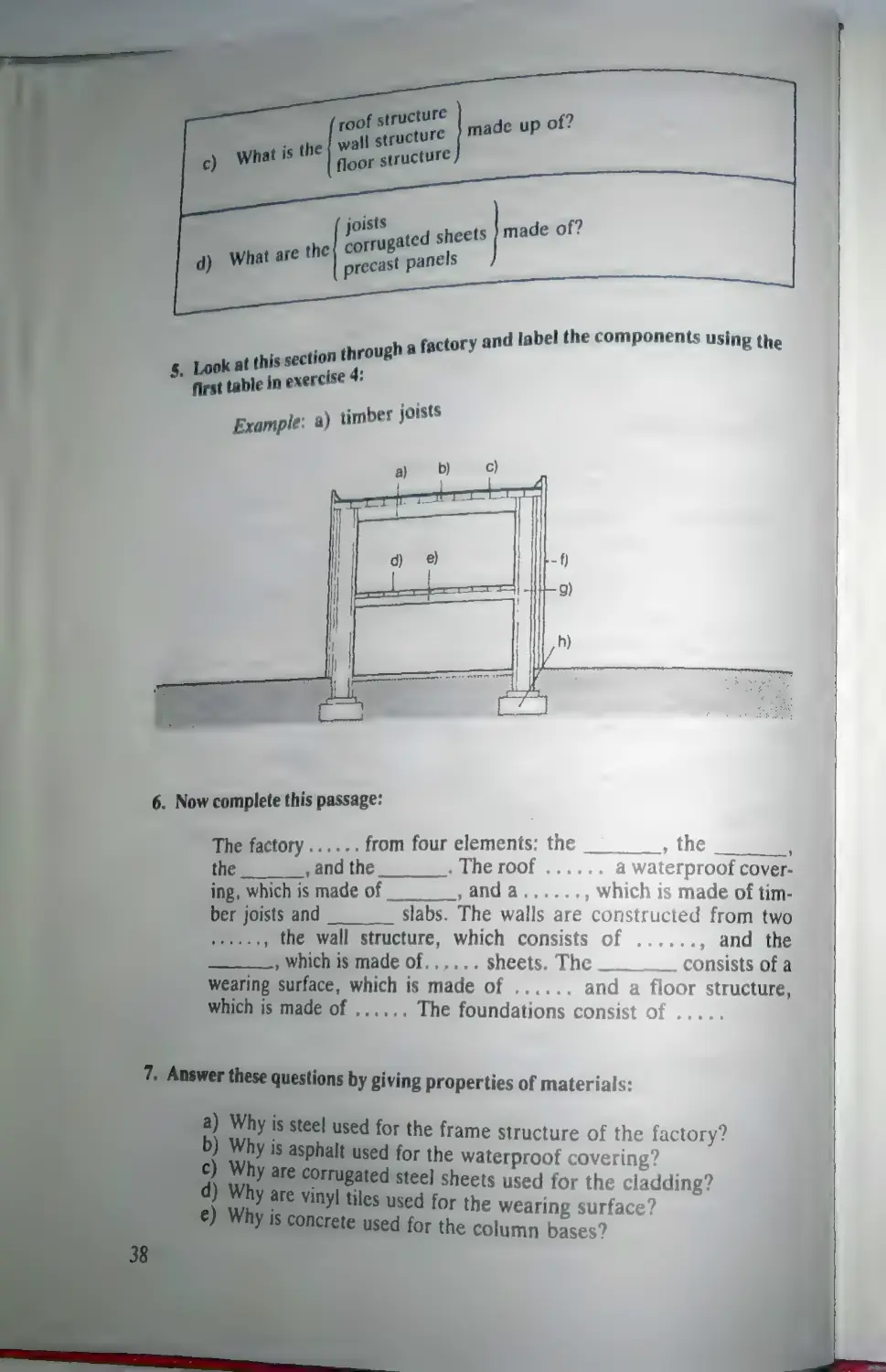
























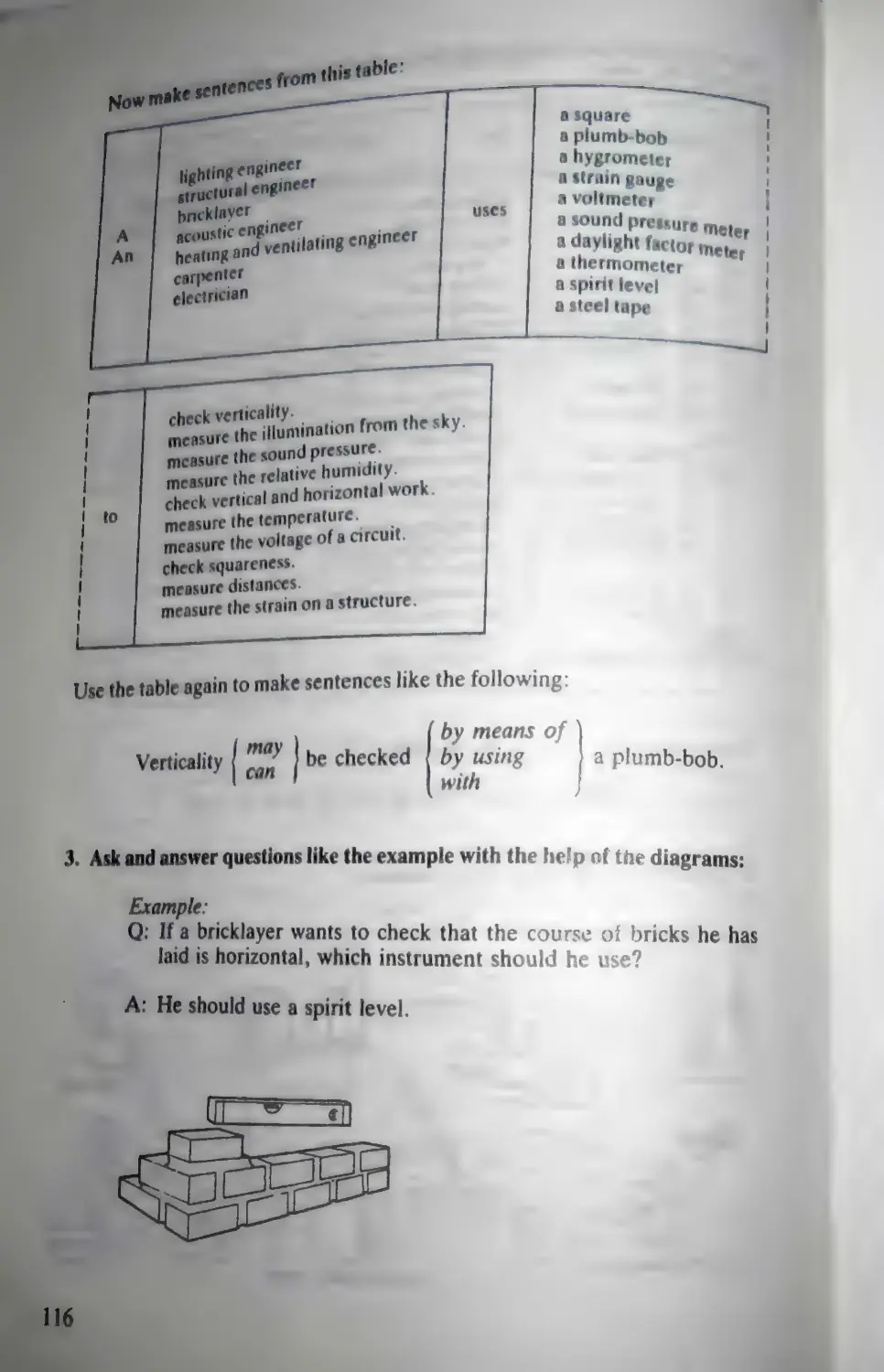
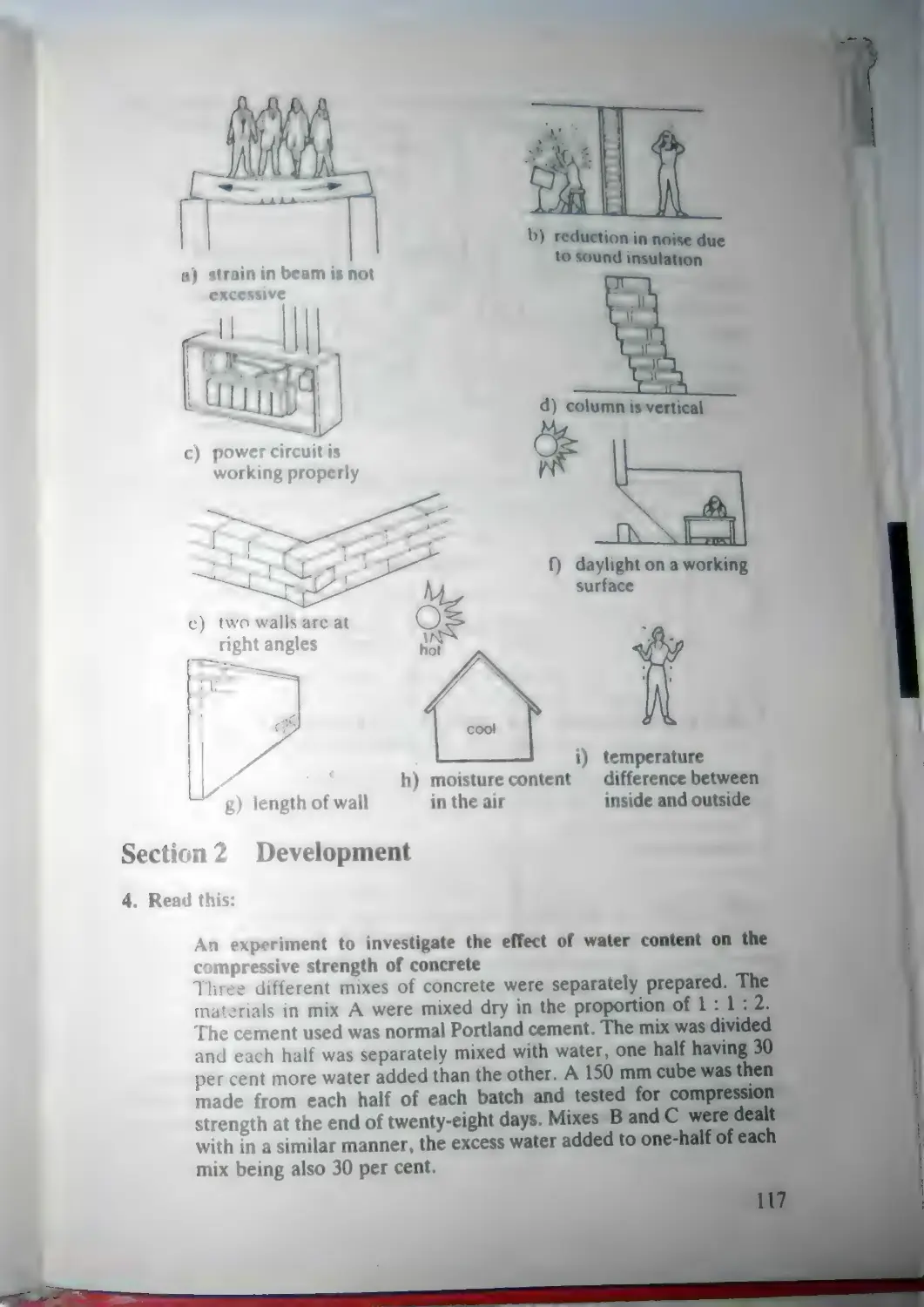
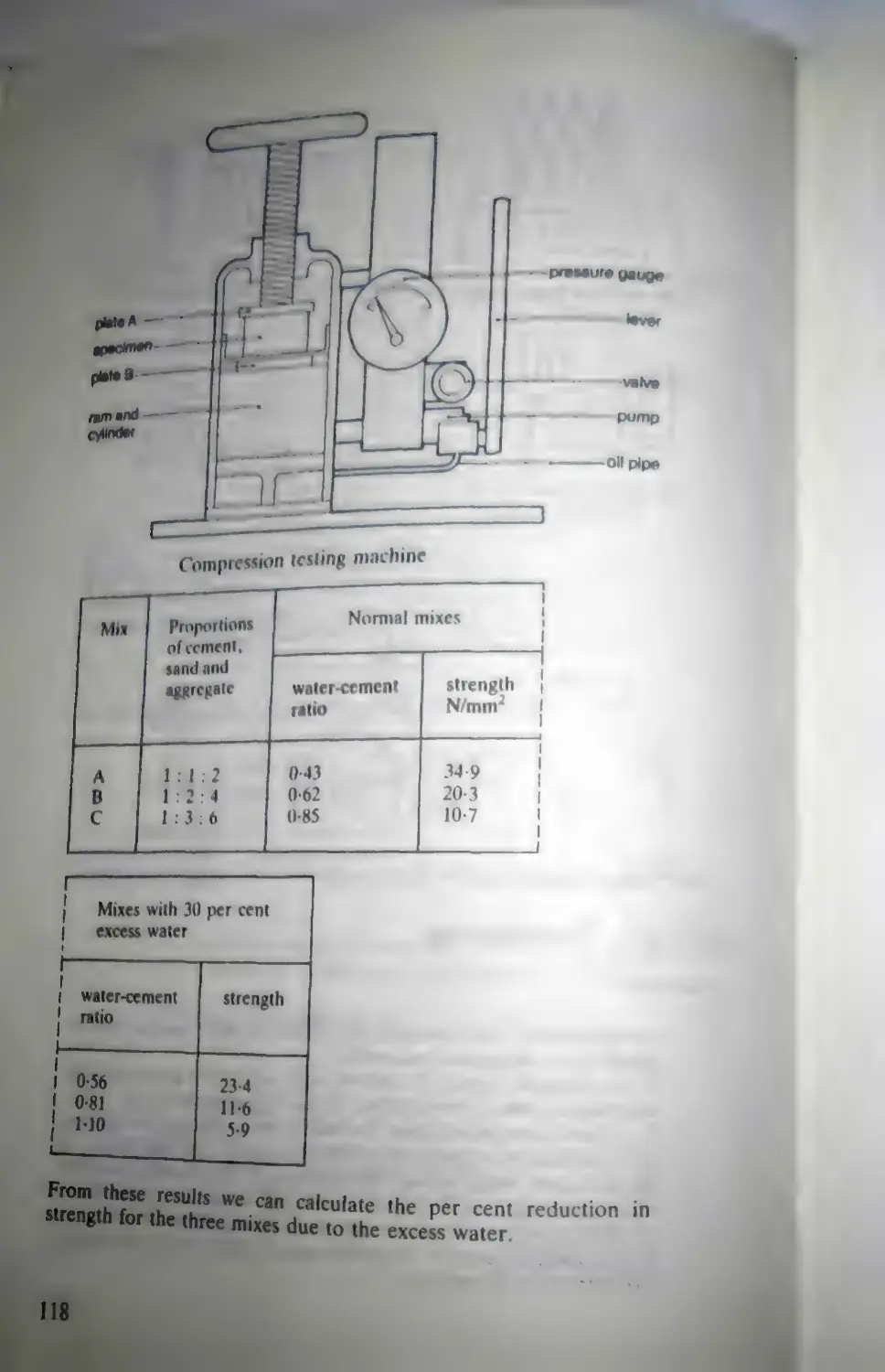
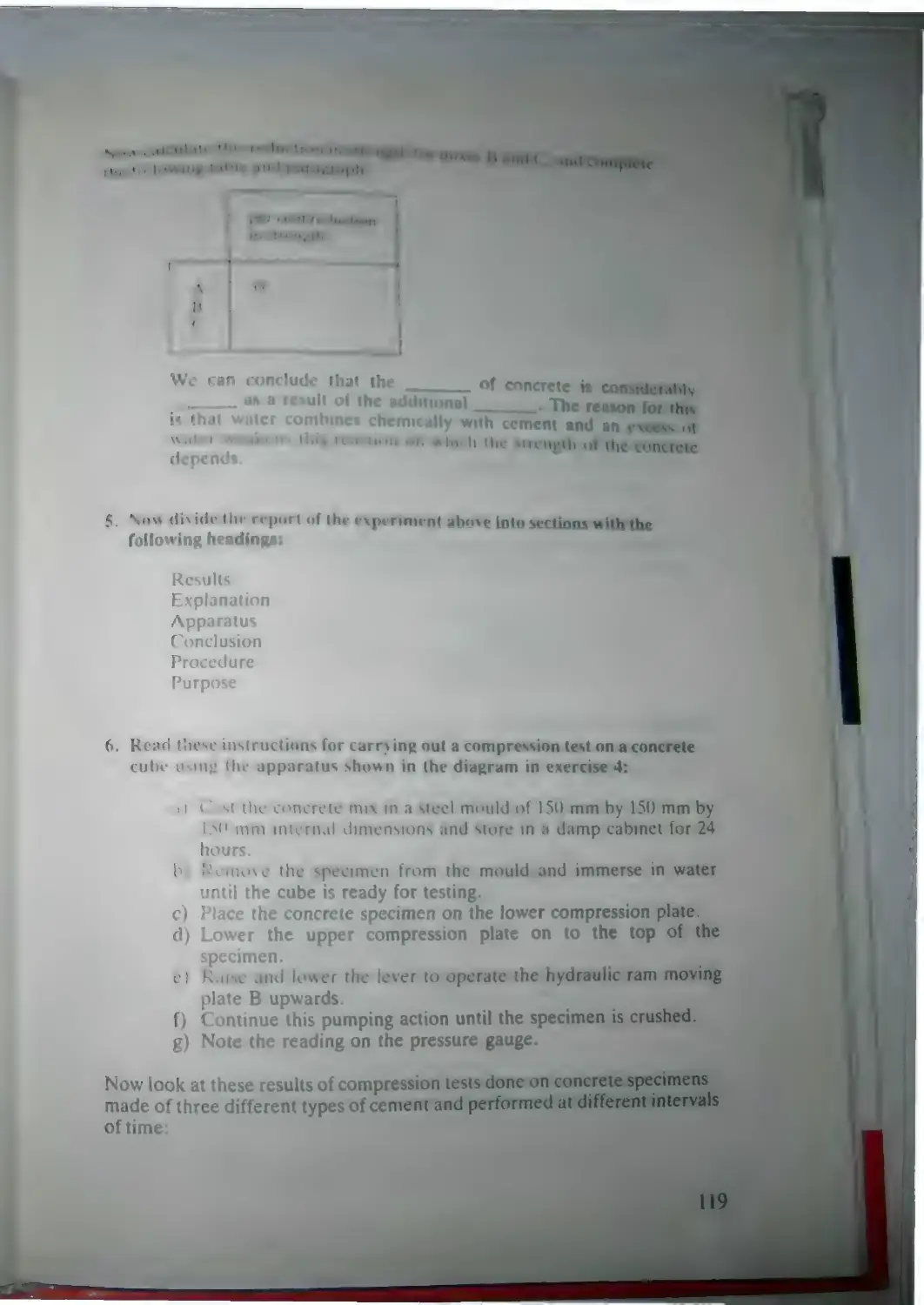

































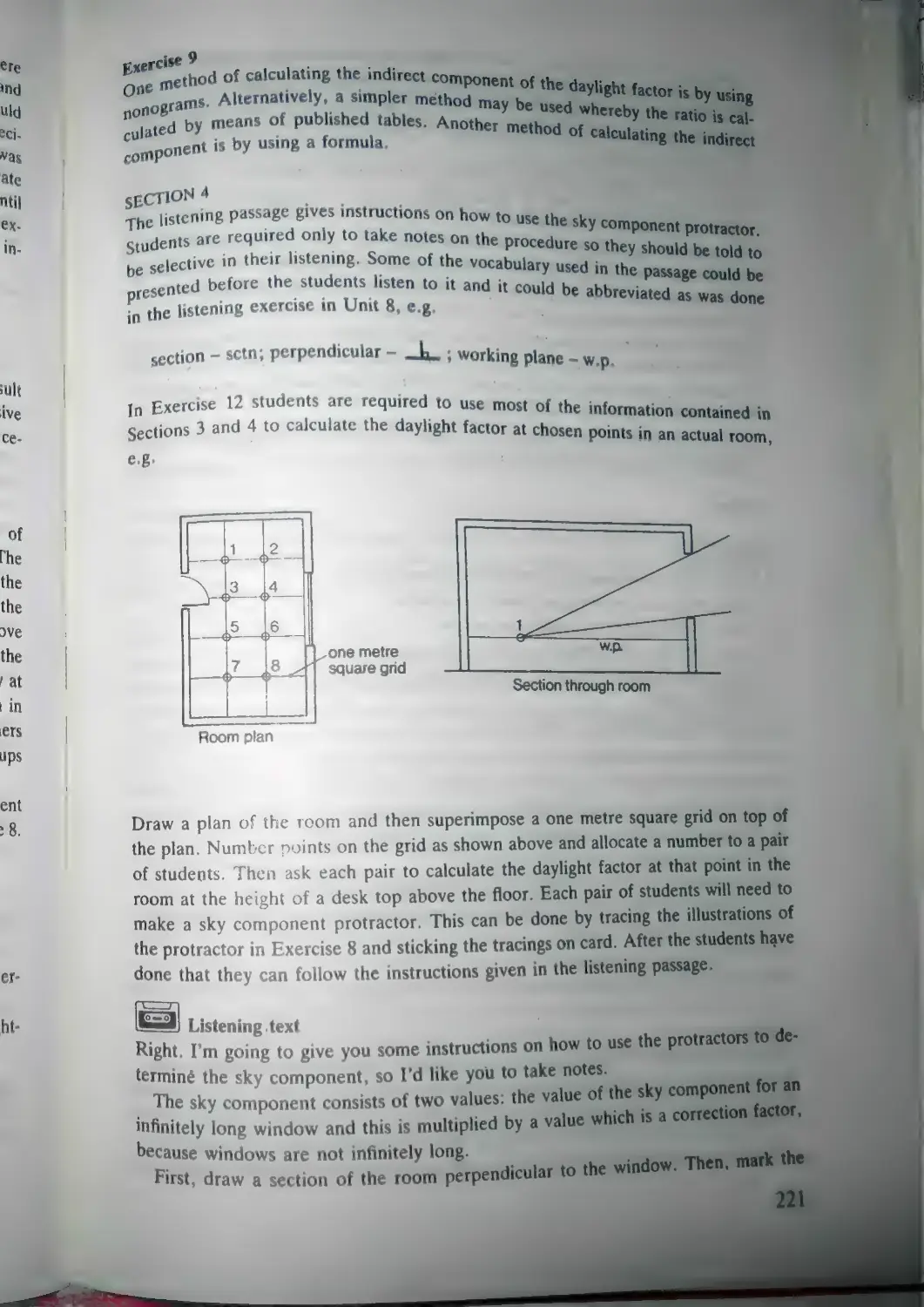






















Текст
A+
—
яке
5UNDADI
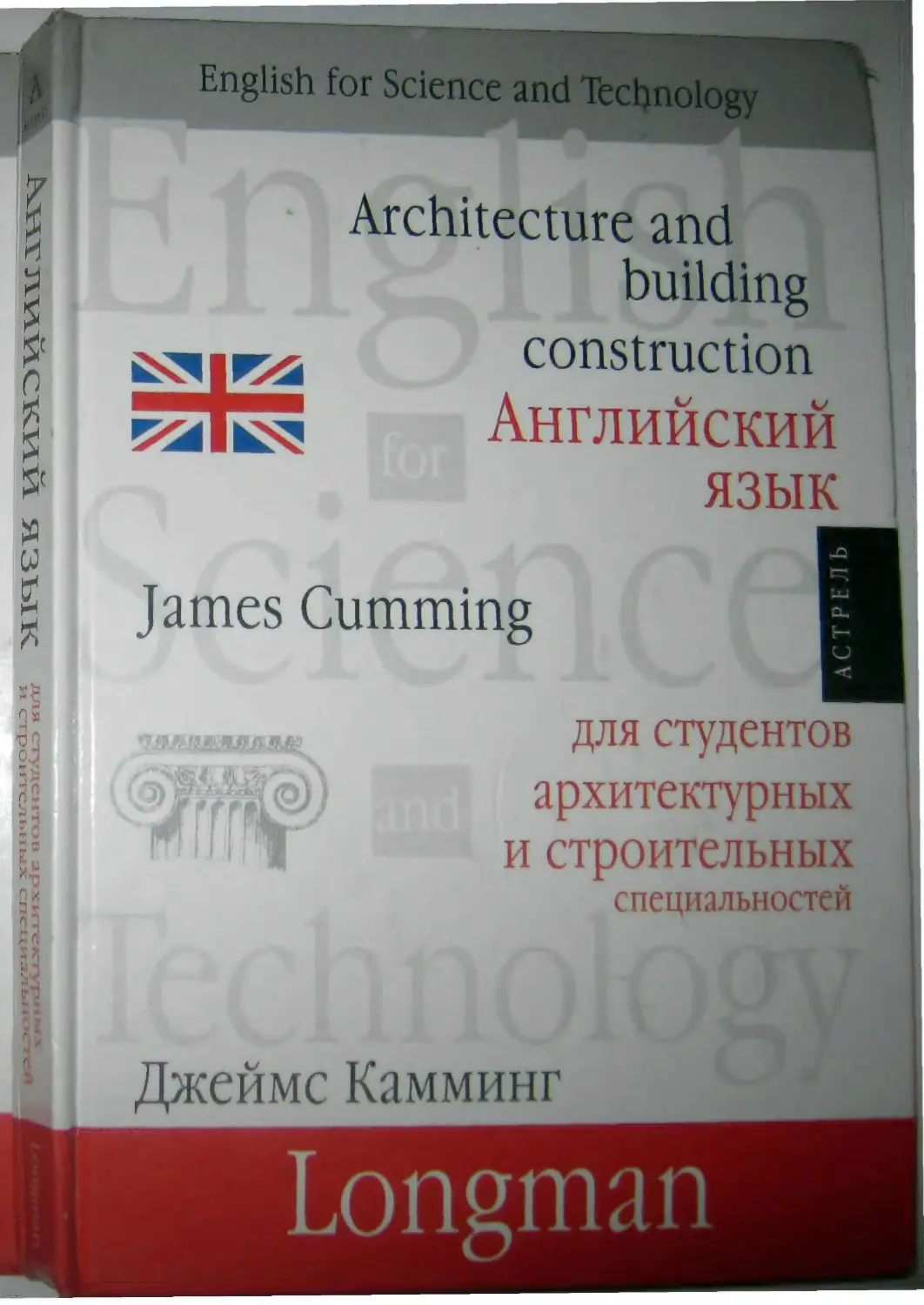
Architecture and
building
WIL
construction
AIR
АНГЛИЙСКИЙ
ЯЗЫК
ГРЕЛІ
James Cumming
для студентов
архитектурных
И строительных
специальностей
Джеймс Камминг
Longman
41-994 B CA ТАЖ. i
CEUEtO
E
Й
à
л=>
—e
|
7A ТЕГ
С
|
+3%
АНГЛИЙСКИЙ ЯЗЫК ——
ДЛЯ СТУДЕНТОВ
—
і
АРХИТЕКТУРНЫХ
—— >:
И СТРОИТЕЛЬНЫХ СПЕЦИАЛЬНОСТЕЙ 9
—
Учебник
—ج
Предисловие к русскому изданию
и англо-русский словарь
проф. В.Н. Бгашева
3
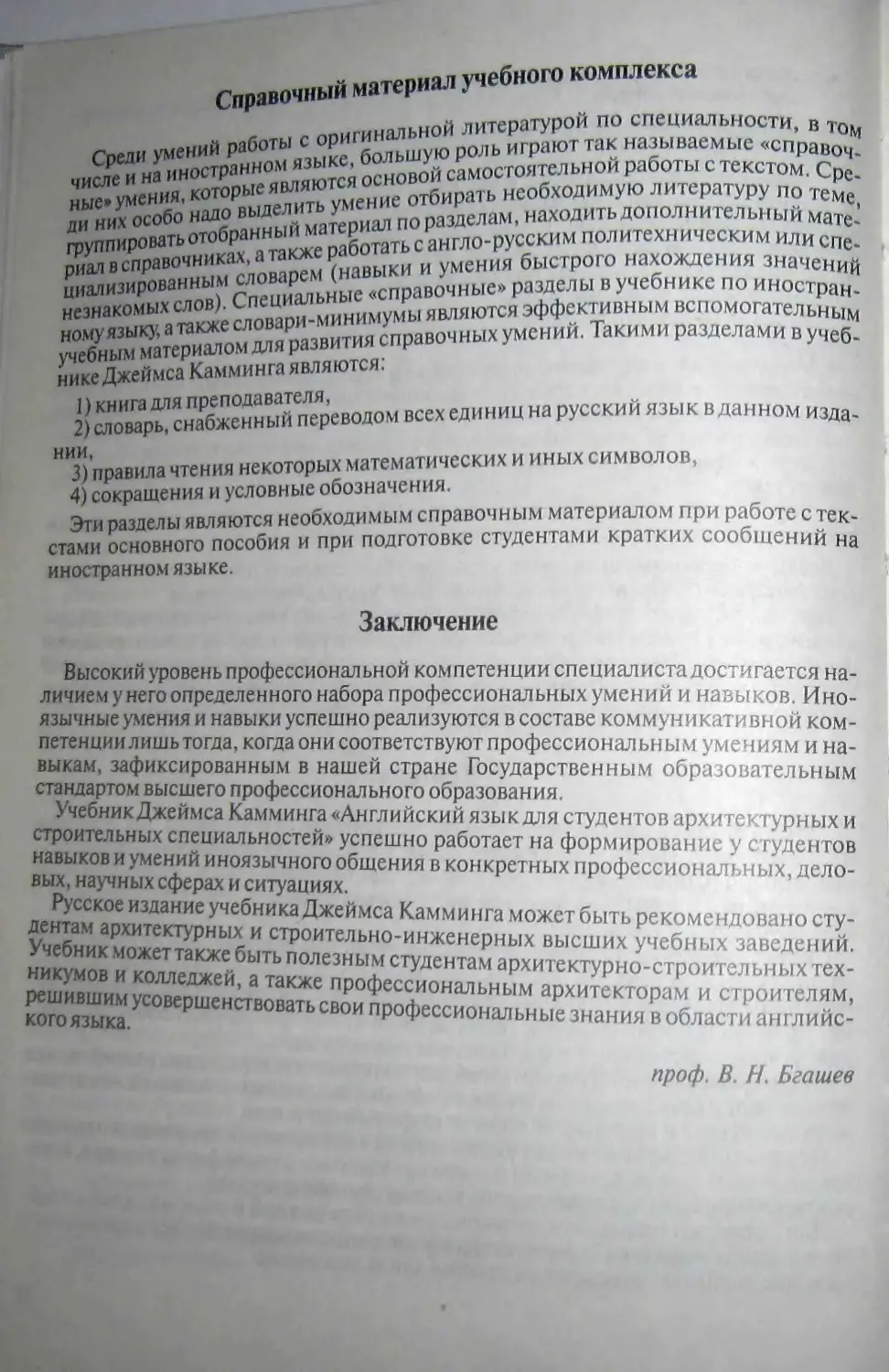
ебного комплекса
4 ЛИТ
ой по специальности, B том
neИрат так называемые «справоз"
овой самостоятельной работы с текстом, Cpe.
те отбирать необходимую литературу по теме,
ериал по разделам, находить дополнительный Mate.
Р татьсангло-русским политехническим или спе.
‘навыки и умения быстрого нахождения значений
ные «справочные» разделы в учебнике по иностран-
emm мы являются эффективным вспомогательным
spurs справочных умений. Такими разделами вучеб-
которых математических и иных символов,
овные обозначения.
ляются необходимым справочным материалом при работе с TeK-
пособия и при подготовке студентами кратких сообщений на
Заключение
b профессиональной компетенции специал иста достигается на-
пенного набора профессиональных умений и навы ков. Ино-
выки успешно реализуются в составе коммуникативной KOM-
тогда, когда они соответствуют профессиональным умениям и Ha-
ованным в нашей стране Государственным образовательным
шего профессионального образования.
а Камминга «Английский язык для студентов архите KTyDHBIXM
льностей» успешно работает Ha формирование y студентов
иноязычного общения в конкретных профессиональн ых, дело-
и ситуациях.
учебника Джеймса Камминга может быть рекомендовано сту-
ных и строительно-инженерных высших учебных заведений.
кже
б
ы
т
ь
полезным студентам архитектурно-строительных тех-
а также профессиональным архитекторам и строителям,
CTBOBATb свои профессиональные знания в области английс-
проф. B. Н. Бгашев
гек-
Iна
на-
HO-
OM-
на-
ЫМ
ХИ
TOB
JIO-
Ty-
ИЙ,
ех-
ЯМ,
Mc-
uea
Introduction
1 Aims of the Students’ Book
APR
im ofthe architecture and building constr
ce in using English receptively and acti.
written and oral texts and from visual forms of
ent
m
:
piosd have the confidence and ability to go to abook ога]
he will a
able amount о
н;
e
given to the different skills will vary according to the needs of the
can serve both teacher and learner as a basis for a course in all four.
2 Content of the Students" Book
б.
The course does not aim to teach architecture and building со
toteach English for architecture and building construction. But the twe
ofthe basic concepts associated with the word “building”. Normally,th
used to refer to one of four separate and distinct concepts:
(i) a material system — the building materials and building componer
erto make building systems.
—
(ii) a living place — a building isa place where things have been placed
positions to meet a set of requirements. Its function is to modify the en
provide а shelter for people.
Th
(iii) the process of building — the process of building is a sequence
resulting building is the outcome of a succession of moves to put pre
materials and components in predetermined positions.
(iv) the science ofbuilding — the organised body of knowledge co
why it is built, how it is done and how it is measured.
ДУ
The relation of‘building’ to the Nucleus format:
Building
M
MEANING
Material Place for Process ——
OF
system
use
BUILDING
|
NUCLEUS
Properties Location
FORMAT
Structure
Function
„нidМ
Section 1 Presentation |
1. Look at these:
чый —
Here are some examples of basic forms: ТЕ
oО
a cube
а hemisphere
a triang
P]
©utl„5
=
a pyramid
a rectangular
a cone
prism
|
a hotel
a minaret
an Egyptian
house
a brick
an Arabic
a Roman
arch
arch
a church
a power station
building
2 Дж. Камминг
|
quen
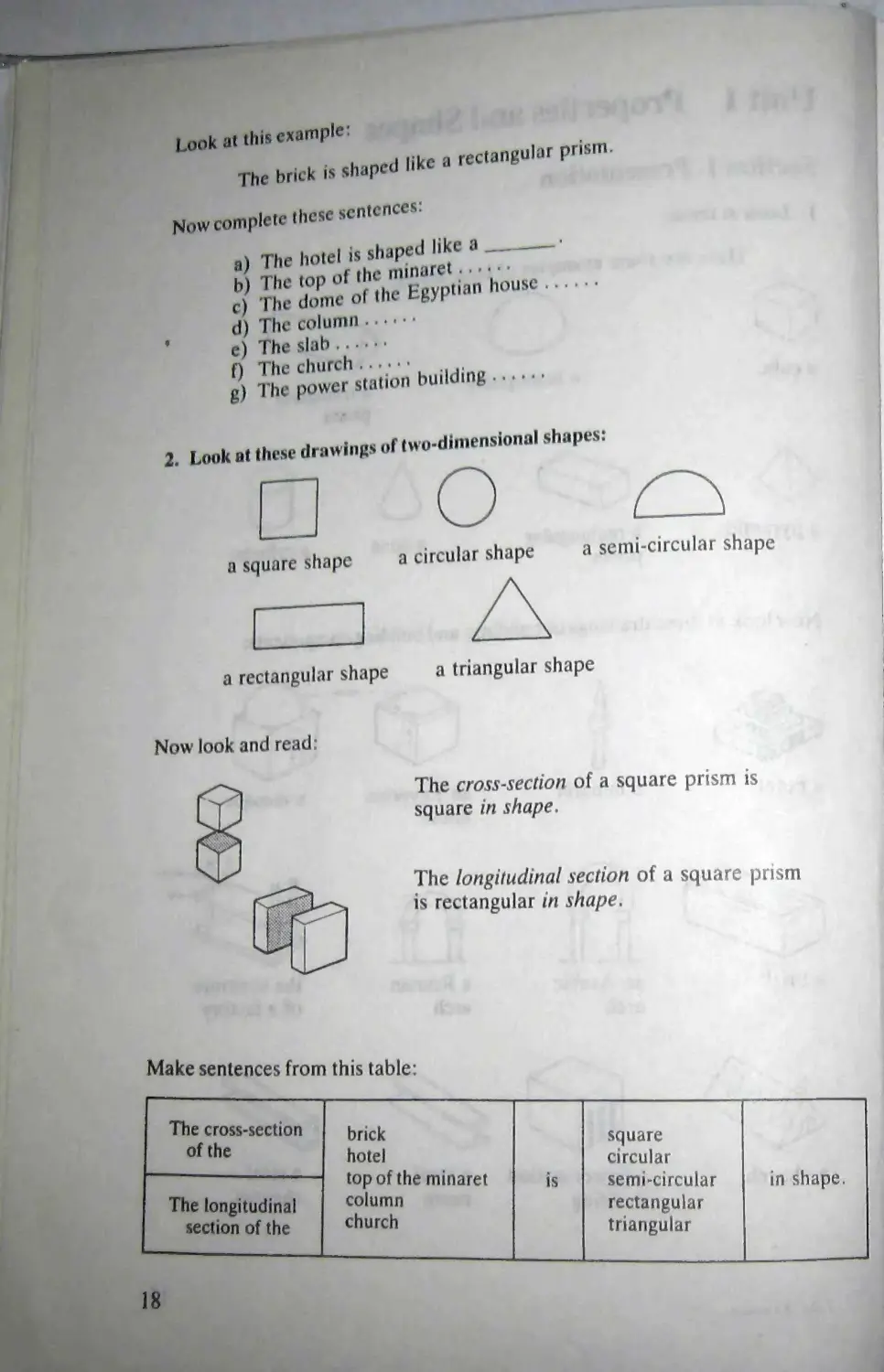
thesedrawingsof two-dimensional shapes:
—
od
shape a circular shape a semi-circular shape
ES
gout a ан
—
a triangular shape
m
Now look and read:
The cross-section of a square prism is
square in shape.
The longitudinal section of a square prism
is rectangular in shape.
square
circular
semi-circular
rectangular
triangular
b)maep
b
ui ingcomt nt
c) Which building component А
d) Which dome is egg-shaped? — sz
e) Which arch is horseshoe-shaped? —
f) Which building has diamondshaped
4. Look and read:
a tube is hollow а rod is solid
a curved surface a flat surface
The power station building is hollow. It has five flatе
surfaces.
Now describe these buildings and components in a similar way:
a) The church
b) The slab
c) The column
d) The mosque
e) The steel beam
5. Now describe the shapes of the buildings in exercise 1, page
compare them with the buildings around you.
Section 2 Development
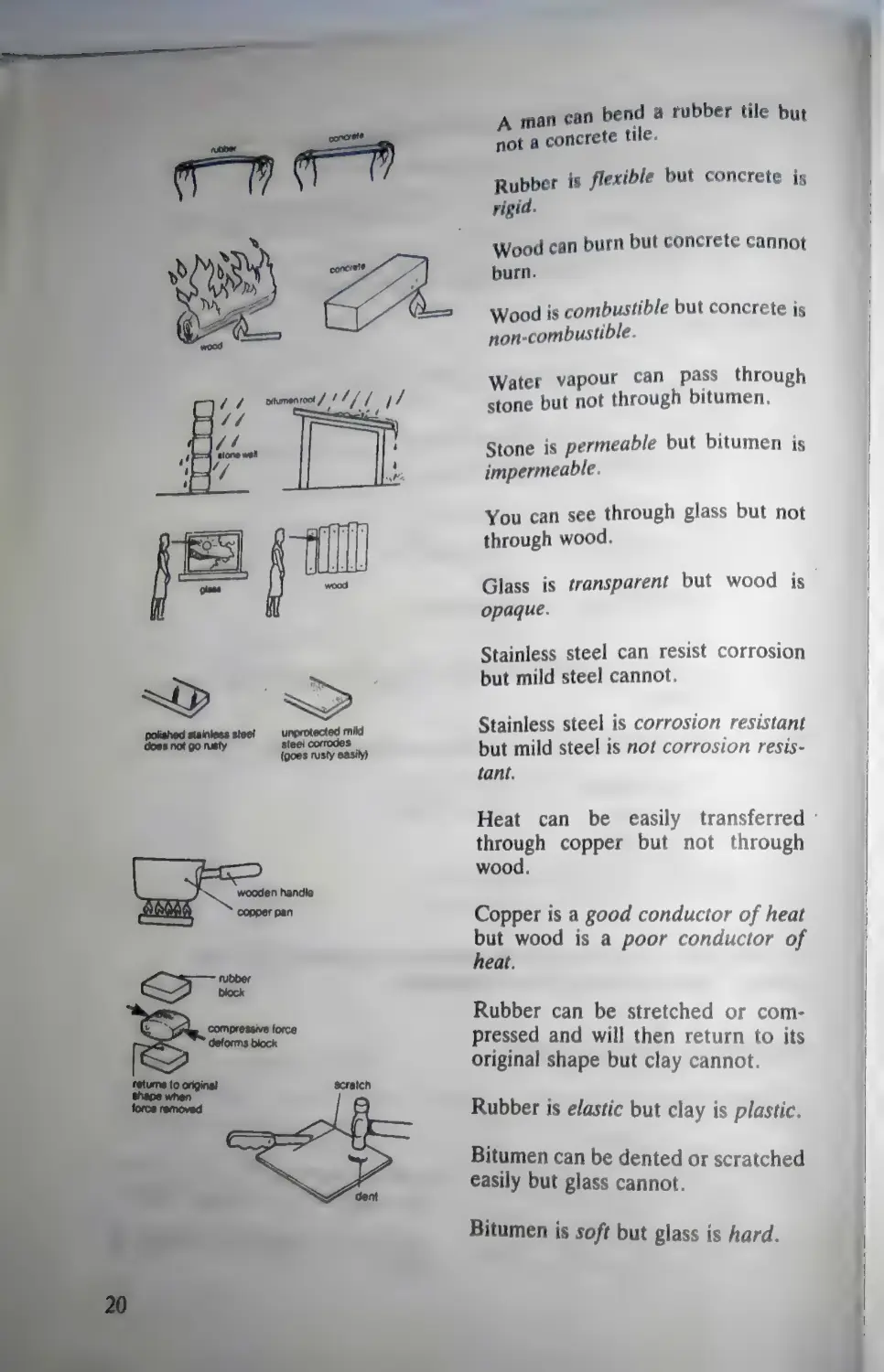
6. Look at these examples:
End
‚ man can bendarubber tile but
yot aconcrete tile.
Sauber is flexible but concrete is
aw 0 rigid.
‹ |dues d can burn but concrete cannot
_ burn.
Wood is combustible but concrete is
non-combustible.
Water vapour can pass through
stone but not through bitumen,
Stone is permeable but bitumen is
impermeable.
You can see through glass but not
through wood.
Glass is transparent but wood is
opaque.
Stainless steel can resist corrosion
:<>
but mild steel cannot.
mem
Stainless steel is corrosion resistant
{poserustyeasi)
but mild steel is not corrosion resis-
tant.
Heat can be easily transferred`
through copper but not through
wood.
Copper is a good conductor of heat
but wood is a poor conductor of
` heat.
Rubber can be stretched or com-
pressed and will then return to its
original shape but clay cannot.
Rubber is elastic but clay is plastic.
Bitumen can be dented or scratched
easily but glass cannot.
_ Bitumenissoft but glass is hard.
"am auccm
*
M
r
*
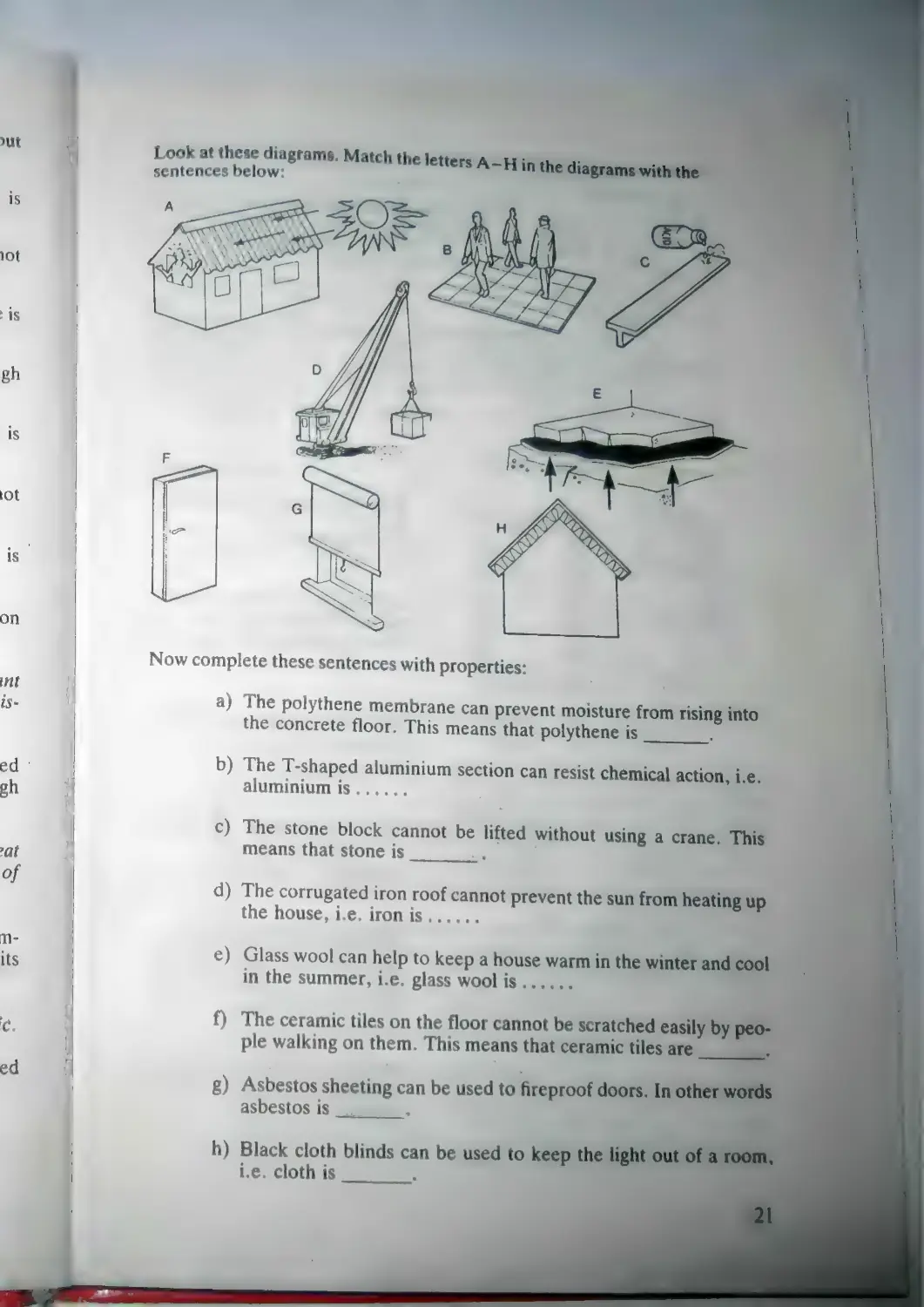
Look at these diagrams.
Match the lette
sentences below:
k
is
lot
is
gh
is
lot
iS
on
Now complete these sentences with properties:
Int
Н
it
a) The polythene membrane can prevent moisture from risi
the concrete floor. This means that polythene is a
edi
b) The T-shaped aluminium section can resist chemical ac
gh
aluminium 15......
"
с) The stone block cannot be lifted without using a ci
wit
means that stone is
í
.
of
d) The corrugated iron roof cannot prevent the sun f
the house, i.e. iron is......
8
its
e) Glass wool can help to keep a house warmi
in the summer, i.e. glass wool is..... "Wn"
c
f) The ceramic tiles on the floor cannot be sci
к.
ple walking on them. This means tha
ed
[
Y
B) Asbestos sheeting can be used to
asbestos is
М
h) Black cloth blinds can be|
i.e. cloth is
noi.
st high compressive forces.
jt can resist hightensile forces.
© jtdoes not transmit heat easily
itdoes not transmit sound easily.
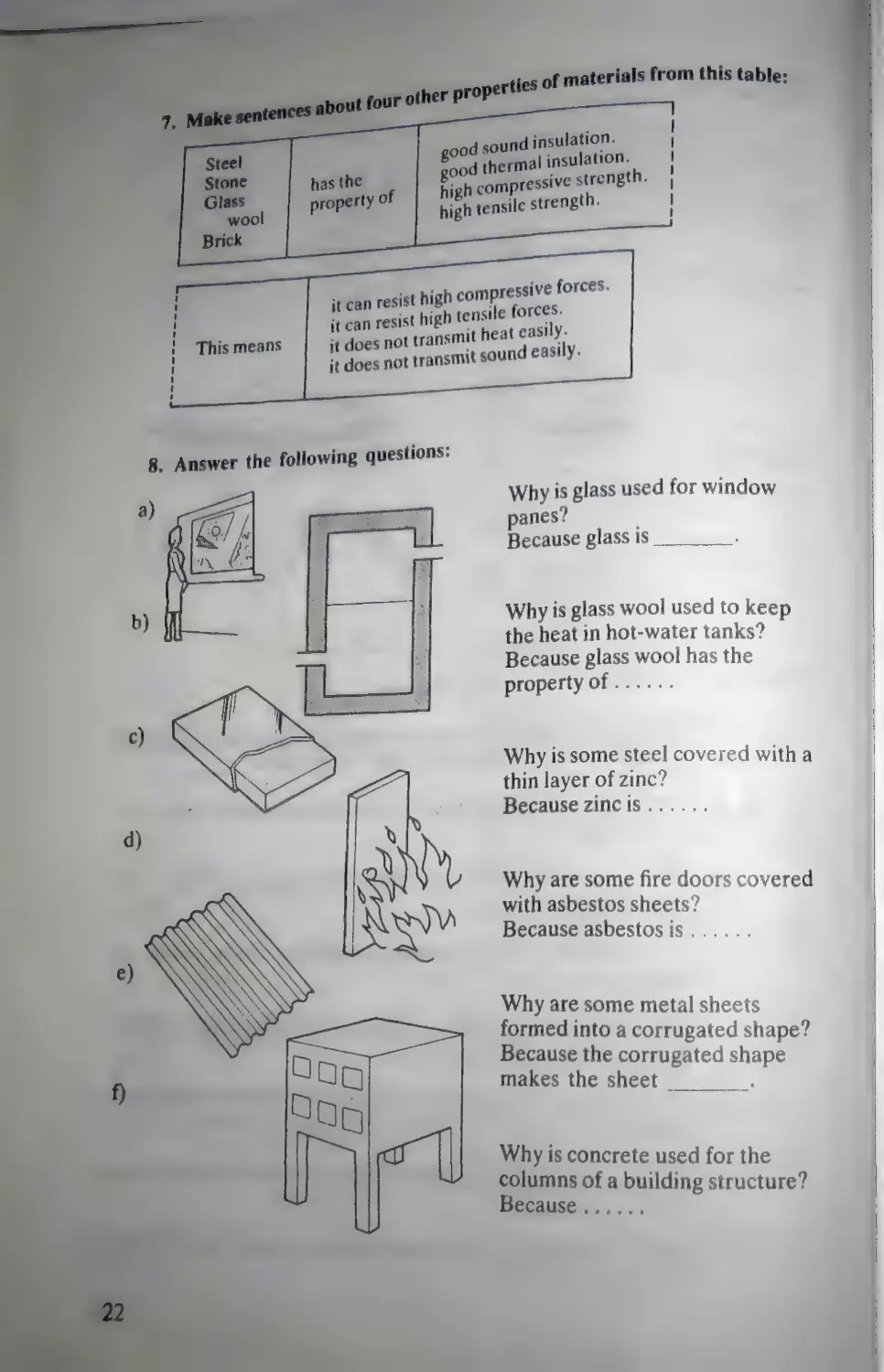
Why is glass used for window
panes?
1
Because glass is
Why is glass wool used to keep
the heat in hot-water tanks?
Because glass wool has the
property of
+ NYCD
Why is some steel covered with a
|Ag
thin layer of zinc?
JA undo -
Because zinc is
Why are some fire doors covered
with asbestos sheets?
Because asbestos is
Why are some metal sheets
formed into a corrugated shape?
Because the corrugated shape
makes the sheet
А
isconcrete used for the
5 ofabuilding structure?
DEED
Ж; САР
Section .
“peas hei
ac
ER
м
rity elo reste Bon enin
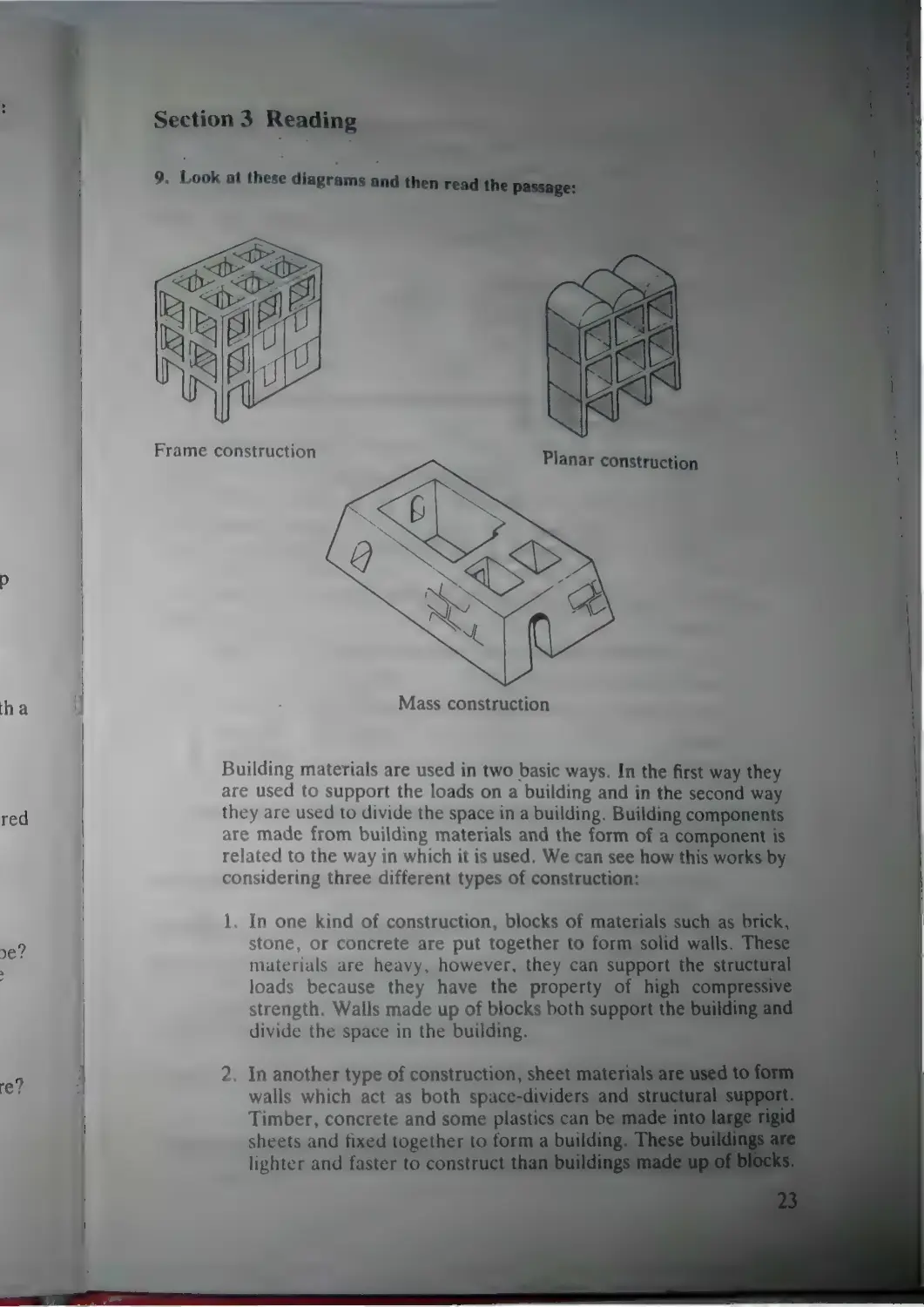
9. Look at these diz prams nd
у
y
vied &
Planar eot TU
Frame construction
ha
Mass construction
Building materials are used in two basic ways. In thef
are used to support the loads on a building and in t
red
they are used to divide the space in a building. Building
are made from building materials and the form of а
related to the way in which it is used. We can see how thi
considering three different types of construction: |
uut»
ma!
1. In one kind of construction, blocks of
stone, or concrete are put together to
i
materials are heavy, however, they c
loads because they have the pr
strength. Walls made up of blocks both
divide the space in the building, КҮ
e
2. In another type of construct
walls which act as both sp
Timber, concrete and some
п be пхеа
t
o
l
e
r
{o
between the rods can be —
actasspace dividers but do
Mable by putting ticks in the boxes to show the
Structural
Space
Both structural
dividing only support and
штe
М
space dividing
etherthese statements are true or false. Correct the false
éWc)
| materials can be used for both dividing space and support-
g the building.
rete can be used as a block material, a sheet material and a
for frame construction because it has high tensile
w compressive strength.
ls, which act as space dividers in a frame con-
ре very light because they do not support
are light whereas planar construc-
| 15:
BI bc
the basic forms
134
ID
timber strip
rolled metal
sheet
pipe
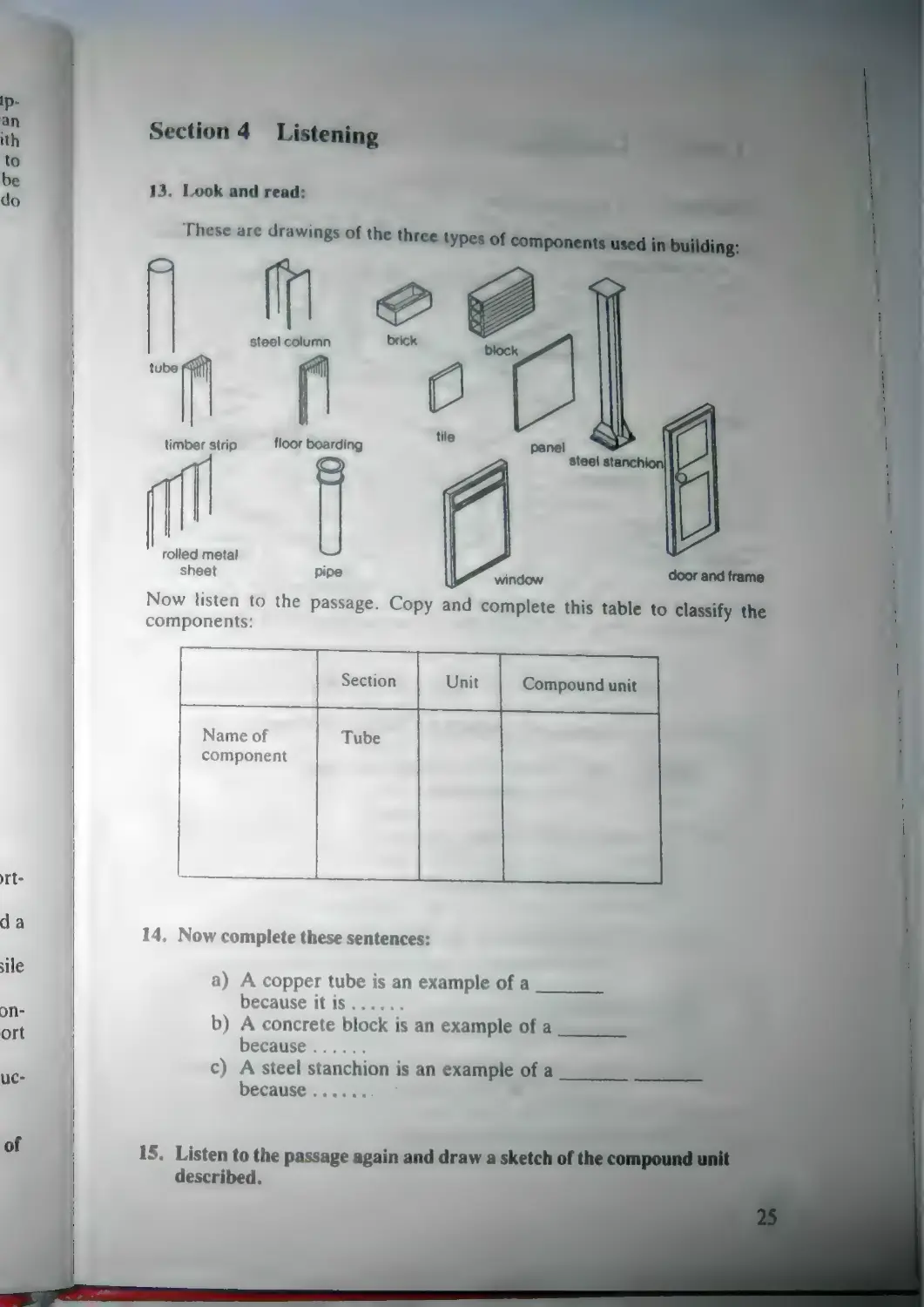
Now listen to the passage. Copy and complete this table RÀla:
components:
Name of
Tube
component
14. Now complete these sentences:
a) A copper tubeisan — ofa
because it is
i
b) A concrete block is an example of
because
c) A steel stanchion is an e
because; scarey ШЕЙ
15. Listen to the passage й
described,
uilding :
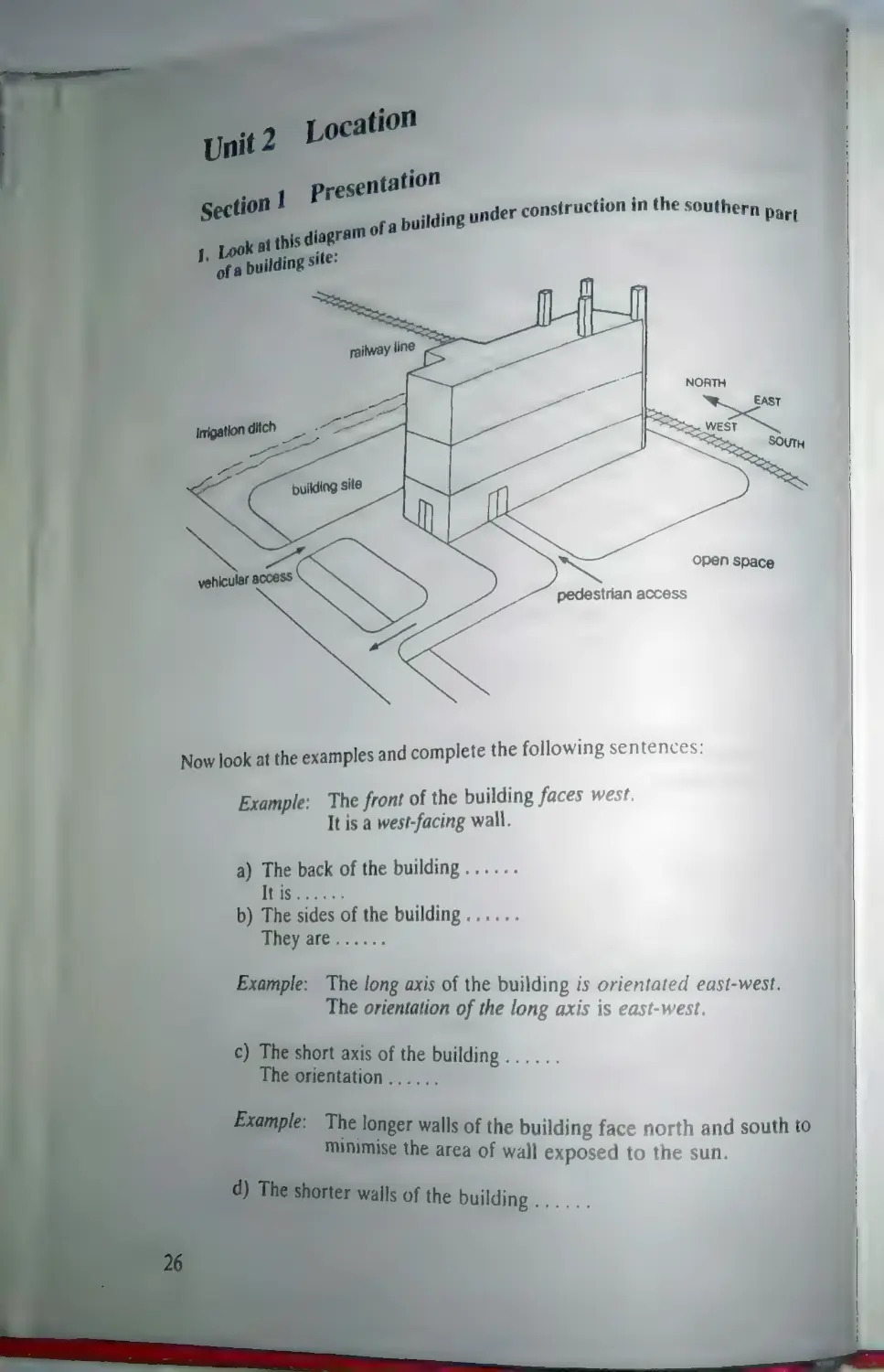
open space
pedestrian access
| e examples and complete the following sentences:
тре: The front of the building faces west.
It is a west-facing wall.
back of the building......
the building......
DERE
‚ The long axis of the building is orientated east-west.
Е he orientation ofthe long axis is east-west.
with
he building face north and south
llexposed to the sun.
B
e) The site ...... anirrigati
An irrigation ditch ......
f) The site is bounded by ...... to
...... runs along the eastern boun
TE
Example: The site has vehicular access fre
It does not have vehicular access
or east.
й.
|
А
Pr 4-чу ай
x
g) The site has...... the openspace...... —— —
€
It does not have......
T
OUTH |
2. Now complete this:
Ss
The building site is approximately
in shape. It is boun
Бу to the north, ...... to the east and ...... to the
Vehicular access is froma _
which ...... the western bo
ary. The long axis of the building is
east-westtomi
is" ї
#
3. Now write a similar description of a building site in yourlocalarea. —
н
aA
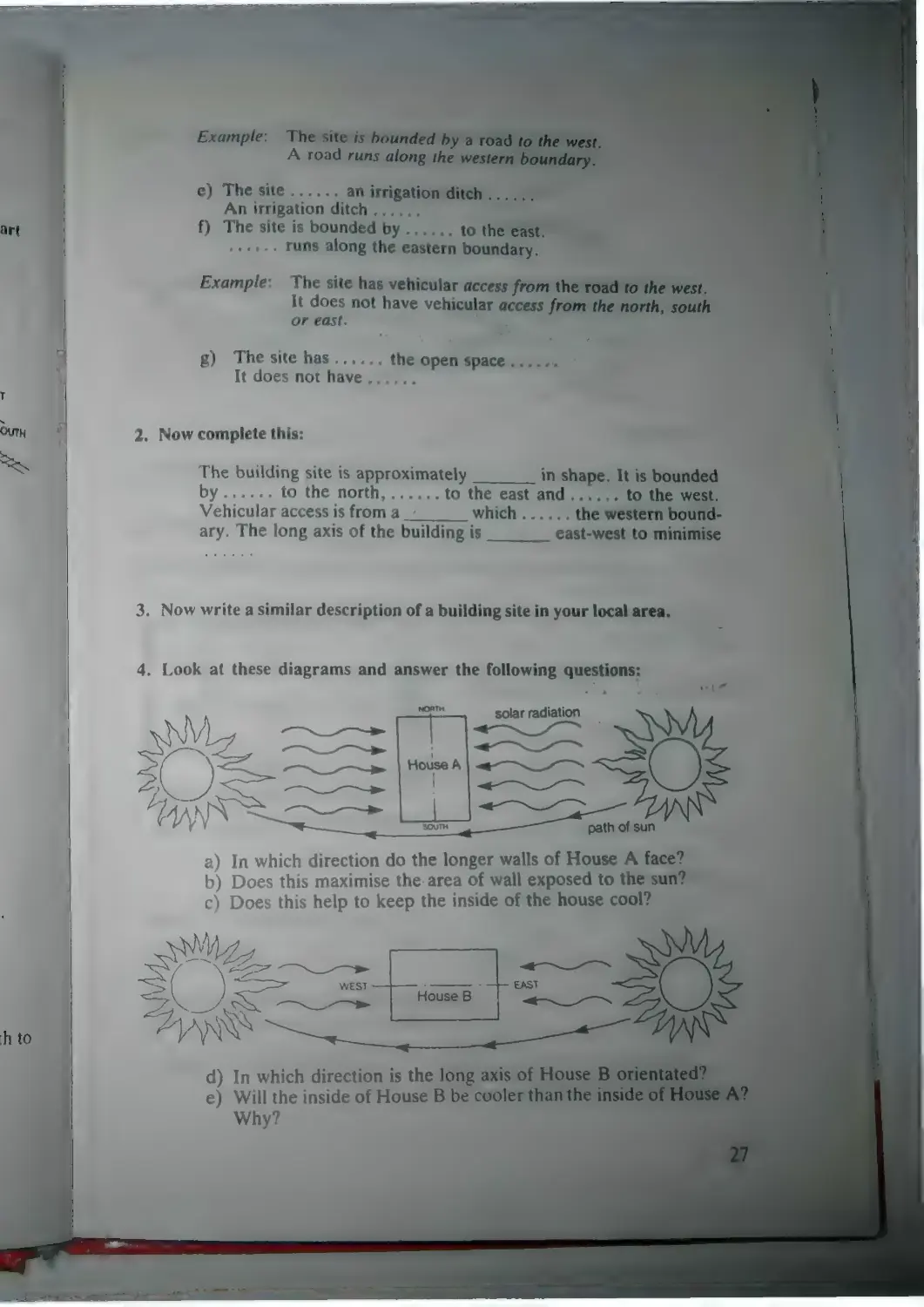
4. Look at these diagrams and answer the following questions:
12P
3 ` зәпзей 23
solar radiation
یا
и
amE
c
No/)
——
— 5ms
Р
\
—~_ | HouseA |.
C)
——
—
—
—
7۸
—
وی
—
—
YN
==
|
a) In which direction do the longer walls of HouseA
|
b) Does this maximise the-area of wall exposed to the:
c) Does this help to keep the inside of the house cool?
4
d) In which direction is the }
e) Will the inside of House
Why?
'
minimum length of wall exposed to the ,
н he. storientation for a hot country?
2 country with the prevailing wind from the east,
miaentation forthelong axis of a house? Draw а
=
ee РА requirements, c.g.the shape of a building site may
determine theorientation of a building
i
na of the building, e.g. a coastguard building will look
ings and say which factors have
perpendicular
:
|
The side walls are | 7. right angles
^U to the front wall.
E
The front wail isparallel to the back
wall.
— eg. ground slabfoundation extends
LU»
fhe perimeter wails.
along line AB whichis
۴
A view looking straight down on a cut-away viewofthe int
building is known as a plan:
Looking north, the
on the right of the
Looking north, the bedroom
i
s
4
the left
of the living room. - M
x г is lintel over the window
opening.
There is a sill under the "бе
opening.
There is a window at /he top of the
door. f
The knocker is in the centre of the
door.
The letter box is at the bottom ofthe
door.
There are windows on either side of
the door.
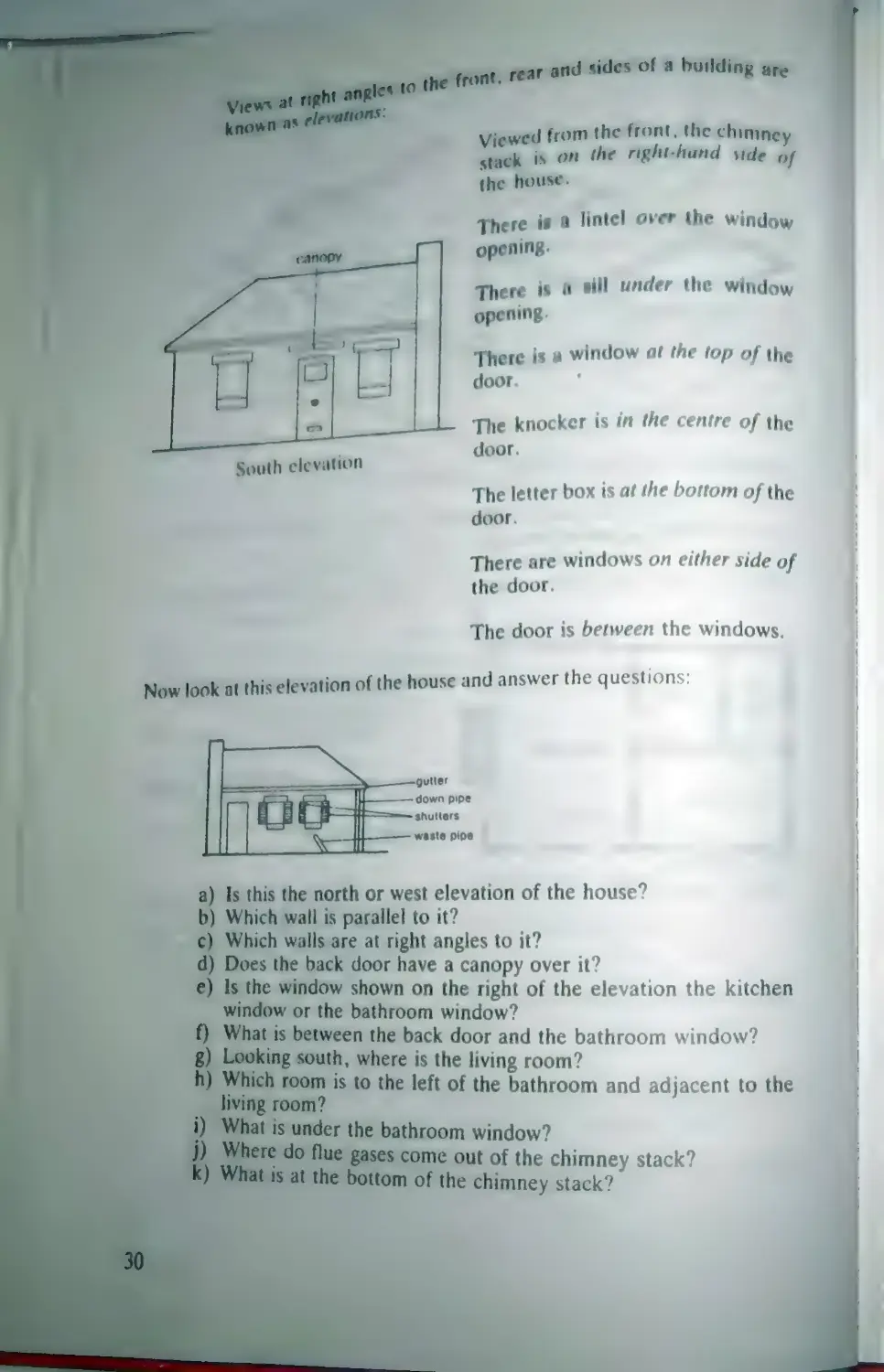
The door is between the windows.
gutter
down pipe
shutters
waste pipe _
orth or west elevation of the house?
to it?
ight angles to it?
' have a canopy over it?
own on the right of the elevation the kitchen
oom window?
e back door and the bathroom window?
isthe living room?
left of the bathroom and adjacent to the
window?
it ofthe chimney stack?
cde
E
о) Which rooms areinfront ofihe(1610017
p What is in the centre ofthe ney stack? —
Ve * behind
the kitchen? ;
р
r
àt runs along the
тоо «1:
ч
s) Where is the downpipe?се ОО О
“# Ag
"uo No
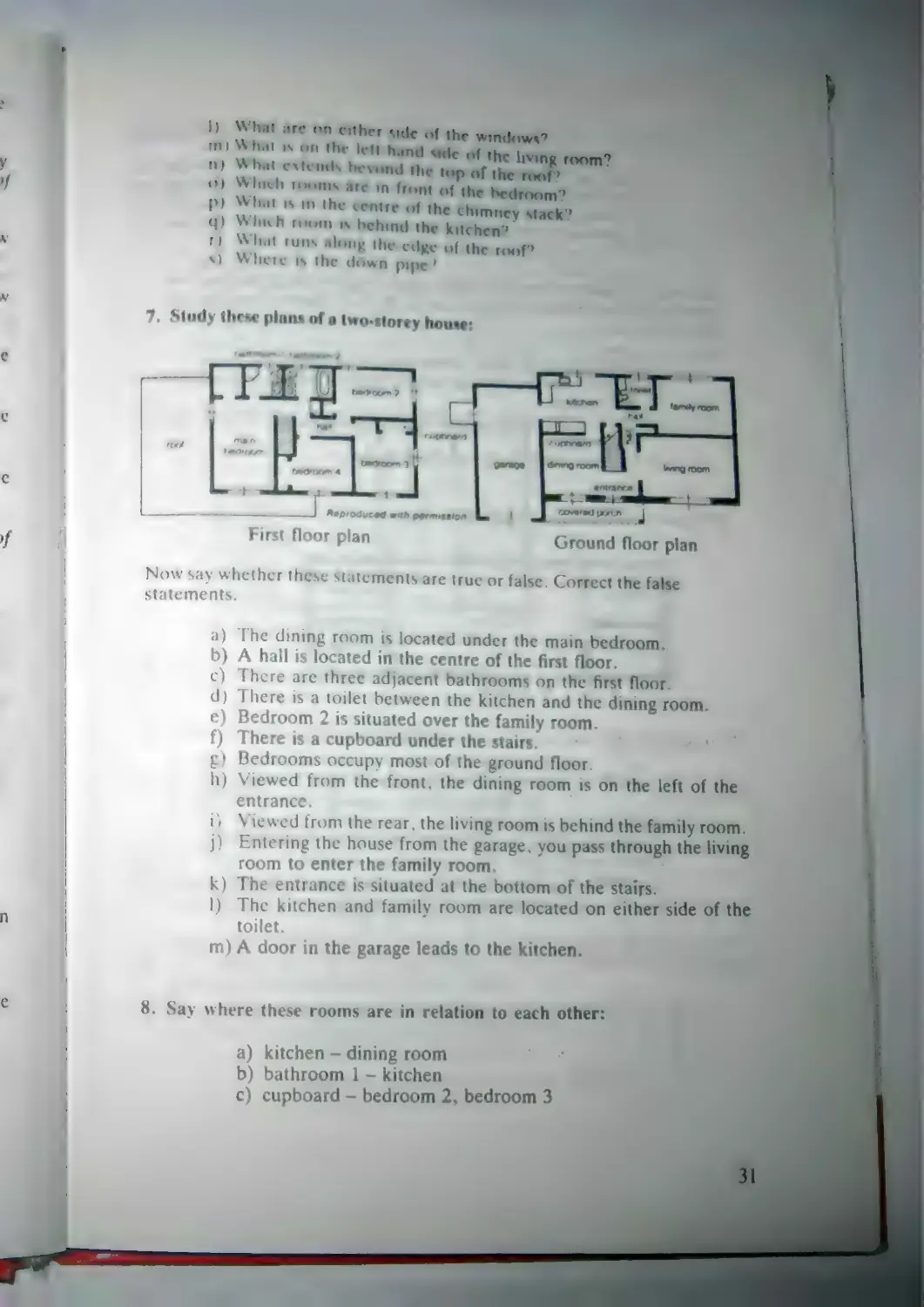
7. Study these plans of atwo-storey house:
Reproduced with permission
f
First floor plan
mor.
Ground floor plan
Now say whether these statements are true or false. Correct the false
statements.
a) The dining room is located under the main bedroom.
b) A hall is located in the centre of the first floor. И
c) There are three adjacent bathrooms on the firstfloor.
|
d) There is а toilet between the kitchen and the dining room. — —
c) Bedroom 2 is situated over the family room.
|
0
f) There is a cupboard under the stairs.
Pu Базу жой "»
£) Bedrooms occupy most of the ground floor.
ит,
h) Viewed from the front, the dining room is on the left of th
entrance.
-
i) Viewed from the rear, the living room is behind the family
j) Entering the house from the garage, you pass through the
room to enter the family room.
—— ME
k) The entrance is situated at the bottom of the stairs. — —
1) The kitchen and family room are located on either
toilet.
-
m) A door in the garage leads to the kitchen. А
8. Say where these rooms are in relation to each Е
кА& ТА
а) kitchen - dining room =
b) bathroom 1 = kitchen —
EN,
с) cupboard—bedroom2, bed TI3
у paf-
?1
С1
e house, heplaced the bedrooms.
also placed the kitchen nextto
near the bedrooms (C). Ona
covered porch over the entrance
aces will fitinto one of the spaces in the above
tee A, B, C, D. Match the sentences
| d to wash before going to bed і
— to enter the house need protecting from
e ¢ noisefrom the living room will disturb people
z
|
> itmakes serving food easier
Ж
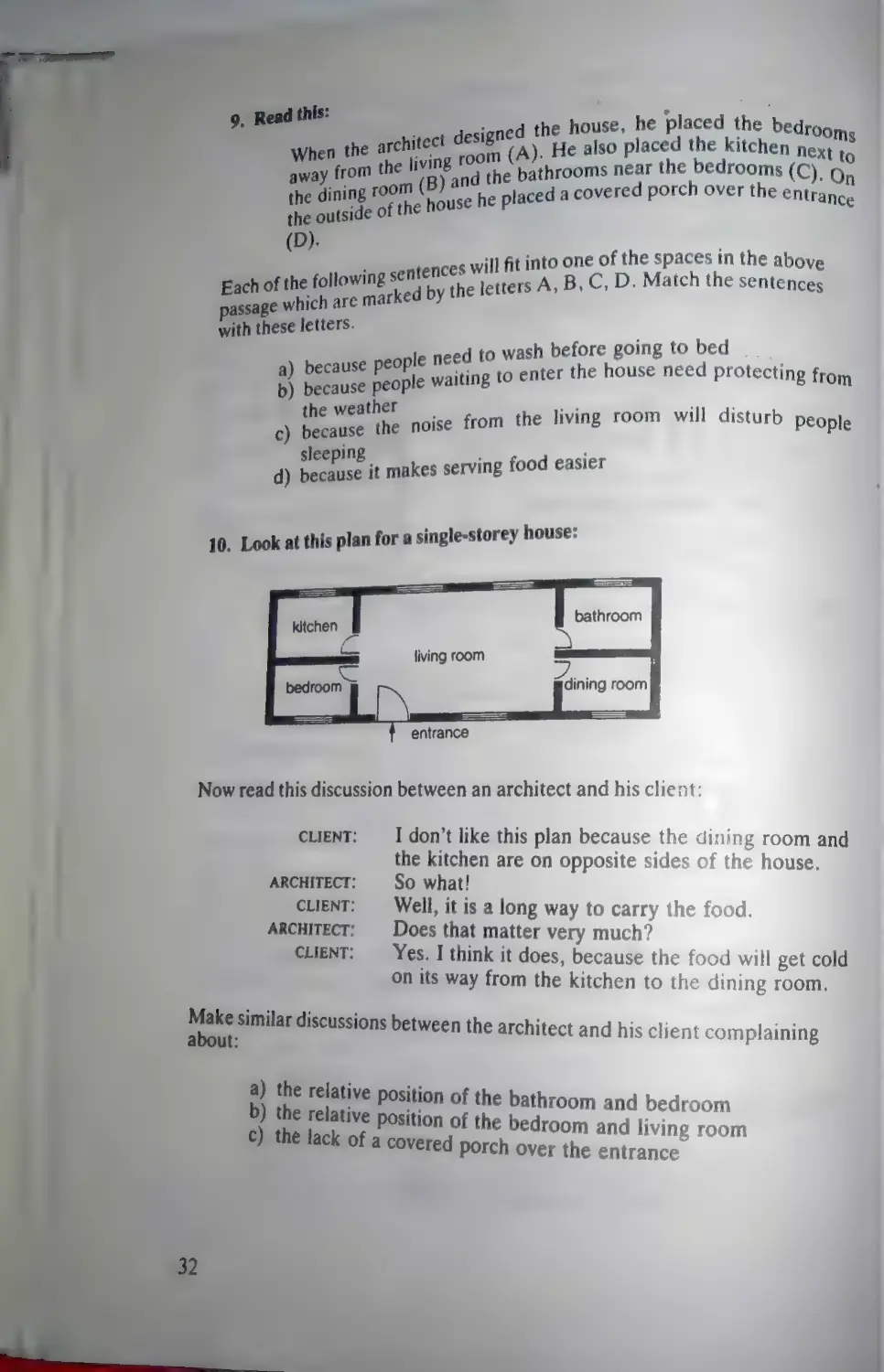
1 splanfora single-storey house:
som °
ү ыен!
I don't like this plan because the dining room and
the kitchen are on opposite sides of the house.
So what!
Well, it is a long way to carry the food.
ARCH
Does that matter very much?
_ CLIENT; Yes. I think it does, because the food will get cold
| enitsway from the kitchen to the dining room.
scussions between the architect and his client complaining
ЕY
ositionofthebathroom and bedroom
sition of the bedroom and living room
porch over the entrance
ng from
people
om and
use.
'et cold
oom.
ning
Е
Section 3 Reading — .— |.
Snpedil n
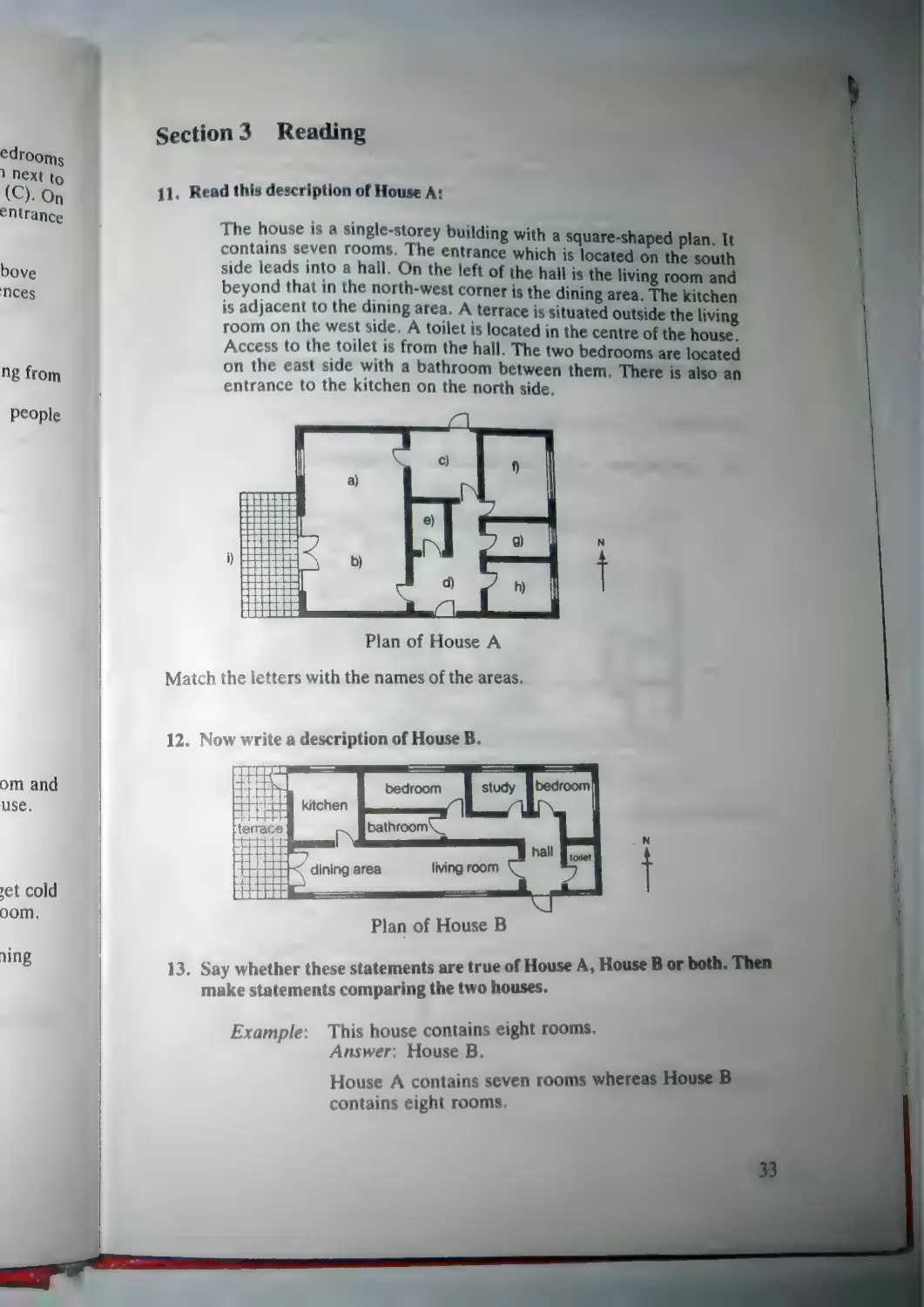
11. Read this descriptionof
H
o
x
Aе|
The house is а single-storeybui
contains seven rooms. The entrancev
side leads into a hall. On the1 һе
beyond that in the north-westcorner istl
is adjacent to the dining area. Aterraceis situate
room on the west side. A toilet islocated
inthe c
Access to the toilet is from the hall.
The two be:
on the east side with a bathroom between them.
entrance to the kitchen on the north side,
4
Pian of House A
Match the letters with the names of the areas.
12. Now write a description of House B.
meo
ша
TH
Plan of House B
13. Say whether these statements are true ofHouseA, House E
make statements comparing the two houses.
Example: This house contains eight rooms. |
Answer: House B.
Br
House À contains seven roomsv
contains eight rooms.
:
D
‘he living room face west.
low faces north.
»y house and compare your plan with House A,
of an Egyptian house:
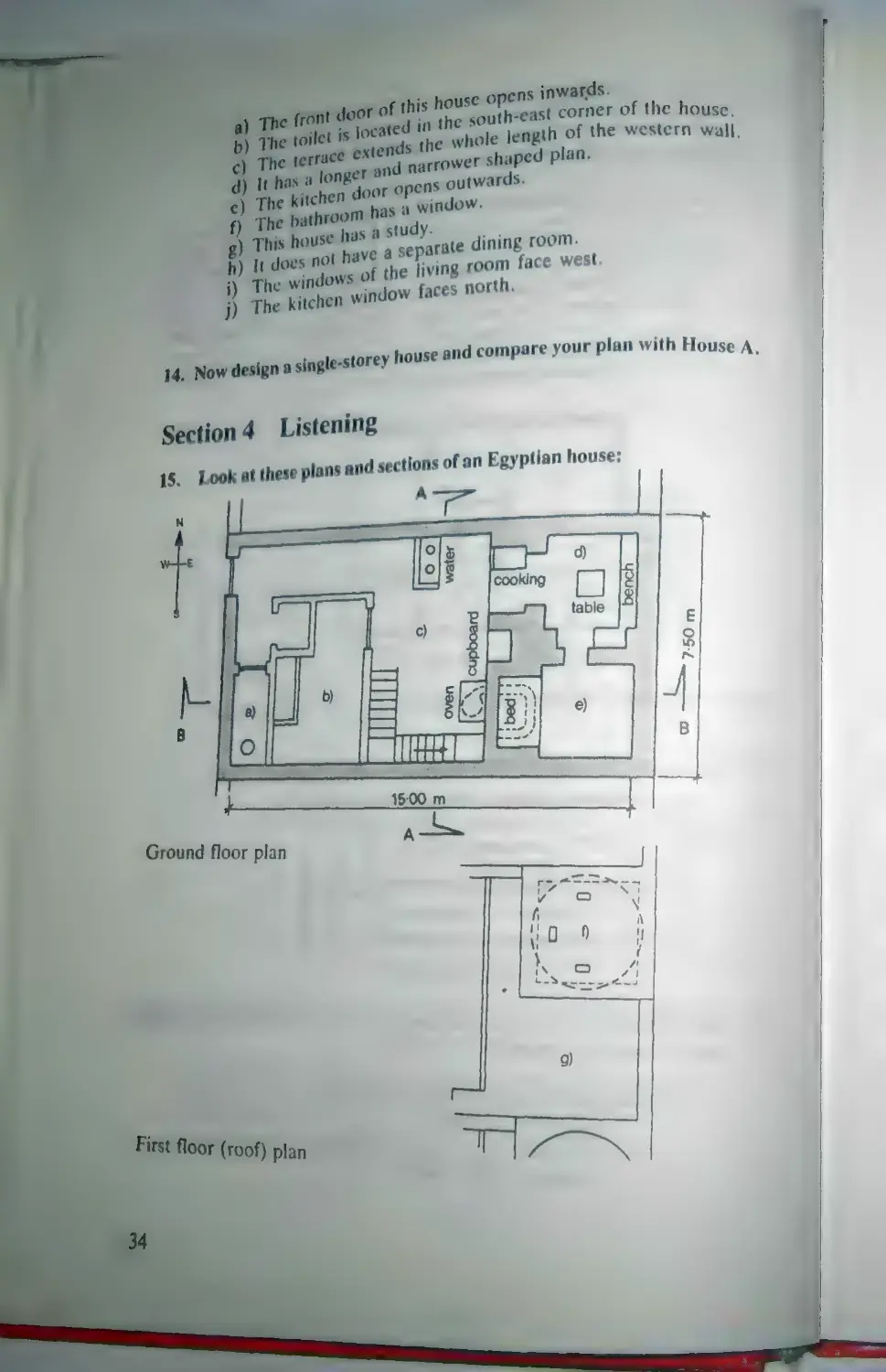
| nm plans and "t
E
Section B-B
Now listen to a conversation between an architect and his client about
the location of rooms and other areas in the house. Match the letters :
a)-g) with the names of the rooms and areas.
16. Now answer these questions by reading the drawings:
a) Is there a roof over the courtyard?
b) Is there a roof over the stable?
c) In which wall is the door to the first floor bedroom
d) What type of construction is used for the house’
or frame)
e) What is the shape of the roof over
t
h
e
f) Why are there no. windows inthe у
house?
“>
r
5j
Аг
уР
"n.
|
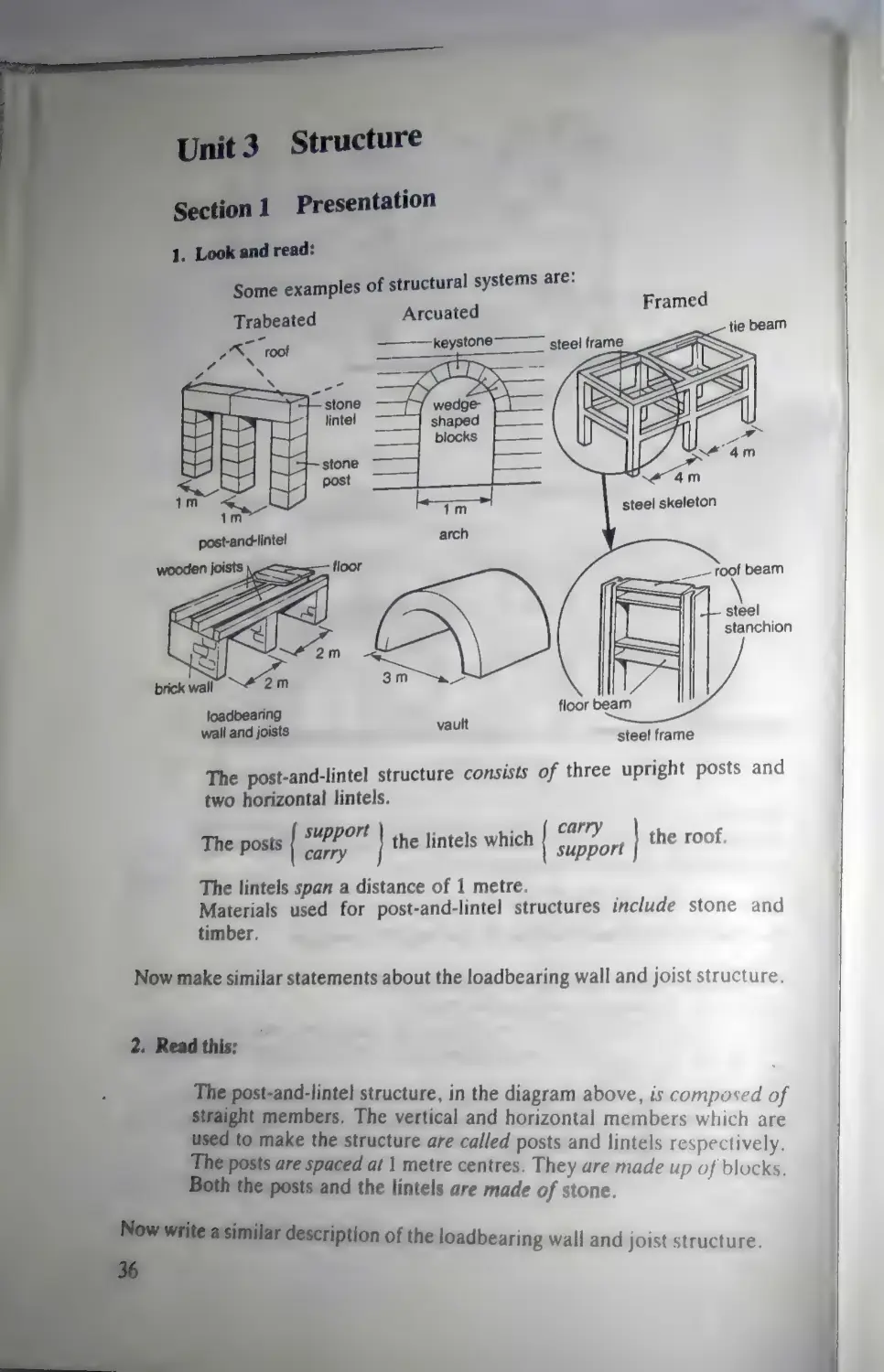
stanchion
floor beam
vault
steel frame
he post-and-lintel structure consists of three upright posts and
pos
A horizontal lintels.
У |the roof.
d
‘SU, ort
"
1
|A, |the lintels which |support
The lintels span a distance of 1 metre.
Materials used for post-and-lintel structures include stone and
timber.
ke similar statements about the loadbearing wall and joist structure,
2 уф»
intel structure, in the diagram above, is composed of
‚ Thevertical and horizontal members which are
D are called posts and lintels respectively.
1 at 1 metre centres. They are made up of blocks.
the lintels are made of stone.
a) What do tl
b) What do the floor |
c) What does the steel
d) What is the arch m
e) At what centres are the ste
f) What are the horizontal
together called?
Jageej "E f
g) What distance does the vault span? —
h) What isthespan ofthearch? | д
i) What is the stone in the centre of the arch
j) Give some examples of materials used for a
structures.
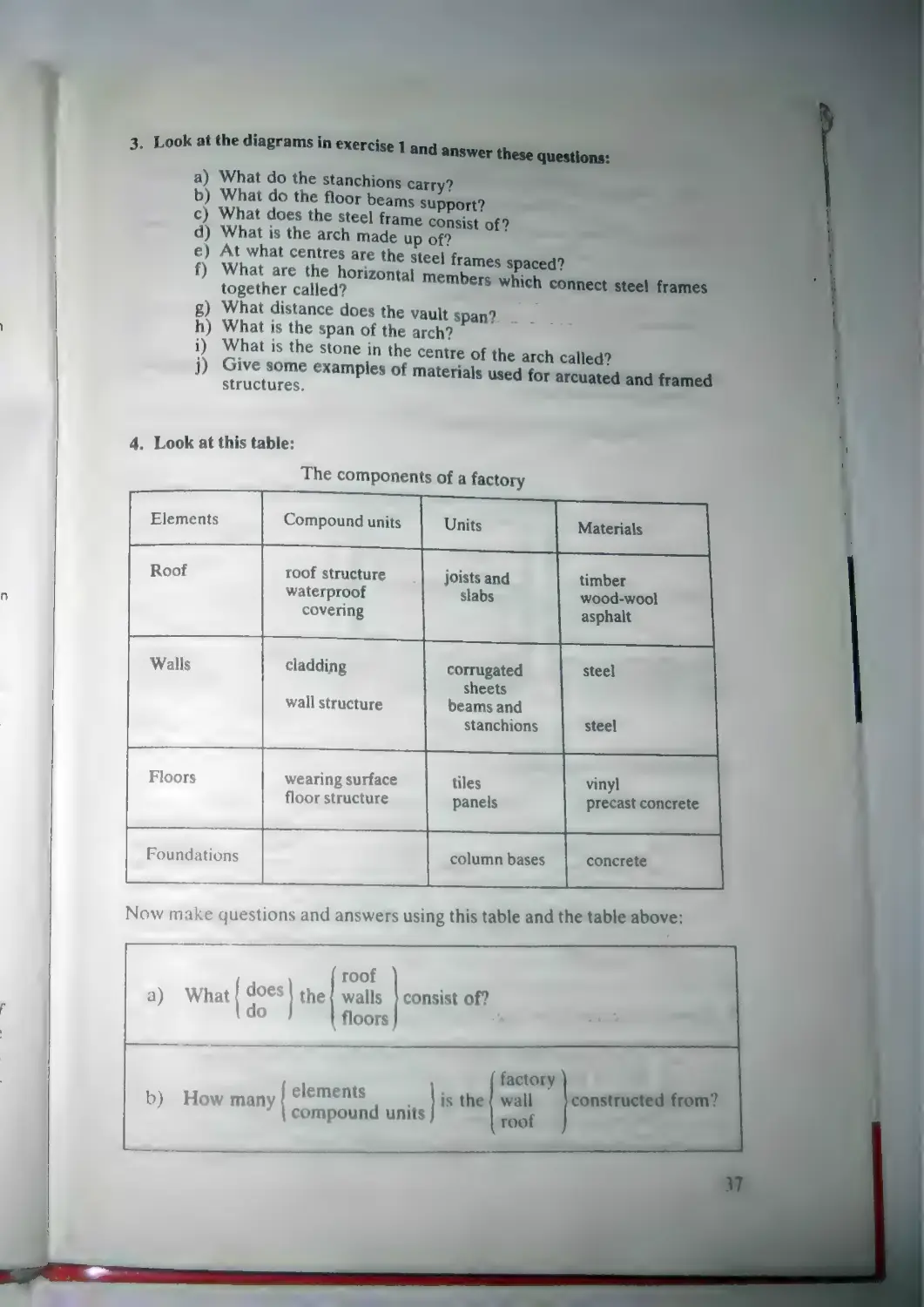
4. Look at this table:
The components of a factory
Roof
roof structure
joists and
waterproof
slabs
covering
Walls
cladding
corrugated
sheets
wall structure
beams and
stanchions
wearing surface
floor structure
Floors
tiles
panels
Now make questions and answers using this table and thê'tableaboye!
obe |
Ми25t
roof
з
What |does the walls |consist of?
do
floors
s ouiжойЯ
elements
Нау |compound units |-
Е
go" a) timber joists
М; strom four elements; the „Ще
,andthe
— —.Theroof
а waterproof cover-
iadeof
, Which is made of tim-
—slabs. The walls are ‘constructed from two
all structure, which consists of
, and the
Боб... sheets. The
— .consists of a
‚ which is made of ...... and a floor structure,
1...... The foundations consist of ...
|
aterproof covering?
8 used for the cladding?
heеи; surface?
Compare the structures of the buildings and the pr LS t @ |
used to make them.
Bs—m:
Section 2 Development
9. Look and read:
uneven surface
flat surface
>
metal plate
machine tool
contact faces
machined flat
transmitted
force
welds
Joint X
Joint X
Plate A is welded to plate B.
Plate A is joined to plate В bye
Plates A and B are welded together.
The force on plate A is transmitter
Joint X is not filled with packi
joint are machined flat.-
Now complete thes
a) Plate с.
b) Plates C an
c) The force on |
aluminium heр.E-
—
glue
steel column
joint,Say how the units are joined together.
howforces are transmitted through each joint.
intscan packing be used?
tsshould the joint surfaces be machined flat? — -
"Ing the layout of frames the.
A
üm
connecting plate
welded to end
of roof beam
4P
ETno
LNyUg‘
ahi
0en
Steel angle
base plate welded
to stanchion
The single-storey structure consists of фа frames.
are made up of steel stanchions and beams. The:
between end walls and spaced at 3 metre centres.
carry the beams. These beams support the roof.'
cantilever a short distance beyond the stanchion
they extend over the profiled sheet steel cla
then be placed outside the lineof the stan
The beams are bolted to steel stanchion
are welded to the top of each stanchion.
transmitted through these plates to thes
The upper face of the steel base plates.
chions are machined flat. The bottomof
base plate. Each base plateis fixedtoa
holding-down bolts.
Steel angles are fixed across the е
the brick walls. These angles1
vide a place to fix the top of the
бла.
га. ed of the single-storey steel structure
Пый
ee
isdiagram and listen to the passage:
| shaped like
of
can use components
— — of opening
each other
А
У
m
fa
d
as designed t
n Italy and was designe
intheUSAandw
Look at these drawings of two
cated i
1. Look and read:
Building A
concrete, — ^
ported by steel stanchions ғ
i
*
of precast concrete Panels, — —
| which is raised above ground level 8
геї four triangular-shaped loadbearing P
w
a
l
l
columns between them.
"mure is made of welded steel.
^ els span between the beams,
apap ced at 7 metre centres,
E wall column is made up of fous
floor slabs spanning between them.
haped like a rectangle
п with these names of parts of the buildings:
floor frame
floor beam
precast concrete panels
^ corner unit
ption ofthe structures of Building A and Building B by
{опofanother building:
e building from across the river, you can see the two
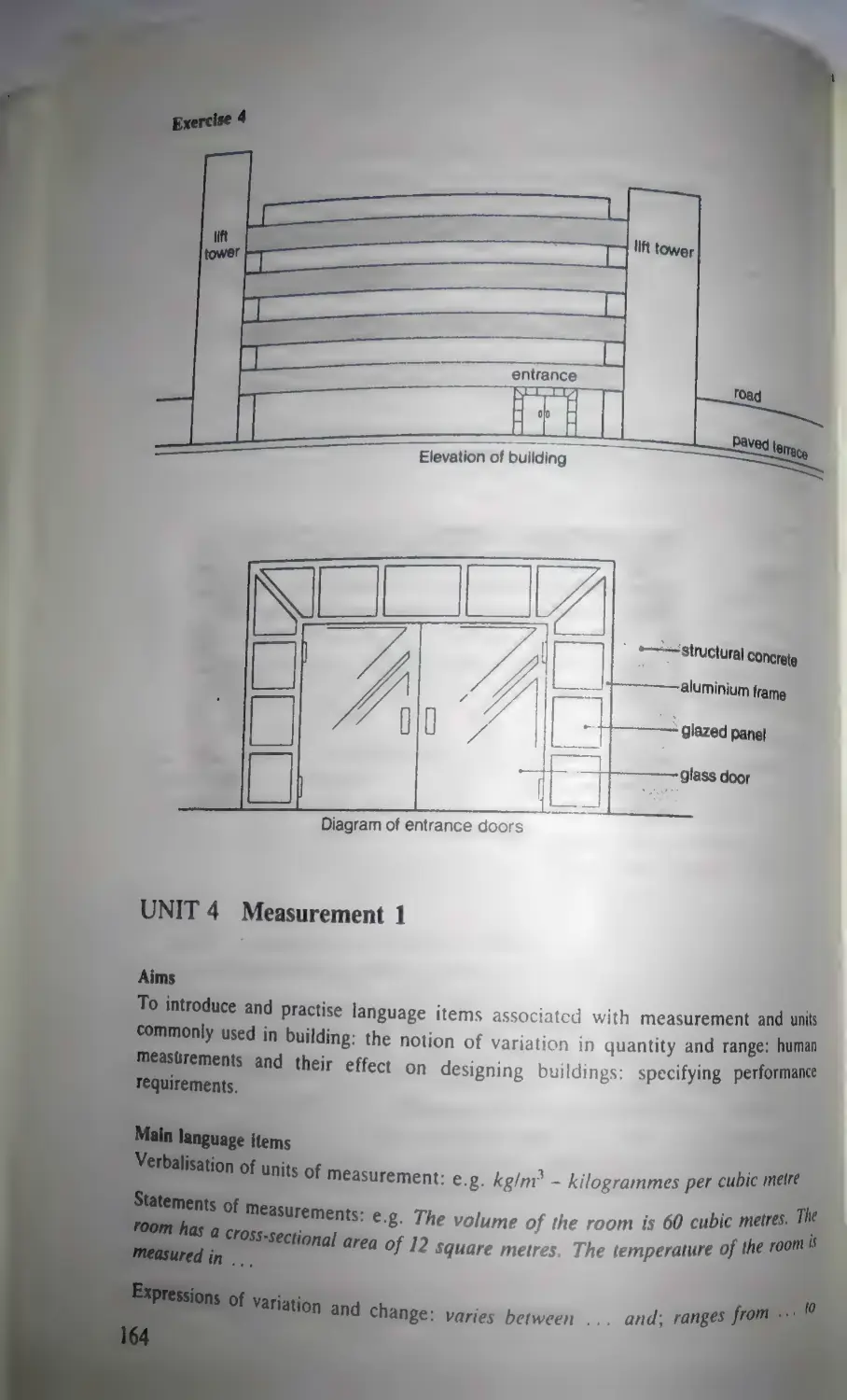
ts of the building. The first element you notice is а
ontal bands of concrete on four levels. These are ex.
s around the perimeter of the building. The second
‘of two vertical bands of concrete, These are lift
е located at each end of the building. They both
roof of the building. However, the tower on ће ~
an the tower on the right. The ground floor of the —
ntered on the right from a broad paved terrace on К
tmay also be entered on the first floor from а road EC
Ше! to the river on the other side of the building. =
rrace is through double glass doors, set in glazed —
ames which in turn are set in the concrete -
B
n ofthe building as seen from across the
nce doors
m
[*] ег
These dimensions are measured in millimen
volume of a room equals
eight ti
measured in cubic metres(
si
measured in square metres (m^).
Internal measurements of a room
Make questions and answers about the volume, longitudinal-sectio
cross-sectional area and surface areas of the room:
Rê4i
Example: What is the internal area of the north-facing Wall
The internal area of the north-facing wall is]2 зди:
metres.
\ca
m Won
Now make statements like this:
Re
Lo vds
The north-facing wall has an internal
area of 12 square m
LN
uu
P
2. Estimate the internal measurements
ofyour classroom and make tab
like this:
:
P |Dimension|Quin |
classroom
window
etc.
varies between |
up of three people, their height |,omina
]zm The maximum height is Z mm and the minimum
X+
| -The verageheight iin this group is therefore |+
=a
—J—
the following measurements of each person in your
threesimilarparagraphs:
.... Anthropometric data
Length of | Length of
lower leg upper leg
in mm
in mm
а tehand read:
|
When
d
e
s
i
g
n
i
n
g
a buildi
bodies. Forest 1
an architect should baseh
Design situation
1 Example:
t
floor-to-ceiling
eight
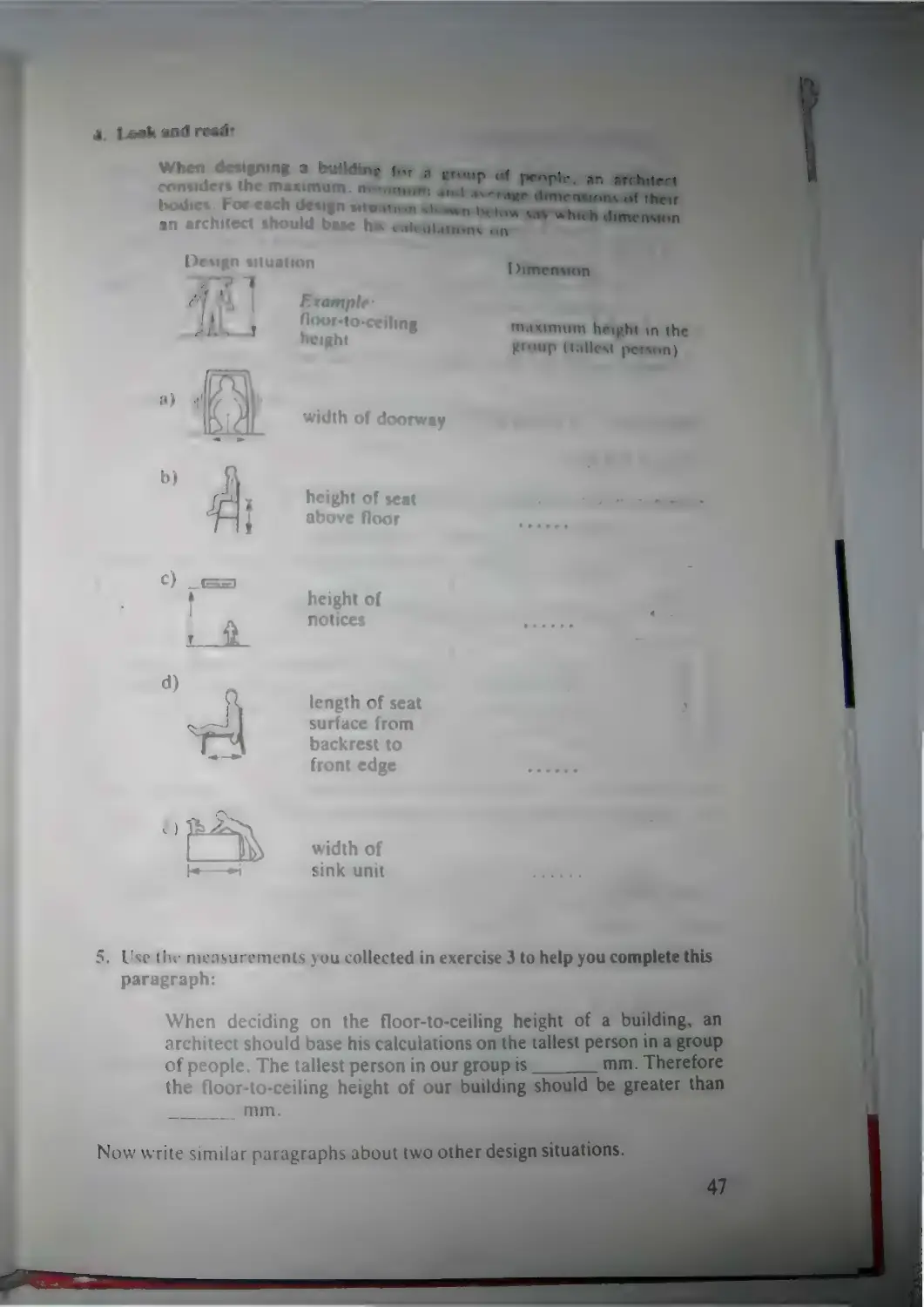
а) ivy Wh
({ ) width of doorway
b)
|
м height of seat
i. ‘` omen montent
|
above ог? .. © "LLL
J
c)e
i3
Г
height of
-.—
i
notices
"ЫД
T
aM
d)
ü
length of seat
y
surface from
af
©
backrest to
J
front edge
„ам
‘|
| N widthof
‚ЕЖ
—
sink unit
5. Use the measurements you collected in exercise 3 tohelp yc
paragraph:
When deciding on the floor-to-ceiling he
architect should base his calculations on.
of people. The tallest person in our grou
the floor-to-ceiling height of our
mm.
п Britain is usually 2 100 mm although —
ыїһап 2 100 тт.
^
È
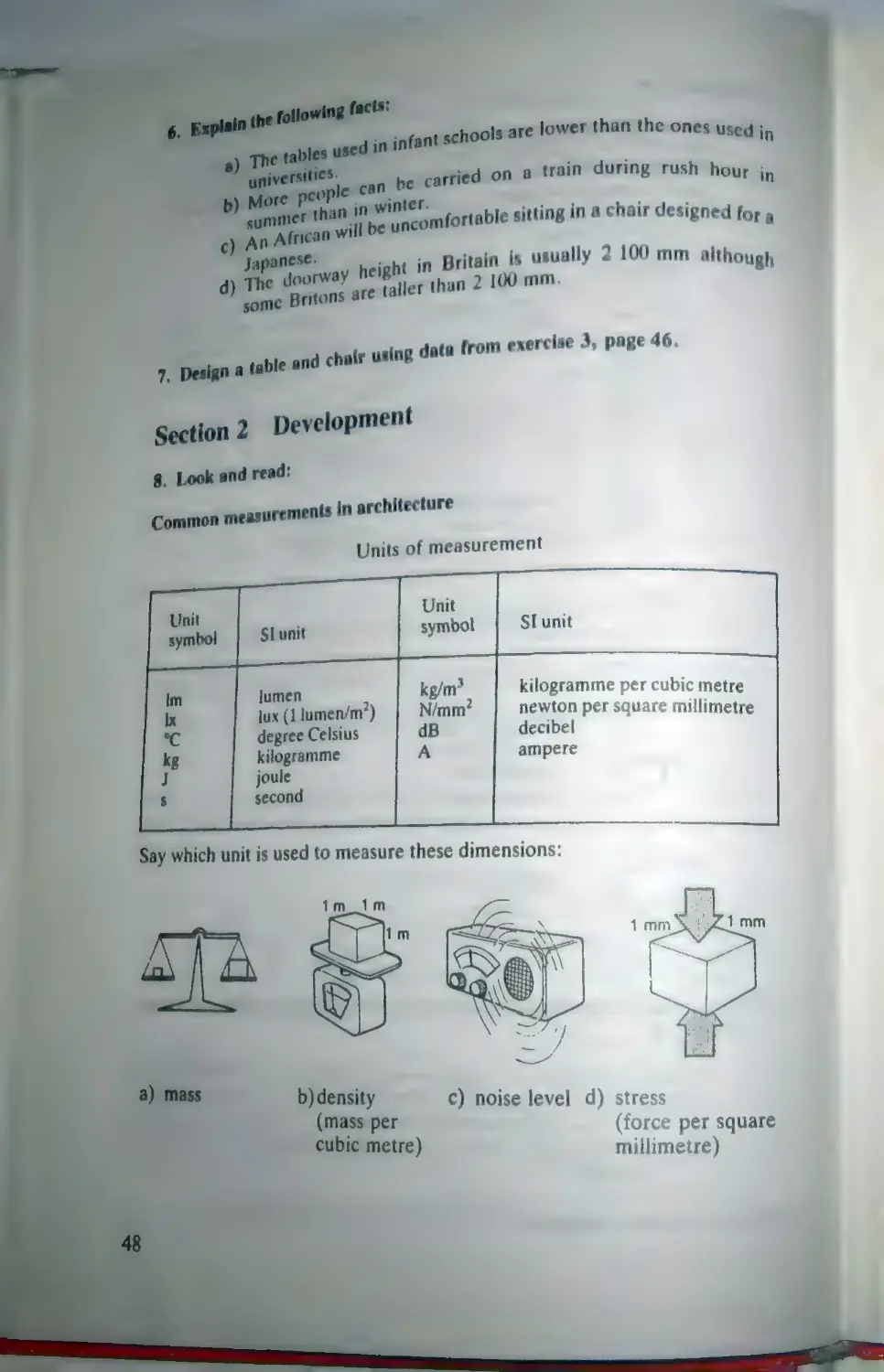
ani" "m nts inarchitecture
Unit
symbol
kg/m?
N/mm?
dB
A
ortable sitting in a chair designed for Г.
evi
air using data from exercise 3, page 46.
SI unit
kilogramme per cubic metre
newton per square millimetre
decibel
ampere
h unit isused to measure these dimensions:
€) noise level d) stress
(force per square
millimetre)
ы.e
AN
е) illumination f) luminous
*'(light falling flux (flow
on surface)
of light
measured in
lumens)
9, Look at this diagram and complete Аи.
(maximum value)
a) The temperature of the room is measured in
b) The
in the concrete block is 5
N
/
m
c) The noise level of the television is measured in.
d) The illumination in the room is measuredin.
e) The
of the concrete foundation is 2 400
f) The electric current to the television is м
2) The
from the light bulb is 50 lux.
h) The heat flow rate of the radiator is measuredin.
10. Now make a list of some of the things in your classroom that ca
measured. Say what they are and what units they аге measui
11. Read this:
The performance requirements of а NL
way:
The area of the room should be 40mî.
For maximum requirements:
н
The area of the room should not b
For minimum requirements:
The area of the room shou
DX. Камминг
| us „ЖУ toBid a house. The fon
yon? is 10square metres. What is th
Té
ЕНЕГЕ alee+55
A Je. The floor area allowed per p
——
.
Т ntstobuildaconcr è
|
||
«ss allowedinthe concrete is 5 N/mm?. What is the minim
onal area of the column required?
ecto
ү?
оп
Ж
"mad on the column 1$
|
[д п allowed in the concrete 15
рГ.
-
—
P 29 wants to build a concrete wall with a volume of 10
i etres. The maximum weight of the wall allowed is 22 000
mem What is the maximum density of concent
4tT, mmes.
ji mired?
Solution
. The volume ......
м
“=
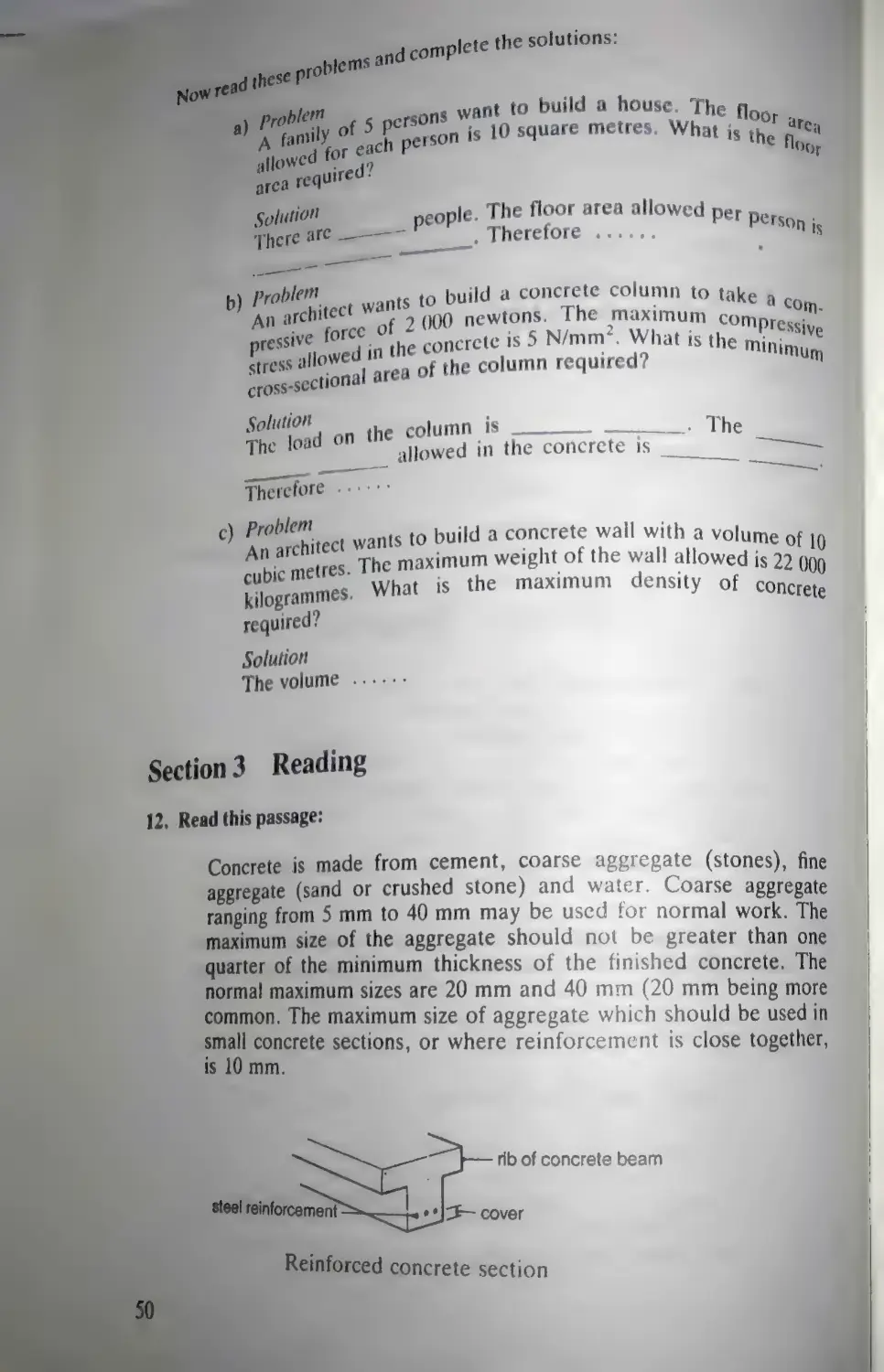
ə ismade from cement, coarse aggregate (stones), fine -
jm or crushed stone) and water. Coarse aggregate|
п 5mm to 40 mm may be used for normal work. The-
ze of the aggregate should not be greater than one-
minimum thickness of the finished concrete, The
mum sizes are 20 mm and 40 mm (20 mm being more
e maximum size of aggregate which should be used in|
tesections, or where reinforcement is close together, .
rib of concrete beam
‚ fine
(i) 5 mm less than the minimum ho
reinforcing rods, or, —
(ii) 5 mm less than the mi
whichever is the smaller.
Now say whether these statements aretrue orfalse.
statements.
>
a) Concrete is made from three ша
|
b) Coarse aggregate ranges in size frams =, c am.
c) When the minimum thickness
of the finished con T
the maximum size of aggregate should not Б—*
25 mm.
d) When the reinforcing rods are close кофе аб,"e
of aggregate used should be 10 mm.
c) Cover is the thickness of concrete between the rei
f) The reinforcing rods are placed near the bottom cй
concrete beam.
reinforcement is greater than the maximum sizeo
aggregate.
h) When the minimum horizontal distance between reini
is 15 mm, the maximum size of aggregate should
12 mm.
13. Look at these drawings. What is the maximum
size of aggr
should be used? Explain why.
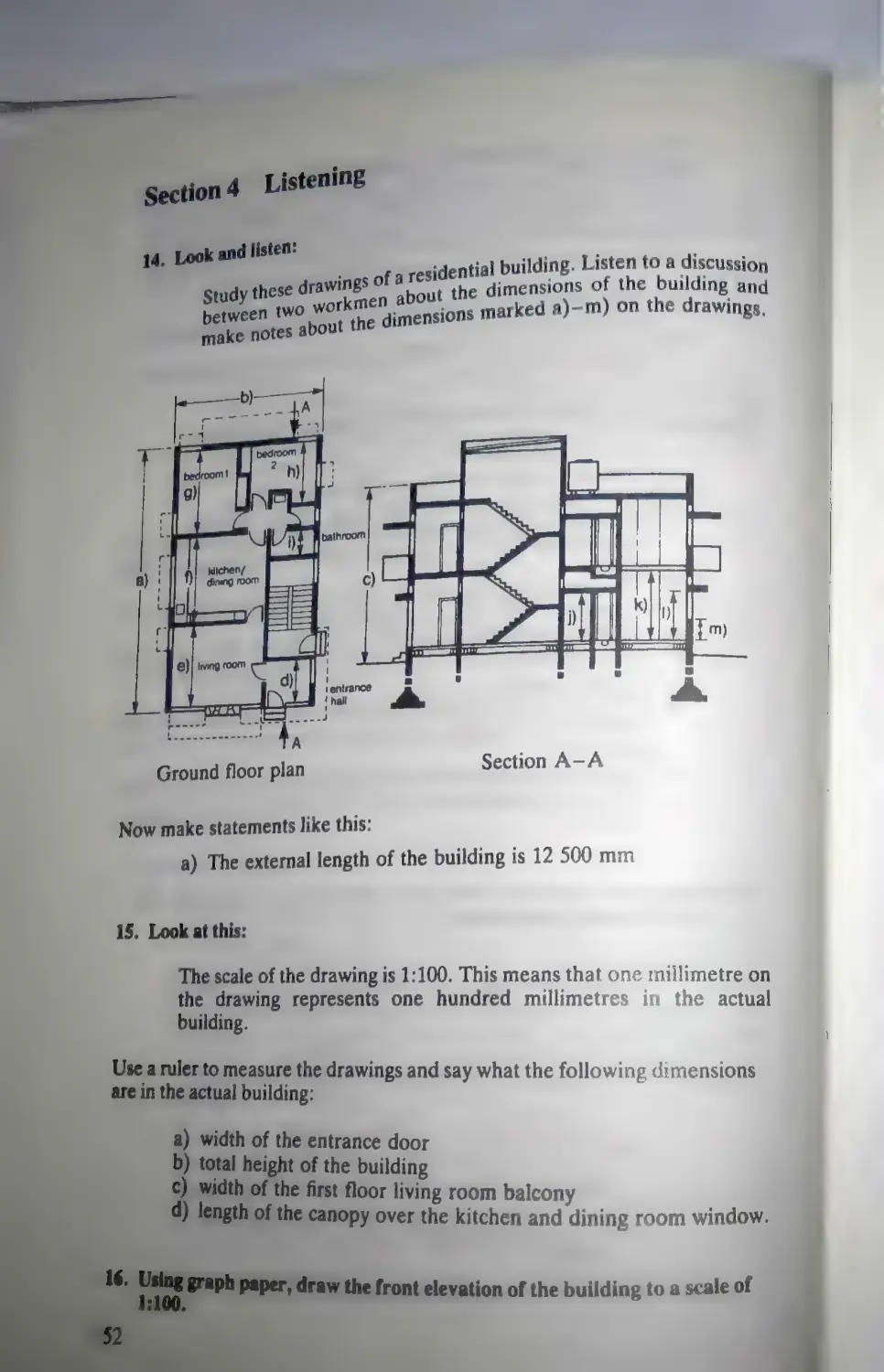
<idential building. Listen to a discussion
out d dimensions of the building and
yensions marked a)-m) on the drawings,
Section А-А
statements like this:
The external length of the building is 12 500 mm
rawing is 1:100. This means that one millimetre on
ents one hundred millimetres іп the actual
ings and say what the following dimensions
,ч7 | balcony
|
nand dining room windo
*ДАЕ
іза
gammE.
Unit 5 Processi Func
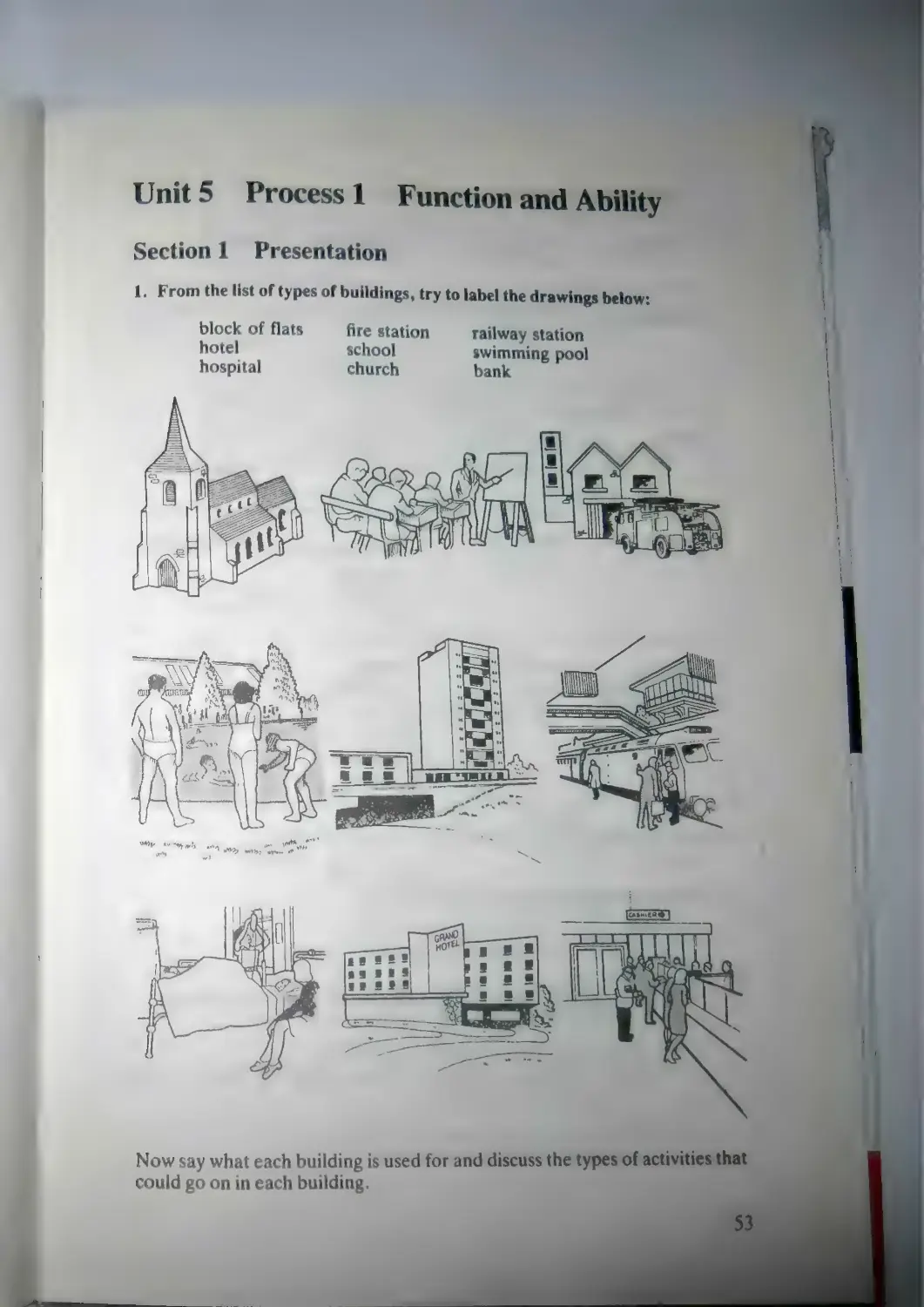
Section 1 Presentation
1. From the list of types of buildings, try to label the dra
Vr
block of flats fire station railway station
hotel
school
swimming pool
hospital
church
bank
Now say what each building is usé
could ро оп in each building. — eec
Es#
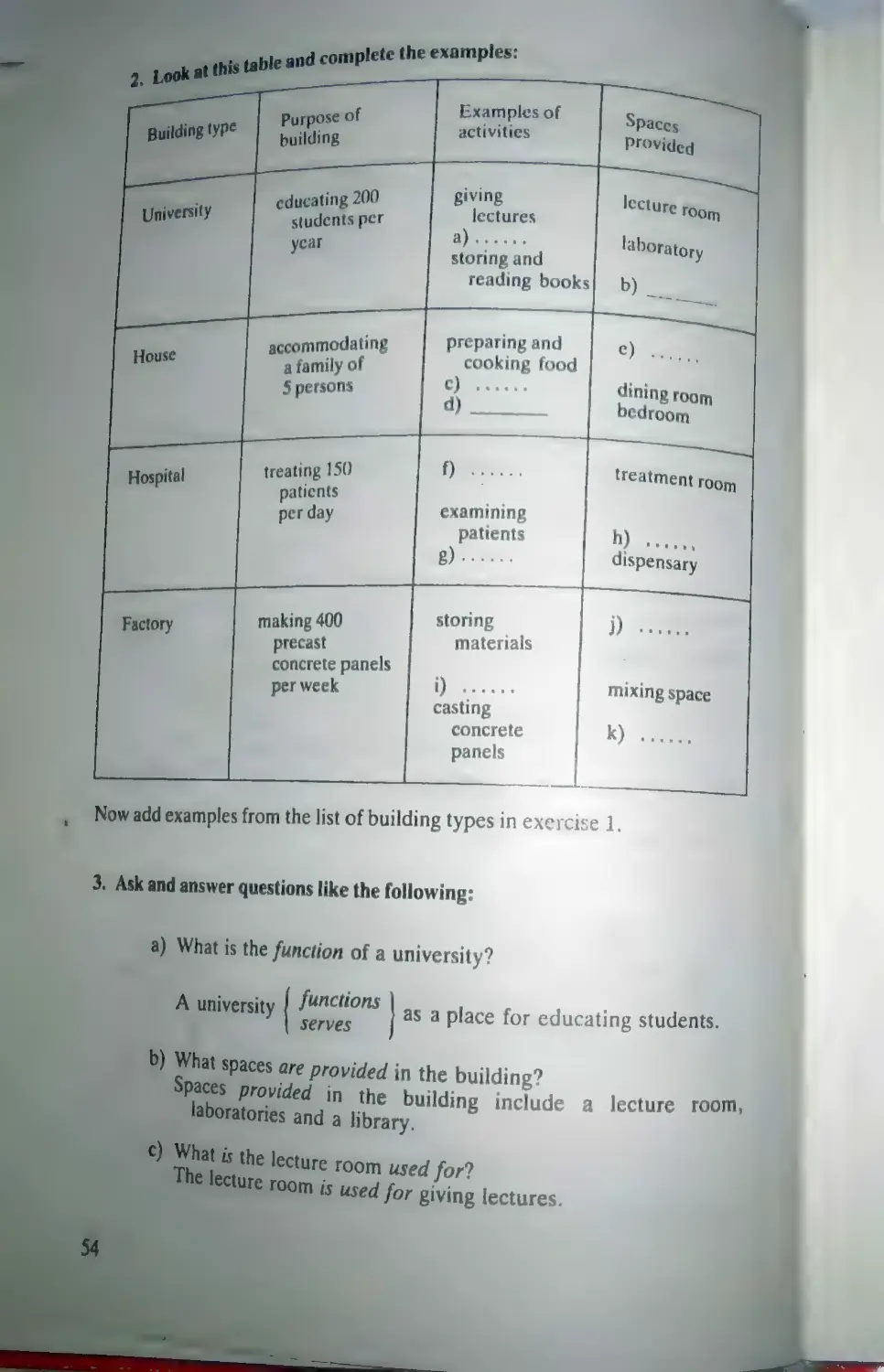
END
DE
storing and
reading books
accommodating
preparing and
a family of
cooking food
Em
|o...
dining rdg
E
———
bedroom
^'
examining
4
patients
А
making 400
олор.
П
A
precast
materials
Н
concrete panels
J
per week
DNE...
mixing space
casting
4
concrete
k) iom
ү
panels
3
50;
^7
1
p
l
e
s
from the list of building types in exercise 1.
2.
A
E
+
hg
у
E
questions like the following:
E
function of a university?
‚ | functior
х
HERUM Шош |às a place for educating students.
in the building?
E
€ building include a lecture room,—
sed for?
Ving lectures.
has the cCap
trрам
200 studentsa yea
B.б73
year.
{=i
|
Now match the building type on the leftwith the piD hra on the righ
similar sentences:
|
The university |
^$
House
make 400 precast panels.регwe1
Hospital
accommodating a familyo
Factory
serving up to 200 customers duy,
|
Post office
treat up to 150 patients per per
|
Shop
dealing with 10 train movements per day.
Railway station | handle up to 1 000 letters per day. b | |
Add other examples from your list of building types. 70
4
Section 2 Development
К.
5. Look and read:
load (snow, etc)
—Ó
Building enclosure
AM
heat and
natural light ET |
——
a dust and
m
pollution
they are capable of performong the che
important dewan
design requirements ic hede t
p
- keep ost wind, dust and precipriation
=
visual wreening
к
eurfaces for activities
out иго"
= prevent fire from spreading
|
= provide fresh air
f
T
„=modify
the passage of heat
= control рех тапын
„сомго! the passage of monture
provide natural and artifical high:
ri
v»
Е
Ч
1
The сосны sliorm arэ hormat imalata. ~
ы
The n and theeeternal walle ony wn
|
Ise partem mahire rhe мейди to nual wey *
wo acer sthew
کٹ^
=
3 Aks стан Фе occupati ofө bulding = No
te Беер dry?
a
have perky
собр warm
to te че from fre”
to read Gurung the nighttime?
wis
v uate from mtruderd °
—
*
A ho! clement deemedto
9
"ү tht neme level etme roms?
copper! ure ined’
m
he paupe of mettere °
<
natural м `
d
the movement of people ı10 and owt ofthe building?
ments act at
roa! зас `
24174
ace deveder?
Я
(co separate the internal volume from the externa) —
б barrier”
10 keep out
p out
of keeping out
v 4 rials in the table. For example:
{ eofwithstanding high temperatures.
ИГЫ,
{
Sound insulation
прот, insulation
fire resistance
Suitable material:
% SU RUP material:
—
VN
VA
£NXN
S
я
d
Ten:
Function: |
р Funetresistance
attractive finish
K Suitable material:
Suitable material:
»-^
$5
J
e four sentences like this example:
Concretehaslow combustibility and is therefore used to provide fire
4E. resistance for walls.
gain at thediagrams in exercise 5, page 55. Choose a suitable
foreach element and say why you have chosen that material.
а building is to circulate hot water through
atedineach room. The water is heated in a
is kept at a constant temperature by a
in aquastat. The aquastat is located on the
pipe runs in a continuous loop from
ck to the boiler. The function of a
the hot water to the air іп the =
material which has the property _
of highthermal
important because the
gives off heat. One type o
»
number of thin fins shaped like a
Г
|
passing through their centres. — jeanvt
|
A thermostat in the room can beset їс
|
When the air temperature in the room decrease
switches on the pump which is locatedon the returr
j
radiators. When the room reaches the set temperature
stat switches off the pump.
An expansion tank is provided to allowfor expendit d vate
as it heats. A safety vain located on the pipe
to this ta
serves to relieve the pressure in the boiler if it is too gh.+ Г
ums
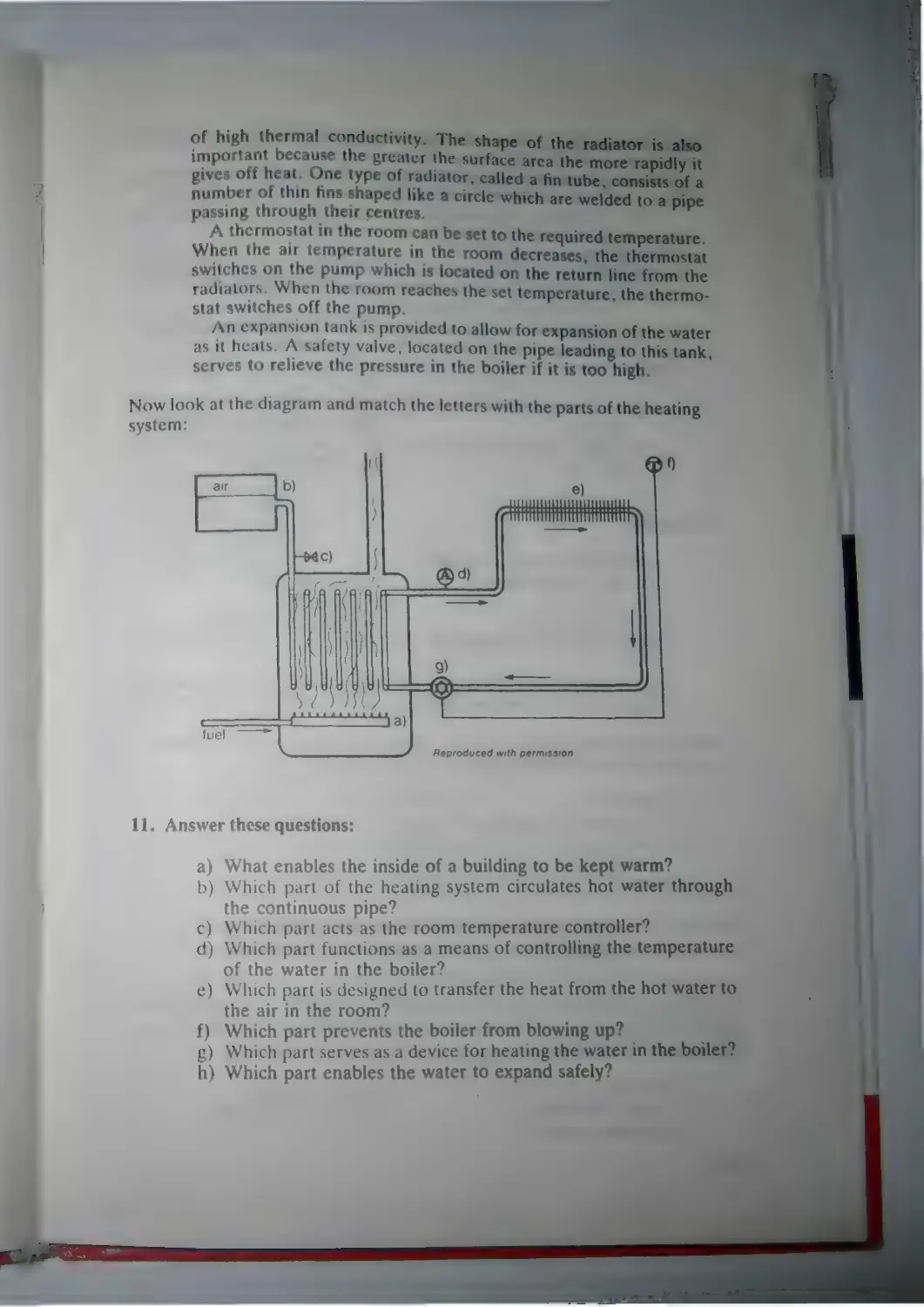
Now look at the diagram and match the letters with the parts of theheating
system:
Reproduced with permission
11. Answer these questions:
a) What enables the inside of a building to be kept warm?
b) Which part of the heating system circulates hot water through -
)
the continuous pipe?
c) Which part acts as the room temperature controller? — "A
d) Which part functions as a means of — the See
of the water in the boiler?
e) Which part is designed to transfer the heat from the hot ¥
the air in the room?
vinnie E
f) Which part prevents the boiler from blowing up? —
g) Which part serves as a device for heating thevetant boil
h) Which part enables the water to— кезү
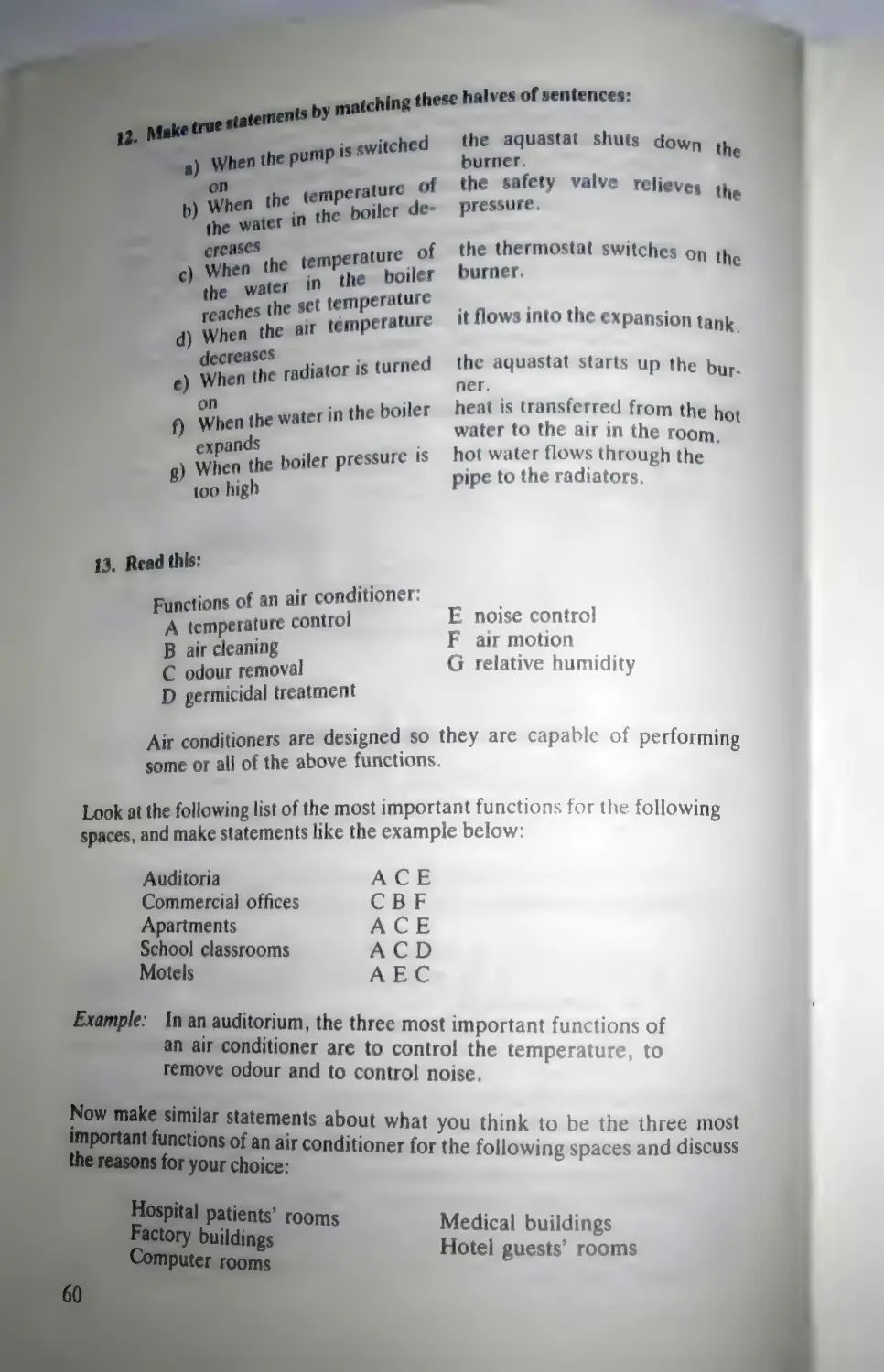
itched
the aquastat shuts
Me
‚ of the safety valve relieves theo
de- pressure.
rat "at the thermostat switches on the 1
the boiler burner.
set temperature
témperature
dii toristurned the aquastat starts up the bur-
ner.
erin the boiler heat is transferred from the hot
water to the air in the room,
i boiler pressure is hot water flows through the
Toh
pipe to the radiators,
it flows into the expansion tank
.AE
ons of an air conditioner:
трегаїшге control
E noise control
cleaning
F air motion
our removal
G relative humidity
nicidal treatment
ir conditioners are designed so they are capable of performing
e or all of the above functions.
ollowing list of the most important functions for the following
1 make statements like the example below:
torium, the three most important functions of
oner are to control the temperature, to
and to control noise.
$ about what you think to be the three most |
ditioner for the following spaces and discuss —
7jeíкә
— Medical buildings
= Hotel guests’ rooms
Ni.
s Алй
14. Look atthediagram ofa packaged air cor
lecturer explaining
toaclass of st
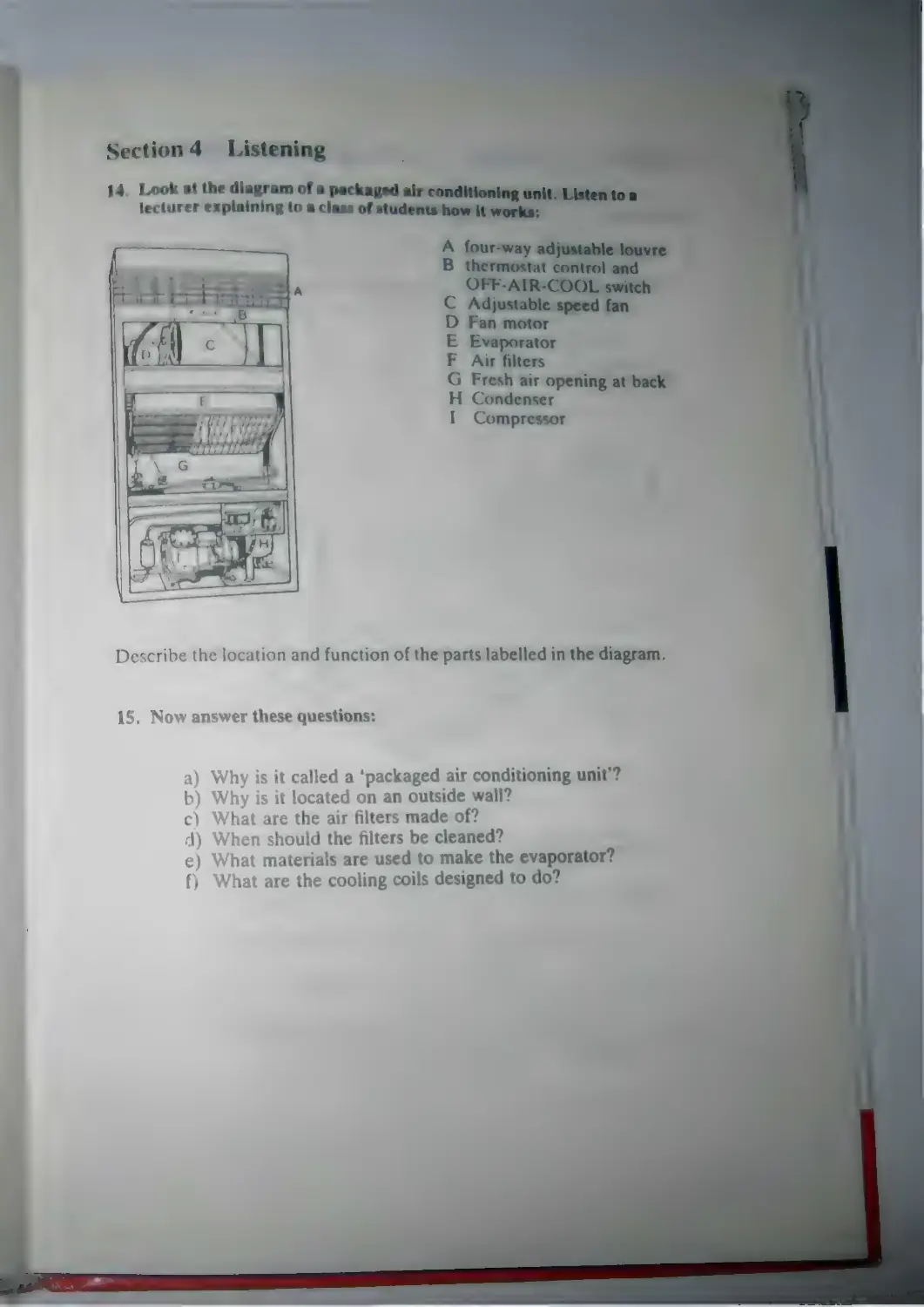
Describe the location and function of the parts labelled in the diagram.
15. Now answer these questions:
a) Why is it called a *packaged air conditioning unit'?
b) Why is it located on an outside wall?
c) What are the air filters made of?
d) When should the filters be cleaned?
e) What materials are used to make the evaporator?
f) What are the cooling coils designed to do?
ا0^"
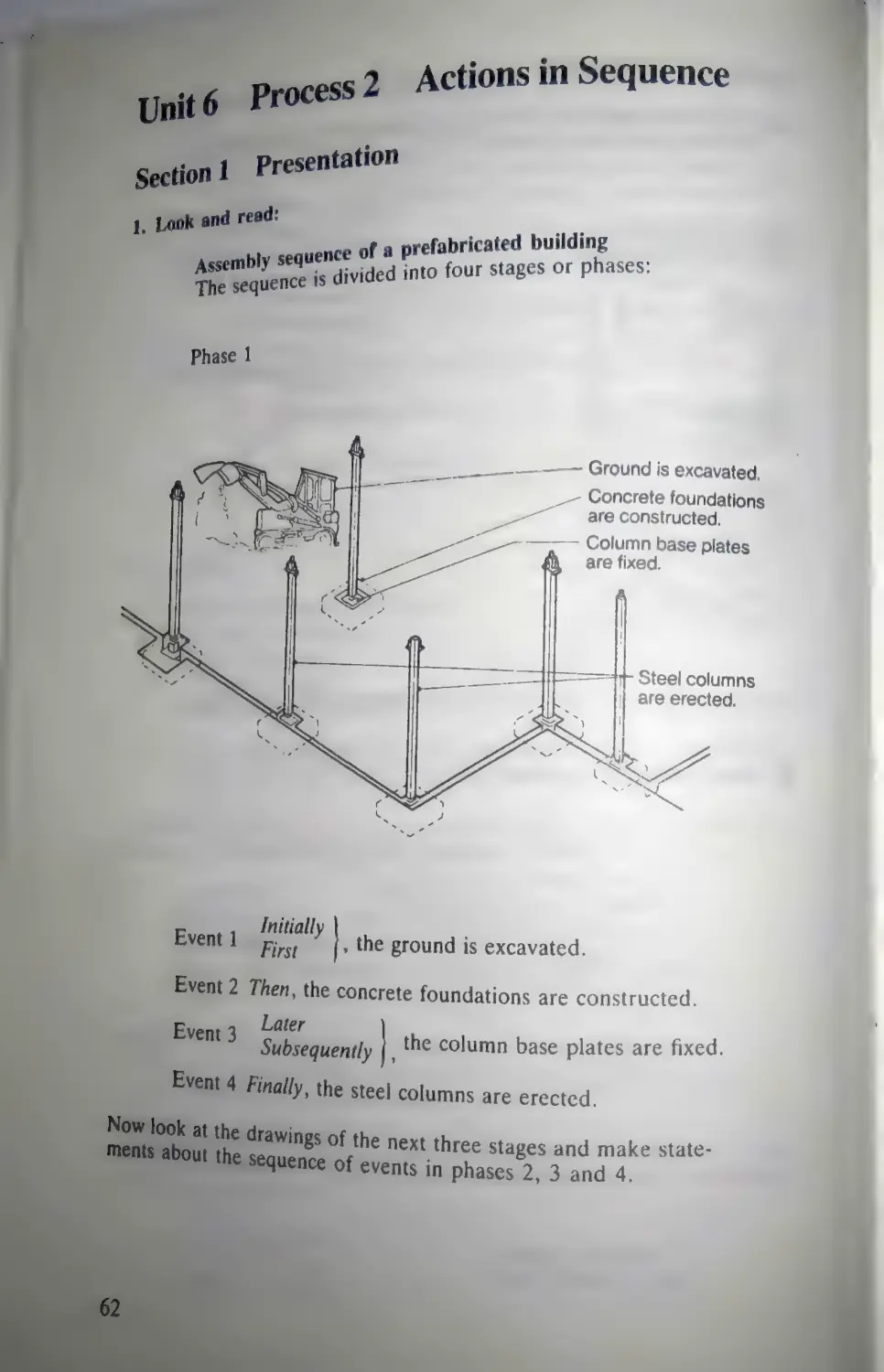
c Dn inSequence
Don
pe prefabricated building
[ Ао four stages or phases:
»
UM
ч
i
— — Ground is excavated,
»
Concrete foundations
are constructed,
Column base plates
4
M, are fixed.
T- Steel columns
|| are erected,
|
girar
Woot bap sa orad
“АOe
ым
E cos columns erected before the roof
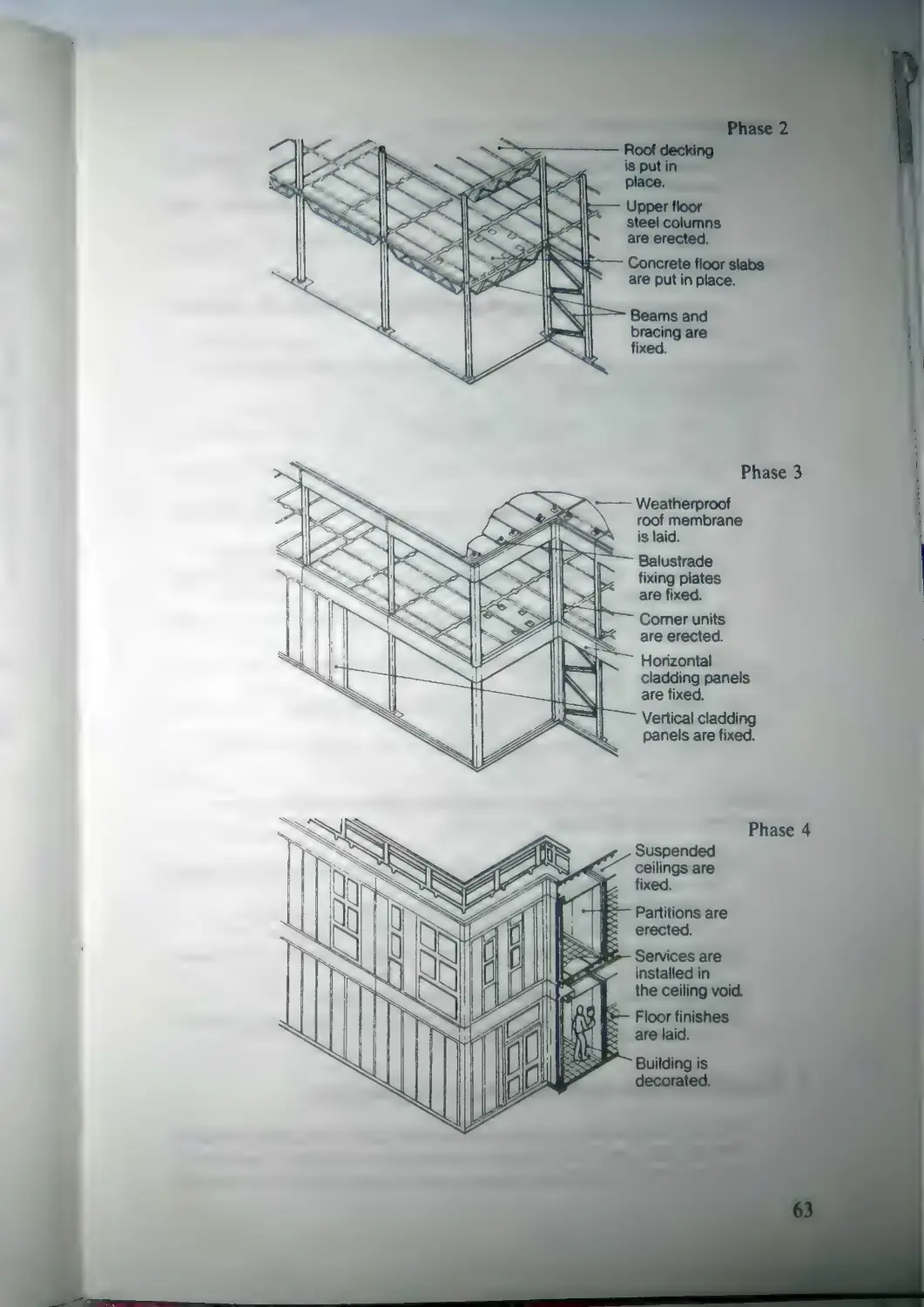
Brunn 1, 2, 3and 4 and make similar questions to
wers:
them.
d a flat rigid surf
e the column base plates need a flat rigid surface to
y
o
r
t
them. =
А6а
J
‘steel columns transmit their loads through them to }
яs.
E
ды meai ete floors are supported by the beams.
> theweatherproof membrane is laid over the balustrade
» the horizontal cladding panels are fixed to the corner
p"
thevertical cladding panels are fixed to the horizontal
en require access to the ceiling void to install
partofthe building or the phase of the assembly sequence
in these sentences:
‚ the workmen erect the corner units.
Ч
е beams and bracing are fixed.
ese after constructing the concrete founda-
g is5 — during this phase.
2 fixing plates have been fixed, the workmen
1 the assembly sequence:
ration of the site, the workmen be
excavating the ground, construc
column base plates and erect:
the steel columns. The workmen
This precedes the constructing of the conc
I ex — ground to support them. T
xing of the column base
ly the
erected.
De TN
Now use it as a model to write similar descriptions ор a
Section 2 Development
5. Look and read:
excavating
Machine drivers
ground
Steel erectors
Bricklayers
installation of ppano
Plumbers
and sanitary fittings
Joiners
]
fixing of floor joists,
roof timbers, doors, |.
Carpenters
windows, etc.
x
Roofing contractor
Cladding fixers
Heating contractor
installation of
Electricians
electrical equipment |
Glaziers
Decorators
Wu
2025303.
Week number |
Bar chart of the sequence of trades
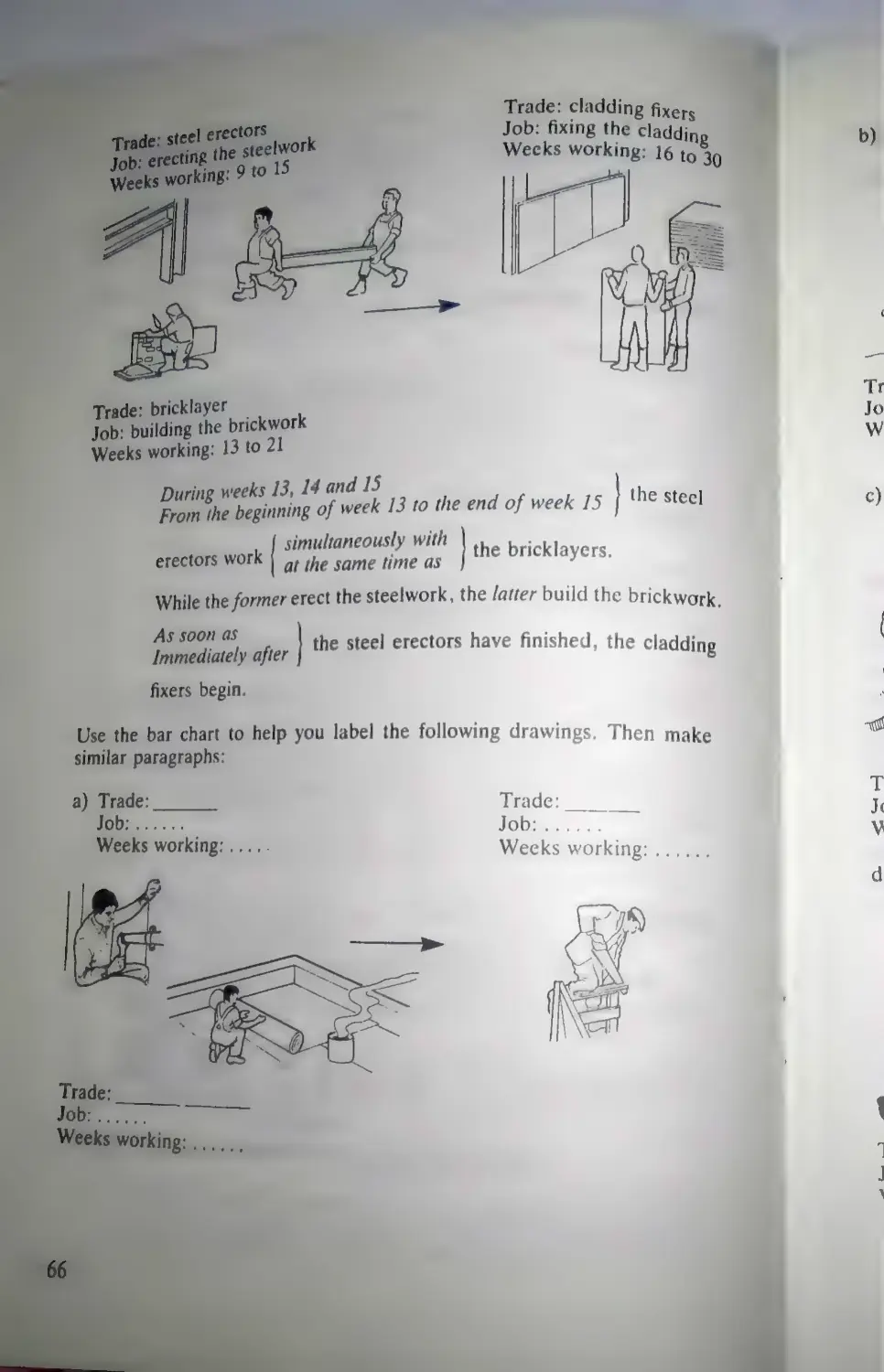
=
3, 14and 15
13,ning of week 13 to the end of week 15 |the steel
imultaneously with
| atthe same time as
mer erectthe steelwork, the latter build the brickwork
the bricklayers.
|the steel erectors have finished, the cladding
ms
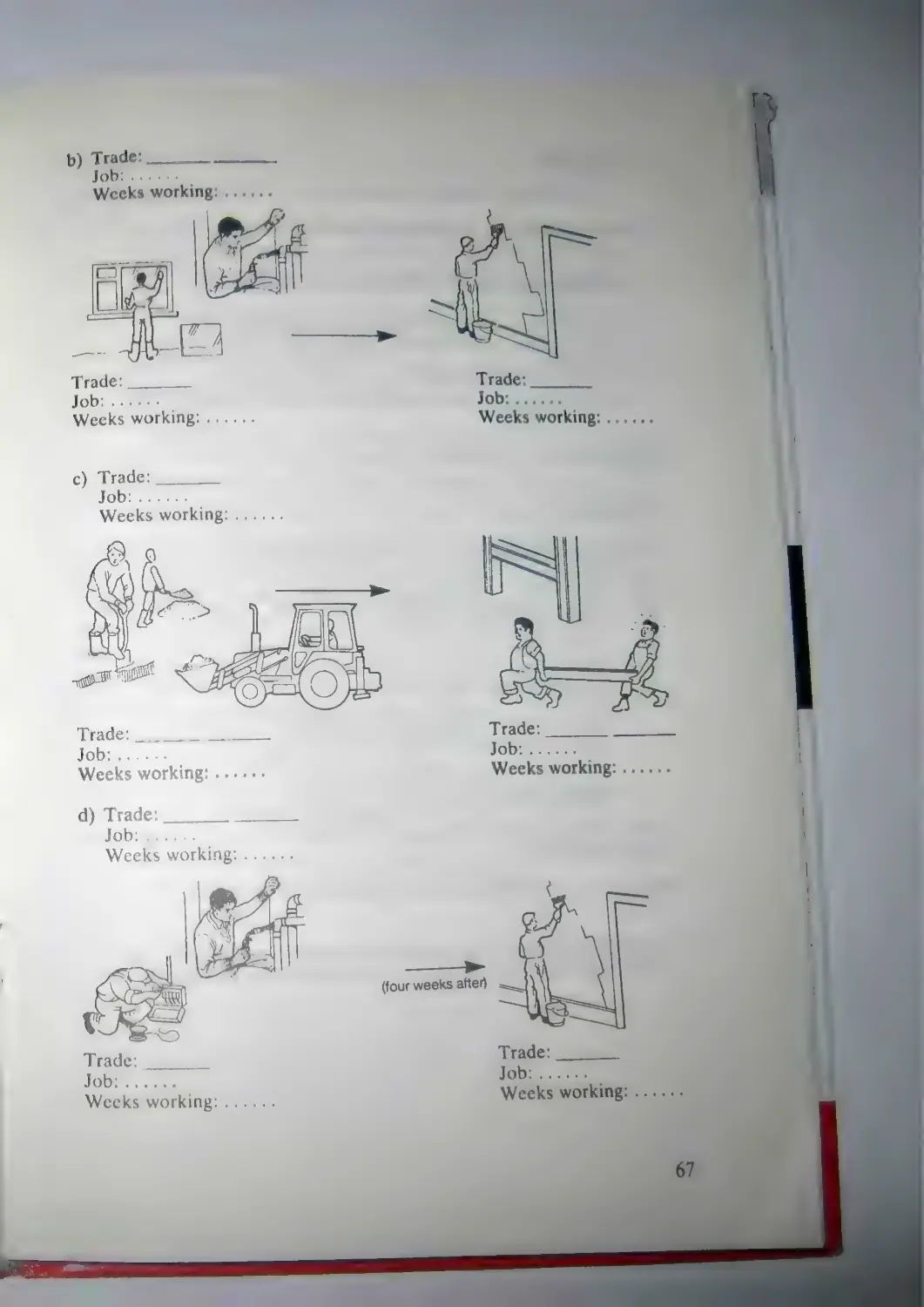
p you label the following drawings. Then make
b) Trade: .
adim:
о
Weeks working: ......
Табу s
^ы
Weeks working: ..... $
Weeks working: ‚.....
Weeks working: ......
d) Trade: Е"
етая
do Бейт trado
m
Man
ate of week 40
weil the end of werk No
|
— eo itotheendofweek ©
DS—
LU iub aointorthan thetnd of
Т.
m„
ө.
"V
t
—
2 Те”,
construction,
several things went wrong
be made to tbe bar chart in exercise 5
E
r
happened Excavation was
mt-
T
excavator broke down. There!
T
i
As the stee
two weeks. Consequently, t
17. Bricks were in thort
resulted in the brickia
So the plumbers a
nee Inweek30|
sere
was settled one week. However, this me
|
No and the glaziers started one эсс.
n
paint was delivered to the decorators, which dela
v
e
d
em "o
Ni but byputting
On extra men the building wos < mpleted oa
۹^
b
a
r
chartusing theinformation in the passage
L
М
а:
they could affectthetime schedule.
sip
+e
€ ! that could go wrong ona building site. Say
Lx
aihc
— thebathing, Wh
пекна (hearchitect aiite kisciont te se
ot ed hein hem todrew өре
Т
ett arto
Work sow wan on the adding. Да
archie t makes perii
to
m heg cometrected
wһа en
tehed onthe contract are being
'
"rio
Tw cot pare the belle from the contractor. „
heo
stor completes the нр amd the dient
months after completion there i a
—a
hatehty penod During
this period, Contractor.
«fecti tha! appear inthe fabric ofthe
a
l
l
tix
1 have bern corrected. the chest takes full possesion i
7 ап capresion
inthe passage which means.
me
o5 voa dien totMiaБАШК
ffertoa бемforһа
mhae unto
а whole
‘Ter to do some work at а certain price
i a! tbe busking work in detail atregular
i
n
t
e
یا
i
an mmterval of time after buiding has been
atch the contractor
isresponsible for ^g а
have complete ownership ofthe building ¥ E
^.
nd
©
-à
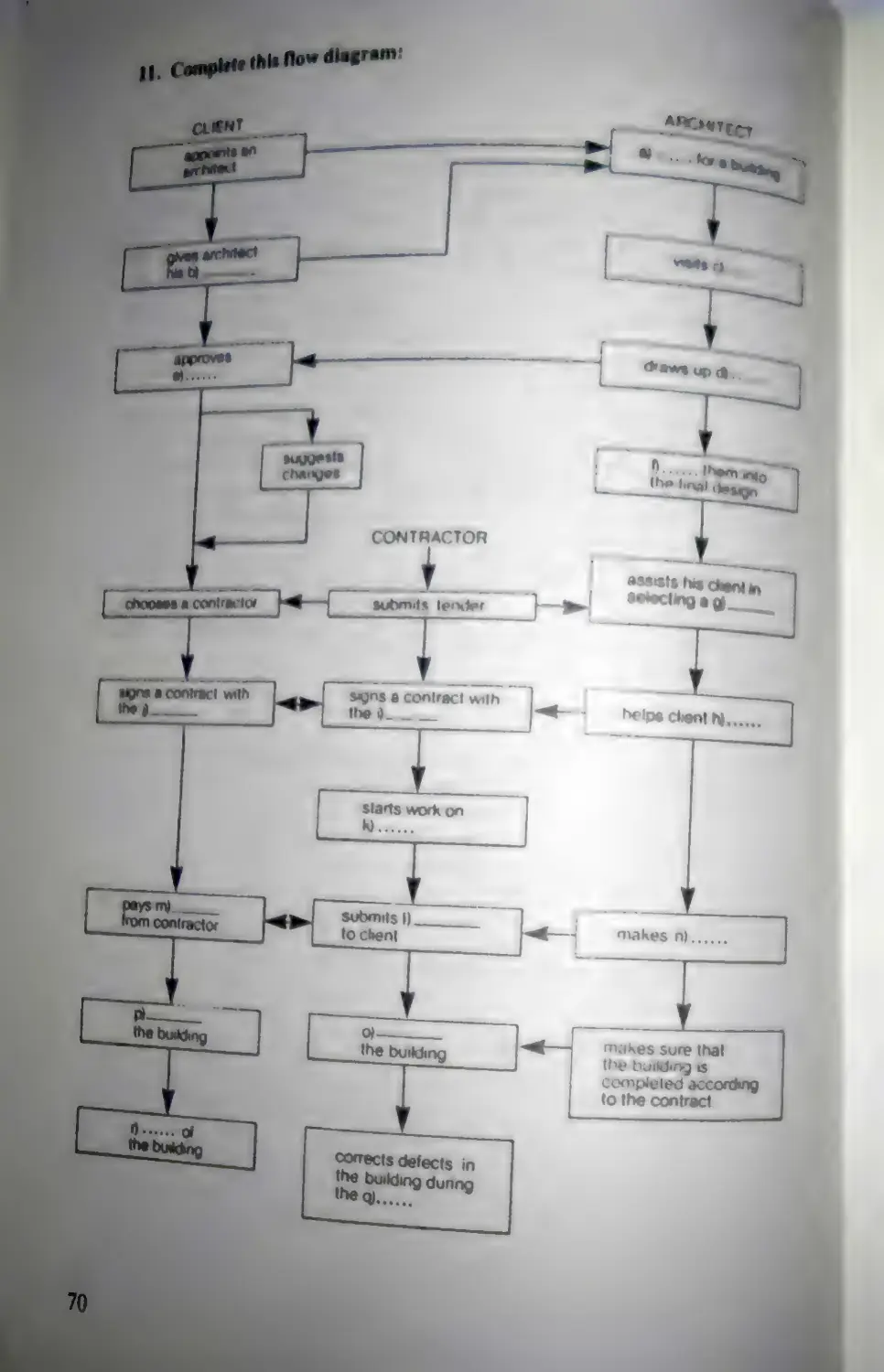
assists hisбинмin
حو
Selecting a Nes
*2
helps client h}.
to the contract
Section 4 Listening — —
13. Listen tothis discussion en(he|
building contracts.
As you listen
а) Phase i (=
stage)
architect submits
1
dient sets a 5
cost limit broken down ИМО ER AP
architect completes
|
specifications sent to
у)Phase2(
_____ аде)
]
regular checks wads10 &compare ______
of
with
all information filed to heip TEITE
14. Describe the sequence ofeventsintheapplicationofcostcontra
building contracts.
15. Now answer these questions:
]
Why is cost control applied at all stagesofthebuilding contract? -
') When does the architect give the client an
estimate? —
What is the cost limit broken down into?
ү
| What are specifications?
Who receives them?
f) What is the aim of cost control?
What is the final stage in cost control? What isthe reat
toing this?
*
8
3
i
|
|
p
i
Y
Ц
У
|
W
H
,
1
4
|
Г
Г
У
=
v
E
E
$
with
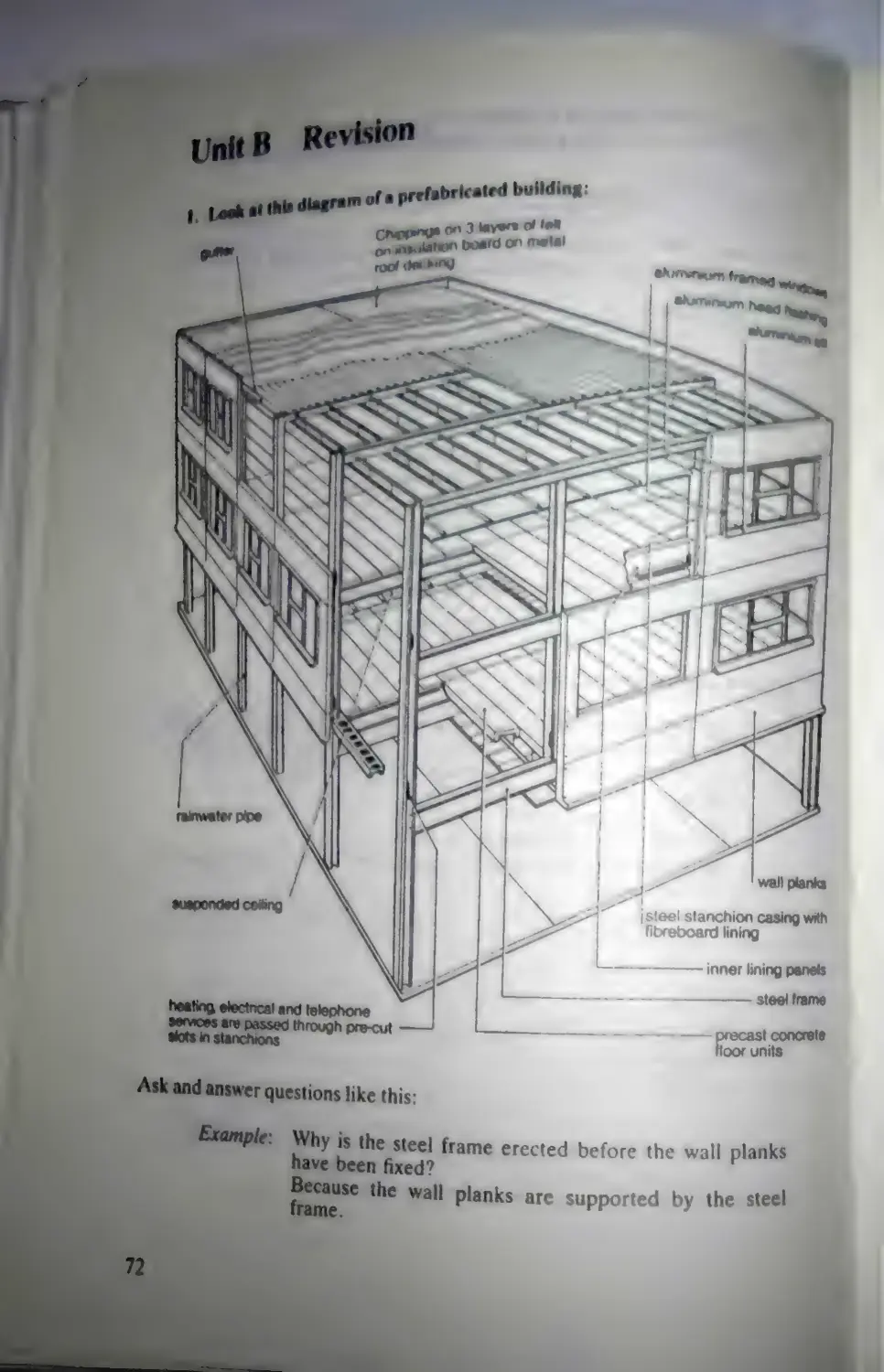
fibreboard lining
inner lining panels
concrete.
units
fe
Eui
с,
ү: steel frame erected before the wall planks —
E
are supported by the steel
Section
Make sentences saying what the dimensions marked on the ad
arc:
Example: The floor to ceiling height is 2 700 mm.
Яpn.ьd
ttl F
Su
у
3. Read this:
EE
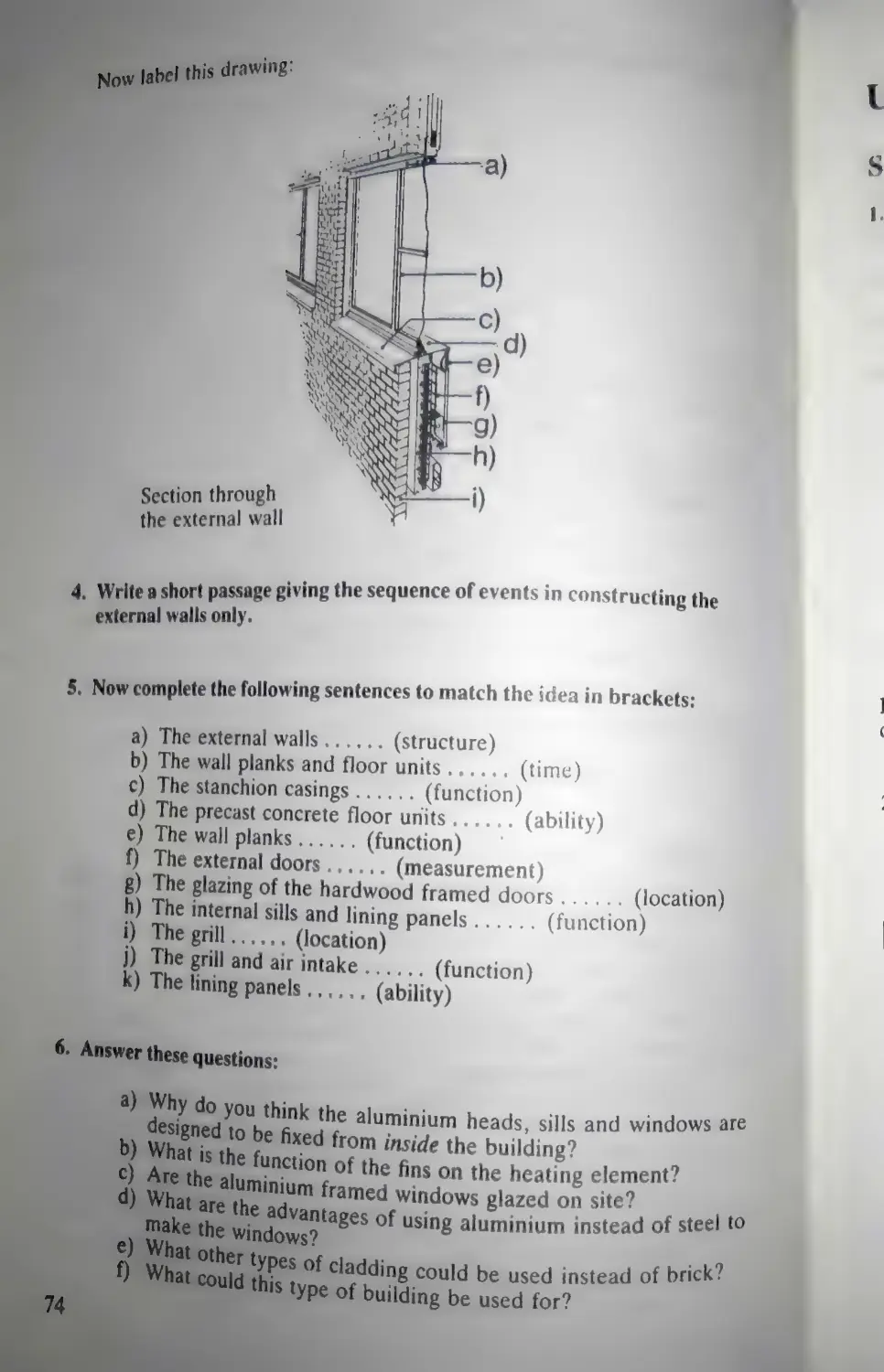
The external walls are made up of brick cladding, wall plank m 13
dows, doors, heads and sills, stanchion casings
and
i
n
n
e
r
lir vi
panels. While the steel frame is being erected, thewall р 1—
floor units are fixed, At the same time, the stanchionsare епс! E!
in casings which serve the function of resisting fire. Т
И
concrete floor units аге capable of — —
sq m. The wall planks are designedto be we proof and |Me |
port the outer cladding. The aluminium headillsand vindov
then fixed from inside the building. m
Юmmand
1 800 mm wide external doors are installed
doors are ‹
aluminium framed and pre-glazed.
is done on site. Finally, the internal.зїills and
l
i
n
i
installed. These form a cavity for t neang в
vices. A grill underneath the sill, togethe
skirting level, enables air toc
element. Thelining panels are
access to the —*
Serene
Die ies s
M. (ability)
(function) -
le external Чоог$...... (measurement)
he glazing of the hardwood framed doors ...... (location)
mal sills and lining panels... . (function)
Ш...... (location)
| ‘andairintake ...... (function)
nels ...... (ability)
"m
е aluminium heads, sills and windows are
trom inside the building?
o
f
the fins on the heating element?
med windows glazed on site?
ng aluminium instead of stee
Unit 7
—кх
Section 1 Presentation == = :
Or+—*
1. Look and read:
4
m
entrance hall -
teaching space >=
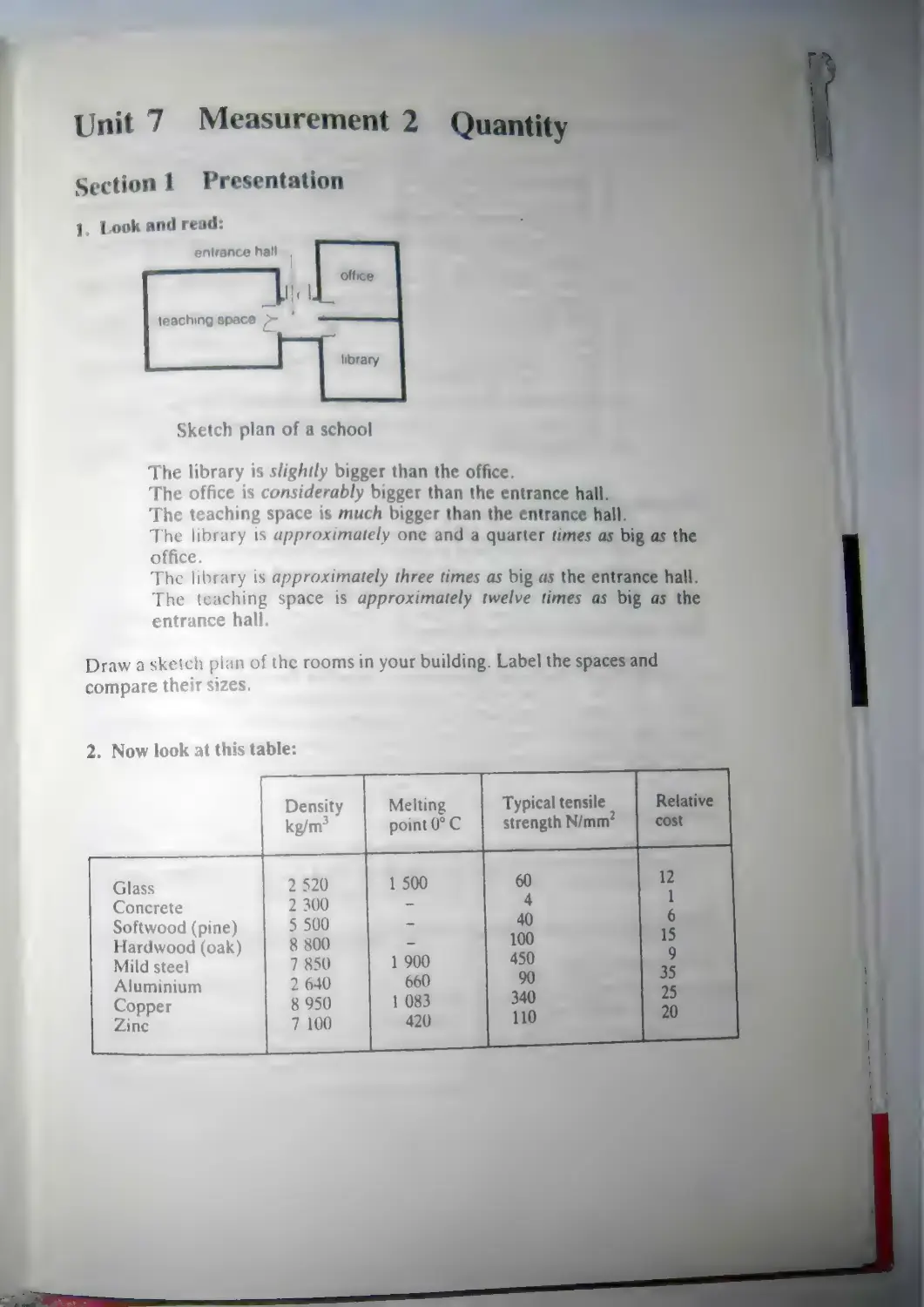
Sketch plan of a school
The library is slightly bigger than the office.
The office is considerably bigger than the entrance
The teaching space is much bigger than the entrance
The library is approximately one and a quarter timesasbigas
office.
The library is approximately three times as bigasthe entra nce
The teaching space is approximately twelve times as Dig
entrance hall.
я. ats,
Draw a sketch plan of the rooms in your building. Label the "HT e
compare their sizes.
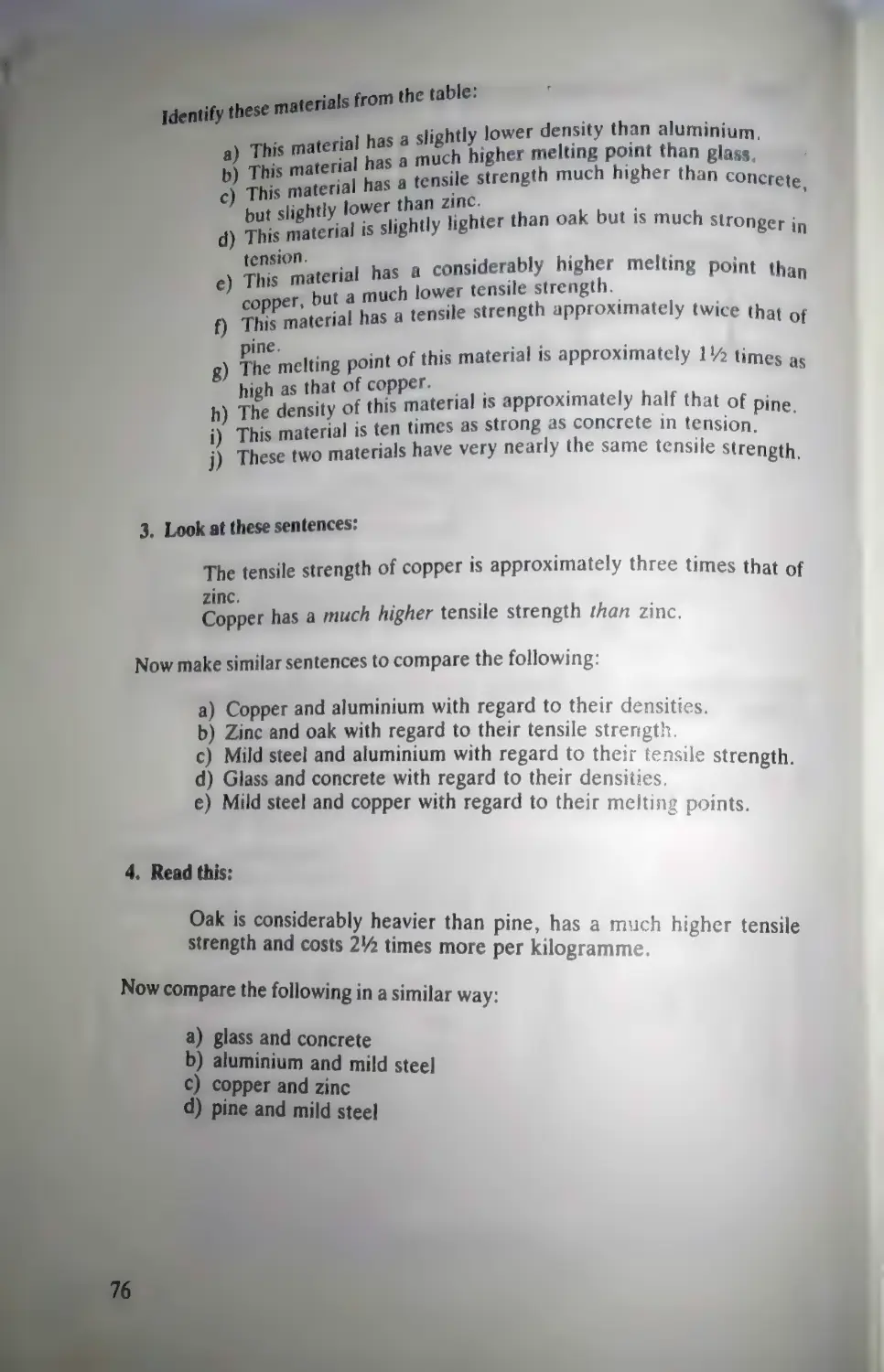
2. Now look at this table:
Typical tensile
Density
strengthNo
kg/m?
Glass
Concrete
Softwood (pine)
Hardwood (oak)
Mild steel
Aluminium
Copper
Zinc
puo
[ower density than ——
h
i
g
h
e
r
melting point than glass, =
le strength much higher than concrete,
1
Шур»: than oak but is much strongerjin
a considerably higher melting point than
materi has,lower tensile strength.
material has a tensile strength approximately twice that of
melting point of this material is approximately 1% times аз
pper.
highpus sniematerial is approximately half that of pine,
dШО,Сх rial is ten times as strong as concrete in tension,
Tdr two materials have very nearly the same tensile strength,
$ + " “ч,tensile strength of copper is approximately three times that of
Capper hasa much higher tensile strength than zinc.
'— similar sentences to compare the following:
8) Copper and aluminium with regard to their densities.
b) Zinceet oak with regard to their tensile strength.
с) Mild steel and aluminium with regard to their tensile strength.,
d) Glass and concrete with regard to their densities.
е) Mild steel and copper with regard to their melting points.
s considerably heavier than pine, has a much higher tensile
and costs 2% times more per kilogramme.
Building
component
aluminium
mild steel
melting point should
h
roof
%
covering
|
йге доог
mild steel
|5 vos NN
di
copper
be in excess of
YoELeec
4*E
$
1000°С
Use the above table together with the table in exercise 2, page 75,tomal |
conversations like the following:
lis:
a tensile strength
of not less than
35 N/mm?
weight should not
exceed 8 000 kg/m?
adim
cumwr:; What do you think is the best material to use for —
the cladding?
vA
К:
1s
ARCHITECT: Well, aluminium isn't really suitable. It's|
>.
enough but it's too expensive. 1 think we
use mild steel. It's not only strong enoughbutit
also cheaper.
^c TM
хуч
6. Make a list of the building materials found in your country. Compare — —
le
|
these materials from the point of view of cost, strength and арреа
Section 2 Development
7. Look and read:
Q1: Why is this person uncomfortable?
Because the temperature in the
A: | room is too low.
Because the room is excessively c
VAVAVAVAVAVAVA'
DEAE _ Window. area
sound insulation
AT | ge Sunlight
Person una
to read —
person unable
to hear music
person unhappy
excessive
window area
lack of privacy
ventilation
inadequate
= roof pitch too low
tiles not weather
resistant enough
person
uncomfortable
high humidity
——- person wet
ап wer questions about anthropometric dimensions by
diagrams of design situations in Unit 4, exercise 4, page 47:
Why can't this man stand up straight?
lecause the ceiling is too low.
5 a house, he often has to strike a balance
te ventilation and at the same time he -
в requirements. For example, he needs to — :
Section 3 Reading
10. Read this:
a) (designs size of win
dn Re
b) (designs window area) s
warr
c) (designs thickness of 11 ae
adequate sound insulation —
d) (designs ventilation system) sufficient.
humidity
i
e) (designs roof) cheap enough пае
proofing
Design of houses for tropical climates
í
E
The tropical regions of the earth can be divided into three major
climatic zones:
1. Warm-humid climates are found in a belt near the Equator ex-
tending to about 15° north and south. There is very little seasonal
variation throughout the year. The air temperature is never ex-
cessive, but there is considerable rainfall during most of the year.
Relative humidity (RH) is excessively high — at about 75% for
most of the time, but it may vary from 55% to almost 100% (RH.
should not exceed 70% for human comfort).
In this climate the rooms of houses must have adequate shade
and ventilation. Usually houses have an open layout so they can
gain maximum benefit from the prevailing wind. Walls have less
importance here than in other climates. They are used primarily
for screening from insects and for their wind penetration qual-
ities.
2. Hot-dry climates are found in two belts of latitude between
approximately 15° and 30° north and south of the Equator. Two
marked seasons occur: a hot and a slightly cooler period. Day-
time air temperatures are excessively hot (normally higher than
the 31°С to 34°С skin temperature), but at night it may fall as
much as 35*C. During the day there is too little cloud cover to
reduce the high intensity of direct solar radiation, However, at
night the clear skies permit a considerable amount of heat to be
reradiated to outer space.
—
In this climate houses must give adequate protectio ainst.
the excessive heat of the sun. Usually they have compact layouts
so that surfaces exposed to the sun are reducedas п S
ble. Walls should be very thick and made of
materials so they hold the heat of the day а
interior of the house at night. —
3. Composite or monsoon climates ате foui
near the tropics of Cancer and E
normally. Approximately two-thirds of t
the other third is warm-humid.
be suitable for one season maybe ил
ж
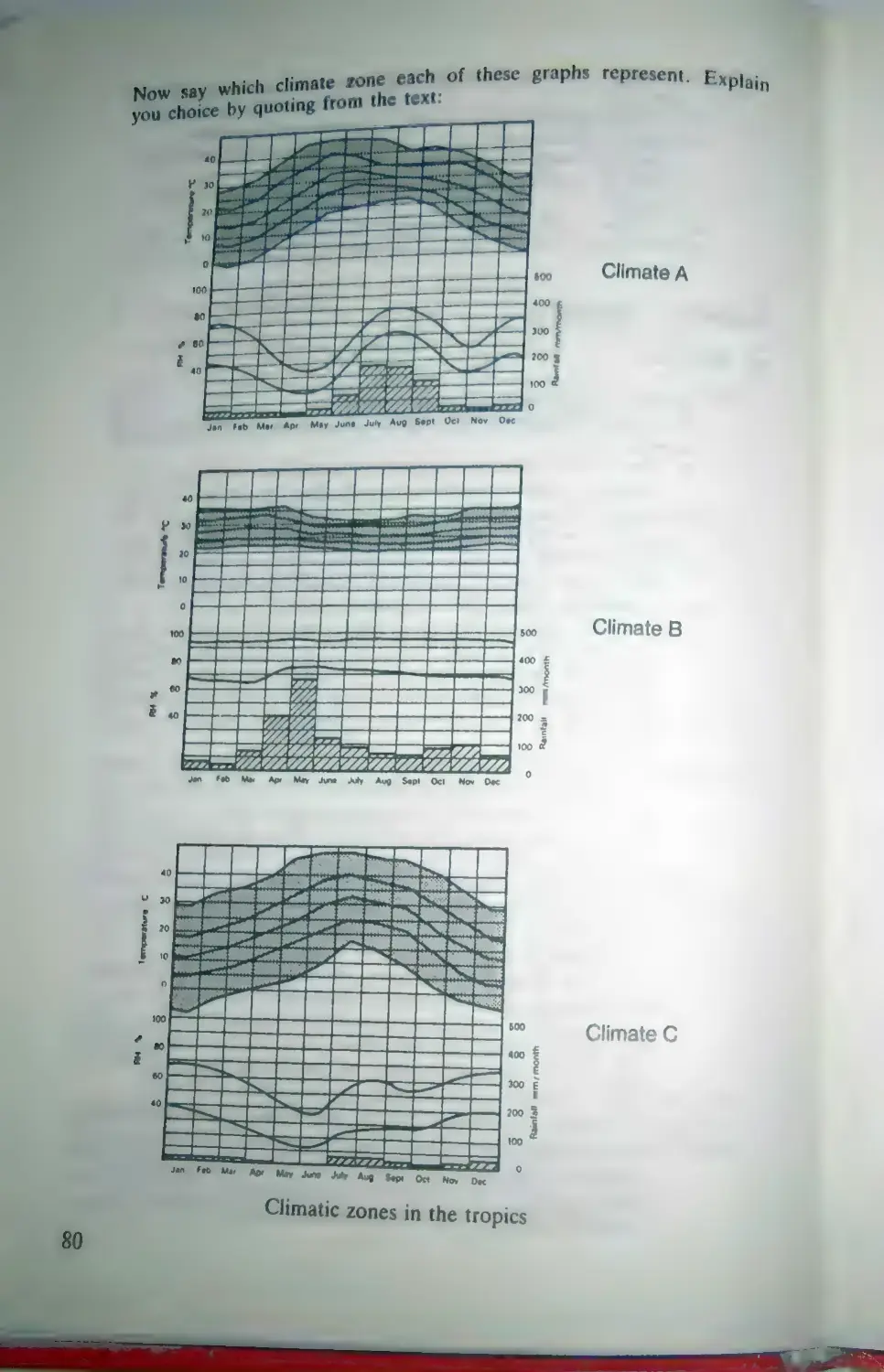
one each of these graphs represent. Explain
Чоп the text:
те Climate А
—— РА
2
ттл
Сїїтаїе В
ÈÉ
à
—
—
—
Nov Dec
—
о ааваа
m
ЕЕ SE|
"m
Climate C
400 i
300 E
E
200 &
100 à
—
——
Ар May. lune Jy Aug. Sept Oct Now Dec
12. Make statements saying when and — —
into account the following (which times ofthe year
a) excessive humidity
b) insufficient rainfall
c) excessive rainfall
d) excessive heat
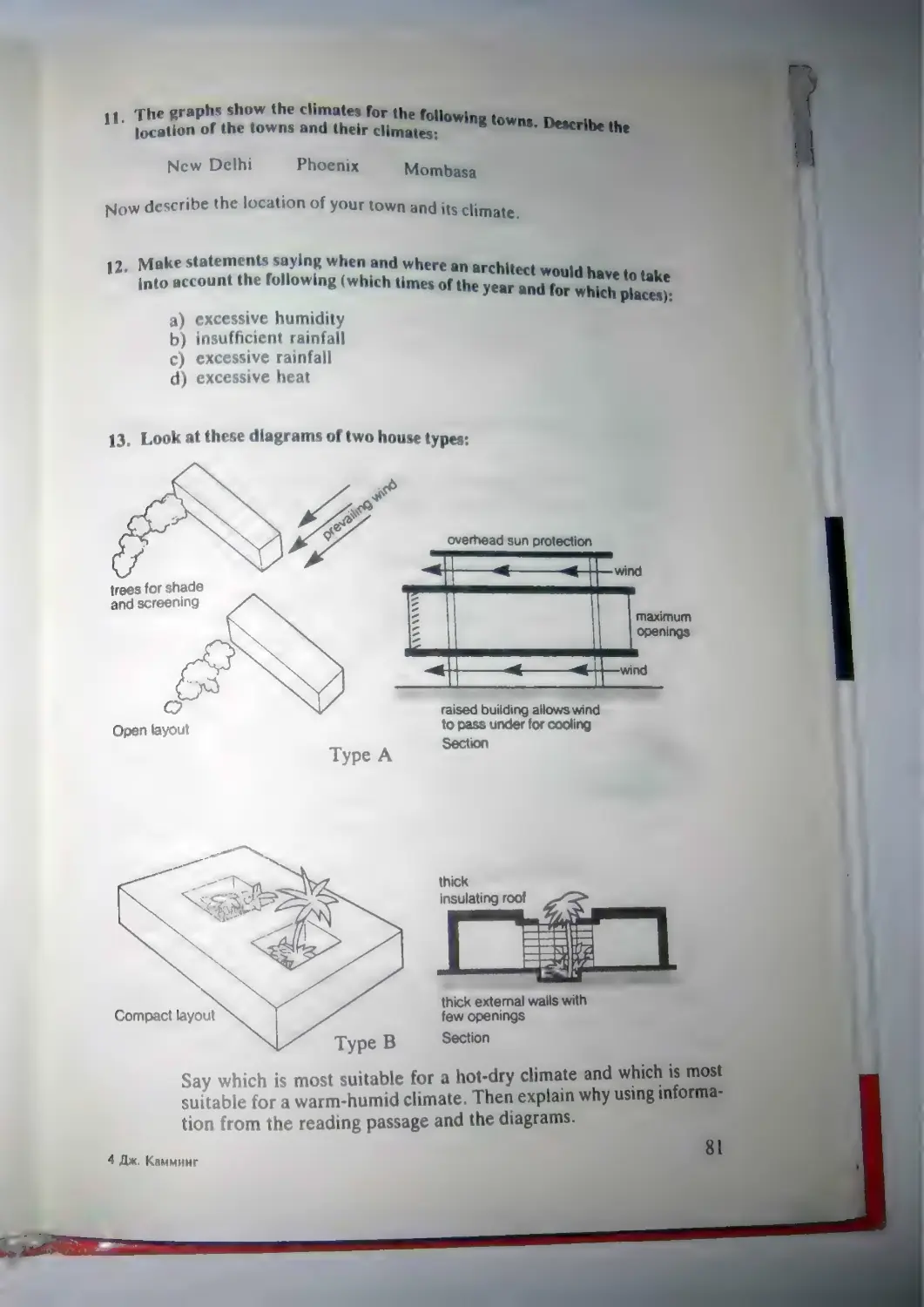
13. Look at these diagrams of two house types:
trees for shade
and screening
с?
Open layout
to pass under for cooling
Secti
і
Туре А
x
—
thick
insulating roof Ж:
у
mersa
LIN
Wr {|
g
a.
Compact layout
Type B
Say which is most suitable for a hot-dry cli
suitable for awarm-humid climate.
tion from the reading passage and thec
Ее
4 Дж. Камминг
7]
es designed to perform_
s storeys high. The ground floor
ux
| помquicklyatn $0thatitis
on the first floor during the ———— ра P
chsection through a house suitable for a composite climate
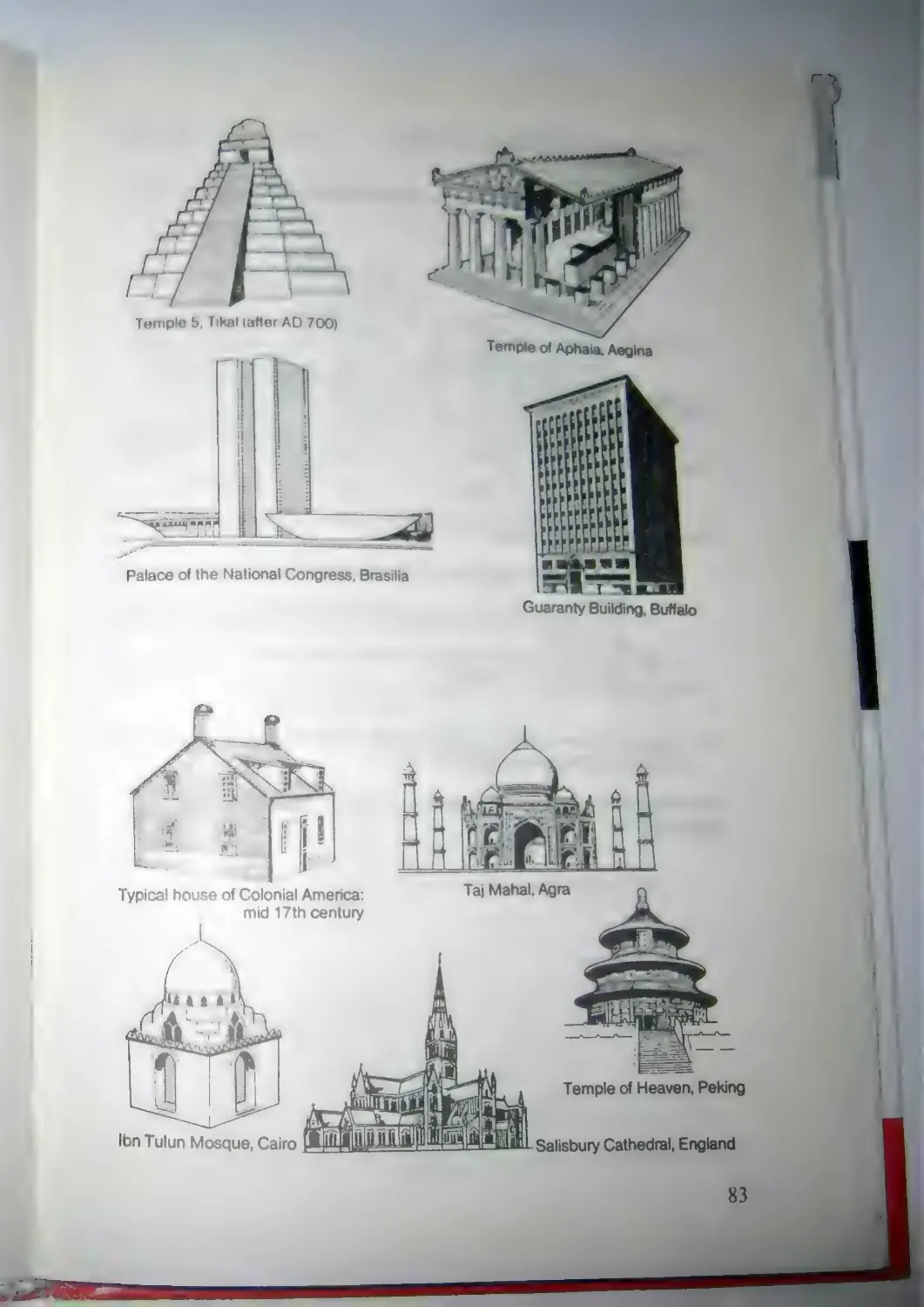
the following sketches of buildings from different parts of the
Comp - aha bulldings from the following points of view:
)йегет ЖЕЙ due to climate
ttypes of structure
ferentmaterials used for their construction
t uses of the buildings
ent social organisations and civilisations which use these
dings
Wigwam
Monolithic dwellings
о
Sum houh, бис БИ
ly
ugh excessively,
for the other. To solve this Mes Е
Palace of the National Congress, Brasilia
Guaranty Building, Buffalo
Typical! house of Colonial America:
mid 17th century
—
Ли
а
Ibn Tulun Mosque, Cairo [ШИШ
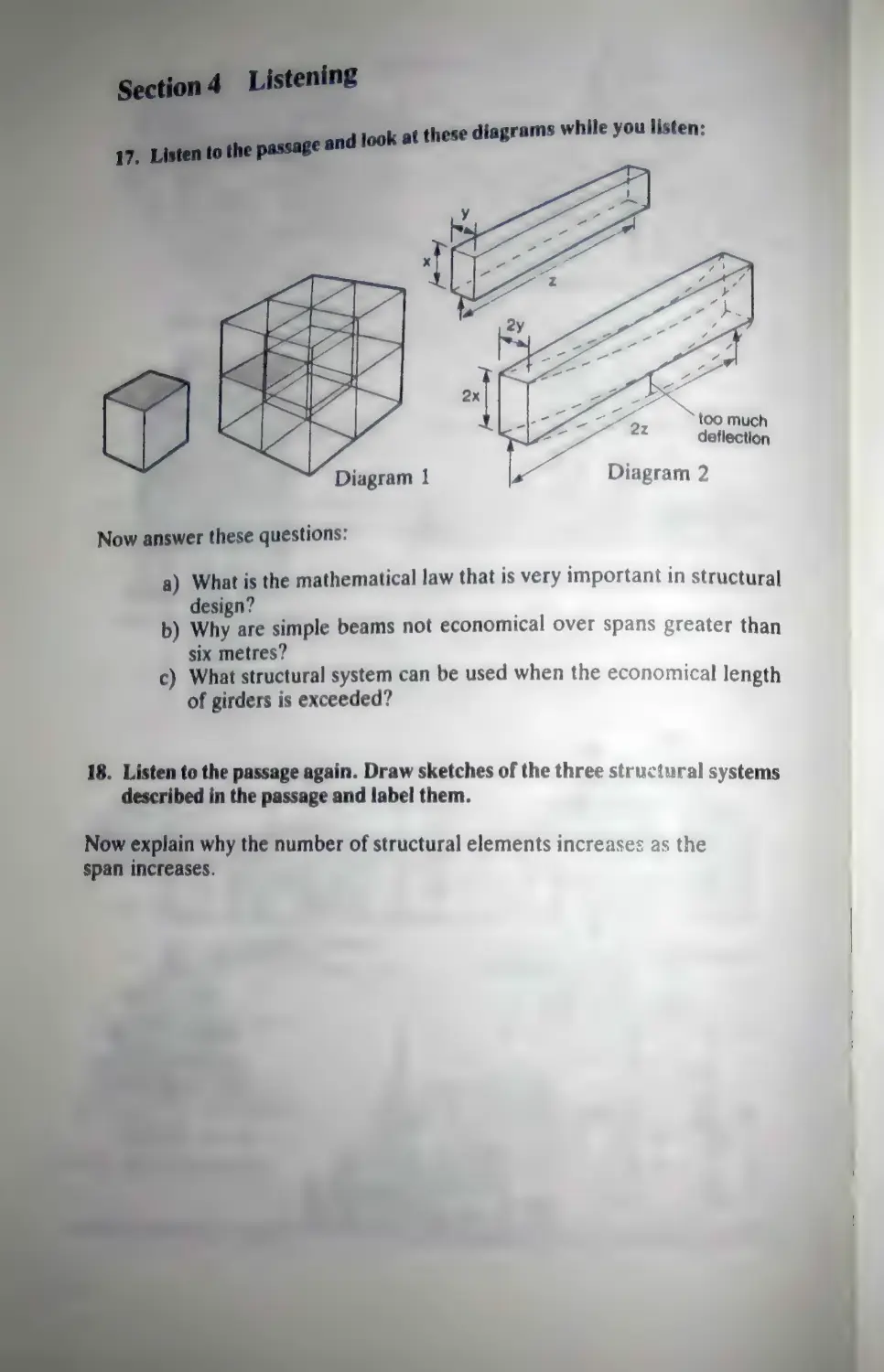
deflection
Diagram 2
Фу Why аге simple beams not economical over spans greater than
КА, ©) What structural system can be used when the economical length
f girders is exceeded?
‘to the passage again. Draw sketches of the three structural systems
d inthepassageand label them.
Unit8 F (ess 3
,
l
Bryas b
ep
NAд
Section 1 Presentation —
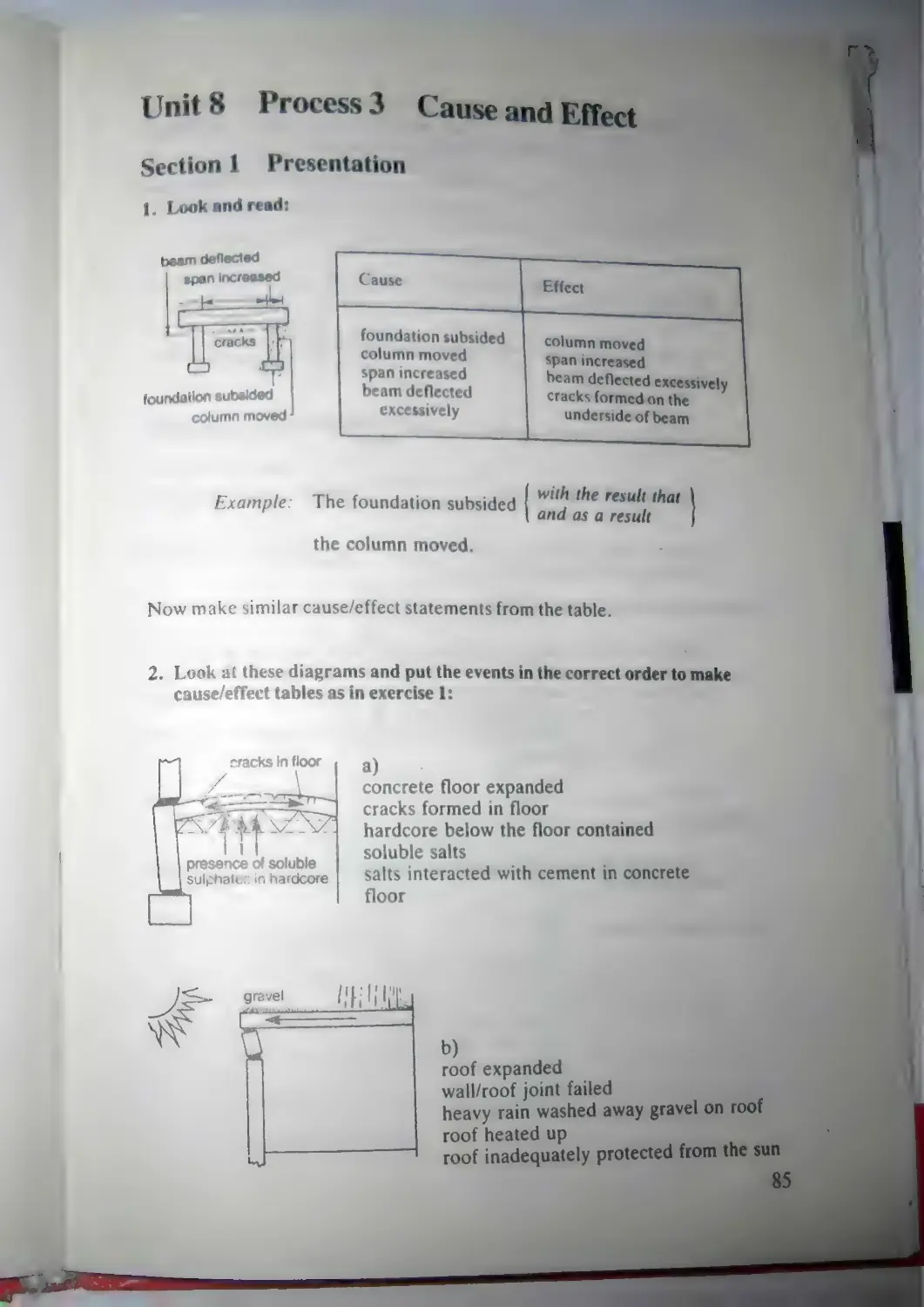
1. Look
and read:
lus
beam deflected
span increased
foundation subsided
column moved
span increased
foundation subsided
beam deflected
column moved
excessively
Example: The foundation subsided |rd MM | f 7r ::
the column moved.
‚wd A
eo
Now make similar cause/effect statements from the table.
+ othe
EEЖ
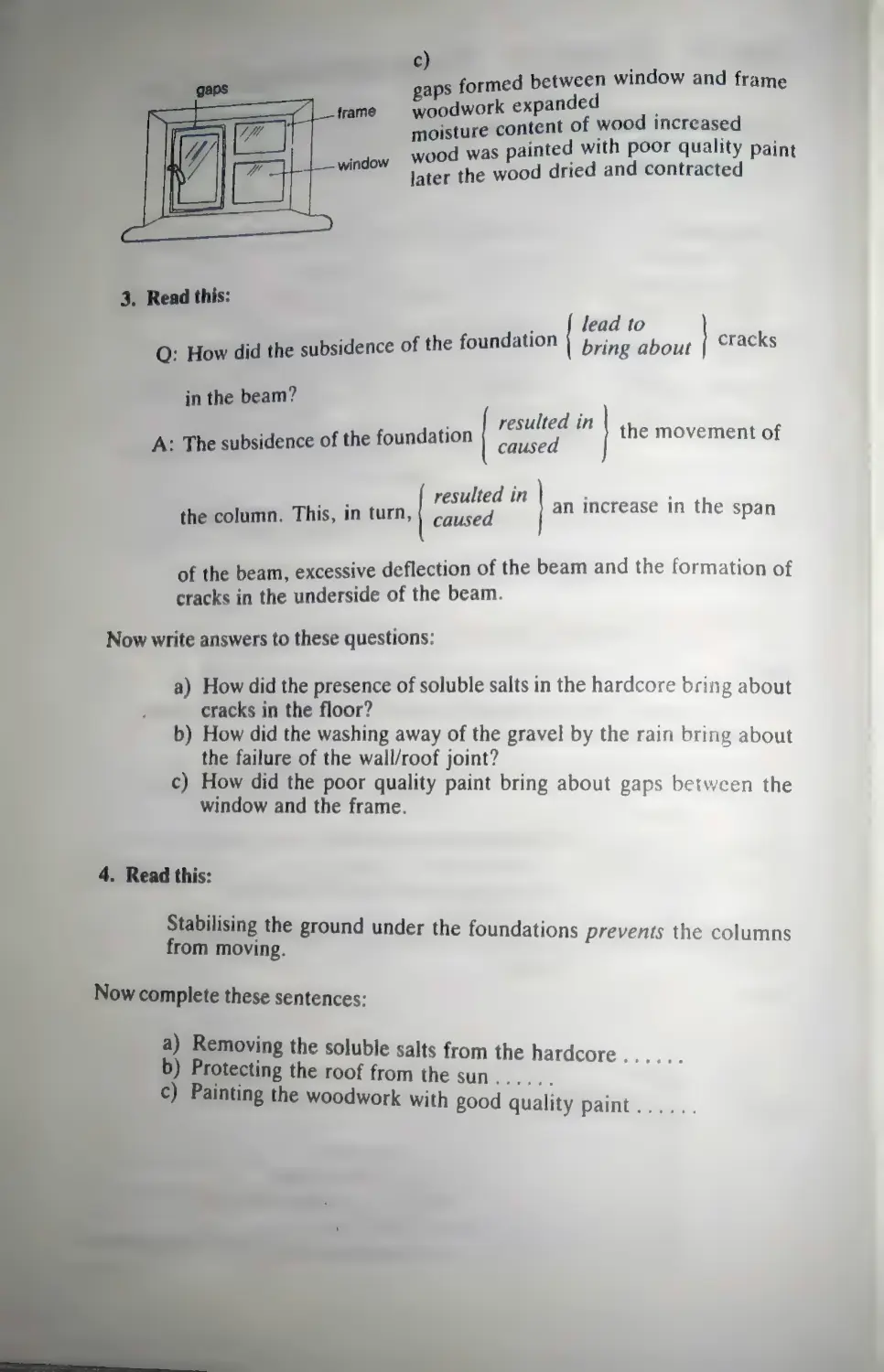
2. Look at these diagrams and put the events in the correct order
tomake
cause/effect tables as in exercise 1:
фе
Е fe$+
cracks in floor
a)
"à TE
concrete floor expanded
cracks formed in floor
Е
hardcore below the floor contained — —
ВСР ОША
soluble salts
sulphates in hardcore | Salts interacted with cementin "|. CO
г
floor
»
li;tl
1j
50 Ee, od
| Ns of wood increased
*
inted with poor quality paint
` later
e jêwood dried and contracted
|
А: Turge of the foundation |d y the movement of
resultedin А
А
the column,This, in тт, |БИШЕЙ. |an increase in the span
ET 25 ofthe beam, excessive deflection of the beam and the formation of
|. . cracksin the underside of the beam.
En
| Now write answers to these questions:
; E — a) How did the presence of soluble salts in the hardcore bring about
cracks in the floor?
E b) How did the washing away of the gravel by the rain bring about
EP. the failure of the wall/roof joint?
3
wo How did the poor quality paint bring about gaps between the
7
window and the frame.
g the ground under the foundations prevents the columns
oving.
ese sentences:
ing the soluble salts from the hardcore
g the roof pamE sun
s.s.s.’
ep
Mea i
—T
We have a problem with
because of
it
1goscn
cold. This is
to a certain extent, the temperature ie
thickness of the insulation. Consequently,
thickness of the insulation.
>
a) noise level
b) amount of light
c) degree of humidity
we
Section 2 Development
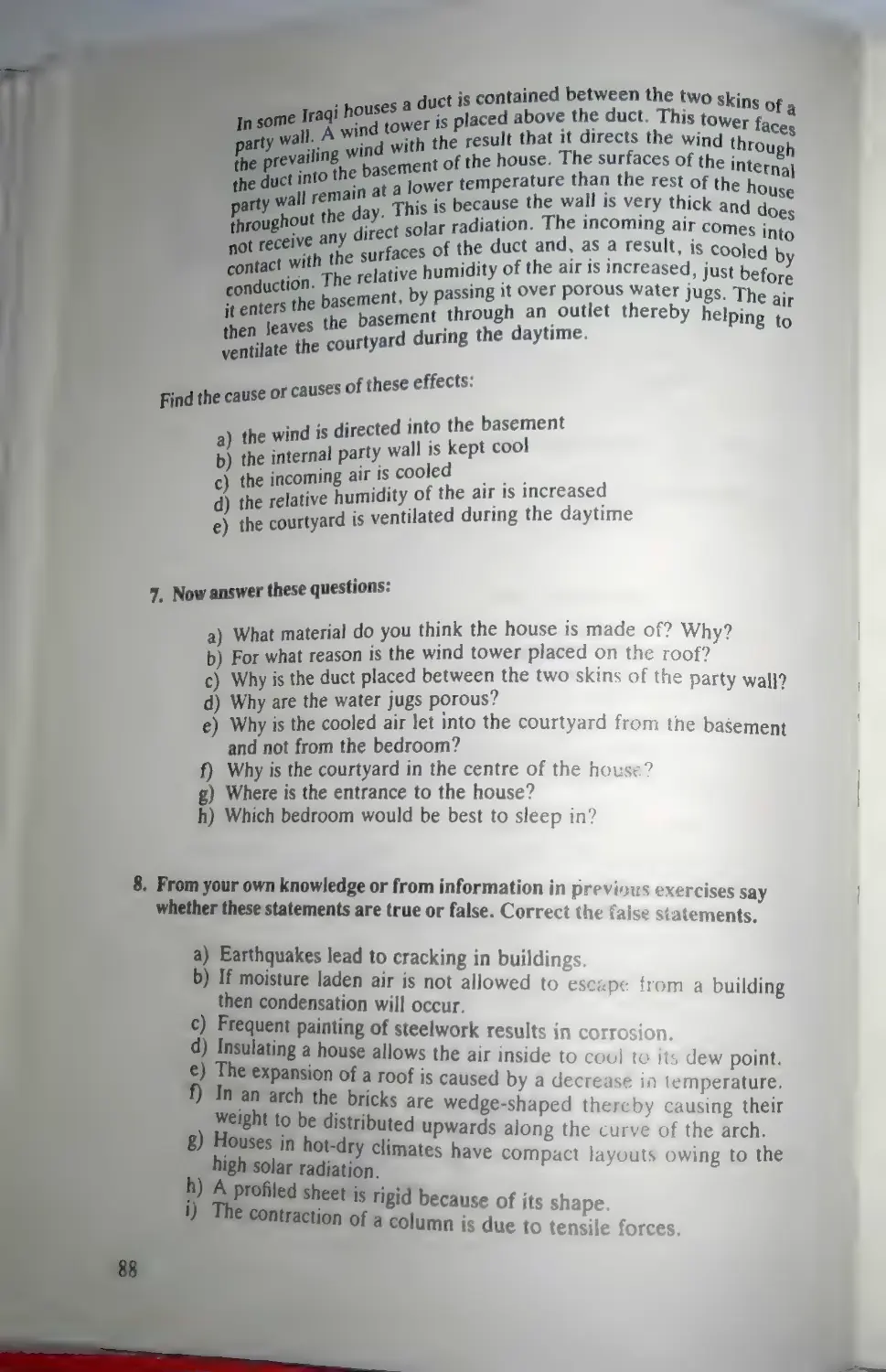
6. Look and read:
f
prevailing wind»
CI ا
(p
id
t
COS
|
a
t
mПП
ГЕ
family room
e
Section
f prevailing wind —— ⸗
T
S
courtyard
Enlarged section
is contained between the two skins of
en the house. The surfaces of the interna]
^t a lower temperature than the rest of the house
Thisisbecause the wall is very thick and does
solar radiation. The incoming air comes into
urfaces of the duct and, as a result, 15 cooled Ъ
О | i overporous water jatтү
н
assingitOve
er jugs. The air
Dr through an outlet thereby helping to
ate the courtyard during the daytime.
© més of these effects:
| me wind is directed into the basement
j T үш party wall is kept cool
j the incoming airis cooled — — А
` д) the relative humidity of the air is suse
‚) the courtyard is ventilated during the daytime
bүi
т
| _7. Now answer these questions:
M
e
ial do you think the house is made of? Why?
E Eun is thewind tower placed on the roof?
с) Why is the duct placed between the two skins of the party wall?
| E Why are the water jugs porous?
і|
_ е) Why is the cooled air let into the courtyard from the basement
_ . and not from the bedroom?
- f) Why is the courtyard in the centre of the house?
` в) Where is the entrance to the house?
^ ЕWhich bedroom would be best to sleep in?
ir own knowledge or from information in previous exercises say
these statements are true or false. Correct the false statements.
quakes lead to cracking in buildings.
lure laden air is not allowed to escape from a building
idensation will occur.
nting of steelwork results in corrosion.
‚а house allows the air inside to cool to its dew point.
sion of a roof is caused by a decrease in temperature.
the bricks are wedge-shaped thereby causing their
istributed upwards along the curve of the arch.
climates have compact layouts owing to the
igid because of its shape.
olumn is due to tensile forces.
Ше2
placed above the duct. This tower faa
| the result that it directs the wind through —
Section 3 Reading
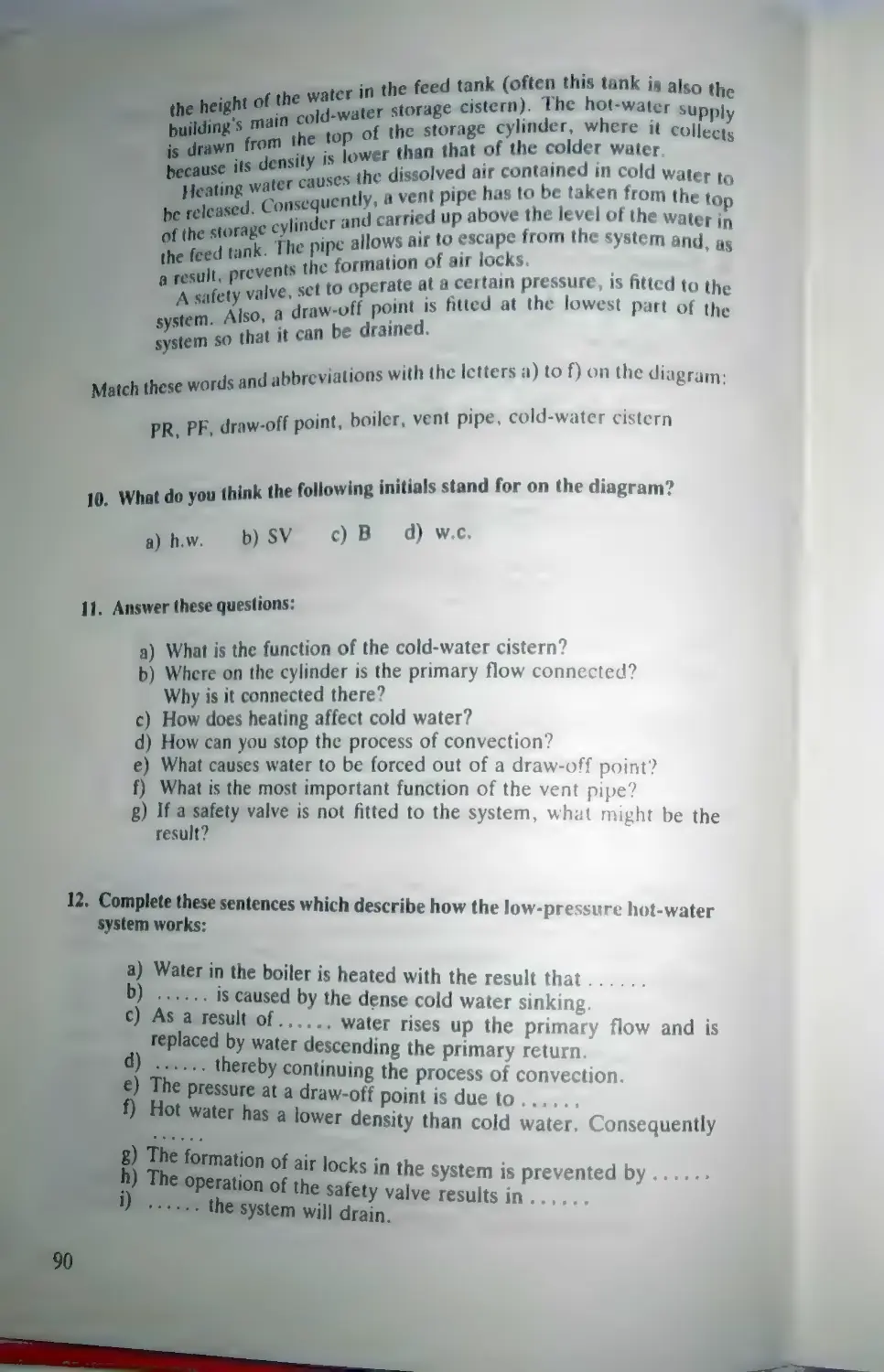
9. Look and read:
rising main
—
hot-water
storage cylinder
1?
nt
А low-pressure hot-water system is shown in thed
the boiler is heated, and consequently beco
cold water in the higher parts of the system. Theí
1р
|
sinks to displace the heated water, whichis f
|
way, a circulation of water is setup —
|
convection. The water rises up the priB че
t.
hot-water storage cylinder, or tank,
{
descending the primary return (PR). it.
ir
|
maintained between the water in the pr
|
primary return, then the process will с
үр
primary circulation and it is made
m
o
i
primary flow to the upper region o
cylinder, and the primary return to
draw-off point is opened, wate
| tank (often this tank isalso th,
ge cistern). The hot-water supply
yf the storage cylinder, where it collects
ег than thatof the colder water,
dissolved air contained in cold water to
Ну, avent pipe has to be taken from the to
carried up above the level of the water jn
allows air to escape from the system and, ag
formation of air locks.
|
t to operate at à certain pressure, is fitted to the
п paintis fitted at the lowest part of the
itcan be drained.
breviations with the letters a) to f) on the diagram:
ıw-off point, boiler, vent pipe, cold-water cistern
thinkthe following initials stand for on the diagram?
4
c)B d)wc.
n
a
t
isthe function of the cold-water cistern?
Whereon the cylinder is the primary flow connected?
Why is itconnected there?
How does heating affect cold water? — —
How
can you stop the process of convection?
|
М uses water to be forced out of a draw-off point?
| What isthe most important function of the vent pipe?
ее is not fitted to the system, what might be the
the boiler is heated with the result that
sed bythe dense cold water sinking.
»*»« Water rises up the primary flow and is
descending the primary return.
tinuing the process of convection.
-off point is due to......
density than cold water. Consequently
inthesystem is prevented by ......
results in..,...
Section 4 Listening —
13. Look at the way these terms can be abb
structural failure
: str flr
faults in design
: fits in dsgn
reinforced concrete — : r.c.
Now make your own abbreviations of these terms foruseine
high alumina cement
collapse of beam _ bur
earthquakes
foundations —
tensile strength
chemical reaction
strain on structure
roof support/wall =
natural causes
ETT
14. Now listen to the dialogue and use the abbreviations to complete these
notes:
Causes of ou m ЩИ
|
Тһеге аге
types of cause:
|
These may be due to mistakes by
ог
|
Ege AN ОКА beams
|
cause: insufficient
|
result: .CM affected,
CAUSES ......
egra) 3 099
"n
effect: (i) shake
(ii) causing stress and ......
leading to (iii) ......
b) Other causes include
and
c) In normal conditions, failure caused by...... |
dj, s
4
I5. Now use the notes to write two paragraphs on the causes
failure.
Plan of a building
0
way
1
ауе) the length and width of Room A is 5 : 3 (five to
| OM the lengthandwidth ofRoomB is3:1(threeto
и . [relatively narrow.
е RoomBis |proportionately narrower.
| diagrams showing the relation between size and
—-—- Structure
Dir c
Micro-wave tower
Towers
Tropical house
tial buildings
е) What
isthe ap
of the block of:
f) What is the approxi
of the tropical house and
) Which building has longer
h) What is the approximate ratio b
of the columns of the block of flats’
slenderness ratio.)
пн
i) What is the approximate ratio between the|
of the columns of the tropical house?
j Which building has proportionately thicker cc
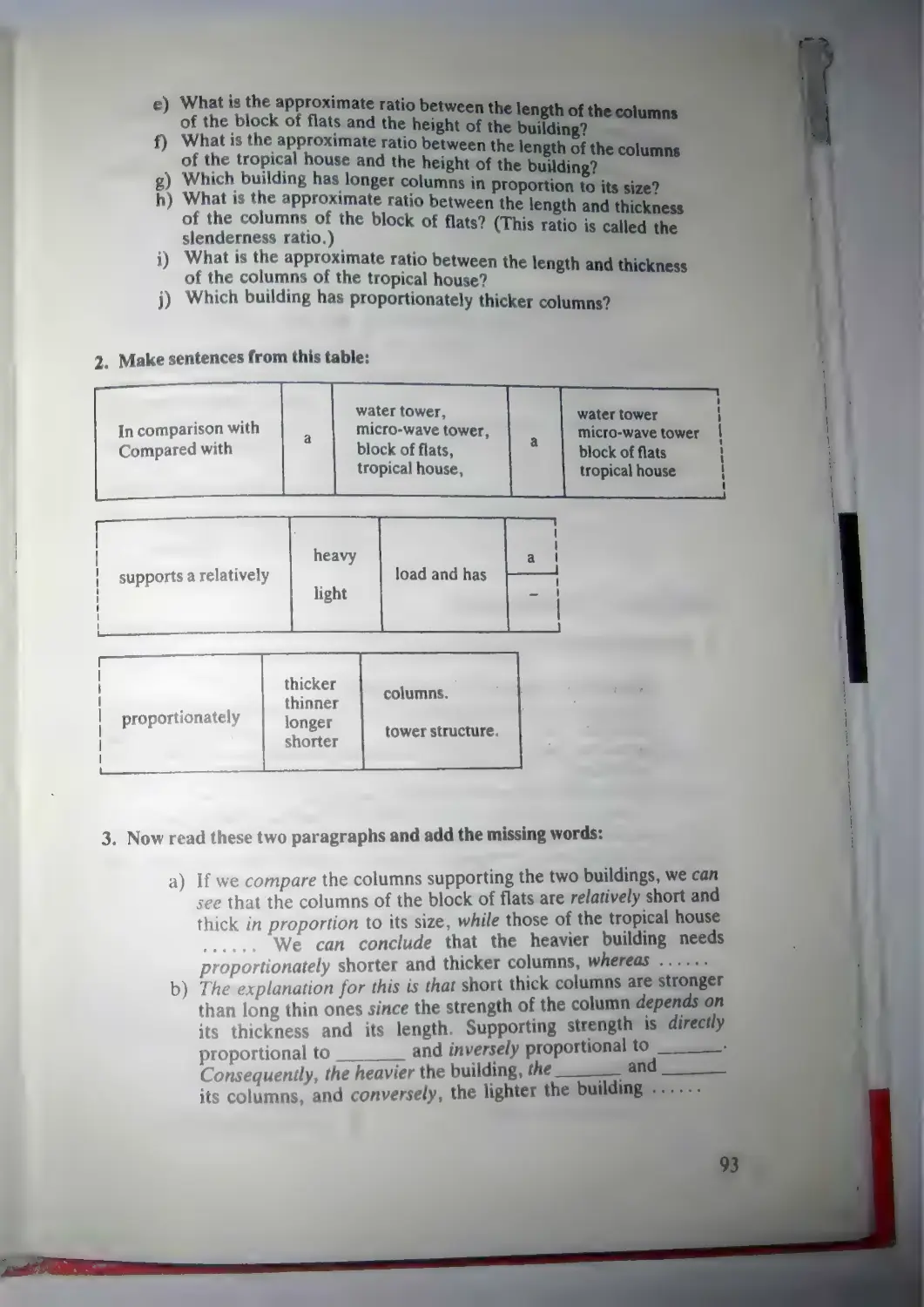
2. Make sentences from this table:
water tower,
micro-wave tower,
block of flats,
tropical house,
In comparison with
Compared with
heavy
load and has
|
|! supports a relatively
|
light
|
|
=
|
|
thicker
m
Р
ac
|
ERR:
columns.
rinm
| proportionately
longer
|
|
shorter
tower structure.
тпа
|
—اا
3. Now read these two paragraphs and add the missing words: _
.
\
t
a) If we compare the columns supporting the two buildings, we са
see that the columns of the block of flats are relatively shorta
thick in proportion to its size, while those of the tropical һ
Meer We can conclude that the heavier building
proportionately shorter and thicker columns, W
b) The explanation for this is that short thick columns ar
than long thin ones since the strength of the colum
its thickness and its length. Supporting stret
proportional to
and inversely proporti
Consequently, the heavier the building, the
its columns, and conversely, the lighter t
A. rl
stow itetwosimilarparagraphs Ж
Be
Е 5 e’ for ‘columns’ and ‘tower’ for ‘building’
cessary changes.
|
mes
`
1
)
.
are true or false. Correct the false
between the hei ht and width of the micro-wave tow
than that ine the height and width of the ims
1:3 is a higher ratio than 1 : 2).
ctüre of the water tower has to support less weight than
the micro-wave tower.
t
of the block of flats have greater supporting
agt than those of the tropical house. i
,|
strength of acolumn isdirectly proportional to its height and
versely proportional to its thickness.
"Compare with a micro-wave tower, a water tower has a
ж
vely tall structure.
1
^ e lighter the load on a tower, the thicker its structure,
| р)Similarly, the heavier a building, the thinner its columns,
p
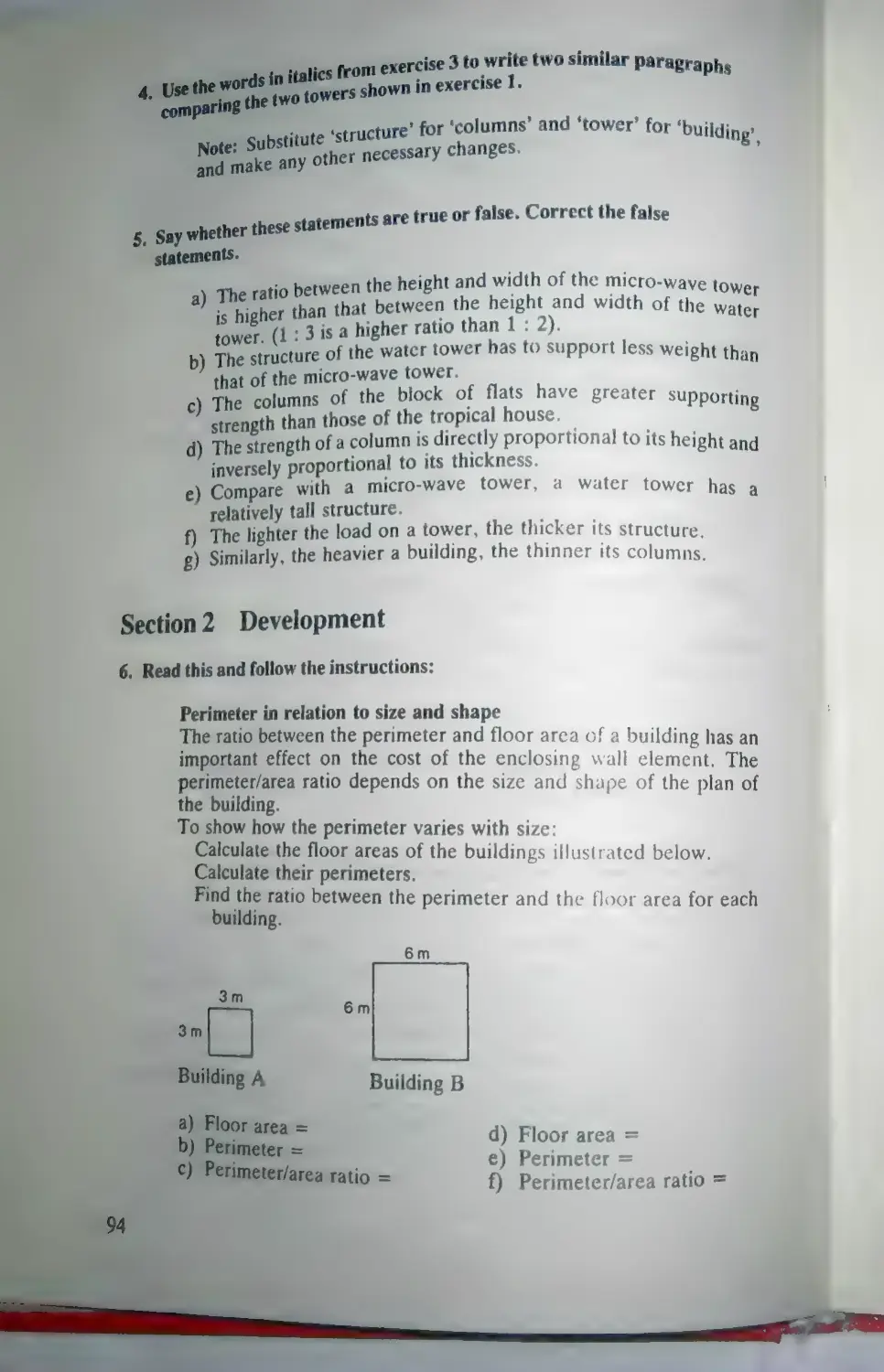
` Perimeterinrelation to size and shape
—— — The ratio between the perimeter and floor arca of a building has an
= important effect on the cost of the enclosing wall element. The
Bv E ratio depends on the size and shape of the plan of
building.
ow how the perimeter varies with size:
alculate the floor areas of the buildings illustrated below.
culate their perimeters.
the ratio between the perimeter and the floor area for each
=:
J o: teBos
РА
Building B
d) Floor area —
€) Perimeter — |
f) Perimeter/area ratio =
Now complete these statemen
g) By comparing the ratio of
buildings we can see that the
perimeter/area ratio, — а а —
h) We gu papi that smaller buildingsh
or shorter) perimeter in proportion to
buildings.
PPP ШШ
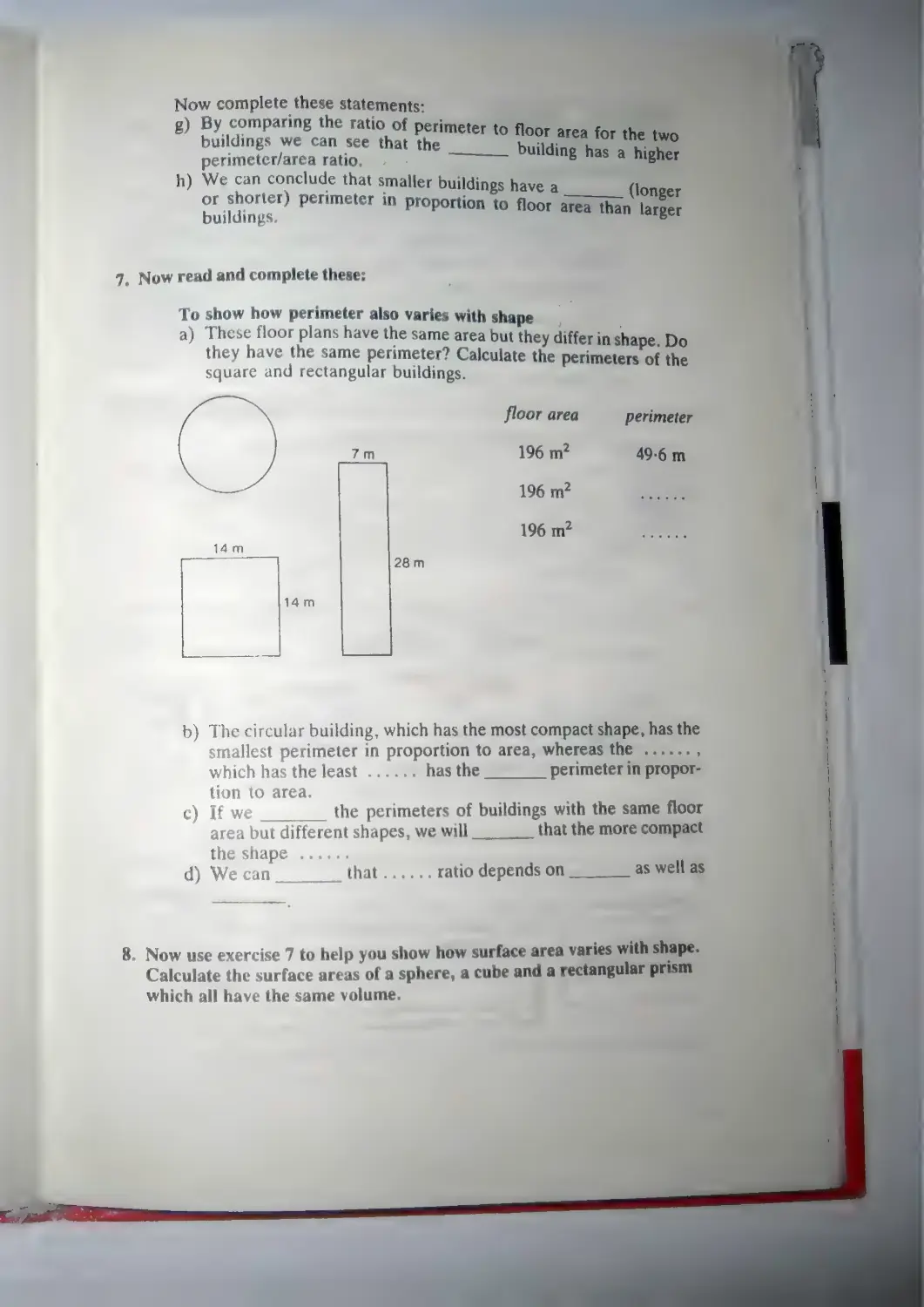
7. Now read and complete these:
A>
"AQ qi.
'To show how perimeter also varies with shape » —* am
a) These floor plans have the same area but theydifferinsh
they have the same perimeter? Calculate the perimeters of thi
square and rectangular buildings.
“= ке
=
floor area —
7m
196m —
196 m?
196 m?
b) The circular building, which has the most compact shape, hasthe
smallest perimeter in proportion to area, whereas
Wc
which has the least ...... has the
perimeter in
p
r
o
p
i
tion to area.
|
c)Ifwe
the perimeters of buildings with the same floor
area but different shapes, we will___ that the mo :
the shape ......
d) We can
that aiea ratio depends on
8. Now use exercise 7 to help you show how surfacearea vé
Calculate the surface areas of a sphere, a cube and a
r
e
which all have the same volume.
"NI CUT
EET= Г
з: БИГ: domo эй?
йелvttym үл Iu
(4
"ad "OW
Tu
rface area/volume ratio in architecture
en surface area and volume has many effects оп
е ofbuildings. For example, the rate at which a |
form s or loses heat through its walls depends On its surface
|
ne e ratio. Heat transfer is directly proportional to surface +
з inversely proportional to volume. Thus a building with а
tionately large surface area, such as a one room house, wil]
props gainheat relatively rapidly. Conversely, a building with a
1 volume inrelation to Из surface area, such as a block of flats,
will retain |
at.
we
k Po "шори а building are reduced by using insulating
materials such as expanded polystyrene. Thickness of insulation
_
js in inverse proportion to heat transfer.
——
heat loss
temperature temperature
25°С 18°С
;
inside
i
temperature gradient
;
= 25-18
insulation |
zo
|
Its from these tables:
air temperature
gradient.
thickness of
insulation.
surface area.
volume,
proportional
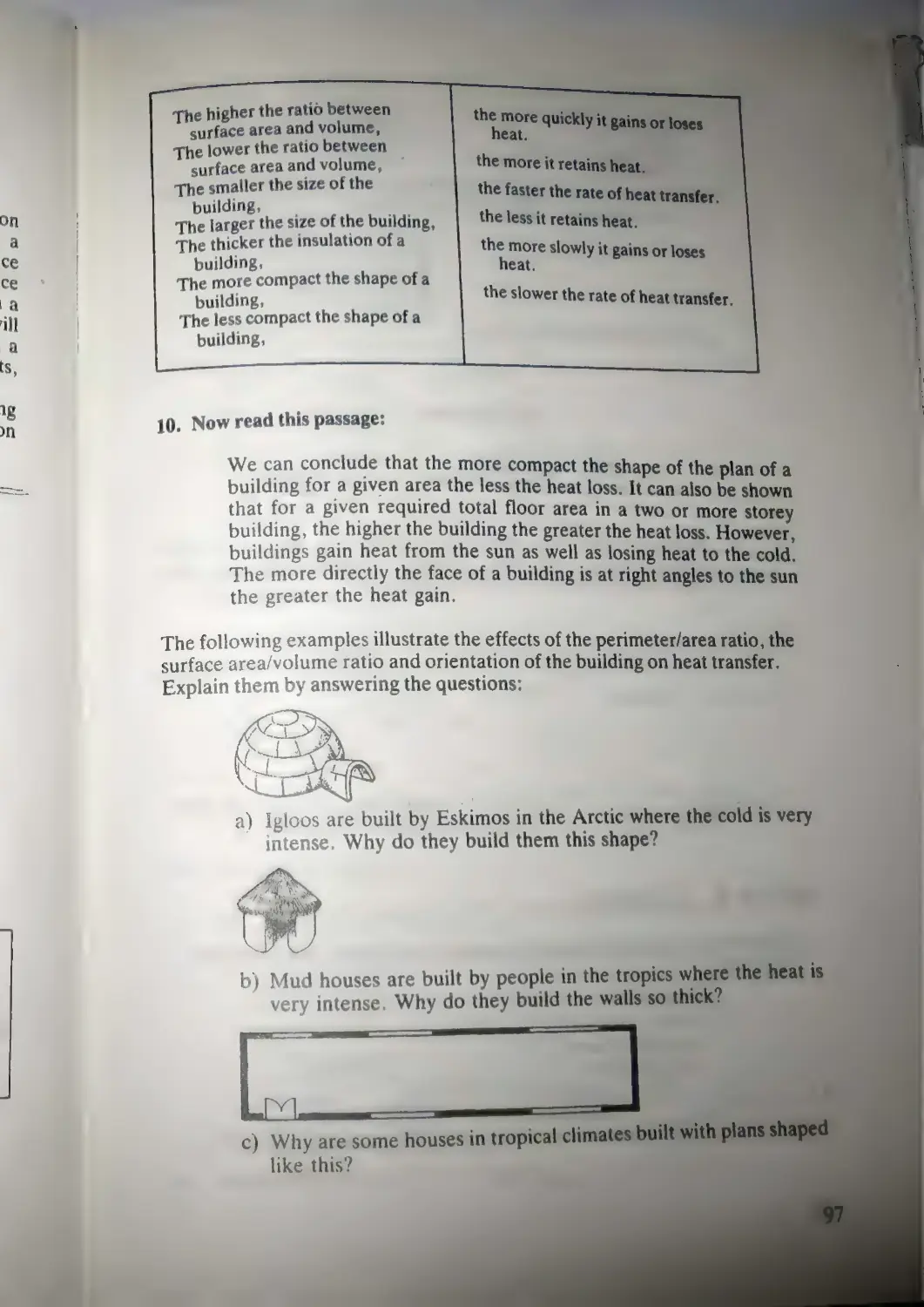
The higher the ratio bei
surface area and volume, ———
The lower the ratio between _
surface area and volume,
|
The smaller the size of the
isti
building,
»
The larger the size of the building,
А
The thicker the insulation of a
Р
building,
ы.
The more compact the shape of a
а
building,
ill
The less compact the shape of a
a
building,
($,
lg
;
n
10. Now read this passage:
We can conclude that the more compact the shape of the pl
==.
building for a given area the less the heat loss. It can also be
that for a given required total floor area in a two or more
building, the higher the building the greater the heatloss. I
Pin gain ne iur the sun as well as losing heat و
e more directly the face of a building is at right angles to the
the greater the heat gain.
à печа
The following examples illustrate the effects of ће perimeter/area rati
surface area/volume ratio and orientation of the building on heat tra’
Explain them by answering the questions:
1,
otя*у4
a) Igloos are built by Eskimos in the Arctic wher
intense. Why do they build them this shape?
b) Mud houses are built by people
very intense. Why do they buil
ut «T
2| Building =
чт
TUR
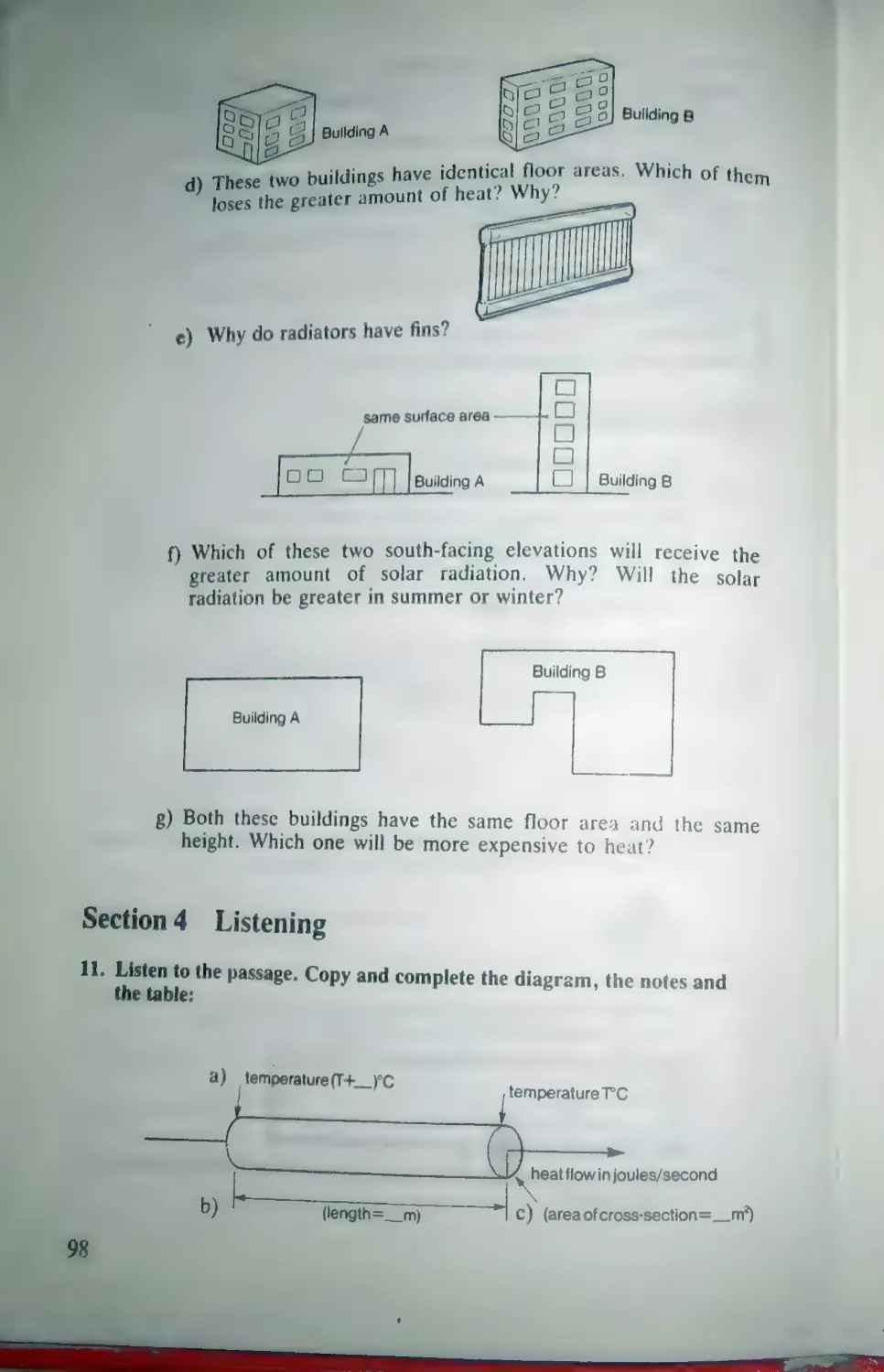
۳ e Why do radiators have fins?
چا
E".
o
O
same surface area
CJ
i
C]
Cl
|
ade ade *
[no ёт Building A
| Building В
-Г
EOX
$n
pea f) Which of these two south-facing elevations will receive the
= greater amount of solar radiation. Why? Will the solar
radiation be greater in summer or winter?
e^
*
Building B
Building A
ET
|
g) Both these buildings have the same floor area and the same
_
height. Which one will be more expensive to heat?
вех n
mn to the passage. Copy and complete the diagram, the notes and
ЖУ
is day
BVLey
wss
4) temperature (T-+__)°c
temperature T°C
heat flowin joules/second
C) (areaofcross-section=__m’)
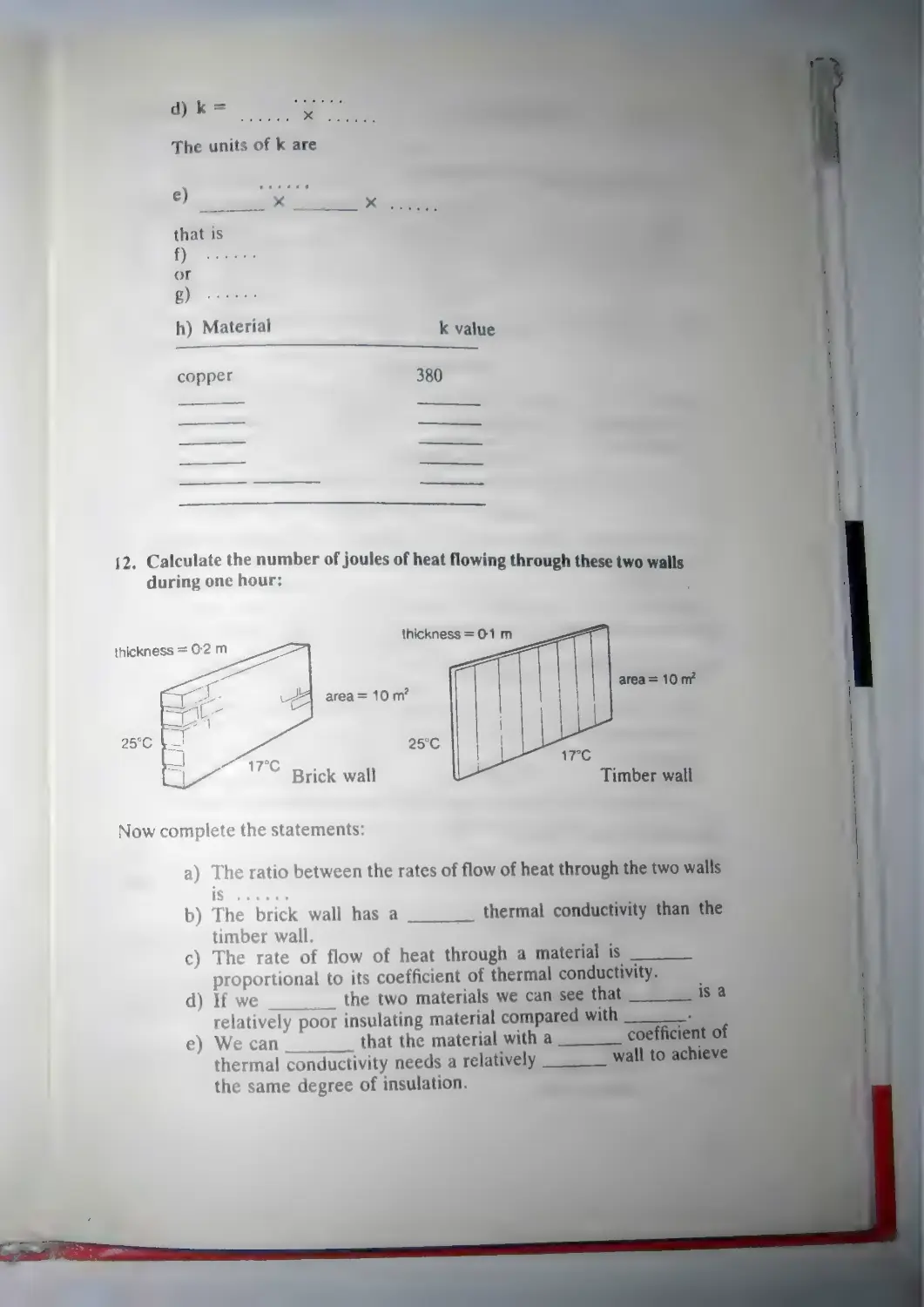
12. Calculate the number of joules of heat flowing throu h these хайы
during one hour:
p g two walls
thickness = 0'2 m
Now complete the statements:
Г
d) k=
The units of k are
e)
ESs
>
h) Material
k value
380
|
рүе) |J
thickness = 0:1 m
area=10т?
25°С
17€ Brick wall
a) The ratio between the rates of flow of heat through
ИА
рис
b) The brick wall has а
thermal conduct
timber wall.
үр|
c) The rate of flow of heat through a m
proportional to its coefficient of thermal
d)Ifwe
the two materials we
relatively poor insulating material compar
e) We can
that the material with а
thermal conductivity needs a r
the same degree of insulation. -
Eu
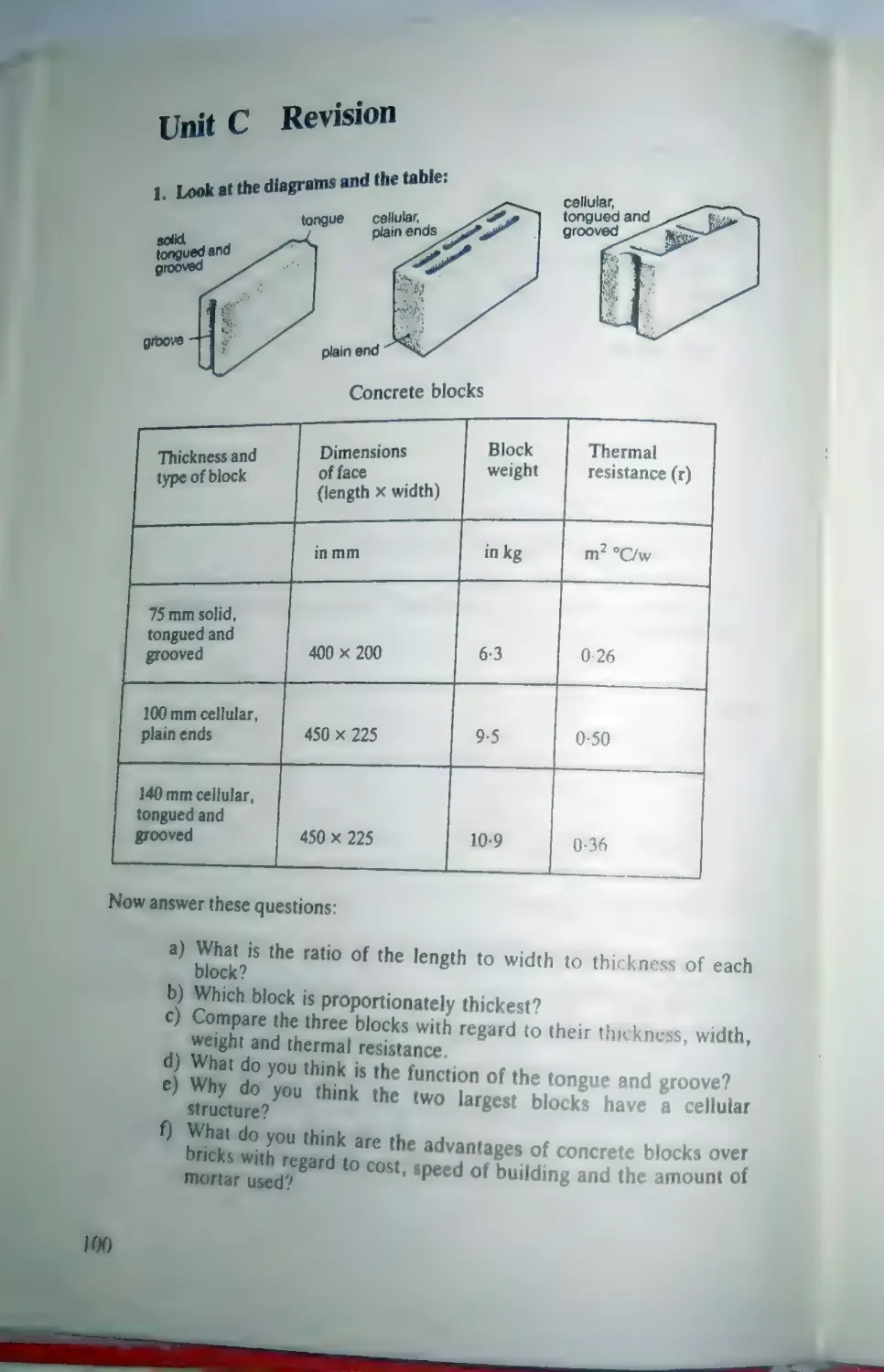
jagramsandthetable:
plain end
Concrete blocks
Thermal
resistance (r)
Dimensions
offace —
(length x width)
roportionately thickest?
blocks with regard to their thickness, width,
stance,
|
the function of the tongue and groove?
two largest blocks have a cellular
the dvantages of concrete blocks over
t,Speed of building and the amount of
2, Read this:
Е ‚>age“
Stability of concrete block walls
Block walls should be designed so that
overturning. Walls may be divided into a йез c
ity provided by connecting the edges of the panel
are capable of transmitting the lateral forces to the.
length or height of the panel in relation to the thic
has to be limited. The limits for three ER design situa
described below and may not be ехсееде
gn tug
From the text complete the following sentences to match the ideain *t
brackets:
——
dad
a) Block walls ...... (ability)
^
b) The height of the panel ...... (proportion
ЕРЕС:
с) The edges of the panels ...... (structure) :
xdi =.
d) The panel supports ...... (ability)
Eins. P |
And this sentence from your own experience:
=
e) If a wall is too thin ...... (cause and effect)
3. Continue reading:
Design situation 1
bendi 48
Walls with adequate lateral restraint at both ends but not at the top
(i) The panel may be of any height provided the length does not
exceed 40 times the thickness; or
(ii) The panel may be of any length provided the height does not
exceed 15 times the thickness; or
(iii) Where the length of the panel is over 40 times and lessthan 59
times the thickness, the height plus twice the length mas exceed—
133 times the thickness.
Design situation 2
Walls with adequate lateral restraint at both ends and at the10р f
(i) The panel may be of any height provided the length —
exceed 40 times the thickness; or
(ii) The panel may be of any length provided the height does 1
exceed 30 times the thickness; or
(iii) Where the length of the panel is over 40 times and le
times the thickness, the length plus three times the hei
exceed 200 times the thickness.
1
д
i
Design situation 3
f
Walls with adequate lateral restraint at the top |
The panel may be of any length provided the hı
30 times the thickness.
а
| stionsin the drawings:
"m. x
Ф Work out ifany of the walls are unstable because their design limits have
MS —5 — and make sentences like this:
А
stable b
unstable | ?*Càuse its
does not exceed |40 times its thickness,
exceeds
]
Example: The 75 mm solid block wall is |
length |
4. Read this:
The thermal resistance of a materialand the thickness of that
material used in a roof determine the loss of heat through a roof,
Я
Poor insulants have high k-values whereas good insulants have
n.
very low k-values. Increasing the thickness of the insulation laid on
Ex
A a roof will increase its resistance to heat loss in direct proportion.
JE
Thus the thermal resistance (r) of each element of the roof
г.
structure is directly proportional to its thickness (x) and inversely
"j
proportional to the thermal conductivity (k) of the material, i.e.
|
x
B.И
РЄ"
ic EU
-— — Ifthe resistance of all the elements of the roof structure are added,
this gives the total or overall thermal resistance (R).
Now complete this paragraph about thermal resistance using th
5. Look at this table:
Element of roof
Material
Thickness
structure
(x)
Waterproof membrane 3-layer bitumen
0:01 m
Insulation board
polyurethane
0-025 т
Vapour barrier
Roof deck
concrete slab
Internal lining
dense plaster
Now design two roofs each with five elements and using all the materi
the table. Calculate the total thickness and the U-value for each roo
The U-value is a measure o
total roof structure. A welli U
higher the U-value, the greater t
U-value is defined as the heat loss pe
degree celsius temperature difference
interior of the building and the cold exterior,
high, higher, low, lower, greater
The ___ the U-value of a roof, the
the
T
_____ the loss of heat through the roof. A well ——
a __ thermal resistance and a
U-value, —
felt
copper sheet
0:002 m
foam
cellular glass
0:025 m
wood-wool slabs
ceiling
plasterboard
b_Oned.
of the direct hot-water system described in Unit
жoo
Д
ее їз caused
ШУ... sits
water when it isheated. Hard water occurs
ж hichhave soluble salts intheground Because thehighest
emper in the occur in the boiler, the larges! amounts
nm there.
and the
trouble
r$y
from a property
of caie
in borers
lied architecture at university.
ances on the ground floor.
m 50 metres high.
self-employed.
prefabricated.
accessible by car.
uilt on rock foundations.
aller than 1:8 metres.
ja
lid walls.
—* м to keep out the weather.
pletely fireproof.
two dimensional.
Exam, | : Buildings usually have doors.
— Buildings are sometimes built on rock foundations,
(Note the position of the adverb.)
end to need heating when the weather is cold.
e tend not to need heating when the weather is warm.
Ир 6:0
This is usuallytrue, but there are some exceptions.
d ether in groups.
н the design of buildings.
the sun when it is very hot.
ws in their houses when it is cold.
their place of work.
:
berelatively less expensive than a low
| to be situated near the bedrooi
| tends to be more exper
е plan.
section 2 Deve opn nt
4. Look and read:
R
[2] seismic areas
-— cyclone areas
Seismic areas and cyclone zones
Note: Hurricanes often tend to cause serious flooding.
Read these statements about the possibility of a catastrophe occurring.
during the next year:
«i.d
It is almost impossible that an earthquake will cause serious damage
in Great Britain.
{
unlikely |
* гом aAA
improbable that an earthquake will causeseriousdamage
—
It is highly
in Australia.
It is possible that an earthquake will cause serious ——
It iss|probable
likely |that an earthquake will cause serious di
Now choose the correct words in these sentences:
?
a) During the next year it is possible/improbabl
floods will destroy several houses in Great:
b) During the next year it is likely/unlikely/imposs
cane will destroy a city in Peru.
c) During the next ten years it is highly imp
that an earthquake will kill several р
Here are some more expressions used to talk ab
event occurring:
A major earthquake tr n
but it is unlikely.
à;
A major earthquake may
m
и a major earthquake
willoccurin Great Brit
might/will probably cover large areas of ground in
гете during the next ten years.
|
ane might/may/will not kill several people in тараў
the end ofthe year. —
MA.
i
sibility that
aflood will damage crops in India sometime
a nothenext year is high/low/non-existent.
|
ng 099 Ыра strong possibility that à hurricane will
Тө buildings in Peru sometime during the next ten
4 . destr
Ded »М ears,lihood of an earthquake causing a breakdown in power
à р supplies in Florida is low/non-existent/high.
E
iss the possibility ofcatastrophes occurring in your country and their
үeffects
| may()
Building B
- bracing
- HousesinJapan after an earthquake
king at buildings in Japan after an earthquake,
| g A has collapsed because the structural frame
e the force of the earthquake. From this
1 make the following generalisation:
^d
tO
| collapse during an earthquake if their _
braced to resist the force of earthquakes. H du
P hailstorm — —
а)
i
p | Alcountries
P^
buildings — .
па in
б»
арап
с) Hot-dry
damage exterior =
countries
surfaces ofa |
etime
building
;
will
-
t ten
d) Africa
attack by
destroy the
termites
wooden components
Ower
of a building
e) |All
cause structural
u ayЯ
heir
countries
damage to buildings | materials 3 y
(i) What observations do you think you could make about builé
ings in the above countries?
|
orÀ AN
Example: Duringahailstormin Iran, the roof
ofalight st
penetrated because the roof covering had not b
hail resistant.
a seal
(ii) What generalisations can you make?
1.13288
Example: Roofsoflightstructuresin Iran are likely to bı
during a hailstorm if they are not hail resista
ake,
А
С
Section 3 Reading
>а€
%.
this
8. Read this:
EY
О
.
АК
|
The gravitational force оп astructure ¢anbe
their
and live loads. Dead loads can be calculated а
|
rarely change with time and are usually
кез:
loads are always variable andm
calculated for these forces.
e loads.
|ii
e so that the applied loads.
» structure. This condition is too dan
ever know theexact value of either the applied
ofthe structure. Therefore, a number called я
1. The safety factor is defined as the ratio of
f the structure and the probable loads on the 1
may range from 1-1 (where there is little un. |
5 or 10 (where there is great uncertainty),
|
|
|
estions:
| loads from the internal partitions of a building be
ccurately? Why? 4
|
sfrom storage in а building be estimated accurately?
1
do engineers never design a structure so that the applied
js exactly equal the strength of the structure?
When there is great uncertainty about the loads on a structure
` and thestrength of a structure, does an engineer choose a high or |
‚ safety factor?
еп does failure occur?
|
survey was made of the weights of 74 vehicles passing over a
e. The results of the survey were recorded as follows:
Number of vehicles
г+b=
м,4
201 X
. Frequency 154. . т
(number of vehicles) 10]
1
ow complete these sentences predicting average future |
on the bridge:
PME ж,
a)Itis
that the load will be less thar nt. S E
b) The
thattheloadwillbe0-3о ji D
c) It is thattheload will exceed 2 tonnes. — _
d) The most frequent load on the bridge will probably b
T andae ШОН
10. Now read this:
74 identical structural components were tested for tensile strength. j
The results were as follows:
e ME£o
Ii
Tensile strength at Number of
>
failure in tonnes
components
ӯ
11⁄4 to 1%
1⁄2 to 134
13/4 {02
2 10274
210410215
Copy the diagram in exe rcise 9 again and use these results to make another
bar chart.
Now say whether these statements are true or false. Correct the false
statements.
a) Most of the components failed at a load between 1%
tonnes.
b) No components failed below a load of 14 ton
c) Nearly all the components failed above a load
d) Very few components failed over à load of 2
c) If these components are used in a bridge
destruction, they will probably failatak
tonnes,
e, i.e. its abilityto resist
. The graph of prob
ge will look like this:
ез7
ignsii
two graphs with these two design situations. Say when
—
— about loads or strength:
|
Aж; ў
. Water
towerinGreat Britain
Multi-storey building in Japan
| — $ Design situation 1
Design situation 2
Probability jV
Load * Strength
Graph B
|
tion will the safety factor be 2 and in which 6?
]
Es
13. Now listen to the passage and list the numbers of the diagrams inthe LI
order you hear them described.
ЖМЖ
Vor
14. Listen to the passage again and for each pair of diagrams: ak
a) the design mistake
——— pde. 1
b) the possible event resulting from the mistake (s... |
с) the action needed to correct the design
ev
Now use these notes to make paragraphs like this; — |
|
may slip and injure themselves
fore, if it is possible, a fire esca
from the weather.
M 5 Дж. Камминг
M
F
:
—
J
[oou
hacksaw
BCE
copy and complete
the table with
toolsforthejobs:
:
a) Carpenter
drilling holes in wood
b) Bricklayer
mixing mortar
c) Plasterer
smoothing the
on a wall
d) Carpenter
cutting wood
е) Plumber
cutting metal pipes
f) Electrician
cutting electric cables
g) Carpenter
making a mortise-and-
tenon joint
smoothing metal surfaces
removing the outer
sheathing of wire
turning screws
painting surfaces
h) Plumber
i) Electrician
j) Carpenter
k) Decorator
1) Bricklayer
cutting bricks
m) Plumber
tightening nuts
n) Electrician
twisting strands of
wire together
о) Carpenter
smoothing wood surfaces
p) Bricklayer
laying mortar on
bricks
q) Carpenter
removing nails
Now make sentences like the example;
A brace and bit is a tool for drilling holes in wood.
2. Look at these drawings of instruments:
Цhygrometer
asquare
à plumb-bob
a hygrometer
a strain gauge
a voltmeter
Е
а sound pressure mmeter
a daylight factor meter
a thermometer
à spirit level
à steel tape
"Mi
^ in tomake sentences like the following:
by means of
П |ту | checked | by using
a plumb-bob,
—*
with
| | er questions likethe example with the help of the diagrams:
e Sears to check that the course of bricks he has
, Which instrument should he use?
Section 2 Development
n
4. Read this:
a) strain in beam is not
excessive
c) power circuit is
working properly
e) two walls are at
de
right angles
\
||
i) temperature
ка
h) moisture content difference betw
g) length of wall in the air
inside and outs
nom f
зә “i
An experiment to investigate the effect of water content
compressive strength of concrete
't
Three different mixes of concrete were separately p
materials in mix А were mixed dry in the proportion
The cement used was normal Portland cement.
and each half was separately mixed with water
per cent more water added than the other. Als
made from each half of each batch and
strength at the end of twenty-eight days. M
with in a similar manner, the excess water г
mix being also 30 per cent.
|
— — —Oil pipe
water-cement strength
ratio
N/mm?
yNen21
А(hsM
n iue eci SMS
fҗе
|'
vem 4
L
foh
^
Учүn4:
5. Now divide the report of the experiment above into sections with the 7
6. Read these instructions for carrying out a compression test on a concrete
cube using the apparatus shown in the diagram in exercise 4;
Now look at these results of compressi
made of three different typesof cen
of time:
cr mad "t
We can conclude that the
of concrete is consid
_ аз а result of the additional
‚ The reason for
is that water combines chemically with cement and an
water weakens this reaction on which the strength of the cc
depends
Ldanh|
"4
т
+.
E
following headings:
дез pom M
ati
Results
Explanation
Apparatus
m
Conclusion
Procedure
Purpose
t att
a) Cast the concrete mix in a steel mould of 150 mm by 150 mm :
150 mm internal dimensions and store in a damp cabinet for24
hours.
>;
b) Remove the specimen from the mould and immerse in
until the cube is ready for testing.
х
c) Place the concrete specimen on the lower compression pl
d) Lower the upper compression plate on to the top i
specimen.
||
е) Raise and lower the lever to operate the hydraulic таті
plate B upwards.
i vqu
f) Continue this pumping action until the specimer
g) Note the reading on the pressure bus —— a
a.
t
nt with the following headings:
Рф)
H
{н
Results
Conclusion
f
J the compressive strength of concrete,
measuring these properties:
Sect
pornos of sky contributing
ight directly to point
under consideration
5
total
سے
corre
"ЗЛИ
facto!
Figure 1
Might in a room, first calculate the —
dly, calculate the indirect light
Plan
from external surfaces
internal surfaces of the ro
^"
ves the total daylight. This i
The direct light from the
room is determined by how Hga
point Орао 1). бе,оаа
‚ the projected sol
tended by thepatch
ofvisible
point. It
by the brightness of the patch dM эг а
sky can Бе assumed to be uniform, the табо ofdirect inter
the external light from the *ky isknown asthesky compc
is proportional to this projected solid angle.
Sө,
Formulae have been worked out toenable the sky comp or
be calculated.
A simpler method of determining the direct light from the sky is.
by means of sky component protractors which can be laid directly on
to the working drawings. Figure 2 shows the use ofthe protractors, —
An alternative method is to use published tables.
м
o^ AT
>
A,
Аҹә
|
mean altitude
0295
Section
use a normal degree scale protractor
x
to find the mean altitude of visible sky
|
Reading 6% - 02% = 5-8%
|
total
|018
correction
factoro36 |-L-
018 |
IT
Plan
|
Reading
018+018 =036
Figure 2 Skyfactor atpoint under со
sd from special gr; 5hs e 4
s accurately) from Published
©
can also be calculated by using th
aev
ht in room expressed as a percentage of
ky & 0-858 (СК, + SRey)%
nwe
-
af window (actual glazed area);
À he ai floor and walls;
je reflectance of ceiling, floor and all walls,
-
—
expressed as a fraction;
Mieres of the floor and those parts of the
“walls below the plane of the mid-height of the window
| (excludingthewindow wall);
_ R,, average reflectance of the ceiling and those parts of
mc
the walls above the plane of the mid-height of the win.
М
dow (excluding the window wall);
is a constant having values dependent.on the degree of
obstruction outside the window. The table below
gives values of C for various obstructions,
Angle of obstruction as seen
from centre of window
(degrees above horizontal)
no obstruction
10
20
30
40
50
60
70
80
bes }
rposeofdetermining the daylight factor?
Tee sources of indirect light in a room?
rmine the amount of direct light which
int in a room?
area of the patch of sky seen from a |
"*
.€)Howcanthesky
c
o
r
АЛАТ
component?
r
g) Is the indirect component¢
internal surfacesof the room?
h) If another building obstructs incomin
component increased or decreased?
9, Read this:
One method of calculating the sky component is by usin
2
Alternatively, a simpler method may be used whereby [p |
calculated by means of protractors.
T
Another method of calculating the sky component is byreferring to
published tables,
J
Now write three similar sentences about the methods used to calculate the_
indirect component of the daylight factor.
e
Section 4 Listening
10. Listen to the instructions on how to use protractors to determine the
sky component and complete these notes:
Sky component consists of two values:
A. Value of —
for an infinitely long window
uf
2. Mark
and
on section.
3.ПИС 7
4. Place base ...... and centre
5. Read off
6. Note
of
B. Value of
1. Draw S
2. Construct Soe
3. Place base
and centre
4. Choose the appropriate
Р
5. Read
for each side of window.
6. Add where ...... otherwise subtract ...... 4
Calculation of
Multiply ......
і тоот and then draw a one metre square grid on
cE aylight factor for each grid point. For this exer-
ponent protractors. You can make them by tracin
illustrated in Figure 2, exercise 8 and sticking the
i
#0! oc
m. dayl factorofany point in the room is below the
Daylight factor
(measured on working plane)
2 per cent
1 per cent
0:5 per cent
2 per cent
1per cent
Minimum design standards are based on an illumination of
)luxfrom the whole unobstructed sky.
Unit 12
1. Look atthese elevations ul[4
Building А
ded au) ict)
—
is dy.
Building B LJ C) Шеше ИШИНЫ —
$ 19.281 9
3
г
isanwurP|pD
BuildingС000О00 auр
MT
i5 quod Var
"
Я
3
езин! А vta
Now read this:
ut Bios:
"^ "nes
The windows of each building have a different ratio of on
short side, i.e. their proportions are different. Architects also
about a building having good proportions. By this they mean
certain definite ratios between dimensions and sizes are
pleasant than others.
‘a
Discuss which elevation you find most pleasing to look at. a
Now look at these rectangles and say which shape in your opinion has the _
best proportions:
Now сору the graph and complete it from a survey of the opinions ofatleast _ fe
30 people:
|"E
Percentage of 30%
people choosing
one rectangle
m Et inif
people were shown the ^
UH per cent thought that J
3
Н 8 һаа the best proportions. - |
isratio for many centuries and ij; —
” (sometimes referred to by the Greek
|
J
u
v
been concerned with the problem of ratio,
> — — building but also the smaller
оні erthe ratios of windows and doors and relate
f the outside walls. They also consider the ratio
|
ratio А and width of each room in relation to each
t rm can be seen as a complicated system of
ИШ A A building which people felt had a pleasing
0 im wrahltects often related their measurements to ф
агап т”
portion also appears in the human body:
—M—|—M—|-m
—Mm——
elevations and answer the questions:
a) What ratios have been use
B? (Describe the ratios и
windows.) 505,5 ыб" voit
b) Has one ratio been used to which all theot
If so, what is it?
c) Which elevation do you think has the most pleasant
^ oor забивeif ag
ы
1 No» ара! инд"
И
з. Draw the plan and elevations of a real building and rd isc
ratios have been used to design it.
м >rtqwe
з(n
4. Look and read:
А <i{д
Column A Column В
183
113
274з70 86113140 183226
Le Corbusier devised a system of proportions and measurements
which he called the Modulor. This consists of two sets of figures. The
first is based on the height of the average man which he assumed to
be 1 830 mm. If this height is divided according to the Golden Sec-
tion, the longer of the two parts will be 1 130 mm which corresponds
to the navel height. This height can again be divided according to
the Golden Section, when the figure 700 mm will be obtained for the _
longer part. We can go on dividing and subdividing according to ф
until a whole range of figures is found, This is column A in the dia-
gram. Column B is obtained in the same way, but in this case the
starting point is the height of the average man with his armstretched _
up (2 260 mm). This dimension is divided again and again as in the _
case of column A. Dimensions can be obtained from the М
that give heights for chairs, low benches, coun
dimensions.
|
E
Say whether these statements are true or false. Correct t!
aret
sdra ue
а) Le Corbusier invented the Modulor. —
b) The dimensions of colum
average man.
c) The dimensions are d
мА
TE
z
E e csmrae hould J
"Áo
Iu eee Ht
Кай ER
Phe ntn
* د;
Men rt
2
> 3 using the Golden Section,
7.
this ratio.
gxг
Nie c
м +2:
:
9
tm y havea more pleasing —
Durie
think there are in designing a buildin
wages doyou
,
PO dd.
ert in exercise 4 say whether Le Corbusier's choice of
|
A^ farthe height ofthe average man was based on adequ-
8
— Modulor with the anthropometric data you col.
Unit 4. Do you think the Modulor would be а good
Ф for designing buildings in your country? Why?
| "ms in hot climates is to exclude not only radiant
glare, while at the same time admitting sufficient day-
R
nental difference between the problem in the
}
In the arid regions, glare 15 caused by sun-
f
from the surface of the ground and light col-
t
h
e
r
buildings. A traditional way of overcoming this
»- | windowson the external elevations small and
th|
, low level windows over! oking the
;
00 sharp a contrast between а bright
ıe surrounding inside wallsurface results in glare. For
lan Windows are used on theexternal walls, they
care. One traditional method of overcoming
|
| slit windows which are usually located
Another method is to locate the windows
ye level, oralternatively filters can be used
E
4. Now choose atitle for the paragraph:-
^
Give reasons for your choice saying which of the *
general, too specific, or not Esos үем ЖН е
The difference between arid and humid regions
Glare and daylight
—
Methods of overcoming glare from the sky
Problem of admitting sufficient daylight
*>=,
8. Draw diagrams to illustrate the following:
a) Five methods of overcoming glare in hot-dry regions.
b) Three methods of overcoming glare in warm-humid regions.
9, Read this:
Solar water heaters
Solar water heaters consist of a solar collector and a well-insulated
tank. The function of the collector is to absorb solar radiation during
the дау and transfer heat to the water. The tank serves to store the
water with little temperature loss until it is required. Various types
of absorber units are found, but the relatively simple flat-plate
collector is most commonly used. The collector normally consistsof
the following components: an absorber or heat-exchanger element,
ulation, cover and absorber box.
Now read tl lowing descriptions of the components of a collector and
‚ thick layer of material with a low U-value placed behind the
inexposed side of the collector plate.
^ weatherproof container made of wood, metal, or plastic.
| Two flat sheets of transparent glass or plastic.
d) А sheet of flat material constructed so that channels
are formed
through which water can circulate. It is painted black.
Now match these functions with the components of the collector:
e) To prevent rain from affecting the insulation and to
support for the transparent cover.
p
f) To absorb the maximum amount
ofradiation and to preven
minimum amount of radiation being re-radiated. = —
g) To reduce heat losses to the rear toа
т.7
h) To reduce convectionand lowster
t
u
r
e
radi
OE yud
from the absorber surface. —
"ve
PIL thermostat
Age immersion element
^
Collector
_ @ primary return
Solar water heater
я 1Аi Aie Spapecooling can be achieved by use of the heat obtained from the
Шш seta rectly, to drive an absorption refrigerator. This is essentially
A mi ‘the same machine as the domestic gas or paraffin (kerosene)
OM perated refrigerator.
ms
:
refrigerant gas refrigerant liquid
[LEE]
= condenser
es
evaporator
coil
cooled space
refrigerant gas
sentences in the correct ordér to make a paragraph
gthe principles of operation of an absorption refrigerator:
| solar radiation (or any other means) will expel some
rant from the solution.
refrigerant gas is re-absorbed in the carrier fluid.
t
h
e
following principles:
gerant will then enter the evaporator through a
Ww у evaporate, cool, and take up heat
ed back into the solar heater, p
is more soluble in the carrier —
12. Answer these questions: . IUD. tad Р +
13. Read this:
ШИГЕ
a) What does the word ‘exothermic’ mean? (СЛТ
іп the paragraph.)
дА, /f
b) Why is the absorber located separately from the collector? |
ved
Jaa
eh FR
m X7%5
Building materials in the hot climate zones
КыT—8
Cane and leaves are available іп the warm-humid zones andgrassin —
the intermediate and subtropical zones. Vine, bamboo and palm- —
fronds are used for buildings in the warm-humid zones. Because _
these materials are light, do not store heat, and allow thef
passage of air, they are frequently used for making roofs. However,
they have a relatively short life span because they deteriorate rapid:
ly due to termite attack. They are also highly combustible. =
Both hardwoods and softwoods are found in most tropical and -
subtropical areas with the exception of the hot dry zones. On exter- -
nal woodwork preservative stains should be used rather than paints
which tend to deteriorate fairly rapidly in the hot zones. Extremesof
climatic conditions cause dimensional changes producing cracks,
|
splits and warping. Wind-blown sand and grit gradually erode ex- _ |
posed timber, In warm-humid zones timber is liable to wet and dry. t
rot and to attack by termites and beetles.
ik
Earth is one of the most widely used traditional building materials =
in hot-dry lands. Earth is used not only for walls but also for roofs;
mud brick vaults and domes are common in countries like Iran and
Egypt. Because mud has less strength than most other construction
materials, mud walls are built thicker. Partly due to the thickness of
mud walls and partly due to its low thermal conductivity, rooms
built of mud are much cooler in hot climates than those of any other —
material. Mud bricks are brittle and do not withstand tension well, —
For this reason the vault and the dome were evolved in the East. _
There is a high risk of termite damage in some areas. Walls exposed d
to weathering and rain require frequent repair work.
me
Concrete and reinforced concrete are widely used throug
1
non-temperate zones, Cement is manufactured locally
places. Sand is found almost everywhere but it may be coi
with soluble salts. Suitable aggregate may be difficult|
crete is most frequently used for the structure, foundati
slabs of buildings. Care must be taken when using co
and roofs. Heat builds up on the exteriorof coi
х"
unP
lling of the concrete
| pemiom highpermeability.
Problems/
Durability
oF4
з: 227
NINE
This list gives the pronunciation of technical. andi
book and definitions of those words thatare not
f
u
l
l
y
| grams. The number after each entry ‘indicates the”
|
appears.
o
|
Pronunciations are shown in the system that is used НИ > "
Contemporary English. The symbols are shown in this table,
each. The letters printed in bold type represent the diei
Glossary
Consonants
Vowels
Notes
'
1. A small raised /'/ at the end of a word means that the /r/ is pronouncedifa
follows (at the beginning of the next word), but not otherwise, For exar
/fa:'/ means that far away is pronounced /fa:r эме but far downisМа!
2. The italic /2/ means that the sound /э/ can be used but is often omitted.
found before the consonants /m, n, 0, l, r/ in certain positions. For exan
l'trzval/ means that the pronunciation /'treval/ is possible
but (trav
more common.
"vira os
3. The mark /'/ means that the following syllable has main stress, an
the following syllable has secondary stress. For example, un di e^ E
с
ме nn
пасиба 'lart/ 5
'bestas/ 1 ;
| mixture of bitumen
matter occurring
e tmasfia'/8.
DjCR Ad buildings in
elkani/ platform built on
? wall of a building 4
bala'streid/ collective
ewhole infilling from
bolster /'baulsta"/ tool for cui
chimney stack /tyimnistaek/ b
/'batlo'/ device wh
fuel to produce heat Lai
bricks 2 Р
ы
boundary /'baundari/ li
^h
the edge of the site F
brace and bit /,brets and 'bit/ 1
аа ШААР structural
VV
members which make
NC
rigid 6
аг MM
brick /brik/ hand-sized building ——
block, mostly made from clay 1
bricklayer /‘brik,leta'/ buildin
tradesman who lays bricks 6
|
brickwork /brikwa:k/ bricks built
into a wall or other Structure 6
brightness /'braitnos/ 11
brush /braJ/ tool for applying paint
11
building enclosure /'bildin
in,klo032'/ 5
building materials
/'bildig ma,tiartalz/ the materia]
from which building elements are
madel:
building site /'bildrpsart/ land which
is used, or will be used, for
construction 2
burner /'b3:na‘/ part of a gas or oil
|
boiler where the fuel burns 5
|
cable shears /'ke:b2l Vroz/ 11
cane /kein/ grass-like plants 12
canopy /‘kenapi/ 2
cantilever /'kzenti,li:va'/ structure
with no support at one end oron
one side 3
cap plate /'kiep pleit/ 3
carpenter /'ka:ponto'/ building
tradesman who works with wood |
6
7
ceiling void /'ѕ1:111) vo1d/ space
between a structural floor anda
suspended ceiling 6
cellular /'seljulo'/ consisting of cells
С
О
ceramics /so'reemiks/ products made
from fire clay 1
channel /'tj:enl/ 1
=
chimney effect /'tfımni nfekt/10 —
work containing one or mor
chippings (р /В —
chisel /'t§1zal/ 11
i
circular 's3:kjulo/ 1. И
cistern /'sistan/ water tank, e.g. tank
for flushing w-c. (water closet)8 —
cladding fixer lkledifrkso/6 а
clay /klet/ earth that becomes hard
when baked 1
client l'klaront/ 6
climate zone /'klarmit 2әоп/ 7
coefficient of thermal conductivity
каоап av ,03:mal
kondak'trvoti/ 9
column /'knlom/ an upright (vertical
or near vertical) loadbearing
member 1
column bases /,kolam 'betsiz/ 3
combination pliers
/,kombr'ne1) an'plataz/ tool which
can strip and cut electrical wire 11
combustible /kam'bastabal/ (adj) can
burn easily 1
component /kam'pounont/ 1
compressive strength /kam'presiv
stren/ 1
compressor /kom'preso'/ 5
concentric scale /kon'sentrik skeil/ 11
concrete /‘koykri:t/ material made
from cement and aggregate 1
condenser /kon'denso'/ device which
removes water from air; the water
condenses on to a cold surface 5
conductor /kon'dAkto'/ material
which conducts electricity easily 1
cone /kaun/ 1
connecting plate /ka'nektin pleit/ 3
contract /‘kontrekt/ (noun) 6
convection /kan'vek{an/ 8
correction factor /ko'rekjan ,fekto'/ 11
corrosion /ko'rougan/ being
destroyed by chemical action 1
corrugated /'kprageitid/ 1
cost /kpst/ 6
cost target /'kpst ,ta:git/ 6
courtyard /'ko:tja:d/ rectangular
space enclosed by buildings 2
cover /'kAva'/ thickness of concrete
covering steel reinforcement 4
crane /krein/ 1
cross-section /‘kros ,sekVan/ 1
cross-ventilation /‘kros ventr,leiy2n/ 12
crown /kraun/ 3
crushed marble /krAjt 'ma:bal/ 11 -
cube /kju:b/ 1
e
cupboard /'kabad/ small enclosed —
storage space with doorordoors2 ——
deflection /di'flek§ an/7
dimension /dat 'menf an/
measurement
(breadth, length, thickness,
height,etc.)4 —
direct solar radiation /do,rek
А
reidi,eijәп/7 11251 falda
down pipe /‘daunpatp/ rainwater^
pipe fixed vertically (о awall2—
draught /dra:ft/ the pressure
difference causing a current
of air 10
draw-off point /'dro: pf point/ d
5
which pipework may be emptied -
Ty
of water 8
6
"
dry rot /,drai 'rpt/ (merulius 3 ou
lacrymans) fungus which destroys
timber 8
pong
duct /dakt/ 8
$n=
earth /3:0/ any soft, fine material —
.
with vegetable content dug from
|
the ground 12
EE
elastic /i'lestrk/ 1
o^ simin
electrician /1'lek'tri{an/building
tradesman who installs electrical
wiring and fittings 6
elevation /,eli'veij an/ 2
i
estimate /'estamat/ an approximate=
calculation 6 — -
eom
excavate /‘ekskaveit/ remove earth ——
by digging 6
lae
wd
expanded polystyrene /iks ndd —
Ms
poli'starari:n/ an insulating =
material 9 rre
ы=
extertor Лапа 2:5k aA n
E
external — пк staenal——
i laup/
—
ec. PUE
envalaup/ 5 ы dene К
i
feed tank "tid
Jdgcmisaidi
substance to
ecially bacteria
building tradesman
fixes it in a
horizontal /'hor'zontl/ 3
hurricane /‘harikon/10
—
hygrometer /hat'gromita'y 11
illuminaton/rlusmr'neifanya ———
impermeable /1m'p3:mrabaly |
interior /in'tiorro'/ 2
internal division /in'ta:nl di,v
iron /'aron/ 1
'3on/ $
Joiner /'d351n9'/ craftsman who
makes components out of Wood 6
joint /d35int/ 3
joist /d3otst/ structural timber
forming a floor or ceiling 3
Joule /d3u:l/ 4
k-value /'ker ,vielju:/ C
kilogramme /'kilograem/ 4
lateral restraint /lætərəl ri'strernt/
prevent from moving sideways C
Le Corbusier /lə k3:'bu:sje1/ famous
French architect 12
lightning conductor /‘laitnin
kon,dAkto"/ a thick copper lead
connected to earth, projecting
above a building, which reduces
the chance of the building being
struck by lightning 10
lintel /‘lintl/ structural support over
an opening in а loadbearing
wall 3
load /laud/ 5
loadbearing wall laudbearin wa:l/3
longitudinal section /Innd31i'tju:danal
,sekfan/ 1
louvre /‘lu:va'/ horizontal sloping
slats which allow ventilation 5
lumen /'lu:man/ 4
luminous flux /'lu:minos flaks/ 4
lump hammer /‘lAmp ,haema'/ 11
lux /lAks/ 4
mallet /‘mzlit/ 11
membrane /'membrein/ 1
Mies van der Rohe /,mi:z ven do
'reua/ famous German architect A
mineral wool /'minaral wul/
insulation made into a quilt or
slab 5
moisture /'moistj'/ liquid in the
form of vapour 1
*
mortar /'m9:ta‘/ binding material for 9
use with bricks and blocks3 — —
mortar bed /'mo:ta bed/layerof — —
/,mo:tis ond
'tenon/ a joint usually between
members at right angles toeach
other 11
mould /mould/ 11
natural light /,naetf ага! "latu 5
newton l'nju:tan/ 4
nomogram /'nomogram/ 11
non-combustible /,nonkom'bAstabal/
(adj) does not burn 1
opaque /au'peık/ 1
ordinary Portland cement /,5:danri
po:tland si'ment/ a yellowish
cement made from a burned
mixture of clay and limestone 11
orientation /,5:rron'teifan/2
outer sheathing /,auto '$1:619/ 11
overhanging eaves /auvahanin 'i:vz/
rafters, tiles, slates, etc.
projecting over the wall plate and
clear of the wall 12
paint /peint/ decorative finish
applied with a brush or roller 8
panel /‘penl/ portion of a floor, roof
slab or wall supported by a frame 1
panel saw /'pznl so:/ 11
parallel l'perolel/ 2
party wall /,pa:ti'wa:l/wall between
two houses or other buildings,
and jointly owned 8
pedestrian access /pa'destrıan
ekses/ way for people on foot to
get into a place or building 2
perimeter /pa'rimita‘/ 2
permeable /'p3:miabol/ 1
perpendicular /,pa:pan'dikjula’/ 2
pincers /'pinsoz/ 11
pipe /paip/ tube used to carry liquids
and gases 1
pipework /‘parpw3:k/ 6
plan /plzen/ 2
planar construction /‘pleina:
kon,strak§an/ 1
plane /plein/ 11
plastic /'plestik/ 1
pliers (see combination pliers)
plumb-bob /'plam bob/ tool to check
that something is vertical 11
plumber /'plama’/ building
tradesman who works with
pipework and flashings 6
prism /'prizam/ 1
profiled /'praufard/ 3 ‚бан
protractor /pra'trekta/ 11 о
. atii
radiator /'reıdieıta'/
type ofheal
emitter 5
cie -
rapid-hardening cement /
1
,ha:dnıg зитепу 1l 0O ir, у E
rectangular
prism /rekteggjulo — —
‘prizam/ 1
mA
kou'fij ant/ 11
p
reinforced concrete /,ri:
'kopkri:t/ 4
114 edt
relative humidity /relotiv — — —
hju:'midoti/ 5
4
rib /rib/ 4
dut
rigid /'rid3id/ 1
94909
waste 6
scale /skeil/ thed
magnesium ог.
formedin a|
screen /skri:n/ a
. closes off:
space|di
crewdri
2
:—
reidi'erj an/
ت
|
received from the
ngle /,solid ‘epgal/
anangle
inthree dimensions11
ates /'soljubal 'salferts/ 8
tion /'saund
ng /'spo:lip/4
sp s distance between
s3
/'$ргпә!/ 11
eig Ifi'keifon/ written
ption ofwork to bedone 6
(spirit leval/ 11
же ен which
rough
Ine/ rii lain/ the
—
tube /tju:b/ 1
U-value /'ju: valju:/ C
stress /strew force per unit areag
strip strip 1
structure /'straktf 5'/ loadbearing
part of a building 1
subsided /sob'saidid/ moved
downwards Я
suspended floor /sas'pendid flys
floor which does not rest on the
ground 5
tender figure tenda figa" 6
tensile strength /'tensail strengy 4
termite /'t3:mait/ insect which eats
wood 10
terrace /'teros/ raised level platform
2
terrazzo /ta'retsau/ concrete floor
finish containing chips of marble
(a type of stone) 11
thermal conductance /,03:m ә]
kan'daktans/ C
thermal insulation /,03:m2l
$]ое әп/5
thermal resistance /,03:mol
ri'zistans/ C
thermostat /'O3:mastzxt/ switch which
goes off and on as the temper-
ature in the room rises and falls5
tile /tail/ 1
timber /'ttimbo'/ wood used in
building 3
tongued and grooved /tand and
'gru:vd/ C
trabeated /'treibieitid/ (adj.)
constructed on tbe post-and-lintel
principle 3
transparent /træn'spærənt/ able to
be seen through 1
transverse section /trenz'va:s
,Sek] an/ cross section 2
triangular /trarengjulo'/ 1
trowel /'traual/ tool used to apply
sand/cement mixture 11
truss /tras/ assembly of structural
roof members which may be
prefabricated 7
vaut /v5-1U anarched masonry
— access ^vi: "hikjolor pus
y
ng
E ane fvent paip an outlet for
ait 8
verandah /va'rinda/ a covered
outdoor space open on one or
more sides extending from a
building 12
vertical v3 tik ati 3
verticality /,va:ti'kaeliti/ 11
vice /va 11
vinyl "атэ type of plastic 3
warping (wo: pip/ any distortion of
timber caused by changing the
moisture content 12
=
افان ا
pey
woUHRE
Htuo та بد Итти
TEACHER'S NOTI
Aims
ATE. Pl р"
To present and practise ways of expressing shapes and pronert
appearance of buildings, their components
and the materials used
v ‘vale msc „м
Main language items
T ipaí
Descriptive statements in the simple present:
E diee dede
u
w
=й
Noun phrase + be + (shaped like + noun phrase/adjective + in shame
-shaped/adjective): e.g. The brick is shaped like a rectangular prisn T
section of a brick is rectangular in shape, The minaret is pencil
,
umn is solid.
p—
Noun phrase + have + noun phrase: e.g. The building
hasfiveflatexternal surfac
Statements of property:
ur
Noun phrase + be + adjective: e.g. Steel is elastic.
gren
Noun phrase + have + the property of + noun phrase: e.g. Steel has the pro,
high tensile strength.
8
р operty of
Connectives used in comparing and contrasting: both . . . and; neither. . . nor; but,
по
whereas, however, on the other hand
Phrases of restatement: this means; in other words; i.e.
,
'
Notes
SECTION 1
In architecture, shape is usually thought of as two dimensional and form as three
dimensional. Thus form can be defined as a three-dimensional shape. However, th
two terms are often used interchangeably.
:
After completing Exercise 1 present this table of the adjectival form of the three-
dimensional shapes:
ADJECTIVE
cube
cubic
"P
hemisphere
hemispherical
prism
prismatic
pyramid
pyramidal
cone
conical
PTT
cylinder
cylindrical
cows
Then repeat Exercise 1 making sentences like this: The brick is prismatic in
s
h
a
p
e
.
. Architects also attempt to describe the spaces created by the orderingof solid
forms. Some architects prefer to use the word 'cavity' when describing
|
space of a building. Spaces can have names which may
or may not
form, such as: courtyard, room, hall, dome, drum, vault. $
\
architect is talking about a barrel vault, he is thinking abo
this cavity is formed by the cylindrical surface of the vi ul
or joints of buildings, Check,
és; straight, bent, horizontal * i
ing, oblique.
"dd
at a steel beam can be mg, nn. жү
cross-section. The steel beam illustrated has an Iç th |
топ possibilities are angles (L-shaped), T sections ang у
—
LIBE ELI,
havrl
a T section
a Z section
ће steel channel shown could also be used as a beam. АП these sectio
пу different uses apart from beams and may be made of other materials apart
steel such as aluminium or wood. |
ise 3f) the term diamond-shaped is replaced by lozenge-shaped by ER
cises 4 and 5 other terms which are useful when describing the shap
and its components аге:
|е of
flush
projecting
2.g. The column is recessed into the wall
The column isflush with the wall
PWYesdea-
convex
па! атеformless, for example the powders such —
‚ Thedistinction could be illustrated bycon- —
тйк isporu
>
rt
E
3j4
i¥ФА,
structing the following table*
Natural stone
Precast concrete
"risk
Clay (dried, fired)
gravel
Metal
sand
Wood
Lime and cement —
Vegetable and animal
binders cedes
materials:
Mortars
|
fibre building board
Concretes
paper
Gypsum plasters
grasses
Bituminous materials:
hessian
asphalt
bark, cork
bitumen
hair, wool, leather
tar
Inorganic fibres:
pitch
glass wool/fibres
Paints
asbestos wool/fibres
Adhesives
carbon fibres
Preservatives
Rubber
Water
Plastics
Cleaning materials
Glass
Gases
* (for a complete list of materials see the Construction Industry Thesaurus)
Exercise 5 should generate a lot of discussion. The shape of most buildings can
be described in terms of a combination of the basic forms. Encourage the students
to produce sentences like this: The Egyptian house is cubical and has a roof shaped
like a hemisphere.
The buildings in one locality tend to have the same characteristic forms. See if
these forms can be discovered during this discussion.
Answers to exercises
Exercise 1
z
a) pyramid 6)... is shaped like a cone с)... is shaped like a hemisphere
d) ... is shaped like a cylinder е)... is shaped like a rectangular -
f) ... is shaped like a triangular prism g) ... is shaped like a cube. — he —
DE Uu
Exercise 2
lec
brick is rectangular
hotel is square
|
The cross-section of the top of the minaret is circular ) in shap
column is circular
i
i
church is triangular
6 Дж. Камминг
in shape.
(church isrectangular
мее 1.
бле, г
/T grrbs
- “з | beam c) the steel channel d) the dome of the
icarch f)the church
Am four flat external surfaces. b) The slab is solig, к
column is solid. It has two flat surfaces and опе curyeg
| " mosque ishollow. It has four flat external surfaces and one curved
face. e) The steel beam is solid. It has eight flat surfaces.
y.6, read through the captions to the diagrams. The diagrams should
Eb. ningof the various adjectives clear, but, if necessary, check the stu.
E anding by giving the equivalent in their first language. |
hat themeaning of elastic and plastic is rather different in building construc-
E cantalEnglish. Most materials are elastic up to a certain load after
they become plastic.
he students have understood these adjectives and mastered their pronun-
k them to match the diagrams with the sentences. This matching is done
Jooking at the drawing for the building component mentioned. After that,
s should complete the sentences. Point out the ways of restating: this
"words and i.e. (which is often spoken as that is), For more advanced
ntout the use of this means as a way of indicating the significance or
f something, e.g. Water is coming through that wall! This means the wall
Sit
id the exercise get the students to give more examples of the different
terial. Build
upa liston the board and check that they know the noun
jectives (see the table on the following page).
ter,abetter conductor of heat, a wor Ф
"XM
say aluminium isa
Sa
|
Ж;
Adjective |... ыйы ol
*
a light material mew У.
a heavy material
flexibility
a flexible material
thin sheets of metal, p
rigidity
a rigid material
stone, cast iron і
combustibility а combustible material
a non-combustible
material
a transparent material
Hd
kjut
‚ей
corrosion
a corrosion resistant
zine, chromium, tin
material
fire
resistance
transparency
resistance
a material which is not
corrosion resistant
conductor
a good conductor of
conductivity
heat
a poor conductor of
heat
elasticity
an elastic material
nylon
plasticity
a plastic material
copper, aluminium
softness
a soft material
rubber, nylon
|
* Note that it is strictly more accurate to say that aluminium has а low mass, etc., but these __
|
terms are used.
3
Я
g
cast iron
Use this section to help with the introduction of Unit 9. Introduce: Nylon is hard
compared with rubber but soft compared with glass. etc.
—
l
Exercise 7 introduces four new properties. Point out that the adjectives com;
sive and tensile are formed from the nouns compression and tension. Note that fl
sentences can be changed into definitions, e.g.
gm bs
А material which can resist high compressive forces
possesses
-— €.
i
ive strength.
has
the property of high compressive ren edi
|
exhibits
شڪ
;
А2
Other mechanical properties besides tensile and com
bending and bearing strength, =
Exercise 8 is a simple reasoning
e
x
I|
—vw
E,
(
HUM duhЖЕ
ЦАО
heavy d) а good conductor of heat
=И
|
|
е,
b) corr on resistant <) mbustible И) opaque
-f)hard g) non-co
M
strength. This means it can resist high tensile
= ertyofhigh tensile
, ofhighcompressive strength. This means it can resist high
н
i
i
is
si
sisti
1) non-
а
d thermal insulation. c) is corrosion resistant а
ре * concrete has the property of high compressive strength
theanudantsread the passage, they should be encouraged to look at and dis-
he diagrams illustrating three different types of construction. The word planar,
adjective ofplane, should be explained, and the following terms introduced and
ined: support the loads, divide the space, put together, fixed together. Blocks
ut together because there is not usually any structural connection between them,
аз inframe and planar construction the parts are joined structurally,
г thisintroduction, students should read the passage silently. Students should
orkout inpairs or in groups which paragraph refers to which type of con-
‚ The teacher should then go over the answers encouraging, discussion.
hitectural revolution of this century was the separation of the space
tructural support function by using frame construction. This en-
‘of freedom in how space was divided in a building. With more
the advantages and disadvantages of the three types of construc-
ussed particularly in terms of the following properties: weight, fire
|
l insulation. Also, exceptions to the table in Exercise
cabin made of rod materials which act as both space
, that is not an efficient use of material. The
and discussed here. Related to this are the —— —
d be introduced here and discussed _
Exercise
Д
a) paragraph 2 b) paragraph 3 c) paragraph1 2 ris|
"xercise 10
t^ OH denn
-
‘
па е7
Structural
support only
Space
dividing only
Form of
material
Blocks
Sheets
Rods
Exercise 11
а) False. Rod materials can only be used for supporting the building.
b) True.
c) False. Steel is used for frame construction because it has high tensile and com-
pressive strength.
d) True.
e) False. Mass construction buildings are heavy whereas planar construction buildings
are light
SECTION 4
"-
Before the students listen to the passage, they should study the diagrams of building
components. Make sure that they understand that the exercise is to try and classify
these building components into three types. With the teacher playing the part ofthe
Instructor and two students playing the parts of Student 1 and Student 2, the dialogue
should be acted out. Act it out again with two different students and then check that
the students understand the difference between a section, a unit and a
unit. The strict definition of a section is as follows: A product usually formed by a vE
continuous process to a definite cross-section which is small in relation toitslength. —
A section then has a definite two-dimensional shape and is ofi
whereas a unit has a definite three-dimensional shape. — the;
component is used to distinguish it. from section as in cross-section.
should now copy and complete the table and then complete the se
14. The dialogue should be acted out a third time with a sti
the instructor. Students should then attempt todraw à
described towards the end of the dialogue.
As an extra exercise ask students to go o
youto
used inbuildings. Now then, who can tellme м
r
e
n
t
types ofcomponents?
,
roa areunits.compound units and tubes
> — who can tell me which one of those three
— a tube isonlyan example of a sectional component. The
ч
are sections, units and compound units.
Y right.Now can you describe a section for me?
y... A section isа component with a cross-section of à definite
itr example T-shaped or square-shaped Sections are made iq
tha
‘andthen cutto the required lengths
$ Pe Now who can describe a unit and а compound unit?
(e Umm... | know this. A unit is formed as a simple three-dimensional
shape= such as, for example, а rectangular prism whereas a com-
unitis made from combinations of sections and units,
good. Now to make this clear, could you describe an example of
ien please"
... Let me think. Well, a timber wall panel is made from solid
E.?
тоv
|
sections and flat boards. The rectangular sections
I support the
boards and the boards act as space dividers, Be-
*
wooden
—
*
„>,
hh
from a combination of sectional components, it is an
exampleofacompound unit.
TOR Yes. That's
very good. Thank you.
Steel stanchion —Т
Window
answer some questions about the Ki”,
UNIT 2 Location
Aims
To introduce and practise expressions describing the location of a building on as
and the positions of rooms and building components within a building. enu
C
r
e
e
dn dp
Main language items
яГ
Statements of position
і
be + preposition + noun phrase: e.g Thebathroom is nexttotheБе
Verbs associated with position: face, be bounded by, beorientate,
tends, be located, be situated, place, occupy, leads Lr:
Preposition and prepositional phrases —
* 1rel
of relative position.
4
Technical drawing terms: plan, elevation,
Dcfiniteness
-the contrast between: There isa + noun
and The + noun phrase + is+
p
r
e
p
۴ terms usedto discuss the location of a building on i
"here construction works are proposed ог under, Site,
pon
roposed building is called external works but »
"oleted itiscalled the grounds. * starting Exercise |
Taba 5 of the compass and the names for t :
DT ESO and side. Note that face can be A— of a
ter Exercise 1 has been completed the terms facade (the *
v the principal front) and soffit (exposed under-surfaces р
silings) can be introduced. With more advanced students the fol.
alsobeintroduced and discussed:
,
aces between two consecutive floors or between a floor and a roof.
vs:Wholly or partly below ground level, normally living spaces (a
‘onlyforstorage).
Wing; Buildings of at least 6 storeys.
‘The floor which is nearest the ground level. It is generally about
e ground level.
‘The space in à building between ground floor and first floor,
t
i
n
the U.S.A. they do not use the term ground floor — you enter the
n the first floor.
3, askstudents to draw а sketch of a local building site. They should
e 2asthemodel paragraph. Exercise 4 explores why buildings are orien-
ay they are. Depending on the climate, buildings are orientated to regu-
m of exposure to sun and wind. In warm-humid climates architects try
the optimum orientation for a building which wil! minimise the intensity
tion and maximise cross-ventilation. You can point out to more ad-
t although the greatest pressure on the windward side of a building
п the facade is perpendicular to the wind direction, it has been
Jows arepositioned at 45° to the wind direction the average indoor
ed and a better distribution of indoor air movement is provided.
toresolve orientation problems when the solar and wind
ory and a best compromise must be reached. Find out the
winds and see if local buildings tend to be orientated in
oss
/
lot ofdiscussion about the other factors affecting th
i
lance to practise the terms usedto©
town, because of shortage of spa e
sth
——
ү
"
*=.
Exercise
а)... faces ези... ап cast facing wall, _ cm
b)..,facenorthandsouth.+«northand
ТИРИ orientated north-south . . . of the short
axis is
d) .. .face east and west to minimise the area ofwall
¢)...isbounded by...tothenorth...runsalongthe wR Р
f) a railway line . . . А railway line ...
^d darse
‚, pedestrian access from ... t
N:
E
p... Ре
о thesouth ... pedestrian access from the
north, west or east
b
Exercise 2
ЕD
rectangular an irrigation ditch ... a railway line ... a road... road ..
v
$
along . . . orientated . .. the area of wall exposed to the sun,
à|T
(d. Md
Exercise 4
VLA
Р
а) east-west b) Yes c) No d) east — west
«fe
e) Yes. Because a smaller area of the wall of the house is exposed to the sun.
f) House D g) House C
"^
h) north-cast-south-west or north-west-south-cast
N
а
—
E
prevailing wind
VY
-
eee
5
E
SECTION 2
i\
For Exercise 6, И you can get the students to make a model of the house in the dia-
gram, this would greatly assist the explanation of the technical drawing terms plan,
elevation, section and cut-away view. Its use will also enliven the presentation of h
building vocabulary and the statements of position. Note that window openin
the holes in the walls whereas windows are constructions for closing the hole:
sure the students understand why the south elevation is drawn with the
the right and the north elevation with the chimney on the left Беса
you would see the house looking from the south or north).C ıe )
paring the north and south elevations — no canopyis indi
the north elevation, so the back door does|
í
The drawings in Exercise 7 areof a ty;
to discuss and compare living arrang
statements introducethe
t
e
i
s lox
ERU.
rooms. -—
^
act outtheexample conversation in fron
ation further if possible, Discuss
' as devices to prompt a person to su. 4
"ns.Students should work in pairs constructing similar
'he co
O
practise and then act out in front of the class,
b) thefront wall c) the side walls d) No e) the kitchen
тоотwindow 18) looking south, the living room is on the ep
9оо
С,
ipe /)at the top К)
—
Eee 1) 2 waste pipe 7
a fireplace
house eplace n) the chimney stack о) the bathroom and kitchen
me и m r) the gutter s) on the right of the house
"here are two adjacent bathrooms on the first floor.
iar
r
e
isa toilet between the kitchen and the family room.
> False. Bedrooms occupy most of the first floor.
P
Entering the house from the garage, you pass through the kitchen to enter
Eye 1
Шоп the front, the kitchen is behind the dining room.
m 1 is above the kitchen.
between bedroom 2 and bedroom 3
n
hen
left
lace
hen
nter
Exercises 13 and 14 revise the str
neither ... nor
fü
Answers
Exercise 11
"à
t р vumapi
a) dining area b) living room с) kitchen d) hall vid
g) bathroom h) bedroom
Exercise 12
The house is a single-storey building with a recta:
rooms. The entrance which is located on the so
of the hall is the living room and beyond that in the south-west corner n
area. The kitchen is adjacent to the dining area, А terrace is situated
kitchen on the west side. A bathroom is located in the centreof the hc
to the bathroom is from the hall. The two bedrooms are located on the
with a study between them. There is also an entrance to the kitchen on the west
DOW
ngular-shaped plan. 1
uth side leads into hall
Exercise 13
OM»
a) House A.
ин
TRUER. 7
The front door of House A opens inwards whereas the front doorof House B “4
opens outwards.
у,URE
b) House B.
р
эй ener! Se
In House B the toilet is located in the south-east corner whereas inHouse Ait
is located in the centre.
Um ae
КА.
c) House B.
tosdu M
In House B the terrace extends the whole length of the western wall whereas in
House A it extends along only part of the wall.
—
19
d) House B.
JESUS 2
House B is longer and narrower than House A.
104 ing
e) House A and House B.
y єйi
The kitchen doors of both House A and House B open outwards.
эй, E
f) House A.
а
"1
The bathroom in House A has a window whereas the bathroom in House B does |
not.
b+-Тn
g) House B.
|
/aeE
|
House В has a study whereas House А does not.
Нс
-
А) House A and House В,
Г.4.ENe=
Neither House A nor House B have separate dining rooms. hus] No
i) House A.
> aci fable pte
In House. А the windows of the living room face west wherea dn E
face south.
:
n
i
r
ueste аЙ
j) House A and House В,
‹ |npa
In both House A and House B the kitchen windows f ice |
, "оуу ,tTw
SECTION 4
—M—
Before listening to the dialogue, the
sho
А*
NEP
ld
?
ght and |
ularly question f). Section A-A shows thatthe =
uses and so there can be no windows in the par
1 in the dialogue should be discussed and practiseq
stions in Exercise 16 require some thou
ик^
you could explain these drawings to me, please,
Where shall we start?
$ pe first drawing show? This one here.
isdrawing shows the ground floor plan of the house,
sone? |
plan of the first floor.
And these?
ч
5.
Longitudinal and transverse sections through the house. This is what you
П uld see if you cut the house in half and looked at it from the side,
i | I see. Now these drawings are beginning to make sense. The entrance
to the house must be here but what are these spaces used for on the
id floor?
Bi ur right, here. Next to that is the stable with access from the courtyard in
T . thecentre of the house.
]
Ah yes, I see, the courtyard doesn't have a roof. Is that right?
F
ст: Yes, that's quite right: it’s an open courtyard. The staircase leads from
с the courtyard to the first floor. Now look at the plan of the first floor. It
shows the open roof terrace and a bedroom.
There's also a bedroom on the ground floor isn't there? I can see a bed
‘shown in the room below the roof terrace. Look. There.
І , you're quite right. That bedroom is used in the winter and the one
the first floor is used in the summer.
1 - What about the room next to the winter bedroom? This one here, |
Аһ! That's the kitchen. Many people think that is the most important
house.
food isimportant, isn't it?
Жsd
1:
1) kitchen е) winter bedroom f) summer
Euy
tUR
I ioc
ad
Exercise 16
à
а)No b)Yes c)inthesout ing w
shaped f) because there are houses oneither sj
UNIT 3 Structure
AimsTo introduce and practise expressions associated with the descri
of buildings and their components,
o1nэ
ptionof
Main language items
«mak
Verbs associated with structure — active: €.g. consists of, span — and stative Passives: _ |
e.g. be composed of, be made up of
|"mm <
Tat
e.g. The vertical and-hori-
are called posts and lintels
Defining and naming statements using relative clauses:
zontal members which are used to make the structure
respectively.
+y
Notes
SEĊTION 1
Exercise 1 presents the three main types of structural systems: trabeated, arcuated
and framed. Other types of structural systems include; space structures, stressed skin
structures (structures clad with thin elements designed to contribute to the strength
of the whole), shell structures (thin but extensive curved structural members capable
of supporting themselves), and air supported structures (structures formed by thin
flexible membranes which are supported by air pressure). A useful additional exer-
cise is to try and identify the different types of structural systems used in the buildings
illustrated in Unit 7, Exercise 16. The active verbs associated with structure are
presented in Exercise 1 and the passjve verbs in Exercise 2. Some of the verbs
presented have fine distinctions in meaning which are not consistently followed in
architectural texts. Consists of, be constructed from and be composed of are often
used interchangeably. However, strictly speaking, consists of is the general term
when all the main parts of a structure are named; constructed from and be made
up from are used when the emphasis is on the process of making something
by com- E
bining parts; be made up of tends to be used when there is a detailed breakdown E
of a (part of a) structure; be composed of is often used where the number of parts |-m P
is unlimited or when the materials from which the structure is formed are n
І
Point out the difference between are made ир of and аге madeof inExercise 2, N
also that the ‘s’ drops out of compound nouns: loadbearing wall and
a loadbearing wall and joist structure. Compound nouns are used,
architectural texts and it would be a useful exercise for students.
text to identify them and discuss their meaning, e.g, thermally
roof decking. Make sure that in Exercise 5the noun
properly. Particularly note the answer to (c)which
and not ‘waterproof asphalt covering’. Thisis b
of asphalt.
nM
NC
E^ Ес"
Ж
р.
ims rafters. Note also that the word span can
and a verb, e.g. T pans 5 metres.
"3
гере tun Uni1. Tryto elicitasmanyprûpertigy Г
8 ва chance to compare the structures of à
ifying their parts under the headings
by тетand make sketches of the structures of tha
lysed later in the classroom,
which
canthenbeana
EWhee$
мне 1 wall and joist structure consists of three brick walls and three
nШ
sts. rt the joists which carry the floor.
*
ce of 2 metres.
|
oi: К
— wall and joist structures include wood and brick,
} Dow
wall and joist structure, in the diagram above, is composed of
Ж
Dp The vertical and horizontal members which are used to make the
structure
arecalled walls and joists respectively. The walls are spaced at 2 metre
centres. They aremade up of bricks. The bricks are made of burnt clay and the joists
are made ofstone.
dun и
p — and floor beams 0) the floor c) two steel stanchions, а roof beam
- — andafloorbeam d) wedge-shaped bricks е) 4 metre centres f) tie beams 8) 3
` metres A) 1 metre i) the keystone j) arcuated: brick, stone, mud, concrete;
wood, aluminium, steel, reinforced concrete
В xm.
"17 A.
4
8а
$ the roof consist of?
walls/floors consist of? etc.
"nri.
sists ofa roof structure and a waterproof covering.
onsist ofawall structure and cladding.
Consist of
f
l
o
o
r
structures and wearing surfaces.
d from four elements.
|
f
r
o
m
two compound units.
о compound units.
01515and slabs,
and stanchions.
М
ДР oa»
corrugated sheets аге de of« E.
Tiepanelo anmseda dig RD Am
Exercise 5
'
^|
,
a) timber joists b) wood-wool slabs су waterproof
erties
tiles е) precast concrete panels f) cor |steel si
of the
h) concrete column bases
'
ziven,
У the
Exercise 6
is constructed; roof; walls; floor; foundations; consists of;
|
wood-wool; compound units; steel beams
and stanchions; cladding согги
floor; vinyl tiles; precast concrete panels; concrete column bases,4 د
Exercise 7
three
a) Because it has high tensile and compressive strength,
b) Because it is impermeable.
c) Because they are impermeable, light and rigid.
ымl
d) Because they are hard-wearing, non-slip, easily cleaned and have an attract e
k
appearance.
MS
"
kJ-
e) Because it has high compressive strength, is durable, cheap andсап be castinsitu. — —
A
rad
dof
pens:
|
—
|E
e the
Exercises 9 and 10 present and practise ways of describing different payBe
E
etre
Note that the parts of a building can either meet at joints or connections. In the
M
озн
of building, joint refers to the space between components whether or not they are E
in contact; a connection has the added implication that the components are held to- —
gether structurally (i.e. so that forces can be transmitted through them). "ча Жа
For more advanced students the following more complete list ofverbs associated
ній
with the structure of buildings could be presented and definitions looked up ina
dictionary
g
8)3
2
геге;
Parts and the whole
Е
consist of
assemble
be made up of (from)
—
—
—
contain
erect
be constructed
from — wy
include
be composed of
bebuiltöf — — ^—А
The connection between parts
et usi
carry
hold in place
be joined to
be built|
rest on
link
be attached to be located.
bear on
hang
be connectedto—
transmit
adhere
be supported by — t
grout
glue
befixdto — ^ t
encase
resist
be securedto — —
span
act on
be acted upon =
distribute
exert
*be
spread
bind together—
cantilever
fasten together *
М?
bespaced at
be machined
be formed in
irs?
Brus
EFE л,
А Dp. bolts.
орегпег.
d through the bolts to plate D.
to eee
e сс ntactfaces ofthe joint are not machined flat.
А: TheLI RETjs nailed to the joist.
j
| uminium sheets are riveted together.
[he al
hsd пsheets of wood are glued together (to make plywood).
, steelchannel is welded to the steel column.
steel channelis bolted to the steel column.
ays force on the floor board is transmitted through the nails
отсе on one aluminium sheet is transmitted through the rivets to
eraluminium sheet.
rce on one sheet of wood is transmitted through the glue to an
=
# ionsinExercise 11 requires careful reading of the draw-
summarising the passage using a table. As an extra ex-
ppLE.of the passage can be rewritten in wii у
Answers
Exercise 11
odd iz
a) The angles are bolted to connecting — hi
the ends of the roof beams.
b) The loads on a roof beam are тапш: tree
c) Mortar.
id
d) So that the cladding can be placed outside the Казы he.
Exercise 12
steel frames
connecting — || ste
tie beams
beam, stanchion, | -
cap plate,
|
base plate, angle
cladding
end walls
Space
profiled sheet,
dividers
bricks
Re[ел
Extra exercise
|
The single-storey structure consists of three frames which are made up of steel
chions and beams. The frames are placed between end walls and spaced at:
centres. The stanchions carry the beams which support the roof. Theroofb
cantilever a short distance beyond the stanchions. This means that theye {
the profiled sheet steel cladding which can then be placed outside the|
stanchions.
da.
The beams are bolted to steel stanchion caps which are welded to the to
stanchion. The load on each beam is transmitted through these plate:
stanchions.
The upper face of the steel base plates and the ends of the stanchions a
flat. The bottom of each stanchion is welded to a base plate which is fixed
crete column base by two holding-down bolts.
!e
Steel angles are fixed across the ends of the beams and built intoth
These angles tie the frames together and also provide a place to fix th
cladding.
меp
SECTION 4
Exercise 13
—
b
This exercise practises the skill of note taking. After studentshave dı
filling in the blanks, they could listen to the passagea
sented and try to construct their own notes. Students.
of the lecture from the notes they have taken.
structures have one big advantage. 4 —
components smaller in size than the width ofthet
є used as the components for this arch ang *
ofthe opening. The bricks have been formed ; i
that their weight is distributed downwards along А i
1 ‚ the bricks support each other over the openin
wav
5
.
Ре
:
E
hen
1 thelast bricks placed in position are the keybricks, They
of the arch and they lock the Other bricks in Position
and so on, are between the bricks at right angles to the M
Аfilled'with mortar made of cement and sand, Now mortar
in
but weak in tension. However, all the forces in an arch must
; in со saototthe mortar does not take any tensile forces. An earthquake
61У and cause tensile forces in it. If this happened then the arch Would
ecause of this, I suggest you don't walk under an arch during an
е$$10
ei t _, circle; smaller . . . width; wedge; support; keybrick: Бней
. сетепі... sand; compressive; fall down.
$;1
EL
NIT А Revision
ты" ГАМ
yh
f
1
he linguistic items in Units 1, 2 and 3. To bring together the concepts of
i,location and structure as used in architectural texts to describe
|
he unitdeals with descriptions of two world famous buildings. If |
a
i
n
more information about these buildings from architectural
Pirelli Centre in Milan and Building B is Farnsworth House,
which sentence in Exercise 1 refers to which building re- |
оп ofthe drawings and should lead to a lot of discussion. The |
оп the board under the two headings as they are iden- К
al order and finally combined to make two pata ———
ine ent 1o make sentences comparing these points.
d) shape of plans
|
e) type of structure
:
) the properties of the materials used diий Ай
In Exercise 4, the paragraph describes an imaginary
in groups to construct the drawings then cormp M
work
Answers to exercises
|
Exercise 1
a)BБА c)Ad)BФАf)B$BHADBjy
|
B
m)
s
$1
Exercise 2
ч
1
xerc
Aa
a) tapering column b) wall column с) loadbearing corner unit d) Merc 9
crete panels е) roof frame f) floor béam в) floor frame
l
Exercise 3
dД
Building A
The building has 30 storeys above ground and 3 basement levels. Its planis РР.
hexagonal in shape. The skeleton structure is made of reinforced concrete. It consists
of four triangular-shaped loadbearing corner units and two wall columns between
them. Each wall column is made up of four tapering columns with floor slabs span-
ning between them.
Building B
The building has one storey which is raised above ground level. It has a plan shaped
like a rectangle. The skeleton structure is made of welded steel. The roof and floor
frames are made up of I-shaped beams and channels. These frames are supported
by steel stanchions which are spaced at 7 metre centres. The roof and the floor consist
of precast concrete panels which span between the beams.
Extra exercise
|
a) Building A has 30 storeys above ground level whereas Building B has one.
b) Building A has three basement levels whereas Building B does not have any.-
c) Both buildings have rectangular-shaped elevations.
d) Building A has a plan which is roughly hexagonal in shape, on thePRORAxà
Building B has a plan shaped like a rectangle.
е) Both buildings have a skeleton structure. However, Building A
made of reinforced concrete whereas Building B's structure is ma
f) Both steel and reinforced concrete are heavy. Steel is impel m
crete is permeable. Reinforced concrete is corrosion
not, Both materials have high tensile and—
ul
` structural co crete
:Же:E.|.;
-glass door —
A
иё
A
'4 Measurement 1
TPH
No:
р actise language items associated with measurement
andunits
building: the notion of variation in quantity and range; human
H ej effect on designing buildings: specifying - |
The volume of the room is 60 cubic metra
12square metres. The temperature of t
oncrete
rame
and units
e: human
‘formance
Express
greater than/should not be less Тая
Notes
SECTION 1
This section is concerned with the relationship between the
dimensions of space and the measurements of the dimensions oí
introduces the distinction between linear dimensions likelength,
(area) and cubic dimensions (volume), Compare the ——
here with the statements of property introduced in Unit 1 (e.g.
T
h
e
r
shaped. . 5. +. the building has five external surfaces).
„эү
In Exercise 2 students estimate the measurements of the dim
Use tape measures if they are available, otherwise pace out'the а
of students could be given the tasks of measuring different rooms and th
of information presented and compared.
In Exercise 3 students will find it difficult to get exact measurements.
the shape of the human body. Discuss what the size of the group measu
be if these figures were to be used for the designing of furniture for а)!
b) their town c) their country.
The statement at the beginning of Exercise 4 is not strictly true. Аг hitec
consider the maximum, minimum and average dimensions of people. They
for each characteristic which are called 95th percentile, 5th percentile c
centile, The 95th percentile is the position at or below which meas ‹
cent of the total population are found. It is not always economic or p
cover 100 per cent of the population by catering for people at the e
attempts to do so can compromise the convenience of solutions for the
of normal people. However, to avoid introducing too great a load of :
minology it is probably better to stick with using the terms maximu
Exercise 7 gives free reign to the imagination of the students. Criticism
mensions of the furniture they use everyday could be included here. —*
гі
Answers to exercises
Exercise 1
What is the volume of the room?
The volume of the room is 60 cubic metres.
iu
What is the longitudinal-sectional area of the room? -ГЫ Ж |
The longitudinal-sectional area is 15 square metres._
;
ZAN
What is the cross-sectional area of the room? —
tres.- BA meret
4
No
of15square metres.
RR:
area of 12 square metres.
4
teri al area of 13 square metres.
ver length of lower leg c) average eye height
1
S
|
У
|
е ауегаре for ward reach
par a") icker clothing in winter.
ple ae aneof an African is greater than a Japanese.
ren are smaller than adults.
it is too exp
Britain that are taller than 2 100 mm.
: 8deals with the common units used in architecture. SI units are now used
t countries except the U.S.A. which still uses Impcrial Units. SI Units or
e International d'Unités' was finalised in 1960 and is based on the original
stem of measures. Students should first try and match the dimensions with
sted. Ensure that they learn the abbreviations and how to verbalise them
vritir g items like 30 dB, 10 kg/m? on the blackboard and asking them to read
out aloud; and by dictating the full forms for students to write as abbreviations,
cise 9uses a passive construction to reinforce these terms. In Exercise 10, stu-
|
an transfer ideas from the diagram in Exercise 9 to the classroom, e.g, the |
Buofthe cassette recorder is measured in decibels, etc. Note that the unit
|
is aunit of work, energy and quantity of heat. For further information about
е unii used in architecture, students should consult the A J Metric Handbook.
Exercise 11introduces the expressions used in specifications where the architect lists
theperformance standards he requires the builder to achieve. Students may require
help with working out the equations to solve the three problems:
7%
LA TD
Li
ed = 5 persons х 10 Square metres
|
7 50 square metres
|
te
da
k NOU 325
;
ЕNobrissok
vel
Pv.
NC
>>
«79
few
c) Density — Weight.
|
Volume
Density > 22 000 kg
10m
Density 2 200 kg/m?
($ means ‘not greater than’)
After doing these problems, the students could Wd ou
ance requirements for, say, a house. They should be enco
limits of these requirements, e.g. the area of the lounge sho0
square metres or greater than 25 Square ШШЕ
Answers
Wr! 20 Ty
Exercise 8
а) Mass is measured in kilogrammes.
b) Density is measured in kilogrammes per cubic metre.
c) Noise level is measured in decibels.
d) Stress is measured in newtons per square millimetre.
e) Illumination is measured in lux.
f) Luminous flux is measured in lumens.
:*
Е
t3siENSt
g) Electric current is measured in amperes.
h) Temperature is measured in degrees Celsius,
Ба ems.
we 2x8) »
i) Heat is measured in joules.
Exercise 9
seis da
a) degrees Celsius b) stress с) decibels d) lux e) density f) amperes _—
g) illumination Л) watts
Mapeo аў5
Exercise 11
3
a) 5; 10 square metres; the area of the room should be 50 square metres. (UN та
b) 2 000 newtons; maximum compressive stress; 5 N/mm?; the crosses ctional а
of the column should not be less than 400 mm?.
м
с) The volume of the wall is 10 cubic metres. The maximum weight of j
is 22 000 но Therefore the density of the concrete should 1
than 2 200 kg/m?.
SECTION 3
"
The reading passage is an example ofthe sort of salfou
and TM should lead to discussion about tl
signed to stimulate discussion about theb
The discussion could be extended to ootk
lations and the need for them, —
materials.
? | (3 * of ox te covering the reinforcing rods.
A. concrete slab when the maximum size of the
venter than the cover to the reinforcement.
the
i imum horizontal distance between reinforcing rods is 15 mm
ze ofthe aggregate should be 10 mm.
an exercise in reading а drawing and listening to
s of a building indicated on it. The drawings are best
t listened to with notes being taken on the second
is introduced here for the first time and it should be dis.
concept. In Exercise 15, students are asked
is mainly
“Theideaof scale
зоthat students un
measurements from
derstand the
the drawings.
IESU.
No: Right, we've finishe
« ` check the measurem
млм: О.К. You read out t
d measuring the dimensions of the building, let's
ents with the drawings to see if they agree,
he measurements and I'll check them on the
es.
‘OK. The external length of the building is 12 500 mm.
A
n
:
That's right.
Jtheexternal width is 7 550 mm.
% O.K. too. What about the height?
on a minute. Ah yes. The height from ground level to the top
parapet is 7 950 mm.
ose measurements agree alright. Let's check the internal —
х2
oh room first?
eentrance hall.
is sq withasideof2200mm.
living room.
mm.
dining room?
IM
M-
E^
-
It should be 4 800 mm pecaus "i
157 WORKMAN: Sorry. 1 can't read my own
w
r
i
t
4 000 mm.
рю WORKMAN: And the first bedroom?
($T WORKMAN 4 000 by 3 150.
Жї
мо WORKMAN And the second bedroom?
157 WORKMAN 3 250 by 2 250.
IND WORKMAN And the bathroom?
157 WORKMAN 2 130 by 1 220 mm.
IND WORKMAN So far so good ~ now some heights. What Are
үт WORKMAN: Ah Now. The floor-to-ceiling height for all гооп
room and toilet is 3 000 mm. The ceilings in the
ай
аге 900 mm lower.
IND WORKMAN Umm
900 from 3 000 that’s...
ә”
ist WORKMAN 2 100
ND WORKMAN: That's right. Good. Carry on.
ist WORKMAN: Well. In each room the windowsill height is 900 mm and the window
|
head height is 2 100 mm above the floor.
II:
|
ND WORKMAN: That's great. All the measurements agree thank goodness. Let's go
|
and have a cup of tea.
|
*
|
ist WORKMAN. Wait a minute! You've got the wrong drawings there haven't you?
3|
мр WORKMAN: Don't be silly they're the right ones...
$
IST WORKMAN: NO, they're not....
$
Answers
3
e
Exercise 14
a) 12 500 mm b) 7550mm
c)7950mm d)2200mm e)3800mm
f) 4 000 mm с) 4000 mm A) 2250mm Û 1220mm j)2100mm
k)3000mm /2100тт т)900mm
5
UNIT 5 Process 1 Function and Ability
р
Aims
did
To present and practise ways of describing different building types; their
al
and capacities; the design requirements performed by elements of the build
closure; the suitability of material for these requirements; functionsin h
air-conditioning systems.
Main language items
үз АМ
the function of: e.g. What is the function of a university?
functions and serves: e.g. A university function
students.
^
used for: e.g. The lecture room is used forgi
acts as а thermal insulator.
roof is designed to resist loads.
ion enables the building to provide visual screening Tm
capable of: е.в. The university has the capacity to а
z 200 students а year.
capable of: e.g. An impervious material has the
yis capable of keeping out water.
No
telis
able tofis
/
ability
jis able to keep ои
a that the names of different building types indicate their
function, Д
s a place for accommodating people. Before startin |
se try to elicit from the students a list of all the building types they know,
dothe firstpart of Exercise 1 and add any they may have missed. Next, see
|
sification system for building types. Then build Up
students can work out a clas
board a chartof general building types plus examples. An example of the Aal
that may be built up is shown below:
blo offlats
school
church
swimming pool
library
mosque
cinema
university cathedral
theatre
restaurant
duces the ide
n, e.g. а hotel i
Administration
and commerce
Transport and
industry
bank
post office
department store
warehouse
bicycle factory
railway station
—— busstation
^T
After completing this exercise look ata
puilding types are grouped and located. -
Many factors determine the location of buil
ministration buildings, large shops and entertainn
the centre so that they are easily accessible to most
needed both in the centre and in the suburban districts. |
be grouped together on the outskirts of a town because of
However, many modern industries such as the electronics industry tend t —
lution free so they could be located in residential areas. _
Jm—ANo
Note that in Exercise 3, questions b) and c) each follow the answer
tothe previous N
question.
ма
a
Also note the use of the definite article in the answers produced inExercise4.It
js much more difficult to generalise in architecture than in thesciences, soitis The
house... and The factory . . . rather than A house . . . or A factory (has thecapacity
to make 400 precast panels per week.)
"Oy nM
Answers to exercises
Exercise 2
a) preparing experiments b) library c) eating food d) sleeping e) kitchen
f) treating patients g) giving out drugs h) examination тоот i) mixing
concrete j) store, warehouse К) casting space
Exercise 3
What is the function of a house?
A house functions as a place for accommodating people.
What spaces are provided in a house?
Spaces provided in a house include a kitchen, a dining room and a bedroom,
What is a kitchen used for?
—
A kitchen is used for preparing and cooking food. etc.
The dialogues can be abbreviated and extended to sound more natural asin the fol-
lowing example:
i
What's the function of this factory?
It serves as a place for making precast concrete panels.
What spaces are provided there?
A store, a mixing space and a casting space.
1:1 ^ Mom
What's the store used for?
:
.
в
n
Storing materials such as cement, gravel and sand. о
^
674 a
Exercise 4
*
The house is capable of accommodating а familyofбуе|
The hospital has the capacity to treat up to 150 patients p
The factory has the capacity to make 400 p
The post office has the capacity to hand à
The shop is capable of serving upt
The railway station iscapable o
of abuilding have to beput торо,
eti st
aa
"etions of thevarious elements of a building
ill be related to the overall function of
wen different functions of building elements, Tha .—
| ortant functions to the six major building elemen, 0
"lonasthe answers really depend on the overal У
relates prope
to be capable of kee
timati the choice of
n of the building.
> вgd
sede C HJ
suspended floor — C,F
ЖЫ wall A,B,D,F,G,H,J,K
partitions
BEI
АЕН
suspended ceiling ЕТК
sof enables the occupants of a building to keep dry.
ions enable the occupants to have privacy
f andexternal walls enable them to keep warm.
rtitions, suspended floor and ceiling enable them to be safe from fire.
a suspended ceiling enable them to read during the night time, -
nal walls enable them to be safe from intruders.
1 isdesigned to control the noise level between rooms.
ed to support snow loads.
is designed to resist the passage of moisture.
$ are designed to let in natural light.
à7
2 designed to control the movement of people intoandoul |
—
у
E.
and roof act as а thermal insulator. —
d suspended ceiling act as a sound int
Steel is able to conduct heat.
Steel is capable of withstanding a
Mineral wool is not capable of
Mineral wool does not have the ability to —
Ceramic tile is capable of withstanding scratching
from another
Exercise 8
E
a) steel b) aluminium с) mineral wool d) concrete °
tile
Steel has high tensile and compressive strength and is therefore
E
structure for a building.
used toem
1
Aluminium has good weather resistance and is therefore ito g
I
3
resisting surface for a wall.
^
+
Mineral wool has low thermal conductivity and is therefore used to piti NT
74
insulation for a wall.
Ceramic tiles have a good appearance and are therefore used to provide an attr
finish for a wall.
prov
ractive
Exercise 9
Lowest floor:
One suitable material is concrete, because concrete has high compressive strength
and fairly low thermal conductivity. It is, however, pervious, so a layer ofimpervious
material such as polythene should be included when the floor is laid.
External wall
One suitable material is brick, because bricks are weather resistant and can resist
loads.
è
Roof:
One suitable material is aluminium, because it is weather resistant. However, itneeds
a structure to support it and the addition of insulating material.
it
Suspended floor:
One suitable material is timber, because it provides a good surface for activities.
However, its sound insulation properties are not good, so additional material w
OYА‘a
needed to control sound transmission.
:
4
Juge те
Partitions:
One suitable material is brick, because the fire resistance andsound insulatio
erties of brick are good.
"РЕМ vT
Suspended ceiling:
оa
One suitable material is plaster board, tent ااا
It can also have good sound insulading >
fc ing thereading passage qj. Cul
advantages of central heating system,
om. Discuss also thedifferent types of
ions and situations where heating is
n
e
l nables the inside of a building to be kept aE
“< hot water through the continuous pipe.
as the room temperature controller.
EN s as a means of controlling the temperature of the “и
dili
Mn
isи
s designed to transfer the heat from the hot water to the air in th
*
e
у valve prevents the boiler from blowing up.
er serves as a device for heating the water in the boiler,
яion tank enables the water to expand safely.
|
| pump
isswitched on, hot water flows through the pipe to the radiators
1 thetemperature of the water in the boiler decreases, the aquastat Starts up
nperature of the water in the boiler reaches the set temperature, the
s down the burner.
lir temperature decreases, the thermostat switches on the burner,
diator is turned on, heat is transferred from the hot water to the air
br
in theboiler expands, it flows into the expansion tank.
T pressure is too high, the safety valve relieves the pressure,
е three most important functions of an air conditioner are
\the air and to move the air.
:
à
A4
ant functions of an air conditioner
aretocon-
ır and to control noise,
to treat the air for germs,
lo
1
5
of an air conditioner are to
STUL
LECI
STUI
LECI
STUI
LECI
ON4
There are many similarities in the way апair condit
frigerator works. Before you start this section, dothere
General Science Unit 6, Exercise 8. Then, if possible, havea look :
ditioner and discuss the names of its parts and how they function.
ible, then discuss the function of all the parts of ап airconditioner:
14. Note that students must be familiar with the readin
to be
some of the questions in this section,
аз: te biabletae d
Listening text
—E Ке LUE
LECTURER: Here wé have what's called a ‘packaged air conditioning unit’. It’s called B.
that because it contains all its parts in one unit, Now I've removed the |
front of the cabinet so you can see j
oak
пе. Notice that it is located on 4
outside wall so that fresh air can be
Mae
drawn in here. O.K. Can ou all see?
The air then passes through these aluminium air filters , , , 5 jc
sTUDENT: What is the function of the air filters?
LECTURER: Umm . . . Well it does what it says — it filters the air removing the dust
Sof
sTUDENT: So that’s why it's dirty.
|
LECTURER: Err... Yes, but you are able to remove the filters for cleaning. In fact
|
this one should be cleaned as soon as possible. Err. Aahem. Yes,
the air passes through the evaporator and . . .
srUbENT: What does that do?
LECTURER: Err . .. Well. That serves the function of cooling the air. You see, a gas
is circulated through the condenser here, That's a cooling device which
turns the gas into a liquid. It then passes through a valve into the evap-
orator here where...
STUDENT: Where the liquid evaporates.
|
LECTURER: Err . . . Yes, that’s right. The liquid expands into a gas and absorbs heat
from the evaporator which . . .
STUDENT: Absorbs heat from the air.
LECTURER; Yes. Now keep quiet will you and don't touch that.
STUDENT: What is the evaporator made up of?
LECTURER: Oh. The evaporator consists of cooling coils made of copper with alu-
minium fins. They are designed to absorb the maximum amount of heat.
The cool clean air is now forced into the room through the adjustable
louvre by ...
STUDENT: А fan.
ai alee
LECTURER: Yes, the fan here. I'll switch it on now so you can see how it works. Stand _
back. Now look. I told you not to touch that . . . (BANG) ane
. uHAA54
then
yi
Answers
Exercise 14
i;
n
A. The four-way adjustable louvre is located at the topof th
function of directing the air conditionedairinto the гооп
directions: up and down, andto the left and right,
"
p”DUE"
hod a
فا
\IR-COOL switch are located just p.
The thermostat
control actsastheroom e
OOL switch operates either the Whole air
7
edbelow the control knob. The functi
air into the room.
|
, En left of the fan. It serves the function oft
re
TNing8
just above the air filters in the centre of the
J
Ec
nD iontheair.
Eз
i + locatedin the centre of the unit. They act as filters г«m А
^ ingis located at the back of the unit below the air filters, m,
( ingisto allow fresh air to be drawn into the room, m
| orislocated on the bottom right-hand side of the unit, Its function
the refrigerant gas into a liquid.
essor
islocated to the right of the condenser. It serves the No.
5
|
au ,itcontains all its parts in one unit.
a
t
fresh air can be drawn in.
UNIT 6 Process 2 Actions in Sequence
pmo
practise ways of describing the assemb!y sequence of prefabricated
ence of work on a building site; the work stages for architect,
; thephases of cost control.
wm
Notes
SECTION 1
|
|
The whole of this section is concerned
with the assem i "i |
building. The assembly sequence has been divided in pu ence | :
£
could correspond to four working days Ortothe ИНАН
site. The components must be assembledinа certain sequ ia =:
to be discovered by looking at the diagrams. However о b Ms
should introduce the diagrams of the four phases —
Then the markers of time sequence should be introduced. Stud. "|
in groups to try and work out the sequence of activities tubtle|
phases. A list of reasons why certain actions should take place b
tained in Exercise 2. However, in certain circumstances the a * д T
be arranged in several different ways or new reasons can be
;E
prompt some discussion. Some sort of model made out of balsa wood orс
be of great value here.
Answers to exercises
Exercise 1
vog haa
Phase 2
!
нге
First, the beams and bracing are fixed.
"маи
Then, the concrete floor slabs are put in place.
-ndi c
Later, the upper floor steel columns are erected,
en 1сай
Finally, the roof decks are put in place.
р тэк
Phase 3
ET. |
Initially, the corner units are erected.
‚ hib
Then, the horizontal cladding panels are fixed.
аб -.©
Later, the vertical cladding panels are fixed.
Cx aspe ·
Subsequently, the balustrade fixing plates. are fixed.
s nde
Finally, the weatherproof roof membrane is laid.
Phase 4
Initially, services are installed in the ceiling void.
Then, the partitions are erected.
Later, the suspended ceilings are fixed.
Subsequently, the building is decorated.
Finally, the floor finishes are laid.
тү
Exercise 2
ay Why is the ground excavated before the¢
constructed?
SUE
b) Why are the column base plates fixed afterthi>concr
constructed?
tirsa ,
с) Why аге the column base plates fixed |
d) Why are the concrete flo
e) Why are the balustrade -
к ‘inppanels fixed before the vertical claddingpa 9 |
| Cod
"m 27
aan alledin the ceiling void before the suspended ceilinghas |
|(|
mt d aftertlie suspended ceilings have been еге tedi
3 gutes '
вн cladding panels с) phase 2 d) column base plate
herproof roof membrane
—
Lt
phase ], the workmen begin phase 2. This includes fixing the
and bracing, putting the concrete floors in place, erecting the Upper floor stee
Vendputtingthe roof decks in place. The workmen begin by fixing the beams
ing. This precedes the placing of the concrete floors because they require
| them. This is followed by the erecting of the upper floor steel сој.
ally, the roof decks are put in place.
sompleted phase 2, the workmen begin phase 3. This includes erecting the
"ant ‚fixing the horizontal cladding panels, fixing the vertical cladding panels,
`
f
i
x
i
n
g
thebalustrade fixing plates and laying the weatherproof roof membrane, The
р workmen begin by erecting the corner units. This precedes the fixing of the horizontal
cladding panels because they are fixed to the corner units. This is followed by the
z ofthe vertical cladding panels. Finally, the balustrade fixing plates are fixed
ihe weatherproof roof membrane is laid.
E
‘completed phase 3, the workmen begin phase 4. ‘This includes erecting the
ns, installing the services in the ceiling void, fixing the suspended ceilings,
the ceiling void. This precedes the erecting of the partitions because
Tequire access to the ceiling void. This is followed by the fixing of the
gs. Finally, the building is decorated and the floor finishes are laid. |
|
led intheconstruction of a building. They cannot all work on
because some jobs cannot start until others have been
timetabling of jobs is extremely important if the build-
. Usually the sequence of events in à buildin
ugh for large building contracts th
à technique for determining the m
|
Баг chart and asking questions such as:
|
When do the machine drivers start e;
Д
What week do the bricklayer TR m
ET|
How long are the joíners on site?
26-М
|
Then introduce the new language items:
e. EE
M
During what weeks do the steel workers wath? 2 + :
Do the steel workers work from the beginning 4 — vli
157
—
What happens as зооп as the steel erectors have —
What happens immediately after the bricklayers have. с
е
etc.
¥
|
Then introduce the adjectives former and latter and point out that
only in writing.
LN
The drawings after the bar chart in Exercise 5 are meant to stimulat
about what trade is depicted. After the students have completed the slot
job and weeks working for each drawing, they should write out theр:
s
lowing the model.
A
8
Answers
|
е
ї
Exercise 5
\
a) During weeks 22 to 30 the plumbers work simultaneously with the loti M
tractor. While the former install the pipework and sanitary fittings, the —
е
the roof covering. As soon as the plumbers have finished, the carpenters |
5,
b) From the beginning of week 35 to the end of week 40 the heating contractor
e
at the same time as the glaziers. While the former puts in the em
al
the latter put їп the glazing. As soon as the glaziers have finished, the
wt P.
je
begin.
j
d
c) From the beginning of week 1 to the end of week 8 the labourers work at thesame _
time as the machine drivers. While the former do the manual work, the latter
excavate the ground. As soon as the machine drivers have وا +the m9 "
erectors begin.
:
P
1e
d) During weeks 26 to 40 the heating contractor works simultaneously withthe
S
tricians. While the former installs the heating equipment, the latter install the el
1р
trical equipment. Four weeks after the electricians have finished,» the
se
begin.
|
пе
i
d.
Exercise 6
\
|
While the pipework and sanitary fittings are being installed, some of thee
d
e
|
dows and screens are manufactured.
|
|
While the roof covering is being laid, some of the cladding iis fixec
Y
While the cladding is being fixed, some of the heating equipme
de
etc,
ЯЕ
Ехегсіѕе 7
|
а) bricklayers b) heating contractorand ele
ators e) machine drivers
kAwd
SECTION 3
:
F
The reading passage introduces one possibi ›
client, architect and contractor. In a medium
surveyor would also be involved, He is a person ril. i
tities of materials and amount of labour needed tocom, se
timating their cost. Architects and quantity surveyihyin
belonging to an institution which has established rules ofco |
p
r
o
This system arose to protect the client's interests by exercisingi
over the contractor. However, Design and Construct Companies йл
fremany parts of the world, mamas companies the architectura е
and contracting functions are all done by one company. Severa]
of organisational relationships between
i
client, designers and bui
For the more advanced students the relative merits of the differe;
т
E
discussed.
r
1No
к {0679
мDÑ
Answers
пийт GdsD к,N
2.
Exercise 10
i=
a) receive a commission b) submit c) incorporate d) bid
bad
Te эг
Е
е) таке регіо
inspections f) specified р) defects liability period A) full possession i V agi
Exercise 11
.
a) receives a commission b) commission с) the site d) preliminary plans.
€) preliminary plans and rough estimates of the cost f) if client suggests changes,
he incorporates g) contractor A) draw up a contract with à contractor i) client
Л) contractor К) the building. /) bills m) bills n) periodic inspections
о) completes р) occupies q) defects liability period r) takes full possession=
Exercise 12
Client
р
Initially, the client appoints an architect. Then, he gives the architect his commission.
Later, he approves the preliminary plans and rough estimates of the cost, ——
suggest changes. After approval of the plans, he chooses a contractor and
н|
contract with him. The client pays all the bills from the contractor and subsequently -P
occupies the building. Finally, he takes full possession of the building after the de- M.
fects liability period.
ds ,E». l
Contractor
2yòtMaui 1
First, the contractor submits his tender. If his tender isapproved,hesig
with the client and starts work on the building. Periodically,he
the client, Subsequently, he completes the building. D: he defeci
45
у
ч
period, the contractor corrects any defects in the building.
bgra "ý
^: орао adi :
Architect
bi.
wm ——
Initially, the architect receives a commission for
|
and draws up preliminary plans whichhe
changes he incorporates them into the
иы. *
:‚ the following terms should be introduced: A
-tender sta
рР
in
pre-tender stage, post-ten
ge, cost |
if
as ification, to file away.
imit,
"|
terms can be done by going over again the seque
| wi + and talking about costing. After this introduction |
at ites to the passage. During the second reading the students ix
eh ‚ blanks in the incomplete notes shown in Exercise 13. Exercise 14 sh
* with students reading back from the notes they took in Exercise б
33gas markers of time sequence.
| [=] Listening text
|
Ўn
in the design and construction of a building do you
INTERVIEWER: At what stage In
4
cost control?
Well, we actually apply it а! all stages, because cost control should be
a continuous process throughout the complete programme of a a
tract, But it usually occurs in two phases. Firstly during the design or
pre-tender stage, and secondly during the actual construction oper.
ations or post-tender stage as it is also known.
` nrerviewer: I should think a client wants to know at a very early stage how much
a building will cost him, doesn't he?
AmcumECT; Оһ yes, of course. You see, an architect will usually give him an ap
proximate estimate when he submits his preliminary plans. This then
enables the client to set a cost limit above which he is not prepared to
go
cos
INTERVIEWER: So the first step is to set a cost limit. Umm . . .What happens after
that?
AmcumECT; Well, ет... the cost limit is broken down into cost targets for various
ИМУ:
parts of the building. Using this you can make sure that you don't spend
too much on only a small part of the building. After agreeing the cost
targets, the architect completes the final desiga of the building and the
specifications.
Could you explain what specifications are?
Oh. Yes, certainly. Well, these are a list of items which describe the
to bedone in a building contract. When the specifications have
Jleted, they are sent to a contractor who prices each item and
lender.
M<
e phase 1 of the cost control process? . а
en we Bo on to the second phase. You see, |
| du he construction process to compar» &
‘ost of construction. You try and ^
P"
Ose as possible to the ten
waББт>чج
ne
id
prenviewer:
1expect you u
ARCHITECT: Ем... Well,
mation
we have collected айда ics f
ing is filed away and itis а great helnin an,
building when itisin the preten РНИИ
pereavieweR: Thank you very much for talki on а
Answers
3
Exercise 13
a) pre-tender; preliminary plans; cost limit: cost ts:
a
targe ; final design;
contractor
b) post-tender; estimated cost; actual cost; production; in
T"
; in estimating
similar building in the pre-tender stage
the
Exercise 14
^sale5
First, the architect submits his preliminary plans and the client — limit.Then,
the architect completes the final design and specifications. After this, the specifi-
cations are sent to the contractor. During the construction of the bul *
cl
checks are made to compare the estimated cost with the actual cost of construction
Finally, all information is filed away to help in estimating the cost of a similar building
in the pre-tender stage.
Exercise 15
a) Because it should be a continuous process,
b) When he submits his preliminary plans.
c) Cost targets for various parts of the building. To make sure you do not spend too
much on only a small part of the building.
d) Specifications are a list of items which describe the work to be done on a building
contract
e) The contractor
f) To try ana finish the building with a cost as close as possible to the tender figure.
g) To file away all information collected about costs during the constructionof a
building. To help in estimating the cost of a similar building when it is in the pre-
tender stage.
cea
UNIT B Revision
eT
aut sidhani
Aims
To extend the description of a prefabricated building to include | 0
ment, functions and processes, and to revise patterns and 'ocabul.
5and6.
м АРА ММА
<. gj
=
„оў ainto e
Notes
edi
There is considerable scope for discussion in the‹
through the labels on the drawing, the t
um-
"
й outsimultaneously, \
ht rha prefabricated building,
ted on site and on labour costs, Ay
sequence of events to erect the buini-
* Bee such events as the excavation of —
pe ofthebuilding. 1
aЖ
m н thestudents in pairs asking and answering question.
—*bul,‘The exercise can be considerably * it
It for some classes. This exercise could be done py
А n the board with all the technical terms left out.
сMo;the functions of language for the first time. It should be
1» several possisible ways of completing the. sentences,
1
tsshould. discuss the fact that the building has been |
rection. No scaffolding need be used as the windows are de. |
sm the inside. Other ways in which the speed of erection could —
discussed, eg. simple methods for connecting components,
sible answers to е) (and students can describe the types of clad.
dings). Usually a prefabricated building firm will offer a client
es suchassteel sheets or concrete panels.
‘ask students to give the name of the person who;
|
he labourers on site
i hefoundations
me erected before the precast concrete Поог units have been
"
floor gnisare supported by the steel frame. alt.
Hur
кў
aid after the steel frame has been erected? (ш
upported by the steel frame.
—
t slots in the stanchions before the inner S
Exerci
The s!
The $]
The h
The p
The r
The fl
Exerc
a) alu
e) gri
eleme
Exerc
While
the sa
and v
wide
instal
Exerc
Possi
a) TI
dc
b) TI
c) TI
d) TI
BT
cl
Because the workmen
7
and telephone services through pr
why is the steel frame erected before the}
Because the suspended ceiling is supported by thesteel
Why are the steel stanchion casings with fibreboa Y
planks have been fixed?
S
Because the wall planks are fixed to the steel stanchion casings.
n^
Why is the gutter fixed before the three layers of felt have been laid?
Because the three layers of felt are laid over the edge of the gutter, i
Why are the aluminium head flashings fixed after the aluminium *
have been fixed?
Because the head flashings are fixed to the window frames.
elc.
Exercise 2
aai
The stanchions are spaced at 3 000 mm centres.
Т
The span of the beams is 9 000 mm.
The height from ground level to the bottom of the parapet is 10 800 mm.
The parapet is 600 mm high.
The roof zone is 900 mm thick.
The floor zone has a thickness of 900 mm.
Exercise 3
a) aluminium head b) window frame с) window sill d) inner lining panel
e) grill f) cavity for the heating and electrical services g) finned heating
element А) wal! plank i) brick cladding
Exercise 4
1
While the steel frame is being erected, the wall planks and floor units are fixed. At
the same time the stanchions are enclosed in casings. Then the aluminium heads, sills
and windows are fixed from inside the building. After this the 900 mm and 1 800 mm
wide external doors are installed. Finally, the internal sills and lining panels are
installed.
hr
Exercise 5
xa
Possible answers:
КА» ,
а) The external walls are made up of brick cladding, wall planks, windows and
doors.
i
o
b) The wall planks and floor units are fixed while the steel frame is being. erected —
с) The stanchion casings serve the function of resisting fire.
к
d) The precast concrete floor units are capable of carrying a load up to5
е) The wall planks are designed to be weatherproof kt to
cladding.
—А,Pt
culateuppast the finned heating
; removed to give access to the s
water to the air.
Machine driver c) Steel erector d) Bricklayer e) Roofing
er) f) Heating contractor (or heating engineer)
stion of measurements to include expressions of quantity (including
ity), and ways of expressing sufficiency and insufficiency; the suitability
fordifferent tasks; design faults and conflicting design requirements in
гу and insufficiency: e.g. too + adjective; (not) adjectiv
in; insufficient + noun; excessively + adjective; ade
*t
&
r ев the difference between slightly
| wellas introducing the express
hould be extended to
zh
In Exercise 2, first read hro
Introduce the expressions: Glass
could lead to a discussion ofwhy some materials.
The cost of building materials depends ой ‘i,
amount of processing it has to undergo and the disti
actual cost of the materials in the local currency could be determined a
made more realistic.
ermined and
In Exercise 5, the students should work in
then act out in front of the class. With the mo
be extended into an argument, e.g. Well, I don't think we should use mi
needs painting too often. I don't want to pay excessive maintenance costs. Es
р
In Exercise 6, the information collected should be presented in tal
—
iў
tabula
„M
terials should be classified into local and imported.
x bec
All materials need a certain degree of strength to do their job so theirп -
strengths сап be compared. To discuss the appearance of materials, you may have -
to introduce vocabulary items such as the colours, textures (matt, rough, smooth,
shiny, patterned, etc.) and words such as attractive, striking, good finish.
y
pairs producing dialogues w à
T€ advanced studentsthedial
Answers to exercises
Exercise 2
a) concrete b) mild steel c) hardwood d) mild steel
ja
e) glass f) aluminium
g) glass ^) aluminium i) pine j) oak and zinc
Exercise 3
a) Copper has a much higher density than aluminium.
b) Zinc has a slightly higher tensile strength than oak,
.c) The tensile strength of mild steel is approximately four times that of aluminium.
)
d) Glass has a slightly higher density than concrete.
É
e) Mild steel has a considerably higher melting point than copper.
Exercise 4
а) Glass is slightly heavier than concrete, has a much higher tensile strength and is
12 times more expensive.
b) Aluminium is considerably lighter than mild steel, has a much lower tensile
Strength and is approximately 4 times more expensive.
qo
:
c) Copper is slightly heavier than zinc, has a much higher tensile strength
andis} —
(25%) more expensive.
{
Dri
d) Pine is considerably lighter than mild steel, has a much lower tensile strer
is 4cheaper.
|
Exercise 5
‚ bai yit
CLIENT; What do you think is the best material to use for the
|
ARCHITECT; Well, oak isn't really suitable. It's st
||
I think we should use pine. It's not o
cheaper.
should use mild steel. Its melting poj
t's also cheaper.
design faults’are shown diagrammatically, Go вир 3 |
attempting the exercise and discuss the situation is
ofin d) and drill. Students should then work бй
" the question/answer exchanges using the example Presented i
that one conversation consists of two questions with replies and they
тебе
pakaA Exercise 7. It examines the situation used in Unit 4 Ex
thearchitect has chosen the wrong dimensions: Most buildings сой
tsifexamined carefully and these exercises should be extended by loo
building tosee how successfully or not it works.
à
ice 9 illustrates the fact that an architect must often compromise between
! Exerc requirements. Other constraints not mentioned in the exercise include the
225 requirements of keeping to a time schedule and a cost limit. A discussion could lead
-ще
ryofother constraints on an architect.
king
nu^
Answers
serie?
ble to hear the music?
а) о: Whyis this person una
_ a;Because the noise level is too high.
W
h
y
is the noise level too high?
‘a: Because the sound insulation is inadequate.
о: Why is this person unable to read the book?
se the room is too dark.
is the room too dark?
se the window area is not big enough.
is this person in danger?
iuse the load onthe roof is too heavy.
is not strong enough to support the load.
b)
c)
d)
e)
а)
3h}
.
oi: Why is this person wet?
A; Because the tiles are notweather|
оз: Why aren't the tiles weather resistz
A: Because the roof pitch is too low.
f)
Exercise 8
;
а) о: Why can't this man go through the door?
a: Because the doorway isn't wide enough.
oz; Why isn't the doorway wide enough?
a: Because the architect didn't take into account the width of the widest person
when he designed the doorway.
4
—
usa
b) o:: Why doesn't this man's feet touch the floor?
ПЕ риев
А: Because the seat is too high.
aE
02: Why is the seat too high?
{e
Fat
a: Because the architect didn’t take into account the lower leg length
of the
smallest person when he designed the chair.
ж
c) о: Why can't this man read the notices?
А
a: Because the notice board is too high.
n^
02: Why is the notice board too high?
a: Because the architect didn't take into account the height of the shortest per-
son when he located the notice board.
$
d) о: Why can't this man bend his legs?
А: Because the length of the seat is too long.
92: Why is the length of the seat too long?
А: Because the architect didn't take into account the upper leg length of the
smallest person when he designed the chair.
е) ai: Why can't this man reach the sink?
у
A: Because the sink unit is too wide.
r
ү;
Q2: Why is it too wide?
A: Because the architect didn't take into account the arm length of the smallest
person when he designed the sink.
Exercise 9
“west
а) When an architect designs the sizes of windows, he often has to strikeabalance
between two conflicting requirements. For example, he needs to ensure that there
is an adequate window area and at the same time he needs to ensure that there
PEE
is sufficient privacy.
b) When an architect designs the window area of a house, he often Has
balance between two conflicting requirements. For example,he
that there is sufficient warmth and at the same time he need:
is adequate light.
c) When an architect designs the thicknessof sound
a balance between two conflictingre ment
that the materials are cheap enough
there is adequate sound insulation.
Iкеа
he often has to strikeabay
s, Fo
he needs to ensure that dui
‘time he needs to ensure that the humi a
y
e often has to strike a balance between i
he needs to ensure that the materials wo
ds to ensure that the weather No. an
8
designsаroof,h
a
r
e
n
ements. For example»
*handatthesame time henee
buildings do not work very well is because th
; the
М
n to the local climate. It is climate anit
ü failed to pm construction of most buildings. Climate also determine
— v AR e.g. the midday siesta in the hottest part of the day, 8
thelife-style of isabout the three major climatic zones in tropical regions d
the vert climates on house design. The graphs present, for each climatic
EM the three main climatic variables of temperature, relative humidity and rainfall
zone, the
month period. The graphs look a little compli
,
à
these change over à twelve
|
icalall three variables are presented on one graph for each climatic zone, The
hs should be discussed in detail before the passage is read and the different
na
i
hs.
climatic zones matched with the grap
udents will need to refer to a world map or an atlas. The location
In Exercise 11, st
n
hould be established first and then the climate they experience
of the three towns $
;|
should be identified. Latitude and longitude are often used in architecture and should
beused here to give the precise location of the towns. Their climates should then
bediscussed with reference to the reading passage and graphs.
Exercise 12 requires а detailed reading of the graph. Exercise 13 shows the prac-
tical solutions of architects to modifying the effects of climates to produce more live-
able conditions inside a house.
` Exercise 15 requires some thought and should generate a lot of discussion. A proj-
ecttobuild a model of a house suitable for a composite climate would be useful here,
One solutionisto place a house suitable for a warm-humid climate on top of a house
‘suitablefora hot-dry climate. The occupants then move from one floor to the other
ding on the season.
e d gs presented in Exercise 16 are intended to be the focal reference point
the contentsofmost units can be extended by applying their concepts
pes of buildings shown here. Initially, these drawings can be used
concepts presented in previous units such as properties of materials,
>. Then the different forms of the buildings can be compared
i shapes discussed, e.g. due to climatic influence, building
s. Help the students in the discussion by giving prompts
iu pati f
i
me
vf
t
h
e
main reasons Why $0 а
геi
ufficient attentio
һу is itsosteep/gentle?
' Why are they so thick/thin?
Why are they so big/small?
;
» 137
nee
—
|j
Exercise 10
,«заа
|
Warm-humid climate
-ClimateB —
|
Hot-dry climate
- ClimateC
dE
Composite or monsoon climate — Climate Abs Mol. * mts
|
Exercise 11
|
New Delhi — India — composite or monsoon climate TM Wis MAR
Phoenix - Arizona, U.S.A. - hot-dry climate
4"
Mombasa – Kenya, Africa — warm-humid climate
3DT
NE
aTR
7
Exercise 12
›
9bin |
а) In Mombasa the humidity is excessively high for most of the time.
фут
In New Delhi the humidity is excessively high during the ditor and winter
seasons.
;А
b) In Phoenix the rainfall is insufficient for most of the time.
an vd
*
In New Delhi the rainfall is insufficient from October to July.
"
c) In Mombasa the rainfall is excessive in April and May.
In New Delhi the rainfall is excessive from June to September.
d) In Phoenix the heat is excessive from May to October.
In New Delhi the heat is excessive from April to September,
I.
Exercise 13
|Es
Type A house is more suitable for a warm-humid climate. This is because it has an
:
open layout and is orientated towards the prevailing wind. It has overhead sun pro-
к
tection and the building is raised to allow the wind to pass under for cooling. The
22
walls have many openings and are able to be penetrated by the wind.
Ра
м
Type B house is more suitable for a hot-dry climate. It has a compact layout to re-
duce the surfaces exposed to the sun. It has a thick insulating roof and thick external
walls with few openings. The building is made of heat storing materials so that it
holds the heat of the day and gives it back to the interior at night.
Exercise 14
adequately; inadequately; excessively; warm enough; coolest; much lighter; cool
enough; hottest
ТҮ,
SECTION 4
,
The listening passage is in the form of a lecture and students have to listen intensively
to be able to understand its contents. Diagrams 1 and 2 should
be discussed b
students listen to the passage. The terms mathematical law, есопоп
truss should also be introduced and explained at this time. _
Listening text
Today I'd like to talk about the effect of size in the desi n
let us look at diagram 1 which shows two cubes. Tl
the smaller one, but it contains eight cubes
*
опе ву
© Of thay”
arge beam sp
e times greater and hence it m of th
Ж hatifthesize of a beam made of stone was
strong enough to support its own wel
огthe material it is made from. Simple—
ace over à small span. However, às soon as the 8 |
Je beams become too large in —
ju are then using far too much material and Mes
d cost а lot.
|
ix
m
e
t
r
e
s
you have to use а more economical structural system
, я example. Inthis structural system, girders are first placed acro ү
m
ced across the girders and finally the floor is m
are pla
ructural system now has three elements — the girders
T
fa «e carried by the beams.
ater size. the economical length of girders is exceeded. Then
o place trusses across the major span to carry the ends of the
| support the smaller beams which in turn support the surface
‘there are many other ways of spanning large distances usinga
„ntstructural systems but I will talk about that another time,
dimensions of an object are doubled, then its volume is increased
If ou square the area you cube the volume.)
come too large in cross-section and need to be too close together,
ced across the major span to carry the ends of the girders; the
beams which support the surface material.
3 Cause and Effect
ss with ways of describi
F structural failure; processes in ventilation and
ng the results and ex]
d as a resuli/with the resu tthat the
f Rar
"TL 2РА
rases of cause: e.g. This is because offdue to |
in hot-dry climates have compact layouts owing j
participal phrases of result: e.g. The air then leavestheb 2
thereby helping to ventilate the courtyard. A failurein ten e
in the collapse of the beam.
|
Conditional clauses: e.g. If moisture laden air is not allowed. 5
then condensation will occur.
aude
Sentence connectors expressing result: e.g. Heating water
the aces
contained in cold water to be released. Consequently, a —
'ed
from the top of the storage cylinder.
АН
Notes
of cause and effect with a few simple examples, e.g.
я
I open the window with the result that/and as a result fresh air comesin(the I:
level increases/dust comes in).
3
|
I turn on/off the air conditioner/radiator with the result that/andas a 2 uli h {
room becomes cooler/warmer,
us
I close the curtains with the result that/and as a result the room becomes d TUE
I switch on the light with the result that/and as а result the room becomes brighter.
Now check that the students understand the diagram in Exercise1and the v
deflected, cracks, subsided. The exercise could be done orally or by havinga
read out a cause/effect statement while another student draws
a diagram of
on the board.
|
Exercise 2 shouid be done in pairs. Then point out the different sentence constru
tions in Exercis d explain how a cause/effect table can be written out
model paragraph. Have students work in the same pairs to producethe \
swers to the questions. Before doing Exercise 4 ask the students
a few ques!
prevents, e.g. What prevents you from leaving the room? What prevei
from getting cold? What prevents thieves from getting. into your house? —
After the students have completed the sentences, discuss how
buildings to prevent certain things from happening, e.g. prot cting
vent deterioration of the building fabric, locating areas. hich
from noisy areas, making circulation spacesbig ¢
Then practise using the opposite of prevent=
ple from entering a building but an open di
In Exercise 5 the text should first bewrit
| ret that the span increased.
ке.
g
s
aresult the beam deflected excessively.
ssively with the result that cracks formed on the E |
и
"
i Cause
р7h|dE — the floor
salts interacted with cement in
` | contained soluble salts
concrete floor
alte interacted with cement In concrete floor expanded
cracks formed in floor
roof inadequately protected
from the sun
roof heated up
gravel on roof
in tely protected
roof expanded
wall/roof joint failed
moisture content of wood
increased
woodwork expanded
later the wood dried and
contracted
gaps formed between
window and frame
WenKW7
е hardcore resulted in the interaction of
t
h
e
in turn, caused the expansion of the:
in the floor.
~эй
‚ caused inadequate protection 0
ited in the roof heatingup, thi
de
of the roof and thefailure of|
c) The painting of the wood w
moisture content of the wood. This. in
then later the drying and contractionof
tween the window and the frame.
Exercise 4
ay prevents them from interacting with the ce *
b). prevents it from expanding:
—
ga prevents gaps forming between the window andthefa
мзоd6
Exercise 5
е
ve wh Бой
a) We have a problem with the noise level in this rOOm. It’s too
cause of inadequate sound insulation. You see, to a certain extent. +
in the room depends on the thickness of the insulation. Consequent
increase the thickness of the insulation,
ч Longi
p) We have a problem with the amount of light in this room.
1
0
:
lare
because of inadequate window area. You see, to a certain extent, th
light in the room depends on the window area. Consequently, westouli
the window area.
?8
c) We have a problem with the degree of humidity in this room. It's too high. Thi:
is because of inadequate ventilation. You see, to a certain extent, the
humidity in the room depends on the amount of ventilation. Conseque
should increase the amount of ventilation.
;
DOа
SECTION 2
гаvlad
Before attempting Exercise 6 discuss the drawings of the courtyard house.
the students understand that a party wall is one shared with another|
exercise should generate a lot of discussion as students try to deduce the
the questions. The true/false statements in Exercise 8 should also
i
n
v
o
l
v
e
discussion as the answers largely depend on the background and expe
students. Each sentence presents a different way of expressing a causal
These language items сап be practised by making further statements:—
т: Earthquakes lead to cracking in buildings. True or false? =
s: True.
КЛА Т”; ә
т: Yes. What else leads to cracking in buildings? ш
s: Excessive loads.
Aca діт ФАЙ
etc.
со SR:KFЙ
ч2” dИИИ
Answers
{т> ab Майа
и
Ехегсіѕе 6
а) The wind tower faces the prevailing wind. — — —
b) The wall is very thick and does not receiveа
c) The incoming air comes into contact with the |
d) The air is passed over porous water jugs. —
€) The air leaves the basement throughan out
a
time. |
و
^amM|
duct into the basement of the hong, A
thick and does not receive any М
‘thelower part of the courtyard would not p
4 into the courtyard from the bedroom,
air Wi
Ӯ ildings radiate to the c 14
ad
t
h
e
surrounding buik |
old night
|
n pr ‘of cool air is built up in the courtyard ang b.M ай |
ap the day tbe sun shines but the reservoir of heavy li |
time.
Olair |
is on the left-hand side of the wall facin
ty wall would be the best to Sleep j
© veni
"
|r
the house
B the alley.
SE next to the par
п because iti
The expansion of a roof is caused by an increase in temperature,
an arch the bricks are wedge-shaped thereby causing their Weight to be
ddownwards along the curve of the arch.
the students should first look at the diagram of the domestic hot-water
sure they understand that the diagram is a section through a house
levels and that the lines represent a pipe network. Discuss where hot
house, how the water can be heated and what fuels could be
read the passage individually and complete both Exercises9
are usually located under windowsso
t
h
a
ве condensation. They can alsofi id o
int,
to be
. students can go through the text underlining
allthe|
Answers t) A maus
3
Exercise 9
Ld, HEM
а) vent pipe b) cold-water cister
mug
Exercise 10
"A Vil
а) hot water b) safety valve с) bath d)
обн ao
Exercise 11
“© рава)
а) To replace water drawn-off from the system, —
p) To the top of the cylinder. To effect circulation of
с) It becomes less dense.
^o ei due egi?
4) By not maintaining a temperature difference between the
flow and that in the primary return. In other words, by tu’
e) The pressure due to the height of the water in the feed ta;
f) To prevent the formation of air locks.
g) The boiler could explode.
кй vi
atҖt -
тше
Exercise 12
P
|
a) ... it becomes less dense than the cold water in the higher |
b) The displacement of the heated water...
aly
с)... the process of convection .. .
19
d) А temperature difference is maintained between the water in the
and that in the primary return, ...
tu bb Чү"
e) ...the height of the water in the feed tank,
йэ}
f) . . . it collects at the top of the storage cylinder.
8)... a pipe which allows air to escape from the system.
h) ... a reduction of pressure in the boiler.
i) If the draw-off point is opened ...
v
SECTION 4
|
The listening passage is а long dialogue in the form of a radi
are required to listen and complete the notes using abbrevia
is so long, it should be dealt with in two parts with a restb
In Exercise 12, first discuss the vocabulary items and then |
abbreviated. Two methods of abbreviation are indicated in tt
method is to abbreviate by removing the vowels, e.g. structural
ened to str. flr. and the second method is to just use the firs
e.g. reinforced concrete can be shortened to r.c
oin
with cause and effect. As an extension exercise, si
of some buildings looking for building defec |
——
ә REN
Listening text
они
(PART ONE)
INTERVIEWER: Professor,”
rct
У."
a
3
od of suck structural failure?
t
t 1See many causesofstructural failure, but they cap
«d intotwocategories. The first category can be
| indesign. ~ are caused by architects?
y
| em Architects who don't do their jobs careful]
don't carry out the architect's instructions eh,
ma71
yn
zh cause, the effect is the same: a building ога ety
Vhatever | suchstructure may collapse and cause death ог inju Be or
a
me anexample of what you mean?
ту.
mewer: Сатyou give reinforced concrete as an example. As you knoy 4
ned by bars of steel. But if a reinforced M.
‚ concrete mot contain enough steel, its tensile strength- may ы
ET
ill happen then?
m—
subjected to a heavy load, a failure in tensile
рти may result in the collapse of the beam.
"ve been reading recently about the dangers of high alumina сеш
— Ahyes,that's another good example — high alumina cement, This ty
^ n ofcement was originally used because it was much lighter but appeared
to beverystrong.
` perenviewer: Andisn'tit?
т
сов: Usually, yes. But under certain conditions a weakness сап develop,
- This weakness is caused by a chemical reaction in the cement itself.
; And that can be dangerous . . .
Well naturally, because any weakness in the cement directly affects the
strength ofthe roof support or wall that is built from it.
»
ER: Professor, you mentioned two categories of structural failure.
m: Yes... the first category, as I said, comprises faults in design, in other
— words mistakes made by men. The second category comprises structural
— failures
due tonatural causes.
a
t
exactly do you mean by natural causes?
example is an earthquake, like the one in South America
he effect of an earthquake?
àj
hakes the foundations of a building, causing enormous
Onstructures that simply cannot withstand them,The -
mole structure collapses under the strain. b.
© othercauses like floods and hurricanes,
1suppose! -
and hurricanes can have the same effects
cause damage to foundations, and
| roofs flying into the air. a
y things like that in this
other
tural
erica
r
Perhaps not. Butevenn
failures.
argu wen: “Normal weather conditions?|
Well, take rot, for
|
caused by dampness in the se
by rain. Rot can have a very bade
is the woodwork, of the older ums
INTERVIEWER: And finally I suppose, there issim
Nt
pROFESSOR: That's true. Buildings, like Mus — 0—
structural strength of a T Or a bridge, а
strongest materials,
72
PROFESSOR *
PROFESSOR:
Answers
Exercise 13
h.a.c.
cllps of bm
ae
erthquks
fndtns
n".а:I
tS
с.т.
|
strn on str
r.S./w.
рй ue
п.с.
i
Exercise 14
Causes of structural failure
There are two types of cause:
|
1. Faults in design
Й ,зми
These may be due to mistakes by architects or builders —————
e.g. à) reinforced concrete beams
`wt ;
cause: insufficient steel
result: tensile strength affected, leading to collapse of th
b) high alumina cement
"Y
cause: chemical reaction which affects strengthof roof sup!
2. Natural causes
71
e.g. a) earthquake
EQ
effect
(i) shake foundations
15 s.wt
(ii) causing stress and strain onstructure ——
leading to
osi uela Ben
(iii), collapse of structure e^ wiy 14 A €
b) Other causes include floods and hurricanes а
c) In normal conditions, failure causedby dry rc t anc W
d) Old age
—т"
c.mOF
*
Lans
Exercise 15
Causes of structural failure
There are two types of cause. The first is[К
mistakes by architects or builders. For example, if t1
forced concrete beam its tensile. strength wil be al
collapse of the beam. Another example)
in the cement can affect the strei
<>
d
‘jure isnatural failure. Forexample
building
"
„г causes include floods and hurrican
ther cé
es,
‘be caused by dry rot and wet rot, Finally, o1g
imensi of one element of a building in relation to
Jimer imeter/floor area ratio and surface area/vo|
edi
buildings:
those ol
ume ratfan.
direct and inverse proportion in relation to heat loss,
ge items
ratio between the length and width of Room 4;
8533,
риа:[ =
4
tiem ofratio: €g. The
р
e.g. Compared with a water tower а micro.w
J
=
a
n
e
with another:
| Eo light load and has a proportionately thinner tower s
sed inpresenting an argu
|,Wecanpredictthat .. +)
Co! nectors used in argument
oportion: e.g. Heat transfer is directly proportional to surface areq, "
he ratio between surface area and volume, the faster the rate P
ауе lower
tructure,
ment:e.g.Wecanseethat...;Wem
The explanation for this is that . ,, Conclude
s: e.g. consequently, conversely,
oportion: e.g. Heat transfer is inversely proportional to volume, Tlie
неsize of the building, the more quickly it gains or loses heat,
nveys the idea of relative size which is important in discussing the design
yr example, heavy buildings have to have relatively thick supporting
he language items presented in the first part of Exercise 1 and prac-
lationtothe rooms in an actual building. Then, with the students
get them to ask and answer questions comparing the towers and
| Exercise 2 should be written by the students individually,
nting an argument are introduced in Exercise 3, Obser
nately | T
д approximately one to four f) api
h) approximately four to one i) app ©
Exercise 2
|
үп comparison with a water tower,
amicro-wave |
and has à proportionately thinner t
Compared with a micro-wave tower, a уу;Кл
апд һаз а proportionately thicker tower stru 2 ие
In comparison with a block of flats, a tropical hous
and has proportionately longer columns.
í
"a
PaЭЛ,—*
x
Compared with а tropical house, a block offlatssupports.
has proportionately shorter columns.
8 relatively h avy loa
Exercise 3
q) are relatively long and thin; the lighter building needs proporti
thinner columns.
-edsр t
b) thickness; length; thicker; shorter; the thinner and- —* —*
o
Exercise 4
^ieddi
If we compare the structure supporting the two towers, we can see th
of the water tower is relatively short and thick in proportion toits:
of the micro-wave tower is relatively long and thin. We can cor р
tower needs a proportionately shorter and thicker structure, w
tower needs a proportionately longer and thinner structure. е
The explanation for this is that short thick structures. are 5
ones since the strength of the structure depends on its thickness
a
n
d
porting strength is directly proportional to thickness and inversely p
length. Consequently, the heavier the tower, the thicker and shorteritss
conversely, the lighter the tower, the thinner and longer itsstructure.
Exercise 5
уwtWwА
а) True.
mem T+
b) False. The structure of the water tower has to support more:
t
the micro-wave tower.
Ek diti
c) True.
d) False. The strength of a column is directly proportional. o
versely proportional to its length.
k£x
e) False. Compared with a water tower, а micro-wave
structure.
f) False. The lighter the load on a tower, the thinner
g) False. Similarly, the lighter a building, the thinne:
SECTION 2
"d
A very important principle in architectur
floor area ratio and the surface аге
m.
p
EN.
— ing. Ingeneral,
t
h
e
lar,
ict
s
h
a
p
e
isa sphere
but that is
shaped like a cube are ofteni
б ч the innermost
T iswhy
d
6,7 and 8 help studentstoап
UM
s
a
n
o
s
inarchitecture by getting them to
dei ta section.InExercise 8, ELI. |
the students do this exercise by р J
sphereв3-14D?
в 0-52 0° (where D is the diameter),
1 ofa cube is6 Û |enin
A
d
re L is the lengthofone waa”
of a rectangular prism. with two equa! sides (W)
j-
side is 2 metreslong, is ZW? + SW
rectangular prism is ZW?
'
b
e
y
allhave thesame volume, say. 1 cubic metre, then the
аб
follow,
0920 j = 1thereforeD = 1 24m
n бешке areaofthis sphere = 314 (|
= 1therefore L= 1m
Esurface aresofthiscube = 6 * | = *
fases ot=071м
area ofthis rectangular pris
:N3
ot (А
ч
SECTedingpassageexplains
how the surfac
which а building gains or loses heat. Be for
yocabulary items presented in the diag
from the sun, mechanical equipment such as a refri
>
podies, and how buildings lose heat, e.g. hi Rs
s
ү.
the Per.
г window and through uninsulated walls and roofs, Ingulati À
in
E it is important to insulate buildings in very cold clie 4%.
*
also insulate them in very hot climates to prevent
thefy,
there will be a high temperature gradient across
.
ference in temperature between the inside and outside of the ws
age started in Exercise 9 is concluded in Exercise 10with
behaviour of buildings. The questions in this exercise inve
|
about buildings arrived at in the previous
imei
> Side)
work in pairs and then cach pair present their —
Answers
اھ
Exercise 9
;
wing cai.
Heat transfe ^e — to surface area.
^+а и2
Heat transfer nversely proportional to volume.
cat iuh В
— — lirectly proportional to air temperature gradient = =
Heat transf inversely proportional to thickness
of insulation, 9 — ——
Heat |
Чу proportional to surface area.
Heat
ely proportional to volume.
Cast
Heat
tly proportional to surface area.
Heat ¢
proportional to volume.
Heat ret
ersely proportional to surface area.
Heat
tly proportional to volume.
The hig!
hetween surface area and volume, the faster ме о
ransfer
—
No
ssfc
The
ciween surface area and volume, the
:
„рл POH |
transfert
à
The sma
(che. building, the more quiddy V. x
l
o
s
e
s
heat:
The larg
{ the building, the more slowly
itgains
o
f
The thick:
lation of a building, the dower the rate. 4
The mot
npact the shape ofa building. the
The less x1 the shape of a building,the
Exercise 10
4) A hemisphere к an extremely
face area volume ratio and
which
has a greatet
serve as much hest às и
$) Mud в a dense material
2m2енә
sf insulation, the thicker the walls, the
kn uently, the interior of a house which has be,
e slow in heating up.
i
mp - is directly proportional to surface area, The
in the greater the heat transfer. In some tropic
Ü(
er
built with a large$
ind, The greatert
B the wind. as a higher surface area/volume ratio than В
d) Building Bh tween surface area and volume, the fa
í
; tiobe
Ster the та
. higher М Мое Building В loses the greater amount of heat, Builitk
| Beim Building A and the higher the building, the greater the hen]
ighe
|
e) Heat transfer is directly Eon ges — Them a S
its surface area. onsequently,
abletyaii
m. f heat than if it did not have fins.
tap
amount of e the same amount of radiation because both buil dnm
. f) Both Mn at the same angle to the sun. Solar radiation iş greaterм,
becuseШИ lower m the sky and consequently, the walls are more di
at right angles to the sun's rays.
—
|
As both buildings have the same floor area an псів t, they НИ mal ed
volume. However, Building B has the greater perimeterifloor Ww Me on
has the greater surface area/volume ratio. Now, since heat transfer
Е.
Tefore |
||
al count
urface area and the long side orientateq towards th h
he surface area exposed then the Breater the сооуMi.
Uilding A
g
E
; iSб
proportional to surface area, Building B will be the more вхрепзуе to heat,
SECTION 4
1
MARE
;
The listening exercise follows up the idea presented in the reading Passage byd.
scribing a mathematical method of calculating heat loss using the coefficient Of ther:
'
mal conductivity (К). Students should copy out the outline of notes and then
|
complete them while listening to the passage. The text should preferably be delivered
in the style of a lecture. Students should be encouraged to ask for clarification or
repetition on any point of which they are not clear. Before doing the exercise тех
[
the units of measurement noting that one watt equals one joule per second, Asan
E
extension exercise students can find out the k value of a wide range of materials,
Discuss the relative advantages and disadvantages of using these materials in buildin
from the point of view of heat loss and heat gain.
I Lj Listening text
vi
. Now today we are going to talk about measuring the heat lost from buildingsbj
= Conduction, Some materials transmit heat more quickly than others. So, for exampl
.. ifwecompare brick and plaster, we find that brick transmits more than twice asmutt
eat asplaster over the same period.
v
use anumber called the coefficient of thermal conductivity to help us cak
t which
amaterial conducts heat. Different materials have differen
i
:
7
тT
mal conductivity is defined as follows = it's thenui
of heat flowing each s
joulesd with a cross-sectional ]
ү are kept at a temperature diffe
teria "isn't it? So let's look at the
К nition. ГИ give you the definition
the
mal conductivity is defined as esiti ad n
:ant of ther
k
ficient the opposite faces of a material one
{ cond across
D
а of one square metre where the faces of е
к erence of one degree celsius. Therefore k ec
di vals rate of flow of heat over cross-sectional area
e nits of heat are (write this down, too) joules
times degree celsius per metre, That is joules per econd
or watts pet metre degree celsius.
—
Now let's look at some typical values of k of materials used
them out with the material first followed by its k value and you
copper 380, iron 84, brick 1°15, plaster 0°50, timber 0-12, expandec
If you
hi
The u
look at these figures you will see that good conductors o
have high К values, whereas poor conductors have low k values,F
of the materials used in house construction have low К values,
Answers
Exercise 11
а) temperature (T + 1yC
—
p) (length = 1 m)
-
ai) п
Е
area of cross-section = 1 тё
м
byde |у=
rate of flow of heat
3
cient ofther
cross-sectional area X temperature gradient 1
€ of notes and the
e)
joules per second
7 gern чи
referably be delivered
metre X metrex degree celsius per metre of Bat «ьа ad
sk for clarification o f) joules per second per metre per degree celsius ors
ing the exercise rej g) watts per metre degree celsius
ЧЕ
ule per second, As an h) Material
k value
Je range of material,
—
—
e materials in buildin
copper
iron
brick
i
plaster
ost from buildings0)
timber
hers. So, for example,
expanded polystyrene
re than twice asmuth
EE 2-8.
4
t
|
ity to help us b Exercise 12
| ori
|
Brick wall
1
15 have diffe:
oefficient th
irs the mnl
s - it'sthe numa” |
m.
60 x60 x 1:15
sу
х
= 10:35
пето ?
$^.
o PETITUM
d
t¥
mw
0:12 = joules per secon
eu
Е
NIT
—
0:1
fy
(
"
"
ae
=60x60x0:12
|
"
` joules per hour
МА.
Р,
*
80x10
{
VnE
= 0:54
qua"
yl:95
l PTT.m 15,which is approximatel
4)compare; brick; wood
e)see;higher;thicker
UNIT C Revision
0 comprehension of the language of quantity, proportion and cause and
effect in combination with other concepts from earlier units.
Notes
Students should work in pairs to discuss the answers to Exercise 1, and then their
ideas presented to the group. Then discuss how bricks and concrete blocks are used
inlocal buildings. Find а few bricks and blocks: measure them and discuss their тей.
tive ease of handling. Revise language from earlier units by having students describe
‘their shape, their material properties and, e.g. the location of one defective block
y is a very important consideration in mass construction buildings, The |
passage in Exercise 2 introduces three different design situations which are |
in detail in Exercise 3. Note that support can be used as both a verb and
Make sure that students realise that support is acting as a noun inthe sen |
ing the edges of the panels to supports which are . . . and in question
that panel supports is а compound noun.
st
continues in Exercise 3 with a typical extract from a
d
e
s
i
g
n
—
ample of the code of practice style of English that architects |
t and discuss the structures: may be, does not exceed, may
it means the same as should not exceed), prov
practise them in different contexts, e.g. Homer
cause and
then their
$ are used
their rela-
ts describe
tive block
lings, The
which are
\ verb and
nthesen |
п question |
n a design
architects
ceed, mày
vided (ex
work
m
a
y
Dsgn Sttn 1 (i) any height— length -
(ii) any length —
,
(iii) length (> 40 x and< 59 x qr
md s. "ER
Exercise 4 continues the theme of thermal
the language items introduced in that unit, \
erties of building elements which may be made up
architects use U-values and not k (coefficient of thermal¢
should work in pairs to attempt Exercise 5, and
through on the board for the whole class,
ayeTE
Introduce Exercise 6 by discussing the m
M
if the local water is hard or soft, Thereading REDE
duced in Unit 8 and discusses the main disadvantage of а dite hé
Answers to exercises
\жгm
181
3
Exercise 1
vei
a)400:200:75(16: 8:3)
qrt
450:225:100(18:9:4)
450:225 :140(90:45:28)
b) cellular tongued and grooved block
“6
c) Example answers
*
The 140 mm cellular tongued and grooved block is the thickest. Vu
The 75 mm solid tongued and grooved block is the thinnest.
Pbe;
The 140 mm cellular tongued and grooved block and the 100 mm се
ends block have the same length and width.
The 75 mm solid tongued and grooved block is the lightest.
The 100 mm cellular plain end block has a higher thermal resistance |
mm solid tongued and grooved block.
d) To make the joint between the two blocks more rigid.
e) Because it is lighter and uses less concrete. The air cavity also acts
f) For the same area of wall it is usually cheaper to use concrete bloc!
bricks.
It is usually quicker to build a wall with concrete blocks
because there are fewer joints. This means that less morta!
zwУЙ}Ж
Exercise 2
ir coppie
а) Block walis can be divided into panels. NUT YT
b) The height of the panel in relation to the thic has to |
c) The edges of the panels are connected to sup
d) The panel supports are capable of transmi
e) If a wall is too thin, it will not have the.
-~
1
3Ж
Exercise 3
Design situation 1 Wall B
Design situation 2 Wall С
Design situation 3 Wall A
AGibri
because its height does not exceed30
is stable because the length plus three time
thethickness.
n
dcause hard water.
sits made by hard water wher: it is heated.
1e water.
г of heat.
ing through the walls of the boiler.
causing leaks.
of the boiler.
ms
z
A present ways of ыы. the frequency - А
yildings; the possibilities of natural disasters and E
safety factors in building, including precautions against f
Main Janguage items
|
Generalisations about how many members of а grouppc
All buildings enclose space. Some buildings have aire
Statements of frequency based on observations: e.g. Buildings,
Buildings sometimes have air-conditioning, 'zo xd
statements of tendency: e.g. People tend to come —
ways of predicting probability: e.g. It is probable ih
serious damage in Japan. The chances that a major eart
in the next four years are high.
4
Notes
riil
SECTION 1
They are shown corresponding to adverbs of frequency
-from a
statements are about the frequency of the characteristics of buildim
ple who design buildings or live in them. Start by looking atthe i
the students to give examples of buildings and discuss whether the
Try to think of any examples of buildings that do not enclose sp "
micro-wave towers are structures and not buildings. After th
show on the board how All buildings enclose space
can be transi
always enclose space. Then continue this approach working througt
diagrams. Some items should generate a lot of discussion,for exam)
A few people build their own houses may be true in industr 1
probably not true in rural communities. Then have the stu
plete the statements. Their answers will depend largely с
Begin Exercise 3 by explaining the idea of tendency. T
thing that is usually true but there are some exceptions.
all the different types of shelter people use, e.g. tents,
that one can say People tend to live in houses. Th
erate a lot of discussion. A well designed buildin
Only badly designed buildings tend to be noti
problems in finding the way around a building
function. As an extension exercise take the stu
predict its layout before exploring it. Also, as
with tend 10 about the characteristics of tl
lig
—
ou
-©)many d)alle)some f)few g)a Р
un
2 few 0)most m)all n)veryfewPPe
the
me
оwe
у»
=
у study architecture at university.
an
= nearly
a
l
”
‘have their entrances on the ground floor
ad
¬ built of concrete.
۴
jably have doors
[ive in cities.
"
seldom over 50 metres high.
a)
employed.
n
E
ү
It on rock foundations.
B
k) People
taller than 18 metres.
DF
lid walls.
_ т)Buildings ways designed to keep out the weather.
п)!
arely completely fireproof.
р
о)В
er two dimensional.
mw>
|
‹
|
Climate tends to affect the design of buildings.
Г
People tend not to sit in the sun when it is very hot.
г False.People tendnot to open the windows of their houses when it is cold
|
к tends to be relatively more expensive than a low buildi
( pooct thekitchen tends to be situated near the dining room v
with a simple plan tends to be less expensive to buildthan a
ecd often things happen to predicting how likely
à 5 m introduction to Exercise 4, revise Exercises
i vi 10. Start the exercise by looking at the map
cation of seismic areas and cyclone zones. Then,
^ the examples and work through the exercises de-
fferent countries. Exercise 6 deals with how ar
ing generalisations.from observations. In areas
tural catastrophe, architectsmust V |
rty. For example, in |
Jight materials to minimise the dange
outwards so they fall away from the interior w
understand that the first two sentencesofthi
the last sentence Is а generalisation. = =
Exercise 7 widens the field from catastrophes which are
eographical areas to the more common hazards. :—
an extension exercise, students should investigate nearby bu 4
adequate protection against local hazards,
Масе >
Answers
Exercise 4
a) improbable b) unlikely c) likely d) will €) might
PEE
h) non-existent
ght f)high g) asligl
Exercise 7
3
During a thunderstorm, structural damage w
а
a
S
i a Mss conductor had not been Pec as caused to а tal be ЫШЫ E
Structural damage is likely to be caused to a building during a ting
a lightning conductor is not fitted.
c) During à sandstorm, the exterior surfaces of a building were damaged because
a barrier screen had not been erected,
The exterior surfaces of a building are likely to be damaged during a sandstor
рa
if a barrier screen is not erected a few metres from the building.
—33»
d) During an attack by termites, the wooden components of a building were de-
stroyed because the wood had not been treated with preservatives.
The wooden components of a building are likely to be destroyed during an attack
by termites, if the wood is not treated with preservatives.
гxu: И
e) During a fire, structural damage was caused to a building because fireproof ma-
terials had not been used.
d
i
Yo dial
Structural damage is likely to be caused to a building during a fire if fireproof
materials are not used.
eal
۲E
SECTION 3
m
The reading text in Exercise 8 is about the different types of loads an architect must — — —
take into account when designing a structure and deciding how strong thestructure =
should be. Note that in the text load means the same as force. Before starting.
exercise ask students to try and list all the different types of forces that occur
structure and to group them into two categories: highly unpredictable fo
highly predictable forces, Then introduce the idea of factorof j
always having something in reserve in case something unlikely hà
more fuel than you need for a journey or having some savings
should then read the passage silently and then discussthe а
In groups.
D
Exercise 9 introduces a more mathematical wayof
thing happening. The statistics have to be
frequency. From this graph we can:de
754
2сй
d
r
a
w
а frequency diagram simila
ji1
the varying tensili
xerite in Nucleus: Engineering, Unit
lestrength). The two graphs from Exe
Load
i,?
on there is an equal chance of a load of any magnitude Occurring on
Probability
Load
there is complete certainty about the exact magnitude of the load
h willoccuronthe structure.
ofth‘above cases are impossible in real life. Real-life situations tend to look
ЈЕ«M 1
Probability
Ask the students to try and dı
ations, e.g.
M
|
Probability
0
Number of hours of Sunshine tomorrow и
Answers
Exercise 8
а) Yes. Because the loads from the internal partitions of а. building rare
with time and are usually fixed in one place.
аге
b) No. Because the loads from storage in a building are always‹
movable.
d.
c) From past experience.
d) It is too dangerous because engineers never know the exact value of e
applied loads or the strength of the structure.
a.
e) He chooses a high safety factor.
f) Failure occurs when the loads on a structure exceed its strength.
Exercise 9 хFrequency
sats
20
15
]
10
5
“4%%41 1No 2 2%Load
a) impossible b) likelihood; low с) improbable d) 1; 1} с
*
ыбк
Exercise 10
- bier “кА
a) False. Most of the components failed at а load пема 1 and 2 tonnes
b) True.
* lee:
с) True.
Ver
d) False. No components failed over a loadof 2} te
e) False. If these components are used in a
they will probably fail at a load betwiЯ
Exercise 11
Design situation 1 - Graph В
There is great certainty abou
rS
TEM NW
vi^
"awe jtisa simple structure and itis easy to caleyi
"
r
»
Gare
y nэш! the loadon the structure. This is because the 1 "
y there are extremely variable forces on — —
—
: There is also great uncertainty about the str a^
а
« ива multi-storey building and its structure is extre
р AM 1 - Safety factor2
“Design situation 2 - Safety factor6
—
SECTION 4
ur cv
t of fire destroying а building. It is the archi
E The фара! Secon e فby careful design. Before listening to —
личи the pairs of diagrams. Each pair illustrates a design mistake and a way
m age, lookat ee Students should work in pairs to discuss the drawings and
Г. n each tapa present their ideas to the whole group. Allow only а short
discussion at this stage. The listening passage should be presented in the form of
lecture with students referring to the diagrams as they listen. Repeat the lecture this
time with the students taking notes.
Listening text
к,
Fire is a danger to all buildings and today I'd like to discuss how it is possible to
м
E design fire out of buildings or to reduce the possibility of a fire causing serious dam-
, age. So, let's look at the diagrams and see how the fire risks in buildings can be
‘Anthefirstdiagram, we can see a steel external fire escape. This type of fire escape
isvery popular but they tend to be dangerous in wet or icy conditions. People es-
Gaping
from afiremay slip and injure themselves. A better solution is a fully enclosed
5, fire escape set apart from the main building.
— The next diagram shows that in this building the architect has forgotten about
mergency vehicle access. In this case the fire brigade will have to fight the fire from
As itisa large building, there is a strong possibility that they will not be
К atthe diagram of the stairs and the lift shaft. If there is a fire, people
need to use the stairs to escape. Consequently, these areas should
h fireresisting materials.
escalators. Fires tend to spread upwards through them and — —
become à large one. To prevent this, fire resistant. El
cover the top of the escalator when a fire starts. — |
door holding back a fire. In this situation, the door
Therefore, all combustible mat
loor.
m.
fake
The last diagram shows the effect of рà
outwards and this keeps the smoke and heat э
tends to cool the fire doors and significantly ir
Answers
c—
Exercise 13
T
а,7,3,5,1,6,2
Exercise 14
Diagram 4
eeа"i
a) Fire escape not enclosed
мш
b) People may slip and injure themselves.
c) Fire escape should be fully enclosed and set turo
y
fovet
Diagram
!
a) Fire brigade cannot gain access to the
w^
b) May not be able to put out the fire.
v
c) Make sure that the vehicle access to the бань зы ensi
enginc
0
|
E
Diagram
LL. n
a) Stairs and lift shaft not clad with fire resisting materials.
b) People might not be able to escape down the stairs during a fire. —
c) These arcas should be clad with fire resisting materials. МГv
m
Diagram 5
"Cn>
a) The escalator does not have a roller shutter.
дееMhe
b) A small fire can become a large one.
c) A roller shutter should be installed.
E]
Diagram 1
EР
а) Combustible materials have not been located a safe dist cé from
b) It is possible that heat from the door —
materials nearby.
€) All combustible materials should be kept a wine
Diagram 6
*J—
4) Doors have not been installed at each stair leve
b) The draught in the staircase tends toincrease tl
coming a large one.
TE
с) Self-closing fire doors should be i
БЫ
Diagram 2
vi даба
4) The corridor has not been pr
>
Lao
ЕК
»——
inenEUnaz
gc
——
хен. Аза result,the J
"pF street. Therefore, ifitis possible, vehicle "t
Pd
take а fire engine
~
]
дый citВе set олfreAsa result. peoplemaynotbealley
Ө i a fire.Therefore,
ititispossible.thesearea ы
ing materials.
чай
lator. As а result, a «mall fire is more
-— ——
— a fire resistant roller shatter aa
tetopoftheescalatorwhen a fire starts
become an efficient heat radiator. As a result, сотун
door can be ignited. Therefore, if it is possible, all combustible te.
from a steel fire door
be kept a safe distance
building can cause anupward draught. As a result, а small fire can
обоа Therefore, ifй is possible, self-closing fire doors should be in.
} to keep away smoke and
a building may not be pressurised
heat.
M
wayergs rovemay become blocked. Therefore, if it is possible, fire
escape routesshould bepressurised.
ы
Бе
A UNIT11 Process4Method
Wr
AlmsTo present ways ofdescribing methods and procedures such «s the different kinds
of work onва building site; the tools and instruments used. an experiment to investi-
Ofwater content on the compressive strength of concrete; calculating
the amount ofdaylight ina room.
мі orinstrument with by means of, by using, with c.g. Holes may
т of a brace and bit.
purpe with the infinitive ofpurpose and the phrases in order to andse
e. А brick yer uses aplumb-bob to check verticality. In order to check
16 ғ uses a plumb-bob.
ae g recommendations using should: e.g. Га bricklayer
aks
h
e
haslaidishorizontal, which instrument
TTA м,»
j
-—
A experiment toinvestigate
ers
Ег
=:
tmtrectsons with the
—
Passive verts with may and cam egT —A
ири» o:
; Another method | —*
d
Uc:
uU.
SECTION
"ES Fecit
This section is mainly concernedwithhowtg anedane
the vanou: pot and measurements are cared om
hand tools weed are presented
in Exercise |.To complete
tools revise used ( + infinitive) and user, et
м
+ What toot в weed to drill holes in wood?
'
fet
‹ A brace
and hit
Wt
vcs а brace and bi?
Then comple the erne by making Sentences kethe example! А
Ы
ira
frr ,
г holes in wood
—
Betori
(serere 2, discuss thedifference between inramat adiaui Aa |
ити гит
}
for precise or delicate work = wwually measuring, |
"T
detailing
et ^ tool в usually designed for physical
m".
drilling, mis
i
c
May and can are lessimperative
than should,
=
force of
struction. They avo imply that there ismore than
B.
ofdo t
Can and may atë used interchangeably here.
"a
ferer
t may is slightly more formal
ЕД
A
xercise, visit a building site to make a list ofallthetools and
instrun
h
e
workmen Look for alternative ways of
én.
a
t
in È used insteadofa braceandЭйбиiR
алаа(
r scd to check verticality iostead ofa
p
l
u
m
serve
a
n
rocedures used in doing jobs such aslaying
dations or
»crete block walls
Answers to exercises
$
Exercise 1
".
а) brace and
b
i
t
b) shovel c) float d) panelsaw ©) Rat
g) mallet and chisel А) vice and file i) wire strippers 7
I) lump hammer and bolster m) spanner п)
р) trowel 4) pincers
A shovel is a tool for mixing mortar.
А float is a tool for smoothing —
А panel saw is a toolforcutting wood. б:
*
E
heck vertical and horizontal work.
measure the voltage of a circuit.
te шры distances.
areness.
епріпее tes a thermometer to measure the temperature
ed byusing a daylight factor meter.
»easured with a strain gauge.
wants
tocheck that the strain in a beam is not excessive
Ша he use?
wants to check the reduction in noise due to sound in-
nent should he use?
Pe ‘sound pressure meter.
-pumк;
е
wantstocheck that a power circuit is working properly which
je sid heuse?
|sott
srwants to check that a column is vertical which instrument
ob (or a spirit level).
to check that two walls are at right angles which instrument
———————
is tocheck the daylight on a working surface which in-
the length of a wall which instrument shouldhe
—ES
» If a heating and ventilating |engineer|
ч petween inside and outside whichin
He should use à thermometer.
SECTION 2
"UO Weйуу m
This section uses an experiment to introducea
"
iments аге carried out, The experiment is similar to с
checks that are usually carried out as concrete work is pr
of a building. The other main experiments that are do
in Nucleus: Engineering, Unit 11: methods of testing thpete
concrete. These exercises are a useful extension afterSectio
|
ннreport of ап experiment will always start with ап simo
|
to show or investigate how or why something happens or to
|
pothesis. The experiment presented here is to test. * hypothesis
| water weakens the strength of concrete, However,once
d
a
t
:
|
the strength of concrete for different mixes with. different wa
|
experiments can be done to check that the correct proportionsof
| gregate and water are being used to achieve the strength ofcor
:|
specifications. In this case the purpose has changed but the procedu
same. Exercise 7 requires students to use the information presentedt
of an experiment using Exercise 5 as a model, First, encourage them.
purpose of the experiment which is to investigate the effect oftimeonthe
pressive strength of concrete, Then have them transform
the list of instru
a paragraph describing the procedure, Finally, they should draw co
the results.
"d эмы. 4
1
e» oni
Answers
i»)
Exercise 4
ا
В50;С55
strength; reduced; water
Exercise 5
tant
t
Results: Table, Explanation: Paragraph 2; Apparatus: Diagram; Cone
graph 3; Procedure: Paragraph 1; Purpose: Heading
|
Exercise 6
ү
Purpose:
An experiment to investigate the effect of time on t
concrete
"т
e
Description of apparatus:
(same diagram as in Students’ Book, Exercise 4)
еj
Procedure:
Three different mixes of concrete were sep
A was ordinary Portland, the’ cement Ш
were ready for testing. One concrete ena. *
ion table. The upper compression Plate wag
„етеп. The lever was raised and lowered to
late Bupwards. The pumping action was continued J
pla
UME
mens from the three different mixes at different in.
"Thereading on the pressure scale was noted, The
einStudents" Book, Exercise 7)
‚ conclude ani strength of concrete is considerably increased as a "m
sditionaltime. Highalumina cement had reached its maximum eme
after28 days,but the ordinary Portland and rapid-hardening Portland ce.
| were still increasing in strength after one year.
Bun: v
` Sections 3and4areconcerned with methods for calculating the amount of
н in aroom. First discuss the diagram at the beginning of Exercise 8, The
ght : ght received from the sky will vary a great deal from the front to the
тоот. Architects choose important points in a room and measure the
received at these points. Usually the light is measured at a certain height above
ground called the working plane. Explain the following phrase taken from the
i assage: ‘the projected solid angle subtended by the patch of visible sky at
gint’. А solid angle is a three-dimensional angle and is formed, as shown in
by projecting lines from the point being considered to the four corners
. Students. should read the passage silently then work in small groups
the answers to the questions.
9 dealswith connectives introducing alternatives and requires the student
am,
©
the amountofdaylight in a room.
п exterior buildings and from the ground, and light inter-
ces of the room.
Ganbeseen from that point in the room, and the bright-
cse 9—
;e method of ca ing the
А ams. Alternatively, a sim
y means of published tab
t is by using a formula.
componen
‚Ам
ate
^ "AS
nti
SECTION 4
4
^Мы
ex.
The listening passage gives instructions on how to use
ifi
Students are required only to take notes on the procedi
be selective in their listening. Some of the vocabulary
| presented before the students listen to it and it could beabb
in the listening exercise in Unit 8, e.g,
TTк
(ved
section = sctn; perpendicular ~ кч working Prrewr —* s d
чи,
фа;
ult
]
,
—ge
ive
In Exercise 12 students are required to use most of the i
ales.
се.
Sections 3 and 4 to calculate the daylight factor at chosen —
eg.
Я
of|
[һе
{һе
the
уе
{һе
one metre
at
square grid
in
ers
Room plan
ups
ent
:B.
Draw a plan of the room and then superimpose a one metre
the plan. Number points on the grid as shown above and allocat
of students. Then ask each pair to calculate the daylight factor at th
room at the height of a desk top above the floor. Each pair of sti
make a sky component protractor. This can be done i
the protractor in Exercise 8 and sticking the tracingsor
er-
done that they can follow the instructions given in t
ht-
Listening text
Б:
Right. I’m going to give you some instructions onh
terminé the sky component, so I'd like
;
The sky component consists of two v
infinitely long window and this is multi
because windows are not infinite! y lon
_ First, draw a section of ће гооп
- ıt under consideration on the section. After this на уу
oint to the highestandlowest limits at which the sky can be raw
Then, place the base of the protractor along the working si К
point, and read off the values. Finally, note the average
the grid
of the visible sky.
he resulting value is the s
an infinitely long window.
s
t
h
onthe planofthe window.
——
— factor, first draw a plan of the room and then construct |
КЕР
d point to the edges of the visible sky. Next, place et
` the plan lines from the gri
iev
*— factor side of the protractor on the plan with its base parallel to the wit
dow and its centre over the grid point. Now, using the value of the average altitud i
‹
ntric scale and read off the correction factors for um
choose the appropriate conce
3
side of the window. Add these factors to obtain a final correction factor where tend
ings are on opposite sides of the centre zero. Where both readings are on the к>
side, subtract the smaller from the larger. m
The sky component is calculated by multiplying the value for long windows T
on the section by the plan correction factor.
ky component which would be received at the к
А correction must now be made for the litis
Answers
|
Exercise 10
|
A Value of sky component for an infinitely long window
|
1. Draw section of room perpendicular to window
2. Mark working plane and point on section
3. Draw lines from grid point to highest and lowest limits
4. Place base of protractor along working plane and centre over grid point
5. Read off values
6. Note average altitude of visible sky
||
B Value of correction factor
uct lines from grid point to edges of visible sky
Pl base parallel to window and centre over grid point
hoose the appropriate concentric scale
ion factors for each side of window
ЦЧ, are,on opposite sides of the centre zero, Otherwise subtract
er consideration should be marke
| tothe highest and lowest
should beplaced along the
ne values shouldbereac
ns.
BTU—
P
average altitude of the visible sky should n |
First of all, a plan of itewide be draw
the grid point to the edges of the visible ‹ 3
wie ош Бе placed parallel to the m
Next, the appropriate concentric scale should
bechosen ;
should be read off. Finally, where these readings. аг б,
centre Zero, they should be added. Otherwise, theзга i :ko
the larger.
CIT
se, Sub
то calculate the sky component, the value for —— Б p кені
by the plan correction factor.
windows st ildben
le Win.
Ititude
*
:
у> үм
y1
ial
T each
lidati
hat >
* read.
UNIT 12 Consolidation
14
* same
в
Aims
ey
To revise language from all the previous units and to give practice iní
ing in passages which show the various concepts and expressionsincombii ——
nee NERту ’
Main language items
„оо
found
Notes
In Exercise 1 students should first be introduced tothe idea of visual proportion:
|
distinct from the idea of mathematical proportion presented in Unit9.In visual
|
portion the comparison of exact equality may be replaced by one which |
less strict rules of visual harmony. Proportion can be a matter
of three d
or two. If possible, bring some works of art into the classroom
which deme
what is meant by both good and bad proportion. Elicit the opinions of tl
by asking questions, e.g. Is this a beautiful object? Does it have good
Is this object more pleasing to look at than that object?
Why isthis
has bad proportions.) etc.
xaa
Now have the students look at the elevations in thefirst part c
btract | point out that the windows in each elevation have differe
students to apply the same standards of judgement
d
to decide which elevation is the most pleasingtolc
the rectangles doing a survey of all the class mem
sented on a graph. Students can be askedto car
these results compared with the results
of the
Historically, architects have searched |
of perfect proportion. This they thoug ht the
Today, architects feel that the Golden Secti
buildings can be designed using z
reise2introduces the idea of the
t
ГА
T»
á
^du
0
n
5
agree with this. The two elevations shOWhi,
J to design a building affect its visual appearing
groups to discuss the answers to the questions, At th
' can be introduced. A doorway in a house is 2 109
h isreasonably adequate for everyday use and which |
scale'. But if the doorway is only 1 400 mm by 600 ЖЫ
ШЕ s remain the same, it is too small for its purpose and із there,
10016"orifitis2800mm by1200mm itistoo bigand is‘large»
' ene described as “їп scale" if it conforms to human norms or Oh
| әлү йө big or too small in their context.
|
sises 4 and 5 describe the famous system of proportions and measurements
—— — invented by Le Corbusier, However, the whole system is based on the assumption
р Ai he average man has a height of 1 830 mm and there cannot be many cultures
Ў `where this istrue particularly if women are taken into consideration. These two ex.
| О ercises are a chance for students to explore their own feelings about proportions and
E
$ of measurement and their importance in designing buildings and furniture,
|‹
veloped the mod
M
ntof 5
- the metre. The feet and inches system has
much older roots and is a system which is related to the human body: a finger joint
is aninch, the span of a hand is 4 inches, a foot is one foot long, a stride is one yard,
‹ . Because of this, it is sometimes easier for an architect to design a space using
` feet and inches rather than millimetres. However, the metric system is a more ra-
^ ional and complete system of measurement, so as architects have to design beating
systems and analyse structures as well as spaces it is possibly the easier system to
Jearn and use. Most of the European countries use the metric system but the USA
till use the feet and inches system. The Japanese have been using a very strict system
ratios formany centuries and as a project students could investigate and report
ulor because the metric system is based on е
m.
^ nib an exercise in speed reading. It should be strictly timed and then the
It sections of the reading passage identified.
7students should work in pairs to choose a title for the paragraph and
for their choice.
8 requires detailed reading of the passage in order to extract the required
ion. First,
askthestudents to draw examples of the types of buildings found
1-humid regions. Pick one example of a house from each type
hem on the board. Then on each drawing show one method of
Students then copy the drawings and complete them by show-
coming glare.
variety of language items around the theme of solar en-
пре a visit to an installation which uses solar energy in some
ИН.
eading passage which examines the properties of locally
t climate zones. As an extension exerciseask the
bylocal materials.
n,^
eio
"mer
a)
«T4
*
b) False.The dimensions of column B
|
with his arm stretched up.
пе wadal ihe. wer
| c) True.
і
False. The dimensions can be combi
small dimensions,
ined or divided to
[|
e) True.
|
эч
Exercise 6
а) sunlight being reflected from the surf
LZ
walls of other buildings
асе of the ground andtheti
b) the sky
|
Exercise 7
Best title is: Methods of overcoming glare from the sk
y
The difference between arid and humid regi
mi
regions —
Problem of admitting sufficient daylight Mes мб...inc
| Glare and daylight — too specific
ently accurate
Exercise 8
a) Hot-dry regions
"#3
|
bu!
Miena
) absorber box с) cover d) absorber or heat exchanger
X f) absorber g) insulation h) cover
d) insulation e) cover
owerorderof sentences: с), f), a), No), d), b), 8. ©)
alve; B- pump
TI—
ne
чу:
the absorber must reject some heat to the environment, it must be lo-
er place than the collector.
interme»
diate and
subtropi-
cal zones
tropical
external
and sub-
wood-
tropical
work
zones (not
hot-dry
zones)
Earth
hot-dry
4:
Concrete
hot-
structure;
temperate found-
zones
ations;
floor
slabs
—
кагReeце
gn (with special reference to the+ГО.
в
^, A.,SZOKOLAY, S. Manual of Trop;
A n. Longman, 1974,
А
Construction. Batsford. 6
j-
evised edition 1979)
volumes;
(revised edition 1979)
1
| 1979)
on 1979)
„ J. S. (revised edition 1979)
r, J. S., Harrington, R. (revised editi
leyPocket Guide to Architecture. Mitchellpus
еу,
1
Construction Industry Thesaurus (abrid
J
Environment, 1976. *
ged version), De.
ds.) New Metric Handbook. The Architectural P
English for the Construction Industry. The Macmillan A4
55
ге and Interior Environment: A Book of Proj
4 Reinhold, 1972.
f Projects for Young
* AE action n, бдействие \
га АМ
= Раздел А
= adjective прилагательное
| ди adverb наречие
pe Раздел B
,
c= Раздел С
sing. = singula
| = noun существительное
wee
А
ability t. 5 способность; умение
act опу. 3B
` able a. 5 способный
activity n. 5
abovepr.10 выше
actuala.4действи
absorb v. 12 поглощать; впитывать
actual cost 6p
absorber и. 72 1) абсорбер; абсорбцион- addy. C1)np
ный аппарат 2) поглотитель
дыватвь 7
absorption и. /2абсорбция; поглощение; additionala.71
‚ лучепоглощение
adequateа.
adherev.
absorption refrigerator /2абсорбционный
холодильник
|
abstract a. /2абстрактный
access л. 2доступ
accessible а. 70 доступный; достижимый
accommodate у. 5 предоставлять жилье _
according to pr. 72 согласно; в соответ»
CTBMM C
jit
Accurate а. 72 точный, правильный ~
accurately adv, 70 точно
Far
achieve у, 12 достигать
vвиж.Д
' &oustic engineer / 7 инженер-акустик _ Fd
100.11)действовать 2) выполнятвроль —
ЗА
еды
чистка воздуха
sr кондиционер воздуха
р
ование
| ning /0 кондиционир
eae 3 воздушный фильтр; воздухо-
ие Ввоздухозаборник; входное OT-
проб воздушный
запор
air motion 5 движение воздуха
airopening 5 вентиляционное отверстие
air supported structure 7пневматическое
вмооболочка
сооружение; пне
0
airy a. 7воздушный; легкий
alleyп.аллея; узкая улица; проход; про-
езд
allowv. #позволять; допускать
almost adv. 10 почти
alternative а. 111) альтернативный 2) пе-
_ременный
alternatively adv. 11 альтернативно
altitudeл.77 высота
aluminium л. /алюминий
always
adv. 1Овсегда
ammoniaл./2аммиак
amount n.7количество
е
г
е
n. 4ампер
‚у. 12анализировать
гол 2) уголок 3) угольник
| / материал животного
а
тропометричес-
appear v. 6 1) появляться 2) ок;
appearance л. 5 внешний ви 1
application л. б применение |
apply v. 701) прилагать 2) п
appoint v. б назначать РиМенят |
appreciable а. 7/заметный; о
appropriate а. // 1) соот йМЫ
2) свойственный; присущий TBY Oi,
approval л. бодобрение
|
approve v. 6 одобрять
approximately adv. 2 приблизит
aquastat 7. 5аквастат
arc n. 12 дуга; арка; изгиб
|
arch л. 7 арка, аркада; свод
|
architect л. бархитектор
|
architecture л. 9 архитектура
|
arcuated a. 3дугообразный; аркооб
area n. 21) площадь 2) район р
arid a. 12 сухой; засушливый
|
arm л. 12 рука
|
artificial light 5 искусстве
asbestos n. /асбе D E n
asbestos fibre / асбестовое волокно
asbestos wool / асбестовая вата
asphalt n. Засфальт
|
assemble v. 3 монтировать; собирать |
assembly sequence б последовательной
сборки
|
азы
assist v. бпомогать
assume v. // принимать (характер,
форму)
assumption л. /2 предположение, допу.
щение
atmosphere n. атмосфера
attach v. 3 прикреплять, присоединять
attack n. /Онападение
attractive a. 5привлекательный
auditorium л. (p/. auditoria) 5 зрительны
зал
availability и. /2 пригодность; доступної
available а. 12 доступный; HMEO ЦИЙ
распоряжении
—
average a. 4 средний
axis п. (pl. axes) 2 ось
dy Bi
erhiak
23 HAA, тыльная сторона 8
|
pak"
денья
примени pac "etn, спинка (си )
е 7равновесиё
‚дбалкон
— Мы leony 1 бдревесина бальзы (дерева)
щий ijisum de п, 6 балюстрада; парапет; te-
a
eee n. 12 бамбук
p
IM3MTOTbHG p m 1) связь; пояс 2)слой; прослоек
pand
:
- п. банк
дере
LX
5
" пруток; арматурное железо bill». бё ш
зд
Т chart бтистограмма: столбцовая bind v. (bound, bound)
|" иаграмма
лять
УРА
Pun. 1кора
binderп. 1вяжу
Л
*
ark
М
! аркообразньу rel vault ] 1) цилиндрический свод
материал; строи
MMOH
зубочарный свод
ментируюшая доба
ВЫЙ
“harrier screen 10заградительный барьер bit f. сверло |
pase v. 4 базировать(ся); основы BaTb(cs bitumen; /битум_
1HO€ освещени, pasement И. A 1) подвал 2) фундамент
bitumen felt Столь, py f
pasement storey 2 подвальн ый этаж
bituminous а. /битумный `
с BOJIOKHO pase plate 3 опорная плита; пл ита осно- blindm./urropa;3KpaH——— —
1 вата
| вания; фундаментная плита
block n. /корпус, блок, объ
patcha. 11порция; партия, пакет; серия blocky. 10блокировать; заг
b; собирать |bathroom и. 2 ванная KOM ната
block of flats 5 много! 1
едовательность hayn, 11пролет; отсек, панель; ниша; сек- blowv.(blew, blown) 51) дуть;pas
| ЦИЯ
2) взрывать —
beamn./балка; брус; прогон
boatn.10лодка; корабль; судне
характер, \еагу: (bore, born) / выдерживать; нести bodyn. 4тело |
| нагрузку; подпирать; поддерживать boiler и. 5 котел, бойлер.
ложение; доп). bearing strength / несущая способность; bolster n. /Гдолоток
прочность на смятие
boltn,3601T ——
ра
bear on у, 3 давить; опираться на что-л. bolt v. Зсвинчи
присоединять because of pr. $ из-за; вследствие
bottom n. 2
become у. (became, become) 7становиться bound v. 2
ЛЬНЫЙ
bedouin tent 7 бедуинский шатер
МКА
a) 5 зрительный bedroom и. 2 спальня
beetle. 12 древесный жучок
сть; доступно? behaviour n. 70 поведение
ji; имеющий? behind pr. 2 сзади, позади, после
belowpr.Ј0ниже
| LOB Meltn.7 пояс
a.
T
bench п, 2скамья
А
»
ломка; авария 2)
JOMKA '
легкий ветер
ness n. /Гяркость
build v. (built, built) #строить;
building materials / строител bHbie
соо
buildingn./здание
РУжат, |
M
d
алы
ату,
building site 2строительная площ,
build into v. 3 вмонтировать; стране |
замоноличивать
ба|
build л, #лампочка
i
bungalow л. 5 бунгало; од! 'оэтажная
сверандой; летний дом
ght) $ вызывать burn v. (burnt, burnt) 5 гореть
cabinetn.17 шкаф; ящик
` eablez. //кабель; многожильный провод
` cable shears // ножницы для резания
многожильного кабеля
calculate v. 9 вычислять; подсчитывать;
_ рассчитывать
calculation n, 4расчет
E.
4икра (ноги)
10звать; называть
12 тростник, камыш
2 навес, козырек
HCOJIb; кронштейн; уко-
Y. Звыступать в виде консоли
колпак; наголовник сваи
дом-фургон
burner л. 5топка, камера сгорания
bus station 5 автобусная станция
buttock n. 4ягодица
С
carry out v. 77 выполнять; осуществлят,
case л. // случай
casing л. В 1) оболочка; кожух 2) Kop.
пус 3) опалубка
cast v. (cast, cast) // отливать; лить
casting л. 5 1) литье; разливка; Формом.
ние 2) отливка
cast топ /чугун
catastrophe л. 70 катастрофа; гибель: не.
счастье
category л. $ категория; разряд; класс
cathedral и. 7 кафедральный собор
cause л. причина
cause у. &ObITb причиной; вызывать
cavity n. В полость; пустота
ceiling 7. 3 потолок
ceiling void 6 запотолочное пространство
cellar n. 2 погреб; подвал
cellular a. Сячеистый, сотовый
cellular glass C пеностекло
Celsius n. 4 (шкала) Цельсия
cement n. / цемент
cement binder 7 цементирующая добавка
centre n. 2 центр; середина
center to center 70 межцентровое расої"
яние
-
century л. 7 век, столетие
ceramics л. C керамика
OXXHBIM -
und a.1сложныйу составной
* 7 сжатие: прессование;
ия; У
o d. 1сжимающий
strength 7 сжимающее уси-
essor 7i. 5 компрессор
c
o
m
oom 5 компьютерный зал
`concaveа.1вогнутый
` concentric scale 77 концентрическая шкала
` conclude v. Зделать вывод; заключать
` conclusionи.77 заключение; ВЫВОД
` concrete и. 1бетон
condensationn. 8конденсация
condenser л. 5конденсатор
condition л. условие
conductл.б поведение
conductionл. $проводимость, теплопро-
_ ВОДИМОСТЬ
_ conductor и. / проводник
сопел. / конус
conflictinga.7противоречивый
conicala./конический; конусный
‘connect v. 3 соединять; связывать; под-
4
connecting plate3 соединительная пли-
construct v. 3строить; сооружать, |
вать
O gorri
construction л. 6 строительство
кос
contactn. 3контакт; соприкосновьн | corre
contain v. 2содержать B себе; Bye Me corri
container л. /2 контейнер; резер M тыў
contaminate v. /2 загрязнять
D cost
content n. $ содержание
| cost
continue v. 77 продолжать
г cost
continuous pipe 5 замкнутый контур — p
continuous process 6 постоянный проць ш
contract л. б подряд, контракт, —*8 =
contract v. $ 1) сжимать(ся); стягиваты | Ж
2) давать усадку
|pi
contraction л. & 1) сжатие 2) усадка | p
contractor л. 6 подрядчик
pe
contrast л. 72 противоположность; кон, ма
траст
sif
contribute v. // способствовать, содеў. cov
ствовать
ни
control v. 5 1) контролировать 2) управ. сга
ДИТЬ
сга!
controller л. 5 регулятор
тр
convection л. $ конвекция
сга
conversely adv. 9 обратно; наоборот cro
convert у. 70 преобразовывать; превра- cro
щать
Пү
convex а. / выпуклый
cool у. $охлаждать
cool a. 2 прохладный
dar
cooling п. 7охлаждение
dar
cooling coil 5 охлаждающий змеевик dar
cooling system 8 система охлаждения dal
copper и. / медь
dai
cork л. / пробка
Ча
согпег л. 2угол
da
corner unitAугловой узел; угловой блок, da
correct v. бисправить; устранить д
correction factor 11 поправочный коэф" dà
фициент
H
correspond v. /2 соответствовать
da
|H
corridor n. 10коридор
corrode v. / ржаветь
corrosion л. / коррозия
5керамическая плитка
: «эте 61) определенный 2) некото-
pullnly H.
4стул
chairaa 10 возможность; шанс
1Оопрелеленность
6 изменение
dchange ” 11) канал; желоб; паз 2) швел-
апе!!!
]
D
s
7
д
е
ш
е
в
ы
й
проверка
coefficient ofthermal соп
pe " проверять; контролировать —
RAT |
"hemicalа. 8химический
coil n. 12 1) змеевик2)спи нау
chemically adv.11химически
coldа. 7холодный ———
мы
chimney effect 10 1) образование Tarn; ca- cold л. 9 холод
"vtm
мотяга 2) эффект дымовой трубы
collapse n. 8 разрушение - 4
shimney stack 2дымовая Tpy6a
collapse у. /Орухнуть;
` dipping s.p/. B щебень
collect v.8 собирать(ся); скопл
‚ chisel n. Т1долото, стамеска
collector л. 12коллектор; сборн!
shoice n. 7выбор
colouredа.12окрашенный —
оозе v. (chose, chosen) 11 выбирать
column л. / 1) колонна2) коло!
- diromium л. 7 хром
column
base 3основание колон
church. 7 церковь
combination pliers 77универсалы
cinemaи.5кинотеатр
когубцы —
. шеи. 5круг
combine у. бобъединять( »
circuit”, 77 1) цепь; контур 2) сеть
combustibilityи.5торючесть; спо обност
circulara, 7 круглый
гореть
imer
circulate v. 5 1) циркулировать 2) распро- combustible a. /торючий Ae.
странять(ся)
commerce n. 5 торговля
cd
circulation л. 8 циркуляция
commercial office 5 торговое уч
dsternzi. $бак; цистерна; резервуар
commission л. 6 заказ
cityn. /Обольшой город
commonа. 41) общий 2)
tWilisation n. 7 цивилизация
dad v. /Ооблицовывать
dadding n. 3 1) облицовка 2) плакирова-
ние 3) наружная обшивка (стен здания)
‘Cladding fixer 6 панелеукладчик
adding panel бпанель облицовки
thssroom и. 4 классная комната
Чул. /тлина
dean y Учистить; протирать; очищать
leaning л, 5 чистка; очистка
nos
Ueaning material 7 чистящее, моющее
‘редство
202
1
|
bà
„ 4плотность
1эздавливать;оставлять след
t store 5универсальный мага-
ермаг
"
a. 11зависимый; зависящий
dependonу. #зависеть OT чего-л.
. deposit. С 1)отложение 2) осадок 3) на-
: deposit y.Соткладываты(ся)
descaleу.Судалять окалину, удалять на-
КИПЬ
descendу.опускаться
_ describev.12описать
_ description л. 2описание
. designv.2 проектировать; конструиро-
a ; расчеты; чертить
٠ or, конструктор; про-
цик; разработчик
пи, 12 десорбция
‚ 10разрушать
пи, 10разрушение
подробност! Mp.
чая съемка
аться; изнаши-
draughtn.10тяга; * uM
differy. 9различаться; or;
difference л. $ разница
different а. 9 различный; omy
diffuse v. /2 рассеивать (свет)
dimension л. 4 размер; величина ^
dimensional a. /2 размерный; nyo
ственный
dining room 2столовая
Py
direct a. 7 ips moii; непосредственны:
direct v. $ направлять
ый
direction л. 2 направление
Р
directly adv. 9 прямо; непосредстввенно |
directly proportional 9 прямо пропорцио.
нальный
direct proportion 9 прямопропорционау.
ность
direct solar radiation 7 прямая солнечная
радиация
disadvantage л. C недостаток
discover у. /2 узнавать; обнаруживать
раскрывать
|
discuss v. / обсуждать
discussion л. 7 обсуждение
dispensary л. 5 амбулатория
displace v. $ вытеснять; замещать
dissolve v. $растворять(ся); испарять(о)
distance и. 3 расстояние
distribute v. 3 распрелелять(ся); размещать-
(ся); распространять(ся)
district л. 5район
divide v. / делить; разделять
dome л. / купол
domestic gas л. 72 бытовой газ m.
doorway n. 4 дверной проем
double v. 7удваивать
double glass door A двухстворчатая SATEK|
ленная дверь
" nois
down pipe 2 1) водосточная труха
KHas Tpy6a
хий
drain v. 8 1) стекать 2) enye
istance 7 коррозийная стой- |
Соз, corrosion "npotWmmenue коррозии
котаn resistant 7 коррозионностойкий
i
eHe p gated a. J TODDHDOBHE HANS ребрис- crown n. 3
ать epa TEN ость
——
Ap. йлбценаўотоимо`
—
ostY.VT TS
7
à
| { control 6 ценовой контроль; KOHT- crushed stoneJnpo
put стоимости
ыт
бень
л эбу
gst limit блимитная цен
C-shaped а. /С-образ
Dong, cost target 6планируемый уровень издер- cube п. 1 куб
TOM жек
:
cubic a. 4кубический _
атыу) counter И. 121) прилавок 2)счетчик cupboard n. 2кладот
course и. 11горизонтальный ряд кладки —Curve M. 3 кривая (лик
а courtyard r. IBOP
о
curved a. / изогнутый
pover N. 4 1) защитный слой бетона (надар- нейный
bikon матурой) 2) оболочка; покрытие; кожух customer n. 5 клиент; пат
cover v. Гнакрывать; покрывать
cut у. (cut, cut)2отрезать; выре
содеў. covered porch 2 крытое крыльцо
зать
УИТНИ
covering п. 3 покрытие; настил
cut-away drawing 10 чертеж
управ. стаси. $трещина
изображениесчастным выре:
cracking и. $ образование трещин; pac- cut-away view 2 изображение:
трескивание
вырезом или разрезом
crane и. Г кран
cutting n. 17 резание —
OT crops n. pl. 10 урожай
cyclone zone /0 зона цикло!
тревра- cross-section и. / поперечное сечение, cylinder n. / цилиндр
профиль
cylindrical a. 7 цилиндрическ
D
p
d.
damage n. 10 разрушение
deal with v. (dealt, dealt) 1106
damp a. влажный; сырой
ступать
+ EYdad tee
BMK dampness и. $влажность; сырость
death и. смерть —
ния danger n. 7опасность
decibel и. 4дециб
dangerous а. /Оопасный
, darka.7темный
data n. pl. 8&данные
шение
уй блок |daylight n. 77 естественное освещение;
дневной свет
A коэф’ daylight factor 77 коэффициент естествен-
HOM освещенности
daylight factor meter 77 счетчик естествен-
| Нойосвещенности
ad load 70 масса конструкции; посто»
Янная нагрузка; статическая нагрузка _
||
n. 10 опыт
experimentn. / / эксперимент
explainv.7объяснять
explanation ^ 11 объяснение
expose > 2 выставлять; под
"n
CTBMIO
exposedа 12 незашишенный: 5
^
ный; открытый
express х 4 выражатыся)
expression п У выражение
extend у 2 yann
увеличи
вытягиватт
юстиратыса)
exterior n. ^»
рона
'
чрезмерный external
ружный
р
external envelope
— оболочка
external surface
пове
давление: вызывать ехіга с /
ü
e
extract
‚ проявлять
extreme 7
extremely
—
eye n. 41
eye levei
F
работ; (аал ‘вен
|
fan motor
‚й элек
|
FITC
|
fasten i
закреплять:
cami
)) схватыату- |
єй, TEPA
гош телым pu
створе,
faeitn.блефект нс лоработка
1
feed tank F |) пита emit резервуар 2)
P»
расходный (pari ) бак
feel v. (feit,felt) / 2 чувствовать
drawing Л. ] pucyHOK; чертеж ааа
draw-off point 8 сливной кран; спускной
кран
OANA
dried clay 7сухая: глина
*
| grill y. 77сверлить
ud
= drilling”. 11сверление
Ha | drive Y. (drove, driven) 72 управлять; при-
Прости, водить вдействие
бы; прочно
driver и. 6 водитель; шофер
dust n. 5 пыль
earthy л. 12 земля; почва; грунт
enclosure n.5 *
earthquake 7. 8землетрясение
end п. 31) конец; —
east 1. 2восток
pe6po
край
20порцир. eaves 1. /2карниз; свес крыши
economical а. 7экономичный
ВимiyMdb 4
end wall 3торцевая стена
engineer n. /0 инженер —— —
рционал. edgen. 2 борт; край; кромка; бордюр enlarge y увела аО. ТЇ
educate v. 5 давать образование
enormous а. $ огромный:
OHH, effect n. 81) следствие; результат 2) дей- enough a. 7достаточный_„к
ствие; влияние
ensure у. 7обеспечивать; г
effective а. эффективный
enter v. 2 входить
руживаты efficiency л. С 1) эффективность 2) npo- entertain v. /Оразвлекать
изводительность 3) отдача; коэффици- entertainment centre 5 pa
ент полезного действия
центр
elastica. Тэластичный, упругий
entrance л. 2вход
elasticity л. 7упругость; эластичность entrance hall 7вестибюль =
ITb
electrical equipment 6 электрооборудова- environment n. 5 окружающая с]
lapsTb(o) ние
equal v. 4paBHaTbea
о
electric current 4 электрический TOK
equation л. #уравнение
$i
азмешать electrician и. б электрик
equator n. 7экватор
mm
electric wiring 6 электропроводка
equivalent n. / эквивалент —
element м. Ээлемент (конструкции); Kom- erect v. Звозводить;CO
понент; (составная) часть
ливать; монтировать;
elevation и. 2фасад; вертикальная проек- erector ı1. бмонт
ЦИЯ
erode у. 12 коррозир
embed у. 3 вставлять; встраивать; заглублять; разъедать е
‚ заделы вать; замоноличивать в бетон
‘аязастек emergency vehicle 70 1) машина скорой
помощи 2) пожарная машина
sa 2yenye enable у. 5давать возможность
_ . Vase v. Зоблицовывать; обшивать; опа-
лубливать
\P
enclose y, 5 окружать; огораживать;зак» ——
Лючать
ale
АС parконструк
ВЫ к:
екать пользу, выгоду
пучать; приобретать
1. галерея
зор; просвет; промежуток; цель
‚ [2общий, общего характера
lisation и. /Ообобщение
dy, 10обычно; как правило
7легкий; слабый
alarea /Огеографический район
reatment 5 антибактериальная
A Джо(ванни) Понти
ка, крупная составная бал-
рогон; ригель
еп) 5давать; отдавать
тельный блеск; яр-
TIHMOCTb
from inside Визнутри
tehi
frontn.2лицевая сторона; передняя
рона; фасад
d
front elevation 2 вид спереди; гл
фасад
Н
|
full a. б полный
|
functionл.7 1)действие 2) назначен
функция
*
functionv.5 действовать; функциониру.|
T
1b
fundamental a. /2 основной; | Уществең.
ный
furniture 7. 4 мебель
b
G
:
glue v. Зклеить; приклеивать; склеивать
Golden Section, The 72 золотое сечение
go on strike бзабастовать
gradually adv. 72 постепенно
graph n. 7rpad; график; номограмма; aye)
arpaMMa; кривая
|
grass и. /2 дерн; трава
gravel и. гравий
gravitational force /Ü гравитация; сила Ta-
жести
grid n. // сетка; решетка
grill n. В 1) решетка; сетка 2) ростверк;
оконная решетка
gritn.Т72гравий; крупный песок; камен-
ная мелочь; щебень
groove л. борозда; желоб; паз; канавка.
ground л. A грунт; почва
ground floor 2 первый этаж; цокольный
этаж
ground storey 2 бельэтаж
group v. 5 1) группироваться 2) класси»
фицировать
grout v. 3 заливать жидким строитель“
ным/ цементным раствором
|
guestn. 10гость
d
gutter л. 2 1) водосточная канава;
ү канава 2) водосточный желоб
jc Pe
pov Yu
-(һун^
og
вор; сухая штукатурка
нистая
|fieldn. I0 поле; область; пространство
fight (fought, fought) v. Р забона,
b,| жаться; воевать
— figure n. 101) фигура 2) цифра 3) рисунок
` filen. Снапильник
file v. бсобирать; регистрировать
fill v. 3 заполнять; наполнять(ся); закла-
дывать; наливать; насыпать
filter л 5 фильтр
бал 5 ребро
final û. б окончательный
finally adv. 6 в заключение: окончатель-
но
findу.(found, found) 6 найти; находить
finea#ы Ki
песке}
finger joint
OH сустав
finish ^
fin tube ^;
ба. труба сребра-
ми
пел. 5
,
fire brigade
манда
fired clay
ина
fire door
мычка/дверь
fire engine
‘ашина
fire exc ape
ница; пожар-
HMMRNt
fireplacen..
» fireproof
неупорный
fire resistance
b, огиеупор-
мость
fire station
HULMA
“Mv уста,
‹нтировать; 0O-
бирать; при
fas Гукреплят:
вливать. фикем-
2 ровать. xax [x
Ung plate 6 kpene «ная шайба
A. 12 фартук, гилроиюляция a
4 местах س ‹тромтельныяэле-
aa
hock
* 2)значение
ый ‚значительный
1 невозможный
ый непрактич-
‚_10невероятный
Bun: совершенство-
`7недостаточный; неподхо-
есоразмерный; неадекватный
\дюйм (2,5 cw)
Ecc отклоняющийся
. OT оступающий
6объединять; включать;
ъ; возрастать
A; косвенный
енный свет2)KOC-
тенность 2) OT-
injure v. 70 испортить; ; нанести, в,
повредить
Ву
injury n. $1) повреждение 2) pau, о
innera.Ввнутренний
p: Уш
inorganicfibre / волокно Heopray
ro происхождения
иче
insect л. 7насекомое
T-shaped section 7двутавровый п A
inside л. 2 внутренняя часть
inspection л. босмотр; инепектирова
надзор; контроль; проверка ne
install v. 3 устанавливать; монтир
собирать; BO3BO/IMTb; размещать uu
installation n. б установка; монтаж;
мещение
ho. |
instruction л. // инструкция; директи E
команда; обучение
ay
instrument n. / /измерительный прибор,
инструмент
insufficient а. 7 недостаточный; Henon-
ный
|
insulant и. C изоляция; изоляционный
материал
insulate v. £ изолировать
insulating material 9 изоляционный Mate-
риал
insulation л. 9 изоляция
intense a. 9 сильный
intensity я. 7интенсивность, сила; энер-
гия; напряженность
interact v. 8 взаимодействовать
interaction л. $ взаимодействие
interior л. 2 1) внутренняя сторона »MH
Tepbep
intermediate zone /2 средняя uo |
intern d. 1внутрен
internal sill В внутренний подоконв их
interval и. 6 промежуток; интервал _
intruder п. 5незваный TOCTb
invent v. 72 изобретать
|
inversely proportional 9 обратно {
циональный
f
БІЙ
cH-
ЛЬ-
04-
|
сильный град
hair и. 1 волосы
hall n. 2 холл; вестибюль; зал
handle л. / ручка, рукоятка
hang v. (hung, hung) 3 вешать; висеть
hard a. /твердый; прочный
hardcore л. 8трамбованный щебень
hardness л. / / твердость; прочность
hard water Сжесткая вода
hardwood л. /2 твердая древесина
hazard л. /0 риск; фактор риска; onac-
ность
һеайл. Вверхний брус оконной/дверной
коробки
head flashing В фартук верхнего бруса
heading и. / / заглавие; заголовок: рубри-
ка
head tank 12 напорный бак
hear у. (heard, heard) 7слышать
heat ni. /жар; степень нагрева; тепло; теп-
лота
heat v. 5нагреть; обогревать
heat exchanger 72 теплообменник
heat flow 9тепловой поток
heat gain 9 1) теплоприток 2) теплопог-
лощение
heating и. В нагрев; нагревание; обогрев:
обогревание; отопление
heating contractor бтеплотехник
heating element В нагревательный эле-
мент; термопара; термоэлемент
heating equipment бтепл ооборудование
heating system $ система отопления
heat loss 9потеря теплоты; теплопотери
Куа. 10 покрытый льдом
ideal n, /2 идеал
ый identical a, 9 одинаковый: идентичный;
Тождественный
он!
тяжелый.
height n. 4 —
hemisphere п.1nonyu
hemispherical a. /полусферу
hessian n, 7джутовая мешоч
hexagonal а. А шестиуг
highа,5высокий — " Ф
high alumina. cement 8 глинозе
мент
V^ CRE Ду
highly adv, 70 очень; весьма; чре
HO
hold v. (held, held)
3держать; ynep
сдерживать
“run Os
hole n. 77 отверстие
С——
hollow a. 1 полый; пустой; пустотелы!
ee a. 3 горизонтальный |
ospitable a. 1Отостеприимный = ў;
hospital n. 5 больница . —
hospital patients’ room5больнич!
лата
So)
hot a. 2горячий; теплый; жарки
hot-water system 8 система ВОДЯ
пления
^d
hotel n. / гостиница
hotel guests’ room 5 гостиничні
house n. 5 дом
T
human body 12человеческс
humid а. 2влажный ——
humidity л. 7влажность = — а :
hurricane n. /Оураган — — аша
hydraulic ram /7гидроцилин;
hygrometer л. 7
hypothesis л. (pl.
EU
›вестковый раствор
1 ; став]! ть предел
тизвукопоглощаюшая
вочная панель
оелинять; сцеплять
чная перемычка; двер-
онная перемычка
ЈИГОЛНЫЙ ДЛЯ ЖИЛЬЯ
еменная полезная нагруз-
y»
2; ПОД-
ШИЙ
устанавливать
location л. 21) местонахожден ие 2) vy
TOK
lock v. 3 блокировать; запирать: on
PHTb
> Стоп.
long a. 2длинный
їй
longitude 7. 7долгота
longitudinal a. / продольный
longitudinal section / продольн
продольный профиль
loop л. 5 петля; бугель; конт
lose v. (lost, lost) 9 1) терять
потерю
loss n. 72 потеря; убыток; урон
louvre л. 5жалюзийное BbITSDKHOe
стие; жалюзийное окно
low a. 5низкий
lower floor 5 нижний этаж
lower v. // опускать
lower a. 5 нижний
lozenge-shaped а. /ромбовидный
L-shaped a. / угловой; Г-образный
lumen n. #люмен (единица светового по-
тока)
luminous flux 4 световой поток
lump hammer // 1) ручной молот 2) ки-
янка
lux n. #люкс (единица освещенности)
YP; хомут
OTBep.
M
maintain v. #поддерживать; обслуживать
ремонтировать; эксплуатировать
maisonette л. 5 1) коттедж 2) двухэтаж-
ная квартира (квартира вдвухуровнях);
дуплекс
а
majora. 7главный; основной
majority л. /2большинство
make v. (made, made) / делать; er
лять; производить
:
malletл. 77 деревянный молот
янка
СЕ
"анир;
OBAT;
S раз.
КТИВа,
Gop;
©ПОЛ-
\ННЫЙ
мате
энер-
inverse proportion 9 обратнопропорцио-
нальность
investigate v. / /исследовать
invite v. бприглашать
—
inwards adv. 2внутрь
Has операций
Ј
|Dbad
job n. 6 работа; рабочее место; задание joist n. Зопорная балка
join v. 3 соединять; сращивать; наращи- рекладина; ригел
вать; объединять; связывать
joule и. 4 oy.A ©[Р
joiner л. 6 столяр
jug n. #кувшин
joint n. 3 1) соединение 2) стык; шов;
спайка; скрутка 3) узел
е
К
keep v. (kept, kept) 5 держать; поддержи- kill v. 7Оубивать
РEsК
вать; хранить; сохранять
kilogramme л. 4килограмм. M
kerosene л. 72 керосин
kitchen n. 2 кухня
et?
keybrick л. 3 замковый кирпич (apku kitchen sink 8 кухонная pa
или свода)
knob п. 5 круглая ручка; ш
keystone и. J замковый камень
pyuka
vw
k-value л. Скоэффициенттеплопровод- knocker п. 2дверной м
ности
know v. (knew, known) ¢
laboratory л. 5 лаборатория
layer n. 1 слой; пласт;y
labour л. 6 работа; рабочая сила; рабочие стилка
;
кадры; труд
layout n. 3 1)располс
labour costs В стоимость рабочей силы
ект 3) план; плани]
labourer и. 6 рабочий
lead n. / свинец
lack n. 7недостаток; отсутствие
lead v. (led, led) 2
last v. 70 1) продолжаться; длиться 2) со- ДИТЬ; ВЫВОДИТЬ
храняться; выдерживать
leaf n. (pl. k
lateral force C боковое усилие; горизон-
тальное усилие
lateral restraint С боковое защемление
latitude л. 7широта
lattice и. 121) решетка 2) оконный пере-
плет
law n, 7закон; право
layv. (laid, laid) 4 1) класть; укладывать |
)накрывать; стелить
nighttime n. 5 ночное время
noise n. 2шум
$
noise level 5 уровень шума
wel
nominal a. 11 именной; номиналы й e
nomogram n. // номограмма
6
non-combustible а. /невоспламеняю инь
ся; негорючий
ющид.
moe освещение поп-—— a 10 несуществующий
| камень; при- north n. 2север
note n. // примечание; сноска
x, пуп2)центр, серсди- noteу. 77 1) записывать 2) отмечать
|
notice n. Чвывеска; объявление
number ә. 6 1) номер 2) количество
3) число 4) цифра
nut». // гайка
nylon п. / нейлон
0
Bros
odour removal 5 дезодирование; уничто-
редмет; вещь; объект
жение (неприятного) запаха
о
й
;
наклонный
offer v. 6 предлагать; предложить
| — 2) заме- often adv. 10 част
TEM
oil pipe
// маслопровод
old people's home 5 лом для престарелых
opacityл. / непрозрачность
opaqueа. / светонепроницаемый;MaTo-
вый
‚ препят- opening. 7 1) отверстие 2) проем
open layout 7открытая планировка
operate v. $ работать; действоВ MM
водить B движение
opinion л. 72 мнение
d
opposite a, 2противоположный
ordinary Portland cement //обы
b ландцемент
. orientv. 2ориентировать
rci
^E
ГА
>,
4
manual work 6 ручной труд; Физический р
труд
manufacture 6 производство;
ние: обработка
mark у. В отмечать; обозначать
размечать
mass л. 4Macca
mass construction / монолитная конструк-
ЦИЯ
material л. 3 вещество; материал
mathematical a. 7 математический
тахітіѕе у. 2 доводить до максимума;
максимизировать
тахітит а. 2 максимальный
mean v. (meant, meant) 6 1) значить; озна-
чать 2) иметь в виду
mean altitude // средняя высота
means и. 5 средство; метод; способ
теаѕиге и. 4 1) критерий; мера 2) измере-
ние 3) показатель
measure у. 4 измерять
measurement л. 4 измерение; замер; кон-
троль; размер
melting point 7 точка плавления; темпе-
ратура плавления
member л. 3 деталь; элемент конструк-
ции; звено
membrane р, / |) мембрана; диафрагма
2) изолирующее покрытие
nerit л. 6 достоинство: качество
metal и. / металл
nethod л. 5 метод; система: прием; спо-
соб; технология
netre л. 3 метр
пеѓгіс system /2 метрическая система
hicro-wave tower Эми кроволновая башня
Mies van der Rohe АЛюдвиг Мис Ван Дер
Роэ
ШЧ steel 7 мягкая (низкоуглеродистая)
сталь
тете n, 4м иллиметр
linaret л, / минарет
iineral wool 5 шлаковая или минераль-
ная вата
usrorobne⸗
‚ метить;
1
vi
mix y. 5 перемешивать; cM
готавливать смесь =
mixing л. 5перемешивани,
modify y, 5 модифицирова
НЯТЬ
NT
model л. б макет; модель; образец
лон
"a
Modulor л. 7 Модулор (систем
ционирования элементов здан!
ная Ле Корбюзье на основе пропорь
изоляция
moisture content $ влагосодержа
держание влаги
""NS,|
moisture laden air $ влагонесуший (влаж- —
ный) воздух
ES
monolithic dwelling 7 монолитное
здание
Ii
monsoon climate 7муссонный
mortar л. 3строительный`
|
mortar bed 3 1) слой раствора; по
из раствора 2) творило = г
mortise-and-tenon joint 77 соединение
пом вгнездо
va^ Mad
mosque л. / мечеть
motel л. 5 мотель
mould л. 77 1)лепное
лубка 3) изложница:
4) плесневый гриб
mould growth 806
перелвижной; pa борный
portion › H часть; nom: блок:
position л 3 положение:
положение
possess v. / облалать
possessionn. / плаление
possible с возможный
post -and-lintel (construction) A
к.2
——
: смола 2) наклон,
TC
nn.
ымт |кий: простой; плоский. нс
лочная KOHI
post office 5 почта
power circuit / / силов
ния, CCT 1 ктү!
PYKS
i це th:cere m,
жения
ый; ровный
power drill //электрическая дрель
i
power station / элс»
ганция
Ттламарная конструк» power supply /0 энер наожение; исту
ник питпни
—
sentsne
practical а
|: практический
целесооор
31) планка 2) лоска (mo Hauses
м мшириной
20см)
bern. Сштукатурка
и. С D) гипсовый картон 2)
precast concrete
precaution
ый бетон
рожность; мее
предок
L
precede v. 6
ать
‚пластический; пластичный
precipitation
pre-cut slot /
верст
`рные осадки
ть; шелевоеот-
н Раластичность
predict ›
ITb
eni ү Плита; лист; плата predictable с
зуемый
ри
prefabricated building ба 1ание из сборных
элементов;
сборное здание
preliminary o
варительный
preparation rı. 6 полготовка
prepare v. / / приготавливать(ся) n
presence л. 8 |) наличие 2) присутствие
Preservative и. /0 1) консервантд) прое
востаритель
y
Preservative stain /2 предохр
Wporpasa от старения (дая древе
sure n. Эдавление; ani
готовительныйпред:
DHOBOM
IMNTO-
релых
outlet 5. 51) выпускное отверстие 2) ис.
ток; сток; выход
outlet pipe 5 выпускная труба
outside л. 2 наружная сторона
outskirts л. р! 5 окраина: прелместье (го-
poda)
outwardsadv. 2 наружу
oven n. 2 печь
over pr. 2 над
packaged air conditioning unit 5 1) компакт-
ный (портативный) кондиционер 2)
агрегатированный конлиционер
ной формы
packing л. J набивка; прокладка: уплот-
нение, заполнение (пустот)
paint л. 5 краска; окраска
paintv. 5
к
р
а
с
и
т
ь
;
окрашивать
painting #окрашиваниё; окраска
pairn. /0 пара
penetrateу. 70
palace л. 7 дворец
пропитывать |
palm-frond ; ист пальмы
peoplen.pl.12 люди _
panel л. / п b: плита; филенка; шит percent 11 процент .
panel saw /
очная пила
percentageп. // проце
paperл. /í
\
ношение; процентне
paraffin ». /2 i) парафин 2) керосин
perform
v.5 выполн
parallela. . іллельный
дить
parapet л. 4. тюстрада; бруствер; napa- performanceп.93
пет
M;
акталышын didi
partitionл.5 1) перегородка 2) ненесущая performance
внутренняя стена
к (рабочим).
partly adv. /2 частично
мыи прави;
party wall 5 общая стена двух прилегаю-
щих зданий: простенок
passу. / проходить; пропускать
"4
passage л. 5 галерея; коридор; проезд;
проход; прохождение
pastpr. В мимо
71)uma2) считы-
ания прибора
ие (прибора); счи-
ая сторона
снование; довод
| b; принимать
ий вырез; углублен-
ичина
ть; записывать
я призма
mate. 111) результат; след
regard л. онан
|
regionи.7район; регион; зона —
правильный; систематический
reinforced concrete 4 железобетон
reinforcement л. 4 1) арматура (желе
тона) 2) армирование; усиление: ;Укреп.
ление
reject v. /2 1) отвергать 2) отторгать
relate v. /2 соотносить
relation л. 9 отношение; соотношение
зависимость
relative а. 5относительный
relative humidity 5 относительная влаж:
ность (воздуха)
relatively adv. 9 относительно
release v. выпускать; выделять
relieve у. 5 уменьшать; ослаблять
religion л. 5 религия
removable a. Ссъемный; переносной;
сменный
remove у. 2 1) перемещать 2) удалять
repair work /2 ремонтные работы
replace у. $ заменять; замещать
represent v. 7 1) представлять 2) означать
require у. 4требовать(ся)
requirementл. 2требование
reradiate v. 7излучать в обратном направ-
лении
‚
reservoir п. $бассейн; водоем; резервуар
residential area 5 жилой район
residential building #жилой дом
resist v. /сопротивляться; противостоять
resistance л. Ссопротивление; HpoTHBO-
действие; стойкость; устойчивость
responsibility л, 70 1) ответственность
2) обязанности; обязательетва ж
responsible а. б ответственный
n"
rest у. 3 покоиться
restaurant n. 5 ресторан
itinу, 12 кончаться;
pA)
m.
ский.
IKI
primary = 5 nepamana taratt,первичный:
CK ни:
primary flow /2 прамой crows
primary return / / обратный стояк «обрат. шенме
+ hee
_
proportional a
prism
pret зма
proportionately
prismatic
ри матический
privacy i
имение. уе зиненмость
protect» 2
probability
роятность
манить
proba bls
hCDOWTHM ÎÎ
protection n.
problem проблема; задача; задание
301 panc me
procedure
ура. тежнологичес. protractor». 11
к лсиствия
provide
к5 обе
proceed
*37TM ся). позбнов- лять
срыва)
published tables//
proce >
PHCM . режим: сво. pump ^ 5 насос
produc tion
тво, изготовле- purpose n. 5 цель;
ние
profil
LID bait, профилирован- put v (put, put) 6 и
put out v. /Отушить
(
о
г
о
я
Е:
progr:
< ировать; passi- pyramida. пирамида _
quality `
quantityn.бк
quality control check 77 контроль? провер- quantity >
ка»
quarter л. 4че
radiant a. /2 | ›+свстяшийся, излучающий
Свет 2) сияющий, лучистый
radiate v. 7 излучать, испускатьлучи _
radiation л. /2 излучение;—
X
чеиспускание
radiator л. Spaanarop: ба
| разъединенный
ТД@ёЛЬНО
отделение; разделение;
ие на части
e 6 последовательность; чере-
шок (следования)
*
— инженер-
i
вание здания
‚12 on комплект
Set) Аустанавливать; крепить;
ять; монтировать
придавать форму
? |)острый 2) резкий 3) крутой
th / прочность на сдвиг; CO-
5 сдвигу; сопротивление
"v.
ЫВ,
shut.(shut,віш)3закрывать; ать
запирать
shuttern.2ставснь; жалюзи
b
SI Units n. pl. 4Международная систе, |
метрических единиц
y
side n. 260K; сторона; край
"t
sideways force 3 боковое усилие -
sideways reach 4 расстояние вытянутых р
сторону рук
sign v. б подписывать; отмечать
significantly adv. /0 значительно
similar а. // похожий; подобный; сход.
ный; аналогичный
similarly adv. 9 так же, подобным обра
30M
|
simultaneously adv. бодновременно
sill л. наружный подоконник; подушка
(оконной рамы); сливная доска окна
silver n. /серебро
single-storey house 2 одноэтажный дом
sink (sank, sunk) v. бопускать(ся); оседать
sink unit 4 кухонная раковина
site л. бплощадка; участок
situated p. p. 2расположенный
situation л. 4 ситуация; обстановка; по-
ложение
size n. “величина; размер; формат
sketch л. / эскиз; набросок; чертеж
skeleton и. 3 каркас; остов; скелет
skeleton structure А каркасная конструк-
ЦИЯ
sketch plan 7эскизный план; кроки
skin л. 6оболочка; покрытие; облицов-
ка; обшивка
skirting и. B 1) окаймление 2) плинтус
sky n. // небо
sky component /7 коэффициент. p
ственной освещенности
slabл. / плита
ln
slenderness ratio 9 гибкость (npu пайа
ном изгибе)
slight a. 10 pepan onnaa
я
retain v. 71) удерживать
2)сохранять ——
retention n. 9 сохранение; удержание:
' return 7. 8 1) возврат 2) обратная труба
return line 5 обратный труболровод; o6-
ратная линия
revision л. А повторение
rib л. #ребро; выступ
right a. 2правый
right angle 9 прямой угол
rigid а. / жесткий; неизменный; устой-
ЧИВЫЙ
rigidity л. / жесткость
rise v. (rose, risen) 7 возрастать; подни- roof timbers A стропилг
room и. 2 комната; no
i
=
странство
TUаres
risk л. /Ориск; опасность
rougha.31) грубый2)
risk factor /Офактор риска
rubber n. 1— DSs.
rivet л. 3заклепка
ruler n. 4линейка _
rivet v. 3 заклепывать; клепать
run v. (ran, run) 5 тяну
road л. 2 дорога
простиратья =
rock л. 10скала; горная порода
rural a. 10сельский; деревен
rod n. / стержень; прут; брус; рейка
rush hour 4 час пик. 2
rolln. / вал; валик; ролик; рулон
rustya. /ржавый;заржаве
S
safe a. 5безопасный; надежный
Screenv.7прикрыв
safety factor 70 запас прочности; коэф- sereeningn.7ограждение
фициент безопасности
screw n. Т1винт; шуруп _
safety valve 5 предохранительный клапан screwdriver
n. /Готве отка.
salt n. 5 соль
seasonal variation 7 {ное}
sand и. / песок
seatn.4cWüeHbe о
sandstorm. /ÜcaMyM; песчаная буря secondn.4cekyHJla -*
sanitary fittings б санитарное оборудова- section m. 1 раар проф
ние
часть
scaffolding и. В 1) возведение строитель-
ных лесов 2) строительные леса
scale л. 4 1) накипь; окалина 2) шкала;
масштаб
scaling л. С образование окалины/наки-
nu
sectionala.4попере"
School л. 5mn
Scratch v. / царапать
^sjnА
Screen л. 6 1) экран; решетка; bans
ние 2) сетка Hà окне
sven meam B
Жж ГЫ
int /2Touka отсчета; исходная
АEPi
—
cocta литейная форма;
льная рулетка
i 6 1) стальные изделия 2)
конструкция
той;зотвесный
ge л. 81)cсклад 2) хранение 3) Ha-
ление 4) водные запасы
lecylinder 8аккумуляторный LM-
MORD
i1; прямолинейный
DO ия, натяжение
тензодатчик; тензометр;
зия деформаций
жильного кабе-
strikea balance7 подводить.итог:о
_ единому целому
e:Ne
stripп./рейка; планка; полоса; брус
structural concrete 4 конструкцис
бетон
к
structural damage /Оразрушение конструк. f
ции
structural engineer 77 инженер--строит
structural failure конструктивная ошибка
structure n.|1 конструкция; ; сооружение,
строение; структура
study и. 2 кабинет
subdivide v. /2 подразделять
subjected to p. p. $подвергаемый воздей-
CTBHIO
submit v. бпредставлять Hà рассмотрение
subsequently adv. бвпоследствии; потом;
позже
subsided a. $осевший
subsidence л. 1) оседание 2) осадка
subtend v. // стягивать (дугу); противоле-
жать
subtract v. / / вычитать
subtropical а. 72 субтропический
suburban a. 5 пригородный
sufficient a. 7достаточный
sufficiently adv. 12 достаточно
suggest v. б предлагать
suitable a. 5 годный; подходящий; coor-
ветствующий
sunlight л. 7солнечный свет
sunshine n. /Осолнечный свет
sun protection 7солнцезащита
superimpose v. / / накладывать
supervision л. бнадзор; наблюдение; KOH-
троль
м
supply и. б поставка; снабжение; sanat _
support л. 9 несущая конструкция;ONMO-
ра; опорная стойка
zA
ным обра-
енно
> Подушка
ка окна
НЫЙ дом
я); оседать
[
новка; по-
рмат
ртеж
лет
конструк-
роки
‚ облицов-
плинтус
гент есте-
ju продоль-
м
лабый —
*
slip v. /Оскользить; RENIBUS ч
slitwindow12окно-прорезь; щелевоеокно
sloping а. / наклонный; покатый; —
гий
No
slotn.В паз; гнездо; желобок; канавка
smoke л. /0 дым
smooth v. // 1) выравнивать; разглажи-
вать; сглаживать 2) шлифовать; дово-
дить; выполнять чистовую обработку
snow n. 5 снег
social organisation 7 общественная opra-
низация
society л. /0обшество
soffit л. 2 кессон потолка; нижияя повер-
хность плиты перекрытия; софит
soft a. / мягкий; гибкий; пластичный
softness n. / мягкость
soft steel / мягкая сталь; малоуглеродис-
тая сталь
soft water С мягкая вода
softwood n. 12 древесина мягкой породы
soil n. £грунт; земля; почва
solar а. 12 солнечный
solar collector 72 солнечный коллектор
solar energy 72 солнечная энергия
solar radiation 72 солнечная радиация,
солнечное излучение
solid a. / цельный; сплошной; твердый;
массивный; объемный
solid angle // телесный угол; объемный
угол
soluble a. брастворимый
soluble sulphates $ растворимые сульфаты
solution л. 4 1) решение 2) раствор
Solve у. 7 решать; разрешать (проблему)
sometimes adv. /0 иногда
sound insulation 5 звукоизоляция
sound insulator 5 звукоизолятор
sound pressure / / интенсивность шумов
sound pressure meter 77 шумомер; изме-
ритель интенсивности шумов
sound transmission 5 звуконепроницае-
мость
C onam
Source л. 77 источник -
'
spacestructure7
Typa ran-
—
putt,peni
рами anys
span у. 3 перекры!
spannern. 11
spatial a. 4про
specific a. 12 опред
ный; особый
я
specification n. 6 специфи
ческие условия; техничес
specifyv. 6 1)точно опр:
(параметры) 2) указ
вать
specimen л. 77 спра
пляр
iyt
speedn.Сскорость — *
sphereл. 9 chepa; шар ;
spirit level 7—
пас; нивелир - тө
split и. 12 продольная Tp
сине)
zc foh
spread v. (spread, ей
нять(ся); простират!
(бетонную
ИО
springing line. |
train л. #поезд
J
transferу./ переносить; перевод
редавать; перемещать
transmit v. / передавать; be i
сылать; пропускать
|
transparency л. / прозрачность; wn
цаемость
transparent a. / прозрачный; трон
мый
transport и. 5 транспорт
transverse section 2 rronepeunoe сечение;
поперечный профиль
1
treat v. 5 1) лечить 2) обрабатывать
треги. Здревесина; пиломатериал treatment room 5 лечебный кабинет
ad
2pas
triangle и. / треугольник
triangulara./треугольный; трехгранный
tropicala.7тропический
tropic of Cancer 7тропик Paka
i
tropic of Capricorn 7тропик Козерога
(joint) Сшпунтовое trouble n. Спроблема; неисправность: no-
—J
вреждение; авария; нарушение TeXHO-
бочий инструмент
логического процесса
‚верх; верхний край trowel л. 77 мастерок
полный; суммарный; truss. 7висячая стропильная конструк-
ция; ферма
T-shaped а. / Т-образный; с тавровым
ое балкой
профилем
н:уҹертить2)сни- tuben. / труба
í
turn v. 77 1) вращать 2) поворачивать
3) закручивать 4) преобразовывать
; turnonv. 5 1) включать 2) открывать (Кран)
turn off v. 5 1) выключать 2) закрывать
(кран)
twist v. 77 крутить; скручивать; закручи-
вать
typen. 5тип; образец; класс; род; ДШ |
ма
typical а. 7типичный; типовой
typically adv. 12 типично
ние;
\ей-
ние
OM; `
)Л@-
JOT-
supported structure
ция; подпорная Ki
supportinga. 9вспомог
ный; несущий
Mec axF
supporting strength 9 onopHas прочибау
surface л. / поверхность; iie
крытие
xل
surface area 9 площадь поверхности.
bo
surround v. 3 обступать; окружать
pee
surrounding а. 12 близлежащий, сосед- вува я А is
ний; окружающий
м :|Яәп
T
CA —3—om
table л. / 1) стол 2) таблица
tension n. 7растяж‹
take v. (took, taken) /0 1) брать 2) прини- усилие; напряжену
мать
у
tent n. 10 палатка;
talla. Явысокий
termite л. /термит
tank л. § 1) бак; цистерна 2) резервуар terrace и. 2терраса; н
tapering а. А конический; конусообраз- terraced
house 2дом ленточн
ный; суживающийся
terrazzo n. 1] Teppauuo -
tar n. / гудрон; смола
test v. 70 подвергать исп!
team л. 10 команда; бригада
testing n. 11испытание; кон
telephone л. Втелефон
верка
»
temperate zone /2 умеренная полоса (кли- testing machine 77 машина
Mama)
ния механических свойств
temperature л. “температура
тестовый автомат
temperature control 5 регулирование Tem- theatre n. Steatp
-
пературы
theodolite n. 11 теодолит.
temperature difference 9 разность Temne- therefore adv. 10поэтом
ратур
thermal conductance Сте
temperature gradient температурный rpa- мость
диент
thermal ош 5(
temple л. 7храм
проводимость
tend у. 70 1) иметь тенденцию 2) иметь thermal insulation
5теплоизол:
склонность
thermal insulator 5 '
tendency л. /Отенденция; наклонность thermal resitara
tender n. 6 тендер; коммерческое пред-
ложение; заявка Hà выполнение под-
ряда
tensile а. / напрягаемый; растянутый
tensile force 3 растягивающая сила; уси-
лие растяжения
tensile strength /сопротивление разрыву; |
предел прочности на растяжение
widely adv. 12
` Widenv./0расширять
width
n.4 ширина
wigwam n. Увигвам
wind n. 5 ветер
wind penetration 7 продувание
window area 7плошаль окна
window head В оконная пе
window pane / оконное стекло ^"
wire strippers / / инс грумент для
КИ КОНЦОВ изо тированного
чист.
ne
withstand v. (withstood, withstood) Spy
henocroHKOCTL BOCTONTb, сопротив IATER, выдер
ный; клино- вать
wood л. / древе‹ ина; лесоматериая
:
wood-wool slab ( Фибролитовая
руз; масса; нагрузка
древесноопилочная плита
Шов; сварное соедине- woodwork л. /2 D столярные работы;,
2) изделия из apei ссины; 3) деревам.
ные части здания
wool n. / 1) шерсть 2) вата
4
work л. 6 работа
кры сырой
workability ndis (ооообрабатываемость;
ro 1) гниение древесины, удобоукладываемость
? переменным действием working drawing / / рабочий чертеж
ии сухости 2)гниль
working plane / / рабочая поверхность
едины i Весь;неразъемный; workman 7. (pi. workmen) 77 рабочий
g
woven mat /2 плетеная циновка
8
Yt
Y
= 3feet)12ярд(914,4мм)
fноИЛ
М
Z-shaped а. / 7-образный
Zulu hut 7зулусская хижина
He;3
ЫЙ
10-
10-
/K-
jM
1H)
ITb
His
re-
MEE —
LET
underneath pr., adv. В под; внизу, ниже =
underside л. 4 обратная сторона; днище;
подошва
—R
uneven а. 3 шероховатый; неровный —
unexposed а. 12 неэкспонированный, не
подверженный какому-л. воздействию
uniform а. 11 однообразный; однород-
НЫЙ
uninsulated a. 9 неизолированный
unit n. 7 1) элемент 2) узел; блок 3) arpe-
rar 4) единица
university л. #университет
unlikely а. 70 невероятный; маловероят-
НЫЙ
V
^»
value n. 70 1) значение 2) величина
vapour barrier С пароизоляция; паронеп-
роницаемый слой
variable и. 7 |) переменная величина
2) параметр
variable а. 10 изменчивый; непостоян-
ный; переменный
various а. / /различный, разнообразный
vary у. 4 менять(ся); изменять(ся)
vault n. 3 свод
vehicle л. /0 1) транспортное средство
2) машина
vegetable material / материал раститель-
ного происхождения
vehicular access 2 подъезд для транспорта
ventilate v. бвентилировать; проветривать
ventilation и. 5 вентиляция; воздухооб-
мен; проветривание
У
walkway л. А пешеходная дорожка; про-
ход
wall cladding 3 наружная обшивка стен
wall columnАколонна (полуколонна), пол-
ностью или частично заделанная в стену
warehouse л. 5 nakray3; товарный склад;
хранилище
warm a. 2теплый; подогретый
TS vig
uno;
upper à X
upper floor б ne;
upwards adv. 10ввер
use n. 7 1) использован!
ние 3) назначение —
use у. / использ
|
реблять Ph
usually adv. 1006
U-value и, C 1) коз
дачи 2) коэффии ие!
4T€
vent pipe 4 вентиляцион
тяжная (выпускна
vertical
а.3вертикальныї
verticalityn.11вертикал
вертикальность; отвесн
місеп. 11тиски — —
view n. 2 вид; перс!
vine л. /2 виноградная
л
о
з
а
vinyl
n.Звинил о
visible a. 77 видимый —
visit у. б посещать ——
visual a. 5 видимый
тельный
;
voltage n. 11 электри.
voltmeter л. 77 вольтмМ
volume n.4объем; в
емкость Pw
ew.
warpingn.
wash away
waste pipe
ная ру!
water /
г 7сентябрь
опа!) System of Units
ародная) система
| _ square metre Вквадратный
- structural failure #конструк-
temperature Этемг
tensile strength со; про:
ние разрыву
,
overall therma] condueta,
полная теплопровод *
United States of America 3
Соединенные Штаты Аме.
рики, США
$
watt C ватт
West 2запад
surface area 9 площадь по-
верхности прямоугольной
призмы
water closet $ уборная
working plane 77 рабочая
поверхность
thickness C плотность;
толщина
—XR
M
СПИСОК СОКРАЩЕНИЙ, И
\
ampere 4amnep
\
total area of ceiling, floor and
walls // общая плошальno-
гол
10/14
и стен
А
inswer 7 OTBCT
AD
Anno Domini sam. (in the
God) 7нашей эры
Арг.
\pril 7 апрель
Aug.
\ t/август
В
'ная
с
/ | ПОТОЛОК
C
Temperature Scale)4
урная шкала, градуи-
радусах Цельсия
С
у холодная вола
cips of bm
‚ат 4 разрушение
ex
г
а
і
reaction $химическая
dB
{ децибел
D
diameter 9 диаметр
Dec.
December 7декабрь
E
East 2 BOCTOK
e.g
exempli gratia лат. (forexample)
1 например
erthquks earthquakes землетрясения
ete.
et cetera лат. (and so forth) 4
и так далее
f
floor 77 пол
Feb. February 7февраль
fts in dsgn faults in design 8 погрешно
в разработке
EP
„МАА
No
d
P
hw.
5
ЗРЫАз
"i^
12РЕ
Duns a isnot b
`aplusormi1E uob
ore
two isfour
nesfiveor6multiplied by 5 is (equals; is equal to; are, makes: make)
isfive times as large as six
— (is.equal to) v multiplied by г
ПРАВИЛА ЧТЕНИЯ МАТЕ
И ИНЫХ символи
Дробные числительные (Fractional Num
id
Простые дроби (Common Fractions)
—
bHOÑ
Числитель выражается количественным числительным (three,te К
азнаменатель — порядковым (third, tenth, thirty-sixth ит. Дә,
ше единицы, то знаменатель принимает окончание xu 1
as
1/2 a half; one half
1/1234 a (one) thousa
1/3 a third; one third
and thirty-fourthe НВ
1/4 a) a quarter; one quarter
3/4 a) three fourths
b) a fourth; one fourth
b) three quarters
1/10 a tenth; one tenth
21/2 twoandahalf
—
1/100 a(one) hundredth
41/3 fourandathird ^"
1/1000 a (one) thousandth
125 3/4 a (one) hundreda
and three-fourths (|
Десятичные дроби (Decimal Fractions) = hi
В десятичных дробях целое число отделяется OT дроби точкой,
Каждая цифра читается отдельно. «Ноль целых» может совсем
читаться или читаться одним изследующих
трех способов:O
йәгәо].
|
|
—idi *
0.1 1) o point one
0.25 1)nought point two f
2) nought point one
258 2)pointtv
J 3) zero point one
2.35 two point th
4) point one
А
TM
45,671)
0.01 l)opointoone
)
2) nought point nought one
3) zero point zero one
01 4)point nought one
Ф
5) point zero one
i
—
)р
*- Iu
ПРОЦЕНТЫ
0.5 96 1)a half
per cent
2) a half
ofone per cent
0.3 % 1) point three percent
2) nought point three Percent |
3) zero point three of one реге
nt BOмножественном числе не принимает окончания -s, J
E
Именованные числа
two thirds ofa ton
^.— halfa ton (перед half uer артикля, перед ton отсутствует of)
ы _ three quarters ofa kilometer
W^ - point seven five ofa kilometer
` one point seven five kilometers
thirteen pounds
11/2hr 1) one and a half hours
x 2)one (an) hour and a half
21/316 1)two and a third pound
pru 2)two pounds and a third
. Sixty miles per hour
_ 240 kilometers per 4 hours
| 6 feetper second
foot per second
per square centimeter
nch (1000 pounds per square inch)
ves; make)
2
y
1) x square;x squ
2)xto the second Й
3) the square ofx
Nc
4) the second power ofx 4 "mE
1) the second power of 5is25|
2) 5 square is 25
>2bh
3) 5to the second power is
МуК
4the square of 5 is 25 «чана b
1) y cubed; y cube
[s
2) y to the third power
чуар
3) the cube ofy
7
4) y to the third power
A
N
1)zto the minus tenth
р
2) ztothe minus tenth power
the square root of 4 is (equals) plusor mi
the square root of a
the cube root of a
the fifth root of a square
a prime
E
1) a second prime
PACEM
2) a double prime
a first
a second
am-th;asubm
Ra-th; Rsuba
—
f c-th prime;fsub c prime
a first prime
a second prime
yisa — ofx
ж.\
E
NES
;
b
Y
INUS
T * _ Шкала температурных соответствий
CARS
{2620 28
ir ante
nt
-ju Cent
e
No
її”
ج“
——=
к۸|
РАЗЛИЧНЫЕ СИМВОЛЫИ у
exclamation mark/excl/wow/e
"NL
hash/hash mark/mesh/splat
Йiac
equals/half-mesh
pound sign/ch-ching
dollar
copyright
г
ampersand/pussy and (and per se and, or Tironian sign) - к
single quote/forward quote/opening quote/spark i
closing quote
double quote
close double quote
open parenthesis/ open bracket/open/wax
close parenthesis/close bracket/close/wane
parentheses/parens
asterisk/star/splat/gear
full point/point/period/dot/spot
decimal point/centred dot ... ellipsis/dot dot dot
oblique stroke/oblique/slat/slash/forward slash
back slash
colon/two-spot
semicolon/semi
hyphen
en-dash
em-dash/worm
underline/flat worm
less than/angle/left angle bracket/open angle bre
greater than/right angle/right angle bracket/cl
at/ at-sign/whirlpool
caret/ hat/shark fin/circumflex
brackets/curly brackets/braces/curly brac
vertical bar/spike/vertiline
|
square brackets/U-turn/U-turn back _
second/inch/double prime/rabb
prime/foot
d»
i
—
——
LLLI
m
ofrelativequantities
ofsufficiency and insufficiency
|
Measurement 3 Proportion ....... ddi iil No .-.... 200 i
Expressions comparison, —
an "m
eal
8
a
fh..
в
—206Аи
fe:
|
сбн
lity
Ep Infinitive ofpurposc
Кы ` Asking for and making recommendations using shoul a
Weert te
oH—— i ll
хвкниге
і
——+
"MET Р
++ Ж» «абзу "di
ШИТ C) Sam
ч
trthug
i
,
a
i"rtgeds€[© ^
—
—
CONTENTS
ПРЕДИСЛОВИЕ К РУССКОМУ ИЗДАНИЮ жа
STUDENTS’ BOOK
INTRODUCTION
TOWN нанні
ОМІТ 1
UNIT2 Location. iT
UNIT3 Structure sS
UNITA Revision ............
eeeeeeeeaeeeren а 0
UNIT4 Measurement 1 ...................... im
UNITS Process 1 Function and Ability .........
UNIT6 Process 2 Actions in Sequence .....
UNITB Revision. ese
UNIT7 Measurement 2 Quantity ...........-. $
UNITS Process 3 Cause and Effect .................. —
UNIT9 Measurement 3 Proportion ....... —
UNITC Revision..... —
UNIT 10 Measurement 4 Frequency, Tendency, —
UNIT 11 Process4Method ente —— AES
UNIT 12 Consolidation .................... رور "
Glossary.. ev einig cRioa DONA
TEACHER'S NOTES
J
Unit 1 Properties and Shapes ....... ——
be and have
-
Unit 2 Location .......... ss m"
Prepositions
Lm
Unit3 Structure ........ eere eere оконное
Active and passive verbs — — F z
Unit A Revision „ке . nee
Unit4 Measurement1 „sss
Expressionsofmeasu
=M
‚ 192
2
"
АНГЛИЙСКИЙ ЯЗЫК ДАЯ СТУ,
106
АРХИТЕКТУРНЫХ
MСТРОИТЕЛЬНЫХ СПЕ
|
. 209
Велуший редактор О.Л. Степанова: ' TE
. 216
Технический релактор Э.С. Cofoaesckas. є Mh.
Компьютерная верстка Ю.А. Кособокова see
e.
ООО «Издательство Астрель — ш *
129085,г Москва, проеза Ольминского,a. Е.
ООО «Излательство АСТ» - A
‚ 113
667000. Республика
Тыва, гКызыл, ул.
Architecture and [ап
building construction —SzTAN
АНГЛИЙСКИЙ ЯЗЫК
для студентов архитектурных и строительных
специальностей
Этот учебник станет незаменимым помощником
в ситуациях профессионального И делового
общения на английском языке.
В книге представлены:
одиннадцать основных тематических циклов
*цикл итогового контроля
„тексты по основным разделам архитектуры и строительного
производства
продуманная система упражнений
ерекомендации и советы для преподавателей
*англо-русский словарь (около 2500 лексических едини
Для студентов и преподавателей архитектурных и строительн
техникумов, колледжей и высших учебных заведений.
Издание может быть полезно профессиональным
архитекторам и строителям, решившим усовершенствовать
профессиональные знания английского языка.
ISBN 5-17-021292-5
STкєт«CRGO
иXee
XE
DEDI
рар
2XMHAWOLMOdGLDS
HU
ts>г——FICLCE-E3Y1:21I