/



Текст
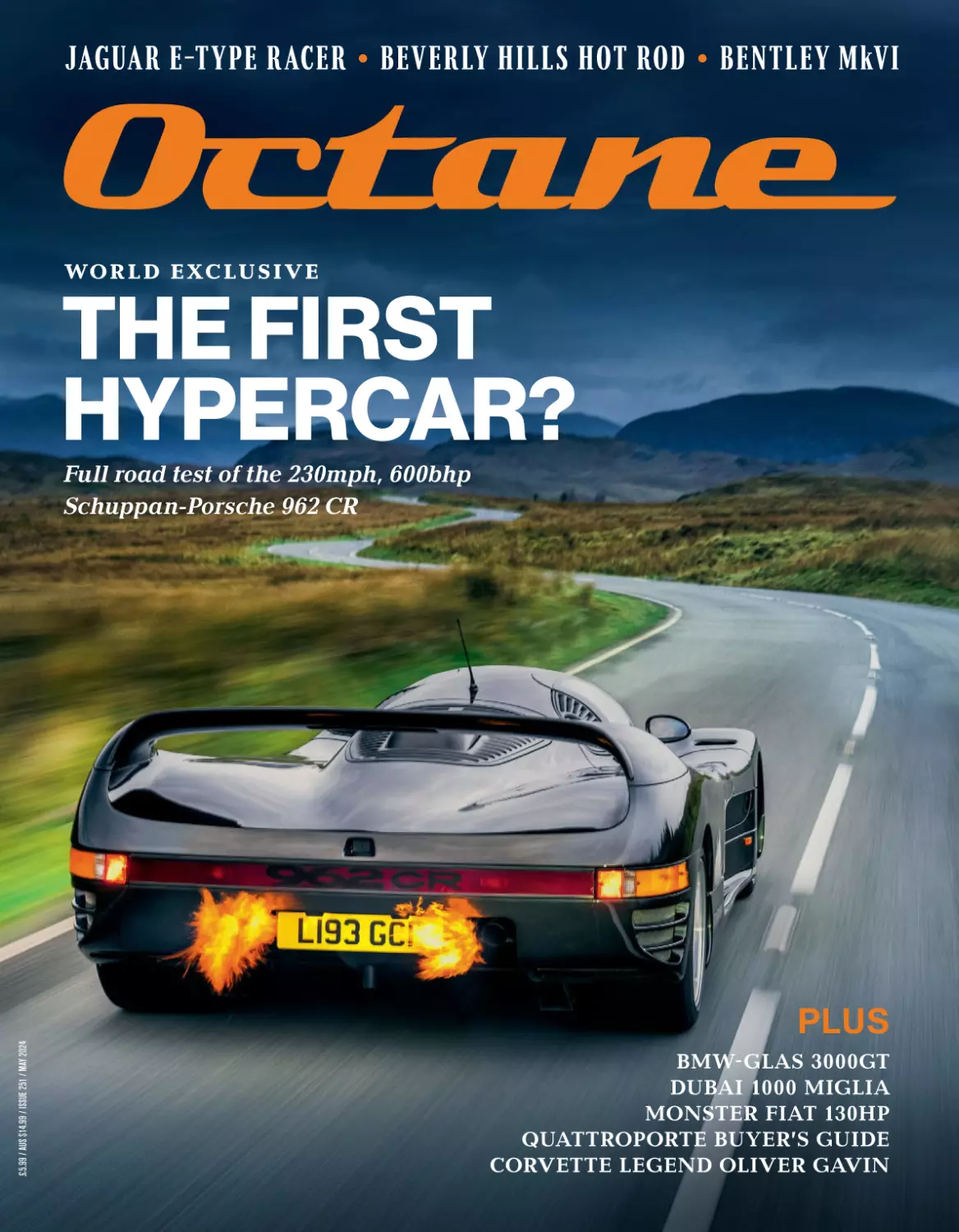
JAGUAR ETYPE R ACER • BEVERLY HILLS HOT ROD • BENTLEY MkVI
W O R L D E XC L U S I V E
THE FIRST
HYPERCAR?
Full road test of the 230mph, 600bhp
Schuppan-Porsche 962 CR
£5.99 / AUS $14.99 / ISSUE 251 / MAY 2024
PLUS
BMWGLAS 3000GT
DUBAI 1000 MIGLIA
MONSTER FIAT 130HP
QUATTROPORTE BUYER’S GUIDE
CORVETTE LEGEND OLIVER GAVIN
BESPROKE PARTS & SERVICES
A Heritage Defender is the ultimate expression of you. Whatever it is that inspires
you... our design team has designed and developed the most beautiful high quality
products for the new Land Rover Defender.
Please visit our online world of Defender inspiration on heritagecustoms.nl for the
most distinguished and bespoke parts and services.
www.heritagecustoms.nl
XƚƻƚųĜŅƚŸ ųĜƋĜŸĘ ±ųƋĜŸ±Ĺ ʱƋŸ üŅų ĘĜĵ ¼ Ęåų
ŅŞ ƼŅƚų ÚųĜƴå ƵĜƋĘ ƋĘå Şå±ĩ Ņü ŸƋƼĬå
Ï±Ĺ üŅų åƻÏĬƚŸĜƴå aĜĬĬåų B±ƋŸ
MISTER MILLER
MASTER HATTER
Mistermillerhats.com
Final call for entries
Collectors’ Motor Cars
Monaco, Villa La Vigie | 10 May 2024
ENQUIRIES
+32 476 879 471
eurocars@bonhamscars.com
6ULVќWLYPVK*VHJO^VYRI`+YVNV
1960 FERRARI 250 GT
€2,500,000 - 3,000,000 *
bonhamscars.com/monaco
© Luc Joly
-VY[OJVTPUNH\J[PVUZ
GOODWOOD MEMBERS MEETING
Chichester, Sussex | 14 April 2024
+44 (0) 20 7468 5801 | ukcars@bonhamscars.com
GILDED AGE
Middletown, Rhode Island | 27 April 2024
+1 (415) 391 4000 | motors.us@bonhamscars.com
-VYKL[HPSZVM[OLJOHYNLZWH`HISLPUHKKP[PVU[V[OLÄUHSOHTTLYWYPJLWSLHZL]PZP[IVUOHTZJVTI\`LYZN\PKL
Issue 251 / May 2024
‘IN THE LATE AFTERNOON SUNLIGHT,
EMPTY ROADS PROVIDE THE CREWS
WITH A SPECIAL ARABIAN MEMORY’
1000 MIGLIA EXPERIENCE UAE, PAGE 104
88
52
9
Issue 251 / May 2024
CONTENTS
110
82
FEATURES
SCHUPPAN-PORSCHE 962 CR
Page 52
Exclusive road test of world’s first hypercar
SCHUPPAN: THE INSIDE STORY
Page 66
…of the car and its Le Mans-winning creator
1907 FIAT 130HP CORSA
Page 72
Braving a 16-litre Grand Prix veteran
96
72
120
THE OCTANE INTERVIEW
Page 82
Oliver Gavin, Le Mans Corvette legend
BEVERLY HILLS HOT ROD
Page 88
With collector Bruce Meyer in his ’32 Ford
BENTLEY MkVI
Page 96
How the marque redefined itself post-war
ARABIAN RALLY
Page 104
Robert Coucher joins classics in winter sun
JAGUAR AT MONSANTO PARK
Page 110
The most successful racing E-type of its era
BMW-GLAS 3000GT
Page 120
Forerunner to BMW’s most elegant coupés
11
Issue 251 / May 2024
CONTENTS
20
REGULARS
EVENTS & NEWS
Page 20
The month in pictures; essential diary dates;
farewell Gandini; Moss memorial – be there
GEARBOX
Page 38
Trailer king and car enthusiast Lewis James
COLUMNS
Page 41
142
Jay Leno, Derek Bell, Stephen Bayley
and Robert Coucher have their say
148
LETTERS
Page 49
Playing a part in the Marcos V8’s birth
OCTANE CARS
Page 132
Daimler does the Monte; Saab 96 returns
OVERDRIVE
Page 142
Off-road supercars: Lambo Sterrato, 911 Dakar
156
GONE BUT NOT FORGOTTEN
Page 148
158
John Henry Knight, pioneering British inventor
ICON
Page 150
Form most functional: the shipping container
CHRONO
Page 152
Why Omega’s Chronostop deserves more love
GEAR, BOOKS, MODELS
Page 156
How much desirability can you handle?
THE MARKET
Page 165
Sold and selling; buying Maserati Quattroporte
160
AUTOBIOGRAPHY: DEAN BUTLER
Page 194
154
12
Vision Express founder, collector, former racer
̩̫th Edition
̪̫th΅̪̭th August̨̪̪̬
For further information and registration: www.passione-engadina.ch
HÔTEL PARTNER
Issue 251 / May 2024
FEATURING
ASTON PARROTT
JOSH SWEENEY
‘The BMW-Glas V8 has a distinctive
appeal with a sporty yet classic vibe.
Attention to detail in both exterior and
interior design elements is what sets apart
iconic vehicles and contributes to their
timeless fascination.’
Josh’s superb photography accompanies
James Elliott’s story on pages 120-128.
EDITOR’S WELCOME
The lengths we’ll go to
MORE OFTEN THAN we would probably
like to admit, amazing stories fall into Octane’s
lap and a tentative email with a picture
attachment sets in motion a chain of events that
ends with you reading about a very special car.
Every one of those easy wins, however, is
counterbalanced by something that takes a lot
more time, effort and, inevitably, money to put
together. And in 28 years in this game I cannot
remember a more fraught process than our
collective quest to get a Schuppan 962 CR into
Octane. The reason for wanting to is obvious –
great car, great story, plus the compulsion
finally, and for the first time, properly to tell the
world how this remarkable Le Mans car for the
road measures up to its billing.
The reasons we had to go the extra mile were
myriad, but with a pool of fewer than ten cars to
choose from it was never going to be easy. The
first car we lined up was actually the one we
ended up featuring, but when under a previous
ownership. Photographing it and writing about
it were fine, but driving it, we were told, was a
strict no-no. Now, I don’t want to come across
as all prissy here but, though we were extremely
grateful for the offer, we reckoned we were
probably only going to feature a Schuppan
once and not to drive the thing on a public road
would leave the biggest – to my mind, the
essential – question, unanswered. It would be
to deny the car’s raison d’être.
Next up was the final car, tracked down in the
USA. An excellent example as it turns out, but
such was our fanaticism by then that the fact it
14
was built as a prototype and later converted was
enough for us to discount it. With hindsight, we
were being overly pedantic.
Then came the freshly restored winner of the
2023 London Concours. We chased, followed,
harangued, a date was set to drive it between its
concours victory and its shipping to the US –
then it rained on the day and it wasn’t allowed
out to play. After that the trail went cold.
I had just about given up when Simon
Kidston, not noted for letting any car stand
idle regardless of its rarity, value or mileage,
wondered aloud to racer-writer Dickie Meaden
whether Octane would be interested in giving
that very first car we set out to drive a proper
seeing-to (on track as well as dream roads) in
Wales. Unsurprisingly, we were.
So what you see in Octane this month may
look like other stories on the surface, but it is
actually the product of more than five years of
work and at least three times the investment of
a normal article (shhh, don’t tell the bosses).
Because you are worth it.
EVAN KLEIN
‘Cruising a hot rod on a warm summer
day in the heart of Beverly Hills, who could
ask for anything more? In a city where it’s
good to see and be seen, the hot rod
symbolises ultimate car cool.’
Evan hit the city’s more exclusive streets with
Mark Dixon in LA petrolhead Bruce Meyer’s
’32 Deuce Coupe. Turn to pages 88-94.
MATTHEW HAYWARD
‘Only after the 450-mile drive to Le Mans did
I learn that former Corvette racer Oliver
Gavin actually lives just a few miles down
the road from me! It was absolutely worth
the journey, though, as chatting to Olly
within the charged atmosphere of the 24
Hours really got the memories flowing.’
The Octane Interview, pages 82-86.
James Elliott,
editor in chief
COVER PHOTOGRAPHY ASTON PARROTT
NEXT MONTH
EDITORIAL
EDITOR-IN-CHIEF
James Elliott
james@octane-magazine.com
ONE-OFF
MASERATI!
DEPUTY EDITOR
Mark Dixon
mark@octane-magazine.com
ART EDITOR
Robert Hefferon
Driving the unique Franco Scaglionedesigned 3500GT Bertone
roberth@octane-magazine.com
ASSOCIATE EDITOR
Glen Waddington
glen@octane-magazine.com
MARKETS EDITOR
Matthew Hayward
matthew@octane-magazine.com
FOUNDING EDITOR
Robert Coucher
ITALIAN CORRESPONDENT Massimo Delbò
DESIGN ASSISTANCE Ruth Haddock
CONTRIBUTOR Chris Bietzk
Issue 252
on sale
24 April
USEFUL CONTACTS
Editorial inquiries info@octane-magazine.com
PATRICK ERNZEN
Subscriptions queries Tel: +44 (0)330 333 9491
Email: customercare@subscribe.octane-magazine.com
or via WhatsApp on +44 (0)19174 35589
ADVERTISING
GROUP ADVERTISING DIRECTOR
Sanjay Seetanah
sanjay@octane-magazine.com
ACCOUNT DIRECTOR
Samantha Snow
sam@octane-magazine.com
DEALER ACCOUNT MANAGER
<< New pics
and credits
please
Marcus Ross
marcus@octane-magazine.com
LIFESTYLE ADVERTISING
Sophie Kochan
DIRK DE JAGER
sophie.kochan2010@gmail.com
Tel:
+ 44
Advertising inquiries
(0)1628 510080 Fax: + 44 (0)1628 510090
Email: ads@octane-magazine.com
PLUS
Run for cover! Dodge Vipers let loose
From the 1970s into the 1980s: why
the G-series are the 911s to buy now
Mumbai to Abingdon in an MG YT
The Octane Interview: legendary
Jaguar designer Keith Helfet
(Contents may be subject to change)
SUBSCRIPTIONS, BACK ISSUES, HELPLINES
UK tel: 0330 333 9491 Overseas tel: +44 (0)330 333 9491
Subscribe online at octane.co.uk/subscribe
Manage your subscription at yoursubscription.co.uk
or email customercare@subscribe.octane-magazine.com
Single issue price: £5.99 (UK).
Full annual subscription (12 issues): UK £65.98, Europe (inc Eire) £69, RoW £88.
Octane ISSN 1740-0023 is published monthly by Hothouse Publishing Ltd. USPS 024-187
This issue on sale 27 March.
June 2024 issue on sale 24 April
AUCTIONS & PRIVATE BROKERAGE
GOODINGCO.COM
+1.310.899.1960
PROUDLY PRESENTING SELECTIONS FROM
I
FRIDAY APRIL 26 OXNARD, CA
ONLINE BIDDING AVAILABLE
I
1935 HISPANO-SUIZA J12 CABRIOLET
Formerly the Property of Sam Scher,
Richard Paine, and John Mozart
LIVE AUCTION
ALL LOTS OFFERED
WITHOUT RESERVE
REGISTER TO BID
1937 DELAGE D8-120 CABRIOLET
Adorned with Stunning Cabriolet Coachwork
by Chapron
1939 BUGATTI TYPE 57C ARAVIS
One of Only Three Examples Extant
Chassis 57768
MAY 8–17
ONLINE ONLY
NOW INVITING
CONSIGNMENTS
1974 DUCATI 750 SUPER SPORT
SOLD for $159,500
Geared Online December Auction 2023
I
FRI AUG 16 SAT AUG 17
LIVE AUCTIONS
NOW INVITING
CONSIGNMENTS
OFFICIAL AUCTION HOUSE
OF THE PEBBLE BEACH
CONCOURS D’ELEGANCE ®
I
1956 MASERATI A6G/54 BERLINETTA A Unique Example of Just 20 Zagato-Bodied Berlinetta’s Built
Raced in the 1956 Mille Miglia Pebble Beach Award-Winning Example Coachwork by Zagato Chassis 2124
I
I
CONTACT OUR SPECIALISTS TO LEARN MORE:
INQUIRY@GOODINGCO.COM
Pebble Beach® and Pebble Beach Concours d’Elegance® are trademarks and service marks of Pebble Beach Company. Used by permission.
I
Get 3 issues
of Octane
for just £5!
PUBLISHING AND MANAGEMENT
MANAGING DIRECTOR
Geoff Love
EDITORIAL DIRECTOR
David Lillywhite
MARKETING AND EVENTS
Jasmine Love
ACCOUNTS
Jonathan Ellis
accounts@hothousemedia.co.uk
MAGAZINE OPERATIONS COORDINATOR
246
244
Elaine Briggs
Fuelling the passion
Fuelling the passion
Fuelling the passion
Hothouse Media
Unit 16, Enterprise Centre, Michael Way, Warth
Park Way, Raunds, Northants NN9 6GR, UK
www.hothousemedia.co.uk
251
OCTANE WORLDWIDE
SYNDICATION AND LICENSING
To take advantage of this month’s
special offer and get three issues
of Octane for £5, either
visit
octane.co.uk/subscribe
or call
+44 (0)330 333 9491
and quote code DMAR24
Geoff Love
geoff@hothousemedia.co.uk
GERMANY
Ulrich Safferling
JAPAN
Shiro Horie
NETHERLANDS
Ton Roks
FRANCE
Yan-Alexandre Damasiewicz
Octane is available for international licensing and syndication
© Hothouse Media. All rights reserved. Neither the whole of this publication nor any part of it may be reproduced, stored
in a retrieval system or transmitted in any form or by any means without the written permission of the publishers.
Octane is a registered trademark.
Octane is published by Hothouse Media.
Registered address: Castle Cottage, 25 High Street, Titchmarsh, Northants NN14 3DF, UK.
Buying your issue of
Octane – new and old
PRINT ISSUE
Octane is available at the
usual branches of UK shops,
such as Tesco, Sainsbury’s,
Waitrose and independents,
as well as WH Smith
High Street and Travel.
You can order the latest
magazine or a back issue,
delivered direct to your door,
by visiting magsdirect.co.uk
and searching for ‘Octane’.
to enjoy the new issue.
Alternatively you can source
the digital edition via either
Zinio or Readly.
DIGITAL ISSUES
Download the Octane
Magazine app on Android
or Apple and you will be able
Problems with your
subscription? Please email
customercare@subscribe.
octane-magazine.com
SUBSCRIBE
You can find superb offers
on print (order before
12 April 2024 to start with
issue 252), print and digital,
or digital only, at
octane.co.uk/subscribe
VAT number 309390010.
Hothouse Media uses a layered privacy notice giving you brief details about how we would like to use your personal information.
For full details, please visit www.magnetomagazine.com/privacy
The publisher makes every effort to ensure the magazine’s contents are correct. All material published in Octane is copyright and
unauthorised reproduction is forbidden. The editors and publishers of this magazine give no warranties, guarantees or assurances
and make no representations regarding any goods or services advertised in this edition.
Octane has taken all reasonable efforts to trace the copyright owners of all works and images and to obtain permission for the
works and images reproduced in this magazine. In the event that any untraceable copyright owners come forward after
publication, Octane will endeavour to rectify the position accordingly.
Printed in the UK by Acorn Web Offset Ltd. Distributed by Marketforce, marketforce.co.uk.
If you like Octane,
you’ll love…
CONCOURS
ON SAVILE ROW
Two days of the greatest cars and the
finest tailoring in the heart of London’s
Mayfair. The event is free to visit and
takes place from 10am to 8pm on
Wednesday 22 and Thursday 23 May.
See concoursonsavilerow.com.
1963 Aston Martin DB4 ‘SS Engine’ Series V Convertible
Estimate: £700,000 – £900,000 GBP
CLIVEDEN HOUSE | 12 JUNE 2024
A BRAND-NEW SALE HELD AT THE WORLD-RENOWNED CLIVEDEN HOUSE HOTEL
UK +44 (0) 20 7851 7070
FRANCE +33 (0) 1 76 75 32 93
ITALY +39 02 9475 3812
GERMANY +49 (0) 800 000 7203
info@rmsothebys.com
IGNITION / Month in Pictures
E V E N T S + N E W S + O PI N I O N
ModaMiami, 29 February – 3 March
The new event at the Biltmore Hotel in Coral Gables hit the ground running with some 250 concours cars, ranging from a 1954/’55
Mercedes-Benz W196 raced by Juan Manuel Fangio to a McLaren F1. The classics were joined on the showfield by the ‘100 Club’
of modern supercars and hypercars, while there were also a cruise, driving experiences, a huge display of Shelbys and a 122-lot
RM Sotheby’s auction that raised $50million. Harry Yeaggy’s 1935 Duesenberg Model SJ ‘Mormon Meteor’ took the Best of Showfield
award, voted for by entrants, while the Octane trophy went to Roberto Quiroz’s Ferrari 365P Berlinetta Speciale ‘Tre Posti’ (above).
Images: ModaMiami / RM Sotheby’s
20
The Amelia, 29 February – 3 March
From an event making its debut (left) to a 29-year veteran vying for enthusiasts’ attention on the same weekend 400 miles north in
the same US state. With two major concours awards (for road car and racer), 2024’s big winners of nearly 300 concours cars at The
Amelia – which reported over 20,000 visitors – were David McNeil’s 1962 Ferrari GTO and the 1947 Delahaye 135MS of Dana
Mecum. Special classes included RUF, while the event honouree was motorsport doyen Rick Hendricks. The Florida auction battle was
equally close-run, with Broad Arrow’s Amelia sale totalling $63million on a 92% sale rate. See page 165 for in-depth auction results.
Images: The Amelia / Hagerty
21
IGNITION / Month in Pictures
THE POMEROY TROPHY, 17 FEBRUARY
FROM TOP: CHRIS TARLING / YELLOWDOG; JEFF BLOXHAM
The VSCC’s convoluted free-for-all search for the ideal touring car over three contests at
Silverstone had as bizarre an entry as ever, ranging in capacity from 998cc to 7.4 litres, and in
age from 1913 to 2021. The winner was Theodore Hunt in a 1938 Frazer Nash TT Replica.
22
CONCOURS IN THE HILLS, 18 FEBRUARY
FROM TOP: ROB MAINS / CONCOURS IN THE HILLS; GERARD BROWN / RALLY THE GLOBE
Despite a late rescheduling, the tenth annual show
in Arizona attracted 40,000 visitors (more than ten
times the inaugural event’s number) to Fountain
Hills Park and raised $330,288 for the Phoenix
Children’s Hospital Foundation. The 1000 cars on
show were a far cry from the 220 displayed in
2014. A McLaren Speedtail took Best of Show.
THE ROAD TO HANOI MARATHON, 27 JANUARY – 23 FEBRUARY
After 7000km, Peter and Louise Morton took classic honours with their Rover P6, while Daniel
Sauter’s Chevrolet Fangio, navigated by Martin Reubel and Severin Senn, was first Pre-War
car. The story of this Rally the Globe Vietnamese adventure will appear in a future Octane.
23
IGNITION / Month in Pictures
RALLYE MONTE-CARLO HISTORIQUE,
31 JANUARY – 7 FEBRUARY
Pierre and Adrien Mare in their 1980 Renault 5
Turbo. See page 132 for Team Octane’s story.
Sunny Miami show was based at the JW Marriott
Turnberry Resort and the Hard Rock Stadium.
SYDNEY HARBOUR
CONCOURS D’ELEGANCE, 1-3 MARCH
Spectacular Australian concours had a
wonderful new location on Cockatoo Island.
The Best of Shows (pre- and post-war) were
Ferrari 250 LM and Rolls-Royce Phantom II.
BREMEN CLASSIC MOTOR SHOW, 2-4 FEBRUARY
More than 45,000 people attended the huge
German indoor event with its 700 exhibitors.
BLUEBIRD K7 RETURNS TO CONISTON, 9 MARCH
Thousands greeted Bluebird as it made its way from
North Shields to its ‘forever home’ at the Ruskin Museum.
RIPONIAN STAGES, 11 FEBRUARY
After heavy rain, Nick Elliott and Dace Price
were fifth in their Fiat 131 over the six stages.
24
CLOCKWISE, FROM TOP LEFT: SYDNEY HARBOUR CONCOURS D’ELEGANCE; ACM / J PEREZ ALONSO; MOTORCAR CAVALCADE; RUSKIN MUSEUM; BEN LAWRENCE; BREMEN CLASSIC MOTOR SHOW
MOTORCAR CAVALCADE, 3-4 FEBRUARY
Schuppan-Porsche
“O N E O F T H E M O ST E XC L U S I V E S U P E RC A RS E V E R B U I LT ”
A L A I N D E C A D E N ET I N V I C TO RY BY D E S I G N
K I D STO N S A 7 AV E N U E P I C T ET D E RO C H E M O N T, 12 0 7 G E N E VA , S W IT Z E R L A N D
T E L + 4 1 2 2 74 0 19 3 9
W W W. K I D STO N . C O M
IGNITION / Month in Pictures
OBEROI CONCOURS D’ELEGANCE, 16-18 FEBRUARY
WINTER TRIAL,
28 JANUARY – 2 FEBRUARY
The weather didn’t let down 73
entrants on this 2500km rally,
starting and finishing in Krakow.
Pictured are Hugo Kampman
and Berend Groeneveld in their
Ford Cortina; Rob van der
Leeuw and Maurits Verhoeff
won in an Alfa Romeo Giulia.
26
FROM TOP: OBEROI CONCOURS D’ELEGANCE; WINTER TRIAL / CLASSIC EVENTS
Some 125 entries across 17 classes were judged by a team of 14 (led by
Pebble Beach’s Sandra Button and including Giacomo Agostini and Jacky
Ickx) at this impressive event at the Oberoi Udaivilas, Udaipur, India. Best of
Show was Nishant Doosa’s 1939 Lagonda V12 DHC; pictured is Maharaj
Duleep Singh Ji of Jodhpur’s ’35 Delahaye 135MS, most elegant pre-war car.
NEW
office now open
in Miami
traditional values
modern thinking
OFFICIAL TRANSPORTATION SUPPLIER
Sea and Air Freight
Worldwide Customs Brokerage
Race and Rally Transportation
International Storage
UK and European Trucking
Vehicle Registration
JAPAN
MIDDLE EAST W. COAST USA
E. COAST USA
NETHERLANDS
UNITED KINGDOM
+81(0) 45 306 7043
+971(0) 4882 1334
+1 (310) 695 6403
+1 (305) 990 1341
+31 (0) 252 682 526
+44 (0) 1284 850 950
info@carsjp.net
www.carsjp.net
info@carsmiddleeast.com
www.carsmiddleeast.com
info@carsusa.com
www.carsusa.com
info@carsusa.com
www.carsusa.com
info@carseurope.net
www.carseurope.net
info@carseurope.net
www.carseurope.net
IGNITION / Events Diary
19-21 April
La Jolla Concours d’Elegance
A special class charting the
evolution of the Corvette will be
among the attractions at La Jolla
Cove, just outside San Diego.
lajollaconcours.com
20-21 April
VSCC Spring Start
The members of the VSCC kick off
their racing season at Silverstone.
vscc.co.uk
21 April
Drive It Day at
The Classic Motor Hub
The Classic Motor Hub in Bibury
hosts a get-together on the day
that owners of classic vehicles
are encouraged to go for a spin.
classicmotorhub.com
Audrain Veteran Car Tour, 28 April
Image: Audrain Motorsport
COMING UP…
Up and down the land, classics are coming out of hibernation
to take part in rallies, tours, outdoor shows and race meets
30 March
Brooklands Easter
Classic Car Day
Pre-31 July 1994 cars are invited to
park at the museum for this year’s
Easter Classic Car Day, which will
feature live music and a barbecue.
brooklandsmuseum.com
31 March
Bicester Heritage
Motorsport Assembly
Bicester Heritage holds its first
themed car gathering of 2024.
Entry is free for paying members
of Bicester’s ‘Scramblers’ club,
and tickets for everybody else
cost just a tenner.
bicesterheritage.co.uk
3-7 April
Techno-Classica Essen
The daddy of indoor classic car
shows will again test the stamina
of visitors, who will find more
than 1250 exhibitors packed into
the Messe Essen in Germany.
siha.de
28
5-7 April
Mugello Classic
Group C brutes will be among the
cars in action at Peter Auto’s first
racing meet of the year, at Mugello
Circuit in Italy.
peterauto.fr
6-10 April
Copperstate 1000
Pre-1974 cars eat up 1000 miles
of the dreamiest tarmac that
Arizona has to offer.
mensartscouncil.com
11-14 April
Highland Tour
Loch Lomond to Scotland’s West
Coast, and then back inland and
into the spectacular Highlands.
v-events.co.uk
12-14 April
The Flying Scotsman
This year’s Flying Scotsman
starts in Cheshire, and crews in
pre-1948 cars will drive through
the Derbyshire Dales, the
Yorkshire Dales and the Lake
District before tackling the
Scottish portion of the route.
hero-era.com
21 April
Perthshire Classic Car Tour
Perth to stunning Glencoe and
back. There’s no entry fee in the
normal sense, but the event is
being run in aid of charities
including the Multiple Sclerosis
Society, so a donation of £75
per car is requested.
perthrotary.co.uk
21 April
Simply Italian at Beaulieu
Italian cars old and new head
to Beaulieu in droves.
beaulieu.co.uk
13-14 April
Goodwood Members’ Meeting
Highlights will include the Ken
Miles Cup, a 45-minute race for
Ford Mustangs, organised to mark
the 60th anniversary of the model.
goodwood.com
21-25 April
California Mille
Just as the original Mille Miglia
inspired today’s regularity race,
the regularity race inspired this
US event. The route for 2024 runs
from La Jolla to Westlake Village.
californiamille.com
18-20 April
Salon Privé London
The gardens of the Royal Hospital
Chelsea host a ‘Concours de Vente’
featuring 75 first-rate classic cars,
all available to buy.
salonprivelondon.com
21-27 April
Tour Auto
Starting in Paris and finishing this
time in Biarritz, and featuring four
track races in-between, at venues
including the Bugatti Circuit.
peterauto.fr
18-21 April
Terre di Canossa
In Italy, crews will motor along
the Tyrrhenian coast, across the
Apennines and Apuan Alps, and
through Tuscany.
terredicanossa.canossa.com
25-27 April
Manx Classic
On the Isle of Man, roads are
closed to allow competition
on three hillclimb courses, each
of them over a mile long.
manxmotorracing.com
Mugello Classic, 5-7 April
Image: Patrick Payany / Fotorissima
25-28 April
Retro Classics Stuttgart
Classic vehicles of all types
are packed into 80,000m2 of
exhibition space in Stuttgart.
retro-classics.de
25 April – 4 May
London to Lisbon
The pre-1991 cars on this
regularity rally will follow
a 2800km route through
France, Spain and Portugal.
hero-era.com
27-28 April
Classic Car Boot Sale
Classic vehicles and sellers of all
sorts of vintage goodies roll into
King’s Cross in London.
classiccarbootsale.co.uk
28 April
Audrain Veteran Car Tour
Pre-1908 cars from across the
USA meet at the Audrain
Automobile Museum before
setting off on a 50-mile drive
around Rhode Island.
audrainmotorsport.com
28 April
VSCC Wiltshire Tour
The VSCC has unveiled an
expanded slate of regional tours
for 2024, featuring 13 events in
total. The first of the year is the
Wiltshire Tour, open to Club
members in pre-1956 cars.
vscc.co.uk
28 April – 26 May
Trans-Africa Rally
Crews will drive almost 7700km
through South Africa, Namibia,
Botswana, Zambia, Zimbabwe,
Mozambique and Eswatini.
destination-rally.com
2-5 May
Simola Hillclimb
Furious hillclimbing action
in Knysna in South Africa.
speedfestival.co.za
3-5 May
The Greenbrier
Concours d’Elegance
Three days of events at the
Greenbrier resort in White
Sulphur Springs, West Virginia,
ending with a concours that
this year features an interesting
special class for light trucks.
greenbrierconcours.com
3-5 May
Hockenheim Historic
Among the machines racing at
the Hockenheimring this time
around will be a group of classic
DTM cars.
hockenheim-historic.de
4 May
Rattletrap
Pre-1940 hot rods and pre-1960
motorcycles blast along the sand
at Crowdy Bay Beach, four hours
up the coast from Sydney.
drag-ens.com.au
4-5 May
Donington Historic Festival
A busy schedule for 2024
includes the three-hour Royal
Automobile Club Pall Mall
Trophy for GTs, Touring Cars
and sports-racers.
doningtonhistoric.com
4-5 May
Keels & Wheels
Beautiful old cars and boats share
the stage at Lakewood Yacht Club
just outside Houston, Texas.
keels-wheels.com
A 5 - D AY D R I V I N G A D V E N T U R E
FROM ASTURIAS TO PORTO
S U N D AY 2 2 – F R I D AY 2 7 S E P T E M B E R
For our 2024 event we’re returning to Iberia where some of the
greatest driving roads in Europe are to be found, taking in the Picos
mountains, Castile y León and the incredible Douro Valley before we
cross the finish line in Porto.
Our tours combine great driving with a relaxed and informal
itinerary, meaning there’s plenty of time to enjoy the fabulous hotels
along the way. There will be just 20 cars taking part, and you’re
welcome to bring whatever you love to drive, whether that’s a
classic or a modern supercar.
For further details and to receive the
brochure please contact Georgie
on 01635 867705 or email
georgie@v-management.com
v-events.co.uk
29
IGNITION / News
Marcello
Gandini
b.1938
Octane’s Massimo Delbò
– who met the maestro
many times – pays tribute
to a car design legend who
passed away on 13 March
FEW PEOPLE can claim to have marked the
style of a decade in the way of Marcello
Gandini. The ‘wedge shape’ trend of the 1970s
was a Marcello Gandini trademark, typified by
his Lamborghini Countach. Born in Turin to a
musician father who hoped his son would share
that interest, at five years old Gandini was
captivated by a Meccano set he received as a
present. As an adult, his talent was so apparent
that, even without specific design schooling, he
was hired by Bertone in 1965, when only 27
years old, to manage the style of one of the
most important carrozzerie of the period.
Among Gandini’s first tasks was to create
the shape for a new sports car, of which the
extraordinary rolling chassis had been shown
at the Turin motor show of October 1965.
This was the new V12 transverse-mid-engined
Lamborghini that would storm the market
mere months later when, the following March,
the Miura was introduced at the 1966 Geneva
show. The car led to the coining of the phrase
‘supercar’, instantly putting the names of
Lamborghini, Bertone and Gandini on the
map, and it is still considered one of the most
beautiful cars ever manufactured.
The Miura also instigated that special
relationship between Carrozzeria Bertone,
Marcello Gandini and Lamborghini that went
on to last for more than 30 years, providing
some of the most amazing show-cars and
production greats, including the 1967 Marzal,
with its transparent cockpit, hexagonal details
and long gullwing doors. That same year came
the Alfa Romeo Montreal concept, and just
one year later the Alfa Romeo Carabo. Making
its debut at the 1968 Turin show, the Carabo is
considered by many to have been the most
transformational concept car ever shown, and
30
its wedge shape stormed the motoring world.
It marked the beginning of a new decade of
automotive style, thanks to Gandini.
‘Everybody loved the Carabo,’ Gandini
himself later declared, ‘but only Ferruccio
Lamborghini had the guts to move forward and
enter production.’ It was at the 1971 Geneva
motor show that the Lamborghini LP500
Countach ‘idea car’ appeared. It entered
production in 1974, almost untouched, and
lasted an incredible 15 years, becoming one of
the most iconic cars ever, in poster form
adorning the walls of millions of teenagers all
over the world, and setting a style template for
Lamborghini supercars that lasts to this day.
With the making of the Countach, Gandini
had the opportunity to express his technical
skills, too, something he was always very
proud of. ‘It was like working with a colleague,’
remembered Ingegnere Paolo Stanzani,
Lamborghini’s technical director of the time.
‘Gandini perfectly understood the technical
needs we were facing while transforming an
idea into a production car, and could always
find a solution that was both correct for the
technicians and beautiful to look at.’
Back to 1969, and we can’t forget the
Autobianchi A112 Bertone Runabout, which
formed the basis of the Fiat X1/9 that entered
production in 1972. Then the 1970 Lancia HF
Stratos Zero that became the 1973 Stratos rally
car. In this decade, Gandini reached his peak.
In 1972 came the BMW 5-Series E12, on which
Gandini had consulted with BMW’s Paul
Bracq, then in 1975 the Gandini-styled Ferrari
Dino 308 GT4 entered production, marking
the first time in 25 years that a production
Ferrari was not shaped by Pininfarina.
Despite his reputation for designing sports
cars, Gandini always said the real challenge
for stylists was small, utilitarian cars, for which
budget, function and practicality must take
priority over performance and looks. As a
result, Gandini considered the 1974 Innocenti
Mini 90/120 (pictured) one of his most
challenging tasks. ‘We made 17 prototypes,’ he
remembered. ‘The car was commissioned by
Innocenti but, before the first prototype was
finalised, the company was sold to British
Leyland, and the process was disrupted. I still
believe the first proposal was the best one.’
The hugely successful 1982 Citroën BX and
1984 Renault Supercinq followed, but, after 15
years at Bertone, Gandini left in 1980 to
embark on a career as a freelance. He recalled:
‘Bertone was something special in my life, and
was not supposed to last for so long – I thought
I would last no more than six months! And that
was a benefit, as I was left free to create, and to
be more daring.’ But let’s remember him with
this final quote: ‘A blank paper is a world of
opportunity, the pure spirit of freedom.’
Farewell, Maestro Gandini.
Dream GTO destination
Ferrari reveals special anniversary tour
FERRARI HAS LAUNCHED an official tour of the Dolomites in the
Autumn solely for owners of the 272 examples of the Pininfarina-styled
twin-turbo V8-powered 288 GTO. Built for three years from 1984, the
model is celebrating its 40th anniversary in 2024 and the sub-€30,000
(for a car and two people) driving experience will take place on 1-5
October. The event will be Maranello’s second ‘legacy tour’, following an
F40 jaunt last year in which 39 cars wound their way from Forte dei
Marmi through the Apuan Alps and Tuscany to Maranello.
The GTO Legacy Tour will start from Val Rendena and finish in
Maranello, where the cars and crews will be welcomed to the factory by
the Ferrari Classiche team as well as members of the original GTO team.
The visiting GTOs will be displayed inside the factory gates before the
tour ends with a parade at Ferrari’s nearby Fiorano test track.
Andrea Modena, head of Ferrari Classiche, promises more than great
roads and stunning scenery, however, saying that Piero Ferrari will also
be involved in the tour, and tantalisingly suggests that participants will
also be the first in the world outside of the factory to encounter a unique
Maranello experience.
According to Ferrari Classiche, the 288 GTO is unique among the
company’s classic models in that every single example built is thought
still to survive. The tour will use the model’s official name of GTO (minus
the 288), but is strictly for the anniversary-celebrating 1980s cars, not
their 1960s forebears.
Modena said: ‘The exact details are not yet finalised or public because
we are trying to create some surprises for the collectors, many of whom
have been deeply connected with the company for a long time.’
Just as important to Ferrari, however, is reconnecting with owners
who may not have dealings with Maranello at all. ‘It’s often the case that
some of these cars like GTO, like F40, are bought and sold outside of
the official network, so we don’t actually have any contact with some
owners,’ added Modena. ‘That means we don’t get the opportunity to talk
to them, to invite them to get their car certified, or to invite them on this
event. So part of it is to try to bring those people back into the company
and particularly back to Maranello.’
A healthy turn-out is expected from the UK, though places will be
limited to Classiche-certified cars and can be booked (by the end of
April) only via Ferrari’s dealer network. Dealers will also help with
logistics for owners less willing to drive down to Emilia-Romagna.
31
IGNITION / News
NEWS FEED
London show gearing up
There will be a Who’s Who of the world’s greatest motor manufacturers
at Salon Privé London on 18-20 April at the Royal Hospital Chelsea. The
raft of marques that will be on display includes Aston Martin, Brabus,
Bugatti, Ferrari, Koenigsegg, Lamborghini, Land Rover, Polestar,
Porsche, Rimac and Rolls-Royce.
Meanwhile, cars that visitors can buy in the event’s unique Concours
de Vente are being added to daily. Specialists and dealers who will be
displaying their wares include the renowned likes of Hilton & Moss and
Aston specialist RS Williams. Making its Salon Privé London debut is
P&A Wood, offering an elegant 1966 Rolls-Royce Phantom V Touring
Limo by James Young, while The Aston Workshop & Car Barn, which
took the show’s Prix d’ Honneur in 2023 with its DB 2/4 Vignale, will
be selling a 1967 DB6 Volante, uprated to manual and Vantage spec.
Furlonger will be the go-to for Ferraris and other performance greats,
while Car-Iconics will be at Salon Privé London for the second time.
Among its offerings will be an astonishingly original – right down to its
carpets and tools – 1978 Datsun 260Z.
For info and tickets, see salonprivelondon.com/buy-tickets.
Royal reckoning
Indian collector Yohan Poonawalla
has added to his Royal vehicle fleet
by paying a reported £225,000 for
the late Queen’s Range Rover. The
2016 Range Rover SDV8
Autobiography LWB joins the
Queen’s 1979 Rolls-Royce
Phantom VI Limousine in his
wide-ranging collection.
32
Sounds of the City
The 2024 London Concours, held
at the Honourable Artillery
Company in the heart of The City
on 4-6 June, is to have a specific
theme for each day. Tuesday will
honour McLaren, Wednesday will
be Design Day and Thursday’s
grand finale will be Supercar Day.
See londonconcours.co.uk.
Winterbottom winners
The 2024 Oliver Winterbottom
trophy, awarded by Team Excel to
those who have done most to
advance the cause of the Lotus
Eclat, Elite and Excel in the
previous year, has gone to B-Team
Racing, which campaigns a
Chevy-powered Elite (the
Chotus) in the USA. More at
lotusexcel.co.uk/OWMA/2024winners-and-shortlist.
Northern exposure
Great Northern Classics, a new
classic car-focused business and
learning centre in Derby’s former
Rolls-Royce Heritage centre, is
open to the public from 26 March.
The facility, previewed in Octane
240, is already home to several
specialists, and boasts climatecontrolled storage, a 7000sq ft
mezzanine, and outdoor events
space for more than 150 cars. See
greatnorthernclassics.co.uk.
Silverstone marks Senna
Silverstone Festival is promising
the ‘biggest and best ever’ display
of Ayrton Senna’s cars as the
centrepiece of its event during
23-25 August. The event has the
‘full blessing and support of the
Senna family’, the Brazilian having
won more races at Silverstone
than anywhere else. 2024 marks
the 40th anniversary of Senna’s F1
debut and the 30th of his death at
Imola. Information at silverstone.
co.uk/events/silverstone-festival.
Ordinary people
Hagerty’s Festival of the
Unexceptional – billed as the only
event to celebrate everyday cars in
a concours setting – celebrates its
10th anniversary on Saturday 27
July at Grimsthorpe Castle,
Lincolnshire. Organisers promise
longer opening, better access,
more catering and a new People’s
Choice award alongside the
concours prize. See hagerty.co.uk/
official-events/hagerty-festival-ofthe-unexceptional.
Quail season is open
Four special classes will take
centre stage at The Quail, A
Motorsports Gathering at Quail
Lodge & Golf Club, Carmel, on
16 August. They are the Porsche
911 Turbo (930) at 50, the 30th
anniversary of Koenigsegg
Automotive, 100 Years of MG,
and a tribute to world rally cars.
See peninsula.com/en/signatureevents/events/motorsports.
Grenadier at attention
An Ineos Grenadier has taken
a class win on the ten-day,
5000-mile Alcan 5000 Rally
from Kirkland, Washington, to
Anchorage, Alaska. It saw off 16
other competitors in the truck/
SUV class in temperatures as low
as –31ºF. The Grenadier was
piloted by Andy Lilienthal, with
Mercedes Lilienthal on the maps.
Porter press opening
Motoring book publisher Porter
Press International is looking for a
commercial manager to work
alongside founder Philip Porter.
Potential candidates with
excellent motorsport knowledge
and contacts in the industry
should contact Julie Porter at
julie@porterpress.co.uk.
1953 SIATA 208 CS
QErnie McAfee’s intended entrant for
the 1954 Carrera Panamericana
QOne-off lightweight alloy
competition Berlinetta
Q The only coupé on the shortwheelbase spider chassis
QPeriod West Coast competition with
McAfee and backer Bill Doheny
QOriginal 2-litre V8, twin four-barrel
Webers, 5-speed box, long-range fuel tank
14 Queens Gate Place Mews
London SW7 5BQ
T: +44 (0)20 7584 3503
W: www.fiskens.com
E: cars@fiskens.com
IGNITION / News & Obituaries
Your invitation to Sir Stirling
Moss’s memorial service
100 Octane readers will be at Westminster Abbey in May
A HUGE MEMORIAL service for Sir Stirling
Moss is to be held at Westminster Abbey in
Central London in May and 100 Octane
readers will be among the guests. Sir Stirling’s
family has specified that 722 – yes, the most
important number in his racing career! – of the
2200 guests should be readers of his favourite
magazines who wish to pay their respects to the
great man who passed away on 12 April 2020.
Organised by Sir Stirling’s son Stirling Elliot
Moss – who will host the ceremony along with
Sir Stirling’s daughter-in-law Helen Jane Moss
– the celebration of the racing legend’s life will
take place on Wednesday 8 May and speakers
will include Sir Jackie Stewart, Simon Taylor
and The Duke of Richmond and Gordon.
Equally amazing as the activity inside the
Abbey, however, should be the silent display of
Moss cars in London for the event. They will
include the legendary 1955 Mille Migliawinning Mercedes-Benz 300 SLR ‘722’, which
it is hoped will be flown in by Mercedes-Benz
Heritage and put on display outside
Westminster Abbey. Meanwhile, two more cars
are expected to go on show in the famous
Rotunda at the Royal Automobile Club in Pall
Mall. They are a 1954 Mercedes-Benz 300SL
Gullwing Coupé and a 1955 Mercedes-Benz
W196R. For a week from 9 May the Gullwing
is due be displayed there alongside ‘722’.
Stirling Elliot Moss, a renowned chef, said:
‘To be able to do this for my father – a man I
admired in just about every way and one whom
I still miss very much – is an unimaginable
honour. I know that I am not alone in either of
those sentiments, so I’m very grateful to
Westminster Abbey that they have been so kind
as to allow me to celebrate him in a befitting
manner and to allow so many of those who feel
as I do to be able to pay their respects and
come together to remember the astonishing
and inspirational man that he was.’
Although he never won the F1 World
Championship – if he were less of a gentleman
he might have taken the title twice – Stirling
Moss was the first real polymath of motor
racing and was the prime mover in defining the
modern, professional racing driver.
Born in 1929, Moss started racing in the late
1940s and was prolific from the outset. In a
seven-year span from 1955 to 1961 he was
four-times runner-up for the F1 Drivers’
Championship and three times came third.
His consistency was matched by his versatility,
whether it be his win with Denis Jenkinson
on the Mille Miglia in 1955 (his annus
mirabilis), racing Sprites with his sister Pat at
Sebring, or dominating the Nürburgring
1000km in an Aston Martin.
After his ‘career-ending’ crash at Goodwood
in 1962, Moss moved into team management
with the short-lived SMART: Stirling Moss
Automobile Racing Team. Then there came
broadcasting, saloons, ambassadorial duties
and even voicing Roary the Racing Car. The
thanksgiving service will celebrate all of the
above as well as his life as ‘friend, father,
gentleman, joker, and international icon’.
Tickets will be available to 100 Octane
readers from 27 March. To secure yours, visit
tickettailor.com/events/aubreypeck/1187061
and quote the code OCTANE. Tickets will be
issued on a first-come-first-served basis with
only one available per order. If you would like
to support the event through sponsorship or
maybe displaying a car owned or raced by Sir
Stirling, contact sm@aubreypeck.co.uk.
Arturo Keller
Brian Angliss
One of the world’s greatest car collectors, Arturo Keller, has passed away
aged 91. With wife Debra, the Mexican-born US citizen of Swiss descent
was a multiple concours winner on the most revered show-lawns in the
world. They took the Best of Show trophy at Pebble Beach no fewer than
three times, most recently with their fabulous Mercedes-Benz 540
Autobahn-Kurier (see Octane 221). Keller made his fortune supplying
automotive upholstery and lived on a secluded 650-acre northern
California estate, where his collection was discreetly housed in five
themed (by nation of manufacture) buildings and infrequently shown.
He also transformed the estate into a successful vineyard.
Likely to be remembered as much for his lengthy legal scuffles – Shelby
wasn’t a fan, and he dramatically fell out with Ford – as the cars he
produced, Brian Angliss was Mr Autokraft. Having started selling spares
in Chessington in the 1970s, he built a successful parts, replica and
conversion (Daytonas) business at Brooklands in Surrey. There he came
up with the US-focused Cobra MkIV with AC’s tacit approval (via the
Hurlock family), and eventually won the right to badge his car an AC
even before he bought the company from the Hurlocks in 1986. His
new Ace drove him to the edge, however, and in March 1996 Angliss’s
company went into receivership, to be bought by Alan Lubinsky.
34
MATT SILLS
NIGEL HARNIMAN / GOODWOOD
Below and left
Britain’s greatest racer, Sir Stirling
Moss; amazing display of his mounts –
including ‘722’ – at Goodwood.
1995 Ferrari F50
Sold in Monterey 2023 for: $4,240,000
1956 Mercedes-Benz 300 SL
“Gullwing” Coupe
Sold in Monterey 2023 for: $1,930,000
1930 Duesenberg Model J
Hibbard & Darrin Transformable Cabriolet
Sold in Monterey 2023 for: $1,435,000
MONTEREY JET CENTER AUCTION
15 - 16 AUGUST 2024
IGNITION / Man & Machine
MAN & MACHINE
The devil
all the time
For 20 years Peter Dietsch
has been making supercars
really earn their keep
I WAS ALWAYS going to be a petrolhead. My
father Norbert worked for Paul Emery at his
Fulham workshops and then joined Paul in the
Grand Prix Midget scene, eventually buying
and racing an Emery Dastle Mk7. We still have
that car, which will get restored this year.
Growing up, we had a lot of Italian cars in the
household, as dad’s best friend owned multiple
dealerships over the years. A bright pink Lancia
Beta Spider looked quite the part in the oncemean streets of Wandsworth where I grew up,
whereas a loaned Lancia Y10 put modern-day
superminis to shame. Our Touring was loaded
with Alcantara and electric windows all round.
Both my sister and I learned to drive in it and
I passed my test a few weeks after my birthday.
I immediately bought my own Lancia Y10
Turbo. The clutch gave out on the way home,
but I was already hooked. I heavily modified it
and it eventually ran 200bhp with an ex-RAC
Rally engine. At one stage we had six Y10s.
I then bought a Lancia Delta HPE HF Evo
500, the Series 2 Delta that never made it here,
LHD-only and the sole example ever in the UK.
It was wonderful, but I had lusted after a Ferrari
since driving a good friend’s Testarossa when I
was just 18. That dream was realised in 2003,
aged 26, while working for McLaren Racing. I
found a Monospeccio Testarossa in Switzerland.
It was very cheap, low £20,000s, as no-one
really wanted them, and it was just epic.
Over 12 years I used my Testarossa in every
way a typical Testarossa wasn’t: the commute,
supermarket, track-days, going to the dump.
One day I couldn’t engage gear and a quick call
to Elias Elia at Autofficina revealed the diff had
exploded… whoops! The guys soon got it fixed.
In 2015 the Testarossa market went so crazy
that I felt compelled to sell. The sensible thing
was to invest in property, so I bought an S1
Lamborghini Gallardo Superleggera. Again, I
used it as a car should be used until I found a
genuine dream car for sale in 2019, a RHD
Lamborghini Diablo SV. I had fallen in love
with the Diablo when the same friend with the
Testarossa threw me the keys to his at a
Silverstone track-day when I was 19. A deal was
done with the part-exchanging of my Gallardo
and a bit of cash. The Diablo was mine!
Apart from the financially unreachable SE30,
the SV was always the one for me. It’s been used
on-track at Brands Hatch for a charity called
The Not Forgotten, as well as Goodwood at The
Supercar Event, which I helped organise for
charity. Sadly, the event is no more but we
helped raise over £865,000 over the years.
Obviously a 27-year-old supercar comes with
brand-new supercar running costs. I bit the
bullet and did the head-gaskets a couple of years
ago when the PPI was done. Elias at Autofficina
suggested doing a few more things to futureproof the Diablo: timing chains, timing guides,
valve guides, new water pump, etc. Not cheap,
but it will need all this work at some stage so
better to get it out the way. It is a surprisingly
usable car and docile in traffic, so it is regularly
‘dailied’ and the plan is for my children – Elliot,
seven, and Holly, nine – to take their driving
tests in it. Sure beats doing it in a Ford Focus!
I can’t get over how much I love this car and
how much presence it has, even by today’s
standards. I have covered over 12,000km in it
and it’s very much part of the family; my wife
Katrina enjoying driving it, too. I’ve connected
with Diablo owners around the world, and we
have become great friends. The Diablo is finally
coming into its own and that’s well overdue.
WHY WE LOVE…
Unhibernating a classic
It’s that tricky time of year: bit of daylight left as
you leave the office, early flowers blooming,
birds singing in the trees, though still chilly and
plenty of propensity yet for frost, snow and salty
roads. Even so, those glimmers are enough to
make worthwhile the effort involved in getting
your pride and joy out of the garage and going
for a spin on one of those ‘crisp’ (read: cold!)
blue-sky days.
I’ll be honest: I gave up properly hibernating
my old cars a few years ago. Sure, it saved a
few quid on road tax but often did the opposite
elsewhere. Cars being tucked away for three
36
months have cost me a master cylinder, a clutch
slave cylinder, more than one brake caliper, a
heater blower and countless batteries.
To that end, I’m just back from a quick run
up the road in my BMW 320i Convertible, roof
up – I’m not being soft, but lowering it in cold
weather isn’t good for the fabrics or the frame.
It took a booster to start it, too, after chilling
in the lock-up for a fortnight or so.
Still, there’s that sense of escape, nearly
always early March, when daily use becomes
feasible again. In our house it typically
coincides with MoT dates and insurance
renewal, so the cost of re-entry is high. But
the rewards are priceless. Glen Waddington
IGNITION / Gearbox
1 When I saw 1001 Road Trips in a shop,
it immediately appealed to me. I always
prefer to drive my BMW M8 rather than fly
to our office in Leipzig, and I use the time
to decompress and think about stuff.
GEARBOX
Lewis James
Third-generation CEO of family business
Brian James Trailers, renowned for its
high-quality enclosed car transporters
1
2 My grandfather, Brian, settled here from
South Africa in 1945 with four children
and no money, and started building
trailers in his garden. He, my dad and my
uncle pioneered the concept of enclosed
car transporters, and our latest flagship,
the RT7, really moves the game on, both
in terms of tech and also for light weight.
3 Mountain biking has always been a
hobby of mine and this Specialized Turbo
Levo FSR Comp e-bike, which I bought
new in 2018, has been a game-changer
for someone like me who enjoys the thrill
of the downhill parts much more than the
slog of the uphill parts!
2
4 The Queen’s Award for Enterprise:
International Trade – now The King’s
Award – is the UK’s most prestigious,
and winning it reflects the effort that our
company has put into exports, ever since
my grandfather was building trailers seven
days a week in his back garden. We won
it in 2018 and again during my era of
leadership in 2023. Which was nice.
3
4
5
5 The Ford Rallye Academy was intended
to give a young driver a break into the
WRC, but it was canned after just one
year, 2003. I worked my summer holidays
to pay for it, aged 15, and it was a steep
learning curve because I first had to learn
how to drive a manual-transmission car…
6 When my wife Ella and I moved to a
slightly bigger house, one of the first
things I wanted to do was get a pool table.
It’s a great thing to socialise over with
friends, and having a removable wooden
top means it can double as a dining table.
6
7 I’ve always wanted to do more
motorsport than I actually have, but sadly
my dad was far too sensible to sponsor
me! Recently, we’ve both competed in the
Fun Cup endurance racing series, which
uses spaceframe VW Beetle silhouette
cars. I do a lot of karting, too.
8 Our ‘new’ house is nearly 300 years old
and one of the big attractions for us was
this Victorian greenhouse. Ella is already
growing stuff in it, even though it needs
a bit of TLC, but we plan to restore it
sensitively and then put it to greater use.
7
9
9 Our 1950 Land Rover was shipped over
to Australia as a kit and was stationed in
the desert for about 70 years. CKD Shop
in Warwickshire brought it back and
sympathetically conserved it, and then we
used it as our wedding car in 2022.
8
10
38
10 My parents gave this Methuselah of Pol
Roger Champagne to Ella and me when
we got engaged, to drink during our
wedding. On the big day, we got through
not only this but several other bottles!
LONDON’S
MOST
ST YLISH
AUTOMOTIVE
GARDEN
PA R T Y
Experience the latest super and hypercars, the finest classics, beautifully curated
luxury brands along with live parades and celebration displays. Exceptional
hospitality, Pommery Champagne and London Essence cocktails, alongside a
delicious selection of street food vendors, all add up to an unforgettable day out.
1 8 – 2 0 A P R I L 2 0 2 4 | R O YA L H O S P I TA L C H E L S E A
Sponsored by
SCAN
FOR
TICKETS
SALON PRIVE LONDON.COM
IGNITION / Opinion
JAY LENO
The Collector
A
lthough I’ve never jumped into the ocean to save
a human life, I’d like to think I’ve rescued more
than my fair share of automobiles. Back in the
early 1990s I became enamoured of Bentleys,
especially the WOs made between 1919 and
1931. Much like my fellow Americans, WO Bentley
believed there was no replacement for displacement.
And rather than supercharge or turbocharge his engines
he just increased their size, starting with the 3 Litre in
1919 and ending with the 8 Litre in 1931.
Back 30 or 40 years ago Bentley racing cars were all
the rage – and they still are. It’s hard to believe that as late
as the early 1990s people were still
cutting up perfectly nice Bentley
sedans with original coachwork to
turn them into Le Mans replicas. I
think that would have been the fate
of my 1931 8 Litre Mulliner had I
not intervened. Believe me, this
was not some derelict hulk rotting
in a barn somewhere, although it
had been at one time. I am told
that originally it belonged to the
Ambassador of Chile and had
been abandoned as a chicken coop
when no longer needed.
Someone did a painstaking restoration when it was
brought back to the States. It’s an enormous vehicle with
a wheelbase of 156 inches. The only car bigger was the
Bugatti Royale, with a wheelbase of 169.3in. Even the
mighty Duesenberg, with its powerful twin-cam 421ci,
265bhp engine, was shorter at 153.5in.
When I first saw it, it looked OK but needed engine
work. The other fella who was interested in it saw it only
for what it could be: another full Bentley team car or
some Jumbo Goddard look-alike.
I remember back in the 1980s seeing about half a
dozen of these 250 GTO replicas that had been built out
of Ferrari 330 2+2s or 400is. Donor cars were then in the
$20,000-30,000 range and some of the replicas had
handmade aluminium bodies that looked pretty good:
for less than 10% of the cost of a real one, you could have
a ‘GTO’ with an original Ferrari powertrain. I’d love to
drive one of these up to the Ferrari Classiche centre and
say: ‘So guys – what do you think?’ And then try to get
away before they string me up.
When I first got the Mulliner, some of my friends were
stunned. ‘What are you going to do with a giant fourdoor Bentley?’ Drive it, I said. Remember, this is a car
that scared the hell out of Rolls-Royce at the time. It
bought the company just to keep this car from becoming
its main competition.
Like a train, it was designed for travelling across
continents. I’m stunned at its ability to maintain speeds
above 75mph for hours at a time, all in complete
comfort. This car is where WO’s training as a locomotive
engineer really shines. The engine’s overhead camshaft is
driven not by a timing chain, or even gears, but by conrods like the wheels of a locomotive. Blown head gaskets
were a common problem back in the day and are
eliminated here because there is no head. It’s all one
piece. Does this make engine work difficult? Oh my god,
yes! To do a valve job you have to
come up through the bottom.
Imagine going to the proctologist
for dental work. These cars were
built when labour was cheap and
technology was expensive. And
that’s totally reversed now.
Here’s another example of why a
lot of people shied away from these
things. When I got it, I noticed a
rattle on the lower crankshaft pulley.
The pulley was held on the end of
the crankshaft by a key, and the key
had worked loose and chewed itself
up. A simple enough fix, I thought to myself. I’ll just take
off the pulley, make a new key. It wasn’t until I got it
home that I realised the end of the crankshaft goes
through the frame crossmember and the pulley is on the
inside. This means you have to pull the engine to do the
job. It also means you can’t pull the engine without
taking off the body, or at least a good part of it. And don’t
even think about replacing a fanbelt. The only way that
can be done is with a leather belt that comes apart in
links. This is what you had to do a hundred years ago.
Here’s an expensive lesson I learned the hard way.
Making it look good is cheaper than making it run good.
That’s why they always look great under auction lights.
I’ve enjoyed watching our hobby mature to where
almost all cars are valuable, rather than just the top-ofthe-line models. I’m thrilled that, rather than pulling
blades of grass from the tyre treads with tweezers to win
at Pebble Beach, we now have preservation classes where
originality is valued over flash.
When I bought my Mulliner Sedan they were fairly
cheap and I had my choice, so I bought the best one I
could find. It’s gone from ‘So what are you going to do
with that old thing?’ to ‘Thank you for preserving a piece
of history.’ You’re welcome.
‘TO DO A VALVE JOB
YOU COME THROUGH
THE BOTTOM. LIKE
GOING TO THE
PROCTOLOGIST FOR
DENTAL WORK’
JAY LENO
Comedian and talk
show legend Jay Leno
is one of the most famous
entertainers in the USA.
He is also a true petrolhead,
with a huge collection
of cars and bikes
(jaylenosgarage.com).
Jay was speaking with
Jeremy Hart.
41
IGNITION / Opinion
DEREK BELL
The Legend
N
ASCAR is an alien concept to those brought up
on a diet of right- as well as left-hand turns. Cars
going round and round, endlessly turning in one
direction for three hours. How hard can it be?
Surely, anyone could do it.
You couldn’t be more wrong. I have attempted
most forms of motor sport spanning half a century,
whether it has been autocross and hillclimbs, or sprints
and rallies, in addition to my day job as a circuit racer.
I always enjoyed trying new things. I never did get my
bum in a proper stock car, although I raced a close
approximation of that when I did the International
Race of Champions series during
the 1980s. I competed in four
races a year in what you might
describe as a NASCAR-spec
Chevrolet Camaro.
What a series! I raced against
the likes of Dale Earnhardt, Darrell
Waltrip and Cale Yarborough on
Super Speedways such as Talladega
and those guys were hard as coffin
nails. Sure, our cars didn’t do
200mph like a proper ‘stocker’,
but they were good for 185mph. All
the while your Chevy would be
bucking and weaving. Then one of the Good Ol’ Boys
would give the European dilettante a love tap, just to
show who’s boss. It was tough, and I wouldn’t have
missed it for anything.
I have huge respect for anyone who can handle a
stock car, but when there are 40 of them on track, two or
three abreast and millimetres apart? That redefines
ballsy. The problem is, NASCAR seems to be heading
further down the balance-of-performance rabbithole
that is blighting other forms of motor racing.
Did you see the end of February’s Daytona 500? There
were 18 cars wrecked in one shunt at the last gasp. And
there is an artifice in making all ostensibly different
cars in effect the same, whether it’s their top speed, how
fast they accelerate, or something else. This is what you
end up with. It has been going on in sports car racing
for a while now, with cars finishing seconds apart after
racing around the clock. And I am not a fan. I just hope
it doesn’t reach Formula 1.
But, Derek, some might say, who wants to see Max
Verstappen scamper up the road and win everything?
Well, that is motor racing. The best driver often wins,
especially if he is in the best car designed by the best
brains trust. When I started out, Jim Clark dominated
in F1, F2, Tasman; heck, even in saloon cars, too, when
he felt like it.
It is up to the teams to beat their rivals. The rules are
there to be interpreted so have a go at it; come up with
something better. If you take equivalency to its logical
conclusion, you will end up with a one-make series, just
like the junior formulae. Look at the feeder categories
and it’s one chassis, one engine, a control tyre and it’s
tedious. I don’t like the fact that ‘the show’ side of things
is taking precedence over actual motor racing.
But, hey, I didn’t intend for this column to turn into
one long grumble-fest. As to what to expect in F1 this
year, I would be amazed if it isn’t
more of the same for the reigning
World Champion. I am intrigued
to see if the inter-team dynamic
changes at Mercedes, though,
especially given that Sir Lewis
Hamilton is jumping ship for 2025.
Why this needed to be
announced so early, not to mention
so publicly, baffles me, but I
understand why Lewis wants to see
out his career with Ferrari. I wonder
what will happen if George Russell
gets the upper hand this season.
Will there be complaints from the other side of the
garage that he is getting preferential treatment because
he isn’t the one departing?
I don’t know of a racing driver who isn’t armed with a
list of excuses for being slower than a team-mate, but it
isn’t as though I have the inside line. I am merely curious.
I don’t think there is a driver the length and breadth of
the pit-lane who wouldn’t want to race for Ferrari, even
if such a move often represents career suicide. It rather
depends on whether the team’s fortunes are heading
north or south.
Mauro Forghieri was the technical brains at Scuderia
Ferrari for more than 20 years. He wrote that the worst
period of his career was 1968-69. Those were the seasons
that I drove for The Reds. The cars weren’t competitive,
not that we necessarily had anything to race. Ferrari
withdrew midway through 1969, after all. It didn’t do my
career any good, but still I consider myself to be a Ferrari
man at heart. I love the fact that I made my F1 and sports
car debuts as a works driver; that I broke bread with
Enzo Ferrari. I am a motor racing romantic. That is why
I cheer for the marque in a way that I simply cannot for
a team named after an energy drink. I can admire its
achievements, but admiration isn’t the same as devotion.
‘J IM CLARK
DOMINATED IN F1,
F2, TASMAN; HECK,
EVEN IN SALOON
CARS, TOO, WHEN
HE FELT LIKE IT’
DEREK BELL
Derek took up racing in
1964 in a Lotus 7, won
two World Sportscar
Championships (1985
and 1986), the 24 Hours
of Daytona three times (in
1986, ’87 and ’89), and
Le Mans five times (in 1975,
’81, ’82, ’86 and ’87).
43
CRAFT YOUR COACH BUILT ORIGINAL
AN INSPIRING INTRODUCTION TO POSSIBILITIES.
A coach building project is more than just a motor car. It is a true work of art, designed and hand-made
exclusively for you, by the the Niels van Roij Design team of highly skilled craftspeople. Whatever it is that
inspires you, our designers will bring your ambition to life. Learn more about our range of bespoke services and
contact the Niels van Roij Design specialists to realise your vision.
EXPERIENCE COACH BUILDING
VISIT NIELSVANROIJ.COM
IGNITION / Opinion
STEPHEN BAYLEY
The Aesthete
W
e’re agreed that the aesthetics of electric cars
are disappointing. On the present evidence, if
the EV is the future, I’d say that the great age
of car design is in the past. An Australian
correspondent tells me that EVs are known as
‘Covid cars’ because they all appear to be wearing masks.
Not to protect occupants from airborne pathogens, but,
paradoxically, to disguise the identity they so forlornly
lack. Actually faceless.
Polestar is an exception but Maximilian Missoni
has designed something surprising. And that’s rare.
Significantly, he has not taken inspiration from the new
propulsion systems, but from
mirrors and cameras. Missoni has
reckoned that cameras are now so
efficient that rear-view mirrors are
redundant. He has done something
quite radical and reckoned that a
back window is redundant too.
So the latest Polestar has none.
This allows the rear-seat occupants
to sit in a smoochy aedicule, rather
as children enjoy sitting under
tables. To seek this sense of pacific
enclosure is a fundamental of
behavioural psychology insofar as
it affects architecture and interior design. People love
booths in restaurants and the upper deck of a 747.
So, mildly sedated Polestar passengers can sip smallbatch lingonberry low-alcohol liquor in emotionally
protective comfort, shielded from the harsh Northern
light, as they fret about where the driver might find
charging points beyond the Arctic Circle. Or in England.
As the emphasis on the car experience moves away from
get-out-of-my-way dynamics to how most agreeably to
occupy a vehicle’s interior, this is the first sign in the real
world that car design is off the Glasgow Coma Scale.
Technology has always influenced design. In the Age
of Combustion, heat engines required cooling. Mostly
by water, occasionally by air. Water-cooling required a
radiator placed in the snout of the car, to receive the
chilling effects of passing wind. In the first cars, these
radiators were rudely exposed, all loops and coils, but
soon water radiators became opportunities for shrouding
with meaningful decoration so that a ‘radiator grille’
became one of the chief determinants of a car’s character.
The astonishing variety of radiator grilles is evidence
of man’s restless ingenuity when in pursuit of status
advantage. The majesty of a Mercedes SSK or
Duesenberg. The thin, pursed lips of a 1959 Hillman
Minx suggest a salaryman prissiness where delight plays
no part. In contrast, that single horizontal bar on an
E-type’s aperture seems restrained, but it is a genius
touch that emphasises that hole’s erotic character.
Batteries and electric motors require cooling, too.
But as if to testify to how boring batteries and electric
motors are, neither has inspired a design cue. Not even
Tesla’s bombastic-sounding BMS (Battery Management
System) has stimulated a designer because, like so much
else in the EV, it is deeply hidden. They say form follows
function, but no-one has found a form to describe a
byte. I doubt whether future EV cooling technologies –
people speak of thermoacoustic
and electrochemical methods – will
provide better inspiration for
designers than BMS.
Meanwhile, as the rear window
promises to become a thing of the
past, reflect for a moment on what
will be lost. Rear windows are as
rich a semantic source as radiator
grilles. Designers categorise them
as ‘daylight openings’ and, if you are
an apex-predator car-spotter, you
can identify any old car from its
rear window alone.
Examples? The split oval of the Volkswagen, which
disappeared in 1953. The 1937 Bugatti Atlantic! Or that
curious reverse rake that appeared on the 1958 Mercury
and soon migrated to the Ford Anglia and the Citroën
Ami. There is not space here to deconstruct the meanings
of the ’62 Corvette’s rear window, nor the Jaguar Pirana
concept of 1967, drawn by Marcello Gandini at Bertone.
My successor in this column in 30 years’ time will not
have such glories to describe. Why? Because I know
where this is going. Already in commercial aircraft, the
prospect is of doing away with cabin windows entirely.
This will save weight and add strength (structures with
holes in them are inevitably compromised). Instead,
passengers will be entertained by quantum dot displays
showing what you are flying over.
Next step for Polestar, surely? A car with intelligent
cameras will need no windows at all. Passengers (and,
indeed, ‘driver’, if such a thing still exists next year) will
be able to sit in disembodied isolation from the world
that passes by, existing in a state of blissful anomie, about
90% of the purpose of travel vitiated. I mean: it’s about
the journey as much as the destination.
To me, this seems a perfect metaphor of the
characterless and featureless world of the electric car.
‘THE VARIETY OF
RADIATOR GRILLES IS
EVIDENCE OF MAN’S
RESTLESS INGENUITY
WHEN IN PURSUIT OF
STATUS ADVANTAGE’
STEPHEN BAYLEY
The individual for whom
the term ‘design guru’ could
have been coined, Bayley
was the founding director
of London’s Design Museum
and his best-selling books
include Sex, Drink and Fast
Cars and Taste: the Secret
Meaning of Things.
45
IGNITION / Opinion
ROBERT COUCHER
The Driver
A
s you will read on pages 104-108, I recently
enjoyed blasting around the United Arab
Emirates in a 1977 Mercedes-Benz 450 SEL 6.9.
What a great barge. I don’t mean that as a slight;
it really was immensely good to drive in hot
and sometimes rough conditions. On self-levelling
hydropneumatic suspension, it handled rutted desert
tracks with the same equanimity as it dealt with the fast,
billiard table-smooth motorways that spear through the
region’s mountains and sand dunes.
In the 1970s this W116 Benz, one of only 7380
constructed, was the epitome of luxury – expensive and
rare, with leading-edge technology
including that suspension, a fuelinjected engine and anti-lock
brakes. Knocking out 285bhp and
405 lb ft was quite something when
the average family saloon mustered
well below 100bhp on a good day.
Today the Benz’s single-overheadcam V8 looks quite simple. And
that’s the attraction. The Boys from
Stuttgart went straight for cubes.
All 6834cc of them.
Until this desert raid, I’d thought
the Erich ‘Wax’ Waxenbergerimagined 6.3-litre Mercedes 300 SEL hot rod was the
best Benz I’d driven. Although the 6.9 is a bit heavier and
makes do with a three-speed auto ’box because of its
prodigious torque, it is the more resolved car and feels
unburstable. The 6.3 became known for eating its
gearboxes and back axles but the drivetrain was beefedup for this big-block. I also tried a later 560SL for a day
on the 1000 Miglia event and it proved awful in
American spec with a measly 220bhp, but the problem
was the way it felt: soft, loose, front-heavy, and every
time I closed the driver’s door it slammed like a tin can.
With the 6.9 I had to shut the door three times, every
time, because the fit was so tight. Proverbial bank vault.
Motoring through the dunes of Dubai and Abu Dhabi,
it struck me how we will all miss the delight of big
internal combustion engines. Most of us do already. It
was ten years ago that the proper nat-asp AMG V8 was
killed off and replaced with ever smaller mills that belied
the ‘6.3’ boot badging. The upcoming AMG engine
(sneakily badged ‘63’) is a four-cylinder 2.0-litre with an
electric turbocharger purported to produce a whopping
412bhp thanks to its Formula 1 technology. The most
powerful four-cylinder engine in the world. But the best
AMG engine? I’d go and find a modern classic Benz
fitted with engineer Bernd Ramler’s proper, nonturbocharged M156 V8 (actually a 6.2, despite badging
that pays homage to Waxenberger). Old skool brawn.
I’m not a fan of these small, highly tweaked little
lumps. Sure, our family wagon is fitted with a ubiquitous
turbo four and is perfectly functional – and perfectly
boring. I attended the launches of the four-cylinder
Porsche 718 Cayman and Jaguar 2.0 on scenic roads in
Spain and Portugal some years ago, and the driving
experiences petered out in embarrassed silence. The
engines did the job, but no-one buys an overt sports car
for that, so sales remained flaccid and the F-type and
Cayman will soon be culled.
Growing up some 6000 miles
south of Britain’s Motown –
Coventry – there was ample
opportunity to experience large
engines in South Africa, where
simple units from Motown, Detroit,
provided tough motivation for cars,
pick-ups, vans and lorries. Indeed, I
think my first experience of cubes
was in… a Mercedes-Benz. Not a
concours example, as fresh as it had
been when it rolled out of the Benz
factory in East London, in the
Eastern Cape. It was an unsuspecting, late-1960s 280SE,
the W108 with stacked headlights. As with most cars out
there it had covered intergalactic mileage, so the original
straight-six engine had blown. In its place sat a cubeheavy Chevy 350 lump. The then-owner was an amateur
racer, so he took me for a drive and explained that it was
cheaper and easier to sling a crate motor into the saloon
than to rebuild the complicated and expensive original.
A fairly regular practice also exacted on old Jaguar XJ6s.
My god, my first experience of Detroit’s finest remains
embedded four decades later. The brutal muscle-power
of the V8 from step-off was a shock. The grunt took hold
of the stately old Merc and rocketed it down the road to
the accompaniment of the most fulsome soundtrack.
Literally a blast. I suppose the most famous V8 from
down there was Basil Green’s Ford Capri Z181
homologation special of 1970. Painted in orange
Gunston livery, the V8 lapped Kyalami F1 circuit just 15
seconds behind the F1 cars, thanks to its 302ci Gurney
Weslake engine out of a GT40. It completely obliterated
the racing opposition, so it was promptly banned.
It used to be received wisdom in the good old bad
days that ‘there’s no substitute for cubic inches’. Sadly,
that’s being banned once again.
‘THE V8 GRUNT TOOK
HOLD OF THE STATELY
MERC AND ROCKETED
IT DOWN THE ROAD
TO A FULSOME
SOUNDTRACK’
46
ROBERT COUCHER
Robert grew up with classic
cars, and has owned a
Lancia Aurelia B20 GT,
an Alfa Romeo Giulietta
and a Porsche 356C. He
currently uses his properly
sorted 1955 Jaguar XK140
as his daily driver, and is
a founding editor of Octane.
PEARL OF INDIA
Classic Car Rally | 16 February - 8 March 2025
Join us on this enigmatic and possibly life changing adventure; rally with us to discover a wealth of cultural,
spiritual, natural and gastronomic delights, whilst accessible navigation for all abilities will see us driving on some
of the most remarkable, and least well known roads that traverse this mythical country.
High-end accommodation will round off this exclusive journey through this ancient and intriguing land.
LENGTH OFROUTE:
6,000 Km
LENGTH OF EVENT:
20 Days
DAILY DISTANCE:
300 Km
VEHICLE ELEGIBILITY:
Pre 1986
˪ˊ̡͈ˊ͈ʝ ʺ̡̕
world famous classic car rallies
@heroerarally
| t. +44 (0) 1869 254979 | info@hero-era.com
IGNITION / Letters
Letter
of the
month
Of Volvos and V8s
IN STEPHEN BAYLEY’S
feature on the Volvo 245 in
Octane 246 (shame it wasn’t issue
245!), he talked about a lack of
French curves when designing the
side elevation of the 245. I’m
sorry, but did he miss the gentle
downward curve of the rear
passenger doors? Because the
Volvo estate started life as a
four-door saloon, to save money
they didn’t redesign the rear
doors for the estate version.
When I got a job in Norway in
the early ’80s, I became friends
with a young Scot who was Volvo
mad through and through. He
didn’t like me pointing out this
design ‘flaw’.
My old school buddy, Brian,
and I were both in our early 20s
then and car-mad. During a
LETTER OF THE MONTH
WINS A MOUNTNEY
STEERING WHEEL UP
TO THE VALUE OF £300
The writer of Octane’s Letter of the
Month can select from a range of
Mountney Classic steering wheels
six-month break before I went
back to Norway, Brian decided he
wanted to build a Marcos, but not
with the Volvo straight-six that
was one of the options. So he
phoned Jem Marsh and asked
whether Marcos had thought
about using the Rover V8? Jem
said they had, and in their spare
time they were putting a chassis
together but needed an engine.
Somehow Brian convinced Jem
that he, Brian, would build it as a
‘prototype’ for Marcos, and so the
fun began. It resulted in many
trips to Westbury, Wiltshire,
which wasn’t too bad as we lived
in Winchester, to ‘tinker’ with the
chassis. Engine and five-speed
gearbox were sourced from a
scrapyard and, funnily enough,
we borrowed Brian’s brother’s
Volvo 245 to collect it!
The rear axle needed to be
from a 3.0 Capri, and Brian found
one in Brixton – about a month
after the 1981 riots. The ‘seller’
was a large Rastafarian chap, with
a German Shepherd that liked to
show off his teeth with a growl.
This gentleman pointed to a rear
axle and asked for the £50 it was
worth, both of us carried it to our
borrowed Bedford van and put it
in, at which point Brian got out
his tool-box and removed the
back cover plate. The diff was not
from a 3.0 Capri. I had an almost
impossible job to convince him
that going back and trying to
recover his money was not a good
idea. A proper 3.0 Capri axle was
found in Portsmouth and the
Brixton one was sold locally.
Mountney Classic is part of the Mountney Group,
which is based in Banbury and has been established
nearly 50 years. It encompasses a host of brands and
covers, not just modern and classic steering wheels
and bosses, but also a wealth of other high-quality
interior and exterior accessories, such as gearknobs,
mirrors, horn pushes, fuel fillers and much more.
To find out more, visit www.mountneyclassic.co.uk
or call +44 (0)1295 270770.
JORDAN BUTTERS
I wasn’t there when the car was
finished and started for the first
time as I was back in Norway,
although I did see it on trips
home. The dash in the picture
was later replaced with a walnut
one as a big thank you from Jem
for helping the company get the
V8 Marcos on the menu.
Brian still had the car when
I finished in Norway in late
summer 1989. He wanted to buy
a Rover SD1 Vitesse that was for
sale in Boston, Lincs, so we went
up there in the Marcos. Ford
Fiestas looked like juggernauts to
us as we peered up at them, but
the worst part was that all the
roads around Boston were being
resurfaced, so all the manhole
covers and so on were standing
proud! Brian had already had two
sumps replaced.
The walnut dash looked superb
but with the heat of the engine it
was getting very hot and smelled
as if was just about to catch fire.
Yet the car made it there and back
without a hiccup. I was deaf for a
few days afterwards.
Nick Brunner, Winchester
Mallock and MG
It’s a shame that your otherwise
superb interview with Ray
Mallock [above] in Octane 248
failed to highlight Ray’s
involvement with the 2005/06
MG-Lola Le Mans-winning
LMP2 car. Just what do you guys
have against MG? After all, MGs
are pretty much the bedrock of
the classic car movement.
In 2004, Ray Mallock Racing
ran an MG-Lola EX257 in the 24
Hours and Le Mans Endurance
Series. After the design became
obsolete due to new LMP2
regulations, RML merged
components from the EX257 into
the Lola B05/40’s chassis and
bodyshell, creating the MG-Lola
EX264, which won the Le Mans
LMP2 class in 2005 and 2006.
Rex Pengilly, Dorset
49
IGNITION / Letters
EVAN KLEIN
a great way to bookend 30 years
of fun in road rallies, sprints and
hillclimbs, latterly in a Morgan.
Clive Hall, Cornwall
Bought by Berrone?
I’d like to add a previously
unknown (and somewhat
mysterious) fact to the story
of the 1930 ‘Count Trossi’
Mercedes-Benz SSK number
36038 [above] in Octane 246.
After researching the history
of the car on behalf of the current
owner, circa 2007, I discovered
a handwritten note [inset right]
among the papers of Count
Trossi’s archive. Dated 24
October 1934 and signed by
‘Berrone’, it declares the purchase
of Mercedes-Benz car number
33253 (the Rome numberplate
the car had been wearing since
29 November 1932) and releases
Count Trossi of all further
responsibility for it.
Ippolito Berrone, born in
1901 to an old and important
Italian family, was a gentleman
who had a lot in common with
Count Trossi: both had
Piedmontese origins and a deep
passion for racing cars and boats.
A name I have often come across
in the course of historical
research, Berrone raced a lot
during the pre-war years with
Alfa Romeo and Maserati, and
took part in some races under the
Scuderia Ferrari colours during
the years of Trossi’s presidency,
before continuing his racing
career in the early post-war
years with Osca.
50
I had never previously found
any document or report
suggesting that he owned or raced
a Mercedes, however. And yet it
appears that, just two months
after the famous picture showing
Count Trossi with his newly
rebodied SSK, the car went to
Berrone, a new owner who never
officially registered it in his name.
This kind of private
arrangement, quicker and
cheaper than an official change
of ownership, was not unheard
of back then. It is important
to remember that, in 1934, the
1930 ‘racing’ SSK was no longer
competitive and could have
been considered as a sort of
hypercar that was suitable for
road use only.
I therefore now wonder
whether the car spent the
following 18 months – the
logbook shows that it was
officially sold by Count Trossi to
a new owner in April 1936 – in
Trossi or Berrone’s hands?
Dr Adolfo Orsi, Modena, Italy
Jack of one trade
Thanks for the article on Aston
Engineering founder David Jack
in Octane 247. I enjoy articles on
those involved in technician
‘hands on’ and engineering roles.
Engineering is not appreciated
or rewarded in the UK, despite
the politicians banging on about
its importance. Indeed, plumbers
and plasterers can often earn
more than qualified engineers.
Paul Evans, Wirral
Racing is life!
It was great to see the pictures
from Le Jog in Octane 249.
I started my journey into historic
motorsport on the very first Le
Jog in 1993, a baptism of fire…
or should that be ice! Our
Triumph Herald [below]
experienced a few engine niggles
but the totally novice crew
of Mark Bentham and I still
managed to attain a Blue Riband.
Thirty years later I was pleased
to be marshalling on the first
regularity of the 2023 Le Jog,
Where are they now?
A lot has been written about the
Ford Mustang driven by Steve
McQueen in the 1968 film Bullitt,
but what happened to the
beautiful Champagne yellow
Porsche 356 convertible driven
by Jacqueline Bisset?
I’ve also been watching re-runs
of 1960s TV series The Avengers,
in which John Steed (played by
Patrick Macnee) drove a green
Bentley, ‘RX 6180’ [below]. The
DVLA website shows it untaxed
since August 2017 and its last
V5C was issued in 2012.
Is anything known about what
happened to these two vehicles
after their film careers?
Eric Kwiatkowski, Nottingham
We think the Bentley was sold to a
Swiss enthusiast in 2017 – MD
Close, but no teddy
I hope that you’ll forgive me
writing about a piffling matter,
but in the Letter of the Month
from Peter Avery in Octane 250,
describing his time on the 2001
Mille Miglia in an Aston Martin
DB2 Le Mans team car, VMF 65,
he stated that the car had once
belonged to me.
This is incorrect. I did,
however, for a number of years
own and race a sister DB2 team
car, XMC 76.
Rowan Atkinson, Oxfordshire
Send your letters to
letters@octane-magazine.com
Please include your name, address
and a daytime telephone number.
Letters may be edited for clarity.
Views expressed are not necessarily
those of Octane.
PRE V
IE
- - - -7 APRIL 2024
34
th
&
"""!
!!
SCHUPPAN-PORSCHE 962 CR ROAD TEST
52
FLAMIN’
BRILLIANT!
This is the most extensive ever road test
of the fire-breathing Schuppan-Porsche
962 CR. Octane puts Dickie Meaden behind
the wheel of a road-legal, race-bred unicorn
Photography Aston Parrott
53
SCHUPPAN-PORSCHE 962 CR ROAD TEST
54
ore people have walked on the
moon than driven a SchuppanPorsche 962 CR in anger. For
a brief time the world’s fastest
and most expensive car – a snip
at $1.5-1.9m according to
authority Karl Ludvigsen – this
remarkable Porsche-powered machine rose to prominence
in the early ’90s. Outlandish looks, otherworldly
performance and exotic construction ensured it stole
headlines and captured imaginations, yet the project
collapsed with just a handful of cars built.
In the three decades since its troubled existence and
premature end, the Schuppan-Porsche 962 CR has attained
cult status. Shrouded in mystery and denied the chance to
deliver on its abundant promise, the story reads like a bestselling novel: the bold dream of Australian former Porsche
factory driver and 1983 Le Mans 24 Hours winner Vern
Schuppan (see page 70), shattered by the double whammy
of a global recession and less-than-scrupulous financiers.
As for the eponymous supercar? Well, of the handful
made at the High Wycombe premises of Vern Schuppan Ltd
(VSL), one was destroyed in a fire and the rest promptly
disappeared into collections. Art Sports, upon whose 20-car
order the project was built, took just three, providing
Schuppan with letters of credit of £300k for each.
This much has been known for decades if you cared to
dig deep enough. Yet the most enduring mystery of all
has always been whether the 962 CR was actually any
good. Step forward Simon Kidston – classic car broker,
noted collector and inveterate petrolhead – who acquired
this example back in 2022. Like every other SchuppanPorsche it had covered single-digit mileage, but unlike every
other it finally found the hands of a custodian who was
determined it should be driven properly for a meaningful
distance, on road and track.
Kidston being in the business of selling cars means
generating attention is in his interests, but he is also an
automotive storyteller. No wonder the opportunity to tell
this untold tale proved irresistible. His idea was to shoot a
short film about the car – search YouTube for The Flaming
Unicorn – showing it in action and shifting the narrative
from oft-repeated tawdry tittle-tattle to the real nitty-gritty.
Namely, how it drives.
To do so, Kidston needed a driver with plenty of supercar
experience. And some wheel time in a 956 or 962. Thanks
to Porsche specialist Lee Maxted-Page, my name came into
the frame. Being a generous sort, I magnanimously agreed
to make myself available. And so unfolded two of the more
memorable days of my life.
Having lain dormant for years, the CR was entrusted by
Kidston for sympathetic recommissioning to Maxted-Page
and his renowned team of Porsche experts. After a complete
nose-to-tail mechanical fettling and sympathetic sprucingup of the interior and engine bay, it was ready to be put to
the test. Uniquely, and rather weirdly, what you’re about to
read is the first meaningful test drive of the 962 CR since
Alain de Cadenet drove this very car in period while filming
his brilliant Victory by Design TV series.
Once Maxted-Page’s crew were happy the CR was ready
to rock ’n’ roll, it was loaded into a trailer and towed to
Clockwise,
from top left
Encouraging words for
Octane’s man from
Simon Kidston; rare
shot of speedo and
rev-counter at rest;
smoothly resolved
carbon bodywork was
super-exotic for its time.
55
SCHUPPAN-PORSCHE 962 CR ROAD TEST
North Wales. Destination: the spectacular coastal Ty Croes
circuit on the island of Anglesey. Once there we’d spend a
day driving it as fast as we dared before heading out onto
the epic roads of Snowdonia the following day, to see how
it copes with some of the best driving roads in Britain.
THE FIRST TIME you see a CR in the carbon is a moment
you don’t forget. It’s one thing to pore over images online,
quite another to see it edge its way out of a trailer and sit
before you on the tarmac. Lower than a limbo bar and
wider than a mile, it has massive presence yet is smaller
than you imagine. It exudes a sense of stability and grip far
beyond any roadgoing supercar of its day.
The broad track, long wheelbase and almost total
absence of front and rear overhangs are unusual but, with
time to let your eyes explore and interpret the CR’s shape,
you come to appreciate that its design is impressively
considered. That’s no surprise given that it was penned
and shaped in clay by Mike Simcoe – now GM’s Senior
Vice President of Global Design. Still, it is perhaps an
overlooked aspect of the CR that Schuppan had undertaken
to build a ‘proper’ roadgoing supercar and not some
rudimentary, roughly converted racer.
The CR’s bodywork and chassis structure are made from
carbonfibre; the development of the tub and tooling and
production of the first five tubs were handled by Advanced
Composite Technology before production was handed
over to Reynard. Commonplace now, but almost unheard
of in the early 1990s, such exotic construction made the
Schuppan a truly cutting-edge machine.
Tom Walkinshaw’s JaguarSport enterprise beat everyone
to the punch with the first all-carbon road car when the
Jaguar XJR-15 appeared in 1990, but both the Schuppan
962CR and McLaren F1 were hot on its heels. Of that trio
56
‘The CR exudes
a sense of
stability and
grip far beyond
any roadgoing
supercar of
its day’
Left
Meaden and the 962 CR in
what might be described as
their natural environment,
on-track in Anglesey – only
it turns out that both are just
as talented on nearby roads.
57
SCHUPPAN-PORSCHE 962 CR ROAD TEST
58
‘You don’t just
get into the CR
like a normal
supercar, you
finagle your
way in like
you would a
racing car’
there are clear parallels between the Schuppan and Jaguar,
with both relying heavily upon proven hardware from
Group C race programmes.
There’s no small irony in the fact that the McLaren –
famously never conceived to race – would go on to become
the last true road car to win Le Mans outright. It was also
built in the largest numbers: a total of 106 cars (of which
64 were street cars) versus 50 Jaguars, 16 of which were
built to populate the grid of a high-profile, high prizemoney one-make race series.
Schuppan’s project was also predicated on a run of 50
cars, all of which were destined for Japan. Shortly after the
first production car was delivered the stock market crashed.
Furious back-pedalling from Schuppan’s Japanese backers
saw that number dwindle. First to 20, then a barely viable
ten before finally deciding to take only three. Schuppan
attempted to hold them to the 20-car contract, but they
doubled-down and refused to pay for the second and third
cars, which had not only been built but were in the hold
of a British Airways 747 en route to Tokyo.
With lawyers fighting while the cars were in the air, by
the time they landed at Narita airport Schuppan’s backers
had been prevented from taking possession of them, but
they were impounded for months. Schuppan finally
managed to repatriate CR04 – this very car – and sell it to a
US buyer, who elected to keep it in the UK and never use it.
By that point things were so bad that the embattled
Aussie had no choice other than to throw everything he
had left into fighting his case in the High Court. When he
subsequently lost that, he lost everything and filed for
bankruptcy. It was a brutal end to a bruising chapter.
THAT WAS THEN. Thankfully things got better for
Schuppan. They also got better for CR04, which would
be revived from a lifetime of dormancy when Kidston
became its owner, the culmination of that quest being
his film and this article.
You don’t just get into the CR like a normal supercar, you
finagle your way in like you would a racing car. The only
difference is that you don’t step straight onto the nicely
upholstered seat, instead attempting to thread your left foot
over the sill and between the seat squab and steering wheel,
which is removable (should you remember).
Once you’ve found purchase you can brace yourself
on the roof and then the sidepod, hooking your right leg
up-over-in as you do so before slithering down into the
fixed-back seat. It’s heavily reclined – think dentist’s chair
without the cold sweat and smell of mouthwash – but once
you’re in you can’t help but channel your inner Derek Bell.
Or, indeed, Vern Schuppan.
The structure of the 962 CR might be bespoke, but you
can’t escape the powertrain’s origins. Nor should you want
to, for successive iterations of this legendary turbocharged
flat-six powered countless 956s and 962s to glory in the
world’s greatest endurance races. Indeed, it was Schuppan’s
racing experience (and success!) that led him and his
original backers to believe a street car equipped with this
bulletproof Porsche hardware would be more than a match
for anything on the road.
Chassis 04 is fitted with a 3.2-litre air-cooled 962 motor,
its distinctive horizontal fan sat atop the low-slung engine.
Conservatively rated at 600-650bhp, it is mated to the same
five-speed H-pattern manual transmission also used in 962
59
SCHUPPAN-PORSCHE 962 CR ROAD TEST
60
racing cars. Famously, Porsche’s competition gearboxes
featured synchromesh, so while the shift lacked the brutal
speed of a dog-box it was easy to operate and far less prone
to mis-shifts. Drivers loved it.
The action has some meat to it, likewise the clutch’s, but
once you familiarise yourself with the right-handed dogleg
gate (pull towards you and back) it really is a cinch to use.
The engine’s tractability helps massively. Yes, its manners
have been moderated a little by the fitment and expert
mapping of a modern MOTEC management system, but
past experience of a full-house Rothmans 962 tells me that,
while these motors are ferocious when stoked, they are
remarkably easy-going at walking pace. Noise levels are
elevated by road car standards, but far from raucous. You
certainly don’t need hearing protection as you do in a roadregistered F1 GTR, or indeed an Aston Martin Valkyrie.
Anglesey is a happy hunting ground for me thanks to
countless laps driven for Performance Car and evo magazines,
but in all my time coming here (just shy of 30 years!) I’ve
never pointed anything quite like this CR down the pit-lane.
It takes a few laps to settle into the Schuppan-Porsche’s
signals. The steering is weighty by modern standards but
easily manageable, and not so physical as a 962 race car’s. It’s
direct but nicely intuitive, the lack of assistance giving you
plenty of feel and avoiding the ultra-sharp response of some
contemporary supercars, which can feel like a bundle
of fast-twitch energy.
In contrast the 962 CR is a slow-burn experience, its
speed and intensity building with your confidence to push
further into the throttle travel and lean harder on the
prodigious grip levels. Fittingly the tyres are Pirelli PZeros
of the sort you’d have found on supercars of the day.
They’re not as aggressive as today’s hypercar rubber, but the
Schuppan-Porsche’s lack of mass (just over a tonne wringing
wet), rigid carbon structure, broad track and long wheelbase
give it a brilliant blend of agility and stability.
The engine and gearbox are an epic combination. Stuttgart
horses always feel that bit fitter, so while 650bhp might seem
unremarkable in the context of 2000bhp EV hypercars, the
lightweight CR is a monster when its flat-six is fully lit.
Clockwise, from below
Not a sight you’re likely to see in your rear-view mirror any time soon; interior is properly habitable but
the only driver aid is air-con; 962 CR is entertaining and absorbing at any speed.
61
SCHUPPAN-PORSCHE 962 CR ROAD TEST
1992 SchuppanPorsche 962 CR
Engine 3294cc mid-mounted
air-cooled flat-six, DOHC per
bank, twin-turbocharged,
electronic fuel injection and
engine management
Power 600bhp @ 7000rpm
Torque 479.4lb ft @
6800rpm Transmission
Five-speed manual transaxle,
rear-wheel drive Steering
Unassisted rack-and-pinion
Suspension Front and rear:
double wishbones,
coil springs, telescopic
dampers, anti-roll bar
Brakes Unassisted vented
discs Weight 1050kg
Top speed 230mph
0-60mph 3.5sec
Clockwise, from right
Iconic fan-topped flat-six
dominates aerial view of 962’s
Group C superstructure;
no rear window, just a hungry
air intake; turn up the wick
here; a sight to gladden the
heart of any keen driver.
62
63
SCHUPPAN-PORSCHE 962 CR ROAD TEST
There’s a fierce top-end rush, but it’s the huge swell of torque
that’s endlessly impressive, not least because it fires the CR
out of Anglesey’s tighter corners a gear higher than you
think would be possible.
The brakes are equally monumental, the fabulously firm
pedal having just enough give for you to feel how hard you’re
working them, but with an underlying resilience that fills
you with confidence. With pedals placed nicely for heel-andtoe blip shifts, the 962 CR is the perfect way to dust-off hardlearned driving techniques dulled by the march of
technology. By the end of our lapping sessions I’m
completely smitten, seduced by the speed and in awe of its
competence and capabilities. A McLaren F1 is an experience
all its own – one that now transcends regular assessment –
but in terms of the way it stops, steers and goes the CR is a
far more driveable and exploitable car. Which is just as well,
for the roads of Snowdonia await.
Of course, it would have to rain. This is North Wales, after
all. Of all the cars in which to be splashing your way onto
the mountainous mainland, the Schuppan-Porsche would
not be first choice. As Kidston succinctly points out, the
only driver aid is air-conditioning. No power steering. No
servo-assisted brakes. No ABS. No paddleshift gearbox and
absolutely no traction control. Safe operation of the 962 CR
is entirely down to me.
As someone for whom the blights of Lane Assist,
Emergency Brake Assist and Don’t Forget To Breathe Assist
are ruinous to the driving experience of new machinery,
the Schuppan is – weirdly – the most relaxing car I’ve
driven in a very long time. It’s just you, the car and the road.
All played out to an unmistakable soundtrack that could
be a long-lost echo from Le Mans or Daytona.
Negotiating small Welsh villages has my tongue poking
out slightly, but visibility is fine and the car itself is eminently
placeable, so you can thread your way through traffic with
pleasing ease. I would honestly never tire of stalking the
streets in the CR. The double-takes and incredulous gawps
Below
It’s a wrap! Simon Kidston (thumbs up) flanked by Octane’s
Richard Meaden (to Simon’s left) and team after testing the
962 CR on the epic mountain roads of North Wales.
‘The flames. Your reward
for getting the turbos
hot and the combustion
chambers gulping gas’
are priceless. They certainly back-up the sense that you’re
doing something wholly illicit, though its stealthy hue
diffuses the situation just enough to be sure bystanders don’t
feel you’re being provocative.
Another surprise is the ride quality, which has unexpected
pliancy to take the sting out of the underlying firmness.
Given how well the CR tackled Ty Croes, it’s impressive that
it manages to deal so tolerably with the lumpy streets. It
certainly bodes well for the rollicking roads that twist and
tumble in the shadow of Mount Snowdon.
Nuance is not something you’d expect from a car with the
heart of a Group C racer, but this Schuppan has real breadth
of ability. The elastic nature of the engine and the easyshifting gearbox are key to this, but still the way you can hold
a higher gear and s-q-u-e-e-z-e into the zone of meaningful
boost is delicious. Deceptive, too. When a car like this begins
to get on top of third or fourth gear it’s time to back-off.
Ah yes. The flames. Your reward for getting the turbos hot
and the combustion chambers gulping gasoline (regular
forecourt Super Unleaded, in case you were wondering) is
the most amazing son et lumière display from the exhausts
whenever you lift-off the throttle. It’s a childish party trick,
but one this child never gets bored of playing. Especially as
you see the large tongues of flame dance and leap in the
excellent rear-view mirror, or rather video screen, as there’s
no rear window.
The wonder of this car is the pleasure it brings at all
speeds. It’s monumentally rapid, sensational when you steel
yourself to uncork it, and the experience is completely
absorbing whether you’re stroking along at low revs in a high
gear or pinned into the seat by unbridled turbo boost. You
savour every moment, because it is that rarest of machines:
one that makes you feel as if you are its most vital component.
For too long the Schuppan-Porsche 962 CR has been
tagged as a great automotive misadventure. Having had the
unique opportunity to drive a perfect one, precisely as it was
intended on road and track, I’m in no doubt that it should be
considered one of the finest machines to emerge in a truly
momentous decade for the world’s fastest supercars.
I’ve never met Vern Schuppan, but what I know of him
and the tortured tale of the 962 CR suggests it was one of the
worst periods of his life. It’s a travesty that such a laudable
effort and such a fabulous car should have been tainted by
such a toxic chain of events.
I’m sure there have been many times Schuppan wished
he’d never put his name to this ill-fated project. For what it’s
worth I think he should be proud of the car, for it stands
comparison with the very best. Redemption has rarely been
longer coming or more richly deserved.
THANKS TO Kidston SA, kidston.com.
64
H K- E N G I N E E R I N G
OVER 40 YEARS OF EXPERIENCE SPECIALIZING SOLELY IN 300 SL
MORE THAN 600 MERCEDES-BENZ 300 SL TRADED
Your Partner for Mercedes-Benz 300 SL
WE BUY, SELL AND RESTORE YOUR CAR!
T: +49 881 925 609 0
M: info@hk-engineering.com
W: www.hk-engineering.com
HK-ENGINEERING Handels GmbH
Kirchplatz 1 | 82398 Polling | Germany
H K- E N G I N E E R I N G
EVERYTHING IN-HOUSE
ENGINE DEPARTMENT UPHOLSTERY BODY SHOP PAINT INJECTION PUMPS GEARBOX SPARE PARTS FURTHER DEVELOPMENT
SCHUPPAN-PORSCHE 962 CR: THE INSIDE LINE
Vern’s
road
racer
Back in the day,
Ray Hutton had unique
access to the inside story
of Schuppan’s 962 LM
and 962 CR road cars
66
AT THE END of the 1980s, the decade of big
spenders, the idea of a supercar was moving
into a new dimension. The Jaguar XJ220, the
McLaren F1 and Bugatti EB110 were in
preparation and promised to bring race-car
performance to the road. That raised the
inevitable question: why not make a
contemporary race car street-legal?
Take a Group C sports-racer, fit catalytic
converters and silencers, change the engine
control unit, add licence plates and (a few)
creature comforts and you could have a
spectacular road car. That was the thinking that
led to the Schuppan-Porsches that flowered for
a short time from 1991.
Vern Schuppan – 1983 Le Mans winner for
Porsche – ran a highly professional endurance
racing team that developed its own carbonfibre
chassis and a host of other components for the
Porsche 962. As well as competing at Le Mans
with Japanese sponsorship, Team Schuppan
had been very successful in Japanese sports car
racing. In 1988 he was approached by Kosho,
which built hotels and golf courses, with the
idea of creating a series of street-legal 962 Le
Mans cars. Vern’s team, which included F1
designers Ralph Bellamy and Martin Read,
plus Ray Borrett, previously head of prototype
production at GM Holden, set to work.
The result was the Schuppan-Porsche 962
LM, which was followed by the 962 CR with a
specially designed short-tail body. Between the
two, Schuppan acquired a larger factory, hired
machinists, welders and mechanics, retooled,
improved ride and handling, and, thanks to
having a different engine, went through the
emissions and type approval testing processes
again. Vern estimates this switch-up added
‘going on for 18 months’ to his project.
It was an ill-fated project. Half-a-dozen cars
were built before Japan’s economic crash.
There was an acrimonious dispute with Art
Corporation, owner of Art Sport, an exotic car
dealer that had taken over the contract for the
initial run of 25 cars. Except for a few dedicated
followers, the world forgot about the SchuppanPorsches, a project that, for a moment in time,
made Vern Schuppan the maker of the world’s
fastest and most expensive road car.
In April ’91 Vern asked me to help publicise
his entry into the road car business and I was
invited to his HQ in High Wycombe to view
and experience the 962 LM prototype. With
the LM, what you saw was what you got (for
the Japanese equivalent of £820,000): a longtailed Group C sports-racer weighing just
980kg with a 2.6-litre twin-turbo flat-six
developing 680bhp at 8000rpm. In fact, the
prototype was converted from a Team
Schuppan racer, 962/123, which finished tenth
at Le Mans in 1988.
Vern’s (and my) friend Howden Ganley,
who had recently wound up his Tiga race car
company at the same premises, was helping out
as a consultant. Howden and I took the LM
prototype out on the local roads to get a feel for
what it is like to drive a car capable of 230mph
on the Mulsanne Straight in normal traffic and
at (ahem…) more-or-less legal speeds.
I wrote at the time: ‘It is fast, of course, but
does not really seem it. But then I am told that
a 962 only gets into its stride at 150mph… At
normal road speeds it isn’t appropriate to talk
about “handling”; it just goes precisely where
you point it and the (unassisted) steering is
much lighter than you might expect. On
smooth asphalt it feels terrific but on the ridges
of a concrete road the suspension is so stiff that
it sends shockwaves through the hull.
‘Those who have seen these Porsches at a
racetrack will be familiar with their throaty,
metallic sound. On the LM, three silencers do
a good job in suppressing exhaust noise but
inside there is a din of whirring belts and
clattering valvegear directly behind your head.
There could be more insulation but Vern thinks
that owners will want to savour the experience.
‘Away from the highway – and the racetrack
– the 962’s sheer size inhibits its speed. It is
wider than a Testarossa, lower than a Diablo,
and provides less visibility for the driver than
either, though you sit closer to the front than
in anything other than a forward-control van.
Oh, and it’s right-hand-drive – but there is so
much car to either side of you that it is
effectively a central-seater.
‘You have to be fit and open-minded to get
into the 962 LM and once inside it is not for
the claustrophobic. The side windows are a few
centimetres from your head, the shaded top of
the windscreen and the roll-cage the same
distance forward. Driver and passenger cannot
help rubbing shoulders; the close-fitting
leather-covered seats are only a couple of
centimetres apart. But the driving position is
ideal, the thick, padded and suede-covered
steering wheel perfectly placed with the little
gearstick a hand’s breadth away to the right.
‘The five-speed gearbox has synchromesh
and the shift is easy enough except when
engaging first, which can need two hands. Noone who has driven a race car would be
surprised by the feel of the brake pedal nor the
effort it requires to operate the massive Alcon
calipers; in truth, it is not unduly heavy.
‘Since the 962 has no rear window, a video
camera is installed in the tail but it gives only
a fuzzy view on a tiny TV screen. Traffic
regulations have insisted that mirrors be
placed on the outside edge of the car. By race
car standards the rear view is panoramic but
on the road even a lane change needs a lot
of care. Manoeuvring into a parking space
is a nightmare!
‘As you would expect, it is a marvellous treat
to drive a Le Mans car on the road. Other
motorists stop and stare when they see this
enormous thing, as wide as a truck and as low
as a baby-buggy, thundering towards them. As
serious road transport, however, it has
disadvantages. Not that it is temperamental or
uncomfortable – the engine never falters and
air conditioning [a Schuppan fitment; a Sanden
unit housed in the left-hand chassis side-pod]
keeps the cockpit cool. But, two-up, there is
nowhere, but nowhere, to put the smallest item
of luggage or even your shades.’
This prototype had a John Thompson
aluminium honeycomb chassis but the
production 962 LMs (two built) used Team
Schuppan’s carbonfibre tubs. For road use, the
2.6-litre Group C engines needed electric
cooling fans to draw air through the sidemounted radiators. The main modifications to
the engine itself were to meet emissions
regulations: the fitment of two three-way
catalytic converters and a specially adapted
Bosch Motronic MP 1.2 engine control system.
The latest electronics meant that a racing
engine that might in times past have been
unpleasant, if not impossible, to drive at normal
road speeds remained docile, even if the idle
speed was on the high side, at 1500rpm.
The 962 CR that followed had an identical
carbonfibre chassis (except that it was 2in
wider inside) and running gear, but the aircooled 3.3-litre engine did not need the side
radiators and fans. The fierce single-plate racing
clutch of the LM prototype was replaced by a
twin-plate unit that would be easier to operate.
The 3.3-litre engines were based on the
IMSA racing spec and prepared by Alwin
Springer’s Andial Corporation in the USA.
Power output was quoted as ‘approximately
600bhp at 7000rpm’ but Schuppan added the
novel touch of a turbo boost control in the
cockpit that could, in theory, increase
maximum power to 800bhp.
Where the 962 CR differed completely from
the LM was in its smooth, curvaceous body,
produced in response to the call from Art
Sports for something more like a ‘GT’ than the
long-tailed competition car (they had in mind
the Jaguar XJR-15). Schuppan called on Mike
GILES CHAPMAN
‘It is fast, of course,
but then I am told
that a 962 only
gets into its stride
at 150mph’
Right
Author Hutton drove
this prototype, in
essence a Porsche
962 LM with exhaust
silencers and two
catalytic converters.
67
SCHUPPAN-PORSCHE 962 CR: THE INSIDE LINE
Right and bottom
962 CR was styled by Australian Mike
Simcoe; chassis 06 was last of the line,
with elements of both LM and CR.
Simcoe, a fellow Aussie and a senior designer at
Holden, to come up with a body design that
could fit the existing chassis. Most agreed that
Simcoe did an outstanding job, combining
recognisable Porsche design elements (911like headlights, 959-style rear wing) into a
fresh and sophisticated shape, beautifully
executed in carbonfibre and Kevlar. Simcoe
was transferred to the US when the CR was in
progress and crossed the Atlantic several times
to add finishing touches to the buck. He later
became General Motors’ VP of global design.
Compared with the LM, the CR had a
smarter interior, more typical of a roadgoing
sports car. Other changes included lowergeared steering to make it less ‘nervous’ to drive
than the LM, which had only 1½ turns from
lock to lock, and a slight increase in ride-height
to meet UK regulations. The 962 CR cleared
SVA, something that had been denied to the
962 LM mainly due to headlamp height. The
bid for regulatory approval caused a setback in
the programme when the LM prototype caught
fire as Howden Ganley was driving it back from
emissions certification tests at MIRA .
The car burnt out at the roadside; the
cause subsequently discovered to be a faulty
fitting at the end of a fuel rail. In his book The
Road to Monaco, Howden describes how he
went to collect the insurance money and
with some ceremony was given a cheque for
£250,000 – the insurer’s biggest-ever pay-out
for a car. But that was 1992…
68
Following the contract with Kosho for 25
LMs, Art Sports initiated a deal for Vern
Schuppan Limited to have worldwide rights to
sell 50 962 LM road cars, first for Japan and
later the US and Europe. As a result VSL moved
to larger premises in High Wycombe and its
head-count increased to more than 60.
The first two production 962 CRs were
delivered – then things started to go wrong in
Japan. Art Corporation said it would pay only
when each car was sold, and in Japan’s depressed
economic climate there were few customers. A
contract dispute ensued. As well as staff to pay
and a substantial stock of engines, chassis and
other necessary components, Schuppan had
arrangements with multiple suppliers. Soon
the business, set up primarily for the Japanese
market, was at the point of collapse.
At that juncture the unique 962 CR 06 – the
last Schuppan-Porsche, below right) – comes
into the picture. Trevor Crisp, who’d overseen
all the LMs and CRs built, had left the company
and joined ADA Engineering, another Le Mans
racing team. He was asked to build one more
‘contractual’ Schuppan while the dispute was
still going through the legal process.
Crisp, who now has his own engineering
business, Katana Ltd, and is an acknowledged
expert on the Porsche 956 and 962, recalls
that the final car was put together in four weeks
in 1993. It was, in effect, a ‘competition’ version
of the CR, using the chassis, engine and some
of the bodywork of the third production LM
(an unfinished car) and a rear body section that
combined elements of LM and CR. Which
explains why from some angles AS926CR
06/50 looked like a CR and from others an
LM. And how it came to have an engine with
water-cooled cylinder heads.
When Schuppan’s road car business was
liquidated, that final car, along with the second
production CR, was acquired by Paul Andrews
of PSV Glass & Glazing, a maker of bus
windscreens and windows that occupies what
was the Schuppan factory. Chassis 06
was housed in the basement for 15 years, never
driven, but regularly checked and the engine
turned over to maintain it in as-new condition.
From the beginning Vern had in mind that
some owners might want to drive an LM or CR
on the track as well as the road and planned to
offer a competition kit with racing slicks,
track-orientated brake pads, stiffer springs, and
lower ground clearance. But he and Trevor
Crisp confirm that none of the finished cars,
LMs or CRs, was ever raced (nor were they
intended to be) in period. Unlike Jochen
Dauer’s roadgoing Porsche 962, which, thanks
to a lapse in homologation rules, went to Le
Mans in 1994… and won. Dauer went on to
build a total of 13 of his variant, at 251mph
unofficially the world’s fastest production car
until the Bugatti Veyron came along in 2007.
Vern had been first, but by then he could
only look on and reflect on what might have –
should have – been. End
VERN SCHUPPAN: THE MAN BEHIND THE CAR
Original
Aussie
grit…
There’s more to the man
behind our cover car
than meets the eye
MOTORSPORT IMAGES
Words James Elliott Photography Porsche AG
YOU KNOW SOMEONE pretty well after 12
hours in a waiting room together. The scene
was Fiorano, Ferrari’s test track in Maranello,
the characters were Vern Schuppan and myself
and we were working a photoshoot of Vern’s car
around a French Ferrari dealer’s track-day. It
was the ex-Steve McQueen 275 GTB that Vern
had converted back from a Straman NART
Spyder and later sold amid a blaze of publicity
at RM Sotheby’s in Monterey, 2014. After a
brief burst of activity while the dealer’s clients
enjoyed their lunch, Vern and I reckoned we’d
probably got the job done. Not so photographer
Julian Mackie, who predicted amazing evening
light, light for which it would be worth waiting
five hours doing nothing except chatting.
Julian was right. Shoot in the bag, the day
was rounded off with a few fast laps before
increasingly agitated Ferrari circuit workers
furiously tried to flag us off the track while Vern
maniacally and expertly pedalled his gorgeous
Classiche-restored Ferrari and the EmiliaRomagna sun dipped below the horizon. Not
the sort of day you forget in a hurry.
Vern frequently visits the UK, not least
because his daughter, successful author Paige
Toon, lives here, and many times we have met
up, whether for a meal with him and his wife
70
of 57 years Jen, or an afternoon chatting at The
Warren Classic in Essex. It was at the latter that
I realised I always introduce Vern as the ‘1983
Le Mans winner’. Well, that’s true and it’s not a
bad calling card, but it’s selling Vern very short.
Everything about his life has been extraordinary,
unlikely even, but that indomitable Aussie cando spirit has made a lot happen.
Born in 1943 in South Australia (Booleroo,
population fewer than 500 even today), Vern
was raised in Whyalla, learned to control a car
sitting on his dad’s lap at six and left school to
work in the family garage at 14. Having shown
promise in karts, he wanted to be a racing
driver, but that’s not so easy when you live in
far-flung Australia, hundreds of miles from the
nearest metropolis. So, in 1967, Vern and Jen
headed to Europe in the footsteps of local hero
Jack Brabham. Slowly Vern built up a group of
contacts and a reputation, though few realised
at that point that he was already approaching
25, surely far too old to aspire to a career in F1.
According to Vern, ex-pat Brabham genius
Ron Tauranac bluntly told him so. ‘He told me
in no uncertain terms to go home, said there
was nothing for me here except heartbreak
and bankruptcy.’ UK-based Kiwi motorsport
journalist Eoin Young was more encouraging:
‘Eoin helped me from the outset and early on
introduced me to Ken Tyrrell, which was what
kickstarted things for me in the UK. Ken was
brilliant, his grasp of racing second-to-none.
I guess you could say he became my mentor.’
The rough and tumble of Formula Ford in
an Alexis, followed by excelling in Formula
Atlantic for Palliser, then a glittering debut in
an F1 car at Oulton Park, all resulted in a test
for BRM, then still occasionally competitive
(Beltoise won Monaco ’72 for the outfit), and a
contract for the 1973 F1 season. Vern went
home to Australia over the European winter
with the world at his feet, but returned to the
UK with nothing after his seat was sold to Niki
Lauda in his absence. He regained an F1 seat
for 1974, alongside Rikky von Opel and Mike
Wilds at Ensign, and raced at the highest level
for Embassy-Hill and Surtees, but the BRM
skulduggery had been the end of his F1 dream.
‘To win a seat, at my age, in a team capable of
getting results, was astonishing,’ says Schuppan.
‘To have that in my grasp and then lose it
overnight was crushing. As a driver, I don’t
think I ever fully recovered. I was well aware it
was just business, just politics, but no racer
cares about any of that bollocks; for us it was
only about dreams, about racing and winning.’
This page and opposite
Schuppan’s biggest moment was piloting the Porsche 956 to victory at Le Mans in 1983, as part of a factory
team that also included Derek Bell, Jacky Ickx, Stefan Bellof, Al Holbert and Hurley Haywood – that’s him on
the left of the black-and-white image; he campaigned in Formula 1 in 1974 for Ensign (bottom left).
Rather than go home with his tail between
his legs, Vern diversified. F5000, Indy (1976
Rookie of the Year at the 500) and Mirage
sports cars, the latter triggering 18 starts at
Le Mans and the stint with the rather more
disciplinarian Porsche team that brought him
his finest hour. Lining up against the glamour
couple of Octane’s Derek Bell and Jacky Ickx,
Vern plus Americans Al Holbert and Hurley
Haywood were not the high-profile 956 option
in 1983, but with the 956 taking the first eight
spots, the underdogs scooped victory from the
superstars. Both cars completed the same
number of laps (371), hard-charging Bell on
his reserve fuel tank barely a minute behind
Holbert, who limped his car home with a dead
engine. The next nearest team (Philippe Alliot
and Andretti father and son) were six full laps
behind in the Kremer team car.
Did ’83 open doors? ‘Only to more sports
cars! It was great fun, but a distraction from the
single-seater racing that I would have preferred
to be doing. Don’t judge me, all racers are the
same, whether they admit it or not!’
He never strayed far from racing after that,
racking up events in his native Australia, using
his friendship with the ‘incredibly loyal’ Bernie
Ecclestone to play a key role in bringing
Formula 1 to the streets of Adelaide, managing
New Zealand Indy legend Scott Dixon and corunning an Indylights team with Stefan
Johansson. Now splitting his time between
Adelaide, the UK and a host of other places,
Vern is a quick-witted businessman, a Member
of both the Order of Australia and the South
Australia Sporting Hall of Fame.
However, there is an elephant in the room,
and it is trumpeting loudly. I nervously broach
the subject of the Schuppan-Porsche 962 CR
and its aftermath. If Vern found his F1 ‘betrayal’
hard to deal with – amazingly he still has kind
words for Louis Stanley: ‘Whatever he did
later, he was the first to put me in an F1 car and
a CanAm car and you don’t forget that’ –
nothing rankles as much as the 962 CR debacle.
It was the dream business that ended in
bankruptcy for Vern after he was turned over
by his ‘backers’. It is the only time I ever hear
him speak ill of anyone and even today he
visibly finds the episode difficult to talk about
– his body and face contorted in despair and
rage – with much of what he says unprintable.
‘The first big mistake people make is equating
the huge “list price” of the cars with what
we were making. Art Sports wanted to have the
most expensive street-legal car in Japan and set
the price at 900million yen [then £850,000]
but that had little bearing on the price paid to
our company, which was more like £350k.
‘Then the financial crisis hit and out of the
blue Art Sports said it would not honour the
[initial] 20-car contract, but would pay for each
car only when it had been constructed and
sold. But, to construct one car per month, we
had already taken delivery of five engines,
seven carbon monocoques from ACT, and the
first three tubs from Reynard, not to mention
countless components from other suppliers.’
It was a horribly convoluted spiral but, with
a stack of advance orders from his investors for
the conversions as collateral, Vern set up the
operation to build the 962 CRs in premises he
found, but which would be owned by those
backers. As the Japanese markets crashed and
the world entered recession, they not only
reneged on buying almost all their $1.5million
cars, post-delivery it should be added, but
then also bankrupted Vern with rent demands.
It was all over, just six cars in.
‘I will never forgive and forget; the way I was
treated was utterly unscrupulous – thrown to
the wolves, by the wolves. It completely
changed the way I view human beings. It made
F1 look like pat-a-cake.’ Wow, that’s bad. End
71
1907 FIAT 130HP CORSA
Only the
BRAVE
This monstrous Fiat 130HP was driven
to victory by Felice Nazzaro in the 1907
French Grand Prix. Massimo Delbò dons
his goggles and gathers his courage
Photography Alessandra Leocata
72
73
MOTORSPORT IMAGES
1907 FIAT 130HP CORSA
n the early 1900s, Fiat cars were a roadgoing
status symbol. Their trademarks were state-ofthe-art engineering and craftsmanship, and their
status was enhanced by success in racing. Today
we take the idea that competition improves the
breed with a pinch of salt, but back then it was
absolutely true, even in that pioneering era.
The company – Fabbrica Italiana Automobili Torino –
was established in 1899 by incorporating Giovanni
Battista Ceirano’s business Accomandita Ceirano. As
early as April 1900, its 6HP Corsa (powered by a twocylinder 1082cc engine) won on its debut in the TorinoAsti race. Three were built for the works team, and the
company established its tradition of creating a special
vehicle dedicated to racing (hence the ‘Corsa’ name). The
car was very good indeed, the creation of gifted engineer
Aristide Faccioli, Fiat’s first technical director, who’d had
the same role at Accomandita Ceirano (after leaving Fiat
in 1901, he fathered the first Italian aeroplane).
Faccioli was replaced by Ingegnere Giovanni Enrico, a
legendary figure in the engineering of early cars. Born
in Casale Monferrato in 1851, he brought to newly
established Fiat the technical ability and vision necessary
to excel. His first design was the 12HP, an important
commercial success for Fiat that featured its first bi-block
four-cylinder engine, one of the first ever to be equipped
with a honeycomb radiator. Among Enrico’s patents were
an automatic retard regulator working with a low-tension
magneto and the inclined overhead valves that he would
adopt on his 1905 100HP design.
The 12HP Corsa was the second Fiat dedicated to
racing and soon established itself as a winner. As for the
drivers, both had come from Ceirano: Vincenzo Lancia
(later to establish his own car company) and Felice
Nazzaro, considered among the best racers of the period.
Nazzaro was born in 1881 near Turin. The son of a
humble charcoal merchant, at the age of 17 his passion
for mechanical engineering took him to the Ceirano
bicycle workshop and then, following the growth of the
company, to cars. Branded Welleyes, the Ceirano cars
were test-driven by Nazzaro and Lancia, leading to a
friendship between the two that lasted their whole lives.
With Fiat they began their racing adventure by taking
the wheel of the 6HP at the Padua meeting of June 1900.
The following year, Nazzaro won the two races of the
‘Livorno Summer Celebration of Cars’ in the 12HP Corsa
before moving to Palermo in 1902. There he was hired by
the Florio brothers to manage their family’s huge garage
of touring and racing cars and run them as a nascent
scuderia. At the end of 1904, after several successes,
Nazzaro was back racing for Fiat, finishing second in the
1905 Gordon Bennett Trophy (the last ever) with the
new 110HP Corsa – a bi-block, four-cylinder car of
16,286cc, capable of 110bhp at 1200rpm – which evolved
from the 100HP Corsa that was used for other races that
year and in which he won the Susa-Moncenisio hill-climb.
Nazzaro’s style was reported to be ‘refined and not
aggressive’ – he was known for his calm temperament and
wisdom. In 1906 he finished second at the first Grand
Prix de l’Automobile Club de France, which took place on
public roads outside the city of Le Mans and was created
to replace the Gordon Bennett formula. The race called
for about 12 hours of driving over two days, six laps per
day for a total distance of 1238km (around 769 miles).
The ACF rules imposed a weight limit of 1000kg and fuel
consumption of no more than 30 litres per 100km.
Nazzaro’s golden year was 1907, with victories in all
three international events of the season: the Targa Florio
in Sicily, the Kaiserpreis in Germany’s Taunus mountains,
and the Automobile Club de France Grand Prix in
Dieppe. Surprisingly, each race had dedicated rules,
forcing entrants practically to develop a dedicated car for
each one of them. The 28-40HP Targa Florio Corsa
featured a bi-block four-cylinder of 7363cc for 60bhp,
Clockwise, from above
Felice Nazzaro in the 130HP, on winning the 1907 French Grand Prix; exposed valvegear looks
threatening; essential coolant; stub exhausts aflame; scale of bi-block engine is monumental.
74
‘NAZZARO’S GOLDEN YEAR WAS 1907, WITH VICTORIES
IN ALL THREE INTERNATIONAL EVENTS OF THE SEASON’
75
1907 FIAT 130HP CORSA
Clockwise, from this page
Ingegnere Giovanni Enrico created the 130HP Corsa specifically to meet French GP
requirements; Octane bravely takes a turn at the wheel; racing success and technical
innovation made the Fiat name a status symbol in 1907.
76
1907 FIAT 130HP CORSA
‘THE STEED FOR THE FRENCH GRAND PRIX HAD TO BE
REALLY SPECIAL. THE 130HP CORSA WAS THE RESULT’
an 800kg dry weight and a top speed of about 100km/h.
The ‘Taunus’ Corsa’s figures were 8004cc, 72bhp, 950kg
and 130km/h. Meanwhile, the steed for the French
Grand Prix had to be really special, and the 1907 130HP
Corsa, of which three were built, was the result.
The 130HP was derived from the 1905-06 110HP, and
was a real beast with a bi-block four-cylinder engine of
16,286cc and a top speed of 160km/h. On Tuesday 2 July,
37 cars started racing from 6:01am on the 779.9km
distance, formed of ten consecutive laps anti-clockwise
on a triangular route from Fourche de Neuville in Dieppe
to Londinières, before turning to Eu and then back to
Dieppe. The fuel consumption format (30l per 100km)
was kept the same as for the 1906 race and strictly
enforced, as was the starting interval of 60sec between
drivers. Michelin wheels with detachable rims, as seen in
the ACF GP of 1906, were made mandatory as Michelin
was the main sponsor of the event. The system reduced
tyre replacement time from 15 minutes to just four.
Vincenzo Lancia was first to take off, in Fiat 130
number F1, while Felice Nazzaro and his riding mechanic
Luigi Fagnano were in car number F2 (start time 6.18am);
the Frenchman Louis Wagner was in car number F3
(starting at 6.29am). Both Wagner and Lancia were
forced to retire, while Nazzaro won the race, having
completed the final 78km lap in 38min 35sec for a total
racing time of 6hr 46min 33.2sec at an average speed of
113.6km/h. He beat the Renault of the previous year’s
Hungarian winner, Ferenc Szisz, by seven minutes. It was
a triumph for Fiat and for Nazzaro, too.
The car you see here is the one driven by Nazzaro. ‘It is
still widely stamped on most of its parts with “F2” or with
“FN” for Felice Nazzaro, while it has “Fiat 2” on the
engine block,’ says Davide Lorenzone, the curator of
Mauto, the National Car Musuem of Turin, Italy. ‘It is a
miracle that it survives, the only one of the three to do so.
We know that it came back to Italy after the 1907 race and
remained in Fiat ownership, used in 1908-1909 in several
Italian competitions, including the Coppa Florio in
Bologna with the other two cars. All three were modified
at the rear, including seats and tanks, and were developed
to comply with different rules.’
The car went to France in 1910, to Monsieur Auguste
Antony, a mechanical engineer who had manufactured
engines, bicycles and voiturettes bearing his name in the
Douai region. Says Davide: ‘In 1910 he was a Fiat
distributor, probably linked with the Paris main
dealership Loste, the first Fiat dealership in France, and
we believe he received the car as a promotional tool.
Antony kept the 130HP until 1955, using it for some time
in local events and carrying out modifications, such as a
high tension magneto ignition with spark plugs, and
installing a Claudel-Hobson carburettor.’
It’s to Antony’s great credit that he saved the car
because in the ’20s Fiat crushed all its Corsas (including
the other 130HPs) to prevent competitors copying Fiat
technology. However, by 1955, when French classic car
trader and restorer F Mortarini bought the car, it hadn’t
run for 27 years. ‘It had been parked under some trees, in
quite dilapidated condition, with a broken radiator and
missing its hood and Michelin rims,’ says Davide.
‘Monsieur Mortarini carried out a restoration, of about
1700 hours. Just to open the rusted bolts he had to cover
the car in diesel fuel for two months, but, as was typical of
the period, without too much respect to originality, he
added gold stripes on the body and whitewall tyres.’
Soon after finishing the job, Mortarini offered the car to
Carlo Biscaretti di Ruffia, the Turin car museum founder.
The price was too high, but Fiat CEO Vittorio Valletta
sponsored the purchase and presented the car to the
museum after some aesthetic work, performed by Fiat, to
return the car to how it looked at the 1907 Grand Prix de
France, replacing the rear fuel tank and retrimming the
seats. From then the car was put on static display at the
museum except for special occasions.
At the end of the 1970s the 130HP was handed to Fiat’s
own mechanics’ school, which carried out work on the
gearbox and transmission; it ran at the Cicuito del
Valentino memorial event in 1984 and 1985 but then
remained silent until 1999, when Fiat requested some of
the cars from the museum, including the 130HP, for its
centenary celebrations.
And then disaster struck. ‘The piston of cylinder
number one punched a hole in the block, in the oil sump
and in the cylinder wall, and the car was left on static
display until 2017,’ says Davide. ‘That’s when I joined the
museum, to head the new internal restoration centre and
to evaluate the condition of the cars. In 2019, after
spending six months studying every possible original
technical document, we began the restoration, a process
that took three years. We were lucky that the Fiat archive
had saved all the original blueprints, so we had every
possible piece of information we required.’
As many as possible of the original components were
kept, and the task of rebuilding the engine went to Gianni
Torelli, the Italian wizard of Edwardian cars, from
Campagnola Emilia. Says Davide: ‘Gianni has decades of
experience with these kinds of engines, and dismantling
the engine together was very instructive as we better
understood the extent of the damage. The oil sump was
too compromised and needed to be replaced. Luckily the
two cylinder blocks were in much better condition, and it
has been possible to weld a patch to close the hole in the
lower part of cylinder number one. It was a very difficult
task, as we needed to recreate for the patch the closestpossible type of cast iron.’
Clockwise, from top of facing page
Incredible torque of the 16.3-litre engine means a case of foot down and hang on for dear life;
‘F2’ was Nazzaro’s racing number; brass instrumentation is a work of art in itself.
79
1907 FIAT 130HP CORSA
1907 Fiat 130HP Corsa
Engine 16,286cc bi-block OHV four-cylinder, Fiat carburettor with pressurised tank Power 130bhp @
1600rpm Torque 100lb ft @ 1000rpm Transmission Four-speed manual, rear-wheel drive by chains
Steering Worm and sector Suspension Front and rear: beam axles (live rear), leaf springs, friction dampers
Brakes Pedal-operated transmission belt, lever-operated rear drums Weight 830kg (dry) Top speed 100mph
The block was heated before the patch was welded in
place, and then came a chemistry lesson. ‘We left
everything cooling down for more than 48 hours in a bath
of vermiculite, a hydrous phyllosilicate mineral that
expands significantly when heated. It allowed the whole
structure to cool down in a consistent way, avoiding the
risk of new cracks close to the weld,’ says Davide.
‘The valves were damaged, too, so we had to recreate
them, as well as the camshaft, conrods and pistons –
almost five kilos each! – but we saved everything else. In
keeping the original crankshaft, we retained an original
mistake that forced us to adjust every conrod neck and
forced us to have slight length differences in each conrod,’
he adds. ‘To balance everything, starting from something
so uneven, we worked on the new, cast pistons: we kept
an excess of material in the inner part and slowly ground
away material until we reached an even weight for all four.
As for the radiator, we saved the original brass frame, but
the internal cooling element needed to be remade, as in
period, using about 8300 drawn brass pipes with a 1mm
cavity surrounding them. Paired with the vented flywheel,
it cools down perfectly, but the car has to be moving!
As with every racing car, standing still is not allowed.’
With a story as long and momentous as this to consider,
sitting behind the steering wheel brings with it certain
emotions and endless ‘What if?’ questions. Davide,
sitting by my side, reassures me with a smile as off we go.
The torque delivery of the gargantuan four-cylinder
engine is astonishing, literally pulling you away; likewise
the rate of acceleration. Every straight becomes too short:
first gear is long, and it’s impossible to go beyond third
without breaking speed limits. To drive this racing car is
to be surrounded by loud explosions and visible flames
80
from the exhausts, and I start wondering how Nazzaro
and friends were able to race on primitive road surfaces
at such speeds as the official reports show!
The steering wheel rim is rock-hard and transmits every
possible lump from the road. Braking is more an idea and
a gesture that provide little results in real life, with the car
barely slowing down. To slow before a corner, you have
to do what the racers of the period did: put the car into a
(hopefully) controlled angular slide. This technique is
effective on dirt roads but rather difficult on tarmac, so
you just have to hope that the visual impression the car
makes on other road-users is intimidating enough that
they stay out of your way.
The gearbox is easy to manage on instinct: you have to
feel the right moment to move the lever, and not do so too
quickly, as it enjoys a moment’s pause in neutral before
being re-engaged. The engine is very sensitive to the
correct positioning of the advance-retard lever on the
steering wheel, which the driver has to adjust constantly
to obtain smooth passage. When everything is set in the
correct way, you get an immediate reward from the Fiat’s
muscular burgeoning of pace, but it’s hard work.
Later, taking a well-earned shower, I notice the effects
on my dirty face of the exhaust and a light spray of oil
emanating from the engine bay and below. While
scrubbing my hands, trying to bring them back to their
regular colour, I feel my eyes burning: they certainly
look quite red in the mirror. How did Nazzaro and his
colleagues feel after ten hours of sustained high-speed
driving all those years ago? For me, it’s a price worth
paying. The 130HP is a highly addictive drug. End
THANKS TO Davide Lorenzone, museoauto.com.
THE
O C TA N E
INTERVIEW
Oliver Gavin
Le Mans’ own ‘Mr Corvette’,
51-time class-winning endurance
racer Oliver Gavin has given up
the driving seat to teach others
how to follow in his tyre-tracks
Words Matthew Hayward
82
IF YOU’VE BEEN to Le Mans and attempted to sleep,
you can probably blame this man – and his many bright
yellow Corvettes – for waking you up at 3am. For more
than 20 years the Corvettes have been pretty much the
loudest cars on the track, and Bedfordshire-born racing
driver Oliver Gavin has played an instrumental part in
their success. Making 204 starts, winning 51 of those,
and completing 18 full seasons with the team, this man is
one of the most seasoned sports car racers in the world.
Gavin last raced a Corvette in 2021, yet he is still very
much a part of the team as a brand ambassador, offering
driver tuition and experiences through the Oliver Gavin
Driver Academy. We meet in the ‘Corvette Village’ at
the Le Mans Hippodrome mid-way through the 2023
24-hour race centenary weekend; Gavin and the OG
team have been offering incredible behind-the-scenes
access to the intense action throughout a race that few
people are as qualified to decipher.
‘I still love being here. If anything it’s actually more
enjoyable now I’m not racing,’ he smiles. Gavin’s success
at Corvette Racing began with his first drive in 2002, but
his career was sparked almost two decades earlier during
a family outing as a young boy: ‘My father used to take
me to Silverstone and we’d watch Saturday qualifying. I
was a big Ferrari fan; at the time Gilles Villeneuve was
the hero. He was so spectacular to watch – it just seemed
Below, left to right
Gavin started his race career in karting, aged
11; at Daytona, 2016 – he won; at Laguna
Seca, 2018, after securing pole position.
like he made the thing dance, and that brought the sport
alive for me.
‘I vividly remember watching qualifying in ’85, when
Rosberg set the fastest-ever lap around Silverstone. That
really stuck in my memory: him doing that lap, that speed.
All of these little triggers just got me going. It was around
the time that business was going well for my father. He
was trying to find a way for my brother and I to do more
with him, so he started us karting.’
Gavin was 11, and that went on for seven years. ‘We
grew up karting, nationally, and a little bit internationally,
racing against the likes of Jan Magnussen, Dario Franchitti,
Christian Fittipaldi.’ He describes himself as an also-ran,
yet talent and pace were not in short supply: the
machinery had been holding him back. All that altered
following a switch to single-seaters in the early 1990s.
‘The change in the results was stark. As soon as we started
car racing, I started winning. The first full year of racing
we did was Formula First in ’91. I won 11 of my 12 races
in that – I won the championship with three races to go.’
Gavin entered the Formula Ford Festival at the end of
’91 and had success racing against the likes of Magnussen.
‘He had been ahead of me in karting. I then went to
Formula Vauxhall Lotus, and did a season with John
Village, who was a brilliant guy to educate young drivers.
He really helped me, and we finished second that year.’
Things were really beginning to move in the right
direction for Gavin, who already had his sights set on a
seat in F1. For 1993, the hungry racer would take on
the British Formula 3 championship with Edenbridge
Racing: ‘We finished second in the championship. We
were the guys that brought Dallara to Formula 3 in
Britain, and put it on the map.’
Keen to maintain momentum, Gavin switched to
Formula 3000, though that turned out to be a decision
he would soon have cause to regret: ‘It was just the wrong
move, so in 1995 we went back and raced in Formula 3,
with Edenbridge Racing once again! And we won the
championship…’
A shot at a seat in Formula 1 had become a real
possibility, thanks to an opportunity to be the test driver
for the shortlived Pacific Grand Prix team in ’95. Gavin
explains: ‘Pacific had its first season in F1 in ’94, with
sketchy results. In ’95 they had a slightly better car – still
not fantastic – and they were running at the back of
the grid. After I’d won the British F3 championship in
September, I was offered a seat in the final race of the
season at Adelaide. The team had some sponsorship
from me, and I had paid to be the test driver, so they
agreed to let me drive the car for this final Grand Prix of
the year as part of the deal. They would get all the
paperwork done, including the FIA Super Licence.’
83
OLIVER GAVIN INTERVIEW
Clockwise, from above
Karting family – Gavin, on
left, with dad and brother;
racing in 1992 Formula
Vauxhall Lotus; on the
podium after clinching the
F3 championship in 1995;
on the grid, Formula 3,
1993; with Corvette at
Laguna Seca in 2018; the
’Vette driven to a class
win at Sebring 2013 by
Gavin, Tommy Milner and
Richard Westbrook; class
winners at Le Mans, 2015.
84
After flying to Adelaide, getting fitted for his seat and
even being interviewed by Murray Walker ahead of
qualifying, something seemed amiss when Gavin spotted
Bertrand Gachot – the driver whose car he was supposed
to be driving – in the paddock.
Even now, over 25 years and many race wins later, I can
tell it’s still an emotional subject for Gavin: ‘The team had
said that Bertrand would not compete at that race because
he’d had “a jetski accident” in between Suzuka and
Adelaide. But then he turned up in the paddock on the
Thursday afternoon. Something was not right. The boss,
Keith Wiggins, was looking extremely sheepish. He said:
“I’m really sorry, there’s been a problem with your Super
Licence and you won’t be driving this weekend.”
‘I was angry, and went down and waited outside Bernie
Ecclestone’s office for two hours. He eventually came out
and was very straightforward. In that classic Bernie way
he said: “Look, Oliver, Pacific are a small team running
at the back, they’ve got no money, and they are going to
be out of Formula 1 at the end of 1995. You’ve hardly
driven the car.”
‘And that was the harsh reality of it. It’s a professional
sport and it was a big learning experience for me.’
Gavin went on to do more testing with the Benetton F1
team, the closest he came to starting an F1 Grand Prix.
From 1996 he found himself racing for Opel in the
International Touring Car Championship, otherwise
known as DTM, then came seats in F3000 and the
Porsche Supercup. He even had a stint driving the F1
safety car: ‘You’re this guy who’s leading a lot of races but
you’re never winning anything! It was kind of fun to see
how it works from the other side, but I had to get out of it.’
That opportunity presented itself in 1999, thanks to
an old friend: ‘I was looking to get into sports car racing
in the US, and, as it happened, Keith Wiggins was
working for Lola. So I went to Keith and said, “Look, you
kind of owe me after what happened with Pacific. Can we
try and work a deal here?”
‘I got the opportunity to drive a sports car at
Homestead with a chap called Scott Schubot. I qualified
the car on pole and finished third in the race, which
started to put me on the map in the US. From there, I
ended up securing a deal with Saleen to compete in the
Sebring 12 Hours in 2001. We won there against
Corvette, and they signed me for 2002.’
The rest is history. Gavin soon started to win races for
Corvette, racing all over the US and internationally. ‘Just
like that, I got myself known as the Corvette driver
through the early-to-mid-2000s. Into 2010-11 I’d really
established myself as a big name within GT for Corvette.
Lots of great team-mates, lots of great cars – we went
‘GAVIN HAD A STINT
DRIVING THE F1 SAFETY
CAR: “YOU’RE THIS GUY
WHO’S LEADING A LOT OF
RACES BUT YOU’RE NEVER
WINNING ANYTHING!”’
85
OLIVER GAVIN INTERVIEW
through four generations of car – C5R, C6R, C7R and
finally the C8R – and I won races in all of them.’
His favourite? I can see it’s actually not an easy
question to answer: ‘All of the cars were very special;
the C5R was this all-powerful 7.0-litre thumper that was
just an absolute monster to drive. Amazing to compete
in but each generation of the Corvette just got that bit
more refined.’
One era raises a smile. ‘The period that I will always
look back on with great fondness is the GT1 C6R. We
had big power – over 600 horsepower – and massive
torque. We had carbon brakes, we had good aero, great
tyres from Michelin. Racing against Aston Martin was
just nuts, a brilliant team to compete with. I’m still very
good friends with some of the guys I raced against in that
period: Antonio Garcia, Darren Turner, David Brabham,
Pedro Lamy – when I see him, he’s always got fond
memories of it. There was always a rivalry between the
two teams: desperately competitive, but each very
respectful for what the other side could do. The cars
sounded great, looked great, two very different but
equally great soundtracks. We generated lap times in
different ways, so there were strengths and weaknesses
on both sides. It was a very, very special period.’
Trying to pick a stand-out highlight from Gavin’s five
class victories at Le Mans is not easy either, but after a
few minutes of reminiscing, he decides: ‘The victory we
had here in 2015 was very special. Our sister car had
crashed in practice, and it was out. Done. There was no
spare chassis, and it was very hard for the team to process.
We’d never competed with just one car. Engineers,
mechanics, people jumped across from one to the other,
just so focused on getting that one car as much
performance as possible. Tommy Milner drove brilliantly
through the weekend, and so did Jordan Taylor. We had a
magical run and came almost all the way from the back to
the front, competing with the Aston through the night,
and then racing the Ferrari hard. We passed them with
about an hour-and-a-half to go, and drove the car to
victory. That was my fifth [class] victory at Le Mans, and
something I’ll always, always treasure.’
After an interesting season through the pandemic in
2020, Gavin announced his retirement from professional
racing, and in 2021 the WEC 6 Hours of SpaFrancorchamps became his final outing for Corvette
Racing. He explains: ‘It was a big step-change after
competing and racing for the last 30-plus years. My
whole focus and sole desire was to race professionally
and I’ve managed to do that. Twenty years at Corvette – I
had a great career with lots of victories and great
moments, but I knew that things were drawing to a close.’
The Corvette association was far from done, though, as
Gavin quickly set up the Oliver Gavin Driving Academy.
‘I wanted to try to get something going so that I could
share my passion for sports car racing, multi-class racing,
and particularly ACO-rules racing and at Le Mans. We
started bringing cars here to Le Mans to host guests from
the US and Europe, and Corvette owners who were
86
BORRE ZIMMERMANN
Right
Gavin enjoying his retirement as
Corvette brand ambassador, showing
guests around the grid at Le Mans.
‘THE LE MANS 24 HOURS IS SUCH
AN EMOTIONAL, CHARISMATIC RACE;
I’M JUST TRYING TO BRING ALIVE
WHY IT’S SO SPECIAL’
coming over, sharing experiences with us at Le Mans, but
also taking them on road trips through France.
‘We’re also here sharing our expert knowledge on
what’s happening on the track. I’ve got old team-mates
Tommy Milner and Marcel Fassler here – I’ve pulled
together a group of guys who are knowledgeable,
personable and media-friendly; we can really share our
experiences. We’ve had some 47 starts at Le Mans
between us and we try to get a little bit more depth into
the race and add extra analysis. The Le Mans 24 Hours
is such an emotional, charismatic race; I’m just trying
to bring alive why it’s so special.’
It’s hard not to be impressed by Gavin’s continued
enthusiasm for endurance racing, and Le Mans in
particular. Even though he’s no longer competing, his
passion is contagious. Finally we get onto the topic of
road cars, just as we’re about to dash off to the track.
Surely there’s a Corvette parked in the garage at home?
He answers: ‘Sadly not, although I did have a few
C7 company cars back when we were racing them.
Maybe I’ll find the time to enjoy one properly now that
I’m not racing…’ End
OOD CI
R
VELOCE 2024
G O O D W O O D – W E D N E S D AY 2 4 T H J U LY
IT
GO
U
O
W
C
D
24
‘ T H E G R E AT E S T T R A C K D AY O N E A R T H ’
R O B E R T C O U C H E R , O C TA N E M A G A Z I N E
Veloce brings together legendary racing drivers with some of the rarest and
most valuable cars ever built, offering unforgettable passenger rides around
Goodwood for a lucky few guests. Since it launched in 2017, Veloce has raised
over £800,000 for good causes, and this year we are aiming to top £1m.
Our star drivers over the years have included Richard Attwood, Gerhard Berger,
Ross Brawn, Andy Wallace, of course the event’s main hosts Derek Bell and
Damon Hill. And the cars have included a Grand Prix-winning Alfa 8C Monza,
the Beast of Turin, Bentley Speed Six Le Mans team car, Ferrari 250 GTO and
SWB, Ford GT40, Jaguar D-Type, McLaren F1 GTR, Pagani Zonda and a Bugatti
Veyron, to name but a few.
You can be one of the 80 guests to experience this magical day, and there are
opportunities for corporate sponsors to bring friends and clients.
For further details about taking part please contact Georgie
on 01635 867705 or email georgie@v-management.com
veloce-events.com
.07.24
HOT ROD IN BEVERLY HILLS
88
The
Hills
are
alive
with
the
sound
of …
…a big-block Chevy V8
stuffed inside a flamed ’32
Ford hot rod. Mark Dixon
is given a tour of Beverly
Hills by long-time resident
(and even-longer hot rod
enthusiast) Bruce Meyer
Photography Evan Klein
89
HOT ROD IN BEVERLY HILLS
he nice thing about this car is that
everybody gives you the thumbs up.’
We’re sitting in traffic in Beverly Hills
– does anyone need to be told where
that is? – and your average buttonedup Brit might expect that a heavily chromed,
garishly flamed, fenderless hot rod would be
causing lips to curl and eyebrows to lift in this
enclave of Ultra High Net Worth individuals.
But it isn’t. Quite the opposite, in fact.
That’s undoubtedly in part due to the fact
that Los Angeles was built on the motor car,
and its citizens have always had a special
appreciation of what made it great. But in
Beverly Hills it’s just as likely that the
90
inhabitants are acknowledging one of their
own: local boy made good, Bruce Meyer.
Throw a stone on Rodeo Drive and you’ll
probably hit a property belonging to Bruce; his
family have owned the upscale Gearys family
store since 1953, Bruce himself opened his first
store here in 1968 and he knows everybody. The
lovely thing about Bruce, though, is that he’s
friendly and open with everyone and anyone,
no matter what side of the tracks they’re from.
And, while he was born to parents who were
comfortably off, they instilled in him a work
ethic that has never left him.
‘I’m a workaholic,’ he admits. ‘For half of my
life up to the age of 16, I worked to save money,
and I had enough to buy an OK car – in those
days you could buy a hot rod for 100, 200
dollars. But my parents forbade me. Then my
great-aunt died, and left me her ’50 Plymouth,
which was not a cool car. I made it cool by
having it painted Sierra Gold, which was a ’55
Chevy colour, and I did a button interior and
put it down in front and added a second
carburettor to the flathead six – it didn’t do
much but when you opened the hood you
could see them and that was all that mattered.’
This was in about 1957, and Bruce’s love of
hot rods has been a constant in a life filled with
’bikes and cars, some of them very exotic (Steve
McQueen’s Porsche Speedster and the 1961 Le
Mans Ferrari 250 SWB SEFAC, to name just
two). It’s fair to say that he single-handedly
changed the perception of hot rods forever in
the wider petrolhead world when his pleas for a
historic hot rod class at Pebble Beach were
finally answered back in 1997.
‘Before then, hot rods were at the bottom of
the food chain, associated with Hell’s Angels
and the like. It took me ten years of begging
the guy who ran Pebble Beach, Lorin Tryon;
I became borderline obnoxious but I finally
broke him down and he was great. It legitimised
hot rodding overnight. Until then, no selfrespecting car collector would even socialise
with hot rodders but I’ve always believed that
Above
Never mind the Prince of
Bel Air – Bruce Meyer is the
undisputed King of Beverly
Hills, where he’s lived and
breathed car culture for
over half-a-century.
91
HOT ROD IN BEVERLY HILLS
Right
Bruce’s ex-Tom Prufer,
big-block V8 ’32 Ford has not
been restored since Tom built
it, and still features the roll-bar
installed by Tom so that he
could take it drag racing.
hot rodding is such an under-appreciated art
form. It’s the genesis of all we love about cars,
working on them and learning about them.’
For many hot rodders, a hopped-up 1932
Ford ‘Deuce Coupe’ is their ultimate aspiration,
so it’s no surprise that Bruce owns several of
the most significant examples ever made (a
book about his collection, Deuce!, was Octane’s
Book of the Month in issue 224). And the car
in which we’re cruising is the embodiment of
that melding of technical skill and artistic
vision, built by an aerospace engineer called
Tom Prufer in the 1970s.
While Bruce owns no fewer than ten ’32
Fords, some of them with much longer history
than this one, he uses this ’32 the most. He’s
driven it a couple of thousand miles along the
old Route 66, and shipped it to China for a
1000-mile Louis Vuitton rally – which was then
cancelled because of a severe earthquake in
which hundreds of people died. But this rod
has all the go to match its considerable show.
As described by Ken Gross, the author of
Deuce!, it originally featured a 468ci big-block
Chevy V8 with ‘dual 750cfm Holley quads, a
Weiand tunnel ram manifold, [and] a righteous
Engle cam’. Praise the Lord! It’s since been
made a little more streetable with the
substitution of ‘just’ a single Holley four-barrel
carb and a milder cam.
Bruce confesses that the big-block V8 is not
actually his favourite motor; he prefers a Chevy
small-block if, as he puts it, ‘I want to drive
stupid’. But, as we circulate Beverly Hills at
city speeds and in the kind of traffic that has
him tapping the wheel in frustration, it quickly
becomes evident that this motor is completely
untemperamental. ‘Big-blocks don’t run hot,’
he agrees. ‘And it’s got so much torque. I don’t
even know what the redline is…’
It does, as you’d expect, make a wonderful
noise. It’s not nearly as outrageously loud as
you might think – those side-exiting ‘lake
pipes’ are blanked off for road use, and there’s a
full-length twin exhaust that exits just behind
the rear axle – but at idle it has that fantastic
off-beat chunter that’s characteristic of a hi-po
V8. It’s a completely unpredictable exhaust
rhythm that’s backed-up by the sound of belts
turning and ancillaries spinning and – when
we’re moving slowly – the rurr-rurr-rurr of the
transmission and Halibrand Champ quickchange final drive. ‘When I bought it, it had an
92
automatic transmission but I put a four-speed
manual in it,’ explains Bruce.
The acceleration is spectacular. By some
miracle we end up at a stop light on Sunset
Boulevard with no-one ahead for hundreds of
yards. Bruce doesn’t need much encouragement
to nail it when the lights change. He guns the
engine, drops the clutch, and those massive
10x16in rear wheels lose traction for a few
seconds before the Hoosier tyres find their feet
and catapult us forwards, transmission whining
loudly and the massive V8 hammering away as
it finally finds its true voice. Bruce backs off
quickly and it’s over almost as soon as it’s
begun, but just for a moment we’re grinning
like a couple of teenagers.
As we rumble rather more sedately around
the neighbourhood, Bruce explains how he
never expected to end up living in Beverly
Hills. ‘Growing up in LA, the last place I
thought I’d want to live was Beverly Hills. But
I didn’t know much then. It’s a safe city; the
people really care about it and the way it looks.
The city services are great, the police and fire;
it’s a business-friendly city and the commercial
area underwrites about 70% of those services.
And people are nice here! It’s not an elitist
town. Rodeo Drive is such an attraction to
people from out of town that we know which
side our bread is buttered.’
For nearly 30 years, Bruce and some friends
have organised a concours on Rodeo Drive. ‘It
started as a charitable effort by four of us to
restore the very first fire truck in Beverly Hills.
1932 Ford Hot Rod
Engine 468ci (7669cc) Chevrolet V8, OHV,
Holley 4-barrel carburettor Transmission
Four-speed manual, rear-wheel drive,
Halibrand Champ quick-change differential
Steering Worm and sector Suspension
Front: beam axle, transverse leaf spring,
hairpin radius rods, telescopic dampers.
Rear: live axle, radius rods, coil springs,
telescopic dampers Brakes Ford drums,
hydraulically operated Top speed 100mph+
HOT ROD IN BEVERLY HILLS
We decided to hold a little car show and after
two or three years we had enough to restore the
fire truck but decided to keep going. It’s a free
show that benefits the local police and firefighters’ associations and we get everything
from low-riders to Pebble Beach-class cars – it’s
a very diverse mix.’
Bruce recognises that Beverly Hills has
become much more upscale since he opened
his first store, selling candles and incense, here
in 1968. He reels off some of the names. ‘You’ve
got every designer: Dolce & Gabbana, Louis
Vuitton, Cartier… Then there’s the fashion
store Bijan [the custom-yellow Rolls-Royce
Phantom drophead commissioned by its late
founder Bijan Pakzad can be seen, below] – I
know the whole family – and the restaurant
Spago. The guy who started it, Wolfgang Puck,
began up in the hills selling pizza and casual
fare, and now he has restaurants all over the
world but this is the premier one. Our store
provided him with china and so on, so I’ve
known him forever.’
94
After more than half-a-century in Beverly
Hills, it seems there are very few people that
Bruce doesn’t know. A photo-op outside the
main entrance to the Peninsula Hotel? No
problem. Quick U-turn around a central divider
in full view of a cop? Sure, with a friendly wave
from the cop and a ‘Hey Bruce, how ya’ doin’?’
We pull to a halt outside the house where
Paul Newman used to live. ‘It now belongs to a
friend of mine who collects early Rolls-Royces.
Paul was a real car guy, of course, and you’d
often see him driving around Beverly Hills.
‘You know, Beverly Hills is not a big city; it
only has around 30,000 people. But it boxes
way above its weight. It may be small-town
USA in scale but it’s world-class.’
You could say much the same about Bruce
Meyer. He’s only one individual but he’s done
so much to advance the cause of classic cars,
not least helping to set up the Petersen Museum
in Los Angeles. More than that, he’s managed
to remain A Nice Guy all the while. And that is
probably his greatest achievement of all. End
‘After more
than 50 years
in Beverly Hills,
there are very
few people
that Bruce
doesn’t know’
THE BEST JUST GOT BIGGER
E X PA N D E D C A PA C I T Y W I T H A N E W F A C I L I T Y I N B E R K S H I R E
Since 2016 V Management has provided the UK’s finest secure storage for classics and supercars, and
we are now expanding our capacity with a new, state of the art facility adjacent to our existing building
in Berkshire, west of London and just off the M4.
When you store your car with us you have access to a full range of concierge services, including transport,
import/export, detailing, repairs, DVLA administration and more.
And it’s not just the management of your cars we can help with. Our award-winning sister company V Events
offers a calendar of 5-star tours, track days and events, and V Engineering is the UK’s leading independent
McLaren service centre. We also source and sell cars on behalf of our clients, either discreetly within our
global client group or on the open market.
If you would like to discuss storage or any of
the services we offer, please get in touch.
Ben Hadfield
01635 867705
ben@v-management.com
v-management.com
BENTLEY MkVI MULLINER
96
THE
JOY OF
From its brand-new
post-war home in
Crewe, Bentley
redefined itself with
the prescient MkVI
sports saloon.
Glen Waddington
drives the desirable
HJ Mulliner
six-light version
Photography Jonathan Jacob
97
BENTLEY MkVI MULLINER
early 80 years on, we still associate
Bentley with Crewe, in north-western
England. It wasn’t always thus; the
hulking Le Mans racers of WO
Bentley’s era were Londoners and,
following Rolls-Royce’s take-over in
1931, Bentleys were built at the
parent company’s works in Derby. From that point and
up to 2004, all Bentleys were based on Rolls-Royce
underpinnings and, until the advent of BMW V8s and
V12s in 1998, shared only Rolls-Royce engines, too. They
were marketed under the epithet of ‘the silent sports car’
and, when the first of these appeared in 1933, even WO
himself declared: ‘I would rather own this Bentley than
any other car produced under that name.’ Praise indeed.
While today’s VW-owned Bentley might cite the
R-Type Continental Fastback as its greatest inspiration
(and who wouldn’t?), perhaps it owes at least as much to
a rather more pragmatic saloon that came from Crewe,
Bentley’s home from 1938, and which went on sale as
close as possible to the end of hostilities. That car is the
MkVI Standard Steel sports saloon.
The Crewe location was chosen for a ‘shadow factory’
at which Rolls-Royce could produce the aero engines so
necessary for the war effort. The town was well-placed
for road and rail links, well away from the concentration
of bombing raids from Europe, and offered plentiful
availability of flat land. Within only five months, 60 acres
of potato fields at Merrill’s Farm became the production
line for Merlin aero engines, and by 1943 more than
10,000 people were employed there.
But technology was moving apace. While the Merlin
V12 was undoubtedly a superb piece of engineering, and
the Supermarine Spitfire just wouldn’t have been the
same without it, as the war progressed so Rolls-Royce
began to concentrate on jets. When it was over, the
company moved its aero engine operation back to Derby
– and Crewe became the centre for car production for
both marques. With a large and empty factory going
spare, and the British Government clamouring for export
products, Rolls-Royce and Bentley saw a new opportunity
for (by their standards) a radical type of luxury car. Enter
William Arthur Rowbotham.
Derby-born Rowbotham had joined Rolls-Royce as an
apprentice in 1919, while studying mathematics and
engineering drawing at night school. After four years he
qualified and became a junior technician under Ernest
Hives, who was in charge of production at the Derby
works. Back then, Rolls-Royce would supply rolling
chassis to coachbuilders such as Park Ward, Hooper and
Mulliner. By 1933, annual sales were typically around
1500 cars per year, shared across the Rolls and Bentley
marques. The company would seek to increase those
numbers after the war.
Rowbotham was tasked with developing military
vehicles from 1940, and appointed in November 1941 as
the Ministry of Supply’s chief engineer of tank design,
directing Rolls-Royce’s Meteor team at Belper, near
Derby. There, a new range of military engines was
developed, but his attention was beginning to turn to cars
as the war drew to a close. In 1944, Rowbotham realised
that the market for rolling chassis with coachbuilt bodies
would be limited and that any cars the company built after
98
99
BENTLEY MkVI MULLINER
the war would need to cost 30% less and be fitted with
a standardised body – across both marques.
On the advice of Rover’s Spencer Wilks, Rowbotham
approached the Pressed Steel Company, in Cowley,
Oxford. Could it tool a suitable bodyshell? Rowbotham
suggested 2000 per year – a third above the total pre-war
average. Pressed Steel demanded at least 5000 bodies, to
which Ernest Hives agreed – the ’shells would cost about
half the price of a post-war Park Ward body, and the
pressings would need less work before painting. The
numbers worked: bodies would be used for both the
Rolls-Royce Silver Wraith and the Bentley MkVI, which
remained in production for nine years, with 6500 built.
A further 3200 were made with a bigger luggage
compartment, as the Bentley R-Type and Silver Dawn.
‘The MkVI was perfect for the
age, being as well-engineered
as the equivalent Rolls-Royce
but more understated’
100
And so, immediately after VE Day in May 1945, the
Crewe factory waved goodbye to Merlin engines and a
new car production line was installed. The chassis was
ready in February 1946; there was a press announcement
in May at the Royal Ascot Hotel, and Crewe’s first car
rolled out in the September. Rowbotham was given the
title of chief engineer of cars that year, passed over as
managing director of the newly formed Motor Car
Division in favour of Dr Frederick Llewellyn Smith
from Rolls-Royce’s Glasgow factory. Rowbotham was
eventually recognised in 1949, when he was appointed to
the main board of Rolls-Royce Ltd.
Such a product could have been met with disdain, and
yet The Autocar gave the MkVI a resoundingly positive
reception: ‘Perhaps the outstanding thought from
extensive driving of the Bentley MkVI built by the world’s
premier car manufacturers, Rolls-Royce, is that it has no
single predominant feature but gains its unique position
from a combination of superbly matched qualities that
raise it above the level of other cars. Years of painstaking
research and development with mechanical perfection as
the goal show their results unmistakably. Smoothness and
quietness and sheer quality are in the superlative.’
As for The Motor: ‘As an expensive car, the Bentley
appeals not so much on account of what it does
(superiority to most other cars being taken for granted)
as on account of its being a pleasing possession, something
of which an owner can be proud. It is a well-furnished car
in which to spend long periods of time.’
Don’t forget, this was radical stuff for the time. The
MkVI might have looked patrician but, being smaller than
coachbuilt saloons, as well as cheaper, it was designed to
appeal to younger owners who would drive themselves
rather than employ a chauffeur. In the era of rationing,
even those with money avoided ostentation. The MkVI
was perfect for the age, being as well-engineered as the
equivalent Rolls-Royce yet more understated.
Chief stylist Ivan Evernden had worked initially with
Cecily Jenner on the car’s lines; the design was finalised
by John Blatchley, who had arrived as a draughtsman at
Rolls-Royce Aero Design in 1940 and moved to the car
division in 1945. They were a strong team who would
later be responsible for the stunningly sleek R-Type
Continental Fastback: Evernden had joined Rolls-Royce
in 1916 and by 1922 was working in the design
department as a protégé of Sir Henry Royce. Blatchley,
meanwhile, started at coachbuilder J Gurney Nutting
& Co in 1935 and was appointed chief stylist there a year
later at the age of 23 (as a young teenager he’d spent three
years in bed with rheumatic fever, and passed his time
sketching cars and building models). He went on to style
Rolls-Royces and Bentleys for two decades and more,
from the Silver Dawn to the Silver Shadow, and became
Crewe’s chief styling engineer in 1955.
Yet despite the democratisation of Crewe’s products,
Bentley (and Rolls-Royce) weren’t about to leave behind
their coachbuilt roots. Around 80% of MkVIs were the
Standard Steel saloons, but chassis were supplied to
coachbuilders, too, which produced four-door, two-door
and drophead models. Sales of the MkVI far outstripped
those of any pre-war Bentley, with 4001 examples built, of
which 3171 were Standard Steel models. Of the 830
coachbuilt cars, among the most sought-after now are the
241 built by HJ Mulliner. Of those, 125 were four-door,
six-light saloons – one of which we happen to have here.
This car was delivered in January 1950 to its first owner,
William Lount of the London-based paint maker and
plaster supplier Alabastine Co Ltd. It later spent part of
its life in Switzerland and joined Bentley’s own heritage
collection in 2021. We’ll come back to the obvious
delights of its subtly reimagined coachbuilt bodywork
and elegantly trimmed interior and concentrate for now
on the sweeping authority with which it gathers pace as
we leave the historic Pyms Lane site in Crewe and head
for Cheshire’s more rural charms.
You sit upright on a plumply plush leather armchair,
elbows bent, fingers caressing the slim Bakelite rim of a
broad three-spoke wheel. The handbrake and gearlever
are down to your right; they threatened to disappear up
your trouser leg on entry but are in easy reach. The fact
that you won’t be stretching across to your passenger for
every shift seems curiously apposite, considering the
modest mores of the Bentley’s likely clientele when new.
Above and opposite
Bentley MkVI targeted
a new post-war market
of younger self-drivers,
yet it’s still a sizeable
luxury car, with a
beautiful leather and
walnut interior.
101
BENTLEY MkVI MULLINER
The car needs to be completely stationary when the
non-synchro first gear is selected, and it whines as you
pull away so you swiftly change to second. Movements
are lengthy fore and aft but tight across the gate, and the
mechanism feels silken and solid. A swift double-declutch
aids smoothness, and the big, torquey straight-six pulls
willingly, though it’s no revver. Keep it in its happy zone
and it feels unstoppable, exerting itself with quiet
decorum, while only a muted sensation of threshing and
reciprocation accompanies the breathy exhaust. It’s stoic
and refined, rather like a 1950s statesman.
More surprisingly, it’s also encouraging and engaging.
The steering goes without much of the vagueness of many
post-war cars and, while relatively soft coil and leaf
springs favour ride over handling, the Bentley keeps its
weight low, so it settles into bends and moves through
them with neutrality. Lumps and bumps go largely
unnoticed, and transmit little noise into the cabin.
Time spent in the rear compartment is enjoyable, too.
Maybe the typical MkVI owner preferred not to be
chauffeured, but there’s space aplenty to check the
financial press, or for full evening dress to go unruffled on
social occasions. You emerge facing forwards and upright,
thanks to rear-hinged doors, which is a significant
difference between this and the Standard Steel body: on
those, the front and rear doors are hinged from the central
pillar, making it easier for the owner/driver to get in and
out while navigating the somewhat inconveniently placed
gearlever and handbrake. Chauffeur be damned! This car
is all about the back seats, and the more extensive glazing
makes the rear compartment a more enjoyable place in
which to spend time, if slightly less private as a result.
Outside, the lines are sharper, more graceful,
particularly the sweeping wings that flow into the doors
102
and running boards. It’s far more crisply detailed than the
Standard Steel saloon, and the nature of its construction
means it would have been considerably more expensive
to buy, yet still it falls short of showiness.
Mechanically it’s identical, featuring a separate chassis
with independent coil springs at the front and a live axle
and leaf springs at the rear. Hydraulically adjustable rear
dampers are controlled from the steering wheel hub, via a
switch that operates a valve to provide or release pressure
by diverting transmission oil. Drum brakes front and rear
are assisted by Rolls-Royce’s transmission-driven servo.
They’re up to the job, but don’t go racing.
Under the bonnet is the F-head straight-six, which has
origins in the 1920s, though in the usual Rolls-Royce way
was refined, conservatively engineered, robustly built and
constantly revised during its career. Known as the B-series
(as here, the B60), it was designed with longevity in
mind, its engineers having aimed at a service life of
100,000 miles before any need for refurbishment.
Such obvious build quality, all that leather and wood,
spacious accommodation, quiet power, and a feeling of
indomitability on the road: the MkVI offered a heady
combination of talents and, having made its debut in
1946, got a head start on many other manufacturers, most
of whom couldn’t release new products until at least two
years later. But one tiny detail pleases this driver above all
others, and it’s a lever in the driver’s door. While all three
other windows are wound up and down in conventional
fashion, the driver’s is actuated by a quick-acting crank:
push down and the window drops; pull back up and the
window swiftly closes. In an era before electric motors
were commonplace in British cars, it’s an elegant solution.
If anything typifies the MkVI, it’s elegant solutions.
What better way to redefine the marque? End
1950 Bentley
MkVI six-light saloon
by Mulliner
Engine 4257cc straight-six,
inlet-over-exhaust, two SU
carburettors
Power 132bhp @ 4500rpm
Transmission Four-speed
manual (no synchro on
first), rear-wheel drive
Steering Cam and roller
Suspension Front: double
wishbones, coil springs,
double-acting lever-arm
dampers. Rear: live axle,
semi-elliptic gaitered leaf
springs, double-acting
lever-arm dampers,
adjustable at rear Brakes
Drums, servo-assisted
Weight 1804kg
Top speed 93mph
BLUE RN
LE MA NS R EP N UM B ER 7
3 4 ½ WI TH OR IG INA L CO A CHW OR K
MA TC HING NU MB ER SP EE D SIX
T HR E E G ENE R A TI ON S OF O NE F A MILY OW NE R SHIP
A WIN N IN G F O RM ULA
1000 MIGLIA UAE
I’d drive 1000 miles for a camel…
Incredible scenery, superb roads, star drivers:
join Robert Coucher for an unforgettable Arabian
odyssey on the 1000 Miglia Experience UAE
Photography Michael Orth
104
COME WET AND chilly December in the UK, Europe and USA, the
classic car scene goes into the workshops for spannering or general winter
hibernation. But not in the United Arab Emirates! Boasting cobalt-blue
skies, warm and dry weather with temperatures around 28ºC, the mostly
deserted highways and byways of the UAE are classic car heaven. Think
vast open spaces, magnificent backdrops, no traffic, cheap petrol and
around 120 classic and performance cars let loose among a few bemused
camels and goats amid the most breathtaking moonscape in the world. It
has to be the 1000 Miglia Experience UAE. The latest event sees entries
from Germany, Italy, Switzerland, France and the UK, participants
arriving from 31 countries in total.
Supported by the UAE Ministry of the Interior, a stellar field of
competitors is on hand for the second annual 1000 Miglia Experience
UAE, including Jochen Mass in a Mercedes-Benz 300SL Gullwing,
Stefan Johansson in a Porsche 911, Thierry Boutsen in a Mercedes-Benz
560SL, Dieter Quester in a BMW 328, Valentino Balboni in a Ferrari
Testarossa and presenter Jodie Kidd in a Mercedes-Benz 500 SLC, as well
as Octane friend and collector Corrado Lopresto with his magnificent
one-off Zagato-bodied Alfa Romeo 6C 1750 Aprile.
Things kick off at the mightily impressive Meydan Racecourse, home
of the famous Dubai World Cup horserace, which makes Ascot look like
a village fête. With registration and scrutineering done, the competitors
enjoy an opening gala dinner above the track in the Apron Views Sky
Bubble Rooftop overlooking the city of Dubai. It’s an impressive-looking
city, huge and with a seemingly endless landscape of glass-and-chrome
skyscrapers surrounded by criss-crossing motorways filled with cars and
SUVs straight out of Grand Theft Auto.
The 1000-mile rally sets out at a very civilised 9.30am, heading north
out of busy Dubai to Ras Al Khaimah where, after 110 miles, a sumptuous
lunch is enjoyed at the Ritz Carlton in the Al Wadi Desert, home to
Bedouin and desert explorers. The afternoon leg then includes an
unforgettable run across the Oman border to enjoy the superb coastal
drive along the Musandam Peninsular, with its raw rock features, on the
way to Khasab Fort. In the late afternoon sunlight, empty roads provide
the crews with a special Arabian memory blasting along the Gulf of
Oman. That evening everyone relaxes at the five-star Intercontinental
Resort in Ras Al Khaimah.
105
1000 MIGLIA UAE
Next day, the weather is perfect again and the cars set off towards Jabil
Jais. The road to the highest point in Dubai – at 1484m – is an 18-mile
ribbon of beautifully smooth switchback tarmac. It’s a dual carriageway
on the way up to the restaurant, providing some superb fast driving
opportunities. At the top Jochen Mass opens the gullwing door on his
Merc and mutters just one word: ‘Incredible.’ That night, supper is taken
on the beach in Fujairah with sea-sand underfoot.
The rally continues on day three via the Hatta Fort Hotel for lunch,
visiting the cool Flat 12 café at Dubai port before the competitors arrive
at their overnight lodgings on the huge Queen Elizabeth 2 moored at
the quayside. As rally organiser Martin Halder puts it: ‘What better than
for a bunch of classic car enthusiasts to experience a classic ship, the
fastest of her day.’ Indeed, sipping soft drinks on the Upper Deck of
the QE2 is a memorable experience; fortunately, proper dry Martinis are
available at the discreetly expensive pay bar inside.
Having enjoyed smooth and seemingly brand-new motorways through
the desert, as well as scenic backroads for the Regularity and Time Trial
sections deep in the heart of the UAE, competitors set out for the final
day, which includes more open roads and dramatic scenery plus a lunch
stop at the Platinum Desert Resort. There, drivers are whisked off into the
dunes in classic Land Rovers to eat at a traditional Bedouin tented camp,
with camel rides for the more adventurous types. Being seated in carpeted
tents while enjoying aromatic flame-roasted meat and fish washed down
with glasses of jallab makes this lunch a real highlight of the Arabian
adventure. The counterpoint to this desert experience is driving to Abu
106
‘At the top, Jochen
Mass opens the
gullwing door on
his Mercedes and
mutters just one
word: “Incredible”’
Below, opposite and bottom right
Incredible scenery is a given – and how
about that sky for December weather;
every stop is like a concours d’élégance
– and celebrated Lamborghini test driver
Valentino Balboni was among the
entrants; Octane took part in this
glorious Mercedes-Benz 450SEL 6.9.
107
1000 MIGLIA UAE
Dhabi for a timed section at the massive and impressive Yas Marina F1
circuit. The track is huge and fast, and sees much smoke emanating from
the brakes of competing cars.
And that’s the encouraging thing about the 1000 Miglia Experience
UAE: it’s all about the driving. The largely German contingent in the
Mercedes 300SLs have not been hanging about. Even over rough desert
roads they have been going for it; in among them is American Jaguar
driver Jeffrey Gault with racing ace Chris Ward mapping the way as his
navigator. Thinking top racer Ward might be somewhat overqualified
for this gig, I ask him how it’s going. ‘We are having a great time. Jeff ’s
XK140 is flying and I’m really enjoying the navigational competition. It
becomes very addictive.’
Jochen Mass is in a well-used-looking but obviously fit Gullwing,
pressing on without complaining about the desert heat, while Boutsen
looks as cool as a cucumber in an immaculate, air-conditioned 560SL.
Kidd is rushing around with her film crew and doing very well having
to drive and navigate on her own, and Rosie Kidston is moving along
quickly in an elegant bronze Dino GTS. ‘I’m over 6ft tall but the Ferrari
is surprisingly roomy and a blast to drive,’ she says. She has brought her
bag-carrying husband, Simon, along in another Dino.
Organiser Imthishan Giado procured a stonking 1977 Mercedes-Benz
450SEL 6.9 for your Octane scribbler and provided a crazy German,
Michael Orth, who turns out not to be a navigator but instead a
photojournalist. He spends the whole time hanging out of the big limo at
serious speed or running off into the desert to take more panning shots.
Actually, he navigates surprisingly well once his eye is removed from the
viewfinder, but, needless to note, our Regularity results are dire.
Oh well, so what! Hammering a superb, low-mileage example of the
108
Clockwise, from top left
Renowned racer Jochen Mass drove his
300SL Gullwing on the event; Corrado
Lopresto in his unique Alfa Romeo 6C 1750
Aprile; incredible Ferrari display by QE2;
plenty of beautifully surfaced curves to play on.
thundrous 6.9-litre Benz through the Emirates for four days is a
petrolhead’s dream. It costs next to nothing here to fill up so there is no
need to save on the juice – flat-out, the big SEL shows off its sports car
personality, proving firm, predictable, powerful, sharp yet playful and,
with fully functioning air-conditioning, luxurious as well. At the Yas
Marina circuit, I must confess the front brakes catch fire, but they soon
cool down and all is back to normal operation. A magnificent MercedesBenz from the respected Gargash Collection in Dubai.
The Mille Miglia Experience finishes at the sumptuous Park Hyatt
Hotel on Al Maryah Island in Abu Dhabi, with an al fresco final dinner
under palm trees on the hotel lawns. Trophies are awarded to those who
took the Regularity Rallying side of this seriously. Many did not – they
just enjoyed driving their classic cars on some of the best roads in Arabia,
through some of the most breathtaking scenery and then relaxing at some
of the finest hotels. Overall winners are Salim Rifai and Giordano Mozzi
in their Porsche 356 Speedster, second Umberto Galloni with his young
daughter Alice doing the hard work navigating in their Alfa Romeo 6C
1750 GT, and third Albert Wetz and François Drazdik in their Lancia
Aurelia B20GT. But we’re all winners here. End
THANKS TO 1000 Miglia Experience UAE, 1000migliaexperience.ae.
,
!
!
JAGUAR E-TYPE RACER
UNSUNG HERO
Join Octane at Monsanto Park, Portugal, to drive the ex-Manuel Nogueira Pinto
1961 Jaguar E-type racer – the most successful of its era
Words Richard Heseltine Photography Luis Duarte Archive images Edições Vintage Archive
110
111
JAGUAR E-TYPE RACER
Above
Early-morning peace is shattered
by the loud racing exhaust and
race-spec twin-cam straight-six –
as writer Heseltine reports, the
sound is ‘gloriously uproarious’.
112
ell, goodness, won’t this be a jolly
adventure. It is still dark, but our
presence here is causing a sore-thumb
resonance for other park-goers. Good
morning, please don’t mind us. Jog on
by. We will just unload the racing car
and fire it up. Locate the kill switch,
reconnect this and that, prod the
starter and chug, chug, chug… contact! Normally, a Jaguar
E-type emits an exhaust note that is crisp and burbly.
It isn’t so vulgar as to be loud. Here, not so much. This
straight-six is gloriously uproarious, the non-local doing
his best to quell the impulse to flex the throttle. That, and
to discharge a frothy comment or two.
The backdrop seems so incongruous: an area of
protected woodland in central Lisbon bisected by a busy
thoroughfare. However, this same spot in the Portuguese
capital once resonated to the sound of Grand Prix
weaponry, the street circuit having played host to a round
of the Formula 1 World Championship in 1959. It is
also the venue at which this ‘flat floor’ roadster once
vanquished all-comers in the early 1960s. More than
once, in fact. This old warhorse saw action in everything
from rallies to the Angolan Grand Prix, and is still being
raced in anger. Its appearance here is fleeting before it
returns to its latter-day home in London.
Tellingly, it was a competition tool from the outset; one
of the few. As we all know by rote, the E-type caused a
media maelstrom following its big reveal, the Malcolm
Sayer-penned, Sir William Lyons-refined outline entering
into legend in an instant. Redolent of the D-type, not to
mention the E1A and E2A prototypes, the E-type
showcased the Coventry firm’s sporting intent. It didn’t
really matter that the shape wasn’t aerodynamically
efficient, or that it suffered from front-end lift at high
speed: it looked sensational. To arbiters of beauty, that
was all that mattered, even if no E-type production car
ever managed to reach 150mph as The Autocar famously
did aboard the lightly breathed-on demonstrator.
Even so, it was still mind-bogglingly quick by
contemporary standards. Here was a car that was
comfortably faster than most vowel-laden exotica, but it
also boasted advanced monocoque construction and
independent rear suspension. The E-type’s competition
debut was a belated one, mind, because Jaguar didn’t
manage to supply cars quickly enough for privateer
entrants John Coombs and Tommy Sopwith to field them
at the Goodwood Easter Meeting in 1961. This was in
part due to industrial unrest at the body-making plant.
It was left to Graham Hill and Roy Salvadori to ensure
the car made an impression in the 25-lap Trophy Race
at Oulton Park a few weeks later.
Hill won aboard the Equipe Endeavour entry, with
Salvadori third (he led for much of the way, only for his
car’s brakes to wilt). As debuts go, it was pretty emphatic.
Ferrari thought so: accepted history suggests that the 250
GTO was created as a response to the perceived threat
from Coventry. This being the case, ‘The Reds’ needn’t
have worried. The E-type never was a great racing car,
even the ‘Lightweight’ edition – built specifically for
motor racing rather than adapted to fit (and also
benefiting from a certain amount of homologation
chicanery) – proving no match for the cars from
Maranello. As such, the applecart remained upright.
Which isn’t to say that the E-type didn’t enjoy success,
but it was mostly at national level. ‘Our’ car is a case in
point. According to the Jaguar Daimler Heritage Trust,
this ‘Open Top Sports’ was completed on 16 October
1961. Resplendent in Opalescent Silver Grey with a dark
blue interior, it was imported by Porto’s João Gaspar, a
well-connected concessionaire for Alfa Romeo and
Ferrari, among others. It was the fifth E-type to enter
Portugal, arriving with a few tweaks that included a highcompression head. The Jaguar made its competition
debut in January 1962, Manuel Nogueira Pinto and
Manuel Mocelek placing second overall and first in class
on the Rallye Abertura do Sporting.
The car would in time become inextricably linked with
Pinto, a true blueblood whose father José had performed
effectively on-track a decade earlier aboard an Allard and
assorted Ferraris that included a 340 America and a 750
Monza. The younger Pinto first ventured trackside in
1957, ‘Mané’ starting out in a Porsche 356 1500 Carrera
GS. A year later, he joined forces with future Grand Prix
occasional Mário Cabral to contest the Nürburgring 1000
Kilometres in an Alfa Romeo Giulietta Sprint. The young
noblemen renewed their partnership for the 1959
running, hiring a Scuderia Centro Sud Maserati 300S.
They placed a creditable eighth overall.
The two were great friends early on, less so as their
careers diverged, and Pinto made little effort to establish
113
JAGUAR E-TYPE RACER
‘Pinto excelled
aboard the E-type
during the 1962
season, besting
Porsche 550
Spyders and
assorted Ferraris’
114
himself on the world stage whereas Cabral pursued drives
at international level (or at least he did when he wasn’t
creating merry hell in Europe’s fleshpots). Nevertheless,
Pinto excelled aboard the E-type during the 1962 season,
claiming honours at the Montes Claros circuit (the
shorter version of the Monsanto Park track used in
Formula 1). He bested a pair of Porsche 550 Spyders and
a 718 RSK in the process, not to mention assorted
Ferraris and other exotica. That same year also included
victory at the Lourenço Marques (now Maputo) circuit
in Mozambique.
The following season saw Pinto steer the increasingly
well-developed Jaguar to repeat honours at Montes
Claros. He also contested the Angolan Grand Prix
meeting, claiming outright honours in the GT support
race while dropping out of the Grand Prix itself. For
reasons lost to time, the car was fielded with the rear wire
wheels painted black. It was also campaigned with the
hood in place (as were all E-type roadsters, it seems),
while the boot-lid was invariably propped open: it was
deemed the most efficient way of dissipating heat
generated by the diff and inboard disc brakes. In addition,
ventilation holes were drilled into the boot floor, a demon
tweak initiated by Palma & Morgardo, an outfit that
enjoyed great success on-track later that decade with
assorted Lotus models.
The 1963 season marked the end of the Jaguar’s
frontline racing career, while Pinto’s stop-start calling
stretched to Formula Vee and national sports-prototype
titles before the decade was over. He shone in cars as
diverse as a Lotus Elan S3 and a Porsche 908, an Alfa
Romeo 2000 GTAm and a GRD S73 sports-racer.
Clockwise, from left
Glorious triple-carb twin-cam straight-six now suspected
to be capable of more than the ‘book’ 265bhp; as Circuito
de Montes Claros, this pretty Lisbon park once resounded
to the roar of racing cars; Pinto in action in 1962 at Porto’s
Lordelo do Ouro and in 1963 at Montes Claros.
115
JAGUAR E-TYPE RACER
It was aboard the latter that he placed second in
Moçamedes, Angola, in March 1974, after which the
father of four hung up his helmet. Regarded as one of the
finest Portuguese drivers of the pre-Revolution era, Pinto
survived competing at some of the most daunting venues
ever to host a motor race, only to die in a house fire in
1981. He was 46.
Scrolling forwards in the narrative, the E-type was
acquired by British competitor Marc Gordon in 2019.
Prepared by Nick Finburgh, who shares the car in
endurance events, it is every inch the weapons-grade
historic racer, and one that is immaculate from stem to
stern. However, revelling in the attention to detail will
have to wait because time is getting short.
By 7am you won’t be able to move here, such is the
traffic expected on this section of what was once the
home straight of the Montes Claros circuit. It is at this
juncture that a slight problem threatens to end play before
it has begun: the race seat is fixed and the disparity in
dimensions between its owner/driver and the guest pilot
becomes an issue.
Repeat instructions to stop dawdling, time being of the
essence and all that, leads to a degree of contortion that
your average practitioner of yoga can only dream of. This
situation isn’t aided by the close proximity of the chunky
roll-cage, but mutterings of discomfort are banished on
waking the strident straight-six from its slumber. It
116
sounds angry. The photographer and our minder/fixer/
explainer-in-chief then hurriedly point out where to join
the old track, or at least the bits that are left intact. Letting
in the competition clutch allows no room for slippage. It
is either in or out, which rather focuses your attention as
you slot into the ebb and flow of early-morning traffic.
The E-type experience threatens to slide from the
poetic to the pathetic as the rush-hour car-conga
worsens. Hectoring commuters see no reason to deviate
from their chosen line, even if it means encroaching on
yours, moped riders cheating death as they divebomb
you from all sides before randomly braking. There is
plenty to ponder, but strangely not the transmission.
Expecting a battle of wills, early E-type ’boxes being
slow-witted on downshifts, here the ‘Moss-plus’ set-up
employed on many race examples these days is a joy.
You are certainly aware that it has slotted into gear, such is
the pronounced ker-klunk. The spine-compressing sliver
of carbonfibre that doubles as a seat is less pleasant, mind,
but you can forgive this car anything for the fanfare
projecting from the back pipes.
Having taken a time-out and allowed the car (and
driver) to cool down, we are off to another section of this
historic venue, one that is mercifully free of other road
users. It also has a decent straight and testy corners. Given
room to stretch its legs a little, the E-type just bolts,
barking its impending arrival as the revs rise. This is
Above
E-type still wears its rear
wheels painted black, as
they were back in 1963
– it will soon return to
London from Portugal.
1964 -1982
STANLEYS BRICKYARD
YEARS OF R.S.PANELS
1982-2024
PROUDLY ASSOCIATED WITH
Forge Garage - Restoration
Robin Hamilton - Aston Martin Restoration
Lynx Engineering - D Type Replicas
Jaye Engineering - C Type Replicas
DK Engineering - Restoration & Special Projects
Aston Martin Lagonda - Prototype Panels
Abbey Panels - Prototype Panels
British Leyland (Jaguar) - Prototype Panels
Jaguar Cars - Special Projects
JLR - LWE Continuation
Eagle Racing - Special Projects.
Attleborough Fields Industrial Estate, Nuneaton CV11 6RS
rspanels@btconnect.com | www.rspanels.co.uk | 02476 388 572
JAGUAR E-TYPE RACER
Right and below
Open boot-lid promotes
cooling for inboard
rear disc brakes and
differential – looks great,
too; small-diameter
wheel is a clue to
E-type’s racing past.
1961 Jaguar E-type OTS roadster
Engine 3781cc DOHC straight-six, alloy head, triple SU
HD8 carburettors Power 265bhp at 5500rpm Torque
260lb ft @ 4000rpm Transmission Four-speed manual,
rear-wheel drive Steering Rack and pinion
Suspension Front: double wishbones, torsion bars,
telescopic dampers, anti-roll bar. Rear: lower wishbones,
radius arms, fixed-length driveshafts, twinned coil
springs and telescopic dampers, anti-roll bar
Brakes Discs Weight 1219kg Top speed 145mph (est)
perhaps the biggest surprise of all. You don’t remember
Jaguar sixes being quite so free-spinning. Throttle
response is immediate, pedal pressure being way lighter
than you might imagine. The precise horsepower figure is
a mystery, but we would surmise that it is a wee bit north
of the original 265bhp (gross) at 5500rpm.
This is not a car that is happy being shunted back and
forth, as is to be expected, but it is in its element once
given freer reign. You tend to forget how small E-types
are, if only by today’s standards when even the diddiest
of sports cars appear elephantine in comparison.
Everything is so wonderfully intimate, the steering being
well-weighted, lively and responsive. To use parlance du
jour, it is analogue and all the better for it. The car is
never less than communicative, and it’s agile when you
want it to be. Prior experience of E-types tells you that it
will be throttle-adjustable and transition keenly from
apex to apex. However, this is a public road and there
are speed limits.
Some way off ten-tenths, this fabulous machine is a
thing of wonder all the same – only the compromised
seating position detracts. That, and perhaps the brakes.
The impressive-looking vented disc set-up no doubt
works brilliantly on a circuit once red-hot, but not so
much on the public highway when cold. It’s a car that
would be better-served by a longer acquaintanceship but
even the briefest of dalliances proves enlightening. It
serves to dampen a few well-nurtured prejudices. Even
if you are inured to all things E-type through overfamiliarity, the hardest of hearts will have a hairline crack
after experiencing this car.
Of course, the location helps, even if the Monsanto
Park of today is a spectral echo of the former motorsport
venue. It was Pinto’s happy hunting ground, which speaks
volumes about his talent as a driver. That, and the car in
which he claimed some of his most celebrated victories.
Travelling flat-chat here in the E-type must have been
eye-widening given the elevation changes, drop-offs, and
the small matter of all the trees and other immovable
objects. Six decades later, your brain works hard to make
sense of it, even if there is little sense to be found. End
THANKS TO Marc Gordon and Adelino Dinis.
118
GLAS 3000GT
The zenith of car production by BMW’s
near-neighbour could have been the flagship
for all of Bavaria, says James Elliott
Photography Josh Sweeney / Shoot for Details
120
121
GLAS 3000GT
or a company that has been building
cars for 96 years, it is amazing how
late in the day BMW forged its own
identity and direction. Some would
argue that it was really born only
with the Neue Klasse. They’d be
wrong, of course, but between the
328s and Baroque Angels, the
company does have a rich history
of advancing itself via the work of
others. It started at the very
beginning with the Austin Seven/
Dixi, its financial fortunes were
revived post-war via Iso’s Isetta
bubblecar, but when it tapped into
the creative stream of Glas after
buying the company in 1966, all it did was rapidly
wind down operations – including Glas’s much-admired
range-topping V8 coupé.
Why? Well, perhaps because it had only recently
euthanised its own V8 coupé (the Bertone-bodied
3200CS) and replaced it with its own four-cylinder
Karmann-shelled 2000 and 2000CS, the perfect
foundation for the iconic E9 straight-six coupés that
were just around the corner, with the M30-powered
2800CS at the vanguard. Or, maybe, it was because the
two main reasons BMW bought Glas were its paperwork
(cambelt tech and patents) and land (after much
redevelopment over many decades, Glas’s Dingolfing
plant would become the largest in BMW’s European
empire, churning out over 250,000 cars a year) and it
had no interest in the actual hardware. Yet, with
the stylish Italianate Glas 2600GT barely a year old,
might that have been a huge mistake? Clanger or not, it
meant that Glas at least went out with a bang rather than
a whimper (CityRover, anyone?).
Glas had its roots in agricultural machinery and was
just 100km down the road from BMW in Bavaria. The
family-run company had itself enjoyed a post-war leg-up
from Italy, its wealth being built on manufacturing Vespas
in the early 1950s when the seed drill market declined.
Following the almost inevitable trajectory of the
boutique manufacturers of the day, after scooters came
microcars, in this case the Goggomobils that became the
mainstay of the company from 1955. Its rear-mounted
and air-cooled two-cylinder two-stroke engines ranged
from 250cc to nearly 400 (reflected in the T250, T300
and T400 designations) and the cars’ appeal was obvious
in such straitened times – they were less than three metres
long, weighed not much more than 400kg and sipped fuel
at 50mpg while offering a wholly acceptable top speed of
around 50mph. Would you really want to go much faster
than that in one? The perhaps now-better-known Dart is a
red herring here, an entirely Australian invention based
on Goggomobil mechanicals with a glassfibre body.
Though the German-built Goggomobils may be
something of a novelty today, in austere post-war Europe
these four-speed saloons, coupés and vans sold in their
hundreds of thousands and gave Glas the scale and
confidence to move into grown-up cars. Not that grownup, as it happens, because its baby GTs – starting with
122
an overhead-cam 1300cc engine in 1964 and a 1700cc
option (also available as a saloon) a year later – still
weighed in at well under the tonne. The pretty corporate
styling was supplied by Piedmont’s Frua and the
bodyshells were supplied by neighbouring Maggiora.
Meanwhile, elsewhere Glas was pioneering ex-BMW man
Leonhard Ischinger’s nylon cambelt tech in its less
attractive monocoque 1004/1204/1304 series.
Then, in 1966, BMW came knocking. The GT was
thereafter fitted with the BMW 1600 (1573cc) engine
until the models were phased out two years later. In fact,
all Glas’s products were re-engined, re-badged or
dropped, and that included the company’s flagship car,
the 2600GT. Originally, this luxury GT had been devised
to be a straight-six – which ironically might have fitted
better with BMW’s evolving portfolio – but it was rapidly
discovered by Glas chief engineer Karl Dompert that
doubling up Glas’s 1290cc four on a common crank
would be so much cheaper and easier. Hence the 2580cc
V8 with twin overhead, belt-driven camshafts was born
and was housed in the 1700 saloon platform with a new
body from Frua. When the upmarket GT made its debut
at Frankfurt in 1965, it was clear that Pietro had been
cribbing his own homework and the new German car
was instantly dubbed the ‘Glaserati’ for its striking
resemblance to contemporary Modena models.
By the time cars started rolling off the production line a
year later, it was only two months prior to BMW taking
over Glas. The new owner wanted power increased so a
new V8 mating two of the 1489cc fours supplanted the
2600cc V8 to offer the new BMW-badged BMW-Glas
3000GT from September 1967. Six months later, despite
an unusually reasonable price for such a glamorous, niche
car, the Glaserati was gone, after precisely 666 units were
manufactured, weighted slightly towards the 3000GT.
Octane found this example at the excellent Audrain
Newport Concours where it was in Class E, European
1960-80, alongside the highly diverse likes of Ferrari and
Maserati GTs and a Citroën SM. It is a 1967 3000GT,
which means it is one of those run-out cars post-BMW
takeover that was still called a Glas, but usually wore
BMW badges and was equipped with the alloy-head Glas
3.0-litre V8 fed by triple Solex 35DDIS carbs and with
overhead camshafts.
It is owned by Myron Vernis, and is shown at Audrain
by him and his wife Kim. The name will likely be familiar
if you are very active on car social media, especially circles
known as ‘weird car Twitter’. Or if you watch YouTube,
where he crops up often, including on Jay Leno’s Garage,
or if you regularly attend any major US concours live. The
best way. Myron, from Akron, Ohio, is the grand poobah,
the panjandrum of the obscure, without ever entirely
tipping over into the La Brea pits of American glassfibre
specials of the 1950s and ’60s. Not that he hasn’t had
them, but that is more the scene of Mark Brinker, Myron’s
co-conspirator on the mammoth book A Quiet Greatness.
This multi-volume work celebrating the Japanese motor
industry won Publication of the Year at the 2023 Historic
Motoring Awards by a landslide.
But a Glas is not that obscure, surely? Damn right, it is
thoroughly mundane by Myron’s standards. His first car
‘WITH THE STYLISH ITALIANATE
GLAS 2600GT BARELY A YEAR
OLD, MIGHT CANNING IT HAVE
BEEN A HUGE MISTAKE BY BMW?’
123
GLAS 3000GT
was a Porsche 356, which he still has, and that triggered
an obsession that culminated in owning the likes of 901
prototypes, 914 pick-up and even a Porsche engine that
had once powered a European ski lift. Plus the one-off
Paxton Phoenix, a Brooks Stevens-designed, 356-powered
car bearing a remarkable resemblance to the Argentinian
Justicialista. It was devised by chainsaw and supercharger
magnate, and founder of Lake Havasu (yes, the fella who
bought London Bridge), Robert Paxton McCulloch, and
conceived to be powered by an Abner Doble steam engine
(see Jay Leno’s column, Octane 250).
It wasn’t all Porsches, however. There was also the oneoff Hoffman X-8, a diversion into rotaries, many more
Loewy designs and much else besides. In fact, of the 75 or
so cars currently in the Vernis collection, the Glas ranks
124
as one of Myron’s sensible cars… alongside his Mazda
Cosmo, Hino Contessa, and Autech Zagato Stelvio AZ1.
He bought the Glas from dealer storage in the
Netherlands as a project in 2013 and shipped it to Greece
for a sympathetic but complicated restoration before
taking it home to the US. Myron says: ‘I’m a big fan of
Frua and intrigued by technological innovation, plus my
collecting tendencies trend to lower-production vehicles,
so this car was the trifecta.
‘It was a targeted search, though. Once I decided on
one it took me about two years to find this example. It was
in bad but restorable condition because it was complete
and had never been disassembled. The body was rusty
and the engine was frozen, but, miraculously, the interior
was in nice condition.
‘The colour is original. When I bought it, the areas of
the body that weren’t rusty were silver paint, but while
stripping it my body man discovered the green. He was
afraid I was going to be upset so was surprised and
relieved at my joy that it was green.’
The restoration took three years, during which the
many unique and hand-made features of the Glas, and the
scarcity of replacement parts, became apparent. New
pistons and rods were made, the block machined and the
aluminium heads welded and re-welded several times to
fill hairline cracks. It was structurally sound, but the
panelwork was extensive and complicated, too. The
brightwork and interior were preserved rather than
restored and the car was finished in 2017.
Since then it has been put to work, as Myron explains:
‘I drive nothing but older vehicles every day and
everything I have gets put into rotation for use. As Kim
reminds me, I (may) have too many cars. Coupled with
the fact that Ohio roads are coated with salt four-to-six
months a year means that there are often longer gaps of
non-use than I would like. That’s why I like taking cars to
events like Audrain that have driving tours as part of the
agenda. Also I think these cars deserve more recognition.’
I have to say it is a handsome beast, this Glas, even
battling the north-east coast Atlantic squalls battering
Rhode Island, the Frua body shimmering by the ocean in
that wonderful Olivgrün Metallic (Olive Green Metallic)
paint. The ‘Glaserati’ sobriquet is well-earned and I can
see 5000GT, Sebring, Quattroporte and Mexico in the
mix, but there is not only Maserati in the details. There
Below, left and right
Interior is proper
upmarket Euro GT
spec, with lots of dials
and even a dished
three-spoke wheel;
rectangular headlights
scream Quattroporte,
but if anything the rear
is more overtly Maserati.
125
GLAS 3000GT
126
are 911 door locks, a Mercedes window winding
mechanism and Merc bus headlights. Plus a special and
spectacular Porsche gearknob from a 356. Even so, for a
full four-seater GT of the 1960s with a high slab tail and
comparatively small lights, it cuts a certain dash.
Inside, the dark tan interior is said to be totally original
and it is a lovely place to be, with an enormous glasshouse
and an uninterrupted view through it in the manner of
Giugiaro or Michelotti. No pesky (from an aesthetic
rather than safety point of view) headrests. There are
sumptuous, thick and giving vinyl front seats with very
comfy cloth inserts; in the rear are two separate seats with
a long centre console and a deep parcel shelf. In proper
coupé/GT style the rear windows open only a limited
distance, and horizontally, via a flick-clasp. The fronts
wind down traditionally but are overshadowed by their
quarterlights, which are opened with a bulky turning
knob and are very useful, especially for clearing that
North Atlantic condensation.
The Glas is equipped like a luxury European GT, too,
with a fine selection of dials spattered with little V8 logos
and a dotted redline at 5500rpm that gets solid at 6000
and goes up to 7000. There are no give-aways in the
excellent build or spec that this car comes from a small
manufacturer and it feels every bit as aristocratic as its
contemporaries from Italy, the UK and elsewhere.
It is similarly regal on the move, but in a more aloof
vein, wafting and wallowing with imperious indifference.
That is not to say that there is some sense of detached
ennui when it comes to handling, it rides nicely and
corners neutrally and flat enough, just that the Glas is not
for hustling: it will not be hustled, nor will it even
entertain such a vulgar pursuit. And that makes it closer
to many contemporary Maseratis than the Modenaists
will ever admit.
Driving through a Getrag four-speeder, which is more
vague than expected, but easy to master quickly because
of the very basic pattern and the thoughtful tilt of the
lever towards the driver, the 3000GT is only punching
out 150bhp, the same as Triumph managed with its rather
more notorious 3.0-litre V8 and 100bhp-plus shy of the
4.7 and 4.9 Maserati V8s. It does feel like that in its
performance, but the engine is silkily flexible and freerevving and churns up quite nicely for serene progress.
Clockwise, from below
Owner Myron Vernis
has over 70 cars at the
moment; progress in
the Glas is as silkysmooth as its power
delivery, but handling is
far from sporting; V8 is
two conjoined Glas GT
motors; driving onto the
concours field; as if
anyone couldn’t tell,
Frua claims the styling.
127
GLAS 3000GT
You could probably tune it well past its 123mph – no-one
ever reached peak output on Solexes, after all – but then
you would risk losing its character.
The same approach probably shouldn’t be taken to the
slightly underperforming brakes – given the sophistication
of the system (discs all-round, inboard at the back), they
can surely be made to work better without compromising
the car. In action, the clapping wipers, which we are using
plenty and are operated by a beautifully delicate switch
on the stalk, resemble The Beatles on the cover of Help!
The clutch is nice and light, however, and acceleration
smooth through a responsive pedal and the progressive
operation of the carbs, one as a default, the other two
coming into play when you are pushing it more.
Such suave touches epitomise the non-raucous,
effortless pacemaking of the Glas 3000GT. From the
cossetting driver’s seat as much as from outside, it would
be all too easy to convince yourself that this car is the
128
missing link between the New Class and the E9, that
BMW avariciously snapped up Glas simply to get its
hands on its wonder-GT to further its own cause. Ignore
the 3000GT’s face and the derrière, squint at the lines
between, or the seats and the way they are set in the shell,
especially the rears, or the shell itself, the panoramic
glasshouse, even the grab-handle on the passenger side,
and you might even start to believe such a fairytale. But
the truth is less romantic: like so many depressing
businessy things put together by pragmatists rather than
dreamers, it really was not about the actual cars but the
intangibles (the landgrab), and the ethereal spirit of Glas
did not live on in BMW.
It was a shame that the Glaserati, as Italian a German as
ever there was, had to be sacrificed on such a pyre of
BMW progress, but it was simply one of those different
strains of evolution that fails to dominate and so
disappears. It’s tough out there. End
1967 Glas 3000GT
Engine 2982cc V8,
OHC per bank, iron
block, alloy heads, three
Solex carburettors
Power 157bhp @ 5100rpm
Torque 173Ib ft @ 3900rpm
Transmission Four-speed
manual, rear-wheel drive
Steering Worm and roller
Suspension Front: double
wishbones, coil springs,
telescopic dampers. Rear:
de Dion axle, radius arms,
coil springs, telescopic
dampers, Boge self-levelling
Brakes Discs, inboard
at rear Weight 1350kg
Top speed 123mph
0-60mph 10.0sec
TA L A C R E S T
th e worl d’ s n u mbe r o n e cl as s ic f er ra r i d eal er
1989 FERRARI f40
NON CAT. | NON ADJ. | FERRARI CLASSICHE CERTIFIED | 6,000 MILES
new in stock - 1985 FERRARI 288GTO
NERO / ROSSO INSERTS | FERRARI CLASSICHE CERTIFIED | 23,000 MILES
W W W. TA L A C R E S T. C O M
+44 (0)1344 308178 | +44 (0)7860 589855 | john@talacrest.com
ADVERTISING FEATURE
IN THE SPOTLIGHT,
HCVA MEMBER :
HERO-ERA
HERO-ERA is the world’s foremost historic motoring events
company. It covers the global spectrum of historic rallying, from
training events to HERO Challenge one-day events, all the way to
the world-renowned Peking to Paris Motor Challenge, which makes
a much anticipated return after five years in 2024.
The HERO Challenges have grown into their own championships
for drivers and navigators, from medium to longer endurance rallies.
The London to Lisbon Rally 2024 is over-subscribed for 2024,
while the true adventure of the Sahara Challenge 2024 and the new
Badawi Trail 2023 to the Last Oasis – when intrepid crews crossed
the Middle East, including Saudi Arabia, for the first time in historic
rally cars – have set the standard. There’s the new Arctic Midnight
Sun Rally 2024 too, and the epic Peking to Paris Motor Challenge,
while at capacity for 2024, will be back by popular demand in 2025.
HERO-ERA steadfastly champions Environmentally Responsible
Driving, underpinned by its NET-HERO offset initiative. Utilising
high-integrity carbon credit portfolios and robust, science-based
data, HERO-ERA ensures all its activities, including rallies, help
restore the balance of environmental impact. 2023 witnessed the
benefits of a collaboration with Coryton Fuels ‘Sustain Classic’
Biofuel, which was provided free to 85 youngsters under 25 who
competed in the ground-breaking Rally for the Ages, ‘For the Young
for Free’ – 65% tasting rallying for the first time.
HERO-ERA is committed to bringing younger people into the
sport and industry via its support of apprentices and charities. It ran
the first Bob Rutherford Historic Rally Scholarship for Young
Navigators in 2023, selecting winner and future star Danielle Pool
(15) who will also benefit from a training link to Motorsport UK.
‘The young are the future of our sport, it will be in their hands’ –
Tomas de Vargas Machuca, Chairman, HERO-ERA .
The world’s foremost global historic motoring events
company, running rallies for classic and vintage cars.
+44 (0)1869 254979
www.hero-era.com
Classic British car parts: over one
million parts in stock, for immediate
dispatch worldwide.
+44 (0)121 356 3003
www.motaclan.com
Superior car storage, enclosed
car transportation and specialist
motor engineers.
+44 (0)1580 753939
www.jarcarstorage.co.uk
World-renowned Aston Martin
specialist and official Heritage Parts
Partner established in 1983.
+44 (0)1332 371566
www.astonengineering.co.uk
Jaguar E-type and XK
specialist. Quality engineering
and restoration.
+44 (0)1483 537706
www.winspeedmotorsport.com
HCVA .CO.UK
Hot topic
CONVERSION GUIDANCE
The HCVA represents the collective
voice of the hundreds of companies in
the United Kingdom that provide services
across the Historic and Classic vehicle
sector, supported by the individuals and
enthusiasts who rely on them.
Since its establishment in 2021, the
HCVA has been instrumental in ensuring
that regulators and legislators are aware
of the industry’s importance – not only
to owners and enthusiasts, but also
economically to UK plc.
Electric conversions of classic cars
are increasing in popularity, especially for
owners who live in towns and cities, and
electric motive power can provide a new
lease of life for vehicles that otherwise
might become unviable. ‘Obviously
electric conversions are not for everyone,
or every car,’ says HCVA Director Guy
Lachlan, ‘but for some people they
represent the only feasible option for
classic motoring. They are here to stay.’
Surprisingly, there are no official
standards for electrical conversions of
classic cars, so the HCVA has issued
what it calls a ‘Minimum Professional
Standards’ document to guide
companies considering taking the
plunge into electrification.
‘Our goal,’ adds Guy, ‘is to provide
companies with a checklist of issues to
address during the design, incorporation
and use of these complex systems,
which are so alien to those of us brought
up with internal combustion.’
The document covers areas as diverse
as weight distribution, structural
considerations and logic protocols in the
completed system. The training of
workshop personnel and tooling
considerations are also addressed.
HCVA hopes to use this document to
work with the Department for Transport in
building sensible electrical conversion
regulations that can be adopted
nationally, to the benefit of industry and
owners. In the meantime, HCVA member
companies can avail themselves of their
guidance document via its website.
Classic car services with
panache: restoration, upgrades
and much more.
+44 (0)1832 275457
www.thesplinedhub.co.uk
Organiser of Yorkshire Elegance,
sponsor of the 1000 Miglia, plus
vehicle sourcing, storage and tours.
+44 (0)1924 427836
www.thefastlaneclub.com
Helping to keep
your Jaguar
on the road.
+44 (0)1746 765432
www.sngbarratt.com
Supplying and sourcing the
world’s finest classic and sports
cars since 1963.
+44 (0)20 3714 8377
www.hexagonclassics.com
HCVA .CO.UK
by Octane staff and contributors
OCTANE CARS
OW N I N G + D R I V I N G + M A I N T A I N I N G
Doris
does
Monaco
1954 DAIMLER
CONQUEST
PETER BAKER
132
AFTER FAILING to complete
last year’s Rallye Monte Carlo
Historique, it remained
unfinished business for both
myself and Doris the Daimler.
Our repeat entry to start from
Reims on 1 February 2024
winged its way to the organisers
last September, giving me a clear
three months to get Doris (and
yours truly) super-fit.
When Daniel Hunter of
Whitsun Motorsport offered his
services, I jumped at the chance,
and a couple of weeks before
Christmas delivered the 1954
Daimler to his nearby Cotswold
workshop. The vastly experienced
Bernard Northmore again offered
to navigate, and the thought of a
short winter break by the seaside
appealed no end to top service
crew Paul Steventon and Ken
Jones. Just five days before the
start, Daniel was giving Doris
a final test drive, jobs having
included a pre-selector gearbox
and final drive overhaul, fresh
brakes and, perhaps most
important of all, a newly
fabricated aluminium fuel tank.
Once the long-suffering Clive
Berry had replaced some ancient
wiring, fitted a couple of
extra-powerful spotlights and
installed the latest in tripmeters,
four men and a Daimler set off for
Europe courtesy of Paul’s big V6
Land Rover Discovery and trailer.
It was, as they say, game on.
And what a game. Six days of
relentless competition, beginning
with a 600-mile, 19-hour
concentration run with time
controls that congregated all 233
crews on the famous Monaco
harbourside prior to the Saturday
restart. Only then did the rally
begin in earnest: over the next
four days we could expect 16
regularity stages, most of which
had been used on the modern
WRC ‘Monte’ only the week
before. There followed an almost
SUPPORTED BY
OCTANE’S FLEET
continuous string of torturous
mountain passes joined at the hip
by endless twisty and narrow
backroads. Signposts flashed up
legendary place names from the
past, including Gap, Grenoble,
Digne-les-Bains, Saint André les
Alpes and, of course, Valence,
each town and village vying to be
the most authentic backdrop.
Sadly, there was almost no snow.
Only 213 cars attempted the
final stage over the infamous Col
de Turini. That naturally included
Doris who, against team orders,
was given one final all-or-nothing
blast. Poor Doris, the oldest car
still running after the 1954
Sunbeam Alpine and 1953 Riley
Pathfinder had dropped out, had
been painfully flogged without
mercy every inch of the way –
only half-an-hour’s lateness was
allowed, into which had to be
dialled repairs, refuelling, and
post-haste snacks. Never once did
she complain, even after a front
anti-roll bar link snapped
following one too many corner
cuts. In fact, apart from a two-pint
top-up with Duckhams and the
addition of 1psi per front tyre,
nothing else needed attention;
a credit to the original Coventry
factory, and to Daniel Hunter.
We started the rally in a lowly
220th place but gradually
improved day by day, crossing the
finish line (oh, what a relief!) an
amazing 170th overall. Job done
and score settled.
ROBERT COUCHER
International editor
O 1955 Jaguar XK140
ANDREW ENGLISH
Contributor
O 1962 Norton Dominator
O 1967 Triumph GT6
O 1972 Moto Guzzi V7 Sport
GLEN WADDINGTON
Associate editor
O 1989 BMW 320i Convertible
O 1999 Porsche Boxster
SANJAY SEETANAH
Clockwise, from bottom left
Monte-Carlo, Monaco, where the
233 entrants gathered from all
over Europe; stickered-up, ready
for the off; hard driving bust an
anti-roll bar link; finish-line was
a relief after last year’s failure.
Advertising director
O 1981 BMW 323i Top Cabrio
O 1998 Aston Martin DB7 Volante
O 2007 Mercedes-Benz SLK200
MARK DIXON
Deputy editor
O 1927 Alvis 12/50
O 1927 Ford Model T pick-up
O 1942 Fordson Model N tractor
O 1955 Land Rover Series I 107in
JAMES ELLIOTT
Editor-in-chief
O 1965 Triumph 2.5 PI
O 1968 Jensen Interceptor
O 1969 Lotus Elan S4
ROBERT HEFFERON
Art editor
O 2004 BMW Z4 3.0i
DAVID LILLYWHITE
CHRISTIAN GUIRON
‘Six days of
relentless
competition,
beginning with
a 600-mile
concentration
run to Monaco’
These are the cars – and
’bikes – run by Octane’s
staff and contributors
Editorial director
O 1971 Saab 96
O 1996 Prodrive Subaru Impreza
MATTHEW HOWELL
Photographer
O 1962 VW Beetle 1600
O 1969 VW/Subaru Beetle
O 1982 Morgan 4/4
MASSIMO DELBÒ
Contributor
O 1967 Mercedes-Benz 230
O 1972 Fiat 500L
O 1975 Alfa Romeo GT Junior
O 1979/80 Range Rovers
O 1982 Mercedes-Benz 500SL
O 1985 Mercedes-Benz 240TD
ANDREW RALSTON
Contributor
O 1955 Ford Prefect
O 1968 Jaguar 240
133
OCTANE CARS / Running Reports
SAM CHICK
Photographer
O 1969 Alfa Romeo Spider
RICHARD HESELTINE
Contributor
O 1966 Moretti 850 Sportiva
O 1971 Honda Z600
PETER BAKER
Contributor
O 1954 Daimler Conquest
O 1955 Daimler Conquest Century
DAVID BURGESS-WISE
Contributor
O 1903 De Dion-Bouton
O 1911 Pilain 16/20
O 1924 Sunbeam 14/40
O 1926 Delage DISS
MATTHEW HAYWARD
Markets editor
O 1990 Citroën BX 16v
O 1994 Toyota Celica GT-Four
O 1996 Saab 9000 Aero
O 1997 Citroën Xantia Activa
O 1997 Peugeot 306 GTI-6
O 2000 Honda Integra Type R
O 2002 Audi A2
SAMANTHA SNOW
Advertising account manager
O 1969 Triumph Herald
13/60 Convertible
O 1989 Mercedes-Benz 300 SL
JESSE CROSSE
Contributor
O 1968 Ford Mustang GT 390
O 1986 Ford Sierra RS Cosworth
MARTYN GODDARD
Photographer
O 1963 Triumph TR6SS Trophy
O 1965 Austin-Healey 3000 MkIII
DELWYN MALLETT
Contributor
O 1936 Cord 810 Beverly
O 1937 Studebaker Dictator
O 1946 Tatra T87
O 1950 Ford Club Coupe
O 1952 Porsche 356
O 1955 Mercedes-Benz 300SL
O 1957 Porsche Speedster
O 1957 Fiat Abarth Sperimentale
O 1963 Abarth-Simca
O 1963 Tatra T603
O 1973 Porsche 911 2.7 RS
O 1992 Alfa Romeo SZ
EVAN KLEIN
Photographer
O 1974 Alfa Romeo Spider
O 2001 Audi TT
From six to two in seven
1971 SAAB 96 V4
& 1996 SUBARU
IMPREZA TURBO
DAVID LILLYWHITE
I’VE JUST LOOKED up my last
Octane Cars instalment; it was in
the October 2017 issue, and I was
about to leave for what ended up
being a year’s stint launching a
new website before co-founding
Hothouse Media. Now Octane is
a part of Hothouse Media and, I
hope you won’t be too horrified
to hear, I’m back, this time as
co-owner and editorial director.
Back in that last Octane Cars,
I was a little over-excited to have
four out of six vehicles on the
road: my then-daily transport
1996 Subaru Prodrive Impreza
Turbo wagon, my 2001 Porsche
996 Carrera 2, my 1971 modified
MGB GT, and the 1995 Range
Rover 4.6 HSE that I’d bought for
£1000 for a Land Rover Monthly
magazine feature. As I wrote at
the time, ‘That just leaves the Saab
and the Zipkart to finish…’
More than six years on, even
I’m a little shocked by how much
has changed. I’d already sold my
Citroën SM, downhearted after
the unexpected death of SM
expert Andrew Brodie, who’d
helped me throughout my car’s
restoration. I used the Porsche on
and off for a year or so, but found
that I enjoyed my Subaru just as
HARRY METCALFE
Contributor
O 20 cars and 15 motorbikes
To follow Harry’s adventures,
search: Harry’s Garage on YouTube.
134
Right and above
David’s Saab was his grandad’s,
now a hoot to drive once more;
Impreza just keeps on going!
much, if not more, so I sold that.
And then there was the MGB GT.
I’ve always thought that a few
simple modifications transform
an MGB, and my car proved that.
But I needed time and money
to launch Hothouse Media, so it
went up for sale – to be bought by
a good friend, who has since put it
through a full restoration. The
Range Rover went, too; I loved
the vehicle but its 15mpg fuel
consumption hurt too much.
When lockdown hit, I decided
to concentrate on the 1976 Zip
Shadow kart, seeing as my Saab
was tucked away in a barn that
I couldn’t visit. But the more I
worked on it, the more I realised
that many of the parts, including
the chassis, weren’t as good as I’d
hoped. So I sold that, too.
Still in lockdown, I sent my
Subaru to a friend for a full
overhaul. The rear wheelarches
had rusted, and the rot had started
to spread into the suspension
turrets – a common problem. The
front wings were replaced,
numerous little dents eased out
and my beloved Impreza was
eventually treated to a full respray.
It looks amazing!
Pre-Covid, I’d also dropped off
my 1971 Saab 96’s V4 engine for a
rebuild, with long-stroke
crankshaft, overbored block, Piper
camshaft and big-valve cylinder
heads. Finally I could collect it,
and fitted it – but then sent the
car to the same friend who’d
overhauled the Subaru to finish.
The result? A realisation that
the Saab, which my grandad had
bought in the early 1980s, before
it passed to my uncle, was much
more fun than I ever expected.
With that newly tuned engine and
its freewheel, column-shift
transmission, it’s absolutely
hilarious to drive around the
lanes, though noisy on
motorways. I’m still tweaking
it – more of which to follow.
Ȇ7KHVHUYLFHDQGFXVWRPHUUHODWLRQVDUHȴUVWFODVVDQG
the value is excellent because they are able to
understand their customers and provide me with a
service that is hand-in-glove with my needs. Their
newsletters, articles and events make it feel like being
a member of an enthusiasts club.’
Saul, FJ Private Client
Going
‘modern’
1924 SUNBEAM
14/40 &
1926 DELAGE DISS
DAVID BURGESS-WISE
LAST YEAR SAW the
departure of the 1903 De
Dion-Bouton (bottom right)
and 1911 Pilain (above) to
custodians new, and the arrival
of the 1924 Sunbeam 14/40
coupé (bottom left). The
Sunbeam is more usable, with
weather protection, electric
starting and four-wheel brakes
– an ideal foil to the 1926
Delage DISS skiff. Their 2121cc
engine capacities are identical.
A further coincidence is that in
the 1920s both the Delage and
Sunbeam marques built
successful Grand Prix winners
as well as cars that held the
Land Speed Record.
The advent of the Sunbeam
represents the closing of a
personal circle: I started my
vintage motoring career in the
1960s with a Wolverhamptonbuilt car – a 1927 Clyno – and
this latest acquisition was also
made in Wolverhampton. Like
the long-departed Clyno, it
has a three-speed gearbox
with right-hand change, a
once-common configuration
with which I learned to drive.
Reacquaintance awaits.
The Sunbeam is now at
home, having spent much of
last year off-site while I
titivated the bodywork and rid
it of anachronisms such as the
radio incongruously fitted in
the rear shelf. Serious road
experience can wait for better
weather, since the brakes call
for adjustment and the
carburettor runs a little weak.
Meantime, notwithstanding
the doomsayers, the Delage is
running happily on fuel with
10% ethanol. Perusal of early
1920s volumes of The Autocar
reveals that dosages of 30%
alcohol were commonplace
as performance boosters for
sporting cars before the
advent of leaded petrol in the
late 1920s. Time, as they say,
will tell, but so far, so good.
We have over 2,700 live
Private Client policies
The average Private Client
insures 8.6 vehicles on a
policy with us
0330 162 1328
footmanjames.co.uk
All cover is subject to insurer’s terms and conditions,
which are available upon request.
Footman James is a trading name of Advisory Insurance Brokers Limited.
Registered in England No. 4043759 Registered Address: 2 Minster Court,
Mincing Lane, London, EC3R 7PD. Authorised and Regulated by the Financial
Conduct Authority. REG003339
135
OCTANE CARS / Running Reports
Clockwise, from left
James Godfrey-Dunne and a rather
large task; Dave Pearson and bribe;
gearbox, ’arches, sills all tackled.
Coventry motor panelled
1965
TRIUMPH 2.5 PI
JAMES ELLIOTT
WELL, THAT escalated quickly.
Even though I knew that large
sections of my Triumph were
pretty rotten, let’s not forget that
the main impetus for sending it to
James Godrey-Dunne of JGD
Classic Services (find his
company on Facebook) last May
was that I was a bit fed up with the
ripped headlining that happened
when Andy Thompson and I were
transporting a few Triumph doors
136
in the early 2000s. What we are
looking at now is every inch of
rust being removed from the car,
an exterior (plus engine bay and
boot interior) spray, new diff
(thanks Matt George), full
gearbox rebuild and a bit of
engine fettling.
By the end of all that, my
Triumph should near as dammit
be as good a 2000/2.5PI as there
is – it will certainly have been one
of the most costly! To be fair, over
90% of the increase over original
estimate has been down to the
factors beyond James’s control
– namely paint and my everchanging whims. Besides, you
can’t really put a price on nearly
30 years of loyal service so far, and
now hopefully 30 more to come.
Since the Triumph went into
the JGD unit ten months ago,
James’s progress has been
brilliant. And extensive. Even
ignoring the myriad little holes he
has patched all over the car, from
screen surround to subframe
mounting points, the Triumph
now has new inner and outer sills
on both sides, big sections of new
floorpan, new outriggers, some
inner arches, half the wings and
(where not a full wing) outer
’arches, A-post repairs, half nose
panel, and basically rotten
valances rebuilt from scratch.
That little list really doesn’t do
credit to the amount of work
James has done, nor, more
importantly, the manner in which
he has done it. A former JLR
Classic technician, James has
really impressed from the outset
with his ‘showroom’ approach
that goes way beyond the ‘solid
and presentable’ that I was
expecting. I knew his obsession
with panel gaps, which revealed
itself very early on in the process,
was a good sign.
Another of the many
advantages of asking James to
do this work (thanks for the
recommendation, Tim Bancroft)
is the fact that the JGD Classic
Services unit is on-site at Dave
Pearson’s Canley Classics
(canleyclassics.com). Dave not
only seems to have an Aladdin’s
Cave of just about every part we
need, but he has also been
persuaded to rebuild my
police-spec overdrive gearbox,
which he cheerfully decreed one
of the worst he has ever seen – the
layshaft was so unevenly worn
that it looked more like a
camshaft. To keep the bills down
I have tried to bribe Dave with the
gift of a large 1977 Lawrence
Watts cutaway of the Triumph
2600 engine, of which Dave has
four. Big shout out, too, to the
superb Lloyd Reed who has
supplied pretty much all the other
metal. Thanks boyo!
As I write this, James is just
finishing the boot, then The Beast
will be off for its paint: the Cactus
Green with black roof that it has
worn since the early 1990s,
naturally. Then back to James for
reassembly and then, after that,
finally… the headlining.
$6(/(&7Ζ212)285&855(17672&.
2000 ASTON MARTIN V8 VANTAGE V600 LE MANS
£365,000
2QHRIMXVWRIWKHȆODVWRIWKHOLQHȇ/H0DQVVSHFLDOHGLWLRQEXLOWWRFHOHEUDWHWKHWKDQQLYHUVDU\RI$VWRQ0DUWLQȇV
RXWULJKWYLFWRU\DW
/H0DQV
)LQLVKHGLQ0HQGLS%OXHZLWK3DUFKPHQWDQG1DY\%OXHKLGHLQWHULRUDQGVXSSOLHGZLWKWKHRSWLRQDOTXDGH[KDXVWWDLOSLSHVRQHRIMXVWWKUHH
H[DPSOHVZLWKWKLVVSHFLȴFDWLRQ)XOO\HTXLSSHGZLWKDOODYDLODEOHIDFWRU\RSWLRQVLQFOXGLQJWKHPRUHSRZHUIXOEKSHQJLQHDQGVSHHG
PDQXDOWUDQVPLVVLRQ
:LWKPLOHVUHFRUGHGIURPQHZLQH[FHOOHQWFRQGLWLRQDQGNQRZQWRXVWKURXJKRXWLWVOLIH6HUYLFLQJDQGPDLQWHQDQFHKDVEHHQFDUULHG
RXWUHJXODUO\E\$VWRQ0DUWLQDQGRXUVHOYHVZLWKRXWFRQVLGHUDWLRQWRFRVWV$/HDWKHUERXQGELQGHUFRQWDLQLQJLWVGHWDLOHGVHUYLFHKLVWRU\
DFFRPSDQLHVWKHFDUZKLFKLVVXSSOLHGVHUYLFHGWRVFKHGXOHSUHSDUHGWRRXUXVXDOKLJKVWDQGDUGVDQGLQFOXVLYHRIDPRQWKZDUUDQW\
1961 Aston Martin DB4GT
£POA
1965 Aston Martin DB5 Convertible
£POA
1965 Aston Martin DB5
£595,000
2004 Aston Martin DB AR1 (LHD)
£225,000
2002 Ferrari 575M Maranello
£124,950
2015 Aston Martin DB9GT Bond Edition
£122,950
1LFKRODV0HH &R/WG(VVHQGRQEXU\)DUP+DWȴHOG3DUN(VWDWH+HUWIRUGVKLUH$/
$)
LQIR#QLFKRODVPHHFRXNQLFKRODVPHHFRXN
&$56$/(6 385&+$6(6ȏ6(59Ζ&Ζ1* 0$Ζ17(1$1&(ȏ5(6725$7Ζ21ȏ3$576 0(5&+$1'Ζ6(
75Ζ0 83+2/67(5<ȏ75$163257$7Ζ21 6725$*(
OCTANE CARS / Running Reports
Doing it
anyway
2004
BMW Z4 3.0i
ROBERT HEFFERON
IT WAS EITHER the best time
or the worst time to decide to
service the car myself. Fear had
been holding me back. Maybe a
spark plug will get stuck or snap;
what if I over-tighten the sump
plug? The fear of being without
my car lingers in my over-active
imagination. It’s half-term and my
son is off to Ypres with Scouts,
while my younger daughter and
wife are heading to Norfolk in the
family car, with the idea that I and
the boy will join them mid-week.
I need to drop him off early
Saturday morning and collect late
Sunday. The car needs a big
service and I decide Saturday is
the better option, as more shops
will be open. It should all be
simple. And, well, it was. The
plugs came out nicely, all lovely
and clean. I notice a little foam in
the oil cap but I had read about
this: the 3.0 will do that if you run
short trips. It’s a touch of
138
condensation and nothing that an
‘Italian tune-up’ won’t sort. My
DiY car ramps were the perfect
height, and the filters took
nowhere near as long to change as
the paper instructions said they
would. I was feeling rather proud.
Then, as I stood back and
admired my work, I noticed one
of the strut brace mounts had a
crack in it (pictured, bottom
right). A quick message to the
Octane chaps: what do I do? The
consensus was to get it looked at
soon-ish. Thankfully my local
bodyshop, Irchester Motor
Bodies, is open on Saturdays so I
gave them a call. Kevin the boss
answered and, since he happened
to be out collecting lunch around
the corner from my house, he
agreed to swing by and see if it
was something they could fix. His
son Bradley assured me it was a
simple-enough job and they could
get me in on the Monday.
Waiting for the coach to arrive
at Scout HQ on Sunday night, my
oil light came on. No worries, I’m
a step ahead: maybe the level has
settled and it needs a top-up. I
have a litre in the boot for this
very reason. On the Z4, the filter
element sits inside a plastic
canister on top of the engine;
turns out I’d not seated the
canister’s O-ring properly and
it was simply leaking oil.
Fortunately, the securing nut
came undone with the added grip
from a rubber gym band I also
had in the boot (memo to self:
next time carry tools) and I was
able to seat the O-ring in with my
key, tighten the canister down and
top the oil back up.
Monday, and I left the car with
Bradley. I wandered down later
and not only had he grooved out
the broken joint and welded it,
but he’d also taken off the strut
securing nuts and resprayed the
top mounts on both sides to
match! Tuesday night the Z4 got
that Italian tune-up as we headed
to Norfolk to join the girls.
I’m not going to think about
the what-ifs because somehow
everything aligned and the
car-gods were shining down on
me. They didn’t hang about long,
though, as the drive home was
less Italian tune-up, more wading
through Fenland floods.
The Ex-Works, Eddie Hall, 1934 Mille Miglia, 1934 MG K3 Magnette
1934 Lagonda M45 Rapide T9 Tourer
1934 Talbot AV95/105 Super Sports Special
Also Available: 1933 Talbot AX65 by Vanden Plas,
1933 Talbot AV105 Super Speed Saloon. Please see website for more details.
Landline: +44 (0) 1440 841 447
Mobile: +44 (0) 7493 897 975
www.polsonmotorco.com
john@polsonmotorco.com
fv
@polsonmotorco
OCTANE CARS / Running Reports
SUPPORTED BY
The Porsche is all-white
1973 PORSCHE
911 2.7 RS
DELWYN MALLETT
HIP, HIP, HOORAY! It’s time
for a celebration. The Carrera RS
bodyshell is finally finished and
pulsatingly brilliant in its freshly
applied Grand Prix White
paintwork – the last of five
preceding coats that from my
perspective seemed to go on
forever, with panels coming off
and being reinstated during the
application of each.
These successive coats
comprised, in order of
application, epoxy primer,
polyester primer, final primer and
then the base-coat colour, all
lovingly massaged to a glass-like
finish before the application of
three coats of lacquer and a final
wet-flat and polish.
Project RS has now moved on
to the fitting-up stage but, before
the ‘bits’ could be fitted, 40-odd
years of weathering and
accumulated crud had to be
attended to and another visit to
the blasting booth was in order.
Surprise, surprise! The blasting
once again revealed some r-u-s-t.
It was in the rear suspension
trailing arms, though mercifully
very localised, and was quickly cut
out and despatched to the
scrap-metal bin by Steve.
The tedious task of painting and
masking dozens of individual
parts followed. With them
dangling on wires (bottom left),
the spray booth resembled an
automotive abattoir or a scene
from the Texas Chain Saw
Massacre, which, as film fans
know, is set in 1973, the year the
RS rolled out from Stuttgart.
With all the parts looking nice
and shiny at last, new bearings
have been fitted where
appropriate, and the suspension
reattached to the body. Dampers
and front uprights have been
painted in the original green and
the brakes dismantled, blasted
and reassembled. A question, yet
to be resolved, remains over the
state of the calipers.
It has been a long haul chasing
the tin-worm from the body but it
has finally been exterminated.
However, fear not, faithful
followers, there’s still a
considerable distance to travel
and more progress reports to file
before I can finally ‘fire up the RS’.
Before the glass can go in, a
new headlining and the
instruments have to be fitted. The
original wiring loom is still in the
car so I’m hoping that connecting
the electrics will not be too
time-consuming – although
admittedly that has been my hope
at every stage so far!
By the time of my next report,
the Carrera should be sitting on
its wheels and beginning to look
more like the mean machine
it once was.
OTHER
NEWS
‘Heavy flooding where
I live, plus the need
for a bigger tow car,
makes me covet a
“modern classic” 4x4.
The one I have in mind
is not a Land Rover…’
Mark Dixon
‘Winter has meant
that the Boxster has
been spending time on
the battery conditioner.
It’s surprising the
difference that makes
to how smoothly it
idles when started’
Glen Waddington
‘Sacré Baur! Stripping
the interior out of my
BMW 323i Top Cabrio
has revealed rust to the
floorpan, the unique
Baur floor reinforcing
panels, and the sills’
Sanjay Seetanah
‘After fixing an
annoying water leak
into a rear light cluster,
I dropped the Peugeot
306 GTI-6 in for an
MoT at my local garage
– and it passed’
Matthew Hayward
Contact Vintage Tyres on
+44 (0)1590 612261
vintagetyres.com
140
2001 SALEEN S7-R GT1 “VITAPHONE”
)-% ("
( (! (
3 ,
(" 3
/ (
% (+ +
((=> " ? 3 ,
1999 CHEVROLET CORVETTE C5-R #002
!
"
#$%&
' ((
)*
( ( (+ ,
3
+
#
0
<+
/ +;
. ( ( ( .(
/ 0( 1 ( ( ( .(
(
2 3 (
04556789-55:5
; 0455679-8 $
" + 3
COLLECTION
by Octane staff and contributors
OVERDRIVE
Other interesting cars we’ve been driving
The off-road supercar: take 1
2023
LAMBORGHINI
HURACÁN STERRATO
NICK HENDRIX
ONLY A FEW times has
Lamborghini taken a no-bull
approach to its nomenclature.
‘Sterrato’ translates as ‘dirt road’.
Luxury bespoke cars are on the
increase, and we all remember the
LM-002 fondly, but designing a
supercar specifically for a ‘dirt
road’ is a niche niche – the
Sterrato is for those dusty, rough
terrains one might find on the
Paris-Dakar. Or the moon. It’s also
good for messing around on fields
or farm tracks, should those other
destinations feel a stretch.
142
I’m told by Lamborghini’s
wizards that their design ethos is
based around three words: brave,
authentic, and unexpected. Cue a
day of military-grade security at
Italy’s iconic Nardò Technical
Centre, to investigate whether the
Sterrato toes the party line.
We’ll take that ethos one word
at a time. With the Reventón,
Egoista and Sesto Elemento in the
archive it’d be fair to assume that
Lamborghini has little fear, yet
still it takes serious cojones to
make a car that isn’t mass-market.
What’s certainly true is that the
Sterrato makes the driver feel
brave: it’s such a capable car, such
a confident and supportive
driving experience that, even if it
can’t actually go ‘anywhere’, it feels
as though you could traverse the
Rockies or comfortably take on
Carlos Sainz (Senior or Junior.)
Each time the needle passes
4000rpm, the orchestra behind
your shoulders roars its battlecry.
It’s as though the souls of Moss
and McRae are watching over
you at the same time.
This most Italian of
manufacturers has doggedly
held onto its essence even after
German adoptors turned up,
grabbed Lamborghini by the ears
and pulled it into the huge success
it is today. In the case of the
Sterrato, it feels as though the
engineers were given the keys to
the workshop and simply told to
‘have a ball’. Apparently, they were
testing the Urus on the Strada
Bianca (dust road) at Nardò, and
casually mused: ‘Wouldn’t it be
fun if one of our supercars worked
on here?’ Cut to me going
sideways in one.
Very few brands would have
let this design through the
development process. At some
point a grown-up would say: ‘OK
guys, we’ve all had a couple of
beers, shall we get back to work
now?’ Authentic: tick.
But is the Sterrato unexpected?
I’m not sure a 610bhp, naturally
aspirated V10 two-seater that
comes with a Rally mode could be
anything other, yet it turns out to
be exactly what many people
would really want. Brand-new,
perfectly flat and uninterrupted
asphalt is a rare commodity in the
real world of potholes, uneven
cambers, speedbumps, puddles,
mud and leaves. So, to have a car
with extreme performance,
exclusivity and prestige that
also doesn’t leave you with
permanently clenched buttocks
and a crippling fear of kerbs, well,
it’s an unexpected combination of
talents. Though a welcome one.
Sitting 44mm higher than a
regular Huracán, with underbody
armour, wider front and rear
track, greater suspension travel,
a roof-mounted air-scoop for
dust-free intake and a built-in
camera to record all the magical
places you can take it, the Sterrato
is, even at the £300,000-plus of
the fully loaded test car, the most
entertaining version of this
supercar you can buy. Or could
buy, if it wasn’t already sold out.
The off-road
supercar:
take 2
2023 PORSCHE
911 DAKAR
GLEN WADDINGTON
IN OCTANE 248 we learned that this is Jay Leno’s
favourite 911. ‘At 60mph on a dirt fire-road,
power-sliding with the tail hanging out is really more
fun than you should be allowed to have,’ he said.
Before concluding: ‘Sadly, by the time I got to the
dealership they were all sold out.’ Just like the
Sterrato, then (see left). Clearly there’s something
in the whole off-road supercar thing: Lamborghini
and Porsche swear they came up with the idea
independently, despite the timing, and all found
homes. Within these pages we’ve already seen the
similarly themed Morgan CX-T and Ariel Nomad.
Maybe there’s logic in a rough-road 911, given its
success in rallying: back in the 1980s, Porsche
dominated the Dakar Rally, probably the most
gruelling driving event on the planet. The 911 Dakar
takes the Carrera 4 GTS and then adds a lift kit,
rear-wheel steering and extra driving modes to the
standard 475bhp, four-wheel-drive package. Despite
wheelarch extensions, a carbon spoiler and stainless
underbody protection, Porsche has avoided severe
weight gain by deleting active aerodynamics and the
rear seating, fitting the GT3’s lightweight bonnet,
plus lightweight front bucket seats, thinner glass and
a lithium-ion battery. There are chunky Pirelli
Scorpion tyres and the standard ride height is raised
by 50mm over the GTS’s; you can raise it an extra
30mm again, to which it defaults in ‘Offroad’ mode.
On the road you’ll enjoy Sport or Rallye modes.
The former sharpens throttle and damping; Rallye
diverts 80% of torque to the rear wheels. Spring rates
are decreased and, for both comfort and keeping
tyres in contact with road, it’s prudent to back off the
damper setting to Comfort.
Those bespoke suspension settings transform the
911’s ability to skim the worst of ravaged surfaces.
It’s fast and absorbent – exactly what you might
expect of a rally car in rural extremes. Body control
remains superb, however, and the steering is still
among the finest you’ll experience in a current
production car. In short, the Dakar still feels like
a 911, just one with a broader spread of abilities.
Even at £180,000, £50k or so up on a GTS, 2500
people signed up straight away. Let’s hope they enjoy
the Dakar beyond its ability to clear speedbumps.
Above and opposite
On wet and rough rural roads in
the North Pennines, Glen
Waddington finds the 911 Dakar
enormous fun; Huracán Sterrato
similarly handles the loose stuff
like no other supercar.
143
OVERDRIVE / Other Cars
Old World gameplay
2003 BENTLEY
CONTINENTAL R
MULLINER
MATTHEW HAYWARD
Above
Both outside and in, this
Bentley is clearly from a
now-long-gone era, and yet it
offers a rich and powerful
allure few cars can match.
144
SITTING IN SUCH a gloriously
old-fashioned, handbuilt cabin,
it’s difficult to comprehend that
this car was built in 2003. Around
six months after this ‘Final Series’
Continental R Mulliner came into
the world, the first Continental
GT – a car that, despite turning
20 last year, still feels relatively
modern – rolled off the very same
production line.
In many ways this two-door
grand tourer was one of Bentley’s
most significant cars. The original
1991 Continental R was an
important stepping stone, as it
was the first Bentley with a
bespoke body not shared with
Rolls-Royce since the 1952
R-Type Continental. The
Continental R Mulliner of 1998
introduced this slightly shortened
and widened body – the blistered
wheelarches make its haunches
particularly shapely. There’s a real
beauty in this car’s visual brutality.
It really means business, too.
At its heart is the mighty 6.75-litre
turbocharged V8, which in this
Cosworth-fettled guise produces
420bhp and an even more
impressive 650lb ft of torque.
When you get out on the road,
that torque – delivered at a
fantastically low 2200rpm –
makes incredibly light work of
propelling the Bentley’s near-2.5ton heft towards the horizon.
Bentley sourced the four-speed
electronically controlled
automatic gearbox from GM, and
it suits the car well.
A 0-62mph sprint in 6.0sec is
not to be sniffed at, yet it’s the
mid-range punch that really leaves
an impression. The fat Garrett
TO48 turbocharger takes a
moment to wake up but, once the
Bentley gets into its stride, it feels
relentless, as though it simply
won’t give up until you close in
on the 170mph top speed.
To say the chassis is softly
sprung would be putting it lightly,
though the fully independent
suspension has Automatic Ride
Control, which just about keeps
the body in check. There’s plenty
of roll but, once you tune-in to the
way it behaves, you can hustle it
along at quite an impressive pace.
This certainly isn’t a car to be
chucked around, but it flows
along the average British A-road
rather well – and swallows up the
miles in a way that few modern
luxury GTs manage. There’s very
little feel through the steering, but
it’s surprisingly precise and nicely
weighted, making the Mulliner far
from the meandering boat you
might expect on twistier sections.
I count ten beautiful chromerimmed gauges, and cannot help
but fiddle with those beautifully
engineered vent ‘plungers’. Like all
Bentleys from the handbuilt era,
the build quality is truly
breathtaking. Unlike the relatively
mass-produced Continental GT
that followed, numbers of these
cars were limited. Just over 1500
Continental Rs were built
between 1991 and 2003, but of
those only 158 were post-1998
Mulliner spec. This car is one of
11 Final Series cars built, and
driving it feels a special event.
When it was launched in 1998
this updated model was far from
cutting-edge, based as it was on
a car with 1980s Turbo R
underpinnings (which actually
trace their heritage back to the ’65
Rolls-Royce Silver Shadow) and
with an engine dating right back
to the 1950s – it’s difficult to
understand how the engineers
managed to make it as capable as
it is. This really was the last hurrah
for the old-school Bentley grand
tourer, and what a magnificent
thing it still is today.
1959 JAGUAR XK150S 3.4
CRUUHFWEKSFDUIURPORQJWHUPRZQHUVKLSDQGSUHVHQWHGLQȴUVWFODVVFRQGLWLRQZLWKDZDUUDQW\
Matching numbers with PAS upgrade
£149,995
1965 Rolls Royce Silver Cloud III DHC
On the button UK registered from
long term ownership
SALES
SERVICE
STORAGE
TRANSPORT
FINANCE
1970 Triumph TR6
We have 2 outstanding UK RHD CP model cars
XSUDWHGDQGUHDG\WRJR
Ferrari 400iA
FOC concours winner, £49,995
From our Bath location we have over 20 collector cars serviced, tested by us and ready
to be driven. Viewing is by appointment only. All the cars are detailed on our website
T: +44 (0)7794 477 785 / E: NEIL@FENDERBROAD.COM
WWW.FENDERBROAD.COM
OVERDRIVE / Other Cars
A bit
more S in
this SUV
2024 RANGE
ROVER SPORT SV
ELLIOTT HUGHES
146
SUPER-SUVS ARE no longer
the novelty they were. Everyone’s
at it: Lamborghini, Aston Martin,
Ferrari and Porsche, to name a
few. Range Rover, though, was
one of the first to blend supercar
performance with SUV usability
with the Sport SVR in 2014.
Beneath its muscle-bound
bodywork was a monstrous
5.0-litre supercharged engine
that shot the SVR to 62mph in
just 3.8sec and on to 180mph.
Bathed in the Portuguese
sunshine, the SVR’s successor, the
Range Rover Sport SV, is far more
subtle – its smooth lines unsullied
by uncouth wings, vents and
angles. The engine beneath its
carbonfibre bonnet seems a little
more grown-up, too. Here, you’ll
find a sophisticated BMWsourced 4.4-litre twinturbocharged V8 in place of the
fire-and-brimstone 5.0-litre.
Despite its more subtle
appearance, however, the SV is far
from the demure descendant it
appears to be. Look more closely
and spot a redesigned grille,
massive air intakes, a carbonfibre
splitter and a quartet of
carbonfibre-trimmed exhaust tips.
The most eye-catching features on
this Edition One model, however,
are undoubtedly the massive
23-inch carbonfibre wheels that
veil Brembo carbon-ceramic
brakes. Together they shave off
74kg of unsprung mass, but is
the trade-off in practicality really
worth it in a 2.5-tonne Rangie?
A few laps of the Portimão
Grand Prix circuit and the roads
beyond should provide some
answers. First, select SV Mode via
the chunky button on the steering
wheel and watch as the
instruments are bathed in
an angry red hue. Squeeze the
throttle out of the final corner and
the hybridised 4.4-litre V8
unleashes 626bhp and 553lb ft
and you thunder to 160mph
before smashing the brake pedal
into turn one. Ease on a quarter
of the steering lock, bleed off the
brake pedal and aim a touch to the
left of the sausage kerb.
If the performance is impressive
(0-62mph in 3.6sec, 180mph top
speed), the body control is simply
remarkable. This shouldn’t be
possible in a 2560kg Range Rover.
The secret is what Range Rover
calls 6D Dynamics suspension,
which forgoes traditional anti-roll
bars in favour of interlinked
hydraulic dampers. In short, the
system allows the car to combine
sports car-like body control with
the ride quality more traditionally
associated with a Range Rover.
Equally impressive is the fact
that the SV has lost little of its
mud-plugging prowess, as a short
off-road course proves. With the
ride height raised, the car shrugs
off the wading section, while the
impressive torque delivery and
all-wheel drive system give the
impression of being winched up
the steepest incline – all in spite of
the car going without low-range
transmission.
The international media launch
in Portugal certainly confirmed
that, at the very least, the SV is a
seriously impressive feat of
engineering. Yet its combination
of talents begs a question: who
exactly is this £171,460 car for?
From a purist’s perspective, its
ability as a sports car is affected by
its weight and ride height, while
its potential as an off-roader has
been lessened in the quest for
Nordschleife lap times.
Objectively, though, these
compromises have a considerable
upside: this is a car with a range of
abilities that is simply astounding.
Incredibly luxurious and practical
yet fast and thrilling, it’s a Swiss
Army knife of a car and the people
who matter seem to agree: all 675
Edition One models are already
sold out and Range Rover will
surely be taking plenty of orders
when the mass-produced SV takes
over in 2025.
+44 (0)1923 220370
www.ndr.ltd.uk
enquiries@ndrbentley.com
NDR Limited, MIll House, 119 Bushey Mill Lane, Watford WD24 7PD
1923 Bentley 3/8 Litre
Because Fortune Favours The Brave
Inspired by the Brooklands outer circuit racers of the 1930s, this 3 Litre Bentley was rebuilt as a
racer in the 1950s and taken to its current specification 40 years ago.
With an immensely powerful Bentley 8 Litre engine mated to a racing D type gearbox this is a
magnificent machine for fast road or track use.
Beautifully documented with a comprehensive history and detailed maintenance record, this is
an enthralling vintage Bentley.
www.ndr.ltd.uk
RESTORATION
O
PARTS
O
SALES
Gone but not forgotten
WORDS DELWYN MALLETT
ALAMY
Left
John Henry Knight with his son and
his benzoline-powered four-wheeler
‘Knighty’, converted from its original
three-wheeled configuration.
John Henry Knight
He built the UK’s first petrol-powered ‘car’ – and
promptly racked up the UK’s first motoring offence
IN AUTOMOTIVE TERMS the Surrey town
of Farnham, if thought of at all, is usually
associated with Britain’s first Formula 1 World
Champion, ‘Farnham Flyer’ Mike Hawthorn.
Abbott coachworks may also strike a chord,
with its elegant bodies on Lagondas and
Bentleys as well as a series of Zephyr and
Zodiac Farnham estate cars for Ford in the
1950s and ’60s. Less well-known is that the first
petrol-fuelled British car was built in Farnham
by John Henry Knight, and that it was he who
committed the first motoring offence.
Born into a well-to-do Farnham family of
local bankers, farm and brewery owners in
1847, Knight completed an apprenticeship
with marine engineers Humphrey & Tenant
in 1868 and built his first steam-powered
horseless carriage the same year. Other steam
vehicles followed, including a hop-digging
machine that featured a trio of multi-pronged
reciprocating forks at the front and wouldn’t
have looked out of place in a Mad Max movie.
Inventions of a less practical nature included
a ‘dish lever’ for tilting a plate when carving,
the commercial potential of which ranked
among other Victorian curios such as the ‘top
hat ventilator’ and ‘anti-garrotting cravat’.
148
More successful was the Trusty, a singlecylinder paraffin-fuelled stationary engine
designed in 1884, of which 800 were built.
Encouraged by the success of the Trusty and
having toured French automobile factories, he
converted it to run on benzoline, as petrol was
then called, and fitted it into a three-wheeled
‘Motor-Cycle’ of his own design, the first of its
kind in Britain. It became known as the Knighty
and was constructed at his house, Barfield, on
the edge of Farnham, commencing in February
1895, when there were no motor cars on British
roads – the first, a Panhard et Levassor, was
imported in the June. Engine building was
entrusted to the constructor of the Trusty,
Farnham’s Reliance Engineering, under the
supervision of engineer George Parfitt in a
West Street building that still exists – complete
with commemorative plaque.
The motor was fitted horizontally into a
rudimentary chassis with drive via two ropes
running in pulleys of different diameters to give
two speeds, with final drive by chain to one rear
wheel. Steering was by tiller.
As an engineer, Knight recognised that the
1865 Red Flag Act, designed to protect horses
and citizens from the fire-breathing, steam-
belching mobile furnaces of the day, was
by then inappropriate, allowing Continental
automobile manufacturers to gallop ahead, so
to speak, of the British. So, on 17 October
1895, acting as an agent provocateur and
chauffeured by his gardener and handyman
James Pullinger, Knight chose to venture into
the town centre without the mandatory man
on foot 20 yards in advance! He was duly
apprehended by a constable in Castle Street
and came up before the beak at Farnham Petty
Sessions, where he and Pullinger were each
fined half-a-crown with 12s 6d costs.
Knight was now a marked man as far as the
constabulary was concerned and, although he
continued to use Knighty, he did so on private
trackways but still often encountered lurking
constables hoping to ‘nab’ him.
Finding that on rough surfaces the single
front wheel was prone to wander, he converted
his tricycle to four wheels by the simple
expedient of duplicating the front end. As each
wheel’s spindle was supported in a simple fork
with twin coil springs, this happily created an
independent front suspension.
In May 1896 the Knighty was the only
British-built car at the first motor show. Held
at Crystal Palace, it was billed in that peculiarly
cumbersome Victorian manner as ‘The
International Horse and Horseless Carriage
and Roads Locomotion Exhibition’. The Red
Flag Act was repealed the following November.
Knight had barely completed Knighty when
he published the first of his motoring books in
1896: Notes on Motor Carriages (With Hints for
Purchasers and Users), the cover featuring a
photo of the three-wheeler, Knight and wife
aboard. Other books followed, including in
1902 A Catechism of the Motor Car, which, as
the title and a note on the title page indicates, is
a series of ‘About 400 Questions and Answers
Explaining The Construction and Working Of
A Modern Motor Car’ with, in the 1914
edition, an ‘Additional Chapter On The
American Cars’. Henry Ford had arrived.
In 1905 Knight was a founder member of
the Motorists’ Mutual Association, soon to be
renamed the Automobile Association. At that
point the purpose of the club was not to help in
the event of breakdown but to warn motorists
of speedtraps through strategically posted
spotters! Its first members’ run was from
London to Barfield, which became a school in
the ’30s. Mike Hawthorn was a pupil.
Knight died at the age of 70 in 1917, still
inventing. Knighty was presented to the
Science Museum by his family in 1958 on the
proviso that it be displayed in the Montagu
Motor Museum, where it remains.
THE UK’S OLDEST INDEPENDENT FERRARI SPECIALIST | EST. 1968
1972 Ferrari 365 GTB/4 Daytona
1997 Ferrari F355 GTB
1974 Ferrari 365 GT4 Berlinetta Boxer
POA
£134,995
£POA
1990 Ferrari Testarossa
£POA
2008 Ferrari 599 GTB
1988 Ferrari 328 GTB
POA
£84,995
D EL I VE RI NG U N RIVA LL E D F E R R A R I S A LE S , S E R V I CE & R E S TO R AT I O N
FO R OV ER
50
YEARS
FOSKERS.COM
E M A I L : info@fosk ers. com | S A L E S : + 44 ( 0) 147 4 87 4555
B R A N D S H AT C H P A R K , K E N T , DA 3 8P U
149
Icon
WORDS DELWYN MALLETT
The shipping container
It would take a train 44 miles long to transport a modern container ship’s load
ON 26 APRIL 1956 the SS Ideal-X, a
converted World War Two oil tanker, left
Newark, New Jersey, bound for Houston,
Texas, carrying 58 pre-packed ‘trailer vans’:
corrugated steel boxes measuring 8ft by 8ft by
35ft and designed to fit on a flatbed truck.
As it departed, an official of the International
Longshoremen’s Association was asked what
he thought of the new innovation, and said:
‘I’d like to sink that son of a bitch!’ And he
would not have been short of colleagues ready
to lend a helping hand. Not only would
thousands of longshoremen’s jobs soon
disappear, but many of the city docks where
they worked would also close as container
ports moved to locations with vastly more
space. The shipping container might have been
little more than a large steel box, but it is often
cited as the most significant invention of the
modern era, with a global impact on trade,
centres of production, and economies.
A 1954 study calculated that it took 22
longshoremen ten days to load the 193,000
items on a ship bound from New York to
Bremerhaven – the same time as it took for the
actual crossing, with some loadings taking up
to three weeks. Containerisation reduced
loading time from weeks to hours and reduced
loading costs from $5.86 a ton to 16 cents a ton.
Within a few years it became so cheap to
ship goods across oceans that manufacturing
gravitated to the cheapest labour sources.
Today over 90% of the goods we buy have been
MAERSK / SEA-LAND
150
transported inside a shipping container. And
it was all down to Malcolm Purcell McLean.
McLean was born in 1913 in Maxton, North
Carolina. His family couldn’t afford to send
him to college, but scraped enough together to
buy a secondhand truck. With his brother and
sister, McLean started a trucking company and,
by the 1950s, with 1700 trucks to its name, his
company was contemplating shipping loads up
the Atlantic Coast of the US using roll-on-rolloff ‘trailer ships’. Realising that the trailers took
up much of the space that could be used for
cargo, McLean engaged Keith ‘Tant’ Tantlinger,
Vice President of Engineering at trailer
manufacturer Fruehauf, to design a ‘better box’.
The corrugated steel box was the easy bit;
the breakthrough involved reinforced corner
posts with eight corner fittings per box and
mating twist-locks attached to the lifting crane
and the transporter’s base, which enabled the
containers to be lifted, manoeuvred, stacked
and locked together by a single crane.
Tantlinger’s patent was licensed to the industry
in 1967 and became the world standard.
McLean’s shipping business was thriving but
the Vietnam War provided him with another
opportunity when the US military started
shipping enormous amounts of goods to
Vietnam. This was in essence a one-way trip,
but McLean seized the opportunity to return
via Japan and fill his empty containers with
goods for the US domestic market, opening
up the now-vast Pacific trade route.
McLean’s first container ship, with its
capacity of 58 containers, was a minnow
compared with the largest of today’s ships
that can accommodate a staggering 20,000,
equivalent to a freight train 44 miles long.
Around 250million containers are shipped
each year and it would be fair to say that
shipping containers go round the world and
make the world go round.
Inevitably, containers sometimes get washed
overboard in storms (estimates vary between
the low hundreds and several thousand each
year). Most of them sink, but UFOs –
Unidentified Floating Objects, more real than
the so-far unverified flying versions – litter the
oceans and present hazards to smaller craft. In
the gripping 2013 movie All is Lost, lone
yachtsman Robert Redford collides with an
almost submerged container that punches a
hole in his yacht’s hull and we witness his
exhausting struggle to remain afloat.
One of the more intriguing cases of container
flotsam dates from January 1992, when a
container loaded with 28,800 bath toys went
overboard in the North Pacific. A mixture of
yellow ducks, green frogs, red beavers and blue
turtles escaped (joining 61,000 Nike running
shoes, lost in 1990) but it was the yellow
‘duckies’ that caught the public’s imagination as
they drifted around the world, washing up
years later on shores as far afield as Australia
and Scotland, also providing oceanographers
with a valuable insight into the circulation of
ocean currents.
Container ports have become a staple of
action movie shootouts, where goodies and
baddies, from Batman to TV’s Reacher, play
hide-and-seek in the canyons of steel, sending
sparks flying from ricocheting bullets.
Containers have even made a life well
beyond the shipping lanes, recycled with added
fenestration as garden sheds, offices, even
homes. They have spawned a new architectural
sub-category: ‘container architecture’. From
Johannesburg to Copenhagen, Glasgow to
Berlin, containers have been repurposed as
student accommodation or economically
priced dwellings in structures containing as
many as 500 conjoined units. London has its
own brightly coloured ‘Container City’ at
Trinity Buoy Wharf.
After a life barely known to the general
public, McLean died of heart failure in 2001,
aged 87. Forbes magazine in its tribute declared
that he was ‘one of the few men who changed
the world’. Tantlinger died in 2011, aged 92.
SAVE THE DATE
CONCOURS D’ELEGANCE
IN ASSOCIATION WITH HEPBURNS INSURANCE
SATURDAY JUNE 1ST 2024
THE LOWER PARK, ST HELIER
A DISPLAY OF OVER 50 VINTAGE, CLASSIC
& MODERN CLASSIC CARS & MOTORCYCLES
PLUS GALA DINNER, PRIZE GIVING & DANCING
ALL ON THE BEAUTIFUL ISLAND OF JERSEY
Streatley on Thames,
BERKSHIRE
Streatley is one of Berkshire’s most sought-after village locations,
enjoying quick, easy access to the M4, M40 and A34, Silverstone,
Goodwood, Brooklands and Bicester are all within easy reach.
The station is within walking distance with regular direct trains in to
London Paddington in under an hour.
ENTRIES INVITED
EMAIL: ian@barnespublishing.com TEL: 07797 718 719
Sitting on over an acre and tucked away in an incredibly private position,
Ashcote House is nestled into its surroundings with far reaching views over
the Goring Gap. The five bedroom house has been significantly remodelled
and extended by the current owners and includes a centrally heated garage
space for up to a dozen cars, built into the hill. The stunning orangery is
perfectly positioned to take in the beautiful views with a games room/office
below with wired network and phone points. All five bedrooms have air
conditioning, the house also benefits from full fibre broadband with up to
900Mbps upload and download speeds.
This house is a fantastic opportunity for buyers looking for a home for
their car collection as well as their family, with the main garage having an
inspection pit, washing facilities and wired network and phone points.
The secondary garage at the side of the house currently has a pair of
parking lifts giving room for a further four cars.
=n]fZ]ll]jgf
l`]ja_`ljmZZ]j
There are a number of excellent pubs and restaurants within walking
distance. Sited on the ancient Ridgeway, with the Thames Path running
through the centre, the Berkshire Downs on one side and the Chilterns on
the other, the village offers inexhaustible options for lovers of the outdoors.
The area is well served by great schools, both state and private, including
excellent primary schools in both Goring and Streatley.
Ma^[^lm\eZllb\\Zk^qi^kb^g\^blcnlmZg^pl^mh_
mrk^l ZpZr' P^ lmh\d g^p mrk^l bg i^kbh]&\hkk^\m
iZmm^kgl _hk \Zkl _khf ma^ *12)l makhn`a mh ma^
*22)l'HgkhZ]%h__&khZ]%kZeerbg`hkkZ\bg`bml
^o^g[^mm^khgma^kb`amkn[[^kZg]maZmlZeep^l^ee
ZmObgmZ`^Mrk^l'
)*.2)/*++/*
lZe^l9obgmZ`^mrk^l'\hf
vintagetyres.com
Price guide for this chain free,
unique property is £2.3m
E: info@argiate.com for more details or find it on rightmove.co.uk
www.rightmove.co.uk/properties/142570667
151
Chrono
WORDS MARK McARTHUR-CHRISTIE
Why Omega’s
Chronostop
deserves
more love
Membership of a more iconic
subgroup of Omegas might
have made this watch
significantly more valuable
THE AUDIENCE LIGHTS go down and
the spotlight swings round. The host of Which
Watch, ITV’s new Saturday night gameshow
blockbuster, turns to you: ‘Name as many
models of vintage Omega as you can in 30
seconds.’ Barely a moment, you’re straight in.
‘Speedmaster, Seamaster, De Ville...’ You might
manage Flightmaster, Marinemaster and a
couple more before you grind to a halt, but the
chances of you choosing ‘Chronostop’ are slim.
It’s not surprising. Omega made comfortably
fewer than 200,000 Chronostops in the watch’s
brief life from 1966/7 to 1970. Given the firm
has shifted more than 1.5m Moonswatches
since March 2022, it’s clear that the Chronostop
was hardly one of its big sellers. It makes plenty
of sense on paper: 35mm case (tiny by today’s
standards but neat and unobtrusive); a choice
of 17-jewel, 21,600bph movements (original
cal.865 or later cal.920). Even better, it has one
of the coolest complications out there, a
monopusher chronograph: you can start, stop
and reset the stopwatch with just one button.
At launch in the UK the Chronostop got top
billing alongside the ref. 176.007, the Seamaster
Chronograph and the new ref.198.0005 f300
fancypants tuning-fork movement Seamaster
Chronometer. The Chronograph would have
cost you £105, the Chronometer £129.50 (the
50p mattered back then). The Chronostop
came in cheapest at £42.50. Oh, for a time
machine. But Omega just wouldn’t leave the
Chronostop alone. The firm had planned (as
advertising suggested) for the model to fit into
the Seamaster collection. But, with an unusual
lack of deftness, the marketing people shunted
it into the ill-fated Genève line-up.
152
That, then, was where Omega sent its
watches to die. The plan was to get a cheaper
chronograph into the hands of younger (or less
well-heeled) buyers who couldn’t stretch to,
say, a Speedmaster. The reality was a blizzard of
dial, strap and even case options that diluted
the watch and confused buyers.
You can tell the firm was grasping at straws.
For example, you’ll hear a lot about the
Chronostop ‘Driver’ model that you wore
under your wrist: nothing more exciting than a
standard ’stop but with the face rotated by 90°
by moving the dial feet. Perhaps the cheapest
way ever of getting new lamps from old. They
‘THE CHRONOSTOP NEVER
REALLY FOUND ITS IDENTITY
FOR WATCH BUYERS OR,
LATER, COLLECTORS’
claimed this was so ‘you can easily read the
time when driving without having to take your
hand off the steering wheel’. Unless your wrist
has enough metal to make friends with airport
X-ray machines, it’s really not that hard to
rotate it to read the time in the car with a
normally oriented dial. A side-effect is ending
up with a crystal (the Chronostop used
Hesalite, a form of plexiglass) that looks like
ants have been learning to skate on it.
Even better, Omega then tried to sell the
strap’s deployment clasp – sitting on top of,
rather than underneath, your wrist – as an
identity-plate bracelet. The ads showed it
engraved ‘Jacky’, perhaps a cheeky allusion to
a Belgian six-times Le Mans winner. That can’t
have pleased Heuer.
And this may be the problem: the
Chronostop never really found its identity for
watch buyers or, later, collectors. It was the kid
who grew up in the shadow of its elder Speedie
brother and ended up smoking behind the bike
sheds. For the cognoscenti who read these pages,
though, this is a buying opportunity. The
Chronostop’s movement (the only difference
between the 865 and the 920 was the latter’s
date) is a beauty. It’s in essence a cut-down
cal.861, the movement that powered the
Speedmaster. The one-minute chronograph
might not be hugely useful, but you can’t deny
having a monopusher is cool. Above all, that
grey pie-pan dial with its orange second hand
and castellated 1/5sec track around the outside
is nothing short of Omega design at its best.
Your problem will be finding a good one.
Look for three things. Check the case for overpolishing. Far too many watches have been
massacred on the wheel, removing the hard-toreplicate brushing on the top edges of the case
and rounding off the crisp edges. Look for an
original steep-sided Hesalite crystal with the
tiny Omega symbol in the centre. And look for
loose tritium lume plots – they have a habit of
getting into the movement. But there’s no selfwinding mechanism to worry about and the
movement’s robust enough to pull a tractor.
At £3000 for something new-old-stock
down to a perfectly wearable watch at £800,
it’s a bargain – and a lot more exclusive than
a £10,000-15,000 Speedie.
We want to buy your Aston
Martin Modern and classic
1969 Aston Martin
DB6 Mk1
Original Colour
Combination
R.S. Williams
prepared car
£269,850
1966 Aston Martin
DB6 Auto
Substantial History File
Matching Numbers
Original Colours
R.S. Williams and
Nicholas Mee history
£249,850
1975 Range Rover
3.5 V8 Manual
1 Owner from new.
Bishops 4 x 4 Nut and
Bolt Restoration
55800 Miles
£99,850
Phone: 01926 691 000
• Email: sales@mcgurk.com
J.P. McGurk Ltd, 6 Brook Business Park, Brookhampton Lane, Kineton CV35 0JA
www.mcgurk.com
Chrono
WORDS MARK McARTHUR-CHRISTIE
ONE TO WATCH
Heuer 980.013
Great heritage, that ‘certain something’, and a bargain too
YOU REALLY ONLY have two options when you’re collecting late1970s and ’80s Heuers: spend the next 20 years cramming about the
almost infinite variations between pre-TAG, transitional and post-TAG
models, let alone dial and case variations, or just buy what you like the
look of. The 980.013 (and its variants) fits the second approach. It’ll
never be worth millions and isn’t particularly rare, but it has that certain
something a well-designed vintage diver should have.
At first look, you may think the 980 was intended to be a poor man’s
Sub, but not a bit of it. A plain, no-date Sub may have cost over £250
more when it was new in 1981, but the Heuer still weighed in at £108.
And it’s worth remembering that the Rolex was far from the Watchworld
ubiquity it is today. Heuer realised there was a market for a well-priced
diving watch that would, like the Rolex, have serious lume, easy-toread hands and a graduated bezel. You could see the same approach
from Seiko, Citizen and countless others.
You had plenty of choice with your 980. There were 28mm, 32mm,
38mm and 42mm cases with mineral or plexi (the ‘economy’ version)
crystals. You could choose plain stainless steel, black PVD or a grungy
olive PVD – the latter is now rare because it looks like you keep a toad
up your sleeve.
Inside the 200m waterproof case is a quartz ETA 955.114 that seems
capable of being seconds-a-year accurate.
Prices are, as you’d expect, all over the place, so there are plenty of
bargains. Start around £350 and go all the way up to £1200 for newold-stock. Not much for the Aquaracer’s great-grandfather.
NEW WATCHES
NOMOS ORION NEOMATIK 39 NEW BLACK
SCHOFIELD – THE LIGHT ONE & THE DARK ONE
SWATCH BY THE BONFIRE
In 1991, when Nomos started out, the Orion
was (along with Ludwig, Tetra and Tangente)
part of the original line-up. Designed by
Susanne Gunther, it was the stripped-back,
minimalist model of the range. Because there
was so little to work with, it was hard to see
how Nomos could do much with it – change
one thing and you’d changed everything. But
the New Black does a fine job. Same 38.5mm
case and the DUW 3001 automatic movement,
but the Glashütte firm has now inverted the
dial from white to black and added some
tasteful bling. It’s a win.
£3180. nomos-glashuette.com
Schofield’s Giles Ellis has produced
unmistakable watches, designing everything
(packaging included) with admirable obsession
for the last 15 years. Many dial variations but
same case, same dimensions. Now this is a
whole new redesign. At 40mm, it’s skinny
indeed for a Schofield but no less thoughtfully
built. Even the way the box sapphire floods the
dial with light is deliberate. The movement is a
Seiko GMT so you get that rare thing: a unique
watch you can find parts for. Your choice of two
colours, aptly named The Light One and The
Dark One, each limited to 150.
£2190. schofieldwatchcompany.com
It used to be that when you thought ‘Swatch’
you thought small, cheap but solid threehanders – the ones that made the Swiss
watch industry accessible. Since then, the
firm has reinvented itself more times than Dr
Who. Now you’re more likely to think of the
Moonswatch or even the firm’s new
partnership with Blancpain (and who knows
who next – we’re guessing TAG Heuer). It’s
not all queues and hype, though. Here’s a
no-fuss triple register chronograph that you
won’t have to wait in the rain to buy – and it’s
3bar water-resistant, so you’ll be fine if you do.
£230. swatch.com
154
Racing ‘73
Huge air scoops, fat rear wings and even fatter rear tyres.
Celebrate all that was best about early seventies race cars with
our cooly distinctive Racing ‘73 t-shirt. Part of our Cars & Driving
collection at www.t-lab.co.uk
art & design &
t-shirts & more
The Real Car Co
1932 PII Continental HJ Mulliner
Two door DHC
1939 Unique 4¼ Litre
Experimental Car, Chassis 3B50
www.t-lab.co.uk
EST. 1987
1955 Bentley R-Type HJ
Mulliner Continental
Fabulously sporty, stylish & probably unique,
2 seater with dickey seat – one family 1960’s to
2018 & comes with fascinating history.
New cylinder head, original tools, drives
beautifully; £250,000
Great history/provenance, 200k driven during WWII
WVWٻKQITJ][QVM[[M^MZaRW]ZVMaTWOOMLPMVKM\PM
ITTVM_53>1TI]VKPQV!
>MZa[W]VLJQ\[KZ]ٺa
runs/drives well, MoT’d. See seven page article in
The Automobile, March 2024; £97,500
1VKZMLQJTaWZQOQVIT]VLQ[\]ZJML_Q\PR][\
four owners & 69,000 miles. 4.9 litre engine
_Q\P)]\WOJW`NILML,ZIOWVÆa*T]M[WN\
Beige leather piped Blue. Absolute pleasure to
drive; £675,000
1968 Aston Martin DB6
Vantage Automatic
1955 Aston Martin DB 2/4
Drophead Coupe
Jaguar Special 2 Door Fixed Head Coupe,
1989/2017
)TW^MTa[W]VL[UIZ\M`IUXTMJMI]\QN]TTaÅVQ[PML
in Deep Oxford Blue with excellent black leather
interior. Matching Numbers, PAS, Chrome wires,
seatbelts. Running & driving very nicely; £225,000
1VTW^MTaKWVLQ\QWV\PZW]OPW]\ÅVQ[PMLQVLMMX
metallic blue with excellent red leather. Much work
done between 2003-07 inc engine overhaul & paint,
goes well & sounds great! £225,000
Strikingly beautiful imagining of a Jaguar that never
was! Superb high quality construction based on 1989
XJS 3.6 mechanicals. Lovely Red leather, PAS, Auto,
powerful, both a pleasure & easy to drive; £95,000.
A diverse and interesting stock of about 40 cars, visit our website for up to date details, plenty of photos and videos
01248 602649
realcar.co.uk
mail@@@realcar.co.uk
155
Gear
COMPILED BY CHRIS BIETZK
VW BEETLE AND KARMANN GHIA
PRINTS BY MAXIMAGION
PH 3½-2½ TABLE LAMP
BY LOUIS POULSEN
In the autumn of 1925, workers were racing to erect a
new arena in the Frederiksberg district of Copenhagen;
it was due to open early the next year, with an international
car exhibition. As Forum Copenhagen rapidly took shape,
lighting manufacturer Louis Poulsen and young polymath
Poul Henningsen were given just eight days to design the
lights for the venue. Henningsen recognised that traditional
overhead lamps would hammer the top surfaces of the cars
with harsh light while leaving the sides in darkness, and so
he drew up a version of the multi-shaded lamp that he had
recently presented at a show in Paris. Three curved shades
were carefully proportioned to diffuse a warm, glare-free
light. The optimal relationship between the shades was
calculated to be 4:2:1 for use in the exhibition space at
Forum Copenhagen, but Henningsen and Louis Poulsen
experimented with different proportions as they developed
the design for use in other settings, and today the ‘PH’ lamp
is offered in an array of sizes and finishes – each model
giving off what Henningsen called simply ‘the right light’.
£1250. louispoulsen.com
156
After completing his studies, graphic designer and
petrolhead Max Morel embarked on a ‘one for me’
project, working up portraits of 20 classic cars.
All of them are now available as prints, including
his renderings of the VW Beetle and its lipstickwearing cousin, the Type 14 Karmann Ghia.
From ¤13.50 each. maximagion.com
908 T-SHIRT BY DEUS EX MACHINA
The Porsche 908/01 won few races but, for reasons
apparent to anyone with eyes, the car is still winning
admirers. Count Carby Tuckwell, scribbler-in-chief at
Deus Ex Machina, is among members of the fan club.
£45. deuscustoms.com
SHWOOD x IRON & RESIN
KENNEDY CITY GLASSES
These handsome specs were designed
to tick all the boxes for motorcycle riders:
they’re suitable for prescription lenses;
the wire arms will slip comfortably inside
a crash helmet; and they come with a pair
of clip-on, polarised sunglasses, featuring
barely-there frames made from brazed steel.
£198. ironandresin.com
LEGO MCLAREN MP4/4
Ayrton Senna’s mount from 1988 is the latest car to be
miniaturised by Lego, and the man himself has been
shrunk down, too, along with his famous yellow lid.
£69.99. lego.com
BLAUPUNKT POSTER BY HERVÉ MORVAN
In the years after World War Two, Blaupunkt needed no help
meeting sales targets: the German company was the first to
offer an FM car radio, at a time when demand for in-car audio
equipment was exploding. It did Blaupunkt no harm, though,
to engage the services of Hervé Morvan, one of the great
poster artists of the post-war period, and in 1964 he presented
a design so brilliantly simple that the Blaupunkt bigwigs were
probably left muttering: ‘Why didn’t I think of that?’ Surviving
examples of said poster are scarce, but there’s currently one
hanging in the Letitia Morris Gallery just outside Melbourne.
Aus$5500. letitiamorris.com
ROUTEMASTER THROW
The AEC Routemaster celebrates its 70th birthday
this year, and anybody with fond memories of riding
the iconic, Douglas Scott-designed bus will get a
kick out of this lambswool throw, which features the
same pattern as the seats of the first Routemasters.
£110. ltmuseumshop.co.uk
157
Books
REVIEWED BY OCTANE STAFF AND CONTRIBUTORS
Running on Empty
GUY DEACON, Ad Lib, £9.99,
ISBN 978 1 802471 88 5
Book
of the
month
McLaren, the Road Cars 2010-2024
KYLE FORTUNE, Schiffer Publishing, £59.99, ISBN 978 0 764367 31 1
It’s hard to believe now, when
McLaren has become such a firmly
established element of the supercar
scene, that its automotive division was
only established in 2010, following a
largely fallow period after it stopped
making the F1 road car (the
Mercedes-Benz SLR McLaren was very much a
collaboration). Since then it’s issued a bewildering
array of models that, to the uninitiated, seem to differ
mainly in nomenclature: there’s always been a strong
family resemblance, ever since the MP4-12C was
launched in 2010.
Which makes it remarkable that no one has
produced a comprehensive account of all the 21st
Century McLarens until now. Highly respected
motoring journalist and occasional Octane
contributor Kyle Fortune has stepped up to the plate,
however, and the result is a substantial hardback that
boldly bears you through the bewildering variety of
McLaren models, right up to this year’s 750S.
After a full-page foreword by Jay Leno – a typically
generous gesture – and a brief outline of McLaren’s
road car situation before 2010, the author gets
straight down to brass tacks with the MP4-12C.
Pictures of the cars in that signature McLaren orange
are a nostalgic reminder of how much of a gamechanger the 12C was, its torque-vectoring chassis
tech making it a genuine Ferrari beater – 2.9sec faster
around BBC Top Gear’s Dunsfold test track than a
Ferrari 458 Italia. Every ‘mainstream’ McLaren that
came along thereafter is profiled in similar detail,
along with all the hypercars: the P1, Senna, Speedtail
158
and derivatives. Remember the 2020 Senna-based
Sabre? It was a 15-off run of ‘show cars for the road’,
never officially publicised, and the project gets its
own four-page section here.
Making full use of McLaren’s extensive collection
of high-quality press shots, this large-format
hardback is packed with stunning colour photos,
printed on quality paper, and the layout is pleasing
– a generous type size and plenty of white space. If
we’re being picky, the sheer number of different cars
being described does get a little relentless and you
start yearning to see some pictures of actual people
for visual variety; some of the key figures who are
quoted throughout could also have been allocated a
page or two for more in-depth interviews to vary the
narrative pace.
This really is nitpicking, though. The story of
McLaren Automotive needed telling in a ‘proper’
book, and now we have one. It very much deserves
its Book of the Month slot here.
MD
A career soldier and a born
adventurer and explorer, Guy
Deacon was barely 50 when,
by then a colonel in the British
Army, he was diagnosed with
the incurable and crippling
disease Parkinson’s. This
account of his life before and
after the diagnosis focuses on
his attempt to drive 18,000
miles single-handedly from the
UK and through Africa in a VW
camper – soon to be televised
as a Channel 4 documentary
– both to challenge himself and
to raise awareness of the
disease. A gritty account that
pulls no punches, it’s immensely
inspiring without ever dipping
into self-pity.
MD
Pontiac Firebird,
the Auto-Biography
MARC CRANSWICK, Veloce,
£35, ISBN 978 1 787118 04 1
A straight reprint of a book first
published in 2003 – a year after
the Firebird’s 35-year flame was
extinguished – this hardback is a
colourful, authoritative account
of the car that began life as GM’s
affordable response to the Ford
Mustang and ended it as a
possibly superior car – but one
that priced itself out of its
market. Besides all the minutiae
of model changes and variations,
there are loads of fascinating
snippets, such as the origins of
the ‘Screaming Chicken’ bonnet
decal. After 21 years, the book
holds up well – but £35 for a
reprint seems a bit strong. MD
w w w.hortonsbooks.co.uk
Jim Clark: Life at Team Lotus
PETER DARLEY, Coterie Press, 2007, value £250
Figoni on Delahaye
RICHARD ADATTO with DIANA MEREDITH, Dalton Watson Fine Books,
£210, ISBN 978 1 956309 13 3
Pre-war car expert Richard Adatto
has calculated that more than 100
Delahaye chassis were bodied by
Figoni & Falaschi, but he doesn’t
attempt to profile every one of
them here. Instead, he focuses on
arguably the best examples of
Joseph Figoni’s work (Ovidio
Falaschi handled the financial side
of the business), some of which
are showcased in glorious studio
photographs by Michael Furman
– such as chassis 60743,
pictured right, which was
(rather unexpectedly) sold
new to UK holiday camp
entrepreneur Billy Butlin.
After a chapter about
Joseph Figoni that draws on
the author’s long friendship
with Joseph’s son, Claude,
for direct quotes, the
history of each of the selected
chassis is described in detail, with
plenty of wonderful period photos
and artwork complementing
Furman’s studio work. Several
design sketches by Figoni also
feature, many not seen before.
As fellow author Neil Bascomb
says in this book’s introduction,
‘Figoni on Delahaye is a work of art
in its own right.’ He is correct: the
cover price may be steep but this
is a beautiful book.
MD
In the early
1960s, Peter
Darley was
a young
motorsport
enthusiast
who, besides doing a bit of
hillclimbing in a Mini Cooper,
liked to take photos at race
meetings in his spare time.
He sent some prints on-spec
to Team Lotus – and that led
to him becoming Lotus’s
semi-official ‘works’
photographer during the Jim
Clark glory years.
While several books have
been published of Darley’s
images, this is arguably
the best, consisting
mostly of previously
unseen pictures. There’s
not a bad one among
them and, being the
person behind the
Collector’s
book
camera, he naturally was able
to supply caption information
for each one, with supporting
text by Lotus enthusiast and
founder of Coterie Press,
William Taylor. The
photographs have been
reproduced with a pleasing
warm tone and are rounded
off with an appendix of Clark’s
race results for 1964-68.
Launched at the Jim Clark
Festival in 2007 and presented
in a green cloth-covered
slipcase, the book sold well
and its value has increased
significantly from its original
price of £75.
Ben Horton
A Life in Porsche 911
FRANÇOIS BOUET, Les Cahiers de l’Edition, £70, ISBN 978 2 958602 32 1
The Complete
Catalogue of the
Austin Seven
JAMES TAYLOR, Herridge & Sons,
£37.50, ISBN 978 1 914929 07 6
James Taylor is that rare
creature: a meticulous but
always very readable historian.
Combine his expertise with
publisher Herridge & Son’s high
production values and you have
an attractive, colourful hardback
that dives deep into areas most
Austin Seven books gloss over.
After the expected production
history, more than half the book
is dedicated to all the different
coachbuilt and foreign licensed
versions of the Seven – and
there were lots of both. A lovely
book, packed with interest. MD
In Octane 241 we raved about
this French author’s previous
work, A Life in Range Rover, and
his latest release follows the same
very successful format. It’s
basically a picture album of
period advertising throughout
the 911’s lifetime, but leavened with asides about
what was going on in popular culture and the wider
world at the time. As before, the text and picture
captions are in both French and English.
Like Range Rover, Porsche was blessed with some
truly inspired advertising from that golden age of the
1980s and ’90s, when manufacturers could be risqué
and humorous without incurring the wrath of the
moral censors – although you do have to wonder
what the 1993 US advert for the 911 Turbo was
trying to get across with the bold copyline: ‘It’s not a
statement. It’s a hand gesture.’ Come again?
As with Range Rover, many of the most creative
print ads for Porsche stemmed from the USA, but
there are also plenty of British and Continental
examples in here. (Curiously, in more than one ad,
Porsche attributed quotes by the legendary DS
‘Jenks’ Jenkinson to ‘DS Jenkins’, which seems
unusually slipshod for Porsche.) There are one or
two authorial glitches, too – Margaret Thatcher is
said to have been the UK’s Prime Minister from 1979
to 2013, which is an interesting ‘what if’ – and the
English text is rather Franglais in places, but if
anything that merely adds to the book’s charm.
As the spread, inset below, shows, it’s not just
about the cars. In this instance, an ad for the Canon
T70 digital camera helps capture the ambience of a
particular year, 1984, and there are also longer
digressions about individual personalities – Paul
Newman racing a Porsche at Le Mans, for example,
or Williams F1 sponsor Mansour Ojjeh and his
wildly overblown 935 Street. While it’s the Porsche
adverts that tie everything together, you don’t have to
be a fan of the cars to be fascinated by this beautifully
presented, large-format hardback. A great idea, well
executed, and with further titles promised.
MD
159
Models
REVIEWS AND PHOTOGRAPHY MARK DIXON
Classic model
WORDS: ANDREW RALSTON
IMAGE: VECTIS AUCTIONS
ACTION MAN JEEP
by Palitoy
1:18 scale
1967 FERRARI 330 P4
By Werk83 Price £91.95 Material Diecast
Enzo Ferrari was not renowned for his infectious
good humour but even he must have cracked a smile
when three of his cars – led by the first-placed 330 P4
of Lorenzo Bandini and Chris Amon, depicted here
– finished the 1967 Daytona 24 Hours side-by-side,
mimicking the famous one-two-three finish of Ford
GT40s at Le Mans in ’66. It’s said that the Daytona
photo hung in his office for a long while after.
Werk83’s model – made for the company by Ixo in
Bangladesh – is in diecast metal, so it feels satisfyingly
robust, although it has no opening panels: you can
turn the front wheels and that’s it. Conveniently, the
winning P4 was the spyder version – the secondplaced Scarfiotti/Parkes P4 was a berlinetta – so
you’re allowed a better view of the modelled interior
and it’s very well finished overall. Good value.
1971 Pontiac Firebird Pegasus
Avenue 43 £126.95
Quirky model of a genuine rara avis,
GM’s Firebird Pegasus concept
that featured a Ferrari V12.
1935 Opel Stromlinien
Brausi £129.95
This resincast of an Erdmann & Rossi
show car has the charm of a pre-war
Dinky but with 21st Century precision.
1968 Chaparral 2G
Marsh Models £215.95
Slightly heavy-looking but very nicely
finished – and British-made – replica of
Jim Hall’s ’68 Bridgehampton entry.
1964 Jaguar E-type by Frua
Matrix £114.95
Lovely model – also available in black
– that only goes to show how hard it
was to improve an E-type’s styling.
1962 Ferrari 330 TRI
Ixo £40.95
This is a reissue of an old model but
it still stands up very well – and the
price makes it a comparative bargain.
1946 Invicta Black Prince
Esval £89.95
Exceptionally fine Chinese resincast of
the futuristic (it had a fully automatic
gearbox) but ill-fated British saloon.
160
Models shown above are to 1:43 scale and are available from Grand Prix Models, +44 (0)1295 278070, www.grandprixmodels.com
When Leicestershire-based
Palitoy introduced Action Man
– basically a doll for boys – in
1966, it may have seemed
revolutionary, but Hasbro had
already been very successful
in the US with its GI Joe. For
the Brits, GI Joe was simply
given a new name and
remanufactured by Palitoy
under licence. Action Man,
however, quickly developed its
own identity, appearing as a
soldier, sailor, pilot or diver
and equally happy as a British
infantryman, German
Stormtrooper or French
Resistance fighter!
In the 1969 catalogue,
Action Man was issued with
his first vehicles: an Armoured
Car, Personnel Carrier and
Military Jeep. Designed for
a hard life, the Jeep was a
robust single-piece item in
blow-moulded plastic, with
wheels, steering wheel and
folding windscreen the only
separate fittings. It was
followed in ’73 by a military
‘Lightweight’ Land Rover, then
moulded in hard plastic and
with more small components
for greater realism, which, of
course, made it more fragile.
Consequently, in 1978
Palitoy returned to the
blow-moulded method with a
new Jeep (pictured) on which
details such as lights and
dashboard were represented
by self-adhesive stickers.
Stand easy: replacement
stickers are available if you still
have your Jeep in the loft.
By the ’80s, the Star Wars
era was beginning – enabling
Palitoy to score another big
success before succumbing
to competition from the far
east – and Action Man fell out
of favour. Yet, things went full
circle and Action Man made
a vigorous comeback in the
’90s under the ownership of
Hasbro, which, of course, had
started it all with GI Joe!
)HUUDUL
3:LQQHU
7KH)HUUDUL
3ZDVWKHYHU\ZHOFRPHVXUSULVHZLQQHURIWKHFHQWHQDU\
UXQQLQJRIWKH/H0DQVKUVEHDWLQJUHLJQLQJYLFWRUV7R\RWDLQWRVHFRQGDQG
OHDYLQJ+\SHUFDUVIURP&DGLOODF3RUVFKH3HXJHRW*OLFNHQKDXVDQG9DQZDOO
WUDLOLQJ
7RFHOHEUDWHWKDWDPD]LQJZLQ,WDOLDQPDVWHUPRGHOHUV/RRNVPDUWKDVSURGXFHG
WKLV
PRGHODVZHOODVWKHSROHSRVLWLRQWHDPPDWH,I\RXSUHIHU\RXU
PRGHOVDOLWWOHODUJHU/RRNVPDUWZLOOEHPDNLQJWKHZLQQHULQERWK
DQG
ODWHULQWKH\HDU
2QO\
S S 4XRWH
2&7
3
553
7HO
PDLO#JUDQGSUL[PRGHOVFRP
ZZZJUDQGSUL[PRGHOVFRP
FERRARI 250 GTO
WIRE SCULPTURE
by Chris Twitchell
Chris has blended his background in engineering with his love of art and
design to craft wireframe sculptures of iconic cars. This is one of Chris’s
recent works, a wireframe sculpture of the iconic Ferrari 250 GTO Series 1.
Each commission is hand-made and numbered from a limited production
of 25 examples. While his take on the Sergio Scaglietti body is painted
in the original Rosso Chiaro, individual commissions allow for individual
changes both to paint colour and how they are mounted (on a wall or
free-standing). Other wireframes include the Mercedes Uhlenhaut Coupé,
Porsche 911 Carrera 2.7 RS and the Lotus Type 47 with bespoke
commissions also available. See website for pricing and more.
www.ctwitchell.com
AS Motorsport ltd
=n]fZ]ll]jgf
l`]ja_`ljmZZ]j
Ma^[^lm\eZllb\\Zk^qi^kb^g\^blcnlmZg^pl^mh_
mrk^l ZpZr' P^ lmh\d g^p mrk^l bg i^kbh]&\hkk^\m
iZmm^kgl _hk \Zkl _khf ma^ *12)l makhn`a mh ma^
*22)l'HgkhZ]%h__&khZ]%kZeerbg`hkkZ\bg`bml
^o^g[^mm^khgma^kb`amkn[[^kZg]maZmlZeep^l^ee
ZmObgmZ`^Mrk^l'
ASM hand build bespoke versions of the R1 roadster, inspired by the Aston Martin
race cars that won Le Mans and the world Sportscar championship in 1959.
Contact us for details of commission builds and stock.
)*.2)/*++/*
lZe^l9obgmZ`^mrk^l'\hf
vintagetyres.com
Poplar Farm, Bressingham, Diss, Norfolk, IP22 2AP
Tel: 01379688356 • Mob: 07909531816
Web: www.asmotorsport.co.uk
Email: info@asmotorsport.co.uk
161
3 I SSU E S
FO R J UST £5
Fuelling the passion
GREAT REASONS TO SUBSCRIBE NOW
Pay £1.66 an issue for your first 3 issues (usual shop price £5.99)
Never miss an issue – FREE delivery direct to your door
Money-back guarantee – cancel and we’ll refund
your remaining issues
Unique subscriber-only covers
Subscribing from outside the UK? You’re in luck!
Visit the website below using the offer code to unlock our best overseas subscription offers
A N D E NTE R O F F E R C O D E DMAR24
PHOTO: DEAN SMITH
O CTA N E.C O.U K/ S U B S C R I B E
1962
JAGUAR E-TYPE
FIXED HEAD COUPE
METICULOUS FULL
RESTORATION
MANUAL
100 MI
2008
PORSCHE
997 GT2 COUPE
GUARDS RED
MANUAL
15,000 MI
1970
MERCEDES BENZ
280 SL
PAGODA
METICULOUS
RESTORATION
For Collectors of Modern Art,
experts in Ferrari, Porsche, Jaguar and AC Cobra
W: hendonwaymotors.com
T: +44(0)20 8202 8011
Edited by Matthew Hayward
THE MARKET
BU Y I N G + S E L L I N G + A N A LY S I S
TOP 10 PRICES
FEBRUARY 2024
£3,338,500 (€3,910,000)
2004 Ferrari Enzo
Bonhams, Paris, France.
1 February
£3,162,500 ($3,995,000)
1954 Ferrari 500 Mondial
Series I Spider
Gooding & Company, Amelia
Island, USA. 29 February
£2,877,500 ($3,635,000)
GOODING & CO
1972 Ferrari Daytona Spyder
Gooding & Company, Amelia
Island, USA. 29 February
£2,790,500 ($3,525,000)
Record Florida sales results
…as RM Sotheby’s and Broad Arrow Auctions go head-to-head
WITH TWO RIVAL auction houses – RM Sotheby’s
and Broad Arrow Auctions – holding event-headlining
sales at exactly the same time, nobody was quite sure
how the Amelia Island/ModaMiami results were
going to pan out. As it happened, both posted pretty
solid results: with a few post-sale deals for both, RM
announced a $50m-plus total at its newly established
event, while Broad Arrow’s larger catalogue raised a
little over $63m. In fact, the combined $186.9m figure
posted by all four auction houses toppled last year’s
Amelia record $178m.
Despite RM and Broad Arrow going toe-to-toe, it
was Gooding & Company’s slightly earlier auction
that snatched the top spot, with total sales of $67.3m.
Gooding also boasted the most valuable single car
result of all the Florida sales, thanks to the incredibly
special Mercedes-Simplex 60HP ‘Roi des Belges’
(pictured top). The fact that it was being offered
publicly for the first time in its family’s 121-year
ownership made its $12,105,000 sale all the more
thrilling to the crowds.
The RM Sotheby’s ModaMiami location seemed
to cater more to a younger demographic than The
Amelia, yet its top-selling car was a very traditional
1953 Ferrari 250 Europa at $4,295,000. As we saw last
year, some very big prices were paid for uber-rare ‘premerger’ AMG Mercedes, especially the R129 SL73
(pictured below) at $610,000. The AMG love
continued with a very rare 300TE 6.0 S124 estate,
AKA ‘The Mallet’, bringing in $467,000. Not the
easiest range of cars to understand, but the market
has now well and truly embraced these rarities.
Buyers seemed ambivalent about the virtually zeromile modern super- and hypercars offered.
Broad Arrow’s headlining 1967 Ford GT40 – a
Mk1 road car – pulled in an on-estimate $4,405,000.
The 1959 Porsche 718 RSK ‘Lucybelle III’ didn’t sell
on the day, with a high bid of $3.2m, although a postsale deal was done soon after for an undisclosed sum.
All of this left Bonhams’ slightly too early, $6.8m
sale feeling somewhat squeezed. A slightly weak
catalogue didn’t help matters, and a number of the
headlining cars – such as a 2004 Porsche Carrera GT
and 1959 Lister-Chevrolet ‘Costin’ racer – simply
failed to sell. That meant the glorious 1904 Gordon
Bennett Napier L48 ‘Samson’ recreation took the top
spot at $742k.
2015 Porsche 918 Spyder
Weissach
Gooding & Company, Amelia
Island, USA. 29 February
£2,094,000 ($2,645,000)
1931 Duesenberg Model J
Disappearing-Top Convertible
Coupe by Murphy
Gooding & Company, Amelia
Island, USA. 29 February
£1,789,000 ($2,260,000)
1938 Bugatti Type 57C
Atalante
Gooding & Company, Amelia
Island, USA. 29 February
£1,593,000 ($2,012,500)
1957 Mercedes-Benz
300SL Roadster
Gooding & Company, Amelia
Island, USA. 29 February
£1,571,500 ($1,985,000)
1973 Porsche 911 Carrera RS
2.7 Homologation
Gooding & Company, Amelia
Island, USA. 29 February
£1,445,500 ($1,825,000)
2022 Lamborghini Essenza
SCV12
Collecting Cars, online.
9 February
£1,377,000 (€1,610,000)
2012 Bugatti Veyron Grand
Sport ‘Wei Long’
Collecting Cars, online.
18 February
165
THE MARKET / Reports
DAVE KINNEY’S USA ROUND-UP
2007 Aston Martin V8 Vantage
Broad Arrow Auctions, Amelia Island, Florida
1-2 March
For an enthusiast looking for something different, is this is the time to
invest in a 15-20-year-old exotic as a weekend driver or second car? Of
course, anyone who thinks that all the required repairs will have stopped
by now on a car of that age and type is kidding themselves, but perhaps a
buyer who snaps up a car such as this one-owner, well-maintained Aston
stands a good chance of having a positive ownership experience.
Selling for $50,400 – just within the $50,000-60,000 pre-sale estimate
– this 2007 Aston Martin V8 Vantage (4.3 litres, a six-speed manual
transmission, always garaged) straddles the line between a used car and a
low-cost exotic. It’s finished in Vertigo Blue Metallic with Crème leather,
and at the time of cataloguing the recorded mileage was just 26,235. A
vehicle history report shows only one owner and no history of accidents,
and while those forged and painted Charcoal Anthracite 19-inch wheels
might not be everyone’s first choice, they give the car an aggressive look.
It’s easy to scoff at the $27,000 maintenance records included in
this sale: that works out at just over $1 per mile driven, notwithstanding
1976 Lamborghini Espada SIII
Gooding, Amelia Island, Florida
This Espada is a manual European
delivery, LHD car, so it has steel
bumpers rather than the Federalspec rubber ones. It came with a
folder of over 90 pages of service
records, including recent service
and cosmetic work. With a pre-sale
estimate of $120,000-150,000, it
sold for $84,000, a bargainbasement price for what is a far
from flawless but nice example.
CAR OF THE MONTH
the estimated 50%-plus cost of depreciation, as the base price in the
US in 2007 was $115,000. Yet if you apply the total of those costs and
the depreciation to the Aston’s age rather than its mileage, the figures
become rather more palatable.
Equally, you should not overlook the value of this V8 Vantage as a highperformance car lovingly built by a globally respected sporting marque
before it had its head turned by SUV production.
Dave Kinney is an auction analyst, an expert on the US
market scene, and publishes the Hagerty Price Guide.
1955 Mercedes-Benz 300SL
Broad Arrow, Amelia Island, Florida
This US-delivery Gullwing had
a long ownership history in
Oklahoma, with an (increasingly
more important) chain of ownership
history throughout its life. With
matching numbers, Rudge wheels,
original Rosser leather and
excellent patina, this highly original
car was well worth the winning bid
of $1,545,000, just under its low
estimate of $1,600,000.
AUCTION TRACKER PORSCHE 911 GT2 (993)
Handbuilt from 1995 to ’98 as a
hardcore homologation special to
enable Porsche to compete in the
GT2 class of endurance racing:
this is the ultimate iteration of the
air-cooled line. The best road-going
993 GT2s were a rare sight at
auction in the early 2010s; the main
result of note came at the RM
Sotheby’s London sale in October
2012, where a two-owner example
with 16,000km fetched £324,800.
RM made headlines at the same
event four years later, its 12,730km
GT2 in sought-after Riviera Blue
(right) the subject of fierce bidding,
smashing its £750-850k estimate
and finally being hammered away
at £1,848,000. The result was seen
as an outlier at the time and,
unsurprisingly, it prompted a raft of
consignments with higher estimates.
A more realistic indicator of
where collector-grade cars sat in the
£2,500,000
£2,000,000
£1,500,000
£1,000,000
£500,000
£0
2014
2016
Line charts the top prices for comparable cars at auction.
166
2018
2020
2022
market came in 2018, when
Gooding & Co’s Speed Yellow
example with 9700km brought
$1,485,000 (£1,173,000) at Amelia
Island. RM Sotheby’s recently
achieved a number of record results
with a single-owner collection of
Porsches it sold in December 2023,
including the GT2 on offer that
established a new benchmark at
$2,397,500 (£1,894,000).
Tom Hartley Jnr has witnessed
the substantial rise first-hand: ‘The
values of these cars have shot up
dramatically in the last ten years.
‘To put that into perspective, there
was a very good example sold at
public auction in October 2012 for
around £330,000 and we sold that
exact same example at the end of
2019 for circa £900,000. That car
today would be worth about
£1,250,000, although I personally
think these cars have plateaued for a
while and we won’t see that much of
an increase over the next few years.
‘Lots of these cars have had
coloured histories and it’s imperative
to buy one that’s accident-free and
boasts unbroken provenance.
Original paint is a big plus, but not
often possible, and the original
handbooks – including the service/
warranty supplement – are
important, too.
‘I think they will continue to
perform well over time but they’re
very much like an F40: the very
best examples seriously outperform
the mediocre cars.’
Glenmarch is the largest free-to-access online
resource for classic and collector car auction markets.
Visit www.glenmarch.com to keep up to date.
Le Mans
C HARLES P RINCE
Worldwide Collector Car Sales
1965 Aston Martin DB5 Convertible
An outstanding DB5 Convertible with an excellent history. Supplied by us as an excellent original car
in 1982, having sinced been the subject of a ground up restoration and upgrade to 4.2 Litres.
1929 Bentley Supercharged Le Mans
1929 Bentley 4.5 Litre Supercharged Le Mans. An outstanding “blower” restored and developed to the
KLJKHVWVWDQGDUGV8SUDWHGFKDVVLVEUDNHVVKRFNVGLHUHQWLDODQGOXEULFDWLRQV\VWHPV
We are always eager to buy important collectors cars.
Valuations and advice always available.
Int T 0044 (0) 79 85 98 80 70
sales@charlesprinceclassiccars.com
charlesprinceclassiccars.com
THE MARKET / Auction Previews
Scheckter’s
Championship winner
RM Sotheby’s, Monaco
11 May
One of a kind
Bonhams, Monaco 10 May
AROUND SIX YEARS after it
was bodied new by Pininfarina,
this 1960 Ferrari 250GT was sent
to small coachbuilder Carrozzeria
Sports Cars. The chassis was
shortened and this interesting
one-off body was fitted under the
watchful eye of Piero Drogo, who
had been responsible for a number
of successful Ferari racers – not
least the 250GT SWB ‘Breadvan’.
Over the years, chassis 1717GT
has been seen at various events
and historic races around the
world. As you might expect, it has
changed colour a few times, and
168
also featured a GTO-style front
end for many years – which it was
wearing when it was shown at the
1985 Geneva motor show.
During a mechanical and
cosmetic overhaul in the last few
years – including a colour change
back to the silver it wore in the ‘as
new’ image seen here – the Drogospec front end grille also made a
return. It’s presented in ‘fast road’
spec, ready to tour Europe,
although it could just as easily be
transformed back into a unique,
full-on racer. It’s estimated to sell
for €2.5-3m.
bonhams.com
IF YOU’VE EVER visited Carfest, then you
will possibly have seen 1979 F1 World
Champion Jody Scheckter behind the wheel
of the Ferrari 312T in which he earned his
title. The event takes place each year at
Scheckter’s Hampshire farm, Laverstoke Park,
but in future the legendary number 11 Ferrari
will no longer be in attendance, because the
South African racer is selling his collection at
the RM Sotheby’s Monaco sale in May.
Front and centre is the Ferrari, which is
significant for many reasons. Not only was it
Ferrari’s first full ground-effect Formula 1 car,
it was also the last to win a championship
during Enzo’s lifetime. It was bought directly
from Ferrari by Scheckter in 1982, and was
the chassis in which he had scored his three
race victories in 1979. It has remained in
his collection ever since, and is presented
in as-raced condition – even down to the
original seatbelts. It’s estimated to sell for
€5,250,000-6,500,000.
Other highlights from Scheckter’s collection
include a pair of early ’70s McLaren F1 cars.
The ’71 M19A gave the veteran racer his F1
debut (€750,000-1,000,000), while the ’73
M23 was Peter Revson’s 1973 British GP
winner (€1,750,000-2,250,000).
The Cosworth DFV-powered 1975 Tyrrell
007 seen here (back row, centre) was driven
by Scheckter in 12 races during 1975 and ’76,
most memorably taking him to a third place
at Silverstone in the 1975 British GP. It’s
estimated at €650,000-900,000.
Just ahead of that is his six-wheeled Tyrrell
P34, built during the 2000s using an original
spare chassis (€450,000-650,000).
Apart from the Ferrari, all the cars will be
offered with no reserve.
rmsothebys.com
QUICK GLANCE
AUCTION DIARY
Please confirm details with
auction houses before travelling
27 March
Brightwells, online
Charterhouse, Sparkford, UK
H&H, Solihull, UK (motorcycles)
28 March
Brightwells, online
Ewbank’s, Surrey, UK
4-6 April
Mecum, Houston, USA
1997 Vauxhall Vectra SuperTouring 24V
1926 AC Six Aceca Tourer
Manor Park Classics, Runcorn, Cheshire, UK
13 April, manorparkclassics.com
H&H Auctioneers, Buxton, Derbyshire, UK
24 April, handh.co.uk
You wouldn’t generally find much love for the Vectra
within the Octane office; however, this ‘SuperTouring’
special edition – one of only 500 built – celebrates a
very special period of BTCC history. This is the
top-spec V6 version, which was specified in the same
Glacier White colour as John Cleland’s Touring Car. It’s
been well looked after and not ruined like most were,
which is why it’s expected to sell for £7000-8000.
The AC Six was the first car to make use of the
company’s long-lived overhead-camshaft six-cylinder
engine, and this 1926 example – fitted with two-seater
coachwork with dickie seat – looks great. In regular use
by the current owner from 1994 until 2020, with recent
work including a rebuilt magneto and re-lined brakes, it’s
now in need of some recommissioning having sat
unused since lockdown. Estimated at £10,000-14,000.
6-7 April
ACA, King’s Lynn, UK
7 April
Iconic Auctioneers, Biggleswade,
UK (motorcycles)
13 April
Barons, Southampton, UK
Dore & Rees, Somerset, UK
Manor Park Classics,
Cheshire, UK
14 April
Bonhams, Goodwood, UK
18-20 April
Barrett-Jackson,
Palm Beach, USA
19-20 April
Branson Auction, Missouri, USA
Vicari, Biloxi, USA
20 April
Cheffins, Cambridge, UK
1961 Citroën DS19 ‘Le Caddy’ by Chapron
2006 Mazda RX-8 PZ
Osenat, Fontainebleau, France
22 April, osenat.com
Anglia Car Auctions, King’s Lynn, Norfolk, UK
6-7 April, angliacarauctions.co.uk
Henri Chapron built only 34 examples of the ‘Le Caddy’
DS cabriolet in the Levallois factory between 1958 and
1968. This 1961 example features the revised
dashboard and engine fitted to a DS of this year but
retains the shorter front doors of the standard saloon,
which were changed to a longer bespoke type for the
Chapron model shortly after this. Recently restored, it’s
estimated to sell for ¤160,000-180,000.
You might associate Prodrive with the Subaru Impreza,
but the company also turned its hand to improving a few
other road cars. The Mazda RX-8 PZ is one such, which
although fundamentally already a brilliant-handling car to
begin with was given a few chassis tweaks. The usual
rotary-engine quirks apply, but this one is said to show
good compression readings at 44,000 miles.
Potentially good fun for £2000-3000.
22 April
Aguttes, Paris, France
Osenat, Fontainebleau, France
24 April
H&H, Buxton, UK
25 April
SWVA, Poole, UK
26 April
Gooding & Company,
Oxnard, USA
26-27 April
Worldwide Auctioneers,
Auburn, USA
ALSO LOOK OUT FOR…
In 1916 the British and Colonial
Aeroplane Company began work
on the Bristol MR1, the first allmetal aircraft developed on these
shores. Among the welding crew
was the unlikely person of Sybil
Andrews – a teenage girl who
really wanted to be an artist.
Her family unfortunately couldn’t
afford to send her to art school
and, with so many of Britain’s men
having been sent overseas to fight
in World War One, Andrews found
herself being taught how to handle
an oxyacetylene torch rather than
a paintbrush. She was tenacious,
though, and when the war ended
she put herself through college
20-21 April
Bonhams, Stafford, UK
(motorcycles)
and then became associated with
the Grosvenor School of Modern
Art, where her growing interest
in printmaking was encouraged.
The outbreak of World War Two
would force Andrews to go back to
work as a welder, but before then
she would win praise for her bold
linocuts, which usually reflected
her fascination with movement.
The famous Speedway was made
in 1934, for a London Passenger
Transport Board poster that never
materialised. Including proofs, 65
prints were made, and a surviving
example will be sold online on 27
March by Christie’s, whose experts
think it could fetch £60,000.
27 April
Bonhams, Rhode Island, USA
Broad Arrow Auctions,
Costa Mesa, USA
Classicbid, Stuttgart, Germany
WB & Sons, Tyne & Wear, UK
28 April
Osenat, Paris, France
1-2 May
Mathewsons, online
4 May
Bonhams, Miami, USA
8 May
Brightwells, online
IN ASSOCIATION WITH
169
THE MARKET / Showroom Stars
SHOWROOM BRIEFS
1936 BENTLEY 4¼ LITRE
ROADSTER, $595,000
This concours-winning one-off
Bentley was started in 1993, and
built over 18 years using periodcorrect methods to craft an
Embiricos Bentley-inspired
aluminium body. Simply stunning.
fantasyjunction.com (US)
1952 Jaguar C-type
POA from Fiskens, London, UK
ECURIE ECOSSE MIGHT best be known for
winning the 1956 and 1957 Le Mans 24 Hours with
a D-type – as well as racing in one of the most
recognisable blue liveries – but Scotland’s worldbeating privateer racing team had plenty of previous
success with racing Jaguars. Ian Stewart was one of
the team’s original owner-drivers, and in 1951 his
XK120 was the first car to wear the metallic blue paint
that the team would become known for.
Stewart’s many great results were soon noticed by
Jaguar’s Lofty England, who offered him one of the
first three customer C-types to be built – XKC-006,
the car pictured here. After Stewart sold the XK120
and took out a loan, the C-type was bought and
promptly driven to the Jersey Road Race in 1952.
He won the race, followed by a slew of others,
including those at Charterhall, Crimond, Turnberry
and in the Wakefield Trophy at the Curragh. The
C-type was repainted from its factory green to the
gorgeous Flag Blue Metallic before heading to
Goodwood and then Castle Combe, where Stewart
defeated Stirling Moss driving another C-type.
The success continued in 1953 but, as the team
had acquired the ex-works C-type by the end of the
year, XKC-006 was listed for sale, and soon exported
to Dutch racer Hans Davids. It continued its career
in ’54, taking a win at Spa plus several other good
results across Europe.
Returning to the UK in 1955, it was used for sprints
and hillclimbing before being exported to the USA
in 1960. It led a slightly easier life as a weekend cruiser
and was eventually repatriated once again – this time
into the hands of collector Bill Lake. It was
sympathetically restored by Lynx in 1975, a process
overseen by guru Chris Keith-Lucas.
Offered today by Fiskens, it’s described as being in
‘outstanding order, presenting with an utterly
seductive level of attractive patination’. fiskens.com
2002 BMW Z3 3.0i COUPÉ
£19,995
Not a Z3M Coupé but the much
lesser-spotted 3.0i Coupé, with
an automatic gearbox. Built in
limited numbers and in LHD only,
this well-maintained German
import has covered 42,039km.
williamscrawford.co.uk (UK)
1971 PEUGEOT 504 COUPÉ
€60,000
An incredibly pure example of one
of Peugeot’s most beautiful cars,
this 2.0-litre manual has been
owned from new by a Peugeot
employee. With just 29,200km,
it’s in great, timewarp condition.
bpmheritage.fr (FR)
1985 ALFA ROMEO GTV6 3.0
POA
A rare 3.0-litre GTV6, built in
South Africa to homologate the
Group 1 racing car. Autodelta
built the engine, and the car got
a glassfibre bonnet with a huge
NACA duct. Freshly restored.
crossley-webb.com (ZA)
170
3(7(5%5$'),(/'/7'
1965 Alfa Romeo TZ1 - Period competition history, known provenance, beautifully restored
1925 Bentley 3-4½ Speed Model - Original super patinated Vanden Plas with sorted mechanicals
1952 Frazer Nash Targa Florio - Unique, highly eligible competition car with good road manners
Also available
1934 Invicta S Type 1954 Bentley R Type Continantal
1967 Maserati Mistral
See website for more details
5((&(0(:6.(16,1*721/21'216:+(
SHWHU#EUDGÀHOGFDUVFRP
7HO
ZZZEUDGILHOGFDUVFRP
THE MARKET / Buying Guide
Maserati Quattroporte IV
Often overlooked, so now is the time to re-assess this Italian rarity
SOMETIMES CARS THAT weren’t an instant hit
when they were launched, or even those that slightly
missed the mark, can make for particularly interesting
classics a few decades down the road. Take the fourthgeneration Maserati Quattroporte, for example. This
compact high-performance saloon was priced to
compete against the top executive cars from Germany
and, with the company still struggling to shake off a
reputation for poor build quality, unreliability and
low residual values, it was a model that really
struggled to find its audience. Almost 30 years on
from its launch, however, this rare Maserati could
make a highly stimulating classic purchase.
The Tipo AM337’s unmistakable wedgy profile
came from the drawing board of Marcello Gandini, as
a big brother to his similarly styled AM336 Ghibli.
Despite being the first new car to be launched in the
post-de Tomaso, Fiat-owned era of the company, it
was based on a lengthened version of the Ghibli’s
Biturbo-based platform. This made it very compact,
especially compared with both its predecessor and its
BMW 7-series and Mercedes S-Class luxury rivals.
Launched at the Turin motor show in 1994, this
new Quattroporte was offered with a version of the
Ghibli’s 2.8-litre twin-turbo V6 – as well as a
downsized 2.0 version for the highly taxed Italian
market. The 2.8 produced a very healthy 280bhp, and
boasted a 158mph top speed when coupled to the
standard six-speed Getrag manual gearbox. This was
a little lower with the optional four-speed automatic.
Although the styling was divisive, the extravagantly
172
trimmed interior was undeniably a thing of beauty.
Towards the end of 1995, Maserati released its
flagship version, featuring an updated version of the
Shamal’s turbocharged 3.2-litre, 330bhp V8 engine.
With a top speed of 168mph, the QP IV was verging
on supersaloon status.
As of July 1997, Fiat sold a controlling share of
Maserati to Ferrari, which was great news for the
company. Ferrari immediately set about improving
the outdated factory, as well as developing a hugely
updated version of the Quattroporte for 1998, the
Evoluzione. Boasting over 400 new or significantly
improved parts, it was a big step up in quality,
although sadly it lost the distinctive oval clock of the
earlier models. Maserati built just 1670 pre-facelift
cars, but the output dropped even further for the
Ferrari-era Evo. Sales were sluggish and only 730 of
them were built before production came to a halt in
2001. Its far more successful replacement came along
in 2003 and the QPIV faded into a quiet retirement
where it stayed, largely forgotten and very cheap.
A brief and unexpected appearance in 2021’s No
Time to Die suddenly made people take note, however.
Some would say you’d have to be brave to buy a
Maserati of this era and we’d agree that it’s not a car
for the faint of heart. Like most things, though, it’s all
about buying the right one and keeping on top of the
maintenance. The later cars are significantly better to
live with and have generally survived in greater
numbers, but finding any QPIV in great shape will
require you to cast a wide net.
Matthew Hayward
THE LOWDOWN
WHAT TO PAY
Thanks to horrendous
depreciation when new, it
didn’t take long for QPIVs to
dip below the £10k mark,
where all but the best remain
to this day. Expect between
£8000 and £12,000 for a
decent example – with a
low-mileage V8 Evo potentially
still worth upwards of £15k.
WHAT TO LOOK OUT FOR
Both the 2.8 and 3.2-litre
engines are fundamentally
reliable, but they need to be
properly maintained. Timing
belts must be replaced every
36,000 miles – or every three
years. Timing chains (these
engines have both) also need
to be replaced after 50,000
miles, and that is an engineout job.
Check that all of the
electrics are working –
especially the windows,
as the regulators can fail.
As with many 1990s Italian
cars, structural corrosion is
not uncommon on a UK car if
it’s been used all year round.
Later versions were better
protected, but all are now of
the age at which a thorough
underbody inspection is
essential before you buy.
Aston Martin Specialists
Sales | Restoration | Parts | Servicing | Enginology
Visit Aston Workshop at
Techno Classica 2024
DB6 VOLANTE
DB2/4 VIGNALE
DB4 GT ZAGATO
Our 1967 Aston Martin DB6
Volante, upgraded to Vantage
specifications, will be returning
to Techno Classica Essen this
year. Since it last visited in 2022,
the car has had a thorough
mechanical overhaul and a
respray to California Sage.
Awarded Best in Class at Techno
Classica 2022, this one-of-one 1954
DB2/4 Vignale will be on our stand
this year. Originally commissioned
by King Baudouin of Belgium, our
Vignale was painstakingly restored
at Aston Workshop in a process
lasting over a decade.
Aston Workshop are the global leaders in
producing accurate recreations of the
iconic DB4 GT Zagato. This car is
mid-way through its build, utilising an
original DB4 chassis adjusted to
GT specifications with a bespoke
aluminium body, and is ready
for final specification.
Aston Workshop are once again returning to Techno Classica in Essen with a selection of restoration projects,
cars for sale and in-house produced parts. Visit us on our stand, which as usual is situated at the top end of
Hall 7, for a chat about your own Aston Martin project, enquiries about the sale or purchase of an Aston or
even just to share your love of the world-famous marque.
Full National and
International transport
service operating daily
from North East England
aston.co.uk
/astonworkshop
astonworkshop
T. +44 (0) 1207 233525
E. sales@aston.co.uk
Red Row, Beamish,
Durham DH9 0RW
2014 MERCEDES SLS AMG CABRIOLET ‘FINAL EDITION’
(1 OF 35 0)
A 1 owner car presented in obsidian black with black leather and silver contrast stitching. This is AMG’s final goodbye to its iconic SLS. What they
gave us was an exposed carbon fibre bonnet and fixed rear wing from the black series and an engine upgrade giving you an extra 20 bhp. The interior
is lavished with carbon fibre and high-grade leather from Mercedes’s design department. 1,185 miles
2018 ASTON MARTIN VANQUISH ZAGATO VOLANTE (LHD)
Cairngorm brown (Q department colour) with ivory rekona and bitter chocolate leather interior, bitter chocolate hood, number 69 of 99 produced, 1
owner UK supplied car, One-77 steering wheel, satin chrome finish, touring pack, embroidered ‘Z’ logo on the headrests, 364 miles
2015 ASTON MARTIN V12 ZAGATO (LHD)
Sunburst yellow (Q department colour) with obsidian black analine hides and contrast yellow stitching, 1 of 61 cars produced, believed to be the only
example in this colour, black textured tailpipe finishers, yellow brake callipers, carbon fibre lightweight seats, Bang & Olufsen 1000W audio, 1,375 miles
The leading specialist in sourcing the rare and unobtainable. We are always looking to buy interesting cars.
+44 (0) 1772 613 114 | sales@williamloughran.co.uk | www.williamloughran.co.uk
2022 Lamborghini Huracan V10 LP 640-2 STO
2017 Aston Martin Vanquish V12 Zagato
Ferrari 458 Speciale
-\SS7\YL)SHJRSLH[OLYPU[LYPVYV^ULYL_HTWSL
Q\Z[
4PSLZMYVTUL^HUKJVTLZVW[PVULK^P[O
=PSSH+»LZ[LWHJRHNL(Z[VU4HY[PUTHPUKLHSLY
ZLY]PJLOPZ[VY`MYVTUL^
4PSLZ£389,990
*HYIVUÄIYLMYVU[ZWVPSLYHUKHLYVK`UHTPJÄUZ
*HYIVUÄIYLZPKLZPSSÄUZ*HYIVUÄIYLLUNPUL
IH`*HYIVUÄIYLYHJPUNZLH[Z
4PSLZ£379,990
5LYVUVJ[PZJVU[YHZ[WHJRHNL:WVY[ZZLH[Z
4\S[PM\UJ[PVUHSZ[LLYPUN^OLLS;P[HUP\TYVSSJHNL
3HTIVYNOPUP[LSLTL[Y`3PM[PUNZ`Z[LT-\SSIVK`77-
¹/LRMVYNLKHSSV`Z
4PSLZ£309,990
2023 Lamborghini Urus V8 BiTurbo Performante
Mclaren 765 LT Coupe
2023 Lamborghini Urus V8 BiTurbo Performante
-\SSHSJHU[HYHZWVY[ZZ[LLYPUN^OLLS*HYIVUÄIYL
PU[LYPVYWHJRHNL*HYIVUÄIYLL_[LYPVYWHJRHNL
*HYIVUÄIYLL_WVZLKIVUUL[¹7LSVWLHSSV`Z
ÄUPZOLKPUNSVZZISHJR4PSLZ£304,990
4:6*S\IZWVY[WHJRHNL:\WLYSPNO[^LPNO[
*HYIVUÄIYLYHJPUNZLH[Z)V^LYZHUK>PSRPUZ
ZV\UKZ`Z[LT3PNO[^LPNO[HSSV`Z^P[O+PHTVUK
ÄUPZO
4PSLZ£292,990
-\SS(+(:WHJRHNL*HYIVUÄIYLWHJRHNL) 6
:\YYV\UKZV\UKZ`Z[LT7HUVYHTPJYVVM9LHY
WYP]HJ`NSHZZ¹7LSVWLHSSV`ZÄUPZOLKPUNSVZZ
ISHJR
4PSLZ£289,890
2020 Ferrari 812 Superfast V12
Lamborghini Aventador LP740-4 S Roadster
2017 Lamborghini Aventador V12 LP 740-4 S
:\ZWLUZPVUSPM[LY(KHW[P]LOLHKSPNO[Z^P[O:)3
M\UJ[PVU:J\KLYPHZOPLSKZ9LHYWYP]HJ`NSHZZ
;P[HUP\TL_OH\Z[WPWLZ¹MVYNLKKPHTVUKHSSV`Z
-LYYHYPTHPUKLHSLYOPZ[VY`4PSLZ£279,990
-\SS`LSLJ[YPJZLH[Z)YHUKPUNWHJRHNL
;YHUZWHYLU[LUNPULJV]LY3PM[PUNZ`Z[LT¹
+PVUULHSSV`^OLLSZÄUPZOLKPU.SVZZISHJR^P[O
+PHTVUKMHJL
4PSLZ£244,990
*HYIVUÄIYLPU[LYPVYWHJRHNL*HYIVUÄIYLZPKL
ZRPY[Z*HYIVUÄIYLHPYPU[HRL*HYIVUÄIYLLUNPUL
JV]LY¹+PHU[O\ZMVYNLKHSSV`^OLLSZÄUPZOLK
PUNSVZZISHJR
4PSLZ£229,990
2018 Lamborghini Huracan V10 LP 640-4
Ferrari 812 Superfast
2013 Lamborghini Aventador V12 LP 700-4
4HNUL[VYOLVSVNPJZ\ZWLUZPVUSPM[PUNZ`Z[LT
)YVVRL9HJL,_OH\Z[Z`Z[LT¹3VNLJLU[YLSVJR
HSSV`Z-\SSIVK`77--\SSTHPUKLHSLYZLY]PJLOPZ[VY`
MYVTUL^
4PSLZ£212,990
3LH[OLYOLHKSPULY*H]HSSPUVZ[P[JOLKVUOLHKYLZ[Z
7HZZLUNLYKPZWSH`9LKYL]JV\U[LY7YP]HJ`YLHY
^PUKV^Z:\ZWLUZPVUSPM[LY:J\KLYPHZOPLSKZ
TPSLZ£209,890
4\S[PM\UJ[PVUHSZ[LLYPUN5H]PNH[PVU;YHUZWHYLU[
LUNPULJV]LY(YHUJPVIYHRLJHSSPWLYZ+PVULMVYNLK
HSSV`ZJVTWYLOLUZP]L3HTIVYNOPUPTHPUKLHSLY
ZLY]PJLOPZ[VY`6^ULY4PSLZ£176,990
2017 Porsche 911 991 GT3
2017 Aston Martin Vantage Gt8
)HUUDUL3RUWRÀQR79
*HYIVUÄIYLI\JRL[ZLH[Z:WVY[ZJOYVUV
package, 6 point racing harnesses, Carbon
JLYHTPJIYHRLZ9L]LYZPUNJHTLYH.\HYKZYLK
:LH[ILS[Z
4PSLZ£142,890
-\SS7\YLISHJRHSJHU[HYHPU[LYPVY^P[O:WLJ[YHSIS\L
Z[P[JOPUN[OYV\NOV\[-\SS`LSLJ[YPJHUKTLTVY`
ZLH[Z-\SSL_[LYPVYJHYIVUÄIYL/PNOSL]LSYLHY
^PUN
4PSLZ£134,990
:HIIPHSLH[OLYPU[LYPVY4HNULYPKLK\HSTVKL
Z\ZWLUZPVU(KHW[P]LOLHKSPNO[Z^P[O:)3
M\UJ[PVU:J\KLYPHZOPLSKZ)SHJR[HPSWPWLZ-LYYHYP
THPUKLHSLYZLY]PJLOPZ[VY`
4PSLZ£128,490
BUYING OR SELLING LAMBORGHINI MOTORCARS
T +44 01580 714 597 E sales@vvsuk.co.uk W www.vvsuk.co.uk
(Viewing by appointment only) Address: VVS UK LTD PARK FARM, GOUDHURST ROAD, CRANBROOK, KENT, TN17 2LJ
www.lamborghinibuyer.com Additional Websites:
www.justlamborghini.com
AC HERITAGE
1990 AC Cobra MKIV Lightweight
Ordered by Drambuie Liqueur Company in corporate colours, 16,300 miles
from new. Retains full factory specification. POA
1967 AC 428 Frua
Factory prototype & press car, fully restored to the highest standard, 1 of 6
remaining manual gearbox specified convertibles. NOW SOLD
1970 AC / Allard J2X
Thames Ditton 428 rolling chassis with factory fitted 7 litre engine and gearbox. The prototype Allard J2X was fitted by Paul Emery of ‘Emery Cars’ fame. POA
1957 AC Ace Bristol
3 owners. SCCA race history. Matching numbers. Goodwood and Mille Miglia eligible. Current FIVA and FIA papers. £315,000
1956 AC Aceca Bristol ‘Prototype’
Works entrant to 1956/57 Tulip Rally. Full AC Heritage restoration. Period racing history, Goodwood and Mille Miglia eligible, FIA HTP valid until 2031. £179,995
For more information about any of these vehicles, please contact our sales team.
AC Heritage · International Broker of Historic & Classic Motorcars · Brooklands Motor Circuit, Surrey, UK
Telephone +44(0)1932 828545 · Mobile +44(0)7557 878123 · www.acheritage.com
The
School Garage
www.classiccarshop.co.uk
1954 Austin Healey 100/4 BN1
2008 Porsche 997 Carrera 2S cabriolet
Original RHD Uk car in Black with red leather trim,
Hood and red weather equipment. Overdrive, wire wheels,
XQLTXHUHJLVWUDWLRQQXPEHU$+$PDJQLÀFHQWDQGUXVW
free example with continuous history. Cherished number
SODWHLVDOVRDYDLODEOH$+2QHRIWKHÀQHVWDYDLODEOH
Serious enquiries only. £79, 950
With sports Tiptronic auto. Alloys, sports exhaust CD.
Power Hood, plus superb factory spec.Black with
Black full leather trim and red callipers, Stunning
showroom condition example done 44000 miles from
new with FPSH, all books & tools, keys and
documentation. £36,950
THE SCHOOL GARAGE
BOTANY BUSINESS PARK,
MACCLESFIELD ROAD,
WHALEY BRIDGE, SK23 7DQ
T: 01663 733209 • M: 07767 617507
MARTIN J. DALY (EST 1979)
8 FINE EXAMPLES FROM UP TO
50 CLASSIC & PRESTIGE AVAILABLE
2005 Bentley Continental GT
2002 Mercedes Benz. SL 55 AMG
Dark Emerald Green with Beige leather
2 owners, low mileage,
Full documented history in mint original
showroom condition.
Very special car.
£22,950
In designo mystic Red with mystic Red leather trim, massive
IDFWRU\VSHFLÀFDWLRQLQFOXGLQJ$0*DOOR\V$LUFRQGIXOO
electric pack, CD, etc Recent new Tyres and Full service,
48500 miles only, stunning and original, Not to be confused
with the normal high mileage/neglected examples on offer,
Sold full comprehensive warranty/ delivery etc. £27,950
2006 Aston Martin DB9
1975 Bentley T1 - Rare
1962 Jaguar E-Type 3.8 FHC
Midnight blue with sandstone and blue leather. Usual high
VSHFLÀFDWLRQDOOR\V$LUFRQG)XOOHOHFWULFSDFNVSRUW·V
exhaust, sports seats, 47000 miles only, with Full AM
service history plus one specialist, recent tyres, all books
tools and documentation, in mint and original showroom
condition. Very rarely as nice as this. £32950
In Seychelles Blue with navy blue leather
75000 miles with excellent comprehensive service
history, Vast documentation and original handbook
pack original build sheets, bill of sale etc.
Stunning example. £34,950
Indigo blue with beige leather trim, wire wheels, uprated
5 speed gearbox, matching numbers RHD example, last
owner since 1988. Restored several years ago to show
winning condition by leading specialist, still in very sharp
condition and drives perfectly. £95000
1964 Jaguar E Type 3.8 FHC
RHD Matching numbers example in Signal Red
with original red leather trim. CWW, very original
rot free car that drives better than any E Type we
have owned. Mechanically perfect, with some areas
of cosmetic patination, but if you like driving and
rallies this is the car. £79,950
We are always interested in buying part exchanging or selling cars similar to the above. Situated 25 mins from Manchester Airport. Visit our website for more info/photos.
180
SPEEDMASTER SPECIALIST IN HISTORIC AUTOMOBILES
Tel: +44 (0)1937 220 360 or +44 (0)7768 800 773
info@speedmastercars.com | speedmastercars.com
1993 Courage C30 - Porsche twin turbo
First raced at Le Mans in 1993, this car competed at
Le Mans 4 times in both Group C configuration as
the car is now, and also LMP1 Spider in 1996 and 1997
when the car was driven by Mario Andretti. Always
powered by a Porsche 962 engine and gearbox, the
car is offered freshly restored and ready to race and
with its LMP1 bodywork this is a great car for Group
C racing and Endurance Racing Legends, Monterey
Historics and many other premier motorsport events.
MILESTONE MOTORCARS
1967 FERRARI 330 GTC
561 424 6030
For our current inventory please visit our website
www.MilestoneMotorcarsLLC.com
Original Example, in Extraordinary
Condition. Original Colors, Fresh Engine &
Gearbox. Wire & Alloy Wheels
181
182
1974 Alfa Romeo Tipo 33-3/Flat 12: Rare,
fantastic race record, Ickx, Stommelen,
Reutemann, Monza, Nurburgring, Imola.
All orig., fresh rebuild, race ready.
WE WILL BUY AND CONSIGN ALL FERRARI AND ALL VINTAGE SPORTS RACING & GT CARS
PARTIAL TRADES CONSIDERED - FINANCING AVAILABLE
1951 Ferrari 212 Inter: Vignale / Drogo,
1966 Porsche 910-001: First of 29 910
Mille Miglia 1952, 1954. Ground up restoracers built. Full frame-up restoration.
ration. Race and Rally ready.
Historical, FIA and title papers. Driven by
Niki Lauda, Hans Hermann.
1982 March 82G: Quintessential GTP
car, chassis serial No. 82G/001, raced
by Rahal, powered by 358 cid, 650 HP
Chevy engine. Ready for the track or
show circuit.
1963 Alfa Romeo Giulia 1600 Spider:
Excellent, orig. condition. Rust & accident free, matching #s, 26k miles, fully
vetted, new shocks, brakes, chrome.
WWW.MOTORCLASSICCORP.COM
350 ADAMS STREET, BEDFORD HILLS NEW YORK 10507
914-997-9133 • SALES@MOTORCLASSICCORP.COM
1968 Fiat Dino Spider: Rare. Frame-up
resto; bare metal repaint. Driveline &
suspension rebuild; new interior top &
chrome. With photo docs. Stunning!
1974 Jaguar XKE V12 Roadster:
One of a kind, uniquely built. Bare metal
repaint, new interior, 5-sp, Webers,
SS headers, Alloy radiator, Two tops.
1958 MGA Twin Cam: Rare, disc brakes,
Dunlop competition wheels, frame-up,
show quality restoration on an iconic
sports car.
1962 Lotus Super 7: 22 year ownership.
Super well developed; quick and easy to
drive. Known for its winning provenance.
Everything has been rebuilt or replaced.
1970 Porsche 917:5 liter, flat 12.
Total comprehensive rebuild by
ex-factory 917 specialist. Driven
by Derek Bell, Vic Elford, Jo Siffert;
used in the making of Steve McQueen’s movie “Le Mans”.
183
1968 Alfa Romeo GTA 1300 Junior
Wonderful & very original example
Sold new through dealer Palombo & C. to Velletri, Italy
Comes with a well documented ownership history
1994 Ferrari 348 Spider
Delivered new through Ferrari Garage Francorchamps
Benefits from a major service (Euro 15.400,-)
A most amazing colour combination & only 52.000km
Car consultancy since 1992. Call us at +31 252 218980 or visit
www.vsoc.nl
184
SAVE THE DATE
CONCOURS D’ELEGANCE
IN ASSOCIATION WITH HEPBURNS INSURANCE
SATURDAY JUNE 1ST 2024
THE LOWER PARK, ST HELIER
A DISPLAY OF OVER 50 VINTAGE, CLASSIC
& MODERN CLASSIC CARS & MOTORCYCLES
PLUS GALA DINNER, PRIZE GIVING & DANCING
ALL ON THE BEAUTIFUL ISLAND OF JERSEY
ENTRIES INVITED
EMAIL: ian@barnespublishing.com TEL: 07797 718 719
Finished in Rosso Corsa with crema hide and nero carpets, this superb 4,700-mile example
bv om; o= |_; ѵѶ "rb7;uv oL
1b-ѴѴ blrou|;7 0 ;uu-ub &ķ b|_ Ɣƕ u;l-bmbm] |-;7ņ"!Ľ7ĺ
;m;Cঞm] =uol |_; u;bv;7 vvr;mvbomķ ;b]_| 7bv|ub0ঞomķ ];-u Ѵbmh-];ķ -m7 - ƒƑƏ
;m]bm; 1olr-u;7 |o |_; ru;bov ƒƓѶĽvķ b| bv u;]-u7;7 -v |_; |u; =ou;umm;u |o |_; ƒƔƔĺ
1olru;_;mvb;_bv|ou=uolm;ķb|_|_;oub]bm-Ѵv;ub1;0oohķ_-m70oohvķ-ѴѴ;|ķ-m7|ooѴvķ
;;m-ѴѴ|_u;;h;vĴ
185
) * +,
-. +/.0
!"#
$$
%&'#'(&&"
Derby Plating Services Ltd ,Z[
Specialist electroplaters, polishers
HUKTL[HSÄUPZOLYZ
Re-chroming to the highest
concours and show standards
148 Abbey Street, Derby DE22 3SS
Tel: +44(0) 1332 382408
,THPS!PUMV'KLYI`WSH[PUNJV\R
www.derbyplating.co.uk
186
Perfectly tuned
insurance
Our policies are tuned for specialist cars and their drivers
ŨńƘńŹïÓĺďûűîûĖěĺõűĖûƒĖûûįȤïńĺƧõûĺűěĺĬĺńƒěĺďƒûɉƑû
got you covered. You focus on the drive, we focus on you.
020 7933 2200
locktonperformance.com
\ńïĬűńĺûšĎńšĸÓĺïûěŨÓõěƑěŨěńĺńĎ\ńïĬűńĺšěƑÓűû įěûĺűŨȤîńűĖűšÓõěĺďŨűƘįûŨńĎ\ńïĬűńĺ ńĸŞÓĺěûŨ\\ȣ\ńïĬűńĺ ńĸŞÓĺěûŨ\\ěŨÓŹűĖńšěŨûõÓĺõšûďŹįÓűûõîƘűĖû=ěĺÓĺïěÓį ńĺõŹïűŹűĖńšěűƘȣ
187
35070
65
SUPERSTORES
NATIONWIDE
Britain’s Tools & Machinery Specialist
MODULAR GARAGE STORAGE SYSTEMS
• CREATE THE PERFECT FITTED GARAGE / WORKSHOP • HEAVY DUTY, PROFESSIONAL PACKAGES - CHOICE OF 10 • ALL UNITS ALSO AVAILABLE SINGLY FOR CUSTOM BUILD
SAVE
UP TO
£394
compared to
individual
prices
SAVE
£120
inc.VAT
PRICE CUT
PACKAGE A
NOW ONLY
£
.80
3358inc.VAT
WAS £3478.80 inc.VAT
Modular design – build
your own by adding
units as required
Gas struts to
hold top cabinet
doors open
A choice of
High quality, stylish,
stainless steel
black and grey
or wooden
powder coated finish
worktops
Top quality super smooth
ball bearing drawer runners
Lockable
floor cabinets
SAVE
PRICE CUT
SAVE
£58
PACKAGE D
NOW ONLY
£48
inc.VAT
Corner units
in stock
inc.VAT
inc.VAT
1558.80
£
PRICE CUT
WAS £1618.80 inc.VAT
PACKAGE C
NOW ONLY
£
SAVE
2194inc.VAT
.80
£60
inc.VAT
WAS £2242.80 inc.VAT
PRICE CUT
PACKAGE E
NOW ONLY
HUGE CHOICE OF TOOL CHESTS/CABINETS
inc.VAT
1858.80
£
WAS £1917.60 inc.VAT
OPTIONAL WORKTOPS
5 EASY WAYS TO BUY...
SUPERSTORES
SUPERSTORES NATIONWIDE
ONLINE
www.machinemart.co.uk
TELESALES
0115 956 5555
CLICK & COLLECT
OVER 10,500 LOCATIONS
CALL & COLLECT
AT STORES TODAY
CUSTOMER
PICTURES
38mm
Thick
FLOOR
TILES IN
STOCK
463mm
Deep
NEW
484 PAGE
CATALOGUE
GET YOUR
FREE COPY!
• IN-STORE
• ONLINE • PHONE
0844 880 1265
PAY Monthly
SPREAD
THE COST
Wood
Stainless
Steel
HUGE
CHOICE
OFHAND
TOOLS
ASK IN STORE OR
APPLY
5 MIN
APPLICATION!
ONLINE
CHOOSE FROM OVER 21,000 PRODUCTS ONLINE AT machinemart.co.uk
Calls to the catalogue request number above (0844 880 1265) cost 7p per minute plus your telephone company’s network access charge. For security reasons, calls may be monitored. All prices correct
at time of going to press. We reserve the right to change products and prices at any time. All offers subject to availability, E&OE. 7HUPV FRQGLWLRQVDSSO\VHHPDFKLQHPDUWFRXNåQDQFHIRUPRUHGHWDLOV
*
188
NO MORE CAR
DRYING - EVER!
Filter out all dissolved
minerals for NO water spots
★ 0ppm pure filtered water leaves no
ugly watermarks even when your
car is left to dry in bright sunlight
★ 7 litre filter produces 400 litres,
14 litre filter produces 1100 litres
of pure water
★ Eliminate drying swirls, save
time for driving
★ Refillable & reusable filter
saves money long term
★ Standard 7 litre filter will
typically last a year
The best car cleaning product I have bought
in my life. Wish I’d bought one years ago
J. Longden, Huddersfield
Can’t recommend this product enough!
J Weaver, Bristol
★★★★ AutoExpress & EVO reviews
See our full range of Concours-winning car care products online
Race Glaze Ltd | +44(0)1780 749449 | www.raceglaze.co.uk
d
se
Ba
on
00
,0
25
er
ov
s
ew
vi
re
INSURANCE
FOR THE
INDIVIDUAL
Keys in the ignition. Hear it roar.
Each car a different melody, a unique mix of throttle,
turbo, temerity. Cars that purr like yours need an
insurance policy that sings in the same key.
Call our UK team on 0344 728 0371
adrianflux.co.uk
Authorised & regulated by the Financial Conduct Authority
Trustpilot rating checked on 6th March 2024
189
5 1, ,4- *):<7 6/ ): )/) , $ 7 $ 1 ' $ % $ 5 7 + 6 3 ( & , $ / , 6 7 6
(67$%/,6+('
0%*VSHFLDOLVHVLQERWKSDUWVDQGHQJLQHHULQJIRUDOOFODVVLF
)LDWVDQG$EDUWKV:HFDQVXSSO\PRVWSDUWVDQGRXUZRUNVKRS
XQGHUWDNHVVHUYLFLQJUHSDLUVDQGUHVWRUDWLRQRIDOOPRGHOV
3OHDVHYLVLWRXUYHU\FRPSUHKHQVLYHSDUWVVHFWLRQRQRXUZHEVLWH
PROTECT & PRESERVE
WITH A TAILORED INDOOR
& OUTDOOR CAR COVER
EXC
SAVINGLUSIVE
S CODE:
Ć;XIZM[?WZS[PWXIVL;MZ^QKQVO
Ć:MXIQZ[Ć:M[\WZI\QWV
Ć6M_+IUXIOVWTW;\aTM)TTWa[
FO
SAL R
E
OCTANE
-24
For over 40 years, we have been the market leader in supplying innovative
solutions in car protection. British designed and manufactured we are proud of
our heritage and it shows in the quality of our Indoor and Outdoor covers.
Tailored to your make and model, our covers protect from the elements outside,
or dust, knocks and scrapes that can happen when your vehicle is in storage.
SAVILE ROW SUIT
FOR YOUR CAR
DUST & SCRATCH
PROTECTION
T: 01943 864 646
E: info@specialisedcovers.com
W: specialisedcovers.com
190
WATERPROOF &
BREATHABLE
STRENGTH IN
THE SEAMS
0LGGOH%DUWRQ*DUDJH7UR\$UGOH\5RDG6RPHUWRQ2;1*
7
FDUVDQGSDUWV#PLGGOHEDUWRQJDUDJHFRP
ZZZPLGGOHEDUWRQJDUDJHFRP
7PhfPaSBR^cc
6WDLQOHVV6WHHO0DQXIDFWXUH
9HU\&RPSHWLWLYH3ULFHV•([FHOOHQW:RUNPDQVKLS
/LIHWLPH*XDUDQWHH•%HVSRNHDQG&RPSHWLWLRQ
5HTXLUHPHQWVDUHRXUVSHFLDOLW\
&RPSOHWHRYHUWKHIUDPHVLGH
H[LWH[KDXVWRQDOLJKWZHLJKW
ORZGUDJ(7\SH-DJXDU
)RUIXUWKHULQIRUPDWLRQSOHDVHWHOHSKRQH
(PDLO
VDOHV#KD\ZDUGDQGVFRWWFRXN
1REHO6TXDUH%DVLOGRQ(VVH[66/6
I’ve been restoring original and building replica Jaguar D-Type,
XKSS and E-Types for over 40 years. I restore standard steel
E-Types and fabricate alloy panels for vintage cars and aircraft.
FIA accepted copy of any original car using the same tooling.
We manufacture the original Dunlop 16” D-Type and LWE wheels.
www.classic-jaguar-racing.co.uk
Tel: (+44) 01797 270988
191
2
1
Storage
VEHICLE STORAGE BY SLSHOP
Stratford Upon Avon | 01789 337 070 | storage@theSLSHOP.com
4
3
:P[\H[LK
TPU\[LZMYVT[OL(VU[OL:\YYL`/HTWZOPYL
:\ZZL_IVYKLYZJVU]LUPLU[MVY.VVK^VVK
+PZJYLL[ZLJ\YLPUZ\SH[LKZ[VYHNLMHJPSP[`MVYHU`
JHYVYTV[VYJ`JSL
2QVLWHVHUYLFHDQGUHSDLUDYDLODEOH
-VYM\Y[OLYPUMVYTH[PVU;LS!
,THPS!ZV\[OSHUKZJJZ'NTHPSJVT
>LI!^^^ZV\[OSHUKZJOLYPZOLKJHYZ[VYHNLJV\R
5
\HDUVRIVXSHUODWLYHYHKLFOHVWRUDJH
'LVFUHHW
SHUVRQDO
VHFXUH
passionate.
7KHVHDUHMXVWIRXUZRUGVWKDWGHVFULEHWKHFDUVWRUDJHVHUYLFH
RHUHGE\6WRUDFDU6LQFHRXULQFHSWLRQLQ
6WRUDFDUKDVEHHQ
GHGLFDWHGWRWKHFDUHDQGVHFXULW\RIFKHULVKHGYHKLFOHVDQGWR
KHOSUHPRYHWKHZRUULHVIURPFODVVLFDQGSUHPLXPFDURZQHUVKLS
:HDUHUHFRJQLVHGDVRQHRI%ULWDLQȇVOHDGLQJVSHFLDOLVWLQWKHORQJ
WHUPVWRUDJHDQGFDUHRIȴQHYHKLFOHV1RPDWWHUZKDWSDFNDJH\RX
FKRRVHIURPRXUEDVLFFDUHRSWLRQWKURXJKWRRXU$FWLYH6WRUDJH
3URJUDPPH\RXZLOOEHJXDUDQWHHGDȴUVWFODVVVHUYLFH
Ć 7UDQVSRUWDWLRQĆ$FROOHFWLRQ 'HOLYHU\VHUYLFH
Ć9HKLFOH'HWDLOLQJĆ0HFKDQLFDOZRUNĆ%RG\ZRUNUHSDLUV
ĆΖQWHULRUUHSDLUVĆ027ȇ6Ć$OOR\ZKHHOUHIXUELVKPHQW
ĆΖ9$UHJLVWUDWLRQVĆ9HKLFOHVKLSPHQWWRIURP8.
192
ZZZVWRUDFDUFRP
T:
E:LQIR#VWRUDFDUFRP
5''PINCPF /ÕLÀ`}i7iÃEæà vÀ`®
6
6
9
YYYLCTECTUVQTCIGEQWM
UNITED KINGDOM
STOR AGE &
TRANSPORTATION
LOCATIONS
1
691274215'&'5+)0'&
%#45614#)'(#%+.+6+'5
9
10
2
5
7 11
3
8
4
6
7
8
9
10
11
193
Autobiography
INTERVIEW AND PORTRAIT MARK DIXON
Dean Butler
American entrepreneur who revolutionised
high-street opticians in the US, then did the
same in the UK by founding Vision Express
I CAN REMEMBER like it was yesterday. It was 1948, I was three years
old, and we were having to move because they were about to extend the
Philadelphia Airport runway right through our house. My father stopped
for directions at one of these old-time American car dealerships, with a
little wooden office, the strings of lights over the forecourt, and they had
a black, a red and a green MG TC parked outside. I thought ‘Wow!’
I remember asking my father what those cars were, and he said they
were MGs. Years and years later, he offered to buy me a new car for my
16th birthday. Then I found out it was going to be a Volkswagen Beetle…
I wanted one of those old MGs! My father was having none of it and said
if I wanted an MG I’d have to buy it myself. So I looked in the used cars
section of the Philadelphia Enquirer and found an MG TD for exactly the
amount of money I had: $800. I’ve owned it since 31 January 1961 and
it’s the one car I’d never sell.
Back then, it was very common for young kids to be really interested
in working on cars. There was a wrecking yard called Stucker’s that
specialised in ‘foreign cars’ – one time I went in, he had over a hundred
zero-mile Porsches all stacked up, that had got loose in the hold of a ship
and rolled around – and there I found a 1962 MGA that had been hit in
the rear. I bought the front suspension out of it and it bolted right into the
TD. Now I had disc brakes and wire wheels – at the front! So I bought
an MGA rear axle and put that in, and it’s all still in the car today.
I used the TD for my first year at university. Then, while back at home
for the summer, I saw an Aston Martin DB2/4 at the Reedman Chevrolet
dealership. My father knew Herb Reedman and he told us it wasn’t
officially for sale because the engine had blown up, but did I want to buy
it and fix it up? And it was a Vantage! Foolishly, I said to Herb Reedman
I only had $1100 to my name, and he said ‘Sold!’
In those days, Aston Martin was based in King of Prussia, Pennsylvania,
just down the road. The guy running it was Rex Woodgate, who’d been an
Aston mechanic at Le Mans, and he took pity on me and said he’d give
me the good parts from engines that came in for rebuild or exchange.
I did all the work myself and ran the car while I was at university. Then,
while I was in Michigan, I traded it for a brand-new Lotus Elan SE.
After doing two graduate degrees, in 1969 I went to work in the
marketing department of Procter & Gamble. In 1983, I left to start an
optical business. A friend at P&G had had to go off and run his late
father-in-law’s optometrist shops. I went along with him to see eyeglasses being made in a factory, and realised they only took 15-20 minutes
whereas the shop had a 48-hour turnaround. So we built a while-youwait store in Louisiana, the first one-hour optical shop in the world. To
publicise it, I did my own TV commercials to save money, and the news
anchor at WKRC Channel 12 in Cincinnati tried to get me to hire his son
who was trying to get into acting, but I didn’t see the need to pay someone
else. The kid’s name was George Clooney…
The business took off like crazy, but it was my friend’s operation. He
said he only wanted the states of Texas and Louisiana, and I could have
the other 48. So I started LensCrafters, which in four years became the
world’s largest optical retailer. I then sold the business in a deal that
meant I couldn’t compete in North America. Therefore, in 1988 I moved
to the UK, opened the first Vision Express store in Gateshead’s Metro
Centre and one in Australia, and ended up operating in 35 countries.
About five years before that, I’d started historic racing. I’ve never been
any good at racing but I’ve always really, really liked it, so I bought an
Allard J2 for $5000. It had a sidevalve Ford V8 but I then discovered that
it had originally been fitted with an Ardun OHV engine, so I found one
in a boatyard and got it working. I even figured out how to get the Hilborn
injectors running reliably. Setting up the optical business – and the one
that came after – enabled me to buy some nice cars, although I then made
the mistake of selling them, like we all do. I had Louis Chiron’s Type 51
Bugatti that won the Monaco Grand Prix, and ERA R1A, two very nice
Maseratis – the Whitney Straight 26M and an 8CTF that’s now in the
Collier Collection; plus the remnants of the Miller Corporation,
including the Miller FWD, and some other cars like an Alfa 6C 1750
Zagato Spider GS and an ex-George Eyston MG K3. I still remember
sitting in R1A for a race at the first Goodwood Revival and thinking ‘This
is stupid; there are six former Formula 1 drivers out here – what am I
doing?’ But I had a great time.
That all changed at Phillip Island, Australia, in 2002. I’d gone out with
Spencer Flack, who was driving the BRM P25 in the same race as me and
who was killed in a crash right in front of me. It happened on the other
side of the circuit from the spectators, so they had no idea who was
involved, and we were stopped for about two hours. When I finally got
back, my wife looked at me and said ‘You’re not doing this again.’ I’ve
done other kinds of events since, but nothing in open-wheelers.
At about that time, I came quite close to buying TVR. I knew its PR
guy, Ben Samuelson, and we’d put together a replica of the Tuscan S
used in the 2001 movie Swordfish and taken it out to the States to judge
reaction, which was just phenomenal. The State of Alabama offered us an
unbelievable deal: they’d build a factory on their land with their money,
pay half the wage bill and, if we met certain goals to do with employment
etc, at the end of five years they’d deed the land and the factory to us. So
we made a verbal agreement with Peter Wheeler to buy TVR for
£8million. Then along comes Nicolai Smolensky, 24 years old, and he
offers Peter £15million! Peter asked me what I’d do in this situation, and
I said ‘Peter, I’d take the money!’
I wish old cars were still cheap. I started buying them when they were
not investments, and I wish they hadn’t gone up in value because then I
could have more of them! My youngest car and my daily driver is a Dodge
Magnum that I’ve had for 20 years. I’m not into new cars.
Octane (ISSN 1740-0023, USPS 024-187) is published monthly by Hothouse Publishing Ltd, UK.
Airfreight and mailing in the USA by agent named World Container INC 150-15, 183rd St, Jamaica, NY 11413, USA. Periodicals postage paid at Brooklyn, NY 11256.
US Postmaster: send address changes to Octane, WORLD CONTAINER INC 150-15, 183rd St, Jamaica, NY 11413, USA.
194
T H E
H A I R P I N
C O M P A N Y
TOP CAT
2019 JAGUAR XE SV PROJECT 8 TOURING
One of 15 UK supplied Touring versions and the only one in black. Two owners from new, 11,000 miles.
Original and unmarked.
T E L : 0124 9 76 0 6 8 6 • T H E H A I R P I N C O M PA N Y. C O . U K
T H E H A I R P I N C O M PA N Y C O M P T O N B A S S E T T W I LT S H I R E S N11 8 R H
RM UP-01 FERRARI
* LA PERFORMANCE MÉCANIQUE POUSSÉE À L’EXTRÊME
Ultra-flat manual winding calibre
1.75 millimetres thin
45-hour power reserve (± 10%)
Baseplate, bridges and case in grade 5 titanium
Patented ultra-flat escapement
Function selector
Limited edition of 150 pieces